EP3736265A1 - (hetero)aryl cyclopropylamine compounds as lsd1 inhibitors - Google Patents
(hetero)aryl cyclopropylamine compounds as lsd1 inhibitors Download PDFInfo
- Publication number
- EP3736265A1 EP3736265A1 EP20165383.9A EP20165383A EP3736265A1 EP 3736265 A1 EP3736265 A1 EP 3736265A1 EP 20165383 A EP20165383 A EP 20165383A EP 3736265 A1 EP3736265 A1 EP 3736265A1
- Authority
- EP
- European Patent Office
- Prior art keywords
- ring
- compound
- formula
- phenylcyclopropyl
- optionally substituted
- Prior art date
- Legal status (The legal status is an assumption and is not a legal conclusion. Google has not performed a legal analysis and makes no representation as to the accuracy of the status listed.)
- Withdrawn
Links
- 125000005842 heteroatom Chemical group 0.000 title claims abstract description 147
- -1 aryl cyclopropylamine compounds Chemical class 0.000 title claims abstract description 89
- 229940123628 Lysine (K)-specific demethylase 1A inhibitor Drugs 0.000 title description 5
- 150000001875 compounds Chemical class 0.000 claims abstract description 878
- 206010028980 Neoplasm Diseases 0.000 claims abstract description 68
- 201000011510 cancer Diseases 0.000 claims abstract description 57
- 238000011282 treatment Methods 0.000 claims abstract description 38
- 230000002265 prevention Effects 0.000 claims abstract description 29
- 208000012902 Nervous system disease Diseases 0.000 claims abstract description 20
- 208000025966 Neurological disease Diseases 0.000 claims abstract description 20
- 208000036142 Viral infection Diseases 0.000 claims abstract description 19
- 230000009385 viral infection Effects 0.000 claims abstract description 19
- 125000004122 cyclic group Chemical group 0.000 claims description 323
- 125000004432 carbon atom Chemical group C* 0.000 claims description 297
- 125000002947 alkylene group Chemical group 0.000 claims description 174
- 125000000623 heterocyclic group Chemical group 0.000 claims description 174
- 125000001997 phenyl group Chemical group [H]C1=C([H])C([H])=C(*)C([H])=C1[H] 0.000 claims description 150
- 125000005843 halogen group Chemical group 0.000 claims description 141
- 229910052717 sulfur Inorganic materials 0.000 claims description 139
- 229910052760 oxygen Inorganic materials 0.000 claims description 136
- 125000002924 primary amino group Chemical group [H]N([H])* 0.000 claims description 120
- 229910052739 hydrogen Inorganic materials 0.000 claims description 113
- 239000001257 hydrogen Substances 0.000 claims description 112
- 125000001424 substituent group Chemical group 0.000 claims description 106
- 125000004433 nitrogen atom Chemical group N* 0.000 claims description 101
- 125000000472 sulfonyl group Chemical group *S(*)(=O)=O 0.000 claims description 101
- 125000004178 (C1-C4) alkyl group Chemical group 0.000 claims description 96
- 125000003118 aryl group Chemical group 0.000 claims description 95
- 125000001072 heteroaryl group Chemical group 0.000 claims description 95
- 125000003545 alkoxy group Chemical group 0.000 claims description 92
- 125000002887 hydroxy group Chemical group [H]O* 0.000 claims description 91
- 125000002950 monocyclic group Chemical group 0.000 claims description 86
- 125000000217 alkyl group Chemical group 0.000 claims description 83
- 125000003368 amide group Chemical group 0.000 claims description 82
- 125000003386 piperidinyl group Chemical group 0.000 claims description 79
- XSQUKJJJFZCRTK-UHFFFAOYSA-N Urea Chemical compound NC(N)=O XSQUKJJJFZCRTK-UHFFFAOYSA-N 0.000 claims description 77
- 125000004434 sulfur atom Chemical group 0.000 claims description 72
- 125000004430 oxygen atom Chemical group O* 0.000 claims description 65
- 125000004076 pyridyl group Chemical group 0.000 claims description 54
- 150000003839 salts Chemical class 0.000 claims description 51
- 125000004435 hydrogen atom Chemical group [H]* 0.000 claims description 50
- 125000004209 (C1-C8) alkyl group Chemical group 0.000 claims description 48
- 125000000229 (C1-C4)alkoxy group Chemical group 0.000 claims description 47
- 125000002252 acyl group Chemical group 0.000 claims description 46
- 150000002431 hydrogen Chemical class 0.000 claims description 46
- 125000003178 carboxy group Chemical group [H]OC(*)=O 0.000 claims description 44
- KXDHJXZQYSOELW-UHFFFAOYSA-M Carbamate Chemical compound NC([O-])=O KXDHJXZQYSOELW-UHFFFAOYSA-M 0.000 claims description 42
- 239000004202 carbamide Substances 0.000 claims description 42
- 125000000335 thiazolyl group Chemical group 0.000 claims description 39
- 125000001153 fluoro group Chemical group F* 0.000 claims description 33
- 125000003349 3-pyridyl group Chemical group N1=C([H])C([*])=C([H])C([H])=C1[H] 0.000 claims description 32
- 125000000449 nitro group Chemical group [O-][N+](*)=O 0.000 claims description 32
- 125000001559 cyclopropyl group Chemical group [H]C1([H])C([H])([H])C1([H])* 0.000 claims description 30
- 125000002496 methyl group Chemical group [H]C([H])([H])* 0.000 claims description 30
- 229940124530 sulfonamide Drugs 0.000 claims description 30
- 150000003456 sulfonamides Chemical class 0.000 claims description 30
- 125000004648 C2-C8 alkenyl group Chemical group 0.000 claims description 28
- 125000004649 C2-C8 alkynyl group Chemical group 0.000 claims description 28
- 125000001624 naphthyl group Chemical group 0.000 claims description 28
- 125000004482 piperidin-4-yl group Chemical group N1CCC(CC1)* 0.000 claims description 27
- 239000012453 solvate Substances 0.000 claims description 24
- CWDWFSXUQODZGW-UHFFFAOYSA-N 5-thiazolyl Chemical group [C]1=CN=CS1 CWDWFSXUQODZGW-UHFFFAOYSA-N 0.000 claims description 22
- 239000003814 drug Substances 0.000 claims description 22
- 125000005913 (C3-C6) cycloalkyl group Chemical group 0.000 claims description 20
- UFHFLCQGNIYNRP-UHFFFAOYSA-N Hydrogen Chemical compound [H][H] UFHFLCQGNIYNRP-UHFFFAOYSA-N 0.000 claims description 18
- 125000002541 furyl group Chemical group 0.000 claims description 18
- 125000000168 pyrrolyl group Chemical group 0.000 claims description 18
- 125000001544 thienyl group Chemical group 0.000 claims description 18
- XYMVZPOXZCDCNP-UHFFFAOYSA-N sulfamoyl cyanide Chemical compound NS(=O)(=O)C#N XYMVZPOXZCDCNP-UHFFFAOYSA-N 0.000 claims description 13
- 239000003937 drug carrier Substances 0.000 claims description 10
- 239000008194 pharmaceutical composition Substances 0.000 claims description 8
- 230000007419 viral reactivation Effects 0.000 claims description 4
- PTHMQEMZNPDKLO-UHFFFAOYSA-N 2-phenyl-n-(2-piperidin-4-ylethyl)cyclopropan-1-amine Chemical compound C1C(C=2C=CC=CC=2)C1NCCC1CCNCC1 PTHMQEMZNPDKLO-UHFFFAOYSA-N 0.000 claims description 3
- TYKVPLHJPXUMQP-UHFFFAOYSA-N 2-phenyl-n-(2-pyrrolidin-2-ylethyl)cyclopropan-1-amine Chemical compound C1C(C=2C=CC=CC=2)C1NCCC1CCCN1 TYKVPLHJPXUMQP-UHFFFAOYSA-N 0.000 claims description 3
- JKJTWLIWPOPPCT-UHFFFAOYSA-N 2-phenyl-n-(3-piperidin-3-ylpropyl)cyclopropan-1-amine Chemical compound C1CCNCC1CCCNC1CC1C1=CC=CC=C1 JKJTWLIWPOPPCT-UHFFFAOYSA-N 0.000 claims description 3
- NXXCHLBICXAMHE-UHFFFAOYSA-N 2-phenyl-n-(piperidin-2-ylmethyl)cyclopropan-1-amine Chemical compound C1CCCNC1CNC1CC1C1=CC=CC=C1 NXXCHLBICXAMHE-UHFFFAOYSA-N 0.000 claims description 3
- FVBYSSIJGLIUHN-UHFFFAOYSA-N 2-phenyl-n-(piperidin-3-ylmethyl)cyclopropan-1-amine Chemical compound C1CCNCC1CNC1CC1C1=CC=CC=C1 FVBYSSIJGLIUHN-UHFFFAOYSA-N 0.000 claims description 3
- MCZRLRYBKZHKLE-UHFFFAOYSA-N 2-phenyl-n-(piperidin-4-ylmethyl)cyclopropan-1-amine Chemical compound C1CNCCC1CNC1CC1C1=CC=CC=C1 MCZRLRYBKZHKLE-UHFFFAOYSA-N 0.000 claims description 3
- QABIYLGTEPRPHZ-UHFFFAOYSA-N 2-phenyl-n-(pyrrolidin-2-ylmethyl)cyclopropan-1-amine Chemical compound C1CCNC1CNC1CC1C1=CC=CC=C1 QABIYLGTEPRPHZ-UHFFFAOYSA-N 0.000 claims description 3
- LOHDOROQHIMWLG-UHFFFAOYSA-N 2-phenyl-n-[(3-propylpyrrolidin-3-yl)methyl]cyclopropan-1-amine Chemical compound C1C(C=2C=CC=CC=2)C1NCC1(CCC)CCNC1 LOHDOROQHIMWLG-UHFFFAOYSA-N 0.000 claims description 3
- UJXNABCQNJZYMY-UHFFFAOYSA-N n-(morpholin-2-ylmethyl)-2-phenylcyclopropan-1-amine Chemical compound C1NCCOC1CNC1CC1C1=CC=CC=C1 UJXNABCQNJZYMY-UHFFFAOYSA-N 0.000 claims description 3
- BZFCPBVUFBRPIN-UHFFFAOYSA-N n-(oxan-2-ylmethyl)-2-phenylcyclopropan-1-amine Chemical compound C1CCCOC1CNC1CC1C1=CC=CC=C1 BZFCPBVUFBRPIN-UHFFFAOYSA-N 0.000 claims description 3
- CFLIYVNROUTWBL-UHFFFAOYSA-N n-(oxan-4-ylmethyl)-2-phenylcyclopropan-1-amine Chemical compound C1COCCC1CNC1CC1C1=CC=CC=C1 CFLIYVNROUTWBL-UHFFFAOYSA-N 0.000 claims description 3
- DDWLIMPAOLBFCJ-UHFFFAOYSA-N n-(oxolan-2-ylmethyl)-2-phenylcyclopropan-1-amine Chemical compound C1CCOC1CNC1CC1C1=CC=CC=C1 DDWLIMPAOLBFCJ-UHFFFAOYSA-N 0.000 claims description 3
- PIPWLPKYKOFOTE-UHFFFAOYSA-N n-(oxolan-3-ylmethyl)-2-phenylcyclopropan-1-amine Chemical compound C1COCC1CNC1CC1C1=CC=CC=C1 PIPWLPKYKOFOTE-UHFFFAOYSA-N 0.000 claims description 3
- LUISFHAUPRIBEE-UHFFFAOYSA-N n-[(1-methylpiperidin-4-yl)methyl]-2-phenylcyclopropan-1-amine Chemical compound C1CN(C)CCC1CNC1C(C=2C=CC=CC=2)C1 LUISFHAUPRIBEE-UHFFFAOYSA-N 0.000 claims description 3
- RRPHHCKRUADOTN-UHFFFAOYSA-N n-[(3-methylpiperidin-3-yl)methyl]-2-phenylcyclopropan-1-amine Chemical compound C1C(C=2C=CC=CC=2)C1NCC1(C)CCCNC1 RRPHHCKRUADOTN-UHFFFAOYSA-N 0.000 claims description 3
- PRHYPAHOTHTPRX-UHFFFAOYSA-N n-[(3-methylpyrrolidin-3-yl)methyl]-2-phenylcyclopropan-1-amine Chemical compound C1C(C=2C=CC=CC=2)C1NCC1(C)CCNC1 PRHYPAHOTHTPRX-UHFFFAOYSA-N 0.000 claims description 3
- LTXRSLHLDHMQFM-UHFFFAOYSA-N n-[(4-ethylpiperidin-4-yl)methyl]-2-phenylcyclopropan-1-amine Chemical compound C1C(C=2C=CC=CC=2)C1NCC1(CC)CCNCC1 LTXRSLHLDHMQFM-UHFFFAOYSA-N 0.000 claims description 3
- PTFITZSYWUVPQF-UHFFFAOYSA-N n-[(4-methoxypyrrolidin-2-yl)methyl]-2-phenylcyclopropan-1-amine Chemical compound C1C(OC)CNC1CNC1C(C=2C=CC=CC=2)C1 PTFITZSYWUVPQF-UHFFFAOYSA-N 0.000 claims description 3
- YJVKMZBKNWXOHF-UHFFFAOYSA-N n-[(4-methylpiperidin-4-yl)methyl]-2-phenylcyclopropan-1-amine Chemical compound C1C(C=2C=CC=CC=2)C1NCC1(C)CCNCC1 YJVKMZBKNWXOHF-UHFFFAOYSA-N 0.000 claims description 3
- ZTEFRFZSOUIEMD-UHFFFAOYSA-N n-[2-(1-methylpiperidin-2-yl)ethyl]-2-phenylcyclopropan-1-amine Chemical compound CN1CCCCC1CCNC1C(C=2C=CC=CC=2)C1 ZTEFRFZSOUIEMD-UHFFFAOYSA-N 0.000 claims description 3
- 238000002560 therapeutic procedure Methods 0.000 abstract description 3
- 229910052740 iodine Inorganic materials 0.000 description 63
- 235000002639 sodium chloride Nutrition 0.000 description 52
- 208000037265 diseases, disorders, signs and symptoms Diseases 0.000 description 40
- 125000001847 2-phenylcyclopropyl group Chemical group [H]C1=C([H])C([H])=C(C([H])=C1[H])C1([H])C([H])([H])C1([H])* 0.000 description 34
- 201000010099 disease Diseases 0.000 description 33
- 238000000034 method Methods 0.000 description 31
- 102000010909 Monoamine Oxidase Human genes 0.000 description 28
- 108010062431 Monoamine oxidase Proteins 0.000 description 28
- 239000000203 mixture Substances 0.000 description 24
- 108010033040 Histones Proteins 0.000 description 22
- 229910052757 nitrogen Inorganic materials 0.000 description 21
- BCIIMDOZSUCSEN-UHFFFAOYSA-N piperidin-4-amine Chemical compound NC1CCNCC1 BCIIMDOZSUCSEN-UHFFFAOYSA-N 0.000 description 18
- 229910052799 carbon Inorganic materials 0.000 description 17
- 208000031261 Acute myeloid leukaemia Diseases 0.000 description 16
- 208000033776 Myeloid Acute Leukemia Diseases 0.000 description 16
- 239000002246 antineoplastic agent Substances 0.000 description 16
- 206010025323 Lymphomas Diseases 0.000 description 15
- 229940034982 antineoplastic agent Drugs 0.000 description 15
- QNLOWBMKUIXCOW-UHFFFAOYSA-N indol-2-one Chemical compound C1=CC=CC2=NC(=O)C=C21 QNLOWBMKUIXCOW-UHFFFAOYSA-N 0.000 description 15
- 230000011987 methylation Effects 0.000 description 15
- 238000007069 methylation reaction Methods 0.000 description 15
- IJGRMHOSHXDMSA-UHFFFAOYSA-N Atomic nitrogen Chemical group N#N IJGRMHOSHXDMSA-UHFFFAOYSA-N 0.000 description 14
- KZNICNPSHKQLFF-UHFFFAOYSA-N succinimide Chemical compound O=C1CCC(=O)N1 KZNICNPSHKQLFF-UHFFFAOYSA-N 0.000 description 14
- 125000001715 oxadiazolyl group Chemical group 0.000 description 13
- 125000001113 thiadiazolyl group Chemical group 0.000 description 13
- 125000002023 trifluoromethyl group Chemical group FC(F)(F)* 0.000 description 13
- 201000005787 hematologic cancer Diseases 0.000 description 12
- 206010006187 Breast cancer Diseases 0.000 description 11
- 208000026310 Breast neoplasm Diseases 0.000 description 11
- 125000003785 benzimidazolyl group Chemical group N1=C(NC2=C1C=CC=C2)* 0.000 description 11
- 230000014509 gene expression Effects 0.000 description 11
- 208000024200 hematopoietic and lymphoid system neoplasm Diseases 0.000 description 11
- 125000002883 imidazolyl group Chemical group 0.000 description 11
- 125000003453 indazolyl group Chemical group N1N=C(C2=C1C=CC=C2)* 0.000 description 11
- 125000001041 indolyl group Chemical group 0.000 description 11
- 125000000842 isoxazolyl group Chemical group 0.000 description 11
- 208000020816 lung neoplasm Diseases 0.000 description 11
- 125000002971 oxazolyl group Chemical group 0.000 description 11
- 125000003373 pyrazinyl group Chemical group 0.000 description 11
- 125000002098 pyridazinyl group Chemical group 0.000 description 11
- 125000000714 pyrimidinyl group Chemical group 0.000 description 11
- 125000004306 triazinyl group Chemical group 0.000 description 11
- 206010058467 Lung neoplasm malignant Diseases 0.000 description 10
- 238000009472 formulation Methods 0.000 description 10
- 208000032839 leukemia Diseases 0.000 description 10
- 201000005202 lung cancer Diseases 0.000 description 10
- 125000000956 methoxy group Chemical group [H]C([H])([H])O* 0.000 description 10
- 229920006395 saturated elastomer Polymers 0.000 description 10
- 208000024893 Acute lymphoblastic leukemia Diseases 0.000 description 9
- 208000003174 Brain Neoplasms Diseases 0.000 description 9
- 206010009944 Colon cancer Diseases 0.000 description 9
- 208000001333 Colorectal Neoplasms Diseases 0.000 description 9
- 206010035226 Plasma cell myeloma Diseases 0.000 description 9
- 206010060862 Prostate cancer Diseases 0.000 description 9
- 208000000236 Prostatic Neoplasms Diseases 0.000 description 9
- 208000009956 adenocarcinoma Diseases 0.000 description 9
- 150000001721 carbon Chemical group 0.000 description 9
- 210000004027 cell Anatomy 0.000 description 9
- ZUOUZKKEUPVFJK-UHFFFAOYSA-N diphenyl Chemical group C1=CC=CC=C1C1=CC=CC=C1 ZUOUZKKEUPVFJK-UHFFFAOYSA-N 0.000 description 9
- 230000000694 effects Effects 0.000 description 9
- 125000005493 quinolyl group Chemical group 0.000 description 9
- 208000010839 B-cell chronic lymphocytic leukemia Diseases 0.000 description 8
- 208000032791 BCR-ABL1 positive chronic myelogenous leukemia Diseases 0.000 description 8
- OKTJSMMVPCPJKN-UHFFFAOYSA-N Carbon Chemical group [C] OKTJSMMVPCPJKN-UHFFFAOYSA-N 0.000 description 8
- 208000033755 Neutrophilic Chronic Leukemia Diseases 0.000 description 8
- 208000000453 Skin Neoplasms Diseases 0.000 description 8
- 208000021668 chronic eosinophilic leukemia Diseases 0.000 description 8
- 201000010903 chronic neutrophilic leukemia Diseases 0.000 description 8
- 125000000753 cycloalkyl group Chemical group 0.000 description 8
- 229940079593 drug Drugs 0.000 description 8
- 201000009277 hairy cell leukemia Diseases 0.000 description 8
- 201000000849 skin cancer Diseases 0.000 description 8
- 125000006273 (C1-C3) alkyl group Chemical group 0.000 description 7
- 108020004414 DNA Proteins 0.000 description 7
- FPIPGXGPPPQFEQ-OVSJKPMPSA-N all-trans-retinol Chemical compound OC\C=C(/C)\C=C\C=C(/C)\C=C\C1=C(C)CCCC1(C)C FPIPGXGPPPQFEQ-OVSJKPMPSA-N 0.000 description 7
- 230000000340 anti-metabolite Effects 0.000 description 7
- 229940100197 antimetabolite Drugs 0.000 description 7
- 239000002256 antimetabolite Substances 0.000 description 7
- 125000002393 azetidinyl group Chemical group 0.000 description 7
- 125000002619 bicyclic group Chemical group 0.000 description 7
- 125000004452 carbocyclyl group Chemical group 0.000 description 7
- 239000003795 chemical substances by application Substances 0.000 description 7
- 208000035475 disorder Diseases 0.000 description 7
- 125000001188 haloalkyl group Chemical group 0.000 description 7
- 125000004404 heteroalkyl group Chemical group 0.000 description 7
- 201000000050 myeloid neoplasm Diseases 0.000 description 7
- LTEKQAPRXFBRNN-UHFFFAOYSA-N piperidin-4-ylmethanamine Chemical compound NCC1CCNCC1 LTEKQAPRXFBRNN-UHFFFAOYSA-N 0.000 description 7
- 208000024891 symptom Diseases 0.000 description 7
- SDECALZHPDNOHC-UHFFFAOYSA-N 5h-pyrimido[5,4-b]indol-4-amine Chemical compound C12=CC=CC=C2NC2=C1N=CN=C2N SDECALZHPDNOHC-UHFFFAOYSA-N 0.000 description 6
- 208000024827 Alzheimer disease Diseases 0.000 description 6
- HTJDQJBWANPRPF-UHFFFAOYSA-N Cyclopropylamine Chemical compound NC1CC1 HTJDQJBWANPRPF-UHFFFAOYSA-N 0.000 description 6
- 206010067889 Dementia with Lewy bodies Diseases 0.000 description 6
- 241000711549 Hepacivirus C Species 0.000 description 6
- 208000023105 Huntington disease Diseases 0.000 description 6
- 201000002832 Lewy body dementia Diseases 0.000 description 6
- 208000018737 Parkinson disease Diseases 0.000 description 6
- 229940124639 Selective inhibitor Drugs 0.000 description 6
- NAVMQTYZDKMPEU-UHFFFAOYSA-N Targretin Chemical compound CC1=CC(C(CCC2(C)C)(C)C)=C2C=C1C(=C)C1=CC=C(C(O)=O)C=C1 NAVMQTYZDKMPEU-UHFFFAOYSA-N 0.000 description 6
- 241000700605 Viruses Species 0.000 description 6
- 239000002253 acid Substances 0.000 description 6
- 239000004480 active ingredient Substances 0.000 description 6
- IHUNBGSDBOWDMA-AQFIFDHZSA-N all-trans-acitretin Chemical compound COC1=CC(C)=C(\C=C\C(\C)=C\C=C\C(\C)=C\C(O)=O)C(C)=C1C IHUNBGSDBOWDMA-AQFIFDHZSA-N 0.000 description 6
- SHGAZHPCJJPHSC-YCNIQYBTSA-N all-trans-retinoic acid Chemical compound OC(=O)\C=C(/C)\C=C\C=C(/C)\C=C\C1=C(C)CCCC1(C)C SHGAZHPCJJPHSC-YCNIQYBTSA-N 0.000 description 6
- 239000002775 capsule Substances 0.000 description 6
- 125000002915 carbonyl group Chemical group [*:2]C([*:1])=O 0.000 description 6
- 229940043355 kinase inhibitor Drugs 0.000 description 6
- 235000018977 lysine Nutrition 0.000 description 6
- 230000004048 modification Effects 0.000 description 6
- 238000012986 modification Methods 0.000 description 6
- 239000003757 phosphotransferase inhibitor Substances 0.000 description 6
- 125000006239 protecting group Chemical group 0.000 description 6
- 125000006413 ring segment Chemical group 0.000 description 6
- 239000000126 substance Substances 0.000 description 6
- JODGBICRCUBIRI-VXGBXAGGSA-N (1r,2r)-n-(2-piperidin-4-ylethyl)-2-(1,3-thiazol-5-yl)cyclopropan-1-amine Chemical compound N([C@H]1[C@@H](C1)C=1SC=NC=1)CCC1CCNCC1 JODGBICRCUBIRI-VXGBXAGGSA-N 0.000 description 5
- XMOPAMXNDPQKCU-GHMZBOCLSA-N (1r,2r)-n-(piperidin-4-ylmethyl)-2-(1,3-thiazol-5-yl)cyclopropan-1-amine Chemical compound C1([C@@H]2C[C@H]2NCC2CCNCC2)=CN=CS1 XMOPAMXNDPQKCU-GHMZBOCLSA-N 0.000 description 5
- RRWCAQHEYKMMNW-XZOQPEGZSA-N (1r,2s)-2-(4-phenylmethoxyphenyl)-n-(2-piperidin-4-ylethyl)cyclopropan-1-amine Chemical compound N([C@H]1[C@@H](C1)C=1C=CC(OCC=2C=CC=CC=2)=CC=1)CCC1CCNCC1 RRWCAQHEYKMMNW-XZOQPEGZSA-N 0.000 description 5
- CCTWTVLLUZOAEM-FCHUYYIVSA-N (1r,2s)-2-(4-phenylmethoxyphenyl)-n-(piperidin-4-ylmethyl)cyclopropan-1-amine Chemical compound C1=CC([C@@H]2C[C@H]2NCC2CCNCC2)=CC=C1OCC1=CC=CC=C1 CCTWTVLLUZOAEM-FCHUYYIVSA-N 0.000 description 5
- PTHMQEMZNPDKLO-JKSUJKDBSA-N (1r,2s)-2-phenyl-n-(2-piperidin-4-ylethyl)cyclopropan-1-amine Chemical compound N([C@H]1[C@@H](C1)C=1C=CC=CC=1)CCC1CCNCC1 PTHMQEMZNPDKLO-JKSUJKDBSA-N 0.000 description 5
- MCZRLRYBKZHKLE-LSDHHAIUSA-N (1r,2s)-2-phenyl-n-(piperidin-4-ylmethyl)cyclopropan-1-amine Chemical compound C1([C@@H]2C[C@H]2NCC2CCNCC2)=CC=CC=C1 MCZRLRYBKZHKLE-LSDHHAIUSA-N 0.000 description 5
- FZJLLZOOTBTDFX-FCHUYYIVSA-N (1r,2s)-n-(2-piperidin-4-ylethyl)-2-[4-[3-(trifluoromethyl)phenyl]phenyl]cyclopropan-1-amine Chemical compound FC(F)(F)C1=CC=CC(C=2C=CC(=CC=2)[C@H]2[C@@H](C2)NCCC2CCNCC2)=C1 FZJLLZOOTBTDFX-FCHUYYIVSA-N 0.000 description 5
- DHGOQHUFEQXITN-LSDHHAIUSA-N (1r,2s)-n-(2-piperidin-4-ylethyl)-2-pyridin-3-ylcyclopropan-1-amine Chemical compound N([C@H]1[C@@H](C1)C=1C=NC=CC=1)CCC1CCNCC1 DHGOQHUFEQXITN-LSDHHAIUSA-N 0.000 description 5
- DOEJSFCXXOGBBB-UONOGXRCSA-N (1r,2s)-n-(piperidin-4-ylmethyl)-2-pyridin-3-ylcyclopropan-1-amine Chemical compound C1([C@@H]2C[C@H]2NCC2CCNCC2)=CC=CN=C1 DOEJSFCXXOGBBB-UONOGXRCSA-N 0.000 description 5
- 125000001622 2-naphthyl group Chemical group [H]C1=C([H])C([H])=C2C([H])=C(*)C([H])=C([H])C2=C1[H] 0.000 description 5
- 201000009030 Carcinoma Diseases 0.000 description 5
- 102000004190 Enzymes Human genes 0.000 description 5
- 108090000790 Enzymes Proteins 0.000 description 5
- KDXKERNSBIXSRK-YFKPBYRVSA-N L-lysine Chemical compound NCCCC[C@H](N)C(O)=O KDXKERNSBIXSRK-YFKPBYRVSA-N 0.000 description 5
- KDXKERNSBIXSRK-UHFFFAOYSA-N Lysine Natural products NCCCCC(N)C(O)=O KDXKERNSBIXSRK-UHFFFAOYSA-N 0.000 description 5
- 239000004472 Lysine Substances 0.000 description 5
- 241001465754 Metazoa Species 0.000 description 5
- NWIBSHFKIJFRCO-WUDYKRTCSA-N Mytomycin Chemical compound C1N2C(C(C(C)=C(N)C3=O)=O)=C3[C@@H](COC(N)=O)[C@@]2(OC)[C@@H]2[C@H]1N2 NWIBSHFKIJFRCO-WUDYKRTCSA-N 0.000 description 5
- 206010039491 Sarcoma Diseases 0.000 description 5
- OGQICQVSFDPSEI-UHFFFAOYSA-N Zorac Chemical compound N1=CC(C(=O)OCC)=CC=C1C#CC1=CC=C(SCCC2(C)C)C2=C1 OGQICQVSFDPSEI-UHFFFAOYSA-N 0.000 description 5
- 239000013543 active substance Substances 0.000 description 5
- 125000003342 alkenyl group Chemical group 0.000 description 5
- 235000010290 biphenyl Nutrition 0.000 description 5
- 238000006243 chemical reaction Methods 0.000 description 5
- 125000004093 cyano group Chemical group *C#N 0.000 description 5
- 229940088598 enzyme Drugs 0.000 description 5
- 125000004438 haloalkoxy group Chemical group 0.000 description 5
- 125000000592 heterocycloalkyl group Chemical group 0.000 description 5
- 229940121372 histone deacetylase inhibitor Drugs 0.000 description 5
- 239000003276 histone deacetylase inhibitor Substances 0.000 description 5
- 239000000017 hydrogel Substances 0.000 description 5
- 239000003112 inhibitor Substances 0.000 description 5
- WGTZIEXXJINMNT-NXEZZACHSA-N n-[(1r,2r)-2-(1,3-thiazol-5-yl)cyclopropyl]piperidin-4-amine Chemical compound N([C@@H]1C[C@H]1C=1SC=NC=1)C1CCNCC1 WGTZIEXXJINMNT-NXEZZACHSA-N 0.000 description 5
- SMTKWAMFWDROPC-LEWJYISDSA-N n-[(1r,2s)-2-(4-phenylmethoxyphenyl)cyclopropyl]piperidin-4-amine Chemical compound N([C@@H]1C[C@H]1C1=CC=C(C=C1)OCC=1C=CC=CC=1)C1CCNCC1 SMTKWAMFWDROPC-LEWJYISDSA-N 0.000 description 5
- BASFYRLYJAZPPL-UONOGXRCSA-N n-[(1r,2s)-2-phenylcyclopropyl]piperidin-4-amine Chemical compound N([C@@H]1C[C@H]1C=1C=CC=CC=1)C1CCNCC1 BASFYRLYJAZPPL-UONOGXRCSA-N 0.000 description 5
- SOBRGCVHDJATAI-QWHCGFSZSA-N n-[(1r,2s)-2-pyridin-3-ylcyclopropyl]piperidin-4-amine Chemical compound N([C@@H]1C[C@H]1C=1C=NC=CC=1)C1CCNCC1 SOBRGCVHDJATAI-QWHCGFSZSA-N 0.000 description 5
- 239000000546 pharmaceutical excipient Substances 0.000 description 5
- IPOVLZSJBYKHHU-UHFFFAOYSA-N piperidin-3-ylmethanamine Chemical compound NCC1CCCNC1 IPOVLZSJBYKHHU-UHFFFAOYSA-N 0.000 description 5
- 229940002612 prodrug Drugs 0.000 description 5
- 239000000651 prodrug Substances 0.000 description 5
- 108090000623 proteins and genes Proteins 0.000 description 5
- 238000000926 separation method Methods 0.000 description 5
- 239000000725 suspension Substances 0.000 description 5
- 239000003826 tablet Substances 0.000 description 5
- 230000001225 therapeutic effect Effects 0.000 description 5
- 241001529453 unidentified herpesvirus Species 0.000 description 5
- XLYOFNOQVPJJNP-UHFFFAOYSA-N water Substances O XLYOFNOQVPJJNP-UHFFFAOYSA-N 0.000 description 5
- GJXFBKDQIXYBIK-LEWJYISDSA-N (1r,2s)-n-(piperidin-4-ylmethyl)-2-[4-[3-(trifluoromethyl)phenyl]phenyl]cyclopropan-1-amine Chemical compound FC(F)(F)C1=CC=CC(C=2C=CC(=CC=2)[C@H]2[C@@H](C2)NCC2CCNCC2)=C1 GJXFBKDQIXYBIK-LEWJYISDSA-N 0.000 description 4
- NCIGFVSIISIYDJ-UHFFFAOYSA-N 1-methyl-n-(2-phenylcyclopropyl)piperidin-4-amine Chemical compound C1CN(C)CCC1NC1C(C=2C=CC=CC=2)C1 NCIGFVSIISIYDJ-UHFFFAOYSA-N 0.000 description 4
- VTFOMFFTRHJCQI-UHFFFAOYSA-N 5-ethyl-3,7,8,10-tetramethyl-4a-[(2-phenylcyclopropyl)amino]benzo[g]pteridine-2,4-dione Chemical compound CCN1C2=CC(C)=C(C)C=C2N(C)C2=NC(=O)N(C)C(=O)C12NC1CC1C1=CC=CC=C1 VTFOMFFTRHJCQI-UHFFFAOYSA-N 0.000 description 4
- SHGAZHPCJJPHSC-ZVCIMWCZSA-N 9-cis-retinoic acid Chemical compound OC(=O)/C=C(\C)/C=C/C=C(/C)\C=C\C1=C(C)CCCC1(C)C SHGAZHPCJJPHSC-ZVCIMWCZSA-N 0.000 description 4
- UHDGCWIWMRVCDJ-CCXZUQQUSA-N Cytarabine Chemical compound O=C1N=C(N)C=CN1[C@H]1[C@@H](O)[C@H](O)[C@@H](CO)O1 UHDGCWIWMRVCDJ-CCXZUQQUSA-N 0.000 description 4
- AOJJSUZBOXZQNB-TZSSRYMLSA-N Doxorubicin Chemical compound O([C@H]1C[C@@](O)(CC=2C(O)=C3C(=O)C=4C=CC=C(C=4C(=O)C3=C(O)C=21)OC)C(=O)CO)[C@H]1C[C@H](N)[C@H](O)[C@H](C)O1 AOJJSUZBOXZQNB-TZSSRYMLSA-N 0.000 description 4
- 208000029433 Herpesviridae infectious disease Diseases 0.000 description 4
- 241000700588 Human alphaherpesvirus 1 Species 0.000 description 4
- 241000701074 Human alphaherpesvirus 2 Species 0.000 description 4
- 241000701044 Human gammaherpesvirus 4 Species 0.000 description 4
- 239000008186 active pharmaceutical agent Substances 0.000 description 4
- 239000011717 all-trans-retinol Substances 0.000 description 4
- 125000001495 ethyl group Chemical group [H]C([H])([H])C([H])([H])* 0.000 description 4
- 230000002401 inhibitory effect Effects 0.000 description 4
- 125000001449 isopropyl group Chemical group [H]C([H])([H])C([H])(*)C([H])([H])[H] 0.000 description 4
- 238000004519 manufacturing process Methods 0.000 description 4
- 239000000463 material Substances 0.000 description 4
- 229960004961 mechlorethamine Drugs 0.000 description 4
- HAWPXGHAZFHHAD-UHFFFAOYSA-N mechlorethamine Chemical class ClCCN(C)CCCl HAWPXGHAZFHHAD-UHFFFAOYSA-N 0.000 description 4
- GLVAUDGFNGKCSF-UHFFFAOYSA-N mercaptopurine Chemical compound S=C1NC=NC2=C1NC=N2 GLVAUDGFNGKCSF-UHFFFAOYSA-N 0.000 description 4
- 230000004770 neurodegeneration Effects 0.000 description 4
- BASFCYQUMIYNBI-UHFFFAOYSA-N platinum Chemical compound [Pt] BASFCYQUMIYNBI-UHFFFAOYSA-N 0.000 description 4
- 229920001223 polyethylene glycol Polymers 0.000 description 4
- 102000004169 proteins and genes Human genes 0.000 description 4
- OHRURASPPZQGQM-GCCNXGTGSA-N romidepsin Chemical compound O1C(=O)[C@H](C(C)C)NC(=O)C(=C/C)/NC(=O)[C@H]2CSSCC\C=C\[C@@H]1CC(=O)N[C@H](C(C)C)C(=O)N2 OHRURASPPZQGQM-GCCNXGTGSA-N 0.000 description 4
- 125000003003 spiro group Chemical group 0.000 description 4
- 206010041823 squamous cell carcinoma Diseases 0.000 description 4
- 125000001425 triazolyl group Chemical group 0.000 description 4
- WAEXFXRVDQXREF-UHFFFAOYSA-N vorinostat Chemical compound ONC(=O)CCCCCCC(=O)NC1=CC=CC=C1 WAEXFXRVDQXREF-UHFFFAOYSA-N 0.000 description 4
- CSQCLYDAJSRUEL-ZWKOTPCHSA-N (1r,2s)-2-(4-cyclopropylphenyl)-n-(piperidin-4-ylmethyl)cyclopropan-1-amine Chemical compound C1=CC([C@@H]2C[C@H]2NCC2CCNCC2)=CC=C1C1CC1 CSQCLYDAJSRUEL-ZWKOTPCHSA-N 0.000 description 3
- KHQVACSLVNHFEZ-RBBKRZOGSA-N (1r,2s)-2-[4-[(2-fluorophenyl)methoxy]phenyl]-n-(piperidin-4-ylmethyl)cyclopropan-1-amine Chemical compound FC1=CC=CC=C1COC1=CC=C([C@H]2[C@@H](C2)NCC2CCNCC2)C=C1 KHQVACSLVNHFEZ-RBBKRZOGSA-N 0.000 description 3
- AXXLNIRYUMQSAO-RBUKOAKNSA-N (1r,2s)-2-naphthalen-2-yl-n-(piperidin-4-ylmethyl)cyclopropan-1-amine Chemical compound N([C@H]1[C@@H](C1)C=1C=C2C=CC=CC2=CC=1)CC1CCNCC1 AXXLNIRYUMQSAO-RBUKOAKNSA-N 0.000 description 3
- ARGUJKCXVXGQFI-QWHCGFSZSA-N (1r,2s)-n-(azetidin-3-ylmethyl)-2-phenylcyclopropan-1-amine Chemical compound C1([C@@H]2C[C@H]2NCC2CNC2)=CC=CC=C1 ARGUJKCXVXGQFI-QWHCGFSZSA-N 0.000 description 3
- UHNJBSOSHGEQJU-VQTJNVASSA-N (1r,2s)-n-(piperidin-4-ylmethyl)-2-(4-pyridin-3-ylphenyl)cyclopropan-1-amine Chemical compound C1=CC([C@@H]2C[C@H]2NCC2CCNCC2)=CC=C1C1=CC=CN=C1 UHNJBSOSHGEQJU-VQTJNVASSA-N 0.000 description 3
- BLXYCLXIDWUQPD-FUHWJXTLSA-N (1r,2s)-n-(piperidin-4-ylmethyl)-2-[4-(1h-pyrazol-5-yl)phenyl]cyclopropan-1-amine Chemical compound C1=CC([C@@H]2C[C@H]2NCC2CCNCC2)=CC=C1C1=CC=NN1 BLXYCLXIDWUQPD-FUHWJXTLSA-N 0.000 description 3
- RRWCAQHEYKMMNW-PKTZIBPZSA-N (1s,2r)-2-(4-phenylmethoxyphenyl)-n-(2-piperidin-4-ylethyl)cyclopropan-1-amine Chemical compound N([C@@H]1[C@H](C1)C=1C=CC(OCC=2C=CC=CC=2)=CC=1)CCC1CCNCC1 RRWCAQHEYKMMNW-PKTZIBPZSA-N 0.000 description 3
- CCTWTVLLUZOAEM-YADHBBJMSA-N (1s,2r)-2-(4-phenylmethoxyphenyl)-n-(piperidin-4-ylmethyl)cyclopropan-1-amine Chemical compound C1=CC([C@H]2C[C@@H]2NCC2CCNCC2)=CC=C1OCC1=CC=CC=C1 CCTWTVLLUZOAEM-YADHBBJMSA-N 0.000 description 3
- PTHMQEMZNPDKLO-CVEARBPZSA-N (1s,2r)-2-phenyl-n-(2-piperidin-4-ylethyl)cyclopropan-1-amine Chemical compound N([C@@H]1[C@H](C1)C=1C=CC=CC=1)CCC1CCNCC1 PTHMQEMZNPDKLO-CVEARBPZSA-N 0.000 description 3
- MCZRLRYBKZHKLE-CABCVRRESA-N (1s,2r)-2-phenyl-n-(piperidin-4-ylmethyl)cyclopropan-1-amine Chemical compound C1([C@H]2C[C@@H]2NCC2CCNCC2)=CC=CC=C1 MCZRLRYBKZHKLE-CABCVRRESA-N 0.000 description 3
- DHGOQHUFEQXITN-CABCVRRESA-N (1s,2r)-n-(2-piperidin-4-ylethyl)-2-pyridin-3-ylcyclopropan-1-amine Chemical compound N([C@@H]1[C@H](C1)C=1C=NC=CC=1)CCC1CCNCC1 DHGOQHUFEQXITN-CABCVRRESA-N 0.000 description 3
- GJXFBKDQIXYBIK-RTWAWAEBSA-N (1s,2r)-n-(piperidin-4-ylmethyl)-2-[4-[3-(trifluoromethyl)phenyl]phenyl]cyclopropan-1-amine Chemical compound FC(F)(F)C1=CC=CC(C=2C=CC(=CC=2)[C@@H]2[C@H](C2)NCC2CCNCC2)=C1 GJXFBKDQIXYBIK-RTWAWAEBSA-N 0.000 description 3
- DOEJSFCXXOGBBB-KGLIPLIRSA-N (1s,2r)-n-(piperidin-4-ylmethyl)-2-pyridin-3-ylcyclopropan-1-amine Chemical compound C1([C@H]2C[C@@H]2NCC2CCNCC2)=CC=CN=C1 DOEJSFCXXOGBBB-KGLIPLIRSA-N 0.000 description 3
- JODGBICRCUBIRI-RYUDHWBXSA-N (1s,2s)-n-(2-piperidin-4-ylethyl)-2-(1,3-thiazol-5-yl)cyclopropan-1-amine Chemical compound N([C@@H]1[C@H](C1)C=1SC=NC=1)CCC1CCNCC1 JODGBICRCUBIRI-RYUDHWBXSA-N 0.000 description 3
- XMOPAMXNDPQKCU-QWRGUYRKSA-N (1s,2s)-n-(piperidin-4-ylmethyl)-2-(1,3-thiazol-5-yl)cyclopropan-1-amine Chemical compound C1([C@H]2C[C@@H]2NCC2CCNCC2)=CN=CS1 XMOPAMXNDPQKCU-QWRGUYRKSA-N 0.000 description 3
- RLCKHJSFHOZMDR-UHFFFAOYSA-N (3R, 7R, 11R)-1-Phytanoid acid Natural products CC(C)CCCC(C)CCCC(C)CCCC(C)CC(O)=O RLCKHJSFHOZMDR-UHFFFAOYSA-N 0.000 description 3
- NCIGFVSIISIYDJ-LSDHHAIUSA-N 1-methyl-n-[(1r,2s)-2-phenylcyclopropyl]piperidin-4-amine Chemical compound C1CN(C)CCC1N[C@H]1[C@H](C=2C=CC=CC=2)C1 NCIGFVSIISIYDJ-LSDHHAIUSA-N 0.000 description 3
- FPIPGXGPPPQFEQ-UHFFFAOYSA-N 13-cis retinol Natural products OCC=C(C)C=CC=C(C)C=CC1=C(C)CCCC1(C)C FPIPGXGPPPQFEQ-UHFFFAOYSA-N 0.000 description 3
- UNPRDCDXJOUBJW-UHFFFAOYSA-N 2h-thiochromen-4-amine Chemical compound C1=CC=C2C(N)=CCSC2=C1 UNPRDCDXJOUBJW-UHFFFAOYSA-N 0.000 description 3
- YXIVEZREXGYQNW-UHFFFAOYSA-N 2h-thiopyran-4-amine Chemical compound NC1=CCSC=C1 YXIVEZREXGYQNW-UHFFFAOYSA-N 0.000 description 3
- AKJHMTWEGVYYSE-AIRMAKDCSA-N 4-HPR Chemical compound C=1C=C(O)C=CC=1NC(=O)/C=C(\C)/C=C/C=C(C)C=CC1=C(C)CCCC1(C)C AKJHMTWEGVYYSE-AIRMAKDCSA-N 0.000 description 3
- LSNNMFCWUKXFEE-UHFFFAOYSA-M Bisulfite Chemical compound OS([O-])=O LSNNMFCWUKXFEE-UHFFFAOYSA-M 0.000 description 3
- 108010006654 Bleomycin Proteins 0.000 description 3
- 241000282472 Canis lupus familiaris Species 0.000 description 3
- 241000282693 Cercopithecidae Species 0.000 description 3
- 241000283073 Equus caballus Species 0.000 description 3
- LFQSCWFLJHTTHZ-UHFFFAOYSA-N Ethanol Chemical compound CCO LFQSCWFLJHTTHZ-UHFFFAOYSA-N 0.000 description 3
- 241000282326 Felis catus Species 0.000 description 3
- 201000008808 Fibrosarcoma Diseases 0.000 description 3
- 201000011240 Frontotemporal dementia Diseases 0.000 description 3
- 102000006947 Histones Human genes 0.000 description 3
- VEXZGXHMUGYJMC-UHFFFAOYSA-N Hydrochloric acid Chemical class Cl VEXZGXHMUGYJMC-UHFFFAOYSA-N 0.000 description 3
- 102000014150 Interferons Human genes 0.000 description 3
- 108010050904 Interferons Proteins 0.000 description 3
- 206010024612 Lipoma Diseases 0.000 description 3
- 241000124008 Mammalia Species 0.000 description 3
- 108010085220 Multiprotein Complexes Proteins 0.000 description 3
- 102000007474 Multiprotein Complexes Human genes 0.000 description 3
- 241000699666 Mus <mouse, genus> Species 0.000 description 3
- 229910019142 PO4 Inorganic materials 0.000 description 3
- 229930012538 Paclitaxel Natural products 0.000 description 3
- 239000002202 Polyethylene glycol Substances 0.000 description 3
- DNIAPMSPPWPWGF-UHFFFAOYSA-N Propylene glycol Chemical compound CC(O)CO DNIAPMSPPWPWGF-UHFFFAOYSA-N 0.000 description 3
- 241000700159 Rattus Species 0.000 description 3
- NINIDFKCEFEMDL-UHFFFAOYSA-N Sulfur Chemical group [S] NINIDFKCEFEMDL-UHFFFAOYSA-N 0.000 description 3
- 206010043276 Teratoma Diseases 0.000 description 3
- JXLYSJRDGCGARV-WWYNWVTFSA-N Vinblastine Natural products O=C(O[C@H]1[C@](O)(C(=O)OC)[C@@H]2N(C)c3c(cc(c(OC)c3)[C@]3(C(=O)OC)c4[nH]c5c(c4CCN4C[C@](O)(CC)C[C@H](C3)C4)cccc5)[C@@]32[C@H]2[C@@]1(CC)C=CCN2CC3)C JXLYSJRDGCGARV-WWYNWVTFSA-N 0.000 description 3
- XWCYDHJOKKGVHC-UHFFFAOYSA-N Vitamin A2 Chemical compound OCC=C(C)C=CC=C(C)C=CC1=C(C)C=CCC1(C)C XWCYDHJOKKGVHC-UHFFFAOYSA-N 0.000 description 3
- 230000002378 acidificating effect Effects 0.000 description 3
- LZCDAPDGXCYOEH-UHFFFAOYSA-N adapalene Chemical compound C1=C(C(O)=O)C=CC2=CC(C3=CC=C(C(=C3)C34CC5CC(CC(C5)C3)C4)OC)=CC=C21 LZCDAPDGXCYOEH-UHFFFAOYSA-N 0.000 description 3
- 229940100198 alkylating agent Drugs 0.000 description 3
- 239000002168 alkylating agent Substances 0.000 description 3
- 125000000304 alkynyl group Chemical group 0.000 description 3
- 235000019169 all-trans-retinol Nutrition 0.000 description 3
- 229960000473 altretamine Drugs 0.000 description 3
- 206010002026 amyotrophic lateral sclerosis Diseases 0.000 description 3
- 239000003972 antineoplastic antibiotic Substances 0.000 description 3
- 125000004429 atom Chemical group 0.000 description 3
- 239000002585 base Substances 0.000 description 3
- 229960002938 bexarotene Drugs 0.000 description 3
- OYVAGSVQBOHSSS-UAPAGMARSA-O bleomycin A2 Chemical class N([C@H](C(=O)N[C@H](C)[C@@H](O)[C@H](C)C(=O)N[C@@H]([C@H](O)C)C(=O)NCCC=1SC=C(N=1)C=1SC=C(N=1)C(=O)NCCC[S+](C)C)[C@@H](O[C@H]1[C@H]([C@@H](O)[C@H](O)[C@H](CO)O1)O[C@@H]1[C@H]([C@@H](OC(N)=O)[C@H](O)[C@@H](CO)O1)O)C=1N=CNC=1)C(=O)C1=NC([C@H](CC(N)=O)NC[C@H](N)C(N)=O)=NC(N)=C1C OYVAGSVQBOHSSS-UAPAGMARSA-O 0.000 description 3
- 210000004556 brain Anatomy 0.000 description 3
- 210000000481 breast Anatomy 0.000 description 3
- 125000002837 carbocyclic group Chemical group 0.000 description 3
- 239000003638 chemical reducing agent Substances 0.000 description 3
- 239000000460 chlorine Chemical group 0.000 description 3
- 125000001309 chloro group Chemical group Cl* 0.000 description 3
- 238000002648 combination therapy Methods 0.000 description 3
- 230000000875 corresponding effect Effects 0.000 description 3
- 125000001995 cyclobutyl group Chemical group [H]C1([H])C([H])([H])C([H])(*)C1([H])[H] 0.000 description 3
- 125000000113 cyclohexyl group Chemical group [H]C1([H])C([H])([H])C([H])([H])C([H])(*)C([H])([H])C1([H])[H] 0.000 description 3
- 125000001511 cyclopentyl group Chemical group [H]C1([H])C([H])([H])C([H])([H])C([H])(*)C1([H])[H] 0.000 description 3
- 239000003534 dna topoisomerase inhibitor Substances 0.000 description 3
- INVTYAOGFAGBOE-UHFFFAOYSA-N entinostat Chemical compound NC1=CC=CC=C1NC(=O)C(C=C1)=CC=C1CNC(=O)OCC1=CC=CN=C1 INVTYAOGFAGBOE-UHFFFAOYSA-N 0.000 description 3
- 206010016629 fibroma Diseases 0.000 description 3
- 239000000796 flavoring agent Substances 0.000 description 3
- 229910052736 halogen Inorganic materials 0.000 description 3
- 201000011066 hemangioma Diseases 0.000 description 3
- UUVWYPNAQBNQJQ-UHFFFAOYSA-N hexamethylmelamine Chemical compound CN(C)C1=NC(N(C)C)=NC(N(C)C)=N1 UUVWYPNAQBNQJQ-UHFFFAOYSA-N 0.000 description 3
- 230000006195 histone acetylation Effects 0.000 description 3
- 150000002632 lipids Chemical class 0.000 description 3
- 239000002502 liposome Substances 0.000 description 3
- 210000004072 lung Anatomy 0.000 description 3
- 201000001441 melanoma Diseases 0.000 description 3
- 229960001924 melphalan Drugs 0.000 description 3
- SGDBTWWWUNNDEQ-LBPRGKRZSA-N melphalan Chemical compound OC(=O)[C@@H](N)CC1=CC=C(N(CCCl)CCCl)C=C1 SGDBTWWWUNNDEQ-LBPRGKRZSA-N 0.000 description 3
- HNQIVZYLYMDVSB-NJFSPNSNSA-N methanesulfonamide Chemical compound [14CH3]S(N)(=O)=O HNQIVZYLYMDVSB-NJFSPNSNSA-N 0.000 description 3
- 150000007522 mineralic acids Chemical class 0.000 description 3
- 229960004857 mitomycin Drugs 0.000 description 3
- IKJAPFBVMLOXPQ-ZIAGYGMSSA-N n-[(1r,2r)-2-fluoro-2-phenylcyclopropyl]piperidin-4-amine Chemical compound N([C@@H]1C[C@@]1(F)C=1C=CC=CC=1)C1CCNCC1 IKJAPFBVMLOXPQ-ZIAGYGMSSA-N 0.000 description 3
- BEDVSZSKZCEAIN-GXTWGEPZSA-N n-[(1r,2s)-2-(2-fluorophenyl)cyclopropyl]piperidin-4-amine Chemical compound FC1=CC=CC=C1[C@H]1[C@H](NC2CCNCC2)C1 BEDVSZSKZCEAIN-GXTWGEPZSA-N 0.000 description 3
- KCVSNHFBVOJMIT-LSDHHAIUSA-N n-[(1r,2s)-2-(2-methylphenyl)cyclopropyl]piperidin-4-amine Chemical compound CC1=CC=CC=C1[C@H]1[C@H](NC2CCNCC2)C1 KCVSNHFBVOJMIT-LSDHHAIUSA-N 0.000 description 3
- TWIGNNZTKDUUOE-SMDDNHRTSA-N n-[(1r,2s)-2-(3,4-difluorophenyl)cyclopropyl]piperidin-4-amine Chemical compound C1=C(F)C(F)=CC=C1[C@H]1[C@H](NC2CCNCC2)C1 TWIGNNZTKDUUOE-SMDDNHRTSA-N 0.000 description 3
- BVPJDKNHUWDWDV-UONOGXRCSA-N n-[(1r,2s)-2-(4-bromophenyl)cyclopropyl]-1,1-dioxothian-4-amine Chemical compound C1=CC(Br)=CC=C1[C@H]1[C@H](NC2CCS(=O)(=O)CC2)C1 BVPJDKNHUWDWDV-UONOGXRCSA-N 0.000 description 3
- INHLJZNRDKEYTM-UONOGXRCSA-N n-[(1r,2s)-2-(4-bromophenyl)cyclopropyl]oxan-4-amine Chemical compound C1=CC(Br)=CC=C1[C@H]1[C@H](NC2CCOCC2)C1 INHLJZNRDKEYTM-UONOGXRCSA-N 0.000 description 3
- BAHNEQQCLXPUQN-LSDHHAIUSA-N n-[(1r,2s)-2-(4-methoxyphenyl)cyclopropyl]piperidin-4-amine Chemical compound C1=CC(OC)=CC=C1[C@H]1[C@H](NC2CCNCC2)C1 BAHNEQQCLXPUQN-LSDHHAIUSA-N 0.000 description 3
- IJWCHZPXJKBNNS-RBUKOAKNSA-N n-[(1r,2s)-2-(4-phenylmethoxyphenyl)cyclopropyl]azetidin-3-amine Chemical compound N([C@@H]1C[C@H]1C1=CC=C(C=C1)OCC=1C=CC=CC=1)C1CNC1 IJWCHZPXJKBNNS-RBUKOAKNSA-N 0.000 description 3
- WBVWETGPNNRMMK-ZWKOTPCHSA-N n-[(1r,2s)-2-[4-[3-(trifluoromethyl)phenyl]phenyl]cyclopropyl]azetidin-3-amine Chemical compound FC(F)(F)C1=CC=CC(C=2C=CC(=CC=2)[C@H]2[C@@H](C2)NC2CNC2)=C1 WBVWETGPNNRMMK-ZWKOTPCHSA-N 0.000 description 3
- MMXRDXJNGCPZNM-VQTJNVASSA-N n-[(1r,2s)-2-[4-[3-(trifluoromethyl)phenyl]phenyl]cyclopropyl]piperidin-4-amine Chemical compound FC(F)(F)C1=CC=CC(C=2C=CC(=CC=2)[C@H]2[C@@H](C2)NC2CCNCC2)=C1 MMXRDXJNGCPZNM-VQTJNVASSA-N 0.000 description 3
- JAOMJGNNLHDGIP-ZWKOTPCHSA-N n-[(1r,2s)-2-naphthalen-2-ylcyclopropyl]piperidin-4-amine Chemical compound N([C@@H]1C[C@H]1C=1C=C2C=CC=CC2=CC=1)C1CCNCC1 JAOMJGNNLHDGIP-ZWKOTPCHSA-N 0.000 description 3
- LBJGOAQWUKVEPO-RBUKOAKNSA-N n-[(1r,2s)-2-phenylcyclopropyl]-1-pyridin-4-ylpiperidin-4-amine Chemical compound N([C@@H]1C[C@H]1C=1C=CC=CC=1)C(CC1)CCN1C1=CC=NC=C1 LBJGOAQWUKVEPO-RBUKOAKNSA-N 0.000 description 3
- UGWZRCWERFJPFE-OLNMBKGLSA-N n-[(1r,2s)-2-phenylcyclopropyl]-3-azabicyclo[3.2.1]octan-8-amine Chemical compound C1([C@H]2[C@H](NC3C4CCC3CNC4)C2)=CC=CC=C1 UGWZRCWERFJPFE-OLNMBKGLSA-N 0.000 description 3
- ASCMSQYWEMJWFA-ZWKOTPCHSA-N n-[(1r,2s)-2-phenylcyclopropyl]-3-azaspiro[5.5]undecan-9-amine Chemical compound N([C@@H]1C[C@H]1C=1C=CC=CC=1)C(CC1)CCC21CCNCC2 ASCMSQYWEMJWFA-ZWKOTPCHSA-N 0.000 description 3
- PEIUICYITJBEGE-JKSUJKDBSA-N n-[(1r,2s)-2-phenylcyclopropyl]-7-azaspiro[3.5]nonan-2-amine Chemical compound N([C@@H]1C[C@H]1C=1C=CC=CC=1)C(C1)CC21CCNCC2 PEIUICYITJBEGE-JKSUJKDBSA-N 0.000 description 3
- OOUPHCVQCFQHLO-AVYBUENTSA-N n-[(1r,2s)-2-phenylcyclopropyl]-8-azabicyclo[3.2.1]octan-3-amine Chemical compound C1([C@H]2[C@H](NC3CC4CCC(N4)C3)C2)=CC=CC=C1 OOUPHCVQCFQHLO-AVYBUENTSA-N 0.000 description 3
- ALKULJHQEDUCEU-NWDGAFQWSA-N n-[(1r,2s)-2-phenylcyclopropyl]azetidin-3-amine Chemical compound N([C@@H]1C[C@H]1C=1C=CC=CC=1)C1CNC1 ALKULJHQEDUCEU-NWDGAFQWSA-N 0.000 description 3
- SMTKWAMFWDROPC-RTWAWAEBSA-N n-[(1s,2r)-2-(4-phenylmethoxyphenyl)cyclopropyl]piperidin-4-amine Chemical compound N([C@H]1C[C@@H]1C1=CC=C(C=C1)OCC=1C=CC=CC=1)C1CCNCC1 SMTKWAMFWDROPC-RTWAWAEBSA-N 0.000 description 3
- MMXRDXJNGCPZNM-UXHICEINSA-N n-[(1s,2r)-2-[4-[3-(trifluoromethyl)phenyl]phenyl]cyclopropyl]piperidin-4-amine Chemical compound FC(F)(F)C1=CC=CC(C=2C=CC(=CC=2)[C@@H]2[C@H](C2)NC2CCNCC2)=C1 MMXRDXJNGCPZNM-UXHICEINSA-N 0.000 description 3
- BASFYRLYJAZPPL-KGLIPLIRSA-N n-[(1s,2r)-2-phenylcyclopropyl]piperidin-4-amine Chemical compound N([C@H]1C[C@@H]1C=1C=CC=CC=1)C1CCNCC1 BASFYRLYJAZPPL-KGLIPLIRSA-N 0.000 description 3
- SOBRGCVHDJATAI-OLZOCXBDSA-N n-[(1s,2r)-2-pyridin-3-ylcyclopropyl]piperidin-4-amine Chemical compound N([C@H]1C[C@@H]1C=1C=NC=CC=1)C1CCNCC1 SOBRGCVHDJATAI-OLZOCXBDSA-N 0.000 description 3
- IKJAPFBVMLOXPQ-KBPBESRZSA-N n-[(1s,2s)-2-fluoro-2-phenylcyclopropyl]piperidin-4-amine Chemical compound N([C@H]1C[C@]1(F)C=1C=CC=CC=1)C1CCNCC1 IKJAPFBVMLOXPQ-KBPBESRZSA-N 0.000 description 3
- 208000015122 neurodegenerative disease Diseases 0.000 description 3
- 150000007524 organic acids Chemical class 0.000 description 3
- 229960001592 paclitaxel Drugs 0.000 description 3
- 229910052697 platinum Inorganic materials 0.000 description 3
- 125000003367 polycyclic group Chemical group 0.000 description 3
- 229920000642 polymer Polymers 0.000 description 3
- 230000003389 potentiating effect Effects 0.000 description 3
- 210000002307 prostate Anatomy 0.000 description 3
- 235000018102 proteins Nutrition 0.000 description 3
- 125000003226 pyrazolyl group Chemical group 0.000 description 3
- 102000005962 receptors Human genes 0.000 description 3
- 108020003175 receptors Proteins 0.000 description 3
- 238000005932 reductive alkylation reaction Methods 0.000 description 3
- 230000002829 reductive effect Effects 0.000 description 3
- 230000001105 regulatory effect Effects 0.000 description 3
- 229930002330 retinoic acid Natural products 0.000 description 3
- 229960003452 romidepsin Drugs 0.000 description 3
- 108010091666 romidepsin Proteins 0.000 description 3
- OHRURASPPZQGQM-UHFFFAOYSA-N romidepsin Natural products O1C(=O)C(C(C)C)NC(=O)C(=CC)NC(=O)C2CSSCCC=CC1CC(=O)NC(C(C)C)C(=O)N2 OHRURASPPZQGQM-UHFFFAOYSA-N 0.000 description 3
- 239000002904 solvent Substances 0.000 description 3
- 238000007920 subcutaneous administration Methods 0.000 description 3
- 238000006467 substitution reaction Methods 0.000 description 3
- 239000011593 sulfur Chemical group 0.000 description 3
- VAZAPHZUAVEOMC-UHFFFAOYSA-N tacedinaline Chemical compound C1=CC(NC(=O)C)=CC=C1C(=O)NC1=CC=CC=C1N VAZAPHZUAVEOMC-UHFFFAOYSA-N 0.000 description 3
- RCINICONZNJXQF-MZXODVADSA-N taxol Chemical compound O([C@@H]1[C@@]2(C[C@@H](C(C)=C(C2(C)C)[C@H](C([C@]2(C)[C@@H](O)C[C@H]3OC[C@]3([C@H]21)OC(C)=O)=O)OC(=O)C)OC(=O)[C@H](O)[C@@H](NC(=O)C=1C=CC=CC=1)C=1C=CC=CC=1)O)C(=O)C1=CC=CC=C1 RCINICONZNJXQF-MZXODVADSA-N 0.000 description 3
- 125000003831 tetrazolyl group Chemical group 0.000 description 3
- 238000011200 topical administration Methods 0.000 description 3
- 229940044693 topoisomerase inhibitor Drugs 0.000 description 3
- 210000004881 tumor cell Anatomy 0.000 description 3
- 229960000237 vorinostat Drugs 0.000 description 3
- YKMIWTZKJZJITE-FCHUYYIVSA-N (1r,2s)-2-[4-(4-chlorophenyl)phenyl]-n-[2-(oxan-4-yl)ethyl]cyclopropan-1-amine Chemical compound C1=CC(Cl)=CC=C1C1=CC=C([C@H]2[C@@H](C2)NCCC2CCOCC2)C=C1 YKMIWTZKJZJITE-FCHUYYIVSA-N 0.000 description 2
- SNYUIWMNWQHODY-SBKAZOPESA-N (1r,2s)-2-phenyl-n-(pyrrolidin-3-ylmethyl)cyclopropan-1-amine Chemical compound C1([C@@H]2C[C@H]2NCC2CNCC2)=CC=CC=C1 SNYUIWMNWQHODY-SBKAZOPESA-N 0.000 description 2
- LNPPKOPQIUPOFQ-XZOQPEGZSA-N (1r,2s)-n-[(1-methylpiperidin-4-yl)methyl]-2-(4-phenylmethoxyphenyl)cyclopropan-1-amine Chemical compound C1CN(C)CCC1CN[C@H]1[C@H](C=2C=CC(OCC=3C=CC=CC=3)=CC=2)C1 LNPPKOPQIUPOFQ-XZOQPEGZSA-N 0.000 description 2
- LAMXWIIBEKOJTM-JKSUJKDBSA-N (1r,2s)-n-[2-(oxan-4-yl)ethyl]-2-phenylcyclopropan-1-amine Chemical compound N([C@H]1[C@@H](C1)C=1C=CC=CC=1)CCC1CCOCC1 LAMXWIIBEKOJTM-JKSUJKDBSA-N 0.000 description 2
- FDKXTQMXEQVLRF-ZHACJKMWSA-N (E)-dacarbazine Chemical compound CN(C)\N=N\c1[nH]cnc1C(N)=O FDKXTQMXEQVLRF-ZHACJKMWSA-N 0.000 description 2
- LKJPYSCBVHEWIU-KRWDZBQOSA-N (R)-bicalutamide Chemical compound C([C@@](O)(C)C(=O)NC=1C=C(C(C#N)=CC=1)C(F)(F)F)S(=O)(=O)C1=CC=C(F)C=C1 LKJPYSCBVHEWIU-KRWDZBQOSA-N 0.000 description 2
- BWDQBBCUWLSASG-MDZDMXLPSA-N (e)-n-hydroxy-3-[4-[[2-hydroxyethyl-[2-(1h-indol-3-yl)ethyl]amino]methyl]phenyl]prop-2-enamide Chemical compound C=1NC2=CC=CC=C2C=1CCN(CCO)CC1=CC=C(\C=C\C(=O)NO)C=C1 BWDQBBCUWLSASG-MDZDMXLPSA-N 0.000 description 2
- RVMCIUMGCZXYHS-UHFFFAOYSA-N 1,1-dioxo-4-[(2-phenylcyclopropyl)amino]thiolan-3-ol Chemical compound OC1CS(=O)(=O)CC1NC1C(C=2C=CC=CC=2)C1 RVMCIUMGCZXYHS-UHFFFAOYSA-N 0.000 description 2
- OBPZDCNJPRVNAS-UHFFFAOYSA-N 1,1-dioxo-n-(2-phenylcyclopropyl)-2,3-dihydro-1-benzothiophen-3-amine Chemical compound C12=CC=CC=C2S(=O)(=O)CC1NC1CC1C1=CC=CC=C1 OBPZDCNJPRVNAS-UHFFFAOYSA-N 0.000 description 2
- SUKRPRLXVFSCKL-UHFFFAOYSA-N 1,1-dioxo-n-(2-phenylcyclopropyl)thian-4-amine Chemical compound C1CS(=O)(=O)CCC1NC1C(C=2C=CC=CC=2)C1 SUKRPRLXVFSCKL-UHFFFAOYSA-N 0.000 description 2
- SWTBJFIQXNKYKO-UHFFFAOYSA-N 1,1-dioxo-n-(2-phenylcyclopropyl)thiolan-3-amine Chemical compound C1S(=O)(=O)CCC1NC1C(C=2C=CC=CC=2)C1 SWTBJFIQXNKYKO-UHFFFAOYSA-N 0.000 description 2
- LVRCQABQDJYNTE-UHFFFAOYSA-N 1,2,5-trimethyl-n-(2-phenylcyclopropyl)piperidin-4-amine Chemical compound CC1CN(C)C(C)CC1NC1C(C=2C=CC=CC=2)C1 LVRCQABQDJYNTE-UHFFFAOYSA-N 0.000 description 2
- TVEHKBTTYIMBAF-UHFFFAOYSA-N 1-(3-methylbut-2-enyl)-n-(2-phenylcyclopropyl)piperidin-4-amine Chemical compound C1CN(CC=C(C)C)CCC1NC1C(C=2C=CC=CC=2)C1 TVEHKBTTYIMBAF-UHFFFAOYSA-N 0.000 description 2
- OTPFAGOEMNYOPG-UHFFFAOYSA-N 1-[4-[(2-phenylcyclopropyl)amino]piperidin-1-yl]ethanone Chemical compound C1CN(C(=O)C)CCC1NC1C(C=2C=CC=CC=2)C1 OTPFAGOEMNYOPG-UHFFFAOYSA-N 0.000 description 2
- HKMZUBLZBPREFW-JKSUJKDBSA-N 1-[4-[[(1r,2s)-2-(4-bromophenyl)cyclopropyl]amino]piperidin-1-yl]ethanone Chemical compound C1CN(C(=O)C)CCC1N[C@H]1[C@H](C=2C=CC(Br)=CC=2)C1 HKMZUBLZBPREFW-JKSUJKDBSA-N 0.000 description 2
- JGVRXGYYUWIIKD-UHFFFAOYSA-N 1-butan-2-yl-3-[(2-phenylcyclopropyl)amino]pyrrolidine-2,5-dione Chemical compound O=C1N(C(C)CC)C(=O)CC1NC1C(C=2C=CC=CC=2)C1 JGVRXGYYUWIIKD-UHFFFAOYSA-N 0.000 description 2
- SGTYTIVIPLXPAQ-UHFFFAOYSA-N 1-cyclopropyl-3-[(2-phenylcyclopropyl)amino]pyrrolidine-2,5-dione Chemical compound O=C1N(C2CC2)C(=O)CC1NC1CC1C1=CC=CC=C1 SGTYTIVIPLXPAQ-UHFFFAOYSA-N 0.000 description 2
- BBVIKOCRNLLUSK-UHFFFAOYSA-N 1-ethyl-3-[(2-phenylcyclopropyl)amino]pyrrolidine-2,5-dione Chemical compound O=C1N(CC)C(=O)CC1NC1C(C=2C=CC=CC=2)C1 BBVIKOCRNLLUSK-UHFFFAOYSA-N 0.000 description 2
- PYCLJNSKWPHUDO-UHFFFAOYSA-N 1-ethyl-n-(2-phenylcyclopropyl)piperidin-4-amine Chemical compound C1CN(CC)CCC1NC1C(C=2C=CC=CC=2)C1 PYCLJNSKWPHUDO-UHFFFAOYSA-N 0.000 description 2
- OZZDKXAROMFOAG-UHFFFAOYSA-N 1-methyl-3-[(2-phenylcyclopropyl)amino]pyrrolidine-2,5-dione Chemical compound O=C1N(C)C(=O)CC1NC1C(C=2C=CC=CC=2)C1 OZZDKXAROMFOAG-UHFFFAOYSA-N 0.000 description 2
- BQKFPMKFVVVMLR-LSDHHAIUSA-N 1-methylsulfonyl-n-[(1r,2s)-2-phenylcyclopropyl]piperidin-4-amine Chemical compound C1CN(S(=O)(=O)C)CCC1N[C@H]1[C@H](C=2C=CC=CC=2)C1 BQKFPMKFVVVMLR-LSDHHAIUSA-N 0.000 description 2
- UUGNUAHMKFHMHZ-UHFFFAOYSA-N 1-oxo-n-(2-phenylcyclopropyl)thian-4-amine Chemical compound C1CS(=O)CCC1NC1C(C=2C=CC=CC=2)C1 UUGNUAHMKFHMHZ-UHFFFAOYSA-N 0.000 description 2
- NCYCYZXNIZJOKI-IOUUIBBYSA-N 11-cis-retinal Chemical compound O=C/C=C(\C)/C=C\C=C(/C)\C=C\C1=C(C)CCCC1(C)C NCYCYZXNIZJOKI-IOUUIBBYSA-N 0.000 description 2
- DGHHQBMTXTWTJV-BQAIUKQQSA-N 119413-54-6 Chemical compound Cl.C1=C(O)C(CN(C)C)=C2C=C(CN3C4=CC5=C(C3=O)COC(=O)[C@]5(O)CC)C4=NC2=C1 DGHHQBMTXTWTJV-BQAIUKQQSA-N 0.000 description 2
- UYUHYANMQFXLMI-JKSUJKDBSA-N 2,2,6,6-tetramethyl-n-[(1r,2s)-2-phenylcyclopropyl]piperidin-4-amine Chemical compound C1C(C)(C)NC(C)(C)CC1N[C@H]1[C@H](C=2C=CC=CC=2)C1 UYUHYANMQFXLMI-JKSUJKDBSA-N 0.000 description 2
- NEAQRZUHTPSBBM-UHFFFAOYSA-N 2-hydroxy-3,3-dimethyl-7-nitro-4h-isoquinolin-1-one Chemical compound C1=C([N+]([O-])=O)C=C2C(=O)N(O)C(C)(C)CC2=C1 NEAQRZUHTPSBBM-UHFFFAOYSA-N 0.000 description 2
- KOYXZJPHCWBELF-UHFFFAOYSA-N 2-methyl-2-phenyl-n-(piperidin-4-ylmethyl)cyclopropan-1-amine Chemical compound C=1C=CC=CC=1C1(C)CC1NCC1CCNCC1 KOYXZJPHCWBELF-UHFFFAOYSA-N 0.000 description 2
- VGCNVPXAIFXIDF-UHFFFAOYSA-N 2h-chromen-4-amine Chemical compound C1=CC=C2C(N)=CCOC2=C1 VGCNVPXAIFXIDF-UHFFFAOYSA-N 0.000 description 2
- INZSOINXABFREC-UHFFFAOYSA-N 2h-thiopyran-4-carboxylic acid Chemical compound OC(=O)C1=CCSC=C1 INZSOINXABFREC-UHFFFAOYSA-N 0.000 description 2
- NDMPLJNOPCLANR-UHFFFAOYSA-N 3,4-dihydroxy-15-(4-hydroxy-18-methoxycarbonyl-5,18-seco-ibogamin-18-yl)-16-methoxy-1-methyl-6,7-didehydro-aspidospermidine-3-carboxylic acid methyl ester Natural products C1C(CC)(O)CC(CC2(C(=O)OC)C=3C(=CC4=C(C56C(C(C(O)C7(CC)C=CCN(C67)CC5)(O)C(=O)OC)N4C)C=3)OC)CN1CCC1=C2NC2=CC=CC=C12 NDMPLJNOPCLANR-UHFFFAOYSA-N 0.000 description 2
- MLBCDTRSNIIZJO-UHFFFAOYSA-N 3-[(2-phenylcyclopropyl)amino]-1-propan-2-ylpyrrolidine-2,5-dione Chemical compound O=C1N(C(C)C)C(=O)CC1NC1C(C=2C=CC=CC=2)C1 MLBCDTRSNIIZJO-UHFFFAOYSA-N 0.000 description 2
- TXZDCCOEEXTRSO-UHFFFAOYSA-N 3-[(2-phenylcyclopropyl)amino]-1-propylpyrrolidine-2,5-dione Chemical compound O=C1N(CCC)C(=O)CC1NC1C(C=2C=CC=CC=2)C1 TXZDCCOEEXTRSO-UHFFFAOYSA-N 0.000 description 2
- QWNLKORTHCVNPT-UHFFFAOYSA-N 3-[(2-phenylcyclopropyl)amino]-2,3-dihydro-1-benzofuran-6-ol Chemical compound C1OC2=CC(O)=CC=C2C1NC1CC1C1=CC=CC=C1 QWNLKORTHCVNPT-UHFFFAOYSA-N 0.000 description 2
- QJKFYIAECOIRRL-UHFFFAOYSA-N 3-[(2-phenylcyclopropyl)amino]azepan-2-one Chemical compound O=C1NCCCCC1NC1C(C=2C=CC=CC=2)C1 QJKFYIAECOIRRL-UHFFFAOYSA-N 0.000 description 2
- GTUSSZVKPQUJBL-UHFFFAOYSA-N 3-[(2-phenylcyclopropyl)amino]pyrrolidine-2,5-dione Chemical compound O=C1NC(=O)CC1NC1C(C=2C=CC=CC=2)C1 GTUSSZVKPQUJBL-UHFFFAOYSA-N 0.000 description 2
- NTIQRXWBXHCGTH-UHFFFAOYSA-N 3-[(2-phenylcyclopropyl)amino]thiane-3-carboxylic acid Chemical compound C1C(C=2C=CC=CC=2)C1NC1(C(=O)O)CCCSC1 NTIQRXWBXHCGTH-UHFFFAOYSA-N 0.000 description 2
- XZCLZFNSRJBVNM-UHFFFAOYSA-N 3-[(2-phenylcyclopropyl)amino]thiolane-3-carboxylic acid Chemical compound C1C(C=2C=CC=CC=2)C1NC1(C(=O)O)CCSC1 XZCLZFNSRJBVNM-UHFFFAOYSA-N 0.000 description 2
- NEWIQYNXQWBYAO-UHFFFAOYSA-N 3-chloro-n-(2-phenylcyclopropyl)-3,4-dihydro-2h-thieno[3,2-b]pyrrol-5-amine Chemical compound N1C=2C(Cl)CSC=2C=C1NC1CC1C1=CC=CC=C1 NEWIQYNXQWBYAO-UHFFFAOYSA-N 0.000 description 2
- NKJVTOHYIBBZCK-UHFFFAOYSA-N 4-[(2-phenylcyclopropyl)amino]oxane-4-carboxylic acid Chemical compound C1C(C=2C=CC=CC=2)C1NC1(C(=O)O)CCOCC1 NKJVTOHYIBBZCK-UHFFFAOYSA-N 0.000 description 2
- XQUFVFOJZONLSJ-UHFFFAOYSA-N 4-[(2-phenylcyclopropyl)amino]oxolan-3-ol Chemical compound OC1COCC1NC1C(C=2C=CC=CC=2)C1 XQUFVFOJZONLSJ-UHFFFAOYSA-N 0.000 description 2
- TVASWZBRRAMRQN-UHFFFAOYSA-N 4-[(2-phenylcyclopropyl)amino]piperidine-1-carboxamide Chemical compound C1CN(C(=O)N)CCC1NC1C(C=2C=CC=CC=2)C1 TVASWZBRRAMRQN-UHFFFAOYSA-N 0.000 description 2
- MQJRBQXBMZKBAB-UHFFFAOYSA-N 4-[(2-phenylcyclopropyl)amino]thiane-4-carboxylic acid Chemical compound C1C(C=2C=CC=CC=2)C1NC1(C(=O)O)CCSCC1 MQJRBQXBMZKBAB-UHFFFAOYSA-N 0.000 description 2
- XYIWGTYPSQVWKX-UHFFFAOYSA-N 4-[2-methyl-1-(5,5,8,8-tetramethyl-6,7-dihydronaphthalen-2-yl)prop-1-enyl]benzoic acid Chemical compound C=1C=C(C(CCC2(C)C)(C)C)C2=CC=1C(=C(C)C)C1=CC=C(C(O)=O)C=C1 XYIWGTYPSQVWKX-UHFFFAOYSA-N 0.000 description 2
- RREBWWQLLSXJPH-UONOGXRCSA-N 4-[[(1r,2s)-2-(4-bromophenyl)cyclopropyl]amino]piperidine-1-carboxamide Chemical compound C1CN(C(=O)N)CCC1N[C@H]1[C@H](C=2C=CC(Br)=CC=2)C1 RREBWWQLLSXJPH-UONOGXRCSA-N 0.000 description 2
- TVZGACDUOSZQKY-LBPRGKRZSA-N 4-aminofolic acid Chemical compound C1=NC2=NC(N)=NC(N)=C2N=C1CNC1=CC=C(C(=O)N[C@@H](CCC(O)=O)C(O)=O)C=C1 TVZGACDUOSZQKY-LBPRGKRZSA-N 0.000 description 2
- ICPPNRNPCOTYDA-UHFFFAOYSA-N 4-bromo-3-[(2-phenylcyclopropyl)amino]-1,3-dihydroindol-2-one Chemical compound C1=2C(Br)=CC=CC=2NC(=O)C1NC1CC1C1=CC=CC=C1 ICPPNRNPCOTYDA-UHFFFAOYSA-N 0.000 description 2
- PUXSANAXEIUWRY-UHFFFAOYSA-N 4-chloro-3-[(2-phenylcyclopropyl)amino]-1,3-dihydroindol-2-one Chemical compound C1=2C(Cl)=CC=CC=2NC(=O)C1NC1CC1C1=CC=CC=C1 PUXSANAXEIUWRY-UHFFFAOYSA-N 0.000 description 2
- JAIWOHFYDLJWSP-UHFFFAOYSA-N 5-amino-6-[(2-phenylcyclopropyl)amino]-1,3-dihydroindol-2-one Chemical compound NC1=CC=2CC(=O)NC=2C=C1NC1CC1C1=CC=CC=C1 JAIWOHFYDLJWSP-UHFFFAOYSA-N 0.000 description 2
- QDQULNMWSAHXCH-UHFFFAOYSA-N 5-bromo-3-[(2-phenylcyclopropyl)amino]-1,3-dihydroindol-2-one Chemical compound C12=CC(Br)=CC=C2NC(=O)C1NC1CC1C1=CC=CC=C1 QDQULNMWSAHXCH-UHFFFAOYSA-N 0.000 description 2
- LSYOWJRKFBENJR-UHFFFAOYSA-N 5-chloro-3-[(2-phenylcyclopropyl)amino]-1,3-dihydroindol-2-one Chemical compound C12=CC(Cl)=CC=C2NC(=O)C1NC1CC1C1=CC=CC=C1 LSYOWJRKFBENJR-UHFFFAOYSA-N 0.000 description 2
- MXWMUDPYFSMSCZ-UHFFFAOYSA-N 5-fluoro-3-[(2-phenylcyclopropyl)amino]-1,3-dihydroindol-2-one Chemical compound C12=CC(F)=CC=C2NC(=O)C1NC1CC1C1=CC=CC=C1 MXWMUDPYFSMSCZ-UHFFFAOYSA-N 0.000 description 2
- JTDYUFSDZATMKU-UHFFFAOYSA-N 6-(1,3-dioxo-2-benzo[de]isoquinolinyl)-N-hydroxyhexanamide Chemical compound C1=CC(C(N(CCCCCC(=O)NO)C2=O)=O)=C3C2=CC=CC3=C1 JTDYUFSDZATMKU-UHFFFAOYSA-N 0.000 description 2
- VMGWJWWQBLKJMC-UHFFFAOYSA-N 6-bromo-3-[(2-phenylcyclopropyl)amino]-1,3-dihydroindol-2-one Chemical compound O=C1NC2=CC(Br)=CC=C2C1NC1CC1C1=CC=CC=C1 VMGWJWWQBLKJMC-UHFFFAOYSA-N 0.000 description 2
- BQHYCVXKTFOBJU-UHFFFAOYSA-N 6-bromo-n-(2-phenylcyclopropyl)-3,4-dihydro-2h-chromen-4-amine Chemical compound C12=CC(Br)=CC=C2OCCC1NC1CC1C1=CC=CC=C1 BQHYCVXKTFOBJU-UHFFFAOYSA-N 0.000 description 2
- QVUBWJUXOIZTLJ-UHFFFAOYSA-N 6-chloro-3-[(2-phenylcyclopropyl)amino]-1,3-dihydroindol-2-one Chemical compound O=C1NC2=CC(Cl)=CC=C2C1NC1CC1C1=CC=CC=C1 QVUBWJUXOIZTLJ-UHFFFAOYSA-N 0.000 description 2
- QGUFZIMICJUDSX-UHFFFAOYSA-N 6-chloro-n-(2-phenylcyclopropyl)-3,4-dihydro-2h-thiochromen-4-amine Chemical compound C12=CC(Cl)=CC=C2SCCC1NC1CC1C1=CC=CC=C1 QGUFZIMICJUDSX-UHFFFAOYSA-N 0.000 description 2
- ZJPBKSIKUPZHDS-UHFFFAOYSA-N 6-fluoro-3-[(2-phenylcyclopropyl)amino]-1,3-dihydroindol-2-one Chemical compound O=C1NC2=CC(F)=CC=C2C1NC1CC1C1=CC=CC=C1 ZJPBKSIKUPZHDS-UHFFFAOYSA-N 0.000 description 2
- NHKQVAIVIHTMDC-UHFFFAOYSA-N 6-n-(2-phenylcyclopropyl)-2,3-dihydro-1,4-benzodioxine-6,7-diamine Chemical compound NC1=CC=2OCCOC=2C=C1NC1CC1C1=CC=CC=C1 NHKQVAIVIHTMDC-UHFFFAOYSA-N 0.000 description 2
- STQGQHZAVUOBTE-UHFFFAOYSA-N 7-Cyan-hept-2t-en-4,6-diinsaeure Natural products C1=2C(O)=C3C(=O)C=4C(OC)=CC=CC=4C(=O)C3=C(O)C=2CC(O)(C(C)=O)CC1OC1CC(N)C(O)C(C)O1 STQGQHZAVUOBTE-UHFFFAOYSA-N 0.000 description 2
- DWIYBCKFYUQVLU-UHFFFAOYSA-N 7-[4-(4-cyanophenyl)phenoxy]-n-hydroxyheptanamide Chemical compound C1=CC(OCCCCCCC(=O)NO)=CC=C1C1=CC=C(C#N)C=C1 DWIYBCKFYUQVLU-UHFFFAOYSA-N 0.000 description 2
- PJSMBBSZMMFEDG-UHFFFAOYSA-N 7-bromo-3-[(2-phenylcyclopropyl)amino]-1,3-dihydroindol-2-one Chemical compound O=C1NC=2C(Br)=CC=CC=2C1NC1CC1C1=CC=CC=C1 PJSMBBSZMMFEDG-UHFFFAOYSA-N 0.000 description 2
- VKEGHOGDGGKBJK-UHFFFAOYSA-N 7-chloro-3-[(2-phenylcyclopropyl)amino]-1,3-dihydroindol-2-one Chemical compound O=C1NC=2C(Cl)=CC=CC=2C1NC1CC1C1=CC=CC=C1 VKEGHOGDGGKBJK-UHFFFAOYSA-N 0.000 description 2
- KDCGOANMDULRCW-UHFFFAOYSA-N 7H-purine Chemical compound N1=CNC2=NC=NC2=C1 KDCGOANMDULRCW-UHFFFAOYSA-N 0.000 description 2
- MOXMXHORBBNXEW-UHFFFAOYSA-N 8-chloro-n-(2-phenylcyclopropyl)-5h-pyrimido[5,4-b]indol-4-amine Chemical compound N1=CN=C2C3=CC(Cl)=CC=C3NC2=C1NC1CC1C1=CC=CC=C1 MOXMXHORBBNXEW-UHFFFAOYSA-N 0.000 description 2
- MWWRASMRHBZUCL-UHFFFAOYSA-N 8-ethoxy-n-(2-phenylcyclopropyl)-5h-pyrimido[5,4-b]indol-4-amine Chemical compound N1=CN=C2C3=CC(OCC)=CC=C3NC2=C1NC1CC1C1=CC=CC=C1 MWWRASMRHBZUCL-UHFFFAOYSA-N 0.000 description 2
- OUYOPAMYTDJJKP-UHFFFAOYSA-N 8-fluoro-n-(2-phenylcyclopropyl)-3,4-dihydro-2h-thiochromen-4-amine Chemical compound C1CSC=2C(F)=CC=CC=2C1NC1CC1C1=CC=CC=C1 OUYOPAMYTDJJKP-UHFFFAOYSA-N 0.000 description 2
- IZRQIWQLMNXNGO-UHFFFAOYSA-N 8-fluoro-n-(2-phenylcyclopropyl)-5h-pyrimido[5,4-b]indol-4-amine Chemical compound N1=CN=C2C3=CC(F)=CC=C3NC2=C1NC1CC1C1=CC=CC=C1 IZRQIWQLMNXNGO-UHFFFAOYSA-N 0.000 description 2
- IHWHZUPZNSAETH-UHFFFAOYSA-N 8-methoxy-n-(2-phenylcyclopropyl)-5h-pyrimido[5,4-b]indol-4-amine Chemical compound N1=CN=C2C3=CC(OC)=CC=C3NC2=C1NC1CC1C1=CC=CC=C1 IHWHZUPZNSAETH-UHFFFAOYSA-N 0.000 description 2
- BELIVUYFNRZZMJ-UHFFFAOYSA-N 8-methyl-n-(2-phenylcyclopropyl)-5h-pyrimido[5,4-b]indol-4-amine Chemical compound N1=CN=C2C3=CC(C)=CC=C3NC2=C1NC1CC1C1=CC=CC=C1 BELIVUYFNRZZMJ-UHFFFAOYSA-N 0.000 description 2
- SVZBNHWYHXEAAQ-UHFFFAOYSA-N 8-methyl-n-(2-phenylcyclopropyl)-8-azabicyclo[3.2.1]octan-3-amine Chemical compound CN1C(C2)CCC1CC2NC1CC1C1=CC=CC=C1 SVZBNHWYHXEAAQ-UHFFFAOYSA-N 0.000 description 2
- IKHGUXGNUITLKF-UHFFFAOYSA-N Acetaldehyde Chemical compound CC=O IKHGUXGNUITLKF-UHFFFAOYSA-N 0.000 description 2
- 208000036762 Acute promyelocytic leukaemia Diseases 0.000 description 2
- QGZKDVFQNNGYKY-UHFFFAOYSA-N Ammonia Chemical compound N QGZKDVFQNNGYKY-UHFFFAOYSA-N 0.000 description 2
- 201000003076 Angiosarcoma Diseases 0.000 description 2
- CIWBSHSKHKDKBQ-JLAZNSOCSA-N Ascorbic acid Chemical compound OC[C@H](O)[C@H]1OC(=O)C(O)=C1O CIWBSHSKHKDKBQ-JLAZNSOCSA-N 0.000 description 2
- KXDAEFPNCMNJSK-UHFFFAOYSA-N Benzamide Chemical compound NC(=O)C1=CC=CC=C1 KXDAEFPNCMNJSK-UHFFFAOYSA-N 0.000 description 2
- 241000283690 Bos taurus Species 0.000 description 2
- FERIUCNNQQJTOY-UHFFFAOYSA-N Butyric acid Chemical compound CCCC(O)=O FERIUCNNQQJTOY-UHFFFAOYSA-N 0.000 description 2
- LDGIHZJOIQSHPB-UHFFFAOYSA-N CD437 Chemical compound C1C(C2)CC(C3)CC2CC13C1=CC(C2=CC3=CC=C(C=C3C=C2)C(=O)O)=CC=C1O LDGIHZJOIQSHPB-UHFFFAOYSA-N 0.000 description 2
- XGECSPLZHVGCIC-UHFFFAOYSA-N CN1C(=O)C(NC2CC2c2ccccc2)c2ccccc12 Chemical compound CN1C(=O)C(NC2CC2c2ccccc2)c2ccccc12 XGECSPLZHVGCIC-UHFFFAOYSA-N 0.000 description 2
- KLWPJMFMVPTNCC-UHFFFAOYSA-N Camptothecin Natural products CCC1(O)C(=O)OCC2=C1C=C3C4Nc5ccccc5C=C4CN3C2=O KLWPJMFMVPTNCC-UHFFFAOYSA-N 0.000 description 2
- 108010022366 Carcinoembryonic Antigen Proteins 0.000 description 2
- 102100025475 Carcinoembryonic antigen-related cell adhesion molecule 5 Human genes 0.000 description 2
- 241000700199 Cavia porcellus Species 0.000 description 2
- ZUFPYUZCDAUPTD-UHFFFAOYSA-N Cc1ccc2NC(=O)C(NC3CC3c3ccccc3)c2c1 Chemical compound Cc1ccc2NC(=O)C(NC3CC3c3ccccc3)c2c1 ZUFPYUZCDAUPTD-UHFFFAOYSA-N 0.000 description 2
- OIUNNGDHBZFOQQ-UHFFFAOYSA-N Cc1cccc2C(NC3CC3c3ccccc3)C(=O)Nc12 Chemical compound Cc1cccc2C(NC3CC3c3ccccc3)C(=O)Nc12 OIUNNGDHBZFOQQ-UHFFFAOYSA-N 0.000 description 2
- ZAMOUSCENKQFHK-UHFFFAOYSA-N Chlorine atom Chemical group [Cl] ZAMOUSCENKQFHK-UHFFFAOYSA-N 0.000 description 2
- 241000699800 Cricetinae Species 0.000 description 2
- CMSMOCZEIVJLDB-UHFFFAOYSA-N Cyclophosphamide Chemical compound ClCCN(CCCl)P1(=O)NCCCO1 CMSMOCZEIVJLDB-UHFFFAOYSA-N 0.000 description 2
- 102000004127 Cytokines Human genes 0.000 description 2
- 108090000695 Cytokines Proteins 0.000 description 2
- 229940123780 DNA topoisomerase I inhibitor Drugs 0.000 description 2
- 229940124087 DNA topoisomerase II inhibitor Drugs 0.000 description 2
- 108010092160 Dactinomycin Proteins 0.000 description 2
- 241000725619 Dengue virus Species 0.000 description 2
- YZCKVEUIGOORGS-OUBTZVSYSA-N Deuterium Chemical compound [2H] YZCKVEUIGOORGS-OUBTZVSYSA-N 0.000 description 2
- 102000001301 EGF receptor Human genes 0.000 description 2
- 108060006698 EGF receptor Proteins 0.000 description 2
- 241000854350 Enicospilus group Species 0.000 description 2
- 241000206602 Eukaryota Species 0.000 description 2
- 241000710831 Flavivirus Species 0.000 description 2
- PXGOKWXKJXAPGV-UHFFFAOYSA-N Fluorine Chemical group FF PXGOKWXKJXAPGV-UHFFFAOYSA-N 0.000 description 2
- GHASVSINZRGABV-UHFFFAOYSA-N Fluorouracil Chemical compound FC1=CNC(=O)NC1=O GHASVSINZRGABV-UHFFFAOYSA-N 0.000 description 2
- WQZGKKKJIJFFOK-GASJEMHNSA-N Glucose Natural products OC[C@H]1OC(O)[C@H](O)[C@@H](O)[C@@H]1O WQZGKKKJIJFFOK-GASJEMHNSA-N 0.000 description 2
- PEDCQBHIVMGVHV-UHFFFAOYSA-N Glycerine Chemical compound OCC(O)CO PEDCQBHIVMGVHV-UHFFFAOYSA-N 0.000 description 2
- 241000282575 Gorilla Species 0.000 description 2
- 102100039620 Granulocyte-macrophage colony-stimulating factor Human genes 0.000 description 2
- 208000002927 Hamartoma Diseases 0.000 description 2
- 208000001258 Hemangiosarcoma Diseases 0.000 description 2
- 241000700721 Hepatitis B virus Species 0.000 description 2
- 102000008157 Histone Demethylases Human genes 0.000 description 2
- 108010074870 Histone Demethylases Proteins 0.000 description 2
- OAKJQQAXSVQMHS-UHFFFAOYSA-N Hydrazine Chemical compound NN OAKJQQAXSVQMHS-UHFFFAOYSA-N 0.000 description 2
- 241000282620 Hylobates sp. Species 0.000 description 2
- 108010002350 Interleukin-2 Proteins 0.000 description 2
- 102000000588 Interleukin-2 Human genes 0.000 description 2
- SHGAZHPCJJPHSC-NUEINMDLSA-N Isotretinoin Chemical compound OC(=O)C=C(C)/C=C/C=C(C)C=CC1=C(C)CCCC1(C)C SHGAZHPCJJPHSC-NUEINMDLSA-N 0.000 description 2
- 241000710842 Japanese encephalitis virus Species 0.000 description 2
- 208000007766 Kaposi sarcoma Diseases 0.000 description 2
- FBOZXECLQNJBKD-ZDUSSCGKSA-N L-methotrexate Chemical compound C=1N=C2N=C(N)N=C(N)C2=NC=1CN(C)C1=CC=C(C(=O)N[C@@H](CCC(O)=O)C(O)=O)C=C1 FBOZXECLQNJBKD-ZDUSSCGKSA-N 0.000 description 2
- 208000018142 Leiomyosarcoma Diseases 0.000 description 2
- 108010000817 Leuprolide Proteins 0.000 description 2
- OKKJLVBELUTLKV-UHFFFAOYSA-N Methanol Chemical compound OC OKKJLVBELUTLKV-UHFFFAOYSA-N 0.000 description 2
- 229930192392 Mitomycin Natural products 0.000 description 2
- 208000034578 Multiple myelomas Diseases 0.000 description 2
- PTJGLFIIZFVFJV-UHFFFAOYSA-N N'-hydroxy-N-(3-pyridinyl)octanediamide Chemical compound ONC(=O)CCCCCCC(=O)NC1=CC=CN=C1 PTJGLFIIZFVFJV-UHFFFAOYSA-N 0.000 description 2
- IDQPVOFTURLJPT-UHFFFAOYSA-N N,N'-dihydroxyoctanediamide Chemical compound ONC(=O)CCCCCCC(=O)NO IDQPVOFTURLJPT-UHFFFAOYSA-N 0.000 description 2
- 206010029260 Neuroblastoma Diseases 0.000 description 2
- 208000015914 Non-Hodgkin lymphomas Diseases 0.000 description 2
- IMNOFEQBCCWAHQ-UHFFFAOYSA-N O=C1Nc2ccccc2C1NC1CC1c1ccccc1 Chemical compound O=C1Nc2ccccc2C1NC1CC1c1ccccc1 IMNOFEQBCCWAHQ-UHFFFAOYSA-N 0.000 description 2
- WJFVXZBCWGDABC-UHFFFAOYSA-N OC(=O)C1(CCS(=O)(=O)CC1)NC1CC1c1ccccc1 Chemical compound OC(=O)C1(CCS(=O)(=O)CC1)NC1CC1c1ccccc1 WJFVXZBCWGDABC-UHFFFAOYSA-N 0.000 description 2
- 241000283973 Oryctolagus cuniculus Species 0.000 description 2
- 102000004316 Oxidoreductases Human genes 0.000 description 2
- 108090000854 Oxidoreductases Proteins 0.000 description 2
- 241000282577 Pan troglodytes Species 0.000 description 2
- SHGAZHPCJJPHSC-UHFFFAOYSA-N Panrexin Chemical compound OC(=O)C=C(C)C=CC=C(C)C=CC1=C(C)CCCC1(C)C SHGAZHPCJJPHSC-UHFFFAOYSA-N 0.000 description 2
- 241001504519 Papio ursinus Species 0.000 description 2
- 241001494479 Pecora Species 0.000 description 2
- OAICVXFJPJFONN-UHFFFAOYSA-N Phosphorus Chemical group [P] OAICVXFJPJFONN-UHFFFAOYSA-N 0.000 description 2
- 208000033826 Promyelocytic Acute Leukemia Diseases 0.000 description 2
- 102000007066 Prostate-Specific Antigen Human genes 0.000 description 2
- 108010072866 Prostate-Specific Antigen Proteins 0.000 description 2
- 108010009341 Protein Serine-Threonine Kinases Proteins 0.000 description 2
- 102000009516 Protein Serine-Threonine Kinases Human genes 0.000 description 2
- NCYCYZXNIZJOKI-OVSJKPMPSA-N Retinaldehyde Chemical compound O=C\C=C(/C)\C=C\C=C(/C)\C=C\C1=C(C)CCCC1(C)C NCYCYZXNIZJOKI-OVSJKPMPSA-N 0.000 description 2
- VYGQUTWHTHXGQB-FFHKNEKCSA-N Retinol Palmitate Chemical compound CCCCCCCCCCCCCCCC(=O)OC\C=C(/C)\C=C\C=C(/C)\C=C\C1=C(C)CCCC1(C)C VYGQUTWHTHXGQB-FFHKNEKCSA-N 0.000 description 2
- 125000005631 S-sulfonamido group Chemical group 0.000 description 2
- VYPSYNLAJGMNEJ-UHFFFAOYSA-N Silicium dioxide Chemical compound O=[Si]=O VYPSYNLAJGMNEJ-UHFFFAOYSA-N 0.000 description 2
- FAPWRFPIFSIZLT-UHFFFAOYSA-M Sodium chloride Chemical compound [Na+].[Cl-] FAPWRFPIFSIZLT-UHFFFAOYSA-M 0.000 description 2
- NKANXQFJJICGDU-QPLCGJKRSA-N Tamoxifen Chemical compound C=1C=CC=CC=1C(/CC)=C(C=1C=CC(OCCN(C)C)=CC=1)/C1=CC=CC=C1 NKANXQFJJICGDU-QPLCGJKRSA-N 0.000 description 2
- FOCVUCIESVLUNU-UHFFFAOYSA-N Thiotepa Chemical compound C1CN1P(N1CC1)(=S)N1CC1 FOCVUCIESVLUNU-UHFFFAOYSA-N 0.000 description 2
- 239000000365 Topoisomerase I Inhibitor Substances 0.000 description 2
- 239000000317 Topoisomerase II Inhibitor Substances 0.000 description 2
- UYXTWWCETRIEDR-UHFFFAOYSA-N Tributyrin Chemical compound CCCC(=O)OCC(OC(=O)CCC)COC(=O)CCC UYXTWWCETRIEDR-UHFFFAOYSA-N 0.000 description 2
- 102100024598 Tumor necrosis factor ligand superfamily member 10 Human genes 0.000 description 2
- 101710097160 Tumor necrosis factor ligand superfamily member 10 Proteins 0.000 description 2
- 108091008605 VEGF receptors Proteins 0.000 description 2
- 102000009484 Vascular Endothelial Growth Factor Receptors Human genes 0.000 description 2
- 241000710886 West Nile virus Species 0.000 description 2
- 208000008383 Wilms tumor Diseases 0.000 description 2
- 241000710772 Yellow fever virus Species 0.000 description 2
- 150000001242 acetic acid derivatives Chemical class 0.000 description 2
- 125000002777 acetyl group Chemical group [H]C([H])([H])C(*)=O 0.000 description 2
- 229960005339 acitretin Drugs 0.000 description 2
- RJURFGZVJUQBHK-UHFFFAOYSA-N actinomycin D Natural products CC1OC(=O)C(C(C)C)N(C)C(=O)CN(C)C(=O)C2CCCN2C(=O)C(C(C)C)NC(=O)C1NC(=O)C1=C(N)C(=O)C(C)=C2OC(C(C)=CC=C3C(=O)NC4C(=O)NC(C(N5CCCC5C(=O)N(C)CC(=O)N(C)C(C(C)C)C(=O)OC4C)=O)C(C)C)=C3N=C21 RJURFGZVJUQBHK-UHFFFAOYSA-N 0.000 description 2
- 125000005073 adamantyl group Chemical group C12(CC3CC(CC(C1)C3)C2)* 0.000 description 2
- 229960000548 alemtuzumab Drugs 0.000 description 2
- 229960001445 alitretinoin Drugs 0.000 description 2
- 125000004448 alkyl carbonyl group Chemical group 0.000 description 2
- 125000005011 alkyl ether group Chemical group 0.000 description 2
- PLIUCYCUYQIBDZ-RMWYGNQTSA-N all-trans-4-oxoretinol Chemical compound OC\C=C(/C)\C=C\C=C(/C)\C=C\C1=C(C)C(=O)CCC1(C)C PLIUCYCUYQIBDZ-RMWYGNQTSA-N 0.000 description 2
- 102000013529 alpha-Fetoproteins Human genes 0.000 description 2
- 108010026331 alpha-Fetoproteins Proteins 0.000 description 2
- 235000001014 amino acid Nutrition 0.000 description 2
- 150000001413 amino acids Chemical class 0.000 description 2
- 125000003277 amino group Chemical group 0.000 description 2
- 229960003896 aminopterin Drugs 0.000 description 2
- XCPGHVQEEXUHNC-UHFFFAOYSA-N amsacrine Chemical compound COC1=CC(NS(C)(=O)=O)=CC=C1NC1=C(C=CC=C2)C2=NC2=CC=CC=C12 XCPGHVQEEXUHNC-UHFFFAOYSA-N 0.000 description 2
- 229960001220 amsacrine Drugs 0.000 description 2
- 150000001450 anions Chemical class 0.000 description 2
- 125000002178 anthracenyl group Chemical group C1(=CC=CC2=CC3=CC=CC=C3C=C12)* 0.000 description 2
- 229940045799 anthracyclines and related substance Drugs 0.000 description 2
- 239000000427 antigen Substances 0.000 description 2
- 108091007433 antigens Proteins 0.000 description 2
- 102000036639 antigens Human genes 0.000 description 2
- 239000003080 antimitotic agent Substances 0.000 description 2
- 229940045696 antineoplastic drug podophyllotoxin derivative Drugs 0.000 description 2
- 238000013459 approach Methods 0.000 description 2
- 230000006217 arginine-methylation Effects 0.000 description 2
- 125000004104 aryloxy group Chemical group 0.000 description 2
- 235000010323 ascorbic acid Nutrition 0.000 description 2
- QVGXLLKOCUKJST-UHFFFAOYSA-N atomic oxygen Chemical group [O] QVGXLLKOCUKJST-UHFFFAOYSA-N 0.000 description 2
- VSRXQHXAPYXROS-UHFFFAOYSA-N azanide;cyclobutane-1,1-dicarboxylic acid;platinum(2+) Chemical compound [NH2-].[NH2-].[Pt+2].OC(=O)C1(C(O)=O)CCC1 VSRXQHXAPYXROS-UHFFFAOYSA-N 0.000 description 2
- NCNRHFGMJRPRSK-MDZDMXLPSA-N belinostat Chemical compound ONC(=O)\C=C\C1=CC=CC(S(=O)(=O)NC=2C=CC=CC=2)=C1 NCNRHFGMJRPRSK-MDZDMXLPSA-N 0.000 description 2
- 230000008901 benefit Effects 0.000 description 2
- 125000005605 benzo group Chemical group 0.000 description 2
- 125000000499 benzofuranyl group Chemical group O1C(=CC2=C1C=CC=C2)* 0.000 description 2
- 125000004601 benzofurazanyl group Chemical group N1=C2C(=NO1)C(=CC=C2)* 0.000 description 2
- 125000001164 benzothiazolyl group Chemical group S1C(=NC2=C1C=CC=C2)* 0.000 description 2
- 125000004196 benzothienyl group Chemical group S1C(=CC2=C1C=CC=C2)* 0.000 description 2
- 125000004541 benzoxazolyl group Chemical group O1C(=NC2=C1C=CC=C2)* 0.000 description 2
- WQZGKKKJIJFFOK-VFUOTHLCSA-N beta-D-glucose Chemical compound OC[C@H]1O[C@@H](O)[C@H](O)[C@@H](O)[C@@H]1O WQZGKKKJIJFFOK-VFUOTHLCSA-N 0.000 description 2
- 229960000397 bevacizumab Drugs 0.000 description 2
- 229960000997 bicalutamide Drugs 0.000 description 2
- 239000011230 binding agent Substances 0.000 description 2
- 229960001561 bleomycin Drugs 0.000 description 2
- 239000000872 buffer Substances 0.000 description 2
- GYKLFBYWXZYSOW-UHFFFAOYSA-N butanoyloxymethyl 2,2-dimethylpropanoate Chemical compound CCCC(=O)OCOC(=O)C(C)(C)C GYKLFBYWXZYSOW-UHFFFAOYSA-N 0.000 description 2
- VSJKWCGYPAHWDS-FQEVSTJZSA-N camptothecin Chemical compound C1=CC=C2C=C(CN3C4=CC5=C(C3=O)COC(=O)[C@]5(O)CC)C4=NC2=C1 VSJKWCGYPAHWDS-FQEVSTJZSA-N 0.000 description 2
- 229940127093 camptothecin Drugs 0.000 description 2
- 229960004562 carboplatin Drugs 0.000 description 2
- 208000002458 carcinoid tumor Diseases 0.000 description 2
- 239000000969 carrier Substances 0.000 description 2
- 239000003153 chemical reaction reagent Substances 0.000 description 2
- 229910052801 chlorine Inorganic materials 0.000 description 2
- HVYWMOMLDIMFJA-DPAQBDIFSA-N cholesterol Chemical compound C1C=C2C[C@@H](O)CC[C@]2(C)[C@@H]2[C@@H]1[C@@H]1CC[C@H]([C@H](C)CCCC(C)C)[C@@]1(C)CC2 HVYWMOMLDIMFJA-DPAQBDIFSA-N 0.000 description 2
- 238000004587 chromatography analysis Methods 0.000 description 2
- 125000000259 cinnolinyl group Chemical group N1=NC(=CC2=CC=CC=C12)* 0.000 description 2
- 150000001860 citric acid derivatives Chemical class 0.000 description 2
- 239000003086 colorant Substances 0.000 description 2
- 125000000582 cycloheptyl group Chemical group [H]C1([H])C([H])([H])C([H])([H])C([H])([H])C([H])(*)C([H])([H])C1([H])[H] 0.000 description 2
- 229960004397 cyclophosphamide Drugs 0.000 description 2
- 125000006317 cyclopropyl amino group Chemical group 0.000 description 2
- 229960000684 cytarabine Drugs 0.000 description 2
- 229940127089 cytotoxic agent Drugs 0.000 description 2
- 239000002254 cytotoxic agent Substances 0.000 description 2
- 229960003901 dacarbazine Drugs 0.000 description 2
- STQGQHZAVUOBTE-VGBVRHCVSA-N daunorubicin Chemical compound O([C@H]1C[C@@](O)(CC=2C(O)=C3C(=O)C=4C=CC=C(C=4C(=O)C3=C(O)C=21)OC)C(C)=O)[C@H]1C[C@H](N)[C@H](O)[C@H](C)O1 STQGQHZAVUOBTE-VGBVRHCVSA-N 0.000 description 2
- 229960000975 daunorubicin Drugs 0.000 description 2
- 229910052805 deuterium Inorganic materials 0.000 description 2
- 238000011161 development Methods 0.000 description 2
- 230000018109 developmental process Effects 0.000 description 2
- NIJJYAXOARWZEE-UHFFFAOYSA-N di-n-propyl-acetic acid Natural products CCCC(C(O)=O)CCC NIJJYAXOARWZEE-UHFFFAOYSA-N 0.000 description 2
- 125000004982 dihaloalkyl group Chemical group 0.000 description 2
- 125000004852 dihydrofuranyl group Chemical group O1C(CC=C1)* 0.000 description 2
- 125000005043 dihydropyranyl group Chemical group O1C(CCC=C1)* 0.000 description 2
- VSJKWCGYPAHWDS-UHFFFAOYSA-N dl-camptothecin Natural products C1=CC=C2C=C(CN3C4=CC5=C(C3=O)COC(=O)C5(O)CC)C4=NC2=C1 VSJKWCGYPAHWDS-UHFFFAOYSA-N 0.000 description 2
- 229960004679 doxorubicin Drugs 0.000 description 2
- 229930013356 epothilone Natural products 0.000 description 2
- HESCAJZNRMSMJG-HGYUPSKWSA-N epothilone A Natural products O=C1[C@H](C)[C@H](O)[C@H](C)CCC[C@H]2O[C@H]2C[C@@H](/C(=C\c2nc(C)sc2)/C)OC(=O)C[C@H](O)C1(C)C HESCAJZNRMSMJG-HGYUPSKWSA-N 0.000 description 2
- HESCAJZNRMSMJG-KKQRBIROSA-N epothilone A Chemical class C/C([C@@H]1C[C@@H]2O[C@@H]2CCC[C@@H]([C@@H]([C@@H](C)C(=O)C(C)(C)[C@@H](O)CC(=O)O1)O)C)=C\C1=CSC(C)=N1 HESCAJZNRMSMJG-KKQRBIROSA-N 0.000 description 2
- 229960001842 estramustine Drugs 0.000 description 2
- FRPJXPJMRWBBIH-RBRWEJTLSA-N estramustine Chemical compound ClCCN(CCCl)C(=O)OC1=CC=C2[C@H]3CC[C@](C)([C@H](CC4)O)[C@@H]4[C@@H]3CCC2=C1 FRPJXPJMRWBBIH-RBRWEJTLSA-N 0.000 description 2
- 229940011871 estrogen Drugs 0.000 description 2
- 239000000262 estrogen Substances 0.000 description 2
- SPMGPJNFMDPLCA-UHFFFAOYSA-N ethyl 4-[(2-phenylcyclopropyl)amino]piperidine-1-carboxylate Chemical compound C1CN(C(=O)OCC)CCC1NC1C(C=2C=CC=CC=2)C1 SPMGPJNFMDPLCA-UHFFFAOYSA-N 0.000 description 2
- 125000000816 ethylene group Chemical group [H]C([H])([*:1])C([H])([H])[*:2] 0.000 description 2
- 229960005420 etoposide Drugs 0.000 description 2
- VJJPUSNTGOMMGY-MRVIYFEKSA-N etoposide Chemical compound COC1=C(O)C(OC)=CC([C@@H]2C3=CC=4OCOC=4C=C3[C@@H](O[C@H]3[C@@H]([C@@H](O)[C@@H]4O[C@H](C)OC[C@H]4O3)O)[C@@H]3[C@@H]2C(OC3)=O)=C1 VJJPUSNTGOMMGY-MRVIYFEKSA-N 0.000 description 2
- LIQODXNTTZAGID-OCBXBXKTSA-N etoposide phosphate Chemical compound COC1=C(OP(O)(O)=O)C(OC)=CC([C@@H]2C3=CC=4OCOC=4C=C3[C@@H](O[C@H]3[C@@H]([C@@H](O)[C@@H]4O[C@H](C)OC[C@H]4O3)O)[C@@H]3[C@@H]2C(OC3)=O)=C1 LIQODXNTTZAGID-OCBXBXKTSA-N 0.000 description 2
- 229960000752 etoposide phosphate Drugs 0.000 description 2
- HQMNCQVAMBCHCO-DJRRULDNSA-N etretinate Chemical compound CCOC(=O)\C=C(/C)\C=C\C=C(/C)\C=C\C1=C(C)C=C(OC)C(C)=C1C HQMNCQVAMBCHCO-DJRRULDNSA-N 0.000 description 2
- 229960002199 etretinate Drugs 0.000 description 2
- 229950003662 fenretinide Drugs 0.000 description 2
- 235000019634 flavors Nutrition 0.000 description 2
- 229910052731 fluorine Inorganic materials 0.000 description 2
- 239000011737 fluorine Chemical group 0.000 description 2
- 229960002949 fluorouracil Drugs 0.000 description 2
- MKXKFYHWDHIYRV-UHFFFAOYSA-N flutamide Chemical compound CC(C)C(=O)NC1=CC=C([N+]([O-])=O)C(C(F)(F)F)=C1 MKXKFYHWDHIYRV-UHFFFAOYSA-N 0.000 description 2
- 229960002074 flutamide Drugs 0.000 description 2
- 125000002485 formyl group Chemical group [H]C(*)=O 0.000 description 2
- 125000003838 furazanyl group Chemical group 0.000 description 2
- 125000004612 furopyridinyl group Chemical group O1C(=CC2=C1C=CC=N2)* 0.000 description 2
- 239000000499 gel Substances 0.000 description 2
- SDUQYLNIPVEERB-QPPQHZFASA-N gemcitabine Chemical compound O=C1N=C(N)C=CN1[C@H]1C(F)(F)[C@H](O)[C@@H](CO)O1 SDUQYLNIPVEERB-QPPQHZFASA-N 0.000 description 2
- 229960005277 gemcitabine Drugs 0.000 description 2
- 239000003102 growth factor Substances 0.000 description 2
- 150000002367 halogens Chemical class 0.000 description 2
- 206010073071 hepatocellular carcinoma Diseases 0.000 description 2
- 239000005556 hormone Substances 0.000 description 2
- 150000002430 hydrocarbons Chemical group 0.000 description 2
- 125000004857 imidazopyridinyl group Chemical group N1C(=NC2=C1C=CC=N2)* 0.000 description 2
- 238000001727 in vivo Methods 0.000 description 2
- 230000001965 increasing effect Effects 0.000 description 2
- 125000003406 indolizinyl group Chemical group C=1(C=CN2C=CC=CC12)* 0.000 description 2
- 230000005764 inhibitory process Effects 0.000 description 2
- 229940047124 interferons Drugs 0.000 description 2
- 239000000543 intermediate Substances 0.000 description 2
- 201000010985 invasive ductal carcinoma Diseases 0.000 description 2
- GURKHSYORGJETM-WAQYZQTGSA-N irinotecan hydrochloride (anhydrous) Chemical compound Cl.C1=C2C(CC)=C3CN(C(C4=C([C@@](C(=O)OC4)(O)CC)C=4)=O)C=4C3=NC2=CC=C1OC(=O)N(CC1)CCC1N1CCCCC1 GURKHSYORGJETM-WAQYZQTGSA-N 0.000 description 2
- WFKAJVHLWXSISD-UHFFFAOYSA-N isobutyramide Chemical compound CC(C)C(N)=O WFKAJVHLWXSISD-UHFFFAOYSA-N 0.000 description 2
- 125000000904 isoindolyl group Chemical group C=1(NC=C2C=CC=CC12)* 0.000 description 2
- 125000001972 isopentyl group Chemical group [H]C([H])([H])C([H])(C([H])([H])[H])C([H])([H])C([H])([H])* 0.000 description 2
- 125000002183 isoquinolinyl group Chemical group C1(=NC=CC2=CC=CC=C12)* 0.000 description 2
- 125000001786 isothiazolyl group Chemical group 0.000 description 2
- 229960005280 isotretinoin Drugs 0.000 description 2
- 229960002014 ixabepilone Drugs 0.000 description 2
- FABUFPQFXZVHFB-CFWQTKTJSA-N ixabepilone Chemical compound C/C([C@@H]1C[C@@H]2O[C@]2(C)CCC[C@@H]([C@@H]([C@H](C)C(=O)C(C)(C)[C@H](O)CC(=O)N1)O)C)=C\C1=CSC(C)=N1 FABUFPQFXZVHFB-CFWQTKTJSA-N 0.000 description 2
- ATHLLZUXVPNPAW-UHFFFAOYSA-N lamellarin d Chemical compound C1=C(O)C(OC)=CC(C2=C3C4=CC(OC)=C(O)C=C4C=CN3C3=C2C=2C=C(OC)C(O)=CC=2OC3=O)=C1 ATHLLZUXVPNPAW-UHFFFAOYSA-N 0.000 description 2
- 201000010260 leiomyoma Diseases 0.000 description 2
- GFIJNRVAKGFPGQ-LIJARHBVSA-N leuprolide Chemical compound CCNC(=O)[C@@H]1CCCN1C(=O)[C@H](CCCNC(N)=N)NC(=O)[C@H](CC(C)C)NC(=O)[C@@H](CC(C)C)NC(=O)[C@@H](NC(=O)[C@H](CO)NC(=O)[C@H](CC=1C2=CC=CC=C2NC=1)NC(=O)[C@H](CC=1N=CNC=1)NC(=O)[C@H]1NC(=O)CC1)CC1=CC=C(O)C=C1 GFIJNRVAKGFPGQ-LIJARHBVSA-N 0.000 description 2
- 229960004338 leuprorelin Drugs 0.000 description 2
- 230000000670 limiting effect Effects 0.000 description 2
- 125000005647 linker group Chemical group 0.000 description 2
- 201000007270 liver cancer Diseases 0.000 description 2
- 208000014018 liver neoplasm Diseases 0.000 description 2
- 239000000314 lubricant Substances 0.000 description 2
- 230000006216 lysine-methylation Effects 0.000 description 2
- HQKMJHAJHXVSDF-UHFFFAOYSA-L magnesium stearate Chemical compound [Mg+2].CCCCCCCCCCCCCCCCCC([O-])=O.CCCCCCCCCCCCCCCCCC([O-])=O HQKMJHAJHXVSDF-UHFFFAOYSA-L 0.000 description 2
- 241001515942 marmosets Species 0.000 description 2
- 229960001428 mercaptopurine Drugs 0.000 description 2
- 230000002503 metabolic effect Effects 0.000 description 2
- 229960000485 methotrexate Drugs 0.000 description 2
- OSWPMRLSEDHDFF-UHFFFAOYSA-N methyl salicylate Chemical compound COC(=O)C1=CC=CC=C1O OSWPMRLSEDHDFF-UHFFFAOYSA-N 0.000 description 2
- 125000006682 monohaloalkyl group Chemical group 0.000 description 2
- IYIYMCASGKQOCZ-DJRRULDNSA-N motretinide Chemical compound CCNC(=O)\C=C(/C)\C=C\C=C(/C)\C=C\C1=C(C)C=C(OC)C(C)=C1C IYIYMCASGKQOCZ-DJRRULDNSA-N 0.000 description 2
- VBJZDMOTYJEHEP-UHFFFAOYSA-N n,n'-dihydroxynonanediamide Chemical compound ONC(=O)CCCCCCCC(=O)NO VBJZDMOTYJEHEP-UHFFFAOYSA-N 0.000 description 2
- ZFEJPJCYTLSKFD-UHFFFAOYSA-N n-(2-methyl-2-phenylcyclopropyl)piperidin-4-amine Chemical compound C=1C=CC=CC=1C1(C)CC1NC1CCNCC1 ZFEJPJCYTLSKFD-UHFFFAOYSA-N 0.000 description 2
- JAOMJGNNLHDGIP-UHFFFAOYSA-N n-(2-naphthalen-2-ylcyclopropyl)piperidin-4-amine Chemical compound C=1C=C2C=CC=CC2=CC=1C1CC1NC1CCNCC1 JAOMJGNNLHDGIP-UHFFFAOYSA-N 0.000 description 2
- QDIZADFZCOPBBY-UHFFFAOYSA-N n-(2-phenylcyclopropyl)-1,4-dioxaspiro[4.5]decan-8-amine Chemical compound C=1C=CC=CC=1C1CC1NC(CC1)CCC21OCCO2 QDIZADFZCOPBBY-UHFFFAOYSA-N 0.000 description 2
- MPCKXVJKLUGGTL-UHFFFAOYSA-N n-(2-phenylcyclopropyl)-1-(2,2,2-trifluoroethyl)piperidin-4-amine Chemical compound C1CN(CC(F)(F)F)CCC1NC1C(C=2C=CC=CC=2)C1 MPCKXVJKLUGGTL-UHFFFAOYSA-N 0.000 description 2
- KHOGAXUBLZGOME-UHFFFAOYSA-N n-(2-phenylcyclopropyl)-1-azabicyclo[2.2.2]octan-3-amine Chemical compound C1C(NC2C3CCN(CC3)C2)C1C1=CC=CC=C1 KHOGAXUBLZGOME-UHFFFAOYSA-N 0.000 description 2
- DIRYHKLQBSNWRU-UHFFFAOYSA-N n-(2-phenylcyclopropyl)-1-prop-2-ynylpiperidin-4-amine Chemical compound C1CN(CC#C)CCC1NC1C(C=2C=CC=CC=2)C1 DIRYHKLQBSNWRU-UHFFFAOYSA-N 0.000 description 2
- IZYGIQRTVUJNEH-UHFFFAOYSA-N n-(2-phenylcyclopropyl)-1-propan-2-ylpiperidin-4-amine Chemical compound C1CN(C(C)C)CCC1NC1C(C=2C=CC=CC=2)C1 IZYGIQRTVUJNEH-UHFFFAOYSA-N 0.000 description 2
- QVVWGQRRFBTETN-UHFFFAOYSA-N n-(2-phenylcyclopropyl)-1-propan-2-ylpyrrolidin-3-amine Chemical compound C1N(C(C)C)CCC1NC1C(C=2C=CC=CC=2)C1 QVVWGQRRFBTETN-UHFFFAOYSA-N 0.000 description 2
- MTBCLJIPGCOKPU-UHFFFAOYSA-N n-(2-phenylcyclopropyl)-1-propylpiperidin-4-amine Chemical compound C1CN(CCC)CCC1NC1C(C=2C=CC=CC=2)C1 MTBCLJIPGCOKPU-UHFFFAOYSA-N 0.000 description 2
- HTGWXHVVWOYSDU-UHFFFAOYSA-N n-(2-phenylcyclopropyl)-3,4-dihydro-1h-isothiochromen-4-amine Chemical compound C1C(NC2C3=CC=CC=C3CSC2)C1C1=CC=CC=C1 HTGWXHVVWOYSDU-UHFFFAOYSA-N 0.000 description 2
- GVVMSLWRSQPAEV-UHFFFAOYSA-N n-(2-phenylcyclopropyl)-3,4-dihydro-2h-chromen-4-amine Chemical compound C1C(NC2C3=CC=CC=C3OCC2)C1C1=CC=CC=C1 GVVMSLWRSQPAEV-UHFFFAOYSA-N 0.000 description 2
- QHXMSJAPIISHTM-UHFFFAOYSA-N n-(2-phenylcyclopropyl)-3,4-dihydro-2h-thiochromen-4-amine Chemical compound C1C(NC2C3=CC=CC=C3SCC2)C1C1=CC=CC=C1 QHXMSJAPIISHTM-UHFFFAOYSA-N 0.000 description 2
- IXEHHYPGBGQVHB-UHFFFAOYSA-N n-(2-phenylcyclopropyl)-5h-pyrimido[5,4-b]indol-4-amine Chemical compound C1C(NC=2C=3NC4=CC=CC=C4C=3N=CN=2)C1C1=CC=CC=C1 IXEHHYPGBGQVHB-UHFFFAOYSA-N 0.000 description 2
- SQVFUFPQBVYTPW-UHFFFAOYSA-N n-(2-phenylcyclopropyl)oxan-4-amine Chemical compound C=1C=CC=CC=1C1CC1NC1CCOCC1 SQVFUFPQBVYTPW-UHFFFAOYSA-N 0.000 description 2
- OCNOGEHYMVMKEE-UHFFFAOYSA-N n-(2-phenylcyclopropyl)piperidin-3-amine Chemical compound C=1C=CC=CC=1C1CC1NC1CCCNC1 OCNOGEHYMVMKEE-UHFFFAOYSA-N 0.000 description 2
- BASFYRLYJAZPPL-UHFFFAOYSA-N n-(2-phenylcyclopropyl)piperidin-4-amine Chemical compound C=1C=CC=CC=1C1CC1NC1CCNCC1 BASFYRLYJAZPPL-UHFFFAOYSA-N 0.000 description 2
- QOLYBEDPCICWOF-UHFFFAOYSA-N n-(2-phenylcyclopropyl)thian-4-amine Chemical compound C=1C=CC=CC=1C1CC1NC1CCSCC1 QOLYBEDPCICWOF-UHFFFAOYSA-N 0.000 description 2
- KSSGMAUIZROONL-UHFFFAOYSA-N n-(2-phenylcyclopropyl)thiolan-3-amine Chemical compound C=1C=CC=CC=1C1CC1NC1CCSC1 KSSGMAUIZROONL-UHFFFAOYSA-N 0.000 description 2
- QHGNOHDQPDOADS-QYAPWVIVSA-N n-[(1r,2s)-2-(4-phenylmethoxyphenyl)cyclopropyl]piperidin-3-amine Chemical compound N([C@@H]1C[C@H]1C1=CC=C(C=C1)OCC=1C=CC=CC=1)C1CCCNC1 QHGNOHDQPDOADS-QYAPWVIVSA-N 0.000 description 2
- JVJQMGOCROBETO-ZYJPSCNZSA-N n-[(1r,2s)-2-(4-phenylmethoxyphenyl)cyclopropyl]pyrrolidin-3-amine Chemical compound N([C@@H]1C[C@H]1C1=CC=C(C=C1)OCC=1C=CC=CC=1)C1CCNC1 JVJQMGOCROBETO-ZYJPSCNZSA-N 0.000 description 2
- ZEGCEHIGEPIYSI-JLMCIHFGSA-N n-[(1r,2s)-2-[4-[3-(trifluoromethyl)phenyl]phenyl]cyclopropyl]pyrrolidin-3-amine Chemical compound FC(F)(F)C1=CC=CC(C=2C=CC(=CC=2)[C@H]2[C@@H](C2)NC2CNCC2)=C1 ZEGCEHIGEPIYSI-JLMCIHFGSA-N 0.000 description 2
- LNPIAFAKYIBPTG-PKOBYXMFSA-N n-[(1r,2s)-2-[6-[3-(trifluoromethyl)phenyl]pyridin-3-yl]cyclopropyl]oxan-4-amine Chemical compound FC(F)(F)C1=CC=CC(C=2N=CC(=CC=2)[C@H]2[C@@H](C2)NC2CCOCC2)=C1 LNPIAFAKYIBPTG-PKOBYXMFSA-N 0.000 description 2
- UWDIFEZFAGQVTJ-HHPKQZIOSA-N n-[(1r,2s)-2-phenylcyclopropyl]-1,2,3,4,4a,5,6,7,8,8a-decahydroquinolin-4-amine Chemical compound C1([C@H]2[C@H](NC3C4CCCCC4NCC3)C2)=CC=CC=C1 UWDIFEZFAGQVTJ-HHPKQZIOSA-N 0.000 description 2
- GPYHRXJBOZZXMJ-DKKDMOBXSA-N n-[(1r,2s)-2-phenylcyclopropyl]-1,2,3,4-tetrahydroquinolin-4-amine Chemical compound C1([C@H]2[C@H](NC3C4=CC=CC=C4NCC3)C2)=CC=CC=C1 GPYHRXJBOZZXMJ-DKKDMOBXSA-N 0.000 description 2
- MPCKXVJKLUGGTL-LSDHHAIUSA-N n-[(1r,2s)-2-phenylcyclopropyl]-1-(2,2,2-trifluoroethyl)piperidin-4-amine Chemical compound C1CN(CC(F)(F)F)CCC1N[C@H]1[C@H](C=2C=CC=CC=2)C1 MPCKXVJKLUGGTL-LSDHHAIUSA-N 0.000 description 2
- SMYLSHSIMMWATJ-JDEYZFBPSA-N n-[(1r,2s)-2-phenylcyclopropyl]-2-azaspiro[4.5]decan-8-amine Chemical compound N([C@@H]1C[C@H]1C=1C=CC=CC=1)C(CC1)CCC21CCNC2 SMYLSHSIMMWATJ-JDEYZFBPSA-N 0.000 description 2
- IOSVQMZOSALVAM-NOYMGPGASA-N n-[(1r,2s)-2-phenylcyclopropyl]azepan-3-amine Chemical compound N([C@@H]1C[C@H]1C=1C=CC=CC=1)C1CCCCNC1 IOSVQMZOSALVAM-NOYMGPGASA-N 0.000 description 2
- OCNOGEHYMVMKEE-KFTPUPIBSA-N n-[(1r,2s)-2-phenylcyclopropyl]piperidin-3-amine Chemical compound N([C@@H]1C[C@H]1C=1C=CC=CC=1)C1CCCNC1 OCNOGEHYMVMKEE-KFTPUPIBSA-N 0.000 description 2
- NKZFIEYVQSYQBN-LWNNLKQOSA-N n-[(1r,2s)-2-phenylcyclopropyl]pyrrolidin-3-amine Chemical compound N([C@@H]1C[C@H]1C=1C=CC=CC=1)C1CCNC1 NKZFIEYVQSYQBN-LWNNLKQOSA-N 0.000 description 2
- UTZDTJMJVVEXAY-PALXJHBUSA-N n-[(1r,2s)-2-phenylcyclopropyl]spiro[1,2-dihydroindene-3,4'-piperidine]-1-amine Chemical compound N([C@@H]1C[C@H]1C=1C=CC=CC=1)C(C1=CC=CC=C11)CC21CCNCC2 UTZDTJMJVVEXAY-PALXJHBUSA-N 0.000 description 2
- WGTZIEXXJINMNT-UWVGGRQHSA-N n-[(1s,2s)-2-(1,3-thiazol-5-yl)cyclopropyl]piperidin-4-amine Chemical compound N([C@H]1C[C@@H]1C=1SC=NC=1)C1CCNCC1 WGTZIEXXJINMNT-UWVGGRQHSA-N 0.000 description 2
- BEDVSZSKZCEAIN-UHFFFAOYSA-N n-[2-(2-fluorophenyl)cyclopropyl]piperidin-4-amine Chemical compound FC1=CC=CC=C1C1C(NC2CCNCC2)C1 BEDVSZSKZCEAIN-UHFFFAOYSA-N 0.000 description 2
- KCVSNHFBVOJMIT-UHFFFAOYSA-N n-[2-(2-methylphenyl)cyclopropyl]piperidin-4-amine Chemical compound CC1=CC=CC=C1C1C(NC2CCNCC2)C1 KCVSNHFBVOJMIT-UHFFFAOYSA-N 0.000 description 2
- TWIGNNZTKDUUOE-UHFFFAOYSA-N n-[2-(3,4-difluorophenyl)cyclopropyl]piperidin-4-amine Chemical compound C1=C(F)C(F)=CC=C1C1C(NC2CCNCC2)C1 TWIGNNZTKDUUOE-UHFFFAOYSA-N 0.000 description 2
- BAHNEQQCLXPUQN-UHFFFAOYSA-N n-[2-(4-methoxyphenyl)cyclopropyl]piperidin-4-amine Chemical compound C1=CC(OC)=CC=C1C1C(NC2CCNCC2)C1 BAHNEQQCLXPUQN-UHFFFAOYSA-N 0.000 description 2
- CCBZNXUXMQHMLT-XZOQPEGZSA-N n-[3-[4-[(1s,2r)-2-(piperidin-4-ylamino)cyclopropyl]phenyl]phenyl]propane-2-sulfonamide Chemical compound CC(C)S(=O)(=O)NC1=CC=CC(C=2C=CC(=CC=2)[C@H]2[C@@H](C2)NC2CCNCC2)=C1 CCBZNXUXMQHMLT-XZOQPEGZSA-N 0.000 description 2
- OYKBQNOPCSXWBL-SNAWJCMRSA-N n-hydroxy-3-[(e)-3-(hydroxyamino)-3-oxoprop-1-enyl]benzamide Chemical compound ONC(=O)\C=C\C1=CC=CC(C(=O)NO)=C1 OYKBQNOPCSXWBL-SNAWJCMRSA-N 0.000 description 2
- 125000004593 naphthyridinyl group Chemical group N1=C(C=CC2=CC=CN=C12)* 0.000 description 2
- OSTGTTZJOCZWJG-UHFFFAOYSA-N nitrosourea Chemical compound NC(=O)N=NO OSTGTTZJOCZWJG-UHFFFAOYSA-N 0.000 description 2
- 201000008968 osteosarcoma Diseases 0.000 description 2
- 125000004043 oxo group Chemical group O=* 0.000 description 2
- 239000001301 oxygen Chemical group 0.000 description 2
- 125000006340 pentafluoro ethyl group Chemical group FC(F)(F)C(F)(F)* 0.000 description 2
- WLJVXDMOQOGPHL-UHFFFAOYSA-N phenylacetic acid Chemical class OC(=O)CC1=CC=CC=C1 WLJVXDMOQOGPHL-UHFFFAOYSA-N 0.000 description 2
- 235000021317 phosphate Nutrition 0.000 description 2
- 150000003013 phosphoric acid derivatives Chemical class 0.000 description 2
- 125000004592 phthalazinyl group Chemical group C1(=NN=CC2=CC=CC=C12)* 0.000 description 2
- 230000004962 physiological condition Effects 0.000 description 2
- 125000004193 piperazinyl group Chemical group 0.000 description 2
- PEUGKEHLRUVPAN-UHFFFAOYSA-N piperidin-3-amine Chemical compound NC1CCCNC1 PEUGKEHLRUVPAN-UHFFFAOYSA-N 0.000 description 2
- JSPCTNUQYWIIOT-UHFFFAOYSA-N piperidine-1-carboxamide Chemical compound NC(=O)N1CCCCC1 JSPCTNUQYWIIOT-UHFFFAOYSA-N 0.000 description 2
- YJGVMLPVUAXIQN-XVVDYKMHSA-N podophyllotoxin Chemical compound COC1=C(OC)C(OC)=CC([C@@H]2C3=CC=4OCOC=4C=C3[C@H](O)[C@@H]3[C@@H]2C(OC3)=O)=C1 YJGVMLPVUAXIQN-XVVDYKMHSA-N 0.000 description 2
- 239000003600 podophyllotoxin derivative Substances 0.000 description 2
- 125000006684 polyhaloalkyl group Polymers 0.000 description 2
- 238000002600 positron emission tomography Methods 0.000 description 2
- 238000002360 preparation method Methods 0.000 description 2
- 230000008569 process Effects 0.000 description 2
- 125000001042 pteridinyl group Chemical group N1=C(N=CC2=NC=CN=C12)* 0.000 description 2
- 125000000561 purinyl group Chemical group N1=C(N=C2N=CNC2=C1)* 0.000 description 2
- 150000003230 pyrimidines Chemical class 0.000 description 2
- AUKXFNABVHIUAC-UHFFFAOYSA-N pyrrolidin-2-ylmethylamine Chemical compound NCC1CCCN1 AUKXFNABVHIUAC-UHFFFAOYSA-N 0.000 description 2
- NGXSWUFDCSEIOO-UHFFFAOYSA-N pyrrolidin-3-amine Chemical compound NC1CCNC1 NGXSWUFDCSEIOO-UHFFFAOYSA-N 0.000 description 2
- OQCUGPQOZNYIMV-UHFFFAOYSA-N pyrrolidin-3-ylmethanamine Chemical compound NCC1CCNC1 OQCUGPQOZNYIMV-UHFFFAOYSA-N 0.000 description 2
- 125000000719 pyrrolidinyl group Chemical group 0.000 description 2
- 125000002294 quinazolinyl group Chemical group N1=C(N=CC2=CC=CC=C12)* 0.000 description 2
- 125000002943 quinolinyl group Chemical group N1=C(C=CC2=CC=CC=C12)* 0.000 description 2
- 125000001567 quinoxalinyl group Chemical group N1=C(C=NC2=CC=CC=C12)* 0.000 description 2
- 238000001953 recrystallisation Methods 0.000 description 2
- 235000020945 retinal Nutrition 0.000 description 2
- 239000011604 retinal Substances 0.000 description 2
- 150000004492 retinoid derivatives Chemical class 0.000 description 2
- 229960003471 retinol Drugs 0.000 description 2
- 208000002491 severe combined immunodeficiency Diseases 0.000 description 2
- 238000002603 single-photon emission computed tomography Methods 0.000 description 2
- 210000003491 skin Anatomy 0.000 description 2
- 239000012279 sodium borohydride Substances 0.000 description 2
- 229910000033 sodium borohydride Inorganic materials 0.000 description 2
- 239000012321 sodium triacetoxyborohydride Substances 0.000 description 2
- 239000000243 solution Substances 0.000 description 2
- 239000003381 stabilizer Substances 0.000 description 2
- 239000007858 starting material Substances 0.000 description 2
- BDHFUVZGWQCTTF-UHFFFAOYSA-M sulfonate Chemical compound [O-]S(=O)=O BDHFUVZGWQCTTF-UHFFFAOYSA-M 0.000 description 2
- 125000001273 sulfonato group Chemical class [O-]S(*)(=O)=O 0.000 description 2
- 238000013268 sustained release Methods 0.000 description 2
- 239000012730 sustained-release form Substances 0.000 description 2
- 235000019640 taste Nutrition 0.000 description 2
- 229960001674 tegafur Drugs 0.000 description 2
- WFWLQNSHRPWKFK-ZCFIWIBFSA-N tegafur Chemical compound O=C1NC(=O)C(F)=CN1[C@@H]1OCCC1 WFWLQNSHRPWKFK-ZCFIWIBFSA-N 0.000 description 2
- 229960001278 teniposide Drugs 0.000 description 2
- NRUKOCRGYNPUPR-QBPJDGROSA-N teniposide Chemical compound COC1=C(O)C(OC)=CC([C@@H]2C3=CC=4OCOC=4C=C3[C@@H](O[C@H]3[C@@H]([C@@H](O)[C@@H]4O[C@@H](OC[C@H]4O3)C=3SC=CC=3)O)[C@@H]3[C@@H]2C(OC3)=O)=C1 NRUKOCRGYNPUPR-QBPJDGROSA-N 0.000 description 2
- DKGYESBFCGKOJC-UHFFFAOYSA-N thiophen-3-amine Chemical compound NC=1C=CSC=1 DKGYESBFCGKOJC-UHFFFAOYSA-N 0.000 description 2
- 229960001196 thiotepa Drugs 0.000 description 2
- WYWHKKSPHMUBEB-UHFFFAOYSA-N tioguanine Chemical compound N1C(N)=NC(=S)C2=C1N=CN2 WYWHKKSPHMUBEB-UHFFFAOYSA-N 0.000 description 2
- 210000001519 tissue Anatomy 0.000 description 2
- 229960003989 tocilizumab Drugs 0.000 description 2
- 229960000303 topotecan Drugs 0.000 description 2
- 231100000419 toxicity Toxicity 0.000 description 2
- 230000001988 toxicity Effects 0.000 description 2
- 238000013518 transcription Methods 0.000 description 2
- 230000035897 transcription Effects 0.000 description 2
- RTKIYFITIVXBLE-QEQCGCAPSA-N trichostatin A Chemical compound ONC(=O)/C=C/C(/C)=C/[C@@H](C)C(=O)C1=CC=C(N(C)C)C=C1 RTKIYFITIVXBLE-QEQCGCAPSA-N 0.000 description 2
- 125000006168 tricyclic group Chemical group 0.000 description 2
- 229940121358 tyrosine kinase inhibitor Drugs 0.000 description 2
- 239000005483 tyrosine kinase inhibitor Substances 0.000 description 2
- MSRILKIQRXUYCT-UHFFFAOYSA-M valproate semisodium Chemical compound [Na+].CCCC(C(O)=O)CCC.CCCC(C([O-])=O)CCC MSRILKIQRXUYCT-UHFFFAOYSA-M 0.000 description 2
- 229960000604 valproic acid Drugs 0.000 description 2
- 229940124676 vascular endothelial growth factor receptor Drugs 0.000 description 2
- 229960003048 vinblastine Drugs 0.000 description 2
- JXLYSJRDGCGARV-XQKSVPLYSA-N vincaleukoblastine Chemical compound C([C@@H](C[C@]1(C(=O)OC)C=2C(=CC3=C([C@]45[C@H]([C@@]([C@H](OC(C)=O)[C@]6(CC)C=CCN([C@H]56)CC4)(O)C(=O)OC)N3C)C=2)OC)C[C@@](C2)(O)CC)N2CCC2=C1NC1=CC=CC=C21 JXLYSJRDGCGARV-XQKSVPLYSA-N 0.000 description 2
- OGWKCGZFUXNPDA-XQKSVPLYSA-N vincristine Chemical compound C([N@]1C[C@@H](C[C@]2(C(=O)OC)C=3C(=CC4=C([C@]56[C@H]([C@@]([C@H](OC(C)=O)[C@]7(CC)C=CCN([C@H]67)CC5)(O)C(=O)OC)N4C=O)C=3)OC)C[C@@](C1)(O)CC)CC1=C2NC2=CC=CC=C12 OGWKCGZFUXNPDA-XQKSVPLYSA-N 0.000 description 2
- 229960004528 vincristine Drugs 0.000 description 2
- OGWKCGZFUXNPDA-UHFFFAOYSA-N vincristine Natural products C1C(CC)(O)CC(CC2(C(=O)OC)C=3C(=CC4=C(C56C(C(C(OC(C)=O)C7(CC)C=CCN(C67)CC5)(O)C(=O)OC)N4C=O)C=3)OC)CN1CCC1=C2NC2=CC=CC=C12 OGWKCGZFUXNPDA-UHFFFAOYSA-N 0.000 description 2
- 229960004355 vindesine Drugs 0.000 description 2
- UGGWPQSBPIFKDZ-KOTLKJBCSA-N vindesine Chemical compound C([C@@H](C[C@]1(C(=O)OC)C=2C(=CC3=C([C@]45[C@H]([C@@]([C@H](O)[C@]6(CC)C=CCN([C@H]56)CC4)(O)C(N)=O)N3C)C=2)OC)C[C@@](C2)(O)CC)N2CCC2=C1N=C1[C]2C=CC=C1 UGGWPQSBPIFKDZ-KOTLKJBCSA-N 0.000 description 2
- NCYCYZXNIZJOKI-UHFFFAOYSA-N vitamin A aldehyde Natural products O=CC=C(C)C=CC=C(C)C=CC1=C(C)CCCC1(C)C NCYCYZXNIZJOKI-UHFFFAOYSA-N 0.000 description 2
- 229940051021 yellow-fever virus Drugs 0.000 description 2
- FCCNKYGSMOSYPV-DEDISHTHSA-N (-)-Epothilone E Natural products O=C1[C@H](C)[C@H](O)[C@@H](C)CCC[C@H]2O[C@H]2C[C@@H](/C(=C\c2nc(CO)sc2)/C)OC(=O)C[C@H](O)C1(C)C FCCNKYGSMOSYPV-DEDISHTHSA-N 0.000 description 1
- UKIMCRYGLFQEOE-RLHMMOOASA-N (-)-Epothilone F Natural products O=C1[C@H](C)[C@H](O)[C@@H](C)CCC[C@@]2(C)O[C@H]2C[C@@H](/C(=C\c2nc(CO)sc2)/C)OC(=O)C[C@H](O)C1(C)C UKIMCRYGLFQEOE-RLHMMOOASA-N 0.000 description 1
- NNJPGOLRFBJNIW-HNNXBMFYSA-N (-)-demecolcine Chemical compound C1=C(OC)C(=O)C=C2[C@@H](NC)CCC3=CC(OC)=C(OC)C(OC)=C3C2=C1 NNJPGOLRFBJNIW-HNNXBMFYSA-N 0.000 description 1
- IGLYMJRIWWIQQE-QUOODJBBSA-N (1S,2R)-2-phenylcyclopropan-1-amine (1R,2S)-2-phenylcyclopropan-1-amine Chemical compound N[C@H]1C[C@@H]1C1=CC=CC=C1.N[C@@H]1C[C@H]1C1=CC=CC=C1 IGLYMJRIWWIQQE-QUOODJBBSA-N 0.000 description 1
- SNYUIWMNWQHODY-FPMFFAJLSA-N (1r,2s)-2-phenyl-n-[[(3s)-pyrrolidin-3-yl]methyl]cyclopropan-1-amine Chemical compound C1([C@@H]2C[C@H]2NC[C@@H]2CNCC2)=CC=CC=C1 SNYUIWMNWQHODY-FPMFFAJLSA-N 0.000 description 1
- AXXLNIRYUMQSAO-MOPGFXCFSA-N (1s,2r)-2-naphthalen-2-yl-n-(piperidin-4-ylmethyl)cyclopropan-1-amine Chemical compound N([C@@H]1[C@H](C1)C=1C=C2C=CC=CC2=CC=1)CC1CCNCC1 AXXLNIRYUMQSAO-MOPGFXCFSA-N 0.000 description 1
- SNYUIWMNWQHODY-BNOWGMLFSA-N (1s,2r)-2-phenyl-n-[[(3r)-pyrrolidin-3-yl]methyl]cyclopropan-1-amine Chemical compound C1([C@H]2C[C@@H]2NC[C@H]2CNCC2)=CC=CC=C1 SNYUIWMNWQHODY-BNOWGMLFSA-N 0.000 description 1
- SNYUIWMNWQHODY-YUTCNCBUSA-N (1s,2r)-2-phenyl-n-[[(3s)-pyrrolidin-3-yl]methyl]cyclopropan-1-amine Chemical compound C1([C@H]2C[C@@H]2NC[C@@H]2CNCC2)=CC=CC=C1 SNYUIWMNWQHODY-YUTCNCBUSA-N 0.000 description 1
- FZJLLZOOTBTDFX-YADHBBJMSA-N (1s,2r)-n-(2-piperidin-4-ylethyl)-2-[4-[3-(trifluoromethyl)phenyl]phenyl]cyclopropan-1-amine Chemical compound FC(F)(F)C1=CC=CC(C=2C=CC(=CC=2)[C@@H]2[C@H](C2)NCCC2CCNCC2)=C1 FZJLLZOOTBTDFX-YADHBBJMSA-N 0.000 description 1
- UHNJBSOSHGEQJU-UXHICEINSA-N (1s,2r)-n-(piperidin-4-ylmethyl)-2-(4-pyridin-3-ylphenyl)cyclopropan-1-amine Chemical compound C1=CC([C@H]2C[C@@H]2NCC2CCNCC2)=CC=C1C1=CC=CN=C1 UHNJBSOSHGEQJU-UXHICEINSA-N 0.000 description 1
- BLXYCLXIDWUQPD-AEFFLSMTSA-N (1s,2r)-n-(piperidin-4-ylmethyl)-2-[4-(1h-pyrazol-5-yl)phenyl]cyclopropan-1-amine Chemical compound C1=CC([C@H]2C[C@@H]2NCC2CCNCC2)=CC=C1C1=CC=NN1 BLXYCLXIDWUQPD-AEFFLSMTSA-N 0.000 description 1
- XMAYWYJOQHXEEK-OZXSUGGESA-N (2R,4S)-ketoconazole Chemical compound C1CN(C(=O)C)CCN1C(C=C1)=CC=C1OC[C@@H]1O[C@@](CN2C=NC=C2)(C=2C(=CC(Cl)=CC=2)Cl)OC1 XMAYWYJOQHXEEK-OZXSUGGESA-N 0.000 description 1
- MTCFGRXMJLQNBG-REOHCLBHSA-N (2S)-2-Amino-3-hydroxypropansäure Chemical compound OC[C@H](N)C(O)=O MTCFGRXMJLQNBG-REOHCLBHSA-N 0.000 description 1
- MNYBEULOKRVZKY-TZOAMJEDSA-N (2e,4e)-11-methoxy-3,7,11-trimethyldodeca-2,4-dienoic acid Chemical compound COC(C)(C)CCCC(C)C\C=C\C(\C)=C\C(O)=O MNYBEULOKRVZKY-TZOAMJEDSA-N 0.000 description 1
- BOOOLEGQBVUTKC-NVQSDHBMSA-N (2e,4e)-3-methyl-5-[(1s,2s)-2-methyl-2-(5,5,8,8-tetramethyl-6,7-dihydronaphthalen-2-yl)cyclopropyl]penta-2,4-dienoic acid Chemical compound OC(=O)\C=C(/C)\C=C\[C@@H]1C[C@]1(C)C1=CC=C2C(C)(C)CCC(C)(C)C2=C1 BOOOLEGQBVUTKC-NVQSDHBMSA-N 0.000 description 1
- XLRQASJLHKRLKG-JVSJJYLASA-N (2e,4e,6e,8e)-3,7-dimethyl-9-(1,5,5-trimethyl-7-oxabicyclo[4.1.0]heptan-6-yl)nona-2,4,6,8-tetraen-1-ol Chemical compound C1CCC(C)(C)C2(/C=C/C(/C)=C/C=C/C(=C/CO)/C)C1(C)O2 XLRQASJLHKRLKG-JVSJJYLASA-N 0.000 description 1
- DVSZKTAMJJTWFG-SKCDLICFSA-N (2e,4e,6e,8e,10e,12e)-docosa-2,4,6,8,10,12-hexaenoic acid Chemical compound CCCCCCCCC\C=C\C=C\C=C\C=C\C=C\C=C\C(O)=O DVSZKTAMJJTWFG-SKCDLICFSA-N 0.000 description 1
- MCEHFIXEKNKSRW-LBPRGKRZSA-N (2s)-2-[[3,5-dichloro-4-[(2,4-diaminopteridin-6-yl)methyl-methylamino]benzoyl]amino]pentanedioic acid Chemical compound C=1N=C2N=C(N)N=C(N)C2=NC=1CN(C)C1=C(Cl)C=C(C(=O)N[C@@H](CCC(O)=O)C(O)=O)C=C1Cl MCEHFIXEKNKSRW-LBPRGKRZSA-N 0.000 description 1
- JWOGUUIOCYMBPV-GMFLJSBRSA-N (3S,6S,9S,12R)-3-[(2S)-Butan-2-yl]-6-[(1-methoxyindol-3-yl)methyl]-9-(6-oxooctyl)-1,4,7,10-tetrazabicyclo[10.4.0]hexadecane-2,5,8,11-tetrone Chemical compound N1C(=O)[C@H](CCCCCC(=O)CC)NC(=O)[C@H]2CCCCN2C(=O)[C@H]([C@@H](C)CC)NC(=O)[C@@H]1CC1=CN(OC)C2=CC=CC=C12 JWOGUUIOCYMBPV-GMFLJSBRSA-N 0.000 description 1
- JWOGUUIOCYMBPV-LQJYRIKDSA-N (3S,6S,9S,12R)-3-butan-2-yl-6-[(1-methoxy-3-indolyl)methyl]-9-(6-oxooctyl)-1,4,7,10-tetrazabicyclo[10.4.0]hexadecane-2,5,8,11-tetrone Chemical compound N1C(=O)[C@H](CCCCCC(=O)CC)NC(=O)[C@H]2CCCCN2C(=O)[C@H](C(C)CC)NC(=O)[C@@H]1CC1=CN(OC)C2=CC=CC=C12 JWOGUUIOCYMBPV-LQJYRIKDSA-N 0.000 description 1
- VEEGZPWAAPPXRB-BJMVGYQFSA-N (3e)-3-(1h-imidazol-5-ylmethylidene)-1h-indol-2-one Chemical compound O=C1NC2=CC=CC=C2\C1=C/C1=CN=CN1 VEEGZPWAAPPXRB-BJMVGYQFSA-N 0.000 description 1
- OCNOGEHYMVMKEE-MELADBBJSA-N (3s)-n-[(1r,2s)-2-phenylcyclopropyl]piperidin-3-amine Chemical compound N([C@@H]1C[C@H]1C=1C=CC=CC=1)[C@H]1CCCNC1 OCNOGEHYMVMKEE-MELADBBJSA-N 0.000 description 1
- NRQHBNNTBIDSRK-YRNVUSSQSA-N (4e)-4-[(4-methoxyphenyl)methylidene]-2-methyl-1,3-oxazol-5-one Chemical compound C1=CC(OC)=CC=C1\C=C\1C(=O)OC(C)=N/1 NRQHBNNTBIDSRK-YRNVUSSQSA-N 0.000 description 1
- DEQANNDTNATYII-OULOTJBUSA-N (4r,7s,10s,13r,16s,19r)-10-(4-aminobutyl)-19-[[(2r)-2-amino-3-phenylpropanoyl]amino]-16-benzyl-n-[(2r,3r)-1,3-dihydroxybutan-2-yl]-7-[(1r)-1-hydroxyethyl]-13-(1h-indol-3-ylmethyl)-6,9,12,15,18-pentaoxo-1,2-dithia-5,8,11,14,17-pentazacycloicosane-4-carboxa Chemical compound C([C@@H](N)C(=O)N[C@H]1CSSC[C@H](NC(=O)[C@H]([C@@H](C)O)NC(=O)[C@H](CCCCN)NC(=O)[C@@H](CC=2C3=CC=CC=C3NC=2)NC(=O)[C@H](CC=2C=CC=CC=2)NC1=O)C(=O)N[C@H](CO)[C@H](O)C)C1=CC=CC=C1 DEQANNDTNATYII-OULOTJBUSA-N 0.000 description 1
- YYGNTYWPHWGJRM-UHFFFAOYSA-N (6E,10E,14E,18E)-2,6,10,15,19,23-hexamethyltetracosa-2,6,10,14,18,22-hexaene Chemical compound CC(C)=CCCC(C)=CCCC(C)=CCCC=C(C)CCC=C(C)CCC=C(C)C YYGNTYWPHWGJRM-UHFFFAOYSA-N 0.000 description 1
- FPVKHBSQESCIEP-UHFFFAOYSA-N (8S)-3-(2-deoxy-beta-D-erythro-pentofuranosyl)-3,6,7,8-tetrahydroimidazo[4,5-d][1,3]diazepin-8-ol Natural products C1C(O)C(CO)OC1N1C(NC=NCC2O)=C2N=C1 FPVKHBSQESCIEP-UHFFFAOYSA-N 0.000 description 1
- QAWBIEIZDDIEMW-FPYGCLRLSA-N (e)-3-[4-[3-(1-adamantyl)-4-hydroxyphenyl]phenyl]prop-2-enoic acid Chemical compound C1=CC(/C=C/C(=O)O)=CC=C1C1=CC=C(O)C(C23CC4CC(CC(C4)C2)C3)=C1 QAWBIEIZDDIEMW-FPYGCLRLSA-N 0.000 description 1
- QRPSQQUYPMFERG-LFYBBSHMSA-N (e)-5-[3-(benzenesulfonamido)phenyl]-n-hydroxypent-2-en-4-ynamide Chemical compound ONC(=O)\C=C\C#CC1=CC=CC(NS(=O)(=O)C=2C=CC=CC=2)=C1 QRPSQQUYPMFERG-LFYBBSHMSA-N 0.000 description 1
- FIARMZDBEGVMLV-UHFFFAOYSA-N 1,1,2,2,2-pentafluoroethanolate Chemical group [O-]C(F)(F)C(F)(F)F FIARMZDBEGVMLV-UHFFFAOYSA-N 0.000 description 1
- SCYULBFZEHDVBN-UHFFFAOYSA-N 1,1-Dichloroethane Chemical compound CC(Cl)Cl SCYULBFZEHDVBN-UHFFFAOYSA-N 0.000 description 1
- JPRPJUMQRZTTED-UHFFFAOYSA-N 1,3-dioxolanyl Chemical group [CH]1OCCO1 JPRPJUMQRZTTED-UHFFFAOYSA-N 0.000 description 1
- KDAFVGCPLFJMHY-UHFFFAOYSA-N 1,4-dioxaspiro[4.5]decan-8-amine Chemical compound C1CC(N)CCC21OCCO2 KDAFVGCPLFJMHY-UHFFFAOYSA-N 0.000 description 1
- HJTAZXHBEBIQQX-UHFFFAOYSA-N 1,5-bis(chloromethyl)naphthalene Chemical compound C1=CC=C2C(CCl)=CC=CC2=C1CCl HJTAZXHBEBIQQX-UHFFFAOYSA-N 0.000 description 1
- MTGFYEHKPMOVNE-NEFMKCFNSA-N 1-O-all-trans-retinoyl-beta-glucuronic acid Chemical compound O([C@H]1[C@@H]([C@@H](O)[C@H](O)[C@H](O1)C(O)=O)O)C(=O)\C=C(/C)\C=C\C=C(/C)\C=C\C1=C(C)CCCC1(C)C MTGFYEHKPMOVNE-NEFMKCFNSA-N 0.000 description 1
- HKMZUBLZBPREFW-CVEARBPZSA-N 1-[4-[[(1s,2r)-2-(4-bromophenyl)cyclopropyl]amino]piperidin-1-yl]ethanone Chemical compound C1CN(C(=O)C)CCC1N[C@@H]1[C@@H](C=2C=CC(Br)=CC=2)C1 HKMZUBLZBPREFW-CVEARBPZSA-N 0.000 description 1
- 102100025573 1-alkyl-2-acetylglycerophosphocholine esterase Human genes 0.000 description 1
- REUAXQZIRFXQML-UHFFFAOYSA-N 1-azabicyclo[2.2.2]octan-3-amine Chemical compound C1CC2C(N)CN1CC2 REUAXQZIRFXQML-UHFFFAOYSA-N 0.000 description 1
- SPGRIJRGBVPWLZ-UHFFFAOYSA-N 1-benzothiophen-3-amine Chemical compound C1=CC=C2C(N)=CSC2=C1 SPGRIJRGBVPWLZ-UHFFFAOYSA-N 0.000 description 1
- NCYCYZXNIZJOKI-HPNHMNAASA-N 11Z-retinal Natural products CC(=C/C=O)C=C/C=C(C)/C=C/C1=C(C)CCCC1(C)C NCYCYZXNIZJOKI-HPNHMNAASA-N 0.000 description 1
- RNAODKZCUVVPEN-UHFFFAOYSA-N 1h-indol-2-ylmethanamine Chemical compound C1=CC=C2NC(CN)=CC2=C1 RNAODKZCUVVPEN-UHFFFAOYSA-N 0.000 description 1
- SXFWKZNLYYRHMK-UHFFFAOYSA-N 1h-indolo[7,6-f]quinoline Chemical class C1=CC=C2C3=C(NC=C4)C4=CC=C3C=CC2=N1 SXFWKZNLYYRHMK-UHFFFAOYSA-N 0.000 description 1
- HCSBTDBGTNZOAB-UHFFFAOYSA-N 2,3-dinitrobenzoic acid Chemical class OC(=O)C1=CC=CC([N+]([O-])=O)=C1[N+]([O-])=O HCSBTDBGTNZOAB-UHFFFAOYSA-N 0.000 description 1
- IKCLCGXPQILATA-UHFFFAOYSA-N 2-chlorobenzoic acid Chemical class OC(=O)C1=CC=CC=C1Cl IKCLCGXPQILATA-UHFFFAOYSA-N 0.000 description 1
- AELCINSCMGFISI-UHFFFAOYSA-N 2-phenylcyclopropan-1-amine Chemical compound NC1CC1C1=CC=CC=C1 AELCINSCMGFISI-UHFFFAOYSA-N 0.000 description 1
- IEVJVQXLBZUEMH-UHFFFAOYSA-N 2-piperidin-2-ylethanamine Chemical compound NCCC1CCCCN1 IEVJVQXLBZUEMH-UHFFFAOYSA-N 0.000 description 1
- PXJBCMWIAPDWAU-UHFFFAOYSA-N 2-piperidin-4-ylethanamine Chemical compound NCCC1CCNCC1 PXJBCMWIAPDWAU-UHFFFAOYSA-N 0.000 description 1
- MCULVESJRLLZOP-UHFFFAOYSA-N 2-pyrrolidin-2-ylethanamine Chemical compound NCCC1CCCN1 MCULVESJRLLZOP-UHFFFAOYSA-N 0.000 description 1
- 125000001698 2H-pyranyl group Chemical group O1C(C=CC=C1)* 0.000 description 1
- MJLIEWXLGHDVIP-UHFFFAOYSA-N 2h-pyran-2-ylmethanamine Chemical compound NCC1OC=CC=C1 MJLIEWXLGHDVIP-UHFFFAOYSA-N 0.000 description 1
- YUCHBNPEXIKPHN-UHFFFAOYSA-N 2h-pyran-4-amine Chemical compound NC1=CCOC=C1 YUCHBNPEXIKPHN-UHFFFAOYSA-N 0.000 description 1
- MSRAZUGPWHWDHN-UHFFFAOYSA-N 2h-pyran-4-carboxylic acid Chemical compound OC(=O)C1=CCOC=C1 MSRAZUGPWHWDHN-UHFFFAOYSA-N 0.000 description 1
- KAZBMIUIXIRKOQ-UHFFFAOYSA-N 2h-pyran-4-ylmethanamine Chemical compound NCC1=CCOC=C1 KAZBMIUIXIRKOQ-UHFFFAOYSA-N 0.000 description 1
- NQLXGMLQOIUBFC-UHFFFAOYSA-N 2h-thieno[3,2-b]pyrrol-5-amine Chemical compound C1SC2=CC(N)=NC2=C1 NQLXGMLQOIUBFC-UHFFFAOYSA-N 0.000 description 1
- DWLHTIPCWYOEMT-UHFFFAOYSA-N 2h-thiopyran-3-carboxylic acid Chemical compound OC(=O)C1=CC=CSC1 DWLHTIPCWYOEMT-UHFFFAOYSA-N 0.000 description 1
- RLCKHJSFHOZMDR-PWCSWUJKSA-N 3,7R,11R,15-tetramethyl-hexadecanoic acid Chemical compound CC(C)CCC[C@@H](C)CCC[C@@H](C)CCCC(C)CC(O)=O RLCKHJSFHOZMDR-PWCSWUJKSA-N 0.000 description 1
- GWYFCOCPABKNJV-UHFFFAOYSA-M 3-Methylbutanoic acid Natural products CC(C)CC([O-])=O GWYFCOCPABKNJV-UHFFFAOYSA-M 0.000 description 1
- UZFPOOOQHWICKY-UHFFFAOYSA-N 3-[13-[1-[1-[8,12-bis(2-carboxyethyl)-17-(1-hydroxyethyl)-3,7,13,18-tetramethyl-21,24-dihydroporphyrin-2-yl]ethoxy]ethyl]-18-(2-carboxyethyl)-8-(1-hydroxyethyl)-3,7,12,17-tetramethyl-22,23-dihydroporphyrin-2-yl]propanoic acid Chemical compound N1C(C=C2C(=C(CCC(O)=O)C(C=C3C(=C(C)C(C=C4N5)=N3)CCC(O)=O)=N2)C)=C(C)C(C(C)O)=C1C=C5C(C)=C4C(C)OC(C)C1=C(N2)C=C(N3)C(C)=C(C(O)C)C3=CC(C(C)=C3CCC(O)=O)=NC3=CC(C(CCC(O)=O)=C3C)=NC3=CC2=C1C UZFPOOOQHWICKY-UHFFFAOYSA-N 0.000 description 1
- DHXNZYCXMFBMHE-UHFFFAOYSA-M 3-bromopropanoate Chemical compound [O-]C(=O)CCBr DHXNZYCXMFBMHE-UHFFFAOYSA-M 0.000 description 1
- 229930000083 3-dehydroretinol Natural products 0.000 description 1
- UNWNZJPKLZSKCV-RPBOFIJWSA-N 3-methoxy-n-[[5-[4-[[(1s,2r)-2-phenylcyclopropyl]amino]piperidin-1-yl]sulfonylthiophen-2-yl]methyl]benzamide Chemical compound COC1=CC=CC(C(=O)NCC=2SC(=CC=2)S(=O)(=O)N2CCC(CC2)N[C@@H]2[C@H](C2)C=2C=CC=CC=2)=C1 UNWNZJPKLZSKCV-RPBOFIJWSA-N 0.000 description 1
- ICGCSXAZTJXZAG-UHFFFAOYSA-N 3-methyl-1-benzofuran-5-carboxylic acid Chemical compound C1=C(C(O)=O)C=C2C(C)=COC2=C1 ICGCSXAZTJXZAG-UHFFFAOYSA-N 0.000 description 1
- ZLACGJSTHMISCF-DTQAZKPQSA-N 3-methyl-4-[(e)-2-(5,5,8,8-tetramethyl-6,7-dihydronaphthalen-2-yl)prop-1-enyl]benzoic acid Chemical compound C=1C=C(C(CCC2(C)C)(C)C)C2=CC=1C(/C)=C/C1=CC=C(C(O)=O)C=C1C ZLACGJSTHMISCF-DTQAZKPQSA-N 0.000 description 1
- PBOHQKOPNYAQIX-UHFFFAOYSA-N 3-piperidin-3-ylpropan-1-amine Chemical compound NCCCC1CCCNC1 PBOHQKOPNYAQIX-UHFFFAOYSA-N 0.000 description 1
- 125000004364 3-pyrrolinyl group Chemical group [H]C1=C([H])C([H])([H])N(*)C1([H])[H] 0.000 description 1
- AOJJSUZBOXZQNB-VTZDEGQISA-N 4'-epidoxorubicin Chemical compound O([C@H]1C[C@@](O)(CC=2C(O)=C3C(=O)C=4C=CC=C(C=4C(=O)C3=C(O)C=21)OC)C(=O)CO)[C@H]1C[C@H](N)[C@@H](O)[C@H](C)O1 AOJJSUZBOXZQNB-VTZDEGQISA-N 0.000 description 1
- XXJWYDDUDKYVKI-UHFFFAOYSA-N 4-[(4-fluoro-2-methyl-1H-indol-5-yl)oxy]-6-methoxy-7-[3-(1-pyrrolidinyl)propoxy]quinazoline Chemical compound COC1=CC2=C(OC=3C(=C4C=C(C)NC4=CC=3)F)N=CN=C2C=C1OCCCN1CCCC1 XXJWYDDUDKYVKI-UHFFFAOYSA-N 0.000 description 1
- HHKUEURFZCEKHR-UHFFFAOYSA-N 4-[2-(5,5,8,8-tetramethyl-6,7-dihydronaphthalen-2-yl)-1,3-dioxan-2-yl]benzoic acid Chemical compound C=1C=C2C(C)(C)CCC(C)(C)C2=CC=1C1(C=2C=CC(=CC=2)C(O)=O)OCCCO1 HHKUEURFZCEKHR-UHFFFAOYSA-N 0.000 description 1
- NWFLPURWUQNLIV-UHFFFAOYSA-N 4-[2-(5,5,8,8-tetramethyl-6,7-dihydronaphthalen-2-yl)-1,3-dithiolan-2-yl]benzoic acid Chemical compound C=1C=C2C(C)(C)CCC(C)(C)C2=CC=1C1(C=2C=CC(=CC=2)C(O)=O)SCCS1 NWFLPURWUQNLIV-UHFFFAOYSA-N 0.000 description 1
- RREBWWQLLSXJPH-KGLIPLIRSA-N 4-[[(1s,2r)-2-(4-bromophenyl)cyclopropyl]amino]piperidine-1-carboxamide Chemical compound C1CN(C(=O)N)CCC1N[C@@H]1[C@@H](C=2C=CC(Br)=CC=2)C1 RREBWWQLLSXJPH-KGLIPLIRSA-N 0.000 description 1
- QCQCHGYLTSGIGX-GHXANHINSA-N 4-[[(3ar,5ar,5br,7ar,9s,11ar,11br,13as)-5a,5b,8,8,11a-pentamethyl-3a-[(5-methylpyridine-3-carbonyl)amino]-2-oxo-1-propan-2-yl-4,5,6,7,7a,9,10,11,11b,12,13,13a-dodecahydro-3h-cyclopenta[a]chrysen-9-yl]oxy]-2,2-dimethyl-4-oxobutanoic acid Chemical compound N([C@@]12CC[C@@]3(C)[C@]4(C)CC[C@H]5C(C)(C)[C@@H](OC(=O)CC(C)(C)C(O)=O)CC[C@]5(C)[C@H]4CC[C@@H]3C1=C(C(C2)=O)C(C)C)C(=O)C1=CN=CC(C)=C1 QCQCHGYLTSGIGX-GHXANHINSA-N 0.000 description 1
- GQGVBSHMRYHBTF-UOWFLXDJSA-N 4-amino-1-[(2r,4r,5r)-3,3-difluoro-4-hydroxy-5-(hydroxymethyl)oxolan-2-yl]-1,3,5-triazin-2-one Chemical compound O=C1N=C(N)N=CN1[C@H]1C(F)(F)[C@H](O)[C@@H](CO)O1 GQGVBSHMRYHBTF-UOWFLXDJSA-N 0.000 description 1
- OBKXEAXTFZPCHS-UHFFFAOYSA-M 4-phenylbutyrate Chemical compound [O-]C(=O)CCCC1=CC=CC=C1 OBKXEAXTFZPCHS-UHFFFAOYSA-M 0.000 description 1
- 125000001826 4H-pyranyl group Chemical group O1C(=CCC=C1)* 0.000 description 1
- AYPQWIMKVZFIDO-UHFFFAOYSA-N 4ah-benzo[g]pteridine-2,4-dione Chemical compound C1=CC=CC2=NC3=NC(=O)NC(=O)C3N=C21 AYPQWIMKVZFIDO-UHFFFAOYSA-N 0.000 description 1
- 101710169336 5'-deoxyadenosine deaminase Proteins 0.000 description 1
- IDPUKCWIGUEADI-UHFFFAOYSA-N 5-[bis(2-chloroethyl)amino]uracil Chemical compound ClCCN(CCCl)C1=CNC(=O)NC1=O IDPUKCWIGUEADI-UHFFFAOYSA-N 0.000 description 1
- XAUDJQYHKZQPEU-KVQBGUIXSA-N 5-aza-2'-deoxycytidine Chemical compound O=C1N=C(N)N=CN1[C@@H]1O[C@H](CO)[C@@H](O)C1 XAUDJQYHKZQPEU-KVQBGUIXSA-N 0.000 description 1
- NMUSYJAQQFHJEW-KVTDHHQDSA-N 5-azacytidine Chemical compound O=C1N=C(N)N=CN1[C@H]1[C@H](O)[C@H](O)[C@@H](CO)O1 NMUSYJAQQFHJEW-KVTDHHQDSA-N 0.000 description 1
- MMRCWWRFYLZGAE-ZBZRSYSASA-N 533u947v6q Chemical compound O([C@]12[C@H](OC(C)=O)[C@]3(CC)C=CCN4CC[C@@]5([C@H]34)[C@H]1N(C)C1=C5C=C(C(=C1)OC)[C@]1(C(=O)OC)C3=C(C4=CC=CC=C4N3)CCN3C[C@H](C1)C[C@@](C3)(O)CC)C(=O)N(CCCl)C2=O MMRCWWRFYLZGAE-ZBZRSYSASA-N 0.000 description 1
- GZJLLYHBALOKEX-UHFFFAOYSA-N 6-Ketone, O18-Me-Ussuriedine Natural products CC=CCC=CCC=CCC=CCC=CCC=CCCCC(O)=O GZJLLYHBALOKEX-UHFFFAOYSA-N 0.000 description 1
- FHVDTGUDJYJELY-UHFFFAOYSA-N 6-{[2-carboxy-4,5-dihydroxy-6-(phosphanyloxy)oxan-3-yl]oxy}-4,5-dihydroxy-3-phosphanyloxane-2-carboxylic acid Chemical compound O1C(C(O)=O)C(P)C(O)C(O)C1OC1C(C(O)=O)OC(OP)C(O)C1O FHVDTGUDJYJELY-UHFFFAOYSA-N 0.000 description 1
- ZCYVEMRRCGMTRW-UHFFFAOYSA-N 7553-56-2 Chemical compound [I] ZCYVEMRRCGMTRW-UHFFFAOYSA-N 0.000 description 1
- LYHRBIAPWZFXBG-UHFFFAOYSA-N 7h-imidazo[4,5-e]tetrazine Chemical class N1=NNC2=NC=NC2=N1 LYHRBIAPWZFXBG-UHFFFAOYSA-N 0.000 description 1
- HBAQYPYDRFILMT-UHFFFAOYSA-N 8-[3-(1-cyclopropylpyrazol-4-yl)-1H-pyrazolo[4,3-d]pyrimidin-5-yl]-3-methyl-3,8-diazabicyclo[3.2.1]octan-2-one Chemical class C1(CC1)N1N=CC(=C1)C1=NNC2=C1N=C(N=C2)N1C2C(N(CC1CC2)C)=O HBAQYPYDRFILMT-UHFFFAOYSA-N 0.000 description 1
- ZERCTXGMBRAWQP-UHFFFAOYSA-N 8-azabicyclo[3.2.1]octan-3-amine Chemical compound C1C(N)CC2CCC1N2 ZERCTXGMBRAWQP-UHFFFAOYSA-N 0.000 description 1
- ZGXJTSGNIOSYLO-UHFFFAOYSA-N 88755TAZ87 Chemical compound NCC(=O)CCC(O)=O ZGXJTSGNIOSYLO-UHFFFAOYSA-N 0.000 description 1
- 230000035502 ADME Effects 0.000 description 1
- 206010001233 Adenoma benign Diseases 0.000 description 1
- 102100036664 Adenosine deaminase Human genes 0.000 description 1
- 102100028661 Amine oxidase [flavin-containing] A Human genes 0.000 description 1
- 102100028116 Amine oxidase [flavin-containing] B Human genes 0.000 description 1
- 102000004400 Aminopeptidases Human genes 0.000 description 1
- 108090000915 Aminopeptidases Proteins 0.000 description 1
- 102100032187 Androgen receptor Human genes 0.000 description 1
- FWNRILWHNGFAIN-FYOZZBBUSA-N Anhydro-retinol Natural products CC(=C/C=C/C(=C/C=C1/C(=CCCC1(C)C)C)/C)C=C FWNRILWHNGFAIN-FYOZZBBUSA-N 0.000 description 1
- FWNRILWHNGFAIN-OYUWDNMLSA-N Anhydrovitamin A Chemical compound C=CC(/C)=C/C=C/C(/C)=C/C=C1/C(C)=CCCC1(C)C FWNRILWHNGFAIN-OYUWDNMLSA-N 0.000 description 1
- FWNRILWHNGFAIN-IAYALXMASA-N Anhydrovitamin A1 Natural products CC(=CC=C1/C(=CCCC1(C)C)C)C=C/C=C(C)/C=C FWNRILWHNGFAIN-IAYALXMASA-N 0.000 description 1
- 239000004475 Arginine Substances 0.000 description 1
- 229940122815 Aromatase inhibitor Drugs 0.000 description 1
- 108010024976 Asparaginase Proteins 0.000 description 1
- 241000416162 Astragalus gummifer Species 0.000 description 1
- 206010003571 Astrocytoma Diseases 0.000 description 1
- NOWKCMXCCJGMRR-UHFFFAOYSA-N Aziridine Chemical compound C1CN1 NOWKCMXCCJGMRR-UHFFFAOYSA-N 0.000 description 1
- MLDQJTXFUGDVEO-UHFFFAOYSA-N BAY-43-9006 Chemical compound C1=NC(C(=O)NC)=CC(OC=2C=CC(NC(=O)NC=3C=C(C(Cl)=CC=3)C(F)(F)F)=CC=2)=C1 MLDQJTXFUGDVEO-UHFFFAOYSA-N 0.000 description 1
- 108700020463 BRCA1 Proteins 0.000 description 1
- 102000036365 BRCA1 Human genes 0.000 description 1
- 101150072950 BRCA1 gene Proteins 0.000 description 1
- 102000052609 BRCA2 Human genes 0.000 description 1
- 108700020462 BRCA2 Proteins 0.000 description 1
- 206010004146 Basal cell carcinoma Diseases 0.000 description 1
- 206010005003 Bladder cancer Diseases 0.000 description 1
- 206010005949 Bone cancer Diseases 0.000 description 1
- 206010073106 Bone giant cell tumour malignant Diseases 0.000 description 1
- 208000018084 Bone neoplasm Diseases 0.000 description 1
- BVPJDKNHUWDWDV-KGLIPLIRSA-N BrC1=CC=C(C=C1)[C@@H]1[C@H](C1)NC1CCS(CC1)(=O)=O Chemical compound BrC1=CC=C(C=C1)[C@@H]1[C@H](C1)NC1CCS(CC1)(=O)=O BVPJDKNHUWDWDV-KGLIPLIRSA-N 0.000 description 1
- INHLJZNRDKEYTM-KGLIPLIRSA-N Brc1ccc(cc1)[C@H]1C[C@@H]1NC1CCOCC1 Chemical compound Brc1ccc(cc1)[C@H]1C[C@@H]1NC1CCOCC1 INHLJZNRDKEYTM-KGLIPLIRSA-N 0.000 description 1
- 101150008921 Brca2 gene Proteins 0.000 description 1
- WKBOTKDWSSQWDR-UHFFFAOYSA-N Bromine atom Chemical compound [Br] WKBOTKDWSSQWDR-UHFFFAOYSA-N 0.000 description 1
- COVZYZSDYWQREU-UHFFFAOYSA-N Busulfan Chemical compound CS(=O)(=O)OCCCCOS(C)(=O)=O COVZYZSDYWQREU-UHFFFAOYSA-N 0.000 description 1
- SNYUIWMNWQHODY-KWCYVHTRSA-N C(N[C@@H]1C[C@H]1c1ccccc1)[C@@H]1CCNC1 Chemical compound C(N[C@@H]1C[C@H]1c1ccccc1)[C@@H]1CCNC1 SNYUIWMNWQHODY-KWCYVHTRSA-N 0.000 description 1
- CSQCLYDAJSRUEL-MSOLQXFVSA-N C(N[C@H]1C[C@@H]1c1ccc(cc1)C1CC1)C1CCNCC1 Chemical compound C(N[C@H]1C[C@@H]1c1ccc(cc1)C1CC1)C1CCNCC1 CSQCLYDAJSRUEL-MSOLQXFVSA-N 0.000 description 1
- NKZFIEYVQSYQBN-XQQFMLRXSA-N C1(=CC=CC=C1)[C@@H]1[C@H](C1)N[C@@H]1CNCC1 Chemical compound C1(=CC=CC=C1)[C@@H]1[C@H](C1)N[C@@H]1CNCC1 NKZFIEYVQSYQBN-XQQFMLRXSA-N 0.000 description 1
- OCNOGEHYMVMKEE-MJBXVCDLSA-N C1(=CC=CC=C1)[C@@H]1[C@H](C1)N[C@@H]1CNCCC1 Chemical compound C1(=CC=CC=C1)[C@@H]1[C@H](C1)N[C@@H]1CNCCC1 OCNOGEHYMVMKEE-MJBXVCDLSA-N 0.000 description 1
- NKZFIEYVQSYQBN-UPJWGTAASA-N C1(=CC=CC=C1)[C@@H]1[C@H](C1)N[C@H]1CNCC1 Chemical compound C1(=CC=CC=C1)[C@@H]1[C@H](C1)N[C@H]1CNCC1 NKZFIEYVQSYQBN-UPJWGTAASA-N 0.000 description 1
- OCNOGEHYMVMKEE-MCIONIFRSA-N C1(=CC=CC=C1)[C@@H]1[C@H](C1)N[C@H]1CNCCC1 Chemical compound C1(=CC=CC=C1)[C@@H]1[C@H](C1)N[C@H]1CNCCC1 OCNOGEHYMVMKEE-MCIONIFRSA-N 0.000 description 1
- NKZFIEYVQSYQBN-FRRDWIJNSA-N C1(=CC=CC=C1)[C@H]1[C@@H](C1)N[C@H]1CNCC1 Chemical compound C1(=CC=CC=C1)[C@H]1[C@@H](C1)N[C@H]1CNCC1 NKZFIEYVQSYQBN-FRRDWIJNSA-N 0.000 description 1
- OCNOGEHYMVMKEE-HZSPNIEDSA-N C1(=CC=CC=C1)[C@H]1[C@@H](C1)N[C@H]1CNCCC1 Chemical compound C1(=CC=CC=C1)[C@H]1[C@@H](C1)N[C@H]1CNCCC1 OCNOGEHYMVMKEE-HZSPNIEDSA-N 0.000 description 1
- ASFROBAYRVLNII-UHFFFAOYSA-N C1=CC=C2C(N)=CSCC2=C1 Chemical compound C1=CC=C2C(N)=CSCC2=C1 ASFROBAYRVLNII-UHFFFAOYSA-N 0.000 description 1
- PEIUICYITJBEGE-CVEARBPZSA-N C1[C@H](NC2CC3(C2)CCNCC3)[C@H]1c1ccccc1 Chemical compound C1[C@H](NC2CC3(C2)CCNCC3)[C@H]1c1ccccc1 PEIUICYITJBEGE-CVEARBPZSA-N 0.000 description 1
- IZYGIQRTVUJNEH-SJORKVTESA-N CC(C)N1CCC(CC1)N[C@H]1C[C@@H]1c1ccccc1 Chemical compound CC(C)N1CCC(CC1)N[C@H]1C[C@@H]1c1ccccc1 IZYGIQRTVUJNEH-SJORKVTESA-N 0.000 description 1
- CCBZNXUXMQHMLT-PKTZIBPZSA-N CC(C)S(=O)(=O)Nc1cccc(c1)-c1ccc(cc1)[C@H]1C[C@@H]1NC1CCNCC1 Chemical compound CC(C)S(=O)(=O)Nc1cccc(c1)-c1ccc(cc1)[C@H]1C[C@@H]1NC1CCNCC1 CCBZNXUXMQHMLT-PKTZIBPZSA-N 0.000 description 1
- UYUHYANMQFXLMI-CVEARBPZSA-N CC1(C)CC(CC(C)(C)N1)N[C@H]1C[C@@H]1c1ccccc1 Chemical compound CC1(C)CC(CC(C)(C)N1)N[C@H]1C[C@@H]1c1ccccc1 UYUHYANMQFXLMI-CVEARBPZSA-N 0.000 description 1
- VSEIDZLLWQQJGK-CHOZPQDDSA-N CCC1=C(C)C2=N\C\1=C/C1=C(C)C(C(O)=O)=C(N1)\C(CC(=O)N[C@@H](CC(O)=O)C(O)=O)=C1/N=C(/C=C3\N/C(=C\2)C(C=C)=C3C)[C@@H](C)[C@@H]1CCC(O)=O Chemical compound CCC1=C(C)C2=N\C\1=C/C1=C(C)C(C(O)=O)=C(N1)\C(CC(=O)N[C@@H](CC(O)=O)C(O)=O)=C1/N=C(/C=C3\N/C(=C\2)C(C=C)=C3C)[C@@H](C)[C@@H]1CCC(O)=O VSEIDZLLWQQJGK-CHOZPQDDSA-N 0.000 description 1
- VTFOMFFTRHJCQI-HPLQXTBUSA-N CCN1c2cc(C)c(C)cc2N(C)C2=NC(=O)N(C)C(=O)C12N[C@@H]1C[C@H]1c1ccccc1 Chemical compound CCN1c2cc(C)c(C)cc2N(C)C2=NC(=O)N(C)C(=O)C12N[C@@H]1C[C@H]1c1ccccc1 VTFOMFFTRHJCQI-HPLQXTBUSA-N 0.000 description 1
- NCIGFVSIISIYDJ-CABCVRRESA-N CN1CCC(CC1)N[C@H]1C[C@@H]1c1ccccc1 Chemical compound CN1CCC(CC1)N[C@H]1C[C@@H]1c1ccccc1 NCIGFVSIISIYDJ-CABCVRRESA-N 0.000 description 1
- LNPPKOPQIUPOFQ-PKTZIBPZSA-N CN1CCC(CN[C@H]2C[C@@H]2c2ccc(OCc3ccccc3)cc2)CC1 Chemical compound CN1CCC(CN[C@H]2C[C@@H]2c2ccc(OCc3ccccc3)cc2)CC1 LNPPKOPQIUPOFQ-PKTZIBPZSA-N 0.000 description 1
- FVLVBPDQNARYJU-XAHDHGMMSA-N C[C@H]1CCC(CC1)NC(=O)N(CCCl)N=O Chemical compound C[C@H]1CCC(CC1)NC(=O)N(CCCl)N=O FVLVBPDQNARYJU-XAHDHGMMSA-N 0.000 description 1
- 241000244203 Caenorhabditis elegans Species 0.000 description 1
- OYPRJOBELJOOCE-UHFFFAOYSA-N Calcium Chemical compound [Ca] OYPRJOBELJOOCE-UHFFFAOYSA-N 0.000 description 1
- 241000282465 Canis Species 0.000 description 1
- GAGWJHPBXLXJQN-UORFTKCHSA-N Capecitabine Chemical compound C1=C(F)C(NC(=O)OCCCCC)=NC(=O)N1[C@H]1[C@H](O)[C@H](O)[C@@H](C)O1 GAGWJHPBXLXJQN-UORFTKCHSA-N 0.000 description 1
- GAGWJHPBXLXJQN-UHFFFAOYSA-N Capecitabine Natural products C1=C(F)C(NC(=O)OCCCCC)=NC(=O)N1C1C(O)C(O)C(C)O1 GAGWJHPBXLXJQN-UHFFFAOYSA-N 0.000 description 1
- SHHKQEUPHAENFK-UHFFFAOYSA-N Carboquone Chemical compound O=C1C(C)=C(N2CC2)C(=O)C(C(COC(N)=O)OC)=C1N1CC1 SHHKQEUPHAENFK-UHFFFAOYSA-N 0.000 description 1
- 208000009458 Carcinoma in Situ Diseases 0.000 description 1
- AOCCBINRVIKJHY-UHFFFAOYSA-N Carmofur Chemical compound CCCCCCNC(=O)N1C=C(F)C(=O)NC1=O AOCCBINRVIKJHY-UHFFFAOYSA-N 0.000 description 1
- DLGOEMSEDOSKAD-UHFFFAOYSA-N Carmustine Chemical compound ClCCNC(=O)N(N=O)CCCl DLGOEMSEDOSKAD-UHFFFAOYSA-N 0.000 description 1
- 102100025064 Cellular tumor antigen p53 Human genes 0.000 description 1
- 206010008263 Cervical dysplasia Diseases 0.000 description 1
- JWBOIMRXGHLCPP-UHFFFAOYSA-N Chloditan Chemical compound C=1C=CC=C(Cl)C=1C(C(Cl)Cl)C1=CC=C(Cl)C=C1 JWBOIMRXGHLCPP-UHFFFAOYSA-N 0.000 description 1
- 201000005262 Chondroma Diseases 0.000 description 1
- 208000005243 Chondrosarcoma Diseases 0.000 description 1
- 201000009047 Chordoma Diseases 0.000 description 1
- 208000006332 Choriocarcinoma Diseases 0.000 description 1
- 108010077544 Chromatin Proteins 0.000 description 1
- VVIOUZOHYDGGOG-MRJKJYKASA-N ClC1=C(C=CC=C1Cl)NC(=O)N1C[C@@H]/2N(CC1)C(OC2=N/[C@@H]2[C@H](C2)C2=CC=CC=C2)=O Chemical compound ClC1=C(C=CC=C1Cl)NC(=O)N1C[C@@H]/2N(CC1)C(OC2=N/[C@@H]2[C@H](C2)C2=CC=CC=C2)=O VVIOUZOHYDGGOG-MRJKJYKASA-N 0.000 description 1
- PTOAARAWEBMLNO-KVQBGUIXSA-N Cladribine Chemical compound C1=NC=2C(N)=NC(Cl)=NC=2N1[C@H]1C[C@H](O)[C@@H](CO)O1 PTOAARAWEBMLNO-KVQBGUIXSA-N 0.000 description 1
- 102000008169 Co-Repressor Proteins Human genes 0.000 description 1
- 108010060434 Co-Repressor Proteins Proteins 0.000 description 1
- 108010035532 Collagen Proteins 0.000 description 1
- 102000008186 Collagen Human genes 0.000 description 1
- 102100031162 Collagen alpha-1(XVIII) chain Human genes 0.000 description 1
- 206010048832 Colon adenoma Diseases 0.000 description 1
- 206010010356 Congenital anomaly Diseases 0.000 description 1
- 229920002261 Corn starch Polymers 0.000 description 1
- 108010037464 Cyclooxygenase 1 Proteins 0.000 description 1
- FBPFZTCFMRRESA-FSIIMWSLSA-N D-Glucitol Natural products OC[C@H](O)[C@H](O)[C@@H](O)[C@H](O)CO FBPFZTCFMRRESA-FSIIMWSLSA-N 0.000 description 1
- FBPFZTCFMRRESA-JGWLITMVSA-N D-glucitol Chemical compound OC[C@H](O)[C@@H](O)[C@H](O)[C@H](O)CO FBPFZTCFMRRESA-JGWLITMVSA-N 0.000 description 1
- 230000007067 DNA methylation Effects 0.000 description 1
- ZBNZXTGUTAYRHI-UHFFFAOYSA-N Dasatinib Chemical compound C=1C(N2CCN(CCO)CC2)=NC(C)=NC=1NC(S1)=NC=C1C(=O)NC1=C(C)C=CC=C1Cl ZBNZXTGUTAYRHI-UHFFFAOYSA-N 0.000 description 1
- NNJPGOLRFBJNIW-UHFFFAOYSA-N Demecolcine Natural products C1=C(OC)C(=O)C=C2C(NC)CCC3=CC(OC)=C(OC)C(OC)=C3C2=C1 NNJPGOLRFBJNIW-UHFFFAOYSA-N 0.000 description 1
- 108010002156 Depsipeptides Proteins 0.000 description 1
- DLVJMFOLJOOWFS-UHFFFAOYSA-N Depudecin Natural products CC(O)C1OC1C=CC1C(C(O)C=C)O1 DLVJMFOLJOOWFS-UHFFFAOYSA-N 0.000 description 1
- 241000255581 Drosophila <fruit fly, genus> Species 0.000 description 1
- 208000006402 Ductal Carcinoma Diseases 0.000 description 1
- 208000007033 Dysgerminoma Diseases 0.000 description 1
- 102100025027 E3 ubiquitin-protein ligase TRIM69 Human genes 0.000 description 1
- XXPXYPLPSDPERN-UHFFFAOYSA-N Ecteinascidin 743 Natural products COc1cc2C(NCCc2cc1O)C(=O)OCC3N4C(O)C5Cc6cc(C)c(OC)c(O)c6C(C4C(S)c7c(OC(=O)C)c(C)c8OCOc8c37)N5C XXPXYPLPSDPERN-UHFFFAOYSA-N 0.000 description 1
- 201000009051 Embryonal Carcinoma Diseases 0.000 description 1
- 206010014733 Endometrial cancer Diseases 0.000 description 1
- 206010014759 Endometrial neoplasm Diseases 0.000 description 1
- 108010079505 Endostatins Proteins 0.000 description 1
- SAMRUMKYXPVKPA-VFKOLLTISA-N Enocitabine Chemical compound O=C1N=C(NC(=O)CCCCCCCCCCCCCCCCCCCCC)C=CN1[C@H]1[C@@H](O)[C@H](O)[C@@H](CO)O1 SAMRUMKYXPVKPA-VFKOLLTISA-N 0.000 description 1
- 206010014967 Ependymoma Diseases 0.000 description 1
- HTIJFSOGRVMCQR-UHFFFAOYSA-N Epirubicin Natural products COc1cccc2C(=O)c3c(O)c4CC(O)(CC(OC5CC(N)C(=O)C(C)O5)c4c(O)c3C(=O)c12)C(=O)CO HTIJFSOGRVMCQR-UHFFFAOYSA-N 0.000 description 1
- QXRSDHAAWVKZLJ-OXZHEXMSSA-N Epothilone B Natural products O=C1[C@H](C)[C@H](O)[C@@H](C)CCC[C@@]2(C)O[C@H]2C[C@@H](/C(=C\c2nc(C)sc2)/C)OC(=O)C[C@H](O)C1(C)C QXRSDHAAWVKZLJ-OXZHEXMSSA-N 0.000 description 1
- BEFZAMRWPCMWFJ-JRBBLYSQSA-N Epothilone C Natural products O=C1[C@H](C)[C@@H](O)[C@@H](C)CCC/C=C\C[C@@H](/C(=C\c2nc(C)sc2)/C)OC(=O)C[C@H](O)C1(C)C BEFZAMRWPCMWFJ-JRBBLYSQSA-N 0.000 description 1
- XOZIUKBZLSUILX-SDMHVBBESA-N Epothilone D Natural products O=C1[C@H](C)[C@@H](O)[C@@H](C)CCC/C(/C)=C/C[C@@H](/C(=C\c2nc(C)sc2)/C)OC(=O)C[C@H](O)C1(C)C XOZIUKBZLSUILX-SDMHVBBESA-N 0.000 description 1
- UKIMCRYGLFQEOE-UHFFFAOYSA-N Epothilone F Natural products O1C(=O)CC(O)C(C)(C)C(=O)C(C)C(O)C(C)CCCC2(C)OC2CC1C(C)=CC1=CSC(CO)=N1 UKIMCRYGLFQEOE-UHFFFAOYSA-N 0.000 description 1
- 239000004593 Epoxy Substances 0.000 description 1
- 102100038595 Estrogen receptor Human genes 0.000 description 1
- 208000006168 Ewing Sarcoma Diseases 0.000 description 1
- KHQVACSLVNHFEZ-IRLDBZIGSA-N Fc1ccccc1COc1ccc(cc1)[C@H]1C[C@@H]1NCC1CCNCC1 Chemical compound Fc1ccccc1COc1ccc(cc1)[C@H]1C[C@@H]1NCC1CCNCC1 KHQVACSLVNHFEZ-IRLDBZIGSA-N 0.000 description 1
- 241000282324 Felis Species 0.000 description 1
- 208000007659 Fibroadenoma Diseases 0.000 description 1
- 102000018233 Fibroblast Growth Factor Human genes 0.000 description 1
- 108050007372 Fibroblast Growth Factor Proteins 0.000 description 1
- 241000710781 Flaviviridae Species 0.000 description 1
- 206010017993 Gastrointestinal neoplasms Diseases 0.000 description 1
- 108010010803 Gelatin Proteins 0.000 description 1
- 208000000527 Germinoma Diseases 0.000 description 1
- 208000007569 Giant Cell Tumors Diseases 0.000 description 1
- 208000032612 Glial tumor Diseases 0.000 description 1
- 206010018338 Glioma Diseases 0.000 description 1
- 201000005409 Gliomatosis cerebri Diseases 0.000 description 1
- 206010018404 Glucagonoma Diseases 0.000 description 1
- 239000000579 Gonadotropin-Releasing Hormone Substances 0.000 description 1
- 108010069236 Goserelin Proteins 0.000 description 1
- 108010017080 Granulocyte Colony-Stimulating Factor Proteins 0.000 description 1
- 102100039619 Granulocyte colony-stimulating factor Human genes 0.000 description 1
- 108010017213 Granulocyte-Macrophage Colony-Stimulating Factor Proteins 0.000 description 1
- 206010018691 Granuloma Diseases 0.000 description 1
- 241000700739 Hepadnaviridae Species 0.000 description 1
- 206010019629 Hepatic adenoma Diseases 0.000 description 1
- 102000003893 Histone acetyltransferases Human genes 0.000 description 1
- 108090000246 Histone acetyltransferases Proteins 0.000 description 1
- 108090000353 Histone deacetylase Proteins 0.000 description 1
- 102000003964 Histone deacetylase Human genes 0.000 description 1
- 108010016918 Histone-Lysine N-Methyltransferase Proteins 0.000 description 1
- 102000000581 Histone-lysine N-methyltransferase Human genes 0.000 description 1
- 208000017604 Hodgkin disease Diseases 0.000 description 1
- 208000010747 Hodgkins lymphoma Diseases 0.000 description 1
- 241000282412 Homo Species 0.000 description 1
- 101000694718 Homo sapiens Amine oxidase [flavin-containing] A Proteins 0.000 description 1
- 101000768078 Homo sapiens Amine oxidase [flavin-containing] B Proteins 0.000 description 1
- 101000721661 Homo sapiens Cellular tumor antigen p53 Proteins 0.000 description 1
- 101000830203 Homo sapiens E3 ubiquitin-protein ligase TRIM69 Proteins 0.000 description 1
- 101000835893 Homo sapiens Mothers against decapentaplegic homolog 4 Proteins 0.000 description 1
- CPELXLSAUQHCOX-UHFFFAOYSA-N Hydrogen bromide Chemical class Br CPELXLSAUQHCOX-UHFFFAOYSA-N 0.000 description 1
- 206010020772 Hypertension Diseases 0.000 description 1
- XDXDZDZNSLXDNA-TZNDIEGXSA-N Idarubicin Chemical compound C1[C@H](N)[C@H](O)[C@H](C)O[C@H]1O[C@@H]1C2=C(O)C(C(=O)C3=CC=CC=C3C3=O)=C3C(O)=C2C[C@@](O)(C(C)=O)C1 XDXDZDZNSLXDNA-TZNDIEGXSA-N 0.000 description 1
- XDXDZDZNSLXDNA-UHFFFAOYSA-N Idarubicin Natural products C1C(N)C(O)C(C)OC1OC1C2=C(O)C(C(=O)C3=CC=CC=C3C3=O)=C3C(O)=C2CC(O)(C(C)=O)C1 XDXDZDZNSLXDNA-UHFFFAOYSA-N 0.000 description 1
- DGAQECJNVWCQMB-PUAWFVPOSA-M Ilexoside XXIX Chemical compound C[C@@H]1CC[C@@]2(CC[C@@]3(C(=CC[C@H]4[C@]3(CC[C@@H]5[C@@]4(CC[C@@H](C5(C)C)OS(=O)(=O)[O-])C)C)[C@@H]2[C@]1(C)O)C)C(=O)O[C@H]6[C@@H]([C@H]([C@@H]([C@H](O6)CO)O)O)O.[Na+] DGAQECJNVWCQMB-PUAWFVPOSA-M 0.000 description 1
- 108010021625 Immunoglobulin Fragments Proteins 0.000 description 1
- 102000008394 Immunoglobulin Fragments Human genes 0.000 description 1
- 208000005045 Interdigitating dendritic cell sarcoma Diseases 0.000 description 1
- 108010047761 Interferon-alpha Proteins 0.000 description 1
- 102000006992 Interferon-alpha Human genes 0.000 description 1
- 102000003996 Interferon-beta Human genes 0.000 description 1
- 108090000467 Interferon-beta Proteins 0.000 description 1
- 102000008070 Interferon-gamma Human genes 0.000 description 1
- 108010074328 Interferon-gamma Proteins 0.000 description 1
- 108010063738 Interleukins Proteins 0.000 description 1
- 102000015696 Interleukins Human genes 0.000 description 1
- ODKSFYDXXFIFQN-BYPYZUCNSA-P L-argininium(2+) Chemical compound NC(=[NH2+])NCCC[C@H]([NH3+])C(O)=O ODKSFYDXXFIFQN-BYPYZUCNSA-P 0.000 description 1
- AYFVYJQAPQTCCC-GBXIJSLDSA-N L-threonine Chemical compound C[C@@H](O)[C@H](N)C(O)=O AYFVYJQAPQTCCC-GBXIJSLDSA-N 0.000 description 1
- 239000005517 L01XE01 - Imatinib Substances 0.000 description 1
- 239000005411 L01XE02 - Gefitinib Substances 0.000 description 1
- 239000005551 L01XE03 - Erlotinib Substances 0.000 description 1
- 239000002147 L01XE04 - Sunitinib Substances 0.000 description 1
- 239000005511 L01XE05 - Sorafenib Substances 0.000 description 1
- 239000002067 L01XE06 - Dasatinib Substances 0.000 description 1
- 239000002136 L01XE07 - Lapatinib Substances 0.000 description 1
- 239000005536 L01XE08 - Nilotinib Substances 0.000 description 1
- 239000002118 L01XE12 - Vandetanib Substances 0.000 description 1
- 239000002145 L01XE14 - Bosutinib Substances 0.000 description 1
- UIARLYUEJFELEN-LROUJFHJSA-N LSM-1231 Chemical compound C12=C3N4C5=CC=CC=C5C3=C3C(=O)NCC3=C2C2=CC=CC=C2N1[C@]1(C)[C@](CO)(O)C[C@H]4O1 UIARLYUEJFELEN-LROUJFHJSA-N 0.000 description 1
- GUBGYTABKSRVRQ-QKKXKWKRSA-N Lactose Natural products OC[C@H]1O[C@@H](O[C@H]2[C@H](O)[C@@H](O)C(O)O[C@@H]2CO)[C@H](O)[C@@H](O)[C@H]1O GUBGYTABKSRVRQ-QKKXKWKRSA-N 0.000 description 1
- 239000004166 Lanolin Substances 0.000 description 1
- XNRVGTHNYCNCFF-UHFFFAOYSA-N Lapatinib ditosylate monohydrate Chemical compound O.CC1=CC=C(S(O)(=O)=O)C=C1.CC1=CC=C(S(O)(=O)=O)C=C1.O1C(CNCCS(=O)(=O)C)=CC=C1C1=CC=C(N=CN=C2NC=3C=C(Cl)C(OCC=4C=C(F)C=CC=4)=CC=3)C2=C1 XNRVGTHNYCNCFF-UHFFFAOYSA-N 0.000 description 1
- JXLYSJRDGCGARV-PJXZDTQASA-N Leurosidine Natural products O=C(O[C@H]1[C@](O)(C(=O)OC)[C@@H]2N(C)c3c(cc(c(OC)c3)[C@]3(C(=O)OC)c4[nH]c5c(c4CCN4C[C@@](O)(CC)C[C@H](C3)C4)cccc5)[C@@]32[C@H]2[C@@]1(CC)C=CCN2CC3)C JXLYSJRDGCGARV-PJXZDTQASA-N 0.000 description 1
- LPGWZGMPDKDHEP-HLTPFJCJSA-N Leurosine Chemical compound C([C@]1([C@@H]2O1)CC)N(CCC=1C3=CC=CC=C3NC=11)C[C@H]2C[C@]1(C(=O)OC)C1=CC([C@]23[C@H]([C@@]([C@H](OC(C)=O)[C@]4(CC)C=CCN([C@H]34)CC2)(O)C(=O)OC)N2C)=C2C=C1OC LPGWZGMPDKDHEP-HLTPFJCJSA-N 0.000 description 1
- LPGWZGMPDKDHEP-GKWAKPNHSA-N Leurosine Natural products O=C(O[C@H]1[C@](O)(C(=O)OC)[C@@H]2N(C)c3c(cc(c(OC)c3)[C@]3(C(=O)OC)c4[nH]c5c(c4CCN4C[C@]6(CC)O[C@@H]6[C@H](C3)C4)cccc5)[C@@]32[C@H]2[C@@]1(CC)C=CCN2CC3)C LPGWZGMPDKDHEP-GKWAKPNHSA-N 0.000 description 1
- HLFSDGLLUJUHTE-SNVBAGLBSA-N Levamisole Chemical compound C1([C@H]2CN3CCSC3=N2)=CC=CC=C1 HLFSDGLLUJUHTE-SNVBAGLBSA-N 0.000 description 1
- 208000002404 Liver Cell Adenoma Diseases 0.000 description 1
- 208000000265 Lobular Carcinoma Diseases 0.000 description 1
- GQYIWUVLTXOXAJ-UHFFFAOYSA-N Lomustine Chemical compound ClCCN(N=O)C(=O)NC1CCCCC1 GQYIWUVLTXOXAJ-UHFFFAOYSA-N 0.000 description 1
- 102000009151 Luteinizing Hormone Human genes 0.000 description 1
- 108010073521 Luteinizing Hormone Proteins 0.000 description 1
- 208000006644 Malignant Fibrous Histiocytoma Diseases 0.000 description 1
- 208000000172 Medulloblastoma Diseases 0.000 description 1
- 244000246386 Mentha pulegium Species 0.000 description 1
- 235000016257 Mentha pulegium Nutrition 0.000 description 1
- 235000004357 Mentha x piperita Nutrition 0.000 description 1
- 206010027406 Mesothelioma Diseases 0.000 description 1
- 102000029749 Microtubule Human genes 0.000 description 1
- 108091022875 Microtubule Proteins 0.000 description 1
- VFKZTMPDYBFSTM-KVTDHHQDSA-N Mitobronitol Chemical compound BrC[C@@H](O)[C@@H](O)[C@H](O)[C@H](O)CBr VFKZTMPDYBFSTM-KVTDHHQDSA-N 0.000 description 1
- HRHKSTOGXBBQCB-UHFFFAOYSA-N Mitomycin E Natural products O=C1C(N)=C(C)C(=O)C2=C1C(COC(N)=O)C1(OC)C3N(C)C3CN12 HRHKSTOGXBBQCB-UHFFFAOYSA-N 0.000 description 1
- 102100025725 Mothers against decapentaplegic homolog 4 Human genes 0.000 description 1
- 241001529936 Murinae Species 0.000 description 1
- 241000699670 Mus sp. Species 0.000 description 1
- 241001467552 Mycobacterium bovis BCG Species 0.000 description 1
- 201000003793 Myelodysplastic syndrome Diseases 0.000 description 1
- 208000014767 Myeloproliferative disease Diseases 0.000 description 1
- ZDZOTLJHXYCWBA-VCVYQWHSSA-N N-debenzoyl-N-(tert-butoxycarbonyl)-10-deacetyltaxol Chemical compound O([C@H]1[C@H]2[C@@](C([C@H](O)C3=C(C)[C@@H](OC(=O)[C@H](O)[C@@H](NC(=O)OC(C)(C)C)C=4C=CC=CC=4)C[C@]1(O)C3(C)C)=O)(C)[C@@H](O)C[C@H]1OC[C@]12OC(=O)C)C(=O)C1=CC=CC=C1 ZDZOTLJHXYCWBA-VCVYQWHSSA-N 0.000 description 1
- MBBZMMPHUWSWHV-BDVNFPICSA-N N-methylglucamine Chemical compound CNC[C@H](O)[C@@H](O)[C@H](O)[C@H](O)CO MBBZMMPHUWSWHV-BDVNFPICSA-N 0.000 description 1
- LYPFDBRUNKHDGX-SOGSVHMOSA-N N1C2=CC=C1\C(=C1\C=CC(=N1)\C(=C1\C=C/C(/N1)=C(/C1=N/C(/CC1)=C2/C1=CC(O)=CC=C1)C1=CC(O)=CC=C1)\C1=CC(O)=CC=C1)C1=CC(O)=CC=C1 Chemical compound N1C2=CC=C1\C(=C1\C=CC(=N1)\C(=C1\C=C/C(/N1)=C(/C1=N/C(/CC1)=C2/C1=CC(O)=CC=C1)C1=CC(O)=CC=C1)\C1=CC(O)=CC=C1)C1=CC(O)=CC=C1 LYPFDBRUNKHDGX-SOGSVHMOSA-N 0.000 description 1
- ARGUJKCXVXGQFI-OLZOCXBDSA-N N1CC(C1)CN[C@@H]1[C@H](C1)C1=CC=CC=C1 Chemical compound N1CC(C1)CN[C@@H]1[C@H](C1)C1=CC=CC=C1 ARGUJKCXVXGQFI-OLZOCXBDSA-N 0.000 description 1
- MUJSECHVSJZWQC-UHFFFAOYSA-N Nc1cc2OC=COc2cc1N Chemical compound Nc1cc2OC=COc2cc1N MUJSECHVSJZWQC-UHFFFAOYSA-N 0.000 description 1
- 241000244206 Nematoda Species 0.000 description 1
- 201000004404 Neurofibroma Diseases 0.000 description 1
- ILUJQPXNXACGAN-UHFFFAOYSA-N O-methylsalicylic acid Chemical class COC1=CC=CC=C1C(O)=O ILUJQPXNXACGAN-UHFFFAOYSA-N 0.000 description 1
- JWOGUUIOCYMBPV-UHFFFAOYSA-N OT-Key 11219 Natural products N1C(=O)C(CCCCCC(=O)CC)NC(=O)C2CCCCN2C(=O)C(C(C)CC)NC(=O)C1CC1=CN(OC)C2=CC=CC=C12 JWOGUUIOCYMBPV-UHFFFAOYSA-N 0.000 description 1
- 108010016076 Octreotide Proteins 0.000 description 1
- 201000010133 Oligodendroglioma Diseases 0.000 description 1
- 208000010191 Osteitis Deformans Diseases 0.000 description 1
- 208000000035 Osteochondroma Diseases 0.000 description 1
- 206010033128 Ovarian cancer Diseases 0.000 description 1
- 108091008606 PDGF receptors Proteins 0.000 description 1
- 108091006006 PEGylated Proteins Proteins 0.000 description 1
- 208000027067 Paget disease of bone Diseases 0.000 description 1
- 206010061902 Pancreatic neoplasm Diseases 0.000 description 1
- 241001631646 Papillomaviridae Species 0.000 description 1
- 102100037209 Peroxisomal N(1)-acetyl-spermine/spermidine oxidase Human genes 0.000 description 1
- 239000004264 Petrolatum Substances 0.000 description 1
- IGVPBCZDHMIOJH-UHFFFAOYSA-N Phenyl butyrate Chemical class CCCC(=O)OC1=CC=CC=C1 IGVPBCZDHMIOJH-UHFFFAOYSA-N 0.000 description 1
- 208000007641 Pinealoma Diseases 0.000 description 1
- KMSKQZKKOZQFFG-HSUXVGOQSA-N Pirarubicin Chemical compound O([C@H]1[C@@H](N)C[C@@H](O[C@H]1C)O[C@H]1C[C@@](O)(CC=2C(O)=C3C(=O)C=4C=CC=C(C=4C(=O)C3=C(O)C=21)OC)C(=O)CO)[C@H]1CCCCO1 KMSKQZKKOZQFFG-HSUXVGOQSA-N 0.000 description 1
- 102000011653 Platelet-Derived Growth Factor Receptors Human genes 0.000 description 1
- HFVNWDWLWUCIHC-GUPDPFMOSA-N Prednimustine Chemical compound O=C([C@@]1(O)CC[C@H]2[C@H]3[C@@H]([C@]4(C=CC(=O)C=C4CC3)C)[C@@H](O)C[C@@]21C)COC(=O)CCCC1=CC=C(N(CCCl)CCCl)C=C1 HFVNWDWLWUCIHC-GUPDPFMOSA-N 0.000 description 1
- 241000288906 Primates Species 0.000 description 1
- XBDQKXXYIPTUBI-UHFFFAOYSA-N Propionic acid Chemical class CCC(O)=O XBDQKXXYIPTUBI-UHFFFAOYSA-N 0.000 description 1
- 102100038277 Prostaglandin G/H synthase 1 Human genes 0.000 description 1
- 229940124158 Protease/peptidase inhibitor Drugs 0.000 description 1
- 229940079156 Proteasome inhibitor Drugs 0.000 description 1
- 102000004022 Protein-Tyrosine Kinases Human genes 0.000 description 1
- 108090000412 Protein-Tyrosine Kinases Proteins 0.000 description 1
- AHHFEZNOXOZZQA-ZEBDFXRSSA-N Ranimustine Chemical compound CO[C@H]1O[C@H](CNC(=O)N(CCCl)N=O)[C@@H](O)[C@H](O)[C@H]1O AHHFEZNOXOZZQA-ZEBDFXRSSA-N 0.000 description 1
- 201000000582 Retinoblastoma Diseases 0.000 description 1
- 208000005678 Rhabdomyoma Diseases 0.000 description 1
- AUNGANRZJHBGPY-SCRDCRAPSA-N Riboflavin Chemical compound OC[C@@H](O)[C@@H](O)[C@@H](O)CN1C=2C=C(C)C(C)=CC=2N=C2C1=NC(=O)NC2=O AUNGANRZJHBGPY-SCRDCRAPSA-N 0.000 description 1
- 241000283984 Rodentia Species 0.000 description 1
- 229910006069 SO3H Inorganic materials 0.000 description 1
- 235000019485 Safflower oil Nutrition 0.000 description 1
- 239000002262 Schiff base Substances 0.000 description 1
- 150000004753 Schiff bases Chemical class 0.000 description 1
- 201000010208 Seminoma Diseases 0.000 description 1
- MTCFGRXMJLQNBG-UHFFFAOYSA-N Serine Natural products OCC(N)C(O)=O MTCFGRXMJLQNBG-UHFFFAOYSA-N 0.000 description 1
- 208000000097 Sertoli-Leydig cell tumor Diseases 0.000 description 1
- 102000004584 Somatomedin Receptors Human genes 0.000 description 1
- 108010017622 Somatomedin Receptors Proteins 0.000 description 1
- 102000005157 Somatostatin Human genes 0.000 description 1
- 108010056088 Somatostatin Proteins 0.000 description 1
- 101000857870 Squalus acanthias Gonadoliberin Proteins 0.000 description 1
- 229920002472 Starch Polymers 0.000 description 1
- 208000005718 Stomach Neoplasms Diseases 0.000 description 1
- 241000187747 Streptomyces Species 0.000 description 1
- 229930006000 Sucrose Natural products 0.000 description 1
- CZMRCDWAGMRECN-UGDNZRGBSA-N Sucrose Chemical compound O[C@H]1[C@H](O)[C@@H](CO)O[C@@]1(CO)O[C@@H]1[C@H](O)[C@@H](O)[C@H](O)[C@@H](CO)O1 CZMRCDWAGMRECN-UGDNZRGBSA-N 0.000 description 1
- LSNNMFCWUKXFEE-UHFFFAOYSA-N Sulfurous acid Chemical class OS(O)=O LSNNMFCWUKXFEE-UHFFFAOYSA-N 0.000 description 1
- 241000282898 Sus scrofa Species 0.000 description 1
- 229940126624 Tacatuzumab tetraxetan Drugs 0.000 description 1
- 229940123237 Taxane Drugs 0.000 description 1
- BPEGJWRSRHCHSN-UHFFFAOYSA-N Temozolomide Chemical compound O=C1N(C)N=NC2=C(C(N)=O)N=CN21 BPEGJWRSRHCHSN-UHFFFAOYSA-N 0.000 description 1
- 241000255588 Tephritidae Species 0.000 description 1
- BHEOSNUKNHRBNM-UHFFFAOYSA-N Tetramethylsqualene Natural products CC(=C)C(C)CCC(=C)C(C)CCC(C)=CCCC=C(C)CCC(C)C(=C)CCC(C)C(C)=C BHEOSNUKNHRBNM-UHFFFAOYSA-N 0.000 description 1
- AYFVYJQAPQTCCC-UHFFFAOYSA-N Threonine Natural products CC(O)C(N)C(O)=O AYFVYJQAPQTCCC-UHFFFAOYSA-N 0.000 description 1
- 239000004473 Threonine Substances 0.000 description 1
- RIQIJXOWVAHQES-UNAKLNRMSA-N Tocoretinate Chemical compound C([C@@](OC1=C(C)C=2C)(C)CCC[C@H](C)CCC[C@H](C)CCCC(C)C)CC1=C(C)C=2OC(=O)\C=C(/C)\C=C\C=C(/C)\C=C\C1=C(C)CCCC1(C)C RIQIJXOWVAHQES-UNAKLNRMSA-N 0.000 description 1
- IVTVGDXNLFLDRM-HNNXBMFYSA-N Tomudex Chemical compound C=1C=C2NC(C)=NC(=O)C2=CC=1CN(C)C1=CC=C(C(=O)N[C@@H](CCC(O)=O)C(O)=O)S1 IVTVGDXNLFLDRM-HNNXBMFYSA-N 0.000 description 1
- 229920001615 Tragacanth Polymers 0.000 description 1
- GXVXXETYXSPSOA-UHFFFAOYSA-N Trapoxin A Natural products C1OC1C(=O)CCCCCC(C(NC(CC=1C=CC=CC=1)C(=O)N1)=O)NC(=O)C2CCCCN2C(=O)C1CC1=CC=CC=C1 GXVXXETYXSPSOA-UHFFFAOYSA-N 0.000 description 1
- YCPOZVAOBBQLRI-WDSKDSINSA-N Treosulfan Chemical compound CS(=O)(=O)OC[C@H](O)[C@@H](O)COS(C)(=O)=O YCPOZVAOBBQLRI-WDSKDSINSA-N 0.000 description 1
- RTKIYFITIVXBLE-UHFFFAOYSA-N Trichostatin A Natural products ONC(=O)C=CC(C)=CC(C)C(=O)C1=CC=C(N(C)C)C=C1 RTKIYFITIVXBLE-UHFFFAOYSA-N 0.000 description 1
- UMILHIMHKXVDGH-UHFFFAOYSA-N Triethylene glycol diglycidyl ether Chemical compound C1OC1COCCOCCOCCOCC1CO1 UMILHIMHKXVDGH-UHFFFAOYSA-N 0.000 description 1
- 102000044209 Tumor Suppressor Genes Human genes 0.000 description 1
- 108700025716 Tumor Suppressor Genes Proteins 0.000 description 1
- 102000003425 Tyrosinase Human genes 0.000 description 1
- 108060008724 Tyrosinase Proteins 0.000 description 1
- 208000015778 Undifferentiated pleomorphic sarcoma Diseases 0.000 description 1
- 208000007097 Urinary Bladder Neoplasms Diseases 0.000 description 1
- 208000009311 VIPoma Diseases 0.000 description 1
- 241000251539 Vertebrata <Metazoa> Species 0.000 description 1
- 241000863480 Vinca Species 0.000 description 1
- 229940122803 Vinca alkaloid Drugs 0.000 description 1
- FPIPGXGPPPQFEQ-BOOMUCAASA-N Vitamin A Natural products OC/C=C(/C)\C=C\C=C(\C)/C=C/C1=C(C)CCCC1(C)C FPIPGXGPPPQFEQ-BOOMUCAASA-N 0.000 description 1
- 102000040856 WT1 Human genes 0.000 description 1
- 108700020467 WT1 Proteins 0.000 description 1
- 101150084041 WT1 gene Proteins 0.000 description 1
- 238000002441 X-ray diffraction Methods 0.000 description 1
- 206010048214 Xanthoma Diseases 0.000 description 1
- 206010048215 Xanthomatosis Diseases 0.000 description 1
- BKPRVQDIOGQWTG-ICOOEGOYSA-N [(1s,2r)-2-phenylcyclopropyl]azanium;[(1r,2s)-2-phenylcyclopropyl]azanium;sulfate Chemical compound [O-]S([O-])(=O)=O.[NH3+][C@H]1C[C@@H]1C1=CC=CC=C1.[NH3+][C@@H]1C[C@H]1C1=CC=CC=C1 BKPRVQDIOGQWTG-ICOOEGOYSA-N 0.000 description 1
- PDRZOMUQUZBNKV-MKOSUFFBSA-N [(2e,4e,6z,8e)-3,7-dimethyl-9-(2,6,6-trimethylcyclohexen-1-yl)nona-2,4,6,8-tetraenyl] dihydrogen phosphate Chemical compound OP(=O)(O)OC\C=C(/C)\C=C\C=C(\C)/C=C/C1=C(C)CCCC1(C)C PDRZOMUQUZBNKV-MKOSUFFBSA-N 0.000 description 1
- XMOBTPWYOFNPHL-UHFFFAOYSA-N [1,3]oxazolo[3,4-a]pyrazin-3-one Chemical compound C1=NC=CN2C(=O)OC=C21 XMOBTPWYOFNPHL-UHFFFAOYSA-N 0.000 description 1
- 210000003815 abdominal wall Anatomy 0.000 description 1
- 230000001594 aberrant effect Effects 0.000 description 1
- 238000010521 absorption reaction Methods 0.000 description 1
- JXLYSJRDGCGARV-KSNABSRWSA-N ac1l29ym Chemical compound C([C@H](C[C@]1(C(=O)OC)C=2C(=CC3=C([C@]45[C@H]([C@@]([C@H](OC(C)=O)[C@]6(CC)C=CCN([C@H]56)CC4)(O)C(=O)OC)N3C)C=2)OC)C[C@](C2)(O)CC)N2CCC2=C1NC1=CC=CC=C21 JXLYSJRDGCGARV-KSNABSRWSA-N 0.000 description 1
- IPBVNPXQWQGGJP-UHFFFAOYSA-N acetic acid phenyl ester Natural products CC(=O)OC1=CC=CC=C1 IPBVNPXQWQGGJP-UHFFFAOYSA-N 0.000 description 1
- 150000007513 acids Chemical class 0.000 description 1
- USZYSDMBJDPRIF-SVEJIMAYSA-N aclacinomycin A Chemical compound O([C@H]1[C@@H](O)C[C@@H](O[C@H]1C)O[C@H]1[C@H](C[C@@H](O[C@H]1C)O[C@H]1C[C@]([C@@H](C2=CC=3C(=O)C4=CC=CC(O)=C4C(=O)C=3C(O)=C21)C(=O)OC)(O)CC)N(C)C)[C@H]1CCC(=O)[C@H](C)O1 USZYSDMBJDPRIF-SVEJIMAYSA-N 0.000 description 1
- 229960004176 aclarubicin Drugs 0.000 description 1
- 150000001252 acrylic acid derivatives Chemical class 0.000 description 1
- 229930183665 actinomycin Natural products 0.000 description 1
- RJURFGZVJUQBHK-IIXSONLDSA-N actinomycin D Chemical compound C[C@H]1OC(=O)[C@H](C(C)C)N(C)C(=O)CN(C)C(=O)[C@@H]2CCCN2C(=O)[C@@H](C(C)C)NC(=O)[C@H]1NC(=O)C1=C(N)C(=O)C(C)=C2OC(C(C)=CC=C3C(=O)N[C@@H]4C(=O)N[C@@H](C(N5CCC[C@H]5C(=O)N(C)CC(=O)N(C)[C@@H](C(C)C)C(=O)O[C@@H]4C)=O)C(C)C)=C3N=C21 RJURFGZVJUQBHK-IIXSONLDSA-N 0.000 description 1
- 125000004423 acyloxy group Chemical group 0.000 description 1
- 229940060205 adagen Drugs 0.000 description 1
- 229960002916 adapalene Drugs 0.000 description 1
- 208000002718 adenomatoid tumor Diseases 0.000 description 1
- 239000003470 adrenal cortex hormone Substances 0.000 description 1
- 210000004100 adrenal gland Anatomy 0.000 description 1
- 230000002411 adverse Effects 0.000 description 1
- 239000000443 aerosol Substances 0.000 description 1
- 239000000556 agonist Substances 0.000 description 1
- 150000001299 aldehydes Chemical class 0.000 description 1
- 108700025316 aldesleukin Proteins 0.000 description 1
- 229960005310 aldesleukin Drugs 0.000 description 1
- 229940072056 alginate Drugs 0.000 description 1
- 235000010443 alginic acid Nutrition 0.000 description 1
- 229920000615 alginic acid Polymers 0.000 description 1
- 229910052783 alkali metal Inorganic materials 0.000 description 1
- 229910052784 alkaline earth metal Inorganic materials 0.000 description 1
- 229930013930 alkaloid Natural products 0.000 description 1
- 150000003797 alkaloid derivatives Chemical class 0.000 description 1
- 150000003973 alkyl amines Chemical class 0.000 description 1
- 150000008052 alkyl sulfonates Chemical class 0.000 description 1
- 125000004414 alkyl thio group Chemical group 0.000 description 1
- PLILDISEFZJECC-RMWYGNQTSA-N all-trans-4-oxoretinal Chemical compound O=C\C=C(/C)\C=C\C=C(/C)\C=C\C1=C(C)C(=O)CCC1(C)C PLILDISEFZJECC-RMWYGNQTSA-N 0.000 description 1
- 230000000735 allogeneic effect Effects 0.000 description 1
- HSFWRNGVRCDJHI-UHFFFAOYSA-N alpha-acetylene Natural products C#C HSFWRNGVRCDJHI-UHFFFAOYSA-N 0.000 description 1
- 229950010817 alvocidib Drugs 0.000 description 1
- BIIVYFLTOXDAOV-YVEFUNNKSA-N alvocidib Chemical compound O[C@@H]1CN(C)CC[C@@H]1C1=C(O)C=C(O)C2=C1OC(C=1C(=CC=CC=1)Cl)=CC2=O BIIVYFLTOXDAOV-YVEFUNNKSA-N 0.000 description 1
- ROBVIMPUHSLWNV-UHFFFAOYSA-N aminoglutethimide Chemical compound C=1C=C(N)C=CC=1C1(CC)CCC(=O)NC1=O ROBVIMPUHSLWNV-UHFFFAOYSA-N 0.000 description 1
- 229960003437 aminoglutethimide Drugs 0.000 description 1
- 229960002749 aminolevulinic acid Drugs 0.000 description 1
- 229910021529 ammonia Inorganic materials 0.000 description 1
- 229960002550 amrubicin Drugs 0.000 description 1
- VJZITPJGSQKZMX-XDPRQOKASA-N amrubicin Chemical compound O([C@H]1C[C@](CC2=C(O)C=3C(=O)C4=CC=CC=C4C(=O)C=3C(O)=C21)(N)C(=O)C)[C@H]1C[C@H](O)[C@H](O)CO1 VJZITPJGSQKZMX-XDPRQOKASA-N 0.000 description 1
- 229960001694 anagrelide Drugs 0.000 description 1
- OTBXOEAOVRKTNQ-UHFFFAOYSA-N anagrelide Chemical compound N1=C2NC(=O)CN2CC2=C(Cl)C(Cl)=CC=C21 OTBXOEAOVRKTNQ-UHFFFAOYSA-N 0.000 description 1
- 229960002932 anastrozole Drugs 0.000 description 1
- YBBLVLTVTVSKRW-UHFFFAOYSA-N anastrozole Chemical compound N#CC(C)(C)C1=CC(C(C)(C#N)C)=CC(CN2N=CN=C2)=C1 YBBLVLTVTVSKRW-UHFFFAOYSA-N 0.000 description 1
- 239000003098 androgen Substances 0.000 description 1
- 108010080146 androgen receptors Proteins 0.000 description 1
- 239000004037 angiogenesis inhibitor Substances 0.000 description 1
- 229940121369 angiogenesis inhibitor Drugs 0.000 description 1
- 238000010171 animal model Methods 0.000 description 1
- RGHILYZRVFRRNK-UHFFFAOYSA-N anthracene-1,2-dione Chemical compound C1=CC=C2C=C(C(C(=O)C=C3)=O)C3=CC2=C1 RGHILYZRVFRRNK-UHFFFAOYSA-N 0.000 description 1
- 239000003242 anti bacterial agent Substances 0.000 description 1
- 230000002280 anti-androgenic effect Effects 0.000 description 1
- 230000000844 anti-bacterial effect Effects 0.000 description 1
- 229940046836 anti-estrogen Drugs 0.000 description 1
- 230000001833 anti-estrogenic effect Effects 0.000 description 1
- 230000003388 anti-hormonal effect Effects 0.000 description 1
- 239000002260 anti-inflammatory agent Substances 0.000 description 1
- 229940121363 anti-inflammatory agent Drugs 0.000 description 1
- 230000002927 anti-mitotic effect Effects 0.000 description 1
- 230000000118 anti-neoplastic effect Effects 0.000 description 1
- 239000000051 antiandrogen Substances 0.000 description 1
- 229940088710 antibiotic agent Drugs 0.000 description 1
- 239000003529 anticholesteremic agent Substances 0.000 description 1
- 229940127226 anticholesterol agent Drugs 0.000 description 1
- 239000003146 anticoagulant agent Substances 0.000 description 1
- 239000003429 antifungal agent Substances 0.000 description 1
- 229940121375 antifungal agent Drugs 0.000 description 1
- 229940041181 antineoplastic drug Drugs 0.000 description 1
- 229940045988 antineoplastic drug protein kinase inhibitors Drugs 0.000 description 1
- 239000003963 antioxidant agent Substances 0.000 description 1
- 235000006708 antioxidants Nutrition 0.000 description 1
- 229960004676 antithrombotic agent Drugs 0.000 description 1
- 239000003443 antiviral agent Substances 0.000 description 1
- 108010082820 apicidin Proteins 0.000 description 1
- 229930186608 apicidin Natural products 0.000 description 1
- 229950003145 apolizumab Drugs 0.000 description 1
- ODKSFYDXXFIFQN-UHFFFAOYSA-N arginine Natural products OC(=O)C(N)CCCNC(N)=N ODKSFYDXXFIFQN-UHFFFAOYSA-N 0.000 description 1
- 239000003886 aromatase inhibitor Substances 0.000 description 1
- FOIVPCKZDPCJJY-JQIJEIRASA-N arotinoid acid Chemical compound C=1C=C(C(CCC2(C)C)(C)C)C2=CC=1C(/C)=C/C1=CC=C(C(O)=O)C=C1 FOIVPCKZDPCJJY-JQIJEIRASA-N 0.000 description 1
- 125000003435 aroyl group Chemical group 0.000 description 1
- GOLCXWYRSKYTSP-UHFFFAOYSA-N arsenic trioxide Inorganic materials O1[As]2O[As]1O2 GOLCXWYRSKYTSP-UHFFFAOYSA-N 0.000 description 1
- 229960002594 arsenic trioxide Drugs 0.000 description 1
- 125000005110 aryl thio group Chemical group 0.000 description 1
- 229960005070 ascorbic acid Drugs 0.000 description 1
- 239000011668 ascorbic acid Substances 0.000 description 1
- 125000003289 ascorbyl group Chemical class [H]O[C@@]([H])(C([H])([H])O*)[C@@]1([H])OC(=O)C(O*)=C1O* 0.000 description 1
- 229950002882 aselizumab Drugs 0.000 description 1
- 238000003556 assay Methods 0.000 description 1
- MOTJMGVDPWRKOC-QPVYNBJUSA-N atrasentan Chemical compound C1([C@H]2[C@@H]([C@H](CN2CC(=O)N(CCCC)CCCC)C=2C=C3OCOC3=CC=2)C(O)=O)=CC=C(OC)C=C1 MOTJMGVDPWRKOC-QPVYNBJUSA-N 0.000 description 1
- 229950010993 atrasentan Drugs 0.000 description 1
- 229940054720 avage Drugs 0.000 description 1
- 229960003005 axitinib Drugs 0.000 description 1
- RITAVMQDGBJQJZ-FMIVXFBMSA-N axitinib Chemical compound CNC(=O)C1=CC=CC=C1SC1=CC=C(C(\C=C\C=2N=CC=CC=2)=NN2)C2=C1 RITAVMQDGBJQJZ-FMIVXFBMSA-N 0.000 description 1
- 229960002756 azacitidine Drugs 0.000 description 1
- KLNFSAOEKUDMFA-UHFFFAOYSA-N azanide;2-hydroxyacetic acid;platinum(2+) Chemical compound [NH2-].[NH2-].[Pt+2].OCC(O)=O KLNFSAOEKUDMFA-UHFFFAOYSA-N 0.000 description 1
- 229960002170 azathioprine Drugs 0.000 description 1
- LMEKQMALGUDUQG-UHFFFAOYSA-N azathioprine Chemical compound CN1C=NC([N+]([O-])=O)=C1SC1=NC=NC2=C1NC=N2 LMEKQMALGUDUQG-UHFFFAOYSA-N 0.000 description 1
- DXZDEAJXVCLRLE-UHFFFAOYSA-N azepin-2-one Chemical compound O=C1C=CC=CC=N1 DXZDEAJXVCLRLE-UHFFFAOYSA-N 0.000 description 1
- 229960000190 bacillus calmette–guérin vaccine Drugs 0.000 description 1
- 229950001863 bapineuzumab Drugs 0.000 description 1
- 208000003373 basosquamous carcinoma Diseases 0.000 description 1
- 235000013871 bee wax Nutrition 0.000 description 1
- 239000012166 beeswax Substances 0.000 description 1
- 229940092738 beeswax Drugs 0.000 description 1
- 229960003094 belinostat Drugs 0.000 description 1
- LNHWXBUNXOXMRL-VWLOTQADSA-N belotecan Chemical compound C1=CC=C2C(CCNC(C)C)=C(CN3C4=CC5=C(C3=O)COC(=O)[C@]5(O)CC)C4=NC2=C1 LNHWXBUNXOXMRL-VWLOTQADSA-N 0.000 description 1
- 229950011276 belotecan Drugs 0.000 description 1
- 229960002707 bendamustine Drugs 0.000 description 1
- YTKUWDBFDASYHO-UHFFFAOYSA-N bendamustine Chemical compound ClCCN(CCCl)C1=CC=C2N(C)C(CCCC(O)=O)=NC2=C1 YTKUWDBFDASYHO-UHFFFAOYSA-N 0.000 description 1
- SRSXLGNVWSONIS-UHFFFAOYSA-N benzenesulfonic acid Chemical class OS(=O)(=O)C1=CC=CC=C1 SRSXLGNVWSONIS-UHFFFAOYSA-N 0.000 description 1
- 150000001558 benzoic acid derivatives Chemical class 0.000 description 1
- 229920000249 biocompatible polymer Polymers 0.000 description 1
- 239000003124 biologic agent Substances 0.000 description 1
- 230000004071 biological effect Effects 0.000 description 1
- 230000015572 biosynthetic process Effects 0.000 description 1
- QAOWNCQODCNURD-UHFFFAOYSA-M bisulphate group Chemical group S([O-])(O)(=O)=O QAOWNCQODCNURD-UHFFFAOYSA-M 0.000 description 1
- 229960005522 bivatuzumab mertansine Drugs 0.000 description 1
- 210000004369 blood Anatomy 0.000 description 1
- 239000008280 blood Substances 0.000 description 1
- 230000037396 body weight Effects 0.000 description 1
- 208000016738 bone Paget disease Diseases 0.000 description 1
- 210000001185 bone marrow Anatomy 0.000 description 1
- 229960001467 bortezomib Drugs 0.000 description 1
- GXJABQQUPOEUTA-RDJZCZTQSA-N bortezomib Chemical compound C([C@@H](C(=O)N[C@@H](CC(C)C)B(O)O)NC(=O)C=1N=CC=NC=1)C1=CC=CC=C1 GXJABQQUPOEUTA-RDJZCZTQSA-N 0.000 description 1
- UBPYILGKFZZVDX-UHFFFAOYSA-N bosutinib Chemical compound C1=C(Cl)C(OC)=CC(NC=2C3=CC(OC)=C(OCCCN4CCN(C)CC4)C=C3N=CC=2C#N)=C1Cl UBPYILGKFZZVDX-UHFFFAOYSA-N 0.000 description 1
- 229960003736 bosutinib Drugs 0.000 description 1
- 201000009480 botryoid rhabdomyosarcoma Diseases 0.000 description 1
- 201000003149 breast fibroadenoma Diseases 0.000 description 1
- 201000003714 breast lobular carcinoma Diseases 0.000 description 1
- GDTBXPJZTBHREO-UHFFFAOYSA-N bromine Substances BrBr GDTBXPJZTBHREO-UHFFFAOYSA-N 0.000 description 1
- 229910052794 bromium Inorganic materials 0.000 description 1
- 150000001649 bromium compounds Chemical class 0.000 description 1
- 125000001246 bromo group Chemical group Br* 0.000 description 1
- 208000003362 bronchogenic carcinoma Diseases 0.000 description 1
- 201000002143 bronchus adenoma Diseases 0.000 description 1
- 229960002092 busulfan Drugs 0.000 description 1
- DNSISZSEWVHGLH-UHFFFAOYSA-N butanamide Chemical compound CCCC(N)=O DNSISZSEWVHGLH-UHFFFAOYSA-N 0.000 description 1
- HGELZDABJCXVMO-HARCOJHJSA-N c1([C@@H]2[C@H](C2)/N=C/2OC(N3[C@H]\2CN(CC3)C(=O)OC(C)(C)C)=O)ccccc1 Chemical compound c1([C@@H]2[C@H](C2)/N=C/2OC(N3[C@H]\2CN(CC3)C(=O)OC(C)(C)C)=O)ccccc1 HGELZDABJCXVMO-HARCOJHJSA-N 0.000 description 1
- 239000011575 calcium Substances 0.000 description 1
- 229910052791 calcium Inorganic materials 0.000 description 1
- 229940022399 cancer vaccine Drugs 0.000 description 1
- 238000009566 cancer vaccine Methods 0.000 description 1
- 229950007296 cantuzumab mertansine Drugs 0.000 description 1
- 229960004117 capecitabine Drugs 0.000 description 1
- 150000004649 carbonic acid derivatives Chemical class 0.000 description 1
- 229960002115 carboquone Drugs 0.000 description 1
- 125000005518 carboxamido group Chemical group 0.000 description 1
- 150000007942 carboxylates Chemical class 0.000 description 1
- 150000001734 carboxylic acid salts Chemical class 0.000 description 1
- 229940082638 cardiac stimulant phosphodiesterase inhibitors Drugs 0.000 description 1
- 239000002327 cardiovascular agent Substances 0.000 description 1
- 229940125692 cardiovascular agent Drugs 0.000 description 1
- XREUEWVEMYWFFA-CSKJXFQVSA-N carminomycin Chemical compound C1[C@H](N)[C@H](O)[C@H](C)O[C@H]1O[C@@H]1C2=C(O)C(C(=O)C3=C(O)C=CC=C3C3=O)=C3C(O)=C2C[C@@](O)(C(C)=O)C1 XREUEWVEMYWFFA-CSKJXFQVSA-N 0.000 description 1
- 229930188550 carminomycin Natural products 0.000 description 1
- XREUEWVEMYWFFA-UHFFFAOYSA-N carminomycin I Natural products C1C(N)C(O)C(C)OC1OC1C2=C(O)C(C(=O)C3=C(O)C=CC=C3C3=O)=C3C(O)=C2CC(O)(C(C)=O)C1 XREUEWVEMYWFFA-UHFFFAOYSA-N 0.000 description 1
- 229960003261 carmofur Drugs 0.000 description 1
- 229960005243 carmustine Drugs 0.000 description 1
- 229950001725 carubicin Drugs 0.000 description 1
- 230000003197 catalytic effect Effects 0.000 description 1
- 229950006754 cedelizumab Drugs 0.000 description 1
- 229960002412 cediranib Drugs 0.000 description 1
- 229960000590 celecoxib Drugs 0.000 description 1
- RZEKVGVHFLEQIL-UHFFFAOYSA-N celecoxib Chemical compound C1=CC(C)=CC=C1C1=CC(C(F)(F)F)=NN1C1=CC=C(S(N)(=O)=O)C=C1 RZEKVGVHFLEQIL-UHFFFAOYSA-N 0.000 description 1
- 239000001913 cellulose Substances 0.000 description 1
- 229920002678 cellulose Polymers 0.000 description 1
- YMNCVRSYJBNGLD-KURKYZTESA-N cephalotaxine Chemical compound C([C@@]12C=C([C@H]([C@H]2C2=C3)O)OC)CCN1CCC2=CC1=C3OCO1 YMNCVRSYJBNGLD-KURKYZTESA-N 0.000 description 1
- 229960003115 certolizumab pegol Drugs 0.000 description 1
- 208000019065 cervical carcinoma Diseases 0.000 description 1
- 210000003679 cervix uteri Anatomy 0.000 description 1
- 229960005395 cetuximab Drugs 0.000 description 1
- 230000008859 change Effects 0.000 description 1
- 235000013351 cheese Nutrition 0.000 description 1
- 238000002512 chemotherapy Methods 0.000 description 1
- 229940112822 chewing gum Drugs 0.000 description 1
- 235000015218 chewing gum Nutrition 0.000 description 1
- 229960004630 chlorambucil Drugs 0.000 description 1
- JCKYGMPEJWAADB-UHFFFAOYSA-N chlorambucil Chemical compound OC(=O)CCCC1=CC=C(N(CCCl)CCCl)C=C1 JCKYGMPEJWAADB-UHFFFAOYSA-N 0.000 description 1
- 150000001805 chlorine compounds Chemical class 0.000 description 1
- 125000004218 chloromethyl group Chemical group [H]C([H])(Cl)* 0.000 description 1
- 208000006990 cholangiocarcinoma Diseases 0.000 description 1
- 235000012000 cholesterol Nutrition 0.000 description 1
- 201000005217 chondroblastoma Diseases 0.000 description 1
- 210000003483 chromatin Anatomy 0.000 description 1
- 229960004316 cisplatin Drugs 0.000 description 1
- DQLATGHUWYMOKM-UHFFFAOYSA-L cisplatin Chemical compound N[Pt](N)(Cl)Cl DQLATGHUWYMOKM-UHFFFAOYSA-L 0.000 description 1
- 229960002436 cladribine Drugs 0.000 description 1
- 208000009060 clear cell adenocarcinoma Diseases 0.000 description 1
- WDDPHFBMKLOVOX-AYQXTPAHSA-N clofarabine Chemical compound C1=NC=2C(N)=NC(Cl)=NC=2N1[C@@H]1O[C@H](CO)[C@@H](O)[C@@H]1F WDDPHFBMKLOVOX-AYQXTPAHSA-N 0.000 description 1
- 229960000928 clofarabine Drugs 0.000 description 1
- 238000000576 coating method Methods 0.000 description 1
- 229920001436 collagen Polymers 0.000 description 1
- 208000029742 colonic neoplasm Diseases 0.000 description 1
- 239000002131 composite material Substances 0.000 description 1
- 239000007891 compressed tablet Substances 0.000 description 1
- 238000013270 controlled release Methods 0.000 description 1
- 230000001276 controlling effect Effects 0.000 description 1
- 238000007796 conventional method Methods 0.000 description 1
- 235000005687 corn oil Nutrition 0.000 description 1
- 239000002285 corn oil Substances 0.000 description 1
- 239000008120 corn starch Substances 0.000 description 1
- 239000006071 cream Substances 0.000 description 1
- 238000004132 cross linking Methods 0.000 description 1
- 208000035250 cutaneous malignant susceptibility to 1 melanoma Diseases 0.000 description 1
- 239000003260 cyclooxygenase 1 inhibitor Substances 0.000 description 1
- 239000003255 cyclooxygenase 2 inhibitor Substances 0.000 description 1
- 231100000433 cytotoxic Toxicity 0.000 description 1
- 230000001472 cytotoxic effect Effects 0.000 description 1
- 229950005259 dacinostat Drugs 0.000 description 1
- 229960002806 daclizumab Drugs 0.000 description 1
- 229960000640 dactinomycin Drugs 0.000 description 1
- 229960002448 dasatinib Drugs 0.000 description 1
- 125000005534 decanoate group Chemical class 0.000 description 1
- 229960003603 decitabine Drugs 0.000 description 1
- 229960005052 demecolcine Drugs 0.000 description 1
- 230000001419 dependent effect Effects 0.000 description 1
- 238000010511 deprotection reaction Methods 0.000 description 1
- DLVJMFOLJOOWFS-INMLLLKOSA-N depudecin Chemical compound C[C@@H](O)[C@@H]1O[C@H]1\C=C\[C@H]1[C@H]([C@H](O)C=C)O1 DLVJMFOLJOOWFS-INMLLLKOSA-N 0.000 description 1
- BEFZAMRWPCMWFJ-UHFFFAOYSA-N desoxyepothilone A Natural products O1C(=O)CC(O)C(C)(C)C(=O)C(C)C(O)C(C)CCCC=CCC1C(C)=CC1=CSC(C)=N1 BEFZAMRWPCMWFJ-UHFFFAOYSA-N 0.000 description 1
- XOZIUKBZLSUILX-UHFFFAOYSA-N desoxyepothilone B Natural products O1C(=O)CC(O)C(C)(C)C(=O)C(C)C(O)C(C)CCCC(C)=CCC1C(C)=CC1=CSC(C)=N1 XOZIUKBZLSUILX-UHFFFAOYSA-N 0.000 description 1
- 238000001514 detection method Methods 0.000 description 1
- 239000008121 dextrose Substances 0.000 description 1
- 125000002576 diazepinyl group Chemical group N1N=C(C=CC=C1)* 0.000 description 1
- 125000006003 dichloroethyl group Chemical group 0.000 description 1
- 125000004774 dichlorofluoromethyl group Chemical group FC(Cl)(Cl)* 0.000 description 1
- 125000004772 dichloromethyl group Chemical group [H]C(Cl)(Cl)* 0.000 description 1
- 235000014113 dietary fatty acids Nutrition 0.000 description 1
- 229940002658 differin Drugs 0.000 description 1
- 125000006001 difluoroethyl group Chemical group 0.000 description 1
- 125000001028 difluoromethyl group Chemical group [H]C(F)(F)* 0.000 description 1
- 125000005057 dihydrothienyl group Chemical group S1C(CC=C1)* 0.000 description 1
- 239000003085 diluting agent Substances 0.000 description 1
- 125000000532 dioxanyl group Chemical group 0.000 description 1
- 235000011180 diphosphates Nutrition 0.000 description 1
- 238000009826 distribution Methods 0.000 description 1
- 125000005883 dithianyl group Chemical group 0.000 description 1
- 125000005411 dithiolanyl group Chemical group S1SC(CC1)* 0.000 description 1
- 229960003668 docetaxel Drugs 0.000 description 1
- 235000020669 docosahexaenoic acid Nutrition 0.000 description 1
- KAUVQQXNCKESLC-UHFFFAOYSA-N docosahexaenoic acid (DHA) Natural products COC(=O)C(C)NOCC1=CC=CC=C1 KAUVQQXNCKESLC-UHFFFAOYSA-N 0.000 description 1
- PRAKJMSDJKAYCZ-UHFFFAOYSA-N dodecahydrosqualene Natural products CC(C)CCCC(C)CCCC(C)CCCCC(C)CCCC(C)CCCC(C)C PRAKJMSDJKAYCZ-UHFFFAOYSA-N 0.000 description 1
- 239000006196 drop Substances 0.000 description 1
- 229960002224 eculizumab Drugs 0.000 description 1
- 229960001776 edrecolomab Drugs 0.000 description 1
- 229960000284 efalizumab Drugs 0.000 description 1
- BNFRJXLZYUTIII-UHFFFAOYSA-N efaproxiral Chemical compound CC1=CC(C)=CC(NC(=O)CC=2C=CC(OC(C)(C)C(O)=O)=CC=2)=C1 BNFRJXLZYUTIII-UHFFFAOYSA-N 0.000 description 1
- 229960000925 efaproxiral Drugs 0.000 description 1
- BKJIXTWSNXCKJH-UHFFFAOYSA-N elesclomol Chemical compound C=1C=CC=CC=1C(=S)N(C)NC(=O)CC(=O)NN(C)C(=S)C1=CC=CC=C1 BKJIXTWSNXCKJH-UHFFFAOYSA-N 0.000 description 1
- 229950003247 elesclomol Drugs 0.000 description 1
- MGQRRMONVLMKJL-KWJIQSIXSA-N elsamitrucin Chemical compound O1[C@H](C)[C@H](O)[C@H](OC)[C@@H](N)[C@H]1O[C@@H]1[C@](O)(C)[C@@H](O)[C@@H](C)O[C@H]1OC1=CC=CC2=C(O)C(C(O3)=O)=C4C5=C3C=CC(C)=C5C(=O)OC4=C12 MGQRRMONVLMKJL-KWJIQSIXSA-N 0.000 description 1
- 229950002339 elsamitrucin Drugs 0.000 description 1
- 201000009409 embryonal rhabdomyosarcoma Diseases 0.000 description 1
- 201000003914 endometrial carcinoma Diseases 0.000 description 1
- 229950011487 enocitabine Drugs 0.000 description 1
- 229950005837 entinostat Drugs 0.000 description 1
- YJGVMLPVUAXIQN-UHFFFAOYSA-N epipodophyllotoxin Natural products COC1=C(OC)C(OC)=CC(C2C3=CC=4OCOC=4C=C3C(O)C3C2C(OC3)=O)=C1 YJGVMLPVUAXIQN-UHFFFAOYSA-N 0.000 description 1
- 229960001904 epirubicin Drugs 0.000 description 1
- QXRSDHAAWVKZLJ-PVYNADRNSA-N epothilone B Chemical compound C/C([C@@H]1C[C@@H]2O[C@]2(C)CCC[C@@H]([C@@H]([C@@H](C)C(=O)C(C)(C)[C@@H](O)CC(=O)O1)O)C)=C\C1=CSC(C)=N1 QXRSDHAAWVKZLJ-PVYNADRNSA-N 0.000 description 1
- 150000003885 epothilone B derivatives Chemical class 0.000 description 1
- BEFZAMRWPCMWFJ-QJKGZULSSA-N epothilone C Chemical compound O1C(=O)C[C@H](O)C(C)(C)C(=O)[C@H](C)[C@@H](O)[C@@H](C)CCC\C=C/C[C@H]1C(\C)=C\C1=CSC(C)=N1 BEFZAMRWPCMWFJ-QJKGZULSSA-N 0.000 description 1
- XOZIUKBZLSUILX-GIQCAXHBSA-N epothilone D Chemical compound O1C(=O)C[C@H](O)C(C)(C)C(=O)[C@H](C)[C@@H](O)[C@@H](C)CCC\C(C)=C/C[C@H]1C(\C)=C\C1=CSC(C)=N1 XOZIUKBZLSUILX-GIQCAXHBSA-N 0.000 description 1
- FCCNKYGSMOSYPV-UHFFFAOYSA-N epothilone E Natural products O1C(=O)CC(O)C(C)(C)C(=O)C(C)C(O)C(C)CCCC2OC2CC1C(C)=CC1=CSC(CO)=N1 FCCNKYGSMOSYPV-UHFFFAOYSA-N 0.000 description 1
- 150000003883 epothilone derivatives Chemical class 0.000 description 1
- FCCNKYGSMOSYPV-OKOHHBBGSA-N epothilone e Chemical compound C/C([C@@H]1C[C@@H]2O[C@@H]2CCC[C@@H]([C@@H]([C@@H](C)C(=O)C(C)(C)[C@@H](O)CC(=O)O1)O)C)=C\C1=CSC(CO)=N1 FCCNKYGSMOSYPV-OKOHHBBGSA-N 0.000 description 1
- UKIMCRYGLFQEOE-RGJAOAFDSA-N epothilone f Chemical compound C/C([C@@H]1C[C@@H]2O[C@]2(C)CCC[C@@H]([C@@H]([C@@H](C)C(=O)C(C)(C)[C@@H](O)CC(=O)O1)O)C)=C\C1=CSC(CO)=N1 UKIMCRYGLFQEOE-RGJAOAFDSA-N 0.000 description 1
- 229950009760 epratuzumab Drugs 0.000 description 1
- 229950004292 erlizumab Drugs 0.000 description 1
- 229960001433 erlotinib Drugs 0.000 description 1
- AAKJLRGGTJKAMG-UHFFFAOYSA-N erlotinib Chemical compound C=12C=C(OCCOC)C(OCCOC)=CC2=NC=NC=1NC1=CC=CC(C#C)=C1 AAKJLRGGTJKAMG-UHFFFAOYSA-N 0.000 description 1
- HCZKYJDFEPMADG-UHFFFAOYSA-N erythro-nordihydroguaiaretic acid Natural products C=1C=C(O)C(O)=CC=1CC(C)C(C)CC1=CC=C(O)C(O)=C1 HCZKYJDFEPMADG-UHFFFAOYSA-N 0.000 description 1
- 210000003238 esophagus Anatomy 0.000 description 1
- 150000002148 esters Chemical class 0.000 description 1
- 239000000328 estrogen antagonist Substances 0.000 description 1
- 108010038795 estrogen receptors Proteins 0.000 description 1
- CCIVGXIOQKPBKL-UHFFFAOYSA-N ethanesulfonic acid Chemical class CCS(O)(=O)=O CCIVGXIOQKPBKL-UHFFFAOYSA-N 0.000 description 1
- 125000004494 ethyl ester group Chemical group 0.000 description 1
- YSPVHAUJXLGZHP-UHFFFAOYSA-N ethyl piperidine-1-carboxylate Chemical compound CCOC(=O)N1CCCCC1 YSPVHAUJXLGZHP-UHFFFAOYSA-N 0.000 description 1
- 125000004672 ethylcarbonyl group Chemical group [H]C([H])([H])C([H])([H])C(*)=O 0.000 description 1
- 125000002534 ethynyl group Chemical group [H]C#C* 0.000 description 1
- 229960005237 etoglucid Drugs 0.000 description 1
- 210000003527 eukaryotic cell Anatomy 0.000 description 1
- 230000029142 excretion Effects 0.000 description 1
- 229930195729 fatty acid Natural products 0.000 description 1
- 239000000194 fatty acid Substances 0.000 description 1
- 150000004665 fatty acids Chemical class 0.000 description 1
- 239000010685 fatty oil Substances 0.000 description 1
- 229950001563 felvizumab Drugs 0.000 description 1
- RWTNPBWLLIMQHL-UHFFFAOYSA-N fexofenadine Chemical group C1=CC(C(C)(C(O)=O)C)=CC=C1C(O)CCCN1CCC(C(O)(C=2C=CC=CC=2)C=2C=CC=CC=2)CC1 RWTNPBWLLIMQHL-UHFFFAOYSA-N 0.000 description 1
- 229940126864 fibroblast growth factor Drugs 0.000 description 1
- 239000000945 filler Substances 0.000 description 1
- 229960000961 floxuridine Drugs 0.000 description 1
- ODKNJVUHOIMIIZ-RRKCRQDMSA-N floxuridine Chemical compound C1[C@H](O)[C@@H](CO)O[C@H]1N1C(=O)NC(=O)C(F)=C1 ODKNJVUHOIMIIZ-RRKCRQDMSA-N 0.000 description 1
- 229960000390 fludarabine Drugs 0.000 description 1
- GIUYCYHIANZCFB-FJFJXFQQSA-N fludarabine phosphate Chemical compound C1=NC=2C(N)=NC(F)=NC=2N1[C@@H]1O[C@H](COP(O)(O)=O)[C@@H](O)[C@@H]1O GIUYCYHIANZCFB-FJFJXFQQSA-N 0.000 description 1
- 125000004216 fluoromethyl group Chemical group [H]C([H])(F)* 0.000 description 1
- 150000002224 folic acids Chemical class 0.000 description 1
- 229950004923 fontolizumab Drugs 0.000 description 1
- 235000013355 food flavoring agent Nutrition 0.000 description 1
- 235000003599 food sweetener Nutrition 0.000 description 1
- 150000004675 formic acid derivatives Chemical class 0.000 description 1
- 229960004783 fotemustine Drugs 0.000 description 1
- YAKWPXVTIGTRJH-UHFFFAOYSA-N fotemustine Chemical compound CCOP(=O)(OCC)C(C)NC(=O)N(CCCl)N=O YAKWPXVTIGTRJH-UHFFFAOYSA-N 0.000 description 1
- 239000012634 fragment Substances 0.000 description 1
- VZCYOOQTPOCHFL-OWOJBTEDSA-L fumarate(2-) Chemical class [O-]C(=O)\C=C\C([O-])=O VZCYOOQTPOCHFL-OWOJBTEDSA-L 0.000 description 1
- 125000000524 functional group Chemical group 0.000 description 1
- RNWIJLZQJSGBCU-UHFFFAOYSA-N furan-3-ol Chemical compound OC=1C=COC=1 RNWIJLZQJSGBCU-UHFFFAOYSA-N 0.000 description 1
- XNABHFLZYMCJHE-UHFFFAOYSA-N furan-3-ylmethanamine Chemical compound NCC=1C=COC=1 XNABHFLZYMCJHE-UHFFFAOYSA-N 0.000 description 1
- DDRPCXLAQZKBJP-UHFFFAOYSA-N furfurylamine Chemical compound NCC1=CC=CO1 DDRPCXLAQZKBJP-UHFFFAOYSA-N 0.000 description 1
- OBKXEAXTFZPCHS-UHFFFAOYSA-N gamma-phenylbutyric acid Natural products OC(=O)CCCC1=CC=CC=C1 OBKXEAXTFZPCHS-UHFFFAOYSA-N 0.000 description 1
- 150000002270 gangliosides Chemical class 0.000 description 1
- 230000002496 gastric effect Effects 0.000 description 1
- 208000015419 gastrin-producing neuroendocrine tumor Diseases 0.000 description 1
- 201000000052 gastrinoma Diseases 0.000 description 1
- 229960002584 gefitinib Drugs 0.000 description 1
- XGALLCVXEZPNRQ-UHFFFAOYSA-N gefitinib Chemical compound C=12C=C(OCCCN3CCOCC3)C(OC)=CC2=NC=NC=1NC1=CC=C(F)C(Cl)=C1 XGALLCVXEZPNRQ-UHFFFAOYSA-N 0.000 description 1
- 239000008273 gelatin Substances 0.000 description 1
- 229920000159 gelatin Polymers 0.000 description 1
- 239000007903 gelatin capsule Substances 0.000 description 1
- 235000019322 gelatine Nutrition 0.000 description 1
- 235000011852 gelatine desserts Nutrition 0.000 description 1
- 229960000578 gemtuzumab Drugs 0.000 description 1
- 229960003297 gemtuzumab ozogamicin Drugs 0.000 description 1
- 201000003115 germ cell cancer Diseases 0.000 description 1
- 208000005017 glioblastoma Diseases 0.000 description 1
- 239000008103 glucose Substances 0.000 description 1
- 229960001031 glucose Drugs 0.000 description 1
- 235000011187 glycerol Nutrition 0.000 description 1
- XLXSAKCOAKORKW-AQJXLSMYSA-N gonadorelin Chemical compound C([C@@H](C(=O)NCC(=O)N[C@@H](CC(C)C)C(=O)N[C@@H](CCCNC(N)=N)C(=O)N1[C@@H](CCC1)C(=O)NCC(N)=O)NC(=O)[C@H](CO)NC(=O)[C@H](CC=1C2=CC=CC=C2NC=1)NC(=O)[C@H](CC=1N=CNC=1)NC(=O)[C@H]1NC(=O)CC1)C1=CC=C(O)C=C1 XLXSAKCOAKORKW-AQJXLSMYSA-N 0.000 description 1
- 229940035638 gonadotropin-releasing hormone Drugs 0.000 description 1
- 229960003690 goserelin acetate Drugs 0.000 description 1
- 239000003966 growth inhibitor Substances 0.000 description 1
- 229940093915 gynecological organic acid Drugs 0.000 description 1
- 230000003394 haemopoietic effect Effects 0.000 description 1
- 125000004995 haloalkylthio group Chemical group 0.000 description 1
- 208000024348 heart neoplasm Diseases 0.000 description 1
- 230000002489 hematologic effect Effects 0.000 description 1
- 208000002672 hepatitis B Diseases 0.000 description 1
- 208000006359 hepatoblastoma Diseases 0.000 description 1
- 201000002735 hepatocellular adenoma Diseases 0.000 description 1
- 231100000844 hepatocellular carcinoma Toxicity 0.000 description 1
- 125000006343 heptafluoro propyl group Chemical group 0.000 description 1
- MNWFXJYAOYHMED-UHFFFAOYSA-N heptanoic acid Chemical class CCCCCCC(O)=O MNWFXJYAOYHMED-UHFFFAOYSA-N 0.000 description 1
- 125000003187 heptyl group Chemical group [H]C([*])([H])C([H])([H])C([H])([H])C([H])([H])C([H])([H])C([H])([H])C([H])([H])[H] 0.000 description 1
- KKLGDUSGQMHBPB-UHFFFAOYSA-N hex-2-ynedioic acid Chemical class OC(=O)CCC#CC(O)=O KKLGDUSGQMHBPB-UHFFFAOYSA-N 0.000 description 1
- 125000004051 hexyl group Chemical group [H]C([H])([H])C([H])([H])C([H])([H])C([H])([H])C([H])([H])C([H])([H])* 0.000 description 1
- 229920006158 high molecular weight polymer Polymers 0.000 description 1
- 230000003054 hormonal effect Effects 0.000 description 1
- 229940088597 hormone Drugs 0.000 description 1
- 235000001050 hortel pimenta Nutrition 0.000 description 1
- 239000003906 humectant Substances 0.000 description 1
- 150000004677 hydrates Chemical class 0.000 description 1
- 150000003840 hydrochlorides Chemical class 0.000 description 1
- 229960000908 idarubicin Drugs 0.000 description 1
- 229960001101 ifosfamide Drugs 0.000 description 1
- HOMGKSMUEGBAAB-UHFFFAOYSA-N ifosfamide Chemical compound ClCCNP1(=O)OCCCN1CCCl HOMGKSMUEGBAAB-UHFFFAOYSA-N 0.000 description 1
- 238000003384 imaging method Methods 0.000 description 1
- KTUFNOKKBVMGRW-UHFFFAOYSA-N imatinib Chemical compound C1CN(C)CCN1CC1=CC=C(C(=O)NC=2C=C(NC=3N=C(C=CN=3)C=3C=NC=CC=3)C(C)=CC=2)C=C1 KTUFNOKKBVMGRW-UHFFFAOYSA-N 0.000 description 1
- 229960002411 imatinib Drugs 0.000 description 1
- 125000002632 imidazolidinyl group Chemical group 0.000 description 1
- 125000001841 imino group Chemical group [H]N=* 0.000 description 1
- 230000002519 immonomodulatory effect Effects 0.000 description 1
- 230000002163 immunogen Effects 0.000 description 1
- 230000005847 immunogenicity Effects 0.000 description 1
- 239000000367 immunologic factor Substances 0.000 description 1
- 238000002513 implantation Methods 0.000 description 1
- 201000004933 in situ carcinoma Diseases 0.000 description 1
- 238000000338 in vitro Methods 0.000 description 1
- 238000011065 in-situ storage Methods 0.000 description 1
- 125000003392 indanyl group Chemical group C1(CCC2=CC=CC=C12)* 0.000 description 1
- 125000003387 indolinyl group Chemical group N1(CCC2=CC=CC=C12)* 0.000 description 1
- 150000007529 inorganic bases Chemical class 0.000 description 1
- 229910052500 inorganic mineral Inorganic materials 0.000 description 1
- 229950004101 inotuzumab ozogamicin Drugs 0.000 description 1
- 206010022498 insulinoma Diseases 0.000 description 1
- 229940079322 interferon Drugs 0.000 description 1
- 229960003130 interferon gamma Drugs 0.000 description 1
- 229960001388 interferon-beta Drugs 0.000 description 1
- 229940047122 interleukins Drugs 0.000 description 1
- 210000002570 interstitial cell Anatomy 0.000 description 1
- 238000001990 intravenous administration Methods 0.000 description 1
- 206010073095 invasive ductal breast carcinoma Diseases 0.000 description 1
- 206010073096 invasive lobular breast carcinoma Diseases 0.000 description 1
- 150000004694 iodide salts Chemical class 0.000 description 1
- PNDPGZBMCMUPRI-UHFFFAOYSA-N iodine Chemical group II PNDPGZBMCMUPRI-UHFFFAOYSA-N 0.000 description 1
- 239000011630 iodine Substances 0.000 description 1
- 125000002346 iodo group Chemical group I* 0.000 description 1
- 229960005386 ipilimumab Drugs 0.000 description 1
- 229960004768 irinotecan Drugs 0.000 description 1
- NICJCIQSJJKZAH-AWEZNQCLSA-N irofulven Chemical compound O=C([C@@]1(O)C)C2=CC(C)=C(CO)C2=C(C)C21CC2 NICJCIQSJJKZAH-AWEZNQCLSA-N 0.000 description 1
- 229950005254 irofulven Drugs 0.000 description 1
- 125000000959 isobutyl group Chemical group [H]C([H])([H])C([H])(C([H])([H])[H])C([H])([H])* 0.000 description 1
- 229940047889 isobutyramide Drugs 0.000 description 1
- KQNPFQTWMSNSAP-UHFFFAOYSA-N isobutyric acid Chemical class CC(C)C(O)=O KQNPFQTWMSNSAP-UHFFFAOYSA-N 0.000 description 1
- 238000002955 isolation Methods 0.000 description 1
- GWYFCOCPABKNJV-UHFFFAOYSA-N isovaleric acid Chemical compound CC(C)CC(O)=O GWYFCOCPABKNJV-UHFFFAOYSA-N 0.000 description 1
- 229960004125 ketoconazole Drugs 0.000 description 1
- 150000002576 ketones Chemical class 0.000 description 1
- 210000003734 kidney Anatomy 0.000 description 1
- 208000022013 kidney Wilms tumor Diseases 0.000 description 1
- 229960001669 kinetin Drugs 0.000 description 1
- 229950000518 labetuzumab Drugs 0.000 description 1
- 150000003893 lactate salts Chemical class 0.000 description 1
- 239000008101 lactose Substances 0.000 description 1
- 235000019388 lanolin Nutrition 0.000 description 1
- 229940039717 lanolin Drugs 0.000 description 1
- 229960004891 lapatinib Drugs 0.000 description 1
- 229950005692 larotaxel Drugs 0.000 description 1
- SEFGUGYLLVNFIJ-QDRLFVHASA-N larotaxel dihydrate Chemical compound O.O.O([C@@H]1[C@@]2(C[C@@H](C(C)=C(C2(C)C)[C@H](C([C@@]23[C@H]1[C@@]1(CO[C@@H]1C[C@@H]2C3)OC(C)=O)=O)OC(=O)C)OC(=O)[C@H](O)[C@@H](NC(=O)OC(C)(C)C)C=1C=CC=CC=1)O)C(=O)C1=CC=CC=C1 SEFGUGYLLVNFIJ-QDRLFVHASA-N 0.000 description 1
- 229950001845 lestaurtinib Drugs 0.000 description 1
- 229960001614 levamisole Drugs 0.000 description 1
- 229950002950 lintuzumab Drugs 0.000 description 1
- 206010024627 liposarcoma Diseases 0.000 description 1
- 239000007788 liquid Substances 0.000 description 1
- 229960002247 lomustine Drugs 0.000 description 1
- 229960003538 lonidamine Drugs 0.000 description 1
- WDRYRZXSPDWGEB-UHFFFAOYSA-N lonidamine Chemical compound C12=CC=CC=C2C(C(=O)O)=NN1CC1=CC=C(Cl)C=C1Cl WDRYRZXSPDWGEB-UHFFFAOYSA-N 0.000 description 1
- 239000006210 lotion Substances 0.000 description 1
- FBQPGGIHOFZRGH-UHFFFAOYSA-N lucanthone Chemical compound S1C2=CC=CC=C2C(=O)C2=C1C(C)=CC=C2NCCN(CC)CC FBQPGGIHOFZRGH-UHFFFAOYSA-N 0.000 description 1
- 229950005239 lucanthone Drugs 0.000 description 1
- 229940040129 luteinizing hormone Drugs 0.000 description 1
- 210000001165 lymph node Anatomy 0.000 description 1
- 239000006166 lysate Substances 0.000 description 1
- 150000002669 lysines Chemical class 0.000 description 1
- 159000000003 magnesium salts Chemical class 0.000 description 1
- 235000019359 magnesium stearate Nutrition 0.000 description 1
- 150000002688 maleic acid derivatives Chemical class 0.000 description 1
- 201000004593 malignant giant cell tumor Diseases 0.000 description 1
- 201000000289 malignant teratoma Diseases 0.000 description 1
- 150000002690 malonic acid derivatives Chemical class 0.000 description 1
- UUVIQYKKKBJYJT-ZYUZMQFOSA-N mannosulfan Chemical compound CS(=O)(=O)OC[C@@H](OS(C)(=O)=O)[C@@H](O)[C@H](O)[C@H](OS(C)(=O)=O)COS(C)(=O)=O UUVIQYKKKBJYJT-ZYUZMQFOSA-N 0.000 description 1
- 229960000733 mannosulfan Drugs 0.000 description 1
- 229960003951 masoprocol Drugs 0.000 description 1
- HCZKYJDFEPMADG-TXEJJXNPSA-N masoprocol Chemical compound C([C@H](C)[C@H](C)CC=1C=C(O)C(O)=CC=1)C1=CC=C(O)C(O)=C1 HCZKYJDFEPMADG-TXEJJXNPSA-N 0.000 description 1
- 229950008001 matuzumab Drugs 0.000 description 1
- RQZAXGRLVPAYTJ-GQFGMJRRSA-N megestrol acetate Chemical compound C1=C(C)C2=CC(=O)CC[C@]2(C)[C@@H]2[C@@H]1[C@@H]1CC[C@@](C(C)=O)(OC(=O)C)[C@@]1(C)CC2 RQZAXGRLVPAYTJ-GQFGMJRRSA-N 0.000 description 1
- 229960004296 megestrol acetate Drugs 0.000 description 1
- 238000002844 melting Methods 0.000 description 1
- 230000008018 melting Effects 0.000 description 1
- 210000002418 meninge Anatomy 0.000 description 1
- 206010027191 meningioma Diseases 0.000 description 1
- 229960005108 mepolizumab Drugs 0.000 description 1
- 230000037353 metabolic pathway Effects 0.000 description 1
- 229910052751 metal Inorganic materials 0.000 description 1
- 239000002184 metal Substances 0.000 description 1
- 125000005341 metaphosphate group Chemical group 0.000 description 1
- AFVFQIVMOAPDHO-UHFFFAOYSA-M methanesulfonate group Chemical class CS(=O)(=O)[O-] AFVFQIVMOAPDHO-UHFFFAOYSA-M 0.000 description 1
- FBOZXECLQNJBKD-UHFFFAOYSA-N methotrexate Chemical compound C=1N=C2N=C(N)N=C(N)C2=NC=1CN(C)C1=CC=C(C(=O)NC(CCC(O)=O)C(O)=O)C=C1 FBOZXECLQNJBKD-UHFFFAOYSA-N 0.000 description 1
- SDTAGATYWJRBNH-UHFFFAOYSA-N methyl 2-[3-[2-[3-(1-methoxy-2-methyl-1-oxopropan-2-yl)oxyphenoxy]ethoxy]phenoxy]-2-methylpropanoate Chemical compound COC(=O)C(C)(C)OC1=CC=CC(OCCOC=2C=C(OC(C)(C)C(=O)OC)C=CC=2)=C1 SDTAGATYWJRBNH-UHFFFAOYSA-N 0.000 description 1
- YUUAYBAIHCDHHD-UHFFFAOYSA-N methyl 5-aminolevulinate Chemical compound COC(=O)CCC(=O)CN YUUAYBAIHCDHHD-UHFFFAOYSA-N 0.000 description 1
- 229960005033 methyl aminolevulinate Drugs 0.000 description 1
- QPJVMBTYPHYUOC-UHFFFAOYSA-N methyl benzoate Chemical class COC(=O)C1=CC=CC=C1 QPJVMBTYPHYUOC-UHFFFAOYSA-N 0.000 description 1
- 235000010270 methyl p-hydroxybenzoate Nutrition 0.000 description 1
- 229960001047 methyl salicylate Drugs 0.000 description 1
- 125000004674 methylcarbonyl group Chemical group CC(=O)* 0.000 description 1
- HRHKSTOGXBBQCB-VFWICMBZSA-N methylmitomycin Chemical compound O=C1C(N)=C(C)C(=O)C2=C1[C@@H](COC(N)=O)[C@@]1(OC)[C@H]3N(C)[C@H]3CN12 HRHKSTOGXBBQCB-VFWICMBZSA-N 0.000 description 1
- 239000000693 micelle Substances 0.000 description 1
- 238000012737 microarray-based gene expression Methods 0.000 description 1
- 239000003094 microcapsule Substances 0.000 description 1
- 210000004688 microtubule Anatomy 0.000 description 1
- VKHAHZOOUSRJNA-GCNJZUOMSA-N mifepristone Chemical compound C1([C@@H]2C3=C4CCC(=O)C=C4CC[C@H]3[C@@H]3CC[C@@]([C@]3(C2)C)(O)C#CC)=CC=C(N(C)C)C=C1 VKHAHZOOUSRJNA-GCNJZUOMSA-N 0.000 description 1
- 229960003248 mifepristone Drugs 0.000 description 1
- 239000011707 mineral Substances 0.000 description 1
- 239000002480 mineral oil Substances 0.000 description 1
- 235000010446 mineral oil Nutrition 0.000 description 1
- 229940042472 mineral oil Drugs 0.000 description 1
- CFCUWKMKBJTWLW-BKHRDMLASA-N mithramycin Chemical compound O([C@@H]1C[C@@H](O[C@H](C)[C@H]1O)OC=1C=C2C=C3C[C@H]([C@@H](C(=O)C3=C(O)C2=C(O)C=1C)O[C@@H]1O[C@H](C)[C@@H](O)[C@H](O[C@@H]2O[C@H](C)[C@H](O)[C@H](O[C@@H]3O[C@H](C)[C@@H](O)[C@@](C)(O)C3)C2)C1)[C@H](OC)C(=O)[C@@H](O)[C@@H](C)O)[C@H]1C[C@@H](O)[C@H](O)[C@@H](C)O1 CFCUWKMKBJTWLW-BKHRDMLASA-N 0.000 description 1
- 229960005485 mitobronitol Drugs 0.000 description 1
- 229960003539 mitoguazone Drugs 0.000 description 1
- MXWHMTNPTTVWDM-NXOFHUPFSA-N mitoguazone Chemical compound NC(N)=N\N=C(/C)\C=N\N=C(N)N MXWHMTNPTTVWDM-NXOFHUPFSA-N 0.000 description 1
- 229960000350 mitotane Drugs 0.000 description 1
- 229960001156 mitoxantrone Drugs 0.000 description 1
- KKZJGLLVHKMTCM-UHFFFAOYSA-N mitoxantrone Chemical compound O=C1C2=C(O)C=CC(O)=C2C(=O)C2=C1C(NCCNCCO)=CC=C2NCCNCCO KKZJGLLVHKMTCM-UHFFFAOYSA-N 0.000 description 1
- 208000016044 mixed lobular and ductal breast carcinoma Diseases 0.000 description 1
- OXYALYJRWGRVAM-UHFFFAOYSA-N morpholin-2-ylmethanamine Chemical compound NCC1CNCCO1 OXYALYJRWGRVAM-UHFFFAOYSA-N 0.000 description 1
- 125000002757 morpholinyl group Chemical group 0.000 description 1
- 229960001521 motavizumab Drugs 0.000 description 1
- 229960005406 motretinide Drugs 0.000 description 1
- 208000010492 mucinous cystadenocarcinoma Diseases 0.000 description 1
- 238000012243 multiplex automated genomic engineering Methods 0.000 description 1
- 208000009091 myxoma Diseases 0.000 description 1
- UXRDDNDFJHYZCG-NRRUETGQSA-N n-[(1r,2s)-2-[4-[3-(trifluoromethyl)phenyl]phenyl]cyclopropyl]piperidin-3-amine Chemical compound FC(F)(F)C1=CC=CC(C=2C=CC(=CC=2)[C@H]2[C@@H](C2)NC2CNCCC2)=C1 UXRDDNDFJHYZCG-NRRUETGQSA-N 0.000 description 1
- IZYGIQRTVUJNEH-DLBZAZTESA-N n-[(1r,2s)-2-phenylcyclopropyl]-1-propan-2-ylpiperidin-4-amine Chemical compound C1CN(C(C)C)CCC1N[C@H]1[C@H](C=2C=CC=CC=2)C1 IZYGIQRTVUJNEH-DLBZAZTESA-N 0.000 description 1
- BEDVSZSKZCEAIN-OCCSQVGLSA-N n-[(1s,2r)-2-(2-fluorophenyl)cyclopropyl]piperidin-4-amine Chemical compound FC1=CC=CC=C1[C@@H]1[C@@H](NC2CCNCC2)C1 BEDVSZSKZCEAIN-OCCSQVGLSA-N 0.000 description 1
- KCVSNHFBVOJMIT-CABCVRRESA-N n-[(1s,2r)-2-(2-methylphenyl)cyclopropyl]piperidin-4-amine Chemical compound CC1=CC=CC=C1[C@@H]1[C@@H](NC2CCNCC2)C1 KCVSNHFBVOJMIT-CABCVRRESA-N 0.000 description 1
- TWIGNNZTKDUUOE-RISCZKNCSA-N n-[(1s,2r)-2-(3,4-difluorophenyl)cyclopropyl]piperidin-4-amine Chemical compound C1=C(F)C(F)=CC=C1[C@@H]1[C@@H](NC2CCNCC2)C1 TWIGNNZTKDUUOE-RISCZKNCSA-N 0.000 description 1
- BAHNEQQCLXPUQN-CABCVRRESA-N n-[(1s,2r)-2-(4-methoxyphenyl)cyclopropyl]piperidin-4-amine Chemical compound C1=CC(OC)=CC=C1[C@@H]1[C@@H](NC2CCNCC2)C1 BAHNEQQCLXPUQN-CABCVRRESA-N 0.000 description 1
- IJWCHZPXJKBNNS-MOPGFXCFSA-N n-[(1s,2r)-2-(4-phenylmethoxyphenyl)cyclopropyl]azetidin-3-amine Chemical compound N([C@H]1C[C@@H]1C1=CC=C(C=C1)OCC=1C=CC=CC=1)C1CNC1 IJWCHZPXJKBNNS-MOPGFXCFSA-N 0.000 description 1
- WBVWETGPNNRMMK-MSOLQXFVSA-N n-[(1s,2r)-2-[4-[3-(trifluoromethyl)phenyl]phenyl]cyclopropyl]azetidin-3-amine Chemical compound FC(F)(F)C1=CC=CC(C=2C=CC(=CC=2)[C@@H]2[C@H](C2)NC2CNC2)=C1 WBVWETGPNNRMMK-MSOLQXFVSA-N 0.000 description 1
- JAOMJGNNLHDGIP-MSOLQXFVSA-N n-[(1s,2r)-2-naphthalen-2-ylcyclopropyl]piperidin-4-amine Chemical compound N([C@H]1C[C@@H]1C=1C=C2C=CC=CC2=CC=1)C1CCNCC1 JAOMJGNNLHDGIP-MSOLQXFVSA-N 0.000 description 1
- LBJGOAQWUKVEPO-MOPGFXCFSA-N n-[(1s,2r)-2-phenylcyclopropyl]-1-pyridin-4-ylpiperidin-4-amine Chemical compound N([C@H]1C[C@@H]1C=1C=CC=CC=1)C(CC1)CCN1C1=CC=NC=C1 LBJGOAQWUKVEPO-MOPGFXCFSA-N 0.000 description 1
- UGWZRCWERFJPFE-MJHWXPEHSA-N n-[(1s,2r)-2-phenylcyclopropyl]-3-azabicyclo[3.2.1]octan-8-amine Chemical compound C1([C@@H]2[C@@H](NC3C4CCC3CNC4)C2)=CC=CC=C1 UGWZRCWERFJPFE-MJHWXPEHSA-N 0.000 description 1
- ASCMSQYWEMJWFA-MSOLQXFVSA-N n-[(1s,2r)-2-phenylcyclopropyl]-3-azaspiro[5.5]undecan-9-amine Chemical compound N([C@H]1C[C@@H]1C=1C=CC=CC=1)C(CC1)CCC21CCNCC2 ASCMSQYWEMJWFA-MSOLQXFVSA-N 0.000 description 1
- OOUPHCVQCFQHLO-KEKWCALNSA-N n-[(1s,2r)-2-phenylcyclopropyl]-8-azabicyclo[3.2.1]octan-3-amine Chemical compound C1([C@@H]2[C@@H](NC3CC4CCC(N4)C3)C2)=CC=CC=C1 OOUPHCVQCFQHLO-KEKWCALNSA-N 0.000 description 1
- ALKULJHQEDUCEU-NEPJUHHUSA-N n-[(1s,2r)-2-phenylcyclopropyl]azetidin-3-amine Chemical compound N([C@H]1C[C@@H]1C=1C=CC=CC=1)C1CNC1 ALKULJHQEDUCEU-NEPJUHHUSA-N 0.000 description 1
- BLCLNMBMMGCOAS-UHFFFAOYSA-N n-[1-[[1-[[1-[[1-[[1-[[1-[[1-[2-[(carbamoylamino)carbamoyl]pyrrolidin-1-yl]-5-(diaminomethylideneamino)-1-oxopentan-2-yl]amino]-4-methyl-1-oxopentan-2-yl]amino]-3-[(2-methylpropan-2-yl)oxy]-1-oxopropan-2-yl]amino]-3-(4-hydroxyphenyl)-1-oxopropan-2-yl]amin Chemical compound C1CCC(C(=O)NNC(N)=O)N1C(=O)C(CCCN=C(N)N)NC(=O)C(CC(C)C)NC(=O)C(COC(C)(C)C)NC(=O)C(NC(=O)C(CO)NC(=O)C(CC=1C2=CC=CC=C2NC=1)NC(=O)C(CC=1NC=NC=1)NC(=O)C1NC(=O)CC1)CC1=CC=C(O)C=C1 BLCLNMBMMGCOAS-UHFFFAOYSA-N 0.000 description 1
- FXKFQJGJMSTPFG-PZJWPPBQSA-N n-[4-methoxy-3-[4-[(1s,2r)-2-(piperidin-4-ylamino)cyclopropyl]phenyl]phenyl]methanesulfonamide Chemical compound COC1=CC=C(NS(C)(=O)=O)C=C1C1=CC=C([C@H]2[C@@H](C2)NC2CCNCC2)C=C1 FXKFQJGJMSTPFG-PZJWPPBQSA-N 0.000 description 1
- 125000004108 n-butyl group Chemical group [H]C([H])([H])C([H])([H])C([H])([H])C([H])([H])* 0.000 description 1
- 125000003935 n-pentoxy group Chemical group [H]C([H])([H])C([H])([H])C([H])([H])C([H])([H])C([H])([H])O* 0.000 description 1
- 125000004123 n-propyl group Chemical group [H]C([H])([H])C([H])([H])C([H])([H])* 0.000 description 1
- 239000002088 nanocapsule Substances 0.000 description 1
- PSZYNBSKGUBXEH-UHFFFAOYSA-N naphthalene-1-sulfonic acid Chemical class C1=CC=C2C(S(=O)(=O)O)=CC=CC2=C1 PSZYNBSKGUBXEH-UHFFFAOYSA-N 0.000 description 1
- KVBGVZZKJNLNJU-UHFFFAOYSA-N naphthalene-2-sulfonic acid Chemical class C1=CC=CC2=CC(S(=O)(=O)O)=CC=C21 KVBGVZZKJNLNJU-UHFFFAOYSA-N 0.000 description 1
- 229960005027 natalizumab Drugs 0.000 description 1
- 229950007221 nedaplatin Drugs 0.000 description 1
- 125000001971 neopentyl group Chemical group [H]C([*])([H])C(C([H])([H])[H])(C([H])([H])[H])C([H])([H])[H] 0.000 description 1
- 201000008026 nephroblastoma Diseases 0.000 description 1
- 201000011682 nervous system cancer Diseases 0.000 description 1
- 208000007538 neurilemmoma Diseases 0.000 description 1
- 201000004662 neurofibroma of spinal cord Diseases 0.000 description 1
- 230000000926 neurological effect Effects 0.000 description 1
- 239000002547 new drug Substances 0.000 description 1
- HHZIURLSWUIHRB-UHFFFAOYSA-N nilotinib Chemical compound C1=NC(C)=CN1C1=CC(NC(=O)C=2C=C(NC=3N=C(C=CN=3)C=3C=NC=CC=3)C(C)=CC=2)=CC(C(F)(F)F)=C1 HHZIURLSWUIHRB-UHFFFAOYSA-N 0.000 description 1
- 229960001346 nilotinib Drugs 0.000 description 1
- 229960002653 nilutamide Drugs 0.000 description 1
- XWXYUMMDTVBTOU-UHFFFAOYSA-N nilutamide Chemical compound O=C1C(C)(C)NC(=O)N1C1=CC=C([N+]([O-])=O)C(C(F)(F)F)=C1 XWXYUMMDTVBTOU-UHFFFAOYSA-N 0.000 description 1
- 229950010203 nimotuzumab Drugs 0.000 description 1
- 229960001420 nimustine Drugs 0.000 description 1
- VFEDRRNHLBGPNN-UHFFFAOYSA-N nimustine Chemical compound CC1=NC=C(CNC(=O)N(CCCl)N=O)C(N)=N1 VFEDRRNHLBGPNN-UHFFFAOYSA-N 0.000 description 1
- 150000002823 nitrates Chemical class 0.000 description 1
- 239000000346 nonvolatile oil Substances 0.000 description 1
- 125000001400 nonyl group Chemical group [H]C([*])([H])C([H])([H])C([H])([H])C([H])([H])C([H])([H])C([H])([H])C([H])([H])C([H])([H])C([H])([H])[H] 0.000 description 1
- 239000002777 nucleoside Substances 0.000 description 1
- 125000003835 nucleoside group Chemical group 0.000 description 1
- 229960000435 oblimersen Drugs 0.000 description 1
- MIMNFCVQODTQDP-NDLVEFNKSA-N oblimersen Chemical compound O=C1NC(=O)C(C)=CN1[C@@H]1O[C@H](COP(S)(=O)O[C@@H]2[C@H](O[C@H](C2)N2C3=NC=NC(N)=C3N=C2)COP(O)(=S)O[C@@H]2[C@H](O[C@H](C2)N2C(N=C(N)C=C2)=O)COP(O)(=S)O[C@@H]2[C@H](O[C@H](C2)N2C(N=C(N)C=C2)=O)COP(O)(=S)O[C@@H]2[C@H](O[C@H](C2)N2C3=C(C(NC(N)=N3)=O)N=C2)COP(O)(=S)O[C@@H]2[C@H](O[C@H](C2)N2C(N=C(N)C=C2)=O)COP(O)(=S)O[C@@H]2[C@H](O[C@H](C2)N2C3=C(C(NC(N)=N3)=O)N=C2)COP(O)(=S)O[C@@H]2[C@H](O[C@H](C2)N2C(NC(=O)C(C)=C2)=O)COP(O)(=S)O[C@@H]2[C@H](O[C@H](C2)N2C3=C(C(NC(N)=N3)=O)N=C2)COP(O)(=S)O[C@@H]2[C@H](O[C@H](C2)N2C(N=C(N)C=C2)=O)COP(O)(=S)O[C@@H]2[C@H](O[C@H](C2)N2C3=C(C(NC(N)=N3)=O)N=C2)COP(O)(=S)O[C@@H]2[C@H](O[C@H](C2)N2C3=NC=NC(N)=C3N=C2)COP(O)(=S)O[C@@H]2[C@H](O[C@H](C2)N2C(N=C(N)C=C2)=O)COP(O)(=S)O[C@@H]2[C@H](O[C@H](C2)N2C(N=C(N)C=C2)=O)COP(O)(=S)O[C@@H]2[C@H](O[C@H](C2)N2C(N=C(N)C=C2)=O)COP(O)(=S)O[C@@H]2[C@H](O[C@H](C2)N2C(NC(=O)C(C)=C2)=O)COP(O)(=S)O[C@@H]2[C@H](O[C@H](C2)N2C(N=C(N)C=C2)=O)COP(O)(=S)O[C@@H]2[C@H](O[C@H](C2)N2C(NC(=O)C(C)=C2)=O)CO)[C@@H](O)C1 MIMNFCVQODTQDP-NDLVEFNKSA-N 0.000 description 1
- 229950005751 ocrelizumab Drugs 0.000 description 1
- WWZKQHOCKIZLMA-UHFFFAOYSA-M octanoate Chemical class CCCCCCCC([O-])=O WWZKQHOCKIZLMA-UHFFFAOYSA-M 0.000 description 1
- 229960002700 octreotide Drugs 0.000 description 1
- 125000002347 octyl group Chemical group [H]C([*])([H])C([H])([H])C([H])([H])C([H])([H])C([H])([H])C([H])([H])C([H])([H])C([H])([H])[H] 0.000 description 1
- 239000002674 ointment Substances 0.000 description 1
- 239000004006 olive oil Substances 0.000 description 1
- 235000008390 olive oil Nutrition 0.000 description 1
- 229940005619 omacetaxine Drugs 0.000 description 1
- 229960000470 omalizumab Drugs 0.000 description 1
- 235000005985 organic acids Nutrition 0.000 description 1
- 150000007530 organic bases Chemical class 0.000 description 1
- 239000013110 organic ligand Substances 0.000 description 1
- 125000001181 organosilyl group Chemical group [SiH3]* 0.000 description 1
- BWKDAMBGCPRVPI-ZQRPHVBESA-N ortataxel Chemical compound O([C@@H]1[C@]23OC(=O)O[C@H]2[C@@H](C(=C([C@@H](OC(C)=O)C(=O)[C@]2(C)[C@@H](O)C[C@H]4OC[C@]4([C@H]21)OC(C)=O)C3(C)C)C)OC(=O)[C@H](O)[C@@H](NC(=O)OC(C)(C)C)CC(C)C)C(=O)C1=CC=CC=C1 BWKDAMBGCPRVPI-ZQRPHVBESA-N 0.000 description 1
- 229950001094 ortataxel Drugs 0.000 description 1
- 208000003388 osteoid osteoma Diseases 0.000 description 1
- 208000008798 osteoma Diseases 0.000 description 1
- 210000001672 ovary Anatomy 0.000 description 1
- 210000003101 oviduct Anatomy 0.000 description 1
- 150000003891 oxalate salts Chemical class 0.000 description 1
- 229960001756 oxaliplatin Drugs 0.000 description 1
- DWAFYCQODLXJNR-BNTLRKBRSA-L oxaliplatin Chemical compound O1C(=O)C(=O)O[Pt]11N[C@@H]2CCCC[C@H]2N1 DWAFYCQODLXJNR-BNTLRKBRSA-L 0.000 description 1
- 125000003551 oxepanyl group Chemical group 0.000 description 1
- 125000003566 oxetanyl group Chemical group 0.000 description 1
- 230000003647 oxidation Effects 0.000 description 1
- 238000007254 oxidation reaction Methods 0.000 description 1
- 239000006174 pH buffer Substances 0.000 description 1
- 238000010422 painting Methods 0.000 description 1
- 229960000402 palivizumab Drugs 0.000 description 1
- 210000000496 pancreas Anatomy 0.000 description 1
- 208000021255 pancreatic insulinoma Diseases 0.000 description 1
- 229960001972 panitumumab Drugs 0.000 description 1
- 229940087824 parnate Drugs 0.000 description 1
- 229950011485 pascolizumab Drugs 0.000 description 1
- 239000006072 paste Substances 0.000 description 1
- 108010001564 pegaspargase Proteins 0.000 description 1
- 108010092851 peginterferon alfa-2b Proteins 0.000 description 1
- 229940106366 pegintron Drugs 0.000 description 1
- 229960005079 pemetrexed Drugs 0.000 description 1
- WBXPDJSOTKVWSJ-ZDUSSCGKSA-N pemetrexed Chemical compound C=1NC=2NC(N)=NC(=O)C=2C=1CCC1=CC=C(C(=O)N[C@@H](CCC(O)=O)C(O)=O)C=C1 WBXPDJSOTKVWSJ-ZDUSSCGKSA-N 0.000 description 1
- 229960002340 pentostatin Drugs 0.000 description 1
- FPVKHBSQESCIEP-JQCXWYLXSA-N pentostatin Chemical compound C1[C@H](O)[C@@H](CO)O[C@H]1N1C(N=CNC[C@H]2O)=C2N=C1 FPVKHBSQESCIEP-JQCXWYLXSA-N 0.000 description 1
- 125000001147 pentyl group Chemical group C(CCCC)* 0.000 description 1
- 239000000137 peptide hydrolase inhibitor Substances 0.000 description 1
- 229960002087 pertuzumab Drugs 0.000 description 1
- 229940066842 petrolatum Drugs 0.000 description 1
- 235000019271 petrolatum Nutrition 0.000 description 1
- 229950003203 pexelizumab Drugs 0.000 description 1
- 239000000825 pharmaceutical preparation Substances 0.000 description 1
- 229940127557 pharmaceutical product Drugs 0.000 description 1
- DYUMLJSJISTVPV-UHFFFAOYSA-N phenyl propanoate Chemical class CCC(=O)OC1=CC=CC=C1 DYUMLJSJISTVPV-UHFFFAOYSA-N 0.000 description 1
- WVDDGKGOMKODPV-ZQBYOMGUSA-N phenyl(114C)methanol Chemical compound O[14CH2]C1=CC=CC=C1 WVDDGKGOMKODPV-ZQBYOMGUSA-N 0.000 description 1
- 229940049953 phenylacetate Drugs 0.000 description 1
- NBIIXXVUZAFLBC-UHFFFAOYSA-K phosphate Chemical compound [O-]P([O-])([O-])=O NBIIXXVUZAFLBC-UHFFFAOYSA-K 0.000 description 1
- 239000010452 phosphate Substances 0.000 description 1
- 239000002571 phosphodiesterase inhibitor Substances 0.000 description 1
- 150000003904 phospholipids Chemical class 0.000 description 1
- 150000003014 phosphoric acid esters Chemical class 0.000 description 1
- 229910052698 phosphorus Inorganic materials 0.000 description 1
- 239000011574 phosphorus Chemical group 0.000 description 1
- 125000005498 phthalate group Chemical class 0.000 description 1
- 230000000704 physical effect Effects 0.000 description 1
- 239000002504 physiological saline solution Substances 0.000 description 1
- 208000024724 pineal body neoplasm Diseases 0.000 description 1
- 201000004123 pineal gland cancer Diseases 0.000 description 1
- RHPBLLCTOLJFPH-UHFFFAOYSA-N piperidin-2-ylmethanamine Chemical compound NCC1CCCCN1 RHPBLLCTOLJFPH-UHFFFAOYSA-N 0.000 description 1
- 229960001221 pirarubicin Drugs 0.000 description 1
- 229960004403 pixantrone Drugs 0.000 description 1
- PEZPMAYDXJQYRV-UHFFFAOYSA-N pixantrone Chemical compound O=C1C2=CN=CC=C2C(=O)C2=C1C(NCCN)=CC=C2NCCN PEZPMAYDXJQYRV-UHFFFAOYSA-N 0.000 description 1
- 238000007745 plasma electrolytic oxidation reaction Methods 0.000 description 1
- 229960003171 plicamycin Drugs 0.000 description 1
- YVCVYCSAAZQOJI-UHFFFAOYSA-N podophyllotoxin Natural products COC1=C(O)C(OC)=CC(C2C3=CC=4OCOC=4C=C3C(O)C3C2C(OC3)=O)=C1 YVCVYCSAAZQOJI-UHFFFAOYSA-N 0.000 description 1
- 108010089000 polyamine oxidase Proteins 0.000 description 1
- 229960004293 porfimer sodium Drugs 0.000 description 1
- 229950004406 porfiromycin Drugs 0.000 description 1
- 159000000001 potassium salts Chemical class 0.000 description 1
- ANBFRLKBEIFNQU-UHFFFAOYSA-M potassium;octadecanoate Chemical class [K+].CCCCCCCCCCCCCCCCCC([O-])=O ANBFRLKBEIFNQU-UHFFFAOYSA-M 0.000 description 1
- 239000000843 powder Substances 0.000 description 1
- 229960004694 prednimustine Drugs 0.000 description 1
- XOFYZVNMUHMLCC-ZPOLXVRWSA-N prednisone Chemical compound O=C1C=C[C@]2(C)[C@H]3C(=O)C[C@](C)([C@@](CC4)(O)C(=O)CO)[C@@H]4[C@@H]3CCC2=C1 XOFYZVNMUHMLCC-ZPOLXVRWSA-N 0.000 description 1
- 229960004618 prednisone Drugs 0.000 description 1
- MFDFERRIHVXMIY-UHFFFAOYSA-N procaine Chemical compound CCN(CC)CCOC(=O)C1=CC=C(N)C=C1 MFDFERRIHVXMIY-UHFFFAOYSA-N 0.000 description 1
- 229960004919 procaine Drugs 0.000 description 1
- CPTBDICYNRMXFX-UHFFFAOYSA-N procarbazine Chemical compound CNNCC1=CC=C(C(=O)NC(C)C)C=C1 CPTBDICYNRMXFX-UHFFFAOYSA-N 0.000 description 1
- 229960000624 procarbazine Drugs 0.000 description 1
- 108090000765 processed proteins & peptides Proteins 0.000 description 1
- 239000000047 product Substances 0.000 description 1
- KCXFHTAICRTXLI-UHFFFAOYSA-N propane-1-sulfonic acid Chemical class CCCS(O)(=O)=O KCXFHTAICRTXLI-UHFFFAOYSA-N 0.000 description 1
- UORVCLMRJXCDCP-UHFFFAOYSA-N propynoic acid Chemical class OC(=O)C#C UORVCLMRJXCDCP-UHFFFAOYSA-N 0.000 description 1
- 125000002568 propynyl group Chemical group [*]C#CC([H])([H])[H] 0.000 description 1
- 239000002599 prostaglandin synthase inhibitor Substances 0.000 description 1
- 239000003207 proteasome inhibitor Substances 0.000 description 1
- 239000003909 protein kinase inhibitor Substances 0.000 description 1
- 150000003195 pteridines Chemical class 0.000 description 1
- 238000000746 purification Methods 0.000 description 1
- 150000003212 purines Chemical class 0.000 description 1
- 125000002755 pyrazolinyl group Chemical group 0.000 description 1
- 150000004728 pyruvic acid derivatives Chemical class 0.000 description 1
- 238000012797 qualification Methods 0.000 description 1
- 230000002285 radioactive effect Effects 0.000 description 1
- 238000001959 radiotherapy Methods 0.000 description 1
- 229960004622 raloxifene Drugs 0.000 description 1
- GZUITABIAKMVPG-UHFFFAOYSA-N raloxifene Chemical compound C1=CC(O)=CC=C1C1=C(C(=O)C=2C=CC(OCCN3CCCCC3)=CC=2)C2=CC=C(O)C=C2S1 GZUITABIAKMVPG-UHFFFAOYSA-N 0.000 description 1
- 229960004432 raltitrexed Drugs 0.000 description 1
- 229960003876 ranibizumab Drugs 0.000 description 1
- 229960002185 ranimustine Drugs 0.000 description 1
- 239000000376 reactant Substances 0.000 description 1
- 230000003252 repetitive effect Effects 0.000 description 1
- 238000009256 replacement therapy Methods 0.000 description 1
- 229960003254 reslizumab Drugs 0.000 description 1
- 208000029922 reticulum cell sarcoma Diseases 0.000 description 1
- 230000002207 retinal effect Effects 0.000 description 1
- 125000000946 retinyl group Chemical group [H]C([*])([H])/C([H])=C(C([H])([H])[H])/C([H])=C([H])/C([H])=C(C([H])([H])[H])/C([H])=C([H])/C1=C(C([H])([H])[H])C([H])([H])C([H])([H])C([H])([H])C1(C([H])([H])[H])C([H])([H])[H] 0.000 description 1
- 229940108325 retinyl palmitate Drugs 0.000 description 1
- 235000019172 retinyl palmitate Nutrition 0.000 description 1
- 239000011769 retinyl palmitate Substances 0.000 description 1
- 201000009410 rhabdomyosarcoma Diseases 0.000 description 1
- 229960004641 rituximab Drugs 0.000 description 1
- 229950009092 rovelizumab Drugs 0.000 description 1
- VHXNKPBCCMUMSW-FQEVSTJZSA-N rubitecan Chemical compound C1=CC([N+]([O-])=O)=C2C=C(CN3C4=CC5=C(C3=O)COC(=O)[C@]5(O)CC)C4=NC2=C1 VHXNKPBCCMUMSW-FQEVSTJZSA-N 0.000 description 1
- 229950009213 rubitecan Drugs 0.000 description 1
- CVHZOJJKTDOEJC-UHFFFAOYSA-N saccharin Chemical compound C1=CC=C2C(=O)NS(=O)(=O)C2=C1 CVHZOJJKTDOEJC-UHFFFAOYSA-N 0.000 description 1
- 229940081974 saccharin Drugs 0.000 description 1
- 235000019204 saccharin Nutrition 0.000 description 1
- 239000000901 saccharin and its Na,K and Ca salt Substances 0.000 description 1
- 239000003813 safflower oil Substances 0.000 description 1
- 235000005713 safflower oil Nutrition 0.000 description 1
- YGSDEFSMJLZEOE-UHFFFAOYSA-N salicylic acid Chemical class OC(=O)C1=CC=CC=C1O YGSDEFSMJLZEOE-UHFFFAOYSA-N 0.000 description 1
- 150000003902 salicylic acid esters Chemical class 0.000 description 1
- 229950006896 sapacitabine Drugs 0.000 description 1
- LBGFKUUHOPIEMA-PEARBKPGSA-N sapacitabine Chemical compound O=C1N=C(NC(=O)CCCCCCCCCCCCCCC)C=CN1[C@H]1[C@@H](C#N)[C@H](O)[C@@H](CO)O1 LBGFKUUHOPIEMA-PEARBKPGSA-N 0.000 description 1
- 108010038379 sargramostim Proteins 0.000 description 1
- 229960002530 sargramostim Drugs 0.000 description 1
- 229960005399 satraplatin Drugs 0.000 description 1
- 190014017285 satraplatin Chemical compound 0.000 description 1
- 206010039667 schwannoma Diseases 0.000 description 1
- CXMXRPHRNRROMY-UHFFFAOYSA-N sebacic acid Chemical class OC(=O)CCCCCCCCC(O)=O CXMXRPHRNRROMY-UHFFFAOYSA-N 0.000 description 1
- 125000002914 sec-butyl group Chemical group [H]C([H])([H])C([H])([H])C([H])(*)C([H])([H])[H] 0.000 description 1
- BTIHMVBBUGXLCJ-OAHLLOKOSA-N seliciclib Chemical compound C=12N=CN(C(C)C)C2=NC(N[C@@H](CO)CC)=NC=1NCC1=CC=CC=C1 BTIHMVBBUGXLCJ-OAHLLOKOSA-N 0.000 description 1
- 229950000055 seliciclib Drugs 0.000 description 1
- 229950003647 semaxanib Drugs 0.000 description 1
- WUWDLXZGHZSWQZ-WQLSENKSSA-N semaxanib Chemical compound N1C(C)=CC(C)=C1\C=C/1C2=CC=CC=C2NC\1=O WUWDLXZGHZSWQZ-WQLSENKSSA-N 0.000 description 1
- 229960003440 semustine Drugs 0.000 description 1
- 230000035945 sensitivity Effects 0.000 description 1
- 208000004548 serous cystadenocarcinoma Diseases 0.000 description 1
- 229950008684 sibrotuzumab Drugs 0.000 description 1
- 239000000377 silicon dioxide Substances 0.000 description 1
- 235000012239 silicon dioxide Nutrition 0.000 description 1
- 229950003804 siplizumab Drugs 0.000 description 1
- 210000003625 skull Anatomy 0.000 description 1
- 239000011734 sodium Substances 0.000 description 1
- 229910052708 sodium Inorganic materials 0.000 description 1
- 235000011091 sodium acetates Nutrition 0.000 description 1
- WBHQBSYUUJJSRZ-UHFFFAOYSA-M sodium bisulfate Chemical compound [Na+].OS([O-])(=O)=O WBHQBSYUUJJSRZ-UHFFFAOYSA-M 0.000 description 1
- 229910000342 sodium bisulfate Inorganic materials 0.000 description 1
- MFBOGIVSZKQAPD-UHFFFAOYSA-M sodium butyrate Chemical compound [Na+].CCCC([O-])=O MFBOGIVSZKQAPD-UHFFFAOYSA-M 0.000 description 1
- 239000011780 sodium chloride Substances 0.000 description 1
- 235000011083 sodium citrates Nutrition 0.000 description 1
- 235000011008 sodium phosphates Nutrition 0.000 description 1
- AEQFSUDEHCCHBT-UHFFFAOYSA-M sodium valproate Chemical compound [Na+].CCCC(C([O-])=O)CCC AEQFSUDEHCCHBT-UHFFFAOYSA-M 0.000 description 1
- 238000003797 solvolysis reaction Methods 0.000 description 1
- NHXLMOGPVYXJNR-ATOGVRKGSA-N somatostatin Chemical compound C([C@H]1C(=O)N[C@H](C(N[C@@H](CO)C(=O)N[C@@H](CSSC[C@@H](C(=O)N[C@@H](CCCCN)C(=O)N[C@@H](CC(N)=O)C(=O)N[C@@H](CC=2C=CC=CC=2)C(=O)N[C@@H](CC=2C=CC=CC=2)C(=O)N[C@@H](CC=2C3=CC=CC=C3NC=2)C(=O)N[C@@H](CCCCN)C(=O)N[C@H](C(=O)N1)[C@@H](C)O)NC(=O)CNC(=O)[C@H](C)N)C(O)=O)=O)[C@H](O)C)C1=CC=CC=C1 NHXLMOGPVYXJNR-ATOGVRKGSA-N 0.000 description 1
- 229960000553 somatostatin Drugs 0.000 description 1
- 229950006551 sontuzumab Drugs 0.000 description 1
- 229960003787 sorafenib Drugs 0.000 description 1
- 239000000600 sorbitol Substances 0.000 description 1
- 229960002920 sorbitol Drugs 0.000 description 1
- 235000010356 sorbitol Nutrition 0.000 description 1
- 229940072291 soriatane Drugs 0.000 description 1
- 201000010132 spinal cord glioma Diseases 0.000 description 1
- 201000011099 spinal cord sarcoma Diseases 0.000 description 1
- 201000005565 spinal meningioma Diseases 0.000 description 1
- 239000007921 spray Substances 0.000 description 1
- 229940031439 squalene Drugs 0.000 description 1
- TUHBEKDERLKLEC-UHFFFAOYSA-N squalene Natural products CC(=CCCC(=CCCC(=CCCC=C(/C)CCC=C(/C)CC=C(C)C)C)C)C TUHBEKDERLKLEC-UHFFFAOYSA-N 0.000 description 1
- 230000000087 stabilizing effect Effects 0.000 description 1
- 239000008107 starch Substances 0.000 description 1
- 235000019698 starch Nutrition 0.000 description 1
- 239000008223 sterile water Substances 0.000 description 1
- 210000002784 stomach Anatomy 0.000 description 1
- 229960001052 streptozocin Drugs 0.000 description 1
- ZSJLQEPLLKMAKR-GKHCUFPYSA-N streptozocin Chemical compound O=NN(C)C(=O)N[C@H]1[C@@H](O)O[C@H](CO)[C@@H](O)[C@@H]1O ZSJLQEPLLKMAKR-GKHCUFPYSA-N 0.000 description 1
- TYFQFVWCELRYAO-UHFFFAOYSA-N suberic acid Chemical class OC(=O)CCCCCCC(O)=O TYFQFVWCELRYAO-UHFFFAOYSA-N 0.000 description 1
- 125000003107 substituted aryl group Chemical group 0.000 description 1
- 239000000758 substrate Substances 0.000 description 1
- 150000003900 succinic acid esters Chemical class 0.000 description 1
- 239000005720 sucrose Substances 0.000 description 1
- 229960004793 sucrose Drugs 0.000 description 1
- 125000000475 sulfinyl group Chemical group [*:2]S([*:1])=O 0.000 description 1
- LSNNMFCWUKXFEE-UHFFFAOYSA-L sulfite Chemical class [O-]S([O-])=O LSNNMFCWUKXFEE-UHFFFAOYSA-L 0.000 description 1
- 150000003467 sulfuric acid derivatives Chemical class 0.000 description 1
- 230000010741 sumoylation Effects 0.000 description 1
- 229960001796 sunitinib Drugs 0.000 description 1
- WINHZLLDWRZWRT-ATVHPVEESA-N sunitinib Chemical compound CCN(CC)CCNC(=O)C1=C(C)NC(\C=C/2C3=CC(F)=CC=C3NC\2=O)=C1C WINHZLLDWRZWRT-ATVHPVEESA-N 0.000 description 1
- 230000001629 suppression Effects 0.000 description 1
- 239000004094 surface-active agent Substances 0.000 description 1
- 238000001356 surgical procedure Methods 0.000 description 1
- 239000003765 sweetening agent Substances 0.000 description 1
- 238000003786 synthesis reaction Methods 0.000 description 1
- 235000020357 syrup Nutrition 0.000 description 1
- 239000006188 syrup Substances 0.000 description 1
- 229950011110 tacedinaline Drugs 0.000 description 1
- 229950001072 tadocizumab Drugs 0.000 description 1
- 229950010924 talaporfin Drugs 0.000 description 1
- 229950004218 talizumab Drugs 0.000 description 1
- 229960001603 tamoxifen Drugs 0.000 description 1
- 229940099419 targretin Drugs 0.000 description 1
- 150000003892 tartrate salts Chemical class 0.000 description 1
- DKPFODGZWDEEBT-QFIAKTPHSA-N taxane Chemical class C([C@]1(C)CCC[C@@H](C)[C@H]1C1)C[C@H]2[C@H](C)CC[C@@H]1C2(C)C DKPFODGZWDEEBT-QFIAKTPHSA-N 0.000 description 1
- 229960000565 tazarotene Drugs 0.000 description 1
- 229940036234 tazorac Drugs 0.000 description 1
- 229950001788 tefibazumab Drugs 0.000 description 1
- LMBFAGIMSUYTBN-MPZNNTNKSA-N teixobactin Chemical compound C([C@H](C(=O)N[C@@H]([C@@H](C)CC)C(=O)N[C@@H](CO)C(=O)N[C@H](CCC(N)=O)C(=O)N[C@H]([C@@H](C)CC)C(=O)N[C@@H]([C@@H](C)CC)C(=O)N[C@@H](CO)C(=O)N[C@H]1C(N[C@@H](C)C(=O)N[C@@H](C[C@@H]2NC(=N)NC2)C(=O)N[C@H](C(=O)O[C@H]1C)[C@@H](C)CC)=O)NC)C1=CC=CC=C1 LMBFAGIMSUYTBN-MPZNNTNKSA-N 0.000 description 1
- 229960002197 temoporfin Drugs 0.000 description 1
- 229960004964 temozolomide Drugs 0.000 description 1
- 208000001608 teratocarcinoma Diseases 0.000 description 1
- 125000000999 tert-butyl group Chemical group [H]C([H])([H])C(*)(C([H])([H])[H])C([H])([H])[H] 0.000 description 1
- 150000003512 tertiary amines Chemical class 0.000 description 1
- MODVSQKJJIBWPZ-VLLPJHQWSA-N tesetaxel Chemical compound O([C@H]1[C@@H]2[C@]3(OC(C)=O)CO[C@@H]3CC[C@@]2(C)[C@H]2[C@@H](C3=C(C)[C@@H](OC(=O)[C@H](O)[C@@H](NC(=O)OC(C)(C)C)C=4C(=CC=CN=4)F)C[C@]1(O)C3(C)C)O[C@H](O2)CN(C)C)C(=O)C1=CC=CC=C1 MODVSQKJJIBWPZ-VLLPJHQWSA-N 0.000 description 1
- 229950009016 tesetaxel Drugs 0.000 description 1
- 238000012360 testing method Methods 0.000 description 1
- 210000001550 testis Anatomy 0.000 description 1
- 229960005353 testolactone Drugs 0.000 description 1
- BPEWUONYVDABNZ-DZBHQSCQSA-N testolactone Chemical compound O=C1C=C[C@]2(C)[C@H]3CC[C@](C)(OC(=O)CC4)[C@@H]4[C@@H]3CCC2=C1 BPEWUONYVDABNZ-DZBHQSCQSA-N 0.000 description 1
- 125000003718 tetrahydrofuranyl group Chemical group 0.000 description 1
- 125000001712 tetrahydronaphthyl group Chemical group C1(CCCC2=CC=CC=C12)* 0.000 description 1
- 125000001412 tetrahydropyranyl group Chemical group 0.000 description 1
- 125000005958 tetrahydrothienyl group Chemical group 0.000 description 1
- 125000004632 tetrahydrothiopyranyl group Chemical group S1C(CCCC1)* 0.000 description 1
- 125000000383 tetramethylene group Chemical group [H]C([H])([*:1])C([H])([H])C([H])([H])C([H])([H])[*:2] 0.000 description 1
- 150000003536 tetrazoles Chemical class 0.000 description 1
- 229940124597 therapeutic agent Drugs 0.000 description 1
- 125000005308 thiazepinyl group Chemical group S1N=C(C=CC=C1)* 0.000 description 1
- 239000002562 thickening agent Substances 0.000 description 1
- 125000001583 thiepanyl group Chemical group 0.000 description 1
- 125000002053 thietanyl group Chemical group 0.000 description 1
- 150000003573 thiols Chemical class 0.000 description 1
- HERSKCAGZCXYMC-UHFFFAOYSA-N thiophen-3-ol Chemical compound OC=1C=CSC=1 HERSKCAGZCXYMC-UHFFFAOYSA-N 0.000 description 1
- 229960003723 tiazofurine Drugs 0.000 description 1
- FVRDYQYEVDDKCR-DBRKOABJSA-N tiazofurine Chemical compound NC(=O)C1=CSC([C@H]2[C@@H]([C@H](O)[C@@H](CO)O2)O)=N1 FVRDYQYEVDDKCR-DBRKOABJSA-N 0.000 description 1
- 229960003087 tioguanine Drugs 0.000 description 1
- PLHJCIYEEKOWNM-HHHXNRCGSA-N tipifarnib Chemical compound CN1C=NC=C1[C@](N)(C=1C=C2C(C=3C=C(Cl)C=CC=3)=CC(=O)N(C)C2=CC=1)C1=CC=C(Cl)C=C1 PLHJCIYEEKOWNM-HHHXNRCGSA-N 0.000 description 1
- 229950009158 tipifarnib Drugs 0.000 description 1
- 238000003354 tissue distribution assay Methods 0.000 description 1
- LBLYYCQCTBFVLH-UHFFFAOYSA-M toluenesulfonate group Chemical group C=1(C(=CC=CC1)S(=O)(=O)[O-])C LBLYYCQCTBFVLH-UHFFFAOYSA-M 0.000 description 1
- 230000000699 topical effect Effects 0.000 description 1
- 229950001802 toralizumab Drugs 0.000 description 1
- XFCLJVABOIYOMF-QPLCGJKRSA-N toremifene Chemical compound C1=CC(OCCN(C)C)=CC=C1C(\C=1C=CC=CC=1)=C(\CCCl)C1=CC=CC=C1 XFCLJVABOIYOMF-QPLCGJKRSA-N 0.000 description 1
- 229960005026 toremifene Drugs 0.000 description 1
- 229960005267 tositumomab Drugs 0.000 description 1
- PKVRCIRHQMSYJX-AIFWHQITSA-N trabectedin Chemical compound C([C@@]1(C(OC2)=O)NCCC3=C1C=C(C(=C3)O)OC)S[C@@H]1C3=C(OC(C)=O)C(C)=C4OCOC4=C3[C@H]2N2[C@@H](O)[C@H](CC=3C4=C(O)C(OC)=C(C)C=3)N(C)[C@H]4[C@@H]21 PKVRCIRHQMSYJX-AIFWHQITSA-N 0.000 description 1
- 229960000977 trabectedin Drugs 0.000 description 1
- 230000002103 transcriptional effect Effects 0.000 description 1
- 108091008023 transcriptional regulators Proteins 0.000 description 1
- 206010044412 transitional cell carcinoma Diseases 0.000 description 1
- 229960003741 tranylcypromine Drugs 0.000 description 1
- 108010060597 trapoxin A Proteins 0.000 description 1
- GXVXXETYXSPSOA-UFEOFEBPSA-N trapoxin A Chemical compound C([C@H]1C(=O)N2CCCC[C@@H]2C(=O)N[C@H](C(N[C@@H](CC=2C=CC=CC=2)C(=O)N1)=O)CCCCCC(=O)[C@H]1OC1)C1=CC=CC=C1 GXVXXETYXSPSOA-UFEOFEBPSA-N 0.000 description 1
- 229960000575 trastuzumab Drugs 0.000 description 1
- 229960003181 treosulfan Drugs 0.000 description 1
- IUCJMVBFZDHPDX-UHFFFAOYSA-N tretamine Chemical compound C1CN1C1=NC(N2CC2)=NC(N2CC2)=N1 IUCJMVBFZDHPDX-UHFFFAOYSA-N 0.000 description 1
- 229950001353 tretamine Drugs 0.000 description 1
- 229960001727 tretinoin Drugs 0.000 description 1
- 229950010156 tretinoin tocoferil Drugs 0.000 description 1
- AYNNSCRYTDRFCP-UHFFFAOYSA-N triazene Chemical compound NN=N AYNNSCRYTDRFCP-UHFFFAOYSA-N 0.000 description 1
- PXSOHRWMIRDKMP-UHFFFAOYSA-N triaziquone Chemical compound O=C1C(N2CC2)=C(N2CC2)C(=O)C=C1N1CC1 PXSOHRWMIRDKMP-UHFFFAOYSA-N 0.000 description 1
- 229960004560 triaziquone Drugs 0.000 description 1
- 125000003866 trichloromethyl group Chemical group ClC(Cl)(Cl)* 0.000 description 1
- YECWTLGLNDDPGE-PIFXLSLCSA-N trichostatin C Chemical compound C(/[C@@H](C)C(=O)C=1C=CC(=CC=1)N(C)C)=C(/C)\C=C\C(=O)NO[C@@H]1O[C@H](CO)[C@@H](O)[C@H](O)[C@H]1O YECWTLGLNDDPGE-PIFXLSLCSA-N 0.000 description 1
- YECWTLGLNDDPGE-UHFFFAOYSA-N trichostatin D Natural products C=1C=C(N(C)C)C=CC=1C(=O)C(C)C=C(C)C=CC(=O)NOC1OC(CO)C(O)C(O)C1O YECWTLGLNDDPGE-UHFFFAOYSA-N 0.000 description 1
- ITMCEJHCFYSIIV-UHFFFAOYSA-N triflic acid Chemical class OS(=O)(=O)C(F)(F)F ITMCEJHCFYSIIV-UHFFFAOYSA-N 0.000 description 1
- 125000000876 trifluoromethoxy group Chemical group FC(F)(F)O* 0.000 description 1
- NOYPYLRCIDNJJB-UHFFFAOYSA-N trimetrexate Chemical compound COC1=C(OC)C(OC)=CC(NCC=2C(=C3C(N)=NC(N)=NC3=CC=2)C)=C1 NOYPYLRCIDNJJB-UHFFFAOYSA-N 0.000 description 1
- 229960001099 trimetrexate Drugs 0.000 description 1
- 190014017283 triplatin tetranitrate Chemical compound 0.000 description 1
- 229950002860 triplatin tetranitrate Drugs 0.000 description 1
- 229960000875 trofosfamide Drugs 0.000 description 1
- UMKFEPPTGMDVMI-UHFFFAOYSA-N trofosfamide Chemical compound ClCCN(CCCl)P1(=O)OCCCN1CCCl UMKFEPPTGMDVMI-UHFFFAOYSA-N 0.000 description 1
- 208000022271 tubular adenoma Diseases 0.000 description 1
- 229950003364 tucotuzumab celmoleukin Drugs 0.000 description 1
- 108700008509 tucotuzumab celmoleukin Proteins 0.000 description 1
- 230000005747 tumor angiogenesis Effects 0.000 description 1
- 150000004917 tyrosine kinase inhibitor derivatives Chemical class 0.000 description 1
- 229960001055 uracil mustard Drugs 0.000 description 1
- 210000003708 urethra Anatomy 0.000 description 1
- 201000005112 urinary bladder cancer Diseases 0.000 description 1
- 229950004362 urtoxazumab Drugs 0.000 description 1
- 210000004291 uterus Anatomy 0.000 description 1
- 210000001215 vagina Anatomy 0.000 description 1
- 229940070710 valerate Drugs 0.000 description 1
- NQPDZGIKBAWPEJ-UHFFFAOYSA-N valeric acid Chemical compound CCCCC(O)=O NQPDZGIKBAWPEJ-UHFFFAOYSA-N 0.000 description 1
- 229940102566 valproate Drugs 0.000 description 1
- 229960000653 valrubicin Drugs 0.000 description 1
- ZOCKGBMQLCSHFP-KQRAQHLDSA-N valrubicin Chemical compound O([C@H]1C[C@](CC2=C(O)C=3C(=O)C4=CC=CC(OC)=C4C(=O)C=3C(O)=C21)(O)C(=O)COC(=O)CCCC)[C@H]1C[C@H](NC(=O)C(F)(F)F)[C@H](O)[C@H](C)O1 ZOCKGBMQLCSHFP-KQRAQHLDSA-N 0.000 description 1
- 229960000241 vandetanib Drugs 0.000 description 1
- UHTHHESEBZOYNR-UHFFFAOYSA-N vandetanib Chemical compound COC1=CC(C(/N=CN2)=N/C=3C(=CC(Br)=CC=3)F)=C2C=C1OCC1CCN(C)CC1 UHTHHESEBZOYNR-UHFFFAOYSA-N 0.000 description 1
- 235000015112 vegetable and seed oil Nutrition 0.000 description 1
- 239000008158 vegetable oil Substances 0.000 description 1
- 239000003981 vehicle Substances 0.000 description 1
- 229960003895 verteporfin Drugs 0.000 description 1
- ZQFGRJWRSLZCSQ-ZSFNYQMMSA-N verteporfin Chemical compound C=1C([C@@]2([C@H](C(=O)OC)C(=CC=C22)C(=O)OC)C)=NC2=CC(C(=C2C=C)C)=NC2=CC(C(=C2CCC(O)=O)C)=NC2=CC2=NC=1C(C)=C2CCC(=O)OC ZQFGRJWRSLZCSQ-ZSFNYQMMSA-N 0.000 description 1
- 208000009540 villous adenoma Diseases 0.000 description 1
- NMDYYWFGPIMTKO-HBVLKOHWSA-N vinflunine Chemical compound C([C@@](C1=C(C2=CC=CC=C2N1)C1)(C2=C(OC)C=C3N(C)[C@@H]4[C@@]5(C3=C2)CCN2CC=C[C@]([C@@H]52)([C@H]([C@]4(O)C(=O)OC)OC(C)=O)CC)C(=O)OC)[C@H]2C[C@@H](C(C)(F)F)CN1C2 NMDYYWFGPIMTKO-HBVLKOHWSA-N 0.000 description 1
- 229960000922 vinflunine Drugs 0.000 description 1
- GBABOYUKABKIAF-GHYRFKGUSA-N vinorelbine Chemical compound C1N(CC=2C3=CC=CC=C3NC=22)CC(CC)=C[C@H]1C[C@]2(C(=O)OC)C1=CC([C@]23[C@H]([C@]([C@H](OC(C)=O)[C@]4(CC)C=CCN([C@H]34)CC2)(O)C(=O)OC)N2C)=C2C=C1OC GBABOYUKABKIAF-GHYRFKGUSA-N 0.000 description 1
- 229960002066 vinorelbine Drugs 0.000 description 1
- 229950005839 vinzolidine Drugs 0.000 description 1
- 229950004393 visilizumab Drugs 0.000 description 1
- 235000019155 vitamin A Nutrition 0.000 description 1
- 239000011719 vitamin A Substances 0.000 description 1
- 229940045997 vitamin a Drugs 0.000 description 1
- 210000003905 vulva Anatomy 0.000 description 1
- 235000012431 wafers Nutrition 0.000 description 1
- 239000000230 xanthan gum Substances 0.000 description 1
- 235000010493 xanthan gum Nutrition 0.000 description 1
- 229920001285 xanthan gum Polymers 0.000 description 1
- 229940082509 xanthan gum Drugs 0.000 description 1
- GDJZZWYLFXAGFH-UHFFFAOYSA-M xylenesulfonate group Chemical group C1(C(C=CC=C1)C)(C)S(=O)(=O)[O-] GDJZZWYLFXAGFH-UHFFFAOYSA-M 0.000 description 1
- 229960000641 zorubicin Drugs 0.000 description 1
- FBTUMDXHSRTGRV-ALTNURHMSA-N zorubicin Chemical compound O([C@H]1C[C@@](O)(CC=2C(O)=C3C(=O)C=4C=CC=C(C=4C(=O)C3=C(O)C=21)OC)C(\C)=N\NC(=O)C=1C=CC=CC=1)[C@H]1C[C@H](N)[C@H](O)[C@H](C)O1 FBTUMDXHSRTGRV-ALTNURHMSA-N 0.000 description 1
Classifications
-
- C—CHEMISTRY; METALLURGY
- C07—ORGANIC CHEMISTRY
- C07D—HETEROCYCLIC COMPOUNDS
- C07D211/00—Heterocyclic compounds containing hydrogenated pyridine rings, not condensed with other rings
- C07D211/04—Heterocyclic compounds containing hydrogenated pyridine rings, not condensed with other rings with only hydrogen or carbon atoms directly attached to the ring nitrogen atom
- C07D211/06—Heterocyclic compounds containing hydrogenated pyridine rings, not condensed with other rings with only hydrogen or carbon atoms directly attached to the ring nitrogen atom having no double bonds between ring members or between ring members and non-ring members
- C07D211/36—Heterocyclic compounds containing hydrogenated pyridine rings, not condensed with other rings with only hydrogen or carbon atoms directly attached to the ring nitrogen atom having no double bonds between ring members or between ring members and non-ring members with hetero atoms or with carbon atoms having three bonds to hetero atoms with at the most one bond to halogen, e.g. ester or nitrile radicals, directly attached to ring carbon atoms
- C07D211/56—Nitrogen atoms
- C07D211/58—Nitrogen atoms attached in position 4
-
- A—HUMAN NECESSITIES
- A61—MEDICAL OR VETERINARY SCIENCE; HYGIENE
- A61K—PREPARATIONS FOR MEDICAL, DENTAL OR TOILETRY PURPOSES
- A61K31/00—Medicinal preparations containing organic active ingredients
- A61K31/33—Heterocyclic compounds
- A61K31/395—Heterocyclic compounds having nitrogen as a ring hetero atom, e.g. guanethidine or rifamycins
- A61K31/435—Heterocyclic compounds having nitrogen as a ring hetero atom, e.g. guanethidine or rifamycins having six-membered rings with one nitrogen as the only ring hetero atom
- A61K31/44—Non condensed pyridines; Hydrogenated derivatives thereof
-
- A—HUMAN NECESSITIES
- A61—MEDICAL OR VETERINARY SCIENCE; HYGIENE
- A61P—SPECIFIC THERAPEUTIC ACTIVITY OF CHEMICAL COMPOUNDS OR MEDICINAL PREPARATIONS
- A61P1/00—Drugs for disorders of the alimentary tract or the digestive system
- A61P1/16—Drugs for disorders of the alimentary tract or the digestive system for liver or gallbladder disorders, e.g. hepatoprotective agents, cholagogues, litholytics
-
- A—HUMAN NECESSITIES
- A61—MEDICAL OR VETERINARY SCIENCE; HYGIENE
- A61P—SPECIFIC THERAPEUTIC ACTIVITY OF CHEMICAL COMPOUNDS OR MEDICINAL PREPARATIONS
- A61P21/00—Drugs for disorders of the muscular or neuromuscular system
-
- A—HUMAN NECESSITIES
- A61—MEDICAL OR VETERINARY SCIENCE; HYGIENE
- A61P—SPECIFIC THERAPEUTIC ACTIVITY OF CHEMICAL COMPOUNDS OR MEDICINAL PREPARATIONS
- A61P25/00—Drugs for disorders of the nervous system
-
- A—HUMAN NECESSITIES
- A61—MEDICAL OR VETERINARY SCIENCE; HYGIENE
- A61P—SPECIFIC THERAPEUTIC ACTIVITY OF CHEMICAL COMPOUNDS OR MEDICINAL PREPARATIONS
- A61P25/00—Drugs for disorders of the nervous system
- A61P25/14—Drugs for disorders of the nervous system for treating abnormal movements, e.g. chorea, dyskinesia
-
- A—HUMAN NECESSITIES
- A61—MEDICAL OR VETERINARY SCIENCE; HYGIENE
- A61P—SPECIFIC THERAPEUTIC ACTIVITY OF CHEMICAL COMPOUNDS OR MEDICINAL PREPARATIONS
- A61P25/00—Drugs for disorders of the nervous system
- A61P25/14—Drugs for disorders of the nervous system for treating abnormal movements, e.g. chorea, dyskinesia
- A61P25/16—Anti-Parkinson drugs
-
- A—HUMAN NECESSITIES
- A61—MEDICAL OR VETERINARY SCIENCE; HYGIENE
- A61P—SPECIFIC THERAPEUTIC ACTIVITY OF CHEMICAL COMPOUNDS OR MEDICINAL PREPARATIONS
- A61P25/00—Drugs for disorders of the nervous system
- A61P25/24—Antidepressants
-
- A—HUMAN NECESSITIES
- A61—MEDICAL OR VETERINARY SCIENCE; HYGIENE
- A61P—SPECIFIC THERAPEUTIC ACTIVITY OF CHEMICAL COMPOUNDS OR MEDICINAL PREPARATIONS
- A61P25/00—Drugs for disorders of the nervous system
- A61P25/28—Drugs for disorders of the nervous system for treating neurodegenerative disorders of the central nervous system, e.g. nootropic agents, cognition enhancers, drugs for treating Alzheimer's disease or other forms of dementia
-
- A—HUMAN NECESSITIES
- A61—MEDICAL OR VETERINARY SCIENCE; HYGIENE
- A61P—SPECIFIC THERAPEUTIC ACTIVITY OF CHEMICAL COMPOUNDS OR MEDICINAL PREPARATIONS
- A61P31/00—Antiinfectives, i.e. antibiotics, antiseptics, chemotherapeutics
- A61P31/12—Antivirals
-
- A—HUMAN NECESSITIES
- A61—MEDICAL OR VETERINARY SCIENCE; HYGIENE
- A61P—SPECIFIC THERAPEUTIC ACTIVITY OF CHEMICAL COMPOUNDS OR MEDICINAL PREPARATIONS
- A61P31/00—Antiinfectives, i.e. antibiotics, antiseptics, chemotherapeutics
- A61P31/12—Antivirals
- A61P31/14—Antivirals for RNA viruses
-
- A—HUMAN NECESSITIES
- A61—MEDICAL OR VETERINARY SCIENCE; HYGIENE
- A61P—SPECIFIC THERAPEUTIC ACTIVITY OF CHEMICAL COMPOUNDS OR MEDICINAL PREPARATIONS
- A61P31/00—Antiinfectives, i.e. antibiotics, antiseptics, chemotherapeutics
- A61P31/12—Antivirals
- A61P31/14—Antivirals for RNA viruses
- A61P31/18—Antivirals for RNA viruses for HIV
-
- A—HUMAN NECESSITIES
- A61—MEDICAL OR VETERINARY SCIENCE; HYGIENE
- A61P—SPECIFIC THERAPEUTIC ACTIVITY OF CHEMICAL COMPOUNDS OR MEDICINAL PREPARATIONS
- A61P31/00—Antiinfectives, i.e. antibiotics, antiseptics, chemotherapeutics
- A61P31/12—Antivirals
- A61P31/20—Antivirals for DNA viruses
-
- A—HUMAN NECESSITIES
- A61—MEDICAL OR VETERINARY SCIENCE; HYGIENE
- A61P—SPECIFIC THERAPEUTIC ACTIVITY OF CHEMICAL COMPOUNDS OR MEDICINAL PREPARATIONS
- A61P31/00—Antiinfectives, i.e. antibiotics, antiseptics, chemotherapeutics
- A61P31/12—Antivirals
- A61P31/20—Antivirals for DNA viruses
- A61P31/22—Antivirals for DNA viruses for herpes viruses
-
- A—HUMAN NECESSITIES
- A61—MEDICAL OR VETERINARY SCIENCE; HYGIENE
- A61P—SPECIFIC THERAPEUTIC ACTIVITY OF CHEMICAL COMPOUNDS OR MEDICINAL PREPARATIONS
- A61P35/00—Antineoplastic agents
-
- A—HUMAN NECESSITIES
- A61—MEDICAL OR VETERINARY SCIENCE; HYGIENE
- A61P—SPECIFIC THERAPEUTIC ACTIVITY OF CHEMICAL COMPOUNDS OR MEDICINAL PREPARATIONS
- A61P35/00—Antineoplastic agents
- A61P35/02—Antineoplastic agents specific for leukemia
-
- C—CHEMISTRY; METALLURGY
- C07—ORGANIC CHEMISTRY
- C07D—HETEROCYCLIC COMPOUNDS
- C07D205/00—Heterocyclic compounds containing four-membered rings with one nitrogen atom as the only ring hetero atom
- C07D205/02—Heterocyclic compounds containing four-membered rings with one nitrogen atom as the only ring hetero atom not condensed with other rings
- C07D205/04—Heterocyclic compounds containing four-membered rings with one nitrogen atom as the only ring hetero atom not condensed with other rings having no double bonds between ring members or between ring members and non-ring members
-
- C—CHEMISTRY; METALLURGY
- C07—ORGANIC CHEMISTRY
- C07D—HETEROCYCLIC COMPOUNDS
- C07D207/00—Heterocyclic compounds containing five-membered rings not condensed with other rings, with one nitrogen atom as the only ring hetero atom
- C07D207/02—Heterocyclic compounds containing five-membered rings not condensed with other rings, with one nitrogen atom as the only ring hetero atom with only hydrogen or carbon atoms directly attached to the ring nitrogen atom
- C07D207/04—Heterocyclic compounds containing five-membered rings not condensed with other rings, with one nitrogen atom as the only ring hetero atom with only hydrogen or carbon atoms directly attached to the ring nitrogen atom having no double bonds between ring members or between ring members and non-ring members
- C07D207/08—Heterocyclic compounds containing five-membered rings not condensed with other rings, with one nitrogen atom as the only ring hetero atom with only hydrogen or carbon atoms directly attached to the ring nitrogen atom having no double bonds between ring members or between ring members and non-ring members with hydrocarbon radicals, substituted by hetero atoms, attached to ring carbon atoms
- C07D207/09—Radicals substituted by nitrogen atoms, not forming part of a nitro radical
-
- C—CHEMISTRY; METALLURGY
- C07—ORGANIC CHEMISTRY
- C07D—HETEROCYCLIC COMPOUNDS
- C07D207/00—Heterocyclic compounds containing five-membered rings not condensed with other rings, with one nitrogen atom as the only ring hetero atom
- C07D207/02—Heterocyclic compounds containing five-membered rings not condensed with other rings, with one nitrogen atom as the only ring hetero atom with only hydrogen or carbon atoms directly attached to the ring nitrogen atom
- C07D207/04—Heterocyclic compounds containing five-membered rings not condensed with other rings, with one nitrogen atom as the only ring hetero atom with only hydrogen or carbon atoms directly attached to the ring nitrogen atom having no double bonds between ring members or between ring members and non-ring members
- C07D207/10—Heterocyclic compounds containing five-membered rings not condensed with other rings, with one nitrogen atom as the only ring hetero atom with only hydrogen or carbon atoms directly attached to the ring nitrogen atom having no double bonds between ring members or between ring members and non-ring members with hetero atoms or with carbon atoms having three bonds to hetero atoms with at the most one bond to halogen, e.g. ester or nitrile radicals, directly attached to ring carbon atoms
- C07D207/14—Nitrogen atoms not forming part of a nitro radical
-
- C—CHEMISTRY; METALLURGY
- C07—ORGANIC CHEMISTRY
- C07D—HETEROCYCLIC COMPOUNDS
- C07D209/00—Heterocyclic compounds containing five-membered rings, condensed with other rings, with one nitrogen atom as the only ring hetero atom
- C07D209/56—Ring systems containing three or more rings
- C07D209/96—Spiro-condensed ring systems
-
- C—CHEMISTRY; METALLURGY
- C07—ORGANIC CHEMISTRY
- C07D—HETEROCYCLIC COMPOUNDS
- C07D211/00—Heterocyclic compounds containing hydrogenated pyridine rings, not condensed with other rings
- C07D211/04—Heterocyclic compounds containing hydrogenated pyridine rings, not condensed with other rings with only hydrogen or carbon atoms directly attached to the ring nitrogen atom
- C07D211/06—Heterocyclic compounds containing hydrogenated pyridine rings, not condensed with other rings with only hydrogen or carbon atoms directly attached to the ring nitrogen atom having no double bonds between ring members or between ring members and non-ring members
- C07D211/08—Heterocyclic compounds containing hydrogenated pyridine rings, not condensed with other rings with only hydrogen or carbon atoms directly attached to the ring nitrogen atom having no double bonds between ring members or between ring members and non-ring members with hydrocarbon or substituted hydrocarbon radicals directly attached to ring carbon atoms
- C07D211/18—Heterocyclic compounds containing hydrogenated pyridine rings, not condensed with other rings with only hydrogen or carbon atoms directly attached to the ring nitrogen atom having no double bonds between ring members or between ring members and non-ring members with hydrocarbon or substituted hydrocarbon radicals directly attached to ring carbon atoms with substituted hydrocarbon radicals attached to ring carbon atoms
- C07D211/26—Heterocyclic compounds containing hydrogenated pyridine rings, not condensed with other rings with only hydrogen or carbon atoms directly attached to the ring nitrogen atom having no double bonds between ring members or between ring members and non-ring members with hydrocarbon or substituted hydrocarbon radicals directly attached to ring carbon atoms with substituted hydrocarbon radicals attached to ring carbon atoms with hydrocarbon radicals, substituted by nitrogen atoms
-
- C—CHEMISTRY; METALLURGY
- C07—ORGANIC CHEMISTRY
- C07D—HETEROCYCLIC COMPOUNDS
- C07D211/00—Heterocyclic compounds containing hydrogenated pyridine rings, not condensed with other rings
- C07D211/04—Heterocyclic compounds containing hydrogenated pyridine rings, not condensed with other rings with only hydrogen or carbon atoms directly attached to the ring nitrogen atom
- C07D211/06—Heterocyclic compounds containing hydrogenated pyridine rings, not condensed with other rings with only hydrogen or carbon atoms directly attached to the ring nitrogen atom having no double bonds between ring members or between ring members and non-ring members
- C07D211/36—Heterocyclic compounds containing hydrogenated pyridine rings, not condensed with other rings with only hydrogen or carbon atoms directly attached to the ring nitrogen atom having no double bonds between ring members or between ring members and non-ring members with hetero atoms or with carbon atoms having three bonds to hetero atoms with at the most one bond to halogen, e.g. ester or nitrile radicals, directly attached to ring carbon atoms
- C07D211/56—Nitrogen atoms
-
- C—CHEMISTRY; METALLURGY
- C07—ORGANIC CHEMISTRY
- C07D—HETEROCYCLIC COMPOUNDS
- C07D211/00—Heterocyclic compounds containing hydrogenated pyridine rings, not condensed with other rings
- C07D211/92—Heterocyclic compounds containing hydrogenated pyridine rings, not condensed with other rings with a hetero atom directly attached to the ring nitrogen atom
- C07D211/96—Sulfur atom
-
- C—CHEMISTRY; METALLURGY
- C07—ORGANIC CHEMISTRY
- C07D—HETEROCYCLIC COMPOUNDS
- C07D215/00—Heterocyclic compounds containing quinoline or hydrogenated quinoline ring systems
- C07D215/02—Heterocyclic compounds containing quinoline or hydrogenated quinoline ring systems having no bond between the ring nitrogen atom and a non-ring member or having only hydrogen atoms or carbon atoms directly attached to the ring nitrogen atom
- C07D215/16—Heterocyclic compounds containing quinoline or hydrogenated quinoline ring systems having no bond between the ring nitrogen atom and a non-ring member or having only hydrogen atoms or carbon atoms directly attached to the ring nitrogen atom with hetero atoms or with carbon atoms having three bonds to hetero atoms with at the most one bond to halogen, e.g. ester or nitrile radicals, directly attached to ring carbon atoms
- C07D215/38—Nitrogen atoms
-
- C—CHEMISTRY; METALLURGY
- C07—ORGANIC CHEMISTRY
- C07D—HETEROCYCLIC COMPOUNDS
- C07D215/00—Heterocyclic compounds containing quinoline or hydrogenated quinoline ring systems
- C07D215/02—Heterocyclic compounds containing quinoline or hydrogenated quinoline ring systems having no bond between the ring nitrogen atom and a non-ring member or having only hydrogen atoms or carbon atoms directly attached to the ring nitrogen atom
- C07D215/16—Heterocyclic compounds containing quinoline or hydrogenated quinoline ring systems having no bond between the ring nitrogen atom and a non-ring member or having only hydrogen atoms or carbon atoms directly attached to the ring nitrogen atom with hetero atoms or with carbon atoms having three bonds to hetero atoms with at the most one bond to halogen, e.g. ester or nitrile radicals, directly attached to ring carbon atoms
- C07D215/38—Nitrogen atoms
- C07D215/42—Nitrogen atoms attached in position 4
-
- C—CHEMISTRY; METALLURGY
- C07—ORGANIC CHEMISTRY
- C07D—HETEROCYCLIC COMPOUNDS
- C07D221/00—Heterocyclic compounds containing six-membered rings having one nitrogen atom as the only ring hetero atom, not provided for by groups C07D211/00 - C07D219/00
- C07D221/02—Heterocyclic compounds containing six-membered rings having one nitrogen atom as the only ring hetero atom, not provided for by groups C07D211/00 - C07D219/00 condensed with carbocyclic rings or ring systems
- C07D221/20—Spiro-condensed ring systems
-
- C—CHEMISTRY; METALLURGY
- C07—ORGANIC CHEMISTRY
- C07D—HETEROCYCLIC COMPOUNDS
- C07D223/00—Heterocyclic compounds containing seven-membered rings having one nitrogen atom as the only ring hetero atom
- C07D223/02—Heterocyclic compounds containing seven-membered rings having one nitrogen atom as the only ring hetero atom not condensed with other rings
- C07D223/06—Heterocyclic compounds containing seven-membered rings having one nitrogen atom as the only ring hetero atom not condensed with other rings with hetero atoms or with carbon atoms having three bonds to hetero atoms with at the most one bond to halogen, e.g. ester or nitrile radicals, directly attached to ring carbon atoms
- C07D223/12—Nitrogen atoms not forming part of a nitro radical
-
- C—CHEMISTRY; METALLURGY
- C07—ORGANIC CHEMISTRY
- C07D—HETEROCYCLIC COMPOUNDS
- C07D309/00—Heterocyclic compounds containing six-membered rings having one oxygen atom as the only ring hetero atom, not condensed with other rings
- C07D309/02—Heterocyclic compounds containing six-membered rings having one oxygen atom as the only ring hetero atom, not condensed with other rings having no double bonds between ring members or between ring members and non-ring members
- C07D309/04—Heterocyclic compounds containing six-membered rings having one oxygen atom as the only ring hetero atom, not condensed with other rings having no double bonds between ring members or between ring members and non-ring members with only hydrogen atoms, hydrocarbon or substituted hydrocarbon radicals, directly attached to ring carbon atoms
-
- C—CHEMISTRY; METALLURGY
- C07—ORGANIC CHEMISTRY
- C07D—HETEROCYCLIC COMPOUNDS
- C07D309/00—Heterocyclic compounds containing six-membered rings having one oxygen atom as the only ring hetero atom, not condensed with other rings
- C07D309/02—Heterocyclic compounds containing six-membered rings having one oxygen atom as the only ring hetero atom, not condensed with other rings having no double bonds between ring members or between ring members and non-ring members
- C07D309/08—Heterocyclic compounds containing six-membered rings having one oxygen atom as the only ring hetero atom, not condensed with other rings having no double bonds between ring members or between ring members and non-ring members with hetero atoms or with carbon atoms having three bonds to hetero atoms with at the most one bond to halogen, e.g. ester or nitrile radicals, directly attached to ring carbon atoms
- C07D309/14—Nitrogen atoms not forming part of a nitro radical
-
- C—CHEMISTRY; METALLURGY
- C07—ORGANIC CHEMISTRY
- C07D—HETEROCYCLIC COMPOUNDS
- C07D335/00—Heterocyclic compounds containing six-membered rings having one sulfur atom as the only ring hetero atom
- C07D335/02—Heterocyclic compounds containing six-membered rings having one sulfur atom as the only ring hetero atom not condensed with other rings
-
- C—CHEMISTRY; METALLURGY
- C07—ORGANIC CHEMISTRY
- C07D—HETEROCYCLIC COMPOUNDS
- C07D401/00—Heterocyclic compounds containing two or more hetero rings, having nitrogen atoms as the only ring hetero atoms, at least one ring being a six-membered ring with only one nitrogen atom
- C07D401/02—Heterocyclic compounds containing two or more hetero rings, having nitrogen atoms as the only ring hetero atoms, at least one ring being a six-membered ring with only one nitrogen atom containing two hetero rings
- C07D401/04—Heterocyclic compounds containing two or more hetero rings, having nitrogen atoms as the only ring hetero atoms, at least one ring being a six-membered ring with only one nitrogen atom containing two hetero rings directly linked by a ring-member-to-ring-member bond
-
- C—CHEMISTRY; METALLURGY
- C07—ORGANIC CHEMISTRY
- C07D—HETEROCYCLIC COMPOUNDS
- C07D401/00—Heterocyclic compounds containing two or more hetero rings, having nitrogen atoms as the only ring hetero atoms, at least one ring being a six-membered ring with only one nitrogen atom
- C07D401/02—Heterocyclic compounds containing two or more hetero rings, having nitrogen atoms as the only ring hetero atoms, at least one ring being a six-membered ring with only one nitrogen atom containing two hetero rings
- C07D401/12—Heterocyclic compounds containing two or more hetero rings, having nitrogen atoms as the only ring hetero atoms, at least one ring being a six-membered ring with only one nitrogen atom containing two hetero rings linked by a chain containing hetero atoms as chain links
-
- C—CHEMISTRY; METALLURGY
- C07—ORGANIC CHEMISTRY
- C07D—HETEROCYCLIC COMPOUNDS
- C07D405/00—Heterocyclic compounds containing both one or more hetero rings having oxygen atoms as the only ring hetero atoms, and one or more rings having nitrogen as the only ring hetero atom
- C07D405/02—Heterocyclic compounds containing both one or more hetero rings having oxygen atoms as the only ring hetero atoms, and one or more rings having nitrogen as the only ring hetero atom containing two hetero rings
- C07D405/12—Heterocyclic compounds containing both one or more hetero rings having oxygen atoms as the only ring hetero atoms, and one or more rings having nitrogen as the only ring hetero atom containing two hetero rings linked by a chain containing hetero atoms as chain links
-
- C—CHEMISTRY; METALLURGY
- C07—ORGANIC CHEMISTRY
- C07D—HETEROCYCLIC COMPOUNDS
- C07D417/00—Heterocyclic compounds containing two or more hetero rings, at least one ring having nitrogen and sulfur atoms as the only ring hetero atoms, not provided for by group C07D415/00
- C07D417/02—Heterocyclic compounds containing two or more hetero rings, at least one ring having nitrogen and sulfur atoms as the only ring hetero atoms, not provided for by group C07D415/00 containing two hetero rings
- C07D417/12—Heterocyclic compounds containing two or more hetero rings, at least one ring having nitrogen and sulfur atoms as the only ring hetero atoms, not provided for by group C07D415/00 containing two hetero rings linked by a chain containing hetero atoms as chain links
-
- C—CHEMISTRY; METALLURGY
- C07—ORGANIC CHEMISTRY
- C07D—HETEROCYCLIC COMPOUNDS
- C07D451/00—Heterocyclic compounds containing 8-azabicyclo [3.2.1] octane, 9-azabicyclo [3.3.1] nonane, or 3-oxa-9-azatricyclo [3.3.1.0<2,4>] nonane ring systems, e.g. tropane or granatane alkaloids, scopolamine; Cyclic acetals thereof
- C07D451/02—Heterocyclic compounds containing 8-azabicyclo [3.2.1] octane, 9-azabicyclo [3.3.1] nonane, or 3-oxa-9-azatricyclo [3.3.1.0<2,4>] nonane ring systems, e.g. tropane or granatane alkaloids, scopolamine; Cyclic acetals thereof containing not further condensed 8-azabicyclo [3.2.1] octane or 3-oxa-9-azatricyclo [3.3.1.0<2,4>] nonane ring systems, e.g. tropane; Cyclic acetals thereof
- C07D451/04—Heterocyclic compounds containing 8-azabicyclo [3.2.1] octane, 9-azabicyclo [3.3.1] nonane, or 3-oxa-9-azatricyclo [3.3.1.0<2,4>] nonane ring systems, e.g. tropane or granatane alkaloids, scopolamine; Cyclic acetals thereof containing not further condensed 8-azabicyclo [3.2.1] octane or 3-oxa-9-azatricyclo [3.3.1.0<2,4>] nonane ring systems, e.g. tropane; Cyclic acetals thereof with hetero atoms directly attached in position 3 of the 8-azabicyclo [3.2.1] octane or in position 7 of the 3-oxa-9-azatricyclo [3.3.1.0<2,4>] nonane ring system
-
- C—CHEMISTRY; METALLURGY
- C07—ORGANIC CHEMISTRY
- C07D—HETEROCYCLIC COMPOUNDS
- C07D471/00—Heterocyclic compounds containing nitrogen atoms as the only ring hetero atoms in the condensed system, at least one ring being a six-membered ring with one nitrogen atom, not provided for by groups C07D451/00 - C07D463/00
- C07D471/02—Heterocyclic compounds containing nitrogen atoms as the only ring hetero atoms in the condensed system, at least one ring being a six-membered ring with one nitrogen atom, not provided for by groups C07D451/00 - C07D463/00 in which the condensed system contains two hetero rings
- C07D471/08—Bridged systems
Definitions
- the invention relates to (hetero)aryl cyclopropylamine compounds, particularly compounds of formula I, la, la-1, Ib and Ic, more particularly compounds of formula I and la, as described and defined herein, and their use in therapy, including e.g., in the treatment or prevention of cancer, a neurological disease, or a viral infection.
- DNA promoter methylation is associated with suppression of gene expression.
- blockbuster VidazaTM Another class of modifications involve histones which form the protein scaffold that DNA is normally associated with (coiled around) in eukaryotic cells. Histones play a crucial role in organizing DNA and the regulated coiling and uncoiling of DNA around the histones is critical in controlling gene expression - coiled DNA is typically not accessible for gene transcription.
- histone acetylation histone lysine methylation
- histone arginine methylation histone ubiquinylation
- histone sumoylation many of which modify accessibility to the associated DNA by the cells transcriptional machinery.
- histone marks serve to recruit various protein complexes involved in transcription and repression.
- An increasing number of studies are painting an intricate picture of how various combinations of histone marks control gene expression in cell-type specific manner and a new term has been coined to capture this concept: the histone code.
- Histone acetyl transferase and histone deacetylases are the catalytic machines involved in modulation of this histone mark although typically these enzymes are parts of multiprotein complexes containing other proteins involved in reading and modifying histone marks.
- the components of these protein complexes are typically cell-type specific and typically comprise transcriptional regulators, repressors, co-repressors, receptors associated with gene expression modulation (e.g., estrogen or androgen receptor).
- Histone deacetylase inhibitors alter the histone acetylation profile of chromatin.
- histone deacetylase inhibitors like Vorinostat (SAHA), Trichostatin A (TSA), and many others have been shown to alter gene expression in various in vitro and in vivo animal models.
- SAHA Vorinostat
- TSA Trichostatin A
- histone deacetylase inhibitors have demonstrated activity in the cancer setting and are being investigated for oncology indications as well as for neurological conditions and other diseases.
- histone methylation including lysine and arginine methylation.
- the methylation status of histone lysines has recently been shown to be important in dynamically regulating gene expression.
- LSD1 Lysine Specific Demethylase-1
- MAO-A, MAO-B and LSD1 flavin dependent amine oxidases which catalyze the oxidation of nitrogen-hydrogen bonds and/or nitrogen carbon bonds.
- LSD1 has been recognized as an interesting target for the development of new drugs to treat cancer, neurological diseases and other conditions.
- Cyclopropylamine containing compounds are known to inhibit a number of medically important targets including amine oxidases like Monoamine Oxidase A (MAO-A; or MAOA), Monoamine Oxidase B (MAO-B; or MAOB), and Lysine Specific Demethylase-1 (LSD1).
- Tranylcypromine also known as 2-phenylcyclopropylamine
- Parnate® and one of the best known examples of a cyclopropylamine
- MAO-A inhibition may cause undesired side effects, it would be desirable to identify cyclopropylamine derivatives that exhibit potent LSD1 inhibitory activity while being devoid of or having substantially reduced MAO-A inhibitory activity.
- the present invention relates to the identification of compounds and their use in treating or preventing diseases.
- the invention provides (hetero)aryl cyclopropylamine compounds, including the compounds of Formula I, la,la-1, Ib and Ic, and particularly the compounds I, Ia and la-1, as described and defined herein.
- the present invention particularly provides a compound of Formula I, la, Ia-1,Ib and Ic, and particularly a compound of Formula I, Ia and la-1, pharmaceutical compositions comprising a compound of Formula I, la, la-1, Ib or Ic, and particularly a compound of Formula I, Ia or la-1, and a pharmaceutically acceptable carrier, and their uses for treating diseases.
- One use of the compound of Formula I, la, la-1, Ib and Ic is for treating or preventing cancer.
- Another use for the compound of Formula I, la, Ia-1, Ib and Ic is to inhibit LSD1.
- the invention thus relates to a compound of Formula I, la, la-1, Ib or Ic, and particularly a compound of Formula I, Ia or la-1, for use in treating or preventing human disease.
- the present invention further relates to a compound of Formula I, la, la-1, Ib and Ic, and particularly a compound of Formula I, Ia or la-1, for use in treating or preventing cancer.
- the present invention further relates to a compound of Formula I, la, la-1, Ib and Ic, and particularly a compound of Formula I, Ia or la-1, for use in treating or preventing a neurological disease.
- the present invention further relates to a compound of Formula I, la, la-1, Ib and Ic, and particularly a compound of Formula I, Ia or la-1, for use in treating or preventing a viral infection.
- the present invention provides a compound of Formula I and relates, in particular, to the compound of Formula I for use as a medicament: wherein:
- the present invention provides a compound of Formula I wherein R w , R x , R y and R z are each hydrogen, i.e. a compound of formula la, and relates, in particular, to the compound of Formula Ia for use as a medicament: wherein:
- the invention provides a compound of formula Ia as defined above wherein the substituents of the cyclopropyl moiety -A-B and -NH-L 2 -D are in the trans - configuration, i.e. a compound of formula la-1: wherein the groups and variables of formula la-1, including A, B, D, E, L 1 , L 2 , R 1 , R 2 and R 3 , are as defined above in relation to a compound of formula Ia.
- the above chemical representation for a compound of formula la-1 does not intend to indicate absolute stereochemistry of the two chiral centers on the cyclopropyl ring, but only their relative stereochemistry (which is trans).
- a compound of formula la-1 could likewise be represented as
- a compound of formula la-1 therefore relates to the individual optically active trans isomers as well as any mixtures thereof.
- the invention provides a compound of formula I as defined above wherein each R w , R x , R y and R z is independently selected from hydrogen, halo and C 1-4 alkyl with the proviso that at least one of R w , R x , R y and R z is not hydrogen; that compound is referred to as a compound of formula Ib in the following.
- R w is selected from halo and C 1-4 alkyl, preferably from fluoro and methyl, and each R x , R y and R z is hydrogen.
- a compound of formula I wherein R w is selected from halo and C 1-4 alkyl, preferably from fluoro and methyl, and each R x , R y and R z is hydrogen is referred to as a compound of formula Ic in the following.
- all isomers including all stereoisomers and mixtures thereof, of the compounds of formula I, Ia, Ia-1, Ib and Ic.
- All salts and all solvates, preferably pharmaceutically acceptable salts and solvates, of the compounds of formula I, Ia, Ia-1, Ib and Ic are also encompassed within the scope of the invention.
- all physical forms (including amorphous and crystalline forms) of any such compounds are also encompassed within the scope of the invention.
- any reference to a compound of formula I, Ia, Ia-1, Ib or Ic should be construed, unless otherwise indicated, as a reference to a compound of formula I, Ia, Ia-1, Ib or Ic (respectively), any isomer thereof (including any stereoisomer thereof or any mixtures thereof), any salt thereof (including any pharmaceutically acceptable salt thereof), any solvate thereof (including any pharmaceutically acceptable solvate thereof), and any physical form thereof.
- the compounds of formula la including also the compounds of formula la-1, are particularly preferred compounds according to the present invention.
- the most preferred compounds of the invention are the compounds of formula la-1.
- any chemical drawing or formula given herein is intended to represent unlabeled forms as well as isotopically labeled forms of the compounds of the invention.
- Isotopically labeled compounds have structures depicted by the formulas given herein except that one or more atoms are replaced by an atom having a selected atomic mass or mass number.
- isotopes that can be incorporated into compounds of the invention include isotopes of hydrogen, carbon, nitrogen, oxygen, phosphorus, fluorine, chlorine, and iodine, such as 2 H, 3 H, 11 C, 13 C, 14 C, 15 N, 18 O, 17 O, 31 P, 32 P, 35 S, 18 F, 36 Cl, and 125 I, respectively.
- Such isotopically labelled compounds are useful in metabolic studies (preferably with 14 C), reaction kinetic studies (with, for example 2 H or 3 H), detection or imaging techniques [such as positron emission tomography (PET) or single- photon emission computed tomography (SPECT)] including drug or substrate tissue distribution assays, or in radioactive treatment of patients.
- PET positron emission tomography
- SPECT single- photon emission computed tomography
- an 18 F or 11 C labeled compound may be particularly preferred for PET or SPECT studies.
- substitution with heavier isotopes such as deuterium (i.e., 2 H) may afford certain therapeutic advantages resulting from greater metabolic stability, for example increased in vivo half-life or reduced dosage requirements.
- Particularly preferred are the deuterated forms of the compounds of the invention, i.e.
- Isotopically labeled compounds of the invention can generally be prepared by carrying out the procedures disclosed in the schemes or in the examples and preparations described below by substituting a readily available isotopically labeled reagent for a non- isotopically labeled reagent. In addition to the unlabeled form, all isotopically labeled forms of the compounds of formula I, la, la-1, Ib and Ic are included within the scope of the invention.
- the compounds of formula I, la, la-1, Ib and Ic are potent inhibitors of LSD1 and therefore can be useful for the treatment or prevention of any disease associated with LSD1.
- the invention thus provides a pharmaceutical composition
- a pharmaceutical composition comprising a compound of Formula I, la, la-1, Ib or Ic and a pharmaceutically acceptable carrier.
- Preferred embodiments of the compound of Formula I, la, la-1, Ib and Ic, e. g. for use in the compositions of the invention, are defined and described herein below in more detail.
- the invention provides a method of treating or preventing a disease comprising administering, to a patient (preferably a human) in need of such treatment or prevention, an amount of a compound of Formula I, Ia, Ia-1, Ib or Ic (as described above or as defined in the embodiments thereof described below) effective to treat or prevent said disease.
- a patient preferably a human
- an amount of a compound of Formula I, Ia, Ia-1, Ib or Ic as described above or as defined in the embodiments thereof described below
- such disease is a disease associated with LSD1.
- the invention provides a compound of Formula I, Ia, Ia-1, Ib or Ic (as described above or as defined in the embodiments thereof as described below) for use as a medicament.
- the invention provides a compound of Formula I, Ia, Ia-1, Ib or Ic for use in the treatment or prevention of a disease associated with LSD1.
- the invention provides a method of inhibiting LSD1 activity comprising administering, to a patient in need of treatment, an amount of a compound of Formula I, Ia, Ia-1, Ib or Ic sufficient to inhibit LSD1 activity.
- the patient is a human.
- the invention provides a compound of Formula I, Ia, Ia-1, Ib or Ic as herein defined for use as a LSD1 inhibitor. Preferred embodiments of the compounds of Formula I, Ia, Ia-1, Ib or Ic for use herein are as described in more detail below.
- the invention provides a method of treating or preventing cancer comprising administering, to a patient (preferably a human) in need of such treatment or prevention, an amount of a compound of Formula I, Ia, Ia-1, Ib or Ic (as defined above or as defined in the embodiments described in more detail herein) sufficient to treat or prevent such cancer.
- the invention provides a method of treating or preventing a cancer wherein said cancer is chosen from breast cancer, lung cancer, prostate cancer, colorectal cancer, brain cancer, skin cancer, blood cancer (e.g., leukemia, including, for example, acute myelogenous leukemia (AML), chronic myelogenous leukemia (CML), chronic neutrophilic leukemia, chronic eosinophilic leukemia, chronic lymphocytic leukemia (CLL), acute lymphoblastic leukemia (ALL), or hairy cell leukemia), lymphoma and myeloma, comprising administering to a patient (preferably a human) in need of such treatment or prevention, an amount of a compound of Formula I, Ia, Ia-1, Ib or Ic (as defined above or as defined in the embodiments described in more detail herein) sufficient to treat or prevent such cancer.
- leukemia including, for example, acute myelogenous leukemia (AML), chronic myelogenous leukemia (C
- said cancer is chosen from prostate, brain, colorectal, lung, breast, skin, and blood cancer.
- the cancer is prostate cancer.
- the cancer is lung cancer.
- the cancer is brain cancer.
- the cancer is blood cancer (e.g., leukemia, including, for example, acute myelogenous leukemia (AML), chronic myelogenous leukemia (CML), chronic neutrophilic leukemia, chronic eosinophilic leukemia, chronic lymphocytic leukemia (CLL), acute lymphoblastic leukemia (ALL), or hairy cell leukemia).
- the cancer is breast cancer.
- the cancer is colorectal cancer.
- the cancer is lymphoma. In one specific aspect, the cancer is myeloma.
- the method comprises administering a therapeutically effective amount of a compound of Formula I, Ia, Ia-1, Ib or Ic sufficient for treating or preventing said cancer.
- the therapeutically effective amount of a compound of Formula I, Ia, Ia-1, Ib or Ic is an amount sufficient to inhibit LSD1.
- the therapeutically effective amount is an amount sufficient to modulate histone methylation levels. In another preferred aspect, the therapeutically effective amount is an amount sufficient to modulate histone-3 lysine-4 methylation levels. In another preferred aspect, the therapeutically effective amount is an amount sufficient to modulate histone-3 lysine-9 methylation levels. While the present invention relates to both the treatment and the prevention of cancer, the treatment of cancer is particularly preferred.
- the invention provides a compound of Formula I, Ia, Ia-1, Ib or Ic (as defined above or as defined in the embodiments described in more detail herein), for use in the treatment or prevention of cancer.
- the invention provides a compound of Formula I, Ia, Ia-1, Ib or Ic for use in the treatment or prevention of a cancer wherein said cancer is chosen from breast cancer, lung cancer, prostate cancer, colorectal cancer, brain cancer, skin cancer, blood cancer (e.g., leukemia, including, for example, acute myelogenous leukemia (AML), chronic myelogenous leukemia (CML), chronic neutrophilic leukemia, chronic eosinophilic leukemia, chronic lymphocytic leukemia (CLL), acute lymphoblastic leukemia (ALL), or hairy cell leukemia), lymphoma and myeloma.
- leukemia including, for example, acute myelogenous leukemia (AML), chronic myelogenous leukemia (
- said cancer is chosen from prostate, brain, colorectal, lung, breast, skin, and blood cancer.
- the cancer is prostate cancer.
- the cancer is lung cancer.
- the cancer is brain cancer.
- the cancer is blood cancer (e.g., leukemia, including, for example, acute myelogenous leukemia (AML), chronic myelogenous leukemia (CML), chronic neutrophilic leukemia, chronic eosinophilic leukemia, chronic lymphocytic leukemia (CLL), acute lymphoblastic leukemia (ALL), or hairy cell leukemia).
- the cancer is breast cancer.
- the cancer is colorectal cancer.
- the cancer is lymphoma. In one specific aspect, the cancer is myeloma.
- a therapeutically effective amount of a compound of Formula I, Ia, Ia-1, Ib or Ic sufficient for treating or preventing said cancer is administered.
- the therapeutically effective amount of a compound of Formula I, Ia, Ia-1, Ib or Ic is an amount sufficient to inhibit LSD1.
- the therapeutically effective amount is an amount sufficient to modulate histone methylation levels.
- the therapeutically effective amount is an amount sufficient to modulate histone-3 lysine-4 methylation levels.
- the therapeutically effective amount is an amount sufficient to modulate histone-3 lysine-9 methylation levels.
- the invention provides a method of treating or preventing a neurological disease (e.g., a neurodegenerative disease) comprising administering, to a patient in need of such treatment or prevention, an amount of a compound of Formula I, Ia, Ia-1, Ib or Ic (as defined above or in the embodiments described in more detail herein) sufficient to treat or prevent said neurological disease.
- a neurological disease e.g., a neurodegenerative disease
- the invention provides a method of treating or preventing a neurological disease wherein said neurological disease is selected from depression, Alzheimer's disease, Huntington disease, Parkinson's disease, Amyotrophic Lateral Sclerosis, Dementia with Lewy Bodies, or Frontotemporal Dementia, particularly from depression, Alzheimer's disease, Huntington disease, Parkinson's disease, or Dementia with Lewy Bodies, comprising administering to a patient (preferably a human) in need of such treatment or prevention, an amount of a compound of Formula I, Ia, Ia-1, Ib or Ic (as defined above or as defined in the embodiments described in more detail herein) sufficient to treat or prevent such neurological disease.
- a patient preferably a human
- the method comprises administering a therapeutically effective amount of a compound of Formula I, Ia, Ia-1, Ib or Ic sufficient for treating or preventing said neurological disease.
- the therapeutically effective amount of a compound of Formula I, Ia, Ia-1, Ib or Ic is an amount sufficient to inhibit LSD1.
- the therapeutically effective amount is an amount sufficient to modulate histone methylation levels.
- the therapeutically effective amount is an amount sufficient to modulate histone-3 lysine-4 methylation levels.
- the therapeutically effective amount is an amount sufficient to modulate histone-3 lysine-9 methylation levels.
- the invention provides a compound of Formula I, Ia, Ia-1, Ib or Ic (as defined above or in the embodiments described in more detail herein) for use in the treatment or prevention of a neurological disease (e.g., a neurodegenerative disease).
- a neurological disease e.g., a neurodegenerative disease
- said neurological disease is selected from depression, Alzheimer's disease, Huntington disease, Parkinson's disease, Amyotrophic Lateral Sclerosis, Dementia with Lewy Bodies and Frontotemporal Dementia, particularly from depression, Alzheimer's disease, Huntington disease, Parkinson's disease and Dementia with Lewy Bodies.
- a therapeutically effective amount of a compound of Formula I, Ia, Ia-1, Ib or Ic sufficient for treating or preventing said neurological disease is administered.
- the therapeutically effective amount of a compound of Formula I, Ia, Ia-1, Ib or Ic is an amount sufficient to inhibit LSD1.
- the therapeutically effective amount is an amount sufficient to modulate histone methylation levels.
- the therapeutically effective amount is an amount sufficient to modulate histone-3 lysine-4 methylation levels.
- the therapeutically effective amount is an amount sufficient to modulate histone-3 lysine-9 methylation levels.
- the invention provides a method of treating or preventing a viral infection comprising administering to a patient in need thereof (preferably a human) an amount of a compound of Formula I, Ia, Ia-1, Ib or Ic (as defined above or in the embodiments described in more detail herein) sufficient to treat or prevent said viral infection
- the invention also provides a compound of Formula I, Ia, Ia-1, Ib or Ic (as defined above or in the embodiments described in more detail herein) for use in treating or preventing a viral infection.
- the viral infection is a herpesvirus infection.
- the herpesvirus infection is caused by and/or associated with a herpesvirus chosen from HSV-1, HSV-2, and Epstein-Barr virus.
- the viral infection is caused by and/or associated with HIV.
- the viral infection is caused by and/or associated with a Hepadnavirus (i.e., a virus of the Hepadnaviridae family), particularly Hepatitis B virus (HBV).
- the viral infection is caused by and/or associated with a Flavivirus (i.e., a virus of the Flaviviridae family), particularly Hepatitis C virus (HCV), yellow fever virus, West Nile virus, Dengue virus or Japanese encephalitis virus, and more preferably HCV.
- the invention provides a method for treating or preventing viral reactivation after latency, the method comprising administering to an individual (preferably a human) a compound of Formula I, Ia, Ia-1, Ib or Ic (as defined above or in the embodiments described in more detail herein). Accordingly, the invention also provides a compound of Formula I, Ia, Ia-1, Ib or Ic (as defined above or in the embodiments described in more detail herein) for use in treating or preventing viral reactivation after latency.
- the virus that is reactivating is a herpesvirus.
- the herpesvirus that is reactivating is chosen from HSV-1, HSV-2, and Epstein-Barr virus.
- the virus that is reactivating is HSV.
- the virus that is reactivating is HIV.
- the invention provides the use of a compound of Formula I, Ia, Ia-1, Ib or Ic (as defined above or in the embodiments described in more detail herein) for the manufacture of a medicament for the treatment or prevention of cancer.
- said cancer is chosen from breast cancer, lung cancer, prostate cancer, colorectal cancer, brain cancer, skin cancer, blood cancer (e.g., leukemia, including, for example, acute myelogenous leukemia (AML), chronic myelogenous leukemia (CML), chronic neutrophilic leukemia, chronic eosinophilic leukemia, chronic lymphocytic leukemia (CLL), acute lymphoblastic leukemia (ALL), or hairy cell leukemia), lymphoma and myeloma.
- leukemia including, for example, acute myelogenous leukemia (AML), chronic myelogenous leukemia (CML), chronic neutrophilic leukemia, chronic eosinophilic leukemia, chronic lymphocytic
- the invention provides the use of a compound of Formula I, Ia, Ia-1, Ib or Ic (as defined above or in the embodiments described in more detail herein) for the manufacture of a medicament for the treatment or prevention of a neurological disease (e.g., a neurodegenerative disease).
- a neurological disease e.g., a neurodegenerative disease
- said neurological disease is selected from depression, Alzheimer's disease, Huntington disease, Parkinson's disease, Amyotrophic Lateral Sclerosis, Dementia with Lewy Bodies, or Frontotemporal Dementia, particularly from depression, Alzheimer's disease, Huntington disease, Parkinson's disease, and Dementia with Lewy Bodies.
- the invention provides the use of a compound of Formula I, Ia, Ia-1, Ib or Ic (as defined above or in the embodiments described in more detail herein) for the manufacture of a medicament for the treatment or prevention of a viral infection.
- said viral infection is a herpesvirus infection (e.g., a herpesvirus infection caused by and/or associated with a herpesvirus chosen from HSV-1, HSV-2, and Epstein-Barr virus) or a viral infection caused by and/or associated with HIV.
- said viral infection is caused by and/or associated with a Hepadnavirus, particularly Hepatitis B virus (HBV).
- said viral infection is caused by and/or associated with a Flavivirus, particularly Hepatitis C virus (HCV), yellow fever virus, West Nile virus, Dengue virus or Japanese encephalitis virus, and more preferably HCV.
- the invention provides the use of a compound of Formula I, Ia, Ia-1, Ib or Ic (as defined above or in the embodiments described in more detail herein) for the manufacture of a medicament for the treatment or prevention of viral reactivation after latency.
- the virus that is reactivating is a herpesvirus (e.g., HSV-1, HSV-2, or Epstein-Barr virus), HSV, or HIV.
- the invention provides a method for identifying a compound which is a selective inhibitor of LSD1, the method comprising selecting or providing a compound of Formula I, Ia, Ia-1, Ib or Ic as defined herein, and determining the ability of the compound to inhibit LSD1 and MAO-A and/or MAO-B, wherein a compound that inhibits LSD1 to a greater extent than MAO-A and/or MAO-B is identified as a LSD1 selective inhibitor.
- the compound of this aspect that is an LSD1 inhibitor can be used to treat disease, particularly human disease.
- the invention provides a process for the preparation of a compound of formula I, or a salt thereof, which comprises reacting a compound of formula II wherein A, B, R w , R x , R y , R z have the meaning disclosed above in relation to a compound of formula I, with a compound of formula IIIa, IIIb or IIIc wherein D has the meaning disclosed above in relation to a compound of formula I, and wherein any amino group that may be present in D is optionally protected with a protecting group, in the presence of a reducing agent, followed by the removal of any protecting group that may be present.
- the reducing agent may be, e.g., a borohydride, such as sodium borohydride or sodium triacetoxyborohydride.
- the present invention relates to the identification of compounds and their use in treating and preventing diseases.
- the present invention provides compounds of Formula I, la,la-1, Ib and Ic, pharmaceutical compositions comprising a compound of Formula I, Ia Ia-1, Ib or Ic and a pharmaceutically acceptable carrier, and their use for treating diseases.
- One use of the compounds of Formula I, Ia, Ia-1, Ib and Ic is for treating cancer.
- the present invention provides a compound of Formula I and relates, in particular, to the compound of Formula I for use as a medicament.
- each R w , R x , R y and R z is independently selected from hydrogen, halo and C 1-4 alkyl. In one embodiment, each R w , R x , R y and R z is independently selected from hydrogen, fluoro and C 1-4 alkyl, preferably from hydrogen, fluoro and methyl. In another embodiment, each R w , R x , R y and R z is independently selected from hydrogen and fluoro.
- R w is fluoro and each R x , R y and R z is independently selected from hydrogen, halo and C 1-4 alkyl; preferably, R w is fluoro and each R x , R y and R z is hydrogen.
- R z is fluoro and each R w , R x and R y is independently selected from hydrogen, halo and C 1-4 alkyl; preferably, R z is fluoro and each R w , R x and R y is hydrogen.
- R w and R z are fluoro and each R x and R y is independently selected from hydrogen, halo and C 1-4 alkyl; preferably, R w and R z are fluoro and each R x and R y is hydrogen.
- R w is selected from hydrogen, halo and C 1-4 alkyl, preferably from hydrogen, fluoro and methyl, and each R x , R y and R z is hydrogen.
- each R w , R x , R y and R z is hydrogen.
- a compound of formula I wherein each R w , R x , R y and R z is hydrogen is a compound of formula la, which can be depicted as follows:
- each R w , R x , R y and R z is independently selected from hydrogen, halo and C 1-4 alkyl with the proviso that at least one of R w , R x , R y and R z is not hydrogen, this is a compound of formula lb.
- R w is selected from halo and C 1-4 alkyl, preferably fluoro and methyl, and each R x , R y and R z is hydrogen.
- a compound of formula I wherein R w is selected from halo and C 1-4 alkyl, preferably fluoro and methyl, and each R x , R y and R z is hydrogen is a compound of formula Ic.
- R w is methyl.
- the invention also relates to a compound of formula Ia, Ia-1, Ib and Ic as defined above, and in particular to a compound of formula Ia, Ia-1, Ib and Ic for use as a medicament.
- the group A is aryl or heteroaryl, wherein said aryl or said heteroaryl is optionally substituted with one or more R 1 .
- A is aryl (preferably phenyl or naphthyl) optionally substituted with one or more R 1 .
- A is phenyl optionally substituted with one or more R 1 .
- A is naphthyl (preferably 2-naphthyl) optionally substituted with one or more R 1 .
- A is heteroaryl optionally substituted with one or more R 1 .
- A is monocyclic heteroaryl optionally substituted with one or more R 1 .
- A is phenyl, naphthyl or monocyclic heteroaryl, wherein said phenyl, said naphthyl or said monocyclic heteroaryl is optionally substituted with one or more R 1 .
- A is monocyclic aryl (i.e. phenyl) or monocyclic heteroaryl, wherein said monocyclic aryl or said monocyclic heteroaryl is optionally substituted with one or more R 1 .
- A is phenyl, pyridyl, thiophenyl, pyrrolyl, furanyl, or thiazolyl, wherein A (i.e. said phenyl, said pyridyl, said thiophenyl, said pyrrolyl, said furanyl, or said thiazolyl) is optionally substituted with one or more R 1 . Still more preferably, A is phenyl, pyridyl or thiazolyl, wherein A is optionally substituted with one or more R 1 . Even more preferably, A is phenyl, 3-pyridyl or 5-thiazolyl, as shown below: wherein A is optionally substituted with one or more R 1 .
- A is phenyl or pyridyl, preferably phenyl or 3-pyridyl. In another embodiment, A is phenyl. In another embodiment, A is pyridyl, preferably 3-pyridyl. In another embodiment, A is thiazolyl, preferably 5-thiazolyl. In one embodiment, A has 0, 1 or 2 substituents R 1 . In a further embodiment, A has 0 or 1 substituent R 1 . In a further embodiment, A has 0 substituent R 1 . In a further embodiment, A has 1 or 2 substituents R 1 . In a further embodiment, A has 1 substituent R 1 .
- B is hydrogen, R 1 or -L 1 -E. In one embodiment, B is -L 1 -E. In another embodiment, B is hydrogen or R 1 . In a further embodiment, B is hydrogen. In another embodiment, B is R 1 .
- E is aryl or heteroaryl, wherein said aryl or said heteroaryl is optionally substituted with one or more R 2 .
- E is an aryl group (e.g., phenyl, naphthyl or anthracenyl) optionally substituted with one or more R 2 .
- E is a heteroaryl group (e.g., pyridinyl, thiophenyl, pyrrolyl, furanyl, thiazolyl, oxazolyl, isoxazolyl, oxadiazolyl, thiadiazolyl, triazinyl, pyridazinyl, pyrazinyl, pyrimidinyl, quinolyl, indolyl, pyrazolyl, indazolyl, imidazolyl or benzimidazolyl) optionally substituted with one or more R 2 .
- a heteroaryl group e.g., pyridinyl, thiophenyl, pyrrolyl, furanyl, thiazolyl, oxazolyl, isoxazolyl, oxadiazolyl, thiadiazolyl, triazinyl, pyridazinyl, pyrazinyl, pyrimidinyl,
- E is pyridinyl, thiophenyl, pyrrolyl, furanyl, thiazolyl, oxazolyl, isoxazolyl, oxadiazolyl, thiadiazolyl, triazinyl, pyridazinyl, pyrazinyl, pyrimidinyl, quinolyl, indolyl, indazolyl, imidazolyl or benzimidazolyl, wherein said pyridinyl, said thiophenyl, said pyrrolyl, said furanyl, said thiazolyl, said oxazolyl, said isoxazolyl, said oxadiazolyl, said thiadiazolyl, said triazinyl, said pyridazinyl, said pyrazinyl, said pyrimidinyl, said quinolyl, said indolyl, said indazolyl, said imidazolyl or benzimi
- E is monocyclic aryl (i.e. phenyl) or monocyclic heteroaryl, wherein said monocyclic aryl or said monocyclic heteroaryl is optionally substituted with one or more R 2 .
- E is phenyl or pyridinyl, wherein said phenyl or said pyridinyl is optionally substituted with one or more R 2 .
- E has 0, 1, 2 or 3 substituents R 2 .
- E has 0, 1 or 2 substituents R 2 .
- E has 0 or 1 substituents R 2 .
- E has 0 substituents R 2 .
- E has 1 substituent R 2 .
- E is phenyl optionally substituted with one or more R 2 .
- E is phenyl optionally substituted with one, two or three R 2 .
- E is phenyl optionally substituted with one or two R 2 .
- E is phenyl optionally substituted with one R 2 .
- E is phenyl.
- E is phenyl substituted with one, two or three, preferably one or two, R 2 .
- E is heteroaryl, preferably monocyclic heteroaryl, optionally substituted with one or more (preferably one, two or three) R 2 .
- E is heteroaryl, preferably monocyclic heteroaryl.
- E is heteroaryl (preferably monocyclic heteroaryl) substituted with one, two or three, preferably one or two, R 2 .
- L 1 is a bond, -O-, -NH-, -N(C 1-4 alkyl)-, C 1-4 alkylene or heteroC 1-4 alkylene.
- said heteroC 1-4 alkylene is -(CH 2 ) x -NH-, or -(CH 2 ) x -O-, wherein x is 1, 2, 3 or 4; still more preferably, said -(CH 2 ) x -NH- or -(CH 2 ) x -O- groups are linked to ring A through the N or O atom, respectively, and are linked to ring E through the -(CH 2 ) x - group.
- said heteroC 1-4 alkylene is -CH 2 -NH- or-CH 2 -O-, wherein said -CH 2 -NH- and -CH 2 -O- groups are linked to ring A through the N or O atom, respectively, and are linked to ring E through the -CH 2 - group.
- L 1 is a bond, -O-, -NH-, -N(C 1-4 alkyl)-, -CH 2 -, CH 2 -CH 2 -, -CH 2 -NH-, or -CH 2 -O-.
- L 1 is a bond, -O-, -NH-, -N(C 1-4 alkyl)-, -CH 2 -NH-, or -CH 2 -O-.
- L 1 is a bond, -O-, -NH-, -CH 2 -NH-, or -CH 2 -O-.
- L 1 is a bond, -O-, -NH-, or -CH 2 -NH-. In another embodiment, L 1 is a bond or -CH 2 -O-. In another embodiment, L 1 is -NH- or -CH 2 -NH-. In a further embodiment, L 1 is a bond.
- L 1 is -O-, -NH-, -N(C 1-4 alkyl)-, C 1-4 alkylene or heteroC 1-4 alkylene; preferably, L 1 is -O-, -NH-, -N(C 1-4 alkyl)-, -CH 2 -, CH 2 -CH 2 -, -CH 2 -NH-, or -CH 2 -O-; more preferably L 1 is -O-, -NH-, -N(C 1-4 alkyl)-, -CH 2 -NH-, or -CH 2 -O-; even more preferably L 1 -O-, -NH-, -CH 2 -NH-, or -CH 2 -O-; and particularly preferably L 1 is -CH 2 -O-.
- L 1 is -O-, -NH-, -N(C 1-4 alkyl)-, C 1-4 alkylene,-(CH 2 ) x -NH-, -SO 2 NH- or -SO 2 N(CH 3 )-, wherein x is 1, 2, 3 or 4; preferably L 1 is -O-, -NH-, -N(C 1-4 alkyl)-, C 1-4 alkylene, or -CH 2 -NH-, and more preferably L 1 is -O-, -NH- or -CH 2 -NH-.
- said -(CH 2 ) x -NH-, -CH 2 -NH- or -CH 2 -O- groups are linked to ring A through the N or O atom, respectively, and are linked to ring E through the -CH 2 - group.
- B is -L 1 -E;
- E is aryl or heteroaryl, wherein said aryl or said heteroaryl is optionally substituted with one or more R 2 ;
- L 1 is a bond, -O-, -NH-, -CH 2 -NH-, or -CH 2 -O-, wherein the groups -CH 2 -NH- and -CH 2 -O- are linked to ring A through the N or O atom, respectively, and are linked to ring E through the -CH 2 - group.
- B is -L 1 -E;
- E is phenyl, pyridinyl, thiophenyl, pyrrolyl, furanyl, thiazolyl, oxazolyl, isoxazolyl, oxadiazolyl, thiadiazolyl, triazinyl, pyridazinyl, pyrazinyl, pyrimidinyl, quinolyl, indolyl, indazolyl, imidazolyl or benzimidazolyl, wherein said phenyl, said pyridinyl, said thiophenyl, said pyrrolyl, said furanyl, said thiazolyl, said oxazolyl, said isoxazolyl, said oxadiazolyl, said thiadiazolyl, said triazinyl, said pyridazinyl, said pyrazinyl, said pyrimidinyl, said quinolyl,
- B is -L 1 -E; E is phenyl optionally substituted with one or more R 2 ; and L 1 is a bond, -O-, -NH-, -CH 2 -NH-, or -CH 2 -O-, wherein the groups -CH 2 -NH- and-CH 2 -O- are linked to ring A through the N or O atom, respectively, and are linked to ring E through the -CH 2 -group.
- B is -L 1 -E; E is aryl or heteroaryl, wherein said aryl or said heteroaryl is optionally substituted with one or more R 2 ; and L 1 is a bond or -CH 2 -O-, wherein the group -CH 2 -O- is linked to ring A through the O atom and to ring E through the -CH 2 - group.
- B is -L 1 -E; E is phenyl optionally substituted with one or more R 2 ; and L 1 is a bond or -CH 2 -O-, wherein the group -CH 2 -O- is linked to ring A through the O atom and to ring E through the -CH 2 - group.
- B is -L 1 -E; E is aryl or heteroaryl, wherein said aryl or said heteroaryl is optionally substituted with one or more R 2 ; and L 1 is a bond.
- B is -L 1 -E; E is aryl, pyridinyl, thiophenyl, pyrrolyl, furanyl, thiazolyl, oxazolyl, isoxazolyl, oxadiazolyl, thiadiazolyl, triazinyl, pyridazinyl, pyrazinyl, pyrimidinyl, quinolyl, indolyl, indazolyl, imidazolyl or benzimidazolyl, wherein said aryl, said pyridinyl, said thiophenyl, said pyrrolyl, said furanyl, said thiazolyl, said oxazolyl, said isoxazolyl, said
- B is -L 1 -E; E is aryl, wherein said aryl is optionally substituted with one or more R 2 ; and L 1 is a bond.
- B is -L 1 -E; E is phenyl optionally substituted with one or more R 2 ; and L 1 is a bond.
- B is -L 1 -E; E is pyridinyl optionally substituted with one or more R 2 ; and L 1 is a bond.
- B is -L 1 -E; E is aryl or heteroaryl; and L 1 is a bond.
- B is -L 1 -E;
- E is aryl or heteroaryl, wherein said aryl or said heteroaryl is optionally substituted with one or more R 2 ; and
- L 1 is -CH 2 -O-, wherein the group -CH 2 -O- is linked to ring A through the O atom and to ring E through the -CH 2 - group.
- B is -L 1 -E; E is heteroaryl (preferably monocyclic heteroaryl, more preferably pyridinyl), wherein said heteroaryl is optionally substituted with one or more R 2 ; and L 1 is -CH 2 -O-, wherein the group-CH 2 -O- is linked to ring A through the O atom and to ring E through the -CH2- group.
- B is -L 1 -E; E is phenyl optionally substituted with one or more R 2 ; and L 1 is -CH 2 -O-, wherein the group -CH 2 -O- is linked to ring A through the O atom and to ring E through the -CH 2 - group.
- B is -L 1 -E;
- E is aryl or heteroaryl, wherein said aryl or said heteroaryl is optionally substituted with one or more R 2 ;
- L 1 is -O-, -NH-, -N(C 1-4 alkyl)-, C 1-4 alkylene, -(CH 2 ) x -NH-, -SO 2 NH- or -SO 2 N(CH 3 )-, wherein x is 1, 2, 3 or 4, preferably L 1 is -O-, -NH-, -N(C 1-4 alkyl)-, C 1-4 alkylene, or -CH 2 -NH-, and more preferably L 1 is -O-, -NH- or-CH 2 -NH- wherein the group -CH 2 -NH- is linked to ring A through the N atom and to ring E through the -CH 2 -group.
- B is -L 1 -E;
- E is aryl or heteroaryl, wherein said aryl or said heteroaryl is optionally substituted with one or more R 2 ; and
- L 1 is -NH- or -CH 2 -NH-, wherein the group -CH 2 -NH- is linked to ring A through the N atom and to ring E through the -CH 2 - group.
- each R 1 is independently selected from C 1-8 alkyl, C 2-8 alkenyl, C 2-8 alkynyl, cyclyl, amino, amido, hydroxyl, nitro, halo, haloC 1-8 alkyl, haloC 1-8 alkoxy, cyano, sulfinyl, sulfonyl, sulfonamide, C 1-8 alkoxy, acyl, carboxyl, O-carboxy, C-carboxy, carbamate and urea.
- R 1 is independently selected from C 1-8 alkyl, C 2-8 alkenyl, C 2-8 alkynyl, cyclyl, amino, amido, hydroxyl, nitro, halo, haloC 1-8 alkyl, haloC 1-8 alkoxy, cyano, sulfinyl, sulfonyl, sulfonamide, C 1-8 alkoxy, acyl, carboxyl, O-carboxy
- each R 1 is independently selected from C 1-8 alkyl, cyclyl, amino, amido, hydroxyl, halo, haloC 1-8 alkyl, haloC 1-8 alkoxy, cyano, sulfonamide, C 1-8 alkoxy, acyl, carboxyl, carbamate, and urea.
- each R 1 is independently selected from C 1-8 alkyl, amino, amido, hydroxyl, halo, haloC 1-8 alkyl, haloC 1-8 alkoxy, cyano, sulfonamide, C 1-8 alkoxy, acyl, carboxyl, carbamate, and urea.
- each R 1 is independently selected from C 1-8 alkyl, amino, amido, halo, haloC 1-8 alkyl, haloC 1-8 alkoxy, cyano, sulfonamide, C 1-8 alkoxy, acyl, carboxyl, carbamate, and urea.
- each R 1 is independently selected from halo, C 1-4 alkyl (e.g. methyl), haloC 1-4 alkyl (e.g. trifluoromethyl), C 1-4 alkoxy (e.g. methoxy) and C 3-6 cycloalkyl (e.g. cyclopropyl).
- each R 1 is independently selected from halo, C 1-4 alkyl and C 3-6 cycloalkyl.
- each R 2 is independently selected from C 1-8 alkyl, C 2-8 alkenyl, C 2-8 alkynyl, cyclyl, amino, amido, hydroxyl, nitro, halo, haloC 1-8 alkyl, haloC 1-8 alkoxy, cyano, sulfinyl, sulfonyl, sulfonamide, C 1-8 alkoxy, acyl, carboxyl, O-carboxy, C-carboxy, carbamate and urea.
- R 2 When there is more than one R 2 as a substituent on ring E, they can be the same or different.
- each R 2 is independently selected from C 1-8 alkyl, cyclyl, hydroxyl, halo, haloC 1-8 alkyl, haloC 1-8 alkoxy, cyano, sulfonamide and C 1-8 alkoxy. In another embodiment, each R 2 is independently selected from C 1-8 alkyl, cyclyl, hydroxyl, halo, haloC 1-8 alkyl, haloC 1-8 alkoxy, cyano, N-sulfonamido and C 1-8 alkoxy.
- each R 2 is independently selected from hydroxyl, halo (for example fluoro or chloro), haloC 1-8 alkyl (for example trifluoromethyl) and sulfonamide (preferably N-sulfonamido). In another embodiment, each R 2 is independently selected from hydroxyl, halo, haloC 1-8 alkyl and N-sulfonamido.
- each R 2 is independently selected from hydroxyl, halo, haloC 1-8 alkyl and -NR'SO 2 R (wherein R and R' are as defined herein below; preferably R' is H and R is C 1-8 alkyl (for example, methyl, ethyl or isopropyl) or R' is H and R is optionally substituted phenyl).
- each R 2 is independently selected from hydroxyl, halo and haloC 1-8 alkyl.
- each R 2 is independently selected from hydroxyl, halo and haloC 1-4 alkyl.
- each R 2 is independently selected from hydroxyl, chloro, fluoro or trifluoromethyl.
- ring E is substituted with one R 2 and said R 2 is N-sulfonamido, i.e. -NR'SO 2 R (wherein R and R' are as defined herein below; preferably R' is H and R is C 1-8 alkyl (for example, methyl, ethyl or isopropyl) or R' is H and R is optionally substituted phenyl).
- R and R' are as defined herein below; preferably R' is H and R is C 1-8 alkyl (for example, methyl, ethyl or isopropyl) or R' is H and R is optionally substituted phenyl).
- la, la-1, Ib or Ic, L 2 and D have the following meanings:
- L 2 is a bond and D is a cyclic group selected from:
- D can thus be a monocyclic ring (group i) or polycyclic ring (group ii).
- Polycyclic ring system as used herein means a ring system containing 2 or more rings, preferably containing two (i.e. bicyclic) or three (i.e. tricyclic) rings, which rings can be fused, bridged or spiro rings, or any combination thereof.
- tricyclic rings include for example three fused rings, or two rings fused together, one of which is a spiro bicyclic ring.
- a fused ring as used herein means that two rings are linked to each other through two adjacent ring atoms common to both rings.
- a bridged ring as used herein means that a ring comprises a linker group -(C(R a ) 2 ) p - linking together any two non-adjacent carbon or nitrogen atoms of the ring, wherein p is 1 or 2 and each R a independently is hydrogen or C 1-4 alkyl.
- a spiro ring as used herein means two rings linked together via a single carbon atom common to both rings.
- Ring D can contain 1 or 2 heteroatoms independently selected from N, O and S in case of cyclic group (i) or from 1 to 4 heteroatoms independently selected from N, O and S in case of cyclic group (ii).
- D contains 1 or 2 heteroatoms independently selected from N, O and S in case of cyclic group (i) or from 1 to 4 heteroatoms independently selected from N, O and S in case of cyclic group (ii), wherein ring D contains at least 1 N atom.
- cyclic group (i) contains 1 heteroatom selected from N, O and S.
- cyclic group (i) contains 1 N atom.
- cyclic group (ii) contains 1 or 2 heteroatoms independently selected from N, O and S.
- cyclic group (ii) contains 1 or 2 N atoms.
- Cyclic group (ii) as defined above refers to a 7- to 15-membered polycyclic ring system which comprises at least one saturated heterocyclic ring.
- One ring forming part of cyclic group (ii) must thus be a saturated heterocyclic ring, while the other ring(s) can be saturated, partially unsaturated or aromatic carbocyclic or heterocyclic rings.
- cyclic group (ii) is a saturated polycyclic ring system, i.e. all rings forming cyclic group (ii) are saturated.
- D (i.e. groups (i) or (ii)) is linked to the remainder of the compound of Formula I through a ring C atom.
- the C atom linking D to the remainder of the compound of formula I can be in any of the rings and thus can be in the saturated heterocyclic ring or any other ring forming part of cyclic group (ii).
- D i.e. cyclic group (i) or (ii)
- R 3 may be optionally substituted with one or more R 3 , which can be the same or different and may be placed at any available carbon or nitrogen atom of cyclic group (i) or of any of the rings of cyclic group (ii).
- the substituent(s) R 3 if present, are placed on ring C atom(s).
- D is not substituted with any R 3 .
- L 2 is a bond and D is a cyclic group selected from:
- L 2 is a bond and D is a cyclic group selected from:
- L 2 is a bond and D is a cyclic group selected from:
- L 2 is a bond and D is a cyclic group selected from:
- L 2 is a bond and D is a cyclic group selected from:
- L 2 is a bond and D is a cyclic group selected from:
- L 2 is a bond and D is a cyclic group selected from:
- L 2 is a bond and D is a cyclic group selected from:
- L 2 is a bond and D is a 3- to 7-membered monocyclic saturated heterocyclic ring containing 1 or 2 heteroatoms independently selected from N, O and S, wherein D is linked to the remainder of the compound of Formula I through a ring C atom, wherein one or more ring C atoms in ring D are optionally oxidized to form CO groups, wherein one or more S atoms in ring D, if present, are optionally oxidized to form independently SO groups or SO 2 groups, and wherein ring D is optionally substituted with one or more R 3 .
- L 2 is a bond and D is a 3- to 7-membered monocyclic saturated heterocyclic ring containing 1 or 2 heteroatoms independently selected from O and S, wherein D is linked to the remainder of the compound of Formula I through a ring C atom, wherein one or more ring C atoms in ring D are optionally oxidized to form CO groups, wherein one or more S atoms in ring D, if present, are optionally oxidized to form independently SO groups or SO 2 groups, and wherein ring D is optionally substituted with one or more R 3 .
- L 2 is a bond and D is a 3- to 7-membered monocyclic saturated heterocyclic ring containing 1 heteroatom selected from N, O and S, wherein D is linked to the remainder of the compound of Formula I through a ring C atom, wherein one or more ring C atoms in ring D are optionally oxidized to form CO groups, wherein one S atom in ring D, if present, is optionally oxidized to form independently SO group or SO 2 group, and wherein ring D is optionally substituted with one or more R 3 .
- L 2 is a bond and D is a 6-membered monocyclic saturated heterocyclic ring containing 1 heteroatom selected from N, O and S, wherein D is linked to the remainder of the compound of Formula I through a ring C atom, wherein one or more ring C atoms in ring D are optionally oxidized to form CO groups, wherein one S atom in ring D, if present, is optionally oxidized to form independently SO group or SO 2 group, and wherein ring D is optionally substituted with one or more R 3 .
- L 2 is a bond and D is a 3- to 7-membered monocyclic saturated heterocyclic ring containing 1 N atom, wherein D is linked to the remainder of the compound of Formula I through a ring C atom, wherein one or more ring C atoms in ring D are optionally oxidized to form CO groups, and wherein ring D is optionally substituted with one or more R 3 .
- L 2 is a bond and D is piperidinyl, wherein D is linked to the remainder of the compound of Formula I through a ring C atom, wherein one or more ring C atoms in ring D are optionally oxidized to form CO groups, and wherein ring D is optionally substituted with one or more R 3 .
- L 2 is a bond and D is piperidinyl, wherein said piperidinyl is linked to the remainder of the compound of Formula I through a ring C atom, and wherein said piperidinyl is optionally substituted with one or more R 3 .
- L 2 is a bond and D is piperidinyl, wherein said piperidinyl is linked to the remainder of the compound of Formula I through a ring C atom, and wherein said piperidinyl is optionally substituted with one or more R 3 , wherein said substituent(s) R 3 , if present, are placed on C atom(s) of said piperidine ring.
- L 2 is a bond and D is 4-piperidinyl optionally substituted with one or more R 3 .
- L 2 is a bond and D is 4-piperidinyl optionally substituted with one or more R 3 , wherein said substituent(s) R 3 , if present, are placed on C atom(s) of said piperidine ring.
- L 2 is a bond and D is 4-piperidinyl.
- L 2 is a bond and D is a group of the following formula:
- L 2 is a bond and D is a 7- to 15-membered polycyclic ring system which comprises at least one saturated heterocyclic ring, wherein the polycyclic ring system contains from 1 to 4 heteroatoms independently selected from N, O and S, wherein D is linked to the remainder of the compound of Formula I through a ring C atom, wherein one or more ring C atoms in D are optionally oxidized to form CO groups, wherein one or more S atoms in D, if present, are optionally oxidized to form independently SO groups or SO 2 groups, and wherein D is optionally substituted with one or more R 3 .
- L 2 is a bond and D is a 7- to 15-membered saturated polycyclic ring system which comprises at least one heterocyclic ring, wherein the polycyclic ring system contains from 1 to 4 heteroatoms independently selected from N, O and S, wherein D is linked to the remainder of the compound of Formula I through a ring C atom, wherein one or more ring C atoms in D are optionally oxidized to form CO groups, wherein one or more S atoms in D, if present, are optionally oxidized to form independently SO groups or SO 2 groups, and wherein D is optionally substituted with one or more R 3 .
- L 2 is a bond and D is a 7- to 15-membered saturated polycyclic ring system which comprises at least one heterocyclic ring, wherein the polycyclic ring system contains 1 or 2 N atoms, wherein D is linked to the remainder of the compound of Formula I through a ring C atom, wherein one or more ring C atoms in D are optionally oxidized to form CO groups, and wherein D is optionally substituted with one or more R 3 .
- L 2 is a bond and D is a 7- to 15-membered saturated polycyclic ring system selected from a group of formula (a), (b), (c) and (d) wherein D is optionally substituted with one or more R 3 .
- Said substituent(s) R 3 if present, can be placed on any available position, including on the N atom.
- L 2 is C 1-4 alkylene (preferably linear C 1-4 alkylene, more preferably -CH 2 - or -CH 2 CH 2 -) and D is a cyclic group selected from:
- D (i.e. groups (iii) or (iv)) is linked to the remainder of the compound of Formula I through a ring C atom.
- the C atom linking D to the remainder of the compound of formula I can be in any of the rings and thus can be in the saturated heterocyclic ring or any other (carbocyclic or heterocyclic) saturated ring forming part of cyclic group (iv).
- D i.e. cyclic group (iii) or (iv)
- may be optionally substituted with one or more R 3 which can be the same or different and may be placed at any available carbon or nitrogen atom of cyclic group (iii) or of any of the rings of cyclic group (iv).
- the substituent(s) R 3 if present, are placed on ring C atom(s).
- D is not substituted with any R 3 .
- L 2 is C 1-4 alkylene (preferably linear C 1-4 alkylene, more preferably -CH 2 - or -CH 2 CH 2 -) and D is a cyclic group selected from:
- L 2 is C 1-4 alkylene (preferably linear C 1-4 alkylene, more preferably -CH 2 - or -CH 2 CH 2 -) and D is a cyclic group selected from:
- L 2 is C 1-4 alkylene (preferably linear C 1-4 alkylene, more preferably -CH 2 - or -CH 2 CH 2 -) and D is a cyclic group selected from:
- L 2 is C 1-4 alkylene (preferably linear C 1-4 alkylene, more preferably -CH 2 - or -CH 2 CH 2 -) and D is a cyclic group selected from:
- L 2 is C 1-4 alkylene (preferably linear C 1-4 alkylene, more preferably -CH 2 - or -CH 2 CH 2 -) and D is a 3- to 7-membered monocyclic saturated heterocyclic ring containing 1 or 2 heteroatoms independently selected from N, O and S, wherein D is linked to the remainder of the compound of Formula I through a ring C atom, wherein one or more ring C atoms in ring D are optionally oxidized to form CO groups, wherein one or more S atoms in ring D, if present, are optionally oxidized to form independently SO groups or SO 2 groups, and wherein ring D is optionally substituted with one or more R 3 .
- L 2 is C 1-4 alkylene (preferably linear C 1-4 alkylene, more preferably -CH 2 - or -CH 2 CH 2 -) and D is a 3- to 7-membered monocyclic saturated heterocyclic ring containing 1 or 2 heteroatoms independently selected from O and S, wherein D is linked to the remainder of the compound of Formula I through a ring C atom, wherein one or more ring C atoms in ring D are optionally oxidized to form CO groups, wherein one or more S atoms in ring D, if present, are optionally oxidized to form independently SO groups or SO 2 groups, and wherein ring D is optionally substituted with one or more R 3 .
- L 2 is C 1-4 alkylene (preferably linear C 1-4 alkylene, more preferably -CH 2 - or -CH 2 CH 2 -) and D is a 3- to 7-membered monocyclic saturated heterocyclic ring containing 1 heteroatom selected from N, O and S, wherein D is linked to the remainder of the compound of Formula I through a ring C atom, wherein one or more ring C atoms in ring D are optionally oxidized to form CO groups, wherein one S atom in ring D, if present, is optionally oxidized to form independently SO group or SO 2 group, and wherein ring D is optionally substituted with one or more R 3 .
- L 2 is C 1-4 alkylene (preferably linear C 1-4 alkylene, more preferably -CH 2 - or -CH 2 CH 2 -) and D is a 6-membered monocyclic saturated heterocyclic ring containing 1 heteroatom selected from N, O and S, wherein D is linked to the remainder of the compound of Formula I through a ring C atom, wherein one or more ring C atoms in ring D are optionally oxidized to form CO groups, wherein one S atom in ring D, if present, is optionally oxidized to form independently SO group or SO 2 group, and wherein ring D is optionally substituted with one or more R 3 .
- L 2 is C 1-4 alkylene (preferably linear C 1-4 alkylene, more preferably -CH 2 - or -CH 2 CH 2 -) and D is a 3- to 7-membered monocyclic saturated heterocyclic ring containing 1 N atom, wherein D is linked to the remainder of the compound of Formula I through a ring C atom, wherein one or more ring C atoms in ring D are optionally oxidized to form CO groups, and wherein ring D is optionally substituted with one or more R 3 .
- L 2 is C 1-4 alkylene (preferably linear C 1-4 alkylene, more preferably -CH 2 - or -CH 2 CH 2 -) and D is piperidinyl, wherein D is linked to the remainder of the compound of Formula I through a ring C atom, wherein one or more ring C atoms in ring D are optionally oxidized to form CO groups, and wherein ring D is optionally substituted with one or more R 3 .
- D is C 1-4 alkylene (preferably linear C 1-4 alkylene, more preferably -CH 2 - or -CH 2 CH 2 -) and D is piperidinyl, wherein D is linked to the remainder of the compound of Formula I through a ring C atom, wherein one or more ring C atoms in ring D are optionally oxidized to form CO groups, and wherein ring D is optionally substituted with one or more R 3 .
- L 2 is C 1-4 alkylene (preferably linear C 1-4 alkylene, more preferably -CH 2 - or -CH 2 CH 2 -) and D is piperidinyl, wherein said piperidinyl is linked to the remainder of the compound of Formula I through a ring C atom, and wherein said piperidinyl is optionally substituted with one or more R 3 .
- L 2 is C 1-4 alkylene (preferably linear C 1-4 alkylene, more preferably -CH 2 - or -CH 2 CH 2 -) and D is piperidinyl, wherein said piperidinyl is linked to the remainder of the compound of Formula I through a ring C atom, and wherein said piperidinyl is optionally substituted with one or more R 3 , wherein said substituent(s) R 3 , if present, are placed on C atom(s) of said piperidine ring.
- L 2 is C 1-4 alkylene (preferably linear C 1-4 alkylene, more preferably -CH 2 - or -CH 2 CH 2 -) and D is 4-piperidinyl optionally substituted with one or more R 3 .
- L 2 is C 1-4 alkylene (preferably linear C 1-4 alkylene, more preferably -CH 2 - or -CH 2 CH 2 -) and D is 4-piperidinyl optionally substituted with one or more R 3 , wherein said substituent(s) R 3 , if present, are placed on C atom(s) of said piperidine ring.
- L 2 is C 1-4 alkylene (preferably linear C 1-4 alkylene, more preferably -CH 2 - or -CH 2 CH 2 -) and D is 4-piperidinyl.
- L 2 is C 1-4 alkylene (preferably linear C 1-4 alkylene, more preferably -CH 2 - or -CH 2 CH 2 -) and D is a group of the following formula:
- L 2 is C 1-4 alkylene (preferably linear C 1-4 alkylene, more preferably -CH 2 - or -CH 2 CH 2 -) and D is azetidinyl, wherein said azetidinyl is linked to the remainder of the compound of Formula I through a ring C atom, and wherein said azetidinyl is optionally substituted with one or more R 3 .
- L 2 is C 1-4 alkylene (preferably linear C 1-4 alkylene, more preferably -CH 2 - or -CH 2 CH 2 -) and D is 3-azetidinyl optionally substituted with one or more R 3 .
- L 2 is C 1-4 alkylene (preferably linear C 1-4 alkylene, more preferably -CH 2 - or -CH 2 CH 2 -) and D is a 7- to 15-membered polycyclic saturated ring system which comprises at least one heterocyclic ring, wherein the polycyclic saturated ring system contains from 1 to 4 heteroatoms independently selected from N, O and S, wherein D is linked to the remainder of the compound of Formula I through a ring C atom, wherein one or more ring C atoms in D are optionally oxidized to form CO groups, wherein one or more S atoms in D, if present, are optionally oxidized to form independently SO groups or SO 2 groups, and wherein D is optionally substituted with one or more R 3 .
- D is optionally substituted with one or more R 3 .
- L 2 is C 1-4 alkylene (preferably linear C 1-4 alkylene, more preferably -CH 2 - or -CH 2 CH 2 -) and D is a 7- to 15-membered saturated polycyclic ring system which comprises at least one heterocyclic ring, wherein the polycyclic saturated ring system contains 1 or 2 N atoms, wherein D is linked to the remainder of the compound of Formula I through a ring C atom, wherein one or more ring C atoms in D are optionally oxidized to form CO groups, and wherein D is optionally substituted with one or more R 3 .
- L 2 is C 1-4 alkylene (preferably linear C 1-4 alkylene, more preferably -CH 2 - or -CH 2 CH 2 -) and D is a 7- to 15-membered saturated polycyclic ring system selected from a group of formula (a), (b), (c) and (d) wherein D is optionally substituted with one or more R 3 .
- Said substituent(s) R 3 if present, can be placed on any available position, including on the N atom.
- L 2 is C 1-4 alkylene (preferably linear C 1-4 alkylene, more preferably -CH 2 - or -CH 2 CH 2 -) and D is a 7- to 15-membered saturated polycyclic ring system selected from a group of formula (a), (b) and (c) wherein D is optionally substituted with one or more R 3 .
- Said substituent(s) R 3 if present, can be placed on any available position, including on the N atom.
- each R 3 is independently selected from C 1-8 alkyl, C 2-8 alkenyl, C 2-8 alkynyl, cyclyl, amino, amido, hydroxyl, nitro, halo, haloC 1-8 alkyl, haloC 1-8 alkoxy, cyano, sulfinyl, sulfonyl, sulfonamide, C 1-8 alkoxy, acyl, carboxyl, O-carboxy, C-carboxy, carbamate and urea.
- each R 3 is independently selected from C 1-8 alkyl, amino, amido, hydroxyl, nitro, halo, haloC 1-8 alkyl, haloC 1-8 alkoxy, cyano, sulfonyl, sulfonamide, C 1-8 alkoxy, acyl, carboxyl, O-carboxy, C-carboxy, carbamate and urea.
- each R 3 is independently selected from C 1-8 alkyl, halo, C 1-8 alkoxy, hydroxyl, amino, and amido.
- each R 3 is independently selected from C 1-4 alkyl, halo, C 1-4 alkoxy, hydroxyl, amino, and amido.
- the substituents of the cyclopropyl moiety -A-B and -NH-L 2 -D in a compound of formula I, Ia, Ib or Ic are preferably in the trans - configuration.
- the invention provides a compound of formula I (including a compound la, Ib or Ic) wherein the groups -A-B and -NH-L 2 -D are in trans configuration.
- the invention provides a compound of formula Ia wherein the groups -A-B and -NH-L 2 -D are in trans configuration, which is a compound of formula la-1: wherein the groups and variables of formula la-1, including A, B, D, E, L 1 , L 2 , R 1 , R 2 and R 3 , are as defined above in relation to a compound of formula I and Ia and in the various preferred embodiments for a compound of formula I and Ia described above.
- the above chemical representation for a compound of formula la-1 does not intend to indicate absolute stereochemistry of the two chiral centers on the cyclopropyl ring, but only their relative stereochemistry (which is trans).
- a compound of formula la-1 therefore relates to individual optically active trans isomers as well as mixtures of trans-isomers.
- the invention provides a compound of formula I wherein each R w , R x , R y and R z is independently selected from hydrogen, fluoro and C 1-4 alkyl, preferably from hydrogen, fluoro and methyl.
- the invention provides a compound of formula I wherein each R w , R x , R y and R z is independently selected from hydrogen and fluoro.
- the invention provides a compound of formula I wherein R w is fluoro and each R x , R y and R z is independently selected from hydrogen, halo and C 1-4 alkyl; preferably, R w is fluoro and each R x , R y and R z is hydrogen.
- the invention provides a compound of formula I wherein R z is fluoro and each R w , R x and R y is independently selected from hydrogen, halo and C 1-4 alkyl; preferably, R z is fluoro and each R w , R x and R y is hydrogen.
- the invention provides a compound of formula I wherein R w and R z are fluoro and each R x and R y is independently selected from hydrogen, halo and C 1-4 alkyl; preferably, R w and R z are fluoro and each R x and R y is hydrogen.
- the invention provides a compound of formula I wherein R w is selected from hydrogen, halo and C 1-4 alkyl, preferably from hydrogen, fluoro and methyl, and each R x , R y and R z is hydrogen.
- the invention provides a compound of formula I wherein each R w , R x , R y and R z is hydrogen, i.e. a compound of formula Ia:
- the invention provides a compound of formula I wherein each R w , R x , R y and R z is independently selected from hydrogen, halo and C 1-4 alkyl with the proviso that at least one is not hydrogen, i.e. a compound of formula lb.
- the invention provides a compound of formula I wherein R w is selected from halo and C 1-4 alkyl, preferably from fluoro and methyl, and each R x , R y and R z is hydrogen, i.e. a compound of formula Ic.
- R w is methyl.
- the invention provides a compound of formula I, Ia, Ia-1, Ib or Ic (preferably a compound of formula I, Ia, or Ia-1, more preferably a compound of formula Ia or Ia-1, and most preferably a compound of formula Ia-1) wherein L 2 is a bond or linear C 1-4 alkylene, preferably L 2 is a bond or linear C 1-2 alkylene.
- the invention provides a compound of formula I, Ia, Ia-1, Ib or Ic (preferably a compound of formula I, Ia, or Ia-1, more preferably a compound of formula Ia or Ia-1, and most preferably a compound of formula Ia-1) wherein L 2 is a bond.
- the invention provides a compound of formula I, Ia, Ia-1, Ib or Ic (preferably a compound of formula I, Ia, or Ia-1, more preferably a compound of formula Ia or Ia-1, and most preferably a compound of formula Ia-1) wherein L 2 is C 1-4 alkylene, preferably linear C 1-4 alkylene, more preferably linear C 1-2 alkylene.
- the invention provides a compound of formula I, Ia, Ia-1, Ib or Ic (preferably a compound of formula I, Ia, or Ia-1, more preferably a compound of formula Ia or Ia-1, and most preferably a compound of formula Ia-1) wherein L 2 is CH 2 .
- the invention provides a compound of formula I, Ia, Ia-1, Ib or Ic (preferably a compound of formula I, Ia, or Ia-1, more preferably a compound of formula Ia or Ia-1, and most preferably a compound of formula Ia-1) wherein L 2 is CH 2 CH 2 .
- the invention provides a compound of formula I, Ia, Ia-1, Ib or Ic (preferably a compound of formula I, Ia, or Ia-1, more preferably a compound of formula Ia or Ia-1, and most preferably a compound of formula Ia-1) wherein:
- the invention provides a compound of formula I, Ia, Ia-1, Ib or Ic (preferably a compound of formula I, Ia, or Ia-1, more preferably a compound of formula Ia or Ia-1, and most preferably a compound of formula Ia-1) wherein:
- the invention provides a compound of formula I, Ia, Ia-1, , Ib or Ic (preferably a compound of formula I, Ia, or Ia-1, more preferably a compound of formula Ia or Ia-1, and most preferably a compound of formula Ia-1) wherein:
- the invention provides a compound of formula I, Ia, Ia-1, Ib or Ic (preferably a compound of formula I, Ia, or Ia-1, more preferably a compound of formula Ia or Ia-1, and most preferably a compound of formula Ia-1) wherein:
- the invention provides a compound of formula I, Ia, Ia-1, Ib or Ic (preferably a compound of formula I, Ia, or Ia-1, more preferably a compound of formula Ia or Ia-1, and most preferably a compound of formula la-1) wherein:
- the invention provides a compound of formula I, Ia, Ia-1, Ib or Ic (preferably a compound of formula I, Ia, or Ia-1, more preferably a compound of formula Ia or Ia-1, and most preferably a compound of formula Ia-1) wherein:
- the invention provides a compound of formula I, Ia, Ia-1, Ib or Ic (preferably a compound of formula I, Ia, or Ia-1, more preferably a compound of formula Ia or Ia-1, and most preferably a compound of formula la-1) wherein:
- the invention provides a compound of formula I, Ia, Ia-1, Ib or Ic (preferably a compound of formula I, Ia, or Ia-1, more preferably a compound of formula Ia or Ia-1, and most preferably a compound of formula Ia-1) wherein:
- the invention provides a compound of formula I, Ia, Ia-1, Ib or Ic (preferably a compound of formula I, Ia, or Ia-1, more preferably a compound of formula Ia or Ia-1, and most preferably a compound of formula Ia-1) wherein:
- the invention provides a compound of formula I, Ia, Ia-1, Ib or Ic (preferably a compound of formula I, Ia, or Ia-1, more preferably a compound of formula Ia or Ia-1, and most preferably a compound of formula la-1) wherein:
- the invention provides a compound of formula I, Ia, Ia-1, Ib or Ic (preferably a compound of formula I, Ia, or Ia-1, more preferably a compound of formula Ia or Ia-1, and most preferably a compound of formula Ia-1) wherein:
- the invention provides a compound of formula I, Ia, Ia-1, Ib or Ic (preferably a compound of formula I, Ia, or Ia-1, more preferably a compound of formula Ia or Ia-1, and most preferably a compound of formula Ia-1) wherein:
- the invention provides a compound of formula I, Ia, Ia-1, Ib or Ic (preferably a compound of formula I, Ia, or Ia-1, more preferably a compound of formula Ia or Ia-1, and most preferably a compound of formula Ia-1) wherein:
- the invention provides a compound of formula I, Ia, Ia-1, Ib or Ic (preferably a compound of formula I, Ia, or Ia-1, more preferably a compound of formula Ia or Ia-1, and most preferably a compound of formula Ia-1) wherein:
- the invention provides a compound of formula I, Ia, Ia-1, Ib or Ic (preferably a compound of formula I, Ia, or Ia-1, more preferably a compound of formula Ia or Ia-1, and most preferably a compound of formula Ia-1) wherein:
- the invention provides a compound of formula I, Ia,Ia-1, Ib or Ic (preferably a compound of formula I, Ia, or Ia-1, more preferably a compound of formula Ia or Ia-1, and most preferably a compound of formula Ia-1) wherein:
- the invention provides a compound of formula I, Ia, Ia-1, Ib or Ic (preferably a compound of formula I, Ia, or Ia-1, more preferably a compound of formula Ia or Ia-1, and most preferably a compound of formula Ia-1) wherein:
- the invention provides a compound of formula I, Ia, Ia-1, Ib or Ic (preferably a compound of formula I, Ia, or Ia-1, more preferably a compound of formula Ia or Ia-1, and most preferably a compound of formula Ia-1) wherein:
- the invention provides a compound of formula I, Ia, Ia-1, Ib or Ic (preferably a compound of formula I, Ia, or Ia-1, more preferably a compound of formula Ia or Ia-1, and most preferably a compound of formula Ia-1) wherein:
- the invention provides a compound of formula I, Ia, Ia-1, Ib or Ic (preferably a compound of formula I, Ia, or Ia-1, more preferably a compound of formula Ia or Ia-1, and most preferably a compound of formula Ia-1) wherein:
- the invention provides a compound of formula I, Ia, Ia-1, Ib or Ic (preferably a compound of formula I, Ia, or Ia-1, more preferably a compound of formula Ia or Ia-1, and most preferably a compound of formula Ia-1) wherein:
- the invention provides a compound of formula I, Ia, Ia-1, Ib or Ic (preferably a compound of formula I, Ia, or Ia-1, more preferably a compound of formula Ia or Ia-1, and most preferably a compound of formula Ia-1) wherein:
- the invention provides a compound of formula I, Ia, Ia-1, Ib or Ic (preferably a compound of formula I, Ia, or Ia-1, more preferably a compound of formula Ia or Ia-1, and most preferably a compound of formula Ia-1) wherein:
- the invention provides a compound of formula I, Ia, Ia-1, Ib or Ic (preferably a compound of formula I, Ia, or Ia-1, more preferably a compound of formula Ia or Ia-1, and most preferably a compound of formula Ia-1) wherein:
- the invention provides a compound of Formula I, Ia, Ia-1, Ib or Ic (preferably a compound of formula I, Ia, or Ia-1, more preferably a compound of formula Ia or Ia-1, and most preferably a compound of formula la-1) wherein A is phenyl, naphthyl or monocyclic heteroaryl, wherein said phenyl, naphthyl or monocyclic heteroaryl is optionally substituted with one or more (e.g., one or two) R 1 .
- A is phenyl, naphthyl or monocyclic heteroaryl, wherein said phenyl, naphthyl or monocyclic heteroaryl is optionally substituted with one or more (e.g., one or two) R 1 .
- A is phenyl, naphthyl, pyridyl, thiophenyl, pyrrolyl, furanyl, or thiazolyl, wherein A is optionally substituted with one or more R 1 . More preferably, A is phenyl, naphthyl, pyridyl or thiazolyl, wherein A is optionally substituted with one or more R 1 . Still more preferably, A is phenyl, 2-naphthyl, 3-pyridyl or 5-thiazolyl, wherein A is optionally substituted with one or more R 1 . In one embodiment, A is phenyl optionally substituted with one or more R 1 .
- A is naphthyl, preferably 2-naphthyl, optionally substituted with one or more R 1 .
- A is pyridyl, preferably 3-pyridyl, optionally substituted with one or more R 1 .
- A is thiazolyl, preferably 5-thiazolyl, optionally substituted with one or more R 1 .
- the invention provides a compound of Formula I, Ia, Ia-1, Ib or Ic (preferably a compound of formula I, Ia, or Ia-1, more preferably a compound of formula Ia or Ia-1, and most preferably a compound of formula Ia-1) wherein A is phenyl or monocyclic heteroaryl, wherein said phenyl or said monocyclic heteroaryl is optionally substituted with one or more R 1 .
- A is phenyl, pyridyl, thiophenyl, pyrrolyl, furanyl, or thiazolyl, wherein A is optionally substituted with one or more R 1 .
- A is phenyl, pyridyl or thiazolyl, wherein A is optionally substituted with one or more R 1 .
- A is phenyl.
- A is monocyclic heteroaryl.
- A is pyridyl, thiophenyl, pyrrolyl, furanyl, or thiazolyl.
- A is 3-pyridyl.
- A is 5-thiazolyl.
- the invention provides a compound of Formula I, Ia, Ia-1, Ib or Ic (preferably a compound of formula I, Ia, or Ia-1, more preferably a compound of formula Ia or la-1, and most preferably a compound of formula Ia-1) wherein A is phenyl optionally substituted with one or more R 1 .
- the invention provides a compound of Formula I, Ia, Ia-1, Ib or Ic (preferably a compound of formula I, Ia, or Ia-1, more preferably a compound of formula Ia or Ia-1, and most preferably a compound of formula Ia-1) wherein A is naphthyl (e.g. 2-naphthyl) optionally substituted with one or more R 1 .
- A is naphthyl (e.g. 2-naphthyl) optionally substituted with one or more R 1 .
- the invention provides a compound of Formula I, Ia, Ia-1, Ib or Ic (preferably a compound of formula I, Ia, or Ia-1, more preferably a compound of formula Ia or Ia-1, and most preferably a compound of formula Ia-1) wherein A is heteroaryl optionally substituted with one or more R 1 .
- A is monocyclic heteroaryl optionally substituted with one or more R 1 .
- the invention provides a compound of Formula I, Ia, Ia-1, Ib or Ic (preferably a compound of formula I, Ia, or Ia-1, more preferably a compound of formula Ia or Ia-1, and most preferably a compound of formula Ia-1) wherein:
- the invention provides a compound of Formula I, Ia, Ia-1, Ib or Ic (preferably a compound of formula I, la, or la-1, more preferably a compound of formula Ia or Ia-1, and most preferably a compound of formula la-1) wherein:
- each R 1 is independently selected from C 1-8 alkyl, amino, amido, hydroxyl, halo, haloC 1-8 alkyl, haloC 1-8 alkoxy, cyano, sulfonamide, C 1-8 alkoxy, acyl, carboxyl, carbamate, and urea.
- each R 1 is independently selected from halo, C 1-4 alkyl (e.g. methyl), haloC 1-4 alkyl (e.g. trifluoromethyl), C 1-4 alkoxy (e.g. methoxy) and C 3-6 cycloalkyl (e.g. cyclopropyl).
- each R 1 is independently selected from halo, C 1-4 alkyl and C 3-6 cycloalkyl.
- the invention provides a compound of Formula I, Ia, Ia-1, Ib or Ic (preferably a compound of formula I, Ia, or Ia-1, more preferably a compound of formula Ia or Ia-1, and most preferably a compound of formula Ia-1) wherein:
- each R 1 is independently selected from C 1-8 alkyl, amino, amido, hydroxyl, halo, haloC 1-8 alkyl, haloC 1-8 alkoxy, cyano, sulfonamide, C 1-8 alkoxy, acyl, carboxyl, carbamate, and urea.
- each R 1 is independently selected from halo, C 1-4 alkyl (e.g. methyl), haloC 1-4 alkyl (e.g. trifluoromethyl), C 1-4 alkoxy (e.g. methoxy) and C 3-6 cycloalkyl (e.g. cyclopropyl).
- each R 1 is independently selected from halo, C 1-4 alkyl and C 3-6 cycloalkyl.
- the invention provides a compound of Formula I, Ia, Ia-1, Ib or Ic (preferably a compound of formula I, Ia, or Ia-1, more preferably a compound of formula Ia or Ia-1, and most preferably a compound of formula Ia-1) wherein:
- each R 1 is independently selected from C 1-8 alkyl, amino, amido, hydroxyl, halo, haloC 1-8 alkyl, haloC 1-8 alkoxy, cyano, sulfonamide, C 1-8 alkoxy, acyl, carboxyl, carbamate, and urea.
- each R 1 is independently selected from halo, C 1-4 alkyl (e.g. methyl), haloC 1-4 alkyl (e.g. trifluoromethyl), C 1-4 alkoxy (e.g. methoxy) and C 3-6 cycloalkyl (e.g. cyclopropyl).
- each R 1 is independently selected from halo, C 1-4 alkyl and C 3-6 cycloalkyl.
- the invention provides a compound of Formula I, Ia,Ia-1, Ib or Ic (preferably a compound of formula I, Ia, or Ia-1, more preferably a compound of formula Ia or Ia-1, and most preferably a compound of formula Ia-1) wherein:
- each R 1 is independently selected from C 1-8 alkyl, amino, amido, hydroxyl, halo, haloC 1-8 alkyl, haloC 1-8 alkoxy, cyano, sulfonamide, C 1-8 alkoxy, acyl, carboxyl, carbamate, and urea.
- each R 1 is independently selected from halo, C 1-4 alkyl (e.g. methyl), haloC 1-4 alkyl (e.g. trifluoromethyl), C 1-4 alkoxy (e.g. methoxy) and C 3-6 cycloalkyl (e.g. cyclopropyl).
- each R 1 is independently selected from halo, C 1-4 alkyl and C 3-6 cycloalkyl.
- the invention provides a compound of Formula I, Ia,Ia-1, Ib or Ic (preferably a compound of formula I, Ia, or Ia-1, more preferably a compound of formula Ia or Ia-1, and most preferably a compound of formula Ia-1) wherein:
- each R 1 is independently selected from C 1-8 alkyl, amino, amido, hydroxyl, halo, haloC 1-8 alkyl, haloC 1-8 alkoxy, cyano, sulfonamide, C 1-8 alkoxy, acyl, carboxyl, carbamate, and urea.
- each R 1 is independently selected from halo, C 1-4 alkyl (e.g. methyl), haloC 1-4 alkyl (e.g. trifluoromethyl), C 1-4 alkoxy (e.g. methoxy) and C 3-6 cycloalkyl (e.g. cyclopropyl).
- each R 1 is independently selected from halo, C 1-4 alkyl and C 3-6 cycloalkyl.
- the invention provides a compound of Formula I, Ia, Ia-1, Ib or Ic (preferably a compound of formula I, Ia, or Ia-1, more preferably a compound of formula Ia or Ia-1, and most preferably a compound of formula Ia-1) wherein:
- each R 1 is independently selected from C 1-8 alkyl, amino, amido, hydroxyl, halo, haloC 1-8 alkyl, haloC 1-8 alkoxy, cyano, sulfonamide, C 1-8 alkoxy, acyl, carboxyl, carbamate, and urea.
- each R 1 is independently selected from halo, C 1-4 alkyl (e.g. methyl), haloC 1-4 alkyl (e.g. trifluoromethyl), C 1-4 alkoxy (e.g. methoxy) and C 3-6 cycloalkyl (e.g. cyclopropyl).
- each R 1 is independently selected from halo, C 1-4 alkyl and C 3-6 cycloalkyl.
- the invention provides a compound of Formula I, Ia, Ia-1, Ib or Ic (preferably a compound of formula I, Ia, or Ia-1, more preferably a compound of formula Ia or Ia-1, and most preferably a compound of formula Ia-1) wherein:
- each R 1 is independently selected from C 1-8 alkyl, amino, amido, hydroxyl, halo, haloC 1-8 alkyl, haloC 1-8 alkoxy, cyano, sulfonamide, C 1-8 alkoxy, acyl, carboxyl, carbamate, and urea.
- each R 1 is independently selected from halo, C 1-4 alkyl (e.g. methyl), haloC 1-4 alkyl (e.g. trifluoromethyl), C 1-4 alkoxy (e.g. methoxy) and C 3-6 cycloalkyl (e.g. cyclopropyl).
- each R 1 is independently selected from halo, C 1-4 alkyl and C 3-6 cycloalkyl.
- the invention provides a compound of Formula I, Ia,Ia-1, Ib or Ic (preferably a compound of formula I, Ia, or Ia-1, more preferably a compound of formula Ia or Ia-1, and most preferably a compound of formula Ia-1) wherein:
- each R 1 is independently selected from C 1-8 alkyl, amino, amido, hydroxyl, halo, haloC 1-8 alkyl, haloC 1-8 alkoxy, cyano, sulfonamide, C 1-8 alkoxy, acyl, carboxyl, carbamate, and urea.
- each R 1 is independently selected from halo, C 1-4 alkyl (e.g. methyl), haloC 1-4 alkyl (e.g. trifluoromethyl), C 1-4 alkoxy (e.g. methoxy) and C 3-6 cycloalkyl (e.g. cyclopropyl).
- each R 1 is independently selected from halo, C 1-4 alkyl and C 3-6 cycloalkyl.
- the invention provides a compound of Formula I, Ia, Ia-1, Ib or Ic (preferably a compound of formula I, Ia, or Ia-1, more preferably a compound of formula Ia or Ia-1, and most preferably a compound of formula Ia-1) wherein:
- the invention provides a compound of Formula I, Ia, Ia-1, Ib or Ic (preferably a compound of formula I, Ia, or la-1, more preferably a compound of formula Ia or Ia-1, and most preferably a compound of formula la-1) wherein:
- the invention provides a compound of Formula I, Ia,Ia-1, Ib or Ic (preferably a compound of formula I, la, or la-1, more preferably a compound of formula Ia or Ia-1, and most preferably a compound of formula Ia-1) wherein:
- the invention provides a compound of Formula I, Ia,Ia-1, Ib or Ic (preferably a compound of formula I, la, or la-1, more preferably a compound of formula Ia or la-1, and most preferably a compound of formula la-1) wherein:
- the invention provides a compound of Formula I, Ia,Ia-1, Ib or Ic (preferably a compound of formula I, la, or la-1, more preferably a compound of formula Ia or la-1, and most preferably a compound of formula la-1) wherein:
- the invention provides a compound of Formula I, Ia, Ia-1, Ib or Ic (preferably a compound of formula I, Ia, or Ia-1, more preferably a compound of formula Ia or Ia-1, and most preferably a compound of formula Ia-1) wherein:
- L 1 is a bond, -O-, -NH-, -CH 2 -NH-, or -CH 2 -O-, wherein said -CH 2 -NH- or-CH 2 -O- groups are linked to ring A through the N or O atom, respectively, and are linked to ring E through the-CH 2 - group.
- E is phenyl optionally substituted with one or more R 2 and L 1 is a bond, -O-, -NH-, -CH 2 -NH-, or -CH 2 -O-, wherein said -CH 2 -NH- or -CH 2 -O- groups are linked to ring A through the N or O atom, respectively, and are linked to ring E through the -CH 2 - group.
- L 1 is a bond or-CH 2 -O-, wherein said -CH 2 -O- group is linked to ring A through the O atom and to ring E through the -CH 2 -group.
- the invention provides a compound of Formula I, Ia, Ia-1, Ib or Ic (preferably a compound of formula I, Ia, or Ia-1, more preferably a compound of formula Ia or Ia-1, and most preferably a compound of formula Ia-1) wherein:
- L 1 is a bond, -O-, -NH-, -CH 2 -NH-, or -CH 2 -O-, wherein said -CH 2 -NH- or-CH 2 -O- groups are linked to ring A through the N or O atom, respectively, and are linked to ring E through the-CH 2 - group.
- E is phenyl optionally substituted with one or more R 2 and L 1 is a bond, -O-, -NH-, -CH 2 -NH-, or -CH 2 -O-, wherein said -CH 2 -NH- or -CH 2 -O- groups are linked to ring A through the N or O atom, respectively, and are linked to ring E through the -CH 2 - group.
- L 1 is a bond or-CH 2 -O-, wherein said -CH 2 -O- group is linked to ring A through the O atom and to ring E through the -CH 2 -group.
- the invention provides a compound of Formula I, Ia, Ia-1, Ib or Ic (preferably a compound of formula I, Ia, or Ia-1, more preferably a compound of formula Ia or Ia-1, and most preferably a compound of formula Ia-1) wherein:
- L 1 is a bond, -O-, -NH-, -CH 2 -NH-, or -CH 2 -O-, wherein said -CH 2 -NH- or-CH 2 -O- groups are linked to ring A through the N or O atom, respectively, and are linked to ring E through the-CH 2 - group.
- E is phenyl optionally substituted with one or more R 2 and L 1 is a bond, -O-, -NH-, -CH 2 -NH-, or -CH 2 -O-, wherein said -CH 2 -NH- or -CH 2 -O- groups are linked to ring A through the N or O atom, respectively, and are linked to ring E through the -CH 2 - group.
- L 1 is a bond or-CH 2 -O-, wherein said -CH 2 -O- group is linked to ring A through the O atom and to ring E through the -CH 2 -group.
- the invention provides a compound of Formula I, Ia, Ia-1, Ib or Ic (preferably a compound of formula I, Ia, or Ia-1, more preferably a compound of formula Ia or Ia-1, and most preferably a compound of formula Ia-1) wherein:
- L 1 is a bond, -O-, -NH-, -CH 2 -NH-, or -CH 2 -O-, wherein said -CH 2 -NH- or-CH 2 -O- groups are linked to ring A through the N or O atom, respectively, and are linked to ring E through the-CH 2 - group.
- E is phenyl optionally substituted with one or more R 2 and L 1 is a bond, -O-, -NH-, -CH 2 -NH-, or -CH 2 -O-, wherein said -CH 2 -NH- or -CH 2 -O- groups are linked to ring A through the N or O atom, respectively, and are linked to ring E through the -CH 2 - group.
- L 1 is a bond or-CH 2 -O-, wherein said -CH 2 -O- group is linked to ring A through the O atom and to ring E through the -CH 2 -group.
- the invention provides a compound of Formula I, Ia, Ia-1, Ib or Ic (preferably a compound of formula I, Ia, or Ia-1, more preferably a compound of formula Ia or Ia-1, and most preferably a compound of formula Ia-1) wherein:
- the invention provides a compound of Formula I, Ia, Ia-1, Ib or Ic (preferably a compound of formula I, Ia, or Ia-1, more preferably a compound of formula Ia or Ia-1, and most preferably a compound of formula Ia-1) wherein:
- the invention provides a compound of Formula I, Ia, Ia-1, Ib or Ic (preferably a compound of formula I, Ia, or Ia-1, more preferably a compound of formula Ia or Ia-1, and most preferably a compound of formula Ia-1) wherein:
- the invention provides a compound of Formula I, Ia, Ia-1, Ib or Ic (preferably a compound of formula I, Ia, or Ia-1, more preferably a compound of formula Ia or Ia-1, and most preferably a compound of formula Ia-1) wherein:
- the invention provides a compound of Formula I, Ia, Ia-1, Ib or Ic (preferably a compound of formula I, la, or la-1, more preferably a compound of formula Ia or Ia-1, and most preferably a compound of formula la-1) wherein:
- the invention provides a compound of Formula I, Ia, Ia-1, Ib or Ic (preferably a compound of formula I, Ia, or Ia-1, more preferably a compound of formula Ia or Ia-1, and most preferably a compound of formula Ia-1) wherein:
- the invention provides a compound of Formula I, Ia, Ia-1, Ib or Ic (preferably a compound of formula I, Ia, or Ia-1, more preferably a compound of formula Ia or Ia-1, and most preferably a compound of formula Ia-1) wherein:
- the invention provides a compound of Formula I, Ia, Ia-1, Ib or Ic (preferably a compound of formula I, Ia, or Ia-1, more preferably a compound of formula Ia or Ia-1, and most preferably a compound of formula Ia-1) wherein:
- the invention provides a compound of Formula I, Ia, Ia-1, Ib or Ic (preferably a compound of formula I, Ia, or Ia-1, more preferably a compound of formula Ia or Ia-1, and most preferably a compound of formula Ia-1) wherein:
- the invention provides a compound of Formula I, Ia, Ia-1, Ib or Ic (preferably a compound of formula I, Ia, or Ia-1, more preferably a compound of formula Ia or Ia-1, and most preferably a compound of formula Ia-1) wherein:
- the invention provides a compound of Formula I, Ia, Ia-1, Ib or Ic (preferably a compound of formula I, Ia, or Ia-1, more preferably a compound of formula Ia or Ia-1, and most preferably a compound of formula Ia-1) wherein:
- the invention provides a compound of Formula I, Ia, Ia-1, Ib or Ic (preferably a compound of formula I, Ia, or Ia-1, more preferably a compound of formula Ia or Ia-1, and most preferably a compound of formula Ia-1) wherein:
- the invention provides a compound of Formula I, Ia, Ia-1, Ib or Ic (preferably a compound of formula I, Ia, or Ia-1, more preferably a compound of formula Ia or Ia-1, and most preferably a compound of formula Ia-1) wherein:
- the invention provides a compound of Formula I, Ia, Ia-1, Ib or Ic (preferably a compound of formula I, Ia, or Ia-1, more preferably a compound of formula Ia or Ia-1, and most preferably a compound of formula Ia-1) wherein:
- the invention provides a compound of formula I, Ia, Ia-1, Ib or Ic (preferably a compound of formula I, la, or la-1, more preferably a compound of formula Ia or Ia-1, and most preferably a compound of formula Ia-1) wherein:
- the invention provides a compound of formula I, Ia,Ia-1, Ib or Ic (preferably a compound of formula I, Ia, or Ia-1, more preferably a compound of formula Ia or Ia-1, and most preferably a compound of formula Ia-1) wherein:
- the invention provides a compound of formula I, Ia,Ia-1, Ib or Ic (preferably a compound of formula I, Ia, or Ia-1, more preferably a compound of formula Ia or Ia-1, and most preferably a compound of formula Ia-1) wherein:
- the invention provides a compound of formula I, Ia,Ia-1, Ib or Ic (preferably a compound of formula I, Ia, or Ia-1, more preferably a compound of formula Ia or Ia-1, and most preferably a compound of formula Ia-1) wherein:
- said substituent(s) R 3 are placed on ring C atom(s) of cyclic group (i) or (ii).
- the invention provides a compound of formula I, Ia,Ia-1, Ib or Ic (preferably a compound of formula I, Ia, or Ia-1, more preferably a compound of formula Ia or Ia-1, and most preferably a compound of formula Ia-1) wherein:
- the invention provides a compound of formula I, Ia, Ia-1, Ib or Ic (preferably a compound of formula I, Ia, or Ia-1, more preferably a compound of formula Ia or Ia-1, and most preferably a compound of formula Ia-1) wherein:
- the invention provides a compound of formula I, Ia, Ia-1, Ib or Ic (preferably a compound of formula I, Ia, or Ia-1, more preferably a compound of formula Ia or Ia-1, and most preferably a compound of formula Ia-1) wherein:
- the invention provides a compound of formula I, Ia, Ia-1, Ib or Ic (preferably a compound of formula I, Ia, or Ia-1, more preferably a compound of formula Ia or Ia-1, and most preferably a compound of formula Ia-1) wherein:
- the invention provides a compound of formula I, Ia, Ia-1, Ib or Ic (preferably a compound of formula I, Ia, or Ia-1, more preferably a compound of formula Ia or Ia-1, and most preferably a compound of formula Ia-1) wherein:
- the invention provides a compound of formula I, Ia, Ia-1, Ib or Ic (preferably a compound of formula I, Ia, or Ia-1, more preferably a compound of formula Ia or Ia-1, and most preferably a compound of formula Ia-1) wherein:
- each R 3 if present, is independently selected from C 1-4 alkyl, halo, C 1-4 alkoxy, hydroxyl, amino, and amido.
- the invention provides a compound of formula I, Ia, Ia-1, Ib or Ic (preferably a compound of formula I, Ia, or Ia-1, more preferably a compound of formula Ia or Ia-1, and most preferably a compound of formula Ia-1) wherein:
- the invention provides a compound of formula I, Ia, Ia-1, Ib or Ic (preferably a compound of formula I, Ia, or Ia-1, more preferably a compound of formula Ia or Ia-1, and most preferably a compound of formula Ia-1) wherein:
- each R 3 if present, is independently selected from C 1-4 alkyl, halo, C 1-4 alkoxy, hydroxyl, amino, and amido.
- the invention provides a compound of formula I, Ia, Ia-1, Ib or Ic (preferably a compound of formula I, Ia, or Ia-1, more preferably a compound of formula Ia or Ia-1, and most preferably a compound of formula Ia-1) wherein:
- the invention provides a compound of formula I, Ia, Ia-1, Ib or Ic (preferably a compound of formula I, Ia, or Ia-1, more preferably a compound of formula Ia or Ia-1, and most preferably a compound of formula Ia-1) wherein:
- the invention provides a compound of formula I, Ia, Ia-1, Ib or Ic (preferably a compound of formula I, Ia, or Ia-1, more preferably a compound of formula Ia or Ia-1, and most preferably a compound of formula Ia-1) wherein:
- the invention provides a compound of formula I, Ia, Ia-1, Ib or Ic (preferably a compound of formula I, Ia, or Ia-1, more preferably a compound of formula Ia or Ia-1, and most preferably a compound of formula Ia-1) wherein:
- the invention provides a compound of formula I, la, la-1, Ib or Ic (preferably a compound of formula I, la, or la-1, more preferably a compound of formula Ia or la-1, and most preferably a compound of formula la-1) wherein:
- the invention provides a compound of formula I, la, la-1, Ib or Ic (preferably a compound of formula I, la, or la-1, more preferably a compound of formula Ia or la-1, and most preferably a compound of formula la-1) wherein:
- the invention provides a compound of formula I, la, la-1, Ib or Ic (preferably a compound of formula I, la, or la-1, more preferably a compound of formula Ia or la-1, and most preferably a compound of formula la-1) wherein:
- the invention provides a compound of formula I, la, la-1, Ib or Ic (preferably a compound of formula I, la, or la-1, more preferably a compound of formula Ia or la-1, and most preferably a compound of formula la-1) wherein:
- the invention provides a compound of formula I, la, la-1, Ib or Ic (preferably a compound of formula I, la, or la-1, more preferably a compound of formula Ia or la-1, and most preferably a compound of formula la-1) wherein:
- L 1 is a bond, -O-, -NH-, -CH 2 -NH-, or -CH 2 -O-, wherein said -CH 2 -NH- or-CH 2 -O- groups are linked to ring A through the N or O atom, respectively, and are linked to ring E through the-CH2- group.
- E is phenyl optionally substituted with one or more R 2 and L 1 is a bond, -O-, -NH-, -CH2-NH-, or -CH 2 -O-, wherein said -CH2-NH- or -CH 2 -O- groups are linked to ring A through the N or O atom, respectively, and are linked to ring E through the -CH 2 - group.
- L 1 is a bond or-CH 2 -O-, wherein said -CH 2 -O- group is linked to ring A through the O atom and to ring E through the -CH 2 -group.
- each R 3 if present, is independently selected from C 1-4 alkyl, halo, C 1-4 alkoxy, hydroxyl, amino, and amido.
- the invention provides a compound of formula I, la, la-1, Ib or Ic (preferably a compound of formula I, la, or la-1, more preferably a compound of formula la or la-1, and most preferably a compound of formula la-1) wherein:
- the invention provides a compound of formula I, la, la-1, Ib or Ic (preferably a compound of formula I, la, or la-1, more preferably a compound of formula Ia or la-1, and most preferably a compound of formula la-1) wherein:
- the invention provides a compound of formula I, la, la-1, Ib or Ic (preferably a compound of formula I, la, or la-1, more preferably a compound of formula Ia or la-1, and most preferably a compound of formula la-1) wherein:
- the invention provides a compound of formula I, la,la-1, Ib or Ic (preferably a compound of formula I, la, or la-1, more preferably a compound of formula Ia or la-1, and most preferably a compound of formula la-1) wherein:
- the invention provides a compound of formula I, la,la-1, Ib or Ic (preferably a compound of formula I, la, or la-1, more preferably a compound of formula Ia or la-1, and most preferably a compound of formula la-1) wherein:
- the invention provides a compound of formula I, la, la-1, Ib or Ic (preferably a compound of formula I, la, or la-1, more preferably a compound of formula Ia or la-1, and most preferably a compound of formula la-1) wherein:
- the invention provides a compound of formula I, la, la-1, Ib or Ic (preferably a compound of formula I, la, or la-1, more preferably a compound of formula Ia or la-1, and most preferably a compound of formula la-1) wherein:
- the invention provides a compound of formula I, la, la-1, Ib or Ic (preferably a compound of formula I, la, or la-1, more preferably a compound of formula Ia or la-1, and most preferably a compound of formula la-1) wherein:
- the invention provides a compound of formula I, la, la-1, Ib or Ic (preferably a compound of formula I, la, or la-1, more preferably a compound of formula Ia or la-1, and most preferably a compound of formula la-1) wherein:
- the invention provides a compound of formula I, la,la-1, Ib or Ic (preferably a compound of formula I, Ia, or la-1, more preferably a compound of formula Ia or la-1, and most preferably a compound of formula la-1) wherein:
- the invention provides a compound of formula I, la,la-1, Ib or Ic (preferably a compound of formula I, Ia, or la-1, more preferably a compound of formula Ia or la-1, and most preferably a compound of formula la-1) wherein:
- the invention provides a compound of formula I, la,la-1, Ib or Ic (preferably a compound of formula I, Ia, or la-1, more preferably a compound of formula Ia or la-1, and most preferably a compound of formula la-1) wherein:
- the invention provides a compound of formula I, Ia, la-1, Ib or Ic (preferably a compound of formula I, Ia, or la-1, more preferably a compound of formula Ia or la-1, and most preferably a compound of formula la-1) wherein:
- the invention provides a compound of formula I, Ia, la-1, Ib or Ic (preferably a compound of formula I, Ia, or la-1, more preferably a compound of formula Ia or la-1, and most preferably a compound of formula la-1) wherein:
- each R 3 if present, is independently selected from C 1-4 alkyl, halo, C 1-4 alkoxy, hydroxyl, amino, and amido.
- the invention provides a compound of formula I, Ia, la-1, Ib or Ic (preferably a compound of formula I, Ia, or la-1, more preferably a compound of formula Ia or la-1, and most preferably a compound of formula la-1) wherein:
- the invention provides a compound of formula I, Ia, la-1, Ib or Ic (preferably a compound of formula I, Ia, or la-1, more preferably a compound of formula Ia or la-1, and most preferably a compound of formula la-1) selected from:
- the invention provides the following compound of Formula I, Ia, la-1, Ib or Ic (preferably a compound of formula I, Ia, or la-1, more preferably a compound of formula Ia or la-1, and most preferably a compound of formula la-1), in which L 2 is a bond:
- the invention further provides the following compounds of Formula I, Ia, la-1, Ib or Ic (preferably a compound of formula I, Ia, or la-1, more preferably a compound of formula Ia or la-1, and most preferably a compound of formula la-1), in which L 2 is C 1-4 alkylene:
- the invention provides a compound of formula I selected from:
- the present invention furthermore provides a compound of formula I selected from:
- the invention also relates to any one or any subgroup of the compounds listed above.
- the invention likewise relates to a pharmaceutically acceptable salt, preferably a hydrochloride salt (such as, e.g., a monohydrochloride salt, a dihydrochloride salt or, where applicable, a trihydrochloride salt), of any of the compounds listed above.
- a pharmaceutically acceptable salt preferably a hydrochloride salt (such as, e.g., a monohydrochloride salt, a dihydrochloride salt or, where applicable, a trihydrochloride salt), of any of the compounds listed above.
- the compound of Formula I, Ia or la-1 is not 1-methyl-N-(2-phenylcyclopropyl)-4-piperidinamine or a salt or solvate thereof. Accordingly, in all of the embodiments described herein, the compound Formula I, Ia or la-1 for use as a medicament as well as for use in the treatment or prevention of cancer, a neurological disease or a viral infection is preferably not 1-methyl-N-(2-phenylcyclopropyl)-4-piperidinamine or a salt or solvate thereof.
- Preferred embodiments of the compounds of Formula I, Ia,Ia-1, Ib and Ic for use in the compositions and methods of the invention are as defined herein above.
- the present invention also provides compounds of Formula I, Ia or la-1, as defined and described herein above, including also compounds as defined in any of the preferred embodiments of Formula I, Ia or la-1 described herein, with the proviso that the following compounds are excluded:
- the invention relates to a compound of Formula I, Ia or Ia-1, as defined and described herein above, including also compounds as defined in any of the preferred embodiments of Formula I, Ia or Ia-1 described herein, with the proviso that the following compounds are excluded:
- the present invention further provides compounds of Formula I, Ia, Ia-1, Ib or Ic (preferably a compound of formula I, Ia, or Ia-1, more preferably a compound of formula Ia or Ia-1, and most preferably a compound of formula la-1), as defined and described herein above, including also compounds as defined in any of the preferred embodiments of Formula I, Ia, Ia-1, Ib or Ic described herein, in which (i) A is aryl optionally substituted with one or more R 1 and B is -L 1 -E, or (ii) A is heteroaryl optionally substituted with one or more R 1 and B is H, R 1 or -L 1 -E.
- A is aryl optionally substituted with one or more R 1 and B is -L 1 -E
- A is heteroaryl optionally substituted with one or more R 1 and B is H, R 1 or -L 1 -E.
- the present invention furthermore provides compounds of Formula I, Ia , Ib or Ic (preferably a compound of formula I or Ia, more preferably a compound of formula la), as defined and described herein above, including also compounds as defined in any of the preferred embodiments of Formula I, Ia,Ia-1, Ib or Ic described herein, in which the substituents -A-B and -NH-L 2 -D on the cyclopropyl moiety are in trans-configuration.
- compounds of Formula I, Ia , Ib or Ic preferably a compound of formula I or Ia, more preferably a compound of formula la
- the present invention also provides compounds of Formula I, Ia,Ia-1, Ib or Ic (preferably a compound of formula I, Ia, or Ia-1, more preferably a compound of formula Ia or la-1, and most preferably a compound of formula la-1), as defined and described herein above, including also compounds as defined in any of the preferred embodiments of Formula I, Ia, Ia-1, Ib or Ic described herein, in which the compound of formula I, Ia, la-1, Ib or Ic is an optically active stereoisomer.
- compounds of Formula I, Ia,Ia-1, Ib or Ic preferably a compound of formula I, Ia, or Ia-1, more preferably a compound of formula Ia or la-1, and most preferably a compound of formula la-1
- the invention relates to compounds which are cyclopropylamino derivatives, so that cyclopropylimino compounds are not covered. Accordingly, compounds such as, e.g., (S,Z)-N-(2,3-dichlorophenyl)-3-oxo-1-(((1S,2R)-2-phenylcyclopropyl)imino)tetrahydro-1H-oxazolo[3,4-a]pyrazine-7(3H)-carboxamide, (S,Z)-tert-butyl 3-oxo-1-(((1S,2R)-2-phenylcyclopropyl)imino)tetrahydro-1H-oxazolo[3,4-a]pyrazine-7(3H)-carboxylate or 3H-Oxazolo[3,4-a]pyrazin-3-one, hexahydro-1-[[(1S,2R)-2-phenylcyclopropy
- the invention provides a method for identifying a compound which is a selective inhibitor of LSD1, the method comprising selecting or providing a compound of Formula I, Ia, Ia-1, Ib or Ic (preferably a compound of formula I, Ia, or Ia-1, more preferably a compound of formula Ia or Ia-1, and most preferably a compound of formula Ia-1) and determining the ability of the said compound to inhibit LSD1 and MAO-A and/or MAO-B using assays such as the ones disclosed in more detail later on, wherein a compound that inhibits LSD1 to a greater extent than MAO-A and/or MAO-B is identified as a LSD1 selective inhibitor.
- LSD1 selective inhibitors have IC50 values for LSD1 which are lower than the IC50 value for MAO-A and/or MAO-B.
- the IC50 values for LSD1 are two-fold lower than for MAO-A and/or MAO-B.
- the LSD1 IC50 value is at least 5-fold lower than the IC50 value for MAO-A and/or MAO-B.
- the LSD1 IC50 value is at least 10-fold lower than the IC50 value for MAO-A and/or MAO-B.
- a selective LSD1 inhibitor exhibits an IC50 value for LSD1 that is > 50-fold, preferably >100-fold lower than the IC50 value for MAO-A and/or MAO-B.
- Individual stereoisomers of compounds of the invention can be prepared synthetically from commercially available chiral starting materials or by separation from mixtures of stereoisomers, as also shown in the Examples.
- mixtures of diastereomers can be separated by conventional separation techniques such as recrystallization or chromatography.
- Mixtures of enantiomeric products can be separated by conversion to a mixture of diastereomers followed by separation using recrystallization or chromatographic techniques, direct separation of enantiomers on chiral chromatographic columns, or any other appropriate method of chiral resolution known in the art.
- Starting compounds of particular stereochemistry are either commercially available or can be made and resolved by techniques known in the art.
- the compounds disclosed herein may exist as geometric isomers.
- the present invention includes all cis, trans, syn, anti,
- E
- Z
- the compounds disclosed herein may exist as geometric isomers.
- the present invention includes all cis, trans, syn, anti,
- E
- Z
- the mixtures thereof may exist as geometric isomers.
- the compounds of the invention contain one or more basic nitrogen atoms and may therefore form salts with organic or inorganic acids.
- the compounds of the invention may also contain one or more acidic protons and therefore they may also form salts with bases.
- the salts of a compound of the invention can be obtained during the final isolation and purification of the compounds of the invention or can be obtained by treating a compound of formula I, Ia, Ia-1, Ib or Ic with a sufficient amount of the desired acid or base to give the corresponding salt in a conventional manner.
- a compound of formula I, Ia,Ia-1, Ib or Ic is provided in the form of a salt.
- a compound of formula I, Ia, Ia-1, Ib or Ic is provided in the form of a pharmaceutically acceptable salt.
- such pharmaceutically acceptable salt is a hydrochloride, for example a monohydrochloride, a dihydrochloride or a trihydrochloride.
- the compounds disclosed herein can exist in unsolvated as well as solvated forms with pharmaceutically acceptable solvents such as water, ethanol, and the like. Solvated forms with water are known as hydrates. In general, the solvated forms are considered equivalent to the unsolvated forms.
- the invention thus relates to the unsolvated and solvated forms of the compounds of formula I, Ia, Ia-1, Ib or Ic (or of any salt thereof).
- the compounds of formula I, Ia, Ia-1, Ib and Ic may exist in different physical forms, i.e. amorphous and crystalline forms. Moreover, the compounds of the invention may have the ability to crystallize in more than one form, a characteristic which is known as polymorphism. Polymorphs can be distinguished by various physical properties well known in the art such as X-ray diffraction pattern, melting point or solubility. All physical forms of the compounds of the invention , including all polymorphic forms (also known as polymorphs) thereof, are included within the scope of the invention.
- the present invention further covers all unlabeled and isotopically labeled forms of the compounds of formula I, Ia, Ia-1, Ib and Ic.
- the invention relates to deuterated forms of the compounds of formula I, la and la-1.
- the invention also relates to a compound of Formula I, Ia, Ia-1, Ib or Ic (preferably a compound of formula I, Ia, or Ia-1, more preferably a compound of formula Ia or Ia-1, and most preferably a compound of formula Ia-1) as described and defined herein, wherein the substituents -A-B and -NH-L 2 -D on the cyclopropyl moiety are in trans-configuration and further wherein the compound is optically active.
- the term "optically active,” refers to the ability of a compound to rotate plane polarized light.
- the invention in another aspect, relates to a substantially pure, optically active stereoisomer of a compound of Formula I, Ia,Ia-1 Ib or Ic as described and defined herein, wherein the substituents -A-B and -NH-L 2 -D on the cyclopropyl moiety are in trans-configuration, or a pharmaceutically acceptable salt or solvate thereof, as well as its use as a medicament.
- substantially pure means that there is 90 mole-% or greater of the desired stereoisomer and 10 mole-% or less of any other stereoisomer, preferably that there is 95 mole-% or greater of the desired stereoisomer and 5 mole-% or less of any other stereoisomer, more preferably, that there is 98 mole-% or greater of the desired stereoisomer and 2 mole-% or less of any other stereoisomer, still more preferably, that there is 99 mole-% or greater of the desired stereoisomer and 1 mole-% or less of any other stereoisomer, and even more preferably that there is 99.5 mole-% or greater of the desired stereoisomer and 0.5 mole-% or less of any other stereoisomer.
- the substantially pure, optically active stereoisomer of a compound of Formula I, Ia, Ia-1, Ib or Ic as described and defined herein, wherein the substituents -A-B and-NH-L 2 -D on the cyclopropyl moiety are in trans-configuration, is useful in treating or preventing a disease or disorder, particularly cancer, a neurological disease, or a viral infection.
- any definition herein may be used in combination with any other definition to describe a composite structural group.
- the trailing element of any such definition is that which attaches to the parent moiety.
- acyl refers to a carbonyl attached to an alkenyl, alkyl, aryl, cycloalkyl, heteroaryl, heterocyclyl, or any other moiety where the atom attached to the carbonyl is carbon.
- alkylcarbonyl or “alkanoyl” group refers to an alkyl group attached to the parent molecular moiety through a carbonyl group.
- alkylcarbonyl or “alkanoyl” group refers to an alkyl group attached to the parent molecular moiety through a carbonyl group.
- examples of such groups include, but are not limited to, methylcarbonyl or ethylcarbonyl.
- acyl groups include, but are not limited to, formyl, alkanoyl or aroyl.
- alkenyl refers to a straight-chain or branched-chain hydrocarbon group having one or more double bonds and containing from 2 to 20 carbon atoms.
- a C 2-8 alkenyl is an alkenyl group having from 2 to 8 carbon atoms.
- alkoxy refers to an alkyl ether group (ie a group of formula alkyl-O-), wherein the term alkyl is as defined below.
- suitable alkyl ether groups include, but are not limited to, methoxy, ethoxy, n-propoxy, isopropoxy, n-butoxy, iso-butoxy, sec-butoxy, tert-butoxy, or n-pentoxy.
- C 1-z alkoxy refers to an alkoxy group wherein the alkyl moiety has from 1 to z carbon atoms; for example a C 1-8 alkoxy is an alkoxy group wherein the alkyl moiety is C 1-8 alkyl, i.e. a group of formula C 1-8 alkyl-O-.
- alkyl refers to a straight-chain or branched-chain alkyl group containing from 1 to 20 carbon atoms.
- a C 1-z alkyl is an alkyl from 1 to z carbon atoms; thus, a C 1-8 alkyl has from 1 to 8 carbon atoms, a C 1-4 alkyl has from 1 to 4 carbon atoms and a C 1-2 alkyl has from 1 to 2 carbon atoms.
- alkyl groups include, but are not limited to, methyl, ethyl, n-propyl, isopropyl, n-butyl, isobutyl, sec-butyl, tert-butyl, pentyl, isopentyl, neo-pentyl, iso-amyl, hexyl, heptyl, octyl, or nonyl.
- C 1-4 alkylene refers to an C 1-4 alkyl group attached at two positions, i.e. an alkanediyl group. Examples include, but are not limited to, methylene, ethylene, propylene and butylene. Accordingly, the term “C 1-4 alkylene” may refer to a straight-chain or branched-chain alkylene group having from 1 to 4 carbon atoms.
- a "linear C 1-4 alkylene” refers to a straight chain alkylene group having from 1 to 4 carbon atoms, i.e. a-(CH 2 ) y - group wherein y is 1, 2, 3 or 4.
- alkynyl refers to a straight-chain or branched-chain hydrocarbon group having one or more triple bonds and containing from 2 to 20 carbon atoms.
- a C 2-8 alkynyl has from 2 to 8 carbon atoms.
- alkynyl groups include, but are not limited to, ethynyl, propynyl, hydroxypropynyl, butyn-1-yl, butyn-2-yl, pentyn-1-yl, 3-methylbutyn-1-yl, or hexyn-2-yl.
- Amido encompasses "C-amido” and “N-amido” as defined herein. R and R' are as defined herein.
- amino refers to -NRR', wherein R and R' are independently selected from the group consisting of hydrogen, alkyl, heteroalkyl, aryl, carbocyclyl, and heterocyclyl. Additionally, R and R' may be combined to form a heterocyclyl.
- exemplary “amino” groups include, without being limited thereto, -NH 2 , -NH(C 1-4 alkyl) and -N(C 1-4 alkyl)(C 1-4 alkyl).
- aryl refers to a carbocyclic aromatic system containing one ring, or two or three rings fused together where in the ring atoms are all carbon.
- aryl groups includes, but is not limited to groups such as phenyl, naphthyl, or anthracenyl.
- monocyclic aryl refers to phenyl.
- aryloxy refers to an aryl group attached to the parent molecular moiety through an oxy (-O-).
- carbamate refers to an O-carbamyl or N-carbamyl group as defined herein.
- An N-carbamyl group refers to -NR-COOR', wherein R and R' are as defined herein.
- An O-carbamyl group refers to -OCO-NRR', wherein R and R' are as defined herein.
- cyano refers to -CN.
- Carbocyclyl refers to a saturated or partially saturated monocyclic or a fused bicyclic or tricyclic group wherein the ring atoms of the cyclic system are all carbon and wherein each cyclic moiety contains from 3 to 12 carbon atom ring members.
- Carbocyclyl encompasses benzo fused to a carbocyclyl ring system.
- One group of carbocyclyls have from 5 to 7 carbon atoms.
- carbocyclyl groups include, but are not limited to, cyclopropyl, cyclobutyl, cyclopentyl, cyclohexyl, cycloheptyl, tetrahydronaphthyl, indanyl, octahydronaphthyl, 2,3-dihydro-1H-indenyl, or adamantyl.
- cycloalkyl refers to a saturated monocyclic, bicyclic or tricyclic group wherein the ring atoms of the cyclic system are all carbon and wherein each cyclic moiety contains from 3 to 12 carbon atom ring members.
- a C 3-6 cycloalkyl is a cycloalkyl that has from 3 to 6 carbon atoms, i.e. cyclopropyl, cyclobutyl, cyclopentyl and cyclohexyl.
- Examples of cycloalkyl groups include, but are not limited to, cyclopropyl, cyclobutyl, cyclopentyl, cyclohexyl, cycloheptyl, or adamantyl.
- cyclyl refers to an aryl, heterocyclyl, or carbocyclyl group as defined herein.
- halo or halogen refers to fluorine, chlorine, bromine, or iodine.
- haloalkoxy refers to a haloalkyl group (as defined below) attached to the parent molecular moiety through an oxygen atom.
- a haloC 1-8 alkoxy group refers to a haloalkoxy group wherein the haloalkyl moiety has from 1 to 8 C atoms.
- Examples of haloalkoxy groups include, but are not limited to, trifluoromethoxy, 2-fluoroethoxy, pentafluoroethoxy, or 3-chloropropoxy.
- haloalkyl refers to an alkyl group having the meaning as defined above wherein one or more hydrogens are replaced with a halogen.
- a haloC 1-8 alkyl group refers to a haloalkyl group wherein the alkyl moiety has from 1 to 8 C atoms.
- monohaloalkyl, dihaloalkyl or polyhaloalkyl groups may have an iodo, bromo, chloro or fluoro atom within the group.
- Dihalo or polyhaloalkyl groups may have two or more of the same halo atoms or a combination of different halo groups.
- haloalkyl groups include, but are not limited to, fluoromethyl, difluoromethyl, trifluoromethyl, chloromethyl, dichloromethyl, trichloromethyl, pentafluoroethyl, heptafluoropropyl, difluorochloromethyl, dichlorofluoromethyl, difluoroethyl, difluoropropyl, dichloroethyl or dichloropropyl.
- heteroalkyl refers to a straight or branched alkyl chain, wherein one, two, or three carbons forming the alkyl chain are each replaced by a heteroatom independently selected from the group consisting of O, N, and S, and wherein the nitrogen and/or sulfur heteroatom(s) (if present) may optionally be oxidized and the nitrogen heteroatom(s) (if present) may optionally be quaternized.
- the heteroatom(s) O, N and S may, for example, be placed at the end(s) or at an interior position of the heteroalkyl group, i.e., the heteroalkyl may be bound to the remainder of the molecule via a heteroatom or a carbon atom.
- heteroalkyl Up to two heteroatoms may be consecutive, such as, for example, -CH 2 -NH-OCH 3 .
- heteroC 1-4 alkylene refers to a straight or branched C 1-4 alkylene group (i.e., a straight or branched C 1-4 alkanediyl group) linked to one heteroatom selected from O, N and S and also refers to a straight or branched C 1-4 alkylene group wherein one or more (e.g., 1, 2 (if present) or 3 (if present)) of the carbon atoms of said alkylene group are each replaced by a heteroatom independently selected from O, N or S.
- the nitrogen and/or sulfur heteroatom(s) (if present) may optionally be oxidized and the nitrogen heteroatom(s) (if present) may optionally be quaternized.
- the heteroatom(s) O, N and S may be placed at the end(s) and/or at an interior position of the heteroC 1-4 alkylene group. It is to be understood that the presence of hydrogen atoms will depend on the valence of the heteroatom replacing the respective carbon atom. If, for example, the carbon atom in a -CH2- group is replaced by O or S, the resulting group will be -O- or -S-, respectively, while it will be -N(H)- when the carbon atom is replaced by N.
- heteroaryl refers to a 5 to 6 membered unsaturated monocyclic ring, or a fused bicyclic or tricyclic ring system in which the rings are aromatic and in which at least one ring contains at least one heteroatom selected from the group consisting of O, S, and N.
- Preferred heteroaryl groups are 5- to 6-membered monocyclic or 9- to 10-membered bicyclic heteroaryl groups.
- heteroaryl groups include, but are not limited to, pyridinyl, imidazolyl, imidazopyridinyl, pyrimidinyl, pyrazolyl, triazolyl, pyrazinyl, tetrazolyl, furyl, thienyl, isoxazolyl, thiazolyl, oxadiazolyl, oxazolyl, isothiazolyl, pyrrolyl, quinolinyl, isoquinolinyl, indolyl, benzimidazolyl, benzofuranyl, cinnolinyl, indazolyl, indolizinyl, phthalazinyl, pyridazinyl, triazinyl, isoindolyl, pteridinyl, purinyl, oxadiazolyl, triazolyl, thiadiazolyl, thiadiazolyl, furazanyl, benzofurazan
- One group of heterocyclyls has from 1 to 4 heteroatoms as ring members.
- Another group of heterocyclyls has from 1 to 2 heteroatoms as ring members.
- One group of heterocyclyls has from 3 to 8 ring members in each ring.
- Yet another group of heterocyclyls has from 3 to 7 ring members in each ring.
- Another group of heterocyclyls has from 5 to 6 ring members in each ring.
- "Heterocyclyl" is intended to encompass a heterocyclyl group fused to a carbocyclyl or benzo ring systems.
- heterocyclyl groups include, but are not limited to, pyrrolidinyl, tetrahydrofuranyl, dihydrofuranyl, tetrahydrothienyl, tetrahydropyranyl, dihydropyranyl, tetrahydrothiopyranyl, piperidino, morpholino, thiomorpholino, thioxanyl, piperazinyl, homopiperazinyl, azetidinyl, oxetanyl, thietanyl, homopiperidinyl, oxepanyl, thiepanyl, oxazepinyl, diazepinyl, thiazepinyl, 2-pyrrolinyl, 3-pyrrolinyl, indolinyl, 2H-pyranyl, 4H-pyranyl, dioxanyl, 1,3-dioxolanyl, pyrazolinyl, dithianyl, dithiola
- heteroaryls that are heterocyclyls include, but are not limited to, pyridinyl, imidazolyl, imidazopyridinyl, pyrimidinyl, pyrazolyl, triazolyl, pyrazinyl, tetrazolyl, furyl, thienyl, isoxazolyl, thiazolyl, oxadiazolyl, oxazolyl, isothiazolyl, pyrrolyl, quinolinyl, isoquinolinyl, indolyl, benzimidazolyl, benzofuranyl, cinnolinyl, indazolyl, indolizinyl, phthalazinyl, pyridazinyl, triazinyl, isoindolyl, pteridinyl, purinyl, oxadiazolyl, triazolyl, thiadiazolyl, thiadiazolyl, furazany
- heterocycloalkyl refers to a heterocyclyl group that is not fully unsaturated e.g., one or more of the rings systems of a heterocycloalkyl is not aromatic.
- heterocycloalkyls include piperazinyl, morpholinyl, piperidinyl, or pyrrolidinyl.
- hydroxyl or "hydroxy” refers to -OH.
- lower where not otherwise specifically defined, means containing from 1 to and including 6 carbon atoms.
- nitro refers to -NO 2 .
- the term "saturated" in relation to a ring means that the ring does not contain any unsaturation.
- sulfonate As used herein, the terms “sulfonate” “sulfonic acid” and “sulfonic” refer to the -SO 3 H group and its anion as the sulfonic acid is used in salt formation.
- sulfonamide refers to an N-sulfonamido or S-sulfonamido group as defined herein.
- exemplary, non-limiting N-sulfonamido groups are -NHSO 2 alkyl such as -NHSO 2 CH 3 , -NHSO 2 CH 2 CH 3 or -NHSO 2 (isopropyl), and -NHSO 2 (optionally substituted aryl) such as -NHSO 2 phenyl -NHSO 2 -(2-cyanophenyl), -NHSO 2 -(3-cyanophenyl), -NHSO 2 -(4-cyanophenyl), -NHSO 2 -(2-aminophenyl), -NHSO 2 -(3-aminophenyl) or-NHSO 2 -(4-aminophenyl).
- every substituent, and every term should be understood to be independent of every other in terms of selection from a group.
- any variable, substituent, or term e.g. , aryl, heterocycle, R, etc.
- its definition at each occurrence is independent of the definition at every other occurrence.
- certain groups may be attached to a parent molecule or may occupy a position in a chain of elements from either end as written.
- the term "optionally substituted” means the preceding or anteceding group may be substituted or unsubstituted.
- the substituents of an “optionally substituted” group may include, without limitation, one or more substituents independently selected from the following groups or a particular designated set of groups, alone or in combination: lower alkyl, lower alkenyl, lower alkynyl, lower alkanoyl, lower heteroalkyl, lower heterocycloalkyl, lower haloalkyl, lower cycloalkyl, phenyl, aryl, heteroaryl, pyridyl, aryloxy, lower alkoxy, lower haloalkoxy, oxo, lower acyloxy, carbonyl, carboxyl, lower alkylcarbonyl, lower carboxyester, lower carboxamido, cyano, halogen, hydroxyl, amino, amido, nitro, thiol, lower alkylthio,
- Two substituents may be joined together to form a fused five-, six-, or seven-membered carbocyclic or heterocyclic ring consisting of zero to three heteroatoms, for example forming methylenedioxy or ethylenedioxy.
- An optionally substituted group may be unsubstituted (e.g. , -CH 2 CH 3 ), fully substituted ( e.g. , -CF 2 CF 3 ), monosubstituted ( e.g. , -CH 2 CH 2 F) or substituted at a level anywhere in-between fully substituted and monosubstituted ( e.g. , -CH 2 CF 3 ).
- optional substituent denotes that the corresponding substituent may be present or may be absent. Accordingly, a compound having 1, 2 or 3 optional substituents may be unsubstituted or may be substituted with 1, 2 or 3 substituents.
- treating a disease refers to a slowing of or a reversal of the progress of the disease. Treating a disease includes treating a symptom and/or reducing the symptoms of the disease.
- preventing a disease refers to a slowing of the disease or of the onset of the disease or the symptoms thereof. Preventing a disease or disorder can include stopping the onset of the disease or symptoms thereof.
- the term "dosage unit” refers to a physically discrete unit, such as a capsule or tablet suitable as a unitary dosage for a human patient. Each unit contains a predetermined quantity of a compound of Formula I which was discovered or believed to produce the desired pharmacokinetic profile which yields the desired therapeutic effect.
- the dosage unit is composed of a compound of Formula I in association with at least one pharmaceutically acceptable carrier, salt, excipient, or combination thereof.
- the term "subject” or “patient” or “individual”, such as the subject in need of treatment or prevention, may be a eukaryote, an animal, a vertebrate animal, a mammal, a rodent (e.g. , a guinea pig, a hamster, a rat, a mouse), a murine ( e.g. , a mouse), a canine ( e.g. , a dog), a feline ( e.g. , a cat), an equine ( e.g. a horse), a primate, a simian ( e.g.
- a monkey or ape a monkey
- a monkey e.g. , a marmoset, a baboon
- an ape e.g. , gorilla, chimpanzee, orangutang, gibbon
- a human e.g. , gorilla, chimpanzee, orangutang, gibbon
- eukaryote e.g. , gorilla, chimpanzee, orangutang, gibbon
- a human e.g. , gorilla, chimpanzee, orangutang, gibbon
- the meaning of the terms "eukaryote”, “animal”, “mammal”, etc . is well known in the art and can, for example, be deduced from Wehner und Gehring (1995; Thieme Verlag).
- animals are to be treated which are economically, agronomically or scientifically important.
- Scientifically important organisms include, but are not limited to, mice, rats, and rabbits
- Lower organisms such as, e.g., fruit flies like Drosophila melagonaster and nematodes like Caenorhabditis elegans may also be used in scientific approaches.
- Non-limiting examples of agronomically important animals are sheep, cattle and pig, while, for example, cats and dogs may be considered as economically important animals.
- the subject/patient/individual is a mammal; more preferably, the subject/patient/individual is a human or a non-human mammal (such as, e.g., a guinea pig, a hamster, a rat, a mouse, a rabbit, a dog, a cat, a horse, a monkey, an ape, a marmoset, a baboon, a gorilla, a chimpanzee, an orangutang, a gibbon, a sheep, cattle, or a pig); even more preferably, the subject/patient/individual is a human.
- a non-human mammal such as, e.g., a guinea pig, a hamster, a rat, a mouse, a rabbit, a dog, a cat, a horse, a monkey, an ape, a marmoset, a baboon, a gorilla, a
- a 40 mg dose of a compound of Formula I refers to, in the case of a twice-daily dosage regimen, a situation where the individual takes 40 mg of a compound of Formula I twice a day, e.g., 40 mg in the morning and 40 mg in the evening.
- the 40 mg of a compound of Formula I dose can be divided into two or more dosage units, e.g., two 20 mg dosage units of a compound of Formula I in tablet form or two 20 mg dosage units of a compound of Formula I in capsule form.
- a therapeutically effective amount refers to the amount sufficient to produce a desired biological effect (e.g., a therapeutic effect) in a subject.
- a therapeutically effective amount of a compound may be an amount which is sufficient to treat or prevent a disease or disorder, and/or delay the onset or progression of a disease or disorder, and/or alleviate one or more symptoms of the disease or disorder, when administered to a subject suffering from or susceptible to that disease or disorder.
- a "pharmaceutically acceptable prodrug” is a compound that may be converted under physiological conditions or by solvolysis to the specified compound or to a pharmaceutically acceptable salt of such compound.
- a "pharmaceutically acceptable salt” is intended to mean a salt that retains the biological effectiveness of the free acids and bases of the specified compound and that is not biologically or otherwise undesirable.
- a compound for use in the invention may possess a sufficiently acidic, a sufficiently basic, or both functional groups, and accordingly react with any of a number of inorganic or organic bases, and inorganic and organic acids, to form a pharmaceutically acceptable salt.
- Exemplary pharmaceutically acceptable salts include those salts prepared by reaction of the compounds of the present invention with a mineral or organic acid, such as hydrochlorides, hydrobromides, sulfates, pyrosulfates, bisulfates, sulfites, bisulfites, phosphates, monohydrophosphates, dihydrophosphates, metaphosphates, pyrophosphates, chlorides, bromides, iodides, nitrates, acetates, propionates, decanoates, caprylates, acrylates, formates, isobutyrates, caproates, heptanoates, propiolates, oxalates, malonates, succinates, suberates, sebacates, fumarates, maleates, butyne-1,4 dioates, hexyne-1,6-dioates, benzoates, chlorobenzoates, methylbenzoates, dinitrobenzoates, hydroxybenzoates, me
- suitable pharmaceutically acceptable salts thereof may include alkali metal salts, e.g. sodium or potassium salts; alkaline earth metal salts, e.g. calcium or magnesium salts; and salts formed with suitable organic ligands such as ammonia, alkylamines, hydroxyalkylamines, lysine, arginine, N-methylglucamine, procaine and the like.
- suitable organic ligands such as ammonia, alkylamines, hydroxyalkylamines, lysine, arginine, N-methylglucamine, procaine and the like.
- Pharmaceutically acceptable salts are well known in the art.
- a "pharmaceutically acceptable carrier” or “pharmaceutically acceptable excipient” refers to a non-API (API refers to Active Pharmaceutical Ingredient) substances such as disintegrators, binders, fillers, and lubricants used in formulating pharmaceutical products. They are generally safe for administering to humans according to established governmental standards, including those promulgated by the United States Food and Drug Administration and the European Medical Agency. Pharmaceutically acceptable carriers or excipients are well known to those skilled in the art.
- the compounds of the invention are unexpectedly potent and selective inhibitors of LSD1. Avoiding inhibition of "off-targets" can avoid unwanted or undesirable side-effects like the cheese effect associated with MAO-A.
- the compounds of the invention are thus useful for the treatment or prevention of any disease or disorder associated with LSD1. This includes cancer, neurological diseases and viral infections, among others.
- the compounds of formula I including compounds of formula Ia, Ia-1, Ib and Ic, as well as any salts and solvates thereof, are used for the treatment or prevention of cancer, and most preferably for the treatment of cancer.
- Cancers that may be treated (or prevented) with the compounds of the invention include, but are not limited to cancers such as:
- the compounds of the invention are used for the treatment or prevention of cancer, particularly for the treatment of cancer, wherein said cancer is chosen from blood cancer, leukemia, lymphoma, breast cancer, lung cancer, prostate cancer, colorectal cancer, brain cancer, neuroblastoma, bladder cancer, liver cancer, sarcoma, myeloma and skin cancer.
- the compounds of the invention are used for the treatment or prevention (particularly for the treatment) of blood cancers (also known as hematological cancers), including leukemias (for example, acute myelogenous leukemia (AML), chronic myelogenous leukemia (CML), chronic neutrophilic leukemia, chronic eosinophilic leukemia, chronic lymphocytic leukemia (CLL), acute lymphoblastic leukemia (ALL), or hairy cell leukemia), lymphomas and myelomas, prostate cancer, breast cancer, lung cancer, colorectal cancer, brain cancer or skin cancer.
- leukemias for example, acute myelogenous leukemia (AML), chronic myelogenous leukemia (CML), chronic neutrophilic leukemia, chronic eosinophilic leukemia, chronic lymphocytic leukemia (CLL), acute lymphoblastic leukemia (ALL), or hairy cell leukemia
- lymphomas and myelomas prostate cancer, breast cancer,
- the compounds of formula I are used for the treatment of a blood cancer. More preferably, the compounds of formula I, including compounds of formula Ia, Ia-1, Ib and Ic, are used for the treatment of leukemia, including acute myelogenous leukemia (AML), chronic myelogenous leukemia (CML), chronic neutrophilic leukemia, chronic eosinophilic leukemia, chronic lymphocytic leukemia (CLL), acute lymphoblastic leukemia (ALL), and hairy cell leukemia.
- AML acute myelogenous leukemia
- CML chronic myelogenous leukemia
- CML chronic neutrophilic leukemia
- chronic eosinophilic leukemia chronic lymphocytic leukemia
- ALL acute lymphoblastic leukemia
- compounds according to Formula I, Ia,Ia-1, Ib or Ic can be effective at an amount of from about 0.01 ⁇ g/kg to about 100 mg/kg per day based on total body weight.
- the active ingredient may be administered at once, or may be divided into a number of smaller doses to be administered at predetermined intervals of time.
- the suitable dosage unit for each administration can be, e.g., from about 1 ⁇ g to about 2000 mg, preferably from about 5 ⁇ g to about 1000 mg. Even more preferably, the amount of active ingredient administered is from about 5 ⁇ g to about 100 mg per day. These doses will depend on the pharmacokinetic parameters of the particular compound and other ADME properties as well as the efficacy of the compound in a particular disease setting.
- the therapeutically effective amount for each active compound can vary with factors including but not limited to the activity of the compound used, stability of the active compound in the patient's body, the severity of the conditions to be alleviated, the total weight of the patient treated, the route of administration, the ease of absorption, distribution, and excretion of the active compound by the body, the age and sensitivity of the patient to be treated, and the like, as will be apparent to a skilled artisan.
- the amount of administration can be adjusted as the various factors change over time.
- a compound of the invention may be administered for use in therapy directly as such, it is typically administered in the form of a pharmaceutical composition, which comprises said compound as active pharmaceutical ingredient together with one or more pharmaceutically acceptable excipients or carriers.
- the compounds of the invention may be administered by any means that accomplish their intended purpose. Examples include administration by the oral, parenteral, intravenous, subcutaneous or topical routes.
- the active compounds can be incorporated into a formulation that includes pharmaceutically acceptable carriers such as binders (e.g. , gelatin, cellulose, gum tragacanth), excipients (e.g. , starch, lactose), lubricants (e.g. , magnesium stearate, silicon dioxide), disintegrating agents (e.g. , alginate, Primogel, and corn starch), and sweetening or flavoring agents (e.g. , glucose, sucrose, saccharin, methyl salicylate, and peppermint).
- the formulation can be orally delivered in the form of enclosed gelatin capsules or compressed tablets.
- Capsules and tablets can be prepared in any conventional techniques.
- the capsules and tablets can also be coated with various coatings known in the art to modify the flavors, tastes, colors, and shapes of the capsules and tablets.
- liquid carriers such as fatty oil can also be included in capsules.
- Suitable oral formulations can also be in the form of suspension, syrup, chewing gum, wafer, elixir, and the like. If desired, conventional agents for modifying flavors, tastes, colors, and shapes of the special forms can also be included.
- the active compounds can be dissolved in an acceptable lipophilic vegetable oil vehicle such as olive oil, corn oil and safflower oil.
- the active compounds can also be administered parenterally in the form of solution or suspension, or in lyophilized form capable of conversion into a solution or suspension form before use.
- diluents or pharmaceutically acceptable carriers such as sterile water and physiological saline buffer can be used.
- Other conventional solvents, pH buffers, stabilizers, anti-bacteria agents, surfactants, and antioxidants can all be included.
- useful components include sodium chloride, acetates, citrates or phosphates buffers, glycerin, dextrose, fixed oils, methyl parabens, polyethylene glycol, propylene glycol, sodium bisulfate, benzyl alcohol, ascorbic acid, and the like.
- the parenteral formulations can be stored in any conventional containers such as vials and ampoules.
- Topical administration examples include nasal, bucal, mucosal, rectal, or vaginal applications.
- the active compounds can be formulated into lotions, creams, ointments, gels, powders, pastes, sprays, suspensions, drops and aerosols.
- one or more thickening agents, humectants, and stabilizing agents can be included in the formulations. Examples of such agents include, but are not limited to, polyethylene glycol, sorbitol, xanthan gum, petrolatum, beeswax, or mineral oil, lanolin, squalene, and the like.
- a special form of topical administration is delivery by a transdermal patch. Methods for preparing transdermal patches are disclosed, e.g., in Brown, et al. (1988) Ann. Rev. Med. 39:221-229 which is incorporated herein by reference.
- Subcutaneous implantation for sustained release of the active compounds may also be a suitable route of administration. This entails surgical procedures for implanting an active compound in any suitable formulation into a subcutaneous space, e.g., beneath the anterior abdominal wall. See, e.g., Wilson et al. (1984) J. Clin. Psych. 45:242-247 .
- Hydrogels can be used as a carrier for the sustained release of the active compounds. Hydrogels are generally known in the art. They are typically made by crosslinking high molecular weight biocompatible polymers into a network, which swells in water to form a gel like material. Preferably, hydrogels are biodegradable or biosorbable.
- hydrogels made of polyethylene glycols, collagen, or poly(glycolic-co-L-lactic acid) may be useful. See, e.g., Phillips et al. (1984) J. Pharmaceut. Sci., 73: 1718-1720 .
- the active compounds can also be conjugated, to a water soluble non- immunogenic non-peptidic high molecular weight polymer to form a polymer conjugate.
- an active compound is covalently linked to polyethylene glycol to form a conjugate.
- a conjugate exhibits improved solubility, stability, and reduced toxicity and immunogenicity.
- the active compound in the conjugate can have a longer half-life in the body, and exhibit better efficacy. See generally, Burnham (1994) Am. J. Hosp. Pharm. 15:210-218 .
- PEGylated proteins are currently being used in protein replacement therapies and for other therapeutic uses.
- PEGylated interferon PEG-INTRON A®
- PEGylated adenosine deaminase ADAGEN®
- SCIDS severe combined immunodeficiency disease
- PEGylated L-asparaginase ONCAPSPAR®
- ALL acute lymphoblastic leukemia
- Controlled release of an active compound can also be achieved by incorporating the active ingredient into microcapsules, nanocapsules, or hydrogels generally known in the art.
- Other pharmaceutically acceptable prodrugs of the compounds of this invention include, but are not limited to, esters, carbonates, thiocarbonates, N-acyl derivatives, N-acyloxyalkyl derivatives, quaternary derivatives of tertiary amines, N-Mannich bases, Schiff bases, amino acid conjugates, phosphate esters, metal salts and sulfonate esters.
- Liposomes can also be used as carriers for the active compounds of the present invention.
- Liposomes are micelles made of various lipids such as cholesterol, phospholipids, fatty acids, and derivatives thereof. Various modified lipids can also be used. Liposomes can reduce the toxicity of the active compounds, and increase their stability. Methods for preparing liposomal suspensions containing active ingredients therein are generally known in the art. See, e.g., U.S. Patent No. 4,522,81 1 ; Prescott, Ed., Methods in Cell Biology, Volume XIV, Academic Press, New York, N. Y. (1976 ).
- the active compounds can also be administered in combination with another active agent that synergistically treats or prevents the same symptoms or is effective for another disease or symptom in the patient treated so long as the other active agent does not interfere with or adversely affect the effects of the active compounds of this invention.
- additional active agents include but are not limited to anti-inflammatory agents, antiviral agents, antibiotics, antifungal agents, antithrombotic agents, cardiovascular drugs, cholesterol lowering agents, anticancer drugs, hypertension drugs, and the like.
- Combination therapy includes administration of a single pharmaceutical dosage formulation which contains a compound of the invention and one or more additional active agents, as well as administration of the compound of the invention and each additional active agent in its own separate pharmaceutical dosage formulation. If administered separately, the administration can be simultaneous, sequential or separate, and the compound of the invention and the additional therapeutic agent(s) can be administered via the same administration route or using different administration routes, for example one compound can be administered orally and the other intravenously.
- a compound of formula I, Ia, Ia-1, Ib or Ic when used for the treatment or prevention of cancer, said compound can be administered in combination with one or more further agents known to be useful in the treatment or prevention of cancer, including chemotherapy or radiotherapy.
- antineoplastic agent that has activity versus a cancer being treated or prevented with a compound of the invention may be used.
- antineoplastic agents that can be used in combination with the compounds and methods of the present invention include, in general, and as appropriate, alkylating agents, anti-metabolites, epidophyllotoxins, antineoplastic enzymes, topoisomerase inhibitors, procarbazines, mitoxantrones, platinum coordination complexes, biological response modifiers and growth inhibitors, hormonal/anti-hormonal therapeutic agents and haematopoietic growth factors.
- antineoplastic agents include the anthracyclines, vinca drugs, mitomycins, bleomycins, cytotoxic nucleosides, epothilones, discodermolides, pteridines, diynenes and podophyllotoxins.
- Particularly useful members of those classes include, for example, carminomycin, daunorubicin, aminopterin, methotrexate, methopterin, dichloromethotrexate, mitomycin C, porfiromycin, 5-fluorouracil, 6-mercaptopurine, gemcitabine, cytosine arabinoside, podophyllotoxin or podo-phyllotoxin derivatives such as etoposide, etoposide phosphate or teniposide, melphalan, vinblastine, vincristine, leurosidine, vindesine, leurosine, paclitaxel and the like.
- antineoplastic agents include estramustine, carboplatin, cyclophosphamide, bleomycin, gemcitibine, ifosamide, melphalan, hexamethyl melamine, thiotepa, cytarabin, idatrexate, trimetrexate, dacarbazine, L-asparaginase, camptothecin, CPT-11, topotecan, ara-C, bicalutamide, flutamide, leuprolide, pyridobenzoindole derivatives, interferons and interleukins.
- a compound of formula I, Ia, la-1, Ib or Ic can be used for the treatment or prevention of cancer, wherein said compound is to be administered in combination with one or more antineoplastic agents.
- the antineoplastic agents to be administered for combination therapy may be selected, as appropriate, from: a tumor angiogenesis inhibitor (for example, a protease inhibitor, an epidermal growth factor receptor kinase inhibitor, or a vascular endothelial growth factor receptor kinase inhibitor); a cytotoxic drug (for example, an antimetabolite, such as purine and pyrimidine analog antimetabolites); an antimitotic agent (for example, a microtubule stabilizing drug or an antimitotic alkaloid); a platinum coordination complex; an anti-tumor antibiotic; an alkylating agent (for example, a nitrogen mustard or a nitrosourea); an endocrine agent (for example, an adrenocorticosteroid, an androgen, an anti-
- An alkylating agent which can be used as an antineoplastic agent in combination with a compound of the present invention may be, for example, a nitrogen mustard (such as cyclophosphamide, mechlorethamine (chlormethine), uramustine, melphalan, chlorambucil, ifosfamide, bendamustine, or trofosfamide), a nitrosourea (such as carmustine, streptozocin, fotemustine, lomustine, nimustine, prednimustine, ranimustine, or semustine), an alkyl sulfonate (such as busulfan, mannosulfan, or treosulfan), an aziridine (such as hexamethylmelamine (altretamine), triethylenemelamine, ThioTEPA (N,N'N'-triethylenethiophosphoramide), carboquone, or triaziquone), a hydrazine (such as procarbazine),
- a platinum coordination complex which can be used as an antineoplastic agent in combination with a compound of the present invention may be, for example, cisplatin, carboplatin, nedaplatin, oxaliplatin, satraplatin, or triplatin tetranitrate.
- a cytotoxic drug which can be used as an antineoplastic agent in combination with a compound of the present invention may be, for example, an antimetabolite, including folic acid analog antimetabolites (such as aminopterin, methotrexate, pemetrexed, or raltitrexed), purine analog antimetabolites (such as cladribine, clofarabine, fludarabine, 6-mercaptopurine (including its prodrug form azathioprine), pentostatin, or 6-thioguanine), and pyrimidine analog antimetabolites (such as cytarabine, decitabine, azacytidine, 5-fluorouracil (including its prodrug forms capecitabine and tegafur), floxuridine, gemcitabine, enocitabine, or sapacitabine).
- an antimetabolite including folic acid analog antimetabolites (such as aminopterin, methotrexate, pemetrexed, or raltitrexed),
- An antimitotic agent which can be used as an antineoplastic agent in combination with a compound of the present invention may be, for example, a taxane (such as docetaxel, larotaxel, ortataxel, paclitaxel/taxol, or tesetaxel), a Vinca alkaloid (such as vinblastine, vincristine, vinflunine, vindesine, vinzolidine, or vinorelbine), an epothilone (such as epothilone A, epothilone B, epothilone C, epothilone D, epothilone E, or epothilone F) or an epothilone B analog (such as ixabepilone/azaepothilone B).
- a taxane such as docetaxel, larotaxel, ortataxel, paclitaxel/taxol, or tesetaxel
- a Vinca alkaloid such as
- An anti-tumor antibiotic which can be used as an antineoplastic agent in combination with a compound of the present invention may be, for example, an anthracycline (such as aclarubicin, daunorubicin, doxorubicin, epirubicin, idarubicin, amrubicin, pirarubicin, valrubicin, or zorubicin), an anthracenedione (such as mitoxantrone, or pixantrone) or an anti-tumor antibiotic isolated from Streptomyces (such as actinomycin (including actinomycin D), bleomycin, mitomycin (including mitomycin C), or plicamycin).
- an anthracycline such as aclarubicin, daunorubicin, doxorubicin, epirubicin, idarubicin, amrubicin, pirarubicin, valrubicin, or zorubicin
- a tyrosine kinase inhibitor which can be used as an antineoplastic agent in combination with a compound of the present invention may be, for example, axitinib, bosutinib, cediranib, dasatinib, erlotinib, gefitinib, imatinib, lapatinib, lestaurtinib, nilotinib, semaxanib, sorafenib, sunitinib, or vandetanib.
- a topoisomerase-inhibitor which can be used as an antineoplastic agent in combination with a compound of the present invention may be, for example, a topoisomerase I inhibitor (such as irinotecan, topotecan, camptothecin, belotecan, rubitecan, or lamellarin D) or a topoisomerase II inhibitor (such as amsacrine, etoposide, etoposide phosphate, teniposide, or doxorubicin).
- a topoisomerase I inhibitor such as irinotecan, topotecan, camptothecin, belotecan, rubitecan, or lamellarin D
- a topoisomerase II inhibitor such as amsacrine, etoposide, etoposide phosphate, teniposide, or doxorubicin.
- antineoplastic agents may be used in combination with a compound of the present invention.
- the antineoplastic agents may include biological or chemical molecules, such as TNF-related apoptosis-inducing ligand (TRAIL), tamoxifen, toremifene, fluoxymesterol, raloxifene, diethylstibestrol, bicalutamide, nilutamide, flutamide, aminoglutethimide, anastrozole, tetrazole, luteinizing hormone release hormone (LHRH) analogues, ketoconazole, goserelin acetate, leuprolide, megestrol acetate, prednisone, mifepristone, amsacrine, bexarotene, estramustine, irofulven, trabectedin, cetuximab, panitumumab, tositumomab, alemtuzumab, bevacizumab,
- retinoid agents include all natural, recombinant, and synthetic derivatives or mimetics of vitamin A, for example, retinyl palmitate, retinoyl-beta-glucuronide (vitamin A1 beta-glucuronide), retinyl phosphate (vitamin A1 phosphate), retinyl esters, 4-oxoretinol, 4-oxoretinaldehyde, 3-dehydroretinol (vitamin A2), 11-cis-retinal (11-cis-retinaldehyde, 11-cis or neo b vitamin A1 aldehyde), 5,6-epoxyretinol (5,6-epoxy vitamin A1 alcohol), anhydroretinol (anhydro vitamin A1) and 4-ketoretinol (4-keto-vitamin A1 alcohol), all-trans retinoic acid (ATRA; Tretinoin; vitamin A acid; 3,7-dimethyl-9-(
- histone deacetylase inhibitors include, without limitation, MS-275 (SNDX-275; Entinostat), FK228 (FR901228; depsipeptide; Romidepsin), CI-994 (Acetyldinaline; Tacedinaline), Apicidin (cyclo[(2S)-2-amino-8-oxodecanoyl-1-methoxy-L-tryptophyl-L-isoleucyl-(2R)-2-piperidinexcarbonyl]), A-161906 (7-[4-(4-cyanophenyl)phenoxy]-heptanohydroxamic acid), Scriptaid (6-(1,3-Dioxo-1H,3H-benzo[de]isoquinolin-2-yl)-hexanoic acid hydroxyamide), PXD-101 (Belinostat), CHAP (cyclic hydroxamic acid-containing peptide), LAQ-824 (Dacinostat), BML
- biological drugs like antibodies, antibody fragments, antibody constructs (for example, single-chain constructs), and/or modified antibodies (like CDR-grafted antibodies, humanized antibodies, "full humanized” antibodies, etc.) directed against cancer or tumor markers/factors/cytokines involved in cancer can be employed in cotherapeutic approaches with the compounds of the invention.
- Such biological molecules are alemtuzumab, apolizumab, aselizumab, atlizumab, bapineuzumab, bevacizumab, bivatuzumab mertansine, cantuzumab mertansine, cedelizumab, certolizumab pegol, cidfusituzumab, cidtuzumab, daclizumab, eculizumab, efalizumab, epratuzumab, erlizumab, felvizumab, fontolizumab, gemtuzumab ozogamicin, inotuzumab ozogamicin, ipilimumab, labetuzumab, lintuzumab, matuzumab, mepolizumab, motavizumab, motovizumab, natalizumab, nimotuzumab, nolovizumab,
- biologic agents include, but are not limited to, immunomodulating proteins such as cytokines (such as interleukin-2 (IL-2, Aldesleukin), Epoietin-alpha.; EPO), granulocyte-CSF (G-CSF; Filgrastin), and granulocyte-macrophage-CSF (GM-CSF; Sargramostim) and interferons, (e.g., interferon-alpha, interferon-beta and interferon-gamma), bacillus Calmette-Guerin, levamisole, and octreotide, endostatin, tumor suppressor genes (e.g., DPC4, NF-1, NF-2, RB, p53, WT1, BRCA1, and BRCA2), and cancer vaccines (e.g., tumor associated antigens such as gangliosides (GM2), prostate specific antigen (PSA), alpha-fetoprotein (AFP), carcinoembryonic antigen (
- the compounds of formula I can be prepared by reductive alkylation of a cyclopropylamino derivative of formula II with a ketone of formula IIIa or and aldehyde of formula IIIb or IIIc, as shown below in Scheme 1:
- A, B, D, R w , R x , R y , R z and L 2 have the meaning disclosed above in relation to a compound of formula I.
- Said reductive alkylation can be performed under standard conditions for reductive alkylations, well known in the art.
- a suitable set of conditions is reacting II with IIIa, IIIb or IIIc using a reducing agent such as a borohydride (e.g. sodium triacetoxyborohydride or sodium borohydride) in a suitable solvent such as dichloroethane or methanol, optionally in the presence of an acid such as acetic acid.
- a reducing agent such as a borohydride (e.g. sodium triacetoxyborohydride or sodium borohydride)
- a suitable solvent such as dichloroethane or methanol
- any other amino group that may be present either in II or in IIIa, IIIb or IIIc be protected using conventional amino-protecting groups to avoid any side reactions; a subsequent deprotection step will be required then if such amino protecting group is present, in order to obtain a compound of formula I.
- Any suitable amino-protecting group may be used, such as for example a tert-butoxycarbonyl (Boc) group.
- Boc is used, deprotection can be carried out under standard conditions, for example under acidic conditions using HCI in an organic solvent such as diethyl ether or 1,4-dioxane, or trifluoroacetic acid (TFA) in dichloromethane.
- HCI is used in the last step of the synthesis, compounds of formula I are obtained as a hydrochloride salt.
- TFA is used, the compounds will be obtained as a trifluoroacetate.
- Aldehydes of Formula (1) are subjected to a Horner-Wadsworth-Emmons reaction using triethyl phosphono acetate and a base preferably potassium tert-butoxide in a suitable solvent such as tetrahydrofuran to get the ethyl acrylate derivatives of formula (2) which are then subjected to cyclopropanation reaction using trimethylsulfoxonium iodide and sodium hydride in dimethyl sulfoxide as a solvent leading to (trans)-ethyl cyclopropanecarboxylate derivatives of formula (3) (obtained as a trans ((1S, 2R) and (1R, 2S)) racemic mixture).
- the (trans)-cyclopropanamine derivatives of formula (12) can be synthesized by reaction of aldehydes of formula (1) with nitromethane and ammonium acetate using tetrahydrofuran as a solvent, leading to the formation of nitrostyrene of formula (10). Later cyclopropanation reaction using trimetilsulfoxonium iodide and potassium tert-butoxide results in the formation of trans nitrocyclopropyl derivatives of formula (11) (obtained as a trans ((1S, 2R), (1R, 2S)) racemic mixture) and final reduction using zinc in hydrochloric acid affords the (trans)-cyclopropanamine derivatives of formula (12).
- ketones of formula (13a) or aldehydes of formula (13b) or (13c) containing a protected amino group for example a Boc-protected amine (Boc: tert-Butyloxycarbonyl)
- an additional deprotection reaction step will be required to render a compound (14a), (14b) or (14c) respectively, which can be performed in acidic conditions, for example using HCl 2M in diethyl ether in a suitable solvent such as diethyl ether, or using HCl in 1,4-dioxane.
- Aldehydes of formula (1), alkyl halides of formula (7), ketones of formula (13a) and aldehydes of formula (13b) and (13c) are commercially available or can be prepared using well known synthetic procedures starting from readily available starting materials.
- the (trans)-cyclopropanamine derivatives of formula (26) can be synthesized from aldehydes of formula (16) by conversion into a nitrostyrene of formula (24), subsequent cyclopropanation to give a compound (25) and reduction of the nitro group under the same conditions disclosed in scheme 2 for the conversion of a compound (1) into a compound (12) via compounds (10) and (11).
- ketones of formula (13a) or aldehydes of formula (13b) or (13c) containing a protected amino group for example a Boc-protected amine (Boc: tert-butoxycarbonyl)
- an additional deprotection reaction step will be required to render compounds (27a), (27b) or (27c) respectively, which can be performed in acidic conditions, for example using HCI 2M in diethyl ether in a suitable solvent such as diethyl ether or using HCI in 1,4-dioxane.
- ketones of formula (13a) or aldehydes of formula (13b) or (13c) containing a protected amino group for example a Boc-protected amine (Boc:tert-butoxycarbonyl)
- an additional deprotection reaction step will be required to render compounds (33a), (33b) or (33c) respectively, which can be performed in acidic conditions, for example using HCI 2M in diethyl ether in a suitable solvent such as diethyl ether or HCI in 1,4-dioxane.
- the diastereomers can be separated at this point either chromatographically or, after saponification (performed under basic conditions using for example NaOH in a suitable solvent such as MeOH), by recrystallisation of the corresponding carboxylic acids of formula (46).
- Curtius degradation to Boc-protected cyclopropylamines of formula (47) can be performed by using a base, as for example, triethylamine, diphenylphosphoryl azide and di- tert -butyl dicarbonate in a suitable solvent, as for example, tert-butanol.
- Boc-group in acidic conditions, for example using HCI 2M in diethyl ether in a suitable solvent such as diethyl ether or HCI in 1,4-dioxane leads to the formation of the cyclopropanamine derivatives of formula (48).
- ketones of formula (13a) or aldehydes of formula (13b) or (13c) containing a protected amino group for example a Boc-protected amine (Boc: tert-Butyloxycarbonyl)
- an additional deprotection reaction step will be required to render a compound (49a), (49b) or (49c) respectively, which can be performed in acidic conditions, for example using HCI 2M in diethyl ether in a suitable solvent such as diethyl ether or using HCI in 1,4-dioxane.
- Derivatives of formula (50) are subjected to cyclopropanation using ethyl diazoacetate and copper (I) chloride, as catalyst, in a suitable solvent as chloroform affording to a 1:1 mixtures of cis - and trans - derivatives of formula (51).
- the copper catalyst disclosed in Scheme 6 can be used.
- the diastereomers can be separated at this point either chromatographically or, after saponification (performed under basic conditions using for example NaOH in a suitable solvent such as MeOH), by recrystallisation of the corresponding carboxylic acids of formula (52).
- Curtius degradation to Boc-protected cyclopropylamines of formula (54) can be performed, first by using ethyl chloro formate and a base, as for example, triethylamine in a suitable solvent, as for example, acetone, and subsequent reaction with sodium azide in water leading to cyclopropanecarbonyl azide derivatives of formula (53). Reaction with tert -butanol results in the formation of Boc-protected cyclopropylamines of formula (54).
- Boc-group in acidic conditions, for example using HCI in 1,4-dioxane in a suitable solvent such as 1,4-dioxane or HCl in Et 2 O using Et 2 O as solvent leads to the formation of the cyclopropanamine derivatives of formula (55).
- ketone of formula (13a) or the aldehydes of formula (13b) or (13c) contain a protected amino group, for example a Boc-protected amine (Boc: tert -butoxycarbonyl)
- an additional deprotection reaction step will be required to render a compound (56a), (56b) or (56c), which can be performed in acidic conditions, for example using HCI in 1,4-dioxane in a suitable solvent such as 1,4-dioxane or HCI in Et 2 O using Et 2 O as solvent.
- ketones of formula (13a) and the aldehydes of formula (13b) or (13c) are commercially available or can be prepared using well known synthetic procedures starting from readily available starting materials.
- ketones of formula (13a) or aldehydes of formula (13b) or (13c) contain a protected amino group, for example a Boc-protected amine (Boc: tert-butoxycarbonyl)
- Boc tert-butoxycarbonyl
- an additional deprotection reaction step will be required to render a compound (62a), (62b) or (62c).
- the deprotection can be performed in acidic conditions, for example using HCI 1,4-dioxane in a suitable solvent such as 1,4-dioxane or HCI in Et 2 O using Et 2 O as solvent.
- ( trans )-cyclopropylamino derivatives of formula (62a), (62b) or (62c) can be synthesized by reaction of Boc-protected derivatives of formula (39a), (39b) or (39c) with boronic acid or ester derivatives of formula (59) using a suitable solvent such as acetonitrile and water, a base, such as for example potassium carbonate, and a palladium catalyst such as tetrakis(triphenylphospine)palladium (0) affording ( trans )-cyclopropanamine derivatives of formula (63a), (63b) or (63c).
- a suitable solvent such as acetonitrile and water
- a base such as for example potassium carbonate
- a palladium catalyst such as tetrakis(triphenylphospine)palladium (0) affording ( trans )-cyclopropanamine derivatives of formula (63a), (63b) or (63c).
- Reaction with boronic acid or ester derivatives of formula (59) using a suitable solvent such as acetonitrile and water, a base, such as for example potassium carbonate, and a palladium catalyst such as tetrakis(triphenylphospine)palladium (0) leads to the formation of compounds of formula (57).
- Aldehydes of formula (1), boronic acid or ester derivatives of formula (59) and ketones of formula (13a) or aldehydes of formula (13b) or (13c) are commercially available or can be prepared using well known synthetic procedures starting from readily available starting materials.
- some compounds of the invention can be obtained from other compounds of formula I by appropriate interconversion reactions of functional groups present in a compound of formula I in one or several steps, using well known reactions in organic synthesis under standard experimental conditions.
- Said transformations can be carried out upon R 1 , R 2 and/or R 3 and may include, for example, the substitution of a primary or secondary amine or of an alcohol by treatment with an alkylating agent, the conversion of an amine into an amide, sulfonamide, carbamate or urea, the palladium-catalyzed cross-coupling of aryl halides with diboranes, boronic acids or esters or with amines, etc.
- Such interconversion reactions can be performed upon a compound of formula I as well as upon any suitable synthetic intermediate described in the above Schemes.
- the salts of a compound of formula I can be obtained during the final isolation and purification of the compounds of the invention or can be prepared by treating a compound of formula I with a sufficient amount of the desired acid (or base) to give the salt in a conventional manner.
- stereoisomers of a compound of formula I can be obtained by separation from a compound of formula I obtained as a mixture of stereoisomers, using well known methods such as formation of diastereomeric pairs by salt formation with an optically active acid followed by fractional crystallization and regeneration of the free base, or by chiral preparative chromatography.
- optically pure or enantiomerically enriched synthetic intermediates which can then be used as such in subsequent steps, at various stages of the synthetic procedures described above, using any known method for chiral resolution.
- the chiral separation is performed upon trans-cyclopropylamines of formula (12), (26), (32), (48), (55) and (61). Separation can also be performed at other stages of the procedure, for example upon a compound of formula (45).
- a suitable method to obtain the enantiomers of the trans cyclopropylamines (12), (26), (32), (48), (55) and (61) comprises contacting a trans-substituted cyclopropylamine with a chiral recrystallization agent in a solvent (particularly under conditions that are sufficient for the crystallization of the salt of the chiral recrystallization agent and the trans substituted cyclopropylamine); and isolating the crystallized salt of the chiral recrystallization agent and the trans substituted cyclopropylamine, thereby preparing an enatiomer of a trans N-substituted cyclopropylamine.
- a suitable chiral recrystallization agent is S (+) mandelic acid, D (-) tartaric acid, L (+) tartaric acid, L (-) di-p-toluoyl tartaric acid, or R (-) mandelic acid.
- Suitable solvents are tetrahydrofuran, ethanol or mixtures thereof with H 2 O.
- the stereochemical configuration is defined by the chemical name indicated for the respective compound, even though the drawn structure may represent a more specific configuration. Nevertheless, the invention relates to all stereoisomers of the compounds described and defined herein. Accordingly, the invention encompasses the compounds described in the Examples as defined by their chemical names and, in addition thereto, also the corresponding compounds having the absolute configuration shown in the respective drawn structures.
- ACN acetonitrile
- AcOH acetic acid
- aq aqueous
- Boc tert-butyloxycarbonyl
- (Boc) 2 O di-tert-butyl dicarbonate
- brm broad multiplet
- brs broad singlet
- Cu(acac) 2 copper(II) acetylacetonate
- d doublet
- DCE 1,2-dichloroethane
- DCM dichloromethane
- DMF N,N-dimethylformamide
- DMSO dimethylsulfoxide
- DPPA diphenylphosphoryl azide
- Et 2 O diethyl ether
- EtOAc ethyl acetate
- HPLC high performance liquid chromatography
- m multiplet
- MEM methoxy methyl ether
- MeOH methanol
- NBS N-bromosuccinimide
- NMR nuclear magnetic resonance
- Trimethylsulfoxonium iodide (0.62 g, 2.82 mmol) was added in portions to a solution of t -BuOK (0.32 g, 2.82 mmol) in dry DMSO (5 mL). After 10 min a solution of 1-(benzyloxy)-4-[(E)-2-nitrovinyl]benzene (0.60 g, 2.35 mmol) in DMSO (5 mL) was transferred via canula and the mixture was stirred at room temperature for 6 h. The reaction was poured over water (10 mL) and extracted with Et 2 O (3x10 mL); the organic layers were washed with brine (2x15 mL), dried over anhydrous Na 2 SO 4 and filtered.
- Triethyl phosphonoacetate (259 mL, 1.3 mol) was added slowly dropwise to a solution of Potassium- tert- butoxide (145 g, 1.29 mol) in dry THF (2 L) at -5 °C and stirred for 30-45 mins. Then a solution of 4-(benzyloxy)benzaldehyde (Intermediate C, 230 g, 1.08 mol) in dry THF (1.5 L) was added slowly dropwise at -10 °C over a period of 15 mins and stirred for 30 mins. After completion, the reaction mixture was poured into ice water (1 L) and extracted with EtOAc (2 x 1.5 L).
- Trimethyl sulfoxonium iodide (224 g, 1.02 mol) was added portion wise to a suspension of NaH (40.8 g, 1.02 mol) in dry DMSO (2 L) at RT over a period of 20 min and stirred for 1 h till the formation of a clear solution.
- a solution of (E)-ethyl 3-(4-(benzyloxy) phenyl) acrylate (Intermediate D, 240 g, 0.85 mol) in dry DMSO (2 L) was added dropwise and stirred at RT for 30 mins. After completion, the reaction mixture was poured into ice water (2 L), extracted with EtOAc (2 x 1 L).
- Triethyl phosphonoacetate (26.6g, 118.8 mmol) was added slowly dropwise to a mixture of Potassium- tert- butoxide (14.5g, 129.6 mmol) in dry THF (200 mL) at -5 °C, stirred for 20 min and then a solution of 6-bromopyridine-3-carboxaldehyde (20 g, 108 mmol) in dry THF (100 mL) was added slowly dropwise at -5 °C and stirred for 30 min. After completion, the reaction mixture was poured into ice water (350 mL) and extracted with EtOAc (2 x 300 mL).
- Trimethyl sulfoxonium iodide (20.8g, 94.7 mmol) was added in small portions to a suspension of sodium hydride (4g, 170.6 mmol) in dry DMSO (400 mL) at rt., stirred for 1 h until clear solution was obtained.
- a solution of (E)-ethyl 3-(6-bromopyridin-3-yl) acrylate (Intermediate I, 20 g, 78.7 mmol) in dry DMSO (20 mL) was added and stirred for 4 h. After completion, the reaction mixture was poured into ice water (700 mL), extracted with EtOAc (2 x 350 mL).
- reaction mixture was poured into ice water (300 mL), extracted with EtOAc (2 x 200 mL). The combined organic extracts were washed with sat NaHCO 3 solution (200 mL), water (200 mL), brine (200 mL) and dried over anhydrous Na 2 SO 4 , filtered and evaporated to get crude (E)-ethyl 3-(4-bromophenyl) acrylate (10 g, 72 %) as pale green liquid. This is carried to next step without further purification.
- Trimethyl sulfoxonium iodide (5.19 g, 0.0236 mol) was added slowly in small portions over a period of 20 min. to a suspension of sodium hydride (0.44 g, 0.0236 mol) in dry DMSO (80 mL) at rt, stirred for 1 h, till the formation of clear solution. Then a solution of (E)-ethyl 3-(4-bromophenyl) acrylate (Intermediate N, 5 g, 0.01968), in dry DMSO (20 mL) was added slowly dropwise, stirred at rt for 30 mins.
- reaction mixture was poured into ice water (200 mL), extracted with EtOAc (2 x 150 mL). Combined organic extracts were washed with ice water (2 x 150 mL), brine (150 mL), dried over anhydrous Na 2 SO 4 , filtered and evaporated to get ( trans )-ethyl 2-(4-bromophenyl)cyclopropanecarboxylate (4 g, 75.9 %) as a green liquid. The crude is carried to next step without further purification.
- a solution of triethyl phosphonoacetate (66.75 mL, 336.44 mmol) was added dropwise to a solution of Potassium- tert -butoxide (37.7 g, 280.37 mmol) in dry THF (300 mL) at -5 °C over a period of 10 mins and stirred at 0 °C for 30 mins.
- a solution of nicotinaldehyde (30 g, 280.37 mmol) in dry THF (50 mL) was added dropwise at 0 °C over a period of 15 mins and stirred at RT for 2 h.
- Trimethyl sulfoxonium iodide 14.90 g, 67.76 mmol was added portion wise to a suspension of NaH (2.71 g, 67.76 mmol) in dry DMSO (100 mL) at RT over a period of 20 min. and stirred for 1 h till the formation of a clear solution.
- a solution of (E)-ethyl 3-(pyridin-3-yl) acrylate (Intermediate S, 10 g, 56.47 mmol) in dry DMSO (50 mL) was added dropwise and stirred at RT for 20 min. After completion, the reaction mixture was poured into ice water (200 mL), extracted with EtOAc (2 x 200 mL).
- Trimethyl sulfoxonium iodide 14.40 g, 65.49 mmol was added portionwise to a suspension of NaH (2.61 g, 108.75 mmol) in dry DMSO (200 mL) at RT over a period of 20 min and stirred for 1 h till the formation of clear solution.
- a solution of (E)-ethyl 3-(thiazol-5-yl)acrylate (Intermediate Y, 10 g, 54.57 mmol) in dry DMSO (50 mL) was then added dropwise and stirred at RT for 30 mins. After completion, the reaction mixture was poured into ice water (100 mL) and extracted with EtOAc (2 x 100 mL).
- Ethyl chloroformate (3.34 g, 30.76 mmol) was added to a solution of trans -2-(thiazol-5-yl)cyclopropanecarboxylic acid (Intermediate AA, 4 g, 26.3 mmol) and triethylamine (3.62 g, 35.50 mmol) in acetone (40 mL) at -20 °C, stirred at same temperature for 1 h. A solution of NaN 3 (2.84 g, 47.33 mmol) in water (10 mL) was then added and stirred at RT for 30 mins.
- reaction mixture was filtered under inert atmosphere and washed with hexane (10 mL), EtOAC (5 mL), and dried under reduced pressure to get (trans)-2-(6-(3-(trifluoromethyl)phenyl)pyridin-3-yl)cyclopropanamine dihydrochloride (50 mg, 86.2%) as a pale yellow powder.
- (+) tartaric acid (15.7 g, 0.105 mmol) was added to a solution of (trans)-2-phenylcyclopropanamine (14 g, 0.105 mol) in EtOH (150 mL) at 0 °C and stirred at RT for 1 h. After completion, solid was filtered and dried to afford tartarate salt (28 g, 94.2 %). The salt was taken in Isopropanol: water (3:1) (260 mL) and stirred at 70 ° C for 2 h. The clear solution was allowed to cool to RT. The solid separated was collected by filtration, taken in water (100 mL), basified with NaHCO 3 solution, and extracted with EtOAc (2 x 150 mL).
- Triethyl phosphonoacetate (66.53 g, 296.8 mmol) was added to a solution of potassium- tert- butoxide (33.3 g, 296.8 mmol) in dry THF (500 mL) at -5 °C and stirred for 30-45 min at the same temperature. Then, a solution of 4-((2-methoxyethoxy)methoxy)benzaldehyde (Intermediate AK, 52 g, 247 mmol) in dry THF (100 mL) was added dropwise over a period of 15 min at -5 °C and stirred for 30 min at the same temperature.
- Trimethyl sulfoxonium iodide (53.7 g, 244 mmol) was added portionwise over a period of 20 min to a suspension of sodium hydride (9.58 g, 399 mmol) in dry DMSO (143 mL) and stirred at RT for 1 h, until a clear solution was formed.
- 2-fluorobenzyl bromide (5.83 mL, 48.13 mmol) was added to a solution of tert -butyl (( trans )-2-(4-hydroxyphenyl)cyclopropyl)carbamate (Intermediate AR, 10.0 g, 40.11 mmol) and K 2 CO 3 (11.07 g, 80.22 mmol) in dry DMF (100 mL) at 0 ° C and stirred at RT for 18 h. After completion, the reaction mixture was poured into ice water (350 mL) and extracted with EtOAc (2 x 200 mL).
- Zn-Cu couple (15.6 g, 121.74 mmol) was added to a solution of tert -butyl 4-methylenepiperidine-1-carboxylate (Intermediate AX, 2 g, 10.14 mmol) in Diethyl ether (20 mL) followed by the addition of trichloroacetyl chloride (10.14 g, 55.77 mmol) in Dimethoxyethane (10 mL) at RT and stirred for 16 h. After completion the reaction mixture was poured into NaHCO 3 solution, filtered through celite and extracted with EtOAc (2 x 30 mL).
- Zinc powder (4.5 g, 1.5 weight equiv) was added portionwise to a solution of tert -butyl 1,1-dichloro-2-oxo-7-azaspiro[3.5]nonane-7-carboxylate (Intermediate AY, 3 g, 9.77 mmol) in saturated NH 4 Cl (1.81 g, 34.20 mmol in Methanol 30 ml) at RT and stirred for 4 h. After completion, the reaction mixture was filtered through a pad of celite and the solvent was evaporated.
- Methanesulphonyl chloride (55.82 mL, 0.494 mmol) was added to a solution of 3-bromo-4-methoxyaniline (100 mg, 0.494 mmol) in pyridine (1 mL) at 0 ° C and stirred at RT for 2 h. After completion, reaction mixture was poured into ice water (10 mL) and extracted with EtOAc (2 x 15 mL). The combined extracts were washed with water (3 x 10 mL), brine (15 mL) and dried over anhydrous Na 2 SO 4 filtered, and evaporated.
- reaction mixture was poured into ice water (15 mL) and extracted with EtOAc (2 x 20 mL). The combined organic extracts were washed with water (15 mL), brine (15 mL) and dried over anhydrous Na 2 SO 4 filtered, and evaporated under reduced pressure.
- reaction mixture was poured into ice water (15 mL) and extracted with EtOAc (2 x 20 mL). The combined extracts were washed with water (15 mL), brine (15 mL) and dried over anhydrous Na 2 SO 4 filtered, and evaporated.
- the crude residue was purified by column chromatography (SiO 2 ) using EtOAc: Hexane (3:7) to get tert -butyl ( trans )-2-(3'-amino-[1,1'-biphenyl]-4-yl)cyclopropyl)carbamate (100 mg, 38.6 %) as a light yellow solid.
- Example 1 describes a racemic, which was the combination of the two different conformations regarding to the cyclopropyl ring ((1R,2S and 1S, 2R). The synthesis of each of these isomers was performed as follows:
- Step 1 The following compounds can be synthesized following the methodology described for example 1 by using the corresponding intermediates.
- Step 2 was only performed in case the intermediate used in the reductive alkylation (Step 1) contained a Boc (tert-butyloxycarbonyl) protecting group
- Step 2 was only performed when the intermediate used in the reductive alkylation (Step 1) contained a Boc (tert-butyloxycarbonyl) protecting group.
- Example 28 ( Trans )-N-(piperidin-4-ylmethyl)-2-(3'-(trifluoromethyl)-[1,1'-biphenyl]-4-yl)cyclopropanamine
- Step 2 (Boc-deprotection) was performed with TFA in dichloromethane and the compound was obtained as a trifluoroacetate salt.
- This compound was obtained as free amine.
- Example 33 1-(4-((( trans )-2-(4-bromophenyl)cyclopropyl)amino)piperidin-1-yl)ethanone
- Example 38 1-isopropyl-N-(( trans )-2-phenylcyclopropyl)piperidin-4-amine
- Example 41 4-((( trans )-2-(4-bromophenyl)cyclopropyl)amino)tetrahydro-2H-thiopyran 1,1-dioxide
Landscapes
- Chemical & Material Sciences (AREA)
- Organic Chemistry (AREA)
- Health & Medical Sciences (AREA)
- Life Sciences & Earth Sciences (AREA)
- General Health & Medical Sciences (AREA)
- Pharmacology & Pharmacy (AREA)
- Medicinal Chemistry (AREA)
- Animal Behavior & Ethology (AREA)
- Public Health (AREA)
- Veterinary Medicine (AREA)
- Nuclear Medicine, Radiotherapy & Molecular Imaging (AREA)
- Chemical Kinetics & Catalysis (AREA)
- General Chemical & Material Sciences (AREA)
- Engineering & Computer Science (AREA)
- Virology (AREA)
- Bioinformatics & Cheminformatics (AREA)
- Neurology (AREA)
- Biomedical Technology (AREA)
- Neurosurgery (AREA)
- Oncology (AREA)
- Communicable Diseases (AREA)
- Molecular Biology (AREA)
- Psychiatry (AREA)
- Biotechnology (AREA)
- Psychology (AREA)
- Physical Education & Sports Medicine (AREA)
- Tropical Medicine & Parasitology (AREA)
- Gastroenterology & Hepatology (AREA)
- Hospice & Palliative Care (AREA)
- AIDS & HIV (AREA)
- Orthopedic Medicine & Surgery (AREA)
- Epidemiology (AREA)
- Hematology (AREA)
- Pain & Pain Management (AREA)
- Pharmaceuticals Containing Other Organic And Inorganic Compounds (AREA)
- Plural Heterocyclic Compounds (AREA)
- Hydrogenated Pyridines (AREA)
- Quinoline Compounds (AREA)
- Pyrane Compounds (AREA)
- Nitrogen Condensed Heterocyclic Rings (AREA)
Abstract
Description
- The invention relates to (hetero)aryl cyclopropylamine compounds, particularly compounds of formula I, la, la-1, Ib and Ic, more particularly compounds of formula I and la, as described and defined herein, and their use in therapy, including e.g., in the treatment or prevention of cancer, a neurological disease, or a viral infection.
- Aberrant gene expression in affected tissue as compared to normal tissue is a common characteristic of many human diseases. This is true for cancer and many neurological diseases which are characterized by changes in gene expression patterns. Gene expression patterns are controlled at multiple levels in the cell. Control of gene expression can occur through modifications of DNA: DNA promoter methylation is associated with suppression of gene expression. Several inhibitors of DNA methylation are approved for clinical use including the blockbuster Vidaza™. Another class of modifications involve histones which form the protein scaffold that DNA is normally associated with (coiled around) in eukaryotic cells. Histones play a crucial role in organizing DNA and the regulated coiling and uncoiling of DNA around the histones is critical in controlling gene expression - coiled DNA is typically not accessible for gene transcription. A number of histone modifications have been discovered including histone acetylation, histone lysine methylation, histone arginine methylation, histone ubiquinylation, and histone sumoylation, many of which modify accessibility to the associated DNA by the cells transcriptional machinery. These histone marks serve to recruit various protein complexes involved in transcription and repression. An increasing number of studies are painting an intricate picture of how various combinations of histone marks control gene expression in cell-type specific manner and a new term has been coined to capture this concept: the histone code.
- The prototypical histone mark is histone acetylation. Histone acetyl transferase and histone deacetylases are the catalytic machines involved in modulation of this histone mark although typically these enzymes are parts of multiprotein complexes containing other proteins involved in reading and modifying histone marks. The components of these protein complexes are typically cell-type specific and typically comprise transcriptional regulators, repressors, co-repressors, receptors associated with gene expression modulation (e.g., estrogen or androgen receptor). Histone deacetylase inhibitors alter the histone acetylation profile of chromatin. Accordingly, histone deacetylase inhibitors like Vorinostat (SAHA), Trichostatin A (TSA), and many others have been shown to alter gene expression in various in vitro and in vivo animal models. Clinically, histone deacetylase inhibitors have demonstrated activity in the cancer setting and are being investigated for oncology indications as well as for neurological conditions and other diseases.
- Another modification that is involved in regulating gene expression is histone methylation including lysine and arginine methylation. The methylation status of histone lysines has recently been shown to be important in dynamically regulating gene expression.
- A group of enzymes known as histone lysine methyl transferases and histone lysine demethylases are involved in histone lysine modifications. One particular human histone lysine demethylase enzyme called Lysine Specific Demethylase-1 (LSD1) was recently discovered (Shi et al. (2004) Cell 119:941) to be involved in this crucial histone modification. LSD1 has a fair degree of structural similarity, and amino acid identity/homology to polyamine oxidases and monoamine oxidases, all of which (i.e., MAO-A, MAO-B and LSD1) are flavin dependent amine oxidases which catalyze the oxidation of nitrogen-hydrogen bonds and/or nitrogen carbon bonds. LSD1 has been recognized as an interesting target for the development of new drugs to treat cancer, neurological diseases and other conditions.
- Cyclopropylamine containing compounds are known to inhibit a number of medically important targets including amine oxidases like Monoamine Oxidase A (MAO-A; or MAOA), Monoamine Oxidase B (MAO-B; or MAOB), and Lysine Specific Demethylase-1 (LSD1). Tranylcypromine (also known as 2-phenylcyclopropylamine), which is the active ingredient of Parnate® and one of the best known examples of a cyclopropylamine, is known to inhibit all of these enzymes. Since MAO-A inhibition may cause undesired side effects, it would be desirable to identify cyclopropylamine derivatives that exhibit potent LSD1 inhibitory activity while being devoid of or having substantially reduced MAO-A inhibitory activity.
- In view of the lack of adequate treatments for conditions such as cancer and neurodegeneration, there is a desperate need for disease modifying drugs and drugs that work by inhibiting novel targets. There is thus a need for the development of LSD1 inhibitors, particularly those which selectively inhibit LSD1.
- The present invention relates to the identification of compounds and their use in treating or preventing diseases. The invention provides (hetero)aryl cyclopropylamine compounds, including the compounds of Formula I, la,la-1, Ib and Ic, and particularly the compounds I, Ia and la-1, as described and defined herein. The present invention particularly provides a compound of Formula I, la, Ia-1,Ib and Ic, and particularly a compound of Formula I, Ia and la-1, pharmaceutical compositions comprising a compound of Formula I, la, la-1, Ib or Ic, and particularly a compound of Formula I, Ia or la-1, and a pharmaceutically acceptable carrier, and their uses for treating diseases. One use of the compound of Formula I, la, la-1, Ib and Ic is for treating or preventing cancer. Another use for the compound of Formula I, la, Ia-1, Ib and Ic is to inhibit LSD1. The invention thus relates to a compound of Formula I, la, la-1, Ib or Ic, and particularly a compound of Formula I, Ia or la-1, for use in treating or preventing human disease. The present invention further relates to a compound of Formula I, la, la-1, Ib and Ic, and particularly a compound of Formula I, Ia or la-1, for use in treating or preventing cancer. The present invention further relates to a compound of Formula I, la, la-1, Ib and Ic, and particularly a compound of Formula I, Ia or la-1, for use in treating or preventing a neurological disease. The present invention further relates to a compound of Formula I, la, la-1, Ib and Ic, and particularly a compound of Formula I, Ia or la-1, for use in treating or preventing a viral infection.
- Accordingly, the present invention provides a compound of Formula I and relates, in particular, to the compound of Formula I for use as a medicament:

- A is aryl or heteroaryl, wherein said aryl or heteroaryl is optionally substituted with one or more R1;
- B is H, R1 or -L1-E;
- E is aryl or heteroaryl, wherein said aryl or said heteroaryl is optionally substituted with one or more R2;
- L1 is a bond, -O-, -NH-, -N(C1-4 alkyl)-, C1-4 alkylene or heteroC1-4alkylene;
- L2 is a bond and D is a cyclic group selected from:
- (i) a 3- to 7-membered monocyclic saturated heterocyclic ring containing 1 or 2 heteroatoms independently selected from N, O and S, and
- (ii) a 7- to 15-membered polycyclic ring system which comprises at least one saturated heterocyclic ring, wherein the polycyclic ring system contains from 1 to 4 heteroatoms independently selected from N, O and S,
wherein one or more ring C atoms in the cyclic group (i) or (ii) are optionally oxidized to form CO groups,
wherein one or more S atoms in the cyclic group (i) or (ii), if present, are optionally oxidized to form independently SO groups or SO2 groups, and
wherein the cyclic group (i) or (ii) is optionally substituted with one or more R3; or L2 is C1-4 alkylene and D is a cyclic group selected from:- (iii) a 3- to 7-membered monocyclic saturated heterocyclic ring containing 1 or 2 heteroatoms independently selected from N, O and S, and
- (iv) a 7- to 15-membered polycyclic saturated ring system which comprises at least one heterocyclic ring, wherein the polycyclic saturated ring system contains from 1 to 4 heteroatoms independently selected from N, O and S,
wherein one or more ring C atoms in the cyclic group (iii) or (iv) are optionally oxidized to form CO groups,
wherein one or more S atoms in the cyclic group (iii) or (iv), if present, are optionally oxidized to form independently SO groups or SO2 groups, and
wherein the cyclic group (iii) or (iv) is optionally substituted with one or more R3; - each R1 is independently selected from C1-8 alkyl, C2-8 alkenyl, C2-8 alkynyl, cyclyl, amino, amido, hydroxyl, nitro, halo, haloC1-8 alkyl, haloC1-8 alkoxy, cyano, sulfinyl, sulfonyl, sulfonamide, C1-8 alkoxy, acyl, carboxyl, O-carboxy, C-carboxy, carbamate and urea;
- each R2 is independently selected from C1-8 alkyl, C2-8 alkenyl, C2-8 alkynyl, cyclyl, amino, amido, hydroxyl, nitro, halo, haloC1-8 alkyl, haloC1-8 alkoxy, cyano, sulfinyl, sulfonyl, sulfonamide, C1-8 alkoxy, acyl, carboxyl, O-carboxy, C-carboxy, carbamate and urea;
- each R3 is independently selected from C1-8 alkyl, C2-8 alkenyl, C2-8 alkynyl, cyclyl, amino, amido, hydroxyl, nitro, halo, haloC1-8 alkyl, haloC1-8 alkoxy, cyano, sulfinyl, sulfonyl, sulfonamide, C1-8 alkoxy, acyl, carboxyl, O-carboxy, C-carboxy, carbamate and urea; and
- each Rw, Rx, Ry and Rz is independently selected from hydrogen, halo and C1-4 alkyl.
- In another embodiment, the present invention provides a compound of Formula I wherein Rw, Rx, Ry and Rz are each hydrogen, i.e. a compound of formula la, and relates, in particular, to the compound of Formula Ia for use as a medicament:

- A is aryl or heteroaryl, wherein said aryl or heteroaryl is optionally substituted with one or more R1;
- B is H, R1 or -L1-E;
- E is aryl or heteroaryl, wherein said aryl or said heteroaryl is optionally substituted with one or more R2;
- L1 is a bond, -O-, -NH-, -N(C1-4 alkyl)-, C1-4 alkylene or heteroC1-4alkylene;
- L2 is a bond and D is a cyclic group selected from:
- (i) a 3- to 7-membered monocyclic saturated heterocyclic ring containing 1 or 2 heteroatoms independently selected from N, O and S, and
- (ii) a 7- to 15-membered polycyclic ring system which comprises at least one saturated heterocyclic ring, wherein the polycyclic ring system contains from 1 to 4 heteroatoms independently selected from N, O and S,
wherein one or more ring C atoms in the cyclic group (i) or (ii) are optionally oxidized to form CO groups,
wherein one or more S atoms in the cyclic group (i) or (ii), if present, are optionally oxidized to form independently SO groups or SO2 groups, and
wherein the cyclic group (i) or (ii) is optionally substituted with one or more R3; - or L2 is C1-4 alkylene and D is a cyclic group selected from:
- (iii) a 3- to 7-membered monocyclic saturated heterocyclic ring containing 1 or 2 heteroatoms independently selected from N, O and S, and
- (iv) a 7- to 15-membered polycyclic saturated ring system which comprises at least one heterocyclic ring, wherein the polycyclic saturated ring system contains from 1 to 4 heteroatoms independently selected from N, O and S,
wherein one or more ring C atoms in the cyclic group (iii) or (iv) are optionally oxidized to form CO groups,
wherein one or more S atoms in the cyclic group (iii) or (iv), if present, are optionally oxidized to form independently SO groups or SO2 groups, and
wherein the cyclic group (iii) or (iv) is optionally substituted with one or more R3; - each R1 is independently selected from C1-8 alkyl, C2-8 alkenyl, C2-8 alkynyl, cyclyl, amino, amido, hydroxyl, nitro, halo, haloC1-8 alkyl, haloC1-8 alkoxy, cyano, sulfinyl, sulfonyl, sulfonamide, C1-8 alkoxy, acyl, carboxyl, O-carboxy, C-carboxy, carbamate and urea;
- each R2 is independently selected from C1-8 alkyl, C2-8 alkenyl, C2-8 alkynyl, cyclyl, amino, amido, hydroxyl, nitro, halo, haloC1-8 alkyl, haloC1-8 alkoxy, cyano, sulfinyl, sulfonyl, sulfonamide, C1-8 alkoxy, acyl, carboxyl, O-carboxy, C-carboxy, carbamate and urea; and
- each R3 is independently selected from C1-8 alkyl, C2-8 alkenyl, C2-8 alkynyl, cyclyl, amino, amido, hydroxyl, nitro, halo, haloC1-8 alkyl, haloC1-8 alkoxy, cyano, sulfinyl, sulfonyl, sulfonamide, C1-8 alkoxy, acyl, carboxyl, O-carboxy, C-carboxy, carbamate and urea.
- In another embodiment, the invention provides a compound of formula Ia as defined above wherein the substituents of the cyclopropyl moiety -A-B and -NH-L2-D are in the trans- configuration, i.e. a compound of formula la-1:


- A compound of formula la-1 therefore relates to the individual optically active trans isomers as well as any mixtures thereof.
- In another embodiment, the invention provides a compound of formula I as defined above wherein each Rw, Rx, Ry and Rz is independently selected from hydrogen, halo and C1-4 alkyl with the proviso that at least one of Rw, Rx, Ry and Rz is not hydrogen; that compound is referred to as a compound of formula Ib in the following. In a more preferred embodiment, Rw is selected from halo and C1-4 alkyl, preferably from fluoro and methyl, and each Rx, Ry and Rz is hydrogen. A compound of formula I wherein Rw is selected from halo and C1-4 alkyl, preferably from fluoro and methyl, and each Rx, Ry and Rz is hydrogen is referred to as a compound of formula Ic in the following.
- Also included within the scope of the invention are all isomers, including all stereoisomers and mixtures thereof, of the compounds of formula I, Ia, Ia-1, Ib and Ic. All salts and all solvates, preferably pharmaceutically acceptable salts and solvates, of the compounds of formula I, Ia, Ia-1, Ib and Ic are also encompassed within the scope of the invention. Furthermore, all physical forms (including amorphous and crystalline forms) of any such compounds are also encompassed within the scope of the invention. Any reference to a compound of formula I, Ia, Ia-1, Ib or Ic should be construed, unless otherwise indicated, as a reference to a compound of formula I, Ia, Ia-1, Ib or Ic (respectively), any isomer thereof (including any stereoisomer thereof or any mixtures thereof), any salt thereof (including any pharmaceutically acceptable salt thereof), any solvate thereof (including any pharmaceutically acceptable solvate thereof), and any physical form thereof.
- The compounds of formula la, including also the compounds of formula la-1, are particularly preferred compounds according to the present invention. The most preferred compounds of the invention are the compounds of formula la-1.
- Any chemical drawing or formula given herein is intended to represent unlabeled forms as well as isotopically labeled forms of the compounds of the invention. Isotopically labeled compounds have structures depicted by the formulas given herein except that one or more atoms are replaced by an atom having a selected atomic mass or mass number. Examples of isotopes that can be incorporated into compounds of the invention include isotopes of hydrogen, carbon, nitrogen, oxygen, phosphorus, fluorine, chlorine, and iodine, such as 2H, 3H, 11C, 13C, 14C, 15N, 18O, 17O, 31P, 32P, 35S, 18F, 36Cl, and 125I, respectively. Such isotopically labelled compounds are useful in metabolic studies (preferably with 14C), reaction kinetic studies (with, for example 2H or 3H), detection or imaging techniques [such as positron emission tomography (PET) or single- photon emission computed tomography (SPECT)] including drug or substrate tissue distribution assays, or in radioactive treatment of patients. In particular, an 18F or 11C labeled compound may be particularly preferred for PET or SPECT studies. Further, substitution with heavier isotopes such as deuterium (i.e., 2H) may afford certain therapeutic advantages resulting from greater metabolic stability, for example increased in vivo half-life or reduced dosage requirements. Particularly preferred are the deuterated forms of the compounds of the invention, i.e. a compound of formula I, la, la-1, Ib and Ic above wherein one or more hydrogen atoms has been replaced with deuterium. Isotopically labeled compounds of the invention can generally be prepared by carrying out the procedures disclosed in the schemes or in the examples and preparations described below by substituting a readily available isotopically labeled reagent for a non- isotopically labeled reagent. In addition to the unlabeled form, all isotopically labeled forms of the compounds of formula I, la, la-1, Ib and Ic are included within the scope of the invention.
- In a compound of formula I, la, Ib or Ic the substituents -A-B and -NH-L2-D on the cyclopropyl moiety are preferably in the trans-configuration.
- The compounds of formula I, la, la-1, Ib and Ic are potent inhibitors of LSD1 and therefore can be useful for the treatment or prevention of any disease associated with LSD1.
- The invention thus provides a pharmaceutical composition comprising a compound of Formula I, la, la-1, Ib or Ic and a pharmaceutically acceptable carrier. Preferred embodiments of the compound of Formula I, la, la-1, Ib and Ic, e. g. for use in the compositions of the invention, are defined and described herein below in more detail.
- In another aspect, the invention provides a method of treating or preventing a disease comprising administering, to a patient (preferably a human) in need of such treatment or prevention, an amount of a compound of Formula I, Ia, Ia-1, Ib or Ic (as described above or as defined in the embodiments thereof described below) effective to treat or prevent said disease. In one embodiment, such disease is a disease associated with LSD1.
- In a related aspect, the invention provides a compound of Formula I, Ia, Ia-1, Ib or Ic (as described above or as defined in the embodiments thereof as described below) for use as a medicament. In a more specific embodiment, the invention provides a compound of Formula I, Ia, Ia-1, Ib or Ic for use in the treatment or prevention of a disease associated with LSD1.
- In yet another aspect, the invention provides a method of inhibiting LSD1 activity comprising administering, to a patient in need of treatment, an amount of a compound of Formula I, Ia, Ia-1, Ib or Ic sufficient to inhibit LSD1 activity. Preferably the patient is a human. In a related aspect, the invention provides a compound of Formula I, Ia, Ia-1, Ib or Ic as herein defined for use as a LSD1 inhibitor. Preferred embodiments of the compounds of Formula I, Ia, Ia-1, Ib or Ic for use herein are as described in more detail below.
- In another aspect, the invention provides a method of treating or preventing cancer comprising administering, to a patient (preferably a human) in need of such treatment or prevention, an amount of a compound of Formula I, Ia, Ia-1, Ib or Ic (as defined above or as defined in the embodiments described in more detail herein) sufficient to treat or prevent such cancer. In a related aspect, the invention provides a method of treating or preventing a cancer wherein said cancer is chosen from breast cancer, lung cancer, prostate cancer, colorectal cancer, brain cancer, skin cancer, blood cancer (e.g., leukemia, including, for example, acute myelogenous leukemia (AML), chronic myelogenous leukemia (CML), chronic neutrophilic leukemia, chronic eosinophilic leukemia, chronic lymphocytic leukemia (CLL), acute lymphoblastic leukemia (ALL), or hairy cell leukemia), lymphoma and myeloma, comprising administering to a patient (preferably a human) in need of such treatment or prevention, an amount of a compound of Formula I, Ia, Ia-1, Ib or Ic (as defined above or as defined in the embodiments described in more detail herein) sufficient to treat or prevent such cancer. In an even more specific aspect, said cancer is chosen from prostate, brain, colorectal, lung, breast, skin, and blood cancer. In one specific aspect, the cancer is prostate cancer. In one specific aspect, the cancer is lung cancer. In one specific aspect, the cancer is brain cancer. In one specific aspect, the cancer is blood cancer (e.g., leukemia, including, for example, acute myelogenous leukemia (AML), chronic myelogenous leukemia (CML), chronic neutrophilic leukemia, chronic eosinophilic leukemia, chronic lymphocytic leukemia (CLL), acute lymphoblastic leukemia (ALL), or hairy cell leukemia). In one specific aspect, the cancer is breast cancer. In one specific aspect, the cancer is colorectal cancer. In one specific aspect, the cancer is lymphoma. In one specific aspect, the cancer is myeloma. In a preferred embodiment, the method comprises administering a therapeutically effective amount of a compound of Formula I, Ia, Ia-1, Ib or Ic sufficient for treating or preventing said cancer. In a preferred aspect, the therapeutically effective amount of a compound of Formula I, Ia, Ia-1, Ib or Ic is an amount sufficient to inhibit LSD1. In another preferred aspect, the therapeutically effective amount is an amount sufficient to modulate histone methylation levels. In another preferred aspect, the therapeutically effective amount is an amount sufficient to modulate histone-3 lysine-4 methylation levels. In another preferred aspect, the therapeutically effective amount is an amount sufficient to modulate histone-3 lysine-9 methylation levels. While the present invention relates to both the treatment and the prevention of cancer, the treatment of cancer is particularly preferred.
- In a related aspect, the invention provides a compound of Formula I, Ia, Ia-1, Ib or Ic (as defined above or as defined in the embodiments described in more detail herein), for use in the treatment or prevention of cancer. In another related aspect, the invention provides a compound of Formula I, Ia, Ia-1, Ib or Ic for use in the treatment or prevention of a cancer wherein said cancer is chosen from breast cancer, lung cancer, prostate cancer, colorectal cancer, brain cancer, skin cancer, blood cancer (e.g., leukemia, including, for example, acute myelogenous leukemia (AML), chronic myelogenous leukemia (CML), chronic neutrophilic leukemia, chronic eosinophilic leukemia, chronic lymphocytic leukemia (CLL), acute lymphoblastic leukemia (ALL), or hairy cell leukemia), lymphoma and myeloma. In a more specific aspect, said cancer is chosen from prostate, brain, colorectal, lung, breast, skin, and blood cancer. In one specific aspect, the cancer is prostate cancer. In one specific aspect, the cancer is lung cancer. In one specific aspect, the cancer is brain cancer. In one specific aspect, the cancer is blood cancer (e.g., leukemia, including, for example, acute myelogenous leukemia (AML), chronic myelogenous leukemia (CML), chronic neutrophilic leukemia, chronic eosinophilic leukemia, chronic lymphocytic leukemia (CLL), acute lymphoblastic leukemia (ALL), or hairy cell leukemia). In one specific aspect, the cancer is breast cancer. In one specific aspect, the cancer is colorectal cancer. In one specific aspect, the cancer is lymphoma. In one specific aspect, the cancer is myeloma. In preferred embodiment, a therapeutically effective amount of a compound of Formula I, Ia, Ia-1, Ib or Ic sufficient for treating or preventing said cancer is administered. In a preferred aspect, the therapeutically effective amount of a compound of Formula I, Ia, Ia-1, Ib or Ic is an amount sufficient to inhibit LSD1. In another preferred aspect, the therapeutically effective amount is an amount sufficient to modulate histone methylation levels. In another preferred aspect, the therapeutically effective amount is an amount sufficient to modulate histone-3 lysine-4 methylation levels. In another preferred aspect, the therapeutically effective amount is an amount sufficient to modulate histone-3 lysine-9 methylation levels.
- In another aspect, the invention provides a method of treating or preventing a neurological disease (e.g., a neurodegenerative disease) comprising administering, to a patient in need of such treatment or prevention, an amount of a compound of Formula I, Ia, Ia-1, Ib or Ic (as defined above or in the embodiments described in more detail herein) sufficient to treat or prevent said neurological disease. In a related aspect, the invention provides a method of treating or preventing a neurological disease wherein said neurological disease is selected from depression, Alzheimer's disease, Huntington disease, Parkinson's disease, Amyotrophic Lateral Sclerosis, Dementia with Lewy Bodies, or Frontotemporal Dementia, particularly from depression, Alzheimer's disease, Huntington disease, Parkinson's disease, or Dementia with Lewy Bodies, comprising administering to a patient (preferably a human) in need of such treatment or prevention, an amount of a compound of Formula I, Ia, Ia-1, Ib or Ic (as defined above or as defined in the embodiments described in more detail herein) sufficient to treat or prevent such neurological disease. In a preferred embodiment, the method comprises administering a therapeutically effective amount of a compound of Formula I, Ia, Ia-1, Ib or Ic sufficient for treating or preventing said neurological disease. In a preferred aspect, the therapeutically effective amount of a compound of Formula I, Ia, Ia-1, Ib or Ic is an amount sufficient to inhibit LSD1. In another preferred aspect, the therapeutically effective amount is an amount sufficient to modulate histone methylation levels. In another preferred aspect, the therapeutically effective amount is an amount sufficient to modulate histone-3 lysine-4 methylation levels. In another preferred aspect, the therapeutically effective amount is an amount sufficient to modulate histone-3 lysine-9 methylation levels.
- In another related aspect, the invention provides a compound of Formula I, Ia, Ia-1, Ib or Ic (as defined above or in the embodiments described in more detail herein) for use in the treatment or prevention of a neurological disease (e.g., a neurodegenerative disease). In one embodiment, said neurological disease is selected from depression, Alzheimer's disease, Huntington disease, Parkinson's disease, Amyotrophic Lateral Sclerosis, Dementia with Lewy Bodies and Frontotemporal Dementia, particularly from depression, Alzheimer's disease, Huntington disease, Parkinson's disease and Dementia with Lewy Bodies. In a preferred embodiment, a therapeutically effective amount of a compound of Formula I, Ia, Ia-1, Ib or Ic sufficient for treating or preventing said neurological disease is administered. In a preferred aspect, the therapeutically effective amount of a compound of Formula I, Ia, Ia-1, Ib or Ic is an amount sufficient to inhibit LSD1. In another preferred aspect, the therapeutically effective amount is an amount sufficient to modulate histone methylation levels. In another preferred aspect, the therapeutically effective amount is an amount sufficient to modulate histone-3 lysine-4 methylation levels. In another preferred aspect, the therapeutically effective amount is an amount sufficient to modulate histone-3 lysine-9 methylation levels.
- In another aspect, the invention provides a method of treating or preventing a viral infection comprising administering to a patient in need thereof (preferably a human) an amount of a compound of Formula I, Ia, Ia-1, Ib or Ic (as defined above or in the embodiments described in more detail herein) sufficient to treat or prevent said viral infection In a related aspect, the invention also provides a compound of Formula I, Ia, Ia-1, Ib or Ic (as defined above or in the embodiments described in more detail herein) for use in treating or preventing a viral infection. In one specific embodiment, the viral infection is a herpesvirus infection. In a more specific embodiment, the herpesvirus infection is caused by and/or associated with a herpesvirus chosen from HSV-1, HSV-2, and Epstein-Barr virus. In another embodiment, the viral infection is caused by and/or associated with HIV. In another embodiment, the viral infection is caused by and/or associated with a Hepadnavirus (i.e., a virus of the Hepadnaviridae family), particularly Hepatitis B virus (HBV). In another embodiment, the viral infection is caused by and/or associated with a Flavivirus (i.e., a virus of the Flaviviridae family), particularly Hepatitis C virus (HCV), yellow fever virus, West Nile virus, Dengue virus or Japanese encephalitis virus, and more preferably HCV. In an even more specific embodiment, the invention provides a method for treating or preventing viral reactivation after latency, the method comprising administering to an individual (preferably a human) a compound of Formula I, Ia, Ia-1, Ib or Ic (as defined above or in the embodiments described in more detail herein). Accordingly, the invention also provides a compound of Formula I, Ia, Ia-1, Ib or Ic (as defined above or in the embodiments described in more detail herein) for use in treating or preventing viral reactivation after latency. In a specific embodiment, the virus that is reactivating is a herpesvirus. In a more specific embodiment, the herpesvirus that is reactivating is chosen from HSV-1, HSV-2, and Epstein-Barr virus. In an even more specific embodiment, the virus that is reactivating is HSV. In a further specific embodiment, the virus that is reactivating is HIV.
- In still another aspect, the invention provides the use of a compound of Formula I, Ia, Ia-1, Ib or Ic (as defined above or in the embodiments described in more detail herein) for the manufacture of a medicament for the treatment or prevention of cancer. In a preferred embodiment, said cancer is chosen from breast cancer, lung cancer, prostate cancer, colorectal cancer, brain cancer, skin cancer, blood cancer (e.g., leukemia, including, for example, acute myelogenous leukemia (AML), chronic myelogenous leukemia (CML), chronic neutrophilic leukemia, chronic eosinophilic leukemia, chronic lymphocytic leukemia (CLL), acute lymphoblastic leukemia (ALL), or hairy cell leukemia), lymphoma and myeloma.
- In still another aspect, the invention provides the use of a compound of Formula I, Ia, Ia-1, Ib or Ic (as defined above or in the embodiments described in more detail herein) for the manufacture of a medicament for the treatment or prevention of a neurological disease (e.g., a neurodegenerative disease). In a preferred embodiment said neurological disease is selected from depression, Alzheimer's disease, Huntington disease, Parkinson's disease, Amyotrophic Lateral Sclerosis, Dementia with Lewy Bodies, or Frontotemporal Dementia, particularly from depression, Alzheimer's disease, Huntington disease, Parkinson's disease, and Dementia with Lewy Bodies.
- In still another aspect, the invention provides the use of a compound of Formula I, Ia, Ia-1, Ib or Ic (as defined above or in the embodiments described in more detail herein) for the manufacture of a medicament for the treatment or prevention of a viral infection. In a preferred embodiment, said viral infection is a herpesvirus infection (e.g., a herpesvirus infection caused by and/or associated with a herpesvirus chosen from HSV-1, HSV-2, and Epstein-Barr virus) or a viral infection caused by and/or associated with HIV. In another preferred embodiment, said viral infection is caused by and/or associated with a Hepadnavirus, particularly Hepatitis B virus (HBV). In another embodiment, said viral infection is caused by and/or associated with a Flavivirus, particularly Hepatitis C virus (HCV), yellow fever virus, West Nile virus, Dengue virus or Japanese encephalitis virus, and more preferably HCV.
- In still another aspect, the invention provides the use of a compound of Formula I, Ia, Ia-1, Ib or Ic (as defined above or in the embodiments described in more detail herein) for the manufacture of a medicament for the treatment or prevention of viral reactivation after latency. In a preferred embodiment, the virus that is reactivating is a herpesvirus (e.g., HSV-1, HSV-2, or Epstein-Barr virus), HSV, or HIV.
- In still another aspect, the invention provides a method for identifying a compound which is a selective inhibitor of LSD1, the method comprising selecting or providing a compound of Formula I, Ia, Ia-1, Ib or Ic as defined herein, and determining the ability of the compound to inhibit LSD1 and MAO-A and/or MAO-B, wherein a compound that inhibits LSD1 to a greater extent than MAO-A and/or MAO-B is identified as a LSD1 selective inhibitor. The compound of this aspect that is an LSD1 inhibitor can be used to treat disease, particularly human disease.
- In another aspect, the invention provides a process for the preparation of a compound of formula I, or a salt thereof, which comprises reacting a compound of formula II


in the presence of a reducing agent, followed by the removal of any protecting group that may be present. The reducing agent may be, e.g., a borohydride, such as sodium borohydride or sodium triacetoxyborohydride. - Unless otherwise defined, all technical and scientific terms used herein have the same meaning as commonly understood by one of ordinary skill in the art to which this invention pertains. Although methods and materials similar or equivalent to those described herein can be used in the practice or testing of the present invention, suitable methods and materials are described below. In case of conflict, the present specification, including definitions, will control. In addition, the materials, methods, and examples are illustrative only and not intended to be limiting.
- Other features and advantages of the invention will be apparent from the following detailed description, and from the claims.
- The present invention relates to the identification of compounds and their use in treating and preventing diseases. The present invention provides compounds of Formula I, la,la-1, Ib and Ic, pharmaceutical compositions comprising a compound of Formula I, Ia Ia-1, Ib or Ic and a pharmaceutically acceptable carrier, and their use for treating diseases. One use of the compounds of Formula I, Ia, Ia-1, Ib and Ic is for treating cancer.
- The present invention provides a compound of Formula I and relates, in particular, to the compound of Formula I for use as a medicament.

- In a compound of formula I, each Rw, Rx, Ry and Rz is independently selected from hydrogen, halo and C1-4 alkyl. In one embodiment, each Rw, Rx, Ry and Rz is independently selected from hydrogen, fluoro and C1-4 alkyl, preferably from hydrogen, fluoro and methyl. In another embodiment, each Rw, Rx, Ry and Rz is independently selected from hydrogen and fluoro. In another embodiment, Rw is fluoro and each Rx, Ry and Rz is independently selected from hydrogen, halo and C1-4 alkyl; preferably, Rw is fluoro and each Rx, Ry and Rz is hydrogen. In another embodiment, Rz is fluoro and each Rw, Rx and Ry is independently selected from hydrogen, halo and C1-4 alkyl; preferably, Rz is fluoro and each Rw, Rx and Ry is hydrogen. In another embodiment, Rw and Rz are fluoro and each Rx and Ry is independently selected from hydrogen, halo and C1-4 alkyl; preferably, Rw and Rz are fluoro and each Rx and Ry is hydrogen. In a preferred embodiment, Rw is selected from hydrogen, halo and C1-4 alkyl, preferably from hydrogen, fluoro and methyl, and each Rx, Ry and Rz is hydrogen. In a more preferred embodiment, each Rw, Rx, Ry and Rz is hydrogen. A compound of formula I wherein each Rw, Rx, Ry and Rz is hydrogen is a compound of formula la, which can be depicted as follows:

- In another embodiment, in a compound of formula I each Rw, Rx, Ry and Rz is independently selected from hydrogen, halo and C1-4 alkyl with the proviso that at least one of Rw, Rx, Ry and Rz is not hydrogen, this is a compound of formula lb. In a more preferred embodiment, Rw is selected from halo and C1-4 alkyl, preferably fluoro and methyl, and each Rx, Ry and Rz is hydrogen. A compound of formula I wherein Rw is selected from halo and C1-4 alkyl, preferably fluoro and methyl, and each Rx, Ry and Rz is hydrogen is a compound of formula Ic. Preferably, in a compound of formula Ic Rw is methyl.
- The invention also relates to a compound of formula Ia, Ia-1, Ib and Ic as defined above, and in particular to a compound of formula Ia, Ia-1, Ib and Ic for use as a medicament.
- In a compound of formula I, Ia, Ia-1, Ib or Ic, the group A is aryl or heteroaryl, wherein said aryl or said heteroaryl is optionally substituted with one or more R1. In one embodiment, A is aryl (preferably phenyl or naphthyl) optionally substituted with one or more R1. In a specific embodiment, A is phenyl optionally substituted with one or more R1. In another specific embodiment, A is naphthyl (preferably 2-naphthyl) optionally substituted with one or more R1. In another embodiment, A is heteroaryl optionally substituted with one or more R1. In a more specific embodiment, A is monocyclic heteroaryl optionally substituted with one or more R1. In a preferred embodiment, A is phenyl, naphthyl or monocyclic heteroaryl, wherein said phenyl, said naphthyl or said monocyclic heteroaryl is optionally substituted with one or more R1. Preferably, A is monocyclic aryl (i.e. phenyl) or monocyclic heteroaryl, wherein said monocyclic aryl or said monocyclic heteroaryl is optionally substituted with one or more R1. More preferably, A is phenyl, pyridyl, thiophenyl, pyrrolyl, furanyl, or thiazolyl, wherein A (i.e. said phenyl, said pyridyl, said thiophenyl, said pyrrolyl, said furanyl, or said thiazolyl) is optionally substituted with one or more R1. Still more preferably, A is phenyl, pyridyl or thiazolyl, wherein A is optionally substituted with one or more R1. Even more preferably, A is phenyl, 3-pyridyl or 5-thiazolyl, as shown below:

- In a compound of formula I, Ia, Ia-1, Ib or Ic, B is hydrogen, R1 or -L1-E. In one embodiment, B is -L1-E. In another embodiment, B is hydrogen or R1. In a further embodiment, B is hydrogen. In another embodiment, B is R1.
- In a compound of formula I, Ia, Ia-1, Ib or Ic, E is aryl or heteroaryl, wherein said aryl or said heteroaryl is optionally substituted with one or more R2. In one embodiment, E is an aryl group (e.g., phenyl, naphthyl or anthracenyl) optionally substituted with one or more R2. In another embodiment, E is a heteroaryl group (e.g., pyridinyl, thiophenyl, pyrrolyl, furanyl, thiazolyl, oxazolyl, isoxazolyl, oxadiazolyl, thiadiazolyl, triazinyl, pyridazinyl, pyrazinyl, pyrimidinyl, quinolyl, indolyl, pyrazolyl, indazolyl, imidazolyl or benzimidazolyl) optionally substituted with one or more R2. In another embodiment, E is pyridinyl, thiophenyl, pyrrolyl, furanyl, thiazolyl, oxazolyl, isoxazolyl, oxadiazolyl, thiadiazolyl, triazinyl, pyridazinyl, pyrazinyl, pyrimidinyl, quinolyl, indolyl, indazolyl, imidazolyl or benzimidazolyl, wherein said pyridinyl, said thiophenyl, said pyrrolyl, said furanyl, said thiazolyl, said oxazolyl, said isoxazolyl, said oxadiazolyl, said thiadiazolyl, said triazinyl, said pyridazinyl, said pyrazinyl, said pyrimidinyl, said quinolyl, said indolyl, said indazolyl, said imidazolyl or said benzimidazolyl is optionally substituted with one or more R2. Preferably, E is monocyclic aryl (i.e. phenyl) or monocyclic heteroaryl, wherein said monocyclic aryl or said monocyclic heteroaryl is optionally substituted with one or more R2. In one preferred embodiment, E is phenyl or pyridinyl, wherein said phenyl or said pyridinyl is optionally substituted with one or more R2. In one embodiment, E has 0, 1, 2 or 3 substituents R2. In another embodiment, E has 0, 1 or 2 substituents R2. In another embodiment, E has 0 or 1 substituents R2. In another embodiment, E has 0 substituents R2. In another embodiment, E has 1 substituent R2. Preferably, E is phenyl optionally substituted with one or more R2. In one embodiment, E is phenyl optionally substituted with one, two or three R2. In another embodiment, E is phenyl optionally substituted with one or two R2. In a further embodiment, E is phenyl optionally substituted with one R2. In another embodiment, E is phenyl. In another embodiment, E is phenyl substituted with one, two or three, preferably one or two, R2. In another preferred embodiment, E is heteroaryl, preferably monocyclic heteroaryl, optionally substituted with one or more (preferably one, two or three) R2. In one embodiment, E is heteroaryl, preferably monocyclic heteroaryl. In another embodiment, E is heteroaryl (preferably monocyclic heteroaryl) substituted with one, two or three, preferably one or two, R2.
- In a compound of formula I, la, la-1, Ib or Ic, L1 is a bond, -O-, -NH-, -N(C1-4 alkyl)-, C1-4 alkylene or heteroC1-4 alkylene. Preferably said heteroC1-4 alkylene is -(CH2)x-NH-, or -(CH2)x-O-, wherein x is 1, 2, 3 or 4; still more preferably, said -(CH2)x-NH- or -(CH2)x-O- groups are linked to ring A through the N or O atom, respectively, and are linked to ring E through the -(CH2)x- group. More preferably, said heteroC1-4 alkylene is -CH2-NH- or-CH2-O-, wherein said -CH2-NH- and -CH2-O- groups are linked to ring A through the N or O atom, respectively, and are linked to ring E through the -CH2- group.
- In one embodiment, L1 is a bond, -O-, -NH-, -N(C1-4 alkyl)-, -CH2-, CH2-CH2-, -CH2-NH-, or -CH2-O-. In another embodiment, L1 is a bond, -O-, -NH-, -N(C1-4 alkyl)-, -CH2-NH-, or -CH2-O-. In another embodiment, L1 is a bond, -O-, -NH-, -CH2-NH-, or -CH2-O-. In another embodiment, L1 is a bond, -O-, -NH-, or -CH2-NH-. In another embodiment, L1 is a bond or -CH2-O-. In another embodiment, L1 is -NH- or -CH2-NH-. In a further embodiment, L1 is a bond. In another embodiment, L1 is -O-, -NH-, -N(C1-4 alkyl)-, C1-4 alkylene or heteroC1-4 alkylene; preferably, L1 is -O-, -NH-, -N(C1-4 alkyl)-, -CH2-, CH2-CH2-, -CH2-NH-, or -CH2-O-; more preferably L1 is -O-, -NH-, -N(C1-4 alkyl)-, -CH2-NH-, or -CH2-O-; even more preferably L1 -O-, -NH-, -CH2-NH-, or -CH2-O-; and particularly preferably L1 is -CH2-O-. In another embodiment, L1 is -O-, -NH-, -N(C1-4 alkyl)-, C1-4 alkylene,-(CH2)x-NH-, -SO2NH- or -SO2N(CH3)-, wherein x is 1, 2, 3 or 4; preferably L1 is -O-, -NH-, -N(C1-4 alkyl)-, C1-4 alkylene, or -CH2-NH-, and more preferably L1 is -O-, -NH- or -CH2-NH-. Preferably, in all these embodiments, said -(CH2)x-NH-, -CH2-NH- or -CH2-O- groups are linked to ring A through the N or O atom, respectively, and are linked to ring E through the -CH2- group.
- In one embodiment, B is -L1-E; E is aryl or heteroaryl, wherein said aryl or said heteroaryl is optionally substituted with one or more R2; and L1 is a bond, -O-, -NH-, -CH2-NH-, or -CH2-O-, wherein the groups -CH2-NH- and -CH2-O- are linked to ring A through the N or O atom, respectively, and are linked to ring E through the -CH2- group. In another embodiment, B is -L1-E; E is phenyl, pyridinyl, thiophenyl, pyrrolyl, furanyl, thiazolyl, oxazolyl, isoxazolyl, oxadiazolyl, thiadiazolyl, triazinyl, pyridazinyl, pyrazinyl, pyrimidinyl, quinolyl, indolyl, indazolyl, imidazolyl or benzimidazolyl, wherein said phenyl, said pyridinyl, said thiophenyl, said pyrrolyl, said furanyl, said thiazolyl, said oxazolyl, said isoxazolyl, said oxadiazolyl, said thiadiazolyl, said triazinyl, said pyridazinyl, said pyrazinyl, said pyrimidinyl, said quinolyl, said indolyl, said indazolyl, said imidazolyl or said benzimidazolyl is optionally substituted with one or more R2; and L1 is a bond, -O-, -NH-, -CH2-NH-, or -CH2-O-, wherein the groups -CH2-NH- and -CH2-O- are linked to ring A through the N or O atom, respectively, and are linked to ring E through the -CH2- group. In another embodiment, B is -L1-E; E is phenyl optionally substituted with one or more R2; and L1 is a bond, -O-, -NH-, -CH2-NH-, or -CH2-O-, wherein the groups -CH2-NH- and-CH2-O- are linked to ring A through the N or O atom, respectively, and are linked to ring E through the -CH2-group. In another embodiment, B is -L1-E; E is aryl or heteroaryl, wherein said aryl or said heteroaryl is optionally substituted with one or more R2; and L1 is a bond or -CH2-O-, wherein the group -CH2-O- is linked to ring A through the O atom and to ring E through the -CH2- group. In another embodiment, B is -L1-E; E is phenyl optionally substituted with one or more R2; and L1 is a bond or -CH2-O-, wherein the group -CH2-O- is linked to ring A through the O atom and to ring E through the -CH2- group. In another embodiment, B is -L1-E; E is aryl or heteroaryl, wherein said aryl or said heteroaryl is optionally substituted with one or more R2; and L1 is a bond. In another embodiment, B is -L1-E; E is aryl, pyridinyl, thiophenyl, pyrrolyl, furanyl, thiazolyl, oxazolyl, isoxazolyl, oxadiazolyl, thiadiazolyl, triazinyl, pyridazinyl, pyrazinyl, pyrimidinyl, quinolyl, indolyl, indazolyl, imidazolyl or benzimidazolyl, wherein said aryl, said pyridinyl, said thiophenyl, said pyrrolyl, said furanyl, said thiazolyl, said oxazolyl, said isoxazolyl, said oxadiazolyl, said thiadiazolyl, said triazinyl, said pyridazinyl, said pyrazinyl, said pyrimidinyl, said quinolyl, said indolyl, said indazolyl, said imidazolyl or said benzimidazolyl is optionally substituted with one or more R2; and L1 is a bond. In another embodiment, B is -L1-E; E is aryl, wherein said aryl is optionally substituted with one or more R2; and L1 is a bond. In another embodiment, B is -L1-E; E is phenyl optionally substituted with one or more R2; and L1 is a bond. In another embodiment, B is -L1-E; E is pyridinyl optionally substituted with one or more R2; and L1 is a bond. In another embodiment, B is -L1-E; E is aryl or heteroaryl; and L1 is a bond. In another embodiment, B is -L1-E; E is aryl or heteroaryl, wherein said aryl or said heteroaryl is optionally substituted with one or more R2; and L1 is -CH2-O-, wherein the group -CH2-O- is linked to ring A through the O atom and to ring E through the -CH2- group. In another embodiment, B is -L1-E; E is heteroaryl (preferably monocyclic heteroaryl, more preferably pyridinyl), wherein said heteroaryl is optionally substituted with one or more R2; and L1 is -CH2-O-, wherein the group-CH2-O- is linked to ring A through the O atom and to ring E through the -CH2- group. In another embodiment, B is -L1-E; E is phenyl optionally substituted with one or more R2; and L1 is -CH2-O-, wherein the group -CH2-O- is linked to ring A through the O atom and to ring E through the -CH2- group. In another embodiment, B is -L1-E; E is aryl or heteroaryl, wherein said aryl or said heteroaryl is optionally substituted with one or more R2; and L1 is -O-, -NH-, -N(C1-4 alkyl)-, C1-4 alkylene, -(CH2)x-NH-, -SO2NH- or -SO2N(CH3)-, wherein x is 1, 2, 3 or 4, preferably L1 is -O-, -NH-, -N(C1-4 alkyl)-, C1-4 alkylene, or -CH2-NH-, and more preferably L1 is -O-, -NH- or-CH2-NH- wherein the group -CH2-NH- is linked to ring A through the N atom and to ring E through the -CH2-group. In another embodiment, B is -L1-E; E is aryl or heteroaryl, wherein said aryl or said heteroaryl is optionally substituted with one or more R2; and L1 is -NH- or -CH2-NH-, wherein the group -CH2-NH- is linked to ring A through the N atom and to ring E through the -CH2- group.
- In a compound of formula I, Ia, Ia-1, Ib or Ic, each R1 is independently selected from C1-8 alkyl, C2-8 alkenyl, C2-8 alkynyl, cyclyl, amino, amido, hydroxyl, nitro, halo, haloC1-8 alkyl, haloC1-8 alkoxy, cyano, sulfinyl, sulfonyl, sulfonamide, C1-8 alkoxy, acyl, carboxyl, O-carboxy, C-carboxy, carbamate and urea. When there is more than one R1 as a substituent on ring A, they can be the same or different. In one embodiment, each R1 is independently selected from C1-8 alkyl, cyclyl, amino, amido, hydroxyl, halo, haloC1-8 alkyl, haloC1-8 alkoxy, cyano, sulfonamide, C1-8 alkoxy, acyl, carboxyl, carbamate, and urea. In another embodiment, each R1 is independently selected from C1-8 alkyl, amino, amido, hydroxyl, halo, haloC1-8 alkyl, haloC1-8 alkoxy, cyano, sulfonamide, C1-8 alkoxy, acyl, carboxyl, carbamate, and urea. In another embodiment, each R1 is independently selected from C1-8 alkyl, amino, amido, halo, haloC1-8 alkyl, haloC1-8 alkoxy, cyano, sulfonamide, C1-8 alkoxy, acyl, carboxyl, carbamate, and urea. In another embodiment, each R1 is independently selected from halo, C1-4 alkyl (e.g. methyl), haloC1-4 alkyl (e.g. trifluoromethyl), C1-4 alkoxy (e.g. methoxy) and C3-6 cycloalkyl (e.g. cyclopropyl). In another embodiment, each R1 is independently selected from halo, C1-4 alkyl and C3-6 cycloalkyl.
- In a compound of formula I, la, la-1, Ib or Ic, each R2 is independently selected from C1-8 alkyl, C2-8 alkenyl, C2-8 alkynyl, cyclyl, amino, amido, hydroxyl, nitro, halo, haloC1-8 alkyl, haloC1-8 alkoxy, cyano, sulfinyl, sulfonyl, sulfonamide, C1-8 alkoxy, acyl, carboxyl, O-carboxy, C-carboxy, carbamate and urea. When there is more than one R2 as a substituent on ring E, they can be the same or different. In one embodiment, each R2 is independently selected from C1-8 alkyl, cyclyl, hydroxyl, halo, haloC1-8 alkyl, haloC1-8 alkoxy, cyano, sulfonamide and C1-8 alkoxy. In another embodiment, each R2 is independently selected from C1-8 alkyl, cyclyl, hydroxyl, halo, haloC1-8 alkyl, haloC1-8 alkoxy, cyano, N-sulfonamido and C1-8 alkoxy. In another embodiment, each R2 is independently selected from hydroxyl, halo (for example fluoro or chloro), haloC1-8 alkyl (for example trifluoromethyl) and sulfonamide (preferably N-sulfonamido). In another embodiment, each R2 is independently selected from hydroxyl, halo, haloC1-8 alkyl and N-sulfonamido. In another embodiment, each R2 is independently selected from hydroxyl, halo, haloC1-8 alkyl and -NR'SO2R (wherein R and R' are as defined herein below; preferably R' is H and R is C1-8 alkyl (for example, methyl, ethyl or isopropyl) or R' is H and R is optionally substituted phenyl). In another embodiment, each R2 is independently selected from hydroxyl, halo and haloC1-8 alkyl. In another embodiment, each R2 is independently selected from hydroxyl, halo and haloC1-4 alkyl. In another embodiment, each R2 is independently selected from hydroxyl, chloro, fluoro or trifluoromethyl. In a further embodiment, ring E is substituted with one R2 and said R2 is N-sulfonamido, i.e. -NR'SO2R (wherein R and R' are as defined herein below; preferably R' is H and R is C1-8 alkyl (for example, methyl, ethyl or isopropyl) or R' is H and R is optionally substituted phenyl).
- In a compound of formula I, la, la-1, Ib or Ic, L2 and D have the following meanings:
- L2 is a bond and D is a cyclic group selected from:
- (i) a 3- to 7-membered monocyclic saturated heterocyclic ring containing 1 or 2 heteroatoms independently selected from N, O and S, and
- (ii) a 7- to 15-membered polycyclic ring system which comprises at least one saturated heterocyclic ring, wherein the polycyclic ring system contains from 1 to 4 heteroatoms independently selected from N, O and S,
wherein one or more ring C atoms in the cyclic group (i) or (ii) are optionally oxidized to form CO groups,
wherein one or more S atoms in the cyclic group (i) or (ii), if present, are optionally oxidized to form independently SO groups or SO2 groups, and
wherein the cyclic group (i) or (ii) is optionally substituted with one or more R3; - or L2 is C1-4 alkylene and D is a cyclic group selected from:
- (iii) a 3- to 7-membered monocyclic saturated heterocyclic ring containing 1 or 2 heteroatoms independently selected from N, O and S, and
- (iv) a 7- to 15-membered polycyclic saturated ring system which comprises at least one heterocyclic ring, wherein the polycyclic saturated ring system contains from 1 to 4 heteroatoms independently selected from N, O and S,
wherein one or more ring C atoms in the cyclic group (iii) or (iv) are optionally oxidized to form CO groups,
wherein one or more S atoms in the cyclic group (iii) or (iv), if present, are optionally oxidized to form independently SO groups or SO2 groups, and
wherein the cyclic group (iii) or (iv) is optionally substituted with one or more R3; - In one embodiment, L2 is a bond and D is a cyclic group selected from:
- (i) a 3- to 7-membered monocyclic saturated heterocyclic ring containing 1 or 2 heteroatoms independently selected from N, O and S, and
- (ii) a 7- to 15-membered polycyclic ring system which comprises at least one saturated heterocyclic ring, wherein the polycyclic ring system contains from 1 to 4 heteroatoms independently selected from N, O and S,
- D can thus be a monocyclic ring (group i) or polycyclic ring (group ii). "Polycyclic ring system" as used herein means a ring system containing 2 or more rings, preferably containing two (i.e. bicyclic) or three (i.e. tricyclic) rings, which rings can be fused, bridged or spiro rings, or any combination thereof. Thus, tricyclic rings include for example three fused rings, or two rings fused together, one of which is a spiro bicyclic ring. A fused ring as used herein means that two rings are linked to each other through two adjacent ring atoms common to both rings. A bridged ring as used herein means that a ring comprises a linker group -(C(Ra)2)p- linking together any two non-adjacent carbon or nitrogen atoms of the ring, wherein p is 1 or 2 and each Ra independently is hydrogen or C1-4 alkyl. A spiro ring as used herein means two rings linked together via a single carbon atom common to both rings.
- Ring D can contain 1 or 2 heteroatoms independently selected from N, O and S in case of cyclic group (i) or from 1 to 4 heteroatoms independently selected from N, O and S in case of cyclic group (ii). In one embodiment, D contains 1 or 2 heteroatoms independently selected from N, O and S in case of cyclic group (i) or from 1 to 4 heteroatoms independently selected from N, O and S in case of cyclic group (ii), wherein ring D contains at least 1 N atom. In another embodiment, cyclic group (i) contains 1 heteroatom selected from N, O and S. In another embodiment, cyclic group (i) contains 1 N atom. In another embodiment, cyclic group (ii) contains 1 or 2 heteroatoms independently selected from N, O and S. In another embodiment, cyclic group (ii) contains 1 or 2 N atoms.
- Cyclic group (ii) as defined above refers to a 7- to 15-membered polycyclic ring system which comprises at least one saturated heterocyclic ring. One ring forming part of cyclic group (ii) must thus be a saturated heterocyclic ring, while the other ring(s) can be saturated, partially unsaturated or aromatic carbocyclic or heterocyclic rings. It is to be understood that, in the polycyclic ring group (ii), a saturated heterocyclic ring which is fused to an aromatic ring is still to be considered as a saturated heterocyclic ring, even if the two adjacent ring atoms common to both rings (i.e., common to the saturated heterocyclic ring and to the aromatic ring) are connected by a double bond. Accordingly, the cyclic group (ii) may also be, e.g., a saturated heterocyclic ring which is fused to an aromatic carbocyclic or heterocyclic ring. In one embodiment, cyclic group (ii) is a saturated polycyclic ring system, i.e. all rings forming cyclic group (ii) are saturated.
- D (i.e. groups (i) or (ii)) is linked to the remainder of the compound of Formula I through a ring C atom. In the case of cyclic group (ii), the C atom linking D to the remainder of the compound of formula I can be in any of the rings and thus can be in the saturated heterocyclic ring or any other ring forming part of cyclic group (ii).
- D, i.e. cyclic group (i) or (ii), may be optionally substituted with one or more R3, which can be the same or different and may be placed at any available carbon or nitrogen atom of cyclic group (i) or of any of the rings of cyclic group (ii). In one embodiment, the substituent(s) R3, if present, are placed on ring C atom(s). In another embodiment, D is not substituted with any R3.
- In one embodiment, L2 is a bond and D is a cyclic group selected from:
- (i) a 3- to 7-membered monocyclic saturated heterocyclic ring containing 1 or 2 heteroatoms independently selected from N, O and S, and
- (ii) a 7- to 15-membered saturated polycyclic ring system which comprises at least one saturated heterocyclic ring, wherein the polycyclic ring system contains from 1 to 4 heteroatoms independently selected from N, O and S,
- In another embodiment, L2 is a bond and D is a cyclic group selected from:
- (i) a 3- to 7-membered monocyclic saturated heterocyclic ring containing 1 or 2 heteroatoms independently selected from N, O and S, and
- (ii) a 7- to 15-membered polycyclic ring system which comprises at least one saturated heterocyclic ring, wherein the polycyclic ring system contains from 1 to 4 heteroatoms independently selected from N, O and S,
- In another embodiment, L2 is a bond and D is a cyclic group selected from:
- (i) a 3- to 7-membered monocyclic saturated heterocyclic ring containing 1 or 2 heteroatoms independently selected from N, O and S, and
- (ii) a 7- to 15-membered polycyclic ring system which comprises at least one saturated heterocyclic ring, wherein the polycyclic ring system contains from 1 to 2 heteroatoms independently selected from N, O and S,
- In another embodiment, L2 is a bond and D is a cyclic group selected from:
- (i) a 3- to 7-membered monocyclic saturated heterocyclic ring containing 1 or 2 N atoms, and
- (ii) a 7- to 15-membered polycyclic ring system which comprises at least one saturated heterocyclic ring, wherein the polycyclic ring system contains from 1 to 2 N atoms,
- In another embodiment, L2 is a bond and D is a cyclic group selected from:
- (i) a 3- to 7-membered monocyclic saturated heterocyclic ring containing 1 or 2 heteroatoms independently selected from N, O and S, and
- (ii) a 7- to 15-membered saturated polycyclic ring system which comprises at least one heterocyclic ring, wherein the polycyclic ring system contains from 1 to 2 heteroatoms independently selected from N, O and S,
- In another embodiment, L2 is a bond and D is a cyclic group selected from:
- (i) a 3- to 7-membered monocyclic saturated heterocyclic ring containing 1 or 2 N atoms, and
- (ii) a 7- to 15-membered saturated polycyclic ring system which comprises at least one heterocyclic ring, wherein the polycyclic ring system contains from 1 to 2 N atoms,
- In another embodiment, L2 is a bond and D is a cyclic group selected from:
- (i) a 3- to 7-membered monocyclic saturated heterocyclic ring containing 1 N atom, and
- (ii) a 7- to 15-membered saturated polycyclic ring system which comprises at least one heterocyclic ring, wherein the polycyclic ring system contains 1 N atom,
- In another embodiment, L2 is a bond and D is a cyclic group selected from:
- (i) a 3- to 7-membered monocyclic saturated heterocyclic ring containing 1 or 2 heteroatoms independently selected from N, O and S, and
- (ii) a 7- to 15-membered saturated polycyclic ring system which comprises at least one saturated heterocyclic ring, wherein the polycyclic ring system contains from 1 to 2 heteroatoms independently selected from N, O and S,
- In another embodiment, L2 is a bond and D is a 3- to 7-membered monocyclic saturated heterocyclic ring containing 1 or 2 heteroatoms independently selected from N, O and S,
wherein D is linked to the remainder of the compound of Formula I through a ring C atom,
wherein one or more ring C atoms in ring D are optionally oxidized to form CO groups,
wherein one or more S atoms in ring D, if present, are optionally oxidized to form independently SO groups or SO2 groups, and
wherein ring D is optionally substituted with one or more R3. - In another embodiment, L2 is a bond and D is a 3- to 7-membered monocyclic saturated heterocyclic ring containing 1 or 2 heteroatoms independently selected from O and S,
wherein D is linked to the remainder of the compound of Formula I through a ring C atom,
wherein one or more ring C atoms in ring D are optionally oxidized to form CO groups,
wherein one or more S atoms in ring D, if present, are optionally oxidized to form independently SO groups or SO2 groups, and
wherein ring D is optionally substituted with one or more R3. - In another embodiment, L2 is a bond and D is a 3- to 7-membered monocyclic saturated heterocyclic ring containing 1 heteroatom selected from N, O and S,
wherein D is linked to the remainder of the compound of Formula I through a ring C atom,
wherein one or more ring C atoms in ring D are optionally oxidized to form CO groups,
wherein one S atom in ring D, if present, is optionally oxidized to form independently SO group or SO2 group, and
wherein ring D is optionally substituted with one or more R3. - In another embodiment, L2 is a bond and D is a 6-membered monocyclic saturated heterocyclic ring containing 1 heteroatom selected from N, O and S,
wherein D is linked to the remainder of the compound of Formula I through a ring C atom,
wherein one or more ring C atoms in ring D are optionally oxidized to form CO groups,
wherein one S atom in ring D, if present, is optionally oxidized to form independently SO group or SO2 group, and
wherein ring D is optionally substituted with one or more R3. - In another embodiment, L2 is a bond and D is a 3- to 7-membered monocyclic saturated heterocyclic ring containing 1 N atom,
wherein D is linked to the remainder of the compound of Formula I through a ring C atom,
wherein one or more ring C atoms in ring D are optionally oxidized to form CO groups, and
wherein ring D is optionally substituted with one or more R3. - In another embodiment, L2 is a bond and D is piperidinyl,
wherein D is linked to the remainder of the compound of Formula I through a ring C atom,
wherein one or more ring C atoms in ring D are optionally oxidized to form CO groups, and
wherein ring D is optionally substituted with one or more R3. - In another embodiment, L2 is a bond and D is piperidinyl, wherein said piperidinyl is linked to the remainder of the compound of Formula I through a ring C atom, and
wherein said piperidinyl is optionally substituted with one or more R3. - In another embodiment, L2 is a bond and D is piperidinyl, wherein said piperidinyl is linked to the remainder of the compound of Formula I through a ring C atom, and
wherein said piperidinyl is optionally substituted with one or more R3, wherein said substituent(s) R3, if present, are placed on C atom(s) of said piperidine ring. - In another embodiment, L2 is a bond and D is 4-piperidinyl optionally substituted with one or more R3.
- In another embodiment, L2 is a bond and D is 4-piperidinyl optionally substituted with one or more R3, wherein said substituent(s) R3, if present, are placed on C atom(s) of said piperidine ring.
- In a specific embodiment, L2 is a bond and D is 4-piperidinyl.
- In another specific embodiment, L2 is a bond and D is a group of the following formula:

- In another embodiment, L2 is a bond and D is a 7- to 15-membered polycyclic ring system which comprises at least one saturated heterocyclic ring, wherein the polycyclic ring system contains from 1 to 4 heteroatoms independently selected from N, O and S,
wherein D is linked to the remainder of the compound of Formula I through a ring C atom,
wherein one or more ring C atoms in D are optionally oxidized to form CO groups,
wherein one or more S atoms in D, if present, are optionally oxidized to form independently SO groups or SO2 groups, and
wherein D is optionally substituted with one or more R3. - In another embodiment, L2 is a bond and D is a 7- to 15-membered saturated polycyclic ring system which comprises at least one heterocyclic ring, wherein the polycyclic ring system contains from 1 to 4 heteroatoms independently selected from N, O and S, wherein D is linked to the remainder of the compound of Formula I through a ring C atom,
wherein one or more ring C atoms in D are optionally oxidized to form CO groups,
wherein one or more S atoms in D, if present, are optionally oxidized to form independently SO groups or SO2 groups, and
wherein D is optionally substituted with one or more R3. - In a preferred embodiment, L2 is a bond and D is a 7- to 15-membered saturated polycyclic ring system which comprises at least one heterocyclic ring, wherein the polycyclic ring system contains 1 or 2 N atoms,
wherein D is linked to the remainder of the compound of Formula I through a ring C atom,
wherein one or more ring C atoms in D are optionally oxidized to form CO groups, and
wherein D is optionally substituted with one or more R3. - In a specific embodiment, L2 is a bond and D is a 7- to 15-membered saturated polycyclic ring system selected from a group of formula (a), (b), (c) and (d)


- In another specific embodiment, L2 is a bond and D is a 7- to 15-membered saturated polycyclic ring system selected from a group of formula (a), (b) and (c)

- In a further embodiment, L2 is C1-4 alkylene (preferably linear C1-4 alkylene, more preferably -CH2- or -CH2CH2-) and D is a cyclic group selected from:
- (iii) a 3- to 7-membered monocyclic saturated heterocyclic ring containing 1 or 2 heteroatoms independently selected from N, O and S, and
- (iv) a 7- to 15-membered polycyclic saturated ring system which comprises at least one heterocyclic ring, wherein the polycyclic saturated ring system contains from 1 to 4 heteroatoms independently selected from N, O and S,
- D (i.e. groups (iii) or (iv)) is linked to the remainder of the compound of Formula I through a ring C atom. In the case of cyclic group (iv), the C atom linking D to the remainder of the compound of formula I can be in any of the rings and thus can be in the saturated heterocyclic ring or any other (carbocyclic or heterocyclic) saturated ring forming part of cyclic group (iv).
D, i.e. cyclic group (iii) or (iv), may be optionally substituted with one or more R3, which can be the same or different and may be placed at any available carbon or nitrogen atom of cyclic group (iii) or of any of the rings of cyclic group (iv). In one embodiment, the substituent(s) R3, if present, are placed on ring C atom(s). In another embodiment, D is not substituted with any R3. - In another embodiment, L2 is C1-4 alkylene (preferably linear C1-4 alkylene, more preferably -CH2- or -CH2CH2-) and D is a cyclic group selected from:
- (iii) a 3- to 7-membered monocyclic saturated heterocyclic ring containing 1 or 2 heteroatoms independently selected from N, O and S, and
- (iv) a 7- to 15-membered polycyclic saturated ring system which comprises at least one heterocyclic ring, wherein the polycyclic saturated ring system contains from 1 to 4 heteroatoms independently selected from N, O and S,
- In another embodiment, L2 is C1-4 alkylene (preferably linear C1-4 alkylene, more preferably -CH2- or -CH2CH2-) and D is a cyclic group selected from:
- (iii) a 3- to 7-membered monocyclic saturated heterocyclic ring containing 1 or 2 heteroatoms independently selected from N, O and S, and
- (iv) a 7- to 15-membered polycyclic saturated ring system which comprises at least one heterocyclic ring, wherein the polycyclic saturated ring system contains from 1 to 2 heteroatoms independently selected from N, O and S,
- In another embodiment, L2 is C1-4 alkylene (preferably linear C1-4 alkylene, more preferably -CH2- or -CH2CH2-) and D is a cyclic group selected from:
- (iii) a 3- to 7-membered monocyclic saturated heterocyclic ring containing 1 or 2 N atoms, and
- (iv) a 7- to 15-membered polycyclic saturated ring system which comprises at least one heterocyclic ring, wherein the polycyclic saturated ring system contains from 1 to 2 N atoms,
- In another embodiment, L2 is C1-4 alkylene (preferably linear C1-4 alkylene, more preferably -CH2- or -CH2CH2-) and D is a cyclic group selected from:
- (iii) a 3- to 7-membered monocyclic saturated heterocyclic ring containing 1 N atom, and
- (iv) a 7- to 15-membered polycyclic saturated ring system which comprises at least one heterocyclic ring, wherein the polycyclic saturated ring system contains 1 N atom,
- In another embodiment, L2 is C1-4 alkylene (preferably linear C1-4 alkylene, more preferably -CH2- or -CH2CH2-) and D is a cyclic group selected from:
- (iii) a 3- to 7-membered monocyclic saturated heterocyclic ring containing 1 or 2 heteroatoms independently selected from N, O and S, and
- (iv) a 7- to 15-membered saturated polycyclic ring system which comprises at least one saturated heterocyclic ring, wherein the polycyclic ring system contains from 1 to 2 heteroatoms independently selected from N, O and S,
- In another embodiment, L2 is C1-4 alkylene (preferably linear C1-4 alkylene, more preferably -CH2- or -CH2CH2-) and D is a 3- to 7-membered monocyclic saturated heterocyclic ring containing 1 or 2 heteroatoms independently selected from N, O and S,
wherein D is linked to the remainder of the compound of Formula I through a ring C atom,
wherein one or more ring C atoms in ring D are optionally oxidized to form CO groups,
wherein one or more S atoms in ring D, if present, are optionally oxidized to form independently SO groups or SO2 groups, and
wherein ring D is optionally substituted with one or more R3. - In another embodiment, L2 is C1-4 alkylene (preferably linear C1-4 alkylene, more preferably -CH2- or -CH2CH2-) and D is a 3- to 7-membered monocyclic saturated heterocyclic ring containing 1 or 2 heteroatoms independently selected from O and S,
wherein D is linked to the remainder of the compound of Formula I through a ring C atom,
wherein one or more ring C atoms in ring D are optionally oxidized to form CO groups,
wherein one or more S atoms in ring D, if present, are optionally oxidized to form independently SO groups or SO2 groups, and
wherein ring D is optionally substituted with one or more R3. - In another embodiment, L2 is C1-4 alkylene (preferably linear C1-4 alkylene, more preferably -CH2- or -CH2CH2-) and D is a 3- to 7-membered monocyclic saturated heterocyclic ring containing 1 heteroatom selected from N, O and S,
wherein D is linked to the remainder of the compound of Formula I through a ring C atom,
wherein one or more ring C atoms in ring D are optionally oxidized to form CO groups,
wherein one S atom in ring D, if present, is optionally oxidized to form independently SO group or SO2 group, and
wherein ring D is optionally substituted with one or more R3. - In another embodiment, L2 is C1-4 alkylene (preferably linear C1-4 alkylene, more preferably -CH2- or -CH2CH2-) and D is a 6-membered monocyclic saturated heterocyclic ring containing 1 heteroatom selected from N, O and S,
wherein D is linked to the remainder of the compound of Formula I through a ring C atom,
wherein one or more ring C atoms in ring D are optionally oxidized to form CO groups,
wherein one S atom in ring D, if present, is optionally oxidized to form independently SO group or SO2 group, and
wherein ring D is optionally substituted with one or more R3. - In another embodiment, L2 is C1-4 alkylene (preferably linear C1-4 alkylene, more preferably -CH2- or -CH2CH2-) and D is a 3- to 7-membered monocyclic saturated heterocyclic ring containing 1 N atom,
wherein D is linked to the remainder of the compound of Formula I through a ring C atom,
wherein one or more ring C atoms in ring D are optionally oxidized to form CO groups, and
wherein ring D is optionally substituted with one or more R3. - In another embodiment, L2 is C1-4 alkylene (preferably linear C1-4 alkylene, more preferably -CH2- or -CH2CH2-) and D is piperidinyl,
wherein D is linked to the remainder of the compound of Formula I through a ring C atom,
wherein one or more ring C atoms in ring D are optionally oxidized to form CO groups, and
wherein ring D is optionally substituted with one or more R3. - In another embodiment, L2 is C1-4 alkylene (preferably linear C1-4 alkylene, more preferably -CH2- or -CH2CH2-) and D is piperidinyl, wherein said piperidinyl is linked to the remainder of the compound of Formula I through a ring C atom, and
wherein said piperidinyl is optionally substituted with one or more R3. - In another embodiment, L2 is C1-4 alkylene (preferably linear C1-4 alkylene, more preferably -CH2- or -CH2CH2-) and D is piperidinyl, wherein said piperidinyl is linked to the remainder of the compound of Formula I through a ring C atom, and
wherein said piperidinyl is optionally substituted with one or more R3, wherein said substituent(s) R3, if present, are placed on C atom(s) of said piperidine ring. - In another embodiment, L2 is C1-4 alkylene (preferably linear C1-4 alkylene, more preferably -CH2- or -CH2CH2-) and D is 4-piperidinyl optionally substituted with one or more R3.
- In another embodiment, L2 is C1-4 alkylene (preferably linear C1-4 alkylene, more preferably -CH2- or -CH2CH2-) and D is 4-piperidinyl optionally substituted with one or more R3, wherein said substituent(s) R3, if present, are placed on C atom(s) of said piperidine ring.
- In a specific embodiment, L2 is C1-4 alkylene (preferably linear C1-4 alkylene, more preferably -CH2- or -CH2CH2-) and D is 4-piperidinyl.
- In another specific embodiment, L2 is C1-4 alkylene (preferably linear C1-4 alkylene, more preferably -CH2- or -CH2CH2-) and D is a group of the following formula:

- In another embodiment, L2 is C1-4 alkylene (preferably linear C1-4 alkylene, more preferably -CH2- or -CH2CH2-) and D is azetidinyl, wherein said azetidinyl is linked to the remainder of the compound of Formula I through a ring C atom, and
wherein said azetidinyl is optionally substituted with one or more R3. - In another embodiment, L2 is C1-4 alkylene (preferably linear C1-4 alkylene, more preferably -CH2- or -CH2CH2-) and D is 3-azetidinyl optionally substituted with one or more R3.
- In another embodiment, L2 is C1-4 alkylene (preferably linear C1-4 alkylene, more preferably -CH2- or -CH2CH2-) and D is a 7- to 15-membered polycyclic saturated ring system which comprises at least one heterocyclic ring, wherein the polycyclic saturated ring system contains from 1 to 4 heteroatoms independently selected from N, O and S,
wherein D is linked to the remainder of the compound of Formula I through a ring C atom,
wherein one or more ring C atoms in D are optionally oxidized to form CO groups,
wherein one or more S atoms in D, if present, are optionally oxidized to form independently SO groups or SO2 groups, and
wherein D is optionally substituted with one or more R3. - In another embodiment, L2 is C1-4 alkylene (preferably linear C1-4 alkylene, more preferably -CH2- or -CH2CH2-) and D is a 7- to 15-membered saturated polycyclic ring system which comprises at least one heterocyclic ring, wherein the polycyclic saturated ring system contains 1 or 2 N atoms,
wherein D is linked to the remainder of the compound of Formula I through a ring C atom,
wherein one or more ring C atoms in D are optionally oxidized to form CO groups, and
wherein D is optionally substituted with one or more R3. - In another embodiment, L2 is C1-4 alkylene (preferably linear C1-4 alkylene, more preferably -CH2- or -CH2CH2-) and D is a 7- to 15-membered saturated polycyclic ring system selected from a group of formula (a), (b), (c) and (d)


- In another embodiment, L2 is C1-4 alkylene (preferably linear C1-4 alkylene, more preferably -CH2- or -CH2CH2-) and D is a 7- to 15-membered saturated polycyclic ring system selected from a group of formula (a), (b) and (c)

- In a compound of formula I, la, la-1, Ib or Ic, each R3 is independently selected from C1-8 alkyl, C2-8 alkenyl, C2-8 alkynyl, cyclyl, amino, amido, hydroxyl, nitro, halo, haloC1-8 alkyl, haloC1-8 alkoxy, cyano, sulfinyl, sulfonyl, sulfonamide, C1-8 alkoxy, acyl, carboxyl, O-carboxy, C-carboxy, carbamate and urea. In one embodiment, each R3 is independently selected from C1-8 alkyl, amino, amido, hydroxyl, nitro, halo, haloC1-8 alkyl, haloC1-8 alkoxy, cyano, sulfonyl, sulfonamide, C1-8 alkoxy, acyl, carboxyl, O-carboxy, C-carboxy, carbamate and urea. In another embodiment, each R3 is independently selected from C1-8 alkyl, halo, C1-8 alkoxy, hydroxyl, amino, and amido. In another embodiment, each R3 is independently selected from C1-4 alkyl, halo, C1-4 alkoxy, hydroxyl, amino, and amido.
- The substituents of the cyclopropyl moiety -A-B and -NH-L2-D in a compound of formula I, Ia, Ib or Ic are preferably in the trans- configuration. Thus, in one embodiment, the invention provides a compound of formula I (including a compound la, Ib or Ic) wherein the groups -A-B and -NH-L2-D are in trans configuration. In a preferred embodiment, the invention provides a compound of formula Ia wherein the groups -A-B and -NH-L2-D are in trans configuration, which is a compound of formula la-1:
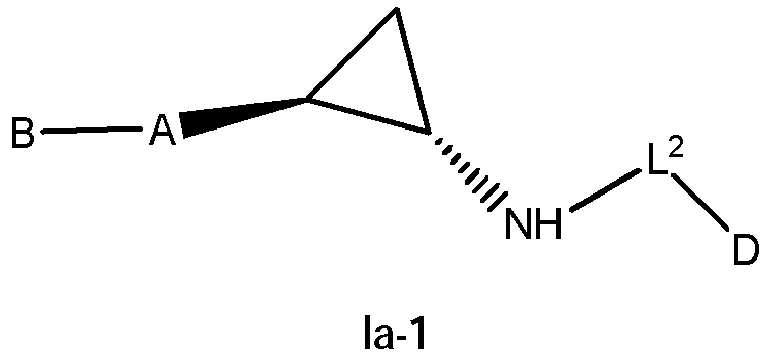
- In one embodiment, the invention provides a compound of formula I wherein each Rw, Rx, Ry and Rz is independently selected from hydrogen, fluoro and C1-4 alkyl, preferably from hydrogen, fluoro and methyl.
- In another embodiment, the invention provides a compound of formula I wherein each Rw, Rx, Ry and Rz is independently selected from hydrogen and fluoro.
- In another embodiment, the invention provides a compound of formula I wherein Rw is fluoro and each Rx, Ry and Rz is independently selected from hydrogen, halo and C1-4 alkyl; preferably, Rw is fluoro and each Rx, Ry and Rz is hydrogen.
- In another embodiment, the invention provides a compound of formula I wherein Rz is fluoro and each Rw, Rx and Ry is independently selected from hydrogen, halo and C1-4 alkyl; preferably, Rz is fluoro and each Rw, Rx and Ry is hydrogen.
- In another embodiment, the invention provides a compound of formula I wherein Rw and Rz are fluoro and each Rx and Ry is independently selected from hydrogen, halo and C1-4 alkyl; preferably, Rw and Rz are fluoro and each Rx and Ry is hydrogen.
- In a preferred embodiment, the invention provides a compound of formula I wherein Rw is selected from hydrogen, halo and C1-4 alkyl, preferably from hydrogen, fluoro and methyl, and each Rx, Ry and Rz is hydrogen.
- In a more preferred embodiment, the invention provides a compound of formula I wherein each Rw, Rx, Ry and Rz is hydrogen, i.e. a compound of formula Ia:

- In another embodiment, the invention provides a compound of formula I wherein each Rw, Rx, Ry and Rz is independently selected from hydrogen, halo and C1-4 alkyl with the proviso that at least one is not hydrogen, i.e. a compound of formula lb.
- In another embodiment, the invention provides a compound of formula I wherein Rw is selected from halo and C1-4 alkyl, preferably from fluoro and methyl, and each Rx, Ry and Rz is hydrogen, i.e. a compound of formula Ic. Preferably, in a compound of formula Ic Rw is methyl.
- In another embodiment, the invention provides a compound of formula I, Ia, Ia-1, Ib or Ic (preferably a compound of formula I, Ia, or Ia-1, more preferably a compound of formula Ia or Ia-1, and most preferably a compound of formula Ia-1) wherein L2 is a bond or linear C1-4 alkylene, preferably L2 is a bond or linear C1-2 alkylene.
- In another embodiment, the invention provides a compound of formula I, Ia, Ia-1, Ib or Ic (preferably a compound of formula I, Ia, or Ia-1, more preferably a compound of formula Ia or Ia-1, and most preferably a compound of formula Ia-1) wherein L2 is a bond.
- In another embodiment, the invention provides a compound of formula I, Ia, Ia-1, Ib or Ic (preferably a compound of formula I, Ia, or Ia-1, more preferably a compound of formula Ia or Ia-1, and most preferably a compound of formula Ia-1) wherein L2 is C1-4 alkylene, preferably linear C1-4 alkylene, more preferably linear C1-2 alkylene.
- In another embodiment, the invention provides a compound of formula I, Ia, Ia-1, Ib or Ic (preferably a compound of formula I, Ia, or Ia-1, more preferably a compound of formula Ia or Ia-1, and most preferably a compound of formula Ia-1) wherein L2 is CH2.
- In another embodiment, the invention provides a compound of formula I, Ia, Ia-1, Ib or Ic (preferably a compound of formula I, Ia, or Ia-1, more preferably a compound of formula Ia or Ia-1, and most preferably a compound of formula Ia-1) wherein L2 is CH2CH2.
- In another embodiment, the invention provides a compound of formula I, Ia, Ia-1, Ib or Ic (preferably a compound of formula I, Ia, or Ia-1, more preferably a compound of formula Ia or Ia-1, and most preferably a compound of formula Ia-1) wherein:
- L2 is a bond; and
- D is a cyclic group selected from:
- (i) a 3- to 7-membered monocyclic saturated heterocyclic ring containing 1 or 2 heteroatoms independently selected from N, O and S, and
- (ii) a 7- to 15-membered polycyclic ring system which comprises at least one saturated heterocyclic ring, wherein the polycyclic ring system contains from 1 to 4 heteroatoms independently selected from N, O and S,
- wherein the cyclic group (i) or (ii) is linked to the remainder of the compound of Formula I through a ring C atom,
- wherein one or more ring C atoms in the cyclic group (i) or (ii) are optionally oxidized to form CO groups, wherein one or more S atoms in the cyclic group (i) or (ii), if present, are optionally oxidized to form independently SO groups or SO2 groups, and
- wherein the cyclic group (i) or (ii) is optionally substituted with one or more R3. In a more specific embodiment, said substituent(s) R3, if present, are placed on ring C atom(s) of cyclic group (i) or (ii).
- In another embodiment, the invention provides a compound of formula I, Ia, Ia-1, Ib or Ic (preferably a compound of formula I, Ia, or Ia-1, more preferably a compound of formula Ia or Ia-1, and most preferably a compound of formula Ia-1) wherein:
- L2 is a bond; and
- D is a cyclic group selected from:
- (i) a 3- to 7-membered monocyclic saturated heterocyclic ring containing 1 or 2 heteroatoms independently selected from N, O and S, and
- (ii) a 7- to 15-membered polycyclic ring system which comprises at least one saturated heterocyclic ring, wherein the polycyclic ring system contains from 1 to 4 heteroatoms independently selected from N, O and S,
- wherein the cyclic group (i) or (ii) contains at least one N atom,
- wherein the cyclic group (i) or (ii) is linked to the remainder of the compound of Formula I through a ring C atom,
- wherein one or more ring C atoms in the cyclic group (i) or (ii) are optionally oxidized to form CO groups, wherein one or more S atoms in the cyclic group (i) or (ii), if present, are optionally oxidized to form independently SO groups or SO2 groups, and
- wherein the cyclic group (i) or (ii) is optionally substituted with one or more R3. In a more specific embodiment, said substituent(s) R3, if present, are placed on ring C atom(s) of cyclic group (i) or (ii).
- In another embodiment, the invention provides a compound of formula I, Ia, Ia-1, , Ib or Ic (preferably a compound of formula I, Ia, or Ia-1, more preferably a compound of formula Ia or Ia-1, and most preferably a compound of formula Ia-1) wherein:
- L2 is a bond; and
- D is a cyclic group selected from:
- (i) a 3- to 7-membered monocyclic saturated heterocyclic ring containing 1 or 2 N atoms, and
- (ii) a 7- to 15-membered polycyclic ring system which comprises at least one saturated heterocyclic ring, wherein the polycyclic ring system contains from 1 to 2 N atoms,
- wherein the cyclic group (i) or (ii) is linked to the remainder of the compound of Formula I through a ring C atom,
- wherein one or more ring C atoms in the cyclic group (i) or (ii) are optionally oxidized to form CO groups, and wherein the cyclic group (i) or (ii) is optionally substituted with one or more R3. In a more specific embodiment, said substituent(s) R3, if present, are placed on ring C atom(s) of cyclic group (i) or (ii).
- In another embodiment, the invention provides a compound of formula I, Ia, Ia-1, Ib or Ic (preferably a compound of formula I, Ia, or Ia-1, more preferably a compound of formula Ia or Ia-1, and most preferably a compound of formula Ia-1) wherein:
- L2 is a bond; and
- D is a cyclic group selected from:
- (i) a 3- to 7-membered monocyclic saturated heterocyclic ring containing 1 or 2 N atoms, and
- (ii) a 7- to 15-membered saturated polycyclic ring system which comprises at least one saturated heterocyclic ring, wherein the polycyclic ring system contains from 1 to 2 N atoms,
- wherein the cyclic group (i) or (ii) is linked to the remainder of the compound of Formula I through a ring C atom,
- wherein one or more ring C atoms in the cyclic group (i) or (ii) are optionally oxidized to form CO groups, and wherein the cyclic group (i) or (ii) is optionally substituted with one or more R3. In a more specific embodiment, said substituent(s) R3, if present, are placed on ring C atom(s) of cyclic group (i) or (ii).
- In another embodiment, the invention provides a compound of formula I, Ia, Ia-1, Ib or Ic (preferably a compound of formula I, Ia, or Ia-1, more preferably a compound of formula Ia or Ia-1, and most preferably a compound of formula la-1) wherein:
- L2 is a bond; and
- D is a 3- to 7-membered monocyclic saturated heterocyclic ring containing 1 or 2, preferably 1, heteroatoms independently selected from N, O and S,
- wherein D is linked to the remainder of the compound of Formula I through a ring C atom,
- wherein one or more ring C atoms in ring D are optionally oxidized to form CO groups,
- wherein one or more S atoms in ring D, if present, are optionally oxidized to form independently SO groups or SO2 groups, and
- wherein ring D is optionally substituted with one or more R3. In a more specific embodiment, said substituent(s) R3, if present, are placed on ring C atom(s) of ring D. In a further specific embodiment, each R3, if present, is independently selected from C1-4 alkyl, halo, C1-4 alkoxy, hydroxyl, amino, and amido.
- In another embodiment, the invention provides a compound of formula I, Ia, Ia-1, Ib or Ic (preferably a compound of formula I, Ia, or Ia-1, more preferably a compound of formula Ia or Ia-1, and most preferably a compound of formula Ia-1) wherein:
- L2 is a bond; and
- D is a 3- to 7-membered monocyclic saturated heterocyclic ring containing 1 N atom,
- wherein D is linked to the remainder of the compound of Formula I through a ring C atom,
- wherein one or more ring C atoms in ring D are optionally oxidized to form CO groups, and
- wherein ring D is optionally substituted with one or more R3. In a more specific embodiment, said substituent(s) R3, if present, are placed on ring C atom(s) of ring D. In a further specific embodiment, each R3, if present, is independently selected from C1-4 alkyl, halo, C1-4 alkoxy, hydroxyl, amino, and amido.
- In another embodiment, the invention provides a compound of formula I, Ia, Ia-1, Ib or Ic (preferably a compound of formula I, Ia, or Ia-1, more preferably a compound of formula Ia or Ia-1, and most preferably a compound of formula la-1) wherein:
- L2 is a bond; and
- D is piperidinyl, preferably 4-piperidinyl, wherein said piperidinyl is linked to the remainder of the compound of Formula I through a ring C atom, and
- wherein said piperidinyl is optionally substituted with one or more R3. In a more specific embodiment, said substituent(s) R3, if present, are placed on ring C atom(s) of ring D. In a further specific embodiment, each R3, if present, is independently selected from C1-4 alkyl, halo, C1-4 alkoxy, hydroxyl, amino, and amido.
- In another embodiment, the invention provides a compound of formula I, Ia, Ia-1, Ib or Ic (preferably a compound of formula I, Ia, or Ia-1, more preferably a compound of formula Ia or Ia-1, and most preferably a compound of formula Ia-1) wherein:
- L2 is a bond; and
- D is a 7- to 15-membered polycyclic ring system which comprises at least one saturated heterocyclic ring, wherein the polycyclic ring system contains from 1 to 4 heteroatoms independently selected from N, O and S, wherein D is linked to the remainder of the compound of Formula I through a ring C atom,
- wherein one or more ring C atoms in D are optionally oxidized to form CO groups,
- wherein one or more S atoms in D, if present, are optionally oxidized to form independently SO groups or SO2 groups, and
- wherein D is optionally substituted with one or more R3.
- In another embodiment, the invention provides a compound of formula I, Ia, Ia-1, Ib or Ic (preferably a compound of formula I, Ia, or Ia-1, more preferably a compound of formula Ia or Ia-1, and most preferably a compound of formula Ia-1) wherein:
- L2 is a bond; and
- D is a 7- to 15-membered saturated polycyclic ring system which comprises at least one heterocyclic ring, wherein the polycyclic ring system contains 1 or 2 N atoms,
- wherein D is linked to the remainder of the compound of Formula I through a ring C atom,
- wherein one or more ring C atoms in D are optionally oxidized to form CO groups, and
- wherein D is optionally substituted with one or more R3.
- In another embodiment, the invention provides a compound of formula I, Ia, Ia-1, Ib or Ic (preferably a compound of formula I, Ia, or Ia-1, more preferably a compound of formula Ia or Ia-1, and most preferably a compound of formula la-1) wherein:
- L2 is a bond; and
- D is a 7- to 15-membered saturated polycyclic ring system selected from a group of formula (a), (b), (c) and (d)


- In another embodiment, the invention provides a compound of formula I, Ia, Ia-1, Ib or Ic (preferably a compound of formula I, Ia, or Ia-1, more preferably a compound of formula Ia or Ia-1, and most preferably a compound of formula Ia-1) wherein:
- L2 is C1-4 alkylene, preferably linear C1-4 alkylene, more preferably linear C1-2 alkylene; and
- D is a cyclic group selected from:
- (iii) a 3- to 7-membered monocyclic saturated heterocyclic ring containing 1 or 2 heteroatoms independently selected from N, O and S, and
- (iv) a 7- to 15-membered polycyclic saturated ring system which comprises at least one heterocyclic ring, wherein the polycyclic saturated ring system contains from 1 to 4 heteroatoms independently selected from N, O and S,
- wherein the cyclic group (iii) or (iv) contains at least one N atom,
- wherein the cyclic group (iii) or (iv) is linked to the remainder of the compound of Formula I through a ring C atom,
- wherein one or more ring C atoms in the cyclic group (iii) or (iv) are optionally oxidized to form CO groups, wherein one or more S atoms in the cyclic group (iii) or (iv), if present, are optionally oxidized to form independently SO groups or SO2 groups, and
- wherein the cyclic group (iii) or (iv) is optionally substituted with one or more R3. In a more specific embodiment, said substituent(s) R3, if present, are placed on ring C atom(s) of cyclic group (iii) or (iv).
- In another embodiment, the invention provides a compound of formula I, Ia, Ia-1, Ib or Ic (preferably a compound of formula I, Ia, or Ia-1, more preferably a compound of formula Ia or Ia-1, and most preferably a compound of formula Ia-1) wherein:
- L2 is C1-4 alkylene, preferably linear C1-4 alkylene, more preferably linear C1-2 alkylene; and
- D is a cyclic group selected from:
- (iii) a 3- to 7-membered monocyclic saturated heterocyclic ring containing 1 or 2 N atoms, and
- (iv) a 7- to 15-membered polycyclic saturated ring system which comprises at least one heterocyclic ring, wherein the polycyclic saturated ring system contains from 1 to 2 N atoms,
- wherein the cyclic group (iii) or (iv) is linked to the remainder of the compound of Formula I through a ring C atom,
- wherein one or more ring C atoms in the cyclic group (iii) or (iv) are optionally oxidized to form CO groups, and wherein the cyclic group (iii) or (iv) is optionally substituted with one or more R3. In a more specific embodiment, said substituent(s) R3, if present, are placed on ring C atom(s) of cyclic group (iii) or (iv).
- In another embodiment, the invention provides a compound of formula I, Ia, Ia-1, Ib or Ic (preferably a compound of formula I, Ia, or Ia-1, more preferably a compound of formula Ia or Ia-1, and most preferably a compound of formula Ia-1) wherein:
- L2 is C1-4 alkylene, preferably linear C1-4 alkylene, more preferably linear C1-2 alkylene; and
- D is a 3- to 7-membered monocyclic saturated heterocyclic ring containing 1 or 2, preferably 1, heteroatoms independently selected from N, O and S,
- wherein D is linked to the remainder of the compound of Formula I through a ring C atom,
- wherein one or more ring C atoms in ring D are optionally oxidized to form CO groups,
- wherein one or more S atoms in ring D, if present, are optionally oxidized to form independently SO groups or SO2 groups, and
- wherein ring D is optionally substituted with one or more R3. In a more specific embodiment, said substituent(s) R3, if present, are placed on ring C atom(s) of ring D. In a further specific embodiment, each R3, if present, is independently selected from C1-4 alkyl, halo, C1-4 alkoxy, hydroxyl, amino, and amido.
- In another embodiment, the invention provides a compound of formula I, Ia, Ia-1, Ib or Ic (preferably a compound of formula I, Ia, or Ia-1, more preferably a compound of formula Ia or Ia-1, and most preferably a compound of formula Ia-1) wherein:
- L2 is C1-4 alkylene, preferably linear C1-4 alkylene, more preferably linear C1-2 alkylene; and
- D is a 3- to 7-membered monocyclic saturated heterocyclic ring containing 1 N atom,
- wherein D is linked to the remainder of the compound of Formula I through a ring C atom,
- wherein one or more ring C atoms in ring D are optionally oxidized to form CO groups, and
- wherein ring D is optionally substituted with one or more R3. In a more specific embodiment, said substituent(s) R3, if present, are placed on ring C atom(s) of ring D. In a further specific embodiment, each R3, if present, is independently selected from C1-4 alkyl, halo, C1-4 alkoxy, hydroxyl, amino, and amido.
- In another embodiment, the invention provides a compound of formula I, Ia, Ia-1, Ib or Ic (preferably a compound of formula I, Ia, or Ia-1, more preferably a compound of formula Ia or Ia-1, and most preferably a compound of formula Ia-1) wherein:
- L2 is C1-4 alkylene, preferably linear C1-4 alkylene, more preferably linear C1-2 alkylene; and
- D is piperidinyl, preferably 4-piperidinyl, wherein said piperidinyl is linked to the remainder of the compound of Formula I through a ring C atom, and
- wherein said piperidinyl is optionally substituted with one or more R3. In a more specific embodiment, said substituent(s) R3, if present, are placed on ring C atom(s) of ring D. In a further specific embodiment, each R3, if present, is independently selected from C1-4 alkyl, halo, C1-4 alkoxy, hydroxyl, amino, and amido.
- In another embodiment, the invention provides a compound of formula I, Ia,Ia-1, Ib or Ic (preferably a compound of formula I, Ia, or Ia-1, more preferably a compound of formula Ia or Ia-1, and most preferably a compound of formula Ia-1) wherein:
- L2 is CH2; and
- D is piperidinyl, preferably 4-piperidinyl, wherein said piperidinyl is linked to the remainder of the compound of Formula I through a ring C atom, and
- wherein said piperidinyl is optionally substituted with one or more R3. In a more specific embodiment, said substituent(s) R3, if present, are placed on ring C atom(s) of ring D. In a further specific embodiment, each R3, if present, is independently selected from C1-4 alkyl, halo, C1-4 alkoxy, hydroxyl, amino, and amido.
- In another embodiment, the invention provides a compound of formula I, Ia, Ia-1, Ib or Ic (preferably a compound of formula I, Ia, or Ia-1, more preferably a compound of formula Ia or Ia-1, and most preferably a compound of formula Ia-1) wherein:
- L2 is CH2CH2; and
- D is piperidinyl, preferably 4-piperidinyl, wherein said piperidinyl is linked to the remainder of the compound of Formula I through a ring C atom, and
- wherein said piperidinyl is optionally substituted with one or more R3. In a more specific embodiment, said substituent(s) R3, if present, are placed on ring C atom(s) of ring D. In a further specific embodiment, each R3, if present, is independently selected from C1-4 alkyl, halo, C1-4 alkoxy, hydroxyl, amino, and amido.
- In another embodiment, the invention provides a compound of formula I, Ia, Ia-1, Ib or Ic (preferably a compound of formula I, Ia, or Ia-1, more preferably a compound of formula Ia or Ia-1, and most preferably a compound of formula Ia-1) wherein:
- L2 is C1-4 alkylene, preferably linear C1-4 alkylene, more preferably linear C1-2 alkylene; and
- D is 4-piperidinyl.
- In another embodiment, the invention provides a compound of formula I, Ia, Ia-1, Ib or Ic (preferably a compound of formula I, Ia, or Ia-1, more preferably a compound of formula Ia or Ia-1, and most preferably a compound of formula Ia-1) wherein:
- L2 is C1-4 alkylene, preferably linear C1-4 alkylene, more preferably linear C1-2 alkylene; and
- D is a group of formula:

- In another embodiment, the invention provides a compound of formula I, Ia, Ia-1, Ib or Ic (preferably a compound of formula I, Ia, or Ia-1, more preferably a compound of formula Ia or Ia-1, and most preferably a compound of formula Ia-1) wherein:
- L2 is C1-4 alkylene, preferably linear C1-4 alkylene, more preferably linear C1-2 alkylene; and
- D is azetidinyl, wherein said azetidinyl is linked to the remainder of the compound of Formula I through a ring C atom, and
- wherein said azetidinyl is optionally substituted with one or more R3.
- In another embodiment, the invention provides a compound of formula I, Ia, Ia-1, Ib or Ic (preferably a compound of formula I, Ia, or Ia-1, more preferably a compound of formula Ia or Ia-1, and most preferably a compound of formula Ia-1) wherein:
- L2 is C1-4 alkylene, preferably linear C1-4 alkylene, more preferably linear C1-2 alkylene; and
- D is 3-azetidinyl optionally substituted with one or more R3.
- In another embodiment, the invention provides a compound of formula I, Ia, Ia-1, Ib or Ic (preferably a compound of formula I, Ia, or Ia-1, more preferably a compound of formula Ia or Ia-1, and most preferably a compound of formula Ia-1) wherein:
- L2 is C1-4 alkylene, preferably linear C1-4 alkylene, more preferably linear C1-2 alkylene; and
- D is a 7- to 15-membered polycyclic saturated ring system which comprises at least one heterocyclic ring, wherein the polycyclic saturated ring system contains from 1 to 4 heteroatoms independently selected from N, O and S,
- wherein D is linked to the remainder of the compound of Formula I through a ring C atom,
- wherein one or more ring C atoms in D are optionally oxidized to form CO groups,
- wherein one or more S atoms in D, if present, are optionally oxidized to form independently SO groups or SO2 groups, and
- wherein D is optionally substituted with one or more R3.
- In another embodiment, the invention provides a compound of formula I, Ia, Ia-1, Ib or Ic (preferably a compound of formula I, Ia, or Ia-1, more preferably a compound of formula Ia or Ia-1, and most preferably a compound of formula Ia-1) wherein:
- L2 is C1-4 alkylene, preferably linear C1-4 alkylene, more preferably linear C1-2 alkylene; and
- D is a 7- to 15-membered saturated polycyclic ring system which comprises at least one heterocyclic ring, wherein the polycyclic saturated ring system contains 1 or 2 N atoms,
- wherein D is linked to the remainder of the compound of Formula I through a ring C atom,
- wherein one or more ring C atoms in D are optionally oxidized to form CO groups, and
- wherein D is optionally substituted with one or more R3.
- In another embodiment, the invention provides a compound of formula I, Ia, Ia-1, Ib or Ic (preferably a compound of formula I, Ia, or Ia-1, more preferably a compound of formula Ia or Ia-1, and most preferably a compound of formula Ia-1) wherein:
- L2 is C1-4 alkylene, preferably linear C1-4 alkylene, more preferably linear C1-2 alkylene; and
- D is a 7- to 15-membered saturated polycyclic ring system selected from a group of formula (a), (b), (c) and (d), preferably from a group of formula (a), (b) and (c):


- In another embodiment, the invention provides a compound of Formula I, Ia, Ia-1, Ib or Ic (preferably a compound of formula I, Ia, or Ia-1, more preferably a compound of formula Ia or Ia-1, and most preferably a compound of formula la-1) wherein A is phenyl, naphthyl or monocyclic heteroaryl, wherein said phenyl, naphthyl or monocyclic heteroaryl is optionally substituted with one or more (e.g., one or two) R1. In a more preferred embodiment, A is phenyl, naphthyl, pyridyl, thiophenyl, pyrrolyl, furanyl, or thiazolyl, wherein A is optionally substituted with one or more R1. More preferably, A is phenyl, naphthyl, pyridyl or thiazolyl, wherein A is optionally substituted with one or more R1. Still more preferably, A is phenyl, 2-naphthyl, 3-pyridyl or 5-thiazolyl, wherein A is optionally substituted with one or more R1. In one embodiment, A is phenyl optionally substituted with one or more R1. In another embodiment, A is naphthyl, preferably 2-naphthyl, optionally substituted with one or more R1. In another embodiment, A is pyridyl, preferably 3-pyridyl, optionally substituted with one or more R1. In another embodiment, A is thiazolyl, preferably 5-thiazolyl, optionally substituted with one or more R1.
- In another embodiment, the invention provides a compound of Formula I, Ia, Ia-1, Ib or Ic (preferably a compound of formula I, Ia, or Ia-1, more preferably a compound of formula Ia or Ia-1, and most preferably a compound of formula Ia-1) wherein A is phenyl or monocyclic heteroaryl, wherein said phenyl or said monocyclic heteroaryl is optionally substituted with one or more R1. In a more preferred embodiment, A is phenyl, pyridyl, thiophenyl, pyrrolyl, furanyl, or thiazolyl, wherein A is optionally substituted with one or more R1. More preferably, A is phenyl, pyridyl or thiazolyl, wherein A is optionally substituted with one or more R1. In one embodiment, A is phenyl. In another embodiment, A is monocyclic heteroaryl. In another embodiment, A is pyridyl, thiophenyl, pyrrolyl, furanyl, or thiazolyl. In another embodiment, A is 3-pyridyl. In another embodiment, A is 5-thiazolyl.
- In another embodiment, the invention provides a compound of Formula I, Ia, Ia-1, Ib or Ic (preferably a compound of formula I, Ia, or Ia-1, more preferably a compound of formula Ia or la-1, and most preferably a compound of formula Ia-1) wherein A is phenyl optionally substituted with one or more R1.
- In another embodiment, the invention provides a compound of Formula I, Ia, Ia-1, Ib or Ic (preferably a compound of formula I, Ia, or Ia-1, more preferably a compound of formula Ia or Ia-1, and most preferably a compound of formula Ia-1) wherein A is naphthyl (e.g. 2-naphthyl) optionally substituted with one or more R1.
- In another embodiment, the invention provides a compound of Formula I, Ia, Ia-1, Ib or Ic (preferably a compound of formula I, Ia, or Ia-1, more preferably a compound of formula Ia or Ia-1, and most preferably a compound of formula Ia-1) wherein A is heteroaryl optionally substituted with one or more R1. Preferably, A is monocyclic heteroaryl optionally substituted with one or more R1.
- In another embodiment, the invention provides a compound of Formula I, Ia, Ia-1, Ib or Ic (preferably a compound of formula I, Ia, or Ia-1, more preferably a compound of formula Ia or Ia-1, and most preferably a compound of formula Ia-1) wherein:
- A is phenyl or monocyclic heteroaryl (preferably phenyl, pyridyl or thiazolyl, more preferably phenyl, 3-pyridyl or 5-thiazolyl), wherein A is optionally substituted with one or more R1;
- B is hydrogen, R1 or -L1-E;
- E is phenyl optionally substituted with one or more R2; and
- L1 is a bond, -O-, -NH-, -CH2-NH-, or -CH2-O-, wherein said -CH2-NH- or -CH2-O- groups are linked to ring A through the N or O atom, respectively, and are linked to ring E through the -CH2- group. In a more specific embodiment, L1 is a bond or -CH2-O-, wherein said -CH2-O- group is linked to ring A through the O atom and to ring E through the -CH2- group.
- In another embodiment, the invention provides a compound of Formula I, Ia, Ia-1, Ib or Ic (preferably a compound of formula I, la, or la-1, more preferably a compound of formula Ia or Ia-1, and most preferably a compound of formula la-1) wherein:
- A is aryl or heteroaryl, wherein said aryl or said heteroaryl is optionally substituted with one or more R1; and
- B is hydrogen or R1.
- In the above embodiment, preferably each R1 is independently selected from C1-8 alkyl, amino, amido, hydroxyl, halo, haloC1-8 alkyl, haloC1-8 alkoxy, cyano, sulfonamide, C1-8 alkoxy, acyl, carboxyl, carbamate, and urea. In another preferred embodiment, each R1 is independently selected from halo, C1-4 alkyl (e.g. methyl), haloC1-4 alkyl (e.g. trifluoromethyl), C1-4 alkoxy (e.g. methoxy) and C3-6 cycloalkyl (e.g. cyclopropyl). In another preferred embodiment, each R1 is independently selected from halo, C1-4 alkyl and C3-6 cycloalkyl.
- In another embodiment, the invention provides a compound of Formula I, Ia, Ia-1, Ib or Ic (preferably a compound of formula I, Ia, or Ia-1, more preferably a compound of formula Ia or Ia-1, and most preferably a compound of formula Ia-1) wherein:
- A is phenyl, naphthyl or monocyclic heteroaryl, wherein said phenyl, said naphthyl or said monocyclic heteroaryl is optionally substituted with one or more R1; and
- B is hydrogen or R1.
- In the above embodiment, preferably each R1 is independently selected from C1-8 alkyl, amino, amido, hydroxyl, halo, haloC1-8 alkyl, haloC1-8 alkoxy, cyano, sulfonamide, C1-8 alkoxy, acyl, carboxyl, carbamate, and urea. In another preferred embodiment, each R1 is independently selected from halo, C1-4 alkyl (e.g. methyl), haloC1-4 alkyl (e.g. trifluoromethyl), C1-4 alkoxy (e.g. methoxy) and C3-6 cycloalkyl (e.g. cyclopropyl). In another preferred embodiment, each R1 is independently selected from halo, C1-4 alkyl and C3-6 cycloalkyl.
- In another embodiment, the invention provides a compound of Formula I, Ia, Ia-1, Ib or Ic (preferably a compound of formula I, Ia, or Ia-1, more preferably a compound of formula Ia or Ia-1, and most preferably a compound of formula Ia-1) wherein:
- A is phenyl or monocyclic heteroaryl, wherein said phenyl or said monocyclic heteroaryl is optionally substituted with one or more R1; and
- B is hydrogen or R1.
- In the above embodiment, preferably each R1 is independently selected from C1-8 alkyl, amino, amido, hydroxyl, halo, haloC1-8 alkyl, haloC1-8 alkoxy, cyano, sulfonamide, C1-8 alkoxy, acyl, carboxyl, carbamate, and urea. In another preferred embodiment, each R1 is independently selected from halo, C1-4 alkyl (e.g. methyl), haloC1-4 alkyl (e.g. trifluoromethyl), C1-4 alkoxy (e.g. methoxy) and C3-6 cycloalkyl (e.g. cyclopropyl). In another preferred embodiment, each R1 is independently selected from halo, C1-4 alkyl and C3-6 cycloalkyl.
- In another embodiment, the invention provides a compound of Formula I, Ia,Ia-1, Ib or Ic (preferably a compound of formula I, Ia, or Ia-1, more preferably a compound of formula Ia or Ia-1, and most preferably a compound of formula Ia-1) wherein:
- A is heteroaryl, wherein said heteroaryl is optionally substituted with one or more R1; and
- B is hydrogen or R1.
- In the above embodiment, preferably each R1 is independently selected from C1-8 alkyl, amino, amido, hydroxyl, halo, haloC1-8 alkyl, haloC1-8 alkoxy, cyano, sulfonamide, C1-8 alkoxy, acyl, carboxyl, carbamate, and urea. In another preferred embodiment, each R1 is independently selected from halo, C1-4 alkyl (e.g. methyl), haloC1-4 alkyl (e.g. trifluoromethyl), C1-4 alkoxy (e.g. methoxy) and C3-6 cycloalkyl (e.g. cyclopropyl). In another preferred embodiment, each R1 is independently selected from halo, C1-4 alkyl and C3-6 cycloalkyl.
- In another embodiment, the invention provides a compound of Formula I, Ia,Ia-1, Ib or Ic (preferably a compound of formula I, Ia, or Ia-1, more preferably a compound of formula Ia or Ia-1, and most preferably a compound of formula Ia-1) wherein:
- A is monocyclic heteroaryl, wherein said monocyclic heteroaryl is optionally substituted with one or more R1; and
- B is hydrogen or R1.
- In the above embodiment, preferably each R1 is independently selected from C1-8 alkyl, amino, amido, hydroxyl, halo, haloC1-8 alkyl, haloC1-8 alkoxy, cyano, sulfonamide, C1-8 alkoxy, acyl, carboxyl, carbamate, and urea. In another preferred embodiment, each R1 is independently selected from halo, C1-4 alkyl (e.g. methyl), haloC1-4 alkyl (e.g. trifluoromethyl), C1-4 alkoxy (e.g. methoxy) and C3-6 cycloalkyl (e.g. cyclopropyl). In another preferred embodiment, each R1 is independently selected from halo, C1-4 alkyl and C3-6 cycloalkyl.
- In another embodiment, the invention provides a compound of Formula I, Ia, Ia-1, Ib or Ic (preferably a compound of formula I, Ia, or Ia-1, more preferably a compound of formula Ia or Ia-1, and most preferably a compound of formula Ia-1) wherein:
- A is phenyl, pyridyl or thiazolyl (preferably phenyl, 3-pyridyl or 5-thiazolyl), wherein A is optionally substituted with one or more R1; and
- B is hydrogen or R1.
- In the above embodiment, preferably each R1 is independently selected from C1-8 alkyl, amino, amido, hydroxyl, halo, haloC1-8 alkyl, haloC1-8 alkoxy, cyano, sulfonamide, C1-8 alkoxy, acyl, carboxyl, carbamate, and urea. In another preferred embodiment, each R1 is independently selected from halo, C1-4 alkyl (e.g. methyl), haloC1-4 alkyl (e.g. trifluoromethyl), C1-4 alkoxy (e.g. methoxy) and C3-6 cycloalkyl (e.g. cyclopropyl). In another preferred embodiment, each R1 is independently selected from halo, C1-4 alkyl and C3-6 cycloalkyl.
- In another embodiment, the invention provides a compound of Formula I, Ia, Ia-1, Ib or Ic (preferably a compound of formula I, Ia, or Ia-1, more preferably a compound of formula Ia or Ia-1, and most preferably a compound of formula Ia-1) wherein:
- A is phenyl optionally substituted with one or more R1; and
- B is hydrogen or R1.
- In the above embodiment, preferably each R1 is independently selected from C1-8 alkyl, amino, amido, hydroxyl, halo, haloC1-8 alkyl, haloC1-8 alkoxy, cyano, sulfonamide, C1-8 alkoxy, acyl, carboxyl, carbamate, and urea. In another preferred embodiment, each R1 is independently selected from halo, C1-4 alkyl (e.g. methyl), haloC1-4 alkyl (e.g. trifluoromethyl), C1-4 alkoxy (e.g. methoxy) and C3-6 cycloalkyl (e.g. cyclopropyl). In another preferred embodiment, each R1 is independently selected from halo, C1-4 alkyl and C3-6 cycloalkyl.
- In another embodiment, the invention provides a compound of Formula I, Ia,Ia-1, Ib or Ic (preferably a compound of formula I, Ia, or Ia-1, more preferably a compound of formula Ia or Ia-1, and most preferably a compound of formula Ia-1) wherein:
- A is naphthyl, wherein said naphthyl is optionally substituted with one or more R1; and
- B is hydrogen or R1.
- In the above embodiment, preferably each R1 is independently selected from C1-8 alkyl, amino, amido, hydroxyl, halo, haloC1-8 alkyl, haloC1-8 alkoxy, cyano, sulfonamide, C1-8 alkoxy, acyl, carboxyl, carbamate, and urea. In another preferred embodiment, each R1 is independently selected from halo, C1-4 alkyl (e.g. methyl), haloC1-4 alkyl (e.g. trifluoromethyl), C1-4 alkoxy (e.g. methoxy) and C3-6 cycloalkyl (e.g. cyclopropyl). In another preferred embodiment, each R1 is independently selected from halo, C1-4 alkyl and C3-6 cycloalkyl.
- In another embodiment, the invention provides a compound of Formula I, Ia, Ia-1, Ib or Ic (preferably a compound of formula I, Ia, or Ia-1, more preferably a compound of formula Ia or Ia-1, and most preferably a compound of formula Ia-1) wherein:
- A is phenyl, naphthyl or monocyclic heteroaryl; and
- B is hydrogen.
- In another embodiment, the invention provides a compound of Formula I, Ia, Ia-1, Ib or Ic (preferably a compound of formula I, Ia, or la-1, more preferably a compound of formula Ia or Ia-1, and most preferably a compound of formula la-1) wherein:
- A is phenyl, pyridyl or thiazolyl (preferably phenyl, 3-pyridyl or 5-thiazolyl); and
- B is hydrogen.
- In another embodiment, the invention provides a compound of Formula I, Ia,Ia-1, Ib or Ic (preferably a compound of formula I, la, or la-1, more preferably a compound of formula Ia or Ia-1, and most preferably a compound of formula Ia-1) wherein:
- A is phenyl; and
- B is hydrogen.
- In another embodiment, the invention provides a compound of Formula I, Ia,Ia-1, Ib or Ic (preferably a compound of formula I, la, or la-1, more preferably a compound of formula Ia or la-1, and most preferably a compound of formula la-1) wherein:
- A is naphthyl, preferably 2-naphthyl; and
- B is hydrogen.
- In another embodiment, the invention provides a compound of Formula I, Ia,Ia-1, Ib or Ic (preferably a compound of formula I, la, or la-1, more preferably a compound of formula Ia or la-1, and most preferably a compound of formula la-1) wherein:
- A is heteroaryl, preferably monocyclic heteroaryl; and
- B is hydrogen.
- In another embodiment, the invention provides a compound of Formula I, Ia, Ia-1, Ib or Ic (preferably a compound of formula I, Ia, or Ia-1, more preferably a compound of formula Ia or Ia-1, and most preferably a compound of formula Ia-1) wherein:
- A is phenyl or monocyclic heteroaryl (preferably phenyl, pyridyl or thiazolyl, and more preferably phenyl, 3-pyridyl or 5-thiazolyl), wherein said phenyl or said monocyclic heteroaryl is optionally substituted with one or more R1; and
- B is -L1-E.
- In the above embodiment preferably L1 is a bond, -O-, -NH-, -CH2-NH-, or -CH2-O-, wherein said -CH2-NH- or-CH2-O- groups are linked to ring A through the N or O atom, respectively, and are linked to ring E through the-CH2- group. In a more specific embodiment, E is phenyl optionally substituted with one or more R2 and L1 is a bond, -O-, -NH-, -CH2-NH-, or -CH2-O-, wherein said -CH2-NH- or -CH2-O- groups are linked to ring A through the N or O atom, respectively, and are linked to ring E through the -CH2- group. Preferably, L1 is a bond or-CH2-O-, wherein said -CH2-O- group is linked to ring A through the O atom and to ring E through the -CH2-group.
- In another embodiment, the invention provides a compound of Formula I, Ia, Ia-1, Ib or Ic (preferably a compound of formula I, Ia, or Ia-1, more preferably a compound of formula Ia or Ia-1, and most preferably a compound of formula Ia-1) wherein:
- A is phenyl or pyridyl (preferably phenyl or 3-pyridyl), wherein A is optionally substituted with one or more R1; and
- B is -L1-E.
- In the above embodiment preferably L1 is a bond, -O-, -NH-, -CH2-NH-, or -CH2-O-, wherein said -CH2-NH- or-CH2-O- groups are linked to ring A through the N or O atom, respectively, and are linked to ring E through the-CH2- group. In a more specific embodiment, E is phenyl optionally substituted with one or more R2 and L1 is a bond, -O-, -NH-, -CH2-NH-, or -CH2-O-, wherein said -CH2-NH- or -CH2-O- groups are linked to ring A through the N or O atom, respectively, and are linked to ring E through the -CH2- group. Preferably, L1 is a bond or-CH2-O-, wherein said -CH2-O- group is linked to ring A through the O atom and to ring E through the -CH2-group.
- In another embodiment, the invention provides a compound of Formula I, Ia, Ia-1, Ib or Ic (preferably a compound of formula I, Ia, or Ia-1, more preferably a compound of formula Ia or Ia-1, and most preferably a compound of formula Ia-1) wherein:
- A is phenyl; and
- B is -L1-E.
- In the above embodiment preferably L1 is a bond, -O-, -NH-, -CH2-NH-, or -CH2-O-, wherein said -CH2-NH- or-CH2-O- groups are linked to ring A through the N or O atom, respectively, and are linked to ring E through the-CH2- group. In a more specific embodiment, E is phenyl optionally substituted with one or more R2 and L1 is a bond, -O-, -NH-, -CH2-NH-, or -CH2-O-, wherein said -CH2-NH- or -CH2-O- groups are linked to ring A through the N or O atom, respectively, and are linked to ring E through the -CH2- group. Preferably, L1 is a bond or-CH2-O-, wherein said -CH2-O- group is linked to ring A through the O atom and to ring E through the -CH2-group.
- In another embodiment, the invention provides a compound of Formula I, Ia, Ia-1, Ib or Ic (preferably a compound of formula I, Ia, or Ia-1, more preferably a compound of formula Ia or Ia-1, and most preferably a compound of formula Ia-1) wherein:
- A is 3-pyridyl; and
- B is -L1-E.
- In the above embodiment preferably L1 is a bond, -O-, -NH-, -CH2-NH-, or -CH2-O-, wherein said -CH2-NH- or-CH2-O- groups are linked to ring A through the N or O atom, respectively, and are linked to ring E through the-CH2- group. In a more specific embodiment, E is phenyl optionally substituted with one or more R2 and L1 is a bond, -O-, -NH-, -CH2-NH-, or -CH2-O-, wherein said -CH2-NH- or -CH2-O- groups are linked to ring A through the N or O atom, respectively, and are linked to ring E through the -CH2- group. Preferably, L1 is a bond or-CH2-O-, wherein said -CH2-O- group is linked to ring A through the O atom and to ring E through the -CH2-group.
- In another embodiment, the invention provides a compound of Formula I, Ia, Ia-1, Ib or Ic (preferably a compound of formula I, Ia, or Ia-1, more preferably a compound of formula Ia or Ia-1, and most preferably a compound of formula Ia-1) wherein:
- B is -L1-E;
- L1 is -O-, -NH-, -N(C1-4 alkyl)-, C1-4 alkylene, -(CH2)x-NH-, -SO2NH- or -SO2N(CH3)-, wherein x is 1, 2, 3 or 4; preferably L1 is -O-, -NH-, -N(C1-4 alkyl)-, C1-4 alkylene, or -CH2-NH, and more preferably L1 is -O-, -NH- or-CH2-NH-; and
- E is aryl or heteroaryl, wherein said aryl or said heteroaryl is optionally substituted with one or more R2.
- In another embodiment, the invention provides a compound of Formula I, Ia, Ia-1, Ib or Ic (preferably a compound of formula I, Ia, or Ia-1, more preferably a compound of formula Ia or Ia-1, and most preferably a compound of formula Ia-1) wherein:
- B is -L1-E;
- L1 is a bond, -O-, -NH-, -CH2-NH-, or -CH2-O-, wherein the groups -CH2-NH- and -CH2-O- are linked to ring A through the N or O atom, respectively, and are linked to ring E through the -CH2- group; and E is aryl or heteroaryl, wherein said aryl or said heteroaryl is optionally substituted with one or more R2.
- In another embodiment, the invention provides a compound of Formula I, Ia, Ia-1, Ib or Ic (preferably a compound of formula I, Ia, or Ia-1, more preferably a compound of formula Ia or Ia-1, and most preferably a compound of formula Ia-1) wherein:
- B is -L1-E;
- L1 is a bond, -O-, -NH-, -CH2-NH-, or -CH2-O-, wherein the groups -CH2-NH- and -CH2-O- are linked to ring A through the N or O atom, respectively, and are linked to ring E through the -CH2- group; and
- E is phenyl optionally substituted with one or more R2.
- In another embodiment, the invention provides a compound of Formula I, Ia, Ia-1, Ib or Ic (preferably a compound of formula I, Ia, or Ia-1, more preferably a compound of formula Ia or Ia-1, and most preferably a compound of formula Ia-1) wherein:
- B is -L1-E;
- L1 is a bond or -CH2-O-, wherein the group -CH2-O- is linked to ring A through the O atom and to ring E through the -CH2- group; and
- E is aryl or heteroaryl, wherein said aryl or said heteroaryl is optionally substituted with one or more R2.
- In another embodiment, the invention provides a compound of Formula I, Ia, Ia-1, Ib or Ic (preferably a compound of formula I, la, or la-1, more preferably a compound of formula Ia or Ia-1, and most preferably a compound of formula la-1) wherein:
- B is -L1-E;
- L1 is a bond; and
- E is aryl or heteroaryl, wherein said aryl or said heteroaryl is optionally substituted with one or more R2.
- In another embodiment, the invention provides a compound of Formula I, Ia, Ia-1, Ib or Ic (preferably a compound of formula I, Ia, or Ia-1, more preferably a compound of formula Ia or Ia-1, and most preferably a compound of formula Ia-1) wherein:
- B is -L1-E;
- L1 is a bond; and
- E is aryl, pyridinyl, thiophenyl, pyrrolyl, furanyl, thiazolyl, oxazolyl, isoxazolyl, oxadiazolyl, thiadiazolyl, triazinyl, pyridazinyl, pyrazinyl, pyrimidinyl, quinolyl, indolyl, indazolyl, imidazolyl or benzimidazolyl, wherein said aryl, said pyridinyl, said thiophenyl, said pyrrolyl, said furanyl, said thiazolyl, said oxazolyl, said isoxazolyl, said oxadiazolyl, said thiadiazolyl, said triazinyl, said pyridazinyl, said pyrazinyl, said pyrimidinyl, said quinolyl, said indolyl, said indazolyl, said imidazolyl or said benzimidazolyl is optionally substituted with one or more R2.
- In another embodiment, the invention provides a compound of Formula I, Ia, Ia-1, Ib or Ic (preferably a compound of formula I, Ia, or Ia-1, more preferably a compound of formula Ia or Ia-1, and most preferably a compound of formula Ia-1) wherein:
- B is -L1-E;
- L1 is a bond; and
- E is aryl (preferably phenyl), wherein said aryl is optionally substituted with one or more R2.
- In another embodiment, the invention provides a compound of Formula I, Ia, Ia-1, Ib or Ic (preferably a compound of formula I, Ia, or Ia-1, more preferably a compound of formula Ia or Ia-1, and most preferably a compound of formula Ia-1) wherein:
- B is -L1-E;
- L1 is a bond; and
- E is pyridinyl optionally substituted with one or more R2.
- In another embodiment, the invention provides a compound of Formula I, Ia, Ia-1, Ib or Ic (preferably a compound of formula I, Ia, or Ia-1, more preferably a compound of formula Ia or Ia-1, and most preferably a compound of formula Ia-1) wherein:
- B is -L1-E;
- L1 is a bond; and
- E is aryl or heteroaryl.
- In another embodiment, the invention provides a compound of Formula I, Ia, Ia-1, Ib or Ic (preferably a compound of formula I, Ia, or Ia-1, more preferably a compound of formula Ia or Ia-1, and most preferably a compound of formula Ia-1) wherein:
- B is -L1-E;
- L1 is a bond;
- E is aryl or heteroaryl, wherein said aryl or said heteroaryl is optionally substituted with one or more R2; and each R2 is independently selected from hydroxyl, halo, haloC1-8 alkyl and N-sulfonamido.
- In another embodiment, the invention provides a compound of Formula I, Ia, Ia-1, Ib or Ic (preferably a compound of formula I, Ia, or Ia-1, more preferably a compound of formula Ia or Ia-1, and most preferably a compound of formula Ia-1) wherein:
- B is -L1-E;
- L1 is -CH2-O-, wherein the group -CH2-O- is linked to ring A through the O atom and to ring E through the -CH2-group; and
- E is aryl or heteroaryl, wherein said aryl or said heteroaryl is optionally substituted with one or more R2.
- In another embodiment, the invention provides a compound of Formula I, Ia, Ia-1, Ib or Ic (preferably a compound of formula I, Ia, or Ia-1, more preferably a compound of formula Ia or Ia-1, and most preferably a compound of formula Ia-1) wherein:
- B is -L1-E;
- L1 is -CH2-O-, wherein the group -CH2-O- is linked to ring A through the O atom and to ring E through the -CH2-group; and
- E is heteroaryl (preferably monocyclic heteroaryl, more preferably pyridinyl), wherein said heteroaryl is optionally substituted with one or more R2.
- In another embodiment, the invention provides a compound of Formula I, Ia, Ia-1, Ib or Ic (preferably a compound of formula I, Ia, or Ia-1, more preferably a compound of formula Ia or Ia-1, and most preferably a compound of formula Ia-1) wherein:
- B is -L1-E;
- L1 is -CH2-O-, wherein the group -CH2-O- is linked to ring A through the O atom and to ring E through the -CH2-group; and
- E is phenyl optionally substituted with one or more R2.
- In another embodiment, the invention provides a compound of Formula I, Ia, Ia-1, Ib or Ic (preferably a compound of formula I, Ia, or Ia-1, more preferably a compound of formula Ia or Ia-1, and most preferably a compound of formula Ia-1) wherein:
- B is -L1-E;
- L1 is -NH- or -CH2-NH-, wherein the group -CH2-NH- is linked to ring A through the N atom and to ring E through the -CH2- group; and
- E is aryl or heteroaryl, wherein said aryl or said heteroaryl is optionally substituted with one or more R2.
- In another embodiment, the invention provides a compound of formula I, Ia, Ia-1, Ib or Ic (preferably a compound of formula I, la, or la-1, more preferably a compound of formula Ia or Ia-1, and most preferably a compound of formula Ia-1) wherein:
- L2 is a bond;
- D is a cyclic group selected from:
- (i) a 3- to 7-membered monocyclic saturated heterocyclic ring containing 1 or 2 heteroatoms independently selected from N, O and S, and
- (ii) a 7- to 15-membered polycyclic ring system which comprises at least one saturated heterocyclic ring, wherein the polycyclic ring system contains from 1 to 4 heteroatoms independently selected from N, O and S,
- wherein the cyclic group (i) or (ii) is linked to the remainder of the compound of Formula I through a ring C atom,
- wherein one or more ring C atoms in the cyclic group (i) or (ii) are optionally oxidized to form CO groups, wherein one or more S atoms in the cyclic group (i) or (ii), if present, are optionally oxidized to form independently SO groups or SO2 groups, and
- wherein the cyclic group (i) or (ii) is optionally substituted with one or more R3;
- A is phenyl, pyridyl or thiazolyl (preferably phenyl, 3-pyridyl or 5-thiazolyl), wherein A is optionally substituted with one or more R1;
- B is hydrogen, R1 or -L1-E;
- E is phenyl optionally substituted with one or more R2; and
- L1 is a bond, -O-, -NH-, -CH2-NH-, or -CH2-O-, wherein said -CH2-NH- or -CH2-O- groups are linked to ring A through the N or O atom, respectively, and are linked to ring E through the -CH2- group. Preferably, L1 is a bond or -CH2-O-, wherein said -CH2-O- group is linked to ring A through the O atom and to ring E through the-CH2- group.
- In another embodiment, the invention provides a compound of formula I, Ia,Ia-1, Ib or Ic (preferably a compound of formula I, Ia, or Ia-1, more preferably a compound of formula Ia or Ia-1, and most preferably a compound of formula Ia-1) wherein:
- L2 is a bond;
- D is a cyclic group selected from:
- (i) a 3- to 7-membered monocyclic saturated heterocyclic ring containing 1 or 2 heteroatoms independently selected from N, O and S, and
- (ii) a 7- to 15-membered polycyclic ring system which comprises at least one saturated heterocyclic ring, wherein the polycyclic ring system contains from 1 to 4 heteroatoms independently selected from N, O and S,
- wherein the cyclic group (i) or (ii) is linked to the remainder of the compound of Formula I through a ring C atom,
- wherein one or more ring C atoms in the cyclic group (i) or (ii) are optionally oxidized to form CO groups, wherein one or more S atoms in the cyclic group (i) or (ii), if present, are optionally oxidized to form independently SO groups or SO2 groups, and
- wherein the cyclic group (i) or (ii) is optionally substituted with one or more R3;
- A is aryl or heteroaryl, wherein A is optionally substituted with one or more R1; and
- B is hydrogen or R1.
- In another embodiment, the invention provides a compound of formula I, Ia,Ia-1, Ib or Ic (preferably a compound of formula I, Ia, or Ia-1, more preferably a compound of formula Ia or Ia-1, and most preferably a compound of formula Ia-1) wherein:
- L2 is a bond;
- D is a cyclic group selected from:
- (i) a 3- to 7-membered monocyclic saturated heterocyclic ring containing 1 or 2 heteroatoms independently selected from N, O and S, and
- (ii) a 7- to 15-membered polycyclic ring system which comprises at least one saturated heterocyclic ring, wherein the polycyclic ring system contains from 1 to 4 heteroatoms independently selected from N, O and S,
- wherein the cyclic group (i) or (ii) is linked to the remainder of the compound of Formula I through a ring C atom,
- wherein one or more ring C atoms in the cyclic group (i) or (ii) are optionally oxidized to form CO groups, wherein one or more S atoms in the cyclic group (i) or (ii), if present, are optionally oxidized to form independently SO groups or SO2 groups, and
- wherein the cyclic group (i) or (ii) is optionally substituted with one or more R3;
- A is phenyl or monocyclic heteroaryl (preferably phenyl, pyridyl or thiazolyl, and more preferably phenyl, 3-pyridyl or 5-thiazolyl), wherein A is optionally substituted with one or more R1; and
- B is hydrogen or R1.
- In another embodiment, the invention provides a compound of formula I, Ia,Ia-1, Ib or Ic (preferably a compound of formula I, Ia, or Ia-1, more preferably a compound of formula Ia or Ia-1, and most preferably a compound of formula Ia-1) wherein:
- L2 is a bond;
- D is a cyclic group selected from:
- (i) a 3- to 7-membered monocyclic saturated heterocyclic ring containing 1 or 2 heteroatoms independently selected from N, O and S, and
- (ii) a 7- to 15-membered polycyclic ring system which comprises at least one saturated heterocyclic ring, wherein the polycyclic ring system contains from 1 to 4 heteroatoms independently selected from N, O and S,
- wherein the cyclic group (i) or (ii) is linked to the remainder of the compound of Formula I through a ring C atom,
- wherein one or more ring C atoms in the cyclic group (i) or (ii) are optionally oxidized to form CO groups,
- wherein one or more S atoms in the cyclic group (i) or (ii), if present, are optionally oxidized to form independently SO groups or SO2 groups, and
- wherein the cyclic group (i) or (ii) is optionally substituted with one or more R3;
- A is phenyl optionally substituted with one or more R1; and
- B is hydrogen or R1.
- In a more specific embodiment, said substituent(s) R3, if present, are placed on ring C atom(s) of cyclic group (i) or (ii).
- In another embodiment, the invention provides a compound of formula I, Ia,Ia-1, Ib or Ic (preferably a compound of formula I, Ia, or Ia-1, more preferably a compound of formula Ia or Ia-1, and most preferably a compound of formula Ia-1) wherein:
- L2 is a bond;
- D is a cyclic group selected from:
- (i) a 3- to 7-membered monocyclic saturated heterocyclic ring containing 1 or 2 heteroatoms independently selected from N, O and S, and
- (ii) a 7- to 15-membered polycyclic ring system which comprises at least one saturated heterocyclic ring, wherein the polycyclic ring system contains from 1 to 4 heteroatoms independently selected from N, O and S,
- wherein the cyclic group (i) or (ii) is linked to the remainder of the compound of Formula I through a ring C atom,
- wherein one or more ring C atoms in the cyclic group (i) or (ii) are optionally oxidized to form CO groups, wherein one or more S atoms in the cyclic group (i) or (ii), if present, are optionally oxidized to form independently SO groups or SO2 groups, and
- wherein the cyclic group (i) or (ii) is optionally substituted with one or more R3;
- A is naphthyl optionally substituted with one or more R1; and
- B is hydrogen or R1.
- In another embodiment, the invention provides a compound of formula I, Ia, Ia-1, Ib or Ic (preferably a compound of formula I, Ia, or Ia-1, more preferably a compound of formula Ia or Ia-1, and most preferably a compound of formula Ia-1) wherein:
- L2 is a bond;
- D is a cyclic group selected from:
- (i) a 3- to 7-membered monocyclic saturated heterocyclic ring containing 1 or 2 heteroatoms independently selected from N, O and S, and
- (ii) a 7- to 15-membered polycyclic ring system which comprises at least one saturated heterocyclic ring, wherein the polycyclic ring system contains from 1 to 4 heteroatoms independently selected from N, O and S,
- wherein the cyclic group (i) or (ii) is linked to the remainder of the compound of Formula I through a ring C atom,
- wherein one or more ring C atoms in the cyclic group (i) or (ii) are optionally oxidized to form CO groups, wherein one or more S atoms in the cyclic group (i) or (ii), if present, are optionally oxidized to form independently SO groups or SO2 groups, and
- wherein the cyclic group (i) or (ii) is optionally substituted with one or more R3;
- A is phenyl; and
- B is hydrogen.
- In another embodiment, the invention provides a compound of formula I, Ia, Ia-1, Ib or Ic (preferably a compound of formula I, Ia, or Ia-1, more preferably a compound of formula Ia or Ia-1, and most preferably a compound of formula Ia-1) wherein:
- L2 is a bond;
- D is a cyclic group selected from:
- (i) a 3- to 7-membered monocyclic saturated heterocyclic ring containing 1 or 2 heteroatoms independently selected from N, O and S, and
- (ii) a 7- to 15-membered polycyclic ring system which comprises at least one saturated heterocyclic ring, wherein the polycyclic ring system contains from 1 to 4 heteroatoms independently selected from N, O and S,
- wherein the cyclic group (i) or (ii) is linked to the remainder of the compound of Formula I through a ring C atom,
- wherein one or more ring C atoms in the cyclic group (i) or (ii) are optionally oxidized to form CO groups, wherein one or more S atoms in the cyclic group (i) or (ii), if present, are optionally oxidized to form independently SO groups or SO2 groups, and
- wherein the cyclic group (i) or (ii) is optionally substituted with one or more R3;
- A is aryl or heteroaryl, wherein said aryl or said heteroaryl is optionally substituted with one or more R1; and B is -L1-E.
- In another embodiment, the invention provides a compound of formula I, Ia, Ia-1, Ib or Ic (preferably a compound of formula I, Ia, or Ia-1, more preferably a compound of formula Ia or Ia-1, and most preferably a compound of formula Ia-1) wherein:
- L2 is a bond;
- D is a cyclic group selected from:
- (i) a 3- to 7-membered monocyclic saturated heterocyclic ring containing 1 or 2 heteroatoms independently selected from N, O and S, and
- (ii) a 7- to 15-membered polycyclic ring system which comprises at least one saturated heterocyclic ring, wherein the polycyclic ring system contains from 1 to 4 heteroatoms independently selected from N, O and S,
- wherein the cyclic group (i) or (ii) is linked to the remainder of the compound of Formula I through a ring C atom,
- wherein one or more ring C atoms in the cyclic group (i) or (ii) are optionally oxidized to form CO groups, wherein one or more S atoms in the cyclic group (i) or (ii), if present, are optionally oxidized to form independently SO groups or SO2 groups, and
- wherein the cyclic group (i) or (ii) is optionally substituted with one or more R3;
- A is phenyl or pyridyl (preferably phenyl or 3-pyridyl), wherein A is optionally substituted with one or more R1; and
- B is -L1-E.
- In another embodiment, the invention provides a compound of formula I, Ia, Ia-1, Ib or Ic (preferably a compound of formula I, Ia, or Ia-1, more preferably a compound of formula Ia or Ia-1, and most preferably a compound of formula Ia-1) wherein:
- L2 is a bond;
- D is a 3- to 7-membered monocyclic saturated heterocyclic ring containing 1 or 2, heteroatoms independently selected from N, O and S, preferably containing 1 heteroatom selected from N, O and S, and more preferably containing 1 N atom,
- wherein D is linked to the remainder of the compound of Formula I through a ring C atom,
- wherein one or more ring C atoms in ring D are optionally oxidized to form CO groups,
- wherein one or more S atoms in ring D, if present, are optionally oxidized to form independently SO groups or SO2 groups, and
- wherein ring D is optionally substituted with one or more R3;
- A is phenyl or monocyclic heteroaryl (preferably phenyl, pyridyl or thiazolyl, more preferably phenyl, 3-pyridyl or 5-thiazolyl), wherein A is optionally substituted with one or more R1;
- B is hydrogen, R1 or -L1-E;
- E is phenyl optionally substituted with one or more R2; and
- L1 is a bond, -O-, -NH-, -CH2-NH-, or -CH2-O-, wherein said -CH2-NH- or -CH2-O- groups are linked to ring A through the N or O atom, respectively, and are linked to ring E through the -CH2- group. Preferably, L1 is a bond or -CH2-O-, wherein said -CH2-O- group is linked to ring A through the O atom and to ring E through the-CH2- group.
- In another embodiment, the invention provides a compound of formula I, Ia, Ia-1, Ib or Ic (preferably a compound of formula I, Ia, or Ia-1, more preferably a compound of formula Ia or Ia-1, and most preferably a compound of formula Ia-1) wherein:
- L2 is a bond;
- D is a 3- to 7-membered monocyclic saturated heterocyclic ring containing 1 or 2, heteroatoms independently selected from N, O and S, preferably containing 1 heteroatom selected from N, O and S, and more preferably containing 1 N atom,
- wherein D is linked to the remainder of the compound of Formula I through a ring C atom,
- wherein one or more ring C atoms in ring D are optionally oxidized to form CO groups,
- wherein one or more S atoms in ring D, if present, are optionally oxidized to form independently SO groups or SO2 groups, and
- wherein ring D is optionally substituted with one or more R3;
- A is phenyl or monocyclic heteroaryl (preferably phenyl, pyridyl or thiazolyl, more preferably phenyl, 3-pyridyl or 5-thiazolyl), wherein A is optionally substituted with one or more R1; and
- B is hydrogen or R1.
- In a more specific embodiment, said substituent(s) R3, if present, are placed on ring C atom(s) of ring D. In a further specific embodiment, each R3, if present, is independently selected from C1-4 alkyl, halo, C1-4 alkoxy, hydroxyl, amino, and amido.
- In another embodiment, the invention provides a compound of formula I, Ia, Ia-1, Ib or Ic (preferably a compound of formula I, Ia, or Ia-1, more preferably a compound of formula Ia or Ia-1, and most preferably a compound of formula Ia-1) wherein:
- L2 is a bond;
- D is a 3- to 7-membered monocyclic saturated heterocyclic ring containing 1 or 2, heteroatoms independently selected from N, O and S, preferably containing 1 heteroatom selected from N, O and S, and more preferably containing 1 N atom,
- wherein D is linked to the remainder of the compound of Formula I through a ring C atom,
- wherein one or more ring C atoms in ring D are optionally oxidized to form CO groups,
- wherein one or more S atoms in ring D, if present, are optionally oxidized to form independently SO groups or SO2 groups, and
- wherein ring D is optionally substituted with one or more R3;
- A is phenyl optionally substituted with one or more R1; and
- B is hydrogen or R1.
- In another embodiment, the invention provides a compound of formula I, Ia, Ia-1, Ib or Ic (preferably a compound of formula I, Ia, or Ia-1, more preferably a compound of formula Ia or Ia-1, and most preferably a compound of formula Ia-1) wherein:
- L2 is a bond;
- D is a 3- to 7-membered monocyclic saturated heterocyclic ring containing 1 or 2, heteroatoms independently selected from N, O and S, preferably containing 1 heteroatom selected from N, O and S, and more preferably containing 1 N atom,
- wherein D is linked to the remainder of the compound of Formula I through a ring C atom,
- wherein one or more ring C atoms in ring D are optionally oxidized to form CO groups,
- wherein one or more S atoms in ring D, if present, are optionally oxidized to form independently SO groups or SO2 groups, and
- wherein ring D is optionally substituted with one or more R3;
- A is naphthyl optionally substituted with one or more R1; and
- B is hydrogen or R1.
- In a more specific embodiment, said substituent(s) R3, if present, are placed on ring C atom(s) of ring D. In a further specific embodiment, each R3, if present, is independently selected from C1-4 alkyl, halo, C1-4 alkoxy, hydroxyl, amino, and amido.
- In another embodiment, the invention provides a compound of formula I, Ia, Ia-1, Ib or Ic (preferably a compound of formula I, Ia, or Ia-1, more preferably a compound of formula Ia or Ia-1, and most preferably a compound of formula Ia-1) wherein:
- L2 is a bond;
- D is a 3- to 7-membered monocyclic saturated heterocyclic ring containing 1 or 2, heteroatoms independently selected from N, O and S, preferably containing 1 heteroatom selected from N, O and S, and more preferably containing 1 N atom,
- wherein D is linked to the remainder of the compound of Formula I through a ring C atom,
- wherein one or more ring C atoms in ring D are optionally oxidized to form CO groups,
- wherein one or more S atoms in ring D, if present, are optionally oxidized to form independently SO groups or SO2 groups, and
- wherein ring D is optionally substituted with one or more R3;
- A is phenyl; and
- B is hydrogen.
- In another embodiment, the invention provides a compound of formula I, Ia, Ia-1, Ib or Ic (preferably a compound of formula I, Ia, or Ia-1, more preferably a compound of formula Ia or Ia-1, and most preferably a compound of formula Ia-1) wherein:
- L2 is a bond;
- D is a 3- to 7-membered monocyclic saturated heterocyclic ring containing 1 or 2, heteroatoms independently selected from N, O and S, preferably containing 1 heteroatom selected from N, O and S, and more preferably containing 1 N atom,
- wherein D is linked to the remainder of the compound of Formula I through a ring C atom,
- wherein one or more ring C atoms in ring D are optionally oxidized to form CO groups,
- wherein one or more S atoms in ring D, if present, are optionally oxidized to form independently SO groups or SO2 groups, and
- wherein ring D is optionally substituted with one or more R3;
- A is phenyl or pyridyl (preferably phenyl or 3-pyridyl), wherein A is optionally substituted with one or more R1; and
- B is -L1-E.
- In another embodiment, the invention provides a compound of formula I, Ia, Ia-1, Ib or Ic (preferably a compound of formula I, Ia, or Ia-1, more preferably a compound of formula Ia or Ia-1, and most preferably a compound of formula Ia-1) wherein:
- L2 is a bond;
- D is piperidinyl, preferably 4-piperidinyl, wherein said piperidinyl is linked to the remainder of the compound of Formula I through a ring C atom, and
- wherein said piperidinyl is optionally substituted with one or more R3;
- A is phenyl or monocyclic heteroaryl (preferably phenyl, pyridyl or thiazolyl, more preferably phenyl, 3-pyridyl or 5-thiazolyl), wherein A is optionally substituted with one or more R1;
- B is hydrogen, R1 or -L1-E;
- E is phenyl optionally substituted with one or more R2; and
- L1 is a bond, -O-, -NH-, -CH2-NH-, or -CH2-O-, wherein said -CH2-NH- or -CH2-O- groups are linked to ring A through the N or O atom, respectively, and are linked to ring E through the -CH2- group. Preferably, L1 is a bond or -CH2-O-, wherein said -CH2-O- group is linked to ring A through the O atom and to ring E through the-CH2- group.
- In another embodiment, the invention provides a compound of formula I, Ia, Ia-1, Ib or Ic (preferably a compound of formula I, Ia, or Ia-1, more preferably a compound of formula Ia or Ia-1, and most preferably a compound of formula Ia-1) wherein:
- L2 is a bond;
- D is piperidinyl, preferably 4-piperidinyl, wherein said piperidinyl is linked to the remainder of the compound of Formula I through a ring C atom, and
- wherein said piperidinyl is optionally substituted with one or more R3;
- A is phenyl or monocyclic heteroaryl (preferably phenyl, pyridyl or thiazolyl, more preferably phenyl, 3-pyridyl or 5-thiazolyl), wherein A is optionally substituted with one or more R1; and
- B is hydrogen or R1.
- In another embodiment, the invention provides a compound of formula I, la, la-1, Ib or Ic (preferably a compound of formula I, la, or la-1, more preferably a compound of formula Ia or la-1, and most preferably a compound of formula la-1) wherein:
- L2 is a bond;
- D is piperidinyl, preferably 4-piperidinyl, wherein said piperidinyl is linked to the remainder of the compound of Formula I through a ring C atom, and
- wherein said piperidinyl is optionally substituted with one or more R3;
- A is phenyl optionally substituted with one or more R1; and
- B is hydrogen or R1.
- In another embodiment, the invention provides a compound of formula I, la, la-1, Ib or Ic (preferably a compound of formula I, la, or la-1, more preferably a compound of formula Ia or la-1, and most preferably a compound of formula la-1) wherein:
- L2 is a bond;
- D is piperidinyl, preferably 4-piperidinyl, wherein said piperidinyl is linked to the remainder of the compound of Formula I through a ring C atom, and
- wherein said piperidinyl is optionally substituted with one or more R3;
- A is naphthyl optionally substituted with one or more R1; and
- B is hydrogen or R1.
- In another embodiment, the invention provides a compound of formula I, la, la-1, Ib or Ic (preferably a compound of formula I, la, or la-1, more preferably a compound of formula Ia or la-1, and most preferably a compound of formula la-1) wherein:
- L2 is a bond;
- D is piperidinyl, preferably 4-piperidinyl, wherein said piperidinyl is linked to the remainder of the compound of Formula I through a ring C atom, and
- wherein said piperidinyl is optionally substituted with one or more R3;
- A is phenyl; and
- B is hydrogen.
- In another embodiment, the invention provides a compound of formula I, la, la-1, Ib or Ic (preferably a compound of formula I, la, or la-1, more preferably a compound of formula Ia or la-1, and most preferably a compound of formula la-1) wherein:
- L2 is a bond;
- D is piperidinyl, preferably 4-piperidinyl, wherein said piperidinyl is linked to the remainder of the compound of Formula I through a ring C atom, and
- wherein said piperidinyl is optionally substituted with one or more R3;
- A is naphthyl; and
- B is hydrogen.
- In another embodiment, the invention provides a compound of formula I, la, la-1, Ib or Ic (preferably a compound of formula I, la, or la-1, more preferably a compound of formula Ia or la-1, and most preferably a compound of formula la-1) wherein:
- L2 is a bond;
- D is piperidinyl, preferably 4-piperidinyl, wherein said piperidinyl is linked to the remainder of the compound of Formula I through a ring C atom, and
- wherein said piperidinyl is optionally substituted with one or more R3;
- A is aryl or heteroaryl, wherein said aryl o said heteroaryl is optionally substituted with one or more R1; and
- B is -L1-E.
- In the above embodiment, preferably L1 is a bond, -O-, -NH-, -CH2-NH-, or -CH2-O-, wherein said -CH2-NH- or-CH2-O- groups are linked to ring A through the N or O atom, respectively, and are linked to ring E through the-CH2- group. In a more specific embodiment, E is phenyl optionally substituted with one or more R2 and L1 is a bond, -O-, -NH-, -CH2-NH-, or -CH2-O-, wherein said -CH2-NH- or -CH2-O- groups are linked to ring A through the N or O atom, respectively, and are linked to ring E through the -CH2- group. Preferably, L1 is a bond or-CH2-O-, wherein said -CH2-O- group is linked to ring A through the O atom and to ring E through the -CH2-group.
In a more specific embodiment of the above embodiments, said substituent(s) R3, if present, are placed on ring C atom(s) of ring D. In a further specific embodiment, each R3, if present, is independently selected from C1-4 alkyl, halo, C1-4 alkoxy, hydroxyl, amino, and amido. - In another embodiment, the invention provides a compound of formula I, la, la-1, Ib or Ic (preferably a compound of formula I, la, or la-1, more preferably a compound of formula la or la-1, and most preferably a compound of formula la-1) wherein:
- L2 is a bond;
- D is piperidinyl, preferably 4-piperidinyl, wherein said piperidinyl is linked to the remainder of the compound of Formula I through a ring C atom, and
- wherein said piperidinyl is optionally substituted with one or more R3;
- A is phenyl or pyridyl (preferably phenyl or 3-pyridyl), wherein A is optionally substituted with one or more R1; and
- B is -L1-E.
- In another embodiment, the invention provides a compound of formula I, la, la-1, Ib or Ic (preferably a compound of formula I, la, or la-1, more preferably a compound of formula Ia or la-1, and most preferably a compound of formula la-1) wherein:
- L2 is C1-4 alkylene, preferably linear C1-4 alkylene, more preferably linear C1-2 alkylene;
- D is a 3- to 7-membered monocyclic saturated heterocyclic ring containing 1 or 2, preferably 1, heteroatoms independently selected from N, O and S,
- wherein D is linked to the remainder of the compound of Formula I through a ring C atom,
- wherein one or more ring C atoms in ring D are optionally oxidized to form CO groups,
- wherein one or more S atoms in ring D, if present, are optionally oxidized to form independently SO groups or SO2 groups, and
- wherein ring D is optionally substituted with one or more R3;
- A is phenyl or monocyclic heteroaryl (preferably phenyl, pyridyl or thiazolyl, more preferably phenyl, 3-pyridyl or 5-thiazolyl), wherein A is optionally substituted with one or more R1;
- B is hydrogen, R1 or -L1-E;
- E is phenyl optionally substituted with one or more R2;
- L1 is a bond, -O-, -NH-, -CH2-NH-, or -CH2-O-, wherein said -CH2-NH- or -CH2-O- groups are linked to ring A through the N or O atom, respectively, and are linked to ring E through the -CH2- group. Preferably, L1 is a bond or -CH2-O-, wherein said -CH2-O- group is linked to ring A through the O atom and to ring E through the-CH2- group.
- In another embodiment, the invention provides a compound of formula I, la, la-1, Ib or Ic (preferably a compound of formula I, la, or la-1, more preferably a compound of formula Ia or la-1, and most preferably a compound of formula la-1) wherein:
- L2 is C1-4 alkylene, preferably linear C1-4 alkylene, more preferably linear C1-2 alkylene;
- D is a 3- to 7-membered monocyclic saturated heterocyclic ring containing 1 or 2, preferably 1, heteroatoms independently selected from N, O and S,
- wherein D is linked to the remainder of the compound of Formula I through a ring C atom,
- wherein one or more ring C atoms in ring D are optionally oxidized to form CO groups,
- wherein one or more S atoms in ring D, if present, are optionally oxidized to form independently SO groups or SO2 groups, and
- wherein ring D is optionally substituted with one or more R3;
- A is phenyl or monocyclic heteroaryl (preferably phenyl, pyridyl or thiazolyl, more preferably phenyl, 3-pyridyl or 5-thiazolyl), wherein A is optionally substituted with one or more R1; and
- B is hydrogen or R1.
- In another embodiment, the invention provides a compound of formula I, la,la-1, Ib or Ic (preferably a compound of formula I, la, or la-1, more preferably a compound of formula Ia or la-1, and most preferably a compound of formula la-1) wherein:
- L2 is C1-4 alkylene, preferably linear C1-4 alkylene, more preferably linear C1-2 alkylene;
- D is a 3- to 7-membered monocyclic saturated heterocyclic ring containing 1 or 2, preferably 1, heteroatoms independently selected from N, O and S,
- wherein D is linked to the remainder of the compound of Formula I through a ring C atom,
- wherein one or more ring C atoms in ring D are optionally oxidized to form CO groups,
- wherein one or more S atoms in ring D, if present, are optionally oxidized to form independently SO groups or SO2 groups, and
- wherein ring D is optionally substituted with one or more R3;
- A is phenyl optionally substituted with one or more R1; and
- B is hydrogen or R1.
- In another embodiment, the invention provides a compound of formula I, la,la-1, Ib or Ic (preferably a compound of formula I, la, or la-1, more preferably a compound of formula Ia or la-1, and most preferably a compound of formula la-1) wherein:
- L2 is C1-4 alkylene, preferably linear C1-4 alkylene, more preferably linear C1-2 alkylene;
- D is a 3- to 7-membered monocyclic saturated heterocyclic ring containing 1 or 2, preferably 1, heteroatoms independently selected from N, O and S,
- wherein D is linked to the remainder of the compound of Formula I through a ring C atom,
- wherein one or more ring C atoms in ring D are optionally oxidized to form CO groups,
- wherein one or more S atoms in ring D, if present, are optionally oxidized to form independently SO groups or SO2 groups, and
- wherein ring D is optionally substituted with one or more R3;
- A is naphthyl optionally substituted with one or more R1; and
- B is hydrogen or R1.
- In another embodiment, the invention provides a compound of formula I, la, la-1, Ib or Ic (preferably a compound of formula I, la, or la-1, more preferably a compound of formula Ia or la-1, and most preferably a compound of formula la-1) wherein:
- L2 is C1-4 alkylene, preferably linear C1-4 alkylene, more preferably linear C1-2 alkylene;
- D is a 3- to 7-membered monocyclic saturated heterocyclic ring containing 1 or 2, preferably 1, heteroatoms independently selected from N, O and S,
- wherein D is linked to the remainder of the compound of Formula I through a ring C atom,
- wherein one or more ring C atoms in ring D are optionally oxidized to form CO groups,
- wherein one or more S atoms in ring D, if present, are optionally oxidized to form independently SO groups or SO2 groups, and
- wherein ring D is optionally substituted with one or more R3;
- A is phenyl; and
- B is hydrogen.
- In another embodiment, the invention provides a compound of formula I, la, la-1, Ib or Ic (preferably a compound of formula I, la, or la-1, more preferably a compound of formula Ia or la-1, and most preferably a compound of formula la-1) wherein:
- L2 is C1-4 alkylene, preferably linear C1-4 alkylene, more preferably linear C1-2 alkylene;
- D is a 3- to 7-membered monocyclic saturated heterocyclic ring containing 1 or 2, preferably 1, heteroatoms independently selected from N, O and S,
- wherein D is linked to the remainder of the compound of Formula I through a ring C atom,
- wherein one or more ring C atoms in ring D are optionally oxidized to form CO groups,
- wherein one or more S atoms in ring D, if present, are optionally oxidized to form independently SO groups or SO2 groups, and
- wherein ring D is optionally substituted with one or more R3;
- A is naphthyl; and
- B is hydrogen.
- In another embodiment, the invention provides a compound of formula I, la, la-1, Ib or Ic (preferably a compound of formula I, la, or la-1, more preferably a compound of formula Ia or la-1, and most preferably a compound of formula la-1) wherein:
- L2 is C1-4 alkylene, preferably linear C1-4 alkylene, more preferably linear C1-2 alkylene;
- D is a 3- to 7-membered monocyclic saturated heterocyclic ring containing 1 or 2, preferably 1, heteroatoms independently selected from N, O and S,
- wherein D is linked to the remainder of the compound of Formula I through a ring C atom,
- wherein one or more ring C atoms in ring D are optionally oxidized to form CO groups,
- wherein one or more S atoms in ring D, if present, are optionally oxidized to form independently SO groups or SO2 groups, and
- wherein ring D is optionally substituted with one or more R3;
- A is phenyl or pyridyl (preferably phenyl or 3-pyridyl), wherein A is optionally substituted with one or more R1; and
- B is -L1-E.
- In another embodiment, the invention provides a compound of formula I, la, la-1, Ib or Ic (preferably a compound of formula I, la, or la-1, more preferably a compound of formula Ia or la-1, and most preferably a compound of formula la-1) wherein:
- L2 is C1-4 alkylene, preferably linear C1-4 alkylene, more preferably linear C1-2 alkylene;
- D is piperidinyl, preferably 4-piperidinyl, wherein said piperidinyl is linked to the remainder of the compound of Formula I through a ring C atom, and
- wherein said piperidinyl is optionally substituted with one or more R3;
- A is phenyl or monocyclic heteroaryl (preferably phenyl, pyridyl or thiazolyl, more preferably phenyl, 3-pyridyl or 5-thiazolyl), wherein A is optionally substituted with one or more R1;
- B is hydrogen, R1 or -L1-E;
- E is phenyl optionally substituted with one or more R2;
- L1 is a bond, -O-, -NH-, -CH2-NH-, or -CH2-O-, wherein said -CH2-NH- or -CH2-O- groups are linked to ring A through the N or O atom, respectively, and are linked to ring E through the -CH2- group. Preferably, L1 is a bond or -CH2-O-, wherein said -CH2-O- group is linked to ring A through the O atom and to ring E through the-CH2- group.
- In another embodiment, the invention provides a compound of formula I, la,la-1, Ib or Ic (preferably a compound of formula I, Ia, or la-1, more preferably a compound of formula Ia or la-1, and most preferably a compound of formula la-1) wherein:
- L2 is C1-4 alkylene, preferably linear C1-4 alkylene, more preferably linear C1-2 alkylene;
- D is piperidinyl, preferably 4-piperidinyl, wherein said piperidinyl is linked to the remainder of the compound of Formula I through a ring C atom, and
- wherein said piperidinyl is optionally substituted with one or more R3;
- A is phenyl or monocyclic heteroaryl (preferably phenyl, pyridyl or thiazolyl, more preferably phenyl, 3-pyridyl or 5-thiazolyl), wherein A is optionally substituted with one or more R1; and
- B is hydrogen or R1.
- In another embodiment, the invention provides a compound of formula I, la,la-1, Ib or Ic (preferably a compound of formula I, Ia, or la-1, more preferably a compound of formula Ia or la-1, and most preferably a compound of formula la-1) wherein:
- L2 is C1-4 alkylene, preferably linear C1-4 alkylene, more preferably linear C1-2 alkylene;
- D is piperidinyl, preferably 4-piperidinyl, wherein said piperidinyl is linked to the remainder of the compound of Formula I through a ring C atom, and
- wherein said piperidinyl is optionally substituted with one or more R3;
- A is phenyl optionally substituted with one or more R1; and
- B is hydrogen or R1.
- In another embodiment, the invention provides a compound of formula I, la,la-1, Ib or Ic (preferably a compound of formula I, Ia, or la-1, more preferably a compound of formula Ia or la-1, and most preferably a compound of formula la-1) wherein:
- L2 is C1-4 alkylene, preferably linear C1-4 alkylene, more preferably linear C1-2 alkylene;
- D is piperidinyl, preferably 4-piperidinyl, wherein said piperidinyl is linked to the remainder of the compound of Formula I through a ring C atom, and
- wherein said piperidinyl is optionally substituted with one or more R3;
- A is naphthyl optionally substituted with one or more R1; and
- B is hydrogen or R1.
- In another embodiment, the invention provides a compound of formula I, Ia, la-1, Ib or Ic (preferably a compound of formula I, Ia, or la-1, more preferably a compound of formula Ia or la-1, and most preferably a compound of formula la-1) wherein:
- L2 is C1-4 alkylene, preferably linear C1-4 alkylene, more preferably linear C1-2 alkylene;
- D is piperidinyl, preferably 4-piperidinyl, wherein said piperidinyl is linked to the remainder of the compound of Formula I through a ring C atom, and
- wherein said piperidinyl is optionally substituted with one or more R3;
- A is phenyl; and
- B is hydrogen.
- In another embodiment, the invention provides a compound of formula I, Ia, la-1, Ib or Ic (preferably a compound of formula I, Ia, or la-1, more preferably a compound of formula Ia or la-1, and most preferably a compound of formula la-1) wherein:
- L2 is C1-4 alkylene, preferably linear C1-4 alkylene, more preferably linear C1-2 alkylene;
- D is piperidinyl, preferably 4-piperidinyl, wherein said piperidinyl is linked to the remainder of the compound of Formula I through a ring C atom, and
- wherein said piperidinyl is optionally substituted with one or more R3;
- A is naphthyl; and
- B is hydrogen.
- In a more specific embodiment, said substituent(s) R3, if present, are placed on ring C atom(s) of ring D. In a further specific embodiment, each R3, if present, is independently selected from C1-4 alkyl, halo, C1-4 alkoxy, hydroxyl, amino, and amido.
- In another embodiment, the invention provides a compound of formula I, Ia, la-1, Ib or Ic (preferably a compound of formula I, Ia, or la-1, more preferably a compound of formula Ia or la-1, and most preferably a compound of formula la-1) wherein:
- L2 is C1-4 alkylene, preferably linear C1-4 alkylene, more preferably linear C1-2 alkylene;
- D is piperidinyl, preferably 4-piperidinyl, wherein said piperidinyl is linked to the remainder of the compound of Formula I through a ring C atom, and
- wherein said piperidinyl is optionally substituted with one or more R3;
- A is phenyl or pyridyl (preferably phenyl or 3-pyridyl), wherein A is optionally substituted with one or more R1; and
- B is -L1-E.
- In a further embodiment, the invention provides a compound of formula I, Ia, la-1, Ib or Ic (preferably a compound of formula I, Ia, or la-1, more preferably a compound of formula Ia or la-1, and most preferably a compound of formula la-1) selected from:
- N-((trans)-2-phenylcyclopropyl)piperidin-4-amine;
- N-((1S,2R)-2-phenylcyclopropyl)piperidin-4-amine;
- N-((1R,2S)-2-phenylcyclopropyl)piperidin-4-amine;
- N-((trans)-2-(4-(benzyloxy)phenyl)cyclopropyl)piperidin-4-amine;
- (Trans)-2-phenyl-N-(piperidin-4-ylmethyl)cyclopropanamine;
- (Trans)-2-phenyl-N-(2-(piperidin-4-yl)ethyl)cyclopropanamine;
- N-((trans)-2-(6-(3-(trifluoromethyl)phenyl)pyridin-3-yl)cyclopropyl)tetrahydro-2H-pyran-4-amine;
- (Trans)-2-phenyl-N-(2-(tetrahydro-2H-pyran-4-yl)ethyl)cyclopropanamine;
- (Trans)-2-(4'-chloro-[1,1'-biphenyl]-4-yl)-N-(2-(tetrahydro-2H-pyran-4-yl)ethyl)cyclopropanamine;
- N-((trans)-2-(pyridin-3-yl)cyclopropyl)piperidin-4-amine;
- N-((trans)-2-(thiazol-5-yl)cyclopropyl)piperidin-4-amine;
- N-((trans)-2-(3'-(trifluoromethyl)-[1,1'-biphenyl]-4-y))cyclopropyl)piperidin-4-amine;
- (Trans)-N-(piperidin-4-ylmethyl)-2-(pyridin-3-yl)cyclopropanamine;
- (Trans)-N-(piperidin-4-ylmethyl)-2-(thiazol-5-yl)cyclopropanamine;
- (Trans)-N-(piperidin-4-ylmethyl)-2-(3'-(trifluoromethyl)-[1,1'-biphenyl]-4-yl)cyclopropanamine;
- (Trans)-2-(4-(benzyloxy)phenyl)-N-(piperidin-4-ylmethyl)cyclopropanamine;
- (Trans)-N-(2-(piperidin-4-yl)ethyl)-2-(pyridin-3-yl)cyclopropanamine;
- (Trans)-N-(2-(piperidin-4-yl)ethyl)-2-(thiazol-5-yl)cyclopropanamine;
- (Trans)-N-(2-(piperidin-4-yl)ethyl)-2-(3'-(trifluoromethyl)-[1,1'-biphenyl]-4-yl)cyclopropanamine;
- (Trans)-2-(4-(benzyloxy)phenyl)-N-(2-(piperidin-4-yl)ethyl)cyclopropanamine;
- N-((trans)-2-phenylcyclopropyl)piperidin-3-amine;
- N-((trans)-2-(3'-(trif)uoromethy))-[1,1'-bipheny)]-4-y))cycbpropy))piperidin-3-amine;
- N-((trans)-2-(4-(benzyloxy)phenyl)cyclopropyl)piperidin-3-amine;
- N-((trans)-2-phenylcyclopropyl)pyrrolidin-3-amine;
- N-((trans)-2-(3'-(trifluoromethyl)-[1,1'-biphenyl]-4-yl)cyclopropyl)pyrrolidin-3-amine;
- N-((trans)-2-(4-(benzyloxy)phenyl)cyclopropyl)pyrrolidin-3-amine;
- N-((trans)-2-phenylcyclopropyl)azetidin-3-amine;
- N-((trans)-2-(3'-(trifluoromethyl)-[1,1'-biphenyl]-4-yl)cyclopropyl)azetidin-3-amine;
- N-((trans)-2-(4-(benzyloxy)phenyl)cyclopropyl)azetidin-3-amine;
- N-((trans)-2-phenylcyclopropyl)azepan-3-amine;
- N-((trans)-2-phenylcyclopropyl)-8-azabicyclo[3.2.1]octan-3-amine;
- N-((trans)-2-phenylcyclopropyl)-3-azabicyclo[3.2.1]octan-8-amine;
- N-((trans)-2-phenylcyclopropyl)decahydroquinolin-4-amine;
- N-((trans)-2-phenylcyclopropyl)-1,2,3,4-tetrahydroquinolin-4-amine;
- N-((trans)-2-phenylcyclopropyl)-3-azaspiro[5.5]undecan-9-amine;
- N-((trans)-2-phenylcyclopropyl)-2-azaspiro[4.5]decan-8-amine;
- N-((trans)-2-phenylcyclopropyl)-2,3-dihydrospiro[indene-1,4'-piperidin]-3-amine;
- N-((1S,2R)-2-(4-(benzyloxy)phenyl)cyclopropyl)piperidin-4-amine;
- N-((1R,2S)-2-(4-(benzyloxy)phenyl)cyclopropyl)piperidin-4-amine;
- N-((1S,2R)-2-(pyridin-3-yl)cyclopropyl)piperidin-4-amine;
- N-((1R,2S)-2-(pyridin-3-yl)cyclopropyl)piperidin-4-amine;
- N-((15,25)-2-(thiazol-5-yl)cyclopropyl)piperidin-4-amine;
- N-((1R,2R)-2-(thiazol-5-yl)cyclopropyl)piperidin-4-amine;
- N-((1S,2R)-2-(3'-(trifluoromethyl)-[1,1'-biphenyl]-4-yl)cyclopropyl)piperidin-4-amine;
- N-((1R,2S)-2-(3'-(trifluoromethyl)-[1,1'-biphenyl]-4-yl)cyclopropyl)piperidin-4-amine;
- (1S,2R)-2-phenyl-N-(piperidin-4-ylmethyl)cyclopropanamine ;
- (1R,2S)-2-phenyl-N-(piperidin-4-ylmethyl)cyclopropanamine ;
- (1S,2R)-2-phenyl-N-(2-(piperidin-4-yl)ethyl)cyclopropanamine;
- (1R,2S)-2-phenyl-N-(2-(piperidin-4-yl)ethyl)cyclopropanamine ;
- (1S,2R)-N-(piperidin-4-ylmethyl)-2-(pyridin-3-yl)cyclopropanamine;
- (1R,2S)-N-(piperidin-4-ylmethyl)-2-(pyridin-3-yl)cyclopropanamine;
- (1S,2S)-N-(piperidin-4-ylmethyl)-2-(thiazol-5-yl)cyclopropanamine;
- (1R,2R)-N-(piperidin-4-ylmethyl)-2-(thiazol-5-yl)cyclopropanamine;
- (1S,2R)-N-(piperidin-4-ylmethyl)-2-(3'-(trifluoromethyl)-[1,1'-biphenyl]-4-yl)cyclopropanamine;
- (1R,2S)-N-(piperidin-4-ylmethyl)-2-(3'-(trifluoromethyl)-[1,1'-biphenyll-4-yl)cyclopropanamine;
- (1S,2R)-2-(4-(benzyloxy)phenyl)-N-(piperidin-4-ylmethyl)cyclopropanamine;
- (1R,2S)-2-(4-(benzyloxy)phenyl)-N-(piperidin-4-ylmethyl)cyclopropanamine;
- (1S,2R)-N-(2-(piperidin-4-yl)ethyl)-2-(pyridin-3-yl)cyclopropanamine;
- (1R,2S)-N-(2-(piperidin-4-yl)ethyl)-2-(pyridin-3-yl)cyclopropanamine;
- (1S,2S)-N-(2-(piperidin-4-yl)ethyl)-2-(thiazol-5-yl)cyclopropanamine;
- (1R,2R)-N-(2-(piperidin-4-yl)ethyl)-2-(thiazol-5-yl)cyclopropanamine;
- (15,2R)-N-(2-(piperidin-4-yl)ethyl)-2-(3'-(trifluoromethyl)-[1,1'-biphenyl]-4-yl)cyclopropanamine;
- (1R,2S)-N-(2-(piperidin-4-yl)ethyl)-2-(3'-(trifluoromethyl)-[1,1'-biphenyl]-4-yl)cyclopropanamine;
- (1S,2R)-2-(4-(benzyloxy)phenyl)-N-(2-(piperidin-4-yl)ethyl)cyclopropanamine;
- (1R,2S)-2-(4-(benzyloxy)phenyl)-N-(2-(piperidin-4-yl)ethyl)cyclopropanamine;
- N-((trans)-2-phenylcyclopropyl)-7-azaspiro[3.5]nonan-2-amine;
- N-(2-(o-tolyl)cyclopropyl)piperidin-4-amine;
- N-(2-(2-fluorophenyl)cyclopropyl)piperidin-4-amine;
- N-(2-(3,4-difluorophenyl)cyclopropyl)piperidin-4-amine;
- N-(2-(4-methoxyphenyl)cyclopropyl)piperidin-4-amine;
- N-(2-(naphthalen-2-yl)cyclopropyl)piperidin-4-amine;
- N-(2-methyl-2-phenylcyclopropyl)piperidin-4-amine;
- N-(6-methoxy-4'-((trans)-2-(piperidin-4-ylamino)cyclopropyl)-[1,1'-biphenyl]-3-yl)methanesulfonamide;
- N-(4'-((trans)-2-(piperidin-4-ylamino)cyclopropyl)-[1,1'-biphenyl]-3-yl)propane-2-sulfonamide;
- 1-(methylsulfonyl)-N-((trans)-2-phenylcyclopropyl)piperidin-4-amine;
- 1-(4-((trans)-2-(4-bromophenyl)cyclopropyl)amino)piperidin-1-yl)ethanone;
- 4-(((trans)-2-(4-bromophenyl)cyclopropyl)amino)piperidine-1-carboxamide;
- N-((trans)-2-(4-bromophenyl)cyclopropyl)tetrahydro-2H-pyran-4-amine;
- 2,2,6,6-tetramethyl-N-((trans)-2-phenylcyclopropyl)piperidin-4-amine;
- 1-methyl-N-((trans)-2-phenylcyclopropyl)piperidin-4-amine;
- 1-isopropy)-N-((trans)-2-phenylcycloopropyl)piperidin-4-amine;
- N-((trans)-2-phenylcyclopropyl)-1-(2,2,2-trifluoroethyl)piperidin-4-amine;
- N-((trans)-2-phenylcyclopropyl)-1-(pyridin-4-yl)piperidin-4-amine;
- 4-(((trans)-2-(4-bromophenyl)cyclopropyl)amino)tetrahydro-2H-thiopyran1,1-dioxide;
- N-((trans)-2-fluoro-2-phenylcyclopropyl)piperidin-4-amine;
- N-((1S,2S)-2-fluoro-2-phenylcyclopropyl)piperidin-4-amine;
- N-((1R,2R)-2-fluoro-2-phenylcyclopropyl)piperidin-4-amine;
- N-((trans)-2-(naphthalen-2-yl)cyclopropyl)piperidin-4-amine;
- N-((trans)-2-methyl-2-phenylcyclopropyl)piperidin-4-amine;
- N-((trans)-2-(o-tolyl)cyclopropyl)piperidin-4-amine;
- N-((trans)-2-(2-fluorophenyl)cyclopropyl)piperidin-4-amine;
- N-((trans)-2-(3,4-difluorophenyl)cyclopropyl)piperidin-4-amine;
- N-((trans)-2-(4-methoxyphenyl)cyclopropyl)piperidin-4-amine;
- (Trans)-2-phenyl-N-(pyrrolidin-3-ylmethyl)cyclopropanamine;
- (Trans)-2-(4-((2-fluorobenzyl)oxy)phenyl)-N-(piperidin-4-ylmethyl)cyclopropanamine;
- (Trans)-N-(azetidin-3-ylmethyl)-2-phenylcyclopropanamine;
- (Trans)-2-(4-cyclopropylphenyl)-N-(piperidin-4-ylmethyl)cyclopropanamine;
- (Trans)-N-(piperidin-4-ylmethyl)-2-(4-(pyridin-3-yl)phenyl)cyclopropanamine;
- (Trans)-2-(4-(1H-pyrazol-5-yl)phenyl)-N-(piperidin-4-ylmethyl)cyclopropanamine;
- (Trans)-2-(naphthalen-2-yl)-N-(piperidin-4-ylmethyl)cyclopropanamine;
- 2-methyl-2-phenyl-N-(piperidin-4-ylmethyl)cyclopropanamine;
- (trans)-2-methyl-2-phenyl-N-(piperidin-4-ylmethyl)cyclopropanamine;
- (trans)-2-(4-(benzyloxy)phenyl)-N-((1-methylpiperidin-4-yl)methyl)cycbpropanamine; as well as salts and solvates thereof (including also pharmaceutically acceptable salts and solvates thereof).
- Moreover, the invention provides the following compound of Formula I, Ia, la-1, Ib or Ic (preferably a compound of formula I, Ia, or la-1, more preferably a compound of formula Ia or la-1, and most preferably a compound of formula la-1), in which L2 is a bond:
- N-((trans)-2-phenylcyclopropyl)piperidin-4-amine;
- N-((1S,2R)-2-phenylcyclopropyl)piperidin-4-amine;
- N-((1R,2S)-2-phenylcyclopropyl)piperidin-4-amine;
- N-((trans)-2-(4-(benzyloxy)phenyl)cyclopropyl)piperidin-4-amine;
- N-((trans)-2-(6-(3-(trifluoromethyl)phenyl)pyridin-3-yl)cyclopropyl)tetrahydro-2H-pyran-4-amine;
- N-((trans)-2-(pyridin-3-yl)cyclopropyl)piperidin-4-amine;
- N-((trans)-2-(thiazol-5-yl)cyclopropyl)piperidin-4-amine;
- N-((trans)-2-(3'-(trifluoromethyl)-[1,1'-biphenyl]-4-yl)cyclopropyl)piperidin-4-amine;
- N-((trans)-2-phenylcyclopropyl)piperidin-3-amine;
- N-((trans)-2-(3'-(trifluoromethyl)-[1,1'-biphenyl]-4-yl)cyclopropyl)piperidin-3-amine;
- N-((trans)-2-(4-(benzyloxy)phenyl)cyclopropyl)piperidin-3-amine;
- N-((trans)-2-phenylcyclopropyl)pyrrolidin-3-amine;
- N-((trans)-2-(3'-(trifluoromethyl)-[1,1'-biphenyl]-4-yl)cyclopropyl)pyrrolidin-3-amine;
- N-((trans)-2-(4-(benzyloxy)phenyl)cyclopropyl)pyrrolidin-3-amine;
- N-((trans)-2-phenylcyclopropyl)azetidin-3-amine;
- N-((trans)-2-(3'-(trifluoromethyl)-[1,1'-biphenyl]-4-yl)cyclopropyl)azetidin-3-amine;
- N-((trans)-2-(4-(benzyloxy)phenyl)cyclopropyl)azetidin-3-amine;
- N-((trans)-2-phenylcyclopropyl)azepan-3-amine;
- N-((trans)-2-phenylcyclopropyl)-8-azabicyclo[3.2.1]octan-3-amine;
- N-((trans)-2-phenylcyclopropyl)-3-azabicyclo[3.2.1]octan-8-amine;
- N-((trans)-2-phenylcyclopropyl)decahydroquinolin-4-amine;
- N-((trans)-2-phenylcyclopropyl)-1,2,3,4-tetrahydroquinolin-4-amine;
- N-((trans)-2-phenylcyclopropyl)-3-azaspiro[5.5]undecan-9-amine;
- N-((trans)-2-phenylcyclopropyl)-2-azaspiro[4.5]decan-8-amine;
- N-((trans)-2-phenylcyclopropyl)-2,3-dihydrospiro[indene-1,4'-piperidin]-3-amine;
- N-((1S,2R)-2-(4-(benzyloxy)phenyl)cyclopropyl)piperidin-4-amine;
- N-((1R,2S)-2-(4-(benzyloxy)phenyl)cyclopropyl)piperidin-4-amine;
- N-((1S,2R)-2-(pyridin-3-yl)cyclopropyl)piperidin-4-amine;
- N-((1R,2S)-2-(pyridin-3-yl)cyclopropyl)piperidin-4-amine;
- N-((1S,2S)-2-(thiazol-5-yl)cyclopropyl)piperidin-4-amine;
- N-((1R,2R)-2-(thiazol-5-yl)cyclopropyl)piperidin-4-amine;
- N-((1S,2R)-2-(3'-(trifluoromethyl)-[1,1'-biphenyl]-4-yl)cyclopropyl)piperidin-4-amine;
- N-((1 R,2S)-2-(3'-(trifluoromethyl)-[1,1'-biphenyl]-4-yl)cyclopropyl)piperidin-4-amine;
- N-((trans)-2-phenylcyclopropyl)-7-azaspiro[3.5]nonan-2-amine;
- N-(2-(o-tolyl)cyclopropyl)piperidin-4-amine;
- N-(2-(2-fluorophenyl)cyclopropyl)piperidin-4-amine;
- N-(2-(3,4-difluorophenyl)cyclopropyl)piperidin-4-amine;
- N-(2-(4-methoxyphenyl)cyclopropyl)piperidin-4-amine;
- N-(2-(naphthalen-2-yl)cyclopropyl)piperidin-4-amine;
- N-(2-methyl-2-phenylcyclopropyl)piperidin-4-amine;
- N-(6-methoxy-4'-((trans)-2-(piperidin-4-y)amino)cyclopropyl)-[1,1'-biphenyl]-3-yl)methanesulfonamide;
- N-(4'-((trans)-2-(piperidin-4-ylamino)cyclopropyl)-[1,1'-biphenyl]-3-yl)propane-2-sulfonamide;
- 1-(methylsulfonyl)-N-((trans)-2-phenylcyclopropyl)piperidin-4-amine;
- 1-(4-(((trans)-2-(4-bromophenyl)cyclopropyl)amino)piperidin-1-yl)ethanone;
- 4-(((trans)-2-(4-bromophenyl)cyclopropyl)amino)piperidine-1-carboxamide;
- N-((trans)-2-(4-bromophenyl)cyclopropyl)tetrahydro-2H-pyran-4-amine;
- 2,2,6,6-tetramethyl-N-(trans)-2-phenylcyclopropyl)piperidin-4-amine;
- 1-methyl-N-((trans)-2-phenylcyclopropyl)piperidin-4-amine;
- 1-isopropyl-N-((trans)-2-phenylcyclopropyl)piperidin-4-amine;
- N-((trans)-2-phenylcyclopropyl)-1-(2,2,2-trifluoroethyl)piperidin-4-amine;
- N-((trans)-2-phenylcyclopropyl)-1-(pyridin-4-yl)piperidin-4-amine;
- 4-(((trans)-2-(4-bromophenyl)cyclopropyl)amino)tetrahydro-2H-thiopyran1,1-dioxide;
- N-((trans)-2-fluoro-2-phenylcyclopropyl)piperidin-4-amine;
- N-((1S,2S)-2-fluoro-2-phenylcyclopropyl)piperidin-4-amine;
- N-((1R,2R)-2-fluoro-2-phenylcyclopropyl)piperidin-4-amine;
- N-((trans)-2-(naphthalen-2-yl)cyclopropyl)piperidin-4-amine;
- N-((trans)-2-methyl-2-phenylcyclopropyl)piperidin-4-amine;
- N-((trans)-2-(o-tolyl)cyclopropyl)piperidin-4-amine;
- N-((trans)-2-(2-fluorophenyl)cyclopropyl)piperidin-4-amine;
- N-((trans)-2-(3,4-difluorophenyl)cyclopropyl)piperidin-4-amine;
- N-((trans)-2-(4-methoxyphenyl)cyclopropyl)piperidin-4-amine; as well as salts and solvates thereof (including also pharmaceutically acceptable salts and solvates).
- The invention further provides the following compounds of Formula I, Ia, la-1, Ib or Ic (preferably a compound of formula I, Ia, or la-1, more preferably a compound of formula Ia or la-1, and most preferably a compound of formula la-1), in which L2 is C1-4 alkylene:
- (Trans)-2-phenyl-N-(piperidin-4-ylmethyl)cyclopropanamine;
- (Trans)-2-phenyl-N-(2-(piperidin-4-yl)ethyl)cyclopropanamine;
- (Trans)-2-phenyl-N-(2-(tetrahydro-2H-pyran-4-yl)ethyl)cyclopropanamine;
- (Trans)-2-(4'-chloro-[1,1'-biphenyl]-4-yl)-N-(2-(tetrahydro-2H-pyran-4-yl)ethyl)cyclopropanamine;
- (Trans)-N-(piperidin-4-ylmethyl)-2-(pyridin-3-yl)cyclopropanamine;
- (Trans)-N-(piperidin-4-ylmethyl)-2-(thiazol-5-yl)cyclopropanamine;
- (Trans)-N-(piperidin-4-ylmethyl)-2-(3'-(trifluoromethyl)-[1,1'-biphenyl]-4-yl)cyclopropanamine;
- (Trans)-2-(4-(benzyloxy)phenyl)-N-(piperidin-4-ylmethyl)cyclopropanamine;
- (Trans)-N-(2-(piperidin-4-yl)ethyl)-2-(pyridin-3-yl)cyclopropanamine;
- (Trans)-N-(2-(piperidin-4-yl)ethyl)-2-(thiazol-5-yl)cyclopropanamine;
- (Trans)-N-(2-(piperidin-4-yl)ethyl)-2-(3'-(trifluoromethyl)-[1,1'-biphenyl]-4-yl)cyclopropanamine;
- (Trans)-2-(4-(benzyloxy)phenyl)-N-(2-(piperidin-4-yl)ethyl)cyclopropanamine;
- (1S,2R)-2-phenyl-N-(piperidin-4-ylmethyl)cyclopropanamine ;
- (1R,2S)-2-phenyl-N-(piperidin-4-ylmethyl)cyclopropanamine ;
- (1S,2R)-2-phenyl-N-(2-(piperidin-4-yl)ethyl)cyclopropanamine;
- (1R,2S)-2-phenyl-N-(2-(piperidin-4-yl)ethyl)cyclopropanamine ;
- (1S,2R)-N-(piperidin-4-ylmethyl)-2-(pyridin-3-yl)cyclopropanamine;
- (1R,2S)-N-(piperidin-4-ylmethyl)-2-(pyridin-3-yl)cyclopropanamine;
- (1S,2S)-N-(piperidin-4-ylmethyl)-2-(thiazol-5-yl)cyclopropanamine;
- (1R,2R)-N-(piperidin-4-ylmethyl)-2-(thiazol-5-yl)cyclopropanamine;
- (1S,2R)-N-(piperidin-4-ylmethyl)-2-(3'-(trifluoromethyl)-[1,1'-biphenyl]-4-yl)cyclopropanamine;
- (1R,2S)-N-(piperidin-4-ylmethyl)-2-(3'-(trifluoromethyl)-[1,1'-biphenyl]-4-yl)cyclopropanamine;
- (1S,2R)-2-(4-(benzyloxy)phenyl)-N-(piperidin-4-ylmethyl)cyclopropanamine;
- (1R,2S)-2-(4-(benzyloxy)phenyl)-N-(piperidin-4-ylmethyl)cyclopropanamine;
- (1S,2R)-N-(2-(piperidin-4-yl)ethyl)-2-(pyridin-3-yl)cyclopropanamine;
- (1R,2S)-N-(2-(piperidin-4-yl)ethyl)-2-(pyridin-3-yl)cyclopropanamine;
- (1S,2S)-N-(2-(piperidin-4-yl)ethyl)-2-(thiazol-5-yl)cyclopropanamine;
- (1R,2R)-N-(2-(piperidin-4-yl)ethyl)-2-(thiazol-5-yl)cyclopropanamine;
- (15,2R)-N-(2-(piperidin-4-yl)ethyl)-2-(3'-(trifluoromethyl)-[1,1'-biphenyl]-4-yl)cyclopropanamine;
- (1R,2S)-N-(2-(piperidin-4-yl)ethyl)-2-(3'-(trifluoromethyl)-[1,1'-biphenyl]-4-yl)cyclopropanamine;
- (1S,2R)-2-(4-(benzyloxy)phenyl)-N-(2-(piperidin-4-yl)ethyl)cyclopropanamine;
- (1R,2S)-2-(4-(benzyloxy)phenyl)-N-(2-(piperidin-4-yl)ethyl)cyclopropanamine;
- (Trans)-2-phenyl-N-(pyrrolidin-3-ylmethyl)cyclopropanamine;
- (Trans)-2-(4-((2-fluorobenzyl)oxy)phenyl)-N-(piperidin-4-ylmethyl)cyclopropanamine;
- (Trans)-N-(azetidin-3-ylmethyl)-2-phenylcyclopropanamine;
- (Trans)-2-(4-cyclopropylphenyl)-N-(piperidin-4-ylmethyl)cyclopropanamine;
- (Trans)-N-(piperidin-4-ylmethyl)-2-(4-(pyridin-3-yl)phenyl)cyclopropanamine;
- (Trans)-2-(4-(1H-pyrazol-5-yl)phenyl)-N-(piperidin-4-ylmethyl)cyclopropanamine;
- (Trans)-2-(naphthalen-2-yl)-N-(piperidin-4-ylmethyl)cyclopropanamine;
- 2-methyl-2-phenyl-N-(piperidin-4-ylmethyl)cyclopropanamine;
- (trans)-2-methyl-2-phenyl-N-(piperidin-4-ylmethyl)cyclopropanamine;
- (trans)-2-(4-(benzyloxy)phenyl)-N-((1-methylpiperidin-4-yl)methyl)cyclopropanamine; as well as salts and solvates thereof (including also pharmaceutically acceptable salts and solvates).
- In a further embodiment, the invention provides a compound of formula I selected from:
- N-((1S,2R)-2-phenylcyclopropyl)piperidin-4-amine;
- N-((1R,2S)-2-phenylcyclopropyl)piperidin-4-amine;
- N-((1S,2R)-2-(4-(benzyloxy)phenyl)cyclopropyl)piperidin-4-amine;
- N-((1R,25)-2-(4-(benzyloxy)phenyl)cyclopropyl)piperidin-4-amine;
- (S)-N-((1S,2R)-2-phenylcyclopropyl)piperidin-3-amine;
- (R)-N-((1S,2R)-2-phenylcyclopropyl)piperidin-3-amine;
- (S)-N-((1R,2S)-2-phenylcyclopropyl)piperidin-3-amine;
- (R)-N-((1R,2S)-2-phenylcyclopropyl)piperidin-3-amine;
- (S)-N-((1S,2R)-2-phenylcyclopropyl)pyrrolidin-3-amine;
- (R)-N-((1S,2R)-2-phenylcyclopropyl)pyrrolidin-3-amine;
- (S)-N-(1R,2S)-2-phenylcyclopropyl)pyrrolidin-3-amine;
- (R)-N-((1R,2S)-2-phenylcyclopropyl)pyrrolidin-3-amine;
- N-((1S,2R)-2-phenylcyclopropyl)azetidin-3-amine;
- N-((1R,2S)-2-phenylcyclopropyl)azetidin-3-amine;
- N-((1S,2R)-2-(3'-(trifluoromethyl)-[1,1'-biphenyl]-4-yl)cyclopropyl)azetidin-3-amine;
- N-((1R,2S)-2-(3'-(trifluoromethyl)-[1,1'-biphenyl]-4-yl)cyclopropyl)azetidin-3-amine;
- N-((1R,2S)-2-(4-(benzyloxy)phenyl)cyclopropyl)azetidin-3-amine;
- N-((1S,2R)-2-(4-(benzyloxy)phenyl)cyclopropyl)azetidin-3-amine;
- N-((1R,2S)-2-phenylcyclopropyl)-8-azabicyclo[3.2.1]octan-3-amine;
- N-((1S,2R)-2-phenylcyclopropyl)-8-azabicyclo[3.2.1]octan-3-amine;
- N-((1R,2S)-2-phenylcyclopropyl)-3-azabicyclo[3.2.1]octan-8-amine;
- N-((1S,2R)-2-phenylcyclopropyl)-3-azabicyclo[3.2.1]octan-8-amine;
- N-((1R,2S)-2-phenylcyclopropyl)-3-azaspiro[5.5]undecan-9-amine;
- N-((1S,2R)-2-phenylcyclopropyl)-3-azaspiro[5.5]undecan-9-amine;
- N-((1S,2R)-2-(pyridin-3-yl)cyclopropyl)piperidin-4-amine;
- N-((1R,2S)-2-(pyridin-3-yl)cyclopropyl)piperidin-4-amine;
- N-((1S,2S)-2-(thiazol-5-yl)cyclopropyl)piperidin-4-amine;
- N-((1R,2R)-2-(thiazol-5-yl)cyclopropyl)piperidin-4-amine;
- N-((1S,2R)-2-(3'-(trifluoromethyl)-[1,1'-biphenyl]-4-yl)cyclopropyl)piperidin-4-amine;
- N-((1R,2S)-2-(3'-(trifluoromethyl)-[1,1'-biphenyl]-4-yl)cyclopropyl)piperidin-4-amine;
- N-((1S,2R)-2-phenylcyclopropyl)-7-azaspiro[3.5]nonan-2-amine;
- N-((1R,2S)-2-phenylcyclopropyl)-7-azaspiro[3.5]nonan-2-amine;
- N-(6-methoxy-4'-(1R,2S)-2-(piperidin-4-ylamino)cyclopropyl)-[1,1'-biphenyl]-3-yl)methanesulfonamide;
- N-(6-methoxy-4'-(1S,2R)-2-(piperidin-4-ylamino)cyclopropyl)-[1,1'-biphenyl]-3-yl)methanesulfonamide;
- N-(4'-((1R,2S)-2-(piperidin-4-ylamino)cyclopropyl)-[1,1'-biphenyl]-3-yl)propane-2-sulfonamide;
- N-(4'-((1S,2R)-2-(piperidin-4-ylamino)cyclopropyl)-[1,1'-biphenyl]-3-yl)propane-2-suffonamide;
- 1-(4-(((1R,2S)-2-(4-bromophenyl)cyclopropyl)amino)piperidin-1-yl)ethanone;
- 1-(4-(((1S,2R)-2-(4-bromophenyl)cyclopropyl)amino)piperidin-1-yl)ethanone;
- 4-((1R,2S)-2-(4-bromophenyl)cyclopropyl)amino)piperidine-1-carboxamide;
- 4-(((1S,2R)-2-(4-bromophenyl)cyclopropyl)amino)piperidine-1-carboxamide;
- N-((1R,2S)-2-(4-bromophenyl)cyclopropyl)tetrahydro-2H-pyran-4-amine;
- N-((1S,2R)-2-(4-bromophenyl)cyclopropyl)tetrahydro-2H-pyran-4-amine;
- 2,2,6,6-tetramethyl-N-((1R,2S)-2-phenylcyclopropyl)piperidin-4-amine;
- 2,2,6,6-tetramethyl-N-((1S,2R)-2-phenylcyclopropyl)piperidin-4-amine;
- 1-methyl-N-((1R,2S)-2-phenylcyclopropyl)piperidin-4-amine;
- 1-methyl-N-((1S,2R)-2-phenylcyclopropyl)piperidin-4-amine;
- 1-isopropy)-N-((1R,2S)-2-phenylcyclopropyl)piperidin-4-amine;
- 1-isopropyl-N-((1S,2R)-2-phenylcyclopropyl)piperidin-4-amine;
- N-((1R,2S)-2-phenylcyclopropyl)-1-(pyridin-4-yl)piperidin-4-amine;
- N-((1S,2R)-2-phenylcyclopropyl)-1-(pyridin-4-yl)piperidin-4-amine;
- 4-(((1R,2S)-2-(4-bromophenyl)cyclopropyl)amino)tetrahydro-2H-thiopyran 1,1-dioxide;
- 4-(((1S,2R)-2-(4-bromophenyl)cyclopropyl)amino)tetrahydro-2H-thiopyran 1,1-dioxide;
- N-((1S,2S)-2-fluoro-2-phenylcyclopropyl)piperidin-4-amine;
- N-((1R,2R)-2-fluoro-2-phenylcyclopropyl)piperidin-4-amine;
- N-((1R,2S)-2-(naphthalen-2-yl)cyclopropyl)piperidin-4-amine;
- N-((1S,2R)-2-(naphthalen-2-yl)cyclopropyl)piperidin-4-amine;
- N-((1R,2S)-2-(o-tolyl)cyclopropyl)piperidin-4-amine;
- N-((1S,2R)-2-(o-tolyl)cyclopropyl)piperidin-4-amine;
- N-((1R,2S)-2-(2-fluorophenyl)cyclopropyl)piperidin-4-amine;
- N-((1S,2R)-2-(2-fluorophenyl)cyclopropyl)piperidin-4-amine;
- N-((1R,2S)-2-(3,4-difluorophenyl)cyclopropyl)piperidin-4-amine;
- N-((1S,2R)-2-(3,4-difluorophenyl)cyclopropyl)piperidin-4-amine;
- N-((1R,2S)-2-(4-methoxyphenyl)cyclopropyl)piperidin-4-amine;
- N-((1S,2R)-2-(4-methoxyphenyl)cyclopropyl)piperidin-4-amine;
- as well as salts and solvates thereof (including also pharmaceutically acceptable salts and solvates).
- The present invention furthermore provides a compound of formula I selected from:
- (1S,2R)-2-phenyl-N-(piperidin-4-ylmethyl)cyclopropanamine;
- (1R,2S)-2-phenyl-N-(piperidin-4-ylmethyl)cyclopropanamine;
- (1S,2R)-2-phenyl-N-(2-(piperidin-4-yl)ethyl)cyclopropanamine;
- (1R,2S)-2-phenyl-N-(2-(piperidin-4-yl)ethyl)cyclopropanamine;
- (1S,2R)-N-(piperidin-4-ylmethyl)-2-(pyridin-3-yl)cyclopropanamine;
- (1R,2S)-N-(piperidin-4-ylmethyl)-2-(pyridin-3-yl)cyclopropanamine;
- (1S,2S)-N-(piperidin-4-ylmethyl)-2-(thiazol-5-yl)cyclopropanamine;
- (1R,2R)-N-(piperidin-4-ylmethyl)-2-(thiazol-5-yl)cyclopropanamine;
- (1S,2R)-N-(piperidin-4-ylmethyl)-2-(3'-(trifluoromethyl)-[1,1'-biphenyl]-4-yl)cyclopropanamine;
- (1R,2S)-N-(piperidin-4-ylmethyl)-2-(3'-(trifluoromethyl)-[1,1'-biphenyl]-4-yl)cyclopropanamine;
- (1S,2R)-2-(4-(benzyloxy)phenyl)-N-(piperidin-4-ylmethyl)cyclopropanamine;
- (1R,2S)-2-(4-(benzyloxy)phenyl)-N-(piperidin-4-ylmethyl)cyclopropanamine;
- (1S,2R)-N-(2-(piperidin-4-yl)ethyl)-2-(pyridin-3-yl)cyclopropanamine;
- (1R,2S)-N-(2-(piperidin-4-yl)ethyl)-2-(pyridin-3-yl)cyclopropanamine;
- (1S,2S)-N-(2-(piperidin-4-yl)ethyl)-2-(thiazol-5-yl)cyclopropanamine;
- (1R,2R)-N-(2-(piperidin-4-yl)ethyl)-2-(thiazol-5-yl)cyclopropanamine;
- (1S,2R)-N-(2-(piperidin-4-yl)ethyl)-2-(3'-(trifluoromethyl)-[1,1'-biphenyl]-4-yl)cyclopropanamine;
- (1R,2S)-N-(2-(piperidin-4-yl)ethyl)-2-(3'-(trifluoromethyl)-[1,1'-biphenyl]-4-yl)cyclopropanamine;
- (1S,2R)-2-(4-(benzyloxy)phenyl)-N-(2-(piperidin-4-yl)ethyl)cyclopropanamine;
- (1R,2S)-2-(4-(benzyloxy)phenyl)-N-(2-(piperidin-4-yl)ethyl)cyclopropanamine;
- (1S,2R)-2-phenyl-N-((S)-pyrrolidin-3-ylmethyl)cyclopropanamine;
- (1S,2R)-2-phenyl-N-((R)-pyrrolidin-3-ylmethyl)cyclopropanamine;
- (1R,2S)-2-phenyl-N-((S)-pyrrolidin-3-ylmethyl)cyclopropanamine;
- (1R,2S)-2-phenyl-N-((R)-pyrrolidin-3-ylmethyl)cyclopropanamine;
- (1R,2S)-2-(4-((2-fluorobenzyl)oxy)phenyl)-N-(piperidin-4-ylmethyl)cyclopropanamine;
- (1S,2R)-2-(4-((2-fluorobenzyl)oxy)phenyl)-N-(piperidin-4-ylmethyl)cyclopropanamine;
- (1R,2S)-N-(azetidin-3-ylmethyl)-2-phenylcyclopropanamine;
- (1S,2R)-N-(azetidin-3-ylmethyl)-2-phenylcyclopropanamine;
- (1R,2S)-2-(4-cyclopropylphenyl)-N-(piperidin-4-ylmethyl)cyclopropanamine;
- (1S,2R)-2-(4-cyclopropylphenyl)-N-(piperidin-4-ylmethyl)cyclopropanamine;
- (1R,2S)-N-(piperidin-4-ylmethyl)-2-(4-(pyridin-3-yl)phenyl)cyclopropanamine;
- (1S,2R)-N-(piperidin-4-ylmethyl)-2-(4-(pyridin-3-yl)phenyl)cyclopropanamine;
- (1R,2S)-2-(4-(1H-pyrazol-5-yl)phenyl)-N-(piperidin-4-ylmethyl)cyclopropanamine;
- (1S,2R)-2-(4-(1H-pyrazol-5-yl)phenyl)-N-(piperidin-4-ylmethyl)cyclopropanamine;
- (1R,2S)-2-(naphthalen-2-yl)-N-(piperidin-4-ylmethyl)cyclopropanamine;
- (1S,2R)-2-(naphthalen-2-yl)-N-(piperidin-4-ylmethyl)cyclopropanamine;
- (1R,2S)-2-(4-(benzyloxy)phenyl)-N-((1-methylpiperidin-4-yl)methyl)cyclopropanamine;
- (1S,2R)-2-(4-(benzyloxy)phenyl)-N-((1-methylpiperidin-4-yl)methyl)cyclopropanamine;
- as well as salts and solvates thereof (including also pharmaceutically acceptable salts and solvates).
- The invention also relates to any one or any subgroup of the compounds listed above. The invention likewise relates to a pharmaceutically acceptable salt, preferably a hydrochloride salt (such as, e.g., a monohydrochloride salt, a dihydrochloride salt or, where applicable, a trihydrochloride salt), of any of the compounds listed above.
- It is preferred that the compound of Formula I, Ia or la-1 is not 1-methyl-N-(2-phenylcyclopropyl)-4-piperidinamine or a salt or solvate thereof. Accordingly, in all of the embodiments described herein, the compound Formula I, Ia or la-1 for use as a medicament as well as for use in the treatment or prevention of cancer, a neurological disease or a viral infection is preferably not 1-methyl-N-(2-phenylcyclopropyl)-4-piperidinamine or a salt or solvate thereof.
- Preferred embodiments of the compounds of Formula I, Ia,Ia-1, Ib and Ic for use in the compositions and methods of the invention are as defined herein above.
- The present invention also provides compounds of Formula I, Ia or la-1, as defined and described herein above, including also compounds as defined in any of the preferred embodiments of Formula I, Ia or la-1 described herein, with the proviso that the following compounds are excluded:
- 1-(1-methylethyl)-N-(2-phenylcyclopropyl)- 3-Pyrrolidinamine;
- 4-((2-phenylcyclopropyl)amino)tetrahydro-2H-thiopyran-4-carboxylic acid 1,1-dioxide;
- N-(2-phenylcyclopropyl)-1-(2,2,2-trifluoroethyl)-4-Piperidinamine;
- 1-(3-methyl-2-buten-1-yl)-N-(2-phenylcyclopropyl)-4-Piperidinamine;
- 4-[(2-phenylcyclopropyl)amino]-1-Piperidinecarboxylic acid ethyl ester;
- 1-[4-[(2-phenylcyclopropyl)amino]-1-piperidinyl]-ethanone;
- hexahydro-3-[(2-phenylcyclopropyl)amino]- 2H-azepin-2-one;
- 1-cyclopropyl-3-[(2-phenylcyclopropyl)amino]- 2,5-pyrrolidinedione;
- 3-[(2-phenylcyclopropyl)amino]-1-propyl-2,5-pyrrolidinedione;
- 1-(1-methylethyl)-3-[(2-phenylcyclopropyl)amino]-2,5-Pyrrolidinedione;
- 1-(1-methylpropyl)-3-[(2-phenylcyclopropyl)amino]-2,5-Pyrrolidinedione;
- 1,2,5-trimethyl-N-(2-phenylcyclopropyl)-4-Piperidinamine;
- 3-((2-phenylcyclopropyl)amino)tetrahydrothiophene 1,1-dioxide;
- 4-[(2-phenylcyclopropyl)amino]-1-piperidinecarboxamide;
- 3-hydroxy-4-((2-phenylcyclopropyl)amino)tetrahydrothiophene 1,1-dioxide;
- tetrahydro-4-[(2-phenylcyclopropyl)amino]- 2H-pyran-4-carboxylic acid;
- 4-((2-phenylcyclopropyl)amino)tetrahydro-2H-thiopyran 1,1-dioxide;
- N-(2-phenylcyclopropyl)-1-(2-propyn-1-yl)- 4-piperidinamine;
- 1-ethyl-N-(2-phenylcyclopropyl)-4-piperidinamine;
- 1-ethyl-3-[(2-phenylcyclopropyl)amino]-2,5-Pyrrolidinedione;
- 4-((2-phenylcyclopropyl)amino)tetrahydro-2H-thiopyran-4-carboxylic acid;
- N-(2-phenylcyclopropyl)-1-propyl-4-piperidinamine;
- 3-[(2-phenylcyclopropyl)amino]-2,5-Pyrrolidinedione;
- tetrahydro-3-[(2-phenylcyclopropyl)amino]- 3-Thiophenecarboxylic acid;
- tetrahydro-N-(2-phenylcyclopropyl)- 2H-Thiopyran-4-amine 1-oxide;
- 1-(1-methylethyl)-N-(2-phenylcyclopropyl)-4-piperidinamine;
- 1-methyl-3-[(2-phenylcyclopropyl)amino]-2,5-pyrrolidinedione;
- tetrahydro-3-[(2-phenylcyclopropyl)amino]-2H-thiopyran-3-carboxylic acid;
- tetrahydro-N-(2-phenylcyclopropyl)-2H-pyran-4-amine;
- N-(2-phenylcyclopropyl)-3-piperidinamine;
- tetrahydro-4-[(2-phenylcyclopropyl)amino]-3-furanol;
- N-(2-phenylcyclopropyl)-4-piperidinamine;
- tetrahydro-N-(2-phenylcyclopropyl)-2H-thiopyran-4-amine;
- tetrahydro-N-(2-phenylcyclopropyl)-3-thiophenamine;
- 1-methyl-N-(2-phenylcyclopropyl)-4-piperidinamine;
- 3-methoxy-N-[[5-[[4-[[(1S,2R)-2-phenylcyclopropyl]aminol-1-piperidinyl]sulfonyl]-2-thienyl]methyl]-benzamide;
- N-(2-phenylcyclopropyl)-1,4-dioxaspiro[4.5]decan-8-amine;
- 8-methyl-N-(2-phenylcyclopropyl)-8-azabicyclo[3.2.1]octan-3-amine;
- N-(2-phenylcyclopropyl)-1-azabicyclo[2.2.2]octan-3-amine;
- 6-chloro-3,4-dihydro-N-(2-phenylcyclopropyl)-2H-1-benzothiopyran-4-amine;
- 8-fluoro-3,4-dihydro-N-(2-phenylcyclopropyl)-2H-1-benzothiopyran-4-amine;
- 3,4-dihydro-N-(2-phenylcyclopropyl)-2H-1-benzothiopyran-4-amine;
- 5-amino-1,3-dihydro-6-[(2-phenylcyclopropyl)amino]-2H-indol-2-one;
- 3,4-dihydro-N-(2-phenylcyclopropyl)-2H-1-benzopyran-4-amine;
- 6-bromo-3,4-dihydro-N-(2-phenylcyclopropyl)-2H-1-benzopyran-4-amine;
- 2,3-dihydro-3-[(2-phenylcyclopropyl)amino]-6-benzofuranol;
- 2,3-dihydro-N-(2-phenylcyclopropyl)-benzo[b]thiophen-3-amine 1,1-dioxide;
- 2,3-dihydro-N6-(2-phenylcyclopropyl)-1,4-benzodioxin-6,7-diamine;
- 3,4-dihydro-N-(2-phenylcyclopropyl)-1H-2-benzothiopyran-4-amine;
- 7-bromo-1,3-dihydro-3-[(2-phenylcyclopropyl)amino]-2H-indol-2-one;
- 1,3-dihydro-1-methyl-3-[(2-phenylcyclopropyl)amino]-2H-indol-2-one;
- 1,3-dihydro-7-methyl-3-[(2-phenylcyclopropyl)amino]-2H-indol-2-one;
- 6-bromo-1,3-dihydro-3-[(2-phenylcyclopropyl)amino]-2H-indol-2-one;
- 5-bromo-1,3-dihydro-3-[(2-phenylcyclopropyl)amino]-2H-indol-2-one;
- 7-chloro-1,3-dihydro-3-[(2-phenylcyclopropyl)amino]-2H-indol-2-one;
- 6-fluoro-1,3-dihydro-3-[(2-phenylcyclopropyl)amino]-2H-indol-2-one;
- 1,3-dihydro-3-[(2-phenylcyclopropyl)amino]-2H-indol-2-one;
- 4-chloro-1,3-dihydro-3-[(2-phenylcyclopropyl)amino]-2H-indol-2-one;
- 4-bromo-1,3-dihydro-3-[(2-phenylcyclopropyl)amino]-2H-indol-2-one;
- 5-chloro-1,3-dihydro-3-[(2-phenylcyclopropyl)amino]-2H-indol-2-one;
- 1,3-dihydro-5-methyl-3-[(2-phenylcyclopropyl)amino]-2H-indol-2-one;
- 5-fluoro-1,3-dihydro-3-[(2-phenylcyclopropyl)amino]-2H-indol-2-one;
- 6-chloro-1,3-dihydro-3-[(2-phenylcyclopropyl)amino]-2H-indol-2-one;
- 3-chloro-3,4-dihydro-N-(2-phenylcyclopropyl)-2H-thieno[3,2-b]pyrrol-5-amine;
- 8-methoxy-N-(2-phenylcyclopropyl)-5H-pyrimido[5,4-b]indol-4-amine;
- N-(2-phenylcyclopropyl)-5H-pyrimido[5,4-b]indol-4-amine;
- 8-methyl-N-(2-phenylcyclopropyl)-5H-pyrimido[5,4-b]indol-4-amine;
- 8-ethoxy-N-(2-phenylcyclopropyl)-5H-pyrimido[5,4-b]indol-4-amine;
- 8-fluoro-N-(2-phenylcyclopropyl)-5H-pyrimido[5,4-b]indol-4-amine;
- 8-chloro-N-(2-phenylcyclopropyl)-5H-pyrimido[5,4-b]indol-4-amine;
- 5-ethyl-5,10-dihydro-3,7,8,10-tetramethyl-4a-[(2-phenylcyclopropyl)amino]-benzo[g]pteridine-2,4(3H,4aH)-dione;
- 1-ethyl-a-methyl-N-(2-phenylcyclopropyl)-3-piperidinemethanamine;
- 1-ethyl-a-methyl-N-(2-phenylcyclopropyl)-4-piperidinemethanamine;
- a-methyl-N-(2-phenylcyclopropyl)-1-propyl-3-piperidinemethanamine;
- tetrahydro-N-(2-phenylcyclopropyl)-2H-pyran-2-methanamine;
- octahydro-N-(2-phenylcyclopropyl)-1H-indole-2-methanamine;
- a-methyl-N-(2-phenylcyclopropyl)-1-propyl-4-piperidinemethanamine;
- 3-methyl-N-(2-phenylcyclopropyl)-3-piperidinemethanamine;
- N-(2-phenylcyclopropyl)-2-piperidinemethanamine;
- N-(2-phenylcyclopropyl)-4-piperidinemethanamine;
- a,1-dimethyl-N-(2-phenylcyclopropyl)-3-piperidinemethanamine;
- N-(2-phenylcyclopropyl)-3-piperidinemethanamine;
- 4-methoxy-N-(2-phenylcyclopropyl)-2-pyrrolidinemethanamine;
- N-(2-phenylcyclopropyl)-3-propyl-3-pyrrolidinemethanamine;
- N-(2-phenylcyclopropyl)-2-morpholinemethanamine;
- 4-ethyl-N-(2-phenylcyclopropyl)-4-piperidinemethanamine;
- 4-methyl-N-(2-phenylcyclopropyl)-4-piperidinemethanamine;
- a,1-dimethyl-N-(2-phenylcyclopropyl)-4-piperidinemethanamine;
- 1-methyl-N-(2-phenylcyclopropyl)-4-piperidinemethanamine;
- tetrahydro-N-(2-phenylcyclopropyl)-2H-pyran-4-methanamine;
- 3-methyl-N-(2-phenylcyclopropyl)-3-pyrrolidinemethanamine;
- N-(2-phenylcyclopropyl)-2-pyrrolidinemethanamine;
- tetrahydro-N-(2-phenylcyclopropyl)-3-furanmethanamine;
- tetrahydro-N-(2-phenylcyclopropyl)-2-furanmethanamine;
- N-(2-phenylcyclopropyl)-4-piperidineethanamine;
- N-(2-phenylcyclopropyl)-2-pyrrolidineethanamine;
- 1-methyl-N-(2-phenylcyclopropyl)-2-piperidineethanamine; and
- N-(2-phenylcyclopropyl)-3-piperidinepropanamine.
- Accordingly, the invention relates to a compound of Formula I wherein:
- A is aryl or heteroaryl, wherein said aryl or heteroaryl is optionally substituted with one or more R1;
- B is H, R1 or -L1-E;
- E is aryl or heteroaryl, wherein said aryl or said heteroaryl is optionally substituted with one or more R2; L1 is a bond, -O-, -NH-, -N(C1-4 alkyl)-, C1-4 alkylene or heteroC1-4alkylene;
- L2 is a bond and D is a cyclic group selected from:
- (i) a 3- to 7-membered monocyclic saturated heterocyclic ring containing 1 or 2 heteroatoms independently selected from N, O and S, and
- (ii) a 7- to 15-membered polycyclic ring system which comprises at least one saturated heterocyclic ring, wherein the polycyclic ring system contains from 1 to 4 heteroatoms independently selected from N, O and S,
wherein one or more ring C atoms in the cyclic group (i) or (ii) are optionally oxidized to form CO groups,
wherein one or more S atoms in the cyclic group (i) or (ii), if present, are optionally oxidized to form independently SO groups or SO2 groups, and
wherein the cyclic group (i) or (ii) is optionally substituted with one or more R3; - or L2 is C1-4 alkylene and D is a cyclic group selected from:
- (iii) a 3- to 7-membered monocyclic saturated heterocyclic ring containing 1 or 2 heteroatoms independently selected from N, O and S, and
- (iv) a 7- to 15-membered polycyclic saturated ring system which comprises at least one heterocyclic ring, wherein the polycyclic saturated ring system contains from 1 to 4 heteroatoms independently selected from N, O and S,
wherein one or more ring C atoms in the cyclic group (iii) or (iv) are optionally oxidized to form CO groups,
wherein one or more S atoms in the cyclic group (iii) or (iv), if present, are optionally oxidized to form independently SO groups or SO2 groups, and
wherein the cyclic group (iii) or (iv) is optionally substituted with one or more R3; - each R1 is independently selected from C1-8 alkyl, C2-8 alkenyl, C2-8 alkynyl, cyclyl, amino, amido, hydroxyl, nitro, halo, haloC1-8 alkyl, haloC1-8 alkoxy, cyano, sulfinyl, sulfonyl, sulfonamide, C1-8 alkoxy, acyl, carboxyl, O-carboxy, C-carboxy, carbamate and urea;
- each R2 is independently selected from C1-8 alkyl, C2-8 alkenyl, C2-8 alkynyl, cyclyl, amino, amido, hydroxyl, nitro, halo, haloC1-8 alkyl, haloC1-8 alkoxy, cyano, sulfinyl, sulfonyl, sulfonamide, C1-8 alkoxy, acyl, carboxyl, O-carboxy, C-carboxy, carbamate and urea;
- each R3 is independently selected from C1-8 alkyl, C2-8 alkenyl, C2-8 alkynyl, cyclyl, amino, amido, hydroxyl, nitro, halo, haloC1-8 alkyl, haloC1-8 alkoxy, cyano, sulfinyl, sulfonyl, sulfonamide, C1-8 alkoxy, acyl, carboxyl, O-carboxy, C-carboxy, carbamate and urea; and
- each Rw, Rx, Ry and Rz is independently selected from hydrogen, halo and C1-4 alkyl; or a salt or solvate thereof;
- 1-(1-methylethyl)-N-(2-phenylcyclopropyl)-3-Pyrrolidinamine;
- 4-((2-phenylcyclopropyl)amino)tetrahydro-2H-thiopyran-4-carboxylic acid 1,1-dioxide;
- N-(2-phenylcyclopropyl)-1-(2,2,2-trifluoroethyl)-4-Piperidinamine;
- 1-(3-methyl-2-buten-1-yl)-N-(2-phenylcyclopropyl)-4-Piperidinamine;
- 4-[(2-phenylcyclopropyl)amino]-1-Piperidinecarboxylic acid ethyl ester;
- 1-[4-[(2-phenylcyclopropyl)amino]-1-piperidinyl]-ethanone;
- hexahydro-3-[(2-phenylcyclopropyl)amino]-2H-azepin-2-one;
- 1-cyclopropyl-3-[(2-phenylcyclopropyl)amino]- 2,5-pyrrolidinedione;
- 3-[(2-phenylcyclopropyl)amino]-1-propyl-2,5-pyrrolidinedione;
- 1-(1-methylethyl)-3-[(2-phenylcyclopropyl)amino]-2,5-Pyrrolidinedione;
- 1-(1-methylpropyl)-3-[(2-phenylcyclopropyl)amino]-2,5-Pyrrolidinedione;
- 1,2,5-trimethyl-N-(2-phenylcyclopropyl)-4-Piperidinamine;
- 3-((2-phenylcyclopropyl)amino)tetrahydrothiophene 1,1-dioxide;
- 4-[(2-phenylcyclopropyl)amino]- 1-piperidinecarboxamide;
- 3-hydroxy-4-((2-phenylcyclopropyl)amino)tetrahydrothiophene 1,1-dioxide;
- tetrahydro-4-[(2-phenylcyclopropyl)amino]- 2H-pyran-4-carboxylic acid;
- 4-((2-phenylcyclopropyl)amino)tetrahydro-2H-thiopyran 1,1-dioxide;
- N-(2-phenylcyclopropyl)-1-(2-propyn-1-yl)- 4-piperidinamine;
- 1-ethyl-N-(2-phenylcyclopropyl)-4-piperidinamine;
- 1-ethyl-3-[(2-phenylcyclopropyl)amino]-2,5-Pyrrolidinedione;
- 4-((2-phenylcyclopropyl)amino)tetrahydro-2H-thiopyran-4-carboxylic acid;
- N-(2-phenylcyclopropyl)-1-propyl-4-piperidinamine;
- 3-[(2-phenylcyclopropyl)amino]-2,5-Pyrrolidinedione;
- tetrahydro-3-[(2-phenylcyclopropyl)amino]-3-Thiophenecarboxylic acid;
- tetrahydro-N-(2-phenylcyclopropyl)- 2H-Thiopyran-4-amine 1-oxide;
- 1-(1-methylethyl)-N-(2-phenylcyclopropyl)-4-piperidinamine;
- 1-methyl-3-[(2-phenylcyclopropyl)amino]-2,5-pyrrolidinedione;
- tetrahydro-3-[(2-phenylcyclopropyl)amino]-2H-thiopyran-3-carboxylic acid;
- tetrahydro-N-(2-phenylcyclopropyl)-2H-pyran-4-amine;
- N-(2-phenylcyclopropyl)-3-piperidinamine;
- tetrahydro-4-[(2-phenylcyclopropyl)amino]-3-furanol;
- N-(2-phenylcyclopropyl)-4-piperidinamine;
- tetrahydro-N-(2-phenylcyclopropyl)-2H-thiopyran-4-amine;
- tetrahydro-N-(2-phenylcyclopropyl)-3-thiophenamine;
- 1-methyl-N-(2-phenylcyclopropyl)-4-piperidinamine;
- 3-methoxy-N-[[5-[[4-[[(1S,2R)-2-phenylcyclopropyl]amino]-1-piperidinyl]sulfonyl]-2-thienyl]methyl]-benzamide;
- N-(2-phenylcyclopropyl)-1,4-dioxaspiro[4.5]decan-8-amine;
- 8-methyl-N-(2-phenylcyclopropyl)-8-azabicyclo[3.2.1]octan-3-amine;
- N-(2-phenylcyclopropyl)-1-azabicyclo[2.2.2]octan-3-amine;
- 6-chloro-3,4-dihydro-N-(2-phenylcyclopropyl)-2H-1-benzothiopyran-4-amine;
- 8-fluoro-3,4-dihydro-N-(2-phenylcyclopropyl)-2H-1-benzothiopyran-4-amine;
- 3,4-dihydro-N-(2-phenylcyclopropyl)-2H-1-benzothiopyran-4-amine;
- 5-amino-1,3-dihydro-6-[(2-phenylcyclopropyl)amino]-2H-indol-2-one;
- 3,4-dihydro-N-(2-phenylcyclopropyl)-2H-1-benzopyran-4-amine;
- 6-bromo-3,4-dihydro-N-(2-phenylcyclopropyl)-2H-1-benzopyran-4-amine;
- 2,3-dihydro-3-[(2-phenylcyclopropyl)amino]-6-benzofuranol;
- 2,3-dihydro-N-(2-phenylcyclopropyl)-benzo[b]thiophen-3-amine 1,1-dioxide;
- 2,3-dihydro-N6-(2-phenylcyclopropyl)-1,4-benzodioxin-6,7-diamine;
- 3,4-dihydro-N-(2-phenylcyclopropyl)-1H-2-benzothiopyran-4-amine;
- 7-bromo-1,3-dihydro-3-[(2-phenylcyclopropyl)amino]-2H-indol-2-one;
- 1,3-dihydro-1-methyl-3-[(2-phenylcyclopropyl)amino]-2H-indol-2-one;
- 1,3-dihydro-7-methyl-3-[(2-phenylcyclopropyl)amino]-2H-indol-2-one
- 6-bromo-1,3-dihydro-3-[(2-phenylcyclopropyl)amino]-2H-indol-2-one;
- 5-bromo-1,3-dihydro-3-[(2-phenylcyclopropyl)amino]-2H-indol-2-one;
- 7-chloro-1,3-dihydro-3-[(2-phenylcyclopropyl)amino]-2H-indol-2-one;
- 6-fluoro-1,3-dihydro-3-[(2-phenylcyclopropyl)amino]-2H-indol-2-one;
- 1,3-dihydro-3-[(2-phenylcyclopropyl)amino]-2H-indol-2-one;
- 4-chloro-1,3-dihydro-3-[(2-phenylcyclopropyl)amino]-2H-indol-2-one;
- 4-bromo-1,3-dihydro-3-[(2-phenylcyclopropyl)amino]-2H-indol-2-one;
- 5-chloro-1,3-dihydro-3-[(2-phenylcyclopropyl)amino]-2H-indol-2-one;
- 1,3-dihydro-5-methyl-3-[(2-phenylcyclopropyl)amino]-2H-indol-2-one;
- 5-fluoro-1,3-dihydro-3-[(2-phenylcyclopropyl)amino]-2H-indol-2-one;
- 6-chloro-1,3-dihydro-3-[(2-phenylcyclopropyl)amino]-2H-indol-2-one;
- 3-chloro-3,4-dihydro-N-(2-phenylcyclopropyl)-2H-thieno[3,2-b]pyrrol-5-amine;
- 8-methoxy-N-(2-phenylcyclopropyl)-5H-pyrimido[5,4-b]indol-4-amine;
- N-(2-phenylcyclopropyl)-5H-pyrimido[5,4-b]indol-4-amine;
- 8-methyl-N-(2-phenylcyclopropyl)-5H-pyrimido[5,4-b]indol-4-amine;
- 8-ethoxy-N-(2-phenylcyclopropyl)-5H-pyrimido[5,4-b]indol-4-amine;
- 8-fluoro-N-(2-phenylcyclopropyl)-5H-pyrimido[5,4-b]indol-4-amine;
- 8-chloro-N-(2-phenylcyclopropyl)-5H-pyrimido[5,4-b]indol-4-amine;
- 5-ethyl-5,10-dihydro-3,7,8,10-tetramethyl-4a-[(2-phenylcyclopropyl)amino]-benzo[g]pteridine-2,4(3H,4aH)-dione;
- 1-ethyl-a-methyl-N-(2-phenylcyclopropyl)-3-piperidinemethanamine;
- 1-ethyl-a-methyl-N-(2-phenylcyclopropyl)-4-piperidinemethanamine;
- a-methyl-N-(2-phenylcyclopropyl)-1-propyl-3-piperidinemethanamine;
- tetrahydro-N-(2-phenylcyclopropyl)-2H-pyran-2-methanamine;
- octahydro-N-(2-phenylcyclopropyl)-1H-indole-2-methanamine;
- a-methyl-N-(2-phenylcyclopropyl)-1-propyl-4-piperidinemethanamine;
- 3-methyl-N-(2-phenylcyclopropyl)-3-piperidinemethanamine;
- N-(2-phenylcyclopropyl)-2-piperidinemethanamine;
- N-(2-phenylcyclopropyl)-4-piperidinemethanamine;
- a,1-dimethyl-N-(2-phenylcyclopropyl)-3-piperidinemethanamine;
- N-(2-phenylcyclopropyl)-3-piperidinemethanamine;
- 4-methoxy-N-(2-phenylcyclopropyl)-2-pyrrolidinemethanamine;
- N-(2-phenylcyclopropyl)-3-propyl-3-pyrrolidinemethanamine;
- N-(2-phenylcyclopropyl)-2-morpholinemethanamine;
- 4-ethyl-N-(2-phenylcyclopropyl)-4-piperidinemethanamine;
- 4-methyl-N-(2-phenylcyclopropyl)-4-piperidinemethanamine;
- a,1-dimethyl-N-(2-phenylcyclopropyl)-4-piperidinemethanamine;
- 1-methyl-N-(2-phenylcyclopropyl)-4-piperidinemethanamine;
- tetrahydro-N-(2-phenylcyclopropyl)-2H-pyran-4-methanamine;
- 3-methyl-N-(2-phenylcyclopropyl)-3-pyrrolidinemethanamine;
- N-(2-phenylcyclopropyl)-2-pyrrolidinemethanamine;
- tetrahydro-N-(2-phenylcyclopropyl)-3-furanmethanamine;
- tetrahydro-N-(2-phenylcyclopropyl)-2-furanmethanamine;
- N-(2-phenylcyclopropyl)-4-piperidineethanamine;
- N-(2-phenylcyclopropyl)-2-pyrrolidineethanamine;
- 1-methyl-N-(2-phenylcyclopropyl)-2-piperidineethanamine and
- N-(2-phenylcyclopropyl)-3-piperidinepropanamine.
- Accordingly, the invention relates to a compound of Formula I, Ia or Ia-1, as defined and described herein above, including also compounds as defined in any of the preferred embodiments of Formula I, Ia or Ia-1 described herein, with the proviso that the following compounds are excluded:
- 3-Pyrrolidinamine, 1-(1-methylethyl)-N-(2-phenylcyclopropyl)-;
- 2H-Thiopyran-4-carboxylic acid, tetrahydro-4-[(2-phenylcyclopropyl)amino]-, 1,1-dioxide;
- 4-Piperidinamine, N-(2-phenylcyclopropyl)-1-(2,2,2-trifluoroethyl)-;
- 4-Piperidinamine, 1-(3-methyl-2-buten-1-yl)-N-(2-phenylcyclopropyl)-;
- 1-Piperidinecarboxylic acid, 4-[(2-phenylcyclopropyl)amino]-, ethyl ester;
- Ethanone, 1-[4-[(2-phenylcyclopropyl)amino]-1-piperidinyl]-;
- 2H-Azepin-2-one, hexahydro-3-[(2-phenylcyclopropyl)amino]-;
- 2,5-Pyrrolidinedione,1-cyclopropyl-3-[(2-phenylcyclopropyl)amino]-;
- 2,5-Pyrrolidinedione, 3-[(2-phenylcyclopropyl)amino]-1-propyl-;
- 2,5-Pyrrolidinedione, 1-(1-methylethyl)-3-[(2-phenylcyclopropyl)amino]-;
- 2,5-Pyrrolidinedione, 1-(1-methylpropyl)-3-[(2-phenylcyclopropyl)amino]-;
- 4-Piperidinamine, 1,2,5-trimethyl-N-(2-phenylcyclopropyl)-;
- 3-Thiophenamine, tetrahydro-N-(2-phenylcyclopropyl)-, 1,1-dioxide;
- 1-Piperidinecarboxamide, 4-[(2-phenylcyclopropyl)amino]-;
- Thiophene-3-ol, tetrahydro-4-[(2-phenylcyclopropyl)amino]-, 1,1-dioxide; 2H-Pyran-4-carboxylic acid, tetrahydro-4-[(2-phenylcyclopropyl)amino]-;
- 2H-Thiopyran-4-amine, tetrahydro-N-(2-phenylcyclopropyl)-, 1,1-dioxide;
- 4-Piperidinamine, N-(2-phenylcyclopropyl)-1-(2-propyn-1-yl)-;
- 4-Piperidinamine, 1-ethyl-N-(2-phenylcyclopropyl)-;
- 2,5-Pyrrolidinedione, 1-ethyl-3-[(2-phenylcyclopropyl)amino]-;
- 2H-Thiopyran-4-carboxylic acid, tetrahydro-4-[(2-phenylcyclopropyl)amino]-;
- 4-Piperidinamine, N-(2-phenylcyclopropyl)-1-propyl-;
- 2,5-Pyrrolidinedione, 3-[(2-phenylcyclopropyl)amino]-;
- 3-Thiophenecarboxylic acid, tetrahydro-3-[(2-phenylcyclopropyl)amino]-;
- 2H-Thiopyran-4-amine, tetrahydro-N-(2-phenylcyclopropyl)-, 1-oxide;
- 4-Piperidinamine, 1-(1-methylethyl)-N-(2-phenylcyclopropyl)-;
- 2,5-Pyrrolidinedione, 1-methyl-3-[(2-phenylcyclopropyl)amino]-;
- 2H-Thiopyran-3-carboxylic acid, tetrahydro-3-[(2-phenylcyclopropyl)amino]-;
- 2H-Pyran-4-amine, tetrahydro-N-(2-phenylcyclopropyl)-;
- 3-Piperidinamine, N-(2-phenylcyclopropyl)-;
- 3-Furanol, tetrahydro-4-[(2-phenylcyclopropyl)amino]-;
- 4-Piperidinamine, N-(2-phenylcyclopropyl)-;
- 2H-Thiopyran-4-amine, tetrahydro-N-(2-phenylcyclopropyl)-;
- 3-Thiophenamine, tetrahydro-N-(2-phenylcyclopropyl)-;
- 4-Piperidinamine, 1-methyl-N-(2-phenylcyclopropyl)-;
- Benzamide, 3-methoxy-N-[[5-[[4-[[(1S,2R)-2-phenylcyclopropyl]amino]-1-piperidinyl]sulfonyl]-2-thienyl]methyl]-;
- 1,4-Dioxaspiro[4.5]decan-8-amine, N-(2-phenylcyclopropyl)-;
- 8-Azabicyclo[3.2.1]octan-3-amine, 8-methyl-N-(2-phenylcyclopropyl)-;
- 1-Azabicyclo[2.2.2]octan-3-amine, N-(2-phenylcyclopropyl)-;
- 2H-1-Benzothiopyran-4-amine, 6-chloro-3,4-dihydro-N-(2-phenylcyclopropyl)-;
- 2H-1-Benzothiopyran-4-amine, 8-fluoro-3,4-dihydro-N-(2-phenylcyclopropyl)-;
- 2H-1-Benzothiopyran-4-amine, 3,4-dihydro-N-(2-phenylcyclopropyl)-;
- 2H-Indol-2-one, 5-amino-1,3-dihydro-6-[(2-phenylcyclopropyl)amino]-;
- 2H-1-Benzopyran-4-amine, 3,4-dihydro-N-(2-phenylcyclopropyl)-;
- 2H-1-Benzopyran-4-amine, 6-bromo-3,4-dihydro-N-(2-phenylcyclopropyl)-;
- -Benzofuranol, 2,3-dihydro-3-[(2-phenylcyclopropyl)amino]-;
- Benzo[b]thiophen-3-amine, 2,3-dihydro-N-(2-phenylcyclopropyl)-, 1,1-dioxide;
- 1,4-Benzodioxin-6,7-diamine, 2,3-dihydro-N6-(2-phenylcyclopropyl)-;
- 1H-2-Benzothiopyran-4-amine, 3,4-dihydro-N-(2-phenylcyclopropyl)-;
- 2H-Indol-2-one, 7-bromo-1,3-dihydro-3-[(2-phenylcyclopropyl)amino]-;
- 2H-Indol-2-one, 1,3-dihydro-1-methyl-3-[(2-phenylcyclopropyl)amino]-;
- 2H-Indol-2-one, 1,3-dihydro-7-methyl-3-[(2-phenylcyclopropyl)amino]-;
- 2H-Indol-2-one, 6-bromo-1,3-dihydro-3-[(2-phenylcyclopropyl)amino]-;
- 2H-Indol-2-one, 5-bromo-1,3-dihydro-3-[(2-phenylcyclopropyl)amino]-;
- 2H-Indol-2-one, 7-chloro-1,3-dihydro-3-[(2-phenylcyclopropyl)amino]-;
- 2H-Indol-2-one, 6-fluoro-1,3-dihydro-3-[(2-phenylcyclopropyl)amino]-;
- 2H-Indol-2-one, 1,3-dihydro-3-[(2-phenylcyclopropyl)amino]-;
- 2H-Indol-2-one, 4-chloro-1,3-dihydro-3-[(2-phenylcyclopropyl)amino]-;
- 2H-Indol-2-one, 4-bromo-1,3-dihydro-3-[(2-phenylcyclopropyl)amino]-;
- 2H-Indol-2-one, 5-chloro-1,3-dihydro-3-[(2-phenylcyclopropyl)amino]-;
- 2H-Indol-2-one, 1,3-dihydro-5-methyl-3-[(2-phenylcyclopropyl)amino]-;
- 2H-Indol-2-one, 5-fluoro-1,3-dihydro-3-[(2-phenylcyclopropyl)amino]-;
- 2H-Indol-2-one, 6-chloro-1,3-dihydro-3-[(2-phenylcyclopropyl)amino]-;
- 2H-Thieno[3,2-b]pyrrol-5-amine, 3-chloro-3,4-dihydro-N-(2-phenylcyclopropyl)-;
- 5H-Pyrimido[5,4-b]indol-4-amine, 8-methoxy-N-(2-phenylcyclopropyl)-;
- 5H-Pyrimido[5,4-b]indol-4-amine, N-(2-phenylcyclopropyl)-;
- 5H-Pyrimido[5,4-b]indol-4-amine, 8-methyl-N-(2-phenylcyclopropyl)-;
- 5H-Pyrimido[5,4-b]indol-4-amine, 8-ethoxy-N-(2-phenylcyclopropyl)-;
- 5H-Pyrimido[5,4-b]indol-4-amine, 8-fluoro-N-(2-phenylcycl0propyl)-;
- 5H-Pyrimido[5,4-b]indol-4-amine, 8-chloro-N-(2-phenylcyclopropyl)-;
- Benzo[g]pteridine-2,4(3H,4aH)-dione, 5-ethyl-5,10-dihydro-3,7,8,10-tetramethyl-4a-[(2-phenylcyclopropyl)amino]-;
- 3-Piperidinemethanamine, 1-ethyl-a-methyl-N-(2-phenylcyclopropyl)-;
- 4-Piperidinemethanamine, 1-ethyl-a-methyl-N-(2-phenylcyclopropyl)-;
- 3-Piperidinemethanamine, a-methyl-N-(2-phenylcyclopropyl)-1-propyl-;
- 2H-Pyran-2-methanamine, tetrahydro-N-(2-phenylcyclopropyl)-;
- 1H-Indole-2-methanamine, octahydro-N-(2-phenylcyclopropyl)-;
- 4-Piperidinemethanamine, a-methyl-N-(2-phenylcyclopropyl)-1-propyl-;
- 3-Piperidinemethanamine, 3-methyl-N-(2-phenylcyclopropyl)-;
- 2-Piperidinemethanamine, N-(2-phenylcyclopropyl)-;
- 4-Piperidinemethanamine, N-(2-phenylcyclopropyl)-;
- 3-Piperidinemethanamine, a,1-dimethyl-N-(2-phenylcyclopropyl)-;
- 3-Piperidinemethanamine, N-(2-phenylcyclopropyl)-;
- 2-Pyrrolidinemethanamine, 4-methoxy-N-(2-phenylcyclopropyl)-;
- 3-Pyrrolidinemethanamine, N-(2-phenylcyclopropyl)-3-propyl-;
- 2-Morpholinemethanamine, N-(2-phenylcyclopropyl)-;
- 4-Piperidinemethanamine, 4-ethyl-N-(2-phenylcyclopropyl)-;
- 4-Piperidinemethanamine, 4-methyl-N-(2-phenylcyclopropyl)-;
- 4-Piperidinemethanamine, a,1-dimethyl-N-(2-phenylcyclopropyl)-;
- 4-Piperidinemethanamine, 1-methyl-N-(2-phenylcyclopropyl)-;
- 2H-Pyran-4-methanamine, tetrahydro-N-(2-phenylcyclopropyl)-;
- 3-Pyrrolidinemethanamine, 3-methyl-N-(2-phenylcyclopropyl)-;
- 2-Pyrrolidinemethanamine, N-(2-phenylcyclopropyl)-;
- 3-Furanmethanamine, tetrahydro-N-(2-phenylcyclopropyl)-;
- 2-Furanmethanamine, tetrahydro-N-(2-phenylcyclopropyl)-;
- 4-Piperidineethanamine, N-(2-phenylcyclopropyl)-;
- 2-Pyrrolidineethanamine, N-(2-phenylcyclopropyl)-;
- 2-Piperidineethanamine, 1-methyl-N-(2-phenylcyclopropyl)-; and
- 3-Piperidinepropanamine, N-(2-phenylcyclopropyl)-.
- The present invention further provides compounds of Formula I, Ia, Ia-1, Ib or Ic (preferably a compound of formula I, Ia, or Ia-1, more preferably a compound of formula Ia or Ia-1, and most preferably a compound of formula la-1), as defined and described herein above, including also compounds as defined in any of the preferred embodiments of Formula I, Ia, Ia-1, Ib or Ic described herein, in which (i) A is aryl optionally substituted with one or more R1 and B is -L1-E, or (ii) A is heteroaryl optionally substituted with one or more R1 and B is H, R1 or -L1-E.
- Accordingly, the invention provides a compound of Formula I wherein:
- A is aryl optionally substituted with one or more R1, and B is -L1-E, or
- A is heteroaryl optionally substituted with one or more R1, and B is H, R1 or -L1-E;
- E is aryl or heteroaryl, wherein said aryl or said heteroaryl is optionally substituted with one or more R2;
- L1 is a bond, -O-, -NH-, -N(C1-4 alkyl)-, C1-4 alkylene or heteroC1-4alkylene;
- L2 is a bond and D is a cyclic group selected from:
- (i) a 3- to 7-membered monocyclic saturated heterocyclic ring containing 1 or 2 heteroatoms independently selected from N, O and S, and
- (ii) a 7- to 15-membered polycyclic ring system which comprises at least one saturated heterocyclic ring, wherein the polycyclic ring system contains from 1 to 4 heteroatoms independently selected from N, O and S,
wherein one or more ring C atoms in the cyclic group (i) or (ii) are optionally oxidized to form CO groups,
wherein one or more S atoms in the cyclic group (i) or (ii), if present, are optionally oxidized to form independently SO groups or SO2 groups, and
wherein the cyclic group (i) or (ii) is optionally substituted with one or more R3; - or L2 is C1-4 alkylene and D is a cyclic group selected from:
- (iii) a 3- to 7-membered monocyclic saturated heterocyclic ring containing 1 or 2 heteroatoms independently selected from N, O and S, and
- (iv) a 7- to 15-membered polycyclic saturated ring system which comprises at least one heterocyclic ring, wherein the polycyclic saturated ring system contains from 1 to 4 heteroatoms independently selected from N, O and S,
wherein one or more ring C atoms in the cyclic group (iii) or (iv) are optionally oxidized to form CO groups,
wherein one or more S atoms in the cyclic group (iii) or (iv), if present, are optionally oxidized to form independently SO groups or SO2 groups, and
wherein the cyclic group (iii) or (iv) is optionally substituted with one or more R3; - each R1 is independently selected from C1-8 alkyl, C2-8 alkenyl, C2-8 alkynyl, cyclyl, amino, amido, hydroxyl, nitro, halo, haloC1-8 alkyl, haloC1-8 alkoxy, cyano, sulfinyl, sulfonyl, sulfonamide, C1-8 alkoxy, acyl, carboxyl, O-carboxy, C-carboxy, carbamate and urea;
- each R2 is independently selected from C1-8 alkyl, C2-8 alkenyl, C2-8 alkynyl, cyclyl, amino, amido, hydroxyl, nitro, halo, haloC1-8 alkyl, haloC1-8 alkoxy, cyano, sulfinyl, sulfonyl, sulfonamide, C1-8 alkoxy, acyl, carboxyl, O-carboxy, C-carboxy, carbamate and urea;
- each R3 is independently selected from C1-8 alkyl, C2-8 alkenyl, C2-8 alkynyl, cyclyl, amino, amido, hydroxyl, nitro, halo, haloC1-8 alkyl, haloC1-8 alkoxy, cyano, sulfinyl, sulfonyl, sulfonamide, C1-8 alkoxy, acyl, carboxyl, O-carboxy, C-carboxy, carbamate and urea; and
- each Rw, Rx, Ry and Rz is independently selected from hydrogen, halo and C1-4 alkyl;
- The present invention furthermore provides compounds of Formula I, Ia , Ib or Ic (preferably a compound of formula I or Ia, more preferably a compound of formula la), as defined and described herein above, including also compounds as defined in any of the preferred embodiments of Formula I, Ia,Ia-1, Ib or Ic described herein, in which the substituents -A-B and -NH-L2-D on the cyclopropyl moiety are in trans-configuration. For these compounds, it is preferred that the compound 5-ethyl-5,10-dihydro-3,7,8,10-tetramethyl-4a-[(2-phenylcyclopropyl)amino]-benzo[g]pteridine-2,4(3H,4aH)-dione is excluded.
- Accordingly, the invention provides a compound of Formula I wherein:
- A is aryl or heteroaryl, wherein said aryl or heteroaryl is optionally substituted with one or more R1;
- B is H, R1 or -L1-E;
- E is aryl or heteroaryl, wherein said aryl or said heteroaryl is optionally substituted with one or more R2;
- L1 is a bond, -O-, -NH-, -N(C1-4 alkyl)-, C1-4 alkylene or heteroC1-4alkylene;
- L2 is a bond and D is a cyclic group selected from:
- (i) a 3- to 7-membered monocyclic saturated heterocyclic ring containing 1 or 2 heteroatoms independently selected from N, O and S, and
- (ii) a 7- to 15-membered polycyclic ring system which comprises at least one saturated heterocyclic ring, wherein the polycyclic ring system contains from 1 to 4 heteroatoms independently selected from N, O and S,
wherein one or more ring C atoms in the cyclic group (i) or (ii) are optionally oxidized to form CO groups,
wherein one or more S atoms in the cyclic group (i) or (ii), if present, are optionally oxidized to form independently SO groups or SO2 groups, and
wherein the cyclic group (i) or (ii) is optionally substituted with one or more R3; - or L2 is C1-4 alkylene and D is a cyclic group selected from:
- (iii) a 3- to 7-membered monocyclic saturated heterocyclic ring containing 1 or 2 heteroatoms independently selected from N, O and S, and
- (iv) a 7- to 15-membered polycyclic saturated ring system which comprises at least one heterocyclic ring, wherein the polycyclic saturated ring system contains from 1 to 4 heteroatoms independently selected from N, O and S,
wherein one or more ring C atoms in the cyclic group (iii) or (iv) are optionally oxidized to form CO groups,
wherein one or more S atoms in the cyclic group (iii) or (iv), if present, are optionally oxidized to form independently SO groups or SO2 groups, and
wherein the cyclic group (iii) or (iv) is optionally substituted with one or more R3; - each R1 is independently selected from C1-8 alkyl, C2-8 alkenyl, C2-8 alkynyl, cyclyl, amino, amido, hydroxyl, nitro, halo, haloC1-8 alkyl, haloC1-8 alkoxy, cyano, sulfinyl, sulfonyl, sulfonamide, C1-8 alkoxy, acyl, carboxyl, O-carboxy, C-carboxy, carbamate and urea;
- each R2 is independently selected from C1-8 alkyl, C2-8 alkenyl, C2-8 alkynyl, cyclyl, amino, amido, hydroxyl, nitro, halo, haloC1-8 alkyl, haloC1-8 alkoxy, cyano, sulfinyl, sulfonyl, sulfonamide, C1-8 alkoxy, acyl, carboxyl, O-carboxy, C-carboxy, carbamate and urea;
- each R3 is independently selected from C1-8 alkyl, C2-8 alkenyl, C2-8 alkynyl, cyclyl, amino, amido, hydroxyl, nitro, halo, haloC1-8 alkyl, haloC1-8 alkoxy, cyano, sulfinyl, sulfonyl, sulfonamide, C1-8 alkoxy, acyl, carboxyl, O-carboxy, C-carboxy, carbamate and urea;
- each Rw, Rx, Ry and Rz is independently selected from hydrogen, halo and C1-4 alkyl;
- Accordingly, for the compounds of Formula I, Ia and Ia-1, in which the substituents -A-B and -NH-L2-D on the cyclopropyl moiety are in trans-configuration, it is preferred that the compound 5-ethyl-5,10-dihydro-3,7,8,10-tetramethyl-4a-[(trans-2-phenylcyclopropyl)amino]-benzo[g]pteridine-2,4(3H,4aH)-dione is excluded.
- The present invention also provides compounds of Formula I, Ia,Ia-1, Ib or Ic (preferably a compound of formula I, Ia, or Ia-1, more preferably a compound of formula Ia or la-1, and most preferably a compound of formula la-1), as defined and described herein above, including also compounds as defined in any of the preferred embodiments of Formula I, Ia, Ia-1, Ib or Ic described herein, in which the compound of formula I, Ia, la-1, Ib or Ic is an optically active stereoisomer.
- Accordingly, the invention provides a compound of Formula I wherein:
- A is aryl or heteroaryl, wherein said aryl or heteroaryl is optionally substituted with one or more R1;
- B is H, R1 or -L1-E;
- E is aryl or heteroaryl, wherein said aryl or said heteroaryl is optionally substituted with one or more R2;
- L1 is a bond, -O-, -NH-, -N(C1-4 alkyl)-, C1-4 alkylene or heteroC1-4alkylene;
- L2 is a bond and D is a cyclic group selected from:
- (i) a 3- to 7-membered monocyclic saturated heterocyclic ring containing 1 or 2 heteroatoms independently selected from N, O and S, and
- (ii) a 7- to 15-membered polycyclic ring system which comprises at least one saturated heterocyclic ring, wherein the polycyclic ring system contains from 1 to 4 heteroatoms independently selected from N, O and S,
wherein one or more ring C atoms in the cyclic group (i) or (ii) are optionally oxidized to form CO groups,
wherein one or more S atoms in the cyclic group (i) or (ii), if present, are optionally oxidized to form independently SO groups or SO2 groups, and
wherein the cyclic group (i) or (ii) is optionally substituted with one or more R3; - or L2 is C1-4 alkylene and D is a cyclic group selected from:
- (iii) a 3- to 7-membered monocyclic saturated heterocyclic ring containing 1 or 2 heteroatoms independently selected from N, O and S, and
- (iv) a 7- to 15-membered polycyclic saturated ring system which comprises at least one heterocyclic ring, wherein the polycyclic saturated ring system contains from 1 to 4 heteroatoms independently selected from N, O and S,
wherein one or more ring C atoms in the cyclic group (iii) or (iv) are optionally oxidized to form CO groups,
wherein one or more S atoms in the cyclic group (iii) or (iv), if present, are optionally oxidized to form independently SO groups or SO2 groups, and
wherein the cyclic group (iii) or (iv) is optionally substituted with one or more R3; - each R1 is independently selected from C1-8 alkyl, C2-8 alkenyl, C2-8 alkynyl, cyclyl, amino, amido, hydroxyl, nitro, halo, haloC1-8 alkyl, haloC1-8 alkoxy, cyano, sulfinyl, sulfonyl, sulfonamide, C1-8 alkoxy, acyl, carboxyl, O-carboxy, C-carboxy, carbamate and urea;
- each R2 is independently selected from C1-8 alkyl, C2-8 alkenyl, C2-8 alkynyl, cyclyl, amino, amido, hydroxyl, nitro, halo, haloC1-8 alkyl, haloC1-8 alkoxy, cyano, sulfinyl, sulfonyl, sulfonamide, C1-8 alkoxy, acyl, carboxyl, O-carboxy, C-carboxy, carbamate and urea;
- each R3 is independently selected from C1-8 alkyl, C2-8 alkenyl, C2-8 alkynyl, cyclyl, amino, amido, hydroxyl, nitro, halo, haloC1-8 alkyl, haloC1-8 alkoxy, cyano, sulfinyl, sulfonyl, sulfonamide, C1-8 alkoxy, acyl, carboxyl, O-carboxy, C-carboxy, carbamate and urea; and
- each Rw, Rx, Ry and Rz is independently selected from hydrogen, halo and C1-4 alkyl;
- The invention relates to compounds which are cyclopropylamino derivatives, so that cyclopropylimino compounds are not covered. Accordingly, compounds such as, e.g., (S,Z)-N-(2,3-dichlorophenyl)-3-oxo-1-(((1S,2R)-2-phenylcyclopropyl)imino)tetrahydro-1H-oxazolo[3,4-a]pyrazine-7(3H)-carboxamide, (S,Z)-tert-butyl 3-oxo-1-(((1S,2R)-2-phenylcyclopropyl)imino)tetrahydro-1H-oxazolo[3,4-a]pyrazine-7(3H)-carboxylate or 3H-Oxazolo[3,4-a]pyrazin-3-one, hexahydro-1-[[(1S,2R)-2-phenylcyclopropyl]imino]-, (8aS)- are not covered by the definition of a compound of formula I, Ia, la-1, Ib or Ic.
- In a further aspect, the invention provides a method for identifying a compound which is a selective inhibitor of LSD1, the method comprising selecting or providing a compound of Formula I, Ia, Ia-1, Ib or Ic (preferably a compound of formula I, Ia, or Ia-1, more preferably a compound of formula Ia or Ia-1, and most preferably a compound of formula Ia-1) and determining the ability of the said compound to inhibit LSD1 and MAO-A and/or MAO-B using assays such as the ones disclosed in more detail later on, wherein a compound that inhibits LSD1 to a greater extent than MAO-A and/or MAO-B is identified as a LSD1 selective inhibitor. LSD1 selective inhibitors have IC50 values for LSD1 which are lower than the IC50 value for MAO-A and/or MAO-B. Preferably, the IC50 values for LSD1 are two-fold lower than for MAO-A and/or MAO-B. In one aspect of this embodiment, the LSD1 IC50 value is at least 5-fold lower than the IC50 value for MAO-A and/or MAO-B. In one aspect of this embodiment, the LSD1 IC50 value is at least 10-fold lower than the IC50 value for MAO-A and/or MAO-B. Preferably, a selective LSD1 inhibitor exhibits an IC50 value for LSD1 that is > 50-fold, preferably >100-fold lower than the IC50 value for MAO-A and/or MAO-B.
- Asymmetric centers exist in the compounds of formula I, Ia, Ia-1, Ib and Ic disclosed herein. It should be understood that the invention encompasses all individual stereochemical isomeric forms of a compound of formula I, Ia, Ia-1, Ib and Ic, including diastereomeric, enantiomeric, and epimeric forms, as well as d-isomers and I-isomers ((+)-isomers and (-)-isomers)), and any mixtures thereof, including wholly or partially equilibrated mixtures. Individual stereoisomers of compounds of the invention can be prepared synthetically from commercially available chiral starting materials or by separation from mixtures of stereoisomers, as also shown in the Examples. Methods of separation of enantiomeric and diastereomeric mixtures are well known to one skilled in the art. For example, mixtures of diastereomers can be separated by conventional separation techniques such as recrystallization or chromatography. Mixtures of enantiomeric products can be separated by conversion to a mixture of diastereomers followed by separation using recrystallization or chromatographic techniques, direct separation of enantiomers on chiral chromatographic columns, or any other appropriate method of chiral resolution known in the art. Starting compounds of particular stereochemistry are either commercially available or can be made and resolved by techniques known in the art.
- Additionally, the compounds disclosed herein may exist as geometric isomers. The present invention includes all cis, trans, syn, anti, entgegen (E), and zusammen (Z) isomers as well as the mixtures thereof.
- Additionally, compounds may exist as tautomers; all tautomeric isomers are provided by this invention.
- The compounds of the invention contain one or more basic nitrogen atoms and may therefore form salts with organic or inorganic acids. The compounds of the invention may also contain one or more acidic protons and therefore they may also form salts with bases. There is no limitation on the type of salt that can be used provided that these are pharmaceutically acceptable when used for therapeutic purposes. The salts of a compound of the invention can be obtained during the final isolation and purification of the compounds of the invention or can be obtained by treating a compound of formula I, Ia, Ia-1, Ib or Ic with a sufficient amount of the desired acid or base to give the corresponding salt in a conventional manner. All salts of the compounds of formula I, Ia,Ia-1, Ib or Ic, including pharmaceutically acceptable salts, are included within the scope of the invention. In one embodiment, a compound of formula I, Ia, Ia-1, Ib or Ic is provided in the form of a salt. In a more preferred embodiment, a compound of formula I, Ia, Ia-1, Ib or Ic is provided in the form of a pharmaceutically acceptable salt. In one embodiment, such pharmaceutically acceptable salt is a hydrochloride, for example a monohydrochloride, a dihydrochloride or a trihydrochloride.
- Additionally, the compounds disclosed herein can exist in unsolvated as well as solvated forms with pharmaceutically acceptable solvents such as water, ethanol, and the like. Solvated forms with water are known as hydrates. In general, the solvated forms are considered equivalent to the unsolvated forms. The invention thus relates to the unsolvated and solvated forms of the compounds of formula I, Ia, Ia-1, Ib or Ic (or of any salt thereof).
- The compounds of formula I, Ia, Ia-1, Ib and Ic may exist in different physical forms, i.e. amorphous and crystalline forms. Moreover, the compounds of the invention may have the ability to crystallize in more than one form, a characteristic which is known as polymorphism. Polymorphs can be distinguished by various physical properties well known in the art such as X-ray diffraction pattern, melting point or solubility. All physical forms of the compounds of the invention , including all polymorphic forms (also known as polymorphs) thereof, are included within the scope of the invention.
- The present invention further covers all unlabeled and isotopically labeled forms of the compounds of formula I, Ia, Ia-1, Ib and Ic. In one embodiment, the invention relates to deuterated forms of the compounds of formula I, la and la-1.
- The invention also relates to a compound of Formula I, Ia, Ia-1, Ib or Ic (preferably a compound of formula I, Ia, or Ia-1, more preferably a compound of formula Ia or Ia-1, and most preferably a compound of formula Ia-1) as described and defined herein, wherein the substituents -A-B and -NH-L2-D on the cyclopropyl moiety are in trans-configuration and further wherein the compound is optically active. As used herein, the term "optically active," refers to the ability of a compound to rotate plane polarized light.
- The invention, in another aspect, relates to a substantially pure, optically active stereoisomer of a compound of Formula I, Ia,Ia-1 Ib or Ic as described and defined herein, wherein the substituents -A-B and -NH-L2-D on the cyclopropyl moiety are in trans-configuration, or a pharmaceutically acceptable salt or solvate thereof, as well as its use as a medicament. As used herein, "substantially pure" means that there is 90 mole-% or greater of the desired stereoisomer and 10 mole-% or less of any other stereoisomer, preferably that there is 95 mole-% or greater of the desired stereoisomer and 5 mole-% or less of any other stereoisomer, more preferably, that there is 98 mole-% or greater of the desired stereoisomer and 2 mole-% or less of any other stereoisomer, still more preferably, that there is 99 mole-% or greater of the desired stereoisomer and 1 mole-% or less of any other stereoisomer, and even more preferably that there is 99.5 mole-% or greater of the desired stereoisomer and 0.5 mole-% or less of any other stereoisomer. The substantially pure, optically active stereoisomer of a compound of Formula I, Ia, Ia-1, Ib or Ic as described and defined herein, wherein the substituents -A-B and-NH-L2-D on the cyclopropyl moiety are in trans-configuration, is useful in treating or preventing a disease or disorder, particularly cancer, a neurological disease, or a viral infection.
- Any definition herein may be used in combination with any other definition to describe a composite structural group. By convention, the trailing element of any such definition is that which attaches to the parent moiety.
- As used herein, the term "acyl" refers to a carbonyl attached to an alkenyl, alkyl, aryl, cycloalkyl, heteroaryl, heterocyclyl, or any other moiety where the atom attached to the carbonyl is carbon. Preferably, the term "acyl" refers to a group of formula -C(=O)R", wherein R" represents alkenyl, alkyl, aryl, cycloalkyl, heteroaryl or heterocyclyl. An "acetyl" group refers to a -C(=O)CH3 group. An "alkylcarbonyl" or "alkanoyl" group refers to an alkyl group attached to the parent molecular moiety through a carbonyl group. Examples of such groups include, but are not limited to, methylcarbonyl or ethylcarbonyl. Examples of acyl groups include, but are not limited to, formyl, alkanoyl or aroyl.
- As used herein, the term "alkenyl" refers to a straight-chain or branched-chain hydrocarbon group having one or more double bonds and containing from 2 to 20 carbon atoms. A C2-8 alkenyl is an alkenyl group having from 2 to 8 carbon atoms.
- As used herein, the term "alkoxy" refers to an alkyl ether group (ie a group of formula alkyl-O-), wherein the term alkyl is as defined below. Examples of suitable alkyl ether groups include, but are not limited to, methoxy, ethoxy, n-propoxy, isopropoxy, n-butoxy, iso-butoxy, sec-butoxy, tert-butoxy, or n-pentoxy. The term C1-z alkoxy refers to an alkoxy group wherein the alkyl moiety has from 1 to z carbon atoms; for example a C1-8 alkoxy is an alkoxy group wherein the alkyl moiety is C1-8 alkyl, i.e. a group of formula C1-8 alkyl-O-.
- As used herein, the term "alkyl" refers to a straight-chain or branched-chain alkyl group containing from 1 to 20 carbon atoms. A C1-z alkyl is an alkyl from 1 to z carbon atoms; thus, a C1-8 alkyl has from 1 to 8 carbon atoms, a C1-4 alkyl has from 1 to 4 carbon atoms and a C1-2 alkyl has from 1 to 2 carbon atoms. Examples of alkyl groups include, but are not limited to, methyl, ethyl, n-propyl, isopropyl, n-butyl, isobutyl, sec-butyl, tert-butyl, pentyl, isopentyl, neo-pentyl, iso-amyl, hexyl, heptyl, octyl, or nonyl.
- As used herein, the term "C1-4 alkylene" refers to an C1-4 alkyl group attached at two positions, i.e. an alkanediyl group. Examples include, but are not limited to, methylene, ethylene, propylene and butylene. Accordingly, the term "C1-4 alkylene" may refer to a straight-chain or branched-chain alkylene group having from 1 to 4 carbon atoms. A "linear C1-4 alkylene" refers to a straight chain alkylene group having from 1 to 4 carbon atoms, i.e. a-(CH2)y- group wherein y is 1, 2, 3 or 4.
- As used herein, the term "alkynyl" refers to a straight-chain or branched-chain hydrocarbon group having one or more triple bonds and containing from 2 to 20 carbon atoms. A C2-8 alkynyl has from 2 to 8 carbon atoms. Examples of alkynyl groups include, but are not limited to, ethynyl, propynyl, hydroxypropynyl, butyn-1-yl, butyn-2-yl, pentyn-1-yl, 3-methylbutyn-1-yl, or hexyn-2-yl.
- As used herein, the term "amido" refers to an amino group as described below attached to the parent molecular moiety through a carbonyl group (e.g., -C(=O)NRR') , or vice versa (-N(R)C(=O)R'). "Amido" encompasses "C-amido" and "N-amido" as defined herein. R and R' are as defined herein.
- As used herein, the term "C-amido" refers to a -C(=O)NRR' group with R and R' as defined herein.
- As used herein, the term "N-amido" refers to a -N(R)C(=O)R' group with R and R' as defined herein.
- As used herein, the term "amino" refers to -NRR', wherein R and R' are independently selected from the group consisting of hydrogen, alkyl, heteroalkyl, aryl, carbocyclyl, and heterocyclyl. Additionally, R and R' may be combined to form a heterocyclyl. Exemplary "amino" groups include, without being limited thereto, -NH2, -NH(C1-4 alkyl) and -N(C1-4 alkyl)(C1-4 alkyl).
- As used herein, the term "aryl" refers to a carbocyclic aromatic system containing one ring, or two or three rings fused together where in the ring atoms are all carbon. The term "aryl" groups includes, but is not limited to groups such as phenyl, naphthyl, or anthracenyl. The term "monocyclic aryl" refers to phenyl.
- As used herein, the term "aryloxy" refers to an aryl group attached to the parent molecular moiety through an oxy (-O-).
- As used herein, the term "carbamate" refers to an O-carbamyl or N-carbamyl group as defined herein. An N-carbamyl group refers to -NR-COOR', wherein R and R' are as defined herein. An O-carbamyl group refers to -OCO-NRR', wherein R and R' are as defined herein.
- As used herein, the term "carbonyl" when alone includes formyl -C(=O)H and in combination is a -C(=O)-group.
- As used herein, the term "carboxyl" or "carboxy" refers to -C(=O)OH or the corresponding "carboxylate" anion, such as is in a carboxylic acid salt.
- An "O-carboxy" group refers to a RC(=O)O- group, where R is as defined herein.
- A "C-carboxy" group refers to a -C(=O)OR groups where R is as defined herein.
- As used herein, the term "cyano" refers to -CN.
- As used herein, the term "carbocyclyl" refers to a saturated or partially saturated monocyclic or a fused bicyclic or tricyclic group wherein the ring atoms of the cyclic system are all carbon and wherein each cyclic moiety contains from 3 to 12 carbon atom ring members. "Carbocyclyl" encompasses benzo fused to a carbocyclyl ring system. One group of carbocyclyls have from 5 to 7 carbon atoms. Examples of carbocyclyl groups include, but are not limited to, cyclopropyl, cyclobutyl, cyclopentyl, cyclohexyl, cycloheptyl, tetrahydronaphthyl, indanyl, octahydronaphthyl, 2,3-dihydro-1H-indenyl, or adamantyl.
- As used herein, the term "cycloalkyl" refers to a saturated monocyclic, bicyclic or tricyclic group wherein the ring atoms of the cyclic system are all carbon and wherein each cyclic moiety contains from 3 to 12 carbon atom ring members. A C3-6 cycloalkyl is a cycloalkyl that has from 3 to 6 carbon atoms, i.e. cyclopropyl, cyclobutyl, cyclopentyl and cyclohexyl. Examples of cycloalkyl groups include, but are not limited to, cyclopropyl, cyclobutyl, cyclopentyl, cyclohexyl, cycloheptyl, or adamantyl.
- As used herein, the term "cyclyl" refers to an aryl, heterocyclyl, or carbocyclyl group as defined herein.
- As used herein, the term "halo" or "halogen" refers to fluorine, chlorine, bromine, or iodine.
- As used herein, the term "haloalkoxy" refers to a haloalkyl group (as defined below) attached to the parent molecular moiety through an oxygen atom. A haloC1-8 alkoxy group refers to a haloalkoxy group wherein the haloalkyl moiety has from 1 to 8 C atoms. Examples of haloalkoxy groups include, but are not limited to, trifluoromethoxy, 2-fluoroethoxy, pentafluoroethoxy, or 3-chloropropoxy.
- As used herein, the term "haloalkyl" refers to an alkyl group having the meaning as defined above wherein one or more hydrogens are replaced with a halogen. A haloC1-8 alkyl group refers to a haloalkyl group wherein the alkyl moiety has from 1 to 8 C atoms. Specifically embraced are monohaloalkyl, dihaloalkyl or polyhaloalkyl groups. A monohaloalkyl group, for one example, may have an iodo, bromo, chloro or fluoro atom within the group. Dihalo or polyhaloalkyl groups may have two or more of the same halo atoms or a combination of different halo groups. Examples of haloalkyl groups include, but are not limited to, fluoromethyl, difluoromethyl, trifluoromethyl, chloromethyl, dichloromethyl, trichloromethyl, pentafluoroethyl, heptafluoropropyl, difluorochloromethyl, dichlorofluoromethyl, difluoroethyl, difluoropropyl, dichloroethyl or dichloropropyl.
- As used herein, the term "heteroalkyl" refers to a straight or branched alkyl chain, wherein one, two, or three carbons forming the alkyl chain are each replaced by a heteroatom independently selected from the group consisting of O, N, and S, and wherein the nitrogen and/or sulfur heteroatom(s) (if present) may optionally be oxidized and the nitrogen heteroatom(s) (if present) may optionally be quaternized. The heteroatom(s) O, N and S may, for example, be placed at the end(s) or at an interior position of the heteroalkyl group, i.e., the heteroalkyl may be bound to the remainder of the molecule via a heteroatom or a carbon atom. Up to two heteroatoms may be consecutive, such as, for example, -CH2-NH-OCH3. Accordingly, a further example for a "heteroalkyl" group is a straight or branched alkyl group, in which two consecutive carbon atoms are replaced by the heteroatoms S and N, respectively, and the sulfur heteroatom is furthermore oxidized, resulting in moieties such as, e.g., -S(=O)2-NH2, -S(=O)2-NH(alkyl) or -S(=O)2-N(alkyl)(alkyl).
- As used herein, the term "heteroC1-4 alkylene" refers to a straight or branched C1-4 alkylene group (i.e., a straight or branched C1-4 alkanediyl group) linked to one heteroatom selected from O, N and S and also refers to a straight or branched C1-4 alkylene group wherein one or more (e.g., 1, 2 (if present) or 3 (if present)) of the carbon atoms of said alkylene group are each replaced by a heteroatom independently selected from O, N or S. The nitrogen and/or sulfur heteroatom(s) (if present) may optionally be oxidized and the nitrogen heteroatom(s) (if present) may optionally be quaternized. The heteroatom(s) O, N and S may be placed at the end(s) and/or at an interior position of the heteroC1-4 alkylene group. It is to be understood that the presence of hydrogen atoms will depend on the valence of the heteroatom replacing the respective carbon atom. If, for example, the carbon atom in a -CH2- group is replaced by O or S, the resulting group will be -O- or -S-, respectively, while it will be -N(H)- when the carbon atom is replaced by N. Likewise, if the central carbon atom in a group -CH2-CH(-CH3)-CH2- is replaced by N, the resulting group will be -CH2-N(-CH3)-CH2-. An example for a "heteroC1-4alkylene" group is a straight or branched C1-4 alkylene group, in which two consecutive carbon atoms are replaced by the heteroatoms S and N, respectively, and the sulfur heteroatom is furthermore oxidized, resulting in moieties such as, e.g., -S(=O)2-N(H)- or -S(=O)2-N(CH3)-.
- As used herein, the term "heteroaryl" refers to a 5 to 6 membered unsaturated monocyclic ring, or a fused bicyclic or tricyclic ring system in which the rings are aromatic and in which at least one ring contains at least one heteroatom selected from the group consisting of O, S, and N. Preferred heteroaryl groups are 5- to 6-membered monocyclic or 9- to 10-membered bicyclic heteroaryl groups. Examples of heteroaryl groups include, but are not limited to, pyridinyl, imidazolyl, imidazopyridinyl, pyrimidinyl, pyrazolyl, triazolyl, pyrazinyl, tetrazolyl, furyl, thienyl, isoxazolyl, thiazolyl, oxadiazolyl, oxazolyl, isothiazolyl, pyrrolyl, quinolinyl, isoquinolinyl, indolyl, benzimidazolyl, benzofuranyl, cinnolinyl, indazolyl, indolizinyl, phthalazinyl, pyridazinyl, triazinyl, isoindolyl, pteridinyl, purinyl, oxadiazolyl, triazolyl, thiadiazolyl, thiadiazolyl, furazanyl, benzofurazanyl, benzothiophenyl, benzothiazolyl, benzoxazolyl, quinazolinyl, quinoxalinyl, naphthyridinyl, or furopyridinyl.
- As used herein, the term "heterocyclyl" or "heterocycle" or "heterocyclic ring" each refer to a saturated, partially unsaturated, or fully unsaturated monocyclic, bicyclic, or tricyclic heterocyclic group containing at least one heteroatom as a ring member, wherein each of said at least one heteroatoms may be independently selected from the group consisting of nitrogen, oxygen, and sulfur wherein the nitrogen or sulfur atoms may be oxidized (e.g., -N=O, -S(=O)-, or -S(=O)2-). Additionally, 1, 2, or 3 of the carbon atoms of the heterocyclyl may be optionally oxidized (e.g., to give an oxo group or =O). One group of heterocyclyls has from 1 to 4 heteroatoms as ring members. Another group of heterocyclyls has from 1 to 2 heteroatoms as ring members. One group of heterocyclyls has from 3 to 8 ring members in each ring. Yet another group of heterocyclyls has from 3 to 7 ring members in each ring. Again another group of heterocyclyls has from 5 to 6 ring members in each ring. "Heterocyclyl" is intended to encompass a heterocyclyl group fused to a carbocyclyl or benzo ring systems. Examples of heterocyclyl groups include, but are not limited to, pyrrolidinyl, tetrahydrofuranyl, dihydrofuranyl, tetrahydrothienyl, tetrahydropyranyl, dihydropyranyl, tetrahydrothiopyranyl, piperidino, morpholino, thiomorpholino, thioxanyl, piperazinyl, homopiperazinyl, azetidinyl, oxetanyl, thietanyl, homopiperidinyl, oxepanyl, thiepanyl, oxazepinyl, diazepinyl, thiazepinyl, 2-pyrrolinyl, 3-pyrrolinyl, indolinyl, 2H-pyranyl, 4H-pyranyl, dioxanyl, 1,3-dioxolanyl, pyrazolinyl, dithianyl, dithiolanyl, dihydropyranyl, dihydrothienyl, dihydrofuranyl, pyrazolidinylimidazolinyl, or imidazolidinyl. Examples of heteroaryls that are heterocyclyls include, but are not limited to, pyridinyl, imidazolyl, imidazopyridinyl, pyrimidinyl, pyrazolyl, triazolyl, pyrazinyl, tetrazolyl, furyl, thienyl, isoxazolyl, thiazolyl, oxadiazolyl, oxazolyl, isothiazolyl, pyrrolyl, quinolinyl, isoquinolinyl, indolyl, benzimidazolyl, benzofuranyl, cinnolinyl, indazolyl, indolizinyl, phthalazinyl, pyridazinyl, triazinyl, isoindolyl, pteridinyl, purinyl, oxadiazolyl, triazolyl, thiadiazolyl, thiadiazolyl, furazanyl, benzofurazanyl, benzothiophenyl, benzothiazolyl, benzoxazolyl, quinazolinyl, quinoxalinyl, naphthyridinyl, or furopyridinyl.
- As used herein, the term "heterocycloalkyl" refers to a heterocyclyl group that is not fully unsaturated e.g., one or more of the rings systems of a heterocycloalkyl is not aromatic. Examples of heterocycloalkyls include piperazinyl, morpholinyl, piperidinyl, or pyrrolidinyl.
- As used herein, the term "hydroxyl" or "hydroxy" refers to -OH.
- As used herein, the term "lower" where not otherwise specifically defined, means containing from 1 to and including 6 carbon atoms.
- As used herein, the term "nitro" refers to -NO2.
- As used herein, the term "saturated" in relation to a ring means that the ring does not contain any unsaturation.
- As used herein, the terms "sulfonate" "sulfonic acid" and "sulfonic" refer to the -SO3H group and its anion as the sulfonic acid is used in salt formation.
- As used herein, the term "sulfinyl" refers to -S(=O)(R), with R as defined herein.
- As used herein, the term "sulfonyl" refers to -S(=O)2R, with R as defined herein.
- As used herein, the term "sulfonamide" refers to an N-sulfonamido or S-sulfonamido group as defined herein.
- As used herein, the term "N-sulfonamido" refers to a RS(=O)2N(R')- group with R and R' as defined herein. Exemplary, non-limiting N-sulfonamido groups are -NHSO2alkyl such as -NHSO2CH3, -NHSO2CH2CH3 or -NHSO2(isopropyl), and -NHSO2(optionally substituted aryl) such as -NHSO2phenyl -NHSO2-(2-cyanophenyl), -NHSO2-(3-cyanophenyl), -NHSO2-(4-cyanophenyl), -NHSO2-(2-aminophenyl), -NHSO2-(3-aminophenyl) or-NHSO2-(4-aminophenyl).
- As used herein, the term "S-sulfonamido" refers to a -S(=O)2NRR', group, with R and R' as defined herein.
- As used herein, the term "urea" refers to a -N(R)C(=O)N(R)(R') group wherein R and R' are as defined herein.
- The term R or the term R', appearing by itself and without a number designation, unless otherwise defined, refers to a moiety selected from the group consisting of hydrogen, alkyl, cycloalkyl, heteroalkyl, aryl, heteroaryl and heterocycloalkyl.
- Whether an R group has a number designation or not, every R group, including R, R' and Rz where z=(1, 2, 3, . .. z), every substituent, and every term should be understood to be independent of every other in terms of selection from a group. Should any variable, substituent, or term (e.g., aryl, heterocycle, R, etc.) occur more than one time in a formula or generic structure, its definition at each occurrence is independent of the definition at every other occurrence. Those of skill in the art will further recognize that certain groups may be attached to a parent molecule or may occupy a position in a chain of elements from either end as written. Thus, by way of example only, an unsymmetrical group such as -C(=O)N(R)- may be attached to the parent moiety at either the carbon or the nitrogen.
- As used herein, the term "optionally substituted" means the preceding or anteceding group may be substituted or unsubstituted. When substituted and unless otherwise specified, the substituents of an "optionally substituted" group may include, without limitation, one or more substituents independently selected from the following groups or a particular designated set of groups, alone or in combination: lower alkyl, lower alkenyl, lower alkynyl, lower alkanoyl, lower heteroalkyl, lower heterocycloalkyl, lower haloalkyl, lower cycloalkyl, phenyl, aryl, heteroaryl, pyridyl, aryloxy, lower alkoxy, lower haloalkoxy, oxo, lower acyloxy, carbonyl, carboxyl, lower alkylcarbonyl, lower carboxyester, lower carboxamido, cyano, halogen, hydroxyl, amino, amido, nitro, thiol, lower alkylthio, lower haloalkylthio, lower perhaloalkylthio, arylthio, sulfonate, sulfonic acid, trisubstituted silyl, N3, SH, SCH3, C(O)CH3, CO2CH3, CO2H, carbamate, and urea. Two substituents may be joined together to form a fused five-, six-, or seven-membered carbocyclic or heterocyclic ring consisting of zero to three heteroatoms, for example forming methylenedioxy or ethylenedioxy. An optionally substituted group may be unsubstituted (e.g., -CH2CH3), fully substituted (e.g., -CF2CF3), monosubstituted (e.g., -CH2CH2F) or substituted at a level anywhere in-between fully substituted and monosubstituted (e.g., -CH2CF3). Where substituents are recited without qualification as to substitution, both substituted and unsubstituted forms are encompassed. Where a substituent is qualified as "substituted," the substituted form is specifically intended. Additionally, different sets of optional substituents to a particular moiety may be defined as needed; in these cases, the optional substitution will be as defined, often immediately following the phrase, "optionally substituted with." In one specific definition, the optional substituents are chosen from hydroxyl, halo, alkyl, alkoxy, haloalkyl, haloalkoxy, -N(C1-3 alkyl)2, -NH(C1-3 alkyl), -NHC(=O)(C1-3 alkyl), -C(=O)OH, -C(=O)O(C1-3 alkyl), -C(=O)(C1-3 alkyl), -C(=O)NH2, -C(=O)NH(C1-3 alkyl), -C(=O)NH(cycloalkyl), -C(=O)N(C1-3 alkyl)2, -S(=O)2(C1-3 alkyl),-S(=O)2NH2, -S(=O)2N(C1-3 alkyl)2, - S(=O)2NH(C1-3 alkyl), -CHF2, -OCF3, -OCHF2, -SCF3, -CF3, -CN, -NH2, -NO2, or tetrazolyl.
- As used herein, the term "optional substituent" denotes that the corresponding substituent may be present or may be absent. Accordingly, a compound having 1, 2 or 3 optional substituents may be unsubstituted or may be substituted with 1, 2 or 3 substituents.
- As used herein, the term "treating a disease" refers to a slowing of or a reversal of the progress of the disease. Treating a disease includes treating a symptom and/or reducing the symptoms of the disease.
- As used herein, the term "preventing a disease" refers to a slowing of the disease or of the onset of the disease or the symptoms thereof. Preventing a disease or disorder can include stopping the onset of the disease or symptoms thereof.
- As used herein, the term "dosage unit" refers to a physically discrete unit, such as a capsule or tablet suitable as a unitary dosage for a human patient. Each unit contains a predetermined quantity of a compound of Formula I which was discovered or believed to produce the desired pharmacokinetic profile which yields the desired therapeutic effect. The dosage unit is composed of a compound of Formula I in association with at least one pharmaceutically acceptable carrier, salt, excipient, or combination thereof.
- As used herein, the term "subject" or "patient" or "individual", such as the subject in need of treatment or prevention, may be a eukaryote, an animal, a vertebrate animal, a mammal, a rodent (e.g., a guinea pig, a hamster, a rat, a mouse), a murine (e.g., a mouse), a canine (e.g., a dog), a feline (e.g., a cat), an equine (e.g. a horse), a primate, a simian (e.g., a monkey or ape), a monkey (e.g., a marmoset, a baboon), an ape (e.g., gorilla, chimpanzee, orangutang, gibbon), or a human. The meaning of the terms "eukaryote", "animal", "mammal", etc. is well known in the art and can, for example, be deduced from Wehner und Gehring (1995; Thieme Verlag). In the context of this invention, it is particularly envisaged that animals are to be treated which are economically, agronomically or scientifically important. Scientifically important organisms include, but are not limited to, mice, rats, and rabbits. Lower organisms such as, e.g., fruit flies like Drosophila melagonaster and nematodes like Caenorhabditis elegans may also be used in scientific approaches. Non-limiting examples of agronomically important animals are sheep, cattle and pig, while, for example, cats and dogs may be considered as economically important animals. Preferably, the subject/patient/individual is a mammal; more preferably, the subject/patient/individual is a human or a non-human mammal (such as, e.g., a guinea pig, a hamster, a rat, a mouse, a rabbit, a dog, a cat, a horse, a monkey, an ape, a marmoset, a baboon, a gorilla, a chimpanzee, an orangutang, a gibbon, a sheep, cattle, or a pig); even more preferably, the subject/patient/individual is a human.
- As used herein, the term "dose" or "dosage" refers to the amount of active ingredient that an individual takes or is administered at one time. For example, a 40 mg dose of a compound of Formula I refers to, in the case of a twice-daily dosage regimen, a situation where the individual takes 40 mg of a compound of Formula I twice a day, e.g., 40 mg in the morning and 40 mg in the evening. The 40 mg of a compound of Formula I dose can be divided into two or more dosage units, e.g., two 20 mg dosage units of a compound of Formula I in tablet form or two 20 mg dosage units of a compound of Formula I in capsule form.
- As used herein, the term "therapeutically effective amount", such as the therapeutically effective amount of a compound of the present invention, refers to the amount sufficient to produce a desired biological effect (e.g., a therapeutic effect) in a subject. Accordingly, a therapeutically effective amount of a compound may be an amount which is sufficient to treat or prevent a disease or disorder, and/or delay the onset or progression of a disease or disorder, and/or alleviate one or more symptoms of the disease or disorder, when administered to a subject suffering from or susceptible to that disease or disorder.
- As used herein, a "pharmaceutically acceptable prodrug" is a compound that may be converted under physiological conditions or by solvolysis to the specified compound or to a pharmaceutically acceptable salt of such compound.
- As used herein, a "pharmaceutically acceptable salt" is intended to mean a salt that retains the biological effectiveness of the free acids and bases of the specified compound and that is not biologically or otherwise undesirable. A compound for use in the invention may possess a sufficiently acidic, a sufficiently basic, or both functional groups, and accordingly react with any of a number of inorganic or organic bases, and inorganic and organic acids, to form a pharmaceutically acceptable salt. Exemplary pharmaceutically acceptable salts include those salts prepared by reaction of the compounds of the present invention with a mineral or organic acid, such as hydrochlorides, hydrobromides, sulfates, pyrosulfates, bisulfates, sulfites, bisulfites, phosphates, monohydrophosphates, dihydrophosphates, metaphosphates, pyrophosphates, chlorides, bromides, iodides, nitrates, acetates, propionates, decanoates, caprylates, acrylates, formates, isobutyrates, caproates, heptanoates, propiolates, oxalates, malonates, succinates, suberates, sebacates, fumarates, maleates, butyne-1,4 dioates, hexyne-1,6-dioates, benzoates, chlorobenzoates, methylbenzoates, dinitrobenzoates, hydroxybenzoates, methoxybenzoates, phthalates, sulfonates, xylenesulfonates, phenylacetates, phenylpropionates, phenylbutyrates, citrates, lactates, gamma-hydroxybutyrates, glycollates, tartrates, methane-sulfonates, ethane-sulfonates, propanesulfonates, benzenesulfonates, toluenesulfonates, trifluoromethansulfonates, naphthalene-1-sulfonates, naphthalene-2-sulfonates, or mandelates, pyruvates, stearates, ascorbates, or salicylates. When the compounds of the invention carry an acidic moiety, suitable pharmaceutically acceptable salts thereof may include alkali metal salts, e.g. sodium or potassium salts; alkaline earth metal salts, e.g. calcium or magnesium salts; and salts formed with suitable organic ligands such as ammonia, alkylamines, hydroxyalkylamines, lysine, arginine, N-methylglucamine, procaine and the like. Pharmaceutically acceptable salts are well known in the art.
- As used herein, a "pharmaceutically acceptable carrier" or "pharmaceutically acceptable excipient" refers to a non-API (API refers to Active Pharmaceutical Ingredient) substances such as disintegrators, binders, fillers, and lubricants used in formulating pharmaceutical products. They are generally safe for administering to humans according to established governmental standards, including those promulgated by the United States Food and Drug Administration and the European Medical Agency. Pharmaceutically acceptable carriers or excipients are well known to those skilled in the art.
- In the chemical drawings used herein, such as in the drawings for specific D rings disclosed above, the wavy line represents the point of attachment to the remainder of the compound.
- As is understood by the skilled artisan, certain variables in the list of substituents are repetitive (different name for the same substituent), generic to other terms in the list, and/or partially overlap in content with other terms. In the compounds of the invention, the skilled artisan recognizes that substituents may be attached to the remainder of the molecule via a number of positions and the preferred positions are as illustrated in the Examples.
- The compounds of the invention are unexpectedly potent and selective inhibitors of LSD1. Avoiding inhibition of "off-targets" can avoid unwanted or undesirable side-effects like the cheese effect associated with MAO-A. The compounds of the invention are thus useful for the treatment or prevention of any disease or disorder associated with LSD1. This includes cancer, neurological diseases and viral infections, among others.
- Preferably, the compounds of formula I, including compounds of formula Ia, Ia-1, Ib and Ic, as well as any salts and solvates thereof, are used for the treatment or prevention of cancer, and most preferably for the treatment of cancer. Cancers that may be treated (or prevented) with the compounds of the invention include, but are not limited to cancers such as:
- Hematologic cancers (also designated herein as blood cancers), including cancers of the blood, bone marrow and lymph nodes such as leukemias (e.g. acute myelogenous leukemia (AML), acute promyelocytic leukemia (APL), chronic myelogenous leukemia (CML), chronic neutrophilic leukemia, chronic eosinophilic leukemia, chronic lymphocytic leukemia (CLL), acute lymphoblastic leukemia (ALL), or hairy cell leukemia), myeloproliferative diseases, multiple myeloma, myelodysplastic syndrome, and lymphomas (e.g. Hodgkin's disease, non-Hodgkin's lymphoma (malignant lymphoma));
- Breast cancer, including invasive ductal carcinoma, in situ ductal carcinoma, lobular carcinoma, and mixed ductal and lobular carcinoma;
- Lung cancer such as bronchogenic carcinoma (e.g. squamous cell, undifferentiated small cell, undifferentiated large cell, adenocarcinoma), alveolar (bronchiolar) carcinoma, bronchial adenoma, sarcoma, lymphoma, chondromatous hamartoma, and mesothelioma;
- Gastrointestinal cancers such as esophagus (e.g. squamous cell carcinoma, adenocarcinoma, leiomyosarcoma, lymphoma), stomach (e.g. carcinoma, lymphoma, leiomyosarcoma), pancreas (e.g. ductal adenocarcinoma, insulinoma, glucagonoma, gastrinoma, carcinoid tumors, vipoma), small bowel (e.g. adenocarcinoma, lymphoma, carcinoid tumors, Kaposi's sarcoma, leiomyoma, hemangioma, lipoma, neurofibroma, fibroma), and large bowel (e.g. adenocarcinoma, tubular adenoma, villous adenoma, hamartoma, leiomyoma);
- Genitourinary tract cancers such as kidney (e.g. adenocarcinoma, Wilm's tumor (nephroblastoma), lymphoma, leukemia), bladder and urethra (e.g. squamous cell carcinoma, transitional cell carcinoma, adenocarcinoma), prostate (e.g. adenocarcinoma, sarcoma), and testis (e.g. seminoma, teratoma, embryonal carcinoma, teratocarcinoma, choriocarcinoma, sarcoma, interstitial cell carcinoma, fibroma, fibroadenoma, adenomatoid tumors, lipoma);
- Liver cancer such as hepatoma (hepatocellular carcinoma), cholangiocarcinoma, hepatoblastoma, angiosarcoma, hepatocellular adenoma, and hemangioma;
- Bone cancer such as osteogenic sarcoma (osteosarcoma), fibrosarcoma, malignant fibrous histiocytoma, chondrosarcoma, Ewing's sarcoma, malignant lymphoma (reticulum cell sarcoma), multiple myeloma, malignant giant cell tumor chordoma, osteochronfroma (osteocartilaginous exostoses), benign chondroma, chondroblastoma, chondromyxofibroma, osteoid osteoma and giant cell tumors;
- Nervous system cancers such as skull (e.g. osteoma, hemangioma, granuloma, xanthoma, osteitis deformans), meninges (e.g. meningioma, meningiosarcoma, gliomatosis), brain (e.g. astrocytoma, medulloblastoma, glioma, ependymoma, germinoma (pinealoma), glioblastoma multiform, oligodendroglioma, schwannoma, retinoblastoma, congenital tumors), spinal cord neurofibroma, meningioma, glioma, and sarcoma;
- Gynecological cancers such as uterus (e.g. endometrial carcinoma), cervix (e.g. cervical carcinoma, pre-tumor cervical dysplasia), ovaries (e.g. ovarian carcinoma (serous cystadenocarcinoma, mucinous cystadenocarcinoma, unclassified carcinoma), granulosa-thecal cell tumors, Sertoli-Leydig cell tumors, dysgerminoma, malignant teratoma), vulva (e.g. squamous cell carcinoma, intraepithelial carcinoma, adenocarcinoma, fibrosarcoma, melanoma), vagina (e.g. clear cell carcinoma, squamous cell carcinoma, botryoid sarcoma (embryonal rhabdomyosarcoma)), and fallopian tubes (carcinoma);
- Cardiac cancer such as sarcoma (e.g. angiosarcoma, fibrosarcoma, rhabdomyosarcoma, liposarcoma), myxoma, rhabdomyoma, fibroma, lipoma and teratoma;
- Skin cancer such as malignant melanoma, basal cell carcinoma, squamous cell carcinoma, and Kaposi's sarcoma; and
- Adrenal glands cancer such as neuroblastoma.
- Accordingly, in one embodiment, the compounds of the invention are used for the treatment or prevention of cancer, particularly for the treatment of cancer, wherein said cancer is chosen from blood cancer, leukemia, lymphoma, breast cancer, lung cancer, prostate cancer, colorectal cancer, brain cancer, neuroblastoma, bladder cancer, liver cancer, sarcoma, myeloma and skin cancer. In another embodiment, the compounds of the invention are used for the treatment or prevention (particularly for the treatment) of blood cancers (also known as hematological cancers), including leukemias (for example, acute myelogenous leukemia (AML), chronic myelogenous leukemia (CML), chronic neutrophilic leukemia, chronic eosinophilic leukemia, chronic lymphocytic leukemia (CLL), acute lymphoblastic leukemia (ALL), or hairy cell leukemia), lymphomas and myelomas, prostate cancer, breast cancer, lung cancer, colorectal cancer, brain cancer or skin cancer. In a preferred embodiment, the compounds of formula I, including compounds of formula Ia, Ia-1, Ib and Ic, are used for the treatment of a blood cancer. More preferably, the compounds of formula I, including compounds of formula Ia, Ia-1, Ib and Ic, are used for the treatment of leukemia, including acute myelogenous leukemia (AML), chronic myelogenous leukemia (CML), chronic neutrophilic leukemia, chronic eosinophilic leukemia, chronic lymphocytic leukemia (CLL), acute lymphoblastic leukemia (ALL), and hairy cell leukemia.
- Typically, compounds according to Formula I, Ia,Ia-1, Ib or Ic can be effective at an amount of from about 0.01 µg/kg to about 100 mg/kg per day based on total body weight. The active ingredient may be administered at once, or may be divided into a number of smaller doses to be administered at predetermined intervals of time.
- The suitable dosage unit for each administration can be, e.g., from about 1 µg to about 2000 mg, preferably from about 5 µg to about 1000 mg. Even more preferably, the amount of active ingredient administered is from about 5 µg to about 100 mg per day. These doses will depend on the pharmacokinetic parameters of the particular compound and other ADME properties as well as the efficacy of the compound in a particular disease setting.
- It should be understood that the dosage ranges set forth above are exemplary only and are not intended to limit the scope of this invention. The therapeutically effective amount for each active compound can vary with factors including but not limited to the activity of the compound used, stability of the active compound in the patient's body, the severity of the conditions to be alleviated, the total weight of the patient treated, the route of administration, the ease of absorption, distribution, and excretion of the active compound by the body, the age and sensitivity of the patient to be treated, and the like, as will be apparent to a skilled artisan. The amount of administration can be adjusted as the various factors change over time.
- While it is possible that a compound of the invention may be administered for use in therapy directly as such, it is typically administered in the form of a pharmaceutical composition, which comprises said compound as active pharmaceutical ingredient together with one or more pharmaceutically acceptable excipients or carriers.
- The compounds of the invention may be administered by any means that accomplish their intended purpose. Examples include administration by the oral, parenteral, intravenous, subcutaneous or topical routes.
- For oral delivery, the active compounds can be incorporated into a formulation that includes pharmaceutically acceptable carriers such as binders (e.g., gelatin, cellulose, gum tragacanth), excipients (e.g., starch, lactose), lubricants (e.g., magnesium stearate, silicon dioxide), disintegrating agents (e.g., alginate, Primogel, and corn starch), and sweetening or flavoring agents (e.g., glucose, sucrose, saccharin, methyl salicylate, and peppermint). The formulation can be orally delivered in the form of enclosed gelatin capsules or compressed tablets. Capsules and tablets can be prepared in any conventional techniques. The capsules and tablets can also be coated with various coatings known in the art to modify the flavors, tastes, colors, and shapes of the capsules and tablets. In addition, liquid carriers such as fatty oil can also be included in capsules.
- Suitable oral formulations can also be in the form of suspension, syrup, chewing gum, wafer, elixir, and the like. If desired, conventional agents for modifying flavors, tastes, colors, and shapes of the special forms can also be included. In addition, for convenient administration by enteral feeding tube in patients unable to swallow, the active compounds can be dissolved in an acceptable lipophilic vegetable oil vehicle such as olive oil, corn oil and safflower oil.
- The active compounds can also be administered parenterally in the form of solution or suspension, or in lyophilized form capable of conversion into a solution or suspension form before use. In such formulations, diluents or pharmaceutically acceptable carriers such as sterile water and physiological saline buffer can be used. Other conventional solvents, pH buffers, stabilizers, anti-bacteria agents, surfactants, and antioxidants can all be included. For example, useful components include sodium chloride, acetates, citrates or phosphates buffers, glycerin, dextrose, fixed oils, methyl parabens, polyethylene glycol, propylene glycol, sodium bisulfate, benzyl alcohol, ascorbic acid, and the like. The parenteral formulations can be stored in any conventional containers such as vials and ampoules.
- Routes of topical administration include nasal, bucal, mucosal, rectal, or vaginal applications. For topical administration, the active compounds can be formulated into lotions, creams, ointments, gels, powders, pastes, sprays, suspensions, drops and aerosols. Thus, one or more thickening agents, humectants, and stabilizing agents can be included in the formulations. Examples of such agents include, but are not limited to, polyethylene glycol, sorbitol, xanthan gum, petrolatum, beeswax, or mineral oil, lanolin, squalene, and the like. A special form of topical administration is delivery by a transdermal patch. Methods for preparing transdermal patches are disclosed, e.g., in Brown, et al. (1988) Ann. Rev. Med. 39:221-229 which is incorporated herein by reference.
- Subcutaneous implantation for sustained release of the active compounds may also be a suitable route of administration. This entails surgical procedures for implanting an active compound in any suitable formulation into a subcutaneous space, e.g., beneath the anterior abdominal wall. See, e.g., Wilson et al. (1984) J. Clin. Psych. 45:242-247. Hydrogels can be used as a carrier for the sustained release of the active compounds. Hydrogels are generally known in the art. They are typically made by crosslinking high molecular weight biocompatible polymers into a network, which swells in water to form a gel like material. Preferably, hydrogels are biodegradable or biosorbable. For purposes of this invention, hydrogels made of polyethylene glycols, collagen, or poly(glycolic-co-L-lactic acid) may be useful. See, e.g., Phillips et al. (1984) J. Pharmaceut. Sci., 73: 1718-1720.
- The active compounds can also be conjugated, to a water soluble non- immunogenic non-peptidic high molecular weight polymer to form a polymer conjugate. For example, an active compound is covalently linked to polyethylene glycol to form a conjugate. Typically, such a conjugate exhibits improved solubility, stability, and reduced toxicity and immunogenicity. Thus, when administered to a patient, the active compound in the conjugate can have a longer half-life in the body, and exhibit better efficacy. See generally, Burnham (1994) Am. J. Hosp. Pharm. 15:210-218. PEGylated proteins are currently being used in protein replacement therapies and for other therapeutic uses. For example, PEGylated interferon (PEG-INTRON A®) is clinically used for treating Hepatitis B. PEGylated adenosine deaminase (ADAGEN®) is being used to treat severe combined immunodeficiency disease (SCIDS). PEGylated L-asparaginase (ONCAPSPAR®) is being used to treat acute lymphoblastic leukemia (ALL). It is preferred that the covalent linkage between the polymer and the active compound and/or the polymer itself is hydrolytically degradable under physiological conditions. Such conjugates known as "prodrugs" can readily release the active compound inside the body. Controlled release of an active compound can also be achieved by incorporating the active ingredient into microcapsules, nanocapsules, or hydrogels generally known in the art. Other pharmaceutically acceptable prodrugs of the compounds of this invention include, but are not limited to, esters, carbonates, thiocarbonates, N-acyl derivatives, N-acyloxyalkyl derivatives, quaternary derivatives of tertiary amines, N-Mannich bases, Schiff bases, amino acid conjugates, phosphate esters, metal salts and sulfonate esters.
- Liposomes can also be used as carriers for the active compounds of the present invention. Liposomes are micelles made of various lipids such as cholesterol, phospholipids, fatty acids, and derivatives thereof. Various modified lipids can also be used. Liposomes can reduce the toxicity of the active compounds, and increase their stability. Methods for preparing liposomal suspensions containing active ingredients therein are generally known in the art. See, e.g.,
U.S. Patent No. 4,522,81 1 ; Prescott, Ed., Methods in Cell Biology, Volume XIV, Academic Press, New York, N. Y. (1976). - The active compounds can also be administered in combination with another active agent that synergistically treats or prevents the same symptoms or is effective for another disease or symptom in the patient treated so long as the other active agent does not interfere with or adversely affect the effects of the active compounds of this invention. Such other active agents include but are not limited to anti-inflammatory agents, antiviral agents, antibiotics, antifungal agents, antithrombotic agents, cardiovascular drugs, cholesterol lowering agents, anticancer drugs, hypertension drugs, and the like.
- Combination therapy includes administration of a single pharmaceutical dosage formulation which contains a compound of the invention and one or more additional active agents, as well as administration of the compound of the invention and each additional active agent in its own separate pharmaceutical dosage formulation. If administered separately, the administration can be simultaneous, sequential or separate, and the compound of the invention and the additional therapeutic agent(s) can be administered via the same administration route or using different administration routes, for example one compound can be administered orally and the other intravenously.
- In particular, when a compound of formula I, Ia, Ia-1, Ib or Ic is used for the treatment or prevention of cancer, said compound can be administered in combination with one or more further agents known to be useful in the treatment or prevention of cancer, including chemotherapy or radiotherapy.
- Typically, for combination therapy with a compound of the invention any antineoplastic agent that has activity versus a cancer being treated or prevented with a compound of the invention may be used. Examples of antineoplastic agents that can be used in combination with the compounds and methods of the present invention include, in general, and as appropriate, alkylating agents, anti-metabolites, epidophyllotoxins, antineoplastic enzymes, topoisomerase inhibitors, procarbazines, mitoxantrones, platinum coordination complexes, biological response modifiers and growth inhibitors, hormonal/anti-hormonal therapeutic agents and haematopoietic growth factors. Exemplary classes of antineoplastic agents include the anthracyclines, vinca drugs, mitomycins, bleomycins, cytotoxic nucleosides, epothilones, discodermolides, pteridines, diynenes and podophyllotoxins. Particularly useful members of those classes include, for example, carminomycin, daunorubicin, aminopterin, methotrexate, methopterin, dichloromethotrexate, mitomycin C, porfiromycin, 5-fluorouracil, 6-mercaptopurine, gemcitabine, cytosine arabinoside, podophyllotoxin or podo-phyllotoxin derivatives such as etoposide, etoposide phosphate or teniposide, melphalan, vinblastine, vincristine, leurosidine, vindesine, leurosine, paclitaxel and the like. Other useful antineoplastic agents include estramustine, carboplatin, cyclophosphamide, bleomycin, gemcitibine, ifosamide, melphalan, hexamethyl melamine, thiotepa, cytarabin, idatrexate, trimetrexate, dacarbazine, L-asparaginase, camptothecin, CPT-11, topotecan, ara-C, bicalutamide, flutamide, leuprolide, pyridobenzoindole derivatives, interferons and interleukins.
- Thus, a compound of formula I, Ia, la-1, Ib or Ic according to the present invention can be used for the treatment or prevention of cancer, wherein said compound is to be administered in combination with one or more antineoplastic agents. The antineoplastic agents to be administered for combination therapy may be selected, as appropriate, from: a tumor angiogenesis inhibitor (for example, a protease inhibitor, an epidermal growth factor receptor kinase inhibitor, or a vascular endothelial growth factor receptor kinase inhibitor); a cytotoxic drug (for example, an antimetabolite, such as purine and pyrimidine analog antimetabolites); an antimitotic agent (for example, a microtubule stabilizing drug or an antimitotic alkaloid); a platinum coordination complex; an anti-tumor antibiotic; an alkylating agent (for example, a nitrogen mustard or a nitrosourea); an endocrine agent (for example, an adrenocorticosteroid, an androgen, an anti-androgen, an estrogen, an anti-estrogen, an aromatase inhibitor, a gonadotropin-releasing hormone agonist, or a somatostatin analog); or a compound that targets an enzyme or receptor that is overexpressed and/or otherwise involved in a specific metabolic pathway that is misregulated in the tumor cell (for example, ATP and GTP phosphodiesterase inhibitors, histone deacetylase inhibitors, protein kinase inhibitors (such as serine, threonine and tyrosine kinase inhibitors (for example, Abelson protein tyrosine kinase)) and the various growth factors, their receptors and kinase inhibitors therefor (such as epidermal growth factor receptor kinase inhibitors, vascular endothelial growth factor receptor kinase inhibitors, fibroblast growth factor inhibitors, insulin-like growth factor receptor inhibitors and platelet-derived growth factor receptor kinase inhibitors)); aminopeptidase inhibitors; proteasome inhibitors; cyclooxygenase inhibitors (for example, cyclooxygenase-1 or cyclooxygenase-2 inhibitors); topoisomerase inhibitors (for example, topoisomerase I inhibitors or topoisomerase II inhibitors); or retinoid agents.
- An alkylating agent which can be used as an antineoplastic agent in combination with a compound of the present invention may be, for example, a nitrogen mustard (such as cyclophosphamide, mechlorethamine (chlormethine), uramustine, melphalan, chlorambucil, ifosfamide, bendamustine, or trofosfamide), a nitrosourea (such as carmustine, streptozocin, fotemustine, lomustine, nimustine, prednimustine, ranimustine, or semustine), an alkyl sulfonate (such as busulfan, mannosulfan, or treosulfan), an aziridine (such as hexamethylmelamine (altretamine), triethylenemelamine, ThioTEPA (N,N'N'-triethylenethiophosphoramide), carboquone, or triaziquone), a hydrazine (such as procarbazine), a triazene (such as dacarbazine), or an imidazotetrazines (such as temozolomide).
- A platinum coordination complex which can be used as an antineoplastic agent in combination with a compound of the present invention may be, for example, cisplatin, carboplatin, nedaplatin, oxaliplatin, satraplatin, or triplatin tetranitrate.
- A cytotoxic drug which can be used as an antineoplastic agent in combination with a compound of the present invention may be, for example, an antimetabolite, including folic acid analog antimetabolites (such as aminopterin, methotrexate, pemetrexed, or raltitrexed), purine analog antimetabolites (such as cladribine, clofarabine, fludarabine, 6-mercaptopurine (including its prodrug form azathioprine), pentostatin, or 6-thioguanine), and pyrimidine analog antimetabolites (such as cytarabine, decitabine, azacytidine, 5-fluorouracil (including its prodrug forms capecitabine and tegafur), floxuridine, gemcitabine, enocitabine, or sapacitabine).
- An antimitotic agent which can be used as an antineoplastic agent in combination with a compound of the present invention may be, for example, a taxane (such as docetaxel, larotaxel, ortataxel, paclitaxel/taxol, or tesetaxel), a Vinca alkaloid (such as vinblastine, vincristine, vinflunine, vindesine, vinzolidine, or vinorelbine), an epothilone (such as epothilone A, epothilone B, epothilone C, epothilone D, epothilone E, or epothilone F) or an epothilone B analog (such as ixabepilone/azaepothilone B).
- An anti-tumor antibiotic which can be used as an antineoplastic agent in combination with a compound of the present invention may be, for example, an anthracycline (such as aclarubicin, daunorubicin, doxorubicin, epirubicin, idarubicin, amrubicin, pirarubicin, valrubicin, or zorubicin), an anthracenedione (such as mitoxantrone, or pixantrone) or an anti-tumor antibiotic isolated from Streptomyces (such as actinomycin (including actinomycin D), bleomycin, mitomycin (including mitomycin C), or plicamycin).
- A tyrosine kinase inhibitor which can be used as an antineoplastic agent in combination with a compound of the present invention may be, for example, axitinib, bosutinib, cediranib, dasatinib, erlotinib, gefitinib, imatinib, lapatinib, lestaurtinib, nilotinib, semaxanib, sorafenib, sunitinib, or vandetanib.
- A topoisomerase-inhibitor which can be used as an antineoplastic agent in combination with a compound of the present invention may be, for example, a topoisomerase I inhibitor (such as irinotecan, topotecan, camptothecin, belotecan, rubitecan, or lamellarin D) or a topoisomerase II inhibitor (such as amsacrine, etoposide, etoposide phosphate, teniposide, or doxorubicin).
- Further antineoplastic agents may be used in combination with a compound of the present invention. The antineoplastic agents may include biological or chemical molecules, such as TNF-related apoptosis-inducing ligand (TRAIL), tamoxifen, toremifene, fluoxymesterol, raloxifene, diethylstibestrol, bicalutamide, nilutamide, flutamide, aminoglutethimide, anastrozole, tetrazole, luteinizing hormone release hormone (LHRH) analogues, ketoconazole, goserelin acetate, leuprolide, megestrol acetate, prednisone, mifepristone, amsacrine, bexarotene, estramustine, irofulven, trabectedin, cetuximab, panitumumab, tositumomab, alemtuzumab, bevacizumab, edrecolomab, gemtuzumab, alvocidib, seliciclib, aminolevulinic acid, methyl aminolevulinate, efaproxiral, porfimer sodium, talaporfin, temoporfin, verteporfin, anagrelide, arsenic trioxide, atrasentan, bortezomib, carmofur, celecoxib, demecolcine, elesclomol, elsamitrucin, etoglucid, lonidamine, lucanthone, masoprocol, mitobronitol, mitoguazone, mitotane, oblimersen, omacetaxine, sitimagene, ceradenovec, tegafur, testolactone, tiazofurine, tipifarnib, and vorinostat.
- Examples of retinoid agents include all natural, recombinant, and synthetic derivatives or mimetics of vitamin A, for example, retinyl palmitate, retinoyl-beta-glucuronide (vitamin A1 beta-glucuronide), retinyl phosphate (vitamin A1 phosphate), retinyl esters, 4-oxoretinol, 4-oxoretinaldehyde, 3-dehydroretinol (vitamin A2), 11-cis-retinal (11-cis-retinaldehyde, 11-cis or neo b vitamin A1 aldehyde), 5,6-epoxyretinol (5,6-epoxy vitamin A1 alcohol), anhydroretinol (anhydro vitamin A1) and 4-ketoretinol (4-keto-vitamin A1 alcohol), all-trans retinoic acid (ATRA; Tretinoin; vitamin A acid; 3,7-dimethyl-9-(2,6,6,-trimethyl-1-cyclohenen-1-yl)-2,4,6,8-nonatetraenoic acid [CAS No. 302-79-4]), lipid formulations of all-trans retinoic acid (e.g., ATRA-IV), 9-cis retinoic acid (9-cis-RA; Alitretinoin; Panretin™; LGD1057), 13-cis retinoic acid (Isotretinoin), (E)-4-[2-(5,5,8,8-tetramethyl-5,6,7,8-tetrahydro-2-naphthalenyl)-1-propenyl]-benzoic acid, 3-methyl-(E)-4-[2-(5,5,8,8-tetramethyl-5,6,7,8-tetrahydro-2-naphthalenyl)-1-propenyl]-benzoic acid, Fenretinide (N-(4-hydroxyphenyl)retinamide; 4-HPR), Etretinate ((all-E)-9-(4-methoxy-2,3,6-trimethylphenyl)-3,7-dimethyl-2,4,6,8-nonatetraenoic acid ethyl ester; Tegison), Acitretin ((all-E)-9-(4-methoxy-2,3,6-trimethylphenyl)-3,7-dimethyl-2,4,6,8-nonatetraenoic acid; Ro 10-1670; Soriatane; Neotigason), Tazarotene (ethyl 6-[2-(4,4-dimethylthiochroman-6-yl)-ethynyl] nicotinate; Tazorac; Avage; Zorac), Tocoretinate (9-cis-tretinoin; Tocoferil), Adapalene (6-[3-(1-adamantyl)-4-methoxyphenyl]-2-naphthoic acid; Differin), Motretinide (trimethylmethoxyphenyl-N-ethyl retinamide; Trasmaderm), retinaldehyde (Retinal), CD437 (6-[3-(1-adamantyl)-4-hydroxyphenyl)-2-naphthalene carboxylic acid; AHPN), CD2325, ST1926 ([E-3-(4'-hydroxy-3'-adamantylbiphenyl-4-yl)acrylic acid), ST1878 (methyl 2-[3-[2-[3-(2-methoxy-1,1-dimethyl-2-oxoethoxy)phenoxy]ethoxy]phenoxy]isobutyrate), ST2307, ST1898, ST2306, ST2474, MM11453, MM002 (3-CI-AHPC), MX2870-1, MX3350-1, MX84, and MX90-1, docosahexaenoic acid (DHA), phytanic acid (3,7,11,15-tetramethyl hexadecanoic acid), MS6682 (methoprene acid), LG100268 (LG268), LG100324, SR11203 ([2-(4-carboxyphenyl)-2-(5,6,7,8-tetrahydro-5,5,8,8-tetramethyl-2-naphthalenyl)-1,3-dithiane), SR11217 (4-(2-methyl-1-(5,6,7,8-tetrahydro-5,5,8,8-tetramethyl-2-naphthalenyl)propenyl)benzoic acid), SR11234, SR11236 (2-(4-carboxyphenyl)-2-(5,6,7,8-tetrahydro-5,5,8,8-tetramethyl-2-naphthalenyl)-1,3-dioxane), SR11246, AGN194204, derivatives of 9-cis-RA such as LGD1069 (3-methyl TTNEB; Bexarotene; Targretin®; 4-[1-(5,6,7,8-tetrahydro-3,5,5,8,8-pentamethyl-2-naphthalenyl) ethenyl] benzoic acid).
- Examples of histone deacetylase inhibitors include, without limitation, MS-275 (SNDX-275; Entinostat), FK228 (FR901228; depsipeptide; Romidepsin), CI-994 (Acetyldinaline; Tacedinaline), Apicidin (cyclo[(2S)-2-amino-8-oxodecanoyl-1-methoxy-L-tryptophyl-L-isoleucyl-(2R)-2-piperidinexcarbonyl]), A-161906 (7-[4-(4-cyanophenyl)phenoxy]-heptanohydroxamic acid), Scriptaid (6-(1,3-Dioxo-1H,3H-benzo[de]isoquinolin-2-yl)-hexanoic acid hydroxyamide), PXD-101 (Belinostat), CHAP (cyclic hydroxamic acid-containing peptide), LAQ-824 (Dacinostat), BML-EI319 (Depudecin), 03139 (Oxamflatin), NSC 696085 (Pyroxamide), MW2796; MW2996, T2580 (Trapoxin A), AN-9 (Pivanex), W222305 (Tributyrin) Trichostatin A, Trichostatin C, Butyric acid, Valproic acid (VPA), Suberoylanilide hydroxamic acid (SAHA; Vorinostat), m-Carboxycinnamic acid bishydroxamide (CBHA), Salicylbishydroxamic acid (S607; SHA; SHAM); Suberoyl bishydroxamic acid (SBHA); Azelaic bishydroxamic acid (ABHA); Azelaic-1-hydroxamate-9-anilide (AAHA); 3CI-UCHA (6-(3-chlorophenylureido) caproic hydroxamic acid); and sodium butyrate, 4-phenylbutyrate, phenylacetate, valerate, isovalerate, butyramide, isobutyramide, 3-bromopropionate, and valproate.
- Also biological drugs, like antibodies, antibody fragments, antibody constructs (for example, single-chain constructs), and/or modified antibodies (like CDR-grafted antibodies, humanized antibodies, "full humanized" antibodies, etc.) directed against cancer or tumor markers/factors/cytokines involved in cancer can be employed in cotherapeutic approaches with the compounds of the invention. Examples of such biological molecules are alemtuzumab, apolizumab, aselizumab, atlizumab, bapineuzumab, bevacizumab, bivatuzumab mertansine, cantuzumab mertansine, cedelizumab, certolizumab pegol, cidfusituzumab, cidtuzumab, daclizumab, eculizumab, efalizumab, epratuzumab, erlizumab, felvizumab, fontolizumab, gemtuzumab ozogamicin, inotuzumab ozogamicin, ipilimumab, labetuzumab, lintuzumab, matuzumab, mepolizumab, motavizumab, motovizumab, natalizumab, nimotuzumab, nolovizumab, numavizumab, ocrelizumab, omalizumab, palivizumab, pascolizumab, pecfusituzumab, pectuzumab, pertuzumab, pexelizumab, ralivizumab, ranibizumab, reslivizumab, reslizumab, resyvizumab, rituximab, rovelizumab, rolizumab, sibrotuzumab, siplizumab, sontuzumab, tacatuzumab tetraxetan, tadocizumab, talizumab, tefibazumab, tocilizumab, toralizumab, trastuzumab, tucotuzumab celmoleukin, tucusituzumab, umavizumab, urtoxazumab, and visilizumab.
- Other biologic agents include, but are not limited to, immunomodulating proteins such as cytokines (such as interleukin-2 (IL-2, Aldesleukin), Epoietin-alpha.; EPO), granulocyte-CSF (G-CSF; Filgrastin), and granulocyte-macrophage-CSF (GM-CSF; Sargramostim) and interferons, (e.g., interferon-alpha, interferon-beta and interferon-gamma), bacillus Calmette-Guerin, levamisole, and octreotide, endostatin, tumor suppressor genes (e.g., DPC4, NF-1, NF-2, RB, p53, WT1, BRCA1, and BRCA2), and cancer vaccines (e.g., tumor associated antigens such as gangliosides (GM2), prostate specific antigen (PSA), alpha-fetoprotein (AFP), carcinoembryonic antigen (CEA) (produced by colon cancers and other adenocarcinomas, e.g., breast, lung, gastric, and pancreatic cancers), melanoma-associated antigens (MART-I, gap100, MAGE 1,3 tyrosinase), papillomavirus E6 and E7 fragments, whole cells or portions/lysates of autologous tumor cells and allogeneic tumor cells.
- Compounds of Formula I can be synthesized in accordance with or in analogy to the general routes described below. Unless otherwise stated, in the methods described below the meanings of the different substituents in each synthetic intermediate and compound of formula I are the meanings described above with regard to a compound of formula I. Other routes known by the ordinary skilled artisan, as well as other reactants and intermediates, can also be used to arrive at the compounds of Formula I. The reaction schemes described below are only meant to represent examples of the invention and are in no way meant to be a limit of the invention. In some of the processes described below it may be necessary or advisable to protect reactive or labile groups with conventional protecting groups. Both the nature of these protecting groups and the procedures for their introduction and removal are well known in the art (see for example Greene TW and Wuts PGM ."Greene's Protecting Groups in Organic Synthesis",4th edition, Wiley, 2006). Whenever a protecting group is present, a subsequent deprotection step will be required, which can be performed under standard conditions well known in the art, such as those described in the above reference.
- In general, the compounds of formula I can be prepared by reductive alkylation of a cyclopropylamino derivative of formula II with a ketone of formula IIIa or and aldehyde of formula IIIb or IIIc, as shown below in Scheme 1:

- Wherein A, B, D, Rw, Rx, Ry, Rz and L2 have the meaning disclosed above in relation to a compound of formula I.
- Said reductive alkylation can be performed under standard conditions for reductive alkylations, well known in the art. For example, a suitable set of conditions is reacting II with IIIa, IIIb or IIIc using a reducing agent such as a borohydride (e.g. sodium triacetoxyborohydride or sodium borohydride) in a suitable solvent such as dichloroethane or methanol, optionally in the presence of an acid such as acetic acid. In order to conduct the reaction, it is necessary that any other amino group that may be present either in II or in IIIa, IIIb or IIIc be protected using conventional amino-protecting groups to avoid any side reactions; a subsequent deprotection step will be required then if such amino protecting group is present, in order to obtain a compound of formula I. Any suitable amino-protecting group may be used, such as for example a tert-butoxycarbonyl (Boc) group. If Boc is used, deprotection can be carried out under standard conditions, for example under acidic conditions using HCI in an organic solvent such as diethyl ether or 1,4-dioxane, or trifluoroacetic acid (TFA) in dichloromethane. When HCI is used in the last step of the synthesis, compounds of formula I are obtained as a hydrochloride salt. Likewise, if TFA is used, the compounds will be obtained as a trifluoroacetate.
- The cyclopropylamino derivatives of formula II and the ketones of formula IIIa and the aldehydes of formula IIIb or IIIc are commercially available or can be prepared following methods disclosed in the literature.
- More detailed methods to obtain compounds of formula I are described below.
- The compounds of Formula I wherein Rw, Rx, Ry and Rz = H can be synthesized, for example, by the general route described in Scheme 2. This route is particularly suitable for compounds wherein B = H or R1 since the corresponding aldehyde (1) is either commercially available or can be readily obtained. In Scheme 2 below, for schematic purposes "B" has been omitted.

- Aldehydes of Formula (1) are subjected to a Horner-Wadsworth-Emmons reaction using triethyl phosphono acetate and a base preferably potassium tert-butoxide in a suitable solvent such as tetrahydrofuran to get the ethyl acrylate derivatives of formula (2) which are then subjected to cyclopropanation reaction using trimethylsulfoxonium iodide and sodium hydride in dimethyl sulfoxide as a solvent leading to (trans)-ethyl cyclopropanecarboxylate derivatives of formula (3) (obtained as a trans ((1S, 2R) and (1R, 2S)) racemic mixture). Hydrolysis to the corresponding (trans)-cyclopropanecarboxylic acid derivatives of formula (4) can be performed under basic conditions using for example NaOH in a suitable solvent such as MeOH. The subsequent reaction of compound (4), first with ethyl chloroformate and triethylamine in acetone and later with sodium azide in water leads to the formation of (trans)-cyclopropanecarbonyl azide derivatives of formula (5). Reaction with tert-butanol results in the formation of tert-butyl (trans)-cyclopropylcarbamate derivatives of formula (6). Alkylation with alkyl halides of formula (7) under basic conditions using for example NaH in a suitable solvent such as DMF leads to the formation of tert-butyl (trans)-cyclopropylcarbamate derivatives of formula (8). Deprotection of the Boc-group in acidic conditions, for example using HCI 2M in diethyl ether in a suitable solvent such as diethyl ether or using HCI in 1,4-dioxane leads to the formation of the (trans)-cyclopropanamine derivatives of formula (9), which corresponds to a compound of formula I, and particularly Ia, wherein B is H or R1.
- Alternatively, the (trans)-cyclopropanamine derivatives of formula (12) can be synthesized by reaction of aldehydes of formula (1) with nitromethane and ammonium acetate using tetrahydrofuran as a solvent, leading to the formation of nitrostyrene of formula (10). Later cyclopropanation reaction using trimetilsulfoxonium iodide and potassium tert-butoxide results in the formation of trans nitrocyclopropyl derivatives of formula (11) (obtained as a trans ((1S, 2R), (1R, 2S)) racemic mixture) and final reduction using zinc in hydrochloric acid affords the (trans)-cyclopropanamine derivatives of formula (12).
- Reductive alkylation of the derivatives of formula (12) with ketones of formula (13a) or aldehydes of formula (13b) or (13c) under standard conditions, for example using sodium triacetoxyborohydride or sodium borohydride as reducing agent in a suitable solvent such as dichloroethane or methanol leads to the formation of (trans)-cyclopropylamino derivatives of formula (14a), (14b) or (14c) respectively, which corresponds to a compound of formula I, and particularly Ia, wherein Rw, Rx, Ry and Rz = H. In case the ketones of formula (13a) or aldehydes of formula (13b) or (13c) containing a protected amino group, for example a Boc-protected amine (Boc: tert-Butyloxycarbonyl), an additional deprotection reaction step will be required to render a compound (14a), (14b) or (14c) respectively, which can be performed in acidic conditions, for example using HCl 2M in diethyl ether in a suitable solvent such as diethyl ether, or using HCl in 1,4-dioxane.
- Aldehydes of formula (1), alkyl halides of formula (7), ketones of formula (13a) and aldehydes of formula (13b) and (13c) are commercially available or can be prepared using well known synthetic procedures starting from readily available starting materials.
- The compounds of Formula I wherein B = -L1-E, and Rw, Rx, Ry and Rz = H and L1 = -(CH2)x-O- (wherein x is as defined previously) can be synthesized, for example, by the general route described in Scheme 3

- The alkylation of aldehydes of formula 1 (where R1 = -OH) using bromo derivatives of formula (15) (other halo derivatives could also be used) and a base, preferably potassium carbonate in a suitable solvent such as N,N-dimethylformamide leads to the formation of the aldehyde derivatives of formula (16). These are subjected to a Horner-Wadsworth-Emmons reaction under the same conditions disclosed in Scheme 2 to get the ethyl acrylate derivatives of formula (17) which are then subjected to cyclopropanation reaction under the same conditions disclosed in Scheme 2 to give the (trans)-ethyl cyclopropanecarboxylate derivatives of formula (18). Following the same conditions disclosed for the conversion of a compound (3) to a compound (6) in scheme 2, a compound (18) is converted into the (trans)-cyclopropanamine derivative of formula (21). Later alkylation with alkyl halides of formula (7) under basic conditions using for example NaH in a suitable solvent such as DMF leads to the formation of tert-butyl (trans)-cyclopropylcarbamate derivatives of formula (22). Deprotection of the Boc-group in acidic conditions, for example using HCI 2M in diethyl ether in a suitable solvent such as diethyl ether leads to the formation of the (trans)-cyclopropanamine derivatives of formula (23), which corresponds to a compound of formula I wherein B = -L1-E, Rw, Rx, Ry and Rz = H and L1 = -(CH2)x-O-.
- Alternatively, the (trans)-cyclopropanamine derivatives of formula (26) can be synthesized from aldehydes of formula (16) by conversion into a nitrostyrene of formula (24), subsequent cyclopropanation to give a compound (25) and reduction of the nitro group under the same conditions disclosed in scheme 2 for the conversion of a compound (1) into a compound (12) via compounds (10) and (11).
- Reductive alkylation of the derivatives of formula (26) with ketones of formula (13a) or aldehydes of formula (13b) or (13c) under the conditions disclosed in scheme 1 or 2 yields compounds (27a), (27b) or (27c) respectively, which corresponds to a compound of formula I wherein B = -L1-E, and Rw, Rw, Ry and Rz = H and L1 = -(CH2)x-O-. In case the ketones of formula (13a) or aldehydes of formula (13b) or (13c) containing a protected amino group, for example a Boc-protected amine (Boc: tert-butoxycarbonyl), an additional deprotection reaction step will be required to render compounds (27a), (27b) or (27c) respectively, which can be performed in acidic conditions, for example using HCI 2M in diethyl ether in a suitable solvent such as diethyl ether or using HCI in 1,4-dioxane.
- Aldehydes of formula (1, where R1 = -OH), bromo derivatives of formula (15) and ketones of formula (13a) or aldehydes of formula (13b) or (13c) are commercially available or can be prepared using well known synthetic procedures starting from readily available starting materials.
- The compounds of Formula I where B = -L1-E, and Rw, Rx, Ry and Rz = H and L1 = -O- can be synthesized, for example, by the general route described in Scheme 4

- Aldehydes of Formula (1, where R1 = Br) are subjected to a Horner-Wadsworth-Emmons reaction under the conditions disclosed in Scheme 2 to get the ethyl acrylate derivatives of formula (2, where R1 = Br) which are then subjected to cyclopropanation reaction under the same conditions disclosed in Scheme 2 for converting a compound (2) into (3), leading to the (trans)-ethyl cyclopropanecarboxylate derivatives of formula (3, where R1 = Br). Compounds of formula (3) (where R1= Br) are converted into the corresponding (trans)-cyclopropanecarboxylic acid derivatives of formula (4, where R1 = Br), which are then converted into the (trans)-cyclopropanecarbonyl azide derivatives of formula (5, where R1 = Br) and then into the tert-butyl (trans)-cyclopropylcarbamate derivatives of formula (6, where R1 = Br) following the same conditions disclosed in Scheme 2. The reaction of the compounds (6, where R1=Br) with hydroxy-derivatives of formula (28) using a palladium catalyst such as Tris(dibenzylideneacetone)dipalladium(0), Xantphos and a base such as sodium tert-butoxide in a suitable solvent such as dioxane leads to the formation of tert-butyl (trans)-cyclopropylcarbamate derivatives of formula (29). Alkylation with alkyl halides of formula (7) under basic conditions using for example NaH in a suitable solvent such as DMF leads to the formation of tert-butyl (trans)-cyclopropylcarbamate derivatives of formula (30). Deprotection of the Boc-group in acidic conditions, for example using HCI 2M in diethyl ether in a suitable solvent such as diethyl ether or HCI in 1,4-dioxane leads to the formation of the (trans)-cyclopropanamine derivatives of formula (31), which correspond to a compound of formula I wherein B= -L1-E, and Rw, Rx, Ry and Rz = H and L1 is O.
- Alternatively, deprotection of the Boc-group of derivatives of formula (29) in acidic conditions, for example using HCI 2M in diethyl ether in a suitable solvent such as diethyl ether or HCI in 1,4-dioxane leads to the formation of the (trans)-cyclopropanamine derivatives of formula (32). Reductive alkylation with ketones of formula (13a) or aldehydes of formula (13b) or (13c) under the conditions disclosed in Scheme 1 or 2 leads to the formation of (trans)-cyclopropylamino derivatives of formula (33a), (33b) or (33c) respectively, which correspond to a compound of formula I wherein B= -L1-E, Rw, Rx, Ry and Rz = H and L1 is O. In case the ketones of formula (13a) or aldehydes of formula (13b) or (13c) containing a protected amino group, for example a Boc-protected amine (Boc:tert-butoxycarbonyl), an additional deprotection reaction step will be required to render compounds (33a), (33b) or (33c) respectively, which can be performed in acidic conditions, for example using HCI 2M in diethyl ether in a suitable solvent such as diethyl ether or HCI in 1,4-dioxane.
- Aldehydes of formula (1, where R1 = Br), hydroxy-derivatives of formula (28) and ketones of formula (13a) or aldehydes of formula (13b) or (13c) are commercially available or can be prepared using well known synthetic procedures starting from readily available starting materials.
- The compounds of Formula I wherein B = -L1-E, and Rw, Rx, Ry and Rz = H and L1 =-NH- or -(CH2)x-NH- can be synthesized, for example, by the general route described in Scheme 5.

- Tert-butyl (trans)-cyclopropylcarbamate derivatives of formula (6, where R1 = Br), obtained following the same procedure disclosed in Scheme 4, are converted into the (trans)-cyclopropanamine derivatives of formula (34) by alkylation with alkyl halides of formula (7) under basic conditions using for example NaH in a suitable solvent such as DMF leads to the formation of tert-butyl (trans)-cyclopropylcarbamate derivatives of formula (34), which are then reacted with amino-derivatives of formula (35) using a palladium catalyst such as Tris(dibenzylideneacetone)dipalladium(0), Xantphos and a base such as sodium tert-butoxide in a suitable solvent such as dioxane to give the tert-butyl (trans)-cyclopropylcarbamate derivatives of formula (36). Deprotection of the Boc-group of a compound (36) in acidic conditions, for example using HCI 2M in diethyl ether in a suitable solvent such as diethyl ether or using HCI in 1,4-dioxane leads to the formation of the (trans)-cyclopropanamine derivatives of formula (37), which correspond to compound of formula I wherein B= -L1-E, Rw, Rx, Ry and Rz = H and L1 = -NH- or -(CH2)x-NH-.
- Alternatively, tert-butyl (trans)- cyclopropylcarbamate derivatives of formula (6, where R1 = Br), obtained following the same procedure disclosed in Scheme 4, are converted into the (trans)-cyclopropanamine derivatives of formula (12, where R1 = Br) by deprotection of the Boc-group in acidic conditions, for example using HCI 2M in diethyl ether in a suitable solvent such as diethyl ether or HCI in 1,4-dioxane. Reductive alkylation of compounds (12, R1= Br) with ketones of formula (13a) or aldehydes of formula (13b) or (13c) under the conditions disclosed in Scheme 1 leads to the formation of (trans)-cyclopropylamino derivatives of formula (38a), (38b) or (38c) respectively. Later reaction with di-t-butyl dicarbonate under basic conditions using for example triethylamine in a suitable solvent such tetrahydrofuran leads to the Boc-protected derivatives of formula (39a), (39b) or (39c) respectively. Reaction with amino-derivatives of formula (35) using a palladium catalyst such as Tris(dibenzylideneacetone)dipalladium(0), Xantphos and a base such as sodium tert-butoxide in a suitable solvent such as dioxane to give the tert-butyl (trans)-cyclopropylcarbamate derivatives of formula (40a), (40b) or (40c) respectively. Deprotection of the Boc-group in acidic conditions, for example using HCI 2M in diethyl ether in a suitable solvent such as diethyl ether or HCI in 1,4-dioxane leads to the formation of the (trans)-cyclopropanamine derivatives of formula (41a), (41b) or (41c) respectively, which correspond to compound of formula I wherein B = -L1-E, Rw, Rx, Ry and Rz = H and L1 = -NH- or -(CH2)x-NH-.
- Aldehydes of formula (1, where R1 = Br), amino-derivatives of formula (35) and ketones of formula (13a) or aldehydes of formula (13b) or (13c) are commercially available or can be prepared using well known synthetic procedures starting from readily available starting materials.
- The compounds of Formula I wherein Rw = F can be synthesized, for example, by the general route described in Scheme 6. This method is useful to obtain compounds having either a trans- or cis-configuration at the cyclopropyl ring (i.e. wherein the B-A- and -NH-D groups are in trans or cis configuration), or mixtures thereof, since the cyclopropanation reaction used yields a mixture of cis/trans isomers, as represented by the wavy line in Scheme 6, which can be used as such to obtain compounds of the invention as cis/trans mixtures, or can be separated if desired to yield at the end of the synthesis the desired cis or trans products.

- Bromofluorination of derivatives of formula (42) using N-Bromosuccinimide and triethylamine trihydrofluoride in a suitable solvent such as dichloromethane leads to the formation of fluoro-derivatives of formula (43). Elimination reaction using a base, as for example potassium tert-butoxide in a suitable solvent, as for example pentane leads to fluoro-derivatives of formula (44). Cyclopropanation using ethyl diazoacetate and copper (II) acetylacetonate, as catalyst, in a suitable solvent such as dichloromethane leads to a 1:1 mixtures of cis- and trans- derivatives of formula (45). The diastereomers can be separated at this point either chromatographically or, after saponification (performed under basic conditions using for example NaOH in a suitable solvent such as MeOH), by recrystallisation of the corresponding carboxylic acids of formula (46). Curtius degradation to Boc-protected cyclopropylamines of formula (47) can be performed by using a base, as for example, triethylamine, diphenylphosphoryl azide and di-tert-butyl dicarbonate in a suitable solvent, as for example, tert-butanol. Deprotection of the Boc-group in acidic conditions, for example using HCI 2M in diethyl ether in a suitable solvent such as diethyl ether or HCI in 1,4-dioxane leads to the formation of the cyclopropanamine derivatives of formula (48). Reductive alkylation of the derivatives of formula (48) with ketones of formula (13a) or aldehydes of formula (13b) or (13c) under standard conditions, for example using sodium triacetoxyborohydride as reducing agent in a suitable solvent such as dichloroethane leads to the formation of (trans)-cyclopropylamino derivatives of formula (49a), (49b) or (49c) respectively, which corresponds to a compound of formula I, wherein Rw = F. In case the ketones of formula (13a) or aldehydes of formula (13b) or (13c) containing a protected amino group, for example a Boc-protected amine (Boc: tert-Butyloxycarbonyl), an additional deprotection reaction step will be required to render a compound (49a), (49b) or (49c) respectively, which can be performed in acidic conditions, for example using HCI 2M in diethyl ether in a suitable solvent such as diethyl ether or using HCI in 1,4-dioxane.
- Compounds of formula (42) and ketones of formula (13a) or aldehydes of formula (13b) or (13c) are commercially available or can be prepared using well known synthetic procedures starting from readily available starting materials.
- Compounds of Formula I wherein Rw is H, fluoro or C1-4 alkyl and Rx, Ry, Rz = H can be synthesized, for example, by the general route described in Scheme 7 below. This method is useful to obtain compounds wherein Rw is different from hydrogen having either a trans- or cis-configuration at the cyclopropyl ring (i.e. wherein the B-A- and -NH-D groups are in trans or cis configuration), as well as compounds of formula I wherein Rw, Rx, Ry, Rz = H (i.e. a compound of formula Ia) having a cis configuration, since the cyclopropanation reaction used yields a mixture of cis/trans isomers, as represented by the wavy line in Scheme 7, which can be separated to yield the desired cis or trans compounds of the invention.

- Derivatives of formula (50) are subjected to cyclopropanation using ethyl diazoacetate and copper (I) chloride, as catalyst, in a suitable solvent as chloroform affording to a 1:1 mixtures of cis- and trans- derivatives of formula (51). Alternatively, the copper catalyst disclosed in Scheme 6 can be used. The diastereomers can be separated at this point either chromatographically or, after saponification (performed under basic conditions using for example NaOH in a suitable solvent such as MeOH), by recrystallisation of the corresponding carboxylic acids of formula (52). Curtius degradation to Boc-protected cyclopropylamines of formula (54) can be performed, first by using ethyl chloro formate and a base, as for example, triethylamine in a suitable solvent, as for example, acetone, and subsequent reaction with sodium azide in water leading to cyclopropanecarbonyl azide derivatives of formula (53). Reaction with tert-butanol results in the formation of Boc-protected cyclopropylamines of formula (54). Deprotection of the Boc-group in acidic conditions, for example using HCI in 1,4-dioxane in a suitable solvent such as 1,4-dioxane or HCl in Et2O using Et2O as solvent leads to the formation of the cyclopropanamine derivatives of formula (55). Reductive alkylation with ketones of formula (13a) or aldehydes of formula (13b) or (13c) under the same conditions disclosed in Scheme 2 leads to the formation of cyclopropylamino derivatives of the invention, designated as compounds of formula (56a), (56b) or (56c) in the above scheme, which corresponds to a compound of formula I, wherein Rw is H, fluoro or C1-4 alkyl and Rx, Ry, Rz = H. In case the ketone of formula (13a) or the aldehydes of formula (13b) or (13c) contain a protected amino group, for example a Boc-protected amine (Boc: tert-butoxycarbonyl), an additional deprotection reaction step will be required to render a compound (56a), (56b) or (56c), which can be performed in acidic conditions, for example using HCI in 1,4-dioxane in a suitable solvent such as 1,4-dioxane or HCI in Et2O using Et2O as solvent.
- Compounds of formula (50), ketones of formula (13a) and the aldehydes of formula (13b) or (13c) are commercially available or can be prepared using well known synthetic procedures starting from readily available starting materials.
- The compounds of Formula I wherein B = -L1-E, and Rw, Rx, Ry, Rz = H and L1 = bond can be synthesized, for example, by the general route described in Scheme 8.


- Tert-butyl (trans)-cyclopropylcarbamate derivatives of formula (6, where R1 = Br), obtained following the same procedure disclosed in Scheme 4, are converted into the (trans)-cyclopropanamine derivatives of formula (60) by reaction with boronic acid or ester derivatives of formula (59) using a suitable solvent such as acetonitrile and water, a base, such as for example potassium carbonate, and a palladium catalyst such as tetrakis(triphenylphospine)palladium (0). Deprotection of the Boc-group in acidic conditions, for example using HCl 1,4-dioxane in a suitable solvent such as 1,4-dioxane or HCI in Et2O using Et2O as solvent leads to the formation of the (trans)-cyclopropanamine derivatives of formula (61). Reductive alkylation with ketones of formula (13a) or aldehydes of formula (13b) or (13c) under the same conditions disclosed in Scheme 2 leads to the formation of (trans)-cydopropy!amino derivatives of formula (62a), (62b) or (62c) which correspond to compounds of formula I wherein B = -L1-E, Rw, Rx, Ry, Rz = H and L1 = bond. When the ketones of formula (13a) or aldehydes of formula (13b) or (13c) contain a protected amino group, for example a Boc-protected amine (Boc: tert-butoxycarbonyl), an additional deprotection reaction step will be required to render a compound (62a), (62b) or (62c). The deprotection can be performed in acidic conditions, for example using HCI 1,4-dioxane in a suitable solvent such as 1,4-dioxane or HCI in Et2O using Et2O as solvent.
- Alternatively, (trans)-cyclopropylamino derivatives of formula (62a), (62b) or (62c) can be synthesized by reaction of Boc-protected derivatives of formula (39a), (39b) or (39c) with boronic acid or ester derivatives of formula (59) using a suitable solvent such as acetonitrile and water, a base, such as for example potassium carbonate, and a palladium catalyst such as tetrakis(triphenylphospine)palladium (0) affording (trans)-cyclopropanamine derivatives of formula (63a), (63b) or (63c). Deprotection of the Boc-group in acidic conditions, for example using HCl 1,4-dioxane in a suitable solvent such as 1,4-dioxane or HCI in Et2O using Et2O as solvent leads to the formation of the (trans)-cyclopropylamino derivatives of formula (62a), (62b) or (62c), which correspond to a compound of formula I, wherein B = -L1-E, Rw, Rx, Ry, Rz = H and L1 = bond.
- Alternatively, alkylation of tert-butyl (trans)-cyclopropylcarbamate derivatives of formula (6, where R1 = Br) with alkyl halides of formula (7) under basic conditions using for example NaH in a suitable solvent such as DMF leads to the formation of tert-butyl (trans)-cyclopropylcarbamate derivatives of formula (34). Reaction with boronic acid or ester derivatives of formula (59) using a suitable solvent such as acetonitrile and water, a base, such as for example potassium carbonate, and a palladium catalyst such as tetrakis(triphenylphospine)palladium (0) leads to the formation of compounds of formula (57). Deprotection of the Boc-group in acidic conditions, for example using HCl 1,4-dioxane in a suitable solvent such as 1,4-dioxane or HCI in Et2O using Et2O as solvent leads to the formation of the (trans)-cyclopropanamine derivatives of formula (58), which also correspond to a compound of formula I, wherein B = -L1-E, Rw, Rx, Ry, Rz = H and L1 = bond.
- Aldehydes of formula (1), boronic acid or ester derivatives of formula (59) and ketones of formula (13a) or aldehydes of formula (13b) or (13c) are commercially available or can be prepared using well known synthetic procedures starting from readily available starting materials.
- Furthermore, some compounds of the invention can be obtained from other compounds of formula I by appropriate interconversion reactions of functional groups present in a compound of formula I in one or several steps, using well known reactions in organic synthesis under standard experimental conditions. Said transformations can be carried out upon R1, R2 and/or R3 and may include, for example, the substitution of a primary or secondary amine or of an alcohol by treatment with an alkylating agent, the conversion of an amine into an amide, sulfonamide, carbamate or urea, the palladium-catalyzed cross-coupling of aryl halides with diboranes, boronic acids or esters or with amines, etc. Such interconversion reactions can be performed upon a compound of formula I as well as upon any suitable synthetic intermediate described in the above Schemes.
- The salts of a compound of formula I can be obtained during the final isolation and purification of the compounds of the invention or can be prepared by treating a compound of formula I with a sufficient amount of the desired acid (or base) to give the salt in a conventional manner.
- In the above schemes 2 to 5 the cyclopropanation reaction under the conditions disclosed always leads to a racemic mixture of the trans-isomers of compounds (3), (11), (18) and (25). If the synthetic procedures are continued using the trans racemic mixture thus obtained, the corresponding compounds of formula I are obtained as mixtures of trans-isomers. Likewise, in scheme 6 and 7 the cyclopropanaton reaction under the conditions disclosed leads to a mixture of cis/trans isomers of compounds (45) and (51). If the synthetic procedure is continued using said isomer mixture, the corresponding compounds of formula I are obtained as mixtures of cis/trans isomers. As used herein, cis and trans refers to the disposition of groups -A-B versus-NH-L2-D on the cyclopropyl ring.
- Where the processes for the preparation of the compounds of the invention give rise to mixtures of stereoisomers, individual stereoisomers of a compound of formula I can be obtained by separation from a compound of formula I obtained as a mixture of stereoisomers, using well known methods such as formation of diastereomeric pairs by salt formation with an optically active acid followed by fractional crystallization and regeneration of the free base, or by chiral preparative chromatography. Alternatively, it is possible to obtain optically pure or enantiomerically enriched synthetic intermediates, which can then be used as such in subsequent steps, at various stages of the synthetic procedures described above, using any known method for chiral resolution. Preferably, the chiral separation is performed upon trans-cyclopropylamines of formula (12), (26), (32), (48), (55) and (61). Separation can also be performed at other stages of the procedure, for example upon a compound of formula (45). A suitable method to obtain the enantiomers of the trans cyclopropylamines (12), (26), (32), (48), (55) and (61) comprises contacting a trans-substituted cyclopropylamine with a chiral recrystallization agent in a solvent (particularly under conditions that are sufficient for the crystallization of the salt of the chiral recrystallization agent and the trans substituted cyclopropylamine); and isolating the crystallized salt of the chiral recrystallization agent and the trans substituted cyclopropylamine, thereby preparing an enatiomer of a trans N-substituted cyclopropylamine. A suitable chiral recrystallization agent is S (+) mandelic acid, D (-) tartaric acid, L (+) tartaric acid, L (-) di-p-toluoyl tartaric acid, or R (-) mandelic acid. Suitable solvents are tetrahydrofuran, ethanol or mixtures thereof with H2O.
Alternatively, it is possible for a person skilled in the art to obtain optically pure or enantiomerically enriched final compounds (or synthetic intermediates) by using chiral chromatography. - Unless stated otherwise, in the compounds of all Examples of the present specification the stereochemical configuration is defined by the chemical name indicated for the respective compound, even though the drawn structure may represent a more specific configuration. Nevertheless, the invention relates to all stereoisomers of the compounds described and defined herein. Accordingly, the invention encompasses the compounds described in the Examples as defined by their chemical names and, in addition thereto, also the corresponding compounds having the absolute configuration shown in the respective drawn structures.
- The following abbreviations have been used:
ACN: acetonitrile, AcOH: acetic acid, aq: aqueous, Boc: tert-butyloxycarbonyl, (Boc)2O: di-tert-butyl dicarbonate, brm: broad multiplet, brs: broad singlet, Cu(acac)2: copper(II) acetylacetonate, d: doublet, DCE: 1,2-dichloroethane, DCM: dichloromethane, DMF: N,N-dimethylformamide, DMSO: dimethylsulfoxide, DPPA: diphenylphosphoryl azide, Et2O: diethyl ether, EtOAc: ethyl acetate, HPLC: high performance liquid chromatography, m: multiplet, MEM: methoxy methyl ether , MeOH: methanol, NBS: N-bromosuccinimide, NMR: nuclear magnetic resonance, Pd2(dba)3: tris(dibenzylideneacetone)dipalladium(0), Pet ether: petroleum ether, q: quadruplet, Rf: retention factor, RT: room temperature, s: singlet, sat.: saturated, t: triplet, TEA: triethylamine, THF: tetrahydrofuran, TLC: thin layer chromatography, vbrs: very broad singlet, Xantphos: 4,5-Bis(diphenylphosphino)-9,9-dimethylxanthene. -

- Trimethylsulfoxonium iodide (0.62 g, 2.82 mmol) was added in portions to a solution of t-BuOK (0.32 g, 2.82 mmol) in dry DMSO (5 mL). After 10 min a solution of 1-(benzyloxy)-4-[(E)-2-nitrovinyl]benzene (0.60 g, 2.35 mmol) in DMSO (5 mL) was transferred via canula and the mixture was stirred at room temperature for 6 h. The reaction was poured over water (10 mL) and extracted with Et2O (3x10 mL); the organic layers were washed with brine (2x15 mL), dried over anhydrous Na2SO4 and filtered. After removal of the solvent, the residual orange oil was purified by column chromatography on silica gel (5% EtOAc/hexanes) affording 0.16 g of 1-(benzyloxy)-4-[(trans)-2-nitrocyclopropyl]benzene [Rf= 0.5 (20% EtOAc/hexanes), white solid, 26% yield].
-

- Zn dust (1.97 g, 30 mol) was added in small portions, over a period of 30 min, to a vigorously stirred solution of 1-(benzyloxy)-4-[(trans)-2-nitrocyclopropyl]benzene (Intermediate A, 0.81 g, 3.0 mmol) in i-PrOH (25 mL) and HCI (11 mL of aqueous solution 2.7 N, 30 mmol). After 17 h the mixture was filtered through a pad of celite, that was washed with 10 mL of methanol. The filtrate was concentrated and 10 mL of water were added, washing with CH2Cl2 (3x15 mL). The organic layers were dried over anhydrous Na2SO4 and filtered. After removal of the solvent, the crude product was purified by column chromatography on silica gel (10% MeOH/CH2Cl2) affording 0.50 g of (trans)-2-[4-(benzyloxy)phenyl]cyclopropanamine [Rf= 0.2 (10% MeOH/CH2Cl2), white solid, 70% yield].
1H-NMR (MeOH, 250 MHz, δ): 7.45-7.27 (m, 5H, ArH); 6.96 (d, J = 8.5 Hz, 2H, ArH); 6.86 (d, J = 8.5 Hz, 2H, ArH); 5.03 (s, 2H, CH2); 2.41-2.34 (m, 1H, CH); 1.86-1.76 (m, 1H, CH); 0.98-0.85 (m, 2H, CH2). -

- Potassium Carbonate (678 g, 4.91 mol) was added to a solution of 4-hydroxybenzaldehyde (200 g, 1.63 mol) in DMF (2 L) followed to the addition of benzyl bromide (214 mL, 1.80 mol) at 0° C and stirred for 18 h at RT. After completion, the reaction mixture was poured into ice water (3 L), filtered the solid and dried to get 4-(benzyloxy)benzaldehyde (230 g, 66 %).
-

- Triethyl phosphonoacetate (259 mL, 1.3 mol) was added slowly dropwise to a solution of Potassium-tert-butoxide (145 g, 1.29 mol) in dry THF (2 L) at -5 °C and stirred for 30-45 mins. Then a solution of 4-(benzyloxy)benzaldehyde (Intermediate C, 230 g, 1.08 mol) in dry THF (1.5 L) was added slowly dropwise at -10 °C over a period of 15 mins and stirred for 30 mins. After completion, the reaction mixture was poured into ice water (1 L) and extracted with EtOAc (2 x 1.5 L). The combined organic extracts were washed with sat NaHCO3 solution (1 L), water (1 L), brine (1 L), dried over anhydrous Na2SO4, filtered and evaporated to get crude (E)-ethyl 3-(4-(benzyloxy)phenyl)acrylate (290 g, 95 %). The crude was carried to next step without further purification.
-
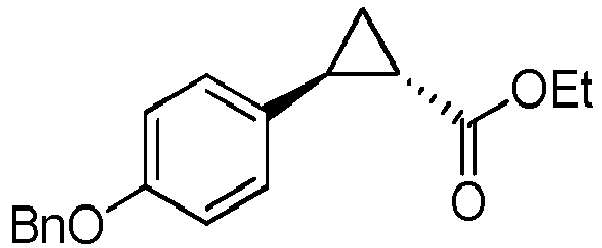
- Trimethyl sulfoxonium iodide (224 g, 1.02 mol) was added portion wise to a suspension of NaH (40.8 g, 1.02 mol) in dry DMSO (2 L) at RT over a period of 20 min and stirred for 1 h till the formation of a clear solution. A solution of (E)-ethyl 3-(4-(benzyloxy) phenyl) acrylate (Intermediate D, 240 g, 0.85 mol) in dry DMSO (2 L) was added dropwise and stirred at RT for 30 mins. After completion, the reaction mixture was poured into ice water (2 L), extracted with EtOAc (2 x 1 L). Combined organic extracts were washed with ice water (1 L), brine (1 L), dried over anhydrous Na2SO4, filtered and evaporated to afford (Trans)-ethyl 2-(4-(benzyloxy)phenyl)cyclopropanecarboxylate (142 g, 58.6 %) as an off white solid. The crude was carried to next step without further purification.
-

- 4N NaOH solution (4 L) was added to a solution of (trans)-ethyl 2-(4-(benzyloxy)phenyl)cyclopropanecarboxylate (Intermediate E, 250 g, 0.844 mol) in Methanol (1.2 L) at 0 °C and stirred at RT for 4 h. After completion, the solvent was evaporated, the residue was diluted with water (1 L), acidified with 4 N HCI solution, extracted with EtOAc (2 x 2 L). Combined organic extracts were washed with water (1 L), brine (1 L), dried over anhydrous Na2SO4, filtered and evaporated to afford (trans)-2-(4-(benzyloxy)phenyl)cyclopropanecarboxylic acid (190 g, 84 %) as off white solid. The crude was carried to next step without further purification.
-

- Ethyl chloroformate (143 mL, 1.48 mol) was added to a solution of (trans)- 2-(4-(benzyloxy) phenyl) cyclopropanecarboxylic acid (Intermediate F, 190 g, 0.70 mol), Triethyl amine (229 mL, 1.63 mol) in acetone ( 2.8 L) at -20 °C and stirred for 1 h, then a solution of NaN3 (138 g, 2.1 mol) in water (200 mL) was added and stirred at RT for 30 mins. After completion, the solvent was evaporated, residue was dissolved in EtOAc (2 L), washed with water (2 L), brine (1 L), dried over anhydrous Na2SO4, filtered and evaporated to afford (trans)-2-(4-(benzyloxy)phenyl)cyclopropanecarbonyl azide (178 g, 85.9 %).
-

- A solution of (trans)-2-(4-(benzyloxy)phenyl)cyclopropanecarbonyl azide (Intermediate G, 178 g, 0.64 mol) in tert-butanol (2.6 L) was heated at 90 °C for 16 h. After completion, the solvent was evaporated and the crude residue was purified by column chromatography by using (SiO2) EtOAc: Pet ether (4: 96) to get tert-butyl ((trans)-2-(4-(benzyloxy)phenyl)cyclopropyl)carbamate (78 g, 37.8 %) as off-white solid.
-
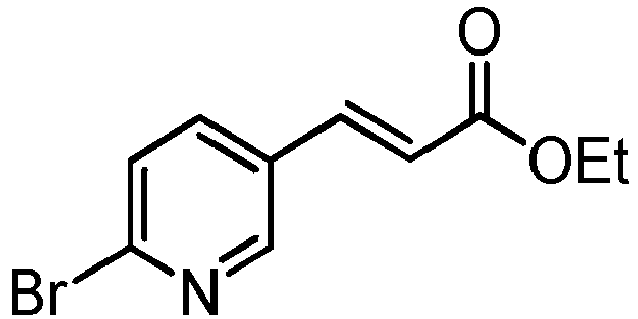
- Triethyl phosphonoacetate (26.6g, 118.8 mmol) was added slowly dropwise to a mixture of Potassium-tert-butoxide (14.5g, 129.6 mmol) in dry THF (200 mL) at -5 °C, stirred for 20 min and then a solution of 6-bromopyridine-3-carboxaldehyde (20 g, 108 mmol) in dry THF (100 mL) was added slowly dropwise at -5 °C and stirred for 30 min. After completion, the reaction mixture was poured into ice water (350 mL) and extracted with EtOAc (2 x 300 mL). The combined organic extracts were washed with saturated NaHCO3 solution (250 mL), water (250 mL) and brine (250 mL) and dried over anhydrous Na2SO4, filtered and evaporated to get (E)-ethyl 3-(6-bromopyridin-3-yl) acrylate (20 g, 72.9 %) as brown color liquid. This is carried to next step without further purification.
-

- Trimethyl sulfoxonium iodide (20.8g, 94.7 mmol) was added in small portions to a suspension of sodium hydride (4g, 170.6 mmol) in dry DMSO (400 mL) at rt., stirred for 1 h until clear solution was obtained. A solution of (E)-ethyl 3-(6-bromopyridin-3-yl) acrylate (Intermediate I, 20 g, 78.7 mmol) in dry DMSO (20 mL) was added and stirred for 4 h. After completion, the reaction mixture was poured into ice water (700 mL), extracted with EtOAc (2 x 350 mL). The combined organic extracts were washed with water (250 mL), brine (250 mL) and dried over anhydrous Na2SO4, filtered and evaporated to give (trans)-ethyl-2-(6-bromopyridin-3-yl)cyclopropanecarboxylate (10g, 47 %) as brown liquid.
-

- NaOH 4N solution (60 mL) was added to a solution of (trans)-ethyl-2-(6-bromopyridin-3-yl)cyclopropanecarboxylate (Intermediate J, 10 g, 37.1 mmol) in methanol (100 mL) and the reaction mixture was stirred at RT for 4 h. After completion, the solvent was evaporated and the residue was diluted with ice water (250 mL) and acidified with 4 N HCI solution, the aqueous layer was extracted with EtOAc (2 x 350 mL). The combined organic extracts were washed with water (250 mL), brine (250 mL) and dried over anhydrous Na2SO4, filtered and evaporated to give (trans)-2-(6-bromopyridin-3-yl)cyclopropanecarboxylic acid hydrochloride (5g, 55.8 %) as a light brown color solid.
-

- Ethyl chloroformate (5.8 mL, 62 mmol) was added to a solution of (trans)-2-(6-bromopyridin-3-yl)cyclopropanecarboxylic acid hydrochloride (Intermediate K, 5 g, 20.7 mmol) and Et3N (14,2 mL, 103.7 mmol) in Acetone (100 mL) at -5 °C, then reaction mixture was stirred at -5 °C for 1 h, then a solution of NaN3 (2.7g, 41.4 mmol) in water (10 mL) was added and stirred for 30 mins at RT. After completion the solvent was evaporated under vacuum. The crude residue was dissolved in ethyl acetate (200 mL), washed with water (80 mL), brine (80 mL), dried over anhydrous Na2SO4, filtered and evaporated to get (trans)-2-(6-bromopyridin-3-yl)cyclopropanecarbonyl azide (2.5 g, 45.5 %) as a brown color gummy liquid.
-

- A solution of (trans)-2-(6-bromopyridin-3-yl)cyclopropanecarbonyl azide (Intermediate L, 2.5 g, 9.36 mmol) in tert-butanol (80 mL) was heated at 90 °C for 16 h. After completion, the solvent was evaporated under vacuum and the residue was taken in water (100 mL) and extracted with EtOAc (2 x 100 mL). The combined organic extracts were washed with water (100 mL), brine (100 mL) and dried over anhydrous Na2SO4, filtered and evaporated. The crude residue was purified by flash column chromatography (SiO2) by eluting with EtOAc: Hexane (2: 8) to get tert-butyl (trans)-2-(6-bromopyridin-3-yl)cyclopropylcarbamate (1.1g, 37.5 %) as a light yellow solid.
1H-NMR (CDCl3) δ (ppm): 1.16 (q, 1H), 1.23 (quin, 1H), 1.45 (s, 9H), 2.01 (m, 1H), 2.69 (m, 1H), 4.88 (br, 1H), 7.36 (s, 2H), 8.20 (s, 1H). -

- A solution of triethyl phosphonoacetate (13.1 g, 0.0589 mol) was added slowly (dropwise) to a solution of Potassium-tert-butoxide (6.59 g, 0.0589 mol), in dry THF (150 mL) at -5 °C, stirred for 30-45 mins at the same temperature, then a solution of 4-Bromo benzaldehyde (10 g, 0.054 mol), in dry THF (50 mL) was slowly added dropwise at -5 °C over a period of 15 mins, stirred the reaction mixture for 30 mins at the same temperature. After completion of reaction by TLC, the reaction mixture was poured into ice water (300 mL), extracted with EtOAc (2 x 200 mL). The combined organic extracts were washed with sat NaHCO3 solution (200 mL), water (200 mL), brine (200 mL) and dried over anhydrous Na2SO4, filtered and evaporated to get crude (E)-ethyl 3-(4-bromophenyl) acrylate (10 g, 72 %) as pale green liquid. This is carried to next step without further purification.
-

- Trimethyl sulfoxonium iodide (5.19 g, 0.0236 mol) was added slowly in small portions over a period of 20 min. to a suspension of sodium hydride (0.44 g, 0.0236 mol) in dry DMSO (80 mL) at rt, stirred for 1 h, till the formation of clear solution. Then a solution of (E)-ethyl 3-(4-bromophenyl) acrylate (Intermediate N, 5 g, 0.01968), in dry DMSO (20 mL) was added slowly dropwise, stirred at rt for 30 mins. After completion of reaction, checked by TLC, the reaction mixture was poured into ice water (200 mL), extracted with EtOAc (2 x 150 mL). Combined organic extracts were washed with ice water (2 x 150 mL), brine (150 mL), dried over anhydrous Na2SO4, filtered and evaporated to get (trans)-ethyl 2-(4-bromophenyl)cyclopropanecarboxylate (4 g, 75.9 %) as a green liquid. The crude is carried to next step without further purification.
-

- NaOH 4N (20 mL) was added to a solution of (trans)-ethyl 2-(4-bromophenyl)cyclopropanecarboxylate (Intermediate O, 4 g, 0.0149 mol), in Methanol (40 mL) and stirred at rt for 2 h. After completion of reaction, checked by TLC, the solvent was evaporated and the residue was diluted with water (50 mL), acidified with HCI 4 N solution, the solid formed was filtered and dried to get (trans)-2-(4-bromophenyl)cyclopropanecarboxylic acid (2.59 g, 72 %), as a white solid.
-

- Ethyl chloroformate (1.9 mL) was added to a solution of (trans)-2-(4-bromophenyl) cyclopropanecarboxylic acid (Intermediate P, 4 g, 0.0165 mol) and Et3N (2.51 mL, 0.0199 mol) in acetone (60 mL) at -20 °C, stirred at same temperature for 1 h, then a solution of NaN3 (1.3 g, 0.0199 mol) in water (5 mL), was added and stirred for 30 mins at rt. After completion of reaction, checked by TLC, the solvent was evaporated and crude residue was dissolved in ethyl acetate (100 mL), washed with water (40 mL), dried over anhydrous Na2SO4, filtered and evaporated to get (trans)-2-(4-bromophenyl)cyclopropanecarbonyl azide (4 g). The crude residue is carried to next step without further purification.
-

- A solution of (trans)-2-(4-bromophenyl) cyclopropanecarbonyl azide (Intermediate Q, 4 g) in tert-Butanol (40 mL) was heated at 90 °C for 16 h. After completion of reaction, checked by TLC, the solvent was evaporated residue was poured into water (50 mL), extracted with EtOAc (2 x 50 mL). The combined organic extracts were washed with water (50 mL), brine (50 mL), dried over anhydrous Na2SO4, filtered and evaporated. The crude residue was purified by column chromatography (SiO2) by eluting with EtOAc: Pethroleum ether (2: 98), to get tert-butyl (trans)-2-(4-bromophenyl)cyclopropylcarbamate (2.5 g, 48 % overall 2 steps) as a white solid.
1H-NMR (CDCl3, 250 MHz) δ: 1.07-1.19 (m, 2H), 1.44 (s, 9H); 2.05-1.94 (m, 1H); 2.72-2.62 (m, 1H); 4.85 (br, 1H,); 7.09-6.96 (m, 2H); 7.44-7.33 (m, 2H). -

- A solution of triethyl phosphonoacetate (66.75 mL, 336.44 mmol) was added dropwise to a solution of Potassium-tert-butoxide (37.7 g, 280.37 mmol) in dry THF (300 mL) at -5 °C over a period of 10 mins and stirred at 0 °C for 30 mins. Then a solution of nicotinaldehyde (30 g, 280.37 mmol) in dry THF (50 mL) was added dropwise at 0 °C over a period of 15 mins and stirred at RT for 2 h. After completion, the reaction mixture was poured into ice water (150 ml) and extracted with EtOAc (2 x 300 mL). The combined extracts were washed with sat NaHCO3 solution (200 mL), water (200 mL), brine (200 mL), dried over anhydrous Na2SO4, filtered and evaporated to afford crude liquid (E)-ethyl 3-(pyridin-3-yl) acrylate (42 g, 84.67 %). The crude was carried to next step without further purification.
-

- Trimethyl sulfoxonium iodide (14.90 g, 67.76 mmol) was added portion wise to a suspension of NaH (2.71 g, 67.76 mmol) in dry DMSO (100 mL) at RT over a period of 20 min. and stirred for 1 h till the formation of a clear solution. A solution of (E)-ethyl 3-(pyridin-3-yl) acrylate (Intermediate S, 10 g, 56.47 mmol) in dry DMSO (50 mL) was added dropwise and stirred at RT for 20 min. After completion, the reaction mixture was poured into ice water (200 mL), extracted with EtOAc (2 x 200 mL). Combined organic extracts were washed with ice water (150 mL), brine (150 mL), dried over anhydrous Na2SO4, filtered and evaporated to afford (trans)-ethyl 2-(pyridin-3-yl)cyclopropanecarboxylate (4 g, 37.07 %) as pale brown liquid. The crude was carried to next step without further purification.
-

- A solution of NaOH (7.116 g in 45 mL of H2O, 177.92 mmol) was added to a solution of (trans)-ethyl 2-(pyridin-3-yl) cyclopropanecarboxylate (Intermediate T, 17 g, 88.96 mmol) in Methanol (170 mL) at 0 °C and stirred at RT for 16 h. After completion, the solvent was evaporated, the residue was diluted with water (50 mL), neutralized with Acetic acid and extracted with EtOAc (4 x 100 mL). The combined extracts were washed with water (100 mL), brine (100 mL), dried over anhydrous Na2SO4, filtered and evaporated to afford (trans)-2-(pyridin-3-yl)cyclopropanecarboxylic acid (9 g, 62.06 %) as off white solid. The crude was carried to next step without further purification.
-

- Ethyl chloroformate (6.89 mL, 71.15 mmol) was added to a solution of (trans)-2-(pyridin-3-yl)cyclopropanecarboxylic acid (Intermediate U, 9 g, 55.194 mmol) and triethyl amine (11.03 mL, 82.79 mmol) in acetone (90 mL) at -20 °C and stirred for 1 h, then a solution of NaN3 (5.38 g, 82.79 mmol) in water (25 mL) was added and stirred at RT for 30 mins. After completion, the solvent was evaporated, residue was dissolved in EtOAc (100 mL), washed with water (2 x 50 mL), brine (50 mL), dried over anhydrous Na2SO4, filtered and evaporated to afford (trans)-2-(pyridin-3-yl)cyclopropanecarbonyl azide (8.4 g, 81 %). The crude was carried to next step without further purification.
-

- A solution of (trans)-2-(pyridin-3-yl)cyclopropanecarbonyl azide (Intermediate V, 8.4 g, 44.66 mmol) in tert-butanol (85 mL) was heated at 90 °C for 16 h. After completion, the solvent was evaporated and crude residue was purified by column chromatography (SiO2) using EtOAc: Petroleum ether (25: 75) to afford tert-butyl (trans)-2-(pyridin-3-yl) cyclopropylcarbamate (3.9 g, 37.32 %) as colourless liquid.
-

- HCl in Dioxane (10 mL) was added to a solution of tert-butyl (trans)-2-(pyridin-3-yl)cyclopropylcarbamate (Intermediate W, 2 g, 8.541 mmol) in 1,4-dioxane (10 mL) at 0 °C and stirred at RT for 12 h. After completion, the solvent was evaporated and the residue was triturated with diethyl ether (20 mL) followed by hexane (20 mL) to get (trans)-2-(pyridin-3-yl)cyclopropanamine hydrochloride (1.2 g, 82.7 %).
-

- A solution of triethyl phosphonoacetate (11.88 g, 53.03 mmol) was added dropwise to a solution of Potassium-tert-butoxide (5.94 g, 53.03 mmol) in dry THF (100 mL) at -5 °C and stirred for 30 mins. A solution of thiazole-5-carbaldehyde (5 g, 44.19 mmol) in dry THF (25 mL) was then added dropwise at -5 °C over a period of 15 mins and stirred for 30 mins. After completion, the reaction mixture was poured into ice water (150 mL), extracted with EtOAc (2 x 100 mL). The combined extracts were washed with sat NaHCO3 solution (100 mL), water (100 mL), brine (100 mL), dried over anhydrous Na2SO4, filtered and evaporated to afford crude (E)-ethyl 3-(thiazol-5-yl)acrylate (10 g, 82.3%) as a white solid. The crude was carried to next step without further purification
-

- Trimethyl sulfoxonium iodide (14.40 g, 65.49 mmol) was added portionwise to a suspension of NaH (2.61 g, 108.75 mmol) in dry DMSO (200 mL) at RT over a period of 20 min and stirred for 1 h till the formation of clear solution. A solution of (E)-ethyl 3-(thiazol-5-yl)acrylate (Intermediate Y, 10 g, 54.57 mmol) in dry DMSO (50 mL) was then added dropwise and stirred at RT for 30 mins. After completion, the reaction mixture was poured into ice water (100 mL) and extracted with EtOAc (2 x 100 mL). Combined organic extracts were washed with water (2 x 50 mL), brine (50 mL), dried over anhydrous Na2SO4, filtered and evaporated to afford trans-ethyl 2-(thiazol-5-yl)cyclopropanecarboxylate (8 g, 61.9 %) as a reddish brown liquid. The crude was carried to next step without further purification.
-

- A 4N NaOH solution (40 mL) was added to a solution of trans-ethyl 2-(thiazol-5-yl)cyclopropanecarboxylate (Intermediate Z, 8 g, 40.55 mmol) in methanol (80 mL) and stirred at RT for 4 h. After completion, the solvent was evaporated, the residue was diluted with water (50 mL), acidified with Acetic acid and extracted with EtOAc (2 x 75mL). The combined extracts were washed with water (50 mL), brine (50 mL), dried over anhydrous Na2SO4, filtered and evaporated to afford trans-2-(thiazol-5-yl)cyclopropanecarboxylic acid (4 g, 58.30 %). The crude was carried to next step without further purification.
-

- Ethyl chloroformate (3.34 g, 30.76 mmol) was added to a solution of trans-2-(thiazol-5-yl)cyclopropanecarboxylic acid (Intermediate AA, 4 g, 26.3 mmol) and triethylamine (3.62 g, 35.50 mmol) in acetone (40 mL) at -20 °C, stirred at same temperature for 1 h. A solution of NaN3 (2.84 g, 47.33 mmol) in water (10 mL) was then added and stirred at RT for 30 mins. After completion, the solvent was evaporated, the crude residue was dissolved in EtOAc (100 mL), washed with water (50 mL), brine (50 mL), dried over anhydrous Na2SO4, filtered and evaporated to afford trans-2-(thiazol-5-yl)cyclopropanecarbonyl azide (3 g, 58.7 %) as brown liquid. The crude was carried to next step without further purification.
-

- A solution of trans-2-(thiazol-5-yl)cyclopropanecarbonyl azide (Intermediate AB, 3 g, 15.44 mmol) in tert-butanol (60 mL) was heated at 90 °C for 16 h. After completion, the solvent was evaporated and the residue was taken in water (50 mL), extracted with EtOAc (2 x 50 mL). The combined organic extracts were washed with water (50 mL), brine (50 mL), dried over anhydrous Na2SO4, filtered and evaporated. The crude residue was purified by column chromatography (SiO2) by using EtOAc: Petroleum ether (20:80) to get tert-butyl trans-2-(thiazol-5-yl)cyclopropylcarbamate (1.1 g, 29.64 %) as a pale yellow liquid.
-

- HCl in dioxane (10 mL) was added to a solution of tert-butyl trans-2-(thiazol-5-yl)cyclopropylcarbamate (Intermediate AC, 1.1 g, 45.83 mmol) in dioxane (10 mL) at 15 ° C and stirred at RT for 3 h. After completion, the solvent was evaporated, the residue was triturated with EtOAc to afford trans-2-(thiazol-5-yl)cyclopropanamine hydrochloride (600 mg, 74.8 %) as pale yellow solid.
-

- A solution of tert-butyl (trans)-2-(6-bromopyridin-3-yl)cyclopropylcarbamate (Intermediate M, 100 mg, 0.32 mmol), potassium carbonate (132 mg, 0.96 mmol) and 3-trifluoromethylbenzeneboronic acid (72 mg, 0.38 mmol) in CH3CN:H2O (4: 1) (10 mL) was degassed for 30 mins. Tetrakis triphenylphosphine palladium (37mg, 0.032 mmol) was added and degassed for 10 mins and the reaction mixture was heated at reflux temperature for 2 h. After completion, the reaction mixture was poured in ice water (100 mL), extracted with ethyl acetate (5 x 40 mL). The combined extract was washed with water (70 mL), brine (70 mL), dried over anhydrous Na2SO4, filtered and evaporated. The crude residue was purified by column chromatography (SiO2), by using EtOAc:Petroleum ether (1:9) to get tert-butyl (trans)-2-(6-(3-(trifluoromethyl)phenyl)pyridin-3-yl)cyclopropylcarbamate (70 mg, 58.3%) as a white solid.
1H-NMR (CDCl3) δ (ppm): 1.26 (m, 2H), 1.46 (s, 9H), 2.10 (m, 1H), 2.78 (m, 1H), 4.86 (br, 1H), 7.55 (m, 2H), 7.65 (t, 2H), 8.14 (d, 1H), 8.24 (s, 1H), 8.54 (s, 1H). MS (M+H): 379.1. -

- HCl in diethyl ether (5 mL) was added to a solution of tert-butyl (trans)-2-(6-(3-(trifluoromethyl)phenyl)pyridin-3-yl)cyclopropylcarbamate (Intermediate AE, 70 mg, 0.185mmol) in diethyl ether (10 mL) at 0 °C slowly dropwise over a period of 10 mins and then stirred for 2 h. After completion, the reaction mixture was filtered under inert atmosphere and washed with hexane (10 mL), EtOAC (5 mL), and dried under reduced pressure to get (trans)-2-(6-(3-(trifluoromethyl)phenyl)pyridin-3-yl)cyclopropanamine dihydrochloride (50 mg, 86.2%) as a pale yellow powder.
1H-NMR (D2O) δ (ppm): 1.52 (q, 1H), 1.63 (quin, 1H), 2.66 (m, 1H), 3.08 (m, 1H), 7.72 (t, 1H), 7.89 (d, 1H), 7.98 (d, 1H), 8.09 (s, 1H), 8.14 (d, 1H), 8.27 (d, 1H), 8.61 (s, 1H). MS (M+H) : 279.1. -

- A solution of tert-butyl (trans)-2-(4-bromophenyl)cyclopropylcarbamate (Intermediate R, 1 g, 3.2 mmol), potassium carbonate (1.31 g, 9.6 mmol) and 3-(trifluoromethyl) phenylboronic acid (0.73 g, 3.8 mmol) in acetonitrile:water (4: 1) was degassed for 30 mins. Tetrakis triphenylphosphine palladium (36 mg, 0.032 mmol) was then added, degassed again for 10 mins and the reaction mixture was heated at reflux temperature for 5 h. After completion, the reaction mixture was poured in ice water (50 mL) and extracted with ethyl acetate (2 x 50 mL). Combined extracts were washed with water (70 mL), brine (70 mL), dried over anhydrous Na2SO4 and then filtered and evaporated. The crude residue was purified by column chromatography (SiO2), by using EtOAc: Petroleum ether (2:8) to get tert-butyl ((trans)-2-(3'-(trifluoromethyl)-[1,1'-biphenyl]-4-yl)cyclopropyl)carbamate (0.8 g, 66 %) as a white solid.
-

- HCl in diethyl ether (3 mL) was added slowly dropwise to a solution of tert-butyl ((trans)-2-(3'-(trifluoromethyl)-[1,1'-biphenyl]-4-yl)cyclopropyl)carbamate (Intermediate AG, 200 mg, 0.53 mmol) in diethyl ether (5 mL) at 10 °C over a period of 10 min and then stirred for 4 h. After completion, the solvent was evaporated and the residue was triturated with hexane (5 mL), diethyl ether (5 mL) and dried under reduced pressure to get (trans)-2-(3'-(trifluoromethyl)-[1,1'-biphenyl]-4-yl)cyclopropanamine hydrochloride (140 mg, 77.8 %) as a white solid.
1H-NMR (DMSO-d6) δ (ppm): 1.27 (q, 1 H), 1.46 (quin, 1H), 2.41 (m, 1H), 2.86 (m, 1H), 7.29 (d, 2H), 7.69 (m, 4H), 7.96 (m, 2H), 8.53 (s, 1H), 8.61 (br, 2H). MS (M+H) : 278.3 -

- L (+) tartaric acid (15.7 g, 0.105 mmol) was added to a solution of (trans)-2-phenylcyclopropanamine (14 g, 0.105 mol) in EtOH (150 mL) at 0 °C and stirred at RT for 1 h. After completion, solid was filtered and dried to afford tartarate salt (28 g, 94.2 %). The salt was taken in Isopropanol: water (3:1) (260 mL) and stirred at 70 ° C for 2 h. The clear solution was allowed to cool to RT. The solid separated was collected by filtration, taken in water (100 mL), basified with NaHCO3 solution, and extracted with EtOAc (2 x 150 mL). The combined extracts were washed with water (150 mL), brine (150 mL), dried over anhydrous Na2SO4, filtered and evaporated to afford (1R, 2S)-2-phenylcyclopropanamine (4.7 g, 67.1 %).
-

- D (-) tartaric acid (6.7 g, 45.1 mmol) was added to a solution of (1S, 2R)-2-phenylcyclopropanamine (crude of the reaction to get Intermediate Al)(6 g, 45.1 mmol) in EtOH (60 mL), at 0 °C and stirred at RT for 1 h. After completion, solid was filtered and dried to afford tartarate salt (12 g, 94.4 %). The salt was taken in Isopropanol: water (3: 1) (120 mL) and stirred at 70 ° C for 2 h. The clear solution was allowed to cool to RT. The solid separated was collected by filtration, taken in water (75 mL), basified with NaHCO3 solution, and extracted with EtOAc (2 x 75 mL). The combined extracts were washed with water (100 mL), brine (100 mL), dried over anhydrous Na2SO4, filtered and evaporated to afford (1S, 2R)-2-phenylcyclopropanamine (3 g, 50 %).
-

- 4-hydroxybenzaldehyde (50 g, 409 mmol) in THF (50 mL) was added dropwise and slowly over a period of 30 min to a suspension of sodium hydride (19.6 g, 817 mmol) in THF (750 mL) at 0° C and stirred for 15 min, followed by addition of 1-(chloromethoxy)-2-methoxyethane (MEM chloride, 61.10 g, 490 mmol) at 0 °C. The reaction mixture was stirred at RT for 30 min and, after completion, poured into ice water (500 mL) and extracted with EtOAc (2 x 750 mL). The combined organic extracts were washed with ice water (500 mL), brine (500 mL), dried over anhydrous Na2SO4, filtered and concentrated affording 4-((2-methoxyethoxy)methoxy)benzaldehyde (52 g, 60 %) as a pale yellow liquid. The crude was used in the next step without further purification.
-

- Triethyl phosphonoacetate (66.53 g, 296.8 mmol) was added to a solution of potassium-tert-butoxide (33.3 g, 296.8 mmol) in dry THF (500 mL) at -5 °C and stirred for 30-45 min at the same temperature. Then, a solution of 4-((2-methoxyethoxy)methoxy)benzaldehyde (Intermediate AK, 52 g, 247 mmol) in dry THF (100 mL) was added dropwise over a period of 15 min at -5 °C and stirred for 30 min at the same temperature. After completion, the reaction mixture was poured into ice water (600 mL) and extracted with EtOAc (2 x 600 mL). The combined extracts were washed with saturated aq. NaHCO3 (300 mL), water (300 mL), brine (300 mL) and dried over anhydrous Na2SO4, filtered and concentrated yielding crude (E)-ethyl 3-(4-((2-methoxyethoxy)methoxy)phenyl)acrylate (58 g, 83 %) as a thick viscous liquid. The crude product was used in the next step without further purification.
-

- Trimethyl sulfoxonium iodide (53.7 g, 244 mmol) was added portionwise over a period of 20 min to a suspension of sodium hydride (9.58 g, 399 mmol) in dry DMSO (143 mL) and stirred at RT for 1 h, until a clear solution was formed. A solution of (E)-ethyl 3-(4-((2-methoxyethoxy)methoxy)phenyl)acrylate (Intermediate AL, 58 g (2 x 29 g), 207 mmol) in dry DMSO (20 mL) was added dropwise and stirred at RT for 30 min. After completion, the reaction mixture was poured into ice water (500 mL) and extracted with EtOAc (2 x 500 mL). The combined extracts were washed with ice water (2 x 250 mL), brine (250 mL), dried over anhydrous Na2SO4, filtered and concentrated yielding (trans)-ethyl 2-(4-((2-methoxyethoxy)methoxy)phenyl)cyclopropanecarboxylate (35 g, 57 %) as a brown liquid. The crude product was used in the next step without further purification.
-

- 4N NaOH solution (175 mL) was added to a solution of (trans)-ethyl 2-(4-((2-methoxyethoxy)methoxy)phenyl)cyclopropanecarboxylate (Intermediate AM, 35 g, 118.9 mmol) in methanol (350 mL) and stirred at RT for 6 h. After completion, the solvent was evaporated and the residue was taken up in water (150 mL), acidified with 4N HCI and extracted with EtOAc (2 x 400 mL). The combined extracts were washed with ice water (200 mL), brine (200 mL), dried over anhydrous Na2SO4, filtered and concentrated to render (trans)-2-(4-((2-methoxyethoxy)methoxy)phenyl)cyclopropanecarboxylic acid (30 g, 95 %) as a brown thick viscous liquid. The crude product was used in the next step without further purification.
-

- Ethyl chloroformate (14.73 g, 135.73 mmol) was added to a solution of (trans)-2-(4-((2-methoxyethoxy)methoxy)phenyl)cyclopropanecarboxylic acid (Intermediate AN, 30 g, 112.6 mmol) and TEA (23.14 mL, 168.9 mmol) in acetone (300 mL) at -20 °C and stirred at same temperature for 1 h. Then, a solution of NaN3 (14.64 g, 225.2 mmol) in water (15 mL) was added and stirred for 30 min at RT. After completion, the solvent was evaporated and the crude residue was dissolved in ethyl acetate (2 x 300 mL), washed with water (200 mL), brine (200 mL), dried over anhydrous Na2SO4, filtered and concentrated to yield (trans)-2-(4-((2-methoxyethoxy)methoxy)phenyl)cyclopropanecarbonyl azide (30.5 g, 93 %). The crude product was used in the next step without further purification.
-

- A solution of (trans)-2-(4-((2-methoxyethoxy)methoxy)phenyl)cyclopropanecarbonyl azide (Intermediate AO, 30.5 g, 104.7 mmol) in tert-butanol (305 mL) was heated at 90 °C for 16 h. After completion, the solvent was evaporated and the residue was taken up in water (300 mL) and extracted with EtOAc (2 x 300 mL). The combined extracts were washed with water (200 mL), brine (200 mL), dried over anhydrous Na2SO4, filtered and concentrated. The crude residue was purified by column chromatography (SiO2, EtOAc/petroleum ether 1:9) affording tert-butyl (trans)-2-(4-((2-methoxyethoxy)methoxy)phenyl)cyclopropyl) carbamate (25 g, 71 %) as a white solid.
-

- HCl in 1,4-dioxane (125 mL) was added to a solution of tert-butyl (transs)-2-(4-((2-methoxyethoxy)methoxy)phenyl)cyclopropyl)carbamate (Intermediate AP, 25 mg, 74.18 mmol) in 1,4-dioxane (250 mL) at 10 ° C and stirred at RT for 16 h. After completion, the solvent was evaporated and the solid residue was triturated with Et2O, filtered off and dried affording 4-((trans)-2-aminocyclopropyl)phenol hydrochloride (13 g, 95 %) as a brown solid.
-

- K2CO3 (20.36 g, 147.56 mmol) and (Boc)2O (16.8 mL, 70.27 mmol) was added to a solution of 4-((trans)-2-aminocyclopropyl)phenol hydrochloride (Intermediate AQ, 13 g, 70.27 mmol) in 1,4- dioxane (78 mL) and water (195 mL) and stirred at RT for 16 h. After completion, the reaction mixture was poured into water (300 mL) and extracted with EtOAc (2 x 200 mL). The combined extracts were washed with water (75 mL), brine (75 mL), dried over anhydrous Na2SO4, filtered and concentrated. The crude residue was purified by column chromatography (SiO2, EtOAc/petroleum ether 3:7) affording tert-butyl ((trans)-2-(4-hydroxyphenyl)cyclopropyl)carbamate (14 g, 80 %) as a brown thick viscous liquid.
-

- 2-fluorobenzyl bromide (5.83 mL, 48.13 mmol) was added to a solution of tert-butyl ((trans)-2-(4-hydroxyphenyl)cyclopropyl)carbamate (Intermediate AR, 10.0 g, 40.11 mmol) and K2CO3 (11.07 g, 80.22 mmol) in dry DMF (100 mL) at 0 ° C and stirred at RT for 18 h. After completion, the reaction mixture was poured into ice water (350 mL) and extracted with EtOAc (2 x 200 mL). The combined extracts were washed with water (2 x 100 mL), brine (100 mL), dried over anhydrous Na2SO4, filtered and evaporated. The crude was purified by column chromatography (SiO2) using EtOAc: petroleum ether (1: 3) to afford tert-butyl ((trans)-2-(4-((2-fluorobenzyl)oxy)phenyl)cyclopropyl)carbamate
(7.3 g, 51.01 %) as an off white solid. -

- HCl in 1,4-dioxane (50 mL) was added dropwise to a solution of tert-butyl ((trans)-2-(4-((2-fluorobenzyl)oxy)phenyl)cyclopropyl)carbamate (Intermediate AS, 7.3 g, 20.16 mmol) in 1,4-dioxane (100 mL) at 0 °C and stirred at RT for 12 h. After completion, the solvent was evaporated and the residue was taken in water, basified with NaHCO3 and extracted with EtOAc (2 x 50 mL). The combined extracts were washed with water (50 mL), brine (50 mL), dried over anhydrous Na2SO4, filtered and evaporated to afford (trans)-2-(4-((2-fluorobenzyl)oxy)phenyl)cyclopropanamine (4.3 g, 81.90 %) as an off white solid.
-

- To a solution of tert-butyl trans-2-(4-bromophenyl)cyclopropylcarbamate (Intermediate R, 10 g, 32.05 mmol) in 1,4-dioxane (100 mL) at 10 °C was added HCl in dioxane (50 mL) and stirred at RT for 20 h. After completion, the solvent was evaporated and the residue was taken up in ice water, basified with saturated aq. NaHCO3 and extracted with EtOAc (2 x 100 mL). The combined extracts were washed with water, brine, dried over anhydrous Na2SO4, filtered and concentrated to afford (trans)-2-(4-bromophenyl)cyclopropanamine (6.2 g, 91.5%). The crude was used in the next step without further purification.
-

- Tert-butyl 4-formylpiperidine-1-carboxylate (602 mg, 2.83 mmol) and AcOH (169.8 mg, 2.83 mmol) were added to a solution of trans 2-(4-bromophenyl)cyclopropanamine (Intermediate AU, 600 mg, 2.83 mmol) in DCE (12 mL) and stirred for 5 min.. The reaction mixture was then cooled to 0 °C and sodium triacetoxy borohydride (1.07 g, 5.09 mmol) was added and stirred at RT for 5 h. After completion, the reaction mixture was poured into ice water and extracted with DCM (2 x 50 mL). The combined extracts were washed with water (50 mL), brine (50 mL) and dried over anhydrous Na2SO4, filtered and evaporated. The crude was purified by column chromatography (SiO2) using EtOAc: petroleum ether (2: 8) to afford tert-butyl 4-((((trans)-2-(4-bromophenyl)cyclopropyl)amino)methyl)piperidine-1-carboxylate (630 mg, 54.45 %) as gummy liquid.
-

- NaOH (246 mg, 6.17 mmol) and Boc2O (839 mg, 3.85 mmol) were added to a solution of tert-butyl 4-((((trans)-2-(4-bromophenyl)cyclopropyl)amino)methyl)piperidine-1-carboxylate (Intermediate AV, 630 mg, 1.54 mmol) in 1,4-dioxane (13 mL) and stirred at RT for 16 h. After completion, the reaction mixture was poured into water, and extracted with EtOAc (2 x 50 mL). The combined extracts were washed with water (50 mL), brine (50 mL) and dried over anhydrous Na2SO4, filtered and evaporated. The crude was purified by column chromatography (SiO2) using EtOAc: petroleum ether (1:9) to afford (Tert-butyl 4-((((trans)-2-(4-bromophenyl)cyclopropyl)(tert-butoxycarbonyl)amino)methyl)piperidine-1-carboxylate (600 mg, 76.53 %) as gummy liquid.
-

- t-BuOK (4.2 g, 37.63 mmol) was added portionwise to a solution of methyltriphenylphosphonium bromide (12.5 g, 35.13 mmol) in dry Et2O (40 mL) at 0 °C and stirred at 0 °C for 30 mins. Then a solution of tert-butyl 4-oxopiperidine-1-carboxylate (5 g, 25.09 mmol) in dry Et2O (25 mL) was added and stirred at RT for 16 h. After completion, the reaction mixture was poured into saturated NH4Cl solution (25 mL) and extracted with EtOAc (2 x 50 mL). The combined extracts were washed with water (30 mL), brine (30 mL), dried over anhydrous Na2SO4, filtered and evaporated. The crude residue was purified by column chromatography (SiO2) using EtOAc : petroleum ether (5: 95) to get tert-butyl 4-methylenepiperidine-1-carboxylate (3.8 g, 76.76%) as a white solid.
-

- Zn-Cu couple (15.6 g, 121.74 mmol) was added to a solution of tert-butyl 4-methylenepiperidine-1-carboxylate (Intermediate AX, 2 g, 10.14 mmol) in Diethyl ether (20 mL) followed by the addition of trichloroacetyl chloride (10.14 g, 55.77 mmol) in Dimethoxyethane (10 mL) at RT and stirred for 16 h. After completion the reaction mixture was poured into NaHCO3 solution, filtered through celite and extracted with EtOAc (2 x 30 mL). The combined extracts were washed with water (20 mL), brine (20 mL), dried over anhydrous Na2SO4, filtered and evaporated to get tert-butyl 1,1-dichloro-2-oxo-7-azaspiro [3.5]nonane-7-carboxylate (3 g crude, 96%). The crude was carried to next step without further purification.
-

- Zinc powder (4.5 g, 1.5 weight equiv) was added portionwise to a solution of tert-butyl 1,1-dichloro-2-oxo-7-azaspiro[3.5]nonane-7-carboxylate (Intermediate AY, 3 g, 9.77 mmol) in saturated NH4Cl (1.81 g, 34.20 mmol in Methanol 30 ml) at RT and stirred for 4 h. After completion, the reaction mixture was filtered through a pad of celite and the solvent was evaporated. The crude residue was purified by column chromatography (SiO2) using EtOAc: petroleum ether (10:90) as the eluent to get tert-butyl 2-oxo-7-azaspiro[3.5]nonane-7-carboxylate (750 mg, 32.18 %) as a white solid
-

- Methanesulphonyl chloride (55.82 mL, 0.494 mmol) was added to a solution of 3-bromo-4-methoxyaniline (100 mg, 0.494 mmol) in pyridine (1 mL) at 0 ° C and stirred at RT for 2 h. After completion, reaction mixture was poured into ice water (10 mL) and extracted with EtOAc (2 x 15 mL). The combined extracts were washed with water (3 x 10 mL), brine (15 mL) and dried over anhydrous Na2SO4 filtered, and evaporated. The crude residue was purified by column chromatography (SiO2) by using EtOAc:Hexane (3:7) to afford N-(3-bromo-4-methoxyphenyl)methanesulfonamide (137 mg, 99.2 %) as a white solid
-

- A solution of N-(3-bromo-4-methoxyphenyl)methanesulfonamide (Intermediate BA, 136 mg, 0.485 mmol), bispinacoldiborane (147 mg, 0.582 mmol) and KOAc (87.3 mg, 0.89 mmol) in dioxane (5.5 mL) was degassed for 30 min, then PdCl2(dppf)2 (17.7 mg, 0.020 mmol) was added and the reaction mixture was heated at 100 °C for 3 h. After completion, the reaction mixture was poured into water (10 mL), extracted with EtOAc (2 x 15 mL). The combined extracts were washed with water (10 mL), brine (50 mL), dried over anhydrous Na2SO4, filtered and evaporated. The residue was purified by column chromatography (SiO2) EtOAc: petroleum ether (1:9) to afford N-(4-methoxy-3-(4,4,5,5-tetramethyl-1,3,2-dioxaborolan-2-yl) phenyl)methanesulfonamide (100 mg, 63.2 %) as a white solid.
-

- K2CO3 (246 mg, 1.923 mmol) was added to a solution of tert-butyl (trans)-2-(4-bromophenyl)cyclopropylcarbamate (Intermediate R, 200 mg, 0.641 mmol) and N-(4-methoxy-3-(4,4,5,5-tetramethyl-1,3,2-dioxaborolan-2-yl) phenyl)methanesulfonamide (251 mg, 0.769 mmol) in ACN:water (8:2) (10 mL). The reaction mixture was degassed with argon for 20 min. and tetrakis(triphenylphosphine)palladium (0) (Pd(PPh3)4) (37 mg, 0.032 mmol) was then added to the reaction mixture and heated to reflux at 90 °C for 4 h. After completion, reaction mixture was poured into ice water (15 mL) and extracted with EtOAc (2 x 20 mL). The combined organic extracts were washed with water (15 mL), brine (15 mL) and dried over anhydrous Na2SO4 filtered, and evaporated under reduced pressure. The crude residue was purified by column chromatography (SiO2) by using EtOAc: Hexane (20: 80) to get tert-butyl (trans)-2-(2'-methoxy-5'-(methylsulfonamido)-[1,1'-biphenyl]-4-yl)cyclopropyl)carbamate (80 mg, 28.9 %) as an off white solid.
-

- HCl in 1,4-dioxane (0.8 ml) was added to a solution tert-butyl (trans)-2-(2'-methoxy-5'-(methylsulfonamido)-[1,1'-biphenyl]-4-yl)cyclopropyl)carbamate (Intermediate BC, 80 mg, 0.185 mmol) in 1,4-dioxane (1.6 mL) at 0 °C and stirred at RT for 6 h. After completion, the solvent was evaporated and the residue was triturated with diethyl ether (5 mL) followed by n-hexane (5 mL) to afford N-(4'-(trans)-2-aminocyclopropyl)-6-methoxy-[1,1'-biphenyl]-3-yl)methanesulfonamide hydrochloride (55 mg, 80.8 %), a yellow solid.
-

- K2C03 (331 mg, 2.403 mmol) was added to a solution of tert-butyl (trans)-2-(4-bromophenyl)cyclopropylcarbamate (Intermediate R, 250 mg, 0.801 mmol) and 3-Amino phenyl boronic acid (130.7 mg, 0.961 mmol) in ACN:water (8:2 mL), the reaction mixture was degassed with argon for 20 min. and tetrakis(triphenylphosphine)palladium (0) (Pd(PPh3)4) (9.2 mg, 0.008 mmol) was then added to the reaction mixture and heated to reflux at 90 °C for 4 h. After completion, reaction mixture was poured into ice water (15 mL) and extracted with EtOAc (2 x 20 mL). The combined extracts were washed with water (15 mL), brine (15 mL) and dried over anhydrous Na2SO4 filtered, and evaporated. The crude residue was purified by column chromatography (SiO2) using EtOAc: Hexane (3:7) to get tert-butyl (trans)-2-(3'-amino-[1,1'-biphenyl]-4-yl)cyclopropyl)carbamate (100 mg, 38.6 %) as a light yellow solid.
-

- Propane-2-sulfonyl chloride (43.9 mg, 0.308 mmol) was added to a solution of tert-butyl ((trans)-2-(3'-amino-[1,1'-biphenyl]-4-yl)cyclopropyl)carbamate (Intermediate BE, 100 mg, 0.308 mmol) in pyridine (1 mL) at 0 °C stirred at RT for 4 h. After completion, the reaction mixture was poured into ice water and extracted with EtOAc. The combined extracts were washed with water, brine, dried over anhydrous Na2SO4, filtered and evaporated. The crude residue was purified by column chromatography (SiO2) using EtOAc: petroleum ether (3:7) to afford tert-butyl ((trans)-2-(3'-(1-methylethylsulfonamido)-[1,1'-biphenyl]-4-yl)cyclopropyl)carbamate (100 mg, 75.75 %) as a light brown solid.
-
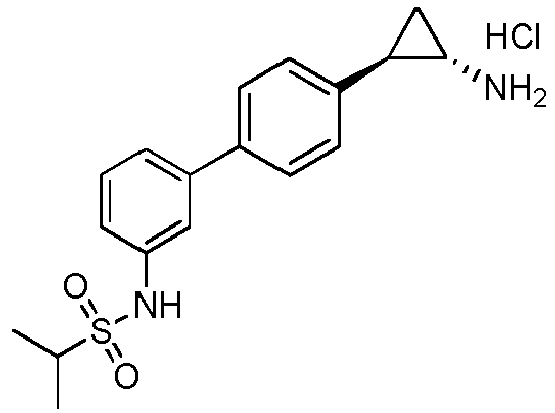
- HCl in 1,4-dioxane (0.5 mL) was added to a solution tert-butyl ((trans)-2-(3'-(1-methylethylsulfonamido)-[1,1 biphenyl]-4-yl)cyclopropyl)carbamate (Intermediate BF, 100 mg, 0.232 mmol) in 1,4-dioxane (1 mL) and stirred at RT for 16 h. After completion, the solvent was evaporated. The solid residue was triturated with Et2O and dried to afford N-(4'-((trans)-2-aminocyclopropyl)-[1,1'-biphenyl]-3-yl)propane-2-sulfonamide hydrochloride (60 mg, 70.58 %), as a pale yellow powder.
-

- Tert-butyl 4-oxopiperidine-1-carboxylate (890 mg, 4.511 mmol) and sodium triacetoxy borohydride (2.2 g, 11.25 mmol) was added to a solution of trans-2-phenylcyclopropanamine (500 mg, 3.75 mmol) in DCE (10 mL) at 0 °C and stirred at RT for 16 h. After completion, solvent was evaporated, the crude residue was taken in water (25 mL) and extracted with EtOAc (2 x 25 mL). The combined extracts were washed with NaHCO3, water (25 mL), brine (25 mL), dried over anhydrous Na2SO4, filtered and evaporated. The crude was purified by column chromatography using (SiO2) MeOH: CHCl3 (2: 98) to afford tert-butyl 4-(((trans)-2-phenylcyclopropyl)amino)piperidine-1-carboxylate (350 mg, 25.4 %).
- HCI in dioxane was added dropwise to a solution of tert-butyl tert-butyl 4-(((trans)-2-phenylcyclopropyl)amino)piperidine-1-carboxylate (150 mg,0.0473 mol) in 1, 4 dioxane at 10 ° C and stirred at RT for 16 h. After completion, the solvent was evaporated, the solid was triturated with Et2O and dried to afford N-(trans)-2-phenylcyclopropyl)piperidin-4-amine hydrochloride (80 mg, 84.3 %) as off white solid.
1HNMR (400 MHz, DMSO D6) δ: 9.95 (brs, 2H), 9.09 (brs, 1H), 8.88 (brs, 1H), 7.33-7.28 (m, 2H), 7.24-7.17 (m, 3H), 3.49 (s, 1H), 3.40-3.36 (m, 3H), 2.95-2.91 (m, 3H), 2.57 (s, 1H), 2.23 (d, J = 12 Hz, 2H), 1.94-1.90 (m, 2H), 1.61-1.56 (m, 1H), 1.31-1.26 (m, 1H); Mass (M+H): 217.3 - Example 1 describes a racemic, which was the combination of the two different conformations regarding to the cyclopropyl ring ((1R,2S and 1S, 2R). The synthesis of each of these isomers was performed as follows:
-

- Tert-butyl 4-oxopiperidine-1-carboxylate (1.49 g, 7.51 mmol), acetic acid (450 mg 7.51 mmol) and sodium triacetoxy borohydride (856 mg, 22.53 mmol) was added to a solution of (1S, 2R)-2-phenylcyclopropanamine (Intermediate AJ, 1 g, 7.51 mmol) in DCE (20 mL) at 0 °C, and stirred at RT for 3 h. After completion, solvent was evaporated, crude residue was taken in water (50 mL), treated with NaHCO3, and extracted with EtOAc (2 x 50 mL). The combined extracts were washed with water (50 mL), brine (50 mL), dried over anhydrous Na2SO4, filtered and evaporated. The crude was purified by column chromatography using SiO2 by eluting EtOAc: pet ether (3: 7) to afford tert-butyl 4-((1S, 2R)-2-phenylcyclopropylamino)piperidine-1-carboxylate (1.2 g, 52 %).
- HCI in 1, 4 dioxane (10 mL) was added to a solution of tert-butyl 4-((1S, 2R)-2-phenylcyclopropylamino)piperidine-1-carboxylate (1.2 g, 3.78 mmol) in dioxane (12 mL) at 15 °C and stirred at RT for 16 h. After completion, the solvent was evaporated. The solid residue was triturated with Et2O and dried to afford N-((1S, 2R)-2-phenylcyclopropyl)piperidin-4-amine hydrochloride (750 mg, 91.4 %) as off white solid 1HNMR (400 MHz, DMSO d6) δ: 9.86 (brs, 2H), 9.09 (brs, 1H), 8.80 (brs, 1H), 7.33-7.29 (m, 2H), 7.24-7.17 (m, 3H), 3.49 (s, 1H), 3.40-3.36 (m, 3H), 2.96-2.91 (m, 3H), 2.67 (s, 1H), 2.22 (d, J = 12 Hz, 2H), 1.87 (brs, 2H), 1.55 (brs, 1H), 1.31-1.29 (m, 1H); Mass (M+H): 217.21 ; [α]D 27.6: +72.11 (C=0.5 % in DMSO)
-

- This compound was synthesized following the same procedure described in example 2 but using the intermediate Al in Step 1, to afford 735 mg (89 %) as off-white solid
1HNMR (400 MHz, DMSO d6) δ: 9.91 (brs, 2H), 9.03 (brs, 1H), 8.84 (brs, 1H), 7.33-7.29 (m, 2H), 7.24-7.17 (m, 3H), 3.49 (s, 1H), 3.40-3.36 (m, 3H), 2.94-2.88 (m, 3H), 2.55 (s, 1H), 2.23 (d, J = 12 Hz, 2H), 1.90-1.87 (m, 2H), 1.58-1.56 (m, 1H), 1.30-1.27 (m, 1H); Mass (M+H): 217.21; [α]D 27.4: -63.82 (C=0.5 % in DMSO). - The following compounds can be synthesized following the methodology described for example 1 by using the corresponding intermediates. The Step 2 was only performed in case the intermediate used in the reductive alkylation (Step 1) contained a Boc (tert-butyloxycarbonyl) protecting group
-

- 1HNMR (400 MHz, DMSO D6) δ: : 9.80 (brs, 2H), 8.97 (brs, 1H), 8.81 (brs, 1H), 7.44-7.37 (m, 3 H), 7.34-7.30 (m, 2H), 7.11 (d, J = 8 Hz, 2H), 6.96 (d, J = 8 Hz, 2H), 5.08 (s, 2 H), 3.47-3.35 (m, 2H), 2.93-2.88 (m, 3H), 2.50 brs, 1H), 2.23-2.20 (d, J = 8 Hz, 2H), 1.86-1.84 (m, 2H), 1.49 (brs, 1H), 1.25-1.20 (m, 1H); Mass (M+H): 323.4
-

- 1HNMR (400 MHz, DMSO D6) δ: 9.56 (brs, 2H), 8.91 (brs, 1H), 8.73 (brs, 1H), 7.33-7.28 (m, 2H), 7.24-7.17 (m, 3H), 3.27 (d, J = 12 Hz, 1H), 3.00-2.83 (m, 5H), 2.59 (brs, 1H), 2.05 (brs, 1H), 1.96 (d, J = 11 Hz, 2H), 1.63-1.59 (m, 1H), 1.46-1.37 (m, 1H), 1.28-1.23 (m, 1H); Mass (M+H): 231.27
-

- 1HNMR (400 MHz, CD3OD) δ: 7.39-7.31 (m, 2H), 7.23-7.21 (m, 1H), 7.21 (d, J = 8Hz, 2H), 3.38 (d, J = 4 Hz, 2H), 3.38 (t, J = 6 Hz, 2H), 3.29-3.21 (m, 2H), 3.00-2.92 (m, 3H), 2.57-2.46 (m, 1H), 1.98 (d, J = 6 Hz, 2 H), 1.57-1.51 (m, 1H), 1.49-1.42 (m, 1H), 1.41-1.31 (m, 3H); Mass: (M+H): 244.9.
-

- 1HNMR (400 MHz, DMSO D6) δ: 8.66 (brs, 1H), 8.66 (brs, 1H), 8.41 (brs, 1H), 8-38 (d, J = 8 Hz, 1H), 8.10 (d, J = 8 Hz,, 2H), 7.72-7.82 (m, 3H), 3.93 (d, J = 11 Hz, 1H), 3.469-3.46 (m, 1H), 3.32 (t, J = 4 Hz, 2H), 3.12 (s, 1H), 2.70 (s, 1H), 2.09-1.98 (m, 2H), 1.70-1.74 (m, 3H); 1.49-1.46 (m, 1H); Mass (M+H): 363.1
-

- NaH (108 mg, 2.69 mmol) was added to a solution of tert-butyl ((trans)-2-phenylcyclopropyl)carbamate (300 mg, 1.28 mmol) in dry DMF (12 mL) and stirred at RT for 4 h, then 4-(2-bromoethyl)tetrahydro-2H-pyran (281 mg, 1.41 mmol) was added and stirred at RT for 2 h. After completion, the reaction mixture was evaporated, then diluted with CH2Cl2 (25 mL) and washed with a saturated NH4Cl solution. The organic layer was washed with brine (10 mL), dried over anhydrous Na2SO4, filtered and evaporated. The residue was purified by column chromatography (SiO2) using Hexane: Methyl tert-butylether (60:40) to get tert-butyl ((trans)-2-phenylcyclopropyl)(2-(tetrahydro-2H-pyran-4-yl)ethyl)carbamate (314 mg, 71.2 %) as a colorless oil
- HCI in diethyl ether (5 mL) was added to a solution of tert-butyl ((trans)-2-phenylcyclopropyl)(2-(tetrahydro-2H-pyran-4-yl)ethyl)carbamate (314 g, 0.91 mmol) in diethyl ether (6 mL) and stirred at RT for 16 h. After completion, the solvent was evaporated. The solid residue was triturated with Et2O and dried to afford (Trans)-2-phenyl-N-(2-(tetrahydro-2H-pyran-4-yl)ethyl)cyclopropanamine hydrochloride (151 mg, 41.8 %) as off white solid
1HNMR (400 MHz, CD3OD) δ: 7.32-7.29 (m, 2H), 7.23-7.21 (m, 1H), 7.17 (d, J = 8Hz, 2H), 3.92 (dm, J = 4 Hz, 2H), 3.41 (t, J = 6 Hz, 2H), 3.21 (t, J = 4 Hz, 2H), 2.97-2.90 (m, 1H), 2.52 (brs, 1H), 1.74-1.60 (m, 5 H), 1.57-1.49 (m, 1H), 1.39-1.24 (m, 3H); Mass: (M+H): 246.3. - The following compound can be synthesized following the methodology described for example 8 by using the corresponding intermediates.
-

- 1HNMR (400 MHz, DMSO D6) δ: 9.2-9.3 (brs, 2H), 7.67 (d, J = 8 Hz, 2H), 7.61 (d, J = 8 Hz, 2H), 7.50 (d, J = 8 Hz, 2H), 7.28 (d, J = 8 Hz, 2H), 3.82 (d, J = 8 Hz, 2H), 3.25 (m, J = 11 Hz, 2H), 3.08 (brs, 2H), 2.99 (brs, 1H), 2.55 (s, 1H), 1.61-1.57. (m, 6H), 1.33-1.30 (m, 1H), 1.12-1.19 (m, 1H); Mass: (M+H): 356.3.
- The following compounds can be synthesized following the methodology described for example 1 by using the corresponding appropriate intermediates or commercially available reagents. Step 2 was only performed when the intermediate used in the reductive alkylation (Step 1) contained a Boc (tert-butyloxycarbonyl) protecting group.
-

- 1HNMR (400 MHz, D2O) δ: 7.52 (brs, 2H), 7.48-7.42 (m, 1H), 7.30 (brs, 2H), 3.89-3.81 (brm, 2H), 3.56-3.53 (m, 1H), 3.21 (brs, 1H), 3.12-3.02 (m, 2H), 2.61 (brs, 1H), 2.46 (brs, 1H), 2.23-2.17 (m, 1H), 1.93-1.78 (brm, 2H), 1.60 (brs, 2H); Mass (M+H): 217.28. This compound was obtained as a hydrochloride salt.
-

- 1HNMR (400 MHz, D2O) δ: 7.57-7.46 (m, 2H), 7.43-7.39 (m, 1H), 7.36-7.31 (m, 2H), 4.39-4.32 (m, 1H), 3.97-3.89 (m, 1H), 3.73-3.51 (m, 3H), 3.10 (s, 1H), 2.68 (brs, 2H), 2.39-2.31 (m, 1H), 1.63 (brs, 1H), 1.57 (brs, 1H); Mass (M+H): 203.2. This compound was obtained as a hydrochloride salt.
-

- 1HNMR (400 MHz, D2O) δ: 7.57-7.46 (m, 2H), 7.43-7.39 (m, 1H), 7.36-7.31 (m, 2H), 4.79-4.72 (m, 1H), 4.55 (brs, 4H), 3.01 (brs, 1H), 2.60 (brs, 1H), 1.63 (brs, 1H), 1.52-1.43 (m, 1H); Mass (M+H): 189.20. This compound was obtained as hydrochloride salt
-

- 1HNMR (400 MHz, D2O) δ: 7.55-7.44 (brm, 3H), 7.37-7.34 (m, 2H), 4.31 (s, 2H), 3. 94 (s, 1H), 3.23 (s, 1H), 2.76 (brs, 3H), 2.45-2.34 (brm, 4H), 2.22-2.18 (m, 2H), 1.78 (brs, 1H), 1.72-1.60 (m, 1H); Mass (M+H): 243.30. This compound was obtained as a hydrochloride salt.
-

- 1HNMR (400 MHz, DMSO d6) δ: 9.37 (brs, 2H), 8.53 (brs, 2H), 7.38-7.29 (m, 2H), 7.22-7.18 (m, 3H), 3.18 (brs, 1H), 3.02 (brs, 5H), 2.92 (brs, 1H), 1.92-1.83 (m, 2H), 1.79-1.71 (m, 2H), 1.62-1.42 (m, 7H), 1.38-1.30 (m, 1H), 1.20-1.05 (m, 2H); Mass (M+H): 285.32,. This compound was obtained as a hydrochloride salt.
-

- 1HNMR (400 MHz, D2O) δ: 7.45-7.39 (m, 2H), 7.38-7.32 (m, 1H), 7.27-7.21 (m, 2H), 4.11-4.04 (m, 1H), 3.26-3.18 (m, 4H), 2.96-2.94 (m, 1H), 2.57-2.43 (m, 3H), 2.20-2.15 (m, 2H), 1.98-1.85 (m, 4H), 1.42 (brs, 1H), 1.42-1.37 (m, 1H); Mass (M+H): 257.32. This compound was obtained as a hydrochloride salt.
-

- 1HNMR (400 MHz, DMSO-d6) δ: 10.24-10.01 (m, 1H), 9.40-9.02 (m, 2H), 7.38-7.28 (m, 2H), 7.22-7.18 (m, 3H), 3.81-3.58 (m, 2H), 3.30-3.22 (m, 1H), 2.98-2.74 (m, 2H), 2.33-2.20 (m, 1H), 2.18-1.92 (m, 3H), 1.85-1.64 (m, 4H), 1.48-1.30 (m, 3H), 1.28-1-18 (m, 2H); Mass (M+H): 271.31. This compound was obtained as a hydrochloride salt.
-

- 1HNMR (300 MHz, D2O) δ: 8.78-8.62 (m, 2H), 8.32 (d, J = 8.2 Hz, 1H), 8.08-8.01 (m, 1H), 3.82-3.77 (m, 1H), 3.66-3.62 (m, 1H), 3.36-3.30 (m, 2H), 3.11-3.02 (m, 2H), 2.86-2.82 (m, 1H), 2.46-2.31 (m, 2H), 2.03-1.65 (m, 4H); Mass(M+H): 218.00. This compound was obtained as a hydrochloride salt.
-

- 1HNMR (400 MHz, D2O) δ: 9.24 (s, 1H), 7.86 (s, 1H), 3.75-3.65 (m, 1H), 3.58-3.52 (m, 2H), 3.19-3.04 (brm,3H), 2.83 (brs, 1H), 2.43-2.39 (m, 2H), 1.97-1.85 (brm, 2H), 1.77-1.72 (m, 1H), 1.59-1.52 (m, 1H); Mass (M+H): 224.21. This compound was obtained as a hydrochloride salt.
-
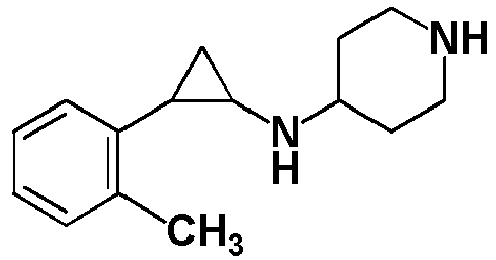
- 1HNMR (400 MHz, DMSO-d6) δ: 10.13 (s, 1H), 9.99 (s, 1H), 9.26 (s, 1H), 8.99 (s, 1H), 7.19-7.12 (m, 3H), 7.01 (s, 1H), 3.49 (s, 1H), 3.34 (s, 2H), 2.95 (s, 3H), 2.72-2.69 (m, 1H), 2.50 (s, 3H), 2.29-2.25 (m, 2H), 1.99-1.91 (m, 2H), 1.57 (q, J = 5.8 Hz, 1H), 1.80 (q, J = 6.8 Hz, 1H); Mass (M+H): 231.3. This compound was obtained as a hydrochloride salt.
-

- 1HNMR (400 MHz, DMSO-d6) δ: 10.04 (s, 2H), 9.09 (s, 1H), 8.87 (s, 1H), 7.32-7.25 (m, 1H), 7.22-7.11 (m, 3H), 3.32 (s, 3H), 3.04 (s, 1H), 2.93 (s, 2H), 2.71 (s, 1H), 2.23 (s, 2H), 1.89 (s, 2H), 1.60 (s, 1H), 1.32 (s, 1H); Mass (M+H): 235.3. This compound was obtained as a hydrochloride salt.
-

- 1HNMR (400 MHz, DMSO-d6) δ: 9.41 (s, 1H), 8.74 (s, 1H), 8.54 (s, 1H), 7.39-7.22 (m, 2H), 7.06 (brs, 1H), 3.36 (brs, 3H), 2.93 (brs, 2H), 2.57-2.53 (m, 1H), 2.14 (brs, 2H), 1.70 (brs, 2H), 1.43 (s, 1H), 1.33 (s, 1H); Mass (M+H): 253.19. This compound was obtained as a hydrochloride salt.
-

- 1HNMR (400 MHz, DMSO-d6) δ: 9.83 (s, 1H), 8.99 (s, 1H), 8.89 (s, 1H), 7.11 (d, J = 8.8 Hz, 2H), 6.87 (d, J = 8.8 Hz, 2H), 3.72 (s, 3H), 3.38 (brs, 1H), 2.93-2.85 (m, 3H), 2.33-2.30 (m, 2H), 1.87 (brs, 2H), 1.50 (s, 1H), 1.24-1.21 (m, 1H); Mass (M+H): 247.28. This compound was obtained as a hydrochloride salt.
-

- 1HNMR (400 MHz, D2O) δ: 7.10 (d, J = 8.8 Hz, 2H), 6.86 (d, J = 8.8 Hz, 2H), 3.74-3.67 (m, 1H), 3.61-3.57 (m, 2H), 3.15-3.07 (m, 2H), 2.94-2.90 (m, 1H), 2.49-2.41 (m, 3H), 1.94-1.88 (m, 2H), 1.50-1.38 (brm, 2H); Mass (M+H): 233.19. This compound was obtained as a hydrochloride salt.
-

- 1HNMR (400 MHz, D2O) δ: 7.94-7.88 (m, 3H), 7.72 (s, 2H), 7.57-7.54 (m, 1H), 7.34 (d, J = 8.8 Hz, 1H), 3.74-3.73 (m, 1H), 3.61-3.57 (m, 2H), 3.12-3.09 (m, 3H), 2.70-2.68 (m, 1H), 2.46-2.44 (m, 2H), 1.97-1.91 (m, 2H), 1.64-1.60 (m, 1H); Mass (M+H): 267.22. This compound was obtained as a hydrochloride salt.
-

- 1HNMR (400 MHz, DMSO-d6) δ: 9.97 (s, 1H), 9.49 (s, 1H), 8.98 (s, 1H), 8.87 (s, 1H), 7.34 (s, 4H), 7.23 (s, 1H), 3.55 (s, 1H), 3.29-3.24 (m, 1H), 2.95 (s, 2H), 2.76 (s, 1H), 2.38-2.29 (m, 2H), 1.97 (brs, 2H), 1.62 (s, 3H), 1.44-1.40 (m, 1H), 1.34-1.31 (m, 1H); Mass (M+H): 231.3. This compound was obtained as a hydrochloride salt.
-

- 1HNMR (400 MHz, D2O) δ: 7.46-7.38 (m, 2H), 7.37-7.29 (m, 1H), 7.22-7.18 (m, 2H), 3.64-3.59 (m, 1H), 3.51-3.23 (brm, 4H), 3.07-3.02 (brm, 2H), 2.80-2.76 (m, 1H), 2.57 (brs, 1H), 2.36-2.32 (m, 1H), 1.84-1.78 (m, 1H), 1.58 (brs, 1H), 1.47-1.41 (brm, 1H); Mass (M+H): 217.3. This compound was obtained as a hydrochloride salt.
-

- 1HNMR (400 MHz, DMSO d6) δ: 9.37 (s, 2H), 8.80 (s, 1H), 8.60 (s, 1H), 7.54 (t, J = 8.0 Hz, 1H), 7.46-7.39 (m, 1H), 7.25 (q, J = 8.0 Hz, 2H), 7.13 (d, J = 8.0 Hz, 2H), 6.97 (d, J = 8.0 Hz, 2H), 5.11 (s, 2H), 3.27-3.21 (m, 2H), 3.02 (s, 2H), 2.91-2.80 (m, 3H), 2.52-2.48 (m, 1H), 2.02 (s, 1H), 1.94-1.99 (m, 2H), 1.52 (s, 1H), 1.41-1.32 (s, 2H), 1.22-1.18 (s, 1H); Mass (M+H): 416.18. This compound was obtained as a hydrochloride salt.
-

- 1HNMR (400 MHz, DMSO d6) δ: 9.52-9.23 (brm, 3H), 8.78 (brs, 2H), 8.45 (brs, 2H), 7.98-7.94 (m, 2H), 7.70-7.63 (m, 4H), 7.31 (d, J = 8.0 Hz, 2H), 3.3 (brs, 2H), 3.05 (s, 3H), 2.91-2.83 (m, 2H), 2.62-2.54 (m, 1H), 2.01-1.92 (m, 3H), 1.6 (brs, 1H), 1.42-1.25 (m, 3H); Mass (M+H): 375.30. This compound was obtained as a hydrochloride salt.
-

- 1HNMR (400 MHz, DMSO d6) δ: 10.01 (s, 2H), 9.48 (s, 1H), 9.12 (s, 1H), 8.91 (s, 1H), 7.39 (d, J = 8.0 Hz, 2H), 7.23 (d, J = 8.0 Hz, 2H), 7.19-7.08 (m, 3H), 3.73 (s, 3H), 3.51 (brs, 1H), 3.08-2.95 (m, 6H), 2.82 (s, 1H), 2.28-2.21 (m, 2H), 1.97 (s, 2H); Mass (M+H): 416.18. This compound was obtained as a hydrochloride salt.
-

- 1HNMR (400 MHz, DMSO d6) δ: 7.63 (d, J = 8.0 Hz, 2H), 7.52-7.47 (m, 3H), 7.30 (d, J = 8.0 Hz, 3H), 3.76-3.70 (m, 1H), 3.62-3.58 (m, 2H), 3.49-3.43 (m, 1H), 3.15-3.03 (m, 3H), 2.58-2.55 (m, 1H), 2.46-2.43 (m, 2H), 1.97-1.94 (m, 2H), 1.62-1.51 (m, 2H), 1.39-1.29 (2s, 6H); Mass (M+H): 414.22. This compound was obtained as a hydrochloride salt.
-

- 1HNMR (400 MHz, D2O) δ: 7.48-7.41 (m, 2H), 7.40-7.35 (m, 1H), 7.27-7.21 (m, 2H), 4.28 (brs, 2H), 4.09-4.04 (m, 2H), 3.60-3.58 (m, 2H), 3.46-3.42 (m, 1H), 2.98 (s, 1H), 2.54 (s, 1H), 1.55 (brs, 1H), 1.46-1.40 (brm, 1H); Mass (M+H): 203.17.
- Step 2 (Boc-deprotection) was performed with TFA in dichloromethane and the compound was obtained as a trifluoroacetate salt.
-
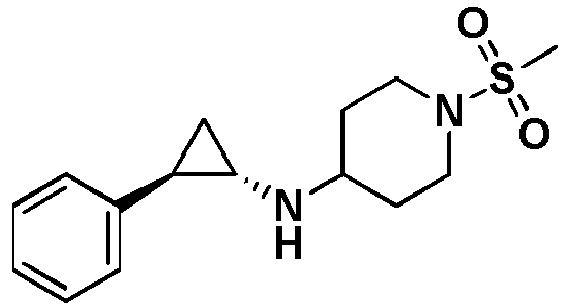
- 1HNMR (400 MHz, CDCl3) δ: 7.28-7.23 (m, 2H), 7.18-7.14 (m, 1H), 7.01 (d, J = 7.2 Hz, 2H),3.70-3.67 (m, 2H), 2.84-2.76 (m, 3H), 2.77 (s, 3H), 2.33-2.29 (m, 1H), 2.02-1.97 (m, 2H), 1.88-1.84 (m, 1H), 1.54-1.48 (m, 2H), 1.09-0.99 (m, 2H); Mass (M+H): 295.12.
- This compound was obtained as free amine.
-

- 1HNMR (400 MHz, DMSO-d6) δ: 7.39 (d, J = 8.8 Hz, 2H), 6.99 (d, J = 8.8 Hz, 2H), 4.11-4.07 (m, 1H), 3.71-3.67 (m, 1H), 3.03 (t, J = 11.2 Hz, 1H), 2.76-2.67 (m, 2H), 2.20 (s, 1H), 1.96 (brs, 2H), 1.76-1.71 (m, 3H), 1.21-0.95 (m, 4H); Mass (M+H): 337.05. This compound was obtained as free amine
-

- 1HNMR (400 MHz, DMSO-d6) δ: 7.39 (d, J = 8.8 Hz, 2H), 6.99 (d, J = 8.8 Hz, 2H), 5.83 (s, 2H), 3.77 (d, J = 13.6 Hz, 2H), 2.73-2.62 (m, 4H), 2.32-2.18 (m, 1H), 1.77-1.67 (m, 3H), 1.14-1.12 (m, 2H), 0.98-0.93 (m, 2H); Mass (M+H): 337.99. This compound was obtained as free amine
-

- 1HNMR (400 MHz, CDCl3) δ: 7.35 (d, J = 8.8 Hz, 2H), 6.88 (d, J = 8.8 Hz, 2H), 3.96 (dm, J = 11.6 Hz, 2H), 3.42-3.35 (m, 2H), 2.86-2.79 (m, 1H), 2.32-2.28 (m, 1H), 1.86-1.81 (m, 3H), 1.48-1.37 (m, 2H), 1.12-1.07 (m, 1H), 0.99-0.94 (m, 1H); Mass (M+H): 296.10. This compound was obtained as free amine
-

- 1HNMR (400 MHz, DMSO d6) δ: 8.70 (vbrs, 1H), 7.70 (vbrs, 1H), 7.25-7.21 (m, 2H), 7.18-7.09 (m, 1H), 7.08-7.03 (m, 3H), 3.08 (m, 1H), 2.24 (s, 1H), 1.92-1.79 (brm, 3H), 1.33-1.14 (brm, 13H), 0.98-0.94 (s, 2H); Mass (M+H): 273.30. This compound was obtained as free amine. The reagent used in Step 1 (reductive alkylation) was directly 2,2,6,6-tetramethylpiperidin-4-one.
-

- 1HNMR (400 MHz, DMSO d6) δ: 10.60 (brs, 1H), 9.98 (brs, 2H), 7.38-7.30 (m, 2H), 7.23-7.18 (m, 3H), 3.56-3.38 (m, 3H), 3.02-2.96 (m, 3H), 2.78 (s, 3H), 2.57 (brs, 1H), 2.28 (brs, 2H), 2.05 (brs, 2H), 1.58 (brs, 1H), 1.28 (m, 1H); Mass (M+H): 231.22. After Step 1 (reductive alkylation), the compound was treated with HCl in 1,4-dioxane to afford the corresponding hydrochloride salt.
-

- 1HNMR (400 MHz, D2O) δ: 7.44-7.41 (m, 2H), 7.39-7.35(m, 1H), 7.26-7.21 (m, 2H), 3.75-3.57 (brm, 4H), 3.21-3.13 (m, 2H), 3.03 (s, 1H), 2.58-2.51 (m, 3H), 2.07-1.97 (m, 2H), 1.58-1.51 (m, 2H), 1.36 (2s, 6H); Mass (M+H): 259.30. After Step 1 (reductive alkylation), the compound was treated with HCl in 1,4-dioxane to afford the corresponding hydrochloride salt.
-

- 1HNMR (400 MHz, D2O) δ: 7.44-7.41 (m, 2H), 7.39-7.35(m, 1H), 7.26-7.21 (m, 2H), 4.05-3.96 (brm, 2H), 3.82-3.68 (brm, 3H), 3.23 (brs, 2H), 3.06-3.02 (m, 1H), 2.61 (brs, 1H), 2.51 (brs, 2H), 2.10 (brs, 2H), 1.61-1.45 (m, 2H); Mass (M+H): 299.30. After Step 1 (reductive alkylation), the compound was treated with HCl in 1,4-dioxane to afford the corresponding hydrochloride salt.
-

- 1HNMR (400 MHz, DMSO-d6) δ: 9.71 (brs, 2H), 8.27 (d, J = 8.4 Hz, 2H), 7.32 (t, J = 8.0 Hz, 2H), 7.24 (d, J = 8.0 Hz, 2H), 7.19 (d, J = 7.2 Hz, 2H), 4.34 (d, J = 13.6 Hz, 2H), 3.62 (brs, 1H), 3.28-3.18 (m, 2H), 2.98 (s, 1H), 2.67-2.55 (m, 2H), 2.50-2.49 (m, 2H), 2.32-2.18 (m, 2H), 1.69-1.74 (m, 2H), 1.56 (s, 1H), 1.35-1.30 (m, 1H); Mass (M+H): 294.3. After Step 1 (reductive alkylation), the compound was treated with HCl in 1,4-dioxane to afford the corresponding hydrochloride salt.
-

- 1HNMR (400 MHz, D2O) δ: 7.53 (d, J = 8.8 Hz, 2H), 7.11 (d, J = 8.8 Hz, 2H), 3.75-3.68 (m, 1H), 3.44-3.35 (m, 4H), 3.01 (s, 1H), 2.62-2.58 (m, 2H), 5.53-2.48 (m, 1H), 2.31-2.21 (m, 2H), 1.58-1.41 (m, 2H); Mass (M+H): 344.05. After Step 1 (reductive alkylation), the compound was treated with HCl in 1,4-dioxane to afford the corresponding hydrochloride salt.
-

- A solution of tert-butyl 4-((((trans)-2-(4-bromophenyl)cyclopropyl)(tert-butoxycarbonyl)amino)methyl)piperidine-1-carboxylate (Intermediate AW, 500 mg, 0.98 mmol), cyclopropyl boronic acid (101 mg, 1.17 mmol) and K2CO3 (405 mg, 2.94 mmol) in ACN:H2O (4:1) (10 mL) was degassed for 30 minutes, then Pd (PPh3)4 (56 mg, 0.049 mmol) was added and heated at reflux for 16 h. After completion, the reaction mixture was poured into water and extracted with EtOAc (2 x 25 mL). The combined extracts were washed with water (25 mL), brine (25 mL), dried over anhydrous Na2SO4, filtered and evaporated. The crude was purified by Preparative HPLC to afford tert-butyl 4-(((tert-butoxycarbonyl)((trans)-2-(4-cyclopropylphenyl)cyclopropyl)amino)methyl)piperidine-1-carboxylate (120 mg) as a white solid.
- HCl in 1,4-dioxane (1 mL) was added to a solution of tert-butyl 4-(((tert-butoxycarbonyl)((trans)-2-(4-cyclopropylphenyl)cyclopropyl)amino)methyl)piperidine-1-carboxylate (120 mg, 0.23 mmol) in 1,4-dioxane (2 mL) at 10 ° C and stirred at RT for 16 h. After completion, the solvent was evaporated. The solid was triturated with Et2O and dried to afford (trans)-2-(4-cyclopropylphenyl)-N-(piperidin-4-ylmethyl)cyclopropanamine as a hydrochloride salt (80 mg), a white solid.
1HNMR (400 MHz, DMSO d6) δ: 9.49 (s, 1H), 8.89 (s, 1H), 8.70 (s, 1H), 7.06-6.98 (m, 4H), 3.40-3.34 (m, 2H), 2.98 (s, 2H), 2.89-2.80 (m, 3 H), 2.08-1.82 (m, 4H), 1.59-1.53 (m, 1H), 1.47-1.38 (m, 2H), 1.18-1.22 (m, 1H), 0.95-0.84 (m, 2H), 0.75-0.62 (m, 2H); Mass (M+H): 271.29. - The following compounds can be synthesized following the methodology described for example 42 by using the corresponding intermediates or commercially available reagents.
-

- 1HNMR (400 MHz, DMSO d6) δ: 9.16 (s, 1H), 8.89 (d, J = 8.4 Hz, 2H), 8.82-8.80 (m, 2H), 8.16-8.12 (m, 1H), 7.80 (d, J = 8.4 Hz, 2H), 7.45 (d, J = 8.4 Hz, 2H), 3.45 (d, J =13.2 Hz, 2H), 3.23-3.01 (m, 5H), 2.76-2.68 (m, 1H), 2.19 (s, 1H), 2.08 (brd, J = 12.8Hz, 2H), 1.74-1.68 (m, 1H), 1.62-1.43 (m, 1H); Mass (M+H): 308.24. This compound was obtained as hydrochloride salt
-

- 1HNMR (400 MHz, D2O) δ: 7.71 (brs, 3H), 7.23 (brs, 2H), 6.69 (brs, 1H), 3.44 (brs, 2H), 3.16 (brs, 1H), 2.96 (brs, 3H), 2.52 (brs, 1H), 2.28-2.05 (m, 4H), 1.54-1.42 (m, 4H); Mass (M+H): 297.25. This compound was obtained as hydrochloride salt
- The following compounds can be synthesized following the general methods disclosed under the General Synthetic Route Description Section, including the methodologies described in Schemes 1,2,3, 4, 5,6, 7 and 8 and the examples above.
-

-

-

-

-

-

-

-

-

-

-

-

-

-

-

-

-

-

-

-

-

-

-

-

-

-

-

-

-

-

-

-

-

-

-

-

-

-

-

-

-

-

-

-

-

-

-
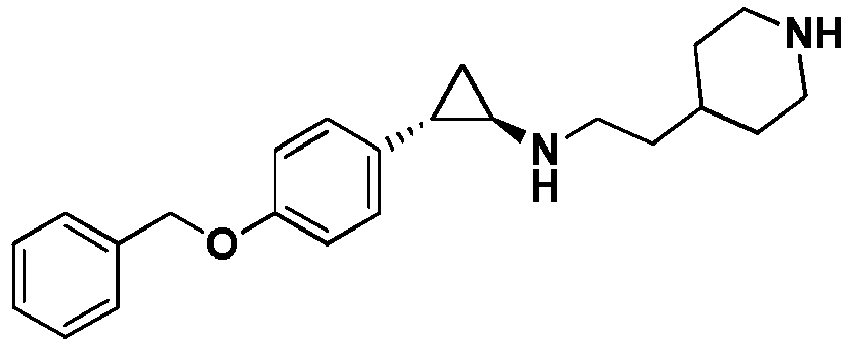
-

-

-

-

-

-
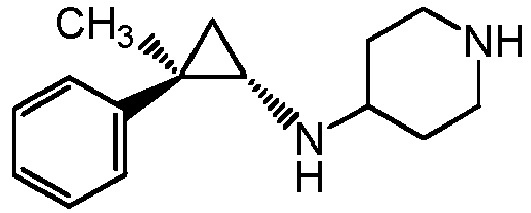
-

-

-

-

-

-

-

- The compounds of the invention can be tested for their ability to inhibit LSD1. The ability of the compounds of the invention to inhibit LSD1 can be tested as follows. Human recombinant LSD1 protein was purchased from BPS Bioscience Inc (catalog reference number 50100: human recombinant LSD1, GenBank accession no. NM_015013, amino acids 158-end with N-terminal GST tag, MW: 103 kDa). In order to monitor LSD1 enzymatic activity and/or its inhibition rate by our inhibitor(s) of interest, di-methylated H3-K4 peptide (Anaspec) was chosen as a substrate. The demethylase activity was estimated, under aerobic conditions, by measuring the release of H2O2 produced during the catalytic process, using the Amplex® Red hydrogen peroxide/peroxidase assay kit (Invitrogen).
- Briefly, a fixed amount of LSD1 was incubated on ice for 15 minutes, in the absence and/or in the presence of at least eight 3-fold serial dilutions of the respective test compound (e.g., from 0 to 75 µM, depending on the inhibitor strength). Tranylcypromine (Biomol International) was used as a control for inhibition. Within the experiment, each concentration of inhibitor was tested in duplicate. After leaving the enzyme interacting with the inhibitor, KM of di-methylated H3-K4 peptide was added to each reaction and the experiment was left for 30 minutes at 37°C in the dark. The enzymatic reactions were set up in a 50 mM sodium phosphate, pH 7.4 buffer. At the end of the incubation, Amplex® Red reagent and horseradish peroxidase (HPR) solution were added to the reaction according to the recommendations provided by the supplier (Invitrogen), and left to incubate for 5 extra minutes at room temperature in the dark. A 1 µM H2O2 solution was used as a control of the kit efficiency. The conversion of the Amplex® Red reagent to resorufin due to the presence of H2O2 in the assay, was monitored by fluorescence (excitation at 540 nm, emission at 590 nm) using a microplate reader (Infinite 200, Tecan). Arbitrary units were used to measure level of H2O2 produced in the absence and/or in the presence of inhibitor.
- The maximum demethylase activity of LSD1 was obtained in the absence of inhibitor and corrected for background fluorescence in the absence of LSD1. The IC50 value of each inhibitor was calculated with GraphPad Prism Software.
- The results presented in Table 1 below show the results of the LSD1 inhibition studies for a number of the Example compounds. In Table 2 the IC50 values for all examples tested in this assay are shown. Parnate (tranylcypromine; i.e., 2-trans phenylcyclopropylamine) was found to have a IC50 value of 35±10 micromolar. The studies show that the compounds of the invention have unexpectedly potent LSD1 inhibition.
- Human recombinant monoamine oxidase proteins MAO-A and MAO-B were purchased from Sigma Aldrich. MAOs catalyze the oxidative deamination of primary, secondary and tertiary amines. In order to monitor MAO enzymatic activities and/or their inhibition rate by inhibitor(s) of interest, a fluorescence-based (inhibitor)-screening assay was set up. 3-(2-Aminophenyl)-3-oxopropanamine (kynuramine dihydrobromide, Sigma Aldrich), a non fluorescent compound was chosen as a substrate. Kynuramine is a non-specific substrate for both MAO-A and MAO-B activities. While undergoing oxidative deamination by MAO activities, kynuramine is converted into 4-hydroxyquinoline (4-HQ), a resulting fluorescent product.
- The monoamine oxidase activity was estimated by measuring the conversion of kynuramine into 4-hydroxyquinoline. Assays were conducted in 96-well black plates with clear bottom (Corning) in a final volume of 100 µL. The assay buffer was 100 mM HEPES, pH 7.5. Each experiment was performed in duplicate within the same experiment.
- Briefly, a fixed amount of MAO (0.25 µg for MAO-A and 0.5 µg for MAO-B) was incubated on ice for 15 minutes in the reaction buffer, in the absence and/or in the presence of at least eight 3-fold serial dilutions each. Clorgyline and Deprenyl (Sigma Aldrich) was used as a control for specific inhibition of MAO-A and MAO-B respectively.
- After leaving the enzyme(s) interacting with the inhibitor, KM of kynuramine was added to each reaction for MAO-B and MAO-A assay respectively, and the reaction was left for 1 hour at 37°C in the dark. The oxidative deamination of the substrate was stopped by adding 50 µL of NaOH 2N. The conversion of kynuramine to 4-hydroxyquinoline, was monitored by fluorescence (excitation at 320 nm, emission at 360 nm) using a microplate reader (Infinite 200, Tecan). Arbitrary units were used to measure levels of fluorescence produced in the absence and/or in the presence of inhibitor.
- The maximum of oxidative deamination activity was obtained by measuring the amount of 4-hydroxyquinoline formed from kynuramine deamination in the absence of inhibitor and corrected for background fluorescence in the absence of MAO enzymes. The IC50 values of each inhibitor were calculated with GraphPad Prism Software.
- The results obtained with compounds of the invention in the biological assays of examples 105 and 106 are shown below.
Table 1: Summary of Data from MAO-A, MAO-B, and LSD1 Inhibition Studies Example No. MAO-A (Ki) MAO-B (Ki) LSD1 (Ki) 1 I I V 2 I I IV 3 I I V 4 II III V 5 I II V 6 II II V 7 II III IV 8 II II III 9 II III IV - The ranges for the Ki value reported in Table 1 are for MAO-A, MAO-B and LSD1: I = higher than 100 µM ; II = between 10 µM and 100 µM; III = between 1 µM and 10 µM; IV = between 0.1 µM and 1 µM; V = between 0.001 and 0.1 µM. The term Ki value is used herein as a designation for the IC50 value, i.e. the concentration required for a half-maximal (50%) inhibition of the corresponding target (MAO-A, MAO-B, or LSD1).
- Generally compounds of the Examples were found to have particularly low IC50 values for LSD1, as compared to MAO-A and MAO-B. For some of the compounds of the Examples, IC50 values for LSD1 were lower than 0.1 □M.
- The specific IC50 values obtained for the compounds disclosed in the Examples when tested in the assays of Examples 105 (LSD1 inhibition) and 106 (MAO-A and B inhibition) are provided in Table 2 below:
Example no. MAO-A (IC50 - µM) MAO-B (IC50 - µM) LSD1 (IC50 - µM) 1 >100 >100 0.056 2 >100 >100 0.491 3 >100 >100 0.042 4 39.86 3.18 0.019 5 >100 35.37 0.022 6 38.32 10.12 0.038 7 33.45 0.70 0.111 8 >100 >100 2.18 9 14.61 5.60 0.296 10 >100 26.47 0.119 11 37.70 46.78 0.908 12 23.75 >100 1.942 13 >100 >100 0.069 14 >100 54.33 0.071 15 >100 ≈100 0.048 16 >100 >100 0.139 17 >100 >100 0.107 18 >100 >100 0.081 19 >100 >100 0.105 20 >100 >100 0.038 21 >100 ≈100 0.127 22 ≈100 ≈100 0.111 23 >100 >100 ≈100 24 ≈50 15.05 0.047 25 ≈100 >100 0.097 26 >100 20.79 0.035 27 3.58 5.01 0.008 28 11.57 1.02 0.084 29 ≈100 ≈100 0.023 30 >100 >100 0.111 31 >100 25.50 0.042 32 >100 >100 1.677 33 ≈50 ≈50 0.212 34 34.12 32.40 0.104 35 45.41 18.69 0.549 36 >100 >100 0.068 37 >100 >100 0.153 38 >100 >100 0.108 39 >100 >100 4.499 40 >100 35.96 0.188 41 >50 16.93 0.177 42 ≈100 3.79 0.037 43 43.10 ≈100 0.032 44 ≈100 >100 0.072 - As the data in the above table show, the compounds of the invention are very potent LSD1 inhibitors, with IC50 values in many cases below 100 nM or even below 50 nM. In addition, the compounds exhibit high selectivity versus MAO-A and MAO-B, with IC50 values for LSD1 in general ≥100-fold more potent than the corresponding IC50 values for MAO-A and MAO-B.
- Acute Myeloid Leukemia (AML) is characterized by the presence of leukemic cells with a maturation arrest that divide rapidly. With the induction of terminal differentiation, AML cells lose the ability to proliferate and end up dying without the need of a direct cytotoxic effect.
- By analyzing the induction of CD11b membrane expression on THP-1 cells we are assessing the ability of LSD1 inhibitors to induce terminal monocytic differentiation of a MLL-AF9 AML cell line.
- The assay was performed as follows:
THP-1 cells were established from the peripheral blood of a 1-year-old boy with acute monocytic leukemia at relapse in 1978. They carry t(9;11)(p21;q23) leading to MLL-MLLT3 (MLL-AF9) fusion gene. This cell line can undergo monocytic differentiation upon treatment with the appropriate stimulus. THP-1 were purchased from DSMZ GmbH (Deutsche Sammlung von Mikroorganismen und Zellkulturen) and cultured in RPMI 1640 medium containing 10% of fetal bovine serum. - In this assay, 150,000 THP-1 cells were seeded in 1 ml of complete culture medium in 6-well tissue culture plates. Serial dilutions of the compounds were prepared in DMSO and then further diluted in complete medium to generate solutions of concentrations that are double of the final concentration at which the cells will be exposed. 1ml of these 2x concentrated solutions was added to the cells. DMSO final content must be the same in all the wells and must be kept below 0.1% v/v (usually 0.01-0.02% v/v), since higher DMSO content can induce differentiation of THP-1 cells.
- Cells were kept in the presence of compounds for 96h at a 5% CO2 atmosphere at 37°C. After this treatment period, cells were harvested, washed twice with PBS buffer and placed in a V-bottom 96-well plate. Each treated sample was split in two. One was stained with a phycoerythrin-labeled anti-CD11b antibody (clone ICRF44, purchased from eBiosciences) and the other with the relevant phycoerythrin-labeled isotype control antibody (mouse IgG1, purchased from eBiosciences). Samples were incubated in the dark at 4°C for 30-60 minutes and washed three times in PBS buffer containing 1% fetal bovine serum.
- Samples were analyzed in a flow cytometer equipped with a blue laser (488nm). Emitted fluorescence was detected and quantified with a 575/30nm filter. Percentage of CD11b positive cells, as an indicator of monocytic differentiation, was determined compared to isotype control antibody stained cells. EC50 values were calculated by non-linear regression analysis.
- The results obtained with compounds of the invention in this test are shown in Table 3 below.
Example No EC50 (nM) 1 2.1 3 0.8 4 1.9 5 7.4 15 2.1 - These results show that compounds of the invention exhibit very potent activity in inducing differentiation of leukemia THP-1 cells, with EC50 values in the low nanomolar range, which indicates that these compounds are particularly useful for the treatment or prevention of leukemias.
- Previous reports of LSD1 have found that it is involved in cell proliferation and growth. Some studies have implicated LSD1 as a therapeutic target for cancer. Huang et al. (2007) PNAS 104:8023-8028 found that polyamine inhibitors of LSD1 modestly cause the reexpression of genes aberrantly silenced in cancer cells and particularly colorectal cancer (Huang et al. Clin Cancer Res. (2009) Dec 1;15(23):7217-28. Epub 2009 Nov 24. PMID: 19934284). Scoumanne et al. ((2007) J. Biol. Chem. May 25;282(21):15471-5) found that deficiency in LSD1 leads to a partial cell cycle arrest in G2/M and sensitizes cells to growth suppression induced by DNA damage. Kahl et al. ((2006) Cancer Res. 66(23):11341-7.) found that LSD1 expression is correlated with prostate cancer aggressiveness. Metzger et al. ((2005) Nature, 437 (7057), 436-439) reported that LSD1 modulation by siRNA and pargyline regulates androgen receptor (AR) and may have therapeutic potential in cancers where AR plays a role, like prostate, testis, and brain cancers. Lee et al. ((2006) Chem. Biol. 13:563-567) reported that tranylcypromine derepresses Egr-1 gene expression in some cancer lines. A body of evidence is accumulating that Egr-1 is a tumor suppressor gene in many contexts (see e.g., Calogero et al. (2004) Cancer Cell lnternational 4:1 exogenous expression of EGR-1 resulted in growth arrest and eventual cell death in primary cancer cell lines; Lucerna et al. (2006) Cancer Research 66 (13), 6708-6713 show that sustained expression of Egr-1 causes antiangiogeneic effects and inhibits tumor growth in some models; Ferraro et al. ((2005) J. Clin. Oncol. Mar 20;23(9):1921-6) reported that Egr-1 is downregulated in lung cancer patients with a higher risk of recurrence and may be more resistant to therapy. Thus, increasing Egr-1 expression via inhibition of LSD1 is a therapeutic approach for some cancers. Recent studies have also implicated LSD1 in brain cancer (Schulte et al. (2009) Cancer Res. Mar 1;69(5):2065-71). Other studies have implicated LSD1 in breast cancer (Lim et al. Carcinogenesis, (2010), 31(3): 512-20, Epub 2009 Dec 30. [Epub ahead of print] PMID: 20042638), lung, bladder and colorectal cancers (Hayami et al (2011), Int J Cancer, 128(3): 574-86, PMID:20333681) and leukemia (Binda et al (2010), J Am Chem Soc, 132(19): 6827-33, PMID:20415477).
- Thus, a body of evidence has implicated LSD1 in a number of cancers, which suggests that LSD1 is a therapeutic target for cancer. The instant inventors have discovered a class of LSD1 inhibitors that can be used to treat diseases where LSD1 is implicated as a therapeutic target like cancer. Accordingly, the (hetero)aryl cyclopropylamine compounds of the invention can be used to treat such diseases.
- Recent studies have also implicated LSD1 in viral infection and reactivation. In particular it was shown that pharmacological inhibitors of LSD1 like parnate and siRNA knock down of LSD1 caused reduced viral infectivity and reduced reactivation after latency (Liang et al. (2009) Nat. Med. 15(11):1312-1317). Therefore it is believed that the compounds of the invention can be used for treating or preventing viral infection. Furthermore, it is believed that the compounds of the invention can treat or prevent viral reactivation after latency.
- Thus, without being bound by theory, the inventors have identified a new class of cyclopropanamine-based LSD1 inhibitors with unexpected potency and selectivity for LSD1, a biologically relevant target in oncology and other diseases.
- All publications and patent applications mentioned in the specification are herein incorporated by reference to the same extent as if each individual publication or patent application was specifically and individually indicated to be incorporated by reference. The mere mentioning of the publications and patent applications does not necessarily constitute an admission that they are prior art to the instant application.
- Although the foregoing invention has been described in some detail by way of illustration and example for purposes of clarity of understanding, it will be obvious that certain changes and modifications may be practiced within the scope of the appended claims.
- Furthermore, the present invention relates to the following items:
- 1. A compound of Formula I

- A is aryl or heteroaryl, wherein said aryl or heteroaryl is optionally substituted with one or more R1;
- B is H, R1 or -L1-E;
- E is aryl or heteroaryl, wherein said aryl or said heteroaryl is optionally substituted with one or more R2;
- L1 is a bond, -O-, -NH-, -N(C1-4 alkyl)-, C1-4 alkylene or heteroC1-4alkylene;
- L2 is a bond and D is a cyclic group selected from:
- (i) a 3- to 7-membered monocyclic saturated heterocyclic ring containing 1 or 2 heteroatoms independently selected from N, O and S, and
- (ii) a 7- to 15-membered polycyclic ring system which comprises at least one saturated heterocyclic ring, wherein the polycyclic ring system contains from 1 to 4 heteroatoms independently selected from N, O and S,
wherein one or more ring C atoms in the cyclic group (i) or (ii) are optionally oxidized to form CO groups,
wherein one or more S atoms in the cyclic group (i) or (ii), if present, are optionally oxidized to form independently SO groups or SO2 groups, and
wherein the cyclic group (i) or (ii) is optionally substituted with one or more R3; - or L2 is C1-4 alkylene and D is a cyclic group selected from:
- (iii) a 3- to 7-membered monocyclic saturated heterocyclic ring containing 1 or 2 heteroatoms independently selected from N, O and S, and
- (iv) a 7- to 15-membered polycyclic saturated ring system which comprises at least one heterocyclic ring, wherein the polycyclic saturated ring system contains from 1 to 4 heteroatoms independently selected from N, O and S,
wherein one or more ring C atoms in the cyclic group (iii) or (iv) are optionally oxidized to form CO groups,
wherein one or more S atoms in the cyclic group (iii) or (iv), if present, are optionally oxidized to form independently SO groups or SO2 groups, and
wherein the cyclic group (iii) or (iv) is optionally substituted with one or more R3; - each R1 is independently selected from C1-8 alkyl, C2-8 alkenyl, C2-8 alkynyl, cyclyl, amino, amido, hydroxyl, nitro, halo, haloC1-8 alkyl, haloC1-8 alkoxy, cyano, sulfinyl, sulfonyl, sulfonamide, C1-8 alkoxy, acyl, carboxyl, O-carboxy, C-carboxy, carbamate and urea;
- each R2 is independently selected from C1-8 alkyl, C2-8 alkenyl, C2-8 alkynyl, cyclyl, amino, amido, hydroxyl, nitro, halo, haloC1-8 alkyl, haloC1-8 alkoxy, cyano, sulfinyl, sulfonyl, sulfonamide, C1-8 alkoxy, acyl, carboxyl, O-carboxy, C-carboxy, carbamate and urea;
- each R3 is independently selected from C1-8 alkyl, C2-8 alkenyl, C2-8 alkynyl, cyclyl, amino, amido, hydroxyl, nitro, halo, haloC1-8 alkyl, haloC1-8 alkoxy, cyano, sulfinyl, sulfonyl, sulfonamide, C1-8 alkoxy, acyl, carboxyl, O-carboxy, C-carboxy, carbamate and urea; and
- each Rw, Rx, Ry and Rz is independently selected from hydrogen, halo and C1-4 alkyl;
for use as a medicament. - 2. The compound of item 1 wherein L2 is a bond and D is a cyclic group selected from:
- (i) a 3- to 7-membered monocyclic saturated heterocyclic ring containing 1 or 2 heteroatoms independently selected from N, O and S, and
- (ii) a 7- to 15-membered polycyclic ring system which comprises at least one saturated heterocyclic ring, wherein the polycyclic ring system contains from 1 to 4 heteroatoms independently selected from N, O and S,
wherein one or more ring C atoms in the cyclic group (i) or (ii) are optionally oxidized to form CO groups, wherein one or more S atoms in the cyclic group (i) or (ii), if present, are optionally oxidized to form independently SO groups or SO2 groups, and
wherein the cyclic group (i) or (ii) is optionally substituted with one or more R3. - 3. The compound of item 2, wherein D is a cyclic group selected from:
- (i) a 3- to 7-membered monocyclic saturated heterocyclic ring containing 1 or 2 heteroatoms independently selected from N, O and S, and
- (ii) a 7- to 15-membered polycyclic ring system which comprises at least one saturated heterocyclic ring, wherein the polycyclic ring system contains from 1 to 4 heteroatoms independently selected from N, O and S,
wherein the cyclic group (i) or (ii) is linked to the remainder of the compound of Formula I through a ring C atom,
wherein one or more ring C atoms in the cyclic group (i) or (ii) are optionally oxidized to form CO groups, wherein one or more S atoms in the cyclic group (i) or (ii), if present, are optionally oxidized to form independently SO groups or SO2 groups, and
wherein the cyclic group (i) or (ii) is optionally substituted with one or more R3. - 4. The compound of item 2, wherein D is a cyclic group selected from:
- (i) a 3- to 7-membered monocyclic saturated heterocyclic ring containing 1 or 2 N atoms, and
- (ii) a 7- to 15-membered polycyclic ring system which comprises at least one saturated heterocyclic ring, wherein the polycyclic ring system contains from 1 to 2 N atoms,
wherein one or more ring C atoms in the cyclic group (i) or (ii) are optionally oxidized to form CO groups, and wherein the cyclic group (i) or (ii) is optionally substituted with one or more R3. - 5. The compound of item 2, wherein D is a cyclic group selected from:
- (i) a 3- to 7-membered monocyclic saturated heterocyclic ring containing 1 or 2 heteroatoms independently selected from N, O and S, and
- (ii) a 7- to 15-membered polycyclic saturated ring system which comprises at least one heterocyclic ring, wherein the polycyclic saturated ring system contains from 1 to 4 heteroatoms independently selected from N, O and S,
wherein one or more ring C atoms in the cyclic group (i) or (ii) are optionally oxidized to form CO groups, wherein one or more S atoms in the cyclic group (i) or (ii), if present, are optionally oxidized to form independently SO groups or SO2 groups, and
wherein the cyclic group (i) or (ii) is optionally substituted with one or more R3. - 6. The compound of item 2, wherein D is a 3- to 7-membered monocyclic saturated heterocyclic ring containing 1 or 2 heteroatoms independently selected from N, O and S,
wherein D is linked to the remainder of the compound of Formula I through a ring C atom,
wherein one or more ring C atoms in ring D are optionally oxidized to form CO groups,
wherein one or more S atoms in ring D, if present, are optionally oxidized to form independently SO groups or SO2 groups, and
wherein ring D is optionally substituted with one or more R3. - 7. The compound of item 2, wherein D is a 3- to 7-membered monocyclic saturated heterocyclic ring containing 1 or 2 heteroatoms independently selected from O and S,
wherein D is linked to the remainder of the compound of Formula I through a ring C atom,
wherein one or more ring C atoms in ring D are optionally oxidized to form CO groups,
wherein one or more S atoms in ring D, if present, are optionally oxidized to form independently SO groups or SO2 groups, and
wherein ring D is optionally substituted with one or more R3. - 8. The compound of item 2, wherein D is a 3- to 7-membered monocyclic saturated heterocyclic ring containing 1 heteroatom selected from N, O and S,
wherein D is linked to the remainder of the compound of Formula I through a ring C atom,
wherein one or more ring C atoms in ring D are optionally oxidized to form CO groups,
wherein one S atom in ring D, if present, is optionally oxidized to form an SO group or an SO2 group, and wherein ring D is optionally substituted with one or more R3. - 9. The compound of item 2, wherein D is a 6-membered monocyclic saturated heterocyclic ring containing 1 heteroatom selected from N, O and S,
wherein D is linked to the remainder of the compound of Formula I through a ring C atom,
wherein one or more ring C atoms in ring D are optionally oxidized to form CO groups,
wherein one S atom in ring D, if present, is optionally oxidized to form an SO group or an SO2 group, and wherein ring D is optionally substituted with one or more R3. - 10. The compound of item 2, wherein D is a 3- to 7-membered monocyclic saturated heterocyclic ring containing 1 N atom,
wherein D is linked to the remainder of the compound of Formula I through a ring C atom,
wherein one or more ring C atoms in ring D are optionally oxidized to form CO groups, and
wherein ring D is optionally substituted with one or more R3. - 11. The compound of item 2, wherein D is piperidinyl, wherein said piperidinyl is linked to the remainder of the compound of Formula I through a ring C atom, and
wherein said piperidinyl is optionally substituted with one or more R3. - 12. The compound of item 2, wherein D is 4-piperidinyl optionally substituted with one or more R3.
- 13. The compound of item 2, wherein D is a 7- to 15-membered polycyclic ring system which comprises at least one saturated heterocyclic ring, wherein the polycyclic ring system contains from 1 to 4 heteroatoms independently selected from N, O and S,
wherein D is linked to the remainder of the compound of Formula I through a ring C atom,
wherein one or more ring C atoms in D are optionally oxidized to form CO groups,
wherein one or more S atoms in D, if present, are optionally oxidized to form independently SO groups or SO2 groups, and
wherein D is optionally substituted with one or more R3. - 14. The compound of item 2, wherein D is a 7- to 15-membered saturated polycyclic ring system which comprises at least one heterocyclic ring, wherein the polycyclic ring system contains from 1 to 4 heteroatoms independently selected from N, O and S,
wherein D is linked to the remainder of the compound of Formula I through a ring C atom,
wherein one or more ring C atoms in D are optionally oxidized to form CO groups,
wherein one or more S atoms in D, if present, are optionally oxidized to form independently SO groups or SO2 groups, and
wherein D is optionally substituted with one or more R3. - 15. The compound of item 2, wherein D is a 7- to 15-membered saturated polycyclic ring system which comprises at least one heterocyclic ring, wherein the polycyclic ring system contains 1 or 2 N atoms,
wherein D is linked to the remainder of the compound of Formula I through a ring C atom,
wherein one or more ring C atoms in D are optionally oxidized to form CO groups, and
wherein D is optionally substituted with one or more R3. - 16. The compound of item 2, wherein D is a 7- to 15-membered saturated polycyclic ring system which comprises at least one heterocyclic ring, wherein the polycyclic ring system contains 1 N atom,
wherein D is linked to the remainder of the compound of Formula I through a ring C atom,
wherein one or more ring C atoms in D are optionally oxidized to form CO groups, and
wherein D is optionally substituted with one or more R3. - 17. The compound of item 2, wherein D is is a 7- to 15-membered saturated polycyclic ring system selected from a group of formula (a), (b), (c) and (d)


- 18. The compound of any of items 2 to 17, wherein said substituent(s) R3, if present, are placed on ring C atom(s) of D.
- 19. The compound of any of items 2 to 18, wherein each R3 is independently selected from C1-8 alkyl, halo, C1-8 alkoxy, hydroxyl, amino, and amido.
- 20. The compound of any of items 2 to 17, wherein D does not comprise any substituents R3.
- 21. The compound of any of items 2 to 20, wherein A is phenyl, naphthyl or monocyclic heteroaryl, wherein said phenyl, said naphthyl or said monocyclic heteroaryl is optionally substituted with one or more R1.
- 22. The compound of any of items 2 to 20, wherein A is phenyl or monocyclic heteroaryl, wherein said phenyl or said monocyclic heteroaryl is optionally substituted with one or more R1.
- 23. The compound of any of items 2 to 20, wherein A is phenyl, pyridyl, thiophenyl, pyrrolyl, furanyl, or thiazolyl, wherein said phenyl, said pyridyl, said thiophenyl, said pyrrolyl, said furanyl or said thiazolyl is optionally substituted with one or more R1.
- 24. The compound of any of items 2 to 20, wherein A is phenyl, pyridyl or thiazolyl, wherein said phenyl, said pyridyl or said thiazolyl is optionally substituted with one or more R1.
- 25. The compound of any of items 2 to 20, wherein A is phenyl, 3-pyridyl or 5-thiazolyl, wherein said phenyl, said 3-pyridyl or said 5-thiazolyl is optionally substituted with one or more R1.
- 26. The compound any of items 2 to 20, wherein A is phenyl or 3-pyridyl, wherein said phenyl or said 3-pyridyl is optionally substituted with one or more R1.
- 27. The compound any of items 2 to 20, wherein A is phenyl optionally substituted with one or more R1.
- 28. The compound any of items 2 to 20, wherein A is naphthyl optionally substituted with one or more R1.
- 29. The compound any of items 2 to 20, wherein A is heteroaryl optionally substituted with one or more R1.
- 30. The compound any of items 2 to 20, wherein A is monocyclic heteroaryl optionally substituted with one or more R1.
- 31. The compound any of items 2 to 20, wherein A is 3-pyridyl optionally substituted with one or more R1.
- 32. The compound any of items 2 to 20, wherein A is 5-thiazolyl optionally substituted with one or more R1.
- 33. The compound of any of items 2 to 32, wherein B is hydrogen or R1.
- 34. The compound of item 33, wherein B is hydrogen.
- 35. The compound of any of items 2 to 32, wherein B is -L1-E.
- 36. The compound of any of items 2 to 35, wherein each R1 is independently selected from C1-8 alkyl, amino, amido, hydroxyl, halo, haloC1-8 alkyl, haloC1-8alkoxy, cyano, sulfonamide, C1-8alkoxy, acyl, carboxyl, carbamate, and urea.
- 37. The compound of any of items 2 to 35, wherein each R1 is independently selected from halo, C1-4 alkyl, haloC1-4 alkyl, C1-4 alkoxy and C3-6 cycloalkyl.
- 38. The compound of item 34 or 35, wherein A is not substituted with any R1.
- 39. The compound of any of items 2 to 32 and 35 to 38, wherein L1 is a bond, -O-, -NH-, -CH2-NH-, or-CH2-O-, wherein said -CH2-NH- and -CH2-O- groups are linked to ring A through the N or O atom, respectively, and are linked to ring E through the -CH2- group comprised in said -CH2-NH- and -CH2-O- groups.
- 40. The compound of item 39, wherein L1 is a bond.
- 41. The compound of item 39, wherein L1 is -CH2-O- linked to ring A through the O atom comprised in said -CH2-O- and linked to ring E through the -CH2- group comprised in said -CH2-O-.
- 42. The compound of any of items 2 to 32 and 35 to 38, wherein L1 is -O-, -NH-, -N(C1-4 alkyl)-, C1-4 alkylene, or -CH2-NH-.
- 43. The compound of any of items 2 to 32 and 35 to 38, wherein L1 is -NH- or -CH2-NH-, wherein said-CH2-NH- is linked to ring A through the N atom comprised in said -CH2-NH- and is linked to ring E through the -CH2- group comprised in said -CH2-NH-.
- 44. The compound of any of items 2 to 32 and 35 to 43, wherein E is phenyl which is optionally substituted with one or more R2.
- 45. The compound of any of items 2 to 32 and 35 to 43, wherein E is phenyl which is substituted with one R2.
- 46. The compound of any of items 2 to 32 and 35 to 43, wherein E is heteroaryl which is optionally substituted with one or more R2.
- 47. The compound of item 46, wherein E is monocyclic heteroaryl which is optionally substituted with one or more R2.
- 48. The compound of item 46, wherein E is pyridinyl which is optionally substituted with one or more R2.
- 49. The compound of any of items 2 to 32 and 35 to 48, wherein each R2 is independently selected from C1-8 alkyl, cyclyl, hydroxyl, halo, haloC1-8 alkyl, haloC1-8 alkoxy, cyano, N-sulfonamido and C1-8 alkoxy.
- 50. The compound of any of items 2 to 32 and 35 to 48, wherein each R2 is independently selected from hydroxyl, halo, haloC1-8 alkyl and N-sulfonamido.
- 51. The compound of item 50, wherein each R2 is independently selected from hydroxyl, halo and haloC1-8 alkyl.
- 52. The compound of any of items 2 to 32 and 35 to 48, wherein ring E is substituted with one R2 and said R2 is N-sulfonamido.
- 53. The compound of any of items 2 to 32 and 35 to 43, wherein E is phenyl.
- 54. The compound of any of items 2 to 32 and 35 to 43, wherein E is heteroaryl.
- 55. The compound of any of items 2 to 32, wherein B is hydrogen and A is not substituted with any R1.
- 56. The compound of any of items 2 to 32, wherein B is hydrogen and each R1 is independently selected from halo, C1-4 alkyl, haloC1-4 alkyl, C1-4 alkoxy and C3-6 cycloalkyl.
- 57. The compound of any of items 2 to 32, wherein B is -L1-E, wherein L1 is a bond, and wherein E is aryl which is optionally substituted with one or more R2.
- 58. The compound of any of items 2 to 32, wherein B is -L1-E, wherein L1 is a bond, and wherein E is phenyl which is optionally substituted with one or more R2.
- 59. The compound of any of items 2 to 32, wherein B is -L1-E, wherein L1 is a bond, and wherein E is phenyl which is optionally substituted with one or more R2, wherein each R2 is independently selected from hydroxyl, halo, haloC1-8 alkyl and N-sulfonamido.
- 60. The compound of any of items 2 to 32, wherein B is -L1-E, wherein L1 is a bond, and wherein E is pyridinyl which is optionally substituted with one or more R2.
- 61. The compound of any of items 2 to 32, wherein B is -L1-E, wherein L1 is a bond, and wherein E is aryl or heteroaryl.
- 62. The compound of any of items 2 to 32, wherein B is -L1-E, wherein L1 is -O-, -NH-, -N(C1-4 alkyl)-, C1-4 alkylene, or -CH2-NH-, and wherein E is phenyl which is optionally substituted with one or more R2.
- 63. The compound of any of items 2 to 32, wherein B is -L1-E, wherein L1 is -O-, -NH-, -N(C1-4 alkyl)-, C1-4 alkylene, or -CH2-NH-, and wherein E is monocyclic heteroaryl which is optionally substituted with one or more R2.
- 64. The compound of any of items 2 to 32, wherein B is -L1-E, wherein L1 is -O-, -NH-, -N(C1-4 alkyl)-, C1-4 alkylene, or -CH2-NH-, and wherein E is pyridinyl which is optionally substituted with one or more R2.
- 65. The compound of any of items 2 to 32, wherein B is -L1-E, wherein L1 is -NH- or -NH-CH2-, wherein the group -NH-CH2- is linked to ring A through the N atom and to ring E through the -CH2- group, and wherein E is aryl or heteroaryl, wherein said aryl or said heteroaryl is optionally substituted with one or more R2.
- 66. The compound of any of items 2 to 65, wherein each Rw, Rx, Ry and Rz is independently selected from hydrogen, fluoro and C1-4 alkyl.
- 67. The compound of any of items 2 to 65, wherein each Rw, Rx, Ry and Rz is independently selected from hydrogen and fluoro.
- 68. The compound of any of items 2 to 65, wherein Rw is selected from hydrogen, halo and C1-4 alkyl and each Rx, Ry and Rz is hydrogen.
- 69. The compound of any of items 2 to 65, wherein each Rw, Rx, Ry and Rz is hydrogen.
- 70. The compound of any of items 2 to 65, wherein each Rw, Rx, Ry and Rz is independently selected from hydrogen, halo and C1-4 alkyl with the proviso that at least one of Rw, Rx, Ry and Rz is not hydrogen.
- 71. The compound of any of items 2 to 65, wherein Rw is selected from halo and C1-4 alkyl and each Rx, Ry and Rz is hydrogen.
- 72. The compound of item 71, wherein Rw is methyl and each Rx, Ry and Rz is hydrogen.
- 73. The compound of any of items 2 to 65, wherein Rw is fluoro and each Rx, Ry and Rz is independently selected from hydrogen, halo and C1-4 alkyl.
- 74. The compound of any of items 2 to 65, wherein Rz is fluoro and each Rw, Rx and Ry is independently selected from hydrogen, halo and C1-4 alkyl.
- 75. The compound of any of items 2 to 65, wherein Rw and Rz are fluoro and each Rx and Ry is independently selected from hydrogen, halo and C1-4 alkyl.
- 76. The compound of any of items 2 to 75, wherein the substituents -A-B and -NH-L2-D on the cyclopropyl moiety are in trans-configuration.
- 77. The compound of item 1 or 2, wherein said compound is selected from:
- N-((trans)-2-phenylcyclopropyl)piperidin-4-amine;
- N-((1S,2R)-2-phenylcyclopropyl)piperidin-4-amine;
- N-((1R,2S)-2-phenylcyclopropyl)piperidin-4-amine;
- N-((trans)-2-(4-(benzyloxy)phenyl)cyclopropyl)piperidin-4-amine;
- N-((trans)-2-(6-(3-(trifluoromethyl)phenyl)pyridin-3-yl)cyclopropyl)tetrahydro-2H-pyran-4-amine;
- N-((trans)-2-(pyridin-3-yl)cyclopropyl)piperidin-4-amine;
- N-((trans)-2-(thiazol-5-yl)cyclopropyl)piperidin-4-amine;
- N-((trans)-2-(3'-(trifluoromethyl)-[1,1'-biphenyl]-4-yl)cyclopropyl)piperidin-4-amine;
- N-((trans)-2-phenylcyclopropyl)piperidin-3-amine;
- N-((trans)-2-(3'-(trifluoromethyl)-[1,1'-biphenyl]-4-yl)cyclopropyl)piperidin-3-amine;
- N-((trans)-2-(4-(benzyloxy)phenyl)cyclopropyl)piperidin-3-amine;
- N-((trans)-2-phenylcyclopropyl)pyrrolidin-3-amine;
- N-((trans)-2-(3'-(trifluoromethyl)-[1,1'-biphenyl]-4-yl)cyclopropyl)pyrrolidin-3-amine;
- N-((trans)-2-(4-(benzyloxy)phenyl)cyclopropyl)pyrrolidin-3-amine;
- N-((trans)-2-phenylcyclopropyl)azetidin-3-amine;
- N-((trans)-2-(3'-(trifluoromethyl)-[1,1'-biphenyl]-4-yl)cyclopropyl)azetidin-3-amine;
- N-((trans)-2-(4-(benzyloxy)phenyl)cyclopropyl)azetidin-3-amine;
- N-((trans)-2-phenylcyclopropyl)azepan-3-amine;
- N-((trans)-2-phenylcyclopropyl)-8-azabicyclo[3.2.1]octan-3-amine;
- N-((trans)-2-phenylcyclopropyl)-3-azabicyclo[3.2.1]octan-8-amine;
- N-((trans)-2-phenylcyclopropyl)decahydroquinolin-4-amine;
- N-((trans)-2-phenylcyclopropyl)-1,2,3,4-tetrahydroquinolin-4-amine;
- N-((trans)-2-phenylcyclopropyl)-3-azaspiro[5.5]undecan-9-amine;
- N-((trans)-2-phenylcyclopropyl)-2-azaspiro[4.5]decan-8-amine;
- N-((trans)-2-phenylcyclopropyl)-2,3-dihydrospiro[indene-1,4'-piperidin]-3-amine;
- N-((1S,2R)-2-(4-(benzyloxy)phenyl)cyclopropyl)piperidin-4-amine;
- N-((1R,2S)-2-(4-(benzyloxy)phenyl)cyclopropyl)piperidin-4-amine;
- N-((1S,2R)-2-(pyridin-3-yl)cyclopropyl)piperidin-4-amine;
- N-((1R,2S)-2-(pyridin-3-yl)cyclopropyl)piperidin-4-amine;
- N-((1S,2S)-2-(thiazol-5-yl)cyclopropyl)piperidin-4-amine;
- N-((1R,2R)-2-(thiazol-5-yl)cyclopropyl)piperidin-4-amine;
- N-((1S,2R)-2-(3'-(trifluoromethyl)-[1,1'-biphenyl]-4-yl)cyclopropyl)piperidin-4-amine;
- N-((1R,2S)-2-(3'-(trifluoromethyl)-[1,1'-biphenyl]-4-yl)cyclopropyl)piperidin-4-amine;
- N-((trans)-2-phenylcyclopropyl)-7-azaspiro[3.5]nonan-2-amine;
- N-(2-(o-tolyl)cyclopropyl)piperidin-4-amine;
- N-(2-(2-fluorophenyl)cyclopropyl)piperidin-4-amine;
- N-(2-(3,4-difluorophenyl)cyclopropyl)piperidin-4-amine;
- N-(2-(4-methoxyphenyl)cyclopropyl)piperidin-4-amine;
- N-(2-(naphthalen-2-yl)cyclopropyl)piperidin-4-amine;
- N-(2-methyl-2-phenylcyclopropyl)piperidin-4-amine;
- N-(6-methoxy-4'-((trans)-2-(piperidin-4-ylamino)cyclopropyl)-[1,1'-biphenyl]-3-y))methanesulfonamide;
- N-(4'-((trans)-2-(piperidin-4-ylamino)cyclopropyl)-[1,1'-bipheny)]-3-y))propane-2-sulfonamide;
- 1-(methylsulfonyl)-N-((trans)-2-phenylcyclopropyl)piperidin-4-amine;
- 1-(4-(((trans)-2-(4-bromophenyl)cyclopropyl)amino)piperidin-1-yl)ethanone;
- 4-(((trans)-2-(4-bromopheny))cyclopropyl)amino)piperidine-1-carboxamide;
- N-(trans)-2-(4-bromophenyl)cyclopropyl)tetrahydro-2H-pyran-4-amine;
- 2,2,6,6-tetramethyl-N-(trans)-2-phenylcyclopropyl)piperidin-4-amine;
- 1-methyl-N-(trans)-2-phenylcyclopropyl)piperidin-4-amine;
- 1-isopropy)-N-((trans)-2-pheny)cyclopropyl)piperidin-4-amine;
- N-((trans)-2-phenylcyclopropyl)-1-(2,2,2-trifluoroethyl)piperidin-4-amine;
- N-((trans)-2-phenylcyclopropyl)-1-(pyridin-4-yl)piperidin-4-amine;
- 4-(((trans)-2-(4-bromopheny))cyclopropyl)amino)tetrahydro-2H-thiopyran 1,1-dioxide;
- N- ((trans)-2-fluoro-2-phenylcyclopropyl)piperidin-4-amine;
- N-((1S,2S)-2-fluoro-2-phenylcyclopropyl)piperidin-4-amine;
- N-((1R,2R)-2-fluoro-2-phenylcyclopropyl)piperidin-4-amine;
- N-((trans)-2-(naphthalen-2-yl)cyclopropyl)piperidin-4-amine;
- N-((trans)-2-methyl-2-phenylcyclopropyl)piperidin-4-amine;N-((trans)-2-(o-tolyl)cyclopropyl)piperidin-4-amine;
- N-((trans)-2-(2-fluorophenyl)cyclopropyl)piperidin-4-amine;
- N-((trans)-2-(3,4-difluorophenyl)cyclopropyl)piperidin-4-amine;
- N-((trans)-2-(4-methoxyphenyl)cyclopropyl)piperidin-4-amine;
- 78. The compound of item 1, wherein L2 is C1-4 alkylene and D is a cyclic group selected from:
- (iii) a 3- to 7-membered monocyclic saturated heterocyclic ring containing 1 or 2 heteroatoms independently selected from N, O and S, and
- (iv) a 7- to 15-membered polycyclic saturated ring system which comprises at least one heterocyclic ring, wherein the polycyclic saturated ring system contains from 1 to 4 heteroatoms independently selected from N, O and S,
wherein one or more ring C atoms in the cyclic group (iii) or (iv) are optionally oxidized to form CO groups, wherein one or more S atoms in the cyclic group (iii) or (iv), if present, are optionally oxidized to form independently SO groups or SO2 groups, and
wherein the cyclic group (iii) or (iv) is optionally substituted with one or more R3. - 79. The compound of item 78, wherein L2 is linear C1-4 alkylene.
- 80. The compound of item 78, wherein L2 is -CH2-
- 81. The compound of item 78, wherein L2 is -CH2CH2-
- 82. The compound of any of items 78 to 81, wherein D is a cyclic group selected from:
- (iii) a 3- to 7-membered monocyclic saturated heterocyclic ring containing 1 or 2 heteroatoms independently selected from N, O and S, and
- (iv) a 7- to 15-membered polycyclic saturated ring system which comprises at least one heterocyclic ring, wherein the polycyclic saturated ring system contains from 1 to 4 heteroatoms independently selected from N, O and S,
wherein the cyclic group (iii) or (iv) is linked to the remainder of the compound of Formula I through a ring C atom,
wherein one or more ring C atoms in the cyclic group (iii) or (iv) are optionally oxidized to form CO groups, wherein one or more S atoms in the cyclic group (iii) or (iv), if present, are optionally oxidized to form independently SO groups or SO2 groups, and
wherein the cyclic group (iii) or (iv) is optionally substituted with one or more R3. - 83. The compound of any of items 78 to 81, wherein D is a cyclic group selected from:
- (iii) a 3- to 7-membered monocyclic saturated heterocyclic ring containing 1 or 2 N atoms, and
- (iv) a 7- to 15-membered polycyclic saturated ring system which comprises at least one heterocyclic ring, wherein the polycyclic saturated ring system contains from 1 to 2 N atoms,
wherein one or more ring C atoms in the cyclic group (iii) or (iv) are optionally oxidized to form CO groups, and wherein the cyclic group (iii) or (iv) is optionally substituted with one or more R3. - 84. The compound of any of items 78 to 81, wherein D is a 3- to 7-membered monocyclic saturated heterocyclic ring containing 1 or 2 heteroatoms independently selected from N, O and S,
wherein D is linked to the remainder of the compound of Formula I through a ring C atom,
wherein one or more ring C atoms in ring D are optionally oxidized to form CO groups,
wherein one or more S atoms in ring D, if present, are optionally oxidized to form independently SO groups or SO2 groups, and
wherein ring D is optionally substituted with one or more R3. - 85. The compound of any of items 78 to 81, wherein D is a 3- to 7-membered monocyclic saturated heterocyclic ring containing 1 or 2 heteroatoms independently selected from O and S,
wherein D is linked to the remainder of the compound of Formula I through a ring C atom,
wherein one or more ring C atoms in ring D are optionally oxidized to form CO groups,
wherein one or more S atoms in ring D, if present, are optionally oxidized to form independently SO groups or SO2 groups, and
wherein ring D is optionally substituted with one or more R3. - 86. The compound of any of items 78 to 81, wherein D is a 3- to 7-membered monocyclic saturated heterocyclic ring containing 1 heteroatom selected from N, O and S,
wherein D is linked to the remainder of the compound of Formula I through a ring C atom,
wherein one or more ring C atoms in ring D are optionally oxidized to form CO groups,
wherein one S atom in ring D, if present, is optionally oxidized to form an SO group or an SO2 group, and wherein ring D is optionally substituted with one or more R3. - 87. The compound of any of items 78 to 81, wherein D is a 6-membered monocyclic saturated heterocyclic ring containing 1 heteroatom selected from N, O and S,
wherein D is linked to the remainder of the compound of Formula I through a ring C atom,
wherein one or more ring C atoms in ring D are optionally oxidized to form CO groups,
wherein one S atom in ring D, if present, is optionally oxidized to form an SO group or an SO2 group, and wherein ring D is optionally substituted with one or more R3. - 88. The compound of any of items 78 to 81, wherein D is a 3- to 7-membered monocyclic saturated heterocyclic ring containing 1 N atom,
wherein D is linked to the remainder of the compound of Formula I through a ring C atom,
wherein one or more ring C atoms in ring D are optionally oxidized to form CO groups, and
wherein ring D is optionally substituted with one or more R3. - 89. The compound of any of items 78 to 81, wherein D is piperidinyl, wherein said piperidinyl is linked to the remainder of the compound of Formula I through a ring C atom, and
wherein said piperidinyl is optionally substituted with one or more R3. - 90. The compound of any of items 78 to 81, wherein D is 4-piperidinyl optionally substituted with one or more R3.
- 91. The compound of any of items 78 to 81, wherein D is 3-azetidinyl optionally substituted with one or more R3.
- 92. The compound of any of items 78 to 81, wherein D is a 7- to 15-membered polycyclic saturated ring system which comprises at least one heterocyclic ring, wherein the polycyclic saturated ring system contains from 1 to 4 heteroatoms independently selected from N, O and S,
wherein D is linked to the remainder of the compound of Formula I through a ring C atom,
wherein one or more ring C atoms in D are optionally oxidized to form CO groups,
wherein one or more S atoms in D, if present, are optionally oxidized to form independently SO groups or SO2 groups, and
wherein D is optionally substituted with one or more R3. - 93. The compound of any of items 78 to 81, wherein D is a 7- to 15-membered saturated polycyclic ring system which comprises at least one heterocyclic ring, wherein the polycyclic saturated ring system contains 1 or 2 N atoms,
wherein D is linked to the remainder of the compound of Formula I through a ring C atom,
wherein one or more ring C atoms in D are optionally oxidized to form CO groups, and
wherein D is optionally substituted with one or more R3. - 94. The compound of any of items 78 to 81, wherein D is a 7- to 15-membered saturated polycyclic ring system which comprises at least one heterocyclic ring, wherein the polycyclic saturated ring system contains 1 N atom,
wherein D is linked to the remainder of the compound of Formula I through a ring C atom,
wherein one or more ring C atoms in D are optionally oxidized to form CO groups, and
wherein D is optionally substituted with one or more R3. - 95. The compound of any of items 78 to 81, wherein D is a 7- to 15-membered saturated polycyclic ring system selected from a group of formula (a), (b), (c) and (d)


- 96. The compound of any of items 78 to 95, wherein said substituent(s) R3, if present, are placed on ring C atom(s) of D.
- 97. The compound of any of items 78 to 96, wherein each R3 is independently selected from C1-8 alkyl, halo, C1-8 alkoxy, hydroxyl, amino, and amido.
- 98. The compound of any of items 78 to 95, wherein D does not comprise any substituents R3.
- 99. The compound of any of items 78 to 98, wherein A is phenyl, naphthyl or monocyclic heteroaryl, wherein said phenyl, said naphthyl or said monocyclic heteroaryl is optionally substituted with one or more R1.
- 100. The compound of any of items 78 to 98, wherein A is phenyl or monocyclic heteroaryl, wherein said phenyl or said monocyclic heteroaryl is optionally substituted with one or more R1.
- 101. The compound of any of items 78 to 98, wherein A is phenyl, pyridyl, thiophenyl, pyrrolyl, furanyl, or thiazolyl, wherein said phenyl, said pyridyl, said thiophenyl, said pyrrolyl, said furanyl or said thiazolyl is optionally substituted with one or more R1.
- 102. The compound of any of items 78 to 98, wherein A is phenyl, pyridyl or thiazolyl, wherein said phenyl, said pyridyl or said thiazolyl is optionally substituted with one or more R1.
- 103. The compound of any of items 78 to 98, wherein A is phenyl, 3-pyridyl or 5-thiazolyl, wherein said phenyl, said 3-pyridyl or said 5-thiazolyl is optionally substituted with one or more R1.
- 104. The compound any of items 78 to 98, wherein A is phenyl or 3-pyridyl, wherein said phenyl or said 3-pyridyl is optionally substituted with one or more R1.
- 105. The compound any of items 78 to 98, wherein A is phenyl optionally substituted with one or more R1.
- 106. The compound any of items 78 to 98, wherein A is naphthyl optionally substituted with one or more R1.
- 107. The compound any of items 78 to 98, wherein A is heteroaryl optionally substituted with one or more R1.
- 108. The compound any of items 78 to 98, wherein A is monocyclic heteroaryl optionally substituted with one or more R1.
- 109. The compound any of items 78 to 98, wherein A is 3-pyridyl optionally substituted with one or more R1.
- 110. The compound any of items 78 to 98, wherein A is 5-thiazolyl optionally substituted with one or more R1.
- 111. The compound of any of items 78 to 110, wherein B is hydrogen or R1.
- 112. The compound of item 111, wherein B is hydrogen.
- 113. The compound of any of items 78 to 110, wherein B is -L1-E.
- 114. The compound of any of items 78 to 113, wherein each R1 is independently selected from C1-8 alkyl, amino, amido, hydroxyl, halo, haloC1-8 alkyl, haloC1-8alkoxy, cyano, sulfonamide, C1-8alkoxy, acyl, carboxyl, carbamate, and urea.
- 115. The compound of any of items 78 to 113, wherein each R1 is independently selected from halo, C1-4 alkyl, haloC1-4 alkyl, C1-4 alkoxy and C3-6 cycloalkyl.
- 116. The compound of item 112 or 113, wherein A is not substituted with any R1.
- 117. The compound of any of items 78 to 110 and 113 to 116, wherein L1 is a bond, -O-, -NH-, -CH2-NH-, or -CH2-O-, wherein said -CH2-NH- and -CH2-O- groups are linked to ring A through the N or O atom, respectively, and are linked to ring E through the -CH2- group comprised in said -CH2-NH- and -CH2-O- groups.
- 118. The compound of item 117, wherein L1 is a bond.
- 119. The compound of item 117, wherein L1 is -CH2-O- linked to ring A through the O atom comprised in said -CH2-O- and linked to ring E through the -CH2- group comprised in said -CH2-O-.
- 120. The compound of any of items 78 to 110 and 113 to 116, wherein L1 is -O-, -NH-, -N(C1-4 alkyl)-, C1-4 alkylene, or -CH2-NH-.
- 121. The compound of any of items 78 to 110 and 113 to 116, wherein L1 is -NH- or -CH2-NH-, wherein said -CH2-NH- is linked to ring A through the N atom comprised in said -CH2-NH- and is linked to ring E through the -CH2- group comprised in said -CH2-NH-.
- 122. The compound of any of items 78 to 110 and 113 to 121, wherein E is phenyl which is optionally substituted with one or more R2.
- 123. The compound of any of items 78 to 110 and 113 to 121, wherein E is phenyl which is substituted with one R2.
- 124. The compound of any of items 78 to 110 and 113 to 121, wherein E is heteroaryl which is optionally substituted with one or more R2.
- 125. The compound of item 124, wherein E is monocyclic heteroaryl which is optionally substituted with one or more R2.
- 126. The compound of item 124, wherein E is pyridinyl which is optionally substituted with one or more R2.
- 127. The compound of any of items 78 to 110 and 113 to 126, wherein each R2 is independently selected from C1-8 alkyl, cyclyl, hydroxyl, halo, haloC1-8 alkyl, haloC1-8 alkoxy, cyano, N-sulfonamido and C1-8 alkoxy
- 128. The compound of any of items 78 to 110 and 113 to 126, wherein each R2 is independently selected from hydroxyl, halo, haloC1-8 alkyl and N-sulfonamido.
- 129. The compound of item 128, wherein each R2 is independently selected from hydroxyl, halo and haloC1-8 alkyl.
- 130. The compound of any of items 78 to 110 and 113 to 126, wherein ring E is substituted with one R2 and said R2 is N-sulfonamido.
- 131. The compound of any of items 78 to 110 and 113 to 121, wherein E is phenyl.
- 132. The compound of any of items 78 to 110 and 113 to 121, wherein E is heteroaryl.
- 133. The compound of any of items 78 to 110, wherein B is hydrogen and A is not substituted with any R1.
- 134. The compound of any of items 78 to 110, wherein B is hydrogen and each R1 is independently selected from halo, C1-4 alkyl, haloC1-4 alkyl, C1-4 alkoxy and C3-6 cycloalkyl.
- 135. The compound of any of items 78 to 110, wherein B is -L1-E, wherein L1 is a bond, and wherein E is aryl which is optionally substituted with one or more R2.
- 136. The compound of any of items 78 to 110, wherein B is -L1-E, wherein L1 is a bond, and wherein E is phenyl which is optionally substituted with one or more R2.
- 137. The compound of any of items 78 to 110, wherein B is -L1-E, wherein L1 is a bond, and wherein E is phenyl which is optionally substituted with one or more R2, wherein each R2 is independently selected from hydroxyl, halo, haloC1-8 alkyl and N-sulfonamido.
- 138. The compound of any of items 78 to 110, wherein B is -L1-E, wherein L1 is a bond, and wherein E is pyridinyl which is optionally substituted with one or more R2.
- 139. The compound of any of items 78 to 110, wherein B is -L1-E, wherein L1 is a bond, and wherein E is aryl or heteroaryl.
- 140. The compound of any of items 78 to 110, wherein B is -L1-E, wherein L1 is -O-, -NH-, -N(C1-4 alkyl)-, C1-4 alkylene, or -CH2-NH-, and wherein E is phenyl which is optionally substituted with one or more R2.
- 141. The compound of any of items 78 to 110, wherein B is -L1-E, wherein L1 is -O-, -NH-, -N(C1-4 alkyl)-, C1-4 alkylene, or -CH2-NH-, and wherein E is monocyclic heteroaryl which is optionally substituted with one or more R2.
- 142. The compound of any of items 78 to 110, wherein B is -L1-E, wherein L1 is -O-, -NH-, -N(C1-4 alkyl)-, C1-4 alkylene, or -CH2-NH-, and wherein E is pyridinyl which is optionally substituted with one or more R2.
- 143. The compound of any of items 78 to 110, wherein B is -L1-E, wherein L1 is -NH- or -NH-CH2-, wherein the group -NH-CH2- is linked to ring A through the N atom and to ring E through the -CH2- group, and wherein E is aryl or heteroaryl, wherein said aryl or said heteroaryl is optionally substituted with one or more R2.
- 144. The compound of any of items 78 to 143, wherein each Rw, Rx, Ry and Rz is independently selected from hydrogen, fluoro and C1-4 alkyl.
- 145. The compound of any of items 78 to 143, wherein each Rw, Rx, Ry and Rz is independently selected from hydrogen and fluoro.
- 146. The compound of any of items 78 to 143 wherein Rw is selected from hydrogen, halo and C1-4 alkyl and each Rx, Ry and Rz is hydrogen.
- 147. The compound of any of items 78 to 143, wherein each Rw, Rx, Ry and Rz is hydrogen.
- 148. The compound of any of items 78 to 143 wherein each Rw, Rx, Ry and Rz is independently selected from hydrogen, halo and C1-4 alkyl with the proviso that at least one of Rw, Rx, Ry and Rz is not hydrogen.
- 149. The compound of any of items 78 to 143 wherein Rw is selected from halo and C1-4 alkyl, preferably fluoro and methyl, and each Rx, Ry and Rz is hydrogen.
- 150. The compound of item 149 wherein Rw is methyl and each Rx, Ry and Rz is hydrogen.
- 151. The compound of any of items 78 to 143, wherein Rw is fluoro and each Rx, Ry and Rz is independently selected from hydrogen, halo and C1-4 alkyl.
- 152. The compound of any of items 78 to 143, wherein Rz is fluoro and each Rw, Rx and Ry is independently selected from hydrogen, halo and C1-4 alkyl.
- 153. The compound of any of items 78 to 143, wherein Rw and Rz are fluoro and each Rx and Ry is independently selected from hydrogen, halo and C1-4 alkyl.
- 154. The compound of any of items 78 to 153, wherein the substituents -A-B and -NH-L2-D on the cyclopropyl moiety are in trans-configuration.
- 155. The compound of item 1 or 78, wherein said compound is selected from:
- (Trans)-2-phenyl-N-(piperidin-4-ylmethyl)cyclopropanamine;
- (Trans)-2-phenyl-N-(2-(piperidin-4-yl)ethyl)cyclopropanamine;
- (Trans)-2-phenyl-N-(2-(tetrahydro-2H-pyran-4-yl)ethyl)cyclopropanamine;
- (Trans)-2-(4'-chloro-[1,1'-biphenyl]-4-yl)-N-(2-(tetrahydro-2H-pyran-4-yl)ethyl)cyclopropanamine;
- (Trans)-N-(piperidin-4-ylmethyl)-2-(pyridin-3-yl)cyclopropanamine;
- (Trans)-N-(piperidin-4-ylmethyl)-2-(thiazol-5-yl)cyclopropanamine;
- (Trans)-N-(piperidin-4-ylmethyl)-2-(3'-(trifluoromethyl)-[1,1'-biphenyl]-4-yl)cyclopropanamine;
- (Trans)-2-(4-(benzyloxy)phenyl)-N-(piperidin-4-ylmethyl)cyclopropanamine;
- (Trans)-N-(2-(piperidin-4-yl)ethyl)-2-(pyridin-3-yl)cyclopropanamine;
- (Trans)-N-(2-(piperidin-4-yl)ethyl)-2-(thiazol-5-yl)cyclopropanamine;
- (Trans)-N-(2-(piperidin-4-yl)ethy))-2-(3'-(trifluoromethyl)-[1,1'-bipheny)]-4-yl)cyclopropanamine;
- (Trans)-2-(4-(benzyloxy)phenyl)-N-(2-(piperidin-4-yl)ethy)cyclopropanamine;
- (1S,2R)-2-phenyl-N-(piperidin-4-ylmethyl)cyclopropanamine ;
- (1R,2S)-2-phenyl-N-(piperidin-4-ylmethyl)cyclopropanamine ;
- (1S,2R)-2-phenyl-N-(2-(piperidin-4-yl)ethyl)cyclopropanamine;
- (1R,2S)-2-phenyl-N-(2-(piperidin-4-yl)ethyl)cyclopropanamine ;
- (1S,2R)-N-(piperidin-4-ylmethyl)-2-(pyridin-3-yl)cyclopropanamine;
- (1R,2S)-N-(piperidin-4-ylmethyl)-2-(pyridin-3-yl)cyclopropanamine;
- (1S,2S)-N-(piperidin-4-ylmethyl)-2-(thiazol-5-yl)cyclopropanamine;
- (1R,2R)-N-(piperidin-4-ylmethyl)-2-(thiazol-5-yl)cyclopropanamine;
- (1S,2R)-N-(piperidin-4-ylmethyl)-2-(3'-(trifluoromethyl)-[1,1'-biphenyl]-4-yl)cyclopropanamine;
- (1R,2S)-N-(piperidin-4-ylmethyl)-2-(3'-(trifluoromethyl)-[1,1'-biphenyl]-4-yl)cyclopropanamine;
- (1S,2R)-2-(4-(benzyloxy)phenyl)-N-(piperidin-4-ylmethyl)cyclopropanamine;
- (1R,2S)-2-(4-(benzyloxy)phenyl)-N-(piperidin-4-ylmethyl)cyclopropanamine;
- (1S,2R)-N-(2-(piperidin-4-yl)ethyl)-2-(pyridin-3-yl)cyclopropanamine;
- (1R,2S)-N-(2-(piperidin-4-yl)ethyl)-2-(pyridin-3-yl)cyclopropanamine;
- (1S,2S)-N-(2-(piperidin-4-yl)ethyl)-2-(thiazol-5-yl)cyclopropanamine;
- (1R,2R)-N-(2-(piperidin-4-yl)ethyl)-2-(thiazol-5-yl)cyclopropanamine;
- (1S,2R)-N-(2-(piperidin-4-yl)ethyl)-2-(3'-(trifluoromethyl)-[1,1'-biphenyl]-4-yl)cyclopropanamine;
- (1R,2S)-N-(2-(piperidin-4-yl)ethyl)-2-(3'-(trifluoromethyl)-[1,1'-biphenyl]-4-yl)cyclopropanamine;
- (1S,2R)-2-(4-(benzyloxy)phenyl)-N-(2-(piperidin-4-yl)ethyl)cyclopropanamine;
- (1R,2S)-2-(4-(benzyloxy)phenyl)-N-(2-(piperidin-4-yl)ethyl)cyclopropanamine;
- (Trans)-2-phenyl-N-(pyrrolidin-3-ylmethyl)cyclopropanamine;
- (Trans)-2-(4-((2-fluorobenzyl)oxy)phenyl)-N-(piperidin-4-ylmethyl)cyclopropanamine;
- (Trans)-N-(azetidin-3-ylmethyl)-2-phenylcyclopropanamine;
- (Trans)-2-(4-cyclopropylphenyl)-N-(piperidin-4-ylmethyl)cyclopropanamine;
- (Trans)-N-(piperidin-4-ylmethyl)-2-(4-(pyridin-3-yl)phenyl)cyclopropanamine;
- (Trans)-2-(4-(1H-pyrazol-5-yl)phenyl)-N-(piperidin-4-ylmethyl)cyclopropanamine;
- (Trans)-2-(naphthalen-2-yl)-N-(piperidin-4-ylmethyl)cyclopropanamine;
- 2-methyl-2-phenyl-N-(piperidin-4-ylmethyl)cyclopropanamine;
- (trans)-2-methyl-2-phenyl-N-(piperidin-4-ylmethyl)cyclopropanamine;
- (trans)-2-(4-(benzyloxy)phenyl)-N-((1-methylpiperidin-4-yl)methyl)cyclopropanamine;or a salt or solvate thereof.
- 156. The compound of any of items 1 to 155, wherein said compound is an optically active stereoisomer.
- 157. A pharmaceutical composition comprising the compound of any of items 1 to 156 and a pharmaceutically acceptable carrier.
- 158. The compound of any of items 1 to 156 or the pharmaceutical composition of item 157 for use in the treatment or prevention of cancer.
- 159. The compound of item 158 or the pharmaceutical composition of item 158, wherein said cancer is chosen from breast cancer, lung cancer, prostate cancer, colorectal cancer, brain cancer, skin cancer, blood cancer, leukemia, lymphoma and myeloma.
- 160. The compound of item 159 or the pharmaceutical composition of item 159, wherein said cancer is blood cancer.
- 161. The compound of item 159 or the pharmaceutical composition of item 159, wherein said cancer is leukemia.
- 162. The compound of item 159 or 161 or the pharmaceutical composition of item 159 or 161, wherein said leukemia is chosen from acute myelogenous leukemia (AML), chronic myelogenous leukemia (CML), chronic neutrophilic leukemia, chronic eosinophilic leukemia, chronic lymphocytic leukemia (CLL), acute lymphoblastic leukemia (ALL), and hairy cell leukemia.
- 163. The compound of any of items 1 to 156 or the pharmaceutical composition of item 157 for use in the treatment or prevention of a neurological disease.
- 164. The compound of item 163 or the pharmaceutical composition of item 163, wherein said neurological disease is selected from depression, Alzheimer's disease, Huntington disease, Parkinson's disease, Amyotrophic Lateral Sclerosis, Dementia with Lewy Bodies, or Frontotemporal Dementia.
- 165. The compound of any of items 1 to 156 or the pharmaceutical composition of item 157 for use in the treatment or prevention of a viral infection.
- 166. The compound of item 165 or the pharmaceutical composition of item 165, wherein said viral infection is a herpesvirus infection.
- 167. The compound of item 166 or the pharmaceutical composition of item 166, wherein said herpesvirus infection is caused by and/or associated with a herpesvirus chosen from HSV-1, HSV-2 and Epstein-Barr virus.
- 168. The compound of item 165 or the pharmaceutical composition of item 165, wherein said viral infection is caused by and/or associated with HIV.
- 169. The compound of item 165 or the pharmaceutical composition of item 165, wherein said viral infection is caused by and/or associated with a Hepadnavirus.
- 170. The compound of item 169 or the pharmaceutical composition of item 169, wherein said Hepadnavirus is Hepatitis B virus.
- 171. The compound of item 165 or the pharmaceutical composition of item 165, wherein said viral infection is caused by and/or associated with a Flavivirus.
- 172. The compound of item 171 or the pharmaceutical composition of item 171, wherein said Flavivirus is chosen from Hepatitis C virus (HCV), yellow fever virus, West Nile virus, Dengue virus and Japanese encephalitis virus.
- 173. The compound of any of items 1 to 156 or the pharmaceutical composition of item 157 for use in the treatment or prevention of viral reactivation after latency.
- 174. The compound of item 173 or the pharmaceutical composition of item 173, wherein the virus that is reactivating is a herpesvirus.
- 175. The compound of item 174 or the pharmaceutical composition of item 174, wherein said herpesvirus is chosen from HSV-1, HSV-2 and Epstein-Barr virus.
- 176. The compound of item 173 or the pharmaceutical composition of item 173, wherein the virus that is reactivating is HIV.
- 177. A method of treating or preventing a disease, the method comprising administering, to a subject in need of such treatment or prevention, the compound of any of items 1 to 156 or the pharmaceutical composition of item 157.
- 178. A method of treating or preventing cancer, the method comprising administering, to a subject in need of such treatment or prevention, the compound of any of items 1 to 156 or the pharmaceutical composition of item 157.
- 179. The method of item 178, wherein said cancer is chosen from breast cancer, lung cancer, prostate cancer, colorectal cancer, brain cancer, skin cancer, blood cancer, leukemia, lymphoma and myeloma.
- 180. The method of item 179, wherein said cancer is blood cancer.
- 181. The method of item 179, wherein said cancer is leukemia.
- 182. The method of item 179 or 181, wherein said leukemia is chosen from acute myelogenous leukemia (AML), chronic myelogenous leukemia (CML), chronic neutrophilic leukemia, chronic eosinophilic leukemia, chronic lymphocytic leukemia (CLL), acute lymphoblastic leukemia (ALL), and hairy cell leukemia.
- 183. A method of treating or preventing a neurological disease, the method comprising administering, to a subject in need of such treatment or prevention, the compound of any of items 1 to 156 or the pharmaceutical composition of item 157.
- 184. The method of item 183, wherein said neurological disease is selected from depression, Alzheimer's disease, Huntington disease, Parkinson's disease, Amyotrophic Lateral Sclerosis, Dementia with Lewy Bodies, or Frontotemporal Dementia.
- 185. A method of treating or preventing a viral infection, the method comprising administering, to a subject in need of such treatment or prevention, the compound of any of items 1 to 156 or the pharmaceutical composition of item 157.
- 186. The method of item 185, wherein said viral infection is a herpesvirus infection.
- 187. The method of item 186, wherein said herpesvirus infection is caused by and/or associated with a herpesvirus chosen from HSV-1, HSV-2 and Epstein-Barr virus.
- 188. The method of item 185, wherein said viral infection is caused by and/or associated with HIV.
- 189. The method of item 185, wherein said viral infection is caused by and/or associated with a Hepadnavirus.
- 190. The method of item 189, wherein said Hepadnavirus is Hepatitis B virus.
- 191. The method of item 185, wherein said viral infection is caused by and/or associated with a Flavivirus.
- 192. The method of item 191, wherein said Flavivirus is chosen from Hepatitis C virus (HCV), yellow fever virus, West Nile virus, Dengue virus and Japanese encephalitis virus.
- 193. A method for treating or preventing viral reactivation after latency, the method comprising administering, to a subject in need of such treatment or prevention, the compound of any of items 1 to 156 or the pharmaceutical composition of item 157.
- 194. The method of item 193, wherein the virus that is reactivating is a herpesvirus.
- 195. The method of item 194, wherein said herpesvirus is chosen from HSV-1, HSV-2 and Epstein-Barr virus.
- 196. The method of item 193, wherein the virus that is reactivating is HIV.
- 197. The method of any of items 177 to 196, wherein said subject is a human.
- 198. A compound of Formula I

- A is aryl or heteroaryl, wherein said aryl or heteroaryl is optionally substituted with one or more R1;
- B is H, R1 or -L1-E;
- E is aryl or heteroaryl, wherein said aryl or said heteroaryl is optionally substituted with one or more R2;
- L1 is a bond, -O-, -NH-, -N(C1-4 alkyl)-, C1-4 alkylene or heteroC1-4alkylene;
- L2 is a bond and D is a cyclic group selected from:
- (i) a 3- to 7-membered monocyclic saturated heterocyclic ring containing 1 or 2 heteroatoms independently selected from N, O and S, and
- (ii) a 7- to 15-membered polycyclic ring system which comprises at least one saturated heterocyclic ring, wherein the polycyclic ring system contains from 1 to 4 heteroatoms independently selected from N, O and S,
wherein one or more ring C atoms in the cyclic group (i) or (ii) are optionally oxidized to form CO groups,
wherein one or more S atoms in the cyclic group (i) or (ii), if present, are optionally oxidized to form independently SO groups or SO2 groups, and
wherein the cyclic group (i) or (ii) is optionally substituted with one or more R3; - or L2 is C1-4 alkylene and D is a cyclic group selected from:
- (iii) a 3- to 7-membered monocyclic saturated heterocyclic ring containing 1 or 2 heteroatoms independently selected from N, O and S, and
- (iv) a 7- to 15-membered polycyclic saturated ring system which comprises at least one heterocyclic ring, wherein the polycyclic saturated ring system contains from 1 to 4 heteroatoms independently selected from N, O and S,
wherein one or more ring C atoms in the cyclic group (iii) or (iv) are optionally oxidized to form CO groups,
wherein one or more S atoms in the cyclic group (iii) or (iv), if present, are optionally oxidized to form independently SO groups or SO2 groups, and
wherein the cyclic group (iii) or (iv) is optionally substituted with one or more R3; - each R1 is independently selected from C1-8 alkyl, C2-8 alkenyl, C2-8 alkynyl, cyclyl, amino, amido, hydroxyl, nitro, halo, haloC1-8 alkyl, haloC1-8 alkoxy, cyano, sulfinyl, sulfonyl, sulfonamide, C1-8 alkoxy, acyl, carboxyl, O-carboxy, C-carboxy, carbamate and urea;
- each R2 is independently selected from C1-8 alkyl, C2-8 alkenyl, C2-8 alkynyl, cyclyl, amino, amido, hydroxyl, nitro, halo, haloC1-8 alkyl, haloC1-8 alkoxy, cyano, sulfinyl, sulfonyl, sulfonamide, C1-8 alkoxy, acyl, carboxyl, O-carboxy, C-carboxy, carbamate and urea;
- each R3 is independently selected from C1-8 alkyl, C2-8 alkenyl, C2-8 alkynyl, cyclyl, amino, amido, hydroxyl, nitro, halo, haloC1-8 alkyl, haloC1-8 alkoxy, cyano, sulfinyl, sulfonyl, sulfonamide, C1-8 alkoxy, acyl, carboxyl, O-carboxy, C-carboxy, carbamate and urea; and
- each Rw, Rx, Ry and Rz is independently selected from hydrogen, halo and C1-4 alkyl;
with the proviso that the following compounds are excluded:- 1-(1-methylethyl)-N-(2-phenylcyclopropyl)- 3-Pyrrolidinamine;
- 4-((2-phenylcyclopropyl)amino)tetrahydro-2H-thiopyran-4-carboxylic acid 1,1-dioxide;
- N-(2-phenylcyclopropyl)-1-(2,2,2-trifluoroethyl)- 4-Piperidinamine;
- 1-(3-methyl-2-buten-1-yl)-N-(2-phenylcyclopropyl)-4-Piperidinamine;
- 4-[(2-phenylcyclopropyl)amino]-1-Piperidinecarboxylic acid ethyl ester;
- 1-[4-[(2-phenylcyclopropyl)amino]-1-piperidinyl]-ethanone;
- hexahydro-3-[(2-phenylcyclopropyl)amino]-2H-azepin-2-one;
- 1-cyclopropyl-3-[(2-phenylcyclopropyl)amino]-2,5-pyrrolidinedione;
- 3-[(2-phenylcyclopropyl)amino]-1-propyl-2,5-pyrrolidinedione;
- 1-(1-methylethyl)-3-[(2-phenylcyclopropyl)amino]-2,5-Pyrrolidinedione;
- 1-(1-methylpropyl)-3-[(2-phenylcyclopropyl)amino]-2,5-Pyrrolidinedione;
- 1,2,5-trimethyl-N-(2-phenylcyclopropyl)-4-Piperidinamine;
- 3-((2-phenylcyclopropyl)amino)tetrahydrothiophene 1,1-dioxide;
- 4-[(2-phenylcyclopropyl)amino]- 1-piperidinecarboxamide;
- 3-hydroxy-4-((2-phenylcyclopropyl)amino)tetrahydrothiophene 1,1-dioxide;
- tetrahydro-4-[(2-phenylcyclopropyl)amino]- 2H-pyran-4-carboxylic acid;
- 4-((2-phenylcyclopropyl)amino)tetrahydro-2H-thiopyran 1,1-dioxide;
- N-(2-phenylcyclopropyl)-1-(2-propyn-1-yl)- 4-piperidinamine;
- 1-ethyl-N-(2-phenylcyclopropyl)-4-piperidinamine;
- 1-ethyl-3-[(2-phenylcyclopropyl)amino]-2,5-Pyrrolidinedione;
- 4-((2-phenylcyclopropyl)amino)tetrahydro-2H-thiopyran-4-carboxylic acid;
- N-(2-phenylcyclopropyl)-1-propyl-4-piperidinamine;
- 3-[(2-phenylcyclopropyl)amino]-2,5-Pyrrolidinedione;
- tetrahydro-3-[(2-phenylcyclopropyl)amino]-3-Thiophenecarboxylic acid;
- tetrahydro-N-(2-phenylcyclopropyl)- 2H-Thiopyran-4-amine 1-oxide;
- 1-(1-methylethyl)-N-(2-phenylcyclopropyl)-4-piperidinamine;
- 1-methyl-3-[(2-phenylcyclopropyl)amino]-2,5-pyrrolidinedione;
- tetrahydro-3-[(2-phenylcyclopropyl)amino]-2H-thiopyran-3-carboxylic acid;
- tetrahydro-N-(2-phenylcyclopropyl)-2H-pyran-4-amine;
- N-(2-phenylcyclopropyl)-3-piperidinamine;
- tetrahydro-4-[(2-phenylcyclopropyl)amino]-3-furanol;
- N-(2-phenylcyclopropyl)-4-piperidinamine;
- tetrahydro-N-(2-phenylcyclopropyl)-2H-thiopyran-4-amine;
- tetrahydro-N-(2-phenylcyclopropyl)-3-thiophenamine;
- 1-methyl-N-(2-phenylcyclopropyl)-4-piperidinamine;
- N-(2-phenylcyclopropyl)-1,4-dioxaspiro[4.5]decan-8-amine;
- 8-methyl-N-(2-phenylcyclopropyl)-8-azabicyclo[3.2.1]octan-3-amine;
- N-(2-phenylcyclopropyl)-1-azabicyclo[2.2.2]octan-3-amine;
- 6-chloro-3,4-dihydro-N-(2-phenylcyclopropyl)-2H-1-benzothiopyran-4-amine;
- 8-fluoro-3,4-dihydro-N-(2-phenylcyclopropyl)-2H-1-benzothiopyran-4-amine;
- 3,4-dihydro-N-(2-phenylcyclopropyl)-2H-1-benzothiopyran-4-amine;
- 5-amino-1,3-dihydro-6-[(2-phenylcyclopropyl)amino]-2H-indol-2-one;
- 3,4-dihydro-N-(2-phenylcyclopropyl)-2H-1-benzopyran-4-amine;
- 6-bromo-3,4-dihydro-N-(2-phenylcyclopropyl)-2H-1-benzopyran-4-amine;
- 2,3-dihydro-3-[(2-phenylcyclopropyl)amino]-6-benzofuranol;
- 2,3-dihydro-N-(2-phenylcyclopropyl)-benzo[b]thiophen-3-amine 1,1-dioxide;
- 2,3-dihydro-N6-(2-phenylcyclopropyl)-1,4-benzodioxin-6,7-diamine;
- 3,4-dihydro-N-(2-phenylcyclopropyl)-1H-2-benzothiopyran-4-amine;
- 7-bromo-1,3-dihydro-3-[(2-phenylcyclopropyl)amino]-2H-indol-2-one;
- 1,3-dihydro-1-methyl-3-[(2-phenylcyclopropyl)amino]-2H-indol-2-one;
- 1,3-dihydro-7-methyl-3-[(2-phenylcyclopropyl)amino]-2H-indol-2-one;
- 6-bromo-1,3-dihydro-3-[(2-phenylcyclopropyl)amino]-2H-indol-2-one;
- 5-bromo-1,3-dihydro-3-[(2-phenylcyclopropyl)amino]-2H-indol-2-one;
- 7-chloro-1,3-dihydro-3-[(2-phenylcyclopropyl)amino]-2H-indol-2-one;
- 6-fluoro-1,3-dihydro-3-[(2-phenylcyclopropyl)amino]-2H-indol-2-one;
- 1,3-dihydro-3-[(2-phenylcyclopropyl)amino]-2H-indol-2-one;
- 4-chloro-1,3-dihydro-3-[(2-phenylcyclopropyl)amino]-2H-indol-2-one;
- 4-bromo-1,3-dihydro-3-[(2-phenylcyclopropyl)amino]-2H-indol-2-one;
- 5-chloro-1,3-dihydro-3-[(2-phenylcyclopropyl)amino]-2H-indol-2-one;
- 1,3-dihydro-5-methyl-3-[(2-phenylcyclopropyl)amino]-2H-indol-2-one;
- 5-fluoro-1,3-dihydro-3-[(2-phenylcyclopropyl)amino]-2H-indol-2-one;
- 6-chloro-1,3-dihydro-3-[(2-phenylcyclopropyl)amino]-2H-indol-2-one;
- 3-chloro-3,4-dihydro-N-(2-phenylcyclopropyl)-2H-thieno[3,2-b]pyrrol-5-amine;
- 8-methoxy-N-(2-phenylcyclopropyl)-5H-pyrimido[5,4-b]indol-4-amine;
- N-(2-phenylcyclopropyl)-5H-pyrimido[5,4-b]indol-4-amine;
- 8-methyl-N-(2-phenylcyclopropyl)-5H-pyrimido[5,4-b]indol-4-amine;
- 8-ethoxy-N-(2-phenylcyclopropyl)-5H-pyrimido[5,4-b]indol-4-amine;
- 8-fluoro-N-(2-phenylcyclopropyl)-5H-pyrimido[5,4-b]indol-4-amine;
- 8-chloro-N-(2-phenylcyclopropyl)-5H-pyrimido[5,4-b]indol-4-amine;
- 5-ethyl-5,10-dihydro-3,7,8,10-tetramethyl-4a-[(2-phenylcyclopropyl)amino]-benzo[g]pteridine-2,4(3H,4aH)-dione;
- 1-ethyl-a-methyl-N-(2-phenylcyclopropyl)-3-piperidinemethanamine;
- 1-ethyl-a-methyl-N-(2-phenylcyclopropyl)-4-piperidinemethanamine;
- a-methyl-N-(2-phenylcyclopropyl)-1-propyl-3-piperidinemethanamine;
- tetrahydro-N-(2-phenylcyclopropyl)-2H-pyran-2-methanamine;
- octahydro-N-(2-phenylcyclopropyl)-1H-indole-2-methanamine;
- a-methyl-N-(2-phenylcyclopropyl)-1-propyl-4-piperidinemethanamine;
- 3-methyl-N-(2-phenylcyclopropyl)-3-piperidinemethanamine;
- N-(2-phenylcyclopropyl)-2-piperidinemethanamine;
- N-(2-phenylcyclopropyl)-4-piperidinemethanamine;
- a,1-dimethyl-N-(2-phenylcyclopropyl)-3-piperidinemethanamine;
- N-(2-phenylcyclopropyl)-3-piperidinemethanamine;
- 4-methoxy-N-(2-phenylcyclopropyl)-2-pyrrolidinemethanamine;
- N-(2-phenylcyclopropyl)-3-propyl-3-pyrrolidinemethanamine;
- N-(2-phenylcyclopropyl)-2-morpholinemethanamine;
- 4-ethyl-N-(2-phenylcyclopropyl)-4-piperidinemethanamine;
- 4-methyl-N-(2-phenylcyclopropyl)-4-piperidinemethanamine;
- a,1-dimethyl-N-(2-phenylcyclopropyl)-4-piperidinemethanamine;
- 1-methyl-N-(2-phenylcyclopropyl)-4-piperidinemethanamine;
- tetrahydro-N-(2-phenylcyclopropyl)-2H-pyran-4-methanamine;
- 3-methyl-N-(2-phenylcyclopropyl)-3-pyrrolidinemethanamine;
- N-(2-phenylcyclopropyl)-2-pyrrolidinemethanamine;
- tetrahydro-N-(2-phenylcyclopropyl)-3-furanmethanamine;
- tetrahydro-N-(2-phenylcyclopropyl)-2-furanmethanamine;
- N-(2-phenylcyclopropyl)-4-piperidineethanamine;
- N-(2-phenylcyclopropyl)-2-pyrrolidineethanamine;
- 1-methyl-N-(2-phenylcyclopropyl)-2-piperidineethanamine; and
- N-(2-phenylcyclopropyl)-3-piperidinepropanamine.
- 199. A compound of Formula I
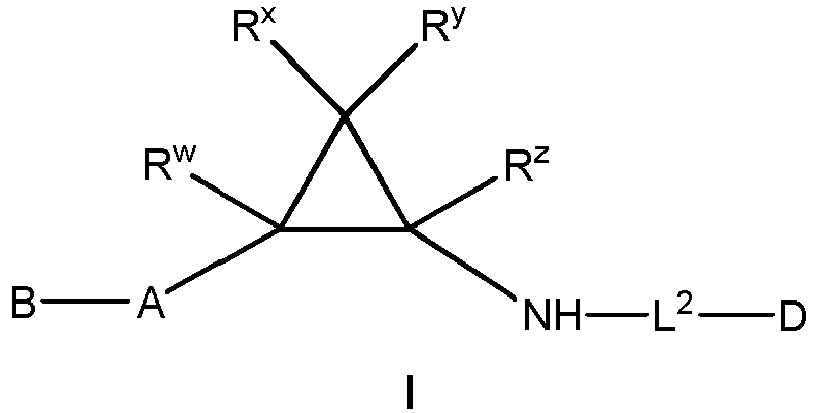
- A is aryl optionally substituted with one or more R1, and B is -L1-E, or
- A is heteroaryl optionally substituted with one or more R1, and B is H, R1 or -L1-E;
- E is aryl or heteroaryl, wherein said aryl or said heteroaryl is optionally substituted with one or more R2;
- L1 is a bond, -O-, -NH-, -N(C1-4 alkyl)-, C1-4 alkylene or heteroC1-4alkylene;
- L2 is a bond and D is a cyclic group selected from:
- (i) a 3- to 7-membered monocyclic saturated heterocyclic ring containing 1 or 2 heteroatoms independently selected from N, O and S, and
- (ii) a 7- to 15-membered polycyclic ring system which comprises at least one saturated heterocyclic ring, wherein the polycyclic ring system contains from 1 to 4 heteroatoms independently selected from N, O and S,
wherein one or more ring C atoms in the cyclic group (i) or (ii) are optionally oxidized to form CO groups,
wherein one or more S atoms in the cyclic group (i) or (ii), if present, are optionally oxidized to form independently SO groups or SO2 groups, and
wherein the cyclic group (i) or (ii) is optionally substituted with one or more R3; - or L2 is C1-4 alkylene and D is a cyclic group selected from:
- (iii) a 3- to 7-membered monocyclic saturated heterocyclic ring containing 1 or 2 heteroatoms independently selected from N, O and S, and
- (iv) a 7- to 15-membered polycyclic saturated ring system which comprises at least one heterocyclic ring, wherein the polycyclic saturated ring system contains from 1 to 4 heteroatoms independently selected from N, O and S,
wherein one or more ring C atoms in the cyclic group (iii) or (iv) are optionally oxidized to form CO groups,
wherein one or more S atoms in the cyclic group (iii) or (iv), if present, are optionally oxidized to form independently SO groups or SO2 groups, and
wherein the cyclic group (iii) or (iv) is optionally substituted with one or more R3; - each R1 is independently selected from C1-8 alkyl, C2-8 alkenyl, C2-8 alkynyl, cyclyl, amino, amido, hydroxyl, nitro, halo, haloC1-8 alkyl, haloC1-8 alkoxy, cyano, sulfinyl, sulfonyl, sulfonamide, C1-8 alkoxy, acyl, carboxyl, O-carboxy, C-carboxy, carbamate and urea;
- each R2 is independently selected from C1-8 alkyl, C2-8 alkenyl, C2-8 alkynyl, cyclyl, amino, amido, hydroxyl, nitro, halo, haloC1-8 alkyl, haloC1-8 alkoxy, cyano, sulfinyl, sulfonyl, sulfonamide, C1-8 alkoxy, acyl, carboxyl, O-carboxy, C-carboxy, carbamate and urea;
- each R3 is independently selected from C1-8 alkyl, C2-8 alkenyl, C2-8 alkynyl, cyclyl, amino, amido, hydroxyl, nitro, halo, haloC1-8 alkyl, haloC1-8 alkoxy, cyano, sulfinyl, sulfonyl, sulfonamide, C1-8 alkoxy, acyl, carboxyl, O-carboxy, C-carboxy, carbamate and urea; and
- each Rw, Rx, Ry and Rz is independently selected from hydrogen, halo and C1-4 alkyl;
- 200. A compound of Formula I

- A is aryl or heteroaryl, wherein said aryl or heteroaryl is optionally substituted with one or more R1;
- B is H, R1 or -L1-E;
- E is aryl or heteroaryl, wherein said aryl or said heteroaryl is optionally substituted with one or more R2;
- L1 is a bond, -O-, -NH-, -N(C1-4 alkyl)-, C1-4 alkylene or heteroC1-4alkylene;
- L2 is a bond and D is a cyclic group selected from:
- (i) a 3- to 7-membered monocyclic saturated heterocyclic ring containing 1 or 2 heteroatoms independently selected from N, O and S, and
- (ii) a 7- to 15-membered polycyclic ring system which comprises at least one saturated heterocyclic ring, wherein the polycyclic ring system contains from 1 to 4 heteroatoms independently selected from N, O and S,
wherein one or more ring C atoms in the cyclic group (i) or (ii) are optionally oxidized to form CO groups,
wherein one or more S atoms in the cyclic group (i) or (ii), if present, are optionally oxidized to form independently SO groups or SO2 groups, and
wherein the cyclic group (i) or (ii) is optionally substituted with one or more R3; - or L2 is C1-4 alkylene and D is a cyclic group selected from:
- (iii) a 3- to 7-membered monocyclic saturated heterocyclic ring containing 1 or 2 heteroatoms independently selected from N, O and S, and
- (iv) a 7- to 15-membered polycyclic saturated ring system which comprises at least one heterocyclic ring, wherein the polycyclic saturated ring system contains from 1 to 4 heteroatoms independently selected from N, O and S,
wherein one or more ring C atoms in the cyclic group (iii) or (iv) are optionally oxidized to form CO groups,
wherein one or more S atoms in the cyclic group (iii) or (iv), if present, are optionally oxidized to form independently SO groups or SO2 groups, and
wherein the cyclic group (iii) or (iv) is optionally substituted with one or more R3; - each R1 is independently selected from C1-8 alkyl, C2-8 alkenyl, C2-8 alkynyl, cyclyl, amino, amido, hydroxyl, nitro, halo, haloC1-8 alkyl, haloC1-8 alkoxy, cyano, sulfinyl, sulfonyl, sulfonamide, C1-8 alkoxy, acyl, carboxyl, O-carboxy, C-carboxy, carbamate and urea;
- each R2 is independently selected from C1-8 alkyl, C2-8 alkenyl, C2-8 alkynyl, cyclyl, amino, amido, hydroxyl, nitro, halo, haloC1-8 alkyl, haloC1-8 alkoxy, cyano, sulfinyl, sulfonyl, sulfonamide, C1-8 alkoxy, acyl, carboxyl, O-carboxy, C-carboxy, carbamate and urea;
- each R3 is independently selected from C1-8 alkyl, C2-8 alkenyl, C2-8 alkynyl, cyclyl, amino, amido, hydroxyl, nitro, halo, haloC1-8 alkyl, haloC1-8 alkoxy, cyano, sulfinyl, sulfonyl, sulfonamide, C1-8 alkoxy, acyl, carboxyl, O-carboxy, C-carboxy, carbamate and urea; and
- each Rw, Rx, Ry and Rz is independently selected from hydrogen, halo and C1-4 alkyl;
wherein the substituents -A-B and -NH-L2-D on the cyclopropyl moiety are in trans-configuration;
with the proviso that the compound 5-ethyl-5,10-dihydro-3,7,8,10-tetramethyl-4a-[(2-phenylcyclopropyl)amino]-benzo[g]pteridine-2,4(3H,4aH)-dione is excluded. - 201. A compound of Formula I

- A is aryl or heteroaryl, wherein said aryl or heteroaryl is optionally substituted with one or more R1;
- B is H, R1 or -L1-E;
- E is aryl or heteroaryl, wherein said aryl or said heteroaryl is optionally substituted with one or more R2;
- L1 is a bond, -O-, -NH-, -N(C1-4 alkyl)-, C1-4 alkylene or heteroC1-4alkylene;
- L2 is a bond and D is a cyclic group selected from:
- (i) a 3- to 7-membered monocyclic saturated heterocyclic ring containing 1 or 2 heteroatoms independently selected from N, O and S, and
- (ii) a 7- to 15-membered polycyclic ring system which comprises at least one saturated heterocyclic ring, wherein the polycyclic ring system contains from 1 to 4 heteroatoms independently selected from N, O and S,
wherein one or more ring C atoms in the cyclic group (i) or (ii) are optionally oxidized to form CO groups,
wherein one or more S atoms in the cyclic group (i) or (ii), if present, are optionally oxidized to form independently SO groups or SO2 groups, and
wherein the cyclic group (i) or (ii) is optionally substituted with one or more R3; - or L2 is C1-4 alkylene and D is a cyclic group selected from:
- (iii) a 3- to 7-membered monocyclic saturated heterocyclic ring containing 1 or 2 heteroatoms independently selected from N, O and S, and
- (iv) a 7- to 15-membered polycyclic saturated ring system which comprises at least one heterocyclic ring, wherein the polycyclic saturated ring system contains from 1 to 4 heteroatoms independently selected from N, O and S,
wherein one or more ring C atoms in the cyclic group (iii) or (iv) are optionally oxidized to form CO groups,
wherein one or more S atoms in the cyclic group (iii) or (iv), if present, are optionally oxidized to form independently SO groups or SO2 groups, and
wherein the cyclic group (iii) or (iv) is optionally substituted with one or more R3; - each R1 is independently selected from C1-8 alkyl, C2-8 alkenyl, C2-8 alkynyl, cyclyl, amino, amido, hydroxyl, nitro, halo, haloC1-8 alkyl, haloC1-8 alkoxy, cyano, sulfinyl, sulfonyl, sulfonamide, C1-8 alkoxy, acyl, carboxyl, O-carboxy, C-carboxy, carbamate and urea;
- each R2 is independently selected from C1-8 alkyl, C2-8 alkenyl, C2-8 alkynyl, cyclyl, amino, amido, hydroxyl, nitro, halo, haloC1-8 alkyl, haloC1-8 alkoxy, cyano, sulfinyl, sulfonyl, sulfonamide, C1-8 alkoxy, acyl, carboxyl, O-carboxy, C-carboxy, carbamate and urea;
- each R3 is independently selected from C1-8 alkyl, C2-8 alkenyl, C2-8 alkynyl, cyclyl, amino, amido, hydroxyl, nitro, halo, haloC1-8 alkyl, haloC1-8 alkoxy, cyano, sulfinyl, sulfonyl, sulfonamide, C1-8 alkoxy, acyl, carboxyl, O-carboxy, C-carboxy, carbamate and urea; and
- each Rw, Rx, Ry and Rz is independently selected from hydrogen, halo and C1-4 alkyl;
wherein the compound of formula I is an optically active stereoisomer. - 202. The compound of any of items 198 to 201, wherein L2 is a bond and D is a cyclic group selected from:
- (i) a 3- to 7-membered monocyclic saturated heterocyclic ring containing 1 or 2 heteroatoms independently selected from N, O and S, and
- (ii) a 7- to 15-membered polycyclic ring system which comprises at least one saturated heterocyclic ring, wherein the polycyclic ring system contains from 1 to 4 heteroatoms independently selected from N, O and S,
wherein one or more ring C atoms in the cyclic group (i) or (ii) are optionally oxidized to form CO groups, wherein one or more S atoms in the cyclic group (i) or (ii), if present, are optionally oxidized to form independently SO groups or SO2 groups, and
wherein the cyclic group (i) or (ii) is optionally substituted with one or more R3. - 203. The compound of any of items 198 to 201, wherein L2 is a bond and D is a cyclic group selected from:
- (i) a 3- to 7-membered monocyclic saturated heterocyclic ring containing 1 or 2 heteroatoms independently selected from N, O and S, and
- (ii) a 7- to 15-membered polycyclic ring system which comprises at least one saturated heterocyclic ring, wherein the polycyclic ring system contains from 1 to 4 heteroatoms independently selected from N, O and S,
wherein the cyclic group (i) or (ii) is linked to the remainder of the compound of Formula I through a ring C atom,
wherein one or more ring C atoms in the cyclic group (i) or (ii) are optionally oxidized to form CO groups, wherein one or more S atoms in the cyclic group (i) or (ii), if present, are optionally oxidized to form independently SO groups or SO2 groups, and
wherein the cyclic group (i) or (ii) is optionally substituted with one or more R3. - 204. The compound of any of items 198 to 201, wherein L2 is a bond and D is a cyclic group selected from:
- (i) a 3- to 7-membered monocyclic saturated heterocyclic ring containing 1 or 2 N atoms, and
- (ii) a 7- to 15-membered polycyclic ring system which comprises at least one saturated heterocyclic ring, wherein the polycyclic ring system contains from 1 to 2 N atoms,
wherein one or more ring C atoms in the cyclic group (i) or (ii) are optionally oxidized to form CO groups, and wherein the cyclic group (i) or (ii) is optionally substituted with one or more R3. - 205. The compound of any of items 198 to 201, wherein L2 is a bond and D is a cyclic group selected from:
- (i) a 3- to 7-membered monocyclic saturated heterocyclic ring containing 1 or 2 heteroatoms independently selected from N, O and S, and
- (ii) a 7- to 15-membered polycyclic saturated ring system which comprises at least one heterocyclic ring, wherein the polycyclic saturated ring system contains from 1 to 4 heteroatoms independently selected from N, O and S,
wherein one or more ring C atoms in the cyclic group (i) or (ii) are optionally oxidized to form CO groups, wherein one or more S atoms in the cyclic group (i) or (ii), if present, are optionally oxidized to form independently SO groups or SO2 groups, and
wherein the cyclic group (i) or (ii) is optionally substituted with one or more R3. - 206. The compound of any of items 198 to 201, wherein L2 is a bond and D is a 3- to 7-membered monocyclic saturated heterocyclic ring containing 1 or 2 heteroatoms independently selected from N, O and S, wherein D is linked to the remainder of the compound of Formula I through a ring C atom,
wherein one or more ring C atoms in ring D are optionally oxidized to form CO groups,
wherein one or more S atoms in ring D, if present, are optionally oxidized to form independently SO groups or SO2 groups, and
wherein ring D is optionally substituted with one or more R3. - 207. The compound of any of items 198 to 201, wherein L2 is a bond and D is a 3- to 7-membered monocyclic saturated heterocyclic ring containing 1 or 2 heteroatoms independently selected from O and S, wherein D is linked to the remainder of the compound of Formula I through a ring C atom,
wherein one or more ring C atoms in ring D are optionally oxidized to form CO groups,
wherein one or more S atoms in ring D, if present, are optionally oxidized to form independently SO groups or SO2 groups, and
wherein ring D is optionally substituted with one or more R3. - 208. The compound of any of items 198 to 201, wherein L2 is a bond and D is a 3- to 7-membered monocyclic saturated heterocyclic ring containing 1 heteroatom selected from N, O and S,
wherein D is linked to the remainder of the compound of Formula I through a ring C atom,
wherein one or more ring C atoms in ring D are optionally oxidized to form CO groups,
wherein one S atom in ring D, if present, is optionally oxidized to form an SO group or an SO2 group, and wherein ring D is optionally substituted with one or more R3. - 209. The compound of any of items 198 to 201, wherein L2 is a bond and D is a 6-membered monocyclic saturated heterocyclic ring containing 1 heteroatom selected from N, O and S,
wherein D is linked to the remainder of the compound of Formula I through a ring C atom,
wherein one or more ring C atoms in ring D are optionally oxidized to form CO groups,
wherein one S atom in ring D, if present, is optionally oxidized to form an SO group or an SO2 group, and wherein ring D is optionally substituted with one or more R3. - 210. The compound of any of items 198 to 201, wherein L2 is a bond and D is a 3- to 7-membered monocyclic saturated heterocyclic ring containing 1 N atom,
wherein D is linked to the remainder of the compound of Formula I through a ring C atom,
wherein one or more ring C atoms in ring D are optionally oxidized to form CO groups, and
wherein ring D is optionally substituted with one or more R3. - 211. The compound of any of items 198 to 201, wherein L2 is a bond and D is piperidinyl, wherein said piperidinyl is linked to the remainder of the compound of Formula I through a ring C atom, and wherein said piperidinyl is optionally substituted with one or more R3.
- 212. The compound of any of items 198 to 201, wherein L2 is a bond and D is 4-piperidinyl optionally substituted with one or more R3.
- 213. The compound of any of items 198 to 201, wherein L2 is a bond and D is a 7- to 15-membered polycyclic ring system which comprises at least one saturated heterocyclic ring, wherein the polycyclic ring system contains from 1 to 4 heteroatoms independently selected from N, O and S,
wherein D is linked to the remainder of the compound of Formula I through a ring C atom,
wherein one or more ring C atoms in D are optionally oxidized to form CO groups,
wherein one or more S atoms in D, if present, are optionally oxidized to form independently SO groups or SO2 groups, and
wherein D is optionally substituted with one or more R3. - 214. The compound of any of items 198 to 201, wherein L2 is a bond and D is a 7- to 15-membered saturated polycyclic ring system which comprises at least one heterocyclic ring, wherein the polycyclic ring system contains from 1 to 4 heteroatoms independently selected from N, O and S,
wherein D is linked to the remainder of the compound of Formula I through a ring C atom,
wherein one or more ring C atoms in D are optionally oxidized to form CO groups,
wherein one or more S atoms in D, if present, are optionally oxidized to form independently SO groups or SO2 groups, and
wherein D is optionally substituted with one or more R3. - 215. The compound of any of items 198 to 201, wherein L2 is a bond and D is a 7- to 15-membered saturated polycyclic ring system which comprises at least one heterocyclic ring, wherein the polycyclic ring system contains 1 or 2 N atoms,
wherein D is linked to the remainder of the compound of Formula I through a ring C atom,
wherein one or more ring C atoms in D are optionally oxidized to form CO groups, and
wherein D is optionally substituted with one or more R3. - 216. The compound of any of items 198 to 201, wherein L2 is a bond and D is a 7- to 15-membered saturated polycyclic ring system which comprises at least one heterocyclic ring, wherein the polycyclic ring system contains 1 N atom,
wherein D is linked to the remainder of the compound of Formula I through a ring C atom,
wherein one or more ring C atoms in D are optionally oxidized to form CO groups, and
wherein D is optionally substituted with one or more R3. - 217. The compound of any of items 198 to 201, wherein L2 is a bond and D is is a 7- to 15-membered saturated polycyclic ring system selected from a group of formula (a), (b), (c) and (d)


- 218. The compound of any of items 198 to 217, wherein said substituent(s) R3, if present, are placed on ring C atom(s) of D.
- 219. The compound of any of items 198 to 218, wherein each R3 is independently selected from C1-8 alkyl, halo, C1-8 alkoxy, hydroxyl, amino, and amido.
- 220. The compound of any of items 198 to 217, wherein D does not comprise any substituents R3.
- 221. The compound of any of items 198 to 220, wherein A is phenyl, naphthyl or monocyclic heteroaryl, wherein said phenyl, said naphthyl or said monocyclic heteroaryl is optionally substituted with one or more R1.
- 222. The compound of any of items 198 to 221, wherein A is phenyl or monocyclic heteroaryl, wherein said phenyl or said monocyclic heteroaryl is optionally substituted with one or more R1.
- 223. The compound of any of items 198 to 222, wherein A is phenyl, pyridyl, thiophenyl, pyrrolyl, furanyl, or thiazolyl, wherein said phenyl, said pyridyl, said thiophenyl, said pyrrolyl, said furanyl or said thiazolyl is optionally substituted with one or more R1.
- 224. The compound of any of items 198 to 222, wherein A is phenyl, pyridyl or thiazolyl, wherein said phenyl, said pyridyl or said thiazolyl is optionally substituted with one or more R1.
- 225. The compound of any of items 198 to 222, wherein A is phenyl, 3-pyridyl or 5-thiazolyl, wherein said phenyl, said 3-pyridyl or said 5-thiazolyl is optionally substituted with one or more R1.
- 226. The compound of any of items 198 to 222, wherein A is phenyl or 3-pyridyl, wherein said phenyl or said 3-pyridyl is optionally substituted with one or more R1.
- 227. The compound of any of items 198 to 222, wherein A is phenyl optionally substituted with one or more R1.
- 228. The compound of any of items 198 to 221, wherein A is naphthyl optionally substituted with one or more R1.
- 229. The compound of any of items 198 to 220, wherein A is heteroaryl optionally substituted with one or more R1.
- 230. The compound of any of items 198 to 221, wherein A is monocyclic heteroaryl optionally substituted with one or more R1.
- 231. The compound of any of items 198 to 222, wherein A is pyridyl, thiophenyl, pyrrolyl, furanyl, or thiazolyl, wherein said pyridyl, said thiophenyl, said pyrrolyl, said furanyl or said thiazolyl is optionally substituted with one or more R1.
- 232. The compound of any of items 198 to 222, wherein A is pyridyl or thiazolyl, wherein said pyridyl or said thiazolyl is optionally substituted with one or more R1.
- 233. The compound of any of items 198 to 222, wherein A is 3-pyridyl optionally substituted with one or more R1.
- 234. The compound any of items 198 to 222, wherein A is 5-thiazolyl optionally substituted with one or more R1.
- 235. The compound of any of items 198 to 234, wherein B is hydrogen or R1.
- 236. The compound of item 235, wherein B is hydrogen.
- 237. The compound of any of items 198 to 234, wherein B is -L1-E.
- 238. The compound of any of items 198 to 237, wherein each R1 is independently selected from C1-8 alkyl, amino, amido, hydroxyl, halo, haloC1-8 alkyl, haloC1-8alkoxy, cyano, sulfonamide, C1-8alkoxy, acyl, carboxyl, carbamate, and urea.
- 239. The compound of any of items 198 to 237, wherein each R1 is independently selected from halo, C1-4 alkyl, haloC1-4 alkyl, C1-4 alkoxy and C3-6 cycloalkyl.
- 240. The compound of item 236 or 237, wherein A is not substituted with any R1.
- 241. The compound of any of items 198 to 234 and 237 to 240, wherein L1 is a bond, -O-, -NH-, -CH2-NH-, or -CH2-O-, wherein said -CH2-NH- and -CH2-O- groups are linked to ring A through the N or O atom, respectively, and are linked to ring E through the -CH2- group comprised in said -CH2-NH- and -CH2-O- groups.
- 242. The compound of item 241, wherein L1 is a bond.
- 243. The compound of item 241, wherein L1 is -CH2-O- linked to ring A through the O atom comprised in said -CH2-O- and linked to ring E through the -CH2- group comprised in said -CH2-O-.
- 244. The compound of any of items 198 to 234 and 237 to 240, wherein L1 is -O-, -NH-, -N(C1-4 alkyl)-, C1-4 alkylene, or -CH2-NH-.
- 245. The compound of any of items 198 to 234 and 237 to 240, wherein L1 is -NH- or -CH2-NH-, wherein said -CH2-NH- is linked to ring A through the N atom comprised in said -CH2-NH- and is linked to ring E through the -CH2- group comprised in said -CH2-NH-.
- 246. The compound of any of items 198 to 234 and 237 to 245, wherein E is phenyl which is optionally substituted with one or more R2.
- 247. The compound of any of items 198 to 234 and 237 to 245, wherein E is phenyl which is substituted with one R2.
- 248. The compound of any of items 198 to 234 and 237 to 245, wherein E is heteroaryl which is optionally substituted with one or more R2.
- 249. The compound of item 248, wherein E is monocyclic heteroaryl which is optionally substituted with one or more R2.
- 250. The compound of item 248, wherein E is pyridinyl which is optionally substituted with one or more R2.
- 251. The compound of any of items 198 to 234 and 237 to 250, wherein each R2 is independently selected from C1-8 alkyl, cyclyl, hydroxyl, halo, haloC1-8 alkyl, haloC1-8 alkoxy, cyano, N-sulfonamido and C1-8 alkoxy.
- 252. The compound of any of items 198 to 234 and 237 to 250, wherein each R2 is independently selected from hydroxyl, halo, haloC1-8 alkyl and N-sulfonamido.
- 253. The compound of item 252, wherein each R2 is independently selected from hydroxyl, halo and haloC1-8 alkyl.
- 254. The compound of any of items 198 to 234 and 237 to 250, wherein ring E is substituted with one R2 and said R2 is N-sulfonamido.
- 255. The compound of any of items 198 to 234 and 237 to 245, wherein E is phenyl.
- 256. The compound of any of items 198 to 234 and 237 to 245, wherein E is heteroaryl.
- 257. The compound of any of items 198 to 234, wherein B is hydrogen and A is not substituted with any R1.
- 258. The compound of any of items 198 to 234, wherein B is hydrogen and each R1 is independently selected from halo, C1-4 alkyl, haloC1-4 alkyl, C1-4 alkoxy and C3-6 cycloalkyl.
- 259. The compound of any of items 198 to 234, wherein B is -L1-E, wherein L1 is a bond, and wherein E is aryl which is optionally substituted with one or more R2.
- 260. The compound of any of items 198 to 234, wherein B is -L1-E, wherein L1 is a bond, and wherein E is phenyl which is optionally substituted with one or more R2.
- 261. The compound of any of items 198 to 234, wherein B is -L1-E, wherein L1 is a bond, and wherein E is phenyl which is optionally substituted with one or more R2, wherein each R2 is independently selected from hydroxyl, halo, haloC1-8 alkyl and N-sulfonamido.
- 262. The compound of any of items 198 to 234, wherein B is -L1-E, wherein L1 is a bond, and wherein E is pyridinyl which is optionally substituted with one or more R2.
- 263. The compound of any of items 198 to 234, wherein B is -L1-E, wherein L1 is a bond, and wherein E is aryl or heteroaryl.
- 264. The compound of any of items 198 to 234, wherein B is -L1-E, wherein L1 is -O-, -NH-, -N(C1-4 alkyl)-, C1-4 alkylene, or -CH2-NH-, and wherein E is phenyl which is optionally substituted with one or more R2.
- 265. The compound of any of items 198 to 234, wherein B is -L1-E, wherein L1 is -O-, -NH-, -N(C1-4 alkyl)-, C1-4 alkylene, or -CH2-NH-, and wherein E is monocyclic heteroaryl which is optionally substituted with one or more R2.
- 266. The compound of any of items 198 to 234, wherein B is -L1-E, wherein L1 is -O-, -NH-, -N(C1-4 alkyl)-, C1-4 alkylene, or -CH2-NH-, and wherein E is pyridinyl which is optionally substituted with one or more R2.
- 267. The compound of any of items 198 to 234, wherein B is -L1-E, wherein L1 is -NH- or -NH-CH2-, wherein the group -NH-CH2- is linked to ring A through the N atom and to ring E through the -CH2- group, and wherein E is aryl or heteroaryl, wherein said aryl or said heteroaryl is optionally substituted with one or more R2.
- 268. The compound of any of items 198 to 267, wherein each Rw, Rx, Ry and Rz is independently selected from hydrogen, fluoro and C1-4 alkyl.
- 269. The compound of any of items 198 to 267, wherein each Rw, Rx, Ry and Rz is independently selected from hydrogen and fluoro.
- 270. The compound of any of items 198 to 267, wherein Rw is selected from hydrogen, halo and C1-4 alkyl and each Rx, Ry and Rz is hydrogen.
- 271. The compound of any of items 198 to 267, wherein each Rw, Rx, Ry and Rz is hydrogen.
- 272. The compound of any of items 198 to 267, wherein each Rw, Rx, Ry and Rz is independently selected from hydrogen, halo and C1-4 alkyl with the proviso that at least one is not hydrogen.
- 273. The compound of any of items 198 to 267, wherein Rw is selected from halo and C1-4 alkyl, preferably fluoro and methyl, and each Rx, Ry and Rz is hydrogen.
- 274. The compound of item 273, wherein Rw is methyl and each Rx, Ry and Rz is hydrogen.
- 275. The compound of any of items 198 to 267, wherein Rw is fluoro and each Rx, Ry and Rz is independently selected from hydrogen, halo and C1-4 alkyl.
- 276. The compound of any of items 198 to 267, wherein Rz is fluoro and each Rw, Rx and Ry is independently selected from hydrogen, halo and C1-4 alkyl.
- 277. The compound of any of items 198 to 267 wherein Rw and Rz are fluoro and each Rx and Ry is independently selected from hydrogen, halo and C1-4 alkyl.
- 278. The compound of any of items 198 to 267, wherein the substituents -A-B and -NH-L2-D on the cyclopropyl moiety are in trans-configuration.
- 279. The compound of item 198 or 202, wherein said compound is selected from:
- N-((trans)-2-(4-(benzyloxy)phenyl)cyclopropyl)piperidin-4-amine;
- N-((trans)-2-(6-(3-(trifluoromethyl)phenyl)pyridin-3-yl)cyclopropyl)tetrahydro-2H-pyran-4-amine;
- N-((trans)-2-(pyridin-3-yl)cyclopropyl)piperidin-4-amine;
- N-((trans)-2-(thiazol-5-yl)cyclopropyl)piperidin-4-amine;
- N-((trans)-2-(3'-(trifluoromethyl)-[1,1'-biphenyl]-4-yl)cyclopropyl)piperidin-4-amine;
- N-((trans)-2-(3'-(trifluoromethyl)-[1,1'-biphenyl]-4-yl)cyclopropyl)piperidin-3-amine;
- N-((trans)-2-(4-(benzyloxy)phenyl)cyclopropyl)piperidin-3-amine;
- N-((trans)-2-phenylcyclopropyl)pyrrolidin-3-amine;
- N-((trans)-2-(3'-(trifluoromethyl)-[1,1'-biphenyl]-4-yl)cycbpropyl)pyrrolidin-3-amine;
- N-((trans)-2-(4-(benzyloxy)phenyl)cyclopropyl)pyrrolidin-3-amine;
- N-((trans)-2-phenylcyclopropyl)azetidin-3-amine;
- N-((trans)-2-(3'-(trifluoromethyl)-[1,1'-biphenyl]-4-yl)cyclopropyl)azetidin-3-amine;
- N-((trans)-2-(4-(benzyloxy)phenyl)cyclopropyl)azetidin-3-amine;
- N-((trans)-2-phenylcyclopropyl)azepan-3-amine;
- N-((trans)-2-phenylcyclopropyl)-8-azabicyclo[3.2.1]octan-3-amine;
- N-((trans)-2-phenylcyclopropyl)-3-azabicyclo[3.2.1]octan-8-amine;
- N-((trans)-2-phenylcyclopropyl)decahydroquinolin-4-amine;
- N-((trans)-2-phenylcyclopropyl)-1,2,3,4-tetrahydroquinolin-4-amine;
- N-((trans)-2-phenylcyclopropyl)-3-azaspiro[5.5]undecan-9-amine;
- N-((trans)-2-phenylcyclopropyl)-2-azaspiro[4.5]decan-8-amine;
- N-((trans)-2-phenylcyclopropyl)-2,3-dihydrospiro[indene-1,4'-piperidin]-3-amine;
- N-((1S,2R)-2-(4-(benzyloxy)phenyl)cyclopropyl)piperidin-4-amine;
- N-((1R,2S)-2-(4-(benzyloxy)phenyl)cyclopropyl)piperidin-4-amine;
- N-((1S,2R)-2-(pyridin-3-yl)cyclopropyl)piperidin-4-amine;
- N-((1R,2S)-2-(pyridin-3-yl)cyclopropyl)piperidin-4-amine;
- N-((1S,2S)-2-(thiazol-5-yl)cyclopropyl)piperidin-4-amine;
- N-((1R,2R)-2-(thiazol-5-yl)cyclopropyl)piperidin-4-amine;
- N-((1S,2R)-2-(3'-(trifluoromethyl)-[1,1'-biphenyl]-4-yl)cyclopropyl)piperidin-4-amine;
- N-((1R,2S)-2-(3'-(trifluoromethyl)-[1,1'-biphenyl]-4-yl)cyclopropyl)piperidin-4-amine;
- N-((trans)-2-phenylcyclopropyl)-7-azaspiro[3.5]nonan-2-amine;
- N-(2-(o-tolyl)cyclopropyl)piperidin-4-amine;
- N-(2-(2-fluorophenyl)cyclopropyl)piperidin-4-amine;
- N-(2-(3,4-difluorophenyl)cyclopropyl)piperidin-4-amine;
- N-(2-(4-methoxyphenyl)cyclopropyl)piperidin-4-amine;
- N-(2-(naphthalen-2-yl)cyclopropyl)piperidin-4-amine;
- N-(2-methyl-2-phenylcyclopropyl)piperidin-4-amine;
- N-(6-methoxy-4'-((trans)-2-(piperidin-4-ylamino)cyclopropyl)-[1,1'-biphenyl]-3-yl)methanesulfonamide;
- N-(4'-((trans)-2-(piperidin-4-ylamino)cyclopropyl)-[1,1'-biphenyl]-3-yl)propane-2-sulfonamide;
- 1-(methylsulfonyl)-N-((trans)-2-phenylcyclopropyl)piperidin-4-amine;
- 1-(4-((trans)-2-(4-bromophenyl)cyclopropyl)amino)piperidin-1-yl)ethanone;
- 4-(((trans)-2-(4-bromophenyl)cyclopropyl)amino)piperidine-1-carboxamide;
- N-((trans)-2-(4-bromophenyl)cyclopropyl)tetrahydro-2H-pyran-4-amine;
- 2,2,6,6-tetramethyl-N-((trans)-2-phenylcyclopropyl)piperidin-4-amine;
- N-((trans)-2-phenylcyclopropyl)-1-(pyridin-4-yl)piperidin-4-amine;
- 4-(((trans)-2-(4-bromophenyl)cyclopropyl)amino)tetrahydro-2H-thiopyran 1,1-dioxide;
- N-((trans)-2-fluoro-2-phenylcyclopropyl)piperidin-4-amine;
- N-((1S,2S)-2-fluoro-2-phenylcyclopropyl)piperidin-4-amine;
- N-((1R,2R)-2-fluoro-2-phenylcyclopropyl)piperidin-4-amine;
- N-((trans)-2-(naphthalen-2-yl)cyclopropyl)piperidin-4-amine;
- N-((trans)-2-methyl-2-phenylcyclopropyl)piperidin-4-amine;N-((trans)-2-(o-tolyl)cyclopropyl)piperidin-4-amine;
- N-((trans)-2-(2-fluorophenyl)cyclopropyl)piperidin-4-amine;
- N-((trans)-2-(3,4-difluorophenyl)cyclopropyl)piperidin-4-amine;
- N-((trans)-2-(4-methoxyphenyl)cyclopropyl)piperidin-4-amine;
- 280. The compound of item 199 or 202, wherein said compound is selected from:
- N-((trans)-2-(4-(benzyloxy)phenyl)cyclopropyl)piperidin-4-amine;
- N-((trans)-2-(6-(3-(trifluoromethyl)phenyl)pyridin-3-yl)cyclopropyl)tetrahydro-2H-pyran-4-amine;
- N-((trans)-2-(pyridin-3-yl)cyclopropyl)piperidin-4-amine;
- N-((trans)-2-(thiazol-5-yl)cyclopropyl)piperidin-4-amine;
- N-((trans)-2-(3'-(trifluoromethyl)-[1,1'-biphenyl]-4-yl)cyclopropyl)piperidin-4-amine;
- N-((trans)-2-(3'-(trifluoromethyl)-[1,1'-biphenyl]-4-yl)cyclopropyl)piperidin-3-amine;
- N-((trans)-2-(4-(benzyloxy)phenyl)cyclopropyl)piperidin-3-amine;
- N-((trans)-2-(3'-(trifluoromethyl)-[1,1'-biphenyl]-4-yl)cyclopropyl)pyrrolidin-3-amine;
- N-((trans)-2-(4-(benzyloxy)phenyl)cyclopropyl)pyrrolidin-3-amine;
- N-((trans)-2-(3'-(trifluoromethyl)-[1,1'-biphenyl]-4-yl)cyclopropyl)azetidin-3-amine;
- N-((trans)-2-(4-(benzyloxy)phenyl)cyclopropyl)azetidin-3-amine;
- N-((1S,2R)-2-(4-(benzyloxy)phenyl)cyclopropyl)piperidin-4-amine;
- N-((1R,2S)-2-(4-(benzyloxy)phenyl)cyclopropyl)piperidin-4-amine;
- N-((1S,2R)-2-(pyridin-3-yl)cyclopropyl)piperidin-4-amine;
- N-((1R,2S)-2-(pyridin-3-yl)cyclopropyl)piperidin-4-amine;
- N-((1S,2S)-2-(thiazol-5-yl)cyclopropyl)piperidin-4-amine;
- N-((1R,2R)-2-(thiazol-5-yl)cyclopropyl)piperidin-4-amine;
- N-((1S,2R)-2-(3'-(trifluoromethyl)-[1,1'-biphenyl]-4-yl)cyclopropyl)piperidin-4-amine;
- N-((1R,2S)-2-(3'-(trifluoromethyl)-[1,1'-biphenyl]-4-yl)cyclopropyl)piperidin-4-amine;
- N-(6-methoxy-4'-((trans)-2-(piperidin-4-ylamino)cyclopropyl)-[1,1'-biphenyl]-3-yl)methanesulfonamide;
- N-(4'-((trans)-2-(piperidin-4-ylamino)cyclopropyl)-[1,1'-biphenyl]-3-yl)propane-2-sulfonamide;
- 281. The compound of item 200 or 202, wherein said compound is selected from:
- N-((trans)-2-phenylcyclopropyl)piperidin-4-amine;
- N-((1S,2R)-2-phenylcyclopropyl)piperidin-4-amine;
- N-((1R,2S)-2-phenylcyclopropyl)piperidin-4-amine;
- N-((trans)-2-(4-(benzyloxy)phenyl)cyclopropyl)piperidin-4-amine;
- N-((trans)-2-(6-(3-(trifluoromethyl)phenyl)pyridin-3-yl)cyclopropyl)tetrahydro-2H-pyran-4-amine;
- N-((trans)-2-(pyridin-3-yl)cyclopropyl)piperidin-4-amine;
- N-((trans)-2-(thiazol-5-yl)cyclopropyl)piperidin-4-amine;
- N-((trans)-2-(3'-(trifluoromethy))-[1,1'-biphenyl]-4-yl)cyclopropyl)piperidin-4-amine;
- N-((trans)-2-phenylcyclopropyl)piperidin-3-amine;
- N-((trans)-2-(3'-(trifluoromethyl)-[1,1'-biphenyl]-4-yl)cyclopropyl)piperidin-3-amine;
- N-((trans)-2-(4-(benzyloxy)phenyl)cyclopropyl)piperidin-3-amine;
- N-((trans)-2-phenylcyclopropyl)pyrrolidin-3-amine;
- N-((trans)-2-(3'-(trifluoromethyl)-[1,1'-biphenyl]-4-yl)cyclopropyl)pyrrolidin-3-amine;
- N-((trans)-2-(4-(benzyloxy)phenyl)cyclopropyl)pyrrolidin-3-amine;
- N-((trans)-2-phenylcyclopropyl)azetidin-3-amine;
- N-((trans)-2-(3'-(trifluoromethyl)-[1,1'-biphenyl]-4-yl)cyclopropyl)azetidin-3-amine;
- N-((trans)-2-(4-(benzyloxy)phenyl)cyclopropyl)azetidin-3-amine;
- N-((trans)-2-phenylcyclopropyl)azepan-3-amine;
- N-((trans)-2-phenylcyclopropyl)-8-azabicyclo[3.2.1]octan-3-amine;
- N-((trans)-2-phenylcyclopropyl)-3-azabicyclo[3.2.1]octan-8-amine;
- N-((trans)-2-phenylcyclopropyl)decahydroquinolin-4-amine;
- N-((trans)-2-phenylcyclopropyl)-1,2,3,4-tetrahydroquinolin-4-amine;
- N-((trans)-2-phenylcyclopropyl)-3-azaspiro[5.5]undecan-9-amine;
- N-((trans)-2-phenylcyclopropyl)-2-azaspiro[4.5]decan-8-amine;
- N-((trans)-2-phenylcyclopropyl)-2,3-dihydrospiro[indene-1,4'-piperidin]-3-amine;
- N-((1S,2R)-2-(4-(benzyloxy)phenyl)cyclopropyl)piperidin-4-amine;
- N-((1R,2S)-2-(4-(benzyloxy)phenyl)cyclopropyl)piperidin-4-amine;
- N-((1S,2R)-2-(pyridin-3-yl)cyclopropyl)piperidin-4-amine;
- N-((1R,2S)-2-(pyridin-3-yl)cyclopropyl)piperidin-4-amine;
- N-((1S,2S)-2-(thiazol-5-yl)cyclopropyl)piperidin-4-amine;
- N-((1R,2R)-2-(thiazol-5-yl)cyclopropyl)piperidin-4-amine;
- N-((1S,2R)-2-(3'-(trifluoromethyl)-[1,1'-biphenyl]-4-yl)cyclopropyl)piperidin-4-amine;
- N-((1R,2S)-2-(3'-(trifluoromethyl)-[1,1'-biphenyl]-4-yl)cyclopropyl)piperidin-4-amine;
- N-((trans)-2-phenylcyclopropyl)-7-azaspiro[3.5]nonan-2-amine;
- N-(2-(o-tolyl)cyclopropyl)piperidin-4-amine;
- N-(2-(2-fluorophenyl)cyclopropyl)piperidin-4-amine;
- N-(2-(3,4-difluorophenyl)cyclopropyl)piperidin-4-amine;
- N-(2-(4-methoxyphenyl)cyclopropyl)piperidin-4-amine;
- N-(2-(naphthalen-2-yl)cyclopropyl)piperidin-4-amine;
- N-(2-methyl-2-phenylcyclopropyl)piperidin-4-amine;
- N-(6-methoxy-4'-((trans)-2-(piperidin-4-ylamino)cycbpropyl)-[1,1'-biphenyl]-3-yl)methanesulfonamide;
- N-(4'-((trans)-2-(piperidin-4-ylamino)cyclopropyl)-[1,1'-biphenyl]-3-yl)propane-2-sulfonamide;
- 1-(methylsulfonyl)-N-((trans)-2-phenylcyclopropyl)piperidin-4-amine;
- 1-(4-(((trans)-2-(4-bromophenyl)cyclopropyl)amino)piperidin-1-yl)ethanone;
- 4-((trans)-2-(4-bromophenyl)cycbpropyl)amino)piperidine-1-carboxamide;
- N-((trans)-2-(4-bromophenyl)cyclopropyl)tetrahydro-2H-pyran-4-amine;
- 2,2,6,6-tetramethyl-N-((trans)-2-phenylcyclopropyl)piperidin-4-amine;
- 1-methyl-N-((trans)-2-phenylcyclopropyl)piperidin-4-amine;
- 1-isopropyl-N-((trans)-2-phenylcyclopropyl)piperidin-4-amine;
- N-((trans)-2-phenylcyclopropyl)-1-(2,2,2-trifluoroethyl)piperidin-4-amine;
- N-((trans)-2-phenylcyclopropyl)-1-(pyridin-4-yl)piperidin-4-amine;
- 4-(((trans)-2-(4-bromophenyl)cyclopropyl)amino)tetrahydro-2H-thiopyran 1,1-dioxide;
- N-((trans)-2-fluoro-2-phenylcyclopropyl)piperidin-4-amine;
- N-((1S,2S)-2-fluoro-2-phenylcyclopropyl)piperidin-4-amine;
- N-((1R,2R)-2-fluoro-2-phenylcyclopropyl)piperidin-4-amine;
- N-((trans)-2-(naphthalen-2-yl)cyclopropyl)piperidin-4-amine;
- N-((trans)-2-methyl-2-phenylcyclopropyl)piperidin-4-amine;
- N-((trans)-2-(o-tolyl)cyclopropyl)piperidin-4-amine;
- N-((trans)-2-(2-fluorophenyl)cyclopropyl)piperidin-4-amine;
- N-((trans)-2-(3,4-difluorophenyl)cyclopropyl)piperidin-4-amine;
- N-((trans)-2-(4-methoxyphenyl)cyclopropyl)piperidin-4-amine;
- 282. The compound of item 201 or 202, wherein said compound is selected from:
- N-((1S,2R)-2-phenylcyclopropyl)piperidin-4-amine;
- N-((1R,2S)-2-phenylcyclopropyl)piperidin-4-amine;
- N-((1S,2R)-2-(4-(benzyloxy)phenyl)cyclopropyl)piperidin-4-amine;
- N-((1R,2S)-2-(4-(benzyloxy)phenyl)cyclopropyl)piperidin-4-amine;
- (S)-N-((1S,2R)-2-phenylcyclopropyl)piperidin-3-amine;
- (R)-N-((1S,2R)-2-phenylcyclopropyl)piperidin-3-amine;
- (S)-N-((1R,2S)-2-phenylcyclopropyl)piperidin-3-amine;
- (R)-N-((1R,2S)-2-phenylcyclopropyl)piperidin-3-amine;
- (S)-N-((1S,2R)-2-phenylcyclopropyl)pyrrolidin-3-amine;
- (R)-N-((1S,2R)-2-phenylcyclopropyl)pyrrolidin-3-amine;
- (S)-N-((1R,2S)-2-phenylcyclopropyl)pyrrolidin-3-amine;
- (R)-N-((1R,2S)-2-phenylcyclopropyl)pyrrolidin-3-amine;
- N-((1S,2R)-2-phenylcyclopropyl)azetidin-3-amine;
- N-((1R,2S)-2-phenylcyclopropyl)azetidin-3-amine;
- N-((1S,2R)-2-(3'-(trifluoromethyl)-[1,1'-biphenyl]-4-yl)cyclopropyl)azetidin-3-amine;
- N-((1R,2S)-2-(3'-(trifluoromethyl)-[1,1'-biphenyl]-4-yl)cyclopropyl)azetidin-3-amine;
- N-((1R,2S)-2-(4-(benzyloxy)phenyl)cyclopropyl)azetidin-3-amine;
- N-((1S,2R)-2-(4-(benzyloxy)phenyl)cyclopropyl)azetidin-3-amine;
- N-((1R,2S)-2-phenylcyclopropyl)-8-azabicyclo[3.2.1]octan-3-amine;
- N-((1S,2R)-2-phenylcyclopropyl)-8-azabicyclo[3.2.1]octan-3-amine;
- N-((1R,2S)-2-phenylcyclopropyl)-3-azabicyclo[3.2.1]octan-8-amine;
- N-((1S,2R)-2-phenylcyclopropyl)-3-azabicyclo[3.2.1]octan-8-amine;
- N-((1R,2S)-2-phenylcyclopropyl)-3-azaspiro[5.5]undecan-9-amine;
- N-((1S,2R)-2-phenylcyclopropyl)-3-azaspiro[5.5]undecan-9-amine;
- N-((1S,2R)-2-(pyridin-3-yl)cyclopropyl)piperidin-4-amine;
- N-((1R,2S)-2-(pyridin-3-yl)cyclopropyl)piperidin-4-amine;
- N-((1S,2S)-2-(thiazol-5-yl)cyclopropyl)piperidin-4-amine;
- N-((1R,2R)-2-(thiazol-5-yl)cyclopropyl)piperidin-4-amine;
- N-((1S,2R)-2-(3'-(trifluoromethyl)-[1,1'-biphenyl]-4-yl)cyclopropyl)piperidin-4-amine;
- N-((1R,2S)-2-(3'-(trifluoromethyl)-[1,1'-biphenyl]-4-yl)cyclopropyl)piperidin-4-amine;
- N-((1S,2R)-2-phenylcyclopropyl)-7-azaspiro[3.5]nonan-2-amine;
- N-((1R,2S)-2-phenylcyclopropyl)-7-azaspiro[3.5]nonan-2-amine;
- N-(6-methoxy-4'-((1R,2S)-2-(piperidin-4-ylamino)cyclopropyl)-[1,1'-bipheny]-3-yl)methanesulfonamide;
- N-(6-methoxy-4'-((1S,2R)-2-(piperidin-4-ylamino)cyclopropyl)-[1,1'-biphenyl]-3-yl)methanesulfonamide;
- N-(4'-((1R,2S)-2-(piperidin-4-ylamino)cyclopropyl)-[1,1'-biphenyl]-3-yl)propane-2-sulfonamide;
- N-(4'-((1S,2R)-2-(piperidin-4-ylamino)cyclopropyl)-[1,1'-biphenyl]-3-yl)propane-2-sulfonamide;
- 1-(4-(((1R,2S)-2-(4-bromophenyl)cyclopropyl)amino)piperidin-1-yl)ethanone;
- 1-(4-(((1S,2R)-2-(4-bromophenyl)cyclopropyl)amino)piperidin-1-yl)ethanone;
- 4-(((1R,2S)-2-(4-bromophenyl)cyclopropyl)amino)piperidine-1-carboxamide;
- 4-(((1S,2R)-2-(4-bromophenyl)cyclopropyl)amino)piperidine-1-carboxamide;
- N-((1R,2S)-2-(4-bromophenyl)cyclopropyl)tetrahydro-2H-pyran-4-amine;
- N-((1S,2R)-2-(4-bromophenyl)cyclopropyl)tetrahydro-2H-pyran-4-amine;
- 2,2,6,6-tetramethyl-N-((1R,2S)-2-phenylcyclopropyl)piperidin-4-amine;
- 2,2,6,6-tetramethyl-N-((1S,2R)-2-phenylcyclopropyl)piperidin-4-amine;
- 1-methyl-N-((1R,2S)-2-phenylcyclopropyl)piperidin-4-amine;
- 1-methyl-N-((1S,2R)-2-phenylcyclopropyl)piperidin-4-amine;
- 1-isopropyl-N-((1R,2S)-2-phenylcyclopropyl)piperidin-4-amine;
- 1-isopropyl-N-((1S,2R)-2-phenylcyclopropyl)piperidin-4-amine;
- N-((1R,2S)-2-phenylcyclopropyl)-1-(pyridin-4-yl)piperidin-4-amine;
- N-((1S,2R)-2-phenylcyclopropyl)-1-(pyridin-4-yl)piperidin-4-amine;
- 4-(((1R,2S)-2-(4-bromophenyl)cyclopropyl)amino)tetrahydro-2H-thiopyran 1,1-dioxide;
- 4-(((1S,2R)-2-(4-bromophenyl)cyclopropyl)amino)tetrahydro-2H-thiopyran 1,1-dioxide;
- N-((1S,2S)-2-fluoro-2-phenylcyclopropyl)piperidin-4-amine;
- N-((1R,2R)-2-fluoro-2-phenylcyclopropyl)piperidin-4-amine;
- N-((1R,2S)-2-(naphthalen-2-yl)cyclopropyl)piperidin-4-amine;
- N-((1S,2R)-2-(naphthalen-2-yl)cyclopropyl)piperidin-4-amine;
- N-((1R,2S)-2-(o-tolyl)cyclopropyl)piperidin-4-amine;
- N-((1S,2R)-2-(o-tolyl)cyclopropyl)piperidin-4-amine;
- N-((1R,2S)-2-(2-fluorophenyl)cyclopropyl)piperidin-4-amine;
- N-((1S,2R)-2-(2-fluorophenyl)cyclopropyl)piperidin-4-amine;
- N-((1R,2S)-2-(3,4-difluorophenyl)cyclopropyl)piperidin-4-amine;
- N-((1S,2R)-2-(3,4-difluorophenyl)cyclopropyl)piperidin-4-amine;
- N-((1R,2S)-2-(4-methoxyphenyl)cyclopropyl)piperidin-4-amine;
- N-((1S,2R)-2-(4-methoxyphenyl)cyclopropyl)piperidin-4-amine;
- 283. The compound of any of items 198 to 282, wherein said compound is an optically active stereoisomer.
- 284. The compound of any of items 198 to 201, wherein L2 is C1-4 alkylene and D is a cyclic group selected from:
- (iii) a 3- to 7-membered monocyclic saturated heterocyclic ring containing 1 or 2 heteroatoms independently selected from N, O and S, and
- (iv) a 7- to 15-membered polycyclic saturated ring system which comprises at least one heterocyclic ring, wherein the polycyclic saturated ring system contains from 1 to 4 heteroatoms independently selected from N, O and S,
wherein one or more ring C atoms in the cyclic group (iii) or (iv) are optionally oxidized to form CO groups, wherein one or more S atoms in the cyclic group (iii) or (iv), if present, are optionally oxidized to form independently SO groups or SO2 groups, and
wherein the cyclic group (iii) or (iv) is optionally substituted with one or more R3. - 285. The compound of item 284, wherein L2 is linear C1-4 alkylene.
- 286. The compound of item 284, wherein L2 is -CH2-.
- 287. The compound of item 284, wherein L2 is -CH2CH2-.
- 288. The compound of any of items 284 to 287, wherein D is a cyclic group selected from:
- (iii) a 3- to 7-membered monocyclic saturated heterocyclic ring containing 1 or 2 heteroatoms independently selected from N, O and S, and
- (iv) a 7- to 15-membered polycyclic saturated ring system which comprises at least one heterocyclic ring, wherein the polycyclic saturated ring system contains from 1 to 4 heteroatoms independently selected from N, O and S,
wherein the cyclic group (iii) or (iv) is linked to the remainder of the compound of Formula I through a ring C atom,
wherein one or more ring C atoms in the cyclic group (iii) or (iv) are optionally oxidized to form CO groups, wherein one or more S atoms in the cyclic group (iii) or (iv), if present, are optionally oxidized to form independently SO groups or SO2 groups, and
wherein the cyclic group (iii) or (iv) is optionally substituted with one or more R3. - 289. The compound of any of items 284 to 287, wherein D is a cyclic group selected from:
- (iii) a 3- to 7-membered monocyclic saturated heterocyclic ring containing 1 or 2 N atoms, and
- (iv) a 7- to 15-membered polycyclic saturated ring system which comprises at least one heterocyclic ring, wherein the polycyclic saturated ring system contains from 1 to 2 N atoms,
wherein one or more ring C atoms in the cyclic group (iii) or (iv) are optionally oxidized to form CO groups, and wherein the cyclic group (iii) or (iv) is optionally substituted with one or more R3. - 290. The compound of any of items 284 to 287, wherein D is a 3- to 7-membered monocyclic saturated heterocyclic ring containing 1 or 2 heteroatoms independently selected from N, O and S,
wherein D is linked to the remainder of the compound of Formula I through a ring C atom,
wherein one or more ring C atoms in ring D are optionally oxidized to form CO groups,
wherein one or more S atoms in ring D, if present, are optionally oxidized to form independently SO groups or SO2 groups, and
wherein ring D is optionally substituted with one or more R3. - 291. The compound of any of items 284 to 287, wherein D is a 3- to 7-membered monocyclic saturated heterocyclic ring containing 1 or 2 heteroatoms independently selected from O and S,
wherein D is linked to the remainder of the compound of Formula I through a ring C atom,
wherein one or more ring C atoms in ring D are optionally oxidized to form CO groups,
wherein one or more S atoms in ring D, if present, are optionally oxidized to form independently SO groups or SO2 groups, and
wherein ring D is optionally substituted with one or more R3. - 292. The compound of any of items 284 to 287, wherein D is a 3- to 7-membered monocyclic saturated heterocyclic ring containing 1 heteroatom selected from N, O and S,
wherein D is linked to the remainder of the compound of Formula I through a ring C atom,
wherein one or more ring C atoms in ring D are optionally oxidized to form CO groups,
wherein one S atom in ring D, if present, is optionally oxidized to form an SO group or an SO2 group, and wherein ring D is optionally substituted with one or more R3. - 293. The compound of any of items 284 to 287 , wherein D is a 6-membered monocyclic saturated heterocyclic ring containing 1 heteroatom selected from N, O and S,
wherein D is linked to the remainder of the compound of Formula I through a ring C atom,
wherein one or more ring C atoms in ring D are optionally oxidized to form CO groups,
wherein one S atom in ring D, if present, is optionally oxidized to form an SO group or an SO2 group, and wherein ring D is optionally substituted with one or more R3. - 294. The compound of any of items 284 to 287, wherein D is a 3- to 7-membered monocyclic saturated heterocyclic ring containing 1 N atom,
wherein D is linked to the remainder of the compound of Formula I through a ring C atom,
wherein one or more ring C atoms in ring D are optionally oxidized to form CO groups, and
wherein ring D is optionally substituted with one or more R3. - 295. The compound of any of items 284 to 287, wherein D is piperidinyl, wherein said piperidinyl is linked to the remainder of the compound of Formula I through a ring C atom, and
wherein said piperidinyl is optionally substituted with one or more R3. - 296. The compound of any of items 284 to 287, wherein D is 4-piperidinyl optionally substituted with one or more R3.
- 297. The compound of any of items 284 to 287, wherein D is 3-azetidinyl optionally substituted with one or more R3.
- 298. The compound of any of items 284 to 287, wherein D is a 7- to 15-membered polycyclic saturated ring system which comprises at least one heterocyclic ring, wherein the polycyclic saturated ring system contains from 1 to 4 heteroatoms independently selected from N, O and S,
wherein D is linked to the remainder of the compound of Formula I through a ring C atom,
wherein one or more ring C atoms in D are optionally oxidized to form CO groups,
wherein one or more S atoms in D, if present, are optionally oxidized to form independently SO groups or SO2 groups, and
wherein D is optionally substituted with one or more R3. - 299. The compound of any of items 284 to 287, wherein D is a 7- to 15-membered saturated polycyclic ring system which comprises at least one heterocyclic ring, wherein the polycyclic saturated ring system contains 1 or 2 N atoms,
wherein D is linked to the remainder of the compound of Formula I through a ring C atom,
wherein one or more ring C atoms in D are optionally oxidized to form CO groups, and
wherein D is optionally substituted with one or more R3. - 300. The compound of any of items 284 to 287, wherein D is a 7- to 15-membered saturated polycyclic ring system which comprises at least one heterocyclic ring, wherein the polycyclic saturated ring system contains 1 N atom,
wherein D is linked to the remainder of the compound of Formula I through a ring C atom,
wherein one or more ring C atoms in D are optionally oxidized to form CO groups, and
wherein D is optionally substituted with one or more R3. - 301. The compound of any of items 284 to 287, wherein D is a 7- to 15-membered saturated polycyclic ring system selected from a group of formula (a), (b), (c) and (d)


- 302. The compound of any of items 284 to 301, wherein said substituent(s) R3, if present, are placed on ring C atom(s) of D.
- 303. The compound of any of items 284 to 302, wherein each R3 is independently selected from C1-8 alkyl, halo, C1-8 alkoxy, hydroxyl, amino, and amido.
- 304. The compound of any of items 284 to 301, wherein D does not comprise any substituents R3.
- 305. The compound of any of items 284 to 304, wherein A is phenyl, naphthyl or monocyclic heteroaryl, wherein said phenyl, said naphthyl or said monocyclic heteroaryl is optionally substituted with one or more R1.
- 306. The compound of any of items 284 to 305, wherein A is phenyl or monocyclic heteroaryl, wherein said phenyl or said monocyclic heteroaryl is optionally substituted with one or more R1.
- 307. The compound of any of items 284 to 306, wherein A is phenyl, pyridyl, thiophenyl, pyrrolyl, furanyl, or thiazolyl, wherein said phenyl, said pyridyl, said thiophenyl, said pyrrolyl, said furanyl or said thiazolyl is optionally substituted with one or more R1.
- 308. The compound of any of items 284 to 306, wherein A is phenyl, pyridyl or thiazolyl, wherein said phenyl, said pyridyl or said thiazolyl is optionally substituted with one or more R1.
- 309. The compound of any of items 284 to 306, wherein A is phenyl, 3-pyridyl or 5-thiazolyl, wherein said phenyl, said 3-pyridyl or said 5-thiazolyl is optionally substituted with one or more R1.
- 310. The compound of any of items 284 to 306, wherein A is phenyl or 3-pyridyl, wherein said phenyl or said 3-pyridyl is optionally substituted with one or more R1.
- 311. The compound of any of items 284 to 306, wherein A is phenyl optionally substituted with one or more R1.
- 312. The compound of any of items 284 to 305, wherein A is naphthyl optionally substituted with one or more R1.
- 313. The compound of any of items 284 to 304, wherein A is heteroaryl optionally substituted with one or more R1.
- 314. The compound of any of items 284 to 306, wherein A is monocyclic heteroaryl optionally substituted with one or more R1.
- 315. The compound of any of items 284 to 306, wherein A is pyridyl, thiophenyl, pyrrolyl, furanyl, or thiazolyl, wherein said pyridyl, said thiophenyl, said pyrrolyl, said furanyl or said thiazolyl is optionally substituted with one or more R1.
- 316. The compound of any of items 284 to 306, wherein A is pyridyl or thiazolyl, wherein said pyridyl or said thiazolyl is optionally substituted with one or more R1.
- 317. The compound of any of items 284 to 306, wherein A is 3-pyridyl optionally substituted with one or more R1.
- 318. The compound of any of items 284 to 306, wherein A is 5-thiazolyl optionally substituted with one or more R1.
- 319. The compound of any of items 284 to 318, wherein B is hydrogen or R1.
- 320. The compound of item 319, wherein B is hydrogen.
- 321. The compound of any of items 284 to 318, wherein B is -L1-E.
- 322. The compound of any of items 284 to 321, wherein each R1 is independently selected from C1-8 alkyl, amino, amido, hydroxyl, halo, haloC1-8 alkyl, haloC1-8alkoxy, cyano, sulfonamide, C1-8alkoxy, acyl, carboxyl, carbamate, and urea.
- 323. The compound of any of items 284 to 321, wherein each R1 is independently selected from halo, C1-4 alkyl, haloC1-4 alkyl, C1-4 alkoxy and C3-6 cycloalkyl.
- 324. The compound of item 320 or 321, wherein A is not substituted with any R1.
- 325. The compound of any of items 284 to 318 and 321 to 324, wherein L1 is a bond, -O-, -NH-, -CH2-NH-, or -CH2-O-, wherein said -CH2-NH- and -CH2-O- groups are linked to ring A through the N or O atom, respectively, and are linked to ring E through the -CH2- group comprised in said -CH2-NH- and -CH2-O- groups.
- 326. The compound of item 325, wherein L1 is a bond.
- 327. The compound of item 325, wherein L1 is -CH2-O- linked to ring A through the O atom comprised in said -CH2-O- and linked to ring E through the -CH2- group comprised in said -CH2-O-.
- 328. The compound of any of items 284 to 318 and 321 to 324, wherein L1 is -O-, -NH-, -N(C1-4 alkyl)-, C1-4 alkylene, or -CH2-NH-.
- 329. The compound of any of items 284 to 318 and 321 to 324, wherein L1 is -NH- or -CH2-NH-, wherein said -CH2-NH- is linked to ring A through the N atom comprised in said -CH2-NH- and is linked to ring E through the -CH2- group comprised in said -CH2-NH-.
- 330. The compound of any of items 284 to 318 and 321 to 329, wherein E is phenyl which is optionally substituted with one or more R2.
- 331. The compound of any of items 284 to 318 and 321 to 329, wherein E is phenyl which is substituted with one R2.
- 332. The compound of any of items 284 to 318 and 321 to 329, wherein E is heteroaryl which is optionally substituted with one or more R2.
- 333. The compound of item 332, wherein E is monocyclic heteroaryl which is optionally substituted with one or more R2.
- 334. The compound of item 332, wherein E is pyridinyl which is optionally substituted with one or more R2.
- 335. The compound of any of items 284 to 318 and 321 to 334 wherein each R2 is independently selected from C1-8 alkyl, cyclyl, hydroxyl, halo, haloC1-8 alkyl, haloC1-8 alkoxy, cyano, N-sulfonamido and C1-8 alkoxy.
- 336. The compound of any of items 284 to 318 and 321 to 334, wherein each R2 is independently selected from hydroxyl, halo, haloC1-8 alkyl and N-sulfonamido.
- 337. The compound of item 336, wherein each R2 is independently selected from hydroxyl, halo and haloC1-8 alkyl.
- 338. The compound of any of items 284 to 318 and 321 to 334, wherein ring E is substituted with one R2 and said R2 is N-sulfonamido.
- 339. The compound of any of items 284 to 318 and 321 to 329, wherein E is phenyl.
- 340. The compound of any of items 284 to 318 and 321 to 329, wherein E is heteroaryl.
- 341. The compound of any of items 284 to 318, wherein B is hydrogen and A is not substituted with any R1.
- 342. The compound of any of items 284 to 318, wherein B is hydrogen and each R1 is independently selected from halo, C1-4 alkyl, haloC1-4 alkyl, C1-4 alkoxy and C3-6 cycloalkyl.
- 343. The compound of any of items 284 to 318, wherein B is -L1-E, wherein L1 is a bond, and wherein E is aryl which is optionally substituted with one or more R2.
- 344. The compound of any of items 284 to 318, wherein B is -L1-E, wherein L1 is a bond, and wherein E is phenyl which is optionally substituted with one or more R2.
- 345. The compound of any of items 284 to 318, wherein B is -L1-E, wherein L1 is a bond, and wherein E is phenyl which is optionally substituted with one or more R2, wherein each R2 is independently selected from hydroxyl, halo, haloC1-8 alkyl and N-sulfonamido.
- 346. The compound of any of items 284 to 318, wherein B is -L1-E, wherein L1 is a bond, and wherein E is pyridinyl which is optionally substituted with one or more R2.
- 347. The compound of any of items 284 to 318, wherein B is -L1-E, wherein L1 is a bond, and wherein E is aryl or heteroaryl.
- 348. The compound of any of items 284 to 318, wherein B is -L1-E, wherein L1 is -O-, -NH-, -N(C1-4 alkyl)-, C1-4 alkylene, or -CH2-NH-, and wherein E is phenyl which is optionally substituted with one or more R2.
- 349. The compound of any of items 284 to 318, wherein B is -L1-E, wherein L1 is -O-, -NH-, -N(C1-4 alkyl)-, C1-4 alkylene, or -CH2-NH-, and wherein E is monocyclic heteroaryl which is optionally substituted with one or more R2.
- 350. The compound of any of items 284 to 318, wherein B is -L1-E, wherein L1 is -O-, -NH-, -N(C1-4 alkyl)-, C1-4 alkylene, or -CH2-NH-, and wherein E is pyridinyl which is optionally substituted with one or more R2.
- 351. The compound of any of items 284 to 318, wherein B is -L1-E, wherein L1 is -NH- or -NH-CH2-, wherein the group -NH-CH2- is linked to ring A through the N atom and to ring E through the -CH2- group, and wherein E is aryl or heteroaryl, wherein said aryl or said heteroaryl is optionally substituted with one or more R2.
- 352. The compound of any of items 284 to 351, wherein each Rw, Rx, Ry and Rz is independently selected from hydrogen, fluoro and C1-4 alkyl.
- 353. The compound of any of items 284 to 351, wherein each Rw, Rx, Ry and Rz is independently selected from hydrogen and fluoro.
- 354. The compound of any of items 284 to 351, wherein Rw is selected from hydrogen, halo and C1-4 alkyl and each Rx, Ry and Rz is hydrogen.
- 355. The compound of any of items 284 to 351, wherein each Rw, Rx, Ry and Rz is hydrogen.
- 356. The compound of any of items 284 to 351, wherein each Rw, Rx, Ry and Rz is independently selected from hydrogen, halo and C1-4 alkyl with the proviso that at least one is not hydrogen.
- 357. The compound of any of items 284 to 351, wherein Rw is selected from halo and C1-4 alkyl, preferably fluoro and methyl, and each Rx, Ry and Rz is hydrogen.
- 358. The compound of item 357, wherein Rw is methyl and each Rx, Ry and Rz is hydrogen.
- 359. The compound of any of items 284 to 351, wherein Rw is fluoro and each Rx, Ry and Rz is independently selected from hydrogen, halo and C1-4 alkyl.
- 360. The compound of any of items 284 to 351, wherein Rz is fluoro and each Rw, Rx and Ry is independently selected from hydrogen, halo and C1-4 alkyl.
- 361. The compound of any of items 284 to 351, wherein Rw and Rz are fluoro and each Rx and Ry is independently selected from hydrogen, halo and C1-4 alkyl.
- 362. The compound of any of items 284 to 361, wherein the substituents -A-B and -NH-L2-D on the cyclopropyl moiety are in trans-configuration.
- 363. The compound of item 198 or 284, wherein said compound is selected from:
- (Trans)-2-phenyl-N-(2-(tetrahydro-2H-pyran-4-yl)ethyl)cyclopropanamine;
- (Trans)-2-(4'-chloro-[1,1'-biphenyl]-4-yl)-N-(2-(tetrahydro-2H-pyran-4-yl)ethyl)cyclopropanamine;
- (Trans)-N-(piperidin-4-ylmethyl)-2-(pyridin-3-yl)cyclopropanamine;
- (Trans)-N-(piperidin-4-ylmethyl)-2-(thiazol-5-yl)cyclopropanamine;
- (Trans)-N-(piperidin-4-ylmethyl)-2-(3'-(trifluoromethyl)-[1,1'-biphenyl]-4-yl)cyclopropanamine;
- (Trans)-2-(4-(benzyloxy)phenyl)-N-(piperidin-4-ylmethyl)cyclopropanamine;
- (Trans)-N-(2-(piperidin-4-yl)ethyl)-2-(pyridin-3-yl)cyclopropanamine;
- (Trans)-N-(2-(piperidin-4-yl)ethyl)-2-(thiazol-5-yl)cyclopropanamine;
- (Trans)-N-(2-(piperidin-4-yl)ethyl)-2-(3'-(trifluoromethyl)-[1,1'-biphenyl]-4-yl)cyclopropanamine;
- (Trans)-2-(4-(benzyloxy)phenyl)-N-(2-(piperidin-4-yl)ethyl)cyclopropanamine;
- (1S,2R)-N-(piperidin-4-ylmethyl)-2-(pyridin-3-yl)cyclopropanamine;
- (1R,2S)-N-(piperidin-4-ylmethyl)-2-(pyridin-3-yl)cyclopropanamine;
- (1S,2S)-N-(piperidin-4-ylmethyl)-2-(thiazol-5-yl)cyclopropanamine;
- (1R,2R)-N-(piperidin-4-ylmethyl)-2-(thiazol-5-yl)cyclopropanamine;
- (1S,2R)-N-(piperidin-4-ylmethyl)-2-(3'-(trifluoromethyl)-[1,1'-biphenyl]-4-yl)cyclopropanamine;
- (1R,2S)-N-(piperidin-4-ylmethyl)-2-(3'-(trifluoromethyl)-[1,1'-biphenyl]-4-yl)cyclopropanamine;
- (1S,2R)-2-(4-(benzyloxy)phenyl)-N-(piperidin-4-ylmethyl)cyclopropanamine;
- (1R,2S)-2-(4-(benzyloxy)phenyl)-N-(piperidin-4-ylmethyl)cyclopropanamine;
- (1S,2R)-N-(2-(piperidin-4-yl)ethyl)-2-(pyridin-3-yl)cyclopropanamine;
- (1R,2S)-N-(2-(piperidin-4-yl)ethyl)-2-(pyridin-3-yl)cyclopropanamine;
- (1S,2S)-N-(2-(piperidin-4-yl)ethyl)-2-(thiazol-5-yl)cyclopropanamine;
- (1R,2R)-N-(2-(piperidin-4-yl)ethyl)-2-(thiazol-5-yl)cyclopropanamine;
- (1S,2R)-N-(2-(piperidin-4-yl)ethyl)-2-(3'-(trifluoromethyl)-[1,1'-biphenyl]-4-yl)cyclopropanamine;
- (1R,2S)-N-(2-(piperidin-4-yl)ethyl)-2-(3'-(trifluoromethyl)-[1,1'-biphenyl]-4-yl)cyclopropanamine;
- (1S,2R)-2-(4-(benzyloxy)phenyl)-N-(2-(piperidin-4-yl)ethyl)cyclopropanamine;
- (1R,2S)-2-(4-(benzyloxy)phenyl)-N-(2-(piperidin-4-yl)ethyl)cyclopropanamine;
- (Trans)-2-phenyl-N-(pyrrolidin-3-ylmethyl)cyclopropanamine;
- (Trans)-2-(4-((2-fluorobenzyl)oxy)phenyl)-N-(piperidin-4-ylmethyl)cyclopropanamine;
- (Trans)-N-(azetidin-3-ylmethyl)-2-phenylcyclopropanamine;
- (Trans)-2-(4-cyclopropylphenyl)-N-(piperidin-4-ylmethyl)cyclopropanamine;
- (Trans)-N-(piperidin-4-ylmethyl)-2-(4-(pyridin-3-yl)phenyl)cyclopropanamine;
- (Trans)-2-(4-(1H-pyrazol-5-yl)phenyl)-N-(piperidin-4-ylmethyl)cyclopropanamine;
- (Trans)-2-(naphthalen-2-yl)-N-(piperidin-4-ylmethyl)cyclopropanamine;
- 2-methyl-2-phenyl-N-(piperidin-4-ylmethyl)cyclopropanamine;
- (trans)-2-methyl-2-phenyl-N-(piperidin-4-ylmethyl)cyclopropanamine;
- (trans)-2-(4-(benzyloxy)phenyl)-N-((1-methylpiperidin-4-yl)methyl)cyclopropanamine;
- 364. The compound of item 199 or 284, wherein said compound is selected from:
- (Trans)-2-(4'-chloro-[1,1'-biphenyl]-4-yl)-N-(2-(tetrahydro-2H-pyran-4-yl)ethyl)cyclopropanamine;
- (Trans)-N-(piperidin-4-ylmethyl)-2-(pyridin-3-yl)cyclopropanamine;
- (Trans)-N-(piperidin-4-ylmethyl)-2-(thiazol-5-yl)cyclopropanamine;
- (Trans)-N-(piperidin-4-ylmethyl)-2-(3'-(trfluoromethyl)-[1,1'-biphenyl]-4-yl)cyclopropanamine;
- (Trans)-2-(4-(benzyloxy)phenyl)-N-(piperidin-4-ylmethyl)cyclopropanamine;
- (Trans)-N-(2-(piperidin-4-yl)ethyl)-2-(pyridin-3-yl)cyclopropanamine;
- (Trans)-N-(2-(piperidin-4-yl)ethyl)-2-(thiazol-5-yl)cyclopropanamine;
- (Trans)-N-(2-(piperidin-4-yl)ethyl)-2-(3'-(trifluoromethyl)-[1,1'-biphenyl]-4-yl)cyclopropanamine;
- (Trans)-2-(4-(benzyloxy)phenyl)-N-(2-(piperidin-4-yl)ethyl)cyclopropanamine;
- (1S,2R)-N-(piperidin-4-ylmethyl)-2-(pyridin-3-yl)cyclopropanamine;
- (1R,2S)-N-(piperidin-4-ylmethyl)-2-(pyridin-3-yl)cyclopropanamine;
- (1S,2S)-N-(piperidin-4-ylmethyl)-2-(thiazol-5-yl)cyclopropanamine;
- (1R,2R)-N-(piperidin-4-ylmethyl)-2-(thiazol-5-yl)cyclopropanamine;
- (1S,2R)-N-(piperidin-4-ylmethyl)-2-(3'-(trifluoromethyl)-[1,1'-biphenyl]-4-yl)cyclopropanamine;
- (1R,2S)-N-(piperidin-4-ylmethyl)-2-(3'-(trifluoromethyl)-[1,1'-biphenyl]-4-yl)cyclopropanamine;
- (1S,2R)-2-(4-(benzyloxy)phenyl)-N-(piperidin-4-ylmethyl)cyclopropanamine;
- (1R,2S)-2-(4-(benzyloxy)phenyl)-N-(piperidin-4-ylmethyl)cyclopropanamine;
- (1S,2R)-N-(2-(piperidin-4-yl)ethyl)-2-(pyridin-3-yl)cyclopropanamine;
- (1R,2S)-N-(2-(piperidin-4-yl)ethyl)-2-(pyridin-3-yl)cyclopropanamine;
- (1S,2S)-N-(2-(piperidin-4-yl)ethyl)-2-(thiazol-5-yl)cyclopropanamine;
- (1R,2R)-N-(2-(piperidin-4-yl)ethyl)-2-(thiazol-5-yl)cyclopropanamine;
- (1S,2R)-N-(2-(piperidin-4-yl)ethyl)-2-(3'-(trifluoromethyl)-[1,1'-biphenyl]-4-yl)cyclopropanamine;
- (1R,2S)-N-(2-(piperidin-4-yl)ethyl)-2-(3'-(trifluoromethyl)-[1,1'-biphenyl]-4-yl)cyclopropanamine;
- (1S,2R)-2-(4-(benzyloxy)phenyl)-N-(2-(piperidin-4-yl)ethyl)cyclopropanamine;
- (1R,2S)-2-(4-(benzyloxy)phenyl)-N-(2-(piperidin-4-yl)ethyl)cyclopropanamine;
- (Trans)-2-(4-((2-fluorobenzyl)oxy)phenyl)-N-(piperidin-4-ylmethyl)cyclopropanamine;
- (Trans)-N-(piperidin-4-ylmethyl)-2-(4-(pyridin-3-yl)phenyl)cyclopropanamine;
- (Trans)-2-(4-(1H-pyrazol-5-yl)phenyl)-N-(piperidin-4-ylmethyl)cyclopropanamine;
- (trans)-2-(4-(benzyloxy)phenyl)-N-((1-methylpiperidin-4-yl)methyl)cyclopropanamine;
- 365. The compound of item 200 or 284, wherein said compound is selected from:
- (Trans)-2-phenyl-N-(piperidin-4-ylmethyl)cyclopropanamine;
- (Trans)-2-phenyl-N-(2-(piperidin-4-yl)ethyl)cyclopropanamine;
- (Trans)-2-phenyl-N-(2-(tetrahydro-2H-pyran-4-yl)ethyl)cyclopropanamine;
- (Trans)-2-(4'-chl0ro-[1,1'-biphenyl]-4-yl)-N-(2-(tetrahydro-2H-pyran-4-yl)ethyl)cyclopropanamine;
- (Trans)-N-(piperidin-4-ylmethyl)-2-(pyridin-3-yl)cyclopropanamine;
- (Trans)-N-(piperidin-4-ylmethyl)-2-(thiazol-5-yl)cyclopropanamine;
- (Trans)-N-(piperidin-4-ylmethyl)-2-(3'-(trifluoromethyl)-[1,1'-biphenyl]-4-yl)cyclopropanamine;
- (Trans)-2-(4-(benzyloxy)phenyl)-N-(piperidin-4-ylmethyl)cyclopropanamine;
- (Trans)-N-(2-(piperidin-4-yl)ethyl)-2-(pyridin-3-yl)cyclopropanamine;
- (Trans)-N-(2-(piperidin-4-yl)ethyl)-2-(thiazol-5-yl)cyclopropanamine;
- (Trans)-N-(2-(piperidin-4-yl)ethyl)-2-(3'-(trifluoromethyl)-[1,1'-biphenyl]-4-yl)cyclopropanamine;
- (Trans)-2-(4-(benzyloxy)phenyl)-N-(2-(piperidin-4-yl)ethyl)cyclopropanamine;
- (1S,2R)-2-phenyl-N-(piperidin-4-ylmethyl)cyclopropanamine ;
- (1R,2S)-2-phenyl-N-(piperidin-4-ylmethyl)cyclopropanamine ;
- (1S,2R)-2-phenyl-N-(2-(piperidin-4-yl)ethyl)cyclopropanamine;
- (1R,2S)-2-phenyl-N-(2-(piperidin-4-yl)ethyl)cyclopropanamine ;
- (1S,2R)-N-(piperidin-4-ylmethyl)-2-(pyridin-3-yl)cyclopropanamine;
- (1R,2S)-N-(piperidin-4-ylmethyl)-2-(pyridin-3-yl)cyclopropanamine;
- (1S,2S)-N-(piperidin-4-ylmethyl)-2-(thiazol-5-yl)cyclopropanamine;
- (1R,2R)-N-(piperidin-4-ylmethyl)-2-(thiazol-5-yl)cyclopropanamine;
- (1S,2R)-N-(piperidin-4-ylmethyl)-2-(3'-(trifluoromethyl)-[1,1'-biphenyl]-4-yl)cyclopropanamine;
- (1R,2S)-N-(piperidin-4-ylmethyl)-2-(3'-(trifluoromethyl)-[1,1'-biphenyl]-4-yl)cyclopropanamine;
- (1S,2R)-2-(4-(benzyloxy)phenyl)-N-(piperidin-4-ylmethyl)cyclopropanamine;
- (1R,2S)-2-(4-(benzyloxy)phenyl)-N-(piperidin-4-ylmethyl)cyclopropanamine;
- (1S,2R)-N-(2-(piperidin-4-yl)ethyl)-2-(pyridin-3-yl)cyclopropanamine;
- (1R,2S)-N-(2-(piperidin-4-yl)ethyl)-2-(pyridin-3-yl)cyclopropanamine;
- (1S,2S)-N-(2-(piperidin-4-yl)ethyl)-2-(thiazol-5-yl)cyclopropanamine;
- (1R,2R)-N-(2-(piperidin-4-yl)ethyl)-2-(thiazol-5-yl)cyclopropanamine;
- (1S,2R)-N-(2-(piperidin-4-yl)ethyl)-2-(3'-(trifluoromethyl)-[1,1'-biphenyl]-4-yl)cyclopropanamine;
- (1R,2S)-N-(2-(piperidin-4-yl)ethyl)-2-(3'-(trifluoromethyl)-[1,1'-biphenyl]-4-yl)cyclopropanamine;
- (1S,2R)-2-(4-(benzyloxy)phenyl)-N-(2-(piperidin-4-yl)ethyl)cyclopropanamine;
- (1R,2S)-2-(4-(benzyloxy)phenyl)-N-(2-(piperidin-4-yl)ethyl)cyclopropanamine;
- (Trans)-2-phenyl-N-(pyrrolidin-3-ylmethyl)cyclopropanamine;
- (Trans)-2-(4-((2-fluorobenzyl)oxy)phenyl)-N-(piperidin-4-ylmethyl)cyclopropanamine;
- (Trans)-N-(azetidin-3-ylmethyl)-2-phenylcyclopropanamine;
- (Trans)-2-(4-cyclopropylphenyl)-N-(piperidin-4-ylmethyl)cyclopropanamine;
- (Trans)-N-(piperidin-4-ylmethyl)-2-(4-(pyridin-3-yl)phenyl)cyclopropanamine;
- (Trans)-2-(4-(1H-pyrazol-5-yl)phenyl)-N-(piperidin-4-ylmethyl)cyclopropanamine;
- (Trans)-2-(naphthalen-2-yl)-N-(piperidin-4-ylmethyl)cyclopropanamine;
- (trans)-2-methyl-2-phenyl-N-(piperidin-4-ylmethyl)cyclopropanamine;
- (trans)-2-(4-(benzyloxy)phenyl)-N-((1-methylpiperidin-4-yl)methyl)cyclopropanamine;
- 366. The compound of item 201 or 284, wherein said compound is selected from:
- (1S,2R)-2-phenyl-N-(piperidin-4-ylmethyl)cyclopropanamine ;
- (1R,2S)-2-phenyl-N-(piperidin-4-ylmethyl)cyclopropanamine ;
- (1S,2R)-2-phenyl-N-(2-(piperidin-4-yl)ethyl)cyclopropanamine;
- (1R,2S)-2-phenyl-N-(2-(piperidin-4-yl)ethyl)cyclopropanamine ;
- (1S,2R)-N-(piperidin-4-ylmethyl)-2-(pyridin-3-yl)cyclopropanamine;
- (1R,2S)-N-(piperidin-4-ylmethyl)-2-(pyridin-3-yl)cyclopropanamine;
- (1S,2S)-N-(piperidin-4-ylmethyl)-2-(thiazol-5-yl)cyclopropanamine;
- (1R,2R)-N-(piperidin-4-ylmethyl)-2-(thiazol-5-yl)cyclopropanamine;
- (1S,2R)-N-(piperidin-4-ylmethyl)-2-(3'-(trifluoromethyl)-[1,1'-biphenyl]-4-yl)cyclopropanamine;
- (1R,2S)-N-(piperidin-4-ylmethyl)-2-(3'-(trifluoromethyl)-[1,1'-biphenyl]-4-yl)cyclopropanamine;
- (1S,2R)-2-(4-(benzyloxy)phenyl)-N-(piperidin-4-ylmethyl)cyclopropanamine;
- (1R,2S)-2-(4-(benzyloxy)phenyl)-N-(piperidin-4-ylmethyl)cyclopropanamine;
- (1S,2R)-N-(2-(piperidin-4-yl)ethyl)-2-(pyridin-3-yl)cyclopropanamine;
- (1R,2S)-N-(2-(piperidin-4-yl)ethyl)-2-(pyridin-3-yl)cyclopropanamine;
- (1S,2S)-N-(2-(piperidin-4-yl)ethyl)-2-(thiazol-5-yl)cyclopropanamine;
- (1R,2R)-N-(2-(piperidin-4-yl)ethyl)-2-(thiazol-5-yl)cyclopropanamine;
- (1S,2R)-N-(2-(piperidin-4-yl)ethyl)-2-(3'-(trifluoromethyl)-[1,1'-biphenyl]-4-yl)cyclopropanamine;
- (1R,2S)-N-(2-(piperidin-4-yl)ethyl)-2-(3'-(trifluoromethyl)-[1,1'-biphenyl]-4-yl)cyclopropanamine;
- (1S,2R)-2-(4-(benzyloxy)phenyl)-N-(2-(piperidin-4-yl)ethyl)cyclopropanamine;
- (1R,2S)-2-(4-(benzyloxy)phenyl)-N-(2-(piperidin-4-yl)ethyl)cyclopropanamine;
- (1S,2R)-2-phenyl-N-((S)-pyrrolidin-3-ylmethyl)cyclopropanamine;
- (1S,2R)-2-phenyl-N-((R)-pyrrolidin-3-ylmethyl)cyclopropanamine;
- (1R,2S)-2-phenyl-N-((S)-pyrrolidin-3-ylmethyl)cyclopropanamine;
- (1R,2S)-2-phenyl-N-((R)-pyrrolidin-3-ylmethyl)cyclopropanamine;
- (1R,2S)-2-(4-((2-fluorobenzyl)oxy)phenyl)-N-(piperidin-4-ylmethyl)cyclopropanamine;
- (1S,2R)-2-(4-((2-fluorobenzyl)oxy)phenyl)-N-(piperidin-4-ylmethyl)cyclopropanamine;
- (1R,2S)-N-(azetidin-3-ylmethyl)-2-phenylcyclopropanamine;
- (1S,2R)-N-(azetidin-3-ylmethyl)-2-phenylcyclopropanamine;
- (1R,2S)-2-(4-cyclopropylphenyl)-N-(piperidin-4-ylmethyl)cyclopropanamine;
- (1S,2R)-2-(4-cyclopropylphenyl)-N-(piperidin-4-ylmethyl)cyclopropanamine;
- (1R,2S)-N-(piperidin-4-ylmethyl)-2-(4-(pyridin-3-yl)phenyl)cyclopropanamine;
- (1S,2R)-N-(piperidin-4-ylmethyl)-2-(4-(pyridin-3-yl)phenyl)cyclopropanamine;
- (1R,2S)-2-(4-(1H-pyrazol-5-yl)phenyl)-N-(piperidin-4-ylmethyl)cyclopropanamine;
- (1S,2R)-2-(4-(1H-pyrazol-5-yl)phenyl)-N-(piperidin-4-ylmethyl)cyclopropanamine;
- (1R,2S)-2-(naphthalen-2-yl)-N-(piperidin-4-ylmethyl)cyclopropanamine;
- (1S,2R)-2-(naphthalen-2-yl)-N-(piperidin-4-ylmethyl)cyclopropanamine;
- (1R,2S)-2-(4-(benzyloxy)phenyl)-N-((1-methylpiperidin-4-yl)methyl)cyclopropanamine;
- (1S,2R)-2-(4-(benzyloxy)phenyl)-N-((1-methylpiperidin-4-yl)methyl)cyclopropanamine;
- 367. The compound of any of items 198 to 201 and 284 to 366, wherein said compound is an optically active stereoisomer.
- 368. A process for the preparation of a compound of formula I according to item 198, or a salt thereof, which comprises reacting a compound of formula II

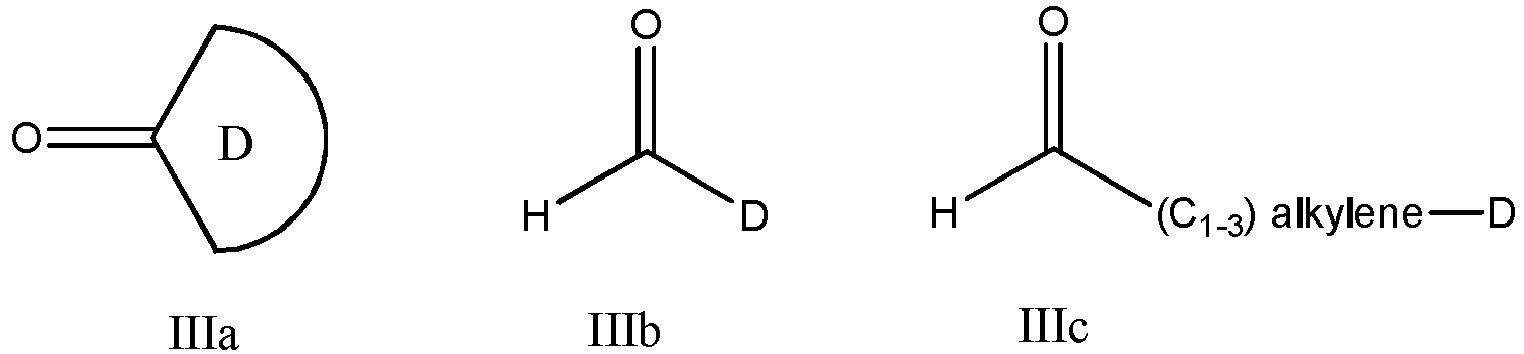
in the presence of a reducing agent, followed by the removal of any protecting group that may be present. - 369. The process according to item 368, wherein said reducing agent is a borohydride.
wherein one or more ring C atoms in the cyclic group (i) or (ii) are optionally oxidized to form CO groups, wherein one or more S atoms in the cyclic group (i) or (ii), if present, are optionally oxidized to form independently SO groups or SO2 groups, and
wherein the cyclic group (i) or (ii) is optionally substituted with one or more R3.
wherein one or more ring C atoms in the cyclic group (i) or (ii) are optionally oxidized to form CO groups, wherein one or more S atoms in the cyclic group (i) or (ii), if present, are optionally oxidized to form independently SO groups or SO2 groups, and
wherein the cyclic group (i) or (ii) is optionally substituted with one or more R3.
wherein the cyclic group (i) or (ii) is linked to the remainder of the compound of Formula I through a ring C atom,
wherein one or more ring C atoms in the cyclic group (i) or (ii) are optionally oxidized to form CO groups, wherein one or more S atoms in the cyclic group (i) or (ii), if present, are optionally oxidized to form independently SO groups or SO2 groups, and
wherein the cyclic group (i) or (ii) is optionally substituted with one or more R3.
wherein the cyclic group (i) or (ii) is linked to the remainder of the compound of Formula I through a ring C atom,
wherein one or more ring C atoms in the cyclic group (i) or (ii) are optionally oxidized to form CO groups, wherein one or more S atoms in the cyclic group (i) or (ii), if present, are optionally oxidized to form independently SO groups or SO2 groups, and
wherein the cyclic group (i) or (ii) is optionally substituted with one or more R3.
wherein one or more ring C atoms in the cyclic group (i) or (ii) are optionally oxidized to form CO groups, and wherein the cyclic group (i) or (ii) is optionally substituted with one or more R3.
wherein the cyclic group (i) or (ii) is linked to the remainder of the compound of Formula I through a ring C atom,
wherein one or more ring C atoms in the cyclic group (i) or (ii) are optionally oxidized to form CO groups, wherein one or more S atoms in the cyclic group (i) or (ii), if present, are optionally oxidized to form independently SO groups or SO2 groups, and
wherein the cyclic group (i) or (ii) is optionally substituted with one or more R3.
wherein one or more ring C atoms in the cyclic group (i) or (ii) are optionally oxidized to form CO groups, and wherein the cyclic group (i) or (ii) is optionally substituted with one or more R3.
wherein one or more ring C atoms in the cyclic group (i) or (ii) are optionally oxidized to form CO groups, and wherein the cyclic group (i) or (ii) is optionally substituted with one or more R3.
wherein the cyclic group (i) or (ii) is linked to the remainder of the compound of Formula I through a ring C atom,
wherein one or more ring C atoms in the cyclic group (i) or (ii) are optionally oxidized to form CO groups, wherein one or more S atoms in the cyclic group (i) or (ii), if present, are optionally oxidized to form independently SO groups or SO2 groups, and
wherein the cyclic group (i) or (ii) is optionally substituted with one or more R3, wherein said substituent(s) R3, if present, are placed on ring C atom(s) of cyclic group (i) or (ii).
wherein one or more ring C atoms in the cyclic group (iii) or (iv) are optionally oxidized to form CO groups, wherein one or more S atoms in the cyclic group (iii) or (iv), if present, are optionally oxidized to form independently SO groups or SO2 groups, and
wherein the cyclic group (iii) or (iv) is optionally substituted with one or more R3.
D can thus be a monocyclic saturated ring (group iii) or polycyclic saturated ring (group iv). "Polycyclic saturated ring system" as used herein means a ring system containing 2 or more saturated rings, preferably containing two (i.e. bicyclic) or three (i.e. tricyclic) saturated rings, which rings can be fused, bridged or spiro rings, or any combination thereof. Thus, tricyclic rings include for example three fused rings, or two rings fused together, one of which is a spiro bicyclic ring. A fused ring as used herein means that two rings are linked to each other through two adjacent ring atoms common to both rings. A bridged ring as used herein means that a ring comprises a linker group -(C(Ra)2)p- linking together any two non-adjacent carbon or nitrogen atoms of the ring, wherein p is 1 or 2 and each Ra independently is hydrogen or C1-4 alkyl. A spiro ring as used herein means two rings linked together via a single carbon atom common to both rings.
Ring D can contain 1 or 2 heteroatoms independently selected from N, O and S in case of cyclic group (iii) or from 1 to 4 heteroatoms independently selected from N, O and S in case of cyclic group (iv). In one embodiment, D contains 1 or 2 heteroatoms independently selected from N, O and S in case of cyclic group (iii) or from 1 to 4 heteroatoms independently selected from N, O and S in case of cyclic group (iv), wherein ring D contains at least 1 N atom. In another embodiment, cyclic group (iii) contains 1 heteroatom selected from N, O and S. In another embodiment, cyclic group (iv) contains 1 N atom. In another embodiment, cyclic group (iii) contains 1 or 2 heteroatoms independently selected from N, O and S. In another embodiment, cyclic group (iv) contains 1 or 2 N atoms.
Cyclic group (iv) as defined above refers to a 7- to 15-membered polycyclic saturated ring system which comprises at least one heterocyclic ring. One ring forming part of cyclic group (iv) must thus be a saturated heterocyclic ring, while the other ring(s) can be saturated carbocyclic or heterocyclic rings.
wherein the cyclic group (iii) or (iv) is linked to the remainder of the compound of Formula I (i.e., the remainder of the compound of Formula I, la, la-1, Ib or Ic, respectively) through a ring C atom,
wherein one or more ring C atoms in the cyclic group (iii) or (iv) are optionally oxidized to form CO groups, wherein one or more S atoms in the cyclic group (iii) or (iv), if present, are optionally oxidized to form independently SO groups or SO2 groups, and
wherein the cyclic group (iii) or (iv) is optionally substituted with one or more R3.
wherein the cyclic group (iii) or (iv) is linked to the remainder of the compound of Formula I through a ring C atom,
wherein one or more ring C atoms in the cyclic group (iii) or (iv) are optionally oxidized to form CO groups,
wherein one or more S atoms in the cyclic group (iii) or (iv), if present, are optionally oxidized to form independently SO groups or SO2 groups, and
wherein the cyclic group (iii) or (iv) is optionally substituted with one or more R3.
wherein one or more ring C atoms in the cyclic group (iii) or (iv) are optionally oxidized to form CO groups, and wherein the cyclic group (iii) or (iv) is optionally substituted with one or more R3.
wherein one or more ring C atoms in the cyclic group (iii) or (iv) are optionally oxidized to form CO groups, and wherein the cyclic group (iii) or (iv) is optionally substituted with one or more R3.
wherein the cyclic group (iii) or (iv) is linked to the remainder of the compound of Formula I through a ring C atom,
wherein one or more ring C atoms in the cyclic group (iii) or (iv) are optionally oxidized to form CO groups,
wherein one or more S atoms in the cyclic group (iii) or (iv), if present, are optionally oxidized to form independently SO groups or SO2 groups, and
wherein the cyclic group (iii) or (iv) is optionally substituted with one or more R3, wherein said substituent(s) R3, if present, are placed on ring C atom(s) of cyclic group (i) or (ii).
In a more specific embodiment, said substituent(s) R3, if present, are placed on ring C atom(s) of cyclic group (i) or (ii).
In a more specific embodiment, said substituent(s) R3, if present, are placed on ring C atom(s) of cyclic group (i) or (ii).
In a more specific embodiment of the above embodiments, said substituent(s) R3, if present, are placed on ring C atom(s) of ring D. In a further specific embodiment, each R3, if present, is independently selected from C1-4 alkyl, halo, C1-4 alkoxy, hydroxyl, amino, and amido.
In a more specific embodiment of the above embodiments, said substituent(s) R3, if present, are placed on ring C atom(s) of ring D. In a further specific embodiment, each R3, if present, is independently selected from C1-4 alkyl, halo, C1-4 alkoxy, hydroxyl, amino, and amido.
In a more specific embodiment of the above embodiments, said substituent(s) R3, if present, are placed on ring C atom(s) of ring D. In a further specific embodiment, each R3, if present, is independently selected from C1-4 alkyl, halo, C1-4 alkoxy, hydroxyl, amino, and amido.
In a more specific embodiment of the above embodiments, said substituent(s) R3, if present, are placed on ring C atom(s) of ring D. In a further specific embodiment, each R3, if present, is independently selected from C1-4 alkyl, halo, C1-4 alkoxy, hydroxyl, amino, and amido.
wherein the substituents -A-B and -NH-L2-D on the cyclopropyl moiety are in trans-configuration,
and further wherein it is preferred that the compound 5-ethyl-5,10-dihydro-3,7,8,10-tetramethyl-4a-[(2-phenylcyclopropyl)amino]-benzo[g]pteridine-2,4(3H,4aH)-dione is excluded.
wherein the compound of formula I is an optically active stereoisomer.
Claims (15)
- A compound of Formula I
 A is aryl or heteroaryl, wherein said aryl or heteroaryl is optionally substituted with one or more R1;B is H, R1 or -L1-E;E is aryl or heteroaryl, wherein said aryl or said heteroaryl is optionally substituted with one or more R2;L1 is a bond, -O-, -NH-, -N(C1-4 alkyl)-, C1-4 alkylene or heteroC1-4alkylene;L2 is C1-4 alkylene and D is a cyclic group selected from:(iii) a 3- to 7-membered monocyclic saturated heterocyclic ring containing 1 or 2 heteroatoms independently selected from N, O and S, and(iv) a 7- to 15-membered polycyclic saturated ring system which comprises at least one heterocyclic ring, wherein the polycyclic saturated ring system contains from 1 to 4 heteroatoms independently selected from N, O and S,wherein the cyclic group (iii) or (iv) is linked to the remainder of the compound of Formula I through a ring C atom,
wherein one or more ring C atoms in the cyclic group (iii) or (iv) are optionally oxidized to form CO groups,
wherein one or more S atoms in the cyclic group (iii) or (iv), if present, are optionally oxidized to form independently SO groups or SO2 groups, and
wherein the cyclic group (iii) or (iv) is optionally substituted with one or more R3;each R1 is independently selected from C1-8 alkyl, C2-8 alkenyl, C2-8 alkynyl, cyclyl, amino, amido, hydroxyl, nitro, halo, haloC1-8 alkyl, haloC1-8 alkoxy, cyano, sulfinyl, sulfonyl, sulfonamide, C1-8 alkoxy, acyl, carboxyl, O-carboxy, C-carboxy, carbamate and urea;each R2 is independently selected from C1-8 alkyl, C2-8 alkenyl, C2-8 alkynyl, cyclyl, amino, amido, hydroxyl, nitro, halo, haloC1-8 alkyl, haloC1-8 alkoxy, cyano, sulfinyl, sulfonyl, sulfonamide, C1-8 alkoxy, acyl, carboxyl, O-carboxy, C-carboxy, carbamate and urea;each R3 is independently selected from C1-8 alkyl, C2-8 alkenyl, C2-8 alkynyl, cyclyl, amino, amido, hydroxyl, nitro, halo, haloC1-8 alkyl, haloC1-8 alkoxy, cyano, sulfinyl, sulfonyl, sulfonamide, C1-8 alkoxy, acyl, carboxyl, O-carboxy, C-carboxy, carbamate and urea; andeach Rw, Rx, Ry and Rz is independently selected from hydrogen, halo and C1-4 alkyl;or a salt or solvate thereof
for use as a medicament. - A compound of Formula I
 A is aryl or heteroaryl, wherein said aryl or heteroaryl is optionally substituted with one or more R1;B is H, R1 or -L1-E;E is aryl or heteroaryl, wherein said aryl or said heteroaryl is optionally substituted with one or more R2;L1 is a bond, -O-, -NH-, -N(C1-4 alkyl)-, C1-4 alkylene or heteroC1-4alkylene;L2 is C1-4 alkylene and D is a cyclic group selected from:(iii) a 3- to 7-membered monocyclic saturated heterocyclic ring containing 1 or 2 heteroatoms independently selected from N, O and S, and(iv) a 7- to 15-membered polycyclic saturated ring system which comprises at least one heterocyclic ring, wherein the polycyclic saturated ring system contains from 1 to 4 heteroatoms independently selected from N, O and S,wherein the cyclic group (iii) or (iv) is linked to the remainder of the compound of Formula I through a ring C atom,
wherein one or more ring C atoms in the cyclic group (iii) or (iv) are optionally oxidized to form CO groups,
wherein one or more S atoms in the cyclic group (iii) or (iv), if present, are optionally oxidized to form independently SO groups or SO2 groups, and
wherein the cyclic group (iii) or (iv) is optionally substituted with one or more R3;each R1 is independently selected from C1-8 alkyl, C2-8 alkenyl, C2-8 alkynyl, cyclyl, amino, amido, hydroxyl, nitro, halo, haloC1-8 alkyl, haloC1-8 alkoxy, cyano, sulfinyl, sulfonyl, sulfonamide, C1-8 alkoxy, acyl, carboxyl, O-carboxy, C-carboxy, carbamate and urea;each R2 is independently selected from C1-8 alkyl, C2-8 alkenyl, C2-8 alkynyl, cyclyl, amino, amido, hydroxyl, nitro, halo, haloC1-8 alkyl, haloC1-8 alkoxy, cyano, sulfinyl, sulfonyl, sulfonamide, C1-8 alkoxy, acyl, carboxyl, O-carboxy, C-carboxy, carbamate and urea;each R3 is independently selected from C1-8 alkyl, C2-8 alkenyl, C2-8 alkynyl, cyclyl, amino, amido, hydroxyl, nitro, halo, haloC1-8 alkyl, haloC1-8 alkoxy, cyano, sulfinyl, sulfonyl, sulfonamide, C1-8 alkoxy, acyl, carboxyl, O-carboxy, C-carboxy, carbamate and urea; andeach Rw, Rx, Ry and Rz is independently selected from hydrogen, halo and C1-4 alkyl;or a salt or solvate thereof;
wherein:(i) the compound of formula I is an optically active stereoisomer, or(ii) the substituents -A-B and -NH-L2-D on the cyclopropyl moiety are in trans-configuration; or(iii) the following compounds are excluded:1-ethyl-a-methyl-N-(2-phenylcyclopropyl)-3-piperidinemethanamine;1-ethyl-a-methyl-N-(2-phenylcyclopropyl)-4-piperidinemethanamine;a-methyl-N-(2-phenylcyclopropyl)-1-propyl-3-piperidinemethanamine;tetrahydro-N-(2-phenylcyclopropyl)-2H-pyran-2-methanamine;octahydro-N-(2-phenylcyclopropyl)-1H-indole-2-methanamine;a-methyl-N-(2-phenylcyclopropyl)-1-propyl-4-piperidinemethanamine;3-methyl-N-(2-phenylcyclopropyl)-3-piperidinemethanamine;N-(2-phenylcyclopropyl)-2-piperidinemethanamine;N-(2-phenylcyclopropyl)-4-piperidinemethanamine;a,1-dimethyl-N-(2-phenylcyclopropyl)-3-piperidinemethanamine;N-(2-phenylcyclopropyl)-3-piperidinemethanamine;4-methoxy-N-(2-phenylcyclopropyl)-2-pyrrolidinemethanamine;N-(2-phenylcyclopropyl)-3-propyl-3-pyrrolidinemethanamine;N-(2-phenylcyclopropyl)-2-morpholinemethanamine;4-ethyl-N-(2-phenylcyclopropyl)-4-piperidinemethanamine;4-methyl-N-(2-phenylcyclopropyl)-4-piperidinemethanamine;a,1-dimethyl-N-(2-phenylcyclopropyl)-4-piperidinemethanamine;1-methyl-N-(2-phenylcyclopropyl)-4-piperidinemethanamine;tetrahydro-N-(2-phenylcyclopropyl)-2H-pyran-4-methanamine;3-methyl-N-(2-phenylcyclopropyl)-3-pyrrolidinemethanamine;N-(2-phenylcyclopropyl)-2-pyrrolidinemethanamine;tetrahydro-N-(2-phenylcyclopropyl)-3-furanmethanamine;tetrahydro-N-(2-phenylcyclopropyl)-2-furanmethanamine;N-(2-phenylcyclopropyl)-4-piperidineethanamine;N-(2-phenylcyclopropyl)-2-pyrrolidineethanamine;1-methyl-N-(2-phenylcyclopropyl)-2-piperidineethanamine; andN-(2-phenylcyclopropyl)-3-piperidinepropanamine. - The compound for use of claim 1 or the compound of claim 2, wherein:(a) L2 is linear C1-4 alkylene; or(b) L2 is -CH2-; or(c) L2 is -CH2CH2-.
- The compound for use according to any of claims 1 or 3 or the compound according to any of claims 2 or 3, wherein:(a) D is a cyclic group selected from:(iii) a 3- to 7-membered monocyclic saturated heterocyclic ring containing 1 or 2 heteroatoms independently selected from N, O and S, and(iv) a 7- to 15-membered polycyclic saturated ring system which comprises at least one heterocyclic ring, wherein the polycyclic saturated ring system contains from 1 to 4 heteroatoms independently selected from N, O and S,wherein the cyclic group (iii) or (iv) contains at least one N atom,
wherein the cyclic group (iii) or (iv) is linked to the remainder of the compound of Formula I through a ring C atom,
wherein one or more ring C atoms in the cyclic group (iii) or (iv) are optionally oxidized to form CO groups, wherein one or more S atoms in the cyclic group (iii) or (iv), if present, are optionally oxidized to form independently SO groups or SO2 groups, and
wherein the cyclic group (iii) or (iv) is optionally substituted with one or more R3; or(b) D is a cyclic group selected from:(iii) a 3- to 7-membered monocyclic saturated heterocyclic ring containing 1 or 2 N atoms, and(iv) a 7- to 15-membered polycyclic saturated ring system which comprises at least one heterocyclic ring, wherein the polycyclic saturated ring system contains from 1 to 2 N atoms,wherein the cyclic group (iii) or (iv) is linked to the remainder of the compound of Formula I through a ring C atom,
wherein one or more ring C atoms in the cyclic group (iii) or (iv) are optionally oxidized to form CO groups, and wherein the cyclic group (iii) or (iv) is optionally substituted with one or more R3; or(c) D is a 3- to 7-membered monocyclic saturated heterocyclic ring containing 1 or 2 heteroatoms independently selected from N, O and S,
wherein D is linked to the remainder of the compound of Formula I through a ring C atom,
wherein one or more ring C atoms in ring D are optionally oxidized to form CO groups,
wherein one or more S atoms in ring D, if present, are optionally oxidized to form independently SO groups or SO2 groups, and
wherein ring D is optionally substituted with one or more R3; or(d) D is a 3- to 7-membered monocyclic saturated heterocyclic ring containing 1 or 2 heteroatoms independently selected from O and S,
wherein D is linked to the remainder of the compound of Formula I through a ring C atom,
wherein one or more ring C atoms in ring D are optionally oxidized to form CO groups,
wherein one or more S atoms in ring D, if present, are optionally oxidized to form independently SO groups or SO2 groups, and
wherein ring D is optionally substituted with one or more R3; or(e) D is a 3- to 7-membered monocyclic saturated heterocyclic ring containing 1 heteroatom selected from N, O and S,
wherein D is linked to the remainder of the compound of Formula I through a ring C atom,
wherein one or more ring C atoms in ring D are optionally oxidized to form CO groups,
wherein one S atom in ring D, if present, is optionally oxidized to form an SO group or an SO2 group, and wherein ring D is optionally substituted with one or more R3; or(f) D is a 6-membered monocyclic saturated heterocyclic ring containing 1 heteroatom selected from N, O and S,
wherein D is linked to the remainder of the compound of Formula I through a ring C atom,
wherein one or more ring C atoms in ring D are optionally oxidized to form CO groups,
wherein one S atom in ring D, if present, is optionally oxidized to form an SO group or an SO2 group, and wherein ring D is optionally substituted with one or more R3; or(g) D is a 3- to 7-membered monocyclic saturated heterocyclic ring containing 1 N atom,
wherein D is linked to the remainder of the compound of Formula I through a ring C atom,
wherein one or more ring C atoms in ring D are optionally oxidized to form CO groups, and
wherein ring D is optionally substituted with one or more R3; or(h) D is piperidinyl, wherein said piperidinyl is linked to the remainder of the compound of Formula I through a ring C atom, and
wherein said piperidinyl is optionally substituted with one or more R3, or(i) D is 4-piperidinyl optionally substituted with one or more R3; or(j) D is 3-azetidinyl optionally substituted with one or more R3; or(k) D is a 7- to 15-membered polycyclic saturated ring system which comprises at least one heterocyclic ring, wherein the polycyclic saturated ring system contains from 1 to 4 heteroatoms independently selected from N, O and S,
wherein D is linked to the remainder of the compound of Formula I through a ring C atom,
wherein one or more ring C atoms in D are optionally oxidized to form CO groups,
wherein one or more S atoms in D, if present, are optionally oxidized to form independently SO groups or SO2 groups, and
wherein D is optionally substituted with one or more R3; or(l) D is a 7- to 15-membered saturated polycyclic ring system which comprises at least one heterocyclic ring, wherein the polycyclic saturated ring system contains 1 or 2 N atoms,
wherein D is linked to the remainder of the compound of Formula I through a ring C atom,
wherein one or more ring C atoms in D are optionally oxidized to form CO groups, and
wherein D is optionally substituted with one or more R3; or(m) D is a 7- to 15-membered saturated polycyclic ring system which comprises at least one heterocyclic ring, wherein the polycyclic saturated ring system contains 1 N atom,
wherein D is linked to the remainder of the compound of Formula I through a ring C atom,
wherein one or more ring C atoms in D are optionally oxidized to form CO groups, and
wherein D is optionally substituted with one or more R3; or(n) D is a 7- to 15-membered saturated polycyclic ring system selected from a group of formula (a), (b), (c) and (d)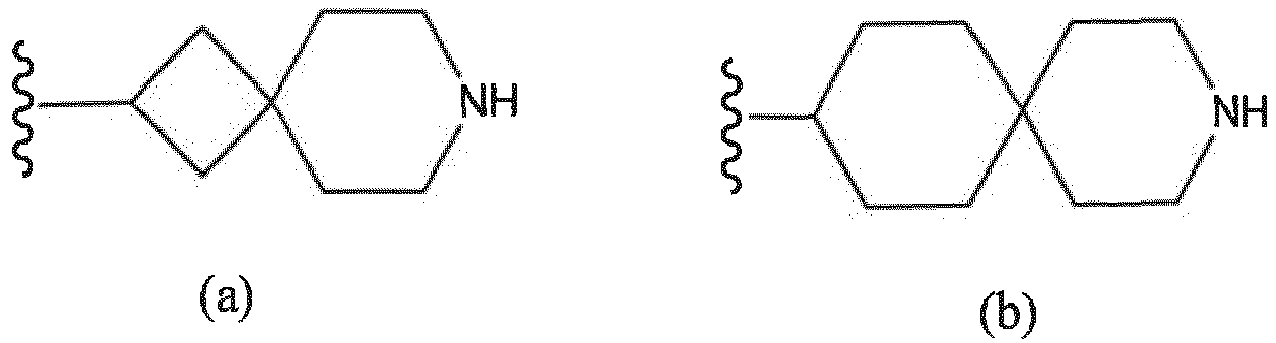

- The compound for use according to any of claims 1, 3 or 4, or the compound of any of claims 2 to 4, wherein:(a) said substituent(s) R3, if present, are placed on ring C atom(s) of D; and/or(b) each R3 is independently selected from C1-8 alkyl, halo, C1-8 alkoxy, hydroxyl, amino, and amido; or(c) D does not comprise any substituents R3.
- The compound for use according to any of claims 1 or 3 to 5 or the compound of any of claims 2 to 5, wherein A is:(a) phenyl, naphthyl or monocyclic heteroaryl, wherein said phenyl, said naphthyl or said monocyclic heteroaryl is optionally substituted with one or more R1; or(b) phenyl or monocyclic heteroaryl, wherein said phenyl or said monocyclic heteroaryl is optionally substituted with one or more R1; or(c) phenyl, pyridyl, thiophenyl, pyrrolyl, furanyl, or thiazolyl, wherein said phenyl, said pyridyl, said thiophenyl, said pyrrolyl, said furanyl or said thiazolyl is optionally substituted with one or more R1; or(d) phenyl, pyridyl or thiazolyl, wherein said phenyl, said pyridyl or said thiazolyl is optionally substituted with one or more R1; or(e) phenyl, 3-pyridyl or 5-thiazolyl, wherein said phenyl, said 3-pyridyl or said 5-thiazolyl is optionally substituted with one or more R1; or(f) phenyl or 3-pyridyl, wherein said phenyl or said 3-pyridyl is optionally substituted with one or more R1; or(g) phenyl optionally substituted with one or more R1; or(h) heteroaryl optionally substituted with one or more R1; or(i) monocyclic heteroaryl optionally substituted with one or more R1; or(j) 3-pyridyl optionally substituted with one or more R1; or(k) 5-thiazolyl optionally substituted with one or more R1.
- The compound for use according to any of claims 1 or 3 to 6 or the compound of any of claims 2 to 6, wherein:(a) B is hydrogen or R1; or(b) B is hydrogen; or(c) B is -L1-E.
- The compound for use according to any of claims 1 or 3 to 7 or the compound of any of claims 2 to 7, wherein each R1 is independently selected from C1-8 alkyl, amino, amido, hydroxyl, halo, haloC1-8 alkyl, haloC1-8alkoxy, cyano, sulfonamide, C1-8alkoxy, acyl, carboxyl, carbamate, and urea; and
wherein it is preferred that each R1 is independently selected from halo, C1-4 alkyl, haloC1-4 alkyl, C1-4 alkoxy and C3-6 cycloalkyl. - The compound for use according to any of claims 1 or 3 to 8 or the compound of any of claims 2 to 8, wherein L1 is:(a) a bond, -O-, -NH-, -CH2-NH-, or -CH2-O-, wherein said -CH2-NH- and -CH2-O- groups are linked to ring A through the N or O atom, respectively, and are linked to ring E through the -CH2- group comprised in said -CH2-NH- and -CH2-O- groups; or(b) a bond; or(c) -CH2-O- linked to ring A through the O atom comprised in said -CH2-O- and linked to ring E through the -CH2- group comprised in said -CH2-O-; or(d) -O-, -NH-, -N(C1-4 alkyl)-, C1-4 alkylene, or-CH2-NH-; or(e) -NH- or -CH2-NH-, wherein said -CH2-NH- is linked to ring A through the N atom comprised in said-CH2-NH- and is linked to ring E through the -CH2- group comprised in said -CH2-NH-;and/or wherein E is:(f) phenyl which is optionally substituted with one or more R2; or(g) phenyl which is substituted with one R2; or(h) heteroaryl which is optionally substituted with one or more R2; or(i) monocyclic heteroaryl which is optionally substituted with one or more R2; or(j) pyridinyl which is optionally substituted with one or more R2.
- The compound for use according to any of claims 1 or 3 to 9 or the compound of any of claims 2 to 9, wherein:(a) each Rw, Rx, Ry and Rz is independently selected from hydrogen, fluoro and C1-4 alkyl; or(b) Rw is selected from hydrogen, halo and C1-4 alkyl and each Rx, Ry and Rz is hydrogen; or(c) each Rw, Rx, Ry and Rz is hydrogen; or(d) each Rw, Rx, Ry and Rz is independently selected from hydrogen, halo and C1-4 alkyl with the proviso that at least one of Rw, Rx, Ry and Rz is not hydrogen; or(e) Rw is selected from halo and C1-4 alkyl, preferably fluoro and methyl, and each Rx, Ry and Rz is hydrogen; or(f) Rw is methyl and each Rx, Ry and Rz is hydrogen; or(g) Rw is fluoro and each Rx, Ry and Rz is independently selected from hydrogen, halo and C1-4 alkyl; or(h) Rz is fluoro and each Rw, Rx and Ry is independently selected from hydrogen, halo and C1-4 alkyl; or(i) Rw and Rz are fluoro and each Rx and Ry is independently selected from hydrogen, halo and C1-4 alkyl.
- The compound for use according to any of claims 1 or 3 to 10 or the compound of any of claims 2 to 10, wherein the substituents -A-B and -NH-L2-D on the cyclopropyl moiety are in trans-configuration; wherein it is preferred that said compound is an optically active stereoisomer.
- A pharmaceutical composition comprising a compound as defined in any of claims 1 to 11 and a pharmaceutically acceptable carrier.
- The compound of any of claims 1 to 11 or the pharmaceutical composition of claim 12 for use in the treatment or prevention of cancer.
- The compound of any of claims 1 to 11 or the pharmaceutical composition of claim 12 for use in the treatment or prevention of a neurological disease.
- The compound of any of claims 1 to 11 or the pharmaceutical composition of claim 12 for use in the treatment or prevention of a viral infection or viral reactivation after latency.
Applications Claiming Priority (6)
| Application Number | Priority Date | Filing Date | Title |
|---|---|---|---|
| EP11382325 | 2011-10-20 | ||
| EP11382331 | 2011-10-27 | ||
| US201161558367P | 2011-11-10 | 2011-11-10 | |
| US201161558365P | 2011-11-10 | 2011-11-10 | |
| PCT/EP2012/070898 WO2013057320A1 (en) | 2011-10-20 | 2012-10-22 | (hetero)aryl cyclopropylamine compounds as lsd1 inhibitors |
| EP12791440.6A EP2768805B1 (en) | 2011-10-20 | 2012-10-22 | (hetero)aryl cyclopropylamine compounds as lsd1 inhibitors |
Related Parent Applications (1)
| Application Number | Title | Priority Date | Filing Date |
|---|---|---|---|
| EP12791440.6A Division EP2768805B1 (en) | 2011-10-20 | 2012-10-22 | (hetero)aryl cyclopropylamine compounds as lsd1 inhibitors |
Publications (1)
| Publication Number | Publication Date |
|---|---|
| EP3736265A1 true EP3736265A1 (en) | 2020-11-11 |
Family
ID=48140381
Family Applications (2)
| Application Number | Title | Priority Date | Filing Date |
|---|---|---|---|
| EP20165383.9A Withdrawn EP3736265A1 (en) | 2011-10-20 | 2012-10-22 | (hetero)aryl cyclopropylamine compounds as lsd1 inhibitors |
| EP12791440.6A Active EP2768805B1 (en) | 2011-10-20 | 2012-10-22 | (hetero)aryl cyclopropylamine compounds as lsd1 inhibitors |
Family Applications After (1)
| Application Number | Title | Priority Date | Filing Date |
|---|---|---|---|
| EP12791440.6A Active EP2768805B1 (en) | 2011-10-20 | 2012-10-22 | (hetero)aryl cyclopropylamine compounds as lsd1 inhibitors |
Country Status (12)
| Country | Link |
|---|---|
| US (3) | US9487512B2 (en) |
| EP (2) | EP3736265A1 (en) |
| JP (2) | JP6215212B2 (en) |
| KR (1) | KR102139537B1 (en) |
| CN (2) | CN104203914B (en) |
| AU (2) | AU2012324803B9 (en) |
| BR (1) | BR112014009306B1 (en) |
| CA (1) | CA2852355C (en) |
| IL (1) | IL232102A (en) |
| MX (1) | MX356344B (en) |
| RU (1) | RU2681211C2 (en) |
| WO (1) | WO2013057320A1 (en) |
Families Citing this family (93)
| Publication number | Priority date | Publication date | Assignee | Title |
|---|---|---|---|---|
| EP2389362B1 (en) | 2009-01-21 | 2019-12-11 | Oryzon Genomics, S.A. | Phenylcyclopropylamine derivatives and their medical use |
| JP5699152B2 (en) | 2009-09-25 | 2015-04-08 | オリゾン・ジェノミックス・ソシエダッド・アノニマOryzon Genomics S.A. | Lysine-specific demethylase-1 inhibitors and uses thereof |
| US8946296B2 (en) | 2009-10-09 | 2015-02-03 | Oryzon Genomics S.A. | Substituted heteroaryl- and aryl-cyclopropylamine acetamides and their use |
| WO2011106105A2 (en) | 2010-02-24 | 2011-09-01 | Oryzon Genomics, S.A. | Inhibitors for antiviral use |
| US9186337B2 (en) | 2010-02-24 | 2015-11-17 | Oryzon Genomics S.A. | Lysine demethylase inhibitors for diseases and disorders associated with Hepadnaviridae |
| WO2011131697A1 (en) | 2010-04-19 | 2011-10-27 | Oryzon Genomics S.A. | Lysine specific demethylase-1 inhibitors and their use |
| EP3375775A1 (en) | 2010-07-29 | 2018-09-19 | Oryzon Genomics, S.A. | Arylcyclopropylamine based demethylase inhibitors of lsd1 and their medical use |
| EP2598480B1 (en) | 2010-07-29 | 2019-04-24 | Oryzon Genomics, S.A. | Cyclopropylamine derivatives useful as lsd1 inhibitors |
| WO2012045883A1 (en) | 2010-10-08 | 2012-04-12 | Oryzon Genomics S.A. | Cyclopropylamine inhibitors of oxidases |
| WO2012072713A2 (en) | 2010-11-30 | 2012-06-07 | Oryzon Genomics, S.A. | Lysine demethylase inhibitors for diseases and disorders associated with flaviviridae |
| EP2712315B1 (en) | 2011-02-08 | 2021-11-24 | Oryzon Genomics, S.A. | Lysine demethylase inhibitors for myeloproliferative disorders |
| PE20141322A1 (en) | 2011-03-25 | 2014-10-05 | Glaxosmithkline Intellectual Property (N 2) Limited | CYCLOPROPYLAMINES AS INHIBITORS OF LYSINE-SPECIFIC DESMETILASE 1 |
| EP2776394B1 (en) | 2011-10-20 | 2018-12-26 | Oryzon Genomics, S.A. | (hetero)aryl cyclopropylamine compounds as lsd1 inhibitors |
| EP3736265A1 (en) | 2011-10-20 | 2020-11-11 | Oryzon Genomics, S.A. | (hetero)aryl cyclopropylamine compounds as lsd1 inhibitors |
| US10323012B2 (en) * | 2012-06-05 | 2019-06-18 | Hong Kong Baptist University | Miliusanes as antiviral agents |
| CN105051005B (en) * | 2012-10-12 | 2017-06-13 | 武田药品工业株式会社 | Cyclopropylamine compounds and uses thereof |
| EP2740474A1 (en) | 2012-12-05 | 2014-06-11 | Instituto Europeo di Oncologia S.r.l. | Cyclopropylamine derivatives useful as inhibitors of histone demethylases kdm1a |
| US9918983B2 (en) | 2013-05-30 | 2018-03-20 | The Board Of Regents Of The Nevada System Of Higher Education On Behalf Of The University Of Nevada, Las Vegas | Suicidal LSD1 inhibitors targeting SOX2-expressing cancer cells |
| BR112016002496B1 (en) | 2013-08-06 | 2022-07-12 | Imago Biosciences Inc. | COMPOUND AND PHARMACEUTICAL COMPOSITION |
| CR20160395A (en) * | 2014-02-13 | 2016-12-20 | Incyte Corp | CYCLOPROPILAMINS AS INHIBITORS OF LSD1 |
| MY183499A (en) | 2014-02-13 | 2021-02-22 | Incyte Corp | Cyclopropylamines as lsd1 inhibitors |
| ES2672797T3 (en) | 2014-02-13 | 2018-06-18 | Incyte Corporation | Cyclopropylamines as LSD1 inhibitors |
| US9527835B2 (en) * | 2014-02-13 | 2016-12-27 | Incyte Corporation | Cyclopropylamines as LSD1 inhibitors |
| NZ725262A (en) | 2014-04-11 | 2023-01-27 | Takeda Pharmaceuticals Co | Cyclopropanamine compound and use thereof |
| US9695168B2 (en) | 2014-07-10 | 2017-07-04 | Incyte Corporation | Substituted imidazo[1,5-α]pyridines and imidazo[1,5-α]pyrazines as LSD1 inhibitors |
| US9758523B2 (en) | 2014-07-10 | 2017-09-12 | Incyte Corporation | Triazolopyridines and triazolopyrazines as LSD1 inhibitors |
| US9695167B2 (en) | 2014-07-10 | 2017-07-04 | Incyte Corporation | Substituted triazolo[1,5-a]pyridines and triazolo[1,5-a]pyrazines as LSD1 inhibitors |
| US9695180B2 (en) | 2014-07-10 | 2017-07-04 | Incyte Corporation | Substituted imidazo[1,2-a]pyrazines as LSD1 inhibitors |
| HUE040133T2 (en) | 2014-07-15 | 2019-02-28 | Gruenenthal Gmbh | Substituted azaspiro(4.5)decane derivatives |
| TW201607923A (en) * | 2014-07-15 | 2016-03-01 | 歌林達有限公司 | Substituted azaspiro (4.5) decane derivatives |
| WO2016123387A1 (en) * | 2015-01-30 | 2016-08-04 | Genentech, Inc. | Therapeutic compounds and uses thereof |
| PT3256218T (en) | 2015-02-12 | 2025-01-29 | Imago Biosciences Inc | Kdm1a inhibitors for the treatment of disease |
| MA51438A (en) | 2015-04-03 | 2021-04-14 | Incyte Corp | HETEROCYCLIC COMPOUNDS USED AS LSD1 INHIBITORS |
| CN106045862B (en) * | 2015-04-10 | 2019-04-23 | 上海迪诺医药科技有限公司 | Cyclopropyl amine spiral shell (miscellaneous) cycle compound, its pharmaceutical composition and application |
| US10526287B2 (en) | 2015-04-23 | 2020-01-07 | Constellation Pharmaceuticals, Inc. | LSD1 inhibitors and uses thereof |
| EP3090998A1 (en) | 2015-05-06 | 2016-11-09 | F. Hoffmann-La Roche AG | Solid forms |
| SG10201911989SA (en) | 2015-06-12 | 2020-02-27 | Oryzon Genomics Sa | Biomarkers associated with lsd1 inhibitors and uses thereof |
| WO2017013061A1 (en) | 2015-07-17 | 2017-01-26 | Oryzon Genomics, S.A. | Biomarkers associated with lsd1 inhibitors and uses thereof |
| SG10202001219UA (en) | 2015-08-12 | 2020-03-30 | Incyte Corp | Salts of an lsd1 inhibitor |
| US10059668B2 (en) | 2015-11-05 | 2018-08-28 | Mirati Therapeutics, Inc. | LSD1 inhibitors |
| CN108884029B (en) * | 2015-12-29 | 2021-10-26 | 米拉蒂医疗股份有限公司 | LSD1 inhibitors |
| WO2017114497A1 (en) | 2015-12-30 | 2017-07-06 | Novartis Ag | Immune effector cell therapies with enhanced efficacy |
| ES2831832T3 (en) * | 2016-03-01 | 2021-06-09 | Novartis Ag | Cyano-substituted indole compounds and uses thereof as LSD1 inhibitors |
| SG10201913290QA (en) | 2016-03-15 | 2020-03-30 | Oryzon Genomics Sa | Combinations of lsd1 inhibitors for the treatment of hematological malignancies |
| CN109195593A (en) | 2016-03-15 | 2019-01-11 | 奥莱松基因组股份有限公司 | For treating the combination of the LSD1 inhibitor of solid tumor |
| CN107200706A (en) * | 2016-03-16 | 2017-09-26 | 中国科学院上海药物研究所 | Cyclopropylamine class compound of one class fluorine substitution and preparation method thereof, pharmaceutical composition and purposes |
| ES3042059T3 (en) | 2016-03-16 | 2025-11-18 | Oryzon Genomics Sa | Methods to determine kdm1a target engagement and chemoprobes useful therefor |
| CR20180553A (en) | 2016-04-22 | 2019-02-01 | Incyte Corp | FORMULATIONS OF AN LSD1 INHIBITOR |
| SI3307267T1 (en) | 2016-06-10 | 2019-08-30 | Oryzon Genomics, S.A. | Multiple sclerosis treatment |
| WO2018020366A1 (en) * | 2016-07-26 | 2018-02-01 | Glaxosmithkline Intellectual Property (No.2) Limited | Crystalline (r)-mandelate salt of (1r,2s)-2-phenylcyclopropylamine |
| US11390590B2 (en) | 2016-08-16 | 2022-07-19 | Imago Biosciences, Inc. | Methods and processes for the preparation of KDM1A inhibitors |
| PT3532459T (en) | 2016-10-26 | 2023-11-10 | Constellation Pharmaceuticals Inc | Lsd1 inhibitors and medical uses thereof |
| WO2018081342A1 (en) * | 2016-10-26 | 2018-05-03 | Constellation Pharmaceuticals, Inc. | Lsd1 inhibitors and uses thereof |
| US20190256930A1 (en) | 2016-11-03 | 2019-08-22 | Oryzon Genomics, S.A. | Biomarkers for determining responsiveness to lsd1 inhibitors |
| MA50518A (en) | 2017-05-31 | 2020-09-09 | Taiho Pharmaceutical Co Ltd | METHOD OF PREDICTING THE THERAPEUTIC EFFECT OF AN LSD1 INHIBITOR BASED ON INSM1 EXPRESSION |
| JP2020152641A (en) * | 2017-07-07 | 2020-09-24 | 国立研究開発法人理化学研究所 | A novel compound having lysine-specific demethylase 1 inhibitory activity, its production method and its use |
| DK3661510T3 (en) | 2017-08-03 | 2025-01-02 | Oryzon Genomics Sa | METHODS FOR TREATING BEHAVIORAL CHANGES |
| WO2019068326A1 (en) | 2017-10-05 | 2019-04-11 | Université D'aix-Marseille | Lsd1 inhibitors for the treatment and prevention of cardiomyopathies |
| CN109745309B (en) * | 2017-11-03 | 2022-01-28 | 香港浸会大学 | Mitsuma as antiviral agent |
| IL279260B2 (en) | 2018-05-11 | 2024-10-01 | Imago Biosciences Inc | KDM1A inhibitors for the treatment of diseases |
| WO2020047198A1 (en) | 2018-08-31 | 2020-03-05 | Incyte Corporation | Salts of an lsd1 inhibitor and processes for preparing the same |
| WO2020052649A1 (en) * | 2018-09-13 | 2020-03-19 | 南京明德新药研发有限公司 | Cyclopropylamine compound as lsd1 inhibitor and use thereof |
| CN112672994B (en) * | 2018-09-13 | 2022-09-13 | 南昌弘益药业有限公司 | Heterospiro compounds serving as LSD1 inhibitor and application thereof |
| WO2020138398A1 (en) * | 2018-12-28 | 2020-07-02 | 国立研究開発法人理化学研究所 | Novel compound inhibiting lysine-specific demethylating enzyme 1, method for producing same, and use of same |
| CN121370879A (en) | 2019-03-20 | 2026-01-23 | 奥莱松基因组股份有限公司 | Treatment methods for borderline personality disorder |
| EP3941465B1 (en) | 2019-03-20 | 2025-09-17 | Oryzon Genomics, S.A. | Methods of treating attention deficit hyperactivity disorder using kdm1a inhibitors such as the compound vafidemstat |
| CN112110936B (en) * | 2019-06-20 | 2021-12-07 | 沈阳药科大学 | Tetrahydroquinoline derivative and preparation method and application thereof |
| WO2021004610A1 (en) | 2019-07-05 | 2021-01-14 | Oryzon Genomics, S.A. | Biomarkers and methods for personalized treatment of small cell lung cancer using kdm1a inhibitors |
| CN114502561B (en) * | 2019-09-29 | 2023-12-26 | 南昌弘益药业有限公司 | LSD1 inhibitor |
| BR112022008020A2 (en) | 2019-11-13 | 2022-07-12 | Taiho Pharmaceutical Co Ltd | METHODS OF TREATMENT OF LSD1-RELATED DISEASES AND DISORDERS WITH LSD1 INHIBITORS |
| EP3964204A1 (en) | 2020-09-08 | 2022-03-09 | Université d'Aix-Marseille | Lsd1 inhibitors for use in the treatment and prevention of fibrosis of tissues |
| CN112451671B (en) * | 2020-12-02 | 2021-11-02 | 武汉大学 | Application of KDM1A in inhibiting the expression of interferon IFNβ under RNA virus stimulation |
| WO2022171044A1 (en) * | 2021-02-09 | 2022-08-18 | 南昌弘益药业有限公司 | Oxa-azaspiro compound, salt form thereof and crystal form thereof |
| CN113750095B (en) * | 2021-03-10 | 2023-07-04 | 中国医学科学院医药生物技术研究所 | Application of compound containing cyclopropyl skeleton in preparation of medicines for treating and/or preventing coronavirus infection |
| CN113797199B (en) * | 2021-03-31 | 2023-05-26 | 中国医学科学院医药生物技术研究所 | Use of methyltransferase inhibitors containing a cyclopropyl backbone in medicaments for the treatment of flaviviridae infections |
| BR112023020554A2 (en) | 2021-04-08 | 2023-12-05 | Oryzon Genomics Sa | LSD1 INHIBITOR COMBINATIONS FOR THE TREATMENT OF MYELOID CANCERS |
| CN113200967B (en) * | 2021-05-07 | 2022-05-24 | 中国人民解放军陆军军医大学 | Indole benzoquinone compound, its preparation method and application |
| JP7793505B2 (en) * | 2022-03-29 | 2026-01-05 | 大日精化工業株式会社 | Antiviral agent, antiviral resin composition, and antiviral article |
| JP2025516647A (en) | 2022-05-09 | 2025-05-30 | オリゾン・ゲノミクス・ソシエダッド・アノニマ | Treatment of malignant peripheral nerve sheath tumors (MPNST) using LSD1 inhibitors |
| CN119497613A (en) | 2022-05-09 | 2025-02-21 | 奥莱松基因组股份有限公司 | Methods of treating NF1-mutated tumors using LSD1 inhibitors |
| CN120529900A (en) | 2022-11-24 | 2025-08-22 | 奥莱松基因组股份有限公司 | Combination of LSD1 inhibitors and Menin inhibitors for the treatment of cancer |
| TW202508595A (en) | 2023-05-04 | 2025-03-01 | 美商銳新醫藥公司 | Combination therapy for a ras related disease or disorder |
| US20250049810A1 (en) | 2023-08-07 | 2025-02-13 | Revolution Medicines, Inc. | Methods of treating a ras protein-related disease or disorder |
| WO2025080946A2 (en) | 2023-10-12 | 2025-04-17 | Revolution Medicines, Inc. | Ras inhibitors |
| WO2025171296A1 (en) | 2024-02-09 | 2025-08-14 | Revolution Medicines, Inc. | Ras inhibitors |
| WO2025240847A1 (en) | 2024-05-17 | 2025-11-20 | Revolution Medicines, Inc. | Ras inhibitors |
| WO2025255438A1 (en) | 2024-06-07 | 2025-12-11 | Revolution Medicines, Inc. | Methods of treating a ras protein-related disease or disorder |
| WO2025265060A1 (en) | 2024-06-21 | 2025-12-26 | Revolution Medicines, Inc. | Therapeutic compositions and methods for managing treatment-related effects |
| WO2026006747A1 (en) | 2024-06-28 | 2026-01-02 | Revolution Medicines, Inc. | Ras inhibitors |
| WO2026015825A1 (en) | 2024-07-12 | 2026-01-15 | Revolution Medicines, Inc. | Use of ras inhibitor for treating pancreatic cancer |
| WO2026015801A1 (en) | 2024-07-12 | 2026-01-15 | Revolution Medicines, Inc. | Methods of treating a ras related disease or disorder |
| WO2026015790A1 (en) | 2024-07-12 | 2026-01-15 | Revolution Medicines, Inc. | Methods of treating a ras related disease or disorder |
| WO2026015796A1 (en) | 2024-07-12 | 2026-01-15 | Revolution Medicines, Inc. | Methods of treating a ras related disease or disorder |
Citations (9)
| Publication number | Priority date | Publication date | Assignee | Title |
|---|---|---|---|---|
| FR901228A (en) | 1943-01-16 | 1945-07-20 | Deutsche Edelstahlwerke Ag | Ring gap magnet system |
| US4522811A (en) | 1982-07-08 | 1985-06-11 | Syntex (U.S.A.) Inc. | Serial injection of muramyldipeptides and liposomes enhances the anti-infective activity of muramyldipeptides |
| US20100324147A1 (en) * | 2009-06-02 | 2010-12-23 | Mccafferty Dewey G | Arylcyclopropylamines and methods of use |
| WO2011035941A1 (en) * | 2009-09-25 | 2011-03-31 | Oryzon Genomics S.A. | Lysine specific demethylase-1 inhibitors and their use |
| WO2011106105A2 (en) * | 2010-02-24 | 2011-09-01 | Oryzon Genomics, S.A. | Inhibitors for antiviral use |
| WO2011131576A1 (en) * | 2010-04-20 | 2011-10-27 | Università Degli Studi Di Roma "La Sapienza" | Tranylcypromine derivatives as inhibitors of histone demethylase lsd1 and/or lsd2 |
| WO2011131697A1 (en) * | 2010-04-19 | 2011-10-27 | Oryzon Genomics S.A. | Lysine specific demethylase-1 inhibitors and their use |
| WO2012013728A1 (en) * | 2010-07-29 | 2012-02-02 | Oryzon Genomics S.A. | Arylcyclopropylamine based demethylase inhibitors of lsd1 and their medical use |
| WO2012135113A2 (en) * | 2011-03-25 | 2012-10-04 | Glaxosmithkline Llc | Cyclopropylamines as lsd1 inhibitors |
Family Cites Families (139)
| Publication number | Priority date | Publication date | Assignee | Title |
|---|---|---|---|---|
| GB913385A (en) | 1960-09-01 | 1962-12-19 | Ici Ltd | Esters of diboronic acids |
| US3106578A (en) | 1960-09-16 | 1963-10-08 | Smith Kline French Lab | Nu-phenethyl-2-phenylcyclopropylamine derivatives |
| US3365458A (en) | 1964-06-23 | 1968-01-23 | Aldrich Chem Co Inc | N-aryl-n'-cyclopropyl-ethylene diamine derivatives |
| US3532749A (en) | 1965-05-11 | 1970-10-06 | Aldrich Chem Co Inc | N'-propargyl-n**2-cyclopropyl-ethylenediamines and the salts thereof |
| US3532712A (en) | 1967-09-29 | 1970-10-06 | Aldrich Chem Co Inc | N'-cyclopropyl ethylenediamine derivatives |
| US3471522A (en) | 1967-09-29 | 1969-10-07 | Aldrich Chem Co Inc | N-cyclopropyl-n'-furfuryl-n'-methyl ethylene diamines |
| US3654306A (en) | 1970-01-26 | 1972-04-04 | Robins Co Inc A H | 5-azaspiro(2.4)heptane-4 6-diones |
| US3758684A (en) | 1971-09-07 | 1973-09-11 | Burroughs Wellcome Co | Treating dna virus infections with amino purine derivatives |
| US4530901A (en) | 1980-01-08 | 1985-07-23 | Biogen N.V. | Recombinant DNA molecules and their use in producing human interferon-like polypeptides |
| JPS59357B2 (en) | 1981-02-20 | 1984-01-06 | 富士通株式会社 | Drip-proof structure on the ceiling of the cleaning glove box |
| NZ199617A (en) | 1981-05-15 | 1985-08-30 | University Patents Inc | Azirino(2',3',:3,4)pyrrolo(1,2-a)indole-4,7-dione derivatives and pharmaceutical compositions |
| US4617389A (en) | 1981-05-15 | 1986-10-14 | University Patents, Inc. | Mitomycin analogs |
| US4409243A (en) | 1981-11-09 | 1983-10-11 | Julian Lieb | Treatment of auto-immune and inflammatory diseases |
| GB9311282D0 (en) | 1993-06-01 | 1993-07-21 | Rhone Poulenc Rorer Ltd | New compositions of matter |
| HU229474B1 (en) | 1994-10-21 | 2014-01-28 | Nps Pharma Inc | Calcium receptor-active compounds, pharmaceutical compositions containing them and use of the compositions |
| US5652258A (en) | 1995-05-30 | 1997-07-29 | Gliatech, Inc. | 2-(4-imidazoyl) cyclopropyl derivatives |
| US20040132820A1 (en) | 1996-02-15 | 2004-07-08 | Jean Gosselin | Agents with leukotriene B4-like antiviral (DNA) and anti-neoplastic activities |
| GB9615730D0 (en) | 1996-07-26 | 1996-09-04 | Medical Res Council | Anti-viral agent 1 |
| US5961987A (en) | 1996-10-31 | 1999-10-05 | University Of Iowa Research Foundation | Ocular protein stimulants |
| DE19647615A1 (en) | 1996-11-18 | 1998-05-20 | Bayer Ag | Process for the preparation of cyclopropylamines |
| SE9702772D0 (en) | 1997-07-22 | 1997-07-22 | Astra Pharma Prod | Novel compounds |
| TW530058B (en) | 1997-07-22 | 2003-05-01 | Astra Pharma Prod | Triazolo [4,5-d]pyrimidine compounos and their use and process for preparation |
| WO1999031072A1 (en) | 1997-12-18 | 1999-06-24 | E.I. Du Pont De Nemours And Company | Cyclohexylamine arthropodicides and fungicides |
| US6809120B1 (en) | 1998-01-13 | 2004-10-26 | University Of Saskatchewan Technologies Inc. | Composition containing propargylamine for enhancing cancer therapy |
| CA2326389C (en) | 1998-04-21 | 2007-01-23 | Micromet Gesellschaft Fur Biomedizinische Forschung Mbh | Novel cd19xcd3 specific polypeptides and uses thereof |
| SE9802206D0 (en) | 1998-06-22 | 1998-06-22 | Astra Pharma Inc | Novel compounds |
| TWI229674B (en) | 1998-12-04 | 2005-03-21 | Astra Pharma Prod | Novel triazolo[4,5-d]pyrimidine compounds, pharmaceutical composition containing the same, their process for preparation and uses |
| SK287748B6 (en) | 2000-05-26 | 2011-08-04 | Schering Corporation | Substituted 5-amino-pyrazolo[4,3-e]-1,2,4,triazolo[1,5-c]- pyrimidines, method for the production thereof, pharmaceutical composition comprising same and their use |
| JP2001354563A (en) | 2000-06-09 | 2001-12-25 | Sankyo Co Ltd | Medicine comprising substituted benzylamines |
| JP2001354363A (en) | 2000-06-13 | 2001-12-25 | Kanebo Ltd | Electrical apparatus having tying band |
| US8519005B2 (en) | 2000-07-27 | 2013-08-27 | Thomas N. Thomas | Compositions and methods to prevent toxicity of antiinflammatory agents and enhance their efficacy |
| EP1193268A1 (en) | 2000-09-27 | 2002-04-03 | Applied Research Systems ARS Holding N.V. | Pharmaceutically active sulfonamide derivatives bearing both lipophilic and ionisable moieties as inhibitors of protein Junkinases |
| CA2442525A1 (en) | 2001-03-29 | 2002-10-10 | Mendi Higgins | Cyclopropylindole derivatives as selective serotonin reuptake inhibitors |
| DE10123163A1 (en) | 2001-05-09 | 2003-01-16 | Gruenenthal Gmbh | Substituted cyclohexane-1,4-diamine derivatives |
| US20030008844A1 (en) | 2001-05-17 | 2003-01-09 | Keryx Biopharmaceuticals, Inc. | Use of sulodexide for the treatment of inflammatory bowel disease |
| US7544675B2 (en) | 2002-04-18 | 2009-06-09 | Ucb, S.A. | Chemical compounds with dual activity, processes for their preparation and pharmaceutical compositions |
| AU2003234464B2 (en) | 2002-05-03 | 2009-06-04 | Exelixis, Inc. | Protein kinase modulators and methods of use |
| US7704995B2 (en) | 2002-05-03 | 2010-04-27 | Exelixis, Inc. | Protein kinase modulators and methods of use |
| US7312214B2 (en) | 2002-05-10 | 2007-12-25 | Bristol-Myers Squibb Company | 1, 1-disubstituted cycloalkyl derivatives as factor Xa inhibitors |
| US20040033986A1 (en) * | 2002-05-17 | 2004-02-19 | Protopopova Marina Nikolaevna | Anti tubercular drug: compositions and methods |
| US7456222B2 (en) | 2002-05-17 | 2008-11-25 | Sequella, Inc. | Anti tubercular drug: compositions and methods |
| US6951961B2 (en) | 2002-05-17 | 2005-10-04 | Marina Nikolaevna Protopopova | Methods of use and compositions for the diagnosis and treatment of infectious disease |
| ATE503764T1 (en) | 2002-05-20 | 2011-04-15 | Bristol Myers Squibb Co | HEPATITIS C VIRUS INHIBITORS |
| US7611704B2 (en) | 2002-07-15 | 2009-11-03 | Board Of Regents, The University Of Texas System | Compositions and methods for treating viral infections using antibodies and immunoconjugates to aminophospholipids |
| SE0202539D0 (en) | 2002-08-27 | 2002-08-27 | Astrazeneca Ab | Compounds |
| JP2004126566A (en) | 2002-09-10 | 2004-04-22 | Fuji Photo Film Co Ltd | Method for processing silver halide photographic sensitive material |
| US6878510B2 (en) | 2002-09-10 | 2005-04-12 | Fuji Photo Film Co., Ltd. | Method of processing silver halide photosensitive material |
| EP1569934B1 (en) | 2002-12-13 | 2008-01-23 | Smithkline Beecham Corporation | Cyclopropyl compounds as ccr5 antagonists |
| SG2012000667A (en) | 2003-01-08 | 2015-03-30 | Univ Washington | Antibacterial agents |
| US7223785B2 (en) | 2003-01-22 | 2007-05-29 | Boehringer Ingelheim International Gmbh | Viral polymerase inhibitors |
| PL376557A1 (en) * | 2003-02-12 | 2006-01-09 | Ciba Specialty Chemicals Holding Inc. | Crystalline forms of pitavastatin calcium |
| GB0303439D0 (en) | 2003-02-14 | 2003-03-19 | Pfizer Ltd | Antiparasitic terpene alkaloids |
| US7186832B2 (en) | 2003-02-20 | 2007-03-06 | Sugen Inc. | Use of 8-amino-aryl-substituted imidazopyrazines as kinase inhibitors |
| US7135575B2 (en) | 2003-03-03 | 2006-11-14 | Array Biopharma, Inc. | P38 inhibitors and methods of use thereof |
| ATE446752T1 (en) | 2003-04-24 | 2009-11-15 | Merck & Co Inc | ACT ACTIVITY INHIBITOR |
| DE602004011348T2 (en) | 2003-07-03 | 2009-01-08 | Eli Lilly And Co., Indianapolis | INDANDERIVATES AS MUSCARIN RECEPTOR AGONISTS |
| BRPI0414313A (en) | 2003-09-11 | 2006-11-07 | Kemia Inc | cytokine inhibitors |
| CA2534312A1 (en) * | 2003-09-12 | 2005-03-24 | Applied Research Systems Ars Holding N.V. | Sulfonamide derivatives for the treatment of diabetes |
| CN1897950A (en) | 2003-10-14 | 2007-01-17 | 惠氏公司 | Fused aryl and heteroaryl derivatives and methods of use |
| EP1677799A4 (en) | 2003-10-21 | 2008-09-10 | Merck & Co Inc | TRIAZOLO-PYRIDAZINE COMPOUNDS AND DERIVATIVES THEREOF FOR THE TREATMENT OF NEUROPATHIC PAIN |
| US7026339B2 (en) | 2003-11-07 | 2006-04-11 | Fan Yang | Inhibitors of HCV NS5B polymerase |
| EP1694410B1 (en) | 2003-12-15 | 2010-04-14 | Japan Tobacco, Inc. | Cyclopropane derivatives and pharmaceutical use thereof |
| KR20060109937A (en) | 2003-12-15 | 2006-10-23 | 니뽄 다바코 산교 가부시키가이샤 | N-substituted-N-sulfonylaminocyclopropane compounds and pharmaceutical uses thereof |
| BRPI0417478A (en) | 2003-12-15 | 2007-05-08 | Almirall Prodesfarma Ag | 2,6-bisheteroaryl-4-aminopyrimidines as adenosine receptor antagonists |
| US7399825B2 (en) | 2003-12-24 | 2008-07-15 | Lipps Binie V | Synthetic peptide, inhibitor to DNA viruses |
| BRPI0510319A (en) | 2004-04-26 | 2007-10-16 | Pfizer | hiv integrase enzyme inhibitors |
| US20090275099A1 (en) | 2004-04-27 | 2009-11-05 | Regents Of The University Of Michigan | Methods and compositions for treating diseases and conditions associated with mitochondrial function |
| DE102004057594A1 (en) | 2004-11-29 | 2006-06-08 | Boehringer Ingelheim Pharma Gmbh & Co. Kg | Substitute pteridine for the treatment of inflammatory diseases |
| WO2006071608A2 (en) | 2004-12-16 | 2006-07-06 | President And Fellows Of Harvard College | Histone demethylation mediated by the nuclear amine oxidase homolog lsd1 |
| DE602005022826D1 (en) | 2005-02-18 | 2010-09-23 | Universitaetsklinikum Freiburg | Control of androgen receptor-dependent gene expression by inhibition of amine oxidase activity of lysine-specific demethylase (LSD1) |
| US20060275366A1 (en) | 2005-06-02 | 2006-12-07 | Schering Corporation | Controlled-release formulation |
| WO2007002220A2 (en) | 2005-06-21 | 2007-01-04 | Bristol-Myers Squibb Company | Aminoacetamide acyl guanidines as beta-secretase inhibitors |
| EP1741708A1 (en) | 2005-06-28 | 2007-01-10 | Sanofi-Aventis Deutschland GmbH | Heteroaryl-substituted amides comprising an unsaturated or cyclic linker group, and their use as pharmaceuticals |
| GEP20105124B (en) | 2005-07-25 | 2010-11-25 | Array Biopharma Inc | Novel macrocyclic inhibitors of hepatitis c virus replication |
| WO2007021839A2 (en) | 2005-08-10 | 2007-02-22 | Johns Hopkins University | Polyamines useful as anti-parasitic and anti-cancer therapeutics and as lysine-specific demethylase inhibitors |
| WO2007025144A1 (en) | 2005-08-24 | 2007-03-01 | University Of Illinois - Chicago | 5-ht2c receptor agonists as anorectic agents |
| GB0517740D0 (en) | 2005-08-31 | 2005-10-12 | Novartis Ag | Organic compounds |
| WO2007035873A1 (en) * | 2005-09-21 | 2007-03-29 | Pharmacopeia, Inc. | Purinone derivatives for treating neurodegenerative diseases |
| TW200745067A (en) | 2006-03-14 | 2007-12-16 | Astrazeneca Ab | Novel compounds |
| WO2007134799A1 (en) | 2006-05-18 | 2007-11-29 | Syngenta Participations Ag | Novel microbiocides |
| US8198301B2 (en) | 2006-07-05 | 2012-06-12 | Hesheng Zhang | Quinazoline and quinoline derivatives as irreversibe protein tyrosine kinase inhibitors |
| AU2007275047A1 (en) | 2006-07-20 | 2008-01-24 | University Of Washington | Compositions and methods for vaccinating against HSV-2 |
| WO2008033466A2 (en) | 2006-09-14 | 2008-03-20 | Combinatorx (Singapore) Pre. Ltd. | Compositions and methods for treatment of viral diseases |
| EP2142287A4 (en) | 2007-04-13 | 2012-05-23 | Univ Johns Hopkins | INHIBITORS OF LYSINE-SPECIFIC DEM ETHYLASE |
| US7906513B2 (en) | 2007-04-26 | 2011-03-15 | Enanta Pharmaceuticals, Inc. | Hydrazide-containing hepatitis C serine protease inhibitors |
| RU2479580C2 (en) | 2007-06-27 | 2013-04-20 | Астразенека Аб | Pyrazinone derivatives and use thereof in treatment of lung diseases |
| WO2009023179A2 (en) | 2007-08-10 | 2009-02-19 | Genelabs Technologies, Inc. | Nitrogen containing bicyclic chemical entities for treating viral infections |
| PL2368882T3 (en) | 2007-09-17 | 2015-04-30 | Abbvie Bahamas Ltd | Anti-infective pyrimidines and uses thereof |
| US20100016262A1 (en) | 2007-10-18 | 2010-01-21 | Yale University | Compositions and methods for reducing hepatotoxicity associated with drug administration and treating non-alcoholic fatty liver disease, non-alcoholic steatohepatitis and associated cirrhosis |
| JP5497650B2 (en) | 2007-10-19 | 2014-05-21 | ベーリンガー インゲルハイム インターナショナル ゲゼルシャフト ミット ベシュレンクテル ハフツング | CCR10 antagonist |
| US8481696B2 (en) | 2007-12-26 | 2013-07-09 | Shionogi & Co., Ltd. | Glycosylated glycopeptide antibiotic derivatives |
| WO2009109991A2 (en) | 2008-01-23 | 2009-09-11 | Sun Pharma Advanced Research Company Ltd., | Novel hydrazide containing tyrosine kinase inhibitors |
| KR20100107045A (en) | 2008-01-28 | 2010-10-04 | 얀센 파마슈티카 엔.브이. | 6-SUBSTITUTED-THIO-2-AMINO-QUINOLINE DERIVATIVES USEFUL AS INHIBITORS OF β-SECRETASE (BACE) |
| EP2268140B1 (en) | 2008-03-19 | 2020-11-11 | Aurimmed Pharma, Inc. | Novel compounds advantageous in the treatment of central nervous system diseases and disorders |
| CN103214376A (en) | 2008-03-27 | 2013-07-24 | 格吕伦塔尔有限公司 | Substituted 4-aminocyclohexane derivatives |
| KR101623997B1 (en) | 2008-04-16 | 2016-05-24 | 포톨라 파마슈티컬스, 인코포레이티드 | 2,6-diamino-pyrimidin-5-yl-carboxamides as syk or jak kinases inhibitors |
| WO2009153197A1 (en) | 2008-06-18 | 2009-12-23 | F. Hoffmann-La Roche Ag | Halo-substituted pyrimidodiazepines as plkl inhibitors |
| EP2317992A2 (en) | 2008-07-24 | 2011-05-11 | The United States Of America, As Represented By The Secretary, Department Of Health And Human Services | Preventing or treating viral infection using an inhibitor of the lsd1 protein, a mao inhibitor or an inhibitor of lsd1 and a mao inhibitor |
| AU2009276411B2 (en) | 2008-08-01 | 2014-08-07 | The United States Of America, As Represented By The Secretary, Department Of Health And Human Services | A3 adenosine receptor antagonists and partial agonists |
| US8048887B2 (en) | 2008-09-11 | 2011-11-01 | Bristol-Myers Squibb Company | Compounds for the treatment of hepatitis C |
| US8130552B2 (en) | 2008-09-11 | 2012-03-06 | Sandisk Technologies Inc. | Multi-pass programming for memory with reduced data storage requirement |
| EP2361242B1 (en) | 2008-10-17 | 2018-08-01 | Oryzon Genomics, S.A. | Oxidase inhibitors and their use |
| EP2389362B1 (en) | 2009-01-21 | 2019-12-11 | Oryzon Genomics, S.A. | Phenylcyclopropylamine derivatives and their medical use |
| US8299100B2 (en) | 2009-01-23 | 2012-10-30 | Northwestern University | Potent and selective neuronal nitric oxide synthase inhibitors with improved membrane permeability |
| RU2544010C2 (en) | 2009-02-27 | 2015-03-10 | Энанта Фармасьютикалс, Инк. | Hepatitis c virus inhibitors |
| CN102803217B (en) | 2009-05-15 | 2015-06-17 | 诺华股份有限公司 | Arylpyridines as Aldosterone Synthase Inhibitors |
| EP2258865A1 (en) | 2009-06-05 | 2010-12-08 | Universitätsklinikum Freiburg | Lysine-specific demethylase 1 (LSD1) is a biomarker for breast cancer |
| WO2010143582A1 (en) | 2009-06-11 | 2010-12-16 | 公立大学法人名古屋市立大学 | Phenylcyclopropylamine derivatives and lsd1 inhibitors |
| US9708255B2 (en) | 2009-08-18 | 2017-07-18 | Robert A. Casero | (bis)urea and (bis)thiourea compounds as epigenic modulators of lysine-specific demethylase 1 and methods of treating disorders |
| EP2475254A4 (en) | 2009-09-11 | 2013-05-22 | Enanta Pharm Inc | INHIBITORS OF HEPATITIS C VIRUS |
| US8946296B2 (en) | 2009-10-09 | 2015-02-03 | Oryzon Genomics S.A. | Substituted heteroaryl- and aryl-cyclopropylamine acetamides and their use |
| BR112012008833A2 (en) | 2009-10-15 | 2015-09-08 | Abbott Lab | double variable domain immunoglobulins and uses thereof |
| WO2011057262A2 (en) | 2009-11-09 | 2011-05-12 | Evolva Inc. | Treatment of infections with tp receptor antagonists |
| US9186337B2 (en) | 2010-02-24 | 2015-11-17 | Oryzon Genomics S.A. | Lysine demethylase inhibitors for diseases and disorders associated with Hepadnaviridae |
| US20130197088A1 (en) | 2010-03-12 | 2013-08-01 | Robert A. Casero, JR. | Compositions and Methods for Combinations of Oligoamines with 2-Difluoromethylornithine (DFMO) |
| AU2011244023A1 (en) | 2010-04-20 | 2012-10-25 | Actavis Group Ptc Ehf | Novel process for preparing phenylcyclopropylamine derivatives using novel intermediates |
| CA2803354A1 (en) | 2010-06-30 | 2012-01-05 | Actavis Group Ptc Ehf | Novel processes for the preparation of phenylcyclopropylamine derivatives and use thereof for preparing ticagrelor |
| EP2598480B1 (en) | 2010-07-29 | 2019-04-24 | Oryzon Genomics, S.A. | Cyclopropylamine derivatives useful as lsd1 inhibitors |
| WO2012013726A1 (en) | 2010-07-30 | 2012-02-02 | Schrader Electronics Limited | Tire pressure monitoring system with wheel position allocation through correlating with wheel rotation speed |
| US9527805B2 (en) | 2010-09-10 | 2016-12-27 | Robert A. Casero | Small molecules as epigenetic modulators of lysine-specific demethylase 1 and methods of treating disorders |
| US20130303545A1 (en) | 2010-09-30 | 2013-11-14 | Tamara Maes | Cyclopropylamine derivatives useful as lsd1 inhibitors |
| WO2012045883A1 (en) | 2010-10-08 | 2012-04-12 | Oryzon Genomics S.A. | Cyclopropylamine inhibitors of oxidases |
| WO2012072713A2 (en) | 2010-11-30 | 2012-06-07 | Oryzon Genomics, S.A. | Lysine demethylase inhibitors for diseases and disorders associated with flaviviridae |
| EP2712316A1 (en) | 2011-02-08 | 2014-04-02 | Oryzon Genomics, S.A. | Lysine demethylase inhibitors for myeloproliferative or lymphoproliferative diseases or disorders |
| EP2712315B1 (en) | 2011-02-08 | 2021-11-24 | Oryzon Genomics, S.A. | Lysine demethylase inhibitors for myeloproliferative disorders |
| WO2012156537A2 (en) | 2011-05-19 | 2012-11-22 | Oryzon Genomics, S.A. | Lysine demethylase inhibitors for thrombosis and cardiovascular diseases |
| WO2012156531A2 (en) | 2011-05-19 | 2012-11-22 | Oryzon Genomics, S.A. | Lysine demethylase inhibitors for inflammatory diseases or conditions |
| GEP201606559B (en) * | 2011-08-09 | 2016-10-25 | Takeda Pharmaceuticals Co | Cyclopropaneamine compound |
| EP2776394B1 (en) | 2011-10-20 | 2018-12-26 | Oryzon Genomics, S.A. | (hetero)aryl cyclopropylamine compounds as lsd1 inhibitors |
| EP3736265A1 (en) | 2011-10-20 | 2020-11-11 | Oryzon Genomics, S.A. | (hetero)aryl cyclopropylamine compounds as lsd1 inhibitors |
| EP3090998A1 (en) | 2015-05-06 | 2016-11-09 | F. Hoffmann-La Roche AG | Solid forms |
| SG10201911989SA (en) | 2015-06-12 | 2020-02-27 | Oryzon Genomics Sa | Biomarkers associated with lsd1 inhibitors and uses thereof |
| WO2017013061A1 (en) | 2015-07-17 | 2017-01-26 | Oryzon Genomics, S.A. | Biomarkers associated with lsd1 inhibitors and uses thereof |
| WO2017060319A1 (en) | 2015-10-09 | 2017-04-13 | F. Hoffmann-La Roche Ag | Gene expression biomarkers for personalized cancer care to epigenetic modifying agents |
| CN109195593A (en) | 2016-03-15 | 2019-01-11 | 奥莱松基因组股份有限公司 | For treating the combination of the LSD1 inhibitor of solid tumor |
| SG10201913290QA (en) | 2016-03-15 | 2020-03-30 | Oryzon Genomics Sa | Combinations of lsd1 inhibitors for the treatment of hematological malignancies |
| ES3042059T3 (en) | 2016-03-16 | 2025-11-18 | Oryzon Genomics Sa | Methods to determine kdm1a target engagement and chemoprobes useful therefor |
| WO2018083138A1 (en) | 2016-11-03 | 2018-05-11 | Oryzon Genomics, S.A. | Pharmacodynamic biomarkers for personalized cancer care using epigenetic modifying agents |
| US20190256930A1 (en) | 2016-11-03 | 2019-08-22 | Oryzon Genomics, S.A. | Biomarkers for determining responsiveness to lsd1 inhibitors |
-
2012
- 2012-10-22 EP EP20165383.9A patent/EP3736265A1/en not_active Withdrawn
- 2012-10-22 AU AU2012324803A patent/AU2012324803B9/en active Active
- 2012-10-22 JP JP2014536286A patent/JP6215212B2/en active Active
- 2012-10-22 RU RU2014120210A patent/RU2681211C2/en active
- 2012-10-22 CN CN201280063757.4A patent/CN104203914B/en active Active
- 2012-10-22 BR BR112014009306-7A patent/BR112014009306B1/en active IP Right Grant
- 2012-10-22 WO PCT/EP2012/070898 patent/WO2013057320A1/en not_active Ceased
- 2012-10-22 EP EP12791440.6A patent/EP2768805B1/en active Active
- 2012-10-22 CN CN201710469023.0A patent/CN107266345B/en not_active Expired - Fee Related
- 2012-10-22 MX MX2014004429A patent/MX356344B/en active IP Right Grant
- 2012-10-22 KR KR1020147013584A patent/KR102139537B1/en active Active
- 2012-10-22 CA CA2852355A patent/CA2852355C/en active Active
- 2012-10-22 US US14/352,711 patent/US9487512B2/en active Active
-
2014
- 2014-04-13 IL IL232102A patent/IL232102A/en active IP Right Grant
-
2016
- 2016-09-21 US US15/271,772 patent/US9944601B2/en active Active
-
2017
- 2017-07-07 JP JP2017133425A patent/JP6382403B2/en not_active Expired - Fee Related
- 2017-11-01 AU AU2017254889A patent/AU2017254889B2/en not_active Ceased
-
2018
- 2018-03-05 US US15/911,535 patent/US10329256B2/en active Active
Patent Citations (9)
| Publication number | Priority date | Publication date | Assignee | Title |
|---|---|---|---|---|
| FR901228A (en) | 1943-01-16 | 1945-07-20 | Deutsche Edelstahlwerke Ag | Ring gap magnet system |
| US4522811A (en) | 1982-07-08 | 1985-06-11 | Syntex (U.S.A.) Inc. | Serial injection of muramyldipeptides and liposomes enhances the anti-infective activity of muramyldipeptides |
| US20100324147A1 (en) * | 2009-06-02 | 2010-12-23 | Mccafferty Dewey G | Arylcyclopropylamines and methods of use |
| WO2011035941A1 (en) * | 2009-09-25 | 2011-03-31 | Oryzon Genomics S.A. | Lysine specific demethylase-1 inhibitors and their use |
| WO2011106105A2 (en) * | 2010-02-24 | 2011-09-01 | Oryzon Genomics, S.A. | Inhibitors for antiviral use |
| WO2011131697A1 (en) * | 2010-04-19 | 2011-10-27 | Oryzon Genomics S.A. | Lysine specific demethylase-1 inhibitors and their use |
| WO2011131576A1 (en) * | 2010-04-20 | 2011-10-27 | Università Degli Studi Di Roma "La Sapienza" | Tranylcypromine derivatives as inhibitors of histone demethylase lsd1 and/or lsd2 |
| WO2012013728A1 (en) * | 2010-07-29 | 2012-02-02 | Oryzon Genomics S.A. | Arylcyclopropylamine based demethylase inhibitors of lsd1 and their medical use |
| WO2012135113A2 (en) * | 2011-03-25 | 2012-10-04 | Glaxosmithkline Llc | Cyclopropylamines as lsd1 inhibitors |
Non-Patent Citations (24)
| Title |
|---|
| "Methods in Cell Biology", vol. XIV, 1976, ACADEMIC PRESS |
| BINDA, J AM CHEM SOC, vol. 132, no. 19, 2010, pages 6827 - 33 |
| BROWN ET AL., ANN. REV. MED., vol. 39, 1988, pages 221 - 229 |
| BURNHAM, AM. J. MOSP. PHARM., vol. 15, 1994, pages 210 - 218 |
| CALOGERO, CANCER CELL INTERNATIONAL, vol. 4, 2004, pages 1 |
| CHEMICAL ABSTRACTS, Columbus, Ohio, US; abstract no. 302-79-4 |
| D. M. GOODEN ET. AL.: "Facile Synthesis of Substituted trans-2-Arylcyclopropylamine Inhibitors of the Human Histone Demethylase LSD1 and Monoamine Oxidases A and B", BIOORGANIC AND MEDICINAL CHEMISTRY LETTERS, vol. 18, 8 January 2008 (2008-01-08), pages 3047 - 3051, XP002692367 * |
| FERRARO ET AL., J. CLIN. ONCOT, vol. 23, no. 9, 20 March 2005 (2005-03-20), pages 1921 - 6 |
| H. BENELKEBIR ET. AL.: "Enantioselective Synthesis of Tranylcypromine Analogues as Lysine Demethylase (LSD1) Inhibitors.", BIOORGANIC AND MEDICINAL CHEMISTRY, vol. 19, 13 February 2011 (2011-02-13), pages 3709 - 3716, XP002659903 * |
| HAYAMI ET AL., INT J CANCER, vol. 128, no. 3, 2011, pages 574 - 86 |
| HUANG ET AL., CLIN CANCER RES., vol. 15, no. 23, 1 December 2009 (2009-12-01), pages 7217 - 28 |
| HUANG ET AL., PNKS, vol. 104, 2007, pages 8023 - 8028 |
| KAHL, CANCER RES., vol. 66, no. 23, 2006, pages 11341 - 7 |
| LEE, CHEM. BIOL., vol. 13, 2006, pages 563 - 567 |
| LIANG, NAL. MED., vol. 15, no. 11, 2009, pages 1312 - 1317 |
| LIM ET AL., CARCINOGENESIS, vol. 31, no. 3, 2010, pages 512 - 20 |
| LUCERNA ET AL., CANCER RESEARCH, vol. 66, no. 13, 2006, pages 6708 - 6713 |
| METZGER ET AL., NATURE, vol. 437, no. 7057, 2005, pages 436 - 439 |
| PHILLIPS ET AL., J. PHARMACEUT. SCI., vol. 73, 1984, pages 1718 - 1720 |
| S. MINASU ET. AL.: "Structurally Designed trans-2-Phenylcyclopropylamine Derivatives Potently Inhibit Histone Demethylase LSD1/KDM1.", BIOCHEMISTRY, vol. 49, 22 June 2010 (2010-06-22), pages 6494 - 6503, XP002692366 * |
| SCHULTE, CANCER RES., vol. 69, no. 5, 1 March 2009 (2009-03-01), pages 2065 - 71 |
| SCOUMANNE, J. BIOL. CHEM., vol. 282, no. 21, 25 May 2007 (2007-05-25), pages 15471 - 5 |
| SHI ET AL., CELL, vol. 119, 2004, pages 941 |
| WILSON ET AL., J. CLIN. PSYCH., vol. 45, 1984, pages 242 - 247 |
Also Published As
Similar Documents
| Publication | Publication Date | Title |
|---|---|---|
| AU2017254889B2 (en) | (hetero)aryl cyclopropylamine compounds as lsd1 inhibitors | |
| US10214477B2 (en) | (Hetero)aryl cyclopropylamine compounds as LSD1 inhibitors | |
| DK2776394T3 (en) | (HETERO) ARYLCYCLOPROPYLAMINE COMPOUNDS AS LSD1 INHIBITORS | |
| HK1200457B (en) | (hetero)aryl cyclopropylamine compounds as lsd1 inhibitors | |
| HK1205110B (en) | (hetero)aryl cyclopropylamine compounds as lsd1 inhibitors | |
| NZ622656B2 (en) | (hetero)aryl cyclopropylamine compounds as lsd1 inhibitors |
Legal Events
| Date | Code | Title | Description |
|---|---|---|---|
| PUAI | Public reference made under article 153(3) epc to a published international application that has entered the european phase |
Free format text: ORIGINAL CODE: 0009012 |
|
| STAA | Information on the status of an ep patent application or granted ep patent |
Free format text: STATUS: THE APPLICATION HAS BEEN PUBLISHED |
|
| AC | Divisional application: reference to earlier application |
Ref document number: 2768805 Country of ref document: EP Kind code of ref document: P |
|
| AK | Designated contracting states |
Kind code of ref document: A1 Designated state(s): AL AT BE BG CH CY CZ DE DK EE ES FI FR GB GR HR HU IE IS IT LI LT LU LV MC MK MT NL NO PL PT RO RS SE SI SK SM TR |
|
| STAA | Information on the status of an ep patent application or granted ep patent |
Free format text: STATUS: REQUEST FOR EXAMINATION WAS MADE |
|
| 17P | Request for examination filed |
Effective date: 20210510 |
|
| RBV | Designated contracting states (corrected) |
Designated state(s): AL AT BE BG CH CY CZ DE DK EE ES FI FR GB GR HR HU IE IS IT LI LT LU LV MC MK MT NL NO PL PT RO RS SE SI SK SM TR |
|
| STAA | Information on the status of an ep patent application or granted ep patent |
Free format text: STATUS: EXAMINATION IS IN PROGRESS |
|
| 17Q | First examination report despatched |
Effective date: 20220120 |
|
| GRAP | Despatch of communication of intention to grant a patent |
Free format text: ORIGINAL CODE: EPIDOSNIGR1 |
|
| STAA | Information on the status of an ep patent application or granted ep patent |
Free format text: STATUS: GRANT OF PATENT IS INTENDED |
|
| INTG | Intention to grant announced |
Effective date: 20230630 |
|
| GRAJ | Information related to disapproval of communication of intention to grant by the applicant or resumption of examination proceedings by the epo deleted |
Free format text: ORIGINAL CODE: EPIDOSDIGR1 |
|
| STAA | Information on the status of an ep patent application or granted ep patent |
Free format text: STATUS: EXAMINATION IS IN PROGRESS |
|
| INTC | Intention to grant announced (deleted) | ||
| STAA | Information on the status of an ep patent application or granted ep patent |
Free format text: STATUS: THE APPLICATION IS DEEMED TO BE WITHDRAWN |
|
| 18D | Application deemed to be withdrawn |
Effective date: 20240501 |