EP3573593B1 - Compositions in the form of dissolvable solid structures - Google Patents
Compositions in the form of dissolvable solid structures Download PDFInfo
- Publication number
- EP3573593B1 EP3573593B1 EP18705221.2A EP18705221A EP3573593B1 EP 3573593 B1 EP3573593 B1 EP 3573593B1 EP 18705221 A EP18705221 A EP 18705221A EP 3573593 B1 EP3573593 B1 EP 3573593B1
- Authority
- EP
- European Patent Office
- Prior art keywords
- solid structure
- dissolvable solid
- structures
- sulfate
- dissolvable
- Prior art date
- Legal status (The legal status is an assumption and is not a legal conclusion. Google has not performed a legal analysis and makes no representation as to the accuracy of the status listed.)
- Active
Links
Images


Classifications
-
- A—HUMAN NECESSITIES
- A61—MEDICAL OR VETERINARY SCIENCE; HYGIENE
- A61K—PREPARATIONS FOR MEDICAL, DENTAL OR TOILETRY PURPOSES
- A61K8/00—Cosmetics or similar toiletry preparations
- A61K8/02—Cosmetics or similar toiletry preparations characterised by special physical form
- A61K8/0241—Containing particulates characterized by their shape and/or structure
- A61K8/027—Fibers; Fibrils
-
- A—HUMAN NECESSITIES
- A61—MEDICAL OR VETERINARY SCIENCE; HYGIENE
- A61Q—SPECIFIC USE OF COSMETICS OR SIMILAR TOILETRY PREPARATIONS
- A61Q5/00—Preparations for care of the hair
- A61Q5/02—Preparations for cleaning the hair
-
- A—HUMAN NECESSITIES
- A61—MEDICAL OR VETERINARY SCIENCE; HYGIENE
- A61K—PREPARATIONS FOR MEDICAL, DENTAL OR TOILETRY PURPOSES
- A61K8/00—Cosmetics or similar toiletry preparations
- A61K8/02—Cosmetics or similar toiletry preparations characterised by special physical form
- A61K8/0216—Solid or semisolid forms
-
- A—HUMAN NECESSITIES
- A61—MEDICAL OR VETERINARY SCIENCE; HYGIENE
- A61K—PREPARATIONS FOR MEDICAL, DENTAL OR TOILETRY PURPOSES
- A61K8/00—Cosmetics or similar toiletry preparations
- A61K8/18—Cosmetics or similar toiletry preparations characterised by the composition
- A61K8/30—Cosmetics or similar toiletry preparations characterised by the composition containing organic compounds
- A61K8/46—Cosmetics or similar toiletry preparations characterised by the composition containing organic compounds containing sulfur
- A61K8/463—Cosmetics or similar toiletry preparations characterised by the composition containing organic compounds containing sulfur containing sulfuric acid derivatives, e.g. sodium lauryl sulfate
-
- A—HUMAN NECESSITIES
- A61—MEDICAL OR VETERINARY SCIENCE; HYGIENE
- A61K—PREPARATIONS FOR MEDICAL, DENTAL OR TOILETRY PURPOSES
- A61K8/00—Cosmetics or similar toiletry preparations
- A61K8/18—Cosmetics or similar toiletry preparations characterised by the composition
- A61K8/30—Cosmetics or similar toiletry preparations characterised by the composition containing organic compounds
- A61K8/49—Cosmetics or similar toiletry preparations characterised by the composition containing organic compounds containing heterocyclic compounds
- A61K8/4993—Derivatives containing from 2 to 10 oxyalkylene groups
-
- A—HUMAN NECESSITIES
- A61—MEDICAL OR VETERINARY SCIENCE; HYGIENE
- A61K—PREPARATIONS FOR MEDICAL, DENTAL OR TOILETRY PURPOSES
- A61K8/00—Cosmetics or similar toiletry preparations
- A61K8/18—Cosmetics or similar toiletry preparations characterised by the composition
- A61K8/72—Cosmetics or similar toiletry preparations characterised by the composition containing organic macromolecular compounds
- A61K8/81—Cosmetics or similar toiletry preparations characterised by the composition containing organic macromolecular compounds obtained by reactions involving only carbon-to-carbon unsaturated bonds
- A61K8/8129—Compositions of homopolymers or copolymers of compounds having one or more unsaturated aliphatic radicals, each having only one carbon-to-carbon double bond, and at least one being terminated by an alcohol, ether, aldehydo, ketonic, acetal or ketal radical; Compositions of hydrolysed polymers or esters of unsaturated alcohols with saturated carboxylic acids; Compositions of derivatives of such polymers, e.g. polyvinylmethylether
-
- A—HUMAN NECESSITIES
- A61—MEDICAL OR VETERINARY SCIENCE; HYGIENE
- A61Q—SPECIFIC USE OF COSMETICS OR SIMILAR TOILETRY PREPARATIONS
- A61Q11/00—Preparations for care of the teeth, of the oral cavity or of dentures; Dentifrices, e.g. toothpastes; Mouth rinses
-
- A—HUMAN NECESSITIES
- A61—MEDICAL OR VETERINARY SCIENCE; HYGIENE
- A61Q—SPECIFIC USE OF COSMETICS OR SIMILAR TOILETRY PREPARATIONS
- A61Q19/00—Preparations for care of the skin
-
- A—HUMAN NECESSITIES
- A61—MEDICAL OR VETERINARY SCIENCE; HYGIENE
- A61Q—SPECIFIC USE OF COSMETICS OR SIMILAR TOILETRY PREPARATIONS
- A61Q5/00—Preparations for care of the hair
-
- A—HUMAN NECESSITIES
- A61—MEDICAL OR VETERINARY SCIENCE; HYGIENE
- A61Q—SPECIFIC USE OF COSMETICS OR SIMILAR TOILETRY PREPARATIONS
- A61Q5/00—Preparations for care of the hair
- A61Q5/12—Preparations containing hair conditioners
-
- A—HUMAN NECESSITIES
- A61—MEDICAL OR VETERINARY SCIENCE; HYGIENE
- A61K—PREPARATIONS FOR MEDICAL, DENTAL OR TOILETRY PURPOSES
- A61K2800/00—Properties of cosmetic compositions or active ingredients thereof or formulation aids used therein and process related aspects
- A61K2800/20—Chemical, physico-chemical or functional or structural properties of the composition as a whole
- A61K2800/22—Gas releasing
- A61K2800/222—Effervescent
-
- A—HUMAN NECESSITIES
- A61—MEDICAL OR VETERINARY SCIENCE; HYGIENE
- A61K—PREPARATIONS FOR MEDICAL, DENTAL OR TOILETRY PURPOSES
- A61K2800/00—Properties of cosmetic compositions or active ingredients thereof or formulation aids used therein and process related aspects
- A61K2800/40—Chemical, physico-chemical or functional or structural properties of particular ingredients
- A61K2800/41—Particular ingredients further characterized by their size
- A61K2800/412—Microsized, i.e. having sizes between 0.1 and 100 microns
-
- A—HUMAN NECESSITIES
- A61—MEDICAL OR VETERINARY SCIENCE; HYGIENE
- A61K—PREPARATIONS FOR MEDICAL, DENTAL OR TOILETRY PURPOSES
- A61K2800/00—Properties of cosmetic compositions or active ingredients thereof or formulation aids used therein and process related aspects
- A61K2800/40—Chemical, physico-chemical or functional or structural properties of particular ingredients
- A61K2800/59—Mixtures
- A61K2800/596—Mixtures of surface active compounds
Definitions
- the present invention relates to compositions in the form of dissolvable solid structures.
- the dissolvable solid structures comprise fibers formed from a composition comprising a surfactant and a water soluble polymeric structurant wherein the dissolvable solid structure has a bulk density of from 0.300 g/cm 3 to 0.375 g/cm 3 , a surfactant dose of from about 0.5 g to about 2.0 grams, and a surfactant density of from about 0.1 g/cm 3 to about 0.3 g/cm 3 .
- Liquid consumer products typically are sold in bottles which add cost as well as packaging waste, much of which ends up in land-fills.
- Dissolvable solid products comprising a water-soluble polymeric structurant and a surfactant or other ingredients.
- existing dissolvable products US 2010/286011 A1 ; US 2012/321580 A1
- the processes for making them can have less than optimal cost, rate of manufacture, and / or product variability parameters.
- a dissolvable solid structures comprises fibers formed from a composition comprising a surfactant and a water soluble polymeric structurant, wherein the dissolvable solid structure has a bulk density of from 0.300 g/cm 3 to 0.375 g/cm 3 , a surfactant dose of from about 0.5 g to about 2.0 grams, and a surfactant density of from about 0.1 g/cm 3 to about 0.3 g/cm 3 .
- a dissolvable solid structure comprising fibers wherein the fibers are formed from a composition comprising: from about 10% to about 75% of a surfactant; from about 10% to about 70% water soluble polymeric structurant; wherein the dissolvable solid structure comprises a detersive surfactant from about 0.5g to about 4.0g, has a detersive surfactant density from about 0.1 to about 0.3g/cm 3 ; the bulk density of the dissolvable solid structure is from 0.300 g/cm 3 to 0.375 g/cm 3 , the dissolvable solid structure weight is from about 1.0g to about 4.0g, and wherein the footprint of the dissolvable solid structure is from about 1cm 2 to about 50cm 2 .
- Dissolvable Solid Structure may be referred to herein as “the Dissolvable Solid Structure”, “the Structure”, or “the Dissolvable Structure”.
- Dissolvable means that the Dissolvable Solid Structure meets the hand dissolution values discussed herein.
- the Dissolvable Solid Structure has a hand dissolution value of from about 1 to about 25 strokes, alternatively from about 2 to about 25 strokes, alternatively from about 3 to about 20 strokes, and alternatively from about 4 to about 15 strokes, as measured by the Hand Dissolution Method.
- Fibrous structure as used herein means a structure that comprises one or more fibrous elements and optionally, one or more particles.
- a fibrous structure according to the present invention means an association of fibrous elements and optionally, particles that together form a structure, such as a unitary structure, capable of performing a function.
- the fibrous structures of the present invention may be homogeneous or may be layered. If layered, the fibrous structures may comprise at least two and/or at least three and/or at least four and/or at least five layers, for example one or more fibrous element layers, one or more particle layers and/or one or more fibrous element/particle mixture layers.
- a layer may comprise a particle layer within the fibrous structure or between fibrous element layers within a fibrous structure.
- a layer comprising fibrous elements may sometimes be referred to as a ply.
- a ply may be a fibrous structure which may be homogeneous or layered as described herein.
- a single-ply fibrous structure according to the present invention or a multi-ply fibrous structure comprising one or more fibrous structure plies according to the present invention may exhibit a basis weight of less than 1800 g/m 2 as measured according to the Basis Weight Test Method described herein.
- the single- or multi-ply fibrous structure according to the present invention may exhibit a basis weight of greater than 10 g/m 2 to about 1800 g/m 2 and/or greater than 10 g/m 2 to about 1750 g/m 2 and/or greater than 500 g/m 2 to about 1800 g/m 2 as measured according to the Basis Weight Test Method.
- the fibrous structure of the present invention is a "unitary fibrous structure.”
- Unitary fibrous structure as used herein is an arrangement comprising a plurality of two or more and/or three or more fibrous elements that are inter-entangled or otherwise associated with one another to form a fibrous structure and/or fibrous structure plies.
- a unitary fibrous structure of the present invention may be one or more plies within a multi-ply fibrous structure.
- a unitary fibrous structure of the present invention may comprise three or more different fibrous elements.
- a unitary fibrous structure of the present invention may comprise two or more different fibrous elements.
- Article refers to a consumer use unit, a consumer unit dose unit, a consumer use saleable unit, a single dose unit, or other use form comprising a unitary fibrous structure and/or comprising one or more fibrous structures of the present invention.
- Fibrous element as used herein means an elongate particulate having a length greatly exceeding its average diameter, i.e. a length to average diameter ratio of at least about 10.
- a fibrous element may be a filament or a fiber.
- the fibrous element is a single fibrous element rather than a yarn comprising a plurality of fibrous elements.
- the fibrous elements of the present invention may be spun from a filament-forming compositions also referred to as fibrous element-forming compositions via suitable spinning process operations, such as meltblowing, spunbonding, electro-spinning, and/or rotary spinning.
- suitable spinning process operations such as meltblowing, spunbonding, electro-spinning, and/or rotary spinning.
- the fibrous elements of the present invention may be monocomponent (single, unitary solid piece rather than two different parts, like a core/sheath bicomponent) and/or multicomponent.
- the fibrous elements may comprise bicomponent fibers and/or filaments.
- the bicomponent fibers and/or filaments may be in any form, such as side-by-side, core and sheath, islands-in-the-sea and the like.
- “Filament” as used herein means an elongate particulate as described above that exhibits a length of greater than or equal to 5.08 cm (2 in.) and/or greater than or equal to 7.62 cm (3 in.) and/or greater than or equal to 10.16 cm (4 in.) and/or greater than or equal to 15.24 cm (6 in.).
- Filaments are typically considered continuous or substantially continuous in nature. Filaments are relatively longer than fibers.
- Non-limiting examples of filaments include meltblown and/or spunbond filaments.
- Non-limiting examples of polymers that can be spun into filaments include natural polymers, such as starch, starch derivatives, cellulose, such as rayon and/or lyocell, and cellulose derivatives, hemicellulose, hemicellulose derivatives, and synthetic polymers including, but not limited to polyvinyl alcohol and also thermoplastic polymer filaments, such as polyesters, nylons, polyolefins such as polypropylene filaments, polyethylene filaments, and biodegradable thermoplastic fibers such as polylactic acid filaments, polyhydroxyalkanoate filaments, polyesteramide filaments and polycaprolactone filaments.
- Fiber as used herein means an elongate particulate as described above that exhibits a length of less than 5.08 cm (2 in.) and/or less than 3.81 cm (1.5 in.) and/or less than 2.54 cm (1 in.).
- Fibers are typically considered discontinuous in nature.
- Non-limiting examples of fibers include staple fibers produced by spinning a filament or filament tow of the present invention and then cutting the filament or filament tow into segments of less than 5.08 cm (2 in.) thus producing fibers.
- one or more fibers may be formed from a filament of the present invention, such as when the filaments are cut to shorter lengths (such as less than 5.08 cm in length).
- the present invention also includes a fiber made from a filament of the present invention, such as a fiber comprising one or more filament-forming materials and one or more additives, such as active agents. Therefore, references to filament and/or filaments of the present invention herein also include fibers made from such filament and/or filaments unless otherwise noted. Fibers are typically considered discontinuous in nature relative to filaments, which are considered continuous in nature.
- Filament-forming composition and/or “fibrous element-forming composition” as used herein means a composition that is suitable for making a fibrous element of the present invention such as by meltblowing and/or spunbonding.
- the filament-forming composition comprises one or more filament-forming materials that exhibit properties that make them suitable for spinning into a fibrous element.
- the filament-forming material comprises a polymer.
- the filament-forming composition may comprise one or more additives, for example one or more active agents.
- the filament-forming composition may comprise one or more polar solvents, such as water, into which one or more, for example all, of the filament-forming materials and/or one or more, for example all, of the active agents are dissolved and/or dispersed prior to spinning a fibrous element, such as a filament from the filament-forming composition.
- polar solvents such as water
- a fibrous element for example a filament 10 of the present invention made from a fibrous element-forming composition of the present invention is such that one or more additives for example one or more active agents, may be present in the filament rather than on the filament, such as a coating composition comprising one or more active agents, which may be the same or different from the active agents in the fibrous elements and/or particles.
- the total level of fibrous element-forming materials and total level of active agents present in the fibrous element-forming composition may be any suitable amount so long as the fibrous elements of the present invention are produced therefrom.
- one or more additives such as active agents
- one or more additional additives such as active agents
- a fibrous element of the present invention may comprise one or more additives, such as active agents, that are present in the fibrous element when originally made, but then bloom to a surface of the fibrous element prior to and/or when exposed to conditions of intended use of the fibrous element.
- Filament-forming material and/or “fibrous element-forming material” as used herein means a material, such as a polymer or monomers capable of producing a polymer that exhibits properties suitable for making a fibrous element.
- the filament-forming material comprises one or more substituted polymers such as an anionic, cationic, zwitterionic, and/or nonionic polymer.
- the polymer may comprise a hydroxyl polymer, such as a polyvinyl alcohol (“PVOH"), a partially hydrolyzed polyvinyl acetate and/or a polysaccharide, such as starch and/or a starch derivative, such as an ethoxylated starch and/or acid-thinned starch, carboxymethylcellulose, hydroxypropyl cellulose, hydroxyethyl cellulose.
- PVOH polyvinyl alcohol
- starch and/or a starch derivative such as an ethoxylated starch and/or acid-thinned starch, carboxymethylcellulose, hydroxypropyl cellulose, hydroxyethyl cellulose.
- the polymer may comprise polyethylenes and/or terephthalates.
- the filament-forming material is a polar solvent-soluble material.
- the Dissolvable Solid Structure may be referred to herein as "the Dissolvable Solid Structure” or “the dissolvable solid structure”, “the Dissolvable Structure” or “the Structure”.
- vinyl acetate-vinyl alcohol copolymer refers to a polymer of the following structure (I):
- m and n are integers such that the polymeric structurant has the degree of polymerization and percent alcohol characteristics described herein.
- this use of the term "copolymer” is intended to convey that the partially hydrolyzed polyvinyl acetate of the present invention comprises vinyl alcohol and vinyl acetate units.
- the polymeric structurant is routinely prepared by polymerizing vinyl acetate monomer followed by hydrolysis of some of the acetate groups to alcohol groups, as opposed to polymerization of vinyl acetate and vinyl alcohol monomer units (due in-part to the instability of vinyl alcohol).
- a preformed effervescent agglomerated particle is an agglomerated particle that contains particles of both solid carbonate salt and solid acid along with a binder that is prepared prior to incorporation into the fibrous web.
- molecular weight refers to the weight average molecular weight unless otherwise stated. Molecular weight is measured using industry standard method, gel permeation chromatography ("GPC").
- Hair Care products in the form of a dissolvable solid structure present an attractive form to consumers.
- a typical use of these products includes a consumer holding the product in her hand, adding water to create a solution or dispersion and applying to the hair.
- the products can take a long time to dissolve making it a less enjoyable experience for the consumer. Therefore, a need exists to have dissolvable solids that exhibit more rapid dissolution.
- the dissolvable solid structures are formed from fibers comprising surfactant and water soluble polymeric structurant.
- the dissolvable solid structures contain from about 0.5 g to about 4.0 g of surfactant, and has a detersive surfactant density of from about 0.1 to about 0.3 g/cm 3 .
- the dissolvable solid structure has a bulk density of from 0.300 g/cm 3 to 0.375 g/cm 3 , a weight of from about 1.0 g to about 4.0 g and the footprint of the dissolvable solid structure is from about 1 cm 2 to about 50 cm 2 , alternatively from about10 cm 2 to about 50 cm 2 .
- the dissolvable solid structure can have a basis weight of from about 200 grams/m 2 to about 1800 grams/m 2 , alternatively from about 400 g/m 2 to about 1,800 g/m 2 , alternatively from about 400 g/m 2 to about 1750 g/m 2 , and alternatively from about 400 g/m 2 to about 1,650 g/m 2 .
- the dissolvable solid structure has a footprint of from about 1cm 2 to about 50 cm 2 , 10 cm 2 to about 50 cm 2 , alternatively from about 15 cm 2 to about 25 cm 2 , alternatively from about 17 cm 2 to about 23 cm 2 .
- the bulk density of the dissolvable solid structure is from about 0.300 g/cm 3 to about 0.375 g/cm 3 .
- the dissolvable solid structure has a hand dissolution value (as defined by the Hand Dissolution Method described herein) of less than about 25 strokes, alternatively less than about 15 strokes, alternatively from about 5 to about 25 strokes, alternatively from about 1 to about 25 strokes, alternatively from about 5 to about 15 strokes.
- a hand dissolution value as defined by the Hand Dissolution Method described herein
- the dissolvable solid structure may comprise an effervescent agglomerated particle, which can improve dissolution and makes the in-use experience more interesting and enjoyable to the consumer. It has been surprisingly found that the inclusion of effervescent effect is significantly more pronounced when the effervescent components exist in an agglomerated form in the Dissolvable Solid Structure as compared to these components added separately and existing in the solid as separate particles from each other. It was also found that effervescent agglomerated particles and items that contain these agglomerated particles can pick up moisture from the environment and react prematurely, reducing the fast dissolution benefit. It was surprisingly found that the inclusion of humectants, such as zeolite, into the effervescent agglomerated particles prevents this premature reaction.
- humectants such as zeolite
- the dissolvable solid structure can comprise fibers formed from about 3 wt% to about 75 wt % surfactant; and from about 10 wt% to about 70 wt% of the polymeric structurant.
- the dissolvable solid structure can comprise from about 0.5g to about 4.0g of surfactant, alternatively from about 0.8 g to about 2.0 grams of surfactant, alternatively from about 0.9 g to about 1.5g of surfactant, and alternatively from about 1.0 g to about 1.4 g of surfactant.
- the dissolvable solid structure can comprise from about 1 wt% to about 40 wt% preformed effervescent agglomerated particles.
- the Dissolvable Solid Structure comprises water-soluble polymers that function as a structurant.
- water-soluble polymer is broad enough to include both water-soluble and water-dispersible polymers, and is defined as a polymer with a solubility in water, measured at 25°C, of at least about 0.1 gram/liter (g/L). In some embodiments, the polymers have solubility in water, measured at 25° C of from about 0.1 gram/liter (g/L).to about 500 grams/liter (g/L). (This indicates production of a macroscopically isotropic or transparent, colored or colorless solution).
- the polymers for making these Dissolvable Solid Structures may be of synthetic or natural origin and may be modified by means of chemical reactions. They may or may not be film-forming. These polymers should be physiologically acceptable, i.e., they should be compatible with the skin, mucous membranes, the hair and the scalp.
- the one or more water-soluble polymers may be present from about 5% to about 70% by weight of the Dissolvable Solid Structure, alternatively from about 15% to about 60% by weight, and alternatively from about 20% to about 50% by weight, and alternatively from about 15% to about 30% by weight.
- the one or more water-soluble polymers can be selected such that their weight average molecular weight is from about 15,000 g/mol to about 500,000 g/mol, alternatively from about 50,000 g/mol to about 400,000 g/mol, alternatively from about 60,000 g/mol to about 300,000 g/mol, and alternatively from about 70,000 g/mol to about 200,000 g/mol.
- the weight average molecular weight is computed by summing the average molecular weights of each polymer raw material multiplied by their respective relative weight percentages by weight of the total weight of polymers present within the Dissolvable Solid Structure.
- At least one of the one or more water-soluble polymers can be such that about 2% by weight solution of the water-soluble polymer gives a viscosity at 20°C of from about 4 centipoise to about 80 centipoise; alternatively from about 5 centipoise to about 70 centipoise; and alternatively from about 6 centipoise to about 60 centipoise.
- the water-soluble polymer(s) can include, but are not limited to, synthetic polymers as described in U.S. Serial No. 61/120,786 including polymers derived from acrylic monomers such as the ethylenically unsaturated carboxylic monomers and ethylenically unsaturated monomers as described in US 5,582,786 and EP-A-397410 .
- the water-soluble polymer(s) which are suitable may also be selected from naturally sourced polymers including those of plant origin examples which are described in U.S. Serial No. 61/120,786 .
- Modified natural polymers are also useful as water-soluble polymer(s) and are included in U.S. Serial No. 61/120,786 .
- water-soluble polymers include polyvinyl alcohols, polyacrylates, polymethacrylates, copolymers of acrylic acid and methyl acrylate, polyvinylpyrrolidones, polyalkylene oxides, starch and starch derivatives, pullulan, gelatin, hydroxypropylmethylcelluloses, methycelluloses, and carboxymethycelluloses.
- water-soluble polymers include polyvinyl alcohols, and hydroxypropylmethylcelluloses. Suitable polyvinyl alcohols include those available from Celanese Corporation (Dallas, TX) under the CELVOL ® trade name. Suitable hydroxypropylmethylcelluloses include those available from the Dow Chemical Company (Midland, MI) under the METHOCEL ® trade name.
- water-soluble polymer(s) may be blended with any single starch or combination of starches as a filler material in such an amount as to reduce the overall level of water-soluble polymers needed, so long as it helps provide the personal care Dissolvable Solid Structure with the requisite structure and physical/chemical characteristics as described herein.
- the combined weight percentage of the water-soluble polymer(s) and starch-based material generally ranges from about 10% to about 50%, alternatively from about 15% to about 40%, and alternatively from about 20% to about 30% by weight relative to the total weight of the Dissolvable Solid Structure.
- the weight ratio of the water-soluble polymer(s) to the starch-based material can generally range from about 1:10 to about 10:1, alternatively from about 1:8 to about 8:1, alternatively from about 1:7 to about 7:1, and alternatively from about 6:1 to about 1:6.
- Typical sources for starch-based materials can include cereals, tubers, roots, legumes and fruits.
- Native sources can include corn, pea, potato, banana, barley, wheat, rice, sago, amaranth, tapioca, arrowroot, canna, sorghum, and waxy or high amylase varieties thereof.
- the starch-based materials may also include native starches that are modified using any modification known in the art, including those described in U.S. Serial No. 61/120,786 .
- the Dissolvable Solid Structure comprises one or more detersive surfactants suitable for application to the hair or skin.
- Surfactants suitable for use in the Structure include anionic surfactants, nonionic surfactants, cationic surfactants, zwitterionic surfactants, amphoteric surfactants, polymeric surfactants or combinations thereof.
- representative surfactants are described herein, the skilled artisan will recognize that other surfactants can be readily substituted and similar benefits can be derived from use of the vinyl acetate-vinyl alcohol copolymers described herein.
- the Structure is a lathering dissolvable solid personal care product (dried) and comprises from about 10 wt% to about 75 wt% surfactant, in one embodiment from about 25 wt% to about 70 wt% surfactant, in another embodiment from about 40 wt% to about 65 wt% surfactant.
- Suitable anionic surfactants include alkyl and alkyl ether sulfates.
- Other suitable anionic surfactants are the water-soluble salts of organic, sulfuric acid reaction products.
- Still other suitable anionic surfactants are the reaction products of fatty acids esterified with isethionic acid and neutralized with sodium hydroxide.
- Other similar anionic surfactants are described in U.S. Patent Nos. 2,486,921 ; 2,486,922 ; and 2,396,278 .
- Exemplary anionic surfactants include ammonium lauryl sulfate, ammonium laureth sulfate, triethylamine lauryl sulfate, triethylamine laureth sulfate, triethanolamine lauryl sulfate, triethanolamine laureth sulfate, monoethanolamine lauryl sulfate, monoethanolamine laureth sulfate, diethanolamine lauryl sulfate, diethanolamine laureth sulfate, lauric monoglyceride sodium sulfate, sodium lauryl sulfate, sodium laureth sulfate, potassium lauryl sulfate, potassium laureth sulfate, sodium lauryl sarcosinate, sodium lauroyl sarcosinate, lauryl sarcosine, cocoyl sarcosine, ammonium cocoyl sulfate, ammonium lauroyl sul
- Examples of mono-valent positively charged cations include ammonium, sodium, potassium, triethanolamine cation, and examples of di-valent positively charged cations include magnesium.
- average value means that whereas the composition may comprise molecules having a value of y of other than 1, the average value of y all molecules in the composition is about 1.
- Suitable amphoteric or zwitterionic surfactants include those which are known for use in shampoo or other cleansing products. Non limiting examples of suitable zwitterionic or amphoteric surfactants are described in U.S. Patent Nos. 5,104,646 and 5,106,609 .
- Suitable amphoteric surfactants include those surfactants broadly described as derivatives of aliphatic secondary and tertiary amines in which the aliphatic radical can be straight or branched chain and wherein one of the aliphatic substituents contains from about 8 to about 18 carbon atoms and one contains an anionic group such as carboxy, sulfonate, sulfate, phosphate, or phosphonate.
- exemplary amphoteric detersive surfactants include cocoamphoacetate, cocoamphodiacetate, lauroamphoacetate, lauroamphodiacetate, and mixtures thereof.
- Suitable zwitterionic surfactants include those surfactants broadly described as derivatives of aliphatic quaternaryammonium, phosphonium, and sulfonium compounds, in which the aliphatic radicals can be straight or branched chain, and wherein one of the aliphatic substituents contains from about 8 to about 18 carbon atoms and one contains an anionic group such as carboxy, sulfonate, sulfate, phosphate or phosphonate.
- zwitterionics such as betaines are selected.
- Non limiting examples of other anionic, zwitterionic, amphoteric or optional additional surfactants suitable for use in the compositions are described in McCutcheon's, Emulsifiers and Detergents, 1989 Annual, published by M. C. Publishing Co. , and U.S. Patent Nos. 3,929,678 , 2,658,072 ; 2,438,091 and 2,528,378 .
- Suitable nonionic surfactants for use in the present invention include those described in McCutcheon's Detergents and Emulsifiers, North American edition (2010), Allured Publishing Corp. , and McCutcheon's Functional Materials, North American edition (2010 ).
- Suitable nonionic surfactants for use in the Structure of the present invention include, but are not limited to, polyoxyethylenated alkyl phenols, polyoxyethylenated alcohols, polyoxyethylenated polyoxypropylene glycols, glyceryl esters of alkanoic acids, polyglyceryl esters of alkanoic acids, propylene glycol esters of alkanoic acids, sorbitol esters of alkanoic acids, polyoxyethylenated sorbitor esters of alkanoic acids, polyoxyethylene glycol esters of alkanoic acids, polyoxyethylenated alkanoic acids, alkanolamides, N-alkylpyrrolidones, alkyl glycosides, alkyl polyglucosides, alkylamine oxides, and polyoxyethylenated silicones.
- the nonionic surfactant is selected from sorbitan esters and alkoxylated derivatives of sorbitan esters including sorbitan monolaurate (SPAN ® 20), sorbitan monopalmitate (SPAN ® 40), sorbitan monostearate (SPAN ® 60), sorbitan tristearate (SPAN ® 65), sorbitan monooleate (SPAN ® 80), sorbitan trioleate (SPAN ® 85), sorbitan isostearate, polyoxyethylene (20) sorbitan monolaurate (Tween ® 20), polyoxyethylene (20) sorbitan monopalmitate (Tween ® 40), polyoxyethylene (20) sorbitan monostearate (Tween ® 60), polyoxyethylene (20) sorbitan monooleate (Tween ® 80), polyoxyethylene (4) sorbitan monolaurate (Tween ® 21), polyoxyethylene (4) sorbitan monostearate (Tween ® 21
- Suitable copolymer surfactants include, but are not limited to, block copolymers of ethylene oxide and fatty alkyl residues, block copolymers of ethylene oxide and propylene oxide, hydrophobically modified polyacrylates, hydrophobically modified celluloses, silicone polyethers, silicone copolyol esters, diquaternary polydimethylsiloxanes, and co-modified amino/polyether silicones.
- the surfactant can be a combination of surfactants wherein one or more surfactants from Group I, wherein Group I comprises anionic surfactants, and one or more surfactants from Group II, wherein Group II comprises a surfactant selected from the group consisting of amphoteric, zwitterionic and combinations thereof; wherein the ratio of Group I to Group II surfactants is from about 90: 10 to about 30:70.
- the Dissolvable Solid Structure has from about 1 wt% to about 80 wt% preformed effervescent agglomerated particles, alternatively from about 1 wt% to about 40 wt% preformed effervescent agglomerated particles alternatively from about 5 to about 25 wt% of preformed effervescent agglomerated particles, alternatively from about 10 to about 15 wt% of preformed effervescent agglomerated particles.
- Effervescent salts are widely used in the pharmaceutical and food industries. Suitable effervescent salts (carbonate salts) include, but are not limited to, sodium bicarbonate and sodium carbonate.
- the stoichiometry of the reaction indicates the weight ratio of 1:1.2 citric acid:sodium bicarbonate balances this equation.
- a preformed effervescent agglomerated particle is an Agglomerated Particle that contains particles of both solid carbonate salt and solid acid along with a binder that is prepared prior to incorporation into the fibrous web.
- a carbonate salt is any metal salt of carbonic acid.
- a solid acid is any organic carboxylic acid that is solid in room temperature; e.g. it has a melting point of higher than 25°C. Preforming the effervescent agglomerated particle results in at consumer noticeable benefit from the Dissolvable Solid Structure.
- Suitable solid acids include, but are not limited to, tartaric acid, citric acid, fumaric acid, adipic acid, malic acid, oxalic acid, sulfamic acid and combinations thereof.
- Suitable carbonate salts include but are not limited to, sodium carbonate, calcium carbonate, magnesium carbonate, ammonium carbonate, potassium carbonate, sodium bicarbonate, potassium bicarbonate and calcium bicarbonate.
- a binder is any material or substance that holds or draws other materials together to form a cohesive whole mechanically, chemically, or as an adhesive.
- the binder choice can have an effect on the foaming of the particle.
- Binders can include those that are nonionic to minimize the interaction with the reactants, however, polymeric and ionic binders can also be used.
- Suitable binders include, but are not limited to, Nonionic surfactants, nonionic polymers, Ethoxylated Alcohols, Sorbitan Derivates, Polyethylene Glycols, Corn Syrup, Paraffin, waxes, Fatty Alcohols, and mixtures thereof.
- Binders typically are included in the effervescent agglomerated particle at a level of from about 0.05 weight % of the effervescent agglomerated particle to about 10 weight % of the effervescent agglomerated particle, alternatively from about 1 weight % of the effervescent agglomerated particle to about 5 weight % of the effervescent agglomerated particle. Binders typically are included at from about 0.05 to about to about 5 weight % of the Dissolvable Solid Structure.
- the agglomerated particles can be evenly distributed throughout the fiber matrix.
- the agglomerated particles may be distributed evenly on one layer or throughout multiple layers. For example one method is having it evenly distributed on all layers of the web.
- the agglomerated particle could be distributed through a middle layer, alternatively the agglomerated particle could be distributed only on an external layer outwardly facing layer.
- the effervescent reaction is an acid/base neutralization reaction.
- CO2 evolves, giving the characteristic effervescence desired in this product.
- the reaction will take place in the presence of moisture in the air, and auto-catalytically continue, at water activities above about 0.6 aW.
- Adding humectant to the effervescent agglomerated particle allows water from the air or from reacting materials to be absorbed, preventing or delaying the reaction. This improves process ability as well as shelf stability.
- the data below shows that increasing levels of humectant, in these examples Potassium Acetate, results in better stability of the effervescent agglomerated particles, as measured in mass loss due to CO2 release and flowability.
- Suitable humectants include Salts, sugars, acids, glycols, inorganics and combinations thereof.
- Suitable humectants can be selected from PEG400, PEG 600, Sorbitol, Potassium Carbonate, Sodium Chloride, Potassium Acetate, PEG 4000, zeolite, Corn syrup, Glycerol, Fructose, Sucrose, citric acid, tartaric acid, malic acid, lactic acid, Magnesium Chloride, and combinations thereof.
- Suitable humectant ranges are from about 0.1 to about 15 weight % of the effervescent agglomerated particle, alternatively from about 1 to about 7 weight % of the effervescent agglomerated particle.
- Suitable humectant ranges include from about 0.5 to about 10 weight % of the Dissolvable Solid Structure, alternatively from about 1 to about 7 weight % of the Dissolvable Solid Structure.
- Flow aides can be included at low levels to help make the Agglomerated Particle flow better, non-limiting examples include Zeolite A, precipitated silica, precipitated silicates, fly ash, talc, starch, clays, metallic stearates, phosphates, amides, polysaccharides, sugars, and combinations thereof. Particularly suitable materials include Zeolite A, silica, sugars and mixtures thereof.
- the effervescent agglomerated particle is based on the citric acid/sodium bicarbonate reaction shown above. There is a binder used to hold the particles together, a humectant added to provide stability with respect to moisture, and in some instances, a flow aide.
- Citric acid, sodium bicarbonate and humectant are mixed in a convective or tumbling solids mixer including paddle mixers or v-blenders for approximately 5 minutes. Binder is added and mixed for an additional 5 min, or longer for larger particles or shorter for smaller particles. The flow aid is added after Agglomerated Particle has reached target size. Mixing continues for approximately another minute. Agglomerated Particle is transferred into storage vessel until ready for use.
- Particle size is controlled by the initial raw material particle size, binder selection, and the time of mixing after binder addition in agglomeration process.
- large Citric Acid 400-500 ⁇ m
- the binder is nonionic binder to stick to smaller Sodium Bicarbonate particles, 50-100 ⁇ m, to the seed, and then coating the entire particle with Zeolite, less than about 10 ⁇ m, as a flow aid. Size is controlled primarily by citric acid size selection.
- Suitable size is above 300 microns for the effervescent Agglomerated Particles for the typical process to have acceptable inclusion into the Dissolvable Solid Structure.
- Suitable effervescent particles include those having a particle size of from about 100 microns to about 2000 microns. Suitable effervescent particles include those having a particle size of less than 2000 microns, alternatively less than 1000 microns, alternatively less than 800 micron. Large particles can have less consumer acceptance among some consumers because they are perceived as a gritty feel on their hands during dissolution. However, other consumers prefer larger particles preferably greater than 1000 microns, more preferably greater than 2000 microns so that as they feel them dissolve they know it is time to apply the product to hair. Suitable large particles can have a particle size of from about 1000 to about 5000 microns.
- the Structure (dried) optionally comprises from about 1 wt% to about 25 wt% plasticizer, in one embodiment from about 3 wt % to about 20 wt% plasticizer, in one embodiment from about 5 wt% to about 15 wt% plasticizer.
- suitable plasticizing agents include polyols, copolyols, polycarboxylic acids, polyesters and dimethicone copolyols.
- useful polyols include, but are not limited to, glycerin, diglycerin, propylene glycol, ethylene glycol, butylene glycol, pentylene glycol, cyclohexane dimethanol, hexane diol, polyethylene glycol (200-600), sugar alcohols such as sorbitol, manitol, lactitol and other mono- and polyhydric low molecular weight alcohols (e.g., C 2 -C 8 alcohols); mono di- and oligosaccharides such as fructose, glucose, sucrose, maltose, lactose, and high fructose corn syrup solids and ascorbic acid.
- sugar alcohols such as sorbitol, manitol, lactitol and other mono- and polyhydric low molecular weight alcohols (e.g., C 2 -C 8 alcohols)
- mono di- and oligosaccharides such as fructose, glucose, sucrose,
- polycarboxylic acids include, but are not limited to citric acid, maleic acid, succinic acid, polyacrylic acid, and polymaleic acid.
- polyesters include, but are not limited to, glycerol triacetate, acetylated-monoglyceride, diethyl phthalate, triethyl citrate, tributyl citrate, acetyl triethyl citrate, acetyl tributyl citrate.
- dimethicone copolyols examples include, but are not limited to, PEG-12 dimethicone, PEG/PPG-18/18 dimethicone, and PPG-12 dimethicone.
- plasticizers include, but are not limited to, alkyl and allyl phthalates; napthalates; lactates (e.g., sodium, ammonium and potassium salts); sorbeth-30; urea; lactic acid; sodium pyrrolidone carboxylic acid (PCA); sodium hyraluronate or hyaluronic acid; soluble collagen; modified protein; monosodium L-glutamate; alpha & beta hydroxyl acids such as glycolic acid, lactic acid, citric acid, maleic acid and salicylic acid; glyceryl polymethacrylate; polymeric plasticizers such as polyquaterniums; proteins and amino acids such as glutamic acid, aspartic acid, and lysine; hydrogen starch hydrolysates; other low molecular weight esters (e.g., esters of C 2 -C 10 alcohols and acids); and any other water soluble plasticizer known to one skilled in the art of the foods and plastics industries; and mixtures thereof.
- EP 0283165 B1 discloses suitable plasticizers, including glycerol derivatives such as propoxylated glycerol.
- the Structure may comprise other optional ingredients that are known for use or otherwise useful in compositions, provided that such optional materials are compatible with the selected essential materials described herein, or do not otherwise unduly impair product performance.
- Such optional ingredients are most typically those materials approved for use in cosmetics and that are described in reference books such as the CTFA Cosmetic Ingredient Handbook, Second Edition, The Cosmetic, Toiletries, and Fragrance Association, Inc. 1992 .
- Emulsifiers suitable as an optional ingredient herein include mono- and di-glycerides, fatty alcohols, polyglycerol esters, propylene glycol esters, sorbitan esters and other emulsifiers known or otherwise commonly used to stabilized air interfaces, as for example those used during preparation of aerated foodstuffs such as cakes and other baked goods and confectionary products, or the stabilization of cosmetics such as hair mousses.
- optional ingredients include preservatives, perfumes or fragrances, coloring agents or dyes, conditioning agents, hair bleaching agents, thickeners, moisturizers, emollients, pharmaceutical actives, vitamins or nutrients, sunscreens, deodorants, sensates, plant extracts, nutrients, astringents, cosmetic particles, absorbent particles, adhesive particles, hair fixatives, fibers, reactive agents, skin lightening agents, skin tanning agents, antidandruff agents (example zinc pyrithione and selenium sulfide etc.), perfumes, exfoliating agents, acids, bases, humectants, enzymes, suspending agents, pH modifiers, hair colorants, hair perming agents, pigment particles, anti-acne agents, anti-microbial agents, sunscreens, tanning agents, exfoliation particles, hair growth or restorer agents, insect repellents, shaving lotion agents, cosolvents or other additional solvents, and similar other materials.
- Suitable conditioning agents include high melting point fatty compounds, silicone conditioning agents and cationic conditioning polymers. Suitable materials are discussed in US 2008/0019935 , US 2008/0242584 and US 2006/0217288 .
- Non-limiting examples of product type embodiments for use by the Structure include hand cleansing Structures, hair shampoo or other hair treatment Structures, body cleansing Structures, shaving preparation Structures, personal care Structures containing pharmaceutical or other skin care active, moisturizing Structures, sunscreen Structures, chronic skin benefit agent Structures (e.g., vitamin-containing Structures, alpha-hydroxy acid-containing Structures, etc.), deodorizing Structures, fragrance-containing Structures, and so forth.
- hand cleansing Structures e.g., hair shampoo or other hair treatment Structures, body cleansing Structures, shaving preparation Structures, personal care Structures containing pharmaceutical or other skin care active, moisturizing Structures, sunscreen Structures, chronic skin benefit agent Structures (e.g., vitamin-containing Structures, alpha-hydroxy acid-containing Structures, etc.), deodorizing Structures, fragrance-containing Structures, and so forth.
- the Structures are dissolvable, porous solid compositions wherein the porosity allows for liquid (e.g., water) flow during use such that the solid composition readily dissolves to provide a desired consumer experience.
- the porous nature of the Structure can be achieved in a variety of ways including, for example, forming an open celled foam or forming a fibrous structure.
- the Structure comprises a significant number of dissolvable fibers with an average diameter less than about 150 micron, alternatively less than about 100 micron, alternatively less than about 20 micron, alternatively less than about 10 micron, and alternatively less than about 1 micron with a relative standard deviation of less than 100%, alternatively less than 80%, alternatively less than 60%, alternatively less than 50%, such as in the range of 10% to 50%, for example.
- the significant number means at least 10% of all the dissolvable fibers, alternatively at least 25% of all the dissolvable fibers, alternatively at least 50% of all the dissolvable fibers, alternatively at least 75% of all the dissolvable fibers.
- the significant number may be at least 99% of all the dissolvable fibers.
- the dissolvable fibers may have an average diameter less than about 20 micron.
- the dissolvable fibers produced by the method of the present disclosure have a significant number of dissolvable fibers with an average diameter less than about 1 micron, or sub-micron fibers.
- Dissolvable Solid Structure may have from about 25% to about 100% of all the dissolvable fibers with an average diameter less than about 1 micron, alternatively from about 35% to about 100% of all the dissolvable fibers with an average diameter less than about 1 micron, alternatively from about 50% to about 100% of all the dissolvable fibers with an average diameter less than about 1 micron, and alternatively from about 75% to about 100% of all the dissolvable fibers with an average diameter less than about 1 micron.
- the percent porosity of the dissolvable solid Structure is at least about 25%, alternatively at embodiment at least about 50%, alternatively at least about 60%, alternatively at least about 70% and alternatively at least about 80%.
- the porosity of the dissolvable solid Structure is not more than about 99%, alternatively not more than about 98%, alternatively not more than about 95%, and alternatively not more than about 90%. Porosity of a Structure is determined according to the procedure set forth in the definition of "porosity" above.
- a range of effective sizes of pores can be accommodated.
- the pore size distribution through the Structure cross-section may be symmetric or asymmetric.
- the Structure can be flexible and have a distance to maximum force value of from about 6 mm to about 30 mm.
- the distance to maximum force value from about 7 mm to about 25 mm, alternatively from about 8 mm to about 20 mm, and alternatively from about 9 mm to about 15 mm.
- the Structure can be a flat, flexible Structure in the form of a pad, a strip, or tape and having a thickness of from about 0.5 mm to about 10 mm, alternatively from about 1 mm to about 9 mm, alternatively from about 2 mm to about 8 mm, and alternatively from about 3 mm to about 7 mm as measured by the below methodology.
- the Structure can be a sheet having a thickness from about 5mm to about 6.5mm. Alternatively two or more sheets are combined to form a Structure with a thickness of about 5mm to about 10mm.
- the fibrous elements of the present invention may be made by any suitable process.
- a non-limiting example of a suitable process for making the fibrous elements is described below.
- the fibrous elements of the present invention may be made as follows. Fibrous elements may be formed by means of a small-scale apparatus. A pressurized tank, suitable for batch operation is filled with a suitable filament-forming composition according to the present invention. A pump such as a Zenith ® , type PEP II, having a capacity of 5.0 cubic centimeters per revolution (cc/rev), manufactured by Parker Hannifin Corporation, Zenith Pumps division, of Sanford, N.C., USA may be used to facilitate transport of the filament-forming composition via pipes to a spinning die. The flow of the filament-forming composition from the pressurized tank to the spinning die may be controlled by adjusting the number of revolutions per minute (rpm) of the pump. Pipes are used to connect the pressurized tank, the pump, and the spinning die.
- rpm revolutions per minute
- the spinning die can have several rows of circular extrusion nozzles (fibrous element-forming holes) spaced from one another at a pitch P of about 1.524 millimeters (about 0.060 inches).
- the nozzles have individual inner diameters of about 0.305 millimeters (about 0.012 inches) and individual outside diameters of about 0.813 millimeters (about 0.032 inches).
- Each individual nozzle is encircled by an annular and divergently flared orifice (concentric attenuation fluid hole to supply attenuation air to each individual melt capillary.
- the filament-forming composition extruded through the nozzles is surrounded and attenuated by generally cylindrical, humidified air streams supplied through the orifices.
- a method for making a fibrous element 10 comprises the steps of:
- the spinning die may comprise a plurality of fibrous element-forming holes that include a melt capillary encircled by a concentric attenuation fluid hole through which a fluid, such as air, passes to facilitate attenuation of the filament-forming composition into a fibrous element, for example a filament 10 as it exits the fibrous element-forming hole.
- a fluid such as air
- Attenuation air can be provided by heating compressed air from a source by an electrical-resistance heater, for example, a heater manufactured by Chromalox, Division of Emerson Electric, of Pittsburgh, Pa., USA. An appropriate quantity of steam was added to saturate or nearly saturate the heated air at the conditions in the electrically heated, thermostatically controlled delivery pipe. Condensate is removed in an electrically heated, thermostatically controlled, separator.
- an electrical-resistance heater for example, a heater manufactured by Chromalox, Division of Emerson Electric, of Pittsburgh, Pa., USA.
- An appropriate quantity of steam was added to saturate or nearly saturate the heated air at the conditions in the electrically heated, thermostatically controlled delivery pipe. Condensate is removed in an electrically heated, thermostatically controlled, separator.
- the embryonic fibrous elements are dried by a drying air stream having a temperature from about 149° C. (about 300° F.) to about 315° C. (about 600° F.) by an electrical resistance heater (not shown) supplied through drying nozzles and discharged at an angle of about 90° relative to the general orientation of the embryonic fibrous elements being extruded.
- the dried embryonic fibrous elements are collected on a collection device, such as, for example, a movable foraminous belt or patterned collection belt.
- the addition of a vacuum source directly under the formation zone may be used to aid collection of the fibers.
- any volatile solvent, such as water, present in the filament-forming composition is removed, such as by drying, as the fibrous element 10 is formed.
- greater than 30% and/or greater than 40% and/or greater than 60% of the weight of the filament-forming composition's volatile solvent, such as water, is removed during the spinning step, such as by drying the fibrous element being produced.
- the filament-forming composition may comprise any suitable total level of filament-forming materials and any suitable level of active agents so long as the fibrous element produced from the filament-forming composition comprises a total level of filament-forming materials in the fibrous element of from about 5% to 50% or less by weight on a dry fibrous element basis and/or dry particle basis and/or dry fibrous structure basis and a total level of active agents in the fibrous element of from 50% to about 95% by weight on a dry fibrous element basis and/or dry particle basis and/or dry fibrous structure basis.
- the filament-forming composition may comprise any suitable total level of filament-forming materials and any suitable level of active agents so long as the fibrous element produced from the filament-forming composition comprises a total level of filament-forming materials in the fibrous element and/or particle of from about 5% to 50% or less by weight on a dry fibrous element basis and/or dry particle basis and/or dry fibrous structure basis and a total level of active agents in the fibrous element and/or particle of from 50% to about 95% by weight on a dry fibrous element basis and/or dry particle basis and/or dry fibrous structure basis, wherein the weight ratio of filament-forming material to total level of active agents is 1 or less.
- the filament-forming composition comprises from about 1% and/or from about 5% and/or from about 10% to about 50% and/or to about 40% and/or to about 30% and/or to about 20% by weight of the filament-forming composition of filament-forming materials; from about 1% and/or from about 5% and/or from about 10% to about 50% and/or to about 40% and/or to about 30% and/or to about 20% by weight of the filament-forming composition of active agents; and from about 20% and/or from about 25% and/or from about 30% and/or from about 40% and/or to about 80% and/or to about 70% and/or to about 60% and/or to about 50% by weight of the filament-forming composition of a volatile solvent, such as water.
- the filament-forming composition may comprise minor amounts of other active agents, such as less than 10% and/or less than 5% and/or less than 3% and/or less than 1% by weight of the filament-forming composition of plasticizers, pH adjusting agents, and other active agents.
- the filament-forming composition is spun into one or more fibrous elements and/or particles by any suitable spinning process, such as meltblowing, spunbonding, electro-spinning, and/or rotary spinning.
- the filament-forming composition is spun into a plurality of fibrous elements and/or particles by meltblowing.
- the filament-forming composition may be pumped from a tank to a meltblown spinnerette. Upon exiting one or more of the filament-forming holes in the spinnerette, the filament-forming composition is attenuated with air to create one or more fibrous elements and/or particles. The fibrous elements and/or particles may then be dried to remove any remaining solvent used for spinning, such as the water.
- the fibrous elements and/or particles of the present invention may be collected on a belt, such as a patterned belt to form a fibrous structure comprising the fibrous elements and/or particles.
- a fibrous structure for example a fibrous structure layer or ply of the present invention may be made by spinning a filament-forming composition from a spinning die, to form a plurality of fibrous elements, such as filaments 10.
- the fibrous elements may be spun via suitable spinning process operations, such as meltblowing, spunbonding, electro-spinning, and/or rotary spinning.
- the dry embryonic fibrous elements for example filaments may be collected on a molding member as described above.
- the construction of the molding member may provide areas that are air-permeable due to the inherent construction.
- the filaments that are used to construct the molding member will be non-permeable while the void areas between the filaments will be permeable.
- a pattern may be applied to the molding member to provide additional non-permeable areas which may be continuous, discontinuous, or semi-continuous in nature.
- a vacuum used at the point of lay down is used to help deflect fibers into the presented pattern.
- embossing techniques are described in U.S. Patent Application Publication Nos. 2010/0297377 , 2010/0295213 , 2010/0295206 , 2010/0028621 , and 2006/0278355 .
- one or more fibrous structure plies may be formed and/or deposited directly upon an existing ply of fibrous structure to form a multi-ply fibrous structure.
- the two or more existing fibrous structure plies may be combined, for example via thermal bonding, gluing, embossing, aperturing, rotary knife aperturing, die cutting, die punching, needlepunching, knurling, pneumatic forming, hydraulic forming, laser cutting, tufting, and/or other mechanical combining process, with one or more other existing fibrous structure plies to form the multi-ply article of the present invention.
- Pre-formed dissolvable fibrous web (comprised of dissolvable fibers and, optionally, agglomerate particles), having approximately 1/3 the total desired basis weight of the finished article, can be arranged in a face to face relationship with post-add minor ingredients disposed between layers, and laminated with a solid state formation process. The resulting laminate is cut into the finished article shape via die cutting.
- the 3-layer web stack with minors disposed between layers can be passed together through a solid state formation process (see Rotary Knife Aperturing Apparatus below), forming roughly conical apertures in the article and causing inter-layer fiber interactions which result in a mechanically lamination article.
- Lamination aids e.g. web plasticizing agents, adhesive fluids, etc.
- the nip comprises (2) intermeshed 100 pitch toothed rolls
- the teeth on the toothed rolls have a pyramidal shape tip with six sides that taper from the base section of the tooth to a sharp point at the tip.
- the base section of the tooth has vertical leading and trailing edges and is joined to the pyramidal shape tip and the surface of the toothed roller.
- the teeth are oriented so the long direction runs in the MD.
- the teeth are arranged in a staggered pattern, with a CD pitch P of 0.100 inch (2.5 mm) and a uniform tip to tip spacing in the MD of 0.223 inch (5.7 mm).
- the overall tooth height TH (including pyramidal and vertical base sections) is 0.270 inch (6.9 mm), the side wall angle on the long side of the tooth is 6.8 degrees and the side wall angle of the leading and trailing edges of the teeth in the pyramidal tip section is 25 degrees.
- the opposing toothed rolls are aligned such that the corresponding MD rows of teeth are in different planes and said planes are approximately equidistant from neighboring planes of the opposing roller; that is, such that the clearances on either side of the teeth are about equal.
- the degree of interference between the virtual cylinders described by the tips of the pins is described as the Depth of Engagement.
- the teeth from each roller engage with and penetrate the web to a depth determined largely by the depth of engagement between the rollers and the nominal thickness of the web.
- the opposing toothed rolls are aligned such that the corresponding MD rows of teeth are in different planes and said planes are approximately equidistant from neighboring planes of the opposing roller; that is, such that the clearances on either side of the teeth are about equal.
- the preparation of the surface resident coating comprising the active agent may include any suitable mechanical, chemical, or otherwise means to produce a composition comprising the active agent(s) including any optional materials as described herein, or a coating from a fluid.
- the surface resident coating may comprise a water releasable matrix complex comprising active agent(s).
- the water releasable matrix complexes comprising active agent(s) are prepared by spray drying wherein the active agent(s) is dispersed or emulsified within an aqueous composition comprising the dissolved matrix material under high shear (with optional emulsifying agents) and spray dried into a fine powder.
- the optional emulsifying agents can include gum arabic, specially modified starches, or other tensides as taught in the spray drying art (See Flavor Encapsulation, edited by Sara J. Risch and Gary A. Reineccius, pages 9, 45-54 (1988 ). .
- water releasable matrix complexes comprising active agent(s) may include but are not limited to, fluid bed agglomeration, extrusion, cooling/crystallization methods and the use of phase transfer catalysts to promote interfacial polymerization.
- the active agent(s) can be adsorbed or absorbed into or combined with a water releasable matrix material that has been previously produced via a variety of mechanical mixing means (spray drying, paddle mixers, grinding, milling etc.).
- the water releasable matrix material in either pellet or granular or other solid-based form may be ground or milled into a fine powder in the presence of the active agent(s) via a variety of mechanical means, for instance in a grinder or hammer mill.
- the particle size is known to have a direct effect on the potential reactive surface area of the active agents and thereby has a substantial effect on how fast the active agent delivers the intended beneficial effect upon dilution with water.
- the active agents with smaller particle sizes tend to give a faster and shorter lived effect, whereas the active agents with larger particle sizes tend to give a slower and longer lived effect.
- the surface resident coatings may have a particle size from about 1 ⁇ m to about 200 ⁇ m, in another embodiment from about 2 ⁇ m to about 100 ⁇ m, and in yet another embodiment from about 3 ⁇ m to about 50 ⁇ m.
- inert fillers within the grinding process, for instance aluminum starch octenylsuccinate under the trade name DRY-FLO ® PC and available from Akzo Nobel, at a level sufficient to improve the flow properties of the powder and to mitigate inter-particle sticking or agglomeration during powder production or handling.
- Other optional excipients or cosmetic actives, as described herein, can be incorporated during or after the powder preparation process, e.g., grinding, milling, blending, spray drying, etc.
- the resulting powder may also be blended with other inert powders, either of inert materials or other powder-active complexes, and including water absorbing powders as described herein.
- the active agents may be surface coated with non-hygroscopic solvents, anhydrous oils, and/or waxes as defined herein. This may include the steps of: (i) coating the water sensitive powder with the non-hydroscopic solvents, anhydrous oils, and/or waxes; (ii) reduction of the particle size of the active agent particulates, prior to, during, or after a coating is applied, by known mechanical means to a predetermined size or selected distribution of sizes; and (iii) blending the resulting coated particulates with other optional ingredients in particulate form.
- the coating of the non-hydroscopic solvents, anhydrous oils and/or waxes may be simultaneously applied to the other optional ingredients, in addition to the active agents, of the surface resident coating composition and with subsequent particle size reduction as per the procedure described above.
- the coating is applied to the Structure as a fluid (such as by as a spray, a gel, or a cream coating)
- the fluid can be prepared prior to application onto the Structure or the fluid ingredients can be separately applied onto the Structure such as by two or more spray feed steams spraying separate components of the fluid onto the Structure.
- Post-add minor ingredients can be applied to the surface of one or more web layers in the nascent article, typically an interior surface. Individual minor ingredients may be applied together to a single selected surface or to separate surfaces. Minor ingredients may be applied to interior or exterior surfaces. In the present examples, minors were applied to the same interior surface, namely to one side of the middle of three layers.
- Post-add ingredients in the present examples include fragrance and amodimethicone, both fluid at room temperature. Additional minor ingredients could include alternative conditioning agents, co-surfactants, encapsulated fragrance vehicles, rheology modifiers, etc. Minor ingredients could include fluids, particulates, pastes, or combinations.
- fragrance is applied by atomizing through a spray nozzle (example Nordson EFD spray nozzle) and directing the resulting droplets of perfume to the target web surface, essentially uniformly over the surface.
- a spray nozzle example Nordson EFD spray nozzle
- amodimethicone is applied by expressing the fluid through an extrusion nozzle (example ITW-Dynatec UFD hot melt glue nozzle), comprising a series of orifices, approximately 500 microns in diameter and spaced at 2.5mm, resulting in stripes of fluid extending the length of the target web surface.
- extrusion nozzle example ITW-Dynatec UFD hot melt glue nozzle
- compositions described herein may be used for cleaning and/or treating hair, hair follicles, skin, teeth, and the oral cavity.
- the method for treating these consumer structure may comprise the steps of: a) applying an effective amount of the Structure to the hand, b) wetting the Structure with water to dissolve the solid, c) applying the dissolved material to the target consumer substrate such as to clean or treat it, and d) rinsing the diluted treatment composition from the consumer substrate. These steps can be repeated as many times as desired to achieve the desired cleansing and or treatment benefit.
- a method for providing a benefit to hair, hair follicles, skin, teeth, and/or the oral cavity comprising the step of applying a composition according to the first embodiment to these target consumer substrates in need of regulating.
- Described herein is a method for regulating the condition of hair, hair follicles, skin, teeth, the oral cavity, comprising the step of applying one or more compositions described herein to these target consumer substrates in need of regulation.
- the amount of the composition applied, the frequency of application and the period of use will vary widely depending upon the purpose of application, the level of components of a given composition and the level of regulation desired.
- effective amounts generally range from about 0.5 grams to about 10 grams, in one embodiment from about 1.0 grams to about 5 grams, and in another embodiment from about 1.5 grams to about 3 grams.
- Non-limiting examples of product embodiments that utilize the Structures include hand cleansing substrates, teeth cleaning or treating substrates, oral cavity substrates, hair shampoo or other hair treatment substrates, body cleansing substrates, shaving preparation substrates, personal care substrates containing pharmaceutical or other skin care active, moisturizing substrates, sunscreen substrates, chronic skin benefit agent substrates (e.g., vitamin-containing substrates, alpha-hydroxy acid-containing substrates, etc.), deodorizing substrates, fragrance-containing substrates, and so forth.
- hand cleansing substrates teeth cleaning or treating substrates, oral cavity substrates, hair shampoo or other hair treatment substrates, body cleansing substrates, shaving preparation substrates, personal care substrates containing pharmaceutical or other skin care active, moisturizing substrates, sunscreen substrates, chronic skin benefit agent substrates (e.g., vitamin-containing substrates, alpha-hydroxy acid-containing substrates, etc.), deodorizing substrates, fragrance-containing substrates, and so forth.
- Described herein is an article of commerce comprising one or more Structures described herein, and a communication directing a consumer to dissolve the Structure and apply the dissolved mixture to hair, hair follicles, skin, teeth, the oral cavity, to achieve a benefit to the target consumer substrate, a rapidly lathering foam, a rapidly rinsing foam, a clean rinsing foam, and combinations thereof.
- the communication may be printed material attached directly or indirectly to packaging that contains the Structure or on the Structure itself.
- the communication may be an electronic or a broadcast message that is associated with the article of manufacture.
- the communication may describe at least one possible use, capability, distinguishing feature and/or property of the article of manufacture.
- Preferred pad sample sizes for basis weight determination are > 10 cm2 and should be cut with a precision die cutter having the desired geometry. If the article to be measured is smaller than 10 cm2, a smaller sampling area can be sued for basis weight determination with the appropriate changes to calculation.
- Basis Weight g m 2 Weight of pad g ⁇ 10,000 cm 2 m 2 17.28 cm 2
- the sample (such as the dissolvable solid structure) is placed between a top and bottom plate of the instrument which has a top plate designed to apply a pressure of 0.5kPa over a 25cm2 area.
- the distance between the plates, to the nearest 0.01mm, at the time of measurement is recorded as the thickness of the sample.
- the time of measurement is determined as the time at which the thickness in mm stabilizes or 5 seconds, whichever occurs first.
- Surfactant density is determined by calculation, given a Bulk Density of the material and a surfactant activity (fraction of the article that is surfactant).
- Surfactant Density g cm 3 Bulk Density g cm 3 ⁇ Surfactant Activity g g
- the footprint of the dissolvable structure/article can be measured by measuring the dimensions of its base so that the base area (that is, the footprint) can be calculated.
- the base area that is, the footprint
- the base of the article is a parallelogram having right angles
- the length of the unequal sides of the base (A and B) are measured by a ruler and the area of the base (footprint) is calculated as the product A x B.
- the base of the article is a square
- the length of a side (C) is measured by a ruler and the area of the base (footprint) is calculated as the square C2.
- Other examples of shapes can include circle, oval, etc.
- the Structure should have a thickness of between 4 to 7 mm and cut in a circle with a diameter of at least 7 mm for this method; or carefully cut or stacked to be within this overall thickness and diameter range.
- the porous solid sample is carefully mounted on top of the cylinder with four screws mounted on top with the top lid affixed in place on top of the sample. There is a hole in the center of the cylinder and its lid which allows the probe to pass through and stretch the sample.
- the sample is measured with a pre-test speed of 1 mm per second, a test speed of 2 mm per second and a post test speed of 3 mm per second over a total distance of 30 mm. The distance to maximum force is recorded.
- the Structure provides a lather profile as described hereafter.
- the lather volume assessment is performed on 15g/15g/25,4 cm (15g/10 inch) flat Oriental virgin hair switches that have been treated with 0.098g of artificial liquid sebum [10-22% olive oil, 18-20% coconut oil, 18-20% oleic acid, 5-9% lanolin,, 5-9% squalene, 3-6% palmitic acid, 3-6% paraffin oil, 3-6% dodecane, 1-4% stearic acid, 1-4% cholesterol, 1-4% coconut fatty acid, 18-20% choleth-24].
- the hair switch is rinsed with 9-11 grain, 37,78° C (100° F) water at 5,7 liter/min (1.5 gallons/min) for 20 seconds with a shower nozzle.
- Lather from hair is gathered using one downward stroke on the switch with a tight grip and is also placed into the cylinder. Total lather volume is recorded in milliliters. Three runs per test sample are performed and the mean of the three values is calculated. When testing the Structure, 0.20 +/- 0.01 grams of product are weighed with the aid of scissors if needed and applied to the switch and then 2 cm 3 of additional water are added to the product via syringe. The lathering technique is then performed as described for liquid products after a 10 second waiting time.
- substantially non-lathering and “non-lathering” are used to mean a lather volume of from 0 ml to 20 ml.
- the diameter of dissolvable fibers in a sample of a web is determined by using a Scanning Electron Microscope (SEM) or an Optical Microscope and image analysis software. A magnification of 200 to 10,000 times is chosen such that the fibers are suitably enlarged for measurement.
- SEM Scanning Electron Microscope
- the samples are sputtered with gold or a palladium compound to avoid electric charging and vibrations of the fibers in the electron beam.
- a manual procedure for determining the fiber diameters is used from the image (on monitor screen) taken with the SEM or the optical microscope.
- the edge of a randomly selected fiber is sought and then measured across its width (i.e., perpendicular to fiber direction at that point) to the other edge of the fiber.
- a scaled and calibrated image analysis tool provides the scaling to get actual reading in microns ( ⁇ m).
- Several fibers are thus randomly selected across the sample of the web using the SEM or the optical microscope. At least two specimens from the web (or web inside a product) are cut and tested in this manner. Altogether at least 100 such measurements are made and then all data are recorded for statistic analysis. The recorded data are used to calculate average (mean) of the fiber diameters, standard deviation of the fiber diameters, and median of the fiber diameters.
- Another useful statistic is the calculation of the amount of the population of fibers that is below a certain upper limit.
- the software is programmed to count how many results of the fiber diameters are below an upper limit and that count (divided by total number of data and multiplied by 100%) is reported in percent as percent below the upper limit, such as percent below 1 micron diameter or %-submicron, for example.
- percent below the upper limit such as percent below 1 micron diameter or %-submicron, for example.
- the measurement of the fiber diameter is determined as and set equal to the hydraulic diameter which is four times the cross-sectional area of the fiber divided by the perimeter of the cross of the fiber (outer perimeter in case of hollow fibers).
- any actives and/or compositions disclosed herein can be used in and/or with the Structure, disclosed in the following U.S Patent Applications, including any publications claiming priority thereto: US 61/229981 ; US 61/229986 ; US 61/229990 ; US 61/229996 ; US 61/230000 ; and US 61/230004 .
Landscapes
- Health & Medical Sciences (AREA)
- Life Sciences & Earth Sciences (AREA)
- Animal Behavior & Ethology (AREA)
- General Health & Medical Sciences (AREA)
- Public Health (AREA)
- Veterinary Medicine (AREA)
- Birds (AREA)
- Epidemiology (AREA)
- Dermatology (AREA)
- Oral & Maxillofacial Surgery (AREA)
- Cosmetics (AREA)
- Detergent Compositions (AREA)
Description
- The present invention relates to compositions in the form of dissolvable solid structures. The dissolvable solid structures comprise fibers formed from a composition comprising a surfactant and a water soluble polymeric structurant wherein the dissolvable solid structure has a bulk density of from 0.300 g/cm3 to 0.375 g/cm3, a surfactant dose of from about 0.5 g to about 2.0 grams, and a surfactant density of from about 0.1 g/cm3 to about 0.3 g/cm3.
- Many personal care and other consumer products in the market today are sold in liquid form. While widely used, liquid products often have tradeoffs in terms of packaging, storage, transportation, and convenience of use. Liquid consumer products typically are sold in bottles which add cost as well as packaging waste, much of which ends up in land-fills.
- Dissolvable solid products have been disclosed, comprising a water-soluble polymeric structurant and a surfactant or other ingredients. Although existing dissolvable products (
US 2010/286011 A1 ;US 2012/321580 A1 ) provide good performance benefits to end users, the processes for making them can have less than optimal cost, rate of manufacture, and / or product variability parameters. - The inventors surprisingly found that it is possible to deliver 1) sufficient cleansing in a unit-dose article that 2) readily dissolves in water, and 3) fits in a typical consumer hand. These benefits are achieved when a dissolvable solid structures comprises fibers formed from a composition comprising a surfactant and a water soluble polymeric structurant, wherein the dissolvable solid structure has a bulk density of from 0.300 g/cm3 to 0.375 g/cm3, a surfactant dose of from about 0.5 g to about 2.0 grams, and a surfactant density of from about 0.1 g/cm3 to about 0.3 g/cm3.
- A dissolvable solid structure comprising fibers wherein the fibers are formed from a composition comprising: from about 10% to about 75% of a surfactant; from about 10% to about 70% water soluble polymeric structurant; wherein the dissolvable solid structure comprises a detersive surfactant from about 0.5g to about 4.0g, has a detersive surfactant density from about 0.1 to about 0.3g/cm3; the bulk density of the dissolvable solid structure is from 0.300 g/cm3 to 0.375 g/cm3, the dissolvable solid structure weight is from about 1.0g to about 4.0g, and wherein the footprint of the dissolvable solid structure is from about 1cm2 to about 50cm2.
-
-
Fig. 1 is a schematic representation of an example of a fibrous element according to the present invention; -
Fig. 2 is a schematic representation of an example of a fibrous structure according to the present invention; -
Fig. 3A is a microCT image of an example of a fibrous structure comprising apertures according to the present invention; -
Fig. 3B is a partial, perspective view of the image ofFig. 3A ; -
Fig. 3C is a cross-sectional view of the image ofFig. 3B ; -
Fig. 4 is a microCT image of another example of a fibrous structure comprising apertures according to the present invention; -
Fig. 5 is a microCT image of another example of a fibrous structure comprising apertures according to the present invention; -
Fig. 6 is a microCT image of another example of a fibrous structure comprising apertures according to the present invention; -
Fig. 7 is a schematic representation of an example of a process for making fibrous elements of the present invention; -
Fig. 8 is a schematic representation of an example of a die with a magnified view used in the process ofFig. 7 ; -
Fig. 9 is a schematic representation of an aperturing process according to the present invention; -
Fig. 10A is a perspective view of an example of a portion of a rotary knife aperturing apparatus; -
Fig. 10B is a top view of a portion ofFig. 10A ; -
Fig. 10C is a front view ofFig. 10A ; -
Fig. 10D is a side view ofFig. 10A ; -
Fig. 11A is a perspective view of an example of a pinning aperturing apparatus; -
Fig. 11B is a top view ofFig. 11A ; -
Fig. 11C is a side view ofFig. 11A ; -
Fig. 12 is a front view of an example of a setup of equipment used in measuring dissolution according to the present invention; -
Fig. 13 is a side view ofFig. 12 ; -
Fig. 14 is a partial top view ofFig. 12 . - As used herein, The Dissolvable Solid Structure may be referred to herein as "the Dissolvable Solid Structure", "the Structure", or "the Dissolvable Structure".
- As used herein, "dissolvable" means that the Dissolvable Solid Structure meets the hand dissolution values discussed herein. The Dissolvable Solid Structure has a hand dissolution value of from about 1 to about 25 strokes, alternatively from about 2 to about 25 strokes, alternatively from about 3 to about 20 strokes, and alternatively from about 4 to about 15 strokes, as measured by the Hand Dissolution Method.
- As used herein, "flexible" means a Dissolvable Solid Structure meets the distance to maximum force values discussed herein.
- "Fibrous structure" as used herein means a structure that comprises one or more fibrous elements and optionally, one or more particles. In one example, a fibrous structure according to the present invention means an association of fibrous elements and optionally, particles that together form a structure, such as a unitary structure, capable of performing a function.
- The fibrous structures of the present invention may be homogeneous or may be layered. If layered, the fibrous structures may comprise at least two and/or at least three and/or at least four and/or at least five layers, for example one or more fibrous element layers, one or more particle layers and/or one or more fibrous element/particle mixture layers. A layer may comprise a particle layer within the fibrous structure or between fibrous element layers within a fibrous structure. A layer comprising fibrous elements may sometimes be referred to as a ply. A ply may be a fibrous structure which may be homogeneous or layered as described herein.
- In one example, a single-ply fibrous structure according to the present invention or a multi-ply fibrous structure comprising one or more fibrous structure plies according to the present invention may exhibit a basis weight of less than 1800 g/m2 as measured according to the Basis Weight Test Method described herein. In one example, the single- or multi-ply fibrous structure according to the present invention may exhibit a basis weight of greater than 10 g/m2 to about 1800 g/m2 and/or greater than 10 g/m2 to about 1750 g/m2 and/or greater than 500 g/m2 to about 1800 g/m2 as measured according to the Basis Weight Test Method.
- In one example, the fibrous structure of the present invention is a "unitary fibrous structure."
- "Unitary fibrous structure" as used herein is an arrangement comprising a plurality of two or more and/or three or more fibrous elements that are inter-entangled or otherwise associated with one another to form a fibrous structure and/or fibrous structure plies. A unitary fibrous structure of the present invention may be one or more plies within a multi-ply fibrous structure. In one example, a unitary fibrous structure of the present invention may comprise three or more different fibrous elements. In another example, a unitary fibrous structure of the present invention may comprise two or more different fibrous elements.
- "Article" as used herein refers to a consumer use unit, a consumer unit dose unit, a consumer use saleable unit, a single dose unit, or other use form comprising a unitary fibrous structure and/or comprising one or more fibrous structures of the present invention.
- "Fibrous element" as used herein means an elongate particulate having a length greatly exceeding its average diameter, i.e. a length to average diameter ratio of at least about 10. A fibrous element may be a filament or a fiber. In one example, the fibrous element is a single fibrous element rather than a yarn comprising a plurality of fibrous elements.
- The fibrous elements of the present invention may be spun from a filament-forming compositions also referred to as fibrous element-forming compositions via suitable spinning process operations, such as meltblowing, spunbonding, electro-spinning, and/or rotary spinning.
- The fibrous elements of the present invention may be monocomponent (single, unitary solid piece rather than two different parts, like a core/sheath bicomponent) and/or multicomponent. For example, the fibrous elements may comprise bicomponent fibers and/or filaments. The bicomponent fibers and/or filaments may be in any form, such as side-by-side, core and sheath, islands-in-the-sea and the like.
- "Filament" as used herein means an elongate particulate as described above that exhibits a length of greater than or equal to 5.08 cm (2 in.) and/or greater than or equal to 7.62 cm (3 in.) and/or greater than or equal to 10.16 cm (4 in.) and/or greater than or equal to 15.24 cm (6 in.).
- Filaments are typically considered continuous or substantially continuous in nature. Filaments are relatively longer than fibers. Non-limiting examples of filaments include meltblown and/or spunbond filaments. Non-limiting examples of polymers that can be spun into filaments include natural polymers, such as starch, starch derivatives, cellulose, such as rayon and/or lyocell, and cellulose derivatives, hemicellulose, hemicellulose derivatives, and synthetic polymers including, but not limited to polyvinyl alcohol and also thermoplastic polymer filaments, such as polyesters, nylons, polyolefins such as polypropylene filaments, polyethylene filaments, and biodegradable thermoplastic fibers such as polylactic acid filaments, polyhydroxyalkanoate filaments, polyesteramide filaments and polycaprolactone filaments.
- "Fiber" as used herein means an elongate particulate as described above that exhibits a length of less than 5.08 cm (2 in.) and/or less than 3.81 cm (1.5 in.) and/or less than 2.54 cm (1 in.).
- Fibers are typically considered discontinuous in nature. Non-limiting examples of fibers include staple fibers produced by spinning a filament or filament tow of the present invention and then cutting the filament or filament tow into segments of less than 5.08 cm (2 in.) thus producing fibers.
- In one example, one or more fibers may be formed from a filament of the present invention, such as when the filaments are cut to shorter lengths (such as less than 5.08 cm in length). Thus, in one example, the present invention also includes a fiber made from a filament of the present invention, such as a fiber comprising one or more filament-forming materials and one or more additives, such as active agents. Therefore, references to filament and/or filaments of the present invention herein also include fibers made from such filament and/or filaments unless otherwise noted. Fibers are typically considered discontinuous in nature relative to filaments, which are considered continuous in nature.
- "Filament-forming composition" and/or "fibrous element-forming composition" as used herein means a composition that is suitable for making a fibrous element of the present invention such as by meltblowing and/or spunbonding. The filament-forming composition comprises one or more filament-forming materials that exhibit properties that make them suitable for spinning into a fibrous element. In one example, the filament-forming material comprises a polymer. In addition to one or more filament-forming materials, the filament-forming composition may comprise one or more additives, for example one or more active agents. In addition, the filament-forming composition may comprise one or more polar solvents, such as water, into which one or more, for example all, of the filament-forming materials and/or one or more, for example all, of the active agents are dissolved and/or dispersed prior to spinning a fibrous element, such as a filament from the filament-forming composition.
- In one example as shown in
Fig. 1 , a fibrous element, for example afilament 10 of the present invention made from a fibrous element-forming composition of the present invention is such that one or more additives for example one or more active agents, may be present in the filament rather than on the filament, such as a coating composition comprising one or more active agents, which may be the same or different from the active agents in the fibrous elements and/or particles. The total level of fibrous element-forming materials and total level of active agents present in the fibrous element-forming composition may be any suitable amount so long as the fibrous elements of the present invention are produced therefrom. - In one example, one or more additives, such as active agents, may be present in the fibrous element and one or more additional additives, such as active agents, may be present on a surface of the fibrous element. In another example, a fibrous element of the present invention may comprise one or more additives, such as active agents, that are present in the fibrous element when originally made, but then bloom to a surface of the fibrous element prior to and/or when exposed to conditions of intended use of the fibrous element.
- "Filament-forming material" and/or "fibrous element-forming material" as used herein means a material, such as a polymer or monomers capable of producing a polymer that exhibits properties suitable for making a fibrous element. In one example, the filament-forming material comprises one or more substituted polymers such as an anionic, cationic, zwitterionic, and/or nonionic polymer. In another example, the polymer may comprise a hydroxyl polymer, such as a polyvinyl alcohol ("PVOH"), a partially hydrolyzed polyvinyl acetate and/or a polysaccharide, such as starch and/or a starch derivative, such as an ethoxylated starch and/or acid-thinned starch, carboxymethylcellulose, hydroxypropyl cellulose, hydroxyethyl cellulose. In another example, the polymer may comprise polyethylenes and/or terephthalates. In yet another example, the filament-forming material is a polar solvent-soluble material.
- The Dissolvable Solid Structure may be referred to herein as "the Dissolvable Solid Structure" or "the dissolvable solid structure", "the Dissolvable Structure" or "the Structure".
- As used herein, "vinyl acetate-vinyl alcohol copolymer" (and "copolymer" when used in reference thereto) refers to a polymer of the following structure (I):
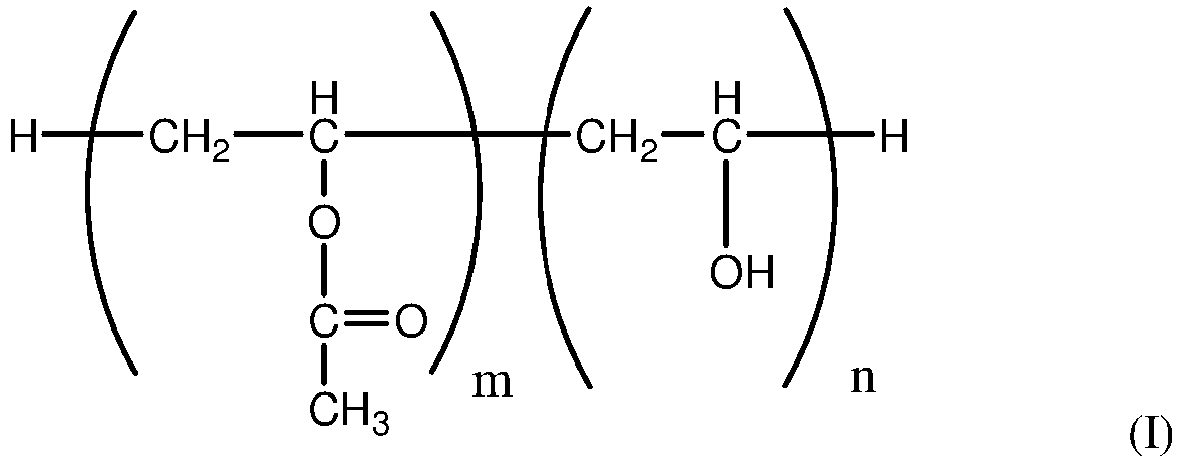
- In structure (I), m and n are integers such that the polymeric structurant has the degree of polymerization and percent alcohol characteristics described herein. For purposes of clarity, this use of the term "copolymer" is intended to convey that the partially hydrolyzed polyvinyl acetate of the present invention comprises vinyl alcohol and vinyl acetate units. As discussed below, the polymeric structurant is routinely prepared by polymerizing vinyl acetate monomer followed by hydrolysis of some of the acetate groups to alcohol groups, as opposed to polymerization of vinyl acetate and vinyl alcohol monomer units (due in-part to the instability of vinyl alcohol).
- As used herein a preformed effervescent agglomerated particle ("agglomerated particle") is an agglomerated particle that contains particles of both solid carbonate salt and solid acid along with a binder that is prepared prior to incorporation into the fibrous web.
- As used herein, "molecular weight" or "M.Wt." refers to the weight average molecular weight unless otherwise stated. Molecular weight is measured using industry standard method, gel permeation chromatography ("GPC").
- As used herein, the articles including "a" and "an" when used in a claim, are understood to mean one or more of what is claimed or described.
- As used herein, the terms "include," "includes," and "including," are meant to be non-limiting.
- The methods disclosed in the Test Methods Section of the present application should be used to determine the respective values of the parameters of Applicants' inventions, including those discussed in the Dissolvable Structures - Physical Characteristics section below.
- All percentages and ratios are calculated by weight unless otherwise indicated. All percentages and ratios are calculated based on the total composition unless otherwise indicated.
- It should be understood that every maximum numerical limitation given throughout this specification includes every lower numerical limitation, as if such lower numerical limitations were expressly written herein. Every minimum numerical limitation given throughout this specification will include every higher numerical limitation, as if such higher numerical limitations were expressly written herein. Every numerical range given throughout this specification will include every narrower numerical range that falls within such broader numerical range, as if such narrower numerical ranges were all expressly written herein.
- Hair Care products in the form of a dissolvable solid structure present an attractive form to consumers. A typical use of these products includes a consumer holding the product in her hand, adding water to create a solution or dispersion and applying to the hair. In many cases, the products can take a long time to dissolve making it a less enjoyable experience for the consumer. Therefore, a need exists to have dissolvable solids that exhibit more rapid dissolution.
- The dissolvable solid structures are formed from fibers comprising surfactant and water soluble polymeric structurant. The dissolvable solid structures contain from about 0.5 g to about 4.0 g of surfactant, and has a detersive surfactant density of from about 0.1 to about 0.3 g/cm3. The dissolvable solid structure has a bulk density of from 0.300 g/cm3 to 0.375 g/cm3, a weight of from about 1.0 g to about 4.0 g and the footprint of the dissolvable solid structure is from about 1 cm2 to about 50 cm2, alternatively from about10 cm2 to about 50 cm2.
- The dissolvable solid structure can have a basis weight of from about 200 grams/m2 to about 1800 grams/m2, alternatively from about 400 g/m2 to about 1,800 g/m2, alternatively from about 400 g/m2 to about 1750 g/m2, and alternatively from about 400 g/m2 to about 1,650 g/m2.
- The dissolvable solid structure has a footprint of from about 1cm2 to about 50 cm2, 10 cm2 to about 50 cm2, alternatively from about 15 cm2 to about 25 cm2, alternatively from about 17 cm2 to about 23 cm2. The bulk density of the dissolvable solid structure is from about 0.300 g/cm3 to about 0.375 g/cm3.
- The dissolvable solid structure has a hand dissolution value (as defined by the Hand Dissolution Method described herein) of less than about 25 strokes, alternatively less than about 15 strokes, alternatively from about 5 to about 25 strokes, alternatively from about 1 to about 25 strokes, alternatively from about 5 to about 15 strokes.
- The dissolvable solid structure may comprise an effervescent agglomerated particle, which can improve dissolution and makes the in-use experience more interesting and enjoyable to the consumer. It has been surprisingly found that the inclusion of effervescent effect is significantly more pronounced when the effervescent components exist in an agglomerated form in the Dissolvable Solid Structure as compared to these components added separately and existing in the solid as separate particles from each other. It was also found that effervescent agglomerated particles and items that contain these agglomerated particles can pick up moisture from the environment and react prematurely, reducing the fast dissolution benefit. It was surprisingly found that the inclusion of humectants, such as zeolite, into the effervescent agglomerated particles prevents this premature reaction.
- The dissolvable solid structure can comprise fibers formed from about 3 wt% to about 75 wt % surfactant; and from about 10 wt% to about 70 wt% of the polymeric structurant.
- The dissolvable solid structure can comprise from about 0.5g to about 4.0g of surfactant, alternatively from about 0.8 g to about 2.0 grams of surfactant, alternatively from about 0.9 g to about 1.5g of surfactant, and alternatively from about 1.0 g to about 1.4 g of surfactant.
- The dissolvable solid structure can comprise from about 1 wt% to about 40 wt% preformed effervescent agglomerated particles.
- The Dissolvable Solid Structure comprises water-soluble polymers that function as a structurant. As used herein, the term "water-soluble polymer" is broad enough to include both water-soluble and water-dispersible polymers, and is defined as a polymer with a solubility in water, measured at 25°C, of at least about 0.1 gram/liter (g/L). In some embodiments, the polymers have solubility in water, measured at 25° C of from about 0.1 gram/liter (g/L).to about 500 grams/liter (g/L). (This indicates production of a macroscopically isotropic or transparent, colored or colorless solution). The polymers for making these Dissolvable Solid Structures may be of synthetic or natural origin and may be modified by means of chemical reactions. They may or may not be film-forming. These polymers should be physiologically acceptable, i.e., they should be compatible with the skin, mucous membranes, the hair and the scalp.
- The one or more water-soluble polymers may be present from about 5% to about 70% by weight of the Dissolvable Solid Structure, alternatively from about 15% to about 60% by weight, and alternatively from about 20% to about 50% by weight, and alternatively from about 15% to about 30% by weight.
- The one or more water-soluble polymers can be selected such that their weight average molecular weight is from about 15,000 g/mol to about 500,000 g/mol, alternatively from about 50,000 g/mol to about 400,000 g/mol, alternatively from about 60,000 g/mol to about 300,000 g/mol, and alternatively from about 70,000 g/mol to about 200,000 g/mol. The weight average molecular weight is computed by summing the average molecular weights of each polymer raw material multiplied by their respective relative weight percentages by weight of the total weight of polymers present within the Dissolvable Solid Structure.
- At least one of the one or more water-soluble polymers can be such that about 2% by weight solution of the water-soluble polymer gives a viscosity at 20°C of from about 4 centipoise to about 80 centipoise; alternatively from about 5 centipoise to about 70 centipoise; and alternatively from about 6 centipoise to about 60 centipoise.
- The water-soluble polymer(s) can include, but are not limited to, synthetic polymers as described in
U.S. Serial No. 61/120,786 US 5,582,786 andEP-A-397410 U.S. Serial No. 61/120,786 U.S. Serial No. 61/120,786 - The above mentioned water-soluble polymer(s) may be blended with any single starch or combination of starches as a filler material in such an amount as to reduce the overall level of water-soluble polymers needed, so long as it helps provide the personal care Dissolvable Solid Structure with the requisite structure and physical/chemical characteristics as described herein.
- In such instances, the combined weight percentage of the water-soluble polymer(s) and starch-based material generally ranges from about 10% to about 50%, alternatively from about 15% to about 40%, and alternatively from about 20% to about 30% by weight relative to the total weight of the Dissolvable Solid Structure. The weight ratio of the water-soluble polymer(s) to the starch-based material can generally range from about 1:10 to about 10:1, alternatively from about 1:8 to about 8:1, alternatively from about 1:7 to about 7:1, and alternatively from about 6:1 to about 1:6.
- Typical sources for starch-based materials can include cereals, tubers, roots, legumes and fruits. Native sources can include corn, pea, potato, banana, barley, wheat, rice, sago, amaranth, tapioca, arrowroot, canna, sorghum, and waxy or high amylase varieties thereof. The starch-based materials may also include native starches that are modified using any modification known in the art, including those described in
U.S. Serial No. 61/120,786 - The Dissolvable Solid Structure comprises one or more detersive surfactants suitable for application to the hair or skin. Surfactants suitable for use in the Structure include anionic surfactants, nonionic surfactants, cationic surfactants, zwitterionic surfactants, amphoteric surfactants, polymeric surfactants or combinations thereof. Although representative surfactants are described herein, the skilled artisan will recognize that other surfactants can be readily substituted and similar benefits can be derived from use of the vinyl acetate-vinyl alcohol copolymers described herein.
- In one embodiment, the Structure is a lathering dissolvable solid personal care product (dried) and comprises from about 10 wt% to about 75 wt% surfactant, in one embodiment from about 25 wt% to about 70 wt% surfactant, in another embodiment from about 40 wt% to about 65 wt% surfactant.
- Suitable anionic surfactants include alkyl and alkyl ether sulfates. Other suitable anionic surfactants are the water-soluble salts of organic, sulfuric acid reaction products. Still other suitable anionic surfactants are the reaction products of fatty acids esterified with isethionic acid and neutralized with sodium hydroxide. Other similar anionic surfactants are described in
U.S. Patent Nos. 2,486,921 ;2,486,922 ; and2,396,278 . - Exemplary anionic surfactants include ammonium lauryl sulfate, ammonium laureth sulfate, triethylamine lauryl sulfate, triethylamine laureth sulfate, triethanolamine lauryl sulfate, triethanolamine laureth sulfate, monoethanolamine lauryl sulfate, monoethanolamine laureth sulfate, diethanolamine lauryl sulfate, diethanolamine laureth sulfate, lauric monoglyceride sodium sulfate, sodium lauryl sulfate, sodium laureth sulfate, potassium lauryl sulfate, potassium laureth sulfate, sodium lauryl sarcosinate, sodium lauroyl sarcosinate, lauryl sarcosine, cocoyl sarcosine, ammonium cocoyl sulfate, ammonium lauroyl sulfate, sodium cocoyl sulfate, sodium lauroyl sulfate, potassium cocoyl sulfate, potassium lauryl sulfate, triethanolamine lauryl sulfate, triethanolamine lauryl sulfate, monoethanolamine cocoyl sulfate, monoethanolamine lauryl sulfate, sodium tridecyl benzene sulfonate, sodium dodecyl benzene sulfonate, sodium cocoyl isethionate and combinations thereof. In one embodiment, the anionic surfactant is sodium lauryl sulfate or sodium laureth sulfate.
- In one embodiment, the anionic surfactant is at least one branched sulfate having the formula CH3-(CH2)z-CH(R1)-CH2-O-(CH2CH(R2)O)y-SO3M; where z is from about 3 to about 14; R1 represents H or a hydrocarbon radical comprising 1 to 4 carbon atoms, R2 is H or CH3; R1 and R2 are not both H; y is 0 to about 7; the average value of y is about 1 when y is not = 0; and M is a mono-valent or di-valent, positively-charged cation. Examples of mono-valent positively charged cations include ammonium, sodium, potassium, triethanolamine cation, and examples of di-valent positively charged cations include magnesium. For the foregoing branched sulfates, "average value" means that whereas the composition may comprise molecules having a value of y of other than 1, the average value of y all molecules in the composition is about 1.
- Suitable amphoteric or zwitterionic surfactants include those which are known for use in shampoo or other cleansing products. Non limiting examples of suitable zwitterionic or amphoteric surfactants are described in
U.S. Patent Nos. 5,104,646 and5,106,609 . - Suitable amphoteric surfactants include those surfactants broadly described as derivatives of aliphatic secondary and tertiary amines in which the aliphatic radical can be straight or branched chain and wherein one of the aliphatic substituents contains from about 8 to about 18 carbon atoms and one contains an anionic group such as carboxy, sulfonate, sulfate, phosphate, or phosphonate. Exemplary amphoteric detersive surfactants include cocoamphoacetate, cocoamphodiacetate, lauroamphoacetate, lauroamphodiacetate, and mixtures thereof.
- Suitable zwitterionic surfactants include those surfactants broadly described as derivatives of aliphatic quaternaryammonium, phosphonium, and sulfonium compounds, in which the aliphatic radicals can be straight or branched chain, and wherein one of the aliphatic substituents contains from about 8 to about 18 carbon atoms and one contains an anionic group such as carboxy, sulfonate, sulfate, phosphate or phosphonate. In another embodiment, zwitterionics such as betaines are selected.
- Non limiting examples of other anionic, zwitterionic, amphoteric or optional additional surfactants suitable for use in the compositions are described in McCutcheon's, Emulsifiers and Detergents, 1989 Annual, published by M. C. Publishing Co., and
U.S. Patent Nos. 3,929,678 ,2,658,072 ;2,438,091 and2,528,378 . - Suitable nonionic surfactants for use in the present invention include those described in McCutcheon's Detergents and Emulsifiers, North American edition (2010), Allured Publishing Corp., and McCutcheon's Functional Materials, North American edition (2010). Suitable nonionic surfactants for use in the Structure of the present invention include, but are not limited to, polyoxyethylenated alkyl phenols, polyoxyethylenated alcohols, polyoxyethylenated polyoxypropylene glycols, glyceryl esters of alkanoic acids, polyglyceryl esters of alkanoic acids, propylene glycol esters of alkanoic acids, sorbitol esters of alkanoic acids, polyoxyethylenated sorbitor esters of alkanoic acids, polyoxyethylene glycol esters of alkanoic acids, polyoxyethylenated alkanoic acids, alkanolamides, N-alkylpyrrolidones, alkyl glycosides, alkyl polyglucosides, alkylamine oxides, and polyoxyethylenated silicones.
- In another embodiment, the nonionic surfactant is selected from sorbitan esters and alkoxylated derivatives of sorbitan esters including sorbitan monolaurate (SPAN® 20), sorbitan monopalmitate (SPAN® 40), sorbitan monostearate (SPAN® 60), sorbitan tristearate (SPAN® 65), sorbitan monooleate (SPAN® 80), sorbitan trioleate (SPAN® 85), sorbitan isostearate, polyoxyethylene (20) sorbitan monolaurate (Tween® 20), polyoxyethylene (20) sorbitan monopalmitate (Tween® 40), polyoxyethylene (20) sorbitan monostearate (Tween® 60), polyoxyethylene (20) sorbitan monooleate (Tween® 80), polyoxyethylene (4) sorbitan monolaurate (Tween® 21), polyoxyethylene (4) sorbitan monostearate (Tween® 61), polyoxyethylene (5) sorbitan monooleate (Tween® 81), all available from Uniqema, and combinations thereof.
- Suitable copolymer surfactants include, but are not limited to, block copolymers of ethylene oxide and fatty alkyl residues, block copolymers of ethylene oxide and propylene oxide, hydrophobically modified polyacrylates, hydrophobically modified celluloses, silicone polyethers, silicone copolyol esters, diquaternary polydimethylsiloxanes, and co-modified amino/polyether silicones.
- The surfactant can be a combination of surfactants wherein one or more surfactants from Group I, wherein Group I comprises anionic surfactants, and one or more surfactants from Group II, wherein Group II comprises a surfactant selected from the group consisting of amphoteric, zwitterionic and combinations thereof; wherein the ratio of Group I to Group II surfactants is from about 90: 10 to about 30:70.
- The Dissolvable Solid Structure has from about 1 wt% to about 80 wt% preformed effervescent agglomerated particles, alternatively from about 1 wt% to about 40 wt% preformed effervescent agglomerated particles alternatively from about 5 to about 25 wt% of preformed effervescent agglomerated particles, alternatively from about 10 to about 15 wt% of preformed effervescent agglomerated particles. Effervescent salts are widely used in the pharmaceutical and food industries. Suitable effervescent salts (carbonate salts) include, but are not limited to, sodium bicarbonate and sodium carbonate. The effervescence, or 'fizz', provides a signal to the consumer that the product is effective. The most common pairing of chemicals to produce the effervescent effect is Sodium Bicarbonate and Citric Acid, which are solid materials. The reaction equation is shown below:
3NaHCO 3 + (C6H6O7 - H 2 O) + 4H 2 O → Na 3 C 6 H 5 O 7 + 3CO 2 + 8H 2 O
- The stoichiometry of the reaction indicates the weight ratio of 1:1.2 citric acid:sodium bicarbonate balances this equation.
- A preformed effervescent agglomerated particle ("agglomerated particle") is an Agglomerated Particle that contains particles of both solid carbonate salt and solid acid along with a binder that is prepared prior to incorporation into the fibrous web. A carbonate salt is any metal salt of carbonic acid. A solid acid is any organic carboxylic acid that is solid in room temperature; e.g. it has a melting point of higher than 25°C. Preforming the effervescent agglomerated particle results in at consumer noticeable benefit from the Dissolvable Solid Structure. Suitable solid acids include, but are not limited to, tartaric acid, citric acid, fumaric acid, adipic acid, malic acid, oxalic acid, sulfamic acid and combinations thereof. Suitable carbonate salts include but are not limited to, sodium carbonate, calcium carbonate, magnesium carbonate, ammonium carbonate, potassium carbonate, sodium bicarbonate, potassium bicarbonate and calcium bicarbonate.
- A binder is any material or substance that holds or draws other materials together to form a cohesive whole mechanically, chemically, or as an adhesive. The binder choice can have an effect on the foaming of the particle. Binders can include those that are nonionic to minimize the interaction with the reactants, however, polymeric and ionic binders can also be used. Suitable binders include, but are not limited to, Nonionic surfactants, nonionic polymers, Ethoxylated Alcohols, Sorbitan Derivates, Polyethylene Glycols, Corn Syrup, Paraffin, waxes, Fatty Alcohols, and mixtures thereof. Binders typically are included in the effervescent agglomerated particle at a level of from about 0.05 weight % of the effervescent agglomerated particle to about 10 weight % of the effervescent agglomerated particle, alternatively from about 1 weight % of the effervescent agglomerated particle to about 5 weight % of the effervescent agglomerated particle. Binders typically are included at from about 0.05 to about to about 5 weight % of the Dissolvable Solid Structure.
- The agglomerated particles can be evenly distributed throughout the fiber matrix. The agglomerated particles may be distributed evenly on one layer or throughout multiple layers. For example one method is having it evenly distributed on all layers of the web. Alternatively, the agglomerated particle could be distributed through a middle layer, alternatively the agglomerated particle could be distributed only on an external layer outwardly facing layer.
- The effervescent reaction is an acid/base neutralization reaction. During the reaction CO2 evolves, giving the characteristic effervescence desired in this product. The reaction will take place in the presence of moisture in the air, and auto-catalytically continue, at water activities above about 0.6 aW. Adding humectant to the effervescent agglomerated particle allows water from the air or from reacting materials to be absorbed, preventing or delaying the reaction. This improves process ability as well as shelf stability. The data below shows that increasing levels of humectant, in these examples Potassium Acetate, results in better stability of the effervescent agglomerated particles, as measured in mass loss due to CO2 release and flowability. Suitable humectants include Salts, sugars, acids, glycols, inorganics and combinations thereof. Suitable humectants can be selected from PEG400, PEG 600, Sorbitol, Potassium Carbonate, Sodium Chloride, Potassium Acetate, PEG 4000, zeolite, Corn syrup, Glycerol, Fructose, Sucrose, citric acid, tartaric acid, malic acid, lactic acid, Magnesium Chloride, and combinations thereof. Suitable humectant ranges are from about 0.1 to about 15 weight % of the effervescent agglomerated particle, alternatively from about 1 to about 7 weight % of the effervescent agglomerated particle. Suitable humectant ranges include from about 0.5 to about 10 weight % of the Dissolvable Solid Structure, alternatively from about 1 to about 7 weight % of the Dissolvable Solid Structure.
- Flow aides can be included at low levels to help make the Agglomerated Particle flow better, non-limiting examples include Zeolite A, precipitated silica, precipitated silicates, fly ash, talc, starch, clays, metallic stearates, phosphates, amides, polysaccharides, sugars, and combinations thereof. Particularly suitable materials include Zeolite A, silica, sugars and mixtures thereof.
- The effervescent agglomerated particle is based on the citric acid/sodium bicarbonate reaction shown above. There is a binder used to hold the particles together, a humectant added to provide stability with respect to moisture, and in some instances, a flow aide.
- Citric acid, sodium bicarbonate and humectant are mixed in a convective or tumbling solids mixer including paddle mixers or v-blenders for approximately 5 minutes. Binder is added and mixed for an additional 5 min, or longer for larger particles or shorter for smaller particles. The flow aid is added after Agglomerated Particle has reached target size. Mixing continues for approximately another minute. Agglomerated Particle is transferred into storage vessel until ready for use.
- Particle size is controlled by the initial raw material particle size, binder selection, and the time of mixing after binder addition in agglomeration process. In one example, large Citric Acid, 400-500µm, is chosen as a seed particle, the binder is nonionic binder to stick to smaller Sodium Bicarbonate particles, 50-100µm, to the seed, and then coating the entire particle with Zeolite, less than about 10µm, as a flow aid. Size is controlled primarily by citric acid size selection.
- Suitable size is above 300 microns for the effervescent Agglomerated Particles for the typical process to have acceptable inclusion into the Dissolvable Solid Structure.
- Suitable effervescent particles include those having a particle size of from about 100 microns to about 2000 microns. Suitable effervescent particles include those having a particle size of less than 2000 microns, alternatively less than 1000 microns, alternatively less than 800 micron. Large particles can have less consumer acceptance among some consumers because they are perceived as a gritty feel on their hands during dissolution. However, other consumers prefer larger particles preferably greater than 1000 microns, more preferably greater than 2000 microns so that as they feel them dissolve they know it is time to apply the product to hair. Suitable large particles can have a particle size of from about 1000 to about 5000 microns.
Table 5 Ingredients Agglomerated Particle Example Agglomerated Particle Example Agglomerated Particle Example Citric acid 41.7% 41.7% 41.7% Sodium bicarbonate 50.0% 50.0% 50.0% Polysorbate- 801 1.0% 1.0% 1.0% Sodium Aluminum Silicate2 7.3% 7.3% 7.3% Agglomerated Particle size3 1000 micron 600 micron 300 micron 1. Tween-80 supplied by Croda
2. Zeolite A supplied by Sasol
3. Pass through standard screens of designated sizes. - The Structure (dried) optionally comprises from about 1 wt% to about 25 wt% plasticizer, in one embodiment from about 3 wt % to about 20 wt% plasticizer, in one embodiment from about 5 wt% to about 15 wt% plasticizer.
- When present in the Structures, non-limiting examples of suitable plasticizing agents include polyols, copolyols, polycarboxylic acids, polyesters and dimethicone copolyols.
- Examples of useful polyols include, but are not limited to, glycerin, diglycerin, propylene glycol, ethylene glycol, butylene glycol, pentylene glycol, cyclohexane dimethanol, hexane diol, polyethylene glycol (200-600), sugar alcohols such as sorbitol, manitol, lactitol and other mono- and polyhydric low molecular weight alcohols (e.g., C2-C8 alcohols); mono di- and oligosaccharides such as fructose, glucose, sucrose, maltose, lactose, and high fructose corn syrup solids and ascorbic acid.
- Examples of polycarboxylic acids include, but are not limited to citric acid, maleic acid, succinic acid, polyacrylic acid, and polymaleic acid.
- Examples of suitable polyesters include, but are not limited to, glycerol triacetate, acetylated-monoglyceride, diethyl phthalate, triethyl citrate, tributyl citrate, acetyl triethyl citrate, acetyl tributyl citrate.
- Examples of suitable dimethicone copolyols include, but are not limited to, PEG-12 dimethicone, PEG/PPG-18/18 dimethicone, and PPG-12 dimethicone.
- Other suitable plasticizers include, but are not limited to, alkyl and allyl phthalates; napthalates; lactates (e.g., sodium, ammonium and potassium salts); sorbeth-30; urea; lactic acid; sodium pyrrolidone carboxylic acid (PCA); sodium hyraluronate or hyaluronic acid; soluble collagen; modified protein; monosodium L-glutamate; alpha & beta hydroxyl acids such as glycolic acid, lactic acid, citric acid, maleic acid and salicylic acid; glyceryl polymethacrylate; polymeric plasticizers such as polyquaterniums; proteins and amino acids such as glutamic acid, aspartic acid, and lysine; hydrogen starch hydrolysates; other low molecular weight esters (e.g., esters of C2-C10 alcohols and acids); and any other water soluble plasticizer known to one skilled in the art of the foods and plastics industries; and mixtures thereof.
-
EP 0283165 B1 discloses suitable plasticizers, including glycerol derivatives such as propoxylated glycerol. - The Structure may comprise other optional ingredients that are known for use or otherwise useful in compositions, provided that such optional materials are compatible with the selected essential materials described herein, or do not otherwise unduly impair product performance.
- Such optional ingredients are most typically those materials approved for use in cosmetics and that are described in reference books such as the CTFA Cosmetic Ingredient Handbook, Second Edition, The Cosmetic, Toiletries, and Fragrance Association, Inc. 1992.
- Emulsifiers suitable as an optional ingredient herein include mono- and di-glycerides, fatty alcohols, polyglycerol esters, propylene glycol esters, sorbitan esters and other emulsifiers known or otherwise commonly used to stabilized air interfaces, as for example those used during preparation of aerated foodstuffs such as cakes and other baked goods and confectionary products, or the stabilization of cosmetics such as hair mousses.
- Further non-limiting examples of such optional ingredients include preservatives, perfumes or fragrances, coloring agents or dyes, conditioning agents, hair bleaching agents, thickeners, moisturizers, emollients, pharmaceutical actives, vitamins or nutrients, sunscreens, deodorants, sensates, plant extracts, nutrients, astringents, cosmetic particles, absorbent particles, adhesive particles, hair fixatives, fibers, reactive agents, skin lightening agents, skin tanning agents, antidandruff agents (example zinc pyrithione and selenium sulfide etc.), perfumes, exfoliating agents, acids, bases, humectants, enzymes, suspending agents, pH modifiers, hair colorants, hair perming agents, pigment particles, anti-acne agents, anti-microbial agents, sunscreens, tanning agents, exfoliation particles, hair growth or restorer agents, insect repellents, shaving lotion agents, cosolvents or other additional solvents, and similar other materials.
- Suitable conditioning agents include high melting point fatty compounds, silicone conditioning agents and cationic conditioning polymers. Suitable materials are discussed in
US 2008/0019935 ,US 2008/0242584 andUS 2006/0217288 . - Non-limiting examples of product type embodiments for use by the Structure include hand cleansing Structures, hair shampoo or other hair treatment Structures, body cleansing Structures, shaving preparation Structures, personal care Structures containing pharmaceutical or other skin care active, moisturizing Structures, sunscreen Structures, chronic skin benefit agent Structures (e.g., vitamin-containing Structures, alpha-hydroxy acid-containing Structures, etc.), deodorizing Structures, fragrance-containing Structures, and so forth.
- The Structures are dissolvable, porous solid compositions wherein the porosity allows for liquid (e.g., water) flow during use such that the solid composition readily dissolves to provide a desired consumer experience. The porous nature of the Structure can be achieved in a variety of ways including, for example, forming an open celled foam or forming a fibrous structure.
- For fibrous Structures, the Structure comprises a significant number of dissolvable fibers with an average diameter less than about 150 micron, alternatively less than about 100 micron, alternatively less than about 20 micron, alternatively less than about 10 micron, and alternatively less than about 1 micron with a relative standard deviation of less than 100%, alternatively less than 80%, alternatively less than 60%, alternatively less than 50%, such as in the range of 10% to 50%, for example. As set forth herein, the significant number means at least 10% of all the dissolvable fibers, alternatively at least 25% of all the dissolvable fibers, alternatively at least 50% of all the dissolvable fibers, alternatively at least 75% of all the dissolvable fibers. The significant number may be at least 99% of all the dissolvable fibers. Alternatively, from about 50% to about 100% of all the dissolvable fibers may have an average diameter less than about 20 micron. The dissolvable fibers produced by the method of the present disclosure have a significant number of dissolvable fibers with an average diameter less than about 1 micron, or sub-micron fibers. In an embodiment, Dissolvable Solid Structure may have from about 25% to about 100% of all the dissolvable fibers with an average diameter less than about 1 micron, alternatively from about 35% to about 100% of all the dissolvable fibers with an average diameter less than about 1 micron, alternatively from about 50% to about 100% of all the dissolvable fibers with an average diameter less than about 1 micron, and alternatively from about 75% to about 100% of all the dissolvable fibers with an average diameter less than about 1 micron.
- The percent porosity of the dissolvable solid Structure is at least about 25%, alternatively at embodiment at least about 50%, alternatively at least about 60%, alternatively at least about 70% and alternatively at least about 80%. The porosity of the dissolvable solid Structure is not more than about 99%, alternatively not more than about 98%, alternatively not more than about 95%, and alternatively not more than about 90%. Porosity of a Structure is determined according to the procedure set forth in the definition of "porosity" above.
- A range of effective sizes of pores can be accommodated. The pore size distribution through the Structure cross-section may be symmetric or asymmetric.
- The Structure can be flexible and have a distance to maximum force value of from about 6 mm to about 30 mm. The distance to maximum force value from about 7 mm to about 25 mm, alternatively from about 8 mm to about 20 mm, and alternatively from about 9 mm to about 15 mm.
- The Structure can be a flat, flexible Structure in the form of a pad, a strip, or tape and having a thickness of from about 0.5 mm to about 10 mm, alternatively from about 1 mm to about 9 mm, alternatively from about 2 mm to about 8 mm, and alternatively from about 3 mm to about 7 mm as measured by the below methodology. The Structure can be a sheet having a thickness from about 5mm to about 6.5mm. Alternatively two or more sheets are combined to form a Structure with a thickness of about 5mm to about 10mm.
- The fibrous elements of the present invention may be made by any suitable process. A non-limiting example of a suitable process for making the fibrous elements is described below.
- The fibrous elements of the present invention may be made as follows. Fibrous elements may be formed by means of a small-scale apparatus. A pressurized tank, suitable for batch operation is filled with a suitable filament-forming composition according to the present invention. A pump such as a Zenith®, type PEP II, having a capacity of 5.0 cubic centimeters per revolution (cc/rev), manufactured by Parker Hannifin Corporation, Zenith Pumps division, of Sanford, N.C., USA may be used to facilitate transport of the filament-forming composition via pipes to a spinning die. The flow of the filament-forming composition from the pressurized tank to the spinning die may be controlled by adjusting the number of revolutions per minute (rpm) of the pump. Pipes are used to connect the pressurized tank, the pump, and the spinning die.
- The spinning die can have several rows of circular extrusion nozzles (fibrous element-forming holes) spaced from one another at a pitch P of about 1.524 millimeters (about 0.060 inches). The nozzles have individual inner diameters of about 0.305 millimeters (about 0.012 inches) and individual outside diameters of about 0.813 millimeters (about 0.032 inches). Each individual nozzle is encircled by an annular and divergently flared orifice (concentric attenuation fluid hole to supply attenuation air to each individual melt capillary. The filament-forming composition extruded through the nozzles is surrounded and attenuated by generally cylindrical, humidified air streams supplied through the orifices.
- A method for making a
fibrous element 10 comprises the steps of: - a. providing a filament-forming composition comprising one or more filament-forming materials, and optionally one or more active agents; and
- b. spinning the filament-forming composition , such as via a spinning die, into one or more fibrous elements, such as
filaments 10, comprising the one or more filament-forming materials and optionally, the one or more active agents. The one or more active agents may be releasable from the fibrous element when exposed to conditions of intended use. The total level of the one or more filament-forming materials present in the fibrous element, forexample filament 10, when active agents are present therein, may be less than 80% and/or less than 70% and/or less than 65% and/or 50% or less by weight on a dry fibrous element basis and/or dry fibrous structure basis and the total level of the one or more active agents, when present in the fibrous element may be greater than 20% and/or greater than 35% and/or 50% or greater 65% or greater and/or 80% or greater by weight on a dry fibrous element basis and/or dry fibrous structure basis. - The spinning die may comprise a plurality of fibrous element-forming holes that include a melt capillary encircled by a concentric attenuation fluid hole through which a fluid, such as air, passes to facilitate attenuation of the filament-forming composition into a fibrous element, for example a
filament 10 as it exits the fibrous element-forming hole. - Attenuation air can be provided by heating compressed air from a source by an electrical-resistance heater, for example, a heater manufactured by Chromalox, Division of Emerson Electric, of Pittsburgh, Pa., USA. An appropriate quantity of steam was added to saturate or nearly saturate the heated air at the conditions in the electrically heated, thermostatically controlled delivery pipe. Condensate is removed in an electrically heated, thermostatically controlled, separator.
- The embryonic fibrous elements are dried by a drying air stream having a temperature from about 149° C. (about 300° F.) to about 315° C. (about 600° F.) by an electrical resistance heater (not shown) supplied through drying nozzles and discharged at an angle of about 90° relative to the general orientation of the embryonic fibrous elements being extruded. The dried embryonic fibrous elements are collected on a collection device, such as, for example, a movable foraminous belt or patterned collection belt. The addition of a vacuum source directly under the formation zone may be used to aid collection of the fibers.
- In one example, during the spinning step, any volatile solvent, such as water, present in the filament-forming composition is removed, such as by drying, as the
fibrous element 10 is formed. In one example, greater than 30% and/or greater than 40% and/or greater than 60% of the weight of the filament-forming composition's volatile solvent, such as water, is removed during the spinning step, such as by drying the fibrous element being produced. - The filament-forming composition may comprise any suitable total level of filament-forming materials and any suitable level of active agents so long as the fibrous element produced from the filament-forming composition comprises a total level of filament-forming materials in the fibrous element of from about 5% to 50% or less by weight on a dry fibrous element basis and/or dry particle basis and/or dry fibrous structure basis and a total level of active agents in the fibrous element of from 50% to about 95% by weight on a dry fibrous element basis and/or dry particle basis and/or dry fibrous structure basis.
- In one example, the filament-forming composition may comprise any suitable total level of filament-forming materials and any suitable level of active agents so long as the fibrous element produced from the filament-forming composition comprises a total level of filament-forming materials in the fibrous element and/or particle of from about 5% to 50% or less by weight on a dry fibrous element basis and/or dry particle basis and/or dry fibrous structure basis and a total level of active agents in the fibrous element and/or particle of from 50% to about 95% by weight on a dry fibrous element basis and/or dry particle basis and/or dry fibrous structure basis, wherein the weight ratio of filament-forming material to total level of active agents is 1 or less.
- In one example, the filament-forming composition comprises from about 1% and/or from about 5% and/or from about 10% to about 50% and/or to about 40% and/or to about 30% and/or to about 20% by weight of the filament-forming composition of filament-forming materials; from about 1% and/or from about 5% and/or from about 10% to about 50% and/or to about 40% and/or to about 30% and/or to about 20% by weight of the filament-forming composition of active agents; and from about 20% and/or from about 25% and/or from about 30% and/or from about 40% and/or to about 80% and/or to about 70% and/or to about 60% and/or to about 50% by weight of the filament-forming composition of a volatile solvent, such as water. The filament-forming composition may comprise minor amounts of other active agents, such as less than 10% and/or less than 5% and/or less than 3% and/or less than 1% by weight of the filament-forming composition of plasticizers, pH adjusting agents, and other active agents.
- The filament-forming composition is spun into one or more fibrous elements and/or particles by any suitable spinning process, such as meltblowing, spunbonding, electro-spinning, and/or rotary spinning. In one example, the filament-forming composition is spun into a plurality of fibrous elements and/or particles by meltblowing. For example, the filament-forming composition may be pumped from a tank to a meltblown spinnerette. Upon exiting one or more of the filament-forming holes in the spinnerette, the filament-forming composition is attenuated with air to create one or more fibrous elements and/or particles. The fibrous elements and/or particles may then be dried to remove any remaining solvent used for spinning, such as the water.
- The fibrous elements and/or particles of the present invention may be collected on a belt, such as a patterned belt to form a fibrous structure comprising the fibrous elements and/or particles.
- A fibrous structure, for example a fibrous structure layer or ply of the present invention may be made by spinning a filament-forming composition from a spinning die, to form a plurality of fibrous elements, such as
filaments 10. The fibrous elements may be spun via suitable spinning process operations, such as meltblowing, spunbonding, electro-spinning, and/or rotary spinning. - The dry embryonic fibrous elements, for example filaments may be collected on a molding member as described above. The construction of the molding member may provide areas that are air-permeable due to the inherent construction. The filaments that are used to construct the molding member will be non-permeable while the void areas between the filaments will be permeable. Additionally a pattern may be applied to the molding member to provide additional non-permeable areas which may be continuous, discontinuous, or semi-continuous in nature. A vacuum used at the point of lay down is used to help deflect fibers into the presented pattern.
- In addition to the techniques described herein in forming regions within the fibrous structures having a different properties (e.g., average densities), other techniques can also be applied to provide suitable results. One such example includes embossing techniques to form such regions. Suitable embossing techniques are described in
U.S. Patent Application Publication Nos. 2010/0297377 ,2010/0295213 ,2010/0295206 ,2010/0028621 , and2006/0278355 . - In one example, in a multi-ply article, one or more fibrous structure plies may be formed and/or deposited directly upon an existing ply of fibrous structure to form a multi-ply fibrous structure. The two or more existing fibrous structure plies may be combined, for example via thermal bonding, gluing, embossing, aperturing, rotary knife aperturing, die cutting, die punching, needlepunching, knurling, pneumatic forming, hydraulic forming, laser cutting, tufting, and/or other mechanical combining process, with one or more other existing fibrous structure plies to form the multi-ply article of the present invention.
- Pre-formed dissolvable fibrous web (comprised of dissolvable fibers and, optionally, agglomerate particles), having approximately 1/3 the total desired basis weight of the finished article, can be arranged in a face to face relationship with post-add minor ingredients disposed between layers, and laminated with a solid state formation process. The resulting laminate is cut into the finished article shape via die cutting.
- The 3-layer web stack with minors disposed between layers can be passed together through a solid state formation process (see Rotary Knife Aperturing Apparatus below), forming roughly conical apertures in the article and causing inter-layer fiber interactions which result in a mechanically lamination article. Lamination aids (e.g. web plasticizing agents, adhesive fluids, etc.) may be additionally used to aid in secure lamination of layers.
- Suitable solid state description in disclosed in
US8679391 . Also, suitable dissolvable web aperturing description is disclosed inUS 2016/0101026A1 . - The nip comprises (2) intermeshed 100 pitch toothed rolls The teeth on the toothed rolls have a pyramidal shape tip with six sides that taper from the base section of the tooth to a sharp point at the tip. The base section of the tooth has vertical leading and trailing edges and is joined to the pyramidal shape tip and the surface of the toothed roller. The teeth are oriented so the long direction runs in the MD.
- The teeth are arranged in a staggered pattern, with a CD pitch P of 0.100 inch (2.5 mm) and a uniform tip to tip spacing in the MD of 0.223 inch (5.7 mm). The overall tooth height TH (including pyramidal and vertical base sections) is 0.270 inch (6.9 mm), the side wall angle on the long side of the tooth is 6.8 degrees and the side wall angle of the leading and trailing edges of the teeth in the pyramidal tip section is 25 degrees.
- The opposing toothed rolls are aligned such that the corresponding MD rows of teeth are in different planes and said planes are approximately equidistant from neighboring planes of the opposing roller; that is, such that the clearances on either side of the teeth are about equal. The degree of interference between the virtual cylinders described by the tips of the pins is described as the Depth of Engagement.
- As web passes through the nip formed between the opposing rollers, the teeth from each roller engage with and penetrate the web to a depth determined largely by the depth of engagement between the rollers and the nominal thickness of the web. The opposing toothed rolls are aligned such that the corresponding MD rows of teeth are in different planes and said planes are approximately equidistant from neighboring planes of the opposing roller; that is, such that the clearances on either side of the teeth are about equal.
- The preparation of the surface resident coating comprising the active agent may include any suitable mechanical, chemical, or otherwise means to produce a composition comprising the active agent(s) including any optional materials as described herein, or a coating from a fluid.
- Optionally, the surface resident coating may comprise a water releasable matrix complex comprising active agent(s). In one embodiment, the water releasable matrix complexes comprising active agent(s) are prepared by spray drying wherein the active agent(s) is dispersed or emulsified within an aqueous composition comprising the dissolved matrix material under high shear (with optional emulsifying agents) and spray dried into a fine powder. The optional emulsifying agents can include gum arabic, specially modified starches, or other tensides as taught in the spray drying art (See Flavor Encapsulation, edited by Sara J. Risch and Gary A. Reineccius, pages 9, 45-54 (1988). . Other known methods of manufacturing the water releasable matrix complexes comprising active agent(s) may include but are not limited to, fluid bed agglomeration, extrusion, cooling/crystallization methods and the use of phase transfer catalysts to promote interfacial polymerization. Alternatively, the active agent(s) can be adsorbed or absorbed into or combined with a water releasable matrix material that has been previously produced via a variety of mechanical mixing means (spray drying, paddle mixers, grinding, milling etc.). In one embodiment, the water releasable matrix material in either pellet or granular or other solid-based form (and comprising any minor impurities as supplied by the supplier including residual solvents and plasticizers) may be ground or milled into a fine powder in the presence of the active agent(s) via a variety of mechanical means, for instance in a grinder or hammer mill.
- Where the Dissolvable Solid Structure has a particulate coating, the particle size is known to have a direct effect on the potential reactive surface area of the active agents and thereby has a substantial effect on how fast the active agent delivers the intended beneficial effect upon dilution with water. In this sense, the active agents with smaller particle sizes tend to give a faster and shorter lived effect, whereas the active agents with larger particle sizes tend to give a slower and longer lived effect. In one embodiment the surface resident coatings may have a particle size from about 1µm to about 200µm, in another embodiment from about 2 µm to about 100µm, and in yet another embodiment from about 3 µm to about 50µm.
- In some embodiments, it is helpful to include inert fillers within the grinding process, for instance aluminum starch octenylsuccinate under the trade name DRY-FLO® PC and available from Akzo Nobel, at a level sufficient to improve the flow properties of the powder and to mitigate inter-particle sticking or agglomeration during powder production or handling. Other optional excipients or cosmetic actives, as described herein, can be incorporated during or after the powder preparation process, e.g., grinding, milling, blending, spray drying, etc. The resulting powder may also be blended with other inert powders, either of inert materials or other powder-active complexes, and including water absorbing powders as described herein.
- In one embodiment, the active agents may be surface coated with non-hygroscopic solvents, anhydrous oils, and/or waxes as defined herein. This may include the steps of: (i) coating the water sensitive powder with the non-hydroscopic solvents, anhydrous oils, and/or waxes; (ii) reduction of the particle size of the active agent particulates, prior to, during, or after a coating is applied, by known mechanical means to a predetermined size or selected distribution of sizes; and (iii) blending the resulting coated particulates with other optional ingredients in particulate form. Alternatively, the coating of the non-hydroscopic solvents, anhydrous oils and/or waxes may be simultaneously applied to the other optional ingredients, in addition to the active agents, of the surface resident coating composition and with subsequent particle size reduction as per the procedure described above.
- Where the coating is applied to the Structure as a fluid (such as by as a spray, a gel, or a cream coating), the fluid can be prepared prior to application onto the Structure or the fluid ingredients can be separately applied onto the Structure such as by two or more spray feed steams spraying separate components of the fluid onto the Structure.
- Post-add minor ingredients can be applied to the surface of one or more web layers in the nascent article, typically an interior surface. Individual minor ingredients may be applied together to a single selected surface or to separate surfaces. Minor ingredients may be applied to interior or exterior surfaces. In the present examples, minors were applied to the same interior surface, namely to one side of the middle of three layers.
- Post-add ingredients in the present examples include fragrance and amodimethicone, both fluid at room temperature. Additional minor ingredients could include alternative conditioning agents, co-surfactants, encapsulated fragrance vehicles, rheology modifiers, etc. Minor ingredients could include fluids, particulates, pastes, or combinations.
- In the present examples, fragrance is applied by atomizing through a spray nozzle (example Nordson EFD spray nozzle) and directing the resulting droplets of perfume to the target web surface, essentially uniformly over the surface.
- In the present examples, amodimethicone is applied by expressing the fluid through an extrusion nozzle (example ITW-Dynatec UFD hot melt glue nozzle), comprising a series of orifices, approximately 500 microns in diameter and spaced at 2.5mm, resulting in stripes of fluid extending the length of the target web surface.
- Alternate fluid dispensing technologies, application patterns, and characteristic dimensions are contemplated.
- The compositions described herein may be used for cleaning and/or treating hair, hair follicles, skin, teeth, and the oral cavity. The method for treating these consumer structure may comprise the steps of: a) applying an effective amount of the Structure to the hand, b) wetting the Structure with water to dissolve the solid, c) applying the dissolved material to the target consumer substrate such as to clean or treat it, and d) rinsing the diluted treatment composition from the consumer substrate. These steps can be repeated as many times as desired to achieve the desired cleansing and or treatment benefit.
- According to yet another embodiment, a method is provided for providing a benefit to hair, hair follicles, skin, teeth, and/or the oral cavity, comprising the step of applying a composition according to the first embodiment to these target consumer substrates in need of regulating.
- Described herein is a method for regulating the condition of hair, hair follicles, skin, teeth, the oral cavity, comprising the step of applying one or more compositions described herein to these target consumer substrates in need of regulation.
- The amount of the composition applied, the frequency of application and the period of use will vary widely depending upon the purpose of application, the level of components of a given composition and the level of regulation desired. For example, when the composition is applied for whole body or hair treatment, effective amounts generally range from about 0.5 grams to about 10 grams, in one embodiment from about 1.0 grams to about 5 grams, and in another embodiment from about 1.5 grams to about 3 grams.
- Non-limiting examples of product embodiments that utilize the Structures include hand cleansing substrates, teeth cleaning or treating substrates, oral cavity substrates, hair shampoo or other hair treatment substrates, body cleansing substrates, shaving preparation substrates, personal care substrates containing pharmaceutical or other skin care active, moisturizing substrates, sunscreen substrates, chronic skin benefit agent substrates (e.g., vitamin-containing substrates, alpha-hydroxy acid-containing substrates, etc.), deodorizing substrates, fragrance-containing substrates, and so forth.
- Described herein is an article of commerce comprising one or more Structures described herein, and a communication directing a consumer to dissolve the Structure and apply the dissolved mixture to hair, hair follicles, skin, teeth, the oral cavity, to achieve a benefit to the target consumer substrate, a rapidly lathering foam, a rapidly rinsing foam, a clean rinsing foam, and combinations thereof. The communication may be printed material attached directly or indirectly to packaging that contains the Structure or on the Structure itself. Alternatively, the communication may be an electronic or a broadcast message that is associated with the article of manufacture. Alternatively, the communication may describe at least one possible use, capability, distinguishing feature and/or property of the article of manufacture.
- In general, basis weight of a material or article (including the dissolvable solid structure) is measured by first cutting the sample to a known area, using a die cutter or equivalent, then measuring & recording the weight of the sample on a top-loading balance with a minimum resolution of 0.01g, then finally by calculating the basis weight as follows:


- Preferred pad sample sizes for basis weight determination are > 10 cm2 and should be cut with a precision die cutter having the desired geometry. If the article to be measured is smaller than 10 cm2, a smaller sampling area can be sued for basis weight determination with the appropriate changes to calculation.
- In the present examples, basis weight was calculated based on the full article having a known area of 17.28 cm2. Thus, the basis weight calculation becomes:

- The present examples were measured using the Check-Line J-40-V Digital Material Thickness Gauge from Electromatic Equipment Co. (Cedarhurst, NY).
- The sample (such as the dissolvable solid structure) is placed between a top and bottom plate of the instrument which has a top plate designed to apply a pressure of 0.5kPa over a 25cm2 area. The distance between the plates, to the nearest 0.01mm, at the time of measurement is recorded as the thickness of the sample. The time of measurement is determined as the time at which the thickness in mm stabilizes or 5 seconds, whichever occurs first.
- Equivalent methods are described in detail in compendial method ISO 9073-2, Determination of thickness for nonwovens, or equivalent.
- Bulk Density is determined by calculation given a Thickness and Basis Weight of the sample (the solid dissolvable structure) (using methods as described above) according to the following:

- Surfactant density is determined by calculation, given a Bulk Density of the material and a surfactant activity (fraction of the article that is surfactant).

- The footprint of the dissolvable structure/article can be measured by measuring the dimensions of its base so that the base area (that is, the footprint) can be calculated. For example, in the case in which the base of the article is a parallelogram having right angles, the length of the unequal sides of the base (A and B) are measured by a ruler and the area of the base (footprint) is calculated as the product A x B. In the case in which the base of the article is a square, the length of a side (C) is measured by a ruler and the area of the base (footprint) is calculated as the square C2. Other examples of shapes can include circle, oval, etc.
- Measured via a Rupture Method on a Texture Analyzer using a TA-57R cylindrical probe with
Texture Exponent 32 Software. The Structure should have a thickness of between 4 to 7 mm and cut in a circle with a diameter of at least 7 mm for this method; or carefully cut or stacked to be within this overall thickness and diameter range. The porous solid sample is carefully mounted on top of the cylinder with four screws mounted on top with the top lid affixed in place on top of the sample. There is a hole in the center of the cylinder and its lid which allows the probe to pass through and stretch the sample. The sample is measured with a pre-test speed of 1 mm per second, a test speed of 2 mm per second and a post test speed of 3 mm per second over a total distance of 30 mm. The distance to maximum force is recorded. -
- Materials Needed:
- Articles to be tested: 3-5 articles (finished product samples) (dissolvable solid structures) are tested so that an average of the number of strokes for each if the individual article samples is calculated and recorded as the Average Hand Dissolution value for the article. For this method, the entire consumer saleable or consumer use article is tested. If the entire consumer saleable or consumer use article has a footprint greater than 50cm2, then first cut the article to have a footprint of 50cm2.
- Nitrile Gloves
- 10cc syringe
- Plastic Weigh boat (~3in x 3in)
- 100 mL Glass beaker
- Water (City of Cincinnati Water or equivalent having the following properties: Total Hardness = 155mg/L as CaCO2; Calcium content = 33.2 mg/L; Magnesium content = 17.5 mg/L; Phosphate content = 0.0462 mg/L)
- Water used is 7 gpg hardness and 40°C +/- 5°C
- Protocol:
- Add 300-500ml of water to glass beaker.
- Heat water in beaker until water is at a temperature of 40°C +/- 5°C.
-
Transfer 10 mL of the water from the beaker into the weigh boat via the syringe. - Within 10 seconds of transferring the water to the weigh boat, place article sample in palm of gloved hand (hand in cupped position in non-dominant hand to hold article sample).
- Using dominant hand, add water quickly from the weigh boat to the article sample and allow to immediately wet for a period of 5-10 seconds.
- Rub with opposite dominant hand (also gloved) in 2 rapid circular strokes.
- Visually examine the article sample in hand after the 2 strokes. If article sample is completely dissolved, record number of strokes = 2 Dissolution Strokes. If not completely dissolved, rub remaining article sample for 2 more circular strokes (4 total) and observe degree of dissolution. If article sample contains no solid pieces after the 2 additional strokes, record number of strokes = 4 Dissolution Strokes. If after the 4 strokes total, the article sample still contains solid pieces of un-dissolved article sample, continue rubbing remaining article sample in additional 2 circular strokes and check if there are any remaining solid pieces of article sample after each additional 2 strokes until article sample is completely dissolved or until reaching a total of 30 strokes, whichever comes first. Record the total number of strokes.
Record 30 Dissolution Strokes even if solid article sample pieces remain after the maximum of 30 strokes. - Repeat this process for each of the additional 4 article samples.
- Calculate the arithmetic mean of the recorded values of Dissolution Strokes for the 5 individual article samples and record as the Average Hand Dissolution Value for the article. The Average Hand Dissolution Value is reported to the nearest single Dissolution Stroke unit.
- Lather Profile: Lather Volume
- The Structure provides a lather profile as described hereafter. The lather volume assessment is performed on 15g/15g/25,4 cm (15g/10 inch) flat Oriental virgin hair switches that have been treated with 0.098g of artificial liquid sebum [10-22% olive oil, 18-20% coconut oil, 18-20% oleic acid, 5-9% lanolin,, 5-9% squalene, 3-6% palmitic acid, 3-6% paraffin oil, 3-6% dodecane, 1-4% stearic acid, 1-4% cholesterol, 1-4% coconut fatty acid, 18-20% choleth-24]. The hair switch is rinsed with 9-11 grain, 37,78° C (100° F) water at 5,7 liter/min (1.5 gallons/min) for 20 seconds with a shower nozzle. For testing the liquid control products, 0.75 cm3 of liquid product are applied to the center of the switch, the lower portion of hair on the switch is then rubbed over the product on the
hair 10 times in a circular motion, followed by 40 strokes back and forth (a total of 80 strokes). Lather speed is recorded as the number of strokes when the first lather is obviously generated during the 80 strokes. Lather from operator's gloves is transferred to a graduated cylinder with a 3.5 cm inside diameter and with total capacities of either 70 ml, 110 ml, or 140 ml depending on the total amount of lather generated (height modification of standard sized graduated cylinders via a glass shop). Lather from hair is gathered using one downward stroke on the switch with a tight grip and is also placed into the cylinder. Total lather volume is recorded in milliliters. Three runs per test sample are performed and the mean of the three values is calculated. When testing the Structure, 0.20 +/- 0.01 grams of product are weighed with the aid of scissors if needed and applied to the switch and then 2 cm3 of additional water are added to the product via syringe. The lathering technique is then performed as described for liquid products after a 10 second waiting time. - As used herein, the terms "substantially non-lathering" and "non-lathering" are used to mean a lather volume of from 0 ml to 20 ml.
- For fibrous Structures, the diameter of dissolvable fibers in a sample of a web is determined by using a Scanning Electron Microscope (SEM) or an Optical Microscope and image analysis software. A magnification of 200 to 10,000 times is chosen such that the fibers are suitably enlarged for measurement. When using the SEM, the samples are sputtered with gold or a palladium compound to avoid electric charging and vibrations of the fibers in the electron beam. A manual procedure for determining the fiber diameters is used from the image (on monitor screen) taken with the SEM or the optical microscope. Using a mouse and a cursor tool, the edge of a randomly selected fiber is sought and then measured across its width (i.e., perpendicular to fiber direction at that point) to the other edge of the fiber. A scaled and calibrated image analysis tool provides the scaling to get actual reading in microns (µm). Several fibers are thus randomly selected across the sample of the web using the SEM or the optical microscope. At least two specimens from the web (or web inside a product) are cut and tested in this manner. Altogether at least 100 such measurements are made and then all data are recorded for statistic analysis. The recorded data are used to calculate average (mean) of the fiber diameters, standard deviation of the fiber diameters, and median of the fiber diameters. Another useful statistic is the calculation of the amount of the population of fibers that is below a certain upper limit. To determine this statistic, the software is programmed to count how many results of the fiber diameters are below an upper limit and that count (divided by total number of data and multiplied by 100%) is reported in percent as percent below the upper limit, such as percent below 1 micron diameter or %-submicron, for example. We denote the measured diameter (in microns) of an individual circular fiber as di.
- In case the fibers have non-circular cross-sections, the measurement of the fiber diameter is determined as and set equal to the hydraulic diameter which is four times the cross-sectional area of the fiber divided by the perimeter of the cross of the fiber (outer perimeter in case of hollow fibers). The number-average diameter, alternatively average diameter is calculated as, dnum

-
Ingredient Ex 1 Ex 2 Ex 3 Ex 4 Ex 5 Ex 6 Ex 7 Comp. Ex A Comp. Ex B Distilled Water 4.38 4.38 4.38 4.38 4.38 4.38 4.38 4.38 4.38 Sodium Benzoate, NF 0.27 0.27 0.27 0.27 0.27 0.27 0.27 0.27 0.27 Guar hydroxypropyltrimonium Chloride1 0.80 0.80 0.80 0.80 0.80 0.80 0.80 0.80 0.80 Polyquatenium 76 2 0.15 0.15 0.15 0.15 0.15 0.15 0.15 0.15 0.15 Polyvinyl Alcohol3 10.2 10.2 10.2 10.2 10.2 10.2 10.2 10.2 10.2 Polyvinyl Alcohol4 10.2 10.2 10.2 10.2 10.2 10.2 10.2 10.2 10.2 Lauryl Hydroxysultaine 5 10.3 10.3 10.3 10.3 10.3 10.3 10.3 10.3 10.3 Sodium Chloride 1.8 1.8 1.8 1.8 1.8 1.8 1.8 1.8 1.8 Sodium Laureth 1 Sulfate 18.8 18.8 18.8 18.8 18.8 18.8 18.8 18.8 18.8 Sodium Laureth 3 Sulfate 2.6 2.6 2.6 2.6 2.6 2.6 2.6 2.6 2.6 Sodium Undecyl Sulfate 11.6 11.6 11.6 11.6 11.6 11.6 11.6 11.6 11.6 Amodimethicone6 4.5 4.5 4.5 4.5 4.5 4.5 4.5 4.5 4.5 Fragrance 6.5 6.5 6.5 6.5 6.5 6.5 6.5 6.5 6.5 Sodium bicarbonate 9.1 9.1 9.1 9.1 9.1 9.1 9.1 9.1 9.1 Citric Acid, Anhydous (Global) 8.8 8.8 8.8 8.8 8.8 8.8 8.8 8.8 8.8 thickness (mm) 3.06 4.37 4.78 4.56 4.84 3.61 4.41 5.66 5.45 Basis Weight (g/m2) 939 1422 1443 1443 1432 1109 1477 1958 1958 Number of Layers 2 3 3 3 4 3 3 4 4 Surfactant dose (g) 0.82 1.25 1.27 1.27 1.26 1.30 1.73 1.72 1.72 Total article density (g/cm3) 0.346 0.366 0.339 0.355 0.333 0.344 0.375 0.388 0.403 surfactant density (g/cm3) 0.156 0.165 0.154 0.161 0.151 0.156 0.170 0.176 0.183 Pad Footprint 17.28 17.28 17.28 17.28 17.28 23.05 23.05 17.28 17.28 Total Pad weight (g) 1.83 2.76 2.80 2.80 2.78 2.86 3.81 3.79 3.79 hand dissolution 8 20 8.7 13.3 9.3 10 21.3 29.3 30 1. Jaguar C500 supplied by Solvay
2. Mirapol AM-T supplied by Solvay
3. PVA420H supplied by Kuraray
4. PVA403 supplied by Kuraray
5. Mackham LHS supplied by Solvay
6. Y-14945 Amino Fluid supplied by Momentive
7. Neodol 25-3 supplied by Shell
8. Tween-80 supplied by Croda - Note that any actives and/or compositions disclosed herein can be used in and/or with the Structure, disclosed in the following U.S Patent Applications, including any publications claiming priority thereto:
US 61/229981 US 61/229986 US 61/229990 US 61/229996 US 61/230000 US 61/230004 - The dimensions and values disclosed herein are not to be understood as being strictly limited to the exact numerical values recited. Instead, unless otherwise specified, each such dimension is intended to mean both the recited value and a functionally equivalent range surrounding that value. For example, a dimension disclosed as "40 mm" is intended to mean "about 40 mm."
- While particular embodiments of the present invention have been illustrated and described, it would be obvious to those skilled in the art that various other changes and modifications can be made without departing from the scope of the invention. It is therefore intended to cover in the appended claims all such changes and modifications that are within the scope of this invention.
Claims (14)
- A dissolvable solid structure comprising fibers, wherein the fibers are formed from a filament, wherein the filament includes meltblown filament, wherein the fibers are formed from a composition comprising:a. from 10% to 75% of a surfactant;b. from 10% to 70% water soluble polymeric structurant;wherein the dissolvable solid structure comprises from 1 wt% to 80 wt% preformed effervescent agglomerated particles;wherein the dissolvable solid structure comprises a detersive surfactant from 0.5 g to 4.0 g, a detersive surfactant density from 0.1 g/cm3 to 0.3 g/cm3; the dissolvable solid structure weight is from 1.0 g to 4.0 g, wherein the footprint of the dissolvable solid structure is from 1 cm2 to 50 cm2;wherein the bulk density of the dissolvable solid structure is from 0.300 g/cm3 to 0.375 g/cm3; andwherein the dissolvable solid structure has a dissolution of less than 25 strokes of the Hand Dissolution Method, wherein the method of measurements are defined as in the present description.
- The dissolvable solid structure of Claim 1, wherein the Dissolvable Solid Structure dissolves in less than 15 strokes of the Hand Dissolution Method.
- The dissolvable solid structure according to any preceding claims, wherein the dissolvable solid structure contains detersive surfactant from 0.8 g to 2 g; preferably from 0.9 g to 1.5 g; preferably from 1.0 g to 1.4 g.
- The dissolvable solid structure according to any preceding claims, wherein the dissolvable solid structure has a detersive surfactant density from 0.1 g/cm3 to 0.3g/cm3 , preferably from 0.12 g/cm3 to 0.25 g/cm3 , preferably from 0.15 g/cm3 to 0.18 g/cm3.
- The dissolvable solid structure according to any preceding claims, wherein the footprint of the dissolvable solid structure is from 10 cm2 to 50 cm2, preferably wherein the footprint of the dissolvable solid structure is from 17 cm2 to 23 cm2.
- The dissolvable solid structure according to any preceding claims, wherein the dissolvable solid structure has a basis weight of from 400 g/m2 to 1800 g/m2, preferably wherein the dissolvable solid structure has a basis weight of from 400 g/m2 to 1750 g/m2, even more preferably wherein the dissolvable solid structure has a basis weight of from 400 g/m2 to 1650 g/m2.
- The dissolvable solid structure according to any preceding claims, wherein the dissolvable solid structure comprises a soluble polymeric structurant from 10% to 30% by weight, preferably wherein the dissolvable solid structure comprises a soluble polymeric structurant from 15% to 20% by weight, even more preferably wherein the soluble polymeric structurant is polyvinyl alcohol.
- The Dissolvable Solid Structure according to any preceding claims, wherein the dissolvable solid structure comprises fibers having an average diameter less than 20 micrometer.
- The Dissolvable Solid Structure according to any preceding claims, wherein the Dissolvable Solid Structure is a personal care article selected from the group consisting of hand cleansing Structures, hair shampoo, hair conditioner, hair color treatment Structures, facial cleansing Structures, body cleansing Structures, shaving preparation Structures, dental care Structures, personal care Structures containing pharmaceutical or other skin care active, moisturizing Structures, sunscreen Structures, chronic skin benefit agent Structures, vitamin-containing Structures, alpha-hydroxy acid-containing Structures, deodorizing Structures, fragrance-containing Structures, and combinations thereof.
- The Dissolvable Solid Structure according to any preceding claims, wherein the Dissolvable Solid Structure further comprises one or more active agents selected from the group consisting of, skin treatment actives, heat generating agents, color indicators, silicones, organic conditioning oils, perfumes, flavors, sensates, sweeteners, oral care actives, and combinations thereof.
- The Dissolvable Solid Structure according to any preceding claims, wherein the one or more water soluble polymeric structurants are selected from the group consisting of polyalkylene oxides, polyvinyl alcohols, polyacrylates, copolymers of acrylic acid and methacrylic acid, polyvinylpyrrolidones, polyvinyl methyl ether, polyvinyl formamide, poly acrylamide, starch and starch derivatives, pullulan, gelatin, hydroxypropylmethylcelluloses, methylcelluloses, carboxymethycelluloses, salts and combinations thereof, preferably wherein the one or more water soluble polymeric structurants have a weight-average molecular weight of from 20,000 g/mol to 10,000,000 g/mol.
- The Dissolvable Solid Structure according to any preceding claims, wherein the dissolvable solid structure comprises a mixture of fibers produced by one or more methods, wherein the fibers are mixed homogenously or in layers.
- The dissolvable solid structure according to any preceding claims, wherein the dissolvable solid structure comprises from 5 wt% to 25 wt% preformed effervescent agglomerated particles.
- The dissolvable solid structure according to any preceding claims, wherein the detersive surfactant is an anionic surfactant selected from the group consisting of ammonium lauryl sulfate, ammonium laureth sulfate, triethylamine lauryl sulfate, triethylamine laureth sulfate, triethanolamine lauryl sulfate, triethanolamine laureth sulfate, monoethanolamine lauryl sulfate, monoethanolamine laureth sulfate, diethanolamine lauryl sulfate, diethanolamine laureth sulfate, lauric monoglyceride sodium sulfate, sodium lauryl sulfate, sodium laureth sulfate, potassium lauryl sulfate, potassium laureth sulfate, sodium lauryl sarcosinate, sodium lauroyl sarcosinate, lauryl sarcosine, cocoyl sarcosine, ammonium cocoyl sulfate, ammonium lauroyl sulfate, sodium cocoyl sulfate, sodium lauroyl sulfate, potassium cocoyl sulfate, monoethanolamine cocoyl sulfate, sodium tridecyl benzene sulfonate, sodium dodecyl benzene sulfonate, sodium cocoyl isethionate and combinations thereof.
Priority Applications (1)
| Application Number | Priority Date | Filing Date | Title |
|---|---|---|---|
| EP23189144.1A EP4245296B1 (en) | 2017-01-27 | 2018-01-26 | Compositions in the form of dissolvable solid structures |
Applications Claiming Priority (2)
| Application Number | Priority Date | Filing Date | Title |
|---|---|---|---|
| US201762451237P | 2017-01-27 | 2017-01-27 | |
| PCT/US2018/015364 WO2018140676A2 (en) | 2017-01-27 | 2018-01-26 | Compositions in the form of dissolvable solid structures |
Related Child Applications (1)
| Application Number | Title | Priority Date | Filing Date |
|---|---|---|---|
| EP23189144.1A Division EP4245296B1 (en) | 2017-01-27 | 2018-01-26 | Compositions in the form of dissolvable solid structures |
Publications (2)
| Publication Number | Publication Date |
|---|---|
| EP3573593A2 EP3573593A2 (en) | 2019-12-04 |
| EP3573593B1 true EP3573593B1 (en) | 2023-08-30 |
Family
ID=61224523
Family Applications (2)
| Application Number | Title | Priority Date | Filing Date |
|---|---|---|---|
| EP18705221.2A Active EP3573593B1 (en) | 2017-01-27 | 2018-01-26 | Compositions in the form of dissolvable solid structures |
| EP23189144.1A Active EP4245296B1 (en) | 2017-01-27 | 2018-01-26 | Compositions in the form of dissolvable solid structures |
Family Applications After (1)
| Application Number | Title | Priority Date | Filing Date |
|---|---|---|---|
| EP23189144.1A Active EP4245296B1 (en) | 2017-01-27 | 2018-01-26 | Compositions in the form of dissolvable solid structures |
Country Status (6)
| Country | Link |
|---|---|
| US (3) | US11395789B2 (en) |
| EP (2) | EP3573593B1 (en) |
| JP (1) | JP7028877B2 (en) |
| CN (1) | CN110191700A (en) |
| MX (1) | MX380853B (en) |
| WO (1) | WO2018140676A2 (en) |
Families Citing this family (40)
| Publication number | Priority date | Publication date | Assignee | Title |
|---|---|---|---|---|
| RU2541949C2 (en) | 2010-07-02 | 2015-02-20 | Дзе Проктер Энд Гэмбл Компани | Filaments, containing active agent, non-woven cloths and methods of obtaining them |
| US20180163325A1 (en) | 2016-12-09 | 2018-06-14 | Robert Wayne Glenn, Jr. | Dissolvable fibrous web structure article comprising active agents |
| MX345025B (en) | 2010-07-02 | 2017-01-12 | Procter & Gamble | Detergent product. |
| JP5759544B2 (en) | 2010-07-02 | 2015-08-05 | ザ プロクター アンド ギャンブルカンパニー | Methods for delivering active agents |
| CN106413683A (en) | 2014-04-22 | 2017-02-15 | 宝洁公司 | Compositions in the form of soluble solid structures |
| MX380727B (en) * | 2017-01-27 | 2025-03-12 | Procter & Gamble | COMPOSITIONS IN THE FORM OF SOLUBLE SOLID STRUCTURES COMPRISING EFFERVESCENT AGGLOMERATED PARTICLES. |
| EP3573593B1 (en) * | 2017-01-27 | 2023-08-30 | The Procter & Gamble Company | Compositions in the form of dissolvable solid structures |
| WO2018213003A1 (en) | 2017-05-16 | 2018-11-22 | The Procter & Gamble Company | Conditioning hair care compositions in the form of dissolvable solid structures |
| JP1639110S (en) | 2018-07-16 | 2019-08-13 | ||
| US11666514B2 (en) | 2018-09-21 | 2023-06-06 | The Procter & Gamble Company | Fibrous structures containing polymer matrix particles with perfume ingredients |
| WO2020123889A1 (en) * | 2018-12-14 | 2020-06-18 | The Procter & Gamble Company | Foaming fibrous structures comprising particles and methods for making same |
| US12031254B2 (en) | 2019-03-19 | 2024-07-09 | The Procter & Gamble Company | Process of reducing malodors on fabrics |
| EP3712237A1 (en) | 2019-03-19 | 2020-09-23 | The Procter & Gamble Company | Fibrous water-soluble unit dose articles comprising water-soluble fibrous structures |
| CA3134222C (en) * | 2019-06-28 | 2024-01-16 | The Procter & Gamble Company | Dissolvable solid fibrous articles containing anionic surfactants |
| MX2021015391A (en) | 2019-07-03 | 2022-01-24 | Procter & Gamble | Fibrous structures containing cationic surfactants and soluble acids. |
| US11485934B2 (en) | 2019-08-02 | 2022-11-01 | The Procter & Gamble Company | Foaming compositions for producing a stable foam and methods for making same |
| USD939359S1 (en) | 2019-10-01 | 2021-12-28 | The Procter And Gamble Plaza | Packaging for a single dose personal care product |
| PH12022550570A1 (en) | 2019-10-14 | 2023-02-13 | Procter & Gamble | Biodegradable and/or home compostable sachet containing a solid article |
| EP4061320B1 (en) | 2019-11-20 | 2024-07-03 | The Procter & Gamble Company | Porous dissolvable solid structure |
| CN114929182B (en) | 2019-12-01 | 2024-05-28 | 宝洁公司 | Hair conditioning composition having a preservative system containing sodium benzoate and glycols and/or glycerides |
| USD941051S1 (en) | 2020-03-20 | 2022-01-18 | The Procter And Gamble Company | Shower hanger |
| USD962050S1 (en) | 2020-03-20 | 2022-08-30 | The Procter And Gamble Company | Primary package for a solid, single dose beauty care composition |
| MX2022016024A (en) * | 2020-06-26 | 2023-02-02 | Procter & Gamble | Dissolvable solid fibrous articles containing anionic surfactants. |
| USD965440S1 (en) | 2020-06-29 | 2022-10-04 | The Procter And Gamble Company | Package |
| JP7506249B2 (en) | 2020-07-31 | 2024-06-25 | ザ プロクター アンド ギャンブル カンパニー | Hair care prill-containing water-soluble fiber pouch |
| CN116018123A (en) | 2020-08-11 | 2023-04-25 | 宝洁公司 | Moisturizing hair conditioner composition containing brassinoyl valine ester ethanesulfonate |
| US11696882B2 (en) | 2020-08-11 | 2023-07-11 | The Procter & Gamble Company | Clean rinse hair conditioner compositions containing brassicyl valinate esylate |
| EP4196235A1 (en) | 2020-08-11 | 2023-06-21 | The Procter & Gamble Company | Low viscosity hair conditioner compositions containing brassicyl valinate esylate |
| CN116033825A (en) | 2020-09-10 | 2023-04-28 | 宝洁公司 | Soluble solid preparations containing antimicrobial active substances |
| MX2023003956A (en) * | 2020-10-09 | 2023-04-26 | Procter & Gamble | Multilayer dissolvable solid article containing solid particles for making the same. |
| CN116568266A (en) | 2020-12-01 | 2023-08-08 | 宝洁公司 | Aqueous hair conditioner compositions containing dissolved anti-dandruff actives |
| USD1045064S1 (en) | 2020-12-17 | 2024-10-01 | The Procter & Gamble Company | Single-dose dissolvable personal care unit |
| EP4281029A1 (en) | 2021-01-21 | 2023-11-29 | The Procter & Gamble Company | Dissolvable solid article containing preservatives |
| MX2023012062A (en) * | 2021-05-11 | 2023-10-23 | Procter & Gamble | COMPOSITIONS FOR ORAL CARE COMPRISING BLOCK COPOLYMER. |
| DE102021206400A1 (en) * | 2021-06-22 | 2022-12-22 | Beiersdorf Aktiengesellschaft | foil |
| CA3227354A1 (en) | 2021-08-20 | 2023-02-23 | The Procter & Gamble Company | Dissolvable solid article containing silicone |
| WO2023034763A1 (en) | 2021-08-30 | 2023-03-09 | The Procter & Gamble Company | Dissolvable solid structure comprising first and second polymeric structurants |
| WO2023114803A1 (en) * | 2021-12-17 | 2023-06-22 | The Procter & Gamble Company | Dissolvable solid fibrous shampoo articles containing salts |
| US12540238B2 (en) | 2022-03-10 | 2026-02-03 | The Procter & Gamble Company | Dissolvable solid structure having first and second layers |
| WO2025217475A1 (en) * | 2024-04-11 | 2025-10-16 | The Procter & Gamble Company | Dissolvable solid articles containing a liquid material such as triethyl citrate |
Family Cites Families (796)
| Publication number | Priority date | Publication date | Assignee | Title |
|---|---|---|---|---|
| DE101100C (en) | ||||
| DE101063C (en) | ||||
| DE100938C (en) | ||||
| DE100932C (en) | ||||
| DE101101C (en) | ||||
| CA166297A (en) | 1915-08-27 | 1915-11-30 | Stinson V. Clayton | Window shade mechanism |
| US1421350A (en) | 1920-08-14 | 1922-06-27 | Frederick N Windridge | Hair-cutting machine |
| BE406221A (en) | 1933-11-15 | |||
| US2356168A (en) | 1941-08-16 | 1944-08-22 | Clarence W Mabley | Soap leaf |
| US2438091A (en) | 1943-09-06 | 1948-03-16 | American Cyanamid Co | Aspartic acid esters and their preparation |
| BE498391A (en) | 1944-10-16 | |||
| BE498392A (en) | 1945-11-09 | |||
| US2528378A (en) | 1947-09-20 | 1950-10-31 | John J Mccabe Jr | Metal salts of substituted quaternary hydroxy cycloimidinic acid metal alcoholates and process for preparation of same |
| GB656210A (en) | 1948-10-07 | 1951-08-15 | British Celanese | Improvements relating to cleansing materials for toilet use |
| US2613185A (en) | 1951-03-30 | 1952-10-07 | Micro Proc Equipment Inc | Composite detergent bar |
| US2658072A (en) | 1951-05-17 | 1953-11-03 | Monsanto Chemicals | Process of preparing amine sulfonates and products obtained thereof |
| US2694668A (en) | 1952-03-10 | 1954-11-16 | Abbott Lab | Liquid multiple vitamin preparation and process of preparing the same |
| US2809971A (en) | 1955-11-22 | 1957-10-15 | Olin Mathieson | Heavy-metal derivatives of 1-hydroxy-2-pyridinethiones and method of preparing same |
| US3152046A (en) | 1956-11-09 | 1964-10-06 | Kapral Ales Maria | Selenium disulfide dispersions |
| LU38507A1 (en) | 1959-05-23 | |||
| US3157611A (en) | 1961-05-12 | 1964-11-17 | Air Reduction | Aqueous film forming compositions containing polyvinyl alcohol and a phosphate ester |
| US3293718A (en) | 1963-07-01 | 1966-12-27 | Du Pont | Apparatus for forming non-woven web structures |
| US3236733A (en) | 1963-09-05 | 1966-02-22 | Vanderbilt Co R T | Method of combatting dandruff with pyridinethiones metal salts detergent compositions |
| DE1195013B (en) | 1963-09-24 | 1965-06-16 | Spitzner Arzneimittelfabrik G | Process for the production of shaped, solid bath products |
| NL6507328A (en) | 1964-06-12 | 1965-12-13 | ||
| US3332880A (en) | 1965-01-04 | 1967-07-25 | Procter & Gamble | Detergent composition |
| US3452382A (en) | 1966-05-25 | 1969-07-01 | Samuel Kazdan | Tooth cleansing device |
| US3426440A (en) | 1966-06-24 | 1969-02-11 | Monsanto Co | Detergent fluidized drying process |
| US3463308A (en) | 1966-11-11 | 1969-08-26 | Deneke Karl Heinz | Vending device for pins,needles,hardware or the like |
| US3761418A (en) | 1967-09-27 | 1973-09-25 | Procter & Gamble | Detergent compositions containing particle deposition enhancing agents |
| US3570122A (en) | 1968-12-11 | 1971-03-16 | Vernco Corp | Drive finger for a clipper blade |
| US3589007A (en) | 1969-02-24 | 1971-06-29 | Wahl Clipper Corp | Electric hair clipper |
| US3653383A (en) | 1969-07-30 | 1972-04-04 | Freeze Dry Products | Algin sponge and process therefor |
| US3695989A (en) | 1970-08-12 | 1972-10-03 | Robert E Albert | Cold water soluble foam plastic package |
| US3753196A (en) | 1971-10-05 | 1973-08-14 | Kulite Semiconductor Products | Transducers employing integral protective coatings and supports |
| JPS5517823B2 (en) | 1972-05-16 | 1980-05-14 | ||
| CH575453A5 (en) | 1972-08-01 | 1976-05-14 | Ciba Geigy Ag | |
| US3859125A (en) | 1972-10-10 | 1975-01-07 | Gilbreth Co | Soluble coated paper |
| US3875300A (en) | 1972-12-18 | 1975-04-01 | Ortho Pharma Corp | Composition for sustained release of a medicament and method of using same |
| US4051081A (en) | 1973-03-14 | 1977-09-27 | Bayer Aktiengesellschaft | Process for making hydrophilic polyurethane foams |
| US3904543A (en) | 1973-08-07 | 1975-09-09 | Morton Norwich Products Inc | Detergent film |
| US3954113A (en) | 1973-12-14 | 1976-05-04 | Colgate-Palmolive Company | Method of and means for cleaning hair between shampoos and methods for preparing such means |
| US4422853A (en) | 1974-05-16 | 1983-12-27 | L'oreal | Hair dyeing compositions containing quaternized polymer |
| US4217914A (en) | 1974-05-16 | 1980-08-19 | L'oreal | Quaternized polymer for use as a cosmetic agent in cosmetic compositions for the hair and skin |
| DE2437090A1 (en) | 1974-08-01 | 1976-02-19 | Hoechst Ag | CLEANING SUPPLIES |
| US3943949A (en) | 1974-11-26 | 1976-03-16 | Johnson & Johnson | Flavored dental articles |
| US4024078A (en) | 1975-03-31 | 1977-05-17 | The Procter & Gamble Company | Liquid detergent composition |
| US4089945A (en) | 1975-06-30 | 1978-05-16 | The Procter & Gamble Company | Antidandruff shampoos containing metallic cation complex to reduce in-use sulfide odor |
| US4197865A (en) | 1975-07-04 | 1980-04-15 | L'oreal | Treating hair with quaternized polymers |
| AT365448B (en) | 1975-07-04 | 1982-01-11 | Oreal | COSMETIC PREPARATION |
| US4349531A (en) | 1975-12-15 | 1982-09-14 | Hoffmann-La Roche Inc. | Novel dosage form |
| US4033365A (en) | 1976-01-23 | 1977-07-05 | Johnson & Johnson | Flavored dental articles |
| US4020156A (en) | 1976-02-13 | 1977-04-26 | Norda Incorporated | Controlled fragrance releasing crystal beads |
| US4196190A (en) | 1976-07-19 | 1980-04-01 | Rohm And Haas Company | Acrylic hair setting resins having high resistance to moisture and rapid removability from the hair with shampoo |
| JPS5315471A (en) | 1976-07-27 | 1978-02-13 | Hausu Shiyokuhin Kougiyou Kk | Container for frying noodles |
| US4180558A (en) | 1978-08-21 | 1979-12-25 | Hoffmann-La Roche Inc. | Unit dosage forms |
| FR2380359A1 (en) | 1977-02-10 | 1978-09-08 | Rhone Poulenc Ind | THREADED PROTEINS AND PROCESS FOR OBTAINING SUCH PROTEINS |
| US4149551A (en) | 1977-03-28 | 1979-04-17 | The Procter & Gamble Company | Method of conditioning hair using a flexible substrate |
| US4342813A (en) | 1978-03-14 | 1982-08-03 | Phillips Petroleum Company | Method for the production of a fused nonwoven fabric |
| USD266829S (en) | 1978-04-10 | 1982-11-09 | Tdk Electronics Co., Ltd. | Packaging container |
| DE2960875D1 (en) | 1978-04-19 | 1981-12-10 | Ici Plc | A method of preparing a tubular product by electrostatic spinning |
| US4206196A (en) | 1978-06-06 | 1980-06-03 | The Procter & Gamble Company | Hair conditioning article and a method of its use |
| US4272511A (en) | 1978-06-23 | 1981-06-09 | L'oreal | Cosmetic compositions for treating hair |
| US4536361A (en) | 1978-08-28 | 1985-08-20 | Torobin Leonard B | Method for producing plastic microfilaments |
| US4286016A (en) | 1979-04-12 | 1981-08-25 | The Drackett Company | Pouch bleach |
| US4340583A (en) | 1979-05-23 | 1982-07-20 | J. M. Huber Corporation | High fluoride compatibility dentifrice abrasives and compositions |
| US4507280A (en) | 1979-07-02 | 1985-03-26 | Clairol Incorporated | Hair conditioning composition and method for use |
| US4663158A (en) | 1979-07-02 | 1987-05-05 | Clairol Incorporated | Hair conditioning composition containing cationic polymer and amphoteric surfactant and method for use |
| US4323683A (en) | 1980-02-07 | 1982-04-06 | The Procter & Gamble Company | Process for making pyridinethione salts |
| US4379753A (en) | 1980-02-07 | 1983-04-12 | The Procter & Gamble Company | Hair care compositions |
| US4345080A (en) | 1980-02-07 | 1982-08-17 | The Procter & Gamble Company | Pyridinethione salts and hair care compositions |
| US4315965A (en) | 1980-06-20 | 1982-02-16 | Scott Paper Company | Method of making nonwoven fabric and product made thereby having both stick bonds and molten bonds |
| US4529586A (en) | 1980-07-11 | 1985-07-16 | Clairol Incorporated | Hair conditioning composition and process |
| JPS5756562A (en) | 1980-09-20 | 1982-04-05 | Uni Charm Corp | Nonwoven fabric and production thereof |
| US4470982A (en) | 1980-12-22 | 1984-09-11 | The Procter & Gamble Company | Shampoo compositions |
| JPS5821608A (en) | 1981-07-31 | 1983-02-08 | Kenji Nakamura | Cosmetic pack sheet and its preparation |
| AU8557482A (en) | 1981-09-22 | 1983-03-31 | West Point-Pepperell Inc. | Mattress covering |
| EP0075987B1 (en) | 1981-09-25 | 1987-11-25 | THE PROCTER & GAMBLE COMPANY | Laundry additive products containing amino-silanes |
| EP0094959B1 (en) | 1981-11-27 | 1987-07-08 | TOROBIN, Leonard B | Method and apparatus for producing microfilaments |
| LU83949A1 (en) | 1982-02-16 | 1983-09-02 | Oreal | COMPOSITION FOR THE TREATMENT OF KERATINIC MATERIALS CONTAINING AT LEAST ONE CATIONIC POLYMER AND AT LEAST ONE ANIONIC LATEX |
| US4565647B1 (en) | 1982-04-26 | 1994-04-05 | Procter & Gamble | Foaming surfactant compositions |
| JPS58216109A (en) | 1982-06-10 | 1983-12-15 | Pola Chem Ind Inc | Dried film cosmetic and laminated film cosmetic |
| US4415617A (en) | 1982-11-26 | 1983-11-15 | Trustee For David Roth | Base fabric for the manufacture of embroidery and lace and method of its preparation |
| EP0116845B1 (en) | 1983-02-18 | 1989-12-20 | AlliedSignal Inc. | Consolidation of polyethylene fibrous networks |
| US5135804A (en) | 1983-02-18 | 1992-08-04 | Allied-Signal Inc. | Network of polyethylene fibers |
| US4635351A (en) | 1983-06-01 | 1987-01-13 | Motorola, Inc. | Method and machine for providing alternator pole pieces |
| US4637859A (en) | 1983-08-23 | 1987-01-20 | The Procter & Gamble Company | Tissue paper |
| US4727410A (en) | 1983-11-23 | 1988-02-23 | Cabot Technical Ceramics, Inc. | High density integrated circuit package |
| USD286450S (en) | 1984-07-02 | 1986-10-28 | Smith Kline & French Laboratories Limited | Pharmaceutical tablet |
| CA1279452C (en) | 1984-09-18 | 1991-01-29 | Toa Nenryo Kogyo K.K. | Nonwoven fabric of water-soluble resin fibers |
| USRE34584E (en) | 1984-11-09 | 1994-04-12 | The Procter & Gamble Company | Shampoo compositions |
| JPS61132664A (en) | 1984-11-27 | 1986-06-20 | 日本バイリーン株式会社 | Production of nonwoven fabric containing polyvinyl alcohol fiber |
| US5094853A (en) | 1985-04-26 | 1992-03-10 | S. C. Johnson & Son, Inc. | Method of preparing a water-soluble stable arthropodicidally-active foam matrix |
| DE3516425A1 (en) | 1985-05-08 | 1986-11-13 | Bayer Ag, 5090 Leverkusen | METHOD FOR PRODUCING MOLDED BODIES AND FILMS FROM THERMOTROPICAL POLYMERS, AND MOLDED BODIES AND FILMS PRODUCED THEREFORE |
| US4683001A (en) | 1985-08-23 | 1987-07-28 | Kimberly-Clark Corporation | One step dry-and-shine polishing cloth |
| JPH0653657B2 (en) | 1985-09-26 | 1994-07-20 | サンスタ−株式会社 | Bath agent |
| JPH0796493B2 (en) | 1985-09-26 | 1995-10-18 | サンスタ−株式会社 | Bath agent |
| JPS6281432A (en) | 1985-10-04 | 1987-04-14 | Shiseido Co Ltd | Water-soluble high-molecular molding |
| JPS6281462A (en) | 1985-10-06 | 1987-04-14 | Katsuhiko Masuda | Heat-and corrosion-resistant coating vehicle |
| JPS62156348A (en) | 1985-12-28 | 1987-07-11 | 東燃料株式会社 | Pluran nonwoven fabric |
| JPS6346251A (en) | 1986-08-13 | 1988-02-27 | Kao Corp | Cold water-soluble sheet material |
| US4723362A (en) | 1986-08-25 | 1988-02-09 | Boerger Daniel A | Drive device for clippers |
| US4892758A (en) | 1986-10-17 | 1990-01-09 | Kimberly-Clark Corporation | Cleaning product |
| GB8910788D0 (en) | 1989-05-10 | 1989-06-28 | Allied Colloids Ltd | Absorbent products and their manufacture |
| US5280079A (en) | 1986-11-20 | 1994-01-18 | Allied Colloids Limited | Absorbent products and their manufacture |
| US4822613A (en) | 1986-12-15 | 1989-04-18 | S. C. Johnson & Son, Inc. | Water-soluble foamable insecticidally-active compositions |
| JPS63156715A (en) | 1986-12-19 | 1988-06-29 | Teisan Seiyaku Kk | Quick-acting slowly releasing agent |
| US4976953A (en) | 1987-03-06 | 1990-12-11 | The Procter & Gamble Company | Skin conditioning/cleansing compositions containing propoxylated glycerol derivatives |
| US5034421A (en) | 1988-12-13 | 1991-07-23 | Fuisz Pharmaceutical Ltd. | Moderated spun fibrous system and method of manufacture |
| US4885107A (en) | 1987-05-08 | 1989-12-05 | The Procter & Gamble Company | Shampoo compositions |
| JP2569352B2 (en) | 1987-06-12 | 1997-01-08 | 東レ株式会社 | High strength water-soluble polyvinyl alcohol fiber and method for producing the same |
| JPH01172319A (en) | 1987-12-25 | 1989-07-07 | Nissan Setsuken Kk | Effervescent bathing agent composition |
| US5208104A (en) | 1988-02-10 | 1993-05-04 | Toray Industries, Inc. | High-tenacity water-soluble polyvinyl alcohol fiber and process for producing the same |
| GB8806016D0 (en) | 1988-03-14 | 1988-04-13 | Danochemo As | Encapsulated photoactivator dyes for detergent use |
| DE68928836T2 (en) | 1988-04-14 | 1999-03-11 | Kimberly-Clark Corp., Neenah, Wis. | Surface-modified, melt-extrusion-capable thermoplastic composition |
| US5120888A (en) | 1988-04-14 | 1992-06-09 | Kimberly-Clark Corporation | Surface-segregatable, melt-extrudable thermoplastic composition |
| JPH01313418A (en) | 1988-06-13 | 1989-12-18 | Shin Etsu Chem Co Ltd | Sheet bath material |
| US5444113A (en) | 1988-08-08 | 1995-08-22 | Ecopol, Llc | End use applications of biodegradable polymers |
| JPH0275650A (en) | 1988-09-12 | 1990-03-15 | Kuraray Co Ltd | Water-soluble film |
| IT1227383B (en) * | 1988-11-22 | 1991-04-08 | Promo Int Srl | PRODUCT FOR SKIN CLEANSING, HYGIENE AND CLEANING. |
| JPH0753349Y2 (en) | 1988-12-15 | 1995-12-06 | 三洋電機株式会社 | Microphone device |
| US5061481A (en) | 1989-03-20 | 1991-10-29 | Kobayashi Kose Co., Ltd. | Cosmetic composition having acryl-silicone graft copolymer |
| EP0392608B1 (en) | 1989-04-12 | 1995-06-28 | The Procter & Gamble Company | Solid consumer product compositions containing small particle cyclodextrin complexes |
| JPH02280771A (en) | 1989-04-24 | 1990-11-16 | Descente Ltd | Transdermal sustained drug release fibers and clothing materials composed of transdermal sustained drug release fibers |
| US5110678A (en) | 1989-04-27 | 1992-05-05 | Kuraray Company Limited | Synthetic polyvinyl alcohol fiber and process for its production |
| US5055384A (en) | 1989-05-10 | 1991-10-08 | Agfa Gevaert Aktiengesellschaft | Granulated photographic fixative and its preparation |
| US5166276A (en) | 1989-07-12 | 1992-11-24 | Mitsubishi Petrochemical Company Ltd. | Polymer for hair-care products |
| DE3923144A1 (en) | 1989-07-13 | 1991-01-24 | Wolff Walsrode Ag | METHOD FOR PRODUCING HYDROCOLLOID MIXTURES WITH IMPROVED DISPERSABILITY |
| FR2650180B1 (en) | 1989-07-31 | 1995-03-03 | Chisso Corp | PROCESS FOR PRODUCING AN EASILY WATER-SOLUBLE SHEET BASED ON HYALURONIC ACID OR HYALURONATE AND SHEET THUS OBTAINED |
| US5104646A (en) | 1989-08-07 | 1992-04-14 | The Procter & Gamble Company | Vehicle systems for use in cosmetic compositions |
| US5100658A (en) | 1989-08-07 | 1992-03-31 | The Procter & Gamble Company | Vehicle systems for use in cosmetic compositions |
| US5106609A (en) | 1990-05-01 | 1992-04-21 | The Procter & Gamble Company | Vehicle systems for use in cosmetic compositions |
| DE3927254A1 (en) | 1989-08-18 | 1991-02-21 | Reifenhaeuser Masch | METHOD AND SPINNING NOZZLE UNIT FOR THE PRODUCTION OF PLASTIC THREADS AND / OR PLASTIC FIBERS INTO THE PRODUCTION OF A SPINNING FLEECE FROM THERMOPLASTIC PLASTIC |
| JPH0742019B2 (en) | 1989-09-05 | 1995-05-10 | 株式会社東京機械製作所 | Control device for running tension and cutting position of paper in rotary press |
| NZ235372A (en) | 1989-10-10 | 1992-05-26 | Wrigley W M Jun Co | Slow release delivery system made by fibre melt spinning techniques producing a fibre about 1mm diameter, exterior is substantially wall material and core mostly active agent dispersed through the fibre material which is porous overall |
| JP2627344B2 (en) | 1990-01-23 | 1997-07-02 | 工業技術院長 | Water-soluble algin fiber and method for producing the same |
| GB9003017D0 (en) | 1990-02-09 | 1990-04-04 | Euro Celtique Sa | Pharmaceutical formulation |
| CA2013485C (en) | 1990-03-06 | 1997-04-22 | John Michael Gardlik | Solid consumer product compositions containing small particle cyclodextrin complexes |
| EP0454358A3 (en) | 1990-04-23 | 1993-01-13 | Merck & Co. Inc. | Polysaccharide fibers |
| US5100657A (en) | 1990-05-01 | 1992-03-31 | The Procter & Gamble Company | Clean conditioning compositions for hair |
| US6406797B1 (en) | 1990-05-17 | 2002-06-18 | Cryovac, Inc. | Coextruded packaging film |
| US5220033A (en) | 1990-06-13 | 1993-06-15 | Shin-Etsu Chemical Co., Ltd. | Siloxane compounds and their preparation |
| EP0474173B1 (en) | 1990-09-04 | 1996-04-10 | Nippon Gohsei Kagaku Kogyo Kabushiki Kaisha | Biodegradable melt-molded articles and laminates derived therefrom, and their use |
| AU6711890A (en) | 1990-10-10 | 1992-05-20 | Fuisz Technologies Ltd. | Taste masked medicated floss |
| USD351345S (en) | 1990-10-30 | 1994-10-11 | Chesapeake Packaging Company | Food container |
| ATE199383T1 (en) | 1990-11-30 | 2001-03-15 | Eastman Chem Co | ALIPHATIC-AROMATIC COPOLYESTERS |
| DE4105095A1 (en) | 1991-02-19 | 1992-08-20 | Linde Ag | METHOD FOR CONTROLLING PROCESSES IN SPLITTING OVENS FOR OLEFIN PRODUCTION |
| NZ242597A (en) | 1991-05-14 | 1995-07-26 | Grace W R & Co | Co-extruded water soluble laminated polymeric film and methods of extruding it |
| US5102129A (en) | 1991-05-14 | 1992-04-07 | Roberts Neil H | Game apparatus |
| USD334420S (en) | 1991-05-14 | 1993-03-30 | Ecolab Inc. | Chemical detergent block |
| EP0513692A1 (en) | 1991-05-17 | 1992-11-19 | Air Products And Chemicals, Inc. | Water soluble multilayer film for packaging alkaline materials |
| US5261426A (en) | 1991-05-30 | 1993-11-16 | Creative Products Resource Associates, Ltd. | Hydrophilic foam pad for hair styling |
| JPH05344873A (en) | 1991-10-09 | 1993-12-27 | Nippon Green Ueebu Kk | Method for producing a water-insoluble butterfly extract formulation |
| GB9123422D0 (en) | 1991-11-05 | 1991-12-18 | Unilever Plc | Detergent composition |
| US5417337A (en) | 1991-11-12 | 1995-05-23 | Robbins, Iii; Edward S. | Reusable and re-collapsible container and associated cap |
| EP0661966B1 (en) | 1991-12-17 | 2000-07-19 | Biovail Technologies Ltd. | Ulcer prevention and treatment composition and method |
| CA2070589C (en) | 1991-12-19 | 2000-11-28 | Kimberly-Clark Corporation | Method of preparing a nonwoven web of poly (vinyl alcohol) fibers |
| JPH05329276A (en) | 1992-05-20 | 1993-12-14 | Mitsui & Co Ltd | Water-soluble colored balloon |
| JP3040879B2 (en) | 1992-05-27 | 2000-05-15 | 株式会社奥村組 | Method and apparatus for measuring sound absorption coefficient of building materials |
| US5518730A (en) | 1992-06-03 | 1996-05-21 | Fuisz Technologies Ltd. | Biodegradable controlled release flash flow melt-spun delivery system |
| JP3047145B2 (en) | 1992-06-29 | 2000-05-29 | 東邦化学工業株式会社 | Amphoteric surfactant compound |
| AU4675293A (en) | 1992-07-20 | 1994-02-14 | E.I. Du Pont De Nemours And Company | Cellular-air water-soluble film packaging |
| GB2270030B (en) | 1992-08-19 | 1996-06-19 | Courtaulds Plc | Method of producing fibre or film |
| EP0656054A2 (en) | 1992-08-20 | 1995-06-07 | Kao Corp | Aliquot-package detergent product using water-soluble film. |
| JP3398183B2 (en) | 1992-08-20 | 2003-04-21 | 花王株式会社 | Packaged detergent using water-soluble film |
| US5501238A (en) | 1993-01-11 | 1996-03-26 | Von Borstel; Reid W. | Cigarette filter containing a humectant |
| US5691015A (en) | 1993-01-25 | 1997-11-25 | Aicello Chemical Co., Ltd. | Composite film bags for packaging |
| DE69409683T2 (en) | 1993-02-02 | 1998-09-17 | Tokai Pulp Kk | Heat-sensitive adhesive, water-soluble or water-dispersible paper, and process for its production |
| ZA94676B (en) | 1993-02-03 | 1994-08-03 | Rohm & Haas | Reduction of microfoam in spray-applied waterborne composition. |
| US5538735A (en) | 1993-02-19 | 1996-07-23 | Ahn; Sam S. | Method of making a drug delivery system using hollow fibers |
| GB2275685B (en) | 1993-03-03 | 1997-04-30 | Johnson & Johnson Medical | Water soluble wound dressing materials |
| US5429628A (en) | 1993-03-31 | 1995-07-04 | The Procter & Gamble Company | Articles containing small particle size cyclodextrin for odor control |
| JPH072272A (en) | 1993-06-15 | 1995-01-06 | Nippon Chibagaigii Kk | Pharmaceutical packaging material and packaging container using water-soluble film |
| US5409703A (en) | 1993-06-24 | 1995-04-25 | Carrington Laboratories, Inc. | Dried hydrogel from hydrophilic-hygroscopic polymer |
| US5520924A (en) | 1993-07-09 | 1996-05-28 | Mizu Systems Corporation | Methods and articles for administering drug to the oral cavity |
| DE69416051T2 (en) | 1993-07-29 | 1999-06-10 | Kuraray Co., Ltd., Kurashiki, Okayama | Water soluble fiber based on polyvinyl alcohol |
| US5391368A (en) | 1993-08-09 | 1995-02-21 | Revlon Consumer Products Corporation | Hair styling shampoos |
| US5470492A (en) | 1993-09-10 | 1995-11-28 | The Procter & Gamble Company | Dryer-activated fabric conditioning articles with soft polyester substrate |
| JP3357453B2 (en) | 1993-09-10 | 2002-12-16 | 花王株式会社 | Liquid soft finish composition, novel quaternary ammonium salt and method for producing the salt |
| JP2923181B2 (en) | 1993-09-20 | 1999-07-26 | フジックス株式会社 | Water-soluble powder containing high concentration of calcium and method for producing the same |
| US5457895A (en) | 1993-10-01 | 1995-10-17 | R. P. Scherer Corporation | Method of identifying freeze-dried dosage forms |
| ATE174389T1 (en) | 1993-10-15 | 1998-12-15 | Kuraray Co | WATER-SOLUBLE, HOT-FELTED BINDING FIBERS MADE OF POLYVINYL ALCOHOL, NON-WOVEN MATERIALS CONTAINING THESE FIBERS AND METHOD FOR PRODUCING SUCH FIBER AND THIS NON-WOVEN MATERIAL |
| AU5616094A (en) | 1993-11-22 | 1995-06-13 | Chemia Corporation | Air freshener and moth and insect repellant products |
| US5470424A (en) | 1993-11-30 | 1995-11-28 | Kimberly-Clark Corporation | Process for forming liquid impermeable sheet material having a fibrous surface and products formed thereby |
| JPH07173724A (en) | 1993-12-20 | 1995-07-11 | Kuraray Co Ltd | Water-soluble polyvinyl alcohol binder fiber and its thermocompression bonding method |
| GB9403911D0 (en) | 1994-03-01 | 1994-04-20 | Univ Manchester | Porous films |
| USD357115S (en) | 1994-04-21 | 1995-04-11 | Abrams Richard W | Contact lens package |
| USD358025S (en) | 1994-04-21 | 1995-05-09 | Martin W Anthony | Contact lens package |
| WO1995035411A1 (en) | 1994-06-17 | 1995-12-28 | The Procter & Gamble Company | Lotioned tissue paper |
| GB9414305D0 (en) | 1994-07-15 | 1994-09-07 | C V Lab Ltd | Alginate fibre, process for the preparation thereof and use |
| GB9415720D0 (en) | 1994-08-03 | 1994-09-21 | Environmental Polymers Ltd | Extrusion and moulding apparatus and method |
| US5470653A (en) | 1994-08-05 | 1995-11-28 | Isolyser Company, Inc. | Disposable mop heads |
| US5705183A (en) | 1994-11-16 | 1998-01-06 | Phillips Company | Cotton candy coated medication and a method for making and administering the same |
| US5533636A (en) | 1995-03-28 | 1996-07-09 | Reiker; Kenneth H. | Reversible escutcheon |
| US5682618A (en) | 1995-04-03 | 1997-11-04 | Minnesota Mining And Manufacturing Company | Viral resistant seam for protective apparel, and method of manufacturing same |
| IN187510B (en) | 1995-05-22 | 2002-05-11 | Kuraray Co | |
| JPH08325133A (en) | 1995-05-26 | 1996-12-10 | Tokuyasu:Kk | Washing dampness-keeping agent |
| US5673576A (en) | 1995-06-14 | 1997-10-07 | Chen; Carson Ko-Sheng | Locking device for cars |
| CN1138091A (en) | 1995-06-14 | 1996-12-18 | 曹德胜 | Disposable soap paper and manufacture method |
| DE69625549T2 (en) | 1995-06-27 | 2003-05-15 | Kao Corp., Tokio/Tokyo | Plaster with a water-soluble adhesive layer |
| PL186858B1 (en) | 1995-08-07 | 2004-03-31 | Unilever Nv | Liquid washing up composition containing a soluble agent capable to cause formation of structure-giving lamellar phase |
| USD378180S (en) | 1995-08-14 | 1997-02-25 | Packaging Corporation Of America | Catering tray |
| WO1997009472A1 (en) | 1995-09-05 | 1997-03-13 | Kuraray Co., Ltd. | Polyvinyl alcohol fibers excellent in resistance to boiling water and process for the production thereof |
| US5849378A (en) | 1995-09-07 | 1998-12-15 | Taylor Packaging Corporation | Vertical right angle package hinge |
| EP0851910B1 (en) | 1995-09-18 | 2003-06-04 | The Procter & Gamble Company | High efficiency delivery system comprising zeolites |
| ATE321119T1 (en) | 1995-09-18 | 2006-04-15 | Procter & Gamble | ODOR RELEASE SYSTEM |
| JP3474981B2 (en) | 1995-10-11 | 2003-12-08 | 花王株式会社 | Bath agent |
| JP3857726B2 (en) | 1995-10-23 | 2006-12-13 | クロペイ プラスチック プロダクツ カンパニー,インコーポレイテッド | Products, apparatus and methods for strip laminating polymer films and nonwoven or woven webs |
| GB9522314D0 (en) | 1995-11-01 | 1996-01-03 | Bristol Myers Squibb Co | Water soluble films |
| US5674478A (en) | 1996-01-12 | 1997-10-07 | The Procter & Gamble Company | Hair conditioning compositions |
| US5750122A (en) | 1996-01-16 | 1998-05-12 | The Procter & Gamble Company | Compositions for treating hair or skin |
| AT403919B (en) | 1996-02-02 | 1998-06-25 | Danubia Petrochem Polymere | METHOD FOR PRODUCING CATALYST CARRIERS AND SUPPORTED POLYOLEFIN CATALYSTS, AND USE THEREOF FOR PRODUCING POLYOLEFINES |
| JP3595057B2 (en) | 1996-02-09 | 2004-12-02 | 花王株式会社 | Sheet-shaped cosmetic composition |
| US5840675A (en) | 1996-02-28 | 1998-11-24 | The Procter And Gamble Company | Controlled released fabric care article |
| US6365142B1 (en) | 1996-02-28 | 2002-04-02 | The Procter & Gamble Company | Hair conditioning compositions which provide superior wet hair feel attributes and which are substantially free of quaternary ammonium compounds |
| DE19607851A1 (en) | 1996-03-01 | 1997-09-04 | Bayer Ag | Readily soluble polyfunctional reactive dyes |
| US5672576A (en) | 1996-03-15 | 1997-09-30 | The Procter & Gamble Co. | High lather styling shampoos |
| US5756438A (en) | 1996-03-26 | 1998-05-26 | The Andrew Jergens Company | Personal cleansing product |
| US5976454A (en) | 1996-04-01 | 1999-11-02 | Basf Aktiengesellschaft | Process for producing open-celled, inorganic sintered foam products |
| JP3525174B2 (en) | 1996-04-10 | 2004-05-10 | チッソ株式会社 | Water-disintegrable fabric and nonwoven fabric |
| JPH101824A (en) | 1996-06-11 | 1998-01-06 | Kuraray Co Ltd | Sustained release conjugate fiber |
| JP3741170B2 (en) | 1996-06-21 | 2006-02-01 | チッソ株式会社 | Water-disintegrating composite fiber and nonwoven fabric, absorbent article |
| TW399096B (en) | 1996-07-03 | 2000-07-21 | Kao Corp | The sheet-like article for laundry |
| US6028016A (en) | 1996-09-04 | 2000-02-22 | Kimberly-Clark Worldwide, Inc. | Nonwoven Fabric Substrates Having a Durable Treatment |
| US8828432B2 (en) | 1996-10-28 | 2014-09-09 | General Mills, Inc. | Embedding and encapsulation of sensitive components into a matrix to obtain discrete controlled release particles |
| JPH10158700A (en) | 1996-11-26 | 1998-06-16 | Kao Corp | Washing soap |
| JP3828217B2 (en) | 1996-12-03 | 2006-10-04 | 株式会社クラレ | Polyvinyl alcohol fiber and method for producing the same |
| EP0964674A2 (en) | 1996-12-19 | 1999-12-22 | Rhodia Inc. | Liquid delivery systems |
| DE19705364C2 (en) | 1997-02-12 | 1998-12-17 | Ott Kg Lewa | Method and device for spray distribution using ultrasound |
| JP3138765B2 (en) | 1997-03-10 | 2001-02-26 | 小林製薬株式会社 | Water dissolving cleaning cloth |
| JP3103839B2 (en) | 1997-03-14 | 2000-10-30 | トスコ株式会社 | Water-absorbing polyurethane foam and method for producing the same |
| US6037319A (en) | 1997-04-01 | 2000-03-14 | Dickler Chemical Laboratories, Inc. | Water-soluble packets containing liquid cleaning concentrates |
| US6417156B1 (en) | 1997-04-09 | 2002-07-09 | R. J. Reynolds Tobacco Company | Anti-static article |
| EP0872544A1 (en) | 1997-04-14 | 1998-10-21 | The Procter & Gamble Company | Dry effervescent granules and granular compositions comprising the same |
| USD399260S (en) | 1997-04-17 | 1998-10-06 | Roland Thimote | Traffic sign system |
| US5911224A (en) | 1997-05-01 | 1999-06-15 | Filtrona International Limited | Biodegradable polyvinyl alcohol tobacco smoke filters, tobacco smoke products incorporating such filters, and methods and apparatus for making same |
| USD416103S (en) | 1997-05-02 | 1999-11-02 | M. Anaam Hashmi | Front surfaces of a set of vehicle lenses |
| USD398847S (en) | 1997-05-23 | 1998-09-29 | Redex Packaging Corp. | Food package |
| USD407640S (en) | 1997-07-18 | 1999-04-06 | S. C. Johnson & Son, Inc. | Dispenser package |
| USD408223S (en) | 1997-08-29 | 1999-04-20 | La Bourguignonne | Baking dish with collar |
| DE19739383A1 (en) | 1997-09-09 | 1999-03-11 | Henkel Kgaa | Detergent tablets with improved solubility |
| US6420625B1 (en) | 1997-09-12 | 2002-07-16 | Kimberly-Clark Worldwide, Inc. | Breathable, liquid-impermeable, apertured film/nonwoven laminate and process for making same |
| AR017112A1 (en) | 1997-09-15 | 2001-08-22 | Procter & Gamble | DETERGENT COMPOSITION, ADDITIVE COMPOSITION FOR CLOTHING OR POLYMERIC OR OLIGOMERIC CLOTHING AND WASHING MATERIAL. |
| US6010719A (en) | 1997-09-16 | 2000-01-04 | Universiteit Gent | Freeze-dried disintegrating tablets |
| US6074997A (en) | 1997-09-26 | 2000-06-13 | The Andrew Jergens Company | Method of manufacturing an improved cleansing bar with filler and excellent aesthetic properties |
| JP3611456B2 (en) | 1997-09-30 | 2005-01-19 | 日研化学株式会社 | Theophylline sustained release tablets |
| WO1999018267A1 (en) | 1997-10-07 | 1999-04-15 | Kuraray Co., Ltd. | Flame-retardant polyvinyl alcohol base fiber |
| PL339912A1 (en) | 1997-10-07 | 2001-01-15 | Procter & Gamble | Detergent composition containing minute quantity of a hydrophilic polymer capable to reduce viscosity along with increase in shearing rate for use in cleaning hard surfaces |
| CN1187036C (en) | 1997-10-14 | 2005-02-02 | 普罗克特和甘保尔公司 | Personal cleansing compositions comprising mid-chain branched surfactants |
| ES2191349T3 (en) | 1997-10-24 | 2003-09-01 | Procter & Gamble | CLEANING AND CONDITIONING ITEM FOR SKIN OR HAIR WITH IMPROVED SUPPLY OF FRAGRANCE. |
| US5863887A (en) | 1997-12-01 | 1999-01-26 | Precision Fabrics Group, Inc. | Laundry compositions having antistatic and fabric softening properties, and laundry detergent sheets containing the same |
| CN1088356C (en) | 1997-12-11 | 2002-07-31 | 华健医药科技股份有限公司 | acne patch |
| US6106849A (en) | 1998-01-21 | 2000-08-22 | Dragoco Gerberding & Co. Ag | Water soluble dry foam personal care product |
| DE19803362A1 (en) | 1998-01-29 | 1999-08-05 | Sartorius Gmbh | Foamed porous membranes made of thermoplastic polymers and method and device for their production |
| US6130193A (en) | 1998-02-06 | 2000-10-10 | Precision Fabrics Group, Inc. | Laundry detergent compositions containing silica for laundry detergent sheets |
| WO1999051715A1 (en) | 1998-04-06 | 1999-10-14 | The Procter & Gamble Company | Electrostatically coated non-particulate detergent product |
| NO991661L (en) | 1998-04-09 | 1999-10-11 | Nat Starch Chem Invest | Nonionic Derivatized Starches and Their Use in Non-Aerosol Low VOC Hair Cosmetic Compositions |
| USD418750S (en) | 1998-04-21 | 2000-01-11 | The Mead Corporation | Carton |
| JP4975210B2 (en) | 1998-04-23 | 2012-07-11 | ザ プロクター アンド ギャンブル カンパニー | Encapsulated perfume particles and detergent compositions containing these particles |
| AU7275698A (en) | 1998-05-01 | 1999-11-23 | Procter & Gamble Company, The | Laundry detergent and/or fabric care compositions comprising a modified antimicrobial protein |
| US6020425A (en) | 1998-06-01 | 2000-02-01 | Kimberly-Clark Worldwide, Inc. | Unmodified polyvinyl alcohol films and fibers and methods of making the same |
| USD427902S (en) | 1998-07-10 | 2000-07-11 | Tenneco Packaging Inc. | Food container |
| EP1048722B1 (en) | 1998-07-23 | 2005-06-08 | Kao Corporation | Sheet-form laundering article |
| JP2000053998A (en) | 1998-08-05 | 2000-02-22 | Kenji Sakamoto | Tablet-type detergent |
| USD442334S1 (en) | 1998-08-11 | 2001-05-15 | Gisela Friesenhahn | Detergent tablet |
| AU5751799A (en) | 1998-09-09 | 2000-03-27 | Quadrant Holdings Cambridge Limited | Filamentous amorphous carbohydrate compositions and therapeutic delivery vehicles comprising them |
| US6596298B2 (en) | 1998-09-25 | 2003-07-22 | Warner-Lambert Company | Fast dissolving orally comsumable films |
| WO2000022207A2 (en) | 1998-10-01 | 2000-04-20 | The University Of Akron | Process and apparatus for the production of nanofibers |
| USD465303S1 (en) | 1998-10-28 | 2002-11-05 | Gisela Friesenhahn | Detergent tablet |
| JP2000169896A (en) | 1998-12-11 | 2000-06-20 | Kao Corp | Laundry supplies |
| ES2216425T3 (en) | 1998-12-16 | 2004-10-16 | Kuraray Co., Ltd. | THERMOPLASTIC FIBERS OF POLYVINYL ALCOHOL AND ITS PREPARATION PROCEDURE. |
| JP2000212828A (en) | 1999-01-18 | 2000-08-02 | Kuraray Co Ltd | Polyvinyl alcohol fiber and method for producing the same |
| US6552024B1 (en) | 1999-01-21 | 2003-04-22 | Lavipharm Laboratories Inc. | Compositions and methods for mucosal delivery |
| US6029808A (en) | 1999-01-29 | 2000-02-29 | Johnson & Johnson Vision Products, Inc. | Primary package for contact lens |
| USD418415S (en) | 1999-02-03 | 2000-01-04 | Tenneco Packaging Inc. | Wall structure for a container |
| JP2000229841A (en) | 1999-02-15 | 2000-08-22 | Kanebo Ltd | Mixed type bath preparation |
| US6274162B1 (en) | 2000-01-14 | 2001-08-14 | Bpsi Holdings, Inc. | Elegant film coating system |
| US6321457B1 (en) | 1999-02-24 | 2001-11-27 | Richard L. Lariviere, Jr. | Cutting template and method of using same |
| US20020081732A1 (en) | 2000-10-18 | 2002-06-27 | Bowlin Gary L. | Electroprocessing in drug delivery and cell encapsulation |
| NZ503232A (en) | 1999-03-08 | 2001-11-30 | Humatro Corp | Melt processable starch compositions comprising amylopectin and a high polymer (such as polyacrylamide) |
| CN1268558A (en) | 1999-03-24 | 2000-10-04 | 尹小林 | Multifunctional disposable cleaning film |
| US20020018906A1 (en) | 1999-04-06 | 2002-02-14 | Bert Thomas Clark | Soluble membrane strenghed paper products |
| US6034043A (en) | 1999-04-20 | 2000-03-07 | Lever Brothers Company, Division Of Conopco, Inc. | Mild antimicrobial liquid cleansing formulations comprising polyvalent cation or cations for improving an antimicrobial effectiveness |
| US6319510B1 (en) | 1999-04-20 | 2001-11-20 | Alayne Yates | Gum pad for delivery of medication to mucosal tissues |
| US6329353B1 (en) | 1999-05-12 | 2001-12-11 | Goldschmidt Chemical Corporation | Clear personal care formulations containing quaternary ammonium compounds and other nitrogen-containing compounds |
| US6177391B1 (en) | 1999-05-27 | 2001-01-23 | Alam Zafar | One time use disposable soap and method of making |
| EP1186650A4 (en) | 1999-06-16 | 2004-07-21 | Kao Corp | Article for use in washing in sheet form |
| EP1203118A1 (en) | 1999-07-19 | 2002-05-08 | Nano-Tex LLC | Nanoparticle-based permanent treatments for textiles |
| WO2001007194A1 (en) | 1999-07-23 | 2001-02-01 | Linde Aktiengesellschaft | Method and device for welding with compensation for welding shrinkage |
| US6596296B1 (en) | 1999-08-06 | 2003-07-22 | Board Of Regents, The University Of Texas System | Drug releasing biodegradable fiber implant |
| DE19944416A1 (en) | 1999-09-16 | 2001-03-22 | Henkel Kgaa | Rinse aid |
| JP3101618B1 (en) | 1999-09-22 | 2000-10-23 | 花野商事株式会社 | How to apply powder release agent |
| GB2355008A (en) | 1999-10-05 | 2001-04-11 | Procter & Gamble | Foam matrix coating material |
| CN1402778A (en) | 1999-10-05 | 2003-03-12 | 宝洁公司 | Elastic article |
| JP3703661B2 (en) | 1999-10-05 | 2005-10-05 | ユニ・チャーム株式会社 | Water-decomposable fiber sheet containing gel compound |
| US6943200B1 (en) | 1999-10-05 | 2005-09-13 | Procter & Gamble Company | Water unstable foam compositions |
| DE19947684A1 (en) | 1999-10-05 | 2001-04-12 | Henkel Kgaa | Film-forming skin cleanser |
| MXPA02003449A (en) | 1999-10-05 | 2002-08-20 | Procter & Gamble | Water unstable foam. |
| JP3544156B2 (en) | 1999-10-29 | 2004-07-21 | 花王株式会社 | Manufacturing method of sheet-like laundry article |
| US6790814B1 (en) | 1999-12-03 | 2004-09-14 | Procter & Gamble Company | Delivery system having encapsulated porous carrier loaded with additives, particularly detergent additives such as perfumes |
| US6200949B1 (en) | 1999-12-21 | 2001-03-13 | International Flavors And Fragrances Inc. | Process for forming solid phase controllably releasable fragrance-containing consumable articles |
| USD450378S1 (en) | 1999-12-21 | 2001-11-13 | Nidec Copal Corporation | Fan motor |
| US6207274B1 (en) | 1999-12-21 | 2001-03-27 | International Flavors & Fragrances Inc. | Fragrance containing fiber |
| BR0016788A (en) | 1999-12-27 | 2003-02-25 | Kimberly Clark Worldwid Inc | Fibers providing active controlled delivery agent |
| MXPA02007298A (en) | 2000-01-28 | 2002-12-09 | Smithkline Beecham Corp | Electrospun pharmaceutical compositions. |
| AU2004202461B2 (en) | 2000-01-28 | 2007-11-22 | Smithkline Beecham Corporation | Electrospun pharmaceutical compositions |
| USD442353S1 (en) | 2000-02-07 | 2001-05-22 | Mary A. Macias | Underarm clothing shield |
| US6995125B2 (en) | 2000-02-17 | 2006-02-07 | The Procter & Gamble Company | Detergent product |
| USD441869S1 (en) | 2000-02-22 | 2001-05-08 | Johnson & Johnson Medical Ltd. | Wound care pad |
| USD502399S1 (en) | 2000-02-22 | 2005-03-01 | C.I.D. Cosmetics International Distribution S.A. | Receptacle, in particular for single-use cosmetic products |
| DE10009248C2 (en) | 2000-02-28 | 2002-06-27 | Freudenberg Carl Kg | Medical dressings |
| NZ517459A (en) | 2000-03-07 | 2002-09-27 | Humatro Corp | Starch product comprising starch and a plasticiser or diluent |
| JP4510221B2 (en) | 2000-04-19 | 2010-07-21 | 株式会社クラレ | Hot-melt polyvinyl alcohol polymer composition |
| GB2361707A (en) | 2000-04-28 | 2001-10-31 | Procter & Gamble | Pouched compositions |
| US6831051B2 (en) | 2000-04-28 | 2004-12-14 | The Procter & Gamble Company | Pouched compositions |
| US6835678B2 (en) | 2000-05-04 | 2004-12-28 | Kimberly-Clark Worldwide, Inc. | Ion sensitive, water-dispersible fabrics, a method of making same and items using same |
| JP2003532554A (en) | 2000-05-09 | 2003-11-05 | ザ、プロクター、エンド、ギャンブル、カンパニー | Composite fabric panel for use in disposable absorbent articles |
| US6576575B2 (en) | 2000-05-15 | 2003-06-10 | Kimberly-Clark Worldwide, Inc. | Dispersible adherent article |
| JP2001322668A (en) | 2000-05-16 | 2001-11-20 | Nippon Synthetic Chem Ind Co Ltd:The | Pharmaceutical packaging film |
| ATE366299T1 (en) | 2000-05-17 | 2007-07-15 | Henkel Kgaa | DETERGENT OR CLEANING PRODUCT MOLDS |
| KR20020003442A (en) | 2000-07-03 | 2002-01-12 | 김대원 | Washing compositions like a sheet |
| GB2365018A (en) | 2000-07-24 | 2002-02-13 | Procter & Gamble | Water soluble pouches |
| US6608121B2 (en) | 2000-08-07 | 2003-08-19 | Kuraray Co., Ltd. | Water-soluble resin composition and water-soluble film |
| GB0021113D0 (en) | 2000-08-25 | 2000-10-11 | Reckitt & Colmann Prod Ltd | Improvements in or relating to containers |
| US6623694B1 (en) | 2000-08-29 | 2003-09-23 | Bath & Body Works, Inc. | Non-foaming water fountain and composition |
| GB2366794A (en) | 2000-09-13 | 2002-03-20 | Procter & Gamble | Process for making a foam component |
| GB2366797A (en) | 2000-09-13 | 2002-03-20 | Procter & Gamble | Process for making foam component by pressurising/depressurising |
| WO2002032780A2 (en) | 2000-10-18 | 2002-04-25 | Reckitt Benckiser N.V. | Cleaning compositions packaged in ethoxylated polyvinylalcohol materials |
| MXPA03003816A (en) | 2000-10-31 | 2003-07-28 | Procter & Gamble | Reprocessing of detergent tablets. |
| US6503521B1 (en) | 2000-11-22 | 2003-01-07 | L'ORéAL S.A. | Fiber-containing base composition for use with mascara |
| US7125828B2 (en) | 2000-11-27 | 2006-10-24 | The Procter & Gamble Company | Detergent products, methods and manufacture |
| JP2002179509A (en) | 2000-12-12 | 2002-06-26 | Takasago Internatl Corp | Antifungal fragrance composition |
| NZ508818A (en) | 2000-12-12 | 2002-10-25 | Humatro Corp | Electro-spinning process for making starch filaments for flexible structure |
| US6898819B2 (en) | 2000-12-18 | 2005-05-31 | The Procter & Gamble Company | Disposable tooth cleaning article |
| US6959346B2 (en) | 2000-12-22 | 2005-10-25 | Mosaid Technologies, Inc. | Method and system for packet encryption |
| CA2433169A1 (en) | 2000-12-26 | 2002-07-04 | Takeda Chemical Industries, Ltd. | Porous substances and methods for producing the same |
| US20020098994A1 (en) | 2001-01-22 | 2002-07-25 | Alam Zafar | One time use disposable paper soap and method of making |
| USD462900S1 (en) | 2001-01-23 | 2002-09-17 | Kao Corporation | Package |
| EP1227152A1 (en) | 2001-01-30 | 2002-07-31 | Société des Produits Nestlé S.A. | Bacterial strain and genome of bifidobacterium |
| US6946501B2 (en) | 2001-01-31 | 2005-09-20 | The Procter & Gamble Company | Rapidly dissolvable polymer films and articles made therefrom |
| USD449881S1 (en) | 2001-02-01 | 2001-10-30 | Ecolab Inc. | Tablet |
| JP2002226895A (en) | 2001-02-05 | 2002-08-14 | Kao Corp | Liquid detergent composition |
| US20030045446A1 (en) | 2001-02-12 | 2003-03-06 | Dihora Jiten Odhavji | Delivery system having encapsulated porous carrier loaded with additives |
| US6514484B2 (en) | 2001-03-19 | 2003-02-04 | The Procter & Gamble Company | Systems for delivering a cosmetic and/or therapeutic active to oral surfaces using an integral carrier |
| CN1531418A (en) | 2001-03-22 | 2004-09-22 | ���ض������о�Ժ | Manufacture of Soluble Dosage Forms |
| US6878368B2 (en) | 2001-03-29 | 2005-04-12 | San-Ei Kagaku Co., Ltd. | Composition for blending to hair treating agents and a hair treating agent |
| DE60201142T2 (en) | 2001-04-20 | 2005-10-20 | Kuraray Co., Ltd., Kurashiki | Water-soluble film and packaging using same |
| WO2002090474A1 (en) | 2001-05-04 | 2002-11-14 | Coatings For Industry, Inc. | Coating composition |
| US6946506B2 (en) | 2001-05-10 | 2005-09-20 | The Procter & Gamble Company | Fibers comprising starch and biodegradable polymers |
| US20020187181A1 (en) | 2001-05-14 | 2002-12-12 | 3M Innovative Properties Company | System for delivering cosmetics and pharmaceuticals |
| US6685956B2 (en) | 2001-05-16 | 2004-02-03 | The Research Foundation At State University Of New York | Biodegradable and/or bioabsorbable fibrous articles and methods for using the articles for medical applications |
| US6713011B2 (en) | 2001-05-16 | 2004-03-30 | The Research Foundation At State University Of New York | Apparatus and methods for electrospinning polymeric fibers and membranes |
| GB2375542A (en) | 2001-05-17 | 2002-11-20 | Reckitt Benckiser | Water soluble container |
| RU19735U1 (en) | 2001-05-31 | 2001-10-10 | Общество с ограниченной ответственностью "Белек" | SURFACE TREATMENT DEVICE |
| GB0114850D0 (en) | 2001-06-18 | 2001-08-08 | Unilever Plc | Water soluble package and liquid contents thereof |
| DE60206625T2 (en) | 2001-06-22 | 2006-08-03 | Unilever N.V. | HAIR CONDITIONING AGENTS |
| AUPR619001A0 (en) | 2001-07-06 | 2001-08-02 | Small, Wayne Russell | Fork body bearing assembly for a shearing handpiece |
| US7118530B2 (en) | 2001-07-06 | 2006-10-10 | Science Applications International Corp. | Interface for a system and method for evaluating task effectiveness based on sleep pattern |
| US20030032573A1 (en) | 2001-07-11 | 2003-02-13 | Tanner Paul Robert | Cleansing compositions containing chelating surfactants |
| EP1275368A1 (en) | 2001-07-14 | 2003-01-15 | Givaudan SA | Composition for adding perfumes to water soluble films |
| GB0118027D0 (en) | 2001-07-24 | 2001-09-19 | Unilever Plc | Polymer products |
| DE10140597A1 (en) | 2001-08-18 | 2003-03-06 | Kuraray Specialities Europe | Partially cross-linked polyvinyl alcohol |
| US20030069154A1 (en) | 2001-08-28 | 2003-04-10 | Unilever Home And Personal Care, Usa, Division Of Conopco, Inc. | Water-soluble package containing a fluid composition with a visually discrete capsule or emulsion or dispersion layer |
| US20030045441A1 (en) | 2001-08-28 | 2003-03-06 | Unilever Home And Personal Care, Usa, Division Of Conopco, Inc. | Water-soluble package with hydrophobic capsules in the film |
| JP2003073700A (en) | 2001-09-04 | 2003-03-12 | Komecho:Kk | Paper soap |
| JP2003082397A (en) | 2001-09-11 | 2003-03-19 | Komecho:Kk | Paper soap |
| GB0122665D0 (en) | 2001-09-20 | 2001-11-14 | Cussons Int Ltd | Dispenser for personal care composition |
| WO2003031637A1 (en) | 2001-10-09 | 2003-04-17 | Arrow Coated Products Limited | Method of manufacturing embedded water soluble film carrier |
| US7357891B2 (en) | 2001-10-12 | 2008-04-15 | Monosol Rx, Llc | Process for making an ingestible film |
| GB0125458D0 (en) | 2001-10-23 | 2001-12-12 | Unilever Plc | Water soluble package and liquid contents thereof |
| US7025813B2 (en) | 2001-10-25 | 2006-04-11 | Agfa-Gevaert | Ink composition containing a particular type of dye, and corresponding ink-jet printing process |
| US20030209166A1 (en) | 2001-10-25 | 2003-11-13 | Luc Vanmaele | Ink composition containing a particular type of dye, and corresponding ink jet printing process |
| US7491407B2 (en) | 2001-10-31 | 2009-02-17 | North Carolina State University | Fiber-based nano drug delivery systems (NDDS) |
| US20030180242A1 (en) | 2001-11-01 | 2003-09-25 | The Procter & Gamble Company | Personal care compositions containing a water-disintegratable polymeric foam |
| US20030186826A1 (en) | 2001-11-01 | 2003-10-02 | The Procter & Gamble Company | Method of using personal care compositions containing a high density, water disintegratable, polymeric foam |
| US7192896B2 (en) | 2001-11-15 | 2007-03-20 | 3M Innovative Properties Company | Disposable cleaning product |
| CA2411889A1 (en) | 2001-11-16 | 2003-05-16 | National Starch And Chemical Investment Holding Corporation | Films containing starch |
| US20030099691A1 (en) | 2001-11-16 | 2003-05-29 | Susan Lydzinski | Films containing starch |
| CN1357613A (en) | 2001-11-22 | 2002-07-10 | 成都洁利康实业发展有限公司 | Completely fused paper soap and its making process |
| GB0129983D0 (en) | 2001-12-14 | 2002-02-06 | Unilever Plc | Unit dose products |
| GB0130498D0 (en) | 2001-12-20 | 2002-02-06 | Unilever Plc | Process for production of detergent tablets |
| KR20040070276A (en) | 2001-12-27 | 2004-08-06 | 닛폰고세이가가쿠고교 가부시키가이샤 | Poly(vinyl alcohol) based film |
| CN1331398C (en) | 2002-01-11 | 2007-08-15 | 罗迪亚尼尔公司 | Use of zinc sulfide as an anti-mite agent |
| JP4338117B2 (en) | 2002-01-11 | 2009-10-07 | 日本合成化学工業株式会社 | Polyvinyl alcohol film for packaging alkaline substances |
| US7287650B2 (en) | 2002-01-31 | 2007-10-30 | Kx Technologies Llc | Structures that inhibit microbial growth |
| US20030141662A1 (en) | 2002-01-31 | 2003-07-31 | Kost Pete M. | Coin-like game playing aide |
| US6723160B2 (en) | 2002-02-01 | 2004-04-20 | The Procter & Gamble Company | Non-thermoplastic starch fibers and starch composition for making same |
| US20050003048A1 (en) | 2002-02-11 | 2005-01-06 | Edizone, Lc | Electrolyte-containing orally soluble films |
| US20030216098A1 (en) | 2002-02-19 | 2003-11-20 | Thomas Carlyle | Dissolvable polyvinyl alcohol nonwoven |
| GB2385857B (en) | 2002-02-27 | 2004-04-21 | Reckitt Benckiser Nv | Washing materials |
| US6897190B2 (en) | 2002-02-28 | 2005-05-24 | The Procter & Gamble Company | Detergent compositions including dispersible polyolefin wax and method for using same |
| WO2003076513A1 (en) | 2002-03-04 | 2003-09-18 | Buckley, Chad | Improved polyvinyl alcohol film and method of producing the same |
| US7074426B2 (en) | 2002-03-27 | 2006-07-11 | Frank Kochinke | Methods and drug delivery systems for the treatment of orofacial diseases |
| US20040175404A1 (en) | 2002-04-15 | 2004-09-09 | Adi Shefer | Moisture triggered sealed release system |
| US20030194416A1 (en) | 2002-04-15 | 2003-10-16 | Adl Shefer | Moisture triggered release systems comprising aroma ingredients providing fragrance burst in response to moisture |
| US20030199412A1 (en) | 2002-04-17 | 2003-10-23 | Gargi Gupta | Fragrance containing cleaning product |
| MXPA04009513A (en) | 2002-04-22 | 2005-01-25 | Procter & Gamble | Personal care compositions comprising a zinc containing material in an aqueous surfactant composition. |
| USD479561S1 (en) | 2002-04-24 | 2003-09-09 | Dennis R. Meyer | Hang tag |
| US7208460B2 (en) | 2002-04-26 | 2007-04-24 | Salvona Ip, Llc | Multi component controlled delivery system for soap bars |
| US6825161B2 (en) | 2002-04-26 | 2004-11-30 | Salvona Llc | Multi component controlled delivery system for soap bars |
| USD476854S1 (en) | 2002-05-08 | 2003-07-08 | Kraft Foods Holdings, Inc. | Bowl |
| DE60209445T2 (en) | 2002-05-24 | 2006-10-19 | The Procter & Gamble Company, Cincinnati | detergent system |
| US7115551B2 (en) | 2002-06-07 | 2006-10-03 | The Procter & Gamble Company | Cleansing articles for skin or hair |
| BR0301668B1 (en) | 2002-06-19 | 2013-11-26 | Process of producing a sachet | |
| JP4151885B2 (en) | 2002-07-12 | 2008-09-17 | 旭化成ケミカルズ株式会社 | Water dispersible cellulose and method for producing the same |
| US20030017208A1 (en) | 2002-07-19 | 2003-01-23 | Francis Ignatious | Electrospun pharmaceutical compositions |
| GB2390998A (en) | 2002-07-20 | 2004-01-28 | Reckitt Benckiser Nv | Use of a hygroscopic compound in the bonding of water soluble sheets |
| US20060083784A1 (en) | 2002-08-07 | 2006-04-20 | Smithkline Beecham Corporation | Amorphous pharmaceutical compositions |
| TW200410714A (en) | 2002-08-07 | 2004-07-01 | Smithkline Beecham Corp | Electrospun amorphous pharmaceutical compositions |
| US20040029762A1 (en) | 2002-08-09 | 2004-02-12 | Charles Hensley | Dry, solid, thin, non-elastic, frangible surfactant sheet |
| US6730648B2 (en) | 2002-08-14 | 2004-05-04 | Colgate-Palmolive Co. | Unit dose detergent film |
| US20040032859A1 (en) | 2002-08-15 | 2004-02-19 | Miao Kai X. | Managing a remote resource |
| US7832552B2 (en) | 2002-08-17 | 2010-11-16 | Menicon Co. Ltd. | Duo packaging for disposable soft contact lenses using a substrate |
| EP1394294A1 (en) | 2002-08-30 | 2004-03-03 | Kuraray Co., Ltd. | High-absorbent polyvinyl alcohol fibers and nonwoven fabric comprising them |
| US7960326B2 (en) | 2002-09-05 | 2011-06-14 | Kimberly-Clark Worldwide, Inc. | Extruded cleansing product |
| DE10241597B4 (en) | 2002-09-07 | 2004-09-16 | Scs Skin Care Systems Gmbh | Soap preparation with bubbles |
| US7335631B2 (en) | 2002-09-09 | 2008-02-26 | Symrise, Inc. | Encapsulated perfume compositions in hair and skin products which release a burst of fragrance after initial topical application |
| US20050019277A1 (en) | 2002-09-11 | 2005-01-27 | The Procter & Gamble Company | Tooth whitening products |
| CA2498678A1 (en) | 2002-09-13 | 2004-03-25 | 1-800 Contacts, Inc. | Contact lens package and storage case, holder, and system and method of making and using |
| GB0222964D0 (en) | 2002-10-03 | 2002-11-13 | Unilever Plc | Polymeric film for water soluble package |
| US6800295B2 (en) | 2002-10-09 | 2004-10-05 | The Dial Corporation | Water soluble sheet composition |
| US20040071742A1 (en) | 2002-10-10 | 2004-04-15 | Popplewell Lewis Michael | Encapsulated fragrance chemicals |
| GB2393968A (en) | 2002-10-12 | 2004-04-14 | Reckitt Benckiser Nv | Carpet cleaning composition |
| JP4056859B2 (en) | 2002-11-11 | 2008-03-05 | 日本合成化学工業株式会社 | Water-soluble film |
| US7221900B2 (en) | 2002-11-21 | 2007-05-22 | Kimberly-Clark Worldwide, Inc. | Jamming device against RFID smart tag systems |
| GB0228584D0 (en) | 2002-12-07 | 2003-01-15 | Unilever Plc | Detergent compositions |
| US20040108615A1 (en) | 2002-12-09 | 2004-06-10 | Foley Daphne Gayle | Durable water-dispersible foam |
| US20040116539A1 (en) | 2002-12-16 | 2004-06-17 | Unilever Home & Personal Care Usa, Division Of Conopco, Inc. | Late variant addition process for personal care products |
| US20040116018A1 (en) | 2002-12-17 | 2004-06-17 | Kimberly-Clark Worldwide, Inc. | Method of making fibers, nonwoven fabrics, porous films and foams that include skin treatment additives |
| US20040118852A1 (en) | 2002-12-19 | 2004-06-24 | Cryovac, Inc. | Film fracture feature for peelable multilayer package lid |
| US6802295B2 (en) | 2002-12-20 | 2004-10-12 | Caterpillar Inc | Air intake shutoff device with connecting linkage |
| US8877316B2 (en) | 2002-12-20 | 2014-11-04 | The Procter & Gamble Company | Cloth-like personal care articles |
| US20040126585A1 (en) | 2002-12-27 | 2004-07-01 | Kerins John E. | Water dispersible commode/bedpan liner |
| US20040170836A1 (en) | 2003-01-07 | 2004-09-02 | The Procter & Gamble Company | Hollow fiber fabrics |
| USD489162S1 (en) | 2003-01-24 | 2004-05-04 | Mars U.K. Limited | Honeycomb biscuit |
| US6846784B2 (en) | 2003-01-30 | 2005-01-25 | Access Business Group International Llc | Water soluble pouch package |
| WO2004069156A2 (en) | 2003-01-30 | 2004-08-19 | The Regents Of The University Of California | Inactivated probiotic bacteria and methods of use thereof |
| JP2004256799A (en) | 2003-02-03 | 2004-09-16 | Nippon Shokuhin Kako Co Ltd | Foam and liquid pesticide carrier |
| US20040152616A1 (en) | 2003-02-03 | 2004-08-05 | Unilever Home & Personal Care Usa, Division Of Conopco, Inc. | Laundry cleansing and conditioning compositions |
| US20040167256A1 (en) | 2003-02-26 | 2004-08-26 | Verrall Andrew P. | Water soluble film for trigger spray bottle solution |
| EP1457591B1 (en) | 2003-03-10 | 2010-07-21 | Kuraray Co., Ltd. | Polyvinyl alcohol fibers, and nonwoven fabric comprising them |
| GB0305666D0 (en) | 2003-03-12 | 2003-04-16 | Unilever Plc | A water soluble delivery product |
| CN1261558C (en) | 2003-03-13 | 2006-06-28 | 鲁人康 | Soap paper |
| US7022656B2 (en) | 2003-03-19 | 2006-04-04 | Monosol, Llc. | Water-soluble copolymer film packet |
| WO2004087857A1 (en) | 2003-04-03 | 2004-10-14 | Reg Macquarrie | Film-form compositions for delivery of soaps and detergents |
| CN1218996C (en) | 2003-04-09 | 2005-09-14 | 李秉和 | Controllable rate low-temp. quick water soluble plastic film |
| US20040202632A1 (en) | 2003-04-10 | 2004-10-14 | Unilever Home & Personal Care Usa, Division Of Conocpo, Inc. | Fragranced solid cosmetic compositions based on a starch delivery system |
| KR20040094520A (en) | 2003-05-03 | 2004-11-10 | 김학용 | A process of preparing for nonwoven fabric composed of nanofiber |
| JP4013200B2 (en) | 2003-05-21 | 2007-11-28 | 味の素株式会社 | Sheet-shaped pack cosmetic and method for producing the same |
| US7323438B2 (en) | 2003-06-13 | 2008-01-29 | Procter & Gamble | Cleansing article with improved handleability |
| US7892993B2 (en) | 2003-06-19 | 2011-02-22 | Eastman Chemical Company | Water-dispersible and multicomponent fibers from sulfopolyesters |
| WO2005005696A1 (en) | 2003-06-30 | 2005-01-20 | The Procter & Gamble Company | Coated nanofiber webs |
| US20040266300A1 (en) | 2003-06-30 | 2004-12-30 | Isele Olaf Erik Alexander | Articles containing nanofibers produced from a low energy process |
| ES2321941T3 (en) | 2003-07-03 | 2009-06-15 | L'oreal | COSMETIC ARTICLE ADAPTED TO THE WET AND THE DISINTEGRTION. |
| DE10331767A1 (en) | 2003-07-11 | 2005-02-10 | Kuraray Specialities Europe Gmbh | Production of water-soluble polyvinyl alcohol-based shaped articles, e.g. films for packaging, by thermoplastically processing blend of (co)polyvinyl alcohol and carboxylated polymer, preferably by extrusion |
| AU155582S (en) | 2003-07-22 | 2004-05-26 | Reckitt Benckiser Llc | Sponge |
| JP2006528635A (en) | 2003-07-22 | 2006-12-21 | ローディア インコーポレイティド | A novel branched sulfate used in personal care formulations |
| GB0318182D0 (en) | 2003-08-04 | 2003-09-03 | Univ Liverpool | Porous material and method of production thereof |
| US8241543B2 (en) | 2003-08-07 | 2012-08-14 | The Procter & Gamble Company | Method and apparatus for making an apertured web |
| EP1512701B1 (en) | 2003-09-05 | 2006-06-07 | The Procter & Gamble Company | Polyvinyl alcohol co-polymer and water-soluble films and pouches formed therefrom |
| ATE459379T1 (en) | 2003-09-08 | 2010-03-15 | Fmc Biopolymer As | BIOPOLYMER-BASED GEL FOAM |
| US7285520B2 (en) | 2003-12-01 | 2007-10-23 | Kimberly-Clark Worldwide, Inc. | Water disintegratable cleansing wipes |
| JP2005171063A (en) | 2003-12-10 | 2005-06-30 | Inoac Corp | Resin complex |
| US7378360B2 (en) | 2003-12-17 | 2008-05-27 | Kimberly-Clark Worldwide, Inc. | Water dispersible, pre-saturated wiping products |
| US20050136112A1 (en) | 2003-12-19 | 2005-06-23 | Pediamed Pharmaceuticals, Inc. | Oral medicament delivery system |
| US7846462B2 (en) | 2003-12-22 | 2010-12-07 | Unilever Home & Personal Care Usa, Division Of Conopco, Inc. | Personal care implement containing a stable reactive skin care and cleansing composition |
| US20050136772A1 (en) | 2003-12-23 | 2005-06-23 | Kimberly-Clark Worldwide, Inc. | Composite structures containing tissue webs and other nonwovens |
| US7226899B2 (en) | 2003-12-23 | 2007-06-05 | Kimberly - Clark Worldwide, Inc. | Fibrous matrix of synthetic detergents |
| US7297141B2 (en) | 2004-01-20 | 2007-11-20 | Ethicon Endo-Surgery, Inc. | Method for accessing an operative space |
| WO2005070374A1 (en) | 2004-01-21 | 2005-08-04 | Unilever Plc | Hair care composition |
| GB0401950D0 (en) | 2004-01-28 | 2004-03-03 | Unilever Plc | Porous bodies and method of production thereof |
| CA2496072C (en) | 2004-02-18 | 2007-08-07 | Kuraray Co., Ltd. | Conductive polyvinyl alcohol fiber |
| US20050186256A1 (en) | 2004-02-20 | 2005-08-25 | Dihel Deborah L. | Dissolvable film comprising an active ingredient and method of manufacture |
| US7985720B2 (en) | 2004-02-27 | 2011-07-26 | Bruce Elliot Kramer | Multicolored cleansing bar and method for the use thereof |
| US7015181B2 (en) | 2004-03-08 | 2006-03-21 | Lambino Danilo L | Rehydratable personal care compositions |
| EP1574561A1 (en) | 2004-03-11 | 2005-09-14 | The Procter & Gamble Company | Perfumed detergent tablets |
| US7754937B2 (en) | 2004-03-18 | 2010-07-13 | Boehringer Technologies, L.P. | Wound packing material for use with suction |
| US20050220745A1 (en) | 2004-04-01 | 2005-10-06 | L'oreal S.A. | Cosmetic compositions containing swelled silicone elastomer powders and gelled block copolymers |
| EP1749133A1 (en) | 2004-04-23 | 2007-02-07 | The Procter and Gamble Company | Fibrous structures comprising a transferable agent |
| CN1946902A (en) | 2004-04-23 | 2007-04-11 | 宝洁公司 | Fibrous structures comprising a surface treating composition and a lotion composition |
| US6977116B2 (en) | 2004-04-29 | 2005-12-20 | The Procter & Gamble Company | Polymeric structures and method for making same |
| US6988629B2 (en) | 2004-05-13 | 2006-01-24 | Plastipak Packaging, Inc. | Hollow plastic article including a view stripe |
| CN100519716C (en) | 2004-05-31 | 2009-07-29 | 华中师范大学 | Soft-membrane paper soap, preparing method and apparatus thereof |
| US20050281757A1 (en) | 2004-06-17 | 2005-12-22 | Sayed Ibrahim | Oral care film |
| US20050287106A1 (en) | 2004-06-22 | 2005-12-29 | Jean-Yves Legendre | Method for shaving with at least one anhydrous film, use of at least one anhydrous film for the preparation of a shaving product, and shaving kits |
| FR2871685B1 (en) | 2004-06-22 | 2006-08-11 | Oreal | SHAVING METHOD WITH ANHYDROUS FILM; USE OF ANHYDROUS FILM FOR THE PREPARATION OF A SHAVING PRODUCT; SHAVING KITS |
| DE102004030318B4 (en) | 2004-06-23 | 2009-04-02 | Henkel Ag & Co. Kgaa | Multi-compartment pouch |
| US8623341B2 (en) | 2004-07-02 | 2014-01-07 | The Procter & Gamble Company | Personal care compositions containing cationically modified starch and an anionic surfactant system |
| US20080279905A1 (en) | 2004-07-02 | 2008-11-13 | Kuraray Co., Ltd. | Fabric and Clothes for Atopic Dermatitis Patients |
| PL1614790T3 (en) | 2004-07-09 | 2009-05-29 | Johnson & Johnson Gmbh | An absorbent personal care product for cosmetic and/or dermatological applications comprising at least one absorbent sheet |
| FR2873896B1 (en) | 2004-08-06 | 2007-06-01 | Juris Union Ltd | SOLUBLE SOLUBLE PARTICLE (S) BASED ON FIBER (S) FOOD (S) |
| US7767282B2 (en) | 2004-08-10 | 2010-08-03 | E.I. Du Pont De Nemours And Company | Copolymers of vinyl alcohol and itaconic acid and uses thereof |
| JP4456959B2 (en) | 2004-08-20 | 2010-04-28 | 花王株式会社 | Hair treatment agent |
| WO2006044208A1 (en) | 2004-10-13 | 2006-04-27 | The Procter & Gamble Company | Hair conditioning composition comprising an alkyl diquaternized ammonium salt cationic surfactant |
| BRPI0516600A (en) | 2004-10-13 | 2008-09-16 | Procter & Gamble | hair conditioning composition comprising a diquaternized alkyl ammonium salt cationic surfactant |
| US7674758B2 (en) | 2004-10-22 | 2010-03-09 | The Procter & Gamble Company | Fabric softening compositions comprising free fatty acid |
| EP1666579B2 (en) | 2004-11-22 | 2012-11-28 | The Procter & Gamble Company | Water-soluble, liquid-containing pouch |
| JP4890265B2 (en) | 2004-11-24 | 2012-03-07 | 株式会社クラレ | Method for producing printing film |
| USD576753S1 (en) | 2004-12-07 | 2008-09-09 | Matsushita Electric Industrial Co., Ltd. | Lighting fixture with light emitting diode |
| US20060128592A1 (en) | 2004-12-10 | 2006-06-15 | Unilever Home & Personal Care Usa, Division Of Conopco, Inc. | Cosmetic effervescent cleansing pillow with water soluble or dispersible packet |
| US20060127458A1 (en) | 2004-12-15 | 2006-06-15 | Melba Kiser | Single use personal care sheet |
| US20060134410A1 (en) | 2004-12-20 | 2006-06-22 | Mackey Larry N | Polymeric structures comprising an unsubstituted hydroxyl polymer and processes for making same |
| US20060135026A1 (en) | 2004-12-22 | 2006-06-22 | Kimberly-Clark Worldwide, Inc. | Composite cleaning products having shape resilient layer |
| EP1835885A1 (en) | 2004-12-23 | 2007-09-26 | Durect Corporation | Polymeric implants, preferably containing a mixture of peg and plg, for controlled release of a gnrh |
| US7856989B2 (en) | 2004-12-30 | 2010-12-28 | Philip Morris Usa Inc. | Electrostatically produced fast dissolving fibers |
| US20070110792A9 (en) | 2005-01-03 | 2007-05-17 | L'oreal | Cosmetic or dermatological article comprising a medium that is soluble in water |
| FR2880262B1 (en) | 2005-01-03 | 2013-11-08 | Oreal | COSMETIC OR DERMATOLOGICAL ARTICLE COMPRISING A WATER-SOLUBLE SUPPORT |
| US20060160453A1 (en) | 2005-01-14 | 2006-07-20 | Hageun Suh | Breathable composite sheet |
| US8197830B2 (en) | 2005-01-18 | 2012-06-12 | Gojo Industries, Inc. | Dissolvable pads for solution delivery to a surface |
| DE602006013099D1 (en) | 2005-02-17 | 2010-05-06 | Procter & Gamble | COMPOSITION FOR TISSUE CARE |
| US7714086B2 (en) | 2005-02-23 | 2010-05-11 | The Procter & Gamble Company | Polyvinyl alcohol co-polymer, and water-soluble films and pouches formed therefrom |
| JP2006249029A (en) | 2005-03-11 | 2006-09-21 | Kanebo Ltd | Fibrous cosmetic, sheet-like cosmetic, cosmetic composition and makeup method |
| EP1707657A1 (en) | 2005-03-31 | 2006-10-04 | M & J Fibretech A/S | Process for producing elastic and/or water degradable webs from composite filaments |
| WO2006106514A2 (en) | 2005-04-06 | 2006-10-12 | Nicast Ltd. | Electrospun dosage form and method of producing the same |
| US20060228319A1 (en) | 2005-04-11 | 2006-10-12 | Vona Samuel A Jr | Personal cleansing and shaving films |
| JP4871528B2 (en) | 2005-05-13 | 2012-02-08 | ユニ・チャーム株式会社 | Water-degradable cleaning supplies |
| ATE481444T1 (en) | 2005-05-13 | 2010-10-15 | Procter & Gamble | FUNCTIONALIZED FILMS |
| JP4693490B2 (en) | 2005-05-13 | 2011-06-01 | ユニ・チャーム株式会社 | Water-degradable cleaning supplies |
| JP4755847B2 (en) | 2005-05-13 | 2011-08-24 | ユニ・チャーム株式会社 | Water-disintegratable cleaning article and method for manufacturing the same |
| CA2608882C (en) | 2005-06-01 | 2011-05-10 | The Procter & Gamble Company | Water-soluble, liquid-containing pouch |
| US8053000B2 (en) | 2005-06-07 | 2011-11-08 | Dr. Reddy's Laboratories Limited | Compositions for drug delivery |
| US7524404B2 (en) | 2005-06-08 | 2009-04-28 | The Procter & Gamble Company | Embossing process including discrete and linear embossing elements |
| FR2886845B1 (en) | 2005-06-13 | 2009-07-03 | Oreal | SOLID COSMETIC PRODUCT |
| CN101203551B (en) | 2005-06-16 | 2011-09-28 | 日本合成化学工业株式会社 | Water-solubility membrane |
| JP2007001889A (en) | 2005-06-22 | 2007-01-11 | Mandom Corp | Shampoo composition |
| JP4128580B2 (en) | 2005-07-01 | 2008-07-30 | 株式会社クラレ | Polyvinyl alcohol composite fiber |
| US7519776B2 (en) | 2005-07-26 | 2009-04-14 | Invensys Systems, Inc. | Method and system for time-weighted cache management |
| CA2616853C (en) | 2005-07-29 | 2011-02-15 | Fiberweb, Inc. | Bicomponent sheet material having liquid barrier properties |
| CA2619024C (en) | 2005-08-18 | 2014-01-14 | Colgate-Palmolive Company | Cleansing compositions containing film |
| CN1935881B (en) | 2005-09-21 | 2012-05-09 | 李小鲁 | Water-soluble biodegradable material, preparation method thereof, and foamed products |
| IL171091A (en) | 2005-09-26 | 2011-01-31 | Samuel Icht | Water-soluble detergent film with a print and method of production |
| JP2007091954A (en) | 2005-09-29 | 2007-04-12 | Toshiba Corp | Foam, method for producing the same, and method for regenerating the same |
| USD549051S1 (en) | 2005-10-21 | 2007-08-21 | Light My Fire Sweden Ab | Drinking vessel |
| US20070099813A1 (en) | 2005-10-27 | 2007-05-03 | Luizzi Joseph M | Effervescent cleansing article |
| US7901696B2 (en) | 2005-10-31 | 2011-03-08 | J&J Consumer Companies, Inc. | Cosmetic device comprising discrete elements |
| JP5203959B2 (en) | 2005-11-22 | 2013-06-05 | グラクソスミスクライン・リミテッド・ライアビリティ・カンパニー | Foam substrate and method for producing the same |
| US20070134481A1 (en) | 2005-12-07 | 2007-06-14 | L'oreal | Soluble patch |
| US20070134304A1 (en) | 2005-12-07 | 2007-06-14 | L'oreal | Soluble article for exfoliating the skin |
| FR2894136B1 (en) | 2005-12-07 | 2008-01-18 | Oreal | FOAMING SOLUBLE COSMETIC ARTICLE |
| US7910121B2 (en) | 2005-12-07 | 2011-03-22 | L'oreal | Soluble cosmetic article with a thermal effect |
| US20070149435A1 (en) | 2005-12-28 | 2007-06-28 | Kimberly-Clark Worldwide, Inc. | Cleansing composition including microencapsulated delivery vehicles |
| JP4668798B2 (en) | 2006-01-25 | 2011-04-13 | 株式会社ツキオカ | Water-soluble cleaning film |
| JP4692300B2 (en) | 2006-01-26 | 2011-06-01 | 日油株式会社 | Hair cleaner composition |
| WO2007089259A1 (en) | 2006-02-02 | 2007-08-09 | The Johns Hopkins University | Therapeutic electrospun fiber compositions |
| JP5006061B2 (en) | 2006-02-07 | 2012-08-22 | 日本合成化学工業株式会社 | Long-fiber nonwoven fabric made of water-soluble polyvinyl alcohol resin |
| WO2007093558A2 (en) | 2006-02-14 | 2007-08-23 | L'oréal | Soluble cosmetic article |
| MY148872A (en) | 2006-02-15 | 2013-06-14 | Nestec Sa | Use of bifidobacterium longum for the prevention and treatment of inflammation |
| EP1832273B1 (en) | 2006-03-09 | 2020-02-26 | Noxell Corporation | Thickened hair colourant and bleaching compositions |
| US8349232B2 (en) | 2006-03-28 | 2013-01-08 | North Carolina State University | Micro and nanofiber nonwoven spunbonded fabric |
| CN101421382B (en) | 2006-04-14 | 2013-08-14 | 日晷公司 | Laundry article |
| US20080090939A1 (en) | 2006-04-20 | 2008-04-17 | Netravali Anil N | Biodegradable soy protein-based compositions and composites formed therefrom |
| US20070253926A1 (en) | 2006-04-28 | 2007-11-01 | Tadrowski Tami J | Packaged cleaning composition concentrate and method and system for forming a cleaning composition |
| US7745517B2 (en) | 2006-05-02 | 2010-06-29 | Sekisui Specialty Chemicals America, Llc | Polyvinyl alcohol films with improved resistance to oxidizing chemicals |
| US7786027B2 (en) | 2006-05-05 | 2010-08-31 | The Procter & Gamble Company | Functionalized substrates comprising perfume microcapsules |
| MX2008014212A (en) | 2006-05-05 | 2008-11-14 | Procter & Gamble | Films with microcapsules. |
| EP2029292A4 (en) | 2006-06-08 | 2012-12-05 | Spongeables Llc | Infused sponge delivery system |
| KR100749925B1 (en) | 2006-06-29 | 2007-08-16 | 주식회사 도루코 | Shaver |
| US7527880B2 (en) | 2006-07-05 | 2009-05-05 | The Procter & Gamble Company | Water-soluble substrate with resistance to dissolution prior to being immersed in water |
| WO2008010177A2 (en) | 2006-07-19 | 2008-01-24 | The Procter & Gamble Company | Conditioning composition comprising silicone agent for ease-to-rinse feel and/or clean feel |
| EP2046177B1 (en) | 2006-07-31 | 2016-11-30 | The Procter and Gamble Company | Cleansing articles for skin or hair |
| US8602036B2 (en) | 2006-08-03 | 2013-12-10 | Philip Morris Usa Inc. | Smoking articles enhanced to deliver additives incorporated within electrospun microfibers and nonofibers, and related methods |
| US20080293839A1 (en) | 2006-09-07 | 2008-11-27 | Stobby William G | Stabilized extruded alkenyl aromatic polymer foams and processes for extruding stabilized alkenyl aromatic polymer foams |
| DE102006047229A1 (en) | 2006-10-04 | 2008-04-10 | Henkel Kgaa | Detergent or detergent dispensing system |
| EP1958532A3 (en) | 2006-10-09 | 2013-06-05 | The Procter and Gamble Company | Hair treatment application system |
| US20080087293A1 (en) | 2006-10-12 | 2008-04-17 | The Procter & Gamble Company | Hair treatment application system |
| US20080083420A1 (en) | 2006-10-09 | 2008-04-10 | The Procter & Gamble Company | Hair treatment application system |
| US20080220054A1 (en) | 2006-10-13 | 2008-09-11 | Shastri V Prasad | Modulation of drug release rate from electrospun fibers |
| US7666343B2 (en) | 2006-10-18 | 2010-02-23 | Polymer Group, Inc. | Process and apparatus for producing sub-micron fibers, and nonwovens and articles containing same |
| US20080095828A1 (en) | 2006-10-18 | 2008-04-24 | Marc Privitera | Cleaning substrates with combinational actives |
| CA2667213C (en) | 2006-10-23 | 2015-12-29 | Eth Zurich | Fibrous pharmaceutical and implant materials |
| WO2008055038A2 (en) | 2006-10-30 | 2008-05-08 | Rutgers, The State University | Electrospun matrices for delivery of hydrophilic and lidophilic compounds |
| CA2669547A1 (en) | 2006-11-13 | 2008-05-29 | The Procter & Gamble Company | Water-soluble detergent pouch |
| US20080176985A1 (en) | 2006-11-13 | 2008-07-24 | Verrall Andrew P | Water-soluble film |
| US7671000B2 (en) | 2006-12-20 | 2010-03-02 | Conopco, Inc. | Stable liquid cleansing compositions comprising fatty acyl isethionate surfactant products with high fatty acid content |
| US20080152894A1 (en) | 2006-12-20 | 2008-06-26 | Amcol Health & Beauty Solutions | Treated substrates having improved delivery of impregnated ingredients |
| US8077677B2 (en) | 2007-01-31 | 2011-12-13 | Interdigital Technology Corporation | Method and apparatus for paging group handling |
| US20080215023A1 (en) | 2007-03-01 | 2008-09-04 | Timothy Alan Scavone | Compositions and/or articles comprising cyclodextrin complexing material |
| US10149910B2 (en) | 2007-03-01 | 2018-12-11 | The Procter & Gamble Plaza | Compositions and/or articles comprising cyclodextrin complexing material |
| DE102007011606A1 (en) | 2007-03-02 | 2008-09-04 | Carl Freudenberg Kg | Fiber-tangled structure useful as cell settling material, wound covering, medical implant and carriers for pharmaceutical active substance and for producing depot medicament, comprises fibers made of partially interlaced gelatin material |
| CN101657530A (en) | 2007-04-02 | 2010-02-24 | 宝洁公司 | Fabric care composition |
| DE102007016684A1 (en) | 2007-04-04 | 2008-10-09 | Dr. Schumacher Gmbh | Biodegradable multi-layer system |
| US8832557B2 (en) | 2007-05-04 | 2014-09-09 | Apple Inc. | Adjusting media display in a personal display system based on perspective |
| GB2449418B (en) | 2007-05-11 | 2010-11-03 | Amcor Flexibles Winterbourne Ltd | Porous films |
| US20100018641A1 (en) | 2007-06-08 | 2010-01-28 | Kimberly-Clark Worldwide, Inc. | Methods of Applying Skin Wellness Agents to a Nonwoven Web Through Electrospinning Nanofibers |
| US20090004254A1 (en) | 2007-06-19 | 2009-01-01 | Todd Maibach | Film comprising active drugs |
| KR101557273B1 (en) | 2009-03-17 | 2015-10-05 | 삼성전자주식회사 | Semiconductor package |
| FR2919802B1 (en) | 2007-08-06 | 2011-05-06 | Cll Pharma | PROCESS FOR SOLUBILIZATION OF ESSENTIAL OILS IN WATER |
| US20090041820A1 (en) | 2007-08-07 | 2009-02-12 | Wu Margaret M | Functional polymer compositions |
| KR100937625B1 (en) | 2007-08-10 | 2010-01-20 | 주식회사 제닉 | Soluble web air gap film and manufacturing method thereof |
| US8329977B2 (en) | 2007-08-22 | 2012-12-11 | Kimberly-Clark Worldwide, Inc. | Biodegradable water-sensitive films |
| US9096845B2 (en) | 2007-08-29 | 2015-08-04 | Technion Research & Development Foundation Limited | Encapsulation of bacteria and viruses in electrospun fibers |
| JP2009079329A (en) | 2007-09-27 | 2009-04-16 | Japan Vilene Co Ltd | Sustained release nonwoven fabric and method for producing the same |
| USD578881S1 (en) | 2007-10-01 | 2008-10-21 | Mars, Incorporated | Transparent container |
| US20100098745A1 (en) | 2007-10-11 | 2010-04-22 | Staab Robert J | Methods for delivery of medication using dissolvable devices |
| US9968535B2 (en) | 2007-10-26 | 2018-05-15 | The Procter & Gamble Company | Personal care compositions comprising undecyl sulfates |
| USD577332S1 (en) | 2007-10-30 | 2008-09-23 | Moore Mark G | Solar module |
| US8974814B2 (en) | 2007-11-12 | 2015-03-10 | California Institute Of Technology | Layered drug delivery polymer monofilament fibers |
| CN101161877A (en) | 2007-11-28 | 2008-04-16 | 盛虹集团有限公司 | Bamboo charcoal modified polyester with fragrance |
| US8453653B2 (en) | 2007-12-20 | 2013-06-04 | Philip Morris Usa Inc. | Hollow/porous fibers and applications thereof |
| US8524790B2 (en) | 2007-12-27 | 2013-09-03 | Industrial Technology Research Institute | Starch film and method for manufacturing starch foam |
| EP2231912B1 (en) | 2007-12-28 | 2014-10-22 | 3M Innovative Properties Company | Composite nonwoven fibrous webs and methods of making and using the same |
| WO2009088137A1 (en) | 2008-01-04 | 2009-07-16 | Lg Household & Health Care Ltd. | Functional sheet for delivering laundry actives in low-temperature water |
| USD588332S1 (en) | 2008-01-09 | 2009-03-17 | Holley Phelan | Pretzel cracker |
| EP2085434A1 (en) | 2008-01-11 | 2009-08-05 | Universita' Degli Studi di Firenze | Disperse dyes soluble in water |
| US8765170B2 (en) | 2008-01-30 | 2014-07-01 | The Procter & Gamble Company | Personal care composition in the form of an article |
| US20090197787A1 (en) | 2008-02-04 | 2009-08-06 | Eurotab | Multilayer Detergent Tablet |
| GB0803165D0 (en) | 2008-02-21 | 2008-04-02 | Unilever Plc | Encapsulated benefit agent |
| CA2719637C (en) | 2008-03-27 | 2014-10-28 | Agigma, Inc. | Methods and compositions for the delivery of agents |
| US7998888B2 (en) | 2008-03-28 | 2011-08-16 | Kimberly-Clark Worldwide, Inc. | Thermoplastic starch for use in melt-extruded substrates |
| EP2260080A1 (en) | 2008-04-04 | 2010-12-15 | Akzo Nobel Coatings International B.V. | Encapsulated tinters |
| US8029259B2 (en) | 2008-04-11 | 2011-10-04 | Reifenhauser Gmbh & Co. Kg Maschinenfabrik | Array of nozzles for extruding multiple cellulose fibers |
| ES2640162T3 (en) * | 2008-04-16 | 2017-11-02 | The Procter & Gamble Company | Composition for non-foaming personal hygiene in the form of an article |
| US20090286437A1 (en) | 2008-05-14 | 2009-11-19 | Kimberly-Clark Worldwide, Inc. | Wipes with rupturable beads |
| US8349449B2 (en) | 2008-05-15 | 2013-01-08 | The Clorox Company | Polymer active complex fibers |
| CN101280467B (en) | 2008-05-20 | 2010-09-15 | 暨南大学 | A kind of preparation method and application of chitosan-based nanofiber |
| US9308657B2 (en) | 2008-05-30 | 2016-04-12 | The Gillette Company | Blade support for multi-blade razor cartridges |
| PL2246031T3 (en) | 2008-06-10 | 2017-11-30 | The Procter & Gamble Company | Stannous chloride and Silica compositions |
| EP2133410B1 (en) | 2008-06-13 | 2011-12-28 | The Procter & Gamble Company | Multi-compartment pouch |
| DE102008033327A1 (en) | 2008-07-16 | 2010-01-21 | Bayer Innovation Gmbh | Silica sol material having at least one therapeutically active agent for the production of biodegradable and / or resorbable silica gel materials for human medicine and / or medical technology |
| US20100028621A1 (en) | 2008-08-04 | 2010-02-04 | Thomas Timothy Byrne | Embossed fibrous structures and methods for making same |
| CN102176905A (en) | 2008-08-08 | 2011-09-07 | 巴斯夫欧洲公司 | Fibrous surface structure containing active ingredients with controlled release of active ingredients, use thereof and method for the production thereof |
| US7967801B2 (en) | 2008-08-08 | 2011-06-28 | The Procter & Gamble Company | Regionalized topsheet |
| JP5344873B2 (en) | 2008-08-28 | 2013-11-20 | 三菱電機株式会社 | Method for manufacturing silicon carbide semiconductor device |
| US8049061B2 (en) | 2008-09-25 | 2011-11-01 | Abbott Cardiovascular Systems, Inc. | Expandable member formed of a fibrous matrix having hydrogel polymer for intraluminal drug delivery |
| JP2010100966A (en) | 2008-10-23 | 2010-05-06 | Kaneka Corp | Polyvinyl chloride fiber for artificial hair, artificial hair, and hairdressing product composed thereof |
| WO2010068428A1 (en) | 2008-11-25 | 2010-06-17 | The Procter & Gamble Company | Oral care compositions with improved aesthetics and fused silica |
| JP5107874B2 (en) | 2008-11-28 | 2012-12-26 | 住友精化株式会社 | Iodine-containing fine fiber |
| CN102325517B (en) | 2008-12-08 | 2015-06-17 | 宝洁公司 | Personal care composition in the form of an article having a porous, dissolvable solid structure |
| CN102368992B (en) | 2008-12-08 | 2014-02-05 | 宝洁公司 | Porous, dissolvable solid substrate and surface resident inorganic particulate perfume complexes |
| US8466099B2 (en) | 2008-12-08 | 2013-06-18 | The Procter & Gamble Company | Process of making an article for dissolution upon use to deliver surfactants |
| EP2355772B1 (en) * | 2008-12-08 | 2016-11-09 | The Procter and Gamble Company | Personal care composition in the form of an atricle having a porous, dissolvable solid structure |
| JP5694187B2 (en) | 2008-12-08 | 2015-04-01 | ザ プロクター アンド ギャンブルカンパニー | Hair shampoo article and method for producing the same |
| CN101424009A (en) | 2008-12-09 | 2009-05-06 | 东华大学 | Method for preparing low-temperature water-soluble interlaced fabric |
| AU2008365142A1 (en) | 2008-12-09 | 2010-06-17 | Sca Hygiene Products Ab | Fibrous product with a rastered embossing and method for producing same |
| JP2012515835A (en) | 2009-01-21 | 2012-07-12 | バイオスフィア・インダストリーズ・リミテッド・ライアビリティ・カンパニー | Moisture resistant coating |
| JP4613258B2 (en) | 2009-02-03 | 2011-01-12 | 株式会社資生堂 | Hair conditioner composition and low energy production method thereof |
| JP5346221B2 (en) | 2009-02-06 | 2013-11-20 | ユニ・チャーム株式会社 | Water-degradable nonwoven fabric |
| CA2695068A1 (en) | 2009-03-02 | 2010-09-02 | Dizolve Group Corporation | Dissolvable laundry detergent sheet |
| USD655154S1 (en) | 2009-03-30 | 2012-03-06 | Philip Morris Usa Inc. | Package |
| CN101538745B (en) | 2009-04-22 | 2010-12-29 | 西南交通大学 | Method for preparing biodegradable polymerultrafine fiber capable of controllably releasing genomic medicine |
| US8753737B2 (en) | 2009-05-19 | 2014-06-17 | The Procter & Gamble Company | Multi-ply fibrous structures and methods for making same |
| US20100297286A1 (en) | 2009-05-21 | 2010-11-25 | Donn Nathan Boatman | High pressure embossing apparatus |
| US20100295214A1 (en) | 2009-05-21 | 2010-11-25 | Donn Nathan Boatman | High pressure embossing process |
| US8309505B2 (en) | 2009-07-30 | 2012-11-13 | The Procter & Gamble Company | Hand dish composition in the form of an article |
| WO2011014401A2 (en) | 2009-07-30 | 2011-02-03 | The Procter & Gamble Company | Oral care articles and methods |
| US8288332B2 (en) | 2009-07-30 | 2012-10-16 | The Procter & Gamble Company | Fabric care conditioning composition in the form of an article |
| US8367596B2 (en) | 2009-07-30 | 2013-02-05 | The Procter & Gamble Company | Laundry detergent compositions in the form of an article |
| WO2011072002A2 (en) | 2009-12-08 | 2011-06-16 | The Procter & Gamble Company | A porous, dissolvable solid substrate and surface resident coating comprising water sensitive actives |
| MX2012006247A (en) | 2009-12-08 | 2012-06-19 | Procter & Gamble | A porous, dissolvable solid substrate and a surface resident coating of cationic surfactant conditioner. |
| EP2509564B1 (en) | 2009-12-08 | 2013-11-20 | The Procter and Gamble Company | A porous, dissolvable solid substrate and surface resident coating comprising matrix microspheres |
| WO2011071969A1 (en) | 2009-12-08 | 2011-06-16 | The Procter & Gamble Company | A porous, dissolvable solid substrate and a cationic surfactant conditioner material |
| US9173826B2 (en) | 2010-02-16 | 2015-11-03 | The Procter & Gamble Company | Porous, dissolvable solid substrate and surface resident coating comprising a zync pyrithione |
| AR080385A1 (en) | 2010-03-09 | 2012-04-04 | Polymers Crc Ltd | PROCEDURE FOR THE PREPARATION OF AN ANTIMICROBIAL ARTICLE |
| FR2957610B1 (en) | 2010-03-17 | 2012-03-23 | Freudenberg Politex Sa | NON-WOVEN PRODUCT CONTAINING ORGANIC AND / OR MINERAL PARTICLES AND PROCESS FOR PRODUCING THE SAME |
| USD644541S1 (en) | 2010-03-31 | 2011-09-06 | Julie Beth Schrader | Hexagonal template set used in quilting |
| USD651096S1 (en) | 2010-05-19 | 2011-12-27 | Ucc Ueshima Coffee Co., Ltd. | Beverage extraction filter |
| US8232238B2 (en) | 2010-06-03 | 2012-07-31 | The Clorox Company | Concentrated film delivery systems |
| USD640921S1 (en) | 2010-06-25 | 2011-07-05 | H.J. Heinz Company | Container |
| WO2012002390A1 (en) | 2010-06-29 | 2012-01-05 | 花王株式会社 | Nanofiber laminate sheet |
| IN2013DN00014A (en) | 2010-07-02 | 2015-05-15 | Procter & Gamble | |
| US20120021026A1 (en) | 2010-07-02 | 2012-01-26 | Glenn Jr Robert Wayne | Dissolvable Fibrous Web Structure Article Comprising Active Agents |
| EP2588659B1 (en) | 2010-07-02 | 2016-03-16 | The Procter and Gamble Company | Filaments comprising an ingestible active agent nonwoven webs and methods for making same |
| JP5759544B2 (en) | 2010-07-02 | 2015-08-05 | ザ プロクター アンド ギャンブルカンパニー | Methods for delivering active agents |
| US20180163325A1 (en) | 2016-12-09 | 2018-06-14 | Robert Wayne Glenn, Jr. | Dissolvable fibrous web structure article comprising active agents |
| AU2011272839B2 (en) | 2010-07-02 | 2015-04-02 | The Procter & Gamble Company | Methods of delivering a health care active by administering personal health care articles comprising a filament |
| MX345025B (en) | 2010-07-02 | 2017-01-12 | Procter & Gamble | Detergent product. |
| ES2560218T3 (en) | 2010-07-02 | 2016-02-17 | The Procter & Gamble Company | Process for making films from bands of nonwoven material |
| RU2541949C2 (en) | 2010-07-02 | 2015-02-20 | Дзе Проктер Энд Гэмбл Компани | Filaments, containing active agent, non-woven cloths and methods of obtaining them |
| BR112013000099A2 (en) | 2010-07-02 | 2016-05-17 | Procter & Gamble | filaments comprising non-woven non-scent active agent fabrics and methods of manufacture thereof |
| DE112011100474B4 (en) | 2010-09-14 | 2021-12-09 | Thüringisches Institut für Textil- und Kunststoff-Forschung e.V. | Highly functional spunbond made of particle-containing fibers as well as a method of production |
| WO2012035412A2 (en) | 2010-09-15 | 2012-03-22 | Dh Technologies Development Pte. Ltd. | Data independent acquisition of production spectra and reference spectra library matching |
| CN103201323A (en) | 2010-11-02 | 2013-07-10 | 宝洁公司 | Biodegradable sachets for developing markets |
| USD685436S1 (en) | 2011-01-28 | 2013-07-02 | Glow Europe B.V. | Toy |
| WO2012125297A1 (en) | 2011-03-01 | 2012-09-20 | The Procter & Gamble Company | Porous disintegratable solid substrate for personal health care applications |
| FI20115226A0 (en) | 2011-03-07 | 2011-03-07 | Stora Enso Oyj | Heat-sealable packaging material, its manufacturing method and its packaging |
| GB201104263D0 (en) | 2011-03-14 | 2011-04-27 | Biome Bioplastics Ltd | Bio-resins |
| BR112013023259A2 (en) | 2011-04-07 | 2016-12-20 | Procter & Gamble | continuous process of manufacturing a dissolution article by use to provide surfactants |
| US20120288692A1 (en) | 2011-04-12 | 2012-11-15 | Norman Scott Broyles | Renewably sourced films and methods of forming same |
| HUE026891T2 (en) | 2011-04-14 | 2016-07-28 | Teijin Ltd | Reinforcing fiber composite material |
| US20120294823A1 (en) | 2011-05-16 | 2012-11-22 | Pornanong Aramwit | Method for preparing silk sericin-PVA scaffold using genipin as crosslinking agent |
| WO2013069702A1 (en) | 2011-11-07 | 2013-05-16 | 日信化学工業株式会社 | Water-dispersible vaporized active substance sustained release product |
| JP5719755B2 (en) | 2011-11-09 | 2015-05-20 | フェザー安全剃刀株式会社 | Safety razor |
| JP5821609B2 (en) | 2011-12-20 | 2015-11-24 | 株式会社Jvcケンウッド | Inclination angle calculation device and inclination angle calculation method |
| EP2800803A1 (en) | 2012-01-04 | 2014-11-12 | The Procter and Gamble Company | Active containing fibrous structures with multiple regions |
| RU2605065C2 (en) | 2012-01-04 | 2016-12-20 | Дзе Проктер Энд Гэмбл Компани | Fibrous structures comprising particles |
| CA2860647C (en) | 2012-01-04 | 2022-06-14 | The Procter & Gamble Company | Active containing fibrous structures with multiple regions having differing densities |
| US10694917B2 (en) * | 2012-01-04 | 2020-06-30 | The Procter & Gamble Company | Fibrous structures comprising particles and methods for making same |
| AU340842S (en) | 2012-01-17 | 2012-02-09 | Logue & Co Pty Ltd | Blister pack |
| US20150102307A1 (en) | 2012-02-29 | 2015-04-16 | Showa Denko K.K. | Electroluminescent element, method for manufacturing electroluminescent element, display device, and illumination device |
| AU2013249312A1 (en) | 2012-04-19 | 2014-11-06 | The Procter & Gamble Company | Fibrous elements comprising a non-hydroxyl polymer and methods for making same |
| USD682622S1 (en) | 2012-08-03 | 2013-05-21 | Adam Christopher Keys | Food bowl vacuum formed from laminar polymeric plastic resin |
| WO2014059252A2 (en) | 2012-10-12 | 2014-04-17 | The Procter & Gamble Company | Personal care composition in the form of a dissolvable article |
| US8541081B1 (en) | 2012-10-15 | 2013-09-24 | Cryovac, Inc. | Easy-open, reclosable package |
| USD692675S1 (en) | 2012-10-19 | 2013-11-05 | Dsm Ip Assets B.V. | Sheet for use in antiballistic articles |
| RU2608129C2 (en) | 2012-11-05 | 2017-01-13 | Дзе Проктер Энд Гэмбл Компани | Thermally treated precipitated silicon dioxide |
| US9393216B2 (en) | 2012-11-06 | 2016-07-19 | University Of Washington Through Its Center For Commercialization | Vaginal matrices: nanofibers for contraception and prevention of HIV infection |
| USD694621S1 (en) | 2013-02-18 | 2013-12-03 | Wellpet LLC | Container |
| US20140265007A1 (en) | 2013-03-14 | 2014-09-18 | Johnson & Johnson Consumer Companies, Inc. | Cleansing bars comprising superhydrophilic amphiphilic copolymers and methods of use thereof |
| MX2015012107A (en) | 2013-03-14 | 2016-06-02 | Johnson & Johnson Consumer Inc | Cleansing bars comprising superhydrophilic amphiphilic copolymers and methods of use thereof. |
| MX2015012309A (en) | 2013-03-15 | 2015-12-16 | Procter & Gamble | Personal care article comprising dissolvable fibers. |
| USD723365S1 (en) | 2013-03-15 | 2015-03-03 | The J.M. Smucker Company | Container |
| JP6181846B2 (en) | 2013-03-15 | 2017-08-16 | ザ プロクター アンド ギャンブル カンパニー | Method for forming soluble fiber |
| USD712822S1 (en) | 2013-04-19 | 2014-09-09 | Scott David Brusaw | Solar roadway panel |
| US20160324741A1 (en) | 2013-06-10 | 2016-11-10 | The Procter & Gamble Company | Oral Compositions Containing Zinc |
| EP2818155A1 (en) | 2013-06-26 | 2014-12-31 | Kao Corporation, S.A. | Hair conditioner |
| US9480629B2 (en) | 2013-08-06 | 2016-11-01 | Rhodia Operations | Sulfate-free structured liquid surfactants |
| GB2531973B (en) | 2013-09-06 | 2018-12-26 | Procter & Gamble | Pouches comprising water-soluble fibrous wall materials and methods for making same |
| MX361514B (en) | 2013-12-11 | 2018-12-07 | Hercules Inc | Sulfate-free personal care cleansing compositions. |
| CN103735428B (en) | 2013-12-31 | 2015-04-08 | 广州市白云区大荣精细化工有限公司 | Keratin hair conditioner and preparation method thereof |
| USD740928S1 (en) | 2014-01-14 | 2015-10-13 | Reckitt Benckiser Llc | Tablet |
| USD771788S1 (en) | 2014-01-20 | 2016-11-15 | Turbotec Products, Inc. | Insulated housing for coiled heat exchanger tube |
| MX2016012837A (en) | 2014-03-31 | 2017-01-05 | Procter & Gamble | Water soluble pouch. |
| EP3134564B1 (en) * | 2014-04-22 | 2018-06-20 | The Procter and Gamble Company | Filaments and fibrous structures employing same |
| CN106413683A (en) | 2014-04-22 | 2017-02-15 | 宝洁公司 | Compositions in the form of soluble solid structures |
| US9867762B2 (en) | 2014-05-05 | 2018-01-16 | The Procter & Gamble Company | Consumer product comprising a porous dissolvable solid structure and silicone conditioning agent coating |
| US9937111B2 (en) | 2014-05-05 | 2018-04-10 | The Procter & Gamble Company | Consumer product comprising a fibrous web solid structure with a silicone conditioning agent coating |
| US9827173B2 (en) | 2014-05-05 | 2017-11-28 | The Procter & Gamble Company | Porous dissolvable solid structure with two benefit agents and methods of forming an aqueous treatment liquor therefrom |
| US9861558B2 (en) | 2014-05-05 | 2018-01-09 | The Procter & Gamble Company | Methods of forming an aqueous treatment liquor by dissolving a porous solid with a benefit agent coating |
| US20150313805A1 (en) | 2014-05-05 | 2015-11-05 | The Procter & Gamble Company | Consumer Products |
| US9877899B2 (en) | 2014-05-05 | 2018-01-30 | The Procter & Gamble Company | Consumer product comprising a fibrous web structure with a silicone conditioning agent coating |
| US9861559B2 (en) | 2014-05-05 | 2018-01-09 | The Procter & Gamble Company | Consumer product comprising a porous, dissolvable, fibrous web solid structure with a silicone coating |
| USD747066S1 (en) | 2014-05-21 | 2016-01-12 | Pet's Best Life, Llc | Pet treat |
| AU359809S (en) | 2014-07-08 | 2015-01-12 | Eurotab | Detergent tablet |
| DE102014217311A1 (en) | 2014-08-29 | 2016-03-03 | Henkel Ag & Co. Kgaa | Conditioning hair cleanser |
| USD774086S1 (en) | 2014-10-06 | 2016-12-13 | Vixlet LLC | Display screen with computer icon |
| USD775198S1 (en) | 2014-10-06 | 2016-12-27 | Vixlet LLC | Display screen with icons |
| BR112017007301A2 (en) * | 2014-10-10 | 2017-12-12 | Procter & Gamble | soluble fibrous structures and methods for their manufacture |
| CA2961579C (en) | 2014-10-10 | 2019-04-16 | The Procter & Gamble Company | Apertured fibrous structures and methods for making same |
| USD748240S1 (en) | 2014-10-21 | 2016-01-26 | Pfizer Inc. | Oral delivery product |
| USD761516S1 (en) | 2014-12-16 | 2016-07-19 | Mars, Incorporated | Pet treat |
| USD797551S1 (en) | 2015-03-17 | 2017-09-19 | Conagra Foods Rdm, Inc. | Rigid tray |
| USD798143S1 (en) | 2015-03-17 | 2017-09-26 | Conagra Foods Rdm, Inc. | Rigid tray |
| GB2537649A (en) | 2015-04-22 | 2016-10-26 | Cosmetic Warriors Ltd | Composition |
| US10633614B2 (en) * | 2015-11-02 | 2020-04-28 | Vanguard Soap LLC | Natural laundry soaps |
| CN106728634A (en) | 2015-11-19 | 2017-05-31 | 哈尔滨圣吉药业股份有限公司 | A kind of Yuejubaohe dispersible tablet and preparation method thereof |
| USD808583S1 (en) | 2015-12-31 | 2018-01-23 | LAKMA STREFA Sp. z.o.o. | Packaged detergent |
| EP3405604B1 (en) | 2016-01-21 | 2025-08-20 | The Procter & Gamble Company | Fibrous elements comprising polyethylene oxide |
| EP3405608B1 (en) | 2016-01-22 | 2020-07-01 | 3M Innovative Properties Company | Scouring pad |
| USD866891S1 (en) | 2016-01-22 | 2019-11-12 | 3M Innovative Properties Company | Scouring article |
| AU201613843S (en) | 2016-01-22 | 2016-09-12 | 3M Innovative Properties Co | Equilateral hexagonal hand pad |
| USD819836S1 (en) | 2016-02-16 | 2018-06-05 | Nmc S.A. | Decorative wall panels |
| CN106726634A (en) | 2016-06-01 | 2017-05-31 | 广州兰洁宝生物科技有限公司 | A kind of sheet shape hair-washing product |
| USD811922S1 (en) | 2016-09-01 | 2018-03-06 | Karen Lefave | Jewelry article |
| WO2018075832A1 (en) | 2016-10-21 | 2018-04-26 | The Procter & Gamble Company | Stable compact shampoo products with low viscosity and viscosity reducing agent |
| USD857156S1 (en) | 2016-11-02 | 2019-08-20 | Innovative Water Care, Llc | Chemical tablet for aquatic systems |
| US10736790B2 (en) | 2016-11-22 | 2020-08-11 | Saathi, Inc. | Absorbent article having natural fibers |
| MX2019007131A (en) | 2016-12-16 | 2019-09-04 | Basf Se | Multi-layered film , method for the production and use thereof. |
| USD878694S1 (en) | 2017-06-16 | 2020-03-17 | 3M Innovative Properties Company | Scouring article |
| USD901115S1 (en) | 2016-12-22 | 2020-11-03 | 3M Innovative Properties Company | Scouring article |
| USD866105S1 (en) | 2016-12-22 | 2019-11-05 | 3M Innovative Properties Company | Scouring article |
| CN106916659B (en) | 2017-01-24 | 2020-05-12 | 纳爱斯集团有限公司 | Multilayer laundry tablet and preparation method thereof |
| MX380727B (en) | 2017-01-27 | 2025-03-12 | Procter & Gamble | COMPOSITIONS IN THE FORM OF SOLUBLE SOLID STRUCTURES COMPRISING EFFERVESCENT AGGLOMERATED PARTICLES. |
| EP3573593B1 (en) | 2017-01-27 | 2023-08-30 | The Procter & Gamble Company | Compositions in the form of dissolvable solid structures |
| USD811935S1 (en) | 2017-03-09 | 2018-03-06 | Richard D Hughes | Shirt cuff fastener |
| USD851344S1 (en) | 2017-03-15 | 2019-06-11 | 3M Innovative Properties Company | Three-layered scouring pad |
| USD848102S1 (en) | 2017-03-15 | 2019-05-07 | 3M Innovative Properties Company | Three-layered scouring pad |
| JP6943976B2 (en) | 2017-04-26 | 2021-10-06 | ザ プロクター アンド ギャンブル カンパニーThe Procter & Gamble Company | Compositions with anionic and cationic polymers |
| US10569286B2 (en) | 2017-05-08 | 2020-02-25 | Ecolab Usa Inc. | Shaped cartridge dispensing systems |
| WO2018213003A1 (en) | 2017-05-16 | 2018-11-22 | The Procter & Gamble Company | Conditioning hair care compositions in the form of dissolvable solid structures |
| US10975340B2 (en) | 2017-05-16 | 2021-04-13 | The Procter & Gamble Company | Active agent-containing fibrous structure articles |
| FR3068243B1 (en) | 2017-06-30 | 2020-02-14 | L'oreal | SOLID ANHYDROUS COMPOSITION COMPRISING AN ISETHIONIC ACID DERIVATIVE, A GLUTAMIC ACID DERIVATIVE, AN AMPHOTERIC SURFACTANT AND FILLERS |
| USD866892S1 (en) | 2017-07-28 | 2019-11-12 | 3M Innovative Properties Company | Scouring pad |
| USD850041S1 (en) | 2017-07-31 | 2019-05-28 | 3M Innovative Properties Company | Scouring pad |
| USD868159S1 (en) | 2017-08-03 | 2019-11-26 | Innovative Art Concepts, Llc | Stencil |
| EP3694480B1 (en) | 2017-10-10 | 2024-08-28 | The Procter & Gamble Company | Compact shampoo composition containing sulfate-free surfactants |
| USD864507S1 (en) | 2017-12-07 | 2019-10-22 | 3M Innovative Properties Company | Scouring pad |
| USD866893S1 (en) | 2017-12-07 | 2019-11-12 | 3M Innovative Properties Company | Scouring sponge |
| USD862020S1 (en) | 2017-12-08 | 2019-10-01 | 3M Innovative Properties Company | Scouring sponge |
| USD877160S1 (en) | 2018-01-30 | 2020-03-03 | Magic Leap, Inc. | Display panel or portion thereof with a transitional mixed reality graphical user interface |
| USD868953S1 (en) | 2018-02-08 | 2019-12-03 | The Procter & Gamble Company | Wax article |
| USD863601S1 (en) | 2018-03-27 | 2019-10-15 | Cersai Building Material Co., Ltd. | Mosaic tile with notch |
| USD857929S1 (en) | 2018-05-01 | 2019-08-27 | Lumicor Inc | Architectural wall tile with three dimensional hexagon surface |
| USD857242S1 (en) | 2018-05-01 | 2019-08-20 | Lumicor Inc. | Architectural wall tile with three dimensional elongated hexagon surface |
| US10932996B2 (en) | 2018-05-14 | 2021-03-02 | The Procter & Gamble Company | Oral care compositions comprising fluoride ions |
| US20190350819A1 (en) | 2018-05-16 | 2019-11-21 | The Procter & Gamble Company | Conditioning hair compositions in the form of dissolvable solid structures |
| JP1639110S (en) | 2018-07-16 | 2019-08-13 | ||
| US11666514B2 (en) | 2018-09-21 | 2023-06-06 | The Procter & Gamble Company | Fibrous structures containing polymer matrix particles with perfume ingredients |
| USD867717S1 (en) | 2018-10-25 | 2019-11-26 | General Mills, Inc. | Cracker |
| CN109589279B (en) | 2019-01-08 | 2020-03-20 | 明辉实业(深圳)有限公司 | Solid shampoo and preparation method thereof |
| USD910457S1 (en) | 2019-03-14 | 2021-02-16 | Sang Kuk Lee | Mask pack pouch |
| JP2021519704A (en) | 2019-03-25 | 2021-08-12 | ザ プロクター アンド ギャンブル カンパニーThe Procter & Gamble Company | Multi-layer soluble solid article and its manufacturing method |
| USD906802S1 (en) | 2019-06-21 | 2021-01-05 | Ann Chi | Hexagonal container |
| CA3134222C (en) | 2019-06-28 | 2024-01-16 | The Procter & Gamble Company | Dissolvable solid fibrous articles containing anionic surfactants |
| USD903152S1 (en) | 2019-07-01 | 2020-11-24 | Shanghai Mebania Industry Co., Ltd. | Tile |
| MX2021015391A (en) | 2019-07-03 | 2022-01-24 | Procter & Gamble | Fibrous structures containing cationic surfactants and soluble acids. |
| US20210094744A1 (en) | 2019-10-01 | 2021-04-01 | The Procter & Gamble Company | Primary package containing personal care article |
| PH12022550570A1 (en) | 2019-10-14 | 2023-02-13 | Procter & Gamble | Biodegradable and/or home compostable sachet containing a solid article |
| MX2022003014A (en) | 2019-10-24 | 2022-04-07 | Procter & Gamble | Multilayer dissolvable solid article containing coating composition and process for making the same. |
| EP4061320B1 (en) | 2019-11-20 | 2024-07-03 | The Procter & Gamble Company | Porous dissolvable solid structure |
| USD921166S1 (en) | 2020-01-28 | 2021-06-01 | Ebbe America, Lc | Drain cover |
| US11795417B2 (en) | 2020-02-24 | 2023-10-24 | Dizolve Group Corporation | Dissolvable sheet containing a cleaning active and method of making same |
| WO2021207436A1 (en) | 2020-04-10 | 2021-10-14 | The Procter & Gamble Company | Rheological solid composition for use in shaving |
| MX2022016024A (en) | 2020-06-26 | 2023-02-02 | Procter & Gamble | Dissolvable solid fibrous articles containing anionic surfactants. |
| CN114867834A (en) | 2020-08-19 | 2022-08-05 | 宝洁公司 | Flexible porous dissolvable solid sheet article with directly added microcapsules and method of making same |
| TWI790802B (en) | 2021-11-02 | 2023-01-21 | 宏碁股份有限公司 | Power supply device with protection function when water ingresses |
| WO2023114803A1 (en) | 2021-12-17 | 2023-06-22 | The Procter & Gamble Company | Dissolvable solid fibrous shampoo articles containing salts |
-
2018
- 2018-01-26 EP EP18705221.2A patent/EP3573593B1/en active Active
- 2018-01-26 JP JP2019538126A patent/JP7028877B2/en active Active
- 2018-01-26 EP EP23189144.1A patent/EP4245296B1/en active Active
- 2018-01-26 WO PCT/US2018/015364 patent/WO2018140676A2/en not_active Ceased
- 2018-01-26 CN CN201880006385.9A patent/CN110191700A/en active Pending
- 2018-01-26 MX MX2019008762A patent/MX380853B/en unknown
-
2019
- 2019-06-04 US US16/431,115 patent/US11395789B2/en active Active
-
2022
- 2022-06-13 US US17/838,692 patent/US11529292B2/en active Active
- 2022-11-07 US US17/981,526 patent/US12527727B2/en active Active
Also Published As
| Publication number | Publication date |
|---|---|
| US20220323309A1 (en) | 2022-10-13 |
| MX380853B (en) | 2025-03-12 |
| US11395789B2 (en) | 2022-07-26 |
| CN110191700A (en) | 2019-08-30 |
| US11529292B2 (en) | 2022-12-20 |
| US20230071436A1 (en) | 2023-03-09 |
| EP3573593A2 (en) | 2019-12-04 |
| US20190282457A1 (en) | 2019-09-19 |
| MX2019008762A (en) | 2019-09-18 |
| WO2018140676A3 (en) | 2018-11-01 |
| JP2020506893A (en) | 2020-03-05 |
| WO2018140676A2 (en) | 2018-08-02 |
| US12527727B2 (en) | 2026-01-20 |
| JP7028877B2 (en) | 2022-03-02 |
| EP4245296A2 (en) | 2023-09-20 |
| EP4245296A3 (en) | 2023-12-06 |
| EP4245296B1 (en) | 2024-07-17 |
Similar Documents
| Publication | Publication Date | Title |
|---|---|---|
| US12527727B2 (en) | Compositions in the form of dissolvable solid structures | |
| US11951194B2 (en) | Compositions in the form of dissolvable solid structures comprising effervescent agglomerated particles | |
| US12029799B2 (en) | Conditioning hair care compositions in the form of dissolvable solid structures | |
| US11352474B2 (en) | Compositions in the form of dissolvable solid structures | |
| JP6489554B2 (en) | Method for manufacturing personal care article | |
| US20190350819A1 (en) | Conditioning hair compositions in the form of dissolvable solid structures |
Legal Events
| Date | Code | Title | Description |
|---|---|---|---|
| STAA | Information on the status of an ep patent application or granted ep patent |
Free format text: STATUS: UNKNOWN |
|
| STAA | Information on the status of an ep patent application or granted ep patent |
Free format text: STATUS: THE INTERNATIONAL PUBLICATION HAS BEEN MADE |
|
| PUAI | Public reference made under article 153(3) epc to a published international application that has entered the european phase |
Free format text: ORIGINAL CODE: 0009012 |
|
| STAA | Information on the status of an ep patent application or granted ep patent |
Free format text: STATUS: REQUEST FOR EXAMINATION WAS MADE |
|
| 17P | Request for examination filed |
Effective date: 20190722 |
|
| AK | Designated contracting states |
Kind code of ref document: A2 Designated state(s): AL AT BE BG CH CY CZ DE DK EE ES FI FR GB GR HR HU IE IS IT LI LT LU LV MC MK MT NL NO PL PT RO RS SE SI SK SM TR |
|
| AX | Request for extension of the european patent |
Extension state: BA ME |
|
| DAV | Request for validation of the european patent (deleted) | ||
| DAX | Request for extension of the european patent (deleted) | ||
| STAA | Information on the status of an ep patent application or granted ep patent |
Free format text: STATUS: EXAMINATION IS IN PROGRESS |
|
| 17Q | First examination report despatched |
Effective date: 20200715 |
|
| RIN1 | Information on inventor provided before grant (corrected) |
Inventor name: PRATT, MICHAEL, SEAN Inventor name: HILVERT, JENNIFER, ELAINE Inventor name: KEUNE, PAMELA, ANN Inventor name: MASSA, ALESSANDRA Inventor name: KAY, MELANIE, ANNE Inventor name: HAMERSKY, MARK, WILLIAM Inventor name: SIVIK, MARK, ROBERT |
|
| GRAP | Despatch of communication of intention to grant a patent |
Free format text: ORIGINAL CODE: EPIDOSNIGR1 |
|
| STAA | Information on the status of an ep patent application or granted ep patent |
Free format text: STATUS: GRANT OF PATENT IS INTENDED |
|
| INTG | Intention to grant announced |
Effective date: 20221207 |
|
| GRAJ | Information related to disapproval of communication of intention to grant by the applicant or resumption of examination proceedings by the epo deleted |
Free format text: ORIGINAL CODE: EPIDOSDIGR1 |
|
| STAA | Information on the status of an ep patent application or granted ep patent |
Free format text: STATUS: EXAMINATION IS IN PROGRESS |
|
| GRAP | Despatch of communication of intention to grant a patent |
Free format text: ORIGINAL CODE: EPIDOSNIGR1 |
|
| STAA | Information on the status of an ep patent application or granted ep patent |
Free format text: STATUS: GRANT OF PATENT IS INTENDED |
|
| INTC | Intention to grant announced (deleted) | ||
| INTG | Intention to grant announced |
Effective date: 20230315 |
|
| P01 | Opt-out of the competence of the unified patent court (upc) registered |
Effective date: 20230429 |
|
| GRAS | Grant fee paid |
Free format text: ORIGINAL CODE: EPIDOSNIGR3 |
|
| GRAA | (expected) grant |
Free format text: ORIGINAL CODE: 0009210 |
|
| STAA | Information on the status of an ep patent application or granted ep patent |
Free format text: STATUS: THE PATENT HAS BEEN GRANTED |
|
| AK | Designated contracting states |
Kind code of ref document: B1 Designated state(s): AL AT BE BG CH CY CZ DE DK EE ES FI FR GB GR HR HU IE IS IT LI LT LU LV MC MK MT NL NO PL PT RO RS SE SI SK SM TR |
|
| REG | Reference to a national code |
Ref country code: GB Ref legal event code: FG4D |
|
| REG | Reference to a national code |
Ref country code: CH Ref legal event code: EP |
|
| REG | Reference to a national code |
Ref country code: DE Ref legal event code: R096 Ref document number: 602018056348 Country of ref document: DE |
|
| REG | Reference to a national code |
Ref country code: IE Ref legal event code: FG4D |
|
| REG | Reference to a national code |
Ref country code: LT Ref legal event code: MG9D |
|
| REG | Reference to a national code |
Ref country code: NL Ref legal event code: MP Effective date: 20230830 |
|
| REG | Reference to a national code |
Ref country code: AT Ref legal event code: MK05 Ref document number: 1604491 Country of ref document: AT Kind code of ref document: T Effective date: 20230830 |
|
| PG25 | Lapsed in a contracting state [announced via postgrant information from national office to epo] |
Ref country code: GR Free format text: LAPSE BECAUSE OF FAILURE TO SUBMIT A TRANSLATION OF THE DESCRIPTION OR TO PAY THE FEE WITHIN THE PRESCRIBED TIME-LIMIT Effective date: 20231201 |
|
| PG25 | Lapsed in a contracting state [announced via postgrant information from national office to epo] |
Ref country code: IS Free format text: LAPSE BECAUSE OF FAILURE TO SUBMIT A TRANSLATION OF THE DESCRIPTION OR TO PAY THE FEE WITHIN THE PRESCRIBED TIME-LIMIT Effective date: 20231230 |
|
| PG25 | Lapsed in a contracting state [announced via postgrant information from national office to epo] |
Ref country code: SE Free format text: LAPSE BECAUSE OF FAILURE TO SUBMIT A TRANSLATION OF THE DESCRIPTION OR TO PAY THE FEE WITHIN THE PRESCRIBED TIME-LIMIT Effective date: 20230830 Ref country code: RS Free format text: LAPSE BECAUSE OF FAILURE TO SUBMIT A TRANSLATION OF THE DESCRIPTION OR TO PAY THE FEE WITHIN THE PRESCRIBED TIME-LIMIT Effective date: 20230830 Ref country code: NO Free format text: LAPSE BECAUSE OF FAILURE TO SUBMIT A TRANSLATION OF THE DESCRIPTION OR TO PAY THE FEE WITHIN THE PRESCRIBED TIME-LIMIT Effective date: 20231130 Ref country code: LV Free format text: LAPSE BECAUSE OF FAILURE TO SUBMIT A TRANSLATION OF THE DESCRIPTION OR TO PAY THE FEE WITHIN THE PRESCRIBED TIME-LIMIT Effective date: 20230830 Ref country code: LT Free format text: LAPSE BECAUSE OF FAILURE TO SUBMIT A TRANSLATION OF THE DESCRIPTION OR TO PAY THE FEE WITHIN THE PRESCRIBED TIME-LIMIT Effective date: 20230830 Ref country code: IS Free format text: LAPSE BECAUSE OF FAILURE TO SUBMIT A TRANSLATION OF THE DESCRIPTION OR TO PAY THE FEE WITHIN THE PRESCRIBED TIME-LIMIT Effective date: 20231230 Ref country code: HR Free format text: LAPSE BECAUSE OF FAILURE TO SUBMIT A TRANSLATION OF THE DESCRIPTION OR TO PAY THE FEE WITHIN THE PRESCRIBED TIME-LIMIT Effective date: 20230830 Ref country code: GR Free format text: LAPSE BECAUSE OF FAILURE TO SUBMIT A TRANSLATION OF THE DESCRIPTION OR TO PAY THE FEE WITHIN THE PRESCRIBED TIME-LIMIT Effective date: 20231201 Ref country code: FI Free format text: LAPSE BECAUSE OF FAILURE TO SUBMIT A TRANSLATION OF THE DESCRIPTION OR TO PAY THE FEE WITHIN THE PRESCRIBED TIME-LIMIT Effective date: 20230830 Ref country code: AT Free format text: LAPSE BECAUSE OF FAILURE TO SUBMIT A TRANSLATION OF THE DESCRIPTION OR TO PAY THE FEE WITHIN THE PRESCRIBED TIME-LIMIT Effective date: 20230830 |
|
| PG25 | Lapsed in a contracting state [announced via postgrant information from national office to epo] |
Ref country code: PL Free format text: LAPSE BECAUSE OF FAILURE TO SUBMIT A TRANSLATION OF THE DESCRIPTION OR TO PAY THE FEE WITHIN THE PRESCRIBED TIME-LIMIT Effective date: 20230830 Ref country code: NL Free format text: LAPSE BECAUSE OF FAILURE TO SUBMIT A TRANSLATION OF THE DESCRIPTION OR TO PAY THE FEE WITHIN THE PRESCRIBED TIME-LIMIT Effective date: 20230830 |
|
| PG25 | Lapsed in a contracting state [announced via postgrant information from national office to epo] |
Ref country code: ES Free format text: LAPSE BECAUSE OF FAILURE TO SUBMIT A TRANSLATION OF THE DESCRIPTION OR TO PAY THE FEE WITHIN THE PRESCRIBED TIME-LIMIT Effective date: 20230830 |
|
| PG25 | Lapsed in a contracting state [announced via postgrant information from national office to epo] |
Ref country code: SM Free format text: LAPSE BECAUSE OF FAILURE TO SUBMIT A TRANSLATION OF THE DESCRIPTION OR TO PAY THE FEE WITHIN THE PRESCRIBED TIME-LIMIT Effective date: 20230830 Ref country code: RO Free format text: LAPSE BECAUSE OF FAILURE TO SUBMIT A TRANSLATION OF THE DESCRIPTION OR TO PAY THE FEE WITHIN THE PRESCRIBED TIME-LIMIT Effective date: 20230830 Ref country code: ES Free format text: LAPSE BECAUSE OF FAILURE TO SUBMIT A TRANSLATION OF THE DESCRIPTION OR TO PAY THE FEE WITHIN THE PRESCRIBED TIME-LIMIT Effective date: 20230830 Ref country code: EE Free format text: LAPSE BECAUSE OF FAILURE TO SUBMIT A TRANSLATION OF THE DESCRIPTION OR TO PAY THE FEE WITHIN THE PRESCRIBED TIME-LIMIT Effective date: 20230830 Ref country code: DK Free format text: LAPSE BECAUSE OF FAILURE TO SUBMIT A TRANSLATION OF THE DESCRIPTION OR TO PAY THE FEE WITHIN THE PRESCRIBED TIME-LIMIT Effective date: 20230830 Ref country code: CZ Free format text: LAPSE BECAUSE OF FAILURE TO SUBMIT A TRANSLATION OF THE DESCRIPTION OR TO PAY THE FEE WITHIN THE PRESCRIBED TIME-LIMIT Effective date: 20230830 Ref country code: SK Free format text: LAPSE BECAUSE OF FAILURE TO SUBMIT A TRANSLATION OF THE DESCRIPTION OR TO PAY THE FEE WITHIN THE PRESCRIBED TIME-LIMIT Effective date: 20230830 Ref country code: PT Free format text: LAPSE BECAUSE OF FAILURE TO SUBMIT A TRANSLATION OF THE DESCRIPTION OR TO PAY THE FEE WITHIN THE PRESCRIBED TIME-LIMIT Effective date: 20240102 |
|
| PG25 | Lapsed in a contracting state [announced via postgrant information from national office to epo] |
Ref country code: IT Free format text: LAPSE BECAUSE OF FAILURE TO SUBMIT A TRANSLATION OF THE DESCRIPTION OR TO PAY THE FEE WITHIN THE PRESCRIBED TIME-LIMIT Effective date: 20230830 |
|
| REG | Reference to a national code |
Ref country code: DE Ref legal event code: R097 Ref document number: 602018056348 Country of ref document: DE |
|
| PLBE | No opposition filed within time limit |
Free format text: ORIGINAL CODE: 0009261 |
|
| STAA | Information on the status of an ep patent application or granted ep patent |
Free format text: STATUS: NO OPPOSITION FILED WITHIN TIME LIMIT |
|
| PG25 | Lapsed in a contracting state [announced via postgrant information from national office to epo] |
Ref country code: SI Free format text: LAPSE BECAUSE OF FAILURE TO SUBMIT A TRANSLATION OF THE DESCRIPTION OR TO PAY THE FEE WITHIN THE PRESCRIBED TIME-LIMIT Effective date: 20230830 |
|
| 26N | No opposition filed |
Effective date: 20240603 |
|
| PG25 | Lapsed in a contracting state [announced via postgrant information from national office to epo] |
Ref country code: MC Free format text: LAPSE BECAUSE OF FAILURE TO SUBMIT A TRANSLATION OF THE DESCRIPTION OR TO PAY THE FEE WITHIN THE PRESCRIBED TIME-LIMIT Effective date: 20230830 |
|
| PG25 | Lapsed in a contracting state [announced via postgrant information from national office to epo] |
Ref country code: MC Free format text: LAPSE BECAUSE OF FAILURE TO SUBMIT A TRANSLATION OF THE DESCRIPTION OR TO PAY THE FEE WITHIN THE PRESCRIBED TIME-LIMIT Effective date: 20230830 |
|
| REG | Reference to a national code |
Ref country code: CH Ref legal event code: PL |
|
| PG25 | Lapsed in a contracting state [announced via postgrant information from national office to epo] |
Ref country code: LU Free format text: LAPSE BECAUSE OF NON-PAYMENT OF DUE FEES Effective date: 20240126 |
|
| PG25 | Lapsed in a contracting state [announced via postgrant information from national office to epo] |
Ref country code: LU Free format text: LAPSE BECAUSE OF NON-PAYMENT OF DUE FEES Effective date: 20240126 |
|
| PG25 | Lapsed in a contracting state [announced via postgrant information from national office to epo] |
Ref country code: BE Free format text: LAPSE BECAUSE OF NON-PAYMENT OF DUE FEES Effective date: 20240131 |
|
| PG25 | Lapsed in a contracting state [announced via postgrant information from national office to epo] |
Ref country code: CH Free format text: LAPSE BECAUSE OF NON-PAYMENT OF DUE FEES Effective date: 20240131 |
|
| PG25 | Lapsed in a contracting state [announced via postgrant information from national office to epo] |
Ref country code: CH Free format text: LAPSE BECAUSE OF NON-PAYMENT OF DUE FEES Effective date: 20240131 Ref country code: BE Free format text: LAPSE BECAUSE OF NON-PAYMENT OF DUE FEES Effective date: 20240131 |
|
| REG | Reference to a national code |
Ref country code: BE Ref legal event code: MM Effective date: 20240131 |
|
| PG25 | Lapsed in a contracting state [announced via postgrant information from national office to epo] |
Ref country code: BG Free format text: LAPSE BECAUSE OF FAILURE TO SUBMIT A TRANSLATION OF THE DESCRIPTION OR TO PAY THE FEE WITHIN THE PRESCRIBED TIME-LIMIT Effective date: 20230830 |
|
| PG25 | Lapsed in a contracting state [announced via postgrant information from national office to epo] |
Ref country code: BG Free format text: LAPSE BECAUSE OF FAILURE TO SUBMIT A TRANSLATION OF THE DESCRIPTION OR TO PAY THE FEE WITHIN THE PRESCRIBED TIME-LIMIT Effective date: 20230830 |
|
| PG25 | Lapsed in a contracting state [announced via postgrant information from national office to epo] |
Ref country code: IE Free format text: LAPSE BECAUSE OF NON-PAYMENT OF DUE FEES Effective date: 20240126 |
|
| PG25 | Lapsed in a contracting state [announced via postgrant information from national office to epo] |
Ref country code: IE Free format text: LAPSE BECAUSE OF NON-PAYMENT OF DUE FEES Effective date: 20240126 |
|
| PGFP | Annual fee paid to national office [announced via postgrant information from national office to epo] |
Ref country code: DE Payment date: 20241203 Year of fee payment: 8 |
|
| PG25 | Lapsed in a contracting state [announced via postgrant information from national office to epo] |
Ref country code: CY Free format text: LAPSE BECAUSE OF FAILURE TO SUBMIT A TRANSLATION OF THE DESCRIPTION OR TO PAY THE FEE WITHIN THE PRESCRIBED TIME-LIMIT; INVALID AB INITIO Effective date: 20180126 |
|
| PG25 | Lapsed in a contracting state [announced via postgrant information from national office to epo] |
Ref country code: HU Free format text: LAPSE BECAUSE OF FAILURE TO SUBMIT A TRANSLATION OF THE DESCRIPTION OR TO PAY THE FEE WITHIN THE PRESCRIBED TIME-LIMIT; INVALID AB INITIO Effective date: 20180126 |
|
| PG25 | Lapsed in a contracting state [announced via postgrant information from national office to epo] |
Ref country code: TR Free format text: LAPSE BECAUSE OF FAILURE TO SUBMIT A TRANSLATION OF THE DESCRIPTION OR TO PAY THE FEE WITHIN THE PRESCRIBED TIME-LIMIT Effective date: 20230830 |
|
| PGFP | Annual fee paid to national office [announced via postgrant information from national office to epo] |
Ref country code: GB Payment date: 20251204 Year of fee payment: 9 |
|
| PGFP | Annual fee paid to national office [announced via postgrant information from national office to epo] |
Ref country code: FR Payment date: 20251208 Year of fee payment: 9 |