EP2970119B1 - Novel indole derivatives useful as anti-diabetic agents - Google Patents
Novel indole derivatives useful as anti-diabetic agents Download PDFInfo
- Publication number
- EP2970119B1 EP2970119B1 EP14763846.4A EP14763846A EP2970119B1 EP 2970119 B1 EP2970119 B1 EP 2970119B1 EP 14763846 A EP14763846 A EP 14763846A EP 2970119 B1 EP2970119 B1 EP 2970119B1
- Authority
- EP
- European Patent Office
- Prior art keywords
- alkyl
- aryl
- heteroaryl
- cycloalkyl
- halogen
- Prior art date
- Legal status (The legal status is an assumption and is not a legal conclusion. Google has not performed a legal analysis and makes no representation as to the accuracy of the status listed.)
- Active
Links
- 0 ***C(N(*)C1C=C)=C(*)[C@]1*=[U]CC=C=C Chemical compound ***C(N(*)C1C=C)=C(*)[C@]1*=[U]CC=C=C 0.000 description 5
- GRXUSFFIJUIPPV-LDIRUYLGSA-N C#CCC(COC12)C1OC[C@H]2O Chemical compound C#CCC(COC12)C1OC[C@H]2O GRXUSFFIJUIPPV-LDIRUYLGSA-N 0.000 description 1
- OHUNSKCATUOULU-UHFFFAOYSA-N CCOc1ccc(-c(cc(cc(Cc2ccc(C)c(C(O)=O)c2)[nH]2)c2c2)c2Cl)c(F)c1 Chemical compound CCOc1ccc(-c(cc(cc(Cc2ccc(C)c(C(O)=O)c2)[nH]2)c2c2)c2Cl)c(F)c1 OHUNSKCATUOULU-UHFFFAOYSA-N 0.000 description 1
- BOUWUQCNOTXQAY-OYDWWAJNSA-N CS(CC1(CC1)c(cc1)ccc1-c(nc(cc([nH]1)O[C@H](COC23)C2OCC3O)c1c1)c1Cl)(=O)=O Chemical compound CS(CC1(CC1)c(cc1)ccc1-c(nc(cc([nH]1)O[C@H](COC23)C2OCC3O)c1c1)c1Cl)(=O)=O BOUWUQCNOTXQAY-OYDWWAJNSA-N 0.000 description 1
- OSVTUKFGXRYWPE-UHFFFAOYSA-N CS(c(cc1)ccc1-c(cc1)ccc1-c(cc(c(NC(C(F)(F)F)=O)c1)I)c1Cl)(=O)=O Chemical compound CS(c(cc1)ccc1-c(cc1)ccc1-c(cc(c(NC(C(F)(F)F)=O)c1)I)c1Cl)(=O)=O OSVTUKFGXRYWPE-UHFFFAOYSA-N 0.000 description 1
- ZCCZJCAPIZTTHJ-VZCCSQPZSA-N CS(c(cc1)ccc1-c(cc1)ccc1-c(nc(cc(C[C@H](CC1)CC/C1=C/O)[nH]1)c1c1)c1Cl)(=O)=O Chemical compound CS(c(cc1)ccc1-c(cc1)ccc1-c(nc(cc(C[C@H](CC1)CC/C1=C/O)[nH]1)c1c1)c1Cl)(=O)=O ZCCZJCAPIZTTHJ-VZCCSQPZSA-N 0.000 description 1
- CGRYKUZORKBWTE-UHFFFAOYSA-N Cc(ccc(Cc1cc(cc(-c(cc2)ccc2N2CCCC2)c(Cl)c2)c2[nH]1)c1)c1C(O)=O Chemical compound Cc(ccc(Cc1cc(cc(-c(cc2)ccc2N2CCCC2)c(Cl)c2)c2[nH]1)c1)c1C(O)=O CGRYKUZORKBWTE-UHFFFAOYSA-N 0.000 description 1
- FAIGQTMNMJQLBL-UHFFFAOYSA-N Cc1ccc(Cc([nH]c2c3)cc2cc(-c(cc2)ccc2-c2ccc[o]2)c3Cl)cc1C(O)=O Chemical compound Cc1ccc(Cc([nH]c2c3)cc2cc(-c(cc2)ccc2-c2ccc[o]2)c3Cl)cc1C(O)=O FAIGQTMNMJQLBL-UHFFFAOYSA-N 0.000 description 1
- ADCPJJFHUXVHGI-UHFFFAOYSA-O Cc1ccc(Cc([nH]c2c3)cc2cc(-c(cc2)ccc2[S+](N(C)C)O)c3Cl)cc1C(O)=O Chemical compound Cc1ccc(Cc([nH]c2c3)cc2cc(-c(cc2)ccc2[S+](N(C)C)O)c3Cl)cc1C(O)=O ADCPJJFHUXVHGI-UHFFFAOYSA-O 0.000 description 1
- VYMSLKSMSWKPJB-UHFFFAOYSA-N Cc1ccc(Cc([nH]c2c3)cc2cc(-c2c[o]c4c2cccc4)c3Cl)cc1C(O)=O Chemical compound Cc1ccc(Cc([nH]c2c3)cc2cc(-c2c[o]c4c2cccc4)c3Cl)cc1C(O)=O VYMSLKSMSWKPJB-UHFFFAOYSA-N 0.000 description 1
- MSSUQZLZJZBHHF-UHFFFAOYSA-N Cc1ccc(Cc([nH]c2c3)cc2cc(-c2ccc(C4(CO)CC4)cc2)c3Cl)cc1C(O)=O Chemical compound Cc1ccc(Cc([nH]c2c3)cc2cc(-c2ccc(C4(CO)CC4)cc2)c3Cl)cc1C(O)=O MSSUQZLZJZBHHF-UHFFFAOYSA-N 0.000 description 1
- DVODPRDGRGMDCF-UHFFFAOYSA-N Cc1ccc(Cc2cc(cc(-c(cc3)ccc3-c(cc3)ccc3S(C)(=O)=O)c(Cl)c3)c3[nH]2)cc1C(O)=O Chemical compound Cc1ccc(Cc2cc(cc(-c(cc3)ccc3-c(cc3)ccc3S(C)(=O)=O)c(Cl)c3)c3[nH]2)cc1C(O)=O DVODPRDGRGMDCF-UHFFFAOYSA-N 0.000 description 1
- JSCFZSUETMGTQC-UHFFFAOYSA-N Cc1nnc(-c(cc2)ccc2-c(cc(cc(Cc2ccc(C)c(C(O)=O)c2)[nH]2)c2c2)c2Cl)[o]1 Chemical compound Cc1nnc(-c(cc2)ccc2-c(cc(cc(Cc2ccc(C)c(C(O)=O)c2)[nH]2)c2c2)c2Cl)[o]1 JSCFZSUETMGTQC-UHFFFAOYSA-N 0.000 description 1
- YUVADVWKOHZMAS-UHFFFAOYSA-N OC(CCC(c([nH]c1c2)cc1nc(-c(cc1)ccc1-c1ccccc1)c2Cl)=O)=O Chemical compound OC(CCC(c([nH]c1c2)cc1nc(-c(cc1)ccc1-c1ccccc1)c2Cl)=O)=O YUVADVWKOHZMAS-UHFFFAOYSA-N 0.000 description 1
- JJQLWLIQKLLNGE-YMPZKCBVSA-N OCC1(CC1)c(cc1)ccc1-c(nc(cc(CO[C@H](CO[C@@H]12)[C@H]1OCC2=O)[nH]1)c1c1)c1F Chemical compound OCC1(CC1)c(cc1)ccc1-c(nc(cc(CO[C@H](CO[C@@H]12)[C@H]1OCC2=O)[nH]1)c1c1)c1F JJQLWLIQKLLNGE-YMPZKCBVSA-N 0.000 description 1
- NHLMPJRKQSOYHE-MOQAYIMBSA-N OCC1(CC1)c(cc1)ccc1-c(nc(cc(C[C@H](CO[C@@H]12)[C@H]1OC[C@H]2O)[nH]1)c1c1)c1F Chemical compound OCC1(CC1)c(cc1)ccc1-c(nc(cc(C[C@H](CO[C@@H]12)[C@H]1OC[C@H]2O)[nH]1)c1c1)c1F NHLMPJRKQSOYHE-MOQAYIMBSA-N 0.000 description 1
- KRXDSVDHPVBNEG-KJCPYZHUSA-N O[C@H](CC1)CN1c(cc1)ccc1-c(nc(cc([nH]1)O[C@H](CO[C@@H]23)[C@H]2OC[C@H]3O)c1c1)c1Cl Chemical compound O[C@H](CC1)CN1c(cc1)ccc1-c(nc(cc([nH]1)O[C@H](CO[C@@H]23)[C@H]2OC[C@H]3O)c1c1)c1Cl KRXDSVDHPVBNEG-KJCPYZHUSA-N 0.000 description 1
- RNDHEJPUZJJQFE-WSUXWNOTSA-N O[C@H](COC12)C1OC[C@H]2Oc([nH]c1c2)cc1nc(-c(cc1)ccc1N(CC1)CCS1(=O)=O)c2Cl Chemical compound O[C@H](COC12)C1OC[C@H]2Oc([nH]c1c2)cc1nc(-c(cc1)ccc1N(CC1)CCS1(=O)=O)c2Cl RNDHEJPUZJJQFE-WSUXWNOTSA-N 0.000 description 1
- YEHNISQEVJMZMI-OQUNMALSSA-N O[C@H](CO[C@@H]12)[C@H]1OC[C@H]2OCc([nH]c1c2)cc1nc(-c(cc1)ccc1-c1ccccc1)c2Cl Chemical compound O[C@H](CO[C@@H]12)[C@H]1OC[C@H]2OCc([nH]c1c2)cc1nc(-c(cc1)ccc1-c1ccccc1)c2Cl YEHNISQEVJMZMI-OQUNMALSSA-N 0.000 description 1
- RXKLOVKQKFEUOR-OQUNMALSSA-N O[C@H](CO[C@@H]12)[C@H]1OC[C@H]2OCc([nH]c1c2)cc1nc(-c(cc1)ccc1-c1ccccc1)c2F Chemical compound O[C@H](CO[C@@H]12)[C@H]1OC[C@H]2OCc([nH]c1c2)cc1nc(-c(cc1)ccc1-c1ccccc1)c2F RXKLOVKQKFEUOR-OQUNMALSSA-N 0.000 description 1
- CHRXSLUQJVNYNG-IKAXQFJBSA-N O[C@H](CO[C@@H]12)[C@H]1OC[C@H]2Oc([nH]c1c2)c(C3CC3)c1nc(-c(cc1)ccc1-c1ccccc1)c2Cl Chemical compound O[C@H](CO[C@@H]12)[C@H]1OC[C@H]2Oc([nH]c1c2)c(C3CC3)c1nc(-c(cc1)ccc1-c1ccccc1)c2Cl CHRXSLUQJVNYNG-IKAXQFJBSA-N 0.000 description 1
Classifications
-
- C—CHEMISTRY; METALLURGY
- C07—ORGANIC CHEMISTRY
- C07D—HETEROCYCLIC COMPOUNDS
- C07D471/00—Heterocyclic compounds containing nitrogen atoms as the only ring hetero atoms in the condensed system, at least one ring being a six-membered ring with one nitrogen atom, not provided for by groups C07D451/00 - C07D463/00
- C07D471/02—Heterocyclic compounds containing nitrogen atoms as the only ring hetero atoms in the condensed system, at least one ring being a six-membered ring with one nitrogen atom, not provided for by groups C07D451/00 - C07D463/00 in which the condensed system contains two hetero rings
- C07D471/04—Ortho-condensed systems
-
- A—HUMAN NECESSITIES
- A61—MEDICAL OR VETERINARY SCIENCE; HYGIENE
- A61K—PREPARATIONS FOR MEDICAL, DENTAL OR TOILETRY PURPOSES
- A61K31/00—Medicinal preparations containing organic active ingredients
- A61K31/33—Heterocyclic compounds
- A61K31/335—Heterocyclic compounds having oxygen as the only ring hetero atom, e.g. fungichromin
- A61K31/365—Lactones
- A61K31/366—Lactones having six-membered rings, e.g. delta-lactones
-
- A—HUMAN NECESSITIES
- A61—MEDICAL OR VETERINARY SCIENCE; HYGIENE
- A61K—PREPARATIONS FOR MEDICAL, DENTAL OR TOILETRY PURPOSES
- A61K31/00—Medicinal preparations containing organic active ingredients
- A61K31/33—Heterocyclic compounds
- A61K31/395—Heterocyclic compounds having nitrogen as a ring hetero atom, e.g. guanethidine or rifamycins
- A61K31/397—Heterocyclic compounds having nitrogen as a ring hetero atom, e.g. guanethidine or rifamycins having four-membered rings, e.g. azetidine
-
- A—HUMAN NECESSITIES
- A61—MEDICAL OR VETERINARY SCIENCE; HYGIENE
- A61K—PREPARATIONS FOR MEDICAL, DENTAL OR TOILETRY PURPOSES
- A61K31/00—Medicinal preparations containing organic active ingredients
- A61K31/33—Heterocyclic compounds
- A61K31/395—Heterocyclic compounds having nitrogen as a ring hetero atom, e.g. guanethidine or rifamycins
- A61K31/40—Heterocyclic compounds having nitrogen as a ring hetero atom, e.g. guanethidine or rifamycins having five-membered rings with one nitrogen as the only ring hetero atom, e.g. sulpiride, succinimide, tolmetin, buflomedil
- A61K31/403—Heterocyclic compounds having nitrogen as a ring hetero atom, e.g. guanethidine or rifamycins having five-membered rings with one nitrogen as the only ring hetero atom, e.g. sulpiride, succinimide, tolmetin, buflomedil condensed with carbocyclic rings, e.g. carbazole
- A61K31/404—Indoles, e.g. pindolol
-
- A—HUMAN NECESSITIES
- A61—MEDICAL OR VETERINARY SCIENCE; HYGIENE
- A61K—PREPARATIONS FOR MEDICAL, DENTAL OR TOILETRY PURPOSES
- A61K31/00—Medicinal preparations containing organic active ingredients
- A61K31/33—Heterocyclic compounds
- A61K31/395—Heterocyclic compounds having nitrogen as a ring hetero atom, e.g. guanethidine or rifamycins
- A61K31/435—Heterocyclic compounds having nitrogen as a ring hetero atom, e.g. guanethidine or rifamycins having six-membered rings with one nitrogen as the only ring hetero atom
- A61K31/4353—Heterocyclic compounds having nitrogen as a ring hetero atom, e.g. guanethidine or rifamycins having six-membered rings with one nitrogen as the only ring hetero atom ortho- or peri-condensed with heterocyclic ring systems
- A61K31/437—Heterocyclic compounds having nitrogen as a ring hetero atom, e.g. guanethidine or rifamycins having six-membered rings with one nitrogen as the only ring hetero atom ortho- or peri-condensed with heterocyclic ring systems the heterocyclic ring system containing a five-membered ring having nitrogen as a ring hetero atom, e.g. indolizine, beta-carboline
-
- A—HUMAN NECESSITIES
- A61—MEDICAL OR VETERINARY SCIENCE; HYGIENE
- A61K—PREPARATIONS FOR MEDICAL, DENTAL OR TOILETRY PURPOSES
- A61K31/00—Medicinal preparations containing organic active ingredients
- A61K31/33—Heterocyclic compounds
- A61K31/395—Heterocyclic compounds having nitrogen as a ring hetero atom, e.g. guanethidine or rifamycins
- A61K31/435—Heterocyclic compounds having nitrogen as a ring hetero atom, e.g. guanethidine or rifamycins having six-membered rings with one nitrogen as the only ring hetero atom
- A61K31/44—Non condensed pyridines; Hydrogenated derivatives thereof
- A61K31/4427—Non condensed pyridines; Hydrogenated derivatives thereof containing further heterocyclic ring systems
- A61K31/4439—Non condensed pyridines; Hydrogenated derivatives thereof containing further heterocyclic ring systems containing a five-membered ring with nitrogen as a ring hetero atom, e.g. omeprazole
-
- A—HUMAN NECESSITIES
- A61—MEDICAL OR VETERINARY SCIENCE; HYGIENE
- A61K—PREPARATIONS FOR MEDICAL, DENTAL OR TOILETRY PURPOSES
- A61K31/00—Medicinal preparations containing organic active ingredients
- A61K31/33—Heterocyclic compounds
- A61K31/395—Heterocyclic compounds having nitrogen as a ring hetero atom, e.g. guanethidine or rifamycins
- A61K31/435—Heterocyclic compounds having nitrogen as a ring hetero atom, e.g. guanethidine or rifamycins having six-membered rings with one nitrogen as the only ring hetero atom
- A61K31/44—Non condensed pyridines; Hydrogenated derivatives thereof
- A61K31/445—Non condensed piperidines, e.g. piperocaine
- A61K31/4523—Non condensed piperidines, e.g. piperocaine containing further heterocyclic ring systems
- A61K31/4545—Non condensed piperidines, e.g. piperocaine containing further heterocyclic ring systems containing a six-membered ring with nitrogen as a ring hetero atom, e.g. pipamperone, anabasine
-
- A—HUMAN NECESSITIES
- A61—MEDICAL OR VETERINARY SCIENCE; HYGIENE
- A61K—PREPARATIONS FOR MEDICAL, DENTAL OR TOILETRY PURPOSES
- A61K31/00—Medicinal preparations containing organic active ingredients
- A61K31/33—Heterocyclic compounds
- A61K31/395—Heterocyclic compounds having nitrogen as a ring hetero atom, e.g. guanethidine or rifamycins
- A61K31/495—Heterocyclic compounds having nitrogen as a ring hetero atom, e.g. guanethidine or rifamycins having six-membered rings with two or more nitrogen atoms as the only ring heteroatoms, e.g. piperazine or tetrazines
- A61K31/496—Non-condensed piperazines containing further heterocyclic rings, e.g. rifampin, thiothixene or sparfloxacin
-
- A—HUMAN NECESSITIES
- A61—MEDICAL OR VETERINARY SCIENCE; HYGIENE
- A61K—PREPARATIONS FOR MEDICAL, DENTAL OR TOILETRY PURPOSES
- A61K31/00—Medicinal preparations containing organic active ingredients
- A61K31/33—Heterocyclic compounds
- A61K31/395—Heterocyclic compounds having nitrogen as a ring hetero atom, e.g. guanethidine or rifamycins
- A61K31/495—Heterocyclic compounds having nitrogen as a ring hetero atom, e.g. guanethidine or rifamycins having six-membered rings with two or more nitrogen atoms as the only ring heteroatoms, e.g. piperazine or tetrazines
- A61K31/4985—Pyrazines or piperazines ortho- or peri-condensed with heterocyclic ring systems
-
- A—HUMAN NECESSITIES
- A61—MEDICAL OR VETERINARY SCIENCE; HYGIENE
- A61K—PREPARATIONS FOR MEDICAL, DENTAL OR TOILETRY PURPOSES
- A61K31/00—Medicinal preparations containing organic active ingredients
- A61K31/33—Heterocyclic compounds
- A61K31/395—Heterocyclic compounds having nitrogen as a ring hetero atom, e.g. guanethidine or rifamycins
- A61K31/535—Heterocyclic compounds having nitrogen as a ring hetero atom, e.g. guanethidine or rifamycins having six-membered rings with at least one nitrogen and one oxygen as the ring hetero atoms, e.g. 1,2-oxazines
- A61K31/5375—1,4-Oxazines, e.g. morpholine
- A61K31/5377—1,4-Oxazines, e.g. morpholine not condensed and containing further heterocyclic rings, e.g. timolol
-
- A—HUMAN NECESSITIES
- A61—MEDICAL OR VETERINARY SCIENCE; HYGIENE
- A61K—PREPARATIONS FOR MEDICAL, DENTAL OR TOILETRY PURPOSES
- A61K31/00—Medicinal preparations containing organic active ingredients
- A61K31/33—Heterocyclic compounds
- A61K31/395—Heterocyclic compounds having nitrogen as a ring hetero atom, e.g. guanethidine or rifamycins
- A61K31/54—Heterocyclic compounds having nitrogen as a ring hetero atom, e.g. guanethidine or rifamycins having six-membered rings with at least one nitrogen and one sulfur as the ring hetero atoms, e.g. sulthiame
- A61K31/541—Non-condensed thiazines containing further heterocyclic rings
-
- A—HUMAN NECESSITIES
- A61—MEDICAL OR VETERINARY SCIENCE; HYGIENE
- A61P—SPECIFIC THERAPEUTIC ACTIVITY OF CHEMICAL COMPOUNDS OR MEDICINAL PREPARATIONS
- A61P3/00—Drugs for disorders of the metabolism
- A61P3/08—Drugs for disorders of the metabolism for glucose homeostasis
- A61P3/10—Drugs for disorders of the metabolism for glucose homeostasis for hyperglycaemia, e.g. antidiabetics
-
- C—CHEMISTRY; METALLURGY
- C07—ORGANIC CHEMISTRY
- C07D—HETEROCYCLIC COMPOUNDS
- C07D209/00—Heterocyclic compounds containing five-membered rings, condensed with other rings, with one nitrogen atom as the only ring hetero atom
- C07D209/02—Heterocyclic compounds containing five-membered rings, condensed with other rings, with one nitrogen atom as the only ring hetero atom condensed with one carbocyclic ring
- C07D209/04—Indoles; Hydrogenated indoles
- C07D209/08—Indoles; Hydrogenated indoles with only hydrogen atoms or radicals containing only hydrogen and carbon atoms, directly attached to carbon atoms of the hetero ring
-
- C—CHEMISTRY; METALLURGY
- C07—ORGANIC CHEMISTRY
- C07D—HETEROCYCLIC COMPOUNDS
- C07D209/00—Heterocyclic compounds containing five-membered rings, condensed with other rings, with one nitrogen atom as the only ring hetero atom
- C07D209/02—Heterocyclic compounds containing five-membered rings, condensed with other rings, with one nitrogen atom as the only ring hetero atom condensed with one carbocyclic ring
- C07D209/04—Indoles; Hydrogenated indoles
- C07D209/10—Indoles; Hydrogenated indoles with substituted hydrocarbon radicals attached to carbon atoms of the hetero ring
- C07D209/12—Radicals substituted by oxygen atoms
-
- C—CHEMISTRY; METALLURGY
- C07—ORGANIC CHEMISTRY
- C07D—HETEROCYCLIC COMPOUNDS
- C07D209/00—Heterocyclic compounds containing five-membered rings, condensed with other rings, with one nitrogen atom as the only ring hetero atom
- C07D209/02—Heterocyclic compounds containing five-membered rings, condensed with other rings, with one nitrogen atom as the only ring hetero atom condensed with one carbocyclic ring
- C07D209/04—Indoles; Hydrogenated indoles
- C07D209/10—Indoles; Hydrogenated indoles with substituted hydrocarbon radicals attached to carbon atoms of the hetero ring
- C07D209/18—Radicals substituted by carbon atoms having three bonds to hetero atoms with at the most one bond to halogen, e.g. ester or nitrile radicals
-
- C—CHEMISTRY; METALLURGY
- C07—ORGANIC CHEMISTRY
- C07D—HETEROCYCLIC COMPOUNDS
- C07D209/00—Heterocyclic compounds containing five-membered rings, condensed with other rings, with one nitrogen atom as the only ring hetero atom
- C07D209/02—Heterocyclic compounds containing five-membered rings, condensed with other rings, with one nitrogen atom as the only ring hetero atom condensed with one carbocyclic ring
- C07D209/04—Indoles; Hydrogenated indoles
- C07D209/30—Indoles; Hydrogenated indoles with hetero atoms or with carbon atoms having three bonds to hetero atoms with at the most one bond to halogen, directly attached to carbon atoms of the hetero ring
-
- C—CHEMISTRY; METALLURGY
- C07—ORGANIC CHEMISTRY
- C07D—HETEROCYCLIC COMPOUNDS
- C07D401/00—Heterocyclic compounds containing two or more hetero rings, having nitrogen atoms as the only ring hetero atoms, at least one ring being a six-membered ring with only one nitrogen atom
- C07D401/02—Heterocyclic compounds containing two or more hetero rings, having nitrogen atoms as the only ring hetero atoms, at least one ring being a six-membered ring with only one nitrogen atom containing two hetero rings
- C07D401/04—Heterocyclic compounds containing two or more hetero rings, having nitrogen atoms as the only ring hetero atoms, at least one ring being a six-membered ring with only one nitrogen atom containing two hetero rings directly linked by a ring-member-to-ring-member bond
-
- C—CHEMISTRY; METALLURGY
- C07—ORGANIC CHEMISTRY
- C07D—HETEROCYCLIC COMPOUNDS
- C07D401/00—Heterocyclic compounds containing two or more hetero rings, having nitrogen atoms as the only ring hetero atoms, at least one ring being a six-membered ring with only one nitrogen atom
- C07D401/02—Heterocyclic compounds containing two or more hetero rings, having nitrogen atoms as the only ring hetero atoms, at least one ring being a six-membered ring with only one nitrogen atom containing two hetero rings
- C07D401/06—Heterocyclic compounds containing two or more hetero rings, having nitrogen atoms as the only ring hetero atoms, at least one ring being a six-membered ring with only one nitrogen atom containing two hetero rings linked by a carbon chain containing only aliphatic carbon atoms
-
- C—CHEMISTRY; METALLURGY
- C07—ORGANIC CHEMISTRY
- C07D—HETEROCYCLIC COMPOUNDS
- C07D401/00—Heterocyclic compounds containing two or more hetero rings, having nitrogen atoms as the only ring hetero atoms, at least one ring being a six-membered ring with only one nitrogen atom
- C07D401/02—Heterocyclic compounds containing two or more hetero rings, having nitrogen atoms as the only ring hetero atoms, at least one ring being a six-membered ring with only one nitrogen atom containing two hetero rings
- C07D401/10—Heterocyclic compounds containing two or more hetero rings, having nitrogen atoms as the only ring hetero atoms, at least one ring being a six-membered ring with only one nitrogen atom containing two hetero rings linked by a carbon chain containing aromatic rings
-
- C—CHEMISTRY; METALLURGY
- C07—ORGANIC CHEMISTRY
- C07D—HETEROCYCLIC COMPOUNDS
- C07D403/00—Heterocyclic compounds containing two or more hetero rings, having nitrogen atoms as the only ring hetero atoms, not provided for by group C07D401/00
- C07D403/02—Heterocyclic compounds containing two or more hetero rings, having nitrogen atoms as the only ring hetero atoms, not provided for by group C07D401/00 containing two hetero rings
- C07D403/04—Heterocyclic compounds containing two or more hetero rings, having nitrogen atoms as the only ring hetero atoms, not provided for by group C07D401/00 containing two hetero rings directly linked by a ring-member-to-ring-member bond
-
- C—CHEMISTRY; METALLURGY
- C07—ORGANIC CHEMISTRY
- C07D—HETEROCYCLIC COMPOUNDS
- C07D405/00—Heterocyclic compounds containing both one or more hetero rings having oxygen atoms as the only ring hetero atoms, and one or more rings having nitrogen as the only ring hetero atom
- C07D405/02—Heterocyclic compounds containing both one or more hetero rings having oxygen atoms as the only ring hetero atoms, and one or more rings having nitrogen as the only ring hetero atom containing two hetero rings
- C07D405/04—Heterocyclic compounds containing both one or more hetero rings having oxygen atoms as the only ring hetero atoms, and one or more rings having nitrogen as the only ring hetero atom containing two hetero rings directly linked by a ring-member-to-ring-member bond
-
- C—CHEMISTRY; METALLURGY
- C07—ORGANIC CHEMISTRY
- C07D—HETEROCYCLIC COMPOUNDS
- C07D405/00—Heterocyclic compounds containing both one or more hetero rings having oxygen atoms as the only ring hetero atoms, and one or more rings having nitrogen as the only ring hetero atom
- C07D405/02—Heterocyclic compounds containing both one or more hetero rings having oxygen atoms as the only ring hetero atoms, and one or more rings having nitrogen as the only ring hetero atom containing two hetero rings
- C07D405/06—Heterocyclic compounds containing both one or more hetero rings having oxygen atoms as the only ring hetero atoms, and one or more rings having nitrogen as the only ring hetero atom containing two hetero rings linked by a carbon chain containing only aliphatic carbon atoms
-
- C—CHEMISTRY; METALLURGY
- C07—ORGANIC CHEMISTRY
- C07D—HETEROCYCLIC COMPOUNDS
- C07D405/00—Heterocyclic compounds containing both one or more hetero rings having oxygen atoms as the only ring hetero atoms, and one or more rings having nitrogen as the only ring hetero atom
- C07D405/02—Heterocyclic compounds containing both one or more hetero rings having oxygen atoms as the only ring hetero atoms, and one or more rings having nitrogen as the only ring hetero atom containing two hetero rings
- C07D405/10—Heterocyclic compounds containing both one or more hetero rings having oxygen atoms as the only ring hetero atoms, and one or more rings having nitrogen as the only ring hetero atom containing two hetero rings linked by a carbon chain containing aromatic rings
-
- C—CHEMISTRY; METALLURGY
- C07—ORGANIC CHEMISTRY
- C07D—HETEROCYCLIC COMPOUNDS
- C07D413/00—Heterocyclic compounds containing two or more hetero rings, at least one ring having nitrogen and oxygen atoms as the only ring hetero atoms
- C07D413/02—Heterocyclic compounds containing two or more hetero rings, at least one ring having nitrogen and oxygen atoms as the only ring hetero atoms containing two hetero rings
- C07D413/04—Heterocyclic compounds containing two or more hetero rings, at least one ring having nitrogen and oxygen atoms as the only ring hetero atoms containing two hetero rings directly linked by a ring-member-to-ring-member bond
-
- C—CHEMISTRY; METALLURGY
- C07—ORGANIC CHEMISTRY
- C07D—HETEROCYCLIC COMPOUNDS
- C07D413/00—Heterocyclic compounds containing two or more hetero rings, at least one ring having nitrogen and oxygen atoms as the only ring hetero atoms
- C07D413/02—Heterocyclic compounds containing two or more hetero rings, at least one ring having nitrogen and oxygen atoms as the only ring hetero atoms containing two hetero rings
- C07D413/10—Heterocyclic compounds containing two or more hetero rings, at least one ring having nitrogen and oxygen atoms as the only ring hetero atoms containing two hetero rings linked by a carbon chain containing aromatic rings
-
- C—CHEMISTRY; METALLURGY
- C07—ORGANIC CHEMISTRY
- C07D—HETEROCYCLIC COMPOUNDS
- C07D493/00—Heterocyclic compounds containing oxygen atoms as the only ring hetero atoms in the condensed system
- C07D493/02—Heterocyclic compounds containing oxygen atoms as the only ring hetero atoms in the condensed system in which the condensed system contains two hetero rings
- C07D493/04—Ortho-condensed systems
-
- C—CHEMISTRY; METALLURGY
- C07—ORGANIC CHEMISTRY
- C07D—HETEROCYCLIC COMPOUNDS
- C07D519/00—Heterocyclic compounds containing more than one system of two or more relevant hetero rings condensed among themselves or condensed with a common carbocyclic ring system not provided for in groups C07D453/00 or C07D455/00
Definitions
- Diabetes is characterized by elevated levels of plasma glucose (hyperglycemia) in the fasting state or after administration of glucose during an oral glucose tolerance test.
- type 1 diabetes or insulin-dependent diabetes mellitus (IDDM)
- IDDM insulin-dependent diabetes mellitus
- NIDDM noninsulin-dependent diabetes mellitus
- Insulin resistance is not primarily caused by a diminished number of insulin receptors but rather by a post-insulin receptor binding defect that is not yet completely understood. This lack of responsiveness to insulin results in insufficient insulin-mediated activation of uptake, oxidation and storage of glucose in muscle, and inadequate insulin-mediated repression of lipolysis in adipose tissue and of glucose production and secretion in the liver.
- a patient may be become diabetic due to the inability to properly compensate for insulin resistance.
- the beta cells within the pancreatic islets initially compensate for insulin resistance by increasing insulin output.
- the onset of Type 2 diabetes due to insufficient increases (or actual declines) in beta cell mass is apparently due to increased beta cell apoptosis relative to non-diabetic insulin resistant individuals ( Butler et al., Diabetes 52:102-110, 2003 ).
- Persistent or uncontrolled hyperglycemia is associated with increased and premature morbidity and mortality. Often abnormal glucose homeostasis is associated both directly and indirectly with obesity, hypertension, and alterations of the lipid, lipoprotein and apolipoprotein metabolism, as well as other metabolic and hemodynamic disease. Patients with Type 2 diabetes mellitus have a significantly increased risk of macrovascular and microvascular complications, including atherosclerosis, coronary heart disease, stroke, peripheral vascular disease, hypertension, nephropathy, neuropathy, and retinopathy. Therefore, effective therapeutic control of glucose homeostasis, lipid metabolism, obesity, and hypertension are critically important in the clinical management and treatment of diabetes mellitus.
- a patient having Metabolic Syndrome is characterized as having three or more symptoms selected from the following group of five symptoms: (1) abdominal obesity; (2) hypertriglyceridemia; (3) low high-density lipoprotein cholesterol (HDL); (4) high blood pressure; and (5) elevated fasting glucose, which may be in the range characteristic of Type 2 diabetes if the patient is also diabetic.
- Each of these symptoms is defined clinically in the Third Report of the National Cholesterol Education Program Expert Panel on Detection, Evaluation and Treatment of High Blood Cholesterol in Adults (Adult Treatment Panel III, or ATP III), National Institutes of Health, 2001, NIH Publication No. 01-3670.
- Patients with Metabolic Syndrome whether or not they have or develop overt diabetes mellitus, have an increased risk of developing the macrovascular and microvascular complications that occur with Type 2 diabetes, such as atherosclerosis and coronary heart disease.
- Type 2 diabetes There are several available treatments for Type 2 diabetes, each of which has its own limitations and potential risks. Physical exercise and a reduction in dietary intake of calories often dramatically improve the diabetic condition and are the usual recommended first-line treatment of Type 2 diabetes and of pre-diabetic conditions associated with insulin resistance. Compliance with this treatment is generally very poor because of well-entrenched sedentary lifestyles and excess food consumption, especially of foods containing high amounts of fat and carbohydrates.
- hepatic glucose production biguanides, such as phenformin and metformin
- insulin resistance PPAR agonists, such as rosiglitazone, troglitazone, engliazone, balaglitazone, MCC-555, netoglitazone, T-131, LY-300512, LY-818 and pioglitazone
- insulin secretion sulfonylureas, such as tolbutamide, glipizide and glimipiride
- incretin hormone mimetics GLP-1 derivatives and analogs, such as exenatide and liraglutide
- DPP-4 inhibitors inhibitors of incretin hormone degradation
- Phenformin and metformin can induce lactic acidosis, nausea/vomiting, and diarrhea. Metformin has a lower risk of side effects than phenformin and is widely prescribed for the treatment of Type 2 diabetes.
- the currently marketed PPAR gamma agonists are modestly effective in reducing plasma glucose and hemoglobinA1C, and do not greatly improve lipid metabolism or the lipid profile. Sulfonylureas and related insulin secretagogues can cause insulin secretion even if the glucose level is low, resulting in hypoglycemia, which can be fatal in severe cases. The administration of insulin secretagogues must therefore be carefully controlled. There remains a need for treatments for diabetes that work by novel mechanisms of action and that exhibit fewer side effects.
- AMP-activated protein kinase has been identified as a regulator of carbohydrate and fatty acid metabolism that helps maintain energy balance in response to environmental and nutritional stress.
- activation of AMPK results in a number of beneficial effects on lipid and glucose metabolism by reducing glucogenesis and de novo lipogenesis (fatty acid and cholesterol synthesis), and by increasing fatty acid oxidation and skeletal muscle glucose uptake.
- Inhibition of ACC, by phosphorylation by AMPK leads to a decrease in fatty acid synthesis and to an increase in fatty acid oxidation, while inhibition of HMG-CoA reductase, by phosphorylation by AMPK, leads to a decrease in cholesterol synthesis ( Carling, D. et.al., FEBS Letters 223:217 (1987 )).
- AMPK activation results in a decrease in fatty acid and cholesterol synthesis, inhibiting hepatic glucose production and increasing fatty acid oxidation. It has been shown that AMP-activated protein kinase regulates triacylglycerol synthesis and fatty acid oxidation in liver and muscle via glycerol-3-phosphate acyltransferase ( Muoio, D. M. et.al.,. Biochem. J. 338:783 (1999 )). Another substrace of AMPK, hepatocyte nuclear factor-4 ⁇ , has been shown to be involved in type-1 maturity onset diabetes ( Leclerc, I. et.al., Diabetes 50:1515 (2001 )).
- Additional processes believed to be regulated through AMPK activation include the stimulation of glucose transport in skeletal muscle and the regulation of key genes in fatty acid and glucose metabolism in the liver ( Hardie, D. G. and Hawley, S. A., Bioessays 23: 1112 (2001 ), Kemp, B. E. et.al., Biochem. Soc. Transactions 31:162 (2003 ), Musi, N. and Goodyear, L. J.. Current Drug Targets-Immune, Endocrine and Metabolic Disorders 2:119 (2002 ); Lochhead, P. A. et.al., Diabetes 49:896 (2000 ); and Zhou, G. et.al., J. of Clin. Invest. 108: 1167 (2001 ).
- the in vivo activation of AMPK in the liver may result in the reduction of hepatic glucose output, an improvement in overall glucose homeostasis, a decrease in fatty acid and cholesterol synthesis, and an increase in fatty acid oxidation.
- Stimulation of AMPK in skeletal muscle is expected to result in an increase in glucose uptake and fatty acid oxidation with resulting improvement of glucose homeostasis, and an improvement in insulin action.
- the resulting increase in energy expenditure should lead to a decrease in body weight.
- the lowering of blood pressure has also been reported to be a consequence of AMPK activation.
- Increased fatty acid synthesis is a characteristic of many tumor cells, therefore decreasing the synthesis of fatty acids via AMPK activation may also be useful as a cancer therapy.
- Activation of AMPK may also be useful to treat ischemic events in the brain ( Blazquez, C. et.al., J. Neurochem. 73: 1674 (1999 )); may also be useful to prevent damage from reactive oxygen species ( Zhou, M. et.al., Am. J. Physiol. Endocrinol. Metab. 279: E622 (2000 )); and may also be useful to improve local circulatory systems ( Chen, Z.-P., et.al. AMP-activated protein kinase phosphorylation of endothelial NO synthase. FEBS Letters 443: 285 (1999 )).
- Compounds that activate AMPK may be useful to treat type 2 diabetes mellitus, obesity, hypertension, dyslipidemia, cancer, and metabolic syndrome, as well as cardiovascular diseases, such as myocardial infarction and stroke, by improving glucose and lipid metabolism and by reducing body weight.
- cardiovascular diseases such as myocardial infarction and stroke
- potent AMPK activators that may have pharmacokinetic and pharmacodynamic properties suitable for use as human pharmaceuticals.
- Benzimidazole compounds are disclosed in WO 2010/051206 ; WO 2010/051176 ; WO 2010/047982 ; WO 2010/036613 ; WO 93/07124 ; WO 95/29897 ; WO 98/39342 ; WO 98/39343 ; WO 00/03997 ; WO 00/14095 ; WO 01/53272 ; WO 01/53291 ; WO 02/092575 ; WO 02/40019 ; WO 03/018061 ; WO 05/002520 ; WO 05/018672 ; WO 06/094209 ; US 6,312,662 ; US 6,489,476 ; US 2005/0148643 ; DE 3 316 095 ; JP 6 298 731 ; EP 0 126 030 ; EP 0 128 862 ; EP 0 129 506 ; and EP 0 120 403 .
- AMPK activators are disclosed in WO 08/006432 ; WO 05/051298 ; WO 05/020892 ; US 2007/015665 ; US 2007/032529 ; US 2006/287356 ; and US 2005/038068 .
- Azabenzimidazole compounds are disclosed in WO 2013/011932 ; WO 2012/116145 ; and WO 2012/033149 .
- AMPK inhibitors are also disclosed in Giordanetto et al., Expert Opin. Ther. Patents (2012) 22(12): 1467-1477 .
- the present invention is concerned with novel benzimidazole derivatives of structural Formula I: and pharmaceutically acceptable salts thereof.
- the compounds of structural formula I, and embodiments thereof, are activators of AMP-activated protein kinase (AMPK) and are_useful in the treatment, prevention and suppression of diseases, disorders and conditions mediated by activation of AMP-activated protein kinase.
- AMPK AMP-activated protein kinase
- the compounds of structural formula I may be useful to treat Type 2 diabetes mellitus, insulin resistance, hyperglycemia, dyslipidemia, lipid disorders, obesity, hypertension, Metabolic Syndrome and atherosclerosis.
- the present invention also relates to pharmaceutical compositions comprising the compounds of the present invention and a pharmaceutically acceptable carrier.
- the present invention also relates to compounds and pharmaceutical compositions of the present invention for use in methods for the treatment, control or prevention of disorders, diseases, and conditions that may be responsive to activation of AMP-activated protein kinase.
- the present invention also relates to the use of compounds of the present invention for manufacture of a medicament useful in treating diseases, disorders and conditions are responsive to the activation of AMP-activated protein kinase.
- the present invention is also concerned with compounds of the present invention in combination with a therapeutically effective amount of another agent useful to treat the disease, disorder and condition for use in treatment of these diseases, disorders and conditions.
- the invention is further concerned with processes for preparing the compounds of this invention.
- the present invention is concerned with novel compounds of structural Formula I: or a pharmaceutically acceptable salt thereof, wherein:
- T is -CR 3 -. In another class of this embodiment, T is N.
- T is CR 3 ; U is CR 1 ; V is CR 2 ; and W is CR 4 .
- T is N; U is -CR 1 -; V is -CR 2 -; and W is -CR 4 -.
- T is N; U is -CR 1 -; V is -CR 2 -, wherein R 2 is halogen; and W is -CR 4 -.
- T is selected from -CR 3 - and N; U is - CR 1 -; V is -CR 2 -; and W is -CR 4 -, provided that if T is N then R 2 is selected from hydrogen, halogen, -CN, -CF 3 , -C 1-6 alkyl, -C 2-6 alkenyl and-C 2-6 alkynyl.
- T is selected from -CR 3 - and N; U is -CR 1- ; V is -CR 2 -; and W is -CR 4 -, provided that if T is N then R 2 is halogen.
- T is selected from -CR 3 - and N; U is - CR 1 -; V is -CR 2 -; and W is -CR 4 -, provided that if T is N then R 2 is selected from hydrogen and halogen.
- T is N, U is CR 1 , V is CR 2 , and W is CR 4 .
- T is N, U is CR 1 , V is CR 2 , W is CR 4 , and R 2 is halogen.
- T is N, U is CR 1 , V is CR 2 , W is CR 4 , and R 2 is chloride.
- T is N, U is CR 1 , V is CR 2 , W is CR 4 , R 2 is chloride, and R 4 is hydrogen.
- X is selected from: -CH 2 -, wherein each CH 2 is unsubstituted or substituted with 1 or 2 substituents selected from: hydroxy, halogen, NH 2 , C 1-6 alkyl, CO 2 H, CO 2 C 1-6 alkyl, and COC 1-6 alkyl.
- X is -CH 2 -O-, wherein each CH 2 is unsubstituted or substituted with 1 or 2 substituents selected from: hydroxy, halogen, NH 2 , C 1-6 alkyl, CO 2 H, CO 2 C 1-6 alkyl, and COC 1-6 alkyl.
- X is selected from: -CH 2 -, and -CH 2 -O-. In another class of this embodiment, X is -CH 2 -. In another class of this embodiment, X is - CH 2 -O-.
- Y is selected from: -C 1-3 alkyl, - C 2 alkynyl, cyclohexyl, tetrahydropyran, tetrahydrofuran, piperidine, phenyl, thiophene, and wherein a is 1, and b is 1, and wherein Y is unsubstituted or substituted with 1, 2, 3 or 4 substituents selected from R b .
- Y is selected from: -C 1-6 alkyl, -CHF-, - CF 2 -, -C 3-10 cycloalkyl, -C 3-10 cycloalkenyl, -C 2-10 cycloheteroalkyl, C 2-10 cycloheteroalkenyl, aryl, heteroaryl, and wherein Y is unsubstituted or substituted with 1, 2, 3 or 4 substituents selected from R b .
- Y is selected from: -C 1-6 alkyl, -CHF-, - CF 2 -, C 3-10 cycloalkyl, C 3-10 cycloalkenyl, C 2-10 cycloheteroalkyl, C 2-10 cycloheteroalkenyl, aryl, and heteroaryl, wherein Y is unsubstituted or substituted with 1, 2, 3 or 4 substituents selected from R b .
- Y is selected from: C 1-6 alkyl, C 3-10 cycloalkyl, C 2-10 cycloheteroalkyl, and aryl, wherein Y is unsubstituted or substituted with 1, 2, 3 or 4 substituents selected from R b .
- Y is selected from: - (CH 2 ) 2 , -(CH 2 ) 3 , cyclohexyl, tetrahydropyran, piperidine, and phenyl, wherein Y is unsubstituted or substituted with 1, 2, 3 or 4 substituents selected from R b .
- Y is selected from: C 1-6 alkyl, C 3-10 cycloalkyl, and aryl, wherein Y is unsubstituted or substituted with 1, 2, 3 or 4 substituents selected from R b .
- Y is selected from: -(CH 2 ) 2 , -(CH 2 ) 3 , cyclohexyl, and phenyl, wherein Y is unsubstituted or substituted with 1, 2, 3 or 4 substituents selected from R b .
- Y is selected from: wherein Y is unsubstituted or substituted with 1, 2, 3 or 4 substituents selected from R b .
- Z is selected from: hydrogen, oxo, - CO 2 H, -CH 2 CO 2 H, -CH 2 CO 2 CH 2 CH 3 , -OC(O)CH(CH 3 ) 2 -OH, -CH 2 OH --P(O)(OH) 2 , - (CH 2 ) n P(O)(OCH 2 CH 3 ) 2 , and -(CH 2 ) n P(O)(OH)(OCH 2 CH 3 ).
- Z is selected from: hydrogen, - (CH 2 ) n CO 2 H, and -(CH 2 ) n OH, wherein each CH 2 is unsubstituted or substituted with 1 or 2 substituents selected from C 1-6 alkyl, -OH and -NH 2 .
- Z is selected from: hydrogen, -CO 2 H, -OH, and -CH 2 OH, wherein each CH 2 is unsubstituted or substituted with 1 or 2 substituents selected from C 1-6 alkyl, -OH and -NH 2 .
- Z is selected from: hydrogen, -CO 2 H, -OH, and -CH 2 OH.
- Z is selected from: -(CH 2 ) n CO 2 H, and -(CH 2 ) n OH, wherein each CH 2 is unsubstituted or substituted with 1 or 2 substituents selected from C 1-6 alkyl, -OH and -NH 2 .
- Z is selected from: -CO 2 H, -OH, and -CH 2 OH, wherein each CH 2 is unsubstituted or substituted with 1 or 2 substituents selected from C 1-6 alkyl, -OH and -NH 2 .
- Z is selected from: - CO 2 H, -OH, and -CH 2 OH.
- Z is hydrogen
- each R 1 and R 2 is independently selected from: halogen, benzodioxole, phenyl-cyclopropyl, phenyl-cyclohexene, phenyl-azetidine, phenyl-pyrrolidine, phenyl-piperidine, phenyl-piperazine, phenyl-morpholine, phenyl-thiomorpholine, biphenyl, indole, -C 2 alkynyl-phenyl, phenyl, phenyl-oxazole, phenyl-pyridine, phenyl-furan, phenyl-oxadiazole, pyridine, benzofuran, pyrrolo[2,3-b]pyridine, pyrazole, and benzisoxazole, wherein each alkynyl, cycloalkyl, cycloalkenyl, cycloheteroalkyl, aryl and heteroaryl
- R 1 and R 2 are independently selected from: halogen. In a class of this embodiment, R 1 and R 2 are independently selected from: F and Cl. In another class of this embodiment, R 1 is halogen. In another class of this embodiment, R 1 is selected from F and Cl.
- R 2 is halogen. In another class of this embodiment, R 2 is selected from F and Cl.
- one of R 1 and R 2 is halogen. In a subclass of this class, one of R 1 and R 2 is Br, F, or Cl. In another subclass of this class, one of R 1 and R 2 is Cl.
- one of R 1 and R 2 is halogen. In a subclass of this class, one of R 1 and R 2 is Br, F, or Cl. In another subclass of this class, one of R 1 and R 2 is Cl.
- each one of R 1 and R 2 is halogen. In a subclass of this class, one of R 1 and R 2 is Br, F or Cl. In another subclass of this class, one of R 1 and R 2 is Cl.
- one of R 1 and R 2 is Br, F, or Cl. In a subclass of this class, one of R 1 and R 2 is Cl.
- each R 1 and R 2 is independently selected from: halogen, aryl, aryl-C 3-7 cycloalkyl, aryl-C 2-10 cycloheteroalkyl, aryl-aryl, aryl-heteroaryl, and heteroaryl, wherein each cycloalkyl, cycloheteroalkyl, aryl and heteroaryl is unsubstituted or substituted with 1, 2, 3 or 4 substituents independently selected from Ra, provided that at least one of and only one of R 1 and R 2 is halogen.
- one of R 1 and R 2 is Br, F, or Cl.
- one of R 1 and R 2 is Cl.
- each R 1 and R 2 is independently selected from: halogen, phenyl, phenyl-cyclopropyl, phenyl-pyrrolidine, phenyl piperidine, phenyl-piperazine, biphenyl, phenyl-oxazole, phenyl-pyridine, phenyl-furan, phenyl-oxadiazole, pyridine, indole, benzofuran, benzodioxole, pyrrolo[2,3-b]pyridine, pyrazole, and benzisoxazole, wherein each cycloalkyl, cycloheteroalkyl, aryl and heteroaryl is unsubstituted or substituted with 1, 2, 3 or 4 substituents independently selected from Ra, provided that at least one of and only one of R 1 and R 2 is halogen.
- R 1 and R 2 are Br, F, or Cl. In another subclass of this class, one of R 1 and R 2 is Cl.
- R 1 is independently selected from: aryl, aryl-C 3-7 cycloalkyl, aryl-C 2-10 cycloheteroalkyl, aryl-aryl, aryl-heteroaryl, and heteroaryl, wherein each cycloalkyl, cycloheteroalkyl, aryl and heteroaryl is unsubstituted or substituted with 1, 2, 3 or 4 substituents independently selected from Ra, and R 2 is halogen.
- R 2 is Br, F, or Cl.
- R 2 is Cl.
- R 1 is independently selected from: aryl, aryl-C 3-7 cycloalkyl, aryl-C 2-10 cycloheteroalkyl, aryl-aryl, aryl-heteroaryl, and heteroaryl, wherein cycloalkyl, cycloheteroalkyl, aryl and heteroaryl is unsubstituted or substituted with 1, 2, 3 or 4 substituents independently selected from Ra.
- R 2 is halogen.
- R 2 is Br, F, or Cl.
- R 2 is Cl.
- R 1 is independently selected from: phenyl, phenyl-cyclopropyl, phenyl-pyrrolidine, phenyl piperidine, phenyl-piperazine, biphenyl, phenyl-oxazole, phenyl-pyridine, phenyl-furan, phenyl-oxadiazole, pyridine, indole, benzofuran, benzodioxole, pyrrolo[2,3-b]pyridine, pyrazole, and benzisoxazole, wherein each cycloalkyl, cycloheteroalkyl, aryl and heteroaryl is unsubstituted or substituted with 1, 2, 3 or 4 substituents independently selected from Ra, and R 2 is halogen. In a subclass of this class, R 2 is Br, F, or Cl. In another subclass of this class, R 2 is Cl.
- R 1 is independently selected from: phenyl, phenyl-cyclopropyl, phenyl-pyrrolidine, phenyl piperidine, phenyl-piperazine, biphenyl, phenyl-oxazole, phenyl-pyridine, phenyl-furan, phenyl-oxadiazole, pyridine, indole, benzofuran, benzodioxole, pyrrolo[2,3-b]pyridine, pyrazole, and benzisoxazole, wherein each cycloalkyl, cycloheteroalkyl, aryl and heteroaryl is unsubstituted or substituted with 1, 2, 3 or 4 substituents independently selected from Ra.
- R 2 is halogen. In a subclass of this class, R 2 is Br, F, or Cl. In another subclass of this class, R 2 is Cl.
- each R 1 and R 2 is independently selected from: halogen, aryl, aryl-C 3-7 cycloalkyl, aryl-C 2-10 cycloheteroalkyl, aryl-aryl, and aryl-heteroaryl, wherein each cycloalkyl, cycloheteroalkyl, aryl and heteroaryl is unsubstituted or substituted with 1, 2, 3 or 4 substituents independently selected from Ra, provided that at least one of and only one of R 1 and R 2 is halogen.
- one of R 1 and R 2 is Br, F, or Cl.
- one of R 1 and R 2 is Cl.
- each R 1 and R 2 is independently selected from: halogen, phenyl, phenyl-cyclopropyl, phenyl-pyrrolidine, biphenyl, and phenyl-pyridine, wherein each cycloalkyl, cycloheteroalkyl, aryl and heteroaryl is unsubstituted or substituted with 1, 2, 3 or 4 substituents independently selected from Ra, provided that at least one of and only one of R 1 and R 2 is halogen.
- one of R 1 and R 2 is Br, F, or Cl.
- one of R 1 and R 2 is Cl.
- R 1 is independently selected from: aryl, aryl-C 3-7 cycloalkyl, aryl-C 2-10 cycloheteroalkyl, aryl-aryl, and aryl-heteroaryl, wherein each cycloalkyl, cycloheteroalkyl, aryl and heteroaryl is unsubstituted or substituted with 1, 2, 3 or 4 substituents independently selected from Ra, and R 2 is halogen.
- R 2 is Br, F, or Cl.
- R 2 is Cl.
- R 1 is independently selected from: aryl, aryl-C 3-7 cycloalkyl, aryl-C 2-10 cycloheteroalkyl, aryl-aryl, and aryl-heteroaryl, wherein each cycloalkyl, cycloheteroalkyl, aryl and heteroaryl is unsubstituted or substituted with 1, 2, 3 or 4 substituents independently selected from Ra.
- R 1 is independently selected from: phenyl, phenyl-cyclopropyl, phenyl-pyrrolidine, biphenyl, and phenyl-pyridine, wherein each cycloalkyl, cycloheteroalkyl, aryl and heteroaryl is unsubstituted or substituted with 1, 2, 3 or 4 substituents independently selected from Ra; and R 2 is halogen.
- R 2 is Br, F, or Cl.
- R 2 is Cl.
- R 1 is independently selected from: phenyl, phenyl-cyclopropyl, phenyl-pyrrolidine, biphenyl, and phenyl-pyridine, wherein each cycloalkyl, cycloheteroalkyl, aryl and heteroaryl is unsubstituted or substituted with 1, 2, 3 or 4 substituents independently selected from Ra.
- R 2 is halogen. In a subclass of this class, R 2 is Br, F, or Cl. In another subclass of this class, R 2 is Cl.
- one of R 1 and R2 is halogen. In a subclass of this class of this embodiment, one of R 1 and R2 is selected from Br, F, and Cl. In another subclass of this class of this embodiment, one of R 1 and R 2 is Cl.
- each R 2 is independently selected from: -(CH 2 ) p aryl-C 2-10 cycloheteroalkyl, and -(CH 2 ) p aryl-aryl, wherein each CH 2 is unsubstituted or substituted with 1 or 2 substituents selected from: halogen, CF 3 , -OH, -NH 2 , -C 1-6 alkyl, -OC 1-6 alkyl, -NHC 1-6 alkyl, and -N(Ci- 6 alkyl) 2 , and wherein each cycloheteroalkyl, and aryl is unsubstituted or substituted with 1, 2, 3 or 4 substituents independently selected from Ra, and R 1 is selected from the group consisting of: halogen, -CN, -CF 3 , -C 1-6 alkyl, -C 2-6 alkenyl and-C 2-6 alkynyl.
- R 1 is selected from the group consisting of: halogen,
- R 2 is independently selected from: phenyl-pyrrolidine, and biphenyl, wherein each cycloheteroalkyl, and aryl is unsubstituted or substituted with 1, 2, 3 or 4 substituents independently selected from Ra, and R 1 is selected from the group consisting of: halogen, -CN, -CF 3 , -C 1-6 alkyl, -C 2-6 alkenyl and-C 2-6 alkynyl. In a subclass of this class, R 1 is halogen. In another subclass of this class, R 1 is selected from Br, F, and Cl. In another subclass of this class, R 1 is Cl.
- each R 1 and R 2 is independently selected from: halogen, -(CH 2 ) p aryl-C 2-10 cycloheteroalkyl, and -(CH 2 ) p aryl-aryl, wherein each CH 2 is unsubstituted or substituted with 1 or 2 substituents selected from: halogen, CF 3 , -OH, - NH 2 , -C 1-6 alkyl, -OC 1-6 alkyl, -NHC 1-6 alkyl, and -N(C 1-6 alkyl) 2 , and wherein each cycloheteroalkyl, and aryl is unsubstituted or substituted with 1, 2, 3 or 4 substituents independently selected from Ra, provided that at least one of and only one of R 1 and R 2 is selected from: halogen.
- one of R 1 and R 2 is selected from Br, F, and Cl.
- one of R 1 and R 2 is selected from Br, F, and Cl.
- R 2 is independently selected from: -(CH 2 ) p aryl-C 2-10 cycloheteroalkyl, and -(CH 2 ) p aryl-aryl, wherein each CH 2 is unsubstituted or substituted with 1 or 2 substituents selected from: halogen, CF 3 , -OH, -NH 2 , -C 1-6 alkyl, -OC 1-6 alkyl, -NHC 1-6 alkyl, and -N(Ci- 6 alkyl) 2 , and wherein each cycloheteroalkyl, and aryl is unsubstituted or substituted with 1, 2, 3 or 4 substituents independently selected from Ra, and R 1 is selected from the group consisting of: halogen. In a subclass of this class, R 1 is selected from Br, F, and Cl. In another subclass of this class, R 1 is Cl.
- each R 1 and R 2 is independently selected from: halogen, -(CH 2 ) p aryl-C 2-10 cycloheteroalkyl, and -(CH 2 ) p aryl-aryl, wherein each CH 2 is unsubstituted or substituted with 1 or 2 substituents selected from: halogen, CF 3 , -OH, - NH 2 , -C 1-6 alkyl, -OC 1-6 alkyl, -NHC 1-6 alkyl, and -N(C 1-6 alkyl) 2 , and wherein each cycloheteroalkyl, and aryl is unsubstituted or substituted with 1, 2, 3 or 4 substituents independently selected from Ra, provided that at least one of and only one of R 1 and R 2 is halogen.
- R 1 and R 2 are Br, F, or Cl. In a subclass of this class, one of R 1 and R 2 is Cl.
- R 2 is independently selected from: -(CH 2 ) p aryl-C 2-10 cycloheteroalkyl, and -(CH 2 ) p aryl-aryl, wherein each CH 2 is unsubstituted or substituted with 1 or 2 substituents selected from: halogen, CF 3 , -OH, -NH 2 , - C 1-6 alkyl, -OC 1-6 alkyl, -NHC 1-6 alkyl, and -N(C 1-6 alkyl) 2 , and wherein each alkyl, alkenyl, alkynyl, cycloalkyl, cycloalkenyl, cycloheteroalkyl, cycloheteroalkenyl, phenyl, aryl and heteroaryl is un
- each R 1 and R 2 is independently selected from: halogen, aryl-C 2-10 cycloheteroalkyl, and aryl-aryl, wherein each cycloheteroalkyl, and aryl is unsubstituted or substituted with 1, 2, 3 or 4 substituents independently selected from Ra, provided that at least one of and only one of R 1 and R 2 is halogen.
- one of R 1 and R 2 is Br, F, or Cl.
- one of R 1 and R 2 is Cl.
- each R 1 and R 2 is independently selected from: Cl, phenyl-pyrrolidine, and biphenyl, wherein each cycloheteroalkyl, and aryl is unsubstituted or substituted with 1, 2, 3 or 4 substituents independently selected from Ra, provided that at least one of and only one of R 1 and R 2 is halogen.
- one of R 1 and R 2 is Br, F, or Cl.
- one of R 1 and R 2 is Cl.
- R 2 is independently selected from: phenyl-pyrrolidine, and biphenyl, wherein each cycloheteroalkyl and aryl is unsubstituted or substituted with 1, 2, 3 or 4 substituents independently selected from Ra, and R 1 is Cl.
- R 2 is independently selected from: phenyl-pyrrolidine, and biphenyl, wherein each cycloheteroalkyl, and aryl is unsubstituted or substituted with 1, 2, 3 or 4 substituents independently selected from R a .
- R 1 is Br, F, or Cl. In another class of this embodiment, R 1 is Cl.
- R 3 and R 4 are each absent or independently selected from: hydrogen, halogen, -C 1-6 alkyl, -C 2-6 alkenyl, -C 2-6 alkynyl, - CN,-CF 3 , -OH, -OC 1-6 alkyl, -NH 2 ,-NHC 1-6 alkyl, -N(C 1-6 alkyl) 2 , -SC 1-6 alkyl, -SOC 1-6 alkyl, -SO 2 C 1-6 alkyl, -NHSO 2 C 1-6 alkyl, -NHC(O)C 1-6 alkyl, -SO 2 NHC 1-6 alkyl, and - C(O)NHC 1-6 alkyl.
- R 3 and R 4 are each absent or independently selected from: hydrogen, halogen, -C 1-6 alkyl, -CN, -CF 3 , -OH, -OC 1-6 alkyl,-NH 2 , -NHC 1-6 alkyl, -N(C 1-6 alkyl) 2 , and -SC 1-6 alkyl.
- R 3 and R 4 are each absent or independently selected from: hydrogen, halogen, and -C 1-6 alkyl.
- R 3 and R 4 are each absent or hydrogen. In a class of this embodiment, R 3 and R 4 are absent. In another class of this embodiment, R 3 and R 4 are hydrogen.
- each R 3 is absent or independently selected from: hydrogen, halogen, -C 1-6 alkyl, -C 2-6 alkenyl, -C 2-6 alkynyl, -C 3-10 cycloalkyl, -C 3-10 cycloalkenyl, aryl, heteroaryl, -CN, -CF 3 , -OH, -OC 1-6 alkyl, -NH 2 , -NHC 1-6 alkyl, - N(C 1-6 alkyl) 2 , -SC 1-6 alkyl, -SOC 1-6 alkyl, -SO 2 C 1-6 alkyl, -NHSO 2 C 1-6 alkyl, -NHC(O)C 1-6 alkyl, -SO 2 NHC 1-6 alkyl, and -C(O)NHC 1-6 alkyl.
- each R 3 is absent or independently selected from: hydrogen, halogen, -C 1-6 alkyl, -C 2-6 alkenyl, -C 2-6 alkynyl, -CN,-CF 3 , -OH, - OC 1-6 alkyl, -NH 2 ,-NHC 1-6 alkyl, -N(C 1-6 alkyl) 2 , -SC 1-6 alkyl, -SOC 1-6 alkyl, -SO 2 C 1-6 alkyl, -NHSO 2 C 1-6 alkyl, -NHC(O)C 1-6 alkyl, -SO 2 NHC 1-6 alkyl, and -C(O)NHC 1-6 alkyl.
- each R 3 is absent or independently selected from: hydrogen, halogen, -C 1-6 alkyl, -CN, -CF 3 , -OH, -OC 1-6 alkyl,-NH 2 , -NHC 1-6 alkyl, -N(C 1-6 alkyl) 2 , and -SC 1-6 alkyl.
- each R 3 is absent or independently selected from: hydrogen, halogen, and -C 1-6 alkyl.
- R 3 and R 4 are each absent or hydrogen.
- R 3 and R 4 are each absent or hydrogen; and R 5 is hydrogen.
- R 3 is absent or hydrogen. In a class of this embodiment, R 3 is hydrogen. In another class of this embodiment of the present invention, R 3 is absent.
- each R 4 is absent or independently selected from: hydrogen, halogen, -C 1-6 alkyl, -C 2-6 alkenyl, -C 2-6 alkynyl, -C 3-10 cycloalkyl, -C 3-10 cycloalkenyl, aryl, heteroaryl, -CN, -CF 3 , -OH, -OC 1-6 alkyl, -NH 2 , -NHC 1-6 alkyl, - N(C 1-6 alkyl) 2 , -SC 1-6 alkyl, -SOC 1-6 alkyl, -SO 2 C 1-6 alkyl, -NHSO 2 C 1-6 alkyl, -NHC(O)C 1-6 alkyl, -SO 2 NHC 1-6 alkyl, and -C(O)NHC 1-6 alkyl.
- each R 4 is absent or independently selected from: hydrogen, halogen, -C 1-6 alkyl, -C 2-6 alkenyl, -C 2-6 alkynyl, -CN,-CF 3 , -OH, - OC 1-6 alkyl, -NH 2 ,-NHC 1-6 alkyl, -N(C 1-6 alkyl) 2 , -SC 1-6 alkyl, -SOC 1-6 alkyl, -SO 2 C 1-6 alkyl, -NHSO 2 C 1-6 alkyl, -NHC(O)C 1-6 alkyl, -SO 2 NHC 1-6 alkyl, and -C(O)NHC 1-6 alkyl.
- each R 4 is absent or independently selected from: hydrogen, halogen, -C 1-6 alkyl, -CN, -CF 3 , -OH, -OC 1-6 alkyl,-NH 2 , -NHC 1-6 alkyl, -N(C 1-6 alkyl) 2 , and -SC 1-6 alkyl.
- each R 4 is absent or independently selected from: hydrogen, halogen, and -C 1-6 alkyl.
- R 4 is absent or hydrogen. In a class of this embodiment, R 4 is hydrogen. In another class of this embodiment of the present invention, R 4 is absent.
- R 5 is selected from: hydrogen, -C 1-6 alkyl, -CH 2 CO 2 H, and -CH 2 CO 2 C 1-6 alkyl. In a class of this embodiment, R 5 is selected from: hydrogen, and -C 1-6 alkyl. In another class of this embodiment, R 5 is hydrogen.
- R 6 is selected from: hydrogen, -C 1-6 alkyl, -(CH 2 ) m OC 1-6 alkyl, halogen, -(CH 2 ) m CN, -(CH 2 ) m CF 3 , -(CH 2 ) m OCF 3 , - (CH 2 ) m CHF 2 , -(CH 2 ) m CH 2 F, and -(CH 2 ) m SO 2 C 1-6 alkyl, wherein each CH 2 is unsubstituted or substituted with 1 or 2 substituents selected from: oxo, -(CH 2 ) 0-3 OH, -CN, -NH 2 , -NH(C 1-6 alkyl), -N(C 1-6 alkyl) 2 , -C 1-6 alkyl, -OC 1-6 alkyl, halogen, -CH 2 F, -CHF 2 , -CF 3 , -CO 2
- R 6 is selected from: hydrogen, -C 1-6 alkyl, -(CH 2 ) m OC 1-6 alkyl, halogen, -(CH 2 ) m CN, -(CH 2 ) m CF 3 , - (CH 2 ) m OCF 3 , -(CH 2 ) m CHF 2 , -(CH 2 ) m CH 2 F, -(CH 2 ) m SO 2 C 1-6 alkyl, -(CH 2 ) m CO 2 H, - (CH 2 ) m CO 2 C 1-6 alkyl, -(CH 2 ) m C(O)H, -(CH 2 ) m C(O)NH 2 , -(CH 2 ) m C 3-6 cycloalkyl, - (CH 2 ) m C 2-7 cycloheteroalkyl, -(CH 2 ) m aryl, and -(CH 2 )
- R 6 is selected from: hydrogen, -C 1-6 alkyl, -OC 1-6 alkyl, halogen, CN, CF 3 , OCF 3 , CHF 2 , CH 2 F, SO 2 C 1-6 alkyl, CO 2 H, CO 2 C 1-6 alkyl, C(O)H, C(O)NH 2 , C 3-6 cycloalkyl, C 2-7 cycloheteroalkyl, aryl, and heteroaryl, wherein alkyl, cycloalkyl, cycloheteroalkyl, aryl and heteroaryl are unsubstituted or substituted with 1, 2, 3 or 4 substituents selected from: oxo, -(CH 2 ) 0-5 OH, -CN, -NH 2 , -NH(C 1-6 alkyl), -N(C 1-6 alkyl) 2 , -C 1-6 alkyl, -OC 1-6 alkyl, halogen,
- R 6 is selected from: hydrogen, -C 1-6 alkyl, -OC 1-6 alkyl, halogen, CN, CF 3 , CO 2 H, CO 2 C 1-6 alkyl, C(O)H, C(O)NH 2 , C 3-6 cycloalkyl, C 3-6 cycloheteroalkyl, aryl, and heteroaryl, wherein alkyl, cycloalkyl, cycloheteroalkyl, aryl and heteroaryl are unsubstituted or substituted with 1, 2, 3 or 4 substituents selected from: oxo, -(CH 2 ) 0-5 OH, -CN, -NH 2 , -NH(C 1-6 alkyl), -N(C 1-6 alkyl) 2 , - C 1-6 alkyl, -OC 1-6 alkyl, halogen, -CH 2 F, -CHF 2 , -CF 3 , -CO 2
- R 6 is selected from: hydrogen, -C 1-6 alkyl, halogen, CN, CF 3 , -CO 2 H, -C(O)H, -C(O)NH 2 , -C 3-6 cycloalkyl, and aryl, wherein alkyl, cycloalkyl, and aryl are unsubstituted or substituted with 1, 2, 3 or 4 substituents selected from: oxo, -(CH 2 ) 0-5 OH, -CN, -NH 2 , -NH(C 1-6 alkyl), -N(C 1-6 alkyl) 2 , -C 1-6 alkyl, -OC 1-6 alkyl, halogen, -CH 2 F, -CHF 2 , -CF 3 , -CO 2 H, -CO 2 C 1-6 alkyl, and -SO 2 C 1-6 alkyl.
- R 6 is selected from: hydrogen, -C 1-6 alkyl, halogen, CN, CF 3 , -CO 2 H, -C(O)H, -C(O)NH 2 , -C 3-6 cycloalkyl, and aryl.
- R 6 is selected from: hydrogen, -CH 3 , F, CN, CF 3 , -CO 2 H, -C(O)H, -C(O)NH 2 , cyclopropyl, and phenyl.
- R 6 is selected from: hydrogen, -C 1-6 alkyl, halogen, -(CH 2 ) m CN, -(CH 2 ) m CF 3 , -(CH 2 ) m OCF 3 , and -(CH 2 ) m SO 2 C 1-6 alkyl, wherein each CH 2 is unsubstituted or substituted with 1 or 2 substituents selected from: - (CH 2 ) 0-1 OH, halogen, -CO 2 H, -CO 2 C 1-6 alkyl, -C 3-7 cycloalkyl, wherein each alkyl is unsubstituted or substituted with 1, 2, 3 or 4 substituents selected from: -(CH 2 ) 0-3 OH, - halogen, CO 2 H, and -CO 2 C 1-6 alkyl.
- R 6 is selected from: hydrogen, -C 1-6 alkyl, halogen, CN, CF 3 , OCF 3 , and SO 2 C 1-6 alkyl, wherein each alkyl is unsubstituted or substituted with 1, 2, 3 or 4 substituents selected from: -(CH 2 ) 0-3 OH, - halogen, CO 2 H, and -CO 2 C 1-6 alkyl.
- R 6 is selected from: hydrogen, -C 1-6 alkyl, and halogen, wherein each alkyl is unsubstituted or substituted with 1, 2, 3 or 4 substituents selected from: -(CH 2 ) 0-3 OH, - halogen, CO 2 H, and -CO 2 C 1-6 alkyl.
- R 6 is selected from: hydrogen, C 1-6 alkyl, F, Cl and Br.
- R 6 is hydrogen, C 1-6 alkyl or F.
- R 6 is selected from: hydrogen, and halogen, wherein each alkyl is unsubstituted or substituted with 1, 2, 3 or 4 substituents selected from: -(CH 2 ) 0-3 OH, - halogen, CO 2 H, and -CO 2 C 1-6 alkyl.
- R 6 is selected from: hydrogen, F, Cl and Br.
- R 6 is hydrogen or F.
- R 6 is hydrogen.
- R 6 is halogen.
- R 6 is selected from: F, Cl and Br.
- R 6 is F.
- each Ra is independently selected from the group consisting of: -(CH 2 ) m -halogen, oxo, -(CH 2 ) m OH, -(CH 2 ) m N(Rj) 2 , -(CH 2 ) m NO 2 , - (CH 2 ) m CN, -C 1-6 alkyl, -(CH 2 ) m CF 3 , -(CH 2 ) m OCF 3 , -(CH 2 ) m OC 1-6 alkyl, -(CH 2 ) m SO 2 C 1-6 alkyl, -(CH 2 ) m OCORf, -(CH 2 ) m C 3-7 cycloalkyl, -(CH 2 ) m C 2-6 cycloheteroalkyl, -(CH 2 ) m aryl, -(CH 2 ) m heteroaryl, -(CH 2 ) m
- each Ra is independently selected from the group consisting of: oxo, -(CH 2 ) m OH, -C 1-6 alkyl, -OC 1-6 alkyl, -(CH 2 ) m SO 2 C 1-6 alkyl, - OCOR f , heteroaryl, halogen, -O-(CH 2 ) m -aryl, -SO 2 N(C 1-6 alkyl) 2 , -C(O)R f , -C(O)N(Rj) 2 , - CO 2 R f , C 3-7 cycloalkyl, and C 2-6 cycloheteroalkyl, wherein each CH 2 is unsubstituted or substituted with 1 or 2 substituents selected from: oxo, -(CH 2 ) 0-3 OH, -CN, -NH 2 , -NH(C 1-6 alkyl), -N(C 1-6 alkyl)
- each Ra is independently selected from the group consisting of: oxo, -OH, -CH 2 OH, -CH(CH 3 )OH, -CH 3 , -OCH(CH 3 )CH 2 OH, - SO 2 CH 3 , -CH 2 SO 2 CH 3 , -OC(O)CH(CH 3 ) 2 , triazole, F, -(CH 2 ) 3 OH, -OCH 2 CH 3 , - OCH(CH 3 ) 2 , -O-CH 2 -phenyl, -SO 2 N(CH 3 ) 2 , -C(O)-pyrrolidine, -C(O)NHCH 3 , -C(O)NH-cyclopropyl, -CO 2 C(CH 3 ) 3 , cyclopropyl, and pyrrolidine, wherein each CH 2 is unsubstituted or substituted with 1 or 2 substituents selected from: oxo,
- each Ra is independently selected from the group consisting of: oxo, -OH, -CH 2 OH, -CH(CH 3 )OH, -CH 3 , -OC(O)CH(CH 3 ) 2 , - OCH(CH 3 )CH 2 OH, -SO 2 CH 3 , -CH 2 SO 2 CH 3 , triazole, F, -(CH 2 ) 3 OH, -OCH 2 CH 3 , - OCH(CH 3 ) 2 , -O-CH 2 -phenyl, -SO 2 N(CH 3 ) 2 , -C(O)-pyrrolidine, -C(O)NHCH 3 , -C(O)NH-cyclopropyl, -CO 2 C(CH 3 ) 3 , cyclopropyl-CH 2 OH, and pyrrolidine, wherein each CH 2 is unsubstituted or substituted with 1 or 2 substituents selected from:
- each Ra is independently selected from the group consisting of: halogen, oxo, -(CH 2 ) m OH, -N(Rj) 2 , -NO 2 , -CN, -C 1-6 alkyl, -CF 3 , -OCF 3 , -O-(CH 2 ) m -OC 1-6 alkyl, -C(O)N(Rj) 2 , -OC 1-6 alkyl, -O-(CH 2 ) m -C 3-7 cycloalkyl, -O-(CH 2 ) m -C 2-7 cycloheteroalkyl, -O-(CH 2 ) m -aryl, -O-(CH 2 ) m -heteroaryl, -SO 2 C 1-6 alkyl, -SO 2 NHC 1-6 alkyl, -SO 2 N(C 1-6 alkyl) 2 , -C(O)
- each Ra is independently selected from the group consisting of: -(CH 2 ) m -halogen, -(CH 2 ) m OH, -C 1-6 alkyl, -(CH 2 ) m OC 1-6 alkyl, -(CH 2 ) m O-(CH 2 ) m -aryl, -(CH 2 ) m SO 2 C 1-6 alkyl, -(CH 2 ) m SO 2 N(C 1-6 alkyl) 2 ,-(CH 2 ) m C(O)R f , -(CH 2 ) m C(O)N(Rj) 2 , -(CH 2 ) m CO 2 R f -(CH 2 ) m C 3-7 cycloalkyl, and -(CH 2 ) m C 2-6 cycloheteroalkyl, wherein each CH 2 is unsubstituted or substituted with 1 or 2 substituents selected from:
- each Ra is independently selected from the group consisting of: -(CH 2 ) m -halogen, -(CH 2 ) m OH, -C 1-6 alkyl, -(CH 2 ) m OC 1-6 alkyl, -(CH 2 ) m O-(CH 2 ) m -aryl, -(CH 2 ) m SO 2 C 1-6 alkyl, -(CH 2 ) m SO 2 N(C 1-6 alkyl) 2 , -(CH 2 ) m C(O)R f -(CH 2 ) m C(O)N(Rj) 2 , -(CH 2 ) m CO 2 R f -(CH 2 ) m C 3-7 cycloalkyl, and -(CH 2 ) m C 2-6 cycloheteroalkyl, wherein each CH 2 is unsubstituted or substituted with 1 or 2 substituents selected from:
- each Ra is independently selected from the group consisting of: halogen, -(CH 2 ) m OH, -C 1-6 alkyl, -OC 1-6 alkyl, -O-(CH 2 ) m -aryl, -SO 2 C 1-6 alkyl, -SO 2 N(C 1-6 alkyl) 2 , -C(O)R f , -C(O)N(Rj) 2 , -CO 2 R f , C 3-7 cycloalkyl, and C 2-6 cycloheteroalkyl, wherein each CH 2 is unsubstituted or substituted with 1 or 2 substituents selected from: oxo, -(CH 2 ) 0-3 OH, -CN, -NH 2 , -NH(C 1-6 alkyl), -N(C 1-6 alkyl) 2 , -C 1-6 alkyl, -OC 1-6 alkyl, halogen,
- each Ra is independently selected from the group consisting of: F, -OH, -CH 2 OH, -(CH 2 ) 3 OH, -CH 3 , -OCH 2 CH 3 , -OCH(CH 3 ) 2 , -O-CH 2 -phenyl, -SO 2 CH 3 , -SO 2 N(CH 3 ) 2 , -C(O)-pyrrolidine, -C(O)NHCH 3 , -C(O)NH-cyclopropyl, -CO 2 C(CH 3 ) 3 , cyclopropyl, and pyrrolidine, wherein each CH 2 is unsubstituted or substituted with 1 or 2 substituents selected from: oxo, -(CH 2 ) 0-3 OH, -CN, -NH 2 , -NH(C 1-6 alkyl), -N(C 1-6 alkyl) 2 , -C 1-6 alkyl, -OC
- each Ra is independently selected from the group consisting of: F, -OH, -CH 2 OH, -(CH 2 ) 3 OH, -CH 3 ,-OCH 2 CH 3 , -OCH(CH 3 ) 2 , -O-CH 2 -phenyl, -SO 2 CH 3 ,-SO 2 N(CH 3 ) 2 , -C(O)-pyrrolidine, -C(O)NHCH 3 , -C(O)NH-cyclopropyl, -CO 2 C(CH 3 ) 3 , cyclopropyl-CH 2 OH, and pyrrolidine.
- each Ra is independently selected from the group consisting of: -(CH 2 ) m -halogen, -(CH 2 ) m OH, -(CH 2 ) m OC 1-6 alkyl, and -(CH 2 ) m SO 2 C 1-6 alkyl, wherein each CH 2 is unsubstituted or substituted with 1 or 2 substituents selected from: oxo, -(CH 2 ) 0-3 OH, -CN, -NH 2 , -NH(C 1-6 alkyl), -N(C 1-6 alkyl) 2 , -C 1-6 alkyl, -OC 1-6 alkyl, halogen, -CH 2 F, -CHF 2 , -CF 3 , -CO 2 H, and -CO 2 C 1-6 alkyl, and wherein alkyl is unsubstituted or substituted with 1, 2, 3 or 4 substituents selected from: oxo, -(
- each Ra is independently selected from the group consisting of: halogen, -(CH 2 ) m OH, -OC 1-6 alkyl, and -SO 2 C 1-6 alkyl, wherein each CH 2 is unsubstituted or substituted with 1 or 2 substituents selected from: oxo, -(CH 2 ) 0-3 OH, -CN, -NH 2 , -NH(C 1-6 alkyl), -N(C 1-6 alkyl) 2 , -C 1-6 alkyl, -OC 1-6 alkyl, halogen, -CH 2 F, -CHF 2 , -CF 3 , -CO 2 H, and -CO 2 C 1-6 alkyl, and wherein alkyl is unsubstituted or substituted with 1, 2, 3 or 4 substituents selected from: oxo, -(CH 2 ) 0-5 OH, -CN, -NH 2 , -NH(C
- each Ra is independently selected from the group consisting of: halogen, -(CH 2 ) m OH, -OC 1-6 alkyl, and -SO 2 C 1-6 alkyl.
- each Ra is independently selected from the group consisting of: F, -CH 2 OH, -OCH 2 CH 3 and -SO 2 CH 3 .
- each R b is independently selected from: hydrogen, -C 1-6 alkyl, -(CH 2 )t-halogen, -(CH 2 )s-OH, -(CH 2 )sNO 2 , -(CH 2 )sNH 2 , -(CH 2 )sNH(C 1-6 alkyl), -(CH 2 )sN(C 1-6 alkyl) 2 , -(CH 2 )sOC 1-6 alkyl, -(CH 2 )qCO 2 H, -(CH 2 )qCO 2 C 1-6 alkyl, -(CH 2 )sCF 3 , -(CH 2 )sOCF 3 , -(CH 2 )sCHF 2 , -(CH 2 )sCH 2 F, -(CH 2 )sCN, -(CH 2 )sSO 2 C 1-6 alkyl, and -(CH 2 )sCON(R e ) 2 , wherein each R b is independently selected from
- each R b is independently selected from: -C 1-6 alkyl, -(CH 2 )s-OH, -(CH 2 )sOC 1-6 alkyl, and -(CH 2 )t-halogen, wherein each CH 2 is unsubstituted or substituted with 1 or 2 halogens, and wherein each alkyl is unsubstituted or substituted with 1, 2 or 3 halogens, and wherein two R b substituents together with the atom to which they are attached may form a C 3-6 cycloalkyl ring or a C 2-6 cycloheteroalkyl ring.
- each R b is independently selected from: -C 1-6 alkyl, OH, -OC 1-6 alkyl, and halogen, wherein each CH 2 is unsubstituted or substituted with 1 or 2 halogens, and wherein each alkyl is unsubstituted or substituted with 1, 2 or 3 halogens, and wherein two R b substituents together with the atom to which they are attached may form a C 3-6 cycloalkyl ring or a C 2-6 cycloheteroalkyl ring.
- each R b is independently selected from: - CH 3 , OH, -OCH 3 , Cl, Br, and F, wherein two R b substituents together with the atom to which they are attached may form a C 3 cycloalkyl ring or a C 2 cycloheteroalkyl ring.
- each R b is independently selected from: - CH 3 , OH, -OCH 3 , Cl, Br, and F.
- each R b is independently selected from: hydrogen, -C 1-6 alkyl, -(CH 2 ) t -halogen, -(CH 2 ) s -OH, -(CH 2 )sNO 2 , -(CH 2 )sNH 2 ,-(CH 2 )sNH(C 1-6 alkyl), -(CH 2 )sN(C 1-6 alkyl) 2 , -(CH 2 )sOC 1-6 alkyl, -(CH 2 )qCO 2 H,-(CH 2 )qCO 2 C 1-6 alkyl, -(CH 2 )sCF 3 , -(CH 2 )sOCF 3 , -(CH 2 )sCHF 2 , -(CH 2 )sCH 2 F, -(CH 2 )sCN, -(CH 2 )sSO 2 C 1-6 alkyl, and -(CH 2 )sCON(R e ) 2 , where
- each R b is independently selected from: hydrogen, -C 1-6 alkyl, -halogen, -OH, -NO 2 , -NH 2 , -NH(C 1-6 alkyl), -N(C 1-6 alkyl) 2 , -OC 1-6 alkyl,-CO 2 H, -CO 2 C 1-6 alkyl, -CF 3 , -OCF 3 , -CHF 2 , -CH 2 F, -CN, -SO 2 C 1-6 alkyl, and -CON(R e ) 2 , wherein each alkyl is unsubstituted or substituted with 1, 2 or 3 halogens.
- each R b is independently selected from: hydrogen, -C 1-6 alkyl, -(CH 2 ) t -halogen, and -(CH 2 ) s -OH, wherein each CH 2 is unsubstituted or substituted with 1 or 2 halogens, and wherein each alkyl is unsubstituted or substituted with 1, 2 or 3 halogens.
- each R b is independently selected from: hydrogen, -C 1-6 alkyl, and -(CH 2 ) t -halogen, wherein each CH 2 is unsubstituted or substituted with 1 or 2 halogens, and wherein each alkyl is unsubstituted or substituted with 1, 2 or 3 halogens.
- each R b is independently selected from: hydrogen, -C 1-6 alkyl, and halogen, wherein each alkyl is unsubstituted or substituted with 1, 2 or 3 halogens.
- each R b is independently selected from: -C 1-6 alkyl, and -(CH 2 ) t -halogen, wherein each CH 2 is unsubstituted or substituted with 1 or 2 halogens, and wherein each alkyl is unsubstituted or substituted with 1, 2 or 3 halogens.
- each R b is independently selected from: -C 1-6 alkyl, and halogen, wherein each alkyl is unsubstituted or substituted with 1, 2 or 3 halogens.
- each R b is independently selected from: -CH 3 , Cl, Br, and F.
- each R b is independently selected from: -CH 3 , and F.
- each R b is independently selected from: -C 1-6 alkyl, wherein each alkyl is unsubstituted or substituted with 1, 2 or 3 halogens.
- each R b is -CH 3 .
- each R b is independently selected from: -(CH 2 ) t -halogen, wherein each CH 2 is unsubstituted or substituted with 1 or 2 halogens, and wherein each alkyl is unsubstituted or substituted with 1, 2 or 3 halogens.
- each R b is halogen.
- each R b is independently selected from: Cl, Br, and F.
- each R b is F.
- each R c and R d is independently selected from: halogen, oxo, -(CH 2 ) r OH, -(CH 2 ) r N(R e ) 2 , -(CH 2 ) r CN, -C 1-6 alkyl, -CF 3 , -C 1-6 alkyl-OH, -OCH 2 OC 1-6 alkyl, -(CH 2 ) r OC 1-6 alkyl, -OCH 2 aryl, -(CH 2 ) r SC 1-6 alkyl,-(CH 2 ) r C(O)R f , -(CH 2 ) r C(O)N(R e ) 2 , -(CH 2 ) r CO 2 H, -(CH 2 ) r CO 2 R f , -(CH 2 ) r C 3-7 cycloalkyl,-(CH 2 ) r C 2-6 cycl
- each R c and Rd is independently selected from: halogen, oxo, -(CH 2 ) r OH, -(CH 2 ) r N(R e ) 2 , -(CH 2 ) r CN, -C 1-6 alkyl, -CF 3 , -C 1-6 alkyl-OH, -OCH 2 OC 1-6 alkyl, -(CH 2 ) r OC 1-6 alkyl, -(CH 2 ) r SC 1-6 alkyl, -(CH 2 ) r C(O)R f ,-(CH 2 ) r C(O)N(R e ) 2 , -(CH 2 ) r CO 2 H, and -(CH 2 ) r CO 2 R f , wherein each CH 2 is unsubstituted or substituted with 1 or 2 substituents selected from: oxo, -OH, -CN, -N
- each R c and R d is independently selected from: halogen, oxo, -OH, -N(R e ) 2 , -CN, -C 1-6 alkyl, -CF 3 , and -C 1-6 alkyl-OH, wherein each alkyl is are unsubstituted or substituted with 1, 2, 3 or 4 substituents selected from: oxo, -OH, -CN, -N(R h ) 2 , -C 1-6 alkyl, -OC 1-6 alkyl, halogen, -CH 2 F, -CHF 2 , -CF 3 , -CO 2 H, and -CO 2 C 1-6 alkyl.
- each R c and R d is independently selected from: halogen, and -C 1-6 alkyl, wherein each alkyl is are unsubstituted or substituted with 1, 2, 3 or 4 substituents selected from: oxo, -OH, -CN, -N(R h ) 2 , -C 1-6 alkyl, -OC 1-6 alkyl, halogen, -CH 2 F, -CHF 2 , -CF 3 , -CO 2 H, and -CO 2 C 1-6 alkyl.
- each R c and Rd is -C 1-6 alkyl.
- each R c is independently selected from: halogen, oxo, -(CH 2 ) r OH, -(CH 2 ) r N(R e ) 2 , -(CH 2 ) r CN, -C 1-6 alkyl, -CF 3 , -C 1-6 alkyl-OH,-OCH 2 OC 1-6 alkyl, -(CH 2 ) r OC 1-6 alkyl, -OCH 2 aryl, -(CH 2 ) r SC 1-6 alkyl, -(CH 2 ) r C(O)R f ,-(CH 2 ) r C(O)N(R e ) 2 , -(CH 2 ) r CO 2 H, -(CH 2 ) r CO 2 R f , -(CH 2 ) r C 3-7 cycloalkyl, -(CH 2 ) r C 2-6 cyclohetero
- each R c is independently selected from: halogen, oxo, -(CH 2 ) r OH, -(CH 2 ) r N(R e ) 2 , -(CH 2 ) r CN, -C 1-6 alkyl, -CF 3 , -C 1-6 alkyl-OH, -OCH 2 OC 1-6 alkyl, -(CH 2 ) r OC 1-6 alkyl, -(CH 2 ) r SC 1-6 alkyl, -(CH 2 ) r C(O)R f , -(CH 2 ) r C(O)N(R e ) 2 , -(CH 2 ) r CO 2 H, and -(CH 2 ) r CO 2 R f , wherein each CH 2 is unsubstituted or substituted with 1 or 2 substituents selected from: oxo, -OH, -CN, -N(R
- each R c is independently selected from: halogen, oxo, -OH, -N(R e ) 2 , -CN, -C 1-6 alkyl, -CF 3 , and -C 1-6 alkyl-OH, wherein each alkyl is are unsubstituted or substituted with 1, 2, 3 or 4 substituents selected from: oxo, -OH, -CN,-N(R h ) 2 , -C 1-6 alkyl, -OC 1-6 alkyl, halogen, -CH 2 F, -CHF 2 , -CF 3 , -CO 2 H, and -CO 2 C 1-6 alkyl.
- each R c is independently selected from: halogen, and -C 1-6 alkyl, wherein each alkyl is are unsubstituted or substituted with 1, 2, 3 or 4 substituents selected from: oxo, -OH, -CN, -N(R h ) 2 , -C 1-6 alkyl, -OC 1-6 alkyl, halogen, -CH 2 F, -CHF 2 , -CF 3 , -CO 2 H, and -CO 2 C 1-6 alkyl.
- each R c is -C 1-6 alkyl.
- R c is -CH 3 .
- each Rd is independently selected from: halogen, oxo, -(CH 2 ) r OH, -(CH 2 ) r N(R e ) 2 , -(CH 2 ) r CN, -C 1-6 alkyl, -CF 3 , -C 1-6 alkyl-OH,-OCH 2 OC 1-6 alkyl, -(CH 2 ) r OC 1-6 alkyl, -OCH 2 aryl, -(CH 2 ) r SC 1-6 alkyl, -(CH 2 ) r C(O)R f ,-(CH 2 ) r C(O)N(R e ) 2 , -(CH 2 ) r CO 2 H, -(CH 2 ) r CO 2 R f , -(CH 2 ) r C 3-7 cycloalkyl, (CH 2 ) r C 2-6 cycloheteroalkyl
- each Rd is independently selected from: halogen, oxo, -(CH 2 ) r OH, -(CH 2 ) r N(R e ) 2 , -(CH 2 ) r CN, -C 1-6 alkyl, -CF 3 , -C 1-6 alkyl-OH, -OCH 2 OC 1-6 alkyl, -(CH 2 ) r OC 1-6 alkyl, -(CH 2 ) r SC 1-6 alkyl, -(CH 2 ) r C(O)R f , -(CH 2 ) r C(O)N(R e ) 2 , -(CH 2 ) r CO 2 H, and -(CH 2 ) r CO 2 R f , wherein each CH 2 is unsubstituted or substituted with 1 or 2 substituents selected from: oxo, -OH, -CN, -N(R ) 2 , and -
- each Rd is independently selected from: halogen, oxo, -OH, -N(R e ) 2 , -CN, -C 1-6 alkyl, -CF 3 , and -C 1-6 alkyl-OH, wherein each alkyl is are unsubstituted or substituted with 1, 2, 3 or 4 substituents selected from: oxo, -OH, -CN,-N(R h ) 2 , -C 1-6 alkyl, -OC 1-6 alkyl, halogen, -CH 2 F, -CHF 2 , -CF 3 , -CO 2 H, and -CO 2 C 1-6 alkyl.
- each Rd is independently selected from: halogen, and -C 1-6 alkyl, wherein each alkyl is are unsubstituted or substituted with 1, 2, 3 or 4 substituents selected from: oxo, -OH, -CN, -N(R h ) 2 , -C 1-6 alkyl, -OC 1-6 alkyl, halogen, -CH 2 F, -CHF 2 , -CF 3 , -CO 2 H, and -CO 2 C 1-6 alkyl.
- each R d is -C 1-6 alkyl.
- each R e , R g and R h is independently selected from: hydrogen, -C 1-6 alkyl, and -O-C 1-6 alkyl, wherein each alkyl is unsubstituted or substituted with 1, 2, 3 or 4 substituents selected from: -OH, oxo, halogen, C 1-6 alkyl, -OC 1-6 alkyl, -NH 2 , -NH(C 1-6 alkyl), and -N(C 1-6 alkyl) 2 .
- each Re, R g and R h is independently selected from: hydrogen, and -C 1-6 alkyl, wherein each alkyl is unsubstituted or substituted with 1, 2, 3 or 4 substituents selected from: -OH, oxo, halogen, C 1-6 alkyl, -OC 1-6 alkyl, -NH 2 ,-NH(C 1-6 alkyl), and -N(C 1-6 alkyl) 2 .
- each Re, R g and R h is independently selected from: hydrogen, and -C 1-6 alkyl.
- each Re, R g and R h is hydrogen.
- each Re, R g and R h is -C 1-6 alkyl.
- each Re is independently selected from: hydrogen, -C 1-6 alkyl, and -O-C 1-6 alkyl, wherein each alkyl is unsubstituted or substituted with 1, 2, 3 or 4 substituents selected from: -OH, oxo, halogen, C 1-6 alkyl, -OC 1-6 alkyl, -NH 2 ,-NH(C 1-6 alkyl), and -N(C 1-6 alkyl) 2 .
- each Re is independently selected from: hydrogen, and -C 1-6 alkyl, wherein each alkyl is unsubstituted or substituted with 1, 2, 3 or 4 substituents selected from: -OH, oxo, halogen, C 1-6 alkyl, -OC 1-6 alkyl, -NH 2 , -NH(C 1-6 alkyl), and -N(C 1-6 alkyl) 2 .
- each Re is independently selected from: hydrogen, and -C 1-6 alkyl.
- each Re is hydrogen
- each Re is -C 1-6 alkyl.
- each R g is independently selected from: hydrogen, -C 1-6 alkyl, and -O-C 1-6 alkyl, wherein each alkyl is unsubstituted or substituted with 1, 2, 3 or 4 substituents selected from: -OH, oxo, halogen, C 1-6 alkyl, -OC 1-6 alkyl, -NH 2 ,-NH(C 1-6 alkyl), and -N(C 1-6 alkyl) 2 .
- each R g is independently selected from: hydrogen, and -C 1-6 alkyl, wherein each alkyl is unsubstituted or substituted with 1, 2, 3 or 4 substituents selected from: -OH, oxo, halogen, C 1-6 alkyl, -OC 1-6 alkyl, -NH 2 , -NH(C 1-6 alkyl), and -N(C 1-6 alkyl) 2 .
- each R g is independently selected from: hydrogen, and -C 1-6 alkyl.
- each R g is hydrogen.
- each R g is -C 1-6 alkyl.
- each R h is independently selected from: hydrogen, -C 1-6 alkyl, and -O-C 1-6 alkyl, wherein each alkyl is unsubstituted or substituted with 1, 2, 3 or 4 substituents selected from: -OH, oxo, halogen, C 1-6 alkyl, -OC 1-6 alkyl, -NH 2 ,-NH(C 1-6 alkyl), and -N(C 1-6 alkyl) 2 .
- each R h is independently selected from: hydrogen, and -C 1-6 alkyl, wherein each alkyl is unsubstituted or substituted with 1, 2, 3 or 4 substituents selected from: -OH, oxo, halogen, C 1-6 alkyl, -OC 1-6 alkyl, -NH 2 , -NH(C 1-6 alkyl), and -N(C 1-6 alkyl) 2 .
- each R h is independently selected from: hydrogen, and -C 1-6 alkyl.
- each R h is hydrogen.
- each R h is -C 1-6 alkyl.
- each R j is independently selected from: hydrogen, C 1-6 alkyl, C 3-6 cycloalkyl, -C(O)R i , and -SO 2 R i .
- each R j is independently selected from: hydrogen, C 1-6 alkyl, and C 3-6 cycloalkyl, wherein each alkyl and cycloalkyl is unsubstituted or substituted with 1, 2, 3 or 4 substituents selected from: -OH, oxo, halogen, C 1-6 alkyl, -OC 1-6 alkyl, -NH 2 , -NH(C 1-6 alkyl), and -N(C 1-6 alkyl) 2 .
- each R j is independently selected from: hydrogen, -CH 3 , and -cyclopropyl, wherein each alkyl and cyclopropyl is unsubstituted or substituted with 1, 2, 3 or 4 substituents selected from: -OH, oxo, halogen, C 1-6 alkyl, -OC 1-6 alkyl, -NH 2 , -NH(C 1-6 alkyl), and -N(C 1-6 alkyl) 2 .
- each R j is independently selected from: hydrogen, -CH 3 , -CH 2 CH 3 , and-cyclopropyl, wherein each alkyl and cyclopropyl is unsubstituted or substituted with 1, 2, 3 or 4 substituents selected from: -OH, oxo, halogen, C 1-6 alkyl, -OC 1-6 alkyl, -NH 2 , -NH(C 1-6 alkyl), and -N(C 1-6 alkyl) 2 .
- each R j is independently selected from: hydrogen, -CH 3 , -CH 2 CH 3 , and -cyclopropyl, wherein each alkyl and cyclopropyl.
- each R j is independently selected from: hydrogen, C 1-6 alkyl, and C 3-6 cycloalkyl. In a class of this embodiment, each R j is independently selected from: hydrogen, -CH 3 , and -cyclopropyl.
- each R f and R i is independently selected from: C 1-6 alkyl, C 4-7 cycloalkyl, C 4-7 cycloalkenyl, C 3-7 cycloheteroalkyl, C 3-7 cycloheteroalkenyl, aryl, and heteroaryl, wherein each alkyl, cycloalkyl, cycloalkenyl, cycloheteroalkyl, cycloheteroalkenyl, aryl and heteroaryl is unsubstituted or substituted with 1, 2, 3 or 4 substituents selected from: oxo, -OH, -CN, -NH 2 , -C 1-6 alkyl, -OC 1-6 alkyl, halogen, -CH 2 F,-CHF 2 , -CF 3 , -CO 2 H, -CO 2 C 1-6 alkyl, -C 3-7 cycloalkyl, and heteroaryl.
- each R f and R i is independently selected from: C 1-6 alkyl, C 4-7 cycloalkyl, C 4-7 cycloalkenyl, C 3-7 cycloheteroalkyl, C 3-7 cycloheteroalkenyl, aryl, and heteroaryl, wherein each alkyl, cycloalkyl, cycloalkenyl, cycloheteroalkyl, cycloheteroalkenyl, aryl and heteroaryl is unsubstituted or substituted with 1, 2, 3 or 4 substituents selected from: oxo, -OH, -CN, -NH 2 , -C 1-6 alkyl, -OC 1-6 alkyl, halogen, -CH 2 F, -CHF 2 , -CF 3 , -CO 2 H, and-CO 2 C 1-6 alkyl.
- each R f and R i is independently selected from: C 1-6 alkyl, and C 3-7 cycloheteroalkyl, wherein each alkyl and cycloheteroalkyl is unsubstituted or substituted with 1, 2, 3 or 4 substituents selected from: oxo, -OH, -CN, -NH 2 ,-C 1-6 alkyl, -OC 1-6 alkyl, halogen, -CH 2 F, -CHF 2 , -CF 3 , -CO 2 H, -CO 2 C 1-6 alkyl, -C 3-7 cycloalkyl, and heteroaryl.
- each R f and R i is independently selected from: C 1-6 alkyl, and C 3-7 cycloheteroalkyl, wherein each alkyl and cycloheteroalkyl is unsubstituted or substituted with 1, 2, 3 or 4 substituents selected from: oxo, -OH, -CN, -NH 2 ,-C 1-6 alkyl, -OC 1-6 alkyl, halogen, -CH 2 F, -CHF 2 , -CF 3 , -CO 2 H, and -CO 2 C 1-6 alkyl.
- each R f and R i is independently selected from: -C(CH 3 ) 3 , and pyrrolidine, wherein each alkyl and pyrrolidine is unsubstituted or substituted with 1, 2, 3 or 4 substituents selected from: oxo, -OH, -CN, -NH 2 , -C 1-6 alkyl, -OC 1-6 alkyl, halogen, -CH 2 F,-CHF 2 , -CF 3 , -CO 2 H, and -CO 2 C 1-6 alkyl.
- each R f and R i is independently selected from: -C(CH 3 ) 3 , and pyrrolidine.
- each R f and R i is independently selected from: -C(CH 3 ) 3 , -CH 2 CH 3 , -CH(CH 3 ) 2 , and pyrrolidine.
- each R f is independently selected from: C 1-6 alkyl, C 4-7 cycloalkyl, C 4-7 cycloalkenyl, C 3-7 cycloheteroalkyl, C 3-7 cycloheteroalkenyl, aryl, and heteroaryl, wherein each alkyl, cycloalkyl, cycloalkenyl, cycloheteroalkyl, cycloheteroalkenyl, aryl and heteroaryl is unsubstituted or substituted with 1, 2, 3 or 4 substituents selected from: oxo, -OH, -CN, -NH 2 , -C 1-6 alkyl, -OC 1-6 alkyl, halogen, -CH 2 F,-CHF 2 , -CF 3 , -CO 2 H, -CO 2 C 1-6 alkyl, -C 3-7 cycloalkyl, and heteroaryl.
- each R f is independently selected from: C 1-6 alkyl, C 4-7 cycloalkyl, C 4-7 cycloalkenyl, C 3-7 cycloheteroalkyl, C 3-7 cycloheteroalkenyl, aryl, and heteroaryl, wherein each alkyl, cycloalkyl, cycloalkenyl, cycloheteroalkyl, cycloheteroalkenyl, aryl and heteroaryl is unsubstituted or substituted with 1, 2, 3 or 4 substituents selected from: oxo, -OH, -CN, -NH 2 , -C 1-6 alkyl, -OC 1-6 alkyl, halogen, -CH 2 F, -CHF 2 , -CF 3 , -CO 2 H, and-CO 2 C 1-6 alkyl.
- each R f is independently selected from: C 1-6 alkyl, and C 3-7 cycloheteroalkyl, wherein each alkyl and cycloheteroalkyl is unsubstituted or substituted with 1, 2, 3 or 4 substituents selected from: oxo, -OH, -CN, -NH 2 , -C 1-6 alkyl,-OC 1-6 alkyl, halogen, -CH 2 F, -CHF 2 , -CF 3 , -CO 2 H, -CO 2 C 1-6 alkyl, -C 3-7 cycloalkyl, and heteroaryl.
- each R f is independently selected from: C 1-6 alkyl, and C 3-7 cycloheteroalkyl, wherein each alkyl and cycloheteroalkyl is unsubstituted or substituted with 1, 2, 3 or 4 substituents selected from: oxo, -OH, -CN, -NH 2 , -C 1-6 alkyl, -OC 1-6 alkyl, halogen, -CH 2 F, -CHF 2 , -CF 3 , -CO 2 H, and -CO 2 C 1-6 alkyl.
- each R f is independently selected from: -C(CH 3 ) 3 , and pyrrolidine, wherein each alkyl and pyrrolidine is unsubstituted or substituted with 1, 2, 3 or 4 substituents selected from: oxo, -OH, -CN, -NH 2 , -C 1-6 alkyl, -OC 1-6 alkyl, halogen, -CH 2 F, -CHF 2 , -CF 3 , -CO 2 H, and-CO 2 C 1-6 alkyl.
- each R f is independently selected from:-C(CH 3 ) 3 , and pyrrolidine.
- each R f is independently selected from: -C(CH 3 ) 3 , -CH(CH 3 ) 2 , and pyrrolidine.
- each R i is independently selected from: C 1-6 alkyl, C 4-7 cycloalkyl, C 4-7 cycloalkenyl, C 3-7 cycloheteroalkyl, C 3-7 cycloheteroalkenyl, aryl, and heteroaryl, wherein each alkyl, cycloalkyl, cycloalkenyl, cycloheteroalkyl, cycloheteroalkenyl, aryl and heteroaryl is unsubstituted or substituted with 1, 2, 3 or 4 substituents selected from: oxo, -OH, -CN, -NH 2 , -C 1-6 alkyl, -OC 1-6 alkyl, halogen, -CH 2 F,-CHF 2 , -CF 3 , -CO 2 H, -CO 2 C 1-6 alkyl, -C 3-7 cycloalkyl, and heteroaryl.
- each R i is independently selected from: C 1-6 alkyl, C 4-7 cycloalkyl, C 4-7 cycloalkenyl, C 3-7 cycloheteroalkyl, C 3-7 cycloheteroalkenyl, aryl, and heteroaryl, wherein each alkyl, cycloalkyl, cycloalkenyl, cycloheteroalkyl, cycloheteroalkenyl, aryl and heteroaryl is unsubstituted or substituted with 1, 2, 3 or 4 substituents selected from: oxo, -OH, -CN, -NH 2 , -C 1-6 alkyl, -OC 1-6 alkyl, halogen, -CH 2 F, -CHF 2 , -CF 3 , -CO 2 H, and-CO 2 C 1-6 alkyl.
- each R i is independently selected from: C 1-6 alkyl, and C 3-7 cycloheteroalkyl, wherein each alkyl and cycloheteroalkyl is unsubstituted or substituted with 1, 2, 3 or 4 substituents selected from: oxo, -OH, -CN, -NH 2 , -C 1-6 alkyl,-OC 1-6 alkyl, halogen, -CH 2 F, -CHF 2 , -CF 3 , -CO 2 H, -CO 2 C 1-6 alkyl, -C 3-7 cycloalkyl, and heteroaryl.
- each R i is independently selected from: C 1-6 alkyl, and C 3-7 cycloheteroalkyl, wherein each alkyl and cycloheteroalkyl is unsubstituted or substituted with 1, 2, 3 or 4 substituents selected from: oxo, -OH, -CN, -NH 2 , -C 1-6 alkyl, -OC 1-6 alkyl, halogen, -CH 2 F, -CHF 2 , -CF 3 , -CO 2 H, and -CO 2 C 1-6 alkyl.
- each R i is independently selected from: -C(CH 3 ) 3 , and pyrrolidine, wherein each alkyl and pyrrolidine is unsubstituted or substituted with 1, 2, 3 or 4 substituents selected from: oxo, -OH, -CN, -NH 2 , -C 1-6 alkyl, -OC 1-6 alkyl, halogen, -CH 2 F, -CHF 2 , -CF 3 , -CO 2 H, and-CO 2 C 1-6 alkyl.
- each R i is independently selected from:-C(CH 3 ) 3 , and pyrrolidine.
- each R i is independently selected from: -C(CH 3 ) 3 , -CH 2 CH 3 , -CH(CH 3 ) 2 , and pyrrolidine.
- a is 0, 1 or 2. In a class of this embodiment, a is 0 or 1. In another class of this embodiment, a is 1 or 2. In another class of this embodiment, a is 0. In another class of this embodiment, a is 1. In another class of this embodiment, a is 2.
- b is 0, 1 or 2. In a class of this embodiment, b is 0 or 1. In another class of this embodiment, b is 1 or 2. In another class of this embodiment, b is 0. In another class of this embodiment, b is 1. In another class of this embodiment, b is 2.
- n is 0, 1, 2, 3 or 4. In a class of this embodiment, n is 1, 2, 3 or 4. In another class class of this embodiment, n is 1, 2 or 3. In another class of this embodiment, n is 0, 1, 2 or 3. In another class of this embodiment, n is 0, 1 or 2. In another class of this embodiment, n is 1 or 2. In another class of this embodiment, n is 0. In another class of this embodiment, n is 1. In another class of this embodiment, n is 2. In another class of this embodiment, n is 3. In another class of this embodiment, n is 4.
- m is 0, 1, 2, 3 or 4. In a class of this embodiment, m is 1, 2, 3 or 4. In another class of this embodiment, m is 1, 2 or 3. In another class of this embodiment, m is 0, 1, 2 or 3. In another class of this embodiment, m is 0, 1 or 2. In another class of this embodiment, m is 1 or 2. In another class of this embodiment, m is 0. In another class of this embodiment, m is 1. In another class of this embodiment, m is 2. In another class of this embodiment, m is 3. In another class of this embodiment, m is 4.
- p is 0, 1, 2 or 3. In a class of this embodiment, p is 1, 2 or 3. In another class of this embodiment, p is 0, 1 or 2. In another class of this embodiment, p is 1 or 2. In another class of this embodiment, p is 0 or 2. In another class of this embodiment, p is 0. In another class of this embodiment, p is 1. In another class of this embodiment, p is 2. In another class of this embodiment, p is 3.
- q is 0, 1, 2, 3 or 4. In a class of this embodiment, q is 1, 2, 3 or 4. In another class of this embodiment, q is 1, 2 or 3. In another class of this embodiment, q is 0, 1, 2 or 3. In another class of this embodiment, q is 0, 1 or 2. In another class of this embodiment, q is 1 or 2. In another class of this embodiment, q is 0. In another class of this embodiment, q is 1. In another class of this embodiment, q is 2. In another class of this embodiment, q is 3. In another class of this embodiment, q is 4.
- r is 0, 1 or 2. In a class of this embodiment, r is 0 or 1. In another class of this embodiment, r is 1 or 2. In another class of this embodiment, r is 0. In another class of this embodiment, r is 1. In another class of this embodiment, r is 2.
- s is 0, 1, 2, 3 or 4. In a class of this embodiment, s is 1, 2, 3 or 4. In another class of this embodiment, s is 1, 2 or 3. In another class of this embodiment, s is 0, 1, 2 or 3. In another class of this embodiment, s is 0, 1 or 2. In another class of this embodiment, s is 1 or 2. In another class of this embodiment, s is 0. In another class of this embodiment, s is 1. In another class of this embodiment, s is 2. In another class of this embodiment, s is 3. In another class of this embodiment, s is 4.
- t is 0, 1, 2, 3 or 4. In a class of this embodiment, t is 1, 2, 3 or 4. In another class of this embodiment, t is 1, 2 or 3. In another class of this embodiment, t is 0, 1, 2 or 3. In another class of this embodiment, t is 0, 1 or 2. In another class of this embodiment, t is 1 or 2. In another class of this embodiment, t is 0. In another class of this embodiment, t is 1. In another class of this embodiment, t is 2. In another class of this embodiment, t is 3. In another class of this embodiment, t is 4.
- the invention relates to compounds of structural formula la: or a pharmaceutically acceptable salt thereof.
- the invention relates to compounds of structural formula Ib: or a pharmaceutically acceptable salt thereof.
- the invention relates to compounds of structural formula Ic: or a pharmaceutically acceptable salt thereof.
- the invention relates to compounds of structural formula Id: or a pharmaceutically acceptable salt thereof.
- the compound of structural formula I includes the compounds of structural formulas la, Ib, Ic and Id, and pharmaceutically acceptable salts, hydrates and solvates thereof.
- Illustrative, but non-limiting, examples of the compounds of the present invention that are useful as activators of AMP-protein kinase are the following compounds: and or a pharmaceutically acceptable salts thereof.
- Alkyl as well as other groups having the prefix “alk”, such as alkoxy, alkanoyl, means carbon chains of up to 10 carbons which may be linear or branched or combinations thereof.
- alkyl groups include methyl, ethyl, n-propyl, isopropyl, butyl, isobutyl, sec - and tert -butyl, pentyl, hexyl, heptyl, octyl, nonyl, and the like.
- alkenyl means carbon chains up to 10 carbons which contain at least one carbon-carbon double bond, and which may be linear or branched or combinations thereof.
- alkenyl include vinyl, allyl, isopropenyl, pentenyl, hexenyl, heptenyl, 1-propenyl, 2-butenyl, 2-methyl-2-butenyl, and the like.
- alkenyl is vinyl.
- Alkynyl means carbon chains up to 10 carbons which contain at least one carbon-carbon triple bond, and which may be linear or branched or combinations thereof.
- C 2-8 alkynyl means a carbon chain with 2 to 8 carbons that contains one carbon-carbon triple bond.
- alkynyl include ethynyl, propargyl, 3-methyl-1-pentynyl, 2-heptynyl and the like.
- alkynyl is ethynyl.
- alkynyl is propargyl.
- Cycloalkyl means mono- or bicyclic or bridged saturated carbocyclic rings, each having from 3 to 14 carbon atoms.
- Examples of cycloalkyl include cyclopropyl, cyclobutyl, cyclopentyl, cyclohexyl, cycloheptyl, cyclooctyl, and decahydronaphthyl, and the like.
- cycloalkyl is selected from cyclopentyl and cyclohexyl.
- cycloalkyl is selected from cyclopropyl, cyclopentyl, and cyclohexyl.
- cycloalkyl is cyclopropyl.
- cycloalkyl is cyclohexyl.
- Cycloalkenyl means nonaromatic, mono- or bicyclic or bridged carbocyclic rings, each having from 3 to 14 carbon atoms and containing at least one double bond.
- Examples of cycloalkyl include cyclopropenyl, cyclobutenyl, cyclopentenyl, cyclohexenyl, cycloheptenyl, cyclooxtenyl, decahydronaphthyl, bicyclo[2.2.1]hept-5-en-2-yl, and the like.
- Cycloheteroalkyl means nonaromatic, mono- or bicyclic or bridged saturated carbocyclic rings, each having from 2 to 14 carbon atoms and containing 1, 2, 3, 4 or 5 heteroatoms selected from N, NH, O and S.
- C 2-10 cycloheteroalkyl means non-aromatic, mono- or bicyclic or bridged saturated carbocyclic rings, having from 2 to 10 carbon atoms and containing, 1, 2, 3, 4 or 5 heteroatoms selected from N, NH, O and S.
- cycloheteroalkyl examples include tetrahydrofuranyl, azetidinyl, perhydroazepinyl, dihydrofuranyl, dioxanyl, oxanyl, morpholinyl, 1,4-dithianyl, piperazinyl, piperidinyl, 1,3-dioxolanyl, imidazolidinyl, imidazolinyl, pyrrolinyl, pyrrolidinyl, pyranyl, tetrahydropyranyl, dihydropyranyl, oxathiolanyl, dithiolanyl, 1,3-dithianyl, oxathianyl, thiomorpholinyl, dioxidoisothiazolidinyl, azacycloheptyl, diazobicyclo[3.2.1]-octane, and hexahydroindazolyl.
- cycloheteroalkyl ring may be substituted on the ring carbons and/or the ring nitrogens.
- cycloheteroalkyl is selected from piperidine, pyrrolidine, oxazolidine, 1,3-oxazolidine-2,4-dione, thiazolidine, 1,3-thiazolidine-2,4-dione, imidazolidine, and hydantoin, and the like.
- cycloheteroalkyl is selected from: morpholine, pyrrolidine, piperazine, and piperidine.
- cycloalkyl is selected from: tetrahydropyran, pyrrolidine, piperazine and piperidine.
- cycloheteroalkyl is selected from: tetrahydropyran and piperidine.
- cycloheteroalkyl is selected from: pyrrolidine, piperazine and piperidine.
- cycloheteroalkyl is pyrrolidine.
- cycloheteroalkyl is dianhydro-mannitol. In another embodiment of the present invention, cycloheteroalkyl is 1, 4:3, 6-dianhydro-mannitol. In another embodiment of the present invention, cycloheteroalkyl is 1, 4:3, 6-dianhydro-D-mannitol. In another embodiment of the present invention, cycloheteroalkyl is hexahydrofuro[3,2-b]furan. In a class of this embodiment, cycloheteroalkyl is 2,3,3a,5,6,6a-hexahydrofuro[3,2-b]furan.
- Cycloheteroalkenyl means nonaromatic mono- or bicyclic or bridged rings each having from 2 to 14 carbon atoms containing at least one double bond and containing 1, 2, 3, 4 or 5 heteroatoms selected from N, NH, O and S.
- Examples of cycloheteroalkenyl include 1,2,4-oxadiazol-5-one, 1,2,4-thiadiazol-5-one, 1,2,4-triazol-3-one, 1,2,3,6-tetrahydropyridine, dihydro-1,3,4-oxadiazole, and [1,6]-dihydropyridine and the like.
- cycloheteroalkenyl is dihydro-1,3,4-oxadiazole.
- cycloheteroalkenyl is [1,6]-dihydropyridine.
- cycloheteroalkenyl is dihydropyrrolo[3,4-c]pyrazole.
- cycloheteroalkenyl is 4,6-dihydropyrrolo[3,4-c]pyrazole.
- cycloheteroalkenyl is dihydroimidazole or tetrahydropyrimidine.
- cycloheteroalkenyl is 2,5 dihydro-1H-imidazole or 1,4,5,6-tetrahydropyrimidine.
- cycloheteroalkenyl is dihydroimidazole.
- cycloheteroalkenyl is 2,5 dihydro-1H-imidazole.
- cycloheteroalkenyl is tetrahydropyrimidine.
- cycloheteroalkenyl is 1,4,5,6-tetrahydropyrimidine.
- Aryl means a monocyclic, bicyclic or tricyclic ring system containing 5-14 carbon atoms, wherein at least one of the rings is aromatic.
- Aryl thus includes ring systems in which an aromatic ring is fused to a non-aromatic ring, such as a cycloalkyl or cycloalkenyl ring.
- aryl include phenyl, naphthalene, biphenyl, indane and 5,6,7,8-tetrahydronaphthalene, and the like.
- aryl is phenyl, naphthalene, biphenyl, indane, and 5,6,7,8-tetrahydronaphthalene.
- aryl is phenyl, naphthalene, indane and 5,6,7,8-tetrahydronaphthalene.
- aryl is phenyl and naphthalene.
- aryl is phenyl.
- aryl is naphthalene.
- Heteroaryl means a monocyclic, bicyclic or tricyclic ring system containing 2-14 carbon atoms and containing 1, 2, 3, 4 or 5 heteroatoms selected from N, NH, O and S wherein at least one of the heteroatom containing rings is aromatic.
- Heteroaryl thus includes ring systems in which an aromatic heteroatom containing ring is fused to a non-aromatic ring, such as a cycloalkyl, cycloalkenyl, cycloheteroalkyl or cycloheteroalkenyl ring, and also includes ring systems in which an aryl ring is fused to a non-aromatic heteroatom containing ring, such as acycloheteroalkyl or cycloheteroalkenyl ring.
- a non-aromatic ring such as a cycloalkyl, cycloalkenyl, cycloheteroalkyl or cycloheteroalkenyl ring
- heteroaryls include: pyrazole, pyridine, pyrazine, pyrimidine, thiazole, thiophene, benzoimidazole, quinoline, isoquinoline, indole, indazole, carbazole, benzotriazole, benzofuran, benzothiazole, benzothiophene, benzoisooxazole, oxazole, furan, benzoxazole, isoxazole, indoline, isoindoline, tetrazole, imidazole, oxadiazole, thiadiazole, triazole, benzothiazole, bernzopyrazole, imidazopyridine, benzodioxole, dihydropyridine, dihydropyrrolopyridine, dihydrobenzooxazine, benzodioxole, benzodioxine, pyrrolopyridine, triazolopyridine, dihydropyrid,
- heteroaryl is selected from: imidazole, pyrazole, pyridine, pyrazine, pyrimidine, thiazole, thiophene, benzoimidazole, quinoline, isoquinoline, indole, indazole, carbazole, benzotriazole, benzofuran, benzothiazole, benzo[b]thiophene, benzo[d]isooxazole, 3,4-dihydro-2H-benzo[1,4]oxazine, benzo[1,3]dioxole, benzo[1,4]dioxine, 1H-pyrrolo[2,3-b]pyridine, 1,6-dihydro-pyridine, [1,2,4]triazolo[4,3-a]pyridine, 3,4 dihydropyrido [3,2-b][1,4]oxazine, 3,4-dihydro-2H-1,4-benzoxazine,
- heteroaryl is tetrazole.
- heteroaryl is selected from: pyrazole, pyridine, pyrimidine, isoxazole, imidazole, oxazole, triazole, tetrazole, oxadiazole, thiazole, thiadiazole, and benzoxazole.
- heteroaryl is tetrazole.
- heteroaryl is indole.
- heteroaryl is triazole.
- heteroaryl is benzodioxole.
- heteroaryl is selected from: furan, oxazole, pyridine, oxadiazole, indole, benzofuran, benzodioxole, azaindole, pyrazole, and benzisoxazole.
- heteroaryl is selected from: furan, oxazole, pyridine, and oxadiazole.
- heteroaryl is selected from: indole, benzofuran, benzodioxole, azaindole, pyrazole, and benzisoxazole.
- Halogen includes fluorine, chlorine, bromine and iodine. In one embodiment of the present invention, halogen is selected from fluorine, chlorine, and bromine. In another embodiment of the present invention, halogen is selected from fluorine, and chlorine. In another embodiment of the present invention, halogen is fluorine. In another embodiment of the present invention, halogen is chlorine.
- any variable e.g., R 1 , Ra, etc.
- its definition on each occurrence is independent of its definition at every other occurrence.
- combinations of substituents and/or variables are permissible only if such combinations result in stable compounds.
- a squiggly line across a bond in a substituent variable represents the point of attachment.
- a C 1-5 alkylcarbonylamino C 1-6 alkyl substituent is equivalent to:
- a -(CH 2 ) m OCOR f substituent is equivalent to -(CH 2 ) m OC(O)R f .
- substituted shall be deemed to include multiple degrees of substitution by a named substitutent. Where multiple substituent moieties are disclosed or claimed, the substituted compound can be independently substituted by one or more of the disclosed or claimed substituent moieties, singly or plurally. By independently substituted, it is meant that the (two or more) substituents can be the same or different.
- Compounds of Formula I may contain one or more asymmetric centers and can thus occur as racemates and racemic mixtures, single enantiomers, diastereomeric mixtures and individual diastereomers. The present invention is meant to comprehend all such isomeric forms of the compounds of Formula I.
- Tautomers are defined as compounds that undergo rapid proton shifts from one atom of the compound to another atom of the compound. Some of the compounds described herein may exist as tautomers with different points of attachment of hydrogen. Such an example may be a ketone and its enol form known as keto-enol tautomers. The individual tautomers as well as mixture thereof are encompassed with compounds of Formula I.
- the atoms may exhibit their natural isotopic abundances, or one or more of the atoms may be artificially enriched in a particular isotope having the same atomic number, but an atomic mass or mass number different from the atomic mass or mass number predominately found in nature.
- the present invention is meant to include all suitable isotopic variations of the compounds of structural formula I.
- different isotopic forms of hydrogen (H) include protium ( 1 H) and deuterium ( 2 H).
- Protium is the predominant hydrogen isotope found in nature. Enriching for deuterium may afford certain therapeutic advantages, such as increasing in vivo half-life or reducing dosage requirements, or may provide a compound useful as a standard for characterization of biological samples.
- Isotopically-enriched compounds within structural formula I can be prepared without undue experimentation by conventional techniques well known to those skilled in the art or by processes analogous to those described in the Schemes and Examples herein using appropriate isotopically-enriched reagents and/or intermediates.
- Compounds of the Formula I may be separated into diastereoisomeric pairs of enantiomers by, for example, fractional crystallization from a suitable solvent, for example MeOH or ethyl acetate or a mixture thereof.
- a suitable solvent for example MeOH or ethyl acetate or a mixture thereof.
- the pair of enantiomers thus obtained may be separated into individual stereoisomers by conventional means, for example by the use of an optically active amine as a resolving agent or on a chiral HPLC column.
- any enantiomer of a compound of the general Formula I may be obtained by stereospecific synthesis using optically pure starting materials or reagents of known configuration.
- crystalline forms for compounds of the present invention may exist as polymorphs and as such are intended to be included in the present invention.
- some of the compounds of the instant invention may form solvates with water or common organic solvents. Such solvates are encompassed within the scope of this invention.
- Racemic mixtures can be separated into their individual enantiomers by any of a number of conventional methods. These include chiral chromatography, derivatization with a chiral auxiliary followed by separation by chromatography or crystallization, and fractional crystallization of diastereomeric salts.
- salts refers to salts prepared from pharmaceutically acceptable non-toxic bases or acids including inorganic or organic bases and inorganic or organic acids.
- Salts derived from inorganic bases include aluminum, ammonium, calcium, copper, ferric, ferrous, lithium, magnesium, manganic salts, manganous, potassium, sodium, zinc, and the like. Particularly preferred are the ammonium, calcium, magnesium, potassium, and sodium salts.
- Salts derived from pharmaceutically acceptable organic non-toxic bases include salts of primary, secondary, and tertiary amines, substituted amines including naturally occurring substituted amines, cyclic amines, and basic ion exchange resins, such as arginine, betaine, caffeine, choline, N,N'-dibenzylethylenediamine, diethylamine, 2-diethylaminoethanol, 2-dimethylaminoethanol, ethanolamine, ethylenediamine, N-ethylmorpholine, N-ethylpiperidine, glucamine, glucosamine, histidine, hydrabamine, isopropylamine, lysine, methylglucamine, morpholine, piperazine, piperidine, polyamine resins, procaine, purines, theobromine, triethylamine, trimethylamine, tripropylamine, tromethamine, and the like.
- basic ion exchange resins such as
- pharmaceutically acceptable salt further includes all acceptable salts such as acetate, trifluoroacetate, lactobionate, benzenesulfonate, laurate, benzoate, malate, bicarbonate, maleate, bisulfate, mandelate, bitartrate, mesylate, borate, methylbromide, bromide, methylnitrate, calcium edetate, methylsulfate, camsylate, mucate, carbonate, napsylate, chloride, nitrate, clavulanate, N-methylglucamine, citrate, ammonium salt, dihydrochloride, oleate, edetate, oxalate, edisylate, pamoate (embonate), estolate, palmitate, esylate, pantothenate, fumarate, phosphate/diphosphate, gluceptate, polygalacturonate, gluconate, salicylate, glutamate,
- Compounds of the present invention are activators of the AMP-activated protein kinase.
- the methods of treatment of this invention comprise a method of activating AMPK-activated protein kinase and treating AMPK-activated protein kinase mediated diseases by administering to a patient in need of such treatment a non-toxic therapeutically effective amount of a compound of this invention that activates AMPK-activated protein kinase.
- AMP-activated protein kinase is a heterotrimeric enzyme composed of a catalytic ⁇ subunit and regulatory ⁇ and ⁇ subunits. There are two genes encoding isoforms of both the ⁇ and ⁇ subunits ( ⁇ 1, ⁇ 2, ⁇ 1 and ⁇ 2) and three genes encoding isoforms of the ⁇ subunit ( ⁇ 1, ⁇ 2 and ⁇ 3) leading to 12 possible heterotrimeric combinations.
- the ⁇ 2 isoform is predominately found in skeletal and cardiac muscle AMPK; both the ⁇ 1 and ⁇ 2 isoforms are found in hepatic AMPK; while in pancreatic islet ⁇ -cells the ⁇ 1 isoform AMPK predominates.
- the compounds of structural formula I are activators of at least one heterotrimeric isoform of AMP-activated protein kinase.
- activator is a compound that either increases the activity (phosphorylation of downstream substrates) of fully phosphorylated AMPK or that increases the phosphorylation of AMPK.
- the compounds of the present invention may be efficacious in the treatment and prevention of diseases, disorders and conditions that are responsive to the activation of AMP-activated protein kinase, including but not limited to: type 2 diabetes, insulin resistance, hyperglycemia, obesity, hyperinsulinemia, glucose intolerance, atherosclerosis, Metabolic Syndrome, hypertension, high hepatic glucose output, high blood glucose concentrations, nonalcoholic steatohepatitis, protection against ischemia and reperfusion damage, and lipid disorders, such as dyslipidemia, elevated levels of plasma triglycerides, elevated levels of free fatty acids, elevated levels of cholesterol, high levels of low density lipoprotein (LDL) and low levels of high density lipoprotein (HDL).
- type 2 diabetes insulin resistance, hyperglycemia, obesity, hyperinsulinemia, glucose intolerance, atherosclerosis, Metabolic Syndrome, hypertension, high hepatic glucose output, high blood glucose concentrations, nonalcoholic steatohepatitis, protection against ischemia and reper
- the compounds may also be useful for the treatment of cancer, hypoxia and glucocorticoid-induced apoptosis.
- the compounds may also be useful for the treatment of sarcopenia by treating or preventing the loss of skeletal muscle mass, including but not limited to a loss of skeletal muscle mass due to aging.
- One or more of the following diseases may be treated by the administration of a therapeutically effective amount of a compound of Formula I, or a pharmaceutically acceptable salt thereof, to a patient in need of treatment or prevention of: (1) non-insulin dependent diabetes mellitus (Type 2 diabetes); (2) hyperglycemia; (3) Metabolic Syndrome; (4) obesity; (5) hypercholesterolemia; (6) hypertriglyceridemia (elevated levels of triglyceride-rich-lipoproteins); (7) mixed or diabetic dyslipidemia; (8) low HDL cholesterol; (9) high LDL cholesterol; (10) atherosclerosis; (11) atherosclerosis, (12) hypertension, (13) sarcopenia, (14) high circulating free fatty acids (FFAs), (15) non-alcoholic steatohepatitis (NASH), (16) non-alcoholic fatty liver disease (NAFLD), (17) Type 1 diabetes, (18) heart attack, (19) cardiomyopathy, and (20) heart failure.
- NASH non-alcoholic steatohepatitis
- One embodiment is compounds for use in the treatment of one or more of the following diseases: (1) Type 2 diabetes; (2) hyperglycemia; (3) Metabolic Syndrome; (4) obesity; (5) hypercholesterolemia; and (6) hypertension.
- In another embodiment is compounds for use in the treatment of one or more of the following diseases: (1) Type 2 diabetes; (2) hyperglycemia; (3) Metabolic Syndrome; (4) obesity; (5) hypercholesterolemia; (6) hypertension; and (7) cancer.
- In another embodiment is compounds for use in the treatment of one or more of the following diseases: (1) Type 2 diabetes; (2) hyperglycemia; (3) Metabolic Syndrome; (4) obesity; (5) hypercholesterolemia; (6) hypertension; (7) low HDL; (8) high LDL; (9) high triglycerides; (10) atherosclerosis; (11) sarcopenia; and (12) cancer.
- diseases (1) Type 2 diabetes; (2) hyperglycemia; (3) Metabolic Syndrome; (4) obesity; (5) hypercholesterolemia; (6) hypertension; (7) low HDL; (8) high LDL; (9) high triglycerides; (10) atherosclerosis; (11) sarcopenia; and (12) cancer.
- the compounds of structural Formula I may also be used for manufacturing a medicament for potential use in the treatment of one or more of the above diseases.
- the compounds may also be effective in lowering glucose and lipids in diabetic patients and in non-diabetic patients who have impaired glucose tolerance and/or are in a pre-diabetic condition.
- the compounds may ameliorate hyperinsulinemia, which often occurs in diabetic or pre-diabetic patients, by modulating the swings in the level of serum glucose that often occurs in these patients.
- the compounds may also be effective in treating or reducing insulin resistance.
- the compounds may be effective in treating or preventing gestational diabetes.
- the compounds, compositions, methods and medicaments as described herein may also be effective in: a) reducing the risks of adverse sequelae associated with metabolic syndrome, b) reducing the risk of developing atherosclerosis, c) delaying the onset of atherosclerosis, and/or d) reducing the risk of sequelae of atherosclerosis.
- Sequelae of atherosclerosis include angina, claudication, heart attack, stroke, and others.
- the compounds may also be effective in delaying or preventing vascular restenosis and diabetic retinopathy.
- the compounds of this invention may also have utility in improving or restoring ⁇ -cell function, so that they may be useful in treating type 1 diabetes or may be useful in delaying or preventing a patient with Type 2 diabetes from needing insulin therapy.
- Other possible outcomes of treatment with the compounds of the present invention may be, but are not limited to: 1) a decrease in fatty acid synthesis; 2) an increase in fatty acid oxidation and ketogenesis; 3) a decrease in cholesterol synthesis, lipogenesis, and triglyceride synthesis; 4) a decrease in blood glucose levels and concentration; 5) an improvement in glucose homeostasis; 6) a normalization of glucose metabolism; 7) a decrease in blood pressure; 8) an increase in HDL; 9) a decrease in LDL; 10) a decrease in plasma triglycerides; 11) a decrease in free fatty acids; 12) a decrease in hepatic glucose output; 13) an improvement in insulin action; 14) a decrease in blood pressure; 15) an improvement in insulin sensitivity; 16) a suppression of hepatic glucose output; 17) an inhibition of de novo lipogenesis; 18) stimulation of muscle glucose uptake; 19) modulation of insulin secretion by pancreatic ⁇ cells; 20) a decrease in body weight;
- the compounds may be efficacious in treating one or more of the following diseases: (1) Type 2 diabetes (also known as non-insulin dependent diabetes mellitus, or NIDDM), (2) hyperglycemia, (3) impaired glucose tolerance, (4) insulin resistance, (5) obesity, (6) lipid disorders, (7) dyslipidemia, (8) hyperlipidemia, (9) hypertriglyceridemia, (10) hypercholesterolemia, (11) low HDL levels, (12) high LDL levels, (13) atherosclerosis and its sequelae, (14) vascular restenosis, (15) abdominal obesity, (16) retinopathy, (17) metabolic syndrome, (18) high blood pressure (hypertension), and (19) insulin resistance.
- Type 2 diabetes also known as non-insulin dependent diabetes mellitus, or NIDDM
- hyperglycemia also known as non-insulin dependent diabetes mellitus, or NIDDM
- impaired glucose tolerance (4) insulin resistance
- obesity (6) lipid disorders
- dyslipidemia (7) dyslipidemia
- hyperlipidemia (9) hypertriglyceridemia
- One aspect of the invention provides a compound having formula I for use in a method for the treatment and control of mixed or diabetic dyslipidemia, hypercholesterolemia, atherosclerosis, low HDL levels, high LDL levels, hyperlipidemia, and/or hypertriglyceridemia.
- the compound may be used alone or advantageously may be administered with a cholesterol biosynthesis inhibitor, particularly an HMG-CoA reductase inhibitor such as lovastatin, simvastatin, rosuvastatin, pravastatin, fluvastatin, atorvastatin, rivastatin, itavastatin, or ZD-4522.
- the compound may also be used advantageously in combination with other lipid lowering drugs such as cholesterol absorption inhibitors (for example stanol esters, sterol glycosides such as tiqueside, and azetidinones such as ezetimibe), ACAT inhibitors (such as avasimibe), CETP inhibitors (for example anacetrapib, torcetrapib, and those described in published applications WO2005/100298 , WO2006/014413 , and WO2006/014357 ), niacin and niacin receptor agonists, bile acid sequestrants, microsomal triglyceride transport inhibitors, and bile acid reuptake inhibitors.
- cholesterol absorption inhibitors for example stanol esters, sterol glycosides such as tiqueside, and azetidinones such as ezetimibe
- ACAT inhibitors such as avasimibe
- CETP inhibitors for example anacetrapib, torcetrap
- the present invention also relates to compounds and pharmaceutical compositions of the present invention for use in methods and medicaments for the treatment, control, or prevention of Type 2 diabetes.
- the present invention also relates to compounds of the present invention in combination with a therapeutically effective amount of another agent known to be useful to treat the condition for use in the treatment, control, or prevention of Type 2 diabetes.
- the present invention also relates to the compounds and pharmaceutical compositions of the present invention alone, or in combination for use in the treatment, control, or prevention of diabetes related disorders.
- the present invention also relates to the compounds and pharmaceutical compositions of the present invention alone, or in combination for use in the treatment and prevention of diabetes in pre-diabetic subject.
- the present invention also relates to the compounds and pharmaceutical compositions of the present invention, alone or in combination with a therapeutically effective amount of another agent known to be useful to treat the condition for use in the treatment, control, or prevention of obesity.
- the present invention also relates to the compounds and pharmaceutical compositions of the present invention alone, or in combination for use in the treatment, control, or prevention of obesity related disorders.
- the present invention also relates to compounds and pharmaceutical compositions of the present invention alone, or in combination for use in the treatment and prevention of obesity in overweight subject.
- the compounds may also be useful for the treatment of obesity related disorders, and eating disorders associated with excessive food intake, and complications associated therewith, including left ventricular hypertrophy, as well as treating or preventing obesity in other mammalian species, including canines and felines.
- the present invention also relates to the compounds and pharmaceutical compositions of the present invention, alone or in combination with a therapeutically effective amount of another agent known to be useful to treat the condition for use in the treatment, control, or prevention of hyperglycemia.
- the present invention also relates to compounds and pharmaceutical compositions of the present invention, alone or in combination with a therapeutically effective amount of another agent known to be useful to treat the condition for use in treatment, control, or prevention of insulin resistance.
- the present invention also relates the compounds and pharmaceutical compositions of the present invention, alone or in combination with a therapeutically effective amount of another agent known to be useful to treat the condition for use in treatment, control, or prevention of lipid disorders.
- the present invention also relates to compounds and pharmaceutical compositions of the present invention alone, or in combination for use in treatment, control, or prevention of dyslipidemia related disorders and lipid disorder-related disorders.
- the present invention also relates to the compounds and pharmaceutical compositions of the present invention, alone or in combination with a therapeutically effective amount of another agent known to be useful to treat the condition for use in treatment, control, or prevention of atherosclerosis.
- the present invention also relates to the compounds and pharmaceutical compositions of the present invention, alone or in combination with a therapeutically effective amount of another agent known to be useful to treat the condition for use in treatment, control, or prevention of hypertension.
- the present invention also relates to compounds and pharmaceutical compositions of the present invention alone, or in combination for use in treatment and prevention of hypertension in pre-hypertensive subject.
- the present invention also relates to the compounds and pharmaceutical compositions of the present invention, alone or in combination with a therapeutically effective amount of another agent known to be useful to treat the condition for use in treatment, control, or prevention of Metabolic Syndrome.
- diabetes includes both insulin-dependent diabetes mellitus (i.e., IDDM, also known as type 1 diabetes) and non-insulin-dependent diabetes mellitus (i.e., NIDDM, also known as Type 2 diabetes).
- IDDM insulin-dependent diabetes mellitus
- NIDDM non-insulin-dependent diabetes mellitus
- Type 1 diabetes or insulin-dependent diabetes
- Type 2 diabetes or insulin-independent diabetes (i.e., non-insulin-dependent diabetes mellitus)
- Most of the Type 2 diabetics are also obese.
- the compositions of the present invention may be useful for treating both Type 1 and Type 2 diabetes.
- the term "diabetes associated with obesity” refers to diabetes caused by obesity or resulting from obesity.
- the compositions are especially effective for treating Type 2 diabetes.
- the compositions of the present invention are also useful for treating and/or preventing gestational diabetes mellitus.
- Diabetes is characterized by a fasting plasma glucose level of greater than or equal to 126 mg/dl.
- a diabetic subject has a fasting plasma glucose level of greater than or equal to 126 mg/dl.
- a pre diabetic subject is someone suffering from prediabetes.
- Prediabetes is characterized by an impaired fasting plasma glucose (FPG) level of greater than or equal to 110 mg/dl and less than 126 mg/dl; or impaired glucose tolerance; or insulin resistance.
- FPG impaired fasting plasma glucose
- a prediabetic subject is a subject with impaired fasting glucose (a fasting plasma glucose (FPG) level of greater than or equal to 110 mg/dl and less than 126 mg/dl); or impaired glucose tolerance (a 2 hour plasma glucose level of ⁇ 140 mg/dl and ⁇ 200 mg/dl); or insulin resistance, resulting in an increased risk of developing diabetes.
- FPG fasting plasma glucose
- Treatment of diabetes mellitus refers to the administration of a compound or combination of the present invention to treat a diabetic subject.
- One outcome of treatment may be decreasing the glucose level in a subject with elevated glucose levels.
- Another outcome of treatment may be decreasing insulin levels in a subject with elevated insulin levels.
- Another outcome of treatment may be decreasing plasma triglycerides in a subject with elevated plasma triglycerides.
- Another outcome of treatment is decreasing LDL cholesterol in a subject with high LDL cholesterol levels.
- Another outcome of treatment may be increasing HDL cholesterol in a subject with low HDL cholesterol levels.
- Another outcome of treatment is increasing insulin sensivity.
- Another outcome of treatment may be enhancing glucose tolerance in a subject with glucose intolerance.
- Yet another outcome of treatment may be decreasing insulin resistance in a subject with increased insulin resistance or elevated levels of insulin.
- Prevention of diabetes mellitus refers to the administration of a compound or combination of the present invention to prevent the onset of diabetes in a subject in need thereof.
- a subject in need of preventing diabetes is a prediabetic subject that is overweight or obese.
- diabetes related disorders should be understood to mean disorders that are associated with, caused by, or result from diabetes. Examples of diabetes related disorders include retinal damage, kidney disease, and nerve damage.
- Atherosclerosis encompasses vascular diseases and conditions that are recognized and understood by physicians practicing in the relevant fields of medicine.
- Atherosclerotic cardiovascular disease, coronary heart disease (also known as coronary artery disease or ischemic heart disease), cerebrovascular disease and peripheral vessel disease are all clinical manifestations of atherosclerosis and are therefore encompassed by the terms "atherosclerosis” and "atherosclerotic disease.”
- the combination comprised of a therapeutically effective amount of an anti-obesity agent in combination with a therapeutically effective amount of an anti-hypertensive agent may be administered to prevent or reduce the risk of occurrence, or recurrence where the potential exists, of a coronary heart disease event, a cerebrovascular event, or intermittent claudication.
- Coronary heart disease events are intended to include CHD death, myocardial infarction (i.e., a heart attack), and coronary revascularization procedures. Cerebrovascular events are intended to include ischemic or hemorrhagic stroke (also known as cerebrovascular accidents) and transient ischemic attacks. Intermittent claudication is a clinical manifestation of peripheral vessel disease.
- the term "atherosclerotic disease event” as used herein is intended to encompass coronary heart disease events, cerebrovascular events, and intermittent claudication. It is intended that persons who have previously experienced one or more non-fatal atherosclerotic disease events are those for whom the potential for recurrence of such an event exists.
- the term "atherosclerosis related disorders” should be understood to mean disorders associated with, caused by, or resulting from atherosclerosis.
- hypertension includes essential, or primary, hypertension wherein the cause is not known or where hypertension is due to greater than one cause, such as changes in both the heart and blood vessels; and secondary hypertension wherein the cause is known.
- causes of secondary hypertension include, but are not limited to obesity; kidney disease; hormonal disorders; use of certain drugs, such as oral contraceptives, corticosteroids, cyclosporin, and the like.
- hypertension encompasses high blood pressure, in which both the systolic and diastolic pressure levels are elevated ( ⁇ 140 mmHg/ ⁇ 90 mmHg), and isolated systolic hypertension, in which only the systolic pressure is elevated to greater than or equal to 140 mm Hg, while the diastolic pressure is less than 90 mm Hg.
- Normal blood pressure may be defined as less than 120 mmHg systolic and less than 80 mmHg diastolic.
- a hypertensive subject is a subject with hypertension.
- a pre-hypertensive subject is a subject with a blood pressure that is between 120 mmHg over 80 mmHg and 139 mmHg over 89 mmHg.
- Treatment of hypertension refers to the administration of the compounds and combinations of the present invention to treat hypertension in a hypertensive subject.
- Treatment of hypertension-related disorder refers to the administration of a compound or combination of the present invention to treat the hypertension-related disorder.
- Prevention of hypertension, or a hypertension related disorder refers to the administration of the combinations of the present invention to a pre-hypertensive subject to prevent the onset of hypertension or a hypertension related disorder.
- the hypertension-related disorders herein are associated with, caused by, or result from hypertension. Examples of hypertension-related disorders include, but are not limited to: heart disease, heart failure, heart attack, kidney failure, and stroke.
- Dyslipidemias and lipid disorders are disorders of lipid metabolism including various conditions characterized by abnormal concentrations of one or more lipids (i.e. cholesterol and triglycerides), and/or apolipoproteins (i.e., apolipoproteins A, B, C and E), and/or lipoproteins (i.e., the macromolecular complexes formed by the lipid and the apolipoprotein that allow lipids to circulate in blood, such as LDL, VLDL and IDL).
- Hyperlipidemia is associated with abnormally high levels of lipids, LDL and VLDL cholesterol, and/or triglycerides.
- Treatment of dyslipidemia refers to the administration of the combinations of the present invention to a dyslipidemic subject.
- Prevention of dyslipidemia refers to the administration of the combinations of the present invention to a pre-dyslipidemic subject.
- a pre-dyslipidemic subject is a subject with higher than normal lipid levels, that is
- dyslipidemia related disorders and “lipid disorder related disorders” should be understood to mean disorders associated with, caused by, or resulting from dyslipidemia or lipid disorders.
- dylipidemia related disorder and lipid disorder related disorders include, but are not limited to: hyperlipidemia, hypertriglyceridemia, hypercholesterolemia, low high density lipoprotein (HDL) levels, high plasma low density lipoprotein (LDL) levels, atherosclerosis and its sequelae, coronary artery or carotid artery disease, heart attack, and stroke.
- the term "obesity” as used herein is a condition in which there is an excess of body fat.
- the operational definition of obesity is based on the Body Mass Index (BMI), which is calculated as body weight per height in meters squared (kg/m2).
- BMI Body Mass Index
- "Obesity” refers to a condition whereby an otherwise healthy subject has a Body Mass Index (BMI) greater than or equal to 30 kg/m 2 , or a condition whereby a subject with at least one co-morbidity has a BMI greater than or equal to 27 kg/m 2 .
- An “obese subject” is an otherwise healthy subject with a Body Mass Index (BMI) greater than or equal to 30 kg/m 2 or a subject with at least one co-morbidity with a BMI greater than or equal to 27 kg/m 2 .
- BMI Body Mass Index
- An overweight subject is a subject at risk of obesity.
- a "subject at risk of obesity” is an otherwise healthy subject with a BMI of 25 kg/m 2 to less than 30 kg/m 2 or a subject with at least one co-morbidity with a BMI of 25 kg/m 2 to less than 27 kg/m2.
- BMI Body Mass Index
- “obesity” refers to a condition whereby a subject with at least one obesity-induced or obesity-related co-morbidity, that requires weight reduction or that would be improved by weight reduction, has a BMI greater than or equal to 25 kg/m 2 .
- an “obese subject” refers to a subject with at least one obesity-induced or obesity-related co-morbidity that requires weight reduction or that would be improved by weight reduction, with a BMI greater than or equal to 25 kg/m 2 .
- a "subject at risk of obesity” is a subject with a BMI of greater than 23 kg/m 2 to less than 25 kg/m2.
- obesity is meant to encompass all of the above definitions of obesity.
- Obesity-induced or obesity-related co-morbidities include, but are not limited to, diabetes mellitus, non-insulin dependent diabetes mellitus - type 2, diabetes associated with obesity, impaired glucose tolerance, impaired fasting glucose, insulin resistance syndrome, dyslipidemia, hypertension, hypertension associated with obesity, hyperuricacidemia, gout, coronary artery disease, myocardial infarction, angina pectoris, sleep apnea syndrome, Pickwickian syndrome, fatty liver; cerebral infarction, cerebral thrombosis, transient ischemic attack, orthopedic disorders, arthritis deformans, lumbodynia, emmeniopathy, and infertility.
- co-morbidities include: hypertension, hyperlipidemia, dyslipidemia, glucose intolerance, cardiovascular disease, sleep apnea, and other obesity-related conditions.
- Treatment of obesity and obesity-related disorders refers to the administration of the compounds of the present invention to reduce or maintain the body weight of an obese subject.
- One outcome of treatment may be reducing the body weight of an obese subject relative to that subject's body weight immediately before the administration of the compounds of the present invention.
- Another outcome of treatment may be preventing body weight regain of body weight previously lost as a result of diet, exercise, or pharmacotherapy.
- Another outcome of treatment may be decreasing the occurrence of and/or the severity of obesity-related diseases.
- the treatment may suitably result in a reduction in food or calorie intake by the subject, including a reduction in total food intake, or a reduction of intake of specific components of the diet such as carbohydrates or fats; and/or the inhibition of nutrient absorption; and/or the inhibition of the reduction of metabolic rate; and in weight reduction in patients in need thereof.
- the treatment may also result in an alteration of metabolic rate, such as an increase in metabolic rate, rather than or in addition to an inhibition of the reduction of metabolic rate; and/or in minimization of the metabolic resistance that normally results from weight loss.
- Prevention of obesity and obesity-related disorders refers to the administration of the compounds of the present invention to reduce or maintain the body weight of a subject at risk of obesity.
- One outcome of prevention may be reducing the body weight of a subject at risk of obesity relative to that subject's body weight immediately before the administration of the compounds of the present invention.
- Another outcome of prevention may be preventing body weight regain of body weight previously lost as a result of diet, exercise, or pharmacotherapy.
- Another outcome of prevention may be preventing obesity from occurring if the treatment is administered prior to the onset of obesity in a subject at risk of obesity.
- Another outcome of prevention may be decreasing the occurrence and/or severity of obesity-related disorders if the treatment is administered prior to the onset of obesity in a subject at risk of obesity.
- Such treatment may prevent the occurrence, progression or severity of obesity-related disorders, such as, but not limited to, arteriosclerosis, Type II diabetes, polycystic ovarian disease, cardiovascular diseases, osteoarthritis, dermatological disorders, hypertension, insulin resistance, hypercholesterolemia, hypertriglyceridemia, and cholelithiasis.
- the obesity-related disorders herein are associated with, caused by, or result from obesity.
- obesity-related disorders include overeating and bulimia, hypertension, diabetes, elevated plasma insulin concentrations and insulin resistance, dyslipidemias, hyperlipidemia, endometrial, breast, prostate and colon cancer, osteoarthritis, obstructive sleep apnea, cholelithiasis, gallstones, heart disease, abnormal heart rhythms and arrythmias, myocardial infarction, congestive heart failure, coronary heart disease, sudden death, stroke, polycystic ovarian disease, craniopharyngioma, the Prader-Willi Syndrome, Frohlich's syndrome, GH-deficient subjects, normal variant short stature, Turner's syndrome, and other pathological conditions showing reduced metabolic activity or a decrease in resting energy expenditure as a percentage of total fat-free mass, e.g, children with acute lymphoblastic leukemia.
- obesity-related disorders are metabolic syndrome, also known as syndrome X, insulin resistance syndrome, sexual and reproductive dysfunction, such as infertility, hypogonadism in males and hirsutism in females, gastrointestinal motility disorders, such as obesity-related gastro-esophageal reflux, respiratory disorders, such as obesity-hypoventilation syndrome (Pickwickian syndrome), cardiovascular disorders, inflammation, such as systemic inflammation of the vasculature, arteriosclerosis, hypercholesterolemia, hyperuricaemia, lower back pain, gallbladder disease, gout, and kidney cancer.
- the compounds of the present invention are also useful for reducing the risk of secondary outcomes of obesity, such as reducing the risk of left ventricular hypertrophy.
- the compounds of formula I are also useful for treating or preventing obesity and obesity-related disorders in cats and dogs.
- the term “mammal” includes companion animals such as cats and dogs.
- metabolic syndrome also known as syndrome X
- syndrome X is defined in the Third Report of the National Cholesterol Education Program Expert Panel on Detection, Evaluation and Treatment of High Blood Cholesterol in Adults (Adult Treatment Panel III, or ATP III), National Institutes of Health, 2001, NIH Publication No. 01-3670. E.S. Ford et al., JAMA, vol. 287 (3), Jan. 16, 2002, pp 356-359 .
- a person is defined as having metabolic syndrome if the person has three or more of the following disorders: abdominal obesity, hypertriglyceridemia, low HDL cholesterol, high blood pressure, and high fasting plasma glucose. The criteria for these are defined in ATP-III.
- Treatment of metabolic syndrome refers to the administration of the combinations of the present invention to a subject with metabolic syndrome.
- Prevention of metabolic syndrome refers to the administration of the combinations of the present invention to a subject with two of the disorders that define metabolic syndrome.
- a subject with two of the disorders that define metabolic syndrome is a subject that has developed two of the disorders that define metabolic syndrome, but has not yet developed three or more of the disorders that define metabolic syndrome.
- Left ventricular hypertrohpy is identified based on left ventricular mass index (LVMI) and relative wall thickness (RWT).
- Left ventricular mass index is defined as left ventricular mass in grams divided by body surface area in meters 2 .
- Relative wall thickness is defined as 2 x posterior wall thickness/left ventricular end diastolic diameter.
- Normal LVMI values are typically 85 and normal RWT approximately 0.36.
- a male subject with LVH has a LVMI greater than 131 g/m 2 ; a female subject with LVH has a LVMI greater than 100 g/m 2 .
- a subject with an elevated LVMI value is a male subject with a LVMI between 85 g/m 2 and 131 g/m 2 , or a female subject with a LVMI between 85 g/m 2 and 100 g/m 2 .
- administering should be understood to mean providing a compound of the invention or a prodrug of a compound of the invention to the individual or mammal in need of treatment.
- the administration of the compound of structural formula I in order to practice the present methods of therapy is carried out by administering an effective amount of the compound of structural formula I to the mammal in need of such treatment or prophylaxis.
- the need for a prophylactic administration according to the methods of the present invention is determined via the use of well known risk factors.
- the effective amount of an individual compound is determined, in the final analysis, by the physician or veterinarian in charge of the case, but depends on factors such as the exact disease to be treated, the severity of the disease and other diseases or conditions from which the patient suffers, the chosen route of administration other drugs and treatments which the patient may concomitantly require, and other factors in the physician's judgment.
- prophylactic or therapeutic dose of a compound of Formula I will, of course, vary with the nature of the severity of the condition to be treated and with the particular compound of Formula I and its route of administration. It will also vary according to the age, weight and response of the individual patient. In general, the daily dose range lie within the range of from about 0.001 mg to about 100 mg per kg body weight of a mammal, preferably 0.01 mg to about 50 mg per kg, and most preferably 0.1 to 10 mg per kg, in single or divided doses. On the other hand, it may be necessary to use dosages outside these limits in some cases.
- a suitable dosage range is from about 0.001 mg to about 100 mg in one embodiment from about 0.01 mg to about 50 mg, and in another embodiment from 0.1 mg to 10 mg of a compound of Formula I per kg of body weight per day.
- a suitable dosage range is, e.g. from about 0.01 mg to about 1000 mg of a compound of Formula I per day. In one embodiment, the range is from about 0.1 mg to about 10 mg per day.
- the compositions are preferably provided in the form of tablets containing from 0.01 to 1,000 mg, preferably 0.01, 0.05, 0.1, 0.5, 1, 2, 2.5, 3, 4, 5, 6, 7, 8, 9, 10, 12, 12.5, 15, 20, 25, 30, 40, 50, 100, 250, 500, 750 or 1000 milligrams of the active ingredient for the symptomatic adjustment of the dosage to the patient to be treated.
- compositions which comprises a compound of Formula I and a pharmaceutically acceptable carrier.
- composition is intended to encompass a product comprising the active ingredient(s), and the inert ingredient(s) (pharmaceutically acceptable excipients) that make up the carrier, as well as any product which results, directly or indirectly, from combination, complexation or aggregation of any two or more of the ingredients, or from dissociation of one or more of the ingredients, or from other types of reactions or interactions of one or more of the ingredients.
- the pharmaceutical compositions of the present invention encompass any composition made by admixing a compound of Formula I, additional active ingredient(s), and pharmaceutically acceptable excipients.
- Any suitable route of administration may be employed for providing a mammal, particularly a human or a companion animal such as a dog or cat, with an effective dosage of a compound of the present invention.
- a mammal particularly a human or a companion animal such as a dog or cat
- oral, rectal, topical, parenteral, ocular, pulmonary, and nasal routes of administration, and the like may be employed.
- Dosage forms include tablets, troches, dispersions, suspensions, solutions, capsules, creams, ointments, aerosols, and the like.
- compositions of the present invention comprise a compound of Formula I as an active ingredient or a pharmaceutically acceptable salt thereof, and may also contain a pharmaceutically acceptable carrier and optionally other therapeutic ingredients.
- pharmaceutically acceptable it is meant the carrier, diluent or excipient must be compatible with the other ingredients of the formulation and not deleterious to the recipient thereof.
- the compositions include compositions suitable for oral, rectal, topical, parenteral (including subcutaneous, intramuscular, and intravenous), ocular (ophthalmic), pulmonary (aerosol inhalation), or nasal administration, although the most suitable route in any given case will depend on the nature and severity of the conditions being treated and on the nature of the active ingredient. They may be conveniently presented in unit dosage form and prepared by any of the methods well-known in the art of pharmacy.
- the compounds of the present invention are conveniently delivered in the form of an aerosol spray presentation from pressurized packs or nebulizers, or as powders which may be formulated and the powder composition may be inhaled with the aid of an insufflation powder inhaler device.
- the preferred delivery systems for inhalation are metered dose inhalation (MDI) aerosol, which may be formulated as a suspension or solution of a compound of Formula I in suitable propellants, such as fluorocarbons or hydrocarbons and dry powder inhalation (DPI) aerosol, which may be formulated as a dry powder of a compound of Formula I with or without additional excipients.
- MDI metered dose inhalation
- suitable propellants such as fluorocarbons or hydrocarbons
- DPI dry powder inhalation
- Suitable topical formulations of a compound of formula I include transdermal devices, aerosols, creams, solutions, ointments, gels, lotions, dusting powders, and the like.
- the topical pharmaceutical compositions containing the compounds of the present invention ordinarily include about 0.005% to 5% by weight of the active compound in admixture with a pharmaceutically acceptable vehicle.
- Transdermal skin patches useful for administering the compounds of the present invention include those known to those of ordinary skill in that art.
- the compounds of Formula I can be combined as the active ingredient in intimate admixture with a pharmaceutical carrier according to conventional pharmaceutical compounding techniques.
- the carrier may take a wide variety of forms depending on the form of preparation desired for administration, e.g., oral or parenteral (including intravenous).
- any of the usual pharmaceutical media may be employed, such as, for example, water, glycols, oils, alcohols, flavoring agents, preservatives, coloring agents and the like in the case of oral liquid preparations, such as, for example, suspensions, elixirs and solutions; or carriers such as starches, sugars, microcrystalline cellulose, diluents, granulating agents, lubricants, binders, disintegrating agents and the like in the case of oral solid preparations such as, for example, powders, capsules and tablets, with the solid oral preparations being preferred over the liquid preparations. Because of their ease of administration, tablets and capsules represent the most advantageous oral dosage unit form in which case solid pharmaceutical carriers are obviously employed. If desired, tablets may be coated by standard aqueous or nonaqueous techniques.
- the compounds of Formula I may also be administered by controlled release means and/or delivery devices such as those described in U.S. Patent Nos. 3,845,770 ; 3,916,899 ; 3,536,809 ; 3,598,123 ; 3,630,200 and 4,008,719 .
- compositions of the present invention suitable for oral administration may be presented as discrete units such as capsules (including timed release and sustained release formulations), pills, cachets, powders, granules or tablets each containing a predetermined amount of the active ingredient, as a powder or granules or as a solution or a suspension in an aqueous liquid, a non-aqueous liquid, an oil-in-water emulsion or a water-in-oil liquid emulsion, including elixirs, tinctures, solutions, suspensions, syrups and emulsions.
- Such compositions may be prepared by any of the methods of pharmacy but all methods include the step of bringing into association the active ingredient with the carrier which constitutes one or more necessary ingredients.
- compositions are prepared by uniformly and intimately admixing the active ingredient with liquid carriers or finely divided solid carriers or both, and then, if necessary, shaping the product into the desired presentation.
- a tablet may be prepared by compression or molding, optionally with one or more accessory ingredients.
- Compressed tablets may be prepared by compressing in a suitable machine, the active ingredient in a free-flowing form such as powder or granules, optionally mixed with a binder, lubricant, inert diluent, surface active or dispersing agent. Molded tablets may be made by molding in a suitable machine, a mixture of the powdered compound moistened with an inert liquid diluent.
- each tablet cachet or capsule contains from about 0.01 to 1,000 mg, particularly 0.01, 0.05, 0.1, 0.5, 1.0, 2, 2.5, 3, 4, 5, 6, 7, 8, 9, 10, 12, 15, 25, 30, 40, 50, 75, 100, 125, 150, 175, 180, 200, 225, 250, 500, 750 and 1,000 milligrams of the active ingredient for the symptomatic adjustment of the dosage to the patient to be treated.
- Additional suitable means of administration of the compounds of the present invention include injection, intravenous bolus or infusion, intraperitoneal, subcutaneous, intramuscular, intranasal, and topical, with or without occlusion.
- Exemplifying the invention is a pharmaceutical composition comprising any of the compounds described above and a pharmaceutically acceptable carrier. Also exemplifying the invention is a pharmaceutical composition made by combining any of the compounds described above and a pharmaceutically acceptable carrier. An illustration of the invention is a process for making a pharmaceutical composition comprising combining any of the compounds described above and a pharmaceutically acceptable carrier.
- the dose may be administered in a single daily dose or the total daily dosage may be administered in divided doses of two, three or four times daily. Furthermore, based on the properties of the individual compound selected for administration, the dose may be administered less frequently, e.g., weekly, twice weekly, monthly, etc. The unit dosage will, of course, be correspondingly larger for the less frequent administration.
- the dosage administration When administered via intranasal routes, transdermal routes, by rectal or vaginal suppositories, or through a continual intravenous solution, the dosage administration will, of course, be continuous rather than intermittent throughout the dosage regimen.
- Compounds of Formula I may be used in combination with other drugs that are used in the treatment/prevention/suppression or amelioration of the diseases, disorders or conditions for which compounds of Formula I may be useful. Such other drugs may be administered, by a route and in an amount commonly used therefor, contemporaneously or sequentially with a compound of Formula I.
- a pharmaceutical composition containing such other drugs in addition to the compound of Formula I is preferred.
- the pharmaceutical compositions of the present invention include those that also contain one or more other active ingredients, in addition to a compound of Formula I.
- Examples of other active ingredients that may be combined with a compound of Formula I include, but are not limited to: other anti-diabetic agents, anti-dylipidemic agents, and anti-hypertensive agents, anti-obesity agents, and anorectic agents, which may be administered separately or in the same pharmaceutical compositions.
- a pharmaceutical composition comprising an AMPK activator and one or more active ingredients, together with at least one pharmaceutically acceptable carrier or excipient.
- an AMPK activator and one or more active ingredients for the manufacture of a medicament for the treatment or prevention of an AMPK mediated disease.
- a product comprising an AMPK activator and one or more active ingredients as a combined preparation for simultaneous, separate or sequential use in the treatment or prevention of an AMPK mediated disease.
- Such a combined preparation may be, for example, in the form of a twin pack.
- a compound of the present invention may be used in conjunction with another pharmaceutical agent effective to treat that disorder.
- the present invention also provides a compound for use in a potential method for the treatment or prevention of diabetes, obesity, hypertension, Metabolic Syndrome, dyslipidemia, cancer, atherosclerosis, and related disorders thereof, which method comprises administration to a patient in need of such treatment an amount of a compound of the present invention and an amount of another pharmaceutical agent effective to threat that disorder, such that together they give effective relief.
- the present invention also provides a compound for use in a potential method for the treatment or prevention of diabetes, obesity, hypertension, Metabolic Syndrome, dyslipidemia, cancer, atherosclerosis, and related disorders thereof, which method comprises administration to a patient in need of such treatment an amount of a compound of the present invention and an amount of another pharmaceutical agent useful in treating that particular condition, such that together they give effective relief.
- Examples of other active ingredients/pharmaceutical agents that may be administered in combination with a compound of the present invention, and either administered separately or in the same pharmaceutical composition, include, but are not limited to:
- Specific compounds of use in combination with a compound of the present invention include: simvastatin, mevastatin, ezetimibe, atorvastatin, sitagliptin, metformin, sibutramine, orlistat, topiramate, naltrexone, bupriopion, phentermine, and losartan, losartan with hydrochlorothiazide.
- the above combinations include combinations of a compound of the present invention not only with one other active compound, but also with two or more other active compounds.
- Non-limiting examples include combinations of compounds with two or more active compounds selected from biguanides, sulfonylureas, HMG-CoA reductase inhibitors, PPARy agonists, DPP-4 inhibitors, anti-diabetic compounds, anti-obesity compounds and anti-hypertensive agents.
- terapéuticaally effective amount means the amount the compound of structural formula I that will elicit the biological or medical response of a tissue, system, animal or human that is being sought by the researcher, veterinarian, medical doctor or other clinician, which includes alleviation of the symptoms of the disorder being treated.
- the novel methods of treatment of this invention are for disorders known to those skilled in the art.
- the term “mammal” includes humans, and companion animals such as dogs and cats.
- the weight ratio of the compound of the Formula I to the second active ingredient may be varied and will depend upon the effective dose of each ingredient. Generally, an effective dose of each will be used. Thus, for example, when a compound of the Formula I is combined with a DPIV inhibitor the weight ratio of the compound of the Formula I to the DPIV inhibitor will generally range from about 1000:1 to about 1:1000, preferably about 200:1 to about 1:200. Combinations of a compound of the Formula I and other active ingredients will generally also be within the aforementioned range, but in each case, an effective dose of each active ingredient should be used.
- the compounds of structural formula I of the present invention can be prepared according to the procedures of the following Schemes, Intermediates and Examples, using appropriate materials and are further exemplified by the following specific examples. Moreover, by utilizing the procedures described in the disclosure contained herein, one of ordinary skill in the art can readily prepare additional compounds of the present invention claimed herein. The compounds illustrated in the examples are not, however, to be construed as forming the only genus that is considered as the invention. The Examples further illustrate details for the preparation of the compounds of the present invention. Those skilled in the art will readily understand that known variations of the conditions and processes of the following preparative procedures can be used to prepare these compounds. The instant compounds are generally isolated in the form of their pharmaceutically acceptable salts, such as those previously described herein.
- ACN is acetonitrile
- AcO is acetoxy
- AcOH is acetic acid
- Ac 2 O is acetic anhydride
- Ar is aryl
- aq is aqueous
- Boc is tert-butoxycarbonyl
- Boc 2 is di-tert-butoxycarbonyl
- n-BuLi is n-butyl lithium
- t-Bu is tert-butyl
- C is carbon; cat is catalytic; con and conc.
- rt room temperature; Rt is retention time; Rochelles' Salt is potassium sodium tartrate; SEM is 2-(trimethylsilyl)-ethoxymethyl; SEMCl is 2-(trimethylsilyl)-ethoxymethyl chloride; Select-Fluor is 1-Chloromethyl-4-fluoro-1,4-diazoniabicyclo ⁇ 2.2.2]octane bis(tetrafluoroborate); TEA is triethylamine; TBAD is di- tert -butyl azodicarboxylate; TBAF is tetrabutyl ammonium fluoride; TBDMS-Cl is tert-butyldimethylsilyl chloride; TBSCl is tert-butyldimethylsilyl chloride; TMS is trimethylsilyl; TMSBr is trimethylsilyl bromide; tol is toluene; TFA is trifluoro acetic acid; TFAA is trifluor
- Microwave (MW) reactions were performed with a single mode operating Biotage Emrys Optimizer in sealed reaction vials at the indicated fixed temperature held constant for the designated reaction time.
- the medium pressure liquid chromatography (MPLC) purifications were performed with Biotage normal-phase columns pre-packed with 35-60 micron silica gel unless otherwise noted.
- the LC-MS system contained an Applied Biosystems API150EX MS operating in a positive ion mode receiving 0.1 mL/min flowrate with a Shimadzu UV detector receiving 0.1 mL/min flowrate.
- the 1 H NMRs were obtained in CDCl 3 at 500 MHz and spectra were recorded in units ⁇ with CHCl 3 ( ⁇ 7.260) as the reference line internal standard.
- General Scheme 1 shows a general protocol for the preparation of the compounds of the present invention.
- a Suzuki reaction may be done later in the sequence after ring closure.
- 3-Bromobenzoic acid derivative is subjected to esterification, vinylation under palladium catalyzed conditions, followed by oxidative conditions to provide the aldehyde derivative.
- Conversion to the alkyne derivative is accomplished via treatment of the aldehyde derivative with ethynyl magnesium halide.
- the resulting alkyne derivative and intermediate A are coupled together under Sonogashira conditions.
- Activation of the resultant alcohol via carbonate formation, followed by ring closure provides the corresponding indole and azaindole compounds.
- ester hydrolysis and protecting group cleavage provides the compounds of the present invention.
- Step A 4-bromo-5-chloro-2-iodoaniline
- 3-chloro-4-bromoaniline (6.19 g, 30 mmol) in methanol (375 ml) was treated with portionwise additions of iodine (7.99 g, 31.5 mmol) over about 5 minutes, followed by the dropwise addition of 30% hydrogen peroxide (22.98 ml, 225 mmol) over about 5 minutes.
- the reaction was heated to 50°C overnight. Then approximately 500 mL of saturated aqueous Na 2 S 2 O 3 was added to the reaction dropwise, followed by 500 mL of ethyl acetate.
- Step B N-(4-bromo-5-chloro-2-iodophenyl)-2,2,2-trifluoroacetamide.
- 4-Bromo-5-chloro-2-iodoaniline (5.65 g, 17.00 mmol) was dissolved in CH 2 Cl 2 (85 ml) and cooled to 0°C. Then N,N- diisopropylethylamine (5.2 ml, 29.7 mmol) was added, followed by trifluoroacetic anhydride (3.2 ml, 22.95 mmol).
- Step A methyl 5-bromo-2-methylbenzoate 2-Methyl-5-bromobenzoic acid (2.89 g, 13.44 mmol) was dissolved in toluene (44 ml) and methanol (22 ml). After cooling to 0°C, trimethylsilyl diazomethane (10.8 ml, 21.6 mmol) was slowly added and the reaction was stirred overnight. Upon completion, the volatiles were evaporated and the crude product was dried under high vacuum overnight. The resulting crude product was used without further purification.
- Step B methyl 2-methyl-5-vinylbenzoate Methyl 5-bromo-2-methylbenzoate (2.99 g, 13.05 mmol) was dissolved in 2-propanol (64 mL). Then potassium vinyltrifluoroborate (2.448 g, 18.27 mmol) and water (16 ml) were added.
- the reaction mixture was stirred until the reagents were completely dissolved, then triethylamine (5.5 ml, 39.2 mmol) and PdCl 2 (dppf) (0.239 g, 0.326 mmol) were added.
- the reaction was stirred at 100°C for 75 minutes, followed by the addition of water.
- the reaction mixture was then extracted with ethyl acetate. The organic layer was separated, washed with brine, dried over sodium sulfate, filtered and evaporated.
- the crude product was purified on a Biotage 40M silica gel column, eluting with a gradient of 10-50% dichloromethane in hexanes to give the title compound.
- Step C methyl 5-formyl-2-methylbenzoate Methyl 2-methyl-5-vinylbenzoate (2.13 g, 12.09 mmol) was dissolved in THF (60 ml). Then 2.5% osmium tetroxide in t-butanol (9.5 ml, 0.755 mmol) was added, followed by water (20 ml).
- StepD methyl 5-(1-hydroxyprop-2-yn-1-yl)-2-methylbenzoate Methyl 5-formyl-2-methylbenzoate (1.76 g, 9.88 mmol) was dissolved in THF (20 ml) under nitrogen. The solution was cooled to 0°C, then 0.5 M ethynylmagnesium bromide (21.7 ml, 10.85 mmol) was added dropwise.
- Step A methyl 5-(3-(5-bromo-4-chloro-2-(2,2,2-trifluoroacetamido)phenyl)-1-hydroxyprop-2-yn-1-yl)-2-methylbenzoate
- Intermediate 1 (3.02 g, 7.05 mmol)
- copper(I) iodide (0.067 g, 0.353 mmol)
- bis(triphenylphosphine)palladium(II) chloride 0.099 g, 0.141 mmol
- Step B methyl 5-(3-(5-bromo-4-chloro-2-(2,2,2-trifluoroacetamido)phenyl)-1-((ethoxycarbonyl)oxy)prop-2-yn-1-yl)-2-methylbenzoate .
- Methyl 5-(3-(5-bromo-4-chloro-2-(2,2,2-trifluoroacetamido)phenyl)-1-hydroxyprop-2-yn-1-yl)-2-methylbenzoate (2.09 g, 4.14 mmol) and DMAP (0.809 g, 6.63 mmol) were dissolved in CH 2 Cl 2 (21 ml) and stirred at -20°C for 10 minutes.
- Step C methyl 5-((5-bromo-6-chloro-1H-indol-2-yl)methyl)-2-methylbenzoate
- Palladium(II) acetate 11.23 mg, 0.050 mmol
- tri-O-tolylphosphine 30.4 mg, 0.100 mmol
- Acetonitrile (1 mL) was then added to the catalyst/ligand mixture.
- the resulting reaction mixture was stirred at 40°C for 1 hour 45 minutes, then removed from heat and quenched with aqueous NH 4 Cl.
- the reaction mixture was then extracted with ethyl acetate.
- the organic layer was washed with brine, dried over sodium sulfate, filtered and evaporated.
- the crude product was purified on a Biotage 25S silica gel column, eluting with a gradient of 10-40% ethyl acetate in hexanes to give the title compound.
- Step A methyl 5-((6-chloro-5-(4-(pyrrolidin-1-yl)phenyl)-1H-indol-2-yl)methyl)-2-methylbenzoate Methyl 5-((5-bromo-6-chloro-1H-indol-2-yl)methyl)-2-methylbenzoate (95 mg, 0.242 mmol), 1-[4-(4,4,5,5-tetramethyl-1,3,2-dioxaborolan-2-yl)phenyl]pyrrolidine (72.7 mg, 0.266 mmol) and Pd(Ph 3 P) 4 (7.0 mg, 6.05 ⁇ mol) were mixed in a microwave vial, which was evacuated and charged with nitrogen.
- Step B 5-((6-chloro-5-(4-(pyrrolidin-1-yl)phenyl)-1H-indol-2-yl)methyl)-2-methylbenzoic acid
- Methyl 5-((6-chloro-5-(4-(pyrrolidin-1-yl)phenyl)-1H-indol-2-yl)methyl)-2-methylbenzoate 35 mg, 0.076 mmol
- THF 750 ⁇ l
- methanol 150 ⁇ l
- water 75 ⁇ l
- 5N NaOH 76 ⁇ l, 0.381 mmol
- the crude product was dissolved in THF (1.5 mL) and MeOH (0.5 mL). Then NaOH (0.105 mL, 2.5N) was added, and the mixture was stirred overnight at room temperature. The reaction was then heated to 40 °C for another 24 hours, and quenched by the addition of IN HCl (0.263 mL). The reaction mixture was partitioned between water and ethyl acetate. The organic was separated, washed with brine, dried over sodium sulfate, filtered and evaporated. The crude product was purified by preparative HPLC (C18 column), eluting with 35-100% CH 3 CN/H 2 O (0.1% formic acid) over 4 injections. Two compounds were isolated after lyophilization of the requisite fractions.
- Step A 5-((5-bromo-6-chloro-1H-indol-2-yl)methyl)-2-methylbenzoic acid.
- Methyl 5-((5-bromo-6-chloro-1H-indol-2-yl)methyl)-2-methylbenzoate 39.3 mg, 0.1 mmol, Intermediate 3) was dissolved in methanol (450 ⁇ l) and THF (450 ⁇ l). Then 5N NaOH (100 ⁇ l, 0.500 mmol) was added, followed by water (100 ⁇ l). The reaction was heated to 40°C and stirred for 2 hours. Once the reaction was complete it was cooled to room temperature and the reaction was neutralized with the addition of IN HCl (0.5 mL).
- Step B 5-((5-(4-(1-(acetoxymethyl)cyclopropyl)phenyl)-6-chloro-1H-indol-2-yl)methyl)-2-methylbenzoic acid 5-((5-Bromo-6-chloro-1H-indol-2-yl)methyl)-2-methylbenzoic acid (37.9 mg, 0.1 mmol) and (1-(4-(4,4,5,5-tetramethyl-1,3,2-dioxaborolan-2-yl)phenyl)cyclopropyl) methyl acetate (39.5 mg, 0.125 mmol) were mixed in a vial, which was evacuated and charged with nitrogen.
- Step C 5-((6-chloro-5-(4-(1-(hydroxymethyl)cyclopropyl)phenyl)-1H-indol-2-yl)methyl)-2-methylbenzoic acid 5-((5-(4-(1-(Acetoxymethyl)cyclopropyl)phenyl)-6-chloro-1H-indol-2-yl)methyl)-2-methylbenzoic acid (10 mg, 0.020 mmol) was dissolved in methanol (205 ⁇ l). Then IN potassium carbonate (102 ⁇ l, 0.102 mmol) was added and the reaction was stirred at room temperature for 90 minutes.
- Step A 4'-(benzyloxy)-2-chloro-2'-fluoro-[1,1'-biphenyl]-4-amine 4-Bromo-3-chloroaniline (0.651 g, 3.15 mmol), 4-benzyloxy-2-fluorophenylboronic acid (0.966 g, 3.93 mmol) and PdCl 2 (dppf) (0.115 g, 0.158 mmol) were placed under a nitrogen atmosphere and dissolved in DME (16 ml). Then 2M Na 2 CO 3 (3.55 ml, 7.09 mmol) was added and the reaction was heated to 60 °C and stirred overnight.
- Step B 4'-(benzyloxy)-2-chloro-2'-fluoro-5-iodo-[1,1'-biphenyl]-4-amine .
- N-(4'-(Benzyloxy)-2-chloro-2'-fluoro-[1,1'-biphenyl]-4-yl)-2,2,2-trifluoroacetamide 328 mg, 1.0 mmol was dissolved in methanol (12.5 mL). Iodine (254 mg, 1.000 mmol) was added, followed by the dropwise addition of 30% hydrogen peroxide (751 ⁇ l, 7.35 mmol).
- the reaction was stirred at room temperature overnight, then quenched with aqueous sodium thiosulfate and extracted with ethyl acetate. The organic layer was separated, washed with aqueous sodium thiosulfate, follwed by brine, and then dried over sodium sulfate, filtered and evaporated.
- the crude product was purified on a Biotage 40S silica gel column, eluting with a gradient of 5-30% ethyl acetate in hexanes to give the title compound.
- Step C N-(4'-(benzyloxy)-2-chloro-2'-fluoro-5-iodo-[1,1'-biphenyl]-4-yl)-2,2,2-trifluoro acetamide 4'-(Benzyloxy)-2-chloro-2'-fluoro-5-iodo-[1,1'-biphenyl]-4-amine (293 mg, 0.646 mmol) was dissolved in CH 2 Cl 2 (3.2 mL) and cooled to 0°C. DIEA (169 ⁇ l, 0.969 mmol) was added, followed by trifluoroacetic anhydride (96 ⁇ l, 0.678 mmol).
- Step A methyl 5-(3-(4'-(benzyloxy)-6-chloro-2'-fluoro-4-(2,2,2-trifluoroacetamido)-[1,1' biphenyl]-3-yl)-1-hydroxyprop-2-yn-1-yl)-2-methylbenzoate
- Intermediate 5 350 mg, 0.637 mmol
- copper(I) iodide 6.1 mg, 0.032 mmol
- bis(triphenylphosphine)-palladium(II) chloride (8.9 mg, 0.013 mmol) were flushed with nitrogen.
- Et 3 N (0.9 mL) was added to prepare the catalyst mixture.
- Step B methyl 5-(3-(4'-(benzyloxy)-6-chloro-2'-fluoro-4-(2,2,2-trifluoroacetamido)-[1,1' biphenyl]-3-yl)-1-((ethoxycarbonyl)oxy)prop-2-yn-1-yl)-2-methylbenzoate Methyl 5-(3-(4'-(benzyloxy)-6-chloro-2'-fluoro-4-(2,2,2-trifluoroacetamido)-[1,1'-biphenyl]-3-yl)-1-hydroxyprop-2-yn-1-yl)-2-methylbenzoate (275 mg, 0.439 mmol) and DMAP (86 mg, 0.703 mmol) were dissolved in CH 2 Cl 2 (2.2 mL) and stirred at -20 °C for 10 minutes.
- Step C methyl 5-((5-(4-(benzyloxy)-2-fluorophenyl)-6-chloro-1H-indol-2-yl)methyl)-2-methylbenzoate Methyl 5-(3-(4'-(benzyloxy)-6-chloro-2'-fluoro-4-(2,2,2-trifluoroacetamido)-[1,1'-biphenyl]-3-yl)-1-((ethoxycarbonyl)oxy)prop-2-yn-1-yl)-2-methylbenzoate (250 mg, 0.358 mmol) was dissolved in acetonitrile (3.6 mL) and added to a 2-5 mL microwave vial.
- Step A methyl 5-((6-chloro-5-(2-fluoro-4-hydroxyphenyl)-1H-indol-2-yl)methyl)-2-methylbenzoate .
- Intermediate 6 60 mg, 0.117 mmol was transferred to a vial and dissolved in ethyl acetate (900 ⁇ L), MeOH (300 ⁇ L), and THF (300 ⁇ L).
- 1,4-cyclohexadiene 110 ⁇ L, 1.167 mmol was added, followed by the addition of 10% Pd-C (5 mg, 4.67 ⁇ mol). Additional portions of Pd-C (12 mg) and 1,4-cyclohexadiene were added and the reaction heated to 60°C for 4 hours.
- Step B methyl 5-((6-chloro-5-(4-ethoxy-2-fluorophenyl)-1H-indol-2-yl)methyl)-2-methylbenzoate
- Methyl 5-((6-chloro-5-(2-fluoro-4-hydroxyphenyl)-1H-indol-2-yl)methyl)-2-methylbenzoate (21.4 mg, 0.050 mmol) was dissolved in N,N -dimethylformamide (252 ⁇ l). Then powdered potassium carbonate (14 mg, 0.101 mmol) and iodoethane (4.9 ⁇ l, 0.061 mmol) were added.
- Step C 5-((6-chloro-5-(4-ethoxy-2-fluorophenyl)-1H-indol-2-yl)methyl)-2-methylbenzoic acid
- Methyl 5-((6-chloro-5-(4-ethoxy-2-fluorophenyl)-1H-indol-2-yl)methyl)-2-methylbenzoate (19.3 mg, 0.043 mmol) was dissolved in THF (500 ⁇ l) and MeOH (192 ⁇ l). Then 5N NaOH (42.7 ⁇ l, 0.214 mmol) and water (42.7 ⁇ l) were added. The reaction stirred at room temperature for 16 hours and at 40°C for an additional 4 hours.
- the reaction mixture was then neutralized with IN HCl (214 ⁇ l), and partitioned between water and ethyl acetate. The organic layer was separated, dried over sodium sulfate, filtered and evaporated to give the crude product.
- the crude product was purified by preparative C18 HPLC, eluting with a gradient of CH 3 CN in water (0.05% TFA) to give the title compound after lyophilization of the product containing fractions.
- Step A methyl 5-((6-chloro-3-fluoro-5-(4'-(methylsulfonyl)-[1,1'-biphenyl]-4-yl)-1H-indol-2-yl)methyl)-2-methylbenzoate
- Step B 5-((6-chloro-3-fluoro-5-(4'-(methylsulfonyl)-[1,1'-biphenyl]-4-yl)-1H-indol-2-yl)methyl)-2-methylbenzoic acid Methyl 5-((6-chloro-3-fluoro-5-(4'-(methylsulfonyl)-[1,1'-biphenyl]-4-yl)-1H-indol-2-yl)methyl)-2-methylbenzoate (10.5mg, 0.019 mmol) was suspended in THF (112 ⁇ l), MeOH (56.0 ⁇ l), 5N NaOH (18.7 ⁇ l, 0.093 mmol) and water (18.7 ⁇ l).
- the reaction was stirred at room temperature for 6 hours, and then heated to 45°C for 75 minutes.
- the reaction was then diluted with water and neutralized with IN HCl (93 ⁇ L).
- the quenched reaction was extracted twice with ethyl acetate.
- the combined organics were dried over sodium sulfate, filtered and evaporated.
- the crude product was purified by preparative reverse phase chormatography (C18), eluting with 40-100% CH 3 CN/water (0.05% TFA) to give the title compound.
- Step A methyl 2-methyl-5-(prop-2-yn-1-yloxy)benzoate
- Methyl 5-hydroxy-2-methylbenzoate (665 mg, 4.0 mmol) and propargyl alcohol (358 ⁇ l, 6.00 mmol)were dissovled in CH 2 Cl 2 (20 mL).
- the reaction was cooled to 0°C, then triphenylphosphine (1.31 g, 5.00 mmol) and di-tert-butyl azodicarboxylate (1.15 g, 5.00 mmol) were added.
- the reaction was allowed to warm to room temperature and stirred for 36 hours.
- Step B methyl 5-((5-bromo-6-chloro-1H-indol-2-yl)methoxy)-2-methylbenzoate
- Intermediate 1 (514 mg, 1.2 mmol) and methyl 2-methyl-5-(prop-2-yn-1-yloxy)benzoate (343 mg, 1.680 mmol) were dissolved in DMF (6 mL).
- copper(I) iodide (22.9 mg, 0.120 mmol)
- bis(triphenylphosphine)-palladium(II) chloride (42.1 mg, 0.060 mmol)
- Et 3 N 836 ⁇ l, 6.00 mmol
- the reaction was stirred at 60°C for 3 hours, then quenched with saturated NH 4 Cl followed by dilution with water and extraction with ethyl acetate.
- the organic layer was separated, washed with aqueous NH 4 Cl and brine, dried over sodium sulfate, filtered and evaporated.
- the crude product was purified on a Biotage 25S silica gel column, eluting with a gradient of 10-40% ethyl acetate in hexanes to give the title compound mixed with small impurities. Recrystallization from hexanes/ethyl acetate and filtration of the suspension and collection of the solid provided the title compound as an off white solid.
- Step A methyl 5-((6-chloro-5-(4-(pyrrolidin-1-yl)phenyl)-1H-indol-2-yl)methoxy)-2-methylbenzoate
- Intermediate 7 (98 mg, 0.240 mmol) and 1-[4-(4,4,5,5-tetramethyl-1,3,2-dioxaborolan-2-yl)phenyl]pyrrolidine (79 mg, 0.288 mmol) were dissolved in DME (1.2 mL), and the reaction vessel was evacuated and charged with nitrogen. Then Pd(Ph 3 P) 4 (13.9 mg, 0.012 mmol) and 2N aqueous Na 2 CO 3 (264 ⁇ l, 0.528 mmol) were added.
- Step B 5-((6-chloro-5-(4-(pyrrolidin-1-yl)phenyl)-1H-indol-2-yl)methoxy)-2-methylbenzoic acid
- Methyl 5-((6-chloro-5-(4-(pyrrolidin-1-yl)phenyl)-1H-indol-2-yl)methoxy)-2-methylbenzoate (46 mg, 0.097 mmol) was suspended in THF (900 ⁇ l) and MeOH (450 ⁇ l). Then 5N NaOH (97 ⁇ l, 0.484 mmol) was added, followed by water (100 ⁇ l). Then the reaction was heated to 40°C and stirred until the reaction was complete.
- the reaction was stirred at 80°C for 72 hours, then cooled to room temperature, and partitioned between water and ethyl acetate. The organic layer was separated, washed with water, then brine, dried over sodium sulfate, filtered and evaporated.
- the crude product was purified on a Biotage 40S silica gel column, eluting with a gradient of 30-100% ethyl acetate in hexanes to give the title compound.
- Step B 2-chloro-5-iodo-4"-(methylsulfonyl)-[1,1':4',1"-terphenyl]-4-amine
- 2-Chloro-4"-(methylsulfonyl)-[1,1':4',1"-terphenyl]-4-amine (615 mg, 1.719 mmol) was dissolved in DMF (3.4 mL). Then iodine (436 mg, 1.719 mmol) and sodium periodate (368 mg, 1.719 mmol) were added. The reaction was stirred at 60°C for 2 hours, and removed from heat. Then aqueous sodium metabisulfite was added to the reaction, followed by ethyl acetate.
- the mixture was stirred for 20 minutes, then the organic layer was separated.
- the organic layer was washed with aqueous sodium metabisulfite, and then with water, followed by brine.
- the organic layer was dried over sodium sulfate, filtered and evaporated.
- the crude product was purified on a Biotage 40S silica gel column, eluting with a gradient of 20-60% ethyl acetate in hexanes to give the title compound as the major product isolated.
- Step C N-(2-chloro-5-iodo-4"-(methylsulfonyl)-[1,1':4',1"-terphenyl]-4-yl)-2,2,2-trifluoro acetamide
- 2-Chloro-5-iodo-4"-(methylsulfonyl)-[1,1':4',1"-terphenyl]-4-amine (392 mg, 0.810 mmol) was dissolved in CH 2 Cl 2 (4 mL) and cooled to 0 °C. Then DIEA (248 ⁇ l, 1.418 mmol) was added, followed by trifluoroacetic anhydride (155 ⁇ l, 1.094 mmol).
- the reaction was stirred at room remperature for 45 minutes, and then heated to 60 °C for 1 hour and 80 °C for an additional hour. Then the reaction was quenched with saturated aqueous NH 4 Cl, and extracted with ethyl acetate. The organic layer was separated and washed with water (2x) and with brine (1x), dried over sodium sulfate, filtered and evaporated. The crude product was purified on a Biotage 25S silica gel column, eluting with a gradient of 30-100% ethyl acetate in hexanes to give the title compound.
- Step A trans -4-(((tert-bulyldimethylsilyl)oxy)methyl)cyclohexyl)methanol
- tert butyldimethylsilyl chloride 3.01 g, 20 mmol
- imidazole 3.27 g, 48.0 mmol
- Step B trans -4-(((tert-butyldimethylsilyl)oxy)methyl)cyclohexyl)methyl 4-methylbenzene-sulfonate trans -4-(((tert-Butyldimethylsilyl)oxy)methyl)cyclohexyl)methanol (2.99 g, 11.57 mmol) was dissolved in CH 2 Cl 2 (29 mL). Then p-toluenesulfonyl chloride (2.87 g, 15.04 mmol) and pyridine (2.81 ml, 34.7 mmol) were added. The reaction was stirred overnight, and then the solvent was evaporated.
- the resulting crude residue was reconstitutued by adding diethyl ether (50 mL) and filtered through a sintered glass funnel. The resulting solid was washed with ether (2x) and the filtrate was evaporated. The resulting residue was purified on a Biotage 40M silica gel column, eluting with a gradient of 35-100% dichloromethane in hexanes to give the title compound.
- Step C tert-butyldimethyl((( trans )-4-(prop-2-yn-1-yl)cyclohexyl)methoxy)silane
- trans-4- (((tert-butyldimethylsilyl)oxy)methyl)cyclohexyl)methyl 4-methylbenzene-sulfonate (1.238 g, 3.00 mmol) in an oven dried flask was added fresh, anhydrous DMSO (15 ml) and freshly pulverized lithium acetylide ethylenediamine complex (0.829 g, 9.00 mmol) as a single portion.
- the reaction stirred at room temperature for 2 hours.
- the reaction was then quenched cautiously with the dropwise addition of 31 ml of water, by keeping the temperature ⁇ 35°C by placing the reaction vessel in a water bath containing some ice. Once addition of water was complete, ethyl acetate was added and the reaction was stirred vigorously for 10 minutes. The layers were separated and the aqueous layer was extracted with ethyl acetate (2x). The combined organic layers were washed with brine, dried over sodium sulfate, filtered and evaporated. The crude product was purified on a 100 gram silica gel column, eluting with a gradient of 0-50% ethyl acetate in hexanes to give the title compound as a mixture.
- Step A 2-((( trans )-4-(((tert-buiyldimethylsilyl)oxy)methyl)cyclohexyl)methyl)-6-chloro-5-(4'-(methylsulfonyl)-[1,1'-biphenyl]-4-yl)-1H-indole
- Intermediate 8 (145 mg, 0.25 mmol), copper (I) iodide (4.8 mg, 0.025 mmol) and bis(triphenylphoshine)palladium (II) chloride (10.5 mg, 0.015 mmol) were added to a 1 dram vial, which was then evacuated and charged with nitrogen.
- Step B (( trans )-4-((6-chloro-5-(4'-(methylsulfonyl)-[1,1'-biphenyl]-4-yl)-1H-indol-2-yl)methyl) cyclohexyl)methanol
- 2-((( trans )-4-(((tert-butyldimethylsilyl)oxy) methyl) cyclohexyl)methyl)-6-chloro-5-(4'-(methylsulfonyl)-[1,1'-biphenyl]-4-yl)-1H-indole (63.5 mg, 0.102 mmol) in THF (510 ⁇ l) was treated with 1 M tetrabutylammonium fluoride (102 ⁇ l, 0.102 mmol).
- the reaction was stirred under nitrogen atmosphere overnight, and then diluted with water and extracted twice with dichloromethane. The combined organic layers were washed with water, then with brine, dried over sodium sulfate, filtered and evaporated.
- the crude product was purified on a Biotage SNAP 10 gram silica gel column, eluting with a gradient of 20-100% ethyl acetate in hexanes to give the title compound.
- Step A 3-chloro-2-iodo-5-nitropyridine .
- 2,3-Dichloro-5-nitropyridine (2.892 g, 14.99 mmol) and sodium iodide (11.23 g, 74.9 mmol) were dissolved in acetic acid (15 mL).
- the reaction was heated to 90°C for 4 hours, then diluted with water and filtered.
- the resulting solid was dried on the filter for a few minutes, and then transferred to a flask and dried in vacuo over the weekend to give the title compound, which was used in the next step without further purification.
- Step B 3-chloro-2-iodo-5-aminopyridine .
- 3-Chloro-2-iodo-5-nitropyridine (1.42 g, 5.0 mmol) and tin (II) chloride dihydrate (5.64 g, 25.00 mmol) were heated to 85°C in ethanol (25 mL) for 3 hours. Then the reaction was partitioned between IN NaOH and ethyl acetate. The organic layer was separated, washed with IN NaOH, then with brine, dried over sodium sulfate, filtered and evaporated to give the title compound.
- Step A (1-(4-(5-amino-3-chloropyridin-2-yl)phenyl)cyclopropyl)methyl acetate (1-(4-(4,4,5,5-Tetramethyl-1,3,2-dioxaborolan-2-yl)phenyl)cyclopropyl)methyl acetate, Intermediate 10 (254 mg, 1.0 mmol), potassium phosphate tribasic (637 mg, 3.00 mmol) and PdCl 2 (dppf) (36.6 mg, 0.050 mmol) were added to a reaction vessel, which was then evacuated and charged with nitrogen three times. Then 1,4-dioxane (5 mL) was added and the reaction was heated to 80°C overnight.
- Step B (1-(4-(5-amino-3-chloro-6-iodopyridin-2-yl)phenyl)cyclopropyl)methyl acetate
- (1-(4-(5-Amino-3-chloropyridin-2-yl)phenyl)cyclopropyl)methyl acetate (96 mg, 0.303 mmol) was dissolved in DMF (600 ⁇ l) and transfered to a screw cap vial. Then iodine (77 mg, 0.303 mmol) and sodium periodate (64.8 mg, 0.303 mmol) were added, and the reaction was stirred at 60°C for 7 hours.
- Step C (1-(4-(3-chloro-6-iodo-5-(2,2,2-trifluoroacetamido)pyridin-2-yl)phenyl)cyclopropyl) methyl acetate
- (1-(4-(5-Amino-3-chloro-6-iodopyridin-2-yl)phenyl)cyclopropyl)methyl acetate (92 mg, 0.208 mmol) was dissolved in CH 2 Cl 2 (1 mL) and cooled to 0°C. Then DIEA (63.5 ⁇ l, 0.364 mmol) was added, followed by trifluoroacetic anhydride (39.6 ⁇ l, 0.281 mmol). The reaction was stirred for 2 hours.
- Step A methyl 5-(3-(6-(4-(1-(acetoxymethyl)cyclopropyl)phenyl)-5-chloro-3-(2,2,2-trifluoroacetamido)pyridin-2-yl)-1-hydroxyprop-2-yn-1-yl)-2-methylbenzoate
- Intermediate 11 85 mg, 0.158 mmol
- copper (I) iodide 1.5 mg, 7.89 ⁇ mol
- bis(triphenylphosphine) palladium (II) chloride 2.2 mg, 3.16 ⁇ mol
- Step B methyl 5-(3-(6-(4-(1-(acetoxymethyl)cyclopropyl)phenyl)-5-chloro-3-(2,2,2-trifluoroacetamido)pyridin-2-yl)-1-((ethoxycarbonyl)oxy)prop-2-yn-1-yl)-2-methylbenzoate Methyl 5-(3-(6-(4-(1-(acetoxymethyl)cyclopropyl)phenyl)-5-chloro-3-(2,2,2-trifluoroacetamido) pyridin-2-yl)-1-hydroxyprop-2-yn-1-yl)-2-methylbenzoate (35 mg, 0.057 mmol) was dissolved in CH 2 Cl 2 (285 ⁇ l) and cooled to -20 °C.
- Step C methyl 5-((5-(4-(1-(acetoxymethyl)cyclopropyl)phenyl)-6-chloro-1H-pyrrolo[3,2-b]pyridin-2-yl)methyl)-2-methylbenzoate Methyl 5-(3-(6-(4-(1-(acetoxymethyl)cyclopropyl) phenyl)-5-chloro-3-(2,2,2-trifluoroacetamido)pyridin-2-yl)-1-((ethoxycarbonyl)oxy)prop-2-yn-1-yl)-2-methylbenzoate (28 mg, 0.041 mmol) was dissolved in acetonitrile (400 ⁇ l).
- Step D 5-((6-chloro-5-(4-(1-(hydroxymethyl)cyclopropyl)phenyl)-1H-pyrrolo[32-b]pyridin-2-yl)methyl)-2-methylbenzoic acid
- Methyl 5-((5-(4-(1-(acetoxymethyl)cyclopropyl)phenyl)-6-chloro-1H-pyrrolo[3,2-b]pyridin-2-yl)methyl)-2-methylbenzoate (5.2 mg, 10.34 ⁇ mol) was dissolved in MeOH (100 ⁇ l). Then NaOH (2.5M, 20.7 ⁇ l, 0.052 mmol) was added, followed by THF (100 ⁇ l).
- the reaciton was heated to 40 °C overnight, then quenched with IN HCl (0.052 mL), and partitioned between ethyl acetate and water. The organic layer was separated, dried over sodium sulfate, filtered and evaporated. The resulting crude product was purified by C18 preparative HPLC, eluting with a gradient of 25-100% CH 3 CN/water (0.05% TFA) to give the title compound.
- Step A 5-chloro-6-(4'-(methylsulfonyl)-[1,1'-biphenyl]-4-yl)pyridin-3-amine
- Intermediate 4 (645 mg, 1.800 mmol), intermediate 10 (382 mg, 1.5 mmol) and PdCl 2 (dppf) (110 mg, 0.150 mmol) were added to the reaction vessel, which was then evacuated and charged three times with nitrogen. Then 1,4-dioxane (7.5 ml) was added, followed by 3M LiOH (1.5 ml, 4.50 mmol) and the reaction was heated to 80°C.
- Step B 5-chloro-2-iodo-6-(4'-(methylsulfonyl)-[1,1'-biphenyl]-4-yl)pyridin-3-amine
- 5-Chloro-6-(4'-(methylsulfonyl)-[1,1'-biphenyl]-4-yl)pyridin-3-amine (392 mg, 1.092 mmol) was dissolved in DMF (2.2 mL). Iodine (277 mg, 1.092 mmol) and sodium periodate (234 mg, 1.092 mmol) were added and the reaction was stirred at 60°C for 3 hours. The reaction was poured into aqueous sodium metabisulfite and extracted with ethyl acetate.
- Step C N-(5-chloro-2-iodo-6-(4'-(methylsulfonyl)-[1,1'-biphenyl]-4-yl)pyridin-3-yl)-2,2,2-trifluoroacetamide 5-Chloro-2-iodo-6-(4'-(methylsulfonyl)-[1,1'-biphenyl]-4-yl)pyridin-3-amine (179.3 mg, 0.370 mmol) was dissolved in CH 2 Cl 2 (1.9 mL) and cooled to 0°C.
- Step A 4-(3,3-dibromoallyl)tetrahydro-2H-pyran Triphenylphosphine (7.92 g, 30.2 mmol) was dissolved in 60 mL of CH 2 Cl 2 and cooled to 0 °C under nitrogen. Then carbon tetrabromide (5.00 g, 15.09 mmol) was added, and the reaction was stirred for about 5 minutes. Then a solution of tetrahydropyran-4-yl acetaldehyde (0.967 g, 7.54 mmol) in 20 mL of CH 2 Cl 2 was added dropwise. The reaction was stirred for 2 hours, and then evaporated to about 1/5 volume.
- Step B 4-(prop-2-yn-1-yl)tetrahydro-2H-pyran 4-(3,3-Dibromoallyl)tetrahydro-2H-pyran (0.500 g, 1.761 mmol) was added to an oven dried flask, then dissolved in anhydrous THF (13 mL). The reaction mixture was cooled to -78 °C in a dry ice/acetone bath, then evacuated and charged three times with nitrogen gas. Then BuLi (1.75 ml, 4.40 mmol, 2.5M) in hexanes was added dropwise over about 3 minutes, and the reaction stirred for 2 hours. Aqueous sodium bicarbonate was added and the reaction was removed from the cooling bath.
- the reaction was heated to 60°C for 2 hours, and then cooled to room temperature and quenched with aqueous NH 4 Cl.
- the reaction mixture was diluted with water and ethyl acetate, and saturated aqueous NaHCO 3 was added to the aqueous layer.
- the aqueous layer was extracted twice with ethyl acetate.
- the combined organic layers were washed with water, then dried over sodium sulfate, filtered and evaporated.
- the crude product was purified on a Biotage 12M silica gel column, eluting with a gradient of 50-100% ethyl acetate in hexanes to give the title compound.
- Step A ethyl 1-(prop-2-yn-1-yl)piperidine-4-carboxylate : Ethyl isonipectoate (1.541 ml, 10 mmol) was dissolved in acetone (20 ml). Solid potassium carbonate (3.46 g, 25.00 mmol) was added, followed by the dropwise addition of 80% propargyl bromide (1.225 ml, 11.00 mmol) in toluene. The reaction was stirred at room temperature for 48 hours, then the potassium carbonate was filtered off, and the filtrate was evaporated to give the crude product, which was used without further purification.
- Step B ethyl 1-((6-chloro-5-(4'-(methylsulfonyl)-[1,1'-biphenyl]-4-yl)-1H-indol-2-yl)methyl)piperidine-4-carboxylate :
- Intermediate 8 (87 mg, 0.15 mmol), copper(I) iodide (2.86 mg, 0.015 mmol), and bis(triphenylphosphine)palladium(II) chloride (5.26 mg, 7.50 ⁇ mol) were dissolved in 0.75 mL of DMF, followed by the addition of triethylamine (0.105 ml, 0.750 mmol).
- Step C 1-((6-chloro-5-(4'-(methylsulfonyl)-[1,1'-biphenyl]-4-yl)-1H-indol-2-yl)methyl)piperidine-4-carboxylic acid: Ethyl 1-((6-chloro-5-(4'-(methylsulfonyl)-[1,1'-biphenyl]-4-yl)-1H-indol-2-yl)methyl)piperidine-4-carboxylate (39 mg, 0.071 mmol) was dissolved in THF (425 ⁇ l) and MeOH (212 ⁇ l).
- Step A 6-bromo-2-(3-(((3R,3aR,6R,6aS)-6-(( tert -butyldimethylsilyl)oxy)hexa-hydrofuro[3,2-b]furan-3-yl)oxy)prop-1-yn-1-yl)-5-chloropyridin-3-amine
- 2,6-dibromo-5-chloropyridin-3-amine 1.0 g, 3.5 mmol
- N,N -dimethylformamide 10 mL
- tert- butyldimethyl(((3R,3aS,6R,6aR)-6-(prop-2-yn-1-yloxy)hexa-hydrofuro[3,2-b]furan-3-yl)oxy)silane 1.3 mg, 4.2 mmol
- Pd(PPh 3 ) 2 Cl 2 (245 mg, 0.35 mmol
- CuI 67 mg, 0.35 mmol
- Step B tert -butyl (6-bromo-2-(3-(((3R,3aR,6R,6aS)-6-(( tert -butyldimethylsilyl)oxy)-hexahydrofuro[3,2-b]furan-3-yl)oxy)prop-1-yn-1-yl)-5-chloropyridin-3-yl)carbamate
- 6-bromo-2-(3-(((3R,3aR,6R,6aS)-6-((tert-butyldimethylsilyl)oxy)hexa-hydrofuro[3,2-b]furan-3-yl)oxy)prop-1-yn-1-yl)-5-chloropyridin-3-amine 800 mg, 1.6 mmol) in dichloromethane (20 mL) were added Et 3 N (241 mg, 2.4 mmol) and N,N- dimethylpyridin-4-amine (19 mg, 0.16
- Step C 5-bromo-2-((((3R,3aR,6R,6aS)-6-(( tert -butyldimethylsilyl)oxy)hexahydrofuro-[3,2-b]furan-3-yl)oxy)methyl)-6-chloro-1H-pyrrolo[3,2-b]pyridine
- Step A tert -butyl (2-(3-(((3R,3aR,6R,6aS)-6-(( tert -butyldimethylsilyl)oxy)-hexahydrofuro[3,2-b]furan-3-yl)oxy)prop-1-yn-1-yl)-6-chloro-5-fluoropyridin-3-yl)carbamate
- tert-butyl (2,6-dichloro-5-fluoropyridin-3-yl)carbamate 1.0 g, 3.6 mmol
- N,N -dimethylacetamide 10 mL
- Step B 2-((((3R,3aR,6R,6aS)-6-(( tert -butyldimethylsilyl)oxy)hexahydrofuro[3,2-b]furan-3-yl)oxy)methyl)-5-chloro-6-fluoro-1H-pyrrolo[3,2-b]pyridine
- Step B 2-((3aR,6R,6aS)-6-(( tert -butyldimethylsilyl)oxy)hexahydrofuro[3,2-b]furan-3-yl)ethanol
- Aluminum(III) lithium hydride (5.1 g, 133 mmol) was carefully added to a solution of ethyl 2-((3aR,6R,6aS)-6-(( tert -butyldimethylsilyl)oxy)hexahydrofuro[3,2-b]furan-3-yl)acetate (22.0 g, 67 mmol) in anhydrous THF (200 mL) at 0 °C.
- Step C 2-((3aR,6R,6aS)-6-((tert-butyldimethylsilyl)oxy)hexahydrofuro[3,2-b]furan-3-yl)acetaldehyde DMSO (19.5 g, 250 mmol) was added dropwise to a solution of (COCl) 2 (15.8 g, 125 mmol) in anhydrous DCM (200 mL) at -78 °C.
- Step D 2-((3aR,6R,6aS)-6-(( tert -butyldimethylsilyl)oxy)hexahydrofuro[3,2-b]furan-3-yl)ethanol
- Step E tert -butyldimethyl(((3R,3aS,6aR)-6-(prop-2-yn-1-yl)hexahydrofuro[32-b]furan-3-yl)oxy)silane
- 2-((3aR,6R,6aS)-6-(( tert -butyldimethylsilyl)oxy)-hexahydrofuro[3,2-b]furan-3-yl)ethanol 8.5 g, 19 mmol
- EtOAc 5 mL
- n -BuLi (16.9 mL, 42 mmol, 2.5 M in hexane
- Step A 6-bromo-2-(3-((3aR,6R,6aS)-6-(( tert -butyldimethylsilyl)oxy)hexahydrofuro[3,2-b]furan-3-yl)prop-1-yn-1-yl)-5-chloropyridin-3-amine
- 2,6-dibromo-5-chloropyridin-3-amine 500 mg, 1.7 mmol
- THF 10 mL
- tert -butyldimethyl(((3R,3aS,6aR)-6-(prop-2-yn-1-yl)hexahydrofuro[3,2-b]furan-3-yl)oxy)silane 591 mg, 2.1 mmol
- Pd(PPh 3 ) 2 Cl 2 123 mg, 0.17 mmol
- CuI 33 mg, 0.17 mmol
- triethylamine 265 mg, 2.6 mmol
- Step B tert -butyl (6-bromo-2-(3-((3aR,6R,6aS)-6-((tertbutyldimethylsilyl)oxy)hexahydrofuro[3,2-b]furan-3-yl)prop-1-yn-1-yl)-5-chloropyridin-3-yl)carbamate
- 6-bromo-2-(3-((3aR,6R,6aS)-6-(( tert -butyldimethylsilyl)oxy)hexahydrofuro[3,2-b]furan-3-yl)prop-1-yn-1-yl)-5-chloropyridin-3-amine 500 mg, 1.0 mmol) in dichloromethane (20 mL) were added Et 3 N (156 mg, 1.5 mmol) and N,N- dimethylpyridin-4-amine (13 mg, 0.10 mmol), followed by di- tert -butyl
- Step C 5-bromo-2-(((3aR,6R,6aS)-6-(( tert -butyldimethylsilyl)oxy)hexahydrofuro[3,2-b]furan-3-yl)methyl)-6-chloro-1H-pyrrolo[32-b]pyridine
- tert-butyl 6-bromo-2-(3-((3aR,6R,6aS)-6-(( tert -butyldimethylsilyl)oxy)hexahydrofuro[3,2-b]furan-3-yl)prop-1-yn-1-yl)-5-chloropyridin-3-yl)carbamate (500 mg, 0.85 mmol) and DBU (259 mg, 1.7 mmol) in methanol (10 mL) was heated to 65 °C under MW and stirred for 30 min. The mixture was then concentrated under reduced pressure and the resulting residue was purified by silica gel column chromatography
- Step A tert -butyl (2-(3-((3aR,6R,6aS)-6-((tert-bulyldimethylsilyl)oxy)hexa-hydrofuro[3,2-b]furan-3-yl)prop-1-yn-1-yl)-6-chloro-5-fluoropyridin-3-yl)carbamate
- tert-butyl (2,6-dichloro-5-fluoropyridin-3-yl)carbamate 500 mg, 1.8 mmol
- N,N -dimethylacetamide 10 mL
- tert -butyldimethyl(((3R,3aS,6aR)-6-(prop-2-yn-1-yl)hexa-hydrofuro[3,2-b]furan-3-yl)oxy)silane 603 mg, 2.1 mmol
- DTBPF ⁇ PdCl 2 121 mg, 0.18 mmol
- Step B 2-(((3aR,6R,6aS)-6-(( tert -butyldimethylsilyl)oxy)hexahydrofuro[3,2-b]furan-3-yl)methyl)-5-chloro-6-fluoro-1H-pyrrolo[3,2-b]pyridine
- Step A ethyl 2-(6-(4-(1-(acetoxymethyl)cyclopropyl)phenyl)-3-amino-5-chloropyridin-2-yl)acetate
- Step B (1-( 4-(6-chloro-2-oxo-2,3-dihydro-1H-pyrrolo[32-b]pyridin-5-yl)phenyl)-cyclopropyl)methyl acetate
- acetic acid 238 mg, 4.0 mmol
- Step C (1-(4-(2,6-dichloro-1H-pyrrolo[3,2-b]pyridin-5-yl)phenyl)cyclopropyl)methyl acetate
- phosphoryl trichloride 10 mL
- N,N- dimethylaniline 272 mg, 2.2 mmol
- Step D (1-(4-(2,6-dichloro-1-((2-(trimethylsilyl)ethoxy)methyl)-1H-pyrrolo[3,2-b]pyridin-5-yl)phenyl)cyclopropyl)methanol
- Sodium hydride 13 mg, 0.32 mmol
- (1-(4-(2,6-dichloro-1H-pyrrolo[3,2-b]pyridin-5-yl)phenyl)cyclo-propyl)methyl acetate 100 mg, 0.27 mmol
- N,N -dimethylformamide(5 mL) at 0 °C and the mixture was stirred at 0 °C for 30 min.
- Step A (1-(4-(2-((((3R,3aR,6R,6aS)-6-((tert-butyldimethylsilyl)oxy)hexahydrofuro[3,2-b]furan-3-yl)oxy)methyl)-1H-pyrrolo[3,2-b]pyridin-5-yl)phenyl)cyclopropyl)methanol
- Step B (3R,3aR,6R,6aR)-6-((5-(4-(1-(hydroxymethyl)cyclopropyl)phenyl)-1H-pyrrolo[3,2-b]pyridin-2-yl)methoxy)hexahydrofuro[3,2-b]furan-3-ol 4 M HCl/EtOAc (1 mL) was added to a mixture of (1-(4-(2-((((3R,3aR,6R,6aS)-6-(( tert -butyldimethyl-silyl)oxy) hexa-hydrofuro[3,2-b]furan-3-yl)oxy)methyl)-1H-pyrrolo[3,2-b]pyridin-5-yl)phenyl)cyclo-propyl)methanol (70 mg, 0.13 mmol) in EtOAc (5 mL) at 0°C.
- Step A (1-(4-(2-(((3aR,6R,6aS)-6-(( tert -butyldimethylsilyl)oxy)hexahydrofuro[3,2-b]furan-3-yl)methyl)-1H-pyrrolo[3,2-b]pyridin-5-yl)phenyl)cyclopropyl)methanol
- a mixture of 2-(((3aR,6R,6aS)-6-(( tert -butyldimethylsilyl)oxy)hexahydrofuro[3,2-b]furan-3-yl)methyl)-5-chloro-1H-pyrrolo[3,2-b]pyridine 200 mg, 0.49 mmol
- (1-(4-(4,4,5,5-tetramethyl-1,3,2-dioxaborolan-2-yl)phenyl)cyclopropyl)methanol (161 mg, 0.59 mmol)
- Pd(PPh 3 ) 2 Cl 2 34 mg
- Step B (3R,3aR,6aR)-6-((5-(4-(1-(hydroxymethyl)cyclopropyl)phenyl)-1H-pyrrolo[3,2 b]pyridin-2-yl)methyl)hexahydrofuro[3,2-b]furan-3-ol 4 M HCl/EtOAc (1 mL) was added to a mixture of (1-(4-(2-(((3aR,6R,6aS)-6-(( tert -butyldimethylsilyl)oxy)hexa-hydrofuro[3,2-b]furan-3-yl)methyl)-1H-pyrrolo[3,2-b]pyridin-5-yl)phenyl)cyclopropyl)-methanol (110 mg, 0.21 mmol) in EtOAc (5 mL) at 0°C and the reaction mixture was stirred at 0°C for 30 min.
- Step C (3R,3aR,6R,6aR)-6-((5-(4-(1-(hydroxymethyl)cyclopropyl)phenyl)-1H-pyrrolo[3,2-b]pyridin-2-yl)methyl)hexahydrofuro[3,2-b]furan-3-ol, and (3R,3aR,6S,6aR)-6-((5-(4-(1-(hydroxymethyl)cyclopropyl)phenyl)-1H-pyrrolo[3,2-b]pyridin-2-yl)methyl)hexahydrofuro[3,2-b]lfuran-3-ol
- Step A (3R,3aR,6R,6aR)-6-((6-chloro-5-(4-(1-(hydroxymethyl)cyclopropyl)phenyl)-1-((2-(trimethylsilyl)ethoxy)methyl)-1H-pyrrolo[3,2-b]pyridin-2-yl)oxy)hexahydro-furo[32-b]furan-3-ol
- To a mixture of (1-(4-(2,6-dichloro-1-((2-(trimethylsilyl)-ethoxy)methyl)-1H-pyrrolo[3,2-b]pyridin-5-yl)phenyl)cyclopropyl)-methanol (50 mg, 0.11 mmol) in DMSO (3 mL) /dioxane (3 mL) were added (3R,3aR,6R,6aR)-hexahydrofuro[3,2-b]furan-3,6-diol (160 mg, 1.1
- Step B (3R,3aR,6R,6aR)-6-((6-chloro-5-(4-(1-(hydroxymethyl)cyclopropyl)phenyl)-1H-pyrrolo[3,2-b]pyridin-2-yl)oxy)hexahydrofuro[3,2-b]furan-3-ol
- Step A 3-(5-([1,1'-biphenyl]-4-yl)-6-chloro-1-((2-(trimethylsilyl)ethoxy)methyl)-1H-pyrrolo[3,2-b]pyridin-2-yl)benzoic acid
- 5-([1,1'-biphenyl]-4-yl)-2,6-dichloro-1-((2-(trimethylsilyl)ethoxy)methyl)-1H-pyrrolo[3,2-b]pyridine (20 mg, 0.043 mmol) and 3-boronobenzoic acid (9 mg, 0.055 mmol) in acetonitrile (1.5 mL) / H 2 O (0.5 mL) were added Pd(PPh 3 ) 2 Cl 2 (3 mg, 0.0043 mmol) and Na 2 CO 3 (14 mg, 0.13 mmol).
- Step B 3-(5-([1,1'-biphenyl]-4-yl)-6-chloro-1H-pyrrolo[32-b]pyridin-2-yl)benzoic acid
- 3-(5-([1,1'-biphenyl]-4-yl)-6-chloro-1-((2-(trimethylsilyl)ethoxy)methyl)-1H-pyrrolo[3,2-b]pyridin-2-yl)benzoic acid 13 mg, 0.023 mmol
- TBAF 13 mg, 0.047 mmol
- ethane-1,2-diamine 3 mg, 0.047 mmol
- Step A (3R,3aR,6R,6aR)-6-((5-([1,1'-biphenyl]-4-yl)-6-chloro-1-((2-(trimethylsilyl)-ethoxy)methyl)-1H-pyrrolo[3,2-b]pyridin-2-yl)oxy)hexahydrofuro[3,2-b]furan-3-ol
- Step B (3R,3aR,6R,6aR)-6-((5-([1,1'-biphenyl]-4-yl)-6-chloro-3-fluoro-1-((2-(trimethylsilyl)ethoxy)methyl)-1H-pyrrolo[3,2-b]pyridin-2-yl)oxy)hexahydrofuro[3,2-b]furan-3-ol
- Step C (3R,3aR,6R,6aR)-6-((5-([1,1'-biphenyl]-4-yl)-6-chloro-1-((2-(trimethylsilyl)-ethoxy)methyl)-1H-pyrrolo[3,2-b]pyridin-2-yl)oxy)hexahydrofuro[3,2-b]furan-3-ol
- To a mixture of (3R,3aR,6R,6aR)-6-((5-([1,1'-biphenyl]-4-yl)-6-chloro-3-fluoro-1-((2-(trimethylsilyl)ethoxy)methyl)-1H-pyrrolo[3,2-b]pyridin-2-yl)oxy)hexa-hydrofuro[3,2-b]furan-3-ol (20 mg, 0.033 mmol) in tetrahydrofuran (10 mL) were added tetrabutylammonium fluoride (18
- Step A (3R,3aR,6R,6aR)-6-((5-([1,1'-biphenyl]-4-yl)-3-bromo-6-chloro-1-((2-(trimethylsilyl)-ethoxy)methyl)-1H-pyrrolo[3,2-b]pyridin-2-yl)oxy)hexahydrofuro[3,2-b]furan-3-ol
- Step B 5-([1,1'-biphenyl]-4-yl)-6-chloro-2-(((3R,3aR,6R,6aR)-6-hydroxyhexahydrofuro-[3,2-b]furan-3-yl)oxy)-1-((2-(trimethylsilyl)ethoxy)methyl)-1H-pyrrolo[3,2-b]pyridine-3-carbonitrile
- Step C 5-([1,1'-biphenyl]-4-yl)-6-chloro-2-(((3R,3aR,6R,6aR)-6-hydroxyhexahydrofuro-[3,2-b]furan-3-yl)oxy)-1H-pyrrolo[3,2-b]pyridine-3-carbonitrile
- To a mixture of 5-([1,1'-biphenyl]-4-yl)-6-chloro-2-(((3R,3aR,6R,6aR)-6-hydroxyhexahydrofuro[3,2-b]furan-3-yl)oxy)-1-((2-(trimethylsilyl)ethoxy)methyl)-1H-pyrrolo[3,2-b]pyridine-3-carbonitrile (20 mg, 0.033 mmol) in tetrahydrofuran (10 mL) were added tetrabutylammonium fluoride (26 mg, 0.099 mmol) and ethane-1,2-
- Step A (1-(4-(6-chloro-2-(((3R,3aR,6R,6aR)-6-(isobutyryloxy)hexahydrofuro[3,2-b]furan-3-yl)oxy)-1-((2-(trimethylsilyl)ethoxy)methyl)-1H-pyrrolo[3,2-b]pyridin-5-yl)phenyl)cyclopropyl)methyl isobutyrate
- Isobutyric anhydride (81 mg,0.51 mmol), triethylamine (34 mg,0.34 mmol) and 4-( N,N- dimethylamino)pyridine (4 mg,0.026 mmol) were added to a stirred solution of (3R,3aR,6R,6aR)-6-((6-chloro-5-(4-(1-(hydroxymethyl)cyclopropyl)phenyl)-1-((2-(trimethylsilyl)ethoxy)methyl)-1H-pyrrol
- Step B (1-(4-(6-chloro-2-(((3R,3aR,6R,6aR)-6-hydroxyhexahydrofuro[3,2-b]furan-3-yl)oxy)-1H-pyrrolo[3,2-b]pyridin-5-yl)phenyl)cyclopropyl)methyl isobutyrate; (3R,3aR,6R,6aR)-6-((6-chloro-5-(4-(1-(hydroxymethyl)cyclopropyl)phenyl)-1H-pyrrolo[3,2 b]pyridin-2-yl)oxy)hexahydrofuro[3,2-b]furan-3-yl isobutyrate; and (1-(4-(6-chloro-2-(((3R,3aR,6R,6aR)-6-(isobutyryloxy)hexahydrofuro[3,2-b]furan-3-yl)oxy)-1H-pyrrolo[32-
- Example 88 NMR ⁇ (ppm)(CDCl 3 ): 8.04 (s, 1H), 7.59 (d, 2H), 7.54 (d, 2H), 6.07 (s, 1H), 5.17 (m, 1H), 4.96 (m, 1H), 4.74 (m, 1H), 4.47 (m, 1H), 4.27 (s, 2H), 4.14 (m, 2H), 3.89 (m, 1H), 3.59 (m, 1H), 2.51 (m, 1H), 1.09 (d, 6H), 1.02 (d, 4H).
- LC-MS calculated for C 27 H 29 ClN 2 O 6 512.17, observed m/e: 513.3 (M+H) + (Rt 2.32/4.5 min).
- Example 89 NMR ⁇ (ppm)(CDCl 3 ): 7.23 (m, 1H), 7.55 (d, 2H), 7.33 (d, 2H), 6.04 (s, 1H), 5.35 (m, 1H), 5.13 (m, 1H), 4.17 (m, 1H), 4.04 (m, 1H), 3.88 (m, 1H), 3.71 (m, 1H), 3.70 (m, 2H), 3.56 (m, 1H), 3.50 (m, 1H), 2.20 (m, 1H), 1.04 (d, 6H), 0.91 (d, 4H).
- LC-MS calculated for C 27 H 29 ClN 2 O 6 512.17, observed m/e: 513.3 (M+H) + (Rt 2.21/4.5 min).
- Example 90 NMR ⁇ (ppm)(CDCl 3 ): 8.14 (s, 1H), 7.58 (m, 4H), 6.15 (s, 1H), 5.18 (m, 1H), 5.09 (m, 1H), 4.99 (m, 1H), 4.78 (m, 1H), 4.27 (s, 2H), 4.17 (m, 1H), 4.01 (m, 2H), 3.83 (m, 1H), 2.54 (m, 1H), 2.52 (m, 1H), 1.19 (m, 6H), 1.10 (d, 6H), 1.04 (d, 4H).
- LC-MS calculated for C 31 H 35 ClN 2 O 7 , observed m/e: 583.1 (M+H) + (Rt 2.37/4.5 min).
- Step A tert -butyl (6-chloro-5-fluoro-2-(6-hydroxyhex-1-yn-1-yl)pyridin-3-yl)carbamate
- tert-butyl (2,6-dichloro-5-fluoropyridin-3-yl)carbamate 500 mg, 1.8 mmol
- N,N- dimethylacetamide 10 mL
- hex-5-yn-1-ol (175 mg, 1.8 mmol)
- DTBPF ⁇ PdCl 2 121 mg, 0.18 mmol
- N -cyclohexyl- N -methylcyclo-hexanamine 521 mg, 2.7 mmol.
- Step B 4-(5-chloro-6-fluoro-1H-pyrrolo[32-b]pyridin-2-yl)butan-1-ol
- Step C 4-(6-fluoro-5-(4-(1-(hydroxymethyl)cyclopropyl)phenyl)-1H-pyrrolo[3,2-b]pyridin-2-yl)butan-1-ol
- Step A ethyl 2-(3-amino-6-(4-bromophenyl)-5-chloropyridin-2-yl)acetate
- ethyl 2-(3-amino-6-bromo-5-chloropyridin-2-yl)acetate 5.0 g, 17.0 mmol, Intermediate 25
- toluene 150 mL
- ethanol 45 mL
- water 12.5 mL
- 4-bromophenyl)boronic acid 3.4 g, 17.0 mmol
- sodium carbonate 1.8 g, 17.0 mmol
- Step B 5-(4-bromophenyl)-6-chloro-1H-pyrrolo[3,2-b]pyridin-2(3H)-one
- acetic acid 5.9 g, 97.8 mmol
- the mixture was stirred at reflux overnight.
- LC-MS calculated for C 13 H 8 BrClN 2 O 321.95, observed m/e: 325.0 (M+H) + (Rt 1.14/2 min).
- Step C 5-(4-bromophenyl)-2,6-dichloro-1H-pyrrolo[3,2-b]pyridine
- phosphoryl trichloride 140 mL
- N,N-dimethylaniline 3.1 g, 24.8 mmol
- Step D 5-(4-bromophenyl)-2,6-dichloro-1-((2-(trimethylsilyl)ethoxy)methyl)-1H-pyrrolo[3,2 b]pyridine
- 5-(4-bromophenyl)-2,6-dichloro-1H-pyrrolo[3,2-b]pyridine 2.0 g, 5.8 mmol
- N -dimethylformamide(20 mL) was added sodium hydride (580 mg, 14.5 mmol) under 0 °C.
- Step E (3R,3aR,6R,6aR)-6-((5-(4-bromophenyl)-6-chloro-1-((2-(trimethylsilyl) ethoxy)methyl)-1H-pyrrolo[3,2-b]pyridin-2-yl)oxy)hexahydrofuro[3,2-b]furan-3-ol
- 5-(4-bromophenyl)-2,6-dichloro-1-((2-(trimethylsilyl)ethoxy)methyl)-1H-pyrrolo[3,2-b]pyridine 2.5 g, 5.3 mmol
- (methylsulfinyl)methane 25 mL
- diozane 25 mL
- Step B (3R,3aR,6R,6aR)-6-((6-chloro-1-(hydroxymethyl)-5-(4-(pyrrolidin-1-yl)phenyl)-1H-pyrrolo[3,2-b]pyridin-2-yl)oxy)hexahydrofuro[3,2-b]furan-3-ol
- Step C (3R,3aR,6R,6aR)-6-((6-chloro-5-(4-(pyrrolidin-1-yl)phenyl)-1H-pyrrolo[3,2-b]pyridin-2-yl)oxy)hexahydrofuro[3,2-b]furan-3-ol
- 3R,3aR,6R,6aR -6-((6-chloro-1-(hydroxymethyl)-5-(4-(pyrrolidin-1-yl)phenyl)-1H-pyrrolo[3,2-b]pyridin-2-yl)oxy)hexahydrofuro[3,2-b]furan-3-ol (100 mg, 0.12 mmol, crude) in dimethyl formamide (1 mL) was added ethane-1,2-diamine (28 mg, 0.42 mmol) at 0 °C.
- Step B (3R,3aR,6R,6aR)-6-((6-chloro-5-(2'-hydroxy-[1,1'-biphenyl]-4-yl)-1-(hydroxymethyl)-1H-pyrrolo[3,2-b]pyridin-2-yl)oxy)hexahydrofuro[3,2-b]furan-3-ol
- Step C (3R,3aR,6R,6aR)-6-((6-chloro-5-(2'-hydroxy-[1,1'-biphenyl]-4-yl)-1H-pyrrolo[3,2-b]pyridin-2-yl)oxy)hexahydrofuro[3,2-b]furan-3-ol
- Step A (1-(4-(6-chloro-2-(3-iodo-4-methylphenoxy)-1-((2-(trimethylsilyl)ethoxy) methyl)-1H-pyrrolo[3,2-b]pyridin-5-yl)phenyl)cyclopropyl)methanol
- (1-(4-(2,6-dichloro-1-((2-(trimethylsilyl)ethoxy)methyl)-1H-pyrrolo[3,2-b]pyridin-5-yl)phenyl)cyclopropyl)methanol 200 mg, 0.43 mmol
- 3-iodo-4-methylphenol 50 mg, 2.16 mmol
- DMSO 5 mL
- dioxane 5 mL
- Step B diethyl (5-((6-chloro-5-(4-(1-(hydroxymethyl)cyclopropyl)phenyl)-1-((2-(tnmethylsi-lyl)ethoxy)methyl)-1H-pyrrolo[3,2-b]pyridin-2-yl)oxy)-2-methylphenyl)phosphonate
- Step A ethyl hydrogen (5-((6-chloro-5-(4-(1-(hydroxymethyl)cyclopropyl)phenyl)-1-((2-(trimethylsilyl)ethoxy)methyl)-1H-pyrrolo[3,2-b]pyndin-2-yl)oxy)-2-methylphenyl)-phosphonate
- diethyl 5-((6-chloro-5-(4-(1-(hydroxy-methyl)cyclopropyl)-phenyl)-1-((2-(trimethylsilyl)ethoxy)methyl)-1H-pyrrolo[3,2-b]pyridin-2-yl)oxy)-2-methylphenyl)phosphonate (80 mg, 0.12 mmol, Intermediate 37) in EtOH (3 mL) was added NaOH (48 mg, 1.2 mmol).
- Step B ethyl hydrogen(5-((6-chloro-1-(hydroxymethyl)-5-( 4-(1-(hydroxymethyl)-cyclopropyl)phenyl)-1H-pyrrolo[3,2-b]pyridin-2-yl)oxy)-2-methylphenyl)phosphonate
- ethyl hydrogen 5-((6-chloro-5-(4-(1-(hydroxymethyl)cyclopropyl)-phenyl)-1-((2-(trimethylsilyl)ethoxy)methyl)-1H-pyrrolo[3,2-b]pyridin-2-yl)oxy)-2-methylphenyl)-phosphonate (46 mg, 0.071 mmol) in THF (2 mL) at 0 °C was added dropwise conc.
- Step C ethyl hydrogen(5-((6-chloro-5-(4-(1-(hydroxymethyl)cyclopropyl)phenyl)-1H-pyrrolo[3,2-b]pyridin-2-yl)oxy)-2-methylphenyl)phosphonate
- ethyl hydrogen (5-((6-chloro-1-(hydroxymethyl)-5-(4-(1-(hydroxymethyl)cyclopropyl)phenyl)-1H-pyrrolo[3,2-b]pyridin-2-yl)oxy)-2-methylphenyl)phosphonate (crude 40 mg) in DMF (2 mL) was added ethane-1,2-diamine (6 mg, 0.103 mmol) at 0 °C.
- Step A (5-((6-chloro-5-(4-(1-(hydroxymethyl)cyclopropyl)phenyl)-1-((2-(trimethylsilyl)ethoxy)methyl)-1H-pyrrolo[3,2-b]pyndin-2-yl)oxy)-2-methylphenyl)-phosphonic acid
- diethyl (5-((6-chloro-5-(4-(1-(hydroxymethyl)-cyclopropyl)phenyl)-1-((2-(trimethylsilyl)ethoxy)methyl)-1H-pyrrolo[3,2-b]pyridin-2-yl)oxy)-2-methylphenyl)phosphonate (25 mg, 0.0373 mmol, Intermediate 37) in dichloromethane (4 mL) were added hexamethyldisilazane (30 mg, 0.187 mmol) and bromotrimethylsilane (46 mg, 0.298 mmol) at 0 °C.
- Step B (5-((6-chloro-1-(hydroxymethyl)-5-(4-(1-(hydroxymethyl)cyclopropyl)phenyl)-1H-pyrrolo[3,2-b]pyridin-2-yl)oxy)-2-methylphenyl)phosphonic acid
- 5-((6-chloro-5-(4-(1-(hydroxymethyl)cyclopropyl)phenyl)-1-((2-(trimethylsilyl)-ethoxy)methyl)-1H-pyrrolo[3,2-b]pyridin-2-yl)oxy)-2-methylphenyl)phosphonic acid (10 mg, 0.0163 mmol) in THF (1.5 mL) at 0 °C was added concentrated HCl (1.5 mL).
- Step C (5-((6-chloro-5-(4-(1-(hydroxymethyl)cyclopropyl)phenyl)-1H-pyrrolo[3,2-b]pyridin-2-yl)oxy)-2-methylphenyl)phosphonic acid
- To a solution of (5-((6-chloro-1-(hydroxy-methyl)-5-(4-(1-(hydroxymethyl)cyclopropyl)phenyl)-1H-pyrrolo[3,2-b]pyridin-2-yl)oxy)-2-methylphenyl)phosphonic acid (crude 10 mg) in DMF (2 mL) was added ethane-1,2-diamine (2.62 mg, 0.0437 mmol) at 0 °C.
- Step A 1-(4-(2,6-dichloro-1-((2-(trimethylsilyl)ethoxy)methyl)-1H-pyrrolo[3,2-b]pyridin-5-yl)phenyl)cyclopropanecarbaldehyde
- DCM dimethyl sulfoxide
- Step B 1-(1-(4-(2,6-dichloro-1-((2-(trimethylsilyl)ethoxy)methyl)-1H-pyrrolo[32-b]pyridin-5-yl)phenyl)cyclopropyl)ethanol
- 1-(4-(2,6-dichloro-1-((2-(trimethylsilyl)ethoxy)methyl)-lH-pyrrolo[3,2-b]pyridin-5-yl)phenyl)cyclopropane-carbaldehyde 40 mg, 0.08 mmol
- THF 5 mL
- CH 3 MgBr (1 ml, 3.0 mmol, 3M) dropwise (under N 2 ) at 0 °C.
- Step C (3R,3aR,6R,6aR)-6-((6-chloro-5-(4-(1-(1-hydroxyethyl)cyclopropyl)phenyl)-1-((2-(trimethylsilyl)ethoxy)methyl)-1H-pyrrolo[32-b]pyridin-2-yl)oxy)hexahydro-furo[32-b]furan- 3-ol
- 1-(1-(4-(2,6-dichloro-1-((2-(trimethylsilyl)-ethoxy)methyl)-1H-pyrrolo[3,2-b]pyridin-5-yl)phenyl)cyclopropyl)ethanol 24 mg, 0.05 mmol
- DMSO 2 mL
- dioxane 2 mL
- Step D (3R,3aR,6R,6aR)-6-((6-chloro-5-(4-(1-(1-hydroxyethyl)cyclopropyl)phenyl)-1H-pyrrolo[3,2-b]pyridin-2-yl)oxy)hexahydrofuro[3,2-b]furan-3-ol
- Step A 2-(1,4-dioxaspiro[4.5]decan-8-yloxy)-5-([1,1'-biphenyl]-4-yl)-6-chloro-1H-pyrrolo[3,2-b]pyridine
- sodium hydride 170 mg, 4.3 mmol, 60% in oil
- Step B 4-((5-([1,1'-biphenyl]-4-yl)-6-chloro-1H-pyrrolo[3,2-b]pyridin-2-yl)oxy)cyclohexanone
- 2-(1,4-dioxaspiro[4.5]decan-8-yloxy)-5-([1,1'-biphenyl]-4-yl)-6-chloro-1H-pyrrolo[3,2-b]pyridine 100 mg, 0.22 mmol
- Step C tert-butyl5-([U'-biphenyl]-4-yl)-6-chloro-2-((4-oxocyclohexyl)oxy)-1H-pyrrolo[3,2-b]pyridine-1-carboxylate
- 4-((5-([1,1'-biphenyl]-4-yl)-6-chloro-1H-pyrrolo[3,2-b]pyridin-2-yl)oxy)cyclohexanone (80 mg, 0.19 mmol) in tetrahydrofuran (5 mL) were added di-tert-butyl dicarbonate (46 mg, 0.21 mmol), triethylamine (23 mg, 0.23 mmol) and N,N-dimethylpyridin-4-amine (2 mg, 0.019 mmol).
- Step D tert-butyl 5-([1,1'-biphenyl]-4-yl)-2-(((1S,4S)-4-(1-(tert-butoxy)-2-methyl-1-oxopropan-2-yl)-4-hydroxycyclohexyl)oxy)-6-chloro-1H-pyrrolo[3,2-b]pyridine-1-carboxylate ; tert-bulyl5-([1,1'-biphenyl]-4-yl)-2-(((1R,4R)-4-(1-(tert-butoxy)-2-methyl-1-oxopropan-2-yl)-4-hydroxycyclohexyl)oxy)-6-chloro-1H-pyrrolo[3,2-b]pyridine-1-carboxylate To a mixture of tert-butyl isobutyrate (27 mg, 0.19 mmol) in dry tetrahydrofuran (10 mL) at -78 °C was added
- Step E 2-((1S,4S)-4-((5-([1,1'-biphenyl]-4-yl)-6-chloro-1H-pyrrolo[3,2-b]pyridin-2-yl)oxy)-1-hydroxycyclohexyl)-2-methylpropanoic acid
- tert-butyl 5-([1,1'-biphenyl]-4-yl)-2-(((1S,4S)-4-(1-(tert-butoxy)-2-methyl-1-oxopropan-2-yl)-4-hydroxycyclohexyl)oxy)-6-chloro-1H-pyrrolo[3,2-b]pyridine-1-carboxylate (20 mg, 0.030 mmol) in ethyl acetate (2 mL) was added hydrogen chloride in ethyl acetate (2 mL, 4 M) at 0 °C.
- Step A 5-([1,1'-biphenyl]-4-yl)-6-chloro-2-(((4aR,7R,8aS)-2-phenylhexahydropyrano [3,2-d][1,3]dioxin-7-yl)oxy)-1-((2-trimethylsilyl)ethoxy)methyl)-1H-pyrrolo[3,2-b]pyridine
- 5-([1,1'-biphenyl]-4-yl)-2,6-dichloro-1-((2-(trimethylsilyl)-ethoxy)methyl)-1H-pyrrolo[3,2-b]pyridine 100 mg, 0.21 mmol, Intermediate 28) in (methylsulfinyl)methane (5 mL) and dioxane (5 mL) were added (4aR,7R,8aS)-2-phenylhexahydropyrano[3,2-d][1,3]dioxin-7-ol (101
- Step B (2R,3S,5R)-5-((5-([1,1'-biphenyl]-4-yl)-6-chloro-1-(hydroxymethyl)-1H-pyrrolo[3,2-b]pyridin-2-yl)oxy)-2-(hydroxymethyl)tetrahydro-2H-pyran-3-ol
- Step C (2R,3S,5R)-5-((5-([1,1'-biphenyl]-4-yl)-6-chloro-1H-pyrrolo[3,2-b]pyridin-2-yl)oxy)-2-(hydroxymethyl)tetrahydro-2H-pyran-3-ol
- (2R,3S,5R)-5-((5-([1,1'-biphenyl]-4-yl)-6-chloro-1-(hydroxymethyl)-1H-pyrrolo[3,2-b]pyridin-2-yl)oxy)-2-(hydroxymethyl)tetrahydro-2H-pyran-3-ol (20 mg, 0.042 mmol) in DMF (2 mL) was added ethane-1,2-diamine (7.1 mg, 0.12 mmol) at 0 °C.
- Step A methyl 4-(5-([1,1'-biphenyl]-4-yl)-6-chloro-1-((2-(trimethylsilyl)ethoxy)methyl)-1H-pyrrolo[3,2-b]pyridin-2-yl)-4-oxobutanoate
- 5-([1,1'-biphenyl]-4-yl)-2,6-dichloro-1-((2-(trimethylsilyl)ethoxy)methyl)-1H-pyrrolo[3,2-b] pyridine 300 mg, 0.64 mmol, Intermediate 28
- dry tetrahydrofuran 50 mL
- tert- BuLi 1.4 mL, 1.4 mmol, 1M
- Step B 4-(5-([1,1'-biphenyl]-4-yl)-6-chloro-1-((2-(trimethylsilyl)ethoxy)methyl)-1H-pyrrolo[3,2-b]pyridin-2-yl)-4-oxobutanoic acid
- methanol 3 mL
- water 3 mL
- LiOH ⁇ H 2 O 16 mg, 0.38 mmol
- Step C 4-(5-([1,1'-biphenyl]-4-yl)-6-chloro-1H-pyrrolo[3,2-b]pyridin-2-yl)-4-oxobutanoic acid
- 4-(5-([1,1'-biphenyl]-4-yl)-6-chloro-1-((2-(trimethylsilyl)ethoxy)methyl)-1H-pyrrolo[3,2-b]pyridin-2-yl)-4-oxobutanoic acid (30 mg, 0.69 mmol) in DMF (3 mL) was added ethane-1,2-diamine (12 mg, 0.21 mmol) at 0 °C.
- Step A methyl 5-([1,1'-biphenyl]-4-yl)-6-chloro-1-((2-(trimethylsilyl)ethoxy)methyl)-1H-pyrrolo[3,2-b]pyridine-2-carboxylate
- TEA 22 mg, 0.21 mmol
- Pd(dppf)Cl 2 8. mg, 0.011 mmol
- Step B 5-([1,1'-biphenyl]-4-yl)-6-chloro-1-((2-(trimethylsilyl)ethoxy)methyl)-1H-pyrrolo[3,2-b]pyridine-2-carboxylic acid
- MeOH MeOH
- H 2 O 0.5 mL
- LiOH 6 mg, 0.24 mmol
- Step C 5-([1,1'-biphenyl]-4-yl)-6-chloro-1-(hydroxymethyl)-1H-pyrrolo[3,2-b]pyridine-2-carboxylic acid
- To a mixture of 5-([1,1'-biphenyl]-4-yl)-6-chloro-1-((2-(trimethylsilyl)ethoxy)methyl)-1H-pyrrolo[3,2-b]pyridine-2-carboxylic acid (35 mg, 0.073 mmol) in THF (2 mL) was added dropwisely concentrated HCl (2 mL) at 0 °C. The reaction mixture was stirred at room temperature for 18 hours.
- Step D 5-([1,1'-biphenyl]-4-yl)-6-chloro-1H-pyrrolo[3,2-b]pyridine-2-carboxylic acid
- ethane-1,2-diamine 6.1 mg, 0.11 mmol
- Step E 2-(5-([1,1'-biphenyl]-4-yl)-6-chloro-1H-pyrrolo[3,2-b]pyridine-2-carboxamido)acetate
- a mixture of tert-butyl 2-aminoacetate (4.1 mg, 0.028 mmol) and 5-([1,1'-biphenyl]-4-yl)-6-chloro-1H-pyrrolo[3,2-b]pyridine-2-carboxylic acid 5.1 mg, 0.014 mmol
- HATU 8.1 mg, 0.022 mmol
- N-ethyl-N-isopropylpropan-2-amine 4.1 mg, 0.028 mmol
- Step F 2-(5-([1,1'-biphenyl]-4-yl)-6-chloro-1H-pyrrolo[3,2-b]pyridine-2-carboxamido)acetic acid
- a mixture of tert-butyl 2-(5-([1,1'-biphenyl]-4-yl)-6-chloro-1H-pyrrolo[3,2-b]pyridine-2-carboxamido)acetate 5.1 mg, 0.011 mmol
- 4M HCl in 1,4-dioxane (1 mL) at 0 °C was stirred at room temperature for 1.5 hours.
- Step A methyl ethyl 2-((5-([1,1'-biphenyl]-4-yl)-6-chloro-1-((2-(trimethylsilyl)-ethoxy)methyl)-1H-pyrrolo[3,2-b]pyridin-2-yl)thio)acetate
- 5-([1,1'-biphenyl]-4-yl)-2,6-dichloro-1-((2-(trimethylsilyl)ethoxy)methyl)-1H-pyrrolo[3,2-b]pyridine 500 mg, 1.1 mmol, Intermediate 28) in N,N-dimethylformamide (20 mL) were added ethyl 2-mercaptoacetate (512 mg, 4.3 mmol) and potassium carbonate (589 mg, 4.3 mmol).
- Step B 2-((5-([1,1'-biphenyl]-4-yl)-6-chloro-1-((2-(trimethylsilyl)ethoxy)methyl)-1H-pyrrolo[3,2-b]pyridin-2-yl)thio)acetic acid
- methyl ethyl 2-((5-([1,1'-biphenyl]-4-yl)-6-chloro-1-((2-(trimethylsilyl)ethoxy)methyl)-1H-pyrrolo[3,2-b]pyridin-2-yl)thio)acetate 100 mg, 0.18 mmol
- ethanol 5 mL
- water 5 mL
- LiOH ⁇ H 2 O 23 mg, 0.54 mmol
- Step C 2-((5-([1,1'-biphenyl]-4-yl)-6-chloro-1-(hydroxymethyl)-1H-pyrrolo[3,2-b]pyridin-2-yl)thio)acetic acid
- 2-((5-([1,1'-biphenyl]-4-yl)-6-chloro-1-((2-(trimethylsilyl)ethoxy)methyl)-1H-pyrrolo[3,2-b]pyridin-2-yl)thio)acetic acid 50 mg, 0.095 mmol
- THF 2-((5-([1,1'-biphenyl]-4-yl)-6-chloro-1-((2-(trimethylsilyl)ethoxy)methyl)-1H-pyrrolo[3,2-b]pyridin-2-yl)thio)acetic acid (50 mg, 0.095 mmol) in THF (2 mL) at 0 °C was added conc. HCl (2 mL). The
- Step D 2-((5-([1,1'-biphenyl]-4-yl)-6-chloro-1H-pyrrolo[3,2-b]pyridin-2-yl)thio)acetic acid
- 2-((5-([1,1'-biphenyl]-4-yl)-6-chloro-1-(hydroxymethyl)-1H-pyrrolo[3,2-b]pyridin-2-yl)thio)acetic acid (20 mg, 0.047 mmol) in DMF (2 mL) was added ethane-1,2-diamine (8 mg, 0.14 mmol) at 0 °C.
- the reaction mixture was stirred at 0 °C for 10 minutes and then directly purified by prep.
- Step A 3-((5-([1,1'-biphenyl]-4-yl)-6-chloro-1-((2-(trimethylsilyl)ethoxy)methyl)-1H-pyrrolo[3,2-b]pyridin-2-yl)oxy)propan-1-ol
- 5-([1,1'-biphenyl]-4-yl)-2,6-dichloro-1-((2-(trimethylsilyl)ethoxy)methyl)-1H-pyrrolo[3,2-b]pyridine 200 mg, 0.43 mmol, Intermediate 28) in (methylsulfinyl)methane (20 mL) were added propane-1,3-diol (130 mg, 1.7 mmol) and cesium carbonate (555 mg, 1.7 mmol).
- Step B 3-((5-([1,1'-biphenyl]-4-yl)-6-chloro-1-((2-(trimethylsilyl)ethoxy)methyl)-1H-pyrrolo[3,2-b]pyridin-2-yl)oxy)propanal
- 3-((5-([1,1'-biphenyl]-4-yl)-6-chloro-1-((2-(trimethylsilyl)ethoxy)methyl)-1H-pyrrolo[3,2-b]pyridin-2-yl)oxy) propan-1-ol (24 mg, 0.05 mmol) in DCM (3 mL) was added Dess-Martin Periodinane (63 mg, 0.15 mmol) at 0 °C.
- Step C 3-((5-([1,1'-biphenyl]-4-yl)-6-chloro-1-((2-(trimethylsilyl)ethoxy)methyl)-1H-pyrrolo[3,2-b]pyridin-2-yl)oxy)propanoic acid
- 3-((5-([1,1'-biphenyl]-4-yl)-6-chloro-1-((2-(trimethylsilyl)ethoxy)methyl)-1H-pyrrolo[3,2-b]pyridin-2-yl)oxy) propanal 5.1 mg, 0.01 mmol) in t -BuOH (1 mL) were added dropwise a mixture of 2-methylbut-2-ene (0.7 mL) in MeCN (2 mL), and a mixture of NaClO 2 (10 mg, 0.1 mmol) and NaH 2 PO 4 (10 mg, 0.1 mmol) in H 2 O (1 mL).
- Step D 3-((5-([1,1'-biphenyl]-4-yl)-6-chloro-1H-pyrrolo[3,2-b]pyridin-2-yl)oxy)propanoic acid
- 3-((5-([1,1'-biphenyl]-4-yl)-6-chloro-1-((2-(trimethylsilyl) ethoxy)methyl)-1H-pyrrolo[3,2-b]pyridin-2-yl)oxy)propanoic acid (20 mg, 0.03 mmol) in THF (2 mL) was added concentrated aqueous HCl (2 mL). The mixture was stirred at 0 °C for 18 hours, then concentrated to give the crude product.
- Step A 2,6-dichloro-5-(4-(1-(iodomethyl)cyclopropyl)phenyl)-1-((2-(tiimethylsilyl) ethoxy) methyl)-1H-pyrrolo[3,2-b]pyridine
- Step B 2,6-dichloro-5-(4-(1-((methylsulfonyl)methyl)cyclopropyl)phenyl)-1-((2-(trimethylsilyl)ethoxy)methyl)-1H-pyrrolo[3,2-b]pyridine
- methanesulfinic acid sodium salt 17.8 mg, 0.17 mmol
- Step C (3R,3aR,6R,6aR)-6-((6-chloro-5-(4-(1-((methylsulfonyl)methyl)cyclopropyl) phenyl)-1-((2-(trimethylsilyl)ethoxy)methyl)-1H-pyrrolo[3,2-b]pyridin-2-yl)oxy) hexahydrofuro[3,2-blfuran-3-ol
- 2,6-dichloro-5-(4-(1-((methylsulfonyl)-methyl)cyclopropyl)phenyl)-1-((2-(trimethylsilyl)ethoxy)methyl)-1H-pyrrolo[3,2-b]pyridine (22.4 mg, 0.039 mmol) in (methylsulfinyl)methane (2 mL) were added (3R,3aR,6R,6aR)-hexahydrofuro[3,2-b]furan-3,6-di
- Step D (3R,3aR,6R,6aR)-6-((6-chloro-1-(hydroxymethyl)-5-(4-(1-((methylsulfonyl) methyl)cyclopropyl)phenyl)-1H-pyrrolo[3,2-b]pyndin-2-yl)oxy)hexahydrofuro[3,2-b]furan-3-ol
- Step E (3R,3aR,6R,6aR)-6-((6-chloro-5-(4-(1-((methylsulfonyl)methyl)cyclopropyl) phenyl)-1H-pyrrolo[3,2-b]pyridin-2-yl)oxy)hexahydrofuro[3,2-b]furan-3-ol
- 3R,3aR,6R,6aR -6-((6-chloro-1-(hydroxymethyl)-5-(4-(1-((methylsulfonyl) methyl)cyclopropyl)phenyl)-1H-pyrrolo[3,2-b]pyridin-2-yl)oxy)hexahydrofuro[3,2-b] furan-3-ol (14 mg, 0.026 mmol) in N , N -dimethylformamide (1.5 mL) was slowly added ethane-1,2-diamine (3.15 mg, 0.052 mmol
- Step A 6-chloro-5-(phenylethynyl)-1H-pyrrolo[3,2-b]pyridin-2(3H)-one
- ethyl 2-(3-amino-6-bromo-5-chloropyridin-2-yl)acetate 1 g, 3.42 mmol, Intermediate 25
- Pd(PPh 3 ) 2 Cl 2 6 mg, 0.1 mmol
- CuI 40 g, 0.2 mmol
- the mixture was heated to 100 °C in a silicone bath for 2 hours.
- Step B 6-chloro-5-(phenylethynyl)-1H-pyrrolo[3,2-b]pyridin-2(3H)-one
- acetic acid 3 mL
- the mixture was heated to reflux for 18 hours.
- the mixture was then cooled to room temperature, and the solvents were removed under reduced pressure.
- the resulting residue was suspended in toluene (15 mL), filtered, washed with diethyl ether and dried to give the title compound.
- LC-MS calculated for C 15 H 9 ClN 2 O 268.04, observed m/e: 269.0 (M+H) + (Rt 1.07/2 min).
- Step C 2,6-dichloro-5-(phenylethynyl)-1H-pyrrolo[3,2-b]pyridine
- phosphoryl trichloride 15 mL
- N,N-dimethylaniline 397 mg, 3.28 mmol
- the mixture was heated to reflux and stirred for 1 hour, then evaporated under vacuum.
- Step D 2,6-dichloro-5-(phenylethynyl)-1-((2-(trimethylsilyl)ethoxy)methyl)-1H-pyrrolo[3,2-b]pyridine
- sodium hydride 57 mg, 2.36 mmol
- the mixture was stirred at 0 °C for 30 min, then (2-(chloromethoxy)ethyl)trimethylsilane (394 mg, 2.36 mmol) was added.
- Step E (3R,3aR,6R,6aR)-6-((6-chloro-5-(phenylethynyl)-1-((2-(trimethylsilyl)ethoxy) methyl)-1H-pyrrolo[3,2-b]pyridin-2-yl)oxy)hexahydrofuro[3,2-b]furan-3-ol
- 2,6-dichloro-5-(phenylethynyl)-1-((2-(trimethylsilyl)ethoxy)methyl)-1H-pyrrolo [3,2-b]pyridine 200 mg, 0.48 mmol
- 1,4-dioxane (4 mL) and DMSO (4 mL) were added (3R,3aR,6R,6aR)-hexahydrofuro[3,2-b]furan-3,6-diol (701 mg, 4.8 mmol) and cesium carbonate (784 mg, 2.4 mmol).
- Step F (3R,3aR,6R,6aR)-6-((6-chloro-1-(hydroxymethyl)-5-(phenylethynyl)-1H-pyrrolo[3,2-b]pyridin-2-yl)oxy)hexahydrofuro[3,2-b]furan-3-ol
- 3R,3aR,6R,6aR -6-((6-chloro-5-(phenylethynyl)-1-((2-(trimethylsilyl)ethoxy) methyl)-1H-pyrrolo[3,2-b]pyridin-2-yl)oxy)hexahydrofuro[3,2-b]furan-3-ol (100 mg, 0.19 mmol) in THF (4 mL) was added conc.
- Step G (3R,3aR,6R,6aR)-6-((6-chloro-5-(phenylethynyl)-1H-pyrrolo[3,2-b]pyridin-2-yl)oxy)hexahydrofuro[3,2-b]furan-3-ol
- 3R,3aR,6R,6aR -6-((6-chloro-1-(hydroxymethyl)-5-(phenylethynyl)-IH-pyrrolo[3,2-b]pyridin-2-yl)oxy)hexahydrofuro [3,2-b]furan-3-ol (60 mg, 0.14 mmol, crude) in DMF (4 mL) was added ethane-1,2-diamine(17 mg,0.28 mmol).
- Step A (1-(4-(2-oxo-2,3-dihydro-1H-pyrrolo[2,3-b]pyridin-6-yl)phenyl)cyclopropyl) methyl acetate
- 6-chloro-1H-pyrrolo[2,3-b]pyridin-2(3H)-one 0.3 g, 1.78 mmol
- (1-(4-(4,4,5,5-tetramethyl-1,3,2-dioxaborolan-2-yl)phenyl)cyclopropyl)methyl acetate 0.676 g, 2.14 mmol, Intermediate 24
- Pd(PPh 3 ) 2 Cl 2 (0.131 g, 0.178 mmol)
- Na 2 CO 3 0.377 g, 3.56 mmol
- Step B (1-(4-(2-chloro-1H-pyrrolo[2,3-b]pyridin-6-yl)phenyl)cyclopropyl)methyl acetate
- phosphoryl trichloride 10 mL
- N , N -dimethylaniline 57 mg, 0.47 mmol
- Step C (1-(4-(2-chloro-1H-pyrrolo[2,3-b]pyridin-6-yl)phenyl)cyclopropyl)methanol
- (1-(4-(2-chloro-1H-pyrrolo[2,3-b]pyridin-6-yl)phenyl)cyclopropyl) methyl acetate 100 mg, 0.29 mmol
- sodium hydride 18 mg, 0.35 mmol, 60% in mineral oil.
- Step D (3R,3aR,6R,6aR)-6-((6-(4-(1-(hydroxymethyl)cyclopropyl)phenyl)-1-((2-(trimethylsilyl)ethoxy)methyl)-1H-pyrrolo[2,3-b]pyridin-2-yl)oxy)hexahydrofuro[3,2-b]furan-3- ol
- (1-(4-(2-chloro-1H-pyrrolo[2,3-b]pyridin-6-yl)phenyl)-cyclopropyl)methanol (100 mg, 0.23 mmol) in (methylsulfinyl)methane (20 mL) were added (3R,3aR,6R,6aR)-hexahydrofuro[3,2-b]furan-3,6-diol (336 mg, 2.3 mmol) and cesium carbonate (373 mg, 1.15 mmol).
- Step E (3R,3aR,6R,6aR)-6-((6-(4-(1-(hydroxymethyl)cyclopropyl)phenyl)-1H-pyrrolo[2,3-b]pyridin-2-yl)oxy)hexahydrofuro[3,2-b]furan-3-ol
- To a mixture of (3R,3aR,6R,6aR)-6-((6-(4-(1-(hydroxymethyl)cyclopropyl)phenyl)-1-((2-(trimethylsilyl) ethoxy)methyl)-1H-pyrrolo[2,3-b]pyridin-2-yl)oxy)hexahydrofuro[3,2-b]furan-3-ol (20 mg, 0.037 mmol) in tetrahydrofuran (10 mL) was added tetrabutylammonium fluoride (97 mg, 0.37 mmol).
- Step A (1-(4-(6-chloro-2-oxoindolin-5-yl)phenyl)cyclopropyl)methyl acetate
- 5-bromo-6-chloroindolin-2-one (4.0 g, 15.8 mmol)
- intermediate 24 (9.0 g, 31.6 mmol)
- Pd(PPh 3 ) 2 Cl 2 (950 mg, 2.37 mmol)
- sodium carbonate 5.0 g, 47.4 mmol
- acetonitrile 150 mL
- water 50 mL
- Step B (1-(4-(2,6-dichloro-1H-indol-5-yl)phenyl)cyclopropyl)methyl acetate
- phosphoryl trichloride 1.8 g, 11.8 mmol
- Step C (1-(4-(2,6-dichloro-1-((2-(trimethylsilyl)ethoxy)methyl)-1H-indol-5-yl)phenyl)cyclopropyl)methyl acetate
- N N -dimethylformamide(10 mL) was added sodium hydride (77 mg, 3.2 mmol, 60 % in mineral oil) at 0 °C.
- Step D (1-(4-(2,6-dichloro-1-((2-(trimethylsilyl)ethoxy)methyl)-1H-indol-5-yl)phenyl)cyclopropyl)methanol
- tetrahydrofuran 10 mL
- Step E (3R,3aR,6R,6aR)-6-((6-chloro-5-(4-(1-(hydroxymethyl)cyclopropyl)phenyl)-1-((2-(trimethylsilyl)ethoxy)methyl)-1H-indol-2-yl)oxy)hexahydrofuro[3,2-b]furan-3-ol
- (1-(4-(2,6-dichloro-1-((2-(trimethylsilyl)ethoxy)methyl)-1H-indol-5-yl)phenyl)cyclopropyl)methanol 200 mg, 0.38 mmol
- dimethylsulfoxide 5 mL
- dioxane 5 ml
- cesium carbonate 1.2 g, 3.8 mmol
- Step F 5-([1,1'-biphenyl]-4-yl)-6-chloro-2-(((3R,3aR,6R,6aR)-6-hydroxyhexahydro-furo[3,2-b]furan-3-yl)oxy)-1-((2-(trimethylsilyl)ethoxy)methyl)-1H-pyrrolo[3,2-b]pyridine-3-carbonitrile
- Step G 6-chloro-2-(((3R,3aR,6R,6aR)-6-hydroxyhexahydrofuro[3,2-b]furan-3-yl)oxy)-5-(4-(1-(hydroxymethyl)cyclopropyl)phenyl)-1H-indole-3-carbaldehyde
- 6-chloro-2-(((3R,3aR,6R,6aR)-6-hydroxyhexahydrofuro[3,2-b] furan-3-yl)oxy)-1-((2-(trimethylsilyl)ethoxy)methyl)-1H-pyrrolo[3,2-b]pyridine-3-carbonitrile (20 mg, 0.033 mmol) in THF (2 mL) was added concentrated aqueous HCl (2 mL, 12 M).
- Step B (3R,3aR,6R,6aR)-6-((5-([1,1'-biphenyl]-4-yl)-6-chloro-3-cyclopropyl-1-((2-(trimethylsilyl)ethoxy)methyl)-1H-pyrrolo[3,2-b]pyridin-2-yl)oxy)hexahydrofuro[3,2-b]furan-3- ol
- Step C (3R,3aR,6R,6aR)-6-((5-([1,1'-biphenyl]-4-yl)-6-chloro-3-cyclopropyl-1-(hydroxymethyl)-1H-pyrrolo[3,2-b]pyridin-2-yl)oxy)hexahydrofuro[3,2-b]furan-3-ol
- To a solution of (3R,3aR,6R,6aR)-6-((5-([1,1'-biphenyl]-4-yl)-6-chloro-3-cyclopropyl-1-((2-(trimethylsilyl)ethoxy)methyl)-1H-pyrrolo[3,2-b]pyridin-2-yl)oxy)hexahydrofuro[3,2-b]furan-3-ol (20 mg, 0.032 mmol) in THF (1.5 mL) was added concentrated aqueous HCl (1.5 mL, 12 M) at 0 °C.
- Step D (3R,3aR,6R,6aR)-6-((5-([1,1'-biphenyl]-4-yl)-6-chloro-3-cyclopropyl-1H-pyrrolo[3,2-b]pyridin-2-yl)oxy)hexahydrofuro[3,2-b]furan-3-ol
- Step B (3R,3aR,6R,6aR)-6-((5-([1,1'-biphenyl]-4-yl)-6-chloro-1-(hydroxymethyl)-3-(trifluoromethyl)-1H-pyrrolo[3,2-b]pyridin-2-yl)oxy)hexahydrofuro[3,2-b]furan-3-ol
- Step C (3R,3aR,6R,6aR)-6-((5-([1,1'-biphenyl]-4-yl)-6-chloro-3-(trifluoromethyl)-1H-pyrrolo[3,2-b]pyridin-2-yl)oxy)hexahydrofuro[3,2-b]furan-3-ol
- To a stirred mixture of (3R,3aR,6R,6aR)-6-((5-([1,1'-biphenyl]-4-yl)-6-chloro-1-(hydroxymethyl)-3-(trifluoromethyl)-1H-pyrrolo[3,2-b]pyridin-2-yl)oxy)hexahydrofuro[3,2-b]furan-3-ol 5 mg, 0.0092 mmol, crude) in DMF (2 mL) was added ethane-1,2-diamine (2 mg,0.0184 mmol) at 0 °C.
- the recombinant human AMPK complex 1 (containing ⁇ 1 ⁇ 1 ⁇ 1) and complex 7 (containing ⁇ 2 ⁇ 1 ⁇ 1) were obtained from baculovirus expression system.
- Recombinant viruses were generated by cotransfection of AMPK/pBacPak9 clones with Baculogold baculovirus DNA (Pharmingen) in spodoptera frugiperda 21 cells according to the manufacturer's instructions. Each round of virus amplification was performed for 5 days in Grace's medium containing 10% serum. Virus that had been subjected to three rounds of amplification was used for all protein production procedures.
- sf21 cells were adapted to serum free medium (SF900 II, Invitrogen) by sequential dilution from serum containing stocks into SF900II medium and maintained in shaker flasks at 90 rpm at 27°C.
- the recombinant AMPK enzyme complex was produced by triple infection, one recombinant virus for each of the subunits, in sf21 cells under serum free conditions.
- Cells were infected in log phase, 1 x 10 6 cells/ml, at a multiplicity of infection of ⁇ 5. Cells were harvested by centrifugation at 10,000 x g for 15 minutes after 72 hours of infection with viruses.
- the insect cell pellet from 2 liters of culture was resuspended in 50 ml lysis buffer (20 mM Tris-HCl, 50 mM NaCl, 50 mM NaF, 30 mM Na PPi, 0.25 M sucrose, 10 mM ZnCl 2 , 2 mM DTT, 0.4 mg/ml digitonin) and subjected to two cycles of freeze-thaw lysis in a dry-ice ethanol bath. Insoluble material was removed by centrifugation at 10,000 x g and the supernatant was fractionated with use of polyethylene glycol (PEG). The protein fraction precipitating between 2.5 and 6% PEG was used for further purification using a Blue-Sepharose step ( Zhou et al, J. Clin. Invest. 108, 1167-1174, 2001 ).
- the in vitro AMPK activation assay is performed in a volume of 30 ⁇ l in a 384-well plate. Enzyme reactions were assembled in the microtiter plate by adding 15 ⁇ l of 2X enzyme in assay buffer (20 mM HEPES, pH7.3, 5 mM MgCl 2 , 3mM DTT, 0.01% Brij 35 and CamK Kinase, to activate AMPK) to wells which contained either DMSO or compound. The reaction was initiated with the addition of 15 ⁇ l 2X substrate mixture containing 200 ⁇ M ATP, and 3.0 ⁇ M fluorescently labeled SAMS (5-FAM-HMRSAMSGLHLVKRR-COOH) in assay buffer.
- the compounds of present invention including the compounds of Examples 1-142, were tested in the in vitro AMPK activation assay using recombinant human AMPK complex 1 (containing ⁇ 1 ⁇ 1 ⁇ 1) or AMPK complex 7 (containing ⁇ 2 ⁇ 1 ⁇ 1) and found to have increased activation of human AMPK complex 1 or complex 7 at concentrations of less than 50 ⁇ M.
- Preferred compounds of the present invention were found to have EC 50 values of less than 1 ⁇ M in the in vitro AMPK activation assay using recombinant human AMPK complex 1 or complex 7. Table 1. Maximum AMP Activation for Selected Compounds Example No.
- mice were dosed with AMPK activators at either 2 or 7 h prior to evaluation where phosphorylated ACC (p-ACC)/ total ACC levels were compared in the tissues of vehicle and compound treated mice. Briefly, mice were anesthetized using gas anesthesia with 1-4% isoflurane administered to effect via nose cone. Once anesthetized, samples of liver and skeletal muscle (gastrocnemius) are removed, snap frozen in liquid nitrogen, and homogenized.
- ACC Acetyl COA Carboxylase
- MSD assay plates contain an electrode surface that is coated with streptavidin. Protein sample binds to streptavidin. The primary ACC or p-ACC specific antibody binds to protein and a secondary antibody labeled with MSD SULFO-TAG then binds to the primary antibody. The electrode surface of the MSD plate responds to an electrical stimulus and causes the SULFO-TAG labels bound to ACC and p-ACC to emit a light signal in proportion to the amount of p-ACC or total ACC present.
- the ratio of p-ACC/ total ACC levels are determined for each sample and the ratio of p-ACC/ total ACC levels for mice treated with AMPK activators is significantly elevated compared to the ratio of those treated with the vehicle control (significant elevations are described as differences where p ⁇ 0.05).
- mice are sacrificed via cervical dislocation and livers are harvested for FAS analysis.
- samples of liver are heated at 90°C for 5 hours in a 4 M KOH / 50% ethanol solution. Then the alkaline hydrolysate of liver is extracted with hexane and acidified to a pH ⁇ 2 with 10 M H 2 SO 4 .
- the fatty acids of liver are then extracted from acidified hydrolysate with additional hexane, dried down with a stream of warm air, then re-suspended in scintillation fluid, and counted on a beta counter.
- the amount of fatty acids synthesized per gram of liver is calculated based on the amount of 3 H incorporated into hepatic triglyceride.
- the amount of 3 H radiolabelled fatty acids synthesized in mice with treated with an AMPK activator is significantly less than the amount of 3 H radiolabelled fatty acids synthesized in the control mice.
- DIO mice are treated simultaneously with an effective dose of an AMPK-activated protein kinase activator.
- mice Male C57BL/6NT mice (Taconic, 16-18 weeks old at the beginning of the drug administration) are used. Mice are given water and high fat diet D12492 (Research Diet Inc.) ad libitum. They are kept in an animal room which is maintained at 23 ⁇ 2 C temperature, 55 ⁇ 15 % relative humidity and on a 12-hr light-dark cycle (7:00-19:00) during a quarantine and acclimatization period of 1 week. Animals are then administered vehicle (5ml/kg of 0.5% methylcellulose in distilled water) by oral gavage twice-daily at 9 AM and 5 PM. After 9 days, stable body weight is observed.
- D12492 Research Diet Inc.
- mice are fasted for 4 hours and tail bled to determine the glucose and insulin levels.
- the body weight and food in the hopper are recorded on day 0 before compound dosing is initiated.
- One of the groups is orally administered vehicle while the second group is administered an AMPK-activated protein kinase activator of the present invention at a dose of 30 mg/kg (5 ml/kg) twice-daily for 12 days by gavage.
- Body weight and food intake are measured every other day.
- the animals are fasted 4 hours for measuring plasma glucose and insulin levels after morning dosing.
- body weight and food intake are measured and animals receive their last morning dose.
- Food intake is calculated as grams of food eaten per gram of body weight within each time interval and the appetite-suppressant effect of the AMPK activator is compared to the effect of the vehicle.
- the food intake of mice treated with an AMPK activator is significantly less than the food intake of control mice.
- mice are used in these studies. Upon or soon after weaning, rats or mice are made obese due to exclusive access to diets containing fat and sucrose in higher proportions than in the control diet. The diet used to induce obesity is Research Diets D12451 chow (45% fat). The rodents ingest chow until they are significantly heavier and have a higher proportion of body fat than control diet rats, often 9 weeks. The rodents receive injections (1 to 4 per day) or continuous infusions of an AMPK activator of the present invention or the vehicle either orally, intraperitoneally, subcutaneously or intravenously. Food intake and body weights are measured daily or more frequently.
- Food intake is calculated as grams of food eaten per gram of body weight within each time interval and the appetite-suppressant and weight loss effect of the AMPK activator of the present invention is compared to the effect of the vehicle.
- the weight loss of mice treated with an AMPK activator is significantly greater than the weight loss of control mice.
- mice are used in these studies. Upon or soon after weaning, rats or mice are made obese due to exclusive access to diets containing fat and sucrose in higher proportions than in the control diet. The diet used to induce obesity is Research Diets D12451 chow (45% fat). The rodents ingest chow until they are significantly heavier and have a higher proportion of body fat than control diet rats, often 9 weeks. The rodents receive injections (1 to 4 per day) or continuous infusions of an AMPK activator of the present invention or the vehicle either orally, intraperitoneally, subcutaneously or intravenously. Food intake and body weights are measured daily or more frequently.
- Food intake is calculated as grams of food eaten per gram of body weight within each time interval and the appetite-suppressant and weight loss effect of the AMPK activator of the present invention is compared to the effect of the vehicle.
- the weight loss of mice treated with an AMPK activator is significantly greater than the weight loss of control mice.
- mice are used in these studies. Upon or soon after weaning, rats or mice are made obese due to exclusive access to diets containing fat and sucrose in higher proportions than in the control diet. The diet used to induce obesity is Research Diets D12451 chow (45% fat). The rodents ingest chow until they are significantly heavier and have a higher proportion of body fat than control diet rats, often 9 weeks. The rodents receive injections (1 to 4 per day) or continuous infusions of an AMPK activator of the present invention or the vehicle either orally, intraperitoneally, subcutaneously or intravenously. Food intake and body weights are measured daily or more frequently.
- Food intake is calculated as grams of food eaten per gram of body weight within each time interval and the appetite-suppressant and weight loss effect of the AMPK activator of the present invention is compared to the effect of the vehicle.
- the weight loss of mice treated with an AMPK activator is significantly greater than the weight loss of control mice.
- mice are used in these studies. Upon or soon after weaning, rats or mice are made obese due to exclusive access to diets containing fat and sucrose in higher proportions than in the control diet. The diet used to induce obesity is Research Diets D12451 chow (45% fat). The rodents ingest chow until they are significantly heavier and have a higher proportion of body fat than control diet rats, often 9 weeks. The rodents receive injections (1 to 4 per day) or continuous infusions of an AMPK activator of the present invention or the vehicle either orally, intraperitoneally, subcutaneously or intravenously. Food intake and body weights are measured daily or more frequently.
- Food intake is calculated as grams of food eaten per gram of body weight within each time interval and the appetite-suppressant and weight loss effect of the AMPK activator of the present invention is compared to the effect of the vehicle.
- the weight loss of mice treated with an AMPK activator is significantly greater than the weight loss of control mice.
Landscapes
- Chemical & Material Sciences (AREA)
- Organic Chemistry (AREA)
- Health & Medical Sciences (AREA)
- Life Sciences & Earth Sciences (AREA)
- Pharmacology & Pharmacy (AREA)
- Animal Behavior & Ethology (AREA)
- General Health & Medical Sciences (AREA)
- Public Health (AREA)
- Veterinary Medicine (AREA)
- Medicinal Chemistry (AREA)
- Epidemiology (AREA)
- Diabetes (AREA)
- Emergency Medicine (AREA)
- Endocrinology (AREA)
- Engineering & Computer Science (AREA)
- Bioinformatics & Cheminformatics (AREA)
- Hematology (AREA)
- Obesity (AREA)
- Chemical Kinetics & Catalysis (AREA)
- General Chemical & Material Sciences (AREA)
- Nuclear Medicine, Radiotherapy & Molecular Imaging (AREA)
- Pharmaceuticals Containing Other Organic And Inorganic Compounds (AREA)
Description
- Diabetes is characterized by elevated levels of plasma glucose (hyperglycemia) in the fasting state or after administration of glucose during an oral glucose tolerance test. In type 1 diabetes, or insulin-dependent diabetes mellitus (IDDM), patients produce little or no insulin, the hormone which regulates glucose utilization. In Type 2 diabetes, or noninsulin-dependent diabetes mellitus (NIDDM), insulin is still produced by islet cells in the pancreas. Patients having Type 2 diabetes have a resistance to the effects of insulin in stimulating glucose and lipid metabolism in the main insulin-sensitive tissues, including muscle, liver and adipose tissues. These patients often have normal levels of insulin, and may have hyperinsulinemia (elevated plasma insulin levels), as they compensate for the reduced effectiveness of insulin by secreting increased amounts of insulin (Polonsky, Int. J. Obes. Relat. Metab. Disord. 24 Suppl 2:S29-31, 2000). Insulin resistance is not primarily caused by a diminished number of insulin receptors but rather by a post-insulin receptor binding defect that is not yet completely understood. This lack of responsiveness to insulin results in insufficient insulin-mediated activation of uptake, oxidation and storage of glucose in muscle, and inadequate insulin-mediated repression of lipolysis in adipose tissue and of glucose production and secretion in the liver. Eventually, a patient may be become diabetic due to the inability to properly compensate for insulin resistance. In humans, the beta cells within the pancreatic islets initially compensate for insulin resistance by increasing insulin output. The onset of Type 2 diabetes due to insufficient increases (or actual declines) in beta cell mass is apparently due to increased beta cell apoptosis relative to non-diabetic insulin resistant individuals (Butler et al., Diabetes 52:102-110, 2003).
- Persistent or uncontrolled hyperglycemia is associated with increased and premature morbidity and mortality. Often abnormal glucose homeostasis is associated both directly and indirectly with obesity, hypertension, and alterations of the lipid, lipoprotein and apolipoprotein metabolism, as well as other metabolic and hemodynamic disease. Patients with Type 2 diabetes mellitus have a significantly increased risk of macrovascular and microvascular complications, including atherosclerosis, coronary heart disease, stroke, peripheral vascular disease, hypertension, nephropathy, neuropathy, and retinopathy. Therefore, effective therapeutic control of glucose homeostasis, lipid metabolism, obesity, and hypertension are critically important in the clinical management and treatment of diabetes mellitus.
- Patients who have insulin resistance often exhibit several symptoms that together are referred to as Syndrome X or Metabolic Syndrome. According to one widely used definition, a patient having Metabolic Syndrome is characterized as having three or more symptoms selected from the following group of five symptoms: (1) abdominal obesity; (2) hypertriglyceridemia; (3) low high-density lipoprotein cholesterol (HDL); (4) high blood pressure; and (5) elevated fasting glucose, which may be in the range characteristic of Type 2 diabetes if the patient is also diabetic. Each of these symptoms is defined clinically in the Third Report of the National Cholesterol Education Program Expert Panel on Detection, Evaluation and Treatment of High Blood Cholesterol in Adults (Adult Treatment Panel III, or ATP III), National Institutes of Health, 2001, NIH Publication No. 01-3670. Patients with Metabolic Syndrome, whether or not they have or develop overt diabetes mellitus, have an increased risk of developing the macrovascular and microvascular complications that occur with Type 2 diabetes, such as atherosclerosis and coronary heart disease.
- There are several available treatments for Type 2 diabetes, each of which has its own limitations and potential risks. Physical exercise and a reduction in dietary intake of calories often dramatically improve the diabetic condition and are the usual recommended first-line treatment of Type 2 diabetes and of pre-diabetic conditions associated with insulin resistance. Compliance with this treatment is generally very poor because of well-entrenched sedentary lifestyles and excess food consumption, especially of foods containing high amounts of fat and carbohydrates. Pharmacologic treatments for diabetes have largely focused on three areas of pathophysiology: (1) hepatic glucose production (biguanides, such as phenformin and metformin), (2) insulin resistance (PPAR agonists, such as rosiglitazone, troglitazone, engliazone, balaglitazone, MCC-555, netoglitazone, T-131, LY-300512, LY-818 and pioglitazone), (3) insulin secretion (sulfonylureas, such as tolbutamide, glipizide and glimipiride); (4) incretin hormone mimetics (GLP-1 derivatives and analogs, such as exenatide and liraglutide); and (5) inhibitors of incretin hormone degradation (DPP-4 inhibitors, such as sitagliptin).
- Many of the current treatments for diabetes have unwanted side effects. Phenformin and metformin can induce lactic acidosis, nausea/vomiting, and diarrhea. Metformin has a lower risk of side effects than phenformin and is widely prescribed for the treatment of Type 2 diabetes. The currently marketed PPAR gamma agonists are modestly effective in reducing plasma glucose and hemoglobinA1C, and do not greatly improve lipid metabolism or the lipid profile. Sulfonylureas and related insulin secretagogues can cause insulin secretion even if the glucose level is low, resulting in hypoglycemia, which can be fatal in severe cases. The administration of insulin secretagogues must therefore be carefully controlled. There remains a need for treatments for diabetes that work by novel mechanisms of action and that exhibit fewer side effects.
- AMP-activated protein kinase (AMPK) has been identified as a regulator of carbohydrate and fatty acid metabolism that helps maintain energy balance in response to environmental and nutritional stress. There is evidence that activation of AMPK results in a number of beneficial effects on lipid and glucose metabolism by reducing glucogenesis and de novo lipogenesis (fatty acid and cholesterol synthesis), and by increasing fatty acid oxidation and skeletal muscle glucose uptake. Inhibition of ACC, by phosphorylation by AMPK, leads to a decrease in fatty acid synthesis and to an increase in fatty acid oxidation, while inhibition of HMG-CoA reductase, by phosphorylation by AMPK, leads to a decrease in cholesterol synthesis (Carling, D. et.al., FEBS Letters 223:217 (1987)).
- In the liver, AMPK activation results in a decrease in fatty acid and cholesterol synthesis, inhibiting hepatic glucose production and increasing fatty acid oxidation. It has been shown that AMP-activated protein kinase regulates triacylglycerol synthesis and fatty acid oxidation in liver and muscle via glycerol-3-phosphate acyltransferase (Muoio, D. M. et.al.,. Biochem. J. 338:783 (1999)). Another substrace of AMPK, hepatocyte nuclear factor-4α, has been shown to be involved in type-1 maturity onset diabetes (Leclerc, I. et.al., Diabetes 50:1515 (2001)). Additional processes believed to be regulated through AMPK activation include the stimulation of glucose transport in skeletal muscle and the regulation of key genes in fatty acid and glucose metabolism in the liver (Hardie, D. G. and Hawley, S. A., Bioessays 23: 1112 (2001), Kemp, B. E. et.al., Biochem. Soc. Transactions 31:162 (2003), Musi, N. and Goodyear, L. J.. Current Drug Targets-Immune, Endocrine and Metabolic Disorders 2:119 (2002); Lochhead, P. A. et.al., Diabetes 49:896 (2000); and Zhou, G. et.al., J. of Clin. Invest. 108: 1167 (2001).
- In vivo studies have demonstrated the following beneficial effects of both acute and chronic administration of AICAR, an AMPK activator, in rodent models of obesity and type 2 diabetes: 1) an improvement in glucose homeostasis in insulin-resistant diabetic (ob/ob) mice; 2) a decrease in blood glucose concentrations in ob/ob and db/db mice and a blood glucose reduction of 35% following 8 weeks of administration; and 3) a reduction in metabolic disturbances and a reduction of blood pressure in rats displaying characteristics of insulin resistance syndrome (Bergeron, R. et.al., Diabetes 50:1076 (2001); Song, S. M. et.al., Diabetologia 45:56 (2002); Halseth, A. E. et.al., Biochem. and Biophys. Res. Comm. 294:798 (2002); and Buhl, E. S. et.al., Diabetes 51: 2199 (2002)). A further study of 7 week AICAR administration in obese Zucker (fa/fa) rats lead to a reduction in plasma triglycerides and free fatty acids; an increase in HDL cholesterol; and a normalization of glucose metabolism as assessed by an oral glucose tolerance test (Minokoshi, Y. et.al., Nature 415: 339 (2002)). Expression of dominant negative AMPK in skeletal muscle of transgenic mice has demonstrated that the AICAR effect on stimulation of glucose transport is dependent on AMPK activation (Mu, J. et.al., Molecular Cell 7: 1085 (2001)).
- Recent data also suggest that AMPK activation is involved in the glucose and lipid-lowering effects of the anti-diabetic drug metformin. It has been shown that the diabetes drug metformin can activate AMPK in vivo at high concentrations (Zhou, G. et.al., J. of Clin. Invest. 108: 1167 (2001); Musi, N. et.al. Diabetes 51: 2074 (2002)).
- Based on these studies, it is expected that the in vivo activation of AMPK in the liver may result in the reduction of hepatic glucose output, an improvement in overall glucose homeostasis, a decrease in fatty acid and cholesterol synthesis, and an increase in fatty acid oxidation. Stimulation of AMPK in skeletal muscle is expected to result in an increase in glucose uptake and fatty acid oxidation with resulting improvement of glucose homeostasis, and an improvement in insulin action. Finally, the resulting increase in energy expenditure should lead to a decrease in body weight. The lowering of blood pressure has also been reported to be a consequence of AMPK activation.
- Increased fatty acid synthesis is a characteristic of many tumor cells, therefore decreasing the synthesis of fatty acids via AMPK activation may also be useful as a cancer therapy. Activation of AMPK may also be useful to treat ischemic events in the brain (Blazquez, C. et.al., J. Neurochem. 73: 1674 (1999)); may also be useful to prevent damage from reactive oxygen species (Zhou, M. et.al., Am. J. Physiol. Endocrinol. Metab. 279: E622 (2000)); and may also be useful to improve local circulatory systems (Chen, Z.-P., et.al. AMP-activated protein kinase phosphorylation of endothelial NO synthase. FEBS Letters 443: 285 (1999)).
- Compounds that activate AMPK may be useful to treat type 2 diabetes mellitus, obesity, hypertension, dyslipidemia, cancer, and metabolic syndrome, as well as cardiovascular diseases, such as myocardial infarction and stroke, by improving glucose and lipid metabolism and by reducing body weight. There is a need for potent AMPK activators that may have pharmacokinetic and pharmacodynamic properties suitable for use as human pharmaceuticals.
- Benzimidazole compounds are disclosed in
WO 2010/051206 ;WO 2010/051176 ;WO 2010/047982 ;WO 2010/036613 ;WO 93/07124 WO 95/29897 WO 98/39342 WO 98/39343 WO 00/03997 WO 00/14095 WO 01/53272 WO 01/53291 WO 02/092575 WO 02/40019 WO 03/018061 WO 05/002520 WO 05/018672 WO 06/094209 US 6,312,662 ;US 6,489,476 ;US 2005/0148643 ;DE 3 316 095 ;JP 6 298 731 EP 0 126 030 ;EP 0 128 862 ;EP 0 129 506 ; andEP 0 120 403 . AMPK activators are disclosed inWO 08/006432 WO 05/051298 WO 05/020892 US 2007/015665 ;US 2007/032529 ;US 2006/287356 ; andUS 2005/038068 . -
- AMPK inhibitors are also disclosed in Giordanetto et al., Expert Opin. Ther. Patents (2012) 22(12): 1467-1477.
- The present invention is concerned with novel benzimidazole derivatives of structural Formula I:

- The present invention also relates to pharmaceutical compositions comprising the compounds of the present invention and a pharmaceutically acceptable carrier. The present invention also relates to compounds and pharmaceutical compositions of the present invention for use in methods for the treatment, control or prevention of disorders, diseases, and conditions that may be responsive to activation of AMP-activated protein kinase. The present invention also relates to the use of compounds of the present invention for manufacture of a medicament useful in treating diseases, disorders and conditions are responsive to the activation of AMP-activated protein kinase. The present invention is also concerned with compounds of the present invention in combination with a therapeutically effective amount of another agent useful to treat the disease, disorder and condition for use in treatment of these diseases, disorders and conditions. The invention is further concerned with processes for preparing the compounds of this invention.
- The present invention is concerned with novel compounds of structural Formula I:

- T is -CR3- or N; U is -CR1-; V is -CR2-; and W is -CR4-;
- X is selected from: -CH2-, and -CH2-O-, wherein each CH2 is unsubstituted or substituted with 1 or 2 substituents selected from: hydroxy, halogen, NH2, C1-6alkyl, CO2H, CO2C1-6alkyl, and COC1-6alkyl;
- Y is selected from:
- (1) -C1-6alkyl,
- (2) -C2-6alkynyl,
- (3) C3-10cycloalkyl,
- (4) C2-10cycloheteroalkyl,
- (5) aryl,
- (6) heteroaryl, and
- (7)

- Z is selected from:
- (1) hydrogen,
- (2) oxo,
- (3) -(CH2)nCO2H,
- (4) -(CH2)nCO2Ri,
- (5) -(CH2)nOCORi,
- (6) -(CH2)nOH, and
- (7) -(CH2)nP(O)(ORj)2,
- wherein each CH2 is unsubstituted or substituted with 1 or 2 substituents selected from C1-6alkyl, -OH and -NH2;
- each R1 and R2 is independently selected from:
- (1) halogen,
- (2) aryl,
- (3) -aryl-C3-7cycloalkyl,
- (4) -aryl-C3-7cycloalkenyl,
- (5) -aryl-C2-10cycloheteroalkyl,
- (6) aryl-aryl,
- (7) -aryl-heteroaryl,
- (8) heteroaryl, and
- (9) -C2-6alkynyl-aryl,
- wherein each alkynyl, cycloalkyl, cycloalkenyl, cycloheteroalkyl, aryl and heteroaryl is unsubstituted or substituted with 1, 2, 3 or 4 substituents independently selected from Ra, provided that at least one of and only one of R1 and R2 is halogen;
- R3 and R4 are each absent or independently selected from:
- (1) hydrogen,
- (2) halogen,
- (3) -C1-6alkyl,
- (4) -C2-6alkenyl,
- (5) -C2-6alkynyl,
- (6) -C3-10cycloalkyl,
- (7) -C3-10cycloalkenyl,
- (8) aryl,
- (9) heteroaryl,
- (10) -CN,
- (11) -CF3,
- (12) -OH,
- (13) -OC1-6alkyl,
- (14) -NH2,
- (15) -NHC1-6alkyl,
- (16) -N(Ci-6alkyl)2,
- (17) -SC1-6alkyl,
- (18) -SOC1-6alkyl,
- (19) -SO2C1-6alkyl,
- (20) -NHSO2C1-6alkyl,
- (21) -NHC(O)C1-6alkyl,
- (22) -SO2NHC1-6alkyl, and
- (23) -C(O)NHC1-6alkyl;
- R5 is selected from:
- (1) hydrogen,
- (2) -C1-6alkyl,
- (3) -CH2CO2H, and
- (4) -CH2CO2C1-6alkyl;
- R6 is selected from:
- (1) hydrogen,
- (2) -C1-6alkyl,
- (3) -(CH2)mOC1-6alkyl,
- (4) halogen,
- (5) -(CH2)mCN,
- (6) -(CH2)mCF3,
- (7) -(CH2)mOCF3,
- (8) -(CH2)mCHF2,
- (9) -(CH2)mCH2F,
- (10) -(CH2)mSO2C1-6alkyl,
- (11) -(CH2)mCO2H,
- (12) -(CH2)mCO2C1-6alkyl,
- (13) -(CH2)mC(O)H,
- (14) -(CH2)mC(O)NH2,
- (15) -(CH2)mC3-6cycloalkyl,
- (16) -(CH2)mC2-7cycloheteroalkyl,
- (17) -(CH2)maryl, and
- (18) -(CH2)mheteroaryl,
- wherein each CH2 is unsubstituted or substituted with 1 or 2 substituents selected from: oxo, -(CH2)0-3OH, -CN, -NH2, -NH(C1-6alkyl), -N(C1-6alkyl)2, -C1-6alkyl, -OC1-6alkyl, halogen, -CH2F, -CHF2, -CF3, -CO2H, -CO2C1-6alkyl, -C3-7cycloalkyl, phenyl, CH2phenyl, heteroaryl and CH2heteroaryl, and wherein alkyl, cycloalkyl, cycloheteroalkyl, aryl and heteroaryl are unsubstituted or substituted with 1, 2, 3 or 4 substituents selected from: oxo, -(CH2)0-5OH, -CN, -NH2, -NH(C1-6alkyl), -N(Ci-6alkyl)2, -C1-6alkyl, -OC1-6alkyl, halogen, -CH2F, -CHF2, -CF3, -CO2H, -CO2C1-6alkyl, -SO2C1-6alkyl, -C3-7cycloalkyl, phenyl, CH2phenyl, heteroaryl and CH2heteroaryl;
- each Ra is independently selected from the group consisting of:
- (1) -(CH2)m-halogen,
- (2) oxo,
- (3) -(CH2)mOH,
- (4) -(CH2)mN(Rj)2,
- (5) -(CH2)mNO2,
- (6) -(CH2)mCN,
- (7) -C1-6alkyl,
- (8) -(CH2)mCF3,
- (9) -(CH2)mOCF3,
- (10) -O-(CH2)m-OC1-6 alkyl,
- (11) -(CH2)mC(O)N(Rj)2,
- (12) -(CH2)mC(=N-OH)N(Rj)2,
- (13) -(CH2)mOC1-6alkyl,
- (14) -(CH2)mO-(CH2)m-C3-7cycloalkyl,
- (15) -(CH2)mO-(CH2)m-C2-7cycloheteroalkyl,
- (16) -(CH2)mO-(CH2)m-aryl,
- (17) -(CH2)mO-(CH2)m-heteroaryl,
- (18) -(CH2)mSC1-6alkyl,
- (19) -(CH2)mS(O)C1-6alkyl,
- (20) -(CH2)mSO2C1-6alkyl,
- (21) -(CH2)mSO2C3-7cycloalkyl,
- (22) -(CH2)mSO2C2-7cycloheteroalkyl,
- (23) -(CH2)mSO2-aryl,
- (24) -(CH2)mSO2-heteroaryl,
- (25) -(CH2)mSO2NHCI-6alkyl,
- (26) -(CH2)mSO2N(C1-6alkyl)2,
- (27) -(CH2)mSO2NHC3-7cycloalkyl,
- (28) -(CH2)mSO2NHC2-7cycloheteroalkyl,
- (29) -(CH2)mSO2NH-aryl,
- (30) -(CH2)mSO2NH-heteroaryl,
- (31) -(CH2)mNHSO2-C1-6alkyl,
- (32) -(CH2)mNHSO2-C3-7cycloalkyl,
- (33) -(CH2)mNHSO2-C2-7cycloheteroalkyl,
- (34) -(CH2)mNHSO2-aryl,
- (35) -(CH2)mNHSO2NH-heteroaryl,
- (36) -(CH2)mN(Rj)-C1-6alkyl,
- (37) -(CH2)mN(Rj)--C3-7cycloalkyl,
- (38) -(CH2)mN(Rj)-C2-7cycloheteroalkyl,
- (39) -(CH2)mN(Rj)-C2-7cycloheteroalkenyl,
- (40) -(CH2)mN(Rj)-aryl,
- (41) -(CH2)mN(Rj)-heteroaryl,
- (42) -(CH2)mC(O)Rf,
- (43) -(CH2)mC(O)N(Rj)2,
- (44) -(CH2)mN(Rj)C(O)N(Rj)2,
- (45) -(CH2)mCO2H,
- (46) -(CH2)mOCOH,
- (47) -(CH2)mCO2Rf,
- (48) -(CH2)mOCORf,
- (49) -(CH2)mC3-7cycloalkyl,
- (50) -(CH2)mC3-7cycloalkenyl,
- (51) -(CH2)mC2-6cycloheteroalkyl,
- (52) -(CH2)mC2-6cycloheteroalkenyl,
- (53) -(CH2)maryl, and
- (54) -(CH2)mheteroaryl,
- wherein each CH2 is unsubstituted or substituted with 1 or 2 substituents selected from: oxo, -(CH2)0-3OH, -CN, -NH2, -NH(C1-6alkyl), -N(C1-6alkyl)2, -C1-6alkyl, -OC1-6alkyl, halogen, -CH2F, -CHF2, -CF3, -CO2H, -CO2C1-6alkyl, -C3-7cycloalkyl, phenyl, CH2phenyl, heteroaryl and CH2heteroaryl, and wherein alkyl, cycloalkyl, cycloalkenyl, cycloheteroalkyl, cycloheteroalkenyl, aryl and heteroaryl are unsubstituted or substituted with 1, 2, 3 or 4 substituents selected from: oxo, -(CH2)0-5OH, -CN, -NH2, -NH(C1-6alkyl), -N(C1-6alkyl)2, -C1-6alkyl, -OC1-6alkyl, halogen, -CH2F, -CHF2, -CF3, -CO2H, -CO2C1-6alkyl, -SO2C1-6alkyl, -C3-7cycloalkyl, phenyl, CH2phenyl, heteroaryl and CH2heteroaryl;
- each Rb is independently selected from:
- (1) hydrogen,
- (2) -C1-6alkyl,
- (3) -C3-6cycloalkyl,
- (4) -C3_6cycloalkenyl,
- (5) -C2-6cycloheteroalkyl,
- (6) -C2-6cycloheteroalkenyl,
- (7) aryl,
- (8) heteroaryl,
- (9) -(CH2)t-halogen,
- (10) -(CH2)s-OH,
- (11) -(CH2)sNO2,
- (12) -(CH2)sNH2,
- (13) -(CH2)sNH(C1-6alkyl),
- (14) -(CH2)sN(C1-6alkyl)2,
- (15) -(CH2)sOC1-6alkyl,
- (16) -(CH2)qCO2H,
- (17) -(CH2)qCO2C1-6alkyl,
- (18) -(CH2)sCF3,
- (19) -(CH2)sOCF3,
- (20) -(CH2)sCHF2,
- (21) -(CH2)sCH2F,
- (22) -(CH2)sCN,
- (23) -(CH2)sSO2C1-6alkyl, and
- (24) -(CH2)sCON(Re)2,
- wherein each CH2 is unsubstituted or substituted with 1 or 2 halogens, and wherein each alkyl, cycloalkyl, cycloalkenyl, cycloheteroalkyl, cycloheteroalkenyl, aryl and heteroaryl is unsubstituted or substituted with 1, 2 or 3 halogens, and wherein two Rb substituents together with the atom to which they are attached may form a C3-6cycloalkyl ring or a C2-6cycloheteroalkyl ring; each Rc is independently selected from:
- (1) halogen,
- (2) oxo,
- (3) -(CH2)rOH,
- (4) -(CH2)rN(Re)2,
- (5) -(CH2)rCN,
- (6) -C1-6alkyl,
- (7) -CF3,
- (8) -C1-6alkyl-OH,
- (9) -OCH2OC1-6alkyl,
- (10) -(CH2)rOC1-6alkyl,
- (11) -OCH2aryl,
- (12) -(CH2)rSC1-6alkyl,
- (13) -(CH2)rC(O)Rf,
- (14) -(CH2)rC(O)N(Re)2,
- (15) -(CH2)rCO2H,
- (16) -(CH2)rCO2Rf,
- (17) -(CH2)rC3-7cycloalkyl,
- (18) -(CH2)rC2-6cycloheteroalkyl,
- (19) -(CH2)raryl, and
- (20) -(CH2)rheteroaryl,
- wherein each CH2 is unsubstituted or substituted with 1 or 2 substituents selected from: oxo, -OH, -CN, -N(Rh)2, -C1-6alkyl, -OC1-6alkyl, halogen, -CH2F, -CHF2, -CF3, -CO2H, -CO2C1-6alkyl, -C3-7cycloalkyl and heteroaryl, and wherein alkyl, cycloalkyl, cycloheteroalkyl, aryl and heteroaryl are unsubstituted or substituted with 1, 2, 3 or 4 substituents selected from: oxo, -OH, -CN, -N(Rh)2, -C1-6alkyl, -OC1-6alkyl, halogen, -CH2F, -CHF2, -CF3, -CO2H, -CO2C1-6alkyl, -C3-7cycloalkyl and heteroaryl;
- each Re, Rg and Rh is independently selected from:
- (1) hydrogen,
- (2) -C1-6alkyl, and
- (3) -O-C1-6alkyl,
- wherein each alkyl is unsubstituted or substituted with 1, 2, 3 or 4 substituents selected from: -OH, oxo, halogen, C1-6alkyl, -OC1-6alkyl, -NH2, -NH(C1-6alkyl), and -N(C1-6alkyl)2;
- each Rj is independently selected from:
- (1) hydrogen,
- (2) C1-6alkyl,
- (3) C3-6cycloalkyl,
- (4) -C(O)Ri, and
- (5) -SO2Ri,
- wherein each alkyl and cycloalkyl is unsubstituted or substituted with 1, 2, 3 or 4 substituents selected from: -OH, oxo, halogen, C1-6alkyl, -OC1-6alkyl, -NH2, -NH(C1-6alkyl), and -N(C1-6alkyl)2;
- each Rf and Ri is independently selected from:
- (1) C1-6alkyl,
- (2) C4-7cycloalkyl,
- (3) C4-7cycloalkenyl,
- (4) C3-7cycloheteroalkyl,
- (5) C3-7cycloheteroalkenyl,
- (6) aryl, and
- (7) heteroaryl,
- wherein each alkyl, cycloalkyl, cycloalkenyl, cycloheteroalkyl, cycloheteroalkenyl, aryl and heteroaryl is unsubstituted or substituted with 1, 2, 3 or 4 substituents selected from: oxo, -OH, -CN, -NH2, -C1-6alkyl, -OC1-6alkyl, halogen, -CH2F, -CHF2, -CF3, -CO2H, -CO2C1-6alkyl, -C3-7cycloalkyl, and heteroaryl;
- each a independently selected from 0, 1 or 2;
- each b independently selected from 0, 1 or 2;
- each n independently selected from 0, 1, 2, 3 or 4;
- each m independently selected from 0, 1, 2, 3 or 4;
- each p independently selected from 0, 1, 2, or 3;
- each q independently selected from 0, 1, 2, 3 or 4;
- each r independently selected from 0, 1 or 2;
- each s independently selected from 0, 1, 2, 3 or 4; and
- each t independently selected from 0, 1, 2, 3 or 4.
- In one embodiment of the present invention is concerned with novel compounds of structural Formula I:

- T is -CR3- or N; U is -CR1-; V is -CR2-; and W is -CR4-;
- X is selected from: -CH2-, and -CH2-O-, wherein each CH2 is unsubstituted or substituted with 1 or 2 substituents selected from: hydroxy, halogen, NH2, C1-6alkyl, CO2H, CO2C1-6alkyl, and COC1-6alkyl;
- Y is selected from:
- (1) -C1-6alkyl,
- (2) -C2-6alkynyl,
- (3) C3-10cycloalkyl,
- (4) C2-10cycloheteroalkyl,
- (5) aryl,
- (6) heteroaryl, and
- (7)

- Z is selected from:
- (1) hydrogen,
- (2) oxo,
- (3) -(CH2)nCO2H,
- (4) -(CH2)nCO2Ri,
- (5) -(CH2)nOCORi,
- (6) -(CH2)nOH, and
- (7) -(CH2)nP(O)(ORj)2,
- wherein each CH2 is unsubstituted or substituted with 1 or 2 substituents selected from C1-6alkyl, -OH and -NH2;
- each R1 and R2 is independently selected from:
- (1) halogen,
- (2) aryl,
- (3) -aryl-C3-7cycloalkyl,
- (4) -aryl-C3-7cycloalkenyl,
- (5) -aryl-C2-10cycloheteroalkyl,
- (6) aryl-aryl,
- (7) -aryl-heteroaryl,
- (8) heteroaryl, and
- (9) -C2-6alkynyl-aryl,
- wherein each alkynyl, cycloalkyl, cycloalkenyl, cycloheteroalkyl, aryl and heteroaryl is unsubstituted or substituted with 1, 2, 3 or 4 substituents independently selected from Ra, provided that at least one of and only one of R1 and R2 is halogen;
- R3 and R4 are each absent or independently selected from:
- (1) hydrogen,
- (2) halogen,
- (3) -C1-6alkyl,
- (4) -C2-6alkenyl,
- (5) -C2-6alkynyl,
- (6) -C3-10cycloalkyl,
- (7) -C3-10cycloalkenyl,
- (8) aryl,
- (9) heteroaryl,
- (10) -CN,
- (11) -CF3,
- (12) -OH,
- (13) -OC1-6alkyl,
- (14) -NH2,
- (15) -NHC1-6alkyl,
- (16) -N(C1-6alkyl)2,
- (17) -SC1-6alkyl,
- (18) -SOC1-6alkyl,
- (19) -SO2C1-6alkyl,
- (20) -NHSO2C1-6alkyl,
- (21) -NHC(O)C1-6alkyl,
- (22) -SO2NHC1-6alkyl, and
- (23) -C(O)NHC1-6alkyl;
- R5 is selected from:
- (1) hydrogen,
- (2) -C1-6alkyl,
- (3) -CH2CO2H, and
- (4) -CH2CO2C1-6alkyl;
- R6 is selected from:
- (1) hydrogen,
- (2) -C1-6alkyl,
- (3) -(CH2)mOC1-6alkyl,
- (4) halogen,
- (5) -(CH2)mCN,
- (6) -(CH2)mCF3,
- (7) -(CH2)mOCF3,
- (8) -(CH2)mCHF2,
- (9) -(CH2)mCH2F,
- (10) -(CH2)mSO2C1-6alkyl,
- (11) -(CH2)mC3-6cycloalkyl,
- (12) -(CH2)mC2-7cycloheteroalkyl,
- (13) -(CH2)maryl, and
- (14) -(CH2)mheteroaryl,
- wherein each CH2 is unsubstituted or substituted with 1 or 2 substituents selected from: oxo, -(CH2)0-3OH, -CN, -NH2, -NH(C1-6alkyl), -N(C1-6alkyl)2, -C1-6alkyl, -OC1-6alkyl, halogen, -CH2F, -CHF2, -CF3, -CO2H, -CO2C1-6alkyl, -C3-7cycloalkyl, phenyl, CH2phenyl, heteroaryl and CH2heteroaryl, and wherein alkyl, cycloalkyl, cycloheteroalkyl, aryl and heteroaryl are unsubstituted or substituted with 1, 2, 3 or 4 substituents selected from: oxo, -(CH2)0-5OH, -CN, -NH2, -NH(C1-6alkyl), -N(Ci-6alkyl)2, -C1-6alkyl, -OC1-6alkyl, halogen, -CH2F, -CHF2, -CF3, -CO2H, -CO2C1-6alkyl, -SO2C1-6alkyl, -C3-7cycloalkyl, phenyl, CH2phenyl, heteroaryl and CH2heteroaryl;
- each Ra is independently selected from the group consisting of:
- (1) -(CH2)m-halogen,
- (2) oxo,
- (3) -(CH2)mOH,
- (4) -(CH2)mN(Rj)2,
- (5) -(CH2)mNO2,
- (6) -(CH2)mCN,
- (7) -C1-6alkyl,
- (8) -(CH2)mCF3,
- (9) -(CH2)mOCF3,
- (10) -O-(CH2)m-OC1-6 alkyl,
- (11) -(CH2)mC(O)N(Rj)2,
- (12) -(CH2)mC(=N-OH)N(Rj)2,
- (13) -(CH2)mOC1-6alkyl,
- (14) -(CH2)mO-(CH2)m-C3-7cycloalkyl,
- (15) -(CH2)mO-(CH2)m-C2-7cycloheteroalkyl,
- (16) -(CH2)mO-(CH2)m-aryl,
- (17) -(CH2)mO-(CH2)m-heteroaryl,
- (18) -(CH2)mSC1-6alkyl,
- (19) -(CH2)mS(O)C1-6alkyl,
- (20) -(CH2)mSO2C1-6alkyl,
- (21) -(CH2)mSO2C3-7cycloalkyl,
- (22) -(CH2)mSO2C2-7cycloheteroalkyl,
- (23) -(CH2)mSO2-aryl,
- (24) -(CH2)mSO2-heteroaryl,
- (25) -(CH2)mSO2NHC1-6alkyl,
- (26) -(CH2)mSO2N(C1-6alkyl)2,
- (27) -(CH2)mSO2NHC3-7cycloalkyl,
- (28) -(CH2)mSO2NHC2-7cycloheteroalkyl,
- (29) -(CH2)mSO2NH-aryl,
- (30) -(CH2)mSO2NH-heteroaryl,
- (31) -(CH2)mNHSO2-C1-6alkyl,
- (32) -(CH2)mNHSO2-C3-7cycloalkyl,
- (33) -(CH2)mNHSO2-C2-7cycloheteroalkyl,
- (34) -(CH2)mNHSO2-aryl,
- (35) -(CH2)mNHSO2NH-heteroaryl,
- (36) -(CH2)mN(Rj)-C1-6alkyl,
- (37) -(CH2)mN(Rj)--C3-7cycloalkyl,
- (38) -(CH2)mN(Rj)-C2-7cycloheteroalkyl,
- (39) -(CH2)mN(Rj)-C2-7cycloheteroalkenyl,
- (40) -(CH2)mN(Rj)-aryl,
- (41) -(CH2)mN(Rj)-heteroaryl,
- (42) -(CH2)mC(O)Rf,
- (43) -(CH2)mC(O)N(Rj)2,
- (44) -(CH2)mN(Rj)C(O)N(Rj)2,
- (45) -(CH2)mCO2H,
- (46) -(CH2)mOCOH,
- (47) -(CH2)mCO2Rf,
- (48) -(CH2)mOCORf,
- (49) -(CH2)mC3-7cycloalkyl,
- (50) -(CH2)mC3-7cycloalkenyl,
- (51) -(CH2)mC2-6cycloheteroalkyl,
- (52) -(CH2)mC2-6cycloheteroalkenyl,
- (53) -(CH2)maryl, and
- (54) -(CH2)mheteroaryl,
- wherein each CH2 is unsubstituted or substituted with 1 or 2 substituents selected from: oxo, -(CH2)0-3OH, -CN, -NH2, -NH(C1-6alkyl), -N(Ci-6alkyl)2, -C1-6alkyl, -OC1-6alkyl, halogen, -CH2F, -CHF2, -CF3, -CO2H, -CO2C1-6alkyl, -C3-7cycloalkyl, phenyl, CH2phenyl, heteroaryl and CH2heteroaryl, and wherein alkyl, cycloalkyl, cycloalkenyl, cycloheteroalkyl, cycloheteroalkenyl, aryl and heteroaryl are unsubstituted or substituted with 1, 2, 3 or 4 substituents selected from: oxo, -(CH2)0-5OH, -CN, -NH2, -NH(C1-6alkyl), -N(C1-6alkyl)2, -C1-6alkyl, -OC1-6alkyl, halogen, -CH2F, -CHF2, -CF3, -CO2H, -CO2C1-6alkyl, -SO2C1-6alkyl, -C3-7cycloalkyl, phenyl, CH2phenyl, heteroaryl and CH2heteroaryl;
- each Rb is independently selected from:
- (1) hydrogen,
- (2) -C1-6alkyl,
- (3) -C3-6cycloalkyl,
- (4) -C3-6cycloalkenyl,
- (5) -C2-6cycloheteroalkyl,
- (6) -C2-6cycloheteroalkenyl,
- (7) aryl,
- (8) heteroaryl,
- (9) -(CH2)t-halogen,
- (10) -(CH2)s-OH,
- (11) -(CH2)sNO2,
- (12) -(CH2)sNH2,
- (13) -(CH2)sNH(C1-6alkyl),
- (14) -(CH2)sN(C1-6alkyl)2,
- (15) -(CH2)sOC1-6alkyl,
- (16) -(CH2)qCO2H,
- (17) -(CH2)qCO2C1-6alkyl,
- (18) -(CH2)sCF3,
- (19) -(CH2)sOCF3,
- (20) -(CH2)sCHF2,
- (21) -(CH2)sCH2F,
- (22) -(CH2)sCN,
- (23) -(CH2)sSO2C1-6alkyl, and
- (24) -(CH2)sCON(Re)2,
- wherein each CH2 is unsubstituted or substituted with 1 or 2 halogens, and wherein each alkyl, cycloalkyl, cycloalkenyl, cycloheteroalkyl, cycloheteroalkenyl, aryl and heteroaryl is unsubstituted or substituted with 1, 2 or 3 halogens;
- each Rc is independently selected from:
- (1) halogen,
- (2) oxo,
- (3) -(CH2)rOH,
- (4) -(CH2)rN(Re)2,
- (5) -(CH2)rCN,
- (6) -C1-6alkyl,
- (7) -CF3,
- (8)C1-6alkyl-OH,
- (9) -OCH2OC1-6alkyl,
- (10) -(CH2)rOC1-6alkyl,
- (11) -OCH2aryl,
- (12) -(CH2)rSC1-6alkyl,
- (13) -(CH2)rC(O)Rf,
- (14) -(CH2)rC(O)N(Re)2,
- (15) -(CH2)rCO2H,
- (16) -(CH2)rCO2Rf,
- (17) -(CH2)rC3-7cycloalkyl,
- (18) -(CH2)rC2-6cycloheteroalkyl,
- (19) -(CH2)raryl, and
- (20) -(CH2)rheteroaryl,
- wherein each CH2 is unsubstituted or substituted with 1 or 2 substituents selected from: oxo, -OH, -CN, -N(Rh)2, -C1-6alkyl, -OC1-6alkyl, halogen, -CH2F, -CHF2, -CF3, -CO2H, -CO2C1-6alkyl, -C3-7cycloalkyl and heteroaryl, and wherein alkyl, cycloalkyl, cycloheteroalkyl, aryl and heteroaryl are unsubstituted or substituted with 1, 2, 3 or 4 substituents selected from: oxo, -OH, -CN, -N(Rh)2, -C1-6alkyl, -OC1-6alkyl, halogen, -CH2F, -CHF2, -CF3, -CO2H, -CO2C1-6alkyl, -C3-7cycloalkyl and heteroaryl;
- each Re, Rg and Rh is independently selected from:
- (1) hydrogen,
- (2) -C1-6alkyl, and
- (3) -O-C1-6alkyl,
- wherein each alkyl is unsubstituted or substituted with 1, 2, 3 or 4 substituents selected from: -OH, oxo, halogen, C1-6alkyl, -OC1-6alkyl, -NH2, -NH(C1-6alkyl), and -N(C1-6alkyl)2;
- each Rj is independently selected from:
- (1) hydrogen,
- (2) C1-6alkyl,
- (3) C3-6cycloalkyl,
- (4) -C(O)Ri, and
- (5) -SO2Ri,
- wherein each alkyl and cycloalkyl is unsubstituted or substituted with 1, 2, 3 or 4 substituents selected from: -OH, oxo, halogen, C1-6alkyl, -OC1-6alkyl, -NH2, -NH(C1-6alkyl), and -N(C1-6alkyl)2;
- each Rf and Ri is independently selected from:
- (1) C1-6alkyl,
- (2) C4-7cycloalkyl,
- (3) C4-7cycloalkenyl,
- (4) C3-7cycloheteroalkyl,
- (5) C3-7cycloheteroalkenyl,
- (6) aryl, and
- (7) heteroaryl,
- wherein each alkyl, cycloalkyl, cycloalkenyl, cycloheteroalkyl, cycloheteroalkenyl, aryl and heteroaryl is unsubstituted or substituted with 1, 2, 3 or 4 substituents selected from: oxo, -OH, -CN, -NH2, -C1-6alkyl, -OC1-6alkyl, halogen, -CH2F, -CHF2, -CF3, -CO2H, -CO2C1-6alkyl, -C3-7cycloalkyl, and heteroaryl;
- a is 0, 1 or 2;
- b is 0, 1 or 2;
- n is 0, 1, 2, 3 or 4;
- m is 0, 1, 2, 3 or 4;
- p is 0, 1, 2, or 3;
- q is 0, 1, 2, 3 or 4;
- r is 0, 1 or 2;
- s is 0, 1, 2, 3 or 4; and
- t is 0, 1, 2, 3 or 4.
- In another embodiment of the present invention, T is -CR3-. In another class of this embodiment, T is N.
- In another embodiment of the present invention, T is CR3; U is CR1; V is CR2; and W is CR4.
- In another embodiment of the present invention, T is N; U is -CR1-; V is -CR2-; and W is -CR4-. In another class of this embodiment, T is N; U is -CR1-; V is -CR2-, wherein R2 is halogen; and W is -CR4-.
- In another embodiment of the present invention, T is selected from -CR3- and N; U is - CR1-; V is -CR2-; and W is -CR4-, provided that if T is N then R2 is selected from hydrogen, halogen, -CN, -CF3, -C1-6alkyl, -C2-6alkenyl and-C2-6alkynyl. In another embodiment of the present invention, T is selected from -CR3- and N; U is -CR1-; V is -CR2-; and W is -CR4-, provided that if T is N then R2 is halogen.
- In another embodiment of the present invention, T is selected from -CR3- and N; U is - CR1-; V is -CR2-; and W is -CR4-, provided that if T is N then R2 is selected from hydrogen and halogen.
- In another embodiment of the present invention, T is N, U is CR1, V is CR2, and W is CR4. In another subclass of this class, T is N, U is CR1, V is CR2, W is CR4, and R2 is halogen. In another subclass of this class, T is N, U is CR1, V is CR2, W is CR4, and R2 is chloride. In another subclass of this class, T is N, U is CR1, V is CR2, W is CR4, R2 is chloride, and R4 is hydrogen.
In a class of this embodiment of the present invention, X is selected from: -CH2-, wherein each CH2 is unsubstituted or substituted with 1 or 2 substituents selected from: hydroxy, halogen, NH2, C1-6alkyl, CO2H, CO2C1-6alkyl, and COC1-6alkyl. In another class of this embodiment, X is -CH2-O-, wherein each CH2 is unsubstituted or substituted with 1 or 2 substituents selected from: hydroxy, halogen, NH2, C1-6alkyl, CO2H, CO2C1-6alkyl, and COC1-6alkyl. - In another embodiment of the present invention, X is selected from: -CH2-, and -CH2-O-. In another class of this embodiment, X is -CH2-. In another class of this embodiment, X is - CH2-O-.
- In another embodiment of the present invention, Y is selected from: -C1-3alkyl, - C2alkynyl, cyclohexyl, tetrahydropyran, tetrahydrofuran, piperidine, phenyl, thiophene, and

- In another embodiment of the present invention, Y is selected from: -C1-6alkyl, -CHF-, - CF2-, -C3-10cycloalkyl, -C3-10cycloalkenyl, -C2-10cycloheteroalkyl, C2-10cycloheteroalkenyl, aryl, heteroaryl, and
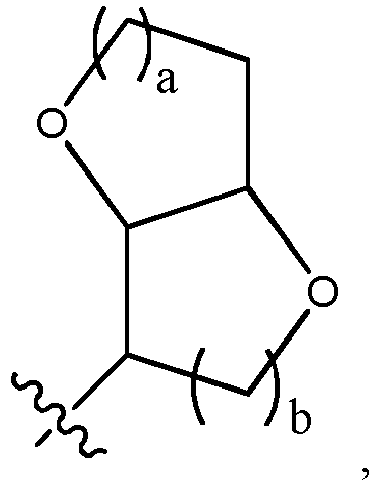
- In another embodiment of the present invention, Y is selected from: -C1-6alkyl, -CHF-, - CF2-, C3-10cycloalkyl, C3-10cycloalkenyl, C2-10cycloheteroalkyl, C2-10cycloheteroalkenyl, aryl, and heteroaryl, wherein Y is unsubstituted or substituted with 1, 2, 3 or 4 substituents selected from Rb.
- In another embodiment of the present invention, Y is selected from: C1-6alkyl, C3-10cycloalkyl, C2-10cycloheteroalkyl, and aryl, wherein Y is unsubstituted or substituted with 1, 2, 3 or 4 substituents selected from Rb. In a class of this embodiment, Y is selected from: - (CH2)2, -(CH2)3, cyclohexyl, tetrahydropyran, piperidine, and phenyl, wherein Y is unsubstituted or substituted with 1, 2, 3 or 4 substituents selected from Rb.
- In another embodiment of the present invention, Y is selected from: C1-6alkyl, C3-10cycloalkyl, and aryl, wherein Y is unsubstituted or substituted with 1, 2, 3 or 4 substituents selected from Rb. In a class of this embodiment, Y is selected from: -(CH2)2, -(CH2)3, cyclohexyl, and phenyl, wherein Y is unsubstituted or substituted with 1, 2, 3 or 4 substituents selected from Rb.
- In another embodiment of the present invention, Y is selected from:

- In another embodiment of the present invention, Z is selected from: hydrogen, oxo, - CO2H, -CH2CO2H, -CH2CO2CH2CH3, -OC(O)CH(CH3)2 -OH, -CH2OH --P(O)(OH)2, - (CH2)nP(O)(OCH2CH3)2, and -(CH2)nP(O)(OH)(OCH2CH3). In another embodiment of the present invention, Z is selected from: hydrogen, - (CH2)nCO2H, and -(CH2)nOH, wherein each CH2 is unsubstituted or substituted with 1 or 2 substituents selected from C1-6alkyl, -OH and -NH2. In a class of this embodiment, Z is selected from: hydrogen, -CO2H, -OH, and -CH2OH, wherein each CH2 is unsubstituted or substituted with 1 or 2 substituents selected from C1-6alkyl, -OH and -NH2. In another class of this embodiment, Z is selected from: hydrogen, -CO2H, -OH, and -CH2OH.
- In another embodiment of the present invention, Z is selected from: -(CH2)nCO2H, and -(CH2)nOH, wherein each CH2 is unsubstituted or substituted with 1 or 2 substituents selected from C1-6alkyl, -OH and -NH2. In a class of this embodiment, Z is selected from: -CO2H, -OH, and -CH2OH, wherein each CH2 is unsubstituted or substituted with 1 or 2 substituents selected from C1-6alkyl, -OH and -NH2. In another class of this embodiment, Z is selected from: - CO2H, -OH, and -CH2OH.
- In another embodiment of the present invention, Z is hydrogen.
- In another embodiment of the present invention, each R1 and R2 is independently selected from: halogen, benzodioxole, phenyl-cyclopropyl, phenyl-cyclohexene, phenyl-azetidine, phenyl-pyrrolidine, phenyl-piperidine, phenyl-piperazine, phenyl-morpholine, phenyl-thiomorpholine, biphenyl, indole, -C2alkynyl-phenyl, phenyl, phenyl-oxazole, phenyl-pyridine, phenyl-furan, phenyl-oxadiazole, pyridine, benzofuran, pyrrolo[2,3-b]pyridine, pyrazole, and benzisoxazole, wherein each alkynyl, cycloalkyl, cycloalkenyl, cycloheteroalkyl, aryl and heteroaryl is unsubstituted or substituted with 1, 2, 3 or 4 substituents independently selected from Ra, provided that at least one of and only one of R1 and R2 is selected from the group consisting of: hydrogen, and halogen.
- In another embodiment of the present invention, R1 and R2 are independently selected from: halogen. In a class of this embodiment, R1 and R2 are independently selected from: F and Cl.
In another class of this embodiment, R1 is halogen. In another class of this embodiment, R1 is selected from F and Cl. - In another class of this embodiment, R2 is halogen. In another class of this embodiment, R2 is selected from F and Cl.
- In another embodiment of the present invention, one of R1 and R2 is halogen. In a subclass of this class, one of R1 and R2 is Br, F, or Cl. In another subclass of this class, one of R1 and R2 is Cl.
- In another embodiment of the present invention, one of R1 and R2 is halogen. In a subclass of this class, one of R1 and R2 is Br, F, or Cl. In another subclass of this class, one of R1 and R2 is Cl.
- In another embodiment of the present invention, each one of R1 and R2 is halogen. In a subclass of this class, one of R1 and R2 is Br, F or Cl. In another subclass of this class, one of R1 and R2 is Cl.
- In another embodiment of the present invention, one of R1 and R2 is Br, F, or Cl. In a subclass of this class, one of R1 and R2 is Cl.
- In another embodiment of the present invention, each R1 and R2 is independently selected from: halogen, aryl, aryl-C3-7cycloalkyl, aryl-C2-10cycloheteroalkyl, aryl-aryl, aryl-heteroaryl, and heteroaryl, wherein each cycloalkyl, cycloheteroalkyl, aryl and heteroaryl is unsubstituted or substituted with 1, 2, 3 or 4 substituents independently selected from Ra, provided that at least one of and only one of R1 and R2 is halogen. In a class of this embodiment, one of R1 and R2 is Br, F, or Cl. In another subclass of this class, one of R1 and R2 is Cl. In another class of this embodiment, each R1 and R2 is independently selected from: halogen, phenyl, phenyl-cyclopropyl, phenyl-pyrrolidine, phenyl piperidine, phenyl-piperazine, biphenyl, phenyl-oxazole, phenyl-pyridine, phenyl-furan, phenyl-oxadiazole, pyridine, indole, benzofuran, benzodioxole, pyrrolo[2,3-b]pyridine, pyrazole, and benzisoxazole, wherein each cycloalkyl, cycloheteroalkyl, aryl and heteroaryl is unsubstituted or substituted with 1, 2, 3 or 4 substituents independently selected from Ra, provided that at least one of and only one of R1 and R2 is halogen. In a subclass of this class, one of R1 and R2 is Br, F, or Cl. In another subclass of this class, one of R1 and R2 is Cl. In another class of this embodiment, R1 is independently selected from: aryl, aryl-C3-7cycloalkyl, aryl-C2-10cycloheteroalkyl, aryl-aryl, aryl-heteroaryl, and heteroaryl, wherein each cycloalkyl, cycloheteroalkyl, aryl and heteroaryl is unsubstituted or substituted with 1, 2, 3 or 4 substituents independently selected from Ra, and R2 is halogen. In a subclass of this class, R2 is Br, F, or Cl. In another subclass of this class, R2 is Cl. In a subclass of this class, R1 is independently selected from: aryl, aryl-C3-7cycloalkyl, aryl-C2-10cycloheteroalkyl, aryl-aryl, aryl-heteroaryl, and heteroaryl, wherein cycloalkyl, cycloheteroalkyl, aryl and heteroaryl is unsubstituted or substituted with 1, 2, 3 or 4 substituents independently selected from Ra. In another subclass of this class, R2 is halogen. In another subclass of this class, R2 is Br, F, or Cl. In another subclass of this class, R2 is Cl.
- In another class of this embodiment, R1 is independently selected from: phenyl, phenyl-cyclopropyl, phenyl-pyrrolidine, phenyl piperidine, phenyl-piperazine, biphenyl, phenyl-oxazole, phenyl-pyridine, phenyl-furan, phenyl-oxadiazole, pyridine, indole, benzofuran, benzodioxole, pyrrolo[2,3-b]pyridine, pyrazole, and benzisoxazole, wherein each cycloalkyl, cycloheteroalkyl, aryl and heteroaryl is unsubstituted or substituted with 1, 2, 3 or 4 substituents independently selected from Ra, and R2 is halogen. In a subclass of this class, R2 is Br, F, or Cl. In another subclass of this class, R2 is Cl.
- In another class of this embodiment, R1 is independently selected from: phenyl, phenyl-cyclopropyl, phenyl-pyrrolidine, phenyl piperidine, phenyl-piperazine, biphenyl, phenyl-oxazole, phenyl-pyridine, phenyl-furan, phenyl-oxadiazole, pyridine, indole, benzofuran, benzodioxole, pyrrolo[2,3-b]pyridine, pyrazole, and benzisoxazole, wherein each cycloalkyl, cycloheteroalkyl, aryl and heteroaryl is unsubstituted or substituted with 1, 2, 3 or 4 substituents independently selected from Ra. In another class of this embodiment, R2 is halogen. In a subclass of this class, R2 is Br, F, or Cl. In another subclass of this class, R2 is Cl.
- In another embodiment of the present invention, each R1 and R2 is independently selected from: halogen, aryl, aryl-C3-7cycloalkyl, aryl-C2-10cycloheteroalkyl, aryl-aryl, and aryl-heteroaryl, wherein each cycloalkyl, cycloheteroalkyl, aryl and heteroaryl is unsubstituted or substituted with 1, 2, 3 or 4 substituents independently selected from Ra, provided that at least one of and only one of R1 and R2 is halogen. In a class of this embodiment, one of R1 and R2 is Br, F, or Cl. In a subclass of this class, one of R1 and R2 is Cl. In another class of this embodiment, each R1 and R2 is independently selected from: halogen, phenyl, phenyl-cyclopropyl, phenyl-pyrrolidine, biphenyl, and phenyl-pyridine, wherein each cycloalkyl, cycloheteroalkyl, aryl and heteroaryl is unsubstituted or substituted with 1, 2, 3 or 4 substituents independently selected from Ra, provided that at least one of and only one of R1 and R2 is halogen. In a subclass of this class, one of R1 and R2 is Br, F, or Cl. In another subclass of this class, one of R1 and R2 is Cl. In another class of this embodiment, R1 is independently selected from: aryl, aryl-C3-7cycloalkyl, aryl-C2-10cycloheteroalkyl, aryl-aryl, and aryl-heteroaryl, wherein each cycloalkyl, cycloheteroalkyl, aryl and heteroaryl is unsubstituted or substituted with 1, 2, 3 or 4 substituents independently selected from Ra, and R2 is halogen. In a subclass of this class, R2 is Br, F, or Cl. In another subclass of this class, R2 is Cl.
- In another class of this embodiment of the present invention, R1 is independently selected from: aryl, aryl-C3-7cycloalkyl, aryl-C2-10cycloheteroalkyl, aryl-aryl, and aryl-heteroaryl, wherein each cycloalkyl, cycloheteroalkyl, aryl and heteroaryl is unsubstituted or substituted with 1, 2, 3 or 4 substituents independently selected from Ra.
- In another class of this embodiment, R1 is independently selected from: phenyl, phenyl-cyclopropyl, phenyl-pyrrolidine, biphenyl, and phenyl-pyridine, wherein each cycloalkyl, cycloheteroalkyl, aryl and heteroaryl is unsubstituted or substituted with 1, 2, 3 or 4 substituents independently selected from Ra; and R2 is halogen. In a subclass of this class, R2 is Br, F, or Cl. In another subclass of this class, R2 is Cl. In a subclass of this class, R1 is independently selected from: phenyl, phenyl-cyclopropyl, phenyl-pyrrolidine, biphenyl, and phenyl-pyridine, wherein each cycloalkyl, cycloheteroalkyl, aryl and heteroaryl is unsubstituted or substituted with 1, 2, 3 or 4 substituents independently selected from Ra.
- In another class of this embodiment, R2 is halogen. In a subclass of this class, R2 is Br, F, or Cl. In another subclass of this class, R2 is Cl.
- In another embodiment of the present invention, one of R1 and R2 is halogen. In a subclass of this class of this embodiment, one of R1 and R2 is selected from Br, F, and Cl. In another subclass of this class of this embodiment, one of R1 and R2 is Cl.
- In a class of this embodiment, each R2 is independently selected from: -(CH2)paryl-C2-10cycloheteroalkyl, and -(CH2)paryl-aryl, wherein each CH2 is unsubstituted or substituted with 1 or 2 substituents selected from: halogen, CF3, -OH, -NH2, -C1-6alkyl, -OC1-6alkyl, -NHC1-6alkyl, and -N(Ci-6alkyl)2, and wherein each cycloheteroalkyl, and aryl is unsubstituted or substituted with 1, 2, 3 or 4 substituents independently selected from Ra, and R1 is selected from the group consisting of: halogen, -CN, -CF3, -C1-6alkyl, -C2-6alkenyl and-C2-6alkynyl. In a subclass of this class, R1 is halogen. In another subclass of this class, R1 is selected from Br, F, and Cl. In another subclass of this class, R1 is Cl.
- In another class of this embodiment, R2 is independently selected from: phenyl-pyrrolidine, and biphenyl, wherein each cycloheteroalkyl, and aryl is unsubstituted or substituted with 1, 2, 3 or 4 substituents independently selected from Ra, and R1 is selected from the group consisting of: halogen, -CN, -CF3, -C1-6alkyl, -C2-6alkenyl and-C2-6alkynyl. In a subclass of this class, R1 is halogen. In another subclass of this class, R1 is selected from Br, F, and Cl. In another subclass of this class, R1 is Cl.
- In another embodiment of the present invention, each R1 and R2 is independently selected from: halogen, -(CH2)paryl-C2-10cycloheteroalkyl, and -(CH2)paryl-aryl, wherein each CH2 is unsubstituted or substituted with 1 or 2 substituents selected from: halogen, CF3, -OH, - NH2, -C1-6alkyl, -OC1-6alkyl, -NHC1-6alkyl, and -N(C1-6alkyl)2, and wherein each cycloheteroalkyl, and aryl is unsubstituted or substituted with 1, 2, 3 or 4 substituents independently selected from Ra, provided that at least one of and only one of R1 and R2 is selected from: halogen. In a class of this embodiment, one of R1 and R2 is selected from Br, F, and Cl. In another subclass of this class, one of R1 and R2 is Cl.
- In another class of this embodiment, R2 is independently selected from: -(CH2)paryl-C2-10cycloheteroalkyl, and -(CH2)paryl-aryl, wherein each CH2 is unsubstituted or substituted with 1 or 2 substituents selected from: halogen, CF3, -OH, -NH2, -C1-6alkyl, -OC1-6alkyl, -NHC1-6alkyl, and -N(Ci-6alkyl)2, and wherein each cycloheteroalkyl, and aryl is unsubstituted or substituted with 1, 2, 3 or 4 substituents independently selected from Ra, and R1 is selected from the group consisting of: halogen. In a subclass of this class, R1 is selected from Br, F, and Cl. In another subclass of this class, R1 is Cl.
- In another embodiment of the present invention, each R1 and R2 is independently selected from: halogen, -(CH2)paryl-C2-10cycloheteroalkyl, and -(CH2)paryl-aryl, wherein each CH2 is unsubstituted or substituted with 1 or 2 substituents selected from: halogen, CF3, -OH, - NH2, -C1-6alkyl, -OC1-6alkyl, -NHC1-6alkyl, and -N(C1-6alkyl)2, and wherein each cycloheteroalkyl, and aryl is unsubstituted or substituted with 1, 2, 3 or 4 substituents independently selected from Ra, provided that at least one of and only one of R1 and R2 is halogen. In a class of this embodiment, one of R1 and R2 is Br, F, or Cl. In a subclass of this class, one of R1 and R2 is Cl. In another class of this embodiment, R2 is independently selected from: -(CH2)paryl-C2-10cycloheteroalkyl, and -(CH2)paryl-aryl, wherein each CH2 is unsubstituted or substituted with 1 or 2 substituents selected from: halogen, CF3, -OH, -NH2, - C1-6alkyl, -OC1-6alkyl, -NHC1-6alkyl, and -N(C1-6alkyl)2, and wherein each alkyl, alkenyl, alkynyl, cycloalkyl, cycloalkenyl, cycloheteroalkyl, cycloheteroalkenyl, phenyl, aryl and heteroaryl is unsubstituted or substituted with 1, 2, 3 or 4 substituents independently selected from Ra, and R1 is halogen. In a subclass of this class, R1 is Br, F, or Cl. In another subclass of this class, R1 is Cl.
- In another embodiment of the present invention, each R1 and R2 is independently selected from: halogen, aryl-C2-10cycloheteroalkyl, and aryl-aryl, wherein each cycloheteroalkyl, and aryl is unsubstituted or substituted with 1, 2, 3 or 4 substituents independently selected from Ra, provided that at least one of and only one of R1 and R2 is halogen. In a class of this embodiment, one of R1 and R2 is Br, F, or Cl. In another class of this embodiment, one of R1 and R2 is Cl. In a class of this embodiment, each R1 and R2 is independently selected from: Cl, phenyl-pyrrolidine, and biphenyl, wherein each cycloheteroalkyl, and aryl is unsubstituted or substituted with 1, 2, 3 or 4 substituents independently selected from Ra, provided that at least one of and only one of R1 and R2 is halogen. In a subclass of this class, one of R1 and R2 is Br, F, or Cl. In another subclass of this class, one of R1 and R2 is Cl. In another class of this embodiment, R2 is independently selected from: phenyl-pyrrolidine, and biphenyl, wherein each cycloheteroalkyl and aryl is unsubstituted or substituted with 1, 2, 3 or 4 substituents independently selected from Ra, and R1 is Cl. In another class of this embodiment, R2 is independently selected from: phenyl-pyrrolidine, and biphenyl, wherein each cycloheteroalkyl, and aryl is unsubstituted or substituted with 1, 2, 3 or 4 substituents independently selected from Ra.
- In another class of this embodiment, R1 is Br, F, or Cl. In another class of this embodiment, R1 is Cl.
- In another embodiment of the present invention, R3 and R4 are each absent or independently selected from: hydrogen, halogen, -C1-6alkyl, -C2-6alkenyl, -C2-6alkynyl, - CN,-CF3, -OH, -OC1-6alkyl, -NH2,-NHC1-6alkyl, -N(C1-6alkyl)2, -SC1-6alkyl, -SOC1-6alkyl, -SO2C1-6alkyl, -NHSO2C1-6alkyl, -NHC(O)C1-6alkyl, -SO2NHC1-6alkyl, and - C(O)NHC1-6alkyl. In a class of this embodiment, R3 and R4 are each absent or independently selected from: hydrogen, halogen, -C1-6alkyl, -CN, -CF3, -OH, -OC1-6alkyl,-NH2, -NHC1-6alkyl, -N(C1-6alkyl)2, and -SC1-6alkyl. In another class of this embodiment, R3 and R4 are each absent or independently selected from: hydrogen, halogen, and -C1-6alkyl.
- In another embodiment of the present invention, R3 and R4 are each absent or hydrogen. In a class of this embodiment, R3 and R4 are absent. In another class of this embodiment, R3 and R4 are hydrogen.
- In another embodiment of the present invention, each R3 is absent or independently selected from: hydrogen, halogen, -C1-6alkyl, -C2-6alkenyl, -C2-6alkynyl, -C3-10cycloalkyl, -C3-10cycloalkenyl, aryl, heteroaryl, -CN, -CF3, -OH, -OC1-6alkyl, -NH2, -NHC1-6alkyl, - N(C1-6alkyl)2, -SC1-6alkyl, -SOC1-6alkyl, -SO2C1-6alkyl, -NHSO2C1-6alkyl, -NHC(O)C1-6alkyl, -SO2NHC1-6alkyl, and -C(O)NHC1-6alkyl.
- In another embodiment of the present invention, each R3 is absent or independently selected from: hydrogen, halogen, -C1-6alkyl, -C2-6alkenyl, -C2-6alkynyl, -CN,-CF3, -OH, - OC1-6alkyl, -NH2,-NHC1-6alkyl, -N(C1-6alkyl)2, -SC1-6alkyl, -SOC1-6alkyl, -SO2C1-6alkyl, -NHSO2C1-6alkyl, -NHC(O)C1-6alkyl, -SO2NHC1-6alkyl, and -C(O)NHC1-6alkyl. In a class of this embodiment, each R3 is absent or independently selected from: hydrogen, halogen, -C1-6alkyl, -CN, -CF3, -OH, -OC1-6alkyl,-NH2, -NHC1-6alkyl, -N(C1-6alkyl)2, and -SC1-6alkyl. In another class of this embodiment, each R3 is absent or independently selected from: hydrogen, halogen, and -C1-6alkyl.
- In another embodiment of the present invention, R3 and R4 are each absent or hydrogen.
- In another embodiment of the present invention, R3 and R4 are each absent or hydrogen; and R5 is hydrogen.
- In another embodiment of the present invention, R3 is absent or hydrogen. In a class of this embodiment, R3 is hydrogen. In another class of this embodiment of the present invention, R3 is absent.
- In another embodiment of the present invention, each R4 is absent or independently selected from: hydrogen, halogen, -C1-6alkyl, -C2-6alkenyl, -C2-6alkynyl, -C3-10cycloalkyl, -C3-10cycloalkenyl, aryl, heteroaryl, -CN, -CF3, -OH, -OC1-6alkyl, -NH2, -NHC1-6alkyl, - N(C1-6alkyl)2, -SC1-6alkyl, -SOC1-6alkyl, -SO2C1-6alkyl, -NHSO2C1-6alkyl, -NHC(O)C1-6alkyl, -SO2NHC1-6alkyl, and -C(O)NHC1-6alkyl.
- In another embodiment of the present invention, each R4 is absent or independently selected from: hydrogen, halogen, -C1-6alkyl, -C2-6alkenyl, -C2-6alkynyl, -CN,-CF3, -OH, - OC1-6alkyl, -NH2,-NHC1-6alkyl, -N(C1-6alkyl)2, -SC1-6alkyl, -SOC1-6alkyl, -SO2C1-6alkyl, -NHSO2C1-6alkyl, -NHC(O)C1-6alkyl, -SO2NHC1-6alkyl, and -C(O)NHC1-6alkyl. In a class of this embodiment, each R4 is absent or independently selected from: hydrogen, halogen, -C1-6alkyl, -CN, -CF3, -OH, -OC1-6alkyl,-NH2, -NHC1-6alkyl, -N(C1-6alkyl)2, and -SC1-6alkyl. In another class of this embodiment, each R4 is absent or independently selected from: hydrogen, halogen, and -C1-6alkyl.
- In another embodiment of the present invention, R4 is absent or hydrogen. In a class of this embodiment, R4 is hydrogen. In another class of this embodiment of the present invention, R4 is absent.
- In another embodiment of the present invention, R5 is selected from: hydrogen, -C1-6alkyl, -CH2CO2H, and -CH2CO2C1-6alkyl. In a class of this embodiment, R5 is selected from: hydrogen, and -C1-6alkyl. In another class of this embodiment, R5 is hydrogen.
- In another embodiment of the present invention, R6 is selected from: hydrogen, -C1-6alkyl, -(CH2)mOC1-6alkyl, halogen, -(CH2)mCN, -(CH2)mCF3, -(CH2)mOCF3, - (CH2)mCHF2, -(CH2)mCH2F, and -(CH2)mSO2C1-6alkyl, wherein each CH2 is unsubstituted or substituted with 1 or 2 substituents selected from: oxo, -(CH2)0-3OH, -CN, -NH2, -NH(C1-6alkyl), -N(C1-6alkyl)2, -C1-6alkyl, -OC1-6alkyl, halogen, -CH2F, -CHF2, -CF3, -CO2H, and - CO2C1-6alkyl, and wherein each alkyl is unsubstituted or substituted with 1, 2, 3 or 4 substituents selected from: oxo, -(CH2)0-5OH, -CN, -NH2, -NH(C1-6alkyl), -N(C1-6alkyl)2, - C1-6alkyl, -OC1-6alkyl, halogen, -CH2F, -CHF2, -CF3, -CO2H, -CO2C1-6alkyl, and -SO2C1-6alkyl.
- In another embodiment of the present invention, R6 is selected from:
hydrogen, -C1-6alkyl, -(CH2)mOC1-6alkyl, halogen, -(CH2)mCN, -(CH2)mCF3, - (CH2)mOCF3, -(CH2)mCHF2, -(CH2)mCH2F, -(CH2)mSO2C1-6alkyl, -(CH2)mCO2H, - (CH2)mCO2C1-6alkyl, -(CH2)mC(O)H, -(CH2)mC(O)NH2, -(CH2)mC3-6cycloalkyl, - (CH2)mC2-7cycloheteroalkyl, -(CH2)maryl, and -(CH2)mheteroaryl, wherein each CH2 is unsubstituted or substituted with 1 or 2 substituents selected from: oxo, -(CH2)0-3OH, -CN, - NH2, -NH(C1-6alkyl), -N(C1-6alkyl)2, -C1-6alkyl, -OC1-6alkyl, halogen, -CH2F, -CHF2, - CF3, -CO2H, -CO2C1-6alkyl, -C3-7cycloalkyl, phenyl, CH2phenyl, heteroaryl and CH2heteroaryl, and wherein alkyl, cycloalkyl, cycloheteroalkyl, aryl and heteroaryl are unsubstituted or substituted with 1, 2, 3 or 4 substituents selected from: oxo, -(CH2)0-5OH, - CN, -NH2, -NH(C1-6alkyl), -N(C1-6alkyl)2, -C1-6alkyl, -OC1-6alkyl, halogen, -CH2F, -CHF2, -CF3, -CO2H, -CO2C1-6alkyl, -SO2C1-6alkyl, -C3-7cycloalkyl, phenyl, CH2phenyl, heteroaryl and CH2heteroaryl. - In another embodiment of the present invention, R6 is selected from: hydrogen, -C1-6alkyl, -OC1-6alkyl, halogen, CN, CF3, OCF3, CHF2, CH2F, SO2C1-6alkyl, CO2H, CO2C1-6alkyl, C(O)H, C(O)NH2, C3-6cycloalkyl, C2-7cycloheteroalkyl, aryl, and heteroaryl, wherein alkyl, cycloalkyl, cycloheteroalkyl, aryl and heteroaryl are unsubstituted or substituted with 1, 2, 3 or 4 substituents selected from: oxo, -(CH2)0-5OH, -CN, -NH2, -NH(C1-6alkyl), -N(C1-6alkyl)2, -C1-6alkyl, -OC1-6alkyl, halogen, -CH2F, -CHF2, -CF3, -CO2H, -CO2C1-6alkyl, and -SO2C1-6alkyl.
- In another embodiment of the present invention, R6 is selected from: hydrogen, -C1-6alkyl, -OC1-6alkyl, halogen, CN, CF3, CO2H, CO2C1-6alkyl, C(O)H, C(O)NH2, C3-6cycloalkyl, C3-6cycloheteroalkyl, aryl, and heteroaryl, wherein alkyl, cycloalkyl, cycloheteroalkyl, aryl and heteroaryl are unsubstituted or substituted with 1, 2, 3 or 4 substituents selected from: oxo, -(CH2)0-5OH, -CN, -NH2, -NH(C1-6alkyl), -N(C1-6alkyl)2, - C1-6alkyl, -OC1-6alkyl, halogen, -CH2F, -CHF2, -CF3, -CO2H, -CO2C1-6alkyl, and -SO2C1-6alkyl.
- In another embodiment of the present invention, R6 is selected from: hydrogen, -C1-6alkyl, halogen, CN, CF3, -CO2H, -C(O)H, -C(O)NH2, -C3-6cycloalkyl, and aryl, wherein alkyl, cycloalkyl, and aryl are unsubstituted or substituted with 1, 2, 3 or 4 substituents selected from: oxo, -(CH2)0-5OH, -CN, -NH2, -NH(C1-6alkyl), -N(C1-6alkyl)2, -C1-6alkyl, -OC1-6alkyl, halogen, -CH2F, -CHF2, -CF3, -CO2H, -CO2C1-6alkyl, and -SO2C1-6alkyl.
- In another embodiment of the present invention, R6 is selected from:
hydrogen, -C1-6alkyl, halogen, CN, CF3, -CO2H, -C(O)H, -C(O)NH2, -C3-6cycloalkyl, and aryl. - In another embodiment of the present invention, R6 is selected from: hydrogen, -CH3, F, CN, CF3, -CO2H, -C(O)H, -C(O)NH2, cyclopropyl, and phenyl.
- In another embodiment of the present invention, R6 is selected from: hydrogen, -C1-6alkyl, halogen, -(CH2)mCN, -(CH2)mCF3, -(CH2)mOCF3, and -(CH2)mSO2C1-6alkyl, wherein each CH2 is unsubstituted or substituted with 1 or 2 substituents selected from: - (CH2)0-1OH, halogen, -CO2H, -CO2C1-6alkyl, -C3-7cycloalkyl, wherein each alkyl is unsubstituted or substituted with 1, 2, 3 or 4 substituents selected from: -(CH2)0-3OH, - halogen, CO2H, and -CO2C1-6alkyl. In a class of this embodiment, R6 is selected from: hydrogen, -C1-6alkyl, halogen, CN, CF3, OCF3, and SO2C1-6alkyl, wherein each alkyl is unsubstituted or substituted with 1, 2, 3 or 4 substituents selected from: -(CH2)0-3OH, - halogen, CO2H, and -CO2C1-6alkyl.
- In another embodiment of the present invention, R6 is selected from: hydrogen, -C1-6alkyl, and halogen, wherein each alkyl is unsubstituted or substituted with 1, 2, 3 or 4 substituents selected from: -(CH2)0-3OH, - halogen, CO2H, and -CO2C1-6alkyl. In a class of this embodiment, R6 is selected from: hydrogen, C1-6alkyl, F, Cl and Br. In another class of this embodiment, R6 is hydrogen, C1-6alkyl or F.
- In another embodiment of the present invention, R6 is selected from: hydrogen, and halogen, wherein each alkyl is unsubstituted or substituted with 1, 2, 3 or 4 substituents selected from: -(CH2)0-3OH, - halogen, CO2H, and -CO2C1-6alkyl. In a class of this embodiment, R6 is selected from: hydrogen, F, Cl and Br. In another class of this embodiment, R6 is hydrogen or F. In a class of this embodiment of the present invention, R6 is hydrogen. In another class of this embodiment of the present invention, R6 is halogen. In a class of this embodiment, R6 is selected from: F, Cl and Br. In another class of this embodiment, R6 is F.
- In another embodiment of the present invention, each Ra is independently selected from the group consisting of: -(CH2)m-halogen, oxo, -(CH2)mOH, -(CH2)mN(Rj)2, -(CH2)mNO2, - (CH2)mCN, -C1-6alkyl, -(CH2)mCF3, -(CH2)mOCF3, -(CH2)mOC1-6alkyl, -(CH2)mSO2C1-6alkyl, -(CH2)mOCORf, -(CH2)mC3-7cycloalkyl, -(CH2)mC2-6cycloheteroalkyl, -(CH2)maryl, -(CH2)mheteroaryl, -(CH2)mO-(CH2)m-aryl, -(CH2)mSO2N(C1-6alkyl)2, -(CH2)mC(O)Rf - (CH2)mC(O)N(Rj)2, and -(CH2)mCO2Rf, wherein each CH2 is unsubstituted or substituted with 1 or 2 substituents selected from: oxo, -(CH2)0-3OH, -CN, -NH2, -NH(C1-6alkyl), -N(C1-6alkyl)2, -C1-6alkyl, -OC1-6alkyl, halogen, -CH2F, -CHF2, -CF3, -CO2H, and -CO2C1-6alkyl, and wherein alkyl, cycloalkyl, cycloalkenyl, cycloheteroalkyl, cycloheteroalkenyl, aryl and heteroaryl are unsubstituted or substituted with 1, 2, 3 or 4 substituents selected from: oxo, - (CH2)0-5OH, -CN, -NH2, -NH(C1-6alkyl), -N(C1-6alkyl)2, -C1-6alkyl, -OC1-6alkyl, halogen, - CH2F, -CHF2, -CF3, -CO2H, -CO2C1-6alkyl, and -SO2C1-6alkyl.
- In another embodiment of the present invention, each Ra is independently selected from the group consisting of: oxo, -(CH2)mOH, -C1-6alkyl, -OC1-6alkyl, -(CH2)mSO2C1-6alkyl, - OCORf, heteroaryl, halogen, -O-(CH2)m-aryl, -SO2N(C1-6alkyl)2, -C(O)Rf, -C(O)N(Rj)2, - CO2Rf, C3-7cycloalkyl, and C2-6cycloheteroalkyl, wherein each CH2 is unsubstituted or substituted with 1 or 2 substituents selected from: oxo, -(CH2)0-3OH, -CN, -NH2, -NH(C1-6alkyl), -N(C1-6alkyl)2, -C1-6alkyl, -OC1-6alkyl, halogen, -CH2F, -CHF2, -CF3, -CO2H, and - CO2C1-6alkyl, and wherein alkyl, cycloalkyl, cycloheteroalkyl, aryl and heteroaryl are unsubstituted or substituted with 1, 2, 3 or 4 substituents selected from: oxo, -(CH2)0-5OH, - CN, -NH2, -NH(C1-6alkyl), -N(C1-6alkyl)2, -C1-6alkyl, -OC1-6alkyl, halogen, -CH2F, -CHF2, -CF3, -CO2H, -CO2C1-6alkyl, and -SO2C1-6alkyl.
- In another embodiment of the present invention, each Ra is independently selected from the group consisting of: oxo, -OH, -CH2OH, -CH(CH3)OH, -CH3, -OCH(CH3)CH2OH, - SO2CH3, -CH2SO2CH3, -OC(O)CH(CH3)2, triazole, F, -(CH2)3OH, -OCH2CH3, - OCH(CH3)2, -O-CH2-phenyl, -SO2N(CH3)2, -C(O)-pyrrolidine, -C(O)NHCH3, -C(O)NH-cyclopropyl, -CO2C(CH3)3, cyclopropyl, and pyrrolidine, wherein each CH2 is unsubstituted or substituted with 1 or 2 substituents selected from: oxo, -(CH2)0-3OH, -CN, -NH2, -NH(C1-6alkyl), -N(C1-6alkyl)2, -C1-6alkyl, -OC1-6alkyl, halogen, -CH2F, -CHF2, -CF3, -CO2H, and - CO2C1-6alkyl, and wherein alkyl and heteroaryl are unsubstituted or substituted with 1, 2, 3 or 4 substituents selected from: oxo, -(CH2)0-5OH, -CN, -NH2, -NH(C1-6alkyl), -N(C1-6alkyl)2, - C1-6alkyl, -OC1-6alkyl, halogen, -CH2F, -CHF2, -CF3, -CO2H, -CO2C1-6alkyl, and -SO2C1-6alkyl.
- In another embodiment of the present invention, each Ra is independently selected from the group consisting of: oxo, -OH, -CH2OH, -CH(CH3)OH, -CH3, -OC(O)CH(CH3)2, - OCH(CH3)CH2OH, -SO2CH3, -CH2SO2CH3, triazole, F, -(CH2)3OH, -OCH2CH3, - OCH(CH3)2, -O-CH2-phenyl, -SO2N(CH3)2, -C(O)-pyrrolidine, -C(O)NHCH3, -C(O)NH-cyclopropyl, -CO2C(CH3)3, cyclopropyl-CH2OH, and pyrrolidine, wherein each CH2 is unsubstituted or substituted with 1 or 2 substituents selected from: oxo, -(CH2)0-3OH and -C1-6alkyl, -OC1-6alkyl, and halogen, and wherein alkyl and heteroaryl are unsubstituted or substituted with 1, 2, 3 or 4 substituents selected from: oxo, -(CH2)0-5OH, -C1-6alkyl, -OC1-6alkyl, and halogen.
- In another embodiment of the present invention, each Ra is independently selected from the group consisting of: -(CH2)m-halogen, oxo, -(CH2)mOH,-(CH2)mN(Rj)2,-(CH2)mNO2, -(CH2)mCN, -C1-6alkyl, -(CH2)mCF3, -(CH2)mOCF3, -O-(CH2)m-OC1-6 alkyl, -(CH2)mC(O)N(Rj)2, -(CH2)mC(=N-OH)N(Rj)2, -(CH2)mOC1-6alkyl, -(CH2)mO-(CH2)m-C3-7cycloalkyl, -(CH2)mO-(CH2)m-C2-7cycloheteroalkyl, -(CH2)mO-(CH2)m-aryl, -(CH2)mO-(CH2)m-heteroaryl, -(CH2)mSC1-6alkyl, -(CH2)mS(O)C1-6alkyl, -(CH2)mSO2C1-6alkyl, -(CH2)mSO2C3-7cycloalkyl, -(CH2)mSO2C2-7cycloheteroalkyl, -(CH2)mSO2-aryl, -(CH2)mSO2-heteroaryl, -(CH2)mSO2NHC1-6alkyl, -(CH2)mSO2N(C1-6alkyl)2, -(CH2)mSO2NHC3-7cycloalkyl, -(CH2)mSO2NHC2-7cycloheteroalkyl, -(CH2)mSO2NH-aryl, -(CH2)mSO2NH-heteroaryl, -(CH2)mNHSO2-C1-6alkyl, -(CH2)mNHSO2-C3-7cycloalkyl, -(CH2)mNHSO2-C2-7cycloheteroalkyl, -(CH2)mNHSO2-aryl, -(CH2)mNHSO2NH-heteroaryl, -(CH2)mN(Rj)-C1-6alkyl, -(CH2)mN(Rj)--C3-7cycloalkyl, -(CH2)mN(Rj)-C2-7cycloheteroalkyl, -(CH2)mN(Rj)-C2-7cycloheteroalkenyl, -(CH2)mN(Rj)-aryl, -(CH2)mN(Rj)-heteroaryl, -(CH2)mC(O)Rf -(CH2)mC(O)N(Rj)2, -(CH2)mN(Rj)C(O)N(Rj)2, -(CH2)mCO2H, -(CH2)mOCOH, -(CH2)mCO2Rf -(CH2)mOCORf, -(CH2)mC3-7cycloalkyl, -(CH2)mC3-7cycloalkenyl, -(CH2)mC2-6cycloheteroalkyl -(CH2)mC2-6cycloheteroalkenyl, -(CH2)maryl, and -(CH2)mheteroaryl, wherein each CH2 is unsubstituted or substituted with 1 or 2 substituents selected from: oxo, -(CH2)0-3OH, -CN, -NH2, -NH(C1-6alkyl), -N(C1-6alkyl)2, -C1-6alkyl, -OC1-6alkyl, halogen, -CH2F, -CHF2, -CF3, -CO2H, and -CO2C1-6alkyl, and wherein alkyl, cycloalkyl, cycloalkenyl, cycloheteroalkyl, cycloheteroalkenyl, aryl and heteroaryl are unsubstituted or substituted with 1, 2, 3 or 4 substituents selected from: oxo, -(CH2)0-5OH, -CN, -NH2, -NH(C1-6alkyl), -N(C1-6alkyl)2, -C1-6alkyl, -OC1-6alkyl, halogen, -CH2F, -CHF2, -CF3, -CO2H, -CO2C1-6alkyl, and -SO2C1-6alkyl.
- In another embodiment of the present invention, each Ra is independently selected from the group consisting of: -(CH2)m-halogen, oxo, -(CH2)mOH, -(CH2)mN(Rj)2, -(CH2)mNO2, -(CH2)mCN, -C1-6alkyl, -(CH2)mCF3, -(CH2)mOCF3, -O-(CH2)m-OC1-6 alkyl, -(CH2)mC(O)N(Rj)2, -(CH2)mC(=N-OH)N(Rj)2, -(CH2)mOC1-6alkyl, -(CH2)mO-(CH2)m-C3-7cycloalkyl, -(CH2)mO-(CH2)m-C2-7cycloheteroalkyl, -(CH2)mO-(CH2)m-aryl, -(CH2)mO-(CH2)m-heteroaryl, -(CH2)mSO2C1-6alkyl, -(CH2)mSO2NHC1-6alkyl, -(CH2)mSO2N(C1-6alkyl)2, -(CH2)mC(O)Rf -(CH2)mC(O)N(Rj)2, -(CH2)mN(Rj)C(O)N(Rj)2, -(CH2)mCO2H, -(CH2)mOCOH, -(CH2)mCO2Rf -(CH2)mOCORf, -(CH2)mC3-7cycloalkyl, -(CH2)mC3-7cycloalkenyl, -(CH2)mC2-6cycloheteroalkyl, -(CH2)mC2-6cycloheteroalkenyl, -(CH2)maryl, and -(CH2)mheteroaryl, wherein each CH2 is unsubstituted or substituted with 1 or 2 substituents selected from: oxo, -(CH2)0-3OH, -CN, -NH2, -NH(C1-6alkyl), -N(C1-6alkyl)2, -C1-6alkyl, -OC1-6alkyl, halogen, -CH2F, -CHF2, -CF3, -CO2H, and -CO2C1-6alkyl, and wherein alkyl, cycloalkyl, cycloalkenyl, cycloheteroalkyl, cycloheteroalkenyl, aryl and heteroaryl are unsubstituted or substituted with 1, 2, 3 or 4 substituents selected from: oxo, -(CH2)0-5OH, -CN, -NH2, -NH(C1-6alkyl), -N(C1-6alkyl)2, -C1-6alkyl, -OC1-6alkyl, halogen, -CH2F, -CHF2, -CF3, -CO2H, -CO2C1-6alkyl, and -SO2C1-6alkyl.
- In another embodiment of the present invention, each Ra is independently selected from the group consisting of: halogen, oxo, -(CH2)mOH, -N(Rj)2, -NO2, -CN, -C1-6alkyl, -CF3, -OCF3, -O-(CH2)m-OC1-6 alkyl, -C(O)N(Rj)2, -OC1-6alkyl, -O-(CH2)m-C3-7cycloalkyl, -O-(CH2)m-C2-7cycloheteroalkyl, -O-(CH2)m-aryl, -O-(CH2)m-heteroaryl, -SO2C1-6alkyl, -SO2NHC1-6alkyl, -SO2N(C1-6alkyl)2, -C(O)Rf, -C(O)N(Rj)2, -N(Rj)C(O)N(Rj)2, -CO2H, -OCOH, -CO2Rf, -OCORf, C3-7cycloalkyl, C3-7cycloalkenyl, C2-6cycloheteroalkyl, C2-6cycloheteroalkenyl, aryl, and heteroaryl, wherein each CH2 is unsubstituted or substituted with 1 or 2 substituents selected from: oxo, -(CH2)0-3OH, -CN, -NH2, -NH(C1-6alkyl), -N(C1-6alkyl)2, -C1-6alkyl, -OC1-6alkyl, halogen, -CH2F, -CHF2, -CF3, -CO2H, and -CO2C1-6alkyl, and wherein alkyl, cycloalkyl, cycloalkenyl, cycloheteroalkyl, cycloheteroalkenyl, aryl and heteroaryl are unsubstituted or substituted with 1, 2, 3 or 4 substituents selected from: oxo, -(CH2)0-5OH, -CN, -NH2, -NH(C1-6alkyl), -N(C1-6alkyl)2, -C1-6alkyl, -OC1-6alkyl, halogen, -CH2F, -CHF2, -CF3, -CO2H, -CO2C1-6alkyl, and -SO2C1-6alkyl.
- In another embodiment of the present invention, each Ra is independently selected from the group consisting of: -(CH2)m-halogen, -(CH2)mOH, -C1-6alkyl, -(CH2)mOC1-6alkyl, -(CH2)mO-(CH2)m-aryl, -(CH2)mSO2C1-6alkyl, -(CH2)mSO2N(C1-6alkyl)2,-(CH2)mC(O)Rf, -(CH2)mC(O)N(Rj)2, -(CH2)mCO2Rf -(CH2)mC3-7cycloalkyl, and -(CH2)mC2-6cycloheteroalkyl, wherein each CH2 is unsubstituted or substituted with 1 or 2 substituents selected from: oxo, -(CH2)0-3OH, -CN, -NH2, -NH(C1-6alkyl), -N(C1-6alkyl)2, -C1-6alkyl, -OC1-6alkyl, halogen, -CH2F, -CHF2, -CF3, -CO2H, and -CO2C1-6alkyl, and wherein alkyl, cycloalkyl, cycloalkenyl, cycloheteroalkyl, cycloheteroalkenyl, aryl and heteroaryl are unsubstituted or substituted with 1, 2, 3 or 4 substituents selected from: oxo, -(CH2)0-5OH, -CN, -NH2, -NH(C1-6alkyl), -N(C1-6alkyl)2, -C1-6alkyl, -OC1-6alkyl, halogen, -CH2F, -CHF2, -CF3, -CO2H, -CO2C1-6alkyl, -SO2C1-6alkyl. In a class of this embodiment, each Ra is independently selected from the group consisting of: -(CH2)m-halogen, -(CH2)mOH, -C1-6alkyl, -(CH2)mOC1-6alkyl, -(CH2)mO-(CH2)m-aryl, -(CH2)mSO2C1-6alkyl, -(CH2)mSO2N(C1-6alkyl)2, -(CH2)mC(O)Rf -(CH2)mC(O)N(Rj)2, -(CH2)mCO2Rf -(CH2)mC3-7cycloalkyl, and -(CH2)mC2-6cycloheteroalkyl, wherein each CH2 is unsubstituted or substituted with 1 or 2 substituents selected from: oxo, -(CH2)0-3OH, -CN, -NH2, -NH(C1-6alkyl), -N(C1-6alkyl)2, -C1-6alkyl, -OC1-6alkyl, halogen, -CH2F, -CHF2, -CF3, -CO2H, and -CO2C1-6alkyl, and wherein alkyl, cycloalkyl, cycloalkenyl, cycloheteroalkyl,cycloheteroalkenyl, aryl and heteroaryl are unsubstituted or substituted with 1, 2, 3 or 4 substituents selected from: oxo, -(CH2)0-5OH, -CN, -NH2, -NH(C1-6alkyl), -N(C1-6alkyl)2, -C1-6alkyl, -OC1-6alkyl, halogen, -CH2F, -CHF2, -CF3, -CO2H, -CO2C1-6alkyl, -SO2C1-6alkyl. In another class of this embodiment, each Ra is independently selected from the group consisting of: halogen, -(CH2)mOH, -C1-6alkyl, -OC1-6alkyl, -O-(CH2)m-aryl, -SO2C1-6alkyl, -SO2N(C1-6alkyl)2, -C(O)Rf, -C(O)N(Rj)2, -CO2Rf, C3-7cycloalkyl, and C2-6cycloheteroalkyl, wherein each CH2 is unsubstituted or substituted with 1 or 2 substituents selected from: oxo, -(CH2)0-3OH, -CN, -NH2, -NH(C1-6alkyl), -N(C1-6alkyl)2, -C1-6alkyl, -OC1-6alkyl, halogen, -CH2F, -CHF2, -CF3, -CO2H, and -CO2C1-6alkyl, and wherein alkyl, cycloalkyl, cycloalkenyl, cycloheteroalkyl, cycloheteroalkenyl, aryl and heteroaryl are unsubstituted or substituted with 1, 2, 3 or 4 substituents selected from: oxo, -(CH2)0-5OH, -CN, -NH2, -NH(C1-6alkyl), -N(C1-6alkyl)2, -C1-6alkyl, -OC1-6alkyl, halogen, -CH2F, -CHF2, -CF3, -CO2H, -CO2C1-6alkyl, -SO2C1-6alkyl. In another class of this embodiment, each Ra is independently selected from the group consisting of: F, -OH, -CH2OH, -(CH2)3OH, -CH3, -OCH2CH3, -OCH(CH3)2, -O-CH2-phenyl, -SO2CH3, -SO2N(CH3)2, -C(O)-pyrrolidine, -C(O)NHCH3, -C(O)NH-cyclopropyl, -CO2C(CH3)3, cyclopropyl, and pyrrolidine, wherein each CH2 is unsubstituted or substituted with 1 or 2 substituents selected from: oxo, -(CH2)0-3OH, -CN, -NH2, -NH(C1-6alkyl), -N(C1-6alkyl)2, -C1-6alkyl, -OC1-6alkyl, halogen, -CH2F, -CHF2, -CF3, -CO2H, and -CO2C1-6alkyl, and wherein alkyl, cycloalkyl, cycloalkenyl, cycloheteroalkyl, cycloheteroalkenyl, aryl and heteroaryl are unsubstituted or substituted with 1, 2, 3 or 4 substituents selected from: oxo, -(CH2)0-5OH, -CN, -NH2, -NH(C1-6alkyl), -N(C1-6alkyl)2, -C1-6alkyl, -OC1-6alkyl, halogen, -CH2F, -CHF2, -CF3, -CO2H, -CO2C1-6alkyl, -SO2C1-6alkyl. In another class of this embodiment, each Ra is independently selected from the group consisting of: F, -OH, -CH2OH, -(CH2)3OH, -CH3,-OCH2CH3, -OCH(CH3)2, -O-CH2-phenyl, -SO2CH3,-SO2N(CH3)2, -C(O)-pyrrolidine, -C(O)NHCH3, -C(O)NH-cyclopropyl, -CO2C(CH3)3, cyclopropyl-CH2OH, and pyrrolidine.
- In another embodiment of the present invention, each Ra is independently selected from the group consisting of: -(CH2)m-halogen, -(CH2)mOH, -(CH2)mOC1-6alkyl, and -(CH2)mSO2C1-6alkyl, wherein each CH2 is unsubstituted or substituted with 1 or 2 substituents selected from: oxo, -(CH2)0-3OH, -CN, -NH2, -NH(C1-6alkyl), -N(C1-6alkyl)2, -C1-6alkyl, -OC1-6alkyl, halogen, -CH2F, -CHF2, -CF3, -CO2H, and -CO2C1-6alkyl, and wherein alkyl is unsubstituted or substituted with 1, 2, 3 or 4 substituents selected from: oxo, -(CH2)0-5OH, -CN, -NH2, -NH(C1-6alkyl), -N(C1-6alkyl)2, -C1-6alkyl, -OC1-6alkyl, halogen, -CH2F, -CHF2, -CF3, -CO2H, -CO2C1-6alkyl, -SO2C1-6alkyl. In a class of this embodiment, each Ra is independently selected from the group consisting of: halogen, -(CH2)mOH, -OC1-6alkyl, and -SO2C1-6alkyl, wherein each CH2 is unsubstituted or substituted with 1 or 2 substituents selected from: oxo, -(CH2)0-3OH, -CN, -NH2, -NH(C1-6alkyl), -N(C1-6alkyl)2, -C1-6alkyl, -OC1-6alkyl, halogen, -CH2F, -CHF2, -CF3, -CO2H, and -CO2C1-6alkyl, and wherein alkyl is unsubstituted or substituted with 1, 2, 3 or 4 substituents selected from: oxo, -(CH2)0-5OH, -CN, -NH2, -NH(C1-6alkyl), -N(C1-6alkyl)2, -C1-6alkyl, -OC1-6alkyl, halogen, -CH2F, -CHF2, -CF3, -CO2H, -CO2C1-6alkyl, -SO2C1-6alkyl. In another class of this embodiment, each Ra is independently selected from the group consisting of: halogen, -(CH2)mOH, -OC1-6alkyl, and -SO2C1-6alkyl. In another class of this embodiment, each Ra is independently selected from the group consisting of: F, -CH2OH, -OCH2CH3 and -SO2CH3.
- In another embodiment of the present invention, each Rb is independently selected from: hydrogen, -C1-6alkyl, -(CH2)t-halogen, -(CH2)s-OH, -(CH2)sNO2, -(CH2)sNH2, -(CH2)sNH(C1-6alkyl), -(CH2)sN(C1-6alkyl)2, -(CH2)sOC1-6alkyl, -(CH2)qCO2H, -(CH2)qCO2C1-6alkyl, -(CH2)sCF3, -(CH2)sOCF3, -(CH2)sCHF2, -(CH2)sCH2F, -(CH2)sCN, -(CH2)sSO2C1-6alkyl, and -(CH2)sCON(Re)2, wherein each CH2 is unsubstituted or substituted with 1 or 2 halogens, and wherein each alkyl, cycloalkyl, cycloalkenyl, cycloheteroalkyl, cycloheteroalkenyl, aryl and heteroaryl is unsubstituted or substituted with 1, 2 or 3 halogens, and wherein two Rb substituents together with the atom to which they are attached may form a C3-6cycloalkyl ring or a C2-6cycloheteroalkyl ring.
- In another embodiment of the present invention, each Rb is independently selected from: -C1-6alkyl, -(CH2)s-OH, -(CH2)sOC1-6alkyl, and -(CH2)t-halogen, wherein each CH2 is unsubstituted or substituted with 1 or 2 halogens, and wherein each alkyl is unsubstituted or substituted with 1, 2 or 3 halogens, and wherein two Rb substituents together with the atom to which they are attached may form a C3-6cycloalkyl ring or a C2-6cycloheteroalkyl ring.
- In another embodiment of the present invention, each Rb is independently selected from: -C1-6alkyl, OH, -OC1-6alkyl, and halogen, wherein each CH2 is unsubstituted or substituted with 1 or 2 halogens, and wherein each alkyl is unsubstituted or substituted with 1, 2 or 3 halogens, and wherein two Rb substituents together with the atom to which they are attached may form a C3-6cycloalkyl ring or a C2-6cycloheteroalkyl ring.
- In another embodiment of the present invention, each Rb is independently selected from: - CH3, OH, -OCH3, Cl, Br, and F, wherein two Rb substituents together with the atom to which they are attached may form a C3cycloalkyl ring or a C2cycloheteroalkyl ring.
- In another embodiment of the present invention, each Rb is independently selected from: - CH3, OH, -OCH3, Cl, Br, and F.
- In another embodiment of the present invention, each Rb is independently selected from: hydrogen, -C1-6alkyl, -(CH2)t-halogen, -(CH2)s-OH, -(CH2)sNO2, -(CH2)sNH2,-(CH2)sNH(C1-6alkyl), -(CH2)sN(C1-6alkyl)2, -(CH2)sOC1-6alkyl, -(CH2)qCO2H,-(CH2)qCO2C1-6alkyl, -(CH2)sCF3, -(CH2)sOCF3, -(CH2)sCHF2, -(CH2)sCH2F, -(CH2)sCN, -(CH2)sSO2C1-6alkyl, and -(CH2)sCON(Re)2, wherein each CH2 is unsubstituted or substituted with 1 or 2 halogens, and wherein each alkyl is unsubstituted or substituted with 1, 2 or 3 halogens. In a class of this embodiment, each Rb is independently selected from: hydrogen, -C1-6alkyl, -halogen, -OH, -NO2, -NH2, -NH(C1-6alkyl), -N(C1-6alkyl)2, -OC1-6alkyl,-CO2H, -CO2C1-6alkyl, -CF3, -OCF3, -CHF2, -CH2F, -CN, -SO2C1-6alkyl, and -CON(Re)2, wherein each alkyl is unsubstituted or substituted with 1, 2 or 3 halogens.
- In another embodiment of the present invention, each Rb is independently selected from: hydrogen, -C1-6alkyl, -(CH2)t-halogen, and -(CH2)s-OH, wherein each CH2 is unsubstituted or substituted with 1 or 2 halogens, and wherein each alkyl is unsubstituted or substituted with 1, 2 or 3 halogens. In a class of this embodiment, each Rb is independently selected from: hydrogen, -C1-6alkyl, and -(CH2)t-halogen, wherein each CH2 is unsubstituted or substituted with 1 or 2 halogens, and wherein each alkyl is unsubstituted or substituted with 1, 2 or 3 halogens. In a class of this embodiment, each Rb is independently selected from: hydrogen, -C1-6alkyl, and halogen, wherein each alkyl is unsubstituted or substituted with 1, 2 or 3 halogens.
- In another embodiment of the present invention, each Rb is independently selected from: -C1-6alkyl, and -(CH2)t-halogen, wherein each CH2 is unsubstituted or substituted with 1 or 2 halogens, and wherein each alkyl is unsubstituted or substituted with 1, 2 or 3 halogens. In a class of this embodiment, each Rb is independently selected from: -C1-6alkyl, and halogen, wherein each alkyl is unsubstituted or substituted with 1, 2 or 3 halogens. In subclass of this class, each Rb is independently selected from: -CH3, Cl, Br, and F. In another subclass of this class, each Rb is independently selected from: -CH3, and F. In another class of this embodiment, each Rb is independently selected from: -C1-6alkyl, wherein each alkyl is unsubstituted or substituted with 1, 2 or 3 halogens. In a subclass of this class, each Rb is -CH3. In another class of this embodiment, each Rb is independently selected from: -(CH2)t-halogen, wherein each CH2 is unsubstituted or substituted with 1 or 2 halogens, and wherein each alkyl is unsubstituted or substituted with 1, 2 or 3 halogens. In a subclass of this class, each Rb is halogen. In another subclass of this class, each Rb is independently selected from: Cl, Br, and F. In another subclass of this class, each Rb is F.
- In another embodiment of the present invention, each Rc and Rd is independently selected from: halogen, oxo, -(CH2)rOH, -(CH2)rN(Re)2, -(CH2)rCN, -C1-6alkyl, -CF3, -C1-6alkyl-OH, -OCH2OC1-6alkyl, -(CH2)rOC1-6alkyl, -OCH2aryl, -(CH2)rSC1-6alkyl,-(CH2)rC(O)Rf, -(CH2)rC(O)N(Re)2, -(CH2)rCO2H, -(CH2)rCO2Rf, -(CH2)rC3-7cycloalkyl,-(CH2)rC2-6cycloheteroalkyl, -(CH2)raryl, and -(CH2)rheteroaryl, wherein each CH2 is unsubstituted or substituted with 1 or 2 substituents selected from: oxo, -OH, -CN, -N(Rh)2,-C1-6alkyl, -OC1-6alkyl, halogen, -CH2F, -CHF2, -CF3, -CO2H, -CO2C1-6alkyl, -C3-7cycloalkyl and heteroaryl, and wherein alkyl, cycloalkyl, cycloheteroalkyl, aryl and heteroaryl are unsubstituted or substituted with 1, 2, 3 or 4 substituents selected from: oxo, -OH, -CN, - N(Rh)2, -C1-6alkyl, -OC1-6alkyl, halogen, -CH2F, -CHF2, -CF3, -CO2H, -CO2C1-6alkyl, -C3-7cycloalkyl and heteroaryl. In a class of this embodiment, each Rc and Rd is independently selected from: halogen, oxo, -(CH2)rOH, -(CH2)rN(Re)2, -(CH2)rCN, -C1-6alkyl, -CF3, -C1-6alkyl-OH, -OCH2OC1-6alkyl, -(CH2)rOC1-6alkyl, -(CH2)rSC1-6alkyl, -(CH2)rC(O)Rf,-(CH2)rC(O)N(Re)2, -(CH2)rCO2H, and -(CH2)rCO2Rf, wherein each CH2 is unsubstituted or substituted with 1 or 2 substituents selected from: oxo, -OH, -CN, -N(Rh)2, -C1-6alkyl, -OC1-6alkyl, halogen, -CH2F, -CHF2, -CF3, -CO2H, -CO2C1-6alkyl, -C3-7cycloalkyl and heteroaryl, and wherein each alkyl is are unsubstituted or substituted with 1, 2, 3 or 4 substituents selected from: oxo, -OH, -CN, -N(Rh)2, -C1-6alkyl, -OC1-6alkyl, halogen, -CH2F, -CHF2, -CF3,-CO2H, and -CO2C1-6alkyl.
- In another embodiment of the present invention, each Rc and Rd is independently selected from: halogen, oxo, -OH, -N(Re)2, -CN, -C1-6alkyl, -CF3, and -C1-6alkyl-OH, wherein each alkyl is are unsubstituted or substituted with 1, 2, 3 or 4 substituents selected from: oxo, -OH, -CN, -N(Rh)2, -C1-6alkyl, -OC1-6alkyl, halogen, -CH2F, -CHF2, -CF3, -CO2H, and -CO2C1-6alkyl. In a class of this embodiment, each Rc and Rd is independently selected from: halogen, and -C1-6alkyl, wherein each alkyl is are unsubstituted or substituted with 1, 2, 3 or 4 substituents selected from: oxo, -OH, -CN, -N(Rh)2, -C1-6alkyl, -OC1-6alkyl, halogen, -CH2F, -CHF2, -CF3, -CO2H, and -CO2C1-6alkyl. In another class of this embodiment, each Rc and Rd is -C1-6alkyl.
- In another embodiment of the present invention, each Rc is independently selected from: halogen, oxo, -(CH2)rOH, -(CH2)rN(Re)2, -(CH2)rCN, -C1-6alkyl, -CF3, -C1-6alkyl-OH,-OCH2OC1-6alkyl, -(CH2)rOC1-6alkyl, -OCH2aryl, -(CH2)rSC1-6alkyl, -(CH2)rC(O)Rf,-(CH2)rC(O)N(Re)2, -(CH2)rCO2H, -(CH2)rCO2Rf, -(CH2)rC3-7cycloalkyl, -(CH2)rC2-6cycloheteroalkyl, -(CH2)raryl, and -(CH2)rheteroaryl, wherein each CH2 is unsubstituted or substituted with 1 or 2 substituents selected from: oxo, -OH, -CN, -N(Rh)2, -C1-6alkyl, -OC1-6alkyl, halogen, -CH2F, -CHF2, -CF3, -CO2H, -CO2C1-6alkyl, -C3-7cycloalkyl and heteroaryl, and wherein alkyl, cycloalkyl, cycloheteroalkyl, aryl and heteroaryl are unsubstituted or substituted with 1, 2, 3 or 4 substituents selected from: oxo, -OH, -CN, -N(Rh)2, -C1-6alkyl,-OC1-6alkyl, halogen, -CH2F, -CHF2, -CF3, -CO2H, -CO2C1-6alkyl, -C3-7cycloalkyl and heteroaryl. In a class of this embodiment, each Rc is independently selected from: halogen, oxo, -(CH2)rOH, -(CH2)rN(Re)2, -(CH2)rCN, -C1-6alkyl, -CF3, -C1-6alkyl-OH, -OCH2OC1-6alkyl, -(CH2)rOC1-6alkyl, -(CH2)rSC1-6alkyl, -(CH2)rC(O)Rf, -(CH2)rC(O)N(Re)2, -(CH2)rCO2H, and -(CH2)rCO2Rf, wherein each CH2 is unsubstituted or substituted with 1 or 2 substituents selected from: oxo, -OH, -CN, -N(Rh)2, -C1-6alkyl, -OC1-6alkyl, halogen, -CH2F, -CHF2,-CF3, -CO2H, -CO2C1-6alkyl, -C3-7cycloalkyl and heteroaryl, and wherein each alkyl is are unsubstituted or substituted with 1, 2, 3 or 4 substituents selected from: oxo, -OH, -CN,-N(Rh)2, -C1-6alkyl, -OC1-6alkyl, halogen, -CH2F, -CHF2, -CF3, -CO2H, and -CO2C1-6alkyl.
- In another embodiment of the present invention, each Rc is independently selected from: halogen, oxo, -OH, -N(Re)2, -CN, -C1-6alkyl, -CF3, and -C1-6alkyl-OH, wherein each alkyl is are unsubstituted or substituted with 1, 2, 3 or 4 substituents selected from: oxo, -OH, -CN,-N(Rh)2, -C1-6alkyl, -OC1-6alkyl, halogen, -CH2F, -CHF2, -CF3, -CO2H, and -CO2C1-6alkyl.
- In a class of this embodiment, each Rc is independently selected from: halogen, and -C1-6alkyl, wherein each alkyl is are unsubstituted or substituted with 1, 2, 3 or 4 substituents selected from: oxo, -OH, -CN, -N(Rh)2, -C1-6alkyl, -OC1-6alkyl, halogen, -CH2F, -CHF2, -CF3, -CO2H, and -CO2C1-6alkyl. In another class of this embodiment, each Rc is -C1-6alkyl. In another class of this embodiment, Rc is -CH3.
- In another embodiment of the present invention, each Rd is independently selected from: halogen, oxo, -(CH2)rOH, -(CH2)rN(Re)2, -(CH2)rCN, -C1-6alkyl, -CF3, -C1-6alkyl-OH,-OCH2OC1-6alkyl, -(CH2)rOC1-6alkyl, -OCH2aryl, -(CH2)rSC1-6alkyl, -(CH2)rC(O)Rf,-(CH2)rC(O)N(Re)2, -(CH2)rCO2H, -(CH2)rCO2Rf, -(CH2)rC3-7cycloalkyl, (CH2)rC2-6cycloheteroalkyl, -(CH2)raryl, and -(CH2)rheteroaryl, wherein each CH2 is unsubstituted or substituted with 1 or 2 substituents selected from: oxo, -OH, -CN, -N(Rh)2, -C1-6alkyl, -OC1-6alkyl, halogen, -CH2F, -CHF2, -CF3, -CO2H, -CO2C1-6alkyl, -C3-7cycloalkyl and heteroaryl, and wherein alkyl, cycloalkyl, cycloheteroalkyl, aryl and heteroaryl are unsubstituted or substituted with 1, 2, 3 or 4 substituents selected from: oxo, -OH, -CN, -N(Rh)2, -C1-6alkyl,-OC1-6alkyl, halogen, -CH2F, -CHF2, -CF3, -CO2H, -CO2C1-6alkyl, -C3-7cycloalkyl and heteroaryl. In a class of this embodiment, each Rd is independently selected from: halogen, oxo, -(CH2)rOH, -(CH2)rN(Re)2, -(CH2)rCN, -C1-6alkyl, -CF3, -C1-6alkyl-OH, -OCH2OC1-6alkyl, -(CH2)rOC1-6alkyl, -(CH2)rSC1-6alkyl, -(CH2)rC(O)Rf, -(CH2)rC(O)N(Re)2, -(CH2)rCO2H, and -(CH2)rCO2Rf, wherein each CH2 is unsubstituted or substituted with 1 or 2 substituents selected from: oxo, -OH, -CN, -N(Rh)2, -C1-6alkyl, -OC1-6alkyl, halogen, -CH2F, -CHF2,-CF3, -CO2H, -CO2C1-6alkyl, -C3-7cycloalkyl and heteroaryl, and wherein each alkyl is are unsubstituted or substituted with 1, 2, 3 or 4 substituents selected from: oxo, -OH, -CN,-N(Rh)2, -C1-6alkyl, -OC1-6alkyl, halogen, -CH2F, -CHF2, -CF3, -CO2H, and -CO2C1-6alkyl.
- In another embodiment of the present invention, each Rd is independently selected from: halogen, oxo, -OH, -N(Re)2, -CN, -C1-6alkyl, -CF3, and -C1-6alkyl-OH, wherein each alkyl is are unsubstituted or substituted with 1, 2, 3 or 4 substituents selected from: oxo, -OH, -CN,-N(Rh)2, -C1-6alkyl, -OC1-6alkyl, halogen, -CH2F, -CHF2, -CF3, -CO2H, and -CO2C1-6alkyl.
- In a class of this embodiment, each Rd is independently selected from: halogen, and -C1-6alkyl, wherein each alkyl is are unsubstituted or substituted with 1, 2, 3 or 4 substituents selected from: oxo, -OH, -CN, -N(Rh)2, -C1-6alkyl, -OC1-6alkyl, halogen, -CH2F, -CHF2, -CF3, -CO2H, and -CO2C1-6alkyl. In another class of this embodiment, each Rd is -C1-6alkyl.
- In another embodiment of the present invention, each Re, Rg and Rh is independently selected from: hydrogen, -C1-6alkyl, and -O-C1-6alkyl, wherein each alkyl is unsubstituted or substituted with 1, 2, 3 or 4 substituents selected from: -OH, oxo, halogen, C1-6alkyl, -OC1-6alkyl, -NH2, -NH(C1-6alkyl), and -N(C1-6alkyl)2.
- In another embodiment of the present invention, each Re, Rg and Rh is independently selected from: hydrogen, and -C1-6alkyl, wherein each alkyl is unsubstituted or substituted with 1, 2, 3 or 4 substituents selected from: -OH, oxo, halogen, C1-6alkyl, -OC1-6alkyl, -NH2,-NH(C1-6alkyl), and -N(C1-6alkyl)2.
- In another embodiment of the present invention, each Re, Rg and Rh is independently selected from: hydrogen, and -C1-6alkyl.
- In another embodiment of the present invention, each Re, Rg and Rh is hydrogen.
- In another embodiment of the present invention, each Re, Rg and Rh is -C1-6alkyl.
- In another embodiment of the present invention, each Re is independently selected from: hydrogen, -C1-6alkyl, and -O-C1-6alkyl, wherein each alkyl is unsubstituted or substituted with 1, 2, 3 or 4 substituents selected from: -OH, oxo, halogen, C1-6alkyl, -OC1-6alkyl, -NH2,-NH(C1-6alkyl), and -N(C1-6alkyl)2.
- In another embodiment of the present invention, each Re is independently selected from: hydrogen, and -C1-6alkyl, wherein each alkyl is unsubstituted or substituted with 1, 2, 3 or 4 substituents selected from: -OH, oxo, halogen, C1-6alkyl, -OC1-6alkyl, -NH2, -NH(C1-6alkyl), and -N(C1-6alkyl)2.
- In another embodiment of the present invention, each Re is independently selected from: hydrogen, and -C1-6alkyl.
- In another embodiment of the present invention, each Re is hydrogen.
- In another embodiment of the present invention, each Re is -C1-6alkyl.
- In another embodiment of the present invention, each Rg is independently selected from: hydrogen, -C1-6alkyl, and -O-C1-6alkyl, wherein each alkyl is unsubstituted or substituted with 1, 2, 3 or 4 substituents selected from: -OH, oxo, halogen, C1-6alkyl, -OC1-6alkyl, -NH2,-NH(C1-6alkyl), and -N(C1-6alkyl)2.
- In another embodiment of the present invention, each Rg is independently selected from: hydrogen, and -C1-6alkyl, wherein each alkyl is unsubstituted or substituted with 1, 2, 3 or 4 substituents selected from: -OH, oxo, halogen, C1-6alkyl, -OC1-6alkyl, -NH2, -NH(C1-6alkyl), and -N(C1-6alkyl)2.
- In another embodiment of the present invention, each Rg is independently selected from: hydrogen, and -C1-6alkyl.
- In another embodiment of the present invention, each Rg is hydrogen.
- In another embodiment of the present invention, each Rg is -C1-6alkyl.
- In another embodiment of the present invention, each Rh is independently selected from: hydrogen, -C1-6alkyl, and -O-C1-6alkyl, wherein each alkyl is unsubstituted or substituted with 1, 2, 3 or 4 substituents selected from: -OH, oxo, halogen, C1-6alkyl, -OC1-6alkyl, -NH2,-NH(C1-6alkyl), and -N(C1-6alkyl)2.
- In another embodiment of the present invention, each Rh is independently selected from: hydrogen, and -C1-6alkyl, wherein each alkyl is unsubstituted or substituted with 1, 2, 3 or 4 substituents selected from: -OH, oxo, halogen, C1-6alkyl, -OC1-6alkyl, -NH2, -NH(C1-6alkyl), and -N(C1-6alkyl)2.
- In another embodiment of the present invention, each Rh is independently selected from: hydrogen, and -C1-6alkyl.
- In another embodiment of the present invention, each Rh is hydrogen.
- In another embodiment of the present invention, each Rh is -C1-6alkyl.
- In another embodiment of the present invention, each Rj is independently selected from: hydrogen, C1-6alkyl, C3-6cycloalkyl, -C(O)Ri, and -SO2Ri.
- In another embodiment of the present invention, each Rj is independently selected from: hydrogen, C1-6alkyl, and C3-6cycloalkyl, wherein each alkyl and cycloalkyl is unsubstituted or substituted with 1, 2, 3 or 4 substituents selected from: -OH, oxo, halogen, C1-6alkyl, -OC1-6alkyl, -NH2, -NH(C1-6alkyl), and -N(C1-6alkyl)2. In a class of this embodiment, each Rj is independently selected from: hydrogen, -CH3, and -cyclopropyl, wherein each alkyl and cyclopropyl is unsubstituted or substituted with 1, 2, 3 or 4 substituents selected from: -OH, oxo, halogen, C1-6alkyl, -OC1-6alkyl, -NH2, -NH(C1-6alkyl), and -N(C1-6alkyl)2. In another class of this embodiment, each Rj is independently selected from: hydrogen, -CH3, -CH2CH3, and-cyclopropyl, wherein each alkyl and cyclopropyl is unsubstituted or substituted with 1, 2, 3 or 4 substituents selected from: -OH, oxo, halogen, C1-6alkyl, -OC1-6alkyl, -NH2, -NH(C1-6alkyl), and -N(C1-6alkyl)2. In another class of this embodiment, each Rj is independently selected from: hydrogen, -CH3, -CH2CH3, and -cyclopropyl, wherein each alkyl and cyclopropyl.
- In another embodiment of the present invention, each Rj is independently selected from: hydrogen, C1-6alkyl, and C3-6cycloalkyl. In a class of this embodiment, each Rj is independently selected from: hydrogen, -CH3, and -cyclopropyl.
- In another embodiment of the present invention, each Rf and Ri is independently selected from: C1-6alkyl, C4-7cycloalkyl, C4-7cycloalkenyl, C3-7cycloheteroalkyl, C3-7cycloheteroalkenyl, aryl, and heteroaryl, wherein each alkyl, cycloalkyl, cycloalkenyl, cycloheteroalkyl, cycloheteroalkenyl, aryl and heteroaryl is unsubstituted or substituted with 1, 2, 3 or 4 substituents selected from: oxo, -OH, -CN, -NH2, -C1-6alkyl, -OC1-6alkyl, halogen, -CH2F,-CHF2, -CF3, -CO2H, -CO2C1-6alkyl, -C3-7cycloalkyl, and heteroaryl.
- In a class of this embodiment, each Rf and Ri is independently selected from: C1-6alkyl, C4-7cycloalkyl, C4-7cycloalkenyl, C3-7cycloheteroalkyl, C3-7cycloheteroalkenyl, aryl, and heteroaryl, wherein each alkyl, cycloalkyl, cycloalkenyl, cycloheteroalkyl, cycloheteroalkenyl, aryl and heteroaryl is unsubstituted or substituted with 1, 2, 3 or 4 substituents selected from: oxo, -OH, -CN, -NH2, -C1-6alkyl, -OC1-6alkyl, halogen, -CH2F, -CHF2, -CF3, -CO2H, and-CO2C1-6alkyl.
- In another embodiment of the present invention, each Rf and Ri is independently selected from: C1-6alkyl, and C3-7cycloheteroalkyl, wherein each alkyl and cycloheteroalkyl is unsubstituted or substituted with 1, 2, 3 or 4 substituents selected from: oxo, -OH, -CN, -NH2,-C1-6alkyl, -OC1-6alkyl, halogen, -CH2F, -CHF2, -CF3, -CO2H, -CO2C1-6alkyl, -C3-7cycloalkyl, and heteroaryl. In a class of this embodiment, each Rf and Ri is independently selected from: C1-6alkyl, and C3-7cycloheteroalkyl, wherein each alkyl and cycloheteroalkyl is unsubstituted or substituted with 1, 2, 3 or 4 substituents selected from: oxo, -OH, -CN, -NH2,-C1-6alkyl, -OC1-6alkyl, halogen, -CH2F, -CHF2, -CF3, -CO2H, and -CO2C1-6alkyl. In another class of this embodiment, each Rf and Ri is independently selected from: -C(CH3)3, and pyrrolidine, wherein each alkyl and pyrrolidine is unsubstituted or substituted with 1, 2, 3 or 4 substituents selected from: oxo, -OH, -CN, -NH2, -C1-6alkyl, -OC1-6alkyl, halogen, -CH2F,-CHF2, -CF3, -CO2H, and -CO2C1-6alkyl. In another class of this embodiment, each Rf and Ri is independently selected from: -C(CH3)3, and pyrrolidine.
- In another embodiment of the present invention, each Rf and Ri is independently selected from: -C(CH3)3, -CH2CH3, -CH(CH3)2, and pyrrolidine.
- In another embodiment of the present invention, each Rf is independently selected from: C1-6alkyl, C4-7cycloalkyl, C4-7cycloalkenyl, C3-7cycloheteroalkyl, C3-7cycloheteroalkenyl, aryl, and heteroaryl, wherein each alkyl, cycloalkyl, cycloalkenyl, cycloheteroalkyl, cycloheteroalkenyl, aryl and heteroaryl is unsubstituted or substituted with 1, 2, 3 or 4 substituents selected from: oxo, -OH, -CN, -NH2, -C1-6alkyl, -OC1-6alkyl, halogen, -CH2F,-CHF2, -CF3, -CO2H, -CO2C1-6alkyl, -C3-7cycloalkyl, and heteroaryl.
- In a class of this embodiment, each Rf is independently selected from: C1-6alkyl, C4-7cycloalkyl, C4-7cycloalkenyl, C3-7cycloheteroalkyl, C3-7cycloheteroalkenyl, aryl, and heteroaryl, wherein each alkyl, cycloalkyl, cycloalkenyl, cycloheteroalkyl, cycloheteroalkenyl, aryl and heteroaryl is unsubstituted or substituted with 1, 2, 3 or 4 substituents selected from: oxo, -OH, -CN, -NH2, -C1-6alkyl, -OC1-6alkyl, halogen, -CH2F, -CHF2, -CF3, -CO2H, and-CO2C1-6alkyl.
- In another embodiment of the present invention, each Rf is independently selected from: C1-6alkyl, and C3-7cycloheteroalkyl, wherein each alkyl and cycloheteroalkyl is unsubstituted or substituted with 1, 2, 3 or 4 substituents selected from: oxo, -OH, -CN, -NH2, -C1-6alkyl,-OC1-6alkyl, halogen, -CH2F, -CHF2, -CF3, -CO2H, -CO2C1-6alkyl, -C3-7cycloalkyl, and heteroaryl. In a class of this embodiment, each Rf is independently selected from: C1-6alkyl, and C3-7cycloheteroalkyl, wherein each alkyl and cycloheteroalkyl is unsubstituted or substituted with 1, 2, 3 or 4 substituents selected from: oxo, -OH, -CN, -NH2, -C1-6alkyl, -OC1-6alkyl, halogen, -CH2F, -CHF2, -CF3, -CO2H, and -CO2C1-6alkyl. In another class of this embodiment, each Rf is independently selected from: -C(CH3)3, and pyrrolidine, wherein each alkyl and pyrrolidine is unsubstituted or substituted with 1, 2, 3 or 4 substituents selected from: oxo, -OH, -CN, -NH2, -C1-6alkyl, -OC1-6alkyl, halogen, -CH2F, -CHF2, -CF3, -CO2H, and-CO2C1-6alkyl. In another class of this embodiment, each Rf is independently selected from:-C(CH3)3, and pyrrolidine. In another class of this embodiment, each Rf is independently selected from: -C(CH3)3, -CH(CH3)2, and pyrrolidine.
- In another embodiment of the present invention, each Ri is independently selected from: C1-6alkyl, C4-7cycloalkyl, C4-7cycloalkenyl, C3-7cycloheteroalkyl, C3-7cycloheteroalkenyl, aryl, and heteroaryl, wherein each alkyl, cycloalkyl, cycloalkenyl, cycloheteroalkyl, cycloheteroalkenyl, aryl and heteroaryl is unsubstituted or substituted with 1, 2, 3 or 4 substituents selected from: oxo, -OH, -CN, -NH2, -C1-6alkyl, -OC1-6alkyl, halogen, -CH2F,-CHF2, -CF3, -CO2H, -CO2C1-6alkyl, -C3-7cycloalkyl, and heteroaryl.
- In a class of this embodiment, each Ri is independently selected from: C1-6alkyl, C4-7cycloalkyl, C4-7cycloalkenyl, C3-7cycloheteroalkyl, C3-7cycloheteroalkenyl, aryl, and heteroaryl, wherein each alkyl, cycloalkyl, cycloalkenyl, cycloheteroalkyl, cycloheteroalkenyl, aryl and heteroaryl is unsubstituted or substituted with 1, 2, 3 or 4 substituents selected from: oxo, -OH, -CN, -NH2, -C1-6alkyl, -OC1-6alkyl, halogen, -CH2F, -CHF2, -CF3, -CO2H, and-CO2C1-6alkyl.
- In another embodiment of the present invention, each Ri is independently selected from: C1-6alkyl, and C3-7cycloheteroalkyl, wherein each alkyl and cycloheteroalkyl is unsubstituted or substituted with 1, 2, 3 or 4 substituents selected from: oxo, -OH, -CN, -NH2, -C1-6alkyl,-OC1-6alkyl, halogen, -CH2F, -CHF2, -CF3, -CO2H, -CO2C1-6alkyl, -C3-7cycloalkyl, and heteroaryl. In a class of this embodiment, each Ri is independently selected from: C1-6alkyl, and C3-7cycloheteroalkyl, wherein each alkyl and cycloheteroalkyl is unsubstituted or substituted with 1, 2, 3 or 4 substituents selected from: oxo, -OH, -CN, -NH2, -C1-6alkyl, -OC1-6alkyl, halogen, -CH2F, -CHF2, -CF3, -CO2H, and -CO2C1-6alkyl. In another class of this embodiment, each Ri is independently selected from: -C(CH3)3, and pyrrolidine, wherein each alkyl and pyrrolidine is unsubstituted or substituted with 1, 2, 3 or 4 substituents selected from: oxo, -OH, -CN, -NH2, -C1-6alkyl, -OC1-6alkyl, halogen, -CH2F, -CHF2, -CF3, -CO2H, and-CO2C1-6alkyl. In another class of this embodiment, each Ri is independently selected from:-C(CH3)3, and pyrrolidine. In another class of this embodiment, each Ri is independently selected from: -C(CH3)3, -CH2CH3, -CH(CH3)2, and pyrrolidine.
- In another embodiment of the present invention, a is 0, 1 or 2. In a class of this embodiment, a is 0 or 1. In another class of this embodiment, a is 1 or 2. In another class of this embodiment, a is 0. In another class of this embodiment, a is 1. In another class of this embodiment, a is 2.
- In another embodiment of the present invention, b is 0, 1 or 2. In a class of this embodiment, b is 0 or 1. In another class of this embodiment, b is 1 or 2. In another class of this embodiment, b is 0. In another class of this embodiment, b is 1. In another class of this embodiment, b is 2.
- In another embodiment of the present invention, n is 0, 1, 2, 3 or 4. In a class of this embodiment, n is 1, 2, 3 or 4. In another class class of this embodiment, n is 1, 2 or 3. In another class of this embodiment, n is 0, 1, 2 or 3. In another class of this embodiment, n is 0, 1 or 2. In another class of this embodiment, n is 1 or 2. In another class of this embodiment, n is 0. In another class of this embodiment, n is 1. In another class of this embodiment, n is 2. In another class of this embodiment, n is 3. In another class of this embodiment, n is 4.
- In another embodiment of the present invention, m is 0, 1, 2, 3 or 4. In a class of this embodiment, m is 1, 2, 3 or 4. In another class of this embodiment, m is 1, 2 or 3. In another class of this embodiment, m is 0, 1, 2 or 3. In another class of this embodiment, m is 0, 1 or 2. In another class of this embodiment, m is 1 or 2. In another class of this embodiment, m is 0. In another class of this embodiment, m is 1. In another class of this embodiment, m is 2. In another class of this embodiment, m is 3. In another class of this embodiment, m is 4.
- In another embodiment of the present invention, p is 0, 1, 2 or 3. In a class of this embodiment, p is 1, 2 or 3. In another class of this embodiment, p is 0, 1 or 2. In another class of this embodiment, p is 1 or 2. In another class of this embodiment, p is 0 or 2. In another class of this embodiment, p is 0. In another class of this embodiment, p is 1. In another class of this embodiment, p is 2. In another class of this embodiment, p is 3.
- In another embodiment of the present invention, q is 0, 1, 2, 3 or 4. In a class of this embodiment, q is 1, 2, 3 or 4. In another class of this embodiment, q is 1, 2 or 3. In another class of this embodiment, q is 0, 1, 2 or 3. In another class of this embodiment, q is 0, 1 or 2. In another class of this embodiment, q is 1 or 2. In another class of this embodiment, q is 0. In another class of this embodiment, q is 1. In another class of this embodiment, q is 2. In another class of this embodiment, q is 3. In another class of this embodiment, q is 4.
- In another embodiment of the present invention, r is 0, 1 or 2. In a class of this embodiment, r is 0 or 1. In another class of this embodiment, r is 1 or 2. In another class of this embodiment, r is 0. In another class of this embodiment, r is 1. In another class of this embodiment, r is 2.
- In another embodiment of the present invention, s is 0, 1, 2, 3 or 4. In a class of this embodiment, s is 1, 2, 3 or 4. In another class of this embodiment, s is 1, 2 or 3. In another class of this embodiment, s is 0, 1, 2 or 3. In another class of this embodiment, s is 0, 1 or 2. In another class of this embodiment, s is 1 or 2. In another class of this embodiment, s is 0. In another class of this embodiment, s is 1. In another class of this embodiment, s is 2. In another class of this embodiment, s is 3. In another class of this embodiment, s is 4.
- In another embodiment of the present invention, t is 0, 1, 2, 3 or 4. In a class of this embodiment, t is 1, 2, 3 or 4. In another class of this embodiment, t is 1, 2 or 3. In another class of this embodiment, t is 0, 1, 2 or 3. In another class of this embodiment, t is 0, 1 or 2. In another class of this embodiment, t is 1 or 2. In another class of this embodiment, t is 0. In another class of this embodiment, t is 1. In another class of this embodiment, t is 2. In another class of this embodiment, t is 3. In another class of this embodiment, t is 4.
- Another embodiment of the present invention relates to compounds of structural formula I wherein:
- T is N;
- U is -CR1-;
- V is -CR2-; and
- W is selected from -CR4-,
- R2 is selected from hydrogen, halogen, -CN, -CF3, -C1-6alkyl, -C2-6alkenyl and-C2-6alkynyl; X is selected from: -CH2-, and -CH2-O-, wherein each CH2 is unsubstituted or substituted with 1 or 2 substituents selected from: hydroxy, halogen, NH2, C1-6alkyl, CO2H, CO2C1-6alkyl, and COC1-6alkyl
- Y is selected from:
- (1) -C1-6alkyl,
- (2) -C2-6alkynyl,
- (3) C3-10cycloalkyl,
- (4) C2-10cycloheteroalkyl,
- (5) aryl,
- (6) heteroaryl, and
- (7)

- Z is selected from:
- (1) hydrogen,
- (2) oxo,
- (3) -(CH2)nCO2H,
- (4) -(CH2)nCO2Ri,
- (5) -(CH2)nOCORi,
- (6) -(CH2)nOH, and
- (7) -(CH2)nP(O)(ORj)2, wherein each CH2 is unsubstituted or substituted with 1 or 2 substituents selected from C1-6alkyl, -OH and -NH2;
- R1 is selected from:
- (1) halogen,
- (2) aryl,
- (3) aryl-C3-7cycloalkyl,
- (4) aryl-C3-7cycloalkenyl,
- (5) aryl-C2-10cycloheteroalkyl,
- (6) aryl-aryl,
- (7) aryl-heteroaryl,
- (8) heteroaryl, and
- (9) -C2-6alkynyl-aryl,
- wherein each alkynyl, cycloalkyl, cycloalkenyl, cycloheteroalkyl, aryl and heteroaryl is unsubstituted or substituted with 1, 2, 3 or 4 substituents independently selected from Ra, provided that at least one of and only one of R1 and R2 is selected from the group consisting of: hydrogen, and halogen;
- R3 is hydrogen or absent;
- R4 is hydrogen or absent;
- R5 is hydrogen, and
- R6 is selected from:
- (1) hydrogen,
- (2) -C1-6alkyl,
- (3) halogen,
- (4) CN,
- (5) CF3,
- (6) -CO2H,
- (7) -C(O)H,
- (8) -C(O)NH2,
- (9) -C3-6cycloalkyl, and
- (10) aryl,
- wherein alkyl, cycloalkyl, and aryl are unsubstituted or substituted with 1, 2, 3 or 4 substituents selected from: oxo, -(CH2)0-5OH, -CN, -NH2, -NH(C1-6alkyl), -N(C1-6alkyl)2, -C1-6alkyl,-OC1-6alkyl, halogen, -CH2F, -CHF2, -CF3, -CO2H, -CO2C1-6alkyl, and -SO2C1-6alkyl; and each n independently selected from 0, 1, 2, 3 or 4;
- or a pharmaceutically acceptable salt thereof.
- Another embodiment of the present invention relates to compounds of structural formula I wherein:
- T is N;
- U is -CR1-;
- V is -CR2-; and
- W is selected from -CR4-,
- R2 is selected from hydrogen and halogen;
- X is X is selected from: -CH2-, and -CH2-O-, wherein each CH2 is unsubstituted or substituted with 1 or 2 substituents selected from: hydroxy, halogen, NH2, C1-6alkyl, CO2H, CO2C1-6alkyl, and COC1-6alkyl;
- Y is selected from:
- (1) -C1-3alkyl,
- (2) -C2alkynyl,
- (3) cyclohexyl,
- (4) tetrahydropyran,
- (5) tetrahydrofuran,
- (6) piperidine,
- (7) phenyl,
- (8) thiophene, and
- (9)

wherein Y is unsubstituted or substituted with 1, 2, 3 or 4 substituents selected from Rb;
- Z is selected from:
- (1) hydrogen,
- (2) oxo,
- (3) -CO2H,
- (4) -CH2CO2H,
- (5) -CH2CO2CH2CH3,
- (6) -OC(O)CH(CH3)2,
- (7) -OH,
- (8) -CH2OH
- (9) -P(O)(OH)2,
- (10) -(CH2)nP(O)(OCH2CH3)2, and
- (11) -(CH2)nP(O)(OH)(OCH2CH3);
- R1 is independently selected from:
- (1) halogen,
- (2) benzodioxole,
- (3) phenyl-cyclopropyl,
- (4) phenyl-cyclohexene,
- (5) phenyl-azetidine,
- (6) phenyl-pyrrolidine,
- (7) phenyl-piperidine,
- (8) phenyl-piperazine,
- (9) phenyl-morpholine,
- (10) phenyl-thiomorpholine,
- (11) biphenyl,
- (12) indole,
- (13) -C2alkynyl-phenyl,
- (14) phenyl,
- (15) phenyl-oxazole,
- (16) phenyl-pyridine,
- (17) phenyl-furan,
- (18) phenyl-oxadiazole,
- (19) pyridine,
- (20) benzofuran,
- (21) pyrrolo[2,3-b]pyridine,
- (22) pyrazole, and
- (23) benzisoxazole,
- wherein each alkynyl, cycloalkyl, cycloalkenyl, cycloheteroalkyl, aryl and heteroaryl is unsubstituted or substituted with 1, 2, 3 or 4 substituents independently selected from Ra, provided that at least one of and only one of R1 and R2 is selected from the group consisting of: hydrogen, and halogen;
- R3 is hydrogen or absent;
- R4 is hydrogen or absent;
- R5 is hydrogen, and
- R6 is selected from:
- (1) hydrogen,
- (2) -CH3,
- (3) F
- (4) CN,
- (5) CF3,
- (6) -CO2H,
- (7) -C(O)H,
- (8) -C(O)NH2,
- (9) cyclopropyl, and
- (10) phenyl; and
- each n independently selected from 0, 1, 2, 3 or 4;
- or a pharmaceutically acceptable salt thereof.
- Another embodiment of the present invention relates to compounds of structural formula I wherein:
- T is -CR3- or N;
- U is -CR1-;
- V is -CR2-;
- W is -CR4-;
- X is selected from:
- (1) -CH2-, and
- (2) -CH2-O-;
- Y is selected from:
- (1) C1-6alkyl,
- (2) C3-10cycloalkyl,
- (3) C2-10cycloheteroalkyl, and
- (4) aryl,
- wherein Y is unsubstituted or substituted with 1, 2, 3 or 4 substituents selected from Rb;
- Z is selected from:
- (1) hydrogen,
- (2) -(CH2)nCO2H, and
- (3) -(CH2)nOH,
- wherein each CH2 is unsubstituted or substituted with 1 or 2 substituents selected from C1-6alkyl, -OH and -NH2;
- each R1 and R2 is independently selected from:
- (1) halogen,
- (2) aryl,
- (3) aryl-C3-7cycloalkyl,
- (4) aryl-C2-10cycloheteroalkyl,
- (5) aryl-aryl,
- (6) aryl-heteroaryl, and
- (7) heteroaryl,
- wherein each cycloalkyl, cycloheteroalkyl, aryl and heteroaryl is unsubstituted or substituted with 1, 2, 3 or 4 substituents independently selected from Ra, provided that at least one of and only one of R1 and R2 is halogen;
- R3 is hydrogen or absent;
- R4 is hydrogen;
- R5 is hydrogen, and
- R6 is hydrogen or halogen;
- or a pharmaceutically acceptable salt thereof.
- Another embodiment of the present invention relates to compounds of structural formula I wherein:
- T is -CR3- or N;
- U is -CR1-;
- V is -CR2-;
- W is -CR4-;
- X is selected from:
- (1) -CH2-, and
- (2) -CH2-O-;
- Y is selected from:
- (1) C1-6alkyl,
- (2) C3-10cycloalkyl,
- (3) C2-10cycloheteroalkyl, and
- (4) aryl,
- wherein Y is unsubstituted or substituted with 1, 2, 3 or 4 substituents selected from Rb;
- Z is selected from:
- (1) hydrogen,
- (2) -(CH2)nCO2H, and
- (3) -(CH2)nOH,
- wherein each CH2 is unsubstituted or substituted with 1 or 2 substituents selected from C1-6alkyl, -OH and -NH2;
- each R1 and R2 is independently selected from:
- (1) halogen,
- (2) phenyl,
- (3) phenyl-cyclopropyl,
- (4) phenyl-pyrrolidine,
- (5) phenyl piperidine,
- (6) phenyl-piperazine,
- (7) biphenyl,
- (8) phenyl-oxazole,
- (9) phenyl-pyridine,
- (10) phenyl-furan,
- (11) phenyl-oxadiazole,
- (12) pyridine,
- (13) indole,
- (14) benzofuran,
- (15) benzodioxole,
- (16) pyrrolo[2,3-b]pyridine,
- (17) pyrazole, and
- (18) benzisoxazole,
- wherein each cycloalkyl, cycloheteroalkyl, aryl and heteroaryl is unsubstituted or substituted with 1, 2, 3 or 4 substituents independently selected from Ra, provided that at least one of and only one of R1 and R2 is halogen;
- R3 is hydrogen or absent;
- R4 is hydrogen;
- R5 is hydrogen, and
- R6 is hydrogen or halogen;
- or a pharmaceutically acceptable salt thereof.
- Another embodiment of the present invention relates to compounds of structural formula I wherein:
- T is -CR3- or N;
- U is -CR1-;
- V is -CR2-;
- W is -CR4-;
- X is -CH2-;
- Y is selected from:
- (1) C1-6alkyl,
- (2) C3-10cycloalkyl, and
- (3) aryl,
- wherein Y is unsubstituted or substituted with 1, 2, 3 or 4 substituents selected from Rb;
- Z is selected from:
- (1) -(CH2)nCO2H, and
- (2) -(CH2)nOH,
- wherein each CH2 is unsubstituted or substituted with 1 or 2 substituents selected from C1-6alkyl, -OH and -NH2;
- R1 is independently selected from:
- (1) aryl,
- (2) aryl-C3-7cycloalkyl,
- (3) aryl-C2-10cycloheteroalkyl,
- (4) aryl-aryl, and
- (5) aryl-heteroaryl,
- wherein each cycloalkyl, cycloheteroalkyl, aryl and heteroaryl is unsubstituted or substituted with 1, 2, 3 or 4 substituents independently selected from Ra;
- R2 is halogen;
- R3 is hydrogen or absent;
- R4 is hydrogen;
- R5 is hydrogen, and
- R6 is hydrogen;
- or a pharmaceutically acceptable salt thereof.
- Another embodiment of the present invention relates to compounds of structural formula I wherein:
- T is -CR3- or N;
- U is -CR1-;
- V is -CR2-;
- W is -CR4-;
- X is -CH2-;
- Y is selected from:
- (1) C1-6alkyl,
- (2) C3-10cycloalkyl, and
- (3) aryl,
- wherein Y is unsubstituted or substituted with 1, 2, 3 or 4 substituents selected from Rb;
- Z is selected from:
- (1) -(CH2)nCO2H, and
- (2) -(CH2)nOH,
- wherein each CH2 is unsubstituted or substituted with 1 or 2 substituents selected from C1-6alkyl, -OH and -NH2;
- R1 is independently selected from:
- (1) phenyl,
- (2) phenyl-cyclopropyl,
- (3) phenyl-pyrrolidine,
- (4) biphenyl, and
- (5) phenyl-pyridine,
- wherein each cycloalkyl, cycloheteroalkyl, aryl and heteroaryl is unsubstituted or substituted with 1, 2, 3 or 4 substituents independently selected from Ra;
- R2 is halogen;
- R3 is hydrogen or absent;
- R4 is hydrogen;
- R5 is hydrogen, and
- R6 is hydrogen;
- or a pharmaceutically acceptable salt thereof.
- In another embodiment of the present invention, the invention relates to compounds of structural formula la:

- In another embodiment of the present invention, the invention relates to compounds of structural formula Ib:

- In another embodiment of the present invention, the invention relates to compounds of structural formula Ic:

- In another embodiment of the present invention, the invention relates to compounds of structural formula Id:

- The compound of structural formula I, includes the compounds of structural formulas la, Ib, Ic and Id, and pharmaceutically acceptable salts, hydrates and solvates thereof.
- Illustrative, but non-limiting, examples of the compounds of the present invention that are useful as activators of AMP-protein kinase are the following compounds:


- "Alkyl", as well as other groups having the prefix "alk", such as alkoxy, alkanoyl, means carbon chains of up to 10 carbons which may be linear or branched or combinations thereof. Examples of alkyl groups include methyl, ethyl, n-propyl, isopropyl, butyl, isobutyl, sec- and tert-butyl, pentyl, hexyl, heptyl, octyl, nonyl, and the like.
- "Alkenyl" means carbon chains up to 10 carbons which contain at least one carbon-carbon double bond, and which may be linear or branched or combinations thereof. Examples of alkenyl include vinyl, allyl, isopropenyl, pentenyl, hexenyl, heptenyl, 1-propenyl, 2-butenyl, 2-methyl-2-butenyl, and the like. In one embodiment of the present invention, alkenyl is vinyl.
- "Alkynyl" means carbon chains up to 10 carbons which contain at least one carbon-carbon triple bond, and which may be linear or branched or combinations thereof. In one embodiment, C2-8alkynyl means a carbon chain with 2 to 8 carbons that contains one carbon-carbon triple bond. Examples of alkynyl include ethynyl, propargyl, 3-methyl-1-pentynyl, 2-heptynyl and the like. In one embodiment of the present invention, alkynyl is ethynyl. In another embodiment, alkynyl is propargyl.
- "Cycloalkyl" means mono- or bicyclic or bridged saturated carbocyclic rings, each having from 3 to 14 carbon atoms. Examples of cycloalkyl include cyclopropyl, cyclobutyl, cyclopentyl, cyclohexyl, cycloheptyl, cyclooctyl, and decahydronaphthyl, and the like. In one embodiment of the present invention, cycloalkyl is selected from cyclopentyl and cyclohexyl. In another embodiment of the present invention, cycloalkyl is selected from cyclopropyl, cyclopentyl, and cyclohexyl. In another embodiment of the present invention, cycloalkyl is cyclopropyl. In another embodiment of the present invention, cycloalkyl is cyclohexyl.
- "Cycloalkenyl" means nonaromatic, mono- or bicyclic or bridged carbocyclic rings, each having from 3 to 14 carbon atoms and containing at least one double bond. Examples of cycloalkyl include cyclopropenyl, cyclobutenyl, cyclopentenyl, cyclohexenyl, cycloheptenyl, cyclooxtenyl, decahydronaphthyl, bicyclo[2.2.1]hept-5-en-2-yl, and the like.
- "Cycloheteroalkyl" means nonaromatic, mono- or bicyclic or bridged saturated carbocyclic rings, each having from 2 to 14 carbon atoms and containing 1, 2, 3, 4 or 5 heteroatoms selected from N, NH, O and S. In one embodiment, C2-10cycloheteroalkyl means non-aromatic, mono- or bicyclic or bridged saturated carbocyclic rings, having from 2 to 10 carbon atoms and containing, 1, 2, 3, 4 or 5 heteroatoms selected from N, NH, O and S. Examples of cycloheteroalkyl include tetrahydrofuranyl, azetidinyl, perhydroazepinyl, dihydrofuranyl, dioxanyl, oxanyl, morpholinyl, 1,4-dithianyl, piperazinyl, piperidinyl, 1,3-dioxolanyl, imidazolidinyl, imidazolinyl, pyrrolinyl, pyrrolidinyl, pyranyl, tetrahydropyranyl, dihydropyranyl, oxathiolanyl, dithiolanyl, 1,3-dithianyl, oxathianyl, thiomorpholinyl, dioxidoisothiazolidinyl, azacycloheptyl, diazobicyclo[3.2.1]-octane, and hexahydroindazolyl. The cycloheteroalkyl ring may be substituted on the ring carbons and/or the ring nitrogens. In one embodiment of the present invention, cycloheteroalkyl is selected from piperidine, pyrrolidine, oxazolidine, 1,3-oxazolidine-2,4-dione, thiazolidine, 1,3-thiazolidine-2,4-dione, imidazolidine, and hydantoin, and the like. In another embodiment of the present invention cycloheteroalkyl is selected from: morpholine, pyrrolidine, piperazine, and piperidine. In another embodiment of the present invention, cycloalkyl is selected from: tetrahydropyran, pyrrolidine, piperazine and piperidine. In another embodiment of the present invention, cycloheteroalkyl is selected from: tetrahydropyran and piperidine. In another embodiment of the present invention, cycloheteroalkyl is selected from: pyrrolidine, piperazine and piperidine. In another embodiment of the present invention, cycloheteroalkyl is pyrrolidine.
- In another embodiment of the present invention, cycloheteroalkyl is dianhydro-mannitol. In another embodiment of the present invention, cycloheteroalkyl is 1, 4:3, 6-dianhydro-mannitol. In another embodiment of the present invention, cycloheteroalkyl is 1, 4:3, 6-dianhydro-D-mannitol. In another embodiment of the present invention, cycloheteroalkyl is hexahydrofuro[3,2-b]furan. In a class of this embodiment, cycloheteroalkyl is 2,3,3a,5,6,6a-hexahydrofuro[3,2-b]furan.
- "Cycloheteroalkenyl" means nonaromatic mono- or bicyclic or bridged rings each having from 2 to 14 carbon atoms containing at least one double bond and containing 1, 2, 3, 4 or 5 heteroatoms selected from N, NH, O and S. Examples of cycloheteroalkenyl include 1,2,4-oxadiazol-5-one, 1,2,4-thiadiazol-5-one, 1,2,4-triazol-3-one, 1,2,3,6-tetrahydropyridine, dihydro-1,3,4-oxadiazole, and [1,6]-dihydropyridine and the like. In one embodiment of the present invention, cycloheteroalkenyl is dihydro-1,3,4-oxadiazole. In another embodiment of the present invention, cycloheteroalkenyl is [1,6]-dihydropyridine.
- In another embodiment of the present invention, cycloheteroalkenyl is dihydropyrrolo[3,4-c]pyrazole. In a class of this embodiment, cycloheteroalkenyl is 4,6-dihydropyrrolo[3,4-c]pyrazole.
- In another embodiment of the present invention, cycloheteroalkenyl is dihydroimidazole or tetrahydropyrimidine. In a class of this embodiment, cycloheteroalkenyl is 2,5 dihydro-1H-imidazole or 1,4,5,6-tetrahydropyrimidine. In another class of this embodiment, cycloheteroalkenyl is dihydroimidazole. In another class of this embodiment, cycloheteroalkenyl is 2,5 dihydro-1H-imidazole. In another class of this embodiment, cycloheteroalkenyl is tetrahydropyrimidine. In another class of this embodiment, cycloheteroalkenyl is 1,4,5,6-tetrahydropyrimidine.
- "Aryl" means a monocyclic, bicyclic or tricyclic ring system containing 5-14 carbon atoms, wherein at least one of the rings is aromatic. Aryl thus includes ring systems in which an aromatic ring is fused to a non-aromatic ring, such as a cycloalkyl or cycloalkenyl ring. Examples of aryl include phenyl, naphthalene, biphenyl, indane and 5,6,7,8-tetrahydronaphthalene, and the like. In one embodiment of the present invention, aryl is phenyl, naphthalene, biphenyl, indane, and 5,6,7,8-tetrahydronaphthalene. In another embodiment of the present invention, aryl is phenyl, naphthalene, indane and 5,6,7,8-tetrahydronaphthalene. In one class of this embodiment, aryl is phenyl and naphthalene. In another class of this embodiment, aryl is phenyl. In another class of this embodiment, aryl is naphthalene.
- "Heteroaryl" means a monocyclic, bicyclic or tricyclic ring system containing 2-14 carbon atoms and containing 1, 2, 3, 4 or 5 heteroatoms selected from N, NH, O and S wherein at least one of the heteroatom containing rings is aromatic. Heteroaryl thus includes ring systems in which an aromatic heteroatom containing ring is fused to a non-aromatic ring, such as a cycloalkyl, cycloalkenyl, cycloheteroalkyl or cycloheteroalkenyl ring, and also includes ring systems in which an aryl ring is fused to a non-aromatic heteroatom containing ring, such as acycloheteroalkyl or cycloheteroalkenyl ring. Examples of heteroaryls include: pyrazole, pyridine, pyrazine, pyrimidine, thiazole, thiophene, benzoimidazole, quinoline, isoquinoline, indole, indazole, carbazole, benzotriazole, benzofuran, benzothiazole, benzothiophene, benzoisooxazole, oxazole, furan, benzoxazole, isoxazole, indoline, isoindoline, tetrazole, imidazole, oxadiazole, thiadiazole, triazole, benzothiazole, bernzopyrazole, imidazopyridine, benzodioxole, dihydropyridine, dihydropyrrolopyridine, dihydrobenzooxazine, benzodioxole, benzodioxine, pyrrolopyridine, triazolopyridine, dihydropyridooxazine, dihydrobenzoxazine, dihydroindole, dihydroisoindole, dihydrobenzoimidazole, dihydroquinoline, tetrahydroisoquinoline, tetrahydrocyclopentaindole, tetrahydroquinoxaline, and tetrahydropyridine. In one embodiment of the present invention, heteroaryl is selected from: imidazole, pyrazole, pyridine, pyrazine, pyrimidine, thiazole, thiophene, benzoimidazole, quinoline, isoquinoline, indole, indazole, carbazole, benzotriazole, benzofuran, benzothiazole, benzo[b]thiophene, benzo[d]isooxazole, 3,4-dihydro-2H-benzo[1,4]oxazine, benzo[1,3]dioxole, benzo[1,4]dioxine, 1H-pyrrolo[2,3-b]pyridine, 1,6-dihydro-pyridine, [1,2,4]triazolo[4,3-a]pyridine, 3,4 dihydropyrido [3,2-b][1,4]oxazine, 3,4-dihydro-2H-1,4-benzoxazine, 2,3-dihydro-1H-indole, 2,3-dihydro-1H-isoindole, 2,3-dihydrobenzoimidazole, 1,2-dihydroquinoline, 1,2,3,4-tetrahydroisoquinoline, 1,2,3,4-tetrahydrocyclopenta[b]indole, 1,2,3,4-tetrahydroquinoxaline, and 1,2,3,6-tetrahydropyridine. In another embodiment of the present invention, heteroaryl is tetrazole. In another embodiment, heteroaryl is selected from: pyrazole, pyridine, pyrimidine, isoxazole, imidazole, oxazole, triazole, tetrazole, oxadiazole, thiazole, thiadiazole, and benzoxazole. In another embodiment of this invention, heteroaryl is tetrazole. In another class of this embodiment, heteroaryl is indole. In another embodiment of the present invention, heteroaryl is triazole. In another class of this embodiment, heteroaryl is benzodioxole.
- In another embodiment, heteroaryl is selected from: furan, oxazole, pyridine, oxadiazole, indole, benzofuran, benzodioxole, azaindole, pyrazole, and benzisoxazole.
- In another embodiment, heteroaryl is selected from: furan, oxazole, pyridine, and oxadiazole.
- In another embodiment, heteroaryl is selected from: indole, benzofuran, benzodioxole, azaindole, pyrazole, and benzisoxazole.
- "Halogen" includes fluorine, chlorine, bromine and iodine. In one embodiment of the present invention, halogen is selected from fluorine, chlorine, and bromine. In another embodiment of the present invention, halogen is selected from fluorine, and chlorine. In another embodiment of the present invention, halogen is fluorine. In another embodiment of the present invention, halogen is chlorine.
- When any variable (e.g., R1, Ra, etc.) occurs more than one time in any constituent or in formula I, its definition on each occurrence is independent of its definition at every other occurrence. Also, combinations of substituents and/or variables are permissible only if such combinations result in stable compounds. A squiggly line across a bond in a substituent variable represents the point of attachment.
- Under standard nomenclature used throughout this disclosure, the terminal portion of the designated side chain is described first, followed by the adjacent functionality toward the point of attachment. For example, a C1-5 alkylcarbonylamino C1-6 alkyl substituent is equivalent to:

- In choosing compounds of the present invention, one of ordinary skill in the art will recognize that the various substituents, i.e. R1, R2, etc., are to be chosen in conformity with well-known principles of chemical structure connectivity and stability.
- The term "substituted" shall be deemed to include multiple degrees of substitution by a named substitutent. Where multiple substituent moieties are disclosed or claimed, the substituted compound can be independently substituted by one or more of the disclosed or claimed substituent moieties, singly or plurally. By independently substituted, it is meant that the (two or more) substituents can be the same or different.
- Compounds of Formula I may contain one or more asymmetric centers and can thus occur as racemates and racemic mixtures, single enantiomers, diastereomeric mixtures and individual diastereomers. The present invention is meant to comprehend all such isomeric forms of the compounds of Formula I.
- Some of the compounds described herein contain olefinic double bonds, and unless specified otherwise, are meant to include both E and Z geometric isomers.
- Tautomers are defined as compounds that undergo rapid proton shifts from one atom of the compound to another atom of the compound. Some of the compounds described herein may exist as tautomers with different points of attachment of hydrogen. Such an example may be a ketone and its enol form known as keto-enol tautomers. The individual tautomers as well as mixture thereof are encompassed with compounds of Formula I.
- In the compounds of general formula I, the atoms may exhibit their natural isotopic abundances, or one or more of the atoms may be artificially enriched in a particular isotope having the same atomic number, but an atomic mass or mass number different from the atomic mass or mass number predominately found in nature. The present invention is meant to include all suitable isotopic variations of the compounds of structural formula I. For example, different isotopic forms of hydrogen (H) include protium (1H) and deuterium (2H). Protium is the predominant hydrogen isotope found in nature. Enriching for deuterium may afford certain therapeutic advantages, such as increasing in vivo half-life or reducing dosage requirements, or may provide a compound useful as a standard for characterization of biological samples. Isotopically-enriched compounds within structural formula I, can be prepared without undue experimentation by conventional techniques well known to those skilled in the art or by processes analogous to those described in the Schemes and Examples herein using appropriate isotopically-enriched reagents and/or intermediates.
- Compounds of the Formula I may be separated into diastereoisomeric pairs of enantiomers by, for example, fractional crystallization from a suitable solvent, for example MeOH or ethyl acetate or a mixture thereof. The pair of enantiomers thus obtained may be separated into individual stereoisomers by conventional means, for example by the use of an optically active amine as a resolving agent or on a chiral HPLC column.
- Alternatively, any enantiomer of a compound of the general Formula I may be obtained by stereospecific synthesis using optically pure starting materials or reagents of known configuration.
- Furthermore, some of the crystalline forms for compounds of the present invention may exist as polymorphs and as such are intended to be included in the present invention. In addition, some of the compounds of the instant invention may form solvates with water or common organic solvents. Such solvates are encompassed within the scope of this invention.
- It is generally preferable to administer compounds of the present invention as enantiomerically pure formulations. Racemic mixtures can be separated into their individual enantiomers by any of a number of conventional methods. These include chiral chromatography, derivatization with a chiral auxiliary followed by separation by chromatography or crystallization, and fractional crystallization of diastereomeric salts.
- The term "pharmaceutically acceptable salts" refers to salts prepared from pharmaceutically acceptable non-toxic bases or acids including inorganic or organic bases and inorganic or organic acids. Salts derived from inorganic bases include aluminum, ammonium, calcium, copper, ferric, ferrous, lithium, magnesium, manganic salts, manganous, potassium, sodium, zinc, and the like. Particularly preferred are the ammonium, calcium, magnesium, potassium, and sodium salts. Salts derived from pharmaceutically acceptable organic non-toxic bases include salts of primary, secondary, and tertiary amines, substituted amines including naturally occurring substituted amines, cyclic amines, and basic ion exchange resins, such as arginine, betaine, caffeine, choline, N,N'-dibenzylethylenediamine, diethylamine, 2-diethylaminoethanol, 2-dimethylaminoethanol, ethanolamine, ethylenediamine, N-ethylmorpholine, N-ethylpiperidine, glucamine, glucosamine, histidine, hydrabamine, isopropylamine, lysine, methylglucamine, morpholine, piperazine, piperidine, polyamine resins, procaine, purines, theobromine, triethylamine, trimethylamine, tripropylamine, tromethamine, and the like. The term "pharmaceutically acceptable salt" further includes all acceptable salts such as acetate, trifluoroacetate, lactobionate, benzenesulfonate, laurate, benzoate, malate, bicarbonate, maleate, bisulfate, mandelate, bitartrate, mesylate, borate, methylbromide, bromide, methylnitrate, calcium edetate, methylsulfate, camsylate, mucate, carbonate, napsylate, chloride, nitrate, clavulanate, N-methylglucamine, citrate, ammonium salt, dihydrochloride, oleate, edetate, oxalate, edisylate, pamoate (embonate), estolate, palmitate, esylate, pantothenate, fumarate, phosphate/diphosphate, gluceptate, polygalacturonate, gluconate, salicylate, glutamate, stearate, glycollylarsanilate, sulfate, hexylresorcinate, subacetate, hydrabamine, succinate, hydrobromide, tannate, hydrochloride, tartrate, hydroxynaphthoate, teoclate, iodide, tosylate, isothionate, triethiodide, lactate, panoate, valerate, and the like which can be used as a dosage form for modifying the solubility or hydrolysis characteristics or can be used in sustained release or pro-drug formulations.
- It will be understood that, as used herein, references to the compounds of Formula I are meant to also include the pharmaceutically acceptable salts.
- Compounds of the present invention are activators of the AMP-activated protein kinase. The methods of treatment of this invention comprise a method of activating AMPK-activated protein kinase and treating AMPK-activated protein kinase mediated diseases by administering to a patient in need of such treatment a non-toxic therapeutically effective amount of a compound of this invention that activates AMPK-activated protein kinase.
- AMP-activated protein kinase (AMPK) is a heterotrimeric enzyme composed of a catalytic α subunit and regulatory β and γ subunits. There are two genes encoding isoforms of both the α and β subunits (α1, α2, β1 and β2) and three genes encoding isoforms of the γ subunit (γ1, γ2 and γ3) leading to 12 possible heterotrimeric combinations. The α2 isoform is predominately found in skeletal and cardiac muscle AMPK; both the α1 and α2 isoforms are found in hepatic AMPK; while in pancreatic islet β-cells the α1 isoform AMPK predominates. In particular, the compounds of structural formula I are activators of at least one heterotrimeric isoform of AMP-activated protein kinase.
- An "activator" is a compound that either increases the activity (phosphorylation of downstream substrates) of fully phosphorylated AMPK or that increases the phosphorylation of AMPK.
- The compounds of the present invention may be efficacious in the treatment and prevention of diseases, disorders and conditions that are responsive to the activation of AMP-activated protein kinase, including but not limited to: type 2 diabetes, insulin resistance, hyperglycemia, obesity, hyperinsulinemia, glucose intolerance, atherosclerosis, Metabolic Syndrome, hypertension, high hepatic glucose output, high blood glucose concentrations, nonalcoholic steatohepatitis, protection against ischemia and reperfusion damage, and lipid disorders, such as dyslipidemia, elevated levels of plasma triglycerides, elevated levels of free fatty acids, elevated levels of cholesterol, high levels of low density lipoprotein (LDL) and low levels of high density lipoprotein (HDL). The compounds may also be useful for the treatment of cancer, hypoxia and glucocorticoid-induced apoptosis. The compounds may also be useful for the treatment of sarcopenia by treating or preventing the loss of skeletal muscle mass, including but not limited to a loss of skeletal muscle mass due to aging.
- One or more of the following diseases may be treated by the administration of a therapeutically effective amount of a compound of Formula I, or a pharmaceutically acceptable salt thereof, to a patient in need of treatment or prevention of: (1) non-insulin dependent diabetes mellitus (Type 2 diabetes); (2) hyperglycemia; (3) Metabolic Syndrome; (4) obesity; (5) hypercholesterolemia; (6) hypertriglyceridemia (elevated levels of triglyceride-rich-lipoproteins); (7) mixed or diabetic dyslipidemia; (8) low HDL cholesterol; (9) high LDL cholesterol; (10) atherosclerosis; (11) atherosclerosis, (12) hypertension, (13) sarcopenia, (14) high circulating free fatty acids (FFAs), (15) non-alcoholic steatohepatitis (NASH), (16) non-alcoholic fatty liver disease (NAFLD), (17) Type 1 diabetes, (18) heart attack, (19) cardiomyopathy, and (20) heart failure.
- One embodiment is compounds for use in the treatment of one or more of the following diseases: (1) Type 2 diabetes; (2) hyperglycemia; (3) Metabolic Syndrome; (4) obesity; (5) hypercholesterolemia; and (6) hypertension.
- In another embodiment is compounds for use in the treatment of one or more of the following diseases: (1) Type 2 diabetes; (2) hyperglycemia; (3) Metabolic Syndrome; (4) obesity; (5) hypercholesterolemia; (6) hypertension; and (7) cancer.
- In another embodiment is compounds for use in the treatment of one or more of the following diseases: (1) Type 2 diabetes; (2) hyperglycemia; (3) Metabolic Syndrome; (4) obesity; (5) hypercholesterolemia; (6) hypertension; (7) low HDL; (8) high LDL; (9) high triglycerides; (10) atherosclerosis; (11) sarcopenia; and (12) cancer.
- The compounds of structural Formula I may also be used for manufacturing a medicament for potential use in the treatment of one or more of the above diseases.
- The compounds may also be effective in lowering glucose and lipids in diabetic patients and in non-diabetic patients who have impaired glucose tolerance and/or are in a pre-diabetic condition. The compounds may ameliorate hyperinsulinemia, which often occurs in diabetic or pre-diabetic patients, by modulating the swings in the level of serum glucose that often occurs in these patients. The compounds may also be effective in treating or reducing insulin resistance. The compounds may be effective in treating or preventing gestational diabetes.
- The compounds, compositions, methods and medicaments as described herein may also be effective in: a) reducing the risks of adverse sequelae associated with metabolic syndrome, b) reducing the risk of developing atherosclerosis, c) delaying the onset of atherosclerosis, and/or d) reducing the risk of sequelae of atherosclerosis. Sequelae of atherosclerosis include angina, claudication, heart attack, stroke, and others. By keeping hyperglycemia under control, the compounds may also be effective in delaying or preventing vascular restenosis and diabetic retinopathy.
- The compounds of this invention may also have utility in improving or restoring β-cell function, so that they may be useful in treating type 1 diabetes or may be useful in delaying or preventing a patient with Type 2 diabetes from needing insulin therapy.
- Other possible outcomes of treatment with the compounds of the present invention may be, but are not limited to: 1) a decrease in fatty acid synthesis; 2) an increase in fatty acid oxidation and ketogenesis; 3) a decrease in cholesterol synthesis, lipogenesis, and triglyceride synthesis; 4) a decrease in blood glucose levels and concentration; 5) an improvement in glucose homeostasis; 6) a normalization of glucose metabolism; 7) a decrease in blood pressure; 8) an increase in HDL; 9) a decrease in LDL; 10) a decrease in plasma triglycerides; 11) a decrease in free fatty acids; 12) a decrease in hepatic glucose output; 13) an improvement in insulin action; 14) a decrease in blood pressure; 15) an improvement in insulin sensitivity; 16) a suppression of hepatic glucose output; 17) an inhibition of de novo lipogenesis; 18) stimulation of muscle glucose uptake; 19) modulation of insulin secretion by pancreatic β cells; 20) a decrease in body weight; 21) an increase in skeletal muscle mass; 22) a prevention in the loss of skeletal muscle mass.
- The compounds may be efficacious in treating one or more of the following diseases: (1) Type 2 diabetes (also known as non-insulin dependent diabetes mellitus, or NIDDM), (2) hyperglycemia, (3) impaired glucose tolerance, (4) insulin resistance, (5) obesity, (6) lipid disorders, (7) dyslipidemia, (8) hyperlipidemia, (9) hypertriglyceridemia, (10) hypercholesterolemia, (11) low HDL levels, (12) high LDL levels, (13) atherosclerosis and its sequelae, (14) vascular restenosis, (15) abdominal obesity, (16) retinopathy, (17) metabolic syndrome, (18) high blood pressure (hypertension), and (19) insulin resistance.
- One aspect of the invention provides a compound having formula I for use in a method for the treatment and control of mixed or diabetic dyslipidemia, hypercholesterolemia, atherosclerosis, low HDL levels, high LDL levels, hyperlipidemia, and/or hypertriglyceridemia. The compound may be used alone or advantageously may be administered with a cholesterol biosynthesis inhibitor, particularly an HMG-CoA reductase inhibitor such as lovastatin, simvastatin, rosuvastatin, pravastatin, fluvastatin, atorvastatin, rivastatin, itavastatin, or ZD-4522. The compound may also be used advantageously in combination with other lipid lowering drugs such as cholesterol absorption inhibitors (for example stanol esters, sterol glycosides such as tiqueside, and azetidinones such as ezetimibe), ACAT inhibitors (such as avasimibe), CETP inhibitors (for example anacetrapib, torcetrapib, and those described in published applications
WO2005/100298 ,WO2006/014413 , andWO2006/014357 ), niacin and niacin receptor agonists, bile acid sequestrants, microsomal triglyceride transport inhibitors, and bile acid reuptake inhibitors. These combination treatments may be effective for the treatment or control of one or more related conditions selected from the group consisting of hypercholesterolemia, atherosclerosis, hyperlipidemia, hypertriglyceridemia, dyslipidemia, high LDL, and low HDL. - The present invention also relates to compounds and pharmaceutical compositions of the present invention for use in methods and medicaments for the treatment, control, or prevention of Type 2 diabetes. The present invention also relates to compounds of the present invention in combination with a therapeutically effective amount of another agent known to be useful to treat the condition for use in the treatment, control, or prevention of Type 2 diabetes. The present invention also relates to the compounds and pharmaceutical compositions of the present invention alone, or in combination for use in the treatment, control, or prevention of diabetes related disorders. The present invention also relates to the compounds and pharmaceutical compositions of the present invention alone, or in combination for use in the treatment and prevention of diabetes in pre-diabetic subject.
- The present invention also relates to the compounds and pharmaceutical compositions of the present invention, alone or in combination with a therapeutically effective amount of another agent known to be useful to treat the condition for use in the treatment, control, or prevention of obesity. The present invention also relates to the compounds and pharmaceutical compositions of the present invention alone, or in combination for use in the treatment, control, or prevention of obesity related disorders. The present invention also relates to compounds and pharmaceutical compositions of the present invention alone, or in combination for use in the treatment and prevention of obesity in overweight subject. The compounds may also be useful for the treatment of obesity related disorders, and eating disorders associated with excessive food intake, and complications associated therewith, including left ventricular hypertrophy, as well as treating or preventing obesity in other mammalian species, including canines and felines.
- The present invention also relates to the compounds and pharmaceutical compositions of the present invention, alone or in combination with a therapeutically effective amount of another agent known to be useful to treat the condition for use in the treatment, control, or prevention of hyperglycemia.
- The present invention also relates to compounds and pharmaceutical compositions of the present invention, alone or in combination with a therapeutically effective amount of another agent known to be useful to treat the condition for use in treatment, control, or prevention of insulin resistance.
- The present invention also relates the compounds and pharmaceutical compositions of the present invention, alone or in combination with a therapeutically effective amount of another agent known to be useful to treat the condition for use in treatment, control, or prevention of lipid disorders. The present invention also relates to compounds and pharmaceutical compositions of the present invention alone, or in combination for use in treatment, control, or prevention of dyslipidemia related disorders and lipid disorder-related disorders.
- The present invention also relates to the compounds and pharmaceutical compositions of the present invention, alone or in combination with a therapeutically effective amount of another agent known to be useful to treat the condition for use in treatment, control, or prevention of atherosclerosis.
- The present invention also relates to the compounds and pharmaceutical compositions of the present invention, alone or in combination with a therapeutically effective amount of another agent known to be useful to treat the condition for use in treatment, control, or prevention of hypertension. The present invention also relates to compounds and pharmaceutical compositions of the present invention alone, or in combination for use in treatment and prevention of hypertension in pre-hypertensive subject.
- The present invention also relates to the compounds and pharmaceutical compositions of the present invention, alone or in combination with a therapeutically effective amount of another agent known to be useful to treat the condition for use in treatment, control, or prevention of Metabolic Syndrome.
- The term "diabetes," as used herein, includes both insulin-dependent diabetes mellitus (i.e., IDDM, also known as type 1 diabetes) and non-insulin-dependent diabetes mellitus (i.e., NIDDM, also known as Type 2 diabetes). Type 1 diabetes, or insulin-dependent diabetes, is the result of an absolute deficiency of insulin, the hormone which regulates glucose utilization. Type 2 diabetes, or insulin-independent diabetes (i.e., non-insulin-dependent diabetes mellitus), often occurs in the face of normal, or even elevated levels of insulin and appears to be the result of the inability of tissues to respond appropriately to insulin. Most of the Type 2 diabetics are also obese. The compositions of the present invention may be useful for treating both Type 1 and Type 2 diabetes. The term "diabetes associated with obesity" refers to diabetes caused by obesity or resulting from obesity. The compositions are especially effective for treating Type 2 diabetes. The compositions of the present invention are also useful for treating and/or preventing gestational diabetes mellitus.
- Diabetes is characterized by a fasting plasma glucose level of greater than or equal to 126 mg/dl. A diabetic subject has a fasting plasma glucose level of greater than or equal to 126 mg/dl. A pre diabetic subject is someone suffering from prediabetes. Prediabetes is characterized by an impaired fasting plasma glucose (FPG) level of greater than or equal to 110 mg/dl and less than 126 mg/dl; or impaired glucose tolerance; or insulin resistance. A prediabetic subject is a subject with impaired fasting glucose (a fasting plasma glucose (FPG) level of greater than or equal to 110 mg/dl and less than 126 mg/dl); or impaired glucose tolerance (a 2 hour plasma glucose level of ≥140 mg/dl and <200 mg/dl); or insulin resistance, resulting in an increased risk of developing diabetes.
- Treatment of diabetes mellitus refers to the administration of a compound or combination of the present invention to treat a diabetic subject. One outcome of treatment may be decreasing the glucose level in a subject with elevated glucose levels. Another outcome of treatment may be decreasing insulin levels in a subject with elevated insulin levels. Another outcome of treatment may be decreasing plasma triglycerides in a subject with elevated plasma triglycerides. Another outcome of treatment is decreasing LDL cholesterol in a subject with high LDL cholesterol levels. Another outcome of treatment may be increasing HDL cholesterol in a subject with low HDL cholesterol levels. Another outcome of treatment is increasing insulin sensivity. Another outcome of treatment may be enhancing glucose tolerance in a subject with glucose intolerance. Yet another outcome of treatment may be decreasing insulin resistance in a subject with increased insulin resistance or elevated levels of insulin. Prevention of diabetes mellitus, in particular diabetes associated with obesity, refers to the administration of a compound or combination of the present invention to prevent the onset of diabetes in a subject in need thereof. A subject in need of preventing diabetes is a prediabetic subject that is overweight or obese.
- The term "diabetes related disorders" should be understood to mean disorders that are associated with, caused by, or result from diabetes. Examples of diabetes related disorders include retinal damage, kidney disease, and nerve damage.
- The term "atherosclerosis" as used herein encompasses vascular diseases and conditions that are recognized and understood by physicians practicing in the relevant fields of medicine. Atherosclerotic cardiovascular disease, coronary heart disease (also known as coronary artery disease or ischemic heart disease), cerebrovascular disease and peripheral vessel disease are all clinical manifestations of atherosclerosis and are therefore encompassed by the terms "atherosclerosis" and "atherosclerotic disease." The combination comprised of a therapeutically effective amount of an anti-obesity agent in combination with a therapeutically effective amount of an anti-hypertensive agent may be administered to prevent or reduce the risk of occurrence, or recurrence where the potential exists, of a coronary heart disease event, a cerebrovascular event, or intermittent claudication. Coronary heart disease events are intended to include CHD death, myocardial infarction (i.e., a heart attack), and coronary revascularization procedures. Cerebrovascular events are intended to include ischemic or hemorrhagic stroke (also known as cerebrovascular accidents) and transient ischemic attacks. Intermittent claudication is a clinical manifestation of peripheral vessel disease. The term "atherosclerotic disease event" as used herein is intended to encompass coronary heart disease events, cerebrovascular events, and intermittent claudication. It is intended that persons who have previously experienced one or more non-fatal atherosclerotic disease events are those for whom the potential for recurrence of such an event exists. The term "atherosclerosis related disorders" should be understood to mean disorders associated with, caused by, or resulting from atherosclerosis.
- The term "hypertension" as used herein includes essential, or primary, hypertension wherein the cause is not known or where hypertension is due to greater than one cause, such as changes in both the heart and blood vessels; and secondary hypertension wherein the cause is known. Causes of secondary hypertension include, but are not limited to obesity; kidney disease; hormonal disorders; use of certain drugs, such as oral contraceptives, corticosteroids, cyclosporin, and the like. The term "hypertension" encompasses high blood pressure, in which both the systolic and diastolic pressure levels are elevated (≥140 mmHg/≥90 mmHg), and isolated systolic hypertension, in which only the systolic pressure is elevated to greater than or equal to 140 mm Hg, while the diastolic pressure is less than 90 mm Hg. Normal blood pressure may be defined as less than 120 mmHg systolic and less than 80 mmHg diastolic. A hypertensive subject is a subject with hypertension. A pre-hypertensive subject is a subject with a blood pressure that is between 120 mmHg over 80 mmHg and 139 mmHg over 89 mmHg. One outcome of treatment is decreasing blood pressure in a subject with high blood pressure. Treatment of hypertension refers to the administration of the compounds and combinations of the present invention to treat hypertension in a hypertensive subject. Treatment of hypertension-related disorder refers to the administration of a compound or combination of the present invention to treat the hypertension-related disorder. Prevention of hypertension, or a hypertension related disorder, refers to the administration of the combinations of the present invention to a pre-hypertensive subject to prevent the onset of hypertension or a hypertension related disorder. The hypertension-related disorders herein are associated with, caused by, or result from hypertension. Examples of hypertension-related disorders include, but are not limited to: heart disease, heart failure, heart attack, kidney failure, and stroke.
- Dyslipidemias and lipid disorders are disorders of lipid metabolism including various conditions characterized by abnormal concentrations of one or more lipids (i.e. cholesterol and triglycerides), and/or apolipoproteins (i.e., apolipoproteins A, B, C and E), and/or lipoproteins (i.e., the macromolecular complexes formed by the lipid and the apolipoprotein that allow lipids to circulate in blood, such as LDL, VLDL and IDL). Hyperlipidemia is associated with abnormally high levels of lipids, LDL and VLDL cholesterol, and/or triglycerides. Treatment of dyslipidemia refers to the administration of the combinations of the present invention to a dyslipidemic subject. Prevention of dyslipidemia refers to the administration of the combinations of the present invention to a pre-dyslipidemic subject. A pre-dyslipidemic subject is a subject with higher than normal lipid levels, that is not yet dyslipidemic.
- The terms "dyslipidemia related disorders" and "lipid disorder related disorders" should be understood to mean disorders associated with, caused by, or resulting from dyslipidemia or lipid disorders. Examples of dylipidemia related disorder and lipid disorder related disorders include, but are not limited to: hyperlipidemia, hypertriglyceridemia, hypercholesterolemia, low high density lipoprotein (HDL) levels, high plasma low density lipoprotein (LDL) levels, atherosclerosis and its sequelae, coronary artery or carotid artery disease, heart attack, and stroke.
- The term "obesity" as used herein is a condition in which there is an excess of body fat. The operational definition of obesity is based on the Body Mass Index (BMI), which is calculated as body weight per height in meters squared (kg/m2). "Obesity" refers to a condition whereby an otherwise healthy subject has a Body Mass Index (BMI) greater than or equal to 30 kg/m2, or a condition whereby a subject with at least one co-morbidity has a BMI greater than or equal to 27 kg/m2. An "obese subject" is an otherwise healthy subject with a Body Mass Index (BMI) greater than or equal to 30 kg/m2 or a subject with at least one co-morbidity with a BMI greater than or equal to 27 kg/m2. An overweight subject is a subject at risk of obesity. A "subject at risk of obesity" is an otherwise healthy subject with a BMI of 25 kg/m2 to less than 30 kg/m2 or a subject with at least one co-morbidity with a BMI of 25 kg/m2 to less than 27 kg/m2.
- The increased risks associated with obesity occur at a lower Body Mass Index (BMI) in Asians. In Asian countries, including Japan, "obesity" refers to a condition whereby a subject with at least one obesity-induced or obesity-related co-morbidity, that requires weight reduction or that would be improved by weight reduction, has a BMI greater than or equal to 25 kg/m2. In Asian countries, including Japan, an "obese subject" refers to a subject with at least one obesity-induced or obesity-related co-morbidity that requires weight reduction or that would be improved by weight reduction, with a BMI greater than or equal to 25 kg/m2. In Asia-Pacific, a "subject at risk of obesity" is a subject with a BMI of greater than 23 kg/m2 to less than 25 kg/m2.
- As used herein, the term "obesity" is meant to encompass all of the above definitions of obesity.
- Obesity-induced or obesity-related co-morbidities include, but are not limited to, diabetes mellitus, non-insulin dependent diabetes mellitus - type 2, diabetes associated with obesity, impaired glucose tolerance, impaired fasting glucose, insulin resistance syndrome, dyslipidemia, hypertension, hypertension associated with obesity, hyperuricacidemia, gout, coronary artery disease, myocardial infarction, angina pectoris, sleep apnea syndrome, Pickwickian syndrome, fatty liver; cerebral infarction, cerebral thrombosis, transient ischemic attack, orthopedic disorders, arthritis deformans, lumbodynia, emmeniopathy, and infertility. In particular, co-morbidities include: hypertension, hyperlipidemia, dyslipidemia, glucose intolerance, cardiovascular disease, sleep apnea, and other obesity-related conditions.
- Treatment of obesity and obesity-related disorders refers to the administration of the compounds of the present invention to reduce or maintain the body weight of an obese subject. One outcome of treatment may be reducing the body weight of an obese subject relative to that subject's body weight immediately before the administration of the compounds of the present invention. Another outcome of treatment may be preventing body weight regain of body weight previously lost as a result of diet, exercise, or pharmacotherapy. Another outcome of treatment may be decreasing the occurrence of and/or the severity of obesity-related diseases. The treatment may suitably result in a reduction in food or calorie intake by the subject, including a reduction in total food intake, or a reduction of intake of specific components of the diet such as carbohydrates or fats; and/or the inhibition of nutrient absorption; and/or the inhibition of the reduction of metabolic rate; and in weight reduction in patients in need thereof. The treatment may also result in an alteration of metabolic rate, such as an increase in metabolic rate, rather than or in addition to an inhibition of the reduction of metabolic rate; and/or in minimization of the metabolic resistance that normally results from weight loss.
- Prevention of obesity and obesity-related disorders refers to the administration of the compounds of the present invention to reduce or maintain the body weight of a subject at risk of obesity. One outcome of prevention may be reducing the body weight of a subject at risk of obesity relative to that subject's body weight immediately before the administration of the compounds of the present invention. Another outcome of prevention may be preventing body weight regain of body weight previously lost as a result of diet, exercise, or pharmacotherapy. Another outcome of prevention may be preventing obesity from occurring if the treatment is administered prior to the onset of obesity in a subject at risk of obesity. Another outcome of prevention may be decreasing the occurrence and/or severity of obesity-related disorders if the treatment is administered prior to the onset of obesity in a subject at risk of obesity. Moreover, if treatment is commenced in already obese subjects, such treatment may prevent the occurrence, progression or severity of obesity-related disorders, such as, but not limited to, arteriosclerosis, Type II diabetes, polycystic ovarian disease, cardiovascular diseases, osteoarthritis, dermatological disorders, hypertension, insulin resistance, hypercholesterolemia, hypertriglyceridemia, and cholelithiasis.
- The obesity-related disorders herein are associated with, caused by, or result from obesity. Examples of obesity-related disorders include overeating and bulimia, hypertension, diabetes, elevated plasma insulin concentrations and insulin resistance, dyslipidemias, hyperlipidemia, endometrial, breast, prostate and colon cancer, osteoarthritis, obstructive sleep apnea, cholelithiasis, gallstones, heart disease, abnormal heart rhythms and arrythmias, myocardial infarction, congestive heart failure, coronary heart disease, sudden death, stroke, polycystic ovarian disease, craniopharyngioma, the Prader-Willi Syndrome, Frohlich's syndrome, GH-deficient subjects, normal variant short stature, Turner's syndrome, and other pathological conditions showing reduced metabolic activity or a decrease in resting energy expenditure as a percentage of total fat-free mass, e.g, children with acute lymphoblastic leukemia. Further examples of obesity-related disorders are metabolic syndrome, also known as syndrome X, insulin resistance syndrome, sexual and reproductive dysfunction, such as infertility, hypogonadism in males and hirsutism in females, gastrointestinal motility disorders, such as obesity-related gastro-esophageal reflux, respiratory disorders, such as obesity-hypoventilation syndrome (Pickwickian syndrome), cardiovascular disorders, inflammation, such as systemic inflammation of the vasculature, arteriosclerosis, hypercholesterolemia, hyperuricaemia, lower back pain, gallbladder disease, gout, and kidney cancer. The compounds of the present invention are also useful for reducing the risk of secondary outcomes of obesity, such as reducing the risk of left ventricular hypertrophy.
- The compounds of formula I are also useful for treating or preventing obesity and obesity-related disorders in cats and dogs. As such, the term "mammal" includes companion animals such as cats and dogs.
- The term "metabolic syndrome", also known as syndrome X, is defined in the Third Report of the National Cholesterol Education Program Expert Panel on Detection, Evaluation and Treatment of High Blood Cholesterol in Adults (Adult Treatment Panel III, or ATP III), National Institutes of Health, 2001, NIH Publication No. 01-3670. E.S. Ford et al., JAMA, vol. 287 (3), Jan. 16, 2002, pp 356-359. Briefly, a person is defined as having metabolic syndrome if the person has three or more of the following disorders: abdominal obesity, hypertriglyceridemia, low HDL cholesterol, high blood pressure, and high fasting plasma glucose. The criteria for these are defined in ATP-III. Treatment of metabolic syndrome refers to the administration of the combinations of the present invention to a subject with metabolic syndrome. Prevention of metabolic syndrome refers to the administration of the combinations of the present invention to a subject with two of the disorders that define metabolic syndrome. A subject with two of the disorders that define metabolic syndrome is a subject that has developed two of the disorders that define metabolic syndrome, but has not yet developed three or more of the disorders that define metabolic syndrome.
- Left ventricular hypertrohpy (LVH) is identified based on left ventricular mass index (LVMI) and relative wall thickness (RWT). Left ventricular mass index is defined as left ventricular mass in grams divided by body surface area in meters2. Relative wall thickness is defined as 2 x posterior wall thickness/left ventricular end diastolic diameter. Normal LVMI values are typically 85 and normal RWT approximately 0.36. A male subject with LVH has a LVMI greater than 131 g/m2; a female subject with LVH has a LVMI greater than 100 g/m2. A subject with an elevated LVMI value is a male subject with a LVMI between 85 g/m2 and 131 g/m2, or a female subject with a LVMI between 85 g/m2 and 100 g/m2.
- The terms "administration of" and or "administering a" compound should be understood to mean providing a compound of the invention or a prodrug of a compound of the invention to the individual or mammal in need of treatment.
- The administration of the compound of structural formula I in order to practice the present methods of therapy is carried out by administering an effective amount of the compound of structural formula I to the mammal in need of such treatment or prophylaxis. The need for a prophylactic administration according to the methods of the present invention is determined via the use of well known risk factors. The effective amount of an individual compound is determined, in the final analysis, by the physician or veterinarian in charge of the case, but depends on factors such as the exact disease to be treated, the severity of the disease and other diseases or conditions from which the patient suffers, the chosen route of administration other drugs and treatments which the patient may concomitantly require, and other factors in the physician's judgment.
- The usefulness of the present compounds in these diseases or disorders may be demonstrated in animal disease models that have been reported in the literature.
- The magnitude of prophylactic or therapeutic dose of a compound of Formula I will, of course, vary with the nature of the severity of the condition to be treated and with the particular compound of Formula I and its route of administration. It will also vary according to the age, weight and response of the individual patient. In general, the daily dose range lie within the range of from about 0.001 mg to about 100 mg per kg body weight of a mammal, preferably 0.01 mg to about 50 mg per kg, and most preferably 0.1 to 10 mg per kg, in single or divided doses. On the other hand, it may be necessary to use dosages outside these limits in some cases.
- For use where a composition for intravenous administration is employed, a suitable dosage range is from about 0.001 mg to about 100 mg in one embodiment from about 0.01 mg to about 50 mg, and in another embodiment from 0.1 mg to 10 mg of a compound of Formula I per kg of body weight per day.
- In the case where an oral composition is employed, a suitable dosage range is, e.g. from about 0.01 mg to about 1000 mg of a compound of Formula I per day. In one embodiment, the range is from about 0.1 mg to about 10 mg per day. For oral administration, the compositions are preferably provided in the form of tablets containing from 0.01 to 1,000 mg, preferably 0.01, 0.05, 0.1, 0.5, 1, 2, 2.5, 3, 4, 5, 6, 7, 8, 9, 10, 12, 12.5, 15, 20, 25, 30, 40, 50, 100, 250, 500, 750 or 1000 milligrams of the active ingredient for the symptomatic adjustment of the dosage to the patient to be treated.
- Another aspect of the present invention provides pharmaceutical compositions which comprises a compound of Formula I and a pharmaceutically acceptable carrier. The term "composition", as in pharmaceutical composition, is intended to encompass a product comprising the active ingredient(s), and the inert ingredient(s) (pharmaceutically acceptable excipients) that make up the carrier, as well as any product which results, directly or indirectly, from combination, complexation or aggregation of any two or more of the ingredients, or from dissociation of one or more of the ingredients, or from other types of reactions or interactions of one or more of the ingredients. Accordingly, the pharmaceutical compositions of the present invention encompass any composition made by admixing a compound of Formula I, additional active ingredient(s), and pharmaceutically acceptable excipients.
- Any suitable route of administration may be employed for providing a mammal, particularly a human or a companion animal such as a dog or cat, with an effective dosage of a compound of the present invention. For example, oral, rectal, topical, parenteral, ocular, pulmonary, and nasal routes of administration, and the like may be employed. Dosage forms include tablets, troches, dispersions, suspensions, solutions, capsules, creams, ointments, aerosols, and the like.
- The pharmaceutical compositions of the present invention comprise a compound of Formula I as an active ingredient or a pharmaceutically acceptable salt thereof, and may also contain a pharmaceutically acceptable carrier and optionally other therapeutic ingredients. By "pharmaceutically acceptable" it is meant the carrier, diluent or excipient must be compatible with the other ingredients of the formulation and not deleterious to the recipient thereof. The compositions include compositions suitable for oral, rectal, topical, parenteral (including subcutaneous, intramuscular, and intravenous), ocular (ophthalmic), pulmonary (aerosol inhalation), or nasal administration, although the most suitable route in any given case will depend on the nature and severity of the conditions being treated and on the nature of the active ingredient. They may be conveniently presented in unit dosage form and prepared by any of the methods well-known in the art of pharmacy.
- For administration by inhalation, the compounds of the present invention are conveniently delivered in the form of an aerosol spray presentation from pressurized packs or nebulizers, or as powders which may be formulated and the powder composition may be inhaled with the aid of an insufflation powder inhaler device. The preferred delivery systems for inhalation are metered dose inhalation (MDI) aerosol, which may be formulated as a suspension or solution of a compound of Formula I in suitable propellants, such as fluorocarbons or hydrocarbons and dry powder inhalation (DPI) aerosol, which may be formulated as a dry powder of a compound of Formula I with or without additional excipients.
- Suitable topical formulations of a compound of formula I include transdermal devices, aerosols, creams, solutions, ointments, gels, lotions, dusting powders, and the like. The topical pharmaceutical compositions containing the compounds of the present invention ordinarily include about 0.005% to 5% by weight of the active compound in admixture with a pharmaceutically acceptable vehicle. Transdermal skin patches useful for administering the compounds of the present invention include those known to those of ordinary skill in that art.
- In practical use, the compounds of Formula I can be combined as the active ingredient in intimate admixture with a pharmaceutical carrier according to conventional pharmaceutical compounding techniques. The carrier may take a wide variety of forms depending on the form of preparation desired for administration, e.g., oral or parenteral (including intravenous). In preparing the compositions for oral dosage form, any of the usual pharmaceutical media may be employed, such as, for example, water, glycols, oils, alcohols, flavoring agents, preservatives, coloring agents and the like in the case of oral liquid preparations, such as, for example, suspensions, elixirs and solutions; or carriers such as starches, sugars, microcrystalline cellulose, diluents, granulating agents, lubricants, binders, disintegrating agents and the like in the case of oral solid preparations such as, for example, powders, capsules and tablets, with the solid oral preparations being preferred over the liquid preparations. Because of their ease of administration, tablets and capsules represent the most advantageous oral dosage unit form in which case solid pharmaceutical carriers are obviously employed. If desired, tablets may be coated by standard aqueous or nonaqueous techniques.
-
- Pharmaceutical compositions of the present invention suitable for oral administration may be presented as discrete units such as capsules (including timed release and sustained release formulations), pills, cachets, powders, granules or tablets each containing a predetermined amount of the active ingredient, as a powder or granules or as a solution or a suspension in an aqueous liquid, a non-aqueous liquid, an oil-in-water emulsion or a water-in-oil liquid emulsion, including elixirs, tinctures, solutions, suspensions, syrups and emulsions. Such compositions may be prepared by any of the methods of pharmacy but all methods include the step of bringing into association the active ingredient with the carrier which constitutes one or more necessary ingredients. In general, the compositions are prepared by uniformly and intimately admixing the active ingredient with liquid carriers or finely divided solid carriers or both, and then, if necessary, shaping the product into the desired presentation. For example, a tablet may be prepared by compression or molding, optionally with one or more accessory ingredients. Compressed tablets may be prepared by compressing in a suitable machine, the active ingredient in a free-flowing form such as powder or granules, optionally mixed with a binder, lubricant, inert diluent, surface active or dispersing agent. Molded tablets may be made by molding in a suitable machine, a mixture of the powdered compound moistened with an inert liquid diluent. Desirably, each tablet cachet or capsule contains from about 0.01 to 1,000 mg, particularly 0.01, 0.05, 0.1, 0.5, 1.0, 2, 2.5, 3, 4, 5, 6, 7, 8, 9, 10, 12, 15, 25, 30, 40, 50, 75, 100, 125, 150, 175, 180, 200, 225, 250, 500, 750 and 1,000 milligrams of the active ingredient for the symptomatic adjustment of the dosage to the patient to be treated.
- Additional suitable means of administration of the compounds of the present invention include injection, intravenous bolus or infusion, intraperitoneal, subcutaneous, intramuscular, intranasal, and topical, with or without occlusion.
- Exemplifying the invention is a pharmaceutical composition comprising any of the compounds described above and a pharmaceutically acceptable carrier. Also exemplifying the invention is a pharmaceutical composition made by combining any of the compounds described above and a pharmaceutically acceptable carrier. An illustration of the invention is a process for making a pharmaceutical composition comprising combining any of the compounds described above and a pharmaceutically acceptable carrier.
- The dose may be administered in a single daily dose or the total daily dosage may be administered in divided doses of two, three or four times daily. Furthermore, based on the properties of the individual compound selected for administration, the dose may be administered less frequently, e.g., weekly, twice weekly, monthly, etc. The unit dosage will, of course, be correspondingly larger for the less frequent administration.
- When administered via intranasal routes, transdermal routes, by rectal or vaginal suppositories, or through a continual intravenous solution, the dosage administration will, of course, be continuous rather than intermittent throughout the dosage regimen.
- The following are examples of representative pharmaceutical dosage forms for the compounds of Formula I:
Injectable Suspension (I.M.) mg/mL Tablet mg/tablet Compound of Formula I 10 Compound of Formula I 25 Methylcellulose 5.0 Microcrystalline Cellulose 415 Tween 80 0.5 Povidone 14.0 Benzyl alcohol 9.0 Pregelatinized Starch 43.5 Benzalkonium chloride 1.0 Magnesium Stearate 2.5 Water for injection to a total volume of 1 mL 500 Capsule mg/capsule Aerosol Per canister Compound of Formula I 25 Compound of Formula I 24 mg Lactose Powder 573.5 Lecithin, NF Liq. Conc. 1.2 mg Magnesium Stearate 1.5 Trichlorofluoromethane, NF 4.025 g 600 Dichlorodifluoromethane, NF 12.15 g - Compounds of Formula I may be used in combination with other drugs that are used in the treatment/prevention/suppression or amelioration of the diseases, disorders or conditions for which compounds of Formula I may be useful. Such other drugs may be administered, by a route and in an amount commonly used therefor, contemporaneously or sequentially with a compound of Formula I. When a compound of Formula I is used contemporaneously with one or more other drugs, a pharmaceutical composition containing such other drugs in addition to the compound of Formula I is preferred. Accordingly, the pharmaceutical compositions of the present invention include those that also contain one or more other active ingredients, in addition to a compound of Formula I. Examples of other active ingredients that may be combined with a compound of Formula I include, but are not limited to: other anti-diabetic agents, anti-dylipidemic agents, and anti-hypertensive agents, anti-obesity agents, and anorectic agents, which may be administered separately or in the same pharmaceutical compositions.
- In a further aspect of the present invention, there is provided a pharmaceutical composition comprising an AMPK activator and one or more active ingredients, together with at least one pharmaceutically acceptable carrier or excipient.
- Thus, according to a further aspect of the present invention there is provided the use of an AMPK activator and one or more active ingredients for the manufacture of a medicament for the treatment or prevention of an AMPK mediated disease. In a further or alternative aspect of the present invention, there is provided a product comprising an AMPK activator and one or more active ingredients as a combined preparation for simultaneous, separate or sequential use in the treatment or prevention of an AMPK mediated disease. Such a combined preparation may be, for example, in the form of a twin pack.
- It will be appreciated that for the potential treatment or prevention of diabetes, obesity, hypertension, Metabolic Syndrome, dyslipidemia, cancer, atherosclerosis, and related disorders thereof, a compound of the present invention may be used in conjunction with another pharmaceutical agent effective to treat that disorder.
- The present invention also provides a compound for use in a potential method for the treatment or prevention of diabetes, obesity, hypertension, Metabolic Syndrome, dyslipidemia, cancer, atherosclerosis, and related disorders thereof, which method comprises administration to a patient in need of such treatment an amount of a compound of the present invention and an amount of another pharmaceutical agent effective to threat that disorder, such that together they give effective relief.
- The present invention also provides a compound for use in a potential method for the treatment or prevention of diabetes, obesity, hypertension, Metabolic Syndrome, dyslipidemia, cancer, atherosclerosis, and related disorders thereof, which method comprises administration to a patient in need of such treatment an amount of a compound of the present invention and an amount of another pharmaceutical agent useful in treating that particular condition, such that together they give effective relief.
- Examples of other active ingredients/pharmaceutical agents that may be administered in combination with a compound of the present invention, and either administered separately or in the same pharmaceutical composition, include, but are not limited to:
- (a) anti-diabetic agents such as (1) PPARy agonists such as glitazones (e.g. ciglitazone; darglitazone; englitazone; isaglitazone (MCC-555); pioglitazone (ACTOS); rosiglitazone (AVANDIA); troglitazone; rivoglitazone, BRL49653; CLX-0921; 5-BTZD, GW-0207, LG-100641, R483, and LY-300512, and the like and compounds disclosed in
WO97/10813 97/27857 97/28115 97/28137 97/27847 03/000685 03/027112 WO 04/041799 04/050646 02/26707 02/26743 04/092146 03/048140 04/089918 03/002569 04/065387 04/127570 US 2004/167183 ; (4) sulfonylureas such as acetohexamide; chlorpropamide; diabinese; glibenclamide; glipizide; glyburide; glimepiride; gliclazide; glipentide; gliquidone; glisolamide; tolazamide; and tolbutamide, and the like; (5) meglitinides such as repaglinide, metiglinide (GLUFAST) and nateglinide, and the like; (6) alpha glucoside hydrolase inhibitors such as acarbose; adiposine; camiglibose; emiglitate; miglitol; voglibose; pradimicin-Q; salbostatin; CKD-711; MDL-25,637; MDL-73,945; and MOR 14, and the like; (7) alpha-amylase inhibitors such as tendamistat, trestatin, and Al-3688, and the like; (8) insulin secreatagogues such as linogliride nateglinide, mitiglinide (GLUFAST), ID1101 A-4166, and the like; (9) fatty acid oxidation inhibitors, such as clomoxir, and etomoxir, and the like; (10) A2 antagonists, such as midaglizole; isaglidole; deriglidole; idazoxan; earoxan; and fluparoxan, and the like; (11) insulin or insulin mimetics, such as biota, LP-100, novarapid, insulin detemir, insulin lispro, insulin glargine, inulin degludec, insulin zinc suspension (lente and ultralente); Lys-Pro insulin, GLP-1 (17-36), GLP-1 (73-7) (insulintropin); GLP-1 (7-36)-NH2) exenatide/Exendin-4, Exenatide LAR, Linaglutide, AVE0010, CJC 1131, BIM51077, CS 872, THO318, BAY-694326, GP010, ALBUGON (GLP-1 fused to albumin), HGX-007 (Epac agonist), S-23521, and compounds disclosed inWO 04/022004 WO 04/37859 WO 99/16758 WO 99/19313 WO 99/20614 WO 99/38850 WO 00/23415 WO 00/23417 WO 00/23445 WO 00/50414 WO 01/00579 WO 01/79150 WO 02/062799 WO 03/033481 WO 03/033450 WO 03/033453 WO 03/015774 WO 03/000262 WO 03/055482 WO 04/046139 WO 04/045614 WO 04/063179 WO 04/063194 WO 04/050645 WO 03/000249 WO 03/037869 03/03877 03/037891 03/024447 05/000192 05/019218 WO 03/037864 WO 03/091213 WO 04/092158 WO 05/013975 WO 05/013981 US 2004/0220229 , andJP 2004-196702 WO 03/007990 WO 03/064404 WO 05/00781 US 2004/029943 , and the like; (30) glucose-6-phosphase inhibitors; (31) phosphoenolpyruvate carboxykinase (PEPCK) inhibitors; (32) pyruvate dehydrogenase kinase (PDK) activators; (33) RXR agonists such as MC1036, CS00018, JNJ 10166806, and those disclosed inWO 04/089916 US 6759546 , and the like; (34) SGLT inhibitors such as AVE 2268, KGT 1251, T1095/RWJ 394718; (35) BLX-1002; (36) alpha glucosidase inhibitors; (37) glucagon receptor agonists; (38) glucokinase activators; 39) GIP-1; 40) insulin secretagogues; 41) GPR-40 agonists, such as TAK-875, 5-[4-[[(1R)-4-[6-(3-hydroxy-3-methylbutoxy)-2-methylpyridine-3-yl]-2,3-dihydro-1H-indene-1-yl]oxy]phenyl]-isothiazole-3-ol 1-oxide, 5-(4-((3-(2,6-dimethyl-4-(3-(methylsulfonyl)propoxy)-phenyl)phenyl)-methoxy)phenyl)iso, 5-(4-((3-(2-methyl-6-(3-hydroxypropoxy)pyridine-3-yl)-2-methylphenyl)methoxy)phenyl)isothiazole-3-ol 1-oxide, and 5-[4-[[3-[4-(3-aminopropoxy)-2,6-dimethylphenyl]phenyl]methoxy]phenyl]isothiazole-3-ol 1-oxide), and those disclosed inWO 11/078371 - (b) anti-dyslipidemic agents such as (1) bile acid sequestrants such as, cholestyramine, colesevelem, colestipol, dialkylaminoalkyl derivatives of a cross-linked dextran; Colestid®; LoCholest®; and Questran®, and the like; (2) HMG-CoA reductase inhibitors such as atorvastatin, itavastatin, pitavastatin, fluvastatin, lovastatin, pravastatin, rivastatin, simvastatin, rosuvastatin (ZD-4522), and other statins, particularly simvastatin; (3) HMG-CoA synthase inhibitors; (4) cholesterol absorption inhibitors such as FMVP4 (Forbes Medi-Tech), KT6-971 (Kotobuki Pharmaceutical), FM-VA12 (Forbes Medi-Tech), FM-VP-24 (Forbes Medi-Tech), stanol esters, beta-sitosterol, sterol glycosides such as tiqueside; and azetidinones such as ezetimibe, and those disclosed in
WO 04/005247 WO 03/091216 US 6,548,538 , and the like; (10) FXR receptor modulators such as GW 4064 (GlaxoSmithkline), SR 103912, QRX401, LN-6691 (Lion Bioscience), and those disclosed inWO 02/064125 WO 04/045511 WO 03/031408 WO 03/063796 WO 04/072041 WO 03/024395 WO97/28149 WO 01/79197 WO 02/14291 WO 02/46154 WO 02/46176 WO 02/076957 WO 03/016291 WO 03/033493 WO 03/035603 WO 03/072100 WO 03/097607 WO 04/005253 WO 04/007439 JP10237049 WO 03/072532 WO 01/25181 WO 01/79150 WO 02/79162 WO 02/081428 WO 03/016265 WO 03/033453 WO 03/039535 WO 03/040114 - (c) anti-hypertensive agents such as (1) diuretics, such as thiazides, including chlorthalidone, chlorthiazide, dichlorophenamide, hydroflumethiazide, indapamide, and hydrochlorothiazide; loop diuretics, such as bumetanide, ethacrynic acid, furosemide, and torsemide; potassium sparing agents, such as amiloride, and triamterene; and aldosterone antagonists, such as spironolactone, epirenone, and the like; (2) beta-adrenergic blockers such as acebutolol, atenolol, betaxolol, bevantolol, bisoprolol, bopindolol, carteolol, carvedilol, celiprolol, esmolol, indenolol, metaprolol, nadolol, nebivolol, penbutolol, pindolol, propanolol, sotalol, tertatolol, tilisolol, and timolol, and the like; (3) calcium channel blockers such as amlodipine, aranidipine, azelnidipine, barnidipine, benidipine, bepridil, cinaldipine, clevidipine, diltiazem, efonidipine, felodipine, gallopamil, isradipine, lacidipine, lemildipine, lercanidipine, nicardipine, nifedipine, nilvadipine, nimodepine, nisoldipine, nitrendipine, manidipine, pranidipine, and verapamil, and the like; (4) angiotensin converting enzyme (ACE) inhibitors such as benazepril; captopril; cilazapril; delapril; enalapril; fosinopril; imidapril; losinopril; moexipril; quinapril; quinaprilat; ramipril; perindopril; perindropril; quanipril; spirapril; tenocapril; trandolapril, and zofenopril, and the like; (5) neutral endopeptidase inhibitors such as omapatrilat, cadoxatril and ecadotril, fosidotril, sampatrilat, AVE7688, ER4030, and the like; (6) endothelin antagonists such as tezosentan, A308165, and YM62899, and the like; (7) vasodilators such as hydralazine, clonidine, minoxidil, and nicotinyl alcohol, nicotinic acid or salt thereof, and the like; (8) angiotensin II receptor antagonists such as candesartan, eprosartan, irbesartan, losartan, pratosartan, tasosartan, telmisartan, valsartan, and EXP-3137, FI6828K, and RNH6270, and the like; (9) α/β adrenergic blockers as nipradilol, arotinolol and amosulalol, and the like; (10) alpha 1 blockers, such as terazosin, urapidil, prazosin, bunazosin, trimazosin, doxazosin, naftopidil, indoramin, WHIP 164, and XEN010, and the like; (11) alpha 2 agonists such as lofexidine, tiamenidine, moxonidine, rilmenidine and guanobenz, and the like; (12) aldosterone inhibitors, and the like; (13) angiopoietin-2-binding agents such as those disclosed in
WO 03/030833 - (d) anti-obesity agents, such as (1) 5HT (serotonin) transporter inhibitors, such as paroxetine, fluoxetine, fenfluramine, fluvoxamine, sertraline, and imipramine, and those disclosed in
WO 03/00663 US Patent Nos. 4,973,587 ,5,013,837 ,5,081,122 ,5,112,820 ,5,292,736 ,5,532,237 ,5,624,941 ,6,028,084 , and6,509367 ; andWO 96/33159 WO97/29079 WO98/31227 WO 98/33765 WO98/37061 WO98/41519 WO98/43635 WO98/43636 WO99/02499 WO00/10967 WO00/10968 WO 01/09120 WO 01/58869 WO 01/64632 WO 01/64633 WO 01/64634 WO 01/70700 WO 01/96330 WO 02/076949 WO 03/006007 WO 03/007887 WO 03/020217 WO 03/026647 WO 03/026648 WO 03/027069 WO 03/027076 WO 03/027114 WO 03/037332 WO 03/040107 WO 04/096763 WO 04/111039 WO 04/111033 WO 04/111034 WO 04/111038 WO 04/013120 WO 05/000301 WO 05/016286 WO 05/066126 EP-658546 WO 01/87335 WO 02/08250 WO 05/012331 WO 02/15905 WO 03/024928 WO 03/024929 WO 01/21169 WO 01/82925 WO 01/87834 WO 02/051809 WO 02/06245 WO 02/076929 WO 02/076947 WO 02/04433 WO 02/51809 WO 02/083134 WO 02/094799 WO 03/004027 WO 03/13574 WO 03/15769 WO 03/028641 WO 03/035624 WO 03/033476 WO 03/033480 WO 04/004611 WO 04/004726 WO 04/011438 WO 04/028459 WO 04/034702 WO 04/039764 WO 04/052848 WO 04/087680 Japanese Patent Application Nos. JP 13226269 JP 1437059 JP2004315511 U.S. Patent No. 6,001,836 ; andWO 96/14307 WO 01/23387 WO 99/51600 WO 01/85690 WO 01/85098 WO 01/85173 WO 01/89528 FR 235,208 FR226928 FR 240662 FR252384 U.S. Patent Nos. 6,140,354 ,6,191,160 ,6,258,837 ,6,313,298 ,6,326,375 ,6,329,395 ,6,335,345 ,6,337,332 ,6,329,395 , and6,340,683 ; andEP-01010691 EP-01044970 FR252384 PCT Publication Nos. WO 97/19682 WO 97/20820 WO 97/20821 WO 97/20822 WO 97/20823 WO 98/27063 WO 00/107409 WO 00/185714 WO 00/185730 WO 00/64880 WO 00/68197 WO 00/69849 WO 01/09120 WO 01/14376 WO 01/85714 WO 01/85730 WO 01/07409 WO 01/02379 WO 01/02379 WO 01/23388 WO 01/23389 WO 01/44201 WO 01/62737 WO 01/62738 WO 01/09120 WO 02/20488 WO 02/22592 WO 02/48152 WO 02/49648 WO 02/051806 WO 02/094789 WO 03/009845 WO 03/014083 WO 03/022849 WO 03/028726 WO 05/014592 WO 05/01493 5,552,524 5,552,523 5,552,522 5,521,283 WO 96/23513 WO 96/23514 WO 96/23515 WO 96/23516 WO 96/23517 WO 96/23518 WO 96/23519 WO 96/23520 WO 00/21509 WO 01/96302 01/68609 02/44172 02/51232 02/51838 02/089800 02/090355 ,03/023561 ,03/032991 ,03/037847 ,04/004733 ,04/026866 ,04/041791 ,04/085403 , and the like; (14) BRS3 (bombesin receptor subtype 3) agonists; (15) CCK-A (cholecystokinin-A) agonists, such as AR-R 15849, GI 181771, JMV-180, A-71378, A-71623, PD170292, PD 149164, SR146131, SR125180, butabindide, and those disclosed inUS 5,739,106 ; (16) CNTF (ciliary neurotrophic factors), such as GI-181771 (Glaxo-SmithKline); SR146131 (Sanofi Synthelabo); butabindide; and PD170,292, PD 149164 (Pfizer); (17) CNTF derivatives, such as axokine (Regeneron); and those disclosed inWO 94/09134 WO 98/22128 WO 99/43813 U.S. Patent No. 6358951 ,U.S. Patent Application Nos. 2002/049196 and2002/022637 ; andWO 01/56592 WO 02/32888 U.S. Patent No. 3,914,250 ; andPCT Publications 01/66548 02/36596 02/48124 02/10169 02/44152 02/51844 02/40456 02/40457 03/057698 05/000849 PCT Publications WO 99/64002 00/74679 01/991752 01/0125192 01/52880 01/74844 01/70708 01/70337 01/91752 01/010842 02/059095 02/059107 02/059108 02/059117 02/062766 02/069095 02/12166 02/11715 02/12178 02/15909 02/38544 02/068387 02/068388 02/067869 02/081430 03/06604 03/007949 03/009847 03/009850 03/013509 03/031410 03/094918 04/028453 04/048345 04/050610 04/075823 04/083208 04/089951 05/000339 EP 1460069 , andUS 2005049269 , andJP2005042839 U.S. Patent Nos. 4,746,680 ,4,806,570 , and5,436,272 , andU.S. Patent Publication No. 2002/0006964 , andWO 01/27068 WO 01/62341 U.S. Patent No. 6,365,633 , andWO 01/27060 WO 01/162341 US Patent Nos. 5,705,515 ,US 5,451,677 ; andWO94/18161 WO95/29159 WO97/46556 WO98/04526 WO98/32753 WO 01/74782 WO 02/32897 WO 03/014113 WO 03/016276 WO 03/016307 WO 03/024948 WO 03/024953 WO 03/037881 WO 04/108674 WO 03/037432 WO 03/037899 WO 02/15845 Japanese Patent Application No. JP 2000256190 WO 99/00123 WO 04/000869 WO 04/075864 WO 01/90091 01/90090 01/90092 02/072084 04/011410 04/033427 04/041264 04/027047 04/056744 04/065351 04/089415 04/037251 WO 02/083128 WO 02/062764 WO 02/14271 WO 03/000180 WO 03/000181 WO 03/000250 WO 03/002530 WO 03/002531 WO 03/002553 WO 03/002593 WO 03/004498 WO 03/004496 WO 03/005766 WO 03/017936 WO 03/024942 WO 03/024965 WO 03/033524 WO 03/055881 WO 03/057144 WO 03/037327 WO 04/041795 WO 04/071454 WO 04/0214870 WO 04/041273 WO 04/041820 WO 04/050658 WO 04/046106 WO 04/067509 WO 04/048532 WO 04/099185 WO 04/108730 WO 05/009956 WO 04/09806 WO 05/023762 US 2005/043292 , andEP 1 258 476 ; (40) lipase inhibitors, such as tetrahydrolipstatin (orlistat/XENICAL), ATL962 (Alizyme/Takeda), GT389255 (Genzyme/Peptimmune)Triton WR1339, RHC80267, lipstatin, teasaponin, and diethylumbelliferyl phosphate, FL-386, WAY-121898, Bay-N-3176, valilactone, esteracin, ebelactone A, ebelactone B, and RHC 80267, and those disclosed inWO 01/77094 WO 04/111004 U.S. Patent Nos. 4,598,089 ,4,452,813 ,5,512,565 ,5,391,571 ,5,602,151 ,4,405,644 ,4,189,438 , and4,242,453 , and the like; (41) fatty acid transporter inhibitors; (42) dicarboxylate transporter inhibitors; (43) glucose transporter inhibitors; and (44) phosphate transporter inhibitors; (45) anorectic bicyclic compounds such as 1426 (Aventis) and 1954 (Aventis), and the compounds disclosed inWO 00/18749 WO 01/32638 WO 01/62746 WO 01/62747 WO 03/015769 WO 03/026591 04/089279 WO 03/011267 WO 03/026576 WO 97/19952 WO 00/15826 WO 00/15790 US 20030092041 , and the like; (50) Brain derived neutotropic factor (BDNF), (51) Mc1r (melanocortin 1 receptor modulators such as LK-184 (Proctor & Gamble), and the like; (52) 5HT6 antagonists such as BVT74316 (BioVitrum), BVT5182c (BioVitrum), E-6795 (Esteve), E-6814 (Esteve), SB399885 (GlaxoSmithkline), SB271046 (GlaxoSmithkline), RO-046790 (Roche), and the like; (53) fatty acid transport protein 4 (FATP4); (54) acetyl-CoA carboxylase (ACC) inhibitors such as CP640186, CP610431, CP640188 (Pfizer); (55) C-terminal growth hormone fragments such as AOD9604 (Monash Univ/Metabolic Pharmaceuticals), and the like; (56) oxyntomodulin; (57) neuropeptide FF receptor antagonists such as those disclosed inWO 04/083218 - (e) anorectic agents suitable for use in combination with a compound of the present invention include, but are not limited to, aminorex, amphechloral, amphetamine, benzphetamine, chlorphentermine, clobenzorex, cloforex, clominorex, clortermine, cyclexedrine, dexfenfluramine, dextroamphetamine, diethylpropion, diphemethoxidine, N-ethylamphetamine, fenbutrazate, fenfluramine, fenisorex, fenproporex, fludorex, fluminorex, furfurylmethylamphetamine, levamfetamine, levophacetoperane, mazindol, mefenorex, metamfepramone, methamphetamine, norpseudoephedrine, pentorex, phendimetrazine, phenmetrazine, phentermine, phenylpropanolamine, picilorex and sibutramine; and pharmaceutically acceptable salts thereof. A particularly suitable class of anorectic agent are the halogenated amphetamine derivatives, including chlorphentermine, cloforex, clortermine, dexfenfluramine, fenfluramine, picilorex and sibutramine; and pharmaceutically acceptable salts thereof. Particular halogenated amphetamine derivatives of use in combination with a compound of the present invention include: fenfluramine and dexfenfluramine, and pharmaceutically acceptable salts thereof.
- Specific compounds of use in combination with a compound of the present invention include: simvastatin, mevastatin, ezetimibe, atorvastatin, sitagliptin, metformin, sibutramine, orlistat, topiramate, naltrexone, bupriopion, phentermine, and losartan, losartan with hydrochlorothiazide.
- The above combinations include combinations of a compound of the present invention not only with one other active compound, but also with two or more other active compounds. Non-limiting examples include combinations of compounds with two or more active compounds selected from biguanides, sulfonylureas, HMG-CoA reductase inhibitors, PPARy agonists, DPP-4 inhibitors, anti-diabetic compounds, anti-obesity compounds and anti-hypertensive agents.
- The term "therapeutically effective amount" means the amount the compound of structural formula I that will elicit the biological or medical response of a tissue, system, animal or human that is being sought by the researcher, veterinarian, medical doctor or other clinician, which includes alleviation of the symptoms of the disorder being treated. The novel methods of treatment of this invention are for disorders known to those skilled in the art. The term "mammal" includes humans, and companion animals such as dogs and cats.
- The weight ratio of the compound of the Formula I to the second active ingredient may be varied and will depend upon the effective dose of each ingredient. Generally, an effective dose of each will be used. Thus, for example, when a compound of the Formula I is combined with a DPIV inhibitor the weight ratio of the compound of the Formula I to the DPIV inhibitor will generally range from about 1000:1 to about 1:1000, preferably about 200:1 to about 1:200. Combinations of a compound of the Formula I and other active ingredients will generally also be within the aforementioned range, but in each case, an effective dose of each active ingredient should be used.
- The compounds of structural formula I of the present invention can be prepared according to the procedures of the following Schemes, Intermediates and Examples, using appropriate materials and are further exemplified by the following specific examples. Moreover, by utilizing the procedures described in the disclosure contained herein, one of ordinary skill in the art can readily prepare additional compounds of the present invention claimed herein. The compounds illustrated in the examples are not, however, to be construed as forming the only genus that is considered as the invention. The Examples further illustrate details for the preparation of the compounds of the present invention. Those skilled in the art will readily understand that known variations of the conditions and processes of the following preparative procedures can be used to prepare these compounds. The instant compounds are generally isolated in the form of their pharmaceutically acceptable salts, such as those previously described herein. The use of protecting groups for the amine and carboxylic acid functionalities to facilitate the desired reaction and minimize undesired reactions is well documented. Conditions required to remove protecting groups are found in standard textbooks such as Greene, T, and Wuts, P. G. M., Protective Groups in Organic Synthesis, John Wiley & Sons, Inc., New York, NY, 1991. CBZ and BOC are commonly used protecting groups in organic synthesis, and their removal conditions are known to those skilled in the art. All temperatures are degrees Celsius unless otherwise noted. Mass spectra (MS) were measured by electron-spray ion-mass spectroscopy.
- Abbreviations used in the description of the preparation of the compounds of the present invention: ACN is acetonitrile; AcO is acetoxy; AcOH is acetic acid; Ac2O is acetic anhydride; Ar is aryl; aq is aqueous; Boc is tert-butoxycarbonyl; Boc2 is di-tert-butoxycarbonyl; n-BuLi is n-butyl lithium; t-Bu is tert-butyl; C is carbon; cat is catalytic; con and conc. is concentrated; Cu(OAc)2 is Copper (II) acetate; CV is column volume(s); Cy2NMe is N-cyclohexyl-N-methylcyclohexanamine; DAST is (diethylamino)sulfur trifluoride; DBU is 1,8-diazabicyclo-[5.4.0]undec-7-ene; DIBAL-H is di-isobutyl aluminum hydride; DCM is dichloromethane; DIPEA or DIEA is diisopropylethyl amine; DMA is dimethyl acetal; DMAc is N,N-dimethylacetamide; DMAP is dimethylaminopyridine; DME is 1,2-dimethoxyethane; DMF is dimethyl formamide; DMP is Dess-Martin Periodinane; DMSO is dimethyl sulfoxide; dppf DCM complex is 1,1'-bis(diphenyl-phosphino)ferrocene dichloromethane complex; DTBPF-PdCl2 is [1,1'-Bis(di-tert-butylphosphino)ferrocene]dichloropalladium(II); Et is ethyl; Et2O is diethyl ether; EA and EtOAc is ethyl acetate; EtOH is ethanol; dppf is 1,1'-Bis(diphenyl-phosphino)ferrocene; EtOH is ethanol; Et3N is triethyl amine; h and hr is hour(s); HMDS is hexamethyldisilazane; HPLC is high pressure liquid chromatography; ISCO Rf is the Rf determined via medium pressure liquid chromatography using aTeledyne ISCO RediSep® column; isomannide is 1,4:3,6-Di-anhydro-mannitol; KOAc is potassium acetate; L is liter; LC/MS and LC-MS is liquid chromatography/mass spectroscopy; KOTMS is potassium trimethylsilanolate; LAH is lithium aluminum hydride; LDA is lithium diisopropylamide: M is molar; ml and mL is milliliter; Me is methyl; MeCN is acetonitrile; MeI is methyl iodide; MeMgBr is methyl magnesium bromide; MeOH is methanol; MgBr is magnesium bromide; min is minutes; mmol is millimole(s); m-CPBA is meta chloro per benzoic acid; MTBE is tert-butyl methyl ether; MS is mass spectrum; MW is microwave; N is normal; NaCN is sodium cyanide; NaOAc is sodium acetate; NBS is N-bromo succinamide; NIS is N-iodo succinamide; NMP is 1-methylpyrrolidin-2-one; OTBS is tert-butyldimethylsilyloxy; TBS is tert-butyldimethylsilyl; Pd(OAc)2 is palladium (II) acetate; P(OEt)3 is triethylphosphite; Pd(PPh3)2Cl2 is Bis(triphenylphosphine)palladium(II) dichloride; PE is petroleum ether; PPh3 is triphenyl phosphine; iPrOH is isopropanol; PhSiH is phenyl silane; Prep TLC or Pre TLC - Preparative Thin Layer Chromatography; Prep HPLC or Pre HPLC or p-HPLC - Preparative High Pressure Liquid Chromatography; wt % is weight percent; psi is pounds per square inch; RT, r.t. and rt is room temperature; Rt is retention time; Rochelles' Salt is potassium sodium tartrate; SEM is 2-(trimethylsilyl)-ethoxymethyl; SEMCl is 2-(trimethylsilyl)-ethoxymethyl chloride; Select-Fluor is 1-Chloromethyl-4-fluoro-1,4-diazoniabicyclo{2.2.2]octane bis(tetrafluoroborate); TEA is triethylamine; TBAD is di-tert-butyl azodicarboxylate; TBAF is tetrabutyl ammonium fluoride; TBDMS-Cl is tert-butyldimethylsilyl chloride; TBSCl is tert-butyldimethylsilyl chloride; TMS is trimethylsilyl; TMSBr is trimethylsilyl bromide; tol is toluene; TFA is trifluoro acetic acid; TFAA is trifluoro acetic anhydride; and THF is tetrahydrofuran.
- Microwave (MW) reactions were performed with a single mode operating Biotage Emrys Optimizer in sealed reaction vials at the indicated fixed temperature held constant for the designated reaction time. The medium pressure liquid chromatography (MPLC) purifications were performed with Biotage normal-phase columns pre-packed with 35-60 micron silica gel unless otherwise noted. The LC-MS system contained an Applied Biosystems API150EX MS operating in a positive ion mode receiving 0.1 mL/min flowrate with a Shimadzu UV detector receiving 0.1 mL/min flowrate. Unless specified, the LC conditions were solvent A = 0.05% TFA in acetonitrile; solvent B = 0.05% TFA in water; flowrate = 2.5 mL/min; column: Waters Xterra MS C18, 20×2.1 mm; 3.5 micron particle size, gradient program (4 minute run): min (%B) 0 (95), 1.6 (5), 2.6 (5), 2.7 (95), 3.0 (95). Unless specified, the 1H NMRs were obtained in CDCl3 at 500 MHz and spectra were recorded in units δ with CHCl3 (δ 7.260) as the reference line internal standard.
- Solvents, reagents, and intermediates that are commercially available were used as received. Reagents and intermediates that were not commercially available were prepared in the manner as described below. 1H NMR spectra were measured on either a Varian VNMR System 400 or Bruker Avance 400 spectrometer at 400 MHz and are reported as ppm downfield from Me4Si with number of protons, multiplicities, and coupling constants in Hertz indicated parenthetically. Where LC/MS data are presented, analyses were performed using an Agilent 6110A MSD or an Applied Shimadzu 2020MSD. The parent ion is given. Purification were conducted with reverse phase HPLC (Phenomenex Gemini C18 (250*21.2 mm*5 µm) or Phenomenex Synergi C18 (250*50mm*10µm) column, elution of acetonitrile/water from 100% acetonitrile to 0% acetonitrile.) or silica gel column chromatography (SAN PONT, ZXC II).
- The following reaction schemes illustrate methods which may be employed for the synthesis of the compounds of structural formula I described in this invention. All substituents are as defined above unless indicated otherwise. Several strategies based upon synthetic transformations known in the literature of organic synthesis may be employed for the preparation of the title compounds of general formula I.

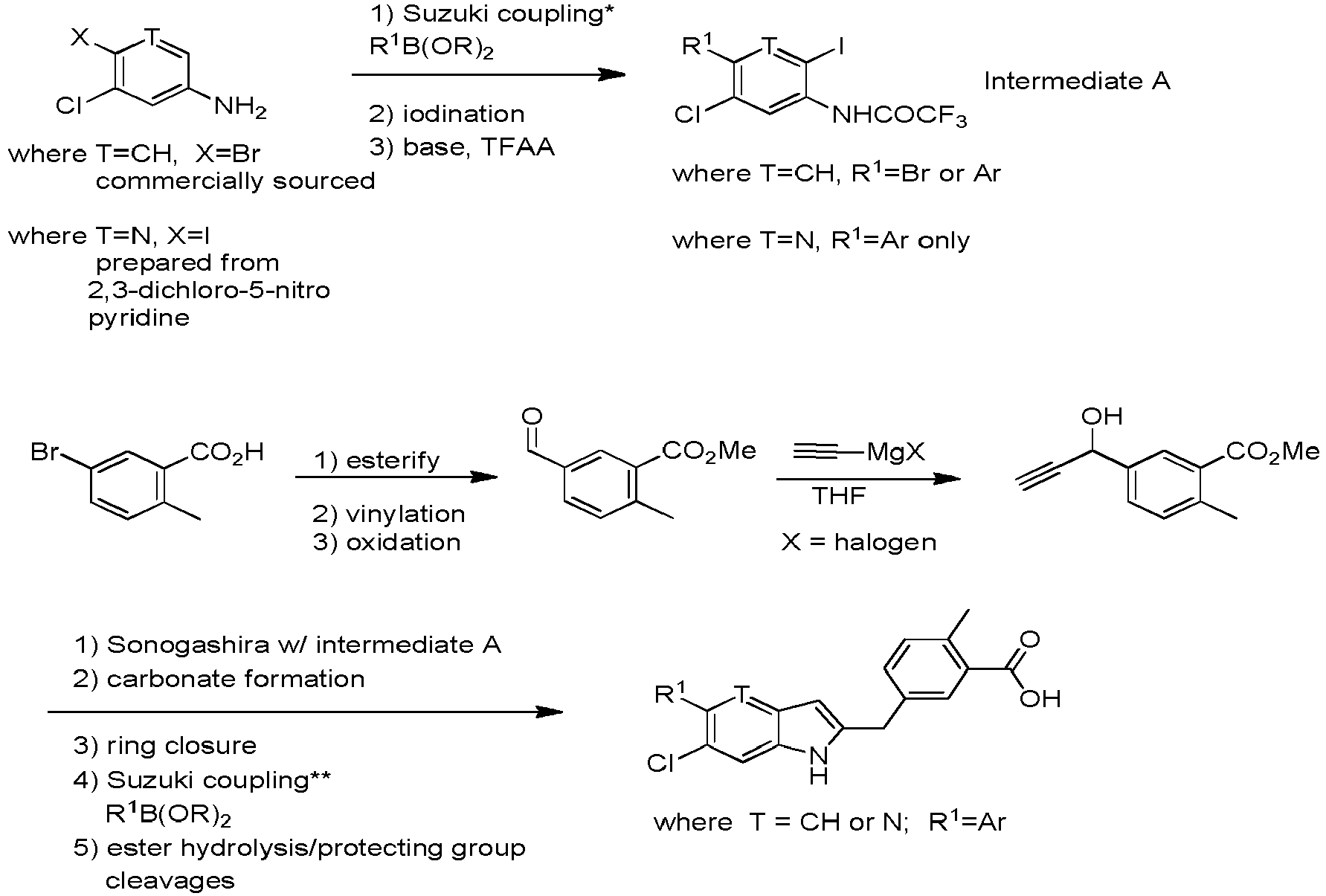
- General Scheme 1 shows a general protocol for the preparation of the compounds of the present invention. An appropriately substituted phenyl (T = CH) or pyridyl (T = N) derivative is subjected to Suzuki conditions using either a boronate (R is alkyl) or boronic acid (R is H), followed by iodination and amino group protection to provide intermediate A. * Alternatively, for compounds in which T = CH and R1 = Br, a Suzuki reaction may be done later in the sequence after ring closure. Separately, 3-Bromobenzoic acid derivative is subjected to esterification, vinylation under palladium catalyzed conditions, followed by oxidative conditions to provide the aldehyde derivative. Conversion to the alkyne derivative is accomplished via treatment of the aldehyde derivative with ethynyl magnesium halide. The resulting alkyne derivative and intermediate A are coupled together under Sonogashira conditions. Activation of the resultant alcohol via carbonate formation, followed by ring closure provides the corresponding indole and azaindole compounds. For compounds with protecting groups, ester hydrolysis and protecting group cleavage provides the compounds of the present invention.
- **For indole derivatives in which T = CH and R1 = Br, a Suzuki reaction may be used to install the required R1 aryl moiety after ring closure.


- Another general protocol for preparation of the compounds of the present invention is shown in General Scheme 2. Intermediate A is coupled with appropriately substituted alkyne under Sonogashira-like conditions to give the compounds of the present invention. ***For indole derivatives in which R1 is Br, a Suzuki reaction may be used to install the required aryl moiety at R1 after reaction with the substituted alkyne. ****Ester hydrolysis or deprotection of the compounds with protecting groups on the YZ moiety gives the compounds of the present invention.
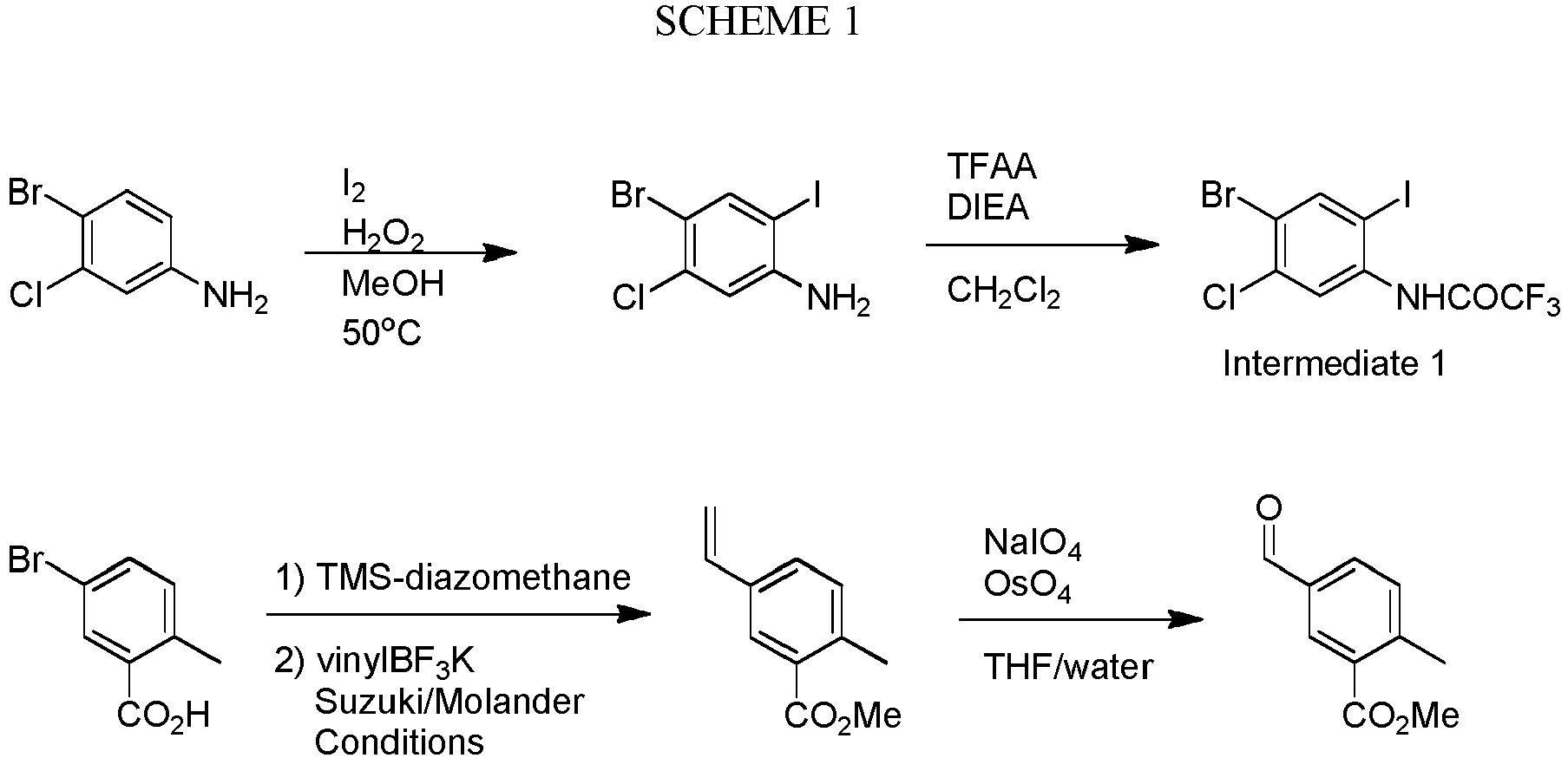


- Step A: 4-bromo-5-chloro-2-iodoaniline A solution of 3-chloro-4-bromoaniline (6.19 g, 30 mmol) in methanol (375 ml) was treated with portionwise additions of iodine (7.99 g, 31.5 mmol) over about 5 minutes, followed by the dropwise addition of 30% hydrogen peroxide (22.98 ml, 225 mmol) over about 5 minutes. The reaction was heated to 50°C overnight. Then approximately 500 mL of saturated aqueous Na2S2O3 was added to the reaction dropwise, followed by 500 mL of ethyl acetate. The mixture was separated, and the aqueous layer was extracted a second time with 250 mL of ethyl acetate. The combined organic layers were washed with saturated aqueous Na2S2O3, and brine, and then dried over sodium sulfate, filtered and evaporated under high vacuum overnight. Purification of the crude product on a Biotage 65i silica gel column with linear gradient elution of 5-20% ethyl acetate in hexanes over 4.5 liters provided the title compound as the major isolate and the regioisomeric 3-chloro-4-bromo-2-iodoaniline as the minor product. NMR δ (ppm)(CDCl3): 7.81 (s, 1H), 6.83 (s, 1H), 4.17 (br s, 2H).
- Step B: N-(4-bromo-5-chloro-2-iodophenyl)-2,2,2-trifluoroacetamide. 4-Bromo-5-chloro-2-iodoaniline (5.65 g, 17.00 mmol) was dissolved in CH2Cl2 (85 ml) and cooled to 0°C. Then N,N-diisopropylethylamine (5.2 ml, 29.7 mmol) was added, followed by trifluoroacetic anhydride (3.2 ml, 22.95 mmol). The reaction was stirred for about 2 hours, then diluted with CH2Cl2, and washed twice with aqueous NH4Cl, once with aqueous NaHCO3 and once with brine. The organic layer was dried over Na2SO4, filtered and the filtrate was evaporated by rotary evaporation to give the crude title compound, which was used without further purification. NMR δ (ppm)(CDCl3): 8.42 (s, 1H), 8.21 (br s, 1H), 8.08 (s, 1H).

- Step A: methyl 5-bromo-2-methylbenzoate 2-Methyl-5-bromobenzoic acid (2.89 g, 13.44 mmol) was dissolved in toluene (44 ml) and methanol (22 ml). After cooling to 0°C, trimethylsilyl diazomethane (10.8 ml, 21.6 mmol) was slowly added and the reaction was stirred overnight. Upon completion, the volatiles were evaporated and the crude product was dried under high vacuum overnight. The resulting crude product was used without further purification. NMR δ (ppm)(CDCl3): 8.03 (d, 1H), 7.50 (dd, 1H), 7.11 (d, 1H), 3.89 (s, 3H), 2.56 (s, 3H). Step B: methyl 2-methyl-5-vinylbenzoate Methyl 5-bromo-2-methylbenzoate (2.99 g, 13.05 mmol) was dissolved in 2-propanol (64 mL). Then potassium vinyltrifluoroborate (2.448 g, 18.27 mmol) and water (16 ml) were added. The reaction mixture was stirred until the reagents were completely dissolved, then triethylamine (5.5 ml, 39.2 mmol) and PdCl2(dppf) (0.239 g, 0.326 mmol) were added. The reaction was stirred at 100°C for 75 minutes, followed by the addition of water. The reaction mixture was then extracted with ethyl acetate. The organic layer was separated, washed with brine, dried over sodium sulfate, filtered and evaporated. The crude product was purified on a Biotage 40M silica gel column, eluting with a gradient of 10-50% dichloromethane in hexanes to give the title compound. NMR δ (ppm)(CDCl3): 7.94 (d, 1H), 7.44 (dd, 1H), 7.20 (d, 1H), 6.70 (dd, 1H), 5.76 (d, 1H), 5.26 (d, 1H), 3.90 (s, 3H), 2.58 (s, 3H). Step C: methyl 5-formyl-2-methylbenzoate Methyl 2-methyl-5-vinylbenzoate (2.13 g, 12.09 mmol) was dissolved in THF (60 ml). Then 2.5% osmium tetroxide in t-butanol (9.5 ml, 0.755 mmol) was added, followed by water (20 ml). The reaction stirred 15 minutes, then sodium periodate (5.43 g, 25.4 mmol) was added portionwise. Once the reaction was complete, it was quenched with aqueous sodium bicarbonate and extracted with ethyl acetate. The organic layer was separated, and washed with water followed by aqueous NaCl. The organic was dried over sodium sulfate, filtered and evaporated. The crude product was dried under high vacuum overnight. The crude product was purified on a Biotage 40M silica gel column, eluting with a gradient of 10-35% ethyl acetate in hexanes to give the title compound. NMR δ (ppm)(CDCl3): 10.01 (s, 1H), 8.41 (d, 1H), 7.92 (dd, 1H), 7.42 (d, 1H), 3.94 (s, 3H), 2.70 (s, 3H). StepD: methyl 5-(1-hydroxyprop-2-yn-1-yl)-2-methylbenzoate Methyl 5-formyl-2-methylbenzoate (1.76 g, 9.88 mmol) was dissolved in THF (20 ml) under nitrogen. The solution was cooled to 0°C, then 0.5 M ethynylmagnesium bromide (21.7 ml, 10.85 mmol) was added dropwise. The solution was stirred for 30 minutes at 0°C, then warmed to room temperature for an additional 30 minutes. Once complete, the reaction was quenched by adding excess saturated aqueous NH4Cl. After 5-10 minutes of stirring, the mixture was partitioned between ethyl acetate and water. The organic layer was separated, washed with brine, dried over sodium sulfate, filtered and evaporated. The crude product was purified on a Biotage 40M silica gel column, eluting with a gradient of 20-50% ethyl acetate in hexanes to give the title compound. NMR δ (ppm)(CDCl3): 8.08 (d, 1H), 7.59 (dd, 1H), 7.28 (d, 1H), 5.47 (d, 1H), 3.91 (s, 3H), 2.68 (d, 1H), 2.60 (s, 3H), 2.30 (d, 1H).
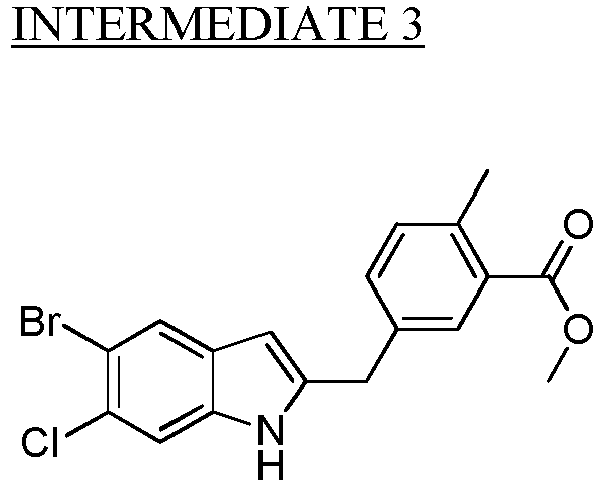
- Step A: methyl 5-(3-(5-bromo-4-chloro-2-(2,2,2-trifluoroacetamido)phenyl)-1-hydroxyprop-2-yn-1-yl)-2-methylbenzoate Intermediate 1 (3.02 g, 7.05 mmol), copper(I) iodide (0.067 g, 0.353 mmol) and bis(triphenylphosphine)palladium(II) chloride (0.099 g, 0.141 mmol) were added to an oven-dried flask flushed with nitrogen. Then DMF (11 mL) was added, followed by Et3N (9.8 mL) to form the catalyst mixture. Intermediate 2 (1.73 g, 8.46 mmol) was placed in a flask, which was flushed with nitrogen, and Et3N (10.0 mL) was added to form the alkyne solution. The alkyne solution was added dropwise to the stirring catalyst mixture. Then additional DMF (2 mL) was added to the reaction mixture. After 2 hours of stirring at room temperature, the reaction was quenched with aqueous NH4Cl, and partitioned between water and ethyl acetate. Washed the organic again with aqueous NH4Cl, and then dried over sodium sulfate, filtered and evaporated. The crude product was purified on a Biotage 40M silica gel column, eluting with a gradient of 10-40% ethyl acetate in heptane to give the title compound. NMR δ (ppm)(CDCl3): 8.54 (br s, 1H), 8.52 (s, 1H), 8.08 (d, 1H), 7.74 (s, 1H), 7.58 (dd, 1H), 7.32 (d, 1H), 5.76 (d, 1H), 3.91 (s, 3H), 2.63 (s, 3H), 2.43 (d, 1H).
- Step B: methyl 5-(3-(5-bromo-4-chloro-2-(2,2,2-trifluoroacetamido)phenyl)-1-((ethoxycarbonyl)oxy)prop-2-yn-1-yl)-2-methylbenzoate. Methyl 5-(3-(5-bromo-4-chloro-2-(2,2,2-trifluoroacetamido)phenyl)-1-hydroxyprop-2-yn-1-yl)-2-methylbenzoate (2.09 g, 4.14 mmol) and DMAP (0.809 g, 6.63 mmol) were dissolved in CH2Cl2 (21 ml) and stirred at -20°C for 10 minutes. Then ethyl chloroformate (0.557 ml, 5.80 mmol) was added and the reaction allowed to stir until the reaction was complete. Once complete the reaction was directly purified on a Biotage 40S silica gel column, eluting with a gradient of 10-25% ethyl acetate in hexanes to give the title compound. NMR δ (ppm)(CDCl3): 8.57 (br s, 1H), 8.55 (s, 1H), 8.09 (d, 1H), 7.74 (s, 1H), 7.58 (dd, 1H), 7.33 (d, 1H), 6.45 (s, 1H), 4.26 (q, 2H), 3.91 (s, 3H), 2.63 (s, 3H), 1.33 (t, 3H).
- Step C: methyl 5-((5-bromo-6-chloro-1H-indol-2-yl)methyl)-2-methylbenzoate Palladium(II) acetate (11.23 mg, 0.050 mmol) and tri-O-tolylphosphine (30.4 mg, 0.100 mmol) were added to a nitrogen blanketed flask, which was evacuated and charged with nitrogen. Acetonitrile (1 mL) was then added to the catalyst/ligand mixture. In a separate flask, methyl 5-(3-(5-bromo-4-chloro-2-(2,2,2-trifluoro-acetamido)- phenyl)-1-((ethoxycarbonyl)oxy)prop-2-yn-1-yl)-2-methylbenzoate (288 mg, 0.5 mmol) was dissolved in acetonitrile (4 mL) and the reaction flask was evacuated and charged with nitrogen. Then Et3N (209 µl, 1.500 mmol) was added to form the alkyne suspension. Then the alkyne suspension was added to the stirring catalyst mixture, followed by formic acid (38.4 µl, 1.000 mmol). The resulting reaction mixture was stirred at 40°C for 1 hour 45 minutes, then removed from heat and quenched with aqueous NH4Cl. The reaction mixture was then extracted with ethyl acetate. The organic layer was washed with brine, dried over sodium sulfate, filtered and evaporated. The crude product was purified on a Biotage 25S silica gel column, eluting with a gradient of 10-40% ethyl acetate in hexanes to give the title compound. NMR δ (ppm)(CDCl3): 7.81 (br s, 1H), 7.78 (s, 1H), 7.76 (s, 1H), 7.36 (s, 1H), 7.25 (dd, 1H), 7.21 (d, 1H), 6.23 (s, 1H), 4.09 (s, 2H), 3.88 (s, 3H), 2.57 (s, 3H).

- 4-Bromophenyl methyl sulfone (3.5 g, 14.89 mmol), 1,4-diphenylboronic acid, bis(pinacol) ester (14.74 g, 44.7 mmol) and silver carbonate (4.52 g, 16.38 mmol) were added to an oven dried 250 ml round bottom flask, which was then evacuated and charged with nitrogen. Then THF (100 ml) was added, followed by tetrakis(triphenylphosphine)palladium (0) (0.860 g, 0.744 mmol). The flask was evacuated and charged with nitrogen. Then the reaction was heated to 70°C overnight, and stirred at room temperature for an additional 24 hours. Then the reaction mixture was filtered through Celite™ and the filtrate was evaporated. The crude product was purified on a Biotage 65i silica gel column, eluting with a gradient of 10-50% ethyl acetate in hexanes to give the title compound. NMR δ (ppm)(CDCl3): 8.01 (d, 2H), 7.92 (d, 2H), 7.79 (s, 2H), 7.61 (d, 2H), 3.09 (s, 3H), 1.37 (s, 12H).


-

- Step A: methyl 5-((6-chloro-5-(4-(pyrrolidin-1-yl)phenyl)-1H-indol-2-yl)methyl)-2-methylbenzoate Methyl 5-((5-bromo-6-chloro-1H-indol-2-yl)methyl)-2-methylbenzoate (95 mg, 0.242 mmol), 1-[4-(4,4,5,5-tetramethyl-1,3,2-dioxaborolan-2-yl)phenyl]pyrrolidine (72.7 mg, 0.266 mmol) and Pd(Ph3P)4 (7.0 mg, 6.05 µmol) were mixed in a microwave vial, which was evacuated and charged with nitrogen. Then DME (1.9 mL) and 2N Na2CO3 (272 µl, 0.544 mmol) were added. The reaction was stirred at 80°C in an oil bath for 3.5 hours. Then additional Pd(PPh3)4 (7 mg) was added and the reaction was stirred overnight. The reaction mixture was then partitioned between ethyl acetate and water. The aqueous layer was separated and extracted again with ethyl acetate. The organic layers were combined, and washed with brine, dried over sodium sulfate, filtered and evaporated. The crude product was purified on a Biotage 25S silica gel column, eluting with a gradient of 40-90% dichloromethane in hexanes to give the title compound. LC-MS: calculated for C28H27ClN2O2 458.18, observed m/e: 459.31 (M+H)+ (Rt 2.45/4 min).
- Step B: 5-((6-chloro-5-(4-(pyrrolidin-1-yl)phenyl)-1H-indol-2-yl)methyl)-2-methylbenzoic acid Methyl 5-((6-chloro-5-(4-(pyrrolidin-1-yl)phenyl)-1H-indol-2-yl)methyl)-2-methylbenzoate (35 mg, 0.076 mmol) was dissolved in THF (750 µl), methanol (150 µl), and water (75 µl). Then 5N NaOH (76 µl, 0.381 mmol) was added and the reaction was stirred at 40°C for 16 hours. Once the reaction was complete, it was diluted with water and IN HCl (381 µl), and then extracted twice with ethyl acetate. The combined organic layers were dried over sodium sulfate, filtered and evaporated. The crude product was purified on MS directed HPLC on a C18 column eluting with a linear gradient of CH3CN in water (0.1% formic acid) to give the title compound. NMR δ (ppm)(CDCl3): 7.94 (d, 1H), 7.79 (br s, 1H), 7.46 (s, 1H), 7.33 (m, 4H), 7.23 (d, 1H), 6.79 (d, 1H), 6.29 (s, 1H), 4.13 (s, 2H), 3.34 (m, 4H), 2.62 (s, 3H), 2.02 (m, 4H). LC-MS: calculated for C27H25ClN2O2 444.16, observed m/e: 445.24 (M+H)+ (Rt 2.16/4 min).
Table 1. Compounds prepared according to the methods described in Example 1. Example Number Structure HPLC-mass spectrum m/e 2 
452.26 3 
530.11 4 
446.18 -

- Methyl 5-((6-chloro-5-(4-(pyrrolidin-1-yl)phenyl)-1H-indol-2-yl)methyl)-2-methylbenzoate (48 mg, 0.105 mmol) was dissolved in CH2Cl2 (3000 µl). Then Selectfluor™ (38.3 mg, 0.108 mmol) was added and the reaction was stirred at room temperature for 4 days. More CH2Cl2 was added to the reaction as needed to keep the reaction volume at about 3 mL. Then the reaction was partitioned between water and CH2Cl2, and the organic layer was separated, washed with water (2x) and brine. The organic layer was dried over sodium sulfate, filtered and evaporated. The crude product was dissolved in THF (1.5 mL) and MeOH (0.5 mL). Then NaOH (0.105 mL, 2.5N) was added, and the mixture was stirred overnight at room temperature. The reaction was then heated to 40 °C for another 24 hours, and quenched by the addition of IN HCl (0.263 mL). The reaction mixture was partitioned between water and ethyl acetate. The organic was separated, washed with brine, dried over sodium sulfate, filtered and evaporated. The crude product was purified by preparative HPLC (C18 column), eluting with 35-100% CH3CN/H2O (0.1% formic acid) over 4 injections. Two compounds were isolated after lyophilization of the requisite fractions. The less polar of the two products is the title compound, while the more polar of the two products is the des-fluoro compound also prepared in Example 1. NMR δ (ppm)(CDCl3): 7.93 (d, 1H), 7.80 (br s, 1H), 7.45 (s, 1H), 7.34 (s, 1H), 7.32 (dd, 1H), 7.23 (d, 1H), 7.11 (m, 2H), 6.71 (t, 1H), 6.29 (s, 1H), 4.13 (s, 2H), 3.44 (m, 4H), 2.62 (s, 3H), 1.96 (m, 4H). LC-MS: calculated for C27H24ClFN2O2 462.15, observed m/e: 463.5 (M+H)+ (Rt 1.29/2 min).
-

- Step A: 5-((5-bromo-6-chloro-1H-indol-2-yl)methyl)-2-methylbenzoic acid. Methyl 5-((5-bromo-6-chloro-1H-indol-2-yl)methyl)-2-methylbenzoate (39.3 mg, 0.1 mmol, Intermediate 3) was dissolved in methanol (450 µl) and THF (450 µl). Then 5N NaOH (100 µl, 0.500 mmol) was added, followed by water (100 µl). The reaction was heated to 40°C and stirred for 2 hours. Once the reaction was complete it was cooled to room temperature and the reaction was neutralized with the addition of IN HCl (0.5 mL). Then ethyl acetate and water were added, and the resulting layers were separated. The organic layer was dried over sodium sulfate, filtered and evaporated. The crude product was used in the next step without further purification. LC-MS: calculated for C17H13BrClNO2 376.98/378.98, observed m/e: 378.4/380.4 (M+H)+ (Rt 1.22/2 min).
- Step B: 5-((5-(4-(1-(acetoxymethyl)cyclopropyl)phenyl)-6-chloro-1H-indol-2-yl)methyl)-2-methylbenzoic acid 5-((5-Bromo-6-chloro-1H-indol-2-yl)methyl)-2-methylbenzoic acid (37.9 mg, 0.1 mmol) and (1-(4-(4,4,5,5-tetramethyl-1,3,2-dioxaborolan-2-yl)phenyl)cyclopropyl) methyl acetate (39.5 mg, 0.125 mmol) were mixed in a vial, which was evacuated and charged with nitrogen. Then THF (0.425 ml) was added to prepare the indole solution. A second vial containing palladium(II) acetate (1.1 mg, 5.00 µmol), 2-dicyclohexylphosphino-2',6'-dimethoxybiphenyl (4.1 mg, 10.00 µmol) and tribasic potassium phosphate (63.7 mg, 0.300 mmol) was also evacuated and charged with nitrogen to prepare the catalyst mixture. Then the indole solution was added to the catalyst mixture. The resulting reaction mixture was stirred at 60°C in an oil bath, followed by the addition of water (0.075 ml) shortly after the start of the reaction. After 3 hours, the reaction was cooled and partitioned between water and ethyl acetate. Then brine was added to the aqueous layer and the aqueous layer was extracted with ethyl acetate again. The combined ethyl acetate layers was dried over sodium sulfate, filtered and evaporated. The crude product was purified on C18 reverse phase column, eluting with a gradient of 40-100% CH3CN in water (0.05% TFA) to give the title compound mixed with a small amount of the bromoindole starting material. This product mixture was used as is without further purification in the next step. LC-MS: calculated for C29H26ClNO4 487.16, observed m/e: 488.5 (M+H)+ (Rt 1.30/2 min).
- Step C: 5-((6-chloro-5-(4-(1-(hydroxymethyl)cyclopropyl)phenyl)-1H-indol-2-yl)methyl)-2-methylbenzoic acid 5-((5-(4-(1-(Acetoxymethyl)cyclopropyl)phenyl)-6-chloro-1H-indol-2-yl)methyl)-2-methylbenzoic acid (10 mg, 0.020 mmol) was dissolved in methanol (205 µl). Then IN potassium carbonate (102 µl, 0.102 mmol) was added and the reaction was stirred at room temperature for 90 minutes. When the reaction was complete, the reaction was neutralized with IN HCl (102 µL, 0.102 mmole), diluted with water and extracted with ethyl acetate (2x). The combined organic layers were dried over sodium sulfate, filtered and evaporated. The crude product was purified by preparative C18 reverse phase HPLC, eluting with a gradient of CH3CN in water (0.05% TFA) to give the title compound after lyophilization of the product containing fractions. NMR δ (ppm) (CD3OD): 7.83 (s, 1H), 7.35 (m, 7H), 7.22 (d, 1H), 6.17 (s, 1H), 4.10 (s, 2H), 3.67 (s, 2H), 2.54 (s, 3H), 0.87 (m, 4H). LC-MS: calculated for C27H24ClNO3 445.14, observed m/e: 446.12 (M+H)+ (Rt 2.12/4 min).
-

- Step A: 4'-(benzyloxy)-2-chloro-2'-fluoro-[1,1'-biphenyl]-4-amine 4-Bromo-3-chloroaniline (0.651 g, 3.15 mmol), 4-benzyloxy-2-fluorophenylboronic acid (0.966 g, 3.93 mmol) and PdCl2(dppf) (0.115 g, 0.158 mmol) were placed under a nitrogen atmosphere and dissolved in DME (16 ml). Then 2M Na2CO3 (3.55 ml, 7.09 mmol) was added and the reaction was heated to 60 °C and stirred overnight. Then the reaction was cooled to room temperature, diluted with ethyl acetate, and washed with water. The layers were separated, and the organic layer was washed again with a mixture of aqueous NaHCO3 and NaCl, followed by aqueous NaCl. The organic layer was dried over sodium sulfate, filtered and evaporated. The crude product was purified on a Biotage 40S silica gel column, eluting with a gradient of 15-50% ethyl acetate in hexanes to give the title compound. Some mixed fractions were re-purified on a Biotage 40S silica gel column, eluting with 23-28% ethyl acetate/hexanes to give additional title compound. NMR δ (ppm)(CDCl3): 7.47 (d, 2H), 7.39 (t, 2H), 7.34 (m, 1H), 7.19 (dd, 1H), 7.08 (m, 2H), 7.02 (t, 1H), 6.78 (d, 1H), 6.60 (dd, 1H), 5.18 (s, 2H), 3.76 (s, 2H).
- Step B: 4'-(benzyloxy)-2-chloro-2'-fluoro-5-iodo-[1,1'-biphenyl]-4-amine. N-(4'-(Benzyloxy)-2-chloro-2'-fluoro-[1,1'-biphenyl]-4-yl)-2,2,2-trifluoroacetamide (328 mg, 1.0 mmol) was dissolved in methanol (12.5 mL). Iodine (254 mg, 1.000 mmol) was added, followed by the dropwise addition of 30% hydrogen peroxide (751 µl, 7.35 mmol). The reaction was stirred at room temperature overnight, then quenched with aqueous sodium thiosulfate and extracted with ethyl acetate. The organic layer was separated, washed with aqueous sodium thiosulfate, follwed by brine, and then dried over sodium sulfate, filtered and evaporated. The crude product was purified on a Biotage 40S silica gel column, eluting with a gradient of 5-30% ethyl acetate in hexanes to give the title compound. NMR δ (ppm)(CDCl3): 7.57 (s, 1H), 7.46 (d, 2H), 7.40 (t, 2H), 7.34 (m, 1H), 7.16 (dd, 1H), 7.03 (m, 2H), 6.82 (s, 1H), 5.18 (s, 2H), 4.18 (s, 2H).
- Step C: N-(4'-(benzyloxy)-2-chloro-2'-fluoro-5-iodo-[1,1'-biphenyl]-4-yl)-2,2,2-trifluoro acetamide 4'-(Benzyloxy)-2-chloro-2'-fluoro-5-iodo-[1,1'-biphenyl]-4-amine (293 mg, 0.646 mmol) was dissolved in CH2Cl2 (3.2 mL) and cooled to 0°C. DIEA (169 µl, 0.969 mmol) was added, followed by trifluoroacetic anhydride (96 µl, 0.678 mmol). The reaction was stirred for about 2 hours, then additional DIEA (50 µl) and trifluoroacetic anhydride (25 µl) were added to push the reaction to completion. The reaction mixture was purified directly on a Biotage 25S silica gel column, eluting with a gradient of 10-40% ethyl acetate in hexanes to give the title compound. NMR δ (ppm)(CDCl3): 8.39 (s, 1H), 8.27 (br s, 1H), 7.78 (s, 1H), 7.47 (d, 2H), 7.41 (t, 2H), 7.35 (m, 1H), 7.20 (dd, 1H), 7.06 (m, 2H), 5.20 (s, 2H).
-

- Step A: methyl 5-(3-(4'-(benzyloxy)-6-chloro-2'-fluoro-4-(2,2,2-trifluoroacetamido)-[1,1' biphenyl]-3-yl)-1-hydroxyprop-2-yn-1-yl)-2-methylbenzoate Intermediate 5 (350 mg, 0.637 mmol), copper(I) iodide (6.1 mg, 0.032 mmol) and bis(triphenylphosphine)-palladium(II) chloride (8.9 mg, 0.013 mmol) were flushed with nitrogen. Then Et3N (0.9 mL) was added to prepare the catalyst mixture. Intermediate 2 (156 mg, 0.764 mmol) was flushed with nitrogen, and then dissolved in Et3N (0.9 mL) to prepare the alkyn-ol solution. The alkyn-ol solution was added dropwise to the stirring catalyst mixture, followed by DMF (1 mL). After stirring for 2 hours, the reaction was quenched with aqueous NH4Cl and extracted with ethyl acetate. The organic layer was separated, washed with with aqueous NH4Cl, followed by brine, dried over sodium sulfate, filtered and evaporated. The crude product was purified on a Biotage 12M silica gel column, eluting with a gradient of 0-15% ethyl acetate in toluene to give the title compound. LC-MS: calculated for C33H24ClF4NO5 625.13, observed m/e: 624.3 (M-H)- (Rt 1.26/2 min). Step B: methyl 5-(3-(4'-(benzyloxy)-6-chloro-2'-fluoro-4-(2,2,2-trifluoroacetamido)-[1,1' biphenyl]-3-yl)-1-((ethoxycarbonyl)oxy)prop-2-yn-1-yl)-2-methylbenzoate Methyl 5-(3-(4'-(benzyloxy)-6-chloro-2'-fluoro-4-(2,2,2-trifluoroacetamido)-[1,1'-biphenyl]-3-yl)-1-hydroxyprop-2-yn-1-yl)-2-methylbenzoate (275 mg, 0.439 mmol) and DMAP (86 mg, 0.703 mmol) were dissolved in CH2Cl2 (2.2 mL) and stirred at -20 °C for 10 minutes. Then ethyl chloroformate (59.1 µl, 0.615 mmol) was added and the reaction was stirred between -20 °C and 0°C for 2-3 hours. Then the reaction was diluted with ethyl acetate. The organic layer was separated, washed twice with IN HCl and once with brine, and then dried over sodium sulfate, filtered and evaporated. The crude product was purified on a Biotage 12M silica gel column, eluting with a gradient of 10-30% ethyl acetate in hexanes to give the title compound. NMR δ (ppm)(CDCl3): 8.62 (br s, 1H), 8.53 (s, 1H), 8.10 (d, 1H), 7.60 (dd, 1H), 7.48-7.28 (m, 6H), 7.18 (dd, 1H), 7.07 (m, 2H), 6.46 (s, 1H), 5.19 (s, 2H), 4.26 (q, 2H), 3.89 (s, 3H), 2.63 (s 3H), 1.33 (t, 3H).
- Step C: methyl 5-((5-(4-(benzyloxy)-2-fluorophenyl)-6-chloro-1H-indol-2-yl)methyl)-2-methylbenzoate Methyl 5-(3-(4'-(benzyloxy)-6-chloro-2'-fluoro-4-(2,2,2-trifluoroacetamido)-[1,1'-biphenyl]-3-yl)-1-((ethoxycarbonyl)oxy)prop-2-yn-1-yl)-2-methylbenzoate (250 mg, 0.358 mmol) was dissolved in acetonitrile (3.6 mL) and added to a 2-5 mL microwave vial. The vessel was flushed with nitrogen, then Pd(Ph3P)4 (20.7 mg, 0.018 mmol), Et3N (150 µl, 1.074 mmol) and formic acid (27.5 µl, 0.716 mmol) were added. The reaction was heated to 80°C in a microwave for 30 minutes, and then diluted with ethyl acetate. The reaction mixture was washed with aqueous NH4Cl and brine, dried over sodium sulfate, filtered and evaporated. The crude product was purified on a Biotage 12M silica gel column, eluting with a gradient of 0-6% ethyl acetate in toluene to give the title compound. LC-MS: calculated for C31H25ClFNO3 513.15, observed m/e: 512.4 (M-H) - (Rt 1.32/2 min).
-

- Methyl 5-((5-(4-(benzyloxy)-2-fluorophenyl)-6-chloro-1H-indol-2-yl)methyl)-2-methylbenzoate (Intermediate 6, 10 mg, 0.019 mmol) was dissolved in MeOH (185 µL) and THF (185 µL). Added 5N NaOH (10.00 µL, 0.050 mmol) and water (10 µL). Stirred at 50 °C. An additional 15 µL of 5N NaOH was added in portions over the next 5 hours to push reaction to completion. LC/MS at 7 hours shows reaction essentially complete. Diluted with water and ethyl acetate. Partitioned; neutralized aqueous with 125 microliters of IN HCl and extracted with ethyl acetate. The organics were washed with dilute aqueous HCl, dried over sodium sulfate, filtered and evaporated. The resulting crude was purified on a preparative C18 column by MS-directed HPLC, eluting with a gradient of CH3CN in water (0.05% TFA) to give the title compound after lyophilization of the product containing fractions. NMR δ (ppm) (CDCl3): 7.95 (s, 1H), 7.83 (br s, 1H), 7.48 (d, 2H), 7.44 (s, 1H), 7.40 (t, 2H), 7.33 (m, 2H), 7.24 (m, 2H), 7.11 (d, 1H), 7.03 (t, 1H), 6.30 (s, 1H), 5.19 (s, 2H), 4.13 (s, 2H), 2.63 (s, 3H). LC-MS: calculated for C30H23ClFNO3 499.14, observed m/e: 498.51 (M-H) - (Rt 1.20/2 min).
-

- Step A.: methyl 5-((6-chloro-5-(2-fluoro-4-hydroxyphenyl)-1H-indol-2-yl)methyl)-2-methylbenzoate. Intermediate 6 (60 mg, 0.117 mmol) was transferred to a vial and dissolved in ethyl acetate (900 µL), MeOH (300 µL), and THF (300 µL). 1,4-cyclohexadiene (110 µL, 1.167 mmol) was added, followed by the addition of 10% Pd-C (5 mg, 4.67 µmol). Additional portions of Pd-C (12 mg) and 1,4-cyclohexadiene were added and the reaction heated to 60°C for 4 hours. The reaction temperature was stirred at 55°C overnight, and then worked up by filtering the reaction through Celite™ and concentrating the filtrate. The crude product was purified on a Biotage 25S silica gel column, eluting with a gradient of 20-50% ethyl acetate in hexanes to give the title compound. LC-MS: calculated for C24H19ClFNO3 423.10, observed m/e: 422.3 (M-H)- (Rt 1.08/2 min).
- Step B: methyl 5-((6-chloro-5-(4-ethoxy-2-fluorophenyl)-1H-indol-2-yl)methyl)-2-methylbenzoate Methyl 5-((6-chloro-5-(2-fluoro-4-hydroxyphenyl)-1H-indol-2-yl)methyl)-2-methylbenzoate (21.4 mg, 0.050 mmol) was dissolved in N,N-dimethylformamide (252 µl). Then powdered potassium carbonate (14 mg, 0.101 mmol) and iodoethane (4.9 µl, 0.061 mmol) were added. After 4 hours, the reaction was diluted with water and extracted with ethyl acetate. The organic layer was separated, washed with water (2x), dried over sodium sulfate, filtered and evaporated to give the title compound, which was used in the next step without further purification. LC-MS: calculated for C26H23ClFNO3 451.14, observed m/e: 452.22 (M+H)+ (Rt 2.65/4 min).
- Step C: 5-((6-chloro-5-(4-ethoxy-2-fluorophenyl)-1H-indol-2-yl)methyl)-2-methylbenzoic acid Methyl 5-((6-chloro-5-(4-ethoxy-2-fluorophenyl)-1H-indol-2-yl)methyl)-2-methylbenzoate (19.3 mg, 0.043 mmol) was dissolved in THF (500 µl) and MeOH (192 µl). Then 5N NaOH (42.7 µl, 0.214 mmol) and water (42.7 µl) were added. The reaction stirred at room temperature for 16 hours and at 40°C for an additional 4 hours. The reaction mixture was then neutralized with IN HCl (214 µl), and partitioned between water and ethyl acetate. The organic layer was separated, dried over sodium sulfate, filtered and evaporated to give the crude product. The crude product was purified by preparative C18 HPLC, eluting with a gradient of CH3CN in water (0.05% TFA) to give the title compound after lyophilization of the product containing fractions. NMR δ (ppm) (CDCl3): 7.95 (d, 1H), 7.83 (br s, 1H), 7.44 (s, 1H), 7.35 (s, 1H), 7.33 (dd, 1H), 7.24 (d, 1H), 7.21 (dd, 1H), 7.13 (d, 1H), 6.99 (t, 1H), 6.30 (s, 1H), 4.14 (m, 4H), 2.63 (s, 3H), 1.48 (t, 3H). LC-MS: calculated for C25H21ClFNO3 437.12, observed m/e: 438.21 (M+H)+ (Rt 2.45/4 min).
-

- Step A: methyl 5-((6-chloro-3-fluoro-5-(4'-(methylsulfonyl)-[1,1'-biphenyl]-4-yl)-1H-indol-2-yl)methyl)-2-methylbenzoate Methyl 5-((6-chloro-5-(4'-(methylsulfonyl)-[1,1'-biphenyl]-4-yl)-1H-indol-2-yl)methyl)-2-methylbenzoate (the methyl ester precursor of Example 3, 54.4 mg, 0.10 mmol) was dissolved in DMSO (500 µl) and acetonitrile (500 µl). Then Selectfluor™ (37.2 mg, 0.105 mmol) was added incrementally and the reaction was stirred for 18 hours. Then the reaction was quenched with water and extracted with ethyl acetate. The organic layer was separated, dried over sodium sulfate, filtered and evaporated. The crude product was purified by preparative reverse phase chromatography (C18), eluting with 60-100% CH3CN/water (0.05% TFA) to give the title compound. LC-MS: calculated for C31H25ClFNO4S 561.12, observed m/e: 562.24 (M+H)+ (Rt 2.69/4 min).
- Step B: 5-((6-chloro-3-fluoro-5-(4'-(methylsulfonyl)-[1,1'-biphenyl]-4-yl)-1H-indol-2-yl)methyl)-2-methylbenzoic acid Methyl 5-((6-chloro-3-fluoro-5-(4'-(methylsulfonyl)-[1,1'-biphenyl]-4-yl)-1H-indol-2-yl)methyl)-2-methylbenzoate (10.5mg, 0.019 mmol) was suspended in THF (112 µl), MeOH (56.0 µl), 5N NaOH (18.7 µl, 0.093 mmol) and water (18.7 µl). The reaction was stirred at room temperature for 6 hours, and then heated to 45°C for 75 minutes. The reaction was then diluted with water and neutralized with IN HCl (93 µL). The quenched reaction was extracted twice with ethyl acetate. The combined organics were dried over sodium sulfate, filtered and evaporated. The crude product was purified by preparative reverse phase chormatography (C18), eluting with 40-100% CH3CN/water (0.05% TFA) to give the title compound. NMR δ (ppm) (CD3OD): 10.46 (s, 1H), 8.04 (d, 2H), 7.96 (d, 2H), 7.83 (d, 1H), 7.77 (d, 2H), 7.58 (d, 2H), 7.47 (s, 1H), 7.39 (d, 1H), 7.32 (dd, 1H), 7.22 (d, 1H), 4.12 (s, 2H), 3.16 (s, 3H), 2.54 (s, 3H). LC-MS: calculated for C30H23ClFNO4S 547.10, observed m/e: 548.47 (M+H)+ (Rt 2.45/4 min).


- Step A: methyl 2-methyl-5-(prop-2-yn-1-yloxy)benzoate Methyl 5-hydroxy-2-methylbenzoate (665 mg, 4.0 mmol) and propargyl alcohol (358 µl, 6.00 mmol)were dissovled in CH2Cl2 (20 mL). The reaction was cooled to 0°C, then triphenylphosphine (1.31 g, 5.00 mmol) and di-tert-butyl azodicarboxylate (1.15 g, 5.00 mmol) were added. The reaction was allowed to warm to room temperature and stirred for 36 hours. The reaction was then diluted with CH2Cl2 and washed with 0.5N HCl (2x), aqueous saturated NaHCO3 and brine. The organic layer was separated, dried over sodium sulfate, filtered and evaporated. The crude product was purified on a Biotage 40S silica gel column, eluting with a gradient of 10-40% ethyl acetate in hexanes to give the title compound. NMR δ (ppm)(CDCl3): 7.52 (d, 1H), 7.17 (d, 1H), 7.04 (dd, 1H), 4.70 (d, 2H), 3.89 (s, 3H), 2.53 (s and m, 4H).
- Step B: methyl 5-((5-bromo-6-chloro-1H-indol-2-yl)methoxy)-2-methylbenzoate Intermediate 1 (514 mg, 1.2 mmol) and methyl 2-methyl-5-(prop-2-yn-1-yloxy)benzoate (343 mg, 1.680 mmol) were dissolved in DMF (6 mL). Then copper(I) iodide (22.9 mg, 0.120 mmol), bis(triphenylphosphine)-palladium(II) chloride (42.1 mg, 0.060 mmol) and Et3N (836 µl, 6.00 mmol) were added. The reaction was stirred at 60°C for 3 hours, then quenched with saturated NH4Cl followed by dilution with water and extraction with ethyl acetate. The organic layer was separated, washed with aqueous NH4Cl and brine, dried over sodium sulfate, filtered and evaporated. The crude product was purified on a Biotage 25S silica gel column, eluting with a gradient of 10-40% ethyl acetate in hexanes to give the title compound mixed with small impurities. Recrystallization from hexanes/ethyl acetate and filtration of the suspension and collection of the solid provided the title compound as an off white solid. NMR δ (ppm)(CDCl3): 8.40 (br s, 1H), 7.84 (s, 1H), 7.55 (d, 1H), 7.49 (s, 1H), 7.16 (d, 1H), 7.03 (dd, 1H), 6.46 (s, 1H), 5.21 (s, 2H), 3.89 (s, 3H), 2.52 (s, 3H).
-

- Step A: methyl 5-((6-chloro-5-(4-(pyrrolidin-1-yl)phenyl)-1H-indol-2-yl)methoxy)-2-methylbenzoate Intermediate 7 (98 mg, 0.240 mmol) and 1-[4-(4,4,5,5-tetramethyl-1,3,2-dioxaborolan-2-yl)phenyl]pyrrolidine (79 mg, 0.288 mmol) were dissolved in DME (1.2 mL), and the reaction vessel was evacuated and charged with nitrogen. Then Pd(Ph3P)4 (13.9 mg, 0.012 mmol) and 2N aqueous Na2CO3 (264 µl, 0.528 mmol) were added. The reaction was stirred at 80 °C for 4 hours, then additional Pd(PPh3)4 (13.8 mg) was added and the reaction was stirred at 90°C for 2 hours. Once the reaction was complete it was cooled to room temperature and partitoned between water and ethyl acetate. The organic layer was separated, washed with water, and brine, dried over sodium sulfate, filtered and evaporated. The crude product was purified on a Biotage 25S silica gel column, eluting with a gradient of 40-90% dichloromethane in hexanes to give the title compound. NMR δ (ppm)(CDCl3): 8.31 (br s, 1H), 7.57 (d, 1H), 7.52 (s, 1H), 7.45 (s, 1H), 7.34 (d, 2H), 7.16 (d, 1H), 7.04 (dd, 1H), 6.62 (d, 2H), 6.51 (s, 1H), 5.22 (s, 2H), 3.90 (s, 3H), 3.34 (m, 4H), 2.52 (s, 3H), 2.02 (m, 4H).
- Step B: 5-((6-chloro-5-(4-(pyrrolidin-1-yl)phenyl)-1H-indol-2-yl)methoxy)-2-methylbenzoic acid Methyl 5-((6-chloro-5-(4-(pyrrolidin-1-yl)phenyl)-1H-indol-2-yl)methoxy)-2-methylbenzoate (46 mg, 0.097 mmol) was suspended in THF (900 µl) and MeOH (450 µl). Then 5N NaOH (97 µl, 0.484 mmol) was added, followed by water (100 µl). Then the reaction was heated to 40°C and stirred until the reaction was complete. The reaction was neutralized with IN HCl (0.485 mL), and partitioned between water and ethyl acetate. The organic layer was separated, dried over sodium sulfate, filtered and evaporated. The crude product was purified by preparative reverse phase chormatography (C18), eluting with 30-90% CH3CN/water (0.05% TFA) to give the title compound. NMR δ (ppm)(DMSO-d6): 11.39 (s, 1H), 7.44 (m, 3H), 7.20 (d, 3H), 7.16 (dd, 1H), 6.58 (d, 2H), 6.50 (s, 1H), 5.23 (s, 2H), 3.25 (m, 4H), 2.42 (s, 3H), 1.96 (t, 4H). LC-MS: calculated for C27H25ClN2O3 460.16, observed m/e: 461.16 (M+H)+ (Rt 2.16/4 min).
Table 2. Compounds prepared according to the methods described in Example 10. Example Number Structure HPLC-mass spectrum m/e 11 
462.3 12 
546.3 

- N-(2-chloro-5-iodo-4"-(methylsulfonyl)-[1,1':4',1"-terphenyl]-4-yl)-2,2,2-trifluoroacetamide Step A: 2-chloro-4"-(methylsulfonyl)-[1,1':4',1"-terphenyl]-4-amine 3-Chloro-4-bromoaniline (0.400 g, 1.937 mmol), Intermediate 4 (0.826 g, 2.306 mmol) and Pd(Ph3P)4 (0.112 g, 0.097 mmol) were blanketed in nitrogen, and then dissolved in DME (13 ml) and 2N Na2CO3 (2.1 ml, 4.26 mmol). The reaction was stirred at 80°C for 72 hours, then cooled to room temperature, and partitioned between water and ethyl acetate. The organic layer was separated, washed with water, then brine, dried over sodium sulfate, filtered and evaporated. The crude product was purified on a Biotage 40S silica gel column, eluting with a gradient of 30-100% ethyl acetate in hexanes to give the title compound. NMR δ (ppm)(CDCl3): 8.02 (d, 2H), 7.82 (d, 2H), 7.65 (m, 2H), 7.55 (d, 2H), 7.17 (d, 1H), 6.83 (d, 1H), 6.65 (dd, 1H), 3.81 (s, 2H) 3.11 (s, 3H).
- Step B: 2-chloro-5-iodo-4"-(methylsulfonyl)-[1,1':4',1"-terphenyl]-4-amine 2-Chloro-4"-(methylsulfonyl)-[1,1':4',1"-terphenyl]-4-amine (615 mg, 1.719 mmol) was dissolved in DMF (3.4 mL). Then iodine (436 mg, 1.719 mmol) and sodium periodate (368 mg, 1.719 mmol) were added. The reaction was stirred at 60°C for 2 hours, and removed from heat. Then aqueous sodium metabisulfite was added to the reaction, followed by ethyl acetate. The mixture was stirred for 20 minutes, then the organic layer was separated. The organic layer was washed with aqueous sodium metabisulfite, and then with water, followed by brine. The organic layer was dried over sodium sulfate, filtered and evaporated. The crude product was purified on a Biotage 40S silica gel column, eluting with a gradient of 20-60% ethyl acetate in hexanes to give the title compound as the major product isolated. NMR (major) δ (ppm)(CDCl3): 8.02 (d, 2H), 7.81 (d, 2H), 7.65 (m, 3H), 7.52 (d, 2H), 6.87 (s, 1H), 4.24 (s, 2H) 3.12 (s, 3H). NMR (minor) δ (ppm)(CDCl3): 8.02 (d, 2H), 7.81 (d, 2H), 7.65 (m, 2H), 7.49 (d, 2H), 7.14 (d, J=8.2 Hz, 1H), 6.73 (d, J=8.3 Hz, 1H), 4.43 (br s, 2H) 3.11 (s, 3H).
- Step C: N-(2-chloro-5-iodo-4"-(methylsulfonyl)-[1,1':4',1"-terphenyl]-4-yl)-2,2,2-trifluoro acetamide 2-Chloro-5-iodo-4"-(methylsulfonyl)-[1,1':4',1"-terphenyl]-4-amine (392 mg, 0.810 mmol) was dissolved in CH2Cl2 (4 mL) and cooled to 0 °C. Then DIEA (248 µl, 1.418 mmol) was added, followed by trifluoroacetic anhydride (155 µl, 1.094 mmol). The reaction was stirred for about 2 hours. The crude product was purified on a Biotage 40S silica gel column, eluting with a gradient of 20-75% ethyl acetate in hexanes to give the title compound. NMR δ (ppm)(CDCl3): 8.45 (s, 1H), 8.31 (br s, 1H), 8.04 (d, 2H), 7.87 (s, 1H), 7.82 (d, 2H), 7.70 (d, 2H), 7.55 (d, 2H), 3.12 (s, 3H).
-
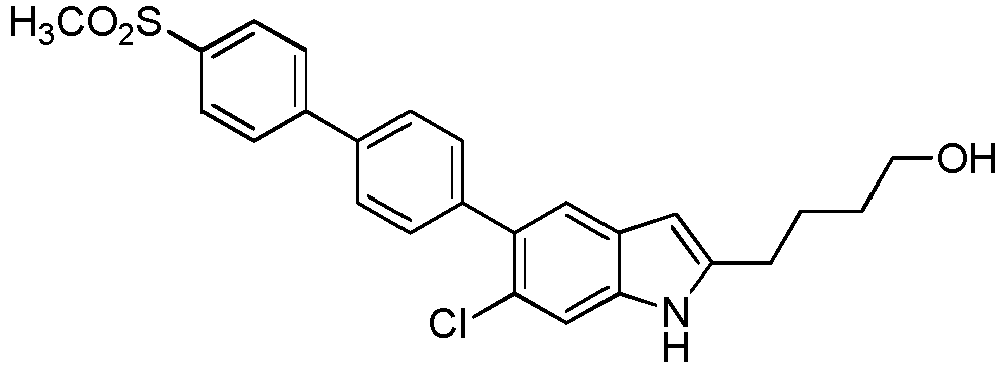
- Intermediate 8 (58.0 mg, 0.1 mmol), copper(I) iodide (1.9 mg, 10.00 µmol), and bis(triphenylphosphine)palladium(II) chloride (3.5 mg, 5.00 µmol) were placed in a flask, which was evacuated and charged with nitrogen. Then DMF (0.4 mL) and Et3N (69.7 µl, 0.500 mmol) were added. Then 5-hexyn-1-ol (14.7 mg, 0.150 mmol) was dissolved in DMF (0.1 mL) and the resulting solution was added dropwise to the reaction. The reaction was stirred at room remperature for 45 minutes, and then heated to 60 °C for 1 hour and 80 °C for an additional hour. Then the reaction was quenched with saturated aqueous NH4Cl, and extracted with ethyl acetate. The organic layer was separated and washed with water (2x) and with brine (1x), dried over sodium sulfate, filtered and evaporated. The crude product was purified on a Biotage 25S silica gel column, eluting with a gradient of 30-100% ethyl acetate in hexanes to give the title compound. NMR δ (ppm)(CDCl3): 8.12 (br s, 1H), 8.03 (d, 2H), 7.84 (d, 2H), 7.68 (d, 2H), 7.61 (d, 2H), 7.50 (s, 1H), 7.44 (s, 1H), 6.27 (s, 1H), 3.73 (m, 2H), 3.11 (s, 3H), 2.84 (t, 2H), 2.31 (t, 1H), 1.85 (m, 2H), 1.58 (m, 2H). LC-MS: calculated for C25H24ClNO3S 453.12, observed m/e: 454.18 (M+H)+ (Rt 2.19/4 min).
Table 3. Compounds prepared according to the methods described in Example 13. Example Number Structure HPLC-mass spectrum m/e 14 
440.08 15* 
468.08 16* 
482.08 * This compound was prepared in 2 steps: 1) the indole formation with the requisite alkynyl ester (see Example 12 for a representative synthetic method), and 2) the ester hydrolysis step (see Example 9 step B for a representative synthetic method). 
- Step A: trans-4-(((tert-bulyldimethylsilyl)oxy)methyl)cyclohexyl)methanol To a solution of trans-1,4-cyclohexanedimethanol (3.46 g, 24.0 mmol) in DMF (40 ml) was added tertbutyldimethylsilyl chloride (3.01 g, 20 mmol) and imidazole (3.27 g, 48.0 mmol). The reaction was allowed to stir overnight. The reaction was then partitioned between ether and brine. The organic layer was separated, washed with brine, dried over sodium sulfate, filtered and evaporated. The crude product was purified on a Biotage 40M silica gel column, eluting with a gradient of 10-50% ethyl acetate in hexanes to give the title compound. NMR δ (ppm)(CDCl3): 3.46 (d, 2H), 3.40 (d, 2H), 1.81 (m, 4H), 1.42 (m, 2H), 1.26 (s, 1H), 0.94 (m, 4H), 0.89 (s, 9H), 0.03 (s, 6H).
- Step B: trans-4-(((tert-butyldimethylsilyl)oxy)methyl)cyclohexyl)methyl 4-methylbenzene-sulfonate trans-4-(((tert-Butyldimethylsilyl)oxy)methyl)cyclohexyl)methanol (2.99 g, 11.57 mmol) was dissolved in CH2Cl2 (29 mL). Then p-toluenesulfonyl chloride (2.87 g, 15.04 mmol) and pyridine (2.81 ml, 34.7 mmol) were added. The reaction was stirred overnight, and then the solvent was evaporated. The resulting crude residue was reconstitutued by adding diethyl ether (50 mL) and filtered through a sintered glass funnel. The resulting solid was washed with ether (2x) and the filtrate was evaporated. The resulting residue was purified on a Biotage 40M silica gel column, eluting with a gradient of 35-100% dichloromethane in hexanes to give the title compound. NMR δ (ppm)(CDCl3): 7.78 (d, 2H), 7.34 (d, 2H), 3.82 (d, 2H), 3.37 (d, 2H), 2.45 (s, 3H), 1.75 (br t, 4H), 1.61 (m, 1H), 1.37 (m, 1H), 0.88 (s and m, 13H), 0.02 (s, 6H).
- Step C: tert-butyldimethyl(((trans)-4-(prop-2-yn-1-yl)cyclohexyl)methoxy)silane To trans-4-(((tert-butyldimethylsilyl)oxy)methyl)cyclohexyl)methyl 4-methylbenzene-sulfonate (1.238 g, 3.00 mmol) in an oven dried flask was added fresh, anhydrous DMSO (15 ml) and freshly pulverized lithium acetylide ethylenediamine complex (0.829 g, 9.00 mmol) as a single portion. The reaction stirred at room temperature for 2 hours. The reaction was then quenched cautiously with the dropwise addition of 31 ml of water, by keeping the temperature <35°C by placing the reaction vessel in a water bath containing some ice. Once addition of water was complete, ethyl acetate was added and the reaction was stirred vigorously for 10 minutes. The layers were separated and the aqueous layer was extracted with ethyl acetate (2x). The combined organic layers were washed with brine, dried over sodium sulfate, filtered and evaporated. The crude product was purified on a 100 gram silica gel column, eluting with a gradient of 0-50% ethyl acetate in hexanes to give the title compound as a mixture. A second 25 gram silica gel column was run, eluting with 25% dichloromethane in hexanes to give pure title compound. NMR δ (ppm)(CDCl3): 3.40 (d, 2H), 2.09 (dd, 2H), 1.96 (m, 1H), 1.82 (dd, 4H), 1.42 (m, 2H), 0.98 (m, 4H), 0.89 (s, 9H), 0.03 (s, 6H).
-

- Step A: 2-(((trans)-4-(((tert-buiyldimethylsilyl)oxy)methyl)cyclohexyl)methyl)-6-chloro-5-(4'-(methylsulfonyl)-[1,1'-biphenyl]-4-yl)-1H-indole Intermediate 8 (145 mg, 0.25 mmol), copper (I) iodide (4.8 mg, 0.025 mmol) and bis(triphenylphoshine)palladium (II) chloride (10.5 mg, 0.015 mmol) were added to a 1 dram vial, which was then evacuated and charged with nitrogen. Then DMF (0.75 mL) and Et3N (174 µl, 1.250 mmol) were added to prepare the catalyst mixture. Separately, intermediate 9 (100 mg, 0.375 mmol) was dissolved in DMF (0.50 mL), and this solution was added dropwise to the stirring catalyst mixture. The resulting reaction was heated to 60°C for 4 hours. The reaction was quenched by pouring into aqueous NH4Cl followed by extraction with ethyl acetate. The organic layer was separated, washed with NH4Cl, then with brine, dried over sodium sulfate, filtered and evaporated. The crude product was purified on a RediSep 40 gram silica gel column, eluting with a gradient of 10-50% ethyl acetate in hexanes to give the title compound. LC-MS: calculated for C35H44ClNO3SSi 621.25, observed m/e: 622.3 (M+H)+ (Rt 3.29/4 min).
- Step B: ((trans)-4-((6-chloro-5-(4'-(methylsulfonyl)-[1,1'-biphenyl]-4-yl)-1H-indol-2-yl)methyl) cyclohexyl)methanol A solution of 2-(((trans)-4-(((tert-butyldimethylsilyl)oxy) methyl) cyclohexyl)methyl)-6-chloro-5-(4'-(methylsulfonyl)-[1,1'-biphenyl]-4-yl)-1H-indole (63.5 mg, 0.102 mmol) in THF (510 µl) was treated with 1 M tetrabutylammonium fluoride (102 µl, 0.102 mmol). The reaction was stirred under nitrogen atmosphere overnight, and then diluted with water and extracted twice with dichloromethane. The combined organic layers were washed with water, then with brine, dried over sodium sulfate, filtered and evaporated. The crude product was purified on a Biotage SNAP 10 gram silica gel column, eluting with a gradient of 20-100% ethyl acetate in hexanes to give the title compound. NMR δ (ppm)(CDCl3): 8.03 (d, 2H), 7.90 (br s, 1H), 7.84 (d, 2H), 7.68 (d, 2H), 7.61 (d, 2H), 7.50 (s, 1H), 7.44 (s, 1H), 6.25 (s, 1H), 3.46 (t, 2H), 3.11 (s, 3H), 2.67 (d, 2H), 1.84 (br t, 4H), 1.63 (m, 1H), 1.47 (m, 1H), 1.25 (m, 1H), 1.11-0.91 (m, 4H). LC-MS: calculated for C29H30ClNO3S 507.16, observed m/e: 508.22 (M+H)+ (Rt 2.42/4 min).


- Step A: 3-chloro-2-iodo-5-nitropyridine. 2,3-Dichloro-5-nitropyridine (2.892 g, 14.99 mmol) and sodium iodide (11.23 g, 74.9 mmol) were dissolved in acetic acid (15 mL). The reaction was heated to 90°C for 4 hours, then diluted with water and filtered. The resulting solid was dried on the filter for a few minutes, and then transferred to a flask and dried in vacuo over the weekend to give the title compound, which was used in the next step without further purification. NMR δ (ppm)(CDCl3): 9.07 (d, 2H), 8.40 (d, 2H).
- Step B: 3-chloro-2-iodo-5-aminopyridine. 3-Chloro-2-iodo-5-nitropyridine (1.42 g, 5.0 mmol) and tin (II) chloride dihydrate (5.64 g, 25.00 mmol) were heated to 85°C in ethanol (25 mL) for 3 hours. Then the reaction was partitioned between IN NaOH and ethyl acetate. The organic layer was separated, washed with IN NaOH, then with brine, dried over sodium sulfate, filtered and evaporated to give the title compound. NMR δ (ppm)(CDCl3): 7.80 (d, 2H), 7.03 (d, 2H), 3.22 (br s, 2H). LC-MS: calculated for C5H4ClIN2 253.91, observed m/e: 255.2 (M+H)+ (Rt 0.84/2 min).
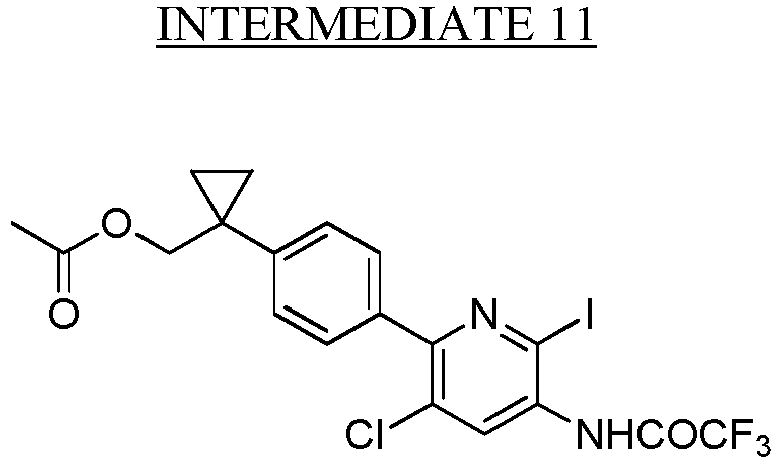
- Step A: (1-(4-(5-amino-3-chloropyridin-2-yl)phenyl)cyclopropyl)methyl acetate (1-(4-(4,4,5,5-Tetramethyl-1,3,2-dioxaborolan-2-yl)phenyl)cyclopropyl)methyl acetate, Intermediate 10 (254 mg, 1.0 mmol), potassium phosphate tribasic (637 mg, 3.00 mmol) and PdCl2(dppf) (36.6 mg, 0.050 mmol) were added to a reaction vessel, which was then evacuated and charged with nitrogen three times. Then 1,4-dioxane (5 mL) was added and the reaction was heated to 80°C overnight. Then additional PdCl2(dppf) (77 mg) was added in portions over the next 3 days. After 96 hours, the reaction was cooled to room temperature, and then partitioned between water and ethyl acetate. The layers were separated and the aqueous layer was extracted with ethyl acetate. The organic layers were combined, and washed with water, followed by brine, then dried over sodium sulfate, filtered and evaporated. The crude product was purified on a Biotage 25S silica gel column, eluting with a gradient of 25-75% ethyl acetate in hexanes to give the title compound plus an impurity. The impure title compound was then re-purified on a Biotage 25S silica gel column, eluting with 10-25% ethyl acetate in dichloromethane to give the purified title compound. NMR δ (ppm)(CDCl3): 8.06 (d, 1H), 7.62 (d, 2H), 7.36 (d, 2H), 7.09 (d, 1H), 4.19 (s, 2H), 3.80 (br s, 2H), 2.03 (s, 3H), 0.96 (q, 4H).
- Step B: (1-(4-(5-amino-3-chloro-6-iodopyridin-2-yl)phenyl)cyclopropyl)methyl acetate (1-(4-(5-Amino-3-chloropyridin-2-yl)phenyl)cyclopropyl)methyl acetate (96 mg, 0.303 mmol) was dissolved in DMF (600 µl) and transfered to a screw cap vial. Then iodine (77 mg, 0.303 mmol) and sodium periodate (64.8 mg, 0.303 mmol) were added, and the reaction was stirred at 60°C for 7 hours. The reaction was then quenched with aqueous sodium thiosulfate and extracted twice with ethyl acetate. The organic layer was separated and washed with sodium thiosulfate solution followed by sodium bisulfite/metabisulfite solution. The organic layer was then washed with brine, dried over sodium sulfate, filtered and evaporated. The crude product was purified on a Biotage 25S silica gel column, eluting with a gradient of 10-40% ethyl acetate in hexanes to give the title compound. NMR δ (ppm)(CDCl3): 7.62 (d, 2H), 7.36 (d, 2H), 7.01 (s, 1H), 4.19 (s, 4H), 2.04 (s, 3H), 0.96 (d, 4H).
- Step C: (1-(4-(3-chloro-6-iodo-5-(2,2,2-trifluoroacetamido)pyridin-2-yl)phenyl)cyclopropyl) methyl acetate (1-(4-(5-Amino-3-chloro-6-iodopyridin-2-yl)phenyl)cyclopropyl)methyl acetate (92 mg, 0.208 mmol) was dissolved in CH2Cl2 (1 mL) and cooled to 0°C. Then DIEA (63.5 µl, 0.364 mmol) was added, followed by trifluoroacetic anhydride (39.6 µl, 0.281 mmol). The reaction was stirred for 2 hours. The crude reaction mixture was then purified directly on a Biotage 25S silica gel column, eluting with a gradient of 10-40% ethyl acetate in hexanes to give the title compound. NMR δ (ppm)(CDCl3): 8.62 (s, 1H), 8.37 (br s, 1H), 7.70 (d, 2H), 7.41 (d, 2H), 4.21 (s, 2H), 2.04 (s, 3H), 1.00 (s, 4H).
-

- Step A: methyl 5-(3-(6-(4-(1-(acetoxymethyl)cyclopropyl)phenyl)-5-chloro-3-(2,2,2-trifluoroacetamido)pyridin-2-yl)-1-hydroxyprop-2-yn-1-yl)-2-methylbenzoate Intermediate 11 (85 mg, 0.158 mmol), copper (I) iodide (1.5 mg, 7.89 µmol) and bis(triphenylphosphine) palladium (II) chloride (2.2 mg, 3.16 µmol) were added to an oven-dried flask flushed with nitrogen. Then DMF (0.25 mL) was added, followed by Et3N (0.25 mL) to prepare the catalyst mixture. Intermediate 2 (38.7 mg, 0.189 mmol) was also flushed with nitrogen, and Et3N (0.25 mL) and DMF (0.15 mL) were added to prepare the alkyne solution. Then the alkyne solution was added dropwise to the stirring catalyst mixture. After 2 hours the reaction was quenched with aqueous NH4Cl, and the reaction mixture was partitioned between water and ethyl acetate. The organic layer was separated, and washed with aqueous NH4Cl, dried over sodium sulfate, filtered and evaporated. The crude product was purified on a Biotage 25S silica gel column, eluting with a gradient of 15-50% ethyl acetate in hexanes to give the title compound. LC-MS: calculated for C31H26ClIF3N2O6 614.14, observed m/e: 615.6 (M+H)+ (Rt 1.42/2 min). Step B: methyl 5-(3-(6-(4-(1-(acetoxymethyl)cyclopropyl)phenyl)-5-chloro-3-(2,2,2-trifluoroacetamido)pyridin-2-yl)-1-((ethoxycarbonyl)oxy)prop-2-yn-1-yl)-2-methylbenzoate Methyl 5-(3-(6-(4-(1-(acetoxymethyl)cyclopropyl)phenyl)-5-chloro-3-(2,2,2-trifluoroacetamido) pyridin-2-yl)-1-hydroxyprop-2-yn-1-yl)-2-methylbenzoate (35 mg, 0.057 mmol) was dissolved in CH2Cl2 (285 µl) and cooled to -20 °C. Then DMAP (11.1 mg, 0.091 mmol) and ethyl chloroformate (7.7 µl, 0.080 mmol) were added. The reaction was stirred for about 3 hours, then it was directly purified on a Biotage 12M silica gel column, eluting with a gradient of 15-40% ethyl acetate in hexanes to give the title compound. NMR δ (ppm)(CDCl3): 8.86 (s, 1H), 8.69 (br s, 1H), 8.10 (d, 1H), 7.63 (m, 3H), 7.39 (d, 2H), 7.30 (d, 1H), 6.47 (s, 1H), 4.26 (q, 2H), 4.19 (s, 2H), 3.89 (s, 3H), 2.62 (s, 3H), 2.03 (s, 3H), 1.33 (t, 3H), 0.98 (s, 4H). Step C: methyl 5-((5-(4-(1-(acetoxymethyl)cyclopropyl)phenyl)-6-chloro-1H-pyrrolo[3,2-b]pyridin-2-yl)methyl)-2-methylbenzoate Methyl 5-(3-(6-(4-(1-(acetoxymethyl)cyclopropyl) phenyl)-5-chloro-3-(2,2,2-trifluoroacetamido)pyridin-2-yl)-1-((ethoxycarbonyl)oxy)prop-2-yn-1-yl)-2-methylbenzoate (28 mg, 0.041 mmol) was dissolved in acetonitrile (400 µl). Then reaction was flushed with nitrogen, then Pd(Ph3P)4 (2.4 mg, 2.038 µmol), Et3N (17.0 µl, 0.122 mmol) and formic acid (3.1 µl, 0.082 mmol) were added. The reaction was heated to 40°C for 120 minutes, and to 60°C for 16 hours. Then the reaction was worked up by diluting with ethyl acetate and washing once with aqueous NH4Cl and once with brine. The organic layer was separated, dried over sodium sulfate, filtered and evaporated. The crude product was purified on a Biotage 25M silica gel column, eluting with a gradient of 15-30% ethyl acetate in hexanes to give the title compound along with impurities, which was used as is in the subsequent reaction. LC-MS: calculated for C29H27ClN2O4 502.17, observed m/e: 503.24 (M+H)+ (Rt 1.94/4 min).
- Step D: 5-((6-chloro-5-(4-(1-(hydroxymethyl)cyclopropyl)phenyl)-1H-pyrrolo[32-b]pyridin-2-yl)methyl)-2-methylbenzoic acid Methyl 5-((5-(4-(1-(acetoxymethyl)cyclopropyl)phenyl)-6-chloro-1H-pyrrolo[3,2-b]pyridin-2-yl)methyl)-2-methylbenzoate (5.2 mg, 10.34 µmol) was dissolved in MeOH (100 µl). Then NaOH (2.5M, 20.7 µl, 0.052 mmol) was added, followed by THF (100 µl). The reaciton was heated to 40 °C overnight, then quenched with IN HCl (0.052 mL), and partitioned between ethyl acetate and water. The organic layer was separated, dried over sodium sulfate, filtered and evaporated. The resulting crude product was purified by C18 preparative HPLC, eluting with a gradient of 25-100% CH3CN/water (0.05% TFA) to give the title compound. NMR δ (ppm)(CD3OD): 7.86 (s, 1H), 7.85 (br s, 1H), 7.49 (m, 4H), 7.36 (d, 1H), 7.24 (d, 1H), 6.38 (s, 1H), 4.19 (s, 2H), 3.69 (s, 2H), 2.55 (s, 3H), 0.80 (m, 4H). LC-MS: calculated for C26H23ClN2O3 446.14, observed m/e: 447.18 (M+H)+ (Rt 1.60/4 min).


- Step A: 5-chloro-6-(4'-(methylsulfonyl)-[1,1'-biphenyl]-4-yl)pyridin-3-amine Intermediate 4 (645 mg, 1.800 mmol), intermediate 10 (382 mg, 1.5 mmol) and PdCl2(dppf) (110 mg, 0.150 mmol) were added to the reaction vessel, which was then evacuated and charged three times with nitrogen. Then 1,4-dioxane (7.5 ml) was added, followed by 3M LiOH (1.5 ml, 4.50 mmol) and the reaction was heated to 80°C. After 1 hour the reaction was cooled to room temperature, diluted with ethyl acetate and washed with aqueous citric acid, and then with brine. The organic layer was separated, dried over sodium sulfate, filtered and evaporated. The crude product was dissolved in acetone and added to a size 40 silica gel column insert, which was then dried under vacuum. The insert was added to a 40S Biotage silica gel column and eluted with a gradient of 50-100% ethyl acetate in hexanes to give the title compound. LC-MS: calculated for C18H15ClN2O2S 358.05 observed m/e: 359.09 (M+H)+ (Rt 1.52/4 min).
- Step B: 5-chloro-2-iodo-6-(4'-(methylsulfonyl)-[1,1'-biphenyl]-4-yl)pyridin-3-amine 5-Chloro-6-(4'-(methylsulfonyl)-[1,1'-biphenyl]-4-yl)pyridin-3-amine (392 mg, 1.092 mmol) was dissolved in DMF (2.2 mL). Iodine (277 mg, 1.092 mmol) and sodium periodate (234 mg, 1.092 mmol) were added and the reaction was stirred at 60°C for 3 hours. The reaction was poured into aqueous sodium metabisulfite and extracted with ethyl acetate. The organic layer was separated and washed again with sodium metabisulfite, then with brine, dried over sodium sulfate, filtered and evaporated. The crude product was purified on a Biotage 25S silica gel column, eluting with a gradient of 15-75% ethyl acetate in hexanes to give the title compound. LC-MS: calculated for C18H14ClIN2O2S 483.95, observed m/e: 484.93 (M+H)+ (Rt 2.07/4 min). Step C: N-(5-chloro-2-iodo-6-(4'-(methylsulfonyl)-[1,1'-biphenyl]-4-yl)pyridin-3-yl)-2,2,2-trifluoroacetamide 5-Chloro-2-iodo-6-(4'-(methylsulfonyl)-[1,1'-biphenyl]-4-yl)pyridin-3-amine (179.3 mg, 0.370 mmol) was dissolved in CH2Cl2 (1.9 mL) and cooled to 0°C. DIEA (113 µl, 0.647 mmol) was added, followed by trifluoroacetic anhydride (70.5 µl, 0.499 mmol). The reaction was stirred for about 2 hours, after which the reaction was directly purified on a Biotage 25S silica gel column, eluting with a gradient of 25-70% ethyl acetate in hexanes to give the title compound. LC-MS: calculated for C20H13ClF3IN2O3S 579.93, observed m/e: 581.09 (M+H)+ (Rt 2.19/4 min).

- Step A: 4-(3,3-dibromoallyl)tetrahydro-2H-pyran Triphenylphosphine (7.92 g, 30.2 mmol) was dissolved in 60 mL of CH2Cl2 and cooled to 0 °C under nitrogen. Then carbon tetrabromide (5.00 g, 15.09 mmol) was added, and the reaction was stirred for about 5 minutes. Then a solution of tetrahydropyran-4-yl acetaldehyde (0.967 g, 7.54 mmol) in 20 mL of CH2Cl2 was added dropwise. The reaction was stirred for 2 hours, and then evaporated to about 1/5 volume. The resulting solid was filtered off, and the solid was rinsed with a minimal amount of CH2Cl2 . The crude product was purified on a Biotage 40M silica gel column, eluting with methylene chloride to give the title compound. NMR δ (ppm)(CDCl3): 6.41 (t, 1H), 3.96 (dd, 2H), 3.37 (t, 2H), 2.07 (m, 2H), 1.66 (m, 1H), 1.61 (d, 2H), 1.37 (m, 2H).
- Step B: 4-(prop-2-yn-1-yl)tetrahydro-2H-pyran 4-(3,3-Dibromoallyl)tetrahydro-2H-pyran (0.500 g, 1.761 mmol) was added to an oven dried flask, then dissolved in anhydrous THF (13 mL). The reaction mixture was cooled to -78 °C in a dry ice/acetone bath, then evacuated and charged three times with nitrogen gas. Then BuLi (1.75 ml, 4.40 mmol, 2.5M) in hexanes was added dropwise over about 3 minutes, and the reaction stirred for 2 hours. Aqueous sodium bicarbonate was added and the reaction was removed from the cooling bath. The reaction mixture was extracted with ethyl acetate. The organic layer was separated, washed with water and brine, dried over sodium sulfate, filtered and evaporated. The crude product was used as is without purification. NMR δ (ppm)(CDCl3): 3.97 (dd, 2H), 3.38 (t, 2H), 2.15 (m, 2H), 1.98 (m, 1H), 1.72 (m, 2H), 1.39 (m, 2H), 0.90 (m, 1H).
-

- Intermediate 12 (58.1 mg, 0.1 mmol), copper (I) iodide (1.9 mg, 10.00 µmol) and bis(triphenylphosphine)palladium (II) chloride (3.5 mg, 5.00 µmol) were added to a 1 dram vial, which was then evacuated and charged with nitrogen. Then DMF (0.35 mL) and added Et3N (69.7 µl, 0.500 mmol) were added to prepare the catalyst mixture. Separately intermediate 13 (18.6 mg, 0.150 mmol) was dissolved in DMF (0.15 mL), and the resulting solution was added dropwise to the stirring catalyst mixture. The reaction was heated to 60°C for 2 hours, and then cooled to room temperature and quenched with aqueous NH4Cl. The reaction mixture was diluted with water and ethyl acetate, and saturated aqueous NaHCO3 was added to the aqueous layer. The aqueous layer was extracted twice with ethyl acetate. The combined organic layers were washed with water, then dried over sodium sulfate, filtered and evaporated. The crude product was purified on a Biotage 12M silica gel column, eluting with a gradient of 50-100% ethyl acetate in hexanes to give the title compound. NMR δ (ppm)(CDCl3): 8.06 (br s, 1H), 8.03 (d, 2H), 7.84 (m, 4H), 7.71 (s and d, 3H), 6.50 (s, 1H), 3.98 (dd, 2H), 3.38 (m, 2H), 3.11 (s, 3H), 2.76 (d, 2H), 1.93 (m, 1H) 1.66 (br d, 2H), 1.42 (m, 2H). LC-MS: calculated for C26H25ClN2O3S 480.13, observed m/e: 481.17 (M+H)+ (Rt 1.67/4 min).
Table 4. Compounds prepared according to the methods described in Example 19. Example Number Structure HPLC-mass spectrum m/e 20 
441.1 21 
455.2 22* 
469.1 23* 
483.1 * This compound was prepared in 2 steps: 1) the indole formation with the requisite alkynyl ester (see Example 12 for a representative synthetic method), and 2) the ester hydrolysis step (see Example 9 step B for a representative synthetic method). -

- ((trans)-4-((6-chloro-5-(4'-(methylsulfonyl)-[1,1'-biphenyl]-4-yl)-1H-pyrrolo[3,2-b]pyridin-2-yl)methyl)cyclohexyl)methanol The title compound was prepared according to the two step procedure of Example 16 using Intermediate 12 and Intermediate 9. NMR δ (ppm)(CDCl3): 8.03 (d, 2H), 7.98 (br s, 1H), 7.84 (m, 4H), 7.70 (m, 3H), 6.48 (s, 1H), 3.46 (t, 2H), 3.11 (s, 3H), 2.71 (d, 2H), 1.84 (br t, 4H), 1.64 (br, 1H), 1.47 (br, 1H), 1.14-0.90 (m, 4H). LC-MS: calculated for C28H29ClN2O3S 508.16, observed m/e: 509.19 (M+H)+ (Rt 1.73/4 min).
-

- 6-chloro-5-(4'-(methylsulfonyl)-[1,1'-biphenyl]-4-yl)-2-((tetrahydro-2H-pyran-4-yl)methyl)-1H-indole The title compound was prepared according to the procedure of Example 19 using Intermediate 8 and Intermediate 13. NMR δ (ppm)(CDCl3): 8.03 (d, 2H), 7.93 (br s, 1H), 7.84 (d, 2H), 7.68 (d, 2H), 7.60 (d, 2H), 7.51 (s, 1H), 7.45 (s, 1H), 6.26 (s, 1H), 3.98 (dd, 2H), 3.38 (m, 2H), 3.11 (s, 3H), 2.71 (d, 2H), 1.93 (m, 1H) 1.66 (br d, 2H), 1.42 (m, 2H). LC-MS: calculated for C27H26ClNO3S 479.13, observed m/e: 480.11 (M+H)+ (Rt 2.39/4 min).
-

- Step A: ethyl 1-(prop-2-yn-1-yl)piperidine-4-carboxylate: Ethyl isonipectoate (1.541 ml, 10 mmol) was dissolved in acetone (20 ml). Solid potassium carbonate (3.46 g, 25.00 mmol) was added, followed by the dropwise addition of 80% propargyl bromide (1.225 ml, 11.00 mmol) in toluene. The reaction was stirred at room temperature for 48 hours, then the potassium carbonate was filtered off, and the filtrate was evaporated to give the crude product, which was used without further purification. NMR δ (ppm)(CDCl3): 4.12 (q, 2H), 3.30 (d, 2H), 2.85 (m, 2H), 2.16 (m, 4H), 1.92 (m, 2H), 1.77 (m, 2H), 1.34 (t, 3H).
- Step B: ethyl 1-((6-chloro-5-(4'-(methylsulfonyl)-[1,1'-biphenyl]-4-yl)-1H-indol-2-yl)methyl)piperidine-4-carboxylate: Intermediate 8 (87 mg, 0.15 mmol), copper(I) iodide (2.86 mg, 0.015 mmol), and bis(triphenylphosphine)palladium(II) chloride (5.26 mg, 7.50 µmol) were dissolved in 0.75 mL of DMF, followed by the addition of triethylamine (0.105 ml, 0.750 mmol). Then ethyl 1-(prop-2-yn-1-yl)piperidine-4-carboxylate (29.3 mg, 0.150 mmol) was dissolved in 0.15 mL of DMF and added dropwise to the reaction mixture. The reaction was stirred at 60°C for 2.5 hours, then aqueous NH4Cl was added and the mixture was extracted with ethyl acetate. The organic layer was separated, washed with aqueous NH4Cl, and brine, then dried over sodium sulfate, filtered and evaporated. The resulting crude product was purified on a Biotage 25S silica gel column, eluting with 50-100% EtOAc/hexanes to give the title compound as a tan solid. LC-MS: calculated for C30H31ClN2O4S 550.17, observed m/e: 551.27 (M+H)+ (Rt 1.87/4 min).
- Step C: 1-((6-chloro-5-(4'-(methylsulfonyl)-[1,1'-biphenyl]-4-yl)-1H-indol-2-yl)methyl)piperidine-4-carboxylic acid: Ethyl 1-((6-chloro-5-(4'-(methylsulfonyl)-[1,1'-biphenyl]-4-yl)-1H-indol-2-yl)methyl)piperidine-4-carboxylate (39 mg, 0.071 mmol) was dissolved in THF (425 µl) and MeOH (212 µl). Then 5N NaOH (70.8 µl, 0.354 mmol) and water (70.8 µl) were added. An addiltional 0.425 mL of THF was added, and the reaction was heated to 40°C. Once complete, the reaction was neutralized with IN HCl (0.355 mL), and partitioned between ethyl acetate and water. The aqueous was extracted with dichloromethane; followed by saturation of the aqueous layer with NaCl and extraction with THF. A solid was suspended in the organic layers. The organic layers were combined and filtered. The solid recovered in the filtration was the title compound. LC-MS: calculated for C28H27ClN2O4S 522.14, observed m/e: 523.02 (M+H)+ (Rt 1.75/4 min).


- The title compound was prepared according to the 2 step procedure of Intermediate 1 starting with 3-Bromo-4-chloroaniline. NMR δ (ppm)(CDCl3): 8.53 (s, 1H), 8.21 (br s, 1H), 7.91 (s, 1H).


- The title compound was prepared according to the three step procedure of Intermediate 3 from Intermediate 14 and Intermediate 2. NMR δ (ppm)(CDCl3): 7.79 (br s, s, 2H), 7.61 (s, 1H), 7.50 (s, 1H), 7.25 (d, 1H), 7.21 (d, 1H), 6.23 (s, 1H), 4.09 (s, 2H), 3.88 (s, 3H), 2.58 (s, 3H).

-

- The title compound was prepared accoring to the two step procedure of Example 1 starting from biphenylboronic acid and Intermediate 15. NMR δ (ppm)(CDCl3): 7.97 (d, 1H), 7.86 (br s, 1H), 7.65 (m, 4H), 7.54 (d, 2H), 7.45 (t, 2H), 7.35 (m, 2H), 7.21 (m, 2H), 6.23 (s, 1H), 4.15 (s, 2H), 2.64 (s, 3H). LC-MS: calculated for C29H22ClNO2 451.13, observed m/e: 452.23 (M+H)+ (Rt 2.63/4 min).
-

- The title compound was prepared according to the two step procedure of Example 1 starting from 1-[4-(4,4,5,5-tetramethyl-1,3,2-dioxaborolan-2-yl)phenyl]pyrrolidine and Intermediate 15. NMR δ (ppm)(CDCl3): 7.92 (s, 1H), 7.81 (br s, 1H), 7.60 (s, 1H), 7.39 (d, 2H), 7.23 (d, 1H), 7.18 (s, 1H), 6.83 (d, 2H), 6.27 (s, 1H), 4.13 (s, 2H), 3.44 (m, 4H), 2.61 (s, 3H), 2.08 (m, 4H). LC-MS: calculated for C27H25ClN2O2 444.16, observed m/e: 445.27 (M+H)+ (Rt 2.26/4 min).
-

- To a solution of Intermediate 3 (methyl 5-((5-bromo-6-chloro-1H-indol-2-yl)methyl)-2-methylbenzoate, 40 mg, 0.102 mmol) in THF (1 ml) in a microwave vial was added LiOH (0.102 ml, 0.204 mmol), Pd(Ph3P)4 (11.77 mg, 10.19 µmol) and 2-(4-(4,4,5,5-tetramethyl-1,3,2-dioxaborolan-2-yl)phenyl)oxazole (40.5 mg, 0.204 mmol). The reaction was heated to 130 °C for 1h and then cooled to 21 °C. Then an aliquot of LiOH (0.2 ml, 0.400 mmol) was added to the reaction, and the reaction was warmed to 40 °C for 2 h. The reaction was then quenched with citric acid (10% w/v, 1 mL) and extracted with EtOAc (2 x 2 mL). The combined organic layers were concentrated in vacuo and the resulting residue was purified via HPLC to afford the title compound as an amorphous white solid. (Waters Sunfire C18, 5u, 19x100 mm, 25 mL/min, 8 min run time, 10% Water to 60% with MeCN modified with 0.1% formic acid).
Table 5. Compounds prepared according to the procedure described in Example 29. Example number Structure IUPAC Name Exact Mass [M+H]+ 29 
5-({6-chloro-5-[4-(1,3-oxazol-2-yl)phenyl]-1H-indol-2-yl}methyl)-2-methylbenzoic acid 443 30 
5-{ [6-chloro-5-(4-pyridin-4-ylphenyl)-1H-indol-2-yl]methyl}-2-methylbenzoic acid 453 31 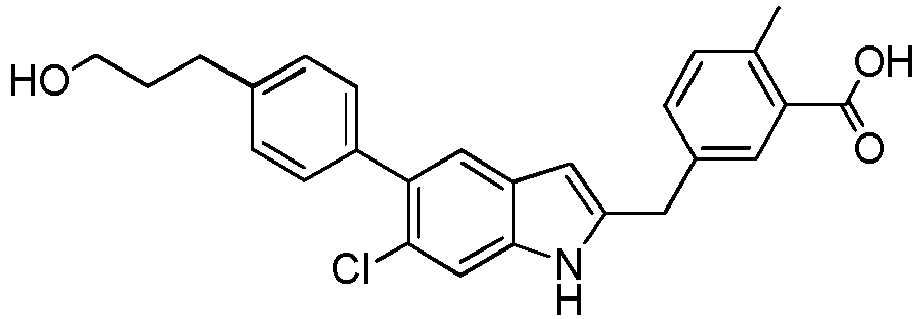
5-({6-chloro-5-[4-(3 - hydroxypropyl)p henyl]-1H-indol-2-yl}methyl)-2-methylbenzoic acid 434 32 
5-({6-chloro-5-[4-(cyclopropylcarb amoyl)phenyl]-1H-indol-2-yl}methyl)-2-methylbenzoic acid 459 33 
5-({6-chloro-5-[4-(methyl carb amo yl)phenyl]-1H-indol-2-yl}methyl)-2-methylbenzoic acid 433 34 
5-{[5-(1,3-benzodioxol-5-yl)-6-chloro-1H-indol-2-yl]methyl}-2-methylbenzoic acid 420 35 
5-[(6'-chloro-1-methyl-1H,1'H-2,5'-biindol-2'-yl)methyl]-2-methylbenzoic acid 429 36 
5-({6-chloro-5-[4'-(1-methylethoxy)bi phenyl-4-yl]-1H-indol-2-yl}methyl)-2-methylbenzoic acid 510 37 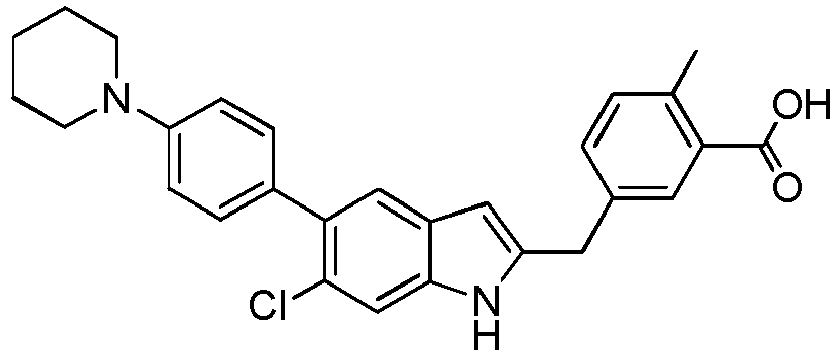
5-{ [6-chloro-5-(4-piperidin-1-ylphenyl)-1H-indol-2-yl]methyl}-2-methylbenzoic acid 459 38 
5-[(5-{4-[4-(tert-butoxycarbonyl) piperazin-1-yl]phenyl}-6-chloro-1H-indol-2-yl)methyl]-2-methylbenzoic acid 560 39 
5-({6-chloro-5-[4-(pyrrolidin-1-ylcarbonyl)phen yl]-1H-indol-2-yl}methyl)-2-methylbenzoic acid 473 40 
5-{[6-chloro-5-(2-hydroxyphenyl)-1H-indol-2-yl]methyl}-2-methylbenzoic acid 392 41 
5-{ [6-chloro-5-(4-furan-2-ylphenyl)-1H-indol-2-yl]methyl}-2-methylbenzoic acid 442 42 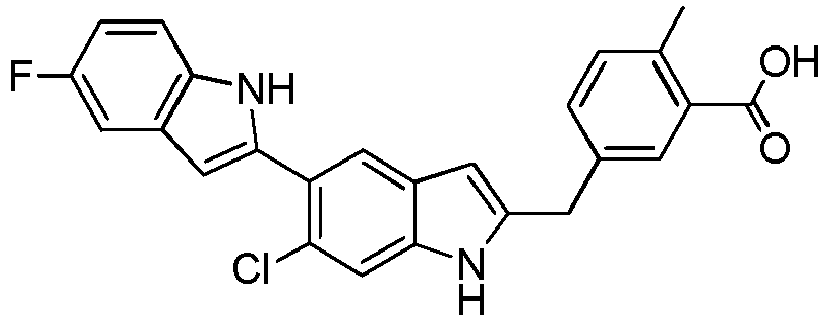
5-[(6'-chloro-5-fluoro-1H,1'H-2,5'-biindol-2'-yl)methyl]-2-methylbenzoic acid 433 43 
5-{[5-(1-benzofuran-3-yl)-6-chloro-1H-indol-2-yl]methyl}-2-methylbenzoic acid 416 44 
5-{ [6-chloro-5-(1H-pyrrolo[2,3-b]pyridin-5-yl)-1H-indol-2-yl]methyl}-2-methylbenzoic acid 416 45 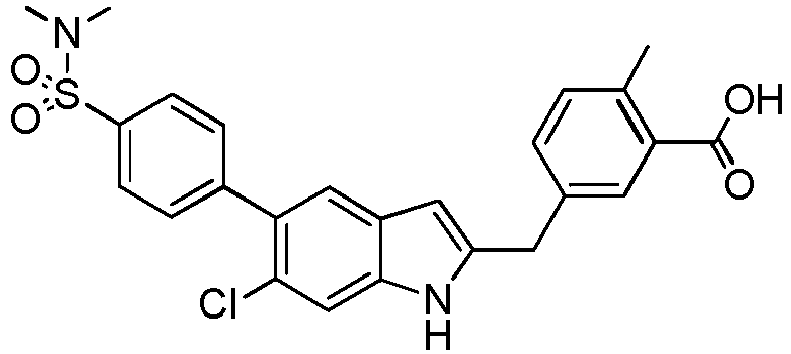
5-({6-chloro-5-[4-(dimethylsulfam oyl)phenyl]-1H-indol-2-yl}methyl)-2-methylbenzoic acid 483 46 
5-{[6-chloro-5-(1H-pyrazol-4-yl)-1H-indol-2-yl]methyl}-2-methylbenzoic acid 366 47 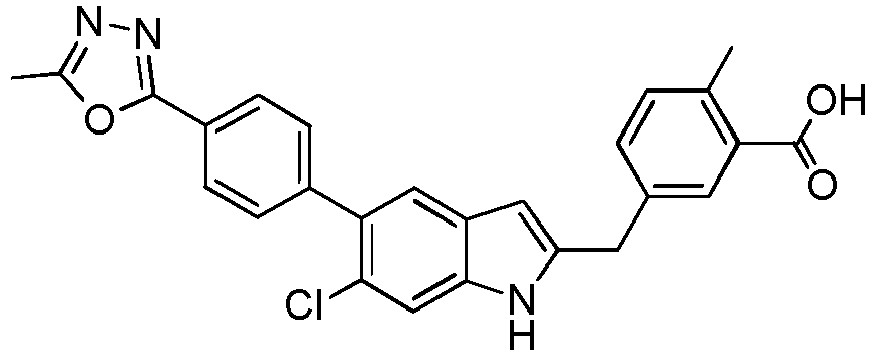
5-({6-chloro-5-[4-(5-methyl-1,3,4-oxadiazol-2-yl)phenyl]-1H-indol-2-yl}methyl)-2-methylbenzoic acid 458 48 
5-{[6-chloro-5-(3-methyl-1,2-benzisoxazol-5-yl)-1H-indol-2-yl]methyl}-2-methylbenzoic acid 431 
- tert-bulyldimethyl(((3R,3aS,6R,6aR)-6-(prop-2-yn-1-yloxy)hexahydrofuro[3,2-b]furan-3-yl)oxy)silane To a solution of (3R,3aR,6R,6aS)-6-((tert-butyldimethyl silyl)oxy)-hexahydrofuro[3,2-b]furan-3-ol (2.0 g, 7.7 mmol) in DMF (20 mL) was added NaH (369 mg, 9.2 mmol) at 0 °C. The mixture was stirred at 0 °C for 30 min, then 3-bromoprop-1-yne (1.1 mg, 9.2 mmol) was added. The mixture was stirred at room temperature for 1 h, then quenched with saturated aqueous NH4Cl (10 mL) and extracted with ethyl acetate. The combined organic layers were washed with brine, dried over anhydrous Na2SO4, filtered and evaporated. The resulting residue was purified by silica gel column chromatography (petroleum ether (PE): EtOAc = 20:1 ∼ 5:1) to afford the title compound. NMR δ (ppm)(CDCl3): 4.53 (m, 1H), 4.40 (m, 1H), 4.34 (m, 3H), 4.07 (t, 1H), 3.88 (t, 1H), 3.67 (m, 2H), 2.46 (t, 1H), 0.9 (s, 9H), 0.98 (d, 6H).
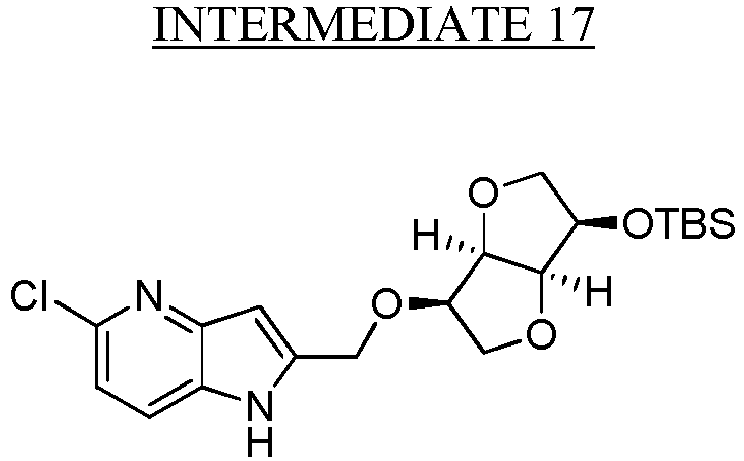
- 2-((((3R,3aR,6R,6aS)-6-((tert-butyldimethylsilyl)oxy)hexahydrofuro[3,2-b]furan-3 yl)oxy)methyl)-5-chloro-1H-pyrrolo[3,2-b]pyndine To a solution of tert-butyldimethyl(((3R,3aS,6R,6aR)-6-(prop-2-yn-1-yloxy)hexahydrofuro[3,2-b]furan-3-yl)oxy)silane (235 mg, 0.79 mmol) in 1,2-dichloroethane (3 mL) were added 6-chloro-2-iodopyridin-3-amine (200 mg, 0.79 mmol) and Cu(OAc)2 (14 mg, 0.079 mmol). The mixture was heated to 150 °C under microwave (MW) and stirred for 30 min. Then the mixture was filtered and concentrated under reduced pressure to give a residue, which was purified by silica gel column chromatography (PE: EtOAc = 10:1 ∼ 3:1) to give the title compound. NMR δ (ppm)(CDCl3): 9.30 (brs, 1H), 7.48 (d, 1H), 6.98 (d, 1H), 6.41 (s, 1H), 4.75 (q, 2H), 4.32 (m, 2H), 4.22 (m, 1H), 4.03 (m, 1H), 3.85 (m, 2H), 3.63 (m, 2H), 0.80 (s, 9H), 0.00 (d, 6H).

- Step A: 6-bromo-2-(3-(((3R,3aR,6R,6aS)-6-((tert-butyldimethylsilyl)oxy)hexa-hydrofuro[3,2-b]furan-3-yl)oxy)prop-1-yn-1-yl)-5-chloropyridin-3-amine To a solution of 2,6-dibromo-5-chloropyridin-3-amine (1.0 g, 3.5 mmol) in N,N-dimethylformamide (10 mL) were added tert-butyldimethyl(((3R,3aS,6R,6aR)-6-(prop-2-yn-1-yloxy)hexa-hydrofuro[3,2-b]furan-3-yl)oxy)silane (1.3 mg, 4.2 mmol), Pd(PPh3)2Cl2 (245 mg, 0.35 mmol), CuI (67 mg, 0.35 mmol) and Et3N (530 mg, 5.2 mmol). The mixture was heated to 80 °C under MW and stirred for 30 min. Then the mixture was filtered and concentrated under reduced pressure. The resulting residue was purified by silica gel column chromatography (PE: EtOAc = 10:1 ∼ 3:1) to afford the title compound. NMR δ (ppm)(CDCl3): 7.05 (s, 1H), 4.52 (m, 1H), 4.50 (m, 1H), 4.45 (m, 1H), 4.20 (m, 1H), 4.31 (m, 1H), 3.66 (m, 1H), 3.64 (M, 2H), 3.62 (m, 1H), 3.55 (m, 1H), 2.50 (m, 2H), 0.80 (s, 9H), 0.00 (d, 6H).
- Step B: tert-butyl (6-bromo-2-(3-(((3R,3aR,6R,6aS)-6-((tert-butyldimethylsilyl)oxy)-hexahydrofuro[3,2-b]furan-3-yl)oxy)prop-1-yn-1-yl)-5-chloropyridin-3-yl)carbamate To a mixture of 6-bromo-2-(3-(((3R,3aR,6R,6aS)-6-((tert-butyldimethylsilyl)oxy)hexa-hydrofuro[3,2-b]furan-3-yl)oxy)prop-1-yn-1-yl)-5-chloropyridin-3-amine (800 mg, 1.6 mmol) in dichloromethane (20 mL) were added Et3N (241 mg, 2.4 mmol) and N,N-dimethylpyridin-4-amine (19 mg, 0.16 mmol), follwed by di-tert-butyl dicarbonate (416 mg, 1.9 mmol). The mixture was stirred at room temperature for 4 h, then washed with brine, dried over anhydrous Na2SO4, filtered and concentrated under reduced pressure. The resulting residue was purified by silica gel column chromatography (PE: EtOAc = 30:1 ∼ 5:1) to afford the title compound. LC-MS: calculated for C25H36BrClN2O6Si 602.12, observed m/e: 603.2/605.2 (M+H)+ (Rt 1.87/2 min).
- Step C: 5-bromo-2-((((3R,3aR,6R,6aS)-6-((tert-butyldimethylsilyl)oxy)hexahydrofuro-[3,2-b]furan-3-yl)oxy)methyl)-6-chloro-1H-pyrrolo[3,2-b]pyridine A mixture of tert-butyl (6-bromo-2-(3-(((3R,3aR,6R,6aS)-6-((tert-butyldimethylsilyl)oxy)hexahydrofuro-[3,2-b]furan-3-yl)oxy)prop-1-yn-1-yl)-5-chloropyridin-3-yl)carbamate (300 mg, 0.50 mmol) and DBU (151 mg, 1.0 mmol) in methanol (10 mL) was heated to 90 °C under MW and stirred for 30 min. The mixture was concentrated under reduced pressure, and the resulting residue was purified by silica gel column chromatography (PE: EtOAc = 10:1 ∼ 1:1) to afford the title compound.

- Step A: tert-butyl (2-(3-(((3R,3aR,6R,6aS)-6-((tert-butyldimethylsilyl)oxy)-hexahydrofuro[3,2-b]furan-3-yl)oxy)prop-1-yn-1-yl)-6-chloro-5-fluoropyridin-3-yl)carbamate To a solution of tert-butyl (2,6-dichloro-5-fluoropyridin-3-yl)carbamate (1.0 g, 3.6 mmol) in N,N-dimethylacetamide (10 mL) were added tert-butyldimethyl-(((3R,3aS,6R,6aR)-6-(prop-2-yn-1-yloxy)hexahydrofuro[3,2-b]furan-3-yl)oxy)silane (1.3 g, 4.3 mmol), DTBPF·PdCl2 (242 mg, 0.36 mmol) and N-cyclohexyl-N-methyl-cyclohexanamine (1.0 g, 5.3 mmol). The mixture was heated to 60°C under MW and stirred for 30 min. Then the mixture was filtered and concentrated under reduced pressure, and the resulting residue was purified by silica gel column chromatography (PE: EtOAc = 10:1 ∼ 3:1) to afford the title compound.
- Step B: 2-((((3R,3aR,6R,6aS)-6-((tert-butyldimethylsilyl)oxy)hexahydrofuro[3,2-b]furan-3-yl)oxy)methyl)-5-chloro-6-fluoro-1H-pyrrolo[3,2-b]pyridine A mixture of tert-butyl (2-(3-(((3R,3aR,6R,6aS)-6-((tert-butyldimethylsilyl)oxy)hexahydrofuro[3,2-b]furan-3-yl)oxy)prop-1-yn-1-yl)-6-chloro-5-fluoropyridin-3-yl)carbamate (400 mg, 0.74 mmol) and DBU (224 mg, 1.5 mmol) in methanol (10 mL) was heated to 90 °C under MW and stirred for 30 min. Then the mixture was filtered and concentrated under reduced pressure, and the resulting residue was purified by silica gel column chromatography (PE: EtOAc = 10:1 ∼ 1:1) to afford the title compound. LC-MS: calculated for C20H28ClFN2O4Si 442.15, observed m/e: 443.0 (M+H)+ (Rt 1.36/2 min).

- tert-bulyldimethyl(((3R,3aS,6aR)-6-(prop-2-yn-1-yl)hexahydrofuro[3,2-b]furan-3-yl)oxy)silane Step A: ethyl 2-((3aR,6R,6aS)-6-((tert-butyldimethylsilyl)oxy)hexahydrofuro[3,2-b]furan-3-yl)acetate To a solution of ethyl 2-((3aR,6R,6aR)-6-hydroxyhexahydro-furo[3,2-b]furan-3-yl)acetate (20.0 g, 93 mmol) in DMF (100 mL) were added imidazole (9.4 g, 139 mmol) and tert-butylchlorodimethylsilane (16.7 g, 111 mmol). The mixture was heated to 40 °C and stirred for 4 h. Then the mixture was diluted with EtOAc (1 L), it was washed with brine, dried over anhydrous Na2SO4, filtered and concentrated to give the crude product, which was purified by silica gel column chromatography (PE: EtOAc = 20:1 ∼ 50:1) to afford the title compound. NMR δ (ppm)(CDCl3): 4.43 (m, 1H), 4.31 (m, 1H), 4.18 (m, 1H), 4.01 (m, 3H), 3.67 (m, 1H), 3.42 (m, 2H), 2.51 (m, 2H), 2.33 (m, 1H), 1.15 (t, 3H), 0.80 (s, 9H), 0.00 d, 6H).
- Step B: 2-((3aR,6R,6aS)-6-((tert-butyldimethylsilyl)oxy)hexahydrofuro[3,2-b]furan-3-yl)ethanol Aluminum(III) lithium hydride (5.1 g, 133 mmol) was carefully added to a solution of ethyl 2-((3aR,6R,6aS)-6-((tert-butyldimethylsilyl)oxy)hexahydrofuro[3,2-b]furan-3-yl)acetate (22.0 g, 67 mmol) in anhydrous THF (200 mL) at 0 °C. The mixture was stirred at the room temperature for 2 h, then cooled to 0 °C. Water (5 mL), 15% NaOH aq. (5 mL) and H2O (15 mL) were added to the reaction and the mixture was stirred for 30 min at room temperature. Then anhydrous MgSO4 (30 g) was added, and the mixture was filtered, and the filtrate was concentrated to afford the title compound, which was used in the next step without further purification. NMR δ (ppm)(CDCl3): 4.40 (m, 1H), 4.31 (m, 1H), 4.22 (m, 1H), 3.94 (m, 1H), 3.65 (m, 4H), 3.42 (m, 2H), 2.21 (br, 1H), 1.78 (m, 1H), 1.69 (m, 1H), 1.52 (m, 2H), 0.80 (s, 9H), 0.00(d, 6H).
- Step C: 2-((3aR,6R,6aS)-6-((tert-butyldimethylsilyl)oxy)hexahydrofuro[3,2-b]furan-3-yl)acetaldehyde DMSO (19.5 g, 250 mmol) was added dropwise to a solution of (COCl)2 (15.8 g, 125 mmol) in anhydrous DCM (200 mL) at -78 °C. The mixture was stirred at -78 °C for 30 min, then a solution of 2-((3aR,6R,6aS)-6-((tert-butyldimethylsilyl)-oxy)hexahydrofuro[3,2-b]furan-3-yl)ethanol (18.0 g, 62 mmol) in DCM (50 mL) was added slowly, and the reaction mixture was stirred at -78 °C for 1 h. Then Et3N (50.5 g, 499 mmol) was added dropwise, and the reaction mixture was stirred at -30 °C for 1 h. The mixture was then washed with brine, dried over Na2SO4 and concentrated to afford the title compound, which was used in the next step without further purification. NMR δ (ppm)(CDCl3): 9.63 (s, 1H), 4.37 (m, 1H), 4.31 (m, 1H), 4.22 (m, 1H), 3.88 (m, 1H), 3.61 (m, 1H), 2.66 (m, 1H), 0.80 (s, 9H), 0.00 (d, 6H).
- Step D: 2-((3aR,6R,6aS)-6-((tert-butyldimethylsilyl)oxy)hexahydrofuro[3,2-b]furan-3-yl)ethanol To a solution of PPh3 (42.1 g, 161 mmol) in anhydrous DCM (500 mL) was added CBr4 (26.6 g, 80 mmol) at 0 °C, and the mixture was stirred at 0 °C for 30 min. Then 2-((3aR,6R,6aS)-6-((tert-butyldimethylsilyl)oxy)hexahydrofuro[3,2-b]furan-3-yl)-acet-aldehyde (11.5 g, 40 mmol) was added, and the reaction was stirred at room temperature for 2 h. The reaction mixture was then washed with brine, dried over Na2SO4 and evaporated. The resulting residue was purified by silica gel column chromatography (PE: EtOAc = 20:1 ∼ 5:1) to afford the title compound. NMR δ (ppm)(CDCl3): 6.37 (t, 1H), 4.33 (m, 2H), 4.17 (m, 1H), 3.93 (m, 1H), 3.68 (m, 1H), 3.41 (m, 2H), 2.20 (m, 2H), 0.80 (s, 9H), 0.00 d, 6H).
- Step E: tert-butyldimethyl(((3R,3aS,6aR)-6-(prop-2-yn-1-yl)hexahydrofuro[32-b]furan-3-yl)oxy)silane To a solution of 2-((3aR,6R,6aS)-6-((tert-butyldimethylsilyl)oxy)-hexahydrofuro[3,2-b]furan-3-yl)ethanol (8.5 g, 19 mmol) in EtOAc (5 mL) was added n-BuLi (16.9 mL, 42 mmol, 2.5 M in hexane) at -78 °C and the reaction mixture was stirred at -78 °C for 1 h. The mixture was then quenched with saturated aqueous NH4Cl, and extracted with EtOAc. The combined organic layers were washed with brine, dried over anhydrous Na2SO4, filtered and evaporated. The resulting residue was purified by silica gel column chromatography (PE: EtOAc = 20:1 ∼ 5:1) to afford the title compound. NMR δ (ppm)(CDCl3): 4.40 (m, 1H), 4.32 (m, 1H), 4.19 (m, 1H), 3.97 (m, 1H), 3.71 (m, 1H), 3.46 (m, 2H), 2.35 (m, 2H), 2.23 (m, 1H), 1.84 (m, 1H), 0.80 (s, 9H), 0.00 (d, 6H).
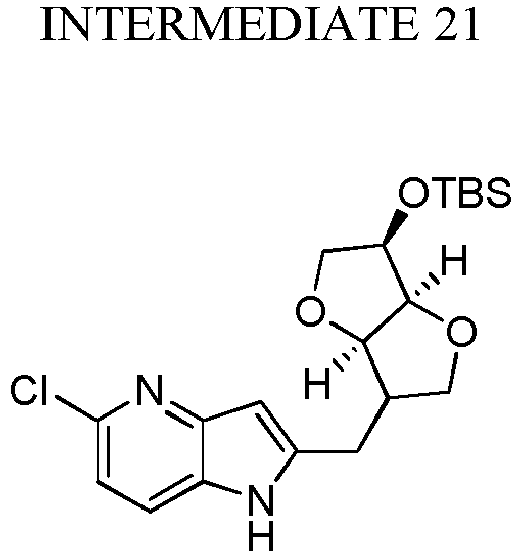
- To a solution of tert-butyldimethyl(((3R,3aS,6aR)-6-(prop-2-yn-1-yl)hexahydrofuro[3,2-b]furan-3-yl)oxy)silane (555 mg, 2.0 mmol, Intermediate 20) in 1,2-dichloroethane (10 mL) were added 6-chloro-2-iodopyridin-3-amine (500 mg, 2.0 mmol) and Cu(OAc)2 (36 mg, 0.20 mmol). The mixture was heated to 150 °C under MW and stirred for 30 min. Then the mixture was filtered and concentrated under reduced pressure to give a residue, which was purified by silica gel column chromatography (PE: EtOAc = 20:1 ∼ 3:1) to afford the title compound. NMR δ (ppm)(CDCl3): 8.93 (brs, 1H), 7.41 (d, 1H), 6.92 (d, 1H), 6.29 (s, 1H), 4.34 (m, 1H), 4.30 (m, 1H), 4.23 (m, 1H), 3.97 (m, 1H), 3.78 (m, 1H), 3.65 (m, 1H), 3.51 (m, 1H), 2.84 (m, 2H), 2.39 (m, 1H), 0.80 (s, 9H), 0.01 (d, 6H).

- Step A: 6-bromo-2-(3-((3aR,6R,6aS)-6-((tert-butyldimethylsilyl)oxy)hexahydrofuro[3,2-b]furan-3-yl)prop-1-yn-1-yl)-5-chloropyridin-3-amine To a solution of 2,6-dibromo-5-chloropyridin-3-amine (500 mg, 1.7 mmol) in THF (10 mL) were added tert-butyldimethyl(((3R,3aS,6aR)-6-(prop-2-yn-1-yl)hexahydrofuro[3,2-b]furan-3-yl)oxy)silane (591 mg, 2.1 mmol), Pd(PPh3)2Cl2 (123 mg, 0.17 mmol), CuI (33 mg, 0.17 mmol) and triethylamine (265 mg, 2.6 mmol). Then the mixture was stirred at room temperature for 2 h, filtered and concentrated under reduced pressure. The resulting residue was purified by silica gel column chromatography (PE: EtOAc = 20:1 ∼ 5:1) to afford the title compound. NMR δ (ppm)(CDCl3): 6.96 (s, 1H), 4.45 (m, 1H), 4.33 (m, 1H), 4.26 (m, 2H), 4.23 (m, 1H), 3.99 (m, 1H), 3.68 (m, 1H), 3.50 (M, 2H), 3.38 (m, 1H), 2.65 (m, 1H), 2.50 (m, 2H), 0.80 (s, 9H), 0.00 (d, 6H).
- Step B: tert-butyl (6-bromo-2-(3-((3aR,6R,6aS)-6-((tertbutyldimethylsilyl)oxy)hexahydrofuro[3,2-b]furan-3-yl)prop-1-yn-1-yl)-5-chloropyridin-3-yl)carbamate To a solution of 6-bromo-2-(3-((3aR,6R,6aS)-6-((tert-butyldimethylsilyl)oxy)hexahydrofuro[3,2-b]furan-3-yl)prop-1-yn-1-yl)-5-chloropyridin-3-amine (500 mg, 1.0 mmol) in dichloromethane (20 mL) were added Et3N (156 mg, 1.5 mmol) and N,N-dimethylpyridin-4-amine (13 mg, 0.10 mmol), followed by di-tert-butyl dicarbonate (268 mg, 1.2 mmol). The mixture was stirred at room temperature for 4 h, then washed with brine, dried over anhydrous Na2SO4, filtered and concentrated under reduced pressure. The resulting residue was purified by silica gel column chromatography (PE: EtOAc = 20:1 ∼ 5:1) to afford the title compound.
- Step C: 5-bromo-2-(((3aR,6R,6aS)-6-((tert-butyldimethylsilyl)oxy)hexahydrofuro[3,2-b]furan-3-yl)methyl)-6-chloro-1H-pyrrolo[32-b]pyridine The mixture of tert-butyl (6-bromo-2-(3-((3aR,6R,6aS)-6-((tert-butyldimethylsilyl)oxy)hexahydrofuro[3,2-b]furan-3-yl)prop-1-yn-1-yl)-5-chloropyridin-3-yl)carbamate (500 mg, 0.85 mmol) and DBU (259 mg, 1.7 mmol) in methanol (10 mL) was heated to 65 °C under MW and stirred for 30 min. The mixture was then concentrated under reduced pressure and the resulting residue was purified by silica gel column chromatography (PE: EtOAc = 10:1 ∼ 1:1) to afford the title compound.

- Step A: tert-butyl (2-(3-((3aR,6R,6aS)-6-((tert-bulyldimethylsilyl)oxy)hexa-hydrofuro[3,2-b]furan-3-yl)prop-1-yn-1-yl)-6-chloro-5-fluoropyridin-3-yl)carbamate To a solution of tert-butyl (2,6-dichloro-5-fluoropyridin-3-yl)carbamate (500 mg, 1.8 mmol) in N,N-dimethylacetamide (10 mL) were added tert-butyldimethyl(((3R,3aS,6aR)-6-(prop-2-yn-1-yl)hexa-hydrofuro[3,2-b]furan-3-yl)oxy)silane (603 mg, 2.1 mmol), DTBPF·PdCl2 (121 mg, 0.18 mmol), CuI (54 mg, 0.28 mmol) and N-cyclohexyl-N-methylcyclohexanamine (521 mg, 2.7 mmol). The mixture was heated to 90°C under MW and stirred for 30 min. Then the mixture was filtered and concentrated under reduced pressure. The resulting residue was purified by silica gel column chromatography (PE:EtOAc = 10:1 ∼ 3:1) to afford the title compound.
- Step B: 2-(((3aR,6R,6aS)-6-((tert-butyldimethylsilyl)oxy)hexahydrofuro[3,2-b]furan-3-yl)methyl)-5-chloro-6-fluoro-1H-pyrrolo[3,2-b]pyridine A mixture of tert-butyl (2-(3-((3aR,6R,6aS)-6-((tert-butyldimethylsilyl)oxy)hexahydrofuro[3,2-b]furan-3-yl)prop-1-yn-1-yl)-6-chloro-5-fluoropyridin-3-yl)carbamate (400 mg, 0.76 mmol) and DBU (231 mg, 1.5 mmol) in methanol (10 mL) was heated to 90 °C under MW and stirred for 30 min. Then the mixture was concentrated under reduced pressure and the resulting residue was purified by silica gel column chromatography (PE: EtOAc = 10:1 ∼ 1:1) to afford the title compound. LC-MS: calculated for C20H28ClFN2O3Si 426.15, observed m/e: 427.2 (M+H)+ (Rt 1.52/2 min).
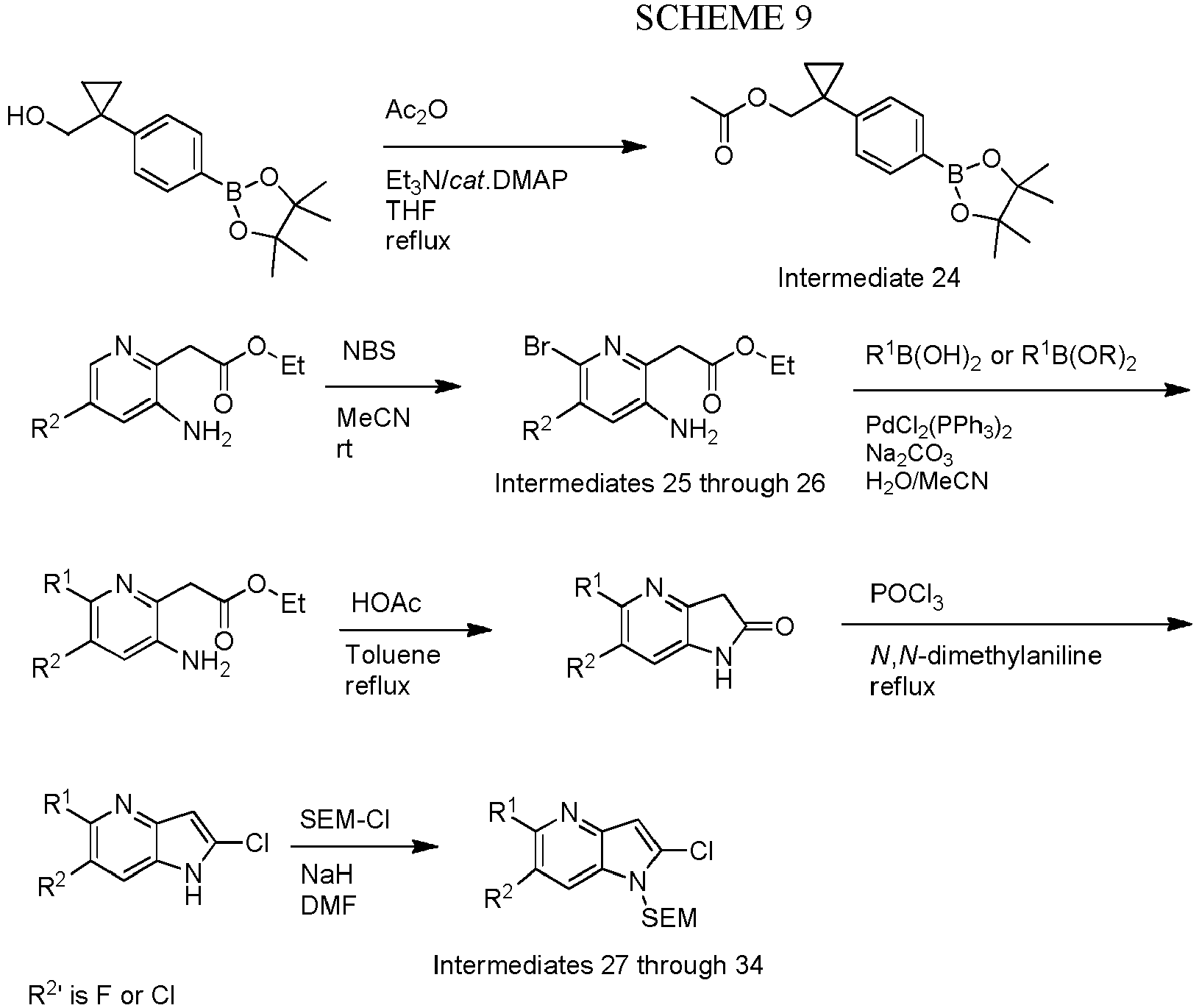

- (1-(4-(4,4,5,5-tetramethyl-1,3,2-dioxaborolan-2-yl)phenyl)cyclopropyl)methyl acetate A mixture of (1-(4-(4,4,5,5-tetramethyl-1,3,2-dioxaborolan-2-yl)phenyl)cyclopropyl)-methanol (16 g, 0.088 mol), Ac2O (26.5 g, 0.26 mol), TEA (35.5 g, 0.352 mol) and DMAP (2.14 g, 0.0176 mol) in THF (160 ml) was stirred at 80 °C for 16 h. Then the reaction was concentrated and the crude product was purified via silica gel (PE:EA=50:1-3:1) to give the title compound. NMR δ (ppm)(CDCl3): 7.75 (d, 2H), 7.31 (d, 2H), 4.18 (s, 2H), 2.00 (s, 3H), 1.26 (s, 12H), 0.95 (m, 4H).
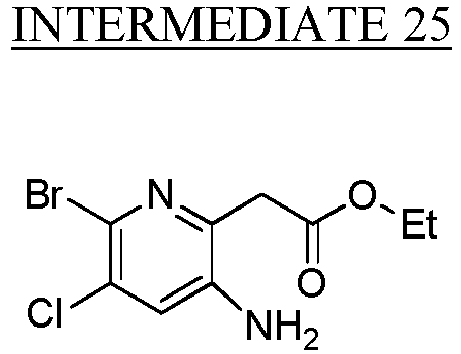
- Ethyl 2-(3-amino-6-bromo-5-chloropyridin-2-yl)acetate To a mixture of ethyl 2-(3-amino-5-chloropyridin-2-yl)acetate (30 g, 0.14 mol) in CH3CN (500 mL) was added NBS (24.9 g, 0.14 mol) at 0 °C and the mixture was stirred for 1 h at 0°C. Then the mixture was diluted with CH3CN, washed with brine, dried over anhydrous Na2SO4, filtered and concentrated under reduced pressure. The resulting residue was purified by silica gel column chromatography (PE: EtOAc = 30:1 ∼ 3:1) to afford the title compound. NMR δ (ppm)(CDCl3): 7.20 (s, 1H), 4.15 (q, 2H), 3.69 (s, 2H), 1.24 (t, 3H).
Table 6. Compounds prepared according to the methods described in Intermediate 25. Example Number Structure HPLC-mass spectrum m/e Intermediate 26 
277.0/279.0 
- Step A: ethyl 2-(6-(4-(1-(acetoxymethyl)cyclopropyl)phenyl)-3-amino-5-chloropyridin-2-yl)acetate A mixture of ethyl 2-(3-amino-6-bromo-5-chloropyridin-2-yl)acetate (1.0 g, 3.4 mmol), (1-(4-(4,4,5,5-tetramethyl-1,3,2-dioxaborolan-2-yl)phenyl)cyclopropyl)-methyl acetate (1.3 g, 4.1 mmol), Pd(PPh3)2Cl2 (239 mg, 0.34 mmol) and Na2CO3 (542 mg, 5.1 mmol) in MeCN (30 mL) / H2O (3 mL) was heated to 100 °C under MW and stirred for 30 min. Then the mixture was extracted with EtOAc. The combined organic layers were washed with brine, dried over anhydrous Na2SO4, filtered and concentrated under reduced pressure. The resulting residue was purified by silica gel column chromatography (PE: EtOAc = 10:1 ∼ 2:1) to afford the title compound. NMR δ (ppm)(CDCl3): 7.61 (d, 2H), 7.35 (d, 2H), 7.10 (s, 1H), 4.17 (m, 4H), 3.85 (s, 2H), 2.03 (s, 3H), 1.25 (t, 3H), 0.95 (m, 4H).
- Step B: (1-( 4-(6-chloro-2-oxo-2,3-dihydro-1H-pyrrolo[32-b]pyridin-5-yl)phenyl)-cyclopropyl)methyl acetate To a suspension of ethyl 2-(6-(4-(1-(acetoxymethyl)cyclopropyl)phenyl)-3-amino-5-chloropyridin-2-yl)acetate (800 mg, 2.0 mmol) in toluene (20 mL) was added acetic acid (238 mg, 4.0 mmol), and the reaction was heated to reflux for 4 h. The reaction was cooled to rt and the solvents were removed under reduced pressure. The resulting residue was suspended in toluene (20 mL), filtered, washed with diethyl ether and dried to give the title compound. NMR δ (ppm)(CDCl3): 8.19 (s, 1H), 7.60 (d, 2H), 7.39 (d, 2H), 7.26 (s, 1H), 4.20 (s, 2H), 3.70 (s, 2H), 2.03 (s, 3H), 0.98 (d, 4H).
- Step C: (1-(4-(2,6-dichloro-1H-pyrrolo[3,2-b]pyridin-5-yl)phenyl)cyclopropyl)methyl acetate To a mixture of (1-(4-(6-chloro-2-oxo-2,3-dihydro-1H-pyrrolo[3,2-b]pyridin-5-yl)phenyl)cyclopropyl)methyl acetate (400 mg, 1.1 mmol) in phosphoryl trichloride (10 mL) was added N,N-dimethylaniline (272 mg, 2.2 mmol). The mixture was heated to reflux and stirred for 1 h, then evaporated under vacuum. The resulting residue was dissolved in water, and the resulting mixture was adjusted to pH = 8 with saturated NaHCO3, and extracted with ethyl acetate. The combined organic layers were washed with brine, dried over anhydrous Na2SO4, filtered and concentrated under reduced pressure. The resulting residue was purified by silica gel column chromatography (PE: EtOAc = 20:1 ∼ 3:1) to afford the title compound . NMR δ (ppm)(CDCl3): 8.29 (s, 1H), 7.69 (s, 1H), 7.29 (d, 2H), 7.40 (d, 2H), 6.66 (s, 1H), 4.20 (s, 2H), 2.04 (s, 3H), 0.98 (q, 4H).
- Step D (1-(4-(2,6-dichloro-1-((2-(trimethylsilyl)ethoxy)methyl)-1H-pyrrolo[3,2-b]pyridin-5-yl)phenyl)cyclopropyl)methanol Sodium hydride (13 mg, 0.32 mmol) was added to a solution of (1-(4-(2,6-dichloro-1H-pyrrolo[3,2-b]pyridin-5-yl)phenyl)cyclo-propyl)methyl acetate (100 mg, 0.27 mmol) in N,N-dimethylformamide(5 mL) at 0 °C and the mixture was stirred at 0 °C for 30 min. Then (2-(chloromethoxy)ethyl)trimethyl-silane (53 mg, 0.32 mmol) was added to the reaction. The reaction was warmed to room temperature for 1 h, then quenched with saturated NH4Cl, and extracted with ethyl acetate. The combined organic layers were washed with brine, dried over anhydrous Na2SO4, filtered and concentrated under reduced pressure. The resulting residue was purified by silica gel column chromatography (PE: EtOAc = 30:1 ∼ 5:1) to afford the title compound. NMR δ (ppm)(CDCl3): 7.85 (s, 1H), 7.66 (d, 2H), 7.46 (d, 2H), 6.70 (s, 1H), 5.56 (s, 2H), 3.72 (d, 2H), 3.57 (t, 2H), 0.93 (m, 6H), 0.00 (s, 9H). LC-MS: calculated for C23H28Cl2N2O2Si 462.13, observed m/e: 463.2 (M+H)+ (Rt 1.43/2 min).
Table 7. Compounds prepared according to the methods described in Intermediate 27. Example Number Structure HPLC-mass spectrum m/e Intermediate 28 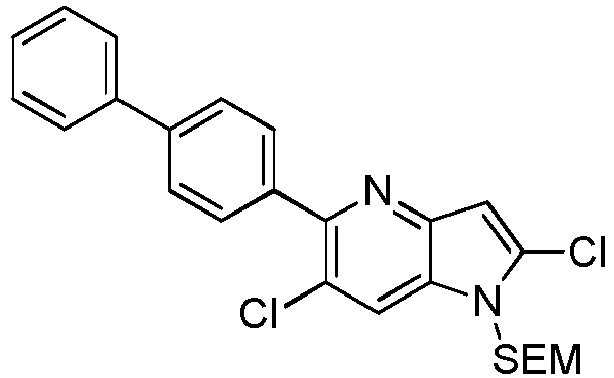
469.2 Intermediate 29 
447.1 Intermediate 30 
453.2 Intermediate 31 
531.1 Intermediate 32 
437.1 Intermediate 33 
446.1 Intermediate 34 
478.1 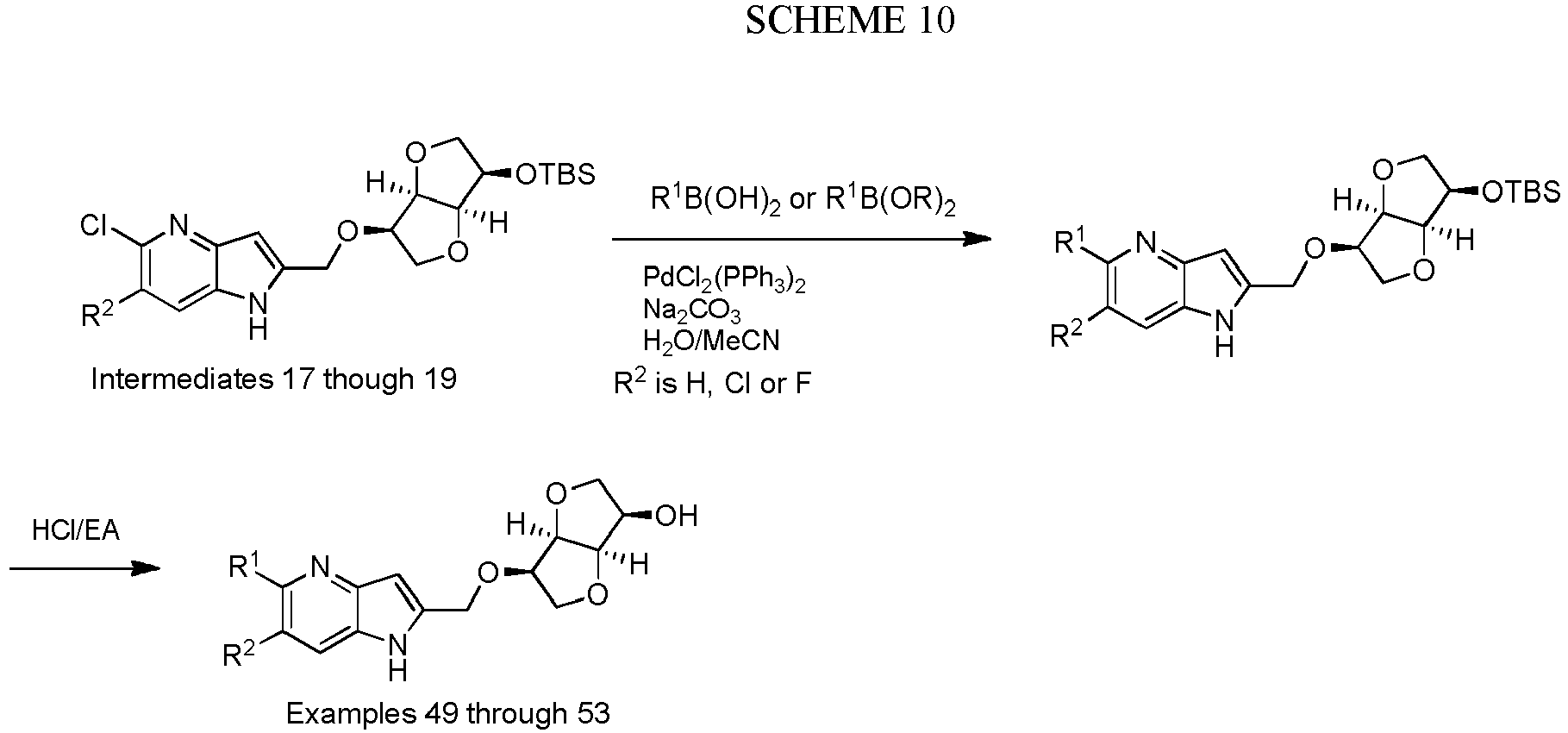
-

- A mixture of 2-((((3R,3aR,6R,6aS)-6-((tert-butyldimethylsilyl)oxy)hexahydrofuro [3,2-b]furan-3-yl)oxy)methyl)-5-chloro-1H-pyrrolo[3,2-b]pyridine (100 mg, 0.24 mmol), (1-(4-(4,4,5,5-tetramethyl-1,3,2-dioxaborolan-2-yl)phenyl) cyclopropyl)methanol (77 mg, 0.28 mmol), Pd(PPh3)2Cl2 (17 mg, 0.024 mmol) and Na2CO3 (37 mg, 0.35 mmol) in MeCN (1 mL) / H2O (1 mL) was heated to 150 °C under MW and stirred for 30 min. Then the mixture was extracted with ethyl acetate. The combined organic layers were washed with brine, dried over anhydrous Na2SO4, filtered and concentrated to give the crude product, which was purified by silica gel column chromatography (PE: EtOAc = 20:1 ∼ 3:1) to afford the title compound. NMR δ (ppm)(CDCl3): 9.09 (brs, 1H), 7.88 (d, 2H), 7.62 (d, 1H), 7.45 (d, 1H), 7.39 (d, 2H), 6.61 (s, 1H), 4.80 (m, 2H), 4.35 (m, 1H), 4.30 (m, 1H), 4.26 (m, 1H), 4.07 (m, 1H), 3.97 (m, 1H), 3.85 (m, 1H), 3.66 (m, 4H), 0.84 (m, 13H), 0.03 (d, 6H).
- Step B: (3R,3aR,6R,6aR)-6-((5-(4-(1-(hydroxymethyl)cyclopropyl)phenyl)-1H-pyrrolo[3,2-b]pyridin-2-yl)methoxy)hexahydrofuro[3,2-b]furan-3-ol 4 M HCl/EtOAc (1 mL) was added to a mixture of (1-(4-(2-((((3R,3aR,6R,6aS)-6-((tert-butyldimethyl-silyl)oxy) hexa-hydrofuro[3,2-b]furan-3-yl)oxy)methyl)-1H-pyrrolo[3,2-b]pyridin-5-yl)phenyl)cyclo-propyl)methanol (70 mg, 0.13 mmol) in EtOAc (5 mL) at 0°C. The reaction mixture was stirred at 0 °C for 30 min, then concentrated under reduced pressure. The resulting residue was purified by prep. HPLC to afford the title compound. NMR δ (ppm)(CDCl3): 8.50 (d, 1H), 7.88 (m, 3H), 7.66 (d, 2H), 6.85 (s, 1H), 5.08 (m, 1H), 4.71 (m, 1H), 4.49 (m, 1H), 4.31 (m, 2H), 4.08 (m, 1H), 3.98 (m, 1H), 3.80 (m, 1H), 3.75 (m, 2H), 3.65 (m, 1H), 0.98 (m, 4 H). LC-MS: calculated for C24H26N2O5 422.18, observed m/e: 423.2 (M+H)+ (Rt 2.22/4 min).
Table 8. Compounds prepared according to the methods described in Example 49. Example Number Structure PLC-mass spectrum m/e 50 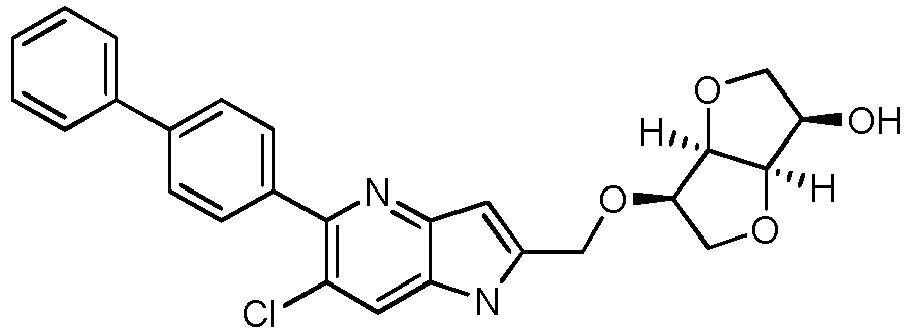
463.1 51 
457.1 52 
447.2 53 
441.2 
-

- Step A: (1-(4-(2-(((3aR,6R,6aS)-6-((tert-butyldimethylsilyl)oxy)hexahydrofuro[3,2-b]furan-3-yl)methyl)-1H-pyrrolo[3,2-b]pyridin-5-yl)phenyl)cyclopropyl)methanol A mixture of 2-(((3aR,6R,6aS)-6-((tert-butyldimethylsilyl)oxy)hexahydrofuro[3,2-b]furan-3-yl)methyl)-5-chloro-1H-pyrrolo[3,2-b]pyridine (200 mg, 0.49 mmol), (1-(4-(4,4,5,5-tetramethyl-1,3,2-dioxaborolan-2-yl)phenyl)cyclopropyl)methanol (161 mg, 0.59 mmol), Pd(PPh3)2Cl2 (34 mg, 0.049 mmol) and Na2CO3 (78 mg, 0.73 mmol) in MeCN (2 mL) - H2O (2 mL) was heated to 150 °C under MW and stirred for 30 min. Then the mixture was extracted with ethyl acetate. The combined organic layers were washed with brine, dried over anhydrous Na2SO4, filtered and evaporated. The resulting residue was purified by silica gel column chromatography (PE: EtOAc = 20:1 ∼ 3:1) to afford the title compound. LC-MS: calculated for C30H40N2O4Si 520.28, observed m/e: 521.4 (M+H)+ (Rt 1.11/2 min).
- Step B: (3R,3aR,6aR)-6-((5-(4-(1-(hydroxymethyl)cyclopropyl)phenyl)-1H-pyrrolo[3,2 b]pyridin-2-yl)methyl)hexahydrofuro[3,2-b]furan-3-ol 4 M HCl/EtOAc (1 mL) was added to a mixture of (1-(4-(2-(((3aR,6R,6aS)-6-((tert-butyldimethylsilyl)oxy)hexa-hydrofuro[3,2-b]furan-3-yl)methyl)-1H-pyrrolo[3,2-b]pyridin-5-yl)phenyl)cyclopropyl)-methanol (110 mg, 0.21 mmol) in EtOAc (5 mL) at 0°C and the reaction mixture was stirred at 0°C for 30 min. Then the mixture was concentrated under reduced pressure and the resulting residue was purified by prep-HPLC to give the title compound. NMR δ (ppm)(CDCl3): 8.40 (d, 1H), 7.81 (m, 3H), 7.62 (d, 2H), 6.73 (s, 1H), 4.52 (m, 1H), 4.47 (m, 1H), 4.29 (m, 1H), 4.08 (m, 1H), 3.89 (m, 1H), 3.72 (m, 2H), 3.60 (m, 2H), 3.22 (m, 1H), 3.10 (m, 1H), 2.75 (br, 1H), 0.96 (m, 4H).
- Step C: (3R,3aR,6R,6aR)-6-((5-(4-(1-(hydroxymethyl)cyclopropyl)phenyl)-1H-pyrrolo[3,2-b]pyridin-2-yl)methyl)hexahydrofuro[3,2-b]furan-3-ol, and (3R,3aR,6S,6aR)-6-((5-(4-(1-(hydroxymethyl)cyclopropyl)phenyl)-1H-pyrrolo[3,2-b]pyridin-2-yl)methyl)hexahydrofuro[3,2-b]lfuran-3-ol
- The mixture of stereoisomers of (3R,3aR,6aR)-6-((5-(4-(1-(hydroxymethyl)cyclopropyl)-phenyl)-1H-pyrrolo[3,2-b]pyridin-2-yl)methyl)hexahydrofuro[3,2-b]furan-3-ol was separated via SFC to afford the title compounds. NMR δ (ppm)(CDCl3): 7.81 (d, 2H), 7.76 (d, 1H), 7.48 (m, 3H), 6.46 (s, 1H), 4.52 (m, 1H), 4.43 (m, 1H), 4.22 (m, 1H), 4.01 (m, 1H), 3.78 (m, 2H), 3.61 (m, 2H), 2.88 (m, 2H), 2.74 (br, 1H), 0.89 (d, 4H). LC-MS: calculated for C24H26N2O4 406.19, observed m/e: 407.2 (M+H)+ (Rt 2.262/4.5 min).
- NMR δ (ppm)(CDCl3): 7.87 (d, 1H), 7.81 (d, 2H), 7.51 (m, 3H), 6.50 (s, 1H), 4.49 (m, 2H), 4.28 (m, 1H), 4.06 (m, 1H), 3.89 (m, 1H), 3.63 (m, 2H), 3.14 (m, 1H), 2.98 (m, 1H), 2.74 (br, 1H), 0.90 (d, 4H). LC-MS: calculated for C24H26N2O4 406.19, observed m/e: 407.2 (M+H)+ (Rt 2.258/4.5 min).
Table 9. Compounds prepared according to the methods described in Examples 54, 56, 57. Example Number Structure HPLC-mass spectrum m/e 55 
413.2 58 
413.1 59 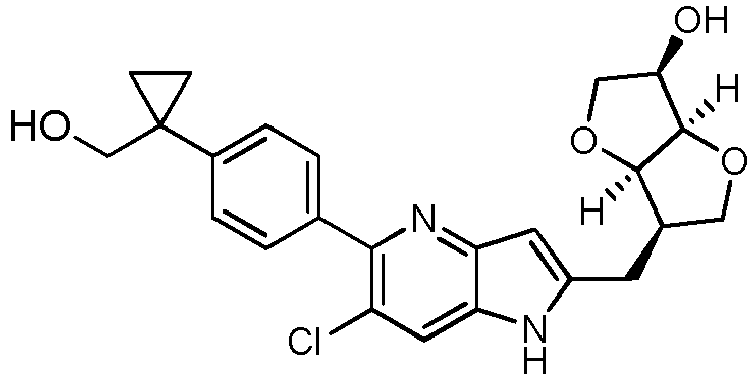
441.1 60 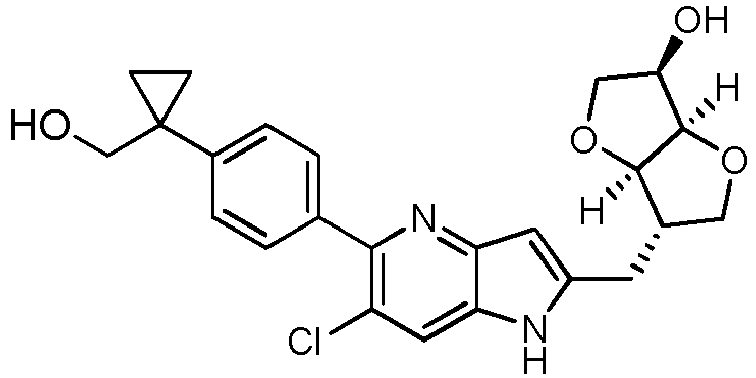
441.1 61 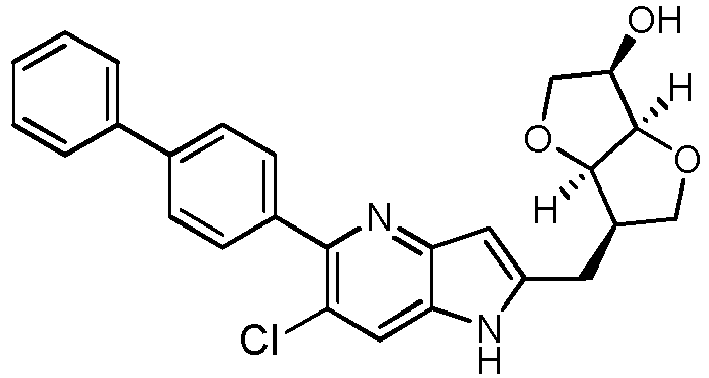
447.1 62 
447.1 63 
425.2 64 
425.1 65 
431.1 66 
431.1 67 
480.2 
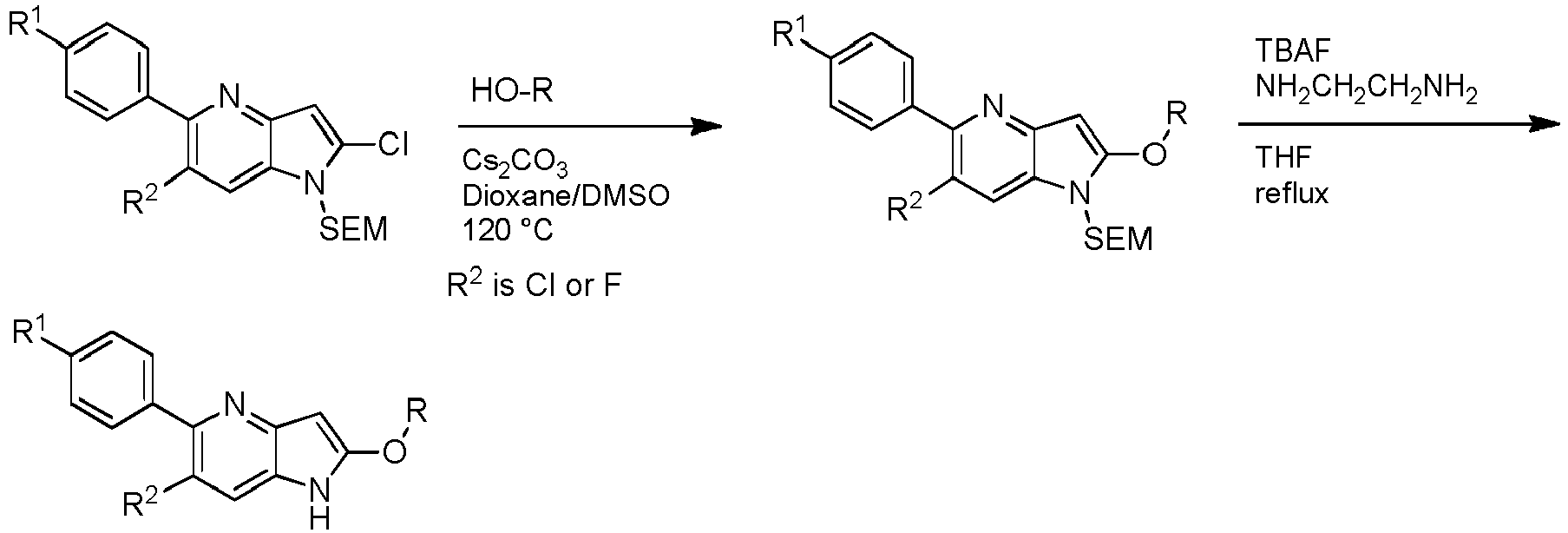
-

- Step A: (3R,3aR,6R,6aR)-6-((6-chloro-5-(4-(1-(hydroxymethyl)cyclopropyl)phenyl)-1-((2-(trimethylsilyl)ethoxy)methyl)-1H-pyrrolo[3,2-b]pyridin-2-yl)oxy)hexahydro-furo[32-b]furan-3-ol To a mixture of (1-(4-(2,6-dichloro-1-((2-(trimethylsilyl)-ethoxy)methyl)-1H-pyrrolo[3,2-b]pyridin-5-yl)phenyl)cyclopropyl)-methanol (50 mg, 0.11 mmol) in DMSO (3 mL) /dioxane (3 mL) were added (3R,3aR,6R,6aR)-hexahydrofuro[3,2-b]furan-3,6-diol (160 mg, 1.1 mmol) and cesium carbonate (108 mg, 0.33 mmol). The reaction was heated at 120 °C overnight. Then the reaction mixture was diluted with ethyl acetate, washed with brine, dried over anhydrous Na2SO4, filtered and concentrated under reduced pressure. The resulting residue was purified by pre-TLC (PE: EtOAc = 2:1) to afford the title compound. LC-MS: calculated for C29H37ClN2O6Si 572.21, observed m/e: 573.2 (M+H)+ (Rt 1.17/2 min).
- Step B: (3R,3aR,6R,6aR)-6-((6-chloro-5-(4-(1-(hydroxymethyl)cyclopropyl)phenyl)-1H-pyrrolo[3,2-b]pyridin-2-yl)oxy)hexahydrofuro[3,2-b]furan-3-ol To a solution of (3R,3aR,6R,6aR)-6-((6-chloro-5-(4-(1-(hydroxymethyl)cyclopropyl)phenyl)-1-((2-(trimethylsilyl)ethoxy)methyl)-1H-pyrrolo[3,2-b]pyridin-2-yl)oxy)hexahydrofuro[3,2-b]furan-3-ol (50 mg, 0.087 mmol) in THF (10 mL) were added tetrabutylammonium fluoride (46 mg, 0.17 mmol) and ethane-1,2-diamine (10 mg, 0.17 mmol). The mixture was heated to reflux and stirred for 18 h. Then the mixture was evaporated on a water bath under reduced pressure, the resulting crude product was purified by prep. HPLC (MeCN/H2O as eluent, 0.05% TFA) to afford the title compound. NMR δ (ppm)(CDCl3): 8.22 (s, 1H), 7.60 (s, 4H), 6.17 (s, 1H), 5.22 (m, 1H), 4.96 (m, 1H), 4.46 (m, 1H), 4.28 (m, 1H), 4.17 (m, 1H), 4.12 (m, 1H), 3.88 (m, 1H), 3.72 (s, 2H), 3.66 (m, 1H), 0.96 (m, 4H). LC-MS: calculated for C23H23ClN2O5 442.13, observed m/e: 443.1 (M+H)+ (Rt 2.34 /4.5 min).
Table 10. Compounds prepared according to the methods described in Example 68. Example Number Structure HPLC-mass spectrum m/e 69 
449.1 70 
443.1 71 
443.1 72 
427.1 73 
449.1 74 
449.1 75 
433.1 76 
417.0 77 
426.2 78 
458.3 79 
441.1 80 
455.1 81 
449.3 82 
439.1 
-

- Step A: 3-(5-([1,1'-biphenyl]-4-yl)-6-chloro-1-((2-(trimethylsilyl)ethoxy)methyl)-1H-pyrrolo[3,2-b]pyridin-2-yl)benzoic acid To a mixture of 5-([1,1'-biphenyl]-4-yl)-2,6-dichloro-1-((2-(trimethylsilyl)ethoxy)methyl)-1H-pyrrolo[3,2-b]pyridine (20 mg, 0.043 mmol) and 3-boronobenzoic acid (9 mg, 0.055 mmol) in acetonitrile (1.5 mL) / H2O (0.5 mL) were added Pd(PPh3)2Cl2 (3 mg, 0.0043 mmol) and Na2CO3 (14 mg, 0.13 mmol). The mixture was stirred at reflux for 5 h under N2. Then the reaction mixture was cooled to room temperature, diluted with water (5 mL) and extracted with ethyl acetate (3 x 5 mL). The organic layers were combined, dried over anhydrous magnesium sulfate, filtered and concentrated in vacuo. The resulting oil was purified by prep. TLC (PE: EtOAc = 1:1) to give the title compound. LC-MS: calculated for C32H31ClN2O3Si 554.18, observed m/e: 555.2 (M+H)+ (Rt 1.52/2 min). Step B: 3-(5-([1,1'-biphenyl]-4-yl)-6-chloro-1H-pyrrolo[32-b]pyridin-2-yl)benzoic acid To a mixture of 3-(5-([1,1'-biphenyl]-4-yl)-6-chloro-1-((2-(trimethylsilyl)ethoxy)methyl)-1H-pyrrolo[3,2-b]pyridin-2-yl)benzoic acid (13 mg, 0.023 mmol) in THF (2 mL) were added TBAF (13 mg, 0.047 mmol) and ethane-1,2-diamine (3 mg, 0.047 mmol). The mixture was stirred at reflux for 8 h. Then the reaction mixture was cooled to room temperature, diluted with water (5 mL) and extracted with ethyl acetate (3 x 5 mL). The organic layers were combined, dried over anhydrous magnesium sulfate, filtered and concentrated in vacuo. The resulting oil was purified by prep. HPLC to give the title compound. NMR δ (ppm)(CDCl3): 8.59 (s, 1H), 8.36 (s, 1H), 8.15 (m, 2H), 7.65 (m, 10H), 7.19 (s, 1H). LC-MS: calculated for C26H17ClN2O2 424.10, observed m/e: 425.1 (M+H)+ (Rt 2.023/4.5 min).
Table 11. Compounds prepared according to the methods described in Example 83. Example Number Structure HPLC-mass spectrum m/e 84 
439.0 85 
431.0 -

- Step A: (3R,3aR,6R,6aR)-6-((5-([1,1'-biphenyl]-4-yl)-6-chloro-1-((2-(trimethylsilyl)-ethoxy)methyl)-1H-pyrrolo[3,2-b]pyridin-2-yl)oxy)hexahydrofuro[3,2-b]furan-3-ol To a mixture of 5-([1,1'-biphenyl]-4-yl)-2,6-dichloro-1-((2-(trimethylsilyl)ethoxy)methyl)-1H-pyrrolo[3,2-b]pyridine (500 mg, 1.1 mmol) in (methylsulfinyl)methane (10 mL) / dioxane (10 mL) were added (3R,3aR,6R,6aR)-hexahydrofuro[3,2-b]furan-3,6-diol (311 mg, 2.1 mmol) and cesium carbonate (694 mg, 2.14 mmol). The mixture was heated to 120°C and stirred for 4 h. Then the mixture was diluted with ethyl acetate, washed with brine, dried over anhydrous Na2SO4, filtered and concentrated under reduced pressure. The resulting residue was purified by silica gel column chromatography (PE: EtOAc = 10:1 ∼ 2:1) to afford the title compound. LC-MS: calculated for C31H35ClN2O5Si 578.20, observed m/e: 579.2 (M+H)+ (Rt 1.28/2 min).
- Step B: (3R,3aR,6R,6aR)-6-((5-([1,1'-biphenyl]-4-yl)-6-chloro-3-fluoro-1-((2-(trimethylsilyl)ethoxy)methyl)-1H-pyrrolo[3,2-b]pyridin-2-yl)oxy)hexahydrofuro[3,2-b]furan-3-ol To a mixture of (3R,3aR,6R,6aR)-6-((5-([1,1'-biphenyl]-4-yl)-6-chloro-1-((2-(trimethylsilyl)ethoxy)methyl)-1H-pyrrolo[3,2-b]pyridin-2-yl)oxy)hexahydrofuro-[3,2-b]furan-3-ol (50 mg, 0.086 mmol) in acetonitrile (20 mL) were added Select-Fluor (28 mg, 0.10 mmol) and NaHCO3 (15 mg, 0.17 mmol) at 0 °C. The mixture was stirred at 0 °C for 1 h. Then the mixture was quenched with saturated NH4Cl, extracted with ethyl acetate, washed with brine, dried over anhydrous Na2SO4, filtered and concentrated under reduced pressure. The resulting residue was purified by silica gel column chromatography (PE: EtOAc = 10:1 ∼ 2:1) to afford the title compound. LC-MS: calculated for C31H34ClFN2O5Si 596.19, observed m/e: 597.2 (M+H)+ (Rt 1.58/2 min).
- Step C: (3R,3aR,6R,6aR)-6-((5-([1,1'-biphenyl]-4-yl)-6-chloro-1-((2-(trimethylsilyl)-ethoxy)methyl)-1H-pyrrolo[3,2-b]pyridin-2-yl)oxy)hexahydrofuro[3,2-b]furan-3-ol To a mixture of (3R,3aR,6R,6aR)-6-((5-([1,1'-biphenyl]-4-yl)-6-chloro-3-fluoro-1-((2-(trimethylsilyl)ethoxy)methyl)-1H-pyrrolo[3,2-b]pyridin-2-yl)oxy)hexa-hydrofuro[3,2-b]furan-3-ol (20 mg, 0.033 mmol) in tetrahydrofuran (10 mL) were added tetrabutylammonium fluoride (18 mg, 0.067 mmol) and ethane-1,2-diamine (4 mg, 0.067 mmol), and the mixture was heated to reflux for 4 h. Then the mixture was diluted with ethyl acetate, washed with brine, dried over anhydrous Na2SO4, filtered and concentrated under reduced pressure. The resulting residue was purified by prep. HPLC to afford the title compound. NMR δ (ppm)(CDCl3): 7.71 (m, 5H), 7.45 (m, 3H), 7.36 (m, 2H), 4.65 (m, 2H), 4.55 (m, 1H), 4.31 (m, 1H), 4.15 (m, 1H), 3.92 (m, 1H), 3.80 (m, 1H), 3.63 (m, 1H), 3.49 (m, 1H). LC-MS: calculated for C25H20ClFN2O4 466.11, observed m/e: 467.1 (M+H)+ (Rt 2.78/4.5 min).
-

- Step A: (3R,3aR,6R,6aR)-6-((5-([1,1'-biphenyl]-4-yl)-3-bromo-6-chloro-1-((2-(trimethylsilyl)-ethoxy)methyl)-1H-pyrrolo[3,2-b]pyridin-2-yl)oxy)hexahydrofuro[3,2-b]furan-3-ol To a mixture of (3R,3aR,6R,6aR)-6-((5-([1,1'-biphenyl]-4-yl)-6-chloro-1-((2-(trimethylsilyl)ethoxy)methyl)-1H-pyrrolo[3,2-b]pyridin-2-yl)oxy)hexahydrofuro-[3,2-b]furan-3-ol (200 mg, 0.35 mmol) in dichloromethane (10 mL) was added NBS (68 mg, 0.38 mmol) at 0°C. The mixture was stirred at 0 °C for 1 h. Then the mixture was diluted with dichloromethane, washed with brine, dried over anhydrous Na2SO4, filtered and concentrated under reduced pressure. The resulting residue was purified by silica gel column chromatography (PE: EtOAc = 20:1 ∼ 2:1) to afford the title compound. NMR δ (ppm)(CDCl3): 7.84 (d, 2H), 7.79 (s, 1H), 7.65 (m, 4H), 7.45 (m, 1H), 5.61 (m, 2H), 5.43 (d, 1H), 4.68 (m, 1H), 4.62 (m, 1H), 4.37 (m, 2H), 4.05 (m, 2H), 3.75 (m, 1H), 3.56 (m, 2H), 2.68 (d, 1H), 0.94 (m, 2H), 0.00 (s, 9H). Step B: 5-([1,1'-biphenyl]-4-yl)-6-chloro-2-(((3R,3aR,6R,6aR)-6-hydroxyhexahydrofuro-[3,2-b]furan-3-yl)oxy)-1-((2-(trimethylsilyl)ethoxy)methyl)-1H-pyrrolo[3,2-b]pyridine-3-carbonitrile To a mixture of 3R,3aR,6R,6aR)-6-((5-([1,1'-biphenyl]-4-yl)-3-bromo-6-chloro-1-((2-(trimethylsilyl)ethoxy)methyl)-1H-pyrrolo[3,2-b]pyridin-2-yl)oxy)-hexahydrofuro[3,2-b]furan-3-ol (60 mg, 0.091 mmol) in 1-methylpyrrolidin-2-one (3 mL) were added cyanosodium (9 mg, 0.18 mmol) and nickel(II) bromide (20 mg, 0.091 mmol), and the mixture was heated to 150 °C under MW for 1 h. Then the mixture was diluted with ethyl acetate, washed with brine, dried over anhydrous Na2SO4, filtered and concentrated under reduced pressure. The resulting residue was purified by silica gel column chromatography (PE: EtOAc = 15:1 ∼ 2:1) to afford the title compound. LC-MS: calculated for C32H34ClN3O5Si 603.20, observed m/e: 604.2/606.2 (M+H)+ (Rt 1.49 /2 min).
- Step C: 5-([1,1'-biphenyl]-4-yl)-6-chloro-2-(((3R,3aR,6R,6aR)-6-hydroxyhexahydrofuro-[3,2-b]furan-3-yl)oxy)-1H-pyrrolo[3,2-b]pyridine-3-carbonitrile To a mixture of 5-([1,1'-biphenyl]-4-yl)-6-chloro-2-(((3R,3aR,6R,6aR)-6-hydroxyhexahydrofuro[3,2-b]furan-3-yl)oxy)-1-((2-(trimethylsilyl)ethoxy)methyl)-1H-pyrrolo[3,2-b]pyridine-3-carbonitrile (20 mg, 0.033 mmol) in tetrahydrofuran (10 mL) were added tetrabutylammonium fluoride (26 mg, 0.099 mmol) and ethane-1,2-diamine (6 mg, 0.099 mmol). The reaction mixture was heated to reflux and stirred overnight. Then the mixture was concentrated under reduced pressure and the resulting residue was purified by prep. HPLC to afford the title compound. NMR δ (ppm)(CDCl3): 7.80 (s, 1H), 7.71 (m, 6H), 7.45 (m, 2H), 7.34 (m, 1H), 5.50 (m, 1H), 5.03 (m, 1H), 4.44 (m, 1H), 4.29 (m, 2H), 4.08 (m, 1H), 3.89 (m, 1H), 3.60 (m, 1H). LC-MS: calculated for C26H20ClN3O4 473.11, observed m/e: 474.1 (M+H)+ (Rt 2.83/4.5 min).
-

- Step A: (1-(4-(6-chloro-2-(((3R,3aR,6R,6aR)-6-(isobutyryloxy)hexahydrofuro[3,2-b]furan-3-yl)oxy)-1-((2-(trimethylsilyl)ethoxy)methyl)-1H-pyrrolo[3,2-b]pyridin-5-yl)phenyl)cyclopropyl)methyl isobutyrate Isobutyric anhydride (81 mg,0.51 mmol), triethylamine (34 mg,0.34 mmol) and 4-(N,N-dimethylamino)pyridine (4 mg,0.026 mmol) were added to a stirred solution of (3R,3aR,6R,6aR)-6-((6-chloro-5-(4-(1-(hydroxymethyl)cyclopropyl)phenyl)-1-((2-(trimethylsilyl)ethoxy)methyl)-1H-pyrrolo[3,2-b]pyridin-2-yl)oxy)hexahydrofuro[3,2-b]furan-3-ol (100 mg, 0.17 mmol) in CH2Cl2 (2 mL). The reaction was stirred at room temperature overnight, then cooled to 0 °C and quenched with saturated aqueous NaHCO3 (2 mL). The resulting mixture was stirred for 15 min and the aqueous layer was extracted with DCM (3 x 2 mL). The combined organic layers were dried over MgSO4 and concentrated under vacuum to give the crude product, which was purified by pre-TLC (PE:EA=2:1) to afford the title compound. LC-MS: calculated for C37H49ClN2O8Si 712.29, observed m/e: 713.2 (M+H)+ (Rt 1.42/2 min).
- Step B: (1-(4-(6-chloro-2-(((3R,3aR,6R,6aR)-6-hydroxyhexahydrofuro[3,2-b]furan-3-yl)oxy)-1H-pyrrolo[3,2-b]pyridin-5-yl)phenyl)cyclopropyl)methyl isobutyrate; (3R,3aR,6R,6aR)-6-((6-chloro-5-(4-(1-(hydroxymethyl)cyclopropyl)phenyl)-1H-pyrrolo[3,2 b]pyridin-2-yl)oxy)hexahydrofuro[3,2-b]furan-3-yl isobutyrate; and (1-(4-(6-chloro-2-(((3R,3aR,6R,6aR)-6-(isobutyryloxy)hexahydrofuro[3,2-b]furan-3-yl)oxy)-1H-pyrrolo[32-b]pyridin-5-yl)phenyl)cyclopropyl)methyl isobutyrate To a mixture of (1-(4-(6-chloro-2-(((3R,3aR,6R,6aR)-6-(isobutyryloxy)hexahydrofuro[3,2-b]furan-3-yl)oxy)-1-((2-(trimethylsilyl)ethoxy)methyl)-1H-pyrrolo[3,2-b]pyridin-5-yl)phenyl)cyclopropyl)methyl isobutyrate (100 mg, 0.14 mmol) in tetrahydrofuran (10 mL) were added tetrabutyl ammonium fluoride (102 mg, 0.42 mmol) and ethane-1,2-diamine (25 mg, 0.42 mmol). The mixture was heated to reflux and stirred for 18 h. Then the mixture was diluted with ethyl acetate, washed with brine, dried over anhydrous Na2SO4, filtered and concentrated under reduced pressure. The resulting residue was purified by prep-HPLC to afford the three title compounds.
- Example 88: NMR δ (ppm)(CDCl3): 8.04 (s, 1H), 7.59 (d, 2H), 7.54 (d, 2H), 6.07 (s, 1H), 5.17 (m, 1H), 4.96 (m, 1H), 4.74 (m, 1H), 4.47 (m, 1H), 4.27 (s, 2H), 4.14 (m, 2H), 3.89 (m, 1H), 3.59 (m, 1H), 2.51 (m, 1H), 1.09 (d, 6H), 1.02 (d, 4H). LC-MS: calculated for C27H29ClN2O6 512.17, observed m/e: 513.3 (M+H)+ (Rt 2.32/4.5 min).
- Example 89: NMR δ (ppm)(CDCl3): 7.23 (m, 1H), 7.55 (d, 2H), 7.33 (d, 2H), 6.04 (s, 1H), 5.35 (m, 1H), 5.13 (m, 1H), 4.17 (m, 1H), 4.04 (m, 1H), 3.88 (m, 1H), 3.71 (m, 1H), 3.70 (m, 2H), 3.56 (m, 1H), 3.50 (m, 1H), 2.20 (m, 1H), 1.04 (d, 6H), 0.91 (d, 4H). LC-MS: calculated for C27H29ClN2O6 512.17, observed m/e: 513.3 (M+H)+ (Rt 2.21/4.5 min).
- Example 90: NMR δ (ppm)(CDCl3): 8.14 (s, 1H), 7.58 (m, 4H), 6.15 (s, 1H), 5.18 (m, 1H), 5.09 (m, 1H), 4.99 (m, 1H), 4.78 (m, 1H), 4.27 (s, 2H), 4.17 (m, 1H), 4.01 (m, 2H), 3.83 (m, 1H), 2.54 (m, 1H), 2.52 (m, 1H), 1.19 (m, 6H), 1.10 (d, 6H), 1.04 (d, 4H). LC-MS: calculated for C31H35ClN2O7, observed m/e: 583.1 (M+H)+ (Rt 2.37/4.5 min).
-

- 3-((5-([1,1'-biphenyl]-4-yl)-6-chloro-1H-pyrrolo[3,2-b]pyridin-2-yl)(methyl)amino)-propanoic acid To a mixture of 5-([1,1'-biphenyl]-4-yl)-2,6-dichloro-1H-pyrrolo[3,2-b]pyridine (50 mg, 0.15 mmol) in propan-2-ol (2 mL) were added 3-(methylamino)-propanoic acid (61 mg, 0.59 mmol) and potassium carbonate (81 mg, 0.59 mmol). The mixture was heated to 120 °C under MW and stirred for 1 h. Then the mixture was diluted with ethyl acetate (20 mL), washed with brine, dried over anhydrous Na2SO4, filtered and concentrated under reduced pressure. The resulting residue was purified by prep. TLC (PE: EtOAc = 1:1) to afford the title compound. NMR δ (ppm)(CDCl3): 7.85 (d, 2H), 7.72 (m, 5H), 7.49 (m, 2H), 7.40 (m, 1H), 3.83 (t, 2H), 3.24 (s, 3H), 2.75 (t, 2H).

-

- Step A: tert-butyl (6-chloro-5-fluoro-2-(6-hydroxyhex-1-yn-1-yl)pyridin-3-yl)carbamate To a solution of tert-butyl (2,6-dichloro-5-fluoropyridin-3-yl)carbamate (500 mg, 1.8 mmol) in N,N-dimethylacetamide (10 mL) were added hex-5-yn-1-ol (175 mg, 1.8 mmol), DTBPF·PdCl2 (121 mg, 0.18 mmol) and N-cyclohexyl-N-methylcyclo-hexanamine (521 mg, 2.7 mmol). The mixture was heated to 80 °C under MW and stirred for 30 min. Then the mixture was filtered and concentrated under reduced pressure, and the resulting residue was purified by silica gel column chromatography (PE: EtOAc = 10:1 ∼ 3:1) to afford the title compound. LC-MS: calculated for C16H20ClFN2O3 342.11, observed m/e: 343.2 (M+H)+ (Rt 1.33/2 min). Step B: 4-(5-chloro-6-fluoro-1H-pyrrolo[32-b]pyridin-2-yl)butan-1-ol A mixture of tert-butyl (6-chloro-5-fluoro-2-(6-hydroxyhex-1-yn-1-yl)pyridin-3-yl)carbamate (200 mg, 0.58 mmol) and DBU (178 mg, 1.2 mmol) in methanol (10 mL) was heated to 90 °C under MW and stirred for 30 min. Then the mixture was concentrated under reduced pressure and the resulting residue was purified by silica gel column chromatography (PE: EtOAc = 10:1 ∼ 1:1) to afford the title compound. NMR δ (ppm)(CDCl3): 8.64 (br, 1H), 7.33 (s, 1H), 6.29 (s, 1H), 3.67 (t, 2H), 2.78 (m, 2H), 1.79 (m, 4H).
- Step C: 4-(6-fluoro-5-(4-(1-(hydroxymethyl)cyclopropyl)phenyl)-1H-pyrrolo[3,2-b]pyridin-2-yl)butan-1-ol A mixture of 4-(5-chloro-6-fluoro-1H-pyrrolo[3,2-b]pyridin-2-yl)butan-1-ol (100 mg, 0.42 mmol), (1-(4-(4,4,5,5-tetramethyl-1,3,2-dioxaborolan-2-yl)phenyl)cyclopropyl)methanol (136 mg, 0.50 mmol), Pd(PPh3)4 (28 mg, 0.042 mmol) and Na2CO3 (66 mg, 0.61 mmol) in MeCN (2 mL) / H2O (2 mL) was heated to 120 °C under MW and stirred for 30 min. Then the mixture was extracted with ethyl acetate. The combined organic layers were washed with brine, dried over anhydrous Na2SO4, filtered and evaporated. The resulting residue was purified by prep. HPLC to afford the title compound. NMR δ (ppm)(CDCl3): 8.28 (d, 1H), 7.73 (d, 2H), 7.61 (d, 2H), 6.61 (s, 1H), 3.73 (s, 2H), 3.62 (t, 2H), 2.98 (t, 2H), 1.88 (m, 2H), 1.64 (m, 2H), 0.96 (m, 4H). LC-MS: calculated for C21H23FN2O2 354.17, observed m/e: 355.1 (M+H)+ (Rt 2.35/4.5 min).
Table 12. Compounds prepared according to the methods described in Example 92. Example Number Structure HPLC-mass spectrum m/e 93 
453.1 94 
369.1 95 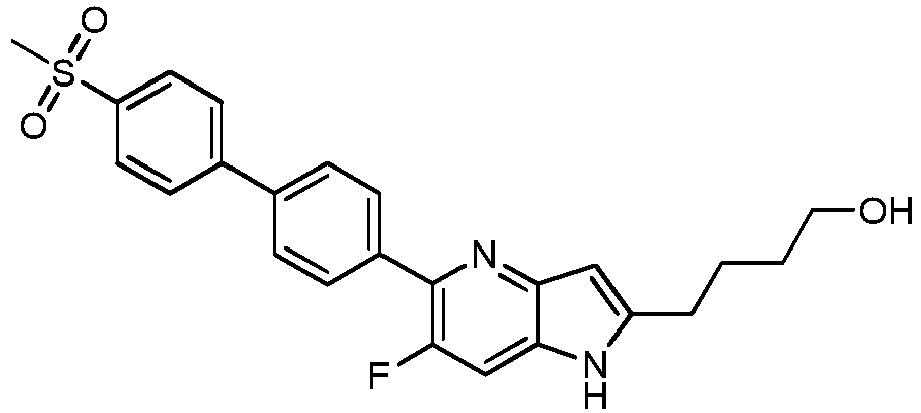
441.1 96 
439.1 97 
455.1 98 
471.2 99 
469.2 100 
481.3 
- Step A: ethyl 2-(3-amino-6-(4-bromophenyl)-5-chloropyridin-2-yl)acetate To a solution of ethyl 2-(3-amino-6-bromo-5-chloropyridin-2-yl)acetate (5.0 g, 17.0 mmol, Intermediate 25) in toluene (150 mL), ethanol (45 mL) and water (12.5 mL) were added (4-bromophenyl)boronic acid (3.4 g, 17.0 mmol) and sodium carbonate (1.8 g, 17.0 mmol). The mixture was bubbled with nitrogen for 30 seconds. Then Pd(PPh3)4 (1.8 g, 1.7 mmol) was added under nitrogen, and the mixture was stirred at 90 °C for 7 hours. Then the mixture was concentrated under reduced pressure, and the resulting crude product was purified by flash chromatography (petroleum ether: ethyl acetate = 50:1 to 3:1) to give the title compound. LC-MS: calculated for C15H14BrClN2O2 367.99, observed m/e: 371.0 (M+H)+ (Rt 1.33/2 min). Step B: 5-(4-bromophenyl)-6-chloro-1H-pyrrolo[3,2-b]pyridin-2(3H)-one To a solution of ethyl 2-(3-amino-6-(4-bromophenyl)-5-chloropyridin-2-yl)acetate (6.0 g, 16.3 mmol) in toluene (90 mL) was added acetic acid (5.9 g, 97.8 mmol). The mixture was stirred at reflux overnight. Then the mixture was concentrated under reduced pressure, and the crude product was purified by flash chromatography (petroleum ether: ethyl acetate = 15:1 to 1:1) to give the title compound. LC-MS: calculated for C13H8BrClN2O 321.95, observed m/e: 325.0 (M+H)+ (Rt 1.14/2 min).
- Step C: 5-(4-bromophenyl)-2,6-dichloro-1H-pyrrolo[3,2-b]pyridine To a mixture of 5-(4-bromophenyl)-6-chloro-1H-pyrrolo[3,2-b]pyridin-2(3H)-one (4.0 g, 12.4 mmol) in phosphoryl trichloride (140 mL) was added N,N-dimethylaniline (3.1 g, 24.8 mmol). The mixture stirred at reflux for 1 hour, then cooled to room temperature. Then the mixture was poured into water (150 mL) slowly, and filtered. The filtrate was diluted with water (100 mL), basified by sodium bicarbonate to pH = 7-8, and extracted with ethyl acetate (4 x 500 mL) and dichloromethane (2 x 500 mL). The separated organic layers were combined, dried over Na2SO4, and concentrated under reduced pressure. The resulting crude product was purified by flash chromatography (petroleum ether: ethyl acetate = 15:1 to 4:1) to give the title compound. LC-MS: calculated for C13H7BrCl2N2 339.92, observed m/e: 343.0 (M+H)+ (Rt 1.22/2 min).
- Step D: 5-(4-bromophenyl)-2,6-dichloro-1-((2-(trimethylsilyl)ethoxy)methyl)-1H-pyrrolo[3,2 b]pyridine To a solution of 5-(4-bromophenyl)-2,6-dichloro-1H-pyrrolo[3,2-b]pyridine (2.0 g, 5.8 mmol) in N,N-dimethylformamide(20 mL) was added sodium hydride (580 mg, 14.5 mmol) under 0 °C. The mixture was stirred at 0 °C for 30 min, then (2-(chloromethoxy)ethyl)trimethylsilane (1.2 g, 7.0 mmol) was added slowly under 0 °C. The mixture was warmed to room temperature and stirred for 1.5 hours. Then the reaction mixture was quenched with saturated ammonium chloride, and extracted with ethyl acetate. The combined organic layers were washed with brine, dried over anhydrous Na2SO4, filtered and concentrated to give the crude product, which was purified by flash column chromatography (petroleum ether: ethyl acetate = 50:1 to 15:1) to give the title compound. NMR δ (ppm)(CDCl3): 7.85 (s, 1H), 7.59 (s, 4H), 6.71 (s, 1H), 5.55 (s, 2H), 3.56 (m, 2H), 0.92 (m, 3H), 0.00 (s, 9H). LC-MS: calculated for C19H21BrCl2N2OSi 470.00, observed m/e: 472.9 (M+H)+ (Rt 1.59/2 min).
- Step E: (3R,3aR,6R,6aR)-6-((5-(4-bromophenyl)-6-chloro-1-((2-(trimethylsilyl) ethoxy)methyl)-1H-pyrrolo[3,2-b]pyridin-2-yl)oxy)hexahydrofuro[3,2-b]furan-3-ol To a solution of 5-(4-bromophenyl)-2,6-dichloro-1-((2-(trimethylsilyl)ethoxy)methyl)-1H-pyrrolo[3,2-b]pyridine (2.5 g, 5.3 mmol) in (methylsulfinyl)methane (25 mL) and diozane (25 mL) was added (3R,3aR,6R,6aR)-hexahydrofuro[3,2-b]furan-3,6-diol (3.9 g, 26.5 mmol) and cesium carbonate (5.2 g, 15.6 mmol). The mixture stirred at 120 °C overnight, then cooled to room temperature. Then the mixture was diluted with ethyl acetate, washed with brine, dried over anhydrous Na2SO4, filtered and concentrated under reduced pressure to give the crude product, which was purified by flash column chromatography (petroleum ether: ethyl acetate = 20:1 to 1:1) to give the title compound. NMR δ (ppm)(CDCl3): 7.69 (s, 1H), 7.58 (s, 4H), 5.85 (s, 1H), 5.44 (m, 2H), 4.97 (q, 1H), 4.84 (t, 1H), 4.61 (t, 1H), 4.36 (br, 1H), 4.28 (dd, 1H), 4.06 (dd, 1H), 4.00 (dd, 1H), 3.68 (dd, 1H), 3.55 (t, 2H), 3.48 (s, 1H), 0.92 (m, 2H), 0.00 (s, 9H). LC-MS: calculated for C25H30BrClN2O5Si 580.08, observed m/e: 583.1 (M+H)+ (Rt 1.18/2 min).
-

- Step A: (3R,3aR,6R,6aR)-6-((6-chloro-5-(4-(pyrrolidin-1-yl)phenyl)-1-((2-(tnmethylsilyl)ethoxy)methyl)-1H-pyrrolo[3,2-b]pyndin-2-yl)oxy)hexahydrofuro[3,2-b]furan-3-ol To a solution of (3R,3aR,6R,6aR)-6-((5-(4-bromophenyl)-6-chloro-1-((2-(tiimethylsilyl)ethoxy)methyl)-1H-pyrrolo[3,2-b]pyiidin-2-yl)oxy)hexahydrofuro[3,2-b]furan-3-ol (70 mg, 0.12 mmol) in (methylsulfinyl)methane (2 mL) were added pyrrolidine (9.4 mg, 0.13 mmol), cuprous iodide (66 mg, 0.35 mmol), cesium carbonate (78 mg, 0.24 mmol) and L-proline (15 mg, 0.13 mmol) under nitrogen. The mixture was stirred at 105 °C under micowave irradiation for 1h. Then the mixture was purified by prep. HPLC (MeCN/H2O as eluent, 0.05% TFA) to give the title compound. LC-MS: calculated for C29H38ClN3O5Si 571.23, observed m/e: 572.3 (M+H) + (Rt 1.22/2 min).
- Step B: (3R,3aR,6R,6aR)-6-((6-chloro-1-(hydroxymethyl)-5-(4-(pyrrolidin-1-yl)phenyl)-1H-pyrrolo[3,2-b]pyridin-2-yl)oxy)hexahydrofuro[3,2-b]furan-3-ol To a solution of (3R,3aR,6R,6aR)-6-((6-chloro-5-(4-(pyrrolidin-1-yl)phenyl)-1-((2-(trimethylsilyl) ethoxy)methyl)-1H-pyrrolo[3,2-b]pyridin-2-yl)oxy)hexahydrofuro[3,2-b]furan-3-ol (57 mg, 0.12 mmol) in tetrahydrofuran (1 mL) was added concentrated hydrochloric acid (1 mL, 12 M) at 0 °C. The mixture was warmed slowly to room temperature and stirred overnight. Then the mixture was concentrated under reduced pressure at room temperature to give the title compound, which was used for next step directly. LC-MS: calculated for C24H26ClN3O5 471.16, observed m/e: 472.2 (M+H)+ (Rt 0.91/2 min). Step C: (3R,3aR,6R,6aR)-6-((6-chloro-5-(4-(pyrrolidin-1-yl)phenyl)-1H-pyrrolo[3,2-b]pyridin-2-yl)oxy)hexahydrofuro[3,2-b]furan-3-ol To a solution of (3R,3aR,6R,6aR)-6-((6-chloro-1-(hydroxymethyl)-5-(4-(pyrrolidin-1-yl)phenyl)-1H-pyrrolo[3,2-b]pyridin-2-yl)oxy)hexahydrofuro[3,2-b]furan-3-ol (100 mg, 0.12 mmol, crude) in dimethyl formamide (1 mL) was added ethane-1,2-diamine (28 mg, 0.42 mmol) at 0 °C. The mixture was stirred at 0 °C for 5 mins, then directly purified by prep. HPLC (MeCN/H2O as eluent, 0.05% TFA) to give the title compound. NMR δ (ppm)(CD3OD): 8.17 (s, 1H), 7.53 (d, 2H), 6.74 (d, 3H), 6.13 (s, 1H), 5.22 (m, 1H), 4.96 (t, 1H), 4.47 (t, 1H), 4.28 (m, 1H), 4.14 (m, 2H), 3.89 (t, 1H), 3.58 (t, 1H), 3.38 (m, 4H), 2.08 (m, 4H). LC-MS: calculated for C23H24ClN3O4 441.15, observed m/e: 442.2 (M+H)+ (Rt 1.00/2 min).
Table 13. Compounds prepared according to the methods described in Example 101. Example Number Structure HPLC-mass spectrum m/e 102 
456.1 103 
471.1 104 
458.2 105 
506.0 106 
428.1 -

- Step A: (3R,3aR,6R,6aR)-6-((6-chloro-5-(2'-hydroxy-[1,1'-biphenyl]-4-yl)-1-((2-(tnmethylsilyl)ethoxy)methyl)-1H-pyrrolo[3,2-b]pyndin-2-yl)oxy)hexahydrofuro[3,2-b]furan-3-ol To a mixture of (3R,3aR,6R,6aR)-6-((5-(4-bromophenyl)-6-chloro-1-((2-(trimethylsilyl)ethoxy)methyl)-1H-pyrrolo[3,2-b]pyridin-2-yl)oxy)hexahydrofuro[3,2-b]furan-3-ol (50 mg, 0.086 mmol) and (2-hydroxyphenyl)boronic acid (18 mg, 0.13 mmol) in acetonitrile (1.5 mL) and H2O (0.5 mL) was added Pd(dppf)Cl2 (6 mg, 0.0086 mmol) and Na2CO3 (22 mg, 0.26 mmol). The resulting mixture was stirred at reflux temperature for 3 hours. Then the reaction was cooled to room temperature, diluted with water (5 mL) and extracted with ethyl acetate (3 x 5 mL). The organic layers were combined, dried over anhydrous magnesium sulfate, filtered and concentrated under vacuum. The resulting crude product was purified by prep. TLC (petroleum ether: ethyl acetate = 50:1 5:1) to afford the title compound. LC-MS: calculated for C31H35ClN2O6Si 594.20, observed m/e: 595.3 (M+H)+ (Rt 1.20/2 min).
- Step B: (3R,3aR,6R,6aR)-6-((6-chloro-5-(2'-hydroxy-[1,1'-biphenyl]-4-yl)-1-(hydroxymethyl)-1H-pyrrolo[3,2-b]pyridin-2-yl)oxy)hexahydrofuro[3,2-b]furan-3-ol To a solution of (3R,3aR,6R,6aR)-6-((6-chloro-5-(2'-hydroxy-[1,1'-biphenyl]-4-yl)-1-((2-(trimethylsilyl)ethoxy)methyl)-1H-pyrrolo[3,2-b]pyridin-2-yl)oxy)hexahydrofuro[3,2-b]furan-3-ol (46 mg, 0.071 mmol) in THF (1 mL) was added dropwise conc. HCl (1 mL). Then the mixture was warmed slowly to room temperature and stirred overnight. The resulting mixture was concentrated under reduced pressure at room temperature to give the title compound, which was used directly in the next step without purification. LC-MS: calculated for C26H23ClN2O6 494.12, observed m/e: 495.1 (M+H)+ (Rt 0.88/2 min).
- Step C: (3R,3aR,6R,6aR)-6-((6-chloro-5-(2'-hydroxy-[1,1'-biphenyl]-4-yl)-1H-pyrrolo[3,2-b]pyridin-2-yl)oxy)hexahydrofuro[3,2-b]furan-3-ol To a mixture of (3R,3aR,6R,6aR)-6-((6-chloro-5-(2'-hydroxy-[1,1-biphenyl]-4-yl)-1-(hydroxymethyl)-1H-pyrrolo[3,2-b]pyridin-2-yl)oxy)hexahydrofuro[3,2-b]furan-3-ol (Crude 40mg) in DMF (2 mL) was added ethane-1,2-diamine (6 mg, 0.10 mmol) at 0 °C. The reaction mixture was stirred at 0 °C for 10 minutes. Then the resulting mixture was directly purified by prep. HPLC (MeCN/H2O as eluent, 0.05% TFA) to afford the title compound. NMR δ (ppm)(CD3OD): 8.24 (s, 1H), 7.83 (d, 2H), 7.73 (d, 2H), 7.35 (d, 1H), 7.21 (q, 1H), 6.95 (t, 2H), 6.19 (s, 1H), 5.24 (t, 1H), 4.89 (d, 1H), 4.47 (t, 1H), 4.18 (d, 1H), 4.14 (d, 2H), 3.89 (t, 1H), 3.59 (t, 1H). LC-MS: calculated for C25H21ClN2O5 464.11, observed m/e: 465.0 (M+H)+ (Rt 2.29/4.5 min).
Table 14. Compounds prepared according to the methods described in Example 107. Example Number Structure HPLC-mass spectrum m/e 108 
527.0 109 
531.0 110 
515.9 111 
523.1 

- Step A: (1-(4-(6-chloro-2-(3-iodo-4-methylphenoxy)-1-((2-(trimethylsilyl)ethoxy) methyl)-1H-pyrrolo[3,2-b]pyridin-5-yl)phenyl)cyclopropyl)methanol To a mixture of (1-(4-(2,6-dichloro-1-((2-(trimethylsilyl)ethoxy)methyl)-1H-pyrrolo[3,2-b]pyridin-5-yl)phenyl)cyclopropyl)methanol (200 mg, 0.43 mmol) and 3-iodo-4-methylphenol (50 mg, 2.16 mmol) in DMSO (5 mL) and dioxane (5 mL) was added Cs2CO3 (0.70 g, 2.16 mmol). The reaction mixture was heated under microwave irradiation at 150 °C for 40 minutes. Then the reaction mixture was cooled to room temperature, diluted with water (15 mL) and extracted with ethyl acetate (3 x 10 mL). The organic layers were combined, dried over anhydrous magnesium sulfate, filtered and concentrated under vacuum to give crude product, which was purified by flash column chromatography on silica gel (petroleum ether: ethyl acetate = 10:1 to 3:1) to give the title compound. LC-MS: calculated for C34H44ClN2O6PSi 660.11, observed m/e: 661.1 (M+H)+ (Rt 1.45/2 min).
- Step B: diethyl (5-((6-chloro-5-(4-(1-(hydroxymethyl)cyclopropyl)phenyl)-1-((2-(tnmethylsi-lyl)ethoxy)methyl)-1H-pyrrolo[3,2-b]pyridin-2-yl)oxy)-2-methylphenyl)phosphonate To a mixture of (1-(4-(6-chloro-2-(3-iodo-4-methyl-phenoxy)-1-((2-(trimethylsilyl)ethoxy)methyl)-1H-pyrrolo[3,2-b]pyridin-5-yl)phenyl)-cyclopropyl)methanol (0.15 g, 0.23 mmol) and P(OEt)3 (57 mg, 0.34 mmol) in CH3CN (3 mL) was added Pd(OAc)2 (5 mg, 0.023 mmol). The reaction mixture was heated under microwave irradiation at 80 °C for 45 minutes. Then the reaction mixture was cooled to room temperature, diluted with water (5 mL) and extracted with ethyl acetate (3 x 5 mL). The organic layers were separated, combined, dried over anhydrous magnesium sulfate, filtered and concentrated under vacuum to give the crude product, which was purified by flash column chromatography on silica gel (petroleum ether: ethyl acetate = 10:1 to 1:2) to give the title compound. NMR δ (ppm)(CDCl3): 7.81 (m, 2H), 7.65 (d, 2H), 7.44 (d, 2H), 7.31 (br, 2H), 5.73 (s, 1H), 5.52 (s, 2H), 4.14 (m, 4H), 3.71 (s, 2H), 3.62 (t, 2H), 2.17 (s, 3H), 1.3 (m, 6H), 0.92 (m, 6H), 0.00 (s, 9H). LC-MS: calculated for C34H44ClN2O6PSi 670.24, observed m/e: 671.3 (M+H)+ (Rt 1.32/2 min).
-

- Diethyl (5-((6-chloro-5-(4-(1-(hydroxymethyl)cyclopropyl)phenyl)-1H-pyrrolo[3,2-b]pyndin-2-yl)oxy)-2-methylphenyl)phosphonate To a solution of diethyl (5-((6-chloro-5-(4-(1-(hydroxymethyl)cyclopropyl)phenyl)-1-((2-(trimethylsilyl)ethoxy)methyl)-1H-pyrrolo[3,2-b]pyridin-2-yl)oxy)-2-methylphenyl)phosphonate (20 mg, 0.03 mmol, Intermediate 37) in THF (2 mL) was added TBAF (16 mg, 0.06 mmol) and ethane-1,2-diamine (4 mg, 0.06 mmol). The reaction mixture was stirred at reflux for 5 hours. Then the reaction mixture was cooled to room temperature, and concentrated under vacuum to give the crude product, which was purified by prep. HPLC (MeCN/H2O as eluent, 0.05% TFA) to afford the title compound. NMR δ (ppm)(CD3OD): 7.78 (s, 1H), 7.70 (d, 1H), 7.48 (m, 6H), 5.66 (s, 1H), 4.13 (m, 4H), 3.69 (s, 2H), 2.58 (s, 3H), 1.31 (m, 6H), 0.89 (d, 4H). LC-MS: calculated for C28H30ClN2O5P 540.16, observed m/e: 541.1 (M+H)+ (Rt 1.79/4.5 min).
-

- Step A: ethyl hydrogen (5-((6-chloro-5-(4-(1-(hydroxymethyl)cyclopropyl)phenyl)-1-((2-(trimethylsilyl)ethoxy)methyl)-1H-pyrrolo[3,2-b]pyndin-2-yl)oxy)-2-methylphenyl)-phosphonate To a mixture of diethyl (5-((6-chloro-5-(4-(1-(hydroxy-methyl)cyclopropyl)-phenyl)-1-((2-(trimethylsilyl)ethoxy)methyl)-1H-pyrrolo[3,2-b]pyridin-2-yl)oxy)-2-methylphenyl)phosphonate (80 mg, 0.12 mmol, Intermediate 37) in EtOH (3 mL) was added NaOH (48 mg, 1.2 mmol). The reaction mixture was stirred at reflux for 3 hours. Then the reaction mixture was cooled to room temperature, and concentrated under vacuum to give the crude product, which was further purified by prep. HPLC (MeCN/H2O as eluent, 0.05% TFA) to afford the title compound. LC-MS: calculated for C32H40ClN2O6PSi 642.21, observed m/e: 643.2 (M+H)+ (Rt 1.26/2 min).
- Step B: ethyl hydrogen(5-((6-chloro-1-(hydroxymethyl)-5-( 4-(1-(hydroxymethyl)-cyclopropyl)phenyl)-1H-pyrrolo[3,2-b]pyridin-2-yl)oxy)-2-methylphenyl)phosphonate To a solution of ethyl hydrogen (5-((6-chloro-5-(4-(1-(hydroxymethyl)cyclopropyl)-phenyl)-1-((2-(trimethylsilyl)ethoxy)methyl)-1H-pyrrolo[3,2-b]pyridin-2-yl)oxy)-2-methylphenyl)-phosphonate (46 mg, 0.071 mmol) in THF (2 mL) at 0 °C was added dropwise conc. HCl (2 mL). The reaction was warmed slowly to room temperature and stirred overnight. Then the reaction mixture was concentrated under vacuum to afford the title compound, which was used directly in the next step without purification. LC-MS: calculated for C27H28ClN2O6P 542.14, observed m/e: 543.1 (M+H)+ (Rt 0.90/2 min).
- Step C: ethyl hydrogen(5-((6-chloro-5-(4-(1-(hydroxymethyl)cyclopropyl)phenyl)-1H-pyrrolo[3,2-b]pyridin-2-yl)oxy)-2-methylphenyl)phosphonate To a solution of ethyl hydrogen (5-((6-chloro-1-(hydroxymethyl)-5-(4-(1-(hydroxymethyl)cyclopropyl)phenyl)-1H-pyrrolo[3,2-b]pyridin-2-yl)oxy)-2-methylphenyl)phosphonate (crude 40 mg) in DMF (2 mL) was added ethane-1,2-diamine (6 mg, 0.103 mmol) at 0 °C. The reaction mixture was stirred at 0 °C for 10 minutes. Then the reaction mixture was concentrated under vacuum to give the crude product, which was purified by prep. HPLC (MeCN/H2O as eluent, 0.05% TFA) to afford the title compound. NMR δ (ppm)(CD3OD): 8.29 (s, 1H), 7.82 (d, 1H), 7.61 (s, 4H), 7.37 (m, 2H), 5.77 (s, 1H), 3.86 (q, 2H), 3.74 (s, 2H), 2.67 (s, 3H), 1.23 (t, 3H), 1.06 (m, 4H). LC-MS: calculated for C26H26ClN2O5P 512.13, observed m/e: 513.1 (M+H)+ (Rt 1.43/2 min).
-

- Step A: (5-((6-chloro-5-(4-(1-(hydroxymethyl)cyclopropyl)phenyl)-1-((2-(trimethylsilyl)ethoxy)methyl)-1H-pyrrolo[3,2-b]pyndin-2-yl)oxy)-2-methylphenyl)-phosphonic acid To a solution of diethyl (5-((6-chloro-5-(4-(1-(hydroxymethyl)-cyclopropyl)phenyl)-1-((2-(trimethylsilyl)ethoxy)methyl)-1H-pyrrolo[3,2-b]pyridin-2-yl)oxy)-2-methylphenyl)phosphonate (25 mg, 0.0373 mmol, Intermediate 37) in dichloromethane (4 mL) were added hexamethyldisilazane (30 mg, 0.187 mmol) and bromotrimethylsilane (46 mg, 0.298 mmol) at 0 °C. The mixture was stirred at 0 °C for 2 hours. Then additional hexamethyldisilazane (30 mg, 0.187 mmol) and bromo-trimethylsilane (46 mg, 0.298 mmol) were added. The reaction was stirred at 0 °C for 2 hours, then quenched with MeOH. The reaction mixture was concentrated. The resulting crude product was purified by prep. HPLC (MeCN/H2O as eluent, 0.05% TFA) to give the title compound. LC-MS: calculated for C30H36ClN2O6PSi 614.18, observed m/e: 615.2 (M+H)+ (Rt 1.13/2 min).
- Step B: (5-((6-chloro-1-(hydroxymethyl)-5-(4-(1-(hydroxymethyl)cyclopropyl)phenyl)-1H-pyrrolo[3,2-b]pyridin-2-yl)oxy)-2-methylphenyl)phosphonic acid To a solution of (5-((6-chloro-5-(4-(1-(hydroxymethyl)cyclopropyl)phenyl)-1-((2-(trimethylsilyl)-ethoxy)methyl)-1H-pyrrolo[3,2-b]pyridin-2-yl)oxy)-2-methylphenyl)phosphonic acid (10 mg, 0.0163 mmol) in THF (1.5 mL) at 0 °C was added concentrated HCl (1.5 mL). The reaction was stirred for 15 minutes, then concentrated in vacuum at room temperature via oil pump to afford the title compound, which was used directly in the next step without purification. LC-MS: calculated for C25H24ClN2O6P 514.11, observed m/e: 515.1 (M+H)+ (Rt 0.91/2 min).
- Step C: (5-((6-chloro-5-(4-(1-(hydroxymethyl)cyclopropyl)phenyl)-1H-pyrrolo[3,2-b]pyridin-2-yl)oxy)-2-methylphenyl)phosphonic acid To a solution of (5-((6-chloro-1-(hydroxy-methyl)-5-(4-(1-(hydroxymethyl)cyclopropyl)phenyl)-1H-pyrrolo[3,2-b]pyridin-2-yl)oxy)-2-methylphenyl)phosphonic acid (crude 10 mg) in DMF (2 mL) was added ethane-1,2-diamine (2.62 mg, 0.0437 mmol) at 0 °C. The reaction was stirred for 15 minutes, then concentrated. The resulting crude product was purified by prep. HPLC (MeCN/H2O as eluent, 0.05% TFA) to give the title compound. NMR δ (ppm)(CD3OD): 8.27 (s, 1H), 7.79 (s, 2H), 7.58 (s, 4H), 7.40 (d, 2H), 5.75 (s, 1H), 3.71 (s, 2H), 2.67 (s, 3H), 0.94 (d, 4H). LC-MS: calculated for C24H22ClN2O5P 484.10, observed m/e: 485.1 (M+H)+ (Rt 0.94/2 min).
-

- Step A: 1-(4-(2,6-dichloro-1-((2-(trimethylsilyl)ethoxy)methyl)-1H-pyrrolo[3,2-b]pyridin-5-yl)phenyl)cyclopropanecarbaldehyde To a solution of (1-(4-(2,6-dichloro-1-((2-(trimethylsilyl)ethoxy)methyl)-1H-pyrrolo[3,2-b]pyridin-5-yl)phenyl)cyclopropyl)-methanol (100 mg, 0.2 mmol, Intermediate 27) in DCM (10 mL) was added DMP (169 mg, 0.4 mmol) at 0 °C. The reaction was warmed slowly to room temperature and stirred for 2 hours. Then the reaction was quenched with an aqueous solution of Na2SO3. The separated organic layer was washed with brine twice, dried over Na2SO4, and concentrated under reduced pressure to give the crude product, which was purified by flash column chromatography (petroleum ether: ethyl acetate = 50:1 to 10 : 1) to give the title compound. LC-MS: calculated for C23H26Cl2N2O2Si 460.11, observed m/e: 461.1 (M+H)+ (Rt 1.51/2 min). Step B: 1-(1-(4-(2,6-dichloro-1-((2-(trimethylsilyl)ethoxy)methyl)-1H-pyrrolo[32-b]pyridin-5-yl)phenyl)cyclopropyl)ethanol To a solution of 1-(4-(2,6-dichloro-1-((2-(trimethylsilyl)ethoxy)methyl)-lH-pyrrolo[3,2-b]pyridin-5-yl)phenyl)cyclopropane-carbaldehyde (40 mg, 0.08 mmol) in THF (5 mL) was added CH3MgBr (1 ml, 3.0 mmol, 3M) dropwise (under N2) at 0 °C. The reaction was stirred at 0 °C for 2 hours, then quenched with an aqueous NH4Cl solution and extracted with EtOAc (2 x 20 mL). The combined organic layers were washed with brine, dried over Na2SO4 and concentrated under reduced pressure to give the crude product, which was purified by prep TLC (petroleum ether: ethyl acetate = 5 :1) to give the title compound. LC-MS: calculated for C24H30Cl2N2O2Si 476.15, observed m/e: 477.0 (M+H)+ (Rt 1.39/2 min).
- Step C: (3R,3aR,6R,6aR)-6-((6-chloro-5-(4-(1-(1-hydroxyethyl)cyclopropyl)phenyl)-1-((2-(trimethylsilyl)ethoxy)methyl)-1H-pyrrolo[32-b]pyridin-2-yl)oxy)hexahydro-furo[32-b]furan-3-ol To a solution of 1-(1-(4-(2,6-dichloro-1-((2-(trimethylsilyl)-ethoxy)methyl)-1H-pyrrolo[3,2-b]pyridin-5-yl)phenyl)cyclopropyl)ethanol (24 mg, 0.05 mmol) in DMSO (2 mL) and dioxane (2 mL) was added Cs2CO3 (81 mg, 0.25 mmol) and (3S,3aS,6S,6aS)-hexahydrofuro[3,2-b]furan-3,6-diol (73 mg, 0.5 mmol). The mixture was stirred at 120 °C for 18 hours, then EtOAc (20 mL) and water (8 mL) were added. The combined organic layers were washed with water (2 x 8 mL) and brine (8 mL), then dried over Na2SO4 and concentrated under reduced pressure to give the crude product, which was purified by flash column chromatography (petroleum ether: ethyl acetate = 10:1 to 3 : 1) to give the title compound. LC-MS: calculated for C30H39ClN2O6Si 586.23, observed m/e: 587.1 (M+H)+ (Rt 0.89/2 min).
- Step D: (3R,3aR,6R,6aR)-6-((6-chloro-5-(4-(1-(1-hydroxyethyl)cyclopropyl)phenyl)-1H-pyrrolo[3,2-b]pyridin-2-yl)oxy)hexahydrofuro[3,2-b]furan-3-ol To a solution of (3R,3aR,6R,6aR)-6-((6-chloro-5-(4-(1-(1-hydroxy ethyl)cyclopropyl)phenyl)-1-((2-(tiimethylsilyl)ethoxy)methyl)-1H-pyrrolo[3,2-b]pyiidin-2-yl)oxy)hexahydrofuro[3,2-b]furan-3-ol (20 mg, 0.03 mmol) in THF (2mL) was added ethane-1,2-diamine (6 mg, 0.1 mmol) and TBAF (0.09 mL (1 M in THF, 0.09 mmol). The reaction was heated to reflux overnight, then cooled to room temperature, and concentrated under vacuum. The resulting crude product was purified by prep. HPLC (MeCN/H2O as eluent, 0.05% TFA) to afford the title compound. NMR δ (ppm)(CD3OD): 7.61 (s, 1H), 7.45 (t, 4H), 7.11 (t, 1H), 5.04 (d, 1H), 5.01 (d, 1H), 4.46 (d, 1H), 4.15 (t, 1H), 4.02 (d, 1H), 3.90 (t, 2H), 3.60 (1H), 3.43 (1H), 2.81 (1H), 1.10 (d, 3H), 0.81 (t, 4H). LC-MS: calculated for C24H25ClN2O5 456.15, observed m/e: 457.2 (M+H)+ (Rt 0.95/2 min).
-

- Step A: 2-(1,4-dioxaspiro[4.5]decan-8-yloxy)-5-([1,1'-biphenyl]-4-yl)-6-chloro-1H-pyrrolo[3,2-b]pyridine To a mixture of 1,4-dioxaspiro[4.5]decan-8-ol (500 mg, 1.1 mmol) in 1-methylpyrrolidin-2-one (20 mL) was added sodium hydride (170 mg, 4.3 mmol, 60% in oil) at 0 °C. The mixture was stirred at 0 °C for 30 min, then 5-([1,1'-biphenyl]-4-yl)-2,6-dichloro-1-((2-(trimethylsilyl)ethoxy)methyl)-1H-pyrrolo[3,2-b]pyridine (674 mg, 4.3 mmol, Intermediate 28) was added, and the mixture was heated to 120 °C by MW and stirred for 1 hour. Then the mixture was quenched with saturated aqueous ammonium chloride, and extracted with ethyl acetate. The combined organic layers were washed with brine, dried over anhydrous Na2SO4, filtered and concentrated under reduced pressure to give crude product, which was purified by silica gel column chromatography (PE: EtOAc = 20:1 ∼ 2:1) to afford the title compound. NMR δ (ppm)(CD3CD): 8.18 (s, 1H), 7.90 (d, 2H), 7.70 (m, 4H), 7.51 (m, 2H), 7.41 (s, 1H), 6.15 (s, 1H), 4.60 (d, 1H), 2.07 (m, 4H), 1.85 (m, 4H), 1.26 (s, 6H). LC-MS: calculated for C27H25ClN2O3 460.16, observed m/e: 461.1 (M+H)+ (Rt 2.13/4.5 min). Step B: 4-((5-([1,1'-biphenyl]-4-yl)-6-chloro-1H-pyrrolo[3,2-b]pyridin-2-yl)oxy)cyclohexanone To a mixture of 2-(1,4-dioxaspiro[4.5]decan-8-yloxy)-5-([1,1'-biphenyl]-4-yl)-6-chloro-1H-pyrrolo[3,2-b]pyridine (100 mg, 0.22 mmol) in tetrahydrofuran (10 mL) was added aq. HCl (5 mL, 1M). The mixture was heated to reflux and stirred for 4 hours, then concentrated under reduced pressure to afford the title compound, which was used directly in the next step without purification. NMR δ (ppm)(CD3CD): 8.20 (s, 1H), 7.90 (d, 2H), 7.76 (m, 4H), 7.52 (m, 2H), 7.41 (s, 1H), 6.11 (s, 1H), 4.95 (s, 1H), 2.06 (m, 6H), 1.66 (d, 2H), 1.27 (s, 6H). LC-MS: calculated for C25H21ClN2O2 416.13, observed m/e: 417.1 (M+H)+ (Rt 1.94/4.5 min).
- Step C: tert-butyl5-([U'-biphenyl]-4-yl)-6-chloro-2-((4-oxocyclohexyl)oxy)-1H-pyrrolo[3,2-b]pyridine-1-carboxylate To a mixture of 4-((5-([1,1'-biphenyl]-4-yl)-6-chloro-1H-pyrrolo[3,2-b]pyridin-2-yl)oxy)cyclohexanone (80 mg, 0.19 mmol) in tetrahydrofuran (5 mL) were added di-tert-butyl dicarbonate (46 mg, 0.21 mmol), triethylamine (23 mg, 0.23 mmol) and N,N-dimethylpyridin-4-amine (2 mg, 0.019 mmol). The mixture was stirred at room temperature for 4 hours, then concentrated under reduced pressure to give crude product, which was purified by silica gel column chromatography (PE: EtOAc = 30:1 ∼ 4:1) to afford the title compound. LC-MS: calculated for C30H29ClN2O4 516.18, observed m/e: 517.2 (M+H)+ (Rt 1.38/4.5 min).
- Step D: tert-butyl 5-([1,1'-biphenyl]-4-yl)-2-(((1S,4S)-4-(1-(tert-butoxy)-2-methyl-1-oxopropan-2-yl)-4-hydroxycyclohexyl)oxy)-6-chloro-1H-pyrrolo[3,2-b]pyridine-1-carboxylate; tert-bulyl5-([1,1'-biphenyl]-4-yl)-2-(((1R,4R)-4-(1-(tert-butoxy)-2-methyl-1-oxopropan-2-yl)-4-hydroxycyclohexyl)oxy)-6-chloro-1H-pyrrolo[3,2-b]pyridine-1-carboxylate To a mixture of tert-butyl isobutyrate (27 mg, 0.19 mmol) in dry tetrahydrofuran (10 mL) at -78 °C was added lithium diisopropylamide (0.19 ml, 0.19 mmol). The mixture stirred at -78 °C for 1 hour, then tert-butyl5-([1,1'-biphenyl]-4-yl)-6-chloro-2-((4-oxocyclohexyl)oxy)-1H-pyrrolo[3,2-b]pyridine-1-carboxylate (80 mg, 0.15 mmol) was added, and the reaction mixture was stirred at -78 °C for 1 hour. Then the reaction was quenched with saturated aqueous ammonium chloride and extracted with EtOAc. The combined organic layers were washed with brine, dried over anhydrous Na2SO4, filtered and concentrated under reduced pressure to give crude product, which was purified by prep. TLC (PE: EtOAc = 3:1) to afford the title compounds. [Upper spot in TLC, LC-MS: calculated for C38H45ClN2O6 660.30, observed m/e: 661.2 (M+H)+ (Rt 1.55/2 min); lower spot in TLC, LC-MS: calculated for C38H45ClN2O6 660.30, observed m/e: 661.2 (M+H)+ (Rt 1.57/2 min)]
- Step E: 2-((1S,4S)-4-((5-([1,1'-biphenyl]-4-yl)-6-chloro-1H-pyrrolo[3,2-b]pyridin-2-yl)oxy)-1-hydroxycyclohexyl)-2-methylpropanoic acid To a solution of tert-butyl 5-([1,1'-biphenyl]-4-yl)-2-(((1S,4S)-4-(1-(tert-butoxy)-2-methyl-1-oxopropan-2-yl)-4-hydroxycyclohexyl)oxy)-6-chloro-1H-pyrrolo[3,2-b]pyridine-1-carboxylate (20 mg, 0.030 mmol) in ethyl acetate (2 mL) was added hydrogen chloride in ethyl acetate (2 mL, 4 M) at 0 °C. The reaction mixture was stirred at 0 °C for 4 hours, then concentrated under reduced pressure to give the crude product, which was directly purified by prep HPLC (MeCN/H2O as eluent, 0.05% TFA) to afford the title compound. NMR δ (ppm)(CD3OD): 8.18 (s, 1H), 7.90 (d, 2H), 7.76 (m, 4H), 7.52 (t, 2H), 7.41 (s, 1H), 6.15 (s, 1H), 4.60 (d, 1H), 2.07 (m, 4H), 1.85 (m, 4H), 1.26 (s, 6H). LC-MS: calculated for C29H29ClN2O4 504.18, observed m/e: 505.1 (M+H)+ (Rt 2.03/4.5 min).
- 2-((1R,4R)-4-((5-([1,1'-biphenyl]-4-yl)-6-chloro-1H-pyrrolo[3,2-b]pyridin-2-yl)oxy)-1-hydroxycyclohexyl)-2-methylpropanoic acid To a solution of tert-butyl5-([1,1'-biphenyl]-4-yl)-2-(((1R,4R)-4-(1-(tert-butoxy)-2-methyl-1-oxopropan-2-yl)-4-hydroxycyclohexyl)oxy)-6-chloro-1H-pyrrolo[3,2-b]pyridine-1-carboxylate (20 mg, 0.030 mmol) in ethyl acetate (2 mL) was added hydrogen chloride in ethyl acetate (2 mL, 4 M) at 0 °C. The reaction mixture was stirred at 0 °C for 4 hours, then concentrated under reduced pressure to give the crude product, which was directly purified by prep. HPLC (MeCN/H2O as eluent, 0.05% TFA) to afford the title compound. NMR δ (ppm)(CD3OD): 8.20 (s, 1H), 7.90 (d, 2H), 7.76 (dd, 4H), 7.52 (t, 2H), 7.41 (s, 1H), 6.11 (s, 1H), 4.95 (s, 1H), 2.06 (m, 6H), 1.66 (d, 2H), 1.27 (s, 6H). LC-MS: calculated for C29H29ClN2O4 504.18, observed m/e: 505.1 (M+H)+ (Rt 2.02/4.5 min).
Table 15. Compounds prepared according to the methods described in Example 115. Example Number Structure HPLC-mass spectrum m/e 117 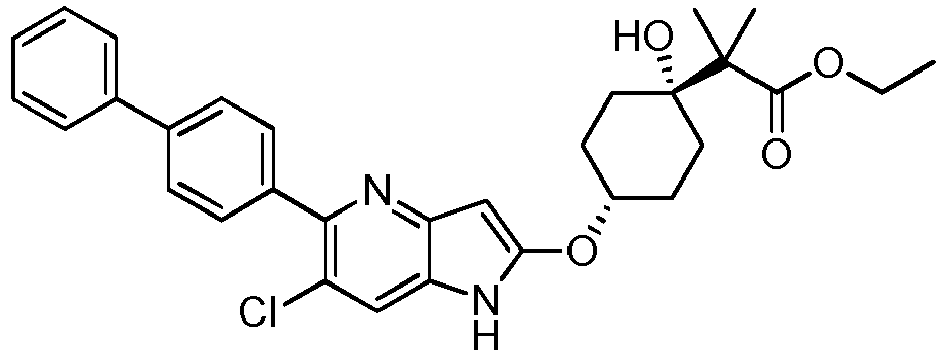
533.2 118 
533.2 119 
461.2 120 
417.2 -

- Step A: 5-([1,1'-biphenyl]-4-yl)-6-chloro-2-(((4aR,7R,8aS)-2-phenylhexahydropyrano [3,2-d][1,3]dioxin-7-yl)oxy)-1-((2-trimethylsilyl)ethoxy)methyl)-1H-pyrrolo[3,2-b]pyridine To a mixture of 5-([1,1'-biphenyl]-4-yl)-2,6-dichloro-1-((2-(trimethylsilyl)-ethoxy)methyl)-1H-pyrrolo[3,2-b]pyridine (100 mg, 0.21 mmol, Intermediate 28) in (methylsulfinyl)methane (5 mL) and dioxane (5 mL) were added (4aR,7R,8aS)-2-phenylhexahydropyrano[3,2-d][1,3]dioxin-7-ol (101 mg, 0.43 mmol) and cesium carbonate (139 mg, 0.43 mmol). The mixture was heated to 120 °C by MW and stirred for 1 hour. Then the mixture was diluted with ethyl acetate, washed with brine, dried over anhydrous Na2SO4, filtered and concentrated under reduced pressure. The resulting crude product was purified by silica gel column chromatography (PE: EtOAc = 10:1 ∼ 2:1) to afford the title compound. LC-MS: calculated for C38H41ClN2O5Si 668.25, observed m/e: 669.3 (M+H)+ (Rt 1.53/2 min).
- Step B: (2R,3S,5R)-5-((5-([1,1'-biphenyl]-4-yl)-6-chloro-1-(hydroxymethyl)-1H-pyrrolo[3,2-b]pyridin-2-yl)oxy)-2-(hydroxymethyl)tetrahydro-2H-pyran-3-ol To a solution of 5-([1,1'-biphenyl]-4-yl)-6-chloro-2-(((4aR,7R,8aS)-2-phenylhexahydro-pyrano[3,2-d][1,3]dioxin-7-yl)oxy)-1-((2-trimethylsilyl)ethoxy)methyl)-1H-pyrrolo[3,2-b] pyridine (40 mg, 0.060 mmol) in THF (2 mL) at 0 °C was added conc. HCl (2 mL). The reaction mixture was stirred at room temperature for 18 hours, then concentrated under reduced pressure to afford the title compound, which was used directly in next step without purification. LC-MS: calculated for C26H25ClN2O5 480.15, observed m/e: 481.2 (M+H)+ (Rt 1.04/2 min).
- Step C: (2R,3S,5R)-5-((5-([1,1'-biphenyl]-4-yl)-6-chloro-1H-pyrrolo[3,2-b]pyridin-2-yl)oxy)-2-(hydroxymethyl)tetrahydro-2H-pyran-3-ol To a solution of (2R,3S,5R)-5-((5-([1,1'-biphenyl]-4-yl)-6-chloro-1-(hydroxymethyl)-1H-pyrrolo[3,2-b]pyridin-2-yl)oxy)-2-(hydroxymethyl)tetrahydro-2H-pyran-3-ol (20 mg, 0.042 mmol) in DMF (2 mL) was added ethane-1,2-diamine (7.1 mg, 0.12 mmol) at 0 °C. The reaction mixture was stirred at 0 °C for 10 minutes and then directly purified by prep. HPLC (MeCN/H2O as eluent, 0.05% TFA) to afford the title compound. NMR δ (ppm)(CD3OD): 8.21 (s, 1H), 7.87 (d, 2H), 7.76 (d, 3H), 7.71 (t, 2H), 7.49 (d, 1H), 6.13 (s, 1H), 4.53 (d, 1H), 4.16 (s, 1H), 4.05 (t, 1H), 3.86 (d, 1H), 3.58 (t, 1H), 3.46 (t, 1H), 1.81 (t, 1H), 1.70 (t, 1H). LC-MS: calculated for C25H23ClN2O4 450.13, observed m/e: 451.1 (M+H)+ (Rt 2.27/4.5 min).
Table 16. Compounds prepared according to the methods described in Example 121. Example Number Structure HPLC-mass spectrum m/e 122 
445.0 123 
437.1 124 
431.0 125 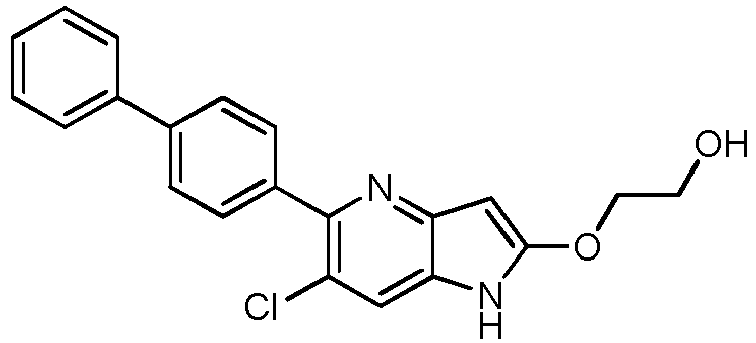
365.1 126 
373.1 -

- Step A: methyl 4-(5-([1,1'-biphenyl]-4-yl)-6-chloro-1-((2-(trimethylsilyl)ethoxy)methyl)-1H-pyrrolo[3,2-b]pyridin-2-yl)-4-oxobutanoate To a mixture of 5-([1,1'-biphenyl]-4-yl)-2,6-dichloro-1-((2-(trimethylsilyl)ethoxy)methyl)-1H-pyrrolo[3,2-b] pyridine (300 mg, 0.64 mmol, Intermediate 28) in dry tetrahydrofuran (50 mL) at -78 °C was added dropwise a solution of tert-BuLi in THF (1.4 mL, 1.4 mmol, 1M). The mixture was stirred at -78 °C for 1 hour, then methyl 4-(methoxy(methyl)amino)-4-oxobutanoate (134 mg, 0.77 mmol) was added, and the reaction mixture was stirred at -78 °C for 1 additional hour. The reaction was then quenched with saturated aqueous ammonium chloride, and extracted with EtOAc. The combined organic layers were washed with brine, dried over anhydrous Na2SO4, filtered and concentrated under reduced pressure to give crude product, which was purified by silica gel column chromatography (PE: EtOAc = 30:1 ∼ 5:1) to afford the title compound. LC-MS: calculated for C30H33ClN2O4Si 548.19, observed m/e: 549.2 (M+H)+ (Rt 1.63/2 min).
- Step B: 4-(5-([1,1'-biphenyl]-4-yl)-6-chloro-1-((2-(trimethylsilyl)ethoxy)methyl)-1H-pyrrolo[3,2-b]pyridin-2-yl)-4-oxobutanoic acid To a solution of methyl 4-(5-([1,1'-biphenyl]-4-yl)-6-chloro-1-((2-(trimethylsilyl)ethoxy)methyl)-1H-pyrrolo[3,2-b]pyridin-2-yl)-4-oxobutanoate (70 mg, 0.13 mmol) in methanol (3 mL) and water (3 mL) at 0 °C was added LiOH·H2O (16 mg, 0.38 mmol). The mixture was warmed to room temperature and stirred for 1 hour. Then the reaction mixture was adjusted to pH = 4 with aqueous HCl solution (1M), and extracted with dichloromethane. The combined organic layers were washed with brine, dried over anhydrous Na2SO4, filtered and concentrated to afford the title compound. LC-MS: calculated for Cz9H31ClN2O4Si 534.17, observed m/e: 535.2 (M+H)+ (Rt 1.54/2 min). Step C: 4-(5-([1,1'-biphenyl]-4-yl)-6-chloro-1H-pyrrolo[3,2-b]pyridin-2-yl)-4-oxobutanoic acid To a mixture of 4-(5-([1,1'-biphenyl]-4-yl)-6-chloro-1-((2-(trimethylsilyl)ethoxy)methyl)-1H-pyrrolo[3,2-b]pyridin-2-yl)-4-oxobutanoic acid (30 mg, 0.69 mmol) in DMF (3 mL) was added ethane-1,2-diamine (12 mg, 0.21 mmol) at 0 °C. The reaction mixture was stirred at 0 °C for 10 minutes and then directly purified by prep. HPLC (MeCN/H2O as eluent, 0.05% TFA) to afford the title compound. NMR δ (ppm)(CD3OD): 8.15 (d, 3H), 8.06 (d, 1H), 7.84 (s, 2H), 7.82 (s, 2H), 7.72 (d, 2H), 7.49 (d, 2H), 7.41 (s, 1H), 3.67 (t, 2H), 2.83 (t, 2H). LC-MS: calculated for C23H17ClN2O3 404.09, observed m/e: 405.2 (M+H)+ (Rt 2.53/4.5 min).
-

- Step A: methyl 5-([1,1'-biphenyl]-4-yl)-6-chloro-1-((2-(trimethylsilyl)ethoxy)methyl)-1H-pyrrolo[3,2-b]pyridine-2-carboxylate To a mixture of 5-([1,1'-biphenyl]-4-yl)-2,6-dichloro-1-((2-(trimethylsilyl)ethoxy)methyl)-lH-pyrrolo[3,2-b]pyridine (50 mg, 0.11 mmol, Intermediate 28) in MeOH (10 mL) were added TEA (22 mg, 0.21 mmol) and Pd(dppf)Cl2 (8.1 mg, 0.011 mmol). The reaction mixture saturated with CO and stirred under 1MPa of CO atmosphere at 100 °C for 16 hours. The reaction mixture was cooled to room temperature, and concentrated under reduced pressure to give the crude product, which was purified by prep TLC (PE:EtOAc = 5:1) to afford the title compound. LC-MS: calculated C27H29ClN2O3Si 492.16, observed m/e: 493.2 (M+H)+ (Rt 1.69/2 min).
- Step B: 5-([1,1'-biphenyl]-4-yl)-6-chloro-1-((2-(trimethylsilyl)ethoxy)methyl)-1H-pyrrolo[3,2-b]pyridine-2-carboxylic acid To a mixture of methyl 5-([1,1'-biphenyl]-4-yl)-6-chloro-1-((2-(trimethylsilyl)ethoxy)methyl)-1H-pyrrolo[3,2-b]pyridine-2-carboxylate (30 mg, 0.061 mmol) in MeOH (1 mL) and H2O (0.5 mL) was added LiOH (6 mg, 0.24 mmol) at 0 °C. The reaction mixture was stirred at room temperature for 18 hours. Then the reaction mixture was concentrated under reduced pressure to give the title compound, which was directly used in the next step without further purification. LC-MS: calculated C26H27ClN2O3Si 478.15, observed m/e: 479.2 (M+H) + (Rt 1.53/2 min).
- Step C: 5-([1,1'-biphenyl]-4-yl)-6-chloro-1-(hydroxymethyl)-1H-pyrrolo[3,2-b]pyridine-2-carboxylic acid To a mixture of 5-([1,1'-biphenyl]-4-yl)-6-chloro-1-((2-(trimethylsilyl)ethoxy)methyl)-1H-pyrrolo[3,2-b]pyridine-2-carboxylic acid (35 mg, 0.073 mmol) in THF (2 mL) was added dropwisely concentrated HCl (2 mL) at 0 °C. The reaction mixture was stirred at room temperature for 18 hours. Then the reaction mixture was concentrated under reduced pressure to give the title compound, which was directly used in the next step without further purification. LC-MS: calculated C21H15ClN2O3 378.08, observed m/e: 379.1 (M+H)+ (Rt 1.22/2 min).
- Step D: 5-([1,1'-biphenyl]-4-yl)-6-chloro-1H-pyrrolo[3,2-b]pyridine-2-carboxylic acid To a mixture of 5-([1,1'-biphenyl]-4-yl)-6-chloro-1-(hydroxymethyl)-1H-pyrrolo[3,2-b]pyridine-2-carboxylic acid (20 mg, 0.053 mmol) in DMF (2.4 mL) was added ethane-1,2-diamine (6.1 mg, 0.11 mmol) at 0 °C. The reaction mixture was stirred at 0 °C for 10 min. Then the reaction mixture was directly purified by pre-HPLC (MeCN/H2O as eluent, 0.05% TFA) to give the title compound. NMR δ (ppm)(CD3CD): 8.22 (s, 1H), 7.75 (m, 6H), 7.48 (m, 2H), 7.39 (d, 1H), 7.28 (s, 1H). LC-MS: calculated for C20H13ClN2O2 348.07, observed m/e: 349.0 (M+H)+ (Rt 2.71/4.5 min).
- Step E: 2-(5-([1,1'-biphenyl]-4-yl)-6-chloro-1H-pyrrolo[3,2-b]pyridine-2-carboxamido)acetate To a mixture of tert-butyl 2-aminoacetate (4.1 mg, 0.028 mmol) and 5-([1,1'-biphenyl]-4-yl)-6-chloro-1H-pyrrolo[3,2-b]pyridine-2-carboxylic acid (5.1 mg, 0.014 mmol) in DMF (1 mL) were added HATU (8.1 mg, 0.022 mmol) and N-ethyl-N-isopropylpropan-2-amine (4.1 mg, 0.028 mmol). The reaction mixture was stirred at room temperature for 18 hours, then diluted with ethyl acetate and washed with water. The organic layer was separated, dried over Na2SO4 and concentrated under reduced pressure to give the crude product, which was purified by pre-TLC (PE:EtOAc = 3:1) to afford the title compound. LC-MS: calculated for C26H24ClN3O3 461.15, observed m/e: 462.2 (M+H)+ (Rt 1.30/2 min).
- Step F: 2-(5-([1,1'-biphenyl]-4-yl)-6-chloro-1H-pyrrolo[3,2-b]pyridine-2-carboxamido)acetic acid To a mixture of tert-butyl 2-(5-([1,1'-biphenyl]-4-yl)-6-chloro-1H-pyrrolo[3,2-b]pyridine-2-carboxamido)acetate (5.1 mg, 0.011 mmol) in 1,4-dioxane (1 mL) was added 4M HCl in 1,4-dioxane (1 mL) at 0 °C. The reaction mixture was stirred at room temperature for 1.5 hours. Then the reaction mixture was purified by prep HPLC (MeCN/H2O as eluent, 0.05% TFA) to give the title compound. NMR δ (ppm)(CD3OD): 8.09 (s, 1H), 7.74 (d, 6H), 7.46 (d, 2H), 7.37 (s, 1H), 7.26 (s, 1H), 3.72 (s, 2H). LC-MS: calculated for C22H16ClN3O3 405.09, observed m/e: 406.1 (M+H)+ (Rt 2.57/4.5 min).
-

- Step A: methyl ethyl 2-((5-([1,1'-biphenyl]-4-yl)-6-chloro-1-((2-(trimethylsilyl)-ethoxy)methyl)-1H-pyrrolo[3,2-b]pyridin-2-yl)thio)acetate To a mixture of 5-([1,1'-biphenyl]-4-yl)-2,6-dichloro-1-((2-(trimethylsilyl)ethoxy)methyl)-1H-pyrrolo[3,2-b]pyridine (500 mg, 1.1 mmol, Intermediate 28) in N,N-dimethylformamide (20 mL) were added ethyl 2-mercaptoacetate (512 mg, 4.3 mmol) and potassium carbonate (589 mg, 4.3 mmol). The mixture was heated to 60 °C and stirred for 4 hours. Then the mixture was diluted with ethyl acetate, washed with brine, dried over anhydrous Na2SO4, filtered and concentrated under reduced pressure. The resulting crude product was purified by silica gel column chromatography (PE: EtOAc = 30:1 ∼ 4:1) to afford the title compound. LC-MS: calculated for C29H33ClN2O3SSi 552.17, observed m/e: 553.2 (M+H)+ (Rt 1.59/2 min).
- Step B: 2-((5-([1,1'-biphenyl]-4-yl)-6-chloro-1-((2-(trimethylsilyl)ethoxy)methyl)-1H-pyrrolo[3,2-b]pyridin-2-yl)thio)acetic acid To a solution of methyl ethyl 2-((5-([1,1'-biphenyl]-4-yl)-6-chloro-1-((2-(trimethylsilyl)ethoxy)methyl)-1H-pyrrolo[3,2-b]pyridin-2-yl)thio)acetate (100 mg, 0.18 mmol) in ethanol (5 mL) and water (5 mL) at 0 °C was added LiOH·H2O (23 mg, 0.54 mmol). The mixture was warmed to room temperature and stirred for 1 hour. Then the reaction mixture was adjusted to pH = 4 with aqueous HCl solution (1M), and extracted with dichloromethane. The combined organic layers were washed with brine, dried over anhydrous Na2SO4, filtered and concentrated to afford the title compound. LC-MS: calculated for C27H29ClN2O3SSi 524.14, observed m/e: 525.2 (M+H)+ (Rt 1.53/2 min).
- Step C: 2-((5-([1,1'-biphenyl]-4-yl)-6-chloro-1-(hydroxymethyl)-1H-pyrrolo[3,2-b]pyridin-2-yl)thio)acetic acid To a solution of 2-((5-([1,1'-biphenyl]-4-yl)-6-chloro-1-((2-(trimethylsilyl)ethoxy)methyl)-1H-pyrrolo[3,2-b]pyridin-2-yl)thio)acetic acid (50 mg, 0.095 mmol) in THF (2 mL) at 0 °C was added conc. HCl (2 mL). The reaction mixture was stirred at room temperature for 18 hours. Then the reaction mixture was concentrated under reduced pressure to afford the title compound, which was used directly in next step without purification. LC-MS: calculated for C22H17ClN2O3S 424.06, observed m/e: 425.1 (M+H)+ (Rt 1.12/2 min). Step D: 2-((5-([1,1'-biphenyl]-4-yl)-6-chloro-1H-pyrrolo[3,2-b]pyridin-2-yl)thio)acetic acid To a solution of 2-((5-([1,1'-biphenyl]-4-yl)-6-chloro-1-(hydroxymethyl)-1H-pyrrolo[3,2-b]pyridin-2-yl)thio)acetic acid (20 mg, 0.047 mmol) in DMF (2 mL) was added ethane-1,2-diamine (8 mg, 0.14 mmol) at 0 °C. The reaction mixture was stirred at 0 °C for 10 minutes and then directly purified by prep. HPLC (MeCN/H2O as eluent, 0.05% TFA) to give the title compound. NMR δ (ppm)(CD3OD): 8.21 (s, 1H), 7.89 (d, 2H), 7.78 (d, 4H), 7.73 (d, 2H), 7.50 (d, 1H), 7.42 (s, 1H), 6.14 (s, 1H), 4.00 (s, 1H), 2.09 (m, 4H), 2.00 (d, 2H), 1.75 (t, 2H). LC-MS: calculated for C21H15ClN2O2S 394.05, observed m/e: 395.1 (M+H)+ (Rt 1.99/4.5 min).
-

- A mixture of 2-((5-([1,1'-biphenyl]-4-yl)-6-chloro-1H-pyrrolo [3,2-b]pyridin-2-yl)thio)acetic acid (50 mg, 0.13 mmol, Example 129) and NaIO4 (30 mg, 0.14 mmol) in MeOH (2 mL) and H2O (2 mL) was stirred at room temperature for 18 hours, and then concentrated. The resulting residue was extracted with EtOAc, washed with brine, concentrated and purified by prep. HPLC (MeCN/H2O as eluent, 0.05% TFA) to give the title compound. NMR δ (ppm)(CD3OD): 12.63 (s, 1H), 8.16 (s, 1H), 7.80 (m, 7H), 7.54 (t, 2H), 7.45 (d, 1H), 7.21 (s, 1H), 4.35 (s, 2H). LC-MS: calculated for C21H15ClN2O3S 410.05, observed m/e: 411.1 (M+H)+ (Rt 1.11/2 min).
-

- To a solution of 2-((5-([1,1'-biphenyl]-4-yl)-6-chloro-1H-pyrrolo[3,2-b]pyridin-2-yl)thio) acetic acid (30 mg, 0.07 mmol, Example 129) in DCM (3 mL) was added m-CPBA (35 mg, 0.21 mmol) at 0 °C. The mixture was stirred at room temperature for 20 min. Then the reaction was quenched with aq. Na2S2O3, and extracted with DCM. The combined organic layers were concentrated and purified by prep. HPLC (MeCN/H2O as eluent, 0.05% TFA) to give the title compound. NMR δ (ppm)(CD3OD): 12.80 (s, 1H), 8.14 (s, 1H), 7.76 (m, 6H), 7.49 (t, 2H), 7.39 (s, 1H), 5.73 (s, 1H), 4.67 (s, 2H). LC-MS: calculated for C21H15ClN2O4S 426.04, observed m/e: 427.0 (M+H)+ (Rt 1.24/2 min).
-

- Step A: 3-((5-([1,1'-biphenyl]-4-yl)-6-chloro-1-((2-(trimethylsilyl)ethoxy)methyl)-1H-pyrrolo[3,2-b]pyridin-2-yl)oxy)propan-1-ol To a mixture of 5-([1,1'-biphenyl]-4-yl)-2,6-dichloro-1-((2-(trimethylsilyl)ethoxy)methyl)-1H-pyrrolo[3,2-b]pyridine (200 mg, 0.43 mmol, Intermediate 28) in (methylsulfinyl)methane (20 mL) were added propane-1,3-diol (130 mg, 1.7 mmol) and cesium carbonate (555 mg, 1.7 mmol). The mixture was stirred at 80 °C for 4 hours. Then the mixture was diluted with ethyl acetate, washed with brine, dried over anhydrous Na2SO4, filtered and concentrated under reduced pressure to give crude product, which was purified by silica gel column chromatography (PE: EtOAc = 20:1 ∼ 4:1) to afford the title compound. LC-MS: calculated for C28H33ClN2O3Si 508.19, observed m/e: 509.2 (M+H)+ (Rt 1.30/2 min).
- Step B: 3-((5-([1,1'-biphenyl]-4-yl)-6-chloro-1-((2-(trimethylsilyl)ethoxy)methyl)-1H-pyrrolo[3,2-b]pyridin-2-yl)oxy)propanal To a solution of compound 3-((5-([1,1'-biphenyl]-4-yl)-6-chloro-1-((2-(trimethylsilyl)ethoxy)methyl)-1H-pyrrolo[3,2-b]pyridin-2-yl)oxy) propan-1-ol (24 mg, 0.05 mmol) in DCM (3 mL) was added Dess-Martin Periodinane (63 mg, 0.15 mmol) at 0 °C. The mixture was stirred at 0 °C for 5 min, then the ice-bath was removed and the mixture was stirred for 2 hours. Then the reaction was quenched with Na2SO3 solution and washed with brine twice. The organic layer was concentrated to give crude product, which was purified with silica gel to the title compound. LC-MS: calculated for C28H31ClN2O3Si 506.18, observed m/e: 507.2 (M+H)+ (Rt 1.30/2 min).
- Step C: 3-((5-([1,1'-biphenyl]-4-yl)-6-chloro-1-((2-(trimethylsilyl)ethoxy)methyl)-1H-pyrrolo[3,2-b]pyridin-2-yl)oxy)propanoic acid To a solution of 3-((5-([1,1'-biphenyl]-4-yl)-6-chloro-1-((2-(trimethylsilyl)ethoxy)methyl)-1H-pyrrolo[3,2-b]pyridin-2-yl)oxy) propanal (5.1 mg, 0.01 mmol) in t-BuOH (1 mL) were added dropwise a mixture of 2-methylbut-2-ene (0.7 mL) in MeCN (2 mL), and a mixture of NaClO2 (10 mg, 0.1 mmol) and NaH2PO4 (10 mg, 0.1 mmol) in H2O (1 mL). The resulting two-phase mixture was stirred for 18 hours at room temperature. The organic components were evaporated and the remaining aqueous phase was extracted three times with EtOAc. The combined organic layers were washed with brine, dried over Na2SO4, and purified by prep TLC (PE:EtOAc = 2:1) to give the title compound. NMR δ (ppm)(CD3OD): 8.27 (s, 1H), 7.81 (m, 7H), 7.56 (t, 2H), 7.46 (s, 1H), 5.60 (s, 2H), 4.94 (t, 2H), 3.64 (t, 2H), 2.72 (t, 2H), 0.91 (d, 2H). LC-MS: calculated for C28H31ClN2O4Si 522.17, observed m/e: 505.2 (M+H-H2O)+ (Rt 1.12/2 min).
- Step D: 3-((5-([1,1'-biphenyl]-4-yl)-6-chloro-1H-pyrrolo[3,2-b]pyridin-2-yl)oxy)propanoic acid To a solution of 3-((5-([1,1'-biphenyl]-4-yl)-6-chloro-1-((2-(trimethylsilyl) ethoxy)methyl)-1H-pyrrolo[3,2-b]pyridin-2-yl)oxy)propanoic acid (20 mg, 0.03 mmol) in THF (2 mL) was added concentrated aqueous HCl (2 mL). The mixture was stirred at 0 °C for 18 hours, then concentrated to give the crude product. To a solution of the crude product (12 mg, 0.03 mmol) in DMF (2 mL) was added ethane-1,2-diamine (3.6 mg, 0.06 mmol) at 0 °C. The mixture was stirred for 5 min, then directly purified by prep HPLC (MeCN/H2O as eluent, 0.05% TFA) to afford the title compound. NMR δ (ppm)(CD3OD): 7.78 (m, 8H), 7.48 (d, 2H), 7.39 (s, 1H), 4.95 (s, 2H), 2.81 (t, 2H). LC-MS: calculated for C22H17ClN2O3 392.09, observed m/e: 375.0 (M+H-H2O)+ (Rt 1.10/2 min).
-

- Step A: 2,6-dichloro-5-(4-(1-(iodomethyl)cyclopropyl)phenyl)-1-((2-(tiimethylsilyl) ethoxy) methyl)-1H-pyrrolo[3,2-b]pyridine (1-(4-(2,6-dichloro-1-((2-(trimethylsilyl) ethoxy)methyl)-1H-pyrrolo[3,2-b]pyridin-5-yl)phenyl)cyclopropyl)methanol (100 mg, 0.22 mmol, Intermediate 27) was dissolved in tetrahydrofuran (3.5 mL), then triphenyl phosphine (67.93 mg, 0.26 mmol), imidazole (22.06 mg, 0.32 mmol) and iodine (65.78 mg, 0.26 mmol) were added sequentially. The resulting mixture was stirred at about 20-35 °C under a nitrogen atmosphere for 18 hours. Then the reaction was quenched with saturated aqueous ammonium chloride and diluted with dichloromethane. The organic layer was washed with 10% sodium thiosulfate (lx), water (1x), and brine (1x). The organic layer was dried over sodium sulfate, filtered, and concentrated by rotary evaporation. The resulting residue was purified by prep-TLC (petroleum ether: ethyl acetate = 7:1) to give the title compound. NMR δ (ppm)(CD3OD): 7.86 (s, 1H), 7.67 (d, 2H), 7.45 (d, 2H), 6.71 (s, 1H), 5.56 (s, 2H), 3.58 (d, 2H), 3.54 (d, 2H), 0.92 (t, 6H), 0.02 (s, 9H). LC-MS: calculated for C23H27Cl2IN2OSi 572.03, observed m/e: 573.0 (M+H)+ (Rt 1.57/2 min).
- Step B: 2,6-dichloro-5-(4-(1-((methylsulfonyl)methyl)cyclopropyl)phenyl)-1-((2-(trimethylsilyl)ethoxy)methyl)-1H-pyrrolo[3,2-b]pyridine To a solution of 2,6-dichloro-5-(4-(1-(iodomethyl)cyclopropyl)phenyl)-1-((2-(trimethylsilyl)ethoxy)methyl)-1H-pyrrolo[3,2-b]pyridine (20 mg, 0.035 mmol) in ethanol (2 mL) was added methanesulfinic acid sodium salt (17.8 mg, 0.17 mmol). The reaction was stirred and heated at 70 °C for 18 hours. Then the reaction mixture was filtered and the filtrate was concentrated to give the title compound. LC-MS: calculated for C24H30Cl2N2O3SSi 524.11, observed m/e: 525.1 (M+H)+ (Rt 1.32/2 min).
- Step C: (3R,3aR,6R,6aR)-6-((6-chloro-5-(4-(1-((methylsulfonyl)methyl)cyclopropyl) phenyl)-1-((2-(trimethylsilyl)ethoxy)methyl)-1H-pyrrolo[3,2-b]pyridin-2-yl)oxy) hexahydrofuro[3,2-blfuran-3-ol To a mixture of 2,6-dichloro-5-(4-(1-((methylsulfonyl)-methyl)cyclopropyl)phenyl)-1-((2-(trimethylsilyl)ethoxy)methyl)-1H-pyrrolo[3,2-b]pyridine (22.4 mg, 0.039 mmol) in (methylsulfinyl)methane (2 mL) were added (3R,3aR,6R,6aR)-hexahydrofuro[3,2-b]furan-3,6-diol (28.5 mg, 0.195 mmol) and cesium carbonate (38.2 mg, 0.12 mmol). The mixture was stirred and heated to 120 °C for 18 hours. After cooling, the mixture was concentrated under reduced pressure, diluted with water, and extracted with ethyl acetate. The combined organic layers were washed with brine, dried over anhydrous Na2SO4, filtered and concentrated under reduced pressure to give the crude product, which was purified by prep-TLC (petroleum ether: ethyl acetate = 3:1) to afford the title compound. LC-MS: calculated for C30H39ClN2O7SSi 634.19, observed m/e: 635.2 (M+H)+ (Rt 1.04/2 min).
- Step D: (3R,3aR,6R,6aR)-6-((6-chloro-1-(hydroxymethyl)-5-(4-(1-((methylsulfonyl) methyl)cyclopropyl)phenyl)-1H-pyrrolo[3,2-b]pyndin-2-yl)oxy)hexahydrofuro[3,2-b]furan-3-ol To a solution of (3R,3aR,6R,6aR)-6-((6-chloro-5-(4-(1-((methylsulfonyl)-methyl)cyclopropyl)phenyl)-1-((2-(trimethylsilyl)ethoxy)methyl)-1H-pyrrolo[3,2-b]pyridin-2-yl)oxy)hexahydrofuro[3,2-b]furan-3-ol (15 mg, 0.024 mmol) in tetrahydrofuran (1 mL) was added concentrated aqueous hydrochloride (1 mL) at 0 °C. The mixture was stirred at 0 °C, then allowed to warm up to room temperature slowly and stirred at room temperature for 18 hours. Then the reaction mixture was concentrated under vacuum at room temperature to afford the title compound, which was used in next step without purification. LC-MS: calculated for C25H27ClN2O7S 534.12, observed m/e: 535.1(M+H)+ (Rt 0.68/2 min).
- Step E: (3R,3aR,6R,6aR)-6-((6-chloro-5-(4-(1-((methylsulfonyl)methyl)cyclopropyl) phenyl)-1H-pyrrolo[3,2-b]pyridin-2-yl)oxy)hexahydrofuro[3,2-b]furan-3-ol To a stirred solution of (3R,3aR,6R,6aR)-6-((6-chloro-1-(hydroxymethyl)-5-(4-(1-((methylsulfonyl) methyl)cyclopropyl)phenyl)-1H-pyrrolo[3,2-b]pyridin-2-yl)oxy)hexahydrofuro[3,2-b] furan-3-ol (14 mg, 0.026 mmol) in N,N-dimethylformamide (1.5 mL) was slowly added ethane-1,2-diamine (3.15 mg, 0.052 mmol) at 0 °C. The mixture was stirred at room temperature for 5 minutes, then purified by prep-HPLC (MeCN/H2O as eluent, 0.05% TFA) to give the title compound. NMR δ (ppm)(CD3OD): 8.24 (s, 1H), 7.73 (d, 2H), 7.65 (t, 2H), 6.20 (s, 1H), 5.25 (d, 1H), 4.99 (t, 1H), 4.48 (d, 1H), 4.20 (d, 1H), 3.91 (d, 1H), 3.65 (s), 3.60 (m, 3H), 2.76 (s, 3H), 1.25 (t, 2H), 1.18 (t, 2H). LC-MS: calculated for C24H25ClN2O6S 504.11, observed m/e: 505.0 (M+H)+ (Rt 0.68/2 min).
-

- Step A: 6-chloro-5-(phenylethynyl)-1H-pyrrolo[3,2-b]pyridin-2(3H)-one To a mixture of ethyl 2-(3-amino-6-bromo-5-chloropyridin-2-yl)acetate (1 g, 3.42 mmol, Intermediate 25), Pd(PPh3)2Cl2 (66 mg, 0.1 mmol) and CuI (40 g, 0.2 mmol) in TEA (15 mL) was add ethynylbenzene (385 g, 3.76 mmol). The mixture was heated to 100 °C in a silicone bath for 2 hours. Then the mixture was allowed to cool to room temperature, and ethyl acetate and water were added. The organic layer was separated, dried over Na2SO4, and filtered. The filtrate was concentrated under reduced pressure to give the crude product, which was purified by column chromatography (PE:EtOAc = 10:1 to 3:1) to give the title compound. NMR δ (ppm)(CD3OD): 7.54 (d, 2H), 7.37 (d, 3H), 7.17 (s, 1H), 4.15 (m, 2H), 3.74 (d, 2H), 1.26 (t, 3H). LC-MS: calculated for C17H15ClN2O2 314.08, observed m/e: 315.0 (M+H) + (Rt 1.19/2 min).
- Step B: 6-chloro-5-(phenylethynyl)-1H-pyrrolo[3,2-b]pyridin-2(3H)-one To a suspension of 6-chloro-5-(phenylethynyl)-1H-pyrrolo[3,2-b]pyridin-2(3H)-one (700 mg, 2.23 mmol) in toluene (15 mL) was added acetic acid (3 mL). The mixture was heated to reflux for 18 hours. The mixture was then cooled to room temperature, and the solvents were removed under reduced pressure. The resulting residue was suspended in toluene (15 mL), filtered, washed with diethyl ether and dried to give the title compound. LC-MS: calculated for C15H9ClN2O 268.04, observed m/e: 269.0 (M+H)+ (Rt 1.07/2 min).
- Step C: 2,6-dichloro-5-(phenylethynyl)-1H-pyrrolo[3,2-b]pyridine To a mixture of 6-chloro-5-(phenylethynyl)-1H-pyrrolo[3,2-b]pyridin-2(3H)-one (440 mg, 1.64 mmol) in phosphoryl trichloride (15 mL) was added N,N-dimethylaniline (397 mg, 3.28 mmol). The mixture was heated to reflux and stirred for 1 hour, then evaporated under vacuum. The resulting residue was dissolved in water, then the mixture was adjusted to pH = 8 with saturated aqueous NaHCO3, and extracted with ethyl acetate. The combined organic layers were washed with brine, dried over anhydrous Na2SO4, filtered and concentrated under reduced pressure to give the crude product, which was purified by silica gel column chromatography (PE: EtOAc = 5:1 to 1:1) to afford the title compound. LC-MS: calculated for C15H8Cl2N2 286.01, observed m/e: 287.1 (M+H)+ (Rt 1.20/2 min).
- Step D: 2,6-dichloro-5-(phenylethynyl)-1-((2-(trimethylsilyl)ethoxy)methyl)-1H-pyrrolo[3,2-b]pyridine To a solution of 2,6-dichloro-5-(phenylethynyl)-1H-pyrrolo[3,2-b] pyridine (450 mg, 1.57 mmol) in N,N-dimethylformamide(10 mL) at 0 °C was added sodium hydride (57 mg, 2.36 mmol). The mixture was stirred at 0 °C for 30 min, then (2-(chloromethoxy)ethyl)trimethylsilane (394 mg, 2.36 mmol) was added. The mixture was warmed to room temperature for 1 hour. Then the reaction mixture was quenched with saturated aqueous NH4Cl, and extracted with ethyl acetate. The combined organic layers were washed with brine, dried over anhydrous Na2SO4, filtered and concentrated to give the crude product, which was purified by silica gel column chromatography (PE:EtOAc = 30:1 to 3:1) to afford the title compound. LC-MS: calculated for C21H22Cl2N2OSi 416.09, observed m/e: 417.1 (M+H) + (Rt 1.63/2 min).
- Step E: (3R,3aR,6R,6aR)-6-((6-chloro-5-(phenylethynyl)-1-((2-(trimethylsilyl)ethoxy) methyl)-1H-pyrrolo[3,2-b]pyridin-2-yl)oxy)hexahydrofuro[3,2-b]furan-3-ol To a mixture of 2,6-dichloro-5-(phenylethynyl)-1-((2-(trimethylsilyl)ethoxy)methyl)-1H-pyrrolo [3,2-b]pyridine (200 mg, 0.48 mmol) in 1,4-dioxane (4 mL) and DMSO (4 mL) were added (3R,3aR,6R,6aR)-hexahydrofuro[3,2-b]furan-3,6-diol (701 mg, 4.8 mmol) and cesium carbonate (784 mg, 2.4 mmol). The mixture was heated to 120 °C and stirred for 18 hours. Then the mixture was diluted with ethyl acetate, washed with brine, dried over anhydrous Na2SO4, filtered and concentrated under reduced pressure to give the crude product, which was purified by silica gel column chromatography (PE: EtOAc = 5:1 ∼ 1:1) to afford the title compound. NMR δ (ppm)(CD3OD): 7.92 (s, 1H), 7.66 (s, 2H), 7.47 (m, 3H), 5.97 (s, 1H), 5.55 (d, 2H), 5.18 (q, 1H), 4.98 (t, 1H), 4.56 (t, 1H), 4.36 (m, 2H), 4.26 (dd, 1H), 4.12 (dd, 1H), 3.98 (t, 1H), 3.66 (q, 3H), 0.94 (t, 2H), 0.00 (s, 9H). LC-MS: calculated for C27H31ClN2O5Si 526.17, observed m/e: 527.1 (M+H)+ (Rt 1.32/2 min).
- Step F: (3R,3aR,6R,6aR)-6-((6-chloro-1-(hydroxymethyl)-5-(phenylethynyl)-1H-pyrrolo[3,2-b]pyridin-2-yl)oxy)hexahydrofuro[3,2-b]furan-3-ol To a mixture of (3R,3aR,6R,6aR)-6-((6-chloro-5-(phenylethynyl)-1-((2-(trimethylsilyl)ethoxy) methyl)-1H-pyrrolo[3,2-b]pyridin-2-yl)oxy)hexahydrofuro[3,2-b]furan-3-ol (100 mg, 0.19 mmol) in THF (4 mL) was added conc. HCl (4 mL, 12 M). The mixture was stirred at 0 °C to room temperature for 18 hours. Then the mixture was concentrated under reduced pressure at room temperature to give the title compound, which was used in next step without further purification. LC-MS: calculated for C22H19ClN2O5 426.10, observed m/e: 427.1 (M+H)+ (Rt 0.99/2 min).
- Step G: (3R,3aR,6R,6aR)-6-((6-chloro-5-(phenylethynyl)-1H-pyrrolo[3,2-b]pyridin-2-yl)oxy)hexahydrofuro[3,2-b]furan-3-ol To a mixture of (3R,3aR,6R,6aR)-6-((6-chloro-1-(hydroxymethyl)-5-(phenylethynyl)-IH-pyrrolo[3,2-b]pyridin-2-yl)oxy)hexahydrofuro [3,2-b]furan-3-ol (60 mg, 0.14 mmol, crude) in DMF (4 mL) was added ethane-1,2-diamine(17 mg,0.28 mmol). The mixture was stirred at 0 °C for 15 minutes. Then the mixture was directly purified by pre-HPLC (MeCN/H2O as eluent, 0.05% TFA) to give the title compound. NMR δ (ppm)(CD3OD): 7.63 (m, 3H), 7.43 (s, 3H), 5.86 (s, 1H), 5.09 (m, 1H), 4.61 (s, 1H), 4.51 (t, 1H), 4.31 (dd, 1H), 4.19 (dd, 1H), 4.06 (dd, 1H), 3.94 (t, 1H), 3.63 (t, 1H). LC-MS: calculated for C21H17ClN2O4 396.09, observed m/e: 397.1 (M+H) + (Rt 2.14/4.5 min).
-

- Step A: (1-(4-(2-oxo-2,3-dihydro-1H-pyrrolo[2,3-b]pyridin-6-yl)phenyl)cyclopropyl) methyl acetate A mixture of 6-chloro-1H-pyrrolo[2,3-b]pyridin-2(3H)-one (0.3 g, 1.78 mmol), (1-(4-(4,4,5,5-tetramethyl-1,3,2-dioxaborolan-2-yl)phenyl)cyclopropyl)methyl acetate (0.676 g, 2.14 mmol, Intermediate 24), Pd(PPh3)2Cl2 (0.131 g, 0.178 mmol) and Na2CO3 (0.377 g, 3.56 mmol) in MeCN (1 mL) and H2O (2 mL) was heated to 130 °C by MW and stirred for 30 min. Then the mixture was extracted with ethyl acetate. The combined organic layers were washed with brine, dried over anhydrous Na2SO4, filtered and concentrated to give the crude product, which was purified by silica gel column chromatography (PE: EtOAc = 10:1 ∼ 2:1) to afford the title compound. NMR δ (ppm)(CD3OD): 8.24 (s, 1H), 7.30 (d, 2H), 7.51 (d, 1H), 7.36 (m, 3H), 4.18 (s, 2H), 3.59 (s, 2H), 2.00 (s, 3H), 0.95 (s, 4H). LC-MS: calculated for C19H18N2O3 322.13, observed m/e: 323.2 (M+H)+ (Rt 1.14/2 min).
- Step B: (1-(4-(2-chloro-1H-pyrrolo[2,3-b]pyridin-6-yl)phenyl)cyclopropyl)methyl acetate To a mixture of (1-(4-(2-oxo-2,3-dihydro-1H-pyrrolo[2,3-b]pyridin-6-yl)phenyl)cyclo-propyl) methyl acetate (150 mg, 0.47 mmol) in phosphoryl trichloride (10 mL) was added N,N-dimethylaniline (57 mg, 0.47 mmol). The mixture was heated to reflux and stirred for 1 hour, then evaporated under vacuum. The resulting residue was dissolved in water, then the mixture was adjusted to pH = ∼ 8 with saturated aqueous Na2CO3, and extracted with ethyl acetate. The combined organic layers were washed with brine, dried over anhydrous Na2SO4, filtered and concentrated under reduced pressure to give the crude product, which was purified by silica gel column chromatography (PE: EtOAc = 30:1 ∼ 5:1) to afford the title compound. NMR δ (ppm)(CD3OD): 8.20 (d, 2H), 7.97 (s, 2H), 7.69 (m, 2H), 7.44 (m, 3H), 7.26 (s, 3H), 5.30 (s, 2H), 2.84 (d, 2H). LC-MS: calculated for C19H17ClN2O2 340.10, observed m/e: 341.1 (M+H)+ (Rt 1.17/2 min).
- Step C: (1-(4-(2-chloro-1H-pyrrolo[2,3-b]pyridin-6-yl)phenyl)cyclopropyl)methanol To a solution of (1-(4-(2-chloro-1H-pyrrolo[2,3-b]pyridin-6-yl)phenyl)cyclopropyl) methyl acetate (100 mg, 0.29 mmol) in N,N-dimethylformamide(10 mL) at 0 °C was added sodium hydride (18 mg, 0.35 mmol, 60% in mineral oil). The mixture was stirred at 0 °C for 30 min, then (2-(chloromethoxy)ethyl)trimethylsilane (59 mg, 0.35 mmol) was added. The mixture was warmed to room temperature and stirred for 1 hour. Then the reaction was quenched with saturated aqueous NH4Cl, and extracted with ethyl acetate. The combined organic layers were washed with brine, dried over anhydrous Na2SO4, filtered and concentrated to give the crude product, which was purified by silica gel column chromatography (PE: EtOAc = 10:1 ∼ 3:1) to afford the title compound. LC-MS: calculated for C23H29ClN2O2Si 428.17, observed m/e: 429.1 (M+H)+ (Rt 1.44/2 min).
- Step D: (3R,3aR,6R,6aR)-6-((6-(4-(1-(hydroxymethyl)cyclopropyl)phenyl)-1-((2-(trimethylsilyl)ethoxy)methyl)-1H-pyrrolo[2,3-b]pyridin-2-yl)oxy)hexahydrofuro[3,2-b]furan-3-ol To a mixture of (1-(4-(2-chloro-1H-pyrrolo[2,3-b]pyridin-6-yl)phenyl)-cyclopropyl)methanol (100 mg, 0.23 mmol) in (methylsulfinyl)methane (20 mL) were added (3R,3aR,6R,6aR)-hexahydrofuro[3,2-b]furan-3,6-diol (336 mg, 2.3 mmol) and cesium carbonate (373 mg, 1.15 mmol). The mixture was heated to 120 °C and stirred for 48 hours. Then the mixture was diluted with ethyl acetate, washed with brine, dried over anhydrous Na2SO4, filtered and concentrated under reduced pressure to give the crude product, which was purified by silica gel column chromatography (PE: EtOAc = 10:1 ∼ 3:1) to afford the title compound. LC-MS: calculated for C29H38N2O6Si 538.25, observed m/e: 539.3 (M+H)+ (Rt 1.32/2 min).
- Step E: (3R,3aR,6R,6aR)-6-((6-(4-(1-(hydroxymethyl)cyclopropyl)phenyl)-1H-pyrrolo[2,3-b]pyridin-2-yl)oxy)hexahydrofuro[3,2-b]furan-3-ol To a mixture of (3R,3aR,6R,6aR)-6-((6-(4-(1-(hydroxymethyl)cyclopropyl)phenyl)-1-((2-(trimethylsilyl) ethoxy)methyl)-1H-pyrrolo[2,3-b]pyridin-2-yl)oxy)hexahydrofuro[3,2-b]furan-3-ol (20 mg, 0.037 mmol) in tetrahydrofuran (10 mL) was added tetrabutylammonium fluoride (97 mg, 0.37 mmol). The mixture was heated to reflux and stirred for 15 hours. Then the mixture was diluted with ethyl acetate, washed with brine, dried over anhydrous Na2SO4, filtered and concentrated under reduced pressure to give the crude product, which was purified by prep. HPLC (MeCN/H2O as eluent, 0.05% TFA) to afford the title compound. NMR δ (ppm)(CD3OD): 7.96 (d, 1H), 7.84 (d, 2H), 7.67 (d, 1H), 7.59 (d, 1H), 7.40 (d, 4H), 5.62 (d, 1H), 4.89 (s, 1H), 4.82 (s, 1H), 4.77 (d, 1H), 4.52 (m, 2H), 4.30 (d, 2H), 4.21 (s, 1H), 3.94 (m, 2H). LC-MS: calculated for C23H24N2O5 408.17, observed m/e: 409.1 (M+H)+ (Rt 2.24/4.5 min).
-

- Step A: (1-(4-(6-chloro-2-oxoindolin-5-yl)phenyl)cyclopropyl)methyl acetate The mixture of 5-bromo-6-chloroindolin-2-one (4.0 g, 15.8 mmol), intermediate 24 (9.0 g, 31.6 mmol), Pd(PPh3)2Cl2 (950 mg, 2.37 mmol) and sodium carbonate (5.0 g, 47.4 mmol) in acetonitrile (150 mL) and water (50 mL) was stirred at 90 °C for under nitrogen for 2 hours. Then the mixture was filtered, and extracted with ethyl acetate (3 x100 mL). The combined organic layers were washed with brine, dried over anhydrous sodium sulfate, filtered and concentrated to give the crude product, which was purified by silica gel column chromatography (hexane/ethyl acetate = 10:1 ∼ 2:1) to afford the title compound. NMR δ (ppm)(CD3OD): 10.54 (s, 1H), 7.32 (m, 4H), 7.21 (s, 1H), 6.92 (s, 1H), 4.20 (s, 2H), 3.50 (s, 2H), 2.00 (s, 3H), 0.97 (m, 4H).
- Step B: (1-(4-(2,6-dichloro-1H-indol-5-yl)phenyl)cyclopropyl)methyl acetate To a mixture of (1-(4-(6-chloro-2-oxoindolin-5-yl)phenyl)cyclopropyl)methyl acetate (2.1 g, 5.9 mmol) in 1,2-dichloroethane (40 mL) was slowly added phosphoryl trichloride (1.8 g, 11.8 mmol) at 0 °C. The mixture was heated to reflux and stirred for 30 min, then imidazole (482 mg, 7.1 mmol) was added. The mixture was then evaporated under vacuum, and the residue was dissolved in water. The mixture was adjusted to pH = ∼ 8 with saturated aqueous sodium bicarbonate, and extracted with ethyl acetate (3 x 50 mL). The combined organic layers were washed with brine, dried over anhydrous sodium sulfate, filtered and concentrated under reduced pressure to give the crude product, which was purified by silica gel column chromatography (hexane/ethyl acetate = 30:1 ∼ 5:1) to afford the title compound. LC-MS: calculated for C20H17Cl2NO2 373.06, observed m/e: 396.1 (M+Na)+ (Rt 1.37/2 min).
- Step C: (1-(4-(2,6-dichloro-1-((2-(trimethylsilyl)ethoxy)methyl)-1H-indol-5-yl)phenyl)cyclopropyl)methyl acetate To a solution of (1-(4-(2,6-dichloro-1H-indol-5-yl)phenyl)cyclopropyl)methyl acetate (800 mg, 2.29 mmol) in N,N-dimethylformamide(10 mL) was added sodium hydride (77 mg, 3.2 mmol, 60 % in mineral oil) at 0 °C. The mixture was stirred at 0 °C for 30 min, then (2-(chloromethoxy)ethyl)trimethylsilane (531 mg, 3.2 mmol) was added, and the mixture was warmed to room temperature for 1 hour. Then the reaction mixture was quenched with saturated ammonium chloride aqueous solution, and extracted with ethyl acetate (3 x 30 mL). The combined organic layers were washed with brine, dried over anhydrous sodium sulfate, filtered and concentrated to give the crude product, which was purified by silica gel column chromatography (hexane/ethyl acetate = 10:1 ∼ 3:1) to afford the title compound. LC-MS: calculated for C26H31Cl2NO3Si 503.15, observed m/e: 504.2 (M+H)+ (Rt 1.92/2 min).
- Step D: (1-(4-(2,6-dichloro-1-((2-(trimethylsilyl)ethoxy)methyl)-1H-indol-5-yl)phenyl)cyclopropyl)methanol To a solution of (1-(4-(2,6-dichloro-1-((2-(trimethylsilyl)ethoxy)methyl)-1H-indol-5-yl)phenyl)cyclopropyl)methyl acetate (980 mg, 1.9 mmol) in tetrahydrofuran (10 mL) was added lithium hydrate (233 mg in 1 mL of water, 9.7 mmol). The mixture was stirred at room temperature for 6 hours, then extracted with ethyl acetate (3 x 20 mL). The combined organic layers were washed with brine, dried over anhydrous sodium sulfate, filtered, concentrated. The resulting crude product was purified by silica gel column chromatography (hexane/ethyl acetate = 10:1 ∼ 3:1) to afford the title compound. LC-MS: calculated for C24H29Cl2NO2Si 461.13, observed m/e: 462.1 (M+H)+ (Rt 1.61/2 min).
- Step E: (3R,3aR,6R,6aR)-6-((6-chloro-5-(4-(1-(hydroxymethyl)cyclopropyl)phenyl)-1-((2-(trimethylsilyl)ethoxy)methyl)-1H-indol-2-yl)oxy)hexahydrofuro[3,2-b]furan-3-ol To a mixture of (1-(4-(2,6-dichloro-1-((2-(trimethylsilyl)ethoxy)methyl)-1H-indol-5-yl)phenyl)cyclopropyl)methanol (200 mg, 0.38 mmol) in dimethylsulfoxide (5 mL) and dioxane (5 ml) were added (3R,3aR,6R,6aR)-hexahydrofuro[3,2-b]furan-3,6-diol (555 mg, 3.8 mmol) and cesium carbonate (1.2 g, 3.8 mmol). The mixture was heated to 120 °C and stirred for 24 hours. Then the mixture was diluted with water (20 mL), extracted with ethyl acetate (20 mL), washed with brine, dried over anhydrous sodium sulfate and concentrated under reduced pressure to give the crude product, which was purified b by prep-TLC (hexane/ethyl acetate = 1:1) to afford the title compound. NMR δ (ppm)(CD3OD): 7.38 (m, 7H), 5.78 (s, 1H), 5.49 (d, 2H), 5.03 (q, 1H), 4.62 (s, 1H), 4.52 (t, 1H), 4.33 (m, 1H), 4.23 (dd, 1H), 3.99 (m, 2H), 3.71 (s, 2H), 3.61 (m, 2H), 0.90 (m, 6H). LC-MS: calculated for C30H38ClNO6Si 571.22, observed m/e: 572.4 (M+H) + (Rt 3.05/4.5 min).
- Step F: 5-([1,1'-biphenyl]-4-yl)-6-chloro-2-(((3R,3aR,6R,6aR)-6-hydroxyhexahydro-furo[3,2-b]furan-3-yl)oxy)-1-((2-(trimethylsilyl)ethoxy)methyl)-1H-pyrrolo[3,2-b]pyridine-3-carbonitrile To a mixture of (3R,3aR,6R,6aR)-6-((6-chloro-5-(4-(1-(hydroxymethyl)cyclopropyl)phenyl)-1-((2-(trimethylsilyl)ethoxy)methyl)-1H-indol-2-yl)oxy)hexahydrofuro[3,2-b]furan-3-ol (25 mg, 0.044 mmol) in DMF (5 mL) were added BnCN (5 mg, 0.048 mmol) and CuI (4 mg,0.022 mmol). The mixture was heated to 90 °C and stirred for 5 hours, then heated to 120 °C and stirred for 12 hours. Then the mixture was diluted with ethyl acetate, washed with brine, dried over anhydrous Na2SO4, filtered and concentrated under reduced pressure to give the crude product, which was purified by pre-HPLC (MeCN/H2O as eluent, 0.05% TFA) to afford the title compound. NMR δ (ppm)(CD3CD): 8.08 (s, 1H), 7.63 (s, 1H), 7.46 (d, 2H), 7.39 (d, 2H), 5.65 (m, 1H), 5.56 (m, 2H), 4.51 (m, 1H), 4.24 (m, 1H), 4.20 (m, 2H), 4.00 (s, 1H), 3.68 (m, 4H), 1.33 (s, 2H), 0.95 (d, 4H), 0.01 (d, 9H). LC-MS: calculated for C31H38ClNO7Si 599.21, observed m/e: 600.2 (M+H)+ (Rt 1.25/2 min).
- Step G: 6-chloro-2-(((3R,3aR,6R,6aR)-6-hydroxyhexahydrofuro[3,2-b]furan-3-yl)oxy)-5-(4-(1-(hydroxymethyl)cyclopropyl)phenyl)-1H-indole-3-carbaldehyde To a mixture of 5-([1,1'-biphenyl]-4-yl)-6-chloro-2-(((3R,3aR,6R,6aR)-6-hydroxyhexahydrofuro[3,2-b] furan-3-yl)oxy)-1-((2-(trimethylsilyl)ethoxy)methyl)-1H-pyrrolo[3,2-b]pyridine-3-carbonitrile (20 mg, 0.033 mmol) in THF (2 mL) was added concentrated aqueous HCl (2 mL, 12 M). The mixture was stirred at 0 °C to room temperature for 18 hours, then concentrated under reduced pressure at room temperature. The resulting crude product was purified by pre-HPLC (MeCN/H2O as eluent, 0.05% TFA) to afford the title compound. NMR δ (ppm)(CD3OD): 9.86 (s, 1H), 7.93 (s, 1H), 7.44 (m, 2H), 7.37 (m, 3H), 5.36 (s, 1H), 5.24 (s, 1H), 5.00 (t, 1H), 4.46 (t, 1H), 4.29 (m, 2H), 4.08 (dd, 1H), 3.90 (m, 1H), 3.71 (s, 2H), 0.91 (s, 4H). LC-MS: calculated for C25H24ClNO6 469.13, observed m/e: 470.1 (M+H)+ (Rt 2.56/4.5 min).


- To a mixture of 5-([1,1'-biphenyl]-4-yl)-2,6-dichloro-1-((2-(trimethylsilyl)ethoxy)-methyl)-1H-pyrrolo[3,2-b]pyridine (500 mg, 1.1 mmol, Intermediate 28) in (methylsulfinyl)methane (10 mL)/1,4-dioxane (10 mL) were added (3R,3aR,6R,6aR)-hexahydrofuro[3,2-b]furan-3,6-diol (311 mg, 2.1 mmol) and cesium carbonate (694 mg, 2.14 mmol). The mixture was heated to 120 °C and stirred for 4 hours. Then the mixture was diluted with ethyl acetate, washed with brine, dried over anhydrous Na2SO4, filtered and concentrated under reduced pressure. The resulting residue was purified by silica gel column chromatography (PE: EtOAc = 10:1 ∼ 2:1) to afford the title compound. LC-MS: calculated for C31H35ClN2O5Si 578.20, observed m/e: 579.2 (M+H) + (Rt 1.28/2 min).
-

- Step A: (3R,3aR,6R,6aR)-6-((5-([1,1'-biphenyl]-4-yl)-3-bromo-6-chloro-1-((2-(trimethylsilyl)ethoxy)methyl)-1H-pyrrolor3,2-b]pyridin-2-yl)oxy)hexahydrofuro[3,2-b]furan-3-ol To a mixture of (3R,3aR,6R,6aR)-6-((5-([1,1'-biphenyl]-4-yl)-6-chloro-1-((2-(trimethylsilyl)ethoxy)methyl)-1H-pyrrolo[3,2-b]pyridin-2-yl)oxy)hexahydrofuro [3,2-b]furan-3-ol (200 mg, 0.35 mmol, Intermediate 38) in dichloromethane (10 mL) was added NBS (68 mg, 0.38 mmol) at 0 °C. The mixture was stirred at 0 °C for 1 hour. Then the mixture was diluted with dichloromethane, washed with brine, dried over anhydrous Na2SO4, filtered and concentrated under reduced pressure. The resulting residue was purified by silica gel column chromatography (PE: EtOAc = 20:1 ∼ 2:1) to afford the title compound. NMR δ (ppm)(CDCl3): 7.84 (d, 2H), 7.79 (s, 1H), 7.65 (m, 4H), 7.45 (m, 1H), 5.61 (m, 2H), 5.43 (d, 1H), 4.68 (m, 1H), 4.62 (m, 1H), 4.37 (m, 2H), 4.05 (m, 2H), 3.75 (m, 1H), 3.56 (m, 2H), 2.68 (d, 1H), 0.94 (m, 2H), 0.00 (s, 9H). LC-MS: calculated for C31H34BrClN2O5Si 656.11, observed m/e: 657.0/659.0 (M+H) + (Rt 1.61/2 min).
- Step B: (3R,3aR,6R,6aR)-6-((5-([1,1'-biphenyl]-4-yl)-6-chloro-3-cyclopropyl-1-((2-(trimethylsilyl)ethoxy)methyl)-1H-pyrrolo[3,2-b]pyridin-2-yl)oxy)hexahydrofuro[3,2-b]furan-3-ol A mixture of (3R,3aR,6R,6aR)-6-((5-([1,1'-biphenyl]-4-yl)-3-bromo-6-chloro-1-((2-(trimethylsilyl)ethoxy)methyl)-1H-pyrrolo[3,2-b]pyridin-2-yl)oxy) hexahydrofuro[3,2-b]furan-3-ol (130 mg, 0.2 mmol), cyclopropylboronic acid (34 mg, 0.4 mmol), Pd(dppf)Cl2 (15 mg, 0.02 mmol) and Na2CO3 (83 mg, 0.6 mmol) in MeCN (3 mL) and H2O (0.3 mL) was heated to 110 °C by MW and stirred for 60 min. Then the mixture was extracted with ethyl acetate. The combined organic layers were washed with brine, dried over anhydrous Na2SO4, filtered and concentrated to give the crude product, which was purified by preparative-TLC (PE: EtOAc = 2:1) to afford the title compound. LC-MS: calculated for C34H39ClN2O5Si 618.23, observed m/e: 619.2 (M+H) + (Rt 1.46/2 min).
- Step C: (3R,3aR,6R,6aR)-6-((5-([1,1'-biphenyl]-4-yl)-6-chloro-3-cyclopropyl-1-(hydroxymethyl)-1H-pyrrolo[3,2-b]pyridin-2-yl)oxy)hexahydrofuro[3,2-b]furan-3-ol To a solution of (3R,3aR,6R,6aR)-6-((5-([1,1'-biphenyl]-4-yl)-6-chloro-3-cyclopropyl-1-((2-(trimethylsilyl)ethoxy)methyl)-1H-pyrrolo[3,2-b]pyridin-2-yl)oxy)hexahydrofuro[3,2-b]furan-3-ol (20 mg, 0.032 mmol) in THF (1.5 mL) was added concentrated aqueous HCl (1.5 mL, 12 M) at 0 °C. The mixture was stirred to room temperature for 18 hours, then concentrated under reduced pressure to give the title compound, which was used in next step without further purification. LC-MS: calculated for C29H27ClN2O5 518.16, observed m/e: 519.2 (M+H)+ (Rt 1.16/2 min).
- Step D: (3R,3aR,6R,6aR)-6-((5-([1,1'-biphenyl]-4-yl)-6-chloro-3-cyclopropyl-1H-pyrrolo[3,2-b]pyridin-2-yl)oxy)hexahydrofuro[3,2-b]furan-3-ol To a stirred solution of (3R,3aR,6R,6aR)-6-((5-([1,1'-biphenyl]-4-yl)-6-chloro-3-cyclopropyl-1-(hydroxy-methyl)-1H-pyrrolo[3,2-b]pyridin-2-yl)oxy)hexahydrofuro[3,2-b]furan-3-ol (17 mg, 0.033 mmol, crude) in DMF (2 mL) was added ethane-1,2-diamine (4 mg, 0.066 mmol) at 0 °C. The mixture was stirred at 0 °C for 5 min, then directly purified by pre-HPLC (MeCN/H2O as eluent, 0.05% TFA) to give the title compound. NMR δ (ppm)(CD3OD): 8.10 (s, 1H), 7.87 (d, 2H), 7.74 (t, 4H), 7.50 (d, 2H), 7.43 (d, 1H), 5.37 (d, 1H), 5.31 (s, 1H), 4.57 (d, 1H), 4.25 (d, 2H), 4.11 (s, 1H), 3.75 (d, 1H), 3.60 (s, 1H), 1.39 (s, 1H), 0.95 (d, 2H), 0.91 (d, 2H). LC-MS: calculated for C28H25ClN2O4 488.15, observed m/e: 489.1 (M+H)+ (Rt 2.58/4.5 min).
Table 17. Compounds prepared according to the methods described in Example 137. Example Number Structure HPLC-mass spectrum m/e 138 
463.3 139 
525.1 -

- Step A: (3R,3aR,6R,6aR)-6-((5-([1,1'-biphenyl]-4-yl)-6-chloro-3-(trifluoromethyl)-1-((2-(trimethylsilyl)ethoxy)methyl)-1H-pyrrolor3,2-b]pyridin-2-yl)oxy)hexahydrofuro[3,2-b]furan-3-ol To a mixture of (3R,3aR,6R,6aR)-6-((5-([1,1'-biphenyl]-4-yl)-6-chloro-1-((2-(trimethylsilyl)ethoxy)methyl)-1H-pyrrolo[3,2-b]pyridin-2-yl)oxy)hexahydrofuro [3,2-b]furan-3-ol (20 mg, 0.035 mmol, Intermediate 38) in MeCN (3 mL) were added 5-(trifluoromethyl)-5H-dibenzo[b,d]thiophen-5-ium tetrafluoroborate (18 mg, 0.052 mmol) and K2CO3 (10 mg,0.07 mmol). The mixture was heated to 70 °C for 18 hours, and then extracted with ethyl acetate. The combined organic layers were washed with brine, dried over anhydrous Na2SO4, filtered and concentrated to give the crude product, which was purified by prep HPLC (MeCN/H2O as eluent, 0.05% TFA) to afford the title compound. LC-MS: calculated for C32H34ClF3N2O5Si 646.19, observed m/e: 647.2 (M+H)+ (Rt 1.58/2 min).
- Step B: (3R,3aR,6R,6aR)-6-((5-([1,1'-biphenyl]-4-yl)-6-chloro-1-(hydroxymethyl)-3-(trifluoromethyl)-1H-pyrrolo[3,2-b]pyridin-2-yl)oxy)hexahydrofuro[3,2-b]furan-3-ol To a mixture of (3R,3aR,6R,6aR)-6-((5-([1,1'-biphenyl]-4-yl)-6-chloro-3-(trifluoromethyl)-1-((2-(trimethylsilyl)ethoxy)methyl)-1H-pyrrolo[3,2-b]pyridin-2-yl)oxy)hexahydrofuro [3,2-b]furan-3-ol (5.1 mg, 0.0077 mmol) in THF (1.5 mL) was added concentrated aqueous HCl (1.5 mL,12 M) at 0 °C. The mixture was warmed slowly to room temperature and stirred for 18 hours. Then the mixture was concentrated under reduced pressure at room temperature to give the title compound, which was directly used in next step without further purification. LC-MS: calculated for C27H22ClF3N2O5 546.12, observed m/e: 547.1 (M+H)+ (Rt 1.22/2 min).
- Step C: (3R,3aR,6R,6aR)-6-((5-([1,1'-biphenyl]-4-yl)-6-chloro-3-(trifluoromethyl)-1H-pyrrolo[3,2-b]pyridin-2-yl)oxy)hexahydrofuro[3,2-b]furan-3-ol To a stirred mixture of (3R,3aR,6R,6aR)-6-((5-([1,1'-biphenyl]-4-yl)-6-chloro-1-(hydroxymethyl)-3-(trifluoromethyl)-1H-pyrrolo[3,2-b]pyridin-2-yl)oxy)hexahydrofuro[3,2-b]furan-3-ol (5 mg, 0.0092 mmol, crude) in DMF (2 mL) was added ethane-1,2-diamine (2 mg,0.0184 mmol) at 0 °C. The mixture was stirred at 0 °C for 5 minutes, then directly purified by prep HPLC (MeCN/H2O as eluent, 0.05% TFA) to give the title compound. NMR δ (ppm)(CD3OD): 7.99 (d, 3H), 7.73 (d, 3H), 7.52 (s, 4H), 5.33 (m, 2H), 4.35 (s, 2H), 4.17 (d, 1H), 3.63 (s, 1H), 3.48 (s, 1H). LC-MS: calculated for C26H20ClF3N2O4 516.11, observed m/e: 517.0 (M+H)+ (Rt 2.05/4.5 min).

- 5-([1,1'-biphenyl]-4-yl)-6-chloro-2-(((3R,3aR,6R,6aR)-6-hydroxyhexahydrofuro[3,2-b]furan-3-yl)oxy)-1-((2-(trimethylsilyl)ethoxy)methyl)-1H-pyrrolo[3,2-b]pyridine-3-carbonitrile To a solution of (3R,3aR,6R,6aR)-6-((5-([1,1'-biphenyl]-4-yl)-6-chloro-1-((2-(trimethylsilyl)ethoxy)methyl)-1H-pyrrolo[3,2-b]pyridin-2-yl)oxy)hexahydro-furo[3,2-b] furan-3-ol (400 mg, 0.68 mmol, Intermediate 38) in DMF (5 mL) were added BnCN (90 mg, 0.76 mmol) and CuI (66 mg, 0.35 mmol). The mixture was heated to 130 °C and stirred for 24 hours. Then the mixture was diluted with ethyl acetate, washed with brine, dried over anhydrous Na2SO4, filtered and concentrated under reduced pressure to give crude product, which was purified by column chromatography (PE: EtOAc = 10:1 ∼ 2:1) to afford the title compound. NMR δ (ppm)(CD3CD): 8.06 (s, 1H), 7.98 (s, 1H), 7.74 (m, 3H), 7.46 (d, 2H), 7.71 (m, 2H), 7.37 (s, 1H), 5.68 (m, 1H), 5.59 (s, 2H), 5.34 (s, 1H), 5.06 (m, 1H), 4.58 (s, 3H), 4.49 (m, 1H), 4.29 (m, 2H), 4.17 (m, 1H), 3.92 (m, 1H), 3.61 (s, 1H), 0.91 (d, 2H), 0.03 (m, 9H). LC-MS: calculated for C32H34ClN3O5Si 603.20, observed m/e: 604.2 (M+H)+ (Rt 1.45/2 min).

- A mixture of 5-([1,1'-biphenyl]-4-yl)-6-chloro-2-(((3R,3aR,6R,6aR)-6-hydroxy-hexahydrofuro[3,2-b]furan-3-yl)oxy)-1-((2-(trimethylsilyl)ethoxy)methyl)-1H-pyrrolo[3,2-b]pyridine-3-carbonitrile (10 mg, 0.017 mmol, Intermediate 39) in 4 M HCl in MeOH (6 mL) was stirred at 80 °C for 18 hours. Then the mixture was concentrated under reduced pressure, and the resulting residue was purified by pre-HPLC (MeCN/H2O as eluent, 0.05% TFA) to give the title compound. NMR δ (ppm)(CD3OD): 7.86 (s, 1H), 7.77 (m, 6H), 7.48 (m, 2H), 7.38 (s, 1H), 5.47 (d, 1H), 5.04 (s, 1H), 4.47 (t, 1H), 4.17 (d, 1H), 4.26 (d, 1H), 4.12 (d, 1H), 3.91 (d, 1H), 4.69 (d, 1H). LC-MS: calculated for C26H21ClN2O6 492.11, observed m/e: 493.0 (M+H)+ (Rt 0.78/2 min).

- 5-([1,1'-biphenyl]-4-yl)-6-chloro-2-(((3R,3aR,6R,6aR)-6-hydroxyhexahydrofuro[3,2-b]furan-3-yl)oxy)-1H-pyrrolo[3,2-b]pyridine-3-carboxamide A mixture of 5-([1,1'-biphenyl]-4-yl)-6-chloro-2-(((3R,3aR,6R,6aR)-6-hydroxyhexa-hydrofuro[3,2-b]furan-3-yl)oxy)-1-((2-(trimethylsilyl)ethoxy)methyl)-1H-pyrrolo[3,2-b ]pyridine-3-carbonitrile (10 mg, 0.017 mmol, Intermediate 39) in concentrated HCl solution (2 mL, 12 M) was stirred at 70 °C, then at room temperature for 18 hours. Then the mixture was concentrated under reduced pressure, and the resulting residue was directly purified by pre-HPLC (MeCN/H2O as eluent, 0.05% TFA) to give the title compound. NMR δ (ppm)(CD3OD): 8.05 (s, 1H), 7.83 (s, 4H), 7.74 (d, 2H), 7.51 (t, 2H), 7.42 (d, 1H), 5.48 (d, 1H), 4.99 (d, 1H), 4.52 (t, 1H), 4.38 (s, 1H), 4.27 (t, 1H), 4.16 (t, 1H), 3.91 (d, 1H), 3.70 (s, 1H). LC-MS: calculated for C26H22ClN3O5 491.12, observed m/e: 492.3 (M+H) + (Rt 2.54/4.5 min).
- The recombinant human AMPK complex 1 (containing α1β1γ1) and complex 7 (containing α2β1γ1) were obtained from baculovirus expression system. Recombinant viruses were generated by cotransfection of AMPK/pBacPak9 clones with Baculogold baculovirus DNA (Pharmingen) in spodoptera frugiperda 21 cells according to the manufacturer's instructions. Each round of virus amplification was performed for 5 days in Grace's medium containing 10% serum. Virus that had been subjected to three rounds of amplification was used for all protein production procedures. To express the AMPK complex, sf21 cells were adapted to serum free medium (SF900 II, Invitrogen) by sequential dilution from serum containing stocks into SF900II medium and maintained in shaker flasks at 90 rpm at 27°C. The recombinant AMPK enzyme complex was produced by triple infection, one recombinant virus for each of the subunits, in sf21 cells under serum free conditions. Cells were infected in log phase, 1 x 10⁶ cells/ml, at a multiplicity of infection of ∼5. Cells were harvested by centrifugation at 10,000 x g for 15 minutes after 72 hours of infection with viruses. The insect cell pellet from 2 liters of culture was resuspended in 50 ml lysis buffer (20 mM Tris-HCl, 50 mM NaCl, 50 mM NaF, 30 mM Na PPi, 0.25 M sucrose, 10 mM ZnCl2, 2 mM DTT, 0.4 mg/ml digitonin) and subjected to two cycles of freeze-thaw lysis in a dry-ice ethanol bath. Insoluble material was removed by centrifugation at 10,000 x g and the supernatant was fractionated with use of polyethylene glycol (PEG). The protein fraction precipitating between 2.5 and 6% PEG was used for further purification using a Blue-Sepharose step (Zhou et al, J. Clin. Invest. 108, 1167-1174, 2001).
- The in vitro AMPK activation assay is performed in a volume of 30 µl in a 384-well plate. Enzyme reactions were assembled in the microtiter plate by adding 15 µl of 2X enzyme in assay buffer (20 mM HEPES, pH7.3, 5 mM MgCl2, 3mM DTT, 0.01% Brij 35 and CamK Kinase, to activate AMPK) to wells which contained either DMSO or compound. The reaction was initiated with the addition of 15 µl 2X substrate mixture containing 200 µM ATP, and 3.0 µM fluorescently labeled SAMS (5-FAM-HMRSAMSGLHLVKRR-COOH) in assay buffer. After 45-minute incubation at 25°C, the reaction was stopped by the addition of 70 µl stop buffer (100mM HEPES, pH 7.3, 40mM EDTA, 0.015% Brij 35). Phosphorylated 5-FAM SAMS product is assessed using a Caliper EZ Reader LabChip microfluidics reader. Product conversion is determined by calculating the peak heights of the substrate and product and reporting the product/(product + substrate) peak ratio. The 10-point titration data were expressed as % maximum AMP activation. The results were plotted using 4 parameter fit and the inflection point reflecting 50% of the maximum activation was reported as the EC50. The % maximum AMP activation for selected compounds is provided in Table 1 and Table 2 below.
- The compounds of present invention, including the compounds of Examples 1-142, were tested in the in vitro AMPK activation assay using recombinant human AMPK complex 1 (containing α1β1γ1) or AMPK complex 7 (containing α2β1γ1) and found to have increased activation of human AMPK complex 1 or complex 7 at concentrations of less than 50 µM. Preferred compounds of the present invention were found to have EC50 values of less than 1 µM in the in vitro AMPK activation assay using recombinant human AMPK complex 1 or complex 7.
Table 1. Maximum AMP Activation for Selected Compounds Example No. % Maximum AMP Activation of human AMPK Complex 1 EC50 (nM) 1 581% 37 3 680% 13 6 601% 10 8 265% 493 15 370% 24 18 573% 4 21 590% 2 22 416% 8 23 575% 1 24 256% 14 30 583% 15 Table 2. Maximum AMP Activation for Selected Compounds Example No. % Maximum AMP activation of human AMPK complex 7 EC50 (nM) 69 354% 5 80 230% <3 72 530% <3 82 239% 6 77 472% <3 76 446% <3 138 486% 56 107 492% <1 105 495% 8 110 412% <1 123 295% 12 121 213% 71 124 305% 15 122 384% 4 114 333% <3 - To assess the potential for AMPK activators to increase the phosphorylation of Acetyl COA Carboxylase (ACC) in liver and skeletal muscle, db/+ mice were dosed with AMPK activators at either 2 or 7 h prior to evaluation where phosphorylated ACC (p-ACC)/ total ACC levels were compared in the tissues of vehicle and compound treated mice. Briefly, mice were anesthetized using gas anesthesia with 1-4% isoflurane administered to effect via nose cone. Once anesthetized, samples of liver and skeletal muscle (gastrocnemius) are removed, snap frozen in liquid nitrogen, and homogenized. Homogenates are analyzed for protein concentration and equal amounts of protein are assayed for total and phosphorylated ACC (p-ACC) levels using Meso Scale Discovery's Multi-array assay kit. MSD assay plates contain an electrode surface that is coated with streptavidin. Protein sample binds to streptavidin. The primary ACC or p-ACC specific antibody binds to protein and a secondary antibody labeled with MSD SULFO-TAG then binds to the primary antibody. The electrode surface of the MSD plate responds to an electrical stimulus and causes the SULFO-TAG labels bound to ACC and p-ACC to emit a light signal in proportion to the amount of p-ACC or total ACC present. The ratio of p-ACC/ total ACC levels are determined for each sample and the ratio of p-ACC/ total ACC levels for mice treated with AMPK activators is significantly elevated compared to the ratio of those treated with the vehicle control (significant elevations are described as differences where p< 0.05).
- To determine the effect of AMPK activators on Fatty Acid Synthesis (FAS) in the liver, the effect of oral pre-dosing of compounds on the amount of 3H incorporated into hepatic triglyceride is determined as described by Sakurai T, Miyazawa S, Shindo Y, and T. Hashimoto (Biochim Biophys Acta. 1974 Sep 19; 360 (3):275-88). Briefly, mice (db/+, Jackson Laboratory, Maine) are orally dosed with AMPK activators at time = -8 h. Then at time = -1 h, mice are injected with 0.5 ml of 0.15 MNaCl containing 0.2 mCi of 3H water per 100 g of body weight. At time 0, mice are sacrificed via cervical dislocation and livers are harvested for FAS analysis. To analyze livers for FAS, samples of liver are heated at 90°C for 5 hours in a 4 M KOH / 50% ethanol solution. Then the alkaline hydrolysate of liver is extracted with hexane and acidified to a pH <2 with 10 M H2SO4. The fatty acids of liver are then extracted from acidified hydrolysate with additional hexane, dried down with a stream of warm air, then re-suspended in scintillation fluid, and counted on a beta counter. The amount of fatty acids synthesized per gram of liver is calculated based on the amount of 3H incorporated into hepatic triglyceride. The amount of 3H radiolabelled fatty acids synthesized in mice with treated with an AMPK activator is significantly less than the amount of 3H radiolabelled fatty acids synthesized in the control mice.
- DIO mice are treated simultaneously with an effective dose of an AMPK-activated protein kinase activator.
- Materials and Methods: Male C57BL/6NT mice (Taconic, 16-18 weeks old at the beginning of the drug administration) are used. Mice are given water and high fat diet D12492 (Research Diet Inc.) ad libitum. They are kept in an animal room which is maintained at 23 ± 2 C temperature, 55 ± 15 % relative humidity and on a 12-hr light-dark cycle (7:00-19:00) during a quarantine and acclimatization period of 1 week. Animals are then administered vehicle (5ml/kg of 0.5% methylcellulose in distilled water) by oral gavage twice-daily at 9 AM and 5 PM. After 9 days, stable body weight is observed. The following day (day -1), the mice are fasted for 4 hours and tail bled to determine the glucose and insulin levels. Animals are sorted into groups based on plasma glucose, insulin levels and body weight (n=8). The body weight and food in the hopper are recorded on day 0 before compound dosing is initiated. One of the groups is orally administered vehicle while the second group is administered an AMPK-activated protein kinase activator of the present invention at a dose of 30 mg/kg (5 ml/kg) twice-daily for 12 days by gavage. Body weight and food intake are measured every other day. On day 5, the animals are fasted 4 hours for measuring plasma glucose and insulin levels after morning dosing. At day 12, body weight and food intake are measured and animals receive their last morning dose. Mice again are fasted 4 hours, blood is collected at a set time point (t = 0 min), and then challenged with dextrose orally (2 g/kg) Plasma glucose and insulin levels are determined from tail bleeds taken at 20 and 90 minutes after dextrose challenge. The plasma glucose and insulin excursion profile from t = 0 to t = 90 min is used to integrate an area under the curve (AUC) for each treatment. Percent inhibition values for each treatment are generated from the AUC data normalized to the C57BL/6NT mice feed with D7012. Preferred compounds of the present invention significantly reduce day 12 glucose and/or insulin AUC during the Oral Glucose Tolerance Test after an oral dose in the range of 0.1 to 100 mg/kg.
- Adult DIO mice are used in these studies. After at least 2 days of acclimation to the vivarium conditions (controlled humidity and temperature, lights on for 12 hours out of 24 hours) food (D12492 (Research Diet Inc.) is removed from rodent cages. An AMPK activator of the present invention or the vehicle is administered orally, intraperitoneally, subcutaneously or intravenously before the return of a known amount of food to cage. The optimal interval between dosing and food presentation is based on the half-life of the compound based on when brain concentrations of the compound is the highest. Food remaining is measured at several intervals. Food intake is calculated as grams of food eaten per gram of body weight within each time interval and the appetite-suppressant effect of the AMPK activator is compared to the effect of the vehicle. The food intake of mice treated with an AMPK activator is significantly less than the food intake of control mice.
- Adult DIO mice are used in these studies. Upon or soon after weaning, rats or mice are made obese due to exclusive access to diets containing fat and sucrose in higher proportions than in the control diet. The diet used to induce obesity is Research Diets D12451 chow (45% fat). The rodents ingest chow until they are significantly heavier and have a higher proportion of body fat than control diet rats, often 9 weeks. The rodents receive injections (1 to 4 per day) or continuous infusions of an AMPK activator of the present invention or the vehicle either orally, intraperitoneally, subcutaneously or intravenously. Food intake and body weights are measured daily or more frequently. Food intake is calculated as grams of food eaten per gram of body weight within each time interval and the appetite-suppressant and weight loss effect of the AMPK activator of the present invention is compared to the effect of the vehicle. The weight loss of mice treated with an AMPK activator is significantly greater than the weight loss of control mice.
- Adult DIO mice are used in these studies. Upon or soon after weaning, rats or mice are made obese due to exclusive access to diets containing fat and sucrose in higher proportions than in the control diet. The diet used to induce obesity is Research Diets D12451 chow (45% fat). The rodents ingest chow until they are significantly heavier and have a higher proportion of body fat than control diet rats, often 9 weeks. The rodents receive injections (1 to 4 per day) or continuous infusions of an AMPK activator of the present invention or the vehicle either orally, intraperitoneally, subcutaneously or intravenously. Food intake and body weights are measured daily or more frequently. Food intake is calculated as grams of food eaten per gram of body weight within each time interval and the appetite-suppressant and weight loss effect of the AMPK activator of the present invention is compared to the effect of the vehicle. The weight loss of mice treated with an AMPK activator is significantly greater than the weight loss of control mice.
- Adult DIO mice are used in these studies. Upon or soon after weaning, rats or mice are made obese due to exclusive access to diets containing fat and sucrose in higher proportions than in the control diet. The diet used to induce obesity is Research Diets D12451 chow (45% fat). The rodents ingest chow until they are significantly heavier and have a higher proportion of body fat than control diet rats, often 9 weeks. The rodents receive injections (1 to 4 per day) or continuous infusions of an AMPK activator of the present invention or the vehicle either orally, intraperitoneally, subcutaneously or intravenously. Food intake and body weights are measured daily or more frequently. Food intake is calculated as grams of food eaten per gram of body weight within each time interval and the appetite-suppressant and weight loss effect of the AMPK activator of the present invention is compared to the effect of the vehicle. The weight loss of mice treated with an AMPK activator is significantly greater than the weight loss of control mice.
- Adult DIO mice are used in these studies. Upon or soon after weaning, rats or mice are made obese due to exclusive access to diets containing fat and sucrose in higher proportions than in the control diet. The diet used to induce obesity is Research Diets D12451 chow (45% fat). The rodents ingest chow until they are significantly heavier and have a higher proportion of body fat than control diet rats, often 9 weeks. The rodents receive injections (1 to 4 per day) or continuous infusions of an AMPK activator of the present invention or the vehicle either orally, intraperitoneally, subcutaneously or intravenously. Food intake and body weights are measured daily or more frequently. Food intake is calculated as grams of food eaten per gram of body weight within each time interval and the appetite-suppressant and weight loss effect of the AMPK activator of the present invention is compared to the effect of the vehicle. The weight loss of mice treated with an AMPK activator is significantly greater than the weight loss of control mice.
- The scope of the claims should not be limited by the preferred embodiments set forth in the examples, but should be given the broadest interpretation consistent with the description as a whole.
Claims (18)
- A compound of structural formula I:
 T is -CR3- or N; U is -CR1-; V is -CR2-; and W is -CR4-;X is selected from: -CH2-, and -CH2-O-, wherein each CH2 is unsubstituted or substituted with 1 or 2 substituents selected from: hydroxy, halogen, NH2, C1-6alkyl, CO2H, CO2C1-6alkyl, and COC1-6alkyl;Y is selected from:(1) -C1-6alkyl,(2) -C2-6alkynyl,(3) C3-10cycloalkyl,(4) C2-10cycloheteroalkyl,(5) aryl,(6) heteroaryl, and(7)
 Z is selected from:(1) hydrogen,(2) oxo,(3) -(CH2)nCO2H,(4) -(CH2)nCO2Ri,(5) -(CH2)nOCORi,(6) -(CH2)nOH, and(7) -(CH2)nP(O)(ORj)2,wherein each CH2 is unsubstituted or substituted with 1 or 2 substituents selected from C1-6alkyl, -OH and -NH2;each R1 and R2 is independently selected from:(1) halogen,(2) aryl,(3) -aryl-C3-7cycloalkyl,(4) -aryl-C3-7cycloalkenyl,(5) -aryl-C2-10cycloheteroalkyl,(6) aryl-aryl,(7) -aryl-heteroaryl,(8) heteroaryl, and(9) -C2-6alkynyl-aryl,wherein each alkynyl, cycloalkyl, cycloalkenyl, cycloheteroalkyl, aryl and heteroaryl is unsubstituted or substituted with 1, 2, 3 or 4 substituents independently selected from Ra, provided that at least one of and only one of R1 and R2 is halogen;R3 and R4 are each absent or independently selected from:(1) hydrogen,(2) halogen,(3) -C1-6alkyl,(4) -C2-6alkenyl,(5) -C2-6alkynyl,(6) -C3-10cycloalkyl,(7) -C3-10cycloalkenyl,(8) aryl,(9) heteroaryl,(10) -CN,(11) -CF3,(12) -OH,(13) -OC1-6alkyl,(14) -NH2,(15) -NHC1-6alkyl,(16) -N(C1-6alkyl)2,(17) -SC1-6alkyl,(18) -SOC1-6alkyl,(19) -SO2C1-6alkyl,(20) -NHSO2C1-6alkyl,(21) -NHC(O)C1-6alkyl,(22) -SO2NHC1-6alkyl, and(23) -C(O)NHC1-6alkyl;R5 is selected from:(1) hydrogen,(2) -C1-6alkyl,(3) -CH2CO2H, and(4) -CH2CO2C1-6alkyl;R6 is selected from:(1) hydrogen,(2) -C1-6alkyl,(3) -(CH2)mOC1-6alkyl,(4) halogen,(5) -(CH2)mCN,(6) -(CH2)mCF3,(7) -(CH2)mOCF3,(8) -(CH2)mCHF2,(9) -(CH2)mCH2F,(10) -(CH2)mSO2C1-6alkyl,(11) -(CH2)mCO2H,(12) -(CH2)mCO2C1-6alkyl,(13) -(CH2)mC(O)H,(14) -(CH2)mC(O)NH2,(15) -(CH2)mC3-6cycloalkyl,(16) -(CH2)mC2-7cycloheteroalkyl,(17) -(CH2)maryl, and(18) -(CH2)mheteroaryl,wherein each CH2 is unsubstituted or substituted with 1 or 2 substituents selected from: oxo, -(CH2)0-3OH, -CN, -NH2, -NH(C1-6alkyl), -N(C1-6alkyl)2, -C1-6alkyl, -OC1-6alkyl, halogen, -CH2F, -CHF2, -CF3, -CO2H, -CO2C1-6alkyl, -C3-7cycloalkyl, phenyl, CH2phenyl, heteroaryl and CH2heteroaryl, and wherein alkyl, cycloalkyl, cycloheteroalkyl, aryl and heteroaryl are unsubstituted or substituted with 1, 2, 3 or 4 substituents selected from: oxo, -(CH2)0-5OH, -CN, -NH2, -NH(C1-6alkyl), -N(C1-6alkyl)2, -C1-6alkyl, -OC1-6alkyl, halogen, -CH2F, -CHF2, -CF3, -CO2H, -CO2C1-6alkyl, -SO2C1-6alkyl, -C3-7cycloalkyl, phenyl, CH2phenyl, heteroaryl and CH2heteroaryl;each Ra is independently selected from the group consisting of:(1) -(CH2)m-halogen,(2) oxo,(3) -(CH2)mOH,(4) -(CH2)mN(Rj)2,(5) -(CH2)mNO2,(6) -(CH2)mCN,(7) -C1-6alkyl,(8) -(CH2)mCF3,(9) -(CH2)mOCF3,(10) -O-(CH2)m-OC1-6 alkyl,(11) -(CH2)mC(O)N(Rj)2,(12) -(CH2)mC(=N-OH)N(Rj)2,(13) -(CH2)mOC1-6alkyl,(14) -(CH2)mO-(CH2)m-C3-7cycloalkyl,(15) -(CH2)mO-(CH2)m-C2-7cycloheteroalkyl,(16) -(CH2)mO-(CH2)m-aryl,(17) -(CH2)mO-(CH2)m-heteroaryl,(18) -(CH2)mSC1-6alkyl,(19) -(CH2)mS(O)C1-6alkyl,(20) -(CH2)mSO2C1-6alkyl,(21) -(CH2)mSO2C3-7cycloalkyl,(22) -(CH2)mSO2C2-7cycloheteroalkyl,(23) -(CH2)mSO2-aryl,(24) -(CH2)mSO2-heteroaryl,(25) -(CH2)mSO2NHC1-6alkyl,(26) -(CH2)mSO2N(C1-6alkyl)2,(27) -(CH2)mSO2NHC3-7cycloalkyl,(28) -(CH2)mSO2NHC2-7cycloheteroalkyl,(29) -(CH2)mSO2NH-aryl,(30) -(CH2)mSO2NH-heteroaryl,(31) -(CH2)mNHSO2-C1-6alkyl,(32) -(CH2)mNHSO2-C3-7cycloalkyl,(33) -(CH2)mNHSO2-C2-7cycloheteroalkyl,(34) -(CH2)mNHSO2-aryl,(35) -(CH2)mNHSO2NH-heteroaryl,(36) -(CH2)mN(Rj)-C1-6alkyl,(37) -(CH2)mN(Rj)--C3-7cycloalkyl,(38) -(CH2)mN(Rj)-C2-7cycloheteroalkyl,(39) -(CH2)mN(Rj)-C2-7cycloheteroalkenyl,(40) -(CH2)mN(Rj)-aryl,(41) -(CH2)mN(Rj)-heteroaryl,(42) -(CH2)mC(O)Rf(43) -(CH2)mC(O)N(Rj)2,(44) -(CH2)mN(Rj)C(O)N(Rj)2,(45) -(CH2)mCO2H,(46) -(CH2)mOCOH,(47) -(CH2)mCO2Rf(48) -(CH2)mOCORf,(49) -(CH2)mC3-7cycloalkyl,(50) -(CH2)mC3-7cycloalkenyl,(51) -(CH2)mC2-6cycloheteroalkyl,(52) -(CH2)mC2-6cycloheteroalkenyl,(53) -(CH2)maryl, and(54) -(CH2)mheteroaryl,wherein each CH2 is unsubstituted or substituted with 1 or 2 substituents selected from: oxo, -(CH2)0-3OH, -CN, -NH2, -NH(C1-6alkyl), -N(C1-6alkyl)2, -C1-6alkyl, -OC1-6alkyl, halogen, -CH2F, -CHF2, -CF3, -CO2H, -CO2C1-6alkyl, -C3-7cycloalkyl, phenyl, CH2phenyl, heteroaryl and CH2heteroaryl, and wherein alkyl, cycloalkyl, cycloalkenyl, cycloheteroalkyl, cycloheteroalkenyl, aryl and heteroaryl are unsubstituted or substituted with 1, 2, 3 or 4 substituents selected from: oxo, -(CH2)0-5OH, -CN, -NH2, -NH(C1-6alkyl), -N(C1-6alkyl)2, -C1-6alkyl, -OC1-6alkyl, halogen, -CH2F, -CHF2, -CF3, -CO2H, -CO2C1-6alkyl, -SO2C1-6alkyl, -C3-7cycloalkyl, phenyl, CH2phenyl, heteroaryl and CH2heteroaryl;each Rb is independently selected from:(1) hydrogen,(2) -C1-6alkyl,(3) -C3-6cycloalkyl,(4) -C3-6cycloalkenyl,(5) -C2-6cycloheteroalkyl,(6) -C2-6cycloheteroalkenyl,(7) aryl,(8) heteroaryl,(9) -(CH2)t-halogen,(10) -(CH2)s-OH,(11) -(CH2)sNO2,(12) -(CH2)sNH2,(13) -(CH2)sNH(C1-6alkyl),(14) -(CH2)sN(C1-6alkyl)2,(15) -(CH2)sOC1-6alkyl,(16) -(CH2)qCO2H,(17) -(CH2)qCO2C1-6alkyl,(18) -(CH2)sCF3,(19) -(CH2)sOCF3,(20) -(CH2)sCHF2,(21) -(CH2)sCH2F,(22) -(CH2)sCN,(23) -(CH2)sSO2C1-6alkyl, and(24) -(CH2)sCON(Re)2,wherein each CH2 is unsubstituted or substituted with 1 or 2 halogens, and wherein each alkyl, cycloalkyl, cycloalkenyl, cycloheteroalkyl, cycloheteroalkenyl, aryl and heteroaryl is unsubstituted or substituted with 1, 2 or 3 halogens, and wherein two Rb substituents together with the atom to which they are attached may form a C3-6cycloalkyl ring or a C2-6cycloheteroalkyl ring;each Rc is independently selected from:(1) halogen,(2) oxo,(3) -(CH2)rOH,(4) -(CH2)rN(Re)2,(5) -(CH2)rCN,(6) -C1-6alkyl,(7) -CF3,(8) -C1-6alkyl-OH,(9) -OCH2OC1-6alkyl,(10) -(CH2)rOC1-6alkyl,(11) -OCH2aryl,(12) -(CH2)rSC1-6alkyl,(13) -(CH2)rC(O)Rf,(14) -(CH2)rC(O)N(Re)2,(15) -(CH2)rCO2H,(16) -(CH2)rCO2Rf(17) -(CH2)rC3-7cycloalkyl,(18) -(CH2)rC2-6cycloheteroalkyl,(19) -(CH2)raryl, and(20) -(CH2)rheteroaryl,wherein each CH2 is unsubstituted or substituted with 1 or 2 substituents selected from: oxo, -OH, -CN, -N(Rh)2, -C1-6alkyl, -OC1-6alkyl, halogen, -CH2F, -CHF2, -CF3, -CO2H, -CO2C1-6alkyl, -C3-7cycloalkyl and heteroaryl, and wherein alkyl, cycloalkyl, cycloheteroalkyl, aryl and heteroaryl are unsubstituted or substituted with 1, 2, 3 or 4 substituents selected from: oxo, -OH, -CN, -N(Rh)2, -C1-6alkyl, -OC1-6alkyl, halogen, -CH2F, -CHF2, -CF3, -CO2H, -CO2C1-6alkyl, -C3-7cycloalkyl and heteroaryl;each Re, Rg and Rh is independently selected from:(1) hydrogen,(2) -C1-6alkyl, and(3) -O-C1-6alkyl,wherein each alkyl is unsubstituted or substituted with 1, 2, 3 or 4 substituents selected from: -OH, oxo, halogen, C1-6alkyl, -OC1-6alkyl, -NH2, -NH(C1-6alkyl), and -N(C1-6alkyl)2;each Rj is independently selected from:(1) hydrogen,(2) C1-6alkyl,(3) C3-6cycloalkyl,(4) -C(O)Ri, and(5) -SO2Ri,wherein each alkyl and cycloalkyl is unsubstituted or substituted with 1, 2, 3 or 4 substituents selected from: -OH, oxo, halogen, C1-6alkyl, -OC1-6alkyl, -NH2, -NH(C1-6alkyl), and -N(C1-6alkyl)2;each Rf and Ri is independently selected from:(1) C1-6alkyl,(2) C4-7cycloalkyl,(3) C4-7cycloalkenyl,(4) C3-7cycloheteroalkyl,(5) C3-7cycloheteroalkenyl,(6) aryl, and(7) heteroaryl,wherein each alkyl, cycloalkyl, cycloalkenyl, cycloheteroalkyl, cycloheteroalkenyl, aryl and heteroaryl is unsubstituted or substituted with 1, 2, 3 or 4 substituents selected from: oxo, -OH, -CN, -NH2, -C1-6alkyl, -OC1-6alkyl, halogen, -CH2F, -CHF2, -CF3, -CO2H, -CO2C1-6alkyl, -C3-7cycloalkyl, and heteroaryl;each a independently selected from 0, 1 or 2;each b independently selected from 0, 1 or 2;each n independently selected from 0, 1, 2, 3 or 4;each m independently selected from 0, 1, 2, 3 or 4;each p independently selected from 0, 1, 2, or 3;each q independently selected from 0, 1, 2, 3 or 4;each r independently selected from 0, 1 or 2;each s independently selected from 0, 1, 2, 3 or 4; andeach t independently selected from 0, 1, 2, 3 or 4.
 - The compound of structural formula I according to Claim 1
 T is -CR3- or N; U is -CR1-; V is -CR2-; and W is -CR4-;X is selected from: -CH2-, and -CH2-O-, wherein each CH2 is unsubstituted or substituted with 1 or 2 substituents selected from: hydroxy, halogen, NH2, C1-6alkyl, CO2H, CO2C1-6alkyl, and COC1-6alkyl;Y is selected from:(1) -C1-6alkyl,(2) -C2-6alkynyl,(3) C3-10cycloalkyl,(4) C2-10cycloheteroalkyl,(5) aryl,(6) heteroaryl, and(7)
 Z is selected from:(1) hydrogen,(2) oxo,(3) -(CH2)nCO2H,(4) -(CH2)nCO2Ri,(5) -(CH2)nOCORi,(6) -(CH2)nOH, and(7) -(CH2)nP(O)(ORj)2,wherein each CH2 is unsubstituted or substituted with 1 or 2 substituents selected from C1-6alkyl, -OH and -NH2;each R1 and R2 is independently selected from:(1) halogen,(2) aryl,(3) -aryl-C3-7cycloalkyl,(4) -aryl-C3-7cycloalkenyl,(5) -aryl-C2-10cycloheteroalkyl,(6) aryl-aryl,(7) -aryl-heteroaryl,(8) heteroaryl, and(9) -C2-6alkynyl-aryl,wherein each alkynyl, cycloalkyl, cycloalkenyl, cycloheteroalkyl, aryl and heteroaryl is unsubstituted or substituted with 1, 2, 3 or 4 substituents independently selected from Ra, provided that at least one of and only one of R1 and R2 is halogen;R3 and R4 are each absent or independently selected from:(1) hydrogen,(2) halogen,(3) -C1-6alkyl,(4) -C2-6alkenyl,(5) -C2-6alkynyl,(6) -C3-10cycloalkyl,(7) -C3-10cycloalkenyl,(8) aryl,(9) heteroaryl,(10) -CN,(11) -CF3,(12) -OH,(13) -OC1-6alkyl,(14) -NH2,(15) -NHC1-6alkyl,(16) -N(C1-6alkyl)2,(17) -SC1-6alkyl,(18) -SOC1-6alkyl,(19) -SO2C1-6alkyl,(20) -NHSO2C1-6alkyl,(21) -NHC(O)C1-6alkyl,(22) -SO2NHC1-6alkyl, and(23) -C(O)NHC1-6alkyl;R5 is selected from:(1) hydrogen,(2) -C1-6alkyl,(3) -CH2CO2H, and(4) -CH2CO2C1-6alkyl;R6 is selected from:(1) hydrogen,(2) -C1-6alkyl,(3) -(CH2)mOC1-6alkyl,(4) halogen,(5) -(CH2)mCN,(6) -(CH2)mCF3,(7) -(CH2)mOCF3,(8) -(CH2)mCHF2,(9) -(CH2)mCH2F,(10) -(CH2)mSO2C1-6alkyl,(11) -(CH2)mC3-6cycloalkyl,(12) -(CH2)mC2-7cycloheteroalkyl,(13) -(CH2)maryl, and(14) -(CH2)mheteroaryl,wherein each CH2 is unsubstituted or substituted with 1 or 2 substituents selected from: oxo, -(CH2)0-3OH, -CN, -NH2, -NH(C1-6alkyl), -N(C1-6alkyl)2, -C1-6alkyl, -OC1-6alkyl, halogen, -CH2F, -CHF2, -CF3, -CO2H, -CO2C1-6alkyl, -C3-7cycloalkyl, phenyl, CH2phenyl, heteroaryl and CH2heteroaryl, and wherein alkyl, cycloalkyl, cycloheteroalkyl, aryl and heteroaryl are unsubstituted or substituted with 1, 2, 3 or 4 substituents selected from: oxo, -(CH2)0-5OH, -CN, -NH2, -NH(C1-6alkyl), -N(C1-6alkyl)2, -C1-6alkyl, -OC1-6alkyl, halogen, -CH2F, -CHF2, -CF3, -CO2H, -CO2C1-6alkyl, -SO2C1-6alkyl, -C3-7cycloalkyl, phenyl, CH2phenyl, heteroaryl and CH2heteroaryl;each Ra is independently selected from the group consisting of:(1) -(CH2)m-halogen,(2) oxo,(3) -(CH2)mOH,(4) -(CH2)mN(Rj)2,(5) -(CH2)mNO2,(6) -(CH2)mCN,(7) -C1-6alkyl,(8) -(CH2)mCF3,(9) -(CH2)mOCF3,(10) -O-(CH2)m-OC1-6 alkyl,(11) -(CH2)mC(O)N(Rj)2,(12) -(CH2)mC(=N-OH)N(Rj)2,(13) -(CH2)mOC1-6alkyl,(14) -(CH2)mO-(CH2)m-C3-7cycloalkyl,(15) -(CH2)mO-(CH2)m-C2-7cycloheteroalkyl,(16) -(CH2)mO-(CH2)m-aryl,(17) -(CH2)mO-(CH2)m-heteroaryl,(18) -(CH2)mSC1-6alkyl,(19) -(CH2)mS(O)C1-6alkyl,(20) -(CH2)mSO2C1-6alkyl,(21) -(CH2)mSO2C3-7cycloalkyl,(22) -(CH2)mSO2C2-7cycloheteroalkyl,(23) -(CH2)mSO2-aryl,(24) -(CH2)mSO2-heteroaryl,(25) -(CH2)mSO2NHC1-6alkyl,(26) -(CH2)mSO2N(C1-6alkyl)2,(27) -(CH2)mSO2NHC3-7cycloalkyl,(28) -(CH2)mSO2NHC2-7cycloheteroalkyl,(29) -(CH2)mSO2NH-aryl,(30) -(CH2)mSO2NH-heteroaryl,(31) -(CH2)mNHSO2-C1-6alkyl,(32) -(CH2)mNHSO2-C3-7cycloalkyl,(33) -(CH2)mNHSO2-C2-7cycloheteroalkyl,(34) -(CH2)mNHSO2-aryl,(35) -(CH2)mNHSO2NH-heteroaryl,(36) -(CH2)mN(Rj)-C1-6alkyl,(37) -(CH2)mN(Rj)--C3-7cycloalkyl,(38) -(CH2)mN(Rj)-C2-7cycloheteroalkyl,(39) -(CH2)mN(Rj)-C2-7cycloheteroalkenyl,(40) -(CH2)mN(Rj)-aryl,(41) -(CH2)mN(Rj)-heteroaryl,(42) -(CH2)mC(O)Rf,(43) -(CH2)mC(O)N(Rj)2,(44) -(CH2)mN(Rj)C(O)N(Rj)2,(45) -(CH2)mCO2H,(46) -(CH2)mOCOH,(47) -(CH2)mCO2Rf(48) -(CH2)mOCORf,(49) -(CH2)mC3-7cycloalkyl,(50) -(CH2)mC3-7cycloalkenyl,(51) -(CH2)mC2-6cycloheteroalkyl,(52) -(CH2)mC2-6cycloheteroalkenyl,(53) -(CH2)maryl, and(54) -(CH2)mheteroaryl,wherein each CH2 is unsubstituted or substituted with 1 or 2 substituents selected from: oxo, -(CH2)0-3OH, -CN, -NH2, -NH(C1-6alkyl), -N(C1-6alkyl)2, -C1-6alkyl, -OC1-6alkyl, halogen, -CH2F, -CHF2, -CF3, -CO2H, -CO2C1-6alkyl, -C3-7cycloalkyl, phenyl, CH2phenyl, heteroaryl and CH2heteroaryl, and wherein alkyl, cycloalkyl, cycloalkenyl, cycloheteroalkyl, cycloheteroalkenyl, aryl and heteroaryl are unsubstituted or substituted with 1, 2, 3 or 4 substituents selected from: oxo, -(CH2)0-5OH, -CN, -NH2, -NH(C1-6alkyl), -N(C1-6alkyl)2, -C1-6alkyl, -OC1-6alkyl, halogen, -CH2F, -CHF2, -CF3, -CO2H, -CO2C1-6alkyl, -SO2C1-6alkyl, -C3-7cycloalkyl, phenyl, CH2phenyl, heteroaryl and CH2heteroaryl;each Rb is independently selected from:(1) hydrogen,(2) -C1-6alkyl,(3) -C3-6cycloalkyl,(4) -C3-6cycloalkenyl,(5) -C2-6cycloheteroalkyl,(6) -C2-6cycloheteroalkenyl,(7) aryl,(8) heteroaryl,(9) -(CH2)t-halogen,(10) -(CH2)s-OH,(11) -(CH2)sNO2,(12) -(CH2)sNH2,(13) -(CH2)sNH(C1-6alkyl),(14) -(CH2)sN(C1-6alkyl)2,(15) -(CH2)sOC1-6alkyl,(16) -(CH2)qCO2H,(17) -(CH2)qCO2C1-6alkyl,(18) -(CH2)sCF3,(19) -(CH2)sOCF3,(20) -(CH2)sCHF2,(21) -(CH2)sCH2F,(22) -(CH2)sCN,(23) -(CH2)sSO2C1-6alkyl, and(24) -(CH2)sCON(Re)2,wherein each CH2 is unsubstituted or substituted with 1 or 2 halogens, and wherein each alkyl, cycloalkyl, cycloalkenyl, cycloheteroalkyl, cycloheteroalkenyl, aryl and heteroaryl is unsubstituted or substituted with 1, 2 or 3 halogens;each Rc is independently selected from:(1) halogen,(2) oxo,(3) -(CH2)rOH,(4) -(CH2)rN(Re)2,(5) -(CH2)rCN,(6) -C1-6alkyl,(7) -CF3,(8) -C1-6alkyl-OH,(9) -OCH2OC1-6alkyl,(10) -(CH2)rOC1-6alkyl,(11) -OCH2aryl,(12) -(CH2)rSC1-6alkyl,(13) -(CH2)rC(O)Rf,(14) -(CH2)rC(O)N(Re)2,(15) -(CH2)rCO2H,(16) -(CH2)rCO2Rf,(17) -(CH2)rC3-7cycloalkyl,(18) -(CH2)rC2-6cycloheteroalkyl,(19) -(CH2)raryl, and(20) -(CH2)rheteroaryl,wherein each CH2 is unsubstituted or substituted with 1 or 2 substituents selected from: oxo, -OH, -CN, -N(Rh)2, -C1-6alkyl, -OC1-6alkyl, halogen, -CH2F, -CHF2, -CF3, -CO2H, -CO2C1-6alkyl, -C3-7cycloalkyl and heteroaryl, and wherein alkyl, cycloalkyl, cycloheteroalkyl, aryl and heteroaryl are unsubstituted or substituted with 1, 2, 3 or 4 substituents selected from: oxo, -OH, -CN, -N(Rh)2, -C1-6alkyl, -OC1-6alkyl, halogen, -CH2F, -CHF2, -CF3, -CO2H, -CO2C1-6alkyl, -C3-7cycloalkyl and heteroaryl;each Re, Rg and Rh is independently selected from:(1) hydrogen,(2) -C1-6alkyl, and(3) -O-C1-6alkyl,wherein each alkyl is unsubstituted or substituted with 1, 2, 3 or 4 substituents selected from: -OH, oxo, halogen, C1-6alkyl, -OC1-6alkyl, -NH2, -NH(C1-6alkyl), and -N(C1-6alkyl)2;each Rj is independently selected from:(1) hydrogen,(2) C1-6alkyl,(3) C3-6cycloalkyl,(4) -C(O)Ri, and(5) -SO2Ri,wherein each alkyl and cycloalkyl is unsubstituted or substituted with 1, 2, 3 or 4 substituents selected from: -OH, oxo, halogen, C1-6alkyl, -OC1-6alkyl, -NH2, -NH(C1-6alkyl), and -N(C1-6alkyl)2;each Rf and Ri is independently selected from:(1) C1-6alkyl,(2) C4-7cycloalkyl,(3) C4-7cycloalkenyl,(4) C3-7cycloheteroalkyl,(5) C3-7cycloheteroalkenyl,(6) aryl, and(7) heteroaryl,wherein each alkyl, cycloalkyl, cycloalkenyl, cycloheteroalkyl, cycloheteroalkenyl, aryl and heteroaryl is unsubstituted or substituted with 1, 2, 3 or 4 substituents selected from: oxo, -OH, -CN, -NH2, -C1-6alkyl, -OC1-6alkyl, halogen, -CH2F, -CHF2, -CF3, -CO2H, -CO2C1-6alkyl, -C3-7cycloalkyl, and heteroaryl;a is 0, 1 or 2;b is 0, 1 or 2;n is 0, 1, 2, 3 or 4;m is 0, 1, 2, 3 or 4;p is 0, 1, 2, or 3;q is 0, 1, 2, 3 or 4;r is 0, 1 or 2;s is 0, 1, 2, 3 or 4; andt is 0, 1, 2, 3 or 4.
 - The compound according to any previous Claim, wherein X is -CH2-; or a pharmaceutically acceptable salt thereof.
- The compound according to any previous Claim, wherein Y is selected from:(1) C1-6alkyl,(2) C3-10cycloalkyl, and(3) aryl,wherein Y is unsubstituted or substituted with 1, 2, 3 or 4 substituents selected from Rb; or a pharmaceutically acceptable salt thereof.
- The compound according to any previous Claim, wherein Z is selected from:(1) -(CH2)nCO2H, and(2) -(CH2)nOH,wherein each CH2 is unsubstituted or substituted with 1 or 2 substituents selected from C1-6alkyl, -OH and -NH2; or a pharmaceutically acceptable salt thereof.
- The compound according to any previous Claim, wherein R1 is independently selected from:(1) aryl,(2) -aryl-C3-7cycloalkyl,(3) -aryl-C2-10cycloheteroalkyl,(4) aryl-aryl, and(5) -aryl-heteroaryl,wherein each cycloalkyl, cycloheteroalkyl, aryl and heteroaryl is unsubstituted or substituted with 1, 2, 3 or 4 substituents independently selected from Ra, and
R2 is halogen; or a pharmaceutically acceptable salt thereof. - The compound according to any previous Claim, wherein R1 is independently selected from:(1) phenyl,(2) -phenyl-cyclopropyl,(3) -phenyl-pyrrolidine,(4) biphenyl, and(5) -phenyl-pyridine,wherein each cycloalkyl, cycloheteroalkyl, aryl and heteroaryl is unsubstituted or substituted with 1, 2, 3 or 4 substituents independently selected from Ra; and
R2 is halogen; or a pharmaceutically acceptable salt thereof. - The compound according to any previous Claim, whereinR3 is hydrogen or absent;R4 is hydrogen or absent; andR5 is hydrogen;or a pharmaceutically acceptable salt thereof.
- The compound according to any previous Claim, wherein R6 is selected from:(1) hydrogen,(2) -C1-6alkyl,(3) halogen,(4) CN,(5) CF3,(6) -CO2H,(7) -C(O)H,(8) -C(O)NH2,(9) -C3-6cycloalkyl, and(10) aryl,wherein alkyl, cycloalkyl, and aryl are unsubstituted or substituted with 1, 2, 3 or 4 substituents selected from: oxo, -(CH2)0-5OH, -CN, -NH2, -NH(C1-6alkyl), -N(C1-6alkyl)2, -C1-6alkyl, -OC1-6alkyl, halogen, -CH2F, -CHF2, -CF3, -CO2H, -CO2C1-6alkyl, and -SO2C1-6alkyl;
or a pharmaceutically acceptable salt thereof. - The compound according to any previous Claim, wherein R3 is hydrogen or absent; R4 is hydrogen; R5 is hydrogen, and R6 is hydrogen; or a pharmaceutically acceptable salt thereof.
- The compound according to Claim 1 wherein:T is -CR3- or N;U is -CR1-;V is -CR2-;W is -CR4-;X is -CH2-;Y is selected from:(1) C1-6alkyl,(2) C3-10cycloalkyl, and(3) aryl,wherein Y is unsubstituted or substituted with 1, 2, 3 or 4 substituents selected from Rb;Z is selected from:(1) -(CH2)nCO2H, and(2) -(CH2)nOH,wherein each CH2 is unsubstituted or substituted with 1 or 2 substituents selected from C1-6alkyl, -OH and -NH2;R1 is independently selected from:(1) phenyl,(2) -phenyl-cyclopropyl,(3) -phenyl-pyrrolidine,(4) biphenyl, and(5) -phenyl-pyridine,wherein each cycloalkyl, cycloheteroalkyl, aryl and heteroaryl is unsubstituted or substituted with 1, 2, 3 or 4 substituents independently selected from Ra;R2 is halogen;R3 is hydrogen or absent;R4 is hydrogen;R5 is hydrogen, andR6 is hydrogen;or a pharmaceutically acceptable salt thereof.
- The compound according to Claim 1, selected from:


- A pharmaceutical composition comprising a compound of any previous Claim, or a pharmaceutically acceptable salt thereof, and a pharmaceutically acceptable carrier.
- A pharmaceutical composition comprising a compound according to any one of Claims 1-12, or a pharmaceutically acceptable salt thereof, and a compound selected from simvastatin, ezetimibe and sitagliptin; and a pharmaceutically acceptable carrier.
- A compound of any one of Claims 1-12, or a pharmaceutically acceptable salt thereof for use in therapy.
- A compound of any one of Claims 1-12, or a pharmaceutically acceptable salt thereof for use in the treatment of a disorder, condition, or disease that may be responsive to the activation of AMP-activated protein kinase; wherein the disorder, condition, or disease is selected from the group consisting of: Type 2 diabetes, low HDL, high LDL, high triglycerides, atherosclerosis, hyperglycemia, Metabolic Syndrome, obesity, hypercholesterolemia, hypertension, sarcopenia, and cancer.
- The compound for use according to Claim 16 wherein the disorder, condition, or disease is Type 2 diabetes.
- A combination comprising a compound of any one of Claims 1-12, or a pharmaceutically acceptable salt thereof and another agent for use in the treatment of a disorder, condition or disease that may be responsive to the activation of AMP-activated protein kinase; wherein the disorder, condition, or disease is selected from the group consisting of: Type 2 diabetes, low HDL, high LDL, high triglycerides, atherosclerosis, hyperglycemia, Metabolic Syndrome, obesity, hypercholesterolemia, hypertension, sarcopenia, and cancer.
Applications Claiming Priority (2)
| Application Number | Priority Date | Filing Date | Title |
|---|---|---|---|
| US201361781686P | 2013-03-14 | 2013-03-14 | |
| PCT/CN2014/073149 WO2014139388A1 (en) | 2013-03-14 | 2014-03-10 | Novel indole derivatives useful as anti-diabetic agents |
Publications (3)
| Publication Number | Publication Date |
|---|---|
| EP2970119A1 EP2970119A1 (en) | 2016-01-20 |
| EP2970119A4 EP2970119A4 (en) | 2016-10-26 |
| EP2970119B1 true EP2970119B1 (en) | 2021-11-03 |
Family
ID=51535869
Family Applications (1)
| Application Number | Title | Priority Date | Filing Date |
|---|---|---|---|
| EP14763846.4A Active EP2970119B1 (en) | 2013-03-14 | 2014-03-10 | Novel indole derivatives useful as anti-diabetic agents |
Country Status (3)
| Country | Link |
|---|---|
| US (1) | US9650375B2 (en) |
| EP (1) | EP2970119B1 (en) |
| WO (1) | WO2014139388A1 (en) |
Families Citing this family (17)
| Publication number | Priority date | Publication date | Assignee | Title |
|---|---|---|---|---|
| WO2014133008A1 (en) | 2013-02-27 | 2014-09-04 | 塩野義製薬株式会社 | Indole and azaindole derivatives each having ampk-activating activity |
| EP2970119B1 (en) | 2013-03-14 | 2021-11-03 | Merck Sharp & Dohme Corp. | Novel indole derivatives useful as anti-diabetic agents |
| JP6579550B2 (en) * | 2014-08-27 | 2019-09-25 | 塩野義製薬株式会社 | Azaindole derivatives having AMPK activating action |
| CN107108521A (en) | 2014-10-28 | 2017-08-29 | 盐野义制药株式会社 | Hete rocyclic derivatives with AMPK activations |
| GB201511382D0 (en) | 2015-06-29 | 2015-08-12 | Imp Innovations Ltd | Novel compounds and their use in therapy |
| CA3014858A1 (en) * | 2016-02-26 | 2017-08-31 | Shionogi & Co., Ltd. | 5-phenylazaindole derivative having ampk-activating activity |
| EP3459949A4 (en) | 2016-05-20 | 2020-04-08 | Shionogi & Co., Ltd | 5-SUBSTITUTED BENZIMIDAZOLE AND 5-SUBSTITUTED AZABENZIMIDAZOLE DERIVATIVE, BOTH WITH AMPHIBIA ACTIVATING EFFECT |
| WO2018035128A1 (en) * | 2016-08-19 | 2018-02-22 | Rigel Pharmaceuticals, Inc. | Benzimidazole direct ampk activators |
| MA46452B1 (en) | 2016-10-04 | 2021-10-29 | Merck Sharp & Dohme | Benzo [b] thiophene compounds as sting agonists |
| AU2018311965A1 (en) | 2017-08-04 | 2020-02-13 | Merck Sharp & Dohme Llc | Combinations of PD-1 antagonists and benzo[b]thiophene sting antagonists for cancer treatment |
| CA3071538A1 (en) | 2017-08-04 | 2019-02-07 | Merck Sharp & Dohme Corp. | Benzo[b]thiophene sting agonists for cancer treatment |
| WO2019106087A1 (en) * | 2017-11-29 | 2019-06-06 | Syddansk Universitet | Ampk inhibitors |
| CN107987006B (en) * | 2017-12-20 | 2021-06-01 | 华润赛科药业有限责任公司 | Indole or azaindole derivatives, preparation method and application thereof |
| WO2019195063A1 (en) | 2018-04-03 | 2019-10-10 | Merck Sharp & Dohme Corp. | Aza-benzothiophene compounds as sting agonists |
| KR102755259B1 (en) | 2018-04-03 | 2025-01-15 | 머크 샤프 앤드 돔 엘엘씨 | Benzothiophene and related compounds as STING agonists |
| WO2020252353A1 (en) * | 2019-06-12 | 2020-12-17 | Vanderbilt University | Amino acid transport inhibitors and the uses thereof |
| CA3237199A1 (en) | 2021-11-02 | 2023-05-11 | Flare Therapeutics Inc. | Pparg inverse agonists and uses thereof |
Citations (2)
| Publication number | Priority date | Publication date | Assignee | Title |
|---|---|---|---|---|
| JP2007137810A (en) * | 2005-11-17 | 2007-06-07 | Sankyo Co Ltd | Medicine containing indole compound |
| JP2008088136A (en) * | 2006-10-05 | 2008-04-17 | Sankyo Co Ltd | Pharmaceutical comprising substituted indole compound |
Family Cites Families (460)
| Publication number | Priority date | Publication date | Assignee | Title |
|---|---|---|---|---|
| US2263702A (en) | 1939-01-18 | 1941-11-25 | Konstruktion Und Verwertung Au | Centrifugal clutch construction |
| US3536809A (en) | 1969-02-17 | 1970-10-27 | Alza Corp | Medication method |
| US3598123A (en) | 1969-04-01 | 1971-08-10 | Alza Corp | Bandage for administering drugs |
| US3630200A (en) | 1969-06-09 | 1971-12-28 | Alza Corp | Ocular insert |
| US3845770A (en) | 1972-06-05 | 1974-11-05 | Alza Corp | Osmatic dispensing device for releasing beneficial agent |
| US3916899A (en) | 1973-04-25 | 1975-11-04 | Alza Corp | Osmotic dispensing device with maximum and minimum sizes for the passageway |
| US3914250A (en) | 1974-08-01 | 1975-10-21 | American Home Prod | 1,4-Diazepino{8 6,5,4-jk{9 carbazoles |
| US4008719A (en) | 1976-02-02 | 1977-02-22 | Alza Corporation | Osmotic system having laminar arrangement for programming delivery of active agent |
| JPS608117B2 (en) | 1977-02-08 | 1985-02-28 | 財団法人微生物化学研究会 | New physiologically active substance esterastin and its production method |
| DE2928485A1 (en) | 1979-07-14 | 1981-01-29 | Bayer Ag | USE OF UREA DERIVATIVES AS A MEDICINAL PRODUCT IN THE TREATMENT OF FATTY METABOLISM DISORDERS |
| ZA821577B (en) | 1981-04-06 | 1983-03-30 | Boots Co Plc | Therapeutic agents |
| US4452813A (en) | 1981-05-22 | 1984-06-05 | Taiho Pharmaceutical Company Limited | Sulfonate derivatives, process for preparing same and antilipemic compositions containing the derivative |
| JPS58193541A (en) | 1982-05-07 | 1983-11-11 | Konishiroku Photo Ind Co Ltd | Heat developable image recording material |
| JPH0245181B2 (en) | 1983-03-16 | 1990-10-08 | Fuji Photo Film Co Ltd | NETSUGENZOKARAAKANKOZAIRYO |
| GB8313322D0 (en) | 1983-05-14 | 1983-06-22 | Ciba Geigy Ag | Heterocyclic-(cyclo)aliphatic carboxylic acids |
| GB8313320D0 (en) | 1983-05-14 | 1983-06-22 | Ciba Geigy Ag | Coating compositions |
| GB8313321D0 (en) | 1983-05-14 | 1983-06-22 | Ciba Geigy Ag | Preparation of mercaptan substituted carboxylic acids |
| CA1247547A (en) | 1983-06-22 | 1988-12-28 | Paul Hadvary | Leucine derivatives |
| US4919602A (en) | 1987-12-21 | 1990-04-24 | Janszen Arthur W | Apparatus for repairing windshields |
| IE61928B1 (en) | 1988-11-29 | 1994-11-30 | Boots Co Plc | Treatment of obesity |
| US5391571A (en) | 1989-11-15 | 1995-02-21 | American Home Products Corporation | Cholesterol ester hydrolase inhibitors |
| US5081122A (en) | 1990-03-05 | 1992-01-14 | Sterling Drug Inc. | Antiglaucoma compositions containing 4-arylcarbonyl-1-(4-morpholinyl)-lower-alkyl)-1H-indoles and method of use thereof |
| US5112820A (en) | 1990-03-05 | 1992-05-12 | Sterling Drug Inc. | Anti-glaucoma compositions containing 2- and 3-aminomethyl-6-arylcarbonyl- or 6-phenylthio-2,3-dihydropyrrolo-(1,2,3-de)-1,4-benzoxazines and method of use thereof |
| US4973587A (en) | 1990-03-08 | 1990-11-27 | Sterling Drug Inc. | 3-arylcarbonyl-1-aminoalkyl-1H-indole-containing antiglaucoma method |
| US5013837A (en) | 1990-03-08 | 1991-05-07 | Sterling Drug Inc. | 3-Arylcarbonyl-1H-indole-containing compounds |
| PT100905A (en) | 1991-09-30 | 1994-02-28 | Eisai Co Ltd | BICYCLE HYGIENEOUS HETEROCYCLIC COMPOUNDS CONTAINING BENZENE, CYCLOHEXAN OR PYRIDINE AND PYRIMIDINE, PYRIDINE OR IMIDAZOLE SUBSTITUTES AND PHARMACEUTICAL COMPOSITIONS CONTAINING THEM |
| FR2692575B1 (en) | 1992-06-23 | 1995-06-30 | Sanofi Elf | NOVEL PYRAZOLE DERIVATIVES, PROCESS FOR THEIR PREPARATION AND PHARMACEUTICAL COMPOSITIONS CONTAINING THEM. |
| US5349056A (en) | 1992-10-09 | 1994-09-20 | Regeneron Pharmaceuticals | Modified ciliary neurotrophic factors |
| US6472178B1 (en) | 1998-02-27 | 2002-10-29 | Regeneron Pharmaceuticals, Inc. | Nucleic acids encoding a modified ciliary neurotrophic factor and method of making thereof |
| US5451677A (en) | 1993-02-09 | 1995-09-19 | Merck & Co., Inc. | Substituted phenyl sulfonamides as selective β 3 agonists for the treatment of diabetes and obesity |
| US5292736A (en) | 1993-02-26 | 1994-03-08 | Sterling Winthrop Inc. | Morpholinoalkylindenes as antiglaucoma agents |
| JPH06298731A (en) | 1993-04-13 | 1994-10-25 | Fuji Photo Film Co Ltd | Production of heterocyclic compound |
| CN1097043A (en) | 1993-06-30 | 1995-01-04 | 北京市西城区新开通用试验厂 | A kind of single direction rotating door type wind-driven device |
| FR2714057B1 (en) | 1993-12-17 | 1996-03-08 | Sanofi Elf | New derivatives of 3-pyrazolecarboxamide, process for their preparation and pharmaceutical compositions containing them. |
| IL113410A (en) | 1994-04-26 | 1999-11-30 | Merck & Co Inc | Substituted sulfonamides having an asymmetric center and pharmaceutical compositions containing them |
| US5705515A (en) | 1994-04-26 | 1998-01-06 | Merck & Co., Inc. | Substituted sulfonamides as selective β-3 agonists for the treatment of diabetes and obesity |
| WO1995029897A1 (en) | 1994-04-29 | 1995-11-09 | G.D. Searle & Co. | METHOD OF USING (H+/K+) ATPase INHIBITORS AS ANTIVIRAL AGENTS |
| HUT78089A (en) | 1994-11-07 | 1999-08-30 | Pfizer Inc. | Substituted piperazine derivatives; which selectively bind to neuropeptide y1 receptors |
| US5552522A (en) | 1995-01-31 | 1996-09-03 | Eli Lilly And Company | Anti-obesity proteins |
| US5552524A (en) | 1995-01-31 | 1996-09-03 | Eli Lilly And Company | Anti-obesity proteins |
| US5554727A (en) | 1995-01-31 | 1996-09-10 | Eli Lilly And Company | Anti-obesity proteins |
| US5559208A (en) | 1995-01-31 | 1996-09-24 | Eli Lilly And Company | Anti-obesity proteins |
| US5552523A (en) | 1995-01-31 | 1996-09-03 | Eli Lilly And Company | Anti-obesity proteins |
| US5605886A (en) | 1995-01-31 | 1997-02-25 | Eli Lilly And Company | Anti-obesity proteins |
| WO1996023517A1 (en) | 1995-01-31 | 1996-08-08 | Eli Lilly And Company | Anti-obesity proteins |
| WO1996023514A1 (en) | 1995-01-31 | 1996-08-08 | Eli Lilly And Company | Anti-obesity proteins |
| US5521283A (en) | 1995-01-31 | 1996-05-28 | Eli Lilly And Company | Anti-obesity proteins |
| US5532237A (en) | 1995-02-15 | 1996-07-02 | Merck Frosst Canada, Inc. | Indole derivatives with affinity for the cannabinoid receptor |
| US5831115A (en) | 1995-04-21 | 1998-11-03 | Abbott Laboratories | Inhibitors of squalene synthase and protein farnesyltransferase |
| US20020006964A1 (en) | 1995-05-16 | 2002-01-17 | Young James W. | Methods of using and compositions comprising (+) sibutramine optionally in combination with other pharmacologically active compounds |
| US5739106A (en) | 1995-06-07 | 1998-04-14 | Rink; Timothy J. | Appetite regulating compositions |
| WO1997010813A1 (en) | 1995-09-18 | 1997-03-27 | Ligand Pharmaceuticals Incorporated | Ppar gamma antagonists for treating obesity |
| KR100388345B1 (en) | 1995-10-05 | 2004-03-30 | 교토 야쿠힝 고교 가부시키가이샤 | Novel heterocyclic derivatives and their medicinal uses |
| FR2741621B1 (en) | 1995-11-23 | 1998-02-13 | Sanofi Sa | NOVEL PYRAZOLE DERIVATIVES, PROCESS FOR THEIR PREPARATION AND PHARMACEUTICAL COMPOSITIONS CONTAINING THE SAME |
| US6482927B1 (en) | 1995-11-27 | 2002-11-19 | Millennium Pharmaceuticals, Inc. | Chimeric proteins comprising the extracellular domain of murine Ob receptor |
| AU7692996A (en) | 1995-12-01 | 1997-06-27 | Ciba-Geigy Ag | Receptor antagonists |
| WO1997019682A1 (en) | 1995-12-01 | 1997-06-05 | Synaptic Pharmaceutical Corporation | Aryl sulfonamide and sulfamide derivatives and uses thereof |
| AU7692696A (en) | 1995-12-01 | 1997-06-27 | Novartis Ag | Heteroaryl derivatives |
| WO1997020822A1 (en) | 1995-12-01 | 1997-06-12 | Novartis Ag | Quinazolin-2,4-diazirines as npy receptor antagonist |
| WO1997020820A1 (en) | 1995-12-01 | 1997-06-12 | Novartis Ag | Heteroaryl compounds |
| JP2002503203A (en) | 1996-02-02 | 2002-01-29 | メルク エンド カンパニー インコーポレーテッド | Heterocyclic derivatives as antidiabetic and antiobesity agents |
| JP2002515865A (en) | 1996-02-02 | 2002-05-28 | メルク エンド カンパニー インコーポレーテッド | Antidiabetic drugs |
| JP2000504021A (en) | 1996-02-02 | 2000-04-04 | メルク エンド カンパニー インコーポレーテッド | Methods for treating diabetes and related disease states |
| WO1997028115A1 (en) | 1996-02-02 | 1997-08-07 | Merck & Co., Inc. | Antidiabetic agents |
| AU1856997A (en) | 1996-02-02 | 1997-08-22 | Merck & Co., Inc. | Method for raising hdl cholesterol levels |
| WO1997029079A1 (en) | 1996-02-06 | 1997-08-14 | Japan Tobacco Inc. | Novel compounds and pharmaceutical use thereof |
| JP2000511903A (en) | 1996-06-07 | 2000-09-12 | メルク エンド カンパニー インコーポレーテッド | Oxadiazole benzenesulfonamide as a selective beta 3 agonist for the treatment of diabetes and obesity |
| AU3899097A (en) * | 1996-08-05 | 1998-02-25 | Rhone-Poulenc Rorer Pharmaceuticals Inc. | Substituted aromatic compounds |
| IT1288388B1 (en) | 1996-11-19 | 1998-09-22 | Angeletti P Ist Richerche Bio | USE OF SUBSTANCES THAT ACTIVATE THE CNTF RECEPTOR (NEUROTROPHIC CHILI FACTOR) FOR THE PREPARATION OF DRUGS FOR THERAPY |
| DE69729315T2 (en) | 1996-12-16 | 2005-06-23 | Banyu Pharmaceutical Co., Ltd. | aminopyrazole |
| JPH10237049A (en) | 1996-12-24 | 1998-09-08 | Nippon Chemiphar Co Ltd | Benzisoxazole derivative |
| DE69822449T2 (en) | 1997-01-21 | 2005-01-27 | Smithkline Beecham Corp. | NEW CANNABINOID RECEPTOR MODULATORS |
| WO1998032753A1 (en) | 1997-01-28 | 1998-07-30 | Merck & Co., Inc. | THIAZOLE BENZENESULFONAMIDES AS β3 AGONISTS FOR THE TREATMENT OF DIABETES AND OBESITY |
| WO1998033765A1 (en) | 1997-02-04 | 1998-08-06 | E.I. Du Pont De Nemours And Company | Fungicidal carboxamides |
| ES2189142T3 (en) | 1997-02-21 | 2003-07-01 | Bayer Ag | ARILSULFONAMIDS AND THEIR ANALOGS AND THEIR USE IN THE TREATMENT OF NEURODEGENERATIVE DISEASES. |
| WO1998039342A1 (en) | 1997-03-07 | 1998-09-11 | Metabasis Therapeutics, Inc. | Novel indole and azaindole inhibitors of fructose-1,6-bisphosphatase |
| ZA981936B (en) | 1997-03-07 | 1999-09-06 | Metabasis Therapeutics Inc | Novel benzimidazole inhibitors of fructose 1,6-bisphosphatase. |
| EP0979228A4 (en) | 1997-03-18 | 2000-05-03 | Smithkline Beecham Corp | Novel cannabinoid receptor agonists |
| FR2761265B1 (en) | 1997-03-28 | 1999-07-02 | Sanofi Sa | PHARMACEUTICAL COMPOSITION FOR THE ORAL ADMINISTRATION OF A DERIVATIVE OF N-PIPERIDINO-3-PYRAZOLECARBOXAMIDE, ITS SALTS AND THEIR SOLVATES |
| FR2761266B1 (en) | 1997-03-28 | 1999-07-02 | Sanofi Sa | PHARMACEUTICAL COMPOSITION FORMED BY WET GRANULATION FOR THE ORAL ADMINISTRATION OF A DERIVATIVE OF N-PIPERIDINO-3- PYRAZOLECARBOXAMIDE, ITS SALTS AND THEIR SOLVATES |
| WO1998047505A1 (en) | 1997-04-23 | 1998-10-29 | Banyu Pharmaceutical Co., Ltd. | Neuropeptide y receptor antagonist |
| US6001836A (en) | 1997-05-28 | 1999-12-14 | Bristol-Myers Squibb Company | Dihydropyridine NPY antagonists: cyanoguanidine derivatives |
| SE9702457D0 (en) | 1997-06-26 | 1997-06-26 | Pharmacia & Upjohn Ab | screening |
| WO1999002499A1 (en) | 1997-07-11 | 1999-01-21 | Japan Tobacco Inc. | Quinoline compounds and medicinal uses thereof |
| US6130214A (en) | 1997-10-27 | 2000-10-10 | Dr. Reddy's Research Foundation | Benzothiazin and benzoxazin derivatives; their preparation and uses |
| US6440961B1 (en) | 1997-10-27 | 2002-08-27 | Dr. Reddy's Research Foundation | Tricyclic compounds and their use in medicine: process for their preparation and pharmaceutical compositions containing them |
| WO1999019313A1 (en) | 1997-10-27 | 1999-04-22 | Dr. Reddy's Research Foundation | Novel tricyclic compounds and their use in medicine; process for their preparation and pharmaceutical compositions containing them |
| EP1051403A1 (en) | 1998-01-29 | 2000-11-15 | Dr. Reddy's Research Foundation | Novel alkanoic acids and their use in medicine, process for their preparation and pharmaceutical compositions containing them |
| US6312662B1 (en) | 1998-03-06 | 2001-11-06 | Metabasis Therapeutics, Inc. | Prodrugs phosphorus-containing compounds |
| WO1999051600A1 (en) | 1998-04-02 | 1999-10-14 | Neurogen Corporation | AMINOALKYL SUBSTITUTED 9H-PYRIDINO[2,3-b]INDOLE AND 9H-PYRIMIDINO[4,5-b]INDOLE DERIVATIVES |
| PT1076644E (en) | 1998-04-29 | 2004-10-29 | Ortho Mcneil Pharm Inc | AMINOTETHALINES REPLACED IN EITHER AS LIGANDS FOR THE NEUROPEPTIDEOY Y5 RECEPTOR USEFUL IN THE TREATMENT OF OBESITY AND OTHER PERTURBACES |
| EP1082313A1 (en) | 1998-05-27 | 2001-03-14 | Dr. Reddy's Research Foundation | Bicyclic compounds, process for their preparation and pharmaceutical compositions containing them |
| US6329395B1 (en) | 1998-06-08 | 2001-12-11 | Schering Corporation | Neuropeptide Y5 receptor antagonists |
| AU742425B2 (en) | 1998-06-11 | 2002-01-03 | Merck & Co., Inc. | Spiropiperidine derivatives as melanocortin receptor agonists |
| PA8474101A1 (en) | 1998-06-19 | 2000-09-29 | Pfizer Prod Inc | PYROLEUM [2,3-D] PIRIMIDINE COMPOUNDS |
| AU3951899A (en) | 1998-06-19 | 2000-01-05 | Pfizer Products Inc. | Pyrrolo(2,3-d)pyrimidine compounds |
| HUP0103256A3 (en) | 1998-07-15 | 2002-05-28 | Teijin Ltd | Thiobenzimidazole derivatives and pharmaceutical compositions containing the compounds |
| HN1998000027A (en) | 1998-08-19 | 1999-06-02 | Bayer Ip Gmbh | Arylsulphonamides and analogues |
| DE19837627A1 (en) | 1998-08-19 | 2000-02-24 | Bayer Ag | New aminoacid esters of arylsulfonamides are useful for e.g. treating neurodegenerative diseases, pain, convulsions or bacterial or viral infections |
| US6358951B1 (en) | 1998-08-21 | 2002-03-19 | Pfizer Inc. | Growth hormone secretagogues |
| PL205184B1 (en) | 1998-09-09 | 2010-03-31 | Metabasis Therapeutics Inc | Novel heteroaromatic inhibitors of fructose 1,6-bisphosphatase |
| EP1109908B1 (en) | 1998-09-10 | 2005-08-17 | Millennium Pharmaceuticals, Inc. | Methods for determining compounds for modulating the body weight |
| US6337332B1 (en) | 1998-09-17 | 2002-01-08 | Pfizer Inc. | Neuropeptide Y receptor antagonists |
| DE19844547C2 (en) | 1998-09-29 | 2002-11-07 | Aventis Pharma Gmbh | Polycyclic dihydrothiazoles, process for their preparation and their use as medicines |
| EP1121111B1 (en) | 1998-10-15 | 2010-02-10 | Imperial Innovations Limited | Compounds for the treatment of weight loss |
| EP1123267A1 (en) | 1998-10-21 | 2001-08-16 | Novo Nordisk A/S | New compounds, their preparation and use |
| JP2002527503A (en) | 1998-10-21 | 2002-08-27 | ノボ ノルディスク アクティーゼルスカブ | New compounds, their preparation and use |
| JP2002527516A (en) | 1998-10-21 | 2002-08-27 | ノボ ノルディスク アクティーゼルスカブ | New compounds, their production and use |
| DE69929235T2 (en) | 1998-11-10 | 2006-08-24 | Merck & Co., Inc. | SPIRO INDOLE AS Y5 RECEPTOR ANTAGONISTS |
| TNSN99224A1 (en) | 1998-12-01 | 2005-11-10 | Inst For Pharm Discovery Inc | METHODS OF REDUCING GLUCOSE AND TRIGLYCERIDE LEVELS IN SERUM AND FOR ANTIGENESIS SUPPRESSION USING INDOLEALKANOIC ACIDS |
| US6344481B1 (en) | 1999-03-01 | 2002-02-05 | Pfizer Inc. | Thyromimetic antiobesity agents |
| TR200102646T2 (en) | 1999-03-19 | 2002-08-21 | Knoll Gmbh | Treating eating disorders. |
| DE60034783T2 (en) | 1999-04-22 | 2008-01-31 | H. Lundbeck A/S, Valby | SELECTIVE NPY (Y5) ANTAGONISTS |
| US6340683B1 (en) | 1999-04-22 | 2002-01-22 | Synaptic Pharmaceutical Corporation | Selective NPY (Y5) antagonists (triazines) |
| EP1177172A1 (en) | 1999-05-05 | 2002-02-06 | Ortho-McNeil Pharmaceutical, Inc. | 3a,4,5,9b-TETRAHYDRO-1H-BENZ e]INDOL-2-YL AMINE-DERIVED NEUROPEPTIDE Y RECEPTORS LIGANDS USEFUL IN THE TREATMENT OF OBESITY AND OTHER DISORDERS |
| EP1177188B1 (en) | 1999-05-12 | 2005-10-12 | Ortho-McNeil Pharmaceutical, Inc. | Pyrazole carboxamides useful for the treatment of obesity and other disorders |
| AU766191B2 (en) | 1999-06-04 | 2003-10-09 | Merck & Co., Inc. | Substituted piperidines as melanocortin-4 receptor agonists |
| ES2437103T3 (en) | 1999-06-30 | 2014-01-08 | Amgen Inc. | Compounds for modulating the activity of PPAR gamma |
| WO2001002379A1 (en) | 1999-06-30 | 2001-01-11 | Synaptic Pharmaceutical Corporation | Selective npy (y5) antagonists |
| WO2001007409A1 (en) | 1999-07-23 | 2001-02-01 | Astrazeneca Uk Limited | Carbazole derivatives and their use as neuropeptide y5 receptor ligands |
| DK1202986T3 (en) | 1999-07-28 | 2006-02-20 | Ortho Mcneil Pharm Inc | Amine and amide derivatives as ligands for the neuropeptide Y-Y5 receptor useful in the treatment of obesity and other disorders |
| CA2381008A1 (en) | 1999-08-04 | 2001-02-15 | Millennium Pharmaceuticals, Inc. | Melanocortin-4 receptor binding compounds and methods of use thereof |
| TWI279402B (en) | 1999-08-20 | 2007-04-21 | Banyu Pharma Co Ltd | Spiro compounds having NPY antagonistic activities and agents containing the same |
| AU7315800A (en) | 1999-09-20 | 2001-04-24 | Takeda Chemical Industries Ltd. | Mch antagonists |
| PL354784A1 (en) | 1999-09-30 | 2004-02-23 | Neurogen Corporation | Certain alkylene diamine-substituted heterocycles |
| CN1377354A (en) | 1999-09-30 | 2002-10-30 | 纽罗杰有限公司 | Certain alkylenediamine monosubstituted pyrazolo[1,5-a]-1,5-pyrimidines and pyrazolo[1,5-a]-1,3,5-triazines |
| DE60032249T2 (en) | 1999-09-30 | 2007-07-19 | Neurogen Corp., Branford | Amino-substituted pyrazolo [1,5-a] -1,5-pyrimidines and pyrazolo [1,5-a] -1,3,5-triazines |
| TWI262185B (en) | 1999-10-01 | 2006-09-21 | Eisai Co Ltd | Carboxylic acid derivatives having anti-hyperglycemia and anti-hyperlipemia action, and pharmaceutical composition containing the derivatives |
| HUP0203448A3 (en) | 1999-10-13 | 2005-07-28 | Pfizer Prod Inc | Biaryl ether derivatives useful as monoamine reuptake inhibitors and pharmaceutical compositions containing them |
| DE19949319A1 (en) | 1999-10-13 | 2001-06-13 | Ruetgers Vft Ag | Process for the preparation of aryl alkyl ethers |
| AU777569B2 (en) | 1999-11-05 | 2004-10-21 | Sanofi-Aventis Deutschland Gmbh | Indeno-, naphtho-, and benzocyclohepta-dihydrothiazole derivatives, the production thereof and their use as anorectic medicaments |
| WO2001044201A1 (en) | 1999-12-16 | 2001-06-21 | Schering Corporation | Substituted imidazole neuropeptide y y5 receptor antagonists |
| CZ301504B6 (en) | 2000-01-17 | 2010-03-24 | Teijin Limited | Benzimidazole derivatives |
| CA2365118A1 (en) | 2000-01-17 | 2001-07-26 | Teijin Limited | Inhibitor against human chymase activity |
| AU2001229491A1 (en) | 2000-01-18 | 2001-07-31 | Merck And Co., Inc. | Cyclic peptides as potent and selective melanocortin-4 receptor antagonists |
| WO2001056592A1 (en) | 2000-02-01 | 2001-08-09 | Novo Nordisk A/S | Use of compounds for the regulation of food intake |
| EP1254115A2 (en) | 2000-02-11 | 2002-11-06 | Bristol-Myers Squibb Company | Cannabinoid receptor modulators, their processes of preparation, and use of cannabinoid receptor modulators for treating respiratory and non-respiratory diseases |
| US7064142B2 (en) | 2000-02-22 | 2006-06-20 | Banyu Pharmaceutical, Co., Ltd. | Imidazonline compounds |
| GB0004003D0 (en) | 2000-02-22 | 2000-04-12 | Knoll Ag | Therapeutic agents |
| MXPA02007021A (en) | 2000-02-23 | 2003-03-27 | Aventis Pharma Gmbh | 8,8a dihydro indeno[1,2 d]thiazole derivatives, substituted in position 8a, a method for their production and their use as medicaments, e.g. anorectic agents. |
| US6531478B2 (en) | 2000-02-24 | 2003-03-11 | Cheryl P. Kordik | Amino pyrazole derivatives useful for the treatment of obesity and other disorders |
| HRP20020687B1 (en) | 2000-02-26 | 2011-01-31 | Sanofi-Aventis Deutschland Gmbh | DERIVATIVES OF 8,8a-DIHYDRO-INDENO [1,2-d] THIAZOLES IN POSITION OF 2 WEAR SUBSTITUENTS WITH SULFONAMIDE OR SULFON STRUCTURE, PROCEDURE FOR THEIR PRODUCTION AND USE AS |
| FR2805817B1 (en) | 2000-03-03 | 2002-04-26 | Aventis Pharma Sa | PHARMACEUTICAL COMPOSITIONS CONTAINING AZETIDINE DERIVATIVES, NOVEL AZETIDINE DERIVATIVES AND THEIR PREPARATION |
| FR2805810B1 (en) | 2000-03-03 | 2002-04-26 | Aventis Pharma Sa | PHARMACEUTICAL COMPOSITIONS CONTAINING 3- AMINO-AZETIDINE DERIVATIVES, THE NEW DERIVATIVES AND THEIR PREPARATION |
| FR2805818B1 (en) | 2000-03-03 | 2002-04-26 | Aventis Pharma Sa | AZETIDINE DERIVATIVES, THEIR PREPARATION AND THE PHARMACEUTICAL COMPOSITIONS CONTAINING THEM |
| EP1132389A1 (en) | 2000-03-06 | 2001-09-12 | Vernalis Research Limited | New aza-indolyl derivatives for the treatment of obesity |
| MXPA02008797A (en) | 2000-03-14 | 2005-09-08 | Actelion Pharmaceuticals Ltd | 1,2,3,4 tetrahydroisoquinoline derivatives. |
| AU4928101A (en) | 2000-03-23 | 2001-10-03 | Merck & Co Inc | Spiropiperidine derivatives as melanocortin receptor agonists |
| EP1268449A4 (en) | 2000-03-23 | 2004-09-15 | Merck & Co Inc | SUBSTITUTED PIPERIDINES AS MELANOCORTINE RECEPTOR AGONISTS |
| BR0109457A (en) | 2000-03-23 | 2003-06-03 | Solvay Pharm Bv | Compound, pharmaceutical composition, method of preparing pharmaceutical compositions, process for preparing compounds, and methods for treating psychiatric, gastrointestinal and cardiovascular disorders |
| US6600015B2 (en) | 2000-04-04 | 2003-07-29 | Hoffmann-La Roche Inc. | Selective linear peptides with melanocortin-4 receptor (MC4-R) agonist activity |
| EP1142886A1 (en) | 2000-04-07 | 2001-10-10 | Aventis Pharma Deutschland GmbH | Percyquinnin, a process for its production and its use as a pharmaceutical |
| JP2001354671A (en) | 2000-04-14 | 2001-12-25 | Nippon Chemiphar Co Ltd | Activator of peroxisome proliferator-activated receptor δ |
| EP1276710A1 (en) | 2000-04-17 | 2003-01-22 | Novo Nordisk A/S | New compounds, their preparation and use |
| EP1285651B1 (en) | 2000-04-28 | 2010-09-01 | Takeda Pharmaceutical Company Limited | Melanin concentrating hormone antagonists |
| GB0010757D0 (en) | 2000-05-05 | 2000-06-28 | Astrazeneca Ab | Chemical compounds |
| GB0011013D0 (en) | 2000-05-09 | 2000-06-28 | Astrazeneca Ab | Chemical compounds |
| US6479482B2 (en) | 2000-05-10 | 2002-11-12 | Bristol-Myers Squibb Company | Alkylamine derivatives of dihydropyridine NPY antagonists |
| US6444675B2 (en) | 2000-05-10 | 2002-09-03 | Bristol-Myers Squibb Company | 4-alkyl and 4-cycloalkyl derivatives of dihydropyridine NPY antagonists |
| US6432960B2 (en) | 2000-05-10 | 2002-08-13 | Bristol-Myers Squibb Company | Squarate derivatives of dihydropyridine NPY antagonists |
| AU2001256733A1 (en) | 2000-05-16 | 2001-11-26 | Takeda Chemical Industries Ltd. | Melanin-concentrating hormone antagonist |
| WO2001087335A2 (en) | 2000-05-17 | 2001-11-22 | Eli Lilly And Company | Method for selectively inhibiting ghrelin action |
| US6391881B2 (en) | 2000-05-19 | 2002-05-21 | Bristol-Myers Squibb Company | Thiourea derivatives of dihydropyridine NPY antagonists |
| SE0001899D0 (en) | 2000-05-22 | 2000-05-22 | Pharmacia & Upjohn Ab | New compounds |
| WO2001091752A1 (en) | 2000-05-30 | 2001-12-06 | Merck & Co., Inc. | Melanocortin receptor agonists |
| ES2291323T3 (en) | 2000-06-15 | 2008-03-01 | Schering Corporation | THROMBINE RECEPTORS ANTAGONISTS. |
| ATE293101T1 (en) | 2000-06-16 | 2005-04-15 | Smithkline Beecham Plc | PIPERIDINE FOR USE AS OREXIN RECEPTOR ANTAGONISTS |
| AU783403B2 (en) | 2000-07-05 | 2005-10-20 | H. Lundbeck A/S | Selective melanin concentrating hormone-1 (MCH1) receptor antagonists and uses thereof |
| CA2414198A1 (en) | 2000-07-06 | 2002-01-17 | Neurogen Corporation | Melanin concentrating hormone receptor ligands |
| GB0019357D0 (en) | 2000-08-07 | 2000-09-27 | Melacure Therapeutics Ab | Novel phenyl guanidines |
| CN1443198A (en) | 2000-07-24 | 2003-09-17 | 阿达纳生物科学有限公司 | Ghrelin antagonists |
| DE60113865T2 (en) | 2000-07-31 | 2006-07-20 | Vernalis Research Ltd., Winnersh | PIPERAZINE DERIVATIVES |
| US6768024B1 (en) | 2000-08-04 | 2004-07-27 | Lion Bioscience Ag | Triamine derivative melanocortin receptor ligands and methods of using same |
| GB0019359D0 (en) | 2000-08-07 | 2000-09-27 | Melacure Therapeutics Ab | Novel guanidines |
| KR100817378B1 (en) | 2000-08-10 | 2008-03-27 | 미츠비시 웰파마 가부시키가이샤 | Proline derivatives and medical uses thereof |
| WO2003024953A1 (en) | 2000-08-10 | 2003-03-27 | Nisshin Pharma Inc. | Propanolamine derivative having 1,4-benzodioxane ring |
| JP4790969B2 (en) | 2000-08-11 | 2011-10-12 | 日本ケミファ株式会社 | Activator of peroxisome proliferator-responsive receptor δ |
| AU2001285442A1 (en) | 2000-08-17 | 2002-02-25 | Gliatech, Inc. | Novel alicyclic imidazoles as H3 agents |
| JP2004506685A (en) | 2000-08-21 | 2004-03-04 | グリアテツク・インコーポレイテツド | Use of histamine H3 receptor inverse agonists for controlling appetite and treating obesity |
| US6680340B2 (en) | 2000-08-21 | 2004-01-20 | Merck & Co., Inc. | Anti-hypercholesterolemic drug combination |
| US20020037829A1 (en) | 2000-08-23 | 2002-03-28 | Aronson Peter S. | Use of DPPIV inhibitors as diuretic and anti-hypertensive agents |
| JP2004506687A (en) | 2000-08-23 | 2004-03-04 | メルク エンド カムパニー インコーポレーテッド | Substituted piperidines as melanocortin receptor agonists |
| US6900226B2 (en) | 2000-09-06 | 2005-05-31 | Hoffman-La Roche Inc. | Neuropeptide Y antagonists |
| WO2002022592A2 (en) | 2000-09-14 | 2002-03-21 | Schering Corporation | Substituted urea neuropeptide y y5 receptor antagonists |
| AU2001292518A1 (en) | 2000-09-26 | 2002-04-08 | Biovitrum Ab | Novel compounds |
| WO2002026743A1 (en) | 2000-09-26 | 2002-04-04 | Biovitrum Ab | Novel pyridazine compounds for the treatment of diabetes |
| AU2002211219B2 (en) | 2000-10-13 | 2006-09-14 | Eli Lilly And Company | Substituted dipeptides as growth hormone secretagogues |
| CA2422698C (en) | 2000-10-16 | 2009-12-15 | F. Hoffmann-La Roche Ag | Indoline derivatives and their use as 5-ht2 receptor ligands |
| SK4612003A3 (en) | 2000-10-20 | 2004-06-08 | Pfizer Prod Inc | Alpha-aryl ethanolamines and their use as beta-3 adrenergic receptor agonists |
| AU2002227170A1 (en) | 2000-11-03 | 2002-05-15 | Wyeth | Cycloalkyl(b)(1,4)diazepino(6,7,1-hi)indoles and derivatives |
| EP1341759B1 (en) | 2000-11-10 | 2006-06-14 | Eli Lilly And Company | 3-substituted oxindole beta 3 agonists |
| US6969712B2 (en) | 2000-11-15 | 2005-11-29 | Banyu Pharmaceutical Co., Ltd. | Benzimidazole derivatives |
| JP4204315B2 (en) | 2000-11-20 | 2009-01-07 | ビオヴィトルム・アクチボラゲット(プブリクト) | Piperazinyl pyrazine compounds as antagonists of serotonin 5-HT2 receptors |
| KR100846339B1 (en) | 2000-11-20 | 2008-07-15 | 바이오비트럼 에이비(피유비엘) | Piperazinylpyrazine Compounds As Agonists or Antagonists of Serotonin 5HTH-2 Receptor |
| DE60108420T2 (en) | 2000-11-28 | 2005-12-22 | Smithkline Beecham P.L.C., Brentford | MORPHOLIN DERIVATIVES AS ANTAGONISTS OF OREXIN RECEPTORS |
| WO2002046176A1 (en) | 2000-12-05 | 2002-06-13 | Nippon Chemiphar Co., Ltd. | Ppar (peroxisome proliferator activated receptor) activators |
| AU2002224138A1 (en) | 2000-12-05 | 2002-06-18 | Nippon Chemiphar Co. Ltd. | Peroxisome proliferator activated receptor d activators |
| MXPA03004245A (en) | 2000-12-12 | 2003-09-22 | Neurogen Corp | Spiro[isobenzofuran-1,4 -piperidin]-3-ones and 3h-spiroisobenzofuran-1, 4 -piperidines. |
| GB0030710D0 (en) | 2000-12-15 | 2001-01-31 | Hoffmann La Roche | Piperazine derivatives |
| NZ526174A (en) | 2000-12-21 | 2004-12-24 | Schering Corp | Heteroaryl urea neuropeptide Y Y5 receptor antagonists |
| HK1054390B (en) | 2000-12-22 | 2006-01-06 | Schering Corporation | Piperidine mch antagonists and their use in the treatment of obesity |
| CA2432008A1 (en) | 2000-12-22 | 2002-07-04 | Astrazeneca Ab | Carbazole derivatives and their use as neuropeptide y5 receptor ligands |
| ATE369368T1 (en) | 2000-12-27 | 2007-08-15 | Hoffmann La Roche | INDOLE DERIVATIVES AND THEIR USE AS 5-HT2B AND 5-HT2C RECEPTOR LIGANDS |
| WO2002051232A2 (en) | 2000-12-27 | 2002-07-04 | Actelion Pharmaceuticals Ltd. | Novel benzazepines and related heterocyclic derivatives |
| ES2247298T3 (en) | 2001-01-23 | 2006-03-01 | Eli Lilly And Company | PIPERAZINE AND PIPERIDINE DERIVATIVES AS AGONISTS OF THE MELANOCORTINE RECEPTOR |
| CA2433025A1 (en) | 2001-01-23 | 2002-08-01 | Chaoyu Xie | Substituted piperidines/piperazines as melanocortin receptor agonists |
| US7169777B2 (en) | 2001-01-23 | 2007-01-30 | Eli Lilly And Company | Melanocortin receptor agonists |
| HUP0400058A2 (en) | 2001-02-02 | 2004-04-28 | Takeda Chemical Industries, Ltd. | Fused heterocyclic compounds, pharmaceutical compositions containing them and their use |
| JP2004534733A (en) | 2001-02-05 | 2004-11-18 | ドクター・レディーズ・ラボラトリーズ・リミテッド | Aryl-substituted alkyl carboxylic acids as blood cholesterol lowering agents |
| EP1363890A4 (en) | 2001-02-07 | 2009-06-10 | Ore Pharmaceuticals Inc | MELANOCORTIN-4 RECEPTOR BINDING COMPOUNDS AND METHODS OF USING SUCH COMPOUNDS |
| US20020119958A1 (en) | 2001-02-13 | 2002-08-29 | Shinichiro Tojo | Therapeutic agent for hyperlipidemia |
| AU2002248494A1 (en) | 2001-02-24 | 2002-09-12 | Matthias A. Blumrich | Global interrupt and barrier networks |
| ES2283550T3 (en) | 2001-02-28 | 2007-11-01 | MERCK & CO., INC. | PIPERIDINE DERIVATIVES ACILATED AS ANTAGONIST OF THE RECEIVER OF. |
| CA2439119A1 (en) | 2001-02-28 | 2002-09-06 | Merck & Co., Inc. | Acylated piperidine derivatives as melanocortin-4 receptor agonists |
| ES2272703T3 (en) | 2001-02-28 | 2007-05-01 | MERCK & CO., INC. | PIPERIDINE DERIVATIVES ACILATED AS RECEIVER AGONISTS OF MELANOCORTINA-4. |
| GB0105772D0 (en) | 2001-03-08 | 2001-04-25 | Sterix Ltd | Use |
| CN100537527C (en) | 2001-03-21 | 2009-09-09 | 法马科皮亚公司 | Aryl and biaryl compounds having MCH modulatory activity |
| US6900329B2 (en) | 2001-03-21 | 2005-05-31 | Schering Corporation | MCH antagonists and their use in the treatment of obesity |
| CZ2003698A3 (en) | 2001-03-22 | 2003-06-18 | Solvay Pharmaceuticals B. V. | 4,5-Dihydro-1H-pyrazole derivatives exhibiting CB1-antagonistic activity |
| JP4157381B2 (en) | 2001-03-23 | 2008-10-01 | 日本ケミファ株式会社 | Activator of peroxisome proliferator-responsive receptor |
| WO2002079162A1 (en) | 2001-03-28 | 2002-10-10 | Eisai Co., Ltd. | Carboxylic acids |
| WO2001074782A1 (en) | 2001-03-29 | 2001-10-11 | Molecular Design International, Inc. | β3-ADRENORECEPTOR AGONISTS, AGONIST COMPOSITIONS AND METHODS OF MAKING AND USING THE SAME |
| WO2002081428A1 (en) | 2001-03-30 | 2002-10-17 | Eisai Co., Ltd. | Benzene compound and salt thereof |
| GB0108631D0 (en) | 2001-04-05 | 2001-05-30 | Melacure Therapeutics Ab | Novel benzylideneamino guanidines and their uses as ligands to the melanocortin receptors |
| CA2443672C (en) | 2001-04-12 | 2011-03-29 | Pharmacopeia, Inc. | Aryl and biaryl piperidines used as mch antagonists |
| US6573287B2 (en) | 2001-04-12 | 2003-06-03 | Bristo-Myers Squibb Company | 2,1-oxazoline and 1,2-pyrazoline-based inhibitors of dipeptidyl peptidase IV and method |
| JP2004534026A (en) | 2001-05-05 | 2004-11-11 | スミスクライン ビーチャム パブリック リミテッド カンパニー | N-aroyl cyclic amine derivatives as orexin receptor antagonists |
| ATE383359T1 (en) | 2001-05-05 | 2008-01-15 | Smithkline Beecham Plc | N-AROYL CYCLIC AMINE |
| US7030150B2 (en) | 2001-05-11 | 2006-04-18 | Trimeris, Inc. | Benzimidazole compounds and antiviral uses thereof |
| FR2824825B1 (en) | 2001-05-15 | 2005-05-06 | Servier Lab | NOVEL ALPHA-AMINOACID DERIVATIVES, PROCESS FOR THEIR PREPARATION AND PHARMACEUTICAL COMPOSITIONS CONTAINING THEM |
| KR100621287B1 (en) | 2001-05-21 | 2006-09-13 | 에프. 호프만-라 로슈 아게 | Quinoline derivatives as ligands for neuropeptide Y receptors |
| KR20040012851A (en) | 2001-05-22 | 2004-02-11 | 뉴로젠 코포레이션 | Melanin concentrating hormone receptor ligands: substituted 1-benzyl-4-aryl piperazine analogues |
| US6548538B2 (en) | 2001-05-22 | 2003-04-15 | Bayer Aktiengesellschaft | Propionic acid derivatives |
| ES2257555T3 (en) | 2001-06-20 | 2006-08-01 | MERCK & CO., INC. | DIPEPTIDILPEPTIDASE INHIBITORS FOR THE TREATMENT OF DIABETES. |
| WO2003000685A1 (en) | 2001-06-20 | 2003-01-03 | Takeda Chemical Industries, Ltd. | 5-membered heterocycle derivatives |
| DE60224189T2 (en) | 2001-06-20 | 2008-12-11 | Merck & Co., Inc. | DIPEPTIDYLPEPTIDASE INHIBITORS FOR THE TREATMENT OF DIABETES |
| US6825198B2 (en) | 2001-06-21 | 2004-11-30 | Pfizer Inc | 5-HT receptor ligands and uses thereof |
| GB0115517D0 (en) | 2001-06-25 | 2001-08-15 | Ferring Bv | Novel antidiabetic agents |
| SE0102299D0 (en) | 2001-06-26 | 2001-06-26 | Astrazeneca Ab | Compounds |
| WO2003000249A1 (en) | 2001-06-26 | 2003-01-03 | Takeda Chemical Industries, Ltd. | Function regulator for retinoid relative receptor |
| ATE370943T1 (en) | 2001-06-27 | 2007-09-15 | Smithkline Beecham Corp | FLUOROPYRROLIDINE AS DIPEPTIDYL-PEPTIDASE INHIBITORS |
| HUP0400321A2 (en) | 2001-06-27 | 2004-08-30 | Smithkline Beecham Corp. | Fluoropyrrolidines as dipeptidyl peptidase inhibitors and pharmaceutical compositions containing them |
| CN1471538A (en) | 2001-06-27 | 2004-01-28 | 前体生物药物股份有限公司 | Peptide structures for competitive modulation of dipeptidyl peptidase IV catalysis |
| EP1399420B1 (en) | 2001-06-27 | 2007-12-05 | SmithKline Beecham Corporation | Pyrrolidines as dipeptidyl peptidase inhibitors |
| DE10150203A1 (en) | 2001-10-12 | 2003-04-17 | Probiodrug Ag | Use of dipeptidyl peptidase IV inhibitor in treatment of cancer |
| WO2003002569A1 (en) | 2001-06-29 | 2003-01-09 | Novo Nordisk A/S | Method of inhibiting ptp 1b and/or t-cell ptp and/or other ptpases with an asp residue at position 48 |
| US6688713B2 (en) | 2001-07-02 | 2004-02-10 | Mitsubishi Digital Electronics America, Inc. | Television base casting |
| EP1404675B1 (en) | 2001-07-03 | 2008-03-12 | Novo Nordisk A/S | Dpp-iv-inhibiting purine derivatives for the treatment of diabetes |
| JP2004536104A (en) | 2001-07-05 | 2004-12-02 | シナプティック・ファーマスーティカル・コーポレーション | Substituted aniline-piperidine derivatives as MCH selective antagonists |
| JP3532537B2 (en) | 2001-07-05 | 2004-05-31 | 株式会社テムコジャパン | Bone conduction headset |
| UA74912C2 (en) | 2001-07-06 | 2006-02-15 | Merck & Co Inc | Beta-aminotetrahydroimidazo-(1,2-a)-pyrazines and tetratriazolo-(4,3-a)-pyrazines as inhibitors of dipeptylpeptidase for the treatment or prevention of diabetes |
| ITMI20011483A1 (en) | 2001-07-11 | 2003-01-11 | Res & Innovation Soc Coop A R | USE OF COMPOUNDS AS FUNCTIONAL ANTAGONISTS TO CENTRAL DEICANNABINOID RECEPTORS |
| WO2003006604A2 (en) | 2001-07-12 | 2003-01-23 | Merck & Co., Inc. | Cyclic peptides as potent and selective melanocortin-4 receptor agonists |
| WO2003007990A1 (en) | 2001-07-18 | 2003-01-30 | Sumitomo Pharmaceuticals Company, Limited | Myosin agonist |
| ATE411021T1 (en) | 2001-07-18 | 2008-10-15 | Merck & Co Inc | BRIDGED PIPERIDINE DERIVATIVES AS MELANOCORTIN RECEPTOR AGONISTS |
| AU2002319627A1 (en) | 2001-07-20 | 2003-03-03 | Merck And Co., Inc. | Substituted imidazoles as cannabinoid receptor modulators |
| US7115607B2 (en) | 2001-07-25 | 2006-10-03 | Amgen Inc. | Substituted piperazinyl amides and methods of use |
| US6977264B2 (en) | 2001-07-25 | 2005-12-20 | Amgen Inc. | Substituted piperidines and methods of use |
| AU2002355286B2 (en) | 2001-07-26 | 2005-10-13 | Schering Corporation | Substituted urea neuropeptide Y Y5 receptor antagonists |
| JP4301940B2 (en) | 2001-07-31 | 2009-07-22 | 日清オイリオグループ株式会社 | Anti-obesity agents and raw materials |
| WO2003014113A1 (en) | 2001-08-06 | 2003-02-20 | Glenmark Pharmaceuticals Limited | Novel benzopyran compounds and process for their preparation and use |
| GB0119172D0 (en) | 2001-08-06 | 2001-09-26 | Melacure Therapeutics Ab | Phenyl pyrrole derivatives |
| MXPA04001144A (en) | 2001-08-07 | 2004-07-08 | Banyu Pharma Co Ltd | Spiro compounds. |
| WO2003013574A1 (en) | 2001-08-08 | 2003-02-20 | Merck & Co., Inc. | Melanin-concentrating hormone antagonists |
| ATE526319T1 (en) | 2001-08-10 | 2011-10-15 | Nippon Chemiphar Co | ACTIVATOR FOR THE PEROXISOME PROLIFERATOR-RESPONSIVE RECEPTOR DELTA |
| US6911463B2 (en) | 2001-08-14 | 2005-06-28 | Eli Lilly And Company | 3-substituted oxindole β-3 agonists |
| US7208505B2 (en) | 2001-08-14 | 2007-04-24 | Eli Lilly And Company | β3 adrenergic agonists |
| SE0102764D0 (en) | 2001-08-17 | 2001-08-17 | Astrazeneca Ab | Compounds |
| DE10139416A1 (en) | 2001-08-17 | 2003-03-06 | Aventis Pharma Gmbh | Aminoalkyl substituted aromatic bicycles, process for their preparation and their use as medicaments |
| JPWO2003016265A1 (en) | 2001-08-17 | 2004-12-02 | エーザイ株式会社 | Cyclic compounds and PPAR agonists |
| US20030092041A1 (en) | 2001-08-23 | 2003-05-15 | Millennium Pharmaceuticals, Inc. | Novel use for muscarinic receptor M5 in the diagnosis and treatment of metabolic disorders |
| KR100902799B1 (en) | 2001-08-24 | 2009-06-12 | 데이진 가부시키가이샤 | Pharmaceuticals containing a kinase inhibitor and an AC inhibitor as an active ingredient |
| CA2457922A1 (en) | 2001-08-31 | 2003-03-13 | University Of Connecticut | Novel pyrazole analogs acting on cannabinoid receptors |
| GB0121941D0 (en) | 2001-09-11 | 2001-10-31 | Astrazeneca Ab | Chemical compounds |
| US6915444B2 (en) | 2001-09-12 | 2005-07-05 | Rockwell Automation Technologies, Inc. | Network independent safety protocol for industrial controller using data manipulation techniques |
| EP1426366A4 (en) | 2001-09-14 | 2004-12-08 | Mitsubishi Pharma Corp | THIAZOLIDINE DERIVATIVE AND ITS MEDICINAL USE |
| CA2459454A1 (en) | 2001-09-14 | 2003-03-27 | Bayer Pharmaceuticals Corporation | Benzofuran and dihydrobenzofuran derivatives useful as beta-3 adrenoreceptor agonists |
| BR0212512A (en) | 2001-09-14 | 2004-10-26 | Tularik Inc | Compound, pharmaceutical composition and methods for treating a disorder, condition or disease, raising hdl cholesterol levels, reducing triglyceride levels, treating diabetes, decreasing insulin resistance or lowering blood pressure and modulating ppardelta |
| DE60237528D1 (en) | 2001-09-14 | 2010-10-14 | High Point Pharmaceuticals Llc | NEW AMINOAZETIDIN, AMINOPYRROLIDIN AND AMINOPIPERIDINE DERIVATIVES |
| DE60234616D1 (en) | 2001-09-14 | 2010-01-14 | High Point Pharmaceuticals Llc | SUBSTITUTED PIPERIDINES WITH SELECTIVE BINDING ABILITY TO HISTAMINE H3 RECEPTORS |
| AU2002331311A1 (en) | 2001-09-19 | 2003-04-01 | Novo Nordisk A/S | Heterocyclic compounds that are inhibitors of the enzyme dpp-iv |
| WO2003024447A1 (en) | 2001-09-20 | 2003-03-27 | Smithkline Beecham Corporation | Inhibitors of glycogen synthase kinase-3 |
| AU2002333852B2 (en) | 2001-09-21 | 2006-07-13 | Solvay Pharmaceuticals B.V. | Novel 4,5-dihydro-1H-pyrazole derivativeshaving CB1-antagonistic activity |
| WO2003026648A1 (en) | 2001-09-21 | 2003-04-03 | Solvay Pharmaceuticals B.V. | 4,5-dihydro-1h-pyrazole derivatives having potent cb1-antagonistic activity |
| TWI231757B (en) | 2001-09-21 | 2005-05-01 | Solvay Pharm Bv | 1H-Imidazole derivatives having CB1 agonistic, CB1 partial agonistic or CB1-antagonistic activity |
| US6509367B1 (en) | 2001-09-22 | 2003-01-21 | Virginia Commonwealth University | Pyrazole cannabinoid agonist and antagonists |
| BR0212985A (en) | 2001-09-24 | 2005-08-30 | Imp College Innovations Ltd | Use of pyy or an agonist in the preparation of medicaments for treating disorders associated with overweight |
| MXPA04002249A (en) | 2001-09-24 | 2004-06-29 | Bayer Pharmaceuticals Corp | Preparation and use of 1,5,6,7-tetrahydropyrrolo[3,2-c]pyridine derivatives for treatment of obesity. |
| CA2461144A1 (en) | 2001-09-24 | 2003-04-03 | Bayer Pharmaceuticals Corporation | Preparation and use of pyrrole derivatives for treating obesity |
| WO2003026576A2 (en) | 2001-09-24 | 2003-04-03 | Board Of Supervisors Of Louisiana State Universityand Agricultural And Mechanical College | Induction of brown adipocytes by transcription factor nfe2l2 |
| PE20030547A1 (en) | 2001-09-24 | 2003-08-18 | Bayer Corp | IMIDAZOLE DERIVATIVES FOR THE TREATMENT OF OBESITY |
| JP2005504808A (en) | 2001-09-26 | 2005-02-17 | バイエル・フアーマシユーチカルズ・コーポレーシヨン | 1,6-naphthyridine derivatives as antidiabetic agents |
| US6787558B2 (en) | 2001-09-28 | 2004-09-07 | Hoffmann-La Roche Inc. | Quinoline derivatives |
| AU2002334733B2 (en) | 2001-10-01 | 2006-11-23 | Arena Pharmaceuticals, Inc. | MCH receptors antagonists |
| US7119110B2 (en) | 2001-10-05 | 2006-10-10 | Interhealth Nutraceuticals Incorporated | Method and composition for preventing or reducing the symptoms of insulin resistance syndrome |
| WO2003031408A2 (en) | 2001-10-08 | 2003-04-17 | Eli Lilly And Company | Tricyclic compounds useful for modulating lxr |
| EP1465867A1 (en) | 2001-10-09 | 2004-10-13 | Neurocrine Biosciences, Inc. | Ligands of melanocortin receptors and compositions and methods related thereto |
| GB0124463D0 (en) | 2001-10-11 | 2001-12-05 | Smithkline Beecham Plc | Compounds |
| US7521053B2 (en) | 2001-10-11 | 2009-04-21 | Amgen Inc. | Angiopoietin-2 specific binding agents |
| US6573396B2 (en) | 2001-10-12 | 2003-06-03 | Exxonmobil Chemical Patents Inc. | Co-production of dialkyl carbonates and diols with treatment of hydroxy alkyl carbonate |
| DE60208815T2 (en) | 2001-10-12 | 2006-07-20 | Bayer Pharmaceuticals Corp., West Haven | PHENYL SUBSTITUTES 5-LOW NITROGEN-CONTAINING HETEROCYCLES FOR THE TREATMENT OF FAT ADJUSTMENT |
| BRPI0213243B8 (en) | 2001-10-12 | 2021-05-25 | Nippon Chemiphar Co | aromatic heterocyclic compound containing an oxazole, thiazole or imidazole ring, or a pharmaceutically acceptable salt thereof, and pharmaceutical composition |
| GB0124627D0 (en) | 2001-10-15 | 2001-12-05 | Smithkline Beecham Plc | Novel compounds |
| WO2003033481A1 (en) | 2001-10-16 | 2003-04-24 | Dr. Reddy's Laboratories Ltd. | Benzoxazine and benzothiazine derivatives and parmaceutical compositions containing them |
| EP1438283A1 (en) | 2001-10-17 | 2004-07-21 | Novo Nordisk A/S | Dicarboxylic acid derivatives, their preparation and therapeutic use |
| DE10151390A1 (en) | 2001-10-18 | 2003-05-08 | Bayer Ag | acetic acid derivatives |
| KR20040048995A (en) | 2001-10-25 | 2004-06-10 | 다케다 야쿠힌 고교 가부시키가이샤 | Quinoline compound |
| US6861440B2 (en) | 2001-10-26 | 2005-03-01 | Hoffmann-La Roche Inc. | DPP IV inhibitors |
| JPWO2003037864A1 (en) | 2001-10-29 | 2005-02-17 | 日本たばこ産業株式会社 | Indole compounds and their pharmaceutical uses |
| US7342117B2 (en) | 2001-10-30 | 2008-03-11 | Astellas Pharma Inc. | α-form or β-form crystal of acetanilide derivative |
| MXPA04004177A (en) | 2001-11-01 | 2004-09-06 | Janssen Pharmaceutica Nv | Amide derivatives as glycogen synthase kinase 3-beta inhibitors. |
| PL369259A1 (en) | 2001-11-01 | 2005-04-18 | Janssen Pharmaceutica N.V. | Heteroaryl amines as glycogen synthase kinase 3beta inhibitors (gsk3 inhibitors) |
| GB0126292D0 (en) | 2001-11-01 | 2002-01-02 | Smithkline Beecham Plc | Compounds |
| HN2002000317A (en) | 2001-11-02 | 2003-05-21 | Pfizer | PDE9 INHIBITORS FOR TREATMENT OF CARDIOVASCULAR DISORDERS |
| PL370599A1 (en) | 2001-11-02 | 2005-05-30 | Pfizer Products Inc. | Treatment of insulin resistance syndrome and type 2 diabetes with pde9 inhibitors |
| WO2003040114A1 (en) | 2001-11-06 | 2003-05-15 | Bristol-Myers Squibb Company | Substituted acid derivatives useful as antidiabetic and antiobesity agents and method |
| US7163952B2 (en) | 2001-12-03 | 2007-01-16 | Japan Tobacco Inc. | Azole compound and medicinal use thereof |
| MXPA04006048A (en) | 2001-12-21 | 2004-09-27 | Novo Nordisk As | Amide derivatives as gk activators. |
| AU2002360732A1 (en) | 2001-12-26 | 2003-07-24 | Guilford Pharmaceuticals | Change inhibitors of dipeptidyl peptidase iv |
| US6727261B2 (en) | 2001-12-27 | 2004-04-27 | Hoffman-La Roche Inc. | Pyrido[2,1-A]Isoquinoline derivatives |
| BR0215429A (en) | 2001-12-28 | 2004-12-14 | Acadia Pharm Inc | Compound of formula I and its uses, activity inhibition methods and monoamine receptor activation inhibition method, treatment methods, genetic polymorphism identification method and patient identification method |
| CA2474702A1 (en) | 2002-01-30 | 2003-08-07 | Tularik Inc | Heterocyclic arylsulfonamidobenzylic compounds |
| US7514452B2 (en) | 2002-02-01 | 2009-04-07 | Dainippon Pharmaceutical Co., Ltd | 2-furancarboxylic acid hydrazides and pharmaceutical compositions containing the same |
| ES2290439T3 (en) | 2002-02-25 | 2008-02-16 | Eli Lilly And Company | MODULATORS OF THE ACTIVATED RECEIVER OF THE PEROXISOM PROLIFERATOR. |
| CA2460682C (en) | 2002-02-28 | 2010-11-30 | Japan Tobacco Inc. | Ester compound and medical use thereof |
| JPWO2003091216A1 (en) | 2002-04-25 | 2005-09-02 | 住友製薬株式会社 | Novel piperidine derivatives |
| WO2003091213A1 (en) | 2002-04-25 | 2003-11-06 | Yamanouchi Pharmaceutical Co., Ltd. | Novel amide derivatives or salts thereof |
| CA2484968A1 (en) | 2002-05-10 | 2003-11-20 | Neurocrine Biosciences, Inc. | Substituted piperazine as melanocortin receptors ligands |
| DE10222034A1 (en) | 2002-05-17 | 2003-11-27 | Bayer Ag | New 2-benzenesulfonyl-3,4-dihydro-2(1H)-isoquinoline derivatives, are PPAR-delta activators useful e.g. for treating coronary heart disease, dyslipidemia or restenosis |
| WO2003099793A1 (en) | 2002-05-24 | 2003-12-04 | Takeda Pharmaceutical Company Limited | 1,2-azole derivatives with hypoglycemic and hypolipidemic activity |
| CN100348609C (en) | 2002-06-19 | 2007-11-14 | 卡罗生物股份公司 | Glucocorticoid receptor ligands for the treatment of metabolic disorders |
| DE10229777A1 (en) | 2002-07-03 | 2004-01-29 | Bayer Ag | Indoline-phenylsulfonamide derivatives |
| GB0215579D0 (en) | 2002-07-05 | 2002-08-14 | Astrazeneca Ab | Chemical compounds |
| SE0202134D0 (en) | 2002-07-08 | 2002-07-08 | Astrazeneca Ab | Therapeutic agents |
| EP1523292B1 (en) | 2002-07-08 | 2018-05-16 | Coloplast A/S | Conduit device |
| WO2004004733A1 (en) | 2002-07-09 | 2004-01-15 | Actelion Pharmaceuticals Ltd. | 7,8,9,10-tetrahydro-6h-azepino, 6,7,8,9-tetrahydro-pyrido and 2,3-dihydro-2h-pyrrolo[2,1-b]-quinazolinone derivatives |
| WO2004007439A1 (en) | 2002-07-10 | 2004-01-22 | Sumitomo Pharmaceuticals Co., Ltd. | Biaryl derivatives |
| US20060160700A1 (en) | 2002-07-18 | 2006-07-20 | Basf Aktiengesellschaft | Nadh-dependent cytochrome b5 reductase as target for herbicides |
| DE10233817A1 (en) | 2002-07-25 | 2004-02-12 | Aventis Pharma Deutschland Gmbh | Substituted diaryl heterocycles, process for their preparation and their use as medicaments |
| AU2003254481A1 (en) | 2002-07-27 | 2004-02-16 | Astrazeneca Ab | Chemical compounds |
| ES2301833T3 (en) | 2002-07-29 | 2008-07-01 | Hoffmann La Roche | DERIVATIVES OF BENZODIOXOL. |
| EP1535915A4 (en) | 2002-09-06 | 2005-10-05 | Takeda Pharmaceutical | FURANE OR THIOPHENE DERIVATIVE AND PHARMACEUTICAL USES THEREOF |
| CA2497794A1 (en) | 2002-09-06 | 2004-03-18 | Bayer Pharmaceuticals Corporation | Modified glp-1 receptor agonists and their pharmacological methods of use |
| JP2006504695A (en) | 2002-09-18 | 2006-02-09 | グラクソ グループ リミテッド | N-aroyl cyclic amines as orexin receptor antagonists |
| AU2003275195A1 (en) | 2002-09-18 | 2004-04-08 | Hartmut M. Hanauske-Abel | INHIBITORS OF 11Beta-HYDROXYSTEROID DEHYDROGENASE AND USES THEREFOR |
| US7045527B2 (en) | 2002-09-24 | 2006-05-16 | Amgen Inc. | Piperidine derivatives |
| WO2004028453A2 (en) | 2002-09-25 | 2004-04-08 | Neurogen Corporation | Methods for preventing and treating obesity in patients with mc4 receptor mutations |
| PL375021A1 (en) | 2002-10-03 | 2005-11-14 | Novartis Ag | Substituted (thiazol-2-yl) -amide or sulfonamide as glycokinase activators useful in the treatment of type 2 diabetes |
| KR20050049525A (en) | 2002-10-11 | 2005-05-25 | 가부시키가이샤산와카가쿠켄큐쇼 | Glp-1 derivatives and transmicosal absorption preparations thereof |
| WO2004034702A1 (en) | 2002-10-11 | 2004-04-22 | Koninklijke Philips Electronics N.V. | A unit for and method of image conversion |
| CA2501611A1 (en) | 2002-10-11 | 2004-04-22 | Astrazeneca Ab | 1,4-disubstituted piperidine derivatives and their use as 11-betahsd1 inhibitors |
| MXPA05004434A (en) | 2002-10-24 | 2005-07-26 | Sterix Ltd | Inhibitors of 11-beta-hydroxy steroid dehydrogenase type 1 and type 2. |
| US6852748B1 (en) | 2002-10-30 | 2005-02-08 | Boehringer Ingelheim Pharmaceuticals, Inc. | Derivatives of [6,7-dihydro-5H-imidazo[1,2-a]imidazole-3-sulfonyl]-pyrrolidine-2-carboxylic acid amide |
| AU2003286776A1 (en) | 2002-10-30 | 2004-06-07 | Guilford Pharmaceuticals Inc. | Novel inhibitors of dipeptidyl peptidase iv |
| DE10250743A1 (en) | 2002-10-31 | 2004-05-19 | Boehringer Ingelheim Pharma Gmbh & Co. Kg | New amide compounds having MCH antagonist activity and medicaments containing these compounds |
| GB0225944D0 (en) | 2002-11-06 | 2002-12-11 | Glaxo Group Ltd | Novel compounds |
| GB0225986D0 (en) | 2002-11-07 | 2002-12-11 | Astrazeneca Ab | Chemical compounds |
| US20060058315A1 (en) | 2002-11-07 | 2006-03-16 | Astrazeneca Ab | 2-Oxo-ethanesulfonamide derivates |
| DE10251927A1 (en) | 2002-11-08 | 2004-05-19 | Boehringer Ingelheim Pharma Gmbh & Co. Kg | New 1,7,8-trisubstituted xanthine derivatives, are dipeptidylpeptidase-IV inhibitors useful e.g. for treating diabetes mellitus type I or II, arthritis or obesity |
| CA2505322A1 (en) | 2002-11-08 | 2004-05-21 | Takeda Pharmaceutical Company Limited | Receptor function regulator |
| US20050143449A1 (en) | 2002-11-15 | 2005-06-30 | The Salk Institute For Biological Studies | Non-steroidal farnesoid X receptor modulators and methods for the use thereof |
| JP2006508975A (en) | 2002-11-18 | 2006-03-16 | ファイザー・プロダクツ・インク | Fluorinated cyclic amides that inhibit dipeptidyl peptidase IV |
| GB0226930D0 (en) | 2002-11-19 | 2002-12-24 | Astrazeneca Ab | Chemical compounds |
| GB0226931D0 (en) | 2002-11-19 | 2002-12-24 | Astrazeneca Ab | Chemical compounds |
| JP2006515574A (en) | 2002-11-22 | 2006-06-01 | ノボ・ノルデイスク・エー/エス | Compounds used in the treatment of obesity |
| AU2003295842A1 (en) | 2002-11-25 | 2004-06-18 | Gni Ltd. | Inferring gene regulatory networks from time-ordered gene expression data using differential equations |
| GB0227813D0 (en) | 2002-11-29 | 2003-01-08 | Astrazeneca Ab | Chemical compounds |
| UY28103A1 (en) | 2002-12-03 | 2004-06-30 | Boehringer Ingelheim Pharma | NEW IMIDAZO-PIRIDINONAS REPLACED, ITS PREPARATION AND ITS EMPLOYMENT AS MEDICATIONS |
| US7365070B2 (en) | 2002-12-04 | 2008-04-29 | Ore Pharmaceuticals Inc. | Modulators of melanocortin receptor |
| JP2006509801A (en) | 2002-12-11 | 2006-03-23 | イーライ・リリー・アンド・カンパニー | Novel MCH receptor antagonist |
| JP2004196702A (en) | 2002-12-18 | 2004-07-15 | Yamanouchi Pharmaceut Co Ltd | Novel amide derivative or its salt |
| WO2004056744A1 (en) | 2002-12-23 | 2004-07-08 | Janssen Pharmaceutica N.V. | Adamantyl acetamides as hydroxysteroid dehydrogenase inhibitors |
| US20040209928A1 (en) | 2002-12-30 | 2004-10-21 | Ravi Kurukulasuriya | Glucagon receptor antagonists/inverse agonists |
| AU2003294376A1 (en) | 2003-01-06 | 2004-08-10 | Eli Lilly And Company | Heteroaryl compounds |
| US7576108B2 (en) | 2003-01-06 | 2009-08-18 | Eli Lilly And Company | Substituted arylcyclopropylacetamides as glucokinase activators |
| DE10301788B4 (en) | 2003-01-20 | 2005-08-25 | Aventis Pharma Deutschland Gmbh | Pharmaceutical use of pyrimido [5,4-e] [1,2,4] triazine-5,7-diones |
| TW200503994A (en) | 2003-01-24 | 2005-02-01 | Novartis Ag | Organic compounds |
| US7345180B2 (en) | 2003-01-31 | 2008-03-18 | Sanwa Kagaku Kenkyusho Co., Ltd. | Compound inhibiting dipeptidyl peptidase IV |
| US6759546B1 (en) | 2003-02-04 | 2004-07-06 | Allergan, Inc. | 3,5-di-iso-propyl-heptatrienoic acid derivatives having serum glucose reducing activity |
| WO2004072041A1 (en) | 2003-02-12 | 2004-08-26 | Care X S.A. | Tetrahydroquinolines as agonists of liver- x receptors |
| WO2004071454A2 (en) | 2003-02-13 | 2004-08-26 | Guilford Pharmaceuticals Inc. | Substituted azetidine compounds as inhibitors of dipeptidyl peptidase iv |
| US20040167183A1 (en) | 2003-02-20 | 2004-08-26 | The Procter & Gamble Company | Phenethylamino sulfamic acids |
| FR2851563B1 (en) | 2003-02-26 | 2005-04-22 | Sod Conseils Rech Applic | NOVEL BENZIMIDAZOLE AND IMIDAZO-PYRIDINE DERIVATIVES AND THEIR USE AS A MEDICINAL PRODUCT |
| US20040224992A1 (en) | 2003-02-27 | 2004-11-11 | Boehringer Ingelheim Pharmaceuticals, Inc. | Glucocorticoid mimetics, methods of making them, pharmaceutical compositions, and uses thereof |
| EP1460069A1 (en) | 2003-03-20 | 2004-09-22 | MyoContract Ltd. | Substituted cyclohexyl and piperidinyl derivatives as melanocortin-4 receptor modulators |
| CL2004000553A1 (en) | 2003-03-20 | 2005-02-04 | Actelion Pharmaceuticals Ltd | USE OF GUANIDINE DERIVATIVE COMPOUNDS AS ANTAGONISTS OF THE FF NEUROPEPTIDE RECEIVER; COMPOUNDS DERIVED FROM GUANIDINA; PREPARATION PROCEDURES; AND PHARMACEUTICAL COMPOSITION THAT UNDERSTANDS THEM. |
| EP1468999A1 (en) | 2003-03-20 | 2004-10-20 | MyoContract Ltd. | Substituted piperidine and piperazine derivatives as melanocortin-4 receptor modulators |
| ES2327737T3 (en) | 2003-03-26 | 2009-11-03 | Actelion Pharmaceuticals Ltd. | DERIVATIVES OF TETRAHYDROISOQUINOLIL ACETAMIDE FOR USE AS ANTAGONIST OF OREXIN RECEPTORS. |
| FR2852957B1 (en) | 2003-03-31 | 2005-06-10 | Sod Conseils Rech Applic | NOVEL IMIDAZO-PYRIDINE DERIVATIVES AND THEIR USE AS A MEDICINAL PRODUCT |
| JP2006522109A (en) | 2003-03-31 | 2006-09-28 | 大正製薬株式会社 | Novel quinazoline derivatives and therapeutic methods related to their use |
| JP2004315511A (en) | 2003-03-31 | 2004-11-11 | Taisho Pharmaceut Co Ltd | MCH receptor antagonist |
| US20040199842A1 (en) | 2003-04-04 | 2004-10-07 | Sartschev Ronald A. | Test system with high accuracy time measurement system |
| WO2004089279A2 (en) | 2003-04-08 | 2004-10-21 | Yeda Research And Development Co. Ltd. | Long-acting derivatives of pyy agonists |
| KR20050119201A (en) | 2003-04-09 | 2005-12-20 | 니뽄 다바코 산교 가부시키가이샤 | Heteroaromatic pentacyclic compound and medicinal use thereof |
| GB0308335D0 (en) | 2003-04-10 | 2003-05-14 | Novartis Ag | Organic compounds |
| JP2006522744A (en) | 2003-04-11 | 2006-10-05 | ノボ ノルディスク アクティーゼルスカブ | Combination therapy using 11β-hydroxysteroid dehydrogenase type 1 inhibitor and glucocorticoid receptor agonist to minimize side effects associated with glucocorticoid receptor agonist therapy |
| ATE384526T1 (en) | 2003-04-14 | 2008-02-15 | Inst For Pharm Discovery Inc | N-(((((1,3-THIAZOL-2-YL)AMINO)CARBONYL)PHENYL)SULPHONYL)PHENYLALANINE DERIVATIVES AND RELATED COMPOUNDS FOR THE TREATMENT OF DIABETES |
| BRPI0409465A (en) | 2003-04-17 | 2006-05-02 | Pfizer Prod Inc | carboxamide derivatives as antidiabetic agents |
| WO2004096768A1 (en) | 2003-04-30 | 2004-11-11 | Pfizer Products Inc. | Anti-diabetic agents |
| ATE453620T1 (en) | 2003-05-01 | 2010-01-15 | Vernalis Res Ltd | AZETIDINE CARBOXAMIDE DERIVATIVES FOR USE IN THE TREATMENT OF CB1 RECEPTOR-MEDIATED DISEASES |
| AU2003902260A0 (en) | 2003-05-09 | 2003-05-29 | Fujisawa Pharmaceutical Co., Ltd. | Dpp-iv inhibitor |
| US7119205B2 (en) | 2003-05-16 | 2006-10-10 | Abbott Laboratories | Thienopyridones as AMPK activators for the treatment of diabetes and obesity |
| WO2004108674A1 (en) | 2003-06-05 | 2004-12-16 | Kissei Pharmaceutical Co., Ltd. | Amino alcohol derivative, medicinal composition containing the same, and uses of these |
| AU2003902828A0 (en) | 2003-06-05 | 2003-06-26 | Fujisawa Pharmaceutical Co., Ltd. | Dpp-iv inhibitor |
| JP2006527212A (en) | 2003-06-12 | 2006-11-30 | ノボ ノルディスク アクティーゼルスカブ | Substituted piperazine carbamates for use as inhibitors of hormone-sensitive lipases |
| GB0314049D0 (en) | 2003-06-18 | 2003-07-23 | Astrazeneca Ab | Therapeutic agents |
| EP1641779A1 (en) | 2003-06-18 | 2006-04-05 | AstraZeneca AB | 2-substitued 5, 6-diaryl-pyrazine derivatives as cb1 modulator. |
| GB0314057D0 (en) | 2003-06-18 | 2003-07-23 | Astrazeneca Ab | Therapeutic agents |
| GB0314261D0 (en) | 2003-06-19 | 2003-07-23 | Astrazeneca Ab | Therapeutic agents |
| CA2530024A1 (en) | 2003-06-19 | 2005-01-06 | Eli Lilly And Company | Melanocortin receptor 4(mc4) agonists and their uses |
| CA2528785A1 (en) | 2003-06-20 | 2005-01-06 | Matthias Heinrich Nettekoven | 2-amidobenzothiazoles as cb1 receptor inverse agonists |
| US7355049B2 (en) | 2003-06-24 | 2008-04-08 | Hoffmann-La Roche Inc. | Biaryloxymethylarenecarboxylic acids as glycogen synthase activator |
| GB0314967D0 (en) | 2003-06-26 | 2003-07-30 | Hoffmann La Roche | Piperazine derivatives |
| EP1638557A4 (en) | 2003-06-27 | 2007-11-07 | Univ Tel Aviv Future Tech Dev | Glycogen synthase kinase-3 inhibitors |
| CA2530081A1 (en) | 2003-07-01 | 2005-01-13 | Merck & Co., Inc. | Ophthalmic compositions for treating ocular hypertension |
| AU2004259741A1 (en) | 2003-07-21 | 2005-02-03 | Smithkline Beecham Corporation | (2S,4S)-4-fluoro-1-[4-fluoro-beta-(4-fluorophenyl)-L-phenylalanyl]-2-pyrrolidinecarbonitrile p-toluenesulfonic acid salt and anhydrous crystalline forms thereof |
| JP2005042839A (en) | 2003-07-23 | 2005-02-17 | Iseki & Co Ltd | Shift control device for work vehicle |
| AU2004261329B2 (en) | 2003-07-31 | 2011-10-27 | Ocera Therapeutics, Inc. | Spatially-defined macrocyclic compounds useful for drug discovery |
| GB0318463D0 (en) | 2003-08-07 | 2003-09-10 | Astrazeneca Ab | Chemical compounds |
| GB0318464D0 (en) | 2003-08-07 | 2003-09-10 | Astrazeneca Ab | Chemical compounds |
| WO2005020892A2 (en) | 2003-08-08 | 2005-03-10 | Mitochroma Research, Inc. | Pharmaceutical compositions and methods for metabolic modulation |
| BRPI0413500A (en) | 2003-08-12 | 2006-10-10 | Hoffmann La Roche | compounds, processes for their preparation, pharmaceutical composition comprising them, use of a compound, methods for the treatment and prophylaxis of arthritis, diabetes, eating disorders and obesity |
| US7326706B2 (en) | 2003-08-15 | 2008-02-05 | Bristol-Myers Squibb Company | Pyrazine modulators of cannabinoid receptors |
| US20050148643A1 (en) | 2003-08-19 | 2005-07-07 | Agouron Pharmaceuticals, Inc. | Carbamate compositions and methods fo rmodulating the activity of the CHK1 enzyme |
| WO2005019168A2 (en) | 2003-08-20 | 2005-03-03 | Pfizer Products Inc. | Fluorinated lysine derivatives as dipeptidyl peptidase iv inhibitors |
| JP4387360B2 (en) | 2003-08-22 | 2009-12-16 | 帝人ファーマ株式会社 | Drug containing chymase inhibitor as active ingredient |
| TWI290140B (en) | 2003-08-25 | 2007-11-21 | Schering Corp | 2-Substituted benzimidazole derivatives as selective melanin concentrating hormone receptor antagonists for thr treatment of obesity and related disorders |
| CA2536887C (en) | 2003-08-26 | 2012-03-06 | Teijin Pharma Limited | Pyrrolopyrimidinone derivatives |
| WO2005023762A1 (en) | 2003-09-04 | 2005-03-17 | Abbott Laboratories | Pyrrolidine-2-carbonitrile derivatives and their use as inhibitors of dipeptidyl peptidase-iv (dpp-iv) |
| BRPI0416639A (en) | 2003-11-19 | 2007-01-16 | Metabasis Therapeutics Inc | phosphorus-containing thyromimetics |
| TW200522944A (en) | 2003-12-23 | 2005-07-16 | Lilly Co Eli | CB1 modulator compounds |
| AU2005233160B2 (en) | 2004-04-13 | 2011-06-02 | Merck Sharp & Dohme Corp. | CETP inhibitors |
| MXPA06012683A (en) | 2004-05-03 | 2007-01-16 | Hoffmann La Roche | Indolyl derivatives as liver-x-receptor modulators. |
| DOP2005000123A (en) | 2004-07-02 | 2011-07-15 | Merck Sharp & Dohme | CETP INHIBITORS |
| FR2878849B1 (en) * | 2004-12-06 | 2008-09-12 | Aventis Pharma Sa | SUBSTITUTED INDOLES, COMPOSITIONS CONTAINING SAME, METHOD OF MANUFACTURE AND USE |
| WO2006094209A2 (en) | 2005-03-03 | 2006-09-08 | Sirtris Pharmaceuticals, Inc. | N-benzimidazolylalkyl-substituted amide sirtuin modulators |
| TWI466879B (en) | 2005-04-13 | 2015-01-01 | Neuraxon Inc | Substituted indole compounds having nos inhibitory activity |
| EP1884513A4 (en) | 2005-05-23 | 2010-04-28 | Japan Tobacco Inc | Pyrazole compound and therapeutic agent for diabetes comprising the same |
| WO2007005785A1 (en) | 2005-07-04 | 2007-01-11 | Dr. Reddy's Laboratories Ltd. | Thiazoles derivatives as ampk activator |
| WO2007081755A2 (en) * | 2006-01-09 | 2007-07-19 | Metabasis Therapeutics, Inc. | Indole-benzimidazole and indazole inhibitors of tyrosine phosphatases |
| FR2903695B1 (en) | 2006-07-13 | 2008-10-24 | Merck Sante Soc Par Actions Si | USE OF AMPAP ACTIVATOR IMIDAZOLE DERIVATIVES, PROCESS FOR PREPARING THEM AND PHARMACEUTICAL COMPOSITIONS CONTAINING THEM |
| DE102007012284A1 (en) | 2007-03-16 | 2008-09-18 | Boehringer Ingelheim Pharma Gmbh & Co. Kg | Novel substituted arylsulfonylglycines, their preparation and their use as pharmaceuticals |
| EA201000808A1 (en) | 2007-11-16 | 2011-04-29 | Ньюраксон, Инк. | INDOL CONNECTIONS AND METHODS OF TREATMENT OF VISCERAL PAIN |
| EA019309B1 (en) * | 2008-02-04 | 2014-02-28 | Меркьюри Терапьютикс, Инк. | Ampk (amp-activated protein kinase) modulators |
| CA2737694C (en) | 2008-09-26 | 2013-07-02 | Merck Sharp & Dohme Corp. | Novel cyclic benzimidazole derivatives useful anti-diabetic agents |
| WO2010036910A1 (en) | 2008-09-26 | 2010-04-01 | Yoshikazu Ohta | Heart protection by administering an amp-activated protein kinase activator |
| MX2011004258A (en) | 2008-10-22 | 2011-06-01 | Merck Sharp & Dohme | Novel cyclic benzimidazole derivatives useful anti-diabetic agents. |
| AU2009309007A1 (en) | 2008-10-29 | 2010-05-06 | Merck Sharp & Dohme Corp. | Novel cyclic benzimidazole derivatives useful anti-diabetic agents |
| WO2010051206A1 (en) | 2008-10-31 | 2010-05-06 | Merck Sharp & Dohme Corp. | Novel cyclic benzimidazole derivatives useful anti-diabetic agents |
| EP2253324A1 (en) | 2009-04-30 | 2010-11-24 | Consejo Superior De Investigaciones Cientificas | Use of a casein-derived peptide and compositions thereof as antihypertensive |
| MX2012003539A (en) * | 2009-09-24 | 2012-04-30 | Hoffmann La Roche | Indole derivatives as crac modulators. |
| CA2785674A1 (en) | 2009-12-25 | 2011-06-30 | Mochida Pharmaceutical Co., Ltd. | Novel 3-hydroxy-5-arylisothiazole derivative |
| US20130224151A1 (en) * | 2010-03-31 | 2013-08-29 | United States Of America | Use of FAAH Inhibitors for Treating Abdominal, Visceral and Pelvic Pain |
| MX337714B (en) | 2010-09-10 | 2016-03-16 | Shionogi & Co | Hetero ring-fused imidazole derivative having ampk activating effect. |
| WO2012116145A1 (en) | 2011-02-25 | 2012-08-30 | Merck Sharp & Dohme Corp. | Novel cyclic azabenzimidazole derivatives useful as anti-diabetic agents |
| JP6108467B2 (en) | 2011-07-15 | 2017-04-05 | 塩野義製薬株式会社 | Azabenzimidazole derivatives having AMPK activation action |
| US9409905B2 (en) * | 2011-08-29 | 2016-08-09 | Ptc Therapeutics, Inc. | Antibacterial compounds and methods for use |
| JP2013226269A (en) | 2012-04-26 | 2013-11-07 | Maruhon Industry Co Ltd | Pachinko machine |
| EP2970119B1 (en) | 2013-03-14 | 2021-11-03 | Merck Sharp & Dohme Corp. | Novel indole derivatives useful as anti-diabetic agents |
| JP6298731B2 (en) | 2014-07-02 | 2018-03-20 | 日立アプライアンス株式会社 | Cooker |
-
2014
- 2014-03-10 EP EP14763846.4A patent/EP2970119B1/en active Active
- 2014-03-10 WO PCT/CN2014/073149 patent/WO2014139388A1/en not_active Ceased
- 2014-03-10 US US14/769,159 patent/US9650375B2/en active Active
Patent Citations (2)
| Publication number | Priority date | Publication date | Assignee | Title |
|---|---|---|---|---|
| JP2007137810A (en) * | 2005-11-17 | 2007-06-07 | Sankyo Co Ltd | Medicine containing indole compound |
| JP2008088136A (en) * | 2006-10-05 | 2008-04-17 | Sankyo Co Ltd | Pharmaceutical comprising substituted indole compound |
Non-Patent Citations (1)
| Title |
|---|
| SENDZIK M ET AL: "Environmentally friendly and efficient: iron-mediated reduction of 3-methyl-5-aryl-1,2,4-oxadiazoles to benzamidines", TETRAHEDRON LET, ELSEVIER, AMSTERDAM, NL, vol. 44, no. 48, 24 November 2003 (2003-11-24), pages 8697 - 8700, XP004468505, ISSN: 0040-4039, DOI: 10.1016/J.TETLET.2003.09.139 * |
Also Published As
| Publication number | Publication date |
|---|---|
| US20160002224A1 (en) | 2016-01-07 |
| EP2970119A1 (en) | 2016-01-20 |
| WO2014139388A1 (en) | 2014-09-18 |
| EP2970119A4 (en) | 2016-10-26 |
| US9650375B2 (en) | 2017-05-16 |
Similar Documents
| Publication | Publication Date | Title |
|---|---|---|
| EP2970119B1 (en) | Novel indole derivatives useful as anti-diabetic agents | |
| EP2677869B1 (en) | Novel cyclic azabenzimidazole derivatives useful as anti-diabetic agents | |
| EP2888006B1 (en) | Novel azabenzimidazole tetrahydropyran derivatives useful as ampk activators | |
| EP2887807B1 (en) | Benzimidazole hexahydrofuro[3,2-b]furan derivatives useful as amp-activated protein kinase activators | |
| EP2906040B1 (en) | Novel benzimidazole tetrahydropyran derivatives | |
| EP2888005B1 (en) | Novel azabenzimidazole hexahydrofuro[3,2-b]furan derivatives | |
| EP2362731B1 (en) | Novel cyclic benzimidazole derivatives useful anti-diabetic agents | |
| US9540364B2 (en) | Benzimidazole tetrahydrofuran derivatives | |
| US9868733B2 (en) | Azabenzimidazole tetrahydrofuran derivatives | |
| AU2012220595A1 (en) | Novel cyclic azabenzimidazole derivatives useful as anti-diabetic agents | |
| TWI449702B (en) | Novel cyclic azabenzimidazole derivatives useful as anti-diabetic agents | |
| NZ613626B2 (en) | Novel cyclic azabenzimidazole derivatives useful as anti-diabetic agents |
Legal Events
| Date | Code | Title | Description |
|---|---|---|---|
| PUAI | Public reference made under article 153(3) epc to a published international application that has entered the european phase |
Free format text: ORIGINAL CODE: 0009012 |
|
| 17P | Request for examination filed |
Effective date: 20151014 |
|
| AK | Designated contracting states |
Kind code of ref document: A1 Designated state(s): AL AT BE BG CH CY CZ DE DK EE ES FI FR GB GR HR HU IE IS IT LI LT LU LV MC MK MT NL NO PL PT RO RS SE SI SK SM TR |
|
| AX | Request for extension of the european patent |
Extension state: BA ME |
|
| A4 | Supplementary search report drawn up and despatched |
Effective date: 20160927 |
|
| RIC1 | Information provided on ipc code assigned before grant |
Ipc: A61K 31/495 20060101ALI20160920BHEP Ipc: A61K 31/5365 20060101ALI20160920BHEP Ipc: C07D 471/04 20060101ALI20160920BHEP Ipc: A61K 31/4353 20060101ALI20160920BHEP Ipc: C07D 209/30 20060101ALI20160920BHEP Ipc: A61K 31/404 20060101ALI20160920BHEP Ipc: A61K 31/41 20060101ALI20160920BHEP Ipc: A61P 3/10 20060101ALI20160920BHEP Ipc: C07D 209/12 20060101AFI20160920BHEP Ipc: C07D 487/04 20060101ALI20160920BHEP Ipc: C07D 403/10 20060101ALI20160920BHEP |
|
| STAA | Information on the status of an ep patent application or granted ep patent |
Free format text: STATUS: EXAMINATION IS IN PROGRESS |
|
| 17Q | First examination report despatched |
Effective date: 20171204 |
|
| GRAP | Despatch of communication of intention to grant a patent |
Free format text: ORIGINAL CODE: EPIDOSNIGR1 |
|
| STAA | Information on the status of an ep patent application or granted ep patent |
Free format text: STATUS: GRANT OF PATENT IS INTENDED |
|
| INTG | Intention to grant announced |
Effective date: 20210514 |
|
| GRAS | Grant fee paid |
Free format text: ORIGINAL CODE: EPIDOSNIGR3 |
|
| GRAA | (expected) grant |
Free format text: ORIGINAL CODE: 0009210 |
|
| STAA | Information on the status of an ep patent application or granted ep patent |
Free format text: STATUS: THE PATENT HAS BEEN GRANTED |
|
| AK | Designated contracting states |
Kind code of ref document: B1 Designated state(s): AL AT BE BG CH CY CZ DE DK EE ES FI FR GB GR HR HU IE IS IT LI LT LU LV MC MK MT NL NO PL PT RO RS SE SI SK SM TR |
|
| REG | Reference to a national code |
Ref country code: GB Ref legal event code: FG4D |
|
| REG | Reference to a national code |
Ref country code: AT Ref legal event code: REF Ref document number: 1443846 Country of ref document: AT Kind code of ref document: T Effective date: 20211115 Ref country code: CH Ref legal event code: EP |
|
| REG | Reference to a national code |
Ref country code: IE Ref legal event code: FG4D |
|
| REG | Reference to a national code |
Ref country code: DE Ref legal event code: R096 Ref document number: 602014081040 Country of ref document: DE |
|
| REG | Reference to a national code |
Ref country code: LT Ref legal event code: MG9D |
|
| REG | Reference to a national code |
Ref country code: NL Ref legal event code: MP Effective date: 20211103 |
|
| REG | Reference to a national code |
Ref country code: AT Ref legal event code: MK05 Ref document number: 1443846 Country of ref document: AT Kind code of ref document: T Effective date: 20211103 |
|
| PG25 | Lapsed in a contracting state [announced via postgrant information from national office to epo] |
Ref country code: RS Free format text: LAPSE BECAUSE OF FAILURE TO SUBMIT A TRANSLATION OF THE DESCRIPTION OR TO PAY THE FEE WITHIN THE PRESCRIBED TIME-LIMIT Effective date: 20211103 Ref country code: LT Free format text: LAPSE BECAUSE OF FAILURE TO SUBMIT A TRANSLATION OF THE DESCRIPTION OR TO PAY THE FEE WITHIN THE PRESCRIBED TIME-LIMIT Effective date: 20211103 Ref country code: FI Free format text: LAPSE BECAUSE OF FAILURE TO SUBMIT A TRANSLATION OF THE DESCRIPTION OR TO PAY THE FEE WITHIN THE PRESCRIBED TIME-LIMIT Effective date: 20211103 Ref country code: BG Free format text: LAPSE BECAUSE OF FAILURE TO SUBMIT A TRANSLATION OF THE DESCRIPTION OR TO PAY THE FEE WITHIN THE PRESCRIBED TIME-LIMIT Effective date: 20220203 Ref country code: AT Free format text: LAPSE BECAUSE OF FAILURE TO SUBMIT A TRANSLATION OF THE DESCRIPTION OR TO PAY THE FEE WITHIN THE PRESCRIBED TIME-LIMIT Effective date: 20211103 |
|
| PG25 | Lapsed in a contracting state [announced via postgrant information from national office to epo] |
Ref country code: IS Free format text: LAPSE BECAUSE OF FAILURE TO SUBMIT A TRANSLATION OF THE DESCRIPTION OR TO PAY THE FEE WITHIN THE PRESCRIBED TIME-LIMIT Effective date: 20220303 Ref country code: SE Free format text: LAPSE BECAUSE OF FAILURE TO SUBMIT A TRANSLATION OF THE DESCRIPTION OR TO PAY THE FEE WITHIN THE PRESCRIBED TIME-LIMIT Effective date: 20211103 Ref country code: PT Free format text: LAPSE BECAUSE OF FAILURE TO SUBMIT A TRANSLATION OF THE DESCRIPTION OR TO PAY THE FEE WITHIN THE PRESCRIBED TIME-LIMIT Effective date: 20220303 Ref country code: PL Free format text: LAPSE BECAUSE OF FAILURE TO SUBMIT A TRANSLATION OF THE DESCRIPTION OR TO PAY THE FEE WITHIN THE PRESCRIBED TIME-LIMIT Effective date: 20211103 Ref country code: NO Free format text: LAPSE BECAUSE OF FAILURE TO SUBMIT A TRANSLATION OF THE DESCRIPTION OR TO PAY THE FEE WITHIN THE PRESCRIBED TIME-LIMIT Effective date: 20220203 Ref country code: NL Free format text: LAPSE BECAUSE OF FAILURE TO SUBMIT A TRANSLATION OF THE DESCRIPTION OR TO PAY THE FEE WITHIN THE PRESCRIBED TIME-LIMIT Effective date: 20211103 Ref country code: LV Free format text: LAPSE BECAUSE OF FAILURE TO SUBMIT A TRANSLATION OF THE DESCRIPTION OR TO PAY THE FEE WITHIN THE PRESCRIBED TIME-LIMIT Effective date: 20211103 Ref country code: HR Free format text: LAPSE BECAUSE OF FAILURE TO SUBMIT A TRANSLATION OF THE DESCRIPTION OR TO PAY THE FEE WITHIN THE PRESCRIBED TIME-LIMIT Effective date: 20211103 Ref country code: GR Free format text: LAPSE BECAUSE OF FAILURE TO SUBMIT A TRANSLATION OF THE DESCRIPTION OR TO PAY THE FEE WITHIN THE PRESCRIBED TIME-LIMIT Effective date: 20220204 Ref country code: ES Free format text: LAPSE BECAUSE OF FAILURE TO SUBMIT A TRANSLATION OF THE DESCRIPTION OR TO PAY THE FEE WITHIN THE PRESCRIBED TIME-LIMIT Effective date: 20211103 |
|
| PG25 | Lapsed in a contracting state [announced via postgrant information from national office to epo] |
Ref country code: SM Free format text: LAPSE BECAUSE OF FAILURE TO SUBMIT A TRANSLATION OF THE DESCRIPTION OR TO PAY THE FEE WITHIN THE PRESCRIBED TIME-LIMIT Effective date: 20211103 Ref country code: SK Free format text: LAPSE BECAUSE OF FAILURE TO SUBMIT A TRANSLATION OF THE DESCRIPTION OR TO PAY THE FEE WITHIN THE PRESCRIBED TIME-LIMIT Effective date: 20211103 Ref country code: RO Free format text: LAPSE BECAUSE OF FAILURE TO SUBMIT A TRANSLATION OF THE DESCRIPTION OR TO PAY THE FEE WITHIN THE PRESCRIBED TIME-LIMIT Effective date: 20211103 Ref country code: EE Free format text: LAPSE BECAUSE OF FAILURE TO SUBMIT A TRANSLATION OF THE DESCRIPTION OR TO PAY THE FEE WITHIN THE PRESCRIBED TIME-LIMIT Effective date: 20211103 Ref country code: DK Free format text: LAPSE BECAUSE OF FAILURE TO SUBMIT A TRANSLATION OF THE DESCRIPTION OR TO PAY THE FEE WITHIN THE PRESCRIBED TIME-LIMIT Effective date: 20211103 Ref country code: CZ Free format text: LAPSE BECAUSE OF FAILURE TO SUBMIT A TRANSLATION OF THE DESCRIPTION OR TO PAY THE FEE WITHIN THE PRESCRIBED TIME-LIMIT Effective date: 20211103 |
|
| REG | Reference to a national code |
Ref country code: DE Ref legal event code: R097 Ref document number: 602014081040 Country of ref document: DE |
|
| PLBE | No opposition filed within time limit |
Free format text: ORIGINAL CODE: 0009261 |
|
| STAA | Information on the status of an ep patent application or granted ep patent |
Free format text: STATUS: NO OPPOSITION FILED WITHIN TIME LIMIT |
|
| REG | Reference to a national code |
Ref country code: DE Ref legal event code: R081 Ref document number: 602014081040 Country of ref document: DE Owner name: MERCK SHARP & DOHME LLC, RAHWAY, US Free format text: FORMER OWNER: MERCK SHARP & DOHME CORP., RAHWAY, NJ, US |
|
| 26N | No opposition filed |
Effective date: 20220804 |
|
| PG25 | Lapsed in a contracting state [announced via postgrant information from national office to epo] |
Ref country code: MC Free format text: LAPSE BECAUSE OF FAILURE TO SUBMIT A TRANSLATION OF THE DESCRIPTION OR TO PAY THE FEE WITHIN THE PRESCRIBED TIME-LIMIT Effective date: 20211103 Ref country code: AL Free format text: LAPSE BECAUSE OF FAILURE TO SUBMIT A TRANSLATION OF THE DESCRIPTION OR TO PAY THE FEE WITHIN THE PRESCRIBED TIME-LIMIT Effective date: 20211103 |
|
| REG | Reference to a national code |
Ref country code: CH Ref legal event code: PL |
|
| REG | Reference to a national code |
Ref country code: GB Ref legal event code: 732E Free format text: REGISTERED BETWEEN 20221013 AND 20221019 |
|
| PG25 | Lapsed in a contracting state [announced via postgrant information from national office to epo] |
Ref country code: SI Free format text: LAPSE BECAUSE OF FAILURE TO SUBMIT A TRANSLATION OF THE DESCRIPTION OR TO PAY THE FEE WITHIN THE PRESCRIBED TIME-LIMIT Effective date: 20211103 |
|
| REG | Reference to a national code |
Ref country code: BE Ref legal event code: MM Effective date: 20220331 |
|
| PG25 | Lapsed in a contracting state [announced via postgrant information from national office to epo] |
Ref country code: LU Free format text: LAPSE BECAUSE OF NON-PAYMENT OF DUE FEES Effective date: 20220310 Ref country code: LI Free format text: LAPSE BECAUSE OF NON-PAYMENT OF DUE FEES Effective date: 20220331 Ref country code: IE Free format text: LAPSE BECAUSE OF NON-PAYMENT OF DUE FEES Effective date: 20220310 Ref country code: CH Free format text: LAPSE BECAUSE OF NON-PAYMENT OF DUE FEES Effective date: 20220331 |
|
| PG25 | Lapsed in a contracting state [announced via postgrant information from national office to epo] |
Ref country code: BE Free format text: LAPSE BECAUSE OF NON-PAYMENT OF DUE FEES Effective date: 20220331 |
|
| PG25 | Lapsed in a contracting state [announced via postgrant information from national office to epo] |
Ref country code: IT Free format text: LAPSE BECAUSE OF FAILURE TO SUBMIT A TRANSLATION OF THE DESCRIPTION OR TO PAY THE FEE WITHIN THE PRESCRIBED TIME-LIMIT Effective date: 20211103 |
|
| PG25 | Lapsed in a contracting state [announced via postgrant information from national office to epo] |
Ref country code: HU Free format text: LAPSE BECAUSE OF FAILURE TO SUBMIT A TRANSLATION OF THE DESCRIPTION OR TO PAY THE FEE WITHIN THE PRESCRIBED TIME-LIMIT; INVALID AB INITIO Effective date: 20140310 |
|
| PG25 | Lapsed in a contracting state [announced via postgrant information from national office to epo] |
Ref country code: MK Free format text: LAPSE BECAUSE OF FAILURE TO SUBMIT A TRANSLATION OF THE DESCRIPTION OR TO PAY THE FEE WITHIN THE PRESCRIBED TIME-LIMIT Effective date: 20211103 Ref country code: CY Free format text: LAPSE BECAUSE OF FAILURE TO SUBMIT A TRANSLATION OF THE DESCRIPTION OR TO PAY THE FEE WITHIN THE PRESCRIBED TIME-LIMIT Effective date: 20211103 |
|
| PG25 | Lapsed in a contracting state [announced via postgrant information from national office to epo] |
Ref country code: MT Free format text: LAPSE BECAUSE OF FAILURE TO SUBMIT A TRANSLATION OF THE DESCRIPTION OR TO PAY THE FEE WITHIN THE PRESCRIBED TIME-LIMIT Effective date: 20211103 |
|
| PGFP | Annual fee paid to national office [announced via postgrant information from national office to epo] |
Ref country code: DE Payment date: 20250210 Year of fee payment: 12 |
|
| PGFP | Annual fee paid to national office [announced via postgrant information from national office to epo] |
Ref country code: FR Payment date: 20250210 Year of fee payment: 12 |
|
| PGFP | Annual fee paid to national office [announced via postgrant information from national office to epo] |
Ref country code: GB Payment date: 20250213 Year of fee payment: 12 |
|
| PG25 | Lapsed in a contracting state [announced via postgrant information from national office to epo] |
Ref country code: TR Free format text: LAPSE BECAUSE OF FAILURE TO SUBMIT A TRANSLATION OF THE DESCRIPTION OR TO PAY THE FEE WITHIN THE PRESCRIBED TIME-LIMIT Effective date: 20211103 |