US20050148643A1 - Carbamate compositions and methods fo rmodulating the activity of the CHK1 enzyme - Google Patents
Carbamate compositions and methods fo rmodulating the activity of the CHK1 enzyme Download PDFInfo
- Publication number
- US20050148643A1 US20050148643A1 US10/922,337 US92233704A US2005148643A1 US 20050148643 A1 US20050148643 A1 US 20050148643A1 US 92233704 A US92233704 A US 92233704A US 2005148643 A1 US2005148643 A1 US 2005148643A1
- Authority
- US
- United States
- Prior art keywords
- group
- compound
- alkyl
- pharmaceutically acceptable
- chk1
- Prior art date
- Legal status (The legal status is an assumption and is not a legal conclusion. Google has not performed a legal analysis and makes no representation as to the accuracy of the status listed.)
- Abandoned
Links
- 238000000034 method Methods 0.000 title claims abstract description 123
- 230000000694 effects Effects 0.000 title claims abstract description 78
- 101000777293 Homo sapiens Serine/threonine-protein kinase Chk1 Proteins 0.000 title claims description 29
- 102100031081 Serine/threonine-protein kinase Chk1 Human genes 0.000 title claims description 24
- 239000000203 mixture Substances 0.000 title abstract description 63
- KXDHJXZQYSOELW-UHFFFAOYSA-M Carbamate Chemical compound NC([O-])=O KXDHJXZQYSOELW-UHFFFAOYSA-M 0.000 title description 6
- 150000001875 compounds Chemical class 0.000 claims abstract description 419
- 206010028980 Neoplasm Diseases 0.000 claims abstract description 94
- 208000037265 diseases, disorders, signs and symptoms Diseases 0.000 claims abstract description 58
- 102000001253 Protein Kinase Human genes 0.000 claims abstract description 43
- 108060006633 protein kinase Proteins 0.000 claims abstract description 43
- 239000008194 pharmaceutical composition Substances 0.000 claims abstract description 40
- 239000002246 antineoplastic agent Substances 0.000 claims abstract description 39
- 229940034982 antineoplastic agent Drugs 0.000 claims abstract description 34
- 201000011510 cancer Diseases 0.000 claims abstract description 33
- 201000010099 disease Diseases 0.000 claims abstract description 18
- 230000004663 cell proliferation Effects 0.000 claims abstract description 9
- 150000003839 salts Chemical class 0.000 claims description 78
- -1 cyano, nitro, tetrazolyl Chemical group 0.000 claims description 74
- 229940002612 prodrug Drugs 0.000 claims description 73
- 239000000651 prodrug Substances 0.000 claims description 73
- 125000004432 carbon atom Chemical group C* 0.000 claims description 56
- 125000004169 (C1-C6) alkyl group Chemical group 0.000 claims description 51
- 239000002207 metabolite Substances 0.000 claims description 51
- 108091000080 Phosphotransferase Proteins 0.000 claims description 48
- 102000020233 phosphotransferase Human genes 0.000 claims description 48
- 238000011282 treatment Methods 0.000 claims description 45
- 239000012453 solvate Substances 0.000 claims description 44
- 125000003118 aryl group Chemical group 0.000 claims description 43
- 229910052739 hydrogen Inorganic materials 0.000 claims description 41
- 208000035475 disorder Diseases 0.000 claims description 39
- 239000003112 inhibitor Substances 0.000 claims description 39
- 125000000217 alkyl group Chemical group 0.000 claims description 36
- 239000001257 hydrogen Substances 0.000 claims description 35
- 229910052736 halogen Inorganic materials 0.000 claims description 31
- 241000124008 Mammalia Species 0.000 claims description 28
- 230000002708 enhancing effect Effects 0.000 claims description 28
- 150000002367 halogens Chemical class 0.000 claims description 27
- 125000004122 cyclic group Chemical group 0.000 claims description 26
- 238000001727 in vivo Methods 0.000 claims description 23
- 150000001413 amino acids Chemical class 0.000 claims description 22
- 239000012623 DNA damaging agent Substances 0.000 claims description 21
- 102000004190 Enzymes Human genes 0.000 claims description 21
- 108090000790 Enzymes Proteins 0.000 claims description 21
- 229940088598 enzyme Drugs 0.000 claims description 21
- 125000006413 ring segment Chemical group 0.000 claims description 21
- 230000003463 hyperproliferative effect Effects 0.000 claims description 20
- 238000000338 in vitro Methods 0.000 claims description 20
- 125000001424 substituent group Chemical group 0.000 claims description 19
- 125000000623 heterocyclic group Chemical group 0.000 claims description 18
- 125000002496 methyl group Chemical group [H]C([H])([H])* 0.000 claims description 18
- 239000002904 solvent Substances 0.000 claims description 18
- 150000002431 hydrogen Chemical class 0.000 claims description 16
- 125000004178 (C1-C4) alkyl group Chemical group 0.000 claims description 15
- UFHFLCQGNIYNRP-UHFFFAOYSA-N Hydrogen Chemical compound [H][H] UFHFLCQGNIYNRP-UHFFFAOYSA-N 0.000 claims description 15
- 125000000852 azido group Chemical group *N=[N+]=[N-] 0.000 claims description 15
- 208000035269 cancer or benign tumor Diseases 0.000 claims description 15
- 125000001309 chloro group Chemical group Cl* 0.000 claims description 14
- 125000003710 aryl alkyl group Chemical group 0.000 claims description 13
- 125000004429 atom Chemical group 0.000 claims description 13
- 125000005913 (C3-C6) cycloalkyl group Chemical group 0.000 claims description 12
- 125000001072 heteroaryl group Chemical group 0.000 claims description 12
- 229910052760 oxygen Inorganic materials 0.000 claims description 12
- 125000002023 trifluoromethyl group Chemical group FC(F)(F)* 0.000 claims description 12
- 125000004191 (C1-C6) alkoxy group Chemical group 0.000 claims description 11
- 125000000882 C2-C6 alkenyl group Chemical group 0.000 claims description 11
- 125000003601 C2-C6 alkynyl group Chemical group 0.000 claims description 11
- 230000000340 anti-metabolite Effects 0.000 claims description 11
- 229940100197 antimetabolite Drugs 0.000 claims description 11
- 239000002256 antimetabolite Substances 0.000 claims description 11
- 125000004475 heteroaralkyl group Chemical group 0.000 claims description 11
- 230000002401 inhibitory effect Effects 0.000 claims description 11
- 229940100198 alkylating agent Drugs 0.000 claims description 10
- 239000002168 alkylating agent Substances 0.000 claims description 10
- 125000000325 methylidene group Chemical group [H]C([H])=* 0.000 claims description 10
- 125000000449 nitro group Chemical group [O-][N+](*)=O 0.000 claims description 10
- 230000027455 binding Effects 0.000 claims description 9
- 239000003102 growth factor Substances 0.000 claims description 9
- 125000002887 hydroxy group Chemical group [H]O* 0.000 claims description 9
- 210000002307 prostate Anatomy 0.000 claims description 9
- 206010009944 Colon cancer Diseases 0.000 claims description 8
- 230000033115 angiogenesis Effects 0.000 claims description 8
- 238000005859 coupling reaction Methods 0.000 claims description 8
- 125000000753 cycloalkyl group Chemical group 0.000 claims description 8
- 229910052731 fluorine Inorganic materials 0.000 claims description 8
- 230000000394 mitotic effect Effects 0.000 claims description 8
- 230000008878 coupling Effects 0.000 claims description 7
- 238000010168 coupling process Methods 0.000 claims description 7
- 210000003734 kidney Anatomy 0.000 claims description 7
- 230000003211 malignant effect Effects 0.000 claims description 7
- 125000004737 (C1-C6) haloalkoxy group Chemical group 0.000 claims description 6
- 125000000171 (C1-C6) haloalkyl group Chemical group 0.000 claims description 6
- 125000006643 (C2-C6) haloalkenyl group Chemical group 0.000 claims description 6
- 125000006644 (C2-C6) haloalkynyl group Chemical group 0.000 claims description 6
- 239000003937 drug carrier Substances 0.000 claims description 6
- 125000005843 halogen group Chemical group 0.000 claims description 6
- 210000004072 lung Anatomy 0.000 claims description 6
- 125000004430 oxygen atom Chemical group O* 0.000 claims description 6
- 125000006340 pentafluoro ethyl group Chemical group FC(F)(F)C(F)(F)* 0.000 claims description 6
- 125000004434 sulfur atom Chemical group 0.000 claims description 6
- 125000000876 trifluoromethoxy group Chemical group FC(F)(F)O* 0.000 claims description 6
- 125000000229 (C1-C4)alkoxy group Chemical group 0.000 claims description 5
- 125000006704 (C5-C6) cycloalkyl group Chemical group 0.000 claims description 5
- 208000024770 Thyroid neoplasm Diseases 0.000 claims description 5
- 230000003388 anti-hormonal effect Effects 0.000 claims description 5
- 239000000051 antiandrogen Substances 0.000 claims description 5
- 210000004556 brain Anatomy 0.000 claims description 5
- 210000000481 breast Anatomy 0.000 claims description 5
- 125000004786 difluoromethoxy group Chemical group [H]C(F)(F)O* 0.000 claims description 5
- 125000001434 methanylylidene group Chemical group [H]C#[*] 0.000 claims description 5
- 125000002911 monocyclic heterocycle group Chemical group 0.000 claims description 5
- 125000004433 nitrogen atom Chemical group N* 0.000 claims description 5
- 230000002611 ovarian Effects 0.000 claims description 5
- 125000005010 perfluoroalkyl group Chemical group 0.000 claims description 5
- 125000002924 primary amino group Chemical group [H]N([H])* 0.000 claims description 5
- 201000002510 thyroid cancer Diseases 0.000 claims description 5
- 230000004614 tumor growth Effects 0.000 claims description 5
- MNMQMROTPAHCQH-UHFFFAOYSA-N [2-hydroxy-1-(4,5,6,7-tetramethyl-1h-benzimidazol-2-yl)ethyl] n-(3,4-dichlorophenyl)carbamate Chemical compound N=1C2=C(C)C(C)=C(C)C(C)=C2NC=1C(CO)OC(=O)NC1=CC=C(Cl)C(Cl)=C1 MNMQMROTPAHCQH-UHFFFAOYSA-N 0.000 claims description 4
- 230000002280 anti-androgenic effect Effects 0.000 claims description 4
- 229940030495 antiandrogen sex hormone and modulator of the genital system Drugs 0.000 claims description 4
- 239000003534 dna topoisomerase inhibitor Substances 0.000 claims description 4
- 230000002496 gastric effect Effects 0.000 claims description 4
- 206010020718 hyperplasia Diseases 0.000 claims description 4
- 239000000367 immunologic factor Substances 0.000 claims description 4
- 239000012444 intercalating antibiotic Substances 0.000 claims description 4
- 229940044693 topoisomerase inhibitor Drugs 0.000 claims description 4
- 208000001333 Colorectal Neoplasms Diseases 0.000 claims description 3
- 206010060862 Prostate cancer Diseases 0.000 claims description 3
- 208000000236 Prostatic Neoplasms Diseases 0.000 claims description 3
- 125000004435 hydrogen atom Chemical group [H]* 0.000 claims description 3
- 230000001404 mediated effect Effects 0.000 claims description 3
- MVMZWHAHBIJEDT-UHFFFAOYSA-N 1-(1h-benzimidazol-2-yl)ethyl n-(3,4-dichlorophenyl)carbamate Chemical compound N=1C2=CC=CC=C2NC=1C(C)OC(=O)NC1=CC=C(Cl)C(Cl)=C1 MVMZWHAHBIJEDT-UHFFFAOYSA-N 0.000 claims description 2
- CUVDWVVQELKPIY-UHFFFAOYSA-N 1-(1h-benzimidazol-2-yl)ethyl n-(4-bromo-3-chlorophenyl)carbamate Chemical compound N=1C2=CC=CC=C2NC=1C(C)OC(=O)NC1=CC=C(Br)C(Cl)=C1 CUVDWVVQELKPIY-UHFFFAOYSA-N 0.000 claims description 2
- QZCNYOHYDPTHEG-UHFFFAOYSA-N 3h-benzo[e]benzimidazol-2-ylmethyl n-(3,4-dichlorophenyl)carbamate Chemical compound C1=C(Cl)C(Cl)=CC=C1NC(=O)OCC1=NC2=CC=C(C=CC=C3)C3=C2N1 QZCNYOHYDPTHEG-UHFFFAOYSA-N 0.000 claims description 2
- 229940123587 Cell cycle inhibitor Drugs 0.000 claims description 2
- 101000624643 Homo sapiens M-phase inducer phosphatase 3 Proteins 0.000 claims description 2
- MVMZWHAHBIJEDT-SECBINFHSA-N [(1r)-1-(1h-benzimidazol-2-yl)ethyl] n-(3,4-dichlorophenyl)carbamate Chemical compound O([C@H](C)C=1NC2=CC=CC=C2N=1)C(=O)NC1=CC=C(Cl)C(Cl)=C1 MVMZWHAHBIJEDT-SECBINFHSA-N 0.000 claims description 2
- XJMLHCSIWVTKMB-LLVKDONJSA-N [(1r)-1-(3h-benzo[e]benzimidazol-2-yl)ethyl] n-(3,4-dichlorophenyl)carbamate Chemical compound O([C@H](C)C=1NC2=C3C=CC=CC3=CC=C2N=1)C(=O)NC1=CC=C(Cl)C(Cl)=C1 XJMLHCSIWVTKMB-LLVKDONJSA-N 0.000 claims description 2
- MVMZWHAHBIJEDT-VIFPVBQESA-N [(1s)-1-(1h-benzimidazol-2-yl)ethyl] n-(3,4-dichlorophenyl)carbamate Chemical compound O([C@@H](C)C=1NC2=CC=CC=C2N=1)C(=O)NC1=CC=C(Cl)C(Cl)=C1 MVMZWHAHBIJEDT-VIFPVBQESA-N 0.000 claims description 2
- CEIHXQBNZVHIBK-QMMMGPOBSA-N [(1s)-1-(2-methyl-6h-imidazo[4,5-g][1,3]benzothiazol-7-yl)ethyl] n-(3,4-dichlorophenyl)carbamate Chemical compound O([C@@H](C)C=1NC2=C3SC(C)=NC3=CC=C2N=1)C(=O)NC1=CC=C(Cl)C(Cl)=C1 CEIHXQBNZVHIBK-QMMMGPOBSA-N 0.000 claims description 2
- XJMLHCSIWVTKMB-NSHDSACASA-N [(1s)-1-(3h-benzo[e]benzimidazol-2-yl)ethyl] n-(3,4-dichlorophenyl)carbamate Chemical compound O([C@@H](C)C=1NC2=C3C=CC=CC3=CC=C2N=1)C(=O)NC1=CC=C(Cl)C(Cl)=C1 XJMLHCSIWVTKMB-NSHDSACASA-N 0.000 claims description 2
- RXYKRSAYVWZPPV-JTQLQIEISA-N [(1s)-1-(3h-imidazo[4,5-f]quinolin-2-yl)ethyl] n-(3,4-dichlorophenyl)carbamate Chemical compound O([C@@H](C)C=1NC2=C3C=CC=NC3=CC=C2N=1)C(=O)NC1=CC=C(Cl)C(Cl)=C1 RXYKRSAYVWZPPV-JTQLQIEISA-N 0.000 claims description 2
- GDBVQFBXFQDMKF-ZDUSSCGKSA-N [(1s)-1-(4,5,6,7-tetramethyl-1h-benzimidazol-2-yl)ethyl] n-(3,4-dichlorophenyl)carbamate Chemical compound O([C@@H](C)C=1NC2=C(C)C(C)=C(C)C(C)=C2N=1)C(=O)NC1=CC=C(Cl)C(Cl)=C1 GDBVQFBXFQDMKF-ZDUSSCGKSA-N 0.000 claims description 2
- HJAIPZVFJINZFO-ZETCQYMHSA-N [(1s)-1-(4,5-dichloro-1h-benzimidazol-2-yl)ethyl] n-(3,4-dichlorophenyl)carbamate Chemical compound O([C@@H](C)C=1NC2=C(Cl)C(Cl)=CC=C2N=1)C(=O)NC1=CC=C(Cl)C(Cl)=C1 HJAIPZVFJINZFO-ZETCQYMHSA-N 0.000 claims description 2
- RWDODXHEQCWTQN-NSHDSACASA-N [(1s)-1-(4,5-dimethyl-1h-benzimidazol-2-yl)ethyl] n-(3,4-dichlorophenyl)carbamate Chemical compound O([C@@H](C)C=1NC2=C(C)C(C)=CC=C2N=1)C(=O)NC1=CC=C(Cl)C(Cl)=C1 RWDODXHEQCWTQN-NSHDSACASA-N 0.000 claims description 2
- PCYOOKONSUHCQI-ZETCQYMHSA-N [(1s)-1-(4,6-dibromo-1h-benzimidazol-2-yl)ethyl] n-(3,4-dichlorophenyl)carbamate Chemical compound O([C@@H](C)C=1NC2=C(Br)C=C(Br)C=C2N=1)C(=O)NC1=CC=C(Cl)C(Cl)=C1 PCYOOKONSUHCQI-ZETCQYMHSA-N 0.000 claims description 2
- MQJDYBMCAMUJLF-VIFPVBQESA-N [(1s)-1-(4-amino-5-methyl-1h-benzimidazol-2-yl)ethyl] n-(3,4-dichlorophenyl)carbamate Chemical compound O([C@@H](C)C=1NC2=C(N)C(C)=CC=C2N=1)C(=O)NC1=CC=C(Cl)C(Cl)=C1 MQJDYBMCAMUJLF-VIFPVBQESA-N 0.000 claims description 2
- CVTJSSJNNYIGOY-QMMMGPOBSA-N [(1s)-1-(4-nitro-1h-benzimidazol-2-yl)ethyl] n-(3,4-dichlorophenyl)carbamate Chemical compound O([C@@H](C)C=1NC2=CC=CC(=C2N=1)[N+]([O-])=O)C(=O)NC1=CC=C(Cl)C(Cl)=C1 CVTJSSJNNYIGOY-QMMMGPOBSA-N 0.000 claims description 2
- BWGJTJLPKCZUSX-NSHDSACASA-N [(1s)-1-(5,6-dimethyl-1h-benzimidazol-2-yl)ethyl] n-(3,4-dichlorophenyl)carbamate Chemical compound O([C@@H](C)C=1NC2=CC(C)=C(C)C=C2N=1)C(=O)NC1=CC=C(Cl)C(Cl)=C1 BWGJTJLPKCZUSX-NSHDSACASA-N 0.000 claims description 2
- VRRIVXWIBWMWJS-VIFPVBQESA-N [(1s)-1-(6-acetamido-1h-benzimidazol-2-yl)ethyl] n-(3,4-dichlorophenyl)carbamate Chemical compound O([C@@H](C)C=1NC2=CC(NC(C)=O)=CC=C2N=1)C(=O)NC1=CC=C(Cl)C(Cl)=C1 VRRIVXWIBWMWJS-VIFPVBQESA-N 0.000 claims description 2
- BRHLIHIILOSDLW-QMMMGPOBSA-N [(1s)-1-(6-amino-1h-benzimidazol-2-yl)ethyl] n-(3,4-dichlorophenyl)carbamate Chemical compound O([C@@H](C)C=1NC2=CC(N)=CC=C2N=1)C(=O)NC1=CC=C(Cl)C(Cl)=C1 BRHLIHIILOSDLW-QMMMGPOBSA-N 0.000 claims description 2
- LYYZRQICENXWMI-ZDUSSCGKSA-N [(1s)-1-(6-benzoyl-1h-benzimidazol-2-yl)ethyl] n-(3,4-dichlorophenyl)carbamate Chemical compound O([C@@H](C)C=1NC2=CC(=CC=C2N=1)C(=O)C=1C=CC=CC=1)C(=O)NC1=CC=C(Cl)C(Cl)=C1 LYYZRQICENXWMI-ZDUSSCGKSA-N 0.000 claims description 2
- GUXZJQQFZAWQPL-QMMMGPOBSA-N [(1s)-1-(6-bromo-1h-benzimidazol-2-yl)ethyl] n-(3,4-dichlorophenyl)carbamate Chemical compound O([C@@H](C)C=1NC2=CC(Br)=CC=C2N=1)C(=O)NC1=CC=C(Cl)C(Cl)=C1 GUXZJQQFZAWQPL-QMMMGPOBSA-N 0.000 claims description 2
- JKJNIHXRKPBGDQ-JTQLQIEISA-N [(1s)-1-(6-bromo-4,5-dimethyl-1h-benzimidazol-2-yl)ethyl] n-(3,4-dichlorophenyl)carbamate Chemical compound O([C@@H](C)C=1NC2=C(C)C(C)=C(Br)C=C2N=1)C(=O)NC1=CC=C(Cl)C(Cl)=C1 JKJNIHXRKPBGDQ-JTQLQIEISA-N 0.000 claims description 2
- LKEPPFMQWHZLJE-NSHDSACASA-N [(1s)-1-(6-tert-butyl-1h-benzimidazol-2-yl)ethyl] n-(3,4-dichlorophenyl)carbamate Chemical compound O([C@@H](C)C=1NC2=CC(=CC=C2N=1)C(C)(C)C)C(=O)NC1=CC=C(Cl)C(Cl)=C1 LKEPPFMQWHZLJE-NSHDSACASA-N 0.000 claims description 2
- QVJLBEMJTXAFJR-ZDUSSCGKSA-N [(1s)-1-[5,6-bis[(dimethylamino)methyl]-1h-benzimidazol-2-yl]ethyl] n-(3,4-dichlorophenyl)carbamate Chemical compound O([C@@H](C)C=1NC2=CC(CN(C)C)=C(CN(C)C)C=C2N=1)C(=O)NC1=CC=C(Cl)C(Cl)=C1 QVJLBEMJTXAFJR-ZDUSSCGKSA-N 0.000 claims description 2
- GFBOVGUOYBKJRB-UHFFFAOYSA-N [2-(dimethylamino)-1-(4,5,6,7-tetramethyl-1h-benzimidazol-2-yl)ethyl] n-(3,4-dichlorophenyl)carbamate Chemical compound N=1C2=C(C)C(C)=C(C)C(C)=C2NC=1C(CN(C)C)OC(=O)NC1=CC=C(Cl)C(Cl)=C1 GFBOVGUOYBKJRB-UHFFFAOYSA-N 0.000 claims description 2
- 125000004103 aminoalkyl group Chemical group 0.000 claims description 2
- 230000002194 synthesizing effect Effects 0.000 claims description 2
- 102100023330 M-phase inducer phosphatase 3 Human genes 0.000 claims 1
- 230000001225 therapeutic effect Effects 0.000 abstract description 20
- 230000002062 proliferating effect Effects 0.000 abstract description 11
- 150000004657 carbamic acid derivatives Chemical class 0.000 abstract description 9
- 230000000069 prophylactic effect Effects 0.000 abstract description 5
- 238000002360 preparation method Methods 0.000 description 130
- 108010019244 Checkpoint Kinase 1 Proteins 0.000 description 94
- 102000006459 Checkpoint Kinase 1 Human genes 0.000 description 94
- 238000006243 chemical reaction Methods 0.000 description 87
- OKKJLVBELUTLKV-UHFFFAOYSA-N Methanol Chemical compound OC OKKJLVBELUTLKV-UHFFFAOYSA-N 0.000 description 85
- 210000004027 cell Anatomy 0.000 description 77
- NBIIXXVUZAFLBC-UHFFFAOYSA-N Phosphoric acid Chemical class OP(O)(O)=O NBIIXXVUZAFLBC-UHFFFAOYSA-N 0.000 description 68
- YXFVVABEGXRONW-UHFFFAOYSA-N Toluene Chemical compound CC1=CC=CC=C1 YXFVVABEGXRONW-UHFFFAOYSA-N 0.000 description 48
- 238000003556 assay Methods 0.000 description 48
- 238000005160 1H NMR spectroscopy Methods 0.000 description 45
- 239000000543 intermediate Substances 0.000 description 45
- 239000000243 solution Substances 0.000 description 45
- IAZDPXIOMUYVGZ-WFGJKAKNSA-N Dimethyl sulfoxide Chemical compound [2H]C([2H])([2H])S(=O)C([2H])([2H])[2H] IAZDPXIOMUYVGZ-WFGJKAKNSA-N 0.000 description 39
- 238000007792 addition Methods 0.000 description 39
- ZKHQWZAMYRWXGA-KQYNXXCUSA-N Adenosine triphosphate Chemical compound C1=NC=2C(N)=NC=NC=2N1[C@@H]1O[C@H](COP(O)(=O)OP(O)(=O)OP(O)(O)=O)[C@@H](O)[C@H]1O ZKHQWZAMYRWXGA-KQYNXXCUSA-N 0.000 description 38
- ZKHQWZAMYRWXGA-UHFFFAOYSA-N Adenosine triphosphate Natural products C1=NC=2C(N)=NC=NC=2N1C1OC(COP(O)(=O)OP(O)(=O)OP(O)(O)=O)C(O)C1O ZKHQWZAMYRWXGA-UHFFFAOYSA-N 0.000 description 38
- 229960001456 adenosine triphosphate Drugs 0.000 description 38
- 238000011534 incubation Methods 0.000 description 34
- 229910000147 aluminium phosphate Inorganic materials 0.000 description 33
- 239000003795 chemical substances by application Substances 0.000 description 32
- 238000000746 purification Methods 0.000 description 31
- XLYOFNOQVPJJNP-UHFFFAOYSA-N water Substances O XLYOFNOQVPJJNP-UHFFFAOYSA-N 0.000 description 31
- YMWUJEATGCHHMB-UHFFFAOYSA-N Dichloromethane Chemical compound ClCCl YMWUJEATGCHHMB-UHFFFAOYSA-N 0.000 description 30
- JVTAAEKCZFNVCJ-REOHCLBHSA-N L-lactic acid Chemical compound C[C@H](O)C(O)=O JVTAAEKCZFNVCJ-REOHCLBHSA-N 0.000 description 28
- 238000012360 testing method Methods 0.000 description 28
- 102100024193 Mitogen-activated protein kinase 1 Human genes 0.000 description 27
- 238000004128 high performance liquid chromatography Methods 0.000 description 26
- 229910052799 carbon Inorganic materials 0.000 description 25
- 108091008611 Protein Kinase B Proteins 0.000 description 24
- OKTJSMMVPCPJKN-UHFFFAOYSA-N Carbon Chemical group [C] OKTJSMMVPCPJKN-UHFFFAOYSA-N 0.000 description 23
- IAZDPXIOMUYVGZ-UHFFFAOYSA-N Dimethylsulphoxide Chemical compound CS(C)=O IAZDPXIOMUYVGZ-UHFFFAOYSA-N 0.000 description 23
- 239000003814 drug Substances 0.000 description 23
- UHOVQNZJYSORNB-UHFFFAOYSA-N Benzene Chemical compound C1=CC=CC=C1 UHOVQNZJYSORNB-UHFFFAOYSA-N 0.000 description 21
- XEKOWRVHYACXOJ-UHFFFAOYSA-N Ethyl acetate Chemical compound CCOC(C)=O XEKOWRVHYACXOJ-UHFFFAOYSA-N 0.000 description 21
- ZMXDDKWLCZADIW-UHFFFAOYSA-N N,N-Dimethylformamide Chemical compound CN(C)C=O ZMXDDKWLCZADIW-UHFFFAOYSA-N 0.000 description 21
- 102100031075 Serine/threonine-protein kinase Chk2 Human genes 0.000 description 21
- 108010053099 Vascular Endothelial Growth Factor Receptor-2 Proteins 0.000 description 21
- 102100033177 Vascular endothelial growth factor receptor 2 Human genes 0.000 description 21
- 230000005855 radiation Effects 0.000 description 20
- MFUVCHZWGSJKEQ-UHFFFAOYSA-N 3,4-dichlorphenylisocyanate Chemical compound ClC1=CC=C(N=C=O)C=C1Cl MFUVCHZWGSJKEQ-UHFFFAOYSA-N 0.000 description 19
- PEDCQBHIVMGVHV-UHFFFAOYSA-N Glycerine Chemical compound OCC(O)CO PEDCQBHIVMGVHV-UHFFFAOYSA-N 0.000 description 19
- 235000001014 amino acid Nutrition 0.000 description 19
- AOJJSUZBOXZQNB-TZSSRYMLSA-N Doxorubicin Chemical compound O([C@H]1C[C@@](O)(CC=2C(O)=C3C(=O)C=4C=CC=C(C=4C(=O)C3=C(O)C=21)OC)C(=O)CO)[C@H]1C[C@H](N)[C@H](O)[C@H](C)O1 AOJJSUZBOXZQNB-TZSSRYMLSA-N 0.000 description 18
- 102100033810 RAC-alpha serine/threonine-protein kinase Human genes 0.000 description 18
- 229940024606 amino acid Drugs 0.000 description 18
- XZHWEHOSQYNGOL-UHFFFAOYSA-N 1-(1h-benzimidazol-2-yl)ethanol Chemical compound C1=CC=C2NC(C(O)C)=NC2=C1 XZHWEHOSQYNGOL-UHFFFAOYSA-N 0.000 description 17
- 238000001035 drying Methods 0.000 description 17
- 230000002255 enzymatic effect Effects 0.000 description 17
- 239000000126 substance Substances 0.000 description 17
- 108010019243 Checkpoint Kinase 2 Proteins 0.000 description 16
- LFQSCWFLJHTTHZ-UHFFFAOYSA-N Ethanol Chemical compound CCO LFQSCWFLJHTTHZ-UHFFFAOYSA-N 0.000 description 16
- TWRXJAOTZQYOKJ-UHFFFAOYSA-L Magnesium chloride Chemical compound [Mg+2].[Cl-].[Cl-] TWRXJAOTZQYOKJ-UHFFFAOYSA-L 0.000 description 16
- 229940079593 drug Drugs 0.000 description 16
- 238000002474 experimental method Methods 0.000 description 16
- 238000003345 scintillation counting Methods 0.000 description 16
- 108020004414 DNA Proteins 0.000 description 15
- 102000014750 Phosphorylase Kinase Human genes 0.000 description 15
- 108010064071 Phosphorylase Kinase Proteins 0.000 description 15
- 230000005764 inhibitory process Effects 0.000 description 15
- 239000012038 nucleophile Substances 0.000 description 15
- IJGRMHOSHXDMSA-UHFFFAOYSA-N Atomic nitrogen Chemical group N#N IJGRMHOSHXDMSA-UHFFFAOYSA-N 0.000 description 14
- FAPWRFPIFSIZLT-UHFFFAOYSA-M Sodium chloride Chemical compound [Na+].[Cl-] FAPWRFPIFSIZLT-UHFFFAOYSA-M 0.000 description 14
- 239000007983 Tris buffer Substances 0.000 description 14
- 108090000623 proteins and genes Proteins 0.000 description 14
- 238000002560 therapeutic procedure Methods 0.000 description 14
- 101001052493 Homo sapiens Mitogen-activated protein kinase 1 Proteins 0.000 description 13
- 108010029485 Protein Isoforms Proteins 0.000 description 13
- 102000001708 Protein Isoforms Human genes 0.000 description 13
- 102000003923 Protein Kinase C Human genes 0.000 description 13
- 108090000315 Protein Kinase C Proteins 0.000 description 13
- 230000000118 anti-neoplastic effect Effects 0.000 description 13
- 230000001419 dependent effect Effects 0.000 description 13
- 235000019441 ethanol Nutrition 0.000 description 13
- WYURNTSHIVDZCO-UHFFFAOYSA-N Tetrahydrofuran Chemical compound C1CCOC1 WYURNTSHIVDZCO-UHFFFAOYSA-N 0.000 description 12
- 125000003342 alkenyl group Chemical group 0.000 description 12
- 230000022131 cell cycle Effects 0.000 description 12
- 239000012039 electrophile Substances 0.000 description 12
- 238000001914 filtration Methods 0.000 description 12
- NOESYZHRGYRDHS-UHFFFAOYSA-N insulin Chemical compound N1C(=O)C(NC(=O)C(CCC(N)=O)NC(=O)C(CCC(O)=O)NC(=O)C(C(C)C)NC(=O)C(NC(=O)CN)C(C)CC)CSSCC(C(NC(CO)C(=O)NC(CC(C)C)C(=O)NC(CC=2C=CC(O)=CC=2)C(=O)NC(CCC(N)=O)C(=O)NC(CC(C)C)C(=O)NC(CCC(O)=O)C(=O)NC(CC(N)=O)C(=O)NC(CC=2C=CC(O)=CC=2)C(=O)NC(CSSCC(NC(=O)C(C(C)C)NC(=O)C(CC(C)C)NC(=O)C(CC=2C=CC(O)=CC=2)NC(=O)C(CC(C)C)NC(=O)C(C)NC(=O)C(CCC(O)=O)NC(=O)C(C(C)C)NC(=O)C(CC(C)C)NC(=O)C(CC=2NC=NC=2)NC(=O)C(CO)NC(=O)CNC2=O)C(=O)NCC(=O)NC(CCC(O)=O)C(=O)NC(CCCNC(N)=N)C(=O)NCC(=O)NC(CC=3C=CC=CC=3)C(=O)NC(CC=3C=CC=CC=3)C(=O)NC(CC=3C=CC(O)=CC=3)C(=O)NC(C(C)O)C(=O)N3C(CCC3)C(=O)NC(CCCCN)C(=O)NC(C)C(O)=O)C(=O)NC(CC(N)=O)C(O)=O)=O)NC(=O)C(C(C)CC)NC(=O)C(CO)NC(=O)C(C(C)O)NC(=O)C1CSSCC2NC(=O)C(CC(C)C)NC(=O)C(NC(=O)C(CCC(N)=O)NC(=O)C(CC(N)=O)NC(=O)C(NC(=O)C(N)CC=1C=CC=CC=1)C(C)C)CC1=CN=CN1 NOESYZHRGYRDHS-UHFFFAOYSA-N 0.000 description 12
- 230000037361 pathway Effects 0.000 description 12
- 238000011160 research Methods 0.000 description 12
- 108091008794 FGF receptors Proteins 0.000 description 11
- 102000044168 Fibroblast Growth Factor Receptor Human genes 0.000 description 11
- 102000013009 Pyruvate Kinase Human genes 0.000 description 11
- 108020005115 Pyruvate Kinase Proteins 0.000 description 11
- 102100026180 Serine/threonine-protein kinase N2 Human genes 0.000 description 11
- 101710125348 Serine/threonine-protein kinase N2 Proteins 0.000 description 11
- 101150040313 Wee1 gene Proteins 0.000 description 11
- 108010085212 mitogen and stress-activated protein kinase 1 Proteins 0.000 description 11
- 239000000546 pharmaceutical excipient Substances 0.000 description 11
- 102000004169 proteins and genes Human genes 0.000 description 11
- 108010022404 serum-glucocorticoid regulated kinase Proteins 0.000 description 11
- LENZDBCJOHFCAS-UHFFFAOYSA-N tris Chemical compound OCC(N)(CO)CO LENZDBCJOHFCAS-UHFFFAOYSA-N 0.000 description 11
- 102000043136 MAP kinase family Human genes 0.000 description 10
- 108091054455 MAP kinase family Proteins 0.000 description 10
- 241000699670 Mus sp. Species 0.000 description 10
- 230000004913 activation Effects 0.000 description 10
- 239000003153 chemical reaction reagent Substances 0.000 description 10
- 235000019439 ethyl acetate Nutrition 0.000 description 10
- 229930027945 nicotinamide-adenine dinucleotide Natural products 0.000 description 10
- BOPGDPNILDQYTO-NNYOXOHSSA-N nicotinamide-adenine dinucleotide Chemical compound C1=CCC(C(=O)N)=CN1[C@H]1[C@H](O)[C@H](O)[C@@H](COP(O)(=O)OP(O)(=O)OC[C@@H]2[C@H]([C@@H](O)[C@@H](O2)N2C3=NC=NC(N)=C3N=C2)O)O1 BOPGDPNILDQYTO-NNYOXOHSSA-N 0.000 description 10
- 235000018102 proteins Nutrition 0.000 description 10
- 230000001105 regulatory effect Effects 0.000 description 10
- 238000010898 silica gel chromatography Methods 0.000 description 10
- 239000000758 substrate Substances 0.000 description 10
- 101150012716 CDK1 gene Proteins 0.000 description 9
- 230000005778 DNA damage Effects 0.000 description 9
- 231100000277 DNA damage Toxicity 0.000 description 9
- GHASVSINZRGABV-UHFFFAOYSA-N Fluorouracil Chemical compound FC1=CNC(=O)NC1=O GHASVSINZRGABV-UHFFFAOYSA-N 0.000 description 9
- 102000004022 Protein-Tyrosine Kinases Human genes 0.000 description 9
- 108090000412 Protein-Tyrosine Kinases Proteins 0.000 description 9
- 239000004480 active ingredient Substances 0.000 description 9
- 230000006907 apoptotic process Effects 0.000 description 9
- 230000033228 biological regulation Effects 0.000 description 9
- 230000001413 cellular effect Effects 0.000 description 9
- DQLATGHUWYMOKM-UHFFFAOYSA-L cisplatin Chemical compound N[Pt](N)(Cl)Cl DQLATGHUWYMOKM-UHFFFAOYSA-L 0.000 description 9
- 238000000605 extraction Methods 0.000 description 9
- 230000001965 increasing effect Effects 0.000 description 9
- 239000000725 suspension Substances 0.000 description 9
- JKMHFZQWWAIEOD-UHFFFAOYSA-N 2-[4-(2-hydroxyethyl)piperazin-1-yl]ethanesulfonic acid Chemical compound OCC[NH+]1CCN(CCS([O-])(=O)=O)CC1 JKMHFZQWWAIEOD-UHFFFAOYSA-N 0.000 description 8
- YLQBMQCUIZJEEH-UHFFFAOYSA-N Furan Chemical compound C=1C=COC=1 YLQBMQCUIZJEEH-UHFFFAOYSA-N 0.000 description 8
- 102100037314 Protein kinase C gamma type Human genes 0.000 description 8
- 210000001744 T-lymphocyte Anatomy 0.000 description 8
- HEDRZPFGACZZDS-MICDWDOJSA-N Trichloro(2H)methane Chemical compound [2H]C(Cl)(Cl)Cl HEDRZPFGACZZDS-MICDWDOJSA-N 0.000 description 8
- 230000008901 benefit Effects 0.000 description 8
- 229960004316 cisplatin Drugs 0.000 description 8
- 229960002949 fluorouracil Drugs 0.000 description 8
- 239000012948 isocyanate Substances 0.000 description 8
- 150000002513 isocyanates Chemical class 0.000 description 8
- 230000002147 killing effect Effects 0.000 description 8
- 229910001629 magnesium chloride Inorganic materials 0.000 description 8
- 238000004519 manufacturing process Methods 0.000 description 8
- 229910052757 nitrogen Inorganic materials 0.000 description 8
- 239000002245 particle Substances 0.000 description 8
- 230000002829 reductive effect Effects 0.000 description 8
- 210000001519 tissue Anatomy 0.000 description 8
- 102100037263 3-phosphoinositide-dependent protein kinase 1 Human genes 0.000 description 7
- 108010034798 CDC2 Protein Kinase Proteins 0.000 description 7
- KLWPJMFMVPTNCC-UHFFFAOYSA-N Camptothecin Natural products CCC1(O)C(=O)OCC2=C1C=C3C4Nc5ccccc5C=C4CN3C2=O KLWPJMFMVPTNCC-UHFFFAOYSA-N 0.000 description 7
- DLGOEMSEDOSKAD-UHFFFAOYSA-N Carmustine Chemical compound ClCCNC(=O)N(N=O)CCCl DLGOEMSEDOSKAD-UHFFFAOYSA-N 0.000 description 7
- UDMBCSSLTHHNCD-UHFFFAOYSA-N Coenzym Q(11) Natural products C1=NC=2C(N)=NC=NC=2N1C1OC(COP(O)(O)=O)C(O)C1O UDMBCSSLTHHNCD-UHFFFAOYSA-N 0.000 description 7
- 102100032857 Cyclin-dependent kinase 1 Human genes 0.000 description 7
- KCXVZYZYPLLWCC-UHFFFAOYSA-N EDTA Chemical compound OC(=O)CN(CC(O)=O)CCN(CC(O)=O)CC(O)=O KCXVZYZYPLLWCC-UHFFFAOYSA-N 0.000 description 7
- 229920002527 Glycogen Polymers 0.000 description 7
- 108010033040 Histones Proteins 0.000 description 7
- 102000006947 Histones Human genes 0.000 description 7
- 101000600756 Homo sapiens 3-phosphoinositide-dependent protein kinase 1 Proteins 0.000 description 7
- 101001117146 Homo sapiens [Pyruvate dehydrogenase (acetyl-transferring)] kinase isozyme 1, mitochondrial Proteins 0.000 description 7
- VEXZGXHMUGYJMC-UHFFFAOYSA-N Hydrochloric acid Chemical compound Cl VEXZGXHMUGYJMC-UHFFFAOYSA-N 0.000 description 7
- CKLJMWTZIZZHCS-REOHCLBHSA-N L-aspartic acid Chemical compound OC(=O)[C@@H](N)CC(O)=O CKLJMWTZIZZHCS-REOHCLBHSA-N 0.000 description 7
- VYPSYNLAJGMNEJ-UHFFFAOYSA-N Silicium dioxide Chemical compound O=[Si]=O VYPSYNLAJGMNEJ-UHFFFAOYSA-N 0.000 description 7
- UDMBCSSLTHHNCD-KQYNXXCUSA-N adenosine 5'-monophosphate Chemical compound C1=NC=2C(N)=NC=NC=2N1[C@@H]1O[C@H](COP(O)(O)=O)[C@@H](O)[C@H]1O UDMBCSSLTHHNCD-KQYNXXCUSA-N 0.000 description 7
- 229950006790 adenosine phosphate Drugs 0.000 description 7
- VSRXQHXAPYXROS-UHFFFAOYSA-N azanide;cyclobutane-1,1-dicarboxylic acid;platinum(2+) Chemical compound [NH2-].[NH2-].[Pt+2].OC(=O)C1(C(O)=O)CCC1 VSRXQHXAPYXROS-UHFFFAOYSA-N 0.000 description 7
- 230000015572 biosynthetic process Effects 0.000 description 7
- VSJKWCGYPAHWDS-FQEVSTJZSA-N camptothecin Chemical compound C1=CC=C2C=C(CN3C4=CC5=C(C3=O)COC(=O)[C@]5(O)CC)C4=NC2=C1 VSJKWCGYPAHWDS-FQEVSTJZSA-N 0.000 description 7
- 229940127093 camptothecin Drugs 0.000 description 7
- VSJKWCGYPAHWDS-UHFFFAOYSA-N dl-camptothecin Natural products C1=CC=C2C=C(CN3C4=CC5=C(C3=O)COC(=O)C5(O)CC)C4=NC2=C1 VSJKWCGYPAHWDS-UHFFFAOYSA-N 0.000 description 7
- VJJPUSNTGOMMGY-MRVIYFEKSA-N etoposide Chemical compound COC1=C(O)C(OC)=CC([C@@H]2C3=CC=4OCOC=4C=C3[C@@H](O[C@H]3[C@@H]([C@@H](O)[C@@H]4O[C@H](C)OC[C@H]4O3)O)[C@@H]3[C@@H]2C(OC3)=O)=C1 VJJPUSNTGOMMGY-MRVIYFEKSA-N 0.000 description 7
- 238000009472 formulation Methods 0.000 description 7
- 230000014509 gene expression Effects 0.000 description 7
- 229940096919 glycogen Drugs 0.000 description 7
- 238000002347 injection Methods 0.000 description 7
- 239000007924 injection Substances 0.000 description 7
- DTBNBXWJWCWCIK-UHFFFAOYSA-K phosphonatoenolpyruvate Chemical compound [O-]C(=O)C(=C)OP([O-])([O-])=O DTBNBXWJWCWCIK-UHFFFAOYSA-K 0.000 description 7
- 238000001959 radiotherapy Methods 0.000 description 7
- 239000011541 reaction mixture Substances 0.000 description 7
- 238000012552 review Methods 0.000 description 7
- 239000011780 sodium chloride Substances 0.000 description 7
- 208000024891 symptom Diseases 0.000 description 7
- 238000003786 synthesis reaction Methods 0.000 description 7
- 238000012546 transfer Methods 0.000 description 7
- 210000004881 tumor cell Anatomy 0.000 description 7
- 108010013238 70-kDa Ribosomal Protein S6 Kinases Proteins 0.000 description 6
- QTBSBXVTEAMEQO-UHFFFAOYSA-N Acetic acid Chemical compound CC(O)=O QTBSBXVTEAMEQO-UHFFFAOYSA-N 0.000 description 6
- WEVYAHXRMPXWCK-UHFFFAOYSA-N Acetonitrile Chemical compound CC#N WEVYAHXRMPXWCK-UHFFFAOYSA-N 0.000 description 6
- VTYYLEPIZMXCLO-UHFFFAOYSA-L Calcium carbonate Chemical compound [Ca+2].[O-]C([O-])=O VTYYLEPIZMXCLO-UHFFFAOYSA-L 0.000 description 6
- 241000238631 Hexapoda Species 0.000 description 6
- 101000777277 Homo sapiens Serine/threonine-protein kinase Chk2 Proteins 0.000 description 6
- 102000004877 Insulin Human genes 0.000 description 6
- 108090001061 Insulin Proteins 0.000 description 6
- 206010025323 Lymphomas Diseases 0.000 description 6
- 239000007993 MOPS buffer Substances 0.000 description 6
- 206010027476 Metastases Diseases 0.000 description 6
- 108700015928 Mitogen-activated protein kinase 13 Proteins 0.000 description 6
- 101710166115 Mitogen-activated protein kinase 2 Proteins 0.000 description 6
- DNIAPMSPPWPWGF-UHFFFAOYSA-N Propylene glycol Chemical compound CC(O)CO DNIAPMSPPWPWGF-UHFFFAOYSA-N 0.000 description 6
- 241000700159 Rattus Species 0.000 description 6
- 239000002253 acid Substances 0.000 description 6
- RJURFGZVJUQBHK-UHFFFAOYSA-N actinomycin D Natural products CC1OC(=O)C(C(C)C)N(C)C(=O)CN(C)C(=O)C2CCCN2C(=O)C(C(C)C)NC(=O)C1NC(=O)C1=C(N)C(=O)C(C)=C2OC(C(C)=CC=C3C(=O)NC4C(=O)NC(C(N5CCCC5C(=O)N(C)CC(=O)N(C)C(C(C)C)C(=O)OC4C)=O)C(C)C)=C3N=C21 RJURFGZVJUQBHK-UHFFFAOYSA-N 0.000 description 6
- 125000000304 alkynyl group Chemical group 0.000 description 6
- 239000011203 carbon fibre reinforced carbon Substances 0.000 description 6
- 238000002512 chemotherapy Methods 0.000 description 6
- 239000000460 chlorine Substances 0.000 description 6
- 230000001086 cytosolic effect Effects 0.000 description 6
- 229940127089 cytotoxic agent Drugs 0.000 description 6
- 235000014113 dietary fatty acids Nutrition 0.000 description 6
- 229960004679 doxorubicin Drugs 0.000 description 6
- 150000002148 esters Chemical class 0.000 description 6
- DEFVIWRASFVYLL-UHFFFAOYSA-N ethylene glycol bis(2-aminoethyl)tetraacetic acid Chemical compound OC(=O)CN(CC(O)=O)CCOCCOCCN(CC(O)=O)CC(O)=O DEFVIWRASFVYLL-UHFFFAOYSA-N 0.000 description 6
- 229960005420 etoposide Drugs 0.000 description 6
- 229930195729 fatty acid Natural products 0.000 description 6
- 239000000194 fatty acid Substances 0.000 description 6
- 239000000796 flavoring agent Substances 0.000 description 6
- RAXXELZNTBOGNW-UHFFFAOYSA-N imidazole Natural products C1=CNC=N1 RAXXELZNTBOGNW-UHFFFAOYSA-N 0.000 description 6
- 229940125396 insulin Drugs 0.000 description 6
- 238000004895 liquid chromatography mass spectrometry Methods 0.000 description 6
- 239000000463 material Substances 0.000 description 6
- VLKZOEOYAKHREP-UHFFFAOYSA-N n-Hexane Chemical compound CCCCCC VLKZOEOYAKHREP-UHFFFAOYSA-N 0.000 description 6
- 230000009826 neoplastic cell growth Effects 0.000 description 6
- 238000011275 oncology therapy Methods 0.000 description 6
- 230000003647 oxidation Effects 0.000 description 6
- 238000007254 oxidation reaction Methods 0.000 description 6
- 230000026731 phosphorylation Effects 0.000 description 6
- 238000006366 phosphorylation reaction Methods 0.000 description 6
- 229920001223 polyethylene glycol Polymers 0.000 description 6
- 230000002285 radioactive effect Effects 0.000 description 6
- RCINICONZNJXQF-MZXODVADSA-N taxol Chemical compound O([C@@H]1[C@@]2(C[C@@H](C(C)=C(C2(C)C)[C@H](C([C@]2(C)[C@@H](O)C[C@H]3OC[C@]3([C@H]21)OC(C)=O)=O)OC(=O)C)OC(=O)[C@H](O)[C@@H](NC(=O)C=1C=CC=CC=1)C=1C=CC=CC=1)O)C(=O)C1=CC=CC=C1 RCINICONZNJXQF-MZXODVADSA-N 0.000 description 6
- MTCFGRXMJLQNBG-REOHCLBHSA-N (2S)-2-Amino-3-hydroxypropansäure Chemical compound OC[C@H](N)C(O)=O MTCFGRXMJLQNBG-REOHCLBHSA-N 0.000 description 5
- JWBOIMRXGHLCPP-UHFFFAOYSA-N Chloditan Chemical compound C=1C=CC=C(Cl)C=1C(C(Cl)Cl)C1=CC=C(Cl)C=C1 JWBOIMRXGHLCPP-UHFFFAOYSA-N 0.000 description 5
- UHDGCWIWMRVCDJ-CCXZUQQUSA-N Cytarabine Chemical compound O=C1N=C(N)C=CN1[C@H]1[C@@H](O)[C@H](O)[C@@H](CO)O1 UHDGCWIWMRVCDJ-CCXZUQQUSA-N 0.000 description 5
- DHMQDGOQFOQNFH-UHFFFAOYSA-N Glycine Chemical compound NCC(O)=O DHMQDGOQFOQNFH-UHFFFAOYSA-N 0.000 description 5
- AEMRFAOFKBGASW-UHFFFAOYSA-N Glycolic acid Chemical class OCC(O)=O AEMRFAOFKBGASW-UHFFFAOYSA-N 0.000 description 5
- 101001026864 Homo sapiens Protein kinase C gamma type Proteins 0.000 description 5
- COLNVLDHVKWLRT-QMMMGPOBSA-N L-phenylalanine Chemical compound OC(=O)[C@@H](N)CC1=CC=CC=C1 COLNVLDHVKWLRT-QMMMGPOBSA-N 0.000 description 5
- KYRVNWMVYQXFEU-UHFFFAOYSA-N Nocodazole Chemical compound C1=C2NC(NC(=O)OC)=NC2=CC=C1C(=O)C1=CC=CS1 KYRVNWMVYQXFEU-UHFFFAOYSA-N 0.000 description 5
- 229930012538 Paclitaxel Natural products 0.000 description 5
- 102000001332 SRC Human genes 0.000 description 5
- 108060006706 SRC Proteins 0.000 description 5
- 108091008874 T cell receptors Proteins 0.000 description 5
- 102000016266 T-Cell Antigen Receptors Human genes 0.000 description 5
- ZMANZCXQSJIPKH-UHFFFAOYSA-N Triethylamine Chemical compound CCN(CC)CC ZMANZCXQSJIPKH-UHFFFAOYSA-N 0.000 description 5
- XSQUKJJJFZCRTK-UHFFFAOYSA-N Urea Natural products NC(N)=O XSQUKJJJFZCRTK-UHFFFAOYSA-N 0.000 description 5
- 239000000443 aerosol Substances 0.000 description 5
- 125000003158 alcohol group Chemical group 0.000 description 5
- 125000001931 aliphatic group Chemical group 0.000 description 5
- 150000001412 amines Chemical class 0.000 description 5
- QVGXLLKOCUKJST-UHFFFAOYSA-N atomic oxygen Chemical group [O] QVGXLLKOCUKJST-UHFFFAOYSA-N 0.000 description 5
- UCMIRNVEIXFBKS-UHFFFAOYSA-N beta-alanine Chemical compound NCCC(O)=O UCMIRNVEIXFBKS-UHFFFAOYSA-N 0.000 description 5
- 239000000872 buffer Substances 0.000 description 5
- 229960004562 carboplatin Drugs 0.000 description 5
- 230000024245 cell differentiation Effects 0.000 description 5
- 230000010261 cell growth Effects 0.000 description 5
- 239000007859 condensation product Substances 0.000 description 5
- 239000013078 crystal Substances 0.000 description 5
- 231100000599 cytotoxic agent Toxicity 0.000 description 5
- 230000006378 damage Effects 0.000 description 5
- 239000003085 diluting agent Substances 0.000 description 5
- 150000004665 fatty acids Chemical class 0.000 description 5
- 230000012010 growth Effects 0.000 description 5
- 229940088597 hormone Drugs 0.000 description 5
- 239000005556 hormone Substances 0.000 description 5
- 230000009401 metastasis Effects 0.000 description 5
- 229950006344 nocodazole Drugs 0.000 description 5
- 239000003921 oil Substances 0.000 description 5
- 235000019198 oils Nutrition 0.000 description 5
- 239000001301 oxygen Chemical group 0.000 description 5
- 229960001592 paclitaxel Drugs 0.000 description 5
- 230000036961 partial effect Effects 0.000 description 5
- 239000000843 powder Substances 0.000 description 5
- 239000003755 preservative agent Substances 0.000 description 5
- 125000006239 protecting group Chemical group 0.000 description 5
- 230000004044 response Effects 0.000 description 5
- 230000011664 signaling Effects 0.000 description 5
- 239000000741 silica gel Substances 0.000 description 5
- 229910002027 silica gel Inorganic materials 0.000 description 5
- 239000007787 solid Substances 0.000 description 5
- 230000000638 stimulation Effects 0.000 description 5
- 239000003765 sweetening agent Substances 0.000 description 5
- 108010065665 syntide-2 Proteins 0.000 description 5
- 238000004809 thin layer chromatography Methods 0.000 description 5
- 230000000699 topical effect Effects 0.000 description 5
- 241000701447 unidentified baculovirus Species 0.000 description 5
- NKBRRWBNPNUBDD-TYKVATLISA-N (2s)-6-amino-2-[[(2s)-6-amino-2-[[2-[[(2s)-1-[(2s)-2-[[2-[[(2s)-2-[[(2s)-2-[[(2s)-2-[[(2s)-2-[[(2s,3r)-2-[[(2s)-5-(diaminomethylideneamino)-2-[[(2s)-2-[[(2s)-4-methyl-2-[[(2s)-pyrrolidine-2-carbonyl]amino]pentanoyl]amino]propanoyl]amino]pentanoyl]amino]-3 Chemical compound N([C@@H](CC(C)C)C(=O)N[C@@H](C)C(=O)N[C@@H](CCCN=C(N)N)C(=O)N[C@H](C(=O)N[C@@H](CC(C)C)C(=O)N[C@@H](CO)C(=O)N[C@@H](C(C)C)C(=O)N[C@@H](C)C(=O)NCC(=O)N[C@@H](CC(C)C)C(=O)N1[C@@H](CCC1)C(=O)NCC(=O)N[C@@H](CCCCN)C(=O)N[C@@H](CCCCN)C(O)=O)[C@@H](C)O)C(=O)[C@@H]1CCCN1 NKBRRWBNPNUBDD-TYKVATLISA-N 0.000 description 4
- 102000007469 Actins Human genes 0.000 description 4
- 108010085238 Actins Proteins 0.000 description 4
- PQSUYGKTWSAVDQ-ZVIOFETBSA-N Aldosterone Chemical compound C([C@@]1([C@@H](C(=O)CO)CC[C@H]1[C@@H]1CC2)C=O)[C@H](O)[C@@H]1[C@]1(C)C2=CC(=O)CC1 PQSUYGKTWSAVDQ-ZVIOFETBSA-N 0.000 description 4
- PQSUYGKTWSAVDQ-UHFFFAOYSA-N Aldosterone Natural products C1CC2C3CCC(C(=O)CO)C3(C=O)CC(O)C2C2(C)C1=CC(=O)CC2 PQSUYGKTWSAVDQ-UHFFFAOYSA-N 0.000 description 4
- QGZKDVFQNNGYKY-UHFFFAOYSA-N Ammonia Chemical compound N QGZKDVFQNNGYKY-UHFFFAOYSA-N 0.000 description 4
- CIWBSHSKHKDKBQ-JLAZNSOCSA-N Ascorbic acid Chemical compound OC[C@H](O)[C@H]1OC(=O)C(O)=C1O CIWBSHSKHKDKBQ-JLAZNSOCSA-N 0.000 description 4
- 102000002427 Cyclin B Human genes 0.000 description 4
- 108010068150 Cyclin B Proteins 0.000 description 4
- RTZKZFJDLAIYFH-UHFFFAOYSA-N Diethyl ether Chemical compound CCOCC RTZKZFJDLAIYFH-UHFFFAOYSA-N 0.000 description 4
- IAYPIBMASNFSPL-UHFFFAOYSA-N Ethylene oxide Chemical compound C1CO1 IAYPIBMASNFSPL-UHFFFAOYSA-N 0.000 description 4
- OAKJQQAXSVQMHS-UHFFFAOYSA-N Hydrazine Chemical compound NN OAKJQQAXSVQMHS-UHFFFAOYSA-N 0.000 description 4
- WHUUTDBJXJRKMK-VKHMYHEASA-N L-glutamic acid Chemical compound OC(=O)[C@@H](N)CCC(O)=O WHUUTDBJXJRKMK-VKHMYHEASA-N 0.000 description 4
- FBOZXECLQNJBKD-ZDUSSCGKSA-N L-methotrexate Chemical compound C=1N=C2N=C(N)N=C(N)C2=NC=1CN(C)C1=CC=C(C(=O)N[C@@H](CCC(O)=O)C(O)=O)C=C1 FBOZXECLQNJBKD-ZDUSSCGKSA-N 0.000 description 4
- OUYCCCASQSFEME-QMMMGPOBSA-N L-tyrosine Chemical compound OC(=O)[C@@H](N)CC1=CC=C(O)C=C1 OUYCCCASQSFEME-QMMMGPOBSA-N 0.000 description 4
- 108700020796 Oncogene Proteins 0.000 description 4
- OAICVXFJPJFONN-UHFFFAOYSA-N Phosphorus Chemical compound [P] OAICVXFJPJFONN-UHFFFAOYSA-N 0.000 description 4
- 239000002202 Polyethylene glycol Substances 0.000 description 4
- KAESVJOAVNADME-UHFFFAOYSA-N Pyrrole Chemical compound C=1C=CNC=1 KAESVJOAVNADME-UHFFFAOYSA-N 0.000 description 4
- 102100039314 Rho-associated protein kinase 2 Human genes 0.000 description 4
- 101710088493 Rho-associated protein kinase 2 Proteins 0.000 description 4
- MTCFGRXMJLQNBG-UHFFFAOYSA-N Serine Natural products OCC(N)C(O)=O MTCFGRXMJLQNBG-UHFFFAOYSA-N 0.000 description 4
- QAOWNCQODCNURD-UHFFFAOYSA-N Sulfuric acid Chemical compound OS(O)(=O)=O QAOWNCQODCNURD-UHFFFAOYSA-N 0.000 description 4
- NKANXQFJJICGDU-QPLCGJKRSA-N Tamoxifen Chemical compound C=1C=CC=CC=1C(/CC)=C(C=1C=CC(OCCN(C)C)=CC=1)/C1=CC=CC=C1 NKANXQFJJICGDU-QPLCGJKRSA-N 0.000 description 4
- MUMGGOZAMZWBJJ-DYKIIFRCSA-N Testostosterone Chemical compound O=C1CC[C@]2(C)[C@H]3CC[C@](C)([C@H](CC4)O)[C@@H]4[C@@H]3CCC2=C1 MUMGGOZAMZWBJJ-DYKIIFRCSA-N 0.000 description 4
- YTPLMLYBLZKORZ-UHFFFAOYSA-N Thiophene Chemical compound C=1C=CSC=1 YTPLMLYBLZKORZ-UHFFFAOYSA-N 0.000 description 4
- 230000002159 abnormal effect Effects 0.000 description 4
- 238000002835 absorbance Methods 0.000 description 4
- 125000002252 acyl group Chemical group 0.000 description 4
- 125000004423 acyloxy group Chemical group 0.000 description 4
- 229960002478 aldosterone Drugs 0.000 description 4
- 229930013930 alkaloid Natural products 0.000 description 4
- 150000001408 amides Chemical class 0.000 description 4
- 125000000539 amino acid group Chemical group 0.000 description 4
- 239000003963 antioxidant agent Substances 0.000 description 4
- 235000006708 antioxidants Nutrition 0.000 description 4
- 239000007864 aqueous solution Substances 0.000 description 4
- 239000007900 aqueous suspension Substances 0.000 description 4
- 125000006615 aromatic heterocyclic group Chemical group 0.000 description 4
- 230000003197 catalytic effect Effects 0.000 description 4
- 230000030833 cell death Effects 0.000 description 4
- 208000029742 colonic neoplasm Diseases 0.000 description 4
- 239000003086 colorant Substances 0.000 description 4
- 238000002648 combination therapy Methods 0.000 description 4
- 238000013461 design Methods 0.000 description 4
- 206010012601 diabetes mellitus Diseases 0.000 description 4
- 239000002270 dispersing agent Substances 0.000 description 4
- 125000001495 ethyl group Chemical group [H]C([H])([H])C([H])([H])* 0.000 description 4
- 239000000706 filtrate Substances 0.000 description 4
- GIUYCYHIANZCFB-FJFJXFQQSA-N fludarabine phosphate Chemical compound C1=NC=2C(N)=NC(F)=NC=2N1[C@@H]1O[C@H](COP(O)(O)=O)[C@@H](O)[C@@H]1O GIUYCYHIANZCFB-FJFJXFQQSA-N 0.000 description 4
- 235000013355 food flavoring agent Nutrition 0.000 description 4
- 235000003599 food sweetener Nutrition 0.000 description 4
- 230000006870 function Effects 0.000 description 4
- BTCSSZJGUNDROE-UHFFFAOYSA-N gamma-aminobutyric acid Chemical compound NCCCC(O)=O BTCSSZJGUNDROE-UHFFFAOYSA-N 0.000 description 4
- SDUQYLNIPVEERB-QPPQHZFASA-N gemcitabine Chemical compound O=C1N=C(N)C=CN1[C@H]1C(F)(F)[C@H](O)[C@@H](CO)O1 SDUQYLNIPVEERB-QPPQHZFASA-N 0.000 description 4
- 229960005277 gemcitabine Drugs 0.000 description 4
- 125000005842 heteroatom Chemical group 0.000 description 4
- 210000005260 human cell Anatomy 0.000 description 4
- JYGXADMDTFJGBT-VWUMJDOOSA-N hydrocortisone Chemical compound O=C1CC[C@]2(C)[C@H]3[C@@H](O)C[C@](C)([C@@](CC4)(O)C(=O)CO)[C@@H]4[C@@H]3CCC2=C1 JYGXADMDTFJGBT-VWUMJDOOSA-N 0.000 description 4
- 239000007943 implant Substances 0.000 description 4
- 230000003834 intracellular effect Effects 0.000 description 4
- 229960004768 irinotecan Drugs 0.000 description 4
- GURKHSYORGJETM-WAQYZQTGSA-N irinotecan hydrochloride (anhydrous) Chemical compound Cl.C1=C2C(CC)=C3CN(C(C4=C([C@@](C(=O)OC4)(O)CC)C=4)=O)C=4C3=NC2=CC=C1OC(=O)N(CC1)CCC1N1CCCCC1 GURKHSYORGJETM-WAQYZQTGSA-N 0.000 description 4
- 208000032839 leukemia Diseases 0.000 description 4
- 239000002609 medium Substances 0.000 description 4
- 229960000485 methotrexate Drugs 0.000 description 4
- 239000004530 micro-emulsion Substances 0.000 description 4
- 230000011278 mitosis Effects 0.000 description 4
- 239000002644 phorbol ester Substances 0.000 description 4
- 229930029653 phosphoenolpyruvate Natural products 0.000 description 4
- LFGREXWGYUGZLY-UHFFFAOYSA-N phosphoryl Chemical group [P]=O LFGREXWGYUGZLY-UHFFFAOYSA-N 0.000 description 4
- 239000002244 precipitate Substances 0.000 description 4
- 239000002243 precursor Substances 0.000 description 4
- 108090000765 processed proteins & peptides Proteins 0.000 description 4
- 125000004076 pyridyl group Chemical group 0.000 description 4
- 150000003431 steroids Chemical class 0.000 description 4
- 239000000375 suspending agent Substances 0.000 description 4
- 239000003826 tablet Substances 0.000 description 4
- 230000008685 targeting Effects 0.000 description 4
- WYWHKKSPHMUBEB-UHFFFAOYSA-N tioguanine Chemical compound N1C(N)=NC(=S)C2=C1N=CN2 WYWHKKSPHMUBEB-UHFFFAOYSA-N 0.000 description 4
- 230000014616 translation Effects 0.000 description 4
- 238000005406 washing Methods 0.000 description 4
- 239000000080 wetting agent Substances 0.000 description 4
- XZHWEHOSQYNGOL-LURJTMIESA-N (1s)-1-(1h-benzimidazol-2-yl)ethanol Chemical compound C1=CC=C2NC([C@@H](O)C)=NC2=C1 XZHWEHOSQYNGOL-LURJTMIESA-N 0.000 description 3
- KJAXEBRGQOHHOY-VXRVIWLSSA-N (4s)-4-[[(2s)-2-[[(2s)-2-[[(2s)-2-[[(2s)-2-[[(2s,3r)-2-[[(2s)-2-[[(2s)-1-[(2s)-2-[(2-aminoacetyl)amino]-5-(diaminomethylideneamino)pentanoyl]pyrrolidine-2-carbonyl]amino]-5-(diaminomethylideneamino)pentanoyl]amino]-3-hydroxybutanoyl]amino]-3-hydroxypropan Chemical compound N([C@@H](CCCN=C(N)N)C(=O)N[C@@H]([C@H](O)C)C(=O)N[C@@H](CO)C(=O)N[C@@H](CO)C(=O)N[C@@H](CC=1C=CC=CC=1)C(=O)N[C@@H](C)C(=O)N[C@@H](CCC(O)=O)C(=O)NCC(O)=O)C(=O)[C@@H]1CCCN1C(=O)[C@H](CCCN=C(N)N)NC(=O)CN KJAXEBRGQOHHOY-VXRVIWLSSA-N 0.000 description 3
- UMCOODQRPUVFBG-UHFFFAOYSA-N 1-(4,5,6,7-tetramethyl-1h-benzimidazol-2-yl)ethane-1,2-diol Chemical compound CC1=C(C)C(C)=C2NC(C(O)CO)=NC2=C1C UMCOODQRPUVFBG-UHFFFAOYSA-N 0.000 description 3
- JNWGFQCTJCIODS-UHFFFAOYSA-N 1-nitronaphthalen-2-amine Chemical compound C1=CC=CC2=C([N+]([O-])=O)C(N)=CC=C21 JNWGFQCTJCIODS-UHFFFAOYSA-N 0.000 description 3
- VSNHCAURESNICA-NJFSPNSNSA-N 1-oxidanylurea Chemical compound N[14C](=O)NO VSNHCAURESNICA-NJFSPNSNSA-N 0.000 description 3
- HYZJCKYKOHLVJF-UHFFFAOYSA-N 1H-benzimidazole Chemical compound C1=CC=C2NC=NC2=C1 HYZJCKYKOHLVJF-UHFFFAOYSA-N 0.000 description 3
- GQGVBSHMRYHBTF-UOWFLXDJSA-N 4-amino-1-[(2r,4r,5r)-3,3-difluoro-4-hydroxy-5-(hydroxymethyl)oxolan-2-yl]-1,3,5-triazin-2-one Chemical compound O=C1N=C(N)N=CN1[C@H]1C(F)(F)[C@H](O)[C@@H](CO)O1 GQGVBSHMRYHBTF-UOWFLXDJSA-N 0.000 description 3
- PTOAARAWEBMLNO-UHFFFAOYSA-N 5-(6-amino-2-chloropurin-9-yl)-2-(hydroxymethyl)oxolan-3-ol Chemical compound C1=NC=2C(N)=NC(Cl)=NC=2N1C1CC(O)C(CO)O1 PTOAARAWEBMLNO-UHFFFAOYSA-N 0.000 description 3
- NMUSYJAQQFHJEW-KVTDHHQDSA-N 5-azacytidine Chemical compound O=C1N=C(N)N=CN1[C@H]1[C@H](O)[C@H](O)[C@@H](CO)O1 NMUSYJAQQFHJEW-KVTDHHQDSA-N 0.000 description 3
- HBAQYPYDRFILMT-UHFFFAOYSA-N 8-[3-(1-cyclopropylpyrazol-4-yl)-1H-pyrazolo[4,3-d]pyrimidin-5-yl]-3-methyl-3,8-diazabicyclo[3.2.1]octan-2-one Chemical class C1(CC1)N1N=CC(=C1)C1=NNC2=C1N=C(N=C2)N1C2C(N(CC1CC2)C)=O HBAQYPYDRFILMT-UHFFFAOYSA-N 0.000 description 3
- GUBGYTABKSRVRQ-XLOQQCSPSA-N Alpha-Lactose Chemical compound O[C@@H]1[C@@H](O)[C@@H](O)[C@@H](CO)O[C@H]1O[C@@H]1[C@@H](CO)O[C@H](O)[C@H](O)[C@H]1O GUBGYTABKSRVRQ-XLOQQCSPSA-N 0.000 description 3
- 108010006654 Bleomycin Proteins 0.000 description 3
- 206010006187 Breast cancer Diseases 0.000 description 3
- 208000005623 Carcinogenesis Diseases 0.000 description 3
- IVOMOUWHDPKRLL-KQYNXXCUSA-N Cyclic adenosine monophosphate Chemical compound C([C@H]1O2)OP(O)(=O)O[C@H]1[C@@H](O)[C@@H]2N1C(N=CN=C2N)=C2N=C1 IVOMOUWHDPKRLL-KQYNXXCUSA-N 0.000 description 3
- CMSMOCZEIVJLDB-UHFFFAOYSA-N Cyclophosphamide Chemical compound ClCCN(CCCl)P1(=O)NCCCO1 CMSMOCZEIVJLDB-UHFFFAOYSA-N 0.000 description 3
- 230000006820 DNA synthesis Effects 0.000 description 3
- 108010092160 Dactinomycin Proteins 0.000 description 3
- 101710088194 Dehydrogenase Proteins 0.000 description 3
- 101000876610 Dictyostelium discoideum Extracellular signal-regulated kinase 2 Proteins 0.000 description 3
- 241000196324 Embryophyta Species 0.000 description 3
- 241000588724 Escherichia coli Species 0.000 description 3
- 102100024785 Fibroblast growth factor 2 Human genes 0.000 description 3
- 108090000379 Fibroblast growth factor 2 Proteins 0.000 description 3
- 108010010803 Gelatin Proteins 0.000 description 3
- WQZGKKKJIJFFOK-GASJEMHNSA-N Glucose Natural products OC[C@H]1OC(O)[C@H](O)[C@@H](O)[C@@H]1O WQZGKKKJIJFFOK-GASJEMHNSA-N 0.000 description 3
- 102000058061 Glucose Transporter Type 4 Human genes 0.000 description 3
- WHUUTDBJXJRKMK-UHFFFAOYSA-N Glutamic acid Natural products OC(=O)C(N)CCC(O)=O WHUUTDBJXJRKMK-UHFFFAOYSA-N 0.000 description 3
- 108010069236 Goserelin Proteins 0.000 description 3
- 239000007995 HEPES buffer Substances 0.000 description 3
- 101000868333 Homo sapiens Cyclin-dependent kinase 1 Proteins 0.000 description 3
- 102000008394 Immunoglobulin Fragments Human genes 0.000 description 3
- 108010021625 Immunoglobulin Fragments Proteins 0.000 description 3
- DCXYFEDJOCDNAF-REOHCLBHSA-N L-asparagine Chemical compound OC(=O)[C@@H](N)CC(N)=O DCXYFEDJOCDNAF-REOHCLBHSA-N 0.000 description 3
- GUBGYTABKSRVRQ-QKKXKWKRSA-N Lactose Natural products OC[C@H]1O[C@@H](O[C@H]2[C@H](O)[C@@H](O)C(O)O[C@@H]2CO)[C@H](O)[C@@H](O)[C@H]1O GUBGYTABKSRVRQ-QKKXKWKRSA-N 0.000 description 3
- GQYIWUVLTXOXAJ-UHFFFAOYSA-N Lomustine Chemical compound ClCCN(N=O)C(=O)NC1CCCCC1 GQYIWUVLTXOXAJ-UHFFFAOYSA-N 0.000 description 3
- 108040008097 MAP kinase activity proteins Proteins 0.000 description 3
- 102000019149 MAP kinase activity proteins Human genes 0.000 description 3
- 229940124647 MEK inhibitor Drugs 0.000 description 3
- AFVFQIVMOAPDHO-UHFFFAOYSA-N Methanesulfonic acid Chemical compound CS(O)(=O)=O AFVFQIVMOAPDHO-UHFFFAOYSA-N 0.000 description 3
- 102000029749 Microtubule Human genes 0.000 description 3
- 108091022875 Microtubule Proteins 0.000 description 3
- NWIBSHFKIJFRCO-WUDYKRTCSA-N Mytomycin Chemical compound C1N2C(C(C(C)=C(N)C3=O)=O)=C3[C@@H](COC(N)=O)[C@@]2(OC)[C@@H]2[C@H]1N2 NWIBSHFKIJFRCO-WUDYKRTCSA-N 0.000 description 3
- MUBZPKHOEPUJKR-UHFFFAOYSA-N Oxalic acid Chemical compound OC(=O)C(O)=O MUBZPKHOEPUJKR-UHFFFAOYSA-N 0.000 description 3
- 108091007960 PI3Ks Proteins 0.000 description 3
- 102000003993 Phosphatidylinositol 3-kinases Human genes 0.000 description 3
- 108090000430 Phosphatidylinositol 3-kinases Proteins 0.000 description 3
- 108010065081 Phosphorylase b Proteins 0.000 description 3
- OFOBLEOULBTSOW-UHFFFAOYSA-N Propanedioic acid Natural products OC(=O)CC(O)=O OFOBLEOULBTSOW-UHFFFAOYSA-N 0.000 description 3
- XBDQKXXYIPTUBI-UHFFFAOYSA-N Propionic acid Chemical class CCC(O)=O XBDQKXXYIPTUBI-UHFFFAOYSA-N 0.000 description 3
- 108091006300 SLC2A4 Proteins 0.000 description 3
- HEMHJVSKTPXQMS-UHFFFAOYSA-M Sodium hydroxide Chemical compound [OH-].[Na+] HEMHJVSKTPXQMS-UHFFFAOYSA-M 0.000 description 3
- 239000000317 Topoisomerase II Inhibitor Substances 0.000 description 3
- IVOMOUWHDPKRLL-UHFFFAOYSA-N UNPD107823 Natural products O1C2COP(O)(=O)OC2C(O)C1N1C(N=CN=C2N)=C2N=C1 IVOMOUWHDPKRLL-UHFFFAOYSA-N 0.000 description 3
- 241000700605 Viruses Species 0.000 description 3
- DWKNPRHWUAOMKY-UHFFFAOYSA-N [2-[tert-butyl(dimethyl)silyl]oxy-1-(4,5,6,7-tetramethyl-1h-benzimidazol-2-yl)ethyl] n-(3,4-dichlorophenyl)carbamate Chemical compound N=1C2=C(C)C(C)=C(C)C(C)=C2NC=1C(CO[Si](C)(C)C(C)(C)C)OC(=O)NC1=CC=C(Cl)C(Cl)=C1 DWKNPRHWUAOMKY-UHFFFAOYSA-N 0.000 description 3
- 150000007513 acids Chemical class 0.000 description 3
- RJURFGZVJUQBHK-IIXSONLDSA-N actinomycin D Chemical compound C[C@H]1OC(=O)[C@H](C(C)C)N(C)C(=O)CN(C)C(=O)[C@@H]2CCCN2C(=O)[C@@H](C(C)C)NC(=O)[C@H]1NC(=O)C1=C(N)C(=O)C(C)=C2OC(C(C)=CC=C3C(=O)N[C@@H]4C(=O)N[C@@H](C(N5CCC[C@H]5C(=O)N(C)CC(=O)N(C)[C@@H](C(C)C)C(=O)O[C@@H]4C)=O)C(C)C)=C3N=C21 RJURFGZVJUQBHK-IIXSONLDSA-N 0.000 description 3
- 230000009471 action Effects 0.000 description 3
- 229940009456 adriamycin Drugs 0.000 description 3
- 125000003282 alkyl amino group Chemical group 0.000 description 3
- 125000003275 alpha amino acid group Chemical group 0.000 description 3
- 229960000473 altretamine Drugs 0.000 description 3
- 239000003242 anti bacterial agent Substances 0.000 description 3
- 229940088710 antibiotic agent Drugs 0.000 description 3
- 239000000427 antigen Substances 0.000 description 3
- 108091007433 antigens Proteins 0.000 description 3
- 102000036639 antigens Human genes 0.000 description 3
- 230000003078 antioxidant effect Effects 0.000 description 3
- 235000003704 aspartic acid Nutrition 0.000 description 3
- 230000035578 autophosphorylation Effects 0.000 description 3
- 229960002756 azacitidine Drugs 0.000 description 3
- 239000002585 base Substances 0.000 description 3
- 230000009286 beneficial effect Effects 0.000 description 3
- WPYMKLBDIGXBTP-UHFFFAOYSA-N benzoic acid Chemical compound OC(=O)C1=CC=CC=C1 WPYMKLBDIGXBTP-UHFFFAOYSA-N 0.000 description 3
- WQZGKKKJIJFFOK-VFUOTHLCSA-N beta-D-glucose Chemical compound OC[C@H]1O[C@@H](O)[C@H](O)[C@@H](O)[C@@H]1O WQZGKKKJIJFFOK-VFUOTHLCSA-N 0.000 description 3
- OQFSQFPPLPISGP-UHFFFAOYSA-N beta-carboxyaspartic acid Natural products OC(=O)C(N)C(C(O)=O)C(O)=O OQFSQFPPLPISGP-UHFFFAOYSA-N 0.000 description 3
- 230000004071 biological effect Effects 0.000 description 3
- 229960001561 bleomycin Drugs 0.000 description 3
- OYVAGSVQBOHSSS-UAPAGMARSA-O bleomycin A2 Chemical compound N([C@H](C(=O)N[C@H](C)[C@@H](O)[C@H](C)C(=O)N[C@@H]([C@H](O)C)C(=O)NCCC=1SC=C(N=1)C=1SC=C(N=1)C(=O)NCCC[S+](C)C)[C@@H](O[C@H]1[C@H]([C@@H](O)[C@H](O)[C@H](CO)O1)O[C@@H]1[C@H]([C@@H](OC(N)=O)[C@H](O)[C@@H](CO)O1)O)C=1N=CNC=1)C(=O)C1=NC([C@H](CC(N)=O)NC[C@H](N)C(N)=O)=NC(N)=C1C OYVAGSVQBOHSSS-UAPAGMARSA-O 0.000 description 3
- 230000000903 blocking effect Effects 0.000 description 3
- 229910000019 calcium carbonate Inorganic materials 0.000 description 3
- 239000001506 calcium phosphate Substances 0.000 description 3
- 229910000389 calcium phosphate Inorganic materials 0.000 description 3
- 235000011010 calcium phosphates Nutrition 0.000 description 3
- 230000036952 cancer formation Effects 0.000 description 3
- 239000004202 carbamide Substances 0.000 description 3
- 235000013877 carbamide Nutrition 0.000 description 3
- 231100000504 carcinogenesis Toxicity 0.000 description 3
- 230000012820 cell cycle checkpoint Effects 0.000 description 3
- 230000006369 cell cycle progression Effects 0.000 description 3
- 230000017455 cell-cell adhesion Effects 0.000 description 3
- 210000003169 central nervous system Anatomy 0.000 description 3
- JCKYGMPEJWAADB-UHFFFAOYSA-N chlorambucil Chemical compound OC(=O)CCCC1=CC=C(N(CCCl)CCCl)C=C1 JCKYGMPEJWAADB-UHFFFAOYSA-N 0.000 description 3
- 229960004630 chlorambucil Drugs 0.000 description 3
- 238000004587 chromatography analysis Methods 0.000 description 3
- KRKNYBCHXYNGOX-UHFFFAOYSA-N citric acid Chemical compound OC(=O)CC(O)(C(O)=O)CC(O)=O KRKNYBCHXYNGOX-UHFFFAOYSA-N 0.000 description 3
- 238000011284 combination treatment Methods 0.000 description 3
- 238000013270 controlled release Methods 0.000 description 3
- 229960004397 cyclophosphamide Drugs 0.000 description 3
- 239000002254 cytotoxic agent Substances 0.000 description 3
- 229960000640 dactinomycin Drugs 0.000 description 3
- PMMYEEVYMWASQN-UHFFFAOYSA-N dl-hydroxyproline Natural products OC1C[NH2+]C(C([O-])=O)C1 PMMYEEVYMWASQN-UHFFFAOYSA-N 0.000 description 3
- 239000012636 effector Substances 0.000 description 3
- 229920001971 elastomer Polymers 0.000 description 3
- 239000000839 emulsion Substances 0.000 description 3
- 238000001704 evaporation Methods 0.000 description 3
- ODKNJVUHOIMIIZ-RRKCRQDMSA-N floxuridine Chemical compound C1[C@H](O)[C@@H](CO)O[C@H]1N1C(=O)NC(=O)C(F)=C1 ODKNJVUHOIMIIZ-RRKCRQDMSA-N 0.000 description 3
- 229960000390 fludarabine Drugs 0.000 description 3
- 239000011737 fluorine Chemical group 0.000 description 3
- 125000001153 fluoro group Chemical group F* 0.000 description 3
- 125000002541 furyl group Chemical group 0.000 description 3
- 239000008273 gelatin Substances 0.000 description 3
- 229920000159 gelatin Polymers 0.000 description 3
- 239000007903 gelatin capsule Substances 0.000 description 3
- 235000019322 gelatine Nutrition 0.000 description 3
- 235000011852 gelatine desserts Nutrition 0.000 description 3
- 239000008103 glucose Substances 0.000 description 3
- UUVWYPNAQBNQJQ-UHFFFAOYSA-N hexamethylmelamine Chemical compound CN(C)C1=NC(N(C)C)=NC(N(C)C)=N1 UUVWYPNAQBNQJQ-UHFFFAOYSA-N 0.000 description 3
- 229940125697 hormonal agent Drugs 0.000 description 3
- 102000048620 human CHEK1 Human genes 0.000 description 3
- 125000004356 hydroxy functional group Chemical group O* 0.000 description 3
- 230000028993 immune response Effects 0.000 description 3
- 150000007529 inorganic bases Chemical class 0.000 description 3
- 238000001990 intravenous administration Methods 0.000 description 3
- 210000002510 keratinocyte Anatomy 0.000 description 3
- 238000000021 kinase assay Methods 0.000 description 3
- 239000008101 lactose Substances 0.000 description 3
- 239000002502 liposome Substances 0.000 description 3
- 239000007788 liquid Substances 0.000 description 3
- 229940057995 liquid paraffin Drugs 0.000 description 3
- 210000004185 liver Anatomy 0.000 description 3
- 208000002780 macular degeneration Diseases 0.000 description 3
- 238000012423 maintenance Methods 0.000 description 3
- 201000001441 melanoma Diseases 0.000 description 3
- 239000012528 membrane Substances 0.000 description 3
- GLVAUDGFNGKCSF-UHFFFAOYSA-N mercaptopurine Chemical compound S=C1NC=NC2=C1NC=N2 GLVAUDGFNGKCSF-UHFFFAOYSA-N 0.000 description 3
- 230000002503 metabolic effect Effects 0.000 description 3
- 210000004688 microtubule Anatomy 0.000 description 3
- 150000007522 mineralic acids Chemical class 0.000 description 3
- 229960000350 mitotane Drugs 0.000 description 3
- 238000002156 mixing Methods 0.000 description 3
- 230000035772 mutation Effects 0.000 description 3
- 239000006199 nebulizer Substances 0.000 description 3
- 239000004006 olive oil Substances 0.000 description 3
- 235000008390 olive oil Nutrition 0.000 description 3
- 150000007524 organic acids Chemical class 0.000 description 3
- 230000002018 overexpression Effects 0.000 description 3
- KDLHZDBZIXYQEI-UHFFFAOYSA-N palladium Substances [Pd] KDLHZDBZIXYQEI-UHFFFAOYSA-N 0.000 description 3
- 239000008196 pharmacological composition Substances 0.000 description 3
- 150000004633 phorbol derivatives Chemical class 0.000 description 3
- 230000006461 physiological response Effects 0.000 description 3
- 230000003389 potentiating effect Effects 0.000 description 3
- 239000000047 product Substances 0.000 description 3
- 230000035755 proliferation Effects 0.000 description 3
- 230000002685 pulmonary effect Effects 0.000 description 3
- 230000009467 reduction Effects 0.000 description 3
- 238000006722 reduction reaction Methods 0.000 description 3
- 230000008439 repair process Effects 0.000 description 3
- 108010041788 rho-Associated Kinases Proteins 0.000 description 3
- 102000000568 rho-Associated Kinases Human genes 0.000 description 3
- YGSDEFSMJLZEOE-UHFFFAOYSA-N salicylic acid Chemical class OC(=O)C1=CC=CC=C1O YGSDEFSMJLZEOE-UHFFFAOYSA-N 0.000 description 3
- 230000019491 signal transduction Effects 0.000 description 3
- 210000003491 skin Anatomy 0.000 description 3
- 238000006467 substitution reaction Methods 0.000 description 3
- 150000003871 sulfonates Chemical class 0.000 description 3
- 238000001356 surgical procedure Methods 0.000 description 3
- NRUKOCRGYNPUPR-QBPJDGROSA-N teniposide Chemical compound COC1=C(O)C(OC)=CC([C@@H]2C3=CC=4OCOC=4C=C3[C@@H](O[C@H]3[C@@H]([C@@H](O)[C@@H]4O[C@@H](OC[C@H]4O3)C=3SC=CC=3)O)[C@@H]3[C@@H]2C(OC3)=O)=C1 NRUKOCRGYNPUPR-QBPJDGROSA-N 0.000 description 3
- 229940124597 therapeutic agent Drugs 0.000 description 3
- 230000005945 translocation Effects 0.000 description 3
- QORWJWZARLRLPR-UHFFFAOYSA-H tricalcium bis(phosphate) Chemical compound [Ca+2].[Ca+2].[Ca+2].[O-]P([O-])([O-])=O.[O-]P([O-])([O-])=O QORWJWZARLRLPR-UHFFFAOYSA-H 0.000 description 3
- UCPYLLCMEDAXFR-UHFFFAOYSA-N triphosgene Chemical compound ClC(Cl)(Cl)OC(=O)OC(Cl)(Cl)Cl UCPYLLCMEDAXFR-UHFFFAOYSA-N 0.000 description 3
- OUYCCCASQSFEME-UHFFFAOYSA-N tyrosine Natural products OC(=O)C(N)CC1=CC=C(O)C=C1 OUYCCCASQSFEME-UHFFFAOYSA-N 0.000 description 3
- 210000003932 urinary bladder Anatomy 0.000 description 3
- 235000015112 vegetable and seed oil Nutrition 0.000 description 3
- 239000008158 vegetable oil Substances 0.000 description 3
- 239000003981 vehicle Substances 0.000 description 3
- PUPZLCDOIYMWBV-UHFFFAOYSA-N (+/-)-1,3-Butanediol Chemical compound CC(O)CCO PUPZLCDOIYMWBV-UHFFFAOYSA-N 0.000 description 2
- VPVVEPCUCGWINQ-QMMMGPOBSA-N (1s)-1-(3h-benzo[e]benzimidazol-2-yl)ethanol Chemical compound C1=CC=C2C(N=C(N3)[C@@H](O)C)=C3C=CC2=C1 VPVVEPCUCGWINQ-QMMMGPOBSA-N 0.000 description 2
- AWCQDFZSEOBHSQ-QMMMGPOBSA-N (1s)-1-(4,5-dimethyl-1h-benzimidazol-2-yl)ethanol Chemical compound C1=C(C)C(C)=C2NC([C@@H](O)C)=NC2=C1 AWCQDFZSEOBHSQ-QMMMGPOBSA-N 0.000 description 2
- VKEZNEQKFACQDB-BYPYZUCNSA-N (1s)-1-(4,6-dibromo-1h-benzimidazol-2-yl)ethanol Chemical compound BrC1=CC(Br)=C2NC([C@@H](O)C)=NC2=C1 VKEZNEQKFACQDB-BYPYZUCNSA-N 0.000 description 2
- OMJKFYKNWZZKTK-POHAHGRESA-N (5z)-5-(dimethylaminohydrazinylidene)imidazole-4-carboxamide Chemical compound CN(C)N\N=C1/N=CN=C1C(N)=O OMJKFYKNWZZKTK-POHAHGRESA-N 0.000 description 2
- FPVKHBSQESCIEP-UHFFFAOYSA-N (8S)-3-(2-deoxy-beta-D-erythro-pentofuranosyl)-3,6,7,8-tetrahydroimidazo[4,5-d][1,3]diazepin-8-ol Natural products C1C(O)C(CO)OC1N1C(NC=NCC2O)=C2N=C1 FPVKHBSQESCIEP-UHFFFAOYSA-N 0.000 description 2
- ZORQXIQZAOLNGE-UHFFFAOYSA-N 1,1-difluorocyclohexane Chemical compound FC1(F)CCCCC1 ZORQXIQZAOLNGE-UHFFFAOYSA-N 0.000 description 2
- GEYOCULIXLDCMW-UHFFFAOYSA-N 1,2-phenylenediamine Chemical compound NC1=CC=CC=C1N GEYOCULIXLDCMW-UHFFFAOYSA-N 0.000 description 2
- 102100025573 1-alkyl-2-acetylglycerophosphocholine esterase Human genes 0.000 description 2
- IIZPXYDJLKNOIY-JXPKJXOSSA-N 1-palmitoyl-2-arachidonoyl-sn-glycero-3-phosphocholine Chemical compound CCCCCCCCCCCCCCCC(=O)OC[C@H](COP([O-])(=O)OCC[N+](C)(C)C)OC(=O)CCC\C=C/C\C=C/C\C=C/C\C=C/CCCCC IIZPXYDJLKNOIY-JXPKJXOSSA-N 0.000 description 2
- BFPYWIDHMRZLRN-UHFFFAOYSA-N 17alpha-ethynyl estradiol Natural products OC1=CC=C2C3CCC(C)(C(CC4)(O)C#C)C4C3CCC2=C1 BFPYWIDHMRZLRN-UHFFFAOYSA-N 0.000 description 2
- GCKMFJBGXUYNAG-UHFFFAOYSA-N 17alpha-methyltestosterone Natural products C1CC2=CC(=O)CCC2(C)C2C1C1CCC(C)(O)C1(C)CC2 GCKMFJBGXUYNAG-UHFFFAOYSA-N 0.000 description 2
- MEKOFIRRDATTAG-UHFFFAOYSA-N 2,2,5,8-tetramethyl-3,4-dihydrochromen-6-ol Chemical compound C1CC(C)(C)OC2=C1C(C)=C(O)C=C2C MEKOFIRRDATTAG-UHFFFAOYSA-N 0.000 description 2
- HZAXFHJVJLSVMW-UHFFFAOYSA-N 2-Aminoethan-1-ol Chemical compound NCCO HZAXFHJVJLSVMW-UHFFFAOYSA-N 0.000 description 2
- CAYPSUGQVJXZNF-UHFFFAOYSA-N 2-[tert-butyl(dimethyl)silyl]oxy-1-(4,5,6,7-tetramethyl-1h-benzimidazol-2-yl)ethanol Chemical compound CC1=C(C)C(C)=C2NC(C(O)CO[Si](C)(C)C(C)(C)C)=NC2=C1C CAYPSUGQVJXZNF-UHFFFAOYSA-N 0.000 description 2
- OYIFNHCXNCRBQI-UHFFFAOYSA-N 2-aminoadipic acid Chemical compound OC(=O)C(N)CCCC(O)=O OYIFNHCXNCRBQI-UHFFFAOYSA-N 0.000 description 2
- RDFMDVXONNIGBC-UHFFFAOYSA-N 2-aminoheptanoic acid Chemical compound CCCCCC(N)C(O)=O RDFMDVXONNIGBC-UHFFFAOYSA-N 0.000 description 2
- IIXBOEDONSWOCD-UHFFFAOYSA-N 3,4,5,6-tetramethylbenzene-1,2-diamine Chemical compound CC1=C(C)C(C)=C(N)C(N)=C1C IIXBOEDONSWOCD-UHFFFAOYSA-N 0.000 description 2
- AYCDBMRVKSXYKW-UHFFFAOYSA-N 3,4-dimethylphenyl isocyanate Chemical compound CC1=CC=C(N=C=O)C=C1C AYCDBMRVKSXYKW-UHFFFAOYSA-N 0.000 description 2
- PECYZEOJVXMISF-UHFFFAOYSA-N 3-aminoalanine Chemical compound [NH3+]CC(N)C([O-])=O PECYZEOJVXMISF-UHFFFAOYSA-N 0.000 description 2
- IDPUKCWIGUEADI-UHFFFAOYSA-N 5-[bis(2-chloroethyl)amino]uracil Chemical compound ClCCN(CCCl)C1=CNC(=O)NC1=O IDPUKCWIGUEADI-UHFFFAOYSA-N 0.000 description 2
- STQGQHZAVUOBTE-UHFFFAOYSA-N 7-Cyan-hept-2t-en-4,6-diinsaeure Natural products C1=2C(O)=C3C(=O)C=4C(OC)=CC=CC=4C(=O)C3=C(O)C=2CC(O)(C(C)=O)CC1OC1CC(N)C(O)C(C)O1 STQGQHZAVUOBTE-UHFFFAOYSA-N 0.000 description 2
- 102100021641 Acetyl-CoA carboxylase 2 Human genes 0.000 description 2
- 208000036832 Adenocarcinoma of ovary Diseases 0.000 description 2
- 102000002260 Alkaline Phosphatase Human genes 0.000 description 2
- 108020004774 Alkaline Phosphatase Proteins 0.000 description 2
- PAYRUJLWNCNPSJ-UHFFFAOYSA-N Aniline Chemical compound NC1=CC=CC=C1 PAYRUJLWNCNPSJ-UHFFFAOYSA-N 0.000 description 2
- 108020000948 Antisense Oligonucleotides Proteins 0.000 description 2
- 102000010565 Apoptosis Regulatory Proteins Human genes 0.000 description 2
- 108010063104 Apoptosis Regulatory Proteins Proteins 0.000 description 2
- 235000003911 Arachis Nutrition 0.000 description 2
- 244000105624 Arachis hypogaea Species 0.000 description 2
- 239000004475 Arginine Substances 0.000 description 2
- XKRFYHLGVUSROY-UHFFFAOYSA-N Argon Chemical compound [Ar] XKRFYHLGVUSROY-UHFFFAOYSA-N 0.000 description 2
- 108010024976 Asparaginase Proteins 0.000 description 2
- DCXYFEDJOCDNAF-UHFFFAOYSA-N Asparagine Natural products OC(=O)C(N)CC(N)=O DCXYFEDJOCDNAF-UHFFFAOYSA-N 0.000 description 2
- 206010003571 Astrocytoma Diseases 0.000 description 2
- 208000026310 Breast neoplasm Diseases 0.000 description 2
- COVZYZSDYWQREU-UHFFFAOYSA-N Busulfan Chemical compound CS(=O)(=O)OCCCCOS(C)(=O)=O COVZYZSDYWQREU-UHFFFAOYSA-N 0.000 description 2
- UXVMQQNJUSDDNG-UHFFFAOYSA-L Calcium chloride Chemical compound [Cl-].[Cl-].[Ca+2] UXVMQQNJUSDDNG-UHFFFAOYSA-L 0.000 description 2
- OKTJSMMVPCPJKN-NJFSPNSNSA-N Carbon-14 Chemical compound [14C] OKTJSMMVPCPJKN-NJFSPNSNSA-N 0.000 description 2
- 201000009030 Carcinoma Diseases 0.000 description 2
- 102100025064 Cellular tumor antigen p53 Human genes 0.000 description 2
- ZAMOUSCENKQFHK-UHFFFAOYSA-N Chlorine atom Chemical group [Cl] ZAMOUSCENKQFHK-UHFFFAOYSA-N 0.000 description 2
- HEDRZPFGACZZDS-UHFFFAOYSA-N Chloroform Chemical compound ClC(Cl)Cl HEDRZPFGACZZDS-UHFFFAOYSA-N 0.000 description 2
- 208000035473 Communicable disease Diseases 0.000 description 2
- 229930182843 D-Lactic acid Natural products 0.000 description 2
- JVTAAEKCZFNVCJ-UWTATZPHSA-N D-lactic acid Chemical compound C[C@@H](O)C(O)=O JVTAAEKCZFNVCJ-UWTATZPHSA-N 0.000 description 2
- 239000012626 DNA minor groove binder Substances 0.000 description 2
- 230000004543 DNA replication Effects 0.000 description 2
- 229940124087 DNA topoisomerase II inhibitor Drugs 0.000 description 2
- OKKJLVBELUTLKV-MZCSYVLQSA-N Deuterated methanol Chemical compound [2H]OC([2H])([2H])[2H] OKKJLVBELUTLKV-MZCSYVLQSA-N 0.000 description 2
- YZCKVEUIGOORGS-OUBTZVSYSA-N Deuterium Chemical compound [2H] YZCKVEUIGOORGS-OUBTZVSYSA-N 0.000 description 2
- 102100031480 Dual specificity mitogen-activated protein kinase kinase 1 Human genes 0.000 description 2
- 101710146526 Dual specificity mitogen-activated protein kinase kinase 1 Proteins 0.000 description 2
- 108030004793 Dual-specificity kinases Proteins 0.000 description 2
- 238000012286 ELISA Assay Methods 0.000 description 2
- BFPYWIDHMRZLRN-SLHNCBLASA-N Ethinyl estradiol Chemical compound OC1=CC=C2[C@H]3CC[C@](C)([C@](CC4)(O)C#C)[C@@H]4[C@@H]3CCC2=C1 BFPYWIDHMRZLRN-SLHNCBLASA-N 0.000 description 2
- 108010007457 Extracellular Signal-Regulated MAP Kinases Proteins 0.000 description 2
- PXGOKWXKJXAPGV-UHFFFAOYSA-N Fluorine Chemical group FF PXGOKWXKJXAPGV-UHFFFAOYSA-N 0.000 description 2
- VZCYOOQTPOCHFL-OWOJBTEDSA-N Fumaric acid Chemical compound OC(=O)\C=C\C(O)=O VZCYOOQTPOCHFL-OWOJBTEDSA-N 0.000 description 2
- 230000010190 G1 phase Effects 0.000 description 2
- IAJILQKETJEXLJ-UHFFFAOYSA-N Galacturonsaeure Natural products O=CC(O)C(O)C(O)C(O)C(O)=O IAJILQKETJEXLJ-UHFFFAOYSA-N 0.000 description 2
- 239000004471 Glycine Substances 0.000 description 2
- BLCLNMBMMGCOAS-URPVMXJPSA-N Goserelin Chemical compound C([C@@H](C(=O)N[C@H](COC(C)(C)C)C(=O)N[C@@H](CC(C)C)C(=O)N[C@@H](CCCN=C(N)N)C(=O)N1[C@@H](CCC1)C(=O)NNC(N)=O)NC(=O)[C@H](CO)NC(=O)[C@H](CC=1C2=CC=CC=C2NC=1)NC(=O)[C@H](CC=1NC=NC=1)NC(=O)[C@H]1NC(=O)CC1)C1=CC=C(O)C=C1 BLCLNMBMMGCOAS-URPVMXJPSA-N 0.000 description 2
- 241000282412 Homo Species 0.000 description 2
- 101000677540 Homo sapiens Acetyl-CoA carboxylase 2 Proteins 0.000 description 2
- 101000721661 Homo sapiens Cellular tumor antigen p53 Proteins 0.000 description 2
- LCWXJXMHJVIJFK-UHFFFAOYSA-N Hydroxylysine Natural products NCC(O)CC(N)CC(O)=O LCWXJXMHJVIJFK-UHFFFAOYSA-N 0.000 description 2
- PMMYEEVYMWASQN-DMTCNVIQSA-N Hydroxyproline Chemical compound O[C@H]1CN[C@H](C(O)=O)C1 PMMYEEVYMWASQN-DMTCNVIQSA-N 0.000 description 2
- VSNHCAURESNICA-UHFFFAOYSA-N Hydroxyurea Chemical compound NC(=O)NO VSNHCAURESNICA-UHFFFAOYSA-N 0.000 description 2
- 206010020751 Hypersensitivity Diseases 0.000 description 2
- XDXDZDZNSLXDNA-TZNDIEGXSA-N Idarubicin Chemical compound C1[C@H](N)[C@H](O)[C@H](C)O[C@H]1O[C@@H]1C2=C(O)C(C(=O)C3=CC=CC=C3C3=O)=C3C(O)=C2C[C@@](O)(C(C)=O)C1 XDXDZDZNSLXDNA-TZNDIEGXSA-N 0.000 description 2
- XDXDZDZNSLXDNA-UHFFFAOYSA-N Idarubicin Natural products C1C(N)C(O)C(C)OC1OC1C2=C(O)C(C(=O)C3=CC=CC=C3C3=O)=C3C(O)=C2CC(O)(C(C)=O)C1 XDXDZDZNSLXDNA-UHFFFAOYSA-N 0.000 description 2
- DGAQECJNVWCQMB-PUAWFVPOSA-M Ilexoside XXIX Chemical compound C[C@@H]1CC[C@@]2(CC[C@@]3(C(=CC[C@H]4[C@]3(CC[C@@H]5[C@@]4(CC[C@@H](C5(C)C)OS(=O)(=O)[O-])C)C)[C@@H]2[C@]1(C)O)C)C(=O)O[C@H]6[C@@H]([C@H]([C@@H]([C@H](O6)CO)O)O)O.[Na+] DGAQECJNVWCQMB-PUAWFVPOSA-M 0.000 description 2
- XEEYBQQBJWHFJM-UHFFFAOYSA-N Iron Chemical compound [Fe] XEEYBQQBJWHFJM-UHFFFAOYSA-N 0.000 description 2
- KFZMGEQAYNKOFK-UHFFFAOYSA-N Isopropanol Chemical compound CC(C)O KFZMGEQAYNKOFK-UHFFFAOYSA-N 0.000 description 2
- AHLPHDHHMVZTML-BYPYZUCNSA-N L-Ornithine Chemical compound NCCC[C@H](N)C(O)=O AHLPHDHHMVZTML-BYPYZUCNSA-N 0.000 description 2
- ODKSFYDXXFIFQN-BYPYZUCNSA-P L-argininium(2+) Chemical compound NC(=[NH2+])NCCC[C@H]([NH3+])C(O)=O ODKSFYDXXFIFQN-BYPYZUCNSA-P 0.000 description 2
- ZDXPYRJPNDTMRX-VKHMYHEASA-N L-glutamine Chemical compound OC(=O)[C@@H](N)CCC(N)=O ZDXPYRJPNDTMRX-VKHMYHEASA-N 0.000 description 2
- AGPKZVBTJJNPAG-WHFBIAKZSA-N L-isoleucine Chemical compound CC[C@H](C)[C@H](N)C(O)=O AGPKZVBTJJNPAG-WHFBIAKZSA-N 0.000 description 2
- ROHFNLRQFUQHCH-YFKPBYRVSA-N L-leucine Chemical compound CC(C)C[C@H](N)C(O)=O ROHFNLRQFUQHCH-YFKPBYRVSA-N 0.000 description 2
- UCUNFLYVYCGDHP-BYPYZUCNSA-N L-methionine sulfone Chemical compound CS(=O)(=O)CC[C@H](N)C(O)=O UCUNFLYVYCGDHP-BYPYZUCNSA-N 0.000 description 2
- 108010000817 Leuprolide Proteins 0.000 description 2
- 206010058467 Lung neoplasm malignant Diseases 0.000 description 2
- KDXKERNSBIXSRK-UHFFFAOYSA-N Lysine Natural products NCCCCC(N)C(O)=O KDXKERNSBIXSRK-UHFFFAOYSA-N 0.000 description 2
- FQISKWAFAHGMGT-SGJOWKDISA-M Methylprednisolone sodium succinate Chemical compound [Na+].C([C@@]12C)=CC(=O)C=C1[C@@H](C)C[C@@H]1[C@@H]2[C@@H](O)C[C@]2(C)[C@@](O)(C(=O)COC(=O)CCC([O-])=O)CC[C@H]21 FQISKWAFAHGMGT-SGJOWKDISA-M 0.000 description 2
- GCKMFJBGXUYNAG-HLXURNFRSA-N Methyltestosterone Chemical compound C1CC2=CC(=O)CC[C@]2(C)[C@@H]2[C@@H]1[C@@H]1CC[C@](C)(O)[C@@]1(C)CC2 GCKMFJBGXUYNAG-HLXURNFRSA-N 0.000 description 2
- YNAVUWVOSKDBBP-UHFFFAOYSA-N Morpholine Chemical compound C1COCCN1 YNAVUWVOSKDBBP-UHFFFAOYSA-N 0.000 description 2
- KSPIYJQBLVDRRI-UHFFFAOYSA-N N-methylisoleucine Chemical compound CCC(C)C(NC)C(O)=O KSPIYJQBLVDRRI-UHFFFAOYSA-N 0.000 description 2
- 206010029260 Neuroblastoma Diseases 0.000 description 2
- AHLPHDHHMVZTML-UHFFFAOYSA-N Orn-delta-NH2 Natural products NCCCC(N)C(O)=O AHLPHDHHMVZTML-UHFFFAOYSA-N 0.000 description 2
- UTJLXEIPEHZYQJ-UHFFFAOYSA-N Ornithine Natural products OC(=O)C(C)CCCN UTJLXEIPEHZYQJ-UHFFFAOYSA-N 0.000 description 2
- 206010061328 Ovarian epithelial cancer Diseases 0.000 description 2
- 206010061902 Pancreatic neoplasm Diseases 0.000 description 2
- GLUUGHFHXGJENI-UHFFFAOYSA-N Piperazine Chemical compound C1CNCCN1 GLUUGHFHXGJENI-UHFFFAOYSA-N 0.000 description 2
- NQRYJNQNLNOLGT-UHFFFAOYSA-N Piperidine Chemical compound C1CCNCC1 NQRYJNQNLNOLGT-UHFFFAOYSA-N 0.000 description 2
- 206010035226 Plasma cell myeloma Diseases 0.000 description 2
- 108010038512 Platelet-Derived Growth Factor Proteins 0.000 description 2
- 102000010780 Platelet-Derived Growth Factor Human genes 0.000 description 2
- 229920001213 Polysorbate 20 Polymers 0.000 description 2
- 108010024526 Protein Kinase C beta Proteins 0.000 description 2
- 102000015766 Protein Kinase C beta Human genes 0.000 description 2
- 102000009516 Protein Serine-Threonine Kinases Human genes 0.000 description 2
- 108010009341 Protein Serine-Threonine Kinases Proteins 0.000 description 2
- 108010045717 Proto-Oncogene Proteins c-akt Proteins 0.000 description 2
- 108010071563 Proto-Oncogene Proteins c-fos Proteins 0.000 description 2
- 102000007568 Proto-Oncogene Proteins c-fos Human genes 0.000 description 2
- JUJWROOIHBZHMG-UHFFFAOYSA-N Pyridine Chemical compound C1=CC=NC=C1 JUJWROOIHBZHMG-UHFFFAOYSA-N 0.000 description 2
- LCTONWCANYUPML-UHFFFAOYSA-N Pyruvic acid Chemical compound CC(=O)C(O)=O LCTONWCANYUPML-UHFFFAOYSA-N 0.000 description 2
- 208000006265 Renal cell carcinoma Diseases 0.000 description 2
- 102100027609 Rho-related GTP-binding protein RhoD Human genes 0.000 description 2
- 102100024908 Ribosomal protein S6 kinase beta-1 Human genes 0.000 description 2
- 101710108924 Ribosomal protein S6 kinase beta-1 Proteins 0.000 description 2
- 230000018199 S phase Effects 0.000 description 2
- 208000000453 Skin Neoplasms Diseases 0.000 description 2
- CDBYLPFSWZWCQE-UHFFFAOYSA-L Sodium Carbonate Chemical compound [Na+].[Na+].[O-]C([O-])=O CDBYLPFSWZWCQE-UHFFFAOYSA-L 0.000 description 2
- 229920002472 Starch Polymers 0.000 description 2
- 235000021355 Stearic acid Nutrition 0.000 description 2
- 208000005718 Stomach Neoplasms Diseases 0.000 description 2
- 229930006000 Sucrose Natural products 0.000 description 2
- CZMRCDWAGMRECN-UGDNZRGBSA-N Sucrose Chemical compound O[C@H]1[C@H](O)[C@@H](CO)O[C@@]1(CO)O[C@@H]1[C@H](O)[C@@H](O)[C@H](O)[C@@H](CO)O1 CZMRCDWAGMRECN-UGDNZRGBSA-N 0.000 description 2
- FOCVUCIESVLUNU-UHFFFAOYSA-N Thiotepa Chemical compound C1CN1P(N1CC1)(=S)N1CC1 FOCVUCIESVLUNU-UHFFFAOYSA-N 0.000 description 2
- 239000013504 Triton X-100 Substances 0.000 description 2
- 229920004890 Triton X-100 Polymers 0.000 description 2
- 102000004243 Tubulin Human genes 0.000 description 2
- 108090000704 Tubulin Proteins 0.000 description 2
- 206010064390 Tumour invasion Diseases 0.000 description 2
- KZSNJWFQEVHDMF-UHFFFAOYSA-N Valine Natural products CC(C)C(N)C(O)=O KZSNJWFQEVHDMF-UHFFFAOYSA-N 0.000 description 2
- 108010053096 Vascular Endothelial Growth Factor Receptor-1 Proteins 0.000 description 2
- 108010053100 Vascular Endothelial Growth Factor Receptor-3 Proteins 0.000 description 2
- 102100033178 Vascular endothelial growth factor receptor 1 Human genes 0.000 description 2
- JXLYSJRDGCGARV-WWYNWVTFSA-N Vinblastine Natural products O=C(O[C@H]1[C@](O)(C(=O)OC)[C@@H]2N(C)c3c(cc(c(OC)c3)[C@]3(C(=O)OC)c4[nH]c5c(c4CCN4C[C@](O)(CC)C[C@H](C3)C4)cccc5)[C@@]32[C@H]2[C@@]1(CC)C=CCN2CC3)C JXLYSJRDGCGARV-WWYNWVTFSA-N 0.000 description 2
- DUJRPTXEZOBIKD-JTQLQIEISA-N [2-[(1s)-1-hydroxyethyl]-3h-benzimidazol-5-yl]-phenylmethanone Chemical compound C1=C2NC([C@@H](O)C)=NC2=CC=C1C(=O)C1=CC=CC=C1 DUJRPTXEZOBIKD-JTQLQIEISA-N 0.000 description 2
- 230000001594 aberrant effect Effects 0.000 description 2
- 229960000583 acetic acid Drugs 0.000 description 2
- 125000002777 acetyl group Chemical group [H]C([H])([H])C(*)=O 0.000 description 2
- 230000002378 acidificating effect Effects 0.000 description 2
- 208000009956 adenocarcinoma Diseases 0.000 description 2
- 230000001919 adrenal effect Effects 0.000 description 2
- 206010064930 age-related macular degeneration Diseases 0.000 description 2
- 125000004450 alkenylene group Chemical group 0.000 description 2
- 125000003545 alkoxy group Chemical group 0.000 description 2
- 125000005907 alkyl ester group Chemical group 0.000 description 2
- 125000004414 alkyl thio group Chemical group 0.000 description 2
- 125000002947 alkylene group Chemical group 0.000 description 2
- QWCKQJZIFLGMSD-UHFFFAOYSA-N alpha-aminobutyric acid Chemical compound CCC(N)C(O)=O QWCKQJZIFLGMSD-UHFFFAOYSA-N 0.000 description 2
- 125000003277 amino group Chemical group 0.000 description 2
- ROBVIMPUHSLWNV-UHFFFAOYSA-N aminoglutethimide Chemical compound C=1C=C(N)C=CC=1C1(CC)CCC(=O)NC1=O ROBVIMPUHSLWNV-UHFFFAOYSA-N 0.000 description 2
- 229960003437 aminoglutethimide Drugs 0.000 description 2
- 230000003321 amplification Effects 0.000 description 2
- 230000002491 angiogenic effect Effects 0.000 description 2
- 239000005557 antagonist Substances 0.000 description 2
- 239000000074 antisense oligonucleotide Substances 0.000 description 2
- 238000012230 antisense oligonucleotides Methods 0.000 description 2
- 238000013459 approach Methods 0.000 description 2
- ODKSFYDXXFIFQN-UHFFFAOYSA-N arginine Natural products OC(=O)C(N)CCCNC(N)=N ODKSFYDXXFIFQN-UHFFFAOYSA-N 0.000 description 2
- 235000010323 ascorbic acid Nutrition 0.000 description 2
- 229960005070 ascorbic acid Drugs 0.000 description 2
- 239000011668 ascorbic acid Substances 0.000 description 2
- 235000009582 asparagine Nutrition 0.000 description 2
- 229960001230 asparagine Drugs 0.000 description 2
- 125000002393 azetidinyl group Chemical group 0.000 description 2
- 210000003719 b-lymphocyte Anatomy 0.000 description 2
- 229940000635 beta-alanine Drugs 0.000 description 2
- 125000002619 bicyclic group Chemical group 0.000 description 2
- 238000002725 brachytherapy Methods 0.000 description 2
- 201000008274 breast adenocarcinoma Diseases 0.000 description 2
- 125000001246 bromo group Chemical group Br* 0.000 description 2
- 210000004899 c-terminal region Anatomy 0.000 description 2
- 239000001110 calcium chloride Substances 0.000 description 2
- 229910001628 calcium chloride Inorganic materials 0.000 description 2
- 230000009400 cancer invasion Effects 0.000 description 2
- 125000003917 carbamoyl group Chemical group [H]N([H])C(*)=O 0.000 description 2
- GBFLZEXEOZUWRN-UHFFFAOYSA-N carbocisteine Chemical compound OC(=O)C(N)CSCC(O)=O GBFLZEXEOZUWRN-UHFFFAOYSA-N 0.000 description 2
- 125000002915 carbonyl group Chemical group [*:2]C([*:1])=O 0.000 description 2
- 125000005518 carboxamido group Chemical group 0.000 description 2
- 125000003178 carboxy group Chemical group [H]OC(*)=O 0.000 description 2
- 150000001732 carboxylic acid derivatives Chemical group 0.000 description 2
- 230000000747 cardiac effect Effects 0.000 description 2
- 229960005243 carmustine Drugs 0.000 description 2
- 239000000969 carrier Substances 0.000 description 2
- 150000001768 cations Chemical class 0.000 description 2
- 230000023359 cell cycle switching, meiotic to mitotic cell cycle Effects 0.000 description 2
- 238000005119 centrifugation Methods 0.000 description 2
- 229910052801 chlorine Chemical group 0.000 description 2
- BFPSDSIWYFKGBC-UHFFFAOYSA-N chlorotrianisene Chemical compound C1=CC(OC)=CC=C1C(Cl)=C(C=1C=CC(OC)=CC=1)C1=CC=C(OC)C=C1 BFPSDSIWYFKGBC-UHFFFAOYSA-N 0.000 description 2
- HVYWMOMLDIMFJA-DPAQBDIFSA-N cholesterol Chemical compound C1C=C2C[C@@H](O)CC[C@]2(C)[C@@H]2[C@@H]1[C@@H]1CC[C@H]([C@H](C)CCCC(C)C)[C@@]1(C)CC2 HVYWMOMLDIMFJA-DPAQBDIFSA-N 0.000 description 2
- 239000003246 corticosteroid Substances 0.000 description 2
- 229960001334 corticosteroids Drugs 0.000 description 2
- 239000006071 cream Substances 0.000 description 2
- DDRJAANPRJIHGJ-UHFFFAOYSA-N creatinine Chemical compound CN1CC(=O)NC1=N DDRJAANPRJIHGJ-UHFFFAOYSA-N 0.000 description 2
- 125000000113 cyclohexyl group Chemical group [H]C1([H])C([H])([H])C([H])([H])C([H])(*)C([H])([H])C1([H])[H] 0.000 description 2
- 125000001511 cyclopentyl group Chemical group [H]C1([H])C([H])([H])C([H])([H])C([H])(*)C1([H])[H] 0.000 description 2
- 210000004292 cytoskeleton Anatomy 0.000 description 2
- 239000002619 cytotoxin Substances 0.000 description 2
- 229960003901 dacarbazine Drugs 0.000 description 2
- STQGQHZAVUOBTE-VGBVRHCVSA-N daunorubicin Chemical compound O([C@H]1C[C@@](O)(CC=2C(O)=C3C(=O)C=4C=CC=C(C=4C(=O)C3=C(O)C=21)OC)C(C)=O)[C@H]1C[C@H](N)[C@H](O)[C@H](C)O1 STQGQHZAVUOBTE-VGBVRHCVSA-N 0.000 description 2
- 229960000975 daunorubicin Drugs 0.000 description 2
- 230000003247 decreasing effect Effects 0.000 description 2
- YSMODUONRAFBET-UHFFFAOYSA-N delta-DL-hydroxylysine Natural products NCC(O)CCC(N)C(O)=O YSMODUONRAFBET-UHFFFAOYSA-N 0.000 description 2
- 229910052805 deuterium Inorganic materials 0.000 description 2
- 230000018109 developmental process Effects 0.000 description 2
- 150000001982 diacylglycerols Chemical class 0.000 description 2
- RGLYKWWBQGJZGM-ISLYRVAYSA-N diethylstilbestrol Chemical compound C=1C=C(O)C=CC=1C(/CC)=C(\CC)C1=CC=C(O)C=C1 RGLYKWWBQGJZGM-ISLYRVAYSA-N 0.000 description 2
- 230000004069 differentiation Effects 0.000 description 2
- 125000004852 dihydrofuranyl group Chemical group O1C(CC=C1)* 0.000 description 2
- 125000005043 dihydropyranyl group Chemical group O1C(CCC=C1)* 0.000 description 2
- 231100000673 dose–response relationship Toxicity 0.000 description 2
- 238000009510 drug design Methods 0.000 description 2
- 239000003596 drug target Substances 0.000 description 2
- 230000002124 endocrine Effects 0.000 description 2
- 238000005516 engineering process Methods 0.000 description 2
- YSMODUONRAFBET-UHNVWZDZSA-N erythro-5-hydroxy-L-lysine Chemical compound NC[C@H](O)CC[C@H](N)C(O)=O YSMODUONRAFBET-UHNVWZDZSA-N 0.000 description 2
- 229960002568 ethinylestradiol Drugs 0.000 description 2
- 208000030533 eye disease Diseases 0.000 description 2
- 239000012091 fetal bovine serum Substances 0.000 description 2
- 238000003818 flash chromatography Methods 0.000 description 2
- YLRFCQOZQXIBAB-RBZZARIASA-N fluoxymesterone Chemical compound C1CC2=CC(=O)CC[C@]2(C)[C@]2(F)[C@@H]1[C@@H]1CC[C@](C)(O)[C@@]1(C)C[C@@H]2O YLRFCQOZQXIBAB-RBZZARIASA-N 0.000 description 2
- 229960001751 fluoxymesterone Drugs 0.000 description 2
- 229960002074 flutamide Drugs 0.000 description 2
- MKXKFYHWDHIYRV-UHFFFAOYSA-N flutamide Chemical compound CC(C)C(=O)NC1=CC=C([N+]([O-])=O)C(C(F)(F)F)=C1 MKXKFYHWDHIYRV-UHFFFAOYSA-N 0.000 description 2
- 108020001507 fusion proteins Proteins 0.000 description 2
- 102000037865 fusion proteins Human genes 0.000 description 2
- 229960003692 gamma aminobutyric acid Drugs 0.000 description 2
- 208000005017 glioblastoma Diseases 0.000 description 2
- 235000013922 glutamic acid Nutrition 0.000 description 2
- 239000004220 glutamic acid Substances 0.000 description 2
- RWSXRVCMGQZWBV-WDSKDSINSA-N glutathione Chemical compound OC(=O)[C@@H](N)CCC(=O)N[C@@H](CS)C(=O)NCC(O)=O RWSXRVCMGQZWBV-WDSKDSINSA-N 0.000 description 2
- 229960004275 glycolic acid Drugs 0.000 description 2
- 239000008187 granular material Substances 0.000 description 2
- 230000009931 harmful effect Effects 0.000 description 2
- 210000003128 head Anatomy 0.000 description 2
- 230000003862 health status Effects 0.000 description 2
- 206010073071 hepatocellular carcinoma Diseases 0.000 description 2
- BXWNKGSJHAJOGX-UHFFFAOYSA-N hexadecan-1-ol Chemical compound CCCCCCCCCCCCCCCCO BXWNKGSJHAJOGX-UHFFFAOYSA-N 0.000 description 2
- BHEPBYXIRTUNPN-UHFFFAOYSA-N hydridophosphorus(.) (triplet) Chemical group [PH] BHEPBYXIRTUNPN-UHFFFAOYSA-N 0.000 description 2
- 229960000890 hydrocortisone Drugs 0.000 description 2
- QJHBJHUKURJDLG-UHFFFAOYSA-N hydroxy-L-lysine Natural products NCCCCC(NO)C(O)=O QJHBJHUKURJDLG-UHFFFAOYSA-N 0.000 description 2
- 229960001330 hydroxycarbamide Drugs 0.000 description 2
- 229960002591 hydroxyproline Drugs 0.000 description 2
- 235000010979 hydroxypropyl methyl cellulose Nutrition 0.000 description 2
- 239000001866 hydroxypropyl methyl cellulose Substances 0.000 description 2
- 229920003088 hydroxypropyl methyl cellulose Polymers 0.000 description 2
- UFVKGYZPFZQRLF-UHFFFAOYSA-N hydroxypropyl methyl cellulose Chemical compound OC1C(O)C(OC)OC(CO)C1OC1C(O)C(O)C(OC2C(C(O)C(OC3C(C(O)C(O)C(CO)O3)O)C(CO)O2)O)C(CO)O1 UFVKGYZPFZQRLF-UHFFFAOYSA-N 0.000 description 2
- 229960000908 idarubicin Drugs 0.000 description 2
- 125000002883 imidazolyl group Chemical group 0.000 description 2
- 230000006698 induction Effects 0.000 description 2
- 238000001802 infusion Methods 0.000 description 2
- 230000003993 interaction Effects 0.000 description 2
- 230000002452 interceptive effect Effects 0.000 description 2
- 238000007918 intramuscular administration Methods 0.000 description 2
- 230000005865 ionizing radiation Effects 0.000 description 2
- SUMDYPCJJOFFON-UHFFFAOYSA-N isethionic acid Chemical compound OCCS(O)(=O)=O SUMDYPCJJOFFON-UHFFFAOYSA-N 0.000 description 2
- 150000002576 ketones Chemical class 0.000 description 2
- JVTAAEKCZFNVCJ-UHFFFAOYSA-N lactic acid Chemical compound CC(O)C(O)=O JVTAAEKCZFNVCJ-UHFFFAOYSA-N 0.000 description 2
- 235000010445 lecithin Nutrition 0.000 description 2
- 239000000787 lecithin Substances 0.000 description 2
- 229940067606 lecithin Drugs 0.000 description 2
- GFIJNRVAKGFPGQ-LIJARHBVSA-N leuprolide Chemical compound CCNC(=O)[C@@H]1CCCN1C(=O)[C@H](CCCNC(N)=N)NC(=O)[C@H](CC(C)C)NC(=O)[C@@H](CC(C)C)NC(=O)[C@@H](NC(=O)[C@H](CO)NC(=O)[C@H](CC=1C2=CC=CC=C2NC=1)NC(=O)[C@H](CC=1N=CNC=1)NC(=O)[C@H]1NC(=O)CC1)CC1=CC=C(O)C=C1 GFIJNRVAKGFPGQ-LIJARHBVSA-N 0.000 description 2
- 229960004338 leuprorelin Drugs 0.000 description 2
- 229960002247 lomustine Drugs 0.000 description 2
- HQKMJHAJHXVSDF-UHFFFAOYSA-L magnesium stearate Chemical compound [Mg+2].CCCCCCCCCCCCCCCCCC([O-])=O.CCCCCCCCCCCCCCCCCC([O-])=O HQKMJHAJHXVSDF-UHFFFAOYSA-L 0.000 description 2
- 230000036210 malignancy Effects 0.000 description 2
- 230000007246 mechanism Effects 0.000 description 2
- 229960004961 mechlorethamine Drugs 0.000 description 2
- HAWPXGHAZFHHAD-UHFFFAOYSA-N mechlorethamine Chemical class ClCCN(C)CCCl HAWPXGHAZFHHAD-UHFFFAOYSA-N 0.000 description 2
- PSGAAPLEWMOORI-PEINSRQWSA-N medroxyprogesterone acetate Chemical compound C([C@@]12C)CC(=O)C=C1[C@@H](C)C[C@@H]1[C@@H]2CC[C@]2(C)[C@@](OC(C)=O)(C(C)=O)CC[C@H]21 PSGAAPLEWMOORI-PEINSRQWSA-N 0.000 description 2
- RQZAXGRLVPAYTJ-GQFGMJRRSA-N megestrol acetate Chemical compound C1=C(C)C2=CC(=O)CC[C@]2(C)[C@@H]2[C@@H]1[C@@H]1CC[C@@](C(C)=O)(OC(=O)C)[C@@]1(C)CC2 RQZAXGRLVPAYTJ-GQFGMJRRSA-N 0.000 description 2
- SGDBTWWWUNNDEQ-LBPRGKRZSA-N melphalan Chemical compound OC(=O)[C@@H](N)CC1=CC=C(N(CCCl)CCCl)C=C1 SGDBTWWWUNNDEQ-LBPRGKRZSA-N 0.000 description 2
- 229960001924 melphalan Drugs 0.000 description 2
- 229960001428 mercaptopurine Drugs 0.000 description 2
- 108020004999 messenger RNA Proteins 0.000 description 2
- 208000030159 metabolic disease Diseases 0.000 description 2
- 206010061289 metastatic neoplasm Diseases 0.000 description 2
- AFVFQIVMOAPDHO-UHFFFAOYSA-M methanesulfonate group Chemical class CS(=O)(=O)[O-] AFVFQIVMOAPDHO-UHFFFAOYSA-M 0.000 description 2
- 125000001360 methionine group Chemical group N[C@@H](CCSC)C(=O)* 0.000 description 2
- 229960004584 methylprednisolone Drugs 0.000 description 2
- 125000004170 methylsulfonyl group Chemical group [H]C([H])([H])S(*)(=O)=O 0.000 description 2
- 229960001566 methyltestosterone Drugs 0.000 description 2
- 239000002480 mineral oil Substances 0.000 description 2
- 235000010446 mineral oil Nutrition 0.000 description 2
- CFCUWKMKBJTWLW-BKHRDMLASA-N mithramycin Chemical compound O([C@@H]1C[C@@H](O[C@H](C)[C@H]1O)OC=1C=C2C=C3C[C@H]([C@@H](C(=O)C3=C(O)C2=C(O)C=1C)O[C@@H]1O[C@H](C)[C@@H](O)[C@H](O[C@@H]2O[C@H](C)[C@H](O)[C@H](O[C@@H]3O[C@H](C)[C@@H](O)[C@@](C)(O)C3)C2)C1)[C@H](OC)C(=O)[C@@H](O)[C@@H](C)O)[C@H]1C[C@@H](O)[C@H](O)[C@@H](C)O1 CFCUWKMKBJTWLW-BKHRDMLASA-N 0.000 description 2
- 229960004857 mitomycin Drugs 0.000 description 2
- KKZJGLLVHKMTCM-UHFFFAOYSA-N mitoxantrone Chemical compound O=C1C2=C(O)C=CC(O)=C2C(=O)C2=C1C(NCCNCCO)=CC=C2NCCNCCO KKZJGLLVHKMTCM-UHFFFAOYSA-N 0.000 description 2
- 229960001156 mitoxantrone Drugs 0.000 description 2
- 210000000214 mouth Anatomy 0.000 description 2
- 210000003739 neck Anatomy 0.000 description 2
- 239000002858 neurotransmitter agent Substances 0.000 description 2
- 229910000069 nitrogen hydride Inorganic materials 0.000 description 2
- 102000037979 non-receptor tyrosine kinases Human genes 0.000 description 2
- 108091008046 non-receptor tyrosine kinases Proteins 0.000 description 2
- 231100000252 nontoxic Toxicity 0.000 description 2
- 230000003000 nontoxic effect Effects 0.000 description 2
- 239000000346 nonvolatile oil Substances 0.000 description 2
- 238000003199 nucleic acid amplification method Methods 0.000 description 2
- 230000000269 nucleophilic effect Effects 0.000 description 2
- 210000004940 nucleus Anatomy 0.000 description 2
- QIQXTHQIDYTFRH-UHFFFAOYSA-N octadecanoic acid Chemical compound CCCCCCCCCCCCCCCCCC(O)=O QIQXTHQIDYTFRH-UHFFFAOYSA-N 0.000 description 2
- OQCDKBAXFALNLD-UHFFFAOYSA-N octadecanoic acid Natural products CCCCCCCC(C)CCCCCCCCC(O)=O OQCDKBAXFALNLD-UHFFFAOYSA-N 0.000 description 2
- 239000002674 ointment Substances 0.000 description 2
- GTVPOLSIJWJJNY-UHFFFAOYSA-N olomoucine Chemical compound N1=C(NCCO)N=C2N(C)C=NC2=C1NCC1=CC=CC=C1 GTVPOLSIJWJJNY-UHFFFAOYSA-N 0.000 description 2
- 230000003287 optical effect Effects 0.000 description 2
- 150000007530 organic bases Chemical class 0.000 description 2
- 150000002894 organic compounds Chemical class 0.000 description 2
- 230000008520 organization Effects 0.000 description 2
- 229960003104 ornithine Drugs 0.000 description 2
- 208000013371 ovarian adenocarcinoma Diseases 0.000 description 2
- 201000006588 ovary adenocarcinoma Diseases 0.000 description 2
- 239000008188 pellet Substances 0.000 description 2
- FPVKHBSQESCIEP-JQCXWYLXSA-N pentostatin Chemical compound C1[C@H](O)[C@@H](CO)O[C@H]1N1C(N=CNC[C@H]2O)=C2N=C1 FPVKHBSQESCIEP-JQCXWYLXSA-N 0.000 description 2
- 210000003800 pharynx Anatomy 0.000 description 2
- YBYRMVIVWMBXKQ-UHFFFAOYSA-N phenylmethanesulfonyl fluoride Chemical compound FS(=O)(=O)CC1=CC=CC=C1 YBYRMVIVWMBXKQ-UHFFFAOYSA-N 0.000 description 2
- PHEDXBVPIONUQT-RGYGYFBISA-N phorbol 13-acetate 12-myristate Chemical compound C([C@]1(O)C(=O)C(C)=C[C@H]1[C@@]1(O)[C@H](C)[C@H]2OC(=O)CCCCCCCCCCCCC)C(CO)=C[C@H]1[C@H]1[C@]2(OC(C)=O)C1(C)C PHEDXBVPIONUQT-RGYGYFBISA-N 0.000 description 2
- 229910052698 phosphorus Inorganic materials 0.000 description 2
- 239000011574 phosphorus Substances 0.000 description 2
- 230000035790 physiological processes and functions Effects 0.000 description 2
- 229960003171 plicamycin Drugs 0.000 description 2
- 235000010486 polyoxyethylene sorbitan monolaurate Nutrition 0.000 description 2
- 239000000256 polyoxyethylene sorbitan monolaurate Substances 0.000 description 2
- 229920001184 polypeptide Polymers 0.000 description 2
- 239000001267 polyvinylpyrrolidone Substances 0.000 description 2
- 229920000036 polyvinylpyrrolidone Polymers 0.000 description 2
- 235000013855 polyvinylpyrrolidone Nutrition 0.000 description 2
- 239000013641 positive control Substances 0.000 description 2
- OIGNJSKKLXVSLS-VWUMJDOOSA-N prednisolone Chemical compound O=C1C=C[C@]2(C)[C@H]3[C@@H](O)C[C@](C)([C@@](CC4)(O)C(=O)CO)[C@@H]4[C@@H]3CCC2=C1 OIGNJSKKLXVSLS-VWUMJDOOSA-N 0.000 description 2
- 229960005205 prednisolone Drugs 0.000 description 2
- 150000003141 primary amines Chemical class 0.000 description 2
- CPTBDICYNRMXFX-UHFFFAOYSA-N procarbazine Chemical compound CNNCC1=CC=C(C(=O)NC(C)C)C=C1 CPTBDICYNRMXFX-UHFFFAOYSA-N 0.000 description 2
- 229960000624 procarbazine Drugs 0.000 description 2
- 230000008569 process Effects 0.000 description 2
- 102000004196 processed proteins & peptides Human genes 0.000 description 2
- QELSKZZBTMNZEB-UHFFFAOYSA-N propylparaben Chemical compound CCCOC(=O)C1=CC=C(O)C=C1 QELSKZZBTMNZEB-UHFFFAOYSA-N 0.000 description 2
- 108010062154 protein kinase C gamma Proteins 0.000 description 2
- 125000003373 pyrazinyl group Chemical group 0.000 description 2
- 125000000714 pyrimidinyl group Chemical group 0.000 description 2
- 125000000168 pyrrolyl group Chemical group 0.000 description 2
- 125000002943 quinolinyl group Chemical group N1=C(C=CC2=CC=CC=C12)* 0.000 description 2
- 102000005962 receptors Human genes 0.000 description 2
- 108020003175 receptors Proteins 0.000 description 2
- 210000000664 rectum Anatomy 0.000 description 2
- 230000008844 regulatory mechanism Effects 0.000 description 2
- 230000010076 replication Effects 0.000 description 2
- FSYKKLYZXJSNPZ-UHFFFAOYSA-N sarcosine Chemical compound C[NH2+]CC([O-])=O FSYKKLYZXJSNPZ-UHFFFAOYSA-N 0.000 description 2
- 229920006395 saturated elastomer Polymers 0.000 description 2
- 150000003335 secondary amines Chemical class 0.000 description 2
- 210000002027 skeletal muscle Anatomy 0.000 description 2
- 208000017520 skin disease Diseases 0.000 description 2
- 239000011734 sodium Substances 0.000 description 2
- 229910052708 sodium Inorganic materials 0.000 description 2
- 235000015424 sodium Nutrition 0.000 description 2
- 238000002415 sodium dodecyl sulfate polyacrylamide gel electrophoresis Methods 0.000 description 2
- 235000011069 sorbitan monooleate Nutrition 0.000 description 2
- 239000001593 sorbitan monooleate Substances 0.000 description 2
- 229940035049 sorbitan monooleate Drugs 0.000 description 2
- 239000008107 starch Substances 0.000 description 2
- 235000019698 starch Nutrition 0.000 description 2
- 239000007858 starting material Substances 0.000 description 2
- 239000008117 stearic acid Substances 0.000 description 2
- 229960004274 stearic acid Drugs 0.000 description 2
- UCSJYZPVAKXKNQ-HZYVHMACSA-N streptomycin Chemical compound CN[C@H]1[C@H](O)[C@@H](O)[C@H](CO)O[C@H]1O[C@@H]1[C@](C=O)(O)[C@H](C)O[C@H]1O[C@@H]1[C@@H](NC(N)=N)[C@H](O)[C@@H](NC(N)=N)[C@H](O)[C@H]1O UCSJYZPVAKXKNQ-HZYVHMACSA-N 0.000 description 2
- 229960001052 streptozocin Drugs 0.000 description 2
- ZSJLQEPLLKMAKR-GKHCUFPYSA-N streptozocin Chemical compound O=NN(C)C(=O)N[C@H]1[C@@H](O)O[C@H](CO)[C@@H](O)[C@@H]1O ZSJLQEPLLKMAKR-GKHCUFPYSA-N 0.000 description 2
- 238000007920 subcutaneous administration Methods 0.000 description 2
- 239000005720 sucrose Substances 0.000 description 2
- 229910052717 sulfur Inorganic materials 0.000 description 2
- 150000003467 sulfuric acid derivatives Chemical class 0.000 description 2
- 238000004808 supercritical fluid chromatography Methods 0.000 description 2
- 230000004083 survival effect Effects 0.000 description 2
- 238000010189 synthetic method Methods 0.000 description 2
- 239000006188 syrup Substances 0.000 description 2
- 235000020357 syrup Nutrition 0.000 description 2
- 229960001603 tamoxifen Drugs 0.000 description 2
- 229960001278 teniposide Drugs 0.000 description 2
- 210000001550 testis Anatomy 0.000 description 2
- 229960003604 testosterone Drugs 0.000 description 2
- FPGGTKZVZWFYPV-UHFFFAOYSA-M tetrabutylammonium fluoride Chemical compound [F-].CCCC[N+](CCCC)(CCCC)CCCC FPGGTKZVZWFYPV-UHFFFAOYSA-M 0.000 description 2
- 125000000335 thiazolyl group Chemical group 0.000 description 2
- 125000001544 thienyl group Chemical group 0.000 description 2
- 229930192474 thiophene Natural products 0.000 description 2
- 229960001196 thiotepa Drugs 0.000 description 2
- 229960003087 tioguanine Drugs 0.000 description 2
- 238000003354 tissue distribution assay Methods 0.000 description 2
- JOXIMZWYDAKGHI-UHFFFAOYSA-N toluene-4-sulfonic acid Chemical compound CC1=CC=C(S(O)(=O)=O)C=C1 JOXIMZWYDAKGHI-UHFFFAOYSA-N 0.000 description 2
- VZCYOOQTPOCHFL-UHFFFAOYSA-N trans-butenedioic acid Natural products OC(=O)C=CC(O)=O VZCYOOQTPOCHFL-UHFFFAOYSA-N 0.000 description 2
- 230000035897 transcription Effects 0.000 description 2
- 238000013518 transcription Methods 0.000 description 2
- 235000011178 triphosphate Nutrition 0.000 description 2
- 239000001226 triphosphate Substances 0.000 description 2
- 229960001055 uracil mustard Drugs 0.000 description 2
- VBEQCZHXXJYVRD-GACYYNSASA-N uroanthelone Chemical compound C([C@@H](C(=O)N[C@H](C(=O)N[C@@H](CS)C(=O)N[C@@H](CC(N)=O)C(=O)N[C@@H](CS)C(=O)N[C@H](C(=O)N[C@@H]([C@@H](C)CC)C(=O)NCC(=O)N[C@@H](CC=1C=CC(O)=CC=1)C(=O)N[C@@H](CO)C(=O)NCC(=O)N[C@@H](CC(O)=O)C(=O)N[C@@H](CCCNC(N)=N)C(=O)N[C@@H](CS)C(=O)N[C@@H](CCC(N)=O)C(=O)N[C@@H]([C@@H](C)O)C(=O)N[C@@H](CCCNC(N)=N)C(=O)N[C@@H](CC(O)=O)C(=O)N[C@@H](CC(C)C)C(=O)N[C@@H](CCCNC(N)=N)C(=O)N[C@@H](CC=1C2=CC=CC=C2NC=1)C(=O)N[C@@H](CC=1C2=CC=CC=C2NC=1)C(=O)N[C@@H](CCC(O)=O)C(=O)N[C@@H](CC(C)C)C(=O)N[C@@H](CCCNC(N)=N)C(O)=O)C(C)C)[C@@H](C)O)NC(=O)[C@H](CO)NC(=O)[C@H](CC(O)=O)NC(=O)[C@H](CC(C)C)NC(=O)[C@H](CO)NC(=O)[C@H](CCC(O)=O)NC(=O)[C@@H](NC(=O)[C@H](CC=1NC=NC=1)NC(=O)[C@H](CCSC)NC(=O)[C@H](CS)NC(=O)[C@@H](NC(=O)CNC(=O)CNC(=O)[C@H](CC(N)=O)NC(=O)[C@H](CC(C)C)NC(=O)[C@H](CS)NC(=O)[C@H](CC=1C=CC(O)=CC=1)NC(=O)CNC(=O)[C@H](CC(O)=O)NC(=O)[C@H](CC=1C=CC(O)=CC=1)NC(=O)[C@H](CO)NC(=O)[C@H](CO)NC(=O)[C@H]1N(CCC1)C(=O)[C@H](CS)NC(=O)CNC(=O)[C@H]1N(CCC1)C(=O)[C@H](CC=1C=CC(O)=CC=1)NC(=O)[C@H](CO)NC(=O)[C@@H](N)CC(N)=O)C(C)C)[C@@H](C)CC)C1=CC=C(O)C=C1 VBEQCZHXXJYVRD-GACYYNSASA-N 0.000 description 2
- 229960003048 vinblastine Drugs 0.000 description 2
- JXLYSJRDGCGARV-XQKSVPLYSA-N vincaleukoblastine Chemical compound C([C@@H](C[C@]1(C(=O)OC)C=2C(=CC3=C([C@]45[C@H]([C@@]([C@H](OC(C)=O)[C@]6(CC)C=CCN([C@H]56)CC4)(O)C(=O)OC)N3C)C=2)OC)C[C@@](C2)(O)CC)N2CCC2=C1NC1=CC=CC=C21 JXLYSJRDGCGARV-XQKSVPLYSA-N 0.000 description 2
- OGWKCGZFUXNPDA-XQKSVPLYSA-N vincristine Chemical compound C([N@]1C[C@@H](C[C@]2(C(=O)OC)C=3C(=CC4=C([C@]56[C@H]([C@@]([C@H](OC(C)=O)[C@]7(CC)C=CCN([C@H]67)CC5)(O)C(=O)OC)N4C=O)C=3)OC)C[C@@](C1)(O)CC)CC1=C2NC2=CC=CC=C12 OGWKCGZFUXNPDA-XQKSVPLYSA-N 0.000 description 2
- 229960004528 vincristine Drugs 0.000 description 2
- OGWKCGZFUXNPDA-UHFFFAOYSA-N vincristine Natural products C1C(CC)(O)CC(CC2(C(=O)OC)C=3C(=CC4=C(C56C(C(C(OC(C)=O)C7(CC)C=CCN(C67)CC5)(O)C(=O)OC)N4C=O)C=3)OC)CN1CCC1=C2NC2=CC=CC=C12 OGWKCGZFUXNPDA-UHFFFAOYSA-N 0.000 description 2
- 230000003612 virological effect Effects 0.000 description 2
- 238000010626 work up procedure Methods 0.000 description 2
- 238000002424 x-ray crystallography Methods 0.000 description 2
- DGVVWUTYPXICAM-UHFFFAOYSA-N β‐Mercaptoethanol Chemical compound OCCS DGVVWUTYPXICAM-UHFFFAOYSA-N 0.000 description 2
- OGNSCSPNOLGXSM-UHFFFAOYSA-N (+/-)-DABA Natural products NCCC(N)C(O)=O OGNSCSPNOLGXSM-UHFFFAOYSA-N 0.000 description 1
- LMLBDFMBGQVPSK-ZETCQYMHSA-N (1s)-1-(3h-imidazo[4,5-f]quinolin-2-yl)ethanol Chemical compound N1=CC=CC2=C(NC([C@@H](O)C)=N3)C3=CC=C21 LMLBDFMBGQVPSK-ZETCQYMHSA-N 0.000 description 1
- LACBSUCDOIILBG-JTQLQIEISA-N (1s)-1-(4,5,6,7-tetramethyl-1h-benzimidazol-2-yl)ethanol Chemical compound CC1=C(C)C(C)=C2NC([C@@H](O)C)=NC2=C1C LACBSUCDOIILBG-JTQLQIEISA-N 0.000 description 1
- FAAIPNSCYDYQIZ-BYPYZUCNSA-N (1s)-1-(4,5-dichloro-1h-benzimidazol-2-yl)ethanol Chemical compound C1=C(Cl)C(Cl)=C2NC([C@@H](O)C)=NC2=C1 FAAIPNSCYDYQIZ-BYPYZUCNSA-N 0.000 description 1
- PNSADPRHVGFQOV-YFKPBYRVSA-N (1s)-1-(4-nitro-1h-benzimidazol-2-yl)ethanol Chemical compound C1=CC=C2NC([C@@H](O)C)=NC2=C1[N+]([O-])=O PNSADPRHVGFQOV-YFKPBYRVSA-N 0.000 description 1
- DKRMFBMUPMZVSA-QMMMGPOBSA-N (1s)-1-(5,6-dimethyl-1h-benzimidazol-2-yl)ethanol Chemical compound CC1=C(C)C=C2NC([C@@H](O)C)=NC2=C1 DKRMFBMUPMZVSA-QMMMGPOBSA-N 0.000 description 1
- XERMWLIVTVDDSP-ZETCQYMHSA-N (1s)-1-(6-bromo-4,5-dimethyl-1h-benzimidazol-2-yl)ethanol Chemical compound BrC1=C(C)C(C)=C2NC([C@@H](O)C)=NC2=C1 XERMWLIVTVDDSP-ZETCQYMHSA-N 0.000 description 1
- IVFGODDNHJTTBF-YFKPBYRVSA-N (1s)-1-(6-nitro-1h-benzimidazol-2-yl)ethanol Chemical compound C1=C([N+]([O-])=O)C=C2NC([C@@H](O)C)=NC2=C1 IVFGODDNHJTTBF-YFKPBYRVSA-N 0.000 description 1
- OJTHAJBLCDLUMB-QMMMGPOBSA-N (1s)-1-(6-tert-butyl-1h-benzimidazol-2-yl)ethanol Chemical compound C1=C(C(C)(C)C)C=C2NC([C@@H](O)C)=NC2=C1 OJTHAJBLCDLUMB-QMMMGPOBSA-N 0.000 description 1
- QBYIENPQHBMVBV-HFEGYEGKSA-N (2R)-2-hydroxy-2-phenylacetic acid Chemical compound O[C@@H](C(O)=O)c1ccccc1.O[C@@H](C(O)=O)c1ccccc1 QBYIENPQHBMVBV-HFEGYEGKSA-N 0.000 description 1
- BIXYYZIIJIXVFW-UUOKFMHZSA-N (2R,3R,4S,5R)-2-(6-amino-2-chloro-9-purinyl)-5-(hydroxymethyl)oxolane-3,4-diol Chemical compound C1=NC=2C(N)=NC(Cl)=NC=2N1[C@@H]1O[C@H](CO)[C@@H](O)[C@H]1O BIXYYZIIJIXVFW-UUOKFMHZSA-N 0.000 description 1
- BJBUEDPLEOHJGE-UHFFFAOYSA-N (2R,3S)-3-Hydroxy-2-pyrolidinecarboxylic acid Natural products OC1CCNC1C(O)=O BJBUEDPLEOHJGE-UHFFFAOYSA-N 0.000 description 1
- KIUKXJAPPMFGSW-DNGZLQJQSA-N (2S,3S,4S,5R,6R)-6-[(2S,3R,4R,5S,6R)-3-Acetamido-2-[(2S,3S,4R,5R,6R)-6-[(2R,3R,4R,5S,6R)-3-acetamido-2,5-dihydroxy-6-(hydroxymethyl)oxan-4-yl]oxy-2-carboxy-4,5-dihydroxyoxan-3-yl]oxy-5-hydroxy-6-(hydroxymethyl)oxan-4-yl]oxy-3,4,5-trihydroxyoxane-2-carboxylic acid Chemical compound CC(=O)N[C@H]1[C@H](O)O[C@H](CO)[C@@H](O)[C@@H]1O[C@H]1[C@H](O)[C@@H](O)[C@H](O[C@H]2[C@@H]([C@@H](O[C@H]3[C@@H]([C@@H](O)[C@H](O)[C@H](O3)C(O)=O)O)[C@H](O)[C@@H](CO)O2)NC(C)=O)[C@@H](C(O)=O)O1 KIUKXJAPPMFGSW-DNGZLQJQSA-N 0.000 description 1
- LNAZSHAWQACDHT-XIYTZBAFSA-N (2r,3r,4s,5r,6s)-4,5-dimethoxy-2-(methoxymethyl)-3-[(2s,3r,4s,5r,6r)-3,4,5-trimethoxy-6-(methoxymethyl)oxan-2-yl]oxy-6-[(2r,3r,4s,5r,6r)-4,5,6-trimethoxy-2-(methoxymethyl)oxan-3-yl]oxyoxane Chemical compound CO[C@@H]1[C@@H](OC)[C@H](OC)[C@@H](COC)O[C@H]1O[C@H]1[C@H](OC)[C@@H](OC)[C@H](O[C@H]2[C@@H]([C@@H](OC)[C@H](OC)O[C@@H]2COC)OC)O[C@@H]1COC LNAZSHAWQACDHT-XIYTZBAFSA-N 0.000 description 1
- YUXKOWPNKJSTPQ-AXWWPMSFSA-N (2s,3r)-2-amino-3-hydroxybutanoic acid;(2s)-2-amino-3-hydroxypropanoic acid Chemical group OC[C@H](N)C(O)=O.C[C@@H](O)[C@H](N)C(O)=O YUXKOWPNKJSTPQ-AXWWPMSFSA-N 0.000 description 1
- RXCOGDYOZQGGMK-UHFFFAOYSA-N (3,4-diaminophenyl)-phenylmethanone Chemical compound C1=C(N)C(N)=CC=C1C(=O)C1=CC=CC=C1 RXCOGDYOZQGGMK-UHFFFAOYSA-N 0.000 description 1
- MWWSFMDVAYGXBV-MYPASOLCSA-N (7r,9s)-7-[(2r,4s,5s,6s)-4-amino-5-hydroxy-6-methyloxan-2-yl]oxy-6,9,11-trihydroxy-9-(2-hydroxyacetyl)-4-methoxy-8,10-dihydro-7h-tetracene-5,12-dione;hydrochloride Chemical compound Cl.O([C@@H]1C[C@@](O)(CC=2C(O)=C3C(=O)C=4C=CC=C(C=4C(=O)C3=C(O)C=21)OC)C(=O)CO)[C@H]1C[C@H](N)[C@H](O)[C@H](C)O1 MWWSFMDVAYGXBV-MYPASOLCSA-N 0.000 description 1
- 125000004890 (C1-C6) alkylamino group Chemical group 0.000 description 1
- 125000006700 (C1-C6) alkylthio group Chemical group 0.000 description 1
- 125000006716 (C1-C6) heteroalkyl group Chemical group 0.000 description 1
- 125000006694 (C2-C10) heterocyclyl group Chemical group 0.000 description 1
- WRIDQFICGBMAFQ-UHFFFAOYSA-N (E)-8-Octadecenoic acid Natural products CCCCCCCCCC=CCCCCCCC(O)=O WRIDQFICGBMAFQ-UHFFFAOYSA-N 0.000 description 1
- GVJHHUAWPYXKBD-IEOSBIPESA-N (R)-alpha-Tocopherol Natural products OC1=C(C)C(C)=C2O[C@@](CCC[C@H](C)CCC[C@H](C)CCCC(C)C)(C)CCC2=C1C GVJHHUAWPYXKBD-IEOSBIPESA-N 0.000 description 1
- LKJPYSCBVHEWIU-KRWDZBQOSA-N (R)-bicalutamide Chemical compound C([C@@](O)(C)C(=O)NC=1C=C(C(C#N)=CC=1)C(F)(F)F)S(=O)(=O)C1=CC=C(F)C=C1 LKJPYSCBVHEWIU-KRWDZBQOSA-N 0.000 description 1
- IADUEWIQBXOCDZ-VKHMYHEASA-N (S)-azetidine-2-carboxylic acid Chemical compound OC(=O)[C@@H]1CCN1 IADUEWIQBXOCDZ-VKHMYHEASA-N 0.000 description 1
- UWYVPFMHMJIBHE-OWOJBTEDSA-N (e)-2-hydroxybut-2-enedioic acid Chemical compound OC(=O)\C=C(\O)C(O)=O UWYVPFMHMJIBHE-OWOJBTEDSA-N 0.000 description 1
- 108091032973 (ribonucleotides)n+m Proteins 0.000 description 1
- RBNPOMFGQQGHHO-UHFFFAOYSA-N -2,3-Dihydroxypropanoic acid Natural products OCC(O)C(O)=O RBNPOMFGQQGHHO-UHFFFAOYSA-N 0.000 description 1
- UKAUYVFTDYCKQA-UHFFFAOYSA-N -2-Amino-4-hydroxybutanoic acid Natural products OC(=O)C(N)CCO UKAUYVFTDYCKQA-UHFFFAOYSA-N 0.000 description 1
- WBYWAXJHAXSJNI-VOTSOKGWSA-M .beta-Phenylacrylic acid Natural products [O-]C(=O)\C=C\C1=CC=CC=C1 WBYWAXJHAXSJNI-VOTSOKGWSA-M 0.000 description 1
- OVFWWDRGWIAOIT-UHFFFAOYSA-N 1,2,3,4-tetramethyl-5,6-dinitrobenzene Chemical compound CC1=C(C)C(C)=C([N+]([O-])=O)C([N+]([O-])=O)=C1C OVFWWDRGWIAOIT-UHFFFAOYSA-N 0.000 description 1
- YBWJVFMNWMLZEN-UHFFFAOYSA-N 1,2-difluoro-4-isocyanatobenzene Chemical compound FC1=CC=C(N=C=O)C=C1F YBWJVFMNWMLZEN-UHFFFAOYSA-N 0.000 description 1
- TZCPCKNHXULUIY-RGULYWFUSA-N 1,2-distearoyl-sn-glycero-3-phosphoserine Chemical compound CCCCCCCCCCCCCCCCCC(=O)OC[C@H](COP(O)(=O)OC[C@H](N)C(O)=O)OC(=O)CCCCCCCCCCCCCCCCC TZCPCKNHXULUIY-RGULYWFUSA-N 0.000 description 1
- XGNXYCFREOZBOL-UHFFFAOYSA-N 1,3-benzodioxol-5-amine Chemical compound NC1=CC=C2OCOC2=C1 XGNXYCFREOZBOL-UHFFFAOYSA-N 0.000 description 1
- JPRPJUMQRZTTED-UHFFFAOYSA-N 1,3-dioxolanyl Chemical group [CH]1OCCO1 JPRPJUMQRZTTED-UHFFFAOYSA-N 0.000 description 1
- RYHBNJHYFVUHQT-UHFFFAOYSA-N 1,4-Dioxane Chemical compound C1COCCO1 RYHBNJHYFVUHQT-UHFFFAOYSA-N 0.000 description 1
- JHTPBGFVWWSHDL-UHFFFAOYSA-N 1,4-dichloro-2-isothiocyanatobenzene Chemical compound ClC1=CC=C(Cl)C(N=C=S)=C1 JHTPBGFVWWSHDL-UHFFFAOYSA-N 0.000 description 1
- NVJJKAKHMHDTRH-UHFFFAOYSA-N 1-(1h-benzimidazol-2-yl)ethyl n-(1,3-benzodioxol-5-yl)carbamate Chemical compound C1=CC=C2NC(C(OC(=O)NC=3C=C4OCOC4=CC=3)C)=NC2=C1 NVJJKAKHMHDTRH-UHFFFAOYSA-N 0.000 description 1
- GYBOYHHJUVZCSZ-UHFFFAOYSA-N 1-(1h-benzimidazol-2-yl)ethyl n-(3,4-difluorophenyl)carbamate Chemical compound N=1C2=CC=CC=C2NC=1C(C)OC(=O)NC1=CC=C(F)C(F)=C1 GYBOYHHJUVZCSZ-UHFFFAOYSA-N 0.000 description 1
- PSJLSVAQHDKTMD-UHFFFAOYSA-N 1-(1h-benzimidazol-2-yl)ethyl n-(3,4-dimethylphenyl)carbamate Chemical compound N=1C2=CC=CC=C2NC=1C(C)OC(=O)NC1=CC=C(C)C(C)=C1 PSJLSVAQHDKTMD-UHFFFAOYSA-N 0.000 description 1
- JZRSDGLMSATCEJ-UHFFFAOYSA-N 1-(1h-benzimidazol-2-yl)ethyl n-(3-bromophenyl)carbamate Chemical compound N=1C2=CC=CC=C2NC=1C(C)OC(=O)NC1=CC=CC(Br)=C1 JZRSDGLMSATCEJ-UHFFFAOYSA-N 0.000 description 1
- DPHDDFLEEVPTOC-UHFFFAOYSA-N 1-(1h-benzimidazol-2-yl)ethyl n-(3-chloro-4-fluorophenyl)carbamate Chemical compound N=1C2=CC=CC=C2NC=1C(C)OC(=O)NC1=CC=C(F)C(Cl)=C1 DPHDDFLEEVPTOC-UHFFFAOYSA-N 0.000 description 1
- WCVJEQJFIMFVPG-UHFFFAOYSA-N 1-(1h-benzimidazol-2-yl)ethyl n-(3-methylsulfanylphenyl)carbamate Chemical compound CSC1=CC=CC(NC(=O)OC(C)C=2NC3=CC=CC=C3N=2)=C1 WCVJEQJFIMFVPG-UHFFFAOYSA-N 0.000 description 1
- BJSRVCBZZUUSQV-UHFFFAOYSA-N 1-(1h-benzimidazol-2-yl)ethyl n-(3-oxo-1h-2-benzofuran-5-yl)carbamate Chemical compound C1=CC=C2NC(C(OC(=O)NC=3C=C4C(=O)OCC4=CC=3)C)=NC2=C1 BJSRVCBZZUUSQV-UHFFFAOYSA-N 0.000 description 1
- WLNUJZRNNDGYLX-UHFFFAOYSA-N 1-(1h-benzimidazol-2-yl)ethyl n-(4-methyl-3-nitrophenyl)carbamate Chemical compound N=1C2=CC=CC=C2NC=1C(C)OC(=O)NC1=CC=C(C)C([N+]([O-])=O)=C1 WLNUJZRNNDGYLX-UHFFFAOYSA-N 0.000 description 1
- XKCLUUPNTZSATP-UHFFFAOYSA-N 1-(1h-benzimidazol-2-yl)ethyl n-(4-phenylmethoxyphenyl)carbamate Chemical compound N=1C2=CC=CC=C2NC=1C(C)OC(=O)NC(C=C1)=CC=C1OCC1=CC=CC=C1 XKCLUUPNTZSATP-UHFFFAOYSA-N 0.000 description 1
- HNNCSXUUMVUZBO-UHFFFAOYSA-N 1-(1h-benzimidazol-2-yl)ethyl n-[4-chloro-3-(trifluoromethyl)phenyl]carbamate Chemical compound N=1C2=CC=CC=C2NC=1C(C)OC(=O)NC1=CC=C(Cl)C(C(F)(F)F)=C1 HNNCSXUUMVUZBO-UHFFFAOYSA-N 0.000 description 1
- KDNHAKQQIYMVLT-UHFFFAOYSA-N 1-(1h-benzimidazol-2-yl)ethyl n-[4-fluoro-3-(trifluoromethyl)phenyl]carbamate Chemical compound N=1C2=CC=CC=C2NC=1C(C)OC(=O)NC1=CC=C(F)C(C(F)(F)F)=C1 KDNHAKQQIYMVLT-UHFFFAOYSA-N 0.000 description 1
- LMGGDILLIRKCDQ-UHFFFAOYSA-N 1-(1h-benzimidazol-2-yl)ethyl n-naphthalen-1-ylcarbamate Chemical compound C1=CC=C2NC(C(OC(=O)NC=3C4=CC=CC=C4C=CC=3)C)=NC2=C1 LMGGDILLIRKCDQ-UHFFFAOYSA-N 0.000 description 1
- FZIUULJVQBZQEI-UHFFFAOYSA-N 1-(1h-benzimidazol-2-yl)ethyl n-naphthalen-2-ylcarbamate Chemical compound C1=CC=C2NC(C(OC(=O)NC=3C=C4C=CC=CC4=CC=3)C)=NC2=C1 FZIUULJVQBZQEI-UHFFFAOYSA-N 0.000 description 1
- PQTQCWJJWMWWAP-UHFFFAOYSA-N 1-(1h-benzimidazol-2-yl)ethyl n-phenylcarbamate Chemical compound N=1C2=CC=CC=C2NC=1C(C)OC(=O)NC1=CC=CC=C1 PQTQCWJJWMWWAP-UHFFFAOYSA-N 0.000 description 1
- PNSADPRHVGFQOV-UHFFFAOYSA-N 1-(4-nitro-1h-benzimidazol-2-yl)ethanol Chemical compound C1=CC=C2NC(C(O)C)=NC2=C1[N+]([O-])=O PNSADPRHVGFQOV-UHFFFAOYSA-N 0.000 description 1
- IVFGODDNHJTTBF-UHFFFAOYSA-N 1-(6-nitro-1h-benzimidazol-2-yl)ethanol Chemical compound C1=C([N+]([O-])=O)C=C2NC(C(O)C)=NC2=C1 IVFGODDNHJTTBF-UHFFFAOYSA-N 0.000 description 1
- VQVBCZQTXSHJGF-UHFFFAOYSA-N 1-bromo-3-isocyanatobenzene Chemical compound BrC1=CC=CC(N=C=O)=C1 VQVBCZQTXSHJGF-UHFFFAOYSA-N 0.000 description 1
- NBJZEUQTGLSUOB-UHFFFAOYSA-N 1-chloro-4-isocyanato-2-(trifluoromethyl)benzene Chemical compound FC(F)(F)C1=CC(N=C=O)=CC=C1Cl NBJZEUQTGLSUOB-UHFFFAOYSA-N 0.000 description 1
- OPPYFFRLKJUEOS-UHFFFAOYSA-N 1-fluoro-4-isocyanato-2-(trifluoromethyl)benzene Chemical compound FC1=CC=C(N=C=O)C=C1C(F)(F)F OPPYFFRLKJUEOS-UHFFFAOYSA-N 0.000 description 1
- JLPULHDHAOZNQI-ZTIMHPMXSA-N 1-hexadecanoyl-2-(9Z,12Z-octadecadienoyl)-sn-glycero-3-phosphocholine Chemical compound CCCCCCCCCCCCCCCC(=O)OC[C@H](COP([O-])(=O)OCC[N+](C)(C)C)OC(=O)CCCCCCC\C=C/C\C=C/CCCCC JLPULHDHAOZNQI-ZTIMHPMXSA-N 0.000 description 1
- BKJABLMNBSVKCV-UHFFFAOYSA-N 1-isocyanato-3-methylsulfanylbenzene Chemical compound CSC1=CC=CC(N=C=O)=C1 BKJABLMNBSVKCV-UHFFFAOYSA-N 0.000 description 1
- HFIHSWMJFCMLJE-UHFFFAOYSA-N 1-isocyanato-4-phenylmethoxybenzene Chemical compound C1=CC(N=C=O)=CC=C1OCC1=CC=CC=C1 HFIHSWMJFCMLJE-UHFFFAOYSA-N 0.000 description 1
- BDQNKCYCTYYMAA-UHFFFAOYSA-N 1-isocyanatonaphthalene Chemical compound C1=CC=C2C(N=C=O)=CC=CC2=C1 BDQNKCYCTYYMAA-UHFFFAOYSA-N 0.000 description 1
- IXPNQXFRVYWDDI-UHFFFAOYSA-N 1-methyl-2,4-dioxo-1,3-diazinane-5-carboximidamide Chemical compound CN1CC(C(N)=N)C(=O)NC1=O IXPNQXFRVYWDDI-UHFFFAOYSA-N 0.000 description 1
- 125000001462 1-pyrrolyl group Chemical group [*]N1C([H])=C([H])C([H])=C1[H] 0.000 description 1
- DGHHQBMTXTWTJV-BQAIUKQQSA-N 119413-54-6 Chemical compound Cl.C1=C(O)C(CN(C)C)=C2C=C(CN3C4=CC5=C(C3=O)COC(=O)[C@]5(O)CC)C4=NC2=C1 DGHHQBMTXTWTJV-BQAIUKQQSA-N 0.000 description 1
- FXEDIXLHKQINFP-UHFFFAOYSA-N 12-O-tetradecanoylphorbol-13-acetate Natural products CCCCCCCCCCCCCC(=O)OC1CC2(O)C(C=C(CO)CC3(O)C2C=C(C)C3=O)C4C(C)(C)C14OC(=O)C FXEDIXLHKQINFP-UHFFFAOYSA-N 0.000 description 1
- DBPWSSGDRRHUNT-CEGNMAFCSA-N 17α-hydroxyprogesterone Chemical compound C1CC2=CC(=O)CC[C@]2(C)[C@@H]2[C@@H]1[C@@H]1CC[C@@](C(=O)C)(O)[C@@]1(C)CC2 DBPWSSGDRRHUNT-CEGNMAFCSA-N 0.000 description 1
- IAJLTMBBAVVMQO-UHFFFAOYSA-N 1h-benzimidazol-2-ylmethanol Chemical compound C1=CC=C2NC(CO)=NC2=C1 IAJLTMBBAVVMQO-UHFFFAOYSA-N 0.000 description 1
- JCAULPMGOONRBK-UHFFFAOYSA-N 1h-benzimidazol-2-ylmethyl n-(3,4-dichlorophenyl)carbamate Chemical compound C1=C(Cl)C(Cl)=CC=C1NC(=O)OCC1=NC2=CC=CC=C2N1 JCAULPMGOONRBK-UHFFFAOYSA-N 0.000 description 1
- JVVRJMXHNUAPHW-UHFFFAOYSA-N 1h-pyrazol-5-amine Chemical class NC=1C=CNN=1 JVVRJMXHNUAPHW-UHFFFAOYSA-N 0.000 description 1
- BJVNVLORPOBATD-UHFFFAOYSA-N 2,3-diamino-2-methylpropanoic acid Chemical compound NCC(N)(C)C(O)=O BJVNVLORPOBATD-UHFFFAOYSA-N 0.000 description 1
- RDCOVUDTFKIURA-UHFFFAOYSA-N 2,3-dichloro-6-nitroaniline Chemical compound NC1=C(Cl)C(Cl)=CC=C1[N+]([O-])=O RDCOVUDTFKIURA-UHFFFAOYSA-N 0.000 description 1
- KNHJIEOCVVIBIV-UHFFFAOYSA-N 2,3-dimethylphenyl isocyanate Chemical compound CC1=CC=CC(N=C=O)=C1C KNHJIEOCVVIBIV-UHFFFAOYSA-N 0.000 description 1
- HCSBTDBGTNZOAB-UHFFFAOYSA-N 2,3-dinitrobenzoic acid Chemical class OC(=O)C1=CC=CC([N+]([O-])=O)=C1[N+]([O-])=O HCSBTDBGTNZOAB-UHFFFAOYSA-N 0.000 description 1
- FUOOLUPWFVMBKG-UHFFFAOYSA-N 2-Aminoisobutyric acid Chemical compound CC(C)(N)C(O)=O FUOOLUPWFVMBKG-UHFFFAOYSA-N 0.000 description 1
- WIGDGIGALMYEBW-LLINQDLYSA-N 2-[[(2s)-2-[[(2s)-2-[[(2s)-2-[[(2s)-2-[[(2s)-2-[[(2s)-2-amino-4-methylpentanoyl]amino]-5-(diaminomethylideneamino)pentanoyl]amino]-5-(diaminomethylideneamino)pentanoyl]amino]propanoyl]amino]-3-hydroxypropanoyl]amino]-4-methylpentanoyl]amino]acetic acid Chemical compound CC(C)C[C@H](N)C(=O)N[C@@H](CCCN=C(N)N)C(=O)N[C@@H](CCCN=C(N)N)C(=O)N[C@@H](C)C(=O)N[C@@H](CO)C(=O)N[C@@H](CC(C)C)C(=O)NCC(O)=O WIGDGIGALMYEBW-LLINQDLYSA-N 0.000 description 1
- RTQWWZBSTRGEAV-PKHIMPSTSA-N 2-[[(2s)-2-[bis(carboxymethyl)amino]-3-[4-(methylcarbamoylamino)phenyl]propyl]-[2-[bis(carboxymethyl)amino]propyl]amino]acetic acid Chemical compound CNC(=O)NC1=CC=C(C[C@@H](CN(CC(C)N(CC(O)=O)CC(O)=O)CC(O)=O)N(CC(O)=O)CC(O)=O)C=C1 RTQWWZBSTRGEAV-PKHIMPSTSA-N 0.000 description 1
- KISWVXRQTGLFGD-UHFFFAOYSA-N 2-[[2-[[6-amino-2-[[2-[[2-[[5-amino-2-[[2-[[1-[2-[[6-amino-2-[(2,5-diamino-5-oxopentanoyl)amino]hexanoyl]amino]-5-(diaminomethylideneamino)pentanoyl]pyrrolidine-2-carbonyl]amino]-3-hydroxypropanoyl]amino]-5-oxopentanoyl]amino]-5-(diaminomethylideneamino)p Chemical compound C1CCN(C(=O)C(CCCN=C(N)N)NC(=O)C(CCCCN)NC(=O)C(N)CCC(N)=O)C1C(=O)NC(CO)C(=O)NC(CCC(N)=O)C(=O)NC(CCCN=C(N)N)C(=O)NC(CO)C(=O)NC(CCCCN)C(=O)NC(C(=O)NC(CC(C)C)C(O)=O)CC1=CC=C(O)C=C1 KISWVXRQTGLFGD-UHFFFAOYSA-N 0.000 description 1
- HYHJFNXFVPGMBI-UHFFFAOYSA-N 2-[[2-chloroethyl(nitroso)carbamoyl]-methylamino]acetamide Chemical compound NC(=O)CN(C)C(=O)N(CCCl)N=O HYHJFNXFVPGMBI-UHFFFAOYSA-N 0.000 description 1
- GOJUJUVQIVIZAV-UHFFFAOYSA-N 2-amino-4,6-dichloropyrimidine-5-carbaldehyde Chemical group NC1=NC(Cl)=C(C=O)C(Cl)=N1 GOJUJUVQIVIZAV-UHFFFAOYSA-N 0.000 description 1
- XVIPJBUXMFLHSI-UHFFFAOYSA-N 2-chloro-1-fluoro-4-isocyanatobenzene Chemical compound FC1=CC=C(N=C=O)C=C1Cl XVIPJBUXMFLHSI-UHFFFAOYSA-N 0.000 description 1
- IKCLCGXPQILATA-UHFFFAOYSA-N 2-chlorobenzoic acid Chemical class OC(=O)C1=CC=CC=C1Cl IKCLCGXPQILATA-UHFFFAOYSA-N 0.000 description 1
- XIXJQNFTNSQTBT-UHFFFAOYSA-N 2-isocyanatonaphthalene Chemical compound C1=CC=CC2=CC(N=C=O)=CC=C21 XIXJQNFTNSQTBT-UHFFFAOYSA-N 0.000 description 1
- WLJVXDMOQOGPHL-PPJXEINESA-N 2-phenylacetic acid Chemical compound O[14C](=O)CC1=CC=CC=C1 WLJVXDMOQOGPHL-PPJXEINESA-N 0.000 description 1
- 125000000094 2-phenylethyl group Chemical group [H]C1=C([H])C([H])=C(C([H])=C1[H])C([H])([H])C([H])([H])* 0.000 description 1
- LQJBNNIYVWPHFW-UHFFFAOYSA-N 20:1omega9c fatty acid Natural products CCCCCCCCCCC=CCCCCCCCC(O)=O LQJBNNIYVWPHFW-UHFFFAOYSA-N 0.000 description 1
- MGADZUXDNSDTHW-UHFFFAOYSA-N 2H-pyran Chemical compound C1OC=CC=C1 MGADZUXDNSDTHW-UHFFFAOYSA-N 0.000 description 1
- 125000001698 2H-pyranyl group Chemical group O1C(C=CC=C1)* 0.000 description 1
- ZOOGRGPOEVQQDX-UUOKFMHZSA-N 3',5'-cyclic GMP Chemical compound C([C@H]1O2)OP(O)(=O)O[C@H]1[C@@H](O)[C@@H]2N1C(N=C(NC2=O)N)=C2N=C1 ZOOGRGPOEVQQDX-UUOKFMHZSA-N 0.000 description 1
- MHQULXYNBKWNDF-UHFFFAOYSA-N 3,4-dimethylbenzene-1,2-diamine Chemical compound CC1=CC=C(N)C(N)=C1C MHQULXYNBKWNDF-UHFFFAOYSA-N 0.000 description 1
- BABDSAMUOCWCNS-UHFFFAOYSA-N 3,5-dibromobenzene-1,2-diamine Chemical compound NC1=CC(Br)=CC(Br)=C1N BABDSAMUOCWCNS-UHFFFAOYSA-N 0.000 description 1
- BRMWTNUJHUMWMS-UHFFFAOYSA-N 3-Methylhistidine Natural products CN1C=NC(CC(N)C(O)=O)=C1 BRMWTNUJHUMWMS-UHFFFAOYSA-N 0.000 description 1
- UZFPOOOQHWICKY-UHFFFAOYSA-N 3-[13-[1-[1-[8,12-bis(2-carboxyethyl)-17-(1-hydroxyethyl)-3,7,13,18-tetramethyl-21,24-dihydroporphyrin-2-yl]ethoxy]ethyl]-18-(2-carboxyethyl)-8-(1-hydroxyethyl)-3,7,12,17-tetramethyl-22,23-dihydroporphyrin-2-yl]propanoic acid Chemical compound N1C(C=C2C(=C(CCC(O)=O)C(C=C3C(=C(C)C(C=C4N5)=N3)CCC(O)=O)=N2)C)=C(C)C(C(C)O)=C1C=C5C(C)=C4C(C)OC(C)C1=C(N2)C=C(N3)C(C)=C(C(O)C)C3=CC(C(C)=C3CCC(O)=O)=NC3=CC(C(CCC(O)=O)=C3C)=NC3=CC2=C1C UZFPOOOQHWICKY-UHFFFAOYSA-N 0.000 description 1
- XABCFXXGZPWJQP-UHFFFAOYSA-N 3-aminoadipic acid Chemical compound OC(=O)CC(N)CCC(O)=O XABCFXXGZPWJQP-UHFFFAOYSA-N 0.000 description 1
- BMYNFMYTOJXKLE-UHFFFAOYSA-N 3-azaniumyl-2-hydroxypropanoate Chemical compound NCC(O)C(O)=O BMYNFMYTOJXKLE-UHFFFAOYSA-N 0.000 description 1
- IOCXBXZBNOYTLQ-UHFFFAOYSA-N 3-nitrobenzene-1,2-diamine Chemical compound NC1=CC=CC([N+]([O-])=O)=C1N IOCXBXZBNOYTLQ-UHFFFAOYSA-N 0.000 description 1
- 125000004364 3-pyrrolinyl group Chemical group [H]C1=C([H])C([H])([H])N(*)C1([H])[H] 0.000 description 1
- 125000001397 3-pyrrolyl group Chemical group [H]N1C([H])=C([*])C([H])=C1[H] 0.000 description 1
- CRWQKDHYIRALAA-UHFFFAOYSA-N 3h-benzo[e]benzimidazol-2-ylmethanol Chemical compound C1=CC=C2C(N=C(N3)CO)=C3C=CC2=C1 CRWQKDHYIRALAA-UHFFFAOYSA-N 0.000 description 1
- 125000001963 4 membered heterocyclic group Chemical group 0.000 description 1
- XSZYBMMYQCYIPC-UHFFFAOYSA-N 4,5-dimethyl-1,2-phenylenediamine Chemical compound CC1=CC(N)=C(N)C=C1C XSZYBMMYQCYIPC-UHFFFAOYSA-N 0.000 description 1
- XZKIHKMTEMTJQX-UHFFFAOYSA-N 4-Nitrophenyl Phosphate Chemical compound OP(O)(=O)OC1=CC=C([N+]([O-])=O)C=C1 XZKIHKMTEMTJQX-UHFFFAOYSA-N 0.000 description 1
- QLYHPNUFNZJXOQ-UHFFFAOYSA-N 4-bromo-3-chloroaniline Chemical compound NC1=CC=C(Br)C(Cl)=C1 QLYHPNUFNZJXOQ-UHFFFAOYSA-N 0.000 description 1
- WIHHVKUARKTSBU-UHFFFAOYSA-N 4-bromobenzene-1,2-diamine Chemical compound NC1=CC=C(Br)C=C1N WIHHVKUARKTSBU-UHFFFAOYSA-N 0.000 description 1
- SJZRECIVHVDYJC-UHFFFAOYSA-N 4-hydroxybutyric acid Chemical class OCCCC(O)=O SJZRECIVHVDYJC-UHFFFAOYSA-N 0.000 description 1
- OIORBBLUSMONPW-UHFFFAOYSA-N 4-isocyanato-1-methyl-2-nitrobenzene Chemical compound CC1=CC=C(N=C=O)C=C1[N+]([O-])=O OIORBBLUSMONPW-UHFFFAOYSA-N 0.000 description 1
- RAUWPNXIALNKQM-UHFFFAOYSA-N 4-nitro-1,2-phenylenediamine Chemical compound NC1=CC=C([N+]([O-])=O)C=C1N RAUWPNXIALNKQM-UHFFFAOYSA-N 0.000 description 1
- WLOSFXSXVXTKBU-UHFFFAOYSA-N 4-tert-butylbenzene-1,2-diamine Chemical compound CC(C)(C)C1=CC=C(N)C(N)=C1 WLOSFXSXVXTKBU-UHFFFAOYSA-N 0.000 description 1
- 125000001826 4H-pyranyl group Chemical group O1C(=CCC=C1)* 0.000 description 1
- 229940113178 5 Alpha reductase inhibitor Drugs 0.000 description 1
- 125000002373 5 membered heterocyclic group Chemical group 0.000 description 1
- WUUGFSXJNOTRMR-IOSLPCCCSA-N 5'-S-methyl-5'-thioadenosine Chemical compound O[C@@H]1[C@H](O)[C@@H](CSC)O[C@H]1N1C2=NC=NC(N)=C2N=C1 WUUGFSXJNOTRMR-IOSLPCCCSA-N 0.000 description 1
- NMUSYJAQQFHJEW-UHFFFAOYSA-N 5-Azacytidine Natural products O=C1N=C(N)N=CN1C1C(O)C(O)C(CO)O1 NMUSYJAQQFHJEW-UHFFFAOYSA-N 0.000 description 1
- 239000002677 5-alpha reductase inhibitor Substances 0.000 description 1
- VVZQTDJQVSDRAY-UHFFFAOYSA-N 5-bromo-3,4-dimethylbenzene-1,2-diamine Chemical compound CC1=C(C)C(N)=C(N)C=C1Br VVZQTDJQVSDRAY-UHFFFAOYSA-N 0.000 description 1
- 125000004070 6 membered heterocyclic group Chemical group 0.000 description 1
- ZIJZDNKZJZUROE-UHFFFAOYSA-N 6-amino-3h-2-benzofuran-1-one Chemical compound NC1=CC=C2COC(=O)C2=C1 ZIJZDNKZJZUROE-UHFFFAOYSA-N 0.000 description 1
- SLXKOJJOQWFEFD-UHFFFAOYSA-N 6-aminohexanoic acid Chemical compound NCCCCCC(O)=O SLXKOJJOQWFEFD-UHFFFAOYSA-N 0.000 description 1
- TYBYHEXFKFLRFT-UHFFFAOYSA-N 6-nitroquinolin-5-amine Chemical compound C1=CC=C2C(N)=C([N+]([O-])=O)C=CC2=N1 TYBYHEXFKFLRFT-UHFFFAOYSA-N 0.000 description 1
- QSBYPNXLFMSGKH-UHFFFAOYSA-N 9-Heptadecensaeure Natural products CCCCCCCC=CCCCCCCCC(O)=O QSBYPNXLFMSGKH-UHFFFAOYSA-N 0.000 description 1
- 231100000582 ATP assay Toxicity 0.000 description 1
- 102100033350 ATP-dependent translocase ABCB1 Human genes 0.000 description 1
- 244000215068 Acacia senegal Species 0.000 description 1
- 235000006491 Acacia senegal Nutrition 0.000 description 1
- 208000024893 Acute lymphoblastic leukemia Diseases 0.000 description 1
- 208000014697 Acute lymphocytic leukaemia Diseases 0.000 description 1
- 208000036762 Acute promyelocytic leukaemia Diseases 0.000 description 1
- 206010001197 Adenocarcinoma of the cervix Diseases 0.000 description 1
- 208000034246 Adenocarcinoma of the cervix uteri Diseases 0.000 description 1
- 206010067484 Adverse reaction Diseases 0.000 description 1
- 208000007848 Alcoholism Diseases 0.000 description 1
- 239000005995 Aluminium silicate Substances 0.000 description 1
- USFZMSVCRYTOJT-UHFFFAOYSA-N Ammonium acetate Chemical compound N.CC(O)=O USFZMSVCRYTOJT-UHFFFAOYSA-N 0.000 description 1
- 239000005695 Ammonium acetate Substances 0.000 description 1
- VHUUQVKOLVNVRT-UHFFFAOYSA-N Ammonium hydroxide Chemical compound [NH4+].[OH-] VHUUQVKOLVNVRT-UHFFFAOYSA-N 0.000 description 1
- 201000003076 Angiosarcoma Diseases 0.000 description 1
- 108010011485 Aspartame Proteins 0.000 description 1
- BSYNRYMUTXBXSQ-UHFFFAOYSA-N Aspirin Chemical compound CC(=O)OC1=CC=CC=C1C(O)=O BSYNRYMUTXBXSQ-UHFFFAOYSA-N 0.000 description 1
- 241000416162 Astragalus gummifer Species 0.000 description 1
- 208000023275 Autoimmune disease Diseases 0.000 description 1
- NOWKCMXCCJGMRR-UHFFFAOYSA-N Aziridine Chemical compound C1CN1 NOWKCMXCCJGMRR-UHFFFAOYSA-N 0.000 description 1
- 208000032791 BCR-ABL1 positive chronic myelogenous leukemia Diseases 0.000 description 1
- 206010004146 Basal cell carcinoma Diseases 0.000 description 1
- 239000005711 Benzoic acid Substances 0.000 description 1
- BVKZGUZCCUSVTD-UHFFFAOYSA-M Bicarbonate Chemical class OC([O-])=O BVKZGUZCCUSVTD-UHFFFAOYSA-M 0.000 description 1
- LSNNMFCWUKXFEE-UHFFFAOYSA-M Bisulfite Chemical compound OS([O-])=O LSNNMFCWUKXFEE-UHFFFAOYSA-M 0.000 description 1
- 241000283690 Bos taurus Species 0.000 description 1
- 108091003079 Bovine Serum Albumin Proteins 0.000 description 1
- 208000003174 Brain Neoplasms Diseases 0.000 description 1
- LTKHPMDRMUCUEB-IBGZPJMESA-N CB3717 Chemical compound C=1C=C2NC(N)=NC(=O)C2=CC=1CN(CC#C)C1=CC=C(C(=O)N[C@@H](CCC(O)=O)C(O)=O)C=C1 LTKHPMDRMUCUEB-IBGZPJMESA-N 0.000 description 1
- 101150050673 CHK1 gene Proteins 0.000 description 1
- 101100322915 Caenorhabditis elegans akt-1 gene Proteins 0.000 description 1
- 101100381481 Caenorhabditis elegans baz-2 gene Proteins 0.000 description 1
- OYPRJOBELJOOCE-UHFFFAOYSA-N Calcium Chemical compound [Ca] OYPRJOBELJOOCE-UHFFFAOYSA-N 0.000 description 1
- 108010026870 Calcium-Calmodulin-Dependent Protein Kinases Proteins 0.000 description 1
- 102000019025 Calcium-Calmodulin-Dependent Protein Kinases Human genes 0.000 description 1
- 241000283707 Capra Species 0.000 description 1
- BVKZGUZCCUSVTD-UHFFFAOYSA-L Carbonate Chemical compound [O-]C([O-])=O BVKZGUZCCUSVTD-UHFFFAOYSA-L 0.000 description 1
- 208000024172 Cardiovascular disease Diseases 0.000 description 1
- 102100026550 Caspase-9 Human genes 0.000 description 1
- 108090000566 Caspase-9 Proteins 0.000 description 1
- 208000005243 Chondrosarcoma Diseases 0.000 description 1
- 201000009047 Chordoma Diseases 0.000 description 1
- 208000006332 Choriocarcinoma Diseases 0.000 description 1
- 208000010833 Chronic myeloid leukaemia Diseases 0.000 description 1
- WBYWAXJHAXSJNI-SREVYHEPSA-N Cinnamic acid Chemical compound OC(=O)\C=C/C1=CC=CC=C1 WBYWAXJHAXSJNI-SREVYHEPSA-N 0.000 description 1
- PTOAARAWEBMLNO-KVQBGUIXSA-N Cladribine Chemical compound C1=NC=2C(N)=NC(Cl)=NC=2N1[C@H]1C[C@H](O)[C@@H](CO)O1 PTOAARAWEBMLNO-KVQBGUIXSA-N 0.000 description 1
- RYGMFSIKBFXOCR-UHFFFAOYSA-N Copper Chemical compound [Cu] RYGMFSIKBFXOCR-UHFFFAOYSA-N 0.000 description 1
- 241000759568 Corixa Species 0.000 description 1
- 229920002261 Corn starch Polymers 0.000 description 1
- 206010011017 Corneal graft rejection Diseases 0.000 description 1
- 208000028006 Corneal injury Diseases 0.000 description 1
- 208000009798 Craniopharyngioma Diseases 0.000 description 1
- 229930188224 Cryptophycin Natural products 0.000 description 1
- 102000008130 Cyclic AMP-Dependent Protein Kinases Human genes 0.000 description 1
- 108010049894 Cyclic AMP-Dependent Protein Kinases Proteins 0.000 description 1
- 108010060385 Cyclin B1 Proteins 0.000 description 1
- 108010058546 Cyclin D1 Proteins 0.000 description 1
- 102000003909 Cyclin E Human genes 0.000 description 1
- 108090000257 Cyclin E Proteins 0.000 description 1
- 108010024986 Cyclin-Dependent Kinase 2 Proteins 0.000 description 1
- 102100021906 Cyclin-O Human genes 0.000 description 1
- 102100036239 Cyclin-dependent kinase 2 Human genes 0.000 description 1
- 102000010831 Cytoskeletal Proteins Human genes 0.000 description 1
- 108010037414 Cytoskeletal Proteins Proteins 0.000 description 1
- 101710112752 Cytotoxin Proteins 0.000 description 1
- FBPFZTCFMRRESA-FSIIMWSLSA-N D-Glucitol Natural products OC[C@H](O)[C@H](O)[C@@H](O)[C@H](O)CO FBPFZTCFMRRESA-FSIIMWSLSA-N 0.000 description 1
- FBPFZTCFMRRESA-JGWLITMVSA-N D-glucitol Chemical compound OC[C@H](O)[C@@H](O)[C@H](O)[C@H](O)CO FBPFZTCFMRRESA-JGWLITMVSA-N 0.000 description 1
- RBNPOMFGQQGHHO-UWTATZPHSA-N D-glyceric acid Chemical compound OC[C@@H](O)C(O)=O RBNPOMFGQQGHHO-UWTATZPHSA-N 0.000 description 1
- 230000012746 DNA damage checkpoint Effects 0.000 description 1
- 238000011346 DNA-damaging therapy Methods 0.000 description 1
- 108010002156 Depsipeptides Proteins 0.000 description 1
- FEWJPZIEWOKRBE-JCYAYHJZSA-N Dextrotartaric acid Chemical compound OC(=O)[C@H](O)[C@@H](O)C(O)=O FEWJPZIEWOKRBE-JCYAYHJZSA-N 0.000 description 1
- 206010012689 Diabetic retinopathy Diseases 0.000 description 1
- 101100457919 Drosophila melanogaster stg gene Proteins 0.000 description 1
- 206010059866 Drug resistance Diseases 0.000 description 1
- 102100023266 Dual specificity mitogen-activated protein kinase kinase 2 Human genes 0.000 description 1
- 101710146529 Dual specificity mitogen-activated protein kinase kinase 2 Proteins 0.000 description 1
- 238000002965 ELISA Methods 0.000 description 1
- 201000009051 Embryonal Carcinoma Diseases 0.000 description 1
- 208000017701 Endocrine disease Diseases 0.000 description 1
- 206010014967 Ependymoma Diseases 0.000 description 1
- 239000001856 Ethyl cellulose Substances 0.000 description 1
- ZZSNKZQZMQGXPY-UHFFFAOYSA-N Ethyl cellulose Chemical compound CCOCC1OC(OC)C(OCC)C(OCC)C1OC1C(O)C(O)C(OC)C(CO)O1 ZZSNKZQZMQGXPY-UHFFFAOYSA-N 0.000 description 1
- 229910052693 Europium Inorganic materials 0.000 description 1
- 208000006168 Ewing Sarcoma Diseases 0.000 description 1
- 108010037362 Extracellular Matrix Proteins Proteins 0.000 description 1
- 102000010834 Extracellular Matrix Proteins Human genes 0.000 description 1
- 108090000386 Fibroblast Growth Factor 1 Proteins 0.000 description 1
- 102100031706 Fibroblast growth factor 1 Human genes 0.000 description 1
- 201000008808 Fibrosarcoma Diseases 0.000 description 1
- 229940123414 Folate antagonist Drugs 0.000 description 1
- 102000004315 Forkhead Transcription Factors Human genes 0.000 description 1
- 108090000852 Forkhead Transcription Factors Proteins 0.000 description 1
- 238000005033 Fourier transform infrared spectroscopy Methods 0.000 description 1
- 102100024165 G1/S-specific cyclin-D1 Human genes 0.000 description 1
- 230000010337 G2 phase Effects 0.000 description 1
- 102100032340 G2/mitotic-specific cyclin-B1 Human genes 0.000 description 1
- 208000012895 Gastric disease Diseases 0.000 description 1
- 208000010412 Glaucoma Diseases 0.000 description 1
- 201000010915 Glioblastoma multiforme Diseases 0.000 description 1
- YSWHPLCDIMUKFE-QWRGUYRKSA-N Glu-Tyr Chemical compound OC(=O)CC[C@H](N)C(=O)N[C@H](C(O)=O)CC1=CC=C(O)C=C1 YSWHPLCDIMUKFE-QWRGUYRKSA-N 0.000 description 1
- 102400000321 Glucagon Human genes 0.000 description 1
- 108060003199 Glucagon Proteins 0.000 description 1
- 108010024636 Glutathione Proteins 0.000 description 1
- ZWZWYGMENQVNFU-UHFFFAOYSA-N Glycerophosphorylserin Natural products OC(=O)C(N)COP(O)(=O)OCC(O)CO ZWZWYGMENQVNFU-UHFFFAOYSA-N 0.000 description 1
- 108010046163 Glycogen Phosphorylase Proteins 0.000 description 1
- 102000007390 Glycogen Phosphorylase Human genes 0.000 description 1
- 239000000579 Gonadotropin-Releasing Hormone Substances 0.000 description 1
- 108010017080 Granulocyte Colony-Stimulating Factor Proteins 0.000 description 1
- 102000004269 Granulocyte Colony-Stimulating Factor Human genes 0.000 description 1
- 108010017213 Granulocyte-Macrophage Colony-Stimulating Factor Proteins 0.000 description 1
- 102100039620 Granulocyte-macrophage colony-stimulating factor Human genes 0.000 description 1
- 229920000084 Gum arabic Polymers 0.000 description 1
- 206010019280 Heart failures Diseases 0.000 description 1
- 208000001258 Hemangiosarcoma Diseases 0.000 description 1
- 208000002250 Hematologic Neoplasms Diseases 0.000 description 1
- 208000017604 Hodgkin disease Diseases 0.000 description 1
- 208000010747 Hodgkins lymphoma Diseases 0.000 description 1
- 101000897441 Homo sapiens Cyclin-O Proteins 0.000 description 1
- DOMWKUIIPQCAJU-LJHIYBGHSA-N Hydroxyprogesterone caproate Chemical compound C1CC2=CC(=O)CC[C@]2(C)[C@@H]2[C@@H]1[C@@H]1CC[C@@](C(C)=O)(OC(=O)CCCCC)[C@@]1(C)CC2 DOMWKUIIPQCAJU-LJHIYBGHSA-N 0.000 description 1
- 229920002153 Hydroxypropyl cellulose Polymers 0.000 description 1
- 206010020772 Hypertension Diseases 0.000 description 1
- 238000004566 IR spectroscopy Methods 0.000 description 1
- 208000026350 Inborn Genetic disease Diseases 0.000 description 1
- 206010061218 Inflammation Diseases 0.000 description 1
- 206010022489 Insulin Resistance Diseases 0.000 description 1
- 102000006992 Interferon-alpha Human genes 0.000 description 1
- 108010047761 Interferon-alpha Proteins 0.000 description 1
- 102100020873 Interleukin-2 Human genes 0.000 description 1
- 108010002350 Interleukin-2 Proteins 0.000 description 1
- 108090000862 Ion Channels Proteins 0.000 description 1
- 102000004310 Ion Channels Human genes 0.000 description 1
- 208000007766 Kaposi sarcoma Diseases 0.000 description 1
- 201000002287 Keratoconus Diseases 0.000 description 1
- SNDPXSYFESPGGJ-BYPYZUCNSA-N L-2-aminopentanoic acid Chemical compound CCC[C@H](N)C(O)=O SNDPXSYFESPGGJ-BYPYZUCNSA-N 0.000 description 1
- JUQLUIFNNFIIKC-YFKPBYRVSA-N L-2-aminopimelic acid Chemical compound OC(=O)[C@@H](N)CCCCC(O)=O JUQLUIFNNFIIKC-YFKPBYRVSA-N 0.000 description 1
- 102000004016 L-Type Calcium Channels Human genes 0.000 description 1
- 108090000420 L-Type Calcium Channels Proteins 0.000 description 1
- QNAYBMKLOCPYGJ-REOHCLBHSA-N L-alanine Chemical compound C[C@H](N)C(O)=O QNAYBMKLOCPYGJ-REOHCLBHSA-N 0.000 description 1
- AGPKZVBTJJNPAG-UHNVWZDZSA-N L-allo-Isoleucine Chemical compound CC[C@@H](C)[C@H](N)C(O)=O AGPKZVBTJJNPAG-UHNVWZDZSA-N 0.000 description 1
- RHGKLRLOHDJJDR-BYPYZUCNSA-N L-citrulline Chemical compound NC(=O)NCCC[C@H]([NH3+])C([O-])=O RHGKLRLOHDJJDR-BYPYZUCNSA-N 0.000 description 1
- 229930182816 L-glutamine Natural products 0.000 description 1
- FFFHZYDWPBMWHY-VKHMYHEASA-N L-homocysteine Chemical compound OC(=O)[C@@H](N)CCS FFFHZYDWPBMWHY-VKHMYHEASA-N 0.000 description 1
- UKAUYVFTDYCKQA-VKHMYHEASA-N L-homoserine Chemical compound OC(=O)[C@@H](N)CCO UKAUYVFTDYCKQA-VKHMYHEASA-N 0.000 description 1
- FFEARJCKVFRZRR-BYPYZUCNSA-N L-methionine Chemical compound CSCC[C@H](N)C(O)=O FFEARJCKVFRZRR-BYPYZUCNSA-N 0.000 description 1
- QEFRNWWLZKMPFJ-ZXPFJRLXSA-N L-methionine (R)-S-oxide Chemical compound C[S@@](=O)CC[C@H]([NH3+])C([O-])=O QEFRNWWLZKMPFJ-ZXPFJRLXSA-N 0.000 description 1
- QEFRNWWLZKMPFJ-UHFFFAOYSA-N L-methionine sulphoxide Natural products CS(=O)CCC(N)C(O)=O QEFRNWWLZKMPFJ-UHFFFAOYSA-N 0.000 description 1
- SNDPXSYFESPGGJ-UHFFFAOYSA-N L-norVal-OH Natural products CCCC(N)C(O)=O SNDPXSYFESPGGJ-UHFFFAOYSA-N 0.000 description 1
- LRQKBLKVPFOOQJ-YFKPBYRVSA-N L-norleucine Chemical compound CCCC[C@H]([NH3+])C([O-])=O LRQKBLKVPFOOQJ-YFKPBYRVSA-N 0.000 description 1
- HXEACLLIILLPRG-YFKPBYRVSA-N L-pipecolic acid Chemical compound [O-]C(=O)[C@@H]1CCCC[NH2+]1 HXEACLLIILLPRG-YFKPBYRVSA-N 0.000 description 1
- QIVBCDIJIAJPQS-VIFPVBQESA-N L-tryptophane Chemical compound C1=CC=C2C(C[C@H](N)C(O)=O)=CNC2=C1 QIVBCDIJIAJPQS-VIFPVBQESA-N 0.000 description 1
- KZSNJWFQEVHDMF-BYPYZUCNSA-N L-valine Chemical compound CC(C)[C@H](N)C(O)=O KZSNJWFQEVHDMF-BYPYZUCNSA-N 0.000 description 1
- 239000005517 L01XE01 - Imatinib Substances 0.000 description 1
- 102100020870 La-related protein 6 Human genes 0.000 description 1
- 108050008265 La-related protein 6 Proteins 0.000 description 1
- 208000018142 Leiomyosarcoma Diseases 0.000 description 1
- 240000007472 Leucaena leucocephala Species 0.000 description 1
- 235000010643 Leucaena leucocephala Nutrition 0.000 description 1
- ROHFNLRQFUQHCH-UHFFFAOYSA-N Leucine Natural products CC(C)CC(N)C(O)=O ROHFNLRQFUQHCH-UHFFFAOYSA-N 0.000 description 1
- HLFSDGLLUJUHTE-SNVBAGLBSA-N Levamisole Chemical compound C1([C@H]2CN3CCSC3=N2)=CC=CC=C1 HLFSDGLLUJUHTE-SNVBAGLBSA-N 0.000 description 1
- WHXSMMKQMYFTQS-UHFFFAOYSA-N Lithium Chemical compound [Li] WHXSMMKQMYFTQS-UHFFFAOYSA-N 0.000 description 1
- 239000004472 Lysine Substances 0.000 description 1
- FYYHWMGAXLPEAU-UHFFFAOYSA-N Magnesium Chemical compound [Mg] FYYHWMGAXLPEAU-UHFFFAOYSA-N 0.000 description 1
- LTYOQGRJFJAKNA-KKIMTKSISA-N Malonyl CoA Natural products S(C(=O)CC(=O)O)CCNC(=O)CCNC(=O)[C@@H](O)C(CO[P@](=O)(O[P@](=O)(OC[C@H]1[C@@H](OP(=O)(O)O)[C@@H](O)[C@@H](n2c3ncnc(N)c3nc2)O1)O)O)(C)C LTYOQGRJFJAKNA-KKIMTKSISA-N 0.000 description 1
- 229910021380 Manganese Chloride Inorganic materials 0.000 description 1
- GLFNIEUTAYBVOC-UHFFFAOYSA-L Manganese chloride Chemical compound Cl[Mn]Cl GLFNIEUTAYBVOC-UHFFFAOYSA-L 0.000 description 1
- 208000037196 Medullary thyroid carcinoma Diseases 0.000 description 1
- 208000000172 Medulloblastoma Diseases 0.000 description 1
- 108010047230 Member 1 Subfamily B ATP Binding Cassette Transporter Proteins 0.000 description 1
- 102000003939 Membrane transport proteins Human genes 0.000 description 1
- 108090000301 Membrane transport proteins Proteins 0.000 description 1
- 206010027406 Mesothelioma Diseases 0.000 description 1
- 241001465754 Metazoa Species 0.000 description 1
- 239000012359 Methanesulfonyl chloride Substances 0.000 description 1
- 229920000168 Microcrystalline cellulose Polymers 0.000 description 1
- 102000003979 Mineralocorticoid Receptors Human genes 0.000 description 1
- 108090000375 Mineralocorticoid Receptors Proteins 0.000 description 1
- 108090000744 Mitogen-Activated Protein Kinase Kinases Proteins 0.000 description 1
- 102000004232 Mitogen-Activated Protein Kinase Kinases Human genes 0.000 description 1
- 229930192392 Mitomycin Natural products 0.000 description 1
- 208000034578 Multiple myelomas Diseases 0.000 description 1
- 241000699666 Mus <mouse, genus> Species 0.000 description 1
- 241000699660 Mus musculus Species 0.000 description 1
- 102000047918 Myelin Basic Human genes 0.000 description 1
- 101710107068 Myelin basic protein Proteins 0.000 description 1
- 208000033761 Myelogenous Chronic BCR-ABL Positive Leukemia Diseases 0.000 description 1
- JDHILDINMRGULE-LURJTMIESA-N N(pros)-methyl-L-histidine Chemical compound CN1C=NC=C1C[C@H](N)C(O)=O JDHILDINMRGULE-LURJTMIESA-N 0.000 description 1
- FFDGPVCHZBVARC-UHFFFAOYSA-N N,N-dimethylglycine Chemical class CN(C)CC(O)=O FFDGPVCHZBVARC-UHFFFAOYSA-N 0.000 description 1
- ZDZOTLJHXYCWBA-VCVYQWHSSA-N N-debenzoyl-N-(tert-butoxycarbonyl)-10-deacetyltaxol Chemical compound O([C@H]1[C@H]2[C@@](C([C@H](O)C3=C(C)[C@@H](OC(=O)[C@H](O)[C@@H](NC(=O)OC(C)(C)C)C=4C=CC=CC=4)C[C@]1(O)C3(C)C)=O)(C)[C@@H](O)C[C@H]1OC[C@]12OC(=O)C)C(=O)C1=CC=CC=C1 ZDZOTLJHXYCWBA-VCVYQWHSSA-N 0.000 description 1
- OLNLSTNFRUFTLM-UHFFFAOYSA-N N-ethylasparagine Chemical compound CCNC(C(O)=O)CC(N)=O OLNLSTNFRUFTLM-UHFFFAOYSA-N 0.000 description 1
- YPIGGYHFMKJNKV-UHFFFAOYSA-N N-ethylglycine Chemical compound CC[NH2+]CC([O-])=O YPIGGYHFMKJNKV-UHFFFAOYSA-N 0.000 description 1
- 108010065338 N-ethylglycine Proteins 0.000 description 1
- AKCRVYNORCOYQT-YFKPBYRVSA-N N-methyl-L-valine Chemical compound CN[C@@H](C(C)C)C(O)=O AKCRVYNORCOYQT-YFKPBYRVSA-N 0.000 description 1
- 238000005481 NMR spectroscopy Methods 0.000 description 1
- 239000007832 Na2SO4 Substances 0.000 description 1
- RHGKLRLOHDJJDR-UHFFFAOYSA-N Ndelta-carbamoyl-DL-ornithine Natural products OC(=O)C(N)CCCNC(N)=O RHGKLRLOHDJJDR-UHFFFAOYSA-N 0.000 description 1
- GRYLNZFGIOXLOG-UHFFFAOYSA-N Nitric acid Chemical compound O[N+]([O-])=O GRYLNZFGIOXLOG-UHFFFAOYSA-N 0.000 description 1
- 208000015914 Non-Hodgkin lymphomas Diseases 0.000 description 1
- ILUJQPXNXACGAN-UHFFFAOYSA-N O-methylsalicylic acid Chemical class COC1=CC=CC=C1C(O)=O ILUJQPXNXACGAN-UHFFFAOYSA-N 0.000 description 1
- 208000008589 Obesity Diseases 0.000 description 1
- 239000005642 Oleic acid Substances 0.000 description 1
- ZQPPMHVWECSIRJ-UHFFFAOYSA-N Oleic acid Natural products CCCCCCCCC=CCCCCCCCC(O)=O ZQPPMHVWECSIRJ-UHFFFAOYSA-N 0.000 description 1
- 201000010133 Oligodendroglioma Diseases 0.000 description 1
- 241000283973 Oryctolagus cuniculus Species 0.000 description 1
- 208000007571 Ovarian Epithelial Carcinoma Diseases 0.000 description 1
- 206010033128 Ovarian cancer Diseases 0.000 description 1
- 229910019142 PO4 Inorganic materials 0.000 description 1
- 206010033963 Parathyroid tumour Diseases 0.000 description 1
- 235000019483 Peanut oil Nutrition 0.000 description 1
- 229930182555 Penicillin Natural products 0.000 description 1
- JGSARLDLIJGVTE-MBNYWOFBSA-N Penicillin G Chemical compound N([C@H]1[C@H]2SC([C@@H](N2C1=O)C(O)=O)(C)C)C(=O)CC1=CC=CC=C1 JGSARLDLIJGVTE-MBNYWOFBSA-N 0.000 description 1
- IGVPBCZDHMIOJH-UHFFFAOYSA-N Phenyl butyrate Chemical class CCCC(=O)OC1=CC=CC=C1 IGVPBCZDHMIOJH-UHFFFAOYSA-N 0.000 description 1
- 208000007641 Pinealoma Diseases 0.000 description 1
- 208000007452 Plasmacytoma Diseases 0.000 description 1
- 229920003171 Poly (ethylene oxide) Polymers 0.000 description 1
- 239000004698 Polyethylene Substances 0.000 description 1
- ZLMJMSJWJFRBEC-UHFFFAOYSA-N Potassium Chemical compound [K] ZLMJMSJWJFRBEC-UHFFFAOYSA-N 0.000 description 1
- 208000006664 Precursor Cell Lymphoblastic Leukemia-Lymphoma Diseases 0.000 description 1
- 208000002158 Proliferative Vitreoretinopathy Diseases 0.000 description 1
- ONIBWKKTOPOVIA-UHFFFAOYSA-N Proline Natural products OC(=O)C1CCCN1 ONIBWKKTOPOVIA-UHFFFAOYSA-N 0.000 description 1
- 208000033826 Promyelocytic Acute Leukemia Diseases 0.000 description 1
- 101710144823 Protein kinase C gamma type Proteins 0.000 description 1
- 102000052575 Proto-Oncogene Human genes 0.000 description 1
- 108700020978 Proto-Oncogene Proteins 0.000 description 1
- 201000004681 Psoriasis Diseases 0.000 description 1
- 229910019020 PtO2 Inorganic materials 0.000 description 1
- IWYDHOAUDWTVEP-UHFFFAOYSA-N R-2-phenyl-2-hydroxyacetic acid Natural products OC(=O)C(O)C1=CC=CC=C1 IWYDHOAUDWTVEP-UHFFFAOYSA-N 0.000 description 1
- 101710113459 RAC-alpha serine/threonine-protein kinase Proteins 0.000 description 1
- 239000012980 RPMI-1640 medium Substances 0.000 description 1
- 101100372762 Rattus norvegicus Flt1 gene Proteins 0.000 description 1
- 101000729528 Rattus norvegicus Rho-associated protein kinase 2 Proteins 0.000 description 1
- 201000000582 Retinoblastoma Diseases 0.000 description 1
- 206010038933 Retinopathy of prematurity Diseases 0.000 description 1
- 206010038934 Retinopathy proliferative Diseases 0.000 description 1
- 241000220010 Rhode Species 0.000 description 1
- 229940127395 Ribonucleotide Reductase Inhibitors Drugs 0.000 description 1
- 102000000505 Ribonucleotide Reductases Human genes 0.000 description 1
- 108010041388 Ribonucleotide Reductases Proteins 0.000 description 1
- 102100024917 Ribosomal protein S6 kinase beta-2 Human genes 0.000 description 1
- 101710108923 Ribosomal protein S6 kinase beta-2 Proteins 0.000 description 1
- 108010077895 Sarcosine Proteins 0.000 description 1
- 101000944321 Schizosaccharomyces pombe (strain 972 / ATCC 24843) Serine/threonine-protein kinase cds1 Proteins 0.000 description 1
- 201000010208 Seminoma Diseases 0.000 description 1
- 206010070834 Sensitisation Diseases 0.000 description 1
- 101710150709 Serine/threonine-protein kinase B Proteins 0.000 description 1
- 208000021386 Sjogren Syndrome Diseases 0.000 description 1
- PMZURENOXWZQFD-UHFFFAOYSA-L Sodium Sulfate Chemical compound [Na+].[Na+].[O-]S([O-])(=O)=O PMZURENOXWZQFD-UHFFFAOYSA-L 0.000 description 1
- 101000857870 Squalus acanthias Gonadoliberin Proteins 0.000 description 1
- KDYFGRWQOYBRFD-UHFFFAOYSA-N Succinic acid Natural products OC(=O)CCC(O)=O KDYFGRWQOYBRFD-UHFFFAOYSA-N 0.000 description 1
- NINIDFKCEFEMDL-UHFFFAOYSA-N Sulfur Chemical compound [S] NINIDFKCEFEMDL-UHFFFAOYSA-N 0.000 description 1
- LSNNMFCWUKXFEE-UHFFFAOYSA-N Sulfurous acid Chemical class OS(O)=O LSNNMFCWUKXFEE-UHFFFAOYSA-N 0.000 description 1
- 230000006044 T cell activation Effects 0.000 description 1
- FEWJPZIEWOKRBE-UHFFFAOYSA-N Tartaric acid Natural products [H+].[H+].[O-]C(=O)C(O)C(O)C([O-])=O FEWJPZIEWOKRBE-UHFFFAOYSA-N 0.000 description 1
- BPEGJWRSRHCHSN-UHFFFAOYSA-N Temozolomide Chemical compound O=C1N(C)N=NC2=C(C(N)=O)N=CN21 BPEGJWRSRHCHSN-UHFFFAOYSA-N 0.000 description 1
- PDMMFKSKQVNJMI-BLQWBTBKSA-N Testosterone propionate Chemical compound C1CC2=CC(=O)CC[C@]2(C)[C@@H]2[C@@H]1[C@@H]1CC[C@H](OC(=O)CC)[C@@]1(C)CC2 PDMMFKSKQVNJMI-BLQWBTBKSA-N 0.000 description 1
- AYFVYJQAPQTCCC-UHFFFAOYSA-N Threonine Natural products CC(O)C(N)C(O)=O AYFVYJQAPQTCCC-UHFFFAOYSA-N 0.000 description 1
- 239000004473 Threonine Substances 0.000 description 1
- 229910021626 Tin(II) chloride Inorganic materials 0.000 description 1
- 229920001615 Tragacanth Polymers 0.000 description 1
- 108700019146 Transgenes Proteins 0.000 description 1
- YZCKVEUIGOORGS-NJFSPNSNSA-N Tritium Chemical compound [3H] YZCKVEUIGOORGS-NJFSPNSNSA-N 0.000 description 1
- QIVBCDIJIAJPQS-UHFFFAOYSA-N Tryptophan Natural products C1=CC=C2C(CC(N)C(O)=O)=CNC2=C1 QIVBCDIJIAJPQS-UHFFFAOYSA-N 0.000 description 1
- 108010040002 Tumor Suppressor Proteins Proteins 0.000 description 1
- 102000001742 Tumor Suppressor Proteins Human genes 0.000 description 1
- 206010064996 Ulcerative keratitis Diseases 0.000 description 1
- 102100031358 Urokinase-type plasminogen activator Human genes 0.000 description 1
- 201000005969 Uveal melanoma Diseases 0.000 description 1
- 102000016663 Vascular Endothelial Growth Factor Receptor-3 Human genes 0.000 description 1
- 102000009484 Vascular Endothelial Growth Factor Receptors Human genes 0.000 description 1
- 102000005789 Vascular Endothelial Growth Factors Human genes 0.000 description 1
- 108010019530 Vascular Endothelial Growth Factors Proteins 0.000 description 1
- 102100033179 Vascular endothelial growth factor receptor 3 Human genes 0.000 description 1
- 208000014070 Vestibular schwannoma Diseases 0.000 description 1
- 208000008383 Wilms tumor Diseases 0.000 description 1
- 102000007624 ZAP-70 Protein-Tyrosine Kinase Human genes 0.000 description 1
- 108010046882 ZAP-70 Protein-Tyrosine Kinase Proteins 0.000 description 1
- HCHKCACWOHOZIP-UHFFFAOYSA-N Zinc Chemical compound [Zn] HCHKCACWOHOZIP-UHFFFAOYSA-N 0.000 description 1
- VJSDXZOIBKUWFO-LBPRGKRZSA-N [(1s)-1-(6-nitro-1h-benzimidazol-2-yl)ethyl] n-(3,4-dimethylphenyl)carbamate Chemical compound O([C@@H](C)C=1NC2=CC=C(C=C2N=1)[N+]([O-])=O)C(=O)NC1=CC=C(C)C(C)=C1 VJSDXZOIBKUWFO-LBPRGKRZSA-N 0.000 description 1
- WERKSKAQRVDLDW-ANOHMWSOSA-N [(2s,3r,4r,5r)-2,3,4,5,6-pentahydroxyhexyl] (z)-octadec-9-enoate Chemical compound CCCCCCCC\C=C/CCCCCCCC(=O)OC[C@H](O)[C@@H](O)[C@H](O)[C@H](O)CO WERKSKAQRVDLDW-ANOHMWSOSA-N 0.000 description 1
- KYIKRXIYLAGAKQ-UHFFFAOYSA-N abcn Chemical compound C1CCCCC1(C#N)N=NC1(C#N)CCCCC1 KYIKRXIYLAGAKQ-UHFFFAOYSA-N 0.000 description 1
- 238000010521 absorption reaction Methods 0.000 description 1
- 235000010489 acacia gum Nutrition 0.000 description 1
- 150000001242 acetic acid derivatives Chemical class 0.000 description 1
- DPXJVFZANSGRMM-UHFFFAOYSA-N acetic acid;2,3,4,5,6-pentahydroxyhexanal;sodium Chemical compound [Na].CC(O)=O.OCC(O)C(O)C(O)C(O)C=O DPXJVFZANSGRMM-UHFFFAOYSA-N 0.000 description 1
- WETWJCDKMRHUPV-UHFFFAOYSA-N acetyl chloride Chemical compound CC(Cl)=O WETWJCDKMRHUPV-UHFFFAOYSA-N 0.000 description 1
- 239000012346 acetyl chloride Substances 0.000 description 1
- 208000004064 acoustic neuroma Diseases 0.000 description 1
- 150000001252 acrylic acid derivatives Chemical class 0.000 description 1
- 230000003213 activating effect Effects 0.000 description 1
- 239000011149 active material Substances 0.000 description 1
- 239000013543 active substance Substances 0.000 description 1
- 125000004442 acylamino group Chemical group 0.000 description 1
- 230000010933 acylation Effects 0.000 description 1
- 238000005917 acylation reaction Methods 0.000 description 1
- YKIOKAURTKXMSB-UHFFFAOYSA-N adams's catalyst Chemical compound O=[Pt]=O YKIOKAURTKXMSB-UHFFFAOYSA-N 0.000 description 1
- 238000009098 adjuvant therapy Methods 0.000 description 1
- 238000012382 advanced drug delivery Methods 0.000 description 1
- 230000006838 adverse reaction Effects 0.000 description 1
- 230000002776 aggregation Effects 0.000 description 1
- 238000004220 aggregation Methods 0.000 description 1
- 235000004279 alanine Nutrition 0.000 description 1
- BNPSSFBOAGDEEL-UHFFFAOYSA-N albuterol sulfate Chemical compound OS(O)(=O)=O.CC(C)(C)NCC(O)C1=CC=C(O)C(CO)=C1.CC(C)(C)NCC(O)C1=CC=C(O)C(CO)=C1 BNPSSFBOAGDEEL-UHFFFAOYSA-N 0.000 description 1
- 201000007930 alcohol dependence Diseases 0.000 description 1
- 150000001298 alcohols Chemical class 0.000 description 1
- 150000001299 aldehydes Chemical class 0.000 description 1
- IAJILQKETJEXLJ-RSJOWCBRSA-N aldehydo-D-galacturonic acid Chemical compound O=C[C@H](O)[C@@H](O)[C@@H](O)[C@H](O)C(O)=O IAJILQKETJEXLJ-RSJOWCBRSA-N 0.000 description 1
- IAJILQKETJEXLJ-QTBDOELSSA-N aldehydo-D-glucuronic acid Chemical compound O=C[C@H](O)[C@@H](O)[C@H](O)[C@H](O)C(O)=O IAJILQKETJEXLJ-QTBDOELSSA-N 0.000 description 1
- 235000010443 alginic acid Nutrition 0.000 description 1
- 229920000615 alginic acid Polymers 0.000 description 1
- 239000000783 alginic acid Substances 0.000 description 1
- 229960001126 alginic acid Drugs 0.000 description 1
- 150000004781 alginic acids Chemical class 0.000 description 1
- 229910052783 alkali metal Inorganic materials 0.000 description 1
- 150000008044 alkali metal hydroxides Chemical class 0.000 description 1
- 229910001860 alkaline earth metal hydroxide Inorganic materials 0.000 description 1
- 150000004703 alkoxides Chemical class 0.000 description 1
- SHGAZHPCJJPHSC-YCNIQYBTSA-N all-trans-retinoic acid Chemical compound OC(=O)\C=C(/C)\C=C\C=C(/C)\C=C\C1=C(C)CCCC1(C)C SHGAZHPCJJPHSC-YCNIQYBTSA-N 0.000 description 1
- 208000026935 allergic disease Diseases 0.000 description 1
- 230000007815 allergy Effects 0.000 description 1
- 229940061720 alpha hydroxy acid Drugs 0.000 description 1
- 150000001280 alpha hydroxy acids Chemical class 0.000 description 1
- 229940087168 alpha tocopherol Drugs 0.000 description 1
- HXXFSFRBOHSIMQ-VFUOTHLCSA-N alpha-D-glucose 1-phosphate Chemical compound OC[C@H]1O[C@H](OP(O)(O)=O)[C@H](O)[C@@H](O)[C@@H]1O HXXFSFRBOHSIMQ-VFUOTHLCSA-N 0.000 description 1
- HSFWRNGVRCDJHI-UHFFFAOYSA-N alpha-acetylene Natural products C#C HSFWRNGVRCDJHI-UHFFFAOYSA-N 0.000 description 1
- 230000004075 alteration Effects 0.000 description 1
- 229910052782 aluminium Inorganic materials 0.000 description 1
- XAGFODPZIPBFFR-UHFFFAOYSA-N aluminium Chemical compound [Al] XAGFODPZIPBFFR-UHFFFAOYSA-N 0.000 description 1
- 235000012211 aluminium silicate Nutrition 0.000 description 1
- 229960002684 aminocaproic acid Drugs 0.000 description 1
- 229910021529 ammonia Inorganic materials 0.000 description 1
- 229940043376 ammonium acetate Drugs 0.000 description 1
- 235000019257 ammonium acetate Nutrition 0.000 description 1
- 239000000908 ammonium hydroxide Substances 0.000 description 1
- XCPGHVQEEXUHNC-UHFFFAOYSA-N amsacrine Chemical compound COC1=CC(NS(C)(=O)=O)=CC=C1NC1=C(C=CC=C2)C2=NC2=CC=CC=C12 XCPGHVQEEXUHNC-UHFFFAOYSA-N 0.000 description 1
- 229960001220 amsacrine Drugs 0.000 description 1
- 230000001195 anabolic effect Effects 0.000 description 1
- 206010002224 anaplastic astrocytoma Diseases 0.000 description 1
- 229960002932 anastrozole Drugs 0.000 description 1
- YBBLVLTVTVSKRW-UHFFFAOYSA-N anastrozole Chemical compound N#CC(C)(C)C1=CC(C(C)(C#N)C)=CC(CN2N=CN=C2)=C1 YBBLVLTVTVSKRW-UHFFFAOYSA-N 0.000 description 1
- 239000003098 androgen Substances 0.000 description 1
- 229940030486 androgens Drugs 0.000 description 1
- 230000001772 anti-angiogenic effect Effects 0.000 description 1
- 230000002424 anti-apoptotic effect Effects 0.000 description 1
- 230000001093 anti-cancer Effects 0.000 description 1
- 229940124650 anti-cancer therapies Drugs 0.000 description 1
- 230000003110 anti-inflammatory effect Effects 0.000 description 1
- 230000001028 anti-proliverative effect Effects 0.000 description 1
- 230000000259 anti-tumor effect Effects 0.000 description 1
- 238000011319 anticancer therapy Methods 0.000 description 1
- 229940045719 antineoplastic alkylating agent nitrosoureas Drugs 0.000 description 1
- 229940041181 antineoplastic drug Drugs 0.000 description 1
- 229910052786 argon Inorganic materials 0.000 description 1
- 150000001502 aryl halides Chemical class 0.000 description 1
- 125000005110 aryl thio group Chemical group 0.000 description 1
- 125000004104 aryloxy group Chemical group 0.000 description 1
- 229960003272 asparaginase Drugs 0.000 description 1
- DCXYFEDJOCDNAF-UHFFFAOYSA-M asparaginate Chemical compound [O-]C(=O)C(N)CC(N)=O DCXYFEDJOCDNAF-UHFFFAOYSA-M 0.000 description 1
- 239000000605 aspartame Substances 0.000 description 1
- IAOZJIPTCAWIRG-QWRGUYRKSA-N aspartame Chemical compound OC(=O)C[C@H](N)C(=O)N[C@H](C(=O)OC)CC1=CC=CC=C1 IAOZJIPTCAWIRG-QWRGUYRKSA-N 0.000 description 1
- 235000010357 aspartame Nutrition 0.000 description 1
- 229960003438 aspartame Drugs 0.000 description 1
- 239000012131 assay buffer Substances 0.000 description 1
- HONIICLYMWZJFZ-UHFFFAOYSA-N azetidine Chemical compound C1CNC1 HONIICLYMWZJFZ-UHFFFAOYSA-N 0.000 description 1
- 150000001540 azides Chemical class 0.000 description 1
- 150000001541 aziridines Chemical class 0.000 description 1
- 235000013871 bee wax Nutrition 0.000 description 1
- 239000012166 beeswax Substances 0.000 description 1
- 125000003785 benzimidazolyl group Chemical group N1=C(NC2=C1C=CC=C2)* 0.000 description 1
- 125000000499 benzofuranyl group Chemical group O1C(=CC2=C1C=CC=C2)* 0.000 description 1
- 125000004601 benzofurazanyl group Chemical group N1=C2C(=NO1)C(=CC=C2)* 0.000 description 1
- 235000010233 benzoic acid Nutrition 0.000 description 1
- 150000001558 benzoic acid derivatives Chemical class 0.000 description 1
- 125000001164 benzothiazolyl group Chemical group S1C(=NC2=C1C=CC=C2)* 0.000 description 1
- 125000004196 benzothienyl group Chemical group S1C(=CC2=C1C=CC=C2)* 0.000 description 1
- 125000004541 benzoxazolyl group Chemical group O1C(=NC2=C1C=CC=C2)* 0.000 description 1
- 125000001797 benzyl group Chemical group [H]C1=C([H])C([H])=C(C([H])=C1[H])C([H])([H])* 0.000 description 1
- 150000003939 benzylamines Chemical class 0.000 description 1
- 125000005841 biaryl group Chemical group 0.000 description 1
- 229960000997 bicalutamide Drugs 0.000 description 1
- 239000011230 binding agent Substances 0.000 description 1
- 229960000074 biopharmaceutical Drugs 0.000 description 1
- QAOWNCQODCNURD-UHFFFAOYSA-M bisulphate group Chemical group S([O-])(O)(=O)=O QAOWNCQODCNURD-UHFFFAOYSA-M 0.000 description 1
- 230000036772 blood pressure Effects 0.000 description 1
- 230000037396 body weight Effects 0.000 description 1
- 210000000988 bone and bone Anatomy 0.000 description 1
- 229910000085 borane Inorganic materials 0.000 description 1
- 210000000133 brain stem Anatomy 0.000 description 1
- 150000001649 bromium compounds Chemical class 0.000 description 1
- 210000000621 bronchi Anatomy 0.000 description 1
- 239000007853 buffer solution Substances 0.000 description 1
- 229960002092 busulfan Drugs 0.000 description 1
- KDYFGRWQOYBRFD-NUQCWPJISA-N butanedioic acid Chemical compound O[14C](=O)CC[14C](O)=O KDYFGRWQOYBRFD-NUQCWPJISA-N 0.000 description 1
- 125000004369 butenyl group Chemical group C(=CCC)* 0.000 description 1
- 125000000484 butyl group Chemical group [H]C([*])([H])C([H])([H])C([H])([H])C([H])([H])[H] 0.000 description 1
- 125000000480 butynyl group Chemical group [*]C#CC([H])([H])C([H])([H])[H] 0.000 description 1
- 239000011575 calcium Substances 0.000 description 1
- 229910052791 calcium Inorganic materials 0.000 description 1
- 235000010216 calcium carbonate Nutrition 0.000 description 1
- 150000001721 carbon Chemical group 0.000 description 1
- 238000001460 carbon-13 nuclear magnetic resonance spectrum Methods 0.000 description 1
- 150000004649 carbonic acid derivatives Chemical class 0.000 description 1
- 239000001768 carboxy methyl cellulose Substances 0.000 description 1
- 125000002843 carboxylic acid group Chemical group 0.000 description 1
- 239000003054 catalyst Substances 0.000 description 1
- 238000006555 catalytic reaction Methods 0.000 description 1
- 101150069072 cdc25 gene Proteins 0.000 description 1
- 210000005056 cell body Anatomy 0.000 description 1
- 230000032823 cell division Effects 0.000 description 1
- 230000009087 cell motility Effects 0.000 description 1
- 239000006285 cell suspension Substances 0.000 description 1
- 108091092356 cellular DNA Proteins 0.000 description 1
- 108091092328 cellular RNA Proteins 0.000 description 1
- 230000033077 cellular process Effects 0.000 description 1
- 230000005754 cellular signaling Effects 0.000 description 1
- 235000010980 cellulose Nutrition 0.000 description 1
- 229920002678 cellulose Polymers 0.000 description 1
- 239000001913 cellulose Substances 0.000 description 1
- 229920006217 cellulose acetate butyrate Polymers 0.000 description 1
- 201000006662 cervical adenocarcinoma Diseases 0.000 description 1
- 210000003679 cervix uteri Anatomy 0.000 description 1
- 229960000541 cetyl alcohol Drugs 0.000 description 1
- 238000012512 characterization method Methods 0.000 description 1
- IDDDVXIUIXWAGJ-LJDSMOQUSA-N chembl1605605 Chemical compound Cl.Cl.C1C[C@@H]([C@H](N)C)CC[C@@H]1C(=O)NC1=CC=NC=C1 IDDDVXIUIXWAGJ-LJDSMOQUSA-N 0.000 description 1
- 239000007810 chemical reaction solvent Substances 0.000 description 1
- 230000003034 chemosensitisation Effects 0.000 description 1
- 239000006114 chemosensitizer Substances 0.000 description 1
- 229940044683 chemotherapy drug Drugs 0.000 description 1
- 150000001805 chlorine compounds Chemical class 0.000 description 1
- 229960002559 chlorotrianisene Drugs 0.000 description 1
- 235000012000 cholesterol Nutrition 0.000 description 1
- 210000000349 chromosome Anatomy 0.000 description 1
- 235000013985 cinnamic acid Nutrition 0.000 description 1
- 229930016911 cinnamic acid Natural products 0.000 description 1
- 125000000259 cinnolinyl group Chemical group N1=NC(=CC2=CC=CC=C12)* 0.000 description 1
- 150000001860 citric acid derivatives Chemical class 0.000 description 1
- 229960002173 citrulline Drugs 0.000 description 1
- 235000013477 citrulline Nutrition 0.000 description 1
- 229940110456 cocoa butter Drugs 0.000 description 1
- 235000019868 cocoa butter Nutrition 0.000 description 1
- 239000003240 coconut oil Substances 0.000 description 1
- 235000019864 coconut oil Nutrition 0.000 description 1
- 201000010897 colon adenocarcinoma Diseases 0.000 description 1
- 230000000295 complement effect Effects 0.000 description 1
- 239000002299 complementary DNA Substances 0.000 description 1
- 238000009833 condensation Methods 0.000 description 1
- 230000005494 condensation Effects 0.000 description 1
- 229940035811 conjugated estrogen Drugs 0.000 description 1
- 210000002808 connective tissue Anatomy 0.000 description 1
- 208000018631 connective tissue disease Diseases 0.000 description 1
- 239000010949 copper Substances 0.000 description 1
- 229910052802 copper Inorganic materials 0.000 description 1
- 239000008120 corn starch Substances 0.000 description 1
- 229940109239 creatinine Drugs 0.000 description 1
- 239000013058 crude material Substances 0.000 description 1
- 238000002425 crystallisation Methods 0.000 description 1
- 230000008025 crystallization Effects 0.000 description 1
- 208000035250 cutaneous malignant susceptibility to 1 melanoma Diseases 0.000 description 1
- 208000030381 cutaneous melanoma Diseases 0.000 description 1
- 239000002875 cyclin dependent kinase inhibitor Substances 0.000 description 1
- 229940043378 cyclin-dependent kinase inhibitor Drugs 0.000 description 1
- 125000000392 cycloalkenyl group Chemical group 0.000 description 1
- 125000002993 cycloalkylene group Chemical group 0.000 description 1
- 125000001995 cyclobutyl group Chemical group [H]C1([H])C([H])([H])C([H])(*)C1([H])[H] 0.000 description 1
- 125000000596 cyclohexenyl group Chemical group C1(=CCCCC1)* 0.000 description 1
- 125000002433 cyclopentenyl group Chemical group C1(=CCCC1)* 0.000 description 1
- 125000001559 cyclopropyl group Chemical group [H]C1([H])C([H])([H])C1([H])* 0.000 description 1
- 208000002445 cystadenocarcinoma Diseases 0.000 description 1
- 235000018417 cysteine Nutrition 0.000 description 1
- XUJNEKJLAYXESH-UHFFFAOYSA-N cysteine Natural products SCC(N)C(O)=O XUJNEKJLAYXESH-UHFFFAOYSA-N 0.000 description 1
- 229960000684 cytarabine Drugs 0.000 description 1
- 231100000433 cytotoxic Toxicity 0.000 description 1
- 230000001472 cytotoxic effect Effects 0.000 description 1
- 238000013480 data collection Methods 0.000 description 1
- 125000005534 decanoate group Chemical class 0.000 description 1
- 230000007547 defect Effects 0.000 description 1
- 230000002950 deficient Effects 0.000 description 1
- 230000001934 delay Effects 0.000 description 1
- 210000001787 dendrite Anatomy 0.000 description 1
- 239000005549 deoxyribonucleoside Substances 0.000 description 1
- 230000000779 depleting effect Effects 0.000 description 1
- 230000008021 deposition Effects 0.000 description 1
- 238000010511 deprotection reaction Methods 0.000 description 1
- 238000001212 derivatisation Methods 0.000 description 1
- 239000007933 dermal patch Substances 0.000 description 1
- 238000001514 detection method Methods 0.000 description 1
- 239000003599 detergent Substances 0.000 description 1
- 238000011161 development Methods 0.000 description 1
- 229960003957 dexamethasone Drugs 0.000 description 1
- UREBDLICKHMUKA-CXSFZGCWSA-N dexamethasone Chemical compound C1CC2=CC(=O)C=C[C@]2(C)[C@]2(F)[C@@H]1[C@@H]1C[C@@H](C)[C@@](C(=O)CO)(O)[C@@]1(C)C[C@@H]2O UREBDLICKHMUKA-CXSFZGCWSA-N 0.000 description 1
- 239000008121 dextrose Substances 0.000 description 1
- 238000003745 diagnosis Methods 0.000 description 1
- 125000002576 diazepinyl group Chemical group N1N=C(C=CC=C1)* 0.000 description 1
- HPNMFZURTQLUMO-UHFFFAOYSA-N diethylamine Chemical compound CCNCC HPNMFZURTQLUMO-UHFFFAOYSA-N 0.000 description 1
- 125000005057 dihydrothienyl group Chemical group S1C(CC=C1)* 0.000 description 1
- IJKVHSBPTUYDLN-UHFFFAOYSA-N dihydroxy(oxo)silane Chemical compound O[Si](O)=O IJKVHSBPTUYDLN-UHFFFAOYSA-N 0.000 description 1
- 125000002147 dimethylamino group Chemical group [H]C([H])([H])N(*)C([H])([H])[H] 0.000 description 1
- 125000000532 dioxanyl group Chemical group 0.000 description 1
- 235000011180 diphosphates Nutrition 0.000 description 1
- KAKKHKRHCKCAGH-UHFFFAOYSA-L disodium;(4-nitrophenyl) phosphate;hexahydrate Chemical compound O.O.O.O.O.O.[Na+].[Na+].[O-][N+](=O)C1=CC=C(OP([O-])([O-])=O)C=C1 KAKKHKRHCKCAGH-UHFFFAOYSA-L 0.000 description 1
- 238000006073 displacement reaction Methods 0.000 description 1
- 125000005883 dithianyl group Chemical group 0.000 description 1
- 125000005411 dithiolanyl group Chemical group S1SC(CC1)* 0.000 description 1
- 229960003668 docetaxel Drugs 0.000 description 1
- 239000002552 dosage form Substances 0.000 description 1
- 239000008298 dragée Substances 0.000 description 1
- 229940017825 dromostanolone Drugs 0.000 description 1
- NOTIQUSPUUHHEH-UXOVVSIBSA-N dromostanolone propionate Chemical compound C([C@@H]1CC2)C(=O)[C@H](C)C[C@]1(C)[C@@H]1[C@@H]2[C@@H]2CC[C@H](OC(=O)CC)[C@@]2(C)CC1 NOTIQUSPUUHHEH-UXOVVSIBSA-N 0.000 description 1
- 238000009509 drug development Methods 0.000 description 1
- 230000004064 dysfunction Effects 0.000 description 1
- 230000000081 effect on glucose Effects 0.000 description 1
- 125000006575 electron-withdrawing group Chemical group 0.000 description 1
- 239000003974 emollient agent Substances 0.000 description 1
- 239000003995 emulsifying agent Substances 0.000 description 1
- 210000003372 endocrine gland Anatomy 0.000 description 1
- 210000004696 endometrium Anatomy 0.000 description 1
- 210000002889 endothelial cell Anatomy 0.000 description 1
- 150000002085 enols Chemical class 0.000 description 1
- 238000001952 enzyme assay Methods 0.000 description 1
- 208000037828 epithelial carcinoma Diseases 0.000 description 1
- QTTMOCOWZLSYSV-QWAPEVOJSA-M equilin sodium sulfate Chemical compound [Na+].[O-]S(=O)(=O)OC1=CC=C2[C@H]3CC[C@](C)(C(CC4)=O)[C@@H]4C3=CCC2=C1 QTTMOCOWZLSYSV-QWAPEVOJSA-M 0.000 description 1
- 210000003238 esophagus Anatomy 0.000 description 1
- 125000004185 ester group Chemical group 0.000 description 1
- FRPJXPJMRWBBIH-RBRWEJTLSA-N estramustine Chemical compound ClCCN(CCCl)C(=O)OC1=CC=C2[C@H]3CC[C@](C)([C@H](CC4)O)[C@@H]4[C@@H]3CCC2=C1 FRPJXPJMRWBBIH-RBRWEJTLSA-N 0.000 description 1
- 229960001842 estramustine Drugs 0.000 description 1
- 239000000328 estrogen antagonist Substances 0.000 description 1
- CCIVGXIOQKPBKL-UHFFFAOYSA-M ethanesulfonate Chemical compound CCS([O-])(=O)=O CCIVGXIOQKPBKL-UHFFFAOYSA-M 0.000 description 1
- 235000019325 ethyl cellulose Nutrition 0.000 description 1
- 229920001249 ethyl cellulose Polymers 0.000 description 1
- SFNALCNOMXIBKG-UHFFFAOYSA-N ethylene glycol monododecyl ether Chemical compound CCCCCCCCCCCCOCCO SFNALCNOMXIBKG-UHFFFAOYSA-N 0.000 description 1
- 125000002534 ethynyl group Chemical group [H]C#C* 0.000 description 1
- OGPBJKLSAFTDLK-UHFFFAOYSA-N europium atom Chemical compound [Eu] OGPBJKLSAFTDLK-UHFFFAOYSA-N 0.000 description 1
- 238000011156 evaluation Methods 0.000 description 1
- 230000008020 evaporation Effects 0.000 description 1
- 210000002744 extracellular matrix Anatomy 0.000 description 1
- 239000011536 extraction buffer Substances 0.000 description 1
- 210000001508 eye Anatomy 0.000 description 1
- 208000024519 eye neoplasm Diseases 0.000 description 1
- 238000004992 fast atom bombardment mass spectroscopy Methods 0.000 description 1
- 239000000835 fiber Substances 0.000 description 1
- 210000002950 fibroblast Anatomy 0.000 description 1
- 239000012467 final product Substances 0.000 description 1
- 229960000961 floxuridine Drugs 0.000 description 1
- 229960005304 fludarabine phosphate Drugs 0.000 description 1
- 239000012530 fluid Substances 0.000 description 1
- 210000001650 focal adhesion Anatomy 0.000 description 1
- 235000013305 food Nutrition 0.000 description 1
- 150000004675 formic acid derivatives Chemical class 0.000 description 1
- 238000001640 fractional crystallisation Methods 0.000 description 1
- 239000012458 free base Substances 0.000 description 1
- VZCYOOQTPOCHFL-OWOJBTEDSA-L fumarate(2-) Chemical class [O-]C(=O)\C=C\C([O-])=O VZCYOOQTPOCHFL-OWOJBTEDSA-L 0.000 description 1
- 239000001530 fumaric acid Substances 0.000 description 1
- 229960002598 fumaric acid Drugs 0.000 description 1
- 125000000524 functional group Chemical group 0.000 description 1
- 125000003838 furazanyl group Chemical group 0.000 description 1
- 125000004612 furopyridinyl group Chemical group O1C(=CC2=C1C=CC=N2)* 0.000 description 1
- 206010017758 gastric cancer Diseases 0.000 description 1
- 210000001035 gastrointestinal tract Anatomy 0.000 description 1
- 208000016361 genetic disease Diseases 0.000 description 1
- 229940080856 gleevec Drugs 0.000 description 1
- 229940084910 gliadel Drugs 0.000 description 1
- MASNOZXLGMXCHN-ZLPAWPGGSA-N glucagon Chemical compound C([C@@H](C(=O)N[C@H](C(=O)N[C@@H](CCC(N)=O)C(=O)N[C@@H](CC=1C2=CC=CC=C2NC=1)C(=O)N[C@@H](CC(C)C)C(=O)N[C@@H](CCSC)C(=O)N[C@@H](CC(N)=O)C(=O)N[C@@H]([C@@H](C)O)C(O)=O)C(C)C)NC(=O)[C@H](CC(O)=O)NC(=O)[C@H](CCC(N)=O)NC(=O)[C@H](C)NC(=O)[C@H](CCCNC(N)=N)NC(=O)[C@H](CCCNC(N)=N)NC(=O)[C@H](CO)NC(=O)[C@H](CC(O)=O)NC(=O)[C@H](CC(C)C)NC(=O)[C@H](CC=1C=CC(O)=CC=1)NC(=O)[C@H](CCCCN)NC(=O)[C@H](CO)NC(=O)[C@H](CC=1C=CC(O)=CC=1)NC(=O)[C@H](CC(O)=O)NC(=O)[C@H](CO)NC(=O)[C@@H](NC(=O)[C@H](CC=1C=CC=CC=1)NC(=O)[C@@H](NC(=O)CNC(=O)[C@H](CCC(N)=O)NC(=O)[C@H](CO)NC(=O)[C@@H](N)CC=1NC=NC=1)[C@@H](C)O)[C@@H](C)O)C1=CC=CC=C1 MASNOZXLGMXCHN-ZLPAWPGGSA-N 0.000 description 1
- 229960004666 glucagon Drugs 0.000 description 1
- 230000006377 glucose transport Effects 0.000 description 1
- 229950010772 glucose-1-phosphate Drugs 0.000 description 1
- 229940097043 glucuronic acid Drugs 0.000 description 1
- 229930195712 glutamate Natural products 0.000 description 1
- ZDXPYRJPNDTMRX-UHFFFAOYSA-N glutamine Natural products OC(=O)C(N)CCC(N)=O ZDXPYRJPNDTMRX-UHFFFAOYSA-N 0.000 description 1
- 229960003180 glutathione Drugs 0.000 description 1
- 125000005456 glyceride group Chemical group 0.000 description 1
- XLXSAKCOAKORKW-AQJXLSMYSA-N gonadorelin Chemical compound C([C@@H](C(=O)NCC(=O)N[C@@H](CC(C)C)C(=O)N[C@@H](CCCNC(N)=N)C(=O)N1[C@@H](CCC1)C(=O)NCC(N)=O)NC(=O)[C@H](CO)NC(=O)[C@H](CC=1C2=CC=CC=C2NC=1)NC(=O)[C@H](CC=1N=CNC=1)NC(=O)[C@H]1NC(=O)CC1)C1=CC=C(O)C=C1 XLXSAKCOAKORKW-AQJXLSMYSA-N 0.000 description 1
- 229940035638 gonadotropin-releasing hormone Drugs 0.000 description 1
- 229960002913 goserelin Drugs 0.000 description 1
- 229960003690 goserelin acetate Drugs 0.000 description 1
- 230000009036 growth inhibition Effects 0.000 description 1
- LHGVFZTZFXWLCP-UHFFFAOYSA-N guaiacol Chemical class COC1=CC=CC=C1O LHGVFZTZFXWLCP-UHFFFAOYSA-N 0.000 description 1
- 229940093915 gynecological organic acid Drugs 0.000 description 1
- 125000000262 haloalkenyl group Chemical group 0.000 description 1
- 125000004438 haloalkoxy group Chemical group 0.000 description 1
- 125000001188 haloalkyl group Chemical group 0.000 description 1
- 125000000232 haloalkynyl group Chemical group 0.000 description 1
- 239000007902 hard capsule Substances 0.000 description 1
- 201000010536 head and neck cancer Diseases 0.000 description 1
- 208000014829 head and neck neoplasm Diseases 0.000 description 1
- 230000036541 health Effects 0.000 description 1
- 210000002216 heart Anatomy 0.000 description 1
- 208000019622 heart disease Diseases 0.000 description 1
- 201000002222 hemangioblastoma Diseases 0.000 description 1
- 230000009033 hematopoietic malignancy Effects 0.000 description 1
- 231100000844 hepatocellular carcinoma Toxicity 0.000 description 1
- MNWFXJYAOYHMED-UHFFFAOYSA-N heptanoic acid Chemical class CCCCCCC(O)=O MNWFXJYAOYHMED-UHFFFAOYSA-N 0.000 description 1
- 125000003187 heptyl group Chemical group [H]C([*])([H])C([H])([H])C([H])([H])C([H])([H])C([H])([H])C([H])([H])C([H])([H])[H] 0.000 description 1
- 229940022353 herceptin Drugs 0.000 description 1
- 125000004404 heteroalkyl group Chemical group 0.000 description 1
- KKLGDUSGQMHBPB-UHFFFAOYSA-N hex-2-ynedioic acid Chemical class OC(=O)CCC#CC(O)=O KKLGDUSGQMHBPB-UHFFFAOYSA-N 0.000 description 1
- FBPFZTCFMRRESA-UHFFFAOYSA-N hexane-1,2,3,4,5,6-hexol Chemical compound OCC(O)C(O)C(O)C(O)CO FBPFZTCFMRRESA-UHFFFAOYSA-N 0.000 description 1
- 125000004051 hexyl group Chemical group [H]C([H])([H])C([H])([H])C([H])([H])C([H])([H])C([H])([H])C([H])([H])* 0.000 description 1
- HNDVDQJCIGZPNO-UHFFFAOYSA-N histidine Natural products OC(=O)C(N)CC1=CN=CN1 HNDVDQJCIGZPNO-UHFFFAOYSA-N 0.000 description 1
- 125000000487 histidyl group Chemical group [H]N([H])C(C(=O)O*)C([H])([H])C1=C([H])N([H])C([H])=N1 0.000 description 1
- 230000013632 homeostatic process Effects 0.000 description 1
- 102000044528 human CHEK2 Human genes 0.000 description 1
- 229920002674 hyaluronan Polymers 0.000 description 1
- 229960003160 hyaluronic acid Drugs 0.000 description 1
- 150000007857 hydrazones Chemical class 0.000 description 1
- 150000003840 hydrochlorides Chemical class 0.000 description 1
- 239000008172 hydrogenated vegetable oil Substances 0.000 description 1
- 238000007327 hydrogenolysis reaction Methods 0.000 description 1
- 230000003301 hydrolyzing effect Effects 0.000 description 1
- 230000002209 hydrophobic effect Effects 0.000 description 1
- 229960002899 hydroxyprogesterone Drugs 0.000 description 1
- 229950000801 hydroxyprogesterone caproate Drugs 0.000 description 1
- 235000010977 hydroxypropyl cellulose Nutrition 0.000 description 1
- 239000001863 hydroxypropyl cellulose Substances 0.000 description 1
- 230000001631 hypertensive effect Effects 0.000 description 1
- 229960001001 ibritumomab tiuxetan Drugs 0.000 description 1
- 229960001101 ifosfamide Drugs 0.000 description 1
- HOMGKSMUEGBAAB-UHFFFAOYSA-N ifosfamide Chemical compound ClCCNP1(=O)OCCCN1CCCl HOMGKSMUEGBAAB-UHFFFAOYSA-N 0.000 description 1
- YLMAHDNUQAMNNX-UHFFFAOYSA-N imatinib methanesulfonate Chemical compound CS(O)(=O)=O.C1CN(C)CCN1CC1=CC=C(C(=O)NC=2C=C(NC=3N=C(C=CN=3)C=3C=NC=CC=3)C(C)=CC=2)C=C1 YLMAHDNUQAMNNX-UHFFFAOYSA-N 0.000 description 1
- 125000002962 imidazol-1-yl group Chemical group [*]N1C([H])=NC([H])=C1[H] 0.000 description 1
- 125000003037 imidazol-2-yl group Chemical group [H]N1C([*])=NC([H])=C1[H] 0.000 description 1
- 125000002140 imidazol-4-yl group Chemical group [H]N1C([H])=NC([*])=C1[H] 0.000 description 1
- 125000000336 imidazol-5-yl group Chemical group [H]N1C([H])=NC([H])=C1[*] 0.000 description 1
- 125000002632 imidazolidinyl group Chemical group 0.000 description 1
- 125000002636 imidazolinyl group Chemical group 0.000 description 1
- 208000026278 immune system disease Diseases 0.000 description 1
- 238000009169 immunotherapy Methods 0.000 description 1
- 230000001976 improved effect Effects 0.000 description 1
- 230000006872 improvement Effects 0.000 description 1
- 210000003000 inclusion body Anatomy 0.000 description 1
- 125000003453 indazolyl group Chemical group N1N=C(C2=C1C=CC=C2)* 0.000 description 1
- 125000003387 indolinyl group Chemical group N1(CCC2=CC=CC=C12)* 0.000 description 1
- 125000003406 indolizinyl group Chemical group C=1(C=CN2C=CC=CC12)* 0.000 description 1
- 125000001041 indolyl group Chemical group 0.000 description 1
- 230000001939 inductive effect Effects 0.000 description 1
- 239000003701 inert diluent Substances 0.000 description 1
- 239000011261 inert gas Substances 0.000 description 1
- 208000015181 infectious disease Diseases 0.000 description 1
- 208000027866 inflammatory disease Diseases 0.000 description 1
- 230000004054 inflammatory process Effects 0.000 description 1
- 238000011221 initial treatment Methods 0.000 description 1
- 230000000977 initiatory effect Effects 0.000 description 1
- 229940102223 injectable solution Drugs 0.000 description 1
- 229940102213 injectable suspension Drugs 0.000 description 1
- 229910052500 inorganic mineral Inorganic materials 0.000 description 1
- 239000012194 insect media Substances 0.000 description 1
- 238000003780 insertion Methods 0.000 description 1
- 230000037431 insertion Effects 0.000 description 1
- 230000006362 insulin response pathway Effects 0.000 description 1
- 238000009830 intercalation Methods 0.000 description 1
- 230000031146 intracellular signal transduction Effects 0.000 description 1
- 238000007912 intraperitoneal administration Methods 0.000 description 1
- 230000009545 invasion Effects 0.000 description 1
- 238000011835 investigation Methods 0.000 description 1
- 150000004694 iodide salts Chemical class 0.000 description 1
- 125000002346 iodo group Chemical group I* 0.000 description 1
- 229910052742 iron Inorganic materials 0.000 description 1
- 230000007794 irritation Effects 0.000 description 1
- 229940045996 isethionic acid Drugs 0.000 description 1
- 125000000959 isobutyl group Chemical group [H]C([H])([H])C([H])(C([H])([H])[H])C([H])([H])* 0.000 description 1
- KQNPFQTWMSNSAP-UHFFFAOYSA-N isobutyric acid Chemical class CC(C)C(O)=O KQNPFQTWMSNSAP-UHFFFAOYSA-N 0.000 description 1
- RGXCTRIQQODGIZ-UHFFFAOYSA-O isodesmosine Chemical compound OC(=O)C(N)CCCC[N+]1=CC(CCC(N)C(O)=O)=CC(CCC(N)C(O)=O)=C1CCCC(N)C(O)=O RGXCTRIQQODGIZ-UHFFFAOYSA-O 0.000 description 1
- 125000000904 isoindolyl group Chemical group C=1(NC=C2C=CC=CC12)* 0.000 description 1
- AGPKZVBTJJNPAG-UHFFFAOYSA-N isoleucine Natural products CCC(C)C(N)C(O)=O AGPKZVBTJJNPAG-UHFFFAOYSA-N 0.000 description 1
- 229960000310 isoleucine Drugs 0.000 description 1
- QXJSBBXBKPUZAA-UHFFFAOYSA-N isooleic acid Natural products CCCCCCCC=CCCCCCCCCC(O)=O QXJSBBXBKPUZAA-UHFFFAOYSA-N 0.000 description 1
- 125000001449 isopropyl group Chemical group [H]C([H])([H])C([H])(*)C([H])([H])[H] 0.000 description 1
- 125000002183 isoquinolinyl group Chemical group C1(=NC=CC2=CC=CC=C12)* 0.000 description 1
- 125000001786 isothiazolyl group Chemical group 0.000 description 1
- 239000000644 isotonic solution Substances 0.000 description 1
- 125000000842 isoxazolyl group Chemical group 0.000 description 1
- 235000015110 jellies Nutrition 0.000 description 1
- NLYAJNPCOHFWQQ-UHFFFAOYSA-N kaolin Chemical compound O.O.O=[Al]O[Si](=O)O[Si](=O)O[Al]=O NLYAJNPCOHFWQQ-UHFFFAOYSA-N 0.000 description 1
- 108010082683 kemptide Proteins 0.000 description 1
- 208000017169 kidney disease Diseases 0.000 description 1
- 229940043355 kinase inhibitor Drugs 0.000 description 1
- 238000011813 knockout mouse model Methods 0.000 description 1
- HXEACLLIILLPRG-RXMQYKEDSA-N l-pipecolic acid Natural products OC(=O)[C@H]1CCCCN1 HXEACLLIILLPRG-RXMQYKEDSA-N 0.000 description 1
- 150000003893 lactate salts Chemical class 0.000 description 1
- 239000004310 lactic acid Substances 0.000 description 1
- 235000014655 lactic acid Nutrition 0.000 description 1
- 229960000448 lactic acid Drugs 0.000 description 1
- 208000003849 large cell carcinoma Diseases 0.000 description 1
- 210000002429 large intestine Anatomy 0.000 description 1
- 206010023841 laryngeal neoplasm Diseases 0.000 description 1
- 210000000867 larynx Anatomy 0.000 description 1
- 229960003881 letrozole Drugs 0.000 description 1
- HPJKCIUCZWXJDR-UHFFFAOYSA-N letrozole Chemical compound C1=CC(C#N)=CC=C1C(N1N=CN=C1)C1=CC=C(C#N)C=C1 HPJKCIUCZWXJDR-UHFFFAOYSA-N 0.000 description 1
- 229960001614 levamisole Drugs 0.000 description 1
- 230000000670 limiting effect Effects 0.000 description 1
- 210000000088 lip Anatomy 0.000 description 1
- 150000002632 lipids Chemical class 0.000 description 1
- 206010024627 liposarcoma Diseases 0.000 description 1
- 229910052744 lithium Inorganic materials 0.000 description 1
- 210000005229 liver cell Anatomy 0.000 description 1
- 208000019423 liver disease Diseases 0.000 description 1
- 150000004668 long chain fatty acids Chemical class 0.000 description 1
- 230000007774 longterm Effects 0.000 description 1
- 239000007937 lozenge Substances 0.000 description 1
- 239000000314 lubricant Substances 0.000 description 1
- 201000005202 lung cancer Diseases 0.000 description 1
- 201000005296 lung carcinoma Diseases 0.000 description 1
- 208000020816 lung neoplasm Diseases 0.000 description 1
- 208000037829 lymphangioendotheliosarcoma Diseases 0.000 description 1
- 208000012804 lymphangiosarcoma Diseases 0.000 description 1
- 201000007275 lymphatic system cancer Diseases 0.000 description 1
- 230000000527 lymphocytic effect Effects 0.000 description 1
- 229940100029 lysodren Drugs 0.000 description 1
- 239000011777 magnesium Substances 0.000 description 1
- 229910052749 magnesium Inorganic materials 0.000 description 1
- 235000019359 magnesium stearate Nutrition 0.000 description 1
- VZCYOOQTPOCHFL-UPHRSURJSA-N maleic acid Chemical compound OC(=O)\C=C/C(O)=O VZCYOOQTPOCHFL-UPHRSURJSA-N 0.000 description 1
- 239000011976 maleic acid Substances 0.000 description 1
- 229940098895 maleic acid Drugs 0.000 description 1
- 150000002688 maleic acid derivatives Chemical class 0.000 description 1
- 201000009020 malignant peripheral nerve sheath tumor Diseases 0.000 description 1
- 150000002690 malonic acid derivatives Chemical class 0.000 description 1
- LTYOQGRJFJAKNA-DVVLENMVSA-N malonyl-CoA Chemical compound O[C@@H]1[C@H](OP(O)(O)=O)[C@@H](COP(O)(=O)OP(O)(=O)OCC(C)(C)[C@@H](O)C(=O)NCCC(=O)NCCSC(=O)CC(O)=O)O[C@H]1N1C2=NC=NC(N)=C2N=C1 LTYOQGRJFJAKNA-DVVLENMVSA-N 0.000 description 1
- 229960002510 mandelic acid Drugs 0.000 description 1
- 239000011565 manganese chloride Substances 0.000 description 1
- WPBNNNQJVZRUHP-UHFFFAOYSA-L manganese(2+);methyl n-[[2-(methoxycarbonylcarbamothioylamino)phenyl]carbamothioyl]carbamate;n-[2-(sulfidocarbothioylamino)ethyl]carbamodithioate Chemical compound [Mn+2].[S-]C(=S)NCCNC([S-])=S.COC(=O)NC(=S)NC1=CC=CC=C1NC(=S)NC(=O)OC WPBNNNQJVZRUHP-UHFFFAOYSA-L 0.000 description 1
- 230000000873 masking effect Effects 0.000 description 1
- 238000001819 mass spectrum Methods 0.000 description 1
- 230000035800 maturation Effects 0.000 description 1
- 229940127554 medical product Drugs 0.000 description 1
- 229960004616 medroxyprogesterone Drugs 0.000 description 1
- 229960002985 medroxyprogesterone acetate Drugs 0.000 description 1
- 208000023356 medullary thyroid gland carcinoma Diseases 0.000 description 1
- 229960001786 megestrol Drugs 0.000 description 1
- 229960004296 megestrol acetate Drugs 0.000 description 1
- 230000008018 melting Effects 0.000 description 1
- 238000002844 melting Methods 0.000 description 1
- 230000009061 membrane transport Effects 0.000 description 1
- 206010027191 meningioma Diseases 0.000 description 1
- 230000004060 metabolic process Effects 0.000 description 1
- 125000005341 metaphosphate group Chemical group 0.000 description 1
- 229940098779 methanesulfonic acid Drugs 0.000 description 1
- QARBMVPHQWIHKH-UHFFFAOYSA-N methanesulfonyl chloride Chemical compound CS(Cl)(=O)=O QARBMVPHQWIHKH-UHFFFAOYSA-N 0.000 description 1
- 229930182817 methionine Natural products 0.000 description 1
- 125000000956 methoxy group Chemical group [H]C([H])([H])O* 0.000 description 1
- QPJVMBTYPHYUOC-UHFFFAOYSA-N methyl benzoate Chemical class COC(=O)C1=CC=CC=C1 QPJVMBTYPHYUOC-UHFFFAOYSA-N 0.000 description 1
- 229920000609 methyl cellulose Polymers 0.000 description 1
- WBYWAXJHAXSJNI-UHFFFAOYSA-N methyl p-hydroxycinnamate Natural products OC(=O)C=CC1=CC=CC=C1 WBYWAXJHAXSJNI-UHFFFAOYSA-N 0.000 description 1
- 235000010981 methylcellulose Nutrition 0.000 description 1
- 239000001923 methylcellulose Substances 0.000 description 1
- 229940016286 microcrystalline cellulose Drugs 0.000 description 1
- 235000019813 microcrystalline cellulose Nutrition 0.000 description 1
- 239000008108 microcrystalline cellulose Substances 0.000 description 1
- 210000003632 microfilament Anatomy 0.000 description 1
- 235000013336 milk Nutrition 0.000 description 1
- 239000008267 milk Substances 0.000 description 1
- 210000004080 milk Anatomy 0.000 description 1
- 239000011707 mineral Substances 0.000 description 1
- 235000010755 mineral Nutrition 0.000 description 1
- 210000003470 mitochondria Anatomy 0.000 description 1
- 239000003226 mitogen Substances 0.000 description 1
- 230000002297 mitogenic effect Effects 0.000 description 1
- 230000004048 modification Effects 0.000 description 1
- 238000012986 modification Methods 0.000 description 1
- 125000002950 monocyclic group Chemical group 0.000 description 1
- 239000002324 mouth wash Substances 0.000 description 1
- 230000036457 multidrug resistance Effects 0.000 description 1
- 210000000663 muscle cell Anatomy 0.000 description 1
- 230000004118 muscle contraction Effects 0.000 description 1
- 201000000050 myeloid neoplasm Diseases 0.000 description 1
- 210000000107 myocyte Anatomy 0.000 description 1
- 208000001491 myopia Diseases 0.000 description 1
- 230000004379 myopia Effects 0.000 description 1
- 208000001611 myxosarcoma Diseases 0.000 description 1
- VMGAPWLDMVPYIA-HIDZBRGKSA-N n'-amino-n-iminomethanimidamide Chemical compound N\N=C\N=N VMGAPWLDMVPYIA-HIDZBRGKSA-N 0.000 description 1
- LNOPIUAQISRISI-UHFFFAOYSA-N n'-hydroxy-2-propan-2-ylsulfonylethanimidamide Chemical compound CC(C)S(=O)(=O)CC(N)=NO LNOPIUAQISRISI-UHFFFAOYSA-N 0.000 description 1
- BLCLNMBMMGCOAS-UHFFFAOYSA-N n-[1-[[1-[[1-[[1-[[1-[[1-[[1-[2-[(carbamoylamino)carbamoyl]pyrrolidin-1-yl]-5-(diaminomethylideneamino)-1-oxopentan-2-yl]amino]-4-methyl-1-oxopentan-2-yl]amino]-3-[(2-methylpropan-2-yl)oxy]-1-oxopropan-2-yl]amino]-3-(4-hydroxyphenyl)-1-oxopropan-2-yl]amin Chemical compound C1CCC(C(=O)NNC(N)=O)N1C(=O)C(CCCN=C(N)N)NC(=O)C(CC(C)C)NC(=O)C(COC(C)(C)C)NC(=O)C(NC(=O)C(CO)NC(=O)C(CC=1C2=CC=CC=C2NC=1)NC(=O)C(CC=1NC=NC=1)NC(=O)C1NC(=O)CC1)CC1=CC=C(O)C=C1 BLCLNMBMMGCOAS-UHFFFAOYSA-N 0.000 description 1
- 125000004108 n-butyl group Chemical group [H]C([H])([H])C([H])([H])C([H])([H])C([H])([H])* 0.000 description 1
- 125000004123 n-propyl group Chemical group [H]C([H])([H])C([H])([H])C([H])([H])* 0.000 description 1
- 239000002105 nanoparticle Substances 0.000 description 1
- PSZYNBSKGUBXEH-UHFFFAOYSA-N naphthalene-1-sulfonic acid Chemical class C1=CC=C2C(S(=O)(=O)O)=CC=CC2=C1 PSZYNBSKGUBXEH-UHFFFAOYSA-N 0.000 description 1
- KVBGVZZKJNLNJU-UHFFFAOYSA-N naphthalene-2-sulfonic acid Chemical class C1=CC=CC2=CC(S(=O)(=O)O)=CC=C21 KVBGVZZKJNLNJU-UHFFFAOYSA-N 0.000 description 1
- 125000004593 naphthyridinyl group Chemical group N1=C(C=CC2=CC=CN=C12)* 0.000 description 1
- 229940086322 navelbine Drugs 0.000 description 1
- 238000009099 neoadjuvant therapy Methods 0.000 description 1
- 230000001613 neoplastic effect Effects 0.000 description 1
- 201000003142 neovascular glaucoma Diseases 0.000 description 1
- 208000021971 neovascular inflammatory vitreoretinopathy Diseases 0.000 description 1
- 208000029974 neurofibrosarcoma Diseases 0.000 description 1
- 210000002569 neuron Anatomy 0.000 description 1
- 230000007935 neutral effect Effects 0.000 description 1
- 230000003472 neutralizing effect Effects 0.000 description 1
- XWXYUMMDTVBTOU-UHFFFAOYSA-N nilutamide Chemical compound O=C1C(C)(C)NC(=O)N1C1=CC=C([N+]([O-])=O)C(C(F)(F)F)=C1 XWXYUMMDTVBTOU-UHFFFAOYSA-N 0.000 description 1
- 229960002653 nilutamide Drugs 0.000 description 1
- 229910017604 nitric acid Inorganic materials 0.000 description 1
- QJGQUHMNIGDVPM-UHFFFAOYSA-N nitrogen group Chemical group [N] QJGQUHMNIGDVPM-UHFFFAOYSA-N 0.000 description 1
- 231100000344 non-irritating Toxicity 0.000 description 1
- 239000012457 nonaqueous media Substances 0.000 description 1
- 238000000655 nuclear magnetic resonance spectrum Methods 0.000 description 1
- 108020004707 nucleic acids Proteins 0.000 description 1
- 102000039446 nucleic acids Human genes 0.000 description 1
- 150000007523 nucleic acids Chemical class 0.000 description 1
- 239000002777 nucleoside Substances 0.000 description 1
- 239000002773 nucleotide Substances 0.000 description 1
- 125000003729 nucleotide group Chemical group 0.000 description 1
- GYCKQBWUSACYIF-UHFFFAOYSA-N o-hydroxybenzoic acid ethyl ester Natural products CCOC(=O)C1=CC=CC=C1O GYCKQBWUSACYIF-UHFFFAOYSA-N 0.000 description 1
- 235000020824 obesity Nutrition 0.000 description 1
- WWZKQHOCKIZLMA-UHFFFAOYSA-M octanoate Chemical class CCCCCCCC([O-])=O WWZKQHOCKIZLMA-UHFFFAOYSA-M 0.000 description 1
- 125000002347 octyl group Chemical group [H]C([*])([H])C([H])([H])C([H])([H])C([H])([H])C([H])([H])C([H])([H])C([H])([H])C([H])([H])[H] 0.000 description 1
- 201000008106 ocular cancer Diseases 0.000 description 1
- ZQPPMHVWECSIRJ-KTKRTIGZSA-N oleic acid Chemical compound CCCCCCCC\C=C/CCCCCCCC(O)=O ZQPPMHVWECSIRJ-KTKRTIGZSA-N 0.000 description 1
- 231100000590 oncogenic Toxicity 0.000 description 1
- 230000002246 oncogenic effect Effects 0.000 description 1
- 210000000056 organ Anatomy 0.000 description 1
- 235000005985 organic acids Nutrition 0.000 description 1
- 125000001979 organolithium group Chemical group 0.000 description 1
- 125000001181 organosilyl group Chemical group [SiH3]* 0.000 description 1
- 201000008968 osteosarcoma Diseases 0.000 description 1
- 229940127084 other anti-cancer agent Drugs 0.000 description 1
- 229960003552 other antineoplastic agent in atc Drugs 0.000 description 1
- 210000001672 ovary Anatomy 0.000 description 1
- 125000001715 oxadiazolyl group Chemical group 0.000 description 1
- 150000003891 oxalate salts Chemical class 0.000 description 1
- 229940116315 oxalic acid Drugs 0.000 description 1
- 235000006408 oxalic acid Nutrition 0.000 description 1
- 229960001756 oxaliplatin Drugs 0.000 description 1
- DWAFYCQODLXJNR-BNTLRKBRSA-L oxaliplatin Chemical compound O1C(=O)C(=O)O[Pt]11N[C@@H]2CCCC[C@H]2N1 DWAFYCQODLXJNR-BNTLRKBRSA-L 0.000 description 1
- 125000002971 oxazolyl group Chemical group 0.000 description 1
- 125000003551 oxepanyl group Chemical group 0.000 description 1
- 125000003566 oxetanyl group Chemical group 0.000 description 1
- 150000002923 oximes Chemical class 0.000 description 1
- 150000002924 oxiranes Chemical class 0.000 description 1
- 108010068338 p38 Mitogen-Activated Protein Kinases Proteins 0.000 description 1
- 210000000496 pancreas Anatomy 0.000 description 1
- FJKROLUGYXJWQN-UHFFFAOYSA-N papa-hydroxy-benzoic acid Natural products OC(=O)C1=CC=C(O)C=C1 FJKROLUGYXJWQN-UHFFFAOYSA-N 0.000 description 1
- 208000004019 papillary adenocarcinoma Diseases 0.000 description 1
- 201000010198 papillary carcinoma Diseases 0.000 description 1
- 239000012188 paraffin wax Substances 0.000 description 1
- 238000007911 parenteral administration Methods 0.000 description 1
- 230000007170 pathology Effects 0.000 description 1
- 239000000312 peanut oil Substances 0.000 description 1
- 229940049954 penicillin Drugs 0.000 description 1
- 229960002340 pentostatin Drugs 0.000 description 1
- 125000001147 pentyl group Chemical group C(CCCC)* 0.000 description 1
- 230000002093 peripheral effect Effects 0.000 description 1
- 230000002085 persistent effect Effects 0.000 description 1
- 230000000144 pharmacologic effect Effects 0.000 description 1
- 125000000951 phenoxy group Chemical group [H]C1=C([H])C([H])=C(O*)C([H])=C1[H] 0.000 description 1
- 125000001997 phenyl group Chemical group [H]C1=C([H])C([H])=C(*)C([H])=C1[H] 0.000 description 1
- DGTNSSLYPYDJGL-UHFFFAOYSA-N phenyl isocyanate Chemical compound O=C=NC1=CC=CC=C1 DGTNSSLYPYDJGL-UHFFFAOYSA-N 0.000 description 1
- DYUMLJSJISTVPV-UHFFFAOYSA-N phenyl propanoate Chemical class CCC(=O)OC1=CC=CC=C1 DYUMLJSJISTVPV-UHFFFAOYSA-N 0.000 description 1
- WLJVXDMOQOGPHL-UHFFFAOYSA-N phenylacetic acid Chemical class OC(=O)CC1=CC=CC=C1 WLJVXDMOQOGPHL-UHFFFAOYSA-N 0.000 description 1
- COLNVLDHVKWLRT-UHFFFAOYSA-N phenylalanine Natural products OC(=O)C(N)CC1=CC=CC=C1 COLNVLDHVKWLRT-UHFFFAOYSA-N 0.000 description 1
- 208000028591 pheochromocytoma Diseases 0.000 description 1
- 235000021317 phosphate Nutrition 0.000 description 1
- 239000008363 phosphate buffer Substances 0.000 description 1
- 125000002467 phosphate group Chemical group [H]OP(=O)(O[H])O[*] 0.000 description 1
- 150000003906 phosphoinositides Chemical class 0.000 description 1
- 125000005541 phosphonamide group Chemical group 0.000 description 1
- 150000003013 phosphoric acid derivatives Chemical class 0.000 description 1
- 150000003014 phosphoric acid esters Chemical class 0.000 description 1
- 230000000865 phosphorylative effect Effects 0.000 description 1
- 239000003757 phosphotransferase inhibitor Substances 0.000 description 1
- 125000005498 phthalate group Chemical class 0.000 description 1
- 125000004592 phthalazinyl group Chemical group C1(=NN=CC2=CC=CC=C12)* 0.000 description 1
- 230000004962 physiological condition Effects 0.000 description 1
- 230000035479 physiological effects, processes and functions Effects 0.000 description 1
- 208000024724 pineal body neoplasm Diseases 0.000 description 1
- 201000004123 pineal gland cancer Diseases 0.000 description 1
- 125000004193 piperazinyl group Chemical group 0.000 description 1
- BASFCYQUMIYNBI-UHFFFAOYSA-N platinum Substances [Pt] BASFCYQUMIYNBI-UHFFFAOYSA-N 0.000 description 1
- 150000003057 platinum Chemical class 0.000 description 1
- 239000003495 polar organic solvent Substances 0.000 description 1
- 229920000573 polyethylene Polymers 0.000 description 1
- 235000010482 polyoxyethylene sorbitan monooleate Nutrition 0.000 description 1
- 239000000244 polyoxyethylene sorbitan monooleate Substances 0.000 description 1
- 229920000053 polysorbate 80 Polymers 0.000 description 1
- 229960004293 porfimer sodium Drugs 0.000 description 1
- 238000012809 post-inoculation Methods 0.000 description 1
- 239000011591 potassium Substances 0.000 description 1
- 229910052700 potassium Inorganic materials 0.000 description 1
- 229960004618 prednisone Drugs 0.000 description 1
- XOFYZVNMUHMLCC-ZPOLXVRWSA-N prednisone Chemical compound O=C1C=C[C@]2(C)[C@H]3C(=O)C[C@](C)([C@@](CC4)(O)C(=O)CO)[C@@H]4[C@@H]3CCC2=C1 XOFYZVNMUHMLCC-ZPOLXVRWSA-N 0.000 description 1
- 230000001855 preneoplastic effect Effects 0.000 description 1
- 230000002335 preservative effect Effects 0.000 description 1
- 239000000583 progesterone congener Substances 0.000 description 1
- 230000006785 proliferative vitreoretinopathy Effects 0.000 description 1
- 230000001737 promoting effect Effects 0.000 description 1
- KCXFHTAICRTXLI-UHFFFAOYSA-N propane-1-sulfonic acid Chemical class CCCS(O)(=O)=O KCXFHTAICRTXLI-UHFFFAOYSA-N 0.000 description 1
- 239000003380 propellant Substances 0.000 description 1
- 125000004368 propenyl group Chemical group C(=CC)* 0.000 description 1
- 235000019260 propionic acid Nutrition 0.000 description 1
- 229940095574 propionic acid Drugs 0.000 description 1
- UORVCLMRJXCDCP-UHFFFAOYSA-N propynoic acid Chemical class OC(=O)C#C UORVCLMRJXCDCP-UHFFFAOYSA-N 0.000 description 1
- 125000002568 propynyl group Chemical group [*]C#CC([H])([H])[H] 0.000 description 1
- 201000005825 prostate adenocarcinoma Diseases 0.000 description 1
- 238000000734 protein sequencing Methods 0.000 description 1
- 238000001243 protein synthesis Methods 0.000 description 1
- 238000000425 proton nuclear magnetic resonance spectrum Methods 0.000 description 1
- 230000005588 protonation Effects 0.000 description 1
- 125000001042 pteridinyl group Chemical group N1=C(N=CC2=NC=CN=C12)* 0.000 description 1
- 239000000649 purine antagonist Substances 0.000 description 1
- 150000003212 purines Chemical class 0.000 description 1
- 125000000561 purinyl group Chemical group N1=C(N=C2N=CNC2=C1)* 0.000 description 1
- 125000003072 pyrazolidinyl group Chemical group 0.000 description 1
- 125000002755 pyrazolinyl group Chemical group 0.000 description 1
- 125000003226 pyrazolyl group Chemical group 0.000 description 1
- 125000002098 pyridazinyl group Chemical group 0.000 description 1
- UMJSCPRVCHMLSP-UHFFFAOYSA-N pyridine Natural products COC1=CC=CN=C1 UMJSCPRVCHMLSP-UHFFFAOYSA-N 0.000 description 1
- 239000003790 pyrimidine antagonist Substances 0.000 description 1
- 150000003230 pyrimidines Chemical class 0.000 description 1
- 150000003235 pyrrolidines Chemical class 0.000 description 1
- 125000000719 pyrrolidinyl group Chemical group 0.000 description 1
- 229940107700 pyruvic acid Drugs 0.000 description 1
- 125000002294 quinazolinyl group Chemical group N1=C(N=CC2=CC=CC=C12)* 0.000 description 1
- IUVKMZGDUIUOCP-BTNSXGMBSA-N quinbolone Chemical compound O([C@H]1CC[C@H]2[C@H]3[C@@H]([C@]4(C=CC(=O)C=C4CC3)C)CC[C@@]21C)C1=CCCC1 IUVKMZGDUIUOCP-BTNSXGMBSA-N 0.000 description 1
- 125000001567 quinoxalinyl group Chemical group N1=C(C=NC2=CC=CC=C12)* 0.000 description 1
- 229920005604 random copolymer Polymers 0.000 description 1
- 108700042226 ras Genes Proteins 0.000 description 1
- 239000002464 receptor antagonist Substances 0.000 description 1
- 229940044551 receptor antagonist Drugs 0.000 description 1
- 238000001953 recrystallisation Methods 0.000 description 1
- 238000006268 reductive amination reaction Methods 0.000 description 1
- 238000010992 reflux Methods 0.000 description 1
- 230000022983 regulation of cell cycle Effects 0.000 description 1
- 230000018866 regulation of programmed cell death Effects 0.000 description 1
- 108091006091 regulatory enzymes Proteins 0.000 description 1
- 239000003488 releasing hormone Substances 0.000 description 1
- BOLDJAUMGUJJKM-LSDHHAIUSA-N renifolin D Natural products CC(=C)[C@@H]1Cc2c(O)c(O)ccc2[C@H]1CC(=O)c3ccc(O)cc3O BOLDJAUMGUJJKM-LSDHHAIUSA-N 0.000 description 1
- 230000009933 reproductive health Effects 0.000 description 1
- 210000002345 respiratory system Anatomy 0.000 description 1
- 208000023504 respiratory system disease Diseases 0.000 description 1
- 230000028617 response to DNA damage stimulus Effects 0.000 description 1
- 230000004043 responsiveness Effects 0.000 description 1
- 230000000717 retained effect Effects 0.000 description 1
- 229930002330 retinoic acid Natural products 0.000 description 1
- 230000002441 reversible effect Effects 0.000 description 1
- 201000009410 rhabdomyosarcoma Diseases 0.000 description 1
- 206010039073 rheumatoid arthritis Diseases 0.000 description 1
- 102000007268 rho GTP-Binding Proteins Human genes 0.000 description 1
- 108010033674 rho GTP-Binding Proteins Proteins 0.000 description 1
- 239000011435 rock Substances 0.000 description 1
- CVHZOJJKTDOEJC-UHFFFAOYSA-N saccharin Chemical compound C1=CC=C2C(=O)NS(=O)(=O)C2=C1 CVHZOJJKTDOEJC-UHFFFAOYSA-N 0.000 description 1
- 235000019204 saccharin Nutrition 0.000 description 1
- 229940081974 saccharin Drugs 0.000 description 1
- 239000000901 saccharin and its Na,K and Ca salt Substances 0.000 description 1
- 229960004889 salicylic acid Drugs 0.000 description 1
- 230000037390 scarring Effects 0.000 description 1
- 201000008407 sebaceous adenocarcinoma Diseases 0.000 description 1
- CXMXRPHRNRROMY-UHFFFAOYSA-N sebacic acid Chemical class OC(=O)CCCCCCCCC(O)=O CXMXRPHRNRROMY-UHFFFAOYSA-N 0.000 description 1
- 125000002914 sec-butyl group Chemical group [H]C([H])([H])C([H])([H])C([H])(*)C([H])([H])[H] 0.000 description 1
- 150000003349 semicarbazides Chemical class 0.000 description 1
- 230000035945 sensitivity Effects 0.000 description 1
- 230000008313 sensitization Effects 0.000 description 1
- 230000001235 sensitizing effect Effects 0.000 description 1
- 239000008159 sesame oil Substances 0.000 description 1
- 235000011803 sesame oil Nutrition 0.000 description 1
- 238000006884 silylation reaction Methods 0.000 description 1
- 230000003007 single stranded DNA break Effects 0.000 description 1
- 238000009097 single-agent therapy Methods 0.000 description 1
- 201000003708 skin melanoma Diseases 0.000 description 1
- 102000030938 small GTPase Human genes 0.000 description 1
- 108060007624 small GTPase Proteins 0.000 description 1
- 208000000587 small cell lung carcinoma Diseases 0.000 description 1
- 210000000813 small intestine Anatomy 0.000 description 1
- 150000003384 small molecules Chemical class 0.000 description 1
- 235000010413 sodium alginate Nutrition 0.000 description 1
- 239000000661 sodium alginate Substances 0.000 description 1
- 229940005550 sodium alginate Drugs 0.000 description 1
- 229910001467 sodium calcium phosphate Inorganic materials 0.000 description 1
- 229910000029 sodium carbonate Inorganic materials 0.000 description 1
- 235000019812 sodium carboxymethyl cellulose Nutrition 0.000 description 1
- 229920001027 sodium carboxymethylcellulose Polymers 0.000 description 1
- 239000001488 sodium phosphate Substances 0.000 description 1
- 229910052938 sodium sulfate Inorganic materials 0.000 description 1
- 239000007901 soft capsule Substances 0.000 description 1
- 238000000371 solid-state nuclear magnetic resonance spectroscopy Methods 0.000 description 1
- 238000003797 solvolysis reaction Methods 0.000 description 1
- 239000000600 sorbitol Substances 0.000 description 1
- 229940083466 soybean lecithin Drugs 0.000 description 1
- 239000003549 soybean oil Substances 0.000 description 1
- 235000012424 soybean oil Nutrition 0.000 description 1
- 230000009870 specific binding Effects 0.000 description 1
- 238000004611 spectroscopical analysis Methods 0.000 description 1
- 238000001228 spectrum Methods 0.000 description 1
- 210000000278 spinal cord Anatomy 0.000 description 1
- 206010041823 squamous cell carcinoma Diseases 0.000 description 1
- 238000010561 standard procedure Methods 0.000 description 1
- 210000002784 stomach Anatomy 0.000 description 1
- 201000011549 stomach cancer Diseases 0.000 description 1
- 238000003860 storage Methods 0.000 description 1
- 229960005322 streptomycin Drugs 0.000 description 1
- 210000003518 stress fiber Anatomy 0.000 description 1
- TYFQFVWCELRYAO-UHFFFAOYSA-N suberic acid Chemical class OC(=O)CCCCCCC(O)=O TYFQFVWCELRYAO-UHFFFAOYSA-N 0.000 description 1
- 125000003107 substituted aryl group Chemical group 0.000 description 1
- 125000005346 substituted cycloalkyl group Chemical group 0.000 description 1
- 150000003900 succinic acid esters Chemical class 0.000 description 1
- 229960004793 sucrose Drugs 0.000 description 1
- 235000000346 sugar Nutrition 0.000 description 1
- 150000008163 sugars Chemical class 0.000 description 1
- LSNNMFCWUKXFEE-UHFFFAOYSA-L sulfite Chemical class [O-]S([O-])=O LSNNMFCWUKXFEE-UHFFFAOYSA-L 0.000 description 1
- 229940124530 sulfonamide Drugs 0.000 description 1
- 150000003456 sulfonamides Chemical class 0.000 description 1
- 239000011593 sulfur Substances 0.000 description 1
- 239000006228 supernatant Substances 0.000 description 1
- 239000000829 suppository Substances 0.000 description 1
- 239000004094 surface-active agent Substances 0.000 description 1
- 230000002459 sustained effect Effects 0.000 description 1
- 238000013268 sustained release Methods 0.000 description 1
- 239000012730 sustained-release form Substances 0.000 description 1
- 201000010965 sweat gland carcinoma Diseases 0.000 description 1
- 206010042863 synovial sarcoma Diseases 0.000 description 1
- 238000007910 systemic administration Methods 0.000 description 1
- 239000000454 talc Substances 0.000 description 1
- 235000012222 talc Nutrition 0.000 description 1
- 229910052623 talc Inorganic materials 0.000 description 1
- 239000011975 tartaric acid Substances 0.000 description 1
- 235000002906 tartaric acid Nutrition 0.000 description 1
- 150000003892 tartrate salts Chemical class 0.000 description 1
- 229960004964 temozolomide Drugs 0.000 description 1
- 125000000999 tert-butyl group Chemical group [H]C([H])([H])C(*)(C([H])([H])[H])C([H])([H])[H] 0.000 description 1
- BCNZYOJHNLTNEZ-UHFFFAOYSA-N tert-butyldimethylsilyl chloride Chemical compound CC(C)(C)[Si](C)(C)Cl BCNZYOJHNLTNEZ-UHFFFAOYSA-N 0.000 description 1
- 150000003512 tertiary amines Chemical class 0.000 description 1
- BPEWUONYVDABNZ-DZBHQSCQSA-N testolactone Chemical compound O=C1C=C[C@]2(C)[C@H]3CC[C@](C)(OC(=O)CC4)[C@@H]4[C@@H]3CCC2=C1 BPEWUONYVDABNZ-DZBHQSCQSA-N 0.000 description 1
- 229960005353 testolactone Drugs 0.000 description 1
- 229960001712 testosterone propionate Drugs 0.000 description 1
- 125000003718 tetrahydrofuranyl group Chemical group 0.000 description 1
- 125000001412 tetrahydropyranyl group Chemical group 0.000 description 1
- 125000005958 tetrahydrothienyl group Chemical group 0.000 description 1
- 125000004632 tetrahydrothiopyranyl group Chemical group S1C(CCCC1)* 0.000 description 1
- CZDYPVPMEAXLPK-UHFFFAOYSA-N tetramethylsilane Chemical compound C[Si](C)(C)C CZDYPVPMEAXLPK-UHFFFAOYSA-N 0.000 description 1
- 125000003831 tetrazolyl group Chemical group 0.000 description 1
- 125000001113 thiadiazolyl group Chemical group 0.000 description 1
- 125000005308 thiazepinyl group Chemical group S1N=C(C=CC=C1)* 0.000 description 1
- 239000002562 thickening agent Substances 0.000 description 1
- 125000001583 thiepanyl group Chemical group 0.000 description 1
- 125000002053 thietanyl group Chemical group 0.000 description 1
- 150000003568 thioethers Chemical class 0.000 description 1
- 150000007944 thiolates Chemical class 0.000 description 1
- 150000003573 thiols Chemical class 0.000 description 1
- IBBLKSWSCDAPIF-UHFFFAOYSA-N thiopyran Chemical compound S1C=CC=C=C1 IBBLKSWSCDAPIF-UHFFFAOYSA-N 0.000 description 1
- YSMODUONRAFBET-WHFBIAKZSA-N threo-5-hydroxy-L-lysine Chemical compound NC[C@@H](O)CC[C@H](N)C(O)=O YSMODUONRAFBET-WHFBIAKZSA-N 0.000 description 1
- 125000000341 threoninyl group Chemical group [H]OC([H])(C([H])([H])[H])C([H])(N([H])[H])C(*)=O 0.000 description 1
- 230000002992 thymic effect Effects 0.000 description 1
- 210000001685 thyroid gland Anatomy 0.000 description 1
- 208000013818 thyroid gland medullary carcinoma Diseases 0.000 description 1
- AXZWODMDQAVCJE-UHFFFAOYSA-L tin(II) chloride (anhydrous) Chemical compound [Cl-].[Cl-].[Sn+2] AXZWODMDQAVCJE-UHFFFAOYSA-L 0.000 description 1
- 230000017423 tissue regeneration Effects 0.000 description 1
- AOBORMOPSGHCAX-DGHZZKTQSA-N tocofersolan Chemical compound OCCOC(=O)CCC(=O)OC1=C(C)C(C)=C2O[C@](CCC[C@H](C)CCC[C@H](C)CCCC(C)C)(C)CCC2=C1C AOBORMOPSGHCAX-DGHZZKTQSA-N 0.000 description 1
- 229960000984 tocofersolan Drugs 0.000 description 1
- 210000002105 tongue Anatomy 0.000 description 1
- 229960000303 topotecan Drugs 0.000 description 1
- 229960005267 tositumomab Drugs 0.000 description 1
- BJBUEDPLEOHJGE-IMJSIDKUSA-N trans-3-hydroxy-L-proline Chemical compound O[C@H]1CC[NH2+][C@@H]1C([O-])=O BJBUEDPLEOHJGE-IMJSIDKUSA-N 0.000 description 1
- 230000037317 transdermal delivery Effects 0.000 description 1
- 230000026683 transduction Effects 0.000 description 1
- 238000010361 transduction Methods 0.000 description 1
- 238000011830 transgenic mouse model Methods 0.000 description 1
- 230000007704 transition Effects 0.000 description 1
- 230000032258 transport Effects 0.000 description 1
- IUCJMVBFZDHPDX-UHFFFAOYSA-N tretamine Chemical compound C1CN1C1=NC(N2CC2)=NC(N2CC2)=N1 IUCJMVBFZDHPDX-UHFFFAOYSA-N 0.000 description 1
- 229950001353 tretamine Drugs 0.000 description 1
- 125000004306 triazinyl group Chemical group 0.000 description 1
- 125000001425 triazolyl group Chemical group 0.000 description 1
- UORVGPXVDQYIDP-UHFFFAOYSA-N trihydridoboron Substances B UORVGPXVDQYIDP-UHFFFAOYSA-N 0.000 description 1
- NOYPYLRCIDNJJB-UHFFFAOYSA-N trimetrexate Chemical compound COC1=C(OC)C(OC)=CC(NCC=2C(=C3C(N)=NC(N)=NC3=CC=2)C)=C1 NOYPYLRCIDNJJB-UHFFFAOYSA-N 0.000 description 1
- 229960001099 trimetrexate Drugs 0.000 description 1
- 125000002264 triphosphate group Chemical class [H]OP(=O)(O[H])OP(=O)(O[H])OP(=O)(O[H])O* 0.000 description 1
- RYFMWSXOAZQYPI-UHFFFAOYSA-K trisodium phosphate Chemical compound [Na+].[Na+].[Na+].[O-]P([O-])([O-])=O RYFMWSXOAZQYPI-UHFFFAOYSA-K 0.000 description 1
- 229910052722 tritium Inorganic materials 0.000 description 1
- 230000005909 tumor killing Effects 0.000 description 1
- 230000007306 turnover Effects 0.000 description 1
- 208000001072 type 2 diabetes mellitus Diseases 0.000 description 1
- 230000002485 urinary effect Effects 0.000 description 1
- 239000004474 valine Substances 0.000 description 1
- 210000005166 vasculature Anatomy 0.000 description 1
- 229940070384 ventolin Drugs 0.000 description 1
- 230000035899 viability Effects 0.000 description 1
- CILBMBUYJCWATM-PYGJLNRPSA-N vinorelbine ditartrate Chemical compound OC(=O)[C@H](O)[C@@H](O)C(O)=O.OC(=O)[C@H](O)[C@@H](O)C(O)=O.C1N(CC=2C3=CC=CC=C3NC=22)CC(CC)=C[C@H]1C[C@]2(C(=O)OC)C1=CC([C@]23[C@H]([C@@]([C@H](OC(C)=O)[C@]4(CC)C=CCN([C@H]34)CC2)(O)C(=O)OC)N2C)=C2C=C1OC CILBMBUYJCWATM-PYGJLNRPSA-N 0.000 description 1
- 125000000391 vinyl group Chemical group [H]C([*])=C([H])[H] 0.000 description 1
- 238000012800 visualization Methods 0.000 description 1
- 239000011534 wash buffer Substances 0.000 description 1
- 238000001262 western blot Methods 0.000 description 1
- GDJZZWYLFXAGFH-UHFFFAOYSA-M xylenesulfonate group Chemical group C1(C(C=CC=C1)C)(C)S(=O)(=O)[O-] GDJZZWYLFXAGFH-UHFFFAOYSA-M 0.000 description 1
- 210000005253 yeast cell Anatomy 0.000 description 1
- 239000011701 zinc Substances 0.000 description 1
- 229910052725 zinc Inorganic materials 0.000 description 1
- 229940033942 zoladex Drugs 0.000 description 1
- 239000002076 α-tocopherol Substances 0.000 description 1
- 235000004835 α-tocopherol Nutrition 0.000 description 1
Images

Classifications
-
- A—HUMAN NECESSITIES
- A61—MEDICAL OR VETERINARY SCIENCE; HYGIENE
- A61K—PREPARATIONS FOR MEDICAL, DENTAL OR TOILETRY PURPOSES
- A61K31/00—Medicinal preparations containing organic active ingredients
-
- A—HUMAN NECESSITIES
- A61—MEDICAL OR VETERINARY SCIENCE; HYGIENE
- A61K—PREPARATIONS FOR MEDICAL, DENTAL OR TOILETRY PURPOSES
- A61K31/00—Medicinal preparations containing organic active ingredients
- A61K31/33—Heterocyclic compounds
- A61K31/395—Heterocyclic compounds having nitrogen as a ring hetero atom, e.g. guanethidine or rifamycins
- A61K31/41—Heterocyclic compounds having nitrogen as a ring hetero atom, e.g. guanethidine or rifamycins having five-membered rings with two or more ring hetero atoms, at least one of which being nitrogen, e.g. tetrazole
- A61K31/4164—1,3-Diazoles
- A61K31/4184—1,3-Diazoles condensed with carbocyclic rings, e.g. benzimidazoles
-
- A—HUMAN NECESSITIES
- A61—MEDICAL OR VETERINARY SCIENCE; HYGIENE
- A61K—PREPARATIONS FOR MEDICAL, DENTAL OR TOILETRY PURPOSES
- A61K31/00—Medicinal preparations containing organic active ingredients
- A61K31/33—Heterocyclic compounds
- A61K31/395—Heterocyclic compounds having nitrogen as a ring hetero atom, e.g. guanethidine or rifamycins
- A61K31/41—Heterocyclic compounds having nitrogen as a ring hetero atom, e.g. guanethidine or rifamycins having five-membered rings with two or more ring hetero atoms, at least one of which being nitrogen, e.g. tetrazole
- A61K31/4164—1,3-Diazoles
- A61K31/4188—1,3-Diazoles condensed with other heterocyclic ring systems, e.g. biotin, sorbinil
-
- A—HUMAN NECESSITIES
- A61—MEDICAL OR VETERINARY SCIENCE; HYGIENE
- A61K—PREPARATIONS FOR MEDICAL, DENTAL OR TOILETRY PURPOSES
- A61K31/00—Medicinal preparations containing organic active ingredients
- A61K31/33—Heterocyclic compounds
- A61K31/395—Heterocyclic compounds having nitrogen as a ring hetero atom, e.g. guanethidine or rifamycins
- A61K31/41—Heterocyclic compounds having nitrogen as a ring hetero atom, e.g. guanethidine or rifamycins having five-membered rings with two or more ring hetero atoms, at least one of which being nitrogen, e.g. tetrazole
- A61K31/425—Thiazoles
- A61K31/429—Thiazoles condensed with heterocyclic ring systems
- A61K31/43—Compounds containing 4-thia-1-azabicyclo [3.2.0] heptane ring systems, i.e. compounds containing a ring system of the formula, e.g. penicillins, penems
-
- C—CHEMISTRY; METALLURGY
- C07—ORGANIC CHEMISTRY
- C07D—HETEROCYCLIC COMPOUNDS
- C07D235/00—Heterocyclic compounds containing 1,3-diazole or hydrogenated 1,3-diazole rings, condensed with other rings
- C07D235/02—Heterocyclic compounds containing 1,3-diazole or hydrogenated 1,3-diazole rings, condensed with other rings condensed with carbocyclic rings or ring systems
- C07D235/04—Benzimidazoles; Hydrogenated benzimidazoles
- C07D235/06—Benzimidazoles; Hydrogenated benzimidazoles with only hydrogen atoms, hydrocarbon or substituted hydrocarbon radicals, directly attached in position 2
- C07D235/12—Radicals substituted by oxygen atoms
Definitions
- compositions and methods for modulating the activity of the CHK1 enzyme and for the treatment of disorders in which modulation of the CHK1 enzyme provides benefit to a patient are Described herein.
- the cell cycle is thought to comprise four sequential phases. During this process, cell signals operate to decide the fate of the cell, including proliferation, quiescence, differentiation or apoptosis. See T. Owa, et al., Curr. Med. Chem. 2001, 8, 1487-1503 at 1487.
- One key checkpoint event is the repair of DNA damage prior to DNA replication. If the DNA is not repaired by the cellular machinery, the mutations and damage that have occurred to the DNA prior to replication will be transferred to the daughter cells.
- CHK1 appears to play a significant regulatory role. See Id. at 1490; Liu et al, Gene & Dev. 14: 1448-1459 (2000); Takai, et al. Gene & Dev. 14: 1439-1447 (2000); Zachos, G., et al, “CHK1-deficient tumour cells are viable but exhibit multiple checkpoint and survival defects,” EMBO Journal 22: 713-723 (2003).
- the CHK1 enzyme appears to act by phosphorylating the phosphatase CDC25C. See Sanchez, et al.
- cancer cells are generally highly proliferative compared to normal cells, they are more sensitive to DNA damage.
- methods for enhancing DNA damage or limiting the cell's ability to repair the damaged DNA could enhance the effect of DNA-damaging agents.
- CHK1 As a result, inhibitors that have high selectivity for the CHK1 enzyme are needed for the treatment of disorders in which preventing the repair of DNA in a cell would provide benefit to a patient.
- the structure of CHK1 which has been determined by X-ray crystallography, may prove useful. See Chen, P., et al., “The 1.7 ⁇ Crystal Structure of Human Cell Cycle Checkpoint Kinase CHK1: Implications for CHK1 Regulation,” Cell 100: 681-692 (2000).
- CHK1 inhibitors have also been described in patents and patent applications. See, e.g., WO 02/070494 “Aryl and Heteroaryl Urea CHK1 Inhibitors For Use as Radiosensitizers and Chemosensitizers”.
- Described herein are compounds capable of modulating the activity of a checkpoint kinase and methods for utilizing such modulation in the treatment of cancer and other proliferative disorders. Also described are carbamate compounds that mediate and/or inhibit the activity of protein kinases, and pharmaceutical compositions containing such compounds. Also described are therapeutic or prophylactic use of such compounds and compositions, and methods of treating cancer as well as other diseases associated with unwanted angiogenesis and/or cellular proliferation, by administering effective amounts of such compounds.
- novel carbamate compounds In one aspect are novel carbamate compounds. In another aspect provided are compounds that modulate the activity of the CHK1 enzyme in vitro and/or in vivo. In an additional aspect, provided are compounds that can bind to specific amino acids on the CHK1 enzyme. According to a further aspect, provided are compounds that can selectively modulate the activity of the CHK1 enzyme. In yet another aspect, provided are pharmaceutical compositions of such CHK1-modulating compounds, including pharmaceutically acceptable prodrugs, pharmaceutically active metabolites, or pharmaceutically acceptable salts thereof. According to yet another aspect, provided are syntheses schemes for the preparation of such CHK1-modulating compounds, and pharmaceutically acceptable prodrugs, pharmaceutically active metabolites, or pharmaceutically acceptable salts thereof.
- methods for modulating the CHK1 enzyme which comprise contacting the CHK1-modulating compounds, or pharmaceutically acceptable prodrugs, pharmaceutically active metabolites, or pharmaceutically acceptable salts thereof, described herein, with the CHK1 enzyme.
- methods for treating patients comprising administering a therapeutically effective amount of a CHK1-modulating compound, or a pharmaceutically acceptable prodrug, pharmaceutically active metabolite, or pharmaceutically acceptable salt thereof.
- methods for enhancing the effect of DNA-damaging agents in a patient comprising administering to the patient an enhancing-effective amount of a CHK1-modulating compound, or a pharmaceutically acceptable prodrug, pharmaceutically active metabolite, or pharmaceutically acceptable salt thereof.
- R 1 is optionally substituted methyl.
- R 3 and R 4 or R 4 and R 5 are chloro and the remainder of R 2 to R 6 are hydrogen.
- R 7 to R 10 are selected from the group consisting of halogen, amino, alkyl, and —NC(O)R 12a where R 12a is alkyl or R 7 and R 8 taken together form a cyclic moiety.
- R 1 is optionally substituted methyl.
- R 3 and R 4 or R 4 and R 5 are chloro and the remainder of R 2 to R 6 are hydrogen.
- R 7 to R 10 are selected from the group consisting of halogen, amino alkyl, and —NC(O)R 12a where R 12a is alkyl or R 7 and R 8 taken together form a cyclic moiety.
- compounds of Formula (I) that can modulate the activity of the CHK1 enzyme in vivo or in vitro and including pharmaceutically acceptable prodrugs, pharmaceutically acceptable solvates, pharmaceutically active metabolites, and pharmaceutically acceptable salts, of the compounds.
- compounds that can modulate the activity of the CHK1 enzyme in vivo or in vitro wherein the CHK1-modulating compounds binds to at least one of amino acids Phe 93 and Asp 94 as well as a hydrophobic pocket, of the CHK1 enzyme in vivo and/or in vitro, and, pharmaceutically acceptable prodrugs, pharmaceutically acceptable solvates, pharmaceutically active metabolites, and pharmaceutically acceptable salts, thereof.
- the specific binding of compounds to the CHK1 enzyme is depicted in the X-ray structure disclosed herein, see FIG. 1 .
- compounds that selectively modulate the activity of the CHK1 enzyme over other kinases wherein the selectivity of the CHK1-modulating compounds for the CHK1 enzyme is at least 50 times higher than for other native kinases and, pharmaceutically acceptable prodrugs, pharmaceutically acceptable solvates, pharmaceutically active metabolites, and pharmaceutically acceptable salts, thereof.
- An alternate aspect of the present invention is directed to pharmaceutical compositions of compounds of Formula (I) (as set forth above) that can modulate the activity of the CHK1 enzyme in vivo and/or in vitro, including pharmaceutically acceptable prodrugs, pharmaceutically acceptable solvates, pharmaceutically active metabolites, and pharmaceutically acceptable salts of such CHK1-modulating compounds.
- Another aspect of the present invention is directed to methods for modulating the CHK1 enzyme comprising contacting a CHK1-modulating compound of Formula (I), or pharmaceutically acceptable prodrugs, pharmaceutically acceptable solvates, pharmaceutically active metabolites, and pharmaceutically acceptable salts thereof, described herein, with the CHK1 enzyme.
- An additional aspect of the present invention is directed to methods for treating patients comprising administering a therapeutically effective amount of a CHK1-modulating compound, or a pharmaceutically acceptable prodrugs, pharmaceutically acceptable solvates, pharmaceutically active metabolites, and pharmaceutically acceptable salts thereof; wherein the CHK1 modulating compound is selected from the group consisting of:
- a further aspect of the present invention is directed to methods for enhancing the effect of DNA-damaging agents in a patient comprising administering to the patient an enhancing-effective amount of a CHK1-modulating compound, or pharmaceutically acceptable prodrugs, pharmaceutically acceptable solvates, pharmaceutically active metabolites, and pharmaceutically acceptable salts thereof; wherein the CHK1 modulating compound is selected from the group consisting of:
- Another aspect of the present invention is directed to compounds that can modulate the activity of the CHK1 enzyme in vivo or in vitro, wherein the CHK1-modulating compounds have the structure of Formula (I).
- Another aspect of the present invention is directed to compounds that can selectively modulate the activity of the CHK1 enzyme over other kinases, wherein the selectivity of the CHK1-modulating compounds for the CHK1 enzyme is at least 50 times higher than for other native kinases.
- Another embodiment of the present invention are methods of modulating the activity of a protein kinase receptor, comprising contacting the kinase receptor with an effective amount of a compound having the structure of Formula (I), or a pharmaceutically acceptable prodrug, pharmaceutically active metabolite, pharmaceutically acceptable solvate or pharmaceutically acceptable salt thereof. Further are such methods in which the protein kinase is CHK1.
- Another aspect of the invention is to provide a composition for the treatment of neoplasms, and for enhancing the antineoplastic effects of anti-neoplastic agents and therapeutic radiation.
- Another aspect of the invention is directed to treatment of neoplasms by administering to a mammal in need of treatment an effective amount of a compound of Formula (V): wherein
- Another embodiment is directed to use of a compound of Formula (V) to modulate the activity of the CHK1 enzyme in vivo or in vitro.
- Examples of compounds of Formula (V) which modulate CHK1 include the following:
- the invention relates to a composition containing a compound having the structure of Formula (I), a pharmaceutically acceptable salt, solvate, or prodrug thereof and an anti-neoplastic agent as a combined preparation for the simultaneous, separate or sequential use in treating a neoplasm.
- the invention in another embodiment, relates to a composition containing a compound having the structure of Formula (I), a pharmaceutically acceptable salt, solvate, or prodrug thereof and an anti-neoplastic agent as a combined preparation for the simultaneous, separate or sequential use in treating a neoplasm wherein the anti-neoplastic agent is selected from the group consisting of alkylating agents, antibiotics and plant alkaloids, hormones and steroids, synthetic agents having anti-neoplastic activity, antimetabolites and biological molecules having anti-neoplastic activity.
- the anti-neoplastic agent is selected from the group consisting of alkylating agents, antibiotics and plant alkaloids, hormones and steroids, synthetic agents having anti-neoplastic activity, antimetabolites and biological molecules having anti-neoplastic activity.
- the invention relates to a composition containing a compound having the structure of Formula (I), a pharmaceutically acceptable salt, solvate, or prodrug thereof and an anti-neoplastic agent as a combined preparation for the simultaneous, separate or sequential use in treating a neoplasm
- the anti-neoplastic agent is selected from the group consisting of Ara-c, VP-16, cis-platin, adriamycin, 2-chloro-2-deoxyadenosine, 9-(3-D-arabinosyl-2-fluoroadenine, carboplatin, gemcitabine, camptothecin, paclitaxel, BCNU, 5-fluorouracil, irinotecan, and doxorubicin.
- compositions for the treatment of a hyperproliferative disorder in a mammal comprising an enhancing effective amount of a compound having the structure of Formula (I) or a prodrug, metabolite, salt or solvate thereof and a pharmaceutically acceptable carrier.
- said hyperproliferative disorder is cancer.
- the cancer is brain, lung, kidney, renal, ovarian, ophthalmic, squamous cell, bladder, gastric, pancreatic, breast, head, neck, oesophageal, gynecological, prostate, colorectal or thyroid cancer.
- pharmaceutical compositions wherein the hyperproliferative disorder is noncancerous.
- said hyperproliferative disorder is a benign hyperplasia of the skin or prostate.
- compositions for the treatment of a hyperproliferative disorder in a mammal comprising an enhancing effective amount of a compound having the structure of Formula (I) or a prodrug, metabolite, salt or solvate thereof in combination with an anti-neoplastic agent.
- the anti-neoplastic agent is capable of damaging DNA in a malignant cell.
- the anti-neoplastic agent is selected from the group consisting of mitotic inhibitors, alkylating agents, anti-metabolites, intercalating antibiotics, enzymes, topoisomerase inhibitors, biological response modifiers, anti-hormones, and anti-androgens, and a pharmaceutically acceptable carrier.
- a hyperproliferative disorder in another embodiment are methods of treating a hyperproliferative disorder in a mammal comprising administering to said mammal an enhancing effective amount of a compound having the structure of Formula (I) or a prodrug, metabolite, salt or solvate thereof.
- said hyperproliferative disorder is cancer.
- said cancer is brain, lung, ophthalmic, squamous cell, renal, kidney, ovarian, bladder, gastric, pancreatic, breast, head, neck, oesophageal, prostate, colorectal, gynecological or thyroid cancer.
- said hyperproliferative disorder is noncancerous.
- said hyperproliferative disorder is a benign hyperplasia of the skin or prostate.
- a hyperproliferative disorder in a mammal comprising administering to said mammal an enhancing effective amount of a compound having the structure of Formula (I) or a prodrug, metabolite, salt or solvate thereof in combination with an anti-neoplastic agent.
- the anti-neoplastic agent is capable of damaging DNA in a malignant cell.
- the anti-neoplastic agent is selected from the group consisting of mitotic inhibitors, alkylating agents, anti-metabolites, intercalating antibiotics, growth factor inhibitors, cell cycle inhibitors, enzymes, topoisomerase inhibitors, biological response modifiers, anti-hormones, and anti-androgens.
- Another aspect of the invention is to provide a method for the treatment of neoplasms.
- the invention relates to a method for treating a neoplasm which comprises administering to a mammal in need thereof, an anti-neoplastic agent in combination with a compound having the structure of Formula (I), a pharmaceutically acceptable salt, solvate, or prodrug thereof, wherein the anti-neoplastic agent is selected from the group consisting of Ara-c, VP-16, cis-platin, adriamycin, 2-chloro-2-deoxyadenosine, 9-p-D-arabinosyl-2-fluoroadenine, carboplatin, gemcitabine, camptothecin, paclitaxel, BCNU, 5-fluorouracil, irinotecan, and doxorubicin.
- more than one anti-neoplastic agents may be used in combination with a compound having the structure of Formula (I), the pharmaceutically acceptable salts, solvates, or prodrugs thereof.
- Another aspect of the invention is to provide methods for enhancing the anti-neoplastic effect of therapeutic radiation.
- the CHK1 inhibitor identified in the present invention may also enhance the anti-neoplasm effects of radiation therapy.
- radiation can be used to treat the site of a tumor directly or administered by brachytherapy implants.
- the various types of therapeutic radiation which are contemplated for combination therapy in accordance with the present invention may be those used in the treatment of cancer which include, but are not limited to X-rays, gamma radiation, high energy electrons and High LET (Linear Energy Transfer) radiation such as protons, neutrons, and alpha particles.
- the ionizing radiation may be employed by techniques well known to those skilled in the art.
- X-rays and gamma rays are applied by external and/or interstitial means from linear accelerators or radioactive sources.
- High-energy electrons may be produced by linear accelerators.
- High LET radiation is also applied from radioactive sources implanted interstitially.
- the invention relates to a method for enhancing the anti-neoplastic effect of therapeutic radiation in a mammal which comprises administering to a mammal in need thereof, a compound having the structure of Formula (I), a pharmaceutically acceptable salt, solvate, or prodrug thereof, in combination with therapeutic radiation having an anti-neoplastic effect.
- the invention relates to a method for treating a neoplasm which comprises administering to a mammal in need thereof, therapeutic radiation having an anti-neoplastic effect in combination with a compound having the structure of Formula (I), a pharmaceutically acceptable salt, solvate, or prodrug thereof.
- the invention provides methods for enhancing the antineoplastic effect of an anti-neoplastic agent.
- the invention relates to a method for enhancing the anti-neoplastic effect of an anti-neoplastic agent in a mammal which comprises administering to a mammal in need thereof, a compound having the structure of Formula (I), a pharmaceutically acceptable salt, solvate, or prodrug thereof, in combination with an antineoplastic agent.
- the antineoplastic agents include alkylating agents, antibiotics and plant alkaloids, hormones and steroids, synthetic agents having anti-neoplastic activity, antimetabolites and biological molecules having anti-neoplastic activity.
- antineoplastic agents include Ara-c, VP-16, cis-platin, adriamycin, 2-chloro-2-deoxyadenosine, 9-O-D-arabinosyl-2-fluoroadenine, carboplatin, gemcitabine, camptothecin, paclitaxel, BCNU, 5-fluorouracil, irinotecan, and doxorubicin.
- One aspect of the present invention is directed to methods for treating patients comprising administering a therapeutically effective amount of a CHK1-modulating compound, or a pharmaceutically acceptable prodrug, pharmaceutically active metabolite, or pharmaceutically acceptable salt thereof; wherein the CHK1 modulating compound has the structure of Formula (I).
- the protein kinases are selected from the group consisting of Checkpoint kinase 1 (CHK1), Checkpoint kinase 2 (CHK-2), Cyclin dependent kinase 1 (CDK1), Serum and glucocorticoid regulated kinase (SGK), Adenosine 5′-monophosphate (AMP)-activated protein kinase (AMPK), Lymphoid T cell tyrosine kinase (LCK), Mitogen activated protein kinase-2 (MAPK-2), Mitogen- and stress-activated protein kinase 1 (MSK1), Rho kinase (ROCK-II), P70 S6 kinase (p70S6K), cAMP (adenosine 3′,5′ cyclic monophosphate)-dependent protein kinases.
- CHK1 Checkpoint kinase 1
- CHK-2 Checkpoint kinase 2
- CDK1 Cyclin dependent
- the protein kinases are selected from the group consisting of Checkpoint kinase 1 (CHK1), Checkpoint kinase 2 (CHK-2), Mitogen activated protein kinase (MAPK), Mitogen activated protein kinase-1 (MAPK-1), Mitogen activated protein kinase-2 (MAPK-2), Vascular endothelial growth factor receptor 2 (VEGFR-2), Fibroblast growth factor receptor (FGFR), Phosphorylase kinase (PHK), Protein Kinase B alpha (PKB ⁇ ), and Wee1 kinase (Wee1).
- CHK1 Checkpoint kinase 1
- CHK-2 Checkpoint kinase 2
- MAK-1 Mitogen activated protein kinase-1
- MAK-2 Mitogen activated protein kinase-2
- VEGFR-2 Vascular endothelial growth factor receptor 2
- FGFR Fibroblast growth factor receptor
- the invention relates to a method for the treatment of a condition which can be treated by the inhibition of protein kinases in a mammal, including a human, comprising administering to a mammal in need thereof, a compound having the structure of Formula (I), a pharmaceutically acceptable salt, solvate, or prodrug thereof.
- said condition which can be treated by the inhibition of protein kinases is selected from the group consisting of connective tissue disorders, inflammatory disorders, immunology/allergy disorders, infectious diseases, respiratory diseases, cardiovascular diseases, eye diseases, metabolic diseases, central nervous system (CNS) disorders, liver/kidney diseases, reproductive health disorders, gastric disorders, skin disorders and cancers.
- connective tissue disorders inflammatory disorders, immunology/allergy disorders, infectious diseases, respiratory diseases, cardiovascular diseases, eye diseases, metabolic diseases, central nervous system (CNS) disorders, liver/kidney diseases, reproductive health disorders, gastric disorders, skin disorders and cancers.
- One aspect of the present invention is directed to methods for enhancing the effect of DNA-damaging agents in a patient comprising administering to the patient an enhancing-effective amount of a CHK1-modulating compound, or a pharmaceutically acceptable prodrug, pharmaceutically active metabolite, or pharmaceutically acceptable salt thereof, wherein the CHK1 modulating compound has the structure of Formula (I).
- the subject invention also includes isotopically-labelled compounds, which are identical to those recited in Formula (I), but for the fact that one or more atoms are replaced by an atom having an atomic mass or mass number different from the atomic mass or mass number usually found in nature.
- isotopes that can be incorporated into compounds of the invention include isotopes of hydrogen, carbon, nitrogen, oxygen, phosphorous, fluorine and chlorine, such as 2 H, 3 H, 13 C, 14 C, 15 N, 18 O, 17 O, 31 P, 32 P, 35 S, 18 F, and 36 Cl, respectively.
- Isotopically labelled compounds of Formula (I) of this invention and prodrugs thereof can generally be prepared by carrying out the procedures disclosed in the Schemes and/or in the Examples below, by substituting a readily available isotopically labelled reagent for a non-isotopically labelled reagent.
- the compounds of Formula (I) or prodrugs thereof, pharmaceutically active metabolites, pharmaceutically acceptable salts, or pharmaceutically acceptable solvates of said compounds and said prodrugs can each independently also be used in a palliative neo-adjuvant/adjuvant therapy in alleviating the symptoms associated with the diseases recited herein as well as the symptoms associated with abnormal cell growth.
- Such therapy can be a monotherapy or can be in a combination with chemotherapy and/or immunotherapy.
- the substituent may be protected with a suitable protecting group that is stable to the reaction conditions used in these methods.
- the protecting group may be removed at a suitable point in the reaction sequence of the method to provide a desired intermediate or target compound.
- suitable protecting groups and the methods for protecting and de-protecting different substituents using such suitable protecting groups are well known to those skilled in the art; examples of which may be found in T. Greene and P. Wuts, Protecting Groups in Chemical Synthesis (3rd ed.), John Wiley & Sons, NY (1999), which is incorporated herein by reference in its entirety.
- a substituent may be specifically selected to be reactive under the reaction conditions used in the methods of this invention. Under these circumstances, the reaction conditions convert the selected substituent into another substituent that is either useful in an intermediate compound in the methods of this invention or is a desired substituent in a target compound.
- the compounds of the present invention may have asymmetric carbon atoms.
- Such diasteromeric mixtures can be separated into their individual diastereomers on the basis of their physical chemical differences by methods known to those skilled in the art, for example, by chromatography or fractional crystallization.
- Enantiomers can be separated by converting the enantiomeric mixtures into a diastereomric mixture by reaction with an appropriate optically active compound (e.g., alcohol), separating the diastereomers and converting (e.g., hydrolyzing) the individual diastereomers to the corresponding pure enantiomers. All such isomers, including diastereomer mixtures and pure enantiomers are considered as part of the invention.
- the compounds of present invention may in certain instances exist as tautomers. This invention relates to the use of all such tautomers and mixtures thereof.
- the compounds of the present invention are used in a form that is at least 90% optically pure, that is, a form that contains at least 90% of a single isomer (80% enantiomeric excess (“e.e.”) or diastereomeric excess (“d.e.”)), more preferably at least 95% (90% e.e. or d.e.), even more preferably at least 97.5% (95% e.e. or d.e.), and most preferably at least 99% (98% e.e. or d.e.).
- Formula (I) includes compounds of the indicated structure in both hydrated and non-hydrated forms. Additional examples of solvates include the structures in combination with isopropanol, ethanol, methanol, DMSO, ethyl acetate, acetic add, or ethanolamine.
- acyl includes alkyl, aryl, or heteroaryl substituents attached to a compound via a carbonyl functionality (e.g., —C(O)-alkyl, —C(O)-aryl, etc.).
- acylamino refers to an acyl radical appended to an amino or alkylamino group, and includes —C(O)—NH 2 and —C(O)—NRR′′ groups where R and R′ are as defined in conjunction with alkylamino.
- acyloxy refers to the ester group —OC(O)—R, where R is H, alkyl, alkenyl, alkynyl, or aryl.
- alkenyl refers to optionally substituted unsaturated aliphatic moieties having at least one carbon-carbon double bond and including E and Z isomers of said alkenyl moiety.
- the term also includes cycloalkyl moieties having at least one carbon-carbon double bond wherein cycloalkyl is as defined above.
- alkenyl radicals include ethenyl, propenyl, butenyl, 1,4-butadienyl, cyclopentenyl, cyclohexenyl and the like.
- alkenylene refers to an optionally substituted divalent straight chain, branched chain or cyclic saturated aliphatic group containing at least one carbon-carbon double bond, and including E and Z isomers of said alkenylene moiety.
- alkoxy refers to O-alkyl groups.
- alkoxy radicals include methoxy, ethoxy, n-propoxy, isopropoxy, n-butoxy, iso-butoxy, sec-butoxy, tert-butoxy and the like.
- alkyl refers to an optionally substituted saturated monovalent aliphatic radicals having straight, cyclic or branched moieties.
- alkyl radicals include methyl, ethyl, n-propyl, isopropyl, n-butyl, isobutyl, sec-butyl, tert-butyl, tert-amyl, pentyl, hexyl, heptyl, octyl and the like.
- alkylamino refers to the —NRR′ group, where R and R′ are independently selected from hydrogen (however, R and R′ cannot both be hydrogen), alkyl, and aryl groups; or R and R′, taken together, can form a cyclic ring system.
- alkylene refers to an optionally substituted divalent straight chain, branched chain or cyclic saturated aliphatic group. The latter group may also be referred to more specifically as a cycloalkylene group.
- alkylthio alone or in combination, refers to an alkyl thio radical, alkyl-S—.
- alkynyl refers to an optionally substituted unsaturated aliphatic moieties having at least one carbon-carbon triple bond and includes straight and branched chain alkynyl groups.
- alkynyl radicals include ethynyl, propynyl, butynyl and the like.
- amino refers to the —NH 2 group.
- amino acid refers to both natural, unnatural amino acids in their D and L stereo isomers if their structures allow such stereoisomeric forms, and their analogs.
- Natural amino acids include alanine (Ala), arginine (Arg), asparagine (Asn), aspartic acid (Asp), cysteine (Cys), glutamine (Gin), glutamic acid (Glu), glycine (Gly), histidine (His), isoleucine (Ile), leucine (Leu), lysine (Lys), methionine (Met), phenylalanine (Phe), proline (Pro), serine (Ser), threonine (Thr), tryptophan (Trp), tyrosine (Tyr) and valine (Val).
- Unnatural amino acids include, but are not limited to azetidinecarboxylic acid, 2-aminoadipic acid, 3-aminoadipic acid, beta-alanine, aminopropionic acid, 2-aminobutyric acid, 4-aminobutyric acid, 6-aminocaproic acid, 2-aminoheptanoic acid, 2-aminoisobutyric acid, 3-aminoisobutyric acid, 2-aminopimelic acid, 2,4 diaminoisobutyric acid, demosine, 2,2′-diaminopimelic acid, 2,3-diaminopropionic acid, N-ethylglycine, N-ethylasparagine, hydroxylysine, allo-hydroxylysine, 3-hydroxyproline, 4-hydroxyproline, isodesmosine, allo-isoleucine, N-methylglycine, N-methylisoleucine, N-methylvaline, norvaline, norleucine, ornithine and
- Amino acid analogs include the natural and unnatural amino acids which are chemically blocked, reversibly or irreversibly, or modified on their N-terminal amino group or their side-chain groups, as for example, methionine sulfoxide, methionine sulfone, S-(carboxymethyl)-cysteine, S-(carboxymethyl)-cysteine sulfoxide and S-(carboxymethyl)-cysteine sulfone.
- alkenyl refers to an alkenyl group substituted with an aryl group.
- alkenyl group has from 2 to about 6 carbon atoms.
- aralkyl refers to an alkyl group substituted with an aryl group. Suitable aralkyl groups include benzyl, phenethyl, and the like. Preferably the alkyl group has from 1 to about 6 carbon atoms.
- aryl refers to an aromatic group which has at least one ring having a conjugated pi electron system and includes a carbocyclic aryl, heterocyclic aryl and biaryl groups, all of which may be optionally substituted.
- aryloxy refers to a group having the formula, R—O—, wherein R is an aryl group.
- aralkoxy refers to a group having the formula, R—O—, wherein R is an aralkyl group.
- aromatic refers to compounds or moieties comprising multiple conjugated double bonds.
- aromatic moieties include, without limitation, aryl or heteroaryl ring systems.
- arylthio alone or in combination, refers to an optionally substituted aryl thio radical, aryl-S—.
- carbamoyl or “carbamate” refers to the group —O—C(O)—NRR′′ where R and R′′ are independently selected from hydrogen, alkyl, and aryl groups; and R and R′′ taken together can form a cyclic ring system.
- carrier refers to optionally substituted cycloalkyl and aryl moieties.
- carrier also includes cycloalkenyl moieties having at least one carbon-carbon double bond.
- carboxylate refers to the group where each of R and R′ are independently selected from the group consisting of H, alkyl, and aryl.
- carboxy esters refers to —C(O)OR where R is alkyl or aryl.
- cycloalkyl refers to optionally substituted saturated monovalent aliphatic radicals having cyclic configurations, including monocyclic, bicyclic, tricyclic, and higher multicyclic alkyl radicals (and, when multicyclic, including fused and bridged bicyclic and spirocyclic moieties) wherein each cyclic moiety has from 3 to about 8 carbon atoms.
- cycloalkyl radicals include cyclopropyl, cyclobutyl, cyclopentyl, cyclohexyl and the like.
- haloalkyl, haloalkenyl, haloalkynyl and haloalkoxy include alkyl, alkenyl, alkynyl and alkoxy structures, that are substituted with one or more halo groups or with combinations thereof.
- halogen means fluoro, chloro, bromo or iodo.
- Preferred halogen groups are fluoro, chloro and bromo.
- heteroalkyl “heteroalkenyl” and “heteroalkynyl” include alkyl, alkenyl and alkynyl radicals and which have one or more skeletal chain atoms selected from an atom other that carbon, e.g., oxygen, nitrogen, sulfur, phosphorus or combinations thereof.
- Heteroaralkyl refers to an alkyl group substituted with a heteroaryl, such as picolyl, and includes those heterocyclic systems described in “Handbook of Chemistry and Physics”, 49th edition, 1968, R. C. Weast, editor; The Chemical Rubber Co., Cleveland, Ohio. See particularly Section C, Rules for Naming Organic Compounds, B. Fundamental Heterocyclic Systems.
- the alkyl group has from 1 to about 6 carbon atoms.
- Heteroaryl refers to optionally substituted aromatic groups having from 1 to 14 carbon atoms and the remainder of the ring atoms are heteroatoms, and includes those heterocyclic systems described in “Handbook of Chemistry and Physics”, 49th edition, 1968, R. C. Weast, editor; The Chemical Rubber Co., Cleveland, Ohio. See particularly Section C, Rules for Naming Organic Compounds, B. Fundamental Heterocyclic Systems.
- Suitable heteroatoms include oxygen, nitrogen, and S(O) i , wherein i is 0, 1 or 2, and suitable heterocyclic aryls include furanyl, thienyl, pyridyl, pyrrolyl, pyrimidyl, pyrazinyl, imidazolyl, and the like.
- heterocycle refers to optionally substituted aromatic and non-aromatic heterocyclic groups containing one to four heteroatoms each selected from O, S and N, wherein each heterocyclic group has from 4 to 10 atoms in its ring system, and with the proviso that the ring of said group does not contain two adjacent O or S atoms.
- Non-aromatic heterocyclic groups include groups having only 4 atoms in their ring system, but aromatic heterocyclic groups must have at least 5 atoms in their ring system.
- the heterocyclic groups include benzo-fused ring systems.
- An example of a 4 membered heterocyclic group is azetidinyl (derived from azetidine).
- An example of a 5 membered heterocyclic group is thiazolyl.
- An example of a 6 membered heterocyclic group is pyridyl, and an example of a 10 membered heterocyclic group is quinolinyl.
- Examples of non-aromatic heterocyclic groups are pyrrolidinyl, tetrahydrofuranyl, dihydrofuranyl, tetrahydrothienyl, tetrahydropyranyl, dihydropyranyl, tetrahydrothiopyranyl, piperidino, morpholino, thiomorpholino, thioxanyl, piperazinyl, azetidinyl, oxetanyl, thietanyl, homopiperidinyl, oxepanyl, thiepanyl, oxazepinyl, diazepinyl, thiazepinyl, 1,2,3,6-tetrahydropyr
- aromatic heterocyclic groups are pyridinyl, imidazolyl, pyrimidinyl, pyrazolyl, triazolyl, pyrazinyl, tetrazolyl, furyl, thienyl, isoxazolyl, thiazolyl, oxazolyl, isothiazolyl, pyrrolyl, quinolinyl, isoquinolinyl, indolyl, benzimidazolyl, benzofuranyl, cinnolinyl, indazolyl, indolizinyl, phthalazinyl, pyridazinyl, triazinyl, isoindolyl, pteridinyl, purinyl, oxadiazolyl, thiadiazolyl, furazanyl, benzofurazanyl, benzothiophenyl, benzothiazolyl, benzoxazolyl, quinazolinyl, quinox
- a group derived from pyrrole may be pyrrol-1-yl (N-attached) or pyrrol-3-yl (C-attached).
- a group derived from imidazole may be imidazol-1-yl or imidazol-3-yl (both N-attached) or imidazol-2-yl, imidazol-4-yl or imidazol-5-yl (all C-attached).
- Illustrative examples of (C 2 -C 10 )heterocyclyl are derived from, but not limited to, the following:
- membered ring can embrace any cyclic structure.
- membered is meant to denote the number of skeletal atoms that constitute the ring.
- cyclohexyl, pyridine, pyran and thiopyran are 6-membered rings and cyclopentyl, pyrrole, furan, and thiophene are 5-membered rings.
- nucleophile and “electrophile” as used herein have their usual meanings familiar to synthetic and/or physical organic chemistry.
- Carbon electrophiles typically comprise one or more alkyl, alkenyl, alkynyl or aromatic (sp 3 , sp 2 , or sp hybridized) carbon atom substituted with any atom or group having a Pauling electronegativity greater than that of carbon itself.
- Examples of carbon electrophiles include but are not limited to carbonyls (aldehydes and ketones, esters, amides), oximes, hydrazones, epoxides, aziridines, alkyl-, alkenyl-, and aryl halides, acyls, isocyanates, sulfonates (aryl, alkyl and the like).
- Other examples of carbon electrophiles include unsaturated carbons electronically conjugated with electron withdrawing groups, examples being the 6-carbon in a ⁇ -unsaturated ketones or carbon atoms in fluorine substituted aryl groups.
- carbon electrophiles are susceptible to attack by complementary nucleophiles, including carbon nucleophiles, wherein an attacking nucleophile brings an electron pair to the carbon electrophile in order to form a new bond between the nucleophile and the carbon electrophile.
- Suitable carbon nucleophiles include, but are not limited to alkyl, alkenyl, aryl and alkynyl Grignard, organolithium, organozinc, alkyl-, alkenyl, aryl-and alkynyl-tin reagents (organostannanes), alkyl-, alkenyl-, aryl-and alkynyl borane reagents (organoboranes and organoboronates); these carbon nucleophiles have the advantage of being kinetically stable in water or polar organic solvents.
- carbon nucleophiles include phosphorus ylids, enol and enolate reagents; these carbon nucleophiles have the advantage of being relatively easy to generate from precursors well known to those skilled in the art of synthetic organic chemistry. Carbon nucleophiles, when used in conjunction with carbon electrophiles, engender new carbon-carbon bonds between the carbon nucleophile and carbon electrophile.
- Nucleophiles suitable for coupling to carbon electrophiles include but are not limited to primary and secondary amines, thiols, thiolates, and thioethers, alcohols, alkoxides, azides, semicarbazides, and the like. These nucleophiles, when used in conjunction with carbon electrophiles, typically generate heteroatom linkages (C—X—C), wherein X is a hetereoatom, e. g, oxygen or nitrogen.
- “Optionally substituted” groups may be substituted or unsubstituted.
- the substituents of an “optionally substituted” group may include, without limitation, one or more substituents independently selected from the following groups or designated subsets thereof: (C 1 -C 6 )alkyl, (C 2 -C 6 )alkenyl, (C 2 -C 6 )alkynyl, (C 1 -C 6 )heteroalkyl, (C 1 -C 6 )haloalkyl, (C 2 -C 6 )haloalkenyl, (C 2 -C 6 )haloalkynyl, (C 3 -C 6 )cycloalkyl, phenyl, (C 1 -C 6 )alkoxy, phenoxy, (C 1 -C 6 )haloalkoxy, amino, (C 1 -C 6 )alkylamino, (C 1 -C 6 )alkylthio, pheny
- An optionally substituted group may be unsubstituted (e.g., —CH 2 CH 3 ), fully substituted (e.g., —CF 2 CF 3 ), monosubstituted (e.g., —CH 2 CH 2 F) or substituted at a level anywhere in-between fully substituted and monosubstituted (e.g., —CH 2 CF 3 ).
- perhalo refers to groups wherein every C—H bond has been replaced with a C-halo bond on an aliphatic or aryl group.
- perhaloalkyl groups include —CF 3 and —CFCl 2 .
- ureyl refers to the group —N(R)—C(O)—NR′R′′ where R, R′, and R′′ are independently selected from hydrogen, alkyl, aryl; and where each of R—R′, R′—R′′, or R—R′′ taken together can form a cyclic ring system.
- protein kinases refers to enzymes that catalyze the phosphorylation of hydroxy groups on tyrosine, serine and threonine residues of proteins.
- the consequences of this seemingly simple activity are staggering; cell growth, differentiation and proliferation, i.e., virtually all aspects of cell life in one way or another depend on the protein kinase activity.
- abnormal protein kinase activity has been related to a host of disorders, ranging from relatively non-life threatening diseases such as psoriasis to extremely virulent diseases such as glioblastoma (brain cancer).
- the protein kinases can be conveniently broken down into two major classes, the protein tyrosine kinases (PTKs) and the serine-threonine kinases (STKs).
- PTKs protein tyrosine kinases
- STKs serine-threonine kinases
- a third class of dual specificity kinases which can phosphorylate both tyrosine and serine-threonine residues is known.
- protein kinases and their isoforms contemplated within this invention include, but are not limited to, Checkpoint kinase 1 (CHK1), Checkpoint kinase 2 (CHK-2), Cyclin dependent kinase 1 (CDK1), Serum and glucocorticoid regulated kinase (SGK), Adenosine 5′-monophosphate (AMP)-activated protein kinase (AMPK), Lymphoid T cell tyrosine kinase (LCK), Mitogen activated protein kinase-2 (MAPK-2), Mitogen- and stress-activated protein kinase 1 (MSK1), Protein Kinase B (PKB), Protein Kinase B alpha (PKB ⁇ ), Rho kinase (ROCK-II), P70 S6 kinase (p70S6K), cAMP (adenosine 3′,5′ cyclic monophosphate)-dependent protein kinas
- CHK-2 Checkpoint kinase 2
- CHK-2 acts as a cell cycle checkpoint controller in response to DNA damage.
- CHK-2 is a downstream effector of ATM which phosphorylates p53 protein and affects cell cycle progression from G 1 to the S phase. CHK-2 activation also affects S phase progression.
- CHK-2 influences G 2 /M transition and plays a role in apoptosis if the damage cannot be repaired.
- CHK-2 could play a role in sensitizing cancer cells to DNA-damaging therapies.
- CHK-2 may also play a role as a tumor suppressor. Bartek, J. et. al. (2001) Nature Reviews, Molecular Cell biology 2: 877-886.
- Cyclin dependent kinase 1 is also known as Cdc2 in yeast cells.
- the cell cycle directs specific events that control growth and proliferation of cells.
- the cyclin B/Cdk1 complex promotes entry into mitosis.
- Cyclin B1 overexpression has been found in 90% of colorectal carcinomas Since the cell cycle is dysregulated in human cancers, modulation of CDK activity is a possible therapy.
- Olomoucine a CDK inhibitor, has been shown to inhibit cellular proliferation in human cancer cells. In lymphoma cells, olomoucine arrests the cell cycle in both the G 1 and G 2 phases by inhibiting cyclin E/CDK2 and cyclin B/CDK1. Buolamwini, J. K. (2000) current Pharmaceutical Design 6: 379-392; Fan, S. et. al. (1999) Chemotherapy 45: 437-445.
- Serum and glucocorticoid regulated kinase is rapidly and highly regulated by corticosteroids in A6 cells at the mRNA and protein levels.
- SGK is also induced by aldosterone in the kidney of adrenalectomized rats.
- SGK is activated by 3′-phosphoinositide dependent kinase 1 (PDK1).
- PDK1 3′-phosphoinositide dependent kinase 1
- SGK might play a critical role in aldosterone target cells and may be physiologically important in the early response to aldosterone.
- Aldosterone receptor antagonists have recently shown great promise in clinical trials for patients with heart failure. The ability to mediate the physiological responses to aldosterone may like-wise prove beneficial. See Leslie, N. R. et. al.
- Adenosine 5′-monophosphate (AMP)-activated protein kinase (AMPK) isoform ⁇ 2 (AMPK ⁇ 2) is present in high concentrations in skeletal muscle, heart, and liver while the ⁇ 1 isoform is widely distributed.
- AMPK probably the ⁇ 2 isoform, phosphorylates acetyl-CoA carboxylase ⁇ isoform (ACC ⁇ ) and inactivates it under conditions electrical stimulation or exercise.
- ACC ⁇ acetyl-CoA carboxylase
- malonyl-CoA is regulated by ACC ⁇ is and involved in the regulatory mechanism of transferring long chain fatty acids into the mitochondria where they are oxidized.
- AMPK could therefore be linked to obesity and/or insulin resistance, and modulation of AMPK could be potentially beneficial in the treatment of these diseases.
- AMPK inhibits enzymes involved in glycogen and cholesterol synthesis. It is a possible regulatory enzyme that in response to adenosine 5′-triphosphate (ATP) depletion, reduces further ATP consumption by initiating cellular adjustments that are directed toward maintaining ATP levels.
- ATP adenosine 5′-triphosphate
- AMPK has been linked to transcription, regulation of creatinine kinase, apoptosis, and glucose transport. See Kemp, B. E. et. al. (1999) Trends in Biochemical Sciences 24(1): 22-25; Friedman, J. (2002) Nature 415(6869): 268-269; Ruderman, N. B. et. al. (1999) American Journal of Physiology 276(1, Pt. 1): E1-E18.
- Lymphoid T cell tyrosine kinase is a cytosolic non-receptor tyrosine kinase and a T-lymphocyte member of the Src family.
- LCK has been implicated in early phase T-cell receptor activation by antigens and plays a critical role in T-cell mediated immune responses. Upon activation by autophosphorylation, LCK phosphorylates T-cell receptor ⁇ -chains which can then recruit a second cytoplasmic protein-tyrosine kinase ZAP-70 to promote T-cell activation.
- Inhibitors could be used for the treatment of rheumatoid arthritis, diseases related to immune response and T-cell based leukemias and lymphomas. See Garcia-Echeverria, C. (2001) Current Medicinal Chemistry 8(13): 1589-1604; Majolini, M. B. et. al. (1999) Leukemia & Lymphoma 35(3/4): 245-254
- Mitogen- and stress-activated protein kinase 1 is activated on stimulation of the Ras-mitogen activated protein kinase (MAPK) pathway and also by the p38 stress kinase pathway. Both pathways are implicated in tumorigenesis. Stimulation of the Ras-MAPK signal transduction pathway by growth factors or phorbol esters results in phosphorylation of histone H3. MSK1 has been shown to mediate epidermal growth factor (EGF) or TPA (12-O-tetradecanoylphorbol-13-acetate, a phorbol ester) induced phosphorylation of H3.
- EGF epidermal growth factor
- TPA (12-O-tetradecanoylphorbol-13-acetate, a phorbol ester
- Rho kinase is also known as ROK ⁇ .
- ROCK-II Rho kinase
- Rho GTPases which act as molecular controls that regulate many essential cellular processes, including actin dynamics, cell-cycle progression, and cell adhesion.
- P70 S6 kinase (p70 S6K ) is found as two isoforms-one cytoplasmic and the other in the nucleus. They are similar except for N-terminus, and both are called p70 S6K or S6K1. A second functional homologue S6K2 was also identified. P70 S6K is a downstream target of the lipid kinase phosphoinositide 3-OH kinase (PI(3)K). P70 S6K is implicated in cell cycle control and neuronal cell differentiation. P7 S6K may also function in regulating cell motility which could influence tumor metastases, the immune response, and tissue repair.
- PI(3)K lipid kinase phosphoinositide 3-OH kinase
- P70 S6K is a crucial effector in oncogenic protein-tyrosine kinase (PTK) signaling.
- P70 S6K may be a more potent kinase for BAD than PKB/Akt (see above) in response to insulin growth factor 1 (IGF-1) stimulation.
- IGF-1 insulin growth factor 1
- P70 S6K may therefore play an important anti-apoptotic role. See Blume-Jensen, P. et. al. (2001) Nature 411(6835): 355-365; Accili, D. (2001) Journal of Clinical Investigation 108(11): 1575-1576; Hidalgo, M. et al. (2000) Oncogene 19(56): 6680-6686; Berven, L. et. al. (2000) Immunology and Cell Biology 78(4): 447-451.
- cAMP adenosine 3′,5′ cyclic monophosphate-dependent protein kinase
- PKA protein kinase
- cAMP is a second messenger that regulates many different cellular activities such as gene transcription, cell growth and differentiation, ion channel conductivity, and release of neurotransmitters.
- the cAMP/PKA interaction acts as a major regulatory mechanism in mammals, and PKA has been shown phosphorylate a myriad of physiological substrates.
- PKA has two major isoforms-PKAI and PKAII.
- PKAI inhibitors have shown enhancing effects when used in combination certain cytotoxic cancer therapies.
- Antisense oligonucleotides targeting the PKAI subunit RI ⁇ have shown enhanced anti-tumor effects when combined with Taxol.
- Glucagon activates PKA and PKA may influence insulin response along with calmodulin-dependent protein kinase and protein kinase C.
- PKA is involved in regulating cardiac L-type calcium channels, and modulation of the implicated regulatory pathways may prove useful in the treatment of heart disease.
- dysfunctional T-cells isolated from HIV patients have been restored by the addition of PKAI antagonists. See Skalhegg, B. S. et. al. (2000) Frontiers in Bioscience [Electronic Publication] 5: D678-D693; Brandon, E. P. et. al.
- Mitogen activated protein kinase is also known as ERK.
- ERK Mitogen activated protein kinase
- ras oncogenes transmit extracellular growth signals.
- the MAPK pathway is an important signaling route between membrane-bound ras and the nucleus.
- a phosphorylation cascade involving three key kinases is involved. They are Raf, MEK (MAP kinase kinase) and MAPK/ERK.
- Raf isoforms phosphorylate and activate isoforms MEK1 and MEK2.
- MEK1 and 2 are dual specificity kinases that in turn phosphorylate and activate the MAPK isoforms MAPK1/ERK1 and MAPK2/ERK2.
- MAPK1/ERK1 and MAPK2/ERK2 are both strongly activated by growth factors and by tumor-promoting phorbol esters.
- MAPK1/ERK1 and MAPK2/ERK2 are also involved with glucose regulation, neurotransmitter regulation, and secetagogue regulation (in endocrine tissues).
- the MAPK pathway has also been linked to the induction of cyclin D1 mRNA and thus linked to G1 phase of cell cycle. See Webb, C. P. et. al. (2000) Cancer Research 60(2), 342-349; Roovers, K. et. al. (2000) BioEssays 22(9): 818-826; Chen, Z. et. al. (2001) Chemical Reviews 101(8): 2449-2476; Lee, J.
- cSrc (also known as p60 c-src) is cytosolic, non-receptor tyrosine kinase. c-Src is involved in the transduction of mitogenic signals from a number of polypeptide growth factors such as epidermal growth factor (EGF) and platelet-derived growth factor (PDGF). c-Src is over expressed in mammary cancers, pancreatic cancers, neuroblastomas, and others. Mutant c-Src has been identified in human colon cancer. c-Src phosphorylates a number of proteins that are involved in regulating cross-talk between the extracellular matrix and the cytoplasmic actin cytoskeleton.
- EGF epidermal growth factor
- PDGF platelet-derived growth factor
- PRK2 Protein kinase C-related kinase 2
- G-protein Rho Protein kinase C-related kinase 2
- PRK2 is regulated by the G-protein Rho.
- PRK2 is found in regions of large actin turnover. Endogenous PRK2 kinase activity increases with keratinocyte differentiation and is associated with keratinocyte cell-cell adhesion and Fyn kinase activation. See Gross, C., et. al. (2001) FEBS Letters 496(2,3): 101-104; Calautti, E. et. al. (2002) Journal of Cell Biology 156(1): 137-148.
- 3′-Phosphoinositide dependent kinase 1 phosphorylates and activates members of the AGC (cAMP-dependent, cGMP-dependent, and protein kinase C) kinase family that are activated downstream of phosphoinositide 3-kinase (PI3K).
- PI3K becomes active through insulin stimulation.
- PDK1 activates a number of protein kinases and therefore can be connected to the regulation of a number of insulin specific events.
- PDK1phosphorylation and activation of PKCC is necessary for insulin-dependent GLUT4 translocation. Insulin-induced GLUT4 translocation is physiologically related to the actin-based cytoskeleton.
- Fyn kinase is a member of the Src family of tyrosine kinases. Fyn has been implicated in positive control of keratinocyte cell-cell adhesion. Adhesion plays a crucial function in establishment and maintenance of organized tissues. Fyn knockout and transgenic mice established that Fyn participates in T cell receptor (TCR) signaling. Overexpression of the fyn(T) transgene produces T cells with enhanced responsiveness to TCR signaling. Conversely, expression of an inactive kinase form is inhibitory. Fyn may be an appropriate target for treatment of autoimmune diseases. Fyn ⁇ / ⁇ mice are hypersensitive to alcohol which suggests that Fyn might be a target for the treatment of alcoholism.
- Fyn has been implicated in the regulation of programmed cell death, and Fyn ⁇ / ⁇ mice exhibit reduced apoptosis. See also PRK2. See Calautti, E. et. al. (2002) Journal of Cell Biology 156(1): 137-148; Resh, M. D. (1998) Journal of Biochemistry & Cell Biology 30(11): 1159-1162.
- Vascular endothelial growth factor receptor 2 (VEGFR-2) is also known as FLK-1 and as KDR (kinase insert domain receptor).
- Other VEGF receptor tyrosine kinases include VEGFR-1 (Flt-1) and VEGFR-3 (Flt-4).
- Angiogenesis or the development of new vasculature is central to the process by which solid tumors grow. The degree of vasculaturization has been linked with increased potential for metastasis.
- VEGFR-2 expressed only on endothelial cells, binds the potent angiogenic growth factor VEGF and mediates the subsequent signal transduction.
- Fibroblast growth factor receptor binds the angiogenic growth factors aFGF and bFGF and mediates subsequent intracellular signal transduction.
- Growth factors such as bFGF may play a critical role in inducing angiogenesis in solid tumors that have reached a certain size.
- FGFR is expressed in a number of different cell types throughout the body and may or may not play important roles in normal physiological processes in adult humans. Systemic administration of a small-molecule inhibitor of FGFR has been reported to block bFGF-induced angiogenesis in mice. See Yoshiji et al., (1997) Cancer Research 57: 3924-3928; Mohammad et al., (1998) EMBO Journal 17: 5996-5904.
- Phosphorylase kinase activates glycogen phosphorylase. The primary consequence of this activation is to release glucose 1-phosphate from glycogen. Conversion to glycogen is the major means by which glucose is stored in mammals. Intracellular glycogen stores are used to maintain blood-glucose homeostasis during fasting and are a source of energy for muscle contraction. In Vivo, PHK is phosphorylated by cAMP-dependent protein kinase (PKA) which increases the specific activity of PHK. Both Type 1 and 2 diabetics show reduced glycogen levels in liver and muscle cells. Glycogen levels are tightly regulated by hormones and metabolic signaling. Kinase inhibitors that could augment intracellular glycogen levels may prove beneficial in the treatment of diabetes.
- PKA cAMP-dependent protein kinase
- Wee1 kinase (Wee1) along with Mik 1 kinase has been shown to phosphorylate Cdc2. Phosphorylation of Cdc2 has been shown to prevent mitotic entry. Wee1 may play an important role the normal growth cycle of cells and may be implicated in cell-cycle checkpoint control. Rhind, N. et. al. (2001) Molecular and Cellular Biology 21(5): 1499-1508.
- PKB Protein Kinase B
- Akt Protein Kinase B
- PKB ⁇ , ⁇ , and ⁇ are three very similar isoforms known as PKB ⁇ , ⁇ , and ⁇ (or Akt 1, 2, and 3).
- Ultraviolet irradiation in the 290-320 nM range has been associated with the harmful effects of sunlight. This irradiation causes activation of PKB/Akt and may be implicated in tumorigenesis.
- Over expressed PKB/Akt has been shown in ovarian, prostate, breast & pancreatic cancers.
- PKB/Akt is also involved in cell cycle progression. PKB/Akt promotes cell survival in a number of ways.
- PKB/Akt also serves to inhibit apoptosis by inhibiting caspase 9 and forkhead transcription factor and by activating IkB kinase. See Barber, A. J. (2001) Journal of Biological Chemistry 276(35): 32814-32821; Medema, R. H. et al. (2000) Nature 404: 782-787; Muise-Helmericks, R. C. et. al (1998) Journal of Biological Chemistry 273(45): 29864-29872; Nomura, M. et. al.
- PKC Protein kinase C
- ⁇ , ⁇ 1, ⁇ 2 and ⁇ are Ca 2+ dependent.
- PKC isoforms are involved in signal transduction pathways linked to a number of physiological responses including membrane transport, cellular differentiation and proliferation, organization of cytoskeletal proteins and gene expression. Tumor promoting phorbol esters activate classical PKC isoforms and antisense oligonucleotides can block this activation.
- PKC isoforms are often over expressed in various cancers.
- PKC inhibitors have been shown to reverse p-glycoprotein-mediated multi-drug resistance and can increase intracellular concentrations of other anti-cancer agents. In myocytes, PKC isoforms have been implicated in certain cardiac pathologies.
- PKC- ⁇ is highly expressed in brain and spinal cord and is primarily localized in dendrites and neuron cell bodies. PKC- ⁇ 2 is involved in cell proliferation and overexpression increases sensitivity to cancer.
- PK ⁇ overscore (C) ⁇ inhibitors are a potential new therapy for diabetic retinopathy with clinical trials ongoing. See Magnelli, L. et. al. (1997) Journal of Cancer Research and Clinical Oncology 123(7): 365-369; Clerk, A. et. al (2001) Circulation Research 89(10): 847-849; Carter, C. (2000) Current Drug Targets 1(2): 163-183; Greenberg, S. et. al. (1998) Alcohol16(2); 167-175; Rosenzweig, T. et. al.
- anti-neoplastic agent and “cancer therapy agents” as used herein, unless otherwise indicated, refers to agents capable of inhibiting or preventing the growth of neoplasms, or checking the maturation and proliferation of malignant (cancer) cells.
- Anti-neoplastic agents contemplated in accordance with the present invention include, but are not limited to alkylating agents, including busulfan, chlorambucil, cyclophosphamide, iphosphamide, melphalan, nitrogen mustard, streptozocin, thiotepa, uracil nitrogen mustard, triethylenemelamine, temozolomide, and SARCnu; antibiotics and plant alkaloids including actinomycin-D, bleomycin, cryptophycins, daunorubicin, doxorubicin, idarubicin, irinotecan, L-asparaginase, mitomycin-C, mitramycin, navelbine, paclitaxel, docetaxel, topotecan, vinblastine, vincristine, VM-26, and VP-16-213; hormones and steroids including 5 ⁇ -reductase inhibitor, aminoglutethimide, anastrozole, bicalutamide, chlor
- cancer refers to disorders such as solid tumor cancer including colon cancer, breast cancer, lung cancer and prostrate cancer, tumor invasion, tumor growth tumor metastasis, cancers of the oral cavity and pharynx (lip, tongue, mouth, pharynx), esophagus, stomach, small intestine, large intestine, rectum, liver and biliary passages, pancreas, larynx, bone, connective tissue, skin, cervix uteri, corpus endometrium, ovary, testis, bladder, kidney and other urinary tissues, eye, brain and central nervous system, thyroid and other endocrine gland, Hodgkin's disease, non-Hodgkin's lymphomas, multiple myeloma and hematopoietic malignancies including leukemias and lymphomas including lymphocytic, granulocytic and monocytic.
- pharynx lip, tongue, mouth, pharynx
- esophagus eso
- cancers which may be treated by the present invention include but are not limited to: adrenocarcinoma, angiosarcoma, astrocytoma, acoustic neuroma, anaplastic astrocytoma, basal cell carcinoma, blastoglioma, chondrosarcoma, choriocarcinoma, chordoma, craniopharyngioma, cutaneous melanoma, cystadenocarcinoma, endotheliosarcoma, embryonal carcinoma, ependymoma, Ewing's tumor, epithelial carcinoma, fibrosarcoma, gastric cancer, genitourinary tract cancers, glioblastoma multiforme, head and neck cancer, hemangioblastoma, hepatocellular carcinoma, hepatoma, Kaposi's sarcoma, large cell carcinoma, cancer of the larynx, leiomyosarcoma, leukemias,
- an “enhance” or “enhancing”, as used herein, unless otherwise indicated, means to increase or prolong either in potency or duration a desired effect.
- the term “enhancing” refers to the ability to increase or prolong, either in potency or duration, the effect of DNA-damaging agents on a system (e.g., a tumor cell).
- An “enhancing-effective amount,” as used herein, refers to an amount adequate to enhance the effect of a DNA-damaging agent in a desired system (including, by way of example only, a tumor cell in a patient).
- amounts effective for this use will depend on the severity and course of the proliferative disorder (including, but not limited to, cancer), previous therapy, the patient's health status and response to the drugs, and the judgment of the treating physician. It is considered well within the skill of the art for one to determine such enhancing-effective amounts by routine experimentation.
- excipient generally refers to substance, often an inert substance, added to a pharmacological composition or otherwise used as a vehicle to further facilitate administration of a compound.
- excipients include but are not limited to calcium carbonate, calcium phosphate, various sugars and types of starch, cellulose derivatives, gelatin, vegetable oils and polyethylene glycols.
- Eye diseases refers to disorders such as aberrant angiogenesis, ocular angiogenesis, ocular inflammation, keratoconus, Sjogren's syndrome, myopia, ocular tumors, corneal graft rejection, corneal injury, neovascular glaucoma, corneal ulceration, corneal scarring, macular degeneration (including “Age Related Macular Degeneration (ARMD) including both wet and dry forms), proliferative vitreoretinopathy and retinopathy of prematurity.
- ARMD Age Related Macular Degeneration
- the term “in combination with” means that the compound of Formula (I) may be administered shortly before, shortly after, concurrently, or any combination of before, after, or concurrently, with other anti-neoplasm therapies.
- the compound and the anti-neoplastic agent may be administered simultaneously as either as a single composition or as two separate compositions or sequentially as two separate compositions.
- the compound and radiation therapy may be administered simultaneously, separately or sequentially.
- the compound may be administered in combination with more than one anti-neoplasm therapy.
- the compound may be administered from 2 weeks to 1 day before any chemotherapy, or 2 weeks to 1 day before any radiation therapy.
- the CHK1 inhibitor may be administered during anti-neoplastic chemotherapies and radiation therapies.
- the CHK1 inhibitor may be given within 1 to 14 days following the primary treatments.
- the CHK1 inhibitor may also be administered chronically or semi-chronically, over a period of from about 2 weeks to about 5 years.
- the amount of CHK1 inhibitor to be administered in accordance with the present invention in combination with other antineoplastic agents or therapies is that amount sufficient to enhance the anti-neoplasm effects of anti-neoplastic agents or radiation therapies or that amount sufficient to induce apoptosis or cell death along with the anti-neoplastic or radiation therapy and/or to maintain an antiangiogenic effect.
- Such amount may vary, among other factors, depending upon the size and the type of neoplasia, the concentration of the compound in the therapeutic formulation, the specific anti-neoplasm agents used, the timing of the administration of the CHK1 inhibitors relative to the other therapies, and the age, size and condition of the patient.
- Neoplasm as used herein, unless otherwise indicated, is defined as in Stedman's Medical Dictionary 25 Edition (1990) and refers to an abnormal tissue that grows by cellular proliferation more rapidly than normal and continues to grow after the stimuli that initiated the new growth ceases. Neoplasms show partial or complete lack of structural organization and functional coordination compared with normal tissue, and usually form a distinct mass of tissue that may be either benign (benign tumor) or malignant (cancer).
- neoplasia refers to abnormal growth of cells which often results in the invasion of normal tissues, e.g., primary tumors or the spread to distant organs, e.g., metastasis.
- the treatment of any neoplasia by conventional non-surgical anti-neoplasm therapies may be enhanced by the present invention.
- Such neoplastic growth includes but not limited to primary tumors, primary tumors that are incompletely removed by surgical techniques, primary tumors which have been adequately treated but which are at high risk to develop a metastatic disease subsequently, and an established metastatic disease.
- a pharmaceutically acceptable salt is intended to mean a salt that retains the biological effectiveness of the free acids and bases of the specified compound and that is not biologically or otherwise undesirable.
- a compound of the invention may possess a sufficiently acidic, a sufficiently basic, or both functional groups, and accordingly react with any of a number of inorganic or organic bases, and inorganic and organic acids, to form a pharmaceutically acceptable salt.
- Exemplary pharmaceutically acceptable salts include those salts prepared by reaction of the compounds of the present invention with a mineral or organic acid or an inorganic base, such as salts including sulfates, pyrosulfates, bisulfates, sulfites, bisulfites, phosphates, monohydrogenphosphates, dihydrogenphosphates, metaphosphates, pyrophosphates, chlorides, bromides, iodides, acetates, propionates, decanoates, caprylates, acrylates, formates, isobutyrates, caproates, heptanoates, propiolates, oxalates, malonates, succinates, suberates, sebacates, fumarates, maleates, butyne-1,4-dioates, hexyne-1,6-dioates, benzoates, chlorobenzoates, methylbenzoates, dinitrobenzoates, hydroxybenzoates, methoxybenzoates
- the desired pharmaceutically acceptable salt may be prepared by any suitable method available in the art, for example, treatment of the free base with an inorganic acid, such as hydrochloric acid, hydrobromic acid, sulfuric acid, sulfamic acid, nitric acid, phosphoric acid and the like, or with an organic acid, such as acetic acid, phenylacetic acid, propionic acid, stearic acid, lactic acid, ascorbic acid, maleic acid, hydroxymaleic acid, isethionic acid, succinic acid, mandelic acid, fumaric acid, malonic acid, pyruvic acid, oxalic acid, glycolic acid, salicylic acid, a pyranosidyl acid, such as glucuronic acid or galacturonic acid, an alpha-hydroxy acid, such as citric acid or tartaric acid, an amino acid, such as aspartic acid or glutamic acid, an aromatic acid, such as benzoic acid, 2-acetoxy
- the desired pharmaceutically acceptable salt may be prepared by any suitable method, for example, treatment of the free acid with an inorganic or organic base, such as an amine (primary, secondary or tertiary), an alkali metal hydroxide or alkaline earth metal hydroxide, or the like.
- an inorganic or organic base such as an amine (primary, secondary or tertiary), an alkali metal hydroxide or alkaline earth metal hydroxide, or the like.
- suitable salts include organic salts derived from amino acids, such as glycine and arginine, ammonia, carbonates, bicarbonates, primary, secondary, and tertiary amines, and cyclic amines, such as benzylamines, pyrrolidines, piperidine, morpholine and piperazine, and inorganic salts derived from sodium, calcium, potassium, magnesium, manganese, iron, copper, zinc, aluminum and lithium.
- amino acids such as glycine and arginine
- ammonia carbonates, bicarbonates, primary, secondary, and tertiary amines
- cyclic amines such as benzylamines, pyrrolidines, piperidine, morpholine and piperazine
- inorganic salts derived from sodium, calcium, potassium, magnesium, manganese, iron, copper, zinc, aluminum and lithium.
- a “pharmacological composition” refers to a mixture of one or more of the compounds described herein, or physiologically acceptable salts thereof, with other chemical components, such as physiologically acceptable carriers and/or excipients.
- the purpose of a pharmacological composition is to facilitate administration of a compound to an organism.
- a “physiologically acceptable carrier” refers to a carrier or diluent that does not cause significant or otherwise unacceptable irritation to an organism and does not unacceptably abrogate the biological activity and properties of the administered compound.
- prodrug means compounds that are drug precursors, which following administration, release the drug in vivo via some chemical or physiological process (e.g., a prodrug on being brought to the physiological pH is converted to the desired drug form).
- Prodrugs include compounds wherein an amino acid residue, or a polypeptide chain of two or more (e.g., two, three or four) amino acid residues is covalently joined through an amide or ester bond to a free amino, hydroxy or carboxylic acid group of compounds of Formula (I).
- the amino acid residues include but are not limited to the 20 naturally occurring amino acids commonly designated by three letter symbols and also includes 4-hydroxyproline, hydroxylysine, demosine, isodemosine, 3-methylhistidine, norvalin, beta-alanine, gamma-aminobutyric acid, citrulline homocysteine, homoserine, ornithine and methionine sulfone. Additional types of prodrugs are also encompassed.
- free carboxyl groups can be derivatized as amides or alkyl esters.
- Free hydroxy groups may be derivatized using groups including but not limited to hemisuccinates, phosphate esters, dimethylaminoacetates, and phosphoryloxymethyloxycarbonyls, as outlined in Advanced Drug Delivery Reviews, 1996, 19, 115.
- Carbamate prodrugs of hydroxy and amino groups are also included, as are carbonate prodrugs, sulfonate esters and sulfate esters of hydroxy groups.
- acyl group may be an alkyl ester, optionally substituted with groups including but not limited to ether, amine and carboxylic acid functionalities, or where the acyl group is an amino acid ester as described above, are also encompassed.
- Prodrugs of this type are described in J. Med. Chem. 1996, 39, 10. Free amines can also be derivatized as amides, sulfonamides or phosphonamides. All of these prodrug moieties may incorporate groups including but not limited to ether, amine and carboxylic acid functionalities.
- a pharmaceutically acceptable prodrug is a compound that may be converted under physiological conditions or by solvolysis to the specified compound or to a pharmaceutically acceptable salt of such compound.
- a pharmaceutically active metabolite is intended to mean a pharmacologically active product produced through metabolism in the body of a specified compound or salt thereof. Prodrugs and active metabolites of a compound may be identified using routine techniques known in the art. See, e.g., Bertolini et al., J. Med. Chem., 40, 2011-2016 (1997); Shan et al., J. Pharm. Sci., 86 (7), 765-767; Bagshawe, Drug Dev.
- treating means reversing, alleviating, inhibiting the progress of, or preventing the disorder or condition to which such term applies, or one or more symptoms of such disorder or condition.
- treatment refers to the act of treating as “treating” is defined immediately above.
- compositions comprising the compound(s) described herein can be administered for prophylactic and/or therapeutic treatments.
- the compositions are administered to a patient already suffering from a proliferative disorder or condition (including, but not limited to, cancer), as described above, in an amount sufficient to cure or at least partially arrest the symptoms of the proliferative disorder or condition.
- An amount adequate to accomplish this is defined as “therapeutically effective amount or dose.” Amounts effective for this use will depend on the severity and course of the proliferative disorder or condition, previous therapy, the patient's health status and response to the drugs, and the judgment of the treating physician.
- compositions containing the compounds described herein are administered to a patient susceptible to or otherwise at risk of a particular proliferative disorder or condition.
- Such an amount is defined to be a “prophylactically effective amount or dose.”
- the precise amounts also depend on the patient's state of health, weight, and the like. It is considered well within the skill of the art for one to determine such therapeutically effective or prophylactically effective amounts by routine experimentation (e.g., a dose escalation clinical trial).
- a maintenance dose is administered if necessary. Subsequently, the dosage or the frequency of administration, or both, can be reduced, as a function of the symptoms, to a level at which the improved proliferative disorder or condition is retained. When the symptoms have been alleviated to the desired level, treatment can cease. Patients can, however, require intermittent treatment on a long-term basis upon any recurrence of the disease symptoms.
- the amount and frequency of administration of the compounds used in the methods described herein and, if applicable, other agents will be regulated according to the judgment of the attending clinician (physician) considering such factors as age, condition and size of the patient as well as severity of the disease being treated.
- an effective dosage is in the range of about 0.001 to about 100 mg per kg body weight per day, preferably about 1 to about 35 mg/kg/day, in single or divided doses. For a 70 kg human, this would amount to about 0.05 to about 7 g/day, preferably about 0.2 to about 2.5 g/day.
- dosage levels below the lower limit of the aforesaid range may be more than adequate, while in other cases still larger doses may be employed without causing any harmful side effect, provided that such larger doses are first divided into several small doses for administration throughout the day.
- compositions according to the invention may, alternatively or in addition to a compound of Formula (I), comprise as an active ingredient pharmaceutically acceptable prodrugs, pharmaceutically active metabolites, and pharmaceutically acceptable salts of such compounds and metabolites.
- active agents such compounds, prodrugs, multimers, salts, and metabolites are sometimes referred to herein collectively as “active agents” or “agents.”
- FIG. 1 presents a portion of an X-ray crystal structure of a compound of Formula (I) co-crystallized with the CHK1 enzyme in which a compound of Formula (I) has bound to its putative binding site on the CHK1 enzyme. All portions of the CHK1 enzyme not associated with the binding site have been removed for clarity. Compounds of Formula (I) are believed to form hydrogen bonds with Asp-A94 and Phe-A93 of the CHK1 enzyme, thus specifically inhibiting the binding of substrate, i.e., cdc25, to the CHK1 enzyme.
- the compound of Formula (I) may be prepared by methods as illustrated in the following Schemes. Synthetic Methods
- Scheme 1 depicts a general scheme for coupling a nucleophile (in this case an alcohol) to an electrophilic isocyanate to form a carbamate. This is an excellent reaction, of wide scope, and gives good yields.
- a nucleophile in this case an alcohol
- electrophilic isocyanate to form a carbamate.
- Such coupling reactions may be performed in a variety of polar non-aqueous media, for example, dimethylformamide (DMF), and using intermediates having a wide variety of R and R′ groups as described in the synthetic examples herein.
- DMF dimethylformamide
- Scheme 2 depicts an exemplary preparation of an isocyanate intermediate from an aniline precursor and its subsequent coupling to an alcohol nucleophile.
- Sources of the “CO” portion of the isocyanate intermediate include, but are not limited to, Cl 3 COC(O)OCCl 3 and Me 3 SiOC(O)OSiMe 3 .
- the intermediate isocyanate is contacted with an alcohol intermediate as in Scheme 1 to form a carbamate compound.
- Scheme 3 depicts an exemplary preparation of an optically active benzimidazole alcohol intermediate which may then be coupled to an isocyanate intermediate to give a carbamate compound of Formula (I).
- Scheme 4 depicts an exemplary conversion of an aryl nitroamine intermediate into an aryldiamine intermediate via reductive amination.
- Aryldiamine intermediates are useful for the preparation of optically active benzimidazole intermediates bearing an alcohol moiety. Alcohol (and other nucleophilic) intermediates are then coupled with isocyanate intermediates to give compounds of Formula (I).
- Scheme 5 depicts an exemplary multistep synthetic scheme for the synthesis of carbamate embodiments of the present invention.
- the first step shows the coupling of an aryldiamine (available commercially or prepared as in Scheme 4) with 2,3-dihydroxypropanol to form a benzimidazole intermediate having two pendant alcohol moieties.
- the second step shows the selective silylation/protection of one alcohol moiety.
- the third step shows the coupling of the unprotected alcohol moiety to an isocyanate.
- the fourth step shown shows the deprotection of the silyl protected alcohol moiety.
- the fifth step shows the activation of a pendant hydroxyl group accomplished via the conversion of the hydroxyl group to a methylsulfonate (mesyl) moiety.
- the final step as shown in Scheme 5 depicts the replacement of the pendant mesyl group by nucleophilic displacement by an amine.
- the reactions set forth below were done generally under a positive pressure of argon or nitrogen or with a drying tube, at ambient temperature (unless otherwise stated), in anhydrous solvents, and the reaction flasks were fitted with rubber septa for the introduction of substrates and reagents via syringe. Glassware was oven dried and/or heat dried. Analytical thin layer chromatography (TLC) was performed on glass-backed silica gel 60 F 254 plates Analtech (0.25 mm) and eluted with the appropriate solvent ratios (v/v), and are denoted where appropriate. The reactions were assayed by TLC and terminated as judged by the consumption of starting material.
- TLC thin layer chromatography
- IR Infrared
- HPLC chromatography is referred to in the preparations and examples below, the general conditions used, unless otherwise indicated, are as follows.
- the column used is a ZORBAXTM RXC18 column (manufactured by Hewlett Packard) of 150 mm distance and 4.6 mm interior diameter.
- the samples are run on a Hewlett Packard-1100 systemA gradient solvent method is used running 100 percent ammonium acetate/acetic acid buffer (0.2 M) to 100 percent acetonitrile over 10 minutes.
- the system then proceeds on a wash cycle with 100 percent acetonitrile for 1.5 minutes and then 100 percent buffer solution for 3 minutes.
- the flow rate over this period is a constant 3 ml/minute.
- Those compounds of Formula (I) that are acidic in nature are capable of forming base salts with various pharmacologically acceptable cations.
- These salts can be prepared by treating the corresponding acidic compounds with an aqueous solution containing the desired pharmacologically acceptable cations, and then evaporating the resulting solution to dryness, preferably under reduced pressure.
- they may also be prepared by mixing lower alkanolic solutions of the acidic compounds and the desired alkali metal alkoxide together, and then evaporating the resulting solution to dryness in the same manner as before.
- stoichiometric quantities of reagents are preferably employed in order to ensure completeness of reaction and maximum yields of the desired final product.
- Certain compounds of Formula (I) may have asymmetric centers and therefore exist in different enantiomeric forms. All optical isomers and stereoisomers of the compounds of Formula (I), and mixtures thereof, are considered to be fully described herein. With respect to the compounds of Formula (I), also fully described herein are the use of a racemate, one or more enantiomeric forms, one or more diastereomeric forms, or mixtures thereof.
- the compounds of Formula (I) may also exist as tautomers.
- compounds T and T′ shown below are tautomers related by the site of protonation of inequivalent nitrogens.
- Such tautomers may be distinguished by X-ray crystallography (single crystal and powder diffraction), and spectroscopic methods, for example IR spectroscopy.
- Such tautomers may be distinguished in solution and solid state NMR methods although if proton exchange between tautomers is rapid, only a single signal may be observed in solution.
- Both tautomers of the compounds of Formula (I) are considered to be fully described herein.
- the compositions and methods described herein include the use of all such tautomers and mixtures thereof.
- the compounds described herein including the pharmaceutically acceptable prodrugs, pharmaceutically active metabolites, and pharmaceutically acceptable salts of such compounds, also include isotopically-labelled compounds, which are identical in structure to those recited in Formula (I), but for the fact that one or more atoms are replaced by an atom having an atomic mass or mass number different from the atomic mass or mass number usually found in nature.
- isotopes that can be incorporated into compounds disclosed herein include, but are not limited to: isotopes of hydrogen, carbon, nitrogen, oxygen, phosphorous, fluorine and chlorine, such as 2 H, 3 H, 13 C, 14 C, 15 N, 18 O, 17 O, 31 P, 32 P, 35 S, 18 F, and 36 Cl, respectively.
- isotopically-labelled compounds for example those into which radioactive isotopes such as 3 H and 14 C are incorporated, are useful in drug and/or substrate tissue distribution assays.
- tritium i.e., 3 H
- carbon-14 i.e., 14 C
- isotopes are preferred for their ease of preparation and detectability.
- substitution with heavier isotopes including by way of example only, deuterium, i.e., 2 H, can afford certain therapeutic advantages resulting from greater metabolic stability, for example increased in vivo half-life or reduced dosage requirements and, hence, may be preferred in some circumstances.
- Isotopically labelled compounds including by way of example only, compounds of Formula (I) (as well as metabolites, prodrugs, and pharmaceutically acceptable salts thereof) can generally be prepared by carrying out the procedures described in the synthetic Schemes and/or in the Examples and preparations described herein, by substituting an isotopically labelled reagent for a non-isotopically labeled reagent.
- the compounds utilized in the methods described herein may be administered either alone or in combination with pharmaceutically acceptable carriers, excipients or diluents, in a pharmaceutical composition, according to standard pharmaceutical practice.
- Administration of the compounds described herein can be effected by any method that enables delivery of the compounds to the site of action. These methods include oral routes, intraduodenal routes, parenteral injection (including intravenous, subcutaneous, intramuscular, intravascular or infusion), topical, and rectal administration.
- the therapeutic or pharmaceutical compositions described herein can be administered locally to the area in need of treatment.
- This may be achieved by, for example, but not limited to, local infusion during surgery, topical application, e.g., cream, ointment, injection, catheter, or implant, said implant made, e.g., out of a porous, non-porous, or gelatinous material, including membranes, such as sialastic membranes, or fibers.
- topical application e.g., cream, ointment, injection, catheter, or implant
- said implant made, e.g., out of a porous, non-porous, or gelatinous material, including membranes, such as sialastic membranes, or fibers.
- the administration can also be by direct injection at the site (or former site) of a tumor or neoplastic or pre-neoplastic tissue.
- the therapeutic or pharmaceutical composition can be delivered in a vesicle, e.g., a liposome (see, for example, Langer, Science, 249: 1527-1533 (1990); Treat et al., 1989 , Liposomes in the Therapy of Infectious Disease and Cancer , Lopez-Bernstein and Fidler (eds.), Liss, N.Y., pp. 353-365).
- a liposome see, for example, Langer, Science, 249: 1527-1533 (1990); Treat et al., 1989 , Liposomes in the Therapy of Infectious Disease and Cancer , Lopez-Bernstein and Fidler (eds.), Liss, N.Y., pp. 353-365.
- the preparation and characterization of liposomes as therepeutic delivery systems has been reviewed. See Vemuri and Rhodes, Pharmaceutical Acta Helvetiae, 70, 95-111, (1995).
- compositions used in the methods described herein can be delivered in a controlled release system.
- a pump may be used (see, Sefton, 1987 , CRC Crit. Ref Biomed. Eng. 14: 201; Buchwald et al., 1980 , Surgery, 88: 507; Saudek et al., 1989 , N. Engl. J. Med., 321: 574).
- a controlled release system can be placed in proximity of the therapeutic target (see, Goodson, 1984 , Medical Applications of Controlled Release , Vol. 2, pp. 115-138).
- compositions used in the methods or compositions described herein can contain the active ingredient in a form suitable for oral use, for example, as tablets, troches, dragee cores, lozenges, aqueous or oily suspensions, dispersible powders or granules, emulsions, hard or soft capsules, or syrups or elixirs.
- Compositions intended for oral use may be prepared according to any method known to the art for the manufacture of pharmaceutical compositions and such compositions may contain one or more agents selected from the group consisting of sweetening agents, flavoring agents, coloring agents and preserving agents in order to provide pharmaceutically elegant and palatable preparations.
- Tablets contain the active ingredient in admixture with non-toxic pharmaceutically acceptable excipients, which are suitable for the manufacture of tablets.
- excipients may be, for example, inert diluents, such as calcium carbonate, sodium carbonate, lactose, calcium phosphate or sodium phosphate; granulating and disintegrating agents, such as microcrystalline cellulose, sodium crosscarmellose, corn starch, or alginic acid; binding agents, for example starch, gelatin, polyvinylpyrrolidone or acacia, and lubricating agents, for example, magnesium stearate, stearic acid or talc.
- inert diluents such as calcium carbonate, sodium carbonate, lactose, calcium phosphate or sodium phosphate
- granulating and disintegrating agents such as microcrystalline cellulose, sodium crosscarmellose, corn starch, or alginic acid
- binding agents for example starch, gelatin, polyvinylpyrrolidone or
- the tablets may be uncoated or they may be coated by known techniques to mask the taste of the drug or delay disintegration and absorption in the gastrointestinal tract and thereby provide a sustained action over a longer period.
- a water soluble taste masking material such as hydroxypropylmethyl-cellulose or hydroxypropylcellulose, or a time delay material such as ethyl cellulose, or cellulose acetate butyrate may be employed.
- Formulations for oral use may also be presented as hard gelatin capsules wherein the active ingredient is mixed with an inert solid diluent, for example, calcium carbonate, calcium phosphate or kaolin, or as soft gelatin capsules wherein the active ingredient is mixed with water soluble carrier such as polyethyleneglycol or an oil medium, for example peanut oil, liquid paraffin, or olive oil.
- an inert solid diluent for example, calcium carbonate, calcium phosphate or kaolin
- water soluble carrier such as polyethyleneglycol or an oil medium, for example peanut oil, liquid paraffin, or olive oil.
- Aqueous suspensions can contain the active material in admixture with excipients suitable for the manufacture of aqueous suspensions.
- excipients can act as suspending agents and include, e.g., sodium carboxymethylcellulose, methylcellulose, hydroxypropylmethyl-cellulose, sodium alginate, polyvinylpyrrolidone, gum tragacanth and gum acacia; dispersing or wetting agents may be a naturally-occurring phosphatide, for example lecithin, or condensation products of an alkylene oxide with fatty acids, for example polyoxyethylene stearate, or condensation products of ethylene oxide with long chain aliphatic alcohols, for example heptadecaethylene-oxycetanol, or condensation products of ethylene oxide with partial esters derived from fatty acids and a hexitol such as polyoxyethylene sorbitol monooleate, or condensation products of ethylene oxide with partial esters derived from fatty acids and hexitol anhydrides, for
- the aqueous suspensions may also contain one or more preservatives, for example ethyl, or n-propyl p-hydroxybenzoate, one or more coloring agents, one or more flavoring agents, and one or more sweetening agents, such as sucrose, saccharin or aspartame.
- preservatives for example ethyl, or n-propyl p-hydroxybenzoate
- coloring agents for example ethyl, or n-propyl p-hydroxybenzoate
- flavoring agents such as sucrose, saccharin or aspartame.
- sweetening agents such as sucrose, saccharin or aspartame.
- Oily suspensions may be formulated by suspending the active ingredient in a vegetable oil, for example arachis oil, olive oil, sesame oil or coconut oil, or in mineral oil such as liquid paraffin.
- the oily suspensions may contain a thickening agent, for example beeswax, hard paraffin or cetyl alcohol.
- Sweetening agents such as those set forth above, and flavoring agents may be added to provide a palatable oral preparation.
- These compositions may be preserved by the addition of an anti-oxidant, e.g., butylated hydroxyanisol, alpha-tocopherol, or ascorbic acid.
- Dispersible powders and granules suitable for preparation of an aqueous suspension by the addition of water provide the active ingredient in admixture with a dispersing or wetting agent, suspending agent and one or more preservatives.
- Suitable dispersing or wetting agents and suspending agents are exemplified by those already mentioned above. Additional excipients, for example sweetening, flavoring and coloring agents, may also be present. These compositions may be preserved by the addition of antioxidant(s).
- the pharmaceutical compositions used in the compositions and methods described herein may also be in the form of oil-in-water emulsions.
- the oily phase may be a vegetable oil, for example olive oil or arachis oil, or a mineral oil, for example liquid paraffin or mixtures of these.
- Suitable emulsifying agents may be naturally-occurring phosphatides, for example soy bean lecithin, and esters or partial esters derived from fatty acids and hexitol anhydrides, for example sorbitan monooleate, and condensation products of the said partial esters with ethylene oxide, for example polyoxyethylene sorbitan monooleate.
- the emulsions may also contain sweetening, flavoring agents, preservatives and antioxidants.
- Syrups and elixirs may be formulated with sweetening agents, for example glycerol, propylene glycol, sorbitol or sucrose. Such formulations may also contain a demulcent, a preservative, flavoring and coloring agents and antioxidant.
- sweetening agents for example glycerol, propylene glycol, sorbitol or sucrose.
- Such formulations may also contain a demulcent, a preservative, flavoring and coloring agents and antioxidant.
- Pulmonary administration by inhalation may be accomplished by means of producing liquid or powdered aerosols, for example, by using any of various devices known in the art (see e.g. Newman, S. P., 1984, in Aerosols and the Lung , Clarke and Pavia (Eds.), Butterworths, London, England, pp. 197-224; PCT Publication No. WO 92/16192 dated Oct. 1, 1992; PCT Publication No. WO 91/08760 dated Jun. 27, 1991; NTIS Patent Application 7-504-047 filed Apr. 3, 1990 by Roosdorp and Crystal) including but not limited to nebulizers, metered dose inhalers, and powder inhalers.
- Ultravent nebulizer (Mallinckrodt, Inc, St. Louis, Mo.); Acorn II nebulizer (Marquest Medical Products, Englewood, Colo.); Ventolin metered dose inhalers (Glaxo Inc., Research Triangle Park, N.C.); Spinhaler powder inhaler (Fisons Corp., Bedford, Mass.) or Turbohaler (Astra).
- Ultravent nebulizer Melinckrodt, Inc, St. Louis, Mo.
- Acorn II nebulizer Marquest Medical Products, Englewood, Colo.
- Ventolin metered dose inhalers (Glaxo Inc., Research Triangle Park, N.C.); Spinhaler powder inhaler (Fisons Corp., Bedford, Mass.) or Turbohaler (Astra).
- Such devices typically entail the use of formulations suitable for dispensing from such a device, in which a propellant material may be present.
- a nebulizer may be used to produce aerosol particles, or any of various physiologically inert gases may be used as an aerosolizing agent.
- Other components such as physiologically acceptable surfactants (e.g. glycerides), excipients (e.g. lactose), carriers (e.g. water, alcohol), and diluents may also be included.
- Ultrasonic nebulizers may also be used.
- a major criteria for the selection of a particular device for producing an aerosol is the size of the resultant aerosol particles. Smaller particles are needed if the drug particles are mainly or only intended to be delivered to the peripheral lung, i.e. the alveoli (e.g. 0.1 to 3 ⁇ m), while larger drug particles are needed (e.g. 3 to 10 ⁇ m) if delivery is only or mainly to the central pulmonary system such as the upper bronchi. Impact of particle sizes on the site of deposition within the respiratory tract is generally known to those skilled in the art.
- compositions may be in the form of a sterile injectable aqueous solutions.
- acceptable vehicles and solvents that may be employed are water, Ringers solution and isotonic sodium chloride solution.
- the sterile injectable preparation may also be a sterile injectable oil-in-water microemulsion where the active ingredient is dissolved in the oily phase.
- the active ingredient may be first dissolved in a mixture of soybean oil and lecithin. The oil solution then introduced into a water and glycerol mixture and processed to form a microemulsion.
- the injectable solutions or microemulsions may be introduced into a patient's blood-stream by local bolus injection. Alternatively, it may be advantageous to administer the solution or microemulsion in such a way as to maintain a constant circulating concentration of the instant compound. In order to maintain such a constant concentration, a continuous intravenous delivery device may be utilized.
- Carrier formulations appropriate for intravenous administration include by way of example only, mixtures comprising water and polyethylene glycol (PEG), e.g., 50/50 w/w.
- the pharmaceutical compositions may be in the form of a sterile injectable aqueous or oleagenous suspension for intramuscular and subcutaneous administration.
- This suspension may be formulated according to the known art using those suitable dispersing or wetting agents and suspending agents, which have been mentioned above.
- the sterile injectable preparation may also be a sterile injectable solution or suspension in a non-toxic parenterally-acceptable diluent or solvent, for example as a solution in 1,3-butanediol.
- Exemplary parenteral administration forms also include solutions or suspensions of active compounds in sterile aqueous solutions, for example, aqueous propylene glycol or dextrose solutions. All such dosage forms can be suitably buffered, if desired.
- sterile, fixed oils are conventionally employed as a solvent or suspending medium.
- any bland fixed oil may be employed including synthetic mono- or diglycerides.
- fatty acids such as oleic acid find use in the preparation of injectables.
- the carbamates used in the methods and compositions described herein may also be administered in the form of suppositories for rectal administration of the drug.
- These compositions can be prepared by mixing the carbamates described herein with a suitable non-irritating excipient, which is solid at ordinary temperatures but liquid at the rectal temperature and will therefore melt in the rectum to release the drug.
- suitable non-irritating excipient include cocoa butter, glycerinated gelatin, hydrogenated vegetable oils, mixtures of polyethylene glycols of various molecular weights and fatty acid esters of polyethylene glycol.
- creams, ointments, jellies, solutions or suspensions, etc., containing at least one of the carbamate compounds described herein can be used.
- topical application can include mouth washes and gargles.
- the compounds used in the methods and compositions described herein can be administered in intranasal form via topical use of suitable intranasal vehicles and delivery devices, or via transdermal routes, using those forms of transdermal skin patches well known to those of ordinary skill in the art.
- the dosage administration will, of course, be continuous rather than intermittent throughout the dosage regimen.
- the methods and compounds described herein may also be used in conjunction with other well known therapeutic agents that are selected for their particular usefulness against the condition that is being treated.
- the instant compounds may be useful in combination with known anti-cancer and cytotoxic agents, as described elsewhere in this disclosure.
- the compounds described herein and, in embodiments where combinational therapy is employed, other agents do not have to be administered in the same pharmaceutical composition, and may, because of different physical and chemical characteristics, have to be administered by different routes.
- the determination of the mode of administration and the advisability of administration, where possible, in the same pharmaceutical composition, is well within the knowledge of the skilled clinician.
- the initial administration can be made according to established protocols known in the art, and then, based upon the observed effects, the dosage, modes of administration and times of administration can be modified by the skilled clinician.
- the particular choice of compounds used will depend upon the diagnosis of the attending physicians and their judgment of the condition of the patient and the appropriate treatment protocol.
- the compounds may be administered concurrently (e.g., simultaneously, essentially simultaneously or within the same treatment protocol) or sequentially, depending upon the nature of the proliferative disease, the condition of the patient, and the actual choice of compounds used.
- Compounds of Formula (I) may be used in combination with conventional antineoplasm therapies to treat mammals, especially humans, with neoplasia.
- conventional anti-neoplasm therapies including chemotherapies using anti-neoplastic agents and therapeutic radiation, are readily available, and routinely practiced in the art, e.g., see Harrison's PRINCIPLES OF INTERNAL MEDICINE 11 th edition, McGraw-Hill Book Company.
- compositions and methods described herein may be used in conjunction with DNA-damaging agents to treat cell proliferative diseases and cancer. Because the compositions described herein modulate and/or inhibit the activity of CHK1, damage to DNA caused by DNA-damaging agents, may not be fully repaired by the cellular machinery if the compositions described herein are administered with (e.g., prior to, simultaneously with, or after) DNA-damaging agents. When administered with a DNA-damaging agent, the compositions described herein, there will be an increased likelihood that the mutations and damage that have occurred to the DNA are transferred to the daughter cells, or remain present in the original cell. As a result, cells should be more susceptible to the damage caused by the DNA-damaging agents, and have significantly reduced viability (e.g., increased susceptibility to apoptosis).
- DNA-damaging agents include therapeutic radiation, cytotoxic agents, antibodies, heat, agents that induce apoptosis, anti-tumor agents, chemotherapeutic agents, and other anti-proliferative agents.
- chemotherapeutic agent includes, for example, hormonal agents, antimetabolites, DNA interactive agents, tubilin-interactive agents, and others such as aspariginase or hydroxyureas.
- DNA-interactive agents include alkylating agents, such as cisplatin, cyclophosphamide, altretamine; DNA strand-breakage agents, such as bleomycin; intercalating topoisomerase II inhibitors, e.g., dactinomycin and doxorubicin); nonintercalating topoisomerase II inhibitors such as, etoposide and teniposide; and the DNA minor groove binder plicamydin, for example.
- alkylating agents such as cisplatin, cyclophosphamide, altretamine
- DNA strand-breakage agents such as bleomycin
- intercalating topoisomerase II inhibitors e.g., dactinomycin and doxorubicin
- nonintercalating topoisomerase II inhibitors such as, etoposide and teniposide
- DNA minor groove binder plicamydin for example.
- Alkylating agents may form covalent chemical adducts with cellular DNA, RNA, or protein molecules, or with smaller amino acids, glutathione, or similar chemicals.
- typical alkylating agents include, but are not limited to, nitrogen mustards, such as chlorambucil, cyclophosphamide, isofamide, mechlorethamine, melphalan, uracil mustard; aziridine such as thiotepa; methanesulfonate esters such as busulfan; nitroso ureas, such as carmustine, lomustine, streptozocin; platinum complexes, such as cisplatin, carboplatin; bioreductive alkylator, such as mitomycin, and procarbazine, dacarbazine and altretamine.
- DNA strand-breaking agents include bleomycin, for example.
- DNA topoisomerase II inhibitors may include intercalators such as the following: amsacrine, dactinomycin, daunorubicin, doxorubicin (adriamycin), idarubicin, and mitoxantrone; as well as nonintercalators such as etoposide and teniposide.
- intercalators such as the following: amsacrine, dactinomycin, daunorubicin, doxorubicin (adriamycin), idarubicin, and mitoxantrone
- nonintercalators such as etoposide and teniposide.
- DNA minor groove binder is plicamycin.
- Antimetabolites generally interfere with the production of nucleic acids and thereby growth of cells by one of two major mechanisms.
- Certain drugs inhibit production of deoxyribonucleoside triphosphates that are the precursors for DNA synthesis, thus inhibiting DNA replication.
- Examples of these compounds are analogues of purines or pyrimidines and are incorporated in anabolic nucleotide pathways. These analogues are then substituted into DNA or RNA instead of their normal counterparts.
- Antimetabolites useful as chemotherapeutic agents include, but are not limited to: folate antagonists such as methotrexate and trimetrexate; pyrimidine antagonists, such as fluorouracil, fluorodeoxyuridine, CB3717, azacitidine, cytarabine, and floxuridine; purine antagonists such as mercaptopurine, 6-thioguanine, fludarabine, pentostatin; and ribonucleotide reductase inhibitors such as hydroxyurea.
- folate antagonists such as methotrexate and trimetrexate
- pyrimidine antagonists such as fluorouracil, fluorodeoxyuridine, CB3717, azacitidine, cytarabine, and floxuridine
- purine antagonists such as mercaptopurine, 6-thioguanine, fludarabine, pentostatin
- ribonucleotide reductase inhibitors such as hydroxyure
- Tubulin interactive agents act by binding to specific sites on tubulin, a protein that polymerizes to form cellular microtubules. Microtubules are critical cell structure units and are required for cell division. These therapeutic agents disrupt the formation of microtubules.
- Exemplary tubulin-interactive agents include vincristine and vinblastine, both alkaloids and paclitaxel (Taxol).
- Hormonal agents are also useful in the treatment of cancers and tumors, but only rarely in the case of B cell malignancies. They are used in hormonally susceptible tumors and are usually derived from natural sources. Hormonal agents include, but are not limited to, estrogens, conjugated estrogens and ethinyl estradiol and diethylstilbesterol, chlortrianisen and idenestrol; progestins such as hydroxyprogesterone caproate, medroxyprogesterone, and megestrol; and androgens such as testosterone, testosterone propionate; fluoxymesterone, and methyltestosterone.
- Adrenal corticosteroids are derived from natural adrenal cortisol or hydrocortisone and are used to treat B cell malignancies. They are used because of their anti-inflammatory benefits as well as the ability of some to inhibit mitotic divisions and to halt DNA synthesis. These compounds include, but are not limited to, prednisone, dexamethasone, methylprednisolone, and prednisolone.
- Leutinizing hormone releasing hormone agents or gonadotropin-releasing hormone antagonists are used primarily the treatment of prostate cancer. These include leuprolide acetate and goserelin acetate. They prevent the biosynthesis of steroids in the testes.
- Antihormonal antigens include, for example, antiestrogenic agents such as tamoxifen, antiandrogen agents such as flutamide; and antiadrenal agents such as mitotane and aminoglutethimide.
- hydroxyurea which appears to act primarily through inhibition of the enzyme ribonucleotide reductase
- asparaginase an enzyme which converts asparagine to aspartic acid and thus inhibits protein synthesis
- radiolabeled antibodies including but not limited to, ZevalinTM (IDEC Pharmaceuticals Corp.) and BexxarTM (Corixa, Inc.); the use of any other radioisotope (e.g., 90 Y and 131 I) coupled to an antibody or antibody fragment that recognizes an antigen expressed by a neoplasm; external beam radiation or any other method for administration of radiation to a patient.
- cytotoxins including but not limited to an antibody or antibody fragment linked to a cytotoxin, or any other method for selectivly delivering a cytotoxic agent to a tumor cell.
- cancer therapy agents are selective methods for destroying DNA, or any method for delivering heat to a tumor cells, including by way of example only, nanoparticles.
- cancer therapy agents are use of unlabeled antibodies or antibody fragments capable of killing or depleting tumor cells, including by way of example only, RituxanTM (IDEC Pharmaceuticals Corp.) and HerceptinTM (Genentech).
- combination therapy approaches are use of therapeutic radiation in combination with the compounds of Formula (I).
- radiation can be used to treat the site of a tumor directly or administered by brachytherapy implants.
- the various types of therapeutic radiation which are contemplated for combination therapy in accordance with the present invention may be those used in the treatment of cancer which include, but are not limited to X-rays, gamma radiation, high energy electrons and High LET (Linear Energy Transfer) radiation such as protons, neutrons, and alpha particles.
- the ionizing radiation may be employed by techniques well known to those skilled in the art.
- X-rays and gamma rays are applied by external and/or interstitial means from linear accelerators or radioactive sources.
- High-energy electrons may be produced by linear accelerators.
- High LET radiation is also applied from radioactive sources implanted interstitially.
- 1,2-dichloro-4-isocyanatobenzene (0.38 g, 2.0 mmol) was added to a solution of 1H-benzimidazol-2-ylmethanol (0.30 g, 2.0 mmol) in 7 ml of DMF.
- the reaction mixture was stirred at 80° C. for 1 hour.
- Extraction using EtOAc followed by re-crystallization in EtOAc yielded the title compound (0.52 g) in 78% yield.
- Compound (2) was prepared according to the method of Scheme 3.
- the intermediate (1S)-1-(5,7-dibromo-1H-benzimidazol-2-yl)ethanol was prepared from 3,5-dibromobenzene-1,2-diamine and (2S)-2-hydroxypropanoic acid (85+% in water from Aldrich).
- a parenteral pharmaceutical composition suitable for administration by injection 100 mg of a water-soluble salt of a compound of Formula (I) is dissolved in DMSO and then mixed with 10 mL of 0.9% sterile saline. The mixture is incorporated into a dosage unit form suitable for administration by injection.
- a pharmaceutical composition for oral delivery 100 mg of a compound of Formula (I) is mixed with 750 mg of lactose.
- the mixture is incorporated into an oral dosage unit for, such as a hard gelatin capsule, which is suitable for oral administration.
- a compound of Formula (I) is suspended in a neutral, isotonic solution of hyaluronic acid (1.5% conc.) in phosphate buffer (pH 7.4) to form a 1% suspension.
- FL-CHK1 C-terminally His-tagged full-length human CHK1 (FL-CHK1) was expressed using the baculovirus/insect cell system. It contains 6 histidine residues (6 ⁇ His-tag) at the C-terminus of the 476 amino acid human CHK1.
- the protein was purified by conventional chromatographic techniques.
- ADP from ATP that accompanies phosphoryl transfer to the synthetic substrate peptide Syntide-2 was coupled to oxidation of NADH using phosphoenolpyruvate (PEP) through the actions of pyruvate kinase (PK) and lactic dehydrogenase (LDH).
- PEP phosphoenolpyruvate
- PK pyruvate kinase
- LDH lactic dehydrogenase
- Typical reaction solutions contained: 4 mN PEP; 0.15 mM NADH; 28 units of LDH/mL; 16 units of PK/mL; 3 mM DTT; 0.125 mM Syntide-2; 0.15 mM ATP; 25 mM MgCl 2 in 50 mM TRIS, pH 7.5; and 400 mM NaCl.
- Assays were initiated with 10 nM of FL-CHK1.
- K i values were determined by measuring initial enzyme activity in the presence of varying concentrations of test compounds. The data were analyzed using Enzyme Kinetic and Kaleidagraph software.
- the C-terminally His-tagged kinase domain of human CHK1 (KH289), amino acid residues 1-289, can be expressed using the baculovirus/insect cell system.
- This construct has been shown to possess catalytic activity approximately 10-fold greater than full length CHK1.
- the Bac-to-Bac system (Life Technologies) can be used to generate recombinant baculovirus for the expression of KH289 as per instructions.
- Recombinant viruses can be confirmed by PCR for the presence of CHK1 cDNA insertion. Protein expression can be confirmed by SDS-PAGE or Western blot with CHK1 polyclonal antibodies.
- Sf9 insect cells (Invitrogen, Carlsbad, Calif., USA) can be used for initial amplification of recombinant virus stock. High titer stocks of recombinant viruses can be generated by 2 to 3 rounds of amplification using Sf21 insect cells. Hi-S insect cells (Invitrogen, Carlsbad, Calif., USA) can be used for protein production. Both Sf9 and Hi-S cell lines can be adapted to grow in insect medium containing 1% Fetal Bovine Serum (Life Technologies, Grand Island, N.Y., USA). The viral stock was stored at 10° C. and used for large-scale protein production within 2 months to avoid viral instability.
- infected Hi-S cells can be harvested by centrifugation and stored at ⁇ 80° C. From these cells, 6 ⁇ -His tagged KH289 (identified by SDS-PAGE) can be obtained after purification and can be flash-frozen in liquid N 2 and stored at ⁇ 80° C. Maintaining salt concentration around 500 mM NaCl including 5% glycerol was found to be crucial for preventing aggregation of CHK1 proteins during purification and storage.
- the enzymatic activity of a kinase can be measured by its ability to catalyze the transfer of a phosphate residue from a nucleoside triphosphate to an amino acid side chain in a selected protein target.
- the conversion of ATP to ADP generally accompanies the catalytic reaction.
- a synthetic substrate peptide, Syntide-2, having amino acid sequence PLARTLSVAGLPGKK can be utilized.
- the production of ADP from ATP that accompanies phosphoryl transfer to the substrate can be coupled to oxidation of NADH using phosphoenolpyruvate (PEP) through the actions of pyruvate kinase (PK) and lactic dehydrogenase (LDH).
- PEP phosphoenolpyruvate
- PK pyruvate kinase
- LDH lactic dehydrogenase
- Typical reaction solutions contained: 4 mM PEP, 0.15 mM NADH, 28 units of LDH/mL, 16 units of PK/mL, 3 mM DTT, 0.
- Ki values can be determined by measuring initial enzyme activity in the presence of varying concentrations of inhibitors. The data can be analyzed using Enzyme Kinetic and Kaleidagraph software.
- VEGF-R2 ⁇ 50 of the cytosolic domain of (human) vascular endothelial growth factor receptor 2 (VEGF-R2) lacking the 50 central residues of the 68 residues of the kinase insert domain can be expressed in a baculovirus/insect cell system.
- VEGF-R2 ⁇ 50 contains residues 806-939 and 990-1171, and also one point mutation (E990V) within the kinase insert domain relative to wild-type VEGF-R2.
- Autophosphorylation of the purified construct can be performed by incubation of the enzyme at a concentration of 4 ⁇ M in the presence of 3 mM ATP and 40 mM MgCl 2 in 100 mM HEPES, pH 7.5, containing 5% glycerol and 5 mM DTT, at 4° C. for 2 hours. After autophosphorylation, this construct has been shown to possess catalytic activity essentially equivalent to the wild-type autophosphorylated kinase domain construct. See Parast et al. (1998) Biochemistry 37: 16788-16801.
- the production of ADP from ATP that accompanies phosphoryl transfer can be coupled to oxidation of NADH using phosphoenolpyruvate (PEP) and a system having pyruvate kinase (PK) and lactic dehydrogenase (LDH).
- PEP phosphoenolpyruvate
- PK pyruvate kinase
- LDH lactic dehydrogenase
- Assay conditions for phosphorylated VEGF-R2 ⁇ 50 can be the following: 1 mM PEP; 250 ⁇ M NADH; 50 units of LDH/mL; 20 units of PK/mL; 5 mM DTT; 5.1 mM poly(E 4 Y 1 ); 1 mM ATP; and 25 mM MgCl 2 in 200 mM HEPES, pH 7.5.
- Assay conditions for unphosphorylated VEGF-R2 ⁇ 50 can be the following: 1 mM PEP; 250 ⁇ M NADH; 50 units of LDH/mL; 20 units of PK/mL; 5 mM DTT; 20 mM poly(E 4 Y 1 ); 3 mM ATP; and 60 mM MgCl 2 and 2 mM MnCl 2 in 200 mM HEPES, pH 7.5. Assays can be initiated with 5 to 40 nM of enzyme. Enzyme percentage inhibition values can be determined by measuring enzyme activity in the presence of 0.05 ⁇ M test compound. The data can be analyzed using Enzyme Kinetic and Kaleidagraph software.
- the intracellular kinase domain of (human) FGF-R1 can be expressed using the baculovirus vector expression system starting from the endogenous methionine residue 456 to glutamate 766, according to the residue numbering system of Mohammadi et al. (1996) Mol. Cell. Biol. 16: 977-989.
- the construct also has the following 3 amino acid substitutions: L457V, C488A, and C584S.
- K i values can be determined by measuring enzyme activity in the presence of varying concentrations of test compounds.
- the truncated catalytic subunit (gamma subunit) of phosphorylase kinase (amino acids 1-298) can be expressed in E. coli and isolated from inclusion bodies. Phosphorylase kinase can then be refolded and stored in glycerol at ⁇ 20° C.
- the purified catalytic subunit can be used to phosphorylate phosphorylase b using radiolabled ATP.
- 1.5 mg/ml of phosphorylase b can be incubated with 10 nM phosphorylase kinase in 10 mM MgCl 2 , 50 mM Hepes pH 7.4, at 37° C.
- the reaction can be started with the addition of ATP to 100 uM and incubated for 15 min at 25° C. or 37° C.
- the reaction can be terminated and proteins can be precipitated by the addition of TCA to 10% final concentration.
- the precipitated proteins can be isolated on a 96 well Millipore MADP NOB filter plate. The filter plate can be extensively washed with 20% TCA, and dried.
- Scintilation fluid can be then added to the plate and incorporated radiolabel can be counted on a Wallac microbeta counter.
- the % inhibition of phosphoryl transfer from ATP to phosphorylase b in the presence of 10 ⁇ M of compound can then be measured.
- CHK-2 enzyme can be obtained from Upstate Group, Inc. and is an N-terminal, GST-tagged and C-terminal His-tagged fusion protein corresponding to amino acids 5-543 of human CHK-2 as confirmed by mass tryptic fingerprinting, expressed in E. coli ; Mr-87 kDa.
- the assay condition for CHK-2 can be as described above for CHK1, except that the enzyme CHK2 (0.059 ⁇ M) can be utilized in place of KH289. Further, no NaCl can be added.
- CDK-1/cyclin B active complex can be obtained from Upstate Group, Inc. and is a C-terminal, His-tagged CDK-1 and an N-terminal GST-tagged-cyclin B as confirmed by mass tryptic fingerprinting and protein sequencing, produced individually in Sf21 cells and then complexed in vitro.
- the assay condition for CDK-1 can be as described above for CHK1, except that the enzyme complex CDK-1/cyclin B (0.2 ⁇ M) can be utilized in place of KH289, and Histone-H1 (Upstate USA, Inc.) (0.059 ⁇ M) can be utilized as a substrate in place of Syntide-2. Further, no NaCl can be added.
- WEE-1 enzyme can be obtained from Upstate Group, Inc. and is an N-terminal, GST-tagged fusion protein to full length rat WEE-1, expressed in E. coli ; Mr ⁇ 100 kDa.
- This kinase assay can be carried out on coated poly (Glu-Tyr) 4:1 (random copolymer) 96-well filter plates (NoAb Diagnostics).
- the assay volume can be 100 ⁇ l per well plus 2111 DMSO (control) or 2 ⁇ l of compound in DMSO.
- Buffer A can be 10% glycerol, 20 mM TRIS (pH7.5), 10 mM MgCl 2 , 50 mM NaCl and 5 mM DTT.
- the plates can be prepared by automation.
- DMSO control
- compound in DMSO 2 ⁇ l
- positive control wells 30 ⁇ l of 0.5M EDTA.
- 50 ⁇ l ATP in Buffer A such that the ATP assay concentration can be 33 ⁇ M.
- 50 ⁇ l Wee1 in Buffer A can be added to each well such that the Wee1 assay concentration can be 0.1 ng/ ⁇ l.
- the plate can be can be mixed by shaking and then allowed to remain at room temperature for 30 minutes. To stop the reaction, the plate can be washed once with Delfia Wash on an EL405 plate washer.
- each well can be added 100 ⁇ l of EuPY in Delfia® assay buffer such that the EuPY assay concentration can be 0.0149 ng/ ⁇ l.
- the plate can be allowed to sit for 1 hours or overnight.
- the plate can be washed once again with Delfia® Wash (EL405 plate washer), and allowed to dry.
- To each well can be added 100 ⁇ l of Delfia® Enhancement solution and the plate can be allowed to sit for 10 minutes.
- the plate can be read on Wallac's Victor fluorescence reader (Europium Protocol).
- K i values can be determined by measuring enzyme activity in the presence of varying concentrations of test compounds.
- SGK human (Upstate Group, Inc., KINASEPROFILERTM) (5-10 mU) can be incubated with 8 mM MOPS pH7.0, 0.2 mM EDTA, 30 ⁇ M Crosstide, 10 mM MgAcetate and [ ⁇ - 33 P-ATP] (Specific activity approximately 500 cpm/pmol, concentration as required) to form a final reaction volume of 25 ⁇ l. Compounds can be tested at 1 ⁇ M. The reaction can be initiated by the addition of Mg 2+ [ ⁇ - 33 P-ATP]. The ATP concentration can be 10 ⁇ M. After incubation for 40 minutes at room temperature, the reaction can be stopped by the addition of 5 ⁇ l of a 3% phosphoric acid solution.
- AMPK (rat) (Upstate Group, Inc., KINASEPROFILERTM) (5-10 mU) can be incubated with 50 mM Hepes pH7.4, 1 mM DTT, 0.02% Brij35, 200 ⁇ M AMP, 200 ⁇ M AMARAASAAALARRR, 10 mM MgAcetate and [ ⁇ - 33 P-ATP] (Specific activity approximately 500 cpm/pmol, concentration as required) to form a final reaction volume of 25 ⁇ l. Compounds can be tested at 1 ⁇ M. The reaction can be initiated by the addition of Mg 2+ [ ⁇ - 33 P-ATP]. The ATP concentration can be 10 ⁇ M.
- the reaction can be stopped by the addition of 5 ⁇ l of a 3% phosphoric acid solution. 10 ⁇ l of the reaction can then be spotted onto a P30 filtermat and washed three times for 5 minutes in 75 mM phosphoric acid and once in methanol prior to drying and scintillation counting. Results represent an average of two experiments and enzymatic activity can be expressed as a percentage of that in control incubations without test compound.
- LCK human (Upstate Group, Inc., KINASEPROFILERTM) (5-10 mU) can be incubated with 50 mM Tris pH7.5, 0.1 mM EGTA, 0.1 mM NaVanadate, 250 ⁇ M KVEKIGEGTYGVVYK (CDC2 peptide), 10 mM MgAcetate and [ ⁇ ⁇ 33 P-ATP] (Specific activity approximately 500 cpm/pmol, concentration as required) to form a final reaction volume of 25 ⁇ l. Compounds can be tested at 1 ⁇ M. The reaction can be initiated by the addition of Mg 2+ [y ⁇ 33 P-ATP]. The ATP concentration can be 10 ⁇ M.
- the reaction can be stopped by the addition of 5 ⁇ l of a 3% phosphoric acid solution. 10 ⁇ l of the reaction can then be spotted onto a P30 filtermat and washed three times for 5 minutes in 75 mM phosphoric acid and once in methanol prior to drying and scintillation counting. Results represent an average of two experiments and enzymatic activity can be expressed as a percentage of that in control incubations without test compound.
- MAPK2 (mouse) (Upstate Group, Inc., KINASEPROFILERTM) (5-10 mU) can be incubated with 25 mM Tris pH 7.5, 0.02 mM EGTA, 0.33 mg/ml myelin basic protein, 10 mM MgAcetate and [ ⁇ - 33 P-ATP] (Specific activity approximately 500 cpm/pmol, concentration as required) to form a final reaction volume of 25 ⁇ l. Compounds can be tested at 1 ⁇ M. The reaction can be initiated by the addition of Mg 2+ [ ⁇ - 33 P-ATP]. The ATP concentration can be 10 ⁇ M.
- the reaction can be stopped by the addition of 5 ⁇ l of a 3% phosphoric acid solution. 10 ⁇ l of the reaction can then be spotted onto a P30 filtermat and washed three times for 5 minutes in 75 mM phosphoric acid and once in methanol prior to drying and scintillation counting. Results represent an average of two experiments and enzymatic activity can be expressed as a percentage of that in control incubations without test compound.
- MSK1 human (Upstate Group, Inc., KINASEPROFILERTM) (5-10 mU) can be incubated with 8 mM MOPS pH7.0, 0.2 mM EDTA, 30 pM Crosstide, 10 mM MgAcetate and [ ⁇ - 33 P-ATP] (Specific activity approximately 500 cpm/pmol, concentration as required) to form a final reaction volume of 25 ⁇ l.
- Compounds can be tested at 1 ⁇ M.
- the reaction can be initiated by the addition of Mg 2+ [ ⁇ - 33 P-ATP].
- the ATP concentration can be 10 ⁇ M.
- PKB ⁇ human (Upstate Group, Inc., KINASEPROFILERTM) (5-10 mU) can be incubated with 8 mM MOPS pH7.0, 0.2 mM EDTA, 30 ⁇ M Crosstide, 10 mM MgAcetate and [ ⁇ - 33 P-ATP] (Specific activity approximately 500 cpm/pmol, concentration as required) to form a final reaction volume of 25 ⁇ l. Compounds can be tested at 1 ⁇ M. The reaction can be initiated by the addition of Mg 2+ [ ⁇ - 33 P-ATP]. The ATP concentration can be 10 ⁇ M. After incubation for 40 minutes at room temperature, the reaction can be stopped by the addition of 5 ⁇ l of a 3% phosphoric acid solution.
- ROCKII (rat) (Upstate Group, Inc., KINASEPROFILERTM) (5-10 mU) can be incubated with 50 mM Tris pH7.5, 0.1 mM EGTA, 30 ⁇ M KEAKEKRQEQIAKRRRLSSLRASTSKSGGSQK, 10 mM MgAcetate and [ ⁇ - 33 P-ATP] (Specific activity approximately 500 cpm/pmol, concentration as required) to form a final reaction volume of 25 ⁇ l. Compounds can be tested at 1 ⁇ M. The reaction can be initiated by the addition of Mg 2+ [ ⁇ - 33 P-ATP]. The ATP concentration can be 10 ⁇ M.
- the reaction can be stopped by the addition of 5 ⁇ l of a 3% phosphoric acid solution. 10 ⁇ l of the reaction can then be spotted onto a P30 filtermat and washed three times for 5 minutes in 75 mM phosphoric acid and once in methanol prior to drying and scintillation counting. Results represent an average of two experiments and enzymatic activity can be expressed as a percentage of that in control incubations without test compound.
- p70S6K human (Upstate Group, Inc., KINASEPROFILERTM) (5-10 mU) can be incubated with 8 mM MOPS pH7.0, 0.2 mM EDTA, 100 ⁇ M KKRNRTLTV, 10 mM MgAcetate and [ ⁇ - 33 P-ATP] (Specific activity approximately 500 cpm/pmol, concentration as required) to form a final reaction volume of 25 ⁇ l.
- Compounds can be tested at 1 ⁇ M.
- the reaction can be initiated by the addition of Mg 2+ [ ⁇ - 33 P-ATP].
- the ATP concentration can be 10 ⁇ M.
- the reaction can be stopped by the addition of 5 ⁇ l of a 3% phosphoric acid solution.
- PKA bovine
- MOPS MOPS pH7.0
- EDTA 0.2 mM EDTA
- LRRASLG LRRASLG
- 10 mM MgAcetate MgAcetate
- [ ⁇ - 33 P-ATP] Specific activity approximately 500 cpm/pmol, concentration as required
- Compounds can be tested at 1 ⁇ M.
- the reaction can be initiated by the addition of Mg 2+ [ ⁇ - 33 P-ATP].
- the ATP concentration can be 10 ⁇ M.
- the reaction can be stopped by the addition of 5 ⁇ l of a 3% phosphoric acid solution.
- MAPK1 human (Upstate Group, Inc., KINASEPROFILERTM) (5-10 mU) can be incubated with 25 mM Tris pH7.5, 0.02 mM EGTA, 1 mM synthetic peptide, 10 mM MgAcetate and [ ⁇ - 33 P-ATP] (Specific activity approximately 500 cpm/pmol, concentration as required) to form a final reaction volume of 25 ⁇ l. Compounds can be tested at 1 ⁇ M. The reaction can be initiated by the addition of Mg 2+ [ ⁇ - 33 P-ATP]. The ATP concentration can be 10 ⁇ M. After incubation for 40 minutes at room temperature, the reaction can be stopped by the addition of 5 ⁇ l of a 3% phosphoric acid solution.
- cSRC human (Upstate Group, Inc., KINASEPROFILERTM) (5-10 mU) can be incubated with 8 mM MOPS pH7.0, 0.2 mM EDTA, 250 ⁇ M KVEKIGEGTYGWYK (CDC2 peptide), 10 mM MgAcetate and [ ⁇ - 33 P-ATP] (Specific activity approximately 500 cpm/pmol, concentration as required) to form a final reaction volume of 25 ⁇ l. Compounds can be tested at 1 ⁇ M. The reaction can be initiated by the addition of Mg 2+ [ ⁇ - 33 P-ATP]. The ATP concentration can be 10 ⁇ M.
- the reaction can be stopped by the addition of 5 ⁇ l of a 3% phosphoric acid solution, 10 ⁇ l of the reaction can then be spotted onto a P30 filtermat and washed three times for 5 minutes in 75 mM phosphoric acid and once in methanol prior to drying and scintillation counting. Results represent an average of two experiments and enzymatic activity can be expressed as a percentage of that in control incubations without test compound.
- PRK2 human (Upstate Group, Inc., KINASEPROFILERTM) (5-10 mU) can be incubated with 50 mM Tris pH7.5, 0.1 mM EGTA, 0.1% ⁇ -mercaptoethanol, 30 ⁇ M AKRRRLSSLRA, 10 mM MgAcetate and [ ⁇ - 33 P-ATP] (Specific activity approximately 500 cpm/pmol, concentration as required) to form a final reaction volume of 25 ⁇ l. Compounds can be tested at 1 ⁇ M. The reaction can be initiated by the addition of Mg 2+ [ ⁇ - 33 P-ATP]. The ATP concentration can be 10 ⁇ M.
- the reaction can be stopped by the addition of 5 ⁇ l of a 3% phosphoric acid solution. 10 ⁇ l of the reaction can then be spotted onto a P30 filtermat and washed three times for 5 minutes in 75 mM phosphoric acid and once in methanol prior to drying and scintillation counting. Results represent an average of two experiments and enzymatic activity can be expressed as a percentage of that in control incubations without test compound.
- PDK1 human (Upstate Group, Inc., KINASEPROFILERTM) (5-10 mU) can be incubated with 50 mM Tris pH7.5, 100 ⁇ M KTFCGTPEYLAPEVRREPRILSEEEQEMFRDFDYIADWC (PDKtide), 0.1% ⁇ -mercaptoethanol, 10 mM MgAcetate and [ ⁇ - 33 P-ATP] (Specific activity approximately 500 cpm/pmol, concentration as required) to form a final reaction volume of 25 ⁇ l. Compounds can be tested at 1 ⁇ M. The reaction can be initiated by the addition of Mg 2+ [ ⁇ - 33 P-ATP]. The ATP concentration can be 10 ⁇ M.
- the reaction can be stopped by the addition of 5 ⁇ l of a 3% phosphoric acid solution. 10 ⁇ l of the reaction can then be spotted onto a P30 filtermat and washed three times for 5 minutes in 75 mM phosphoric acid and once in methanol prior to drying and scintillation counting. Results represent an average of two experiments and enzymatic activity can be expressed as a percentage of that in control incubations without test compound.
- FYN human (Upstate Group, Inc., KINASEPROFILERTM) (5-10 mU) can be incubated with 50 mM Tris pH7.5, 0.1 mM EGTA, 0.1 mM NaVanadate, 250 ⁇ M KVEKIOEGTYGWYK (CDC2 peptide), 10 mM MgAcetate and [ ⁇ - 33 P-ATP] (Specific activity approximately 500 cpm/pmol, concentration as required) to form a final reaction volume of 25 ⁇ l. Compounds can be tested at 1 ⁇ M. The reaction can be initiated by the addition of Mg 2+ [ ⁇ - 33 P-ATP]. The ATP concentration can be 10 ⁇ M.
- the reaction can be stopped by the addition of 5 ⁇ l of a 3% phosphoric acid solution. 10 ⁇ l of the reaction can then be spotted onto a P30 filtermat and washed three times for 5 minutes in 75 mM phosphoric acid and once in methanol prior to drying and scintillation counting. Results represent an average of two experiments and enzymatic activity can be expressed as a percentage of that in control incubations without test compound.
- PKC ⁇ II human (Upstate Group, Inc., KINASEPROFILERTM) (5-10 mU) can be incubated with 20 mM Hepes pH7.4, 0.03% Triton X-100, 0.1 mM CaCl 2 , 0.1 mg/ml phosphatidylserine, 10 ⁇ g/ml diacylglycerol, 0.1 mg/ml histone H1, 10 mM MgAcetate and [ ⁇ - 33 P-ATP] (Specific activity approximately 500 cpm/pmol, concentration as required) to form a final reaction volume of 25 ⁇ l. Compounds can be tested at 1 ⁇ M. The reaction can be initiated by the addition of Mg 2+ [ ⁇ - 33 P-ATP]].
- the ATP concentration can be 10 ⁇ M.
- the reaction can be stopped by the addition of 5 ⁇ l of a 3% phosphoric acid solution. 10 ⁇ l of the reaction can then be spotted onto a P30 filtermat and washed three times for 5 minutes in 75 mM phosphoric acid and once in methanol prior to drying and scintillation counting. Results represent an average of two experiments and enzymatic activity can be expressed as a percentage of that in control incubations without test compound.
- PKC ⁇ human (Upstate Group, Inc., KINASEPROFILERTM) (5-10 mU) can be incubated with 20 mM Hepes pH7.4, 0.03% Triton X-100, 0.1 mM CaCl 2 , 0.1 mg/ml phosphatidy!serine, 10 ⁇ g/ml diacylglycerol, 0.1 mg/ml histone H1, 10 mM MgAcetate and [ ⁇ - 33 P-ATP] (Specific activity approximately 500 cpm/pmol, concentration as required) to form a final reaction volume of 25 ⁇ l. Compounds can be tested at 1 ⁇ M. The reaction can be initiated by the addition of Mg 2+ [ ⁇ - 33 P-ATP].
- the ATP concentration can be 10 ⁇ M.
- the reaction can be stopped by the addition of 5 ⁇ l of a 3% phosphoric acid solution. 10 ⁇ l of the reaction can then be spotted onto a P30 filtermat and washed three times for 5 minutes in 75 mM phosphoric acid and once in methanol prior to drying and scintillation counting. Results represent an average of two experiments and enzymatic activity can be expressed as a percentage of that in control incubations without test compound.
- Representative compounds of the present invention were tested against other kinases as well, i.e. CHK2, PIN1-FL, WT-ERAB, PAK4-CD, mPHK-CD, hPHK-CD-HIS.
- the results showed that amino pyrazole compounds of the present invention were at least 100-fold more selective for CHK1 than for other kinases.
- the compounds of the present invention displayed no measurable inhibition of CHK2.
- an ELISA assay can be designed to monitor the abrogation of DNA damage-induced checkpoint control.
- the assay can be based on the trapping and detection of mitotic cells following DNA damage-induced arrest. Phosphorylation of Histone H3 on serine 10 has been shown to correlate with mitosis and therefore can be required for chromosome condensation; consequently a mitosis specific phospho-epitope on Histone H3 can be used as a signal for checkpoint abrogation.
- CA-46 (lymphoma) cells can be treated with a DNA damaging agent, such as camptothecin (Sigma), at 50 nM for 8 hours to induce DNA damage.
- a DNA damaging agent such as camptothecin (Sigma)
- the control compound or CHK1 inhibitor can be then added at increasing concentrations with Nocodazole (Sigma) at 0.1 ⁇ g/ml and plates can be incubated for 16 hours.
- Control cells, where only CHK1 inhibitors can be added, can be prepared as well to assure that the inhibitors alone have no effect on the cell cycle.
- the cells can be then harvested, washed with PBS, and crude acid extraction can be performed.
- Pellets can be resuspended in 80 ⁇ l of Acid Extraction Buffer (10 mM Hepes pH 7.9, 1.5 mM MgCl 2 , 10 mM KCl, 0.5 mM DTT, 1.5 mM PMSF, 0.4N sulfuric acid), vortexed briefly, and incubated for 30 minutes on ice. Samples can be then centrifuged and 75 ⁇ l of the supernatant can be transferred to a 96 well flat-bottom plate (VWR 3596).
- Acid Extraction Buffer 10 mM Hepes pH 7.9, 1.5 mM MgCl 2 , 10 mM KCl, 0.5 mM DTT, 1.5 mM PMSF, 0.4N sulfuric acid
- Next 15 ⁇ l Neutralizing Cocktail (# of samples ⁇ (10 ⁇ l 10N NaOH+5 ⁇ l 1M Tris Base) can be added to each well, and after mixing, 5 ⁇ l of this can be transferred to another 96 well plate with 100 ⁇ l 50 mM Tris base (pH 9.6) in each well. Samples can be dried overnight. The wells can be then washed with 200 ⁇ l ELISA wash buffer (PBS with 20 mM Tris pH 7.5, 0.05% Tween 20) 5 times and blocked with 200 ⁇ l blocking buffer (PBS with 20 mM Tris pH 7.5, 0.05% Tween 20, 3.5% Dry milk, 1.5% BSA. pH to 7.5 after preparation) for 1 hour at room temperature.
- 200 ⁇ l ELISA wash buffer PBS with 20 mM Tris pH 7.5, 0.05% Tween 20
- 200 ⁇ l blocking buffer PBS with 20 mM Tris pH 7.5, 0.05% Tween 20, 3.5% Dry milk, 1.5% BSA.
- anti-phospho Histone H3 antibodies (Upstate USA, Inc., rabbit polyclonal) can be added at 0.5 ⁇ g/ml in block (100 ⁇ l per well) and incubated for 2 hours at room temperature. Wells can be washed again to remove unbound primary antibody and 100 ⁇ l alkaline phosphatase conjugated secondary antibodies at 0.3 mg/ml (Pierce, goat anti-rabbit IgG (HOURS+L)) in block can be added for 1 hour at room temp. Wells can be washed 5 times to remove unbound secondary antibody, and washed again 3 times with PBS alone to remove detergents.
- alkaline phosphatase substrate (Pierce 1-Step pNPP) can be added to wells. Plates can be protected from light and incubated at room temp for 1 hour. The OD can be read on Molecular Devices Vmax Kinetic Microplate Reader at 405 nm. The ratio of the OD (optical density) of a compound treated sample to the Nocodazole only treated sample (about 100% mitotic or abrogation) can be expressed in a percentage, and quantifies the percent abrogation of the checkpoint. The concentration at which a compound causes 50% abrogation of the checkpoint can be called the EC 50 . The raw OD values can be graphed in Excel, and an EC 50 value can be generated using Kaleidograph software.
- CHK1 Inhibitors Enhance Killing of Cells by Cancer Treatments
- cells can be incubated in the presence of selective CHK1 inhibitors and either irradiation or 10 chemical DNA-damaging agents.
- Various cell lines (HT29, MV522, Colo205, etc.) were grown in 96-well plates. Cells were plated in the appropriate medium at a volume of 100 ul/well. Plates were incubated for four hours before the addition of inhibitor compounds. On the bottom part of the 96 well plate, cells were treated with increasing concentrations of DNA damaging agent. On the top part of the plate, cells were treated with increasing concentrations of DNA damaging agent combined with a fix concentration of the AG (inhibitor). Cells were incubated at 37° C.
- All cell line designations refer to the following 19 human cell lines: 1 HeLa Cervical adenocarcinoma 2 ACHN Renal adenocarcinoma 3 786-0 Renal adenocarcinoma 4 HCT116 Colon carcinoma 5 SW620 Colon carcinoma 6 HT-29 Colonrectal adenocarcinoma 7 Colo205 Colon adenocarcinoma 8 SK-MEL-5 Melanoma 9 SK-MEL-28 Malignant melanoma 10 A549 Lung carcinoma 11 H322 Brocholoalveolar carcinoma 12 OVCAR-3 Ovarian adenocarcinoma 13 SK-OV-3 Ovarian adenocarcinoma 14 MDA-MB-231 Breast adenocarcinoma 15 MCF-7 Breast adenocarcinoma 16 PC-3 Prostate adenocarcinoma 17 HL-60 Acute promyelocytic leukemia 18 K562 Chronic myelogenous leukemia 19 MOLT4 Acute lymph
- Chemotherapeutic drugs included etoposide, doxorubicin, cisplatin, chlorambucil, 5-fluorouracil (5-FU). At concentrations less than 0.5 uM, the test compounds of Formula (I) enhanced the killing of cisplatin from 2- to 5-fold.
- test compounds of Formula (I) can be tested with additional antimetabolites, including methotrexate, hydroxyurea, 2-chloroadenosine, fludarabine, azacytidine, and gemcitibine for an ability to enhance killing of the agents.
- additional antimetabolites including methotrexate, hydroxyurea, 2-chloroadenosine, fludarabine, azacytidine, and gemcitibine
- these CHK1 inhibitors can be found to enhance the killing of cells to gemcitibine, hydroxyurea, fludarabine, 5-azacytidine, and methotrexate up to 10 fold, suggesting that the combination of inhibition of CHK1 and blocking of DNA synthesis can lead to increased cell death by these agents.
- the ability of the CHK1 inhibitor to enhance killing by irradiation can be tested. In HeLa cells, the test compounds of Formula (I) were found to enhance killing by irradiation 2-3 fold.
- xenograft tumor models using colon tumor cell lines can be established.
- Co10205 and HT29 cells human colon carcinoma
- Mice can be maintained in a laminar airflow cabinet under pathogen-free conditions and fed sterile food and water ad libitum.
- Cell lines can be grown to subconfluence in RPMI 1640 media supplemented with 10% FBS, 100 U/mL penicillin, 100 ⁇ g/mL streptomycin, and 1.5 mM L-glutamine in a 5% CO 2 humidified environment.
- Single cell suspensions can be prepared in CMF-PBS, and cell concentration adjusted to 1 ⁇ 10 8 cells/mL.
- Mice can be inoculated subcutaneously (s.c). on the right flank or right leg with a total of 2 ⁇ 10 6 cells (100 ⁇ L). Mice can be randomized (12 mice/group) into treatment groups and used when tumors reach a weight of 150-200 mg (usually 7-11 days post-inoculation).
- tumor weight (mg) tumor length (mm) ⁇ tumor width (mm) 2 /3.3.
- Treatment can consist of i) 100 ⁇ L intraperitoneal (i.p). injection of 5-FU at 50 mg/kg, 100 mg/kg, or 150 mg/kg. A dose-dependent delay in tumor growth can be observed in the mice treated with 5-FU. Tumor size can be monitored every other day for the duration of the experiment.
Landscapes
- Health & Medical Sciences (AREA)
- Chemical & Material Sciences (AREA)
- Medicinal Chemistry (AREA)
- Pharmacology & Pharmacy (AREA)
- Epidemiology (AREA)
- Life Sciences & Earth Sciences (AREA)
- Animal Behavior & Ethology (AREA)
- General Health & Medical Sciences (AREA)
- Public Health (AREA)
- Veterinary Medicine (AREA)
- Organic Chemistry (AREA)
- Pharmaceuticals Containing Other Organic And Inorganic Compounds (AREA)
Abstract
Described herein are carbamate compounds. Such compounds are capable of modulating the activity of a checkpoint kinase, and described herein are methods for utilizing such modulation to treat cell proliferative disorders. Also described are pharmaceutical compositions containing such compounds. Also described are the therapeutic or prophylactic use of such compounds and compositions, and methods of treating cancer as well as other diseases associated with unwanted cellular proliferation, by administering effective amounts of such compounds in combination with anti-neoplastic agents.
Description
- This application claims the benefit of U.S. Provisional Application No. 60/496,659, filed Aug. 19, 2003, the disclosure of which is incorporated herein by reference in its entirety.
- Described herein are compositions and methods for modulating the activity of the CHK1 enzyme and for the treatment of disorders in which modulation of the CHK1 enzyme provides benefit to a patient.
- The cell cycle is thought to comprise four sequential phases. During this process, cell signals operate to decide the fate of the cell, including proliferation, quiescence, differentiation or apoptosis. See T. Owa, et al., Curr. Med. Chem. 2001, 8, 1487-1503 at 1487.
- In order for the cell cycle to function properly, a series of events are initiated, and often completed, in a clearly-defined order. See Id. at 1489. Control of the cell cycle is often maintained by certain cell cycle delays or “checkpoints.” Checkpoint enzymes, often kinases, cause a delay in the cell cycle during which important cellular events are completed. Once such events are completed, the cell cycle can be renewed.
- One key checkpoint event is the repair of DNA damage prior to DNA replication. If the DNA is not repaired by the cellular machinery, the mutations and damage that have occurred to the DNA prior to replication will be transferred to the daughter cells.
- Among the known checkpoint kinases, CHK1 appears to play a significant regulatory role. See Id. at 1490; Liu et al, Gene & Dev. 14: 1448-1459 (2000); Takai, et al. Gene & Dev. 14: 1439-1447 (2000); Zachos, G., et al, “CHK1-deficient tumour cells are viable but exhibit multiple checkpoint and survival defects,” EMBO Journal 22: 713-723 (2003). The CHK1 enzyme appears to act by phosphorylating the phosphatase CDC25C. See Sanchez, et al. “Conservation of the CHK1 Checkpoint Pathway in Mammals: Linkage of DNA Damage to Cdk Regulation Through Cdc25,” Science, 1997, 277, 1497-1501; Suganuma, M., et al., “Sensitization of Cancer Cells to DNA Damage-induced Cell Death by Specific Cell Cycle G2 Checkpoint Abrogation,” Cancer Research 59: 5887-5891 (1999); Hutchins, J. R. A., et al. “Substrate specificity determinants of the checkpoint protein kinase CHK1,” FEBS Letters 466: 91-95 (2000); Luo, Y., et al., “Blocking CHK1 Expression Induces Apoptosis and Abrogates the G2 Checkpoint Mechanism,” Neoplasia 3: 411-419 (2001). Another checkpoint kinase, CHK2, has also been identified.
- In the treatment of certain diseases, conditions or disorders, damaging the DNA of cells is a desired goal. By modulating the activity of checkpoint kinases, the effect of DNA damaging agents can be enhanced. (See, e.g., Rhind, N. & Russell, P. “CHK1 and Cds1: linchpins of the DNA damage and replication checkpoint pathways,” J. Cell Science 113: 3889-3896 (2000); Sampath, D. & Plunkett, W. “Design of new anticancer therapies targeting cell cycle checkpoint pathways,” Curr. Op. Oncol. 13: 484-490 (2001); Koniaras, K., et al., “Inhibition of CHK1-dependent G2 DNA damage checkpoint radiosensitizes p53 mutant human cells,” Oncogene 20: 7453-7463 (2001); Hapke, G., et al., “Targeting molecular signals in CHK1 pathways as a new approach for overcoming drug resistance,” Cancer and Metastasis Rev. 20: 109-115 (2001); Li, Q. & Zhu, G.-D. “Targeting Serine/Threonine Protein Kinase B/Akt and Cell-cycle Checkpoint Kinases for Treating Cancer,” Curr. Top. Med. Chem. 2: 939-971 (2002). By way of example only, many treatments for cancer act by damaging DNA of the malignant cells. Because cancer cells are generally highly proliferative compared to normal cells, they are more sensitive to DNA damage. As a result, methods for enhancing DNA damage or limiting the cell's ability to repair the damaged DNA could enhance the effect of DNA-damaging agents.
- Compounds which have been asserted to be capable of inhibiting the activity of the CHK1 enzyme have been reported. Many of these inhibitors appear to act by modulating the binding of ATP to CHK1. However, the binding site of ATP to CHK1 is similar to the ATP-binding site of other kinases. Because at least 1000 different kinases are known to be active in the regulation of the cellular machinery (including CHK2, another checkpoint kinase), compounds which inhibit the binding of ATP to the CHK1 enzyme are likely to also inhibit or modulate the activity of other kinases. This lack of selectivity not only limits the amount of inhibitor available to the CHK1 enzyme, but also can lead to numerous unwanted side-effects or adverse reactions.
- As a result, inhibitors that have high selectivity for the CHK1 enzyme are needed for the treatment of disorders in which preventing the repair of DNA in a cell would provide benefit to a patient. In this regard, the structure of CHK1, which has been determined by X-ray crystallography, may prove useful. See Chen, P., et al., “The 1.7 Å Crystal Structure of Human Cell Cycle Checkpoint Kinase CHK1: Implications for CHK1 Regulation,” Cell 100: 681-692 (2000).
- CHK1 inhibitors have also been described in patents and patent applications. See, e.g., WO 02/070494 “Aryl and Heteroaryl Urea CHK1 Inhibitors For Use as Radiosensitizers and Chemosensitizers”.
- All references cited in this section are incorporated by reference in their entirety, and, in particular, as background material to support the statements in the paragraph that contains the citation.
- Described herein are compounds capable of modulating the activity of a checkpoint kinase and methods for utilizing such modulation in the treatment of cancer and other proliferative disorders. Also described are carbamate compounds that mediate and/or inhibit the activity of protein kinases, and pharmaceutical compositions containing such compounds. Also described are therapeutic or prophylactic use of such compounds and compositions, and methods of treating cancer as well as other diseases associated with unwanted angiogenesis and/or cellular proliferation, by administering effective amounts of such compounds.
- In one aspect are novel carbamate compounds. In another aspect provided are compounds that modulate the activity of the CHK1 enzyme in vitro and/or in vivo. In an additional aspect, provided are compounds that can bind to specific amino acids on the CHK1 enzyme. According to a further aspect, provided are compounds that can selectively modulate the activity of the CHK1 enzyme. In yet another aspect, provided are pharmaceutical compositions of such CHK1-modulating compounds, including pharmaceutically acceptable prodrugs, pharmaceutically active metabolites, or pharmaceutically acceptable salts thereof. According to yet another aspect, provided are syntheses schemes for the preparation of such CHK1-modulating compounds, and pharmaceutically acceptable prodrugs, pharmaceutically active metabolites, or pharmaceutically acceptable salts thereof. In yet another aspect, methods are provided for modulating the CHK1 enzyme which comprise contacting the CHK1-modulating compounds, or pharmaceutically acceptable prodrugs, pharmaceutically active metabolites, or pharmaceutically acceptable salts thereof, described herein, with the CHK1 enzyme. In yet another aspect, provided are methods for treating patients comprising administering a therapeutically effective amount of a CHK1-modulating compound, or a pharmaceutically acceptable prodrug, pharmaceutically active metabolite, or pharmaceutically acceptable salt thereof. In yet another aspect, provided are methods for enhancing the effect of DNA-damaging agents in a patient comprising administering to the patient an enhancing-effective amount of a CHK1-modulating compound, or a pharmaceutically acceptable prodrug, pharmaceutically active metabolite, or pharmaceutically acceptable salt thereof.
- In one aspect are compounds of Formula (I):

wherein -
- (a) R1 is selected from the group consisting of —OH, —NH2, and a moiety selected from the group consisting of (C1-C6)alkyl, —N[(C1-C6)alkyl][(C1-C6)alkyl], —NH[(C1-C6)alkyl], and (C1-C6)alkoxy, which is optionally substituted with 1 to 3 independently selected Y1 groups, wherein each Y1 is independently selected from the group consisting of halogen, azido, nitro, —OH, —NH2, —N[(C1-C6)alkyl][(C1-C6)alkyl], —NH[(C1-C6)alkyl], (C3-C6)cycloalkyl, and (C1-C6)alkoxy;
- (b) each of R2, R3, R4, R5, R6, R7, R8, R9, R10 is independently selected and is selected from the group consisting of hydrogen, nitro, halogen, azido, —NR12aR12b, —NR12aSO2R12b, —NR12aC(O)R12b, —OC(O)R12b, —NR12aC(O)OR12b, —OC(O)NR12aR12b, —OR12a, —SR12a, —S(O)R12a, —SO2R12a, —SO3R12a, —SO2NR12aR12b, —COR12a, —CO2R12a, —CONR12aR12b, —(C1-C4)perfluoroalkyl, —(CR13R14)tCN, and a moiety selected from the group consisting of —(CR13R14)t-aryl, —(CR13R14)t-heterocycle, (C2-C6)alkynyl, —(CR13R14)t—(C3-C6)cycloalkyl, (C2-C6)alkenyl, and (C1-C6)alkyl, which is optionally substituted with 1 to 3 independently selected Y2 groups, where t is 0, 1, 2, or 3, and wherein when t is 2 or 3, the CR3R4 units may be the same or different; or wherein R7 and R8, or R8 and R9, taken together, and/or R2 and R3, or R3 and R4, taken together, may optionally form a cyclic moiety selected from the group consisting of aryl, (C5-C6)cycloalkyl, monocyclic heterocycle, —C(O)—O—(CR13R14)t and —O(CR13R14)O—; wherein such aryl, heterocycle, or (C3-C6)cycloalkyl is optionally substituted with 1 to 3 independently selected Y2 groups;
- (c) R11 is H;
- (d) R12a and R12b are independently selected from the group consisting of hydrogen and a moiety selected from the group consisting of —(CR13R14)u—(C3-C6)cycloalkyl, —(CR13R14)u-aryl, —(CR13R14)u-heterocycle, and (C1-C6)alkyl, which is optionally substituted with 1 to 3 independently selected Y3 groups, where u is 0, 1, 2, or 3, and wherein when u is 2 or 3, the CR3R4 units may be the same or different;
- (e) R13 and R14 are independently selected from the group consisting of H, F, and (C1-C6)alkyl, or R13 and R14 are selected together to form a carbocycle, or two R13 groups on adjacent carbon atoms are selected together can optionally form a carbocycle; and
- (f) each Y2, and Y3 is independently selected and is
- (i) selected from the group consisting of halogen, cyano, nitro, tetrazolyl, guanidino, amidino, methylguanidino, azido, C(O)Z1, —CF3, —CF2CF3, —CH(CF3)2, —C(OH)(CF3)2, —OCF3, —OCF2H, —OCF2CF3, —OC(O)NH2, —O C(O)NHZ1, —OC(O)NZ1Z2, —NHC(O)Z1, —NHC(O)NH2, —NHC(O)NHZ1, —NHC(O)NZ1Z2, —C(O)OH, —C(O)OZ1, —C(O)NH2, —C(O)NHZ1, —C(O)NZ1Z2, —P(O)3H2, —P(O)3(Z1)2, —S(O)3H, —S(O)mZ1, -Z1, —OZ1, —OH, —NH2, —NHZ1, —NZ1Z2, —C(═NH)NH2, —C(═NOH)NH2, —N-morpholino, (C2-C6)alkenyl, (C2-C6)alkynyl, (C1-C6)haloalkyl, (C2-C6)haloalkenyl, (C2-C6)haloalkynyl, (C1-C6)haloalkoxy, —(CZ3Z4)rNH2, —(CZ3Z4)rNHZ1, —(CZ3Z4)rNZ1Z2, and —S(O)m(CF2)qCF3, wherein m is 0, 1 or 2, q is an integer from 0 to 5, r is an integer from 1 to 4, Z1, and Z2 are independently selected from the group consisting of alkyl of 1 to 12 carbon atoms, cycloalkyl of 3 to 8 carbon atoms, aryl of 6 to 14 carbon atoms, heteroaryl of 5 to 14 ring atoms, aralkyl of 7 to 15 carbon atoms, and heteroaralkyl of 5 to 14 ring atoms; and Z3 and Z4 are independently selected from the group consisting of hydrogen, alkyl of 1 to 12 carbon atoms, aryl of 6 to 14 carbon atoms, heteroaryl of about 5 to 14 ring atoms, aralkyl of 7 to 15 carbon atoms, and heteroaralkyl of 5 to 14 ring atoms;
- (ii) any two Y2 or Y3 groups attached to adjacent carbon atoms may be selected together to be —O[C(Z3)(Z4)]rO— or —O[C(Z3)(Z4)]r+1—; or
- (iii) any two Y2 or Y3 groups attached to the same or adjacent carbon atoms may be selected together to form a carbocycle or heterocycle;
- and wherein any of the above-mentioned substituents comprising a CH3 (methyl), CH2 (methylene), or CH (methine) group which is not attached to a halogen, SO or SO2 group or to a N, O or S atom optionally bears on said group a substituent selected from hydroxy, halogen, (C1-C4)alkyl, (C1-C4)alkoxy and —N[(C1-C4)alkyl][(C1-C4)alkyl];
or a pharmaceutically acceptable prodrug, pharmaceutically active metabolite, pharmaceutically acceptable solvate or pharmaceutically acceptable salt thereof.
- In another embodiment are compounds having the structure of Formula (I), wherein at least one of R2, R3, R4, R5 or R6 is chloro.
- In another embodiment are compounds having the structure of Formula (I), wherein R3 and R4 or R4 and R5 are chloro and the remainder of R2 to R6 are hydrogen.
- In another embodiment are compounds having the structure of Formula (I), wherein R1 is optionally substituted methyl. In yet a further refinement of such compounds, R3 and R4 or R4 and R5 are chloro and the remainder of R2 to R6 are hydrogen. In still a further refinement of such compounds, R7 to R10 are selected from the group consisting of halogen, amino, alkyl, and —NC(O)R12a where R12a is alkyl or R7 and R8 taken together form a cyclic moiety.
- In another embodiment are compounds having the structure of Formula (I), wherein R7 and R8 or R8 and R9 form a cyclic moiety.
- In one embodiment, provided are compounds of Formula (I) having the stereochemical configuration depicted in Formula (II):
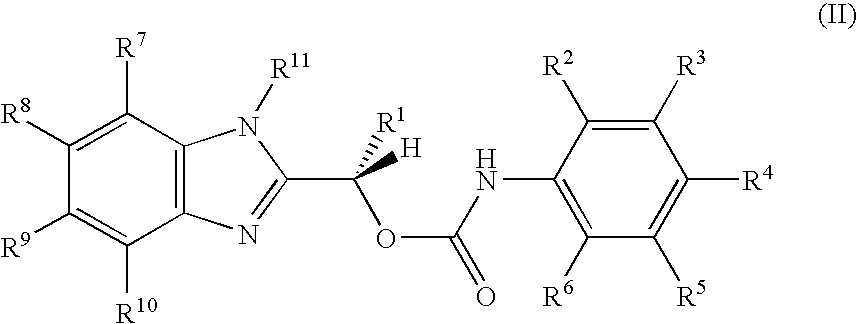
wherein R1 to R11 are as defined in connection with Formula (I). - In another embodiment are compounds having the structure of Formula (II), wherein at least one of R2, R3, R4, R5 or R6 is chloro.
- In another embodiment are compounds having the structure of Formula (II), wherein R3 and R4 is Cl.
- In another embodiment are compounds having the structure of Formula (II), wherein R3 and R4 or R4 and R5 are chloro and the remainder of R2 to R6 are hydrogen.
- In another embodiment are compounds having the structure of Formula (II), wherein R1 is optionally substituted methyl. In a further refinement are such compounds wherein R3 and R4 or R4 and R5 are chloro and the remainder of R2 to R6 are hydrogen. In yet a further refinement are such compounds wherein R7 to R10 are selected from the group consisting of halogen, amino alkyl, and —NC(O)R12a where R12a is alkyl or R7 and R8 taken together form a cyclic moiety.
- In another embodiment are compounds having the structure of Formula (II), wherein R7 and R8 or R8 and R9 form a cyclic moiety.
- In another aspect are compounds of Formula (I) that can modulate the activity of the CHK1 enzyme in vivo or in vitro and including pharmaceutically acceptable prodrugs, pharmaceutically acceptable solvates, pharmaceutically active metabolites, and pharmaceutically acceptable salts, of the compounds.
- In another embodiment are compounds that can modulate the activity of the CHK1 enzyme in vivo or in vitro, wherein the CHK1-modulating compounds binds to at least one of amino acids Phe 93 and Asp 94 as well as a hydrophobic pocket, of the CHK1 enzyme in vivo and/or in vitro, and, pharmaceutically acceptable prodrugs, pharmaceutically acceptable solvates, pharmaceutically active metabolites, and pharmaceutically acceptable salts, thereof. The specific binding of compounds to the CHK1 enzyme is depicted in the X-ray structure disclosed herein, see
FIG. 1 . - In another embodiment are compounds that selectively modulate the activity of the CHK1 enzyme over other kinases, wherein the selectivity of the CHK1-modulating compounds for the CHK1 enzyme is at least 50 times higher than for other native kinases and, pharmaceutically acceptable prodrugs, pharmaceutically acceptable solvates, pharmaceutically active metabolites, and pharmaceutically acceptable salts, thereof.
- An alternate aspect of the present invention is directed to pharmaceutical compositions of compounds of Formula (I) (as set forth above) that can modulate the activity of the CHK1 enzyme in vivo and/or in vitro, including pharmaceutically acceptable prodrugs, pharmaceutically acceptable solvates, pharmaceutically active metabolites, and pharmaceutically acceptable salts of such CHK1-modulating compounds.
- In another embodiment are methods for synthesizing carbamates of Formula (I) and, pharmaceutically acceptable prodrugs, pharmaceutically acceptable solvates, pharmaceutically active metabolites, and pharmaceutically acceptable salts, thereof, by contacting a compound of Formula (III):
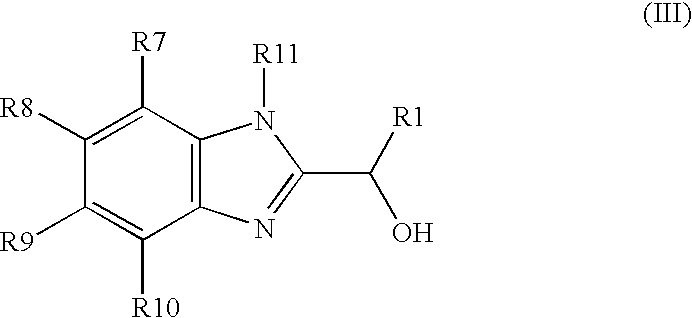
with a compound of Formula (IV):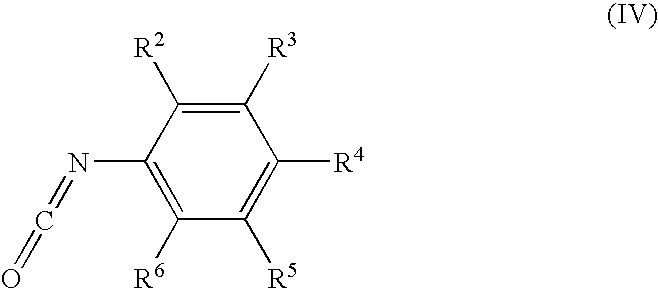
-
- in an appropriate solvent system; wherein R1 to R11 are as defined in connection with Formula (I).
- Another aspect of the present invention is directed to methods for modulating the CHK1 enzyme comprising contacting a CHK1-modulating compound of Formula (I), or pharmaceutically acceptable prodrugs, pharmaceutically acceptable solvates, pharmaceutically active metabolites, and pharmaceutically acceptable salts thereof, described herein, with the CHK1 enzyme.
- An additional aspect of the present invention is directed to methods for treating patients comprising administering a therapeutically effective amount of a CHK1-modulating compound, or a pharmaceutically acceptable prodrugs, pharmaceutically acceptable solvates, pharmaceutically active metabolites, and pharmaceutically acceptable salts thereof; wherein the CHK1 modulating compound is selected from the group consisting of:
-
- (i) a compound of Formula (I);
- (ii) a compound that can bind to at least one of amino acids Phe 93 and Asp 94 of the CHK1 enzyme in vivo and/or in vitro; and
- (iii) a compound that binds to the CHK1 enzyme with a selectivity at least 50 times higher than to other native kinases.
- A further aspect of the present invention is directed to methods for enhancing the effect of DNA-damaging agents in a patient comprising administering to the patient an enhancing-effective amount of a CHK1-modulating compound, or pharmaceutically acceptable prodrugs, pharmaceutically acceptable solvates, pharmaceutically active metabolites, and pharmaceutically acceptable salts thereof; wherein the CHK1 modulating compound is selected from the group consisting of:
-
- (i) a compound of Formula (I);
- (ii) a compound that can bind to at least one of amino acids Phe 93 and Asp 94 of the CHK1 enzyme in vivo and/or in vitro; and
- (iii) a compound that binds to the CHK1 enzyme with a selectivity at least 50 times higher than to other native kinases.
- Compounds of Formula (I) that are included within the present disclosure include, but are not limited to, the following:
- 1H-benzimidazol-2-ylmethyl 3,4-dichlorophenylcarbamate;
- 1-(1H-benzimidazol-2-yl)ethyl 3,4-difluorophenylcarbamate;
- 1-(1H-benzimidazol-2-yl)ethyl 3-chloro-4-fluorophenylcarbamate;
- 1-(1H-benzimidazol-2-yl)ethyl 1-naphthylcarbamate;
- 1-(1H-benzimidazol-2-yl)ethyl phenylcarbamate;
- 1-(1H-benzimidazol-2-yl)ethyl 2-naphthylcarbamate;
- 1-(1H-benzimidazol-2-yl)ethyl 4-chloro-3-(trifluoromethyl)phenylcarbamate;
- 1-(1H-benzimidazol-2-yl)ethyl 4-methyl-3-nitrophenylcarbamate;
- 1-(1H-benzimidazol-2-yl)ethyl 3-bromophenylcarbamate;
- 1-(1-(1H-benzimidazol-2-yl)ethyl 2,3-dimethylphenylcarbamate;
- 1-(1H-benzimidazol-2-yl)ethyl 3-(methylthio)phenylcarbamate;
- 1-(1H-benzimidazol-2-yl)ethyl 4-fluoro-3-(trifluoromethyl)phenylcarbamate;
- 1-(1H-benzimidazol-2-yl)ethyl 4-(benzyloxy)phenylcarbamate;
- 1-(1H-benzimidazol-2-yl)ethyl 3,4-dimethylphenylcarbamate;
- 1-(1H-benzimidazol-2-yl)
ethyl 1,3-benzodioxol-5-ylcarbamate; - 1-(1H-benzimidazol-2-yl)ethyl 3-oxo-1,3-dihydro-2-benzofuran-5-ylcarbamate;
- (1S)-1-(5-nitro-1H-benzimidazol-2-yl)ethyl 3,4-dimethylphenylcarbamate;
- 1-(1H-benzimidazol-2-yl)ethyl 4-bromo-3-chlorophenylcarbamate;
- (1S)-1-(1H-benzimidazol-2-yl)ethyl 3,4-dichlorophenylcarbamate;
- (1R)-1-(1H-benzimidazol-2-yl)ethyl 3,4-dichlorophenylcarbamate;
- (1S)-1-(4-nitro-1H-benzimidazol-2-yl)ethyl 3,4-dichlorophenylcarbamate;
- (1S)-1-(5,7-dibromo-1H-benzimidazol-2-yl)ethyl 3,4-dichlorophenylcarbamate;
- (1S)-1-(6-benzoyl-1H-benzimidazol-2-yl)ethyl 3,4-dichlorophenylcarbamate;
- (1S)-1-(6,7-dimethyl-1H-benzimidazol-2-yl)ethyl 3,4-dichlorophenylcarbamate;
- (1S)-1-(6-bromo-1H-benzimidazol-2-yl)ethyl 3,4-dichlorophenylcarbamate;
- (1S)-1-(4,5,6,7-tetramethyl-1H-benzimidazol-2-yl)ethyl 3,4-dichlorophenylcarbamate;
- (1S)-1-(5-bromo-6,7-dimethyl-1H-benzimidazol-2-yl)ethyl 3,4-dichlorophenylcarbamate;
- (1S)-1-(6-tert-butyl-1H-benzimidazol-2-yl)ethyl 3,4-dichlorophenylcarbamate;
- (1S)-1-(5,6-dimethyl-1H-benzimidazol-2-yl)ethyl 3,4-dichlorophenylcarbamate;
- 1-(1H-benzimidazol-2-yl)ethyl 3,4-dichlorophenylcarbamate;
- (1S)-1-(1H-naphtho[1,2-d]imidazol-2-yl)ethyl 3,4-dichlorophenylcarbamate;
- (1R)-1-(1H-naphtho[1,2-d]imidazol-2-yl)ethyl 3,4-dichlorophenylcarbamate;
- 1H-naphtho[1,2-d]imidazol-2-ylmethyl 3,4-dichlorophenylcarbamate;
- (1S)-1-(1H-imidazo[4,5-f]quinolin-2-yl)ethyl 3,4-dichlorophenylcarbamate;
- (1S)-1-(6,7-dichloro-1H-benzimidazol-2-yl)ethyl 3,4-dichlorophenylcarbamate;
- (1S)-1-(6-amino-1H-benzimidazol-2-yl)ethyl 3,4-dichlorophenylcarbamate;
- (1S)-1-(2-methyl-8H-imidazo[4,5-g][1,3]benzothiazol-7-yl)ethyl 3,4-dichlorophenylcarbamate;
- (1S)-1-(7-amino-6-methyl-1H-benzimidazol-2-yl)ethyl 3,4-dichlorophenylcarbamate;
- (1S)-1-[6-(acetylamino)-1H-benzimidazol-2-yl]ethyl 3,4-dichlorophenylcarbamate;
- (1S)-1-{5,6-bis[(dimethylamino)methyl]-1H-benzimidazol-2-yl}ethyl 3,4-dichlorophenylcarbamate;
- 2-hydroxy-1-(4,5,6,7-tetramethyl-1H-benzimidazol-2-yl)ethyl 3,4-dichlorophenylcarbamate; and
- 2-(dimethylamino)-1-(4,5,6,7-tetramethyl-1H-benzimidazol-2-yl)ethyl 3,4-dichlorophenylcarbamate;
- or a pharmaceutically acceptable prodrug, pharmaceutically active metabolite, pharmaceutically acceptable solvate or pharmaceutically acceptable salt thereof.
- In another aspect are compounds having the structures of Formula (I) selected from the group consisting of:
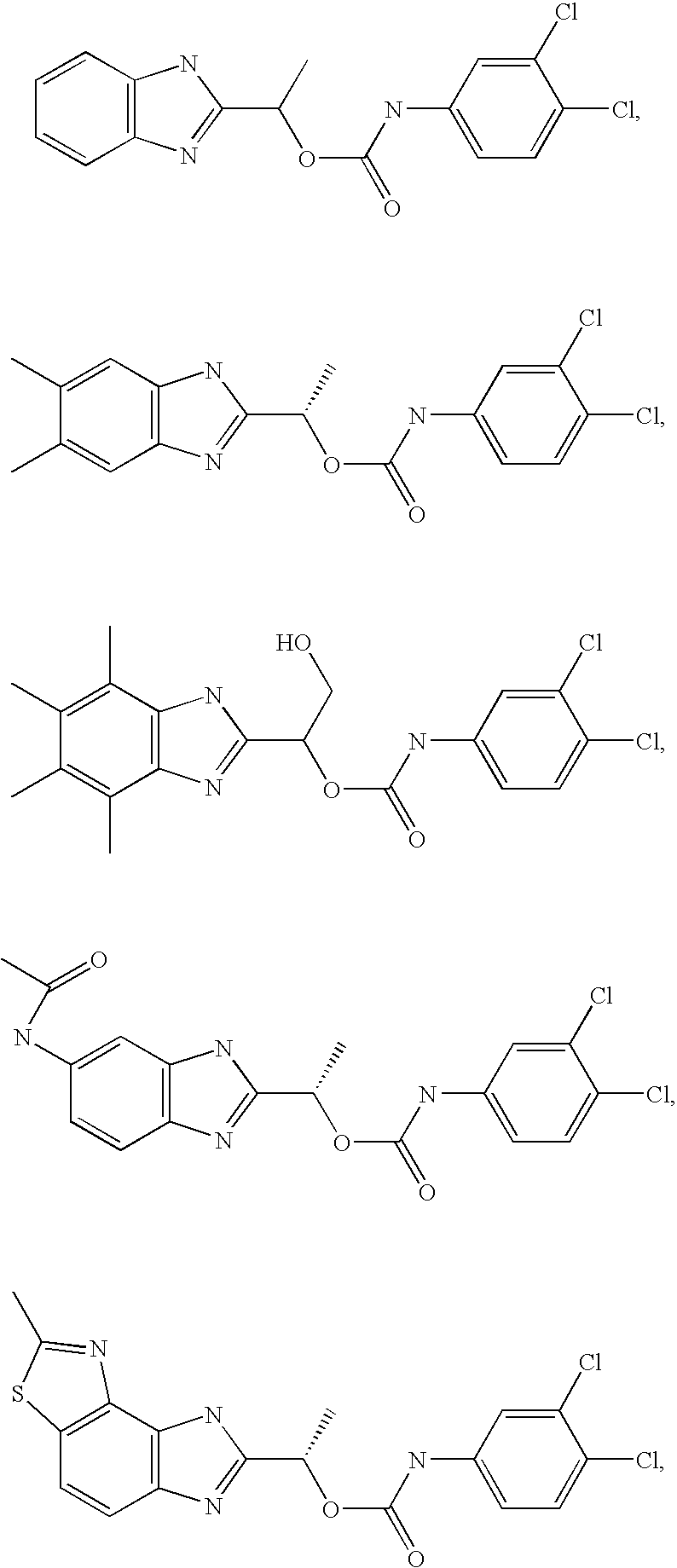
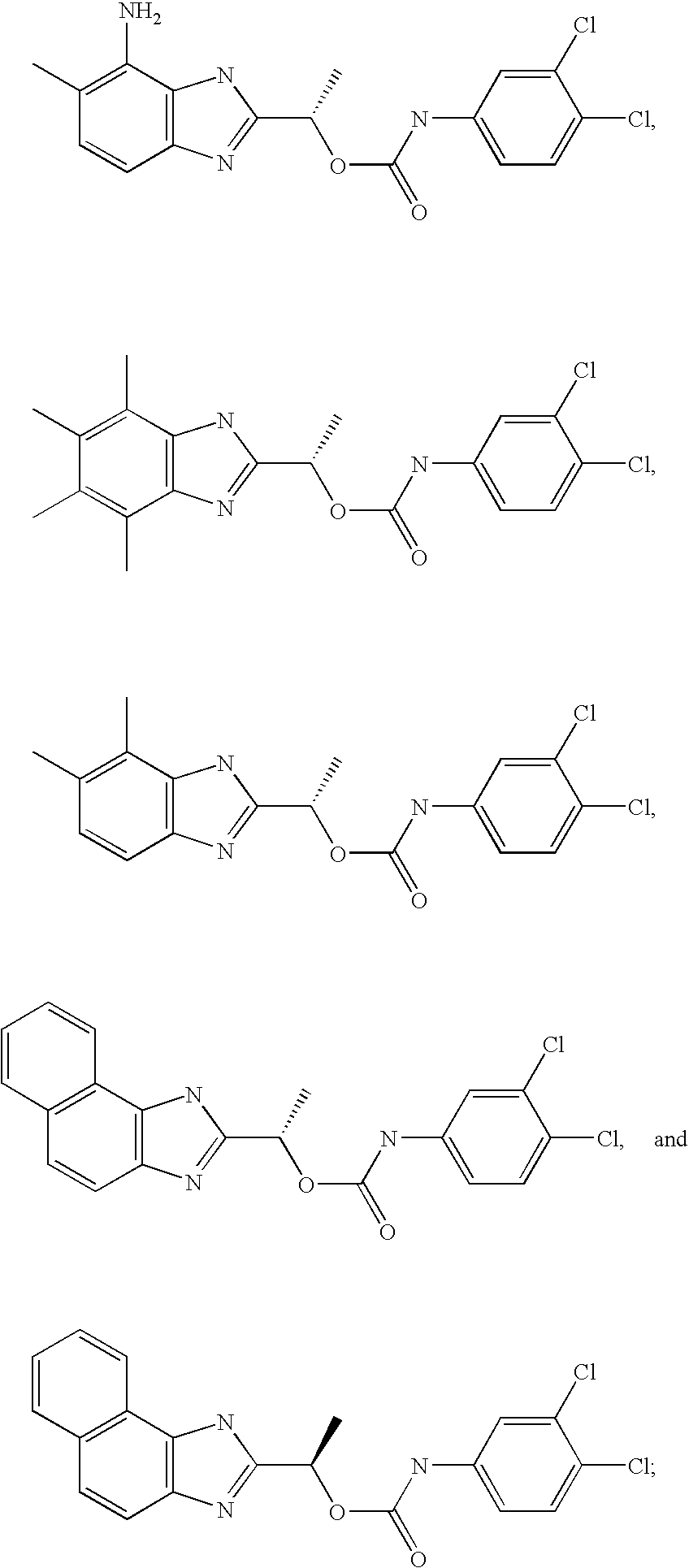
-
- or a pharmaceutically acceptable prodrug, pharmaceutically active metabolite, pharmaceutically acceptable solvate or pharmaceutically acceptable salt thereof.
- Another aspect of the present invention is directed to compounds that can modulate the activity of the CHK1 enzyme in vivo or in vitro, wherein the CHK1-modulating compounds have the structure of Formula (I).
- Another aspect of the present invention is directed to compounds that can selectively modulate the activity of the CHK1 enzyme over other kinases, wherein the selectivity of the CHK1-modulating compounds for the CHK1 enzyme is at least 50 times higher than for other native kinases.
- Another embodiment of the present invention are methods of modulating the activity of a protein kinase receptor, comprising contacting the kinase receptor with an effective amount of a compound having the structure of Formula (I), or a pharmaceutically acceptable prodrug, pharmaceutically active metabolite, pharmaceutically acceptable solvate or pharmaceutically acceptable salt thereof. Further are such methods in which the protein kinase is CHK1.
- Another aspect of the invention is to provide a composition for the treatment of neoplasms, and for enhancing the antineoplastic effects of anti-neoplastic agents and therapeutic radiation.
- Another aspect of the invention is directed to treatment of neoplasms by administering to a mammal in need of treatment an effective amount of a compound of Formula (V):
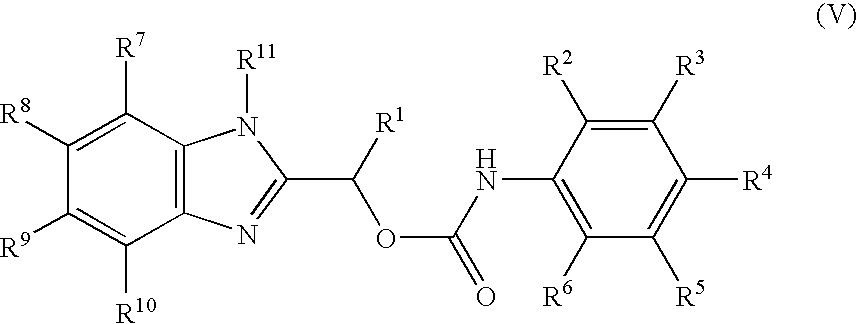
wherein -
- (a) R1 is selected from the group consisting of hydrogen, —OH, —NH2, and a moiety selected from the group consisting of (C1-C6)alkyl, —N[(C1-C6)alkyl][(C1-C6)alkyl], —NH[(C1-C6)alkyl], and (C1-C6)alkoxy, which is optionally substituted with 1 to 3 independently selected Y1, groups, wherein each Y1, is independently selected from the group consisting of halogen, azido, nitro, —OH, —NH2, —N[(C1-C6)alkyl][(C1-C6)alkyl], —NH[(C1-C6)alkyl], (C3-C6)cycloalkyl, and (C1-C6)alkoxy;
- (b) each of R2, R3, R4, R5, R6, R7, R8, R9, R10 is independently selected and is selected from the group consisting of hydrogen, nitro, halogen, azido, —NR12aR12b, —NR12aSO2R12b, —NR12aC(O)R12b, —OC(O)R12b, —NR12aC(O)OR12b, —OC(O)NR12aR12b, —OR12a, SR12a, S(O)R12a, —SO2R12a, —SO3R12a, —SO2NR12aR12b, —COR12a, —CO2R12a, —CONR12aR12b, —(C1-C4)perfluoroalkyl, —(CR13R14)tCN, and a moiety selected from the group consisting of —(CR13R14)t-aryl, —(CR13R14)t-heterocycle, (C2-C6)alkynyl, —(CR13R14)r(C3-C6)cycloalkyl, (C2-C6)alkenyl, and (C1-C6)alkyl, which is optionally substituted with 1 to 3 independently selected Y2 groups, where t is 0, 1, 2, or 3, and wherein when t is 2 or 3, the CR3R4 units may be the same or different; or wherein R7 and R8, or R8 and R9, taken together, and/or R2 and R3, or R3 and R4, taken together, may optionally form a cyclic moiety selected from the group consisting of aryl, (C5-C6)cycloalkyl, monocyclic heterocycle, —C(O)—O—(CR13R14), and —O(CR13R14)O—; wherein such aryl, heterocycle, or (C3-C6)cycloalkyl is optionally substituted with 1 to 3 independently selected Y2 groups;
- (c) R11 is H;
- (d) R12a and R12b are independently selected from the group consisting of hydrogen and a moiety selected from the group consisting of —(CR13R14)u—(C3-C6)cycloalkyl, (CR13R14)u-aryl, —(CR13R14)u-heterocycle, and (C1-C6)alkyl, which is optionally substituted with 1 to 3 independently selected Y3 groups, where u is 0, 1, 2, or 3, and wherein when u is 2 or 3, the CR3R4 units may be the same or different;
- (e) R13 and R14 are independently selected from the group consisting of H, F, and (C1-C6)alkyl, or R13 and R14 are selected together to form a carbocycle, or two R13 groups on adjacent carbon atoms are selected together can optionally form a carbocycle; and
- (f) each Y2, and Y3 is independently selected and is
- (i) selected from the group consisting of halogen, cyano, nitro, tetrazolyl, guanidino, amidino, methylguanidino, azido, C(O)Z1, —CF3, —CF2CF3, —CH(CF3)2, —C(OH)(CF3)2, —OCF3, —OCF2H, —OCF2CF3, —OC(O)NH2, —OC(O)NHZ1, —OC(O)NZ1Z2, —NHC(O)Z1, —NHC(O)NH2, —NH C(O)NHZ1, —NHC(O)NZ1Z2, —C(O)OH, —C(O)OZ1, —C(O)NH2, —C(O)NHZ1, —C(O)NZ1Z2, —P(O)3H2, —P(O)3(Z1)2, —S(O)3H, —S(O)mZ1, -Z1, —OZ1, —OH, —NH2, —NHZ1, —NZ1Z2, —C(═NH)NH2, —C(═NOH)NH2, —N-morpholino, (C2-C6)alkenyl, (C2-C6)alkynyl, (C1-C6)haloalkyl, (C2-C6)haloalkenyl, (C2-C6)haloalkynyl, (C1-C6)haloalkoxy, —(CZ3Z4)rNH2, —(CZ3Z4)rNHZ1, —(CZ3Z4)rNZ1Z2, and —S(O)m(CF2)qCF3, wherein m is 0, 1 or 2, q is an integer from 0 to 5, r is an integer from 1 to 4, Z1, and Z2 are independently selected from the group consisting of alkyl of 1 to 12 carbon atoms, cycloalkyl of 3 to 8 carbon atoms, aryl of 6 to 14 carbon atoms, heteroaryl of 5 to 14 ring atoms, aralkyl of 7 to 15 carbon atoms, and heteroaralkyl of 5 to 14 ring atoms; and Z3 and Z4 are independently selected from the group consisting of hydrogen, alkyl of 1 to 12 carbon atoms, aryl of 6 to 14 carbon atoms, heteroaryl of about 5 to 14 ring atoms, aralkyl of 7 to 15 carbon atoms, and heteroaralkyl of 5 to 14 ring atoms;
- (ii) any two Y2 or Y3 groups attached to adjacent carbon atoms may be selected together to be —O[C(Z3)(Z4)]rO— or —O[C(Z3)(Z4)]+1—; or
- (iii) any two Y2 or Y3 groups attached to the same or adjacent carbon atoms may be selected together to form a carbocycle or heterocycle;
- and wherein any of the above-mentioned substituents comprising a CH3 (methyl), CH2 (methylene), or CH (methine) group which is not attached to a halogen, SO or SO2 group or to a N, O or S atom optionally bears on said group a substituent selected from hydroxy, halogen, (C1-C4)alkyl, (C1-C4)alkoxy and —N[(C1-C4)alkyl][(C1-C4)alkyl];
or a pharmaceutically acceptable prodrug, pharmaceutically active metabolite, pharmaceutically acceptable solvate or pharmaceutically acceptable salt thereof.
- Another embodiment is directed to use of a compound of Formula (V) to modulate the activity of the CHK1 enzyme in vivo or in vitro.
- Examples of compounds of Formula (V) which modulate CHK1 include the following:
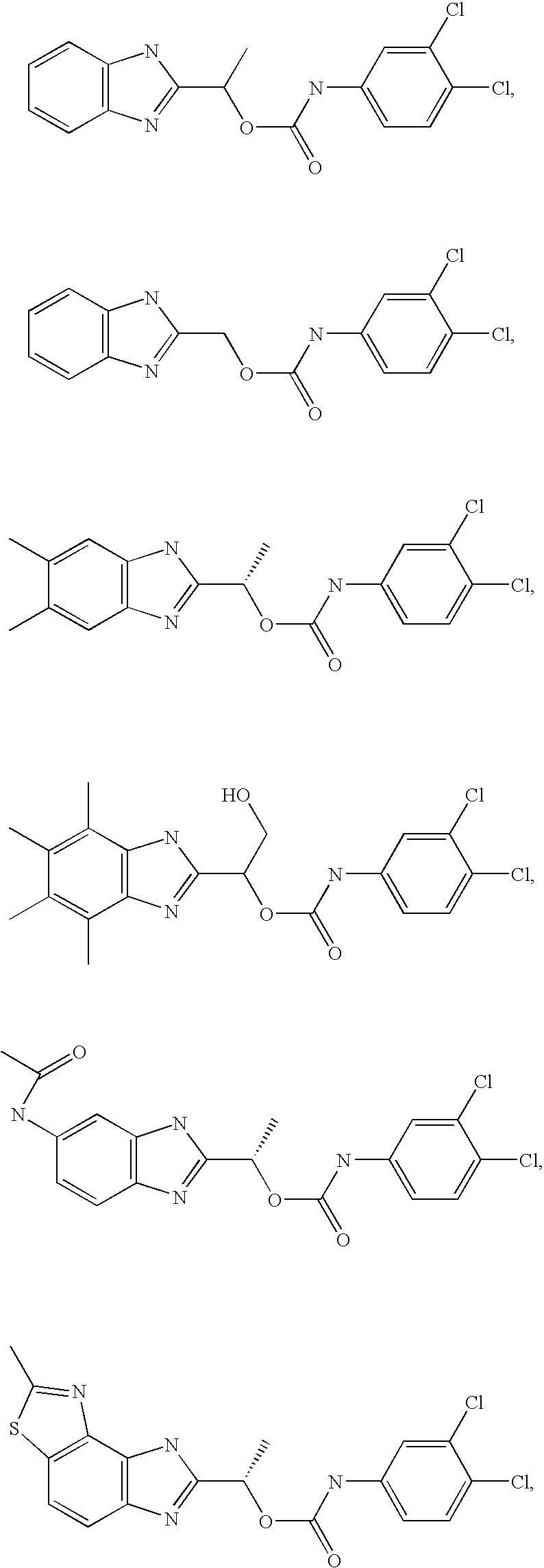
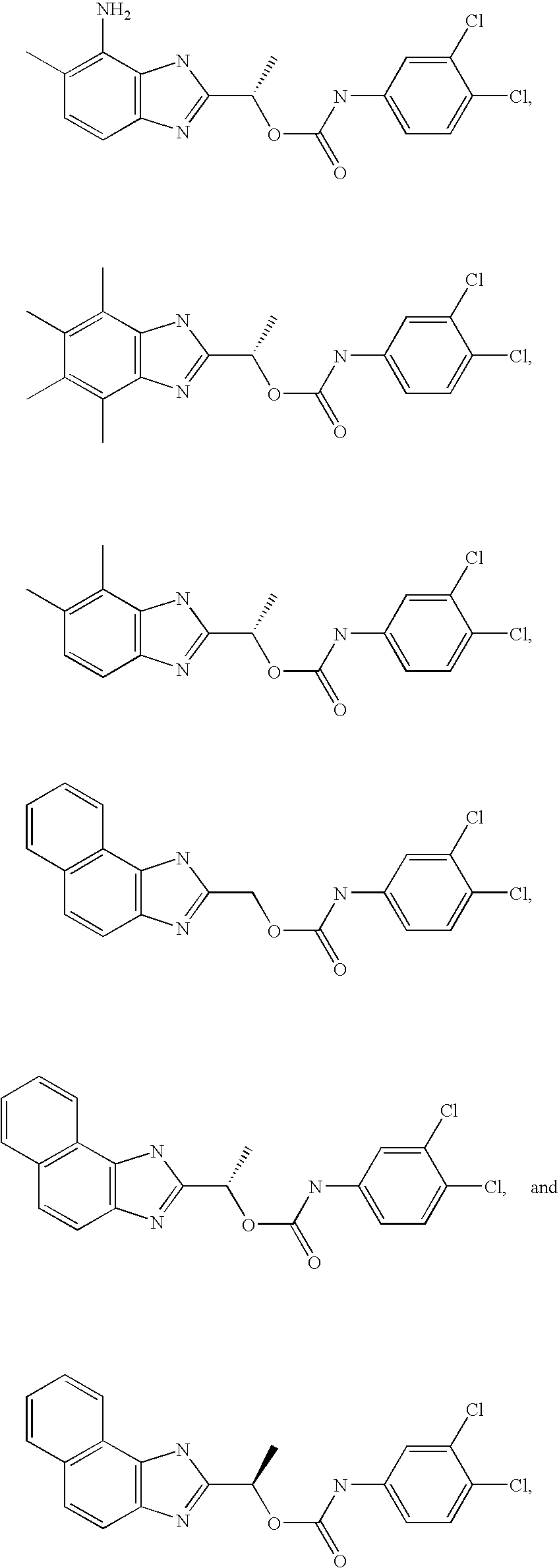
-
- or a pharmaceutically acceptable prodrug, pharmaceutically active metabolite, pharmaceutically acceptable solvate or pharmaceutically acceptable salt thereof.
- In an embodiment, the invention relates to a composition containing a compound having the structure of Formula (I), a pharmaceutically acceptable salt, solvate, or prodrug thereof and an anti-neoplastic agent as a combined preparation for the simultaneous, separate or sequential use in treating a neoplasm.
- In another embodiment, the invention relates to a composition containing a compound having the structure of Formula (I), a pharmaceutically acceptable salt, solvate, or prodrug thereof and an anti-neoplastic agent as a combined preparation for the simultaneous, separate or sequential use in treating a neoplasm wherein the anti-neoplastic agent is selected from the group consisting of alkylating agents, antibiotics and plant alkaloids, hormones and steroids, synthetic agents having anti-neoplastic activity, antimetabolites and biological molecules having anti-neoplastic activity.
- In another embodiment, the invention relates to a composition containing a compound having the structure of Formula (I), a pharmaceutically acceptable salt, solvate, or prodrug thereof and an anti-neoplastic agent as a combined preparation for the simultaneous, separate or sequential use in treating a neoplasm wherein the anti-neoplastic agent is selected from the group consisting of Ara-c, VP-16, cis-platin, adriamycin, 2-chloro-2-deoxyadenosine, 9-(3-D-arabinosyl-2-fluoroadenine, carboplatin, gemcitabine, camptothecin, paclitaxel, BCNU, 5-fluorouracil, irinotecan, and doxorubicin.
- In another embodiment are pharmaceutical compositions for the treatment of a hyperproliferative disorder in a mammal comprising an enhancing effective amount of a compound having the structure of Formula (I) or a prodrug, metabolite, salt or solvate thereof and a pharmaceutically acceptable carrier. Further are such pharmaceutical compositions, wherein said hyperproliferative disorder is cancer. Further are such pharmaceutical compositions, wherein the cancer is brain, lung, kidney, renal, ovarian, ophthalmic, squamous cell, bladder, gastric, pancreatic, breast, head, neck, oesophageal, gynecological, prostate, colorectal or thyroid cancer. Further are pharmaceutical compositions wherein the hyperproliferative disorder is noncancerous. Further are such pharmaceutical compositions wherein said hyperproliferative disorder is a benign hyperplasia of the skin or prostate.
- In another embodiment are pharmaceutical compositions for the treatment of a hyperproliferative disorder in a mammal comprising an enhancing effective amount of a compound having the structure of Formula (I) or a prodrug, metabolite, salt or solvate thereof in combination with an anti-neoplastic agent. Further are such pharmaceutical compositions wherein the anti-neoplastic agent is capable of damaging DNA in a malignant cell. Further are such pharmaceutical compositions wherein the anti-neoplastic agent is selected from the group consisting of mitotic inhibitors, alkylating agents, anti-metabolites, intercalating antibiotics, enzymes, topoisomerase inhibitors, biological response modifiers, anti-hormones, and anti-androgens, and a pharmaceutically acceptable carrier.
- In another embodiment are methods of treating a hyperproliferative disorder in a mammal comprising administering to said mammal an enhancing effective amount of a compound having the structure of Formula (I) or a prodrug, metabolite, salt or solvate thereof. Further are such methods wherein said hyperproliferative disorder is cancer. Further are such methods wherein said cancer is brain, lung, ophthalmic, squamous cell, renal, kidney, ovarian, bladder, gastric, pancreatic, breast, head, neck, oesophageal, prostate, colorectal, gynecological or thyroid cancer. Further are such methods wherein said hyperproliferative disorder is noncancerous. Further are such methods wherein said hyperproliferative disorder is a benign hyperplasia of the skin or prostate.
- In another embodiment are methods for the treatment of a hyperproliferative disorder in a mammal comprising administering to said mammal an enhancing effective amount of a compound having the structure of Formula (I) or a prodrug, metabolite, salt or solvate thereof in combination with an anti-neoplastic agent. Further are such methods wherein the anti-neoplastic agent is capable of damaging DNA in a malignant cell. Further are such methods wherein the anti-neoplastic agent is selected from the group consisting of mitotic inhibitors, alkylating agents, anti-metabolites, intercalating antibiotics, growth factor inhibitors, cell cycle inhibitors, enzymes, topoisomerase inhibitors, biological response modifiers, anti-hormones, and anti-androgens.
- Another aspect of the invention is to provide a method for the treatment of neoplasms.
- In another embodiment, the invention relates to a method for treating a neoplasm which comprises administering to a mammal in need thereof, an anti-neoplastic agent in combination with a compound having the structure of Formula (I), a pharmaceutically acceptable salt, solvate, or prodrug thereof, wherein the anti-neoplastic agent is selected from the group consisting of Ara-c, VP-16, cis-platin, adriamycin, 2-chloro-2-deoxyadenosine, 9-p-D-arabinosyl-2-fluoroadenine, carboplatin, gemcitabine, camptothecin, paclitaxel, BCNU, 5-fluorouracil, irinotecan, and doxorubicin. In another embodiment, more than one anti-neoplastic agents may be used in combination with a compound having the structure of Formula (I), the pharmaceutically acceptable salts, solvates, or prodrugs thereof.
- Another aspect of the invention is to provide methods for enhancing the anti-neoplastic effect of therapeutic radiation. The CHK1 inhibitor identified in the present invention may also enhance the anti-neoplasm effects of radiation therapy. Usually, radiation can be used to treat the site of a tumor directly or administered by brachytherapy implants. The various types of therapeutic radiation which are contemplated for combination therapy in accordance with the present invention may be those used in the treatment of cancer which include, but are not limited to X-rays, gamma radiation, high energy electrons and High LET (Linear Energy Transfer) radiation such as protons, neutrons, and alpha particles. The ionizing radiation may be employed by techniques well known to those skilled in the art. For example, X-rays and gamma rays are applied by external and/or interstitial means from linear accelerators or radioactive sources. High-energy electrons may be produced by linear accelerators. High LET radiation is also applied from radioactive sources implanted interstitially.
- Accordingly, in another embodiment, the invention relates to a method for enhancing the anti-neoplastic effect of therapeutic radiation in a mammal which comprises administering to a mammal in need thereof, a compound having the structure of Formula (I), a pharmaceutically acceptable salt, solvate, or prodrug thereof, in combination with therapeutic radiation having an anti-neoplastic effect.
- In an embodiment, the invention relates to a method for treating a neoplasm which comprises administering to a mammal in need thereof, therapeutic radiation having an anti-neoplastic effect in combination with a compound having the structure of Formula (I), a pharmaceutically acceptable salt, solvate, or prodrug thereof.
- According to another aspect, the invention provides methods for enhancing the antineoplastic effect of an anti-neoplastic agent.
- In an embodiment, the invention relates to a method for enhancing the anti-neoplastic effect of an anti-neoplastic agent in a mammal which comprises administering to a mammal in need thereof, a compound having the structure of Formula (I), a pharmaceutically acceptable salt, solvate, or prodrug thereof, in combination with an antineoplastic agent. The antineoplastic agents include alkylating agents, antibiotics and plant alkaloids, hormones and steroids, synthetic agents having anti-neoplastic activity, antimetabolites and biological molecules having anti-neoplastic activity. Specific antineoplastic agents include Ara-c, VP-16, cis-platin, adriamycin, 2-chloro-2-deoxyadenosine, 9-O-D-arabinosyl-2-fluoroadenine, carboplatin, gemcitabine, camptothecin, paclitaxel, BCNU, 5-fluorouracil, irinotecan, and doxorubicin.
- One aspect of the present invention is directed to methods for treating patients comprising administering a therapeutically effective amount of a CHK1-modulating compound, or a pharmaceutically acceptable prodrug, pharmaceutically active metabolite, or pharmaceutically acceptable salt thereof; wherein the CHK1 modulating compound has the structure of Formula (I).
- Another aspect of the invention is to provide a method for the treatment of a condition which can be treated by the inhibition of protein kinases. In one embodiment of the invention, the protein kinases are selected from the group consisting of Checkpoint kinase 1 (CHK1), Checkpoint kinase 2 (CHK-2), Cyclin dependent kinase 1 (CDK1), Serum and glucocorticoid regulated kinase (SGK), Adenosine 5′-monophosphate (AMP)-activated protein kinase (AMPK), Lymphoid T cell tyrosine kinase (LCK), Mitogen activated protein kinase-2 (MAPK-2), Mitogen- and stress-activated protein kinase 1 (MSK1), Rho kinase (ROCK-II), P70 S6 kinase (p70S6K), cAMP (adenosine 3′,5′ cyclic monophosphate)-dependent protein kinase (PKA), Mitogen activated protein kinase (MAPK), Mitogen activated protein kinase-1 (MAPK-1), Protein kinase C-related kinase 2 (PRK2), 3′-Phosphoinositide dependent kinase 1 (PDK1), Fyn kinase (FYN), Protein kinase C (PKC), Protein Kinase C Beta 2 (PKCβII), Protein Kinase C Gamma (PKCγ), Vascular endothelial growth factor receptor 2 (VEGFR-2), Fibroblast growth factor receptor (FGFR), Phosphorylase kinase (PHK), Wee1 kinase (Wee1), and Protein Kinase B (PKB). Preferably, the protein kinases are selected from the group consisting of Checkpoint kinase 1 (CHK1), Checkpoint kinase 2 (CHK-2), Mitogen activated protein kinase (MAPK), Mitogen activated protein kinase-1 (MAPK-1), Mitogen activated protein kinase-2 (MAPK-2), Vascular endothelial growth factor receptor 2 (VEGFR-2), Fibroblast growth factor receptor (FGFR), Phosphorylase kinase (PHK), Protein Kinase B alpha (PKBα), and Wee1 kinase (Wee1).
- In an embodiment, the invention relates to a method for the treatment of a condition which can be treated by the inhibition of protein kinases in a mammal, including a human, comprising administering to a mammal in need thereof, a compound having the structure of Formula (I), a pharmaceutically acceptable salt, solvate, or prodrug thereof.
- In another embodiment, said condition which can be treated by the inhibition of protein kinases is selected from the group consisting of connective tissue disorders, inflammatory disorders, immunology/allergy disorders, infectious diseases, respiratory diseases, cardiovascular diseases, eye diseases, metabolic diseases, central nervous system (CNS) disorders, liver/kidney diseases, reproductive health disorders, gastric disorders, skin disorders and cancers.
- One aspect of the present invention is directed to methods for enhancing the effect of DNA-damaging agents in a patient comprising administering to the patient an enhancing-effective amount of a CHK1-modulating compound, or a pharmaceutically acceptable prodrug, pharmaceutically active metabolite, or pharmaceutically acceptable salt thereof, wherein the CHK1 modulating compound has the structure of Formula (I).
- The subject invention also includes isotopically-labelled compounds, which are identical to those recited in Formula (I), but for the fact that one or more atoms are replaced by an atom having an atomic mass or mass number different from the atomic mass or mass number usually found in nature. Examples of isotopes that can be incorporated into compounds of the invention include isotopes of hydrogen, carbon, nitrogen, oxygen, phosphorous, fluorine and chlorine, such as 2H, 3H, 13C, 14C, 15N, 18O, 17O, 31P, 32P, 35S, 18F, and 36Cl, respectively. Compounds of the present invention, prodrugs thereof, and pharmaceutically acceptable salts of said compounds or of said prodrugs which contain the aforementioned isotopes and/or other isotopes of other atoms are within the scope of this invention. Certain isotopically-labelled compounds of the present invention, for example those into which radioactive isotopes such as 3H and 14C are incorporated, are useful in drug and/or substrate tissue distribution assays. Tritiated, i.e., 3H, and carbon-14, i.e., 14C, isotopes are noted for their ease of preparation and detectability. Further, substitution with heavier isotopes such as deuterium, i.e., 2H, can afford certain therapeutic advantages resulting from greater metabolic stability, for example increased in vivo half-life or reduced dosage requirements and, hence, may be used in some circumstances. Isotopically labelled compounds of Formula (I) of this invention and prodrugs thereof can generally be prepared by carrying out the procedures disclosed in the Schemes and/or in the Examples below, by substituting a readily available isotopically labelled reagent for a non-isotopically labelled reagent.
- The compounds of Formula (I) or prodrugs thereof, pharmaceutically active metabolites, pharmaceutically acceptable salts, or pharmaceutically acceptable solvates of said compounds and said prodrugs, can each independently also be used in a palliative neo-adjuvant/adjuvant therapy in alleviating the symptoms associated with the diseases recited herein as well as the symptoms associated with abnormal cell growth. Such therapy can be a monotherapy or can be in a combination with chemotherapy and/or immunotherapy.
- If the substituents themselves are not compatible with the synthetic methods of this invention, the substituent may be protected with a suitable protecting group that is stable to the reaction conditions used in these methods. The protecting group may be removed at a suitable point in the reaction sequence of the method to provide a desired intermediate or target compound. Suitable protecting groups and the methods for protecting and de-protecting different substituents using such suitable protecting groups are well known to those skilled in the art; examples of which may be found in T. Greene and P. Wuts, Protecting Groups in Chemical Synthesis (3rd ed.), John Wiley & Sons, NY (1999), which is incorporated herein by reference in its entirety. In some instances, a substituent may be specifically selected to be reactive under the reaction conditions used in the methods of this invention. Under these circumstances, the reaction conditions convert the selected substituent into another substituent that is either useful in an intermediate compound in the methods of this invention or is a desired substituent in a target compound.
- The compounds of the present invention may have asymmetric carbon atoms. Such diasteromeric mixtures can be separated into their individual diastereomers on the basis of their physical chemical differences by methods known to those skilled in the art, for example, by chromatography or fractional crystallization. Enantiomers can be separated by converting the enantiomeric mixtures into a diastereomric mixture by reaction with an appropriate optically active compound (e.g., alcohol), separating the diastereomers and converting (e.g., hydrolyzing) the individual diastereomers to the corresponding pure enantiomers. All such isomers, including diastereomer mixtures and pure enantiomers are considered as part of the invention.
- The compounds of present invention may in certain instances exist as tautomers. This invention relates to the use of all such tautomers and mixtures thereof.
- Preferably, the compounds of the present invention are used in a form that is at least 90% optically pure, that is, a form that contains at least 90% of a single isomer (80% enantiomeric excess (“e.e.”) or diastereomeric excess (“d.e.”)), more preferably at least 95% (90% e.e. or d.e.), even more preferably at least 97.5% (95% e.e. or d.e.), and most preferably at least 99% (98% e.e. or d.e.).
- Additionally, the formulae are intended to cover solvated as well as unsolvated forms of the identified structures. For example, Formula (I) includes compounds of the indicated structure in both hydrated and non-hydrated forms. Additional examples of solvates include the structures in combination with isopropanol, ethanol, methanol, DMSO, ethyl acetate, acetic add, or ethanolamine.
- In the case of agents that are solids, it is understood by those skilled in the art that the inventive compounds and salts may exist in different crystal or polymorphic forms, all of which are intended to be within the scope of the present invention and specified formulas.
- Definitions
- As used herein, the following terms have the following meanings, unless expressly indicated otherwise.
- The term “acyl” includes alkyl, aryl, or heteroaryl substituents attached to a compound via a carbonyl functionality (e.g., —C(O)-alkyl, —C(O)-aryl, etc.).
- The term “acylamino” refers to an acyl radical appended to an amino or alkylamino group, and includes —C(O)—NH2 and —C(O)—NRR″ groups where R and R′ are as defined in conjunction with alkylamino.
- The term “acyloxy” refers to the ester group —OC(O)—R, where R is H, alkyl, alkenyl, alkynyl, or aryl.
- The term “alkenyl” refers to optionally substituted unsaturated aliphatic moieties having at least one carbon-carbon double bond and including E and Z isomers of said alkenyl moiety. The term also includes cycloalkyl moieties having at least one carbon-carbon double bond wherein cycloalkyl is as defined above. Examples of alkenyl radicals include ethenyl, propenyl, butenyl, 1,4-butadienyl, cyclopentenyl, cyclohexenyl and the like.
- The term “alkenylene” refers to an optionally substituted divalent straight chain, branched chain or cyclic saturated aliphatic group containing at least one carbon-carbon double bond, and including E and Z isomers of said alkenylene moiety.
- The term “alkoxy” refers to O-alkyl groups. Examples of alkoxy radicals include methoxy, ethoxy, n-propoxy, isopropoxy, n-butoxy, iso-butoxy, sec-butoxy, tert-butoxy and the like.
- The term “alkyl” refers to an optionally substituted saturated monovalent aliphatic radicals having straight, cyclic or branched moieties. Examples of alkyl radicals include methyl, ethyl, n-propyl, isopropyl, n-butyl, isobutyl, sec-butyl, tert-butyl, tert-amyl, pentyl, hexyl, heptyl, octyl and the like.
- The term “alkylamino” refers to the —NRR′ group, where R and R′ are independently selected from hydrogen (however, R and R′ cannot both be hydrogen), alkyl, and aryl groups; or R and R′, taken together, can form a cyclic ring system.
- The term “alkylene” refers to an optionally substituted divalent straight chain, branched chain or cyclic saturated aliphatic group. The latter group may also be referred to more specifically as a cycloalkylene group.
- The term “alkylthio” alone or in combination, refers to an alkyl thio radical, alkyl-S—.
- The term “alkynyl” refers to an optionally substituted unsaturated aliphatic moieties having at least one carbon-carbon triple bond and includes straight and branched chain alkynyl groups. Examples of alkynyl radicals include ethynyl, propynyl, butynyl and the like.
- The term “amino” refers to the —NH2 group.
- The term “amino acid” refers to both natural, unnatural amino acids in their D and L stereo isomers if their structures allow such stereoisomeric forms, and their analogs. Natural amino acids include alanine (Ala), arginine (Arg), asparagine (Asn), aspartic acid (Asp), cysteine (Cys), glutamine (Gin), glutamic acid (Glu), glycine (Gly), histidine (His), isoleucine (Ile), leucine (Leu), lysine (Lys), methionine (Met), phenylalanine (Phe), proline (Pro), serine (Ser), threonine (Thr), tryptophan (Trp), tyrosine (Tyr) and valine (Val). Unnatural amino acids include, but are not limited to azetidinecarboxylic acid, 2-aminoadipic acid, 3-aminoadipic acid, beta-alanine, aminopropionic acid, 2-aminobutyric acid, 4-aminobutyric acid, 6-aminocaproic acid, 2-aminoheptanoic acid, 2-aminoisobutyric acid, 3-aminoisobutyric acid, 2-aminopimelic acid, 2,4 diaminoisobutyric acid, demosine, 2,2′-diaminopimelic acid, 2,3-diaminopropionic acid, N-ethylglycine, N-ethylasparagine, hydroxylysine, allo-hydroxylysine, 3-hydroxyproline, 4-hydroxyproline, isodesmosine, allo-isoleucine, N-methylglycine, N-methylisoleucine, N-methylvaline, norvaline, norleucine, ornithine and pipecolic acid. Amino acid analogs include the natural and unnatural amino acids which are chemically blocked, reversibly or irreversibly, or modified on their N-terminal amino group or their side-chain groups, as for example, methionine sulfoxide, methionine sulfone, S-(carboxymethyl)-cysteine, S-(carboxymethyl)-cysteine sulfoxide and S-(carboxymethyl)-cysteine sulfone.
- The term “aralkenyl” refers to an alkenyl group substituted with an aryl group. Preferably the alkenyl group has from 2 to about 6 carbon atoms.
- The term “aralkyl” refers to an alkyl group substituted with an aryl group. Suitable aralkyl groups include benzyl, phenethyl, and the like. Preferably the alkyl group has from 1 to about 6 carbon atoms.
- The term “aryl” refers to an aromatic group which has at least one ring having a conjugated pi electron system and includes a carbocyclic aryl, heterocyclic aryl and biaryl groups, all of which may be optionally substituted.
- The term “aryloxy” refers to a group having the formula, R—O—, wherein R is an aryl group.
- The term “aralkoxy” refers to a group having the formula, R—O—, wherein R is an aralkyl group.
- The term “aromatic” refers to compounds or moieties comprising multiple conjugated double bonds. Examples of aromatic moieties include, without limitation, aryl or heteroaryl ring systems.
- The term “arylthio” alone or in combination, refers to an optionally substituted aryl thio radical, aryl-S—.
- The term “carbamoyl” or “carbamate” refers to the group —O—C(O)—NRR″ where R and R″ are independently selected from hydrogen, alkyl, and aryl groups; and R and R″ taken together can form a cyclic ring system.
- The term “carbocycle” refers to optionally substituted cycloalkyl and aryl moieties. The term “carbocycle” also includes cycloalkenyl moieties having at least one carbon-carbon double bond.
- The term “carboxamido” refers to the group
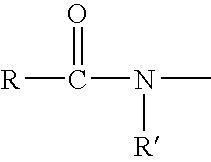
where each of R and R′ are independently selected from the group consisting of H, alkyl, and aryl. - The term “carboxy esters” refers to —C(O)OR where R is alkyl or aryl.
- The term “cycloalkyl” refers to optionally substituted saturated monovalent aliphatic radicals having cyclic configurations, including monocyclic, bicyclic, tricyclic, and higher multicyclic alkyl radicals (and, when multicyclic, including fused and bridged bicyclic and spirocyclic moieties) wherein each cyclic moiety has from 3 to about 8 carbon atoms. Examples of cycloalkyl radicals include cyclopropyl, cyclobutyl, cyclopentyl, cyclohexyl and the like.
- The terms haloalkyl, haloalkenyl, haloalkynyl and haloalkoxy include alkyl, alkenyl, alkynyl and alkoxy structures, that are substituted with one or more halo groups or with combinations thereof.
- The term “halogen” means fluoro, chloro, bromo or iodo. Preferred halogen groups are fluoro, chloro and bromo.
- The terms “heteroalkyl” “heteroalkenyl” and “heteroalkynyl” include alkyl, alkenyl and alkynyl radicals and which have one or more skeletal chain atoms selected from an atom other that carbon, e.g., oxygen, nitrogen, sulfur, phosphorus or combinations thereof.
- “Heteroaralkyl” refers to an alkyl group substituted with a heteroaryl, such as picolyl, and includes those heterocyclic systems described in “Handbook of Chemistry and Physics”, 49th edition, 1968, R. C. Weast, editor; The Chemical Rubber Co., Cleveland, Ohio. See particularly Section C, Rules for Naming Organic Compounds, B. Fundamental Heterocyclic Systems. Preferably the alkyl group has from 1 to about 6 carbon atoms.
- “Heteroaryl” refers to optionally substituted aromatic groups having from 1 to 14 carbon atoms and the remainder of the ring atoms are heteroatoms, and includes those heterocyclic systems described in “Handbook of Chemistry and Physics”, 49th edition, 1968, R. C. Weast, editor; The Chemical Rubber Co., Cleveland, Ohio. See particularly Section C, Rules for Naming Organic Compounds, B. Fundamental Heterocyclic Systems. Suitable heteroatoms include oxygen, nitrogen, and S(O)i, wherein i is 0, 1 or 2, and suitable heterocyclic aryls include furanyl, thienyl, pyridyl, pyrrolyl, pyrimidyl, pyrazinyl, imidazolyl, and the like.
- The term “heterocycle” refers to optionally substituted aromatic and non-aromatic heterocyclic groups containing one to four heteroatoms each selected from O, S and N, wherein each heterocyclic group has from 4 to 10 atoms in its ring system, and with the proviso that the ring of said group does not contain two adjacent O or S atoms. Non-aromatic heterocyclic groups include groups having only 4 atoms in their ring system, but aromatic heterocyclic groups must have at least 5 atoms in their ring system. The heterocyclic groups include benzo-fused ring systems. An example of a 4 membered heterocyclic group is azetidinyl (derived from azetidine). An example of a 5 membered heterocyclic group is thiazolyl. An example of a 6 membered heterocyclic group is pyridyl, and an example of a 10 membered heterocyclic group is quinolinyl. Examples of non-aromatic heterocyclic groups are pyrrolidinyl, tetrahydrofuranyl, dihydrofuranyl, tetrahydrothienyl, tetrahydropyranyl, dihydropyranyl, tetrahydrothiopyranyl, piperidino, morpholino, thiomorpholino, thioxanyl, piperazinyl, azetidinyl, oxetanyl, thietanyl, homopiperidinyl, oxepanyl, thiepanyl, oxazepinyl, diazepinyl, thiazepinyl, 1,2,3,6-tetrahydropyridinyl, 2-pyrrolinyl, 3-pyrrolinyl, indolinyl, 2H-pyranyl, 4H-pyranyl, dioxanyl, 1,3-dioxolanyl, pyrazolinyl, dithianyl, dithiolanyl, dihydropyranyl, dihydrothienyl, dihydrofuranyl, pyrazolidinyl, imidazolinyl, imidazolidinyl, 3-azabicyclo[3.1.0]hexanyl, 3-azabicyclo[4.1.0]heptanyl, 3H-indolyl and quinolizinyl. Examples of aromatic heterocyclic groups are pyridinyl, imidazolyl, pyrimidinyl, pyrazolyl, triazolyl, pyrazinyl, tetrazolyl, furyl, thienyl, isoxazolyl, thiazolyl, oxazolyl, isothiazolyl, pyrrolyl, quinolinyl, isoquinolinyl, indolyl, benzimidazolyl, benzofuranyl, cinnolinyl, indazolyl, indolizinyl, phthalazinyl, pyridazinyl, triazinyl, isoindolyl, pteridinyl, purinyl, oxadiazolyl, thiadiazolyl, furazanyl, benzofurazanyl, benzothiophenyl, benzothiazolyl, benzoxazolyl, quinazolinyl, quinoxalinyl, naphthyridinyl, and furopyridinyl. The foregoing groups, as derived from the groups listed above, may be C-attached or N-attached where such is possible. For instance, a group derived from pyrrole may be pyrrol-1-yl (N-attached) or pyrrol-3-yl (C-attached). Further, a group derived from imidazole may be imidazol-1-yl or imidazol-3-yl (both N-attached) or imidazol-2-yl, imidazol-4-yl or imidazol-5-yl (all C-attached). Illustrative examples of (C2-C10)heterocyclyl are derived from, but not limited to, the following:

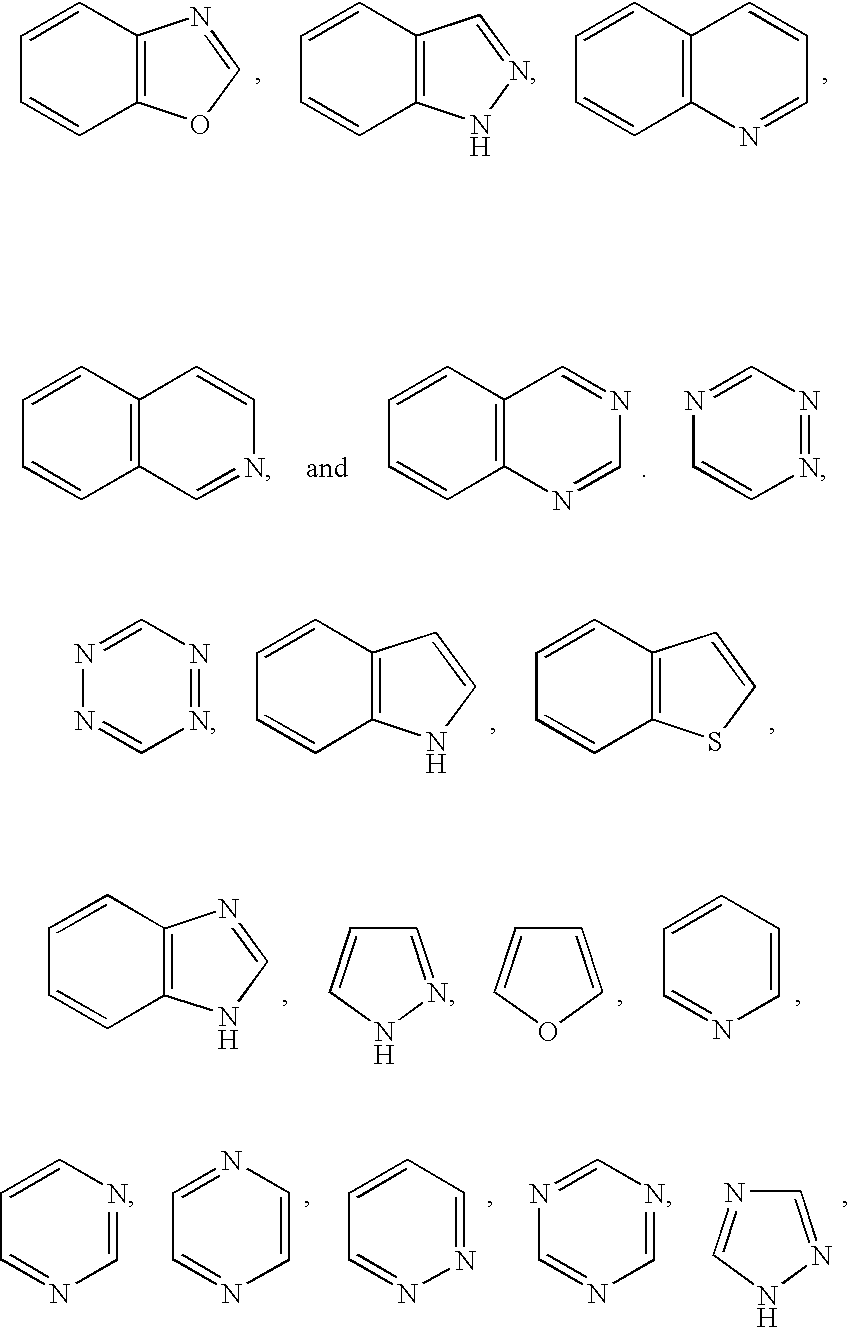
- The term “membered ring” can embrace any cyclic structure. The term “membered” is meant to denote the number of skeletal atoms that constitute the ring. Thus, for example, cyclohexyl, pyridine, pyran and thiopyran are 6-membered rings and cyclopentyl, pyrrole, furan, and thiophene are 5-membered rings.
- The terms “nucleophile” and “electrophile” as used herein have their usual meanings familiar to synthetic and/or physical organic chemistry. Carbon electrophiles typically comprise one or more alkyl, alkenyl, alkynyl or aromatic (sp3, sp2, or sp hybridized) carbon atom substituted with any atom or group having a Pauling electronegativity greater than that of carbon itself. Examples of carbon electrophiles include but are not limited to carbonyls (aldehydes and ketones, esters, amides), oximes, hydrazones, epoxides, aziridines, alkyl-, alkenyl-, and aryl halides, acyls, isocyanates, sulfonates (aryl, alkyl and the like). Other examples of carbon electrophiles include unsaturated carbons electronically conjugated with electron withdrawing groups, examples being the 6-carbon in a β-unsaturated ketones or carbon atoms in fluorine substituted aryl groups. Methods of generating carbon electrophiles, especially in ways which yield precisely controlled products, are known to those skilled in the art of organic synthesis.
- In general, carbon electrophiles are susceptible to attack by complementary nucleophiles, including carbon nucleophiles, wherein an attacking nucleophile brings an electron pair to the carbon electrophile in order to form a new bond between the nucleophile and the carbon electrophile.
- Suitable carbon nucleophiles include, but are not limited to alkyl, alkenyl, aryl and alkynyl Grignard, organolithium, organozinc, alkyl-, alkenyl, aryl-and alkynyl-tin reagents (organostannanes), alkyl-, alkenyl-, aryl-and alkynyl borane reagents (organoboranes and organoboronates); these carbon nucleophiles have the advantage of being kinetically stable in water or polar organic solvents. Other carbon nucleophiles include phosphorus ylids, enol and enolate reagents; these carbon nucleophiles have the advantage of being relatively easy to generate from precursors well known to those skilled in the art of synthetic organic chemistry. Carbon nucleophiles, when used in conjunction with carbon electrophiles, engender new carbon-carbon bonds between the carbon nucleophile and carbon electrophile.
- Nucleophiles suitable for coupling to carbon electrophiles include but are not limited to primary and secondary amines, thiols, thiolates, and thioethers, alcohols, alkoxides, azides, semicarbazides, and the like. These nucleophiles, when used in conjunction with carbon electrophiles, typically generate heteroatom linkages (C—X—C), wherein X is a hetereoatom, e. g, oxygen or nitrogen.
- “Optionally substituted” groups may be substituted or unsubstituted. When substituted, the substituents of an “optionally substituted” group may include, without limitation, one or more substituents independently selected from the following groups or designated subsets thereof: (C1-C6)alkyl, (C2-C6)alkenyl, (C2-C6)alkynyl, (C1-C6)heteroalkyl, (C1-C6)haloalkyl, (C2-C6)haloalkenyl, (C2-C6)haloalkynyl, (C3-C6)cycloalkyl, phenyl, (C1-C6)alkoxy, phenoxy, (C1-C6)haloalkoxy, amino, (C1-C6)alkylamino, (C1-C6)alkylthio, phenyl-S—, oxo, (C1-C6)carboxyester, (C1-C6)carboxamido, (C1-C6)acyloxy, H, halogen, CN, NO2, NH2, N3, NHCH3, N(CH3)2, SH, SCH3, OH, OCH3, OCF3, CH3, CF3, C(O)CH3, CO2CH3, CO2H, C(O)NH2, pyridinyl, thiophene, furanyl, (C1-C6)carbamate, and (C1-C6)urea. An optionally substituted group may be unsubstituted (e.g., —CH2CH3), fully substituted (e.g., —CF2CF3), monosubstituted (e.g., —CH2CH2F) or substituted at a level anywhere in-between fully substituted and monosubstituted (e.g., —CH2CF3).
- The term “oxo” means an “O” group.
- The term “perhalo” refers to groups wherein every C—H bond has been replaced with a C-halo bond on an aliphatic or aryl group. Examples of perhaloalkyl groups include —CF3 and —CFCl2.
- The term “ureyl” or “urea” refers to the group —N(R)—C(O)—NR′R″ where R, R′, and R″ are independently selected from hydrogen, alkyl, aryl; and where each of R—R′, R′—R″, or R—R″ taken together can form a cyclic ring system.
- The term “protein kinases” refers to enzymes that catalyze the phosphorylation of hydroxy groups on tyrosine, serine and threonine residues of proteins. The consequences of this seemingly simple activity are staggering; cell growth, differentiation and proliferation, i.e., virtually all aspects of cell life in one way or another depend on the protein kinase activity. Furthermore, abnormal protein kinase activity has been related to a host of disorders, ranging from relatively non-life threatening diseases such as psoriasis to extremely virulent diseases such as glioblastoma (brain cancer). The protein kinases can be conveniently broken down into two major classes, the protein tyrosine kinases (PTKs) and the serine-threonine kinases (STKs). In addition, a third class of dual specificity kinases which can phosphorylate both tyrosine and serine-threonine residues is known. Examples of protein kinases and their isoforms contemplated within this invention include, but are not limited to, Checkpoint kinase 1 (CHK1), Checkpoint kinase 2 (CHK-2), Cyclin dependent kinase 1 (CDK1), Serum and glucocorticoid regulated kinase (SGK), Adenosine 5′-monophosphate (AMP)-activated protein kinase (AMPK), Lymphoid T cell tyrosine kinase (LCK), Mitogen activated protein kinase-2 (MAPK-2), Mitogen- and stress-activated protein kinase 1 (MSK1), Protein Kinase B (PKB), Protein Kinase B alpha (PKBα), Rho kinase (ROCK-II), P70 S6 kinase (p70S6K), cAMP (adenosine 3′,5′ cyclic monophosphate)-dependent protein kinase (PKA), Mitogen activated protein kinase-1 (MAPK-1), Protein kinase C-related kinase 2 (PRK2), 3′-Phosphoinositide dependent kinase 1 (PDK1), Fyn kinase (FYN), Protein kinase C (PKC), Protein Kinase C Beta 2 (PKCβII), Protein Kinase C Gamma (PKCγ), Vascular endothelial growth factor receptor 2 (VEGFR-2), Fibroblast growth factor receptor (FGFR), Phosphorylase kinase (PHK), Wee1 kinase (Wee1), and Protein Kinase B (PKB).
- Checkpoint kinase 2 (CHK-2) acts as a cell cycle checkpoint controller in response to DNA damage. CHK-2 is a downstream effector of ATM which phosphorylates p53 protein and affects cell cycle progression from G1 to the S phase. CHK-2 activation also affects S phase progression. In addition along with CHK1, CHK-2 influences G2/M transition and plays a role in apoptosis if the damage cannot be repaired. CHK-2 could play a role in sensitizing cancer cells to DNA-damaging therapies. CHK-2 may also play a role as a tumor suppressor. Bartek, J. et. al. (2001) Nature Reviews, Molecular Cell biology 2: 877-886.
- Cyclin dependent kinase 1 (CDK1) is also known as Cdc2 in yeast cells. The cell cycle directs specific events that control growth and proliferation of cells. The cyclin B/Cdk1 complex promotes entry into mitosis. Cyclin B1 overexpression has been found in 90% of colorectal carcinomas Since the cell cycle is dysregulated in human cancers, modulation of CDK activity is a possible therapy. Olomoucine, a CDK inhibitor, has been shown to inhibit cellular proliferation in human cancer cells. In lymphoma cells, olomoucine arrests the cell cycle in both the G1 and G2 phases by inhibiting cyclin E/CDK2 and cyclin B/CDK1. Buolamwini, J. K. (2000) current Pharmaceutical Design 6: 379-392; Fan, S. et. al. (1999) Chemotherapy 45: 437-445.
- Serum and glucocorticoid regulated kinase (SGK) is rapidly and highly regulated by corticosteroids in A6 cells at the mRNA and protein levels. SGK is also induced by aldosterone in the kidney of adrenalectomized rats. SGK is activated by 3′-phosphoinositide dependent kinase 1 (PDK1). SGK might play a critical role in aldosterone target cells and may be physiologically important in the early response to aldosterone. Aldosterone receptor antagonists have recently shown great promise in clinical trials for patients with heart failure. The ability to mediate the physiological responses to aldosterone may like-wise prove beneficial. See Leslie, N. R. et. al. (2001) Chemical Reviews 101(8): 2365-2380; Funder, J. W. (1999) Molecular and Cellular Endocrinology 151(1-2): 1-3; Verrey, F. et. al. (2000) Kidney International 57(4): 1277-1282.
- Adenosine 5′-monophosphate (AMP)-activated protein kinase (AMPK) isoform α2 (AMPK α2) is present in high concentrations in skeletal muscle, heart, and liver while the α1 isoform is widely distributed. AMPK, probably the α2 isoform, phosphorylates acetyl-CoA carboxylase β isoform (ACCβ) and inactivates it under conditions electrical stimulation or exercise. In rat skeletal muscle, malonyl-CoA is regulated by ACCβis and involved in the regulatory mechanism of transferring long chain fatty acids into the mitochondria where they are oxidized. AMPK could therefore be linked to obesity and/or insulin resistance, and modulation of AMPK could be potentially beneficial in the treatment of these diseases. AMPK inhibits enzymes involved in glycogen and cholesterol synthesis. It is a possible regulatory enzyme that in response to adenosine 5′-triphosphate (ATP) depletion, reduces further ATP consumption by initiating cellular adjustments that are directed toward maintaining ATP levels. In addition, AMPK has been linked to transcription, regulation of creatinine kinase, apoptosis, and glucose transport. See Kemp, B. E. et. al. (1999) Trends in Biochemical Sciences 24(1): 22-25; Friedman, J. (2002) Nature 415(6869): 268-269; Ruderman, N. B. et. al. (1999) American Journal of Physiology 276(1, Pt. 1): E1-E18.
- Lymphoid T cell tyrosine kinase (LCK) is a cytosolic non-receptor tyrosine kinase and a T-lymphocyte member of the Src family. LCK has been implicated in early phase T-cell receptor activation by antigens and plays a critical role in T-cell mediated immune responses. Upon activation by autophosphorylation, LCK phosphorylates T-cell receptor ξ-chains which can then recruit a second cytoplasmic protein-tyrosine kinase ZAP-70 to promote T-cell activation. Inhibitors could be used for the treatment of rheumatoid arthritis, diseases related to immune response and T-cell based leukemias and lymphomas. See Garcia-Echeverria, C. (2001) Current Medicinal Chemistry 8(13): 1589-1604; Majolini, M. B. et. al. (1999) Leukemia & Lymphoma 35(3/4): 245-254.
- Mitogen- and stress-activated protein kinase 1 (MSK1) is activated on stimulation of the Ras-mitogen activated protein kinase (MAPK) pathway and also by the p38 stress kinase pathway. Both pathways are implicated in tumorigenesis. Stimulation of the Ras-MAPK signal transduction pathway by growth factors or phorbol esters results in phosphorylation of histone H3. MSK1 has been shown to mediate epidermal growth factor (EGF) or TPA (12-O-tetradecanoylphorbol-13-acetate, a phorbol ester) induced phosphorylation of H3. There is evidence that persistent activation of Ras-MAPK pathway and MSK1 resulting in elevated phosphorylated H3 levels may contribute to aberrant gene expression observed in oncogene-transformed cells. Inhibition of MSK1 suppressed the induction of c-fos (proto-oncogene) and uPA genes in parental and oncogene-transformed cells. Both c-fos and uPA are involved in tumor invasion and metastasis. See Strelkov, I. et. al. (2002) Cancer Research 62(1): 75-78; Zhong, S. et. al. (2001) Journal of Biological Chemistry 276(35): 33213-33219; Nomura, M. et. al. (2001) Journal of Biological Chemistry 276(27); 25558-25567.
- Rho kinase (ROCK-II) is also known as ROKα. By inhibiting ROCK-II, one could potentially influence Rho GTPases which act as molecular controls that regulate many essential cellular processes, including actin dynamics, cell-cycle progression, and cell adhesion. The in vitro and in vivo biological effects of Y-27632, a specific inhibitor of ROCK, have been described in the literature and include lowering blood pressure in hypertensive rats, inhibition of Rho-induced formation of stress fibers and focal adhesions, and inhibition of tumor growth. See Narumiya, S. et. al (2000) Methods in Enzymology 325 (Regulators and Effectors of Small GTPases, Part D): 273-284 (and associated references listed therein); Bishop, et al. (2000) Biochem. J. 348: 241-255.
- P70 S6 kinase (p70S6K) is found as two isoforms-one cytoplasmic and the other in the nucleus. They are similar except for N-terminus, and both are called p70S6K or S6K1. A second functional homologue S6K2 was also identified. P70S6K is a downstream target of the lipid kinase phosphoinositide 3-OH kinase (PI(3)K). P70S6K is implicated in cell cycle control and neuronal cell differentiation. P7S6K may also function in regulating cell motility which could influence tumor metastases, the immune response, and tissue repair. Along with PKB/Akt, p70S6K is a crucial effector in oncogenic protein-tyrosine kinase (PTK) signaling. P70S6K may be a more potent kinase for BAD than PKB/Akt (see above) in response to insulin growth factor 1 (IGF-1) stimulation. P70S6K may therefore play an important anti-apoptotic role. See Blume-Jensen, P. et. al. (2001) Nature 411(6835): 355-365; Accili, D. (2001) Journal of Clinical Investigation 108(11): 1575-1576; Hidalgo, M. et al. (2000) Oncogene 19(56): 6680-6686; Berven, L. et. al. (2000) Immunology and Cell Biology 78(4): 447-451.
- cAMP (adenosine 3′,5′ cyclic monophosphate)-dependent protein kinase (PKA) is involved in a wide range of physiological responses following interaction with cAMP. cAMP is a second messenger that regulates many different cellular activities such as gene transcription, cell growth and differentiation, ion channel conductivity, and release of neurotransmitters. The cAMP/PKA interaction acts as a major regulatory mechanism in mammals, and PKA has been shown phosphorylate a myriad of physiological substrates. PKA has two major isoforms-PKAI and PKAII. PKAI inhibitors have shown enhancing effects when used in combination certain cytotoxic cancer therapies. Antisense oligonucleotides targeting the PKAI subunit RIα have shown enhanced anti-tumor effects when combined with Taxol. Glucagon activates PKA and PKA may influence insulin response along with calmodulin-dependent protein kinase and protein kinase C. PKA is involved in regulating cardiac L-type calcium channels, and modulation of the implicated regulatory pathways may prove useful in the treatment of heart disease. In addition, dysfunctional T-cells isolated from HIV patients have been restored by the addition of PKAI antagonists. See Skalhegg, B. S. et. al. (2000) Frontiers in Bioscience [Electronic Publication] 5: D678-D693; Brandon, E. P. et. al. (1997) Current Opinion in Neurobiology 7(3): 397-403; Nesher, R. et. al. (2002) Diabetes 51(Suppl. 1): S68-S73; Shabb, J. B. (2001) Chemical Reviews 101(8): 2381-2411; Kamp, T. J. et. al. (2000) Circulation Research 87(12); 1095-1102; Tortora, G. et. al. (2002) Clinical Cancer Research 8: 303-304; Tortora, G. et. al. (2000) Clinical Cancer Research 6: 2506-2512.
- Mitogen activated protein kinase (MAPK) is also known as ERK. In tumorigenesis, ras oncogenes transmit extracellular growth signals. The MAPK pathway is an important signaling route between membrane-bound ras and the nucleus. A phosphorylation cascade involving three key kinases is involved. They are Raf, MEK (MAP kinase kinase) and MAPK/ERK. Raf isoforms phosphorylate and activate isoforms MEK1 and MEK2. MEK1 and 2 are dual specificity kinases that in turn phosphorylate and activate the MAPK isoforms MAPK1/ERK1 and MAPK2/ERK2. In fibroblasts, MAPK1/ERK1 and MAPK2/ERK2 are both strongly activated by growth factors and by tumor-promoting phorbol esters. MAPK1/ERK1 and MAPK2/ERK2 are also involved with glucose regulation, neurotransmitter regulation, and secetagogue regulation (in endocrine tissues). The MAPK pathway has also been linked to the induction of cyclin D1 mRNA and thus linked to G1 phase of cell cycle. See Webb, C. P. et. al. (2000) Cancer Research 60(2), 342-349; Roovers, K. et. al. (2000) BioEssays 22(9): 818-826; Chen, Z. et. al. (2001) Chemical Reviews 101(8): 2449-2476; Lee, J. C. et. al. (2000) Immunopharmacology 47(2-3): 185-201, Sebolt-Leopold J. S. (2000) Oncogene 19: 6594-6599; Cheng, F. Y. et. al. (2001) Journal of Biological Chemistry 276(35): 32552-32558; Cobb, M. H. et. al. (2000) Trends in Biochemical Sciences 25(1): 7-9; Cobb, M. H. et. al. (1995) Journal of Biological Chemistry 270(25): 14843-14846; Deak, M. et. al. (1998) EMBO Journal 17(15): 4426-4441; Davis, J. D. (1993) Journal of Biological Chemistry 268(20): 14553-14556.
- cSrc (also known as p60 c-src) is cytosolic, non-receptor tyrosine kinase. c-Src is involved in the transduction of mitogenic signals from a number of polypeptide growth factors such as epidermal growth factor (EGF) and platelet-derived growth factor (PDGF). c-Src is over expressed in mammary cancers, pancreatic cancers, neuroblastomas, and others. Mutant c-Src has been identified in human colon cancer. c-Src phosphorylates a number of proteins that are involved in regulating cross-talk between the extracellular matrix and the cytoplasmic actin cytoskeleton. Modulation cSrc activity could have implications in diseases relating to cell proliferation, differentiation and death. See Bjorge, J. D. et. al. (2000) Oncogene 19(49): 5620-5635; Halpern, M. S. et. al. (1996) Proc. Natl. Acad. Sci. U.S.A. 93(2), 824-7; Belsches, A. P. et. al. (1997) Frontiers in Bioscience [Electronic Publication] 2: D501-D518; Zhan, X. et. al (2001) Chemical Reviews 101: 2477-2496; Haskell, M. D. et. al. (2001) Chemical Reviews 101: 2425-2440;
- Protein kinase C-related kinase 2 (PRK2) is regulated by the G-protein Rho. PRK2 is found in regions of large actin turnover. Endogenous PRK2 kinase activity increases with keratinocyte differentiation and is associated with keratinocyte cell-cell adhesion and Fyn kinase activation. See Gross, C., et. al. (2001) FEBS Letters 496(2,3): 101-104; Calautti, E. et. al. (2002) Journal of Cell Biology 156(1): 137-148.
- 3′-Phosphoinositide dependent kinase 1 (PDK1) phosphorylates and activates members of the AGC (cAMP-dependent, cGMP-dependent, and protein kinase C) kinase family that are activated downstream of phosphoinositide 3-kinase (PI3K). PI3K becomes active through insulin stimulation. PDK1 activates a number of protein kinases and therefore can be connected to the regulation of a number of insulin specific events. PDK1phosphorylation and activation of PKCC is necessary for insulin-dependent GLUT4 translocation. Insulin-induced GLUT4 translocation is physiologically related to the actin-based cytoskeleton. Disturbances in actin filaments have been linked to loss of insulin effect on glucose transport and decreased translocation of GLUT4. See Wick, K. L. et. al. (2001) Current Drug Targets: Immune, Endocrine and Metabolic Disorders 1(3): 209-221; Peterson, R. T. et. al. (1999) Current Biology 9(14): R521-R524; Toker, A. et al. (2000) Cell 103(2): 185-188; Leslie, N. R. (2001) Chem. Rev. 101: 2365-2380.
- Fyn kinase (FYN) is a member of the Src family of tyrosine kinases. Fyn has been implicated in positive control of keratinocyte cell-cell adhesion. Adhesion plays a crucial function in establishment and maintenance of organized tissues. Fyn knockout and transgenic mice established that Fyn participates in T cell receptor (TCR) signaling. Overexpression of the fyn(T) transgene produces T cells with enhanced responsiveness to TCR signaling. Conversely, expression of an inactive kinase form is inhibitory. Fyn may be an appropriate target for treatment of autoimmune diseases. Fyn −/− mice are hypersensitive to alcohol which suggests that Fyn might be a target for the treatment of alcoholism. Alteration of Fyn levels may also aid in the treatment of skin disorders. Fyn has been implicated in the regulation of programmed cell death, and Fyn −/− mice exhibit reduced apoptosis. See also PRK2. See Calautti, E. et. al. (2002) Journal of Cell Biology 156(1): 137-148; Resh, M. D. (1998) Journal of Biochemistry & Cell Biology 30(11): 1159-1162.
- Vascular endothelial growth factor receptor 2 (VEGFR-2) is also known as FLK-1 and as KDR (kinase insert domain receptor). Other VEGF receptor tyrosine kinases include VEGFR-1 (Flt-1) and VEGFR-3 (Flt-4). Angiogenesis or the development of new vasculature is central to the process by which solid tumors grow. The degree of vasculaturization has been linked with increased potential for metastasis. VEGFR-2, expressed only on endothelial cells, binds the potent angiogenic growth factor VEGF and mediates the subsequent signal transduction. Inhibition of VEGF-R2 activity has resulted in decreased angiogenesis and tumor growth in in vivo models, and inhibitors of VEGFR-1 are currently in clinical trials for the treatment of cancer. See Strawn et al., (1996) Cancer Research 56: 3540-3545; Millauer et al., (1996) Cancer Research 56: 1615-1620; Sakamoto, K. M. (2001) IDrugs 4(9): 1061-1067; Ellis, L. M. et. al. (2000) Oncologist 5(Suppl. 1): 11-15; Mendel, D. B. et. al (2000) Anti-Cancer Drug Design 15: 29-41; Kumar, C. C. et. al. (2001) Expert Opin. Emerging Drugs 6(2): 303-315; Vajkoczy, P. et. al (1999) Neoplasia 1(1): 31-41.
- Fibroblast growth factor receptor (FGFR) binds the angiogenic growth factors aFGF and bFGF and mediates subsequent intracellular signal transduction. Growth factors such as bFGF may play a critical role in inducing angiogenesis in solid tumors that have reached a certain size. FGFR is expressed in a number of different cell types throughout the body and may or may not play important roles in normal physiological processes in adult humans. Systemic administration of a small-molecule inhibitor of FGFR has been reported to block bFGF-induced angiogenesis in mice. See Yoshiji et al., (1997) Cancer Research 57: 3924-3928; Mohammad et al., (1998) EMBO Journal 17: 5996-5904.
- Phosphorylase kinase (PHK) activates glycogen phosphorylase. The primary consequence of this activation is to release glucose 1-phosphate from glycogen. Conversion to glycogen is the major means by which glucose is stored in mammals. Intracellular glycogen stores are used to maintain blood-glucose homeostasis during fasting and are a source of energy for muscle contraction. In Vivo, PHK is phosphorylated by cAMP-dependent protein kinase (PKA) which increases the specific activity of PHK. Both
Type 1 and 2 diabetics show reduced glycogen levels in liver and muscle cells. Glycogen levels are tightly regulated by hormones and metabolic signaling. Kinase inhibitors that could augment intracellular glycogen levels may prove beneficial in the treatment of diabetes. See Brushia, R. J. et. al. (1999) Frontiers in Bioscience [Electronic Publication] 4: D618-D641; Newgard, C. B. et. al. (2000) Diabetes 49: 1967-1977; Venien-Bryan, C. et. al. (2002) Structure 10: 33-41; Graves, D. et. al. (1999) Pharmacol. Ther. 82: (2-3) 143-155; Kilimann, M. W. (1997) Protein Dysfunction and Human Genetic Disease Chapter 4: 57-75. - Wee1 kinase (Wee1) along with
Mik 1 kinase has been shown to phosphorylate Cdc2. Phosphorylation of Cdc2 has been shown to prevent mitotic entry. Wee1 may play an important role the normal growth cycle of cells and may be implicated in cell-cycle checkpoint control. Rhind, N. et. al. (2001) Molecular and Cellular Biology 21(5): 1499-1508. - Protein Kinase B (PKB) is also known as Akt. There are three very similar isoforms known as PKB α, β, and γ (or
Akt 1, 2, and 3). Ultraviolet irradiation in the 290-320 nM range has been associated with the harmful effects of sunlight. This irradiation causes activation of PKB/Akt and may be implicated in tumorigenesis. Over expressed PKB/Akt has been shown in ovarian, prostate, breast & pancreatic cancers. PKB/Akt is also involved in cell cycle progression. PKB/Akt promotes cell survival in a number of ways. It phosphorylates the proapoptotic protein, BAD, so that it is unable to bind and inactivate the antiapoptotic protein Bcl-xl. PKB/Akt also serves to inhibit apoptosis by inhibiting caspase 9 and forkhead transcription factor and by activating IkB kinase. See Barber, A. J. (2001) Journal of Biological Chemistry 276(35): 32814-32821; Medema, R. H. et al. (2000) Nature 404: 782-787; Muise-Helmericks, R. C. et. al (1998) Journal of Biological Chemistry 273(45): 29864-29872; Nomura, M. et. al. (2001) Journal of Biological Chemistry 276(27): 2558-25567; Nicholson, K. M. et. al. (2002) Cellular Signaling 14(5): 381-395; Brazil, D. P. et. al. (2001) Trends in Biochemical Sciences 26(11): 657-664. Leslie, N. R. (2001) Chem Rev 101: 2365-2380. - Protein kinase C (PKC) classical isoforms are designated α, β1, β2 and γ and all are Ca2+ dependent. PKC isoforms are involved in signal transduction pathways linked to a number of physiological responses including membrane transport, cellular differentiation and proliferation, organization of cytoskeletal proteins and gene expression. Tumor promoting phorbol esters activate classical PKC isoforms and antisense oligonucleotides can block this activation. PKC isoforms are often over expressed in various cancers. PKC inhibitors have been shown to reverse p-glycoprotein-mediated multi-drug resistance and can increase intracellular concentrations of other anti-cancer agents. In myocytes, PKC isoforms have been implicated in certain cardiac pathologies. PKC-γ is highly expressed in brain and spinal cord and is primarily localized in dendrites and neuron cell bodies. PKC-β2 is involved in cell proliferation and overexpression increases sensitivity to cancer. PK{overscore (C)}β inhibitors are a potential new therapy for diabetic retinopathy with clinical trials ongoing. See Magnelli, L. et. al. (1997) Journal of Cancer Research and Clinical Oncology 123(7): 365-369; Clerk, A. et. al (2001) Circulation Research 89(10): 847-849; Carter, C. (2000) Current Drug Targets 1(2): 163-183; Greenberg, S. et. al. (1998) Alcohol16(2); 167-175; Rosenzweig, T. et. al. (2002) Diabetes 51(6): 1921-1930; Deucher, A. et. al. (2002) Journal of Biological Chemistry 277(19): 17032-17040; Frank, R. N. (2002) American Journal of Ophthalmology 133(5): 693-698; Parekh, D. et. al. (2000) EMBO Journal 19(4): 496-503; Newton, A. C. (2001) Chem. Rev. 101: 2353-2364.
- Further Definitions
- The term “anti-neoplastic agent” and “cancer therapy agents” as used herein, unless otherwise indicated, refers to agents capable of inhibiting or preventing the growth of neoplasms, or checking the maturation and proliferation of malignant (cancer) cells. Anti-neoplastic agents contemplated in accordance with the present invention include, but are not limited to alkylating agents, including busulfan, chlorambucil, cyclophosphamide, iphosphamide, melphalan, nitrogen mustard, streptozocin, thiotepa, uracil nitrogen mustard, triethylenemelamine, temozolomide, and SARCnu; antibiotics and plant alkaloids including actinomycin-D, bleomycin, cryptophycins, daunorubicin, doxorubicin, idarubicin, irinotecan, L-asparaginase, mitomycin-C, mitramycin, navelbine, paclitaxel, docetaxel, topotecan, vinblastine, vincristine, VM-26, and VP-16-213; hormones and steroids including 5α-reductase inhibitor, aminoglutethimide, anastrozole, bicalutamide, chlorotrianisene, DES, dromostanolone, estramustine, ethinyl estradiol, flutamide, fluoxymesterone, goserelin, hydroxyprogesterone, letrozole, leuprolide, medroxyprogesterone acetate, megestrol acetate, methyl prednisolone, methyltestosterone, mitotane, nilutamide, prednisolone, SERM3, tamoxifen, testolactone, testosterone, triamicnolone, and zoladex; synthetics including all-trans retinoic acid, BCNU (carmustine), CBDCA carboplatin (paraplatin), CCNU (lomustine), cis-diaminedichloroplatinum (cisplatin), dacarbazine, gliadel, hexamethylmelamine, hydroxyurea, levamisole, mitoxantrone, o, p′-DDD (lysodren, mitotane), oxaliplatin, porfimer sodium, procarbazine, GleeVec; antimetabolites including chlorodeoxyadenosine, cytosine arabinoside, 2′-deoxycoformycin, fludarabine phosphate, 5-fluorouracil, 5-FUDR, gemcitabine, camptothecin, 6-mercaptopurine, methotrexate, MTA, and thioguanine; and biologics including alpha interferon, BCG, G-CSF, GM-CSF, interleukin-2, herceptin; and the like.
- The term “cancer” as used herein refers to disorders such as solid tumor cancer including colon cancer, breast cancer, lung cancer and prostrate cancer, tumor invasion, tumor growth tumor metastasis, cancers of the oral cavity and pharynx (lip, tongue, mouth, pharynx), esophagus, stomach, small intestine, large intestine, rectum, liver and biliary passages, pancreas, larynx, bone, connective tissue, skin, cervix uteri, corpus endometrium, ovary, testis, bladder, kidney and other urinary tissues, eye, brain and central nervous system, thyroid and other endocrine gland, Hodgkin's disease, non-Hodgkin's lymphomas, multiple myeloma and hematopoietic malignancies including leukemias and lymphomas including lymphocytic, granulocytic and monocytic.
- Additional types of cancers which may be treated by the present invention include but are not limited to: adrenocarcinoma, angiosarcoma, astrocytoma, acoustic neuroma, anaplastic astrocytoma, basal cell carcinoma, blastoglioma, chondrosarcoma, choriocarcinoma, chordoma, craniopharyngioma, cutaneous melanoma, cystadenocarcinoma, endotheliosarcoma, embryonal carcinoma, ependymoma, Ewing's tumor, epithelial carcinoma, fibrosarcoma, gastric cancer, genitourinary tract cancers, glioblastoma multiforme, head and neck cancer, hemangioblastoma, hepatocellular carcinoma, hepatoma, Kaposi's sarcoma, large cell carcinoma, cancer of the larynx, leiomyosarcoma, leukemias, liposarcoma, lymphatic system cancer, lymphomas, lymphangiosarcoma, lymphangioendotheliosarcoma, medullary thyroid carcinoma, medulloblastoma, meningioma mesothelioma, myelomas, myxosarcoma neuroblastoma, neurofibrosarcoma, oligodendroglioma, osteogenic sarcoma, epithelial ovarian cancer, papillary carcinoma, papillary adenocarcinomas, parathyroid tumours, pheochromocytoma, pinealoma, plasmacytomas, retinoblastoma, rhabdomyosarcoma, sebaceous gland carcinoma, seminoma, skin cancers, melanoma, small cell lung carcinoma, squamous cell carcinoma, sweat gland carcinoma, synovioma, thyroid cancer, uveal melanoma, stomach cancers, and Wilm's tumor.
- The terms “enhance” or “enhancing”, as used herein, unless otherwise indicated, means to increase or prolong either in potency or duration a desired effect. Thus, in regard to “enhancing the effect of DNA-damaging agents,” the term “enhancing” refers to the ability to increase or prolong, either in potency or duration, the effect of DNA-damaging agents on a system (e.g., a tumor cell). An “enhancing-effective amount,” as used herein, refers to an amount adequate to enhance the effect of a DNA-damaging agent in a desired system (including, by way of example only, a tumor cell in a patient). When used in a patient, amounts effective for this use will depend on the severity and course of the proliferative disorder (including, but not limited to, cancer), previous therapy, the patient's health status and response to the drugs, and the judgment of the treating physician. It is considered well within the skill of the art for one to determine such enhancing-effective amounts by routine experimentation.
- An “excipient” generally refers to substance, often an inert substance, added to a pharmacological composition or otherwise used as a vehicle to further facilitate administration of a compound. Examples of excipients include but are not limited to calcium carbonate, calcium phosphate, various sugars and types of starch, cellulose derivatives, gelatin, vegetable oils and polyethylene glycols.
- “Eye diseases” as used herein refers to disorders such as aberrant angiogenesis, ocular angiogenesis, ocular inflammation, keratoconus, Sjogren's syndrome, myopia, ocular tumors, corneal graft rejection, corneal injury, neovascular glaucoma, corneal ulceration, corneal scarring, macular degeneration (including “Age Related Macular Degeneration (ARMD) including both wet and dry forms), proliferative vitreoretinopathy and retinopathy of prematurity.
- The term “in combination with” means that the compound of Formula (I) may be administered shortly before, shortly after, concurrently, or any combination of before, after, or concurrently, with other anti-neoplasm therapies. Thus, the compound and the anti-neoplastic agent may be administered simultaneously as either as a single composition or as two separate compositions or sequentially as two separate compositions. Likewise, the compound and radiation therapy may be administered simultaneously, separately or sequentially. The compound may be administered in combination with more than one anti-neoplasm therapy. In a preferred embodiment, the compound may be administered from 2 weeks to 1 day before any chemotherapy, or 2 weeks to 1 day before any radiation therapy. In another preferred embodiment, the CHK1 inhibitor may be administered during anti-neoplastic chemotherapies and radiation therapies. If administered following such chemotherapy or radiation therapy, the CHK1 inhibitor may be given within 1 to 14 days following the primary treatments. The CHK1 inhibitor may also be administered chronically or semi-chronically, over a period of from about 2 weeks to about 5 years. One skilled in the art will recognize that the amount of CHK1 inhibitor to be administered in accordance with the present invention in combination with other antineoplastic agents or therapies is that amount sufficient to enhance the anti-neoplasm effects of anti-neoplastic agents or radiation therapies or that amount sufficient to induce apoptosis or cell death along with the anti-neoplastic or radiation therapy and/or to maintain an antiangiogenic effect. Such amount may vary, among other factors, depending upon the size and the type of neoplasia, the concentration of the compound in the therapeutic formulation, the specific anti-neoplasm agents used, the timing of the administration of the CHK1 inhibitors relative to the other therapies, and the age, size and condition of the patient.
- The term “neoplasm” as used herein, unless otherwise indicated, is defined as in Stedman's Medical Dictionary 25 Edition (1990) and refers to an abnormal tissue that grows by cellular proliferation more rapidly than normal and continues to grow after the stimuli that initiated the new growth ceases. Neoplasms show partial or complete lack of structural organization and functional coordination compared with normal tissue, and usually form a distinct mass of tissue that may be either benign (benign tumor) or malignant (cancer).
- The term “neoplasia” as used herein, unless otherwise indicated, refers to abnormal growth of cells which often results in the invasion of normal tissues, e.g., primary tumors or the spread to distant organs, e.g., metastasis. The treatment of any neoplasia by conventional non-surgical anti-neoplasm therapies may be enhanced by the present invention. Such neoplastic growth includes but not limited to primary tumors, primary tumors that are incompletely removed by surgical techniques, primary tumors which have been adequately treated but which are at high risk to develop a metastatic disease subsequently, and an established metastatic disease.
- “A pharmaceutically acceptable salt” is intended to mean a salt that retains the biological effectiveness of the free acids and bases of the specified compound and that is not biologically or otherwise undesirable. A compound of the invention may possess a sufficiently acidic, a sufficiently basic, or both functional groups, and accordingly react with any of a number of inorganic or organic bases, and inorganic and organic acids, to form a pharmaceutically acceptable salt. Exemplary pharmaceutically acceptable salts include those salts prepared by reaction of the compounds of the present invention with a mineral or organic acid or an inorganic base, such as salts including sulfates, pyrosulfates, bisulfates, sulfites, bisulfites, phosphates, monohydrogenphosphates, dihydrogenphosphates, metaphosphates, pyrophosphates, chlorides, bromides, iodides, acetates, propionates, decanoates, caprylates, acrylates, formates, isobutyrates, caproates, heptanoates, propiolates, oxalates, malonates, succinates, suberates, sebacates, fumarates, maleates, butyne-1,4-dioates, hexyne-1,6-dioates, benzoates, chlorobenzoates, methylbenzoates, dinitrobenzoates, hydroxybenzoates, methoxybenzoates, phthalates, sulfonates, xylenesulfonates, phenylacetates, phenylpropionates, phenylbutyrates, citrates, lactates, γ-hydroxybutyrates, glycolates, tartrates, methane-sulfonates, propanesulfonates, naphthalene-1-sulfonates, naphthalene-2-sulfonates, and mandelates.
- If the compound of the invention is a base, the desired pharmaceutically acceptable salt may be prepared by any suitable method available in the art, for example, treatment of the free base with an inorganic acid, such as hydrochloric acid, hydrobromic acid, sulfuric acid, sulfamic acid, nitric acid, phosphoric acid and the like, or with an organic acid, such as acetic acid, phenylacetic acid, propionic acid, stearic acid, lactic acid, ascorbic acid, maleic acid, hydroxymaleic acid, isethionic acid, succinic acid, mandelic acid, fumaric acid, malonic acid, pyruvic acid, oxalic acid, glycolic acid, salicylic acid, a pyranosidyl acid, such as glucuronic acid or galacturonic acid, an alpha-hydroxy acid, such as citric acid or tartaric acid, an amino acid, such as aspartic acid or glutamic acid, an aromatic acid, such as benzoic acid, 2-acetoxybenzoic acid or cinnamic acid, a sulfonic acid, such as p-toluenesulfonic acid, methanesulfonic acid or ethanesulfonic acid, or the like.
- If the compound of the invention is an acid, the desired pharmaceutically acceptable salt may be prepared by any suitable method, for example, treatment of the free acid with an inorganic or organic base, such as an amine (primary, secondary or tertiary), an alkali metal hydroxide or alkaline earth metal hydroxide, or the like. Illustrative examples of suitable salts include organic salts derived from amino acids, such as glycine and arginine, ammonia, carbonates, bicarbonates, primary, secondary, and tertiary amines, and cyclic amines, such as benzylamines, pyrrolidines, piperidine, morpholine and piperazine, and inorganic salts derived from sodium, calcium, potassium, magnesium, manganese, iron, copper, zinc, aluminum and lithium.
- A “pharmacological composition” refers to a mixture of one or more of the compounds described herein, or physiologically acceptable salts thereof, with other chemical components, such as physiologically acceptable carriers and/or excipients. The purpose of a pharmacological composition is to facilitate administration of a compound to an organism.
- A “physiologically acceptable carrier” refers to a carrier or diluent that does not cause significant or otherwise unacceptable irritation to an organism and does not unacceptably abrogate the biological activity and properties of the administered compound.
- The term “prodrug” means compounds that are drug precursors, which following administration, release the drug in vivo via some chemical or physiological process (e.g., a prodrug on being brought to the physiological pH is converted to the desired drug form).
- Prodrugs include compounds wherein an amino acid residue, or a polypeptide chain of two or more (e.g., two, three or four) amino acid residues is covalently joined through an amide or ester bond to a free amino, hydroxy or carboxylic acid group of compounds of Formula (I). The amino acid residues include but are not limited to the 20 naturally occurring amino acids commonly designated by three letter symbols and also includes 4-hydroxyproline, hydroxylysine, demosine, isodemosine, 3-methylhistidine, norvalin, beta-alanine, gamma-aminobutyric acid, citrulline homocysteine, homoserine, ornithine and methionine sulfone. Additional types of prodrugs are also encompassed. For instance, free carboxyl groups can be derivatized as amides or alkyl esters. Free hydroxy groups may be derivatized using groups including but not limited to hemisuccinates, phosphate esters, dimethylaminoacetates, and phosphoryloxymethyloxycarbonyls, as outlined in Advanced Drug Delivery Reviews, 1996, 19, 115. Carbamate prodrugs of hydroxy and amino groups are also included, as are carbonate prodrugs, sulfonate esters and sulfate esters of hydroxy groups. Derivatization of hydroxy groups as (acyloxy)methyl and (acyloxy)ethyl ethers wherein the acyl group may be an alkyl ester, optionally substituted with groups including but not limited to ether, amine and carboxylic acid functionalities, or where the acyl group is an amino acid ester as described above, are also encompassed. Prodrugs of this type are described in J. Med. Chem. 1996, 39, 10. Free amines can also be derivatized as amides, sulfonamides or phosphonamides. All of these prodrug moieties may incorporate groups including but not limited to ether, amine and carboxylic acid functionalities.
- “A pharmaceutically acceptable prodrug” is a compound that may be converted under physiological conditions or by solvolysis to the specified compound or to a pharmaceutically acceptable salt of such compound. “A pharmaceutically active metabolite” is intended to mean a pharmacologically active product produced through metabolism in the body of a specified compound or salt thereof. Prodrugs and active metabolites of a compound may be identified using routine techniques known in the art. See, e.g., Bertolini et al., J. Med. Chem., 40, 2011-2016 (1997); Shan et al., J. Pharm. Sci., 86 (7), 765-767; Bagshawe, Drug Dev. Res., 34, 220-230 (1995); Bodor, Advances in Drug Res., 13, 224-331 (1984); Bundgaard, Design of Prodrugs (Elsevier Press 1985); and Larsen, Design and Application of Prodrugs, Drug Design and Development (Krogsgaard-Larsen et al., eds., Harwood Academic Publishers, 1991).
- The term “treating”, as used herein, unless otherwise indicated, means reversing, alleviating, inhibiting the progress of, or preventing the disorder or condition to which such term applies, or one or more symptoms of such disorder or condition. The term “treatment”, as used herein, unless otherwise indicated, refers to the act of treating as “treating” is defined immediately above.
- Compositions comprising the compound(s) described herein can be administered for prophylactic and/or therapeutic treatments. In therapeutic applications, the compositions are administered to a patient already suffering from a proliferative disorder or condition (including, but not limited to, cancer), as described above, in an amount sufficient to cure or at least partially arrest the symptoms of the proliferative disorder or condition. An amount adequate to accomplish this is defined as “therapeutically effective amount or dose.” Amounts effective for this use will depend on the severity and course of the proliferative disorder or condition, previous therapy, the patient's health status and response to the drugs, and the judgment of the treating physician. In prophylactic applications, compositions containing the compounds described herein are administered to a patient susceptible to or otherwise at risk of a particular proliferative disorder or condition. Such an amount is defined to be a “prophylactically effective amount or dose.” In this use, the precise amounts also depend on the patient's state of health, weight, and the like. It is considered well within the skill of the art for one to determine such therapeutically effective or prophylactically effective amounts by routine experimentation (e.g., a dose escalation clinical trial).
- Once improvement of the patient's conditions has occurred, a maintenance dose is administered if necessary. Subsequently, the dosage or the frequency of administration, or both, can be reduced, as a function of the symptoms, to a level at which the improved proliferative disorder or condition is retained. When the symptoms have been alleviated to the desired level, treatment can cease. Patients can, however, require intermittent treatment on a long-term basis upon any recurrence of the disease symptoms.
- The amount and frequency of administration of the compounds used in the methods described herein and, if applicable, other agents will be regulated according to the judgment of the attending clinician (physician) considering such factors as age, condition and size of the patient as well as severity of the disease being treated.
- The amount of the active compound administered (e.g., for treatment, prophylactic, and/or maintenance) will be dependent on the subject being treated, the severity of the disorder or condition, the rate of administration, the disposition of the compound and the discretion of the prescribing physician. However, an effective dosage is in the range of about 0.001 to about 100 mg per kg body weight per day, preferably about 1 to about 35 mg/kg/day, in single or divided doses. For a 70 kg human, this would amount to about 0.05 to about 7 g/day, preferably about 0.2 to about 2.5 g/day. In some instances, dosage levels below the lower limit of the aforesaid range may be more than adequate, while in other cases still larger doses may be employed without causing any harmful side effect, provided that such larger doses are first divided into several small doses for administration throughout the day.
- Pharmaceutical compositions according to the invention may, alternatively or in addition to a compound of Formula (I), comprise as an active ingredient pharmaceutically acceptable prodrugs, pharmaceutically active metabolites, and pharmaceutically acceptable salts of such compounds and metabolites. Such compounds, prodrugs, multimers, salts, and metabolites are sometimes referred to herein collectively as “active agents” or “agents.”
-
FIG. 1 presents a portion of an X-ray crystal structure of a compound of Formula (I) co-crystallized with the CHK1 enzyme in which a compound of Formula (I) has bound to its putative binding site on the CHK1 enzyme. All portions of the CHK1 enzyme not associated with the binding site have been removed for clarity. Compounds of Formula (I) are believed to form hydrogen bonds with Asp-A94 and Phe-A93 of the CHK1 enzyme, thus specifically inhibiting the binding of substrate, i.e., cdc25, to the CHK1 enzyme. Crystallization and data collection were performed analogously to that described in Chen, P., et al., “The 1.7 Å Crystal Structure of Human Cell Cycle Checkpoint Kinase CHK1: Implications for CHK1 Regulation,” Cell 100: 681-692 (2000). - The compound of Formula (I) may be prepared by methods as illustrated in the following Schemes.
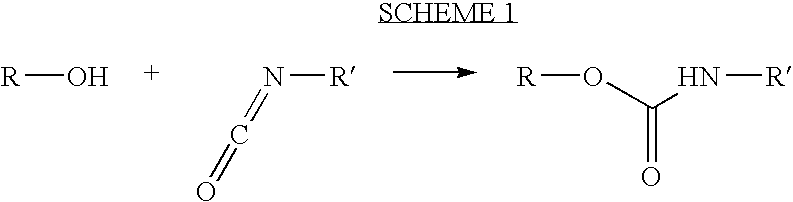
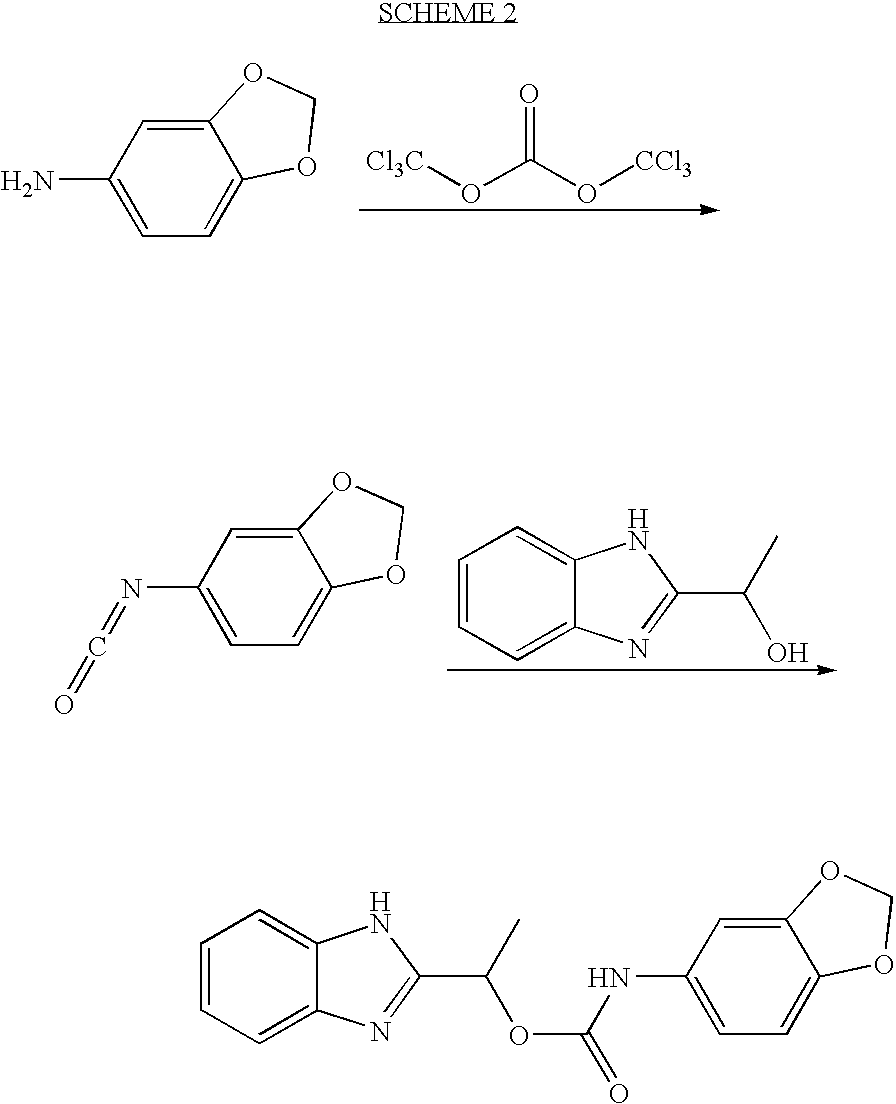
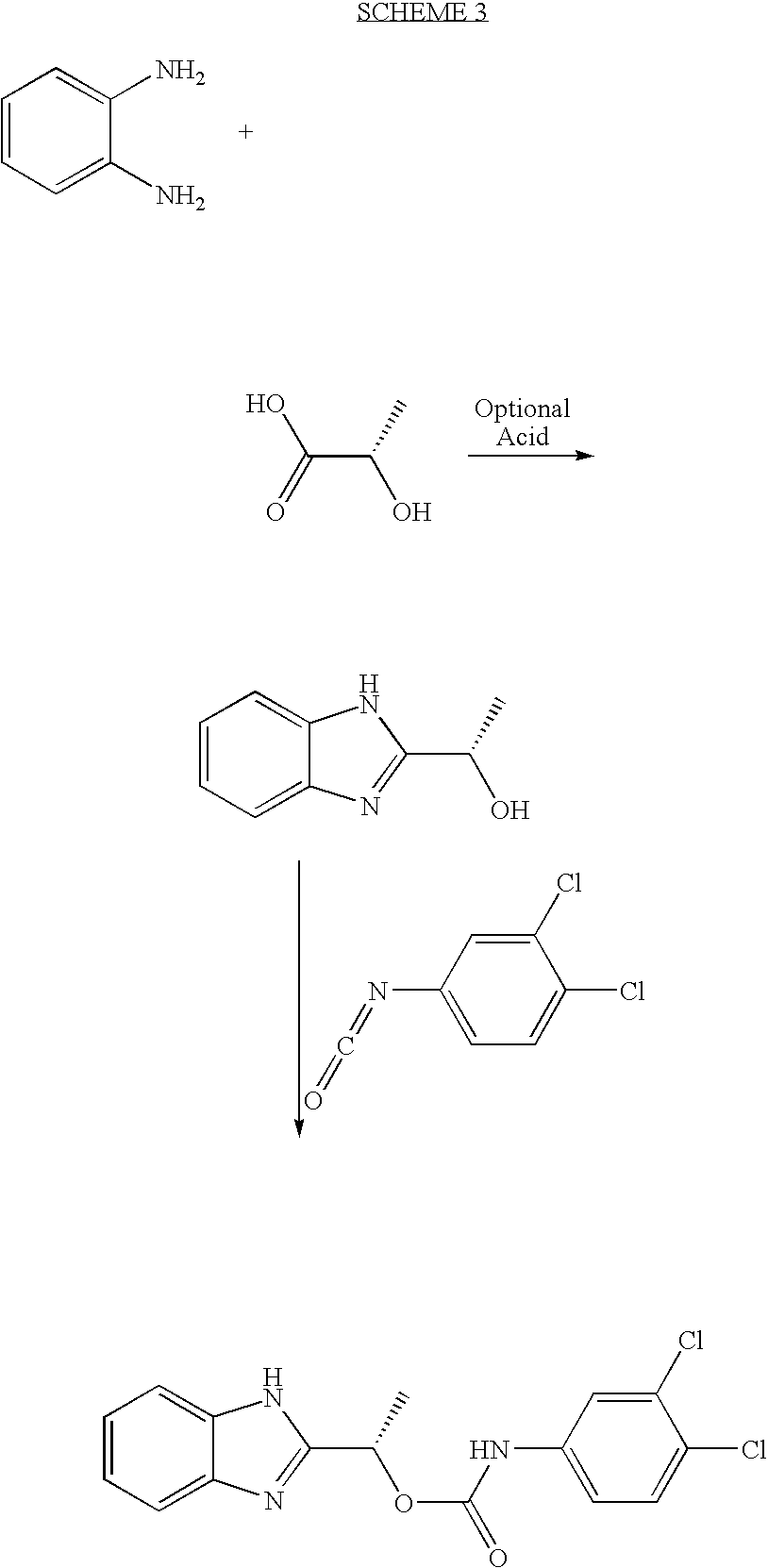


Synthetic Methods - The synthetic schemes shown in
Schemes 1 to 5 were used for the preparation of compounds presented herein. The skilled artisan will recognize that alternative synthetic methodology may be used to prepare the same compound. Additional data for the compounds described herein may be found in Table I. A more detailed description for the synthesis of certain exemplary compounds of the present invention is provided in the “Examples” section below. The terms “intermediate”and “compound” are used interchangeably. -
Scheme 1 depicts a general scheme for coupling a nucleophile (in this case an alcohol) to an electrophilic isocyanate to form a carbamate. This is an excellent reaction, of wide scope, and gives good yields. Such coupling reactions may be performed in a variety of polar non-aqueous media, for example, dimethylformamide (DMF), and using intermediates having a wide variety of R and R′ groups as described in the synthetic examples herein. - Scheme 2 depicts an exemplary preparation of an isocyanate intermediate from an aniline precursor and its subsequent coupling to an alcohol nucleophile. Sources of the “CO” portion of the isocyanate intermediate include, but are not limited to, Cl3COC(O)OCCl3 and Me3SiOC(O)OSiMe3. Also according to Scheme 2, the intermediate isocyanate is contacted with an alcohol intermediate as in
Scheme 1 to form a carbamate compound. - Scheme 3 depicts an exemplary preparation of an optically active benzimidazole alcohol intermediate which may then be coupled to an isocyanate intermediate to give a carbamate compound of Formula (I).
- Scheme 4 depicts an exemplary conversion of an aryl nitroamine intermediate into an aryldiamine intermediate via reductive amination. Aryldiamine intermediates are useful for the preparation of optically active benzimidazole intermediates bearing an alcohol moiety. Alcohol (and other nucleophilic) intermediates are then coupled with isocyanate intermediates to give compounds of Formula (I).
- Scheme 5 depicts an exemplary multistep synthetic scheme for the synthesis of carbamate embodiments of the present invention. The first step shows the coupling of an aryldiamine (available commercially or prepared as in Scheme 4) with 2,3-dihydroxypropanol to form a benzimidazole intermediate having two pendant alcohol moieties. The second step shows the selective silylation/protection of one alcohol moiety. The third step shows the coupling of the unprotected alcohol moiety to an isocyanate. The fourth step shown shows the deprotection of the silyl protected alcohol moiety. The fifth step shows the activation of a pendant hydroxyl group accomplished via the conversion of the hydroxyl group to a methylsulfonate (mesyl) moiety. The final step as shown in Scheme 5 depicts the replacement of the pendant mesyl group by nucleophilic displacement by an amine.
- General Synthetic Methodology
- In the examples described below, unless otherwise indicated, all temperatures are set forth in degrees Celsius and all parts and percentages are by weight. Reagents were purchased from commercial suppliers such as Aldrich Chemical Company or Lancaster Synthesis Ltd. and were used without further purification unless indicated. Tetrahydrofuran (THF), N,N-dimethylformamide (DMF), dichloromethane, toluene, and dioxane were purchased from Aldrich in sure seal bottles and used as received. All solvents were purified using standard methods readily known to those skilled in the art, unless indicated otherwise.
- The reactions set forth below were done generally under a positive pressure of argon or nitrogen or with a drying tube, at ambient temperature (unless otherwise stated), in anhydrous solvents, and the reaction flasks were fitted with rubber septa for the introduction of substrates and reagents via syringe. Glassware was oven dried and/or heat dried. Analytical thin layer chromatography (TLC) was performed on glass-backed silica gel 60 F 254 plates Analtech (0.25 mm) and eluted with the appropriate solvent ratios (v/v), and are denoted where appropriate. The reactions were assayed by TLC and terminated as judged by the consumption of starting material.
- Visualization of the TLC plates was done using a UV lamp. Work-ups were typically done by doubling the reaction volume with the reaction solvent or extraction solvent and then washing with the indicated aqueous solutions using 25% by volume of the extraction volume unless otherwise indicated. Product solutions were dried over anhydrous Na2SO4 prior to filtration and evaporation of the solvents under reduced pressure on a rotary evaporator and noted as solvents removed in vacuo. Flash column chromatography (Still et al., J. Org. Chem., 43, 2923 (1978)) was done using Baker grade flash silica gel (47 to 61 μm) and a silica gel:crude material ratio of about 20:1 to 50:1 unless otherwise stated. Hydrogenolysis was done at the pressure indicated in the examples or at ambient pressure.
- 1H-NMR spectra were recorded on a Bruker instrument operating at 300 MHz and 13C-NMR spectra were recorded operating at 75 MHz. NMR spectra were obtained as CDCl3 solutions (reported in ppm), using chloroform as the reference standard (7.25 ppm and 77.00 ppm) or CD3OD (3.4 and 4.8 ppm and 49.3 ppm), or internally tetramethylsilane (0.00 ppm) when appropriate. Other NMR solvents were used as needed. When peak multiplicities are reported, the following abbreviations are used: s (singlet), d (doublet), t (triplet), m (multiplet), br (broadened), dd (doublet of doublets), dt (doublet of triplets). Coupling constants, when given, are reported in Hertz (Hz).
- Infrared (IR) spectra were recorded on a Perkin-Elmer FT-IR Spectrometer as neat oils, as KBr pellets, or as CDCl3 solutions, and when given are reported in wave numbers (cm1). The mass spectra were obtained using LSIMS or electrospray. All melting points (mp) are uncorrected.
- Where HPLC chromatography is referred to in the preparations and examples below, the general conditions used, unless otherwise indicated, are as follows. The column used is a ZORBAX™ RXC18 column (manufactured by Hewlett Packard) of 150 mm distance and 4.6 mm interior diameter. The samples are run on a Hewlett Packard-1100 systemA gradient solvent method is used running 100 percent ammonium acetate/acetic acid buffer (0.2 M) to 100 percent acetonitrile over 10 minutes. The system then proceeds on a wash cycle with 100 percent acetonitrile for 1.5 minutes and then 100 percent buffer solution for 3 minutes. The flow rate over this period is a constant 3 ml/minute.
- Those compounds of Formula (I) that are acidic in nature are capable of forming base salts with various pharmacologically acceptable cations. These salts can be prepared by treating the corresponding acidic compounds with an aqueous solution containing the desired pharmacologically acceptable cations, and then evaporating the resulting solution to dryness, preferably under reduced pressure. Alternatively, they may also be prepared by mixing lower alkanolic solutions of the acidic compounds and the desired alkali metal alkoxide together, and then evaporating the resulting solution to dryness in the same manner as before. In either case, stoichiometric quantities of reagents are preferably employed in order to ensure completeness of reaction and maximum yields of the desired final product.
- Certain compounds of Formula (I) may have asymmetric centers and therefore exist in different enantiomeric forms. All optical isomers and stereoisomers of the compounds of Formula (I), and mixtures thereof, are considered to be fully described herein. With respect to the compounds of Formula (I), also fully described herein are the use of a racemate, one or more enantiomeric forms, one or more diastereomeric forms, or mixtures thereof.
- The compounds of Formula (I) may also exist as tautomers. For example, when R11 is hydrogen, compounds T and T′ shown below are tautomers related by the site of protonation of inequivalent nitrogens. Such tautomers may be distinguished by X-ray crystallography (single crystal and powder diffraction), and spectroscopic methods, for example IR spectroscopy. Such tautomers may be distinguished in solution and solid state NMR methods although if proton exchange between tautomers is rapid, only a single signal may be observed in solution. Both tautomers of the compounds of Formula (I) are considered to be fully described herein. The compositions and methods described herein include the use of all such tautomers and mixtures thereof.
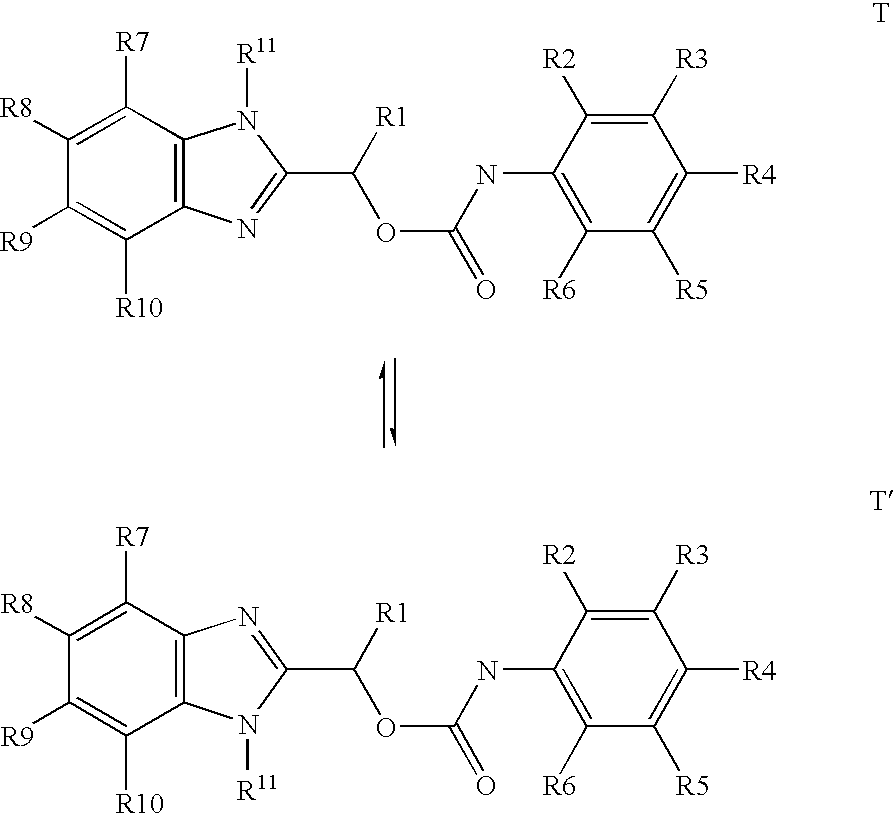
- The compounds described herein, including the pharmaceutically acceptable prodrugs, pharmaceutically active metabolites, and pharmaceutically acceptable salts of such compounds, also include isotopically-labelled compounds, which are identical in structure to those recited in Formula (I), but for the fact that one or more atoms are replaced by an atom having an atomic mass or mass number different from the atomic mass or mass number usually found in nature. Examples of isotopes that can be incorporated into compounds disclosed herein include, but are not limited to: isotopes of hydrogen, carbon, nitrogen, oxygen, phosphorous, fluorine and chlorine, such as 2H, 3H, 13C, 14C, 15N, 18O, 17O, 31P, 32P, 35S, 18F, and 36Cl, respectively. Certain isotopically-labelled compounds, for example those into which radioactive isotopes such as 3H and 14C are incorporated, are useful in drug and/or substrate tissue distribution assays. By way of example only, tritium, i.e., 3H, and carbon-14, i.e., 14C, isotopes are preferred for their ease of preparation and detectability. Further, substitution with heavier isotopes, including by way of example only, deuterium, i.e., 2H, can afford certain therapeutic advantages resulting from greater metabolic stability, for example increased in vivo half-life or reduced dosage requirements and, hence, may be preferred in some circumstances. Isotopically labelled compounds, including by way of example only, compounds of Formula (I) (as well as metabolites, prodrugs, and pharmaceutically acceptable salts thereof) can generally be prepared by carrying out the procedures described in the synthetic Schemes and/or in the Examples and preparations described herein, by substituting an isotopically labelled reagent for a non-isotopically labeled reagent.
- In the case of compounds that are solids at ambient conditions, it is understood by those skilled in the art that such compounds and salts may exist in different crystal or polymorphic forms, all of which are intended to be within the scope of the present disclosure and specified formulas.
- The examples and preparations provided below further illustrate and exemplify the carbamate compounds described herein and methods of preparing such compounds. It is to be understood that the scope of the present disclosure is not limited in any way by the scope of the following Examples and preparations. In the following description and Examples, the terms “Ac” means acetyl, “Et” means ethyl, “Me” means methyl, and “Bu” means butyl.
- Pharmaceutical Compositions/Formulations, Dosaging, and Modes of Administration
- Methods of preparing various pharmaceutical compositions with a specific amount of active compound are known, or will be apparent, to those skilled in this art. In addition, those of ordinary skill in the art are familiar with formulation and administration techniques. Such topics would be discussed, e.g., in Goodman and Gilman's The Pharmacological Basis of Therapeutics, current edition, Pergamon Press; and Remington's Pharmaceutical Sciences (current edition.) Mack Publishing Co., Easton, Pa. These techniques can be employed in appropriate aspects and embodiments of the methods and compositions described herein. The following examples are provided for illustrative purposes only and are not meant to serve as limitations of the present disclosure.
- The compounds utilized in the methods described herein may be administered either alone or in combination with pharmaceutically acceptable carriers, excipients or diluents, in a pharmaceutical composition, according to standard pharmaceutical practice.
- Administration of the compounds described herein (hereinafter the “active compound(s)”) can be effected by any method that enables delivery of the compounds to the site of action. These methods include oral routes, intraduodenal routes, parenteral injection (including intravenous, subcutaneous, intramuscular, intravascular or infusion), topical, and rectal administration. For example, the therapeutic or pharmaceutical compositions described herein can be administered locally to the area in need of treatment. This may be achieved by, for example, but not limited to, local infusion during surgery, topical application, e.g., cream, ointment, injection, catheter, or implant, said implant made, e.g., out of a porous, non-porous, or gelatinous material, including membranes, such as sialastic membranes, or fibers. The administration can also be by direct injection at the site (or former site) of a tumor or neoplastic or pre-neoplastic tissue.
- Still further, the therapeutic or pharmaceutical composition can be delivered in a vesicle, e.g., a liposome (see, for example, Langer, Science, 249: 1527-1533 (1990); Treat et al., 1989, Liposomes in the Therapy of Infectious Disease and Cancer, Lopez-Bernstein and Fidler (eds.), Liss, N.Y., pp. 353-365). The preparation and characterization of liposomes as therepeutic delivery systems has been reviewed. See Vemuri and Rhodes, Pharmaceutical Acta Helvetiae, 70, 95-111, (1995).
- The pharmaceutical compositions used in the methods described herein can be delivered in a controlled release system. In one embodiment, a pump may be used (see, Sefton, 1987, CRC Crit. Ref Biomed. Eng. 14: 201; Buchwald et al., 1980, Surgery, 88: 507; Saudek et al., 1989, N. Engl. J. Med., 321: 574). Additionally, a controlled release system can be placed in proximity of the therapeutic target (see, Goodson, 1984, Medical Applications of Controlled Release, Vol. 2, pp. 115-138).
- The pharmaceutical compositions used in the methods or compositions described herein can contain the active ingredient in a form suitable for oral use, for example, as tablets, troches, dragee cores, lozenges, aqueous or oily suspensions, dispersible powders or granules, emulsions, hard or soft capsules, or syrups or elixirs. Compositions intended for oral use may be prepared according to any method known to the art for the manufacture of pharmaceutical compositions and such compositions may contain one or more agents selected from the group consisting of sweetening agents, flavoring agents, coloring agents and preserving agents in order to provide pharmaceutically elegant and palatable preparations. Tablets contain the active ingredient in admixture with non-toxic pharmaceutically acceptable excipients, which are suitable for the manufacture of tablets. These excipients may be, for example, inert diluents, such as calcium carbonate, sodium carbonate, lactose, calcium phosphate or sodium phosphate; granulating and disintegrating agents, such as microcrystalline cellulose, sodium crosscarmellose, corn starch, or alginic acid; binding agents, for example starch, gelatin, polyvinylpyrrolidone or acacia, and lubricating agents, for example, magnesium stearate, stearic acid or talc. The tablets may be uncoated or they may be coated by known techniques to mask the taste of the drug or delay disintegration and absorption in the gastrointestinal tract and thereby provide a sustained action over a longer period. For example, a water soluble taste masking material such as hydroxypropylmethyl-cellulose or hydroxypropylcellulose, or a time delay material such as ethyl cellulose, or cellulose acetate butyrate may be employed.
- Formulations for oral use may also be presented as hard gelatin capsules wherein the active ingredient is mixed with an inert solid diluent, for example, calcium carbonate, calcium phosphate or kaolin, or as soft gelatin capsules wherein the active ingredient is mixed with water soluble carrier such as polyethyleneglycol or an oil medium, for example peanut oil, liquid paraffin, or olive oil.
- Aqueous suspensions can contain the active material in admixture with excipients suitable for the manufacture of aqueous suspensions. Such excipients can act as suspending agents and include, e.g., sodium carboxymethylcellulose, methylcellulose, hydroxypropylmethyl-cellulose, sodium alginate, polyvinylpyrrolidone, gum tragacanth and gum acacia; dispersing or wetting agents may be a naturally-occurring phosphatide, for example lecithin, or condensation products of an alkylene oxide with fatty acids, for example polyoxyethylene stearate, or condensation products of ethylene oxide with long chain aliphatic alcohols, for example heptadecaethylene-oxycetanol, or condensation products of ethylene oxide with partial esters derived from fatty acids and a hexitol such as polyoxyethylene sorbitol monooleate, or condensation products of ethylene oxide with partial esters derived from fatty acids and hexitol anhydrides, for example polyethylene sorbitan monooleate. The aqueous suspensions may also contain one or more preservatives, for example ethyl, or n-propyl p-hydroxybenzoate, one or more coloring agents, one or more flavoring agents, and one or more sweetening agents, such as sucrose, saccharin or aspartame.
- Oily suspensions may be formulated by suspending the active ingredient in a vegetable oil, for example arachis oil, olive oil, sesame oil or coconut oil, or in mineral oil such as liquid paraffin. The oily suspensions may contain a thickening agent, for example beeswax, hard paraffin or cetyl alcohol. Sweetening agents such as those set forth above, and flavoring agents may be added to provide a palatable oral preparation. These compositions may be preserved by the addition of an anti-oxidant, e.g., butylated hydroxyanisol, alpha-tocopherol, or ascorbic acid.
- Dispersible powders and granules suitable for preparation of an aqueous suspension by the addition of water provide the active ingredient in admixture with a dispersing or wetting agent, suspending agent and one or more preservatives. Suitable dispersing or wetting agents and suspending agents are exemplified by those already mentioned above. Additional excipients, for example sweetening, flavoring and coloring agents, may also be present. These compositions may be preserved by the addition of antioxidant(s).
- The pharmaceutical compositions used in the compositions and methods described herein may also be in the form of oil-in-water emulsions. The oily phase may be a vegetable oil, for example olive oil or arachis oil, or a mineral oil, for example liquid paraffin or mixtures of these. Suitable emulsifying agents may be naturally-occurring phosphatides, for example soy bean lecithin, and esters or partial esters derived from fatty acids and hexitol anhydrides, for example sorbitan monooleate, and condensation products of the said partial esters with ethylene oxide, for example polyoxyethylene sorbitan monooleate. The emulsions may also contain sweetening, flavoring agents, preservatives and antioxidants.
- Syrups and elixirs may be formulated with sweetening agents, for example glycerol, propylene glycol, sorbitol or sucrose. Such formulations may also contain a demulcent, a preservative, flavoring and coloring agents and antioxidant.
- Pulmonary administration by inhalation may be accomplished by means of producing liquid or powdered aerosols, for example, by using any of various devices known in the art (see e.g. Newman, S. P., 1984, in Aerosols and the Lung, Clarke and Pavia (Eds.), Butterworths, London, England, pp. 197-224; PCT Publication No. WO 92/16192 dated Oct. 1, 1992; PCT Publication No. WO 91/08760 dated Jun. 27, 1991; NTIS Patent Application 7-504-047 filed Apr. 3, 1990 by Roosdorp and Crystal) including but not limited to nebulizers, metered dose inhalers, and powder inhalers. Various delivery devices are commercially available and can be employed, including, by way of example only: Ultravent nebulizer (Mallinckrodt, Inc, St. Louis, Mo.); Acorn II nebulizer (Marquest Medical Products, Englewood, Colo.); Ventolin metered dose inhalers (Glaxo Inc., Research Triangle Park, N.C.); Spinhaler powder inhaler (Fisons Corp., Bedford, Mass.) or Turbohaler (Astra). Such devices typically entail the use of formulations suitable for dispensing from such a device, in which a propellant material may be present.
- A nebulizer may be used to produce aerosol particles, or any of various physiologically inert gases may be used as an aerosolizing agent. Other components such as physiologically acceptable surfactants (e.g. glycerides), excipients (e.g. lactose), carriers (e.g. water, alcohol), and diluents may also be included. Ultrasonic nebulizers may also be used.
- As will be understood by those skilled in the art of delivering pharmaceuticals by the pulmonary route, a major criteria for the selection of a particular device for producing an aerosol is the size of the resultant aerosol particles. Smaller particles are needed if the drug particles are mainly or only intended to be delivered to the peripheral lung, i.e. the alveoli (e.g. 0.1 to 3 μm), while larger drug particles are needed (e.g. 3 to 10 μm) if delivery is only or mainly to the central pulmonary system such as the upper bronchi. Impact of particle sizes on the site of deposition within the respiratory tract is generally known to those skilled in the art.
- The pharmaceutical compositions may be in the form of a sterile injectable aqueous solutions. Among the acceptable vehicles and solvents that may be employed are water, Ringers solution and isotonic sodium chloride solution.
- The sterile injectable preparation may also be a sterile injectable oil-in-water microemulsion where the active ingredient is dissolved in the oily phase. For example, the active ingredient may be first dissolved in a mixture of soybean oil and lecithin. The oil solution then introduced into a water and glycerol mixture and processed to form a microemulsion.
- The injectable solutions or microemulsions may be introduced into a patient's blood-stream by local bolus injection. Alternatively, it may be advantageous to administer the solution or microemulsion in such a way as to maintain a constant circulating concentration of the instant compound. In order to maintain such a constant concentration, a continuous intravenous delivery device may be utilized. Carrier formulations appropriate for intravenous administration include by way of example only, mixtures comprising water and polyethylene glycol (PEG), e.g., 50/50 w/w.
- The pharmaceutical compositions may be in the form of a sterile injectable aqueous or oleagenous suspension for intramuscular and subcutaneous administration. This suspension may be formulated according to the known art using those suitable dispersing or wetting agents and suspending agents, which have been mentioned above. The sterile injectable preparation may also be a sterile injectable solution or suspension in a non-toxic parenterally-acceptable diluent or solvent, for example as a solution in 1,3-butanediol. Exemplary parenteral administration forms also include solutions or suspensions of active compounds in sterile aqueous solutions, for example, aqueous propylene glycol or dextrose solutions. All such dosage forms can be suitably buffered, if desired. In addition, sterile, fixed oils are conventionally employed as a solvent or suspending medium. For this purpose any bland fixed oil may be employed including synthetic mono- or diglycerides. In addition, fatty acids such as oleic acid find use in the preparation of injectables.
- The carbamates used in the methods and compositions described herein may also be administered in the form of suppositories for rectal administration of the drug. These compositions can be prepared by mixing the carbamates described herein with a suitable non-irritating excipient, which is solid at ordinary temperatures but liquid at the rectal temperature and will therefore melt in the rectum to release the drug. Such materials include cocoa butter, glycerinated gelatin, hydrogenated vegetable oils, mixtures of polyethylene glycols of various molecular weights and fatty acid esters of polyethylene glycol.
- For topical use, creams, ointments, jellies, solutions or suspensions, etc., containing at least one of the carbamate compounds described herein can be used. As used herein, topical application can include mouth washes and gargles.
- The compounds used in the methods and compositions described herein can be administered in intranasal form via topical use of suitable intranasal vehicles and delivery devices, or via transdermal routes, using those forms of transdermal skin patches well known to those of ordinary skill in the art. To be administered in the form of a transdermal delivery system, the dosage administration will, of course, be continuous rather than intermittent throughout the dosage regimen.
- The methods and compounds described herein may also be used in conjunction with other well known therapeutic agents that are selected for their particular usefulness against the condition that is being treated. For example, the instant compounds may be useful in combination with known anti-cancer and cytotoxic agents, as described elsewhere in this disclosure.
- In general, the compounds described herein and, in embodiments where combinational therapy is employed, other agents do not have to be administered in the same pharmaceutical composition, and may, because of different physical and chemical characteristics, have to be administered by different routes. The determination of the mode of administration and the advisability of administration, where possible, in the same pharmaceutical composition, is well within the knowledge of the skilled clinician. The initial administration can be made according to established protocols known in the art, and then, based upon the observed effects, the dosage, modes of administration and times of administration can be modified by the skilled clinician. The particular choice of compounds used will depend upon the diagnosis of the attending physicians and their judgment of the condition of the patient and the appropriate treatment protocol. The compounds may be administered concurrently (e.g., simultaneously, essentially simultaneously or within the same treatment protocol) or sequentially, depending upon the nature of the proliferative disease, the condition of the patient, and the actual choice of compounds used.
- The determination of the order of administration, and the number of repetitions of administration of each therapeutic agent during a treatment protocol, is well within the knowledge of the skilled physician after evaluation of the disease being treated and the condition of the patient.
- Combination Therapies
- Compounds of Formula (I) may be used in combination with conventional antineoplasm therapies to treat mammals, especially humans, with neoplasia. The procedures for conventional anti-neoplasm therapies, including chemotherapies using anti-neoplastic agents and therapeutic radiation, are readily available, and routinely practiced in the art, e.g., see Harrison's PRINCIPLES OF INTERNAL MEDICINE 11th edition, McGraw-Hill Book Company.
- The compositions and methods described herein may be used in conjunction with DNA-damaging agents to treat cell proliferative diseases and cancer. Because the compositions described herein modulate and/or inhibit the activity of CHK1, damage to DNA caused by DNA-damaging agents, may not be fully repaired by the cellular machinery if the compositions described herein are administered with (e.g., prior to, simultaneously with, or after) DNA-damaging agents. When administered with a DNA-damaging agent, the compositions described herein, there will be an increased likelihood that the mutations and damage that have occurred to the DNA are transferred to the daughter cells, or remain present in the original cell. As a result, cells should be more susceptible to the damage caused by the DNA-damaging agents, and have significantly reduced viability (e.g., increased susceptibility to apoptosis).
- There are many methods known in the art for damaging the DNA of a cell and all such methods are included within the scope of the methods described herein. By way of example only, DNA-damaging agents include therapeutic radiation, cytotoxic agents, antibodies, heat, agents that induce apoptosis, anti-tumor agents, chemotherapeutic agents, and other anti-proliferative agents.
- The term “chemotherapeutic agent” as used herein includes, for example, hormonal agents, antimetabolites, DNA interactive agents, tubilin-interactive agents, and others such as aspariginase or hydroxyureas.
- DNA-interactive agents include alkylating agents, such as cisplatin, cyclophosphamide, altretamine; DNA strand-breakage agents, such as bleomycin; intercalating topoisomerase II inhibitors, e.g., dactinomycin and doxorubicin); nonintercalating topoisomerase II inhibitors such as, etoposide and teniposide; and the DNA minor groove binder plicamydin, for example.
- Alkylating agents may form covalent chemical adducts with cellular DNA, RNA, or protein molecules, or with smaller amino acids, glutathione, or similar chemicals. Examples of typical alkylating agents include, but are not limited to, nitrogen mustards, such as chlorambucil, cyclophosphamide, isofamide, mechlorethamine, melphalan, uracil mustard; aziridine such as thiotepa; methanesulfonate esters such as busulfan; nitroso ureas, such as carmustine, lomustine, streptozocin; platinum complexes, such as cisplatin, carboplatin; bioreductive alkylator, such as mitomycin, and procarbazine, dacarbazine and altretamine. DNA strand-breaking agents include bleomycin, for example.
- DNA topoisomerase II inhibitors may include intercalators such as the following: amsacrine, dactinomycin, daunorubicin, doxorubicin (adriamycin), idarubicin, and mitoxantrone; as well as nonintercalators such as etoposide and teniposide.
- An example of a DNA minor groove binder is plicamycin.
- Antimetabolites generally interfere with the production of nucleic acids and thereby growth of cells by one of two major mechanisms. Certain drugs inhibit production of deoxyribonucleoside triphosphates that are the precursors for DNA synthesis, thus inhibiting DNA replication. Examples of these compounds are analogues of purines or pyrimidines and are incorporated in anabolic nucleotide pathways. These analogues are then substituted into DNA or RNA instead of their normal counterparts.
- Antimetabolites useful as chemotherapeutic agents include, but are not limited to: folate antagonists such as methotrexate and trimetrexate; pyrimidine antagonists, such as fluorouracil, fluorodeoxyuridine, CB3717, azacitidine, cytarabine, and floxuridine; purine antagonists such as mercaptopurine, 6-thioguanine, fludarabine, pentostatin; and ribonucleotide reductase inhibitors such as hydroxyurea.
- Tubulin interactive agents act by binding to specific sites on tubulin, a protein that polymerizes to form cellular microtubules. Microtubules are critical cell structure units and are required for cell division. These therapeutic agents disrupt the formation of microtubules. Exemplary tubulin-interactive agents include vincristine and vinblastine, both alkaloids and paclitaxel (Taxol).
- Hormonal agents are also useful in the treatment of cancers and tumors, but only rarely in the case of B cell malignancies. They are used in hormonally susceptible tumors and are usually derived from natural sources. Hormonal agents include, but are not limited to, estrogens, conjugated estrogens and ethinyl estradiol and diethylstilbesterol, chlortrianisen and idenestrol; progestins such as hydroxyprogesterone caproate, medroxyprogesterone, and megestrol; and androgens such as testosterone, testosterone propionate; fluoxymesterone, and methyltestosterone.
- Adrenal corticosteroids are derived from natural adrenal cortisol or hydrocortisone and are used to treat B cell malignancies. They are used because of their anti-inflammatory benefits as well as the ability of some to inhibit mitotic divisions and to halt DNA synthesis. These compounds include, but are not limited to, prednisone, dexamethasone, methylprednisolone, and prednisolone.
- Leutinizing hormone releasing hormone agents or gonadotropin-releasing hormone antagonists are used primarily the treatment of prostate cancer. These include leuprolide acetate and goserelin acetate. They prevent the biosynthesis of steroids in the testes.
- Antihormonal antigens include, for example, antiestrogenic agents such as tamoxifen, antiandrogen agents such as flutamide; and antiadrenal agents such as mitotane and aminoglutethimide.
- Other agents include hydroxyurea (which appears to act primarily through inhibition of the enzyme ribonucleotide reductase), and asparaginase (an enzyme which converts asparagine to aspartic acid and thus inhibits protein synthesis).
- Included within the scope of cancer therapy agents are radiolabeled antibodies, including but not limited to, Zevalin™ (IDEC Pharmaceuticals Corp.) and Bexxar™ (Corixa, Inc.); the use of any other radioisotope (e.g., 90Y and 131I) coupled to an antibody or antibody fragment that recognizes an antigen expressed by a neoplasm; external beam radiation or any other method for administration of radiation to a patient.
- Further included within the scope of cancer therapy agents are cytotoxins, including but not limited to an antibody or antibody fragment linked to a cytotoxin, or any other method for selectivly delivering a cytotoxic agent to a tumor cell.
- Further included within the scope of cancer therapy agents are selective methods for destroying DNA, or any method for delivering heat to a tumor cells, including by way of example only, nanoparticles.
- Further included within the scope of cancer therapy agents is the use of unlabeled antibodies or antibody fragments capable of killing or depleting tumor cells, including by way of example only, Rituxan™ (IDEC Pharmaceuticals Corp.) and Herceptin™ (Genentech).
- Further included with the scope of combination therapy approaches is the use of therapeutic radiation in combination with the compounds of Formula (I). Usually, radiation can be used to treat the site of a tumor directly or administered by brachytherapy implants. The various types of therapeutic radiation which are contemplated for combination therapy in accordance with the present invention may be those used in the treatment of cancer which include, but are not limited to X-rays, gamma radiation, high energy electrons and High LET (Linear Energy Transfer) radiation such as protons, neutrons, and alpha particles. The ionizing radiation may be employed by techniques well known to those skilled in the art. For example, X-rays and gamma rays are applied by external and/or interstitial means from linear accelerators or radioactive sources. High-energy electrons may be produced by linear accelerators. High LET radiation is also applied from radioactive sources implanted interstitially.
- Preparation of Compound (41)
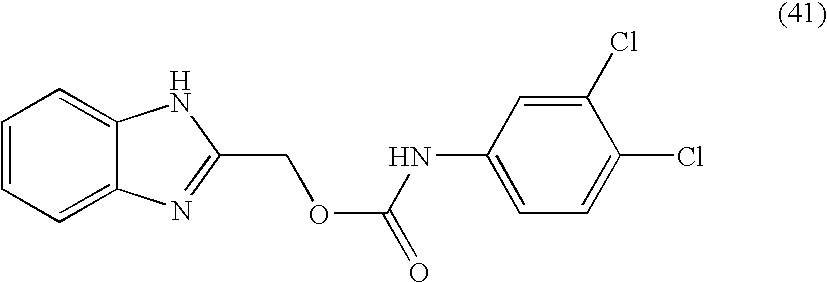
- 1,2-dichloro-4-isocyanatobenzene (0.38 g, 2.0 mmol) was added to a solution of 1H-benzimidazol-2-ylmethanol (0.30 g, 2.0 mmol) in 7 ml of DMF. The reaction mixture was stirred at 80° C. for 1 hour. Extraction using EtOAc followed by re-crystallization in EtOAc yielded the title compound (0.52 g) in 78% yield.
- 1H-NMR (d6-DMSO): δ 12.61 (s, 1H), 10.28 (s, 1H), 7.84 (d, 1H, J=2.4 Hz), 7.70-7.50 (broad, 2H), 7.60 (d, 1H, J=8.8 Hz), 7.47 (dd, 1H, J1=8.8 Hz, J2=2.4 Hz), 7.30-7.15 (m, 2H), 5.39 (s, 2H).
- Preparation of Compound (39)
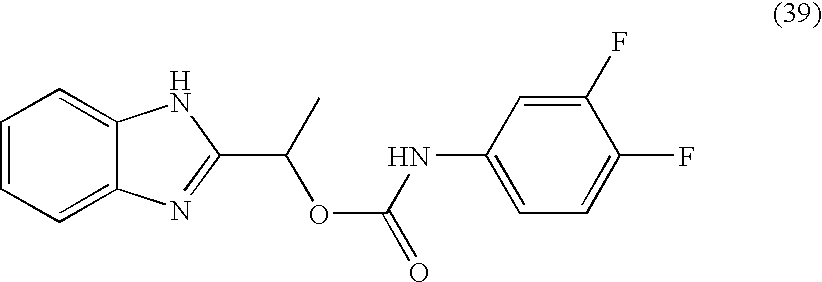
- Preparation of Compound (39) from 1,2-difluoro-4-isocyanatobenzene (0.23 g, 1.5 mmol) and 1-(1H-benzimidazol-2-yl)ethanol (0.24 g, 1.5 mmol) was carried out analogously to the preparation described in Example 1. Silica gel chromatography (dichloromethane/methanol 100/4) afforded the title compound (0.10 g) in 21% yield.
- 1H-NMR (d6-DMSO): δ 12.50 (s, 1H), 10.08 (s, 1H), 7.70-7.10 (m, 7H), 6.10 (q, 1H, J=6.7 Hz), 1.71 (d, 3H, J=6.7 Hz).
- Preparation of Compound (10)
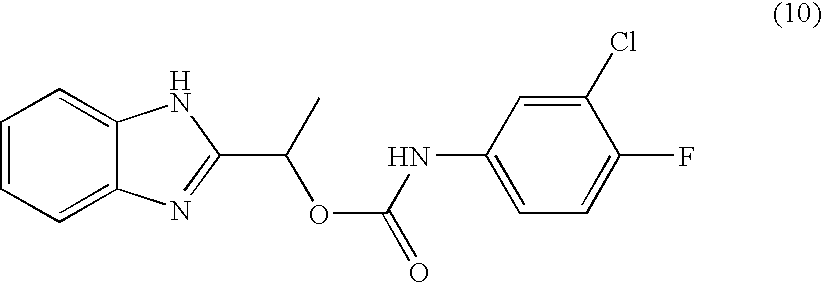
- Preparation of Compound (10) from 2-chloro-1-fluoro-4-isocyanatobenzene (0.21 g, 1.3 mmol) and 1-(1H-benzimidazol-2-yl)ethanol (0.21 g, 1.2 mmol) was carried out analogously to the preparation described in Example 1. Silica gel chromatography (dichloromethane/methanol 10/2) afforded the title compound (60 mg) in 14% yield.
- 1H-NMR (d6-DMSO): δ 12.50 (s, 1H), 10.08 (s, 1H), 7.78-7.67 (m, 1H), 7.54 (m, 2H), 7.45-7.27 (m, 2H), 7.25-7.10 (m, 2H), 6.00 (q, 1H, J=6.7 Hz), 1.72 (d, 3H, J=6.7 Hz).
- Preparation of Compound (40)
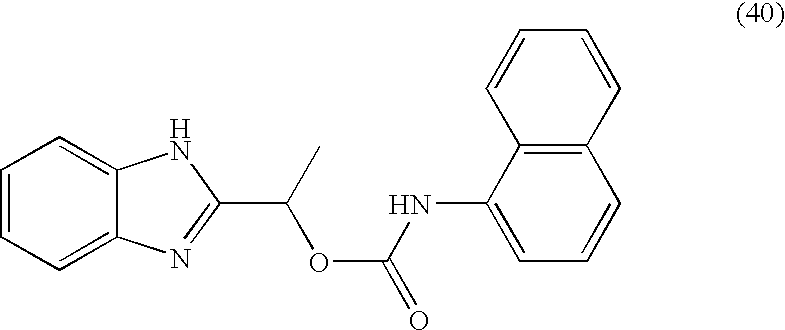
- Preparation of Compound (40) from 1-isocyanatonaphthalene (0.34 g, 2.0 mmol) and 1-(1H-benzimidazol-2-yl)ethanol (0.32 g, 2.0 mmol) was carried out analogously to the preparation described in Example 1. After filtration and extraction of the filtrate with EtOAc, followed by preparative silica gel TLC (dichloromethane/methanol 10/5), the title compound (30 mg) was obtained in 5% yield.
- 1H-NMR (d6-DMSO): δ 12.52 (s, 1H), 9.68 (s, 1H), 8.10 (m, 1H), 7.91 (m, 1H), 7.74 (m, 1H), 7.63 (m, 2H), 7.55-7.40 (m, 4H), 7.25-7.10 (m, 2H), 6.02 (q, 1H, J=6.7 Hz), 1.75 (d, 3H, J=6.7 Hz).
- Preparation of Compound (37)

- Preparation of Compound (37) from phenylisocyanate (0.24 g, 2.0 mmol) and 1-(1H-benzimidazol-2-yl)ethanol (0.32 g, 2.0 mmol) was carried out analogously to the preparation described in Example 1. Extraction using EtOAc followed by silica gel chromatography (dichloromethane/methanol 100/5) afforded the title compound in 2.8% yield (16 mg).
- 1H-NMR (d6-DMSO): δ 12.49 (s, 1H), 9.80 (s, 1H), 7.58 (m, 1H), 7.50-7.40 (m, 3H), 7.30-7.23 (m, 2H), 7.20-7.10 (m, 2H), 6.98 (m, 1H), 5.99 (q, 1H, J=6.7 Hz), 1.71 (d, 3H, J=6.7 Hz).
- Preparation of Compound (38)
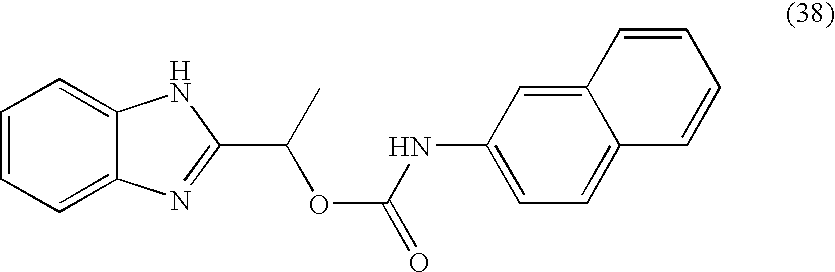
- Preparation of Compound (38) from 2-isocyanatonaphthalene (0.34 g, 2.0 mmol) and 1-(1H-benzimidazol-2-yl)ethanol (0.32 g, 2.0 mmol) was carried out analogously to the preparation described in Example 1. Extraction using EtOAc followed by silica gel chromatography (dichloromethane/methanol 100/5) afforded the title compound (0.58 g) in 88% yield.
- 1H-NMR (d6-DMSO): δ 12.54 (s, 1H), 10.05 (s, 1H), 8.09 (s, 1H), 7.85-7.70 (m, 3H), 7.65-7.30 (m, 5H), 7.25-7.10 (m, 2H), 6.04 (q, 1H, J=6.7 Hz), 1.74 (d, 3H, J=6.7 Hz).
- Preparation of Compound (29)
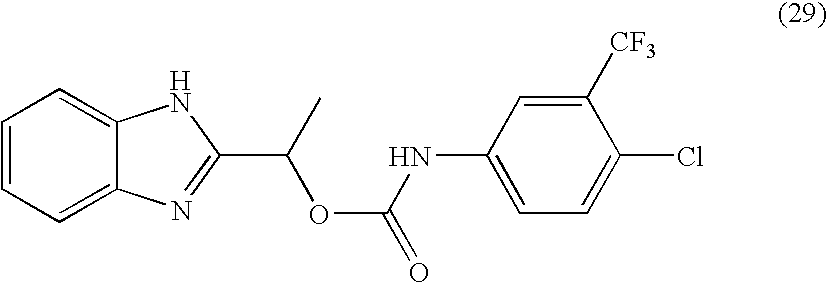
- Preparation of Compound (29) from 1-chloro-4-isocyanato-2-(trifluoromethyl)benzene (0.24 g, 1.1 mmol) and 1-(1H-benzimidazol-2-yl)ethanol (0.16 g, 1.0 mmol) was carried out in benzene, analogously to the preparation described in Example 1. Filtration afforded the title compound (0.29 g) in 76% yield.
- 1H-NMR (d6-DMSO): δ 12.51 (s, 1H), 10.33 (s, 1H), 8.05 (d, 1H, J=2.4 Hz), 7.80-7.40 (m, 4H), 7.17 (m, 2H), 6.01 (q, 1H, J=6.7 Hz), 1.72 (d, 3H, J=6.7 Hz).
- Preparation of Compound (11)
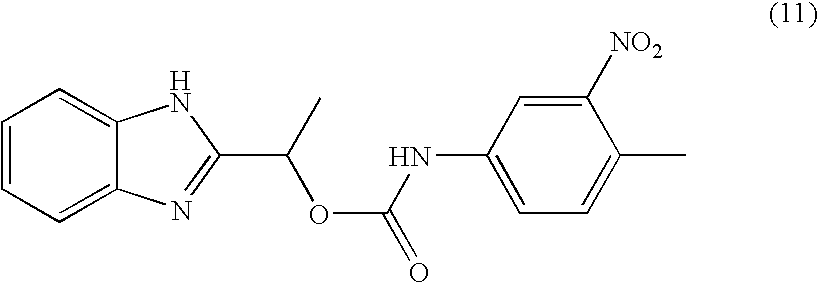
- Preparation of Compound (11) from 4-methyl-3-nitrophenylisocyanate (0.18 g, 1.0 mmol) and 1-(1H-benzimidazol-2-yl)ethanol (0.16 g, 1.0 mmol) was carried out in toluene, analogously to the preparation described in Example 1. HPLC purification afforded the title compound (93 mg) in 27% yield.
- 1H-NMR (d6-DMSO): δ 10.38 (s, 1H), 8.22 (s, 1H), 7.85-7.55 (m, 3H), 7.50-7.30 (m, 3H), 6.11 (q, 1H, J=6 Hz), 2.45 (s, 3H), 1.78 (d, 3H, J=6 Hz).
- Preparation of Compound (8)

- Preparation of Compound (8) from 3-bromophenylisocyanate (0.20 g, 1.0 mmol) and 1-(1H-benzimidazol-2-yl)ethanol (0.16 g, 1.0 mmol) was carried out in toluene, analogously to the preparation described in Example 1. HPLC purification afforded the title compound.
- 1H-NMR (d6-DMSO): δ 12.50 (s, 1H), 10.04 (s, 1H), 7.76 (s, 1H), 7.65-7.46 (broad, 2H), 7.45-7.38 (m, 1H), 7.29-7.10 (m, 4H), 5.99 (q, 1H, J=6 Hz), 1.71 (d, 3H, J=6 Hz).
- Preparation of Compound (9)
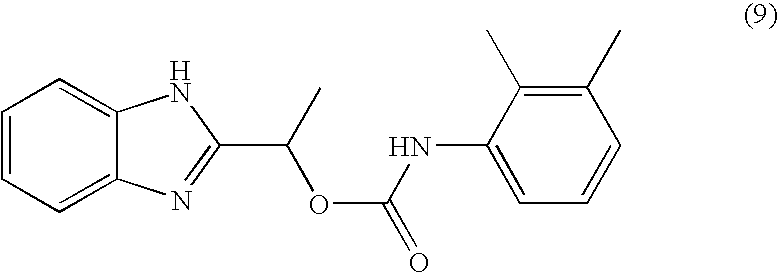
- Preparation of Compound (9) from 2,3-dimethylphenylisocyanate (0.15 g, 1.0 mmol) and 1-(1H-benzimidazol-2-yl)ethanol (0.16 g, 1.0 mmol) was carried out in toluene, analogously to the preparation described in Example 1. HPLC purification afforded the title compound (0.164 g) in 53% yield.
- 1H-NMR (d6-DMSO): δ 12.40 (s, 1H), 8.92 (s, 1H), 7.48 (s, 2H), 7.18-7.04 (m, 3H), 7.01-6.87 (m, 2H), 5.88 (q, 1H, J=6 Hz), 2.16 (s, 3H), 2.10 (s, 3H), 1.63 (d, 3H, J=6 Hz).
- Preparation of Compound (6)

- Preparation of Compound (6) from 3-methylthiophenylisocyanate (0.17 g, 1.0 mmol) and 1-(1H-benzimidazol-2-yl)ethanol (0.16 g, 1.0 mmol) was carried out in toluene, analogously to the preparation described in Example 1. HPLC purification afforded the title compound (48 mg) in 15% yield.
- 1H-NMR (d6-DMSO): δ 12.56 (s, 1H), 8.88 (s, 1H), 7.70-7.62 (m, 1H), 7.58-7.51 (m, 1H), 7.50-7.44 (m, 1H), 7.43-7.35 (m, 1H), 7.31-7.17 (m, 4H), 6.01 (q, 1H, J=6 Hz), 2.45 (s, 3H), 1.75 (d, 3H, J=6 Hz).
- Preparation of Compound (7)
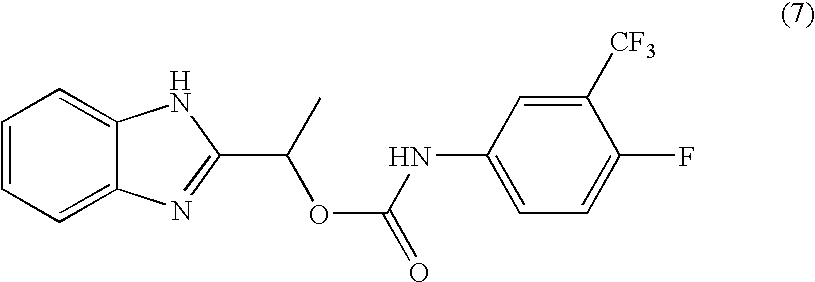
- Preparation of Compound (7) from 4-fluoro-3-(trifluoromethyl)phenylisocyanate (0.21 g, 1.0 mmol) and 1-(1H-benzimidazol-2-yl)ethanol (0.16 g, 1.0 mmol) was carried out in toluene, analogously to the preparation described in Example 1. HPLC purification afforded the title compound (44 mg) in 12% yield.
- 1H-NMR (d6-DMSO): δ 12.59 (s, 1H), 10.27 (s, 1H), 8.04-7.95 (m, 1H), 7.82-7.72 (m, 1H), 7.65-7.45 (m, 3H), 7.28-7.18 (m, 2H), 6.04 (q, 1H, J=6 Hz), 1.77 (d, 3H, J=6 Hz).
- Preparation of Compound (31)
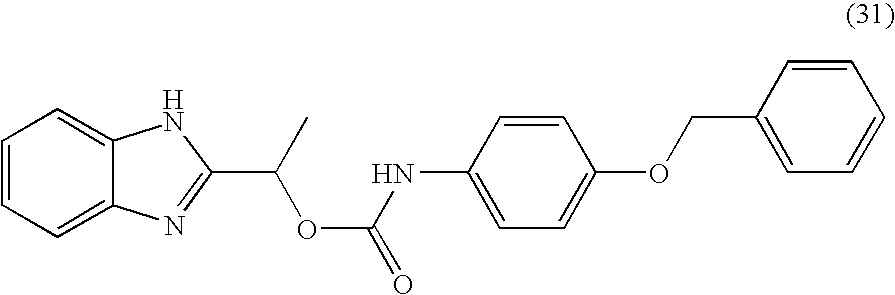
- Preparation of (31) from 4-(benzyloxy)phenylisocyanate (0.23 g, 1.0 mmol) and 1-(1H-benzimidazol-2-yl)ethanol (0.16 g, 1.0 mmol) was carried out in toluene, analogously to the preparation described in Example 1. HPLC purification afforded the title compound.
- 1H-NMR (d6-DMSO): δ 12.51 (s, 1H), 9.62 (s, 1H), 7.60-7.47 (broad, 2H), 7.46-7.26 (m, 7H), 7.22-7.12 (m, 2H), 7.00-6.87 (m, 2H), 5.97 (q, 1H, J=6.7 Hz), 5.03 (s, 2H), 1.69 (d, 3H, J=6.7 Hz).
- Preparation of Compound (32)
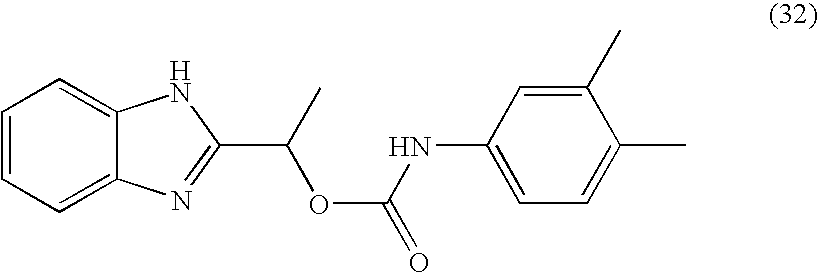
- Preparation of Compound (32) from 3,4-dimethylphenylisocyanate (0.15 g, 1.0 mmol) and 1-(1H-benzimidazol-2-yl)ethanol (0.16 g, 1.0 mmol) was carried out in toluene, analogously to the preparation described in Example 1. HPLC purification afforded the title compound (41 mg) in 13% yield.
- 1H-NMR (d6-DMSO): δ 12.42 (s, 1H), 9.55 (s, 1H), 7.47 (broad, 2H), 7.19 (s, 1H), 7.16-7.05 (m, 3H), 6.95 (d, 1H, J=9 Hz), 5.90 (q, 1H, J=6.7 Hz), 2.09 (s, 3H), 2.07 (s, 3H), 1.63 (d, 3H, J=6.7 Hz).
- Preparation of Compound (35)
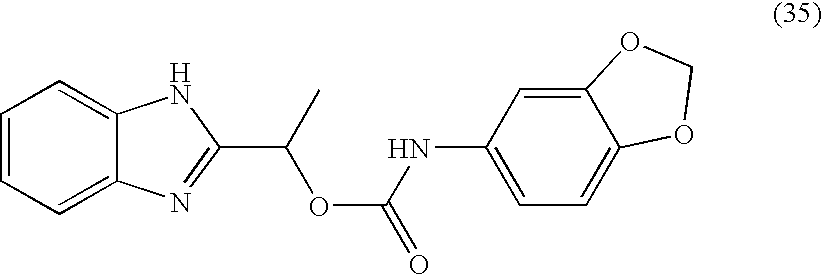
1,3-benzodioxol-5-amine (1.37 g, 10.0 mmol) and bis(trichloromethyl) carbonate (3.56 g, 12.0 mmol) were mixed in anhydrous benzene (20 ml), and refluxed for 3 hours. 1-(1H-benzimidazol-2-yl)ethanol (1.62 g, 10.0 mmol) was then added and reflux was continued overnight. After solvent was removed, the residue was purified with silica gel chromatography. The title compound (1.64 g) was obtained in 50% yield. - 1H-NMR (d4-MeOH): δ 7.82-7.73 (m, 2H), 7.63-7.54 (m, 2H), 7.06 (d, 1H, J=3 Hz), 6.80 (dd, 1H, J1=9 Hz, J2=3 Hz), 6.72 (d, 1H, J=9 Hz), 6.16 (q, 1H, J=6 Hz), 5.89 (s, 2H), 1.85 (d, 3H, J=6.7 Hz).
- Preparation of Example (36)
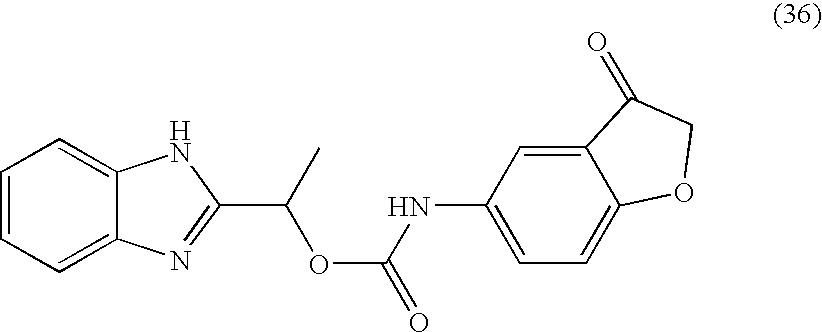
- Preparation of Compound (36) from 6-amino-2-benzofuran-1(3H)-one (0.75 g, 5.0 mmol), bis(trichloromethyl) carbonate (1.78 g, 6.0 mmol) and 1-(1H-benzimidazol-2-yl)ethanol (0.81 g, 5.0 mmol) was carried out analogously to the preparation described in Example 15. The title compound (1.28 g) was obtained in 76% yield.
- 1H-NMR (d6-DMSO): δ 12.52 (s, 1H), 10.24 (s, 1H), 8.01 (d, 1H, J=2 Hz), 7.78 (dd, 1H, J1=8.3 Hz, J2=2 Hz), 7.65-7.55 (m, 2H), 7.50-7.40 (m, 1H), 7.25-7.10 (m, 2H), 6.03 (q, 1H, J=6.7 Hz), 5.34 (s, 2H), 1.73 (d, 3H, J=6.7 Hz).
- Preparation of Compound (34)
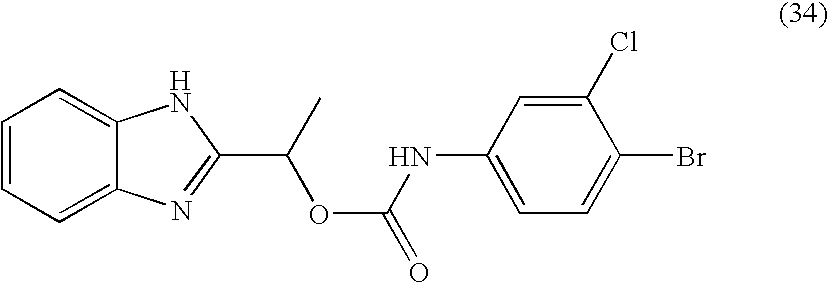
- Preparation of Compound (34) from 4-bromo-3-chloroaniline (0.52 g, 2.5 mmol), bis(trichloromethyl) carbonate (0.89 g, 3.0 mmol) and 1-(1H-benzimidazol-2-yl)ethanol (0.41 g, 2.5 mmol) was carried out analogously to the preparation described in Example 15. The title compound (0.20 g) was obtained in 20% yield.
- 1H-NMR (d6-DMSO): δ 12.51 (s, 1H), 10.18 (s, 1H), 7.79 (d, 1H, J=2.4 Hz), 7.65 (d, 1H, J=8.8 Hz), 7.60 (d, 1H, J=7.6 Hz), 7.47 (d, 1H, J=7.2 Hz), 7.34 (dd, 1H, J1=8.8 Hz, J2=2.5 Hz), 7.25-7.10 (m, 2H), 6.00 (q, 1H, J=6.7 Hz), 1.71 (d, 3H, J=6.7 Hz).
- Preparation of Compound (33)
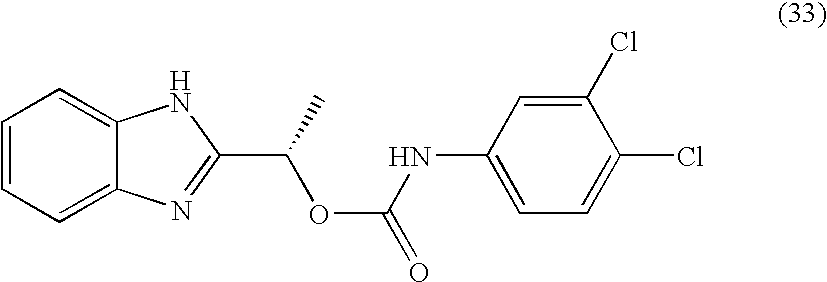
- Compound (33) was prepared according to the method of Scheme 3. 1,2-diaminobenzene (10.81 g, 0.1 mol) and (2S)-2-hydroxypropanoic acid (15.90 g, 85+% in water from Aldrich, 0.15 mol) were mixed in 100 ml of 6 N HCl and refluxed for 100 minutes. Cooled down in ice bath, the reaction mixture was neutralized with aqueous NH3 solution. The precipitate was collected by filtration, washed with water, and then vacuum dried. The intermediate (1S)-1-(1H-benzimidazol-2-yl)ethanol (14.52 g) was obtained in 90% yield.
- (1S)-1-(1H-benzimidazol-2-yl)ethanol (0.16 g, 1.0 mmol) and 3,4-dichlorophenylisocyanate (0.21 g, 1.1 mmol) were mixed in 15 ml of anhydrous benzene. The mixture was refluxed overnight. After removing solvent, the residue was purified on silica gel column using dichloromethane/methanol (100/5). The title compound (0.32 g) was obtained in 91% yield.
- 1H-NMR (d6-DMSO): δ 12.52 (s, 1H), 10.20 (s, 1H), 7.79 (d, 1H, J=2.3 Hz), 7.80-7.39 (m, 4H), 7.25-7.10 (m, 2H), 6.00 (q, 1H, J=6.7 Hz), 1.71 (d, 3H, J=6.7 Hz).
- Preparation of Compound (30)

- Compound (30) was prepared according to the method of Scheme 3. The intermediate (1S)-1-(1H-benzimidazol-2-yl)ethanol was prepared from 1,2-diaminobenzene and (2R)-2-hydroxypropanoic acid (80-90% in water from ICN). The preparation of Compound (30) from this intermediate (0.16 g, 1.0 mmol) and 3,4-dichlorophenylisocyanate (0.21 g, 1.1 mmol) was carried out, analogously to the preparation described in Example 18. Filtration followed by washing with benzene afforded the title compound (0.32 g) in 91% yield. Further purification was completed using chiral SFC (Supercritical Fluid Chromatography).
- 1H-NMR (d6-DMSO): δ 12.51 (s, 1H), 10.19 (s, 1H), 7.79 (d, 1H, J=2.3 Hz), 7.80-7.39 (m, 4H), 7.25-7.10 (m, 2H), 6.00 (q, 1H, J=6.7 Hz), 1.71 (d, 3H, J=6.7 Hz).
- Preparation of Compound (4)

- Compound (4) was prepared according to the method of Scheme 3. The intermediate (1S)-1-(4-nitro-1H-benzimidazol-2-yl)ethanol was prepared from 3-nitrobenzene-1,2-diamine and (2S)-2-hydroxypropanoic acid (85+% in water from Aldrich).
- Preparation of Compound (4) from 3,4-dichlorophenylisocyanate (0.19 g, 1.0 mmol) and 1-(4-nitro-1H-benzimidazol-2-yl)ethanol (0.21 g, 1.0 mmol) was carried out in toluene, analogously to the preparation described in Example 18. HPLC purification afforded the title compound (14 mg) in 4% yield.
- 1H-NMR (d6-DMSO): δ 12.40 (s, 1H), 10.23 (s, 1H), 8.20-8.05 (m, 2H), 7.76 (d, 1H, J=2.4 Hz), 7.53 (d, 1H, J=8.8 Hz), 7.45-7.35 (m, 2H), 6.00 (q, 1H, J=6 Hz), 1.72 (d, 3H, J=6 Hz).
- Preparation Compound (5)

- Compound (5) was prepared according to the method of Scheme 3. The intermediate (1S)-1-(5-nitro-1H-benzimidazol-2-yl)ethanol was prepared from 4-nitrobenzene-1,2-diamine and (2S)-2-hydroxypropanoic acid (85+% in water from Aldrich).
- Preparation of Compound (5) from 3,4-dimethylphenylisocyanate (0.103 g, 0.7 mmol) and 1-(5-nitro-1H-benzimidazol-2-yl)ethanol (0.145 g, 0.7 mmol) was carried out in toluene, analogously to the preparation described in Example 18. HPLC purification afforded the title compound (45 mg) in 18% yield.
- 1H-NMR (d6-DMSO): δ 12.80 (broad, 1H), 9.69 (s, 1H), 8.45 (d, 1H, J=2 Hz), 8.11 (dd, 1H, J1=8.9 Hz, J2=2 Hz), 7.72 (d, 1H, J=8.9 Hz), 7.24 (s, 1H), 7.17 (d, 1H, J=8.1 Hz), 7.00 (d, 1H, J=8.2 Hz), 6.00 (q, 1H, J=6 Hz), 2.14 (s, 3H), 2.13 (s, 3H), 1.71 (d, 3H, J=6 Hz).
- Preparation of Compound (2)
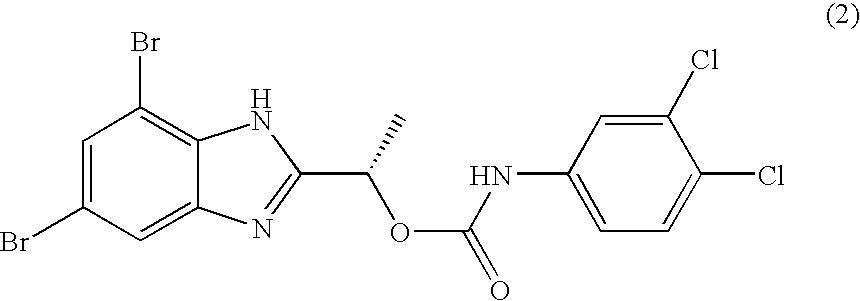
- Compound (2) was prepared according to the method of Scheme 3. The intermediate (1S)-1-(5,7-dibromo-1H-benzimidazol-2-yl)ethanol was prepared from 3,5-dibromobenzene-1,2-diamine and (2S)-2-hydroxypropanoic acid (85+% in water from Aldrich).
- Preparation of Compound (2) from 3,4-dichlorophenylisocyanate (63 mg, 0.34 mmol) and (1S)-1-(5,7-dibromo-1H-benzimidazol-2-yl)ethanol (97 mg, 0.30 mmol) was carried out in toluene, analogously to the preparation described in Example 18. HPLC purification afforded the title compound (63 mg) in 41% yield.
- 1H-NMR (d6-DMSO): δ 10.25 (s, 1H), 7.79 (d, 1H, J=2.4 Hz), 7.76 (d, 1H, J=1.7 Hz), 7.60 (d, 1H, J=1.7 Hz), 7.55 (d, 1H, J=8.8 Hz), 7.42 (dd, 1H, J1=8.9 Hz, J2=2.5 Hz), 5.98 (q, 1H, J=6.7 Hz), 1.71 (d, 3H, J=6.7 Hz).
- Preparation of Compound (3)
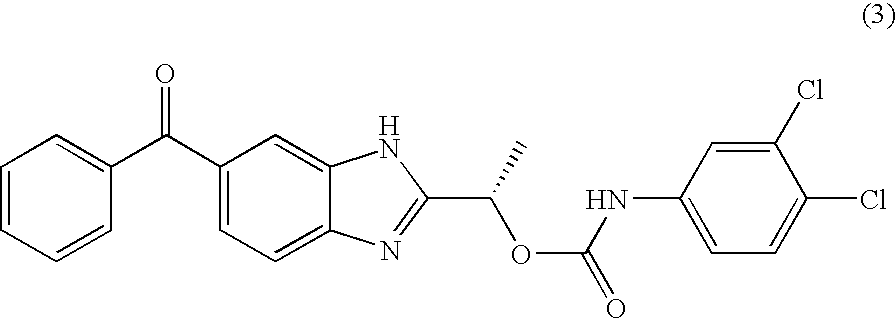
- Compound (3) was prepared according to the method of Scheme 3. The intermediate {2-[(1S)-1-hydroxyethyl]-1H-benzimidazol-6-yl}(phenyl)methanone was prepared from (3,4-diaminophenyl)(phenyl)methanone and (2S)-2-hydroxypropanoic acid (85+% in water from Aldrich).
- Preparation of Compound (3) from 3,4-dichlorophenylisocyanate (0.23 g, 1.2 mmol) and {2-[(1S)-1-hydroxyethyl]-1H-benzimidazol-6-yl}(phenyl)methanone (0.27 g, 1.0 mmol) was carried out in toluene, analogously to the preparation described in Example 18. HPLC purification afforded the title compound (43 mg) in 9% yield.
- 1H-NMR (d6-DMSO): δ 10.20 (s, 1H), 7.87 (s, 1H), 7.44 (d, 1H, J=2.5 Hz), 7.71-7.57 (m, 5H), 7.55-7.45 (m, 3H), 7.36 (dd, 1H, J1=8.9 Hz, J2=2.5 Hz), 6.00 (q, 1H, J=6 Hz), 1.68 (d, 3H, J=6 Hz).
- Preparation Compound (24)
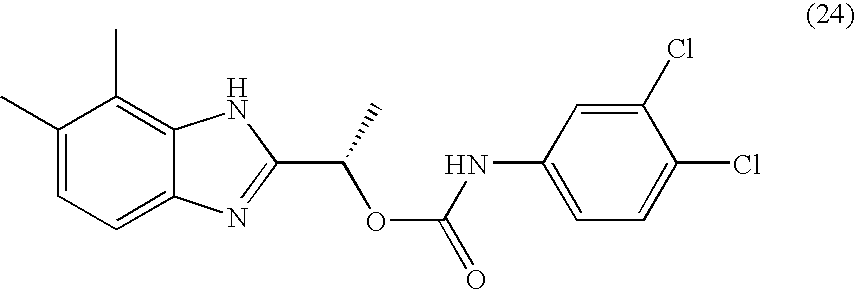
- Compound (24) was prepared according to the method of Scheme 3. The intermediate (1S)-1-(6,7-dimethyl-1H-benzimidazol-2-yl)ethanol was prepared from 3,4-dimethylbenzene-1,2-diamine and (2S)-2-hydroxypropanoic acid (85+% in water from Aldrich). The preparation of Compound (24) from this intermediate (0.112 g, 0.59 mmol) and 3,4-dichlorophenylisocyanate (0.122 g, 0.65 mmol) was carried out, analogously to the preparation described in Example 18. HPLC purification afforded the title compound (0.139 g) in 62% yield.
- 1H-NMR (d6-DMSO): δ 10.37 (s, 1H), 7.77 (d, 1H, J=2.4 Hz), 7.56 (d, 1H, J=8.8 Hz), 7.44 (d, 1H, J=7.9 Hz), 7.42 (dd, 1H, J1=8.8, J2=2.5 Hz), 7.26 (d, 1H, J=8.1 Hz), 6.10 (q, 1H, J=6.7 Hz), 2.49 (s, 3H), 2.37 (s, 3H), 1.79 (d, 3H, J=6.7 Hz). LCMS: (M+H+) 378.0.
- Preparation of Compound (25)

- Compound (25) was prepared according to the method of Scheme 3. The intermediate (1S)-1-(6,7-dimethyl-1H-benzimidazol-2-yl)ethanol was prepared from 4-bromobenzene-1,2-diamine and (2S)-2-hydroxypropanoic acid (85+% in water from Aldrich). The preparation of Compound (25) from this intermediate (0.20 g, HCl salt, 0.72 mmol) and 3,4-dichlorophenylisocyanate (0.15 g, 0.79 mmol) was carried out, analogously to the preparation described in Example 18. HPLC purification afforded the title compound (0.199 g) in 64% yield.
- 1H-NMR (d6-DMSO): δ 10.21 (s, 1H), 7.85-7.61 (m, 2H), 7.60-7.46 (m, 2H), 7.45-37 (m, 1H), 7.36-7.25 (m, 1H), 5.99 (q, 1H, J=6.7 Hz), 1.65 (d, 3H, J=6.7 Hz). LCMS: (M+H+) 427.9.
- Preparation of Compound (20)

- Compound (20) was prepared according to the method of Scheme 3. The intermediate (1S)-1-(4,5,6,7-tetramethyl-1H-benzimidazol-2-yl)ethanol was prepared from 3,4,5,6-tetramethylbenzene-1,2-diamine and (2S)-2-hydroxypropanoic acid (85+% in water from Aldrich). The preparation of Compound (20) from this intermediate (0.51 g, 2.3 mmol) and 3,4-dichlorophenylisocyanate (0.46 g, 2.4 mmol) was carried out, analogously to the preparation described in Example 18. HPLC purification afforded the title compound (30 mg) in 3.2% yield.
- 1H-NMR (d6-DMSO): δ 12.13 (s, 1H), 10.16 (s, 1H), 7.79 (d, 1H, J=2 Hz), 7.53 (d, 1H, J=9 Hz), 7.41 (dd, 1H, J1=9 Hz, J2=2 Hz), 5.97 (q, 1H, J=6.7 Hz), 2.41 (s, 6H), 2.30 (s, 6H), 1.71 (d, 3H, J=6.7 Hz).
- Preparation of Compound (21)
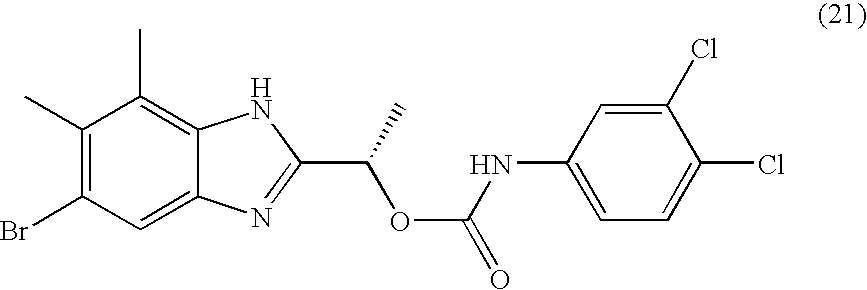
- Compound (21) was prepared according to the method of Scheme 3. The intermediate (1S)-1-(5-bromo-6,7-dimethyl-1H-benzimidazol-2-yl)ethanol was prepared from 5-bromo-3,4-dimethylbenzene-1,2-diamine and (2S)-2-hydroxypropanoic acid (85+% in water from Aldrich). The preparation of Compound (21) from this intermediate (0.34 g, 1.3 mmol) and 3,4-dichlorophenylisocyanate (0.36 g, 1.9 mmol) was carried out, analogously to the preparation described in Example 18. Filtration followed by washing with benzene afforded the title compound (0.51 g) in 88% yield.
- 1H-NMR (d6-DMSO): δ 10.25 (s, 1H), 7.75 (d, 1H, J=2.3 Hz), 7.70 (s, 1H), 7.53 (d, 1H, J=8.8 Hz), 7.39 (dd, 1H, J1=8.8 Hz, J2=2.3 Hz), 6.01 (q, 1H, J=6.7 Hz), 2.52 (s, 3H), 2.39 (s, 3H), 1.72 (d, 3H, J=6.7 Hz).
- Preparation of Compound (17)

- Compound (17) was prepared according to the method of Scheme 3. The intermediate (1S)-1-(6-tert-butyl-1H-benzimidazol-2-yl)ethanol was prepared from 4-tert-butylbenzene-1,2-diamine and (2S)-2-hydroxypropanoic acid (85+% in water from Aldrich). The preparation of Compound (17) from this intermediate (0.29 g, 1.3 mmol) and 3,4-dichlorophenylisocyanate (0.28 g, 1.5 mmol) was carried out, analogously to the preparation described in Example 18. HPLC purification afforded the title compound (43 mg) in 7.8% yield.
- 1H-NMR (d4-MeOH): δ 7.75-7.50 (m, 4H), 7.40-7.15 (m, 2H), 6.09 (q, 1H, J=6 Hz), 1.76 (d, 3H, J=6 Hz), 1.31 (s, 9H), LCMS: (M+H+) 406.0.
- Preparation of Compound (12)
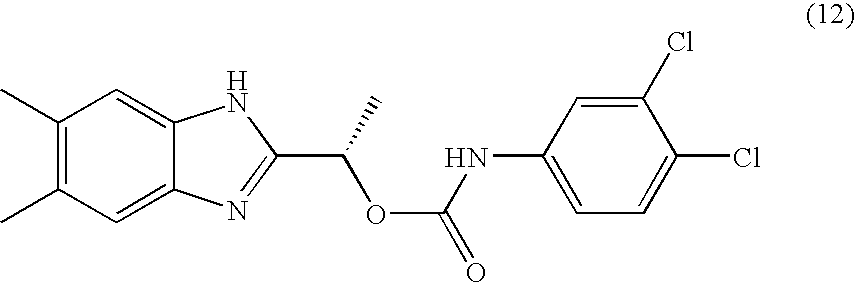
- Compound (12) was prepared according to the method of Scheme 3. The intermediate (1S)-1-(5,6-dimethyl-1H-benzimidazol-2-yl)ethanol was prepared from 4,5-dimethylbenzene-1,2-diamine and (2S)-2-hydroxypropanoic acid (85+% in water from Aldrich). The preparation of Compound (12) from this intermediate (0.79 g, 4.1 mmol) and 3,4-dichlorophenylisocyanate (0.86 g, 4.6 mmol) was carried out, analogously to the preparation described in Example 18. Flash chromatography purification afforded the title compound (1.50 g) in 95% yield.
- 1H-NMR (d6-DMSO): δ 10.21 (s, 1H), 7.82 (d, 1H, J=2 Hz), 7.57 (d, 1H, J=9 Hz), 7.44 (dd, 1H, J1=9 Hz, J2=2 Hz), 7.33 (s, 2H), 6.00 (q, 1H, J=6 Hz), 2.32 (s, 6H), 1.73 (d, 3H, J=6 Hz).
- Preparation of Compound (1)
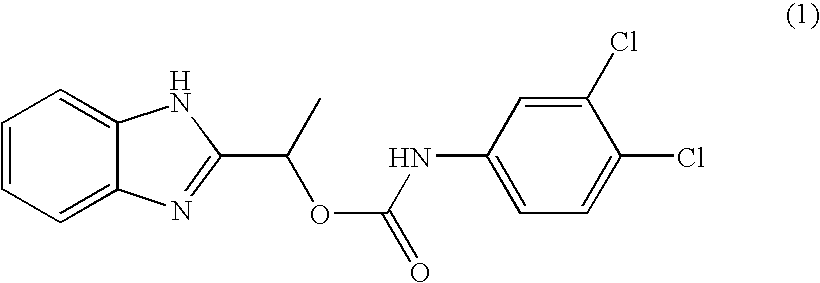
- Preparation of compound (1) from 3,4-dichlorophenylisocyanate (0.21 g, 1.1 mmol) and 1-(1H-benzimidazol-2-yl)ethanol (0.16 g, 1.0 mmol) was carried out in toluene, analogously to the preparation described in Example 1. Filtration followed by washing with benzene afforded the title compound (0.32 g) in 91% yield.
- 1H-NMR (d6-DMSO): δ 12.52 (s, 1H), 10.20 (s, 1H), 7.79 (d, 1H, J=2.3 Hz), 7.80-7.39 (m, 4H), 7.25-7.10 (m, 2H), 6.00 (q, 1H, J=6.7 Hz), 1.71 (d, 3H, J=6.7 Hz).
- Preparation of Compound (27)
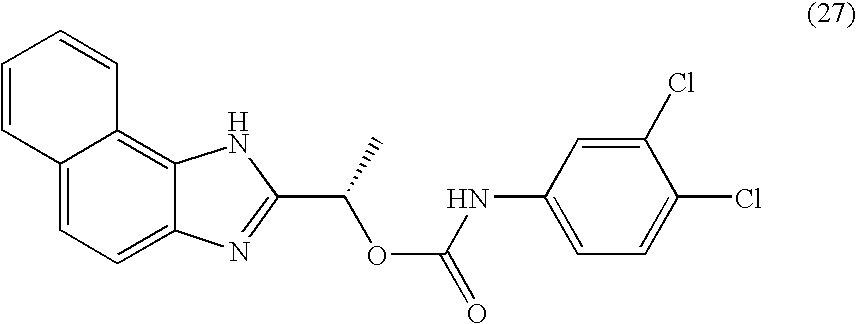
- Compound (27) was prepared according to the method of Scheme 4. A mixture of 2-amino-1-nitronaphthalene (0.99 g, 5.3 mmol), hydrazine (0.96 g, 30 mmol) and Pd (10% on Carbon, 100 mg) in 30 ml of ethyl alcohol was refluxed for 1.5 hours After filtration through celite, the filtrate concentrated to dryness. The residue was then mixed with (2S)-2-hydroxypropanoic acid (2.0 g, 85+% in water from Aldrich, 19 mmol) in 30 ml of 4N HCl, refluxed for 7 hours. Extraction workup using EtOAc/MeOH (3:1), followed by silica gel chromatography afforded the intermediate (1S)-1-(1H-naphtho[1,2-d]imidazol-2-yl)ethanol (0.75 g) in 67% two-step yield.
- To the solution of (1S)-1-(1H-naphtho[1,2-d]imidazol-2-yl)ethanol (0.21 g, 1.0 mmol) in 1 ml of DMF, was added 3,4-dichlorophenylisocyanate (0.22 g, 1.2 mmol) and then 20 ml of benzene. The mixture was refluxed for 3 hours. After removing solvent, the residue was purified on silica gel column using CH2Cl2/MeOH (100:5 and 100:10). Further purification by HPLC afforded the title compound (308 mg) in 77% yield.
- 1H-NMR (d6-DMSO): δ 13.11 (m, 1H), 10.21 (s, 1H), 8.38 (broad, 1H), 7.98 (m, 1H), 7.80 (m, 1H), 7.68 (s, 2H), 7.63-7.38 (m, 4H), 6.11 (q, 1H, J=6 Hz), 1.78 (d, 3H, J=6 Hz).
- Preparation of Compound (28)
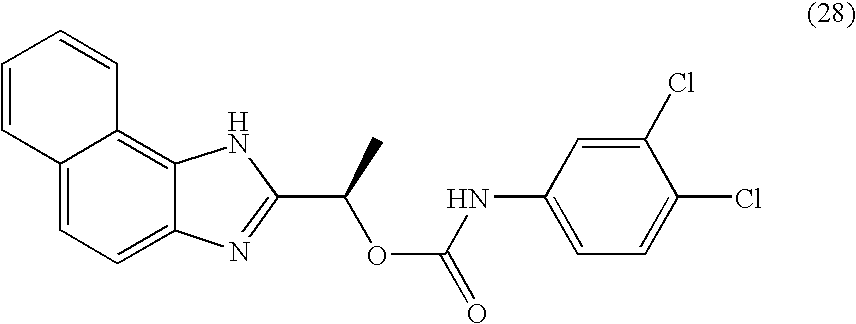
- Preparation of Compound (28) from 2-amino-1-nitronaphthalene, (2R)-2-hydroxypropanoic acid (80-90% in water from ICN) and 3,4-dichlorophenylisocyanate was carried out, analogously to the preparation described in Example 31. HPLC purification afforded the title compound.
- 1H-NMR (d6-DMSO): δ 10.23 (s, 1H), 8.39 (d, 1H, J=8.1 Hz), 8.00 (d, 1H, J=8.0 Hz), 7.76-7.68 (m, 3H), 7.62 (m, 1H), 7.49 (m, 2H), 7.36 (m, 1H), 6.11 (q, 1H, J=6 Hz), 1.78 (d, 3H, J=6 Hz).
- Preparation of Compound (42)

- Preparation of Compound (42) from 2-amino-1-nitronaphthalene, hydroxyacetic acid, and 3,4-dichlorophenylisocyanate was carried out analogously to the preparation described in Example 31 from the intermediate 1H-naphtho[1,2-d]imidazol-2-ylmethanol). HPLC purification afforded the title compound.
- 1H-NMR (d6-DMSO): δ 10.32 (s, 1H), 8.42 (d, 1H, J=8.1 Hz), 8.06 (d, 1H, J=8.1 Hz), 7.90-7.75 (m, 3H), 7.68 (m, 1H), 7.60-7.50 (m, 2H), 7.48-7.35 (m, 1H), 5.53 (s, 2H).
- Preparation of Compound (26)
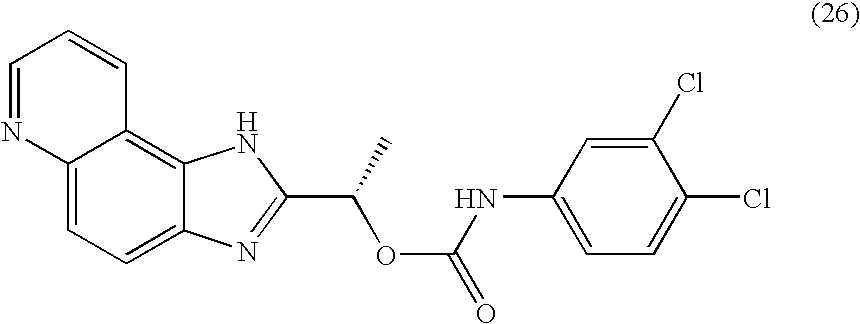
- Preparation of Compound (26) from 5-amino-6-nitroquinoline, (2S)-2-hydroxypropanoic acid, and 3,4-dichlorophenylisocyanate was carried out through intermediate (1S)-1-(1H-imidazo[4,5-f]quinolin-2-yl)ethanol, analogously to the preparation described in Example 31. HPLC purification afforded the title compound.
- 1H-NMR (d6-DMSO): δ 12.30 (broad, 1H), 10.22 (s, 1H), 8.85-8.65 (m, 2H), 7.95-7.83 (m, 1H), 7.80-7.70 (m, 2H), 7.60-7.45 (m, 2H), 7.41-7.32 (m, 1H), 6.06 (q, 1H, J=6.7 Hz), 1.78 (d, 3H, J=6.6 Hz).
- Preparation of Compound (22)
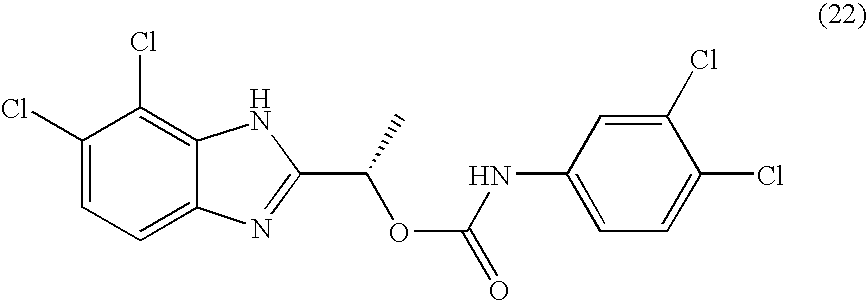
- To the solution of 2,3-dichloro-6-nitroaniline (0.62 g, 3.0 mmol) in 30 ml of EtOH, was added 20 ml of 6N HCl and SnCl2 (5.69 g, 30 mmol). The mixture was stirred at 65° C. for 2.5 hours After cooled down in ice bath, the white precipitate was collected by filtration and then mixed with (2S)-2-hydroxypropanoic acid (2.4 g, 85+% in water from Aldrich, 23 mmol) in 7 ml of 6N HCl. The mixture was microwaved at 160° C. for 10 minutes, and then diluted with 15 ml of water, basified to pH 9 with aqueous NH3. The precipitate was collected, washed with water and dried. 0.67 g of (1S)-1-(6,7-dichloro-1H-benzimidazol-2-yl)ethanol was obtained in 97% two-step yield. This intermediate (92 mg, 0.40 mmol) was mixed with 3,4-dichlorophenylisocyanate (75 mg, 0.40 mmol) in 10 ml of toluene. The reaction mixture was stirred at 80° C. overnight. The precipitate was collected and washed with toluene. Further purification with HPLC afforded the title compound (35 mg) in 21% yield.
- 1H-NMR (d6-DMSO): δ 10.18 (s, 1H), 7.78 (d, 1H, J=2.3 Hz), 7.60-7.47 (m, 2H), 7.46-7.35 (m, 2H), 6.01 (q, 1H, J=6.7 Hz), 1.71 (d, 3H, J=6.7 Hz).
- Preparation of Compound (23)
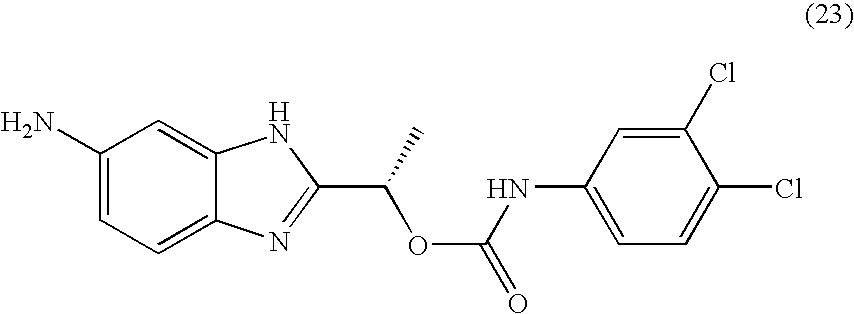
- Compound (23) was synthesized from compound (5) in Example 21 by hydrogen reduction catalyzed by PtO2. HPLC purification afforded the title compound in 83% yield.
- 1H-NMR (d6-DMSO): δ 10.35 (s, 1H), 7.77 (d, 1H, J=2.3 Hz), 7.63 (d, 1H, J=8.6 Hz), 7.54 (d, 1H, J=8.8 Hz), 7.48-7.35 (m, 2H), 7.15 (m, 1H), 6.05 (q, 1H, J=6.7 Hz), 1.74 (d, 3H, J=6.7 Hz).
- Preparation of Compound (18)
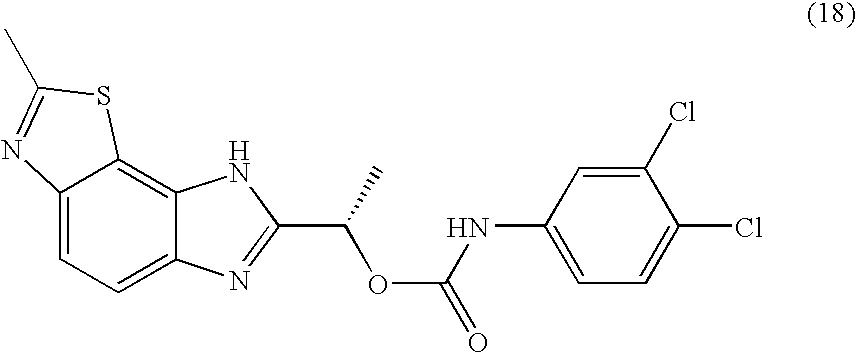
- Compound (18) was synthesized according to the method of Scheme 4 and the preparation described in Example 31 and was obtained in 11% yield after purification by HPLC. 1H-NMR (d6-DMSO): δ 10.19 (s, 1H), 7.90-7.73 (m, 2H), 7.72-7.52 (m, 2H), 7.51-7.38 (m, 1H), 6.08 (q, 1H, J=6.7 Hz), 2.84 (s, 3H), 1.71 (d, 3H, J=6.7 Hz).
- Preparation of Compound (19)
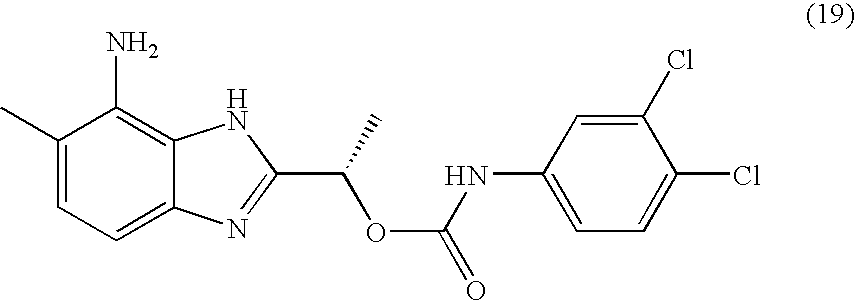
- Compound (19) was synthesized through PtO2-catalyzed H2 reduction of (1S)-1-(6-methyl-7-nitro-1H-benzimidazol-2-yl)ethyl 3,4-dichlorophenyl carbamate prepared according to Scheme 3. HPLC purification afforded the title compound in 18% yield. 1H-NMR (d6-DMSO): δ 10.41 (s, 1H), 7.81 (d, 1H, J=2 Hz), 7.59 (d, 1H, J=9 Hz), 7.45 (dd, 1H, J1=9 Hz, J2=2 Hz), 7.12 (d, 1H, J=9 Hz), 6.90 (d, 1H, J=9 Hz), 6.14 (q, 1H, J=6 Hz), 2.24 (s, 3H), 1.81 (d, 3H, J=6 Hz).
- Preparation of Compound (16)
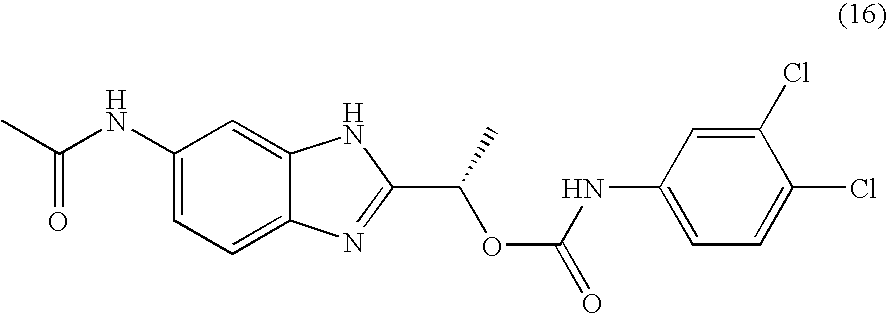
- Compound (16) was synthesized through acylation of compound (23) in Example 36 with acetyl chloride in the presence of triethylamine in dichloromethane. HPLC purification afforded the title compound in 2.4% yield. 1H-NMR (d4-MeOH): δ 8.36 (s, 1H), 7.80-7.60 (m, 2H), 7.55-7.30 (m, 3H), 6.20 (q, 1H, J=6.8 Hz), 2.18 (s, 3H), 1.86 (d, 3H, J=6.8 Hz).
- Preparation of Compound (13)
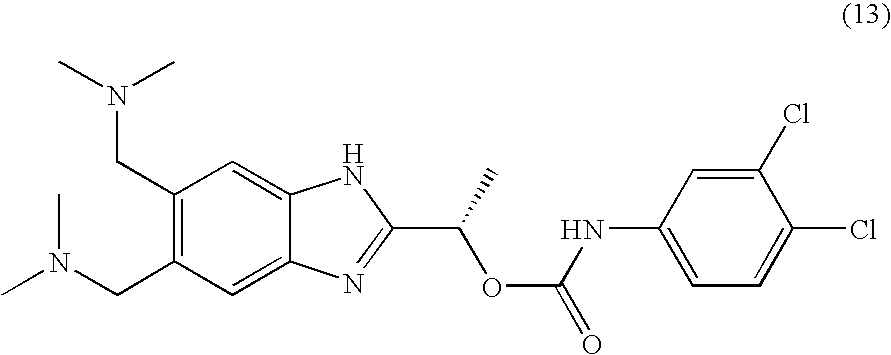
- Compound (13) was synthesized according to method of Scheme 3 and the preparation described in Example 18. 1H-NMR (d4-MeOH): δ 7.73 (d, 1H, J=2.4 Hz), 7.65 (s, 2H), 7.39 (d, 1H, J=9.0 Hz), 7.33 (dd, 1H, J1=9.0 Hz, J2=2.5 Hz), 6.05 (q, 1H, J=6.7 Hz), 3.99 (s, 4H), 2.49 (s, 12H), 1.77 (d, 3H, J=6.7 Hz).
- Preparation of Compound (14)
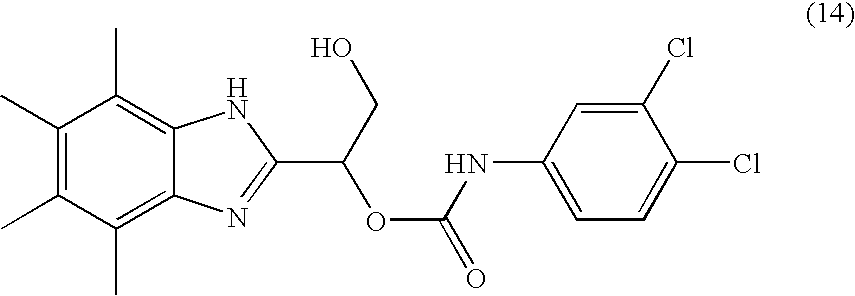
- Compound (14) was synthesized according to the method of Scheme 5. The 1,2-amino starting material was prepared via the reduction of a 1,2-dinitroprecursor.
- A. Preparation of 1-(4,5,6,7-tetramethyl-1H-benzimidazol-2-yl)ethane-1,2-diol, intermediate A in Scheme 5.
- The mixture of 3,4,5,6-tetramethyl-1,2-dinitrobenzene (5,0 g, 22.3 mmol), Pd/C (10%, 0.9 g) and 18 ml hydrazine in 200 ml of ethyl alcohol was refluxed for 2 hours. After filtration to remove the catalyst, the filtrate was concentrated to dryness. The residue (
crude 1,2-diamino-3,4,5,6-tetramethylbenzene) was mixed with glyceric acid (25 g, 40% in water) in 1 N HCl solution. The reaction mixture was refluxed for 5 hours, then cooled down in ice bath and quenched with ammonium hydroxide in water. The solid was collected by filtration, and further purification with silica gel chromatography using CH2Cl2/MeOH afforded 1-(4,5,6,7-tetramethyl-1H-benzimidazol-2-yl)ethane-1,2-diol in a 48% two-step yield. - 1H-NMR (d6-DMSO): δ 12.3 (broad, 1H), 4.78 (m, 1H), 3.85-3.63 (m, 2H), 2.42 (s, 6H), 2.20 (s, 6H).
- B. Preparation of 2-{[tert-butyl(dimethyl)silyl]oxy}-1-(4,5,6,7-tetramethyl-1H-benzimidazol-2-yl)ethanol, intermediate B in Scheme 5.
- To the solution of 1-(4,5,6,7-tetramethyl-1H-benzimidazol-2-yl)ethane-1,2-diol (0.50 g, 2.1 mmol) in 5 ml of DMF, was added imidazole (0.34 g, 5.0 mmol) and tert-butyldimethylsilyl chloride (0.35 g, 2.3 mmol). The reaction mixture was stirred at room temperature for 40 minutes. Extraction workup with EtOAc, followed by silica gel chromatography using Hexane/EtOAc (2:1) afforded 548-18 (0.51 g) in 69% yield.
- 1H-NMR (CDCl3): δ 9.5 (broad, 1H), 5.03 (t, 1H, J=5.3 Hz), 4.15-4.02 (m, 1H), 3.98-3.85 (m, 1H), 2.50 (s, 6H), 2.31 (s, 6H), 0.94 (s, 9H), 0.12 (s, 3H), 0.09 (s, 3H).
- C. Preparation of 2-{[tert-butyl(dimethyl)silyl]oxy}-1-(4,5,6,7-tetramethyl-1H-benzimidazol-2-yl)ethyl 3,4-dichlorophenylcarbamate, intermediate C in Scheme 5.
- To the solution of 2-{[tert-butyl(dimethyl)silyl]oxy}-1-(4,5,6,7-tetramethyl-1H-benzimidazol-2-yl)ethanol (0.50 g, 1.4 mmol) in 25 ml of toluene, was added 3,4-dichlorophenylisocyanate (0.35 g, 1.9 mmol). The mixture was stirred at 85° C. for 2 hours. After removing solvent, the residue was purified with silica gel chromatography using Hexane/EtOAc. 0.70 g of 2-{[tert-butyl(dimethyl)silyl]oxy}1-(4,5,6,7-tetramethyl-1H-benzimidazol-2-yl)ethyl 3,4-dichlorophenylcarbamate was obtained in 91% yield.
- 1H-NMR (CDCl3): δ 10.23 (s, 1H), 7.40 (d, 1H, J=2.5 Hz), 7,28 (d, 1H, J=8.4 Hz), 7.21 (s, 1H), 7.12-7.02 (dd, 1H, J1=8.8 Hz, J2=2.5 Hz), 6.05 (t, 1H, J=5.0 Hz), 4.28-4.10 (m, 2H), 2.55 (s, 3H), 2.38 (s, 3H), 2.30 (s, 6H), 0.90 (s, 9H), 0.057 (m, 6H). LCMS: (M+H+) 536.1.
- D. Preparation of 2-hydroxy-1-(4,5,6,7-tetramethyl-1H-benzimidazol-2-yl)ethyl 3,4-dichlorophenylcarbamate, intermediate D in Scheme 5.
- To the solution of 2-{[tert-butyl(dimethyl)silyl]oxy}-1-(4,5,6,7-tetramethyl-1H-benzimidazol-2-yl)ethyl 3,4-dichlorophenylcarbamate (0.70 g, 1.3 mmol) in 20 ml of THF, was added n-Bu4NF (1.0 M in THF, 2.6 ml, 2.6 mmol). The mixture was stirred for 30 minutes. After removing solvent, the residue was purified with silica gel chromatography using CH2Cl2/MeOH. The title compound (0.53 g) was obtained in 96% yield.
- 1H-NMR (d6-DMSO): δ 12.16 (s, 1H), 10.21 (s, 1H), 7.79 (d, 1H, J=2.3 Hz), 7.53 (d, 1H, J=8.8 Hz), 7.39 (dd, 1H, J1=8.8 Hz, J2=2.3 Hz), 5.89 (t, 1H, J=6.2 Hz), 5.20 (t, 1H, J=5.6 Hz), 3.96 (t, 2H, J=5.8 Hz), 2.43 (s, 3H), 2.39 (s, 3H), 2.20 (s, 6H).
- Preparation of Compound (15), via Intermediate E in Scheme 5.

- Compound (15) was prepared according to the method of Scheme 5. To the solution of 2-hydroxy-1-(4,5,6,7-tetramethyl-1H-benzimidazol-2-yl)ethyl 3,4-dichlorophenylcarbamate (0.40 g, 0.95 mmol) (Compound (15)) and Et3N (0.5 ml) in 15 ml of THF, was added methanesulfonyl chloride (0.20 g, 1.7 mmol) while the reaction mixture was cooled in ice bath. The mixture was stirred in ice bath for 10 minutes and then at room temperature for 1 hour. After filtration through celite, the filtrate was concentrated to dryness. The residue was dissolved in 10 ml of DMSO and mixed with a solution of Et2NH in THF (2.0 M, 8 ml). The reaction mixture was stirred at room temperature overnight. Purification with HPLC afforded 17 mg of pure titled compound.
- 1H-NMR (d6-DMSO): δ 11.80 (s, 1H), 10.00 (s, 1H), 7.74 (m, 1H), 7.51 (d, 1H, J=8.8 Hz), 7.39 (m, 1H), 4.80-4.65 (m, 1H), 4.63-4.45 (m, 1H), 4.07 (m, 1H), 2.44 (s, 3H), 2.39 (s, 3H), 2.23 (s, 6H), 2.20 (s, 6H).
- The compounds of the present invention with their corresponding Ki data and/or LCMS data are tabulated in the following Table 1:
TABLE 1 Carbamate Derivatives Ki (μM) A > 10 μM B = 1-10 μM LCMS ID Structure C < 1 μM (M + H+) 1 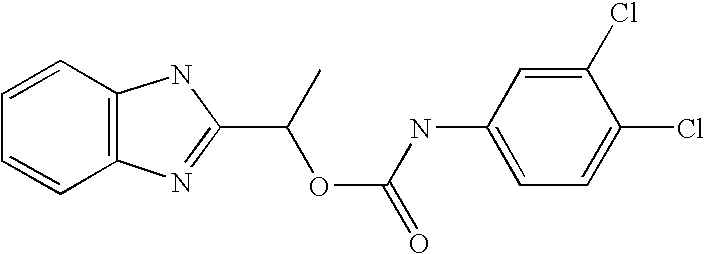
B 350.0 2 
B 507.9 3 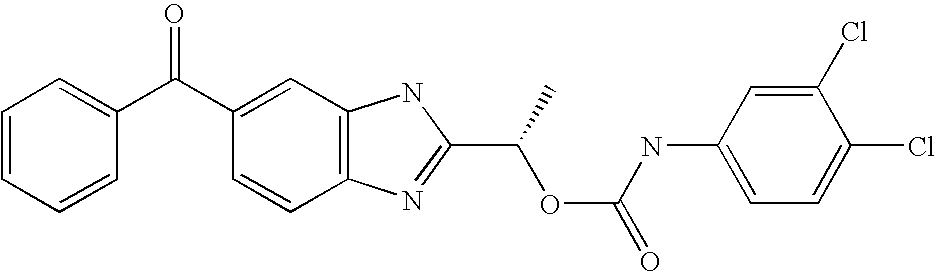
A 454.1 4 
A 395.0 5 
A 355.0 6 
328.0 7 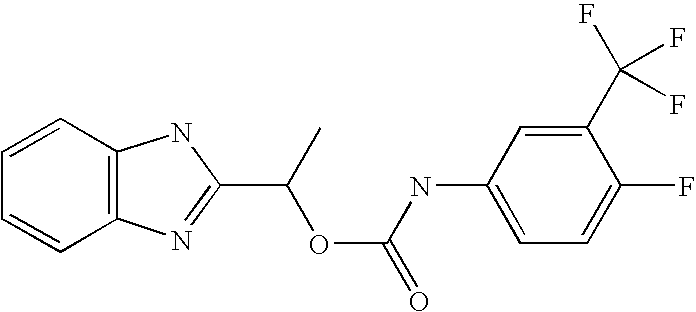
A 368.0 8 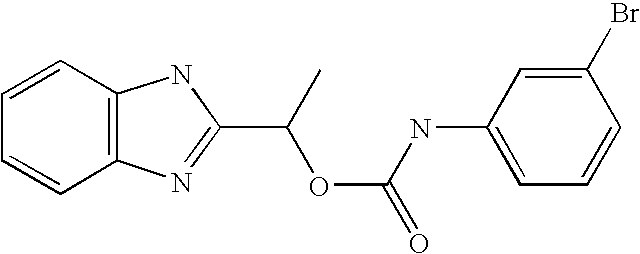
360.0 9 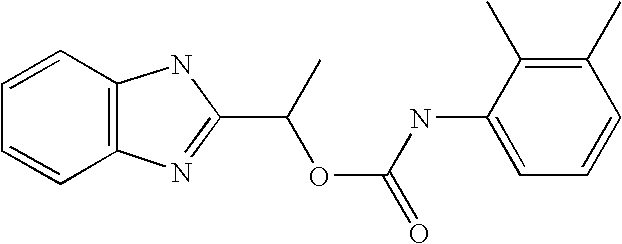
310.1 10 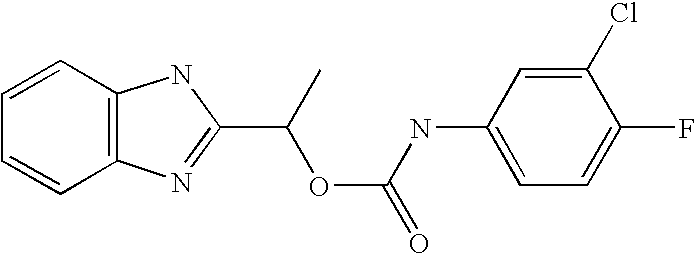
A 334.0 11 
A 341.1 12 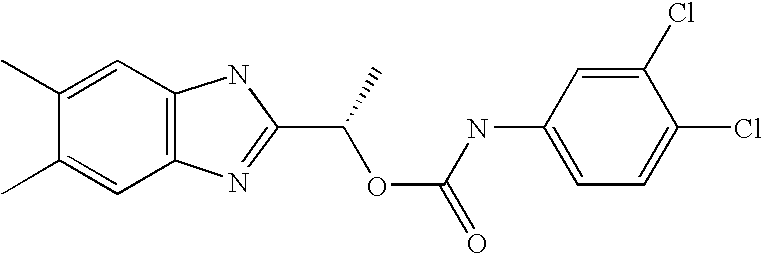
C 378.1 13 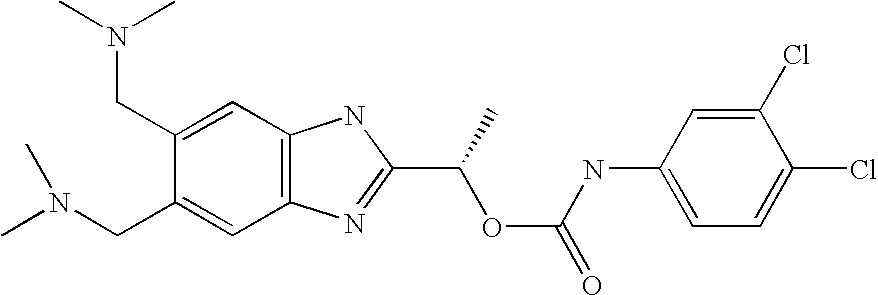
A 464.2 14 
C 422.0 15 
A 449.1 16 
C 406.9 17 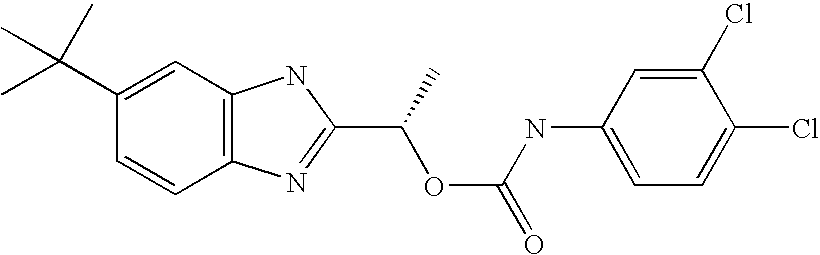
B 406.0 18 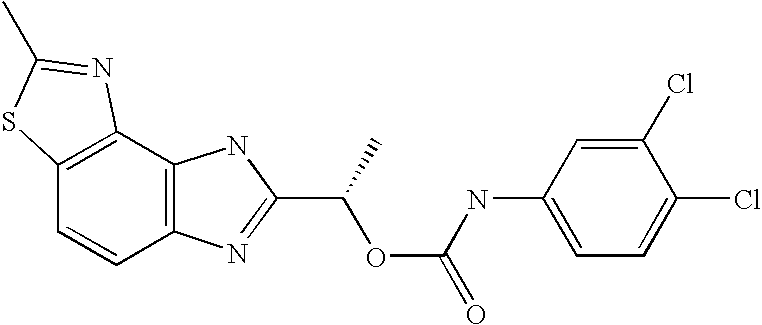
C 421.0 19 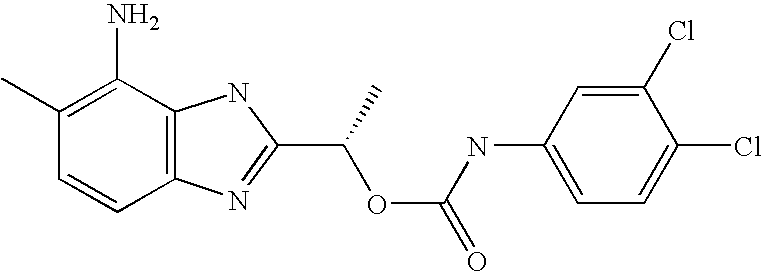
C 379.1 20 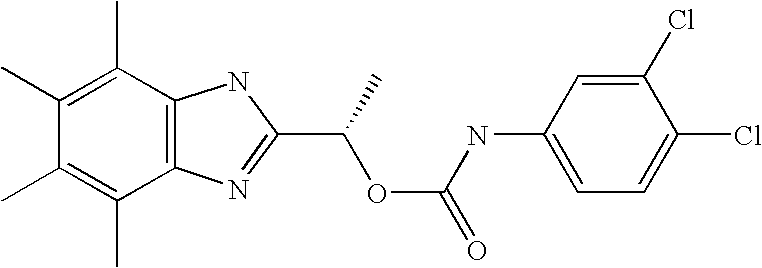
C 406.0 21 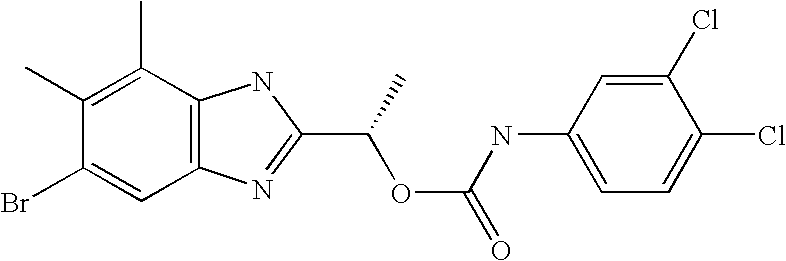
B 455.9 22 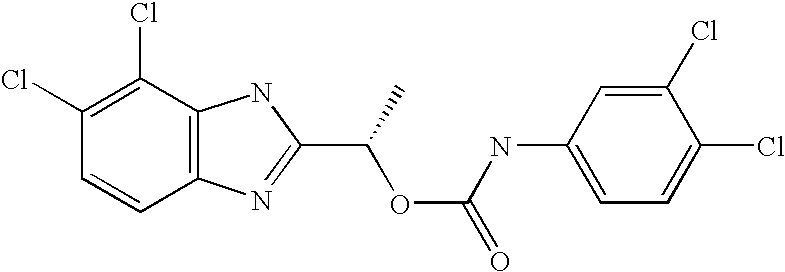
418.2 23 
364.9 24 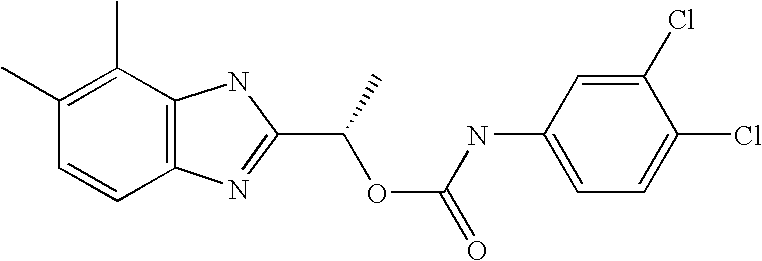
C 378.0 25 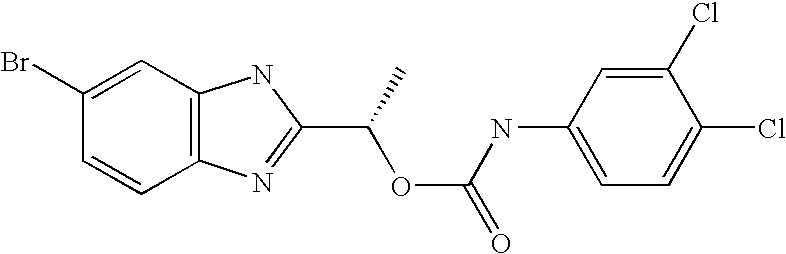
B 427.9 26 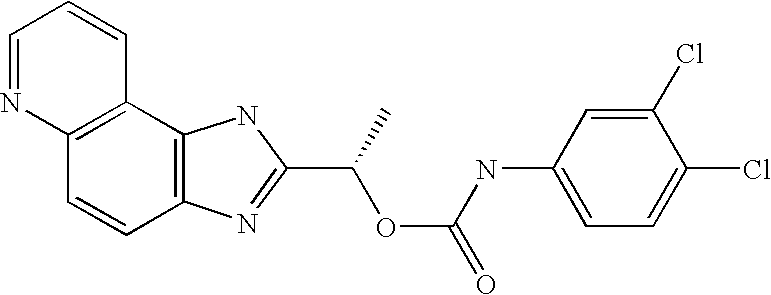
401.0 27 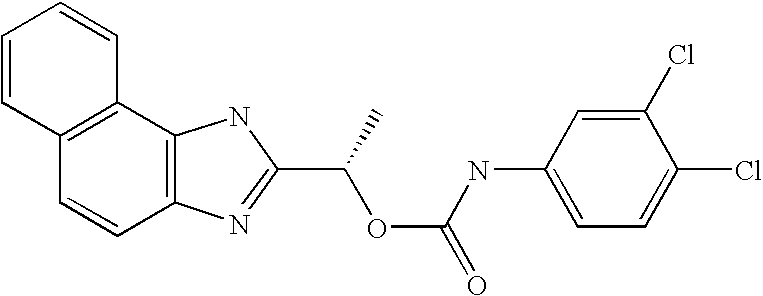
C 399.9 28 
C 399.9 29 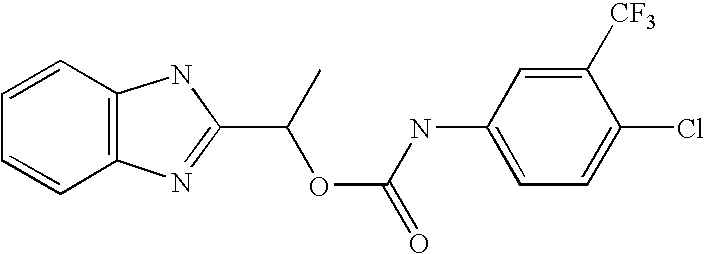
A 384.0 30 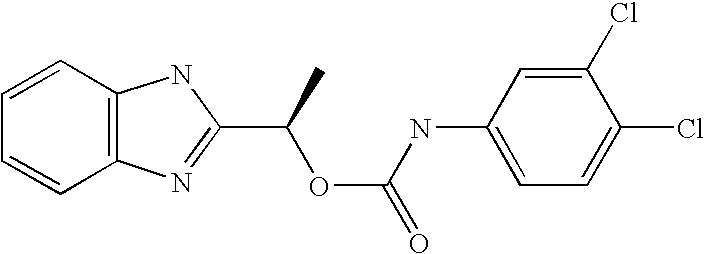
B 350.0 31 
388.1 32 
310.0 33 
B 350.0 34 
394.2 35 
A 326.0 36 
A 338.0 37 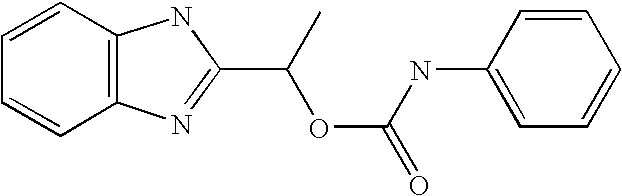
A 282.0 38 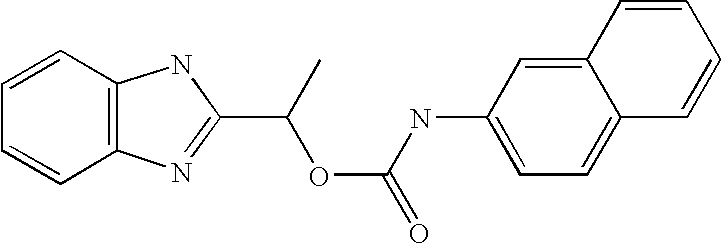
A 332.0 39 
A 318.1 40 
A 332.5 41 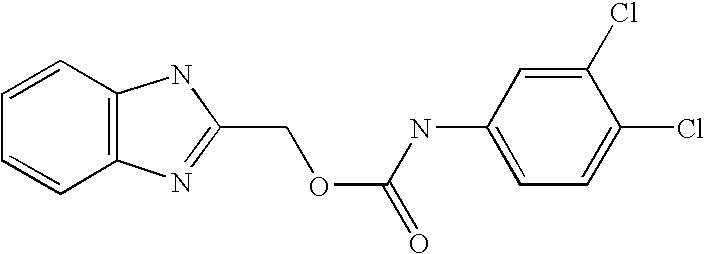
B 336.0 42 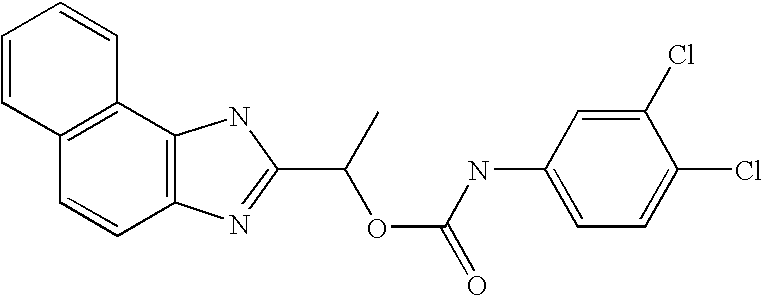
C 386.0 - To prepare a parenteral pharmaceutical composition suitable for administration by injection, 100 mg of a water-soluble salt of a compound of Formula (I) is dissolved in DMSO and then mixed with 10 mL of 0.9% sterile saline. The mixture is incorporated into a dosage unit form suitable for administration by injection.
- To prepare a pharmaceutical composition for oral delivery, 100 mg of a compound of Formula (I) is mixed with 750 mg of lactose. The mixture is incorporated into an oral dosage unit for, such as a hard gelatin capsule, which is suitable for oral administration.
- To prepare a sustained-release pharmaceutical composition for intraocular delivery, a compound of Formula (I) is suspended in a neutral, isotonic solution of hyaluronic acid (1.5% conc.) in phosphate buffer (pH 7.4) to form a 1% suspension.
- It is to be understood that the foregoing description is exemplary and explanatory in nature, and is intended to illustrate the invention and its preferred embodiments. Through routine experimentation, the artisan will recognize apparent modifications and variations that may be made without departing from the spirit of the invention. Thus, the invention is intended to be defined not by the above description, but by the following claims and their equivalents.
- Biological Testing; Enzyme Assays; Selection of Active Compounds
- CHK1 Construct for Assay
- C-terminally His-tagged full-length human CHK1 (FL-CHK1) was expressed using the baculovirus/insect cell system. It contains 6 histidine residues (6×His-tag) at the C-terminus of the 476 amino acid human CHK1. The protein was purified by conventional chromatographic techniques.
- CHK1 Assay
- The production of ADP from ATP that accompanies phosphoryl transfer to the synthetic substrate peptide Syntide-2 (PLARTLSVAGLPGKK) was coupled to oxidation of NADH using phosphoenolpyruvate (PEP) through the actions of pyruvate kinase (PK) and lactic dehydrogenase (LDH). The oxidation of NADH was monitored by following the decrease of absorbance at 340 nm (∈340=6.22 cm−1 mM−1) using a HP8452 spectrophotometer. Typical reaction solutions contained: 4 mN PEP; 0.15 mM NADH; 28 units of LDH/mL; 16 units of PK/mL; 3 mM DTT; 0.125 mM Syntide-2; 0.15 mM ATP; 25 mM MgCl2 in 50 mM TRIS, pH 7.5; and 400 mM NaCl. Assays were initiated with 10 nM of FL-CHK1. Ki, values were determined by measuring initial enzyme activity in the presence of varying concentrations of test compounds. The data were analyzed using Enzyme Kinetic and Kaleidagraph software.
- The results of the assays are presented in Table I. Certain compounds of Formula (I) exhibited a selectivity for CHK1 over other kinases that were tested. In some cases, selectivity for CHK1 exceeded selectivity for other tested kinases by at least a factor of 10.
- As previously detailed in European Patent Application No. 1 096 014 A2 (filed Oct. 31, 2000), the C-terminally His-tagged kinase domain of human CHK1 (KH289), amino acid residues 1-289, can be expressed using the baculovirus/insect cell system. This construct has been shown to possess catalytic activity approximately 10-fold greater than full length CHK1. The Bac-to-Bac system (Life Technologies) can be used to generate recombinant baculovirus for the expression of KH289 as per instructions. Recombinant viruses can be confirmed by PCR for the presence of CHK1 cDNA insertion. Protein expression can be confirmed by SDS-PAGE or Western blot with CHK1 polyclonal antibodies. Sf9 insect cells (Invitrogen, Carlsbad, Calif., USA) can be used for initial amplification of recombinant virus stock. High titer stocks of recombinant viruses can be generated by 2 to 3 rounds of amplification using Sf21 insect cells. Hi-S insect cells (Invitrogen, Carlsbad, Calif., USA) can be used for protein production. Both Sf9 and Hi-S cell lines can be adapted to grow in insect medium containing 1% Fetal Bovine Serum (Life Technologies, Grand Island, N.Y., USA). The viral stock was stored at 10° C. and used for large-scale protein production within 2 months to avoid viral instability. For protein production, infected Hi-S cells can be harvested by centrifugation and stored at −80° C. From these cells, 6×-His tagged KH289 (identified by SDS-PAGE) can be obtained after purification and can be flash-frozen in liquid N2 and stored at −80° C. Maintaining salt concentration around 500 mM NaCl including 5% glycerol was found to be crucial for preventing aggregation of CHK1 proteins during purification and storage.
- As previously detailed in European Patent Application No. 1 096 014 A2 (filed Oct. 31, 2000), the enzymatic activity of a kinase can be measured by its ability to catalyze the transfer of a phosphate residue from a nucleoside triphosphate to an amino acid side chain in a selected protein target. The conversion of ATP to ADP generally accompanies the catalytic reaction. Herein, a synthetic substrate peptide, Syntide-2, having amino acid sequence PLARTLSVAGLPGKK can be utilized. The production of ADP from ATP that accompanies phosphoryl transfer to the substrate can be coupled to oxidation of NADH using phosphoenolpyruvate (PEP) through the actions of pyruvate kinase (PK) and lactic dehydrogenase (LDH). The oxidation of NADH can be monitored by following the decrease of absorbance at 340 nm (e340=6.22 cm−1 mM-1) using a HP8452 spectrophotometer. Typical reaction solutions contained: 4 mM PEP, 0.15 mM NADH, 28 units of LDH/mL, 16 units of PK/mL, 3 mM DTT, 0. 125 mM Syntide-2, 0.15 mM ATP and 25 mM MgCl2 in 50 mM TRIS pH 7.5; 400 mM NaCl. Assays can be initiated with 10 nM of kinase domain of CHK1, KH289. Ki values can be determined by measuring initial enzyme activity in the presence of varying concentrations of inhibitors. The data can be analyzed using Enzyme Kinetic and Kaleidagraph software.
- VEGF-R2 Construct for Assay
- This construct determines the ability of a test compound to inhibit tyrosine kinase activity. A construct (VEGF-R2Δ50) of the cytosolic domain of (human) vascular endothelial growth factor receptor 2 (VEGF-R2) lacking the 50 central residues of the 68 residues of the kinase insert domain can be expressed in a baculovirus/insect cell system. Of the 1356 residues of full-length VEGF-R2, VEGF-R2Δ50 contains residues 806-939 and 990-1171, and also one point mutation (E990V) within the kinase insert domain relative to wild-type VEGF-R2. Autophosphorylation of the purified construct can be performed by incubation of the enzyme at a concentration of 4 μM in the presence of 3 mM ATP and 40 mM MgCl2 in 100 mM HEPES, pH 7.5, containing 5% glycerol and 5 mM DTT, at 4° C. for 2 hours. After autophosphorylation, this construct has been shown to possess catalytic activity essentially equivalent to the wild-type autophosphorylated kinase domain construct. See Parast et al. (1998) Biochemistry 37: 16788-16801.
- VEGF-R2 Assay
- a) Coupled Spectrophotometric (FLVK-P) Assay
- The production of ADP from ATP that accompanies phosphoryl transfer can be coupled to oxidation of NADH using phosphoenolpyruvate (PEP) and a system having pyruvate kinase (PK) and lactic dehydrogenase (LDH). The oxidation of NADH can be monitored by following the decrease of absorbance at 340 nm (e340=6.22 cm−1 mM−1) using a Beckman DU 650 spectrophotometer. Assay conditions for phosphorylated VEGF-R2Δ50 can be the following: 1 mM PEP; 250 μM NADH; 50 units of LDH/mL; 20 units of PK/mL; 5 mM DTT; 5.1 mM poly(E4Y1); 1 mM ATP; and 25 mM MgCl2 in 200 mM HEPES, pH 7.5. Assay conditions for unphosphorylated VEGF-R2Δ50 can be the following: 1 mM PEP; 250 μM NADH; 50 units of LDH/mL; 20 units of PK/mL; 5 mM DTT; 20 mM poly(E4Y1); 3 mM ATP; and 60 mM MgCl2 and 2 mM MnCl2 in 200 mM HEPES, pH 7.5. Assays can be initiated with 5 to 40 nM of enzyme. Enzyme percentage inhibition values can be determined by measuring enzyme activity in the presence of 0.05 μM test compound. The data can be analyzed using Enzyme Kinetic and Kaleidagraph software.
- The intracellular kinase domain of (human) FGF-R1 can be expressed using the baculovirus vector expression system starting from the endogenous methionine residue 456 to glutamate 766, according to the residue numbering system of Mohammadi et al. (1996) Mol. Cell. Biol. 16: 977-989. In addition, the construct also has the following 3 amino acid substitutions: L457V, C488A, and C584S.
- FGF-R Assay
- The spectrophotometric assay can be carried out as described above for VEGF-R2, except for the following changes in concentration: FGF-R=50 nM, ATP=2 mM, and poly(E4Y1)=15 mM. Ki, values can be determined by measuring enzyme activity in the presence of varying concentrations of test compounds.
- Phosphorylase Kinase Construct for Assay
- The truncated catalytic subunit (gamma subunit) of phosphorylase kinase (amino acids 1-298) can be expressed in E. coli and isolated from inclusion bodies. Phosphorylase kinase can then be refolded and stored in glycerol at −20° C.
- Phosphorylase Kinase Assay
- In the assay, the purified catalytic subunit can be used to phosphorylate phosphorylase b using radiolabled ATP. Briefly, 1.5 mg/ml of phosphorylase b can be incubated with 10 nM phosphorylase kinase in 10 mM MgCl2, 50 mM Hepes pH 7.4, at 37° C. The reaction can be started with the addition of ATP to 100 uM and incubated for 15 min at 25° C. or 37° C. The reaction can be terminated and proteins can be precipitated by the addition of TCA to 10% final concentration. The precipitated proteins can be isolated on a 96 well Millipore MADP NOB filter plate. The filter plate can be extensively washed with 20% TCA, and dried. Scintilation fluid can be then added to the plate and incorporated radiolabel can be counted on a Wallac microbeta counter. The % inhibition of phosphoryl transfer from ATP to phosphorylase b in the presence of 10 μM of compound can then be measured.
- CHK-2 Assay
- CHK-2 enzyme can be obtained from Upstate Group, Inc. and is an N-terminal, GST-tagged and C-terminal His-tagged fusion protein corresponding to amino acids 5-543 of human CHK-2 as confirmed by mass tryptic fingerprinting, expressed in E. coli; Mr-87 kDa. The assay condition for CHK-2 can be as described above for CHK1, except that the enzyme CHK2 (0.059 μM) can be utilized in place of KH289. Further, no NaCl can be added.
- CDK-1 Assay
- CDK-1/cyclin B, active complex can be obtained from Upstate Group, Inc. and is a C-terminal, His-tagged CDK-1 and an N-terminal GST-tagged-cyclin B as confirmed by mass tryptic fingerprinting and protein sequencing, produced individually in Sf21 cells and then complexed in vitro. The assay condition for CDK-1 can be as described above for CHK1, except that the enzyme complex CDK-1/cyclin B (0.2 μM) can be utilized in place of KH289, and Histone-H1 (Upstate USA, Inc.) (0.059 μM) can be utilized as a substrate in place of Syntide-2. Further, no NaCl can be added.
- WEE-1 Assay
- Delfia® Assay Protocol for WEE-1
- WEE-1 enzyme can be obtained from Upstate Group, Inc. and is an N-terminal, GST-tagged fusion protein to full length rat WEE-1, expressed in E. coli; Mr˜100 kDa. This kinase assay can be carried out on coated poly (Glu-Tyr) 4:1 (random copolymer) 96-well filter plates (NoAb Diagnostics). The assay volume can be 100 μl per well plus 2111 DMSO (control) or 2 μl of compound in DMSO. Buffer A can be 10% glycerol, 20 mM TRIS (pH7.5), 10 mM MgCl2, 50 mM NaCl and 5 mM DTT. The plates can be prepared by automation.
- To an appropriate well can be added either 2 μl of DMSO (control) or 2 μl of compound in DMSO. To the positive control wells can be added 30 μl of 0.5M EDTA. To each well can be added 50 μl ATP in Buffer A such that the ATP assay concentration can be 33 μM. To start the reaction, 50 μl Wee1 in Buffer A can be added to each well such that the Wee1 assay concentration can be 0.1 ng/μl. The plate can be can be mixed by shaking and then allowed to remain at room temperature for 30 minutes. To stop the reaction, the plate can be washed once with Delfia Wash on an EL405 plate washer. To each well can be added 100 μl of EuPY in Delfia® assay buffer such that the EuPY assay concentration can be 0.0149 ng/μl. The plate can be allowed to sit for 1 hours or overnight. The plate can be washed once again with Delfia® Wash (EL405 plate washer), and allowed to dry. To each well can be added 100 μl of Delfia® Enhancement solution and the plate can be allowed to sit for 10 minutes. The plate can be read on Wallac's Victor fluorescence reader (Europium Protocol). Ki; values can be determined by measuring enzyme activity in the presence of varying concentrations of test compounds.
- SGK Assay
- SGK (human) (Upstate Group, Inc., KINASEPROFILER™) (5-10 mU) can be incubated with 8 mM MOPS pH7.0, 0.2 mM EDTA, 30 μM Crosstide, 10 mM MgAcetate and [γ-33P-ATP] (Specific activity approximately 500 cpm/pmol, concentration as required) to form a final reaction volume of 25 μl. Compounds can be tested at 1 μM. The reaction can be initiated by the addition of Mg2+ [γ-33P-ATP]. The ATP concentration can be 10 μM. After incubation for 40 minutes at room temperature, the reaction can be stopped by the addition of 5 μl of a 3% phosphoric acid solution. 10 μl of the reaction can then be spotted onto a P30 filtermat and washed three times for 5 minutes in 50 mM phosphoric acid and once in methanol prior to drying and scintillation counting. Results represent an average of two experiments and enzymatic activity can be expressed as a percentage of that in control incubations without test compounds.
- AMPK Assay
- AMPK (rat) (Upstate Group, Inc., KINASEPROFILER™) (5-10 mU) can be incubated with 50 mM Hepes pH7.4, 1 mM DTT, 0.02% Brij35, 200 μM AMP, 200 μM AMARAASAAALARRR, 10 mM MgAcetate and [γ-33P-ATP] (Specific activity approximately 500 cpm/pmol, concentration as required) to form a final reaction volume of 25 μl. Compounds can be tested at 1 μM. The reaction can be initiated by the addition of Mg2+ [γ-33P-ATP]. The ATP concentration can be 10 μM. After incubation for 40 minutes at room temperature, the reaction can be stopped by the addition of 5 μl of a 3% phosphoric acid solution. 10 μl of the reaction can then be spotted onto a P30 filtermat and washed three times for 5 minutes in 75 mM phosphoric acid and once in methanol prior to drying and scintillation counting. Results represent an average of two experiments and enzymatic activity can be expressed as a percentage of that in control incubations without test compound.
- LCK Assay
- LCK (human) (Upstate Group, Inc., KINASEPROFILER™) (5-10 mU) can be incubated with 50 mM Tris pH7.5, 0.1 mM EGTA, 0.1 mM NaVanadate, 250□M KVEKIGEGTYGVVYK (CDC2 peptide), 10 mM MgAcetate and [γ−33P-ATP] (Specific activity approximately 500 cpm/pmol, concentration as required) to form a final reaction volume of 25 μl. Compounds can be tested at 1 μM. The reaction can be initiated by the addition of Mg2+ [y−33P-ATP]. The ATP concentration can be 10 μM. After incubation for 40 minutes at room temperature, the reaction can be stopped by the addition of 5 μl of a 3% phosphoric acid solution. 10 μl of the reaction can then be spotted onto a P30 filtermat and washed three times for 5 minutes in 75 mM phosphoric acid and once in methanol prior to drying and scintillation counting. Results represent an average of two experiments and enzymatic activity can be expressed as a percentage of that in control incubations without test compound.
- MAPK2 Assay
- MAPK2 (mouse) (Upstate Group, Inc., KINASEPROFILER™) (5-10 mU) can be incubated with 25 mM Tris pH 7.5, 0.02 mM EGTA, 0.33 mg/ml myelin basic protein, 10 mM MgAcetate and [γ-33P-ATP] (Specific activity approximately 500 cpm/pmol, concentration as required) to form a final reaction volume of 25 μl. Compounds can be tested at 1 μM. The reaction can be initiated by the addition of Mg2+ [γ-33P-ATP]. The ATP concentration can be 10 μM. After incubation for 40 minutes at room temperature, the reaction can be stopped by the addition of 5 μl of a 3% phosphoric acid solution. 10 μl of the reaction can then be spotted onto a P30 filtermat and washed three times for 5 minutes in 75 mM phosphoric acid and once in methanol prior to drying and scintillation counting. Results represent an average of two experiments and enzymatic activity can be expressed as a percentage of that in control incubations without test compound.
- MSK1 Assay
- MSK1 (human) (Upstate Group, Inc., KINASEPROFILER™) (5-10 mU) can be incubated with 8 mM MOPS pH7.0, 0.2 mM EDTA, 30 pM Crosstide, 10 mM MgAcetate and [γ-33P-ATP] (Specific activity approximately 500 cpm/pmol, concentration as required) to form a final reaction volume of 25 μl. Compounds can be tested at 1 μM. The reaction can be initiated by the addition of Mg2+ [γ-33P-ATP]. The ATP concentration can be 10 μM. After incubation for 40 minutes at room temperature, the reaction can be stopped by the addition of 5 ∥l of a 3% phosphoric acid solution. 10 μl of the reaction can then be spotted onto a P30 filtermat and washed three times for 5 minutes in 50 mM phosphoric acid and once in methanol prior to drying and scintillation counting. Results represent an average of two experiments and enzymatic activity can be expressed as a percentage of that in control incubations without test compound.
- PKBα Assay
- PKBα (human) (Upstate Group, Inc., KINASEPROFILER™) (5-10 mU) can be incubated with 8 mM MOPS pH7.0, 0.2 mM EDTA, 30 μM Crosstide, 10 mM MgAcetate and [γ-33P-ATP] (Specific activity approximately 500 cpm/pmol, concentration as required) to form a final reaction volume of 25 μl. Compounds can be tested at 1 μM. The reaction can be initiated by the addition of Mg2+ [γ-33P-ATP]. The ATP concentration can be 10 μM. After incubation for 40 minutes at room temperature, the reaction can be stopped by the addition of 5 μl of a 3% phosphoric acid solution. 10 μl of the reaction can then be spotted onto a P30 filtermat and washed three times for 5 minutes in 50 mM phosphoric acid and once in methanol prior to drying and scintillation counting. Results represent an average of two experiments and enzymatic activity can be expressed as a percentage of that in control incubations without test compound.
- ROCKII Assay
- ROCKII (rat) (Upstate Group, Inc., KINASEPROFILER™) (5-10 mU) can be incubated with 50 mM Tris pH7.5, 0.1 mM EGTA, 30□M KEAKEKRQEQIAKRRRLSSLRASTSKSGGSQK, 10 mM MgAcetate and [ψ-33P-ATP] (Specific activity approximately 500 cpm/pmol, concentration as required) to form a final reaction volume of 25 μl. Compounds can be tested at 1 μM. The reaction can be initiated by the addition of Mg2+ [γ-33P-ATP]. The ATP concentration can be 10 μM. After incubation for 40 minutes at room temperature, the reaction can be stopped by the addition of 5 μl of a 3% phosphoric acid solution. 10 μl of the reaction can then be spotted onto a P30 filtermat and washed three times for 5 minutes in 75 mM phosphoric acid and once in methanol prior to drying and scintillation counting. Results represent an average of two experiments and enzymatic activity can be expressed as a percentage of that in control incubations without test compound.
- p70 S6K Assay
- p70S6K (human) (Upstate Group, Inc., KINASEPROFILER™) (5-10 mU) can be incubated with 8 mM MOPS pH7.0, 0.2 mM EDTA, 100 μM KKRNRTLTV, 10 mM MgAcetate and [γ-33P-ATP] (Specific activity approximately 500 cpm/pmol, concentration as required) to form a final reaction volume of 25 μl. Compounds can be tested at 1 μM. The reaction can be initiated by the addition of Mg2+ [γ-33P-ATP]. The ATP concentration can be 10 μM. After incubation for 40 minutes at room temperature, the reaction can be stopped by the addition of 5 μl of a 3% phosphoric acid solution. 10 μl of the reaction can then be spotted onto a P30 filtermat and washed three times for 5 minutes in 75 mM phosphoric acid and once in methanol prior to drying and scintillation counting. Results represent an average of two experiments and enzymatic activity can be expressed as a percentage of that in control incubations without test compound.
- PKA Assay
- PKA (bovine) (Upstate Group, Inc., KINASEPROFILER™) (5-10 mU) can be incubated with 8 mM MOPS pH7.0, 0.2 mM EDTA, 30 μM LRRASLG (Kemptide), 10 mM MgAcetate and [γ-33P-ATP] (Specific activity approximately 500 cpm/pmol, concentration as required) to form a final reaction volume of 25 μl. Compounds can be tested at 1 μM. The reaction can be initiated by the addition of Mg2+ [γ-33P-ATP]. The ATP concentration can be 10 μM. After incubation for 40 minutes at room temperature, the reaction can be stopped by the addition of 5 μl of a 3% phosphoric acid solution. 10 μl of the reaction can then be spotted onto a P30 filtermat and washed three times for 5 minutes in 50 mM phosphoric acid and once in methanol prior to drying and scintillation counting. Results represent an average of two experiments and enzymatic activity can be expressed as a percentage of that in control incubations without test compound.
- MAPK1 Assay
- MAPK1 (human) (Upstate Group, Inc., KINASEPROFILER™) (5-10 mU) can be incubated with 25 mM Tris pH7.5, 0.02 mM EGTA, 1 mM synthetic peptide, 10 mM MgAcetate and [γ-33P-ATP] (Specific activity approximately 500 cpm/pmol, concentration as required) to form a final reaction volume of 25 μl. Compounds can be tested at 1 μM. The reaction can be initiated by the addition of Mg2+ [γ-33P-ATP]. The ATP concentration can be 10 μM. After incubation for 40 minutes at room temperature, the reaction can be stopped by the addition of 5 μl of a 3% phosphoric acid solution. 10 μl of the reaction can then be spotted onto a P30 filtermat and washed three times for 5 minutes in 75 mM phosphoric acid and once in methanol prior to drying and scintillation counting. Results represent an average of two experiments and enzymatic activity can be expressed as a percentage of that in control incubations without test compound.
- cSRC Assay
- cSRC (human) (Upstate Group, Inc., KINASEPROFILER™) (5-10 mU) can be incubated with 8 mM MOPS pH7.0, 0.2 mM EDTA, 250 μM KVEKIGEGTYGWYK (CDC2 peptide), 10 mM MgAcetate and [γ-33P-ATP] (Specific activity approximately 500 cpm/pmol, concentration as required) to form a final reaction volume of 25 μl. Compounds can be tested at 1 μM. The reaction can be initiated by the addition of Mg2+ [γ-33P-ATP]. The ATP concentration can be 10 μM. After incubation for 40 minutes at room temperature, the reaction can be stopped by the addition of 5 μl of a 3% phosphoric acid solution, 10 μl of the reaction can then be spotted onto a P30 filtermat and washed three times for 5 minutes in 75 mM phosphoric acid and once in methanol prior to drying and scintillation counting. Results represent an average of two experiments and enzymatic activity can be expressed as a percentage of that in control incubations without test compound.
- PRK2 Assay
- PRK2 (human) (Upstate Group, Inc., KINASEPROFILER™) (5-10 mU) can be incubated with 50 mM Tris pH7.5, 0.1 mM EGTA, 0.1% β-mercaptoethanol, 30 μM AKRRRLSSLRA, 10 mM MgAcetate and [γ-33P-ATP] (Specific activity approximately 500 cpm/pmol, concentration as required) to form a final reaction volume of 25 μl. Compounds can be tested at 1 μM. The reaction can be initiated by the addition of Mg2+ [γ-33P-ATP]. The ATP concentration can be 10 μM. After incubation for 40 minutes at room temperature, the reaction can be stopped by the addition of 5 μl of a 3% phosphoric acid solution. 10 μl of the reaction can then be spotted onto a P30 filtermat and washed three times for 5 minutes in 75 mM phosphoric acid and once in methanol prior to drying and scintillation counting. Results represent an average of two experiments and enzymatic activity can be expressed as a percentage of that in control incubations without test compound.
- PDK1 Assay
- PDK1 (human) (Upstate Group, Inc., KINASEPROFILER™) (5-10 mU) can be incubated with 50 mM Tris pH7.5, 100 μM KTFCGTPEYLAPEVRREPRILSEEEQEMFRDFDYIADWC (PDKtide), 0.1% β-mercaptoethanol, 10 mM MgAcetate and [γ-33P-ATP] (Specific activity approximately 500 cpm/pmol, concentration as required) to form a final reaction volume of 25 μl. Compounds can be tested at 1 μM. The reaction can be initiated by the addition of Mg2+ [γ-33P-ATP]. The ATP concentration can be 10 μM. After incubation for 40 minutes at room temperature, the reaction can be stopped by the addition of 5 μl of a 3% phosphoric acid solution. 10 μl of the reaction can then be spotted onto a P30 filtermat and washed three times for 5 minutes in 75 mM phosphoric acid and once in methanol prior to drying and scintillation counting. Results represent an average of two experiments and enzymatic activity can be expressed as a percentage of that in control incubations without test compound.
- FYN Assay
- FYN (human) (Upstate Group, Inc., KINASEPROFILER™) (5-10 mU) can be incubated with 50 mM Tris pH7.5, 0.1 mM EGTA, 0.1 mM NaVanadate, 250 μM KVEKIOEGTYGWYK (CDC2 peptide), 10 mM MgAcetate and [γ-33P-ATP] (Specific activity approximately 500 cpm/pmol, concentration as required) to form a final reaction volume of 25 μl. Compounds can be tested at 1 μM. The reaction can be initiated by the addition of Mg2+ [γ-33P-ATP]. The ATP concentration can be 10 μM. After incubation for 40 minutes at room temperature, the reaction can be stopped by the addition of 5 μl of a 3% phosphoric acid solution. 10 μl of the reaction can then be spotted onto a P30 filtermat and washed three times for 5 minutes in 75 mM phosphoric acid and once in methanol prior to drying and scintillation counting. Results represent an average of two experiments and enzymatic activity can be expressed as a percentage of that in control incubations without test compound.
- PKCβII Assay
- PKCβII (human) (Upstate Group, Inc., KINASEPROFILER™) (5-10 mU) can be incubated with 20 mM Hepes pH7.4, 0.03% Triton X-100, 0.1 mM CaCl2, 0.1 mg/ml phosphatidylserine, 10 μg/ml diacylglycerol, 0.1 mg/ml histone H1, 10 mM MgAcetate and [γ-33P-ATP] (Specific activity approximately 500 cpm/pmol, concentration as required) to form a final reaction volume of 25 μl. Compounds can be tested at 1 μM. The reaction can be initiated by the addition of Mg2+ [γ-33P-ATP]]. The ATP concentration can be 10 μM. After incubation for 40 minutes at room temperature, the reaction can be stopped by the addition of 5 μl of a 3% phosphoric acid solution. 10 μl of the reaction can then be spotted onto a P30 filtermat and washed three times for 5 minutes in 75 mM phosphoric acid and once in methanol prior to drying and scintillation counting. Results represent an average of two experiments and enzymatic activity can be expressed as a percentage of that in control incubations without test compound.
- PKCγ Assay
- PKCγ (human) (Upstate Group, Inc., KINASEPROFILER™) (5-10 mU) can be incubated with 20 mM Hepes pH7.4, 0.03% Triton X-100, 0.1 mM CaCl2, 0.1 mg/ml phosphatidy!serine, 10 μg/ml diacylglycerol, 0.1 mg/ml histone H1, 10 mM MgAcetate and [γ-33P-ATP] (Specific activity approximately 500 cpm/pmol, concentration as required) to form a final reaction volume of 25 μl. Compounds can be tested at 1 μM. The reaction can be initiated by the addition of Mg2+ [γ-33P-ATP]. The ATP concentration can be 10 μM. After incubation for 40 minutes at room temperature, the reaction can be stopped by the addition of 5 γl of a 3% phosphoric acid solution. 10 μl of the reaction can then be spotted onto a P30 filtermat and washed three times for 5 minutes in 75 mM phosphoric acid and once in methanol prior to drying and scintillation counting. Results represent an average of two experiments and enzymatic activity can be expressed as a percentage of that in control incubations without test compound.
- Representative compounds of the present invention were tested against other kinases as well, i.e. CHK2, PIN1-FL, WT-ERAB, PAK4-CD, mPHK-CD, hPHK-CD-HIS. The results showed that amino pyrazole compounds of the present invention were at least 100-fold more selective for CHK1 than for other kinases. The compounds of the present invention displayed no measurable inhibition of CHK2.
- CHK1 Mitotic Index ELISA Assay
- To examine the in vitro effects of CHK1 inhibitory compounds, an ELISA assay can be designed to monitor the abrogation of DNA damage-induced checkpoint control. The assay can be based on the trapping and detection of mitotic cells following DNA damage-induced arrest. Phosphorylation of Histone H3 on serine 10 has been shown to correlate with mitosis and therefore can be required for chromosome condensation; consequently a mitosis specific phospho-epitope on Histone H3 can be used as a signal for checkpoint abrogation.
- CA-46 (lymphoma) cells can be treated with a DNA damaging agent, such as camptothecin (Sigma), at 50 nM for 8 hours to induce DNA damage. The control compound or CHK1 inhibitor can be then added at increasing concentrations with Nocodazole (Sigma) at 0.1 μg/ml and plates can be incubated for 16 hours. Control cells, where only CHK1 inhibitors can be added, can be prepared as well to assure that the inhibitors alone have no effect on the cell cycle. The cells can be then harvested, washed with PBS, and crude acid extraction can be performed. Pellets can be resuspended in 80 μl of Acid Extraction Buffer (10 mM Hepes pH 7.9, 1.5 mM MgCl2, 10 mM KCl, 0.5 mM DTT, 1.5 mM PMSF, 0.4N sulfuric acid), vortexed briefly, and incubated for 30 minutes on ice. Samples can be then centrifuged and 75 μl of the supernatant can be transferred to a 96 well flat-bottom plate (VWR 3596). Next 15 μl Neutralizing Cocktail (# of samples×(10 μl 10N NaOH+5 μl 1M Tris Base) can be added to each well, and after mixing, 5 μl of this can be transferred to another 96 well plate with 100 μl 50 mM Tris base (pH 9.6) in each well. Samples can be dried overnight. The wells can be then washed with 200 μl ELISA wash buffer (PBS with 20 mM Tris pH 7.5, 0.05% Tween 20) 5 times and blocked with 200 μl blocking buffer (PBS with 20 mM Tris pH 7.5, 0.05% Tween 20, 3.5% Dry milk, 1.5% BSA. pH to 7.5 after preparation) for 1 hour at room temperature. Following wash and block, anti-phospho Histone H3 antibodies (Upstate USA, Inc., rabbit polyclonal) can be added at 0.5 μg/ml in block (100 μl per well) and incubated for 2 hours at room temperature. Wells can be washed again to remove unbound primary antibody and 100 μl alkaline phosphatase conjugated secondary antibodies at 0.3 mg/ml (Pierce, goat anti-rabbit IgG (HOURS+L)) in block can be added for 1 hour at room temp. Wells can be washed 5 times to remove unbound secondary antibody, and washed again 3 times with PBS alone to remove detergents. Then 100 μl alkaline phosphatase substrate (Pierce 1-Step pNPP) can be added to wells. Plates can be protected from light and incubated at room temp for 1 hour. The OD can be read on Molecular Devices Vmax Kinetic Microplate Reader at 405 nm. The ratio of the OD (optical density) of a compound treated sample to the Nocodazole only treated sample (about 100% mitotic or abrogation) can be expressed in a percentage, and quantifies the percent abrogation of the checkpoint. The concentration at which a compound causes 50% abrogation of the checkpoint can be called the EC50. The raw OD values can be graphed in Excel, and an EC50 value can be generated using Kaleidograph software. Strong signal results from Nocodazole only treated cells, and equals 100% mitosis in this assay. Camptothecin+Nocodazole treated control samples have low signal, signifying no mitosis and therefore, no checkpoint abrogation. When potent CHK1 inhibitors are added to Camptothecin treated cells with Nocodazole, a high signal can be generated (generally in a dose dependent manner), due to the checkpoint abrogation activity caused by the combination treatment.
- The examples above illustrate compounds according to Formula (I) and assays that may readily be performed to determine their activity levels against the various kinase complexes. It will be apparent that such assays or other suitable assays known in the art may be used to select an inhibitor having a desired level of activity against a selected target.
- To test the hypothesis that inhibition of CHK-1 potentiates the killing effect of DNA-damaging agents, cells can be incubated in the presence of selective CHK1 inhibitors and either irradiation or 10 chemical DNA-damaging agents. Various cell lines (HT29, MV522, Colo205, etc.) were grown in 96-well plates. Cells were plated in the appropriate medium at a volume of 100 ul/well. Plates were incubated for four hours before the addition of inhibitor compounds. On the bottom part of the 96 well plate, cells were treated with increasing concentrations of DNA damaging agent. On the top part of the plate, cells were treated with increasing concentrations of DNA damaging agent combined with a fix concentration of the AG (inhibitor). Cells were incubated at 37° C. (5% CO2) for four to six days (depending on cell type). At the end of the incubation, MTT was added to a final concentration of 0.2 mg/ml, and cells were incubated for 4 hours at 37° C. After centrifugation of the plates and removal of medium, the absorbance of the formazan (solubilized in dimethylsulfoxide) was measured at 540 nm. The concentrations of DNA damaging agent causing 50% growth inhibition in the presence and in the absence of the CHK1 inhibitor were determined from the linear portion of a semi-log plot of inhibitor concentration versus percent inhibition. The ratio between the IC50 of the agent alone and the IC50 of the combination treatment represents the PF50 (Potentiation Factor 50) and is a measure of the potency and effectiveness of the combination treatment.
- All cell line designations refer to the following 19 human cell lines:
1 HeLa Cervical adenocarcinoma 2 ACHN Renal adenocarcinoma 3 786-0 Renal adenocarcinoma 4 HCT116 Colon carcinoma 5 SW620 Colon carcinoma 6 HT-29 Colonrectal adenocarcinoma 7 Colo205 Colon adenocarcinoma 8 SK-MEL-5 Melanoma 9 SK-MEL-28 Malignant melanoma 10 A549 Lung carcinoma 11 H322 Brocholoalveolar carcinoma 12 OVCAR-3 Ovarian adenocarcinoma 13 SK-OV-3 Ovarian adenocarcinoma 14 MDA-MB-231 Breast adenocarcinoma 15 MCF-7 Breast adenocarcinoma 16 PC-3 Prostate adenocarcinoma 17 HL-60 Acute promyelocytic leukemia 18 K562 Chronic myelogenous leukemia 19 MOLT4 Acute lymphoblastic leukemia: T lymphoblast - Chemotherapeutic drugs included etoposide, doxorubicin, cisplatin, chlorambucil, 5-fluorouracil (5-FU). At concentrations less than 0.5 uM, the test compounds of Formula (I) enhanced the killing of cisplatin from 2- to 5-fold.
- The test compounds of Formula (I) can be tested with additional antimetabolites, including methotrexate, hydroxyurea, 2-chloroadenosine, fludarabine, azacytidine, and gemcitibine for an ability to enhance killing of the agents. At concentrations less than 0.5 uM, these CHK1 inhibitors can be found to enhance the killing of cells to gemcitibine, hydroxyurea, fludarabine, 5-azacytidine, and methotrexate up to 10 fold, suggesting that the combination of inhibition of CHK1 and blocking of DNA synthesis can lead to increased cell death by these agents. In addition, the ability of the CHK1 inhibitor to enhance killing by irradiation can be tested. In HeLa cells, the test compounds of Formula (I) were found to enhance killing by irradiation 2-3 fold.
- To test the ability of the CHK1 inhibitors to enhance the killing of tumors by Gemcitibine in mice, xenograft tumor models using colon tumor cell lines can be established. Co10205 and HT29 cells (human colon carcinoma) can be used to propagate xenograft tumors in 6-8 week old female thymic Balb/c (nu/nu) mice. Mice can be maintained in a laminar airflow cabinet under pathogen-free conditions and fed sterile food and water ad libitum. Cell lines can be grown to subconfluence in RPMI 1640 media supplemented with 10% FBS, 100 U/mL penicillin, 100 μg/mL streptomycin, and 1.5 mM L-glutamine in a 5% CO2 humidified environment. Single cell suspensions can be prepared in CMF-PBS, and cell concentration adjusted to 1×10⁸ cells/mL. Mice can be inoculated subcutaneously (s.c). on the right flank or right leg with a total of 2×10⁶ cells (100 μL). Mice can be randomized (12 mice/group) into treatment groups and used when tumors reach a weight of 150-200 mg (usually 7-11 days post-inoculation). The tumors can be measured with vernier calipers and tumor weights can be estimated using the empirically derived formula: tumor weight (mg)=tumor length (mm)×tumor width (mm)2/3.3. Treatment can consist of i) 100 μL intraperitoneal (i.p). injection of 5-FU at 50 mg/kg, 100 mg/kg, or 150 mg/kg. A dose-dependent delay in tumor growth can be observed in the mice treated with 5-FU. Tumor size can be monitored every other day for the duration of the experiment.
- While the invention has been described and illustrated with reference to certain particular embodiments thereof, those skilled in the art will appreciate that various adaptations, changes, modifications, substitutions, deletions, or additions of procedures and protocols may be made without departing from the spirit and scope of the invention. It is intended, therefore, that the invention be defined by the scope of the claims that follow and that such claims be interpreted as broadly as is reasonable.
Claims (51)
1. A compound having the structure of Formula (I):

wherein
(a) R1 is selected from the group consisting of —OH, —NH2, and a moiety selected from the group consisting of (C1-C6)alkyl, —N[(C1-C6)alkyl][(C1-C6)alkyl], —NH[(C1-C6)alkyl], and (C1-C6)alkoxy, which is optionally substituted with 1 to 3 independently selected Y1 groups, wherein each Y1 is independently selected from the group consisting of halogen, azido, nitro, —OH, —NH2, —N[(C1-C6)alkyl][(C1-C6)alkyl], —NH[(C1-C6)alkyl], (C3-C6)cycloalkyl, and (C1-C6)alkoxy;
(b) each of R2, R3, R4, R5, R6, R7, R8, R9 and R10 is independently selected and is selected from the group consisting of hydrogen, nitro, halogen, azido, —NR12aR12b, —NR12aSO2R12b, —NR12a C(O)R12b, —OC(O)R12aR12b, —NR12aC(O)OR12b, —OC(O)NR12aR12b, —OR12a, —SR12a, S(O)R12a, —SO2R12a, —SO3R12a, —SO2NR12aR12b, —COR12a, —CO2R12a, —CONR12aR12b, —(C1-C4)perfluoroalkyl, —(CR13R14)tCN, and a moiety selected from the group consisting of —(CR13R14)t-aryl, —(CR13R14)t-heterocycle, (C2-C6)alkynyl, —(CR13R14)r—(C3-C6)cycloalkyl, (C2-C6)alkenyl, and (C1-C6)alkyl, which is optionally substituted with 1 to 3 independently selected Y2 groups, where t is 0, 1, 2, or 3, and wherein when t is 2 or 3, the CR3R4 units may be the same or different; or wherein R7 and R8, or R8 and R9, taken together, and/or R2 and R3, or R3 and R4, taken together, may optionally form a cyclic moiety selected from the group consisting of aryl, (C5-C6)cycloalkyl, monocyclic heterocycle, —C(O)—O—(CR13R14)t and —O(CR13R14)tO—; wherein such aryl, heterocycle, or (C3-C6)cycloalkyl, is optionally substituted with 1 to 3 independently selected Y2 groups;
(c) R11 is H;
(d) R12a and R12b are independently selected from the group consisting of hydrogen, and a moiety selected from the group consisting of —(CR13R14)u—(C3-C6)cycloalkyl, —(CR13R14)u-aryl, —(CR13R14)u-heterocycle, and (C1-C6)alkyl, which is optionally substituted with 1 to 3 independently selected Y3 groups, where u is 0, 1, 2, or 3, and wherein when u is 2 or 3, the CR3R4 units may be the same or different; and
(e) R13 and R14 are independently selected from the group consisting of H, F, and (C1-C6)alkyl, or R13 and R14 are selected together to form a carbocycle, or two R13 groups on adjacent carbon atoms are selected together can optionally form a carbocycle;
(f) each Y2, and Y3 is independently selected and is
(i) selected from the group consisting of halogen, cyano, nitro, tetrazolyl, guanidino, amidino, methylguanidino, azido, C(O)Z1, —CF3, —CF2CF3, —CH(CF3)2, —C(OH)(CF3)2, —OCF3, —OCF2H, —OCF2CF3, —OC(O)NH2, —OC(O)NHZ1, —OC(O)NZ1Z2, —NHC(O)Z1, —NHC(O)NH2, —NH C(O)NHZ1, —NHC(O)NZ1Z2, —C(O)OH, —C(O)OZ1, —C(O)NH2, —C(O)NHZ1, —C(O)NZ1Z2, —P(O)3H2, —P(O)3(Z1)2, —S(O)3H, —S(O)mZ1, -Z1, —OZ1, —OH, —NH2, —NHZ1, —NZ1Z2, —C(═NH)NH2, —C(═NOH)NH2, —N-morpholino, (C2-C6)alkenyl, (C2-C6)alkynyl, (C1-C6)haloalkyl, (C2-C6)haloalkenyl, (C2-C6)haloalkynyl, (C1-C6)haloalkoxy, —(CZ3Z4)rNH2, —(CZ3Z4)rNHZ1, —(CZ3Z4)rNZ1Z2, and —S(O)m(CF2)qCF3, wherein m is 0, 1 or 2, q is an integer from 0 to 5, r is an integer from 1 to 4, Z1 and Z2 are independently selected from the group consisting of alkyl of 1 to 12 carbon atoms, cycloalkyl of 3 to 8 carbon atoms, aryl of 6 to 14 carbon atoms, heteroaryl of 5 to 14 ring atoms, aralkyl of 7 to 15 carbon atoms, and heteroaralkyl of 5 to 14 ring atoms; and Z3 and Z4 are independently selected from the group consisting of hydrogen, alkyl of 1 to 12 carbon atoms, aryl of 6 to 14 carbon atoms, heteroaryl of about 5 to 14 ring atoms, aralkyl of 7 to 15 carbon atoms, and heteroaralkyl of 5 to 14 ring atoms;
(ii) any two Y2 or Y3 groups attached to adjacent carbon atoms may be selected together to be —O[C(Z3)(Z4)]rO— or —O[C(Z3)(Z4)]r+1—; or
(iii) any two Y2 or Y3 groups attached to the same or adjacent atoms may be selected together to form a carbocycle or heterocycle;
and wherein any of the above-mentioned substituents comprising a CH3 (methyl), CH2 (methylene), or CH (methine) group which is not attached to a halogen, SO or SO2 group or to a N, O or S atom optionally bears on said group a substituent selected from hydroxy, halogen, (C1-C4)alkyl, (C1-C4)alkoxy and —N[(C1-C4)alkyl][(C1-C4)alkyl];
or a pharmaceutically acceptable prodrug, pharmaceutically active metabolite, pharmaceutically acceptable solvate or pharmaceutically acceptable salt thereof.
2. The compound according claim 1 , wherein at least one of R2, R3, R4, R5 or R6 is chloro.
3. The compound according to claim 1 wherein R3 and R4 or R4 and R5 are chloro and the remainder of R2 to R6 are hydrogen.
4. The compound according to claim 1 , wherein R1 is optionally substituted methyl.
5. The compound according to claim 4 wherein R3 and R4 or R4 and R5 are chloro and the remainder of R2 to R6 are hydrogen.
6. The compound according to claim 5 wherein R7 to R10 are selected from the group consisting of halogen, amino, alkyl, and —NC(O)R12a where R12a is alkyl or R7 and R8 taken together form a cyclic moiety.
7. The compound according to claim 1 wherein R7 and R8 or R8 and R9 form a cyclic moiety.
8. The compound according to claim 1 , having the structure:
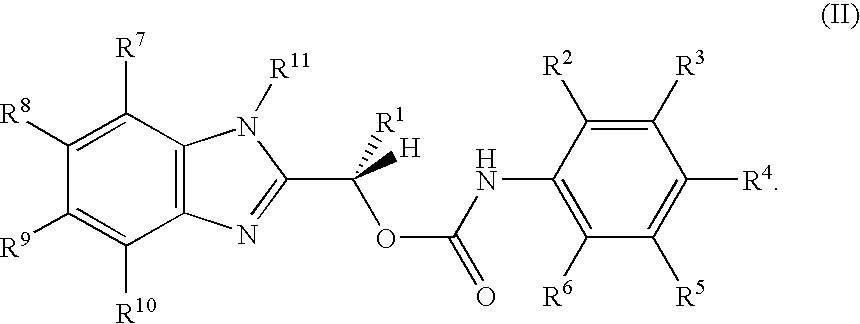
9. The compound according to claim 8 , wherein at least one of R2, R3, R4, R5 or R6 is chloro.
10. The compound according to claim 8 , wherein R3 and R4 is Cl.
11. The compound according to claim 8 , wherein R3 and R4 or R4 and R5 are chloro and the remainder of R2 to R6 are hydrogen.
12. The compound according to claim 8 wherein R1 is optionally substituted methyl.
13. The compound according to claim 12 wherein R3 and R4 or R4 and R5 are chloro and the remainder of R2 to R6 are hydrogen.
14. The compound according to claim 13 wherein R7 to R10 are selected from the group consisting of halogen, amino alkyl, and —NC(O)R12a where R12a is alkyl or R7 and R8 taken together form a cyclic moiety.
15. The compound according to claim 8 wherein R7 and R8 or R8 and R9 form a cyclic moiety.
16. A compound, according to claim 1 , that modulates the activity of the CHK1 enzyme in vivo and/or in vitro.
17. A compound that can modulate the activity of the CHK1 enzyme in vivo or in vitro, wherein the CHK1-modulating compound binds to at least one of amino acids Phe 93 and Asp 94 of the CHK1 enzyme in vivo and/or in vitro.
18. A compound according to claim 1 , that can selectively modulate the activity of the CHK1 enzyme in a patient relative to other native kinases, wherein the selectivity of the CHK1-modulating compounds for the CHK1 enzyme is at least 50 times higher than for the native kinases.
19. A compound according to claim 1 that can modulate the activity of the CHK1 enzyme in vivo or in vitro wherein the CHK1-modulating compound binds to at least one of amino acids Phe93 and Asp94 of the CHK1 enzyme in vivo or in vitro.
20. A pharmaceutical composition comprising an effective amount of a compound according to claim 1 , or a pharmaceutically acceptable prodrug, pharmaceutically active metabolite, pharmaceutically acceptable solvate or pharmaceutically acceptable salt thereof, and a pharmaceutically acceptable carrier.
21. A method for synthesizing a compound according to claim 1 , or a pharmaceutically acceptable prodrug, pharmaceutically active metabolite, pharmaceutically acceptable solvate or pharmaceutically acceptable salt thereof, which comprises contacting a compound of Formula (III):

with a compound of Formula (IV):

in an appropriate solvent system under coupling conditions, wherein R1, R2, R3, R4, R5, R6, R7, R8, R9, R10, and R11 are as defined for Formula (I).
22. A method for modulating the CHK1 enzyme comprising contacting a CHK1-modulating compound, or pharmaceutically acceptable prodrug, pharmaceutically active metabolite, or pharmaceutically acceptable salt thereof, with the CHK1 enzyme; wherein the CHK1 modulating compound is selected from the group consisting of:
(i) a compound of claim 1;
(ii) a compound that can bind to at least one of amino acids Phe 93 and Asp 94 of the CHK1 enzyme in vivo and/or in vitro; and
(iii) a compound that can bind to the CHK1 enzyme with a selectivity at least 50 times higher than to other native kinases.
23. A method for treating a patient having a disease treatable by modulating the activity of the CHK1 enzyme or by inhibiting the binding of CDC25C to the CHK1 enzyme, wherein said method comprises administering a therapeutically effective amount of a CHK1-modulating compound, or a pharmaceutically acceptable prodrug, pharmaceutically active metabolite, or pharmaceutically acceptable salt thereof; wherein the CHK1 modulating compound is selected from the group consisting of:
(i) a compound of claim 1;
(ii) a compound that can bind to at least one of amino acids Phe 93 and Asp 94 of the CHK1 enzyme in vivo and/or in vitro; and
(iii) a compound that can bind to the CHK1 enzyme with a selectivity at least 50 times higher than to other native kinases.
24. The method according to claim 23 wherein said disease is cancer.
25. A method for enhancing the effect of DNA-damaging agents in a patient comprising administering to the patient an enhancing-effective amount of a CHK1-modulating compound, or a pharmaceutically acceptable prodrug, pharmaceutically active metabolite, or pharmaceutically acceptable salt thereof; wherein the CHK1 modulating compound is selected from the group consisting of:
(i) a compound of claim 1;
(ii) a compound that can bind to at least one of amino acids Phe 93 and Asp 94 of the CHK1 enzyme in vivo and/or in vitro; and
(iii) a compound that can bind to the CHK1 enzyme with a selectivity at least 50 times higher than to other native kinases.
26. A compound selected from the group consisting of:
1-(1H-benzimidazol-2-yl)ethyl 4-bromo-3-chlorophenylcarbamate;
(1S)-1-(1H-benzimidazol-2-yl)ethyl 3,4-dichlorophenylcarbamate;
(1R)-1-(1H-benzimidazol-2-yl)ethyl 3,4-dichlorophenylcarbamate;
(1S)-1-(4-nitro-1H-benzimidazol-2-yl)ethyl 3,4-dichlorophenylcarbamate;
(1S)-1-(5,7-dibromo-1H-benzimidazol-2-yl)ethyl 3,4-dichlorophenylcarbamate;
(1S)-1-(6-benzoyl-1H-benzimidazol-2-yl)ethyl 3,4-dichlorophenylcarbamate;
(1S)-1-(6,7-dimethyl-1H-benzimidazol-2-yl)ethyl 3,4-dichlorophenylcarbamate;
(1S)-1-(6-bromo-1H-benzimidazol-2-yl)ethyl 3,4-dichlorophenylcarbamate;
(1S)-1-(4,5,6,7-tetramethyl-1H-benzimidazol-2-yl)ethyl 3,4-dichlorophenylcarbamate;
(1S)-1-(5-bromo-6,7-dimethyl-1H-benzimidazol-2-yl)ethyl 3,4-dichlorophenylcarbamate;
(1S)-1-(6-tert-butyl-1H-benzimidazol-2-yl)ethyl 3,4-dichlorophenylcarbamate;
(1S)-1-(5,6-dimethyl-1H-benzimidazol-2-yl)ethyl 3,4-dichlorophenylcarbamate;
1-(1H-benzimidazol-2-yl)ethyl 3,4-dichlorophenylcarbamate;
(1S)-1-(1H-naphtho[1,2-d]imidazol-2-yl)ethyl 3,4-dichlorophenylcarbamate;
(1R)-1-(1H-naphtho[1,2-d]imidazol-2-yl)ethyl 3,4-dichlorophenylcarbamate;
1H-naphtho[1,2-d]imidazol-2-ylmethyl 3,4-dichlorophenylcarbamate;
(1S)-1-(1H-imidazo[4,5-f]quinolin-2-yl)ethyl 3,4-dichlorophenylcarbamate;
(1S)-1-(6,7-dichloro-1H-benzimidazol-2-yl)ethyl 3,4-dichlorophenylcarbamate;
(1S)-1-(6-amino-1H-benzimidazol-2-yl)ethyl 3,4-dichlorophenylcarbamate;
(1S)-1-(2-methyl-8H-imidazo[4,5-g][1,3]benzothiazol-7-yl)ethyl 3,4-dichlorophenylcarbamate;
(1S)-1-(7-amino-6-methyl-1H-benzimidazol-2-yl)ethyl 3,4-dichlorophenylcarbamate;
(1S)-1-[6-(acetylamino)-1H-benzimidazol-2-yl]ethyl 3,4-dichlorophenylcarbamate;
(1S)-1-{5,6-bis[(dimethylamino)methyl]-1H-benzimidazol-2-yl}ethyl 3,4-dichlorophenylcarbamate;
2-hydroxy-1-(4,5,6,7-tetramethyl-1H-benzimidazol-2-yl)ethyl 3,4-dichlorophenylcarbamate; and
2-(dimethylamino)-1-(4,5,6,7-tetramethyl-1H-benzimidazol-2-yl)ethyl 3,4-dichlorophenylcarbamate;
or a pharmaceutically acceptable prodrug, pharmaceutically active metabolite, pharmaceutically acceptable solvate or pharmaceutically acceptable salt thereof.
27. A compound according to claim 1 selected from the group consisting of:

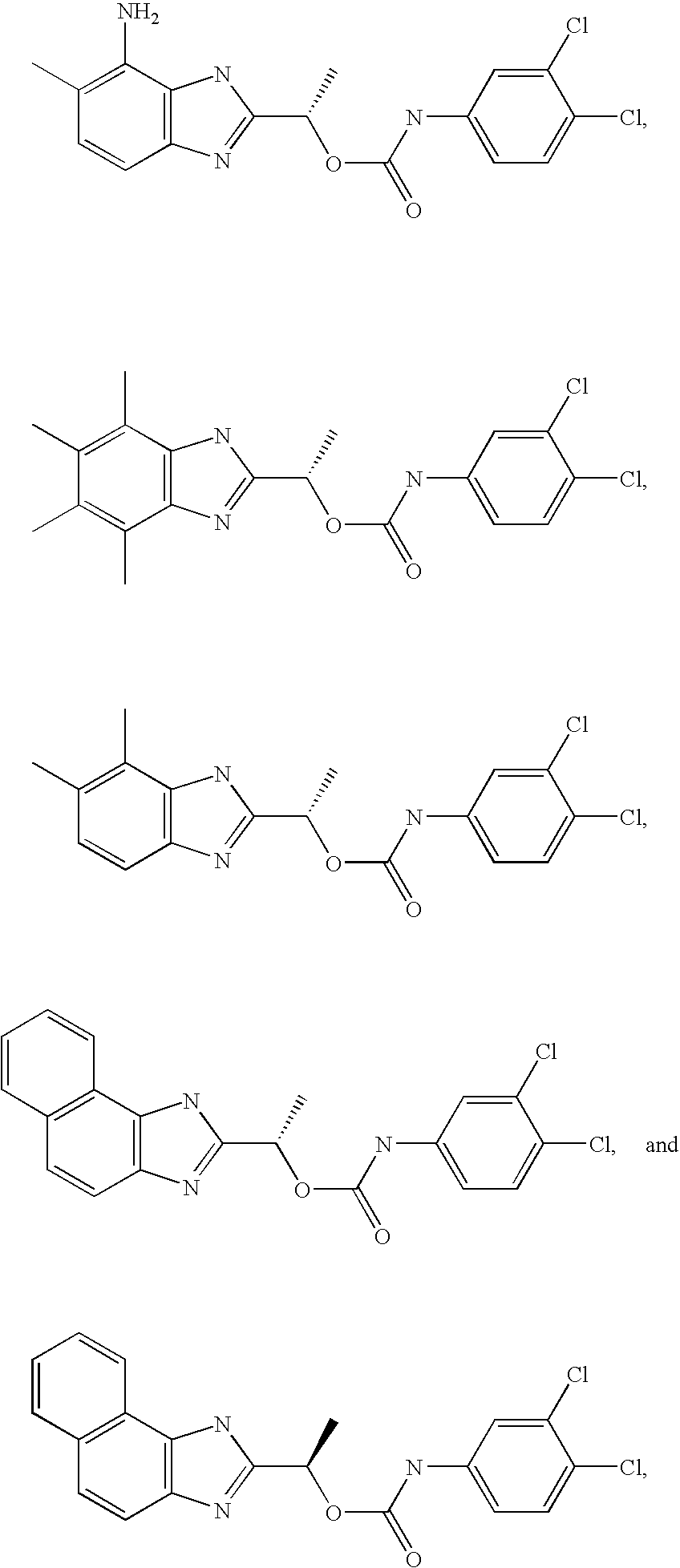
or a pharmaceutically acceptable prodrug, pharmaceutically active metabolite, pharmaceutically acceptable solvate or pharmaceutically acceptable salt thereof.
28. A method of modulating the activity of a protein kinase receptor, comprising contacting the kinase receptor with an effective amount of a compound, pharmaceutically acceptable prodrug, pharmaceutically active metabolite, pharmaceutically acceptable solvate or pharmaceutically acceptable salt as defined in claim 1 .
29. The method of claim 28 wherein the protein kinase is CHK1.
30. A pharmaceutical composition for the treatment of a hyperproliferative disorder in a mammal comprising an enhancing effective amount of a compound, prodrug, metabolite, salt or solvate of claim 1 and a pharmaceutically acceptable carrier.
31. The pharmaceutical composition of claim 30 , wherein said hyperproliferative disorder is cancer.
32. The pharmaceutical composition of claim 31 , wherein said cancer is brain, lung, kidney, renal, ovarian, ophthalmic, squamous cell, bladder, gastric, pancreatic, breast, head, neck, oesophageal, gynecological, prostate, colorectal or thyroid cancer.
33. The pharmaceutical composition of claim 30 , wherein said hyperproliferative disorder is noncancerous.
34. The pharmaceutical composition of claim 33 , wherein said hyperproliferative disorder is a benign hyperplasia of the skin or prostate.
35. A pharmaceutical composition for the treatment of a hyperproliferative disorder in a mammal comprising an enhancing effective amount of a compound, prodrug, metabolite, salt or solvate of claim 1 in combination with an anti-neoplastic agent.
36. The pharmaceutical composition of claim 35 wherein the anti-neoplastic agent is capable of damaging DNA in a malignant cell.
37. The pharmaceutical composition of claim 35 wherein the anti-neoplastic agent is selected from the group consisting of mitotic inhibitors, alkylating agents, anti-metabolites, intercalating antibiotics, enzymes, topoisomerase inhibitors, biological response modifiers, anti-hormones, and anti-androgens, and a pharmaceutically acceptable carrier.
38. A method of treating a hyperproliferative disorder in a mammal comprising administering to said mammal an enhancing effective amount of a compound, prodrug, metabolite, salt or solvate of claim 1 .
39. The method of claim 38 wherein said hyperproliferative disorder is cancer.
40. The method of claim 39 wherein said cancer is brain, lung, ophthalmic, squamous cell, renal, kidney, ovarian, bladder, gastric, pancreatic, breast, head, neck, oesophageal, prostate, colorectal, gynecological or thyroid cancer.
41. The method of claim 38 wherein said hyperproliferative disorder is noncancerous.
42. The method of claim 41 wherein said hyperproliferative disorder is a benign hyperplasia of the skin or prostate.
43. A method for the treatment of a hyperproliferative disorder in a mammal comprising administering to said mammal an enhancing effective amount of a compound, prodrug, metabolite, salt or solvate of claim 1 in combination with an anti-neoplastic agent.
44. The method of claim 43 wherein the anti-neoplastic agent is capable of damaging DNA in a malignant cell.
45. The method of claim 43 wherein the anti-neoplastic agent is selected from the group consisting of mitotic inhibitors, alkylating agents, anti-metabolites, intercalating antibiotics, growth factor inhibitors, cell cycle inhibitors, enzymes, topoisomerase inhibitors, biological response modifiers, anti-hormones, and anti-androgens.
46. A method of treating a mammalian disease condition mediated by protein kinase activity, comprising administering to a mammal in need thereof a therapeutically effective amount of a compound, pharmaceutically acceptable prodrug, pharmaceutically active metabolite, pharmaceutically acceptable solvate, or pharmaceutically acceptable salt as defined in claim 1 .
47. The method of claim 46 , wherein the mammalian disease condition is associated with tumor growth, cell proliferation, or angiogenesis.
48. A method of treating a neoplasm in a mammal in need of treatment which comprises administering to said mammal an effective amount of a compound of Formula (V):

wherein
(a) R1 is selected from the group consisting of hydrogen, —OH, —NH2, and a moiety selected from the group consisting of (C1-C6)alkyl, —N[(C1-C6)alkyl][(C1-C6)alkyl], —NH[(C1-C6)alkyl], and (C1-C6)alkoxy, which is optionally substituted with 1 to 3 independently selected Y1 groups, wherein each Y1 is independently selected from the group consisting of halogen, azido, nitro, —OH, —NH2, —N[(C1-C6)alkyl][(C1-C6)alkyl], —NH[(C1-C6)alkyl], (C3-C6)cycloalkyl, and (C1-C6)alkoxy;
(b) each of R2, R3, R4, R5, R6, R7, R8, R9 and R10 is independently selected and is selected from the group consisting of hydrogen, nitro, halogen, azido, —NR12aR12b, —NR12aSO2R12b, —NR12aC(O)R12b, —OC(O)R12b, —NR12aC(O)OR12b, —OC(O)NR12aR12b, —OR12a, —SR12a, —S(O)R12a, —SO2R12a, —SO3R12a, —SO2NR12aR12b, —COR12a, —CO2R12a, —CONR12aR12b, —(C1-C4)perfluoroalkyl, —(CR13R14)tCN, and a moiety selected from the group consisting of —(CR13R14)t-aryl, —(CR13R14)t-heterocycle, (C2-C6)alkynyl, —(CR13R14)t—(C3-C6)cycloalkyl, (C2-C6)alkenyl, and (C1-C6)alkyl, which is optionally substituted with 1 to 3 independently selected Y2 groups, where t is 0, 1, 2, or 3, and wherein when t is 2 or 3, the CR3R4 units may be the same or different; or wherein R7 and R8, or R8 and R9, taken together, and/or R2 and R3, or R3 and R4, taken together, may optionally form a cyclic moiety selected from the group consisting of aryl, (C5-C6)cycloalkyl, monocyclic heterocycle, —C(O)—O—(CR13R14)t and —O(CR13R14)O—; wherein such aryl, heterocycle, or (C3-C6)cycloalkyl is optionally substituted with 1 to 3 independently selected Y2 groups;
(c) R11 is H;
(d) R12a and R12b are independently selected from the group consisting of hydrogen and a moiety selected from the group consisting of —(CR13R14)u—(C3-C6)cycloalkyl, —(CR13R14)u-aryl, —(CR13R14)u-heterocycle, and (C1-C6)alkyl, which is optionally substituted with 1 to 3 independently selected Y3 groups, where u is 0, 1, 2, or 3, and wherein when u is 2 or 3, the CR3R4 units may be the same or different;
(e) R13 and R14 are independently selected from the group consisting of H, F, and (C1-C6)alkyl, or R13 and R14 are selected together to form a carbocycle, or two R13 groups on adjacent carbon atoms are selected together can optionally form a carbocycle; and
(f) each Y2, and Y3 is independently selected and is
(i) selected from the group consisting of halogen, cyano, nitro, tetrazolyl, guanidino, amidino, methylguanidino, azido, C(O)Z1, —CF3, —CF2CF3, —CH(CF3)2, —C(OH)(CF3)2, —OCF3, —OCF2H, —OCF2CF3, —OC(O)NH2, —OC(O)NHZ1, —OC(O)NZ1Z2, —NHC(O)Z1, —NHC(O)NH2, —NH C(O)NHZ1, —NHC(O)NZ1Z2, —C(O)OH, —C(O)OZ1, —C(O)NH2, —C(O)NHZ1, —C(O)NZ1Z2, —P(O)3H2, —P(O)3(Z1)2, —S(O)3H, —S(O)mZ1, -Z1, —OZ1, —OH, —NH2, —NHZ1, —NZ1Z2, —C(═NH)NH2, —C(═NOH)NH2, —N-morpholino, (C2-C6)alkenyl, (C2-C6)alkynyl, (C1-C6)haloalkyl, (C2-C6)haloalkenyl, (C2-C6)haloalkynyl, (C1-C6)haloalkoxy, —(CZ3Z4)rNH2, —(CZ3Z4)rNHZ1, —(CZ3Z4)rNZ1Z2, and —S(O)m(CF2)qCF3, wherein m is 0, 1 or 2, q is an integer from 0 to 5, r is an integer from 1 to 4, Z1 and Z2 are independently selected from the group consisting of alkyl of 1 to 12 carbon atoms, cycloalkyl of 3 to 8 carbon atoms, aryl of 6 to 14 carbon atoms, heteroaryl of 5 to 14 ring atoms, aralkyl of 7 to 15 carbon atoms, and heteroaralkyl of 5 to 14 ring atoms; and Z3 and Z4 are independently selected from the group consisting of hydrogen, alkyl of 1 to 12 carbon atoms, aryl of 6 to 14 carbon atoms, heteroaryl of about 5 to 14 ring atoms, aralkyl of 7 to 15 carbon atoms, and heteroaralkyl of 5 to 14 ring atoms;
(ii) any two Y2 or Y3 groups attached to adjacent carbon atoms may be selected together to be —O[C(Z3)(Z4)]rO— or —O[C(Z3)(Z4)]r+1—; or
(iii) any two Y2 or Y3 groups attached to the same or adjacent carbon atoms may be selected together to form a carbocycle or heterocycle;
and wherein any of the above-mentioned substituents comprising a CH3 (methyl), CH2 (methylene), or CH (methine) group which is not attached to a halogen, SO or SO2 group or to a N, O or S atom optionally bears on said group a substituent selected from hydroxy, halogen, (C1-C4)alkyl, (C1-C4)alkoxy and —N[(C1-C4)alkyl][(C1-C4)alkyl];
or a pharmaceutically acceptable prodrug, pharmaceutically active metabolite, pharmaceutically acceptable solvate or pharmaceutically acceptable salt thereof.
49. A method according to claim 48 where the compound is selected from the group consisting of:
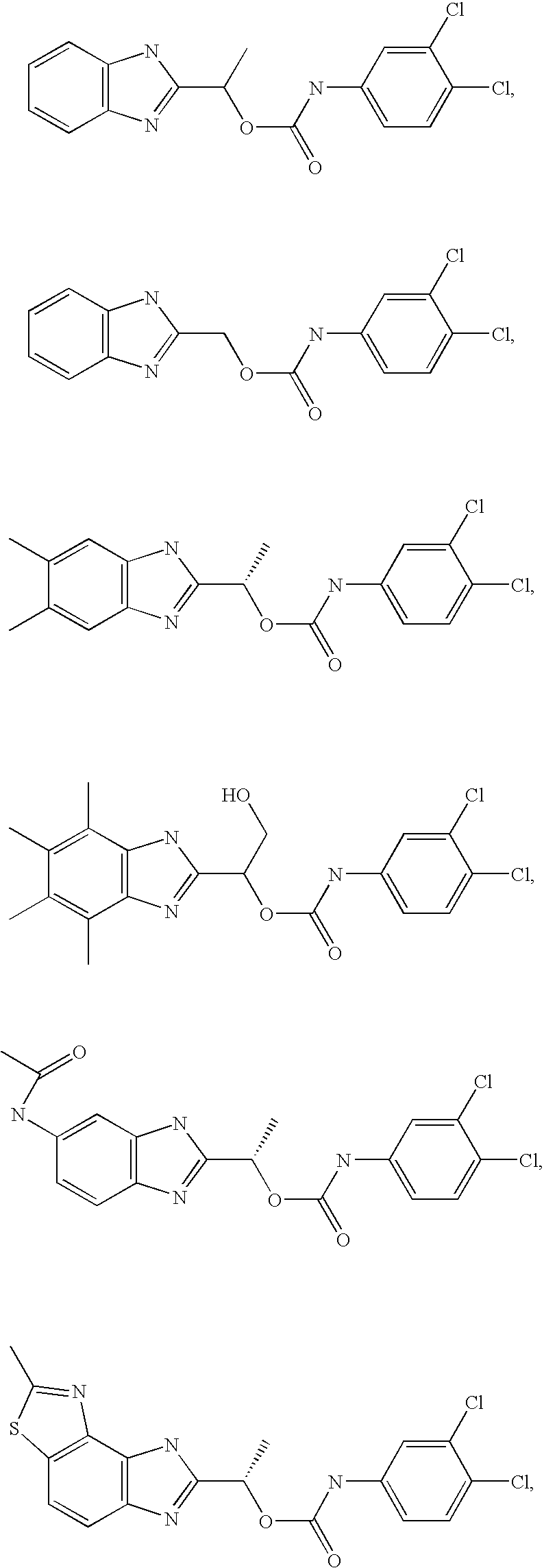
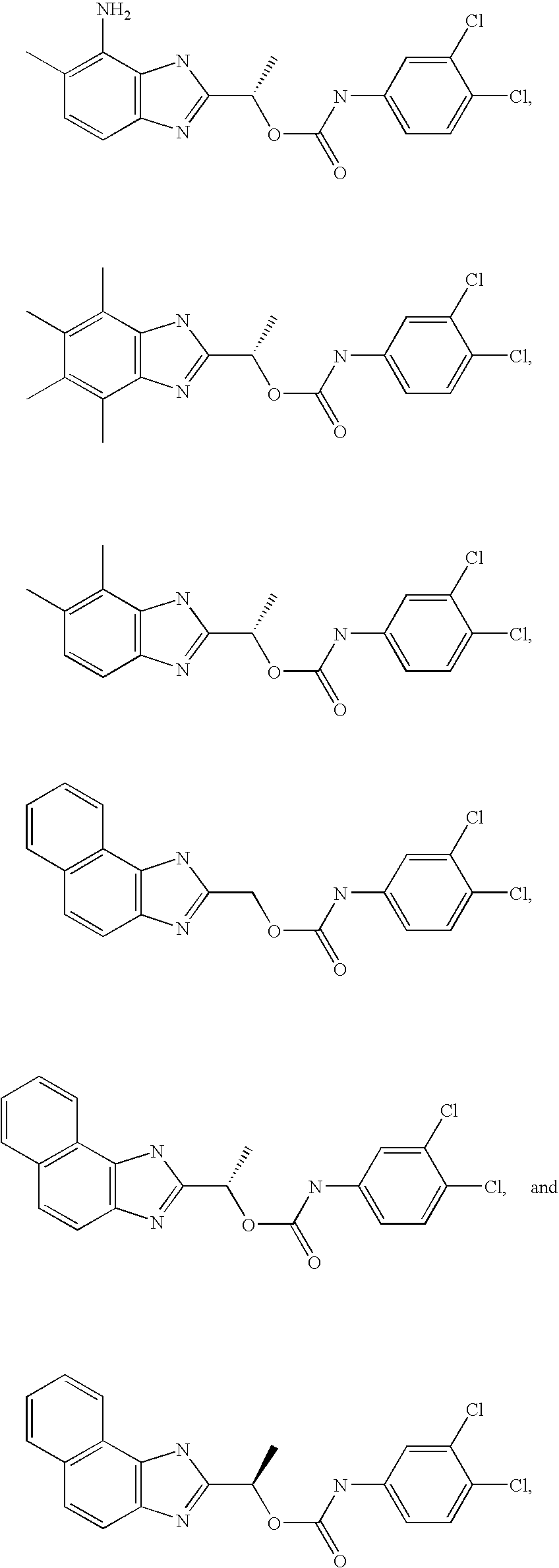
or a pharmaceutically acceptable prodrug, pharmaceutically active metabolite, pharmaceutically acceptable solvate or pharmaceutically acceptable salt thereof.
50. A method of modulating the activity of the CHK1 enzyme which comprises administering an effective amount of a compound of Formula (V):
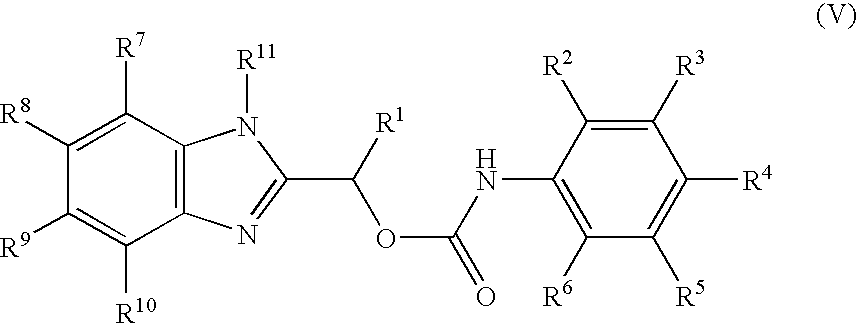
wherein
(a) R1 is selected from the group consisting of hydrogen, —OH, —NH2, and a moiety selected from the group consisting of (C1-C6)alkyl, —N[(C1-C6)alkyl][(C1-C6)alkyl], —NH[(C1-C6)alkyl], and (C1-C6)alkoxy, which is optionally substituted with 1 to 3 independently selected Y1 groups, wherein each Y1 is independently selected from the group consisting of halogen, azido, nitro, —OH, —NH2, —N[(C1-C6)alkyl][(C1-C6)alkyl], —NH[(C1-C6)alkyl], (C3-C6)cycloalkyl, and (C1-C6)alkoxy;
(b) each of R2, R3, R4, R5, R6, R7, R8, R9 and R10 is independently selected and is selected from the group consisting of hydrogen, nitro, halogen, azido, —NR12aR12b, —NR12aSO2R12b, —NR12aC(O)R12b. —OC(O)R12a, —NR12aC(O)OR12b, —OC(O)NR12aR12b, —OR12a, —SR12a, S(O)R12a, —SO2R12a, —SO3R12a—SO2NR12aR12b, —COR12a, —CO2R12a, —CONR12aR12b, —(C1-C4)perfluoroalkyl, —(CR13R14)tCN, and a moiety selected from the group consisting of —(CR13R14)t-aryl, —(CR13R14)t-heterocycle, (C2-C6)alkynyl, —(CR13R14)r—(C3-C6)cycloalkyl, (C2-C6)alkenyl, and (C1-C6)alkyl, which is optionally substituted with 1 to 3 independently selected Y2 groups, where t is 0, 1, 2, or 3, and wherein when t is 2 or 3, the CR3R4 units may be the same or different; or wherein R7 and R8, or R8 and R9, taken together, and/or R2 and R3, or R3 and R4, taken together, may optionally form a cyclic moiety selected from the group consisting of aryl, (C5-C6)cycloalkyl, monocyclic heterocycle, —C(O)—O—(CR13R14)t and —O(CR13R14)O—; wherein such aryl, heterocycle, or (C3-C6)cycloalkyl is optionally substituted with 1 to 3 independently selected Y2 groups;
(c) R11 is H;
(d) R12a and R12b are independently selected from the group consisting of hydrogen and a moiety selected from the group consisting of —(CR13R14)u—(C3-C6)cycloalkyl, —(CR13R14)u-aryl, —(CR13R14)u-heterocycle, and (C1-C6)alkyl, which is optionally substituted with 1 to 3 independently selected Y3 groups, where u is 0, 1, 2, or 3, and wherein when u is 2 or 3, the CR3R4 units may be the same or different;
(e) R13 and R14 are independently selected from the group consisting of H, F, and (C1-C6)alkyl, or R13 and R14 are selected together to form a carbocycle, or two R13 groups on adjacent carbon atoms are selected together can optionally form a carbocycle; and
(f) each Y2, and Y3 is independently selected and is
(i) selected from the group consisting of halogen, cyano, nitro, tetrazolyl, guanidino, amidino, methylguanidino, azido, C(O)Z1, —CF3, —CF2CF3, —CH(CF3)2, —C(OH)(CF3)2, —OCF3, —OCF2H, —OCF2CF3, —OC(O)NH2, —OC(O)NHZ1, —OC(O)NZ1Z2, —NHC(O)Z1, —NHC(O)NH2, —NH C(O)NHZ1, —NHC(O)NZ1Z2, —C(O)OH, —C(O)OZ1, —C(O)NH2, —C(O)NHZ1, —C(O)NZ1Z2, —P(O)3H2, —P(O)3(Z1)2, —S(O)3H, —S(O)mZ1, -Z1, —OZ1, —OH, —NH2, —NHZ1, —NZ1Z2, —C(═NH)NH2, —C(═NOH)NH2, —N-morpholino, (C2-C6)alkenyl, (C2-C6)alkynyl, (C1-C6)haloalkyl, (C2-C6)haloalkenyl, (C2-C6)haloalkynyl, (C1-C6)haloalkoxy, —(CZ3Z4)rNH2, —(CZ3Z4)rNHZ1, —(CZ3Z4)rNZ1Z2, and —S(O)m(CF2)qCF3, wherein m is 0, 1 or 2, q is an integer from 0 to 5, r is an integer from 1 to 4, Z1, and Z2 are independently selected from the group consisting of alkyl of 1 to 12 carbon atoms, cycloalkyl of 3 to 8 carbon atoms, aryl of 6 to 14 carbon atoms, heteroaryl of 5 to 14 ring atoms, aralkyl of 7 to 15 carbon atoms, and heteroaralkyl of 5 to 14 ring atoms; and Z3 and Z4 are independently selected from the group consisting of hydrogen, alkyl of 1 to 12 carbon atoms, aryl of 6 to 14 carbon atoms, heteroaryl of about 5 to 14 ring atoms, aralkyl of 7 to 15 carbon atoms, and heteroaralkyl of 5 to 14 ring atoms;
(ii) any two Y2 or Y3 groups attached to adjacent carbon atoms may be selected together to be —O[C(Z3)(Z4)]rO— or —O[C(Z3)(Z4)]r+1—; or
(iii) any two Y2 or Y3 groups attached to the same or adjacent carbon atoms may be selected together to form a carbocycle or heterocycle;
and wherein any of the above-mentioned substituents comprising a CH3 (methyl), CH2 (methylene), or CH (methine) group which is not attached to a halogen, SO or SO2 group or to a N, O or S atom optionally bears on said group a substituent selected from hydroxy, halogen, (C1-C4)alkyl, (C1-C4)alkoxy and —N[(C1-C4)alkyl][(C1-C4)alkyl];
or a pharmaceutically acceptable prodrug, pharmaceutically active metabolite, pharmaceutically acceptable solvate or pharmaceutically acceptable salt thereof.
51. A method according to claim 50 wherein said compound is selected from the group consisting of:

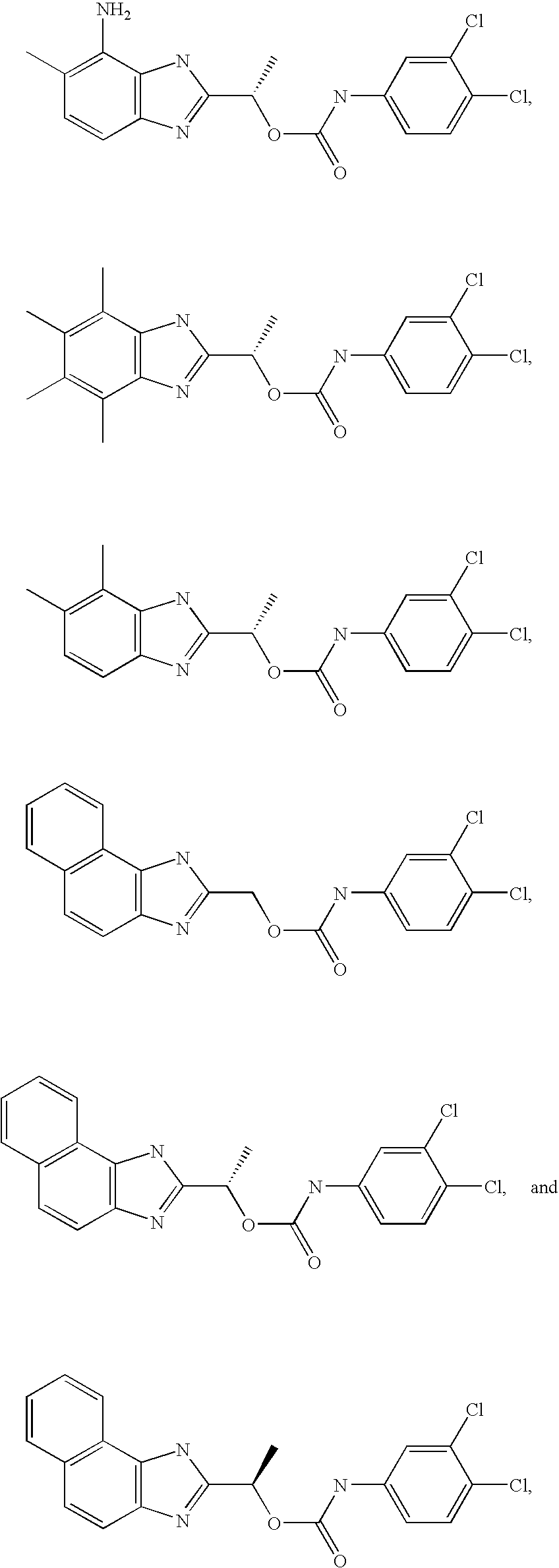
or a pharmaceutically acceptable prodrug, pharmaceutically active metabolite, pharmaceutically acceptable solvate or pharmaceutically acceptable salt thereof.
Priority Applications (1)
| Application Number | Priority Date | Filing Date | Title |
|---|---|---|---|
| US10/922,337 US20050148643A1 (en) | 2003-08-19 | 2004-08-19 | Carbamate compositions and methods fo rmodulating the activity of the CHK1 enzyme |
Applications Claiming Priority (2)
| Application Number | Priority Date | Filing Date | Title |
|---|---|---|---|
| US49665903P | 2003-08-19 | 2003-08-19 | |
| US10/922,337 US20050148643A1 (en) | 2003-08-19 | 2004-08-19 | Carbamate compositions and methods fo rmodulating the activity of the CHK1 enzyme |
Publications (1)
| Publication Number | Publication Date |
|---|---|
| US20050148643A1 true US20050148643A1 (en) | 2005-07-07 |
Family
ID=34713586
Family Applications (1)
| Application Number | Title | Priority Date | Filing Date |
|---|---|---|---|
| US10/922,337 Abandoned US20050148643A1 (en) | 2003-08-19 | 2004-08-19 | Carbamate compositions and methods fo rmodulating the activity of the CHK1 enzyme |
Country Status (1)
| Country | Link |
|---|---|
| US (1) | US20050148643A1 (en) |
Cited By (25)
| Publication number | Priority date | Publication date | Assignee | Title |
|---|---|---|---|---|
| WO2006106326A1 (en) * | 2005-04-06 | 2006-10-12 | Astrazeneca Ab | Substituted heterocycles and their use as chk1, pdk1 and pak inhibitors |
| WO2007033374A3 (en) * | 2005-09-16 | 2007-07-26 | Schering Corp | Pharmaceutical compositions and methods using temozolomide and a protein kinase inhibitor |
| WO2010036316A1 (en) * | 2008-09-24 | 2010-04-01 | Yangbo Feng | Urea and carbamate compounds and analogs as kinase inhibitors |
| US20100081643A1 (en) * | 2008-09-26 | 2010-04-01 | Bookser Brett C | Novel cyclic benzimidazole derivatives useful as anti-diabetic agents |
| WO2010047982A1 (en) | 2008-10-22 | 2010-04-29 | Merck Sharp & Dohme Corp. | Novel cyclic benzimidazole derivatives useful anti-diabetic agents |
| WO2010051206A1 (en) | 2008-10-31 | 2010-05-06 | Merck Sharp & Dohme Corp. | Novel cyclic benzimidazole derivatives useful anti-diabetic agents |
| US20110054001A1 (en) * | 2008-02-04 | 2011-03-03 | Dana-Farber Cancer Institute, Inc. | Chk1 suppresses a caspase-2 apoptotic response to dna damage that bypasses p53, bcl-2 and caspase-3 |
| WO2011106273A1 (en) | 2010-02-25 | 2011-09-01 | Merck Sharp & Dohme Corp. | Novel cyclic benzimidazole derivatives useful anti-diabetic agents |
| EP2352374A4 (en) * | 2008-10-29 | 2012-03-28 | Merck Sharp & Dohme | NOVEL ANTIDIABETIC AGENTS USEFUL WITH CYCLIC BENZIMIDAZOLE DERIVATIVES |
| WO2012116145A1 (en) | 2011-02-25 | 2012-08-30 | Merck Sharp & Dohme Corp. | Novel cyclic azabenzimidazole derivatives useful as anti-diabetic agents |
| WO2014022528A1 (en) | 2012-08-02 | 2014-02-06 | Merck Sharp & Dohme Corp. | Antidiabetic tricyclic compounds |
| WO2014031465A1 (en) | 2012-08-22 | 2014-02-27 | Merck Sharp & Dohme Corp. | Novel azabenzimidazole tetrahydropyran derivatives |
| WO2014139388A1 (en) | 2013-03-14 | 2014-09-18 | Merck Sharp & Dohme Corp. | Novel indole derivatives useful as anti-diabetic agents |
| WO2015051725A1 (en) | 2013-10-08 | 2015-04-16 | Merck Sharp & Dohme Corp. | Antidiabetic tricyclic compounds |
| WO2015095256A1 (en) | 2013-12-19 | 2015-06-25 | Merck Sharp & Dohme Corp. | Antidiabetic substituted heteroaryl compounds |
| US9200008B2 (en) | 2010-07-02 | 2015-12-01 | Aska Pharmaceutical Co., Ltd. | Heterocyclic compound and p27Kip1 degradation inhibitor |
| US9290517B2 (en) | 2012-08-22 | 2016-03-22 | Merck Sharp & Dohme Corp. | Azabenzimidazole hexahydrofuro[3,2-b]furan derivatives |
| US9527839B2 (en) | 2012-08-22 | 2016-12-27 | Merck Sharp & Dohme Corp. | Benzimidazole tetrahydropyran derivatives |
| US9540364B2 (en) | 2012-08-22 | 2017-01-10 | Merck Sharp & Dohme Corp. | Benzimidazole tetrahydrofuran derivatives |
| US9556193B2 (en) | 2012-08-22 | 2017-01-31 | Merck Shapr & Dohme Corp. | Benzimidazole hexahydrofuro[3,2-b]furan derivatives |
| WO2017132928A1 (en) | 2016-02-04 | 2017-08-10 | Pharmaengine, Inc. | 3,5-disubstituted pyrazoles useful as checkpoint kinase 1 (chk1) inhibitors, and their preparations and applications |
| US9868733B2 (en) | 2012-08-22 | 2018-01-16 | Merck Sharp & Dohme Corp. | Azabenzimidazole tetrahydrofuran derivatives |
| US9974774B2 (en) | 2013-07-26 | 2018-05-22 | Race Oncology Ltd. | Combinatorial methods to improve the therapeutic benefit of bisantrene and analogs and derivatives thereof |
| US10072296B2 (en) * | 2016-09-19 | 2018-09-11 | The Charlotte Mecklenburg Hospital Authority | Compositions and methods for sjögren's syndrome |
| US10519115B2 (en) | 2013-11-15 | 2019-12-31 | Merck Sharp & Dohme Corp. | Antidiabetic tricyclic compounds |
Citations (2)
| Publication number | Priority date | Publication date | Assignee | Title |
|---|---|---|---|---|
| US4191574A (en) * | 1975-02-21 | 1980-03-04 | Konishiroku Photo Industry Co., Ltd. | Process for forming a photographic magenta dye image |
| US4357351A (en) * | 1979-03-19 | 1982-11-02 | Stauffer Chemical Company | Lepidoptericidal isothiourea compounds |
-
2004
- 2004-08-19 US US10/922,337 patent/US20050148643A1/en not_active Abandoned
Patent Citations (2)
| Publication number | Priority date | Publication date | Assignee | Title |
|---|---|---|---|---|
| US4191574A (en) * | 1975-02-21 | 1980-03-04 | Konishiroku Photo Industry Co., Ltd. | Process for forming a photographic magenta dye image |
| US4357351A (en) * | 1979-03-19 | 1982-11-02 | Stauffer Chemical Company | Lepidoptericidal isothiourea compounds |
Cited By (45)
| Publication number | Priority date | Publication date | Assignee | Title |
|---|---|---|---|---|
| WO2006106326A1 (en) * | 2005-04-06 | 2006-10-12 | Astrazeneca Ab | Substituted heterocycles and their use as chk1, pdk1 and pak inhibitors |
| WO2007033374A3 (en) * | 2005-09-16 | 2007-07-26 | Schering Corp | Pharmaceutical compositions and methods using temozolomide and a protein kinase inhibitor |
| US20110054001A1 (en) * | 2008-02-04 | 2011-03-03 | Dana-Farber Cancer Institute, Inc. | Chk1 suppresses a caspase-2 apoptotic response to dna damage that bypasses p53, bcl-2 and caspase-3 |
| US9000027B2 (en) | 2008-02-04 | 2015-04-07 | Dana-Farber Cancer Institute, Inc. | Chk1 suppresses a caspase-2 apoptotic response to DNA damage that bypasses p53, bcl-2 and caspase-3 |
| WO2010036316A1 (en) * | 2008-09-24 | 2010-04-01 | Yangbo Feng | Urea and carbamate compounds and analogs as kinase inhibitors |
| US20100081643A1 (en) * | 2008-09-26 | 2010-04-01 | Bookser Brett C | Novel cyclic benzimidazole derivatives useful as anti-diabetic agents |
| US8394969B2 (en) | 2008-09-26 | 2013-03-12 | Merck Sharp & Dohme Corp. | Cyclic benzimidazole derivatives useful as anti-diabetic agents |
| WO2010047982A1 (en) | 2008-10-22 | 2010-04-29 | Merck Sharp & Dohme Corp. | Novel cyclic benzimidazole derivatives useful anti-diabetic agents |
| US8410284B2 (en) | 2008-10-22 | 2013-04-02 | Merck Sharp & Dohme Corp | Cyclic benzimidazole derivatives useful as anti-diabetic agents |
| EP2352374A4 (en) * | 2008-10-29 | 2012-03-28 | Merck Sharp & Dohme | NOVEL ANTIDIABETIC AGENTS USEFUL WITH CYCLIC BENZIMIDAZOLE DERIVATIVES |
| WO2010051206A1 (en) | 2008-10-31 | 2010-05-06 | Merck Sharp & Dohme Corp. | Novel cyclic benzimidazole derivatives useful anti-diabetic agents |
| US20110218174A1 (en) * | 2008-10-31 | 2011-09-08 | Merck Sharp & Dohme Corp. | Novel cyclic benzimidazole derivatives useful as anti-diabetic agents |
| US8329914B2 (en) | 2008-10-31 | 2012-12-11 | Merck Sharp & Dohme Corp | Cyclic benzimidazole derivatives useful as anti-diabetic agents |
| WO2011106273A1 (en) | 2010-02-25 | 2011-09-01 | Merck Sharp & Dohme Corp. | Novel cyclic benzimidazole derivatives useful anti-diabetic agents |
| US8895596B2 (en) | 2010-02-25 | 2014-11-25 | Merck Sharp & Dohme Corp | Cyclic benzimidazole derivatives useful as anti-diabetic agents |
| US9200008B2 (en) | 2010-07-02 | 2015-12-01 | Aska Pharmaceutical Co., Ltd. | Heterocyclic compound and p27Kip1 degradation inhibitor |
| EP2594555B1 (en) * | 2010-07-02 | 2018-03-07 | ASKA Pharmaceutical Co., Ltd. | HETEROCYCLIC COMPOUND, AND p27 KIP1 DEGRADATION INHIBITOR |
| US8796258B2 (en) | 2011-02-25 | 2014-08-05 | Merck Sharp & Dohme Corp. | Cyclic azabenzimidazole derivatives useful as anti-diabetic agents |
| WO2012116145A1 (en) | 2011-02-25 | 2012-08-30 | Merck Sharp & Dohme Corp. | Novel cyclic azabenzimidazole derivatives useful as anti-diabetic agents |
| EP3243385A1 (en) | 2011-02-25 | 2017-11-15 | Merck Sharp & Dohme Corp. | Novel cyclic azabenzimidazole derivatives useful as anti-diabetic agents |
| WO2014022528A1 (en) | 2012-08-02 | 2014-02-06 | Merck Sharp & Dohme Corp. | Antidiabetic tricyclic compounds |
| US9527875B2 (en) | 2012-08-02 | 2016-12-27 | Merck Sharp & Dohme Corp. | Antidiabetic tricyclic compounds |
| WO2014031465A1 (en) | 2012-08-22 | 2014-02-27 | Merck Sharp & Dohme Corp. | Novel azabenzimidazole tetrahydropyran derivatives |
| US9290517B2 (en) | 2012-08-22 | 2016-03-22 | Merck Sharp & Dohme Corp. | Azabenzimidazole hexahydrofuro[3,2-b]furan derivatives |
| US9382243B2 (en) | 2012-08-22 | 2016-07-05 | Merck Sharp & Dohme Corp. | Azabenzimidazole tetrahydropyran derivatives |
| US9527839B2 (en) | 2012-08-22 | 2016-12-27 | Merck Sharp & Dohme Corp. | Benzimidazole tetrahydropyran derivatives |
| US9540364B2 (en) | 2012-08-22 | 2017-01-10 | Merck Sharp & Dohme Corp. | Benzimidazole tetrahydrofuran derivatives |
| US9556193B2 (en) | 2012-08-22 | 2017-01-31 | Merck Shapr & Dohme Corp. | Benzimidazole hexahydrofuro[3,2-b]furan derivatives |
| US9868733B2 (en) | 2012-08-22 | 2018-01-16 | Merck Sharp & Dohme Corp. | Azabenzimidazole tetrahydrofuran derivatives |
| WO2014139388A1 (en) | 2013-03-14 | 2014-09-18 | Merck Sharp & Dohme Corp. | Novel indole derivatives useful as anti-diabetic agents |
| US9650375B2 (en) | 2013-03-14 | 2017-05-16 | Merck Sharp & Dohme Corp. | Indole derivatives useful as anti-diabetic agents |
| US9993460B2 (en) | 2013-07-26 | 2018-06-12 | Race Oncology Ltd. | Compositions to improve the therapeutic benefit of bisantrene and analogs and derivatives thereof |
| US10500192B2 (en) | 2013-07-26 | 2019-12-10 | Race Oncology Ltd. | Combinatorial methods to improve the therapeutic benefit of bisantrene and analogs and derivatives thereof |
| US11147800B2 (en) | 2013-07-26 | 2021-10-19 | Race Oncology Ltd. | Combinatorial methods to improve the therapeutic benefit of bisantrene and analogs and derivatives thereof |
| US11135201B2 (en) | 2013-07-26 | 2021-10-05 | Race Oncology Ltd. | Compositions to improve the therapeutic benefit of bisantrene and analogs and derivatives thereof |
| US10548876B2 (en) | 2013-07-26 | 2020-02-04 | Race Oncology Ltd. | Compositions to improve the therapeutic benefit of bisantrene and analogs and derivatives thereof |
| US9974774B2 (en) | 2013-07-26 | 2018-05-22 | Race Oncology Ltd. | Combinatorial methods to improve the therapeutic benefit of bisantrene and analogs and derivatives thereof |
| US9932311B2 (en) | 2013-10-08 | 2018-04-03 | Merck Sharp & Dohme Corp. | Antidiabetic tricyclic compounds |
| WO2015051725A1 (en) | 2013-10-08 | 2015-04-16 | Merck Sharp & Dohme Corp. | Antidiabetic tricyclic compounds |
| US10519115B2 (en) | 2013-11-15 | 2019-12-31 | Merck Sharp & Dohme Corp. | Antidiabetic tricyclic compounds |
| US9834563B2 (en) | 2013-12-19 | 2017-12-05 | Merck Sharp & Dohme Corp. | Antidiabetic substituted heteroaryl compounds |
| WO2015095256A1 (en) | 2013-12-19 | 2015-06-25 | Merck Sharp & Dohme Corp. | Antidiabetic substituted heteroaryl compounds |
| EP3974413A1 (en) | 2013-12-19 | 2022-03-30 | Merck Sharp & Dohme Corp. | Antidiabetic substituted heteroaryl compounds |
| WO2017132928A1 (en) | 2016-02-04 | 2017-08-10 | Pharmaengine, Inc. | 3,5-disubstituted pyrazoles useful as checkpoint kinase 1 (chk1) inhibitors, and their preparations and applications |
| US10072296B2 (en) * | 2016-09-19 | 2018-09-11 | The Charlotte Mecklenburg Hospital Authority | Compositions and methods for sjögren's syndrome |
Similar Documents
| Publication | Publication Date | Title |
|---|---|---|
| US20050148643A1 (en) | Carbamate compositions and methods fo rmodulating the activity of the CHK1 enzyme | |
| US20050043381A1 (en) | Aminopyrazole compounds | |
| AU2002363174B2 (en) | Amide derivatives as glycogen synthase kinase 3-beta inhibitors | |
| DE69836332T2 (en) | BENZYLIDEN-1,3-DIHYDRO-INDOL-2-ON DERIVATIVES AS INHIBITORS OF RECEPTOR TYROSINE KINASEN, ESPECIALLY BY RAF KINASEN | |
| EP4011882B1 (en) | 4-substituted aminoisoquinoline derivatives | |
| JP5501353B2 (en) | Substituted pyrimidone derivatives | |
| US20240368184A1 (en) | PIKfyve Inhibitors | |
| NZ531853A (en) | Heteroaryl amines as glycogen synthase kinase 3beta inhibitors (gsk3 inhibitors) | |
| IL186270A (en) | Compositions comprising alkynyl pyrrolopyrimidines and uses thereof for preparing medicaments | |
| JP2008519083A (en) | Aminoquinazoline compounds | |
| HUP0402245A2 (en) | Pyrimidinyl-aminobenzamide derivatives as glycogen synthase kinase 3betha inhibitors, their use, pharmaceutical compositions containing them and process for producing them | |
| US6869956B2 (en) | Methods of treating inflammatory and immune diseases using inhibitors of IκB kinase (IKK) | |
| AU2005270102A1 (en) | Compounds useful for inhibiting Chk1 | |
| JP7201992B2 (en) | Quinoline analogues as phosphatidylinositol 3-kinase inhibitors | |
| TW200906803A (en) | Heteroarylamide pyrimidone derivatives | |
| JP2004529088A (en) | Methods for treating inflammatory and immune diseases using inhibitors of IkB kinase (IKK) | |
| EP2552915B1 (en) | Compounds for the treatment of hiv | |
| US12398129B2 (en) | Imidazolone derivatives as inhibitors of protein kinases in particular DYRK1A, CLK1 and/or CLK4 | |
| WO2020046975A1 (en) | Methods of treating neurodegenerative diseases | |
| EP3904354A1 (en) | New imidazolone derivatives as inhibitors of protein kinases in particular dyrk1a, clk1 and/or clk4 | |
| WO2023066359A1 (en) | Compounds and compositions for treating conditions associated with lpa receptor activity | |
| AU2005267185A1 (en) | Bisarylurea derivatives useful for inhibiting CHK1 | |
| KR20010041765A (en) | IgE ANTIBODY PRODUCTION INHIBITORS AND AUTOIMMUNE DISEASES INHIBITORS | |
| US11999720B2 (en) | Pyrazolylacylpyrazoline compounds and method for treating pain | |
| EP0497609B1 (en) | Pyrimido-benzothiazine derivatives for the treatment of inflammation, allergy and cardiovascular disease |
Legal Events
| Date | Code | Title | Description |
|---|---|---|---|
| AS | Assignment |
Owner name: AGOURON PHARMACEUTICALS, INC., CALIFORNIA Free format text: ASSIGNMENT OF ASSIGNORS INTEREST;ASSIGNORS:RUI, EUGENE YUANJIN;JOHNSON, THEODORE OTTO, JR.;KELLUM, JACK HAROLD;REEL/FRAME:015743/0246;SIGNING DATES FROM 20040818 TO 20040819 |
|
| STCB | Information on status: application discontinuation |
Free format text: ABANDONED -- FAILURE TO RESPOND TO AN OFFICE ACTION |