DE60113865T2 - PIPERAZINE DERIVATIVES - Google Patents
PIPERAZINE DERIVATIVES Download PDFInfo
- Publication number
- DE60113865T2 DE60113865T2 DE60113865T DE60113865T DE60113865T2 DE 60113865 T2 DE60113865 T2 DE 60113865T2 DE 60113865 T DE60113865 T DE 60113865T DE 60113865 T DE60113865 T DE 60113865T DE 60113865 T2 DE60113865 T2 DE 60113865T2
- Authority
- DE
- Germany
- Prior art keywords
- indole
- methyl
- hexahydropyrazino
- compound
- formula
- Prior art date
- Legal status (The legal status is an assumption and is not a legal conclusion. Google has not performed a legal analysis and makes no representation as to the accuracy of the status listed.)
- Expired - Fee Related
Links
- 0 *c1c(C(OI*)=O)[n]c2c1c(*)c(*)c(*)c2* Chemical compound *c1c(C(OI*)=O)[n]c2c1c(*)c(*)c(*)c2* 0.000 description 7
- BGTZPXSIHOKXPJ-UHFFFAOYSA-N CC(C)(C)OC(N(CCO1)S1=O)=O Chemical compound CC(C)(C)OC(N(CCO1)S1=O)=O BGTZPXSIHOKXPJ-UHFFFAOYSA-N 0.000 description 1
Classifications
-
- C—CHEMISTRY; METALLURGY
- C07—ORGANIC CHEMISTRY
- C07D—HETEROCYCLIC COMPOUNDS
- C07D487/00—Heterocyclic compounds containing nitrogen atoms as the only ring hetero atoms in the condensed system, not provided for by groups C07D451/00 - C07D477/00
- C07D487/02—Heterocyclic compounds containing nitrogen atoms as the only ring hetero atoms in the condensed system, not provided for by groups C07D451/00 - C07D477/00 in which the condensed system contains two hetero rings
- C07D487/04—Ortho-condensed systems
-
- A—HUMAN NECESSITIES
- A61—MEDICAL OR VETERINARY SCIENCE; HYGIENE
- A61P—SPECIFIC THERAPEUTIC ACTIVITY OF CHEMICAL COMPOUNDS OR MEDICINAL PREPARATIONS
- A61P1/00—Drugs for disorders of the alimentary tract or the digestive system
-
- A—HUMAN NECESSITIES
- A61—MEDICAL OR VETERINARY SCIENCE; HYGIENE
- A61P—SPECIFIC THERAPEUTIC ACTIVITY OF CHEMICAL COMPOUNDS OR MEDICINAL PREPARATIONS
- A61P11/00—Drugs for disorders of the respiratory system
-
- A—HUMAN NECESSITIES
- A61—MEDICAL OR VETERINARY SCIENCE; HYGIENE
- A61P—SPECIFIC THERAPEUTIC ACTIVITY OF CHEMICAL COMPOUNDS OR MEDICINAL PREPARATIONS
- A61P13/00—Drugs for disorders of the urinary system
-
- A—HUMAN NECESSITIES
- A61—MEDICAL OR VETERINARY SCIENCE; HYGIENE
- A61P—SPECIFIC THERAPEUTIC ACTIVITY OF CHEMICAL COMPOUNDS OR MEDICINAL PREPARATIONS
- A61P15/00—Drugs for genital or sexual disorders; Contraceptives
-
- A—HUMAN NECESSITIES
- A61—MEDICAL OR VETERINARY SCIENCE; HYGIENE
- A61P—SPECIFIC THERAPEUTIC ACTIVITY OF CHEMICAL COMPOUNDS OR MEDICINAL PREPARATIONS
- A61P25/00—Drugs for disorders of the nervous system
-
- A—HUMAN NECESSITIES
- A61—MEDICAL OR VETERINARY SCIENCE; HYGIENE
- A61P—SPECIFIC THERAPEUTIC ACTIVITY OF CHEMICAL COMPOUNDS OR MEDICINAL PREPARATIONS
- A61P25/00—Drugs for disorders of the nervous system
- A61P25/06—Antimigraine agents
-
- A—HUMAN NECESSITIES
- A61—MEDICAL OR VETERINARY SCIENCE; HYGIENE
- A61P—SPECIFIC THERAPEUTIC ACTIVITY OF CHEMICAL COMPOUNDS OR MEDICINAL PREPARATIONS
- A61P25/00—Drugs for disorders of the nervous system
- A61P25/08—Antiepileptics; Anticonvulsants
-
- A—HUMAN NECESSITIES
- A61—MEDICAL OR VETERINARY SCIENCE; HYGIENE
- A61P—SPECIFIC THERAPEUTIC ACTIVITY OF CHEMICAL COMPOUNDS OR MEDICINAL PREPARATIONS
- A61P25/00—Drugs for disorders of the nervous system
- A61P25/18—Antipsychotics, i.e. neuroleptics; Drugs for mania or schizophrenia
-
- A—HUMAN NECESSITIES
- A61—MEDICAL OR VETERINARY SCIENCE; HYGIENE
- A61P—SPECIFIC THERAPEUTIC ACTIVITY OF CHEMICAL COMPOUNDS OR MEDICINAL PREPARATIONS
- A61P25/00—Drugs for disorders of the nervous system
- A61P25/20—Hypnotics; Sedatives
-
- A—HUMAN NECESSITIES
- A61—MEDICAL OR VETERINARY SCIENCE; HYGIENE
- A61P—SPECIFIC THERAPEUTIC ACTIVITY OF CHEMICAL COMPOUNDS OR MEDICINAL PREPARATIONS
- A61P25/00—Drugs for disorders of the nervous system
- A61P25/22—Anxiolytics
-
- A—HUMAN NECESSITIES
- A61—MEDICAL OR VETERINARY SCIENCE; HYGIENE
- A61P—SPECIFIC THERAPEUTIC ACTIVITY OF CHEMICAL COMPOUNDS OR MEDICINAL PREPARATIONS
- A61P25/00—Drugs for disorders of the nervous system
- A61P25/24—Antidepressants
-
- A—HUMAN NECESSITIES
- A61—MEDICAL OR VETERINARY SCIENCE; HYGIENE
- A61P—SPECIFIC THERAPEUTIC ACTIVITY OF CHEMICAL COMPOUNDS OR MEDICINAL PREPARATIONS
- A61P25/00—Drugs for disorders of the nervous system
- A61P25/28—Drugs for disorders of the nervous system for treating neurodegenerative disorders of the central nervous system, e.g. nootropic agents, cognition enhancers, drugs for treating Alzheimer's disease or other forms of dementia
-
- A—HUMAN NECESSITIES
- A61—MEDICAL OR VETERINARY SCIENCE; HYGIENE
- A61P—SPECIFIC THERAPEUTIC ACTIVITY OF CHEMICAL COMPOUNDS OR MEDICINAL PREPARATIONS
- A61P25/00—Drugs for disorders of the nervous system
- A61P25/30—Drugs for disorders of the nervous system for treating abuse or dependence
-
- A—HUMAN NECESSITIES
- A61—MEDICAL OR VETERINARY SCIENCE; HYGIENE
- A61P—SPECIFIC THERAPEUTIC ACTIVITY OF CHEMICAL COMPOUNDS OR MEDICINAL PREPARATIONS
- A61P25/00—Drugs for disorders of the nervous system
- A61P25/30—Drugs for disorders of the nervous system for treating abuse or dependence
- A61P25/32—Alcohol-abuse
-
- A—HUMAN NECESSITIES
- A61—MEDICAL OR VETERINARY SCIENCE; HYGIENE
- A61P—SPECIFIC THERAPEUTIC ACTIVITY OF CHEMICAL COMPOUNDS OR MEDICINAL PREPARATIONS
- A61P3/00—Drugs for disorders of the metabolism
- A61P3/04—Anorexiants; Antiobesity agents
-
- A—HUMAN NECESSITIES
- A61—MEDICAL OR VETERINARY SCIENCE; HYGIENE
- A61P—SPECIFIC THERAPEUTIC ACTIVITY OF CHEMICAL COMPOUNDS OR MEDICINAL PREPARATIONS
- A61P3/00—Drugs for disorders of the metabolism
- A61P3/08—Drugs for disorders of the metabolism for glucose homeostasis
- A61P3/10—Drugs for disorders of the metabolism for glucose homeostasis for hyperglycaemia, e.g. antidiabetics
-
- A—HUMAN NECESSITIES
- A61—MEDICAL OR VETERINARY SCIENCE; HYGIENE
- A61P—SPECIFIC THERAPEUTIC ACTIVITY OF CHEMICAL COMPOUNDS OR MEDICINAL PREPARATIONS
- A61P7/00—Drugs for disorders of the blood or the extracellular fluid
- A61P7/02—Antithrombotic agents; Anticoagulants; Platelet aggregation inhibitors
-
- A—HUMAN NECESSITIES
- A61—MEDICAL OR VETERINARY SCIENCE; HYGIENE
- A61P—SPECIFIC THERAPEUTIC ACTIVITY OF CHEMICAL COMPOUNDS OR MEDICINAL PREPARATIONS
- A61P9/00—Drugs for disorders of the cardiovascular system
Landscapes
- Health & Medical Sciences (AREA)
- Chemical & Material Sciences (AREA)
- Organic Chemistry (AREA)
- Engineering & Computer Science (AREA)
- Bioinformatics & Cheminformatics (AREA)
- Veterinary Medicine (AREA)
- Animal Behavior & Ethology (AREA)
- Public Health (AREA)
- Chemical Kinetics & Catalysis (AREA)
- General Chemical & Material Sciences (AREA)
- Medicinal Chemistry (AREA)
- Nuclear Medicine, Radiotherapy & Molecular Imaging (AREA)
- General Health & Medical Sciences (AREA)
- Pharmacology & Pharmacy (AREA)
- Life Sciences & Earth Sciences (AREA)
- Biomedical Technology (AREA)
- Neurosurgery (AREA)
- Neurology (AREA)
- Diabetes (AREA)
- Psychiatry (AREA)
- Pain & Pain Management (AREA)
- Hematology (AREA)
- Addiction (AREA)
- Obesity (AREA)
- Endocrinology (AREA)
- Emergency Medicine (AREA)
- Hospice & Palliative Care (AREA)
- Child & Adolescent Psychology (AREA)
- Anesthesiology (AREA)
- Heart & Thoracic Surgery (AREA)
- Cardiology (AREA)
- Urology & Nephrology (AREA)
- Reproductive Health (AREA)
- Pulmonology (AREA)
- Pharmaceuticals Containing Other Organic And Inorganic Compounds (AREA)
- Medicines That Contain Protein Lipid Enzymes And Other Medicines (AREA)
- Nitrogen Condensed Heterocyclic Rings (AREA)
- Acyclic And Carbocyclic Compounds In Medicinal Compositions (AREA)
Description
Die vorliegende Erfindung betrifft neue Piperazinderivate, Verfahren und Zwischenprodukte für ihre Herstellung, Arzneimittel, die sie enthalten und ihre medizinische Verwendung. Die Wirkstoffe der vorliegenden Erfindung sind bei der Behandlung von Fettleibigkeit und anderen Störungen verwendbar.The The present invention relates to novel piperazine derivatives, processes and intermediates for their manufacture, medicines containing them and their medical Use. The active ingredients of the present invention are in the Treatment of obesity and other disorders usable.
Die
Erfindung betrifft insbesondere Verbindungen der Formel I und deren
pharmazeutisch verwendbaren Salze, Solvate und Ester 
R1,
R2, R3 und R4 unabhängig
voneinander ausgewählt
sind aus Wasserstoff, Halogen, Hydroxy, Alkyl, Cycloalkyl, Aralkyl,
Aryl, Alkoxy, Alkoxyalkyl, Hydroxyalkyl, Alkoxyalkoxyalkyl, Hydroxyalkoxyalkyl,
Haloalkyl, Haloalkoxy, Aryloxy, Alkylcarbonyl, Arylcarbonyl, Alkylthio,
Arylthio, Alkylsulfoxyl, Arylsulfoxyl, Alkylsulfonyl, Arylsulfonyl,
Amino, Nitro, Cyano, Alkoxycarbonyl, Aryloxycarbonyl, Alkylaminocarbonyl,
Dialkylaminocarbonyl, Alkylcarbonylamino, Carboxy, Heterocyclyl
oder R3 und R4 bilden
zusammen mit den Kohlenstoffatomen an die sie gebunden sind einen
5- bis 7-gliedrigen carbocyclischen Ring, der gegebenenfalls mit
Alkyl substituiert ist;
R5 Wasserstoff,
Alkyl oder Cycloalkyl ist;
R6 Wasserstoff,
Alkyl, Cycloalkyl, Hydroxyalkyl, Carbamoylalkyl, Alkoxycarbonylalkyl,
Aryloxycarbonylalkyl oder -(CH2)n-A ist;
R7 Wasserstoff,
Alkyl, Cycloalkyl, Hydroxyalkyl oder Alkoxyalkyl ist, wobei R7 kein Wasserstoff ist, wenn R6 Wasserstoff
Alkyl, Cycloalkyl oder 1H-Pyrrolo(2,3-b)pyridin-3-ylmethyl ist;
R8 Wasserstoff, Alkyl oder Cycloalkyl ist;
A
Heterocyclyl, Cycloalkanonyl oder Cycloalkyl, substituiert mit Hydroxy,
Carboxy, Alkyloxycarbonyl, Aryloxycarbonyl oder Carbamoyl, ist;
und
n 0, 1, 2 oder 3 ist.More particularly, the invention relates to compounds of formula I and their pharmaceutically acceptable salts, solvates and esters
R 1 , R 2 , R 3 and R 4 are independently selected from hydrogen, halogen, hydroxy, alkyl, cycloalkyl, aralkyl, aryl, alkoxy, alkoxyalkyl, hydroxyalkyl, alkoxyalkoxyalkyl, hydroxyalkoxyalkyl, haloalkyl, haloalkoxy, aryloxy, alkylcarbonyl, arylcarbonyl, Alkylthio, arylthio, alkylsulfoxyl, arylsulfoxyl, alkylsulfonyl, arylsulfonyl, amino, nitro, cyano, alkoxycarbonyl, aryloxycarbonyl, alkylaminocarbonyl, dialkylaminocarbonyl, alkylcarbonylamino, carboxy, heterocyclyl or R 3 and R 4 together with the carbon atoms to which they are attached form a to 7-membered carbocyclic ring optionally substituted with alkyl;
R 5 is hydrogen, alkyl or cycloalkyl;
R 6 is hydrogen, alkyl, cycloalkyl, hydroxyalkyl, carbamoylalkyl, alkoxycarbonylalkyl, aryloxycarbonylalkyl or - (CH 2 ) n -A;
R 7 is hydrogen, alkyl, cycloalkyl, hydroxyalkyl or alkoxyalkyl, wherein R 7 is not hydrogen when R 6 is hydrogen, alkyl, cycloalkyl or 1H-pyrrolo (2,3-b) pyridin-3-ylmethyl;
R 8 is hydrogen, alkyl or cycloalkyl;
A is heterocyclyl, cycloalkanonyl or cycloalkyl substituted with hydroxy, carboxy, alkyloxycarbonyl, aryloxycarbonyl or carbamoyl; and
n is 0, 1, 2 or 3.
Es ist festgestellt worden, dass Fettleibigkeit ein Krankheitsprozeß ist, der durch Umgebungsfaktoren beeinflußt wird, bei denen die traditionellen Gewichtsabnahmemethoden der Diät und Training der Ergänzung durch therapeutische Produkte bedürfen (S. Parker, „Obesity: Trends and Treatments", Scrip Reports, PJB Publications Ltd., 1996).It It has been found that obesity is a disease process that affected by environmental factors where the traditional Diet weight loss methods and training the supplement through require therapeutic products (S. Parker, "Obesity: Trends and Treatments ", Scrip Reports, PJB Publications Ltd., 1996).
Pyrazino(aza)indolderivate als 5-HT2 Rezeptorliganden sind in WO 00144753 erwähnt.Pyrazino (aza) indole derivatives as 5-HT2 receptor ligands are mentioned in WO 00144753.
Ob jemand als übergewichtig oder fettleibig eingestuft wird, wird im allgemeinen auf der Grundlage seines body mass index (Körpermasseindex) (BMI) bestmmt, der durch Division des Körpergewichts (kg) durch das Quadrat der Körpergröße (m2) berechnet wird. Deshalb sind die Einheiten des BMI in kg/m2 und es ist möglich den BMI-Bereich zu berechnen, der mit der minimalen Sterblichkeit in jeder Lebensdecade verbunden ist. Übergewicht wird als ein BMI in dem Bereich 25–30 kg/m2 definiert und Fettleibigkeit als ein BMI größer als 30 kg/m2. Es gibt mit dieser Definition in so fern Schwierigkeiten, als dass sie nicht den Anteil an Körpermasse, der aus Muskeln besteht, im Verhältnis zum Fett (Adipositasgewebe) berücksichtigt. Um dies zu berücksichtigen kann Fettleibigkeit ebenfalls auf der Grundlage des Körperfettgehalts definiert werden: größer als 25% bei Männern beziehungsweise größer als 30% bei Frauen.Whether someone is considered overweight or obese is generally determined on the basis of their body mass index (BMI), which is calculated by dividing body weight (kg) by the square of body height (m 2 ). Therefore, the units of BMI are in kg / m2 and it is possible to calculate the BMI range associated with the minimum mortality in each decade of life. Overweight is defined as a BMI in the range 25-30 kg / m 2 and obesity as a BMI greater than 30 kg / m 2 . There are difficulties with this definition in so far as it does not take into account the proportion of body mass that consists of muscles in relation to fat (adipose tissue). To take this into account, obesity can also be defined on the basis of body fat: greater than 25% in men and greater than 30% in women.
Mit einer Erhöhung des BMI erhöht sich unabhängig von weiteren Risikofaktoren das Risiko auf Grund einer Reihe von Ursachen zu sterben. Die üblichen Erkrankungen, die von Fettleibigkeit herrühren, sind kardiovaskulare Krankheiten (insbesondere Hypertonie), Diabetis (Fettleibigkeit verschlimmert die Entwicklung von Diabetis), Gallenblasenkrankheiten (insbesondere Krebs) und Fortpflanzungskrankheiten. Untersuchungen haben gezeigt, dass sogar eine geringe Abnahme an Körpergewicht eine signifikante Verringerung des Risikos coronare Herzkrankheiten zu entwickeln, bewirken kann.With an increase increased by the BMI independent risk factors due to a number of other risk factors Causes to die. The usual Diseases that result from obesity are cardiovascular Diseases (especially hypertension), diabetes (obesity aggravates the development of diabetes), gallbladder disease (especially cancer) and reproductive diseases. Have investigations demonstrated that even a small decrease in body weight is a significant Reducing the risk of developing coronary heart disease can cause.
Verbindungen, die als anti-Fettleibigkeitsmittel vermarktet werden, schließen Orlistat (XENICAL®) und Sibutramin ein. Orlistat (ein Lipaseinhibitor) hemmt die Fettabsorption direkt und tendiert dazu, ein hohes Auftreten von unangenehmen (obwohl relativ harmlosen) Nebenwirkungen, wie Diarrhoe, hervorzurufen. Sibutramin (ein gemischter 5-HT/Noradrenalin Wiederaufnahme-Inhibitor) kann bei einigen Patienten den Blutdruck und die Herzgeschwindigkeit erhöhen. Von den Serotonin-Freisetzungs/Wiederaufnahmeinhibitoren Fenfluramin (Pondimin®) und Dexfenfluramin (ReduxTM) wird berichtet, dass sie die Nahrungsaufnahme und das Körpergewicht über einen verlängerten Zeitraum (länger als 6 Monate) verringern. Beide Produkte wurden jedoch nach Berichten über Voranzeichen von Herzklappenannormalitäten, die mit ihrer Verwendung verbunden waren, zurückgenommen. Es besteht deshalb eine Notwendigkeit der Entwicklung eines sichereren anti-Fettleibigkeitsmittels.Compounds marketed as anti-Fettleibigkeitsmittel include Orlistat (Xenical ®) and Sibutramine one. Orlistat (a lipase inhibitor) directly inhibits fat absorption and tends to cause a high incidence of unpleasant (though relatively harmless) side effects, such as diarrhea. Sibutra Min (a mixed 5-HT / norepinephrine reuptake inhibitor) may increase blood pressure and heart rate in some patients. Of the serotonin release / reuptake inhibitors fenfluramine (Pondimin ®) and dexfenfluramine (Redux TM) is reported to decrease food intake and body weight over a prolonged period (greater than 6 months). However, both products were withdrawn following reports of signs of cardiac abnormalities associated with their use. There is therefore a need to develop a safer anti-obesity agent.
Es wurde gezeigt, dass nichtselektive 5-HT2c Rezeptoragonisten/Teilagonisten m-Chlorphenylpiperazin (mCPP) und Trifluormethylphenylpiperazin (TFMPP) die Nahrungsaufnahme bei Ratten verringern (G. A. Kennett and G. Curzon, Psychopharmacol., 1988, 96, 93–100; G. A. Kennett, C. T. Dourisch and G. Curzon, Eur. J. Pharmacol., 1987, 141, 429–435) und das Auftreten der verhaltensbedingten Sättigungssequenzen beschleunigen (S. J. Kitchener and C. T. Dourish, Psychopharmacol., 1994, 113, 369–377). Neuere Ergebnisse aus Untersuchungen mit mCPP bei normalen menschlichen Freiwilligen und fettleibigen Versuchspersonen haben ebenfalls eine Verringerung der Nahrungsaufnahme gezeigt. Somit verringert eine Einfachdosis von mCPP die Nahrungsaufnahme bei weiblichen Freiwilligen (A. E. S. Walsh et al., Psychopharmacol., 1944, 116, 120–122) und verringert den Appetit und das Körpergewicht von männlichen und weiblichen fettleibigen Versuchspersonen während der subchronischen Behandlung über einen Zeitraum von 14 Tagen (P. A. Sargeant et al., Psychopharmacol., 1997, 133, 309–312). Die appetitzügelnde Wirkung von mCPP ist bei 5-HT2c-Rezeptor knockout Mutantenmäuse nicht vorhanden (L. H. Tecott et al., Nature, 1995, 374, 542-546) und ihr wird durch den 5-HT2c-Rezeptorantagonisten SB-242084 bei Ratten antgonisiert (G. A. Kennett et al., Neuropharmacol., 1997, 36, 609–620). Es scheint daher, dass m-CPP die Nahrungsaufnahme über eine Agonistenwirkung am 5-HT2c-Rezeptor verringert.Non-selective 5-HT 2c receptor agonists / partial agonists m-chlorophenylpiperazine (mCPP) and trifluoromethylphenylpiperazine (TFMPP) have been shown to reduce food intake in rats (GA Kennett and G. Curzon, Psychopharmacol., 1988, 96, 93-100, GA Kennett , CT Dourisch and G. Curzon, Eur. J. Pharmacol., 1987, 141, 429-435) and accelerate the onset of behavioral saturation sequences (SJ Kitchener and CT Dourish, Psychopharmacol., 1994, 113, 369-377). Recent results from studies with mCPP in normal human volunteers and obese subjects have also shown a reduction in food intake. Thus, a single dose of mCPP reduces food intake in female volunteers (AES Walsh et al., Psychopharmacol., 1944, 116, 120-122) and decreases the appetite and body weight of male and female obese subjects during subchronic treatment over a period of years 14 days (PA Sargeant et al., Psychopharmacol., 1997, 133, 309-312). The appetite suppressing effect of mCPP is absent in 5-HT 2c receptor knockout mutant mice (LH Tecott et al., Nature, 1995, 374, 542-546) and they are affected by the 5-HT 2c receptor antagonist SB-242084 in rats antagonized (GA Kennett et al., Neuropharmacol., 1997, 36, 609-620). It therefore appears that m-CPP reduces food intake via an agonist action at the 5-HT 2c receptor.
Andere Verbindungen, die als 5-HT2c-Rezeptoragonisten zur Verwendung bei der Behandlung von Fettleibigkeit vorgeschlagen wurden, schließen die substituierten 1-Aminoethylindole ein, die in EP-A-0655440 offenbart sind. CA-2132887 und CA-2153937 offenbaren, dass tricyclische 1-Aminoethylpyrrolderivate und tricyclische 1-Aminoethylpyrazolderivate an 5-HT2c-Rezeptoren binden und bei der Behandlung von Fettleibigkeit verwendet werden können. WO-A-98/30548 offenbart Aminoalkylindazolverbindungen als 5-HT2c-Agonisten bei der Behandlung von ZNS-Krankheiten und Appetitregulierungstörungen. 2-(2,3-Dihydro-1H-pyrrolo[1,2-a]indol-9-yl)ethylamin wird in J. Med. Chem., 1965, 8, 700 offenbart. Die Herstellung von Pyrido[1,2-a]indolen zur Behandlung von zerebrovaskulären Störungen wird in EP-A-0252643 und EP-A-0167901 offenbart. Die Herstellung von 10-[(Acylamino)ethyl]tetrahydropyrido[1,2-a]indolen als anti-ischämisches Mittel wird in EP-A-0279125 offenbart.Other compounds proposed as 5-HT 2c receptor agonists for use in the treatment of obesity include the substituted 1-aminoethylindoles disclosed in EP-A-0655440. CA-2132887 and CA-2153937 disclose that tricyclic 1-aminoethylpyrrole derivatives and tricyclic 1-aminoethylpyrazole derivatives bind to 5-HT 2c receptors and can be used in the treatment of obesity. WO-A-98/30548 discloses aminoalkylindazole compounds as 5-HT 2c agonists in the treatment of CNS diseases and appetite regulation disorders. 2- (2,3-dihydro-1H-pyrrolo [1,2-a] indol-9-yl) ethylamine is disclosed in J. Med. Chem., 1965, 8, 700. The preparation of pyrido [1,2-a] indoles for the treatment of cerebrovascular disorders is disclosed in EP-A-0252643 and EP-A-0167901. The preparation of 10 - [(acylamino) ethyl] tetrahydropyrido [1,2-a] indole as an anti-ischemic agent is disclosed in EP-A-0279125.
Es ist eine Aufgabe dieser Erfindung, selektive, direkt wirkende 5-HT2-Rezeptorliganden zur Verwendung in der Therapie und insbesondere zur Verwendung als Mittel gegen Fettleibigkeit, zur Verfügung zu stellen. Eine weitere Aufgabe dieser Erfindung ist es, direkt wirkende Liganden, die selektiv für 5-HT2B und/oder 5-HT2C-Rezeptoren sind, zur Verwendung bei der Therapie und insbesondere zur Verwendung als Mittel gegen Fettleibigkeit, zur Verfügung zu stellen. Es ist eine weitere Aufgabe dieser Erfindung selektive, direkt wirkende 5-HT2C-Rezeptorliganden, bevorzugt 5-HT2C-Rezeptoragonisten, zur Verwendung in der Therapie und insbesondere zur Verwendung als Mittel gegen Fettleibigkeit, zur Verfügung zu stellen.It is an object of this invention to provide selective, direct-acting 5-HT 2 receptor ligands for use in therapy, and in particular for use as anti-obesity agents. Another object of this invention is to provide direct acting ligands which are selective for 5-HT 2B and / or 5-HT 2C receptors for use in therapy, and in particular for use as an anti-obesity agent. It is a further object of this invention to provide selective, direct-acting 5-HT 2C receptor ligands, preferably 5-HT 2C receptor agonists, for use in therapy, and in particular for use as an anti-obesity agent.
In der vorliegenden Beschreibung bezeichnet der Ausdruck „Alkyl", alleine oder in Kombination, eine geradkettige oder verzweigtkettige Gruppe mit 1 bis 8 Kohlenstoffatomen, bevorzugt eine gerad- oder verzweigtkettige Alkylgruppe mit 1–4 Kohlenstoffatomen. Beispiele für geradkettige und verzweigtkettige C1-C8-Alkylgruppen sind Methyl, Ethyl, Propyl, Isopropyl, Butyl, Isobutyl, tert.-Butyl, die isomeren Pentyle, die isomeren Hexyle, die isomeren Heptyle und die isomeren Oktyle, bevorzugt Methyl, Ethyl, Propyl und Isopropyl. Besonders bevorzugt sind Methyl und Ethyl.In the present specification, the term "alkyl", alone or in combination, denotes a straight or branched chain group of 1 to 8 carbon atoms, preferably a straight or branched chain alkyl group of 1-4 carbon atoms. Examples of straight and branched chain C 1 -C 8 -Alkyl groups are methyl, ethyl, propyl, isopropyl, butyl, isobutyl, tert-butyl, the isomeric pentyls, the isomeric hexyls, the isomeric heptyls and the isomeric octyls, preferably methyl, ethyl, propyl and isopropyl ethyl.
Der Ausdruck „Cycloalkyl", alleine oder in Kombination, bezeichnet einen Cycloalkylring mit 3 bis 8 Kohlenstoffatomen und bevorzugt einen Cycloalkylring mit 3 bis 6 Kohlenstoffatomen. Beispiele von C3-C8-Cycloalkyl sind Cyclopropyl, Methylcyclopropyl, Dimethylcyclopropyl, Cyclobutyl, Methylcyclobutyl, Cyclopentyl, Methylcyclopentyl, Cyclohexyl, Methylcyclohexyl, Dimethylcyclohexyl, Cyclopeptyl und Cyclooktyl, bevorzugt Cyclopropyl und insbesonders Cyclopentyl.The term "cycloalkyl", alone or in combination, means a cycloalkyl ring having from 3 to 8 carbon atoms and preferably a cycloalkyl ring having from 3 to 6 carbon atoms. Examples of C 3 -C 8 cycloalkyl are cyclopropyl, methylcyclopropyl, dimethylcyclopropyl, cyclobutyl, methylcyclobutyl, cyclopentyl , Methylcyclopentyl, cyclohexyl, methylcyclohexyl, dimethylcyclohexyl, cyclopeptyl and cyclooctyl, preferably cyclopropyl and in particular cyclopentyl.
Der Ausdruck „Alkoxy", alleine oder in Kombination, bezeichnet eine Gruppe der Formel Alkyl-O- in der der Ausdruck „Alkyl" die vorstehend gegebene Bedeutung aufweist, wie Methoxy, Ethoxy, n-Propoxy, Isopropoxy, n-Butoxy, Isobutoxy, sek.-Butoxy und tert.-Butoxy, bevorzugt Methoxy und Ethoxy.Of the Term "alkoxy", alone or in Combination refers to a group of the formula alkyl-O- in the Term "alkyl" as used above Such as methoxy, ethoxy, n-propoxy, isopropoxy, n-butoxy, isobutoxy, sec-butoxy and tert-butoxy, preferably methoxy and ethoxy.
Der Ausdruck „Aryloxy", alleine oder in Kombination, bezeichnet eine Gruppe der Formel Aryl-O- in der der Ausdruck „Aryl" die vorstehend gegebene Bedeutung aufweist. Phenyloxy ist ein Beispiel für solch eine Aryloxygruppe.Of the Term "aryloxy", alone or in Combination refers to a group of the formula aryl-O- in the Term "aryl" is the same as given above Meaning has. Phenyloxy is an example of such an aryloxy group.
Der Ausdruck „Haloalkyl", alleine oder in Kombination, bezeichnet eine Alkylgruppe wie vorstehend definiert, wobei ein oder mehrere Wasserstoffatome, bevorzugt ein Wasserstoffatom, durch Halogen ersetzt worden ist/sind. Beispiele für Haloalkylgruppen sind Trifluormethyl, Pentafluorethyl und Trichlormethyl. Bevorzugte Beispiele sind Trifluormethyl und Difluormethyl.Of the Term "haloalkyl", alone or in Combination, denotes an alkyl group as defined above, where one or more hydrogen atoms, preferably a hydrogen atom, has been replaced by halogen. Examples of haloalkyl groups are trifluoromethyl, pentafluoroethyl and trichloromethyl. preferred Examples are trifluoromethyl and difluoromethyl.
Der Ausdruck „Haloalkoxy", alleine oder in Kombination, bezeichnet eine Alkoxygruppe wie vorstehend definiert, wobei ein oder mehrere Wasserstoffatome, bevorzugt ein Wasserstoffatom, durch Halogen ersetzt worden ist/sind. Beispiele für Haloalkoxygruppen sind Trifluormethoxy, Pentafluorethoxy und Trichlormethoxy. Ein bevorzugtes Beispiel ist Trifluormethoxy.Of the Term "haloalkoxy", alone or in Combination, denotes an alkoxy group as defined above, where one or more hydrogen atoms, preferably a hydrogen atom, has been replaced by halogen. Examples of haloalkoxy groups are trifluoromethoxy, pentafluoroethoxy and trichloromethoxy. One preferred example is trifluoromethoxy.
Der Ausdruck „Carbonyl" bezeichnet eine Gruppe der Formel -C(O)-.Of the Term "carbonyl" refers to a Group of the formula -C (O) -.
Der Ausdruck „Alkylthio". alleine oder in Kombination, bezeichnet eine Gruppe der Formel Alkyl-S in der der Ausdruck „Alkyl" die vorstehend gegebene Bedeutung aufweist, wie Methylthio, Ethylthio, n-Propylthio, Isopropylthio. Bevorzugt sind Methylthio und Ethylthio.Of the Term "alkylthio", alone or in Combination refers to a group of the formula alkyl-S in the Term "alkyl" as used above Has meaning, such as methylthio, ethylthio, n-propylthio, isopropylthio. Preference is given to methylthio and ethylthio.
Der Ausdruck „Arylthio", alleine oder in Kombination, bezeichnet eine Gruppe der Formel Aryl-S- in der der Ausdruck „Aryl" die vorstehend gegebene Bedeutung aufweist. Phenylthio ist ein Beispiel solch einer Arylthiogruppe.Of the Term "arylthio", alone or in Combination refers to a group of the formula aryl-S- in the Term "aryl" is the same as given above Meaning has. Phenylthio is an example of such an arylthio group.
Der Ausdruck „Sulfonyl". alleine oder in Kombination, bezeichnet eine Gruppe der FormelOf the Term "sulfonyl", alone or in Combination denotes a group of the formula

Der Ausdruck „Sulfoxyl", alleine oder in Kombination, bezeichnet eine Gruppe der FormelOf the Term "sulfoxyl", alone or in Combination denotes a group of the formula

Der Ausdruck „Aryl", alleine oder in Kombination, bezeichnet eine Phenyl- oder Naphthylgruppe, die gegebenenfalls einen oder drei Substituenten trägt, die jeder unabhängig voneinander ausgewählt sind aus Alkyl, Alkoxy, Halogen, Carboxy, Alkoxycarbonyl, Aminocarbonyl, Hydroxy, Amino, Nitro und dergleichen, wie Phenyl, p-Tolyl, 4-Methoxyphenyl, 4-tert.-Butoxyphenyl, 4-Fluorphenyl, 2-Chlorphenyl, 3-Chlorphenyl, 4-Chlorphenyl, 4-Hydroxyphenyl, 1-Naphthyl und 2-Naphthyl. Bevorzugt sind Phenyl, 4-Fluorphenyl, 1-Naphthyl und 2-Naphthyl und insbesondere Phenyl.Of the Term "aryl", alone or in Combination refers to a phenyl or naphthyl group, optionally carries one or three substituents, each one independent selected from each other are selected from alkyl, alkoxy, halogen, carboxy, alkoxycarbonyl, aminocarbonyl, Hydroxy, amino, nitro and the like, such as phenyl, p-tolyl, 4-methoxyphenyl, 4-tert-butoxyphenyl, 4-fluorophenyl, 2-chlorophenyl, 3-chlorophenyl, 4-chlorophenyl, 4-hydroxyphenyl, 1-naphthyl and 2-naphthyl. Preference is given to phenyl, 4-fluorophenyl, 1-naphthyl and 2-naphthyl and especially phenyl.
Der Ausdruck „Heterocyclyl", alleine oder in Kombination, bezeichnet einen gesättigten, teilweise ungesättigten oder aromatischen 5- bis 10-gliedrigen Heterocyclus, bevorzugt einen 5- oder 6-gliedrigen Ring, der ein oder drei Heteroatome enthält, ausgewählt aus Stickstoff, Sauerstoff und Schwefel. Falls es gewünscht wird, kann es an einem bis drei Kohlenstoffatomen substituiert sein durch Halogen, Alkyl, Alkoxy, Oxo etc. und/oder an einem sekudären Stickstoffatom (d.h. -NH-) durch Alkyl, Cycloalkyl, Aralkoxycarbonyl, Alkanoyl, Phenyl oder Phenylalkyl oder an einem tertiären Stickstoffatome (d.h. =N-) durch Oxido, wobei Halogen, Alkyl, Cycloalkyl und Alkoxy bevorzugt sind. Beispiele solcher heterocyclischen Gruppen sind Pyrrolidinyl, Piperidinyl, Piperazinyl, Morpholinyl, Thiomorpholinyl, Pyrazoyl, Imidazoyl (z.B. Imidazol-4-yl und 1-Benzyloxycarbonylimidazol-4-yl), Pyrazoyl, Pyridyl, Pyrazinyl, Pyrimidinyl, Hexahydropyrimidinyl, Furyl, Thienyl, Thiazolyl. Oxazolyl, Indolyl (z.B. 2-Indolyl), Chinolyl (z.B. 2-Chinolyl, 3-Chinolyl und 1-Oxido-2-chinolyl), Isochinolyl (z.B. 1-Isochinolyl und 3-Isochinolyl), Tetrahydrochinolyl (z.B. 1,2,3,4-Tetrahydro-2-chinolyl), 1,2,3,4-Tetrahydroisochinolyl (z.B. 1,2,3,4-Tetrahydro-1-oxoisochinolyl) und Chinoxalinyl. Bevorzugt sind Oxazolidinon, Cyclobutanonyl, [1,2,4]Triazol-3-yl, [1,2,4]Oxadiazol-3-yl, [1,2,4]Triazol-3-on-5-yl, Tetrazolyl, [1,3,4]Oxadiazol-2-yl, [1,3,4]Thiadiazol-2-yl, 1H-Imidazol-2-yl, 1H-Imidazol-4-yl. Besonders bevorzugte Beispiele für Heterocyclyl sind [1,2,4]Oxadiazol-3-yl oder Cyclobutanon-2-yl.Of the Term "heterocyclyl", alone or in Combination refers to a saturated, partially unsaturated or aromatic 5- to 10-membered heterocycle, preferably one 5- or 6-membered Ring containing one or three heteroatoms selected from nitrogen, oxygen and sulfur. If desired, it may be substituted at one to three carbon atoms by Halogen, alkyl, alkoxy, oxo, etc. and / or on a secondary nitrogen atom (i.e., -NH-) by alkyl, cycloalkyl, aralkoxycarbonyl, alkanoyl, phenyl or phenylalkyl or at a tertiary nitrogen atom (i.e., = N-) by oxido, with halogen, alkyl, cycloalkyl and alkoxy being preferred are. Examples of such heterocyclic groups are pyrrolidinyl, Piperidinyl, piperazinyl, morpholinyl, thiomorpholinyl, pyrazoyl, Imidazoyl (e.g., imidazol-4-yl and 1-benzyloxycarbonylimidazol-4-yl), pyrazoyl, Pyridyl, pyrazinyl, pyrimidinyl, hexahydropyrimidinyl, furyl, thienyl, Thiazolyl. Oxazolyl, indolyl (e.g., 2-indolyl), quinolyl (e.g., 2-quinolyl, 3-quinolyl and 1-oxido-2-quinolyl), isoquinolyl (e.g., 1-isoquinolyl and 3-isoquinolyl), tetrahydroquinolyl (e.g., 1,2,3,4-tetrahydro-2-quinolyl), 1,2,3,4-tetrahydroisoquinolyl (e.g., 1,2,3,4-tetrahydro-1-oxoisoquinolyl) and Quinoxalinyl. Preferred are oxazolidinone, cyclobutanonyl, [1,2,4] triazol-3-yl, [1,2,4] oxadiazol-3-yl, [1,2,4] triazol-3-one-5-yl, tetrazolyl, [1,3,4] oxadiazol-2-yl, [1,3, 4] thiadiazol-2-yl, 1H-imidazol-2-yl, 1H-imidazol-4-yl. Particularly preferred examples of heterocyclyl are [1,2,4] oxadiazol-3-yl or cyclobutan-2-yl.
Der Ausdruck „Amino", alleine oder in Kombination, bezeichnet eine primäre, sekundäre oder tertiäre Aminogruppe, die über das Stickstoffatom gebunden ist, wobei die sekundäre Aminogruppe einen Alkyl- oder einen Cycloalkylsubstituenten trägt und die tertiäre Aminogruppe zwei ähnliche oder verschiedene Alkyl- oder Cycloalkylsubstituenten trägt oder die zwei Stickstoffsubstituenten zusammen einen Ring bilden, wie zum Beispiel, -NH2, Methylamino, Ethylamino, Dimethylamino, Diethylamino, Methylethylamino, Pyrrolidin-1-yl oder Piperidino etc., bevorzugt Amino, Dimethylamino und Diethylamino und insbesonders primäres Amino.The term "amino", alone or in combination, refers to a primary, secondary or tertiary amino group attached via the nitrogen atom wherein the secondary amino group carries an alkyl or cycloalkyl substituent and the tertiary amino group has two similar or different alkyl or cycloalkyl substituents or the two nitrogen substituents together form a ring, such as, for example, -NH 2 , methylamino, ethylamino, dimethylamino, diethylamino, methylethylamino, pyrrolidin-1-yl or piperidino etc., preferably amino, dimethylamino and diethylamino, and especially primary amino.
Der Ausdruck „Halogen" bezeichnet Fluor, Chlor, Brom oder Iod und bevorzugt Fluor, Chlor oder Brom und insbesondere Chlor und Brom.Of the Term "halogen" refers to fluorine, Chloro, bromo or iodo and preferably fluoro, chloro or bromo and in particular Chlorine and bromine.
Der Ausdruck „Carboxy", alleine oder in Kombination, bezeichnet eine -COOH-Gruppe.Of the Term "carboxy", alone or in Combination, denotes a -COOH group.
Der Ausdruck „Carboxyalkyl", alleine oder in Kombination, bezeichnet eine Alkylgruppe, wie vorstehend beschrieben, in der ein Wasserstoffatom durch eine Carboxygruppe ersetzt worden ist. Die Carboxymethylgruppe ist bevorzugt und insbesondere Carboxyethyl.Of the Term "carboxyalkyl", alone or in Combination, denotes an alkyl group as described above, in which a hydrogen atom has been replaced by a carboxy group is. The carboxymethyl group is preferred and especially carboxyethyl.
Der Ausdruck „Carbamoyl" bezeichnet eine Gruppe der Formel Amino-C(O)-.Of the Term "carbamoyl" refers to a Group of the formula Amino-C (O) -.
Der Ausdruck „Cycloalkanonyl" bezeichnet einen Cycloalkylring, wobei ein Kohlenstoffringatom durch eine -C(O)-Gruppe ersetzt worden ist.Of the Term "cycloalkanonyl" refers to one Cycloalkyl ring, wherein a carbon ring atom through a -C (O) group has been replaced.
Verbindungen der Formel I, wobei R3 und R4 zusammen mit den Kohlenstoffatomen, an die sie gebunden sind, einen 5- bis 7-gliedrigen carbocyclischen Ring bilden, der gegebenenfalls mit Alkyl substituiert ist, umfassen eine der folgenden Einheiten IAA, IBB oder ICC:Compounds of formula I wherein R 3 and R 4 together with the carbon atoms to which they are attached form a 5- to 7-membered carbocyclic ring optionally substituted with alkyl include one of the following units IAA, IBB or ICC :
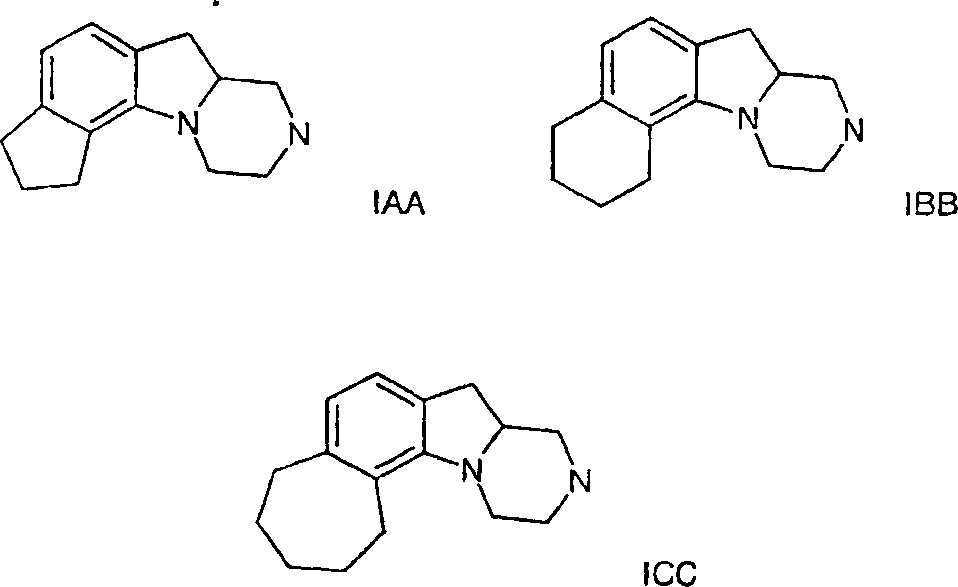
Der Ausdruck „pharmazeutisch verträgliche Salze" bezieht sich auf solche Salze, die die biologische Wirksamkeit und die Eigenschaften der freien Basen oder freien Säuren beibehalten und die biologisch oder anderweitig nicht unerwünscht sind. Die Salze werden mit anorganischen Säuren gebildet, wie Chlorwasserstoffsäure, Bromwasserstoffsäure, Schwefelsäure, Salpetersäure, Phosphorsäure und dergleichen, bevorzugt Chlorwasserstoffsäure und organischen Säuren, wie Essigsäure, Propionsäure, Glycolsäure, Brenztraubensäure, Oxalsäure, Maleinsäure, Malonsäure, Bernsteinsäure, Fumarsäure, Weinsäure, Zitronensäure, Benzoesäure, Zimtsäure, Mandelsäure, Methansulfonsäure, Ethansulfonsäure, p-Toluolsulfonsäure, Salicylsäure, N-Acetylcystein und dergleichen. Zusätzlich können diese Salze durch Zugabe einer anorganischen Base oder einer organischen Base zu der freien Säure hergestellt werden. Salze, die von einer anorganischen Base abstammen, schließen ein, sind jedoch nicht beschränkt auf Natrium-, Kalium-, Lithium-, Ammonium-, Calcium-, Magnesiumsalze und dergleichen. Salze, die von organischen Basen abstammen, schließen ein, sind jedoch nicht beschränkt auf Salze von primären, sekundären und tertiären Aminen, substituierten Aminen einschließlich natürlich vorkommenden substituierten Aminen, cyclischen Aminen und basischen Ionenaustauscherharzen, wie Isopropylamin, Trimethylamin, Diethylamin, Triethylamin, Tripropylamin, Ethanolamin, Lysin, Arginin, N-Ethylpiperidin, Piperidin, Polyaminharze und dergleichen. Die Verbindungen der Formel I können ebenfalls in Form von Zwitterionen vorhanden sein.Of the Term "pharmaceutical compatible Salts "refers on such salts, the biological effectiveness and the properties free bases or free acids and that are not biologically or otherwise undesirable. The salts are formed with inorganic acids such as hydrochloric acid, hydrobromic acid, sulfuric acid, nitric acid, phosphoric acid and the like, preferably hydrochloric acid and organic acids, like acetic acid, propionic acid, glycolic acid, Pyruvic acid, oxalic acid, maleic acid, malonic, Succinic acid, fumaric acid, Tartaric acid, Citric acid, benzoic acid, cinnamic acid, Mandelic, methane, ethanesulfonic, p-toluenesulfonic acid, Salicylic acid, N-acetylcysteine and the same. additionally can these salts by addition of an inorganic base or an organic Base to the free acid getting produced. Salts derived from an inorganic base, shut down but are not limited on sodium, potassium, lithium, ammonium, calcium, magnesium salts and the same. Salts derived from organic bases include, but are not limited to salts of primary, secondary and tertiary Amines, substituted amines including naturally occurring substituted ones Amines, cyclic amines and basic ion exchange resins, such as isopropylamine, trimethylamine, diethylamine, triethylamine, tripropylamine, Ethanolamine, lysine, arginine, N-ethylpiperidine, piperidine, polyamine resins and the same. The compounds of formula I can also be in the form of Zwitterions be present.
Die Erfindung schließt ausdrücklich pharmazeutisch verwendbare Solvate von Verbindungen der Formel I ein. Die Verbindungen der Formel I können solvatisiert, z.B. hydratisiert sein.The Invention includes expressly pharmaceutically usable solvates of compounds of the formula I. one. The compounds of formula I can be solvated, e.g. hydrated be.
Die Solvatisierung kann im Zuge des Herstellungsverfahrens erzielt werden oder sie kann z.B. als eine Folge von hygroskopischen Eigenschaften einer anfänglich wasserfreien Verbindung der Formel I (Hydratation) stattfinden. Der Ausdruck pharmazeutisch verträgliche Salze schließt ebenfalls physiologisch verwendbare Solvate ein.The solvation can be achieved in the course of the preparation process, or it can take place, for example, as a consequence of hygroscopic properties of an initially anhydrous compound of formula I (hydration). The term pharmaceutically acceptable salts also includes physiologically acceptable ones Solvates.
„Pharmazeutisch verträgliche Ester" bedeutet, dass Verbindungen der allgemeinen Formel (I) an funktionellen Gruppen derivatisiert sein können, wodurch Derivate zur Verfügung gestellt werden, die in vivo zurück in die Ausgangsverbindungen überführt werden können. Beispiele solcher Verbindungen schließen physiologisch verträgliche und metabolisch labile Esterderivate ein, wie Methoxymethylester, Methylthiomethylester und Pivaloyloxymethylester. Zusätzlich ist jedes physiologisch verträgliche Äquivalent der Verbindungen der allgemeinen Formel (I), ähnlich den metabolisch labilen Estern. das in vivo in die Ausgangsverbindungen der allgemeinen Formel (1) überführt werden kann, innerhalb des Bereichs der Erfindung."Pharmaceutically compatible Ester "means that compounds of general formula (I) to functional groups can be derivatized whereby derivatives are available be placed in vivo back in the starting compounds are transferred can. Examples of such compounds include physiologically acceptable and metabolically labile ester derivatives such as methoxymethyl ester, methyl thiomethyl ester and Pivaloyloxymethyl. additionally is any physiologically acceptable equivalent the compounds of general formula (I), similar to the metabolically labile Esters. the in vivo into the starting compounds of the general Formula (1) are transferred can, within the scope of the invention.
Im Einzelnen bedeutet das, dass zum Beispiel die COOH-Gruppen von Verbindungen der Formel I verestert werden können. Die Alkyl- und Aralkylester sind Beispiele geeigneter Ester. Die Methyl-, Ethyl-, Propyl-, Butyl- und Benzylester sind bevorzugte Ester. Die Methyl- und Ethylester sind besonders bevorzugt. Weitere Beispiele für pharmazeutisch verträgliche Ester sind Verbindungen der Formel I, wobei die Hydroxygruppen verestert werden können. Beispiele solcher Ester sind Format, Acetat, Propionat, Butyrat, Isobutyrat, Valerat, 2-Methylbutyrat, Isovalerat und N,N-Dimethylaminoacetat. Bevorzugte Ester sind Acetat und N,N-Dimethylaminoacetat.in the Specifically, this means that, for example, the COOH groups of compounds of formula I can be esterified. The alkyl and aralkyl esters are examples of suitable esters. The Methyl, ethyl, propyl, butyl and benzyl esters are preferred Ester. The methyl and ethyl esters are particularly preferred. Further examples for pharmaceutical compatible Esters are compounds of formula I wherein the hydroxy groups esterify can be. Examples of such esters are formate, acetate, propionate, butyrate, Isobutyrate, valerate, 2-methyl butyrate, isovalerate and N, N-dimethylaminoacetate. Preferred esters are acetate and N, N-dimethylaminoacetate.
Der Ausdruck „Lipaseinhibitor" bezieht sich auf Verbindungen, die fähig sind, die Wirkung von Lipasen zu hemmen, zum Beispiel gastrische und pankreatische Lipasen. Zum Beispiel sind Orlistat und Lipstatin wie sie im U.S. Patent Nr. 4598089 beschrieben sind, wirksame Lipaseinhibitoren. Lipstatin ist ein natürliches Produkt von mikrobiellem Ursprung und Orlistat ist das Ergebnis einer Hydrierung von Lipstatin. Andere Lipaseinhibitoren schließen eine Verbindungsklasse ein, die im Allgemeinen als Panclicine bezeichnet wird. Panclicine sind Analoge von Orlistat (Mutoh et al., 1994). Der Ausdruck „Lipaseinhibitor" bezieht sich ebenfalls auf Polymer-gebundene Lipaseinhibitoren, wie sie zum Beispiel in der internationalen Patentanmeldung WO99/34786 (Geltex Pharmaceuticals Inc.) beschrieben sind. Diese Polymere sind dadurch gekennzeichnet, dass sie mit einer oder mehreren Gruppen substituiert sind, die Lipasen hemmen. Der Ausdruck „Lipaseinhibitor" umfasst ebenfalls pharmazeutisch verträgliche Salze dieser Verbindungen. Der Ausdruck „Lipaseinhibitor" bezieht sich bevorzugt auf Orlistat.Of the The term "lipase inhibitor" refers to Connections that capable are to inhibit the action of lipases, for example gastric and pancreatic lipases. For example, orlistat and lipstatin as described in U.S. Pat. Patent No. 4598089, are effective lipase inhibitors. Lipstatin is a natural one Product of microbial origin and orlistat is the result a hydrogenation of lipstatin. Other lipase inhibitors include one Class of connection, commonly referred to as panclicine becomes. Panclicins are analogues of orlistat (Mutoh et al., 1994). The term "lipase inhibitor" also refers on polymer-bound lipase inhibitors, as described, for example, in U.S. Pat International Patent Application WO99 / 34786 (Geltex Pharmaceuticals Inc.). These polymers are characterized that they are substituted with one or more groups which Inhibit lipases. The term "lipase inhibitor" also includes pharmaceutically acceptable Salts of these compounds. The term "lipase inhibitor" preferably refers on orlistat.
Orlistat ist eine bekannte Verbindung, die zur Kontrolle oder Prophylaxe von Fettleibigkeit und Hyperlipidämie verwendet wird. Siehe U.S. Patent Nr. 4598089, veröffentlicht am 1. Juli 1986, das ebenfalls Verfahren zur Herstellung von Orlistat offenbart und U.S. Patent Nr. 6004996, das geeignete Arzneimittel offenbart. Weitere geeignete Arzneimittel sind zum Beispiel in den internationalen Patentanmeldungen WO 00/09122 und WO 00/09123 beschrieben. Zusätzliche Verfahren zur Herstellung von Orlistat sind in den Veröffentlichungen der europäischen Patentanmeldungen Nr. 185359, 189577, 443449 und 524495 offenbart.orlistat is a known compound used for control or prophylaxis used by obesity and hyperlipidemia. See U.S. Pat. Patent No. 4598089, published on July 1, 1986, also to Orlistat disclosed and U.S. Pat. Patent No. 6004996, the appropriate drug disclosed. Other suitable drugs are for example in the international patent applications WO 00/09122 and WO 00/09123. additional Methods of making orlistat are in the publications the European Patent Applications Nos. 185359, 189577, 443449 and 524495.
Orlistat wird bevorzugt von 60 bis 720 mg pro Tag in getrennten Dosen zwei oder dreimal pro Tag verabreicht. Bevorzugt werden hierbei 180 bis 360 mg, am stärksten bevorzugt werden 360 mg pro Tag eines Lipaseinhibitors an eine Versuchsperson verabreicht, bevorzugt in getrennten Dosen zwei oder insbesondere dreimal pro Tag. Die Versuchsperson ist bevorzugt ein fettleibiger oder übergewichtiger Mensch, d.h., ein Mensch mit einem body mass index von 25 oder größer. Im allgemeinen wird es bevorzugt, wenn der Lipaseinhibitor innerhalb etwa einer oder zwei Stunden der Aufnahme einer Mahlzeit, die Fett enthält, verabreicht wird. Im allgemeinen wird es bei der Verabreichung eines, wie vorstehend definierten, Lipaseinhibitors bevorzugt, dass die Behandlung an einem Menschen angewandt wird, der eine beständige Familiengeschichte der Fettleibigkeit aufweist und einen body mass index von 25 oder größer besitzt.orlistat is preferably from 60 to 720 mg per day in separate doses two or administered three times a day. 180 to 360 mg, the strongest 360 mg per day of a lipase inhibitor to a subject is preferred administered, preferably in separate doses two or in particular three times per day. The subject is preferably an obese or overweight Human, that is, a human with a body mass index of 25 or greater. in the In general, it is preferred if the lipase inhibitor is within about one or two hours of taking a meal, the fat contains is administered. In general, when administering a As defined above, lipase inhibitors preferably that Treatment is applied to a person who has a stable family history Obesity and a body mass index of 25 or owns larger.
Orlistat kann an Menschen in üblichen oralen Zusammensetzungen verabreicht werden, wie als Tabletten, überzogene Tabletten, Hart- oder Weichgelatinekapseln, Emulsionen oder Suspensionen. Beispiele für Träger, die für Tabletten, überzogene Tabletten, Dragees und Hartgelatinekapseln verwendet werden können, sind Laktose, andere Zucker und Zuckeralkohole, wie Sorbit, Mannit, Maltodextrin, oder andere Füllstoffe; oberflächenaktive Stoffe, wie Natriumlaurylsulfat, Brij 96 oder Tween 80; Sprengmittel, wie Natriumstärkeglykolat, Maisstärke oder Derivate davon; Polymere, wie Povidon, Crospovidon; Talk; Stearinsäure oder ihre Salze und dergleichen. Geeignete Träger für Weichgelatinekapseln sind zum Beispiel Pflanzenöle, Wachse, Fette, halbfeste und flüssige Polyole und dergleichen. Darüber hinaus können die Arzneimittel Konservierungsmittel, Lösungsvermittler, Stabilisierungsmittel, Benetzungsmittel, Emulgiermittel, Süssungsmittel, Färbemittel, Geschmacksstoffe, Salze zum Variieren des osmotischen Drucks, Puffer, Überzugsmittel und Antioxidantien enthalten. Sie können ebenfalls außerdem weitere therapeutisch wertvolle Substanzen enthalten. Die Formulierungen können üblicherweise in Einheitsdosierungsformen vorkommen und können durch jede beliebige in der pharmazeutischen Praxis bekannte Methode hergestellt werden.orlistat can be used to people in usual oral compositions, such as tablets, coated Tablets, hard or soft gelatin capsules, emulsions or suspensions. Examples of carriers that for tablets, coated Tablets, dragees and hard gelatin capsules can be used Lactose, other sugars and sugar alcohols such as sorbitol, mannitol, maltodextrin, or other fillers; surfactants Substances such as sodium lauryl sulfate, Brij 96 or Tween 80; Disintegrants, such as sodium starch glycolate, corn starch or derivatives thereof; Polymers such as povidone, crospovidone; Talk; Stearic acid or their salts and the like. Suitable carriers for soft gelatin capsules are for example vegetable oils, Waxes, fats, semi-solid and liquid Polyols and the like. About that can out the medicines preservatives, solubilizers, stabilizers, Wetting agents, emulsifiers, sweeteners, colorants, Flavoring agents, salts for varying the osmotic pressure, buffers, coating agents and antioxidants. You can also add more contain therapeutically valuable substances. The formulations can usually occur in unit dosage forms and may be replaced by any in the pharmaceutical practice known method can be produced.
Orlistat wird bevorzugt gemäß den Formulierungen, die in den Beispielen beziehungsweise im U.S. Patent Nr. 6004996 gezeigt werden, verabreicht.orlistat is preferred according to the formulations, those in the examples and in U.S. Pat. Patent No. 6004996 be shown administered.
Die Verbindungen der Formel I können verschiedene asymmetrische Zentren enthalten und können in Form von optisch reinen Enantiomeren, Gemischen von Enantiomeren, wie zum Beispiel Racematen, optisch reinen Diastereomeren, Gemischen aus Diastereomeren, diastereomeren Racematen oder Gemischen von diatsereomeren Racematen vorhanden sein. Die optisch aktiven Formen können zum Beispiel erhalten werden durch Trennung der Racemate, durch asymmetrische Synthese oder asymmetrische Chromatographie (Chromatographie mit einem chiralen Adsorbens oder Eluenten).The Compounds of the formula I can contain different asymmetric centers and can be in shape of optically pure enantiomers, mixtures of enantiomers, such as for example racemates, optically pure diastereomers, mixtures from diastereomers, diastereomeric racemates or mixtures of diastereomeric Racematen be present. The optically active forms can for example, by separation of the racemates, by asymmetric synthesis or asymmetric chromatography (chromatography with a chiral adsorbent or eluent).
Bevorzugte
Verbindungen gemäß Formel
I sind solche,
wobei
R1, R2, R3 und R4 unabhängig
voneinander ausgewählt
sind aus Wasserstoff, Halogen, Hydroxy, Alkyl, Cycloalkyl, Aralkyl,
Aryl, Alkoxy, Alkoxyalkyl, Haloalkyl, Aryloxy, Alkylcarbonyl, Arylcarbonyl,
Alkylthio, Arylthio, Alkylsulfoxyl, Arylsulfoxyl, Alkylsulfonyl,
Arylsulfonyl, Amino, Nitro, Cyano, Alkoxycarbonyl, Aryloxycarbonyl,
Alkylaminocarbonyl, Dialkylaminocarbonyl, Alkylcarbonylamino, Carboxy,
oder Heterocyclyl;
R5 Wasserstoff,
Alkyl oder Cycloalkyl ist;
R6 Wasserstoff,
Alkyl, Cycloalkyl, Hydroxyalkyl, Carbamoylalkyl, Alkoxycarbonylalkyl,
Aryloxycarbonylalkyl oder-(CH2)n-A
ist;
R7 Wasserstoff, Alkyl oder Cycloalkyl
ist, wobei R7 kein Wasserstoff ist, wenn
R6 Wasserstoff, Alkyl, Cycloalkyl oder 1H-Pyrrolo(2,3-b)pyridin-3-ylmethyl
ist;
R8 Wasserstoff ist;
A Heterocyclyl,
Cycloalkanonyl oder Cycloalkyl, substituiert mit Hydroxy, Carboxy,
Alkyloxycarbonyl, Aryloxycarbonyl oder Carbamoyl, ist; und
n
0, 1, 2 oder 3 ist;
und deren pharmazeutisch verwendbare Salze,
Solvate und Ester.Preferred compounds according to formula I are those
in which
R 1 , R 2 , R 3 and R 4 are independently selected from hydrogen, halogen, hydroxy, alkyl, cycloalkyl, aralkyl, aryl, alkoxy, alkoxyalkyl, haloalkyl, aryloxy, alkylcarbonyl, arylcarbonyl, alkylthio, arylthio, alkylsulfoxyl, arylsulfoxyl, Alkylsulfonyl, arylsulfonyl, amino, nitro, cyano, alkoxycarbonyl, aryloxycarbonyl, alkylaminocarbonyl, dialkylaminocarbonyl, alkylcarbonylamino, carboxy or heterocyclyl;
R 5 is hydrogen, alkyl or cycloalkyl;
R 6 is hydrogen, alkyl, cycloalkyl, hydroxyalkyl, carbamoylalkyl, alkoxycarbonylalkyl, aryloxycarbonylalkyl or - (CH 2 ) n -A;
R 7 is hydrogen, alkyl or cycloalkyl, wherein R 7 is not hydrogen when R 6 is hydrogen, alkyl, cycloalkyl or 1H-pyrrolo (2,3-b) pyridin-3-ylmethyl;
R 8 is hydrogen;
A is heterocyclyl, cycloalkanonyl or cycloalkyl substituted with hydroxy, carboxy, alkyloxycarbonyl, aryloxycarbonyl or carbamoyl; and
n is 0, 1, 2 or 3;
and their pharmaceutically acceptable salts, solvates and esters.
Bevorzugte Verbindungen gemäß Formel I sind solche, wobei R1, R2, R3 und R4 unabhängig voneinander ausgewählt sind aus Wasserstoff, Halogen, Hydroxy, Alkyl, Cycloalkyl, Aralkyl, Aryl, Alkoxy, Alkoxyalkyl, Haloalkyl, Aryloxy, Alkylcarbonyl, Arylcarbonyl, Alkylthio, Arylthio, Alkylsulfoxyl, Arylsulfoxyl, Alkylsulfonyl, Arylsulfonyl, Amino, Nitro, Cyano, Alkoxycarbonyl, Aryloxycarbonyl, Alkylaminocarbonyl, Dialkylaminocarbonyl, Alkylcarbonylamino, Carboxy, oder Heterocyclyl. Ebenfalls bevorzugt sind Verbindungen gemäß Formel I, wobei R3 und R4 zusammen mit den Kohlenstoffatomen an die sie gebunden sind einen 5-gliedrigen carbocyclischen Ring bilden, der gegebenenfalls mit Alkyl substituiert ist, wobei diese Verbindungen die Einheit der Formel IA umfassen.Preferred compounds according to formula I are those wherein R 1 , R 2 , R 3 and R 4 are independently selected from hydrogen, halogen, hydroxy, alkyl, cycloalkyl, aralkyl, aryl, alkoxy, alkoxyalkyl, haloalkyl, aryloxy, alkylcarbonyl, arylcarbonyl , Alkylthio, arylthio, alkylsulfoxyl, arylsulfoxyl, alkylsulfonyl, arylsulfonyl, amino, nitro, cyano, alkoxycarbonyl, aryloxycarbonyl, alkylaminocarbonyl, dialkylaminocarbonyl, alkylcarbonylamino, carboxy or heterocyclyl. Also preferred are compounds of formula I wherein R 3 and R 4 together with the carbon atoms to which they are attached form a 5-membered carbocyclic ring optionally substituted with alkyl, which compounds comprise the moiety of formula IA.
Weitere bevorzugte Verbindungen gemäß Formel I sind solche, wobei R1, R2, R3 und R4 unabhängig voneinander ausgewählt sind aus Wasserstoff, Halogen, Alkyl, Alkoxy, Haloalkyl, Haloalkoxy und Cyano. Besonders bevorzugte Verbindungen der Formel I sind solche, wobei einer oder zwei von R1, R2, R3 und R4 unabhängig voneinander ausgewählt sind aus Chlor, Brom, Methyl, Trifluormethyl und Cyano und die anderen Wasserstoff sind.Further preferred compounds according to formula I are those wherein R 1 , R 2 , R 3 and R 4 are independently selected from hydrogen, halogen, alkyl, alkoxy, haloalkyl, haloalkoxy and cyano. Particularly preferred compounds of formula I are those wherein one or two of R 1 , R 2 , R 3 and R 4 are independently selected from chlorine, bromine, methyl, trifluoromethyl and cyano and the others are hydrogen.
Bevorzugte Verbindungen der Formel I sind solche, wobei R5 Wasserstoff, Alkyl oder Cycloalkyl ist. Eine weitere bevorzugte Ausführungsform der Erfindung umfasst Verbindungen der Formel I, wobei R5 Wasserstoff oder Alkyl ist. Besonders bevorzugt sind Verbindungen gemäß Formel I, wobei R5 Wasserstoff ist.Preferred compounds of formula I are those wherein R 5 is hydrogen, alkyl or cycloalkyl. Another preferred embodiment of the invention comprises compounds of formula I wherein R 5 is hydrogen or alkyl. Particular preference is given to compounds of the formula I where R 5 is hydrogen.
Weitere bevorzugte Verbindungen gemäß Formel I sind solche, wobei R6 Wasserstoff, Alkyl, Cycloalkyl, Hydroxyalkyl. Carbamoylalkyl, Alkyloxycarbonylalkyl, Aryloxycarbonylalkyl oder -(CH2)n-A ist. Besonders bevorzugt sind solche Verbindungen der Formel I, wobei R6 Wasserstoff, Hydroxyalkyl, Carbamoylalkyl, Alkyloxycarbonylalkyl, oder -(CH2)n-A ist. Sehr bevorzugt sind Verbindungen der Formel I, wobei R6 Wasserstoff ist.Further preferred compounds of formula I are those wherein R 6 is hydrogen, alkyl, cycloalkyl, hydroxyalkyl. Carbamoylalkyl, alkyloxycarbonylalkyl, aryloxycarbonylalkyl or - (CH 2 ) n -A. Particularly preferred are those compounds of formula I wherein R 6 is hydrogen, hydroxyalkyl, carbamoylalkyl, alkyloxycarbonylalkyl, or - (CH 2 ) n -A. Very preferred are compounds of formula I wherein R 6 is hydrogen.
Eine weitere bevorzugte Ausführungsform der vorliegenden Erfindung sind die Verbindungen gemäß Formel I, wobei A Oxazolidinon, Cyclobutanonyl, [1,2,4]Triazol-3-yl, [1,2,4]Oxadiazol-3-yl, [1,2,4]Triazol-3-on-5-yl, Tetrazolyl, [1,3,4]Oxadiazol-2-yl, [1,3,4]Thiadiazol-2-yl, 1H-Imidazol-2-yl oder 1H-Imidazol-4-yl ist. Besonders bevorzugt sind 2-Oxazolidin-2-on und Cyclobutanon-2-yl.A further preferred embodiment of the present invention are the compounds of the formula I, wherein A is oxazolidinone, cyclobutanonyl, [1,2,4] triazol-3-yl, [1,2,4] oxadiazol-3-yl, [1,2,4] triazol-3-one-5-yl, tetrazolyl, [1,3,4] oxadiazol-2-yl, [1,3,4] thiadiazol-2-yl, 1H-imidazol-2-yl or 1H-imidazol-4-yl. Especially preferred are 2-oxazolidin-2-one and cyclobutan-2-yl.
Noch stärker bevorzugt sind solche Verbindungen, wobei A Cycloalkanonyl ist und n 0.Yet stronger preferred are those compounds wherein A is cycloalkanonyl and n 0.
Gleichermaßen bevorzugt sind die Verbindungen gemäß formel 1, wobei A Heterocyclyl ist und n 1. Ein weiterer bevorzugter Aspekt der vorliegenden Erfindung sind Verbindungen der Formel I, wobei n 0 oder 1 ist.Equally preferred are the compounds according to formula 1, wherein A is heterocyclyl and n is 1. Another preferred aspect of the present invention are compounds of formula I, wherein n is 0 or 1 is.
Bevorzugte Verbindungen gemäß Formel I sind solche, wobei R7 Wasserstoff oder Alkyl ist. Besonders bevorzugt sind Methyl und Ethyl.Preferred compounds of formula I are those wherein R 7 is hydrogen or alkyl. Particularly preferred are methyl and ethyl.
Weitere bevorzugte Verbindungen gemäß Formel I sind solche, wobei R8 Wasserstoff oder Alkyl ist.Further preferred compounds according to formula I are those wherein R 8 is hydrogen or alkyl.
Besonders bevorzugt sind Verbindungen der Formel I, wobei R8 Methyl ist. Sehr bevorzugt sind Verbindungen gemäß Formel I, wobei R8 Wasserstoff ist.Particularly preferred are compounds of the formula I, wherein R 8 is methyl. Very preferred are compounds according to formula I, wherein R 8 is hydrogen.
Beispiele
bevorzugter Verbindungen der Formel I sind:
(2S,10aR)-2-(9-Brom-3,4,10,10a-tetrahydro-1H-pyrazino[1,2-a]indol-2-yl)cyclobutanon;
(2R,10aR)-2-(9-Brom-3,4,10,10a-tetrahydro-1H-pyrazino[1,2-a)indol-2-yl)cyclobutanon;
(2S,10aS)-2-(9-Brom-3,4,10,10a-tetrahydro-1H-pyrazino[1,2-a]indol-2-yl)cyclobutanon;
(2R,10aS)-2-(9-Brom-3,4,10,10a-tetrahydro-1H-pyrazino[1,2-a]indol-2-yl)cyclobutanon;
(10aR)-3-(9-Brom-3,4,10,10a-tetrahydro-1H-pyrazino[1,2-a]indol-2-ylmethyl)oxazolidin-2-on;
(10aS)-3-(9-Brom-3,4,10,10a-tetrahydro-1H-pyrazino[1,2-a]indol-2-ylmethyl)oxazolidin-2-on;
(10aR)-2-(9-Brom-3,4,10,10a-tetrahydro-1H-pyrazino[1,2-a]indol-2-yl)ethanol;
(10aR)-(9-Brom-3,4,10,10a-tetrahydro-1H-pyrazino[1,2-a]indol-2-yl)essigsäuremethylester;
(10aR)-2-(9-Brom-3,4,10,10a-tetrahydro-1H-pyrazino[1,2-a]indol-2-yl)acetamid;
(4R,10aR)-7-Chlor-4-methyl-1,2,3,4,10,10a-hexahydropyrazino[1,2-a]indol;
(4R,10aS)-7-Chlor-4-methyl-1,2,3,4,10,10a-hexahydropyrazino[1,2-a]indol;
(4S,10aS)-7-Chlor-4-methyl-1,2,3,4,10,10a-hexahydropyrazino[1,2-a]indol;
(45,10aR)-7-Chlor-4-methyl-1,2,3,4,10,10a-hexahydropyrazino[1,2-a]indol.
(4R,10aR)-4-Methyl-7-trifluormethyl-1,2,3,4,10,10a-hexahydropyrazino[1,2-a]indol;
(4R,10aS)-4-Methyl-7-trifluormethyl-1,2,3,4,10,10a-hexahydropyrazino[1,2-a]indol;
(4R,10aS)-6-Ethyl-4-methyl-1,2,3,4,10,10a-hexahydropyrazino[1,2-a]indol;
(4R,10aR)-6-Ethyl-4-methyl-1,2,3,4,10,10a-hexahydropyrazino[1,2-a]indol;
(4R,10aR)-8-Brom-4-methyl-7-trifluormethyl-1,2,3,4,10,10a-hexahydropyrazino[1,2-a]indol;
(4R,10aR)-4,6,7-Trimethyl-1,2,3,4,10,10a-hexahydropyrazino[1,2-a]indol;
(4R,10aR)-7-Brom-4-methyl-1,2,3,4,10,10a-hexahydropyrazino[1,2-a]indol;
(4R,10aR)-4,8-Dimethyl-7-trifluormethyl-1,2,3,4,10,10a-hexahydropyrazino[1,2-a]indol;
(4R,10aR)-9-Chlor-4-methyl-1,2,3,4,10,10a-hexahydropyrazino[1,2-a]indol;
(4R,10aS)-4,8-Dimethyl-7-trifluormethyl-1,2,3,4,10,10a-hexahydropyrazino[1,2-a]indol;
(4R,10aR)-7-Chlor-8-fluor-4-methyl-1,2,3,4,10,10a-hexahydropyrazino[1,2-a]indol;
(4R,10aS)-8-Brom-4-methyl-7-trifluormethyl-1,2,3,4,10,10a-hexahydropyrazino[1,2-a]indol;
(4R,10aR)-4-Methyl-1,2,3,4,10,10a-hexahydropyrazino[1,2-a]indol-7-carbonitril;
(4R,10aR)-9-Chlor-6-fluor-4-methyl-1,2,3,4,10,10a-hexahydropyrazino[1,2-a]indol;
(4R,10aR)-6,7-Difluor-4-methyl-1,2,3,4,10,10a-hexahydropyrazino[1,2-a]indol;
(4R,10aS)-6,7-Difluor-4-methyl-1,2,3,4,10,10a-hexahydropyrazino[1,2-a]indol;
(4R,10aR)-7-Chlor-6-fluor-4-methyl-1,2,3,4,10,10a-hexahydropyrazino[1,2-a]indol;
(4RS,10aRS)-7-Brom-4-ethyl-1,2,3,4,10,10a-hexahydropyrazino[1,2-a]indol;
(4RS,10aSR)-7-Brom-4-ethyl-1,2,3,4,10,10a-hexahydropyrazino[1,2-a]indol;
(4RS,10aRS)-6,7,8-Tribrom-4-ethyl-1,2,3,4,10,10a-hexahydropyrazino[1,2-a]indol;
(4RS,10aRS)-7,8-Dibrom-4-ethyl-1,2,3,4,10,10a-hexahydropyrazino[1,2-a]indol;
(4R,10aR)-7-Brom-4-ethyl-1,2,3,4,10,10a-hexahydropyrazino[1,2-a]indol;
(4S,10aS)-7-Brom-4-ethyl-1,2,3,4,10,10a-hexahydropyrazino[1,2-a]indol;
(4RS,10aSR)-4-Ethyl-1,2,3,4,10,10a-hexahydropyrazino[1,2-a]indol;
(4RS,10aRS)-4-Ethyl-1,2,3,4,10,10a-hexahydropyrazino[1,2-a]indol;
(4R,10aR)-8-Brom-6-ethyl-4-methyl-1,2,3,4,10,10a-hexahydropyrazino[1,2-a]indol;
(4R,10S,10aR)-4,6,10-Trimethyl-1,2,3,4,10,10a-hexahydropyrazino[1,2-a]indol;
(4R,10R,10aR)-4,6,10-Trimethyl-1,2,3,4,10,10a-hexahydropyrazino[1,2-a]indol;
(4R,10aR)-8-Fluor-4,7-dimethyl-1,2,3,4,10,10a-hexahydropyrazino[1,2-a]indol;
(4R,10aS)-8-Fluor-4,7-dimethyl-1,2,3,4,10,10a-hexahydropyrazino[1,2-a]indol;
(4R,10aR)-6-Fluor-4,7-dimethyl-1,2,3,4,10,10a-hexahydropyrazino[1,2-a]indol;
(4R,10aS)-6-Fluor-4,7-dimethyl-1,2,3,4,10,10a-hexahydropyrazino[1,2-a]indol;
(4R,10aR)-8-Fluor-4-methyl-1,2,3,4,10,10a-hexahydropyrazino[1,2-a]indol;
(4R,10aR)-4,6-Dimethyl-1,2,3,4,10,10a-hexahydropyrazino[1,2-a]indol;
(4R,10aS)-4,6-Dimethyl-1,23,4,10,10a-hexahydropyrazino[1,2-a]indol;
(4R,10aR)-7-Brom-9-fluor-4-methyl-1,2,3,4,10,10a-hexahydropyrazino[1,2-a]indol;
(4R,10aR)-6-Fluor-4-methyl-1,2,3,4,10,10a-hexahydropyrazino[1,2-a]indol;
(4R,10aR)-6,9-Difluor-4-methyl-1,2,3,4,10,10a-hexahydropyrazino[1,2-a]indol;
(4R,10aR)-7,9-Dichlor-4-methyl-1,2,3,4,10,10a-hexahydropyrazino[1,2-a]indol;
(4R,10aS)-7,9-Dichlor-4-methyl-1,2,3,4,10,10a-hexahydropyrazino[1,2-a]indol;
(4R,10aR)-4,7,9-Trimethyl-1,2,3,4,10,10a-hexahydropyrazino[1,2-a]indol;
(4R,10aS)-6-Brom-4-methyl-1,2,3,4,10,10a-hexahydropyrazino[1,2-a]indol;
(4R,10aR)-7-Fluor-4,6-dimethyl-1,2,3,4,10,10a-hexahydropyrazino[1,2-a]indol;
(4R,10aS)-7-Chlor-4,8-dimethyl-1,2,3,4,10,10a-hexahydropyrazino[1,2-a]indol;
(4R,10aR)-7-Chlor-4,8-dimethyl-1,2,3,4,10,10a-hexahydropyrazino[1,2-a]indol;
(4R,10aR)-4-Methyl-6-trifluormethoxy-1,2,3,4,10,10a-hexahydropyrazino[1,2-a]indol;
(4R,10aR)-6-Fluor-4,9-dimethyl-1,2,3,4,10,10a-hexahydropyrazino[1,2-a]indol;
(4R,10aS)-6-Fluor-4,9-dimethyl-1,2,3,4,10,10a-hexahydropyrazino[1,2-a]indol;
(4R,10aR)-4-Methyl-1,2,3,4,10,10a-hexahydropyrazino[1,2-a]indol-6-carbonitril;
(4R,10aR)-6-Chlor-4,8-dimethyl-1,2,3,4,10,10a-hexahydropyrazino[1,2-a]indol;
(4R,10aS)-6-Chlor-4,8-dimethyl-1,2,3,4,10,10a-hexahydropyrazino[1,2-a)indol;
(4R,10aR)-4,6,9-Trimethyl-1,2,3,4,10,10a-hexahydropyrazino[1,2-a)indol;
(4R,10aS)-4,6,7-Trimethyl-1,2,3,4,10,10a-hexahydropyrazino[1,2-a)indol;
(4R,10aS)-4,6,9-Trimethyl-1,2,3,4,10,10a-hexahydropyrazino[1,2-a]indol;
(4R,10aR)-7-Chlor-4,6-dimethyl-1,2,3,4,10,10a-hexahydropyrazino[l,2-a]indol;
(4R,10aS)-7-Chlor-4,6-dimethyl-1,2,3,4,10,10a-hexahydropyrazino[1,2-a)indol;
(4S,10aS)-7-Chlor-4-ethyl-1,2,3,4,10,10a-hexahydropyrazino[1,2-a]indol;
(4R,10aR)-7-Chlor-4-ethyl-1,2,3,4,10,10a-hexahydropyrazino[1,2-a]indol;
(45,10aR)-7-Chlor-4-ethyl-1,2,3,4,10,10a-hexahydropyrazino[1,2-a]indol;
(4R,10aS)-7-Chlor-4-ethyl-1,2,3,4,10,10a-hexahydropyrazino[1,2-a]indol;
(4R,10aR)-7-Chlor-4-ethyl-1,2,3,4,10,10a-hexahydropyrazino[1,2-a)indol;
(4R,10aS)-7-Chlor-4-ethyl-1,2,3,4,10,10a-hexahydropyrazino[1,2-a]indol;
(4S,10aS)-7-Chlor-4-ethyl-1,2,3,4,10,10a-hexahydropyrazino[1,2-a)indol;
(4S,10aR)-7-Chlor-4-ethyl-1,2,3,4,10,10a-hexahydropyrazino[1,2-a]indol;
(4R,10aS)-6-Chlor-4,7-dimethyl-1,2,3,4,10,10a-hexahydropyrazino[1,2-a]indol;
(4R,10aR)-6-Chlor-4,7-dimethyl-1,2,3,4,10,10a-hexahydropyrazino[1,2-a]indol;
(10R,6aS)-10-Methyl-2,3,6,6a,7,8,9,10-octahydro-1H-8,10a-diazacyclopenta[c]fluoren;
(4R,10aR)-N-(4-Methyl-1,2,3,4,10,10a-hexahydropyrazino[1,2-a]indol-7-yl)acetamid;
(4R,10aR)-(4-Methyl-1,2,3,4,10,10a-hexahydropyrazino[1,2-a]indol-7-yl)methanol;
(4R,10aR)-4-Methyl-1,2,3,4,10,10a-hexahydropyrazino[1,2-a]indol-7-carbonsäurebutylamid;
(4R,10aR)-4,8-Dimethyl-1,2,3,4,10,10a-hexahydropyrazino[1,2-a]indol;
(4R,10aR)-8-Brom-4,7-dimethyl-1,2,3,4,10,10a-hexahydropyrazino[1,2-a)indol;
(4R,10aS)-8-Brom-4,7-dimethyl-1,2,3,4,10,10a-hexahydropyrazino[1,2-a]indol:
(4R,10aS)-4,7-Dimethyl-1,2,3,4,10,10a-hexahydropyrazino[1,2-a]indol;
(4R,10aR)-4,7-Dimethyl-1,2,3,4,10,10a-hexahydropyrazino[1,2-a]indol;
(4R,10aR)-4,7,8-Trimethyl-1,2,3,4,10,10a-hexahydropyrazino[1,2-a]indol;
(4R,10aS)-4,7,8-Trimethyl-1,2,3,4,10,10a-hexahydropyrazino[1,2-a]indol;
(4R,10aR)-6,7-Dichlor-4-methyl-1,2,3,4,10,10a-hexahydropyrazino[1,2-a]indol;
(4R,10aS)-8-Fluor-4,6-dimethyl-1,2,3,4,10,10a-hexahydropyrazino[1,2-a]indol;
(4R,10aR)-8-Brom-7-fluor-4-methyl-1,2,3,4,10,10a-hexahydropyrazino[1,2-a]indol;
(4R,10aS)-8-Brom-7-fluor-4-methyl-1,2,3,4,10,10a-hexahydropyrazino[1,2-a)indol;
(4R,10aR)-4-Methyl-1,2,3,4,10,10a-hexahydropyrazino[1,2-a]indol-7-carbonsäurediethylamid;
(4R,10aR)-8-Fluor-4,6-dimethyl-1,2,3,4,10,10a-hexahydropyrazino[1,2-a]indol;
(4R,10aR)-7-Methoxymethyl-4-methyl-1,2,3,4,10,10a-hexahydropyrazino[1,2-a]indol;
(4R,10aR)-7-(2-Methoxyethoxymethyl)-4-methyl-1,2,3,4,10,10a-hexahydropyrazino[1,2-a]indol;
(4R,10aR)-6-Brom-4,7-dimethyl-1,2,3,4,10,10a-hexahydropyrazino[1,2-a]indol;
(4S,10aS)-(7-Trifluormethyl-1,2,3,4,10,10a-hexahydropyrazino[1,2-a]indol-4-yl)methanol;und
(4S,10aR)-(7-Trifluormethyl-1,2,3,4,10,10a-hexahydropyrazino[1,2-a]indol-4-yl)methanol.Examples of preferred compounds of the formula I are:
(2S, 10aR) -2- (9-bromo-3,4,10,10a-tetrahydro-1H-pyrazino [1,2-a] indol-2-yl) -cyclobutanone;
(2R, 10aR) -2- (9-bromo-3,4,10,10a-tetrahydro-1H-pyrazino [1,2-a) indol-2-yl) -cyclobutanone;
(2S, 10aS) -2- (9-bromo-3,4,10,10a-tetrahydro-1H-pyrazino [1,2-a] indol-2-yl) -cyclobutanone;
(2R, 10aS) -2- (9-bromo-3,4,10,10a-tetrahydro-1H-pyrazino [1,2-a] indol-2-yl) -cyclobutanone;
(10aR) -3- (9-bromo-3,4,10,10a-tetrahydro-1H-pyrazino [1,2-a] indol-2-ylmethyl) oxazolidin-2-one;
(10aS) -3- (9-bromo-3,4,10,10a-tetrahydro-1H-pyrazino [1,2-a] indol-2-ylmethyl) oxazolidin-2-one;
(10aR) -2- (9-bromo-3,4,10,10a-tetrahydro-1H-pyrazino [1,2-a] indol-2-yl) ethanol;
(10aR) - (9-bromo-3,4,10,10a-tetrahydro-1H-pyrazino [1,2-a] indol-2-yl) methyl acetate;
(10aR) -2- (9-bromo-3,4,10,10a-tetrahydro-1H-pyrazino [1,2-a] indol-2-yl) acetamide;
(4R, 10aR) -7-Chloro-4-methyl-1,2,3,4,10,10a-hexahydropyrazino [1,2-a] indole;
(4R, 10aS) -7-chloro-4-methyl-1,2,3,4,10,10a-hexahydropyrazino [1,2-a] indole;
(4S, 10aS) -7-chloro-4-methyl-1,2,3,4,10,10a-hexahydropyrazino [1,2-a] indole;
(45,10aR) -7-chloro-4-methyl-1,2,3,4,10,10a-hexahydropyrazino [1,2-a] indole.
(4R, 10aR) -4-Methyl-7-trifluoromethyl-1,2,3,4,10,10a-hexahydropyrazino [1,2-a] indole;
(4R, 10aS) -4-methyl-7-trifluoromethyl-1,2,3,4,10,10a-hexahydropyrazino [1,2-a] indole;
(4R, 10aS) -6-Ethyl-4-methyl-1,2,3,4,10,10a-hexahydropyrazino [1,2-a] indole;
(4R, 10aR) -6-Ethyl-4-methyl-1,2,3,4,10,10a-hexahydropyrazino [1,2-a] indole;
(4R, 10aR) -8-Bromo-4-methyl-7-trifluoromethyl-1,2,3,4,10,10a-hexahydropyrazino [1,2-a] indole;
(4R, 10aR) -4,6,7-Trimethyl-1,2,3,4,10,10a-hexahydropyrazino [1,2-a] indole;
(4R, 10aR) -7-Bromo-4-methyl-1,2,3,4,10,10a-hexahydropyrazino [1,2-a] indole;
(4R, 10aR) -4,8-dimethyl-7-trifluoromethyl-1,2,3,4,10,10a-hexahydropyrazino [1,2-a] indole;
(4R, 10aR) -9-Chloro-4-methyl-1,2,3,4,10,10a-hexahydropyrazino [1,2-a] indole;
(4R, 10aS) -4,8-dimethyl-7-trifluoromethyl-1,2,3,4,10,10a-hexahydropyrazino [1,2-a] indole;
(4R, 10aR) -7-Chloro-8-fluoro-4-methyl-1,2,3,4,10,10a-hexahydropyrazino [1,2-a] indole;
(4R, 10aS) -8-Bromo-4-methyl-7-trifluoromethyl-1,2,3,4,10,10a-hexahydropyrazino [1,2-a] indole;
(4R, 10aR) -4-Methyl-1,2,3,4,10,10a-hexahydropyrazino [1,2-a] indol-7-carbonitrile;
(4R, 10aR) -9-Chloro-6-fluoro-4-methyl-1,2,3,4,10,10a-hexahydropyrazino [1,2-a] indole;
(4R, 10aR) -6,7-Difluoro-4-methyl-1,2,3,4,10,10a-hexahydropyrazino [1,2-a] indole;
(4R, 10aS) -6,7-Difluoro-4-methyl-1,2,3,4,10,10a-hexahydropyrazino [1,2-a] indole;
(4R, 10aR) -7-Chloro-6-fluoro-4-methyl-1,2,3,4,10,10a-hexahydropyrazino [1,2-a] indole;
(4RS, 10aRS) -7-bromo-4-ethyl-1,2,3,4,10,10a-hexahydropyrazino [1,2-a] indole;
(4RS, 10aSR) -7-Bromo-4-ethyl-1,2,3,4,10,10a-hexahydropyrazino [1,2-a] indole;
(4RS, 10aRS) -6,7,8-Tribromo-4-ethyl-1,2,3,4,10,10a-hexahydropyrazino [1,2-a] indole;
(4RS, 10aRS) -7,8-Dibromo-4-ethyl-1,2,3,4,10,10a-hexahydropyrazino [1,2-a] indole;
(4R, 10aR) -7-Bromo-4-ethyl-1,2,3,4,10,10a-hexahydropyrazino [1,2-a] indole;
(4S, 10aS) -7-Bromo-4-ethyl-1,2,3,4,10,10a-hexahydropyrazino [1,2-a] indole;
(4RS, 10aSR) -4-Ethyl-1,2,3,4,10,10a-hexahydropyrazino [1,2-a] indole;
(4RS, 10aRS) -4-Ethyl-1,2,3,4,10,10a-hexahydropyrazino [1,2-a] indole;
(4R, 10aR) -8-bromo-6-ethyl-4-methyl-1,2,3,4,10,10a-hexahydropyrazino [1,2-a] indole;
(4R, 10S, 10aR) -4,6,10-Trimethyl-1,2,3,4,10,10a-hexahydropyrazino [1,2-a] indole;
(4R, 10R, 10aR) -4,6,10-Trimethyl-1,2,3,4,10,10a-hexahydropyrazino [1,2-a] indole;
(4R, 10aR) -8-Fluoro-4,7-dimethyl-1,2,3,4,10,10a-hexahydropyrazino [1,2-a] indole;
(4R, 10aS) -8-Fluoro-4,7-dimethyl-1,2,3,4,10,10a-hexahydropyrazino [1,2-a] indole;
(4R, 10aR) -6-Fluoro-4,7-dimethyl-1,2,3,4,10,10a-hexahydropyrazino [1,2-a] indole;
(4R, 10aS) -6-fluoro-4,7-dimethyl-1,2,3,4,10,10a-hexahydropyrazino [1,2-a] indole;
(4R, 10aR) -8-fluoro-4-methyl-1,2,3,4,10,10a-hexahydropyrazino [1,2-a] indole;
(4R, 10aR) -4,6-Dimethyl-1,2,3,4,10,10a-hexahydropyrazino [1,2-a] indole;
(4R, 10aS) -4,6-dimethyl-1,23,4,10,10a-hexahydropyrazino [1,2-a] indole;
(4R, 10aR) -7-Bromo-9-fluoro-4-methyl-1,2,3,4,10,10a-hexahydropyrazino [1,2-a] indole;
(4R, 10aR) -6-Fluoro-4-methyl-1,2,3,4,10,10a-hexahydropyrazino [1,2-a] indole;
(4R, 10aR) -6,9-Difluoro-4-methyl-1,2,3,4,10,10a-hexahydropyrazino [1,2-a] indole;
(4R, 10aR) -7,9-Dichloro-4-methyl-1,2,3,4,10,10a-hexahydropyrazino [1,2-a] indole;
(4R, 10aS) -7,9-dichloro-4-methyl-1,2,3,4,10,10a-hexahydropyrazino [1,2-a] indole;
(4R, 10aR) -4,7,9-Trimethyl-1,2,3,4,10,10a-hexahydropyrazino [1,2-a] indole;
(4R, 10aS) -6-bromo-4-methyl-1,2,3,4,10,10a-hexahydropyrazino [1,2-a] indole;
(4R, 10aR) -7-fluoro-4,6-dimethyl-1,2,3,4,10,10a-hexahydropyrazino [1,2-a] indole;
(4R, 10aS) -7-chloro-4,8-dimethyl-1,2,3,4,10,10a-hexahydropyrazino [1,2-a] indole;
(4R, 10aR) -7-Chloro-4,8-dimethyl-1,2,3,4,10,10a-hexahydropyrazino [1,2-a] indole;
(4R, 10aR) -4-Methyl-6-trifluoromethoxy-1,2,3,4,10,10a-hexahydropyrazino [1,2-a] indole;
(4R, 10aR) -6-Fluoro-4,9-dimethyl-1,2,3,4,10,10a-hexahydropyrazino [1,2-a] indole;
(4R, 10aS) -6-fluoro-4,9-dimethyl-1,2,3,4,10,10a-hexahydropyrazino [1,2-a] indole;
(4R, 10aR) -4-Methyl-1,2,3,4,10,10a-hexahydropyrazino [1,2-a] indole-6-carbonitrile;
(4R, 10aR) -6-chloro-4,8-dimethyl-1,2,3,4,10,10a-hexahydropyrazino [1,2-a] indole;
(4R, 10aS) -6-chloro-4,8-dimethyl-1,2,3,4,10,10a-hexahydropyrazino [1,2-a) indole;
(4R, 10aR) 4,6,9-Trimethyl-1,2,3,4,10,10a-hexahydropyrazino [1,2-a) indole;
(4R, 10aS) -4,6,7-Trimethyl-1,2,3,4,10,10a-hexahydropyrazino [1,2-a) indole;
(4R, 10aS) 4,6,9-Trimethyl-1,2,3,4,10,10a-hexahydropyrazino [1,2-a] indole;
(4R, 10aR) -7-chloro-4,6-dimethyl-1,2,3,4,10,10a-hexahydropyrazino [l, 2-a] indole;
(4R, 10aS) -7-chloro-4,6-dimethyl-1,2,3,4,10,10a-hexahydropyrazino [1,2-a) indole;
(4S, 10aS) -7-chloro-4-ethyl-1,2,3,4,10,10a-hexahydropyrazino [1,2-a] indole;
(4R, 10aR) -7-Chloro-4-ethyl-1,2,3,4,10,10a-hexahydropyrazino [1,2-a] indole;
(45,10aR) -7-chloro-4-ethyl-1,2,3,4,10,10a-hexahydropyrazino [1,2-a] indole;
(4R, 10aS) -7-chloro-4-ethyl-1,2,3,4,10,10a-hexahydropyrazino [1,2-a] indole;
(4R, 10aR) -7-Chloro-4-ethyl-1,2,3,4,10,10a-hexahydropyrazino [1,2-a) indole;
(4R, 10aS) -7-chloro-4-ethyl-1,2,3,4,10,10a-hexahydropyrazino [1,2-a] indole;
(4S, 10aS) -7-chloro-4-ethyl-1,2,3,4,10,10a-hexahydropyrazino [1,2-a) indole;
(4S, 10aR) -7-Chloro-4-ethyl-1,2,3,4,10,10a-hexahydropyrazino [1,2-a] indole;
(4R, 10aS) -6-chloro-4,7-dimethyl-1,2,3,4,10,10a-hexahydropyrazino [1,2-a] indole;
(4R, 10aR) -6-chloro-4,7-dimethyl-1,2,3,4,10,10a-hexahydropyrazino [1,2-a] indole;
(10R, 6aS) -10-Methyl-2,3,6,6a, 7,8,9,10-octahydro-1H-8,10a-diazacyclopenta [c] fluorene;
(4R, 10aR) -N- (4-methyl-1,2,3,4,10,10a-hexahydropyrazino [1,2-a] indol-7-yl) acetamide;
(4R, 10aR) - (4-methyl-1,2,3,4,10,10a-hexahydropyrazino [1,2-a] indol-7-yl) methanol;
(4R, 10aR) -4-Methyl-1,2,3,4,10,10a-hexahydropyrazino [1,2-a] indole-7-carboxylic acid butylamide;
(4R, 10aR) -4,8-Dimethyl-1,2,3,4,10,10a-hexahydropyrazino [1,2-a] indole;
(4R, 10aR) -8-Bromo-4,7-dimethyl-1,2,3,4,10,10a-hexahydropyrazino [1,2-a) indole;
(4R, 10aS) -8-bromo-4,7-dimethyl-1,2,3,4,10,10a-hexahydropyrazino [1,2-a] indole
(4R, 10aS) -4,7-Dimethyl-1,2,3,4,10,10a-hexahydropyrazino [1,2-a] indole;
(4R, 10aR) -4,7-Dimethyl-1,2,3,4,10,10a-hexahydropyrazino [1,2-a] indole;
(4R, 10aR) -4,7,8-Trimethyl-1,2,3,4,10,10a-hexahydropyrazino [1,2-a] indole;
(4R, 10aS) -4,7,8-Trimethyl-1,2,3,4,10,10a-hexahydropyrazino [1,2-a] indole;
(4R, 10aR) -6,7-Dichloro-4-methyl-1,2,3,4,10,10a-hexahydropyrazino [1,2-a] indole;
(4R, 10aS) -8-Fluoro-4,6-dimethyl-1,2,3,4,10,10a-hexahydropyrazino [1,2-a] indole;
(4R, 10aR) -8-Bromo-7-fluoro-4-methyl-1,2,3,4,10,10a-hexahydropyrazino [1,2-a] indole;
(4R, 10aS) -8-Bromo-7-fluoro-4-methyl-1,2,3,4,10,10a-hexahydropyrazino [1,2-a) indole;
(4R, 10aR) -4-Methyl-1,2,3,4,10,10a-hexahydropyrazino [1,2-a] indole-7-carboxylic acid diethylamide;
(4R, 10aR) -8-Fluoro-4,6-dimethyl-1,2,3,4,10,10a-hexahydropyrazino [1,2-a] indole;
(4R, 10aR) -7-Methoxymethyl-4-methyl-1,2,3,4,10,10a-hexahydropyrazino [1,2-a] indole;
(4R, 10aR) -7- (2-methoxyethoxymethyl) -4-methyl-1,2,3,4,10,10a-hexahydropyrazino [1,2-a] indole;
(4R, 10aR) -6-bromo-4,7-dimethyl-1,2,3,4,10,10a-hexahydropyrazino [1,2-a] indole;
(4S, 10aS) - (7-trifluoromethyl-1,2,3,4,10,10a-hexahydropyrazino [1,2-a] indol-4-yl) methanol; and
(4S, 10aR) - (7-trifluoromethyl-1,2,3,4,10,10a-hexahydropyrazino [1,2-a] indol-4-yl) methanol.
Beispiele
besonders bevorzugter Verbindungen der Formel I sind:
(4R,10aR)-7-Chlor-4-methyl-1,2,3,4,10,10a-hexahydropyrazino[1,2-a]indol;
(4R,10aR)-4,6,7-Trimethyl-1,2,3,4,10,10a-hexahydropyrazino[1,2-a]indol;
(4R,10aR)-7-Brom-4-methyl-1,2,3,4,10,10a-hexahydropyrazino[1,2-a]indol;
(4R,10aR)-4,8-Dimethyl-7-trifluormethyl-1,2,3,4,10,10a-hexahydropyrazino[1,2-a]indol;
(4R,10aR)-7-Brom-4-ethyl-1,2,3,4,10,10a-hexahydropyrazino[1,2-a]indol;
(4R,10aR)-4,6-Dimethyl-1,2,3,4,10,10a-hexahydropyrazino[1,2-a]indol;
(4R,10aR)-4-Methyl-1,2,3,4,10,10a-hexahydropyrazino[1,2-a]indol-6-carbonitril;
(4R,10aS)-4,6,9-Trimethyl-1,2,3,4,10,10a-hexahydropyrazino[1,2-a]indol;
(4R,10aS)-7-Chlor-4,6-dimethyl-1,2,3,4,10,10a-hexahydropyrazino[1,2-a]indol;und
(4R,10aS)-6-Chlor-4,7-dimethyl-1,2,3,4,10,10a-hexahydropyrazino[1,2-a]indol.Examples of particularly preferred compounds of the formula I are:
(4R, 10aR) -7-Chloro-4-methyl-1,2,3,4,10,10a-hexahydropyrazino [1,2-a] indole;
(4R, 10aR) -4,6,7-Trimethyl-1,2,3,4,10,10a-hexahydropyrazino [1,2-a] indole;
(4R, 10aR) -7-Bromo-4-methyl-1,2,3,4,10,10a-hexahydropyrazino [1,2-a] indole;
(4R, 10aR) -4,8-dimethyl-7-trifluoromethyl-1,2,3,4,10,10a-hexahydropyrazino [1,2-a] indole;
(4R, 10aR) -7-Bromo-4-ethyl-1,2,3,4,10,10a-hexahydropyrazino [1,2-a] indole;
(4R, 10aR) -4,6-Dimethyl-1,2,3,4,10,10a-hexahydropyrazino [1,2-a] indole;
(4R, 10aR) -4-Methyl-1,2,3,4,10,10a-hexahydropyrazino [1,2-a] indole-6-carbonitrile;
(4R, 10aS) 4,6,9-Trimethyl-1,2,3,4,10,10a-hexahydropyrazino [1,2-a] indole;
(4R, 10aS) -7-chloro-4,6-dimethyl-1,2,3,4,10,10a-hexahydropyrazino [1,2-a] indole; and
(4R, 10aS) -6-chloro-4,7-dimethyl-1,2,3,4,10,10a-hexahydropyrazino [1,2-a] indole.
Verfahren zur Herstellung von Verbindungen gemäß Formel I sind eine Aufgabe der vorliegenden Erfindung. Die in den folgenden Schemata verwendeten Substituenten und Indizes weisen die vorstehend gegebene Bedeutung auf solange nichts Anderes angegeben wird.method for the preparation of compounds of the formula I are an object of the present invention. The ones used in the following schemes Substituents and indices have the meaning given above as long as nothing else is stated.
Indole der Formel A können durch Methoden, die im Stand der Technik bekannt sind, hergestellt werden (z.B. T. L. Gilchrist, Heterocyclic chemistry, 1997 oder The chemistry of heterocyclic compounds Vol. 25, 1972 oder Joule, J. A. Indoles, isoindoles, their reduced derivatives, and carbazoles. Rodd's Chem. Carbon Compd. 1997 oder G. W. Gribble. J. Chem. Soc. Perkin 12000, 1045).indoles of the formula A can prepared by methods known in the art T. L. Gilchrist, Heterocyclic chemistry, 1997 or The chemistry of heterocyclic compounds Vol. 25, 1972 or Joule, Indoles, isoindoles, their reduced derivatives, and carbazoles. Rodd's Chem. Carbon Compd. 1997 or G. W. Gribble. J. Chem. Soc. Perkin 12000, 1045).
Schema
1: 
Indol-2-carboxylate der Formel B können durch Methoden. die im Stand der Technik bekannt sind (siehe vorstehend) hergestellt werden oder alternativ dazu aus Indolen der Formel A durch zuerst Schützen des Indolstickstoffs mit einer geeigneten Schutzgruppe (PG; z.B., tert.-Butoxycarbonyl (Boc)), Umsetzen des geschützten Indolderivats mit einer geeigneten Base unter wasserfreien Bedingungen (z.B., mit Lithium 2,2,6,6-tetramethylpiperidid in THF), Umsetzen des Zwischenproduktanions mit einem Chlorformiat (z.B. Chlorameisensäureethylester) und Entfernen der Schutzgruppe (z.B., durch Umsetzen mit Säure für die Boc Schutzgruppe). Ra in Schema 1 ist eine Alkylgruppe, bevorzugt Methyl oder Ethyl.Indole-2-carboxylates of the formula B can by methods. which are known in the art (see above) or, alternatively, from indoles of Formula A by first protecting the indole nitrogen with a suitable protecting group (PG ;, eg, tert-butoxycarbonyl (Boc)), reacting the protected indole derivative with a suitable base under anhydrous conditions (eg, with lithium 2,2,6,6-tetramethylpiperidide in THF), reacting the intermediate anion anion with a chloroformate (eg, ethyl chloroformate) and deprotecting (eg, by reacting with acid for the Boc protecting group). R a in Scheme 1 is an alkyl group, preferably methyl or ethyl.
Schema
2: 
Pyrazinoindole der Formel D1 können durch ein Verfahren hergestellt werden, bei dem das Indol-2-carboxylat der Formel B zuerst mit einem alpha-Halogenalkannitril (z.B., 2-Brompropionitril) in einem geeigneten Lösemittel (z.B., DMF) mit einer geeigneten Base (z.B., NaH) umgesetzt wird. Das Zwischenprodukt C wird reduziert und durch Umsetzen mit eienm geeigneten Reduktionsmittel in einem geigneten Lösemittel (z.B., LiAlH4 in THF oder Diethylether) zu dem Tetrahydropyrazino[1,2-a]indol D1 cyclisiert. In dem Fall, dass R7 ≠ H ist, wird die spätere Reduktion bevorzugt schrittweise durch aufeinanderfolgendes Umsetzen des Zwischenprodukts C mit (i) Bordimethylsulfidkomplex in THF, (ii) Kaliumcarbonat in Methanol, (iii) Bordimethylsulfidkomplex in THF durchgeführt. Rb in Schema 2 ist eine Alkylgruppe, bevorzugt eine Niederalkylgruppe, bevorzugt Methyl oder Ethyl.Pyrazinoindoles of Formula D1 may be prepared by a process wherein the indole-2-carboxylate of Formula B is first reacted with an alpha-haloalkanenitrile (eg, 2-bromopropionitrile) in a suitable solvent (eg, DMF) with a suitable base (eg , NaH) is reacted. Intermediate C is reduced and cyclized to the tetrahydropyrazino [1,2-a] indole D1 by reaction with a suitable reducing agent in a suitable solvent (eg, LiAlH 4 in THF or diethyl ether). In the case of R 7 ≠ H, the later reduction is preferably carried out stepwise by sequentially reacting the intermediate C with (i) boron dimethylsulfide complex in THF, (ii) potassium carbonate in methanol, (iii) boron dimethylsul fidkomplex performed in THF. R b in Scheme 2 is an alkyl group, preferably a lower alkyl group, preferably methyl or ethyl.
Schema
3: 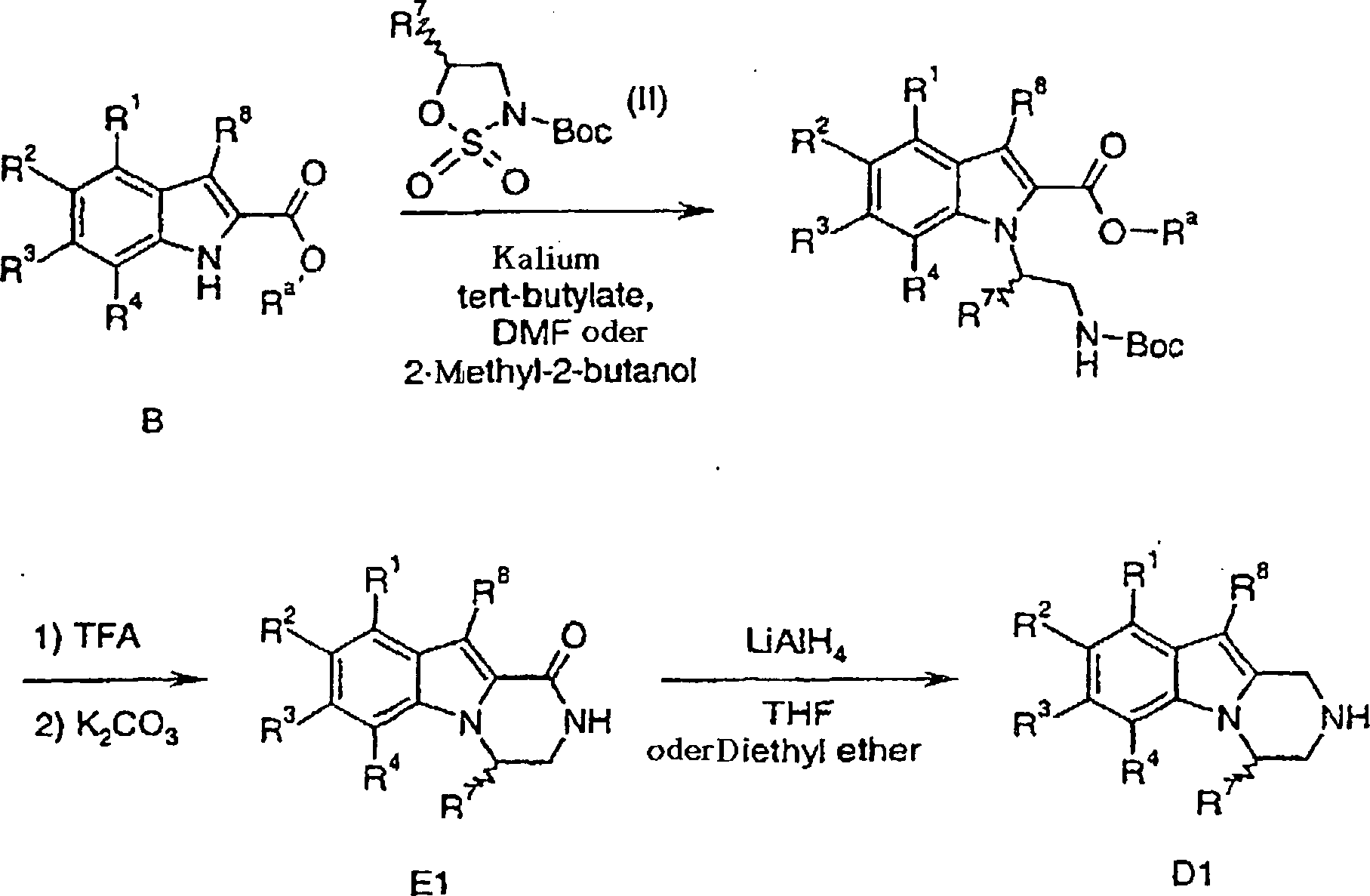
Pyrazinoindole der Formel D1 können ebenfalls durch ein Verfahren hergestellt werden, bei dem das Indol-2-carboxylat der Formel B zuerst mit dem bisher unbekannten Boc-Sulfamidat (II) in einen geeigneten Lösemittel (z.B., DMF oder 2-Methyl-2-butanol) mit einer geeigneten Base (z.B., Kalium tert.-butylat oder Natriumhydrid) umgesetzt wird, gefolgt von dem Entfernen der Boc Schutzgruppe und Ringschluß in Gegenwart einer Base (z.B., Kaliumcarbonat). Die Stereochemie des Kohlenstoffatoms, das im Boc-Sulfamidat II an R7 gebunden ist, wird in dieser Reaktionsfolge invertiert (> 90% e.e.). Das Zwischenproduktamid (E1) wird mit einem geeigneten Reduktionsmittel in einem geeigneten Lösemittel (z.B., LiAlH4 in Diethylether oder Bordimethylsulfidkomplex in THF) reduziert. Ra in Schema 3 ist eine Alkylgruppe, bevorzugt eine Niederalkylgruppe, bevorzugt Methyl oder Ethyl. Falls racemisches Boc-Sulfamidat II in diesem Verfahren verwendet wird, können die Enantiomere des Zwischenprodukts E1 z.B., durch präparative chirale HPLC erhalten werden, wie in Schema 4 veranschaulicht.Pyrazinoindoles of the formula D1 can also be prepared by a process in which the indole-2-carboxylate of the formula B first with the hitherto unknown Boc-sulfamidate (II) in a suitable solvent (eg, DMF or 2-methyl-2-butanol ) is reacted with a suitable base (eg, potassium tert-butoxide or sodium hydride), followed by removal of the Boc protecting group and ring closure in the presence of a base (eg, potassium carbonate). The stereochemistry of the carbon atom bound to R 7 in Boc-sulfamidate II is inverted in this reaction sequence (> 90% ee). The intermediate amide (E1) is reduced with a suitable reducing agent in a suitable solvent (eg, LiAlH 4 in diethyl ether or boron dimethyl sulfide complex in THF). R a in Scheme 3 is an alkyl group, preferably a lower alkyl group, preferably methyl or ethyl. If racemic Boc sulfamidate II is used in this process, the enantiomers of the intermediate E1 can be obtained, for example, by preparative chiral HPLC as illustrated in Scheme 4.
Schema
4: 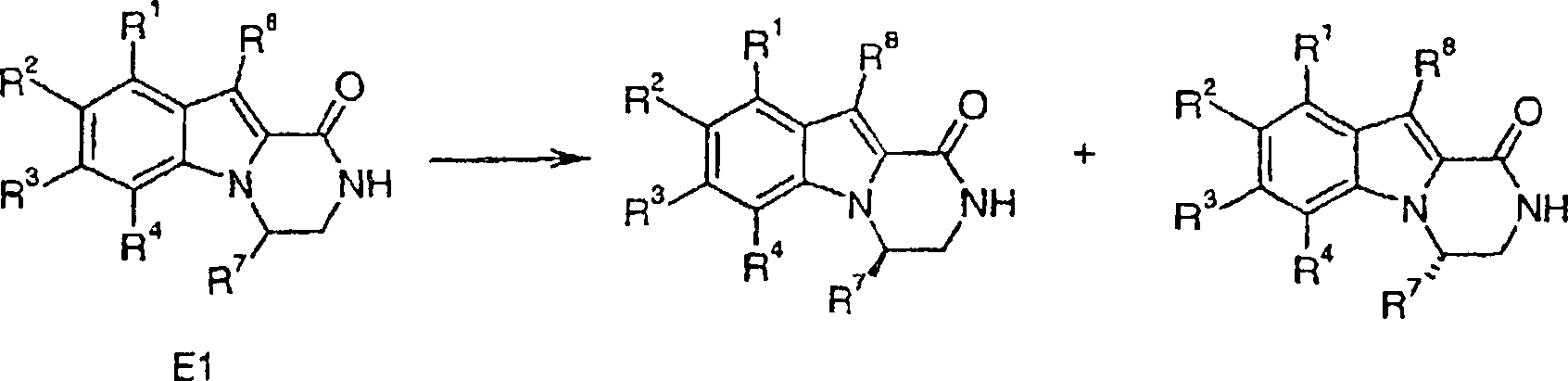
Das Zwischenprodukt E1 kann ebenfalls durch ein Vielstufenverfahren hergestellt werden, beginnend mit der Verseifung des Esters B (z.B., mit LiOH in THF/Wasser-Gemischen) zu der Indol-2-carbonsäure, Amidkopplung der Säure mit einem geeigneten Aminoalkoholderivat (PG ist eine geeignete Schutzgruppe, z.B., Benzyl), Überführen des Hydroxyls in eine Abgangsgruppe (z.B., mit Mesylchlorid), Umsetzen mit einer geeigneten Base in einem geeigneten Lösemittel (z.B., NaH in DMF) und Abspalten der Schutzgruppe (z.B. durch Hydrieren in Gegenwart eines Palladiumkatalysators auf Kohle in dem Fall, dass PG = Benzyl ist). Rc in Schema 5 ist eine Alkylgruppe, bevorzugt eine Niederalkylgruppe, bevorzugt Methyl oder Ethyl.The intermediate E1 can also be prepared by a multi-step process, starting with the saponification of the ester B (eg, with LiOH in THF / water mixtures) to the indole-2-carboxylic acid, amide coupling of the acid with a suitable amino alcohol derivative (PG is a suitable Protecting group, eg, benzyl), converting the hydroxyl into a leaving group (eg, with mesyl chloride), reacting with a suitable base in a suitable solvent (eg, NaH in DMF) and deprotecting (eg by hydrogenating in the presence of a palladium catalyst on carbon in the case that PG = benzyl). R c in Scheme 5 is an alkyl group, preferably a lower alkyl group, preferably methyl or ethyl.
Schema
5: 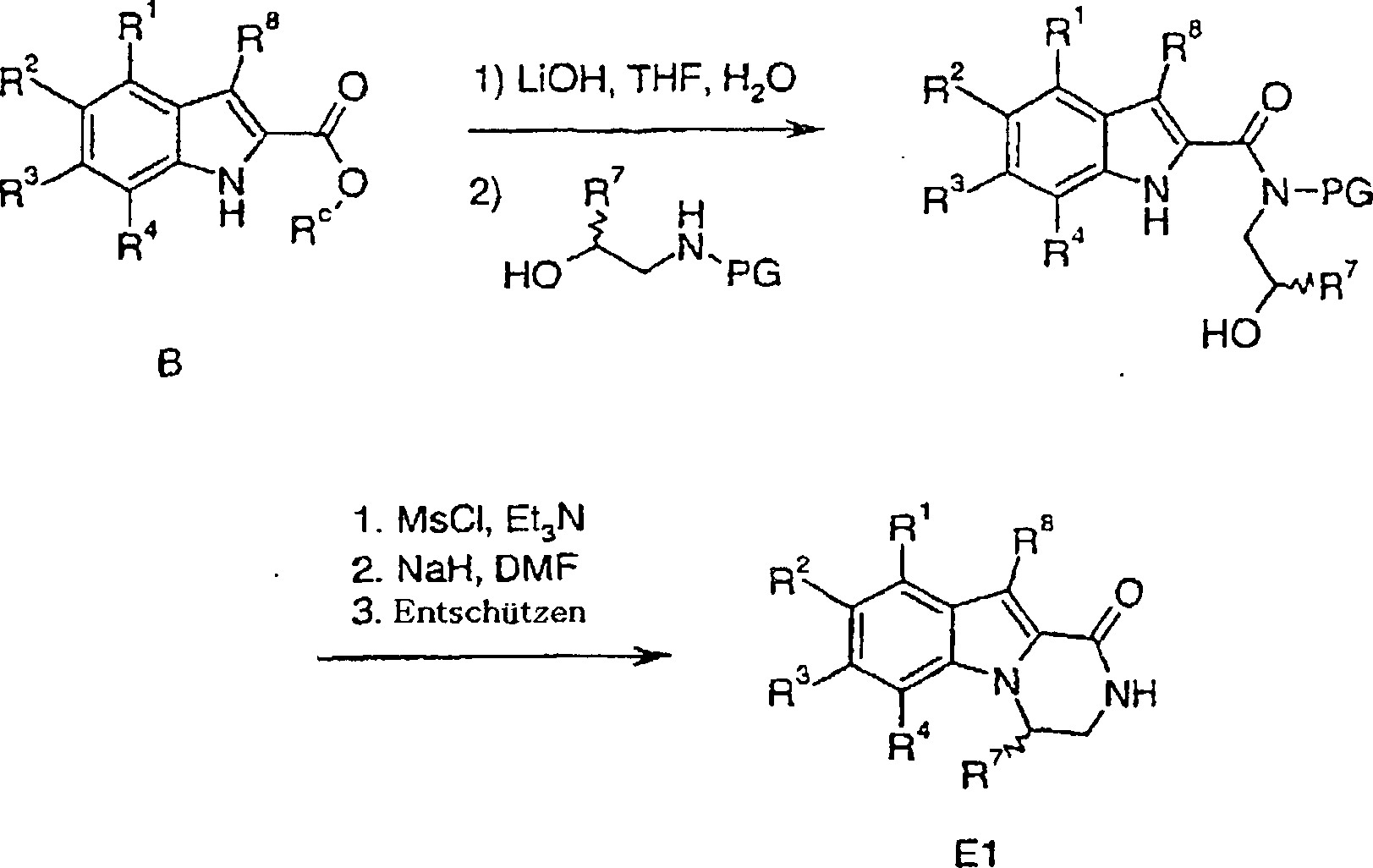
Das Zwischenprodukt E2 kann ebenfalls gemäß Schema 6 durch ein Verfahren hergestellt werden, bei dem Indol-2-carboxylat B zuerst mit einem aktivierten Aminoethanolderivat (z.B. Boc-Aziridin in einem geeigneten Lösemittel, wie z.B. DMSO mit einer geeigneten Base, z.B., KOH) umgesetzt wird, gefolgt von dem Entfernen der Boc-Schutzgruppe und Ringschluß in Gegenwart einer Base (z.B., Kaliumcarbonat).The Intermediate E2 can also be prepared according to Scheme 6 by a method are prepared in the indole-2-carboxylate B first with a activated aminoethanol derivative (e.g., Boc-aziridine in a suitable Solvents such as. DMSO is reacted with a suitable base, e.g., KOH), followed by removal of the Boc protecting group and ring closure in the presence a base (e.g., potassium carbonate).
Schema
6: 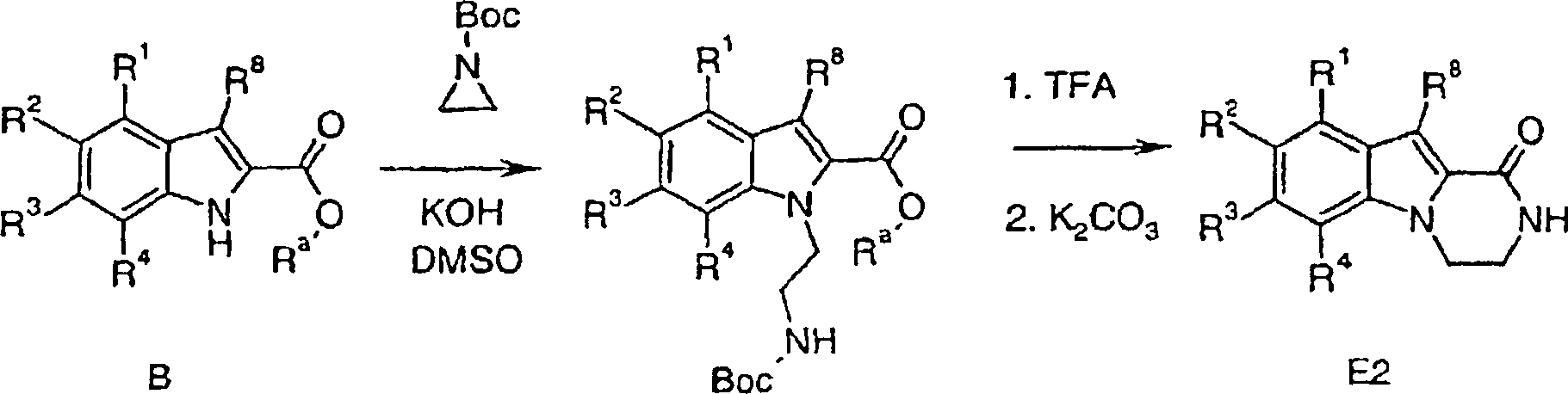
Die Indolderivate F können ausgehend von geschützten o-Iodanilinen (eine geeignete Schutzgruppe, PG1, ist N-Methoxycarbonyl) durch Umsetzen mit geeignet substituierten und gegebenenfalls geschützten Carbinolen (bevorzugte Schutzgruppen sind Silylether, besonders bevorzugt ist tert.-Butyldimethylsilyl) hergestellt werden. Die Umsetzung verläuft in Gegenwart eines geeigneten Katalysators (z.B., bis-Triphenylphosphinpalladiumdichlorid und Kupfer(I)iodid als Co-Katalysator) in einem geeigneten Lösemittel (z.B. Triethylamin). Das Zwischenprodukt wird mit einer Base (z.B. LiOH in THF/Wasser) umgesetzt, wodurch das Indolderivat F1 (Schema 7) erhalten wird.The indole derivatives F can be prepared starting from protected o-iodoanilines (a suitable protecting group, PG 1 , is N-methoxycarbonyl) by reaction with suitably substituted and optionally protected carbinols (preferred protecting groups are silyl ethers, more preferably tert-butyldimethylsilyl). The reaction proceeds in the presence of a suitable catalyst (eg, bis-triphenylphosphine palladium dichloride and copper (I) iodide as a cocatalyst) in a suitable solvent (eg triethylamine). The intermediate is reacted with a base (eg, LiOH in THF / water) to give the indole derivative F1 (Scheme 7).
Schema
7: 
- PG1 und PG2 sind SchutzgruppenPG 1 and PG 2 are protecting groups
Die Zwischenprodukte der Formel G können gemäß Schema 8 durch ein Verfahren hergestellt werden, bei dem das Indolderivat der Formel F2 zuerst mit dem bisher unbekannten Boc-Sulfamidat (II) in einem geeigneten Lösemittel (z.B., DMF oder 2-Methyl-2-butanol) mit einer geeigneten Base (z.B., NaH oder Kalium tert-Butylat) umgesetzt wird, gefolgt von dem Entschützen des Alkohols (z.B., mit Tetrabutylammoniumfluorid) in einem Lösemittel (z.B., THF) und Oxidation des Alkohols (z.B., mit Mangandioxid). Die Stereochmie des Kohlenstoffatoms, das im Boc-Sulfamidat II an R7 gebunden ist, wird in dieser Reaktionsfolge invertiert (> 90% e.e.).The intermediates of the formula G can be prepared according to Scheme 8 by a process in which the indole derivative of the formula F2 first with the hitherto unknown Boc sulfamidate (II) in a suitable solvent (eg, DMF or 2-methyl-2-butanol) with a suitable base (eg, NaH or potassium tert-butylate) followed by deprotection of the alcohol (eg, with tetrabutylammonium fluoride) in a solvent (eg, THF) and oxidation of the alcohol (eg, with manganese dioxide). The stereochemistry of the carbon atom bound to R 7 in Boc-sulfamidate II is inverted in this reaction sequence (> 90% ee).
Schema
8: 
- PG bezeichnet eine SchutzgruppePG denotes a protecting group
Indolderivate G können ebenfalls gemäß Schema 9 hergestellt werden, ausgehend von geschützten o-Iodanilinen (eine geeignete Schutzgruppe, PG1, ist N-Methoxycarbonyl) durch Kreuzkopplungsrektionen mit Propargylalkoholderivaten in Gegenwart eines geeigneten Katalysators (z.B., bis-Triphenylphosphinpalladiumdichlorid und Kupfer(I)iodid als Co-Katalysator) in einem geeigneten Lösemitel (z.B. Triethylamin), gefolgt von der Umsetzung mit einer Base (z.B., LiOH in THF/Wasser). Das Alkoholzwischenprodukt wird oxidiert, z.B., mit Mangandioxid, wodurch das Indolderivat H erhalten wird. Die Alkylierung von H mit Boc-Sulfamidat (II) in einem geeigneten Lösemittel (z.B., DMF oder 2-Methyl-2-butanol) mit einer geeigneten Base (z.B., Kalium tert.-Butylat oder NaH) führt zu dem Zwischenprodukt G. Die Stereochmie des Kohlenstoffatoms, das im Boc-Sulfamidat II an R7 gebunden ist, wird in dieser Reaktionsfolge invertiert (> 90% e.e.).Indole derivatives G can also be prepared according to Scheme 9 starting from protected o-iodoanilines (a suitable protecting group, PG 1 is N -methoxycarbonyl) by cross-coupling reactions with propargyl alcohol derivatives in the presence of a suitable catalyst (eg, bis-triphenylphosphine palladium dichloride and copper (I) iodide as cocatalyst) in a suitable solvent (eg triethylamine), followed by reaction with a base (eg, LiOH in THF / water). The alcohol intermediate is oxidized, eg, with manganese dioxide to give the indole derivative H. The alkylation of H with Boc-sulfamidate (II) in a suitable solvent (eg, DMF or 2-methyl-2-butanol) with a suitable base (eg, potassium tert-butylate or NaH) leads to the intermediate G. Die Stereochemistry of the carbon atom bound to R 7 in Boc-sulfamidate II is inverted in this reaction sequence (> 90% ee).
Schema
9: 
- PG ist eine SchutzgruppePG is a protecting group
Diese Zwischenprodukte der Formel G können weiter zu den Verbindungen der Formel D2 verarbeitet werden entweder durch Entfernen der Boc-Schutzgruppe (z.B., mit Trifluoressigsäure), wodurch ein Iminzwischenprodukt erhalten wird, das nicht isoliert wird, jedoch direkt mit Lithiumaluminiumhydrid reduziert wird, wodurch D2 als ein trennbares Gemisch von Epimeren erhalten wird, oder durch direkte reduktive Aminierung (z.B., mit Natriumtriacetoxyborhydrid, Molekularsieben und Essigsäure in einem geeigneten Lösemittel, z.B., Dichlormethan), gefolgt von Erstschützen des Zwischenprodukts J1 (z.B., mit Trifluoressigsäure in Dichlormethan) wie in Schema 10 veranschaulicht.These Intermediates of the formula G can be further processed to the compounds of formula D2 either by removing the Boc protecting group (e.g., with trifluoroacetic acid) an imine by-product is obtained which is not isolated however, is reduced directly with lithium aluminum hydride, thereby D2 is obtained as a separable mixture of epimers, or by direct reductive amination (e.g., with sodium triacetoxyborohydride, Molecular sieves and acetic acid in a suitable solvent, e.g., dichloromethane), followed by first contactors of the intermediate J1 (e.g., with trifluoroacetic acid in dichloromethane) as illustrated in Scheme 10.
Schema
10: 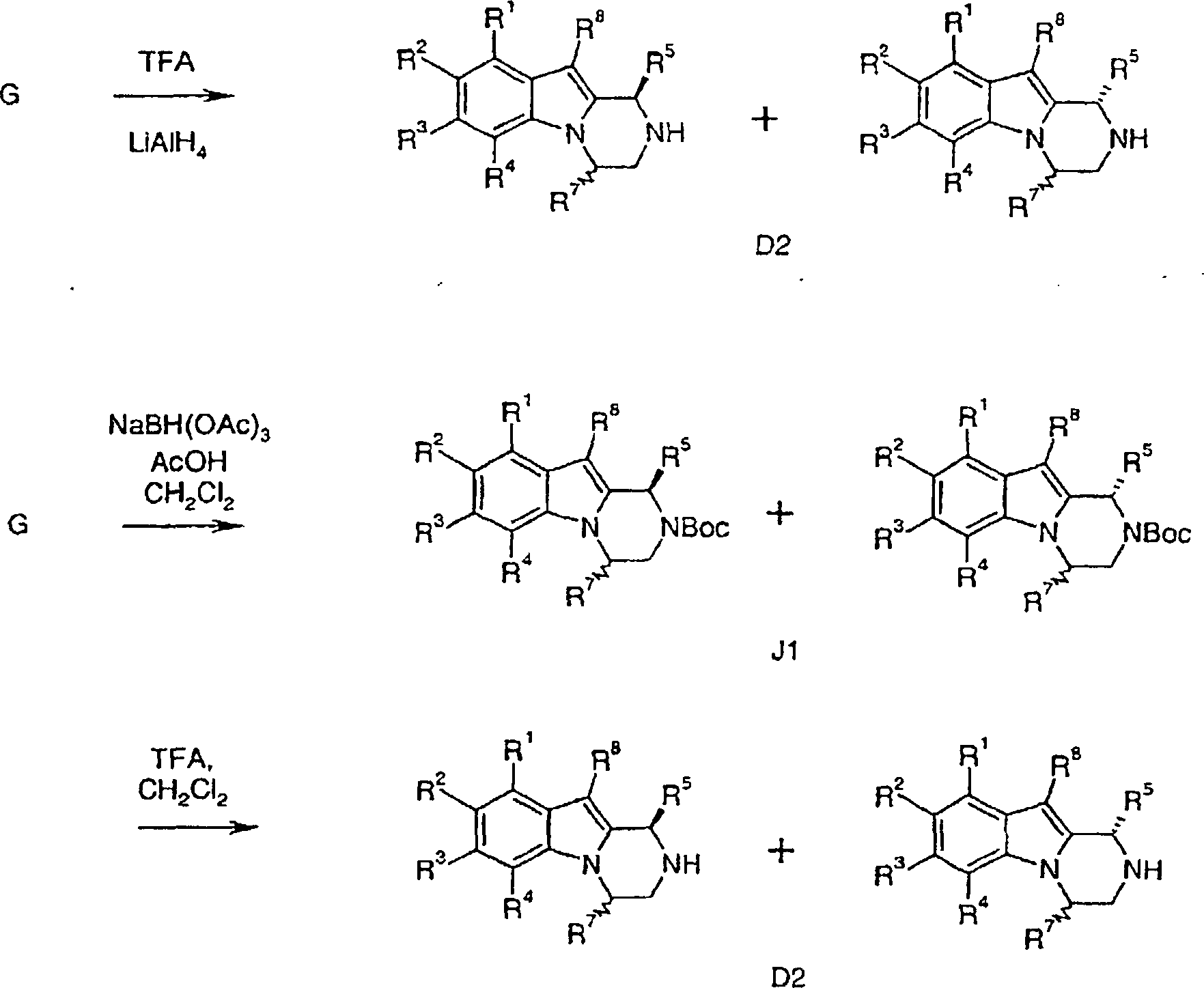
Die Substituenten R8 können wie in Schema 11 gezeigt, ausgehend von Tetrahydropyrazino[1,2-a]indol D3 eingeführt werden. Zu diesem Zweck wird das Aminstickstoff von D3 geschützt, z.B., als tert.-Butylcarbamat, wodurch die Verbindung J2 hergestellt wird, was wie folgt durchgeführt wird:
- a) Durch die Vilsmeier Reaktion wird das Aldehyd K erhalten, das zu Tetrahydropyrazino[1,2-a]indol D4 reduziert wird, bevorzugt mit Triethylsilan in Trifluoressigsäure.
- b) Durch Halogenierung (bevorzugt mit N-Iodsuccinimid oder N-Bromsuccinimid in Acetonitril) wird das Halogenid L erhalten, das durch Kreuzkopplung unter Verwendung von Methoden, die im Stand der Technik bekannt sind, in Verbindung J1 überführt wird) z.B. F. Diederich, P. J. Stang (Herausgeber), Metal-catalyzed Cross-coupling Reactions, Wiley-VCH, 1998).
- a) The Vilsmeier reaction yields the aldehyde K, which is reduced to tetrahydropyrazino [1,2-a] indole D4, preferably with triethylsilane in trifluoroacetic acid.
- b) Halogenation (preferably with N-iodosuccinimide or N-bromosuccinimide in acetonitrile) gives the halide L, which is converted into compound J1 by cross-coupling using methods known in the art) eg F. Diederich, PJ Stang (Editor), Metal-catalyzed Cross-coupling Reactions, Wiley-VCH, 1998).
Schema
11: 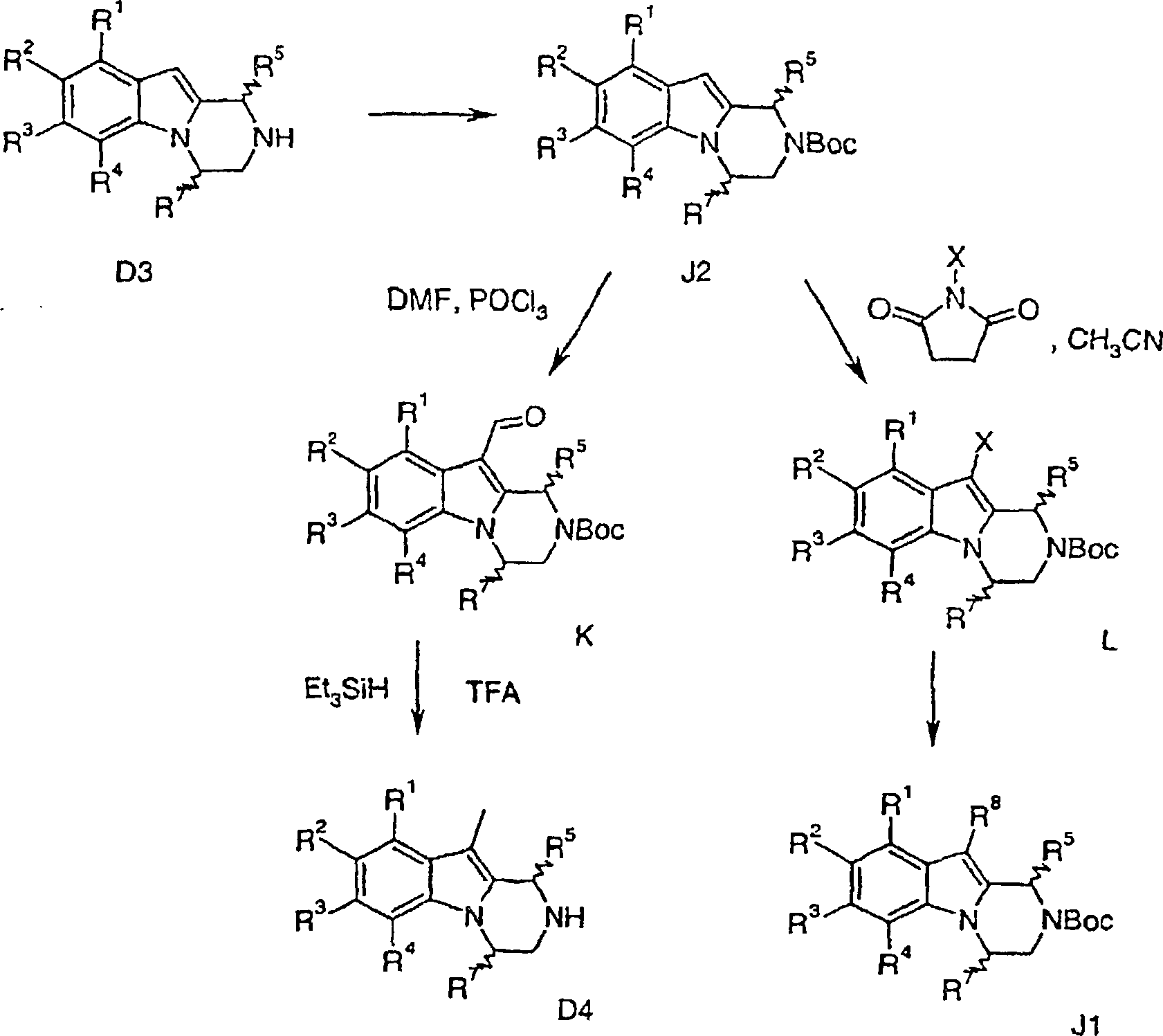
Die Enantiomere der Tetrahydropyrazino[1,2-a]indole D1 können erhalten werden entweder durch Verwendung eines chiralen Sulfamidats (II) oder durch Abtrennung der Enantiomeren durch präparative chirale HPLC oder durch Kristallisation mit geeigneten chiralen Säuren, Abtrennung der diastereomeren Salze und Isolierung der Enantiomeren von diesen Salzen (Schema 12). Ein alternativer Zugang zu den Enantiomeren der Tetrahydropyrazinoindole D1 schließt die Abtrennung der Enantiomere der Vorläufer C oder G ein, z.B., durch präparative chirale HPLC.The Enantiomers of the tetrahydropyrazino [1,2-a] indoles D1 can be obtained either by using a chiral sulfamidate (II) or by separation of the enantiomers by preparative chiral HPLC or by crystallization with suitable chiral acids, separation of the diastereomers Salts and Isolation of the Enantiomers of These Salts (Scheme 12). An alternative approach to the enantiomers of tetrahydropyrazinoindoles D1 closes separating the enantiomers of precursors C or G, for example preparative Chiral HPLC.
Schema
12: 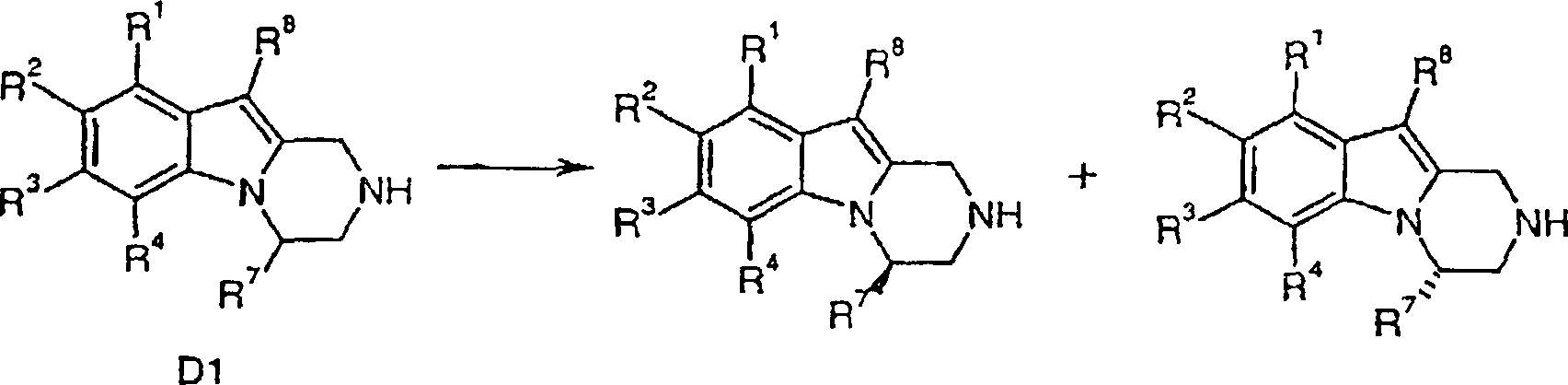
Die Hexahydropyrazino[1,2-a]indole der Formel IA können aus Verbindungen der Formel D2 durch Reduktion mit geeigneten Reduktionsmitteln (z.B., NaBH4) in geeigneten Lösemitteln oder Lösemittelgemischen, wie z.B. THF/TFA hergestellt werden (Schema 13).The hexahydropyrazino [1,2-a] indoles of the formula IA can be prepared from compounds of the formula D2 by reduction with suitable reducing agents (for example, NaBH 4 ) in suitable solvents or solvent mixtures, such as, for example, THF / TFA (Scheme 13).
Schema
13: 
Hexahydropyrazino[1,2-a]indole der Formel IB können ebenfalls in einem Zweischrittverfahren aus dem Zwischenprodukt E1 hergestellt werden, wobei die Indoleinheit zu dem hergestellten Indolinamid M reduziert wird, das dann unter geeigneten Bedingungen, wie z.B., LiAlH4 in Diethylether reduziert wird (Schema 14).Hexahydropyrazino [1,2-a] indoles of the formula IB can also be prepared in a two-step process from the intermediate E1, whereby the indole moiety is reduced to the indolineamine M prepared, which is then reduced under suitable conditions, such as, for example, LiAlH 4 in diethyl ether (Scheme 14).
Schema
14: 
Die funktionellen Gruppen R1 bis R4, die die für die Pyrazinoindolsynthese beschriebenen Methoden nicht tolerieren, können aus solchen funktionellen Gruppen hergestellt werden, die durch Methoden. die im Stand der Technik bekannt sind, hergestellt werden können (z.B. March, Advanced Organic Chemistry 4th edition oder Comprehensive Organic Functional Group Transformations, 1995).The functional groups R 1 to R 4 that do not tolerate the methods described for the Pyrazinoindolsynthese can be prepared from such functional groups, by methods. which are known in the art, can be prepared (eg March, Advanced Organic Chemistry 4 th edition or Comprehensive Organic Functional Group Transformations, 1995).
Insbesondere die Überführungen, die in Schema 15 aufgezeigt werden, werden ausgehend von dem geschützten Bromid N (eine geeignete Schutzgruppe, PG, ist tert.-Butoxycarbonyl, die durch Standardmethoden eingeführt wird; R ist ein oder zwei sich nicht störende Substituenten) durchgeführt:
- a) Durch Kreuzkopplungsreaktion mit Benzophenonimin unter Verwendung eines Palldiumkatalysators und eines Hilfsliganden, z.B. 2,2'-Bis(diphenylphosphino)1,1'-binaphthyl (BINAP) und anschließender Hydrierungsreaktion wird das Amin P erhalten, das dann mit Säurechlorid R11COCl (R11 = Alkyl) acyliert wird, wodurch das Amid Q hergestellt wird.
- b) Durch Kreuzkopplungsreaktion mit Kupfercyanid unter Verwendung eines Palladiumkatalysators und eines Hilfsliganden, z.B., 1,1'-Bis(diphenylphosphino)ferrocen (dppf) wird das Nitril R erhalten.
- c) Durch Lithiierung mit n-BuLi in THF und anschließendem Umsetzen mit Kohlendioxid wird Carbonsäure S erhalten, die
- c1) mit einem Amin R12-NH-R12 (R12 = N, Alkyl) in Gegenwart eines Kopplungsmittels, wie z.B. Benzotriazol-1-yloxytris(dimethylamino)phosphoniumhexafluorphosphat (BOP) und einer Base, wie z.B., 4-Ethylmorpholin gekoppelt wird, wodurch das Amid T erhalten wird oder
- c2) reduziert wird (z.B., mit Lithiumaluminiumhydrid in THF), wodurch Alkohol U hergestellt wird, der dann mit dem Halogenid R13X (R13 = Alkyl, Alkoxyalkyl, X = Abgangsgruppe, z.B., Br, I) alkyliert wird, wodurch der Arylether V erhalten wird.
- a) By cross-coupling reaction with benzophenone imine using a palladium catalyst and an auxiliary ligand, eg 2,2'-bis (diphenylphosphino) 1,1'-binaphthyl (BINAP) and subsequent hydrogenation reaction, the amine P is obtained, which is then treated with acid chloride R 11 COCl ( R 11 = alkyl) is acylated to produce the amide Q.
- b) By cross-coupling reaction with copper cyanide using a palladium catalyst and an auxiliary ligand, eg, 1,1'-bis (diphenylphosphino) ferrocene (dppf), the nitrile R is obtained.
- c) By lithiation with n-BuLi in THF and subsequent reaction with carbon dioxide is obtained carboxylic acid S, the
- c1) is coupled with an amine R 12 -NH-R 12 (R 12 = N, alkyl) in the presence of a coupling agent such as benzotriazol-1-yloxytris (dimethylamino) phosphonium hexafluorophosphate (BOP) and a base such as 4-ethylmorpholine to obtain the amide T or
- c2) is reduced (eg, with lithium aluminum hydride in THF) to produce alcohol U, which is then alkylated with the halide R 13 X (R 13 = alkyl, alkoxyalkyl, X = leaving group, eg, Br, I) to give the Aryl ether V is obtained.
Schema
15: 
Durch Abspaltung der Schutzgruppe in den Verbindungen P, Q, R, S, T, U oder V (z.B. mit Säure, wie Trifluoressigsäure oder Chlorwasserstoff in einem geeigneten Lösemittel, wie Ethylacetat, für den Fall, dass PG = Boc ist) werden Hexahydropyrazino[1,2-a]indole IA erhalten (Schema 16).By Cleavage of the protective group in the compounds P, Q, R, S, T, U or V (e.g., with acid, such as trifluoroacetic acid or hydrogen chloride in a suitable solvent, such as ethyl acetate, for the Case that PG = Boc) become hexahydropyrazino [1,2-a] indoles IA obtained (Scheme 16).
Schema
16: 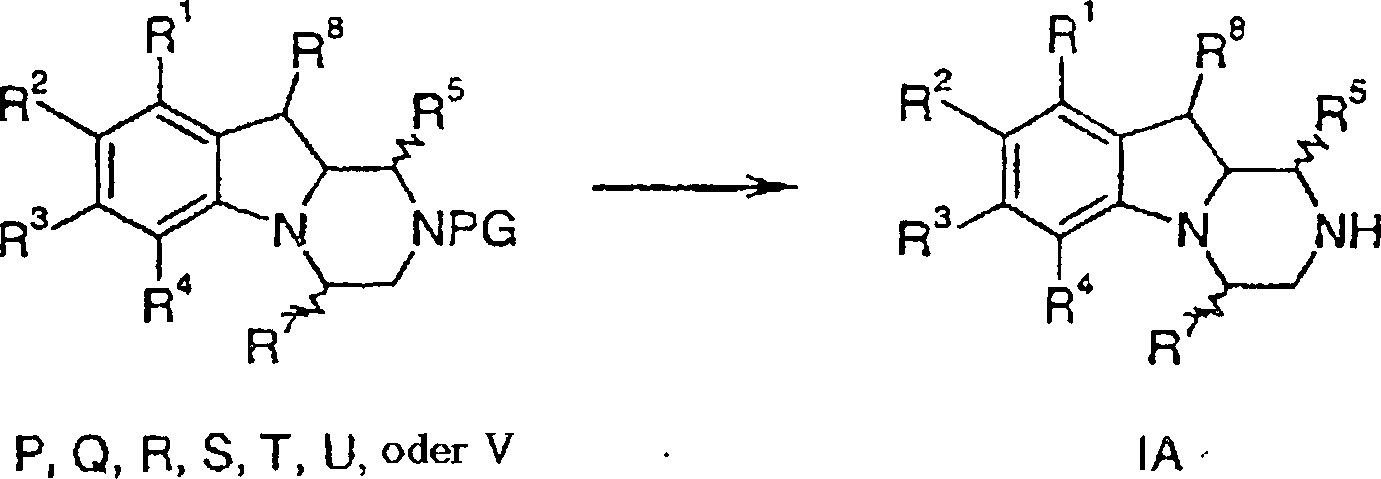
Die Hexahydropyrazino[1,2-a]indole der Formel I können aus Verbindungen der Formel IA durch Methoden, die im Stand der Technik bekannt sind, hergestellt werden (z.B., March, Advanced Organic Chemistry, 4 th. edition, Seite 411 ff, 768ff, 898ff, 900ff, 1212ff), z.B., Alkylierungsreaktionen, Mannich Reaktionen, Acylierung gefolgt von Reduktion etc. (Schema 17).The Hexahydropyrazino [1,2-a] indoles of the formula I can be prepared from compounds of the formula IA prepared by methods known in the art (e.g., March, Advanced Organic Chemistry, 4th edition, Page 411 ff, 768ff, 898ff, 900ff, 1212ff), e.g., alkylation reactions, Mannich reactions, acylation followed by reduction, etc. (Scheme 17).
Schema
17: 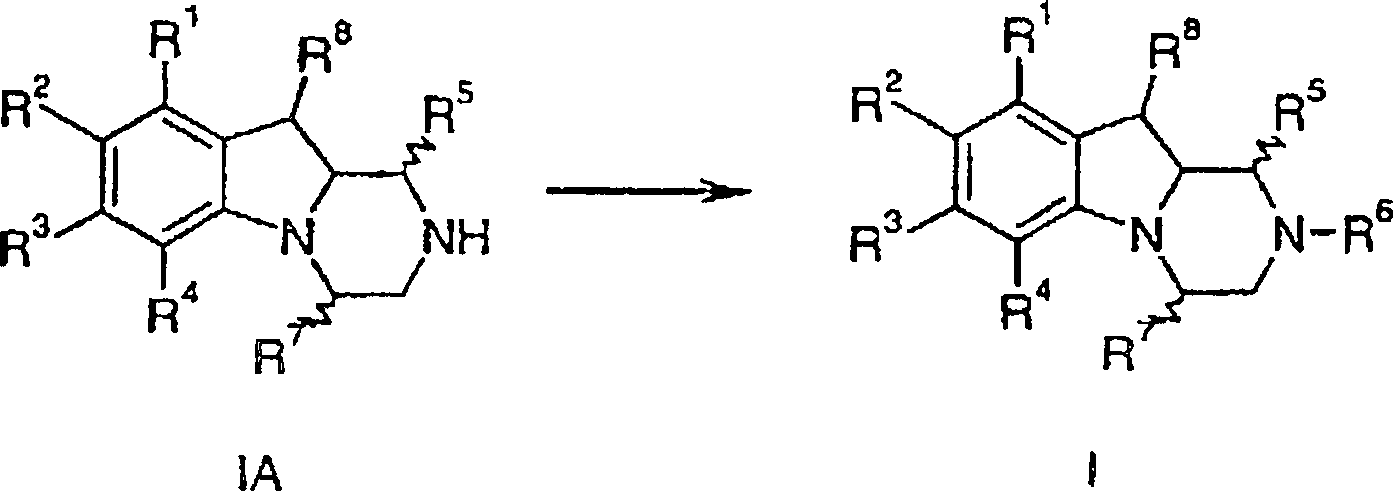
Das bisher unbekannte Boc-sulfamidat II kann gemäß Schema 18 hergestellt werden, durch Umsetzen eines Boc-geschützten Ethanolaminderivats mit Thionylchlorid in einem geeeigneten Lösemittel, z.B., THF oder Ethylacetat in Gegenwart einer geeigneten Base, wie z.B., Triethylamin oder Imidazol und Oxidieren des Zwischenprodukts (z.B., mit Natriummetaperiodat und Ruthenium(IV)oxid) in einem geeigneten Lösemittel (z.B., Ethylacetat). Die Stereochemie des Kohlenstoffatoms, das an R7 gebunden ist, bleibt während dieser Reaktionssequenz unverändert (e.e. > 97%). Für den Fall, dass R7 = Hydroxyalkyl ist, wird das Hydroxyl mit einer geeigneten Schutzgruppe geschützt. bevorzugt einem Silylether, stärker bevorzugt einem Dimethyl-(1,1,2-trimethylpropyl)silanyloxymethylether. Der Dimethyl-(1,1,2-trimethylproyl)silanyloxymethylether wird bevorzugt während der Umwandlung der Zwischenprodukte C oder E1 zu Tetrahydropyrazino[1,2-a]indol D1, durch Umsetzen mit Aluminiumhydrid, entschützt.The previously unknown Boc-sulfamidate II can be prepared according to Scheme 18 by reacting a Boc-protected ethanolamine derivative with thionyl chloride in a suitable solvent, for example, THF or ethyl acetate in the presence of a suitable base such as triethylamine or imidazole and oxidizing the intermediate ( for example, with sodium metaperiodate and ruthenium (IV) oxide) in a suitable solvent (eg, ethyl acetate). The stereochemistry of the carbon atom attached to R 7 remains unchanged during this reaction sequence (ee> 97%). In the case where R 7 = hydroxyalkyl, the hydroxyl is protected with a suitable protecting group. preferably a silyl ether, more preferably a dimethyl (1,1,2-trimethylpropyl) silanyloxymethyl ether. The dimethyl (1,1,2-trimethylproyl) silanyloxymethyl ether is preferably deprotected during the conversion of intermediates C or E1 to tetrahydropyrazino [1,2-a] indole D1 by reaction with aluminum hydride.
Schema
18: 
Die Verbindungen der Formel (I) können bei der Behandlung (einschließlich prophylaktischer Behandlung) von Störungen verwendet werden, die mit der 5-HT2-Rezeptorfunktion verbunden sind.The compounds of formula (I) may be used in the treatment (including prophylactic treatment) of disorders associated with 5-HT 2 receptor function.
Die Verbindungen können als Rezeptoragonisten oder Antagonisten wirken. Bevorzugt können die Verbindungen bei der Behandlung (einschließlich prophylaktischer Behandlung) von Störungen verwendet werden, die mit 5-HT2B und/oder 5-HT2C-Rezeptorfunktion verbunden sind. Bevorzugt können die Verbindungen bei der Behandlung (einschließlich prophylaktischer Behandlung) von Störungen verwendet werden, bei denen ein 5-HT2C-Rezeptoragonist erforderlich ist.The compounds may act as receptor agonists or antagonists. Preferably, the compounds may be used in the treatment (including prophylactic treatment) of disorders associated with 5-HT 2B and / or 5-HT 2C receptor function. Preferably, the compounds may be used in the treatment (including prophylactic treatment) of disorders in which a 5-HT 2C receptor agonist is required.
Die Verbindungen der Formel (I) können bei der Behandlung oder Prophylaxe von Störungen des zentralen Nervensystems verwendet werden, wie Depression, atypische Depression, bipolare Störungen, Angstneurosen, obsessive-kompulsive Störungen, Sozialphobien oder Panikzuständen, Schlafstörungen, Sexualstörungen, Psychosen, Schizophrenie, Migräne und anderen Zuständen, die mit cephalischen Schmerzen oder anderen Schmerzen verbunden sind, erhöhtem intrakranialen Druck, Epilepsie, Persönlichkeitsstörungen, altersbedingten Verhaltensstörungen, Verhaltensstörungen, die mit Demenz verbunden sind, organischen Geistesstörungen, Geistesstörungen in der Kindheit, Aggressivität, altersbedingten Gedächtnisstörungen, chronischem Müdigkeitssyndrom, Drogen- und Alkoholabhängigkeit, Fettleibigkeit, Bulminie, Anorexia nervosa Syndrom oder prämenstrualer Spannung; Schäden des zentralen Nervensystems durch Trauma, Schlaganfall, neurodegenerative Erkrankungen oder toxische oder infektiöse ZNS-Krankheiten, wie Encephalitis oder Meningitis; kardiovaskuläre Störungen, wie Thrombose; gastrointestinale Störungen, wie Dysfunktion der gastrointestinalen Motilität; Diabetis insipidus; und Schlafapnoen.The Compounds of formula (I) can in the treatment or prophylaxis of disorders of the central nervous system used as depression, atypical depression, bipolar disorders, Anxiety neuroses, obsessive-compulsive disorders, social phobias or Panic disorder, Sleep disorders, Sexual disorders, Psychosis, schizophrenia, migraine and other states, those associated with cephalic pain or other pain are, heightened intracranial pressure, epilepsy, personality disorders, age-related behavioral disorders, Behavioral disorders, that are associated with dementia, organic mental disorders, mental disorders in childhood, aggressiveness, age-related memory disorders, chronic fatigue syndrome, Drug and alcohol dependence, Obesity, bulminia, anorexia nervosa syndrome or premenstrual Tension; damage of the central nervous system due to trauma, stroke, neurodegenerative Diseases or toxic or infectious CNS diseases, such as encephalitis or meningitis; cardiovascular disorders, like thrombosis; gastrointestinal disorders, such as dysfunction of gastrointestinal motility; Diabetes insipidus; and sleep apnea.
Ein weiterer erfindungsgemäßer Gesichtspunkt ist eine Verbindung gemäß Formel I zur Verwendung als therapeutischer Wirkstoff.One another inventive aspect is a compound according to formula I for use as a therapeutic agent.
Gemäß einem weiteren Gesichtspunkt der vorliegenden Erfindung wird die Verwendung einer Verbindung der Formel (I) bei der Herstellung eines Medikaments, umfassend eine Verbindung gemäß Formel I zur Behandlung von Störungen des zentralen Nervensystems, Schäden am zentralen Nervensystem, kardiovaskuläre Störungen, gastrointestinale Störungen, Diabetis insipidus, Typ II Diabetis und Schlafapnoen, zur Verfügung gestellt.According to one Another aspect of the present invention is the use a compound of formula (I) in the manufacture of a medicament, comprising a compound according to formula I for the treatment of disorders of the central nervous system, damage central nervous system, cardiovascular disorders, gastrointestinal disorders, Diabetis insipidus, type II diabetes and sleep apnea, provided.
Gemäß einem bevorzugten erfindungsgemäßen Gesichtspunkt sind die Störungen des zentralen Nervensystems ausgewählt aus Depression, atypischer Depression, bipolaren Störungen, Angstneurosen, obsessiven-kompulsiven Störungen, Sozialphobien oder Panikzuständen, Schlafstörungen, Sexualstörungen, Psychosen, Schizophrenie, Migräne und anderen Zuständen, die mit cephalischen Schmerzen oder anderen Schmerzen verbunden sind, erhöhtem intrakranialen Druck, Epilepsie, Persönlichkeitsstörungen, altersbedingten Verhaltensstörungen, Verhaltensstörungen, die mit Demenz verbunden sind, organischen Geistesstörungen, Geistesstörungen in der Kindheit, Aggressivität, altersbedingten Gedächtnisstörungen, chronischem Müdigkeitssyndrom, Drogen- und Alkoholabhängigkeit, Fettleibigkeit, Bulminie, Anorexia nervosa Syndrom oder prämenstrualer Spannung.According to one preferred aspect of the invention are the errors of the central nervous system selected from depression, atypical Depression, bipolar disorder, Anxiety neuroses, obsessive-compulsive disorders, social phobias or Panic disorder, Sleep disorders, Sexual disorders, Psychosis, schizophrenia, migraine and other states, those associated with cephalic pain or other pain are, heightened intracranial pressure, epilepsy, personality disorders, age-related behavioral disorders, Behavioral disorders, that are associated with dementia, organic mental disorders, mental disorders in childhood, aggressiveness, age-related memory disorders, chronic fatigue syndrome, Drug and alcohol dependence, Obesity, bulminia, anorexia nervosa syndrome or premenstrual Tension.
Gemäß einem bevorzugten erfindungsgemäßen Gesichtspunkt beruhen die Störungen des zentralen Nervensystems auf Trauma, Schlaganfall, neurodegenerativen Erkrankungen oder toxischen oder infektiösen ZNS-Krankheiten, besonders wenn die toxische oder infektiöse ZNS-Krankheit Encephalitis oder Meningitis ist.According to one preferred aspect of the invention the disorders are based of the central nervous system on trauma, stroke, neurodegenerative Diseases or toxic or infectious CNS diseases, especially if the toxic or infectious CNS disease is encephalitis or meningitis.
Eine weitere bevorzugte Ausführungsform der vorliegenden Erfindung ist die vorstehend erwähnte Verwendung, wobei die kardiovaskuläre Störung Thrombose ist.A further preferred embodiment the present invention is the above-mentioned use, being the cardiovascular disorder Thrombosis is.
Ebenfalls bevorzugt ist die erwähnte Verwendung der Verbindungen gemäß Formel I, wobei die gastointestinale Störung die Dysfunktion der gastrointestinalen Motilität ist.Also preferred is the mentioned Use of the compounds according to formula I, being the gastointestinal disorder is the dysfunction of gastrointestinal motility.
Weiterhin bevorzugt ist die Verwendung einer Verbindung der Formel I bei der Herstellung eines Medikaments, umfassend eine Verbindung der Formel I zur Behandlung von Diabetis, insbesonders Typ II Diabetis.Farther preferred is the use of a compound of formula I in the Preparation of a medicament comprising a compound of the formula I for the treatment of diabetes, especially type II diabetes.
Besonders bevorzugt ist die Verwendung einer Verbindung der Formel I bei der Herstellung eines Medikaments, umfassend eine Verbindung der Formel I zur Behandlung von Fettleibigkeit.Especially preferred is the use of a compound of formula I in the Preparation of a medicament comprising a compound of the formula I for the treatment of obesity.
Weiter bevorzugt ist eine Methode zur Behandlung einer beliebigen der vorstehend erwähnten Störungen, umfassend die Verabreichung einer wirksamen Dosis einer Verbindung der Formel (I) an einem Patienten, der eine solche Behandlung benötigt. Ebenfalls bevorzugt ist die Verwendung oder Methode, wie vorstehend erwähnt, wobei die Behandlung eine prophylaktische Behandlung ist.Further preferred is a method of treating any of the above mentioned disorders, comprising the administration of an effective dose of a compound of the formula (I) on a patient in need of such treatment. Also preferred is the use or method as mentioned above, wherein the treatment is a prophylactic treatment.
Eine weitere bevorzugte Ausführungsform der vorliegenden Erfindung ist ein Verfahren zur Herstellung einer Verbindung der Formel I, wobei R1 bis R8 wie vorstehend definiert sind, Rb Alkyl ist und PG eine Schutzgruppe bedeutet, umfassend einen beliebigen der folgenden Schritte:
- a) Herstellung einer Verbindung der Formel D1 durch Umsetzen
einer Verbindung der Formel C in Gegenwart eines Reduktionsmittels,
besonders bevorzugt in Gegenwart von Lithiumaluminiumhydrid; oder

- b) Herstellung einer Verbindung gemäß Formel E1 durch Umsetzen
einer Verbindung gemäß Formel
D1 in Gegenwart eines Reduktionsmittels, besonders bevorzugt in
Gegenwart von Lithiumaluminiumhydrid oder Borandimethylsulfidkomplex;
oder

- c) Herstellung einer Verbindung gemäß Formel D2 durch Entschützen einer
Verbindung gemäß Formel
J2. Besonders bevorzugte Schutzgruppen (PG) sind solche, bei denen
N-PG ein Carbamat oder eine Amidgruppe bezeichnet. In einer bevorzugten
Ausführungsform
kann das Entschützen
wie folgt durchgeführt werden:
eine Verbindung der Formel 12, wobei PG gleich Boc ist, wird mit
einem Gemisch aus Dichlormethan und Trifluoressigsäure bei
Raumtemperatur entschützt;
oder
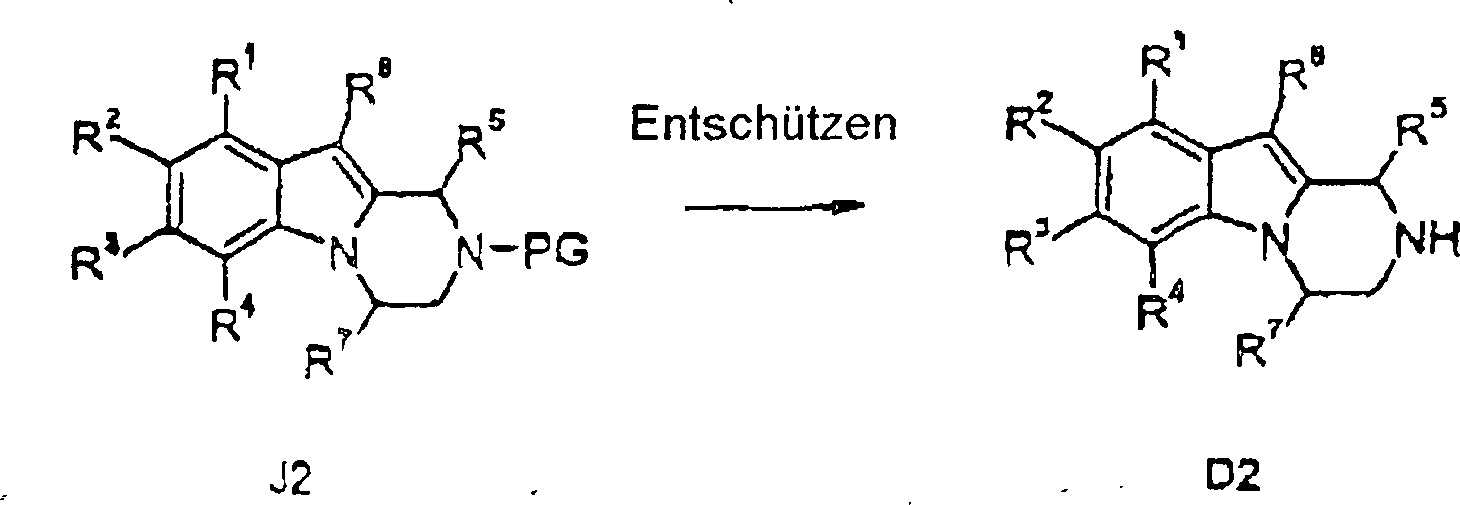
- d) Herstellung einer Verbindung gemäß Formel IA durch Umsetzen
einer Verbindung der Formel D2 in Gegenwart eines Reduktionsmittels;
besonders bevorzugt in Gegenwart von Natriumborhydrid in einem Gemisch
aus Tetrahydrofuran und Trifluoressigsäure; oder

- e) Herstellung einer Verbindung gemäß Formel IB durch Umsetzen
einer Verbindung der Formel M in Gegenwart eines Reduktionsmittels,
besonders bevorzugt in Gegenwart von Lithiumaluminiumhydrid; oder
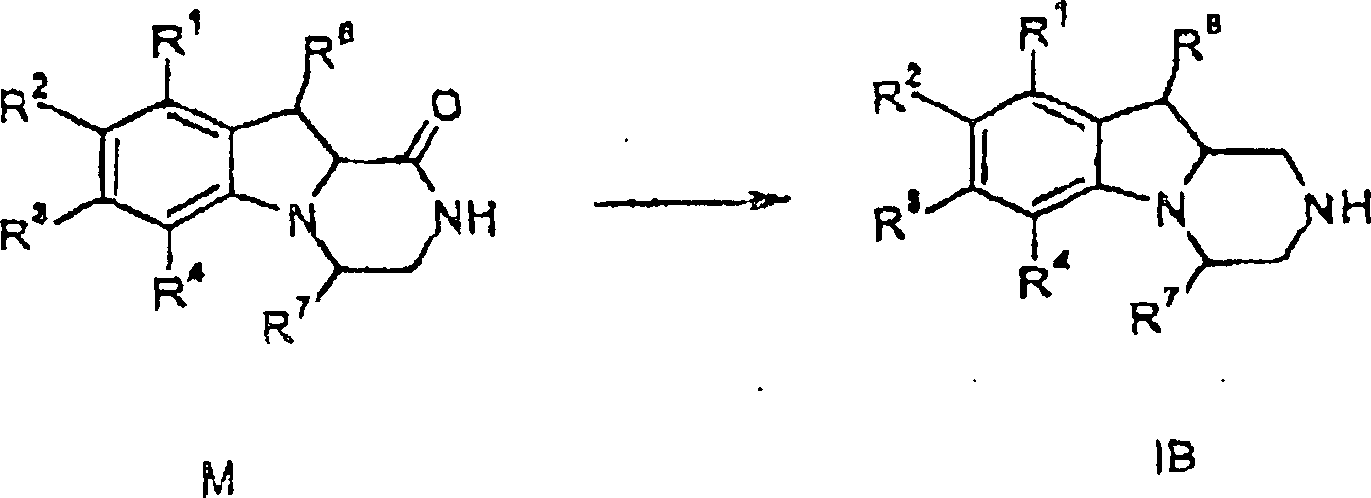
- f) Herstellung einer Verbindung gemäß Formel I durch Umsetzen einer
Verbindung der Formel IA in Gegenwart eines Alkylierungs- oder Acylierungsmittels,
wobei der Acylierung ein Reduktionsschritt nachfolgt. Alkylierungsmittel bedeutet Alkyl- oder Cycloalkylhalogenide, funktionalisierte Alkylhalogenide, wie Hydroxyalkylhalogenide, Carbamoylhalogenide, Alkoxycarbonylhalogenide, Aryloxycarbonylalkylhalogenide oder Heterocyclylalkylhalogenide oder die betreffenden Mesylate, Tosylate oder Triflate an Stelle der Halogenide. Beispiele für Alkylierungsmittel sind 2-(Bromethoxy)-tert.-butyldimethylsilan, Bromessigsäuremethylester und 2-Bromacetamid. Acylierungsmittel bezeichnet die aktivierten Derivate (z.B., Säurechloride) von Alkyl- oder Cycloalkylcarbonsäuren, Heterocyclylcarbonsäuren oder Heterocyclylalkylcarbonsäuren. Beispiele für Acylierungsmittel sind Acetylchlorid und Cyclopropylcarbonsäurechlorid; oder

- g) Herstellung einer Verbindung gemäß Formel I durch Umsetzen einer
Verbindung der Formel B, wobei Ra Alkyl
ist, in Gegenwart einer Verbindung der Formel (II), wobei PG eine
Schutzgruppe ist, bevorzugt tert.-Butoxycarbonyl (Boc); oder

- h) Herstellung einer Verbindung gemäß Formel I durch Umsetzen einer
Verbindung der Formel F2 in Gegenwart einer Verbindung der Formel
(II) wie vorstehend definiert, wobei PG'Wasserstoff oder eine OH-Schutzgruppe ist, bevorzugt Trimethylsilyl, tert.-Butyldimethylsilyl, Acetyl, Methoxymethyl oder 2-Tetrahydropyranyl; oder

- i) Herstellung einer Verbindung gemäß Formel I durch Umsetzen einer
Verbindung der Formel H in Gegenwart einer Verbindung der Formel
(II) wie vorstehend definiert

- a) preparation of a compound of the formula D1 by reacting a compound of the formula C in the presence of a reducing agent, more preferably in the presence of lithium aluminum hydride; or
- b) preparing a compound of formula E1 by reacting a compound of formula D1 in the presence of a reducing agent, more preferably in the presence of lithium aluminum hydride or borane dimethylsulfide complex; or
- c) Preparation of a compound according to formula D2 by deprotection of a compound according to formula J2. Particularly preferred protecting groups (PG) are those in which N-PG denotes a carbamate or an amide group. In a preferred embodiment deprotection may be carried out as follows: a compound of formula 12 wherein PG is Boc is deprotected with a mixture of dichloromethane and trifluoroacetic acid at room temperature; or
- d) preparing a compound according to formula IA by reacting a compound of formula D2 in the presence of a reducing agent; most preferably in the presence of sodium borohydride in a mixture of tetrahydrofuran and trifluoroacetic acid; or
- e) preparation of a compound according to formula IB by reacting a compound of formula M in the presence of a reducing agent, more preferably in the presence of lithium aluminum hydride; or
- f) preparing a compound of formula I by reacting a compound of formula IA in the presence of an alkylating or acylating agent, said acylation following a reduction step. Alkylating agent means alkyl or cycloalkyl halides, functionalized alkyl halides such as hydroxyalkyl halides, carbamoyl halides, alkoxycarbonyl halides, aryloxycarbonylalkyl halides or heterocyclylalkyl halides or the mesylates, tosylates or triflates in question in place of the halides. Examples of alkylating agents are 2- (bromoethoxy) -tert.-butyldimethylsilane, bromoacetic acid methyl ester and 2-bromoacetamide. Acylating agent refers to the activated derivatives (eg, acid chlorides) of alkyl or cycloalkylcarboxylic acids, heterocyclylcarboxylic acids or heterocyclylalkylcarboxylic acids. Examples of acylating agents are acetyl chloride and cyclopropylcarboxylic acid chloride; or
- g) preparing a compound of formula I by reacting a compound of formula B wherein R a is alkyl in the presence of a compound of formula (II) wherein PG is a protecting group, preferably tert-butoxycarbonyl (Boc); or
- h) preparing a compound according to formula I by reacting a compound of formula F2 in the presence of a compound of formula (II) as defined above, wherein PG 'is hydrogen or an OH-protecting group, preferably trimethylsilyl, tert-butyldimethylsilyl, acetyl, methoxymethyl or 2-tetrahydropyranyl; or
- i) Preparation of a compound of the formula I by reacting a compound of the formula H in the presence of a compound of the formula (II) as defined above
Ein
weiterer bevorzugter erfindungsgemäßer Gesichtspunkt sind folgende
Zwischenprodukte:
(R)-9-Brom-1,2,3,4,10,10a-hexahydropyrazino[1,2-a]indol;
(S)-9-Brom-1,2,3,4,10,10a-hexahydropyrazino[1,2-a]indol;
(4R)-7-Chlor-4-methyl-1,2,3,4-tetrahydropyrazino[1,2-a]indol
und
(4S)-7-Chlor-4-methyl-1,2,3,4-tetrahydropyrazino[1,2-a]indol.Another preferred aspect of the invention is the following intermediates:
(R) -9-Bromo-1,2,3,4,10,10a-hexahydropyrazino [1,2-a] indole;
(S) -9-bromo-1,2,3,4,10,10a-hexahydropyrazino [1,2-a] indole;
(4R) -7-chloro-4-methyl-1,2,3,4-tetrahydropyrazino [1,2-a] indole and
(4S) -7-chloro-4-methyl-1,2,3,4-tetrahydropyrazino [1,2-a] indole.
Besonders
bevorzugte Zwischenprodukte sind:
(S)-S-Methyl-2,2-dioxo-[1,2,3]oxathiazolidin-3-carbonsäuretert.-butylester
(RS)-S-Ethyl-2,2-dioxo-[1,2,3]oxathiazolidin-3-carbonsäuretert.-butylester
2,2-Dioxo-[1,2,3]oxathiazolidin-3-carbonsäuretert.-butylester
(R)-5-[Dimethyl-(1,1,2-trimethylpropyl)silanyloxymethyl]-2,2-dioxo-[1,2,3]oxathiazolidin-3-carbonsäuretert.-butylester.Particularly preferred intermediates are:
(S) -S-methyl-2,2-dioxo- [1,2,3] oxathiazolidine-3-carboxylate
(RS) -S-ethyl-2,2-dioxo- [1,2,3] oxathiazolidine-3-carboxylate
2,2-dioxo- [1,2,3] oxathiazolidine-3-carboxylate
(R) -5- [dimethyl (1,1,2-trimethylpropyl) silanyloxymethyl] -2,2-dioxo- [1,2,3] oxathiazolidine-3-carboxylic acid tert-butyl ester.
Gemäß einem weiteren erfindungsgemäßen Gesichtspunkt wird ein Arzneimittel zur Verfügung gestellt, umfassend eine Verbindung der Formel (I) in Kombination mit einem pharmazeutisch verträglichen Träger oder Excipienten und eine Methode zur Herstellung solch einer Zusammensetzung umfassend das Vereinigen einer Verbindung der Formel (I) mit einem pharmazeutisch verträglichen Träger oder Excipienten.According to one another aspect of the invention a medicine will be available comprising a compound of the formula (I) in combination with a pharmaceutically acceptable carrier or excipients and a method of making such a composition comprising combining a compound of formula (I) with a pharmaceutically acceptable carrier or excipients.
Ein weiterer Gesichtspunkt der vorliegenden Erfindung ist das vorstehende Arzneimittel umfassend weiterhin eine therapeutisch wirksame Menge eines Lipaseinhibitors. Insbesonders bevorzugt ist das vorstehende Arzneimittel, wobei der Lipaseinhibitor Orlistat ist.One Another aspect of the present invention is the above A pharmaceutical composition further comprising a therapeutically effective amount a lipase inhibitor. Especially preferred is the above Drug, wherein the lipase inhibitor is orlistat.
Gemäß einem weiteren erfindungsgemäßen Gesichtspunkt wird eine Methode zur Behandlung von Fettleibigkeit bei einem Menschen zur Verfügung gestellt, der eine solche Behandlung benötigt, umfassend die Verabreichung einer therapeutisch wirksamen Menge einer Verbindung gemäß Formel I und einer therapeutisch wirksamen Menge eines Lipaseinhibitors, der besonders bevorzugt Orlistat ist, an einen Menschen. Ebenfalls Gegenstand der vorliegenden Erfindung ist die erwähnte Methode, wobei die Verabreichung gleichzeitig, getrennt oder aufeinanderfolgend erfolgt.According to one another aspect of the invention Being a method of treating obesity in a human to disposal which requires such treatment, including administration a therapeutically effective amount of a compound of the formula I and a therapeutically effective amount of a lipase inhibitor, the most preferred is orlistat, to a human. Also The subject of the present invention is the mentioned method, the administration being simultaneous, separate or sequential he follows.
Eine weitere bevorzugte Ausführungsform der vorliegenden Erfindung ist die Verwendung einer Verbindung der Formel I zur Herstellung eines Medikaments zur Behandlung und Prophylaxe von Fettleibigkeit bei einem Patienten, der ebenfalls eine Behandlung mit einem Lipaseinhibitor erhält, der besonders bevorzugt Orlistat ist.A further preferred embodiment The present invention is the use of a compound of Formula I for the manufacture of a medicament for the treatment and prophylaxis Obesity in a patient who is also receiving treatment with a lipase inhibitor, the most preferred is orlistat.
Die vorstehend beschriebenen Verfahren können zur Herstellung einer erfindungsgemäßen Verbindung in Form einer freien Base oder als Säureadditionssalz durchgeführt werden. Falls die erfindungsgemäße Verbindung als ein Säureadditionssalz erhalten wird, kann die freie Base durch basisch machen einer Lösung des Säureadditionssalzes erhalten werden. Im Gegensatz dazu, wenn das Produkt des Verfahrens eine freie Base ist, kann ein Säureadditionssalz, insbesonders ein pharmazeutisch verträgliches Säureadditionssalz, durch Auflösen der freien Base in einem geeigneten organischen Lösemittel und Umsetzen der Lösung mit einer Säure erhalten werden, in Einklang mit üblichen Verfahren zur Herstellung von Säureadditionssalzen aus basischen Verbindungen.The methods described above can be used to produce a verbin according to the invention be carried out in the form of a free base or as an acid addition salt. If the compound of the present invention is obtained as an acid addition salt, the free base can be obtained by basifying a solution of the acid addition salt. In contrast, when the product of the process is a free base, an acid addition salt, particularly a pharmaceutically acceptable acid addition salt, may be obtained by dissolving the free base in a suitable organic solvent and reacting the solution with an acid, in accordance with conventional procedures Preparation of acid addition salts from basic compounds.
Die Zusammensetzungen der vorliegenden Erfindung können in einer üblichen Weise formuliert werden unter Verwendung eines oder mehrerer pharmazeutisch verträglicher Träger. Damit können die erfindungsgemäßen Wirkstoffe für orale, bukkale, intranasale, parenterale (z.B., intravenöse, intramuskuläre oder subcutane) transdermale oder rektale Verabreichung formuliert werden oder in einer Form die zur Verabreichung durch Inhalation oder Insufflation geeignet ist.The Compositions of the present invention can be used in a conventional manner Be formulated using one or more pharmaceutical compatible Carrier. With that you can the active compounds according to the invention for oral, buccal, intranasal, parenteral (e.g., intravenous, intramuscular or subcutaneous) transdermal or rectal administration or in a form for administration by inhalation or insufflation suitable is.
Für die orale Verabreichung können die Arzneimittel auf übliche Art und Weise zum Beispiel als Tabletten oder Kapseln mit pharmazeutisch verträglichen Excipienten, wie Bindemittel (z.B. pregelatinisierte Maisstärke, Polyvinylpyrrolidon oder Hydroxypropylmethylcellulose); Füllmittel (z.B. Laktose, mikrokristalliner Cellulose oder Calciumphosphat); Schmiermittel (z.B. Magnesiumstearat, Talk oder Siliciumdioxid); Sprengmittel (z.B. Kartoffelstärke oder Natriumstärkeglykolat); oder Benetzungsmittel (z.B. Natriumlaurylsulfat) hergestellt werden. Die Tabletten können durch Methoden, die im Stand der Technik gut bekannt sind, überzogen werden. Flüssige Zubereitungen zur oralen Verabreichung zum Beispiel Lösungen, Sirupen oder Suspensionen vorliegen oder sie können als ein Trockenprodukt für die Konstitution mit Wasser oder anderen geeigneten Vehikeln vor der Verwendung, vorliegen. Solche flüssigen Zubereitungen können auf übliche Art und Weise mir pharmazeutisch verträglichen Zusatzstoffen, wie Suspensionsmittel (z.B. Sorbitsirup, Methylcellulose oder hydrierte essbare Fette); Emulgiermittel (z.B. Lecithin oder Gummiarabicum); nicht-wässrige Vehikel (z.B. Mandelöl, ölige Ester oder Ethylalkohol); und Konservierungsstoffe (z.B. p-Hydroxybenzoesäuremethylester oder p-Hydroxybenzoesäureproplyester oder Sorbinsäure) hergestellt werden.For the oral Administration can the medicines on usual Way for example as tablets or capsules with pharmaceutical acceptable Excipients, such as binders (e.g., pregelatinized corn starch, polyvinylpyrrolidone or hydroxypropylmethylcellulose); Fillers (e.g., lactose, microcrystalline Cellulose or calcium phosphate); Lubricants (e.g., magnesium stearate, Talc or silica); Disintegrants (e.g., potato starch or Sodium starch glycolate); or wetting agents (e.g., sodium lauryl sulfate). The tablets can coated by methods well known in the art become. liquid Preparations for oral administration, for example solutions, Syrups or suspensions are present or they can be considered a dry product for the Constitution with water or other suitable vehicle before Use, present. Such liquid Preparations can on usual Way with pharmaceutically acceptable additives, such as Suspending agents (e.g., sorbitol syrup, methyl cellulose or hydrogenated edible fats); Emulsifying agents (e.g., lecithin or gum arabic); non-aqueous Vehicle (e.g., almond oil, oily esters or ethyl alcohol); and preservatives (e.g., p-hydroxybenzoic acid methyl ester or p-hydroxybenzoic acid propionate or sorbic acid) getting produced.
Zur bukkalen Verabreichung kann die Zusammensetzung in Form von Tabletten oder Pastillen vorliegen, die in der üblichen Weise formuliert sind.to buccal administration may be the composition in the form of tablets or pastilles formulated in the usual way.
Die erfindungsgemäßen Wirkstoffe können zur parenteralen Verabreichung durch Injektion, einschließlich unter Verwendung üblicher Katheterisierungstechniken oder Infusionen, formuliert werden. Formulierungen zur Injektion können in Einheitsdosierungsformen, z.B. in Ampullen oder in Mehrfachdosisbehältern mit einem zugesetzten Konservierungsstoff, vorliegen. Die Zusammensetzungen können in solchen Formen vorliegen, wie Suspensionen, Lösungen oder Emulsionen in öligen oder wässrigen Vehikeln und sie können Formulierungsmittel, wie Suspensionsmittel, Stabilisierungsmittel und/oder Dispersionsmittel, enthalten.The active ingredients according to the invention can for parenteral administration by injection, including Use of usual Catheterization techniques or infusions. formulations for injection in unit dosage forms, e.g. in ampoules or in multi-dose containers with an added preservative. The compositions can in such forms as suspensions, solutions or emulsions in oily or aqueous Vehicles and they can be formulating agents, as suspending agents, stabilizing agents and / or dispersing agents, contain.
Alternativ dazu kann der Wirkstoff in Pulverform zur Rekonstitution mit einem geeigneten Vehikel, wie z.B. sterilem pyrogenfreiem Wasser vor der Verwendung, vorliegen. Die erfindungsgemäßen Wirkstoffe können ebenfalls zu rektalen Zusammensetzungen formuliert werden, wie als Suppositorien oder Retentionsklistiere, die z.B. übliche Suppositoriengrundlagen, wie Kakaobutter oder andere Glyceride, enthalten.alternative For this, the active ingredient in powder form for reconstitution with a suitable vehicle, e.g. sterile pyrogen-free water before Use, present. The active compounds according to the invention can likewise be formulated into rectal compositions, such as suppositories or retention enemas, e.g. usual suppository basics, like cocoa butter or other glycerides.
Zur intranasalen Verabreichung oder Verabreichung durch Inhalation werden die erfindungsgemäßen Wirkstoffe üblicherweise in Form einer Lösung oder Suspension aus einem Pumpspraybehälter abgegeben, der von einem Patienten gedrückt oder gepumpt wird oder als Aerosolspray aus einem unter Druck stehenden Behälter oder Zerstäuber unter Verwendung eines geeigneten Treibmittels, wie z.B. Dichlordifluormethan, Trichlorfluormethan, Dichlortetrafluorethan, Kohlendioxid oder ein anderes geeignetes Gas. Im Fall eines unter Druck stehenden Aerosols kann die Dosierungseinheit durch Verwendung eines Ventils festgelegt werden, das eine abgemessene Menge freisetzt. Der unter Druck stehende Behälter oder Zerstäuber kann eine Lösung oder Suspension des Wirkstoffs enthalten. Kapseln und Patronen (hergestellt zum Beispiel aus Gelatine) zur Verwendung in einem Inhalator oder Insufflator können so formuliert werden, dass sie ein Pulvergemisch aus einer erfindungsgemäßen Verbindung und eine geeignete Pulvergrundlage, wie Laktose oder Stärke, enthalten.to intranasal administration or administration by inhalation the active compounds according to the invention usually in the form of a solution or suspension delivered from a pump spray container, the one of Patient pressed or as an aerosol spray from a pressurized container or atomizer using a suitable propellant, e.g. Dichlorodifluoromethane, Trichlorofluoromethane, dichlorotetrafluoroethane, carbon dioxide or a other suitable gas. In the case of a pressurized aerosol can set the dosage unit by using a valve which releases a measured amount. The pressurized container or atomizer can a solution or Suspension of the active ingredient. Capsules and cartridges (made for example, gelatin) for use in an inhaler or Insufflator can be formulated so that they are a powder mixture of a compound of the invention and a suitable powder base, such as lactose or starch.
Eine vorgeschlagene Dosis des erfindungsgemäßen Wirkstoffs zur oralen, parenteralen oder bukkalen Verabreichung an einen durchschnittlichen erwachsenen Menschen zur Behandlung der vorstehend erläuterten Zustände (z.B. Fettleibigkeit) liegt bei 0,1 bis 500 mg Wirkstoff pro Einheitsdosis, die zum Beispiel 1 bis 4 mal pro Tag verabreicht werden kann.A proposed dose of the active ingredient according to the invention for oral, parenteral or buccal administration to an average adult human for the treatment of those discussed above conditions (e.g., obesity) is 0.1 to 500 mg of active ingredient per unit dose, which can be administered, for example, 1 to 4 times a day.
Die Erfindung wird jetzt im Detail unter Bezug auf die folgenden Beispiele beschrieben. Es wird anerkannt, dass die Erfindung nur beispielhaft beschrieben wird und Veränderungen im Detail durchgeführt werden können, ohne dass der Bereich der Erfindung verlassen wird.The Invention will now be described in detail with reference to the following examples described. It is recognized that the invention is exemplary only is described and changes done in detail can be without departing from the scope of the invention.
UntersuchsverfahrenUnder Search method
1. Bindung an Serotininrezcptoren1. binding to serotininrezcptoren
Die Bindung von Verbindungen der Formel (I) an Serotoninrezeptoren wurde in vitro durch Standardmethoden bestimmt. Die Formulierungen wurden in Einklang mit den nachstehend aufgeführten Untersuchungen erforscht.The Binding of compounds of formula (I) to serotonin receptors determined in vitro by standard methods. The formulations were researched in accordance with the examinations listed below.
Methode (a): Für die Bindung an den 5-HT2C-Rezeptor wurden die 5-HT2C-Rezeptoren mit [3H]-5-HT radioaktiv markiert. Die Affinität von Verbindungen für 5-HT2C-Rezeptoren in einer CHO-Zelllinie wurde gemäß dem Verfahren von D. Hoyer, G. Engel und H. O. Kalkman, European J. Pharmacol., 1985, 118, 13–23, bestimmt.Method (a): For binding to the 5-HT 2C receptor, the 5-HT 2C receptors were radioactively labeled with [ 3 H] -5-HT. The affinity of compounds for 5-HT 2C receptors in a CHO cell line was determined according to the method of D. Hoyer, G. Engel and HO Kalkman, European J. Pharmacol., 1985, 118, 13-23.
Methode (b): Für die Bindung an den 5-HT2B-Rezeptor wurden die 5-HT2B-Rezeptoren mit [3H]-5-HT radioaktiv markiert. Die Affinität von Verbindungen für menschliche 5-HT2B-Rezeptoren in einer CHO-Zelllinie wurde gemäß dem Verfahren von K. Schmuck, C. Ulmer, P. Engels und H. Lubbert, FEBS Lett., 1994, 342, 85–90. bestimmt.Method (b): For binding to the 5-HT 2B receptor, the 5-HT 2B receptors were radioactively labeled with [ 3 H] -5-HT. The affinity of compounds for human 5-HT 2B receptors in a CHO cell line was determined according to the method of K. Schmuck, C. Ulmer, P. Engels and H. Lubbert, FEBS Lett., 1994, 342, 85-90. certainly.
Methode (c): Für die Bindung an den 5-HT2A-Rezeptor wurden die 5-HT2A-Rezeptoren mit [125I]-DOI radioaktiv markiert. Die Affinität von Verbindungen für 5-HT2A-Rezeptoren in einer CHO-Zelllinie wurde gemäß dem Verfahren von D. J. McKenna and S. J. Peroutka, J. Neurosci., 1989, 9, 3482–90, bestimmt.Method (c): For binding to the 5-HT 2A receptor, the 5-HT 2A receptors were radioactively labeled with [ 125 I] -DOI. The affinity of compounds for 5-HT 2A receptors in a CHO cell line was determined according to the method of DJ McKenna and SJ Peroutka, J. Neurosci., 1989, 9, 3482-90.
Die so bestimmte Wirksamkeit der Verbindung des Beispiels wird in Tabelle 1 gezeigt.The so certain effectiveness of the compound of the example is shown in Table 1 shown.
Tabelle
1 
Bevorzugte Verbindungen der Formel I, wie vorstehend beschrieben, weisen Ki (2C)-Werte von unter 10000 nM auf; besonders bevorzuge Verbindungen weisen Ki (2C)-Werte von unter 1000 nM auf besonders bevorzugte Verbindungen weisen Ki (2C)-Werte von unter 100 nM auf. Am stärksten bevorzugte Verbindungen weisen Ki (2C)-Werte von unter 30 nM auf.preferred Compounds of the formula I as described above have Ki (2C) values of less than 10,000 nM; especially prefer connections For example, Ki (2C) values below 1000 nM are particularly preferred Compounds have Ki (2C) values of less than 100 nM. Most preferred Compounds have Ki (2C) values of less than 30 nM.
2. Funktionelle Wirksamkeit2. Functional effectiveness
Die funktionelle Wirksamkeit von Verbindungen der Formel (I) wurde unter Verwendung eines fluorimetrischen bildgebenden Plattenlesegeräts (FLIPR) untersucht. CHO-Zellen, die menschliche 5-HT2C- oder menschliche 5-HT2A-Rezeptoren exprimieren, wurden am Tag vor der Untersuchung gezählt und in Standard 96-Loch Mikrotiterplatten gegeben, so dass sich eine konfluente Monoschicht ergab. Die Zeilen wurden dann mit Calcium empfindlichen Farbstoff, Fluo-3-AM, beladen. Farbstoff, der nicht aufgenommen worden war, wurde unter Verwendung eines automatischen Zellwäschers entfernt, wodurch ein Gesamtvolumen von 100 μl/Loch an Untersuchungspuffer (Hanks ausgewogene Salzlösung, die 20 mM Hepes und 2,5 mM Probenecid enthält) zurückblieb. Der Wirkstoff (aufgelöst in 50 μl des Untersuchungspuffers) wurde während der Fluoreszensmessung mit einer Geschwindigkeit von 70 μl/Sek. in jedes Loch der FLIPR 96-Lochplatte hinzugefügt. Die Messungen wurden in Intervallen von 1Sekunde durchgeführt und das maximale Fluoreszenzsignal wurde gemessen (etwa 10–15 Sekunden nach der Arzneimittelzugabe) und mit der Reaktion, die durch 10 μM 5-HT (definiert als 100%) erhalten wurde, verglichen und als prozentuale Reaktion (relative Wirksamkeit) ausgedrückt. Dosis-Reaktionskurven wurden unter Verwendung von Graphpad Prism (Graph Software Inc.) erstellt.The functional activity of compounds of formula (I) was investigated using a fluorimetric imaging plate reader (FLIPR). CHO cells expressing human 5-HT 2C or human 5-HT 2A receptors were counted the day before the study and placed in standard 96-well microtiter plates to give a confluent monolayer. The cells were then loaded with calcium-sensitive dye, Fluo-3-AM. Dye that was not taken up was removed using an automatic cell washer, leaving a total volume of 100 μl / well of assay buffer (Hank's balanced saline containing 20 mM Hepes and 2.5 mM probenecid). The active ingredient (dissolved in 50 μl of the assay buffer) was measured at a rate of 70 μl / sec during the fluorescence measurement. added to each hole of the FLIPR 96-well plate. The measurements were made at 1 second intervals and the maximum fluorescence signal was measured (about 10-15 seconds after drug addition) and compared to the response obtained by 10 μM 5-HT (defined as 100%) and as a percent response (relative effectiveness). Dose response curves were generated using Graphpad Prism (Graph Software Inc.).
Tabelle
2 
Die Verbindungen der Formel (I) weisen an dem h5-HT2C-Rezeptor eine Wirksamkeit im Bereich von 10000 bis 0,01 nM auf.The compounds of formula (I) have an activity in the range of 10000 to 0.01 nM at the h5-HT 2C receptor.
Bevorzugte Verbindungen der Formel I, wie vorstehend beschrieben, weisen am h5-HT2C-Rezeptor eine Wirksamkeit von unter 10000 nM auf; besonders bevorzugte Verbindungen von unter 1000 nM auf, besonders bevorzugte Verbindungen von unter 100 nM. Am stärksten bevorzugte Verbindungen weisen am h5-HT2C-Rezeptor eine Wirksamkeit von unter 30 nM auf.Preferred compounds of the formula I as described above have an activity of less than 10000 nM at the h5-HT 2C receptor; particularly preferred compounds of less than 1000 nM, particularly preferred compounds of less than 100 nM. Most preferred compounds have an activity of less than 30 nM at the h5-HT 2C receptor.
3. Wirksamkeit:3. Effectiveness:
Die Wirksamkeit des 5-HT2C-Agonisten wurde nach der Fähigkeit beurteilt ein spezifisches Syndrom zu induzieren.The efficacy of the 5-HT 2C agonist was assessed for the ability to induce a specific syndrome.
Das 5-HT2C-Syndrom ist eine schnelle Screeningmethode, die die Wirksamkeit von 5-HT2C-Agonisten in vivo durch ihre Fähigkeit bewertet, drei spezifische Verhaltensweisen bei Ratten hervorzurufen. Die Tiere werden entweder mit einer positiven Kontrolle (mCPP), einer Versuchsverbindung oder Vehikel, s.c. oder p.o. dosiert. Die Tiere werden auf einer offenen Bank, üblicherweise 30, 60 und 180 Minuten beobachtet und der Grat des Syndroms wird über eine Zeitdauer von 2 Minuten auf einer Skala von 0–3 bewertet, abhängig von dem Auftreten und dem Ausmaß an gespreitzten Extremitäten, gekrümmter Stellung und Retropulsion, die drei spezifischen Verhaltensweisen, die das Syndrom ausmacht. Die Daten werden unter Verwendung der Kruskal-Wallis Varianzanalyse bestimmt, gefolgt von geeigneten post-hoc Untersuchungen. Die gesamte statistische Analyse wird unter Verwendung der Excel Version 7-0 (Microsoft Corp.) und Statistica Version 5.0 (Stasoft, Inc.) durchgeführt.The 5-HT 2C syndrome is a rapid screening method that evaluates the efficacy of 5-HT 2C agonists in vivo by their ability to induce three specific behaviors in rats. The animals are dosed with either a positive control (mCPP), a test compound or vehicle, sc or po. The animals are observed on an open bench, usually for 30, 60 and 180 minutes, and the ridge of the syndrome is scored over a period of 2 minutes on a scale of 0-3, depending on the incidence and extent of the limbs spread, curved position and retropulsion, the three specific behaviors that make up the syndrome. Data are determined using Kruskal-Wallis analysis of variance followed by appropriate post hoc studies. All statistical analysis is performed using Excel version 7-0 (Microsoft Corp.) and Statistica version 5.0 (Stasoft, Inc.).
Die so bestimmte Aktivität der Beispiele zeigt, dass nach einer Dosis von 1 mg/kg s.c., die Verbindung eine signifikante pharmakologische Wirksamkeit für wenigstens 180 Minuten beibehält.The so specific activity The examples show that after a dose of 1 mg / kg s.c., the Compound a significant pharmacological activity for at least Retains 180 minutes.
4. Regulierung des Fressverhaltens4. Regulation of feeding behavior
Die in vivo Wirksamkeit von Verbindungen der Formel (I) wurde hinsichtlich ihrer Wirksamkeit beurteilt das Fressverhalten zu regulieren, wobei die Nahrungsaufnahme von hungernden Tieren beobachtet wird.The In vivo activity of compounds of formula (I) has been considered their effectiveness is judged to regulate feeding behavior, taking the food intake of starving animals is observed.
Die Versuchsverbindungen werden direkt nach der Verabreichung bewertet. Jede Untersuchung verwendet ein „Between-Subjects" Modell (üblicherweise n = 8) und vergleicht die Wirkungen der Dosen der Versuchsverbindungen mit denen der Vehikel und einer positiven Kontrolle.The Test compounds are evaluated immediately after administration. Each study uses a "between-subjects" model (usually n = 8) and compares the effects of the doses of the test compounds with those of the vehicle and a positive control.
Das anorektische Arzneimittel d-Fenfluramin dient normalerweise als eine positive Kontrolle. Der Weg der Arzneimittelverabreichung, das Arzneimittelvolumen und das Injektion-Versuchs-Intervall sind von den verwendeten Verbindungen abhängig. Ein schmackhaftes feuchtes Püree, das durch Zugabe von pulverisiertem Laborfutter und Wasser in einem Verhältnis von 1:2 und Mischen bis zu einer geschmeidigen Konsistenz hergestellt wird, wird in 120 ml Glasgefäßen jeden Tag 60 Minuten dargeboten. Die Aufnahme wird durch Wiegen vor und nach jeder Sitzung gemessen. Verschüttetes wird sorgfältig gesammelt. Es wird den Tieren erlaubt sich an das feuchte Püreefutter 10 Tage lang zu gewöhnen. Nach der Arzneimittelverabreichung wird den Tieren erlaubt das feuchte Püree aufzunehemen. Die Nahrungsaufnahme wird an vorbestimmten Zeitpunkten untersucht (üblicherweise 1 und 4 Stunden nach der Verabreichung). Die Nahrungsaufnahmedaten werden einer Einweg-Varianzanalyse (ANOVA) mit dem Arzneimittel als einem „Between-Subjects"-Faktor unterworfen. Eine signifikante Hauptwirkung wird durch die Durchführung von Dunnett's Test verfolgt, um abzuschätzen, welcher) Behandlungmittelwerte(wert) sich signifikant von dem Kontrollmittelwert unterscheiden(t). Alle statistischen Analsen werden unter Verwendung von Statistica Software, Version 5.0 (Statsofr Inc.) und Microsoft Excel 7.0 (Microsoft Corp.) durchgeführt.The Anorectic drug d-Fenfluramin is normally used as a positive control. The way of drug administration, the drug volume and injection-trial interval are depends on the connections used. A tasty moist Puree, by adding powdered laboratory feed and water in one relationship of 1: 2 and blended to a smooth consistency will be in 120 ml glass jars each Day 60 minutes. The recording is done by weighing before and measured after each session. Spilled material is collected carefully. The animals are allowed to get used to the wet pore lining for 10 days. To Drug administration is allowed to the animals wet Puree to pick up. The food intake is examined at predetermined times (usually 1 and 4 hours after administration). The food intake data become a one-way analysis of variance (ANOVA) with the drug as a "between-subjects" factor significant main impact is being tracked by conducting Dunnett's test, to estimate which one) Treatment mean (value) was significantly different from the control mean differ (t). All statistical analysts are being used Statistica Software version 5.0 (Statsofr Inc.) and Microsoft Excel 7.0 (Microsoft Corp.).
Die so bestimmte Aktivität des Beispiels zeigt, dass die Verbindungen 3 Stunden nach einer Dosis von 1 mg/kg s.c. eine signifikante Hypophagie beibehalten.The so specific activity the example shows that the compounds 3 hours after a Dose of 1 mg / kg s.c. maintained a significant hypophagia.
BeispieleExamples
Beispiel 1example 1
Gemisch aus (2S,10aR) und (2R,10aR)-2-(9-Brom-3,4,10,10a-tetrahydro-1H-pyrazino[1,2-a]indol-2-yl)cyclobutanon:Mixture of (2S, 10aR) and (2R, 10aR) -2- (9-bromo-3,4,10,10a -tetrahydro-1H-pyrazino [1,2-a] indol-2-yl) cyclobutanone:
(10aR)-9-Brom-1,2,3,4,10,10a-hexahydropyrazino[1,2-a]indol (0,10 g, 0,39 mmol) wurde in Methanol (1,5 ml) suspendiert. Eine Lösung aus [1-Cyclobuten-1,2-diylbis(oxy)]bistrimethylsilan (0,10 g, 0,43 mmol) in Methanol (0,5 ml) wurde hinzugefügt, das Gemisch wurde 1 Tag gerührt und dann wurde das Lösemittel abgedampft. Durch Chromatographie über Kieselgel (Dichtormethan/Methanol 99:1) wurde das gewünschte Produkt (78 mg, 61%) erhalten, MS: m/e = 321,3 (M+).(10a R) -9-Bromo-1,2,3,4,10,10a-hexahydropyrazino [1,2-a] indole (0.10 g, 0.39 mmol) was suspended in methanol (1.5 mL) , A solution of [1-cyclobutene-1,2-diylbis (oxy)] bistrimethylsilane (0.10 g, 0.43 mmol) in methanol (0.5 mL) was added, the mixture was stirred for 1 day and then became Solvent evaporated. Chromatography on silica gel (dichloromethane / methanol 99: 1) gave the desired product (78 mg, 61%), MS: m / e = 321.3 (M + ).
Beispiel 2Example 2
Gemisch aus (2S,10aS) und (2R,10aS)-2-(9-Brom-3,4,10,10a-tetrahydro-1H-pyrazino[1,2-a]indol-2-yl)cyclobutanon:Mixture of (2S, 10aS) and (2R, 10aS) -2- (9-bromo-3,4,10,10a -tetrahydro-1H-pyrazino [1,2-a] indol-2-yl) cyclobutanone:
Die Titelverbindung, MS: m/e = 321,2 (M+), wurde gemäß der allgemeinen Methode von Beispiel 1 aus (10aS)-9-Brom-1,2,3,4,10,10a-hexahydropyrazino[1,2-a]indol und [1-Cyclobuten-1,2-diylbis(oxy)]bistrimethylsilan hergestellt.The title compound, MS: m / e = 321.2 (M + ), was prepared according to the general method of Example 1 from (10aS) -9-bromo-1,2,3,4,10,10a-hexahydropyrazino [1, 2-a] indole and [1-cyclobutene-1,2-diylbis (oxy)] bistrimethylsilane.
Beispiel 3Example 3
(10aR)-3-(9-Brom-3,4,10,10a-tetrahydro-1H-pyrazino[1,2-a]indol-2-ylmethyl)oxazolidin-2-on:(10aR) -3- (9-bromo-3,4,10,10a-tetrahydro-1H-pyrazino [1,2-a] indol-2-ylmethyl) oxazolidin-2-one:
(10aR)-9-Brom-1,2,3,4,10,10a-hexahydropyrazino[1,2-a]indol (0,10 g, 0,39 mmol) und 2-Oxazolidinon (34 mg, 0,43 mmol) wurde in Dichlormethan (5 ml) aufgelöst. Es wurde Formaldehyd (32 μl einer 36,5% Lösung in Wasser) hinzugefügt und die Lösung wurde 3 Stunden bei Raumtemperatur gerührt. Das Lösemittel wurde nach dem Trocknen mit MgSO4 entfernt, durch Chromatographie über Kieselgel (Dichlormethan/Ethylacetat 3:1) wurde das gewünschte Produkt (114 mg, 82%) erhalten, MS: m/e = 352,3 (M + H+).(10aR) -9-bromo-1,2,3,4,10,10a-hexahydropyrazino [1,2-a] indole (0.10g, 0.39mmol) and 2-oxazolidinone (34mg, 0, 43 mmol) was dissolved in dichloromethane (5 ml). Formaldehyde (32 μl of a 36.5% solution in water) was added and the solution was stirred at room temperature for 3 hours. The solvent was removed after drying with MgSO 4 , chromatography on silica gel (dichloromethane / ethyl acetate 3: 1) gave the desired product (114 mg, 82%), MS: m / e = 352.3 (M + H + ).
Beispiel 4Example 4
(10aS)-3-(9-Brom-3,4,10,10a-tetrahydro-1H-pyrazino[1,2-a]indol-2-ylmethyl)oxazolidin-2-on:(10aS) -3- (9-bromo-3,4,10,10a-tetrahydro-1H-pyrazino [1,2-a] indol-2-ylmethyl) oxazolidin-2-one:
Die Titelverbindung, MS: m/e = 352,3 (M + H+), wurde gemäß der allgemeinen Methode von Beispiel 3 aus (10aS)-9-Brom-1,2,3,4,10,10a-hexahydropyrazino[1,2-a]indol und 2-Oxazolidinon hergestellt.The title compound, MS: m / e = 352.3 (M + H + ), was prepared according to the general method of Example 3 from (10aS) -9-bromo-1,2,3,4,10,10a-hexahydropyrazino [ 1,2-a] indole and 2-oxazolidinone.
Beispiel 5Example 5
(10aR)-2-(9-Brom-3,4,10,10a-tetrahydro-1H-pyrazino[1,2-a]indol-2-yl)ethanol:(10aR) -2- (9-bromo-3,4,10,10a-tetrahydro-1H-pyrazino [1,2-a] indol-2-yl) ethanol:
(10aR)-9-Brom-1,2,3,4,10,10a-hexahydropyrazino[1,2-a]indol (0,10 g, 0,39 mmol) und 2-(Bromethoxy)-tert.-butyldimethylsilan (88 mg, 0,39 mmol) wurde in Acetonitril (2 ml) aufgelöst. Es wurde Kaliumcarbonat (63 mg, 0,46 mmol) hinzugefügt und die Lösung wurde unter Rühren 2 Tage gekocht. Das Lösemittel wurde entfernt und der Rückstand wurde zwischen Dichlormethan und Kochsalzlösung verteilt. Die organischen Phasen wurden vereinigt, mit MgSO4 getrocknet und das Lösemittel wurde abgedampft. Durch Chromatographie über Kieselgel (Dichtormethan/Methanol 98:2) wurde das Zwischenprodukt silylgeschützter Alkohol (124 mg, 76%) erhalten, MS: m/e = 413,3 (M + H+).(10aR) -9-bromo-1,2,3,4,10,10a-hexahydropyrazino [1,2-a] indole (0.10g, 0.39mmol) and 2- (bromoethoxy) -tert.- Butyldimethylsilane (88 mg, 0.39 mmol) was dissolved in acetonitrile (2 mL). Potassium carbonate (63 mg, 0.46 mmol) was added and the solution was boiled under stirring for 2 days. The solvent was removed and the residue was partitioned between dichloromethane and brine. The organic phases were combined, dried with MgSO 4 and the solvent was evaporated. Chromatography on silica gel (dichloromethane / methanol 98: 2) gave the intermediate silyl protected alcohol (124 mg, 76%), MS: m / e = 413.3 (M + H + ).
Das Zwischenprodukt wurde in einem Gemisch aus Ethanol (3 ml) und Chlorwasserstoffsäure (konz. 0,1 ml) aufgelöst und 20 Stunden bei Raumtemperatur gerührt. Dem Entfernen des Lösemittels folgte das Verteilen zwischen Ethylacetat und gesättigter Natriumhydrogencarbonatlösung. Die organischen Phasen wurden vereinigt, über MgSO4 getrocknet und das Lösemittel wurde abgedampft. Durch Chromatographie über Kieselgel (Ethylacetat) wurde das gewünschte Produkt (50 mg, 58%) erhalten, MS: m/e = 297,2 (M + H+).The intermediate was dissolved in a mixture of ethanol (3 ml) and hydrochloric acid (0.1 ml conc.) And stirred at room temperature for 20 hours. Removal of the solvent was followed by partitioning between ethyl acetate and saturated sodium bicarbonate solution. The organic phases were combined, dried over MgSO 4 and the solvent was evaporated. Chromatography on silica gel (ethyl acetate) gave the desired product (50 mg, 58%), MS: m / e = 297.2 (M + H + ).
Beispiel 6Example 6
(10aR)-(9-Brom-3,4,10,10a-tetrahydro-1H-pyrazino[1,2-a]indol-2-yl)essigsäuremethylester:(10aR) - (9-bromo-3,4,10,10a-tetrahydro-1H-pyrazino [1,2-a] indol-2-yl) methyl acetate:
(10aR)-9-Brom-1,2,3,4,10,10a-hexahydropyrazino[1,2-a]indol (0,07 g, 0,27 mmol) und Bromessigsäuremethylester (43 mg, 0,27 mmol) wurden in Acetonitrol (2 ml) aufgelöst. Es wurde Kaliumcarbonat (44 mg, 0,32 mmol) hinzugefügt und die Lösung wurde 15 Stunden unter Rühren gekocht. Das Lösemittel wurde entfernt und der Rückstand wurde zwischen Dichlormethan und Kochsalzlösung verteilt. Die organischen Phasen wurden vereinigt, mit MgSO4 getrocknet und das Lösemittel wurde abgedampft. Durch Chromatographie über Kieselgel (Dichlormethan/Methanol 98:2) wurde (10aR)-(9-Brom-3,4,10,10a-tetrahydro-1H-pyrazino[1,2-a]indol-2-yl)essigsäuremethylester (57 mg, 63%) erhalten, MS: m/e = 325,2 (M + H+) erhalten.(10aR) -9-bromo-1,2,3,4,10,10a-hexahydropyrazino [1,2-a] indole (0.07g, 0.27mmol) and bromoacetic acid methyl ester (43mg, 0.27mmol ) were dissolved in acetonitrile (2 ml). Potassium carbonate (44 mg, 0.32 mmol) was added and the solution was boiled for 15 hours with stirring. The solvent was removed and the residue was partitioned between dichloromethane and brine. The organic phases were combined, dried with MgSO 4 and the solvent was evaporated. Chromatography on silica gel (dichloromethane / methanol 98: 2) gave (10aR) - (9-bromo-3,4,10,10a-tetrahydro-1H-pyrazino [1,2-a] indol-2-yl) -acetic acid methyl ester ( 57 mg, 63%), MS: m / e = 325.2 (M + H + ).
Beispiel 7Example 7
(10aR)-2-(9-Brom-3,4,10,10a-tetrahydro-1H-pyrazino[1,2-a]indol-2-yl)acetamid:(10aR) -2- (9-bromo-3,4,10,10a-tetrahydro-1H-pyrazino [1,2-a] indol-2-yl) acetamide:
Die Titelverbindung, MS: m/e = 310,1 (M + H+), wurde gemäß der allgemeinen Methode von Beispiel 6 aus (10aR)-9-Brom-1,2,3,4,10,10a-hexahydropyrazino[1,2-a]indol und 2-Bromacetamid hergestellt.The title compound, MS: m / e = 310.1 (M + H + ), was prepared according to the general method of Example 6 from (10aR) -9-bromo-1,2,3,4,10,10a-hexahydropyrazino [ 1,2-a] indole and 2-bromoacetamide.
Beispiel 8Example 8
(4R,10aR)-7-Chlor-4-methyl-1,2,3,4,10,10a-hexahydropyrazino[1,2-a]indol:(4R, 10aR) -7-Chloro-4-methyl-1,2,3,4,10,10a-hexahydropyrazino [1,2-a] indole
Verbindung
8 kann, wie in Beispiel 9 beschrieben, hergestellt werden.
MS:
m/e = 222,1 (M+), α20 D = –73,2.Compound 8 can be prepared as described in Example 9.
MS: m / e = 222.1 (M +), α 20 D = -73.2.
Beispiel 9Example 9
(4R,10aS)-7-Chlor-4-methyl-1,2,3,4,10,10a-hexahydropyrazino[1,2-a]indol:(4R, 10aS) -7-chloro-4-methyl-1,2,3,4,10,10a-hexahydropyrazino [1,2-a] indole
(4R)-7-Chlor-4-methyl-1,2,3,4-tetrahydropyrazino[1,2-a]indol (0,180 g, 0,816 mmol) wurde in einem Tetrahydrofuran/Trifluoressigsäuregemisch (1:2; 7,5 ml) aufgelöst und auf 0°C gekühlt. Es wurde Natriumborhydrid (62 mg, 1,63 mmol) hinzugefügt und die Lösung wurde 2 Stunden gerührt. Das Reaktionsgemisch wurde in eine wässrige NaOH-Lösung gegossen. auf pH 14 basich gestellt und zweimal mit Ethylacetat extrahiert. Die organischen Phasen wurden vereinigt, mit MgSO4 getrocknet und das Lösemittel wurde abgedampft. Durch Chromatographie über Kieselgel (Dichlormethan/Methanol 9:1) wurde (4R,10aR)-7-Chlor-4-methyl-1,2,3,4,10,10a-hexahydropyrazino[1,2-a]indol (81 mg, 45%) und (4R,10aS)-7-Chlor-4-methyl-1,2,3,4,10,10a-hexahydropyrazino[1,2-a]indol (17 mg, 9%) erhalten.(4R) -7-Chloro-4-methyl-1,2,3,4-tetrahydropyrazino [1,2-a] indole (0.180 g, 0.816 mmol) was dissolved in a tetrahydrofuran / trifluoroacetic acid mixture (1: 2, 7.5 ml) and cooled to 0 ° C. Sodium borohydride (62 mg, 1.63 mmol) was added and the solution was stirred for 2 hours. The reaction mixture was poured into an aqueous NaOH solution. basified to pH 14 and extracted twice with ethyl acetate. The organic phases were combined, dried with MgSO 4 and the solvent was evaporated. Chromatography on silica gel (dichloromethane / methanol 9: 1) gave (4R, 10aR) -7-chloro-4-methyl-1,2,3,4,10,10a-hexahydropyrazino [1,2-a] indole (81 mg, 45%) and (4R, 10aS) -7-chloro-4-methyl-1,2,3,4,10,10a-hexahydropyrazino [1,2-a] indole (17 mg, 9%).
Beispiel 10Example 10
(4S,10aS)-7-Chlor-4-methyl-1,2,3,4,10,10a-hexahydropyrazino[1,2-a]indol:(4S, 10aS) -7-chloro-4-methyl-1,2,3,4,10,10a-hexahydropyrazino [1,2-a] indole
Beispiel
10 kann, wie in Beispiel 9 beschrieben, hergestellt werden.
MS:
m/e = 222,1 (M+), α20 D = +73,4.Example 10 can be prepared as described in Example 9.
MS: m / e = 222.1 (M +), α 20 D = + 73.4.
Beispiel 11Example 11
(4S,10aR)-7-Chlor-4-methyl-1,2,3,4,10,10a-hexahydropyrazino[1,2-a]indol:(4S, 10aR) -7-Chloro-4-methyl-1,2,3,4,10,10a-hexahydropyrazino [1,2-a] indole
(4S)-7-Chlor-4-methyl-1,2,3,4-tetrahydropyrazino[1,2-a]indol (0,152 g, 0,689 mmol) wurde in einem Tetrahydrofuran/Trifluoressigsäuregemisch (1:2; 7,5 ml) aufgelöst und auf 0°C gekühlt. Es wurde Natriumborhydrid (52 mg, 1,38 mmol) hinzugefügt und die Lösung wurde 2 Stunden gerührt. Das Reaktionsgemisch wurde in eine wässrige NaOH-Lösung gegossen (der pH wurde auf 14 eingestellt) und zweimal mit Ethylacetat extrahiert. Die organischen Phasen wurden vereinigt, mit MgSO4 getrocknet und das Lösemittel wurde abgedampft. Durch Chromatographie über Kieselgel (Dichlormethan/Methanol 9:1) wurde (4S,10aS)-7-Chlor-4-methyl-1,2,3,4,10,10a-hexahydropyrazino[1,2-a]indol (113 mg, 74%) und (4S,10aR)-7-Chlor-4-methyl-1,2,3,4,10,10a-hexahydropyrazino[1,2-a]indol (12 mg, 8%) erhalten.(4S) -7-Chloro-4-methyl-1,2,3,4-tetrahydropyrazino [1,2-a] indole (0.152 g, 0.689 mmol) was dissolved in a tetrahydrofuran / trifluoroacetic acid mixture (1: 2, 7.5 ml) and cooled to 0 ° C. Sodium borohydride (52 mg, 1.38 mmol) was added and the solution was stirred for 2 hours. The reaction mixture was poured into an aqueous NaOH solution (the pH was adjusted to 14) and extracted twice with ethyl acetate. The organic phases were combined, dried with MgSO 4 and the solvent was evaporated. Chromatography on silica gel (dichloromethane / methanol 9: 1) gave (4S, 10aS) -7-chloro-4-methyl-1,2,3,4,10,10a-hexahydropyrazino [1,2-a] indole (113 mg, 74%) and (4S, 10aR) -7-chloro-4-methyl-1,2,3,4,10,10a-hexahydropyrazino [1,2-a] indole (12 mg, 8%).
Zwischenprodukteintermediates
(10aR)-9-Brom-1,2,3,4,10,10a-hexahydropyrazino[1,2-a]indol und (10aS)-9-Brom-1,2,3,4,10,10a-hexahydropyrazino[1,2-a]indol:(10aR) -9-bromo-1,2,3,4,10,10a-hexahydropyrazino [1,2-a] indole and (10aS) -9-bromo-1,2,3,4,10,10a-hexahydropyrazino [1,2-a] indole:
Natriumhydrid (4,0 g, 92 mmol) wurde in Dimethylformamid (20 ml) suspendiert und eine Lösung aus 4-Brom-1H-indol-2-carbonsäureethylester (16,4 g, 61 mmol) in Dimethylformamid (70 ml) wurde hinzugefügt. Das Gemisch wurde 1 Stunde bei Raumtemperatur gerührt und nach dem Kühlen auf 0°C wurde Chloracetonitril (7,7 ml, 122 mmol) hinzugefügt. Nach 1 Stunde bei Raumtemperatur wurde das Gemisch zu einem Eis/Wassergemisch (800 ml) hinzugefügt und mit Ethylacetat extrahiert. Die organischen Phasen wurden vereinigt, mit Kochsalzlösung gewaschen, über MgSO4 getrocknet und das Lösemittel wurde unter Vakuum entfernt. Durch Chromatographie über Kieselgel (Ethylacetat/n-Hexan 4:1) wurde 4-Brom-1-cyanomethyl-1H-indol-2-carbonsäureethylester (13,4 g, 71%) als ein farbloser Feststoff erhalten, MS: m/e = 306,0 (M+).Sodium hydride (4.0 g, 92 mmol) was suspended in dimethylformamide (20 mL) and a solution of ethyl 4-bromo-1H-indole-2-carboxylate (16.4 g, 61 mmol) in dimethylformamide (70 mL) was added , The mixture was stirred at room temperature for 1 hour, and after cooling to 0 ° C, chloroacetonitrile (7.7 mL, 122 mmol) was added. After 1 h at room temperature, the mixture was added to an ice / water mixture (800 ml) and extracted with ethyl acetate. The organics were combined, washed with brine, dried over MgSO 4 , and the solvent was removed in vacuo. Chromatography on silica gel (ethyl acetate / n-hexane 4: 1) gave ethyl 4-bromo-1-cyanomethyl-1H-indole-2-carboxylate (13.4 g, 71%) as a colorless solid, MS: m / e = 306.0 (M + ).
Lithiumaluminiumhydrid (4.0 g, 106 mmol) wurde in Diethylether (600 ml) suspendiert und 4-Brom-1-cyanomethyl-1H-indol-2-carbonsäureethylester (13,0 g, 42 mmol) wurde in kleinen Portionen hinzugefügt. Das Gemisch wurde 15 Stunden gekocht, auf Raumtemperatur abgekühlt und zu einer gesättigten Kalium-Natriumtartratlösung hinzugefügt. Nach gründlichem Waschen des Filterkuchens mit Ethylacetat wurde über Celite® filtriert um Feststoffe zu entfernen. Die Phasen des Filtrats wurden abgetrennt und die Wasserphase wurde mit Ethylacetat extrahiert. Die organischen Phasen wurden vereinigt, mit Kochsalzlösung gewaschen, über MgSO4 getrocknet und das Lösemittel wurde abgedampft. Durch Chromatographie über Kieselgel (Dichlormethan/Methanol 95:5) wurde 9-Brom-1,2,3,4-tetrahydropyrazino[1,2-a]indol (3,6 g, 34%) als ein farbloser Feststoff erhalten, MS: m/e = 250,0 (M+).Lithium aluminum hydride (4.0 g, 106 mmol) was suspended in diethyl ether (600 ml) and ethyl 4-bromo-1-cyanomethyl-1H-indole-2-carboxylate (13.0 g, 42 mmol) was added in small portions. The mixture was boiled for 15 hours, cooled to room temperature and added to a saturated potassium-sodium tartrate solution. After thoroughly washing the filter cake with ethyl acetate was filtered over Celite ® to remove solids. The phases of the filtrate were separated and the water phase was extracted with ethyl acetate. The organics were combined, washed with brine, dried over MgSO 4 , and the solvent was evaporated. Chromatography on silica gel (dichloromethane / methanol 95: 5) gave 9-bromo-1,2,3,4-tetrahydropyrazino [1,2-a] indole (3.6 g, 34%) as a colorless solid, MS : m / e = 250.0 (M + ).
9-Brom-1,2,3,4-tetrahydropyrazino[1,2-a]indol (3,5 g, 13,9 mmol) wurde in THF (15 ml) und Trifluoressigsäure (30 ml) aufgelöst und auf 0°C gekühlt. Natriumborhydrid (1 g, 27,9 mmol) wurde in Portionen hinzugefügt, das Gemisch wurde 90 Minuten bei Raumtemperatur gerührt und zu einem Eis/Wassergemisch (150 ml) hinzugefügt. Nach Zugabe von Natriumhydroxidlösung (28%, 35 ml) um das Gemisch basisch zu stellen, wurde es mit Dichlormethan extrahiert. Die organischen Phasen wurden vereinigt, mit Kochsalzlösung gewaschen, über MgSO4 getrocknet und das Lösemittel wurde abgedampft. Durch Chromatographie über Kieselgel (Dichlormethan/Methanol/Ammoniak 180:10:1) wurde 9-Brom-1,2,3,4,10,10a-hexahydropyrazino[1,2-a]indol (2,4 g, 68%) als ein gelblicher Feststoff erhalten, MS: m/e = 252,0 (M+).9-Bromo-1,2,3,4-tetrahydropyrazino [1,2-a] indole (3.5 g, 13.9 mmol) was dissolved in THF (15 mL) and trifluoroacetic acid (30 mL) and brought to 0 ° C cooled. Sodium borohydride (1 g, 27.9 mmol) was added in portions, the mixture was stirred at room temperature for 90 minutes and added to an ice / water mixture (150 mL). After adding sodium hydroxide solution (28%, 35 ml) to basify the mixture, it was extracted with dichloromethane. The organics were combined, washed with brine, dried over MgSO 4 , and the solvent was evaporated. Chromatography on silica gel (dichloromethane / methanol / ammonia 180: 10: 1) gave 9-bromo-1,2,3,4,10,10a-hexahydropyrazino [1,2-a] indole (2.4 g, 68%). ) as a yellowish solid, MS: m / e = 252.0 (M + ).
9-Brom-1,2,3,4,10,10a-hexahydropyrazino[1,2-a]indol (4,8 g, 18,8 mmol) wurde in Ethanol (42 ml) aufgelöst und durch Chromatographie über eine präparative Chiralpak AD® Säule mit Heptan/Ethanol (95:5) als Eluent in die Enantiomeren getrennt. Nach Abdampfen des Lösemittels wurden (10aS)-9-Brom-1,2,3,4,10,10a-hexahydropyrazino[1,2-a]indol (2,3 g, 48%), α20 D = –56,5 und (10aR)-9-Brom-1,2,3,4,10,10a-hexahydropyrazino[1,2-a]indol (2,2 g, 46%), α20 D = +49,0 erhalten.9-Bromo-1,2,3,4,10,10a-hexahydropyrazino [1,2-a] indole (4.8g, 18.8mmol) was dissolved in ethanol (42ml) and purified by preparative chromatography Chiralpak AD ® column with heptane / ethanol (95: 5) as eluent into the enantiomers. After evaporation of the solvent, (10aS) -9-bromo-1,2,3,4,10,10a-hexahydropyrazino [1,2-a] indole (2.3 g, 48%), α 20 D = -56 , 5 and (10aR) -9-bromo-1,2,3,4,10,10a-hexahydropyrazino [1,2-a] indole (2.2g, 46%), α 20 D = +49.0 receive.
Zwischenprodukte:Intermediates:
(4R)-7-Chlor-4-methyl-1,2,3,4-tetrahydropyrazino[1,2-a]indol und (4S)-7-Chlor-4-methyl-1,2,3,4-tetrahydropyrazino[1,2-a]indol:(4R) -7-chloro-4-methyl-1,2,3,4-tetrahydropyrazino [1,2-a] indole and (4S) -7-chloro-4-methyl-1,2,3,4-tetrahydropyrazino [1,2-a] indole:
Natriumhydrid (0,89 g, 20,1 mmol) wurde in Dimethylformamid (15 ml) suspendiert und eine Lösung aus 6-Chlor-1H-indol-2-carbonsäureethylester (2,00 g, 8,9 mmol) in Dimethylformamid (8 ml) wurde bei 0°C hinzugefügt. Das Gemisch wurde 1 Stunde bei 0°C gerührt, dann wurde 2-Brompropionitril (3,6 g, 23,95 mmol) hinzugefügt. Nach einer Stunde bei Raumtemperatur wurde das Gemisch 18 Stunden auf 75°C erhitzt. Das Reaktionsgemisch wurde dann zu einem Eis/Wassergemisch (100 ml) hinzugefügt und mit Ethylacetat extrahiert. Die organischen Phasen wurden vereinigt, mit Kochsalzlösung gewaschen, über Na2SO4 getrocknet und das Lösemittel wurde unter. Vakuum entfernt. Durch Chromatographie über Kieselgel (Ether/n-Nexan 1:4) wurde 6-Chlor-1-(cyanomethylmethyl)-1H-indol-2-carbonsäureethylester (2,06 g, 67%) als ein farbloser Feststoff erhalten, MS: m/e = 277,2 (M + H+).Sodium hydride (0.89 g, 20.1 mmol) was suspended in dimethylformamide (15 mL) and a solution of ethyl 6-chloro-1H-indole-2-carboxylate (2.00 g, 8.9 mmol) in dimethylformamide (8 ml) was added at 0 ° C. The mixture was stirred at 0 ° C for 1 h, then 2-bromopropionitrile (3.6 g, 23.95 mmol) was added. After one hour at room temperature, the mixture was heated to 75 ° C for 18 hours. The reaction mixture was then added to an ice / water mixture (100 ml) and extracted with ethyl acetate. The organics were combined, washed with brine, dried over Na 2 SO 4 and the solvent was evaporated. Vacuum removed. Chromatography on silica gel (ether / n-hexane 1: 4) gave ethyl 6-chloro-1- (cyanomethylmethyl) -1H-indole-2-carboxylate (2.06 g, 67%) as a colorless solid, MS: m / e = 277.2 (M + H + ).
6-Chlor-1-(cyanomethylmethyl)-1H-indol-2-carbonsäureethylester (2,05 g, 7,4 mmol) wurde in Tetrahydrofuran (25 ml) aufgelöst. Bei 35°C wurde ein Borandimethylsulfidkomulex (2 M in THF, 11,1 ml; 22,2 mmol) hinzugefügt und das Gemisch wurde 25 Minuten unter Rückfluß erhitzt, auf 0°C gekühlt und es wurde vorsichtig (starke Wasserstoffentwicklung) eine Chlorwasserstoffsäurelösung (25%; 3,5 ml; 27,7 mmol) hinzugefügt. Das Gemisch wurde 30 Minuten unter Rückfluß erhitzt und dann auf Raumtemperatur gekühlt. Das Reaktionsgemisch wurde zu einer abgekühlten wässrigen Kaliumcarbonatlösung (100 ml) hinzugefügt. Die organischen Phasen wurden mit Ethylacetat extrahiert.6-Chloro-1- (cyanomethylmethyl) -1H-indole-2-carboxylic acid ethyl ester (2.05 g, 7.4 mmol) was dissolved in tetrahydrofuran (25 mL). Borane dimethylsulfide comonomer (2M in THF, 11.1 mL, 22.2 mmol) was added at 35 ° C, and the mixture was refluxed for 25 minutes, cooled to 0 ° C, and hydrochloric acid solution (vigorous evolution of hydrogen) was added cautiously ( 25%, 3.5 mL, 27.7 mmol). The mixture was refluxed for 30 minutes and then cooled to room temperature. The reaction mixture was added to a cooled aqueous potassium carbonate solution (100 ml). The organic ones Phases were extracted with ethyl acetate.
Die Phasen wurden abgetrennt und die Wasserphase wurde mit Ethylacetat extrahiert. Die organischen Phasen wurden vereinigt, mit Kochsalzlösung gewaschen, über Na2SO4 getrocknet und das Lösemittel wurde abgedampft.The phases were separated and the water phase was extracted with ethyl acetate. The organic phases were combined, washed with brine, dried over Na 2 SO 4 and the solvent was evaporated.
Der rohe Rückstand wurde in trockenem Methanol (50 ml) aufgelöst, es wurde Kaliumcarbonat (2,05 g; 14,8 mmol) hinzugefügt und das Reaktionsgemisch wurde bei Raumtemperatur über Nacht gerührt. Das Reaktionsgemisch wurde dann zu einem Eis/Wassergemisch (100 ml) hinzugefügt und mit Ethylacetat extrahiert. Die organischen Phasen wurden vereinigt, mit Kochsalzlösung gewaschen über Na2SO4 getrocknet und das Lösemittel wurde unter Vakuum entfernt. Durch Chromatographie über Kieselgel (Dichlormethan/Methanol 95:5) wurde 7-Chlor-4-methyl-3,4-dihydro-2H-pyrazino[1,2-a]-indol-1-on (1,21 g, 69%) als ein grauweißer Schaum erhalten, MS: m/e = 234,1 (M+).The crude residue was dissolved in dry methanol (50 ml), potassium carbonate (2.05 g, 14.8 mmol) was added and the reaction was stirred at room temperature overnight. The reaction mixture was then added to an ice / water mixture (100 ml) and extracted with ethyl acetate. The organics were combined, washed with brine, dried over Na 2 SO 4 , and the solvent was removed in vacuo. Chromatography over silica gel (dichloromethane / methanol 95: 5) gave 7-chloro-4-methyl-3,4-dihydro-2H-pyrazino [1,2-a] -indol-1-one (1.21 g, 69 %) as an off-white foam, MS: m / e = 234.1 (M + ).
7-Chlor-4-methyl-3,4-dihydro-2H-pyrazino[1,2a]-indol-1-on (1,02 g, 4,34 mmol) wurde in THF (30 ml) aufgelöst. Es wurde ein Borandimethylsulfidkomplex (2 M in THF, 20 ml; 40 mmol) hinzugefügt und das Gemisch wurde 3 Stunden unter Rückfluß erhitzt. Dann wurde das Reaktionsgemisch auf 0°C abgekühlt und es wurde eine wässrige Chlorwasserstoffsäurelösung (25%; 1,2 ml; 9,6 mmol) vorsichtig hinzugefügt (starke Wasserstoffentwicklung). Das Gemisch wurde 30 Minuten unter Rückfluß erhitzt, auf Raumtemperatur gekühlt und dann zu einer gekühlten wässrigen Kaliumcarbonatlösung (100 ml) hinzugefügt. Die organischen Phasen wurden mit Ethylacetat extrahiert.7-chloro-4-methyl-3,4-dihydro-2H-pyrazino [1,2-a] indol-1-one (1.02 g, 4.34 mmol) was dissolved in THF (30 mL). It was a Borandimethylsulfidkomplex (2M in THF, 20 mL, 40 mmol) was added and the mixture became 3 Heated under reflux for hours. Then, the reaction mixture was cooled to 0 ° C and an aqueous hydrochloric acid solution (25%; 1.2 ml; 9.6 mmol) was added cautiously (strong evolution of hydrogen). The mixture was refluxed for 30 minutes, to room temperature chilled and then to a chilled one aqueous potassium carbonate (100 ml) added. The organic phases were extracted with ethyl acetate.
Die Phasen wurden abgetrennt und die Wasserphase wurde mit Ethylacetat extrahiert. Die organischen Phasen wurden vereinigt, mit Kochsalzlösung gewaschen, über Na2SO4 getrocknet und das Lösemittel wurde abgedampft. Durch Chromatographie über Kieselgel (Dichlormethan/Methanol 95:5) wurde 7- Chlor-4-methyl-1,2,3,4-tetrahydropyrazino[1,2-a]-indol (0,626 g, 65%) als ein gelber Gummi erhalten, MS: m/e = 220,1 (M+).The phases were separated and the water phase was extracted with ethyl acetate. The organic phases were combined, washed with brine, dried over Na 2 SO 4 and the solvent was evaporated. Chromatography on silica gel (dichloromethane / methanol 95: 5) gave 7-chloro-4-methyl-1,2,3,4-tetrahydropyrazino [1,2-a] indole (0.626 g, 65%) as a yellow gum obtained, MS: m / e = 220.1 (M + ).
7-Chlor-4-methyl-1,2,3,4-tetrahydropyrazino[1,2-a]-indol
(548 mg, 2,48 mmol) wurde in Ethanol (20 ml) aufgelöst und durch
Chromatographie über
eine präparative
Chiralpak AD® Säule mit
Heptan/Ethanol (9:1) als Eluent in die Enantiomeren getrennt. Nach
Abdampfen des Lösemittels
wurden
(4R)-7-Chlor-4-methyl-1,2,3,4-tetrahydropyrazino[1,2-a]indol
(183 mg, 33%) und
(4S)-7-Chlor-4-methyl-1,2,3,4-tetrahydropyrazino[1,2-a]indol
(155 mg, 28%) erhalten.7-Chloro-4-methyl-1,2,3,4-tetrahydropyrazino [1,2-a] -indole (548 mg, 2.48 mmol) was dissolved in ethanol (20 ml) and purified by chromatography on a preparative Chiralpak AD® column with heptane / ethanol (9: 1) as eluent separated into the enantiomers. After evaporation of the solvent were
(4R) -7-chloro-4-methyl-1,2,3,4-tetrahydropyrazino [1,2-a] indole (183mg, 33%) and
(4S) -7-chloro-4-methyl-1,2,3,4-tetrahydropyrazino [1,2-a] indole (155mg, 28%).
Beispiel 12Example 12
(4R,10aR)-4-Methyl-7-trifluormethyl-1,2,3,4,10,10a-herahydropyrazino[1,2-a]indolhydrochlorid:(4R, 10aR) -4-Methyl-7-trifluoromethyl-1,2,3,4,10,10a-herahydropyrazino [1,2-a] indole hydrochloride
a) (S)-5-Methyl-2,2-dioxo-[1,2,3]oxathiazolidin-3-carbonsäure-tert.-butylestera) tert-butyl (S) -5-methyl-2,2-dioxo [1,2,3] oxathiazolidine-3-carboxylate
Zu einer Lösung aus 11,15 g (S)-Carbaminsäure,(2-hydroxypropyl)-1,1-dimethylethylester, in 100 ml Tetrahydrofuran wurden während 15 Minuten bei –78°C 80 ml einer 1,6 M Lösung aus n-Butyllithium in n-Hexan hinzugefügt. Das erhaltene Gemisch wurde auf –15°C erwärmt und 45 Minuten gerührt. Während 5 Minuten wurde eine Lösung aus 7,5 g Thionylchlorid in 50 ml Tetrahydrofuran hinzugefügt. Das Gemisch wurde dann auf –15°C erwärmt und für 90 Minuten gerührt. Das Reaktionsgemisch wurde zwischen Ethylacetat und 10% Zitronensäure verteilt. Die Phasen wurden abgetrennt und die organische Phase wurde mit Natriumhydrogencarbonat und Kochsalzlösung gewaschen, über Magnesiumsulfat getrocknet, abgedampft und durch Chromatographie über Kieselgel mit 3:1 Hexan:Ethylacetat gereinigt. Das Zwischenprodukt Sulfamidit wurde in 60 ml Ethylacetat aufgenommen und es wurden 100 ml einer 10% Lösung aus Natriummetaperiodat hinzugefügt. Das Gemisch wurde auf 0°C abgekühlt und es wurden 0,21 g Rutheniumdioxiddihydrat hinzugefügt und das Gemisch wurde 45 Minuten bei dieser Temperatur gerührt. Die Phasen wurden abgetrennt und die organische Phase wurde durch Chromatographie über Kieselgel mit 2:1 Hexan:Ethylacetat gereinigt, wodurch 5,3 g der Titelverbindung nach Umkristalisieren aus Ethanol als weiße Kristalle erhalten wurden (Smp.: 111,6–115°C), α20 D = +37,1.To a solution of 11.15 g of (S) -carbamic acid, (2-hydroxypropyl) -1,1-dimethylethyl ester, in 100 ml of tetrahydrofuran was added 80 ml of a 1.6 M solution of n-hexane at -78 ° C. for 15 minutes. Butyllithium added in n-hexane. The resulting mixture was warmed to -15 ° C and stirred for 45 minutes. During 5 minutes, a solution of 7.5 g of thionyl chloride in 50 ml of tetrahydrofuran was added. The mixture was then warmed to -15 ° C and stirred for 90 minutes. The reaction mixture was partitioned between ethyl acetate and 10% citric acid. The phases were separated and the organic phase was washed with sodium bicarbonate and brine, dried over magnesium sulfate, evaporated and purified by chromatography on silica gel with 3: 1 hexane: ethyl acetate. The intermediate sulfamidite was taken up in 60 ml of ethyl acetate and 100 ml of a 10% solution of sodium metaperiodate was added. The mixture was cooled to 0 ° C and 0.21 g of ruthenium dioxide dihydrate was added and the mixture was stirred for 45 minutes at this temperature. The phases were separated and the organic phase was purified by chromatography on silica gel with 2: 1 hexane: ethyl acetate to give 5.3 g of the title compound after recrystallization from ethanol as white crystals (mp: 111.6-115 ° C). , α 20 D = +37.1.
b) (R)-1-(2-tert.-Butoxycarbonylamino-1-methylethyl)-6-trifluormethyl-1H-indol-2-carbonsäureethylester:b) Ethyl (R) -1- (2-tert-butoxycarbonylamino-1-methylethyl) -6-trifluoromethyl-1H-indole-2-carboxylate:
Natriumhydrid (0,75 g, 17 mmol) wurde in N,N-Dimethylformamid (15 ml) suspendiert und eine Lösung aus 6-Trifluormethyl-1H-indol-2-carbonsäureethylester (3,6 g, 14 mmol) in N,N-Dimethylformamid (15 ml) wurde unter Kühlen bei 5°C hinzugefügt. Nach 1 Stunde wurde (S)-5-Methyl-2,2-dioxo-[1,2,3]oxathiazolidin-3-carbonsäure-tert.-butylester (4,0 g, 17 mmol) hinzugefügt und die Lösung wurde über das Wochenende auf Raumtemperatur erwärmen gelassen. Die Lösung wurde zwischen Eiswasser (600 ml) und Diethylether (2 × 250 ml) verteilt. Die organische Schicht wurde mit Eiswasser und Kochsalzlösung gewaschen, getrocknet (MgSO4) und abgedampft. Durch Chromatographie über Kieselgel mit n-Hexan/Diethylether (4:1) wurde die Titelverbindung als gelbes Öl (5,1 g, 88%) erhalten. ISP-MS: m/e = 415,3 (M + H+), α20 D = –29,6.Sodium hydride (0.75 g, 17 mmol) was suspended in N, N-dimethylformamide (15 mL) and a solution of ethyl 6-trifluoromethyl-1H-indole-2-carboxylate (3.6 g, 14 mmol) in N, N Dimethylformamide (15 ml) was added with cooling at 5 ° C. After 1 hour, (S) -5-methyl-2,2-dioxo [1,2,3] oxathiazolidine-3-car tert-butyl (4.0 g, 17 mmol) was added and the solution was allowed to warm to room temperature over the weekend. The solution was partitioned between ice-water (600 ml) and diethyl ether (2 × 250 ml). The organic layer was washed with ice-water and brine, dried (MgSO 4 ) and evaporated. Chromatography on silica gel with n-hexane / diethyl ether (4: 1) gave the title compound as a yellow oil (5.1 g, 88%). ISP-MS: m / e = 415.3 (M + H + ), α 20 D = -29.6.
c) (R)-4-Methyl-7-trifluormethyl-3,4-dihydro-2H-pyrazino[1,2-a]indol-1-on:c) (R) -4-Methyl-7-trifluoromethyl-3,4-dihydro-2H-pyrazino [1,2-a] indol-1-one:
(R)-1-(2-tert.-Butoxycarbonylamino-1-methylethyl)-6-trifluormethyl-1H-indol-2-carbonsäureethylester (4,9 g, 12 mmol) wurde in Dichlormethan (40 ml) aufgelöst und bei 0°C mit Trifluoressigsäure (18,3 ml) umgesetzt. Nach dem Entfernen des Eisbades wurde die Lösung 30 Minuten gerührt und unter vermindertem Druck abgedampft. Der Rückstand wurde in Methanol (40 ml) aufgelöst, dann wurde das Gemisch nach der Zugabe von gesättigter Natriumhydrogencarbonatlösung (90 ml) 20 Stunden bei Raumtemperatur gerührt. Es wurde Wasser (100 ml) hinzugefügt und das Gemisch wurde mit Dichlormethan (2 × 100 ml) extrahiert. Die organische Schicht wurde abgetrennt, mit Kochsalzlösung gewaschen, getrocknet (MgSO4) und abgedampft. Durch Chromatographie über Kieselgel mit Hexan/Ethylacetat (1:1) wurde die Titelverbindung als weißer Feststoff (2,9 g, 90%) erhalten. Smp.: 201–204°C, EI-MS: m/e = 268,2 (M+), α20 D = +7,5.Ethyl (R) -1- (2-tert-butoxycarbonylamino-1-methylethyl) -6-trifluoromethyl-1H-indole-2-carboxylate (4.9 g, 12 mmol) was dissolved in dichloromethane (40 ml) and extracted at 0 ° C with trifluoroacetic acid (18.3 ml). After removing the ice bath, the solution was stirred for 30 minutes and evaporated under reduced pressure. The residue was dissolved in methanol (40 ml), then the mixture was stirred at room temperature for 20 hours after the addition of saturated sodium bicarbonate solution (90 ml). Water (100 ml) was added and the mixture was extracted with dichloromethane (2 x 100 ml). The organic layer was separated, washed with brine, dried (MgSO 4 ) and evaporated. Chromatography on silica gel with hexane / ethyl acetate (1: 1) gave the title compound as a white solid (2.9 g, 90%). Mp: 201-204 ° C, EI-MS: m / e = 268.2 (M + ), α 20 D = + 7.5.
d) (R)-4-Methyl-7-trifluormethyl-1,2,3,4-tetrahydropyrazino[1,2-a]indol:d) (R) -4-Methyl-7-trifluoromethyl-1,2,3,4-tetrahydropyrazino [1,2-a] indole:
(R)-4-Methyl-7-trifluormethyl-3,4-dihydro-2H-pyrazino[1,2-a]indol-1-on (2,75 g, 10 mmol) wurde in Diethylether (200 ml) aufgelöst und Lithiumaluminiumhydrid (0,78 g, 21 mmol) wurde unter Kühlen in Portionen hinzugefügt. Die Lösung wurde 2 Stunden bei Rückflußtemperatur gerührt, gekühlt und durch aufeinanderfolgende Gaben von Wasser (3,0 ml), Natriumhydroxidlösung (15%, 6,0 ml) und Wasser (6,0 ml) hydrolysiert. Es wurde Diethylether (100 ml) hinzugefügt, das Gemisch wurde filtriert und das Filtrat abgedampft. Der Rückstand wurde mit Hexan (20 ml) und Diethylether (1 ml) gerührt, wodurch die Titelverbindung als weißer Feststoff (2,55 g, 97%) erhalten wurde. Smp.: 123–125°C, ISP-MS: m/e = 255,1 (M+), α20 D = –110,0.(R) -4-Methyl-7-trifluoromethyl-3,4-dihydro-2H-pyrazino [1,2-a] indol-1-one (2.75 g, 10 mmol) was dissolved in diethyl ether (200 ml) and lithium aluminum hydride (0.78 g, 21 mmol) was added with portions under cooling. The solution was stirred at reflux temperature for 2 hours, cooled and hydrolyzed by successive additions of water (3.0 ml), sodium hydroxide solution (15%, 6.0 ml) and water (6.0 ml). Diethyl ether (100 ml) was added, the mixture was filtered and the filtrate was evaporated. The residue was stirred with hexane (20 ml) and diethyl ether (1 ml) to give the title compound as a white solid (2.55 g, 97%). Mp: 123-125 ° C, ISP-MS: m / e = 255.1 (M + ), α 20 D = -110.0.
e) (4R,10aR)-4-Methyl-7-trifluormethyl-1,2,3,4,10,10a-hexahydropyrazino[1,2-a]indolhydrochloride) (4R, 10aR) -4-methyl-7-trifluoromethyl-1,2,3,4,10,10a-hexahydropyrazino [1,2-a] indole hydrochloride
(R)-4-Methyl-7-trifluormethyl-1,2,3,4-tetrahydropyrazino[1,2-a]indol (1,0 g, 4,0 mmol) wurde in einem Tetrahydrofuran/Trifluoressigsäuregemisch (1:2; 15 ml) aufgelöst und auf 0°C gekühlt. Natriumborhydrid (300 mg; 8,0 mmol) wurde in Portionen hinzugefügt und die Lösung wurde 2 Stunden gerührt. Das Reaktionsgemisch wurde in Eiswasser (60 ml) gegossen und der pH-Wert wurde mit konzentrierter NaOH-Lösung auf pH 14 eingestellt. Das Gemisch wurde mit Dichlormethan (3 × 75 ml) extrahiert. Die organischen Phasen wurden vereinigt, über MgSO4 getrocknet und das Lösemittel wurde abgedampft. Durch Chromatographie über Kieselgel mit (Dichlormethan/Methanol 9:1) wurde die Titelverbindung als gelbliches Öl (0,86 g, 85%) erhalten. Die Verbindung wurde als HCl-Salz aus der Diethyletherlösung ausgefällt. Weißer Feststoff, Smp.: 221–224°C; ISP-MS: m/e = 257,1 (M + H+), α20 D = –48,1.(R) -4-Methyl-7-trifluoromethyl-1,2,3,4-tetrahydropyrazino [1,2-a] indole (1.0 g, 4.0 mmol) was dissolved in a tetrahydrofuran / trifluoroacetic acid mixture (1: 2 15 ml) and cooled to 0 ° C. Sodium borohydride (300 mg, 8.0 mmol) was added in portions and the solution was stirred for 2 hours. The reaction mixture was poured into ice-water (60 ml) and the pH was adjusted to pH 14 with concentrated NaOH solution. The mixture was extracted with dichloromethane (3 x 75 ml). The organic phases were combined, dried over MgSO 4 and the solvent was evaporated. Chromatography on silica gel with (dichloromethane / methanol 9: 1) gave the title compound as a yellowish oil (0.86 g, 85%). The compound was precipitated as the HCl salt from the diethyl ether solution. White solid, mp 221-224 ° C; ISP-MS: m / e = 257.1 (M + H + ), α 20 D = -48.1.
Beispiel 13Example 13
(4R,10aS)-4-Methyl-7-trifluormethyl-1,2,3,4,10,10a-hexahydroprazino[1,2-a]indolhydrochlorid:(4R, 10aS) -4-methyl-7-trifluoromethyl-1,2,3,4,10,10a-hexahydroprazino [1,2-a] indole hydrochloride
Die Titelverbindung wurde als ein Nebenprodukt in Beispiel 12e) in 6,3%iger Ausbeute erhalten (64 mg, gelbliches Öl) und fiel als HCl-Salz aus Diethylether aus. Weißer Feststoff, Smp.: 245–250°C (Zersetzung); ISP-MS: m/e = 257,2 (M + H+), α20 D = –101,6.The title compound was obtained as a by-product in Example 12e) in 6.3% yield (64 mg, yellowish oil) and precipitated as the HCl salt from diethyl ether. White solid, mp. 245-250 ° C (decomp.); ISP-MS: m / e = 257.2 (M + H + ), α 20 D = -101.6.
Beispiel 14Example 14
(4R,10aS)-6-Ethyl-4-methyl-1,2,3,4,10,10a-hexahydropyrazino[1,2-a]indol:(4R, 10aS) -6-Ethyl-4-methyl-1,2,3,4,10,10a-hexahydropyrazino [1,2-a] indole
a) 7-Ethylindol-1-carbonsäure-tert.-butylestera) tert-Butyl 7-Ethylindole-1-carboxylate
7-Ethylindol (106,0 g, 0,73 Mol) wurde in Acetonitril (1 l) aufgelöst und Di-tert.-butyldicarbonat (191,0 g, 0,87 Mol) und 4-(Dimethylamino)pyridin (4,43 g, 36,0 mmol) wurden nacheinander hinzugefügt. Nach 4,5 Stunden wurde das Reaktionsgemisch eingeengt und der Rückstand wurde durch Säulenchromatographie über Kieselgel (0,032–0,060 min) mit n-Hexan/tert.-Butylmethylether (9/1) als Eluierungsmittel gereinigt, wodurch das gewünschte Produkt als farbloses Öl (179 g, 100%) erhalten wurde. EI-MS: m/e = 245,2 ([M]).7-ethylindole (106.0 g, 0.73 mol) was dissolved in acetonitrile (1 L) and di-tert-butyl dicarbonate (191.0 g, 0.87 mol) and 4- (dimethylamino) pyridine (4.43 g, 36.0 mmol) were added one after the other. After 4.5 hours, the reaction mixture was concentrated and the residue was purified by column chromatography on silica gel (0.032 to 0.060 min) with n-hexane / tert-butyl methyl ether (9/1) as eluent cleaned, making the desired Product as a colorless oil (179 g, 100%). EI-MS: m / e = 245.2 ([M]).
b) 7-Ethylindol-1,2-dicarbonsäure-1-tert.-butylester-2-ethylesterb) 7-Ethylindole-1,2-dicarboxylic acid 1-tert-butyl ester 2-ethyl ester
2,2,6,6-Tetramethylpiperidin (2,21 g, 15,6 mmol) wurde in 30 ml Tetrahydrofuran aufgelöst und auf –75°C heruntergekühlt. Es wurde n-Butyllithium (9 ml, 14,3 mmol, 1,6 M Lösung in n-Hexan) hinzugefügt, wobei die Temperatur unterhalb. von –70°C gehalten wurde. Nach 50 Minuten wurde eine-Lösung aus 3,2 g (13,0 mmol) 7-Ethylindol-1-carbonsäure-tert.-butylester in 15 ml Tetrahydrofuran hinzugefügt und die Temperatur wurde wiederum unter –70°C gehalten. Nach 50 Minuten wurde Chlorameisensäureethylester (1,4 ml, 14,3 mol) hinzugefügt und die Temperatur wurde auf –50°C ansteigen gelassen. Nach 1 Stunde wurde das Reaktionsgemisch in 30 ml gesättigte wässrige Ammoniumchloridlösung gegossen und die Phasen wurden abgetrennt. Die wässrige Phase wurde einmal mit 50 ml Diethylether extrahiert und die vereinigten organischen Extrakte wurden nacheinander mit gesättigter wässriger Ammoniumchloridlösung und Wasser gewaschen, über Magnesiumsulfat getrocknet, filtriert und abgedampft. Das rohe Rektionsprodukt wurde über Kieselgel (0,030–0,060 mm) mit n-Hexan/tert.-Butylmethylether (39/1) als Eluierungsmittel flashchromatographiert, wodurch das Produkt als gelbes Öl (2,3 g, 56,2%) erhalten wurde. EI-MS: m/e = 317,2 ([M]).2,2,6,6-tetramethylpiperidine (2.21 g, 15.6 mmol) was dissolved in 30 ml of tetrahydrofuran and cooled to -75 ° C. It n-butyllithium (9 mL, 14.3 mmol, 1.6 M solution in n-hexane) was added, with the temperature below. kept at -70 ° C has been. After 50 minutes, a solution became from 3.2 g (13.0 mmol) of tert-butyl 7-ethyl-indole-1-carboxylate in 15 ml of tetrahydrofuran added and the temperature was again kept below -70 ° C. After 50 minutes became ethyl chloroformate (1.4 ml, 14.3 mol) added and the temperature rose to -50 ° C calmly. After 1 hour, the reaction mixture was poured into 30 ml of saturated aqueous ammonium chloride solution and the phases were separated. The aqueous phase was washed once Extracted 50 ml of diethyl ether and the combined organic extracts were successively saturated with aqueous Ammonium chloride solution and water, over magnesium sulfate dried, filtered and evaporated. The crude reaction product was purified over silica gel (0.030-0.060 mm). flash chromatographed with n-hexane / tert-butyl methyl ether (39/1) as eluent, causing the product as a yellow oil (2.3 g, 56.2%). EI-MS: m / e = 317.2 ([M]).
c) 7-Ethyl-1H-indol-2-carbonsäureethylesterc) ethyl 7-ethyl-1H-indole-2-carboxylate
7-Ethylindol-1,2-dicarbonsäure-1-tert.-butylester-2-ethylester (76,6 g, 0,24 Mol) wurde in 450 ml Dichlormethan aufgelöst und auf 0°C gekühlt. Innerhalb von 30 Minuten wurde Trifluoressigsäure (150,0 ml, 1,96 Mol) hinzugefügt und nach zusätzlichen 45 Minuten wurde das Reaktionsgemisch in einem Rotationsverdampfer eingeengt. Der Rückstand wurde in 300 ml Dichlormethan aufgelöst und vorsichtig auf 500 ml einer gesättigten wässrigen Natriumhydrogencarbonatlösung gegossen. Die Phasen wurden abgetrennt und die wässrige Phase wurde zweimal mit Dichlormethan extrahiert. Die vereinigten organischen Extrakte wurden mit Kochsalzlösung gewaschen, über Magnesiumsulfat getrocknet, filtriert und in einem Rotationsverdampfer eingeengt. Der Rückstand wurde in 400 ml n-Hexan suspendiert und 15 Minuten in ein Ultraschallbad gegeben. Die Suspension wurde filtriert und der Filterkuchen wurde mit 100 ml n-Hexan gewaschen. Dieses Verfahren wurde wiederholt, wodurch das gewünschte Produkt als hellbrauner Feststoff (40,2 g, 76,6%) erhalten wurde. EI-MS: m/e = 217,1 ([M]).7-ethylindole-1,2-dicarboxylic acid 1-tert-butyl ester 2-ethyl ester (76.6 g, 0.24 mol) was dissolved in 450 ml of dichloromethane and on Cooled to 0 ° C. Within After 30 minutes, trifluoroacetic acid (150.0 ml, 1.96 mol) was added and after additional 45 minutes, the reaction mixture was in a rotary evaporator concentrated. The residue was dissolved in 300 ml of dichloromethane and carefully added to 500 ml a saturated one aqueous sodium bicarbonate cast. The phases were separated and the aqueous phase was taken twice extracted with dichloromethane. The combined organic extracts were with saline washed over Dried magnesium sulfate, filtered and placed in a rotary evaporator concentrated. The residue was in 400 ml of n-hexane suspended and placed in an ultrasonic bath for 15 minutes. The suspension was filtered and the filter cake was washed with 100 ml of n-hexane. This procedure was repeated, yielding the desired product as a light brown solid (40.2 g, 76.6%). EI-MS: m / e = 217.1 ([M]).
d) (R)-6-Ethyl-4-methyl-3,4-dihydro-2H-pyrazino[1,2-a]indol-1-on:d) (R) -6-Ethyl-4-methyl-3,4-dihydro-2H-pyrazino [1,2-a] indol-1-one:
Kalium-tert.-butylat (2,17 g, 19,3 mmol) wurde zu einer Lösung aus 7-Ethyl-1H-indol-2-carbonsäureethylester (4,00 g, 18,4 mmol) in N,N-Dimethylformamid (100 ml) bei 0°C hinzugefügt, dann nach 1 Stunde wurde (S)-S-Methyl-2,2,-dioxo-[1,2,3]oxathiazolidin-3-carbonsäure-tert.-butylester (4,81 g, 20,2 mmol) hinzugefügt und die Lösung wurde über 16 Stunden Raumtemperatur erreichen gelassen. Die Lösung wurde zwischen 1 M wässriger HCl-Lösung (100 ml) und Hexan/Ethylacetat 1:1 (200 ml) verteilt. Die organische Schicht wurde mit gesättigter wässriger NaHCO3-Lösung und Kochsalzlösung gewaschen, getrocknet (MgSO4) und abgedampft. Der Rückstand wurde in Dichlormethan (80 ml) aufgelöst und bei 0°C mit Trifluoressigsäure (20 ml) umgesetzt. Nachdem das Eisbad entfernt worden war, wurde die Lösung 30 Minuten gerührt und dann unter vermindertem Druck abgedampft. Der Rückstand wurde in Methanol (100 ml) aufgelöst und dann nach Zugabe von K2CO3 (25,4 g, 184 mmol) wurde das Gemisch 16 Stunden bei Raumtemperatur gerührt. Dann wurden Wasser (200 ml) und Ethylacetat (200 ml) hinzugefügt, die organische Schicht wurde abgetrennt, mit Kochsalzlösung gewaschen, getrocknet (MgSO4) und abgedampft. Durch Chromatographie (70 g SiO2, Hexan/Ethylacetat-Gradient) wurde ein Schaum erhalten, der aus Hexan ausfiel, wodurch die Titelverbindung (1,20 g, 29%) erhalten wurde. Weißer Feststoff. EI-MS: m/e = 228,3 (M+). Die optische Reinheit wurde durch Gaschromatographie unter Verwendung einer chiralen BGB-176-SE-Säule (15 m × 0,25 mm) zu 96,2% e.e. bestimmt.Potassium tert -butoxide (2.17 g, 19.3 mmol) was added to a solution of ethyl 7-ethyl-1H-indole-2-carboxylate (4.00 g, 18.4 mmol) in N, N-dimethylformamide (100 ml) at 0 ° C, then after 1 hour tert-butyl (S) -S-methyl-2,2-dioxo [1,2,3] oxathiazolidine-3-carboxylate (4, 81 g, 20.2 mmol) was added and the solution was allowed to reach room temperature over 16 hours. The solution was partitioned between 1 M aqueous HCl solution (100 ml) and hexane / ethyl acetate 1: 1 (200 ml). The organic layer was washed with saturated aqueous NaHCO 3 and brine, dried (MgSO 4 ) and evaporated. The residue was dissolved in dichloromethane (80 ml) and reacted at 0 ° C with trifluoroacetic acid (20 ml). After the ice bath was removed, the solution was stirred for 30 minutes and then evaporated under reduced pressure. The residue was dissolved in methanol (100 ml) and then, after adding K 2 CO 3 (25.4 g, 184 mmol), the mixture was stirred at room temperature for 16 hours. Then, water (200 ml) and ethyl acetate (200 ml) were added, the organic layer was separated, washed with brine, dried (MgSO 4 ) and evaporated. Chromatography (70 g SiO 2 , hexane / ethyl acetate gradient) gave a foam which precipitated from hexane to give the title compound (1.20 g, 29%). White solid. EI-MS: m / e = 228.3 (M + ). The optical purity was determined to be 96.2% ee by gas chromatography using a BGB-176 SE chiral column (15 m × 0.25 mm).
e) (4R,10aS)-6-Ethyl-4-methyl-3,4,10,10a-tetrahydro-2H-pyrazino[1,2-a]indol-1-on:e) (4R, 10aS) -6-ethyl-4-methyl-3,4,10,10a-tetrahydro-2H-pyrazino [1,2-a] indol-1-one:
Magnesiumdrehspäne (87 mg, 3,6 mmol) wurden zu einer Lösung aus (R)-6-Ethyl-4-methyl-3,4-dihydro-2H-pyrazino[1,2-a]indol-1-on (82 mg, 0,36 mmol) in Methanol (4 ml) hizugefügt. Nachdem Wasserstoffgas sich zu entwickeln anfing, wurde das Reaktionsgemisch auf 10–20°C gehalten und 2 Stunden zum vollständigen Auflösen des Magnesiums gerührt. Dann wurde das Reaktionsgemisch auf 3 ml eiskalter 1 M wässriger HCl gegossen, mit 1 M wässriger Kaliumphosphatlösung (pH 6,85) neutralisiert und mit Ethylacetat extrahiert. Die organische Schicht wurde mit Kochsalzlösung gewaschen, getrocknet (MgSO4) und abgedampft, wodurch die Titelverbindung (80 mg, 97%) erhalten wurde. Weißer Feststoff, ISP-MS: m/e = 231,2 ([M + H]+).Magnesium turnings (87 mg, 3.6 mmol) were added to a solution of (R) -6-ethyl-4-methyl-3,4-dihydro-2H-pyrazino [1,2-a] indol-1-one (82 mg, 0.36 mmol) in methanol (4 ml). After hydrogen gas started to develop, the reaction mixture was kept at 10-20 ° C and stirred for 2 hours to completely dissolve the magnesium. Then, the reaction mixture was poured onto 3 ml of ice-cold 1 M aqueous HCl, neutralized with 1 M potassium phosphate aqueous solution (pH 6.85) and extracted with ethyl acetate. The organic layer was washed with brine, dried (MgSO 4 ) and evaporated to give the title compound (80 mg, 97%). White solid, ISP-MS: m / e = 231.2 ([M + H] + ).
f) (4R,10aS)-6-Ethyl-4-methyl-1,2,3,4,10,10a-hexahydroxyrazino[1,2-a]indol:f) (4R, 10aS) -6-ethyl-4-methyl-1,2,3,4,10,10a-hexahydroxyrazino [1,2-a] indole:
Lithiumaluminiumhydrid (37 mg, 0,97 mmol) wurde zu einer Lösung aus (4R,10aS)-6-Ethyl-4-methyl-3,4,10,10a-tetrahydro-2H-pyrazino[1,2-a]indol-1-on (56 mg, 0,24 mmol) in Tetrahydrofuran (3 ml) hinzugefügt und die erhaltene Suspension wurde 1 Stunde unter Rückfluß erhitzt. Nach dem Abkühlen wurde die Umsetzung vorsichtig durch Zugabe von 1 M wässriger Natrium-Kaliumtartratlösung (5 ml) gequencht. Dann wurden Methanol (5 ml) und Ethylacetat (5 ml) hinzugefügt, die organische Schicht wurde abgetrennt, mit Kochsalzlösung gewaschen, getrocknet (MgSO4) und abgedampft. Durch Chromatographie über 20 g SiO2 (CH2Cl2/MeOH/NH4OH 95:5:0,1) wurde die Titelverbindung (20 mg, 38%) erhalten. Weißer Feststoff. ISP-MS: m/e = 217,3 ([M + H]+).Lithium aluminum hydride (37 mg, 0.97 mmol) became a solution of (4R, 10aS) -6-ethyl-4-me ethyl-3,4,10,10a-tetrahydro-2H-pyrazino [1,2-a] indol-1-one (56mg, 0.24mmol) in tetrahydrofuran (3mL) and the resulting suspension was stirred for 1 hour heated to reflux. After cooling, the reaction was quenched cautiously by the addition of 1 M aqueous sodium potassium tartrate solution (5 mL). Then, methanol (5 ml) and ethyl acetate (5 ml) were added, the organic layer was separated, washed with brine, dried (MgSO 4 ) and evaporated. Chromatography over 20 g SiO 2 (CH 2 Cl 2 / MeOH / NH 4 OH 95: 5: 0.1) gave the title compound (20 mg, 38%). White solid. ISP-MS: m / e = 217.3 ([M + H] + ).
Beispiel 15Example 15
(4R,10aR)-6-Ethyl-4-methyl-1,2,3,4,10,10a-hexahydropyrazino[1,2-a]indol(4R, 10aR) -6-Ethyl-4-methyl-1,2,3,4,10,10a-hexahydropyrazino [1,2-a] indole
a) (R)-6-Ethyl-4-methyl-1,2,3,4-tetrahydropyrazino[1,2-a]indol:a) (R) -6-ethyl-4-methyl-1,2,3,4-tetrahydropyrazino [1,2-a] indole:
Lithiumaluminiumhydrid (532 mg) wurde in Portionen zu einer Lösung aus (R)-6-Ethyl-4-methyl-3,4-dihydro-2H-pyrazino[1,2-a]indol-1-on (800 mg, 3,50 mmol) in Tetrahydrofuran (30 ml) hinzugefügt und die erhaltene Suspension wurde 1 Stunde unter Rückfluß erhitzt. Nach dem Abkühlen wurde die Umsetzung vorsichtig durch Zugabe von 1 M wässriger Natrium-Kaliumtartratlösung (50 ml) gequencht. Dann wurden Methanol (50 ml) und Ethylacetat (50 ml) hinzugefügt, die organische Schicht wurde abgetrennt, mit Kochsalzlösung gewaschen, getrocknet (MgSO4) und abgedampft, wodurch die Titelverbindung (750 mg, 100%) erhalten wurde. Weißer Feststoff. ISP-MS: m/e = 215,3 ([M + H]+).Lithium aluminum hydride (532 mg) was added in portions to a solution of (R) -6-ethyl-4-methyl-3,4-dihydro-2H-pyrazino [1,2-a] indol-1-one (800 mg, 3 , 50 mmol) in tetrahydrofuran (30 ml) and the resulting suspension was refluxed for 1 hour. After cooling, the reaction was quenched cautiously by the addition of 1 M aqueous sodium potassium tartrate solution (50 mL). Then, methanol (50 ml) and ethyl acetate (50 ml) was added, the organic layer was separated, washed with brine, dried (MgSO 4) and (750 mg, 100%) to give the title compound. White solid. ISP-MS: m / e = 215.3 ([M + H] + ).
b) (4A,10aR)-6-Ethyl-4-methyl-1,2,3,4,10,10a-hexahydropyrazino[1,2-a]indolb) (4A, 10aR) -6-ethyl-4-methyl-1,2,3,4,10,10a-hexahydropyrazino [1,2-a] indole
Diese Verbindung wurde gemäß der allgemeinen Methode von Beispiel 12e) aus (R)-6-Ethyl-4-methyl-1,2,3,4-tetrahydropyrazino[1,2-a]indol hergestellt. Weißer Feststoff. ISP-MS: m/e = 217,4 ([M + H]+).This compound was prepared according to the general method of Example 12e) from (R) -6-ethyl-4-methyl-1,2,3,4-tetrahydropyrazino [1,2-a] indole. White solid. ISP-MS: m / e = 217.4 ([M + H] + ).
Beispiel 16Example 16
(4R,10aR)-8-Brom-4-methyl-7-trifluormethyl-1,2,3,4,10,10a-hexahydropyrazino[1,2-a]indolhydrochlorid(4R, 10aR) -8-Bromo-4-methyl-7-trifluoromethyl-1,2,3,4,10,10a-hexahydropyrazino [1,2-a] indole hydrochloride
a)(4R,10aR)-4-Methyl-7-trifluormethyl-3,4,10,10a-tetrahydro-1H-pyrazino[1,2-a]indol-2- carbonsäure-tert.-butylester:a) (4R, 10aR) -4-Methyl-7-trifluoromethyl-3,4,10,10a-tetrahydro-1H-pyrazino [1,2-a] indol-2- carboxylic acid tert-butyl ester:
(4R,10aR)-4-Methyl-7-trifluormethyl-1,2,3,4,10,10a-hexahydropyrazino[1,2-a]indol (0,64 g, 2,5 mmol) wurde in Dichlormethan (15 ml) aufgelöst und Di-tert.-butyldicarbonat (0,65 g, 3 mmol) aufgelöst in Dichlormethan (2 ml) wurde hinzugefügt. Das Gemisch wurde 1 Stunde gerührt und das Lösemitel unter Vakuum entfernt. Durch Chromatographie über Kieselgel (n-Hexan/Diethylether 6:1) wurde das Titelprodukt als farbloses Öl (0,86 g, 96%) erhalten. ISP-MS: m/e = 357,3 (M + H+).(4R, 10aR) -4-methyl-7-trifluoromethyl-1,2,3,4,10,10a-hexahydropyrazino [1,2-a] indole (0.64g, 2.5mmol) was dissolved in dichloromethane ( 15 mL) and di-tert-butyl dicarbonate (0.65 g, 3 mmol) dissolved in dichloromethane (2 mL) was added. The mixture was stirred for 1 hour and the solvent removed under vacuum. Chromatography on silica gel (n-hexane / diethyl ether 6: 1) gave the title product as a colorless oil (0.86 g, 96%). ISP-MS: m / e = 357.3 (M + H + ).
b) (4R,10aR)-8-Brom-4-methyl-7-trifluormethyl-3,4,10,10a-tetrahydro-1H-pyrazino[1,2-a]indol-2-carbonsäure-tert.-butylester:b) tert-Butyl (4R, 10aR) -8-bromo-4-methyl-7-trifluoromethyl-3,4,10,10a-tetrahydro-1H-pyrazino [1,2-a] indole-2-carboxylate :
4-Methyl-7-trifluormethyl-3,4,10,10a-tetrahydro-1H-pyrazino[1,2-a]indol-2-carbonsäure-tert.-butylester (0,83 g, 2,4 mmol) wurde in Dimethylformamid (7 ml) aufgelöst und N-Bromsuccinimid (0,43 g, 2,5 mmol) wurde in Portionen hinzugefügt. Das Gemisch wurde 1 Stunde gerührt, zu Eiswasser (500 ml) hinzugefügt und mit Diethylether (2 × 150 ml) extrahiert. Die organischen Phasen wurden vereinigt, mit Wasser gewaschen, über MgSO4 getrocknet und das Lösemittel wurde unter Vakuum entfernt. Durch Chromatographie über Kieselgel (n-Hexan/Diethylether 4:1) wurde das Titelprodukt als farbloses Wachs (0,99 g, 98%) erhalten. ISP-MS: m/e = 435,3, 437,3 (M + H+).4-Methyl-7-trifluoromethyl-3,4,10,10a-tetrahydro-1H-pyrazino [1,2-a] indole-2-carboxylic acid tert -butyl ester (0.83 g, 2.4 mmol) in dimethylformamide (7 mL) and N-bromosuccinimide (0.43 g, 2.5 mmol) was added in portions. The mixture was stirred for 1 hour, added to ice-water (500 ml) and extracted with diethyl ether (2 x 150 ml). The organic layers were combined, washed with water, dried over MgSO 4 and the solvent was removed in vacuo. Chromatography on silica gel (n-hexane / diethyl ether 4: 1) gave the title product as a colorless wax (0.99 g, 98%). ISP-MS: m / e = 435.3, 437.3 (M + H + ).
c) (4R,10aR)-8-Brom-4-methyl-7-trifluormethyl-1,2,3,4,10,10a-hexahydropyrazino[1,2-a]indolhydrochlorid:c) (4R, 10aR) -8-bromo-4-methyl-7-trifluoromethyl-1,2,3,4,10,10a-hexahydropyrazino [1,2-a] indole hydrochloride:
8-Brom-4-methyl-7-trifluormethyl-3,4,10,10a-tetrahydro-1H-pyrazino[1,2-a]indol-2-carbonsäure-tert.-butylester (0,35 g, 0,8 mmol) wurde in Dichlormethan (12 ml) aufgelöst und es wurde Trifluoressigsäure (3 ml) hinzugefügt. Das Gemisch wurde 1 Stunde gerührt, zu 1 N Natriumhydroxidlösung (50 ml) hinzugefügt und mit Dichlormethan (3 × 40 ml) extrahiert. Die organischen Phasen wurden vereinigt, mit Wasser gewaschen, über MgSO4 getrocknet und das Lösemittel wurde unter Vakuum entfernt. Durch Chromatographie über Kieselgel (Dichlormethan/Methanol 19:1) wurde die Titelverbindung als farbloses Öl erhalten, das als HCl-Salz aus Diethylether ausfiel (0,2 g, 73%). ISP-MS: m/e = 335,2, 337,2 (M + H+), α20 D = –48,6.8-Bromo-4-methyl-7-trifluoromethyl-3,4,10,10a-tetrahydro-1H-pyrazino [1,2-a] indole-2-carboxylic acid tert -butyl ester (0.35g, 0; 8 mmol) was dissolved in dichloromethane (12 ml) and trifluoroacetic acid (3 ml) was added. The mixture was stirred for 1 h, added to 1 N sodium hydroxide solution (50 mL) and extracted with dichloromethane (3 x 40 mL). The organic layers were combined, washed with water, dried over MgSO 4 and the solvent was removed in vacuo. Chromatography on silica gel (dichloromethane / methanol 19: 1) gave the title compound as a colorless oil which precipitated as the HCl salt from diethyl ether (0.2 g, 73%). ISP-MS: m / e = 335.2, 337.2 (M + H + ), α 20 D = -48.6.
Beispiel 17Example 17
(4R,10aR)-4,6,7-Trimethyl-1,2,3,4,10,10a-hexahydropyrazino[1,2-a]indolhydrochlorid(4R, 10aR) -4,6,7-Trimethyl-1,2,3,4,10,10a-hexahydropyrazino [1,2-a] indole hydrochloride
a) (R)-1-(2-tert.-Butoxycarbonylamino-1-methylethyl)-6,7-dimethyl-1H-indol-2-carbonsäureethylester:a) Ethyl (R) -1- (2-tert-butoxycarbonylamino-1-methylethyl) -6,7-dimethyl-1H-indole-2-carboxylate:
Die Titelverbindung, ISP-MS: m/e = 375,4 (M + H+), wurde gemäß der allgemeinen Methode von Beispiel 12b) aus 6,7-Dimethyl-1H-indol-2-carbonsäureethylester und (S)-5-Methyl-2,2-dioxo-[1,2,3]oxathiazolidin-3-carbonsäure-tert.-butylester hergestellt.The title compound, ISP-MS: m / e = 375.4 (M + H + ), was prepared from 6,7-dimethyl-1H-indole-2-carboxylic acid ethyl ester and (S) -5 according to the general method of Example 12b) -Methyl-2,2-dioxo [1,2,3] oxathiazolidine-3-carboxylic acid tert-butyl ester.
b) (R)-4,6,7-Trimethyl-3,4-dihydro-2H-pyrazino[1,2-a)indol-1-on:b) (R) -4,6,7-trimethyl-3,4-dihydro-2H-pyrazino [1,2-a] indol-1-one:
Die Titelverbindung, ISP-MS: m/e = 229,2 (M + H+) und α20 D = –49,8, wurde gemäß der allgemeinen Methode von Beispiel 12c) aus (R)-1-(2-tert.-Butoxycarbonylamino-1-methylethyl)-6,7-dimethyl-1H-indol-2-carbonsäureethylester hergestellt.The title compound, ISP-MS: m / e = 229.2 (M + H + ) and α 20 D = -49.8, was prepared according to the general method of Example 12c) from (R) -1- (2-tert .-Butoxycarbonylamino-1-methylethyl) -6,7-dimethyl-1H-indole-2-carboxylic acid ethyl ester.
c) (R)-4,6,7-Trimethyl-1,2,3,4-tetrahydropyrazino[1,2-a]indol:c) (R) -4,6,7-trimethyl-1,2,3,4-tetrahydropyrazino [1,2-a] indole:
Die Titelverbindung wurde gemäß der allgemeinen Methode von Beispiel 12d) aus (R)-4,6,7-Trimethyl-3,4-dihydro-2H-pyrazino[1,2-a]indol-1-on hergestellt.The Title compound was prepared according to the general Method of Example 12d) from (R) -4,6,7-trimethyl-3,4-dihydro-2H-pyrazino [1,2-a] indol-1-one produced.
d) (4R,10aR)-4,6,7-Trimethyl-1,2,3,4,10,10a-hexahydropyrazino[1,2-a]indolhydrochlorid:d) (4R, 10aR) -4,6,7-trimethyl-1,2,3,4,10,10a-hexahydropyrazino [1,2-a] indole hydrochloride:
Die Titelverbindung, ISP-MS: m/e = 217,3 (M + H+) und α20 D = –8,1, wurde gemäß der allgemeinen Methode von Beispiel 12e) aus (R)-4,6,7-Trimethyl-1,2,3,4-tetrahydropyrazino[1,2-a]indol hergestellt.The title compound, ISP-MS: m / e = 217.3 (M + H + ) and α 20 D = -8.1, was prepared according to the general method of Example 12e) from (R) -4,6,7- Trimethyl-1,2,3,4-tetrahydropyrazino [1,2-a] indole produced.
Beispiel 18Example 18
(4R,10aR)-7-Brom-4-methyl-1,2,3,4,10,10a-hexahydropyrazino[1,2-a]indolhydrochlorid (1:1,25)(4R, 10aR) -7-Bromo-4-methyl-1,2,3,4,10,10a-hexahydropyrazino [1,2-a] indole hydrochloride (1: 1.25)
a) (R)-6-Brom-1-(2-tert.-butoxycarbonylamino-1-methylethyl)-1H-indol-2-carbonsäureethylester:a) Ethyl (R) -6-bromo-1- (2-tert-butoxycarbonylamino-1-methylethyl) -1H-indole-2-carboxylate:
Die Titelverbindung, ISP-MS: m/e = 425,3, 427,3 (M + H+), wurde gemäß der allgemeinen Methode von Beispiel 12b) aus 6-Brom-1H-indol-2-carbonsäureethylester und (S)-5-Methyl-2,2-dioxo-[1,2,3]oxathiazolidin-3-carbonsäure-tert.-butylester hergestellt.The title compound, ISP-MS: m / e = 425.3, 427.3 (M + H + ), was prepared from 6-bromo-1H-indole-2-carboxylic acid ethyl ester and (S) according to the general method of Example 12b). -5-methyl-2,2-dioxo [1,2,3] oxathiazolidine-3-carboxylic acid tert-butyl ester.
b) (R)-7-Brom-4-methyl-3,4-dihydro-2H-pyrazino[1,2-a]indol-1-on:b) (R) -7-Bromo-4-methyl-3,4-dihydro-2H-pyrazino [1,2-a] indol-1-one:
Die Titelverbindung, ISP-MS: m/e = 279,1, 281,1 (M + H+) und α20 D = –8,9, wurde gemäß der allgemeinen Methode von Beispiel 12c) aus (R)-6-Brom-1-(2-tert.-butosycarbonylamino-1-methylethyl)-1H-indol-2-carbonsäureethylester hergestellt.The title compound, ISP-MS: m / e = 279.1, 281.1 (M + H + ) and α 20 D = -8.9, was prepared according to the general method of Example 12c) from (R) -6- Bromo- 1- (2-tert-butosycarbonylamino-1-methylethyl) -1H-indole-2-carboxylic acid ethyl ester prepared.
c) (R)-7-Brom-4-methyl-1,2,3,4-tetrahydropyrazino[1,2-a]indol:c) (R) -7-Bromo-4-methyl-1,2,3,4-tetrahydropyrazino [1,2-a] indole:
Die Titelverbindung, ISP-MS: m/e = 265,2, 267,2 (M + H+) und α20 D = –115,7, wurde gemäß der allgemeinen Methode von Beispiel 12d) aus (R)-7-Brom-4-methyl-3,4-dihydro-2H-pyrazino[1,2-a]indol-1-on hergestellt.The title compound, ISP-MS: m / e = 265.2, 267.2 (M + H + ) and α 20 D = -115.7, was prepared according to the general method of Example 12d) from (R) -7- Bromo-4-methyl-3,4-dihydro-2H-pyrazino [1,2-a] indol-1-one.
d) (4R,10aR)-7-Brom-4-methyl-1,2,3,4,10,10a-hexahydropyrazino[1,2-a]indolhydrochlorid:d) (4R, 10aR) -7-bromo-4-methyl-1,2,3,4,10,10a-hexahydropyrazino [1,2-a] indole hydrochloride:
Die Titelverbindung, ISP-MS: m/e = 267,2, 269,2 (M + H+) und α20 D = –44,9, wurde gemäß der allgemeinen Methode von Beispiel 12e) aus (R)-7-Brom-4-methyl-1,2,3,4-tetrahydropyrazino[1,2-a]indol hergestellt.The title compound, ISP-MS: m / e = 267.2, 269.2 (M + H + ) and α 20 D = -44.9, was prepared according to the general method of Example 12e) from (R) -7- Bromo-4-methyl-1,2,3,4-tetrahydropyrazino [1,2-a] indole.
Beispiel 19Example 19
(4R,10aR)-4,8-Dimethyl-7-trifluormethyl-1,2,3,4,10,10a-hexahydropyrazino[1,2-a]indolhydrochlorid(4R, 10aR) -4,8-dimethyl-7-trifluoromethyl-1,2,3,4,10,10a-hexahydropyrazino [1,2-a] indole hydrochloride
a) (4R,10aR)-4,8-Dimethyl-7-trifluormethyl-3,4,10,10a-tetrahydro-1H-pyrazino[1,2-a]indol-2-carbonsäure-tert.-butylester:a) (4R, 10aR) -4,8-Dimethyl-7-trifluoromethyl-3,4,10,10a-tetrahydro-1H-pyrazino [1,2-a] indole-2-carboxylic acid tert-butyl ester:
(4R,10aR)-8-Brom-4-methyl-7-trifluormethyl-3,4,10,10a-tetrahydro-1H-pyrazino[1,2-a]indol-2-carbonsäure-tert.-butylester (0,38 g, 0,8 mmol) und Methyliodid (0,25 g, 1,6 mmol) wurden in tert.-Butylmethylether (3 ml) aufgelöst. Eine Lösung aus Methyllithium in Diethylether (0,66 ml, 1,6 M) wurde unter Kühlen (0°C) und Rühren hinzugefügt. Das Gemisch wurde ½ Stunde bei 0°C gerührt, es wurde Wasser (25 ml) hinzugefügt und das Gemisch wurde mit Diethylether (2 × 20 ml) extrahiert. Die organischen Phasen wurden vereinigt, über MgSO4 getrocknet und das Lösemittel wurde unter Vakuum entfernt. Durch Chromatographie über Kieselgel (n-Hexan/Diethylether 4:1) wurde das Titelprodukt als hellgelbes Öl (0,20 g, 63%) erhalten.(4R, 10aR) -8-Bromo-4-methyl-7-trifluoromethyl-3,4,10,10a-tetrahydro-1H-pyrazino [1,2-a] indole-2-carboxylic acid tert -butyl ester (0 , 38 g, 0.8 mmol) and methyl iodide (0.25 g, 1.6 mmol) were dissolved in tert -butyl methyl ether (3 mL). A solution of methyl lithium in diethyl ether (0.66 ml, 1.6 M) was added with cooling (0 ° C) and stirring. The mixture was stirred at 0 ° C for 1/2 hour, water (25 ml) was added and the mixture was extracted with diethyl ether (2 x 20 ml). The organic phases were combined, dried over MgSO 4 and the solvent was removed in vacuo. Chromatography on silica gel (n-hexane / diethyl ether 4: 1) gave the title product as a pale yellow oil (0.20 g, 63%).
b) (4R,10aR)-4,8-Dimethyl-7-trifluormethyl-1,2,3,4,10,10a-hexahydropyrazino[1,2-a]indolhydrochlorid:b) (4R, 10aR) -4,8-dimethyl-7-trifluoromethyl-1,2,3,4,10,10a-hexahydropyrazino [1,2-a] indole hydrochloride:
Die Titelverbindung, ISP-MS: m/e = 271,3 (M + H+) und α20 D = –43,3, wurde gemäß der allgemeinen Methode von Beispiel 16c) aus (4R,10aR)-4,8-Dimethyl-7-trifluormethyl-3,4,10,10a-tetrahydro-1H-pyrazino[1,2-a]indol-2-carbonsäure-tert.-butylester hergestellt.The title compound, ISP-MS: m / e = 271.3 (M + H + ) and α 20 D = -43.3, was prepared according to the general method of Example 16c) from (4R, 10aR) -4,8- Dimethyl-7-trifluoromethyl-3,4,10,10a-tetrahydro-1H-pyrazino [1,2-a] indole-2-carboxylic acid tert-butyl ester.
Beispiel 20Example 20
(4R,10aR)-9-Chlor-4-methyl-1,2,3,4,10,10a-hexahydropyrazino[1,2-a]indolhydrochlorid(4R, 10aR) -9-Chloro-4-methyl-1,2,3,4,10,10a-hexahydropyrazino [1,2-a] indole hydrochloride
a) (R)-1-(2-tert.-Butoxycarbonylamino-1-methylethyl)-4-chlor-1H-indol-2-carbonsäureethylester:a) Ethyl (R) -1- (2-tert-butoxycarbonylamino-1-methylethyl) -4-chloro-1H-indole-2-carboxylate:
Die Titelverbindung, Smp.: 115–119°C, ISP-MS: m/e = 381,3 (M + H+) und α20 D = –8,0, wurde gemäß der allgemeinen Methode von Beispiel 12b) aus 4-Chlor-1H-indol-2-carbonsäureethylester und (S)-5-Methyl-2,2-dioxo-[1,2,3]oxathiazolidin-3-carbonsäure-tert.-butylester hergestellt.The title compound, mp: 115-119 ° C, ISP-MS: m / e = 381.3 (M + H + ) and α 20 D = -8.0, was prepared according to the general method of Example 12b) from 4 -Chloro-1H-indole-2-carboxylic acid ethyl ester and (S) -5-methyl-2,2-dioxo [1,2,3] oxathiazolidine-3-carboxylic acid tert-butyl ester.
b) (R)-9-Chlor-4-methyl-3,4-dihydro-2H-pyrazino[1,2-a]indol-1-on:b) (R) -9-Chloro-4-methyl-3,4-dihydro-2H-pyrazino [1,2-a] indol-1-one:
Die Titelverbindung, Smp.: 180–184°C, EI-MS: m/e = 234,1 (M+) und α20 D = +20,2, wurde gemäß der allgemeinen Methode von Beispiel 12c) aus (R)-1-(2-tert.-Butoxycarbonylamino-1-methylethyl)-4-chlor-1H-indol-2-carbonsäureethylester hergestellt.The title compound, mp: 180-184 ° C, EI-MS: m / e = 234.1 (M + ) and α 20 D = + 20.2, was prepared according to the general method of Example 12c) (R) 1- (2-tert-Butoxycarbonylamino-1-methylethyl) -4-chloro-1H-indole-2-carboxylic acid ethyl ester.
c) (R)-9-Chlor-4-methyl-1,2,3,4-tetrahydropyrazino[1,2-a]indolhydrochlorid:c) (R) -9-Chloro-4-methyl-1,2,3,4-tetrahydropyrazino [1,2-a] indole hydrochloride:
Die Titelverbindung, ISP-MS: m/e = 221,2 (M + H+) und α20 D = –110,6, wurde gemäß der allgemeinen Methode von Beispiel 12d) aus (R)-9-Chlor-4-methyl-3,4-dihydro-2H-pyrazino[1,2-a]indol-1-on hergestellt und fiel aus Diethylether als HCl-Salz aus.The title compound, ISP-MS: m / e = 221.2 (M + H + ) and α 20 D = -110.6, was prepared from (R) -9-chloro-4 according to the general method of Example 12d). methyl-3,4-dihydro-2H-pyrazino [1,2-a] indol-1-one and precipitated from diethyl ether as the HCl salt.
d) (4R,10aR)-9-Chlor-4-methyl-1,2,3,4,10,10a-hexahydropyrazino[1,2-a]indolhydrochlorid:d) (4R, 10aR) -9-chloro-4-methyl-1,2,3,4,10,10a-hexahydropyrazino [1,2-a] indole hydrochloride:
Die Titelverbindung, ISP-MS: m/e = 223,2 (M + H+) und α20 D = –57,4, wurde gemäß der allgemeinen Methode von Beispiel 12e) aus (R)-9-Chlor-4-methyl-1,2,3,4-tetrahydropyrazino[1,2-a]indol hergestellt.The title compound, ISP-MS: m / e = 223.2 (M + H + ) and α 20 D = -57.4, was prepared from (R) -9-chloro-4 according to the general method of Example 12e). methyl-1,2,3,4-tetrahydropyrazino [1,2-a] indole.
Beispiel 21Example 21
(4R,10aS)-4,8-Dimethyl-7-trifluormethyl-1,2,3,4,10,10a-hexahydropyrazino[1,2-a]indolhydrochlorid:(4R, 10aS) -4,8-dimethyl-7-trifluoromethyl-1,2,3,4,10,10a-hexahydropyrazino [1,2-a] indole hydrochloride
a) 5-Methyl-6-trifluormethylindol-1-carbonsäure-tert.-butylester:a) tert-butyl 5-methyl-6-trifluoromethylindole-1-carboxylate:
Die Titelverbindung, EI-MS: m/e = 299,1 (M+), wurde gemäß der allgemeinen Methode von Beispiel 14a) aus 5-Methyl-6-trifluormethyl-1H-indol hergestellt.The title compound, EI-MS: m / e = 299.1 (M + ), was prepared according to the general method of Example 14a) from 5-methyl-6-trifluoromethyl-1H-indole.
b) 5-Methyl-6-trifluormethylindol-1,2-dicarbonsäure-1-tert.-butylester-2-ethylester:b) 5-Methyl-6-trifluoromethylindole-1,2-dicarboxylic acid 1-tert-butyl ester 2-ethyl ester:
Die Titelverbindung, EI-MS: m/e = 371,1 (M+), wurde gemäß der allgemeinen Methode von Beispiel 14b) aus 5-Methyl-6-trifluormethylindol-1-carbonsäure-tert.-butylester hergestellt.The title compound, EI-MS: m / e = 371.1 (M + ), was prepared according to the general method of Example 14b) from 5-methyl-6-trifluoromethylindole-1-carboxylic acid tert-butyl ester.
c) 5-Methyl-6-trifluormethyl-1H-indol-2-carbonsäureethylester:c) 5-Methyl-6-trifluoromethyl-1H-indole-2-carboxylic acid ethyl ester:
Die Titelverbindung, Smp.: 176–178°C, EI-MS: m/e = 271,1 (M+), wurde gemäß der allgemeinen Methode von Beispiel 14c) aus 5-Methyl-6-trifluormethylindol-1,2-dicarbonsäure-1-tert.-butylester-2-ethylester hergestellt.The title compound, mp 176-178 ° C, EI-MS: m / e = 271.1 (M + ), was prepared from 5-methyl-6-trifluoromethylindole-1,2- by the general method of Example 14c). dicarboxylic acid 1-tert-butyl ester 2-ethyl ester.
d) (R)-1-(2-tert.-Butoxycarbonylamino-1-methylethyl)-5-methyl-6-trifluormethyl-1H-indol-2-carbonsäureethylester:d) (R) -1- (2-tert-Butoxycarbonylamino-1-methylethyl) -5-methyl-6-trifluoromethyl-1H-indole-2-carboxylic acid ethyl ester:
Die Titelverbindung, Smp.: 103–105°C, EI-MS: m/e = 428,1 (M+) und α20 D = –40,3, wurde gemäß der allgemeinen Methode von Beispiel 12b) aus 5-Methyl-6-trifluormethyl-1H-indol-2- carbonsäureethylester und (S)-5-Methyl-2,2-dioxo-[1,2,3]oxathiazolidin-3-carbonsäure-tert.-butylester hergestellt.The title compound, mp 103-105 ° C, EI-MS: m / e = 428.1 (M + ) and α 20 D = -40.3, became from 5-methyl according to the general method of Example 12b) 6-trifluoromethyl-1H-indole-2-carboxylic acid ethyl ester and (S) -5-methyl-2,2-dioxo [1,2,3] oxathiazolidine-3-carboxylic acid tert-butyl ester.
e) (R)-4,8-Dimethyl-7-trifluormethyl-3,4-dihydro-2H-pyrazino[1,2-a]indol-1-on:e) (R) -4,8-Dimethyl-7-trifluoromethyl-3,4-dihydro-2H-pyrazino [1,2-a] indol-1-one:
Die Titelverbindung, ISP-MS: m/e = 283,1 (M + H+) und α20 D = +4,3, wurde gemäß der allgemeinen Methode von Beispiel 12c) aus (R)-1-(2-tert.-Butoxycarbonylamino-1-methylethyl)-5-methyl-6-trifluormethyl-1H-indol-2-carbonsäureethylester hergestellt.The title compound, ISP-MS: m / e = 283.1 (M + H + ) and α 20 D = + 4.3, was prepared according to the general method of Example 12c) from (R) -1- (2-tert .-Butoxycarbonylamino-1-methylethyl) -5-methyl-6-trifluoromethyl-1H-indole-2-carboxylic acid ethyl ester.
f) (4R,10aS)-4,8-Dimethyl-7-trifluormethyl-1,2,3,4,10,10a-hexahydropyrazino[1,2-a]indolhydrochlorid:f) (4R, 10aS) -4,8-dimethyl-7-trifluoromethyl-1,2,3,4,10,10a-hexahydropyrazino [1,2-a] indole hydrochloride:
Smp.: 200–205°C, ISP-MS: m/e = 271,3 (M + H+) und α20 D = –103,1, (R)-4,8-Dimethyl-7-trifluormethyl-3,4-dihydro-2H-pyrazino[1,2-a]indol-1-on.M.p .: 200-205 ° C, ISP-MS: m / e = 271.3 (M + H +) and α = 20 D = -103.1, (R) -4,8-dimethyl-7-trifluoromethyl- 3,4-dihydro-2H-pyrazino [1,2-a] indol-1-one.
Beispiel 22Example 22
(4R,10aR)-7-Chlor-8-fluor-4-methyl-1,2,3,4,10,10a-hexahydropyrazino[1,2-a]indolhydrochlorid:(4R, 10aR) -7-Chloro-8-fluoro-4-methyl-1,2,3,4,10,10a-hexahydropyrazino [1,2-a] indole hydrochloride
a) (R)-1-(2-tert.-Butoxycarbonylamino-1-methylethyl)-6-chlor-5-fluor-1H-indol-2-carbonsäureethylester:a) Ethyl (R) -1- (2-tert-butoxycarbonylamino-1-methylethyl) -6-chloro-5-fluoro-1H-indole-2-carboxylate:
Die Titelverbindung, ISP-MS: m/e = 399,4 (M + H+), wurde gemäß der allgemeinen Methode von Beispiel 12b) aus 6-Chlor-5-fluor-1H-indol-2-carbonsäureethylester und (S)-5-Methyl-2,2-dioxo-[1,2,3]oxathiazolidin-3-carbonsäure-tert.-butylester hergestellt.The title compound, ISP-MS: m / e = 399.4 (M + H + ), was prepared from 6-chloro-5-fluoro-1H-indole-2-carboxylic acid ethyl ester and (S) according to the general method of Example 12b). -5-methyl-2,2-dioxo [1,2,3] oxathiazolidine-3-carboxylic acid tert-butyl ester.
b) (R)-7-Chlor-8-fluor-4-methyl-3,4-dihydro-2H-pyrazino[1,2-a]indol-1-on:b) (R) -7-Chloro-8-fluoro-4-methyl-3,4-dihydro-2H-pyrazino [1,2-a] indol-1-one:
Die Titelverbindung, ISP-MS: m/e = 253,1 (M + H+) und α20 D = –6,7, wurde gemäß der allgemeinen Methode von Beispiel 12c) aus (R)-1-(2-tert.-Butoxycarbonylamino-1-methylethyl)-6-chlor-5-fluor-1H-indol-2-carbonsäureethylester hergestellt.The title compound, ISP-MS: m / e = 253.1 (M + H + ) and α 20 D = -6.7, was prepared according to the general method of Example 12c) from (R) -1- (2-tert .-Butoxycarbonylamino-1-methylethyl) -6-chloro-5-fluoro-1H-indole-2-carboxylic acid ethyl ester.
c) (R)-7-Chlor-8-fluor-4-methyl-1,2,3,4-tetrahydropyrazino[1,2-a]indol:c) (R) -7-Chloro-8-fluoro-4-methyl-1,2,3,4-tetrahydropyrazino [1,2-a] indole:
Die Titelverbindung, ISP-MS: m/e = 239,2 (M + H+) und α20 D = –121,7, wurde gemäß der allgemeinen Methode von Beispiel 12d) aus (R)-7-Chlor-8-fluor-4-methyl-3,4-dihydro-2H-pyrazino[1,2-a]indol-1-on hergestellt.The title compound, ISP-MS: m / e = 239.2 (M + H + ) and α 20 D = -121.7, was prepared according to the general method of Example 12d) from (R) -7-chloro-8- fluoro-4-methyl-3,4-dihydro-2H-pyrazino [1,2-a] indol-1-one.
d) (4R,10aR)-7-Chlor-8-fluor-4-methyl-1,2,3,4,10,10a-hexahydropyrazino[1,2-a]indolhydrochlorid:d) (4R, 10aR) -7-chloro-8-fluoro-4-methyl-1,2,3,4,10,10a-hexahydropyrazino [1,2-a] indole hydrochloride:
Die Titelverbindung, ISP-MS: m/e = 241,3 (M + H+) und α20 D = –48,2, wurde gemäß der allgemeinen Methode von Beispiel 12e) aus (R)-7-Chlor-8-fluor-4-methyl-1,2,3,4-tetrahydropyrazino[1,2-a]indol hergestellt.The title compound, ISP-MS: m / e = 241.3 (M + H + ) and α 20 D = -48.2, was prepared from (R) -7-chloro-8- by the general method of Example 12e). fluoro-4-methyl-1,2,3,4-tetrahydropyrazino [1,2-a] indole.
Beispiel 23Example 23
(4R,10aS)-8-Brom-4-methyl-7-trifluormethyl-1,2,3,4,10,10a-hexahydropyrazino[1,2-a]indolhydrochlorid:(4R, 10aS) -8-Bromo-4-methyl-7-trifluoromethyl-1,2,3,4,10,10a-hexahydropyrazino [1,2-a] indole hydrochloride
a) (4R,10aS)-4-Methyl-7-trifluormethyl-3,4,10,10a-tetralhydro-1H-pyrazino[1,2-a]indol-2-carbonsäure-tert.-butylester:a) (4R, 10aS) -4-Methyl-7-trifluoromethyl-3,4,10,10a-tetralcro-1H-pyrazino [1,2-a] indole-2-carboxylic acid tert-butyl ester:
Die Titelverbindung, fSP-MS: m/e = 357,3 (M + H+), wurde gemäß der allgemeinen Methode von Beispiel 16a) aus (4R,10aS)-4-Methyl-7-trifluormethyl-1,2,3,4,10,10a-hexahydropyrazino[1,2-a]indol hergestellt.The title compound, fSP-MS: m / e = 357.3 (M + H + ), was prepared according to the general method of Example 16a) from (4R, 10aS) -4-methyl-7-trifluoromethyl-1,2,3 , 4,10,10a-hexahydropyrazino [1,2-a] indole.
b) (4R,10aS)-8-Brom-4-methyl-7-trifluormethyl-3,4,10,10a-tetrahydro-1H-pyrazino[1,2-a]indol-2-carbonsäure-tert.-butylester:b) tert-Butyl (4R, 10aS) -8-bromo-4-methyl-7-trifluoromethyl-3,4,10,10a-tetrahydro-1H-pyrazino [1,2-a] indole-2-carboxylate :
Die Titelverbindung, ISP-MS: m/e = 435,3, 437,3 (M + H+), wurde gemäß der allgemeinen Methode von Beispiel 16b) aus (4R,10aS)-4-Methyl-7-trifluormethyl-3,4,10,10a-tetrahydro-1H-pyrazino[1,2-a]indol-2-carbonsäure-tert.-butylester hergestellt.The title compound, ISP-MS: m / e = 435.3, 437.3 (M + H + ), was prepared from (4R, 10aS) -4-methyl-7-trifluoromethyl-3 according to the general method of Example 16b) , 4,10,10a-tetrahydro-1H-pyrazino [1,2-a] indole-2-carboxylic acid tert-butyl ester.
c) (4R,10aS)-8-Brom-4-methyl-7-trifluormethyl-1,2,3,4,10,10a-hexahydropyrazino[1,2-a]indolhydrochlorid:c) (4R, 10aS) -8-bromo-4-methyl-7-trifluoromethyl-1,2,3,4,10,10a-hexahydropyrazino [1,2-a] indole hydrochloride:
Die Titelverbindung, ISP-MS: m/e = 335,1, 337,1 (M + H+) und α20 D = –79,1, wurde gemäß der allgemeinen Methode von Beispiel 16c) aus (4R,10aS)-8-Brom-4-methyl-7-trifluormethyl-3,4,10,10a-tetrahydro-1H-pyrazino[1,2-a]indol-2-carbonsäure-tert.-butylester hergestellt.The title compound, ISP-MS: m / e = 335.1, 337.1 (M + H + ) and α 20 D = -79.1, was prepared according to the general method of Example 16c) (4R, 10aS). 8-Bromo-4-methyl-7-trifluoromethyl-3,4,10,10a-tetrahydro-1H-pyrazino [1,2-a] indole-2-carboxylic acid tert-butyl ester.
Beispiel 24Example 24
(4R,10aR)-4-Methyl-1,2,3,4,10,10a-hexahydropyrazino[1,2-a]indol-7-carbonitrilchlorwasserstoffsäure(4R, 10aR) -4-Methyl-1,2,3,4,10,10a-hexahydropyrazino [1,2-a] indol-7-carbonitrilchlorwasserstoffsäure
a) (4R,10aR)-7-Brom-4-methyl-3,4,10,10a-tetrahydro-1H-pyrazino[1,2-a]indol-2-carbonsäure-tert.-butylester:a) (4R, 10aR) -7-bromo-4-methyl-3,4,10,10a-tetrahydro-1H-pyrazino [1,2-a] indole-2-carboxylic acid tert-butyl ester:
Die Titelverbindung, ISP-MS: m/e = 367,1, 369,1 (M + H+) und α20 D = –36,9, wurde gemäß der allgemeinen Methode von Beispiel 16a) aus (4R,10aR)-7-Brom-4-methyl-1,2,3,4,10,10a-hexahydropyrazino[1,2-a]indol hergestellt.The title compound, ISP-MS: m / e = 367.1, 369.1 (M + H + ) and α 20 D = -36.9, was prepared according to the general method of Example 16a) (4R, 10aR) - 7-Bromo-4-methyl-1,2,3,4,10,10a-hexahydropyrazino [1,2-a] indole.
b) (4R,10aR)-7-Cyano-4-methyl-3,4,10,10a-tetrahydro-1H-pyrazino[1,2-a]indol-2-carbonsäire-tert.-butylester:b) (4R, 10aR) -7-cyano-4-methyl-3,4,10,10a-tetrahydro-1H-pyrazino [1,2-a] indole-2-carboxylic acid tert-butyl ester:
(4R,10aR)-7-Brom-4-methyl-3,4,10,10a-tetrahydro-1H-pyrazino[1,2-a]indol-2-carbonsäure-tert.-butylester (0,1 g) wurde in Dioxan (2 ml) aufgelöst und es wurden Kupfer(I)cyanid (0,1 g), Tris(dibenrylidenaceton)dipalladiumchloroformkomplex (12 mg), 1,1'-Bis(diphenylphosphino)ferrocen (24 mg) und Tetraethylammoniumcyanid (43 mg) hinzugefügt. Das Gemisch wurde 18 Stunden unter Rückfluß erhitzt, gekühlt, filtriert und der Filterkuchen wurde mit Ethylacetat gewaschen. Es wurde gesättigte Natriumhydrogencarbonatlösung (30 ml) zu dem Filtrat hinzugefügt, die Phasen wurden abgetrennt, die Wasserphase wurde mit Ethylacetat (2 × 20 ml) extrahiert und die organischen Phasen wurde zweimal mit gesättigter Hydrogencarbonatlösung gewaschen. Die organischen Phasen wurden vereinigt, über MgSO4 getrocknet und das Lösermttel wurde unter Vakuum entfernt. Durch Chromatographie über Kieselgel (n-Hexan/Ethylacetat 6:1) wurde die Titelverbindung als hellgelbes Wachs (34 mg, 40%) erhalten. ISP-MS: m/e = 314,2 (M + H+).(4R, 10aR) -7-Bromo-4-methyl-3,4,10,10a-tetrahydro-1H-pyrazino [1,2-a] indole-2-carboxylic acid tert -butyl ester (0.1 g) was dissolved in dioxane (2 ml) and copper (I) cyanide (0.1 g), tris (dibenzylidene acetone) dipalladium chloroform complex (12 mg), 1,1'-bis (diphenylphosphino) ferrocene (24 mg) and tetraethylammonium cyanide ( 43 mg). The mixture was refluxed for 18 hours, cooled, filtered, and the filter cake was washed with ethyl acetate. Saturated sodium bicarbonate solution (30 ml) was added to the filtrate, the phases were separated, the water phase was extracted with ethyl acetate (2 x 20 ml) and the organic phases were washed twice with saturated bicarbonate solution. The organic phases were combined, dried over MgSO 4 and the solvent removed in vacuo. Chromatography on silica gel (n-hexane / ethyl acetate 6: 1) gave the title compound as a pale yellow wax (34 mg, 40%). ISP-MS: m / e = 314.2 (M + H + ).
c) (4R,10aR)-4-Methyl-1,2,3,4,10,10a-hexahydropyrazino[1,2-a]indol-7-carbonitrilchlorwasserstoffsäure:c) (4R, 10aR) -4-methyl-1,2,3,4,10,10a-hexahydropyrazino [1,2-a] indole-7-carbonitrilechloric acid:
Die Titelverbindung, ISP-MS: m/e = 214,3 (M + H+) wurde gemäß der allgemeinen Methode von Beispiel 16c) aus (4R,10aR)-7-Cyano-4-methyl-3,4,10,10a-tetrahydro-1H-pyrazino[1,2-a]indol-2-carbonsäure-tert.-butylester hergestellt.The title compound, ISP-MS: m / e = 214.3 (M + H + ) was prepared from (4R, 10aR) -7-cyano-4-methyl-3,4,10 according to the general method of Example 16c), 10a-tetrahydro-1H-pyrazino [1,2-a] indole-2-carboxylic acid tert-butyl ester.
Beispiel 25Example 25
(4R,10aR)-9-Chlor-6-fluor-4-methyl-1,2,3,4,10,10a-hexahydropyrazino[1,2-a]indolhydrochlorid(4R, 10aR) -9-Chloro-6-fluoro-4-methyl-1,2,3,4,10,10a-hexahydropyrazino [1,2-a] indole hydrochloride
a) (5-Chlor-2-fluorphenyl)hydrazin:a) (5-chloro-2-fluorophenyl) hydrazine:
5-Chlor-2-fluoranilin (25 g, 172 mmol) wurde zu konz. Chlorwasserstoffsäure (150 ml, 37%) hinzugefügt. Das Gemisch wurde abgekühlt (–10°C) und eine Lösung aus Natriumnitrit (11,9 g, 172 mmol) in Wasser (193 ml) wurde langsam hinzugefügt (< –5°C). Danach wurde eine Lösung aus Zinn(II)chlorid (118 g, 618 mmol) in konz. Chlorwasserstoffsäure (116 ml) langsam hinzugefügt (–6°C). Das Gemisch wurde 1 Stunde gerührt, durch Celite® filtriert und der Filterkuchen wurde gründlich mit Wasser gewaschen. Das Filtrat wurde mit konz. Natriumhydroxidlösung auf pH 14 eingestellt und die Suspension wurde mit Diethylether extrahiert. Die organischen Phasen wurden vereinigt. mit Kochsalzlösung gewaschen, über MgSO4 getrocknet und das Lösemittel wurde unter Vakuum entfernt, wodurch die Titelverbindung als gelber Feststoff (22,9 g, 83%) erhalten wurde, EI-MS: m/e = 160,0 (M+).5-Chloro-2-fluoroaniline (25 g, 172 mmol) was added to conc. Hydrochloric acid (150 ml, 37%) added. The mixture was cooled (-10 ° C) and a solution of sodium nitrite (11.9 g, 172 mmol) in water (193 ml) was added slowly (<-5 ° C). Thereafter, a solution of stannous chloride (118 g, 618 mmol) in conc. Hydrochloric acid (116 ml) added slowly (-6 ° C). The mixture was stirred for 1 hour, filtered through Celite ® and the filter cake was washed thoroughly with water. The filtrate was treated with conc. Adjusted sodium hydroxide solution to pH 14 and the suspension was extracted with diethyl ether. The organic phases were combined. washed with brine, dried over MgSO 4 and the solvent was removed in vacuo to give the title compound as a yellow solid (22.9 g, 83%), EI-MS: m / e = 160.0 (M + ).
b) 2-[(5-Chlor-2-fluorphenyl)hydrazono]propionsäureethylester:b) ethyl 2 - [(5-chloro-2-fluorophenyl) hydrazono] propionate:
(5-Chlor-2-fluorphenyl)hydrazin (22,5 g, 140 mmol) wurde in Dichlormethan (80 ml) aufgelöst. Ethylpyruvat (16,3 ml, 140 mmol) wurde bei Raumtemperatur langsam zu dieser Lösung hinzugefügt. Das Gemisch wurde eine weitere Stunde bei Raumtemperatur gerührt, zu Wasser hinzugefügt und mit Dichlormethan extrahiert. Die organischen Phasen wurden nacheinander mit Chlorwasserstoffsäure (1 N) und Kochsalzlösung gewaschen und über MgSO4 getrocknet. Die Lösemittel wurden unter Vakuum entfernt und der Rückstand wurde mit n-Hexan trituriert, wodurch das Titelprodukt als beiger Feststoff (22,8 g, 62,9%) erhalten wurde, ISP-MS: m/e = 259,1 (M + H+).(5-Chloro-2-fluorophenyl) hydrazine (22.5 g, 140 mmol) was dissolved in dichloromethane (80 ml). Ethyl pyruvate (16.3 mL, 140 mmol) was slowly added to this solution at room temperature. The mixture was stirred at room temperature for an additional hour, added to water and extracted with dichloromethane. The organic phases were washed successively with hydrochloric acid (1N) and brine and dried over MgSO 4 . The solvents were removed in vacuo and the residue was triturated with n-hexane to give the title product as a beige solid (22.8 g, 62.9%). ISP-MS: m / e = 259.1 (M + H + ).
c) 4-Chlor-7-fluor-1H-indol-2-carbonsäureethylester.c) 4-chloro-7-fluoro-1H-indole-2-carboxylic acid ethyl ester.
2-[(5-Chlor-2-fluorphenyl)hydrazonn]propionsäureethylester (13,2 g, 51 mmol) wurde in Toluol aufgelöst, p-Toluolsulfonsäure (10 g, 51 mmol) wurde hinzugefügt und das Gemisch wurde 24 Stunden unter Rückfluß mit Abtrennung des Wassers erhitzt. Das Gemisch wurde abgekühlt, mit gesättigter Natriumhydrogencarbonatlösung (400 ml) neutralisiert und dreimal mit Ethylacetat extrahiert. Die organischen Phasen wurden vereinigt, mit Kochsalzlösung gewaschen, über MgSO4 getrocknet und das Lösemittel wurde unter Vakuum entfernt. Der Rückstand wurde mit Hexan trituriert, wodurch das Titelprodukt als gelblicher Feststoff (2,9 g, 23%) erhalten wurde, EI-MS: m/e = 241,1 (M+).Ethyl 2 - [(5-chloro-2-fluorophenyl) hydrazone] propionate (13.2 g, 51 mmol) was dissolved in toluene, p-toluenesulfonic acid (10 g, 51 mmol) was added and the mixture was refluxed for 24 hours Separation of the water heated. The mixture was cooled, neutralized with saturated sodium bicarbonate solution (400 ml) and extracted three times with ethyl acetate. The organics were combined, washed with brine, dried over MgSO 4 , and the solvent was removed in vacuo. The residue was triturated with hexane to give the title product as a yellowish solid (2.9 g, 23%), EI-MS: m / e = 241.1 (M + ).
d) (R)-1-(2-tert.-Butoxycarbonylamino-1-methylethyl)-4-chlor-7-fluor-1H-indol-2-carbonsäureethylester:d) (R) -1- (2-tert-Butoxycarbonylamino-1-methylethyl) -4-chloro-7-fluoro-1H-indole-2-carboxylic acid ethyl ester:
Die Titelverbindung, ISP-MS: m/e = 399,4 (M + H+) und α20 D = –54,7, wurde gemäß der allgemeinen Methode von Beispiel 12b) aus 4-Chlor-7-fluor-1H-indol-2-carbonsäureethylester und (S)-5-Methyl-2,2-dioxo-[1,2,3]oxathiazolidin-3-carbonsäure-tert.-butylester hergestellt.The title compound, ISP-MS: m / e = 399.4 (M + H + ) and α 20 D = -54.7, was prepared from 4-chloro-7-fluoro-1H according to the general method of Example 12b). indole-2-carboxylic acid ethyl ester and (S) -5-methyl-2,2-dioxo [1,2,3] oxathiazolidine-3-carboxylic acid tert-butyl ester.
e) (R)-9-Chlor-6-fluor-4-methyl-3,4-dihydro-2H-pyrazino[1,2-a]indol-1-on:e) (R) -9-Chloro-6-fluoro-4-methyl-3,4-dihydro-2H-pyrazino [1,2-a] indol-1-one:
Die Titelverbindung, ISP-MS: m/e = 253,1 (M + H+) und α20 D = +22,7, wurde gemäß der allgemeinen Methode von Beispiel 12c) aus (R)-1-(2-tert.-Butoxycarbonylamino-1-methylethyl)-4-chlor-7-fluor-1H-indol-2-carbonsäureethylester hergestellt.The title compound, ISP-MS: m / e = 253.1 (M + H + ) and α 20 D = +22.7, was prepared according to the general method of Example 12c) from (R) -1- (2-tert .-Butoxycarbonylamino-1-methylethyl) -4-chloro-7-fluoro-1H-indole-2-carboxylic acid ethyl ester.
f) (4R,10aR)-9-Chlor-6-fluor-4-methyl-1,2,3,4,10,10a-hexahydropyrazino[1,2-a]indolhydrochlorid:f) (4R, 10aR) -9-chloro-6-fluoro-4-methyl-1,2,3,4,10,10a-hexahydropyrazino [1,2-a] indole hydrochloride:
(R)-9-Chlor-6-fluor-4-methyl-3,4-dihydro-2H-pyrazino[1,2-a]indol-1-on (1,2 g, 4,7 mmol) wurde in Methanol aufgelöst und Magnesium (0,69 g, 28,5 mmol) wurde unter Rühren hinzugefügt. Das Rühren wurde weitere 3 Stunden bei Raumtemperatur fortgesetzt, das Gemisch wurde auf Eiswasser gegossen und es wurde Chlorwasserstoffsäure (1 N, 23 ml) hinzugefügt. Der pH-Wert wurde mit Kaliumphosphatpuffer (1 M, pH 6,85) auf neutral eingestellt und das Gemisch wurde mit Ethylacetat extrahiert. Die organischen Phasen wurden vereinigt, mit Kochsalzlösung gewaschen, über MgSO4 getrocknet und das Lösmittel wurde unter Vakuum entfernt, wodurch ein Gemisch aus (4R,10aR)- und (4R,10aS)-9-Chlor-6-fluor-4-methyl-3,4,10,10a-tetrahydro-2H-pyrazino[1,2-a]indol-1-on erhalten wurde. Ohne weitere Reinigung wurde dieses Gemisch (1,2 g) in Diethylether (50 ml) aufgelöst, es wurde Lithiumaluminiumhydrid (460 mg, 12,0 mmol) hinzugefügt und das Gemisch wurde 4 Stunden unter Rückfluß erhitzt. Die Lösung wurde abgekühlt und durch aufeinanderfolgende Zugabe von Wasser (6,0 ml), Natriumhydroxidlösung (15%, 12,0 ml) und Wasser (12,0 ml) hydrolysiert. Es wurde Diethylether (300 ml) hinzugefügt, das Gemisch wurde filtriert und das Filtrat wurde nach dem Trocknen über MgSO4 abgedampft. Durch Chromatographie über Kieselgel (Dichlormethan/Methanol 97:3) wurde die Titelverbindung (0,23 g, 20%) von dem Isomeren (4R,10aS)-9-Chlor-6-fluor-4-methyl-1,2,3,4,10,10a-hexahydroprazino[1,2-a]indol abgetrennt. Die Titelverbindung wurde als ihr HCl-Salz charakterisiert, das aus Diethylether ausfiel, ISP-MS: m/e = 241,3 (M + H+) und α20 D = –18,4.(R) -9-Chloro-6-fluoro-4-methyl-3,4-dihydro-2H-pyrazino [1,2-a] indol-1-one (1.2 g, 4.7 mmol) was dissolved in Methanol was dissolved and magnesium (0.69 g, 28.5 mmol) was added with stirring. Stirring was continued for a further 3 hours at room temperature, the mixture was poured onto ice-water and hydrochloric acid (1N, 23 ml) was added. The pH was adjusted to neutral with potassium phosphate buffer (1 M, pH 6.85) and the mixture was extracted with ethyl acetate. The organics were combined, washed with brine, dried over MgSO 4 , and the solvent was removed in vacuo to give a mixture of (4R, 10aR) - and (4R, 10aS) -9-chloro-6-fluoro-4-methyl 3,4,10,10a-tetrahydro-2H-pyrazino [1,2-a] indol-1-one. Without further purification, this mixture (1.2 g) was dissolved in diethyl ether (50 ml), lithium aluminum hydride (460 mg, 12.0 mmol) was added and the mixture was refluxed for 4 hours. The solution was cooled and hydrolyzed by sequential addition of water (6.0 mL), sodium hydroxide solution (15%, 12.0 mL) and water (12.0 mL). Diethyl ether (300 ml) was added, the mixture was filtered and the filtrate was evaporated after drying over MgSO 4 . Chromatography on silica gel (dichloromethane / methanol 97: 3) gave the title compound (0.23 g, 20%) of the isomer (4R, 10aS) -9-chloro-6-fluoro-4-methyl-1,2,3 , 4,10,10a-hexahydroprazino [1,2-a] indole. The title compound was characterized as its HCl salt precipitated from diethyl ether, ISP-MS: m / e = 241.3 (M + H + ) and α 20 D = -18.4.
Beispiel 26Example 26
(4R,10aR)-6,7-Difluor-4-methyl-1,2,3,4,10,10a-hexahydropyrazino[1,2-a]indolhydrochlorid:(4R, 10aR) -6,7-Difluoro-4-methyl-1,2,3,4,10,10a-hexahydropyrazino [1,2-a] indole hydrochloride
a) 2-[(2,3-Difluorphenyl)hydrazono]propionsäureethylester:a) Ethyl 2 - [(2,3-difluorophenyl) hydrazono] propionate:
Die Titelverbindung, EI-MS: m/e = 242,1 (M+), wurde gemäß der allgemeinen Methode von Beispiel 25b) aus 2,3-Difluorphenylhydrazin und Ethylpyruvat hergestellt.The title compound, EI-MS: m / e = 242.1 (M + ), was prepared according to the general method of Example 25b) from 2,3-difluorophenyl hydrazine and ethyl pyruvate.
b) 6,7-Difluor-1H-indol-2-carbonsäureethylester:b) Ethyl 6,7-difluoro-1H-indole-2-carboxylate:
Die Titelverbindung, EI-MS: m/e = 225,1 (M+), wurde gemäß der allgemeinen Methode von Beispiel 25c) aus 2-[(2,3-Difluorphenyl)hydrazono]propionsäureethylester hergestellt.The title compound, EI-MS: m / e = 225.1 (M + ), was prepared according to the general method of Example 25c) from ethyl 2 - [(2,3-difluorophenyl) hydrazono] propionate.
c) (R)-1-(2-tert.-Butoxycarbonylamino-1-methylethyl)-6,7-dfluor-1H-indol-2-carbonsäureethylester:c) Ethyl (R) -1- (2-tert-butoxycarbonylamino-1-methylethyl) -6,7-difluoro-1H-indole-2-carboxylate:
Die Titelverbindung, ISP-MS: m/e = 383,3 (M + H+) wurde gemäß der allgemeinen Methode von Beispiel 12b) aus 6,7-Difluor-1H-indol-2-carbonsäureethylester und (S)-5-Methyl-2,2-dioxo-[1,2,3]oxathiazolidin-3-carbonsäure-tert.-butylester hergestellt.The title compound, ISP-MS: m / e = 383.3 (M + H + ) was prepared from 6,7-difluoro-1H-indole-2-carboxylic acid ethyl ester and (S) -5- according to the general method of Example 12b). Methyl 2,2-dioxo [1,2,3] oxathiazolidine-3-carboxylic acid tert-butyl ester.
d) (R)-6,7-Difluor-4-methyl-3,4-dihydro-2H-pyrazino[1,2-a]indol-1-on:d) (R) -6,7-Difluoro-4-methyl-3,4-dihydro-2H-pyrazino [1,2-a] indol-1-one:
Die Titelverbindung, EI-MS: m/e = 236,1 (M+) wurde gemäß der allgemeinen Methode von Beispiel 12c) aus (R)-1-(2-tert.-Butoxycarbonylamino-1-methylethyl)-6,7-difluor-1H-indol-2-carbonsäureethylester hergestellt.The title compound, EI-MS: m / e = 236.1 (M + ) was prepared according to the general method of Example 12c) from (R) -1- (2-tert-butoxycarbonylamino-1-methylethyl) -6.7 -difluoro-1H-indole-2-carboxylic acid ethyl ester.
e) (4R,10aR)-6,7-Difluor-4-methyl-1,2,3,4,10,10a-hexahydropyrazino[1,2-a]indolhydrochlorid:e) (4R, 10aR) -6,7-Difluoro-4-methyl-1,2,3,4,10,10a-hexahydropyrazino [1,2-a] indole hydrochloride:
Die Titelverbindung, EI-MS: m/e = 224,2 (M+) und α20 D = –27,3, wurde gemäß der allgemeinen Methode von Beispiel 25f) aus (R)-6,7-Difluor-4-methyl-3,4-dihydro-2-H-pyrazino[1,2-a]indol-1-on hergestellt und durch Chromatographie über Kieselgel von seinem (4R,10aS)-Isomer abgetrennt.The title compound, EI-MS: m / e = 224.2 (M + ) and α 20 D = -27.3, was prepared from (R) -6,7-difluoro-4 according to the general method of Example 25f). methyl-3,4-dihydro-2-H-pyrazino [1,2-a] indol-1-one and separated by chromatography on silica gel from its (4R, 10aS) isomer.
Beispiel 27Example 27
(4R,10aS)-6,7-Difluor-4-methyl-1,2,3,4,10,10a-hexahydropyrazino[1,2-a]indolhydrochlorid:(4R, 10aS) -6,7-Difluoro-4-methyl-1,2,3,4,10,10a-hexahydropyrazino [1,2-a] indole hydrochloride
Die Titelverbindung, EI-MS: m/e = 224,2 (M+) und α20 D = –37,8, wurde gemäß der allgemeinen Methode von Beispiel 25f) aus (R)-6,7-Difluor-4-methyl-3,4-dihydro-2-H-pyrazino[1,2-a]indol-1-on hergestellt und durch Chromatographie über Kieselgel von seinem (4R,10aR)-Isomer abgetrennt.The title compound, EI-MS: m / e = 224.2 (M + ) and α 20 D = -37.8, was prepared from (R) -6,7-difluoro-4 according to the general method of Example 25f). methyl-3,4-dihydro-2-H-pyrazino [1,2-a] indol-1-one and separated by chromatography on silica gel from its (4R, 10aR) isomer.
Beispiel 28Example 28
(4R,10aR)-7-Chlor-6-fluor-4-methyl-1,2,3,4,10,10a-hexahydropyrazino[1,2-a]indolhydrochlorid:(4R, 10aR) -7-Chloro-6-fluoro-4-methyl-1,2,3,4,10,10a-hexahydropyrazino [1,2-a] indole hydrochloride
a) (3-Chlor-2-fluorphenyl)hydrazin:a) (3-Chloro-2-fluorophenyl) hydrazine:
Die Titelverbindung, EI-MS: m/e = 200,0 (M+) wurde gemäß der allgemeinen Methode von Beispiel 25a) aus 3-Chlor-2-fluoranilin hergestellt.The title compound, EI-MS: m / e = 200.0 (M + ), was prepared according to the general method of Example 25a) from 3-chloro-2-fluoroaniline.
b) 2-[(3-Chlor-2-fluorphenyl)hydrazono]propionsäureethylester:b) Ethyl 2 - [(3-chloro-2-fluorophenyl) hydrazono] propionate:
Die Titelverbindung, EI-MS: m/e = 258,1 (M+) wurde gemäß der allgemeinen Methode von Beispiel 25b) aus (3-Chlor-2-fluorphenyl)hydrazin und Ethylpyruvat hergestellt.The title compound, EI-MS: m / e = 258.1 (M + ) was prepared according to the general method of Example 25b) from (3-chloro-2-fluorophenyl) hydrazine and ethyl pyruvate.
c) 6-Chlor-7-fluor-1H-indol-2-carbonsäureethylester:c) 6-Chloro-7-fluoro-1H-indole-2-carboxylic acid ethyl ester:
Die Titelverbindung, EI-MS: m/e = 241,0 (M+) wurde gemäß der allgemeinen Methode von Beispiel 25c) aus 2-[(3-Chlor-2-fluorphenyl)hydrazono]propionsäureethylester hergestellt.The title compound, EI-MS: m / e = 241.0 (M + ) was prepared according to the general method of Example 25c) from ethyl 2 - [(3-chloro-2-fluorophenyl) hydrazono] propionate.
d) (R)-1-(2-tert.-Butoxycarbonylamino-1-methylethyl)-6-chlor-7-fluor-1H-indol-2-carbonsäureethylester:d) (R) -1- (2-tert-Butoxycarbonylamino-1-methylethyl) -6-chloro-7-fluoro-1H-indole-2-carboxylic acid ethyl ester:
Die Titelverbindung, ISP-MS: m/e = 399,4 (M + H+) wurde gemäß der allgemeinen Methode von Beispiel 12b) aus 6-Chlor-7-fluor-1H-indol-2-carbonsäureethylester und (S)-5-Methyl-2,2-dioxo-[1,2,3]oxathiazolidin-3-carbonsäure-tert.-butylester hergestellt.The title compound, ISP-MS: m / e = 399.4 (M + H + ) was prepared according to the general method of Example 12b) from ethyl 6-chloro-7-fluoro-1H-indole-2-carboxylate and (S) - 5-Methyl-2,2-dioxo [1,2,3] oxathiazolidine-3-carboxylic acid tert-butyl ester.
e) (R)-7-Chlor-6-fluor-4-methyl-3,4-dihydro-2H-pyrazino[1,2-a]indol-1-on:e) (R) -7-Chloro-6-fluoro-4-methyl-3,4-dihydro-2H-pyrazino [1,2-a] indol-1-one:
Die Titelverbindung, EI-MS: m/e = 252,1 (M+) wurde gemäß der allgemeinen Methode von Beispiel 12c) aus (R)-1-(2-tert.-Butoxycarbonylamino-1-methylethyl)-6-chlor-7-fluor-1H-indol-2-carbonsäureethylester hergestellt.The title compound, EI-MS: m / e = 252.1 (M + ) was prepared according to the general method of Example 12c) from (R) -1- (2-tert-butoxycarbonylamino-1-methylethyl) -6-chloro -7-fluoro-1H-indole-2-carboxylic acid ethyl ester.
f) (4R,10aR)-7-Chlor-6-fluor-4-methyl-1,2,3,4,10,10a-hexahydropyrazino[1,2-a]indolhydrochlorid:f) (4R, 10aR) -7-chloro-6-fluoro-4-methyl-1,2,3,4,10,10a-hexahydropyrazino [1,2-a] indole hydrochloride:
Die Titelverbindung, ISP-MS: m/e = 241,3 (M + H+) und α20 D = –39,1, wurde gemäß der allgemeinen Methode von Beispiel 25f) aus (R)-7-Chlor-6-fluor-4-methyl-3,4-dihydro-2-H-pyrazino[1,2-a]indol-1-on hergestellt und durch Chromatographie über Kieselgel von seinem (4R,10aS)-Isomer abgetrennt.The title compound, ISP-MS: m / e = 241.3 (M + H + ) and α 20 D = -39.1, was prepared from (R) -7-chloro-6 according to the general method of Example 25f). fluoro-4-methyl-3,4-dihydro-2-H-pyrazino [1,2-a] indol-1-one and separated by chromatography on silica gel from its (4R, 10aS) isomer.
Beispiel 29Example 29
(4 RS,10aRS)-7-Brom-4-ethyl-1,2,3,4,10,10a-hexahydropyrazino[1,2-a]indol:(4RS, 10aRS) -7-Bromo-4-ethyl-1,2,3,4,10,10a-hexahydropyrazino [1,2-a] indole:
a) (RS)-S-Ethyl-2,2-dioxo-[1,2,3]oxathiazolidin-3-carbonsäure-tert.-butylestera) tert-Butyl (RS) -S-ethyl-2,2-dioxo [1,2,3] oxathiazolidine-3-carboxylate
Die Titelverbindung wurde gemäß der allgemeinen Methode von Beispiel 12a) aus (RS)-(2-Hydroxybutyl)-carbaminsäure-tert.-butylester hergestellt. Weißer Feststoff, Smp.: 116–118°C (Zersetzung).The Title compound was prepared according to the general Method of Example 12a) from (RS) - (2-hydroxybutyl) -carbamic acid tert-butyl ester produced. white Solid, mp. 116-118 ° C (decomp.).
b) (RS)-7-Brom-4-ethyl-3,4-dihydro-2H-pyrazino[1,2-a)indol-1-on:b) (RS) -7-Bromo-4-ethyl-3,4-dihydro-2H-pyrazino [1,2-a] indol-1-one:
Die Titelverbindung (ISP-MS: m/e = 293,2, 295,2 ([M + H]+)) wurde gemäß der allgemeinen Methode von Beispiel 14d) aus 6-Brom-1H-indol-2-carbonsäureethylester und (RS)-S-Ethyl-2,2-dioxo-[1,2,3]oxathiazolidin-3-carbonsäure-tert.-butylester hergestellt. Weißer Feststoff.The title compound (ISP-MS: m / e = 293.2, 295.2 ([M + H] + )) was prepared from ethyl 6-bromo-1H-indole-2-carboxylate according to the general method of Example 14d) and ( RS) -S-ethyl-2,2-dioxo [1,2,3] oxathiazolidine-3-carboxylic acid tert-butyl ester. White solid.
c) (RS)-7-Brom-4-ethyl-1,2,3,4-tetrahydropyrazino[1,2-a)indol:c) (RS) -7-Bromo-4-ethyl-1,2,3,4-tetrahydropyrazino [1,2-a] indole:
Die Titelverbindung, fSP-MS: m/e = 279,1, 281,2 ([M + H]+), wurde gemäß der allgemeinen Methode von Beispiel 12d) aus (RS)-7-Brom-4-ethyl-3,4-dihydro-2-H-pyrazino[1,2-a]indol-1-on hergestellt. Farbloses Öl.The title compound, fSP-MS: m / e = 279.1, 281.2 ([M + H] + ), was prepared from (RS) -7-bromo-4-ethyl-3 according to the general method of Example 12d) , 4-dihydro-2-H-pyrazino [1,2-a] indol-1-one. Colorless oil.
d) (4RS,10aRS)-7-Brom-4-ethyl-1,2,3,4,10,10a-hexahydropyrazino[1,2-a]indol:d) (4RS, 10aRS) -7-bromo-4-ethyl-1,2,3,4,10,10a-hexahydropyrazino [1,2-a] indole:
Die Titelverbindung, m/e = 281,1, 283,1 ([M + H]+), wurde gemäß der allgemeinen Methode von Beispiel 12e) aus (RS)-7-Brom-4-ethyl-1,2,3,4-tetrahydropyrazino[1,2-a]indol hergestellt und durch Chromatographie über Kieselgel von dem Isomeren (4RS,10aSR)-7-Brom-4-ethyl-1,2,3,4,10,10a-hexahydropyrazino[1,2-a]indol abgetrennt. Farbloses Öl.The title compound, m / e = 281.1, 283.1 ([M + H] + ), was prepared from (RS) -7-bromo-4-ethyl-1,2,3 according to the general method of Example 12e) , 4-tetrahydropyrazino [1,2-a] indole prepared by chromatography on silica gel of the isomeric (4RS, 10aSR) -7-bromo-4-ethyl-1,2,3,4,10,10a-hexahydropyrazino [1 , 2-a] indole separated. Colorless oil.
Beispiel 30Example 30
(4RS,10aSR)-7-Brom-4-ethyl-1,2,3,4,10,10a-hexahydropyrazino[1,2-a]indol:(4RS, 10aSR) -7-Bromo-4-ethyl-1,2,3,4,10,10a-hexahydropyrazino [1,2-a] indole
Die Titelverbindung, m/e = 281,1, 283,1 ([M + H]+), wurde wie in Beispiel 29d) beschrieben, hergestelllt. Farbloser Gummi.The title compound, m / e = 281.1, 283.1 ([M + H] + ), was prepared as described in Example 29d). Colorless rubber.
Beispiel 31Example 31
(4RS,10aRS)-6,7,8-Tribrom-4-ethyl-1,2,3,4,10,10a-hexahydropyrazino[1,2-a]indol(4RS, 10aRS) -6,7,8-Tribromo-4-ethyl-1,2,3,4,10,10a-hexahydropyrazino [1,2-a] indole
Brom (0,2 M Lösung in Essigsäure, 0,36 ml, 72 μmol) wurde tropfenweise zu einer Lösung aus (4RS,10aRS)-7-Brom-4-ethyl-1,2,3,4,10,10a-hexahydropyrazino[1,2-a]indol (20 mg. 71 μmol) und Natriumacetat (5,8 mg, 72 μmol) in Essigsäure (0,5 ml) bei Raumtemperatur hinzugefügt. Nach 5 Minuten wurde das Reaktionsgemisch mit Ethylacetat verdünnt, mit 1 M wässriger Natriumhydroxidlösung und Kochsalzlösung gewaschen, getrocknet (MgSO4) und abgedampft. Durch Chromatographie über SiO2 (CH2Cl2/MeOH/NH4OH 95:5:0,25) wurde die Titelverbindung (16 mg, 50%) erhalten. Farbloses Gummi, m/e = 437,1, 439,1, 441,1, 443,1 ([M + H]+).Bromine (0.2 M solution in acetic acid, 0.36 ml, 72 μmol) was added dropwise to a solution of (4RS, 10aRS) -7-bromo-4-ethyl-1,2,3,4,10,10- hexahydropyrazino [1,2-a] indole (20 mg, 71 μmol) and sodium acetate (5.8 mg, 72 μmol) in acetic acid (0.5 ml) at room temperature. After 5 minutes that became The reaction mixture was diluted with ethyl acetate, washed with 1 M aqueous sodium hydroxide solution and brine, dried (MgSO 4 ) and evaporated. Chromatography over SiO 2 (CH 2 Cl 2 / MeOH / NH 4 OH 95: 5: 0.25) gave the title compound (16 mg, 50%). Colorless gum, m / e = 437.1, 439.1, 441.1, 443.1 ([M + H] + ).
Beispiel 32Example 32
(4RS,10aRS)-7,8-Dibrom-4-ethyl-1,2,3,4,10,10a-hexahydropyrazino[1,2-a]indol:(4RS, 10aRS) -7,8-Dibromo-4-ethyl-1,2,3,4,10,10a-hexahydropyrazino [1,2-a] indole
a) (4RS,10aRS)-7-Brom-4-ethyl-3,4,10,10a-tetrahydro-1H-pyrazino[1,2-a]indol-2-carbonsäure-tert.-butylester:a) (4RS, 10aRS) -7-bromo-4-ethyl-3,4,10,10a-tetrahydro-1H-pyrazino [1,2-a] indole-2-carboxylic acid tert-butyl ester:
Die Titelverbindung, m/e = 380,1, 382,1 (M+), wurde gemäß der allgemeinen Methode von Beispiel 16a) aus (4RS,10aRS)-7-Brom-4-ethyl-1,2,3,4,10,10a-hexahydropyrazino[1,2-a]indol hergestellt. Farbloser wächsener Feststoff.The title compound, m / e = 380.1, 382.1 (M + ), was prepared according to the general method of Example 16a) from (4RS, 10aRS) -7-bromo-4-ethyl-1,2,3,4 , 10,10a-hexahydropyrazino [1,2-a] indole. Colorless waxy solid.
b) (4RS,10aRS)-7,8-Dibrom-4-ethyl-3,4,10,10a-tetrahydro-1H-pyrazino[1,2-a]indol-2-carbonsäure-tert.-butylester.b) tert-Butyl (4RS, 10aRS) -7,8-dibromo-4-ethyl-3,4,10,10a-tetrahydro-1H-pyrazino [1,2-a] indole-2-carboxylate.
Die Titelverbindung, m/e = 459,2, 461,2, 463,2 ([M + H]+), wurde gemäß der allgemeinen Methode von Beispiel 16b) aus (4RS,10aRS)-7-Brom-4-ethyl-3,4,10,10a-tetrahydro-1H-pyrazino[1,2-a]indol-2-carbonsäure-tert.-butylester hergestellt. Farbloses Gummi.The title compound, m / e = 459.2, 461.2, 463.2 ([M + H] + ), was prepared from (4RS, 10aRS) -7-bromo-4-ethyl according to the general method of Example 16b) -3,4,10,10a-tetrahydro-1H-pyrazino [1,2-a] indole-2-carboxylic acid tert-butyl ester. Colorless rubber.
c) (4RS,10aRS)-7,8-Dibrom-4-ethyl-1,2,3,4,10,10a-hexahydropyrazino[1,2-a]indol:c) (4RS, 10aRS) -7,8-dibromo-4-ethyl-1,2,3,4,10,10a-hexahydropyrazino [1,2-a] indole:
Die Titelverbindung, m/e = 359,0, 361,0, 363,0 ([M + H]+). wurde gemäß der allgemeinen Methode von Beispiel 16c) aus (4RS,10aRS)-7,8-Dibrom-4-ethyl-3,4,10,10a-tetrahydro-1H-pyrazino[1,2-a]indol-2-carbonsäure-tert.-butylester hergestellt. Farbloses Gummi.The title compound, m / e = 359.0, 361.0, 363.0 ([M + H] + ). was prepared according to the general method of Example 16c) from (4RS, 10aRS) -7,8-dibromo-4-ethyl-3,4,10,10a-tetrahydro-1H-pyrazino [1,2-a] indole-2-one carboxylic acid tert-butyl ester. Colorless rubber.
Beispiel 33 und 34Example 33 and 34
(4R,10aR)-7-Brom-4-ethyl-1,2,3,4,10,10a-hexahydropyrazino[1,2-a]indol und (4S,10aS)-7-Brom-4-ethyl-1,2,3,4,10,10a-hexahydropyrazino[1,2-a]indol:(4R, 10aR) -7-Bromo-4-ethyl-1,2,3,4,10,10a-hexahydropyrazino [1,2-a] indole and (4S, 10aS) -7-bromo-4-ethyl-1,2,3,4,10,10a-hexahydropyrazino [1,2-a] indole:
(4R,10aR)-7-Brom-4-ethyl-1,2,3,4,10,10a-hexahydropyrazino[1,2-a]indol (100 mg, 0,36 mmol) wurde einer chromatographischen Trennung unter Verwendung einer Chiralcel® OD-H-Säule und Heptan/2-Propanol 95:5 als Eluierungsmittel unterworfen. Hierdurch wurde (4R,10aR)-7-Brom-4-ethyl-1,2,3,4,10,10a-hexahydropyrazino[1,2-a]indol (35 mg, 35%); farbloses Öl; m/e = 281,1, 283,1 ([M + H]+); α20 D: –16,5, α20 365: +92, und sein Enantiomer (45,10aS)-7-Brom-4-ethyl-1,2,3,4,10,10a-hexahydropyrazino[1,2-a]indol (30 mg, 30%); farbloses Öl; m/e = 281,1, 283,1 ([M + H]+); α20 D +19,9, α20 365: –92, erhalten.(4R, 10aR) -7-Bromo-4-ethyl-1,2,3,4,10,10a-hexahydropyrazino [1,2-a] indole (100mg, 0.36mmol) was subjected to chromatographic separation using a Chiralcel ® OD-H column and heptane / 2-propanol 95: 5 as eluent. This gave (4R, 10aR) -7-bromo-4-ethyl-1,2,3,4,10,10a-hexahydropyrazino [1,2-a] indole (35mg, 35%); colorless oil; m / e = 281.1, 283.1 ([M + H] + ); α 20 D : -16.5, α 20 365 : + 92, and its enantiomer (45,10aS) -7-bromo-4-ethyl-1,2,3,4,10,10a-hexahydropyrazino [1,2 -a] indole (30 mg, 30%); colorless oil; m / e = 281.1, 283.1 ([M + H] + ); α 20 D +19.9, α 20 365 : -92.
Beispiel 35Example 35
(4RS,10aSR)-4-Ethyl-1,2,3,4,10,10a-hexahydropyrazinn[1,2-a]indol:(4RS, 10aSR) -4-Ethyl-1,2,3,4,10,10a-hexahydropyrazino [1,2-a] indole
Die Titelverbindung, m/e = 202,2 (M+), wurde gemäß der allgemeinen Methode von Beispiel 25f) aus (RS)-7-Brom-4-ethyl-3,4-dihydro-2H-pyrazino[1,2-a]indol-1-on hergestellt und durch Chromatographie über Kieselgel von dem Isomeren (4RS,10aRS)-4-Ethyl-1,2,3,4,10,10a-hexahydropyrazino[1,2-a]indol abgetrennt. Farbloses Gummi.The title compound, m / e = 202.2 (M + ), was prepared according to the general method of Example 25f) from (RS) -7-bromo-4-ethyl-3,4-dihydro-2H-pyrazino [1,2 -a] indol-1-one and separated from the isomer (4RS, 10aRS) -4-ethyl-1,2,3,4,10,10a-hexahydropyrazino [1,2-a] indole by chromatography on silica gel. Colorless rubber.
Beispiel 36Example 36
(4RS,10aRS)-4-Ethyl-1,2,3,4,10,10a-hexahydropyrazino[1,2-a]indol:(4RS, 10aRS) -4-Ethyl-1,2,3,4,10,10a-hexahydropyrazino [1,2-a] indole
Die Titelverbindung, m/e = 202,2 (M+), wurde wie in Beispiel 35 beschrieben, hergestellt. Farbloser Gummi.The title compound, m / e = 202.2 (M + ), was prepared as described in Example 35. Colorless rubber.
Beispiel 37Example 37
(4R,10aR)-8-Brom-6-ethyl-4-methyl-1,2,3,4,10,10a-hexahydropyrazino[1,2-a]indol:(4R, 10aR) -8-bromo-6-ethyl-4-methyl-1,2,3,4,10,10a-hexahydropyrazino [1,2-a] indole
Brom
(0,2 M Lösung
in Essigsäure,
0,48 ml, 96 μmol)
wurde tropfenweise zu einer Lösung
aus (4R,10aR)-6-Ethyl-4-methyl-1,2,3,4,10,10a-hexahydropyrazino[1,2-a]indol
(21 mg, 97 μmol)
und Natriumacetat (8,0 mg, 97 μmol)
in Essigsäure
(0,5 ml) bei Raumtemperatur hinzugefügt. Nach 30 Minuten wurde das
Reaktionsgemisch mit Dichlormethan verdünnt und mit 2 M wässriger
Kaliumhydroxidlösung
extrahiert, getrocknet (MgSO4) und abgedampft.
Durch Chromatographie über
SiO2 (CH2Cl2/MeOH/NH4OH 95:5:0,1)
wurde die Titelverbindung (9 mg, 31%) erhalten. Gelbes Öl.
ISP-MS:
m/e = 295,3, 297,3 ([M + H]+).Bromine (0.2 M solution in acetic acid, 0.48 ml, 96 μmol) was added dropwise to a solution of (4R, 10aR) -6-ethyl-4-methyl-1,2,3,4,10,10-a hexahydropyrazino [1,2-a] indole (21 mg, 97 μmol) and sodium acetate (8.0 mg, 97 μmol) in acetic acid (0.5 mL) at room temperature. After 30 minutes, the reaction mixture was diluted with dichloromethane and extracted with 2M aqueous potassium hydroxide, dried (MgSO 4 ) and evaporated. Chromatography over SiO 2 (CH 2 Cl 2 / MeOH / NH 4 OH 95: 5: 0.1) gave the title compound (9 mg, 31%). Yellow oil.
ISP-MS: m / e = 295.3, 297.3 ([M + H] + ).
Beispiel 38Example 38
(4R,10S,10aR)-4,6,10-Trimethyl-1,2,3,4,10,10a-hexahydrnpyrazino[1,2-a]indol:(4R, 10S, 10aR) -4,6,10-Trimethyl-1,2,3,4,10,10a-hexahydrnpyrazino [1,2-a] indole
a) (R)-4,6,10-Trimethyl-3,4-dihydro-2H-pyrazino[1,2-a]indol-1-on:a) (R) -4,6,10-trimethyl-3,4-dihydro-2H-pyrazino [1,2-a] indol-1-one:
Die Titelverbindung, m/e = 229,2 ([M + H]+) wurde gemäß der allgemeinen Methode von Beispiel 14d) aus 3,7-Dimethyl-1H-indol-2-carbonsäureethylester und (S)-5-Methyl-2,2-dioxo-[1,2,3]oxathiazolidin-3-carbonsäure-tert.-butylester hergestellt. Weißer Feststoff.The title compound, m / e = 229.2 ([M + H] + ) was prepared from 3,7-dimethyl-1H-indole-2-carboxylic acid ethyl ester and (S) -5-methyl according to the general method of Example 14d). 2,2-dioxo [1,2,3] oxathiazolidine-3-carboxylic acid tert-butyl ester. White solid.
b) (R)-4,6,10-Trimethyl-1,2,3,4-tetrahydropyrazino[1,2-a]indoloxalat:b) (R) -4,6,10-Trimethyl-1,2,3,4-tetrahydropyrazino [1,2-a] indoloxalate:
(R)-4,6,10-Trimethyl-3,4-dihydro-2H-pyrazino[1,2-a]indol-1-on (200 mg, 0,88 mmol) wurde mit Lithiumaluminiumhydrid gemäß der allgemeinen Methode von Beispiel 15a) umgesetzt. Das erhaltene Rohmaterial wurde in Ether (10 ml) aufgelöst und mit Oxalsäurelösung (20% in Ethanol, 7 ml) umgesetzt. Der Niederschlag wurde durch Filtration gesammelt und getrocknet, wodurch die Titelverbindung (196 mg, 74%) erhalten wurde. Weißer Feststoff. Analytik berechnet für C16H20N2O4: C 63,14, H 6,62, N 9,20; gefunden: C 62,86, H 6,87, N 8,92.(R) -4,6,10-trimethyl-3,4-dihydro-2H-pyrazino [1,2-a] indol-1-one (200 mg, 0.88 mmol) was treated with lithium aluminum hydride according to the general method of Example 15a) implemented. The resulting crude material was dissolved in ether (10 ml) and reacted with oxalic acid solution (20% in ethanol, 7 ml). The precipitate was collected by filtration and dried to give the title compound (196 mg, 74%). White solid. Analysis calculated for C 16 H 20 N 2 O 4: C 63.14, H 6.62, N 9.20; Found: C, 62.86, H, 6.87, N, 8.92.
c) (4R,10S,10aR)-4,6,10-Trimethyl-1,2,3,4,10,10a-hexahydropyrazino[1,2-a]indol:c) (4R, 10S, 10aR) -4,6,10-trimethyl-1,2,3,4,10,10a-hexahydropyrazino [1,2-a] indole:
Die Titelverbindung, m/e = 216,2 (M+), wurde gemäß der allgemeinen Methode von Beispiel 12e) aus (R)-4,6,10-Trimethyl-1,2,3,4-tetrahydropyrazino[1,2-a]indoloxalat hergestellt und durch Chromatographie über Kieselgel von dem Isomeren (4R,10R,10aR)-4,6,10-Trimethyl-1,2,3,4,10,10a-hexahydropyrazino[1,2-a]indol abgetrennt. Farbloses Öl.The title compound, m / e = 216.2 (M + ), was prepared according to the general method of Example 12e) from (R) -4,6,10-trimethyl-1,2,3,4-tetrahydropyrazino [1,2 -α] indoloxalate and purified by chromatography on silica gel of the isomer (4R, 10R, 10aR) -4,6,10-trimethyl-1,2,3,4,10,10a-hexahydropyrazino [1,2-a] indole separated. Colorless oil.
Beispiel 39Example 39
(4R,10R,10aR)-4,6,10-Trimethyl-1,2,3,4,10,10a-hexahydropyrazino[1,2-a]indol:(4R, 10R, 10aR) -4,6,10-Trimethyl-1,2,3,4,10,10a-hexahydropyrazino [1,2-a] indole
Die Titelverbindung, m/e = 216,2 (M+), wurde wie in Beispiel 38c) beschrieben, hergestellt. Farbloses Öl.The title compound, m / e = 216.2 (M + ), was prepared as described in Example 38c). Colorless oil.
Beispiel 40 und 41Example 40 and 41
(4R,10aR)-8-Fluor-4,7-dimethyl-1,2,3,4,10,10a-hexahydropyrazinn[1,2-a]indolhydrochlorid und (4R,10aS)-8-Fluor-4,7-dimethyl-1,2,3,4,10,10a-hexahydropyrazinn[1,2-a]indolhydrochlorid:(4R, 10aR) -8-Fluoro-4,7-dimethyl-1,2,3,4,10,10a-hexahydropyrazino [1,2-a] indole hydrochloride and (4R, 10aS) -8-fluoro-4,7-dimethyl-1,2,3,4,10,10a-hexahydropyrazino [1,2-a] indole hydrochloride:
a) (Z)-2-Azido-3-(3-fluor-4-methylphenyl)acrylsäureethylester:a) (Z) -2-azido-3- (3-fluoro-4-methylphenyl) ethyl acrylate:
6,7 g Natriummetall wurden portionsweise in solch einer Weise zu Ethanol (200 ml) hinzugefügt, dass die Temperatur unterhalb von 50°C blieb. Nachdem sich das gesamte Natrium aufgelöst hatte, wurde die Temperatur auf –5°C gebracht und es wurde eine Lösung aus 3-Fluor-4-methylbenzaldehyd (10,0 g, 0,072 Mol) und Azidoessigsäureethylester (37,4 g, 0,29 Mol) in 100 ml Ethanol hinzugefügt, während die Temperatur unterhalb von 5°C blieb. Nach 3 Stunden wurde die orange-rote Lösung auf gesättigte wässrige Ammoniumchloridlösung gegossen und Ethylacetat (300 ml) und Wasser (100 ml) wurden hinzugefügt. Die Phasen wurden abgetrennt, die wässrige Phase wurde dreimal mit Ethylacetat (jedesmal 300 ml) reextrahiert und die vereinigten organischen Schichten wurden mit Kochsalzlösung (400 ml) gewaschen und über Magnesiumsulfat getrocknet. Das rohe Reaktionsprodukt wurde durch Chromatographie über Kieselgel (0,030–0,063 mm) mit n-Hexan/tert.-Butylmethylether (50/1) als Eluierungsmittel gereinigt, wodurch das Titelprodukt als gelbes Öl (9,8 g, 54,2%) erhalten wurde. EI-MS: m/e = 249,1 (M).6.7 g of sodium metal was added portionwise to ethanol (200 ml) in such a way that the temperature remained below 50 ° C. After all of the sodium had dissolved, the temperature was brought to -5 ° C and a solution of 3-fluoro-4-methylbenzaldehyde (10.0 g, 0.072 mol) and ethyl azidoacetate (37.4 g, 0.29 Mol) in 100 ml of ethanol while the temperature remained below 5 ° C. After 3 hours, the orange-red solution was poured onto saturated aqueous ammonium chloride solution and ethyl acetate (300 ml) and water (100 ml) were added. The phases were separated, the aqueous phase was reextracted three times with ethyl acetate (300 ml each time) and the combined organic layers were washed with brine (400 ml) and poured over magnesium sulfate dries. The crude reaction product was purified by chromatography on silica gel (0.030-0.063 mm) with n-hexane / tert-butyl methyl ether (50/1) as eluent to give the title product as a yellow oil (9.8 g, 54.2%) has been. EI-MS: m / e = 249.1 (M).
b) 5-Fluor-6-methyl-1H-indol-2-carbonsäureethylester:b) 5-Fluoro-6-methyl-1H-indole-2-carboxylic acid ethyl ester:
(Z)-2-Azido-3-(3-Fuor-4-methylphenyl)acrylsäureethylester (9,7 g, 0,039 Mol) wurde in 80 ml p-Xylol aufgelöst und in vier Portionen unterteilt, die 1 Stunde unter Rückfluß erhitzt wurden. Das Ölbad wurde entfernt und die gelben Lösungen wurden auf 15°C gekühlt. Die erhaltenen Suspensionen wurden filtriert, mit n-Hexan gewaschen und das feste Material wurde gesammelt. Die vereinigten Mutterlaugen wurden abgedampft und das erhaltene Öl wurde über Kieselgel (0,030–0,063 mm) mit n-Hexan/tert.-Butylmethylether (50/1) als Eluierungsmittel gereinigt. Die gereinigten Fraktionen wurden zusammen mit den ersten Niederschlägen vereinigt und nochmals chromatographiert, wodurch das gewünschte Produkt als farbloser Feststoff (3,2 g, 37,2%) erhalten wurde. EI-MS: m/e = 249,1 (M).(Z) -2-azido-3- (3-fluoro-4-methylphenyl) acrylic acid ethyl ester (9.7 g, 0.039 mol) was dissolved in 80 ml of p-xylene and divided into four portions, heated under reflux for 1 hour were. The oil bath was removed and the yellow solutions were at 15 ° C cooled. The resulting suspensions were filtered, washed with n-hexane and the solid material was collected. The united mother liquors were evaporated and the resulting oil was purified over silica gel (0.030-0.063 mm). with n-hexane / tert-butyl methyl ether (50/1) as the eluent. The purified fractions were combined with the first precipitation and again chromatographed, whereby the desired product as colorless Solid (3.2 g, 37.2%). EI-MS: m / e = 249.1 (M).
c) (R)-1-(2-tert.-Butoxycarbonylamino-1-methylethyl)-5-fluor-6-methyl-1H-indol-2-carbonsäureethylester:c) Ethyl (R) -1- (2-tert-butoxycarbonylamino-1-methylethyl) -5-fluoro-6-methyl-1H-indole-2-carboxylate:
Die
Titelverbindung wurde gemäß der allgemeinen
Methode von Beispiel 12b) aus 5-Fluor-6-methyl-1H-indol-2-carbonsäureethylester und (S)-S-Methyl-2,2-dioxo-[1,2,3]oxathiazolidin-3-carbonsäure-tert.-butylester
hergestellt.
Hellbeiger Feststoff. ISP-MS: m/e = 379,4 (M +
H+).The title compound was prepared according to the general method of Example 12b) from ethyl 5-fluoro-6-methyl-1H-indole-2-carboxylate and (S) -S-methyl-2,2-dioxo [1,2,3] oxathiazolidine -3-carboxylic acid tert-butyl ester.
Light beige solid. ISP-MS: m / e = 379.4 (M + H + ).
d) (R)-8-Fluor-4,7-dimethyl-3,4-dihydro-2H-pyrazino[1,2-a]indol-1-on:d) (R) -8-fluoro-4,7-dimethyl-3,4-dihydro-2H-pyrazino [1,2-a] indol-1-one:
Die
Titelverbindung wurde gemäß der allgemeinen
Methode von Beispiel 12c) aus (R)-1-(2-tert.-Butosycarbonytamino-1-methylethyl)-5-fluor-6-methyl-1H-indol-2-carbonsäureethylester
hergestellt.
Farbloser Feststoff. EI-MS: m/e = 232,1 (M).The title compound was prepared according to the general method of Example 12c) from (R) -1- (2-tert-butosycarbonytamino-1-methylethyl) -5-fluoro-6-methyl-1H-indole-2-carboxylic acid ethyl ester.
Colorless solid. EI-MS: m / e = 232.1 (M).
e) (4R,10aR)-8-Fluor-4,7-dimethyl-1,2,3,4,10,10a-hexahydropyrazino[1,2-a]indolhydrochlorid und (4R,10aS)-8-Fluor-4,7-dimethyl-1,2,3,4,10,10a-hexahydropyrazino[1,2-a]indolhydrochlorid:e) (4R, 10aR) -8-fluoro-4,7-dimethyl-1,2,3,4,10,10a-hexahydropyrazino [1,2-a] indole hydrochloride and (4R, 10aS) -8-fluoro-4,7-dimethyl-1,2,3,4,10,10a-hexahydropyrazino [1,2-a] indole hydrochloride:
Die
Titelverbindungen wurden gemäß der allgemeinen
Methode von Beispiel 25f) aus (R)-8-Fluor-4,7-dimethyl-3,4-dihydro-2H-pyrazino[1,2-a]indol-1-on
hergestellt.
(4R,10aR) Isomer: Hellbrauner Feststoff. EI-MS:
m/e = 220,2 (M).
(4R,10aS) Isomer: Hellbrauner Feststoff. EI-MS:
m/e = 220,2 (M).The title compounds were prepared according to the general method of Example 25f) from (R) -8-fluoro-4,7-dimethyl-3,4-dihydro-2H-pyrazino [1,2-a] indol-1-one.
(4R, 10aR) Isomer: Light brown solid. EI-MS: m / e = 220.2 (M).
(4R, 10aS) Isomer: Light brown solid. EI-MS: m / e = 220.2 (M).
Beispiele 42 und 43Examples 42 and 43
(4R,10aR)-6-Fluor-4,7-dimethyl-1,2,3,4,10,10a-hexahydropyrazino[1,2-a]indol; hydrochlorid und (4R,10aS)-6-Fluor-4,7-dimethyl-1,2,3,4,10,10a-hexahydropyrazino[1,2-a]indol; hydrochlorid:(4R, 10aR) -6-Fluoro-4,7-dimethyl-1,2,3,4,10,10a-hexahydropyrazino [1,2-a] indole; hydrochloride and (4R, 10aS) -6-fluoro-4,7-dimethyl-1,2,3,4,10,10a-hexahydropyrazino [1,2-a] indole; hydrochloride:
a) 7-Fluor-6-methyl-1H-indol-2-carbonsäureethylester:a) 7-Fluoro-6-methyl-1H-indole-2-carboxylic acid ethyl ester:
Diese
Verbindung (2,4 g, 27,9%) wurde gemäß dem Schritt b der Beispiele
41 und 42 erhalten.
Farbloser Feststoff. EI-MS: m/e = 249,1
(M).This compound (2.4 g, 27.9%) was obtained according to step b of Examples 41 and 42.
Colorless solid. EI-MS: m / e = 249.1 (M).
b) (R)-1-(2-tert.-Butoxycarbonylamino-1-methylethyl)-7-fluor-6-methyl-1H-indol-2-carbonsäureethylester:b) Ethyl (R) -1- (2-tert-butoxycarbonylamino-1-methylethyl) -7-fluoro-6-methyl-1H-indole-2-carboxylate:
Die
Titelverbindung wurde gemäß der allgemeinen
Methode von Beispiel 12b) aus 7-Fluor-6-methyl-1H-indol-2-carbonsäureethylester und (S)-S-Methyl-2,2-dioxo-[1,2,3]oxathiazolidin-3-carbonsäure-tert.-butylester
hergestellt.
Hellbeiger Feststoff. ISP-MS: m/e = 379,4 (M +
H+).The title compound was prepared according to the general method of Example 12b) from ethyl 7-fluoro-6-methyl-1H-indole-2-carboxylate and (S) -S-methyl-2,2-dioxo [1,2,3] oxathiazolidine -3-carboxylic acid tert-butyl ester.
Light beige solid. ISP-MS: m / e = 379.4 (M + H + ).
c) (R)-6-Fluor-4,7-dimethyl-3,4-dihydro-2H-pyrazino[1,2-a]indol-1-onc) (R) -6-Fluoro-4,7-dimethyl-3,4-dihydro-2H-pyrazino [1,2-a] indol-1-one
Die Titelverbindung wurde gemäß der allgemeinen Methode von Beispiel 12c) aus (R)-1-(2-tert.-Butoxycarbonylamino-1-methylethyl)-7-fluor-6-methyl-1H-indol-2-carbonsäureethylester hergestellt. Farbloser Feststoff: EI-MS: 232,1 (M).The Title compound was prepared according to the general Method of Example 12c) from (R) -1- (2-tert-butoxycarbonylamino-1-methylethyl) -7-fluoro-6-methyl-1H-indole-2-carboxylic acid ethyl ester produced. Colorless solid: EI-MS: 232.1 (M).
d) (4R,10aR)-6-Fluor-4,7-dimethyl-1,2,3,4,10,10a-hexahydropyrazino[1,2-a]indolhydrochlorid und (4R,10aS)-6-Fluor-4,7-dimethyl-1,2,3,4,10,10a-hexahydrnpyrazino[1,2-a]indolhydrochlorid:d) (4R, 10aR) -6-fluoro-4,7-dimethyl-1,2,3,4,10,10a-hexahydropyrazino [1,2-a] indole hydrochloride and (4R, 10aS) -6-fluoro-4,7-dimethyl-1,2,3,4,10,10a-hexahydrn-pyrazino [1,2-a] indole hydrochloride:
Die
Titelverbindungen wurden gemäß der allgemeinen
Methode von Beispiel 25f) aus (R)-6-Fluor-4,7-dimethyl-3,4-dihydro-2H-pyrazino[1,2-a]indol-1-on
hergestellt.
(4R,10aR) Isomer: Grauweißer Feststoff. EI-MS: m/e =
220,2 (M).
(4R,10aS) Isomer: Hellbrauner Feststoff. EI-MS:
m/e = 220,2 (M).The title compounds were prepared according to the general method of Example 25f) from (R) -6-fluoro-4,7-dimethyl-3,4-dihydro-2H-pyrazino [1,2-a] indol-1-one.
(4R, 10aR) Isomer: off-white solid. EI-MS: m / e = 220.2 (M).
(4R, 10aS) Isomer: Light brown solid. EI-MS: m / e = 220.2 (M).
Beispiel 44Example 44
(4R,10aR)-8-Fluor-4-methyl-1,2,3,4,10,10a-hexahydropyrazino[1,2-a]indolhydrochlorid(4R, 10aR) -8-fluoro-4-methyl-1,2,3,4,10,10a-hexahydropyrazino [1,2-a] indole hydrochloride
a) (R)-1-(2-tert.-Butoxycarbonylamino-1-methylethyl)-5-fluor-1H-indol-2-carbonsäureethylester:a) Ethyl (R) -1- (2-tert-butoxycarbonylamino-1-methylethyl) -5-fluoro-1H-indole-2-carboxylate:
Die
Titelverbindung wurde gemäß der allgemeinen
Methode von Beispiel 12b) aus 5-Fluor-1H-indol-2-carbonsäureethylester und (S)-S-Methyl-2,2-dioxo-[1,2,3]nxathiazolidin-3-carbonsäure-tert.-butylester hergestellt.
Farbloser
Feststoff. ISP-MS: m/e = 387,3 (M + Na+).The title compound was prepared according to the general method of Example 12b) from ethyl 5-fluoro-1H-indole-2-carboxylate and (S) -S-methyl-2,2-dioxo [1,2,3] n-naphthiazolidine-3-carboxylic acid tert-butyl ester.
Colorless solid. ISP-MS: m / e = 387.3 (M + Na + ).
b) (R)-8-Fluor-4-methyl-3,4-dihydro-2H-pyrazino[1,2-a]indol-1-on:b) (R) -8-fluoro-4-methyl-3,4-dihydro-2H-pyrazino [1,2-a] indol-1-one:
Die
Titelverbindung wurde gemäß der allgemeinen
Methode von Beispiel 12c) aus (R)-1-(2-tert.-Butoxycarbonylamino-1-methylethyl)-5-fluor-1H-indol-2-carbonsäureethylester
hergestellt.
Farbloser Feststoff: ISP-MS: m/e = 219,2 (M +
H+).The title compound was prepared according to the general method of Example 12c) from (R) -1- (2-tert-butoxycarbonylamino-1-methylethyl) -5-fluoro-1H-indole-2-carboxylic acid ethyl ester.
Colorless solid: ISP-MS: m / e = 219.2 (M + H + ).
c) (R)-8-Fluor-4-methyl-1,2,3,4-tetrahydropyrazino[1,2-a]indolc) (R) -8-fluoro-4-methyl-1,2,3,4-tetrahydropyrazino [1,2-a] indole
Die
Titelverbindung wurde gemäß der allgemeinen
Methode von Beispiel 12d) aus (R)-8-Fluor-4-methyl-3,4-dihydro-2H-pyrazino[1,2-a]indol-1-on
hergestellt.
Gelbes Öl.
ISP-MS: m/e = 205,2 (M + H+).The title compound was prepared according to the general method of Example 12d) from (R) -8-fluoro-4-methyl-3,4-dihydro-2H-pyrazino [1,2-a] indol-1-one.
Yellow oil. ISP-MS: m / e = 205.2 (M + H + ).
d) (4R,10aR)-8-Fluor-4-methyl-1,2,3,4,10,10a-hexahydropyrazino[1,2-a]indolhydrochloridd) (4R, 10aR) -8-fluoro-4-methyl-1,2,3,4,10,10a-hexahydropyrazino [1,2-a] indole hydrochloride
Die
Titelverbindung wurde gemäß der allgemeinen
Methode von Beispiel 12e) aus (R)-8-Fluor-4-methyl-1,2,3,4-tetrahydropyrazino[1,2-a]indol
hergestellt.
Brauner Feststoff. ISP-MS: m/e = 207,2 (M + H+).The title compound was prepared according to the general method of Example 12e) from (R) -8-fluoro-4-methyl-1,2,3,4-tetrahydropyrazino [1,2-a] indole.
Brown solid. ISP-MS: m / e = 207.2 (M + H + ).
Beispiele 45 und 46Examples 45 and 46
(4R,10aR)-4,6-Dimethyl-1,2,3,4,10,10a-hexahydropyrazino[1,2-a]indolhydrochlorid und (4R,10aS)-4,6-Dimethyl-1,2,3,4,10,10a-hexahydropyrazino[1,2-a]indolhydrochlorid:(4R, 10aR) -4,6-Dimethyl-1,2,3,4,10,10a-hexahydropyrazino [1,2-a] indole hydrochloride and (4R, 10aS) -4,6-dimethyl-1,2,3,4,10,10a-hexahydropyrazino [1,2-a] indole hydrochloride:
a) (R)-1-(2-tert.-Butoxycarbonylamino-1-methylethyl)-7-methyl-1H-indol-2-carbonsäureethylester:a) Ethyl (R) -1- (2-tert-butoxycarbonylamino-1-methylethyl) -7-methyl-1H-indole-2-carboxylate:
Die
Titelverbindung wurde gemäß der allgemeinen
Methode von Beispiel 12b) aus 7-Methyl-1H-indol-2-carbonsäureethylester und (S)-S-Methyl-2,2-dioxo-[1,2,3]oxathiazolidin-3-carbonsäure-tert.-butylester hergestellt.
Farbloser
Feststoff. ISP-MS: m/e = 383,3 (M + Na+).The title compound was prepared according to the general method of Example 12b) from ethyl 7-methyl-1H-indole-2-carboxylate and (S) -S-methyl-2,2-dioxo [1,2,3] oxathiazolidine-3-carboxylic acid tert-butyl ester.
Colorless solid. ISP-MS: m / e = 383.3 (M + Na + ).
b) (R)-4,6-Dimethyl-3,4-dihydro-2H-pyrazino[1,2-a]indol-1-on:b) (R) -4,6-Dimethyl-3,4-dihydro-2H-pyrazino [1,2-a] indol-1-one:
Die
Titelverbindung wurde gemäß der allgemeinen
Methode von Beispiel 12c) aus (R)-1-(2-tert.-Butoxycarbonylamino-1-methylethyl)-7-methyl-1H-indol-2-carbonsäureethylester
hergestellt.
Farbloses Pulver: ISP-MS: m/e = 215,3 (M + H+).The title compound was prepared according to the general method of Example 12c) from (R) -1- (2-tert-butoxycarbonylamino-1-methylethyl) -7-methyl-1H-indole-2-carboxylic acid ethyl ester.
Colorless powder: ISP-MS: m / e = 215.3 (M + H + ).
c) (4R,10aR)-4,6-Dimethyl-1,2,3,4,10,10a-hexahydropyrazino[1,2-a]indolhydrochlorid und (4R,10aS)-4,6-Dimethyl-1,2,3,4,10,10a-hexahydropyrazino[1,2-a]indolhydrochlorid:c) (4R, 10aR) -4,6-dimethyl-1,2,3,4,10,10a-hexahydropyrazino [1,2-a] indole hydrochloride and (4R, 10aS) -4,6-dimethyl-1,2,3,4,10,10a-hexahydropyrazino [1,2-a] indole hydrochloride:
Die
Titelverbindungen wurden gemäß der allgemeinen
Methode von Beispiel 25f) aus (R)-4,6-Dimethyl-3,4-dihydro-2H-pyrazino[1,2-a]indol-1-on
hergestellt.
(4R,10aR) Isomer: Hellbrauner Feststoff. ISP-MS:
m/e = 203,2 (M + H+).
(4R,10aS) Isomer:
Brauner Feststoff. ISP-MS: m/e = 203,3 (M + H+).The title compounds were prepared according to the general method of Example 25f) from (R) -4,6-dimethyl-3,4-dihydro-2H-pyrazino [1,2-a] indol-1-one.
(4R, 10aR) Isomer: Light brown solid. ISP-MS: m / e = 203.2 (M + H + ).
(4R, 10aS) Isomer: brown solid. ISP-MS: m / e = 203.3 (M + H + ).
Beispiel 47Example 47
(4R,10aR)-7-Brom-9-fluor-4-methyl-1,2,3,4,10,10a-hexahydropyrazino[1,2-a]indolhydrochlorid(4R, 10aR) -7-Bromo-9-fluoro-4-methyl-1,2,3,4,10,10a-hexahydropyrazino [1,2-a] indole hydrochloride
a) 6-Brom-4-fluor-1H-indol-2-carbonsäureethylester:a) Ethyl 6-bromo-4-fluoro-1H-indole-2-carboxylate:
Die
Titelverbindung wurde gemäß der allgemeinen
Methode der Beispiele 40 und 41, Schritte a und b) hergestellt,
ausgehend von 4-Brom-2-fluorbenzaldehyd und Azidoessigsäureethylester.
Farbloses Pulver.
1H-NMR (CDCl3): δ [ppm]
= 1,35 (t, 3H), 4,36 (q, 2H), 7,15 (d, 1H), 7,17 (s, 1H), 7,47 (s,
1H), 12,4 (s, br, 1H).The title compound was prepared according to the general method of Examples 40 and 41, Steps a and b) starting from 4-bromo-2-fluorobenzaldehyde and ethyl azidoacetate. Colorless powder.
1 H-NMR (CDCl 3): δ [ppm] = 1.35 (t, 3H), 4.36 (q, 2H), 7.15 (d, 1H), 7.17 (s, 1H), 7.47 (s, 1H), 12.4 (s, br, 1H).
b) (R)-6-Brom-1-(2-tert.-Butoxycarbonylamino-1-methylethyl)-4-fluor-1H-indol-2-carbonsäureethylester:b) Ethyl (R) -6-bromo-1- (2-tert-butoxycarbonylamino-1-methylethyl) -4-fluoro-1H-indole-2-carboxylate:
Die
Titelverbindung wurde gemäß der allgemeinen
Methode von Beispiel 12b) aus 6-Brom-4-fluor-1H-indol-2-carbonsäureethylester und (S)-S-Methyl-2,2-dioxo-[1,2,3]oxathiazolidin-3-carbonsäure-tert.-butylester
hergestellt.
Farbloser Feststoff. ISP-MS: m/e = 465,0 und 467,2
(M + Na+).The title compound was prepared according to the general method of Example 12b) from ethyl 6-bromo-4-fluoro-1H-indole-2-carboxylate and (S) -S-methyl-2,2-dioxo [1,2,3] oxathiazolidine -3-carboxylic acid tert-butyl ester.
Colorless solid. ISP-MS: m / e = 465.0 and 467.2 (M + Na + ).
c) (R)-7-Brom-9-fluor-4-methyl-3,4-dihydro-2H-pyrazino[1,2-a]indol-1-on:c) (R) -7-Bromo-9-fluoro-4-methyl-3,4-dihydro-2H-pyrazino [1,2-a] indol-1-one:
Die
Titelverbindung wurde gemäß der allgemeinen
Methode von Beispiel 12c) aus (R)-6-Brom-1-(2-tert.-Butoxycarbonylamino-1-methylethyl)-4-fluor-1H-indol-2-carbonsäureethylester
hergestellt.
Farbloses Pulver. ISP-MS: m/e = 297,2 und 299,0
(M + H+)The title compound was prepared according to the general method of Example 12c) from (R) -6-bromo-1- (2-tert-butoxycarbonylamino-1-methylethyl) -4-fluoro-1H-indole-2-carboxylic acid ethyl ester.
Colorless powder. ISP-MS: m / e = 297.2 and 299.0 (M + H + )
c) (R)-7-Brom-9-fluor-4-methyl-1,2,3,4-tetrahydropyrazino[1,2-a]indol:c) (R) -7-Bromo-9-fluoro-4-methyl-1,2,3,4-tetrahydropyrazino [1,2-a] indole:
Die
Titelverbindung wurde gemäß der allgemeinen
Methode von Beispiel 12d) aus (R)-7-Brom-9-fluor-4-methyl-3,4-dihydro-2H-pyrazino[1,2-a]indol-1-on
hergestellt.
Farbloser Feststoff. ISP-MS: m/e = 283,0 und 285,0
(M + H+).The title compound was prepared according to the general method of Example 12d) from (R) -7-bromo-9-fluoro-4-methyl-3,4-dihydro-2H-pyrazino [1,2-a] indol-1-one ,
Colorless solid. ISP-MS: m / e = 283.0 and 285.0 (M + H + ).
c) (4R,10aR)-7-Brom-9-fluor-4-methyl-1,2,3,4,10,10a-hexahydropyrazino[1,2-a]indolhydrochloridc) (4R, 10aR) -7-bromo-9-fluoro-4-methyl-1,2,3,4,10,10a-hexahydropyrazino [1,2-a] indole hydrochloride
Die
Titelverbindung wurde gemäß der allgemeinen
Methode von Beispiel 12e) aus (R)-7-Brom-9-fluor-4-methyl-1,2,3,4-tetrahydropyrazino[1,2-a]indol
hergestellt.
Hellbrauner Feststoff. ISP-MS: m/e = 285,0 und
287,1 (M + H+).The title compound was prepared according to the general method of Example 12e) from (R) -7-bromo-9-fluoro-4-methyl-1,2,3,4-tetrahydropyrazino [1,2-a] indole.
Light brown solid. ISP-MS: m / e = 285.0 and 287.1 (M + H + ).
Beispiel 48Example 48
(4R,10aR)-6-Fluor-4-methyl-1,2,3,4,10,10a-hexahydropyrazino[1,2-a]indol:(4R, 10aR) -6-Fluoro-4-methyl-1,2,3,4,10,10a-hexahydropyrazino [1,2-a] indole
a) (R)-1-(2-tert.-Butoxycarbonylamino-1-methylethyl)-7-fluor-1H-indol-2-carbonsäureethylester:a) Ethyl (R) -1- (2-tert-butoxycarbonylamino-1-methylethyl) -7-fluoro-1H-indole-2-carboxylate:
Die
Titelverbindung wurde gemäß der allgemeinen
Methode von Beispiel 12b) aus 7-Fluor-1H-indol-2-carbonsäureethylester und (S)-S-Methyl-2,2-dioxo-[1,2,3]oxathiazolidin-3-carbonsäure-tert.-butylester hergestellt.
Farbloses
Pulver. ISP-MS: m/e = 387,3 (M + Na+).The title compound was prepared according to the general method of Example 12b) from ethyl 7-fluoro-1H-indole-2-carboxylate and (S) -S-methyl-2,2-dioxo [1,2,3] oxathiazolidine-3-carboxylic acid tert-butyl ester.
Colorless powder. ISP-MS: m / e = 387.3 (M + Na + ).
b) (R)-6-Fluor-4-methyl-3,4-dihydro-2H-pyrazino[1,2-a]indol-1-on:b) (R) -6-Fluoro-4-methyl-3,4-dihydro-2H-pyrazino [1,2-a] indol-1-one:
Die
Titelverbindung wurde gemäß der allgemeinen
Methode von Beispiel 12c) aus (R)-1-(2-tert.-Butoxycarbonylamino-1-methylethyl)-7-fluor-1H-indol-2-carbonsäureethylester
hergestellt.
Farblose Kristalle: ISP-MS: m/e = 219,2 (M + H+).The title compound was prepared according to the general method of Example 12c) from (R) -1- (2-tert-butoxycarbonylamino-1-methylethyl) -7-fluoro-1H-indole-2-carboxylic acid ethyl ester.
Colorless crystals: ISP-MS: m / e = 219.2 (M + H + ).
c) (R)-6-Fluor-4-methyl-1,2,3,4-tetrahydropyrazino[1,2-a]indol:c) (R) -6-Fluoro-4-methyl-1,2,3,4-tetrahydropyrazino [1,2-a] indole:
Die
Titelverbindung wurde gemäß der allgemeinen
Methode von Beispiel 12d) aus (R)-6-Fluor-4-methyl-3,4-dihydro-2H-pyrazino[1,2-a]indol-1-on
hergestellt.
Gelbes Öl.
ISP-MS: m/e = 205,2 (M + H+).The title compound was prepared according to the general method of Example 12d) from (R) -6-fluoro-4-methyl-3,4-dihydro-2H-pyrazino [1,2-a] indol-1-one.
Yellow oil. ISP-MS: m / e = 205.2 (M + H + ).
d) (4R,10aR)-6-Fluor-4-methyl-1,2,3,4,10,10a-hexahydropyrazino[1,2-a]indol:d) (4R, 10aR) -6-fluoro-4-methyl-1,2,3,4,10,10a-hexahydropyrazino [1,2-a] indole:
Die
Titelverbindung wurde gemäß der allgemeinen
Methode von Beispiel 12e) aus (R)-6-Fluor-4-methyl-1,2,3,4-tetrahydropyrazino[1,2-a]indol
hergestellt.
Hellbrauner Feststoff. ISP-MS: m/e = 207,2 (M
+ H+).The title compound was prepared according to the general method of Example 12e) from (R) -6-fluoro-4-methyl-1,2,3,4-tetrahydropyrazino [1,2-a] indole.
Light brown solid. ISP-MS: m / e = 207.2 (M + H + ).
Beispiel 49Example 49
(4R,10aR)-6,9-Difluor-4-methyl-1,2,3,4,10,10a-hexahydropyrazino[1,2-a]indol; hydrochlorid:(4R, 10aR) -6,9-Difluoro-4-methyl-1,2,3,4,10,10a-hexahydropyrazino [1,2-a] indole; hydrochloride:
a) (R)-1-(2-tert.-Butoxycarbonylamino-1-methylethyl)-4,7-difluor-1H-indol-2-carbonsäureethylester:a) Ethyl (R) -1- (2-tert-butoxycarbonylamino-1-methylethyl) -4,7-difluoro-1H-indole-2-carboxylate:
Die
Titelverbindung wurde gemäß der allgemeinen
Methode von Beispiel 12b) aus 4,7-Difluor-1H-indol-2-carbonsäureethylester und (S)-S-Methyl-2,2-dioxo-[1,2,3]oxathiazolidin-3-carbonsäure-tert.-butylester hergestellt.
Farblose
Kristalle. ISP-MS: m/e = 383,3 (M + H+).The title compound was prepared according to the general method of Example 12b) from ethyl 4,7-difluoro-1H-indole-2-carboxylate and (S) -S-methyl-2,2-dioxo [1,2,3] oxathiazolidine-3 -carboxylic acid tert-butyl ester.
Colorless crystals. ISP-MS: m / e = 383.3 (M + H + ).
b) (R)-6,9-Difluor-4-methyl-3,4-dihydro-2H-pyrazino[1,2-a]indol-1-on:b) (R) -6,9-Difluoro-4-methyl-3,4-dihydro-2H-pyrazino [1,2-a] indol-1-one:
Die
Titelverbindung wurde gemäß der allgemeinen
Methode von Beispiel 12c) aus (R)-1-(2-tert.-Butoxycarbonylamino-1-methylethyl)-4,7-difluor-1H-indol-2-carbonsäureethylester
hergestellt.
Farbloses Pulver: ISP-MS: m/e = 237,1 (M + H+).The title compound was prepared according to the general method of Example 12c) from (R) -1- (2-tert-butoxycarbonylamino-1-methylethyl) -4,7-difluoro-1H-indole-2-carboxylic acid ethyl ester.
Colorless powder: ISP-MS: m / e = 237.1 (M + H + ).
c) (4R,10aR)-6,9-Difluor-4-methyl-1,2,3,4,10,10a-hexahydropyrazino[1,2-a]indolhydrochlorid:c) (4R, 10aR) -6,9-Difluoro-4-methyl-1,2,3,4,10,10a-hexahydropyrazino [1,2-a] indole hydrochloride:
Die
Titelverbindung wurde gemäß der allgemeinen
Methode von Beispiel 25f) aus (R)-6,9-Difluor-4-methyl-3,4-dihydro-2H-pyrazino[1,2-a]indol-1-on
hergestellt.
Hellbrauner Feststoff. ISP-MS: m/e = 225,2 (M
+ H+).The title compound was prepared according to the general method of Example 25f) from (R) -6,9-difluoro-4-methyl-3,4-dihydro-2H-pyrazino [1,2-a] indol-1-one.
Light brown solid. ISP-MS: m / e = 225.2 (M + H + ).
Beispiele 50 und 51Examples 50 and 51
(4R,10aR)-7,9-Dichlor-4-methyl-1,2,3,4,10,10a-hexahydropyrazino[1,2-a]indolhydrochlorid und (4R,10aS)-7,9-Dichlor-4-methyl-1,2,3,4,10,10a-hexahydropyrazino[1,2-a]indolhydrochlorid:(4R, 10aR) -7,9-Dichloro-4-methyl-1,2,3,4,10,10a-hexahydropyrazino [1,2-a] indole hydrochloride and (4R, 10aS) -7,9-dichloro-4-methyl-1,2,3,4,10,10a-hexahydropyrazino [1,2-a] indole hydrochloride:
a) (R)-1-(2-tert.-Butoxycarbonylamino-1-methylethyl)-4,6-dichlor-1H-indol-2-carbonsäureethylester:a) Ethyl (R) -1- (2-tert-butoxycarbonylamino-1-methylethyl) -4,6-dichloro-1H-indole-2-carboxylate:
Die
Titelverbindung wurde gemäß der allgemeinen
Methode von Beispiel 12b) aus 4,6-Dichlor-1H-indol-2-carbonsäureethylester und (S)-5-Methyl-2,2-dioxo-[1,2,3]oxathiazolidin-3-carbonsäure-tert.-butylester hergestellt.
Gelber
Feststoff. ISP-MS: m/e = 415,3 (M + H+).The title compound was prepared according to the general method of Example 12b) from ethyl 4,6-dichloro-1H-indole-2-carboxylate and (S) -5-methyl-2,2-dioxo [1,2,3] oxathiazolidine-3 -carboxylic acid tert-butyl ester.
Yellow solid. ISP-MS: m / e = 415.3 (M + H + ).
b) (R)-7,9-Dichlor-4-methyl-3,4-dihydro-2H-pyrazino[1,2-a]indol-1-on:b) (R) -7,9-dichloro-4-methyl-3,4-dihydro-2H-pyrazino [1,2-a] indol-1-one:
Die
Titelverbindung wurde gemäß der allgemeinen
Methode von Beispiel 12c) aus (R)-1-(2-tert.-Butoxycarbonylamino-1-methylethyl)-4,6-dichlor-1H-indol-2-carbonsäureethylester
hergestellt.
Farbloses Pulver: ISP-MS: 269,2 (M + H+).The title compound was prepared according to the general method of Example 12c) from (R) -1- (2-tert-butoxycarbonylamino-1-methylethyl) -4,6-dichloro-1H-indole-2-carboxylic acid ethyl ester.
Colorless powder: ISP-MS: 269.2 (M + H + ).
c) (4R,10aR)-7,9-Dichlor-4-methyl-1,2,3,4,10,10a-hexahydropyrazino[1,2-a]indolhydrochlorid und (4R,10aS)-7,9-Dichlor-4-methyl-1,2,3,4,10,10a-hexahydropyrazino[1,2-a]indolhydrochlorid:c) (4R, 10aR) -7,9-dichloro-4-methyl-1,2,3,4,10,10a-hexahydropyrazino [1,2-a] indole hydrochloride and (4R, 10aS) -7,9-dichloro-4-methyl-1,2,3,4,10,10a-hexahydropyrazino [1,2-a] indole hydrochloride:
Die
Titelverbindungen wurden gemäß der allgemeinen
Methode von Beispiel 25f) aus (R)-7,9-Dichlor-4-methyl-3,4-dihydro-2H-pyrazino[1,2-a]indol-1-on
hergestellt.
(4R,10aR) Isomer: Hellbrauner Feststoff. ISP-MS:
m/e = 257,1 (M + H+).
(4R,10aS) Isomer:
Hellbrauner Feststoff. ISP-MS: m/e = 257,1 (M + H+).The title compounds were prepared according to the general method of Example 25f) from (R) -7,9-dichloro-4-methyl-3,4-dihydro-2H-pyrazino [1,2-a] indol-1-one.
(4R, 10aR) Isomer: Light brown solid. ISP-MS: m / e = 257.1 (M + H + ).
(4R, 10aS) Isomer: Light brown solid. ISP-MS: m / e = 257.1 (M + H + ).
Beispiele 52Examples 52
(4R,10aR)-4,7,9-Trimethyl-1,2,3,4,10,10a-hexahydropyrazino[1,2-a]indol:(4R, 10aR) -4,7,9-Trimethyl-1,2,3,4,10,10a-hexahydropyrazino [1,2-a] indole
a) (R)-1-(2-tert.-Butoxycarbonylamino-1-methylethyl)-4,6-dimethyl-1H-indol-2-carbonsäureethylester:a) Ethyl (R) -1- (2-tert-butoxycarbonylamino-1-methylethyl) -4,6-dimethyl-1H-indole-2-carboxylate:
Die
Titelverbindung wurde gemäß der allgemeinen
Methode von Beispiel 12b) aus 4,6-Dimethyl-1H-indol-2-carbonsäureethylester und (S)-S-Methyl-2,2-dioxo-[1,2,3]oxathiazolidin-3-carbonsäure-tert.-butylester hergestellt.
Brauner
Feststoff. ISP-MS: m/e = 375,4 (M + H+).The title compound was prepared according to the general method of Example 12b) from ethyl 4,6-dimethyl-1H-indole-2-carboxylate and (S) -S-methyl-2,2-dioxo [1,2,3] oxathiazolidine-3 -carboxylic acid tert-butyl ester.
Brown solid. ISP-MS: m / e = 375.4 (M + H + ).
b) (R)-4,7,9-Trimethyl-3,4-dihydro-2H-pyrazino[1,2-a]indol-1-on:b) (R) -4,7,9-Trimethyl-3,4-dihydro-2H-pyrazino [1,2-a] indol-1-one:
Die
Titelverbindung wurde gemäß der allgemeinen
Methode von Beispiel 12c) aus (R)-1-(2-tert.-Butoxycarbonylamino-1-methylethyl)-4,6-dimethyl-1H-indol-2-carbonsäureethylester
hergestellt.
Farbloses Pulver: EI-MS: m/e = 228,3 (M).The title compound was prepared according to the general method of Example 12c) from (R) -1- (2-tert-butoxycarbonylamino-1-methylethyl) -4,6-dimethyl-1H-indole-2-carboxylic acid ethyl ester.
Colorless powder: EI-MS: m / e = 228.3 (M).
c) (4R,10aR)-4,7,9-Trimethyl-1,2,3,4,10,10a-hexahydropyrazino[1,2-a]indol:c) (4R, 10aR) -4,7,9-trimethyl-1,2,3,4,10,10a-hexahydropyrazino [1,2-a] indole:
Die
Titelverbindung wurde gemäß der allgemeinen
Methode von Beispiel 25f) aus (R)-4,7,9-Trimethyl-3,4-dihydro-2H-pyrazino[1,2-a]indol-1-on
hergestellt.
Brauner Feststoff. ISP-MS: m/e = 217,3 (M + H+).The title compound was prepared according to the general method of Example 25f) from (R) -4,7,9-trimethyl-3,4-dihydro-2H-pyrazino [1,2-a] indol-1-one.
Brown solid. ISP-MS: m / e = 217.3 (M + H + ).
Beispiel 53Example 53
(4R,10aS)-6-Brom-4-methyl-1,2,3,4,10,10a-hexahydropyrazino[1,2-a]indolhydrochlorid:(4R, 10aS) -6-bromo-4-methyl-1,2,3,4,10,10a-hexahydropyrazino [1,2-a] indole hydrochloride
a) (R)-7-Brom-1-(2-tert.-butoxycarbonylamino-1-methylethyl)-1H-indol-2-carbonsäureethylester:a) Ethyl (R) -7-bromo-1- (2-tert-butoxycarbonylamino-1-methylethyl) -1H-indole-2-carboxylate:
Die
Titelverbindung wurde gemäß der allgemeinen
Methode von Beispiel 12b) aus 7-Brom-1H-indol-2-carbonsäureethylester und (S)-S-Methyl-2,2-dioxo-[1,2,3]oxathiazolidin-3-carbonsäure-tert.-butylester hergestellt.
Gelbes Öl. ISP-MS:
m/e = 425,3 und 427,3 (M + H+).The title compound was prepared according to the general method of Example 12b) from ethyl 7-bromo-1H-indole-2-carboxylate and (S) -S-methyl-2,2-dioxo [1,2,3] oxathiazolidine-3-carboxylic acid tert-butyl ester.
Yellow oil. ISP-MS: m / e = 425.3 and 427.3 (M + H + ).
b) (R)-6-Brom-4-methyl-3,4-dihydro-2H-pyrazino[1,2-a]indol-1-on:b) (R) -6-Bromo-4-methyl-3,4-dihydro-2H-pyrazino [1,2-a] indol-1-one:
Die
Titelverbindung wurde gemäß der allgemeinen
Methode von Beispiel 12c) aus (R)-7-Brom-1-(2-tert.-butoxycarbonylamino-1-methylethyl)-1H-indol-2-carbonsäureethylester
hergestellt.
Farblose Kristalle: ISP-MS: m/e = 279,1 und 281,1
(M + H+).The title compound was prepared according to the general method of Example 12c) from (R) -7-bromo-1- (2-tert-butoxycarbonylamino-1-methylethyl) -1H-indole-2-carboxylic acid ethyl ester.
Colorless crystals: ISP-MS: m / e = 279.1 and 281.1 (M + H + ).
c) (R)-6-Brom-4-methyl-1,2,3,4-tetrahydropyrazino[1,2-a]indolhydrochlorid:c) (R) -6-Bromo-4-methyl-1,2,3,4-tetrahydropyrazino [1,2-a] indole hydrochloride:
Die
Titelverbindung wurde gemäß der allgemeinen
Methode von Beispiel 12d) aus (R)-6-Brom-4-methyl-3,4-dihydro-2H-pyrazino[1,2-a]indol-1-on
hergestellt.
Beiges Pulver. EI-MS: m/e = 264,1 und 266,1 (M).The title compound was prepared according to the general method of Example 12d) from (R) -6-bromo-4-methyl-3,4-dihydro-2H-pyrazino [1,2-a] indol-1-one.
Beige powder. EI-MS: m / e = 264.1 and 266.1 (M).
d) (4R,10aS)-6-Brom-4-methyl-1,2,3,4,10,10a-hexahydropyrazino[1,2-a]indolhydrochlorid:d) (4R, 10aS) -6-bromo-4-methyl-1,2,3,4,10,10a-hexahydropyrazino [1,2-a] indole hydrochloride:
Die
Titelverbindung wurde gemäß der allgemeinen
Methode von Beispiel 12e) aus (R)-6-Brom-4-methyl-1,2,3,4-tetrahydropyrazino[1,2-a]indolhydrochlorid
hergestellt.
Hellbrauner Feststoff. ISP-MS: m/e = 267,2 und
269,2 (M + H+).The title compound was prepared according to the general method of Example 12e) from (R) -6-bromo-4-methyl-1,2,3,4-tetrahydropyrazino [1,2-a] indole hydrochloride.
Light brown solid. ISP-MS: m / e = 267.2 and 269.2 (M + H + ).
Beispiel 54Example 54
(4R,10aR)-7-Fuor-4,6-dimethyl-1,2,3,4,10,10a-hexahydropyrazino[1,2-a]indolhydrochlorid(4R, 10aR) -7-fluoro-4,6-dimethyl-1,2,3,4,10,10a-hexahydropyrazino [1,2-a] indole hydrochloride
Die Titelverbindung wurde gemäß der allgemeinen Methode von Beispiel 12e) aus (R)-7-Fluor-4,6-dimethyl-1,2,3,4-tetrahydro-2H-pyrazino[1,2-a]indol hergestellt. Grauweißer Feststoff ISP-MS: 221,3 (M + H)+.The title compound was prepared according to the general method of Example 12e) from (R) -7-fluoro-4,6-dimethyl-1,2,3,4-tetrahydro-2H-pyrazino [1,2-a] indole. Off-white solid ISP-MS: 221.3 (M + H) + .
a) 6-Fluor-7-methyl-1H-indol-2-carbonsäureethylester:a) 6-Fluoro-7-methyl-1H-indole-2-carboxylic acid ethyl ester:
3-Fluor-2-methylphenylhydrazin (8,4 g, 0,06 Mol) wurde in Ethanol aufgelöst und die Lösung wurde auf 0°C gekühlt (Eisbad). Ethylpyruvat (6,9 ml, 0,062 Mol) wurde tropfenweise hinzugefügt und die Lösung wurde 15 Stunden bei Raumtemperatur gerührt. Das Lösemittel wurde unter vermindertem Druck abgedampft und der Rückstand wurde mit Hexan gerührt. Das Hydrazonengemisch, das sich nach dem Kühlen in einem Eisbad gebildet hatte, wurde abfiltriert und unter Vakuum getrocknet. Ausbeute: 9,1 g, 64%. Das Hydrazongemisch (7,6 g, 0,032 Mol) wurde in Toluol (45 ml) aufgelöst, es wurde wasserfreie p-Toluolsulfonsäure (8,2 g, 0,048 Mol) hinzugefügt und das Gemisch wurde 1 Stunde unter Rückfluß erhitzt. Das Gemisch wurde auf Raumtemperatur abgekühlt, in halb gesättigte wässrige Natriumhydrogencarbonatlösung gegossen und zweimal mit Ethylacetat extrahiert. Die vereinigten organischen Phasen wurden mit Kochsalzlösung gewaschen, über MgSO4 getrocknet und abgedampft. Der Rückstand wurde durch Chromatographie über Kieselgel (8:1 bis 6:1 Hexan/Ethylacetat Eluierungsmittel) gereinigt, wodurch das Produkt als hellbrauner Feststoff (1,68 g, 24%) erhalten wurde. EI-MS: 221,1 (M+).3-Fluoro-2-methylphenylhydrazine (8.4 g, 0.06 mol) was dissolved in ethanol and the solution was cooled to 0 ° C (ice bath). Ethyl pyruvate (6.9 ml, 0.062 mol) was added dropwise and the solution was stirred at room temperature for 15 hours. The solvent was evaporated under reduced pressure and the residue was stirred with hexane. The hydrazone mixture, which had formed after cooling in an ice bath, was filtered off and dried under vacuum. Yield: 9.1 g, 64%. The hydrazone mixture (7.6 g, 0.032 mol) was dissolved in toluene (45 ml), anhydrous p-toluenesulfonic acid (8.2 g, 0.048 mol) was added and the mixture was heated at reflux for 1 hour. The mixture was cooled to room temperature, poured into half-saturated aqueous sodium bicarbonate solution and extracted twice with ethyl acetate. The combined organic phases were washed with brine, dried over MgSO 4 and evaporated. The residue was purified by chromatography on silica gel (8: 1 to 6: 1 hexane / ethyl acetate eluent) to give the product as a tan solid (1.68 g, 24%). EI-MS: 221.1 (M + ).
b) (R)-1-(2-tert.-Butoxycarbonylamino-1-methylethyl)-6-fluor-7-methyl-1H-indol-2-carbonsäureethylester:b) Ethyl (R) -1- (2-tert-butoxycarbonylamino-1-methylethyl) -6-fluoro-7-methyl-1H-indole-2-carboxylate:
Die Titelverbindung, ISP-MS: m/e = (M + H+), wurde gemäß der allgemeinen Methode von Beispiel 12b) aus 6-Fluor-7-methyl-1H-indol-2-carbonsäureethylester und (S)-5-Methyl-2,2-dioxo- [1,2,3]oxathiazolidin-3-carbonsäure-tert.-butylester hergestellt. Gelber Feststoff, ISP-MS: 379,4 (M + H)+.The title compound, ISP-MS: m / e = (M + H + ), was prepared according to the general method of Example 12b) from ethyl 6-fluoro-7-methyl-1H-indole-2-carboxylate and (S) -5- Methyl 2,2-dioxo [1,2,3] oxathiazolidine-3-carboxylic acid tert-butyl ester. Yellow solid, ISP-MS: 379.4 (M + H) + .
c) (R)-7-Fluor-4,6-dimethyl-3,4-dihydro-2H-pyrazino[1,2-a]indol-1-on:c) (R) -7-Fluoro-4,6-dimethyl-3,4-dihydro-2H-pyrazino [1,2-a] indol-1-one:
Die Titelverbindung wurde gemäß der allgemeinen Methode von Beispiel 12c) aus (R)-1-(2-tert.-Butoxycarbonylamino-1-methylethyl)-6-fluor-7-methyl-1H-indol-2-carbonsäureethylester hergestellt. Weißer Feststoff. ISP-MS: 233,1 (M + H)+.The title compound was prepared according to the general method of Example 12c) from (R) -1- (2-tert-butoxycarbonylamino-1-methylethyl) -6-fluoro-7-methyl-1H-indole-2-carboxylic acid ethyl ester. White solid. ISP-MS: 233.1 (M + H) + .
d) (R)-7-Fluor-4,6-dimethyl-1,2,3,4-tetrahydro-2H-pyrazino[1,2-a]indol:d) (R) -7-fluoro-4,6-dimethyl-1,2,3,4-tetrahydro-2H-pyrazino [1,2-a] indole:
Die Titelverbindung wurde gemäß der allgemeinen Methode von Beispiel 12d) aus (R)-7-Fluor-4,6-dimethyl-3,4-dihydro-2H-pyrazino[1,2-a]indol-1-on hergestellt. Grauweißer Feststoff, EI-MS: 218,1 (M+).The title compound was prepared according to the general method of Example 12d) from (R) -7-fluoro-4,6-dimethyl-3,4-dihydro-2H-pyrazino [1,2-a] indol-1-one. Off-white solid, EI-MS: 218.1 (M + ).
Beispiel 55Example 55
(4R,10aS)-7-Chlor-4,8-dimethyl-1,2,3,4,10,10a-hexahydropyrazino[1,2-a]indol:(4R, 10aS) -7-chloro-4,8-dimethyl-1,2,3,4,10,10a-hexahydropyrazino [1,2-a] indole
Die Titelverbindung, ISP-MS: m/e = 237,2 ([M + H]+), wurde gemäß der allgemeinen Methode von Beispiel 12e) aus (R)-7-Chlor--4,8-dimethyl-1,2,3,4-tetrahydropyrazino[1,2-a]indol hergestellt (siehe Beispiel 56).The title compound, ISP-MS: m / e = 237.2 ([M + H] + ), was prepared according to the general method of Example 12e) from (R) -7-chloro-4,8-dimethyl-1, 2,3,4-tetrahydropyrazino [1,2-a] indole (see Example 56).
Beispiel 56Example 56
(4R,10aR)-7-Chlor-4,8-dimethyl-1,2,3,4,10,10a-hexahydropyrazino[1,2-a]indol:(4R, 10aR) -7-Chloro-4,8-dimethyl-1,2,3,4,10,10a-hexahydropyrazino [1,2-a] indole
Die Titelverbindung, ISP-MS: m/e = 237,2 ([M + H]+), wurde gemäß der allgemeinen Methode von Beispiel 12e) aus (R)-7-Chlor-4,8-dimethyl-1,2,3,4-tetrahydropyrazino[1,2-a]indol hergestellt.The title compound, ISP-MS: m / e = 237.2 ([M + H] + ), was prepared from (R) -7-chloro-4,8-dimethyl-1,2 by the general method of Example 12e) , 3,4-tetrahydropyrazino [1,2-a] indole.
a) (R)-7-Chlor-4,8-dimethyl-1,2,3,4-tetrahydropyrazino[1,2-a]indol:a) (R) -7-Chloro-4,8-dimethyl-1,2,3,4-tetrahydropyrazino [1,2-a] indole:
Die Titelverbindung, ISP-MS: m/e = 235,2 ([M + H]+), wurde gemäß der allgemeinen Methode von Beispiel 12d) aus (R)-7-Chlor-4,8-dimethyl-3,4-dihydro-2H-pyrazino[1,2-a]indol-1-on hergestellt. Gelber Schaum.The title compound, ISP-MS: m / e = 235.2 ([M + H] + ), was prepared according to the general method of Example 12d) from (R) -7-chloro-4,8-dimethyl-3,4 -dihydro-2H-pyrazino [1,2-a] indol-1-one. Yellow foam.
b) (R)-7-Chlor-4,8-dimethyl-3,4-dihydro-2H-pyrazino[1,2-a]indol-1-on:b) (R) -7-Chloro-4,8-dimethyl-3,4-dihydro-2H-pyrazino [1,2-a] indol-1-one:
Die Titelverbindung, (ISP-MS: m/e = 249,2 (M+ + H)), wurde gemäß der allgemeinen Methode von Beispiel 14d) aus 6-Chlor-5-methyl-1H-indol-2-carbonsäureethylester und (S)-5-Methyl-2,2-dioxo-[1,2,3]oxathiazolidin-3-carbonsäure-tert.-butylester hergestellt. Ausbeute. 34%. Gelber Feststoff.The title compound, (ISP-MS: m / e = 249.2 (M + + H)), was prepared from ethyl 6-chloro-5-methyl-1H-indole-2-carboxylate according to the general method of Example 14d) and ( S) -5-methyl-2,2-dioxo [1,2,3] oxathiazolidine-3-carboxylic acid tert-butyl ester. Yield. 34%. Yellow solid.
Beispiel 57Example 57
(4R,10aR)-4-Methyl-6-trifluormethoxy-1,2,3,4,10,10a-hexahydropyrazino[1,2-a]indol:(4R, 10aR) -4-Methyl-6-trifluoromethoxy-1,2,3,4,10,10a-hexahydropyrazino [1,2-a] indole
Die Titelverbindung, ISP-MS: m/e = 273,2 ([M + H]+), wurde gemäß der allgemeinen Methode von Beispiel 12e) aus (R)-4-Methyl-6-trifluormethoxy-1,2,3,4-tetrahydrnpyrazino[1,2-a]indol hergestellt.The title compound, ISP-MS: m / e = 273.2 ([M + H] + ), was prepared from (R) -4-methyl-6-trifluoromethoxy-1,2,3 according to the general method of Example 12e) , 4-tetrahydrnpyrazino [1,2-a] indole.
a) (R)-4-Methyl-6-trifluormethoxy-1,2,3,4-tetrahydropyrazino[1,2-a]indol:a) (R) -4-Methyl-6-trifluoromethoxy-1,2,3,4-tetrahydropyrazino [1,2-a] indole:
Die Titelverbindung wurde gemäß der allgemeinen Methode von Beispiel 12d) aus (R)-4-Methyl-6-trifluormethoxy-3,4-dihydro-2H-pyrazino[1,2-a]indol-1-on hergestellt (hellgelber Feststoff, Smp.: 58–60°C; EI-MS: m/e = 270,1 (M+)).The title compound was prepared according to the general method of Example 12d) from (R) -4-methyl-6-trifluoromethoxy-3,4-dihydro-2H-pyrazino [1,2-a] indol-1-one (pale yellow solid, Mp: 58-60 ° C; EI-MS: m / e = 270.1 (M + )).
b) (R)-4-Methyl-6-trifluormethoxy-3,4-dihydro-2H-pyrazino[1,2-a]indol-1-on:b) (R) -4-Methyl-6-trifluoromethoxy-3,4-dihydro-2H-pyrazino [1,2-a] indol-1-one:
Natriumhydrid (280 mg einer 60%igen Dispersion in Mineralöl, 7 mmol) wurde zu einer Lösung aus 7-Trifluormethoxy-1H-indol-2-carbonsäureethylester (1,53 g, 5,6 mmol) und (S)-5-Methyl-2,2-dioxo-[1,2,3]oxathiazolidin-3-carbnnsäure-tert.-butylester (1,53 g, 6,45 mmol) in N,N-Dimethylformamid (15 ml) bei 0°C hinzugefügt. Die Lösung wurde auf Raumtemperatur erwärmen gelassen und 36 Stunden gerührt. Es wurden weitere Mengen an Natriumhydrid (56 mg) und (S)-5-Methyl-2,2-dioxo-[1,2,3]oxathiazolidin-3-carbonsäure-tert.-butylester (306 mg) hinzugefügt um die Umsetzung zu vervollständigen. Zu der Lösung wurden 10% wässrige Zitronensäurelösung hinzugefügt und das Gemisch wurde 1 Stunde bei Raumtemperatur gerührt. Die organischen Verbindungen wurden mit Ethylacetat (2×) extrahiert, die vereinigten organischen Phasen wurden mit gesättigter wässriger NaHCO3- Lösung und Kochsalzlösung gewaschen, getrocknet (Na2SO4) und abgedampft. Der Rückstand wurde in Dichlormethan (25 ml) aufgelöst, auf 0°C gekühlt und mit Trifluoressigsäure (12 ml) umgesetzt. Nach dem Entfernen des Eisbades wurde die Lösung 30 Minuten gerührt und unter vermindertem Druck abgedampft. Der Rückstand (20 ml) wurde in Methanol (20 ml) aufgenommen und es wurde K2CO3 (2,52 g, 19,5 mmol) hinzugefügt und das Gemisch wurde 15 Stunden bei Raumtemperatur gerührt. Das Gemisch wurde filtriert, das Filtrat mit Ethylacetat verdünnt, mit Wasser gewaschen, getrocknet (Na2SO4) und abgedampft. Der Rückstand wurde durch Chromatographie über Kieselgel (Hexan/Ethylacetat-Gradient) gereinigt, wodurch das Produkt als blaßgelber Schaum (89 mg, 64%) erhalten wurde. ISP-MS: m/e = 285,1 (M+ + H).Sodium hydride (280 mg of a 60% dispersion in mineral oil, 7 mmol) was added to a solution of ethyl 7-trifluoromethoxy-1H-indole-2-carboxylate (1.53 g, 5.6 mmol) and (S) -5-methyl -2,2-dioxo [1,2,3] oxathiazolidine-3-carboxylic acid tert -butyl ester (1.53 g, 6.45 mmol) in N, N-dimethylformamide (15 ml) was added at 0 ° C , The solution was allowed to warm to room temperature and stirred for 36 hours. Additional amounts of sodium hydride (56 mg) and (S) -5-methyl-2,2-dioxo [1,2,3] oxathiazolidine-3-carboxylic acid tert-butyl ester (306 mg) were added to the reaction to complete. To the solution was added 10% aqueous citric acid solution, and the mixture was stirred at room temperature for 1 hour. The organics were extracted with ethyl acetate (2x), the combined organic phases were washed with saturated aqueous NaHCO 3 solution and brine, dried (Na 2 SO 4 ) and evaporated. The residue was dissolved in dichloromethane (25 ml), cooled to 0 ° C and reacted with trifluoroacetic acid (12 ml). After removing the ice bath, the solution was stirred for 30 minutes and evaporated under reduced pressure. The residue (20 ml) was taken up in methanol (20 ml) and K 2 CO 3 (2.52 g, 19.5 mmol) was added and the mixture was stirred at room temperature for 15 hours. The mixture was filtered, the filtrate diluted with ethyl acetate, washed with water, dried (Na 2 SO 4 ) and evaporated. The residue was purified by chromatography on silica gel (hexane / ethyl acetate gradient) to give the product as a pale yellow foam (89 mg, 64%). ISP-MS: m / e = 285.1 (M + + H).
c) 7-Trifluormethoxy-1H-indol-2-carbonsäureethylester:c) 7-trifluoromethoxy-1H-indole-2-carboxylic acid ethyl ester:
Die Titelverbindung (EI-MS: m/e = 273,1 (M+)) wurde gemäß der allgemeinen Methode von Beispiel 1c bis 1e) aus 7-Trifluormethoxy-1H-indol hergestellt. Hellbrauner amorpher Feststoff.The title compound (EI-MS: m / e = 273.1 (M + )) was prepared according to the general method of Example 1c to 1e) from 7-trifluoromethoxy-1H-indole. Light brown amorphous solid.
d) 7-Trifluormethoxy-1-H-indol:d) 7-trifluoromethoxy-1-H-indole:
Kaliumhydroxid (17,9 g, 321 mmol) wurde 2 Stunden in t-Butanol (500 ml) gekocht. Es wurde (2-Trifluormethoxy-6-trimethylsilanylethinylphenyl)carbaminsäureethylester (528 g, 153 mmol), aufgelöst in t-Butanol (500 ml), hinzugefügt und es wurde weitere 2 Stunden gekocht. Das Lösemittel wurde unter Vakuum entfernt und der Rückstand wurde zwischen Diethylether und Wasser verteilt. Die organischen Phasen wurden mit Kochsalzlösung gewaschen, vereinigt und über MgSO4 getrocknet. Durch Abdampfen des Lösemittels wurden 31,8 g eines bräunlichen Öls erhalten, das durch Chromatographie über Kieselgel mit Hexan/Ethylacetat (9:1) gereinigt wurde. Hierdurch wurde die Titelverbindung (30,2 g, 98%) als gelbes Öl erhalten. (EI-MS: m/e = 201,0 (M+)).Potassium hydroxide (17.9 g, 321 mmol) was boiled for 2 hours in t-butanol (500 mL). Ethyl (2-trifluoromethoxy-6-trimethylsilanylethynylphenyl) carbamate (528 g, 153 mmol) dissolved in t-butanol (500 ml) was added and boiled for a further 2 hours. The solvent was removed in vacuo and the residue was partitioned between diethyl ether and water. The organic phases were washed with brine, combined and dried over MgSO 4 . Evaporation of the solvent gave 31.8 g of a brownish oil, which was purified by chromatography on silica gel with hexane / ethyl acetate (9: 1). This gave the title compound (30.2 g, 98%) as a yellow oil. (EI-MS: m / e = 201.0 (M + )).
e) (2-Trifluormethoxy-6-trimethylsilanylethinylphenyl)r ethylester:e) (2-trifluoromethoxy-6-trimethylsilanylethynylphenyl) r ethyl ester:
Bis(triphenylphosphin)palladium(II)dichlorid (1,1 g, 1,6 mmol) und Kupfer(I)iodid (0,3 g, 1,6 mmol) wurden zu Triethylamin (600 ml) hinzugefügt und 20 Minuten unter Rühren erhitzt. Das Gemisch wurde auf Raumtemperatur abgekühlt und es wurde (2-Iod-6-trifluormethoxyphenyl)carbaminsäureethylester (60,2 g, 160 mmol) hinzugefügt. Nachdem 30 Minuten bei Raumtemperatur gerührt worden war, wurde Trimethylsilylacetylen (21,1 g, 152 mmol) hinzugefügt und das Gemisch wurde für weitere 2 Stunden bei Raumtemperatur gerührt. Triethylamin wurde unter Vakuum entfernt und der Rückstand wurde zwischen Wasser und Diethylether verteilt. Die organischen Phasen wurden mit 1 N HCl und Kochsalzlösung gewaschen, vereinigt und über MgSO4 getrocknet. Durch Abdampfen des Lösemittels wurden 57 g eines bräunlichen Feststoffs erhalten, der durch Chromatographie über Kieselgel mit Hexan/Ethylacetat (9:1) gereinigt wurde. Hierdurch wurde die Titelverbindung (52,8 g, 95%) als beiger amorpher Feststoff erhalten. (EI-MS: m/e = 345,0 (M+)).Bis (triphenylphosphine) palladium (II) dichloride (1.1 g, 1.6 mmol) and copper (I) iodide (0.3 g, 1.6 mmol) were added to triethylamine (600 mL) and stirred for 20 minutes heated. The mixture was cooled to room temperature and ethyl (2-iodo-6-trifluoromethoxyphenyl) carbamate (60.2 g, 160 mmol) was added. After stirring at room temperature for 30 minutes, trimethylsilylacetylene (21.1 g, 152 mmol) was added and the mixture was stirred for a further 2 hours at room temperature. Triethylamine was removed in vacuo and the residue was partitioned between water and diethyl ether. The organic phases were washed with 1N HCl and brine, combined and dried over MgSO 4 . Evaporation of the solvent gave 57 g of a brownish solid, which was purified by chromatography on silica gel with hexane / ethyl acetate (9: 1). This became the title compound (52.8 g, 95%) as a beige amorphous solid. (EI-MS: m / e = 345.0 (M + )).
f) (2-Iod-6-trifluormethoxyphenyl)carbaminsäureethylester:f) (2-iodo-6-trifluoromethoxyphenyl) carbamic acid ethyl ester:
(2-Trifluormethoxyphenyl)carbaminsäureethylester (42,4 g, 0,17 Mol) wurde in THF (800 ml) aufgelöst und auf –70°C abgekühlt. Sek.-BuLi in Cyclohexan (280 ml, 1,3 M) wurde bei dieser Temperatur tropfenweise unter Rühren hingefügt. Nachdem die Zugabe volständig war, wurde eine weitere Stunde gerührt. Es wurde eine Lösung aus Iod (43,2 g, 0,17 Mol) in THF (160 ml) bei –70°C tropfenweise hinzugefügt. Nachdem die Zugabe vollständig war, wurde eine weitere Stunde gerührt und das Gemisch wurde mit gesättigter Ammoniumchloridlösung hydrolysiert. Es wurde Wasser hinzugefügt und das Gemisch wurde mit Diethylether extrahiert. Die organischen Phasen wurden mit 40% Natriumbisulfit, Wasser und Kochsalzlösung gewaschen, vereinigt und über MgSO4 getrocknet. Durch Abdampfen des Lösemittels wurde die Titelverbindung (60,2 g, 94%) als farbloser amorpher Feststoff erhalten. (EI-MS: m/e = 374,9 (M+)).Ethyl (2-trifluoromethoxyphenyl) carbamate (42.4g, 0.17mol) was dissolved in THF (800ml) and cooled to -70 ° C. Sec. BuLi in cyclohexane (280 mL, 1.3 M) was added dropwise at this temperature with stirring. After the addition was complete, stirring was continued for an additional 1 hour. A solution of iodine (43.2 g, 0.17 mol) in THF (160 mL) was added dropwise at -70 ° C. After the addition was completed, stirring was continued for an additional 1 hour, and the mixture was hydrolyzed with saturated ammonium chloride solution. Water was added and the mixture was extracted with diethyl ether. The organic phases were washed with 40% sodium bisulfite, water and brine, combined and dried over MgSO 4 . Evaporation of the solvent gave the title compound (60.2 g, 94%) as a colorless amorphous solid. (EI-MS: m / e = 374.9 (M + )).
g) (2-Trifluormethoxyphenyl)carbaminsäureethylester:g) (2-trifluoromethoxyphenyl) carbamic acid ethyl ester:
2-(Trifluormethoxy)anilin (50 g, 0,282 Mol) wurde in DME (1000 ml) aufgelöst und auf –5°C gekühlt. Natriumhydrid (12,3 g, 55%, 0,282 Mol) wurde in Portionen hinzugefügt und die Suspension wurde auf Raumtemperatur erwärmen gelassen. Chlorameisensäureethylester (23,5 ml, 0,245 Mol) wurde Tropfen für Tropfen hinzugefügt und das Gemisch wurde 2 Stunden bei Raumtemperatur gerührt und nachdem die Zugabe vollständig war, noch weitere 1,5 Stunden unter Rückfluß. Es wurde mit Wasser (110 ml) hydrolysiert. Die Phasen wurden abgetrennt und die Wasserphase wurde mit Ethylacetat extrahiert. Die organischen Phasen wurden mit Kochsalzlösung gewaschen, vereinigt und über MgSO4 getrocknet. Durch Abdampfen des Lösemittels wurden 70,6 g eines braunen Öls erhalten, das durch Chromatographie über Kieselgel mit Hexan/Ethylacetat (6:1) gereinigt wurde. Hierdurch wurde die Titelverbindung (44,2 g, 62%) als Beiges gelbes Öl erhalten. (EI-MS: m/e = 249,1 (M+)).2- (trifluoromethoxy) aniline (50 g, 0.282 mol) was dissolved in DME (1000 mL) and cooled to -5 ° C. Sodium hydride (12.3 g, 55%, 0.282 mol) was added in portions and the suspension was allowed to warm to room temperature. Ethyl chloroformate (23.5 ml, 0.245 mol) was added drop by drop and the mixture was stirred for 2 hours at room temperature and, after the addition was complete, refluxed for a further 1.5 hours. It was hydrolyzed with water (110 ml). The phases were separated and the water phase was extracted with ethyl acetate. The organic phases were washed with brine, combined and dried over MgSO 4 . Evaporation of the solvent gave 70.6 g of a brown oil, which was purified by chromatography on silica gel with hexane / ethyl acetate (6: 1). Thereby, the title compound (44.2 g, 62%) was obtained as a beige yellow oil. (EI-MS: m / e = 249.1 (M + )).
Beispiele 58 und 59Examples 58 and 59
(4R,10aR)-6-Fluor-4,9-dimethyl-1,2,3,4,10,10a-hexahydroxyrazino[1,2-a]indolhydrochlorid und (4R,10aS)-6-Fluor-4,9-dimethyl-1,2,3,4,10,10a-hexahydropyrazino[1,2-a]indolhydrochlorid(4R, 10aR) -6-Fluoro-4,9-dimethyl-1,2,3,4,10,10a-hexahydroxyrazino [1,2-a] indole hydrochloride and (4R, 10aS) -6-fluoro-4,9-dimethyl-1,2,3,4,10,10a-hexahydropyrazino [1,2-a] indole hydrochloride
a) (2-Fluor-5-methylphenyl)hydrazin:a) (2-fluoro-5-methylphenyl) hydrazine:
Die
Titelverbindung wurde gemäß der allgemeinen
Methode von Beispiel 25a) aus 2-Fluor-5-methylanilin hergestellt.
Hellgelber
Feststoff. EI-MS: m/e = 140,2 (M).The title compound was prepared according to the general method of Example 25a) from 2-fluoro-5-methylaniline.
Light yellow solid. EI-MS: m / e = 140.2 (M).
b) 2-[(2-Fluor-5-methylphenyl)hydrazono]propionsäureethylester:b) Ethyl 2 - [(2-fluoro-5-methylphenyl) hydrazono] propionate:
Die
Titelverbindung wurde gemäß der allgemeinen
Methode von Beispiel 25b) aus (2-Fluor-5-methylphenyl)hydrazin und Ethylpyruvat
hergestellt.
Hellgelber Feststoff. EI-MS: m/e = 238,2 (M).The title compound was prepared according to the general method of Example 25b) from (2-fluoro-5-methylphenyl) hydrazine and ethyl pyruvate.
Light yellow solid. EI-MS: m / e = 238.2 (M).
c) 7-Fluor-4-methyl-1H-indol-2-carbonsäureethylester:c) 7-Fluoro-4-methyl-1H-indole-2-carboxylic acid ethyl ester:
Die
Titelverbindung wurde gemäß der allgemeinen
Methode von Beispiel 25c) aus 2-[(2-Fluor-5-methylphenyl)hydrazono]propionsäureethylester
hergestellt.
Hellgelber Feststoff. EI-MS: m/e = 221,2 (M).The title compound was prepared according to the general method of Example 25c) from ethyl 2 - [(2-fluoro-5-methylphenyl) hydrazono] propionate.
Light yellow solid. EI-MS: m / e = 221.2 (M).
d) (R)-1-(2-tert.-Butoxycarbonylamino-1-methylethyl)-7-fluor-4-methyl-1H-indol-2-carbonsäureethylester:d) (R) -1- (2-tert-Butoxycarbonylamino-1-methylethyl) -7-fluoro-4-methyl-1H-indole-2-carboxylic acid ethyl ester:
Die
Titelverbindung wurde gemäß der allgemeinen
Methode von Beispiel 12b) aus 7-Fluor-4-methy-1H-indol-2-carbonsäureethylester und (S)-S-Methyl-2,2-dioxo-[1,2,3]oxathiazolidin-3-carbonsäure-tert.-butylester
hergestellt.
Hellgelber Feststoff. ISP-MS: m/e = 401,4 (M +
Na+).The title compound was prepared according to the general method of Example 12b) from ethyl 7-fluoro-4-methy-1H-indole-2-carboxylate and (S) -S-methyl-2,2-dioxo [1,2,3] oxathiazolidine -3-carboxylic acid tert-butyl ester.
Light yellow solid. ISP-MS: m / e = 401.4 (M + Na + ).
e) (R)-6-Fluor-4,9-dimethyl-3,4-dihydro-2H-pyrazino[1,2-a]indol-1-on:e) (R) -6-fluoro-4,9-dimethyl-3,4-dihydro-2H-pyrazino [1,2-a] indol-1-one:
Die
Titelverbindung wurde gemäß der allgemeinen
Methode von Beispiel 12c) aus (R)-1-(2-tert.-Butoxycarbonylamino-1-methylethyl)-7-fluor-4-methyl-1H-indol-2-carbonsäureethylester
hergestellt.
Hellgelbe Kristalle. EI-MS: m/e = 232,2 (M).The title compound was prepared according to the general method of Example 12c) from (R) -1- (2-tert-buto xycarbonylamino-1-methylethyl) -7-fluoro-4-methyl-1H-indole-2-carboxylic acid ethyl ester.
Pale yellow crystals. EI-MS: m / e = 232.2 (M).
f) (4R,10aR)-6-Fluor-4,9-dimethyl-1,2,3,4,10,10a-hexahydropyrazino[1,2-a]indolhydrochlorid und (4R,10aS)-6-Fluor-4,9-dimethyl-1,2,3,4,10,10a-hexahydropyrazino[1,2-a]indolhydrochloridf) (4R, 10aR) -6-fluoro-4,9-dimethyl-1,2,3,4,10,10a-hexahydropyrazino [1,2-a] indole hydrochloride and (4R, 10aS) -6-fluoro-4,9-dimethyl-1,2,3,4,10,10a-hexahydropyrazino [1,2-a] indole hydrochloride
Die
Titelverbindungen wurden gemäß der allgemeinen
Methode von Beispiel 25f) aus (R)-6-Fluor-4,9-dimethyl-3,4-dihydro-2-H-pyrazino[1,2-a]indol-1-on
hergestellt.
(4R,10aR) Isomer: Hellgelbe Kristalle. EI-MS:
m/e = 220,3 (M).
(4R,10aS) Isomer: Weißer kristalliner Feststoff.
EI-MS: m/e = 220,3 (M).The title compounds were prepared according to the general method of Example 25f) from (R) -6-fluoro-4,9-dimethyl-3,4-dihydro-2-H-pyrazino [1,2-a] indol-1-one ,
(4R, 10aR) Isomer: Pale yellow crystals. EI-MS: m / e = 220.3 (M).
(4R, 10aS) Isomer: White crystalline solid. EI-MS: m / e = 220.3 (M).
Beispiel 60Example 60
(4R,10aR)-4-Methyl-1,2,3,4,10,10a-hexahydropyrazino[1,2-a]indol-6-carbonitrilhydrochlorid:(4R, 10aR) -4-Methyl-1,2,3,4,10,10a-hexahydropyrazino [1,2-a] indole-6-carbonitrile:
Die
Titelverbindung wurde gemäß der allgemeinen
Methode von Beispiel 24a)–c)
aus (4R,10aR)-6-Brom-4-methyl-1,2,3,4,10,10a-hexahydropyrazino[1,2-a]indol
hergestellt.
Hellgelbe Kristalle. ISP-MS: m/e = 214,3 (M +
H+).The title compound was prepared according to the general method of Example 24a) -c) from (4R, 10aR) -6-bromo-4-methyl-1,2,3,4,10,10a-hexahydropyrazino [1,2-a] indole produced.
Pale yellow crystals. ISP-MS: m / e = 214.3 (M + H + ).
Beispiele 61 und 62Examples 61 and 62
(4R,10aR)-6-Chlor-4,8-dimethyl-1,2,3,4,10,10a-hexahydropyrazino[1,2-a]indolhydrochlorid und (4R,10aS)-6-Chlor-4,8-dimethyl-1,2,3,4,10,10a-hexahydropyrazino[1,2-a]indolhydrochlorid(4R, 10aR) -6-chloro-4,8-dimethyl-1,2,3,4,10,10a-hexahydropyrazino [1,2-a] indole hydrochloride and (4R, 10aS) -6-chloro-4,8-dimethyl-1,2,3,4,10,10a-hexahydropyrazino [1,2-a] indole hydrochloride
a) (R)-1-(2-tert.-Butoxycarbonylamino-1-methylethyl)-7-chlor-5-methyl-1H-indol-2-carbonsäureethylester:a) Ethyl (R) -1- (2-tert-butoxycarbonylamino-1-methylethyl) -7-chloro-5-methyl-1H-indole-2-carboxylate:
Die
Titelverbindung wurde gemäß der allgemeinen
Methode von Beispiel 12b) aus 7-Chlor-5-methyl-1H-indol-2-carbonsäureethylester und (S)-S-Methyl-2,2-dioxo-[1,2,3]oxathiazolidin-3-carbonsäure-tert.-butylester
hergestellt.
Farbloses Öl.
EI-MS: m/e = 394,3 (M).The title compound was prepared according to the general method of Example 12b) from ethyl 7-chloro-5-methyl-1H-indole-2-carboxylate and (S) -S-methyl-2,2-dioxo [1,2,3] oxathiazolidine -3-carboxylic acid tert-butyl ester.
Colorless oil. EI-MS: m / e = 394.3 (M).
b) (R)-6-Chlor-4,8-dimethyl-3,4-dihydro-2H-pyrazino[1,2-a]indol-1-on:b) (R) -6-chloro-4,8-dimethyl-3,4-dihydro-2H-pyrazino [1,2-a] indol-1-one:
Die
Titelverbindung wurde gemäß der allgemeinen
Methode von Beispiel 12c) aus (R)-1-(2-tert.-Butoxycarbonylamino-1-methylethyl)-7-chlor-5-methyl-1H-indol-2-carbonsäureethylester
hergestellt.
Weißer
kristalliner Feststoff, EI-MS: m/e = 248,2 (M).The title compound was prepared according to the general method of Example 12c) from (R) -1- (2-tert-butoxycarbonylamino-1-methylethyl) -7-chloro-5-methyl-1H-indole-2-carboxylic acid ethyl ester.
White crystalline solid, EI-MS: m / e = 248.2 (M).
e) (4R,10aR)-6-Chlor-4,8-dimethyl-1,2,3,4,10,10a-hexahydropyrazino[1,2-a]indolhydrochlorid und (4R,10aS)-6-Chlor-4,8-dimethyl-1,2,3,4,10,10a-hexahydropyrazino[1,2-a]indolhydrochlorid.e) (4R, 10aR) -6-chloro-4,8-dimethyl-1,2,3,4,10,10a-hexahydropyrazino [1,2-a] indole hydrochloride and (4R, 10aS) -6-chloro-4,8-dimethyl-1,2,3,4,10,10a-hexahydropyrazino [1,2-a] indole hydrochloride.
Die
Titelverbindungen wurden gemäß der allgemeinen
Methode von Beispiel 25f) aus (R)-6-Chlor-4,8-dimethyl-3,4-dihydro-2-H-pyrazino[1,2-a]indol-1-on
hergestellt.
(4R,10aR) Isomer: Hellgelbe Kristalle. ISP-MS:
m/e = 237,1 (M + H+).
(4R,10aS) Isomer:
Weißer-kristalliner
Feststoff. ISP-MS: m/e = 237,1 (M + H+).The title compounds were prepared according to the general method of Example 25f) from (R) -6-chloro-4,8-dimethyl-3,4-dihydro-2-H-pyrazino [1,2-a] indol-1-one ,
(4R, 10aR) Isomer: Pale yellow crystals. ISP-MS: m / e = 237.1 (M + H + ).
(4R, 10aS) Isomer: White crystalline solid. ISP-MS: m / e = 237.1 (M + H + ).
Beispiel 63Example 63
(4R,10aR)-4,6,9-Trimethyl-1,2,3,4,10,10a-hexahydropyrazino[1,2-a)indol:(4R, 10aR) 4,6,9-Trimethyl-1,2,3,4,10,10a-hexahydropyrazino [1,2-a) indole:
a) (R)-1-(2-tert.-Butoxycarbonylamino-1-methylethyl)-4,7-dimethyl-1H-indol-2-carbonsäureethylester:a) Ethyl (R) -1- (2-tert-butoxycarbonylamino-1-methylethyl) -4,7-dimethyl-1H-indole-2-carboxylate:
Die Titelverbindung wurde gemäß der allgemeinen Methode von Beispiel 12b) aus 4,7-Dimethyl-1H-indol-2-carbonsäureethylester und (S)-S-Methyl-2,2-dioxo-[1,2,3]oxathiazolidin-3-carbonsäure-tert.-butylester hergestellt.The Title compound was prepared according to the general Method of Example 12b) from ethyl 4,7-dimethyl-1H-indole-2-carboxylate and (S) -S-methyl-2,2-dioxo [1,2,3] oxathiazolidine-3-carboxylic acid tert. butyl ester.
b) (R)-4,6,9-Trimethyl-3,4-dihydro-2H-pyrazino[1,2-a]indol-1-on:b) (R) -4,6,9-Trimethyl-3,4-dihydro-2H-pyrazino [1,2-a] indol-1-one:
Die Titelverbindung wurde gemäß der allgemeinen Methode von Beispiel l2c) aus (R)-1-(2-tert.-Butoxycarbonylamino-1-methylethyl)-4,7-dimethyl-1H-indol-2-carbonsäureethylester hergestellt.The Title compound was prepared according to the general Method of Example 12c) from (R) -1- (2-tert-butoxycarbonylamino-1-methylethyl) -4,7-dimethyl-1H-indole-2-carboxylic acid ethyl ester produced.
c) (R)-4,6,9-Trimethyl-1,2,3,4-tetrahydropyrazino[1,2-a]indol:c) (R) -4,6,9-Trimethyl-1,2,3,4-tetrahydropyrazino [1,2-a] indole:
Die Titelverbindung wurde gemäß der allgemeinen Methode von Beispiel 12d) aus (R)-4,6,9-Trimethyl-3,4-dihydro-2-H-pyrazino[1,2-a]indol-1-on hergestellt.The Title compound was prepared according to the general Method of Example 12d) from (R) -4,6,9-trimethyl-3,4-dihydro-2-H-pyrazino [1,2-a] indol-1-one produced.
d) (4R,10aR)-4,6,9-Trimethyl-1,2,3,4,10,10a-hexahydropyrazino[1,2-a]indol:d) (4R, 10aR) -4,6,9-trimethyl-1,2,3,4,10,10a-hexahydropyrazino [1,2-a] indole:
Die Titelverbindung, ISP-MS: m/e = 217,3 (M + H+) und α20 D = –71,5, wurde gemäß der allgemeinen Methode von Beispiel 12e) aus (R)-4,6,9-Trimethyl-1,2,3,4-tetrahydropyrazino[1,2-a]indol hergestellt.The title compound, ISP-MS: m / e = 217.3 (M + H + ) and α 20 D = -71.5, was prepared according to the general method of Example 12e) from (R) -4,6,9- Trimethyl-1,2,3,4-tetrahydropyrazino [1,2-a] indole produced.
Beispiel 64Example 64
(4R,10aS)-4,6,7-Trimethyl-1,2,3,4,10,10a-hexahydropyrazino[1,2-a]indol:(4R, 10aS) -4,6,7-Trimethyl-1,2,3,4,10,10a-hexahydropyrazino [1,2-a] indole
a) (4R,10aS)-4,6,7-Trimethyl-3,4,10,10a-tetrahydro-2H-pyrazino[1,2-a]indol-1-on:a) (4R, 10aS) -4,6,7-trimethyl-3,4,10,10a-tetrahydro-2H-pyrazino [1,2-a] indol-1-one:
Die Titelverbindung wurde gemäß der allgemeinen Methode von Beispiel 14e) aus (R)-4,6,7-Trimethyl-3,4-dihydro-2H-pyrazino[1,2-a]indol-1-on hergestellt.The Title compound was prepared according to the general Method of Example 14e) from (R) -4,6,7-trimethyl-3,4-dihydro-2H-pyrazino [1,2-a] indol-1-one produced.
b) (4R,10aS)-4,6,7-Trimethyl-1,2,3,4,10,10a-hexahydropyrazino[1,2-a]indol:b) (4R, 10aS) -4,6,7-trimethyl-1,2,3,4,10,10a-hexahydropyrazino [1,2-a] indole:
Die Titelverbindung, ISP-MS: m/e = 217,3 (M + H+) und α20 D = –5,2, wurde gemäß der allgemeinen Methode von Beispiel 14f) aus (4R,10aS)-4,6,7-Trimethyl-3,4,10,10a-tetrahydro-2H-pyrazino[1,2-a]indol-1-on hergestellt.The title compound, ISP-MS: m / e = 217.3 (M + H + ) and α 20 D = -5.2, was prepared from (4R, 10aS) -4.6 according to the general method of Example 14f), 7-trimethyl-3,4,10,10a-tetrahydro-2H-pyrazino [1,2-a] indol-1-one.
Beispiel 65Example 65
(4R,10aS)-4,6,9-Trimethyl-1,2,3,4,10,10a-hexahydropyrazino[1,2-a]indol:(4R, 10aS) 4,6,9-Trimethyl-1,2,3,4,10,10a-hexahydropyrazino [1,2-a] indole
a) (4R,10aS)-4,6,9-Trimethyl-3,4,10,10a-tetrahydro-2H-pyrazino[1,2-a]indol-1-on:a) (4R, 10aS) -4,6,9-trimethyl-3,4,10,10a-tetrahydro-2H-pyrazino [1,2-a] indol-1-one:
Die Titelverbindung wurde gemäß der allgemeinen Methode von Beispiel 14e) aus (R)-4,6,9-Trimethyl-3,4-dihydro-2H-pyrazino[1,2-a]indol-1-on hergestellt.The Title compound was prepared according to the general Method of Example 14e) from (R) -4,6,9-trimethyl-3,4-dihydro-2H-pyrazino [1,2-a] indol-1-one produced.
b) (4R,10aS)-4,6,9-Trimethyl-1,2,3,4,10,10a-hexahydropyrazino[1,2-a]indol:b) (4R, 10aS) -4,6,9-trimethyl-1,2,3,4,10,10a-hexahydropyrazino [1,2-a] indole:
Die Titelverbindung, ISP-MS: m/e = 217,4 (M + H+) und α20 D = +57,4, wurde gemäß der allgemeinen Methode von Beispiel 14f) aus (4R,10aS)-4,6,9-Trimethyl-3,4,10,10a-tetrahydro-2H-pyrazino[1,2-a]indol-1-on hergestellt.The title compound, ISP-MS: m / e = 217.4 (M + H + ) and α 20 D = + 57.4, was prepared from (4R, 10aS) -4.6 according to the general method of Example 14f), 9-trimethyl-3,4,10,10a-tetrahydro-2H-pyrazino [1,2-a] indol-1-one.
Beispiel 66Example 66
(4R,10aR)-7-Chlor-4,6-dimethyl-1,2,3,4,10,10a-hexahydropyrazino[1,2-a]indol:(4R, 10aR) -7-chloro-4,6-dimethyl-1,2,3,4,10,10a-hexahydropyrazino [1,2-a] indole
a) (3-Chlor-2-methylphenyl)hydrazin:a) (3-Chloro-2-methylphenyl) hydrazine:
Die Titelverbindung wurde gemäß der allgemeinen Methode von Beispiel 25a) aus 3-Chlor-2-methylanilin hergestellt.The Title compound was prepared according to the general Method of Example 25a) from 3-chloro-2-methylaniline.
b) 2-[(3-Chlor-2-methylphenyl)hydrazono]propionsäureethylester:b) Ethyl 2 - [(3-chloro-2-methylphenyl) hydrazono] propionate:
Die Titelverbindung wurde gemäß der allgemeinen Methode von Beispiel 25b) aus a) (3-Chlor-2-methylphenyl)hydrazin und Ethylpyruvat hergestellt.The Title compound was prepared according to the general Method of Example 25b) from a) (3-chloro-2-methylphenyl) hydrazine and ethyl pyruvate produced.
c) (R)-1-(2-tert.-Butoxycarbonylamino-1-methylethyl)-6-chlor-7-methyl-1H-indol-2-carbonsäureethylester:c) Ethyl (R) -1- (2-tert-butoxycarbonylamino-1-methylethyl) -6-chloro-7-methyl-1H-indole-2-carboxylate:
Die Titelverbindung wurde gemäß der allgemeinen Methode von Beispiel 12b) aus 6-Chlor-7-methyl-1H-indol-2-carbonsäureethylester und (S)-S-Methyl-2,2-dioxo-[1,2,3]oxathiazolidin-3-carbonsäure-tert.-butylester hergestellt.The Title compound was prepared according to the general Method of Example 12b) from ethyl 6-chloro-7-methyl-1H-indole-2-carboxylate and (S) -S-methyl-2,2-dioxo [1,2,3] oxathiazolidine-3-carboxylic acid tert .-butyl ester produced.
d) (R)-7-Chlor-4,6-dimethyl-3,4-dihydro-2H-pyrazino[1,2-a]indol-1-on:d) (R) -7-Chloro-4,6-dimethyl-3,4-dihydro-2H-pyrazino [1,2-a] indol-1-one:
Die Titelverbindung wurde gemäß der allgemeinen Methode von Beispiel 12c) aus (R)-1-(2-tert.-Butoxycarbonylamino-1-methylethyl)-6-chlor-7-methyl-1H-indol-2-carbonsäureethylester hergestellt.The Title compound was prepared according to the general Method of Example 12c) from (R) -1- (2-tert-butoxycarbonylamino-1-methylethyl) -6-chloro-7-methyl-1H-indole-2-carboxylic acid ethyl ester produced.
e) (R)-7-Chlor-4,6-dimethyl-1,2,3,4-tetrahydropyrazino[1,2-a]indol:e) (R) -7-Chloro-4,6-dimethyl-1,2,3,4-tetrahydropyrazino [1,2-a] indole:
Die Titelverbindung wurde gemäß der allgemeinen Methode von Beispiel 12d) aus (R)-7-Chlor-4,6-dimethyl-3,4-dihydro-2-H-pyrazino[1,2-a]indol-1-on hergestellt.The Title compound was prepared according to the general Method of Example 12d) from (R) -7-chloro-4,6-dimethyl-3,4-dihydro-2-H-pyrazino [1,2-a] indol-1-one produced.
f) (4R,10aR)-7-Chlor-4,6-dimethyl-1,2,3,4,10,10a-hexahydropyrazino[1,2-a]indol:f) (4R, 10aR) -7-chloro-4,6-dimethyl-1,2,3,4,10,10a-hexahydropyrazino [1,2-a] indole:
Die Titelverbindung, ISP-MS: m/e = 237,2 (M + H+), wurde gemäß der allgemeinen Methode von Beispiel 12e) aus (R)-7-Chlor-4,6-dimethyl-1,2,3,4-tetrahydropyrazino[1,2-a]indol hergestellt.The title compound, ISP-MS: m / e = 237.2 (M + H + ), was prepared according to the general method of Example 12e) from (R) -7-chloro-4,6-dimethyl-1,2,3 , 4-tetrahydropyrazino [1,2-a] indole.
Beispiel 67Example 67
(4R,10aS)-7-Chlor-4,6-dimethyl-1,2,3,4,10,10a-hexahydropyrazino[1,2-a]indol:(4R, 10aS) -7-chloro-4,6-dimethyl-1,2,3,4,10,10a-hexahydropyrazino [1,2-a] indole
a) (4R,10aS)-7-Chlor-4,6-dimethyl-3,4,10,10a-tetrahydro-2H-pyrazino[1,2-a]indol-1-on:a) (4R, 10aS) -7-chloro-4,6-dimethyl-3,4,10,10a-tetrahydro-2H-pyrazino [1,2-a] indol-1-one:
Die Titelverbindung wurde gemäß der allgemeinen Methode von Beispiel 14e) aus (R)-7-Chlor-4,6-dimethyl-3,4-dihydro-2H-pyrazino[1,2-a]indol-1-on hergestellt.The Title compound was prepared according to the general Method of Example 14e) from (R) -7-chloro-4,6-dimethyl-3,4-dihydro-2H-pyrazino [1,2-a] indol-1-one produced.
b) (4R,10aS)-7-Chlor-4,6-dimethyl-1,2,3,4,10,10a-hexahydropyrazino[1,2-a]indol:b) (4R, 10aS) -7-chloro-4,6-dimethyl-1,2,3,4,10,10a-hexahydropyrazino [1,2-a] indole:
Die Titelverbindung, ISP-MS: m/e = 237,2 (M + H+) und α20 D = +32,6, wurde gemäß der allgemeinen Methode von Beispiel 14f) aus (4R,10aS)-7-Chlor-4,6-dimethyl-3,4,10,10a-tetrahydro-2H-pyrazino[1,2-a]indol-1-on hergestellt.The title compound, ISP-MS: m / e = 237.2 (M + H + ) and α 20 D = + 32.6, was prepared from (4R, 10aS) -7-chloro according to the general method of Example 14f). 4,6-dimethyl-3,4,10,10a-tetrahydro-2H-pyrazino [1,2-a] indol-1-one.
Beispiel 68Example 68
Gemisch aus (4S,10aS) und (4R,10aR)-7-Chlor-4-ethyl-1,2,3,4,10,10a-hexahydropyrazino[1,2-a]indol:Mixture of (4S, 10aS) and (4R, 10aR) -7-chloro-4-ethyl-1,2,3,4,10,10a-hexahydropyrazino [1,2-a] indole:
a) (RS)-7-Chlor-4-ethyl-3,4-dihydro-2H-pyrazino[1,2-a]indol-1-on:a) (RS) -7-Chloro-4-ethyl-3,4-dihydro-2H-pyrazino [1,2-a] indol-1-one:
Die Titelverbindung, bräunlicher Feststoff mit Smp.: 153–155°C, wurde gemäß der allgemeinen Methode von Beispiel 14d) aus 6-Chlor-1H-indol-2-carbnnsäureethylester und (RS)-S-Ethyl-2,2-dioxo-[1,2,3]oxathiazolidin-3-carbonsäure-tert.-butylester hergestellt.The Title compound, brownish Solid with mp: 153-155 ° C, was according to the general Method of Example 14d) from 6-chloro-1H-indole-2-carbic acid ethyl ester and (RS) -S-ethyl-2,2-dioxo [1,2,3] oxathiazolidine-3-carboxylic acid tert -butyl ester produced.
b) Gemisch aus (4RS,10aSR) und (4SR,10aRS)-7-Chlor-4-ethyl-3,4,10,10a-tetrahydro-2H-pyrazino[1,2-a]indol-1-on:b) Mixture of (4RS, 10aSR) and (4SR, 10aRS) -7-chloro-4-ethyl-3,4,10,10a-tetrahydro-2H-pyrazino [1,2-a] indol-1-one:
Die Titelverbindung wurde gemäß der allgemeinen Methode von Beispiel 14e) aus a) (RS)-7-Chlor-4-ethyl-3,4-dihydro-2H-pyrazino[1,2-a]indol-1-on hergestellt.The Title compound was prepared according to the general Method of Example 14e) from a) (RS) -7-chloro-4-ethyl-3,4-dihydro-2H-pyrazino [1,2-a] indol-1-one produced.
c) Gemisch aus (4S,10aS) und (4R,10aR)-7-Chlor-4-ethyl-1,2,3,4,10,10a-hexahydropyrazino[1,2-a]indol:c) mixture of (4S, 10aS) and (4R, 10aR) -7-chloro-4-ethyl-1,2,3,4,10,10a-hexahydropyrazino [1,2-a] indole:
Die Titelverbindung, ISP-MS: m/e = 237,2 (M + H+), wurde gemäß der allgemeinen Methode von Beispiel 14f) aus dem Gemisch aus (4RS,10aSR) und (4SR,10aRS)-7-Chlor-4-ethyl-3,4,10,10a-tetrahydro-2H-pyrazino[1,2-a]indol-1-on hergestellt und aus dem Epimerengemisch durch Flashchromatographie mit Dichlormethan/Methanol (93:7) abgetrennt.The title compound, ISP-MS: m / e = 237.2 (M + H + ), was prepared from the mixture of (4RS, 10aSR) and (4SR, 10aRS) -7-chloro according to the general method of Example 14f). 4-ethyl-3,4,10,10a-tetrahydro-2H-pyrazino [1,2-a] indol-1-one and separated from the epimer mixture by flash chromatography with dichloromethane / methanol (93: 7).
Beispiel 69Example 69
Gemisch aus (4S,10aR) und (4R,10aS)-7-Chlor-4-ethyl-1,2,3,4,10,10a-hexahydropyrazino[1,2-a]indol:Mixture of (4S, 10aR) and (4R, 10aS) -7-chloro-4-ethyl-1,2,3,4,10,10a-hexahydropyrazino [1,2-a] indole:
Die Titelverbindung, ISP-MS: m/e = 237,2 (M + H+), wurde gemäß der allgemeinen Methode von Beispiel 14E) aus dem Gemisch aus (4RS,10aSR) und (4SR,10aRS)-7-Chlor-4-ethyl-3,4,10,10a-tetrahydro-2H-pyrazino[1,2-a]indol-1-on hergestellt und aus dem Epimerengemisch durch Flashchromatographie mit Dichlormethan/Methanol (93:7) abgetrennt.The title compound, ISP-MS: m / e = 237.2 (M + H + ), was prepared according to the general method of Example 14E) from the mixture of (4RS, 10aSR) and (4SR, 10aRS) -7-chloro 4-ethyl-3,4,10,10a-tetrahydro-2H-pyrazino [1,2-a] indol-1-one and prepared from the Epimerengemisch by flash chromatography with Dichloromethane / methanol (93: 7) separated.
Beispiel 70Example 70
(4R,10aR)-7-Chlor-4-ethyl-1,2,3,4,10,10a-hexahydropyrazino[1,2-a]indol:(4R, 10aR) -7-Chloro-4-ethyl-1,2,3,4,10,10a-hexahydropyrazino [1,2-a] indole
a) (R)-7-Chlor-4-ethyl-3,4-dihydro-2H-pyrazino[1,2-a]indol-1-on:a) (R) -7-Chloro-4-ethyl-3,4-dihydro-2H-pyrazino [1,2-a] indol-1-one:
Die Titelverbindung wurde aus dem Racemat (RS)-7-Chlor-4-ethyl-3,4-dihydro-2H-pyrazino[1,2-a]indol-1-on durch chirale HPLC über eine ChiralPak AD-Säule isoliert; leicht brauner Feststoff mit Smp.: 162–165°C.The Title compound was prepared from the racemate (RS) -7-chloro-4-ethyl-3,4-dihydro-2H-pyrazino [1,2-a] indol-1-one chiral HPLC over a ChiralPak AD column isolated; slightly brown solid with m.p .: 162-165 ° C.
b) (4R,10aR)-7-Chlor-4-ethyl-3,4,10,10a-tetrahydro-2H-pyrazino[1,2-a]indol-1-on und (4R,10aS)-7-Chlor-4-ethyl-3,4,10,10a-tetrahydro-2H-pyrazino[1,2-a]indol-1-on:b) (4R, 10aR) -7-chloro-4-ethyl-3,4,10,10a-tetrahydro-2H-pyrazino [1,2-a] indol-1-one and (4R, 10aS) -7-chloro-4-ethyl-3,4,10,10a-tetrahydro-2H-pyrazino [1,2-a] indol-1-one:
Die Titelverbindungen wurden gemäß der allgemeinen Methode von Beispiel 14e) aus (R)-7-Chlor-4-ethyl-3,4-dihydro-2H-pyrazino[1,2-a]indol-1-on als Gemisch hergestellt.The Title compounds were prepared according to the general Method of Example 14e) from (R) -7-chloro-4-ethyl-3,4-dihydro-2H-pyrazino [1,2-a] indol-1-one prepared as a mixture.
c) (4R,10aR)-7-Chlor-4-ethyl-1,2,3,4,10,10a-hexahydropyrazino[1,2-a]indol:c) (4R, 10aR) -7-chloro-4-ethyl-1,2,3,4,10,10a-hexahydropyrazino [1,2-a] indole:
Die Titelverbindung, EI-MS: m/e = 236,1 (M+) und α20 D = –29,9, wurde gemäß der allgemeinen Methode von Beispiel 14f) aus dem vorstehenden Gemisch hergestellt und von seinem Epimer durch Flashchromatographie mit Dichlormethan/Methanol (93:7) abgetrennt.The title compound, EI-MS: m / e = 236.1 (M + ) and α 20 D = -29.9, was prepared according to the general method of Example 14f) from the above mixture and from its epimer by flash chromatography with dichloromethane / Methanol (93: 7) separated.
Beispiel 71Example 71
(4R,10aS)-7-Chlor-4-ethyl-1,2,3,4,10,10a-hexahydropyrazinn[1,2-a]indol:(4R, 10aS) -7-chloro-4-ethyl-1,2,3,4,10,10a-hexahydropyrazino [1,2-a] indole
Die Titelverbindung, EI-MS: m/e = 236,1 (M+) und α20 D = –80,6, wurde gemäß der allgemeinen Methode von Beispiel 14f) aus dem in Beispiel 70b) erhaltenen Gemisch hergestellt und von seinem Epimer durch Flashchromatographie mit Dichlormethan/Methanol (93:7) abgetrennt.The title compound, EI-MS: m / e = 236.1 (M + ) and α 20 D = -80.6, was prepared according to the general method of Example 14f) from the mixture obtained in Example 70b) and from its epimer separated by flash chromatography with dichloromethane / methanol (93: 7).
Beispiel 72Example 72
(4S,10aS)-7-Chlor-4-ethyl-1,2,3,4,10,10a-hexahydropyrazino[1,2-a]indol:(4S, 10aS) -7-chloro-4-ethyl-1,2,3,4,10,10a-hexahydropyrazino [1,2-a] indole
a) (S)-7-Chlor-4-ethyl-3,4-dihydro-2H-pyrazino[1,2-a]indol-1-on:a) (S) -7-Chloro-4-ethyl-3,4-dihydro-2H-pyrazino [1,2-a] indol-1-one:
Die Titelverbindung wurde aus dem Racemat (RS)-7-Chlor-4-ethyl-3,4-dihydro-2H-pyrazino[1,2-a]indol-1-on durch chirale HPLC über eine ChiralPak AD-Säule isoliert; gelber Feststoff mit Smp.: 169–171°C.The Title compound was prepared from the racemate (RS) -7-chloro-4-ethyl-3,4-dihydro-2H-pyrazino [1,2-a] indol-1-one chiral HPLC over a ChiralPak AD column isolated; yellow solid with m.p .: 169-171 ° C.
b) (4S,10aR)-7-Chlor-4-ethyl-3,4,10,10a-tetrahydro-2H-pyrazino[1,2-a]indol-1-on und (4S,10aS)-7-Chlor-4-ethyl-3,4,10,10a-tetrahydro-2H-pyrazino[1,2-a]indol-1-on:b) (4S, 10aR) -7-Chloro-4-ethyl-3,4,10,10a-tetrahydro-2H-pyrazino [1,2-a] indol-1-one and (4S, 10aS) -7-chloro-4-ethyl-3,4,10,10a-tetrahydro-2H-pyrazino [1,2-a] indol-1-one:
Die Titelverbindungen wurden gemäß der allgemeinen Methode von Beispiel 14e) aus (S)-7-Chlor-4-ethyl-3,4-dihydro-2H-pyrazino[1,2-a]indol-1-on als ein Gemisch hergestellt.The Title compounds were prepared according to the general Method of Example 14e) from (S) -7-chloro-4-ethyl-3,4-dihydro-2H-pyrazino [1,2-a] indol-1-one prepared as a mixture.
c) (4S,10aS)-7-Chlor-4-ethyl-1,2,3,4,10,10a-hexahydropyrazino[1,2-a]indol:c) (4S, 10aS) -7-chloro-4-ethyl-1,2,3,4,10,10a-hexahydropyrazino [1,2-a] indole:
Die Titelverbindung, ISP-MS: m/e = 237,2 (M + H+) und α20 D = +28,2, wurde gemäß der allgemeinen Methode von Beispiel 14f) aus dem vorstehenden Gemisch hergestellt und von seinem Epimer durch Flashchromatographie mit Dichlormethan/Methanol (93:7) abgetrennt.The title compound, ISP-MS: m / e = 237.2 (M + H + ) and α 20 D = + 28.2, was prepared according to the general method of Example 14f) from the above mixture and from its epimer by flash chromatography separated with dichloromethane / methanol (93: 7).
Beispiel 73Example 73
(4S,10aR)-7-Chlor-4-ethyl-1,2,3,4,10,10a-hexahydropyrazino[1,2-a]indol:(4S, 10aR) -7-Chloro-4-ethyl-1,2,3,4,10,10a-hexahydropyrazino [1,2-a] indole
Die Titelverbindung, ISP-MS: m/e = 37,2 (M + H+) und α20 D = +40,6, wurde gemäß der allgemeinen Methode von Beispiel 141) aus dem in Beispiel 72b) erhaltenen Gemisch hergestellt und von seinem Epimer durch Flashchromatographie mit Dichlormethan/Methanol (93:7) abgetrennt.The title compound, ISP-MS: m / e = 37.2 (M + H + ) and α 20 D = + 40.6, was prepared according to the general method of Example 141) from the mixture obtained in Example 72b), and from separated from its epimer by flash chromatography with dichloromethane / methanol (93: 7).
Beispiel 74Example 74
(4R,10aS)-6-Chlor-4,7-dimethyl-1,2,3,4,10,10a-hexahydropyrazino[1,2-a]indol:(4R, 10aS) -6-chloro-4,7-dimethyl-1,2,3,4,10,10a-hexahydropyrazino [1,2-a] indole
a) (4R,10aS)-6-Chlor-4,7-dimethyl-3,4,10,10a-tetrahydro-2H-pyrazino[1,2-a]indol-1-on:a) (4R, 10aS) -6-chloro-4,7-dimethyl-3,4,10,10a-tetrahydro-2H-pyrazino [1,2-a] indol-1-one:
Die Titelverbindung wurde gemäß der allgemeinen Methode von Beispiel 14e) aus (R)-6-Chlor-4,7-dimethyl-3,4-dihydro-2H-pyrazino[1,2-a]indol-1-on hergestellt.The Title compound was prepared according to the general Method of Example 14e) from (R) -6-chloro-4,7-dimethyl-3,4-dihydro-2H-pyrazino [1,2-a] indol-1-one produced.
b) (4R,10aS)-6-Chlor-4,7-dimethyl-1,2,3,4,10,10a-hexahydropyrazino[1,2-a]indol:b) (4R, 10aS) -6-chloro-4,7-dimethyl-1,2,3,4,10,10a-hexahydropyrazino [1,2-a] indole:
Die Titelverbindung, EI-MS: m/e = 236,1 (M+) und α20 D = –52,6, wurde gemäß der allgemeinen Methode von Beispiel l4f) aus (4R,10aS)-6-Chlor-4,7-dimethyl-3,4,10,10a-tetrahydro-2H-pyrazino[1,2-a]indol-1-on hergestellt.The title compound, EI-MS: m / e = 236.1 (M + ) and α 20 D = -52.6, was prepared according to the general method of Example 14f) from (4R, 10aS) -6-chloro-4, 7-dimethyl-3,4,10,10a-tetrahydro-2H-pyrazino [1,2-a] indol-1-one.
Beispiel 75Example 75
(4R,10aR)-6-Chlor-4,7-dimethyl-1,2,3,4,10,10a-hexahydropyrazino[1,2-a]indol:(4R, 10aR) -6-chloro-4,7-dimethyl-1,2,3,4,10,10a-hexahydropyrazino [1,2-a] indole
a) (2-Chlor-3-methylphenyl)hydrazin:a) (2-chloro-3-methylphenyl) hydrazine:
Die Titelverbindung wurde gemäß der allgemeinen Methode von Beispiel 25a) aus 2-Chlor-3-methylanilin hergestellt.The Title compound was prepared according to the general Method of Example 25a) from 2-chloro-3-methylaniline.
b) 2-[(2-Chlor-3-methylphenyl)hydrazono]propionsäureethylester:b) 2 - [(2-chloro-3-methylphenyl) hydrazono] propionic acid ethyl ester:
Die Titelverbindung wurde gemäß der allgemeinen Methode von Beispiel 25b) aus (2-Chlor-3-methylphenyl)hydrazin und Ethylpyruvat hergestellt.The Title compound was prepared according to the general Method of Example 25b) from (2-chloro-3-methylphenyl) hydrazine and ethyl pyruvate produced.
c) 7-Chlor-6-methyl-1H-indol-2-carbonsäureethylester:c) 7-Chloro-6-methyl-1H-indole-2-carboxylic acid ethyl ester:
Die Titelverbindung wurde gemäß der allgemeinen Methode von Beispiel 25c) aus 2-[(2-Chlor-3-methylphenyl)hydrazono]propionsäureethylester hergestellt.The Title compound was prepared according to the general Method of Example 25c) from ethyl 2 - [(2-chloro-3-methylphenyl) hydrazono] propionate produced.
d) (R)-1-(2-tert.-Butoxycarbonylamino-1-methylethyl)-7-chlor-6-methyl-1H-indol-2-carbonsäureethylester:d) (R) -1- (2-tert-Butoxycarbonylamino-1-methylethyl) -7-chloro-6-methyl-1H-indole-2-carboxylic acid ethyl ester:
Die Titelverbindung wurde gemäß der allgemeinen Methode von Beispiel 12b) aus 7-Chlor-6-methyl-1H-indol-2-carbonsäureethylester und (S)-S-Methyl-2,2-dioxo-[1,2,3]oxathiazolidin-3-carbonsäure-tert.-butylester hergestellt.The Title compound was prepared according to the general Method of Example 12b) from ethyl 7-chloro-6-methyl-1H-indole-2-carboxylate and (S) -S-methyl-2,2-dioxo [1,2,3] oxathiazolidine-3-carboxylic acid tert .-butyl ester produced.
e) (R)-6-Chlor-4,7-dimethyl-3,4-dihydro-2H-pyrazino[1,2-a]indol-1-on:e) (R) -6-Chloro-4,7-dimethyl-3,4-dihydro-2H-pyrazino [1,2-a] indol-1-one:
Die Titelverbindung wurde gemäß der allgemeinen Methode von Beispiel 12c) aus (R)-1-(2-tert.-Butoxycarbonylamino-1-methylethyl)-7-chlor-6-methyl-1H-indol-2-carbonsäureethylester hergestellt.The Title compound was prepared according to the general Method of Example 12c) from (R) -1- (2-tert-butoxycarbonylamino-1-methylethyl) -7-chloro-6-methyl-1H-indole-2-carboxylic acid ethyl ester produced.
f) (R)-6-Chlor-4,7-dimethyl-1,2,3,4-tetrahydropyrazinn[1,2-a]indol:f) (R) -6-Chloro-4,7-dimethyl-1,2,3,4-tetrahydropyrazine [1,2-a] indole:
Die Titelverbindung wurde gemäß der allgemeinen Methode von Beispiel 12d) aus (R)-6-Chlor-4,7-dimethyl-3,4-dihydro-2-H-pyrazino[1,2-a]indol-1-on hergestellt.The Title compound was prepared according to the general Method of Example 12d) from (R) -6-chloro-4,7-dimethyl-3,4-dihydro-2-H-pyrazino [1,2-a] indol-1-one produced.
g) (4R,10aR)-6-Chlor-4,7-dimethyl-1,2,3,4,10,10a-hexahydropyrazino[1,2-a]indol:g) (4R, 10aR) -6-chloro-4,7-dimethyl-1,2,3,4,10,10a-hexahydropyrazino [1,2-a] indole:
Die Titelverbindung, ISP-MS: m/e = 237,2 (M + H+) und α20 D = –111,6, wurde gemäß der allgemeinen Methode von Beispiel 12e) aus (R)-6-Chlor-4,7-dimethyl-3,4-dihydro-2H-pyrazino[1,2-a]indol-1-on hergestellt.The title compound, ISP-MS: m / e = 237.2 (M + H + ) and α 20 D = -111.6, was prepared from (R) -6-chloro-4 according to the general method of Example 12e), 7-dimethyl-3,4-dihydro-2H-pyrazino [1,2-a] indol-1-one.
Beispiel 76Example 76
(10R,6aS)-10-Methyl-2,3,6,6a,7,8,9,10-octahydro-1H-8,10a-diazacyclopenta[c]fluorenhydrochlorid:(10R, 6aS) -10-Methyl-2,3,6,6a, 7,8,9,10-octahydro-1H-8,10a-diaza-cyclopenta [c] fluorine-hydrochloride:
a) 2-[((2,3-Dihydro-1H-inden-4-yl)hydrazono]propionsäureethylester:a) Ethyl 2 - [((2,3-dihydro-1H-inden-4-yl) hydrazono] propionate:
Die Titelverbindung, ISP-MS: m/e = 247,3 (M + H+), wurde gemäß der allgemeinen Methode von Beispiel 25b) aus (2,3-Dihydro-1H-inden-4-yl)hydrazin und Ethylpyruvat hergestellt.The title compound, ISP-MS: m / e = 247.3 (M + H + ), was prepared according to the general method of Example 25b) from (2,3-dihydro-1H-inden-4-yl) hydrazine and ethyl pyruvate ,
b) 1,6,7,8-Tetrahydro-1-aza-as-indacen-2-carbonsäureethylester:b) 1,6,7,8-Tetrahydro-1-aza-as-indacene-2-carboxylic acid ethyl ester:
Die Titelverbindung, EI-MS: m/e = 229,1 (M+), wurde gemäß der allgemeinen Methode von Beispiel 25c) aus 2-[((2,3-Dihydro-1H-inden-4-yl)hydrazono]propionsäureethylester hergestellt.The title compound, EI-MS: m / e = 229.1 (M + ), was prepared from 2 - [((2,3-dihydro-1H-inden-4-yl) hydrazono according to the general method of Example 25c)]. produced propionic acid ethyl ester.
c) (R)-1-(2-tert.-Butoxycarbonylamino-1-methylethyl)-1,6,7,8-tetrahydro-1-aza-as-indacen-2-carbonsäureethylester:c) Ethyl (R) -1- (2-tert-butoxycarbonylamino-1-methylethyl) -1,6,7,8-tetrahydro-1-aza-as-indacene-2-carboxylate:
Die Titelverbindung wurde gemäß der allgemeinen Methode von Beispiel 12b) aus b) 1,6,7,8-Tetrahydro-1-aza-as-indacen-2-carbonsäureethylester und (S)-5-Methyl-2,2-dioxo-[1,2,3]oxathiazolidin-3-carbonsäure-tert.-butylester hergestellt.The Title compound was prepared according to the general Method of example 12b) from b) 1,6,7,8-tetrahydro-1-aza-as-indacene-2-carboxylic acid ethyl ester and (S) -5-methyl-2,2-dioxo [1,2,3] oxathiazolidine-3-carboxylic acid tert -butyl ester produced.
d) (R)-10-Methyl-2,3,9,10-tetrahydro-1H,8H-8,10a-diazacyclopenta[c]fluoren-7-on:d) (R) -10-methyl-2,3,9,10-tetrahydro-1H, 8H-8,10a-diazacyclopenta [c] fluorene-7-one:
Die Titelverbindung, EI-MS: m/e = 240,2 (M+), wurde gemäß der allgemeinen Methode von Beispiel 12c) aus (R)-1-(2-tert.-Butoxycarbonylamino-1-methylethyl)-1,6,7,8-tetrahydro-1-aza-as-indacen-2-carbonsäureethylester hergestellt.The title compound, EI-MS: m / e = 240.2 (M + ), was prepared according to the general method of Example 12c) from (R) -1- (2-tert-butoxycarbonylamino-1-methylethyl) -1, 6,7,8-tetrahydro-1-aza-as-indacene-2-carboxylic acid ethyl ester.
e) (4R,10aS)-10-Methyl-2,3,6,6a,9,10-hexahydro-1H,8H-8,10a-diazacyclopenta[c]fluoren-7-on:e) (4R, 10aS) -10-methyl-2,3,6,6a, 9,10-hexahydro-1H, 8H-8,10a-diazacyclopenta [c] fluorene-7-one:
Die Titelverbindung wurde gemäß der allgemeinen Methode von Beispiel 14e) aus (R)-10-Methyl-2,3,9,10-tetrahydro-1H,8H-8,10a-diazacyclopenta[c]fluoren-7-on hergestellt.The Title compound was prepared according to the general Method of Example 14e) from (R) -10-methyl-2,3,9,10-tetrahydro-1H, 8H-8,10a-diazacyclopenta [c] fluorene-7-one produced.
f) (4R,10aS)-10-Methyl-2,3,6,6a,7,8,9,10-octahydro-1H-8,10a-diazacyclopenta[e]fluorenhydrochlorid:f) (4R, 10aS) -10-methyl-2,3,6,6a, 7,8,9,10-octahydro-1H-8,10a-diazacyclopenta [e] fluorene hydrochloride:
Die Titelverbindung, ISP-MS: m/e = 229,2 (M + H+) und α20 D = –67,8, wurde gemäß der allgemeinen Methode von Beispiel 14f) aus (4R,10aS)-10-Methyl-2,3,6,6a,9,10-hexahydro-1H,8H-8,10a-diazacyclopenta[c]fluoren-7-on hergestellt.The title compound, ISP-MS: m / e = 229.2 (M + H + ) and α 20 D = -67.8, was prepared according to the general method of Example 14f) from (4R, 10aS) -10-methyl- 2,3,6,6a, 9,10-hexahydro-1H, 8H-8,10a-diazacyclopenta [c] fluorene-7-one.
Beispiel 77Example 77
(4R,10aR)-N-(4-Methyl-1,2,3,4,10,10a-hexahydropyrazino[1,2-a]indol-7-yl)acetamid; hydrochlorid:(4R, 10aR) -N- (4-methyl-1,2,3,4,10,10a-hexahydropyrazino [1,2-a] indol-7-yl) acetamide; hydrochloride:
a) (4R,10aR)-7-(Benzhydrylidenamino)-4-methyl-3,4,10,10a-tetrahydro-1H-pyrazino[1,2-a]indol-2-carbonsäure-tert.-butylester:a) (4R, 10aR) -7- (Benzhydrylideneamino) -4-methyl-3,4,10,10a-tetrahydro-1H-pyrazino [1,2-a] indole-2-carboxylic acid tert -butyl ester:
Ein Gemisch aus (4R,10aR)-7-Brom-4-methyl-3,4,10,10a-tetrahydro-1H-pyrazino[1,2-a]indol-2-carbonsäure-tert.-butylester (3,0 g, 8 mmol), Benzophenonimin (1,52 g, 8 mmol), Tris(dibenzylidenaceton)dipalladiumchloroformkomplex (85 mg, 0,08 mmol), 2,2'-Bis(diphenylphosphino)-1,1'-binaphtalen (153 mg, 0,24 mmol) und Natrium-tert.-butylat (1,1 g, 11,4 mmol) in Toluol (30 ml) wurde 3 Stunden auf 80°C erhitzt. Nach dem Abkühlen wurde das Gemisch mit Diethylether (300 ml) verdünnt und durch Celite® filtriert. Die Lösemittel wurden abgedampft und der Rückstand wurde durch Chromatographie über Kieselgel mit Ethylacetat/n-Hexan (1:4) gereinigt. Das Titelprodukt wurde als gelblicher Schaum (3,4 g, 89%) isoliert.; ISP-MS: m/e = 468,3 (M + H+).A mixture of (4R, 10aR) -7-bromo-4-methyl-3,4,10,10a-tetrahydro-1H-pyrazino [1,2-a] indole-2-carboxylic acid tert-butyl ester (3, 0 g, 8 mmol), benzophenone imine (1.52 g, 8 mmol), tris (dibenzylideneacetone) dipalladium chloroform complex (85 mg, 0.08 mmol), 2,2'-bis (diphenylphosphino) -1,1'-binaphthalene ( 153mg, 0.24mmol) and sodium tert -butylate (1.1g, 11.4mmol) in toluene (30ml) was heated at 80 ° C for 3 hours. After cooling, the mixture was diluted with diethyl ether (300 ml) and filtered through Celite ®. The solvents were evaporated and the residue was purified by chromatography on silica gel with ethyl acetate / n-hexane (1: 4). The title product was isolated as a yellowish foam (3.4 g, 89%). ISP-MS: m / e = 468.3 (M + H + ).
b) (4R,10aR)-7-Amino-4-methy1-3,4,10,10a-tetrahydro-1H-pyrazino[1,2-a]indol-2-carbnnsäure-tert.-butylester:b) (4R, 10aR) -7-amino-4-methyl-3,4,10,10a-tetrahydro-1H-pyrazino [1,2-a] indole-2-carboxylic acid tert-butyl ester:
Ein Gemisch aus (4R,10aR)-7-(Benzhydrylidenamino)-4-methyl-3,4,10,10a-tetrahydro-1H-pyrazino[1,2-a]indol-2-carbonsäure-tert.-butylester (3,35 g. 7,2 mmol), Ammoniumformiat (6,8 g, 107 mmol) und Palladium auf Kohle (1,5 g, 5%) in Methanol (35 ml) wurde 1 Stunde auf 60°C erhitzt. Nach dem Abkühlen wurde das Gemisch mit Dichlormethan (100 ml) verdünnt und filtriert. Das Filtrat wurde mit Wasser (100 ml) gewaschen, die Wasserphase wurde mit Dichlormnethan extrahiert und die organischen Phasen wurden vereinigt und über MgSO4 getrocknet. Die Lösemittel wurden unter Vakuum entfernt und der Rückstand wurde durch Chromatographie über Kieselgel mit Ethylacetat/n-Hexan (1:1) gereinigt. Das Titelprodukt wurde als gelber Schaum (1,15 g, 53%) isoliert.; ISP-MS: m/e = 304,4 (M + H+).A mixture of (4R, 10aR) -7- (benzhydrylideneamino) -4-methyl-3,4,10,10a-tetrahydro-1H-pyrazino [1,2-a] indole-2-carboxylic acid tert-butyl ester ( 3.35g, 7.2mmol), ammonium formate (6.8g, 107mmol) and palladium on carbon (1.5g, 5%) in methanol (35ml) was heated at 60 ° C for 1 hour. After cooling it was the mixture is diluted with dichloromethane (100 ml) and filtered. The filtrate was washed with water (100 ml), the water phase was extracted with dichloromethane and the organic phases were combined and dried over MgSO 4 . The solvents were removed in vacuo and the residue was purified by chromatography on silica gel with ethyl acetate / n-hexane (1: 1). The title product was isolated as a yellow foam (1.15 g, 53%). ISP-MS: m / e = 304.4 (M + H + ).
c) (4R,10aR)-N-(4-Methyl-1,2,3,4,10,10a-hexahydropyrazino[1,2-a]indol-7-yl)acetamid; hydrochlorid:c) (4R, 10aR) -N- (4-methyl-1,2,3,4,10,10a-hexahydropyrazino [1,2-a] indol-7-yl) -acetamide; hydrochloride:
Ein Gemisch aus (4R,10aR)-7-Amino-4-methyl-3,4,10,10a-tetrahydro-1H-pyrazino[1,2-a]indol-2-carbonsäure-tert.-butylester (300 mg, 1 mmol), Triethylamin (0,3 ml, 2,2 mmol) und Acetylchlorid (0,07 ml, 1 mmol) in Dichlormethan (6 ml) wurde 30 Minuten gerührt. Das Lösemittel wurde unter Vakuum entfernt und der Rückstand wurde durch Chromatographie über Kieselgel mit Ethylacetat/n-Hexan (1:1) gereinigt, wodurch 230 mg des Boc-geschützten Acetamids erhalten wurden. Dieses wurde dann durch einstündiges Rühren bei Raumtemperatur mit Trifluoressigsäure (2 ml) entschützt. Es wurde gesättigte Natriumhydrogencarbonatlösung (40 ml) hinzugefügt und das Gemisch wurde mit Dichlormethan extrahiert. Die organischen Phasen wurden vereinigt, mit MgSO4 getrocknet, das Lösemittel wurden unter Vakuum entfernt und der Rückstand wurde durch Chromatographie über Kieselgel mit Dichlormethan/Methanol (9:1) gereinigt. Das Titelprodukt wurde abgetrennt und fiel als Hydrochloridsalz aus Ethylacetat aus. Beiger Feststoff (97 mg, 35%); Smp.: > 250°C, Zersetzung, EI-MS: m/e = 245,3 (M+).A mixture of (4R, 10aR) -7-amino-4-methyl-3,4,10,10a-tetrahydro-1H-pyrazino [1,2-a] indole-2-carboxylic acid tert -butyl ester (300 mg , 1 mmol), triethylamine (0.3 ml, 2.2 mmol) and acetyl chloride (0.07 ml, 1 mmol) in dichloromethane (6 ml) was stirred for 30 minutes. The solvent was removed in vacuo and the residue was purified by chromatography on silica gel with ethyl acetate / n-hexane (1: 1) to give 230 mg of the Boc-protected acetamide. This was then deprotected by stirring at room temperature with trifluoroacetic acid (2 mL) for 1 h. Saturated sodium bicarbonate solution (40 ml) was added and the mixture was extracted with dichloromethane. The organics were combined, dried with MgSO 4 , the solvent was removed in vacuo and the residue was purified by chromatography on silica gel with dichloromethane / methanol (9: 1). The title product was separated and precipitated as the hydrochloride salt from ethyl acetate. Beige solid (97 mg, 35%); Mp .:> 250 ° C, decomposition, EI-MS: m / e = 245.3 (M + ).
Beispiel 78Example 78
(4R,10aR)-(4-Methyl-1,2,3,4,10,10a-hexahydropyrazino[1,2-a]indol-7-yl)methanol; hydrochlorid:(4R, 10aR) - (4-methyl-1,2,3,4,10,10a-hexahydropyrazino [1,2-a] indol-7-yl) methanol; hydrochloride:
a) (4R,10aR)-4-Methyl-3,4,10,10a-tetrahydro-1H-pyrazino[1,2-a]indol-2,7-dicarbonsäure-2-tert.-butylester:a) (4R, 10aR) -4-Methyl-3,4,10,10a-tetrahydro-1H-pyrazino [1,2-a] indole-2,7-dicarboxylic acid 2-tert-butyl ester:
(4R,10aR)-7-Brom-4-methyl-3,4,10,10a-tetrahydro-1H-pyrazino[1,2-a]indol-2-carbonsäure-tert.-butylester (5,4 g, 15 mmol) wurde in Tetrahydrofuran (90 ml) aufgelöst und auf –78°C gekühlt. N-Butyllithium (12,8 ml, 1,6 N in n-Hexan) wurde langsam hinzugefügt, und das gelbe Gemisch wurde nach Beendigung der Zugabe weitere 30 Minuten bei –78°C gerührt. Kohlendioxidgas wurde 30 Minuten durch das Gemisch hindurch perlen gelassen, die Kühlung wurde entfernt und das Gemisch wurde durch Zugabe in ein Gemisch aus Eis und Wasser (200 g) hydrolysiert. Es wurde 1 N Natriumhydroxidlösung (250 ml) hinzugefügt und das Gemisch wurde mit Diethylether (100 ml) gewaschen. Die organische Phase wurde zweimal mit 1 N Natriumhydroxidlösung extrahiert; die Wasserphasen wurden vereinigt und mit 1 N Chlorwasserstoffsäure auf pH 1,7 angesäuert. Die Wasserphase wurde mit Diethylether (3 × 300 ml) extrahiert, die organsichen Phasen wurden vereinigt und mit MgSO4 getrocknet. Das Lösemittel wurde abgedampft und der Rückstand wurde mit Diethylether/n-Hexan (1:3) trituriert. Das Titelprodukt wurde als farbloser Feststoff (4,1 g, 85%) isoliert; ISN-MS: m/e = 331,3 (M–); α20 D = –42,8.(4R, 10aR) -7-Bromo-4-methyl-3,4,10,10a-tetrahydro-1H-pyrazino [1,2-a] indole-2-carboxylic acid tert -butyl ester (5.4g, 15 mmol) was dissolved in tetrahydrofuran (90 ml) and cooled to -78 ° C. N-Butyllithium (12.8 mL, 1.6 N in n-hexane) was added slowly and the yellow mixture was stirred at -78 ° C for a further 30 minutes after completion of the addition. Carbon dioxide gas was bubbled through the mixture for 30 minutes, cooling was removed, and the mixture was hydrolyzed by addition to a mixture of ice and water (200 g). 1N sodium hydroxide solution (250 ml) was added and the mixture was washed with diethyl ether (100 ml). The organic phase was extracted twice with 1 N sodium hydroxide solution; the water phases were combined and acidified to pH 1.7 with 1 N hydrochloric acid. The water phase was extracted with diethyl ether (3 × 300 ml), the organic phases were combined and dried with MgSO 4 . The solvent was evaporated and the residue was triturated with diethyl ether / n-hexane (1: 3). The title product was isolated as a colorless solid (4.1 g, 85%); ISN-MS: m / e = 331.3 (M - ); α 20 D = -42.8.
b) (4R,10aR)-7-Hydroxymethyl-4-methyl-3,4,10,10a-tetrahydro-1H-pyrazino[1,2-a]indol-2-carbonsäure-tert.-butylester:b) (4R, 10aR) -7-hydroxymethyl-4-methyl-3,4,10,10a-tetrahydro-1H-pyrazino [1,2-a] indole-2-carboxylic acid tert-butyl ester:
(4R,10aR)-4-Methyl-3,4,10,10a-tetrahydro-1H-pyrazino[1,2-a]indol-2,7-dicarbonsäure-2-tert.-butylester (250 mg, 0,75 mmol) wurde in Tetrahydrofuran (5 ml) aufgelöst. Lithiumaluminiumhydrid (75 mg, 1,5 mmol) wurde in Portionen hinzugefügt und das Gemisch wurde 15 Minuten bei Raumtemperatur gerührt. Wasser (0,2 ml), Natriumhydroxidlösung (0,4 ml, 15%) und Wasser (0,6 ml) wurden nacheinander hinzugefügt, das Gemisch wurde mit Diethylether (15 ml) verdünnt und mit Na2SO4 getrocknet. Die Lösemittel wurden unter Vakuum entfernt und der Rückstand wurde durch Chromatographie über Kieselgel mit Ethylacetat/n-Hexan (2:1) gereinigt. Das Titelprodukt wurde als hellgelbes Öl (163 mg, 68%) isoliert; ISP-MS: m/e = 319,4 (M + H+).(4R, 10aR) -4-Methyl-3,4,10,10a-tetrahydro-1H-pyrazino [1,2-a] indole-2,7-dicarboxylic acid 2-tert-butyl ester (250mg, 0, 75 mmol) was dissolved in tetrahydrofuran (5 ml). Lithium aluminum hydride (75 mg, 1.5 mmol) was added in portions and the mixture was stirred at room temperature for 15 minutes. Water (0.2 ml), sodium hydroxide solution (0.4 ml, 15%) and water (0.6 ml) were added sequentially, the mixture was diluted with diethyl ether (15 ml) and dried with Na 2 SO 4 . The solvents were removed in vacuo and the residue was purified by chromatography on silica gel with ethyl acetate / n-hexane (2: 1). The title product was isolated as a light yellow oil (163 mg, 68%); ISP-MS: m / e = 319.4 (M + H + ).
c) (4R,10aR)-(4-Methyl-1,2,3,4,10,10a-hexahydropyrazino[1,2-a]indol-7-yl)methanol; hydrochlorid:c) (4R, 10aR) - (4-methyl-1,2,3,4,10,10a-hexahydropyrazino [1,2-a] indol-7-yl) methanol; hydrochloride:
Ein Gemisch aus (4R,10aR)-7-Hydroxymethyl-4-methyl-3,4,10,10a-tetrahydro-1H-pyrazino[1,2-a]indol-2-carbonsäure-tert.-butylester (160 mg, 0,5 mmol). Trifluoressigsäure (2 ml) und Dichlormethan (3 ml) wurde 1 Stunde bei Raumtemperatur gerührt. Es wurde gesättigte Natriumhydrogencarbonatlösung (50 ml) hinzugefügt und das Gemisch wurde mit Dichlormethan extrahiert. Die organischen Phasen wurden vereinigt, mit Na2SO4 getrocknet, das Lösemittel unter Vakuum entfernt und der Rückstand fiel als Hydrochloridsalz aus Ethylacetat aus, wodurch die Titelverbindung erhalten wurde. Beiger Feststoff (84 mg, 65%; Smp.: 66°C, Zersetzung, ISP-MS: m/E = 219,3 (M + H+).A mixture of tert-butyl (4R, 10aR) -7-hydroxymethyl-4-methyl-3,4,10,10a-tetrahydro-1H-pyrazino [1,2-a] indole-2-carboxylate (160 mg , 0.5 mmol). Trifluoroacetic acid (2 ml) and dichloromethane (3 ml) were stirred for 1 hour at room temperature. Saturated sodium bicarbonate solution (50 ml) was added and the mixture was extracted with dichloromethane. The organics were combined, dried with Na 2 SO 4 , the solvent removed in vacuo and the residue precipitated as the hydrochloride salt from ethyl acetate to give the title compound. Beige solid (84 mg, 65%, mp 66 ° C, decomposition, ISP-MS: m / E = 219.3 (M + H + ).
Beispiel 79Example 79
(4R,10aR)-4-Methyl-1,2,3,4,10,10a-hexahydropyrazino[1,2-a]indol-7-carbonsäurebutylamid; hydrochlorid:(4R, 10aR) -4-Methyl-1,2,3,4,10,10a-hexahydropyrazino [1,2-a] indole-7-carboxylic acid butylamide; hydrochloride:
a) (4R,10aR)-7-Butylcarbamoyl-4-methyl-3,4,10,10a-tetrahydro-1H-pyrazino[1,2-a]indol-2-carbonsäure-tert.-butylester:a) (4R, 10aR) -7-butylcarbamoyl-4-methyl-3,4,10,10a-tetrahydro-1H-pyrazino [1,2-a] indole-2-carboxylic acid tert-butyl ester:
(4R,10aR)-4-Methyl-3,4,10,10a-tetrahydro-1H-pyrazino[1,2-a]indol-2,7-dicarbonsäure-2-tert.-butylester (300 mg, 0,9 mmol) wurde in Dichlormethan (5 ml) aufgelöst. Es wurden N-Butylamin (0,45 ml, 4,5 mmol), 4-Ethylmorpholin (0,57 ml, 4,5 mmol) und BOP (0,42 g, 0,95 mmol) hinzugefügt und das Gemisch wurde 16 Stunden bei Raumtemperatur gerührt. Das Gemisch wurde zu 1 N Chlorwasserstoffsäure (20 ml) hinzugefügt und mit Diethylether (2 × 50 ml) extrahiert. Die organischen Phasen wurden vereinigt, mit Wasser, 2 N Natriumhydrogencarbonatlösung, Wasser und Kochsalzlösung gewaschen und zum Schluß mit MgSO4 getrocknet. Die Lösemittel wurden unter Vakuum entfernt, wodurch die Titelverbindung als farbloser Schaum (346 mg, 98%) erhalten wurde; ISP-MS: m/e = 332,3 (M + H+).(4R, 10aR) -4-Methyl-3,4,10,10a-tetrahydro-1H-pyrazino [1,2-a] indole-2,7-dicarboxylic acid 2-tert-butyl ester (300mg, 0, 9 mmol) was dissolved in dichloromethane (5 ml). N-Butylamine (0.45 mL, 4.5 mmol), 4-ethylmorpholine (0.57 mL, 4.5 mmol) and BOP (0.42 g, 0.95 mmol) were added and the mixture became 16 Stirred hours at room temperature. The mixture was added to 1N hydrochloric acid (20 ml) and extracted with diethyl ether (2 x 50 ml). The organic phases were combined, washed with water, 2N sodium bicarbonate solution, water and brine, and finally dried with MgSO 4 . The solvents were removed in vacuo to give the title compound as a colorless foam (346 mg, 98%); ISP-MS: m / e = 332.3 (M + H + ).
b) (4R,10aR)-4-Methyl-1,2,3,4,10,10a-hexahydropyrazino[1,2-a]indol-7-yl)methanol; hydrochlorid:b) (4R, 10aR) -4-methyl-1,2,3,4,10,10a-hexahydropyrazino [1,2-a] indol-7-yl) methanol; hydrochloride:
Diese Verbindung wurde gemäß der allgemeinen Methode von Beispiel 78c) aus (4R,10aR)-7-Butylcarbamoyl-4-methyl-3,4,10,10a-tetrahydro-1H-pyrazino[1,2-a]indol-2-carbonsäure-tert.-butylester hergestellt. Weißer Feststoff. Smp.: 125°C, Zersetzung; ISP-MS: m/e = 288,3 (M + H+); α20 D = –43,0.This compound was prepared from (4R, 10aR) -7-butylcarbamoyl-4-methyl-3,4,10,10a-tetrahydro-1H-pyrazino [1,2-a] indole-2 according to the general method of Example 78c). carboxylic acid tert-butyl ester. White solid. M.p .: 125 ° C, decomposition; ISP-MS: m / e = 288.3 (M + H + ); α 20 D = -43.0.
Beispiel 80Example 80
(4R,10aR)-4,8-Dimethyl-1,2,3,4,10,10a-hexahydropyrazino[1,2-a]indoltrifluoracetat:(4R, 10aR) -4,8-Dimethyl-1,2,3,4,10,10a-hexahydropyrazino [1,2-a] indole trifluoroacetate:
a) (R)-1-(2-tert.-Butoxycarbonylamino-1-methylethyl)-5-methyl-1H-indol-2-carbonsäureethylester:a) Ethyl (R) -1- (2-tert-butoxycarbonylamino-1-methylethyl) -5-methyl-1H-indole-2-carboxylate:
Die Titelverbindung wurde gemäß der allgemeinen Methode von Beispiel 12b) aus 5-Methyl-1H-indol-2-carbonsäureethylester und (S)-S-Methyl-2,2-dioxo-[1,2,3]oxathiazolidin-3-carbonsäure-tert.-butylester hergestellt.The Title compound was prepared according to the general Method of Example 12b) from 5-methyl-1H-indole-2-carboxylic acid ethyl ester and (S) -S-methyl-2,2-dioxo [1,2,3] oxathiazolidine-3-carboxylic acid tert-butyl ester ,
b) (R)-4,8-Dimethyl-3,4-dihydro-2H-pyrazino[1,2-a]indol-1-on:b) (R) -4,8-dimethyl-3,4-dihydro-2H-pyrazino [1,2-a] indol-1-one:
Die Titelverbindung wurde gemäß der allgemeinen Methode von Beispiel 12c) aus (R)-1-(2-tert.-Butoxycarbonylamino-1-methylethyl)-5-methyl-1H-indol-2-carbonsäureethylester hergestellt.The Title compound was prepared according to the general Method of Example 12c) from (R) -1- (2-tert-butoxycarbonylamino-1-methylethyl) -5-methyl-1H-indole-2-carboxylic acid ethyl ester produced.
c) (R)-4,8-Dimethyl-1,2,3,4-tetrahydropyrazino[1,2-a]indol:c) (R) -4,8-Dimethyl-1,2,3,4-tetrahydropyrazino [1,2-a] indole:
Die Titelverbindung wurde gemäß der allgemeinen Methode von Beispiel 12d) aus (R)-4,8-Dimethyl-3,4-dihydro-2H-pyrazino[1,2-a]indol-1-on hergestellt.The Title compound was prepared according to the general Method of Example 12d) from (R) -4,8-dimethyl-3,4-dihydro-2H-pyrazino [1,2-a] indol-1-one produced.
d) (4R,10aR)-4,8-Dimethyl-1,2,3,4,10,10a-hexahydropyrazino[1,2-a]indoltrifluoracetat:d) (4R, 10aR) -4,8-dimethyl-1,2,3,4,10,10a-hexahydropyrazino [1,2-a] indole trifluoroacetate:
Die Titelverbindung, ISP-MS: m/e = 203,2 (M + H+) und α20 D = –48,5, wurde gemäß der allgemeinen Methode von Beispiel 12e) aus (R)-4,8-Dimethyl-1,2,3,4-tetrahydropyrazino[1,2-a]indol hergestellt.The title compound, ISP-MS: m / e = 203.2 (M + H + ) and α 20 D = -48.5, was prepared from (R) -4,8-dimethyl by the general method of Example 12e). 1,2,3,4-tetrahydropyrazino [1,2-a] indole.
Beispiele 81 und 82Examples 81 and 82
(4R,10aR)-8-Brom-4,7,dimethyl-1,2,3,4,10,10a-hexahydropyrazino[1,2-a]indol und (4R,10aS)-8-Brom-4,7,dimethyl-1,2,3,4,10,10a-hexahydropyrazino[1,2-a]indol:(4R, 10aR) -8-Bromo-4,7-dimethyl-1,2,3,4,10,10a-hexahydropyrazino [1,2-a] indole and (4R, 10aS) -8-bromo-4,7, dimethyl-1,2,3,4,10,10a-hexahydropyrazino [1,2-a] indole:
a) (4-Brom-3-methylphenyl)carbaminsäuremethylester:a) (4-bromo-3-methylphenyl) -carbamic acid methyl ester:
Zu einer Lösung aus 10,00 g 4-Brom-3-methylanilin in 50 ml Dichlormethan wurden 80 ml einer 10%igen Lösung aus Natriumhydrogencarbonat in Wasser hinzugefügt. Das Gemisch wurde auf 0°C gekühlt und während 10 Minuten wurden unter Rühren 6,2 ml (7,62 g) Chlorameisensäuremethylester hinzugefügt. Das Reaktionsgemisch wurde 1 Stunde bei Raumtemperatur gerührt. Die Phasen wurden abgetrennt. Die organische Phase wurde mit 10%iger Lösung aus Zitronensäure in Wasser, 10%igen Lösung aus Natriumhydrogencarbonat in Wasser und Kochsalzlösung gewaschen, mit Magnesiumsulfat getrocknet und abgedampft, wodurch 12,94 g (4-Brom-3-methylphenyl)carbaminsäuremethylester als hellbrauner Feststoff erhalten wurde, der bei 71–72°C schmolz.To a solution of 10.00 g of 4-bromo-3-methylaniline in 50 ml of dichloromethane was added 80 ml of a 10% solution of sodium bicarbonate in water. The mixture was cooled to 0 ° C and 6.2 mL (7.62 g) of methyl chloroformate was added with stirring over 10 minutes. The reaction mixture was stirred for 1 hour at room temperature. The phases were separated. The organic phase was washed with 10% solution of citric acid in water, 10% solution of sodium bicarbonate in water and brine, dried with magnesium sulfate and evaporated, whereby 12.94 g (4-bromo-3-methylphenyl) carbamic acid methyl ester was obtained as a light brown solid, which melted at 71-72 ° C.
b) (4-Brom-2-iod-5-methylphenyl)carbaminsäuremethylester:b) (4-bromo-2-iodo-5-methylphenyl) -carbamic acid methyl ester:
Zu einer Lösung aus 5,00 g (4-Brom-3-methylphenyl)carbaminsäuremethylester in 50 ml Acetonitril wurden bei 0°C 4,84 g N-Iodsuccinimid und 0,18 ml Trifluormethansulfonsäure hinzugefügt. Das Gemisch wurde 18 Stunden bei Raumtemperatur gerührt. Der Feststoff wurde durch Filtration gesammelt, mit kaltem Acetonitril gewaschen und zu einem konstanten Gewicht getrocknet, wodurch 5,80 g (4-Brom-2-iod-5-methylphenyl)carbaminsäuremethylester als weiße Kristalle erhalten wurden, die bei 140–141°C schmolzen.To a solution from 5.00 g of methyl (4-bromo-3-methylphenyl) carbamate in 50 ml of acetonitrile at 0 ° C Add 4.84 g of N-iodosuccinimide and 0.18 ml of trifluoromethanesulfonic acid. The Mixture was stirred for 18 hours at room temperature. The solid was through Filtration, washed with cold acetonitrile and to a dried constant weight, whereby 5.80 g (4-bromo-2-iodo-5-methylphenyl) carbamic acid methyl ester as white Crystals were obtained, which melted at 140-141 ° C.
c) (4-Brom-2-{3-[dimethyl-(1,1,2-trimethylpropyl)silanyloxy]prop-1-ynyl}-5-methylphenyl)carbaminsäuremethylester:c) (4-Bromo-2- {3- [dimethyl- (1,1,2-trimethyl-propyl) -silanyloxy] -prop-1-ynyl} -5-methyl-phenyl) -carbamic acid methyl ester:
Zu einer Lösung aus 3,70 g (4-Brom-2-iod-5-methylphenyl)carbaminsäuremethylester und 0,070 g Bis-triphenylphosphinpalladiumdichlorid und 0,038 g Kupferiodid in 25 ml Triethylamin wurden 2,38 g Dimethyl(2-propynyloxy)(1,1,2-trimethylpropyl)silan hinzugefügt und das Gemisch wurde 2 Stunden unter Rückfluß erhitzt. Das Reaktionsgemisch wurde zwischen Wasser und Ethylacetat verteilt. Die Phasen wurden abgetrennt und die organische Phase wurde mit 1 N Chlorwasserstoffsäure, Natriumhydrogencarbonat und Kochsalzlösung gewaschen, mit Magnesiumsulfat getrocknet und durch Chromatographie über Kieselgel mit Hexan:Ethylacetat = 4:1 gereinigt, wodurch 1,92 g (4-Brom-2-{3-[dimethyl-(1,1,2-trimethylpropyl)silanyloxy]prop-1-ynyl}-5-methylphenyl)carbaminsäuremethylester als hellbraunes Öl erhalten wurden. MS: M + NH4 – = 457,0, M + Na+ = 462,2.To a solution of 3.70 g of (4-bromo-2-iodo-5-methylphenyl) -carbamic acid methyl ester and 0.070 g of bis-triphenylphosphine palladium dichloride and 0.038 g of copper iodide in 25 ml of triethylamine were added 2.38 g of dimethyl (2-propynyloxy) (1, 1,2-trimethylpropyl) silane and the mixture was refluxed for 2 hours. The reaction mixture was partitioned between water and ethyl acetate. The phases were separated and the organic phase was washed with 1N hydrochloric acid, sodium bicarbonate and brine, dried with magnesium sulfate and purified by chromatography on silica gel with hexane: ethyl acetate = 4: 1 to give 1.92 g (4-bromo-2- { Methyl 3- [dimethyl- (1,1,2-trimethylpropyl) silanyloxy] -prop-1-ynyl} -5-methylphenyl) carbamate was obtained as a light brown oil. MS: M + NH 4 - = 457.0, M + Na + = 462.2.
d) 5-Brom-2-[dimethyl-(1,1,2-trimethylpropyl)silanyloxymethyl]-6-methyl-1H-indol:d) 5-Bromo-2- [dimethyl- (1,1,2-trimethylpropyl) silanyloxymethyl] -6-methyl-1H-indole:
Zu einer Suspension aus 0,5144 g Lithiumhydroxid in 37 ml Dimethylsulfoxid und 3,7 ml Wasser wurden 1,800 g (4-Brom-2-{3-[dimethyl-(1,1,2-trimethylpropyl)silanyloxy]prop-1-ynyl}-5-methylphenyl)carbaminsäuremethylester hinzugefügt und das Gemisch wurde 2 Stunden bei 80°C erhitzt. Es wurden Wasser und Ethylacetat hinzugefügt. Der ph-Wert wurde durch Zugabe von Chlorwasserstoffsäure auf 6,00 eingestellt. Die Phasen wurden abgetrennt und die organische Phase wurde mit 10% Natriumhydrogencarbonatlösung und Kochsalzlösung gewaschen und durch Chromatographie über Kieselgel mit Hexan:Ethylacetat = 9:1 gereinigt, wodurch 0,97 g 5-Brom-2-[dimethyl-(1,1,2-trimethylpropyl)silanyloxymethyl]-6-methyl-1H-indol als farbloses Öl erhalten wurde. EI-MS; M = 383,1.To a suspension of 0.5144 g of lithium hydroxide in 37 ml of dimethyl sulfoxide and 3.7 ml of water were 1.800 g of methyl (4-bromo-2- {3- [dimethyl- (1,1,2-trimethyl-propyl) -silanyloxy] -prop-1-ynyl} -5-methyl-phenyl) -carbamate added and the mixture was heated at 80 ° C for 2 hours. There were water and ethyl acetate. The pH was raised by the addition of hydrochloric acid Set to 6.00. The phases were separated and the organic Phase was washed with 10% sodium bicarbonate solution and brine and by chromatography over Silica gel with hexane: ethyl acetate = 9: 1, yielding 0.97 g 5-bromo-2- [dimethyl- (1,1,2-trimethylpropyl) -silanyloxymethyl] -6-methyl-1H-indole obtained as a colorless oil has been. EI-MS; M = 383.1.
e) (R)-(2-{5-Brom-2-[dimethyl-(1,1,2-trimethylpropyl)silanyloxymethyl]-6-methylindol-1-yl}propyl)carbaminsäure-tert.-butylester:e) (R) - (2- {5-Bromo-2- [dimethyl- (1,1,2-trimethylpropyl) silanyloxymethyl] -6-methylindol-1-yl} -propyl) -carbamic acid tert -butyl ester:
Zu einer Lösung aus 0,95 g 5-Brom-2-[dimethyl-(1,1,2-trimethylpropyl)silanyloxymethyl]-6-methyl-1H-indol in 10 ml N,N-Dimethylformamid wurde 0,143 g Natriumhydrid 55–65% in Öl hinzugefügt und das Gemisch wurde 30 Minuten bei Raumtemperatur gerührt. Zu dem erhaltenen Gemisch wurde (S)-5-Methyl-2,2-dioxo-[1,2,3]oxathiazolidin-3-carbonsäure-tert.-butylester (0,703 g) hinzugefügt und das Gemisch wurde 2 Stunden bei Raumtemperatur gerührt. Das Reaktionsgemisch wurde zwischen Wasser und Ethylacetat verteilt. Die Phasen wurden abgetrennt und die organische Phase wurde mit 10% Zitronensäure und Kochsalzlösung gewaschen, mit Magnesiumsulfat getrocknet und durch Chromatographie über Kieselgel mit Hexan:Ethylacetat = 5:1 gereinigt, wodurch 0,789 g (R)-(2-{5-Brom-2-[dimethyl-(1,1,2-trimethylpropyl)silanyloxymethyl]-6-methylindol-1-yl}propyl)P-tert.-butylester als leicht gelbes Öl erhalten wurde. ISP-MS: M + H = 541,3.To a solution from 0.95 g of 5-bromo-2- [dimethyl- (1,1,2-trimethylpropyl) silanyloxymethyl] -6-methyl-1H-indole in 10 ml N, N-dimethylformamide was added to 0.143 g of sodium hydride 55-65% in oil and the mixture was stirred for 30 minutes at room temperature. To the resulting mixture was tert-butyl (S) -5-methyl-2,2-dioxo [1,2,3] oxathiazolidine-3-carboxylate (0.703 g) added and the mixture was stirred for 2 hours at room temperature. The Reaction mixture was partitioned between water and ethyl acetate. The phases were separated and the organic phase was washed with 10% citric acid and saline washed, dried with magnesium sulfate and by chromatography on silica gel with hexane: ethyl acetate = 5: 1, yielding 0.789 g of (R) - (2- {5-bromo-2- [dimethyl- (1,1,2-trimethylpropyl) silanyloxymethyl] -6-methylindol-1-yl} propyl) P-tert-butyl ester as light yellow oil was obtained. ISP-MS: M + H = 541.3.
f) (R)-8-Brom-4,7,dimethyl-1,2,3,4-tetrahydropyrazino[1,2-a]indol-2-carbonsäure-tert.-butylester:f) (R) -8-Bromo-4,7-dimethyl-1,2,3,4-tetrahydropyrazino [1,2-a] indole-2-carboxylic acid tert -butyl ester:
Ein Gemisch aus 0,75 g (R)-(2-{5-Brom-2-[dimethyl-(1,1,2-trimethylpropyl)silanyloxymethyl]-6-methylindol-1-yl}propyl)carbaminsäure-tert.-butylester und 0,52 g Ammoniumfluorid in 7,5 ml Methanol wurde 18 Stunden bei Raumtemperatur gerührt. Das Reaktionsgemisch wurde zwischen Wasser und Ethylacetat verteilt. Die Phasen wurden abgetrennt und die organische Phase wurde mit 10%iger Zitronensäure, 10% Natriumhydrogencarbonat und Kochsalzlösung gewaschen, mit Magnesiumsulfat getrocknet und zur Trockne abgedampft. Der Rückstand wurde in 6 ml Dichlormethan aufgenommen und es wurden 0,59 g Mangandioxid hinzugefügt. Das Gemisch wurde 2 Stunden bei Raumtemperatur gerührt. Die Feststoffe wurden durch Filtration über Dicalit entfernt und das Filtrat wurde bis zur Trockne abgedampft. Der Rückstand wurde in 5 ml Dichlormethan aufgenommen und es wurden 0,072 ml Essigsäure und 1,00 g Molekularsieb (Pulver, 4 Å) hinzugefügt. Zu der erhaltenen Suspension wurden 0,536 g Triacetoxyborhydrid hinzugefügt und das Gemisch wurde 1 Stunde bei Raumtemperatur gerührt. Es wurden weitere 0,536 g Triacetoxyborhydrid hinzugefügt und das Gemisch wurde 1 Stunde gerührt. Die Feststoffe durch Filtration über Dicalit entfernt und das Filtrat wurde durch Chromatographie über Kieselgel mit Hexan:Ethylacetat = 2:1 gereinigt, wodurch 0,295 g der Titelverbindung als gelber Feststoff erhalten wurden, der nach Kristallisation aus Hexan bei 113–114°C schmilzt.A mixture of 0.75 g of (R) - (2- {5-bromo-2- [dimethyl- (1,1,2-trimethylpropyl) silanyloxymethyl] -6-methylindol-1-yl} -propyl) -carbamic acid-tert. butyl ester and 0.52 g of ammonium fluoride in 7.5 ml of methanol was stirred at room temperature for 18 hours. The reaction mixture was partitioned between water and ethyl acetate. The phases were separated and the organic phase was washed with 10% citric acid, 10% sodium bicarbonate and brine, dried with magnesium sulfate and evaporated to dryness. The residue was taken up in 6 ml of dichloromethane and 0.59 g of manganese dioxide was added. The mixture was stirred for 2 hours at room temperature. The solids were removed by filtration over dicalite and the filtrate was evaporated to dryness. The residue was taken up in 5 ml of dichloromethane and 0.072 ml of acetic acid and 1.00 g of molecular sieves (powder, 4 Å) were added. To the resulting suspension was added 0.536 g of triacetoxyborohydride, and the mixture was triturated de 1 hour at room temperature. Another 0.536 g of triacetoxyborohydride was added and the mixture was stirred for 1 hour. The solids were removed by filtration over dicalite and the filtrate was purified by chromatography on silica gel with hexane: ethyl acetate = 2: 1 to give 0.295 g of the title compound as a yellow solid which melts after crystallization from hexane at 113-114 ° C.
g) (R)-8-Brom-4,7,dimethyl-1,2,3,4-tetrahydropyrazino[1,2-a]indolhydrochlorid:g) (R) -8-bromo-4,7, dimethyl-1,2,3,4-tetrahydropyrazino [1,2-a] indole hydrochloride:
Eine Lösung aus 0,12 g (R)-8-Brom-4,7,dimethyl-1,2,3,4-tetrahydropyrazino[1,2-a]indol-2-carbonsäure-tert.-butylester in 3 ml einer 2 M Lösung aus Chlorwasserstoffsäure in Ethylacetat wurde unter Argon 2 Stunden bei Raumtemperatur gerührt. Der Niederschlag wurde durch Filtration gesammelt und bis zu einem konstanten Gewicht getrocknet, wodurch die Titelverbindung (0,065 g) als grauweiße Kristalle erhalten wurden. Smp.: 241°C (Zersetzung): ISP-MS: M + H = 279,1; HNMR: (250 MHz, DMSO-d6, δ [ppm]) 1,50 (d, J = 6,5 Hz, 3H); 2,45 (s, 3H); 3,48–3,74 (m, 2H); 4,36–4,58 (m, 2H); 4,74–4,89 (m, 1H); 6,35 (s, 1H); 7,54 (s, 1H); 7,78 (s, 1H).A solution of 0.12 g of (R) -8-bromo-4,7-dimethyl-1,2,3,4-tetrahydropyrazino [1,2-a] indole-2-carboxylic acid tert-butyl ester in 3 ml a 2M solution of hydrochloric acid in ethyl acetate was stirred under argon for 2 hours at room temperature. The precipitate was collected by filtration and dried to a constant weight to give the title compound (0.065 g) as off-white crystals. Mp: 241 ° C (decomp.): ISP-MS: M + H = 279.1; HNMR: (250 MHz, DMSO-d 6 , δ [ppm]) 1.50 (d, J = 6.5 Hz, 3H); 2.45 (s, 3H); 3.48-3.74 (m, 2H); 4.36-4.58 (m, 2H); 4.74-4.89 (m, 1H); 6.35 (s, 1H); 7.54 (s, 1H); 7.78 (s, 1H).
h) (4R,10aR)-8-Brom-4,7-dimethyl-1,2,3,4,10,10a-hexahydropyrazino[1,2-a]indol und (4R,10aS)-8-Brom-4,7-dimethyl-1,2,3,4,10,10a-hexahydropyrazino[1,2-a]indol:h) (4R, 10aR) -8-bromo-4,7-dimethyl-1,2,3,4,10,10a-hexahydropyrazino [1,2-a] indole and (4R, 10aS) -8-bromo-4,7-dimethyl-1,2,3,4,10,10a-hexahydropyrazino [1,2-a] indole:
In
Analogie zu Beispiel 12e) wurden die Titelverbindungen aus (R)-8-Brom-4,7,dimethyl-1,2,3,4-tetrahydropyrazino[1,2-a]indol
durch Reduktion mit Natriumborhydrid in Gegenwart von Trifluoressigsäure erhalten. Die
diastereomeren Produkte wurden durch Chromatographie über Kieselgel
abgetrennt. Das stärker
polare Produkt wurde der Trans-Konfiguration zugeordnet. Die relative
Stereochemie wurde auf der Grundlage von Protonen-NMR-Spektren und
RF-Werten bestimmt.
ISP-MS: M + H = 281,1 und 283,1.In analogy to Example 12e), the title compounds were obtained from (R) -8-bromo-4,7-dimethyl-1,2,3,4-tetrahydropyrazino [1,2-a] indole by reduction with sodium borohydride in the presence of trifluoroacetic acid , The diastereomeric products were separated by chromatography on silica gel. The more polar product was assigned to the trans configuration. The relative stereochemistry was determined on the basis of proton NMR spectra and RF values.
ISP-MS: M + H = 281.1 and 283.1.
Beispiele 83 und 84Examples 83 and 84
(4R,10aS)-4,7-Dimethyl-1,2,3,4,10,10a-hexahydropyrazino[1,2-a]indol und (4R,10aR)-4,7-Dimethyl-1,2,3,4,10,10a-hexahydropyrazino[1,2-a]indol:(4R, 10aS) -4,7-Dimethyl-1,2,3,4,10,10a-hexahydropyrazino [1,2-a] indole and (4R, 10aR) -4,7-dimethyl-1,2,3,4,10,10a-hexahydropyrazino [1,2-a] indole:
a) (R)-4,7-Dimethyl-1,2,3,4-tetrahydropyrazino[1,2-a]indol-2-carbonsäure-tert.-butylester:a) (R) -4,7-Dimethyl-1,2,3,4-tetrahydropyrazino [1,2-a] indole-2-carboxylic acid tert-butyl ester:
Zu einer Lösung aus 1,52 g (R)-8-Brom-4,7-dimethyl-1,2,3,4-tetrahydropyrazino[l,2-a]indol-2-carbonsäure-tert.-butylester in 15 ml Ethanol wurden 0,15 g 10% Palladium auf Kohle hinzugefügt und das Gemisch wurde 6 Stunden unter einer Wasserstoffatmosphäre gerührt. Weitere 0,15 g 10% Palladium auf Kohle wurden hinzugefügt und das Gemisch wurde weitere 6 Stunden unter einer Wasserstoffatmosphäre gerührt. Es wurden nochmals 0,15 g 10% Palladium auf Kohle hinzugefügt und das Gemisch wurde weitere 6 Stunden unter einer Wasserstoffatmosphäre gerührt. Der Katalysator wurde durch Filtration über Dicalit entfernt und das Filtrat wurde abgedampft. Der Rückstand wurde durch Chromatographie über Kieselgel mit Hexan:Ethylacetat = 4:1 gereinigt, wodurch 0,59 g (R)-4,7-Dimethyl-1,2,3,4-tetrahydropyrazino[1,2-a]indol-2-carbonsäure-tert.-butylester als weißer Schaum erhalten wurden. MS: (M + H) = 301,3.To a solution from 1,52 g of (R) -8-bromo-4,7-dimethyl-1,2,3,4-tetrahydropyrazino [1,2-a] indole-2-carboxylic acid tert-butyl ester in 15 ml of ethanol was added 0.15 g of 10% palladium on carbon and the Mixture was stirred for 6 hours under a hydrogen atmosphere. Further 0.15 g of 10% palladium on carbon was added and the mixture became more Stirred for 6 hours under a hydrogen atmosphere. It was again 0.15 g of 10% palladium on carbon was added and the mixture became more Stirred for 6 hours under a hydrogen atmosphere. The catalyst was by filtration over Dicalite removed and the filtrate was evaporated. The residue was chromatographed over Silica gel with hexane: ethyl acetate = 4: 1, yielding 0.59 g (R) -4,7-Dimethyl-1,2,3,4-tetrahydropyrazino [1,2-a] indole-2-carboxylic acid tert -butyl ester as a white foam were obtained. MS: (M + H) = 301.3.
b) (R)-4,7-Dimethyl-1,2,3,4-tetrahydropyrazino[1,2-a]indolhydrochlorid:b) (R) -4,7-Dimethyl-1,2,3,4-tetrahydropyrazino [1,2-a] indole hydrochloride:
Die Titelverbindung (MS: M + H = 201,2; Smp.: 245°C (Zersetzung)) wurde in Analogie zu dem Verfahren des Beispiels 81 aus (R)-4,7-Dimethyl-1,2,3,4-tetrahydropyrazino[1,2-a]indol-2-carbonsäure-tert.-butylester erhalten. HNMR: (250 MHz, DMSO-d6, δ [ppm]) 1,51 (d, J = 6,5 Hz, 3H); 2,43 (s, 3H); 3,50–3,74 (m, 2H); 4,36–4,58 (m, 2H); 4,74–4,89 (m, 1H); 6,34 (s, 1H); 6,82 (d, J = 7 Hz, 1H); 7,38 (s, 1H); 7,41 (d, J = 7 Hz, 1H).The title compound (MS: M + H = 201.2, mp: 245 ° C (decomp.)) Was prepared in analogy to the method of Example 81 from (R) -4,7-dimethyl-1,2,3,4 tetrahydropyrazino [1,2-a] indole-2-carboxylic acid tert-butyl ester. HNMR: (250 MHz, DMSO-d 6 , δ [ppm]) 1.51 (d, J = 6.5 Hz, 3H); 2.43 (s, 3H); 3.50-3.74 (m, 2H); 4.36-4.58 (m, 2H); 4.74-4.89 (m, 1H); 6.34 (s, 1H); 6.82 (d, J = 7Hz, 1H); 7.38 (s, 1H); 7.41 (d, J = 7 Hz, 1H).
c) (4R,10aS)-4,7-Dimethyl-1,2,3,4,10,10a-hexahydropyrazino[1,2-a]indol und (4R,10aR)-4,7-Dimethyl-1,2,3,4,10,10a-hexahydropyrazino[1,2-a]indol:c) (4R, 10aS) -4,7-dimethyl-1,2,3,4,10,10a-hexahydropyrazino [1,2-a] indole and (4R, 10aR) -4,7-dimethyl-1,2,3,4,10,10a-hexahydropyrazino [1,2-a] indole:
In
Analogie zu Beispiel 12e wurden die Titelverbindungen aus (R)-4,7-Dimethyl-1,2,3,4-tetrahydropyrazino[1,2-a]indol-2-carbonsäure-tert.-butylesterdurch
Reduktion mit Natriumborhydrid in Gegenwart von Trifluoressigsäure erhalten.
Die diastereomeren Produkte wurden durch Chromatographie über Kieselgel
abgetrennt. Das stärker
polare Produkt wurde der Trans-Konfiguration
zugeordnet. Die relative Stereochemie wurde auf der Grundlage von
Protonen-NMR-Spektren
und RF-Werten bestimmt.
MS: M + H = 203,2.In analogy to Example 12e, the title compounds were prepared from (R) -4,7-dimethyl-1,2,3,4-tetrahydropyrazino [1,2-a] indole-2-carboxylic acid tert-butyl ester by reduction with sodium borohydride in the presence obtained from trifluoroacetic acid. The diastereomeric products were separated by chromatography on silica gel. The more polar product was assigned to the trans configuration. The relative stereochemistry was determined on the basis of proton NMR spectra and RF values.
MS: M + H = 203.2.
Beispiele 85 und 86Examples 85 and 86
(4R,10aR)-4,7,8-Trimethyl-1,2,3,4,10,10a-hexahydropyrazino[1,2-a]indol und (4R,10aS)-4,7,8-Trimethyl-1,2,3,4,10,10a-hexahydropyrazino[1,2-a]indol:(4R, 10aR) -4,7,8-Trimethyl-1,2,3,4,10,10a-hexahydropyrazino [1,2-a] indole and (4R, 10aS) -4,7,8-trimethyl-1,2,3,4,10,10a-hexahydropyrazino [1,2-a] indole:
a) (R)-4,7,8-Trimethyl-1,2,3,4-tetrahydropyrazino[1,2-a]indol-2-carbonsäure-tert.-butylester:a) (R) -4,7,8-Trimethyl-1,2,3,4-tetrahydropyrazino [1,2-a] indole-2-carboxylic acid tert-butyl ester:
Zu einer Lösung aus 1,18 g (R)-8-Brom-4,7-dimethyl-1,2,3,4-tetrahydropyrazino[1,2-a]indol-2-carbonsäure-tert.-butylester in 12 ml Dioxan wurden 0,36 g Tetrakistriphenylphosphinpalladium, 1,29 g Kaliumcarbonat und 0,39 Trimethylboroxin hinzugefügt und das Gemisch wurde 1 Stunde unter Rückfluß erhitzt. Das Reaktionsgemisch wurde zwischen Wasser und Ethylacetat verteilt. Die Phasen wurden abgetrennt und die organische Phase wurde mit 10% Natriumhydrogencarbonat, 10% Zitronensäure und Kochsalzlösung gewaschen, über Magnesiumsulfat getrocknet und durch Chromatographie über Kieselgel mit Hexan:Ethylacetat = 3:1 gereinigt, wodurch 0,62 g (R)-4,7,8-Trimethyl-1,2,3,4-tetrahydropyrazino[1,2-a]indol-2-carbonsäure-tert.-butylesterals leicht gelber Schaum erhalten wurde. MS: (M + H) = 315,4.To a solution from 1.18 g of (R) -8-bromo-4,7-dimethyl-1,2,3,4-tetrahydropyrazino [1,2-a] indole-2-carboxylic acid tert-butyl ester in 12 ml of dioxane, 0.36 g of tetrakistriphenylphosphine palladium, Added 1.29 g of potassium carbonate and 0.39 trimethylboroxine and the Mixture was refluxed for 1 hour. The reaction mixture was partitioned between water and ethyl acetate. The phases were separated and the organic phase was washed with Washed 10% sodium bicarbonate, 10% citric acid and brine, over magnesium sulfate dried and by chromatography on silica gel with hexane: ethyl acetate = 3: 1 to yield 0.62 g of (R) -4,7,8-trimethyl-1,2,3,4-tetrahydropyrazino [1,2-a] indole-2-carboxylic acid tert-butyl ester slightly yellow foam was obtained. MS: (M + H) = 315.4.
b) (R)-4,7,8-Trimethyl-1,2,3,4-tetrahydropyrazino[1,2-a]indol:b) (R) -4,7,8-Trimethyl-1,2,3,4-tetrahydropyrazino [1,2-a] indole:
Die
Titelverbindung (MS: M + H = 215,3) wurde in Analogie zu der Methode
von Beispiel 81 aus (R)-4,7,8-Trimethyl-1,2,3,4-tetrahydropyrazino[1,2-a]indol-2-carbonsäure-tert.-butylester
erhalten. Das Material wurde als die freie Aminbase durch Chromatographie über Kieselgel
mit Dichlormethan:Methanol:Ammoniak = 9:1:0,1 in form eines hellgelben Öls erhalten.
HNMR:
(250 MHz, CDCl3 δ [ppm]) 1,47 (d, J = 6,5 Hz,
3H); 2,33 (s, 3H); 2,38 (s, 3H); 3,07–3,42 (m, 2H); 4,06–4,26 (m,
2H); 4,34–4,42
(m, 1H); 6,02 (s, 1H); 7,07 (s, 1H); 7,31 (s, 1H).The title compound (MS: M + H = 215.3) was prepared analogously to the method of Example 81 from (R) -4,7,8-trimethyl-1,2,3,4-tetrahydropyrazino [1,2-a ] indole-2-carboxylic acid tert-butyl ester. The material was obtained as the free amine base by chromatography on silica gel with dichloromethane: methanol: ammonia = 9: 1: 0.1 as a pale yellow oil.
H NMR: (250 MHz, CDCl3 δ [ppm]) 1.47 (d, J = 6.5 Hz, 3H); 2.33 (s, 3H); 2.38 (s, 3H); 3.07-3.42 (m, 2H); 4.06-4.26 (m, 2H); 4.34-4.42 (m, 1H); 6.02 (s, 1H); 7.07 (s, 1H); 7.31 (s, 1H).
c) (4R,10aR)-4,7,8-Trimethyl-1,2,3,4,10,10a-hexahydropyrazino[1,2-a]indol und (4R,10aS)-4,7,8-Trimethyl-1,2,3,4,10,10a-hexahydropyrazino[1,2-a]indol:c) (4R, 10aR) -4,7,8-trimethyl-1,2,3,4,10,10a-hexahydropyrazino [1,2-a] indole and (4R, 10aS) -4,7,8-trimethyl-1,2,3,4,10,10a-hexahydropyrazino [1,2-a] indole:
In
Analogie zu Beispiel 12e wurden die Titelverbindungen aus (R)-4,7,8-Trimethyl-1,2,3,4-tetrahydropyrazino[1,2-a]indol-2-carbonsäure-tert.-butylester
durch Reduktion mit Natriumborhydrid in Gegenwart von Trifluoressigsäure erhalten.
Die diastereomeren Produkte wurden durch Chromatographie über Kieselgel
abgetrennt. Das stärker
polare Produkt wurde der Trans-Konfiguration
zugeordnet. Die relative Stereochemie wurde auf der Grundlage von
Protonen-NMR-Spektren
und RF-Werten bestimmt.
MS: M + H = 217,3.In analogy to Example 12e, the title compounds of (R) -4,7,8-trimethyl-1,2,3,4-tetrahydropyrazino [1,2-a] indole-2-carboxylic acid tert-butyl ester by reduction with Sodium borohydride in the presence of trifluoroacetic acid. The diastereomeric products were separated by chromatography on silica gel. The more polar product was assigned to the trans configuration. The relative stereochemistry was determined on the basis of proton NMR spectra and RF values.
MS: M + H = 217.3.
Beispiel 87Example 87
(4R,10aR)-6,7-Dichlor-4-methyl-1,2,3,4,10,10a-hexahydropyrazino[1,2-a]indol:(4R, 10aR) -6,7-Dichloro-4-methyl-1,2,3,4,10,10a-hexahydropyrazino [1,2-a] indole
a)(R)-6,7-Dichlor-4-methyl-3,4-dihydro-2H-pyrazino[1,2-a]indol-1-on:a) (R) -6,7-dichloro-4-methyl-3,4-dihydro-2H-pyrazino [1,2-a] indol-1-one:
Die Titelverbindung, m/e = 269,2 ([M + H]+), wurde gemäß der allgemeinen Methode von Beispiel 14d) aus 6,7-Dichlor-1H-indol-2-carbonsäureethylester und (S)-5-Methyl-2,2-dioxo-[1,2,3]oxathiazolidin-3-carbonsäure-tert.-butylester hergestellt. Weißer Feststoff.The title compound, m / e = 269.2 ([M + H] + ), was prepared from 6,7-dichloro-1H-indole-2-carboxylic acid ethyl ester and (S) -5-methyl according to the general method of Example 14d) -2,2-dioxo- [1,2,3] oxathiazolidine-3-carboxylic acid tert-butyl ester. White solid.
b) (R)-6,7-Dichlor-4-methyl-1,2,3,4-tetrahydropyrazino[1,2-a]indolhydrochlorid:b) (R) -6,7-Dichloro-4-methyl-1,2,3,4-tetrahydropyrazino [1,2-a] indole hydrochloride:
Die Titelverbindung, m/e = 255,1 ([M – Cl]+), wurde gemäß der allgemeinen Methode von Beispiel 12d) aus (R)-6,7-Dichlor-4-methyl-3,4-dihydro-2H-pyrazino[1,2-a]indol-1-on hergestellt und fiel als HCl-Salz aus. Weißer Feststoff.The title compound, m / e = 255.1 ([M-Cl] + ), was prepared from (R) -6,7-dichloro-4-methyl-3,4-dihydro-2H according to the general method of Example 12d) pyrazino [1,2-a] indol-1-one and precipitated as the HCl salt. White solid.
c) (4R,10aR)-6,7-Dichlor-4-methyl-1,2,3,4,10,10a-hexahydropyrazino[1,2-a]indol:c) (4R, 10aR) -6,7-dichloro-4-methyl-1,2,3,4,10,10a-hexahydropyrazino [1,2-a] indole:
Die Titelverbindung, ISP-MS: m/e = 257,0 ([M + H]+), wurde gemäß der allgemeinen Methode von Beispiel 12e) aus (R)-6,7-Dichlor-4-methyl-1,2,3,4-tetrahydropyrazino[1,2-a]indolhydrochlorid hergestellt. Hellbraunes Öl.The title compound, ISP-MS: m / e = 257.0 ([M + H] + ), was prepared from (R) -6,7-dichloro-4-methyl-1,2 by the general method of Example 12e) , 3,4-tetrahydropyrazino [1,2-a] indole hydrochloride. Light brown oil.
Beispiel 88Example 88
(4R,10aR)-8-Fuor-4,6-dimethyl-1,2,3,4,10,10a-hexahydropyrazino[1,2-a]indolhydrochlorid:(4R, 10aR) -8-fluoro-4,6-dimethyl-1,2,3,4,10,10a-hexahydropyrazino [1,2-a] indole hydrochloride
a) 7-Brom-5-fluor-1H-indol-2-carbonsäureethylester:a) 7-bromo-5-fluoro-1H-indole-2-carboxylic acid ethyl ester:
2-Brom-4-fluorphenylhydrazin (20 g, 0,097 Mol) wurde in Ethanol aufgelöst und die Lösung wurde auf 0°C gekühlt (Eisbad). Ethylpyruvat (11,3 ml, 0,101 Mol) wurde tropfenweise hinzugefügt und die Lösung wurde 15 Stunden bei Raumtemperatur gerührt. Das Lösemittel wurde unter vermindertem Druck abgedampft und der Rückstand wurde mit Hexan gerührt. Das Hydrazonengemisch, das sich ach dem Kühlen in einem Eisbad gebildet hatte, wurde abfiltriert und unter Vakuum getrocknet. Ausbeute: 24,4 g, 82%. Das Hydrazongemisch (22 g, 0,073 Mol) wurde in Eaton's Reagenz (230 ml) aufgelöst, und das Gemisch wurde 3 Stunden auf 50°C erhitzt. Das Gemisch wurde auf Raumtemperatur abgekühlt, mit Dichlormethan verdünnt und in gesättigte wässrige Natriumhydrogencarbonatlösung gegossen. Die Phasen wurden abgetrennt und die wässrige Phase wurde zweimal mit Dichlormethan gewaschen. Die vereinigten organischen Phasen wurden mit Wasser gewaschen. über MgSO4 getrocknet und abgedampft. Der Rückstand wurde in Diethylether aufgenommen und es wurde Hexan hinzugefügt, worauf ein Teil des Produkts ausfiel. Dieses wurde filtriert und die Mutterlauge durch Chromatographie über Kieselgel (5: 1 Toluol/Hexan Eluierungsmittel) gereinigt, wodurch das Produkt als hellgelber Feststoff (14,1 g, 68%) erhalten wurde. Smp.: 125°C, EI-MS: 285,0 (M+).2-Bromo-4-fluorophenylhydrazine (20 g, 0.097 mol) was dissolved in ethanol and the solution was cooled to 0 ° C (ice bath). Ethyl pyruvate (11.3 ml, 0.101 mol) was added dropwise and the solution was stirred at room temperature for 15 hours. The solvent was evaporated under reduced pressure and the residue was stirred with hexane. The hydrazone mixture, which had formed after cooling in an ice bath, was filtered off and dried under vacuum. Yield: 24.4 g, 82%. The hydrazone mixture (22 g, 0.073 mol) was dissolved in Eaton's reagent (230 ml) and the mixture was heated to 50 ° C for 3 hours. The mixture was cooled to room temperature, diluted with dichloromethane and poured into saturated aqueous sodium bicarbonate solution. The phases were separated and the aqueous phase was washed twice with dichloromethane. The combined organic phases were washed with water. dried over MgSO 4 and evaporated. The residue was taken up in diethyl ether and hexane added, whereupon a portion of the product precipitated. This was filtered and the mother liquor purified by chromatography on silica gel (5: 1 toluene / hexane eluant) to give the product as a light yellow solid (14.1 g, 68%). Mp: 125 ° C, EI-MS: 285.0 (M + ).
b) (R)-7-Brom-1-(2-tert.-butoxycarbonylamino-1-methylethyl)-5-fluor-1H-indol-2-carbonsäureethylester:b) Ethyl (R) -7-bromo-1- (2-tert-butoxycarbonylamino-1-methylethyl) -5-fluoro-1H-indole-2-carboxylate:
Die Titelverbindung, ISP-MS: m/e = (M + H+), wurde gemäß der allgemeinen Methode von Beispiel 12b) aus 7-Brom-5-fluor-1H-indol-2-carbonsäureethylester (10,0 g, 0,035 Mol) und (S)-5-Methyl-2,2-dioxo-[1,2,3]oxathiazolidin-3-carbonsäure-tert.-butylester (10 g, 0,042 Mol) hergestellt. Das Produkt wurde als viskoses gelbes Öl (10,1 g, 65%) isoliert; ISP-MS: 445,3 (M + H)+.The title compound, ISP-MS: m / e = (M + H + ), was prepared according to the general method of Example 12b) from ethyl 7-bromo-5-fluoro-1H-indole-2-carboxylate (10.0 g, 0.035 (Mol) and (S) -5-methyl-2,2-dioxo [1,2,3] oxathiazolidine-3-carboxylic acid tert -butyl ester (10 g, 0.042 mol). The product was isolated as a viscous yellow oil (10.1 g, 65%); ISP-MS: 445.3 (M + H) + .
c) (R)-6-Brom-8-fluor-4-methyl-3,4-dihydro-2H-pyrazino[1,2-a]indol-1-on:c) (R) -6-Bromo-8-fluoro-4-methyl-3,4-dihydro-2H-pyrazino [1,2-a] indol-1-one:
Die Titelverbindung wurde gemäß der allgemeinen Methode von Beispiel 12c) aus (R)-7-Brom-1-(2-tert.-butoxycarbonylamino-1-methylethyl)-5-fluor-1H-indol-2-carbonsäureethylester(8,8 g, 0,0199 Mol) hergestellt. Ausbeute: 4,1 g, 70%. Weißer Feststoff, Smp.: 188°C, ISP-MS: 297,2 (M + H)+.The title compound was prepared according to the general method of Example 12c) from ethyl (R) -7-bromo-1- (2-tert-butoxycarbonylamino-1-methylethyl) -5-fluoro-1H-indole-2-carboxylate (8.8 g, 0.0199 mol). Yield: 4.1 g, 70%. White solid, mp: 188 ° C, ISP-MS: 297.2 (M + H) + .
d) (R)-8-Fluor-4,6-dimethyl-1,2,3,4-tetrahydro-2H-pyrazino[1,2-a]indol-1-on:d) (R) -8-fluoro-4,6-dimethyl-1,2,3,4-tetrahydro-2H-pyrazino [1,2-a] indol-1-one:
(R)-6-Brom-8-fluor-4-methyl-3,4-dihydro-2H-pyrazino[1,2-a]indol-1-on (1,2 g, 4,04 mmol) wurde unter einer Argonatmosphäre in N,N-Dimethylformamid aufgelöst. Es wurden Tetrakis(triphenylphosphin)palladium (0,45 g, 0,4 mmol) und Kaliumcarbonat (1,56 g, 12,11 mmol) hinzugefügt. Das Gemisch wurde 5 Minuten bei Raumtemperatur gerührt, bevor Trimethylboroxin (0,55 ml, 4,04 mmol) zugegeben wurde. Das Gemisch wurde über Nacht bei 110°C erhitzt, auf Raumtemperatur abgekühlt und über Celite filtriert und mit Tetrahydrofuran gewaschen. Die Lösemittel wurden bis zur Trockne abgedampft und der Rückstand wurde durch Säulenchromatographie über Kieselgel (1:1 bis 3:1 Ethylaceatat/Toluol Eluierungsmittel) gereinigt, wodurch die Titelverbindung als grauweißer Feststoff (300 mg, 32%) erhalten wurde; ISP-MS: 233,1 (M + H).(R) -6-bromo-8-fluoro-4-methyl-3,4-dihydro-2H-pyrazino [1,2-a] indol-1-one (1.2 g, 4.04 mmol) was added under argon atmosphere in N, N-dimethylformamide dissolved. Tetrakis (triphenylphosphine) palladium (0.45 g, 0.4 mmol) was added. and potassium carbonate (1.56 g, 12.11 mmol). The mixture became 5 minutes stirred at room temperature, before trimethylboroxine (0.55 mL, 4.04 mmol) was added. The Mixture was over Night at 110 ° C heated, cooled to room temperature and filtered through Celite and washed with Washed tetrahydrofuran. The solvents were evaporated to dryness and the residue was purified by column chromatography on silica gel (1: 1 to 3: 1 ethyl acetate / toluene eluent), whereby the title compound as greyish white Solid (300 mg, 32%) was obtained; ISP-MS: 233.1 (M + H).
e) (4R,10aS)-8-Fuor-4,6-dimethyl-1,2,3,4,10,10a-hexahydropyrazino[1,2-a]indolhydrochlorid:e) (4R, 10aS) -8-fluoro-4,6-dimethyl-1,2,3,4,10,10a-hexahydropyrazino [1,2-a] indole hydrochloride:
Die Titelverbindung wurde gemäß der allgemeinen Methode von Beispiel 25f) aus (R)-8-Fluor-4,6-dimethyl-1,2,3,4-tetrahydro-2H-pyrazino[1,2-a]indol-1-on (106 mg) hergestellt, gefolgt von der Überführung in das Hydrochlorid (Ethylacetat/HCl). (Ausbeute: 23 mg, 32%), hellbrauner Feststoff, ISP-MS: 221,3 (M + H)+.The title compound was prepared from (R) -8-fluoro-4,6-dimethyl-1,2,3,4-tetrahydro-2H-pyrazino [1,2-a] indole-1 according to the general method of Example 25f). on (106 mg), followed by conversion to the hydrochloride (ethyl acetate / HCl). (Yield: 23 mg, 32%), light brown solid, ISP-MS: 221.3 (M + H) + .
Beispiel 89Example 89
(4R,10aR)-8-Brom-7-fluor-4-methyl-1,2,3,4,10,10a-hexahydropyrazino[1,2-a]indol(4R, 10aR) -8-Bromo-7-fluoro-4-methyl-1,2,3,4,10,10a-hexahydropyrazino [1,2-a] indole
a) (4-Brom-3-fluorphenyl)carbaminsäuremethylester:a) (4-bromo-3-fluorophenyl) -carbamic acid methyl ester:
Die Titelverbindung, Smp.: 121–122°C wurde gemäß der allgemeinen Methode von Beispiel 81a) aus 4-Brom-3-fluoranilin und Chlorameisensäuremethylester hergestellt.The Title compound, mp: 121-122 ° C was prepared according to the general Method of Example 81a) from 4-bromo-3-fluoroaniline and methyl chloroformate produced.
b) (4-Brom-S-fluor-2-iodphenyl)carbaminsäuremethylester:b) (4-bromo-S-fluoro-2-iodophenyl) -carbamic acid methyl ester:
Die Titelverbindung, Smp.: 101–102°C, wurde gemäß der allgemeinen Methode von Beispiel 81 b) aus (4-Brom-3-fluorphenyl)carbaminsäuremethylester hergestellt.The Title compound, mp: 101-102 ° C according to the general Method of Example 81 b) from (4-bromo-3-fluorophenyl) carbamic acid methyl ester produced.
c) 5-Brom-2-[dimethyl-(1,1,2-trimethylpropyl)silanyloxymethyl]-6-fluor-1H-indol:c) 5-Bromo-2- [dimethyl- (1,1,2-trimethylpropyl) silanyloxymethyl] -6-fluoro-1H-indole:
Die Titelverbindung, ISP-MS: m/e = 302,0, 300,0 ([M + H]+), wurde gemäß der allgemeinen Methode von Beispiel 81c) und d) aus (4-Brom-S-fluor-2-iodphenyl)carbaminsäuremethylester hergestellt.The title compound, ISP-MS: m / e = 302.0, 300.0 ([M + H] + ), was prepared according to the general method of Example 81c) and d) from (4-bromo-S-fluoro-2 -iodophenyl) carbamic acid methyl ester.
d) (R)-8-Brom-7-fluor-4-methyl-3,4-dihydro-1H-pyrazino[1,2-a]indol-2-carbonsäure-tert.-butylester:d) (R) -8-Bromo-7-fluoro-4-methyl-3,4-dihydro-1H-pyrazino [1,2-a] indole-2-carboxylic acid tert-butyl ester:
Die Titelverbindung, ISP-MS: m/e = 383,2 ([M + H]+) und Smp.: 116–118°C, wurde gemäß der allgemeinen Methode von Beispiel 81e) und f) aus 5-Brom-2-[dimethyl-(1,1,2-trimethylpropyl)silanyloxymethyl]-6-fluor-1H-indol und (S)-5-Methyl-2,2-dioxo-[1,2,3]oxathiazolidin-3-carbonsäure-tert.-butylester hergestellt.The title compound, ISP-MS: m / e = 383.2 ([M + H] + ) and m.p .: 116-118 ° C, was prepared according to the general method of Example 81e) and f) from 5-bromo-2 [dimethyl- (1,1,2-trimethylpropyl) silanyloxymethyl] -6-fluoro-1H-indole and (S) -5-methyl-2,2-dioxo [1,2,3] oxathiazolidine-3-carboxylic acid tert-butyl ester.
e) (R)-8-Brom-7-fluor-4-methyl-1,2,3,4-tetrahydropyrazino[1,2-a]indolhydrochlorid:e) (R) -8-Bromo-7-fluoro-4-methyl-1,2,3,4-tetrahydropyrazino [1,2-a] indole hydrochloride:
Die Titelverbindung, Smp.: 232°C, wurde gemäß der allgemeinen Methode von Beispiel 81 g) aus (R)-8-Brom-7-fluor-4-methyl-3,4-dihydro-1H-pyrazino[1,2-a]indol-2-carbonsäure-tert.-butylester hergestellt.The Title compound, mp. 232 ° C, was according to the general Method of Example 81g) from (R) -8-bromo-7-fluoro-4-methyl-3,4-dihydro-1H-pyrazino [1,2-a] indole-2-carboxylic acid tert -butyl ester produced.
f) (4R,10aR)-8-Brom-7-fluor-4-methyl-1,2,3,4,10,10a-hexahydropyrazino[1,2-a]indol:f) (4R, 10aR) -8-bromo-7-fluoro-4-methyl-1,2,3,4,10,10a-hexahydropyrazino [1,2-a] indole:
Die Titelverbindung, ISP-MS: m/e = 287,1, 285,0 ([M + H]+), wurde gemäß der allgemeinen Methode von Beispiel 81 h) aus (R)-8-Brom-7-fluor-4-methyl-1,2,3,4-tetrahydropyrazino[1,2-a]indol hergestellt und von seinem Diastereomer durch Chromatographie über Kieselgel abgetrennt.The title compound, ISP-MS: m / e = 287.1, 285.0 ([M + H] + ), was prepared from (R) -8-bromo-7-fluoro according to the general method of Example 81h). 4-methyl-1,2,3,4-tetrahydropyrazino [1,2-a] indole and separated from its diastereomer by chromatography on silica gel.
Beispiel 90Example 90
(4R,10aS)-8-Brom-7-fluor-4-methyl-1,2,3,4,10,10a-hexahydropyrazino[1,2-a]indol:(4R, 10aS) -8-Bromo-7-fluoro-4-methyl-1,2,3,4,10,10a-hexahydropyrazino [1,2-a] indole
Die Titelverbindung, ISP-MS: m/e = 287,1, 285,0 ([M + H]+), wurde gemäß der allgemeinen Methode von Beispiel 81 h) aus (R)-8-Brom-7-fluor-4-methyl-1,2,3,4-tetrahydropyrazino[1,2-a]indol hergestellt und von seinem Diastereomer durch Chromatographie über Kieselgel abgetrennt.The title compound, ISP-MS: m / e = 287.1, 285.0 ([M + H] + ), was prepared from (R) -8-bromo-7-fluoro according to the general method of Example 81h). 4-methyl-1,2,3,4-tetrahydropyrazino [1,2-a] indole and separated from its diastereomer by chromatography on silica gel.
Beispiel 91Example 91
(4R,10aR)-4-Methyl-1,2,3,4,10,10a-hexahydropyrazino[1,2-a]indol-7-carbonsäurediethylamidhydrochlorid:(4R, 10aR) -4-Methyl-1,2,3,4,10,10a-hexahydropyrazino [1,2-a] indol-7-carbonsäurediethylamidhydrochlorid:
a) (4R,10aR)-7-Diethylcarbamoyl-4-methyl-3,4,10,10a-tetrahydro-1H-pyrazino[1,2-a]indol-2-carbonsäure-tert.-butylester:a) (4R, 10aR) -7-diethylcarbamoyl-4-methyl-3,4,10,10a-tetrahydro-1H-pyrazino [1,2-a] indole-2-carboxylic acid tert-butyl ester:
Die Titelverbindung, ISP-MS: m/e = 388,3 (M + H+), wurde gemäß der allgemeinen Methode von Beispiel 79a) aus (4R,10aR)-4-Methyl-3,4,10,10a-tetrahydro-1H-pyrazino[1,2-a]indol-2,7-dicarbonsäure-2-tert.-butylester und N,N-Diethylamin hergestellt.The title compound, ISP-MS: m / e = 388.3 (M + H + ), was prepared from (4R, 10aR) -4-methyl-3,4,10,10a-tetrahydro according to the general method of Example 79a) 1H-pyrazino [1,2-a] indole-2,7-dicarboxylic acid 2-tert-butyl ester and N, N-diethylamine.
b) (4R,10aR)-4-Methyl-1,2,3,4,10,10a-hexahydropyrazino[1,2-a]indol-7-carbonsäurediethylamidhydrochlorid:b) (4R, 10aR) -4-Methyl-1,2,3,4,10,10a-hexahydropyrazino [1,2-a] indole-7-carboxylic acid diethylamide hydrochloride:
Die Titelverbindung wurde gemäß der allgemeinen Methode von Beispiel 78c) aus (4R,10aR)-7-Diethylcarbamoyl-4-methyl-3,4,10,10a-tetrahydro-1H-pyrazino[1,2-a]indol-2-carbonsäure-tert.-butylester hergestellt. Gelblicher Feststoff. Smp.: 97°C Zersetzung; ISP-MS: m/e = 288,3 (M + H+); α20 D = –36,8.The title compound was prepared from (4R, 10aR) -7-diethylcarbamoyl-4-methyl-3,4,10,10a-tetrahydro-1H-pyrazino [1,2-a] indole-2 according to the general method of Example 78c). carboxylic acid tert-butyl ester. Yellowish solid. Mp: 97 ° C decomposition; ISP-MS: m / e = 288.3 (M + H + ); α 20 D = -36.8.
Beispiel 92Example 92
(4R,10aR)-8-Fluor-4,6-dimethyl-1,2,3,4,10,10a-hexahydropyrazino[1,2-a]indol; hydrochlorid:(4R, 10aR) -8-Fluoro-4,6-dimethyl-1,2,3,4,10,10a-hexahydropyrazino [1,2-a] indole; hydrochloride:
a) (R)-8-Fluor-4,6-dimethyl-1,2,3,4-tetrahydropyrazino[1,2-a]indol; hydrochlorid:a) (R) -8-fluoro-4,6-dimethyl-1,2,3,4-tetrahydropyrazino [1,2-a] indole; hydrochloride:
Die Titelverbindung, ISP-MS: m/e = 219,3 ([M – Cl]+), wurde gemäß der allgemeinen Methode von Beispiel 12d) aus (R)-8-Fluor-4,6-dimethyl-3,4-dihydropyrazino[1,2-a]indol-1-on hergestellt und fiel als HCL-Salz aus einer Diethyletherlösung aus. Hellbrauner Feststoff.The title compound, ISP-MS: m / e = 219.3 ([M-Cl] + ), was prepared according to the general method of Bei 12d) was prepared from (R) -8-fluoro-4,6-dimethyl-3,4-dihydropyrazino [1,2-a] indol-1-one and precipitated as HCL salt from a diethyl ether solution. Light brown solid.
b) (4R,10aR)-8-Fluor-4,6-dimethyl-1,2,3,4,10,10a-hexahydropyrazino[1,2-a]indol; hydrochlorid:b) (4R, 10aR) -8-fluoro-4,6-dimethyl-1,2,3,4,10,10a-hexahydropyrazino [1,2-a] indole; hydrochloride:
Die Titelverbindung, ISP-MS: m/e = 221,2 ([M – Cl]+), wurde gemäß der allgemeinen Methode von Beispiel 12e) aus (R)-8-Fluor-4,6-dimethyl-1,2,3,4-tetrahydropyrazino[1,2-a]indol; hydrochlorid hergestellt. Hellgelber Feststoff.The title compound, ISP-MS: m / e = 221.2 ([M-Cl] + ), was prepared from (R) -8-fluoro-4,6-dimethyl-1,2 by the general method of Example 12e) , 3,4-tetrahydropyrazino [1,2-a] indole; hydrochloride produced. Light yellow solid.
Beispiel 93Example 93
(4R,10aR)-7-Methoxymethyl-4-methyl-1,2,3,4,10,10a-hexahydropyrazino[1,2-a]indol:(4R, 10aR) -7-Methoxymethyl-4-methyl-1,2,3,4,10,10a-hexahydropyrazino [1,2-a] indole
a) (4R,10aR)-7-Methoxymethyl-4-methyl-3,4,10,10a-tetrahydro-1H-pyrazino[1,2-a]indol-2-carbonsäure-tert.-butylester:a) tert-Butyl (4R, 10aR) -7-methoxymethyl-4-methyl-3,4,10,10a-tetrahydro-1H-pyrazino [1,2-a] indole-2-carboxylate:
Natriumhydrid (55–65% Dispersion in Mineralöl, 27 mg, 0,67 mmol) wurde bei Raumtemperatur zu einer Lösung aus (4R,10aR)-7-Hydroxymethyl-4-methyl-3,4,10,10a-tetrahydro-1H-pyrazino[1,2-a]indol-2-carbonsäure-tert.-butylester (200 mg, 0,63 mmol) in N,N-Dimethylformamid (5 ml) hinzugefügt, dann wurde nach 1 Stunde Iodmethan (89 mg, 0,63 mmol) hinzugefügt und das Reaktionsgemisch wurde 2 Stunden bei 50°C gerührt. Nach dem Abkühlen wurde eine weitere Portion an Natriumhydrid (27 mg, 0,67 mmol) hinzugefügt, nach der Zugabe eines zweiten Äquivalents an Iodmethan (89 mg, 0,63 mmol) wurde das Reaktionsgemisch 2 Stunden bei 50°C gerührt. Nach dem Kühlen wurde das Reaktionsgemisch auf Eis gegossen und mit Ether (30 ml) extrahiert, die organische Schicht wurde mit halbgesättigter Kochsalzlösung gewaschen, getrocknet (MgSO4) und eingeengt. Durch Chromatographie über SiO2 (Hexan/EtOAc 3:1) wurde die Titelverbindung (109 mg, 52%) erhalten. Hellgelbes Öl, ISP-MS: m/e = 333,3 ([M + H]+).Sodium hydride (55-65% dispersion in mineral oil, 27 mg, 0.67 mmol) was added at room temperature to a solution of (4R, 10aR) -7-hydroxymethyl-4-methyl-3,4,10,10a-tetrahydro-1H -pyrazino [1,2-a] indole-2-carboxylic acid tert -butyl ester (200mg, 0.63mmol) in N, N-dimethylformamide (5ml), then after 1 hour iodomethane (89mg, 0.63 mmol) was added and the reaction mixture was stirred at 50 ° C for 2 hours. After cooling, a further portion of sodium hydride (27 mg, 0.67 mmol) was added, after the addition of a second equivalent of iodomethane (89 mg, 0.63 mmol), the reaction was stirred at 50 ° C for 2 hours. After cooling, the reaction mixture was poured onto ice and extracted with ether (30 ml), the organic layer was washed with semisaturated brine, dried (MgSO 4 ) and concentrated. Chromatography over SiO 2 (hexane / EtOAc 3: 1) gave the title compound (109 mg, 52%). Pale yellow oil, ISP-MS: m / e = 333.3 ([M + H] + ).
b) (4R,10aR)-7-Methoxymethyl-4-methyl-1,2,3,4,10,10a-hexahydropyrazino[1,2-a]indol:b) (4R, 10aR) -7-methoxymethyl-4-methyl-1,2,3,4,10,10a-hexahydropyrazino [1,2-a] indole:
Die Titelverbindung, ISP-MS: m/e = 233,2 ([M + H]+), wurde gemäß der allgemeinen Methode von Beispiel 78c) aus (4R,10aR)-7-Methoxymethyl-4-methyl-3,4,10,10a-tetrahydro-1H-pyrazino[1,2-a]indol-2-carbonsäure-tert.-butylester hergestellt. Hellgelbes Öl.The title compound, ISP-MS: m / e = 233.2 ([M + H] + ), was prepared from (4R, 10aR) -7-methoxymethyl-4-methyl-3,4 according to the general method of Example 78c) , 10,10a-tetrahydro-1H-pyrazino [1,2-a] indole-2-carboxylic acid tert-butyl ester. Pale yellow oil.
Beispiel 94Example 94
(4R,10aR)-7-(2-Methoxyethoxymethyl)-4-methyl-1,2,3,4,10,10a-hexahydropyrazino[1,2-a]indol:(4R, 10aR) -7- (2-methoxyethoxymethyl) -4-methyl-1,2,3,4,10,10a-hexahydropyrazino [1,2-a] indole
a) (4R,10aR)-7-(2-Methoxyethoxymethyl)-4-methyl-3,4,10,10a-tetrahydro-1H-pyrazino[1,2-a]indol-2-carbonsäure-tert.-butylester:a) (4R, 10aR) -7- (2-Methoxyethoxymethyl) -4-methyl-3,4,10,10a-tetrahydro-1H-pyrazino [1,2-a] indole-2-carboxylic acid tert -butyl ester :
Die Titelverbindung, ISP-MS: m/e = 377,4 ([M + H]+), wurde gemäß der allgemeinen Methode von Beispiel 93a) aus (4R,10aR)-7-Hydroxymethyl-4-methyl-3,4,10,10a-tetrahydro-1H-pyrazino[1,2-a]indol-2-carbonsäure-tert.-butylester und 2-Bromethylmethylether hergestellt. Hellgelbes Öl.The title compound, ISP-MS: m / e = 377.4 ([M + H] + ), was prepared from (4R, 10aR) -7-hydroxymethyl-4-methyl-3,4 by the general method of Example 93a) , 10,10a-tetrahydro-1H-pyrazino [1,2-a] indole-2-carboxylic acid tert-butyl ester and 2-bromoethyl methyl ether. Pale yellow oil.
b) (4R,10aR)-7-(2-Methoxyethoxymethvl)-4-methyl-1,2,3,4,10,10a-hexahydropyrazino[1,2-a]indol:b) (4R, 10aR) -7- (2-Methoxyethoxymethyl) -4-methyl-1,2,3,4,10,10a-hexahydropyrazino [1,2-a] indole:
Die Titelverbindung, ISP-MS: m/e = 277,3 ([M + H]+), wurde gemäß der allgemeinen Methode von Beispiel 78c) aus (4R,10aR)-7-Methoxymethyl-4-methyl-3,4,10,10a-tetrahydro-1H-pyrazino[1,2-a]indol-2-carbonsäure-tert.-butylester hergestellt. Hellgelbes Öl.The title compound, ISP-MS: m / e = 277.3 ([M + H] + ), was prepared from (4R, 10aR) -7-methoxymethyl-4-methyl-3,4 according to the general method of Example 78c) , 10,10a-tetrahydro-1H-pyrazino [1,2-a] indole-2-carboxylic acid tert-butyl ester. Pale yellow oil.
Beispiel 95Example 95
(4R,10aR)-6-Brom-4,7,dimethyl-1,2,3,4,10,10a-hexahydropyrazino[1,2-a]indolhydrochlorid:(4R, 10aR) -6-bromo-4,7-dimethyl-1,2,3,4,10,10a-hexahydropyrazino [1,2-a] indole hydrochloride
a) (2-Brom-3-methylphenyl)hydrazin:a) (2-bromo-3-methylphenyl) hydrazine:
Die Titelverbindung, ISP-MS: m/e = 184 und 186,1 (M – NH3), wurde gemäß der allgemeinen Methode von Beispiel 25a) aus 2-Brom-3-methylanilin hergestellt.The title compound, ISP-MS: m / e = 184 and 186.1 (M - NH 3 ) was prepared from 2-bromo-3-methylaniline according to the general method of Example 25a).
b) 2-[(2-Brom-3-methylphenyl)hydrazono]propionsäureethylester:b) 2 - [(2-bromo-3-methylphenyl) hydrazono] propionic acid ethyl ester:
Die Titelverbindung, ISP-MS: m/e = 299,3 und 301,3 (M + H+), wurde gemäß der allgemeinen Methode von Beispiel 25b) aus (2-Brom-3-methylphenyl)hydrazin und Ethylpyruvat hergestellt.The title compound, ISP-MS: m / e = 299.3 and 301.3 (M + H + ), was prepared according to the general method of Example 25b) from (2-bromo-3-methylphenyl) hydrazine and ethyl pyruvate.
c) 7-Brom-6-methyl-1H-indol-2-carbonsäureethylester:c) 7-bromo-6-methyl-1H-indole-2-carboxylic acid ethyl ester:
Die Titelverbindung, EI-MS: m/e = 281,0 und 283,1 (M), wurde gemäß der allgemeinen Methode von Beispiel 25c) aus 2-[(2-Brom-3-methylphenyl)hydrazono]propionsäureethylester hergestellt.The Title compound, EI-MS: m / e = 281.0 and 283.1 (M) was prepared according to the general Method of Example 25c) from ethyl 2 - [(2-bromo-3-methylphenyl) hydrazono] propionate produced.
d) (R)-7-Brom-1-(2-tert.-butoxycarbonylamino-1-methylethyl)-6-methyl-1H-indol-2-carbonsäureethylester:d) (R) -7-Bromo-1- (2-tert-butoxycarbonylamino-1-methylethyl) -6-methyl-1H-indole-2-carboxylic acid ethyl ester:
Die Titelverbindung, ISP-MS: m/e = 439,1 und 441,3 (M+), wurde gemäß der allgemeinen Methode von Beispiel 12b) aus 7-Brom-6-methyl-1H-indol-2-carbonsäureethylester und (S)-5-Methyl-2,2-dioxo-[1,2,3]oxathiazolidin-3-carbonsäure-tert.-butylester hergestellt.The title compound, ISP-MS: m / e = 439.1 and 441.3 (M + ), was prepared according to the general method of Example 12b) from ethyl 7-bromo-6-methyl-1H-indole-2-carboxylate and ( S) -5-methyl-2,2-dioxo [1,2,3] oxathiazolidine-3-carboxylic acid tert-butyl ester.
e) (R)-6-Brom-4,7-dimethyl-3,4-dihydro-2H-pyrazino[1,2-a]indol-1-on:e) (R) -6-Bromo-4,7-dimethyl-3,4-dihydro-2H-pyrazino [1,2-a] indol-1-one:
Die Titelverbindung, ISP-MS: m/e = 291,2 und 293,2 (M+), wurde gemäß der allgemeinen Methode von Beispiel 12c) aus (R)-7-Brom-1-(2-tert.-butoxycarbonylamino-1-methylethyl)-6-methyl-1H-indol-2-carbonsäureethylester hergestellt.The title compound, ISP-MS: m / e = 291.2 and 293.2 (M + ), was prepared according to the general method of Example 12c) from (R) -7-bromo-1- (2-tert-butoxycarbonylamino 1-methylethyl) -6-methyl-1H-indole-2-carboxylic acid ethyl ester.
f) (R)-6-Brom-4,7-dimethyl-1,2,3,4-tetrahydropyrazino[1,2-a]indol:f) (R) -6-bromo-4,7-dimethyl-1,2,3,4-tetrahydropyrazino [1,2-a] indole:
Die Titelverbindung, ISP-MS: m/e = 277,1 und 279,1 (M + H+), wurde gemäß der allgemeinen Methode von Beispiel 12d) aus (R)-6-Brom-4,7-dimethyl-3,4-dihydro-2H-pyrazino[1,2-a]indol-1-on hergestellt.The title compound, ISP-MS: m / e = 277.1 and 279.1 (M + H + ), was prepared from (R) -6-bromo-4,7-dimethyl-3 according to the general method of Example 12d) , 4-dihydro-2H-pyrazino [1,2-a] indol-1-one.
g) (4R,10aR)-6-Brom-4,7,dimethyl-1,2,3,4,10,10a-hexahydropyrazino[1,2-a]indolhydrochlorid:g) (4R, 10aR) -6-bromo-4,7, dimethyl-1,2,3,4,10,10a-hexahydropyrazino [1,2-a] indole hydrochloride:
Die Titelverbindung, ISP-MS: m/e = 281,2 und 283,2 (M+), wurde gemäß der allgemeinen Methode von Beispiel 12e) aus (R)-6-Brom-4,7-dimethyl-1,2,3,4-tetrahydropyrazino[1,2-a]indol hergestellt.The title compound, ISP-MS: m / e = 281.2 and 283.2 (M + ), was prepared according to the general method of Example 12e) from (R) -6-bromo-4,7-dimethyl-1,2 , 3,4-tetrahydropyrazino [1,2-a] indole.
Beispiele 96 und 97Examples 96 and 97
(4S,10aS)-(7-Trifluormethyl-1,2,3,4,10,10a-hexahydropyrazino[1,2-a]indol-4-yl)-methanol und (4S,10aR)-(7-Trifluormethyl-1,2,3,4,10,10a-hexahydropyrazino[1,2-a]indol-4-yl)-methanol:(4S, 10aS) - (7-trifluoromethyl-1,2,3,4,10,10a-hexahydropyrazino [1,2-a] indol-4-yl) -methanol and (4S, 10aR) - (7-trifluoromethyl-1,2,3,4,10,10a-hexahydropyrazino [1,2-a] indol-4-yl) -methanol:
a) (R)-5-[Dimethyl-(1,1,2-trimethylpropyl)silanyloxymethyl]-2,2-dioxo-[1,2,3]oxathiazolidin-3-carbonsäure-tert.-butylester:a) (R) -5- [Dimethyl- (1,1,2-trimethylpropyl) silanyloxymethyl] -2,2-dioxo [1,2,3] oxathiazolidine-3-carboxylic acid tert-butyl ester:
Die Titelverbindung wurde aus (R)-{3-[Dimethyl-(1,1,2-trimethylpropyl)silanyloxy]-2-hydroxypropyl}carbaminsäure-tert.-butylester gemäß der allgemeinen Methode, wie in Beispiel 12a) beschrieben, hergestellt. Sie wurde durch Chromatographie über Kieselgel mit Hexan-Ethylacetat-Gemischen gereinigt und als viskoses farbloses Öl erhalten. MS: m/e = 396,1 (M+). α20 D = +8,26.The title compound was prepared from (R) - {3- [dimethyl- (1,1,2-trimethylpropyl) silanyloxy] -2-hydroxypropyl} carbamic acid tert -butyl ester according to the general method described in Example 12a). It was purified by chromatography on silica gel with hexane-ethyl acetate mixtures and obtained as a viscous colorless oil. MS: m / e = 396.1 (M + ). α 20 D = + 8.26.
b) (S)-4-[Dimethyl-(1,1,2-trimethylpropyl)silanyloxymethyl]-7-trifluormethyl-3,4-dihydro-2H-pyrazino-[1,2-a]indol-1-on:b) (S) -4- [Dimethyl- (1,1,2-trimethylpropyl) silanyloxymethyl] -7-trifluoromethyl-3,4-dihydro-2H-pyrazino [1,2-a] indol-1-one:
Zu einer Lösung aus 0,700 g 6-(Trifluormethyl)indol-2-carbonsäureethylester in 7 ml DMF wurde 0,13 g Natriumhydrid 55% in Öl hinzugefügt und das Gemisch wurde 30 Minuten bei Raumtemperatur gerührt. Zu dem erhaltenen Gemisch wurde 1,30 g (R)-5-[Dimethyl-(1,1,2-trimethylpropyl)silanyloxymethyl]-2,2-dioxo-[1,2,3]oxathiazolidin-3-carbonsäure-tert.-butylester hinzugefügt und das Gemisch wurde 18 Stunden bei Raumtemperatur gerührt. Das Reaktionsgemisch wurde zwischen 10% Zitronensäure und Dichlormethan verteilt und die organische Phase wurde durch Chromatographie über Kieselgel mit Dichlormethan gereinigt. Das Produkt (1,15 g) wurde in 11 ml TFA aufgenommen und 45 Minuten bei 0°C gerührt. Das Lösemittel wurde abgedampft und der Rückstand in 10 ml Methanol aufgenommen. Zu der erhaltenen Lösung wurde 1,00 g Kaliumcarbonat hinzugefügt und das Gemisch wurde 3 Stunden bei Raumtemperatur gerüht. Das Reaktionsgemisch wurde durch Chromatographie über Kieselgel mit Ethylacetat gereinigt, wodurch 0,36 g der Titelverbindung erhalten wurden (Smp.: 143–144°C) und 0,117 g seines desilylierten Analogs (Smp.: 184–185°C).To a solution from 0.700 g of ethyl 6- (trifluoromethyl) indole-2-carboxylate in 7 ml of DMF 0.13 g of sodium hydride 55% in oil added and the mixture was stirred at room temperature for 30 minutes. To that The mixture obtained was 1.30 g of (R) -5- [dimethyl- (1,1,2-trimethylpropyl) silanyloxymethyl] -2,2-dioxo- [1,2,3] oxathiazolidine-3-carboxylic acid tert. butyl ester added and the mixture was stirred at room temperature for 18 hours. The Reaction mixture was partitioned between 10% citric acid and dichloromethane and the organic phase was purified by chromatography on silica gel cleaned with dichloromethane. The product (1.15 g) was dissolved in 11 ml TFA was added and stirred for 45 minutes at 0 ° C. The solvent was evaporated and the residue taken up in 10 ml of methanol. To the obtained solution was Added 1.00 g of potassium carbonate and the mixture was stirred for 3 hours at room temperature. The Reaction mixture was purified by chromatography on silica gel with ethyl acetate to give 0.36 g of the title compound (m.p. 143-144 ° C) and 0.117 g of its desilylated analog (m.p .: 184-185 ° C).
c) (S)-(7-Trifluormethyl-1,2,3,4-tetrahydropyrazino-[1,2-a]indol-4-yl)-methanol:c) (S) - (7-Trifluoromethyl-1,2,3,4-tetrahydropyrazino [1,2-a] indol-4-yl) -methanol:
Zu einer Lösung aus 0,240 g (S)-4-[Dimethyl-(1,1,2-trimethylpropyl)silanyloxymethyl]-7-trifluormethyl-3,4-dihydro-2H-pyrazino-[1,2-a]indol-1-on in 3 ml THF wurden 1,2 ml einer 1 M Lösung aus Lithiumaluminiumhydrid in THF hinzugefügt. Das Gemisch wurde 1 Stunde zum Rückfluß erhitzt. Das Reaktionsgemisch wurde auf Raumtemperatur abgekühlt und es wurden 10 ml Ethylacetat und 10 ml Wasser hinzugefügt. Die Phasen wurden abgetrennt und die organische Phase wurde durch Chromatographie über Kieselgel mit Dichlormethan:Methanol:25% wässrigem Ammoniak = 190:10:1 gereinigt, wodurch 0,11 g der Titelverbindung als weiße Kristalle erhalten wurden (Smp.: 126–127°C).To a solution from 0.240 g of (S) -4- [dimethyl (1,1,2-trimethylpropyl) silanyloxymethyl] -7-trifluoromethyl-3,4-dihydro-2H-pyrazino [1,2-a] indol-1-one in 3 ml of THF was added 1.2 ml of a 1 M solution of lithium aluminum hydride added in THF. The mixture was heated to reflux for 1 hour. The reaction mixture was cooled to room temperature and 10 ml of ethyl acetate and 10 ml of water were added. The phases were separated and the organic phase was purified by chromatography on silica gel with dichloromethane: methanol: 25% aqueous Ammonia = 190: 10: 1, whereby 0.11 g of the title compound as white Crystals were obtained (mp. 126-127 ° C).
d) (4S,10aS)-(7-Trifluormethyl-1,2,3,4,10,10a-hexahydropyrazino[1,2-a]indol-4-yl)-methanol und (4S,10aR)-(7-Trifluormethyl-1,2,3,4,10,10a-hexahydropyrazino[1,2-a]indol-4-yl)-methanol:d) (4S, 10aS) - (7-Trifluoromethyl-1,2,3,4,10,10a-hexahydropyrazino [1,2-a] indol-4-yl) -methanol and (4S, 10aR) - (7-trifluoromethyl-1,2,3,4,10,10a-hexahydropyrazino [1,2-a] indol-4-yl) -methanol:
Die
Titelverbindungen wurden aus (S)-(7-Trifluormethyl-1,2,3,4-tetrahydropyrazino-[1,2-a]indol-4-yl)-methanol gemäß dem allgemeinen
Verfahren, wie in Beispiel 12e) beschrieben durch Reduktion. mit Natriumborhydrid
in Trifluoressigsäure
hergestellt. Die diastereomeren Produkte wurden durch Chromatographie über Kieselgel
mit Dichlormethan:Methanol:25% wässrigem
Ammoniak = 90:10:1 abgetrennt. Die stärker polare Verbindung wurde
der trans-Konfiguration zugeordnet.
(4S,10aS)-Isomer: Hellgelbes
Gummi ISP-MS: m/e = 273,2 ([M + H]+).
(4S,10aR)-Isomer:
Hellgelbes Gummi ISP-MS: m/e = 273,2 ([M + H]+).The title compounds were prepared from (S) - (7-trifluoromethyl-1,2,3,4-tetrahydropyrazino [1,2-a] indol-4-yl) -methanol according to the general procedure described in Example 12e) Reduction. prepared with sodium borohydride in trifluoroacetic acid. The diastereomeric products were separated by chromatography on silica gel with dichloromethane: methanol: 25% aqueous ammonia = 90: 10: 1. The more polar compound was assigned to the trans configuration.
(4S, 10aS) isomer: pale yellow gum ISP-MS: m / e = 273.2 ([M + H] + ).
(4S, 10aR) isomer: pale yellow gum ISP-MS: m / e = 273.2 ([M + H] + ).
Beispiel AExample A
Tabletten, die die folgenden Bestandteile enthalten, können auf eine übliche Weise hergestellt werden:tablets, which contain the following ingredients may be in a conventional manner getting produced:

Beispiel BExample B
Kapseln, die die folgenden Bestandteile enthalten, können auf eine übliche Weise hergestellt werden:capsules, which contain the following ingredients may be in a conventional manner getting produced:

Beispiel CExample C
Injektionslösungen können die folgende Zusammensetzung aufweisen:Injection solutions may be the have the following composition:

Claims (30)
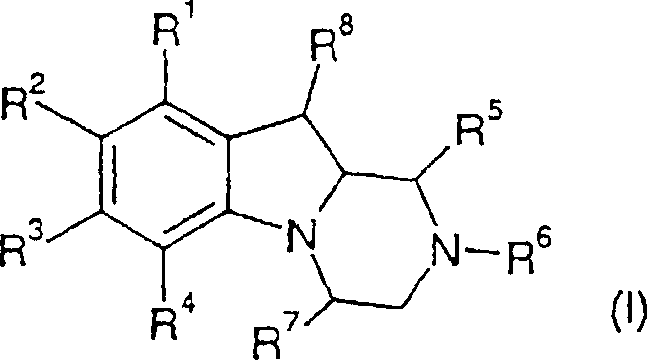
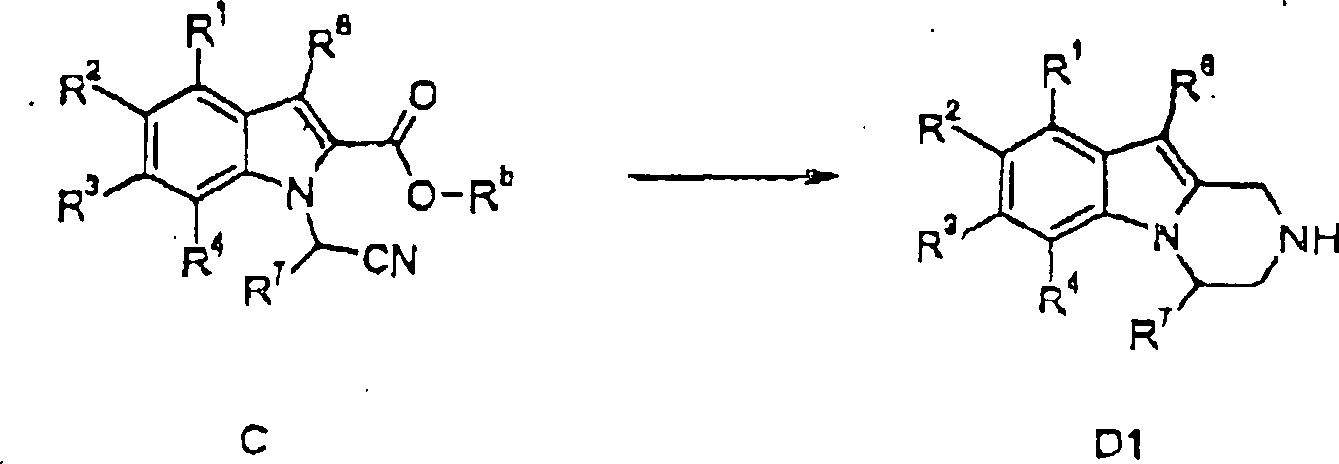
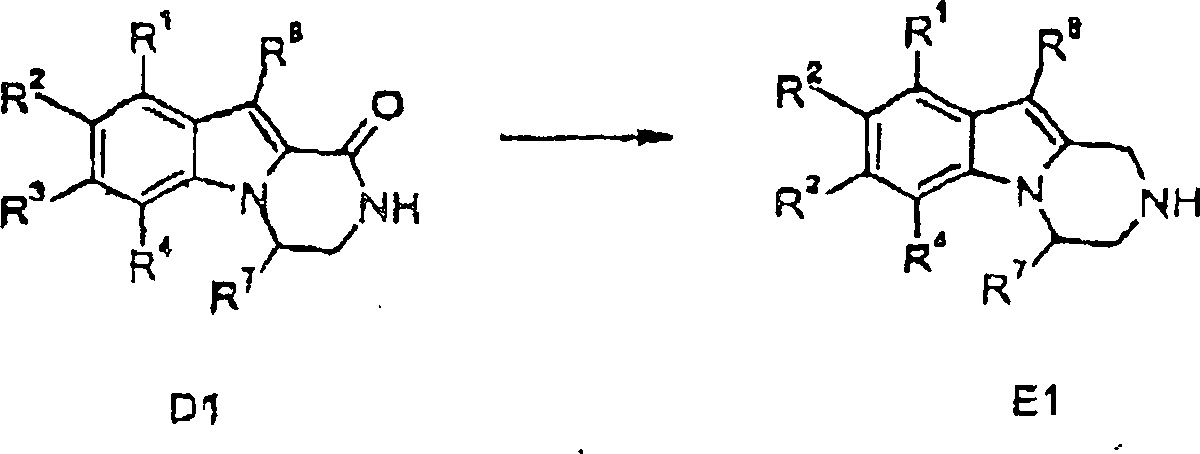

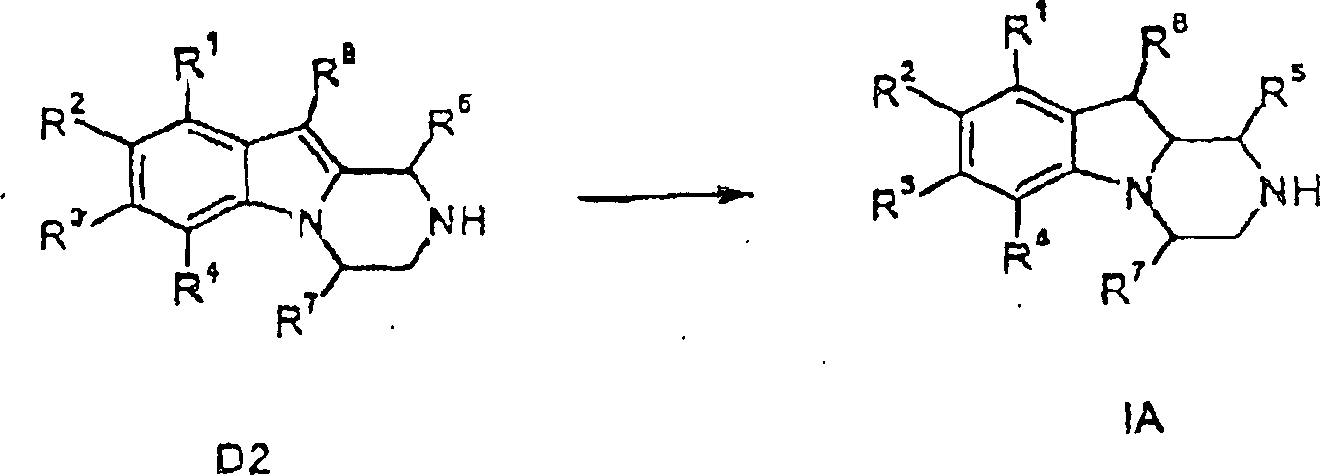


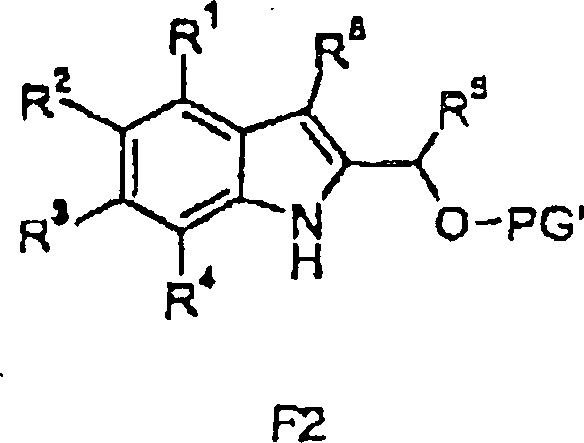
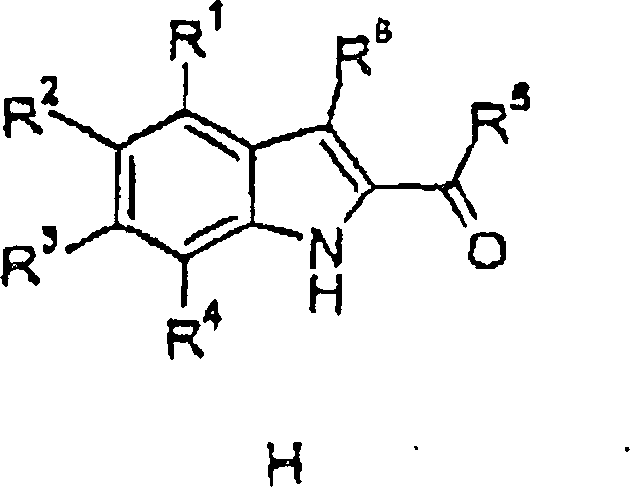
Applications Claiming Priority (3)
| Application Number | Priority Date | Filing Date | Title |
|---|---|---|---|
| EP00116517 | 2000-07-31 | ||
| EP00116517 | 2000-07-31 | ||
| PCT/EP2001/008520 WO2002010169A1 (en) | 2000-07-31 | 2001-07-24 | Piperazine derivatives |
Publications (2)
| Publication Number | Publication Date |
|---|---|
| DE60113865D1 DE60113865D1 (en) | 2006-02-16 |
| DE60113865T2 true DE60113865T2 (en) | 2006-07-20 |
Family
ID=8169405
Family Applications (1)
| Application Number | Title | Priority Date | Filing Date |
|---|---|---|---|
| DE60113865T Expired - Fee Related DE60113865T2 (en) | 2000-07-31 | 2001-07-24 | PIPERAZINE DERIVATIVES |
Country Status (20)
| Country | Link |
|---|---|
| US (4) | US20020035110A1 (en) |
| EP (1) | EP1325008B1 (en) |
| JP (1) | JP4180365B2 (en) |
| KR (1) | KR100539139B1 (en) |
| CN (1) | CN1277828C (en) |
| AR (1) | AR030306A1 (en) |
| AT (1) | ATE305933T1 (en) |
| AU (2) | AU8395501A (en) |
| BR (1) | BR0112918A (en) |
| CA (1) | CA2417106C (en) |
| DE (1) | DE60113865T2 (en) |
| DK (1) | DK1325008T3 (en) |
| ES (1) | ES2250459T3 (en) |
| GT (1) | GT200100155A (en) |
| MX (1) | MXPA03000906A (en) |
| PA (1) | PA8523601A1 (en) |
| PE (1) | PE20020366A1 (en) |
| UY (1) | UY26863A1 (en) |
| WO (1) | WO2002010169A1 (en) |
| ZA (1) | ZA200300525B (en) |
Families Citing this family (88)
| Publication number | Priority date | Publication date | Assignee | Title |
|---|---|---|---|---|
| EP1325008B1 (en) * | 2000-07-31 | 2005-10-05 | F. Hoffmann-La Roche Ag | Piperazine derivatives |
| GB0106177D0 (en) | 2001-03-13 | 2001-05-02 | Hoffmann La Roche | Piperazine derivatives |
| DK1491212T3 (en) | 2002-03-29 | 2012-10-29 | Mitsubishi Tanabe Pharma Corp | Means for the treatment of sleep disorders |
| NZ536664A (en) | 2002-06-19 | 2007-07-27 | Biovitrum Ab | Piperazinylpyrazine derivative compounds, their use and preparation |
| US7105526B2 (en) | 2002-06-28 | 2006-09-12 | Banyu Pharmaceuticals Co., Ltd. | Benzimidazole derivatives |
| US7772188B2 (en) | 2003-01-28 | 2010-08-10 | Ironwood Pharmaceuticals, Inc. | Methods and compositions for the treatment of gastrointestinal disorders |
| DE10319612A1 (en) | 2003-05-02 | 2004-11-18 | Bayer Healthcare Ag | Substituted dihydroquinazolines |
| DE10320780A1 (en) * | 2003-05-09 | 2005-01-20 | Bayer Healthcare Ag | Heterocyclyl-substituted dihydroquinazolines |
| GB0314967D0 (en) * | 2003-06-26 | 2003-07-30 | Hoffmann La Roche | Piperazine derivatives |
| US20050032930A1 (en) * | 2003-07-02 | 2005-02-10 | Christian Jackson | Inkjet ink |
| ATE547404T1 (en) | 2003-09-22 | 2012-03-15 | Msd Kk | PIPERIDINE DERIVATIVES |
| DE10352499A1 (en) * | 2003-11-11 | 2005-06-09 | Bayer Healthcare Ag | Substituted dihydroquinazolines II |
| EP1734963A4 (en) | 2004-04-02 | 2008-06-18 | Merck & Co Inc | METHOD FOR TREATING MEN WITH METABOLIC AND ANTHROPOMETRIC DISORDERS |
| DE102004022672A1 (en) * | 2004-05-07 | 2005-11-24 | Bayer Healthcare Ag | Substituted azachinazolines |
| JP5173190B2 (en) | 2004-08-25 | 2013-03-27 | 武田薬品工業株式会社 | Preventive and therapeutic agent for stress urinary incontinence and screening method thereof |
| EP2286837A3 (en) | 2004-11-01 | 2013-09-04 | Amylin Pharmaceuticals, LLC | Treatment of obesity and obesity related diseases |
| ES2503739T3 (en) | 2004-11-12 | 2014-10-07 | Asuragen, Inc. | Procedures and compositions involving miRNA and miRNA inhibitor molecules |
| US7790712B2 (en) | 2005-03-17 | 2010-09-07 | Boehringer Ingelheim Pharmaceutical, Inc. | Substituted [1,4]diazepino[1,2-A]indoles and azepino[1,2-A]indoles as anti-cytokine inhibitors |
| JP2008540368A (en) | 2005-05-03 | 2008-11-20 | エフ.ホフマン−ラ ロシュ アーゲー | Tetracyclic azapyrazinoindoline as 5-HT2 ligand |
| US7737155B2 (en) | 2005-05-17 | 2010-06-15 | Schering Corporation | Nitrogen-containing heterocyclic compounds and methods of use thereof |
| NZ562766A (en) | 2005-05-30 | 2011-03-31 | Banyu Pharma Co Ltd | Piperidine derivatives as histamine-H3 receptor antagonists |
| DE102005027517A1 (en) | 2005-06-15 | 2006-12-21 | Bayer Healthcare Ag | Process for the preparation of dihydroquinazolines |
| US20100216758A1 (en) | 2005-08-10 | 2010-08-26 | Makoto Ando | Pyridone Compounds |
| AU2006279680B2 (en) | 2005-08-11 | 2012-12-06 | Amylin Pharmaceuticals, Llc | Hybrid polypeptides with selectable properties |
| EP2330125A3 (en) | 2005-08-11 | 2012-12-12 | Amylin Pharmaceuticals, Inc. | Hybrid polypeptides with selectable properties |
| AU2006282260A1 (en) | 2005-08-24 | 2007-03-01 | Msd K.K. | Phenylpyridone derivative |
| EP1939194A4 (en) | 2005-09-07 | 2010-12-08 | Banyu Pharma Co Ltd | AROMATIC SUBSTITUTED BICYLIC PYRIDONE DERIVATIVE |
| CN101277960A (en) | 2005-09-29 | 2008-10-01 | 默克公司 | Acylated spiropiperidine derivatives as melanocortin-4 receptor modulators |
| AU2006308635A1 (en) * | 2005-10-14 | 2007-05-10 | H. Lundbeck A/S | Methods of treating central nervous system disorders with a low dose combination of escitalopram and bupropion |
| WO2007048027A2 (en) | 2005-10-21 | 2007-04-26 | Novartis Ag | Combination of a renin-inhibitor and an anti-dyslipidemic agent and/or an antiobesity agent |
| CA2627139A1 (en) | 2005-10-27 | 2007-05-03 | Banyu Pharmaceutical Co., Ltd. | Novel benzoxathiin derivative |
| WO2007055418A1 (en) | 2005-11-10 | 2007-05-18 | Banyu Pharmaceutical Co., Ltd. | Aza-substituted spiro derivative |
| AU2006324089A1 (en) | 2005-12-09 | 2007-06-14 | F. Hoffmann-La Roche Ag | Tricyclic amide derivatives useful for treating obesity |
| UA95788C2 (en) | 2005-12-15 | 2011-09-12 | Ф. Хоффманн-Ля Рош Аг | Fused pyrrole derivatives |
| WO2007132841A1 (en) | 2006-05-16 | 2007-11-22 | Takeda Pharmaceutical Company Limited | Fused heterocyclic compound and use thereof |
| EP2698157B1 (en) | 2006-09-22 | 2015-05-20 | Merck Sharp & Dohme Corp. | Method of treatment using fatty acid synthesis inhibitors |
| AU2007301126A1 (en) | 2006-09-28 | 2008-04-03 | Banyu Pharmaceutical Co., Ltd. | Diaryl ketimine derivative |
| TWI629058B (en) | 2007-01-16 | 2018-07-11 | 陳建宏 | Pharmaceutical composition and use thereof |
| FR2912145B1 (en) * | 2007-02-02 | 2009-03-06 | Servier Lab | NOVEL TRICYCLIC DERIVATIVES, PROCESS FOR THEIR PREPARATION AND PHARMACEUTICAL COMPOSITIONS CONTAINING THEM |
| JP5319518B2 (en) | 2007-04-02 | 2013-10-16 | Msd株式会社 | Indoledione derivative |
| EP3243814B1 (en) | 2007-04-16 | 2018-10-17 | AbbVie Inc. | 7-substituted indole as mcl-1 inhibitors |
| US8969514B2 (en) | 2007-06-04 | 2015-03-03 | Synergy Pharmaceuticals, Inc. | Agonists of guanylate cyclase useful for the treatment of hypercholesterolemia, atherosclerosis, coronary heart disease, gallstone, obesity and other cardiovascular diseases |
| WO2008151257A2 (en) | 2007-06-04 | 2008-12-11 | Synergy Pharmaceuticals Inc. | Agonists of guanylate cyclase useful for the treatment of gastrointestinal disorders, inflammation, cancer and other disorders |
| WO2009063992A1 (en) | 2007-11-15 | 2009-05-22 | Takeda Pharmaceutical Company Limited | Condensed pyridine derivative and use thereof |
| JPWO2009110510A1 (en) | 2008-03-06 | 2011-07-14 | Msd株式会社 | Alkylaminopyridine derivatives |
| EP2254886B1 (en) | 2008-03-28 | 2016-05-25 | Nerviano Medical Sciences S.r.l. | 3,4-dihydro-2h-pyrazino[1,2-a]indol-1-one derivatives active as kinase inhibitors, process for their preparation and pharmaceutical compositions comprising them |
| US20110015198A1 (en) | 2008-03-28 | 2011-01-20 | Banyu Pharmaceutical Co., Inc. | Diarylmethylamide derivative having melanin-concentrating hormone receptor antagonism |
| CN102014847B (en) * | 2008-04-28 | 2013-12-04 | 可乐丽则武齿科株式会社 | Dental composition and composite resin |
| CA2666036C (en) | 2008-05-16 | 2017-09-12 | Chien-Hung Chen | Novel compositions and methods for treating hyperproliferative diseases |
| WO2009149279A2 (en) | 2008-06-04 | 2009-12-10 | Synergy Pharmaceuticals Inc. | Agonists of guanylate cyclase useful for the treatment of gastrointestinal disorders, inflammation, cancer and other disorders |
| CA2727914A1 (en) | 2008-06-19 | 2009-12-23 | Banyu Pharmaceutical Co., Ltd. | Spirodiamine-diaryl ketoxime derivative technical field |
| CA2730603C (en) | 2008-07-16 | 2019-09-24 | Synergy Pharmaceuticals Inc. | Agonists of guanylate cyclase useful for the treatment of gastrointestinal disorders, inflammation, cancer and other disorders |
| EP2319841A1 (en) | 2008-07-30 | 2011-05-11 | Msd K.K. | (5-membered)-(5-membered) or (5-membered)-(6-membered) fused ring cycloalkylamine derivative |
| CA2741125A1 (en) | 2008-10-22 | 2010-04-29 | Merck Sharp & Dohme Corp. | Novel cyclic benzimidazole derivatives useful anti-diabetic agents |
| AU2009308980B2 (en) | 2008-10-30 | 2013-02-28 | Merck Sharp & Dohme Corp. | Isonicotinamide orexin receptor antagonists |
| WO2010051206A1 (en) | 2008-10-31 | 2010-05-06 | Merck Sharp & Dohme Corp. | Novel cyclic benzimidazole derivatives useful anti-diabetic agents |
| US20110243940A1 (en) | 2008-12-16 | 2011-10-06 | Schering Corporation | Bicyclic pyranone derivatives and methods of use thereof |
| WO2010075068A1 (en) | 2008-12-16 | 2010-07-01 | Schering Corporation | Pyridopyrimidine derivatives and methods of use thereof |
| FI122466B (en) * | 2009-08-21 | 2012-01-31 | Hollming Oy | A method for heating a workpiece and an induction heating tool |
| JPWO2011071136A1 (en) | 2009-12-11 | 2013-04-22 | アステラス製薬株式会社 | Fibromyalgia treatment |
| US8895596B2 (en) | 2010-02-25 | 2014-11-25 | Merck Sharp & Dohme Corp | Cyclic benzimidazole derivatives useful as anti-diabetic agents |
| US9616097B2 (en) | 2010-09-15 | 2017-04-11 | Synergy Pharmaceuticals, Inc. | Formulations of guanylate cyclase C agonists and methods of use |
| BR112013021236B1 (en) | 2011-02-25 | 2021-05-25 | Merck Sharp & Dohme Corp | benzimidazole derivative compound, and, composition |
| KR102034748B1 (en) | 2011-03-01 | 2019-10-21 | 시너지 파마슈티컬즈 인코포레이티드 | Process of preparing guanylate cyclase c agonists |
| AR088352A1 (en) | 2011-10-19 | 2014-05-28 | Merck Sharp & Dohme | ANTAGONISTS OF THE RECEIVER OF 2-PIRIDILOXI-4-NITRILE OREXINE |
| EP2825542B1 (en) | 2012-03-16 | 2016-09-14 | Vitae Pharmaceuticals, Inc. | Liver x receptor modulators |
| KR102069912B1 (en) | 2012-03-16 | 2020-01-23 | 비타이 파마슈티컬즈, 엘엘씨 | Liver x receptor modulators |
| TWI579274B (en) * | 2012-04-20 | 2017-04-21 | 龍馬躍公司 | Improved processes for the preparation of 1-aryl-5-alkyl pyrazole compounds |
| US9527875B2 (en) | 2012-08-02 | 2016-12-27 | Merck Sharp & Dohme Corp. | Antidiabetic tricyclic compounds |
| US9650375B2 (en) | 2013-03-14 | 2017-05-16 | Merck Sharp & Dohme Corp. | Indole derivatives useful as anti-diabetic agents |
| WO2014151200A2 (en) | 2013-03-15 | 2014-09-25 | Synergy Pharmaceuticals Inc. | Compositions useful for the treatment of gastrointestinal disorders |
| EP2970384A1 (en) | 2013-03-15 | 2016-01-20 | Synergy Pharmaceuticals Inc. | Agonists of guanylate cyclase and their uses |
| PT2989104T (en) * | 2013-04-23 | 2019-11-26 | Esteve Pharmaceuticals Sa | Pyrazino[1,2-a]indole compounds, their preparation and use in medicaments |
| JP6291567B2 (en) * | 2013-04-23 | 2018-03-14 | ラボラトリオス・デル・ドクトル・エステベ・ソシエダッド・アノニマ | Pyrazino [1,2-a] indole compounds, their preparation and use as pharmaceuticals |
| AU2014274812B2 (en) | 2013-06-05 | 2018-09-27 | Bausch Health Ireland Limited | Ultra-pure agonists of guanylate cyclase C, method of making and using same |
| PL3097107T3 (en) | 2014-01-24 | 2020-01-31 | Turning Point Therapeutics, Inc. | Diaryl macrocycles as modulators of protein kinases |
| DK3186242T3 (en) | 2014-08-29 | 2021-12-20 | Tes Pharma S R L | ALFA-AMINO-BETA-CARBOXYMUCONSIDE-SEMIALDEHYDE-DECARBOXYLASE INHIBITORS |
| PL3310784T3 (en) | 2015-06-17 | 2021-03-08 | Pfizer Inc. | Tricyclic compounds and their use as phosphodiesterase inhibitors. |
| EP3317285B1 (en) | 2015-07-02 | 2021-01-27 | Turning Point Therapeutics, Inc. | Chiral diaryl macrocycles as modulators of protein kinases |
| RS65593B1 (en) | 2015-07-06 | 2024-06-28 | Turning Point Therapeutics Inc | Diaryl macrocycle polymorph |
| AR109950A1 (en) | 2016-10-14 | 2019-02-06 | Tes Pharma S R L | A-AMINO-b-CARBOXIMUCONIC SEMIAL DEHYDE DECARBOXYLASE ACID INHIBITORS |
| JPWO2019131902A1 (en) | 2017-12-27 | 2020-12-10 | 武田薬品工業株式会社 | Remedies for stress urinary incontinence and fecal incontinence |
| BR112021009589A2 (en) | 2018-11-20 | 2021-08-17 | Tes Pharma S.R.L. | alpha-amino-beta-carboxymuconic acid semialdehyde decarboxylase inhibitors |
| US11098029B2 (en) | 2019-02-13 | 2021-08-24 | Merck Sharp & Dohme Corp. | 5-alkyl pyrrolidine orexin receptor agonists |
| US12331018B2 (en) | 2019-02-13 | 2025-06-17 | Merck Sharp & Dohme Llc | Pyrrolidine orexin receptor agonists |
| WO2021026047A1 (en) | 2019-08-08 | 2021-02-11 | Merck Sharp & Dohme Corp. | Heteroaryl pyrrolidine and piperidine orexin receptor agonists |
| MX2023001840A (en) | 2020-08-18 | 2023-03-13 | Merck Sharp & Dohme Llc | Bicycloheptane pyrrolidine orexin receptor agonists. |
| WO2026006356A1 (en) * | 2024-06-25 | 2026-01-02 | Vanderbilt University | 6-(pyrimidin-5-yl)-3,4-dihydropyrazino[l,2-a]imdol-l(2h)-one mcl-1 inhibitors |
Family Cites Families (12)
| Publication number | Priority date | Publication date | Assignee | Title |
|---|---|---|---|---|
| US652018A (en) * | 1900-02-15 | 1900-06-19 | John C Duner | Gate. |
| US3317524A (en) | 1965-02-04 | 1967-05-02 | American Home Prod | Substituted 1, 2, 3, 4-tetrahydro-pyrazino[1, 2-a]indoles |
| DE2162422A1 (en) | 1971-12-16 | 1973-06-20 | Merck Patent Gmbh | 1,2,3,4,10,10a-hexahydropyrazino/1,2-a)-indole-2-carboxamidine - prepn - by reaction of hexahydropyrazino indole and cyanamide |
| EP0572863A1 (en) * | 1992-06-05 | 1993-12-08 | F. Hoffmann-La Roche Ag | CNS pyrazinoindoles |
| US5576319A (en) | 1993-03-01 | 1996-11-19 | Merck, Sharp & Dohme Ltd. | Pyrrolo-pyridine derivatives |
| CZ224195A3 (en) | 1993-03-01 | 1996-03-13 | Merck Sharp & Dohme | The use of pyrrolopyridine derivatives for preparing pharmaceutical preparations |
| US5622950A (en) | 1993-03-01 | 1997-04-22 | Merck, Sharp & Dohme Ltd. | Pyrrolo-pyridine derivatives |
| US6169086B1 (en) | 1997-01-27 | 2001-01-02 | Daiichi Pharmaceutical Co., Ltd. | Pyrazole derivatives |
| JP2000169475A (en) | 1998-07-24 | 2000-06-20 | Dai Ichi Seiyaku Co Ltd | Pyrazole derivative and salt thereof |
| CZ20012193A3 (en) * | 1998-12-17 | 2001-12-12 | American Home Products Corporation | Derivatives of 2,3,4,4a-tetrahydro-1H-pyrazino(1,2-a)quinoxalin-5(6H)one, process of their preparation and their use |
| GB9902047D0 (en) * | 1999-01-29 | 1999-03-17 | Cerebrus Ltd | Chemical compounds XI |
| EP1325008B1 (en) * | 2000-07-31 | 2005-10-05 | F. Hoffmann-La Roche Ag | Piperazine derivatives |
-
2001
- 2001-07-24 EP EP01962869A patent/EP1325008B1/en not_active Expired - Lifetime
- 2001-07-24 CN CNB018152260A patent/CN1277828C/en not_active Expired - Fee Related
- 2001-07-24 AT AT01962869T patent/ATE305933T1/en not_active IP Right Cessation
- 2001-07-24 KR KR10-2003-7001439A patent/KR100539139B1/en not_active Expired - Fee Related
- 2001-07-24 DE DE60113865T patent/DE60113865T2/en not_active Expired - Fee Related
- 2001-07-24 MX MXPA03000906A patent/MXPA03000906A/en active IP Right Grant
- 2001-07-24 DK DK01962869T patent/DK1325008T3/en active
- 2001-07-24 CA CA002417106A patent/CA2417106C/en not_active Expired - Fee Related
- 2001-07-24 JP JP2002515898A patent/JP4180365B2/en not_active Expired - Fee Related
- 2001-07-24 AU AU8395501A patent/AU8395501A/en active Pending
- 2001-07-24 WO PCT/EP2001/008520 patent/WO2002010169A1/en not_active Ceased
- 2001-07-24 AU AU2001283955A patent/AU2001283955B2/en not_active Ceased
- 2001-07-24 BR BR0112918-0A patent/BR0112918A/en not_active IP Right Cessation
- 2001-07-24 ES ES01962869T patent/ES2250459T3/en not_active Expired - Lifetime
- 2001-07-25 PE PE2001000749A patent/PE20020366A1/en not_active Application Discontinuation
- 2001-07-25 US US09/912,949 patent/US20020035110A1/en not_active Abandoned
- 2001-07-27 AR ARP010103589A patent/AR030306A1/en unknown
- 2001-07-30 PA PA20018523601A patent/PA8523601A1/en unknown
- 2001-07-30 GT GT200100155A patent/GT200100155A/en unknown
- 2001-07-30 UY UY26863A patent/UY26863A1/en not_active Application Discontinuation
-
2003
- 2003-01-20 ZA ZA200300525A patent/ZA200300525B/en unknown
- 2003-03-25 US US10/396,242 patent/US6933387B2/en not_active Expired - Fee Related
-
2005
- 2005-06-28 US US11/169,079 patent/US7253281B2/en not_active Expired - Fee Related
-
2007
- 2007-01-03 US US11/649,132 patent/US20070106076A1/en not_active Abandoned
Also Published As
| Publication number | Publication date |
|---|---|
| MXPA03000906A (en) | 2005-02-24 |
| US20030216401A1 (en) | 2003-11-20 |
| US20020035110A1 (en) | 2002-03-21 |
| KR100539139B1 (en) | 2005-12-26 |
| US7253281B2 (en) | 2007-08-07 |
| CN1452622A (en) | 2003-10-29 |
| UY26863A1 (en) | 2002-01-31 |
| BR0112918A (en) | 2003-07-01 |
| WO2002010169A1 (en) | 2002-02-07 |
| US20070106076A1 (en) | 2007-05-10 |
| AU2001283955B2 (en) | 2006-05-18 |
| CN1277828C (en) | 2006-10-04 |
| AR030306A1 (en) | 2003-08-20 |
| JP2004505085A (en) | 2004-02-19 |
| EP1325008A1 (en) | 2003-07-09 |
| GT200100155A (en) | 2002-05-16 |
| US6933387B2 (en) | 2005-08-23 |
| US20050239789A1 (en) | 2005-10-27 |
| EP1325008B1 (en) | 2005-10-05 |
| CA2417106A1 (en) | 2002-02-07 |
| ZA200300525B (en) | 2004-04-20 |
| DK1325008T3 (en) | 2006-02-13 |
| CA2417106C (en) | 2007-09-18 |
| PE20020366A1 (en) | 2002-05-17 |
| ES2250459T3 (en) | 2006-04-16 |
| PA8523601A1 (en) | 2002-10-24 |
| KR20030020954A (en) | 2003-03-10 |
| ATE305933T1 (en) | 2005-10-15 |
| AU8395501A (en) | 2002-02-13 |
| JP4180365B2 (en) | 2008-11-12 |
| DE60113865D1 (en) | 2006-02-16 |
Similar Documents
| Publication | Publication Date | Title |
|---|---|---|
| DE60113865T2 (en) | PIPERAZINE DERIVATIVES | |
| DE60303791T2 (en) | AZA-arylpiperazines | |
| AU2001283955A1 (en) | Piperazine derivatives | |
| JP3935201B2 (en) | N-substituted azabicycloalkane derivatives as neuroleptic drugs AFS | |
| DE69919364T2 (en) | PYRROLOINDOLE, PYRIDOINDOLE AND AZEPINOINDOLE AS 5-HT2C AGONISTS | |
| DE60119719T2 (en) | NEW AZA INDOLYL DERIVATIVES | |
| JP6928629B2 (en) | Condensed dihydro-4H-pyrazolo [5,1-C] [1,4] oxadinyl compounds and analogs for the treatment of CNS diseases | |
| DE60023146T2 (en) | CONDENSED INDOLINE DERIVATIVES AND THEIR USE AS 5HT, IN PARTICULAR 5HT2C, RECEPTOR LIGANDS | |
| DE602004006869T2 (en) | 5HT2C RECEPTOR AGONISTS FOR THE TREATMENT OF DIABETES AND FAT ADJUSTMENT | |
| RU2514429C2 (en) | Spiro-5,6-dihydro-4h-2,3,5,10b-tetra-aza-benzo[e]azulenes | |
| KR100618748B1 (en) | Piperazine Derivatives | |
| JPH07119213B2 (en) | Muscarinic receptor antagonist | |
| KR20240128059A (en) | compound | |
| JP2008507515A (en) | (1S, 5S) -3- (5,6-Dichloro-3-pyridinyl) -3,6-diazabicyclo [3.2.0] heptane | |
| CA2844581A1 (en) | Oxy-cyclohexyl-4h,6h-5-oxa-2,3,10b-triaza-benzo[e]azulenes as v1a antagonists | |
| JP2007500751A (en) | Bicyclic indolyl derivatives and their use as serotonin agonists |
Legal Events
| Date | Code | Title | Description |
|---|---|---|---|
| 8364 | No opposition during term of opposition | ||
| 8339 | Ceased/non-payment of the annual fee |