EP2698157B1 - Method of treatment using fatty acid synthesis inhibitors - Google Patents
Method of treatment using fatty acid synthesis inhibitors Download PDFInfo
- Publication number
- EP2698157B1 EP2698157B1 EP20130188869 EP13188869A EP2698157B1 EP 2698157 B1 EP2698157 B1 EP 2698157B1 EP 20130188869 EP20130188869 EP 20130188869 EP 13188869 A EP13188869 A EP 13188869A EP 2698157 B1 EP2698157 B1 EP 2698157B1
- Authority
- EP
- European Patent Office
- Prior art keywords
- fatty acid
- methyl
- phenyl
- compound
- fluoro
- Prior art date
- Legal status (The legal status is an assumption and is not a legal conclusion. Google has not performed a legal analysis and makes no representation as to the accuracy of the status listed.)
- Active
Links
Classifications
-
- A—HUMAN NECESSITIES
- A61—MEDICAL OR VETERINARY SCIENCE; HYGIENE
- A61K—PREPARATIONS FOR MEDICAL, DENTAL OR TOILETRY PURPOSES
- A61K31/00—Medicinal preparations containing organic active ingredients
- A61K31/185—Acids; Anhydrides, halides or salts thereof, e.g. sulfur acids, imidic, hydrazonic or hydroximic acids
- A61K31/19—Carboxylic acids, e.g. valproic acid
- A61K31/195—Carboxylic acids, e.g. valproic acid having an amino group
-
- A—HUMAN NECESSITIES
- A61—MEDICAL OR VETERINARY SCIENCE; HYGIENE
- A61P—SPECIFIC THERAPEUTIC ACTIVITY OF CHEMICAL COMPOUNDS OR MEDICINAL PREPARATIONS
- A61P3/00—Drugs for disorders of the metabolism
- A61P3/04—Anorexiants; Antiobesity agents
-
- A—HUMAN NECESSITIES
- A61—MEDICAL OR VETERINARY SCIENCE; HYGIENE
- A61P—SPECIFIC THERAPEUTIC ACTIVITY OF CHEMICAL COMPOUNDS OR MEDICINAL PREPARATIONS
- A61P3/00—Drugs for disorders of the metabolism
- A61P3/08—Drugs for disorders of the metabolism for glucose homeostasis
- A61P3/10—Drugs for disorders of the metabolism for glucose homeostasis for hyperglycaemia, e.g. antidiabetics
-
- A—HUMAN NECESSITIES
- A61—MEDICAL OR VETERINARY SCIENCE; HYGIENE
- A61P—SPECIFIC THERAPEUTIC ACTIVITY OF CHEMICAL COMPOUNDS OR MEDICINAL PREPARATIONS
- A61P31/00—Antiinfectives, i.e. antibiotics, antiseptics, chemotherapeutics
- A61P31/10—Antimycotics
-
- A—HUMAN NECESSITIES
- A61—MEDICAL OR VETERINARY SCIENCE; HYGIENE
- A61P—SPECIFIC THERAPEUTIC ACTIVITY OF CHEMICAL COMPOUNDS OR MEDICINAL PREPARATIONS
- A61P33/00—Antiparasitic agents
-
- A—HUMAN NECESSITIES
- A61—MEDICAL OR VETERINARY SCIENCE; HYGIENE
- A61P—SPECIFIC THERAPEUTIC ACTIVITY OF CHEMICAL COMPOUNDS OR MEDICINAL PREPARATIONS
- A61P33/00—Antiparasitic agents
- A61P33/02—Antiprotozoals, e.g. for leishmaniasis, trichomoniasis, toxoplasmosis
- A61P33/06—Antimalarials
-
- A—HUMAN NECESSITIES
- A61—MEDICAL OR VETERINARY SCIENCE; HYGIENE
- A61P—SPECIFIC THERAPEUTIC ACTIVITY OF CHEMICAL COMPOUNDS OR MEDICINAL PREPARATIONS
- A61P35/00—Antineoplastic agents
-
- A—HUMAN NECESSITIES
- A61—MEDICAL OR VETERINARY SCIENCE; HYGIENE
- A61P—SPECIFIC THERAPEUTIC ACTIVITY OF CHEMICAL COMPOUNDS OR MEDICINAL PREPARATIONS
- A61P35/00—Antineoplastic agents
- A61P35/04—Antineoplastic agents specific for metastasis
-
- A—HUMAN NECESSITIES
- A61—MEDICAL OR VETERINARY SCIENCE; HYGIENE
- A61P—SPECIFIC THERAPEUTIC ACTIVITY OF CHEMICAL COMPOUNDS OR MEDICINAL PREPARATIONS
- A61P7/00—Drugs for disorders of the blood or the extracellular fluid
- A61P7/12—Antidiuretics, e.g. drugs for diabetes insipidus
-
- Y—GENERAL TAGGING OF NEW TECHNOLOGICAL DEVELOPMENTS; GENERAL TAGGING OF CROSS-SECTIONAL TECHNOLOGIES SPANNING OVER SEVERAL SECTIONS OF THE IPC; TECHNICAL SUBJECTS COVERED BY FORMER USPC CROSS-REFERENCE ART COLLECTIONS [XRACs] AND DIGESTS
- Y02—TECHNOLOGIES OR APPLICATIONS FOR MITIGATION OR ADAPTATION AGAINST CLIMATE CHANGE
- Y02A—TECHNOLOGIES FOR ADAPTATION TO CLIMATE CHANGE
- Y02A50/00—TECHNOLOGIES FOR ADAPTATION TO CLIMATE CHANGE in human health protection, e.g. against extreme weather
- Y02A50/30—Against vector-borne diseases, e.g. mosquito-borne, fly-borne, tick-borne or waterborne diseases whose impact is exacerbated by climate change
Definitions
- the present invention relates to a natural product that possesses fatty acid synthesis inhibitor activity and can be used to treat and prevent diabetes and/or diabetes related disorders.
- This invention describes the use of the natural product shown in formulas I and II as a fatty acid synthesis inhibitor: or pharmaceutically acceptable salts thereof, wherein ----- represents a bond that can be absent or present thereby denoting a single or double bond, respectively.
- the natural products shown in formulas I and II can be administered to a patient in need thereof to treat, ameliorate the symptoms of, prevent and/or reduce the likelihood of suffering from diabetes and/or diabetes related disorders.
- This invention describes the use of the compounds of formula I or II or a pharmaceutically acceptable salt thereof as an agent to treat, ameliorate the symptoms of, prevent and/or reduce the likelihood of suffering from diabetes and/or diabetes related disorders.
- FAS is the principal synthetic enzyme of FA synthesis, which catalyzes the NADPH-dependent condensation of malonyl-CoA and acetyl-CoA to produce predominantly the 16-carbon saturated free FA palmitate ( Wakil, S. J. "Fatty acid synthase, a proficient multifunctional enzyme” Biochemistry 28, 4523-30 (1989 )).
- Ex vivo measurements in tumor tissue have revealed high levels of both FAS and FA synthesis, indicating that the entire genetic program is highly active consisting of some 25 enzymes from hexokinase to FAS ( Rashid, A. et al. "Elevated expression of fatty acid synthase and fatty acid synthetic activity in colorectal neoplasia.
- RNA interference-mediated silencing of the p53 tumor-suppressor protein drastically increases apoptosis after inhibition of endogenous fatty acid metabolism in breast cancer cells
- Menendez, J. A. et al “Pharmacological and small interference RNA-mediated inhibition of breast cancer-associated fatty acid synthase (oncogenic antigen-519) synergistically enhances Taxol (paclitaxel)-induced cytotoxicity” Int J Cancer 115, 19-35 (2005 );
- Menendez, J. A. et al Does endogenous fatty acid metabolism allow cancer cells to sense hypoxia and mediate hypoxic vasodilatation?
- an object of this invention is to provide a method for treating cancer by administering the compound of formula I to a patient in need thereof.
- C75 [4-methylene-2-octyl-5-oxo-tetrahydro-furan-3-carboxylic acid] activates carnitine palmitoyltransferase-1 in isolated mitochondria and intact cells without displacement of bound malonyl CoA" JPharmacol Exp Ther 312, 127-33 (2005 ); Tu, Y. et al. "C75 alters central and peripheral gene expression to reduce food intake and increase energy expenditure" Endocrinology 146, 486-93 (2005 ); Nicot, C. et al.
- Fatty acid metabolism including fatty acid synthesis and oxidation and fatty acids themselves ( Obici, S. et al. "Central administration of oleic acid inhibits glucose production and food intake” Diabetes 51, 271-5 (2002 )) provides another means through which the CNS can monitor energy status and regulate feeding behavior. All studies to date have found that C75 provokes dramatic and sustained weight loss. One component of this weight loss is increased fatty acid oxidation in peripheral tissues, which is probably a result of stimulation of CPT-1 activity by C75. Another component to the mechanism is probably initiated in the hypothalamus and linked to energy metabolism as evidenced by the recent studies implicating AMPK in C75 signaling ( Landree, L. E. et al.
- C75 a fatty acid synthase inhibitor, modulates AMP-activated protein kinase to alter neuronal energy metabolism
- JBiol Chem 279, 3817-27 (2004 ) Kim, E. K. et al.
- the invention relates to methods of using the compounds of formula I and II described herein. As demonstrated herein, the compounds of formula I and/or II are useful for the treatment of diabetes and/or diabetes related disorders.
- treating in its various grammatical forms in relation to the present invention refers to curing, reversing, attenuating, alleviating, minimizing, suppressing or halting the deleterious effects of a disease state, disease progression, disease causative agent (e.g., bacteria or viruses) or other abnormal condition.
- treatment may involve alleviating a symptom (i.e., not necessary all symptoms) of a disease or attenuating the progression of a disease.
- inventive methods involve the physical removal of the etiological agent, the artisan will recognize that they are equally effective in situations where the inventive compound is administered prior to, or simultaneous with, exposure to the etiological agent (prophylactic treatment) and situations where the inventive compounds are administered after (even well after) exposure to the etiological agent.
- the term "therapeutically effective amount” is intended to encompass any amount that will achieve the desired therapeutic or biological effect.
- the therapeutic effect is dependent upon the disease or disorder being treated or the biological effect desired.
- the therapeutic effect can be a decrease in the severity of symptoms associated with the disease or disorder and/or inhibition (partial or complete) of progression of the disease.
- the amount needed to elicit the therapeutic response can be determined based on the age, health, size and sex of the subject. Optimal amounts can also be determined based on monitoring of the subject's response to treatment.
- the compounds of formula I and/or II can be administered alone or in combination with one or more other therapies suitable for the disease or disorder being treated. Where separate dosage formulations are used, the compounds of formula I and II and the other therapeutic agent can be administered at essentially the same time (concurrently) or at separately staggered times (sequentially).
- the pharmaceutical combination is understood to include all these regimens. Administration in these various ways are suitable for the present invention as long as the beneficial therapeutic effect of the phosphorus compound and the other therapeutic agent are realized by the patient at substantially the same time. In an embodiment, such beneficial effect is achieved when the target blood level concentrations of each active drug are maintained at substantially the same time.
- diabetes includes both insulin-dependent diabetes mellitus (i.e., IDDM, also known as type I diabetes) and non-insulin-dependent diabetes mellitus (i.e., NIDDM, also known as Type II diabetes).
- IDDM insulin-dependent diabetes mellitus
- NIDDM non-insulin-dependent diabetes mellitus
- Type I diabetes or insulin-dependent diabetes
- Type II diabetes is the result of an absolute deficiency of insulin, the hormone which regulates glucose utilization.
- Type II diabetes, or insulin-independent diabetes i.e., non-insulin-dependent diabetes mellitus
- Most of the Type II diabetics are also obese.
- the compositions of the present invention are useful for treating both Type I and Type II diabetes.
- the compounds or combinations of the present invention are also useful for treating and/or preventing gestational diabetes mellitus.
- Treatment of diabetes mellitus refers to the administration of a compound or combination of the present invention to treat diabetes.
- One outcome of treatment may be decreasing the glucose level in a subject with elevated glucose levels.
- Another outcome of treatment may be improving glycemic control.
- Another outcome of treatment may be decreasing insulin levels in a subject with elevated insulin levels.
- Another outcome of treatment may be decreasing plasma triglycerides in a subject with elevated plasma triglycerides.
- Another outcome of treatment may be lowering LDL cholesterol in a subject with high LDL cholesterol levels.
- Another outcome of treatment may be increasing HDL cholesterol in a subject with low HDL cholesterol levels.
- Another outcome may be decreasing the LDL/HDL ratio in a subject in need thereof.
- Another outcome of treatment may be increasing insulin sensivity.
- Another outcome of treatment may be enhancing glucose tolerance in a subject with glucose intolerance. Another outcome of treatment may be decreasing insulin resistance in a subject with increased insulin resistance or elevated levels of insulin. Another outcome may be decreading triglycerides in a subject with elevated triglycerides. Yet another outcome may be improving LDL cholestrol, non-HDL cholesterol, triglyceride, HDL cholesterol or other lipid analyte profiles.
- Prevention of diabetes mellitus refers to the administration of a compound or combination of the present invention to prevent the onset of diabetes in a subject at risk thereof.
- “Obesity” is a condition in which there is an excess of body fat.
- the operational definition of obesity is based on the Body Mass Index (BMI), which is calculated as body weight per height in meters squared (kg/m 2 ).
- BMI Body Mass Index
- “Obesity” refers to a condition whereby an otherwise healthy subject has a Body Mass Index (BMI) greater than or equal to 30 kg/m 2 , or a condition whereby a subject with at least one co-morbidity has a BMI greater than or equal to 27 kg/m 2 .
- An “obese subject” is an otherwise healthy subject with a Body Mass Index (BMI) greater than or equal to 30 kg/m 2 or a subject with at least one co-morbidity with a BMI greater than or equal to 27 kg/m 2 .
- a “subject at risk of obesity” is an otherwise healthy subject with a BMI of 25 kg/m 2 to less than 30 kg/m 2 or a subject with at least one co-morbidity with a BMI of 25 kg/m 2 to less than 27 kg/m 2 .
- obesity is meant to encompass all of the above definitions of obesity.
- Obesity-induced or obesity-related co-morbidities include, but are not limited to, diabetes, non-insulin dependent diabetes mellitus - type II (2), impaired glucose tolerance, impaired fasting glucose, insulin resistance syndrome, dyslipidemia, hypertension, hyperuricacidemia, gout, coronary artery disease, myocardial infarction, angina pectoris, sleep apnea syndrome, Pickwickian syndrome, fatty liver; cerebral infarction, cerebral thrombosis, transient ischemic attack, orthopedic disorders, arthritis deformans, lumbodynia, emmeniopathy, and infertility.
- co-morbidities include: hypertension, hyperlipidemia, dyslipidemia, glucose intolerance, cardiovascular disease, sleep apnea, diabetes mellitus, and other obesity-related conditions.
- Compounds of Formula I and/or II may be used in combination with other drugs that are used in the treatment/prevention/suppression or amelioration of the diseases or conditions for which compounds of Formula I and/or II are useful. Such other drugs may be administered, by a route and in an amount commonly used therefor, contemporaneously or sequentially with a compound of Formula I and/or II.
- a pharmaceutical composition containing such other drugs in addition to the compound of Formula I is preferred.
- the pharmaceutical compositions of the present invention include those that also contain one or more other active ingredients, in addition to a compound of Formula I and/or II.
- Examples of other active ingredients that may be combined with a compound of Formula I and/or II for the treatment or prevention of obesity and/or diabetes, either administered separately or in the same pharmaceutical compositions, include, but are not limited to:
- Specific compounds of use in combination with a compound of the present invention include: simvastatin, mevastatin, ezetimibe, atorvastatin, sitagliptin, metformin, sibutramine, orlistat, Qnexa, topiramate, naltrexone, bupriopion, phentermine, and losartan, losartan with hydrochlorothiazide.
- Specific CB 1 antagonists/inverse agonists of use in combination with a compound of the present invention include: those described in WO03/077847 , including: N -[3-(4-chlorophenyl)-2( S )-phenyl-1( S )-methylpropyl]-2-(4-trifluoromethyl-2-pyrimidyloxy)-2-methylpropanamide, N -[3-(4-chlorophenyl)-2-(3-cyanophenyl)-1-methylpropyl]-2-(5-trifluoromethyl-2-pyridyloxy)-2-methylpropanamide, N -[3-(4-chlorophenyl)-2-(5-chloro-3-pyridyl)-1-methylpropyl]-2-(5-trifluoromethyl-2-pyridyloxy)-2-methylpropanamide, and pharmaceutically acceptable salts thereof; as well as those in WO05/000809 , which includes the following: 3-
- NPY5 antagonists of use in combination with a compound of the present invention include: 3-oxo-N-(5-phenyl-2-pyrazinyl)-spiro[isobenzofuran-1(3H),4'-piperidine]-1'-carboxamide, 3-oxo-N-(7-trifluoromethylpyrido[3,2-b]pyridin-2-yl)spiro-[isobenzofuran-1(3H),4'-piperidine]-1'-carboxamide, N-[5-(3-fluorophenyl)-2-pyrimidinyl]-3-oxospiro-[isobenzofuran-1(3H),4'-piperidine]-1'-carboxamide, trans-3'-oxo-N-(5-phenyl-2-pyrimidinyl)spiro[cyclohexane-1,1'(3'H)-isobenzofuran]-4-carboxamide, trans-3'-ox
- Specific ACC-1/2 inhibitors of use in combination with a compound of the present invention include: 1'-[(4,8-dimethoxyquinolin-2-yl)carbonyl]-6-(1 H -tetrazol-5-yl)spiro[chroman-2,4'-piperidin]-4-one; (5- ⁇ 1'-[(4,8-dimethoxyquinolin-2-yl)carbonyl]-4-oxospiro[chroman-2,4'-piperidin]-6-yl ⁇ -2 H- tetrazol-2-yl)methyl pivalate; 5- ⁇ 1'-[(8-cyclopropyl-4-methoxyquinolin-2-yl)carbonyl]-4-oxospiro[chroman-2,4'-piperidin]-6-yl ⁇ nicotinic acid; 1'-(8-methoxy-4-morpholin-4-yl-2-naphthoyl)-6-(1 H -te
- Specific MCH1R antagonist compounds of use in combination with a compound of the persent invention include: 1- ⁇ 4-[(1-ethylazetidin-3-yl)oxy]phenyl ⁇ -4-[(4-fluorobenzyl)oxy]pyridin-2(1 H )-one, 4-[(4-fluorobenzyl)oxy]-1- ⁇ 4-[(1-isopropylazetidin-3-yl)oxy]phenyl ⁇ pyridin-2(1 H )-one, 1-[4-(azetidin-3-yloxy)phenyl]-4-[(5-chloropyridin-2-yl)methoxy]pyridin-2(1 H )-one, 4-[(5-chloropyridin-2-yl)methoxy]-1- ⁇ 4-[(1-ethylazetidin-3-yl)oxy]phenyl ⁇ pyridin-2(1 H )-one, 4-[(5-chloropyri
- Specific DP-IV inhibitors of use in combination with a compound of the present invention are selected from 7-[(3R)-3-amino-4-(2,4,5-trifluorophenyl)butanoyl]-3-(trifluoromethyl)-5,6,7,8-tetrahydro-1,2,4-triazolo[4,3-a]pyrazine.
- the compound of formula I is favorably combined with 7-[(3R)-3-amino-4-(2,4,5-trifluorophenyl)butanoyl]-3-(trifluoromethyl)-5,6,7,8-tetrahydro-1,2,4-triazolo[4,3-a]pyrazine, and pharmaceutically acceptable salts thereof.
- H3 (histamine H3) antagonists/inverse agonists of use in combination with a compound of the present invention include: those described in WO05/077905 , including:3- ⁇ 4-[(1-cyclobutyl-4-piperidinyl)oxy]phenyl ⁇ -2-ethylpyrido[2,3-d]-pyrimidin-4(3H)-one, 3- ⁇ 4-[(1-cyclobutyl-4-piperidinyl)oxy]phenyl ⁇ -2-methylpyrido[4,3-d]pyrimidin-4(3H)-one, 2-ethyl-3-(4- ⁇ 3-[(3S)-3-methylpiperidin-1-yl]propoxy ⁇ phenyl)pyrido[2,3-d]pyrimidin-4(3H)-one 2-ethyl-3-(4- ⁇ 3-[(3S)-3-methylpiperidin-1-yl]propoxy ⁇ phenyl)pyrido[4,3-d]
- Specific CCK1R agonists of use in combination with a compound of the present invention include: 3-(4- ⁇ [1-(3-ethoxyphenyl)-2-(4-methylphenyl)-1 H -imidazol-4-yl]carbonyl ⁇ -1-piperazinyl)-1-naphthoic acid; 3-(4- ⁇ [1-(3-ethoxyphenyl)-2-(2-fluoro-4-methylphenyl)-1 H -imidazol-4-yl]carbonyl ⁇ -1-piperazinyl)-1-naphthoic acid; 3-(4- ⁇ [1-(3-ethoxyphenyl)-2-(4-fluorophenyl)-1 H -imidazol-4-yl]carbonyl ⁇ -1-piperazinyl)-1-naphthoic acid; 3-(4- ⁇ [1-(3-ethoxyphenyl)-2-(2,4-difluorophenyl)-1
- Specific MC4R agonists of use in combination with a compound of the present invention include: 1) (5 S )-1'- ⁇ [(3 R ,4 R )-1- tert -butyl-3-(2,3,4-trifluorophenyl)piperidin-4-yl]carbonyl ⁇ -3-chloro-2-methyl-5-[1-methyl-1-(1-methyl-1 H -1,2,4-triazol-5-yl)ethyl]-SH spiro[furo[3,4- b ]pyridine-7,4'-piperidine]; 2) (5 R )-1'- ⁇ [(3 R ,4 R )-1- tert -butyl-3-(2,3,4-trifluorophenyl)-piperidin-4-yl]carbonyl ⁇ -3-chloro-2-methyl-5-[1-methyl-1-(1-methyl-1 H -1,2,4-triazol-5-yl)ethyl]-5H-spiro[fur
- the pharmaceutically acceptable salts of the compounds used in this invention include the conventional non-toxic salts as formed, from non-toxic inorganic or organic bases.
- such conventional non-toxic salts include those derived from inorganic bases such as an alkali or alkaline earth metal hydroxide, e.g., potassium, sodium, lithium, calcium, or magnesium, and the like: and the salts prepared from organic bases such as an amine, e.g., dibenzylethylene-diamine, trimethylamine, piperidine, pyrrolidine, benzylamine and the like, or a quaternary ammonium hydroxide such as tetramethylammonium hydroxide and the like.
- an amine e.g., dibenzylethylene-diamine, trimethylamine, piperidine, pyrrolidine, benzylamine and the like
- a quaternary ammonium hydroxide such as tetramethylammonium hydroxide and the like.
- the pharmaceutically acceptable salts can be synthesized from the compounds of this invention by conventional chemical methods. Generally, the salts are prepared by reacting the free acid with stoichiometric amounts or with an excess of the desired salt-forming inorganic or organic base in a suitable solvent or various combinations of solvents.
- the compounds of this invention can be formulated in pharmaceutical compositions by combining compounds I or II with a pharmaceutically acceptable carrier. Examples of such carriers are set forth below.
- the compound may be employed in powder or crystalline form, in liquid solution, or in suspension. It may be administered by a variety of means; those of principal interest include: topically, orally and parenterally by injection (intravenously or intramuscularly).
- compositions for injection may be prepared in unit dosage form in ampules, or in multidose containers.
- the injectable compositions may take such forms as suspensions, solutions, or emulsions in oily or aqueous vehicles, and may contain various formulating agents.
- the active ingredient may be in powder (lyophillized or non-lyophillized) form for reconstitution at the time of delivery with a suitable vehicle, such as sterile water.
- the carrier is typically comprised of sterile water, saline or another injectable liquid, e.g., peanut oil for intramuscular injections.
- various buffering agents, preservatives and the like can be included.
- Oral compositions may take such forms as tablets, capsules, oral suspensions and oral solutions.
- the oral compositions may utilize carriers such as conventional formulating agents, and may include sustained release properties as well as rapid delivery forms.
- the dosage to be administered depends to a large extent upon the condition and size of the subject being treated, the route and frequency of administration, the sensitivity of the pathogen to the Compound, the virulence of the infection and other factors. Such matters, however, are left to the routine discretion of the physician according to principles of treatment well known in the anticancer and antiobesity arts.
- compositions for administration to humans per unit dosage may contain from about 0.01% to as high as about 99% of Compound I or II, one embodiment of the range being from about 10-60%.
- the composition will generally contain from about 15 mg to about 2.5 g of Compound I or II one embodiment of this range being from about 250 mg to 1000 mg.
- the unit dosage will typically include pure Compound I or II in sterile water solution or in the form of a soluble powder intended for solution, which can be adjusted to neutral pH and isotonicity.
- One embodiment of the methods of administration of Compound I or II includes oral and parenteral methods, e.g., i.v. infusion, i.v. bolus and i.m. injection.
- Compound I or II For adults, about 5-50 mg of Compound I or II per kg of body weight given one to four times daily is preferred.
- the preferred dosage is 250 mg to 1000 mg of the compound of formula I or II given one to four times per day depending on the need.
- a dose of about 5-25 mg/kg of body weight given 2, 3, or 4 times per day is preferred; a dose of 10 mg/kg is typically recommended.
- the Compound of formula I and II are produced by cultivating a Streptomyces sp. microorganism in a suitable nutrient medium and then recovering the compound of this invention from the fermentation broth.
- a Streptomyces sp. microorganism in a suitable nutrient medium and then recovering the compound of this invention from the fermentation broth.
- ATCC Amercian Type Culture Collection
- 12301 Parklawn Drive Rockville, Maryland
- 20852 accession numbers ATCC# PTA-5316 (Merck# MA7327) and ATCC# PTA-5317 (Merck# MA7331) for the compound of formula I
- ATCC# PTA-5942 Merck (MA#) MA7339
- the compound of structural Formula I or II is produced by the aerobic fermentation of a suitable medium under controlled conditions via inoculation with a culture of the eubacterium, Streptomyces sp.
- the suitable medium is preferably aqueous and contains sources of assimilable carbon, nitrogen, and inorganic salts.
- the medium employed for fermentation by the Streptomyces sp. is primarily the well-known Difco Tryptic Soy Broth, either alone or with added nutrients commonly used by those skilled in the art.
- the fermentation is conducted at temperatures ranging from about 10°C to about 40°C; however for optimum results it is preferred to conduct the fermentation at about 28°C.
- the pH of the nutrient medium during the fermentation can be about 5.5 to about 7.5.
- the invention is not limited to the use of the particular Streptomyces sp. with ATCC accession numbers, ATCC# PTA-5316 (Merck# MA7327), ATCC#PTA-5317 (Merck# MA7331) and ATCC#PTA 5942 (Merck# MA7339). It is especially desired and intended that there be included in the scope of this invention the use of other natural or artificial mutants produced or derived from the described cultures, or other variants or species of the Streptomyces genus insofar as they can produce the compound of this invention.
- mutant species or strains of Streptomyces from ATCC# PTA-5316 (Merck# MA7327), ATCC#PTA-5317 (Merck# MA7331) and ATCC#PTA 5942 (Merck# MA7339) may be achieved by conventional, physical or chemical mutagens, for example, ultraviolet irradiation of the described culture, or nitrosoguanidine treatment and the like.
- Recombinant DNA techniques such as protoplast fusion, plasmid incorporation, chromosome fragment incorporation and the like also may prove useful.
- Table 1 Media composition Seed Medium g/L Soluble Starch 20.0 Dextrose 10.0 NZ Amine Type E 5.0 Beef Extract 3.0 Yeast Extract 5.0 Peptone 5.0 (pH adjust to 7.0) Calcium Carbonate 1.0 CLA (Corn meal Lactose Ardamine) (Production Medium, per L) Amberex pH 5.0 g Yellow Corn Meal 40.0 g Lactose 40.0 g P-2000 (antifoaming agent) 1.0 mL
- a frozen suspension (2.0 mL) of a Streptomyces sp. ATCC# PTA-5316 (MA7327) was inoculated into a 250 mL baffled flask containing 50 mL of seed medium. The flask was incubated at 28.0 °C with an agitation of 220 RPM for 48 hours.
- the second stage seed was developed by inoculating 10 mL, of the first stage seed into a two liter non-baffled shake flask containing 500 mL of seed medium. The flask was incubated at 28.0 °C with an agitation of 180 RPM for 48 hours.
- the semi-purified material was dissolved in small volume of ethyl acetate and charged to a 500 cc silica gel column packed in 80:20; hexane-ethyl acetate.
- the column was washed with four column volumes of the hexane-ethyl acetate (8:2) followed by four column volumes of 80:20:0.5:0.5:0.5 of ethyl acetate : hexane : water: glacial acetic acid: methanol collecting 200 mL each fractions.
- Fractions 6-10 were pooled, concentrated under reduced pressure to give 1.24 g of compound I.
- a 5 liters fermentation broth was acidified with 4 N HCl and extracted with 2.5 liters of isopropyl acetate which was extracted with 300 ml of 5% aqueous solution of sodium bicarbonate.
- the bicarbonate layer was charged to a 150 mL amberchrome column and washed with water until pH of eluents were neutral.
- the column was washed with one column volume of 0.1 N HCl and washed with water until the pH of eluents became neutral.
- the column was eluted with two column volumes each of 20, 40, 60, 80, 90 and 100% aqueous methanol. The compound I eluted in the 90 and 100% aqueous methanol fractions.
- the pooled fractions were concentrated under reduced pressure mainly to aqueous and extracted with equal volumes of methylene chloride (isopropyl acetate and ethyl acetate were equally effective).
- the organic layer was concentrated to dryness to afford 193 mg of compound I as an amorphous powder, which could be crystallized from hot nitromethane, isopropyl acetate, ethyl acetate or acetonitrile-water.
- Fatty acid composition was determined using a modified sample preparation (Sasser, 1990). Analysis of fatty acid methyl esters (FAMEs) was carried out by capillary gas chromatography using a Hewlett Packard Model 6890N gas chromatograph/Microbial Identification System software (MIDI, Inc., Newark, Del) equipped with a phenyl methyl silicone column (0.2 mm x 25 m). Individual fatty acids identification was determined by the Microbial Identification System software.
- FAMEs fatty acid methyl esters
- the complete 16S rDNA sequence was determined from the 1500 bp PCR fragment obtained using primers 27f and 1525r (Lane, 1991).
- the PCR product was used as template in sequencing reactions using an ABI PRISM TM Dye Terminator Cycle sequencing Kit (Perkin Elmer).
- Partial sequences were assembled using the GCG Fragment Assembly System (Wisconsin Package, version 8) and sequences were aligned with the program CLUSTALW (Intelligenetics, Inc.).
- the phylogenetic analysis of the aligned sequences was performed using the maximum-parsimony analysis with the branch-and-bound algorithm of the Phylogeny Using Parsimony Analysis (PAUP) program version 4.0. (Swofford, 1993).
- PAUP Parsimony Analysis
- the strain ATCC# PTA-5316 (MA7327) was obtained from a soil collected in Eastern Cape, South Africa. The soil sample was associated to the rhyzosphere of Manulea obovbata, in a coastal zone of fynbos and dunes. The strain was isolated after serial dilution of the soil sample and plating on starch casein agar containing 20 ug/ml nalidixic acid.
- the strain ATCC#PTA-5317 (MA7331) was isolated from a soil collected in Tempe, Balearic Islands, Spain. The strain was isolated after pretreatment of the soil with 0.01% benzethonium chloride and plating on humic-acid based agar supplemented with 20 ug/ml novobiocin.
- Strain ATCC PTA-5316 grows well on a range of agar media such as Yeast Malt Extract, Oatmeal, Glycerol Asparagine, Inorganic Salts Starch and Trypticase Soy agars at 28 °C.
- agar media such as Yeast Malt Extract, Oatmeal, Glycerol Asparagine, Inorganic Salts Starch and Trypticase Soy agars at 28 °C.
- the gross colonial morphology is typical of streptomycetes and its growth characteristics, including spore-mass colour, substrate mycelial pigmentation and the production of different pigments were recorded in different agar media (Table 2).
- Colony morphology On Yeast Malt Extract Agar, ISP2
- Substrate mycelium initially whitish yellow turns brownish orange (5C6) after 21 days of incubation.
- the initial white aerial mycelium continues to develop after 21 days incubation turning yellow grey to finally become grey (5D2) with brownish wet exudate droplets.
- the spore-chain morphology was examined directly on the plates by light microscopy under 400x and 1000X magnification. Observations were made after 7, 14 and 21 days of cultivation on Yeast Malt Extract agar.
- the aerial mycelium arises from extensive branched substrate hyphae. Sparse branched aerial hyphae differentiate initially into short and irregular tight spore chain spirals. Sporophores are formed by less than 10-20 spores and with time tend to coalesce in a dark mucous mass of spores in older cultures. Similar morphologies were observed in most of the other test media but with different degrees of coalescence. On the contrary in the glycerol asparagines agar the strain grows as a sterile vegetative mycelium.
- Strain ATCC#PTA-5317 grows well on the agar media tested such as Yeast Malt Extract, Oatmeal, Glycerol Asparagine, Inorganic Salts Starch and Trypticase Soy agars at 28 °C.
- the gross colonial morphology is typical of streptomycetes and its growth characteristics were recorded in different agar media (Table 1).
- Colony morphology On Yeast Malt Extract Agar, ISP2
- Substrate mycelium initially whitish yellow turns yellowish brown (5E7) after 21 days of incubation.
- the initial yellowish white aerial mycelium continues to develop after 21 days incubation to become uniformly grey (5E1).
- the spore-chain morphology was examined directly on the plates by light microscopy under 400x and 1000X magnification. Observations were made after 7, 14 and 21 days of cultivation on Yeast Malt Extract agar. An extensive aerial mycelium arises from a branched substrate hyphae. Sporophores are born at tip of aerial hyphae or in secondary branching hyphae. They form short and tight irregular spore chains with loop or coils, that after longer incubation time coalesce. Similar morphologies with different degrees of coalescence were observed in the other test media excepting in glycerol asparagine agar where the strain grows as a sterile vegetative mycelium.
- strains ATCC# PTA-5316 (MA7327) and ATCC#PTA-5317 (MA7331) contain LL-A 2 pm in whole-organism hydrolysates, a characteristic of Streptomyces.
- Strain ATCC# PTA-5316 (MA7327) contains glucose as major cell wall sugar whereas glucose and galactose are found as characteristic sugars in strain ATCC#PTA-5317 (MA7331). Both strains are rich in saturated straight-chain and iso- and anteiso- fatty acids but present completely different fatty acid patterns. Complete fatty acid compositions of are given in Table 2.
- ATCC# PTA-5316 (MA7327): good utilization of D-glucose, sucrose, I-inositol, D-mannitol, D-fructose and raffinose; moderate utilization of D-xylose; poor utilization of L-arabinose and cellulose and no utilization of rhamnose.
- ATCC#PTA-5317 (MA7331): good utilization of sucrose, D-xylose, I-inositol, D-fructose and raffinose; moderate utilization of D-glucose and D-mannitol; poor utilization of L-arabinose and no utilization of cellulose and rhamnose.
- the complete 16S rDNA sequence has been determined for both strains. Sequences were aligned with Streptomyces nucleotide sequences from Genbank (AB045882) and the taxonomic position of both strains was determined by phylogenetic analysis of the aligned 16S rDNA sequences of 126 validated Streptomyces species. A phylogenetic tree based on these 16S rDNA sequences was built using the maximum parsimony method. Bootstrap replicates from each grouping was used as a measure of statistical confidence. A grouping found on 95 % of bootstrap replicates was considered statistically significant.
- strains ATCC# PTA-5316 (MA7327) and ATCC#PTA-5317 (MA7331) appear in the same branch associated to the strain Streptomyces platensis ATCC 13865. This close relationship is highly supported by the bootstrapping value (92 %) and suggests that both isolates can be identified by different strains of the species Streptomyces platensis.
- Table 2 Cultural characteristics of Streptomyces sp.
- a frozen suspension (1.3 mL) of a Streptomyces sp. ATCC# PTA-5942 (MA7339) was inoculated into a 250 mL flask containing 50 mL of seed medium. The flask was incubated at 28.0 °C with an agitation of 220 RPM for 48 hours.
- the second stage seed was developed by transferring 3% inoculum of the first stage seed into a 250ml shake flask containing 50 mL of seed medium. The flask was incubated at 28.0 °C with an agitation of 220 RPM for 24 hours. A 5% inoculum of the second stage seed was transferred to 30ml of YME - TE in a 250ml and incubated at 32.0 °C with an agitation of 220 RPM for 12 days.
- Fatty acid composition was determined using a modified sample preparation (Sasser, 1990). Analysis of fatty acid methyl esters (FAMEs) was carried out by capillary gas chromatography using a Hewlett Packard Model 6890N gas chromatograph/Microbial Identification System software (MIDI, Inc., Newark, Del) equipped with a phenyl methyl silicone column (0.2 mm x 25 m). Individual fatty acids identification was determined by the Microbial Identification System software.
- FAMEs fatty acid methyl esters
- Strain MA7339 was obtained from a soil collected in Antonio, Balearic Islands, Spain. The strain was isolated after pretreatment of the soil with 1% (w/v) chloramine T and plating on humic-acid based agar supplemented with 20 ug/ml nalidixic acid. After purification on Yeast Malt Extract agar, the isolate was detected active when tested as agar plug in the FabF_SPAR_C screen.
- Strain MA7339 grows well on a range of agar media such as Yeast Malt Extract, Oatmeal, Glycerol Asparagine, Inorganic Salts Starch and Trypticase Soy agars at 28 °C.
- agar media such as Yeast Malt Extract, Oatmeal, Glycerol Asparagine, Inorganic Salts Starch and Trypticase Soy agars at 28 °C.
- the gross colonial morphology is typical of streptomycetes and its growth characteristics, including spore-mass colour, substrate mycelial pigmentation and the production of different pigments were recorded in different agar media (Table 7).
- strain MA7339 contains LL-A2pm in whole-organism hydrolysates, a characteristic of Streptomyces, and glucose and ribose as major cell wall sugars.
- the strain is rich in saturated straight-chain and iso- and anteiso- fatty acids and whole-cell methanolysates contain the predominant fatty acids 15:0 anteiso (12.43%) and 16:0 iso (17.94%), which are also typical of Streptomyces. Nevertheless the major component is the fatty acid species 15:0 iso (20.43%).
- a complete fatty acid composition is given in Table 8.
- the complete 16S rDNA sequence has been determined for strain MA-7339. Sequence was aligned with Streptomyces nucleotide sequences from Genbank (AB045882) and the S . platensis strains MA7327 and MA7331. A phylogenetic tree based on these 16S rDNA sequences was built using the maximum parsimony method. Bootstrap replicates from each grouping was used as a measure of statistical confidence. A grouping found on 95 % of bootstrap replicates was considered statistically significant.
- the strain MA7339 is associated to the strain Streptomyces platensis ATCC 13865 and the strains MA7327 and MA7331. This close relationship is highly supported by the bootstrapping value (97 %) and suggests that this isolate can be identified as another strain of the species Streptomyces platensis.
- Table 7 Cultural characteristics of Streptomyces sp. MA7339 (21 days, 28 °C) Medium Amount of growth Aerial Mycelium Soluble pigments Substrate Mycelium Yeast Extract Malt Extract (ISP2) Abundant Whitish grey (5E1/5E2), dense growth, extensive aerial mycelium with short and tight irregular spore chains forming loops and coils. Sporophores born in main and secondary aerial branches, coalescence.
- the plates were incubated at RT for 5 minutes before adding 6 ⁇ l of perchloric acid to stop the reaction.
- the plates sat at RT for at least 3 hours, preferably overnight, before counting. Background was determined from wells without malonyl CoA.
- the source of Human FAS was SkBr3 cells.
- rat FAS The source of rat FAS was liver from fasted and high carbohydrate re-fed rats as described by Linn ( Linn TC. Purification and crystallization of rat liver fatty acid synthetase. Arch Biochem Biophys. 1981 Jul;209(2):613-9 ). Livers were homogenized in lysis buffer (100mM KPi, pH 7.4, 150mM NaCl, 1mM EDTA, 10% Glycerol, Sigma mammalian protease inhibitors at 5ug/ml) using a Waring blender. The homogenate was centrifuged at 3000 X g and then at 100000 X g.
- lysis buffer 100mM KPi, pH 7.4, 150mM NaCl, 1mM EDTA, 10% Glycerol, Sigma mammalian protease inhibitors at 5ug/ml
- hepatocytes were prepared from male CD rats (250g) and plated overnight on Primaria 6 well plates in hepatocytes attachment medium with 10% fetal calf serum at a density of 0.8x10 6 cells/well. The cells were washed twice with PBS, and added with 2 ml DMEM high glucose medium. Fatty acid and sterol synthesis in the hepatocytes were measured as described previously ( Jiang G, Li Z, Liu F, Ellsworth K, Dallas-Yang Q, Wu M, Ronan J, Essau C, Murphy C, Szalkowski D, Bergeron R, Doebber T and Zhang B.
- the cells pre-incubated with compounds in 5 ⁇ l DMSO for 60 min, then added C14-acetate (NEN) at 0.5 ⁇ Ci per well.
- the wells were gassed with O 2 -CO 2 (95%-5%) and plates were sealed with parafilm for additional 2 hr incubation. After incubation, the cells were washed twice with PBS and mixed with 2.5 ml 10% KOH in methanol and 1.0 ml distilled water per well. The mixture was heated at 90 C for 3 hr, and extracted with 4 ml petroleum ether (PE). Three ml of upper PE layer was transferred into scintillation vial, dried under low heat, and then counted the level of C 14-sterols.
- PE petroleum ether
- Table 11 Fatty acid synthesis inhibitory activity by formula I and II in rat hepatocytes Compound Rat IC 50 ⁇ M Formula I 0.093 Formula II 3.24
- Table 12 Inhibition of Oxidation of Fatty Acids Compound Rat Hepatocyte (% of control at 10 uM) Formula I 59.7 Formula II 66.0
Landscapes
- Health & Medical Sciences (AREA)
- Veterinary Medicine (AREA)
- Life Sciences & Earth Sciences (AREA)
- Chemical & Material Sciences (AREA)
- Public Health (AREA)
- General Health & Medical Sciences (AREA)
- Medicinal Chemistry (AREA)
- Animal Behavior & Ethology (AREA)
- Pharmacology & Pharmacy (AREA)
- Nuclear Medicine, Radiotherapy & Molecular Imaging (AREA)
- General Chemical & Material Sciences (AREA)
- Chemical Kinetics & Catalysis (AREA)
- Organic Chemistry (AREA)
- Diabetes (AREA)
- Bioinformatics & Cheminformatics (AREA)
- Engineering & Computer Science (AREA)
- Hematology (AREA)
- Tropical Medicine & Parasitology (AREA)
- Oncology (AREA)
- Obesity (AREA)
- Epidemiology (AREA)
- Emergency Medicine (AREA)
- Endocrinology (AREA)
- Child & Adolescent Psychology (AREA)
- Communicable Diseases (AREA)
- Pharmaceuticals Containing Other Organic And Inorganic Compounds (AREA)
- Heterocyclic Carbon Compounds Containing A Hetero Ring Having Oxygen Or Sulfur (AREA)
Description
- The present invention relates to a natural product that possesses fatty acid synthesis inhibitor activity and can be used to treat and prevent diabetes and/or diabetes related disorders.
- This invention describes the use of the natural product shown in formulas I and II as a fatty acid synthesis inhibitor:

- The natural products shown in formulas I and II can be administered to a patient in need thereof to treat, ameliorate the symptoms of, prevent and/or reduce the likelihood of suffering from diabetes and/or diabetes related disorders.
- This invention describes the use of the compounds of formula I or II or a pharmaceutically acceptable salt thereof as an agent to treat, ameliorate the symptoms of, prevent and/or reduce the likelihood of suffering from diabetes and/or diabetes related disorders.
- A number of studies have demonstrated surprisingly high levels of FAS expression (EC 2.3.1.85) (Rashid, A. et al. "Elevated expression of fatty acid synthase and fatty acid synthetic activity in colorectal neoplasia. Am J Pathol 150, 201-8 (1997)) in virulent human breast cancer (Alo, P. L. et al. Expression of fatty acid synthase (FAS) as a predictor of recurrence in stage I breast carcinoma patients" Cancer 77, 474-82 (1996) and Jensen, V. et al "The prognostic value of oncogenic antigen 519 (OA-519) expression and proliferative activity detected by antibody MIB-1 in node-negative breast cancer". J Pathol 176, 343-52 (1995)) aw well as other cancers (Rashid, A. et al. "Elevated expression of fatty acid synthase and fatty acid synthetic activity in colorectal neoplasia. Am J Pathol 150, 201-8 (1997) and Pizer, E. S. et al "Fatty acid synthase expression in endometrial carcinoma: correlation with cell proliferation and hormone receptors" Cancer 83, 528-37 (1998).
- FAS expression has also been identified in intraductal and lobular in situ breast carcinoma, lesions associated with increased risk for the development of infiltrating breast cancer (Milgraum, L. Z. et al "Enzymes of the fatty acid synthesis pathway are highly expressed in in situ breast carcinoma" Clin Cancer Res 3, 2115-20 (1997).
- FAS is the principal synthetic enzyme of FA synthesis, which catalyzes the NADPH-dependent condensation of malonyl-CoA and acetyl-CoA to produce predominantly the 16-carbon saturated free FA palmitate (Wakil, S. J. "Fatty acid synthase, a proficient multifunctional enzyme" Biochemistry 28, 4523-30 (1989)). Ex vivo measurements in tumor tissue have revealed high levels of both FAS and FA synthesis, indicating that the entire genetic program is highly active consisting of some 25 enzymes from hexokinase to FAS (Rashid, A. et al. "Elevated expression of fatty acid synthase and fatty acid synthetic activity in colorectal neoplasia. Am J Pathol 150, 201-8 (1997)). Cultured human cancer cells treated with inhibitors of FAS, including the fungal product cerulenin and the novel compound C75, demonstrated a rapid decline in FA synthesis, with subsequent reduction of DNA synthesis and cell cycle arrest, culminating in apoptosis (Pizer, E. S. et al. "Inhibition of fatty acid synthesis induces programmed cell death in human breast cancer cells" Cancer Res 56, 2745-7 (1996) and Pizer, E. S., et al "Pharmacological inhibitors of mammalian fatty acid synthase suppress DNA replication and induce apoptosis in tumor cell lines" Cancer Res 58, 4611-5 (1998).
- These findings suggested a vital biochemical link between FA synthesis and cancer cell growth and a possible target for anticancer drug development (Pizer, E. S. et al. "Malonyl-coenzyme-A is a potential mediator of cytotoxicity induced by fatty-acid synthase inhibition in human breast cancer cells and xenografts" Cancer Res 60, 213-8 (2000); Kuhajda, F. P. et al. "Synthesis and antitumor activity of an inhibitor of fatty acid synthase" Proc Natl Acad Sci U S A 97, 3450-4 (2000); Zhou, W. et al. "Fatty acid synthase inhibition triggers apoptosis during S phase in human cancer cells" Cancer Res 63, 7330-7 (2003); Menendez, J. A. et al "Novel signaling molecules implicated in tumor-associated fatty acid synthase-dependent breast cancer cell proliferation and survival: Role of exogenous dietary fatty acids, p53-p21WAF1/CIP1, ERK1/2 MAPK, p27KIP1, BRCA1, and NF-kappaB" Int J Oncol 24, 591-608 (2004); Menendez, J. A. et al. "Overexpression and hyperactivity of breast cancer-associated fatty acid synthase (oncogenic antigen-519) is insensitive to normal arachidonic fatty acid-induced suppression in lipogenic tissues but it is selectively inhibited by tumoricidal alpha-linolenic and gamma-linolenic fatty acids: a novel mechanism by which dietary fat can alter mammary tumorigenesis" Int J Oncol 24, 1369-83 (2004); Menendez, J. A. et al. "Inhibition of fatty acid synthase (FAS) suppresses HER2/neu (erbB-2) oncogene overexpression in cancer cells" Proc Natl Acad Sci U S A 101, 10715-20 (2004); Menendez, J. A., et al "Pharmacological inhibition of fatty acid synthase (FAS): a novel therapeutic approach for breast cancer chemoprevention through its ability to suppress Her-2/neu (erbB-2) oncogene-induced malignant transformation" Mol Carcinog 41, 164-78 (2004); Menendez, J. A. & Lupu, R. "RNA interference-mediated silencing of the p53 tumor-suppressor protein drastically increases apoptosis after inhibition of endogenous fatty acid metabolism in breast cancer cells" Int J Mol Med 15, 33-40 (2005); Menendez, J. A. et al "Pharmacological and small interference RNA-mediated inhibition of breast cancer-associated fatty acid synthase (oncogenic antigen-519) synergistically enhances Taxol (paclitaxel)-induced cytotoxicity" Int J Cancer 115, 19-35 (2005); Menendez, J. A. et al "Does endogenous fatty acid metabolism allow cancer cells to sense hypoxia and mediate hypoxic vasodilatation? Characterization of a novel molecular connection between fatty acid synthase (FAS) and hypoxia-inducible factor-1 alpha (HIF-1alpha)-related expression of vascular endothelial growth factor (VEGF) in cancer cells overexpressing her-2/neu oncogene" J Cell Biochem 94, 857-63 (2005); Menendez, J. A. et al "The estrogenic activity of synthetic progestins used in oral contraceptives enhances fatty acid synthase-dependent breast cancer cell proliferation and survival" Int J Oncol 26, 1507-15 (2005)) Thus, an object of this invention is to provide a method for treating cancer by administering the compound of formula I to a patient in need thereof.
- Since Loftus et al (Loftus, T. M. et al. Reduced food intake and body weight in mice treated with fatty acid synthase inhibitors. Science 288, 2379-81 (2000)) reported that C75 reduced mice food intake and body weight in 2000, tremendous efforts have been focused to determine its mechanism ofaction4,20-48(Pizer, E. S., Lax, S. F., Kuhajda, F. P., Pasternack, G. R. & Kurman, R. J. Fatty acid synthase expression in endometrial carcinoma: correlation with cell proliferation and hormone receptors. Cancer 83, 528-37 (1998), oftus, T. M. et al. "Reduced food intake and body weight in mice treated with fatty acid synthase inhibitors" Science 288, 2379-81 (2000); Makimura, H. et al. "Cerulenin mimics effects of leptin on metabolic rate, food intake, and body weight independent of the melanocortin system, but unlike leptin, cerulenin fails to block neuroendocrine effects of fasting" Diabetes 50, 733-9 (2001); Shimokawa, T. et al "Effect of a fatty acid synthase inhibitor on food intake and expression of hypothalamic neuropeptides" Proc Natl Acad Sci U S A 99, 66-71 (2002); Kumar, M. V. et al "Differential effects of a centrally acting fatty acid synthase inhibitor in lean and obese mice" Proc Natl Acad Sci U S A 99, 1921-5 (2002); Thupari, J. N. et al "C75 increases peripheral energy utilization and fatty acid oxidation in diet-induced obesity" Proc Natl Acad Sci U S A 99, 9498-502 (2002); Kim, E. K. et al. "Expression of FAS within hypothalamic neurons: a model for decreased food intake after C75 treatment" Am J Physiol Endocrinol Metab 283, E867-79 (2002); Clegg, D. J. et al "Comparison of central and peripheral administration of C75 on food intake, body weight, and conditioned taste aversion" Diabetes 51, 3196-201 (2002); Gao, S. & Lane, M. D. "Effect of the anorectic fatty acid synthase inhibitor C75 on neuronal activity in the hypothalamus and brainstem" Proc Natl Acad Sci U S A 100, 5628-33 (2003); Wortman, M. D. et al "C75 inhibits food intake by increasing CNS glucose metabolism" Nat Med 9, 483-5 (2003); Takahashi, K. A. et al "The anorexigenic fatty acid synthase inhibitor, C75, is a nonspecific neuronal activator" Endocrinology 145, 184-93 (2004); Hu, Z. et al "Hypothalamic malonyl-CoA as a mediator of feeding behavior" Proc Natl Acad Sci U S A 100, 12624-9 (2003); Landree, L. E. et al. "C75, a fatty acid synthase inhibitor, modulates AMP-activated protein kinase to alter neuronal energy metabolism" J Biol Chem 279, 3817-27 (2004); Thupari, J. N. et al "Chronic C75 treatment of diet-induced obese mice increases fat oxidation and reduces food intake to reduce adipose mass" Am JPhysiol Endocrinol Metab 287, E97-E104 (2004); Kim, E. K. et al. "C75, a fatty acid synthase inhibitor, reduces food intake via hypothalamic AMP-activated protein kinase" JBiol Chem 279, 19970-6 (2004); Cha, S. H. et al "Long-term effects of a fatty acid synthase inhibitor on obese mice: food intake, hypothalamic neuropeptides, and UCP3" Biochem Biophys Res Common 317, 301-8 (2004); Miller, I. et al "Anorexigenic C75 alters c-Fos in mouse hypothalamic and hindbrain subnuclei" Neuroreport 15, 925-9 (2004); Liu, L. H. et al. "Effects of a fatty acid synthase inhibitor on adipocyte differentiation of mouse 3T3-L1 cells" Acta Pharmacol Sin 25, 1052-7 (2004); Yang, N. et al. "C75 [4-methylene-2-octyl-5-oxo-tetrahydro-furan-3-carboxylic acid] activates carnitine palmitoyltransferase-1 in isolated mitochondria and intact cells without displacement of bound malonyl CoA" JPharmacol Exp Ther 312, 127-33 (2005); Tu, Y. et al. "C75 alters central and peripheral gene expression to reduce food intake and increase energy expenditure" Endocrinology 146, 486-93 (2005); Nicot, C. et al. "C75 activates malonyl-CoA sensitive and insensitive components of the CPT system" Biochem Biophys Res Commun 325, 660-4 (2004); Leonhardt, M. & Langhans, W. "Fatty acid oxidation and control of food intake" Physiol Behav 83, 645-51 (2004); Schmid, B. et al "Inhibition of fatty acid synthase prevents preadipocyte differentiation" Biochem Biophys Res Commun 328, 1073-82 (2005); Hu, Z. et al "Effect of centrally administered C75, a fatty acid synthase inhibitor, on ghrelin secretion and its downstream effects" Proc Natl Acad Sci U S A 102, 3972-7 (2005); McCullough, L. D. et al. "Pharmacological inhibition of AMP-activated protein kinase provides neuroprotection in stroke" JBiol Chem 280, 20493-502 (2005); Kuhajda, F. P. et al "The connections between C75 and obesity drug-target pathways" Trends Pharmacol Sci 26, 541-4 (2005); Ronnett, G. V. et al "Fatty acid metabolism as a target for obesity treatment" Physiol Behav 85, 25-35 (2005); Bentebibel, A. et al. "Novel effect of C75 on carnitine palmitoyltransferase I activity and palmitate oxidation" Biochemistry 45, 4339-50 (2006); Dridi, S. et al. "FAS inhibitor cerulenin reduces food intake and melanocortin receptor gene expression without modulating the other (an)orexigenic neuropeptides in chickens" Am J Physiol Regul Integr Comp Physiol 291, R138-47 (2006); Hu, Z. et al "A role for hypothalamic malonyl-CoA in the control of food intake" J Biol Chem 280, 39681-3 (2005)). Loftus et al., have suggested in their original paper that these compounds might, like leptin, act in part by modulating the hypothalamic neuropeptide gene expression. However, studies investigating this hypothesis revealed conflicting results. Indeed, Shimokawa et al. reported that a single intraperitoneal injection of C75 modulates the expression of hypothalamic orexigenic and anorexigenic neuropeptides in a manner similar to that of feeding and leptin. Cha et al. also showed that long-term treatment with C75 mimics the effect of leptin on hypothalamic neuropeptide gene expression in mice, whereas Kumar et al. reported that repeated injections of C75 either have no effect on or regulate hypothalamic neuropeptide mRNA levels in a manner opposite to that of feeding and leptin. Makimura et al. also reported that repeated injections with cerulenin decreases body weight and increases metabolic rate in mice without modulating hypothalamic neuropeptide gene expression. These discrepancies might be related to the physiological context and models.
- Fatty acid metabolism, including fatty acid synthesis and oxidation and fatty acids themselves (Obici, S. et al. "Central administration of oleic acid inhibits glucose production and food intake" Diabetes 51, 271-5 (2002)) provides another means through which the CNS can monitor energy status and regulate feeding behavior. All studies to date have found that C75 provokes dramatic and sustained weight loss. One component of this weight loss is increased fatty acid oxidation in peripheral tissues, which is probably a result of stimulation of CPT-1 activity by C75. Another component to the mechanism is probably initiated in the hypothalamus and linked to energy metabolism as evidenced by the recent studies implicating AMPK in C75 signaling (Landree, L. E. et al. "C75, a fatty acid synthase inhibitor, modulates AMP-activated protein kinase to alter neuronal energy metabolism" JBiol Chem 279, 3817-27 (2004); Kim, E. K. et al. "C75, a fatty acid synthase inhibitor, reduces food intake via hypothalamic AMP-activated protein kinase" J Biol Chem 279, 19970-6 (2004)).
- The invention relates to methods of using the compounds of formula I and II described herein. As demonstrated herein, the compounds of formula I and/or II are useful for the treatment of diabetes and/or diabetes related disorders.
- The term "treating" in its various grammatical forms in relation to the present invention refers to curing, reversing, attenuating, alleviating, minimizing, suppressing or halting the deleterious effects of a disease state, disease progression, disease causative agent (e.g., bacteria or viruses) or other abnormal condition. For example, treatment may involve alleviating a symptom (i.e., not necessary all symptoms) of a disease or attenuating the progression of a disease. Because some of the inventive methods involve the physical removal of the etiological agent, the artisan will recognize that they are equally effective in situations where the inventive compound is administered prior to, or simultaneous with, exposure to the etiological agent (prophylactic treatment) and situations where the inventive compounds are administered after (even well after) exposure to the etiological agent.
- As used herein, the term "therapeutically effective amount" is intended to encompass any amount that will achieve the desired therapeutic or biological effect. The therapeutic effect is dependent upon the disease or disorder being treated or the biological effect desired. As such, the therapeutic effect can be a decrease in the severity of symptoms associated with the disease or disorder and/or inhibition (partial or complete) of progression of the disease. The amount needed to elicit the therapeutic response can be determined based on the age, health, size and sex of the subject. Optimal amounts can also be determined based on monitoring of the subject's response to treatment.
- The compounds of formula I and/or II can be administered alone or in combination with one or more other therapies suitable for the disease or disorder being treated. Where separate dosage formulations are used, the compounds of formula I and II and the other therapeutic agent can be administered at essentially the same time (concurrently) or at separately staggered times (sequentially). The pharmaceutical combination is understood to include all these regimens. Administration in these various ways are suitable for the present invention as long as the beneficial therapeutic effect of the phosphorus compound and the other therapeutic agent are realized by the patient at substantially the same time. In an embodiment, such beneficial effect is achieved when the target blood level concentrations of each active drug are maintained at substantially the same time.
- The term "diabetes," as used herein, includes both insulin-dependent diabetes mellitus (i.e., IDDM, also known as type I diabetes) and non-insulin-dependent diabetes mellitus (i.e., NIDDM, also known as Type II diabetes). Type I diabetes, or insulin-dependent diabetes, is the result of an absolute deficiency of insulin, the hormone which regulates glucose utilization. Type II diabetes, or insulin-independent diabetes (i.e., non-insulin-dependent diabetes mellitus), often occurs in the face of normal, or even elevated levels of insulin and appears to be the result of the inability of tissues to respond appropriately to insulin. Most of the Type II diabetics are also obese. The compositions of the present invention are useful for treating both Type I and Type II diabetes. The compounds or combinations of the present invention are also useful for treating and/or preventing gestational diabetes mellitus.
- Treatment of diabetes mellitus refers to the administration of a compound or combination of the present invention to treat diabetes. One outcome of treatment may be decreasing the glucose level in a subject with elevated glucose levels. Another outcome of treatment may be improving glycemic control. Another outcome of treatment may be decreasing insulin levels in a subject with elevated insulin levels. Another outcome of treatment may be decreasing plasma triglycerides in a subject with elevated plasma triglycerides. Another outcome of treatment may be lowering LDL cholesterol in a subject with high LDL cholesterol levels. Another outcome of treatment may be increasing HDL cholesterol in a subject with low HDL cholesterol levels. Another outcome may be decreasing the LDL/HDL ratio in a subject in need thereof. Another outcome of treatment may be increasing insulin sensivity. Another outcome of treatment may be enhancing glucose tolerance in a subject with glucose intolerance. Another outcome of treatment may be decreasing insulin resistance in a subject with increased insulin resistance or elevated levels of insulin. Another outcome may be decreading triglycerides in a subject with elevated triglycerides. Yet another outcome may be improving LDL cholestrol, non-HDL cholesterol, triglyceride, HDL cholesterol or other lipid analyte profiles.
- Prevention of diabetes mellitus refers to the administration of a compound or combination of the present invention to prevent the onset of diabetes in a subject at risk thereof.
- "Obesity" is a condition in which there is an excess of body fat. The operational definition of obesity is based on the Body Mass Index (BMI), which is calculated as body weight per height in meters squared (kg/m2). "Obesity" refers to a condition whereby an otherwise healthy subject has a Body Mass Index (BMI) greater than or equal to 30 kg/m2, or a condition whereby a subject with at least one co-morbidity has a BMI greater than or equal to 27 kg/m2. An "obese subject" is an otherwise healthy subject with a Body Mass Index (BMI) greater than or equal to 30 kg/m2 or a subject with at least one co-morbidity with a BMI greater than or equal to 27 kg/m2. A "subject at risk of obesity" is an otherwise healthy subject with a BMI of 25 kg/m2 to less than 30 kg/m2 or a subject with at least one co-morbidity with a BMI of 25 kg/m2 to less than 27 kg/m2.
- As used herein, the term "obesity" is meant to encompass all of the above definitions of obesity.
- Obesity-induced or obesity-related co-morbidities include, but are not limited to, diabetes, non-insulin dependent diabetes mellitus - type II (2), impaired glucose tolerance, impaired fasting glucose, insulin resistance syndrome, dyslipidemia, hypertension, hyperuricacidemia, gout, coronary artery disease, myocardial infarction, angina pectoris, sleep apnea syndrome, Pickwickian syndrome, fatty liver; cerebral infarction, cerebral thrombosis, transient ischemic attack, orthopedic disorders, arthritis deformans, lumbodynia, emmeniopathy, and infertility. In particular, co-morbidities include: hypertension, hyperlipidemia, dyslipidemia, glucose intolerance, cardiovascular disease, sleep apnea, diabetes mellitus, and other obesity-related conditions.
- Compounds of Formula I and/or II may be used in combination with other drugs that are used in the treatment/prevention/suppression or amelioration of the diseases or conditions for which compounds of Formula I and/or II are useful. Such other drugs may be administered, by a route and in an amount commonly used therefor, contemporaneously or sequentially with a compound of Formula I and/or II. When a compound of Formula I and/or II is used contemporaneously with one or more other drugs, a pharmaceutical composition containing such other drugs in addition to the compound of Formula I is preferred. Accordingly, the pharmaceutical compositions of the present invention include those that also contain one or more other active ingredients, in addition to a compound of Formula I and/or II.
- Examples of other active ingredients that may be combined with a compound of Formula I and/or II for the treatment or prevention of obesity and/or diabetes, either administered separately or in the same pharmaceutical compositions, include, but are not limited to:
- (a) insulin sensitizers including (i) PPARγ antagonists such as glitazones (e.g. ciglitazone; darglitazone; englitazone; isaglitazone (MCC-555); pioglitazone; rosiglitazone; troglitazone; tularik; BRL49653; CLX-0921; 5-BTZD), GW-0207, LG-100641, and LY-300512, and the like), and compounds disclosed in
WO 97/10813 WO 97/27857 WO 97/28115 WO 97/28137 WO 97/27847 - (b) insulin or insulin mimetics, such as biota, LP-100, novarapid, insulin detemir, insulin lispro, insulin glargine, insulin zinc suspension (lente and ultralente); Lys-Pro insulin, GLP-1 (73-7) (insulintropin); and GLP-1 (7-36)-NH2);
- (c) sulfonylureas, such as acetohexamide; chlorpropamide; diabinese; glibenclamide; glipizide; glyburide; glimepiride; gliclazide; glipentide; gliquidone; glisolamide; tolazamide; and tolbutamide;
- (d) α-glucosidase inhibitors, such as acarbose, adiposine; camiglibose; emiglitate; miglitol; voglibose; pradimicin-Q; salbostatin; CKD-711; MDL-25,637; MDL-73,945; and MOR 14, and the like;
- (e) cholesterol lowering agents such as (i) HMG-CoA reductase inhibitors (atorvastatin, itavastatin, fluvastatin, lovastatin, pravastatin, rivastatin, rosuvastatin, simvastatin, and other statins), (ii) bile acid absorbers/sequestrants, such as cholestyramine, colestipol, dialkylaminoalkyl derivatives of a cross-linked dextran; Colestid®; LoCholest®, and the like, (ii) nicotinyl alcohol, nicotinic acid or a salt thereof, (iii) proliferator-activater receptor α agonists such as fenofibric acid derivatives (gemfibrozil, clofibrate, fenofibrate and benzafibrate), (iv) inhibitors of cholesterol absorption such as stanol esters, beta-sitosterol, sterol glycosides such as tiqueside; and azetidinones such as ezetimibe, and the like, and (acyl CoA:cholesterol acyltransferase (ACAT)) inhibitors such as avasimibe, and melinamide, (v) anti-oxidants, such as probucol, (vi) vitamin E, and (vii) thyromimetics;
- (f) PPARα agonists such as beclofibrate, benzafibrate, ciprofibrate, clofibrate, etofibrate, fenofibrate, and gemfibrozil; and other fibric acid derivatives, such as Atromid®, Lopid® and Tricor®, and the like, and PPARα agonists as described in
WO 97/36579 - (g) PPARδ agonists, such as those disclosed in
WO97/28149 - (h) PPAR α/δ agonists, such as muraglitazar, and the compounds disclosed in
US 6,414,002 ; - (i) smoking cessation agents, such as a nicotine agonist or a partial nicotine agonist such as varenicline, or a monoamine oxidase inhibitor (MAOI), or another active ingredient demonstrating efficacy in aiding cessation of tobacco consumption; for example, an antidepressant such as bupropion, doxepine, ornortriptyline; or an anxiolytic such as buspirone or clonidine; and
- (j) anti-obesity agents, such as (1) growth hormone secretagogues, growth hormone secretagogue receptor agonists/antagonists, such as NN703, hexarelin, MK-0677, SM-130686, CP-424,391, L-692,429, and L-163,255, and such as those disclosed in
U.S. Patent Nos. 5,536,716 , and6,358,951 ,U.S. Patent Application Nos. 2002/049196 and2002/022637 , andPCT Application Nos. WO 01/56592 WO 02/32888 U.S. Patent Nos. 5,532,237 ,4,973,587 ,5,013,837 ,5,081,122 ,5,112,820 ,5,292,736 ,5,624,941 ,6,028,084 ,PCT Application Nos. WO 96/33159 WO 98/33765 WO98/43636 WO98/43635 WO 01/09120 WO98/31227 WO98/41519 WO98/37061 WO00/10967 WO00/10968 WO97/29079 WO99/02499 WO 01/58869 WO 01/64632 WO 01/64633 WO 01/64634 WO02/076949 WO 03/007887 WO 04/048317 WO 05/000809 EP-658546 EP-656354 EP-576357 U.S. Patent Application Nos. 5,705,515 , andUS 5,451,677 andPCT Patent Publications WO94/18161 WO95/29159 WO97/46556 WO98/04526 WO98/32753 WO 01/74782 WO 02/32897 PCT Application No. WO 01/77094 U.S. Patent No. 6,001,836 , andPCT Patent Publication Nos. WO 96/14307 WO 01/23387 WO 99/51600 WO 01/85690 WO 01/85098 WO 01/85173 WO 01/89528 6,057,335 ;6,043,246 ;6,140,354 ;6,166,038 ;6,180,653 ;6,191,160 ;6,313,298 ;6,335,345 ;6,337,332 ;6,326,375 ;6,329,395 ;6,340,683 ;6,388,077 ;6,462,053 ;6,649,624 ; and6,723,847 , European Patent Nos.E-01010691 EP-01044970 PCT International Patent Publication Nos. WO 97/19682 WO 97/20820 WO 97/20821 WO 97/20822 WO 97/20823 WO 98/24768 WO 98/25907 WO 98/25908 WO 98/27063 WO 98/47505 WO 98/40356 WO 99/15516 WO 99/27965 WO 00/64880 WO 00/68197 WO 00/69849 WO 01/09120 WO 01/14376 WO 01/85714 WO 01/85730 WO 01/07409 WO 01/02379 WO 01/02379 WO 01/23388 WO 01/23389 WO 01/44201 WO 01/62737 WO 01/62738 WO 01/09120 WO 02/22592 WO 0248152 WO 02/49648 WO 02/094825 WO 03/014083 WO 03/10191 WO 03/092889 WO 04/002986 WO 04/031175 WO 01/21577 WO 01/21169 PCT Patent Application Nos. WO 01/82925 WO 01/87834 WO 02/051809 WO 02/06245 WO 02/076929 WO 02/076947 WO 02/04433 WO 02/51809 WO 02/083134 WO 02/094799 WO 03/004027 JP 13226269 JP 2004-139909 PCT Patent Application Nos. WO 01/96302 WO 01/68609 WO 02/51232 WO 02/51838 U.S. Patent Application No. 6,365,633 , andPCT Patent Application Nos. WO 01/27060 WO 01/162341 WO 99/64002 WO 00/74679 US Patent Nos. 6,410,548 ;6,294,534 ;6,350,760 ;6,458,790 ;6,472,398 ;6,376,509 ; and6,818,658 ; US Patent Publication No.US2002/0137664 ;US2003/0236262 ;US2004/009751 ;US2004/0092501 ; andPCT Application Nos. WO 99/64002 WO 00/74679 WO 01/70708 WO 01/70337 WO 01/74844 WO 01/91752 WO 01/991752 WO 02/15909 WO 02/059095 WO 02/059107 WO 02/059108 WO 02/059117 WO 02/067869 WO 02/068387 WO 02/068388 WO 02/067869 WO 02/11715 WO 02/12166 WO 02/12178 WO 03/007949 WO 03/009847 WO 04/024720 WO 04/078716 WO 04/078717 WO 04/087159 WO 04/089307 WO 05/009950 U.S. Patent No. 3,914,250 , andPCT Application Nos. WO 02/36596 WO 02/48124 WO 02/10169 WO 01/66548 WO 02/44152 WO 02/51844 WO 02/40456 WO 02/40457 U.S. Patent No. 5,739,106 ; (21) GLP-1 agonists; (22) corticotropin-releasing hormone agonists; (23) histamine receptor-3 (H3) modulators; (24) histamine receptor-3 (H3) antagonists/inverse agonists, such as hioperamide, 3-(1H-imidazol-4-yl)propyl N-(4-pentenyl)carbamate, clobenpropit, iodophenpropit, imoproxifan, GT2394 (Gliatech), and those described and disclosed inPCT Application No. WO 02/15905 PCT Application Nos. WO 01/87335 WO 02/08250 U.S. Patent Nos. 5,552,524 ,5,552,523 ,5,552,522 ,5,521,283 , andPCT International Publication Nos. WO 96/23513 WO 96/23514 WO 96/23515 WO 96/23516 WO 96/23517 WO 96/23518 WO 96/23519 WO 96/23520 PCT Application Nos. WO 94/09134 WO 98/22128 WO 99/43813 U.S. Patent Nos. 4,746,680 ,4,806,570 , and5,436,272 ,U.S. Patent Publication No. 2002/0006964 andPCT Application Nos. WO 01/27068 WO 01/62341 PCT Patent Application No. WO 99/00123 PCT Application No. WO 02/15845 JP 2000256190 US Patent No. US 6,699,871 , and International Patent Application Nos.WO 03/004498 WO 03/004496 EP 1 258 476 ;WO 02/083128 WO 02/062764 WO 03/000250 WO 03/002530 WO 03/002531 WO 03/002553 WO 03/002593 WO 03/000180 WO 03/000181 US 5,026,685 ,US 5,604,203 ,US 5,574, 010 ,US 5, 696,093 ,US 5,936,092 ,US 6,046, 162 ,US 6,046,167 ,US, 6,093,692 ,US 6,225,445 ,U.S. 5,604,203 ,US 4,002,531 ,US 4, 179,337 ,US 5,122,614 ,US 5,349,052 ,US 5,552,520 ,US 6, 127,355 ,WO 95/06058 WO 98/32466 WO 03/026591 WO 03/057235 WO 03/027637 WO 2004/066966 , (51) Neuropeptide Y2 (NPY2) receptor agonists such NPY3-36, N acetyl [Leu(28,31)] NPY 24-36, TASP-V, and cyclo-(28/32)-Ac-[Lys28-Glu32]-(25-36)-pNPY; (52) Neuropeptide Y4 (NPY4) agonists such as pancreatic peptide (PP) as described in Batterham et al., J. Clin. Endocrinol. Metab. 88:3989-3992 (2003), and other Y4 agonists such as 1229U91; (54) cyclo-oxygenase-2 inhibitors such as etoricoxib, celecoxib, valdecoxib, parecoxib, lumiracoxib, BMS347070, tiracoxib or JTE522, ABT963, CS502 and GW406381, and pharmaceutically acceptable salts thereof; (55) Neuropeptide Y1 (NPY1) antagonists such as BIBP3226, J-115814, BIBO 3304, LY-357897, CP-671906, GI-264879A and those disclosed inU.S. Patent No. 6,001,836 ; andPCT Application Nos. WO 96/14307 WO 01/23387 WO 99/51600 WO 01/85690 WO 01/85098 WO 01/85173 WO 01/89528 PCT Application No. WO 00/21509 WO 01/90091 WO 01/90090 WO 01/90092 US Patent No. US 6,730,690 and US Publication No.US 2004-0133011 , and (58) aminorex; (59) amphechloral; (60) amphetamine; (61) benzphetamine; (62) chlorphentermine; (63) clobenzorex; (64) cloforex; (65) clominorex; (66) clortermine; (67) cyclexedrine; (68) dextroamphetamine; (69) diphemethoxidine, (70) N-ethylamphetamine; (71) fenbutrazate; (72) fenisorex; (73) fenproporex; (74) fludorex; (75) fluminorex; (76) furfurylmethylamphetamine; (77) levamfetamine; (78) levophacetoperane; (79) mefenorex; (80) metamfepramone; (81) methamphetamine; (82) norpseudoephedrine; (83) pentorex; (84) phendimetrazine; (85) phenmetrazine; (86) picilorex; (87) phytopharm 57; (88) zonisamide, and (89) Neurokinin-1 receptor antagonists (NK-1 antagonists) such as the compounds disclosed in:U.S. Patent Nos. 5,162,339 ,5,232,929 ,5,242,930 ,5,373,003 ,5,387,595 ,5,459,270 ,5,494,926 ,5,496,833 , and5,637,699 ;PCT International Patent Publication Nos. WO 90/05525 90/05729 91/09844 91/18899 92/01688 92/06079 92/12151 92/15585 92/17449 92/20661 92/20676 92/21677 92/22569 93/00330 93/00331 93/01159 93/01165 93/01169 93/01170 93/06099 93/09116 93/10073 93/14084 93/14113 93/18023 93/19064 93/21155 93/21181 93/23380 93/24465 94/00440 94/01402 94/02461 94/02595 94/03429 94/03445 94/04494 94/04496 94/05625 94/07843 94/08997 94/10165 94/10167 94/10168 94/10170 94/11368 94/13639 94/13663 94/14767 94/15903 94/19320 94/19323 94/20500 94/26735 94/26740 94/29309 95/02595 95/04040 95/04042 95/06645 95/07886 95/07908 95/08549 95/11880 95/14017 95/15311 95/16679 95/17382 95/18124 95/18129 95/19344 95/20575 95/21819 95/22525 95/23798 95/26338 95/28418 95/30674 95/30687 95/33744 96/05181 96/05193 96/05203 96/06094 96/07649 96/10562 96/16939 96/18643 96/20197 96/21661 96/29304 96/29317 96/29326 96/29328 96/31214 96/32385 96/37489 97/01553 97/01554 97/03066 97/08144 97/14671 97/17362 97/18206 97/19084 97/19942 97/21702 97/49710 - Specific compounds of use in combination with a compound of the present invention include: simvastatin, mevastatin, ezetimibe, atorvastatin, sitagliptin, metformin, sibutramine, orlistat, Qnexa, topiramate, naltrexone, bupriopion, phentermine, and losartan, losartan with hydrochlorothiazide. Specific CB 1 antagonists/inverse agonists of use in combination with a compound of the present invention include: those described in
WO03/077847 WO05/000809 - Specific NPY5 antagonists of use in combination with a compound of the present invention include: 3-oxo-N-(5-phenyl-2-pyrazinyl)-spiro[isobenzofuran-1(3H),4'-piperidine]-1'-carboxamide, 3-oxo-N-(7-trifluoromethylpyrido[3,2-b]pyridin-2-yl)spiro-[isobenzofuran-1(3H),4'-piperidine]-1'-carboxamide, N-[5-(3-fluorophenyl)-2-pyrimidinyl]-3-oxospiro-[isobenzofuran-1(3H),4'-piperidine]-1'-carboxamide, trans-3'-oxo-N-(5-phenyl-2-pyrimidinyl)spiro[cyclohexane-1,1'(3'H)-isobenzofuran]-4-carboxamide, trans-3'-oxo-N-[1-(3-quinolyl)-4-imidazolyl]spiro[cyclohexane-1,1'(3'H)-isobenzofuran]-4-carboxamide, trans-3-oxo-N-(5-phenyl-2-pyrazinyl)spiro[4-azaiso-benzofuran-1(3H),1'-cyclohexane]-4'-carboxamide, trans-N-[5-(3-fluorophenyl)-2-pyrimidinyl]-3-oxospiro[5-azaisobenzofuran-1(3H),1'-cyclohexane]-4'-carboxamide, trans-N-[5-(2-fluorophenyl)-2-pyrimidinyl]-3-oxospiro[5-azaisobenzofuran-1(3H),1'-cyclohexane]-4'-carboxamide, trans-N-[1-(3,5-difluorophenyl)-4-imidazolyl]-3-oxospiro[7-azaisobenzofuran-1(3H),1'-cyclohexane]-4'-carboxamide, trans-3-oxo-N-(1-phenyl-4-pyrazolyl)spiro[4-azaisobenzofuran-1 (3H),1'-cyclohexane]-4'-carboxamide, trans-N-[1-(2-fluorophenyl)-3-pyrazolyl]-3-oxospiro[6-azaisobenzofuran-1(3H),1'-cyclohexane]-4'-carboxamide, trans-3-oxo-N-(1-phenyl-3-pyrazolyl)spiro[6-azaisobenzofuran-1(3H),1'-cyclohexane]-4'-carboxamide, trans-3-oxo-N-(2-phenyl-1,2,3-triazol-4-yl)spiro[6-azaisobenzofuran-1(3H),1'-cyclohexane]-4'-carboxamide, and pharmaceutically acceptable salts and esters thereof.
- Specific ACC-1/2 inhibitors of use in combination with a compound of the present invention include: 1'-[(4,8-dimethoxyquinolin-2-yl)carbonyl]-6-(1H-tetrazol-5-yl)spiro[chroman-2,4'-piperidin]-4-one; (5- {1'-[(4,8-dimethoxyquinolin-2-yl)carbonyl]-4-oxospiro[chroman-2,4'-piperidin]-6-yl} -2H-tetrazol-2-yl)methyl pivalate; 5- {1'-[(8-cyclopropyl-4-methoxyquinolin-2-yl)carbonyl]-4-oxospiro[chroman-2,4'-piperidin]-6-yl} nicotinic acid; 1'-(8-methoxy-4-morpholin-4-yl-2-naphthoyl)-6-(1H-tetrazol-5-yl)spiro[chroman-2,4'-piperidin]-4-one; and 1'-[(4-ethoxy-8-ethylquinolin-2-yl)carbonyl]-6-(1H-tetrazol-5-yl)spiro[chroman-2,4'-piperidin]-4-one; and pharmaceutically acceptable salts and esters thereof. Specific MCH1R antagonist compounds of use in combination with a compound of the persent invention include: 1-{4-[(1-ethylazetidin-3-yl)oxy]phenyl}-4-[(4-fluorobenzyl)oxy]pyridin-2(1H)-one, 4-[(4-fluorobenzyl)oxy]-1-{4-[(1-isopropylazetidin-3-yl)oxy]phenyl}pyridin-2(1H)-one, 1-[4-(azetidin-3-yloxy)phenyl]-4-[(5-chloropyridin-2-yl)methoxy]pyridin-2(1H)-one, 4-[(5-chloropyridin-2-yl)methoxy]-1-{4-[(1-ethylazetidin-3-yl)oxy]phenyl}pyridin-2(1H)-one, 4-[(5-chloropyridin-2-yl)methoxy]-1-{4-[(1-propylazetidin-3-yl)oxy]phenyl}pyridin-2(1H)-one, and 4-[(5-chloropyridin-2-yl)methoxy]-1-(4-{[(2S)-1-ethylazetidin-2-yl]methoxy}phenyl)pyridin-2(1H)-one, or a pharmaceutically acceptable salt thereof.
- Specific DP-IV inhibitors of use in combination with a compound of the present invention are selected from 7-[(3R)-3-amino-4-(2,4,5-trifluorophenyl)butanoyl]-3-(trifluoromethyl)-5,6,7,8-tetrahydro-1,2,4-triazolo[4,3-a]pyrazine. In particular, the compound of formula I is favorably combined with 7-[(3R)-3-amino-4-(2,4,5-trifluorophenyl)butanoyl]-3-(trifluoromethyl)-5,6,7,8-tetrahydro-1,2,4-triazolo[4,3-a]pyrazine, and pharmaceutically acceptable salts thereof.
- Specific H3 (histamine H3) antagonists/inverse agonists of use in combination with a compound of the present invention include: those described in
WO05/077905 - Specific CCK1R agonists of use in combination with a compound of the present invention include: 3-(4-{[1-(3-ethoxyphenyl)-2-(4-methylphenyl)-1H-imidazol-4-yl]carbonyl}-1-piperazinyl)-1-naphthoic acid; 3-(4-{[1-(3-ethoxyphenyl)-2-(2-fluoro-4-methylphenyl)-1H-imidazol-4-yl]carbonyl}-1-piperazinyl)-1-naphthoic acid; 3-(4-{[1-(3-ethoxyphenyl)-2-(4-fluorophenyl)-1H-imidazol-4-yl]carbonyl}-1-piperazinyl)-1-naphthoic acid; 3-(4-{[1-(3-ethoxyphenyl)-2-(2,4-difluorophenyl)-1H-imidazol-4-yl]carbonyl}-1-piperazinyl)-1-naphthoic acid; and 3-(4-{[1-(2,3-dihydro-1,4-benzodioxin-6-yl)-2-(4-fluorophenyl)-1H-imidazol-4-yl]carbonyl}-1-piperazinyl)-1-naphthoic acid; and pharmaceutically acceptable salts thereof. Specific MC4R agonists of use in combination with a compound of the present invention include: 1) (5S)-1'-{[(3R,4R)-1-tert-butyl-3-(2,3,4-trifluorophenyl)piperidin-4-yl]carbonyl}-3-chloro-2-methyl-5-[1-methyl-1-(1-methyl-1H-1,2,4-triazol-5-yl)ethyl]-SH spiro[furo[3,4-b]pyridine-7,4'-piperidine]; 2) (5R)-1'-{[(3R,4R)-1-tert-butyl-3-(2,3,4-trifluorophenyl)-piperidin-4-yl]carbonyl}-3-chloro-2-methyl-5-[1-methyl-1-(1-methyl-1H-1,2,4-triazol-5-yl)ethyl]-5H-spiro[furo[3,4-b]pyridine-7,4'-piperidine]; 3)2-(1'-{[(3S,4R)-1-tert-butyl-4-(2,4-difluorophenyl)pyrrolidin-3-yl]carbonyl}-3-chloro-2-methyl-5H-spiro[furo[3,4-b]pyridine-7,4'-piperidin]-5-yl)-2-methylpropanenitrile; 4) 1'-{[(3S,4R)-1-tert-butyl-4-(2,4-difluorophenyl)pyrrolidin-3-yl]carbonyl}-3-chloro-2-methyl-5-[1-methyl-1-(1-methyl-1H-1,2,4-triazol-5-yl)ethyl]-5H spiro[furo[3,4-b]pyridine-7,4'-piperidine]; 5) N-[(3R,4R)-3-({3-chloro-2-methyl-5-[1-methyl-1-(1-methyl-1H-1,2,4-triazol-5-yl)ethyl]-1'H,5H-spiro[furo-[3,4-b]pyridine-7,4'-piperidin]-1'-yl}carbonyl)-4-(2,4-difluorophenyl)-cyclopentyl]-N-methyltetrahydro-2H-pyran-4-amine; 6) 2-[3-chloro-1'-({(1R,2R)-2-(2,4-difluorophenyl)-4-[methyl(tetrahydro-2H-pyran-4-yl)amino]-cyclopentyl}-carbonyl)-2-methyl-5H-spiro[furo[3,4-b]pyridine-7,4'-piperidin]-5-yl]-2-methyl-propane-nitrile; and pharmaceutically acceptable salts thereof. Examples of other anti-obesity agents that can be employed in combination with a compound of Formula I and/or II are disclosed in "Patent focus on new anti-obesity agents," Exp. Opin. Ther. Patents, 10: 819-831 (2000); "Novel anti-obesity drugs," Exp. Opin. Invest. Drugs, 9: 1317-1326 (2000); and "Recent advances in feeding suppressing agents: potential therapeutic strategy for the treatment of obesity, Exp. Opin. Ther. Patents, 11: 1677-1692 (2001). The role ofneuropeptide Y in obesity is discussed in Exp. Opin. Invest. Drugs, 9: 1327-1346 (2000). Cannabinoid receptor ligands are discussed in Exp. Opin. Invest. Drugs, 9: 1553-1571 (2000).
- The pharmaceutically acceptable salts of the compounds used in this invention include the conventional non-toxic salts as formed, from non-toxic inorganic or organic bases. For example, such conventional non-toxic salts include those derived from inorganic bases such as an alkali or alkaline earth metal hydroxide, e.g., potassium, sodium, lithium, calcium, or magnesium, and the like: and the salts prepared from organic bases such as an amine, e.g., dibenzylethylene-diamine, trimethylamine, piperidine, pyrrolidine, benzylamine and the like, or a quaternary ammonium hydroxide such as tetramethylammonium hydroxide and the like.
- The pharmaceutically acceptable salts can be synthesized from the compounds of this invention by conventional chemical methods. Generally, the salts are prepared by reacting the free acid with stoichiometric amounts or with an excess of the desired salt-forming inorganic or organic base in a suitable solvent or various combinations of solvents.
- The compounds of this invention can be formulated in pharmaceutical compositions by combining compounds I or II with a pharmaceutically acceptable carrier. Examples of such carriers are set forth below.
- The compound may be employed in powder or crystalline form, in liquid solution, or in suspension. It may be administered by a variety of means; those of principal interest include: topically, orally and parenterally by injection (intravenously or intramuscularly).
- Compositions for injection, one route of delivery, may be prepared in unit dosage form in ampules, or in multidose containers. The injectable compositions may take such forms as suspensions, solutions, or emulsions in oily or aqueous vehicles, and may contain various formulating agents. Alternatively, the active ingredient may be in powder (lyophillized or non-lyophillized) form for reconstitution at the time of delivery with a suitable vehicle, such as sterile water. In injectable compositions, the carrier is typically comprised of sterile water, saline or another injectable liquid, e.g., peanut oil for intramuscular injections. Also, various buffering agents, preservatives and the like can be included.
- Oral compositions may take such forms as tablets, capsules, oral suspensions and oral solutions. The oral compositions may utilize carriers such as conventional formulating agents, and may include sustained release properties as well as rapid delivery forms.
- The dosage to be administered depends to a large extent upon the condition and size of the subject being treated, the route and frequency of administration, the sensitivity of the pathogen to the Compound, the virulence of the infection and other factors. Such matters, however, are left to the routine discretion of the physician according to principles of treatment well known in the anticancer and antiobesity arts.
- The compositions for administration to humans per unit dosage, whether liquid or solid, may contain from about 0.01% to as high as about 99% of Compound I or II, one embodiment of the range being from about 10-60%. The composition will generally contain from about 15 mg to about 2.5 g of Compound I or II one embodiment of this range being from about 250 mg to 1000 mg. In parenteral administration, the unit dosage will typically include pure Compound I or II in sterile water solution or in the form of a soluble powder intended for solution, which can be adjusted to neutral pH and isotonicity.
- One embodiment of the methods of administration of Compound I or II includes oral and parenteral methods, e.g., i.v. infusion, i.v. bolus and i.m. injection.
- For adults, about 5-50 mg of Compound I or II per kg of body weight given one to four times daily is preferred. The preferred dosage is 250 mg to 1000 mg of the compound of formula I or II given one to four times per day depending on the need.
- For children, a dose of about 5-25 mg/kg of body weight given 2, 3, or 4 times per day is preferred; a dose of 10 mg/kg is typically recommended.
- The Compound of formula I and II are produced by cultivating a Streptomyces sp. microorganism in a suitable nutrient medium and then recovering the compound of this invention from the fermentation broth. There are two organisms relating to the compound of formula I, ATCC# PTA-5316 (Merck Culture Collection # MA7327) and ATCC# PTA-5317 (MA7331) and one organism relating to the compound of formula II, ATCC# PTA-5942 (MA7339) all identified as the eubacterium, Streptomyces sp. following taxonomic studies and deposited in the Merck Culture Collection.
- The organisms have been placed on permanent deposit with the Amercian Type Culture Collection (ATCC), 12301 Parklawn Drive, Rockville, Maryland, 20852 and have been assigned accession numbers ATCC# PTA-5316 (Merck# MA7327) and ATCC# PTA-5317 (Merck# MA7331) for the compound of formula I and ATCC# PTA-5942 (Merck (MA#) MA7339) for the compound of formula II.
- Any restrictions relating to public access to the microorganism shall be irrevocably removed upon patent issuance. Although the use of these particular species is described in connection with this invention, there may be other species and mutants of the above organism capable of producing Compound I, and their use is contemplated in carrying out the process of this invention.
- The compound of structural Formula I or II is produced by the aerobic fermentation of a suitable medium under controlled conditions via inoculation with a culture of the eubacterium, Streptomyces sp. The suitable medium is preferably aqueous and contains sources of assimilable carbon, nitrogen, and inorganic salts.
- The medium employed for fermentation by the Streptomyces sp. is primarily the well-known Difco Tryptic Soy Broth, either alone or with added nutrients commonly used by those skilled in the art.
- The fermentation is conducted at temperatures ranging from about 10°C to about 40°C; however for optimum results it is preferred to conduct the fermentation at about 28°C. The pH of the nutrient medium during the fermentation can be about 5.5 to about 7.5.
- It is to be understood that for the fermentative production of the compounds of this invention, the invention is not limited to the use of the particular Streptomyces sp. with ATCC accession numbers, ATCC# PTA-5316 (Merck# MA7327), ATCC#PTA-5317 (Merck# MA7331) and ATCC#PTA 5942 (Merck# MA7339). It is especially desired and intended that there be included in the scope of this invention the use of other natural or artificial mutants produced or derived from the described cultures, or other variants or species of the Streptomyces genus insofar as they can produce the compound of this invention. The artificial production of mutant species or strains of Streptomyces from ATCC# PTA-5316 (Merck# MA7327), ATCC#PTA-5317 (Merck# MA7331) and ATCC#PTA 5942 (Merck# MA7339) may be achieved by conventional, physical or chemical mutagens, for example, ultraviolet irradiation of the described culture, or nitrosoguanidine treatment and the like. Recombinant DNA techniques such as protoplast fusion, plasmid incorporation, chromosome fragment incorporation and the like also may prove useful.
- The same methods were applied for both ATCC#PTA-5316 (MA7327) and ATCC#PTA-5317 (MA7331).
Table 1: Media composition Seed Medium g/L Soluble Starch 20.0 Dextrose 10.0 NZ Amine Type E 5.0 Beef Extract 3.0 Yeast Extract 5.0 Peptone 5.0 (pH adjust to 7.0) Calcium Carbonate 1.0 CLA (Corn meal Lactose Ardamine) (Production Medium, per L) Amberex pH 5.0 g Yellow Corn Meal 40.0 g Lactose 40.0 g P-2000 (antifoaming agent) 1.0 mL - A frozen suspension (2.0 mL) of a Streptomyces sp. ATCC# PTA-5316 (MA7327) was inoculated into a 250 mL baffled flask containing 50 mL of seed medium. The flask was incubated at 28.0 °C with an agitation of 220 RPM for 48 hours. The second stage seed was developed by inoculating 10 mL, of the first stage seed into a two liter non-baffled shake flask containing 500 mL of seed medium. The flask was incubated at 28.0 °C with an agitation of 180 RPM for 48 hours. A 75 liter scale Chemap fermenter containing 50 liters of the CLA production medium was inoculated with 1.5 liters from the second stage seed. Operating parameters for the 75 liter scale fermenter were: Temperature = 28 °C, Agitation = 300 RPM, Airflow = 30 slpm, and pressure = 5psig. The fermenter containing 43L of broth was harvested after 9 days of incubation.
- To a 43 L fermentation broth was added 29 L MeOH and was acidified to pH 3.0 to give a final volume of 72 L. This extract was filtered and the filtrate was directly charged on a 1.5 L amberchrome and eluted with a 40-100% aqueous MeOH gradient collecting 600 mL each fractions. Fractions 11-13 containing mainly compound I were pooled and concentrated to 200 mL mainly aqueous, which was diluted with 300 mL water to give a final volume of 500 mL. Solid sodium bicarbonate was added to raise the pH to 9.0. This solution was extracted three times with equal volumes of methylene chloride. The aqueous layer was acidified to pH 2.0 with 6 N HCl (hydrochloric acid) and extracted four times with equal volumes of methylene chloride and the combined extract (1900 cc) were concentrated to 2.6 g of semi-purified compound I.
- The semi-purified material was dissolved in small volume of ethyl acetate and charged to a 500 cc silica gel column packed in 80:20; hexane-ethyl acetate. The column was washed with four column volumes of the hexane-ethyl acetate (8:2) followed by four column volumes of 80:20:0.5:0.5:0.5 of ethyl acetate : hexane : water: glacial acetic acid: methanol collecting 200 mL each fractions. Fractions 6-10 were pooled, concentrated under reduced pressure to give 1.24 g of compound I.
- A 5 liters fermentation broth was acidified with 4 N HCl and extracted with 2.5 liters of isopropyl acetate which was extracted with 300 ml of 5% aqueous solution of sodium bicarbonate. The bicarbonate layer was charged to a 150 mL amberchrome column and washed with water until pH of eluents were neutral. The column was washed with one column volume of 0.1 N HCl and washed with water until the pH of eluents became neutral. The column was eluted with two column volumes each of 20, 40, 60, 80, 90 and 100% aqueous methanol. The compound I eluted in the 90 and 100% aqueous methanol fractions. The pooled fractions were concentrated under reduced pressure mainly to aqueous and extracted with equal volumes of methylene chloride (isopropyl acetate and ethyl acetate were equally effective). The organic layer was concentrated to dryness to afford 193 mg of compound I as an amorphous powder, which could be crystallized from hot nitromethane, isopropyl acetate, ethyl acetate or acetonitrile-water.
- Compound I was crystallized from nitromethane as buff colored needles,
mp 220 - 223 °C (decomposition at 230 °C),
UV (CH3OH) λmax 227 (ε 28,167), 296 (4,825) nm, [α]23 D -51.1° (c 0.135, CH3OH),
FTIR (ZnSe) 3400, 2964, 1713 (w), 1650, (br, strong), 1535, 1446, 1378, 1296, 1240, 1153, 1105, 1091, 1024, 953, 828, 791, 608 cm-1,
HEESIFTMS: Found: 442.1853; calcd for C24H27NO7+H: 442.1866,
1H NMR (500 MHz) C5D5N δH: 1.14 (3H, s), 1.40 (3H, s), 1.48 (3H, d, J = 11 Hz), 1.57 (1H, dd, J = 11.5, 6.5 Hz), 1.73 (1H, dd, J = 10.5, 3 Hz), 1.81 (2H, brd, J = 11.5 Hz), 1.90 (1H, m), 2.0 (1H, m), 2.20 (1H, t, J=6.5 Hz), 2.45 (1H, brs), 2.68 (1H, m), 2.75 (1H, ddd, J = 14.5, 11.5, 5), 2.83 (1H, ddd, J = 14.5, 11.5,5.5Hz),4.49(1H,t,J=3.5Hz),5.94(1H,d,J=10Hz),6.37(1H,d,J=10Hz), 6.87 (1H, d, J = 9 Hz), 8.12 (1H, d, J = 9 Hz), 10.5 (1H, s);
13C NMR (125 MHz) C5D5N δC: 23.9, 25.1, 32.4, 32.8, 41.4, 43.7, 45.7, 46.8, 47.2, 47.4, 55.6, 77.1, 87.5, 107.8, 110.5, 115.9, 127.9, 130.1, 154.6, 158.5, 159.1, 175.0, 175.2, 203.8 - Observations of growth, general cultural characteristics and carbon source utilization were made in accordance with the methods of Shirling and Gottlieb (Int. J. Syst. Bacteriol. (1966) 16: 313-340). Coloration of the cultures was determined by comparison with color standards contained in the Methuen Handbook of Colour (A. Komerup and J.H. Wauscher, Third Edition, 1978).
- Chemical composition of the cells was determined using the methods of Lechevalier and Lechevalier (1980).
- Fatty acid composition was determined using a modified sample preparation (Sasser, 1990). Analysis of fatty acid methyl esters (FAMEs) was carried out by capillary gas chromatography using a Hewlett Packard Model 6890N gas chromatograph/Microbial Identification System software (MIDI, Inc., Newark, Del) equipped with a phenyl methyl silicone column (0.2 mm x 25 m). Individual fatty acids identification was determined by the Microbial Identification System software.
- The complete 16S rDNA sequence was determined from the 1500 bp PCR fragment obtained using primers 27f and 1525r (Lane, 1991). The PCR product was used as template in sequencing reactions using an ABI PRISM™ Dye Terminator Cycle sequencing Kit (Perkin Elmer). Partial sequences were assembled using the GCG Fragment Assembly System (Wisconsin Package, version 8) and sequences were aligned with the program CLUSTALW (Intelligenetics, Inc.). The phylogenetic analysis of the aligned sequences was performed using the maximum-parsimony analysis with the branch-and-bound algorithm of the Phylogeny Using Parsimony Analysis (PAUP) program version 4.0. (Swofford, 1993).
- The strain ATCC# PTA-5316 (MA7327) was obtained from a soil collected in Eastern Cape, South Africa. The soil sample was associated to the rhyzosphere of Manulea obovbata, in a coastal zone of fynbos and dunes. The strain was isolated after serial dilution of the soil sample and plating on starch casein agar containing 20 ug/ml nalidixic acid.
- The strain ATCC#PTA-5317 (MA7331) was isolated from a soil collected in Mallorca, Balearic Islands, Spain. The strain was isolated after pretreatment of the soil with 0.01% benzethonium chloride and plating on humic-acid based agar supplemented with 20 ug/ml novobiocin.
- Strain ATCC PTA-5316 (MA7327) grows well on a range of agar media such as Yeast Malt Extract, Oatmeal, Glycerol Asparagine, Inorganic Salts Starch and Trypticase Soy agars at 28 °C. The gross colonial morphology is typical of streptomycetes and its growth characteristics, including spore-mass colour, substrate mycelial pigmentation and the production of different pigments were recorded in different agar media (Table 2).
- Substrate mycelium initially whitish yellow turns brownish orange (5C6) after 21 days of incubation. The initial white aerial mycelium continues to develop after 21 days incubation turning yellow grey to finally become grey (5D2) with brownish wet exudate droplets.
- The spore-chain morphology was examined directly on the plates by light microscopy under 400x and 1000X magnification. Observations were made after 7, 14 and 21 days of cultivation on Yeast Malt Extract agar. The aerial mycelium arises from extensive branched substrate hyphae. Sparse branched aerial hyphae differentiate initially into short and irregular tight spore chain spirals. Sporophores are formed by less than 10-20 spores and with time tend to coalesce in a dark mucous mass of spores in older cultures. Similar morphologies were observed in most of the other test media but with different degrees of coalescence. On the contrary in the glycerol asparagines agar the strain grows as a sterile vegetative mycelium.
- Strain ATCC#PTA-5317 (MA7331) grows well on the agar media tested such as Yeast Malt Extract, Oatmeal, Glycerol Asparagine, Inorganic Salts Starch and Trypticase Soy agars at 28 °C. The gross colonial morphology is typical of streptomycetes and its growth characteristics were recorded in different agar media (Table 1).
- Substrate mycelium initially whitish yellow turns yellowish brown (5E7) after 21 days of incubation. The initial yellowish white aerial mycelium continues to develop after 21 days incubation to become uniformly grey (5E1).
- The spore-chain morphology was examined directly on the plates by light microscopy under 400x and 1000X magnification. Observations were made after 7, 14 and 21 days of cultivation on Yeast Malt Extract agar. An extensive aerial mycelium arises from a branched substrate hyphae. Sporophores are born at tip of aerial hyphae or in secondary branching hyphae. They form short and tight irregular spore chains with loop or coils, that after longer incubation time coalesce. Similar morphologies with different degrees of coalescence were observed in the other test media excepting in glycerol asparagine agar where the strain grows as a sterile vegetative mycelium.
- The analysis of cell wall composition shows that strains ATCC# PTA-5316 (MA7327) and ATCC#PTA-5317 (MA7331) contain LL-A2pm in whole-organism hydrolysates, a characteristic of Streptomyces. Strain ATCC# PTA-5316 (MA7327) contains glucose as major cell wall sugar whereas glucose and galactose are found as characteristic sugars in strain ATCC#PTA-5317 (MA7331). Both strains are rich in saturated straight-chain and iso- and anteiso- fatty acids but present completely different fatty acid patterns. Complete fatty acid compositions of are given in Table 2. The predominant fatty acids found in whole-cell methanolysates correspond to 15:0 anteiso and 16:0 iso, which are also typical of Streptomyces. All these chemotaxonomic analyses indicate that both strains correspond to members of the genus Streptomyces.
- The strains present slightly different carbon utilization patterns (Table 4).
- ATCC# PTA-5316 (MA7327): good utilization of D-glucose, sucrose, I-inositol, D-mannitol, D-fructose and raffinose; moderate utilization of D-xylose; poor utilization of L-arabinose and cellulose and no utilization of rhamnose.
- ATCC#PTA-5317 (MA7331): good utilization of sucrose, D-xylose, I-inositol, D-fructose and raffinose; moderate utilization of D-glucose and D-mannitol; poor utilization of L-arabinose and no utilization of cellulose and rhamnose.
- The complete 16S rDNA sequence has been determined for both strains. Sequences were aligned with Streptomyces nucleotide sequences from Genbank (AB045882) and the taxonomic position of both strains was determined by phylogenetic analysis of the aligned 16S rDNA sequences of 126 validated Streptomyces species. A phylogenetic tree based on these 16S rDNA sequences was built using the maximum parsimony method. Bootstrap replicates from each grouping was used as a measure of statistical confidence. A grouping found on 95 % of bootstrap replicates was considered statistically significant.
- The strains ATCC# PTA-5316 (MA7327) and ATCC#PTA-5317 (MA7331) appear in the same branch associated to the strain Streptomyces platensis ATCC 13865. This close relationship is highly supported by the bootstrapping value (92 %) and suggests that both isolates can be identified by different strains of the species Streptomyces platensis.
Table 2: Cultural characteristics of Streptomyces sp. ATCC# PTA-5316 (MA7327) and ATCC#PTA-5317 (MA7331) (21 days, 28 °C) Strain ATCC#PTA-5316 (MA7327) Medium Amount of growth Aerial Mycelium Soluble pigments Substrate Mycelium Yeast Extract Malt Extract (ISP2) Abundant Birch grey (5D2) with brown spots (5F4); extended aerial hyphae with very few short spore spirals None Brownish orange (5C6) Oatmeal (ISP3) Abundant Grey (5D2) with extended brownish coalescence (5F4); Short sporophores arranged in tight short spirals (4-5 loops) on highly branched aerial mycelium None Yellowish brown (5E8) Inorganic Salts Starch (ISP4) Abundant Grey (5D2) with extended brownish coalescence of spore mass (5F4); extended coalescence impairs observation of spore spirals. None Yellowish white in the borders (4A2) with brownish grey center (4E2) Glycerol Asparagine (ISP5) Sparse none None Orange grey (5B2) sterile vegetative mycelium Tyrosine Agar (ISP7) Abundant Yellowish brown in the edges and grey in the center (5B1); abundant short spore spirals in branched aerial hyphae None Dark brown (6F8) Strain ATCC#PTA-5317 (MA7331) Yeast Extract Malt Extract (ISP2) Abundant Uniformly grey (5E1), dense growth, extensive aerial mycelium with short and tight irregular spore chains forming loops and coils. Sporophores born in main and secondary aerial branches, coalescence. None Yellowish brown (5E7) Oatmeal (ISP3) Abundant Brownish grey (5F2), extensive aerial mycelium, coalescence of spore chains. None Olive brown (4E4) Inorganic Salts Starch (ISP4) Abundant Brownish grey (5F2), extensive aerial mycelium, coalescence of spore chains. None Olive brown (4D3/E3) Glycerol Asparagine (ISP5) Sparse none None White(4B2), sterile substrate mycelium Tyrosine Agar (ISP7) Abundant Grey (5C1), extensive aerial mycelium growth, short and tight spirals up to 3 turns born in main aerial hyphae, collapsing in coalescence none Greyish yellow (4B4) Table 3: Major fatty acids found in strains ATCC# PTA-5316 (MA7327) and ATCC# PTA-5317 (MA7331) Fatty acid % of total fatty acids % of total fatty acids MA7327 MA7331 14:0 iso 11.54 2.50 15::0 2.14 4.12 15:0 iso 8.95 25.02 15:0 anteiso 14.77 11.25 15:0 anteiso 20H 8.71 3.22 16:0 1.72 4.78 16:0 iso 26.19 14.23 16:1 iso H 7.78 2.15 16:0 iso 20H 2.07 0.00 17:0 0.00 0.81 17:0 anteiso 3.56 5.59 17:0 cyclo 0.97 2.32 17:0 iso 1.35 7.72 17:0 iso 20H 0.00 0.73 17:1 iso C 1.43 4.28 17:1 anteiso C 2.67 2.01 17:1 cis9 0.00 0.73 Table 4. Carbohydrate utilization patterns of strains ATCC# PTA-5316 (MA7327) and ATCC#PTA-5317 (MA7331) Carbon source MA7327 MA7331 D-glucose 3 2 L-arabinose 1 1 Sucrose 3 3 D-xylose 2 3 I-inositol 3 3 D-mannitol 3 2 D-fructose 3 3 Rhamnose 0 0 Raffmose 3 3 Cellulose 1 0 - Growth of the culture was monitored using compounds in the table as a carbon source: Observations were made at 7, 14 and 21 days intervals and 28 °C and utilization of the respective carbon sources are listed below. Growth levels: 3 = good utilization; 2 = moderate utilization; 1 = poor utilization; 0 = no utilization.
-
Table 5: Media Composition SEED Media composition: Component g/L Soluble starch 20 Dextrose 10 NZ Amine type E 5 Difco Beef Extract 3 Bacto (Difco) Peptone 5 Difco Yeast Extract 5 CaCO3 1 pH 7.0 YME.TE (Production Medium, g/l) Media Component g/L *Difco yeast extract 6 *Malt extract 15 *Dextrose 6 Trace Elements 5 ml MOPS 20 pH = 7.0 - A frozen suspension (1.3 mL) of a Streptomyces sp. ATCC# PTA-5942 (MA7339) was inoculated into a 250 mL flask containing 50 mL of seed medium. The flask was incubated at 28.0 °C with an agitation of 220 RPM for 48 hours. The second stage seed was developed by transferring 3% inoculum of the first stage seed into a 250ml shake flask containing 50 mL of seed medium. The flask was incubated at 28.0 °C with an agitation of 220 RPM for 24 hours. A 5% inoculum of the second stage seed was transferred to 30ml of YME - TE in a 250ml and incubated at 32.0 °C with an agitation of 220 RPM for 12 days.
- To a two liter fermentation broth was added two liter of acetone and shaken on a shaker for two hours and filtered. The filtrate was concentrated under reduced pressure to remove most of the acetone and charged on to a 75 mL amberchrome (CG161s) column. The column was eluted with a gradient of 90% water to 100% methanol that eluted the compound in a broad zone which upon concentration and lyophilization afforded 170 mg of semi-purified fraction. A 80 mg portion of the fraction was purified by prep HPLC (Zorbax Rx C8 21.4 X 250mm with a gradient of 20-98% aqueous acetonitrile containing 0.1% trifluoroacetic acid to produce 1.1mg of compound I. The structure was elucidated by spectroscopic analysis (see below).
-

MW 425 MF C24H27NO6 HEESIFTMS Found: 426.1911; calcd for M+H: 426.1911 [α]23 D + 2.1°(c 0.96, CH3OH) UV (CH3OH) λmax 226(ε 16,837) 296(2,663) nm Table 6: 1H and 13C NMR Assignment of Compound I at 500 MHz C5D5N C5D5N # 13C Type 1H 1 175.2 C° 2 32.2 CH2 2.70, m 3 31.8 CH2 2.53, m 1.92, m 4 48.1 C° 5 204.1 C° 6 126.8 CH 5.92, d, 10.0 7 154.9 CH 6.36, d, 10.0 8 36.7 C° 9 40.4 CH 2.00, t, 10.2 10 27.1 CH2 1.60, m 1.36, brt, 10.2 11 36.6 CH 2.26, m 12 26.5 CH2 1.78, m 1.56, m 13 28.5 CH2 1.56, t, 7.8 1.80, m 14 44.9 CH 1.93, d, 10.2 2.15, d, 10.2 15 149.8 C° 16 107.8 CH2 4.71, brs 4.87, brs 17 21.5 CH3 1.09, s 1' 175.2 C° 2' 107.6 C° 3' 158.8 C° 4' 115.8 C° 5' 158.3 C° 6' 110.4 CH 6.88, d, 8.4 7' 129.8 CH 8.12, d, 8.4 8' NH 10.50, s 3'-OH 5'-OH - General description of culture MA-7339 producer of compound II is described.
- Observations of growth, general cultural characteristics and carbon source utilization were made in accordance with the methods of Shirling and Gottlieb (Int. J. Syst. Bacteriol. (1966) 16: 313-340). Coloration of the cultures was determined by comparison with color standards contained in the Methuen Handbook of Colour (A. Komerup and J.H. Wauscher, Third Edition, 1978).
- Chemical composition of the cells was determined using the methods of Lechevalier and Lechevalier (1980).
- Fatty acid composition was determined using a modified sample preparation (Sasser, 1990). Analysis of fatty acid methyl esters (FAMEs) was carried out by capillary gas chromatography using a Hewlett Packard Model 6890N gas chromatograph/Microbial Identification System software (MIDI, Inc., Newark, Del) equipped with a phenyl methyl silicone column (0.2 mm x 25 m). Individual fatty acids identification was determined by the Microbial Identification System software.
- Strain MA7339 was obtained from a soil collected in Mallorca, Balearic Islands, Spain. The strain was isolated after pretreatment of the soil with 1% (w/v) chloramine T and plating on humic-acid based agar supplemented with 20 ug/ml nalidixic acid. After purification on Yeast Malt Extract agar, the isolate was detected active when tested as agar plug in the FabF_SPAR_C screen.
- Strain MA7339 grows well on a range of agar media such as Yeast Malt Extract, Oatmeal, Glycerol Asparagine, Inorganic Salts Starch and Trypticase Soy agars at 28 °C. The gross colonial morphology is typical of streptomycetes and its growth characteristics, including spore-mass colour, substrate mycelial pigmentation and the production of different pigments were recorded in different agar media (Table 7).
- Colony morphology (on Yeast Malt Extract Agar, ISP2): Substrate mycelium initially whitish yellow turns yellowish brown (5D7) after 21 days of incubation. The initial white aerial mycelium continues to develop after 21 days incubation turning whitish grey (5E1/5E2) with brownish wet exudate droplets.
- Micromorphology: the spore-chain morphology was examined directly on the plates by light microscopy under 400x and 1000X magnification. Observations were made after 7, 14 and 21 days of cultivation on Yeast Malt Extract agar. The aerial mycelium arises from extensive branched substrate hyphae. Sparse branched aerial hyphae differentiate initially into short and irregularly tight coiled spore chain spirals. Sporophores are formed by less than 10-20 spores and with time tend to coalesce in a dark mucous mass of spores in older cultures. Similar morphologies were observed in most of the other test media but with different degrees of coalescence. On the contrary in the glycerol asparagine agar the strain grows as a sterile vegetative mycelium.
- The analysis of cell wall composition shows that strain MA7339 contains LL-A2pm in whole-organism hydrolysates, a characteristic of Streptomyces, and glucose and ribose as major cell wall sugars. The strain is rich in saturated straight-chain and iso- and anteiso- fatty acids and whole-cell methanolysates contain the predominant fatty acids 15:0 anteiso (12.43%) and 16:0 iso (17.94%), which are also typical of Streptomyces. Nevertheless the major component is the fatty acid species 15:0 iso (20.43%). A complete fatty acid composition is given in Table 8.
- All these chemotaxonomic analyses indicate that the strain corresponds to a member of the genus Streptomyces.
- Physiological properties.
- Strain MA7339 presents the following carbon utilization pattern (Table 9):
- good utilization of sucrose, D-xylose, D-fructose and raffinose; moderate utilization of D-glucose, I-inositol, and D-mannitol; and no utilization of L-arabinose, cellulose and rhamnose.
- The complete 16S rDNA sequence has been determined for strain MA-7339. Sequence was aligned with Streptomyces nucleotide sequences from Genbank (AB045882) and the S. platensis strains MA7327 and MA7331. A phylogenetic tree based on these 16S rDNA sequences was built using the maximum parsimony method. Bootstrap replicates from each grouping was used as a measure of statistical confidence. A grouping found on 95 % of bootstrap replicates was considered statistically significant.
- The strain MA7339 is associated to the strain Streptomyces platensis ATCC 13865 and the strains MA7327 and MA7331. This close relationship is highly supported by the bootstrapping value (97 %) and suggests that this isolate can be identified as another strain of the species Streptomyces platensis.
Table 7. Cultural characteristics of Streptomyces sp. MA7339 (21 days, 28 °C) Medium Amount of growth Aerial Mycelium Soluble pigments Substrate Mycelium Yeast Extract Malt Extract (ISP2) Abundant Whitish grey (5E1/5E2), dense growth, extensive aerial mycelium with short and tight irregular spore chains forming loops and coils. Sporophores born in main and secondary aerial branches, coalescence. None Yellowish brown (5D7) Oatmeal (ISP3) Abundant Grey (5E2/F2), extensive aerial mycelium, coalescence of tight coiled spore chains. None Olive brown (4E3) Inorganic Salts Starch (ISP4) Abundant Greyish brown (5D3/F3), extensive aerial mycelium, coalescence of chains. None Light yellow (4A4) Glycerol Asparagine (ISP5) Sparse none None Greyish range(584), sterile substrate mycelium Tyrosine Agar (ISP7) Abundant Orange grey (5B2), extensive aerial mycelium growth, short and tight spirals in aerial hyphae, collapsing in coalescence and knots none Dark brown (6F7) Table 8: Major fatty acids found in strain MA7339. Fatty acid % of total fatty acids 14:0 iso 5.66 15:0 iso 20.43 15:0 anteiso 12.43 15:0 anteiso 20H 8.00 15:0 3.48 16::0 2.52 16:0 iso 17.94 16:1 iso H 3.54 16:0 iso 20H 1.14 17:0 anteiso 3.58 17:0 cyclo 1.48 17:0 iso 3.36 17:1 iso C 2.28 17:1 anteiso C 2.28 Table 9. Carbohydrate utilization patterns of strains MA7339. Carbon source Growth levels D-glucose 2 L-arabinose 0 Sucrose 3 D-xylose 3 I-inositol 2 D-mannitol 2 D-fructose 3 Rhamnose 0 Raffinose 3 Cellulose 0 Growth on the following compounds as sole carbon sources; Observations were made at 7, 14 and 21 days, 28 °C; Growth levels: 3 = good utilization; 2 = moderate utilization; 1 = poor utilization; 0 = no utilization. - Compounds with formula I (platensimycin) and II (platencin) were titrated against human or rat FAS using the Flashplate assay. Animal FAS activity was assayed radiochemically for the formation of 3H-palmitate. The assay buffer contained 200 mM KPi, pH 7, 2 mM EDTA, 2.5 mM DTT, 5 µM Acetyl CoA (3H-acetyl-CoA, Specific Activity=0.3 Ci/mmole), 21 µM malonyl-CoA, and 20 uM NADPH in a final reaction volume of 200 µl. Assays are performed in 96-well Phospholipid coated FlashPlates (Perkin Elmer). The reaction was initiated by adding FAS (0.17 mUnits/well, 1 Unit = 1µ mole of NADPH consumed / minute). The plates were incubated at RT for 5 minutes before adding 6 µl of perchloric acid to stop the reaction. The plates sat at RT for at least 3 hours, preferably overnight, before counting. Background was determined from wells without malonyl CoA. The source of Human FAS was SkBr3 cells. Cell extracts were processed by ammonium sulfate precipitation followed by DEAE chromatography essentially as described by Jayakumar et al., 1995 (Jayakumar A, Tai MH, Huang WY, al-Feel W, Hsu M, Abu-Elheiga L, Chirala SS, Wakil SJ. Human fatty acid synthase: properties and molecular cloning. Proc Natl Acad Sci USA. 1995 Sep 12;92(19):8695-9). SkBr3 cells were selected as the source owing to their high levels of FAS expression as described by Thompson et al (Thompson BJ, Stem A, Smith S. Purification and properties of fatty acid synthetase from a human breast cell line. Biochim Biophys Acta. 1981 Nov 13; 662(1):125-30.). The source of rat FAS was liver from fasted and high carbohydrate re-fed rats as described by Linn (Linn TC. Purification and crystallization of rat liver fatty acid synthetase. Arch Biochem Biophys. 1981 Jul;209(2):613-9). Livers were homogenized in lysis buffer (100mM KPi, pH 7.4, 150mM NaCl, 1mM EDTA, 10% Glycerol, Sigma mammalian protease inhibitors at 5ug/ml) using a Waring blender. The homogenate was centrifuged at 3000 X g and then at 100000 X g. The clarified supernatant was fractionated by ammonium sulfate precipitation. The fraction between 25 % and 36% was subject to DEAE sepahaorse chromatography essentially as described by Jayakumar et al., 1995.
Table 10: FAS inhibitory activity by formula I and II in cell free flash plate assay Compound Human IC50 (µM) Rat IC50 (µM) Formula I 0.30 0.18 Formula II 6.3 - Primary hepatocytes were prepared from male CD rats (250g) and plated overnight on Primaria 6 well plates in hepatocytes attachment medium with 10% fetal calf serum at a density of 0.8x10⁶ cells/well. The cells were washed twice with PBS, and added with 2 ml DMEM high glucose medium. Fatty acid and sterol synthesis in the hepatocytes were measured as described previously (Jiang G, Li Z, Liu F, Ellsworth K, Dallas-Yang Q, Wu M, Ronan J, Essau C, Murphy C, Szalkowski D, Bergeron R, Doebber T and Zhang B. Prevention of obesity in mice by antisense oligonucleotide inhibitors of stearoyl-CoA desaturase-1. J. Clin. Invest. 115: 1030-1038 (2003); Jiang G, Li Z, Liu F, Ellsworth K, Dallas-Yang Q, Wu M, Ronan J, Essau C, Murphy C, Szalkowski D, Bergeron R, Doebber T and Zhang B. Prevention of obesity in mice by antisense oligonucleotide inhibitors of stearoyl-CoA desaturase-1. J. Clin. Invest. 115: 1030-1038 (2003) with modifications. The cells pre-incubated with compounds in 5 µl DMSO for 60 min, then added C14-acetate (NEN) at 0.5 µCi per well. The wells were gassed with O2-CO2 (95%-5%) and plates were sealed with parafilm for additional 2 hr incubation. After incubation, the cells were washed twice with PBS and mixed with 2.5 ml 10% KOH in methanol and 1.0 ml distilled water per well. The mixture was heated at 90 C for 3 hr, and extracted with 4 ml petroleum ether (PE). Three ml of upper PE layer was transferred into scintillation vial, dried under low heat, and then counted the level of C 14-sterols. Three ml of lower aqueous layer was added 1.0 ml of 10M H2SO4 (PH < 2.0), mixed well and then extracted with 4 ml of PE. The 3 ml of upper layer was dried under low heat, and counted the level of C 14-fatty acid. Fatty acid oxidation in the hepatocytes was determined the conversion of C14-oleic acid to soluble acid products as described (Jiang G, Li Z, Liu F, Ellsworth K, Dallas-Yang Q, Wu M, Ronan J, Essau C, Murphy C, Szalkowski D, Bergeron R, Doebber T and Zhang B. Prevention of obesity in mice by antisense oligonucleotide inhibitors of stearoyl-CoA desaturase-1. J. Clin. Invest. 115: 1030-1038 (2003); Mannaerts GP, Debeer LJ, Thomas J, ans DeSchepper PJ. Mitochondrial and proxisomal fatty acid oxidation in liver homogenates and isolated hepatocytes from control and clofibrate-treated rats. J. Biol. Chem. 254:4585-4595 (1979)) with modifications. Hepatocytes seeded overnight and washed twice with PBS and then pre-incubated with compounds in 5 µl of DMSO in 2 ml medium199 plus 0.25% bovine serum albumin for 60 min. C14-oleic acid 0.25µCi (NEN) was added to each well. The plates were gassed and sealed. After one hr incubation, 1 ml of medium was removed, mixed with 100 µl of 10% BSA and then 100 µl 60% HClO4. After centrifugation, 1 ml of the solution was counted the level of soluble acid products.
Table 11: Fatty acid synthesis inhibitory activity by formula I and II in rat hepatocytes Compound Rat IC50 µM Formula I 0.093 Formula II 3.24 Table 12: Inhibition of Oxidation of Fatty Acids Compound Rat Hepatocyte (% of control at 10 uM) Formula I 59.7 Formula II 66.0 - C57BL/6N mice were continuously infused with 600 ug/hr of Formula I (see Wang et al., 2006, Nature 441:358 for infusion protocol). Infusion for three days lead to reduction of plasma glucose by 63.9% as compared to vehicle control determined by using standard method. Inhibition of fatty acid results in the accumulation of malonyl CoA which in turn inhibits fatty acid oxidation leading to increased metabolism of glucose.
Table 13: Reduction of Plasma Glucose Compound C57BL/6N Mice Formula I 63.9% from control Formula II Not tested
Claims (2)
- Use of a compound of formula I or II
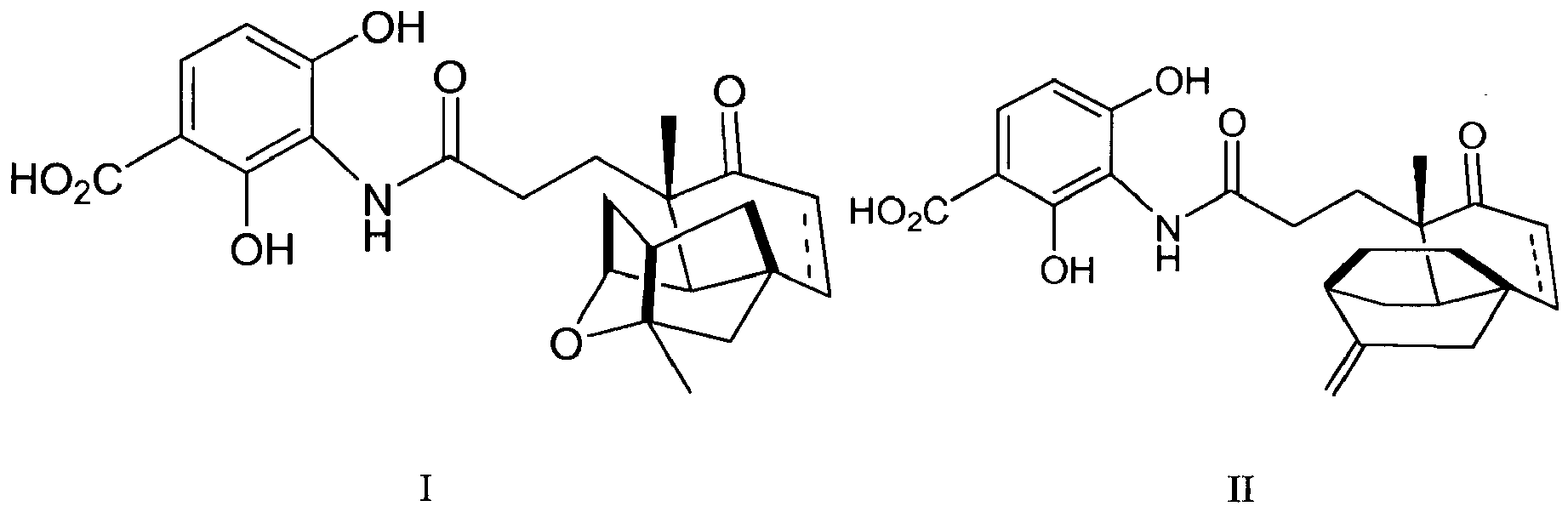
- A compound of formula I or II

Priority Applications (1)
| Application Number | Priority Date | Filing Date | Title |
|---|---|---|---|
| EP15166422.4A EP2946778A1 (en) | 2006-09-22 | 2007-09-18 | Method of treatment using fatty acid synthesis inhibitors |
Applications Claiming Priority (2)
| Application Number | Priority Date | Filing Date | Title |
|---|---|---|---|
| US84646706P | 2006-09-22 | 2006-09-22 | |
| EP07838438.5A EP2083831B1 (en) | 2006-09-22 | 2007-09-18 | Method of treatment using fatty acid synthesis inhibitors |
Related Parent Applications (1)
| Application Number | Title | Priority Date | Filing Date |
|---|---|---|---|
| EP07838438.5A Division EP2083831B1 (en) | 2006-09-22 | 2007-09-18 | Method of treatment using fatty acid synthesis inhibitors |
Related Child Applications (1)
| Application Number | Title | Priority Date | Filing Date |
|---|---|---|---|
| EP15166422.4A Division EP2946778A1 (en) | 2006-09-22 | 2007-09-18 | Method of treatment using fatty acid synthesis inhibitors |
Publications (2)
| Publication Number | Publication Date |
|---|---|
| EP2698157A1 EP2698157A1 (en) | 2014-02-19 |
| EP2698157B1 true EP2698157B1 (en) | 2015-05-20 |
Family
ID=39230750
Family Applications (3)
| Application Number | Title | Priority Date | Filing Date |
|---|---|---|---|
| EP20130188869 Active EP2698157B1 (en) | 2006-09-22 | 2007-09-18 | Method of treatment using fatty acid synthesis inhibitors |
| EP15166422.4A Withdrawn EP2946778A1 (en) | 2006-09-22 | 2007-09-18 | Method of treatment using fatty acid synthesis inhibitors |
| EP07838438.5A Active EP2083831B1 (en) | 2006-09-22 | 2007-09-18 | Method of treatment using fatty acid synthesis inhibitors |
Family Applications After (2)
| Application Number | Title | Priority Date | Filing Date |
|---|---|---|---|
| EP15166422.4A Withdrawn EP2946778A1 (en) | 2006-09-22 | 2007-09-18 | Method of treatment using fatty acid synthesis inhibitors |
| EP07838438.5A Active EP2083831B1 (en) | 2006-09-22 | 2007-09-18 | Method of treatment using fatty acid synthesis inhibitors |
Country Status (6)
| Country | Link |
|---|---|
| US (2) | US8173629B2 (en) |
| EP (3) | EP2698157B1 (en) |
| JP (1) | JP5489333B2 (en) |
| AU (1) | AU2007300627B2 (en) |
| CA (2) | CA2770486C (en) |
| WO (1) | WO2008039327A2 (en) |
Families Citing this family (7)
| Publication number | Priority date | Publication date | Assignee | Title |
|---|---|---|---|---|
| EP2698157B1 (en) * | 2006-09-22 | 2015-05-20 | Merck Sharp & Dohme Corp. | Method of treatment using fatty acid synthesis inhibitors |
| EP2226329B1 (en) | 2009-03-02 | 2013-07-10 | Ruhr-Universität Bochum | Metal-containing platensimycin analogues |
| US20130345270A1 (en) | 2010-11-12 | 2013-12-26 | Waake Forest University Health Sciences | Methods of treating cancer and other disorders |
| MX364895B (en) | 2013-03-13 | 2019-05-10 | Forma Therapeutics Inc | Novel compounds and compositions for inhibition of fasn. |
| WO2017165497A1 (en) | 2016-03-22 | 2017-09-28 | Leof Edward B | Using fatty acid synthase inhibitors to treat fibrosis |
| WO2020092395A1 (en) | 2018-10-29 | 2020-05-07 | Forma Therapeutics, Inc. | SOLID FORMS OF (4-(2-FLUORO-4-(1-METHYL-1 H-BENZO[d]IMIDAZOL-5-YL)BENZOYL) PIPERAZIN-1-YL)(1-HYDROXYCYCLOPROPYL)METHANONE |
| CN109336854B (en) * | 2018-11-14 | 2022-06-03 | 哈药慈航制药股份有限公司 | 6-substituted platemycin derivative, preparation method, pharmaceutical preparation and application |
Family Cites Families (461)
| Publication number | Priority date | Publication date | Assignee | Title |
|---|---|---|---|---|
| US2891091A (en) * | 1957-06-03 | 1959-06-16 | Canadian Patents Dev | Derivatives of para-aminosalicylic acid |
| US4179337A (en) | 1973-07-20 | 1979-12-18 | Davis Frank F | Non-immunogenic polypeptides |
| US3914250A (en) | 1974-08-01 | 1975-10-21 | American Home Prod | 1,4-Diazepino{8 6,5,4-jk{9 carbazoles |
| US4002531A (en) | 1976-01-22 | 1977-01-11 | Pierce Chemical Company | Modifying enzymes with polyethylene glycol and product produced thereby |
| US4231938A (en) | 1979-06-15 | 1980-11-04 | Merck & Co., Inc. | Hypocholesteremic fermentation products and process of preparation |
| US4294926A (en) | 1979-06-15 | 1981-10-13 | Merck & Co., Inc. | Hypocholesteremic fermentation products and process of preparation |
| US4319039A (en) | 1979-06-15 | 1982-03-09 | Merck & Co., Inc. | Preparation of ammonium salt of hypocholesteremic fermentation product |
| US4444784A (en) | 1980-08-05 | 1984-04-24 | Merck & Co., Inc. | Antihypercholesterolemic compounds |
| DK149080C (en) | 1980-06-06 | 1986-07-28 | Sankyo Co | METHOD FOR PREPARING ML-236B CARBOXYLIC ACID DERIVATIVES |
| ZA821577B (en) | 1981-04-06 | 1983-03-30 | Boots Co Plc | Therapeutic agents |
| JPS5889191A (en) | 1981-11-20 | 1983-05-27 | Sankyo Co Ltd | Preparation of 3-hydroxy-ml-236b derivative |
| CA1258454A (en) | 1982-08-10 | 1989-08-15 | Leo Alig | Phenethanolamines |
| IT1159765B (en) | 1982-09-28 | 1987-03-04 | Zanussi A Spa Industrie | MODULAR TYPE WASHING MACHINE |
| US5354772A (en) | 1982-11-22 | 1994-10-11 | Sandoz Pharm. Corp. | Indole analogs of mevalonolactone and derivatives thereof |
| US4911165A (en) | 1983-01-12 | 1990-03-27 | Ethicon, Inc. | Pliabilized polypropylene surgical filaments |
| US4681893A (en) | 1986-05-30 | 1987-07-21 | Warner-Lambert Company | Trans-6-[2-(3- or 4-carboxamido-substituted pyrrol-1-yl)alkyl]-4-hydroxypyran-2-one inhibitors of cholesterol synthesis |
| US4782084A (en) | 1987-06-29 | 1988-11-01 | Merck & Co., Inc. | HMG-COA reductase inhibitors |
| US4885314A (en) | 1987-06-29 | 1989-12-05 | Merck & Co., Inc. | Novel HMG-CoA reductase inhibitors |
| US4820850A (en) | 1987-07-10 | 1989-04-11 | Merck & Co., Inc. | Process for α-C-alkylation of the 8-acyl group on mevinolin and analogs thereof |
| US5180589A (en) | 1988-03-31 | 1993-01-19 | E. R. Squibb & Sons, Inc. | Pravastatin pharmaceuatical compositions having good stability |
| US5030447A (en) | 1988-03-31 | 1991-07-09 | E. R. Squibb & Sons, Inc. | Pharmaceutical compositions having good stability |
| FI906411A7 (en) | 1988-06-28 | 1990-12-27 | La Jolla Cancer Res Foundation | Inhibition of cell proliferation with Decorin |
| US5026685A (en) | 1988-07-15 | 1991-06-25 | The Salk Institute For Biological Studies | NPY peptide analogs |
| US4916239A (en) | 1988-07-19 | 1990-04-10 | Merck & Co., Inc. | Process for the lactonization of mevinic acids and analogs thereof |
| US5118853A (en) | 1988-10-13 | 1992-06-02 | Sandoz Ltd. | Processes for the synthesis of 3-disubstituted aminoacroleins |
| US5290946A (en) | 1988-10-13 | 1994-03-01 | Sandoz Ltd. | Processes for the synthesis of 3-(substituted indolyl-2-yl)propenaldehydes |
| US5349052A (en) | 1988-10-20 | 1994-09-20 | Royal Free Hospital School Of Medicine | Process for fractionating polyethylene glycol (PEG)-protein adducts and an adduct for PEG and granulocyte-macrophage colony stimulating factor |
| WO1990005525A1 (en) | 1988-11-23 | 1990-05-31 | Pfizer Inc. | Quinuclidine derivatives as substance p antagonists |
| IE61928B1 (en) | 1988-11-29 | 1994-11-30 | Boots Co Plc | Treatment of obesity |
| US4929437A (en) | 1989-02-02 | 1990-05-29 | Merck & Co., Inc. | Coenzyme Q10 with HMG-CoA reductase inhibitors |
| US5122614A (en) | 1989-04-19 | 1992-06-16 | Enzon, Inc. | Active carbonates of polyalkylene oxides for modification of polypeptides |
| US5189164A (en) | 1989-05-22 | 1993-02-23 | Sandoz Ltd. | Processes for the synthesis of syn-(E)-3,5-dihydroxy-7-substituted hept-6-enoic and heptanoic acids and derivatives and intermediates thereof |
| FI94339C (en) | 1989-07-21 | 1995-08-25 | Warner Lambert Co | Process for the preparation of pharmaceutically acceptable [R- (R *, R *)] - 2- (4-fluorophenyl) -, - dihydroxy-5- (1-methylethyl) -3-phenyl-4 - [(phenylamino) carbonyl] -1H- for the preparation of pyrrole-1-heptanoic acid and its pharmaceutically acceptable salts |
| PH27357A (en) | 1989-09-22 | 1993-06-21 | Fujisawa Pharmaceutical Co | Pyrazole derivatives and pharmaceutical compositions comprising the same |
| US5232929A (en) | 1990-11-28 | 1993-08-03 | Pfizer Inc. | 3-aminopiperidine derivatives and related nitrogen containing heterocycles and pharmaceutical compositions and use |
| UA41251C2 (en) | 1990-01-04 | 2001-09-17 | Пфайзер, Інк. | Hydrogenated nitrogen-containing heterocyclic substances, piperidine derivatives, pharmaceutical composition and method for inhibiting activity of p substance |
| US5112820A (en) | 1990-03-05 | 1992-05-12 | Sterling Drug Inc. | Anti-glaucoma compositions containing 2- and 3-aminomethyl-6-arylcarbonyl- or 6-phenylthio-2,3-dihydropyrrolo-(1,2,3-de)-1,4-benzoxazines and method of use thereof |
| US5081122A (en) | 1990-03-05 | 1992-01-14 | Sterling Drug Inc. | Antiglaucoma compositions containing 4-arylcarbonyl-1-(4-morpholinyl)-lower-alkyl)-1H-indoles and method of use thereof |
| US5013837A (en) | 1990-03-08 | 1991-05-07 | Sterling Drug Inc. | 3-Arylcarbonyl-1H-indole-containing compounds |
| US4973587A (en) | 1990-03-08 | 1990-11-27 | Sterling Drug Inc. | 3-arylcarbonyl-1-aminoalkyl-1H-indole-containing antiglaucoma method |
| US5420245A (en) | 1990-04-18 | 1995-05-30 | Board Of Regents, The University Of Texas | Tetrapeptide-based inhibitors of farnesyl transferase |
| US5451586A (en) | 1990-06-01 | 1995-09-19 | Pfizer Inc. | 3-amino-2-aryl quinuclidines |
| CA2086434C (en) | 1990-07-23 | 1998-09-22 | John A. Lowe, Iii | Quinuclidine derivatives |
| ES2071334T3 (en) | 1990-09-28 | 1995-06-16 | Pfizer | ANALOGS OF FUSED NITROGEN RINGS CONTAINING NON-AROMATIC HETERO CYCLES. |
| CA2100163A1 (en) | 1991-01-10 | 1992-07-11 | John A. Lowe, Iii | N-alkyl quinuclidinium salts |
| ATE154354T1 (en) | 1991-02-11 | 1997-06-15 | Merck Sharp & Dohme | AZABICYCLIC COMPOUNDS, PHARMACEUTICAL PREPARATIONS CONTAINING THEM AND THERAPEUTIC USE |
| ES2065175T3 (en) | 1991-03-01 | 1995-02-01 | Pfizer | DERIVATIVES OF 1-AZABICICLO (3.2.2) NONAN-3-AMINA. |
| CA2106200C (en) | 1991-03-26 | 1996-11-19 | Terry J. Rosen | Stereoselective preparation of substituted piperidines |
| US5292726A (en) | 1991-05-22 | 1994-03-08 | Merck & Co., Inc. | N,N-diacylpiperazines |
| PL172069B1 (en) | 1991-05-22 | 1997-07-31 | Pfizer | Method for the preparation of new derivatives of substituted 3-aminoquinuclidine |
| JPH0733386B2 (en) | 1991-05-31 | 1995-04-12 | フアイザー・インコーポレイテツド | Quinuclidine derivative |
| GB9113219D0 (en) | 1991-06-19 | 1991-08-07 | Fujisawa Pharmaceutical Co | Peptide compound,processes for preparation thereof and pharmaceutical composition comprising the same |
| SK282203B6 (en) | 1991-06-20 | 2001-12-03 | Pfizer Inc. | FLUOROALCOXYBENZYLAMINE DERIVATIVES OF HETEROCYCLES CONTAINING NITROGEN, METHODS OF PREPARATION, INTERMEDIATE, METHOD OF PREPARATION OF PRODUCTS, USE AND PHARMACEUTICAL PRODUCT |
| TW202432B (en) | 1991-06-21 | 1993-03-21 | Pfizer | |
| CA2110514A1 (en) | 1991-07-05 | 1993-01-21 | Raymond Baker | Aromatic compounds, pharmaceutical compositions containing them and their use in therapy |
| CA2110725A1 (en) | 1991-07-10 | 1993-01-21 | Andrew P. Owens | Aromatic compounds, compositions containing them and their use in therapy |
| US5495047A (en) | 1991-07-10 | 1996-02-27 | Merck, Sharp & Dohme (Ltd.) | Fused tricyclic compounds, pharmaceutical compositions containing them and their use in therapy |
| EP0600952B1 (en) | 1991-08-20 | 1996-04-17 | MERCK SHARP & DOHME LTD. | Azacyclic compounds, processes for their preparation and pharmaceutical compositions containing them |
| CA2118704C (en) | 1991-09-26 | 1997-01-21 | John A. Lowe, Iii | Fused tricyclic nitrogen containing heterocycles as substance p receptor antagonists |
| JP2553020B2 (en) | 1991-11-07 | 1996-11-13 | 吉富製薬株式会社 | Quinuclidine compound and its pharmaceutical use |
| ES2111650T3 (en) | 1991-11-12 | 1998-03-16 | Pfizer | ACICLIC DERIVATIVES OF ETHYLENEDIAMINE AS ANTAGONISTS OF RECEPTORS OF THE SUBSTANCE P. |
| HU217629B (en) | 1991-12-12 | 2000-03-28 | Novartis Ag. | A method for the preparation of stabilized pharmaceutical compositions containing fluvastatin |
| GB9200535D0 (en) | 1992-01-10 | 1992-02-26 | Fujisawa Pharmaceutical Co | New compound |
| GB9201179D0 (en) | 1992-01-21 | 1992-03-11 | Glaxo Group Ltd | Chemical compounds |
| US5328927A (en) | 1992-03-03 | 1994-07-12 | Merck Sharpe & Dohme, Ltd. | Hetercyclic compounds, processes for their preparation and pharmaceutical compositions containing them |
| JP2656702B2 (en) | 1992-03-23 | 1997-09-24 | ファイザー製薬株式会社 | Peptide quinuclidine |
| FR2689888B1 (en) | 1992-04-10 | 1994-06-10 | Rhone Poulenc Rorer Sa | NOVEL PERHYDROISOINDOLE DERIVATIVES, THEIR PREPARATION AND THE PHARMACEUTICAL COMPOSITIONS CONTAINING THEM. |
| CA2133077A1 (en) | 1992-04-15 | 1993-10-28 | Raymond Baker | Azacyclic compounds |
| JP2757234B2 (en) | 1992-05-18 | 1998-05-25 | ファイザー インク. | Bridged azabicyclic derivatives as substance P antagonists |
| GB9211193D0 (en) | 1992-05-27 | 1992-07-08 | Merck Sharp & Dohme | Therapeutic agents |
| FR2692575B1 (en) | 1992-06-23 | 1995-06-30 | Sanofi Elf | NOVEL PYRAZOLE DERIVATIVES, PROCESS FOR THEIR PREPARATION AND PHARMACEUTICAL COMPOSITIONS CONTAINING THEM. |
| FR2713225B1 (en) | 1993-12-02 | 1996-03-01 | Sanofi Sa | Substituted N-piperidino-3-pyrazolecarboxamide. |
| US5637699A (en) | 1992-06-29 | 1997-06-10 | Merck & Co., Inc. | Process for preparing morpholine tachykinin receptor antagonists |
| CA2099233A1 (en) | 1992-06-29 | 1993-12-30 | Conrad P. Dorn | Morpholine and thiomorpholine tachykinin receptor antagonists |
| AU4713293A (en) | 1992-07-13 | 1994-01-31 | Merck Sharp & Dohme Limited | Heterocyclic amide derivatives as tachykinin derivatives |
| EP1251170A3 (en) | 1992-07-17 | 2002-10-30 | Ribozyme Pharmaceuticals, Inc. | Method and reagent for treatment of NF-kappaB dependent animal diseases |
| DE69322275T2 (en) | 1992-07-28 | 1999-06-24 | Merck Sharp & Dohme Ltd., Hoddesdon, Hertfordshire | AZACYCLIC CONNECTIONS |
| AU4718093A (en) | 1992-07-31 | 1994-03-03 | Merck Sharp & Dohme Limited | Substituted amines as tachykinin receptor antagonists |
| JPH07506379A (en) | 1992-08-04 | 1995-07-13 | ファイザー・インコーポレーテッド | 3-benzylamino-2-phenyl-piperidine as substance P receptor antagonist |
| DK0655055T3 (en) | 1992-08-13 | 2001-01-02 | Warner Lambert Co | tachykinin antagonists |
| AU4224993A (en) | 1992-08-19 | 1994-03-15 | Pfizer Inc. | Substituted benzylamino nitrogen containing non-aromatic heterocycles |
| US5387595A (en) | 1992-08-26 | 1995-02-07 | Merck & Co., Inc. | Alicyclic compounds as tachykinin receptor antagonists |
| US5563161A (en) | 1992-09-10 | 1996-10-08 | Merck Sharp & Dohme Ltd. | Alcohols and ethers with aromatic substituents as tachykinin-antagonists |
| GB9220286D0 (en) | 1992-09-25 | 1992-11-11 | Merck Sharp & Dohme | Therapeutic agents |
| US5349056A (en) | 1992-10-09 | 1994-09-20 | Regeneron Pharmaceuticals | Modified ciliary neurotrophic factors |
| US6472178B1 (en) | 1998-02-27 | 2002-10-29 | Regeneron Pharmaceuticals, Inc. | Nucleic acids encoding a modified ciliary neurotrophic factor and method of making thereof |
| JP2656699B2 (en) | 1992-10-21 | 1997-09-24 | ファイザー製薬株式会社 | Substituted benzylaminoquinuclidine |
| GB9222262D0 (en) | 1992-10-23 | 1992-12-09 | Merck Sharp & Dohme | Therapeutic agents |
| AU678409B2 (en) | 1992-10-28 | 1997-05-29 | Merck Sharp & Dohme Limited | 4-arylmethyloxymethyl piperidines as tachykinin antagonists |
| JP2656700B2 (en) | 1992-10-28 | 1997-09-24 | ファイザー製薬株式会社 | Substituted quinuclidine derivatives |
| AU5342894A (en) | 1992-10-30 | 1994-05-24 | Merck Sharp & Dohme Limited | Tachykinin antagonists |
| AU676489B2 (en) | 1992-11-12 | 1997-03-13 | Pfizer Inc. | Quinuclidine derivative as substance P antagonist |
| PT675886E (en) | 1992-12-10 | 2000-12-29 | Pfizer | NON-AROMATIC HETEROCYCLES WITH AMINYMETHYLENE SUBSTITUENTS AND THEIR USE AS ANTAGONISTS OF THE SUBSTANCE P |
| US5578593A (en) | 1992-12-11 | 1996-11-26 | Merck & Co., Inc. | Spiro piperidines and homologs promote release of growth hormone |
| US5604260A (en) | 1992-12-11 | 1997-02-18 | Merck Frosst Canada Inc. | 5-methanesulfonamido-1-indanones as an inhibitor of cyclooxygenase-2 |
| EP0673367A1 (en) | 1992-12-14 | 1995-09-27 | MERCK SHARP & DOHME LTD. | 4-aminomethyl/thiomethyl/sulfonylmethyl-4-phenylpiperidines as tachykinin receptor antagonists |
| EP0604181A1 (en) | 1992-12-21 | 1994-06-29 | Eli Lilly And Company | Antitumor compositions and method of treatment |
| GB9226581D0 (en) | 1992-12-21 | 1993-02-17 | Merck Sharp & Dohme | Therapeutic agents |
| GB9300051D0 (en) | 1993-01-04 | 1993-03-03 | Merck Sharp & Dohme | Therapeutic agents |
| EP0759432A1 (en) | 1993-01-15 | 1997-02-26 | G.D. Searle & Co. | Use of medicaments containing 3,4-diaryl furans and analogs thereof for treating a skin-related condition |
| US5451677A (en) | 1993-02-09 | 1995-09-19 | Merck & Co., Inc. | Substituted phenyl sulfonamides as selective β 3 agonists for the treatment of diabetes and obesity |
| EP0683767B1 (en) | 1993-02-18 | 1998-06-03 | MERCK SHARP & DOHME LTD. | Azacyclic compounds, compositions containing them and their use as tachykinin antagonists |
| US5674889A (en) | 1993-02-22 | 1997-10-07 | Merck, Sharp & Dohme, Ltd. | Aromatic compounds, compositions containing them and their use in therapy |
| WO1994019357A1 (en) | 1993-02-23 | 1994-09-01 | Merrell Dow Pharmaceuticals Inc. | Farnesyl:protein transferase inhibitors as anticancer agents |
| US5292736A (en) | 1993-02-26 | 1994-03-08 | Sterling Winthrop Inc. | Morpholinoalkylindenes as antiglaucoma agents |
| US5298627A (en) | 1993-03-03 | 1994-03-29 | Warner-Lambert Company | Process for trans-6-[2-(substituted-pyrrol-1-yl)alkyl]pyran-2-one inhibitors of cholesterol synthesis |
| US5688806A (en) | 1993-03-04 | 1997-11-18 | Pfizer Inc. | Spiroazacyclic derivatives as substance P antagonists |
| US5409944A (en) | 1993-03-12 | 1995-04-25 | Merck Frosst Canada, Inc. | Alkanesulfonamido-1-indanone derivatives as inhibitors of cyclooxygenase |
| JPH08510205A (en) | 1993-03-29 | 1996-10-29 | ユニバーシティ オブ シンシナティ | YY peptide analogs and their uses |
| CA2118985A1 (en) | 1993-04-02 | 1994-10-03 | Dinesh V. Patel | Heterocyclic inhibitors of farnesyl protein transferase |
| US5496833A (en) | 1993-04-13 | 1996-03-05 | Merck Sharp & Dohme Limited | Piperidine tachykinin receptor antagonists |
| ES2110761T3 (en) | 1993-05-06 | 1998-02-16 | Merrell Pharma Inc | PIRROLIDIN-3-IL-ALKYL-PIPERIDINES SUBSTITUTED USEFUL AS AN TAGIQUININE ANTAGONISTS. |
| AU6909194A (en) | 1993-05-14 | 1994-12-12 | Board Of Regents, The University Of Texas System | Preparation of n-cyanodithioimino-carbonates and 3-mercapto-5-amino-1h-1,2,4-triazole |
| US5602098A (en) | 1993-05-18 | 1997-02-11 | University Of Pittsburgh | Inhibition of farnesyltransferase |
| IL109646A0 (en) | 1993-05-19 | 1994-08-26 | Pfizer | Heteroatom substituted alkyl benzylamino-quinuclidines |
| US5380738A (en) | 1993-05-21 | 1995-01-10 | Monsanto Company | 2-substituted oxazoles further substituted by 4-fluorophenyl and 4-methylsulfonylphenyl as antiinflammatory agents |
| JPH08511522A (en) | 1993-06-07 | 1996-12-03 | メルク エンド カンパニー インコーポレーテッド | Spiro-Substituted Aza Rings as Neurokinin Antagonists |
| US5436265A (en) | 1993-11-12 | 1995-07-25 | Merck Frosst Canada, Inc. | 1-aroyl-3-indolyl alkanoic acids and derivatives thereof useful as anti-inflammatory agents |
| US5474995A (en) | 1993-06-24 | 1995-12-12 | Merck Frosst Canada, Inc. | Phenyl heterocycles as cox-2 inhibitors |
| GB9602877D0 (en) | 1996-02-13 | 1996-04-10 | Merck Frosst Canada Inc | 3,4-Diaryl-2-hydroxy-2,5- dihydrofurans as prodrugs to cox-2 inhibitors |
| CA2167198C (en) | 1993-07-15 | 1999-03-16 | Kunio Satake | Benzylaminoquinuclidines |
| TW365603B (en) | 1993-07-30 | 1999-08-01 | Rhone Poulenc Rorer Sa | Novel perhydroisoindole derivatives, their preparation and pharmaceutical compositions which contain them |
| GB9315808D0 (en) | 1993-07-30 | 1993-09-15 | Merck Sharp & Dohme | Therapeutic agents |
| DE69432758T2 (en) | 1993-08-09 | 2004-02-19 | Société de Conseils de Recherches et d'Applications Scientifiques S.A.S. | THERAPEUTICALLY EFFECTIVE PEPTIDE DERIVATIVES |
| GB9317618D0 (en) | 1993-08-24 | 1993-10-06 | Royal Free Hosp School Med | Polymer modifications |
| GB9317987D0 (en) | 1993-08-26 | 1993-10-13 | Glaxo Group Ltd | Chemical compounds |
| DK0719253T3 (en) | 1993-09-17 | 2004-07-26 | Pfizer | 3-amino-5-carboxy-substituted piperidines and 3-amino-4-carboxy-substituted pyrrolidines as tachykinin antagonists |
| WO1995007908A1 (en) | 1993-09-17 | 1995-03-23 | Pfizer Inc. | Heteroarylamino and heteroarylsulfonamido substituted 3-benzylaminomethyl piperidines and related compounds |
| IS4208A (en) | 1993-09-22 | 1995-03-23 | Glaxo Group Limited | 3- (tetrazolyl-benzyl) amino-piperadidine derivatives |
| EP0670314A4 (en) | 1993-09-22 | 1996-04-10 | Kyowa Hakko Kogyo Kk | FARNESYL-TRANSFERASE INHIBITOR. |
| US5721236A (en) | 1993-10-15 | 1998-02-24 | Schering Corporation | Tricyclic carbamate compounds useful for inhibition of G-protein function and for treatment of proliferative diseases |
| HUT76066A (en) | 1993-10-15 | 1997-06-30 | Schering Corp | Tricyclic amide and urea compounds useful for inhibition of g-protein function and for treatment of proliferative diseases, pharmaceutical compositions containing them and process for producing them |
| US5719148A (en) | 1993-10-15 | 1998-02-17 | Schering Corporation | Tricyclic amide and urea compounds useful for inhibition of g-protein function and for treatment of proliferative diseases |
| IL111235A (en) | 1993-10-15 | 2001-03-19 | Schering Plough Corp | Pharmaceutical compositions for inhibition of g-protein function and for treatment of proliferative diseases containing tricyclic compounds some such compounds and process for preparing part of them |
| NZ275646A (en) | 1993-10-15 | 1998-02-26 | Schering Corp | Tricyclic sulphonamide derivatives and medicaments |
| US5661152A (en) | 1993-10-15 | 1997-08-26 | Schering Corporation | Tricyclic sulfonamide compounds useful for inhibition of G-protein function and for treatment of proliferative diseases |
| US5965566A (en) | 1993-10-20 | 1999-10-12 | Enzon, Inc. | High molecular weight polymer-based prodrugs |
| JPH09504295A (en) | 1993-10-25 | 1997-04-28 | パーク・デイビス・アンド・カンパニー | Substituted tetra- and pentapeptide inhibitors of protein: farnesyl transferase |
| AU7947594A (en) | 1993-10-27 | 1995-05-22 | Merck Sharp & Dohme Limited | Substituted amides as tachykinin antagonists |
| US5344991A (en) | 1993-10-29 | 1994-09-06 | G.D. Searle & Co. | 1,2 diarylcyclopentenyl compounds for the treatment of inflammation |
| DE69417012T2 (en) | 1993-11-04 | 1999-10-07 | Abbott Laboratories, Abbott Park | CYCLOBUTAN DERIVATIVES AS INHIBITORS OF SQUALEN SYNTHETASE AND PROTEIN-FARNESYLTRANSFERASE |
| US5783593A (en) | 1993-11-04 | 1998-07-21 | Abbott Laboratories | Inhibitors of squalene synthetase and protein farnesyltransferase |
| EP0730605A1 (en) | 1993-11-05 | 1996-09-11 | Warner-Lambert Company | Substituted di- and tripeptide inhibitors of protein:farnesyl transferase |
| US6403577B1 (en) | 1993-11-17 | 2002-06-11 | Eli Lilly And Company | Hexamethyleneiminyl tachykinin receptor antagonists |
| US5466823A (en) | 1993-11-30 | 1995-11-14 | G.D. Searle & Co. | Substituted pyrazolyl benzenesulfonamides |
| IT1271462B (en) | 1993-12-03 | 1997-05-28 | Menarini Farma Ind | TACHYCHININ ANTAGONISTS, PROCEDURE FOR THEIR PREPARATION AND THEIR USE IN PHARMACEUTICAL FORMULATIONS. |
| US5484799A (en) | 1993-12-09 | 1996-01-16 | Abbott Laboratories | Antifungal dorrigocin derivatives |
| FR2714057B1 (en) | 1993-12-17 | 1996-03-08 | Sanofi Elf | New derivatives of 3-pyrazolecarboxamide, process for their preparation and pharmaceutical compositions containing them. |
| IL111960A (en) | 1993-12-17 | 1999-12-22 | Merck & Co Inc | Morpholines and thiomorpholines their preparation and pharmaceutical compositions containing them |
| AU1339795A (en) | 1993-12-21 | 1995-07-10 | Eli Lilly And Company | Non-peptide tachykinin receptor antagonists |
| US5854239A (en) | 1993-12-29 | 1998-12-29 | Pfizer Inc. | Diazabicyclic neuokinin antagonists |
| ATE364606T1 (en) | 1993-12-29 | 2007-07-15 | Merck Sharp & Dohme | SUBSTITUTED MORPHOLINE DERIVATIVES AND THEIR USE AS MEDICINAL PRODUCTS |
| CA2180746A1 (en) | 1994-01-13 | 1995-07-20 | Raymond Baker | Gem-disubstituted azacyclic tachykinin antagonists |
| JPH09508376A (en) | 1994-01-28 | 1997-08-26 | メルク シヤープ エンド ドーム リミテツド | Aralkyl-substituted azacyclo drugs |
| US5393790A (en) | 1994-02-10 | 1995-02-28 | G.D. Searle & Co. | Substituted spiro compounds for the treatment of inflammation |
| GB9402688D0 (en) | 1994-02-11 | 1994-04-06 | Merck Sharp & Dohme | Therapeutic agents |
| US5610165A (en) | 1994-02-17 | 1997-03-11 | Merck & Co., Inc. | N-acylpiperidine tachykinin antagonists |
| IL112778A0 (en) | 1994-03-04 | 1995-05-26 | Merck & Co Inc | Substituted heterocycles, their preparation and pharmaceutical compositions containing them |
| WO1995024612A1 (en) | 1994-03-07 | 1995-09-14 | International Business Machines Corporation | Fast process and device for interpolating intermediate values from periodic phase-shifted signals and for detecting rotary body defects |
| FI963597L (en) | 1994-03-15 | 1996-11-14 | Eisai Co Ltd | Isoprenyltransferase inhibitors |
| FR2718136B1 (en) | 1994-03-29 | 1996-06-21 | Sanofi Sa | Amino aromatic compounds, process for their preparation and pharmaceutical compositions containing them. |
| RU95104898A (en) | 1994-03-31 | 1996-12-27 | Бристоль-Мейерз Сквибб Компани (US) | Imedazole containing inhibitors of ferneside proteintansferase, and method of treatment diseases related therewith |
| US5523430A (en) | 1994-04-14 | 1996-06-04 | Bristol-Myers Squibb Company | Protein farnesyl transferase inhibitors |
| US5610145A (en) | 1994-04-15 | 1997-03-11 | Warner-Lambert Company | Tachykinin antagonists |
| US5705515A (en) | 1994-04-26 | 1998-01-06 | Merck & Co., Inc. | Substituted sulfonamides as selective β-3 agonists for the treatment of diabetes and obesity |
| IL113410A (en) | 1994-04-26 | 1999-11-30 | Merck & Co Inc | Substituted sulfonamides having an asymmetric center and pharmaceutical compositions containing them |
| JPH10500944A (en) | 1994-05-05 | 1998-01-27 | メルク シヤープ エンド ドーム リミテツド | Morpholine derivatives and their use as antagonists of tachykinins |
| JPH09512806A (en) | 1994-05-07 | 1997-12-22 | ベーリンガー インゲルハイム コマンディトゲゼルシャフト | Novel amino acid derivative, method for producing the same, and pharmaceutical composition (II) containing these compounds |
| US5510510A (en) | 1994-05-10 | 1996-04-23 | Bristol-Meyers Squibb Company | Inhibitors of farnesyl protein transferase |
| US5563255A (en) | 1994-05-31 | 1996-10-08 | Isis Pharmaceuticals, Inc. | Antisense oligonucleotide modulation of raf gene expression |
| CA2187531A1 (en) | 1994-06-06 | 1995-12-14 | David Christopher Horwell | Tachykinin (nk1) receptor antagonists |
| WO1995034535A1 (en) | 1994-06-10 | 1995-12-21 | Rhone-Poulenc Rorer S.A. | Novel farnesyl transferase inhibitors, their preparation and pharmaceutical compositions containing same |
| US5571792A (en) | 1994-06-30 | 1996-11-05 | Warner-Lambert Company | Histidine and homohistidine derivatives as inhibitors of protein farnesyltransferase |
| GB9415996D0 (en) | 1994-08-08 | 1994-09-28 | Merck Sharp & Dohme | Therapeutic agents |
| TW432061B (en) | 1994-08-09 | 2001-05-01 | Pfizer Res & Dev | Lactams |
| WO1996005529A1 (en) | 1994-08-09 | 1996-02-22 | Micron Optics, Inc. | Temperature compensated fiber fabry-perot filters |
| ATE188464T1 (en) | 1994-08-11 | 2000-01-15 | Banyu Pharma Co Ltd | SUBSTITUTED AMIDE DERIVATIVES |
| CA2155448A1 (en) | 1994-08-11 | 1996-02-12 | Katerina Leftheris | Inhibitors of farnesyl protein transferase |
| AU3192495A (en) | 1994-08-12 | 1996-03-07 | Banyu Pharmaceutical Co., Ltd. | N,n-disubstituted amic acid derivative |
| PT777659E (en) | 1994-08-15 | 2001-09-28 | Merck Sharp & Dohme | MORPHINE DERIVATIVES AND THEIR USE AS THERAPEUTIC AGENTS |
| DE4429506B4 (en) | 1994-08-19 | 2007-09-13 | Degussa Gmbh | Process for the extraction of natural carotenoid dyes |
| DE4429653C2 (en) | 1994-08-20 | 1997-04-03 | Anton Dr More | Converter and method for refining molten metals, in particular from pig iron to steel |
| DE69508093T2 (en) | 1994-08-25 | 1999-07-15 | Merrell Pharmaceuticals Inc., Cincinnati, Ohio | SUBSTITUTED PIPERIDINE FOR THE TREATMENT OF ALLERGIC DISEASES |
| GB9417956D0 (en) | 1994-09-02 | 1994-10-26 | Merck Sharp & Dohme | Therapeutic agents |
| US5935951A (en) | 1994-09-30 | 1999-08-10 | Novartis Finance Corporation | 1-acyl-4-aliphatylaminopiperidine compounds |
| US5696093A (en) | 1994-10-28 | 1997-12-09 | Crc For Biopharmaceutical Research Pty Limited | Method of treating nasal congestion using neuropeptide Y Y2 agonist peptides |
| BR9509610A (en) | 1994-11-07 | 1997-10-28 | Pfizer | Y1-specific neuropeptide ligands |
| US5574010A (en) | 1994-11-14 | 1996-11-12 | The Regents Of The University Of California | Treatment of pancreatic tumors with peptide YY and analogs thereof |
| EP0740853B1 (en) | 1994-11-22 | 1999-01-13 | Koninklijke Philips Electronics N.V. | Semiconductor device with a carrier body on which a substrate with a semiconductor element is fastened by means of a glue layer and on which a pattern of conductor tracks is fastened |
| FR2727411B1 (en) | 1994-11-30 | 1997-01-03 | Rhone Poulenc Rorer Sa | NOVEL PERHYDROISOINDOLE DERIVATIVES, THEIR PREPARATION AND THE PHARMACEUTICAL COMPOSITIONS CONTAINING THEM |
| CA2204144A1 (en) | 1994-12-09 | 1996-06-13 | Francis J. Tinney | Substituted tetra- and pentapeptide inhibitors of protein:farnesyl transferase |
| IL116323A0 (en) | 1994-12-13 | 1996-03-31 | Sandoz Ag | Tachykinin antagonists their preparation and pharmaceutical compositions containing them |
| GB9426103D0 (en) | 1994-12-23 | 1995-02-22 | Merck Sharp & Dohme | Therapeutic agents |
| BR9606896A (en) | 1995-01-09 | 1997-10-21 | Magla Int Ltd | Water resistant image printing on latex surfaces |
| ATE279406T1 (en) | 1995-01-12 | 2004-10-15 | Glaxo Group Ltd | PIPERIDINE DERIVATIVES WITH TACHYKININ ANTAGONISTIC EFFECT |
| AU4915796A (en) | 1995-01-12 | 1996-07-31 | University Of Pittsburgh | Inhibitors of prenyl transferases |
| FR2729390A1 (en) | 1995-01-18 | 1996-07-19 | Rhone Poulenc Rorer Sa | NOVEL FARNESYL TRANSFERASE INHIBITORS, THEIR PREPARATION AND THE PHARMACEUTICAL COMPOSITIONS CONTAINING THEM |
| US5907030A (en) | 1995-01-25 | 1999-05-25 | University Of Southern California | Method and compositions for lipidization of hydrophilic molecules |
| US5559208A (en) | 1995-01-31 | 1996-09-24 | Eli Lilly And Company | Anti-obesity proteins |
| US5605886A (en) | 1995-01-31 | 1997-02-25 | Eli Lilly And Company | Anti-obesity proteins |
| EP0725079A1 (en) | 1995-01-31 | 1996-08-07 | Eli Lilly And Company | Anti-obesity proteins |
| US5552524A (en) | 1995-01-31 | 1996-09-03 | Eli Lilly And Company | Anti-obesity proteins |
| US5552522A (en) | 1995-01-31 | 1996-09-03 | Eli Lilly And Company | Anti-obesity proteins |
| US5552523A (en) | 1995-01-31 | 1996-09-03 | Eli Lilly And Company | Anti-obesity proteins |
| US5521283A (en) | 1995-01-31 | 1996-05-28 | Eli Lilly And Company | Anti-obesity proteins |
| US5554727A (en) | 1995-01-31 | 1996-09-10 | Eli Lilly And Company | Anti-obesity proteins |
| EP0836620A1 (en) | 1995-01-31 | 1998-04-22 | Eli Lilly And Company | Anti-obesity proteins |
| FR2730491B1 (en) | 1995-02-09 | 1997-03-14 | Rhone Poulenc Rorer Sa | NOVEL FARNESYL TRANSFERASE INHIBITORS, THEIR PREPARATION AND THE PHARMACEUTICAL COMPOSITIONS CONTAINING THEM |
| FR2730492B1 (en) | 1995-02-09 | 1997-03-14 | Rhone Poulenc Rorer Sa | NOVEL FARNESYL TRANSFERASE INHIBITORS, THEIR PREPARATION AND THE PHARMACEUTICAL COMPOSITIONS CONTAINING THEM |
| US5633272A (en) | 1995-02-13 | 1997-05-27 | Talley; John J. | Substituted isoxazoles for the treatment of inflammation |
| US5532237A (en) | 1995-02-15 | 1996-07-02 | Merck Frosst Canada, Inc. | Indole derivatives with affinity for the cannabinoid receptor |
| GB9505492D0 (en) | 1995-03-18 | 1995-05-03 | Merck Sharp & Dohme | Therapeutic agents |
| GB9505491D0 (en) | 1995-03-18 | 1995-05-03 | Merck Sharp & Dohme | Therapeutic agents |
| US5554641A (en) | 1995-03-20 | 1996-09-10 | Horwell; David C. | Nonpeptides as tachykinin antagonists |
| GB9505692D0 (en) | 1995-03-21 | 1995-05-10 | Glaxo Group Ltd | Chemical compounds |
| US5700806A (en) | 1995-03-24 | 1997-12-23 | Schering Corporation | Tricyclic amide and urea compounds useful for inhibition of G-protein function and for treatment of proliferative diseases |
| US5684013A (en) | 1995-03-24 | 1997-11-04 | Schering Corporation | Tricyclic compounds useful for inhibition of g-protein function and for treatment of proliferative diseases |
| IL117580A0 (en) | 1995-03-29 | 1996-07-23 | Merck & Co Inc | Inhibitors of farnesyl-protein transferase and pharmaceutical compositions containing them |
| US5565568A (en) | 1995-04-06 | 1996-10-15 | Eli Lilly And Company | 2-acylaminopropanamides as tachykinin receptor antagonists |
| US5712280A (en) | 1995-04-07 | 1998-01-27 | Schering Corporation | Tricyclic compounds useful for inhibition of G-protein function and for treatment of proliferative diseases |
| IL117805A0 (en) | 1995-04-07 | 1996-08-04 | Schering Corp | Carbonyl piperazinyl and piperidinyl compounds |
| IL117798A (en) | 1995-04-07 | 2001-11-25 | Schering Plough Corp | Tricyclic compounds useful for inhibition of g-protein function and for treatment of proliferative diseases and pharmaceutical compositions comprising them |
| US5891872A (en) | 1995-04-07 | 1999-04-06 | Schering Corporation | Tricyclic compounds |
| WO1996032385A1 (en) | 1995-04-13 | 1996-10-17 | Hoechst Marion Roussel, Inc. | Novel substituted piperazine derivatives having tachykinin receptor antagonists activity |
| US5831115A (en) | 1995-04-21 | 1998-11-03 | Abbott Laboratories | Inhibitors of squalene synthase and protein farnesyltransferase |
| IL118101A0 (en) | 1995-05-03 | 1996-09-12 | Abbott Lab | Inhibitors of farnesyltransferase |
| US20020006964A1 (en) | 1995-05-16 | 2002-01-17 | Young James W. | Methods of using and compositions comprising (+) sibutramine optionally in combination with other pharmacologically active compounds |
| HUP9900822A3 (en) | 1995-05-25 | 1999-11-29 | Fujisawa Pharmaceutical Co | Piperazine derivatives, process for producing them, pharmaceutical compositions containing them and method for treating tachykinin-mediated diseases |
| US5739106A (en) | 1995-06-07 | 1998-04-14 | Rink; Timothy J. | Appetite regulating compositions |
| AU6034296A (en) | 1995-06-16 | 1997-01-15 | Warner-Lambert Company | Tricyclic inhibitors of protein farnesyltransferase |
| GB9513121D0 (en) | 1995-06-28 | 1995-08-30 | Merck Sharp & Dohme | Therapeutic agents |
| GB9513117D0 (en) | 1995-06-28 | 1995-08-30 | Merck Sharp & Dohme | Therapeutic agents |
| EP0840732B1 (en) | 1995-07-07 | 2001-03-07 | Pfizer Inc. | Substituted benzolactam compounds as substance p antagonists |
| FR2736641B1 (en) | 1995-07-10 | 1997-08-22 | Rhone Poulenc Rorer Sa | NOVEL FARNESYL TRANSFERASE INHIBITORS, THEIR PREPARATION AND THE PHARMACEUTICAL COMPOSITIONS CONTAINING THEM |
| AT402617B (en) | 1995-07-11 | 1997-07-25 | Datacon Schweitzer & Zeindl Gm | SYSTEM FOR AUTOMATED, HERMETIC SYSTEM FOR AUTOMATED, HERMETIC LOCKING OF HOUSINGS LOCKING OF HOUSINGS |
| FR2736638B1 (en) | 1995-07-12 | 1997-08-22 | Rhone Poulenc Rorer Sa | NOVEL FARNESYL TRANSFERASE INHIBITORS, THEIR PREPARATION AND THE PHARMACEUTICAL COMPOSITIONS CONTAINING THEM |
| CH690163A5 (en) | 1995-07-28 | 2000-05-31 | Symphar Sa | Derivatives substituted gem-diphosphonates useful as anti-cancer. |
| TW340842B (en) | 1995-08-24 | 1998-09-21 | Pfizer | Substituted benzylaminopiperidine compounds |
| WO1997010813A1 (en) | 1995-09-18 | 1997-03-27 | Ligand Pharmaceuticals Incorporated | Ppar gamma antagonists for treating obesity |
| US6020343A (en) | 1995-10-13 | 2000-02-01 | Merck Frosst Canada, Inc. | (Methylsulfonyl)phenyl-2-(5H)-furanones as COX-2 inhibitors |
| EP0858444A4 (en) | 1995-10-18 | 1999-12-01 | Merck & Co Inc | CYCLOPENTYL TACHYKININE RECEPTORANT AGONISTS |
| DE19541283A1 (en) | 1995-11-06 | 1997-05-07 | Boehringer Ingelheim Kg | Novel amino acid derivatives, processes for their preparation and pharmaceutical compositions containing these compounds |
| WO1997017070A1 (en) | 1995-11-06 | 1997-05-15 | University Of Pittsburgh | Inhibitors of protein isoprenyl transferases |
| GB9523244D0 (en) | 1995-11-14 | 1996-01-17 | Merck Sharp & Dohme | Therapeutic agents |
| PT1186606E (en) | 1995-11-17 | 2004-08-31 | Biotechnolog Forschung Mbh Gbf | DERIVATIVES OF THE EPOTILONE ITS PREPARATION AND UTILIZATION |
| AU704139B2 (en) | 1995-11-22 | 1999-04-15 | Merck & Co., Inc. | Inhibitors of farnesyl-protein transferase |
| FR2741621B1 (en) | 1995-11-23 | 1998-02-13 | Sanofi Sa | NOVEL PYRAZOLE DERIVATIVES, PROCESS FOR THEIR PREPARATION AND PHARMACEUTICAL COMPOSITIONS CONTAINING THE SAME |
| JP2000500760A (en) | 1995-11-23 | 2000-01-25 | メルク シヤープ エンド ドーム リミテツド | Spiropiperidine derivatives and their use as tachykinin antagonists |
| GB9524157D0 (en) | 1995-11-25 | 1996-01-24 | Pfizer Ltd | Therapeutic agents |
| AU7692996A (en) | 1995-12-01 | 1997-06-27 | Ciba-Geigy Ag | Receptor antagonists |
| WO1997019682A1 (en) | 1995-12-01 | 1997-06-05 | Synaptic Pharmaceutical Corporation | Aryl sulfonamide and sulfamide derivatives and uses thereof |
| AU7626496A (en) | 1995-12-01 | 1997-06-27 | Ciba-Geigy Ag | Heteroaryl compounds |
| WO1997020822A1 (en) | 1995-12-01 | 1997-06-12 | Novartis Ag | Quinazolin-2,4-diazirines as npy receptor antagonist |
| WO1997020821A1 (en) | 1995-12-01 | 1997-06-12 | Novartis Ag | Heteroaryl derivatives |
| AU711142B2 (en) | 1995-12-08 | 1999-10-07 | Janssen Pharmaceutica N.V. | Farnesyl protein transferase inhibiting (imidazol-5-YL)methyl-2-quinolinone derivatives |
| GB9525296D0 (en) | 1995-12-11 | 1996-02-07 | Merck Sharp & Dohme | Therapeutic agents |
| WO1997023478A1 (en) | 1995-12-22 | 1997-07-03 | Schering Corporation | Tricyclic amides useful for inhibition of g-protein function and for treatment of proliferative diseases |
| TW432073B (en) | 1995-12-28 | 2001-05-01 | Pfizer | Pyrazolopyridine compounds |
| WO1997026246A1 (en) | 1996-01-16 | 1997-07-24 | Warner-Lambert Company | Substituted histidine inhibitors of protein farnesyltransferase |
| WO1997028149A1 (en) | 1996-02-02 | 1997-08-07 | Merck & Co., Inc. | Method for raising hdl cholesterol levels |
| ES2202582T3 (en) | 1996-02-02 | 2004-04-01 | MERCK & CO., INC. | ANTIDIABETIC AGENTS. |
| WO1997027857A1 (en) | 1996-02-02 | 1997-08-07 | Merck & Co., Inc. | Antidiabetic agents |
| ATE236137T1 (en) | 1996-02-02 | 2003-04-15 | Merck & Co Inc | HETEROCYCLIC COMPOUNDS AS ANTIDIABETIC AGENTS AND FOR THE TREATMENT OF OBESITY |
| AU712607B2 (en) | 1996-02-02 | 1999-11-11 | Merck & Co., Inc. | Method of treating diabetes and related disease states |
| AU1618697A (en) | 1996-02-06 | 1997-08-28 | Japan Tobacco Inc. | Novel compounds and pharmaceutical use thereof |
| US6673927B2 (en) | 1996-02-16 | 2004-01-06 | Societe De Conseils De Recherches Et D'applications Scientifiques, S.A.S. | Farnesyl transferase inhibitors |
| GB9606805D0 (en) | 1996-03-30 | 1996-06-05 | Glaxo Wellcome Inc | Medicaments |
| WO1997038665A2 (en) | 1996-04-03 | 1997-10-23 | Merck & Co., Inc. | Inhibitors of farnesyl-protein transferase |
| DK0892791T3 (en) | 1996-04-12 | 2003-06-23 | Searle & Co | N - [[4- (5-methyl-3-phenylisoxazol-4-yl] phenyl] sulfonylpropylamide and its sodium salt as prodrugs for COX-2 inhibitors |
| CZ376498A3 (en) | 1996-05-22 | 1999-02-17 | Warner-Lambert Company | Protein farnesyl transferase inhibitors |
| AU712057B2 (en) | 1996-06-07 | 1999-10-28 | Merck & Co., Inc. | Oxadiazole benzenesulfonamides as selective beta3 agonists for the treatment of diabetes and obesity |
| EA001574B1 (en) | 1996-06-21 | 2001-06-25 | Мерк Шарп Энд Домэ Лимитед | Spiro-piperidine derivatives and their use as therapeutic agents. |
| JP2000514456A (en) | 1996-07-15 | 2000-10-31 | ブリストル―マイヤーズ・スクイブ・カンパニー | Thiadioxobenzodiazepine inhibitors of farnesyl protein transferase |
| US5861419A (en) | 1996-07-18 | 1999-01-19 | Merck Frosst Canad, Inc. | Substituted pyridines as selective cyclooxygenase-2 inhibitors |
| US5981575A (en) * | 1996-11-15 | 1999-11-09 | Johns Hopkins University, The | Inhibition of fatty acid synthase as a means to reduce adipocyte mass |
| IT1288388B1 (en) | 1996-11-19 | 1998-09-22 | Angeletti P Ist Richerche Bio | USE OF SUBSTANCES THAT ACTIVATE THE CNTF RECEPTOR (NEUROTROPHIC CHILI FACTOR) FOR THE PREPARATION OF DRUGS FOR THERAPY |
| CA2273083C (en) | 1996-12-03 | 2012-09-18 | Sloan-Kettering Institute For Cancer Research | Synthesis of epothilones, intermediates thereto, analogues and uses thereof |
| WO1998024768A1 (en) | 1996-12-03 | 1998-06-11 | Banyu Pharmaceutical Co., Ltd. | Novel urea derivatives |
| AU5410498A (en) | 1996-12-12 | 1998-07-03 | Banyu Pharmaceutical Co., Ltd. | Pyrazole derivatives |
| US6166038A (en) | 1996-12-13 | 2000-12-26 | Banyu Pharmaceutical Co., Ltd. | Aminopyrazole derivatives |
| DE69729315T2 (en) | 1996-12-16 | 2005-06-23 | Banyu Pharmaceutical Co., Ltd. | aminopyrazole |
| EP1003374A4 (en) | 1996-12-30 | 2000-05-31 | Merck & Co Inc | FARNESYL-PROTEIN TRANSFERASE INHIBITORS |
| EP0951285A1 (en) | 1996-12-30 | 1999-10-27 | Merck & Co., Inc. | Inhibitors of farnesyl-protein transferase |
| DE69822449T2 (en) | 1997-01-21 | 2005-01-27 | Smithkline Beecham Corp. | NEW CANNABINOID RECEPTOR MODULATORS |
| CA2278739A1 (en) | 1997-01-28 | 1998-07-30 | Emma R. Parmee | Thiazole benzenesulfonamides as .beta.3 agonists for the treatment of diabetes and obesity |
| DE69800640T2 (en) | 1997-01-29 | 2001-07-05 | Polymasc Pharmaceuticals Plc, London | PEGYLATION PROCEDURE |
| JP2001511147A (en) | 1997-02-04 | 2001-08-07 | ザ・ボード・オブ・トラステイーズ・オブ・ザ・ユニバーシテイ・オブ・アーカンソー | Fungicidal and fungicidal carboxamides |
| JP4346113B2 (en) | 1997-02-21 | 2009-10-21 | バイエル・アクチエンゲゼルシヤフト | Arylsulfonamides and their analogs and their use in the treatment of neurodegenerative diseases |
| WO1998040356A1 (en) | 1997-03-12 | 1998-09-17 | Banyu Pharmaceutical Co., Ltd. | Drugs containing aminopyridine derivatives as the active ingredient |
| EP0979228A4 (en) | 1997-03-18 | 2000-05-03 | Smithkline Beecham Corp | Novel cannabinoid receptor agonists |
| FR2761266B1 (en) | 1997-03-28 | 1999-07-02 | Sanofi Sa | PHARMACEUTICAL COMPOSITION FORMED BY WET GRANULATION FOR THE ORAL ADMINISTRATION OF A DERIVATIVE OF N-PIPERIDINO-3- PYRAZOLECARBOXAMIDE, ITS SALTS AND THEIR SOLVATES |
| FR2761265B1 (en) | 1997-03-28 | 1999-07-02 | Sanofi Sa | PHARMACEUTICAL COMPOSITION FOR THE ORAL ADMINISTRATION OF A DERIVATIVE OF N-PIPERIDINO-3-PYRAZOLECARBOXAMIDE, ITS SALTS AND THEIR SOLVATES |
| WO1998047505A1 (en) | 1997-04-23 | 1998-10-29 | Banyu Pharmaceutical Co., Ltd. | Neuropeptide y receptor antagonist |
| US6001836A (en) | 1997-05-28 | 1999-12-14 | Bristol-Myers Squibb Company | Dihydropyridine NPY antagonists: cyanoguanidine derivatives |
| SE9702457D0 (en) | 1997-06-26 | 1997-06-26 | Pharmacia & Upjohn Ab | screening |
| KR20010021696A (en) | 1997-07-11 | 2001-03-15 | 미즈노 마사루 | Quinoline compounds and medicinal uses thereof |
| WO1999015516A1 (en) | 1997-09-25 | 1999-04-01 | Banyu Pharmaceutical Co., Ltd. | Novel neuropeptide y receptor antagonists |
| US6093692A (en) | 1997-09-25 | 2000-07-25 | The University Of Southern California | Method and compositions for lipidization of hydrophilic molecules |
| AU1262199A (en) | 1997-11-28 | 1999-06-16 | Banyu Pharmaceutical Co., Ltd. | Antihyperlipemic agents |
| US6046167A (en) | 1998-03-25 | 2000-04-04 | University Of Cincinnati | Peptide YY analogs |
| WO1999051600A1 (en) | 1998-04-02 | 1999-10-14 | Neurogen Corporation | AMINOALKYL SUBSTITUTED 9H-PYRIDINO[2,3-b]INDOLE AND 9H-PYRIMIDINO[4,5-b]INDOLE DERIVATIVES |
| RU2219167C2 (en) | 1998-04-29 | 2003-12-20 | Орто-Макнейл Фармасьютикал, Инк. | N-substituted aminotetralines as ligands for receptor of y5 of neuropeptide y useful in treatment of obesity and other disorders |
| US6329395B1 (en) | 1998-06-08 | 2001-12-11 | Schering Corporation | Neuropeptide Y5 receptor antagonists |
| EP1085869A4 (en) | 1998-06-11 | 2001-10-04 | Merck & Co Inc | SPIRO PIPERID DERIVATIVES AS MELANOCORTIN RECEPTORAGONISTS |
| US6294534B1 (en) | 1998-06-11 | 2001-09-25 | Merck & Co., Inc. | Spiropiperidine derivatives as melanocortin receptor agonists |
| US6365610B1 (en) * | 1998-07-29 | 2002-04-02 | Taiho Pharmaceutical Company Ltd. | Ozonide compounds with inhibitory activity for urokinase production and angiogenesis |
| DE19837627A1 (en) | 1998-08-19 | 2000-02-24 | Bayer Ag | New aminoacid esters of arylsulfonamides are useful for e.g. treating neurodegenerative diseases, pain, convulsions or bacterial or viral infections |
| HN1998000027A (en) | 1998-08-19 | 1999-06-02 | Bayer Ip Gmbh | Arylsulphonamides and analogues |
| US6358951B1 (en) | 1998-08-21 | 2002-03-19 | Pfizer Inc. | Growth hormone secretagogues |
| US6337332B1 (en) | 1998-09-17 | 2002-01-08 | Pfizer Inc. | Neuropeptide Y receptor antagonists |
| JP2002527378A (en) | 1998-10-15 | 2002-08-27 | インペリアル・カレッジ・イノベイションズ・リミテッド | Method of treatment |
| US6191160B1 (en) | 1998-11-10 | 2001-02-20 | Merck & Co., Inc. | Spiro-indolines as Y5 receptor antagonists |
| ES2161594B1 (en) | 1998-12-17 | 2003-04-01 | Servier Lab | NEW DERIVATIVES OF HYDRAZIDE, ITS PREPARATION PROCEDURE AND THE PHARMACEUTICAL COMPOSITIONS CONTAINING THEM. |
| EP1151002A4 (en) | 1999-01-29 | 2002-05-02 | Imclone Systems Inc | Antibodies specific to kdr and uses thereof |
| GB9904387D0 (en) | 1999-02-25 | 1999-04-21 | Pharmacia & Upjohn Spa | Antitumour synergistic composition |
| US6344481B1 (en) | 1999-03-01 | 2002-02-05 | Pfizer Inc. | Thyromimetic antiobesity agents |
| CN1188120C (en) | 1999-03-17 | 2005-02-09 | 艾博特股份有限两合公司 | Methods of Treating Eating Disorders |
| EP1187633A4 (en) | 1999-04-08 | 2005-05-11 | Arch Dev Corp | Use of anti-vegf antibody to enhance radiation in cancer therapy |
| FR2792314B1 (en) | 1999-04-15 | 2001-06-01 | Adir | NOVEL AMINOTRIAZOLE COMPOUNDS, PROCESS FOR THEIR PREPARATION AND THE PHARMACEUTICAL COMPOSITIONS CONTAINING THE SAME |
| US6340683B1 (en) | 1999-04-22 | 2002-01-22 | Synaptic Pharmaceutical Corporation | Selective NPY (Y5) antagonists (triazines) |
| DE60034783T2 (en) | 1999-04-22 | 2008-01-31 | H. Lundbeck A/S, Valby | SELECTIVE NPY (Y5) ANTAGONISTS |
| MXPA01011321A (en) | 1999-05-05 | 2003-08-01 | Johnson & Johnson | 3a,4,5,9b-TETRAHYDRO-1H-BENZ[e]INDOL-2-YL AMINE-DERIVED NEUROPEPTIDE Y RECEPTORS LIGANDS USEFUL IN THE TREATMENT OF OBESITY AND OTHER DISORDERS. |
| AU778393B2 (en) | 1999-05-12 | 2004-12-02 | Ortho-Mcneil Pharmaceutical, Inc. | Pyrazole carboxamides useful for the treatment of obesity and other disorders |
| JP2003505435A (en) | 1999-06-04 | 2003-02-12 | メルク エンド カムパニー インコーポレーテッド | Substituted piperidines as melanocortin-4 receptor gonists |
| ES2250126T3 (en) | 1999-06-30 | 2006-04-16 | H. Lundbeck A/S | SELECTIVE ANTAGONISTS OF NPY (Y5). |
| AU6000900A (en) | 1999-07-23 | 2001-02-13 | Astrazeneca Uk Limited | Carbazole derivatives and their use as neuropeptide y5 receptor ligands |
| NZ516782A (en) | 1999-07-28 | 2004-12-24 | Ortho Mcneil Pharm Inc | Amine and amide derivatives as ligands for the neuropeptide Y Y5 receptor useful in the treatment of obesity and other disorders |
| US6462053B1 (en) | 1999-08-20 | 2002-10-08 | Banyu Pharmaceutical Co., Ltd. | Spiro compounds |
| TWI279402B (en) | 1999-08-20 | 2007-04-21 | Banyu Pharma Co Ltd | Spiro compounds having NPY antagonistic activities and agents containing the same |
| AU7315800A (en) | 1999-09-20 | 2001-04-24 | Takeda Chemical Industries Ltd. | Mch antagonists |
| AU7315700A (en) | 1999-09-20 | 2001-04-24 | Takeda Chemical Industries Ltd. | Melanin concentrating hormone antagonist |
| US6414002B1 (en) | 1999-09-22 | 2002-07-02 | Bristol-Myers Squibb Company | Substituted acid derivatives useful as antidiabetic and antiobesity agents and method |
| WO2001023387A2 (en) | 1999-09-30 | 2001-04-05 | Neurogen Corporation | CERTAIN ALKYLENE DIAMINE-SUBSTITUTED PYRAZOLO[1,5,-a]-1,5-PYRIMIDINES AND PYRAZOLO[1,5-a]-1,3,5-TRIAZINES |
| KR20020047201A (en) | 1999-09-30 | 2002-06-21 | 해피 페너 ; 해리 에이치. 페너 2세 | AMINO SUBSTITUTED PYRAZOLO[1,5-a]-1,5-PYRIMIDINES AND PYRAZOLO[1,5-a]-1,3,5-TRIAZINES |
| PL354784A1 (en) | 1999-09-30 | 2004-02-23 | Neurogen Corporation | Certain alkylene diamine-substituted heterocycles |
| DE19949319A1 (en) | 1999-10-13 | 2001-06-13 | Ruetgers Vft Ag | Process for the preparation of aryl alkyl ethers |
| PL355289A1 (en) | 1999-10-13 | 2004-04-05 | Pfizer Products Inc. | Biaryl ether derivatives useful as monoamine reuptake inhibitors |
| US6545004B1 (en) | 1999-10-27 | 2003-04-08 | Cytokinetics, Inc. | Methods and compositions utilizing quinazolinones |
| NZ518480A (en) | 1999-10-27 | 2004-02-27 | Cytokinetics Inc | Methods and compositions utilizing quinazolinones |
| HK1045503A1 (en) | 1999-12-16 | 2002-11-29 | Schering Corporation | Substituted imidazole neuropeptide y y5 receptor antagonists |
| AU2001228325A1 (en) | 2000-02-01 | 2001-08-14 | Novo-Nordisk A/S | Use of compounds for the regulation of food intake |
| CA2399791A1 (en) | 2000-02-11 | 2001-08-16 | Bristol-Myers Squibb Company | Cannabinoid receptor modulators, their processes of preparation, and use of cannabinoid receptor modulators in treating respiratory and non-respiratory diseases |
| JP2001226269A (en) | 2000-02-18 | 2001-08-21 | Takeda Chem Ind Ltd | Melanin-concentrating hormone antagonist |
| GB0004003D0 (en) | 2000-02-22 | 2000-04-12 | Knoll Ag | Therapeutic agents |
| AU2001234128B2 (en) | 2000-02-22 | 2004-11-11 | Banyu Pharmaceutical Co., Ltd. | Novel imidazoline compounds |
| US6531478B2 (en) | 2000-02-24 | 2003-03-11 | Cheryl P. Kordik | Amino pyrazole derivatives useful for the treatment of obesity and other disorders |
| FR2805818B1 (en) | 2000-03-03 | 2002-04-26 | Aventis Pharma Sa | AZETIDINE DERIVATIVES, THEIR PREPARATION AND THE PHARMACEUTICAL COMPOSITIONS CONTAINING THEM |
| FR2805817B1 (en) | 2000-03-03 | 2002-04-26 | Aventis Pharma Sa | PHARMACEUTICAL COMPOSITIONS CONTAINING AZETIDINE DERIVATIVES, NOVEL AZETIDINE DERIVATIVES AND THEIR PREPARATION |
| FR2805810B1 (en) | 2000-03-03 | 2002-04-26 | Aventis Pharma Sa | PHARMACEUTICAL COMPOSITIONS CONTAINING 3- AMINO-AZETIDINE DERIVATIVES, THE NEW DERIVATIVES AND THEIR PREPARATION |
| EP1132389A1 (en) | 2000-03-06 | 2001-09-12 | Vernalis Research Limited | New aza-indolyl derivatives for the treatment of obesity |
| ATE286500T1 (en) | 2000-03-14 | 2005-01-15 | Actelion Pharmaceuticals Ltd | 1,2,3,4-TETRAHYDROISOCINOLINE DERIVATIVES |
| US6458790B2 (en) | 2000-03-23 | 2002-10-01 | Merck & Co., Inc. | Substituted piperidines as melanocortin receptor agonists |
| WO2001070337A1 (en) | 2000-03-23 | 2001-09-27 | Merck & Co., Inc. | Spiropiperidine derivatives as melanocortin receptor agonists |
| US6600015B2 (en) | 2000-04-04 | 2003-07-29 | Hoffmann-La Roche Inc. | Selective linear peptides with melanocortin-4 receptor (MC4-R) agonist activity |
| EP1142886A1 (en) | 2000-04-07 | 2001-10-10 | Aventis Pharma Deutschland GmbH | Percyquinnin, a process for its production and its use as a pharmaceutical |
| WO2001082925A1 (en) | 2000-04-28 | 2001-11-08 | Takeda Chemical Industries, Ltd. | Melanin concentrating hormone antagonists |
| GB0010757D0 (en) | 2000-05-05 | 2000-06-28 | Astrazeneca Ab | Chemical compounds |
| GB0011013D0 (en) | 2000-05-09 | 2000-06-28 | Astrazeneca Ab | Chemical compounds |
| US6444675B2 (en) | 2000-05-10 | 2002-09-03 | Bristol-Myers Squibb Company | 4-alkyl and 4-cycloalkyl derivatives of dihydropyridine NPY antagonists |
| AU2001263021A1 (en) | 2000-05-10 | 2001-11-20 | Bristol-Myers Squibb Company | Alkylamine derivatives of dihydropyridine npy antagonists |
| US6432960B2 (en) | 2000-05-10 | 2002-08-13 | Bristol-Myers Squibb Company | Squarate derivatives of dihydropyridine NPY antagonists |
| WO2001085695A1 (en) | 2000-05-11 | 2001-11-15 | Bristol-Myers Squibb Co. | Tetrahydroisoquinoline analogs useful as growth hormone secretagogues |
| WO2001087834A1 (en) | 2000-05-16 | 2001-11-22 | Takeda Chemical Industries, Ltd. | Melanin-concentrating hormone antagonist |
| AU2001259056A1 (en) | 2000-05-17 | 2001-11-26 | Eli Lilly And Company | Method for selectively inhibiting ghrelin action |
| US6391881B2 (en) | 2000-05-19 | 2002-05-21 | Bristol-Myers Squibb Company | Thiourea derivatives of dihydropyridine NPY antagonists |
| SE0001899D0 (en) | 2000-05-22 | 2000-05-22 | Pharmacia & Upjohn Ab | New compounds |
| WO2001091752A1 (en) | 2000-05-30 | 2001-12-06 | Merck & Co., Inc. | Melanocortin receptor agonists |
| WO2001096302A1 (en) | 2000-06-16 | 2001-12-20 | Smithkline Beecham P.L.C. | Piperidines for use as orexin receptor antagonists |
| JP2004504303A (en) | 2000-07-05 | 2004-02-12 | シナプティック・ファーマスーティカル・コーポレーション | Selective melanin-concentrating hormone-1 (MCH1) receptor antagonists and uses thereof |
| JP2004516239A (en) | 2000-07-06 | 2004-06-03 | ニューロジェン コーポレイション | Melanin-concentrating hormone receptor ligand |
| GB0019357D0 (en) | 2000-08-07 | 2000-09-27 | Melacure Therapeutics Ab | Novel phenyl guanidines |
| CN1443198A (en) | 2000-07-24 | 2003-09-17 | 阿达纳生物科学有限公司 | Ghrelin antagonists |
| EP1325008B1 (en) | 2000-07-31 | 2005-10-05 | F. Hoffmann-La Roche Ag | Piperazine derivatives |
| US6768024B1 (en) | 2000-08-04 | 2004-07-27 | Lion Bioscience Ag | Triamine derivative melanocortin receptor ligands and methods of using same |
| GB0019359D0 (en) | 2000-08-07 | 2000-09-27 | Melacure Therapeutics Ab | Novel guanidines |
| AU2001288294A1 (en) | 2000-08-21 | 2002-03-04 | Merck And Co., Inc. | Anti-hypercholesterolemic drug combination |
| US20040006120A1 (en) | 2000-08-21 | 2004-01-08 | Yates Stephen L | Use of histamine h3 receptor inverse agonists for the control of appetite and treatment of obesity |
| CA2419310A1 (en) | 2000-08-23 | 2002-02-28 | Merck & Co., Inc. | Substituted piperidines as melanocortin receptor agonists |
| CN1474810A (en) | 2000-09-14 | 2004-02-11 | ���鹫˾ | Substituted urea, neuropeptide YY5 receptor antagonist |
| WO2002032888A1 (en) | 2000-10-13 | 2002-04-25 | Eli Lilly And Company | Substituted dipeptides as growth hormone secretagogues |
| CA2422698C (en) | 2000-10-16 | 2009-12-15 | F. Hoffmann-La Roche Ag | Indoline derivatives and their use as 5-ht2 receptor ligands |
| EE200300191A (en) | 2000-10-20 | 2003-10-15 | Pfizer Products Inc. | Alpha-aryl-ethanolamines and their use as beta-3 adrenergic receptor agonists |
| AU2002227170A1 (en) | 2000-11-03 | 2002-05-15 | Wyeth | Cycloalkyl(b)(1,4)diazepino(6,7,1-hi)indoles and derivatives |
| KR100831909B1 (en) | 2000-11-20 | 2008-05-26 | 바이오비트럼 에이비(피유비엘) | Piperazinylpyrazine Compounds As Antagonists of Serotonin 5-HT2 Receptors |
| CN1267424C (en) | 2000-11-20 | 2006-08-02 | 比奥维特罗姆股份公司 | Piperazinylpyrazine compounds as agonists or antagonists of serotonin 5HT-2 receptors |
| BR0116113A (en) | 2000-12-12 | 2004-08-03 | Neurogen Corp | Spiro [isobenzofuran-1,4'-piperidin] -3-ones and 3h-spiroisoben-zofuran-1,4'-piperidines |
| GB0030710D0 (en) | 2000-12-15 | 2001-01-31 | Hoffmann La Roche | Piperazine derivatives |
| ATE413880T1 (en) | 2000-12-21 | 2008-11-15 | Schering Corp | HETEROARYL UREA NEUROPEPTIDE Y-Y5 RECEPTOR ANTAGONISTS |
| WO2002051809A1 (en) | 2000-12-22 | 2002-07-04 | Schering Corporation | Piperidine mch antagonists and their use in the treatment of obesity |
| KR100539143B1 (en) | 2000-12-27 | 2005-12-26 | 에프. 호프만-라 로슈 아게 | Indole derivatives and their use as 5-ht2b and 5-ht2c receptor ligands |
| WO2002051232A2 (en) | 2000-12-27 | 2002-07-04 | Actelion Pharmaceuticals Ltd. | Novel benzazepines and related heterocyclic derivatives |
| WO2002059095A1 (en) | 2001-01-23 | 2002-08-01 | Eli Lilly And Company | Melanocortin receptor agonists |
| JP2004521117A (en) | 2001-01-23 | 2004-07-15 | イーライ・リリー・アンド・カンパニー | Substituted piperidine / piperazine as melanocortin receptor agonist |
| ATE302773T1 (en) | 2001-01-23 | 2005-09-15 | Lilly Co Eli | PIPERAZINE AND PIPERIDINE DERIVATIVES AS AGONISTS OF THE MELANOCORTIN RECEPTOR |
| IL157179A0 (en) | 2001-02-02 | 2004-02-08 | Takeda Chemical Industries Ltd | Fused heterocyclic compounds |
| WO2002068387A2 (en) | 2001-02-28 | 2002-09-06 | Merck & Co., Inc. | Acylated piperidine derivatives as melanocortin-4 receptor agonists |
| JP4316238B2 (en) | 2001-02-28 | 2009-08-19 | メルク エンド カムパニー インコーポレーテッド | Acylated piperidine derivatives as melanocortin-4 receptor agonists |
| CA2439152C (en) | 2001-02-28 | 2008-06-17 | Merck & Co., Inc. | Acylated piperidine derivatives as melanocortin-4 receptor agonists |
| AU2002247367B2 (en) | 2001-03-21 | 2005-10-27 | Pharmacopeia Drug Discovery, Inc. | Aryl and biaryl compounds having MCH modulatory activity |
| US6900329B2 (en) | 2001-03-21 | 2005-05-31 | Schering Corporation | MCH antagonists and their use in the treatment of obesity |
| CN100366614C (en) | 2001-03-22 | 2008-02-06 | 索尔瓦药物有限公司 | 4,5-Dihydro-1H-pyrazole derivatives with CB1-antagonistic activity |
| WO2001074782A1 (en) | 2001-03-29 | 2001-10-11 | Molecular Design International, Inc. | β3-ADRENORECEPTOR AGONISTS, AGONIST COMPOSITIONS AND METHODS OF MAKING AND USING THE SAME |
| WO2002083675A2 (en) | 2001-04-10 | 2002-10-24 | Merck Sharp & Dohme Limited | Inhibitors of akt activity |
| WO2002083139A1 (en) | 2001-04-10 | 2002-10-24 | Merck & Co., Inc. | Inhibitors of akt activity |
| EP1379251B1 (en) | 2001-04-10 | 2008-07-09 | Merck & Co., Inc. | Inhibitors of akt activity |
| US6958334B2 (en) | 2001-04-10 | 2005-10-25 | Merck & Co., Inc. | Inhibitors of Akt activity |
| US6573287B2 (en) | 2001-04-12 | 2003-06-03 | Bristo-Myers Squibb Company | 2,1-oxazoline and 1,2-pyrazoline-based inhibitors of dipeptidyl peptidase IV and method |
| ES2340147T3 (en) | 2001-04-12 | 2010-05-31 | Pharmacopeia, Llc | ARILO AND BIARILO PIPERIDINS USED AS MCH ANTAGONISTS. |
| FR2824825B1 (en) | 2001-05-15 | 2005-05-06 | Servier Lab | NOVEL ALPHA-AMINOACID DERIVATIVES, PROCESS FOR THEIR PREPARATION AND PHARMACEUTICAL COMPOSITIONS CONTAINING THEM |
| US6953801B2 (en) | 2001-05-22 | 2005-10-11 | Neurogen Corporation | Melanin concentrating hormone receptor ligands: substituted 1-benzyl-4-aryl piperazine analogues |
| WO2002094825A1 (en) | 2001-05-22 | 2002-11-28 | Banyu Pharmaceutical Co., Ltd. | Novel spiropiperidine derivative |
| WO2003000181A2 (en) | 2001-06-20 | 2003-01-03 | Merck & Co., Inc. | Dipeptidyl peptidase inhibitors for the treatment of diabetes |
| WO2003000180A2 (en) | 2001-06-20 | 2003-01-03 | Merck & Co., Inc. | Dipeptidyl peptidase inhibitors for the treatment of diabetes |
| GB0115517D0 (en) | 2001-06-25 | 2001-08-15 | Ferring Bv | Novel antidiabetic agents |
| WO2003002553A2 (en) | 2001-06-27 | 2003-01-09 | Smithkline Beecham Corporation | Fluoropyrrolidines as dipeptidyl peptidase inhibitors |
| ATE374181T1 (en) | 2001-06-27 | 2007-10-15 | Smithkline Beecham Corp | FLUORPYRROLIDINES AS DIPEPTIDYLPEPTIDASE INHIBITORS |
| DE60223920T2 (en) | 2001-06-27 | 2008-11-13 | Smithkline Beecham Corp. | PYRROLIDINES AS DIPEPTIDYL-PEPTIDASE INHIBITORS |
| RU2299066C2 (en) | 2001-06-27 | 2007-05-20 | Пробиодруг Аг | Novel inhibitors of dipeptidyl peptidase iv and their using as anticancer agents |
| JP2005502624A (en) | 2001-07-03 | 2005-01-27 | ノボ ノルディスク アクティーゼルスカブ | Purine derivatives inhibiting DPP-IV for the treatment of diabetes |
| EP1411942A4 (en) | 2001-07-05 | 2005-01-26 | Synaptic Pharma Corp | SUBSTITUTED ANILINE PIPERIDINES AS SELECTIVE MCH ANTAGONISTS |
| UA74912C2 (en) | 2001-07-06 | 2006-02-15 | Merck & Co Inc | Beta-aminotetrahydroimidazo-(1,2-a)-pyrazines and tetratriazolo-(4,3-a)-pyrazines as inhibitors of dipeptylpeptidase for the treatment or prevention of diabetes |
| CA2453609C (en) | 2001-07-18 | 2010-05-04 | Merck & Co., Inc. | Bridged piperidine derivatives as melanocortin receptor agonists |
| AU2002319627A1 (en) | 2001-07-20 | 2003-03-03 | Merck And Co., Inc. | Substituted imidazoles as cannabinoid receptor modulators |
| US6977264B2 (en) | 2001-07-25 | 2005-12-20 | Amgen Inc. | Substituted piperidines and methods of use |
| BRPI0104510B8 (en) | 2001-07-27 | 2021-05-25 | Embrapa Pesquisa Agropecuaria | antibiotic peptides of the phylloseptin family isolated from the skin secretion of phylloseptina hypocondrialis and related antimicrobial composition |
| EP1415986B1 (en) | 2001-08-07 | 2009-04-08 | Banyu Pharmaceutical Co., Ltd. | Spiro isobenzofuranes as neuropeptide y receptor antagonists |
| WO2003013526A1 (en) | 2001-08-08 | 2003-02-20 | Merck & Co. Inc. | Anticoagulant compounds |
| CA2461454A1 (en) | 2001-09-24 | 2003-04-03 | Oregon Health And Science University | Assessment of neurons in the arcuate nucleus to screen for agents that modify feeding behavior |
| DE60230818D1 (en) | 2001-09-24 | 2009-02-26 | Imp Innovations Ltd | PYY3-36 FOR REDUCING OR PREVENTING GREASE LUBRICITY |
| JP2005511581A (en) | 2001-11-07 | 2005-04-28 | メルク エンド カムパニー インコーポレーテッド | Mitotic kinesin inhibitor |
| ATE424388T1 (en) | 2001-12-06 | 2009-03-15 | Merck & Co Inc | MITOTIC KINESIN INHIBITORS |
| DE60232994D1 (en) | 2001-12-06 | 2009-08-27 | Merck & Co Inc | INHIBITORS OF MITOTIC KINESINE |
| ATE447577T1 (en) | 2001-12-06 | 2009-11-15 | Merck & Co Inc | MITOTIC KINESIN INHIBITORS |
| US7244723B2 (en) | 2001-12-06 | 2007-07-17 | Merck & Co., Inc. | Substituted furopyrimidinones as a mitotic kinesin inhibitors |
| EP1463733B1 (en) | 2001-12-06 | 2007-09-05 | Merck & Co., Inc. | Mitotic kinesin inhibitors |
| EP1474163A2 (en) | 2002-01-10 | 2004-11-10 | Imperial College Innovations Limited | Modification of feeding behavior |
| NZ534757A (en) | 2002-03-12 | 2006-07-28 | Merck & Co Inc | Substituted amides |
| EP1494676B1 (en) | 2002-04-08 | 2013-05-08 | Merck Sharp & Dohme Corp. | Fused quinoxaline derivatives as inhibitors of akt activity |
| JP4394959B2 (en) | 2002-04-08 | 2010-01-06 | メルク エンド カムパニー インコーポレーテッド | Inhibitor of AKT activity |
| CA2480800C (en) | 2002-04-08 | 2008-09-23 | Mark T. Bilodeau | Inhibitors of akt activity |
| JP4451136B2 (en) | 2002-04-08 | 2010-04-14 | メルク エンド カムパニー インコーポレーテッド | Akt activity inhibitor |
| JP2005320249A (en) | 2002-05-01 | 2005-11-17 | Banyu Pharmaceut Co Ltd | Method for producing 2-aminopyrazine derivative |
| AR040241A1 (en) | 2002-06-10 | 2005-03-23 | Merck & Co Inc | INHIBITORS OF 11-BETA-HYDROXIESTEROID DEHYDROGRENASE 1 FOR THE TREATMENT OF DIABETES OBESITY AND DISLIPIDEMIA |
| US7105526B2 (en) | 2002-06-28 | 2006-09-12 | Banyu Pharmaceuticals Co., Ltd. | Benzimidazole derivatives |
| US7065367B2 (en) | 2002-07-11 | 2006-06-20 | Oliver Michaelis | Interface selection in a wireless communication network |
| AU2003268493A1 (en) | 2002-09-11 | 2004-04-30 | Merck & Co., Inc. | Piperazine urea derivatives as melanocortin-4 receptor agonists |
| US6869966B2 (en) | 2002-09-30 | 2005-03-22 | Banyu Pharmaceutical Co., Ltd. | N-substituted-2-oxodihydropyridine derivatives |
| JP4253172B2 (en) | 2002-10-18 | 2009-04-08 | 東芝電池株式会社 | Sealed nickel zinc primary battery |
| MY134457A (en) | 2002-11-22 | 2007-12-31 | Merck & Co Inc | Substituted amides |
| JO2397B1 (en) | 2002-12-20 | 2007-06-17 | ميرك شارب اند دوم كوربوريشن | Triazole Derivatives As Inhibitors Of 11-Beta -Hydroxysteriod Dehydrogenase-1 |
| WO2004066966A2 (en) | 2003-01-17 | 2004-08-12 | Societe De Conseils De Recherches Et D'applications Scientifiques S.A.S. | Peptide yy analogs |
| AR043434A1 (en) | 2003-03-03 | 2005-07-27 | Merck & Co Inc | PIPERIZACINE DERIVATIVES ACILATED AS AGELISTS OF THE RECEIVER OF MELANOCORTINA-4. PHARMACEUTICAL COMPOSITIONS AND USES |
| JP2006521359A (en) | 2003-03-26 | 2006-09-21 | メルク エンド カムパニー インコーポレーテッド | Bicyclic piperidine derivatives as agonists of melanocortin-4 receptor |
| BRPI0409078A (en) | 2003-04-04 | 2006-04-18 | Merck & Co Inc | compound, methods for treating or preventing disorders, diseases or conditions responsive to melanocortin-4 receptor activation, for treating or preventing obesity, for treating or preventing an obesity-related disorder, for treating or preventing of diabetes mellitus, for the treatment or prevention of male or female sexual dysfunction and for the treatment or prevention of erectile dysfunction, pharmaceutical composition, methods for the treatment of erectile dysfunction in a mammal, for the treatment of diabetes in a mammal and for obesity treatment in a mammal, and, use of a compound |
| KR20060019587A (en) | 2003-06-11 | 2006-03-03 | 머크 앤드 캄파니 인코포레이티드 | Substituted 3-alkyl and 3-alkenyl azetidine derivatives |
| EP1648457A2 (en) | 2003-07-22 | 2006-04-26 | Merck & Co., Inc. | Piperidine derivatives as melanocortin-4 receptor agonists |
| US7745644B2 (en) * | 2003-07-24 | 2010-06-29 | Merck Sharp & Dohme Corp. | Antibiotic compounds |
| RU2358969C2 (en) | 2004-02-13 | 2009-06-20 | Баниу Фармасьютикал Ко., Лтд. | Condensed 4-oxopyrimidine derivative |
| AU2005247434B2 (en) * | 2004-05-24 | 2011-03-10 | Merck Sharp & Dohme Llc | Antibiotic compound |
| BRPI0510397A (en) * | 2004-05-26 | 2007-11-13 | Fasgen Llc | compounds, pharmaceutical compositions containing them, and methods of use thereof |
| EP2698157B1 (en) * | 2006-09-22 | 2015-05-20 | Merck Sharp & Dohme Corp. | Method of treatment using fatty acid synthesis inhibitors |
-
2007
- 2007-09-18 EP EP20130188869 patent/EP2698157B1/en active Active
- 2007-09-18 EP EP15166422.4A patent/EP2946778A1/en not_active Withdrawn
- 2007-09-18 CA CA2770486A patent/CA2770486C/en not_active Expired - Fee Related
- 2007-09-18 WO PCT/US2007/020226 patent/WO2008039327A2/en not_active Ceased
- 2007-09-18 CA CA2664113A patent/CA2664113C/en not_active Expired - Fee Related
- 2007-09-18 EP EP07838438.5A patent/EP2083831B1/en active Active
- 2007-09-18 AU AU2007300627A patent/AU2007300627B2/en not_active Ceased
- 2007-09-18 US US12/311,005 patent/US8173629B2/en active Active
- 2007-09-18 JP JP2009529213A patent/JP5489333B2/en not_active Expired - Fee Related
-
2012
- 2012-03-30 US US13/435,130 patent/US8598153B2/en not_active Expired - Fee Related
Also Published As
| Publication number | Publication date |
|---|---|
| CA2664113C (en) | 2013-05-28 |
| EP2083831A4 (en) | 2012-12-19 |
| CA2664113A1 (en) | 2008-04-03 |
| JP2010504329A (en) | 2010-02-12 |
| US20100022630A1 (en) | 2010-01-28 |
| WO2008039327A2 (en) | 2008-04-03 |
| AU2007300627B2 (en) | 2012-02-16 |
| US8173629B2 (en) | 2012-05-08 |
| WO2008039327A3 (en) | 2008-05-08 |
| EP2083831A2 (en) | 2009-08-05 |
| EP2698157A1 (en) | 2014-02-19 |
| EP2946778A1 (en) | 2015-11-25 |
| EP2083831B1 (en) | 2013-12-25 |
| AU2007300627A1 (en) | 2008-04-03 |
| JP5489333B2 (en) | 2014-05-14 |
| US20120190747A1 (en) | 2012-07-26 |
| CA2770486A1 (en) | 2008-04-03 |
| US8598153B2 (en) | 2013-12-03 |
| CA2770486C (en) | 2014-07-15 |
Similar Documents
| Publication | Publication Date | Title |
|---|---|---|
| EP2698157B1 (en) | Method of treatment using fatty acid synthesis inhibitors | |
| US7968589B2 (en) | Glucagon receptor antagonist compounds, compositions containing such compounds and methods of use | |
| EP2010519B1 (en) | Substituted imidazole 4-carboxamides as cholecystokinin-1 receptor modulators | |
| EP1940842B1 (en) | Acylated spiropiperidine derivatives as melanocortin-4 receptor modulators | |
| US9359339B2 (en) | Glucagon receptor antagonist compounds, compositions containing such compounds and methods of use | |
| EP2346830B1 (en) | Glucagon receptor antagonist compounds, compositions containing such compounds and methods of use | |
| US8445538B2 (en) | Glucagon receptor antagonist compounds | |
| EP2010179B1 (en) | Substituted imidazole 4-carboxamides as cholecystokinin-1 receptor modulators | |
| US8809579B2 (en) | Glucagon receptor antagonist compounds, compositions containing such compounds and methods of use | |
| US8324384B2 (en) | Glucagon receptor antagonist compounds, compositions containing such compounds and methods of use | |
| MX2011004505A (en) | Novel cyclic benzimidazole derivatives useful anti-diabetic agents. | |
| TW201408644A (en) | Antidiabetic tricyclic compounds | |
| US20090005323A1 (en) | Cathepsin K Inhibitors and Obesity | |
| EP2114408B1 (en) | Substituted aminopyrimidines as cholecystokinin-1 receptor modulators |
Legal Events
| Date | Code | Title | Description |
|---|---|---|---|
| AC | Divisional application: reference to earlier application |
Ref document number: 2083831 Country of ref document: EP Kind code of ref document: P |
|
| AK | Designated contracting states |
Kind code of ref document: A1 Designated state(s): AT BE BG CH CY CZ DE DK EE ES FI FR GB GR HU IE IS IT LI LT LU LV MC MT NL PL PT RO SE SI SK TR |
|
| PUAI | Public reference made under article 153(3) epc to a published international application that has entered the european phase |
Free format text: ORIGINAL CODE: 0009012 |
|
| 17P | Request for examination filed |
Effective date: 20140819 |
|
| RBV | Designated contracting states (corrected) |
Designated state(s): AT BE BG CH CY CZ DE DK EE ES FI FR GB GR HU IE IS IT LI LT LU LV MC MT NL PL PT RO SE SI SK TR |
|
| GRAP | Despatch of communication of intention to grant a patent |
Free format text: ORIGINAL CODE: EPIDOSNIGR1 |
|
| RIC1 | Information provided on ipc code assigned before grant |
Ipc: A61K 31/195 20060101AFI20141127BHEP Ipc: A61K 31/70 20060101ALI20141127BHEP Ipc: A61P 3/04 20060101ALI20141127BHEP Ipc: A01N 43/04 20060101ALI20141127BHEP |
|
| INTG | Intention to grant announced |
Effective date: 20141216 |
|
| GRAS | Grant fee paid |
Free format text: ORIGINAL CODE: EPIDOSNIGR3 |
|
| GRAA | (expected) grant |
Free format text: ORIGINAL CODE: 0009210 |
|
| AC | Divisional application: reference to earlier application |
Ref document number: 2083831 Country of ref document: EP Kind code of ref document: P |
|
| AK | Designated contracting states |
Kind code of ref document: B1 Designated state(s): AT BE BG CH CY CZ DE DK EE ES FI FR GB GR HU IE IS IT LI LT LU LV MC MT NL PL PT RO SE SI SK TR |
|
| REG | Reference to a national code |
Ref country code: GB Ref legal event code: FG4D |
|
| REG | Reference to a national code |
Ref country code: CH Ref legal event code: EP |
|
| REG | Reference to a national code |
Ref country code: AT Ref legal event code: REF Ref document number: 727374 Country of ref document: AT Kind code of ref document: T Effective date: 20150615 |
|
| REG | Reference to a national code |
Ref country code: IE Ref legal event code: FG4D |
|
| REG | Reference to a national code |
Ref country code: DE Ref legal event code: R096 Ref document number: 602007041544 Country of ref document: DE Effective date: 20150702 Ref country code: DE Ref legal event code: R096 Ref document number: 602007041544 Country of ref document: DE |
|
| REG | Reference to a national code |
Ref country code: AT Ref legal event code: MK05 Ref document number: 727374 Country of ref document: AT Kind code of ref document: T Effective date: 20150520 |
|
| REG | Reference to a national code |
Ref country code: LT Ref legal event code: MG4D |
|
| REG | Reference to a national code |
Ref country code: NL Ref legal event code: MP Effective date: 20150520 |
|
| PG25 | Lapsed in a contracting state [announced via postgrant information from national office to epo] |
Ref country code: FI Free format text: LAPSE BECAUSE OF FAILURE TO SUBMIT A TRANSLATION OF THE DESCRIPTION OR TO PAY THE FEE WITHIN THE PRESCRIBED TIME-LIMIT Effective date: 20150520 Ref country code: LT Free format text: LAPSE BECAUSE OF FAILURE TO SUBMIT A TRANSLATION OF THE DESCRIPTION OR TO PAY THE FEE WITHIN THE PRESCRIBED TIME-LIMIT Effective date: 20150520 Ref country code: ES Free format text: LAPSE BECAUSE OF FAILURE TO SUBMIT A TRANSLATION OF THE DESCRIPTION OR TO PAY THE FEE WITHIN THE PRESCRIBED TIME-LIMIT Effective date: 20150520 Ref country code: PT Free format text: LAPSE BECAUSE OF FAILURE TO SUBMIT A TRANSLATION OF THE DESCRIPTION OR TO PAY THE FEE WITHIN THE PRESCRIBED TIME-LIMIT Effective date: 20150921 |
|
| PG25 | Lapsed in a contracting state [announced via postgrant information from national office to epo] |
Ref country code: GR Free format text: LAPSE BECAUSE OF FAILURE TO SUBMIT A TRANSLATION OF THE DESCRIPTION OR TO PAY THE FEE WITHIN THE PRESCRIBED TIME-LIMIT Effective date: 20150821 Ref country code: AT Free format text: LAPSE BECAUSE OF FAILURE TO SUBMIT A TRANSLATION OF THE DESCRIPTION OR TO PAY THE FEE WITHIN THE PRESCRIBED TIME-LIMIT Effective date: 20150520 Ref country code: IS Free format text: LAPSE BECAUSE OF FAILURE TO SUBMIT A TRANSLATION OF THE DESCRIPTION OR TO PAY THE FEE WITHIN THE PRESCRIBED TIME-LIMIT Effective date: 20150920 Ref country code: LV Free format text: LAPSE BECAUSE OF FAILURE TO SUBMIT A TRANSLATION OF THE DESCRIPTION OR TO PAY THE FEE WITHIN THE PRESCRIBED TIME-LIMIT Effective date: 20150520 Ref country code: BG Free format text: LAPSE BECAUSE OF FAILURE TO SUBMIT A TRANSLATION OF THE DESCRIPTION OR TO PAY THE FEE WITHIN THE PRESCRIBED TIME-LIMIT Effective date: 20150820 |
|
| PG25 | Lapsed in a contracting state [announced via postgrant information from national office to epo] |
Ref country code: EE Free format text: LAPSE BECAUSE OF FAILURE TO SUBMIT A TRANSLATION OF THE DESCRIPTION OR TO PAY THE FEE WITHIN THE PRESCRIBED TIME-LIMIT Effective date: 20150520 Ref country code: DK Free format text: LAPSE BECAUSE OF FAILURE TO SUBMIT A TRANSLATION OF THE DESCRIPTION OR TO PAY THE FEE WITHIN THE PRESCRIBED TIME-LIMIT Effective date: 20150520 |
|
| REG | Reference to a national code |
Ref country code: DE Ref legal event code: R097 Ref document number: 602007041544 Country of ref document: DE |
|
| PG25 | Lapsed in a contracting state [announced via postgrant information from national office to epo] |
Ref country code: PL Free format text: LAPSE BECAUSE OF FAILURE TO SUBMIT A TRANSLATION OF THE DESCRIPTION OR TO PAY THE FEE WITHIN THE PRESCRIBED TIME-LIMIT Effective date: 20150520 Ref country code: CZ Free format text: LAPSE BECAUSE OF FAILURE TO SUBMIT A TRANSLATION OF THE DESCRIPTION OR TO PAY THE FEE WITHIN THE PRESCRIBED TIME-LIMIT Effective date: 20150520 Ref country code: SK Free format text: LAPSE BECAUSE OF FAILURE TO SUBMIT A TRANSLATION OF THE DESCRIPTION OR TO PAY THE FEE WITHIN THE PRESCRIBED TIME-LIMIT Effective date: 20150520 Ref country code: RO Free format text: LAPSE BECAUSE OF NON-PAYMENT OF DUE FEES Effective date: 20150520 |
|
| PLBE | No opposition filed within time limit |
Free format text: ORIGINAL CODE: 0009261 |
|
| STAA | Information on the status of an ep patent application or granted ep patent |
Free format text: STATUS: NO OPPOSITION FILED WITHIN TIME LIMIT |
|
| 26N | No opposition filed |
Effective date: 20160223 |
|
| PG25 | Lapsed in a contracting state [announced via postgrant information from national office to epo] |
Ref country code: LU Free format text: LAPSE BECAUSE OF FAILURE TO SUBMIT A TRANSLATION OF THE DESCRIPTION OR TO PAY THE FEE WITHIN THE PRESCRIBED TIME-LIMIT Effective date: 20150918 Ref country code: MC Free format text: LAPSE BECAUSE OF FAILURE TO SUBMIT A TRANSLATION OF THE DESCRIPTION OR TO PAY THE FEE WITHIN THE PRESCRIBED TIME-LIMIT Effective date: 20150520 Ref country code: IT Free format text: LAPSE BECAUSE OF FAILURE TO SUBMIT A TRANSLATION OF THE DESCRIPTION OR TO PAY THE FEE WITHIN THE PRESCRIBED TIME-LIMIT Effective date: 20150520 |
|
| REG | Reference to a national code |
Ref country code: CH Ref legal event code: PL |
|
| PG25 | Lapsed in a contracting state [announced via postgrant information from national office to epo] |
Ref country code: SI Free format text: LAPSE BECAUSE OF FAILURE TO SUBMIT A TRANSLATION OF THE DESCRIPTION OR TO PAY THE FEE WITHIN THE PRESCRIBED TIME-LIMIT Effective date: 20150520 |
|
| REG | Reference to a national code |
Ref country code: IE Ref legal event code: MM4A |
|
| PG25 | Lapsed in a contracting state [announced via postgrant information from national office to epo] |
Ref country code: IE Free format text: LAPSE BECAUSE OF NON-PAYMENT OF DUE FEES Effective date: 20150918 Ref country code: CH Free format text: LAPSE BECAUSE OF NON-PAYMENT OF DUE FEES Effective date: 20150930 Ref country code: LI Free format text: LAPSE BECAUSE OF NON-PAYMENT OF DUE FEES Effective date: 20150930 |
|
| REG | Reference to a national code |
Ref country code: FR Ref legal event code: PLFP Year of fee payment: 10 |
|
| PG25 | Lapsed in a contracting state [announced via postgrant information from national office to epo] |
Ref country code: BE Free format text: LAPSE BECAUSE OF FAILURE TO SUBMIT A TRANSLATION OF THE DESCRIPTION OR TO PAY THE FEE WITHIN THE PRESCRIBED TIME-LIMIT Effective date: 20150520 |
|
| PG25 | Lapsed in a contracting state [announced via postgrant information from national office to epo] |
Ref country code: MT Free format text: LAPSE BECAUSE OF FAILURE TO SUBMIT A TRANSLATION OF THE DESCRIPTION OR TO PAY THE FEE WITHIN THE PRESCRIBED TIME-LIMIT Effective date: 20150520 |
|
| PG25 | Lapsed in a contracting state [announced via postgrant information from national office to epo] |
Ref country code: HU Free format text: LAPSE BECAUSE OF FAILURE TO SUBMIT A TRANSLATION OF THE DESCRIPTION OR TO PAY THE FEE WITHIN THE PRESCRIBED TIME-LIMIT; INVALID AB INITIO Effective date: 20070918 |
|
| PG25 | Lapsed in a contracting state [announced via postgrant information from national office to epo] |
Ref country code: CY Free format text: LAPSE BECAUSE OF FAILURE TO SUBMIT A TRANSLATION OF THE DESCRIPTION OR TO PAY THE FEE WITHIN THE PRESCRIBED TIME-LIMIT Effective date: 20150520 Ref country code: NL Free format text: LAPSE BECAUSE OF FAILURE TO SUBMIT A TRANSLATION OF THE DESCRIPTION OR TO PAY THE FEE WITHIN THE PRESCRIBED TIME-LIMIT Effective date: 20150520 Ref country code: SE Free format text: LAPSE BECAUSE OF FAILURE TO SUBMIT A TRANSLATION OF THE DESCRIPTION OR TO PAY THE FEE WITHIN THE PRESCRIBED TIME-LIMIT Effective date: 20150520 |
|
| REG | Reference to a national code |
Ref country code: FR Ref legal event code: PLFP Year of fee payment: 11 |
|
| PG25 | Lapsed in a contracting state [announced via postgrant information from national office to epo] |
Ref country code: TR Free format text: LAPSE BECAUSE OF FAILURE TO SUBMIT A TRANSLATION OF THE DESCRIPTION OR TO PAY THE FEE WITHIN THE PRESCRIBED TIME-LIMIT Effective date: 20150520 |
|
| REG | Reference to a national code |
Ref country code: FR Ref legal event code: PLFP Year of fee payment: 12 |
|
| REG | Reference to a national code |
Ref country code: DE Ref legal event code: R081 Ref document number: 602007041544 Country of ref document: DE Owner name: MERCK SHARP & DOHME LLC, RAHWAY, US Free format text: FORMER OWNER: MERCK SHARP & DOHME CORP., RAHWAY, N.J., US |
|
| REG | Reference to a national code |
Ref country code: GB Ref legal event code: 732E Free format text: REGISTERED BETWEEN 20221013 AND 20221019 |
|
| PGFP | Annual fee paid to national office [announced via postgrant information from national office to epo] |
Ref country code: DE Payment date: 20250808 Year of fee payment: 19 |
|
| PGFP | Annual fee paid to national office [announced via postgrant information from national office to epo] |
Ref country code: GB Payment date: 20250814 Year of fee payment: 19 |
|
| PGFP | Annual fee paid to national office [announced via postgrant information from national office to epo] |
Ref country code: FR Payment date: 20250808 Year of fee payment: 19 |