EP2633456B1 - System für blutzuckerkontrolle - Google Patents
System für blutzuckerkontrolle Download PDFInfo
- Publication number
- EP2633456B1 EP2633456B1 EP11785841.5A EP11785841A EP2633456B1 EP 2633456 B1 EP2633456 B1 EP 2633456B1 EP 11785841 A EP11785841 A EP 11785841A EP 2633456 B1 EP2633456 B1 EP 2633456B1
- Authority
- EP
- European Patent Office
- Prior art keywords
- insulin
- infusion rate
- basal infusion
- glucose
- nominal
- Prior art date
- Legal status (The legal status is an assumption and is not a legal conclusion. Google has not performed a legal analysis and makes no representation as to the accuracy of the status listed.)
- Active
Links
Images



Classifications
-
- A—HUMAN NECESSITIES
- A61—MEDICAL OR VETERINARY SCIENCE; HYGIENE
- A61M—DEVICES FOR INTRODUCING MEDIA INTO, OR ONTO, THE BODY; DEVICES FOR TRANSDUCING BODY MEDIA OR FOR TAKING MEDIA FROM THE BODY; DEVICES FOR PRODUCING OR ENDING SLEEP OR STUPOR
- A61M5/00—Devices for bringing media into the body in a subcutaneous, intra-vascular or intramuscular way; Accessories therefor, e.g. filling or cleaning devices, arm-rests
- A61M5/14—Infusion devices, e.g. infusing by gravity; Blood infusion; Accessories therefor
- A61M5/168—Means for controlling media flow to the body or for metering media to the body, e.g. drip meters, counters ; Monitoring media flow to the body
- A61M5/172—Means for controlling media flow to the body or for metering media to the body, e.g. drip meters, counters ; Monitoring media flow to the body electrical or electronic
- A61M5/1723—Means for controlling media flow to the body or for metering media to the body, e.g. drip meters, counters ; Monitoring media flow to the body electrical or electronic using feedback of body parameters, e.g. blood-sugar, pressure
-
- A—HUMAN NECESSITIES
- A61—MEDICAL OR VETERINARY SCIENCE; HYGIENE
- A61M—DEVICES FOR INTRODUCING MEDIA INTO, OR ONTO, THE BODY; DEVICES FOR TRANSDUCING BODY MEDIA OR FOR TAKING MEDIA FROM THE BODY; DEVICES FOR PRODUCING OR ENDING SLEEP OR STUPOR
- A61M5/00—Devices for bringing media into the body in a subcutaneous, intra-vascular or intramuscular way; Accessories therefor, e.g. filling or cleaning devices, arm-rests
- A61M5/14—Infusion devices, e.g. infusing by gravity; Blood infusion; Accessories therefor
- A61M5/142—Pressure infusion, e.g. using pumps
- A61M5/14244—Pressure infusion, e.g. using pumps adapted to be carried by the patient, e.g. portable on the body
-
- A—HUMAN NECESSITIES
- A61—MEDICAL OR VETERINARY SCIENCE; HYGIENE
- A61M—DEVICES FOR INTRODUCING MEDIA INTO, OR ONTO, THE BODY; DEVICES FOR TRANSDUCING BODY MEDIA OR FOR TAKING MEDIA FROM THE BODY; DEVICES FOR PRODUCING OR ENDING SLEEP OR STUPOR
- A61M5/00—Devices for bringing media into the body in a subcutaneous, intra-vascular or intramuscular way; Accessories therefor, e.g. filling or cleaning devices, arm-rests
- A61M5/14—Infusion devices, e.g. infusing by gravity; Blood infusion; Accessories therefor
- A61M5/142—Pressure infusion, e.g. using pumps
- A61M5/14244—Pressure infusion, e.g. using pumps adapted to be carried by the patient, e.g. portable on the body
- A61M5/14248—Pressure infusion, e.g. using pumps adapted to be carried by the patient, e.g. portable on the body of the skin patch type
-
- G—PHYSICS
- G16—INFORMATION AND COMMUNICATION TECHNOLOGY [ICT] SPECIALLY ADAPTED FOR SPECIFIC APPLICATION FIELDS
- G16H—HEALTHCARE INFORMATICS, i.e. INFORMATION AND COMMUNICATION TECHNOLOGY [ICT] SPECIALLY ADAPTED FOR THE HANDLING OR PROCESSING OF MEDICAL OR HEALTHCARE DATA
- G16H20/00—ICT specially adapted for therapies or health-improving plans, e.g. for handling prescriptions, for steering therapy or for monitoring patient compliance
- G16H20/10—ICT specially adapted for therapies or health-improving plans, e.g. for handling prescriptions, for steering therapy or for monitoring patient compliance relating to drugs or medications, e.g. for ensuring correct administration to patients
- G16H20/13—ICT specially adapted for therapies or health-improving plans, e.g. for handling prescriptions, for steering therapy or for monitoring patient compliance relating to drugs or medications, e.g. for ensuring correct administration to patients delivered from dispensers
-
- G—PHYSICS
- G16—INFORMATION AND COMMUNICATION TECHNOLOGY [ICT] SPECIALLY ADAPTED FOR SPECIFIC APPLICATION FIELDS
- G16H—HEALTHCARE INFORMATICS, i.e. INFORMATION AND COMMUNICATION TECHNOLOGY [ICT] SPECIALLY ADAPTED FOR THE HANDLING OR PROCESSING OF MEDICAL OR HEALTHCARE DATA
- G16H20/00—ICT specially adapted for therapies or health-improving plans, e.g. for handling prescriptions, for steering therapy or for monitoring patient compliance
- G16H20/10—ICT specially adapted for therapies or health-improving plans, e.g. for handling prescriptions, for steering therapy or for monitoring patient compliance relating to drugs or medications, e.g. for ensuring correct administration to patients
- G16H20/17—ICT specially adapted for therapies or health-improving plans, e.g. for handling prescriptions, for steering therapy or for monitoring patient compliance relating to drugs or medications, e.g. for ensuring correct administration to patients delivered via infusion or injection
-
- G—PHYSICS
- G16—INFORMATION AND COMMUNICATION TECHNOLOGY [ICT] SPECIALLY ADAPTED FOR SPECIFIC APPLICATION FIELDS
- G16H—HEALTHCARE INFORMATICS, i.e. INFORMATION AND COMMUNICATION TECHNOLOGY [ICT] SPECIALLY ADAPTED FOR THE HANDLING OR PROCESSING OF MEDICAL OR HEALTHCARE DATA
- G16H40/00—ICT specially adapted for the management or administration of healthcare resources or facilities; ICT specially adapted for the management or operation of medical equipment or devices
- G16H40/60—ICT specially adapted for the management or administration of healthcare resources or facilities; ICT specially adapted for the management or operation of medical equipment or devices for the operation of medical equipment or devices
- G16H40/63—ICT specially adapted for the management or administration of healthcare resources or facilities; ICT specially adapted for the management or operation of medical equipment or devices for the operation of medical equipment or devices for local operation
-
- G—PHYSICS
- G16—INFORMATION AND COMMUNICATION TECHNOLOGY [ICT] SPECIALLY ADAPTED FOR SPECIFIC APPLICATION FIELDS
- G16H—HEALTHCARE INFORMATICS, i.e. INFORMATION AND COMMUNICATION TECHNOLOGY [ICT] SPECIALLY ADAPTED FOR THE HANDLING OR PROCESSING OF MEDICAL OR HEALTHCARE DATA
- G16H50/00—ICT specially adapted for medical diagnosis, medical simulation or medical data mining; ICT specially adapted for detecting, monitoring or modelling epidemics or pandemics
- G16H50/50—ICT specially adapted for medical diagnosis, medical simulation or medical data mining; ICT specially adapted for detecting, monitoring or modelling epidemics or pandemics for simulation or modelling of medical disorders
-
- G—PHYSICS
- G16—INFORMATION AND COMMUNICATION TECHNOLOGY [ICT] SPECIALLY ADAPTED FOR SPECIFIC APPLICATION FIELDS
- G16Z—INFORMATION AND COMMUNICATION TECHNOLOGY [ICT] SPECIALLY ADAPTED FOR SPECIFIC APPLICATION FIELDS, NOT OTHERWISE PROVIDED FOR
- G16Z99/00—Subject matter not provided for in other main groups of this subclass
-
- A—HUMAN NECESSITIES
- A61—MEDICAL OR VETERINARY SCIENCE; HYGIENE
- A61M—DEVICES FOR INTRODUCING MEDIA INTO, OR ONTO, THE BODY; DEVICES FOR TRANSDUCING BODY MEDIA OR FOR TAKING MEDIA FROM THE BODY; DEVICES FOR PRODUCING OR ENDING SLEEP OR STUPOR
- A61M5/00—Devices for bringing media into the body in a subcutaneous, intra-vascular or intramuscular way; Accessories therefor, e.g. filling or cleaning devices, arm-rests
- A61M5/14—Infusion devices, e.g. infusing by gravity; Blood infusion; Accessories therefor
- A61M2005/1401—Functional features
- A61M2005/1402—Priming
-
- A—HUMAN NECESSITIES
- A61—MEDICAL OR VETERINARY SCIENCE; HYGIENE
- A61M—DEVICES FOR INTRODUCING MEDIA INTO, OR ONTO, THE BODY; DEVICES FOR TRANSDUCING BODY MEDIA OR FOR TAKING MEDIA FROM THE BODY; DEVICES FOR PRODUCING OR ENDING SLEEP OR STUPOR
- A61M5/00—Devices for bringing media into the body in a subcutaneous, intra-vascular or intramuscular way; Accessories therefor, e.g. filling or cleaning devices, arm-rests
- A61M5/14—Infusion devices, e.g. infusing by gravity; Blood infusion; Accessories therefor
- A61M5/142—Pressure infusion, e.g. using pumps
- A61M2005/14208—Pressure infusion, e.g. using pumps with a programmable infusion control system, characterised by the infusion program
-
- A—HUMAN NECESSITIES
- A61—MEDICAL OR VETERINARY SCIENCE; HYGIENE
- A61M—DEVICES FOR INTRODUCING MEDIA INTO, OR ONTO, THE BODY; DEVICES FOR TRANSDUCING BODY MEDIA OR FOR TAKING MEDIA FROM THE BODY; DEVICES FOR PRODUCING OR ENDING SLEEP OR STUPOR
- A61M2202/00—Special media to be introduced, removed or treated
- A61M2202/07—Proteins
-
- A—HUMAN NECESSITIES
- A61—MEDICAL OR VETERINARY SCIENCE; HYGIENE
- A61M—DEVICES FOR INTRODUCING MEDIA INTO, OR ONTO, THE BODY; DEVICES FOR TRANSDUCING BODY MEDIA OR FOR TAKING MEDIA FROM THE BODY; DEVICES FOR PRODUCING OR ENDING SLEEP OR STUPOR
- A61M2205/00—General characteristics of the apparatus
- A61M2205/50—General characteristics of the apparatus with microprocessors or computers
- A61M2205/52—General characteristics of the apparatus with microprocessors or computers with memories providing a history of measured variating parameters of apparatus or patient
-
- A—HUMAN NECESSITIES
- A61—MEDICAL OR VETERINARY SCIENCE; HYGIENE
- A61M—DEVICES FOR INTRODUCING MEDIA INTO, OR ONTO, THE BODY; DEVICES FOR TRANSDUCING BODY MEDIA OR FOR TAKING MEDIA FROM THE BODY; DEVICES FOR PRODUCING OR ENDING SLEEP OR STUPOR
- A61M2230/00—Measuring parameters of the user
- A61M2230/20—Blood composition characteristics
- A61M2230/201—Glucose concentration
Definitions
- Standard-of-care insulin therapies for regulating blood glucose in diabetes typically involve either multiple daily subcutaneous injections or subcutaneous infusion with an insulin pump.
- daily boluses of long-acting insulin formulations which release slowly into the blood stream, are used to provide the subject's basal metabolic insulin requirement and boluses of rapid-acting insulin formulations, which absorb rapidly into the blood stream, are used to provide insulin for meals or to treat hyperglycemia.
- insulin pump therapy either regular human recombinant insulin is used or, more typically, one of several rapid-acting insulin formulations is used to provide both basal and bolus therapy.
- a pre-programmed basal insulin infusion rate (or a preprogrammed daily "profile" containing several different basal insulin infusion rates that vary throughout the day) is prescribed and administered automatically by the insulin pump throughout the day, and individual boluses to insulin for meals or to treat hyperglycemia are administered with the insulin pump manually by the subject as needed.
- the preprogrammed basal insulin infusion rate (or pre-programmed daily basal insulin infusion rate profile) can be changed to (or temporarily overridden with) a different infusion rate by the subject, but once implemented, will execute the prescribed infusion rate without knowledge of, or regard to, instantaneous glucose levels from a continuous glucose monitoring device.
- Clemens & Hough (US Patent 4,464,170 ) introduced the idea of using glucose-sensor data (obtained from a device capable of frequently sampling blood glucose concentration levels) to modulate the basal infusion rate relative to a previously prescribed basal insulin infusion rate during online operation of an autonomous glucose control system. Their strategy attempts to control drift in blood glucose away from a set point blood glucose value by considering the slope of the least squares fit to past blood glucose values. The method is described in the context of intravenous insulin infusion in an in-patient setting and implicitly assumes that insulin administered by the controller appears instantly in blood.
- US 2008/0208113 A1 discloses an augmented, adaptive algorithm utilizing model predictive control for closed-loop glucose control in type 1 diabetes.
- a technique provides relatively long-term adaptation of a nominal basal infusion rate around which the infusion of basal insulin is automatically modulated.
- Use of the method can provide not only a daily control regime tailored to an individual patient, but one that can also adapt to longer-term changes in a patient's needs such as may arise from growth, illness, hormonal fluctuations, physical activity, aging, etc.
- Another technique that provides similar adaptation of the size of bolus insulin provided at mealtimes, offering the potential of overall better glycemic control in individuals and also providing the adaptation to longer-term changes in a patient's needs.
- the system also delivers doses of a counter-regulatory agent such as glucagon to the subject in response, at least in part, to information about estimated accumulation of exogenously infused insulin (either subcutaneously, intramuscularly, intraperitoneally, or intravenously) and/or the effect that insulin might have on glucose levels (either blood glucose concentration or interstitial fluid glucose concentration).
- a counter-regulatory agent such as glucagon
- FIG 1 illustrates an automated control system 10 for regulating the blood glucose level of an animal subject (subject) 12, which may be a human.
- the subject 12 receives doses of insulin from one or more delivery devices 14, for example infusion pump(s) coupled by catheter(s) to a subcutaneous space of the subject 12.
- the delivery devices 14 may also deliver a counter-regulatory agent such as glucagon for control of blood glucose level under certain circumstances.
- the delivery devices 14 are preferably mechanically driven infusion mechanisms having dual cartridges for insulin and glucagon respectively.
- glucagon specifically, but it is to be understood that this is for convenience only and that other counter-regulatory agents may be used.
- the term "insulin” herein is to be understood as encompassing all forms of insulin-like substances including natural human or animal insulin as well as synthetic insulin in any of a variety of forms (commonly referred to as an "insulin analogs").
- a glucose sensor 16 is operatively coupled to the subject 12 to continually sample a glucose level of the subject 12. Sensing may be accomplished in a variety of ways.
- a controller 18 controls operation of the delivery device(s) 14 as a function of a glucose level signal 19 from the glucose sensor 16 and subject to programmed input parameters (PARAMS) 20 which may be provided by the patient/user.
- PARAMS programmed input parameters
- One feature of the disclosed technique is its ability to perform without receiving explicit information regarding either meals that the subject 12 has ingested or any other "feedforward" information.
- One necessary input parameter is the weight of the subject 12.
- Another externally provided parameter is a "setpoint" which, as described below, establishes a target blood glucose level that the system 10 strives to maintain.
- the controller 18 is an electrical device with control circuitry that provides operating functionality as described herein.
- the controller 18 may be realized as a computerized device having computer instruction processing circuitry that executes one or more computer programs each including respective sets of computer instructions.
- the processing circuitry will generally include one or more processors along with memory and input/output circuitry coupled to the processors), where the memory stores computer program instructions and data and the input/output circuitry provides interface(s) to external devices such as the glucose sensor 16 and delivery device(s) 14.
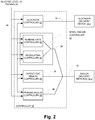
- Figure 2 shows the structure of the controller 18. It includes four separate controllers, namely a glucagon controller 22, basal insulin controller 24, corrective insulin controller 26. and priming insulin controller 28.
- the basal insulin controller 24 includes a nominal rate controller 30 and a modulating controller 32.
- the glucagon controller 22 generates a glucagon dose control signal 34 provided to a glucagon delivery device 14-1.
- Respective outputs 36 - 40 from the controllers 24 -28 are combined to form an overall insulin dose control signal 42 provided to insulin delivery device(s) 14-2.
- the output signal 36 itself is formed by a combination of respective outputs of the nominal rate controller 30 and modulating controller 32.
- the insulin delivery device(s) 14-2 may include devices tailored to deliver different types and/or quantities of insulin, with the exact configuration being known to and under the control of the controllers 24 - 28. For ease of description the collection of one or more insulin delivery devices 14-2 is referred below to in the singular as an insulin delivery device 14-2.
- inter-controller signals 44 enable communication of information from one controller, where the information is developed or generated, to another controller where the information is used for that controller's control function. Details are provided in the description of the control functions below.
- the corrective controller 26 regulates blood glucose level using an MPC cost function in a manner described in US 2008/0208113 A1 .
- Method 1 modulates the basal insulin infusion rate around a fixed "nominal" basal infusion rate, which is determined prior to initiating online operation of the glucose control system (e.g. based on the subject's weight or based on previous open- or closed-loop control results in the subject).
- basal infusion rate of insulin delivered when control or corrective doses of insulin are not otherwise indicated.
- Basal-rate infusion typically uses smaller but more frequent doses than priming or control doses used to treat meals or hyperglycemic excursions in glucose concentration levels.
- a fixed nominal basal infusion rate can be initially prescribed (i.e.
- the basal insulin infusion rate is automatically modulated around the fixed nominal infusion rate using any of a variety of control strategies including, but not limited to, model predictive control, proportional-integral-derivative control, fuzzy logic, neural networks, etc.
- the modulation of the basal insulin infusion rate described here should be constrained to fall within minimum and maximum values around the nominal basal infusion rate so as to prevent a run-away escalation of insulin dosing.
- the maximum value may be, for example, some constant multiple of the fixed nominal basal infusion rate.
- Method 1 represents an improvement upon the technique of Clemens & Hough by preventing runaway escalation of insulin dosing through constraining the maximum instantaneous basal infusion rate, it only captures one time scale, i.e. that which is associated with the sampling interval between glucose measurements.
- Method 1 can be further improved with an alternative method (herein referred to as Method 2) that allows the nominal basal infusion rate itself to vary over time, which, in turn, allows the instantaneous basal infusion rate to inherit a second longer time scale capable of capturing physiological variations in the subject's basal metabolic insulin requirement.
- the introduction of a nominal basal infusion rate that varies over time more slowly than the instantaneous basal infusion rate provides a second degree of freedom that can capture physiological drift in a subject's basal metabolic insulin requirement while still constraining the maximum instantaneous basal infusion rate to be some constant multiple of the nominal basal infusion rate, and thereby preventing run-away escalation of basal insulin dosing.
- the basal insulin controller 24 generates the insulin dose control signal 42 via its output signal 36 in response to the glucose level signal 19.
- the controller 24 modulates a basal infusion rate of insulin about a nominal basal infusion rate in response to short-term variations of glucose level occurring on the order of seconds to minutes (referred to as a "sampling interval" below).
- the controller 24 continually adjusts the nominal basal infusion rate based on a mathematical relationship between the basal infusion rate as modulated and the nominal basal infusion rate over a longer term than a short term (e.g., sampling interval) associated with modulating the basal infusion rate.
- the instantaneous basal infusion rate, ⁇ ( t ), or ⁇ k in discrete time is allowed to modulate around the instantaneous dynamic nominal value, ⁇ ( t ), or ⁇ k in discrete time.
- ⁇ ( t ) (or ⁇ k ) can be increased or decreased when the glucose level rises or falls below a set-point glucose value or a set range of glucose values.
- Modulation of ⁇ ( t ) around ⁇ ( t ) (or ⁇ k around ⁇ k ) can also be affected by the rate of increase or decrease of the glucose level.
- More sophisticated control methods could also be employed to determine the modulation of ⁇ ( t ) around ⁇ ( t ) (or ⁇ k around ⁇ k ), such as, but not limited to, using a model predictive control strategy, a proportional-integral-derivative control strategy, fuzzy logic, neural networks, or some other control strategy.
- Figures 4 and 5 provide an illustration of the effect of the method of Figure 3.
- Figure 4 shows a modulated basal infusion rate 49 about a fixed constant nominal basal infusion rate 51.
- Figure 5 shows a modulated basal infusion rate 49' about a continually adapted nominal basal infusion rate 51'.
- Method 2 offers an approach that is capable of both preventing run-away escalation of insulin dosing (by constraining the maximum instantaneous basal infusion rate to be some constant multiple of the dynamic nominal basal infusion rate) as well as capturing multiple time scales for adaptation.
- ⁇ ( t ) (or ⁇ k ) is allowed to vary rapidly online over a time scale ⁇ t (which might be on the order of minutes in real time and 0(1) in discrete time), whereas ⁇ ( t ) (or ⁇ k ) around which ⁇ ( t ) (or ⁇ k ) modulates, varies more slowly online over a time scale ⁇ t (which is on the order of hours in real time and O(N) in discrete time).
- the approach according to Method 2 sets the instantaneous dynamic nominal basal infusion rate, ⁇ ( t ) (or ⁇ k ), equal to a constant multiple of the average nominal value over some receding time interval, ⁇ t (or N ).
- the instantaneous dynamic nominal basal infusion rate can be adapted online so as to enforce a constant ratio over the interval ⁇ t (or N) between all of the modulated instantaneous basal infusion rates, ⁇ ( t ) (or ⁇ k ), and their corresponding moving average dynamic nominal basal infusion rates, ⁇ ( t ) (or ⁇ k ).
- the instantaneous basal infusion rate, ⁇ ( t ) (or ⁇ k ), is allowed to modulate around the instantaneous dynamic nominal value, ⁇ ( t ) (or ⁇ k in discrete time).
- the determined dynamic nominal basal infusion rate can be limited between a global minimum value, ⁇ L , and a global maximum value, ⁇ H , i.e. ⁇ L ⁇ ⁇ ( t ) ⁇ ⁇ H in Equations (1) and (3) or ⁇ L ⁇ ⁇ k ⁇ ⁇ H in Equations (2) and (4).
- ⁇ H a global minimum value
- ⁇ H a global maximum value
- Methods 2 or 3 can equally be applied to adapt online a nominal basal-rate profile that includes a set of different nominal basal-rate levels that could be prescribed for different time periods of the day or for different days, or both.
- the individual nominal basal-rate levels within a (daily or semi-daily) profile could be of different time durations and their durations or their starting and ending times could also vary from day to day.
- the individual nominal basal-rate levels could be prescribed globally for all individuals or could be prescribed differently for different individuals, and could be based on previous control results (e.g. open-loop or closed-loop settings for each individual subject).
- Equations (1) or (3) in real time could be applied to each of the individual nominal basal-rate levels within the piecewise function.
- the transition could occur as a discontinuous jump from the nominal basal-rate level of the elapsed time period to the nominal basal-rate level of the entered time period.
- the transition could occur in a gradual fashion (e.g. linearly) over a certain time period that could be fixed or variable.
- the previous adaptation history of individual nominal basal-rate levels could be inherited upon subsequently encountering the same or an overlapping time period or time juncture (e.g. on the next day or after a number of days).
- the online instantaneous basal infusion rate could then be a modulation based on the current nominal basal-rate level pertaining to the current time period online, or based on adjacent nominal basal-rate levels during a transition between nominal basal-rate levels online.
- modulation of the instantaneous basal infusion rate, ⁇ ( t ) (or ⁇ k ), and long-time adaptation of those modulations around the moving average dynamic nominal basal infusion rate, ⁇ ( t ) (or ⁇ k ), will involve a sensor-augmented infusion system that is capable of responding to frequent (typically every 5-15 minutes) glucose measurements from a continuous glucose monitor or other glucose measuring device.
- Another utility involves utilizing the basal infusion rates obtained with any of these methods online in a sensor-augmented infusion system to inform open-loop basal-rate profile settings that could be prescribed for the subject when the system is (temporarily or permanently) not driven by the glucose sensor, such as during periods of temporary interruptions or dropouts in the glucose sensor signal, or for open-loop insulin infusion therapy.
- a method for automatically adapting doses of infused insulin or insulin-like agents (either subcutaneously, intramuscularly, intraperitoneally, or intravenously) where the doses are intended to partially or fully compensate for food (carbohydrate) consumption.
- the doses can be administered prior to, during, or after food consumption, or could be split across these times.
- the online adaptation method can automatically tune these meal-time insulin doses on an individual basis and can automatically adjust them over time to respond to long-time changes in the individual's insulin requirement, such as might occur over a period of weeks, months, or years due to developmental changes (e.g. due to hormonal changes that occur during puberty or menopause), or as might occur over a period of hours, days, or weeks due to transient changes (e.g. due to circadian hormonal fluctuations, intercurrent illness, physical activity, or emotional state).
- Standard-of-care insulin therapies for regulating blood glucose in diabetes typically involve either multiple daily subcutaneous injections or subcutaneous infusion with an insulin pump.
- combinations of "basal and bolus” insulin are administered to meet the subject's basal metabolic insulin requirement as well to regulate hyperglycemia; additional "meal bolus” doses (also referred to herein as “priming doses”) are added to provide insulin for food consumption.
- Insulin doses intended to compensate for meals are usually estimated on an individual basis based on the quantity and content (carbohydrate and other) of the food, in conjunction with an estimate of the individual's so-called “insulin-to-carbohydrate ratio", among other factors such as the time of the day, physical activity, health state, emotional state, etc.
- meal-bolus insulin amount therefore, could vary significantly among individuals as well as within an individual. Moreover, the amount of meal-bolus insulin is often a major determinant of how well an individual is able to control their blood glucose. We provide a method that would automatically and continually adjust meal-time doses of insulin (intended to partially or fully compensate for food consumption), based on the individual's response to previous meal doses.
- the priming insulin controller 28 continually administers priming doses of insulin at respective times, each priming dose being of a respective amount and having a prescribed interval of action.
- the controller 28 receives information (e.g., from the other controllers 24-26 via signals 44) regarding total amounts of insulin administered during the prescribed intervals of action, each total amount including an aggregation of total doses administered in response to a glucose level signal.
- the controller 28 automatically adapts the amounts of the priming doses in response to a mathematical relationship, over respective periods each spanning multiple prescribed intervals of action, between the amounts of the priming doses and the total amounts of insulin administered during the prescribed intervals of action.
- the effective instantaneous dynamic meal-time bolus (which can be split into a number of doses), B m ( t ) (or B k m in discrete time), corresponding to meal m (or corresponding to a time interval m ) on any given day t (or k in discrete time), can be adapted online so as to enforce, on average, over a time horizon of ⁇ t (or N in discrete time) days (e.g.
- different time intervals ⁇ t could be used in the computations of C m ( ⁇ ) (or C j m ) for different meals m (or different time intervals m) of the day.
- interval length ⁇ t (or N ) could also be made variable with m and/or time t (or k ).
- the method described above could be used in the in-patient (e.g. critical care units or general wards) or out-patient settings and could be used in the context of an autonomous or semi-autonomous closed-loop blood-glucose control system. Feedback from the use of this method during autonomous or semi-autonomous control could also be used to inform open-loop systems, that may or may not be augmented with an online glucose sensor.
- in-patient e.g. critical care units or general wards
- feedback from the use of this method during autonomous or semi-autonomous control could also be used to inform open-loop systems, that may or may not be augmented with an online glucose sensor.
- a method for automatically modulating doses of infused glucagon (either subcutaneously, intramuscularly, intraperitoneally, or intravenously) that relies in part on information about the estimated accumulation of exogenously infused insulin (either subcutaneously, intramuscularly, intraperitoneally, or intravenously) and/or the effect that insulin might have on glucose levels (either blood glucose concentration or interstitial fluid glucose concentration).
- automated glucagon infusion may be controlled online (such as through a model predictive control strategy, a proportional-derivative control strategy, or some other control strategy)
- the particular formulation employed would cause the glucagon infusion rate (or delivery amount) to be higher at times when the accumulation of infused insulin is relatively higher than it would be at times when the accumulation of infused insulin is relatively lower.
- the glucagon controller 24 generates the counter-regulatory agent dose control signal 34 by performing a calculation generating (1) a raw dose control value based on the glucose level signal, and at 58 generating (2) the counter-regulatory agent dose control signal as a modification of the raw dose control value based on an estimation of an effect of the exogenously infused insulin.
- glucagon could be controlled with using a proportional-derivative (PD) control strategy where the control doses thus determined would be scaled using a multiplying factor that is proportional to (either linearly or nonlinearly) the estimated accumulation of exogenously infused insulin.
- PD proportional-derivative
- An example f ( i e ( t )) might be a sigmoidal function that is near unity whenever i e ( t ) is less than some factor times some estimated nominal or baseline value of the plasma insulin level and then begins to increase significantly as i e ( t ) exceeds this nominal value.
- G pending ( t ) which is deducted from G dose ( t ), and which represents an estimate of pending subcutaneous glucagon from recent doses.
- G 1/2 is an estimate of the average half life of subcutaneous doses of glucagon. Note that the estimate G pending (t) limits unnecessary subcutaneous accumulation of glucagon.
- G pending ( t ) might appear in an additive way, by the introduction of an additional gain parameter, k g , such that G pending ( t ) in Equations (10) and (11) might be replaced by k g g e ( t ), where g e ( t ) is the estimated accumulation of exogenously
- control doses of glucagon may employ a model predictive control (MPC) strategy, where the modulation of glucagon doses due to the estimated accumulation of exogenously infused insulin, i e ( t ), could be achieved using an outer scaling function (similar to the function f ( i e ( t )) in Equation (7)).
- MPC model predictive control
- u t denotes the MPC glucagon dose signal
- y t glucose concentration signal
- r t the reference set point signal
- N d and N m are respectively the minimum and maximum (output) prediction costing horizon limits
- N u the control horizon bound the weighting on prediction error
- ⁇ n the weighting on control signals.
- the glucose concentration, y t , and the glucagon dose signal, u t could also be related by subject model.
- the outer scaling with g ( i e ( t )) could then be applied as per Equation (12) to compute the control doses of glucagon, G dose ( t ).
- G pending ( t ) might appear in an additive way, by the introduction of an additional gain parameter, k g , such that G pending ( t ) in Equations (15) and (16) might be replaced by k g g e ( t ), where g e ( t ) is the estimated accumulation of exogenously infused glucagon
- Another option for accounting for the accumulation of glucagon from past doses is by augmenting the MPC cost function in Equation (13) with a mathematical formulation that estimates the accumulation of exogenous glucagon in a manner similar to that described in US patent publication 2008/0208113A1 .
- Such an augmentation could take into account the accumulation of glucagon in both the administration site(s) as well as in plasma and could be based on pharmacokinetics of the administered glucagon pertaining to the method or route of administration as well as to the specific constituents present in the glucagon solution, including the type of glucagon or glucagon analog itself.
- the MPC glucagon dose signal, u t becomes an augmented MPC glucagon dose signal, ⁇ t ′ .
- the augmented MPC glucagon dose signal, ⁇ t ′ could replace the MPC glucagon dose signal, ⁇ t in both Equations (12) and (14) to provide the control doses of glucagon, G dose ( t ).
- control signals could replace the MPC glucagon dose signal, u t , in Equations (12), (14), (15), or (16) and could be based on another algorithm such as a neural network, or a fuzzy logic, or a standard optimization algorithm.
- the function i e ( t ) may be computed by any manner by which the accumulation of exogenously infused insulin might be estimated.
- the present invention may be embodied as an overall system such as shown in Figure 1 , as an overall method, as a controller such as shown in Figure 2 , and as methods performed by a controller such as shown in Figures 3-5 .
- the methods may be performed by computer program instructions executed by generic controller hardware including memory, a processing or execution unit, and input/output circuitry.
- the instructions may be provided to the controller from a computer-readable medium such as semiconductor memory, magnetic memory (e.g. magnetic disk), optical memory (e.g. optical disk such as CD, DVD), etc.
Landscapes
- Health & Medical Sciences (AREA)
- Engineering & Computer Science (AREA)
- Public Health (AREA)
- General Health & Medical Sciences (AREA)
- Biomedical Technology (AREA)
- Medical Informatics (AREA)
- Epidemiology (AREA)
- Primary Health Care (AREA)
- Veterinary Medicine (AREA)
- Animal Behavior & Ethology (AREA)
- Life Sciences & Earth Sciences (AREA)
- Hematology (AREA)
- Vascular Medicine (AREA)
- Anesthesiology (AREA)
- Heart & Thoracic Surgery (AREA)
- Chemical & Material Sciences (AREA)
- Bioinformatics & Cheminformatics (AREA)
- Medicinal Chemistry (AREA)
- Diabetes (AREA)
- Databases & Information Systems (AREA)
- Pathology (AREA)
- Data Mining & Analysis (AREA)
- Business, Economics & Management (AREA)
- General Business, Economics & Management (AREA)
- Dermatology (AREA)
- Infusion, Injection, And Reservoir Apparatuses (AREA)
- External Artificial Organs (AREA)
Claims (14)
- Sensorgesteuertes Blutzuckerkontrollsystem, das aufweist:einen Blutzuckersensor (16), der einsatzfähig ist, um fortlaufend den Blutzuckerspiegel einer Person zu messen und ein entsprechendes Blutzuckerspiegelsignal (19) zu erzeugen;eine Insulinzuführvorrichtung (14-2), die einsatzfähig ist, in Reaktion auf ein Insulindosierungs-Steuersignal (42) der Person Insulin zu infundieren; undeine Steuereinheit (18), die einsatzfähig ist, um das Insulindosierungs-Steuersignal in Reaktion auf das Blutzuckerspiegelsignal zu erzeugen durch:Modulieren (46) einer basalen Infusionsrate von Insulin um eine nominale basale Infusionsrate in Reaktion auf kurzzeitige Variationen des Glukosespiegels, die in der Größenordnung von Sekunden bis Minuten auftreten; undfortlaufendes Anpassen (48) der nominalen basalen Infusionsrate, sodass die nominale basale Infusionsrate von einem gleitenden Durchschnitt der basalen Infusionsrate wie moduliert über ein Zeitintervall, das in der Größenordnung von Stunden liegt, abhängt, wobei die nominale basale Infusionsrate über einen längeren Zeitraum als einen kurzen Zeitraum angepasst wird, auf dem die basale Infusionsrate moduliert wird,wobei das Modulieren der basalen Infusionsrate von Insulin beschränkt ist, um zwischen minimalen und maximalen Werten um die nominale basale Infusionsrate zu liegen.
- Sensorgesteuertes Blutzuckerkontrollsystem nach Anspruch 1, wobei der längere Zeitraum durch ein Zeitfenster mit einem rückwärts gerichteten Zeithorizont definiert ist, der sich von einem aktuellen Zeitpunkt um eine vorbestimmte Zeitspanne zurück erstreckt.
- Sensorgesteuertes Blutzuckerkontrollsystem nach Anspruch 1, das ein autonomes oder teilautonomes Kontrollsystem ist, in dem die Steuereinheit (18) aufweist:eine basale Insulin-Steuereinheit (24), die dazu ausgelegt ist, die basale Infusionsrate zu modulieren und fortlaufend die nominale basale Infusionsrate anzupassen, undeine korrektive Insulin-Steuereinheit (26), die das Insulindosierungs-Steuersignal in Reaktion auf das Blutzuckerspiegelsignal erzeugt, um korrigierende Insulindosierungen zu verabreichen, um das Blutzuckerspiegelsignal zu regulieren.
- Sensorgesteuertes Blutzuckerkontrollsystem nach Anspruch 1, wobei das Modulieren der basalen Infusionsrate von Insulin auf einen Bereich zwischen vorbestimmten minimalen und maximalen Grenzwerten beschränkt ist, die eine tatsächliche Modulation der basalen Infusionsrate bestimmen, wenn ein berechneter Rohmodulationswert außerhalb des Bereichs liegt.
- Sensorgesteuertes Blutzuckerkontrollsystem nach Anspruch 4, wobei der maximale Grenzwert eine vorbestimmte mathematische Beziehung zur nominalen basalen Infusionsrate hat.
- Sensorgesteuertes Blutzuckerkontrollsystem nach Anspruch 1, wobei das fortlaufende Anpassen der nominalen basalen Infusionsrate ein Berechnen eines gleitenden integralen oder summierten Durchschnitts der modulierten basalen Infusionsrate über den längeren Zeitraum aufweist.
- Sensorgesteuertes Blutzuckerkontrollsystem nach Anspruch 1, wobei das fortlaufende Anpassen der nominalen basalen Infusionsrate ein Berechnen eines Verhältnisses der modulierten basalen Infusionsrate zu der nominalen basalen Infusionsrate über den längeren Zeitraum aufweist.
- Sensorgesteuertes Blutzuckerkontrollsystem nach Anspruch 7, wobei das fortlaufende Anpassen der nominalen basalen Infusionsrate ein Berechnen des Verhältnisses der modulierten basalen Infusionsrate zu der nominalen basalen Infusionsrate als ein gleitender integraler oder summierter Durchschnitt der Verhältnisse der zugehörigen augenblicklichen Werte jeder Rate über den längeren Zeitraum aufweist.
- Sensorgesteuertes Blutzuckerkontrollsystem nach Anspruch 7, wobei das fortlaufende Anpassen der nominalen basalen Infusionsrate ein Berechnen des Verhältnisses der modulierten basalen Infusionsrate zu der nominalen basalen Infusionsrate als ein gleitender integraler oder summierter Durchschnitt von gewichteten Verhältnissen der zugehörigen augenblicklichen Werte jeder Rate über den längeren Zeitraum aufweist.
- Sensorgesteuertes Blutzuckerkontrollsystem nach Anspruch 1, wobei die Steuereinheit weiterhin einsatzfähig ist, um das Insulindosierungs-Steuersignal in Reaktion auf das Blutzuckerspiegelsignal zu erzeugen durch:fortlaufendes Verabreichen (50) von Anfangsdosierungen von Insulin an entsprechenden Zeitpunkten, wobei jede Anfangsdosierung eine entsprechende Menge hat und ein vorgeschriebenes Aktionsintervall aufweist;Empfangen (52) von Informationen betreffend Gesamtmengen von Insulin, die während der vorgeschriebenen Aktionsintervalle verabreicht wurden, wobei jede Gesamtmenge eine Aggregation der Gesamtdosierungen aufweist, die in Reaktion auf das Blutzuckerspiegelsignal verabreicht wurden; undautomatisches Anpassen (54) der Mengen der Anfangsdosierungen in Reaktion auf eine mathematische Beziehung über entsprechende Zeiträume, die jeweils mehrere vorgeschriebene Aktionsintervalle überspannen, zwischen den Mengen der Anfangsdosierungen und den Gesamtmengen an Insulin, die während der vorgeschriebenen Aktionsintervalle verabreicht wurden.
- Sensorgesteuertes Blutzuckerkontrollsystem nach Anspruch 1, das weiterhin aufweist eine Zuführvorrichtung (14-1) eines Gegenregulationsmittels, die einsatzfähig ist, um der Person ein Gegenregulationsmittel in Reaktion auf ein Dosierungssteuersignal (34) für das Gegenregulationsmittel zu infundieren, und
wobei die Steuereinheit einsatzfähig ist, das Dosierungssteuersignal für das Gegenregulationsmittel durch Durchführen einer Berechnung zu erzeugen, die (i) einen Rohdosierungs-Steuerwert basierend auf dem Blutzuckerspiegelsignal und (ii) das Dosierungssteuersignal für das Gegenregulationsmittel als eine Modifikation des Rohdosierungs-Steuerwerts basierend auf einer Schätzung einer Wirkung des der Person durch die Insulinzuführvorrichtung infundierten Insulins erzeugt. - Verfahren zum Betreiben einer Steuereinheit für ein sensorgesteuertes Blutzuckerkontrollsystem, das einen Blutzuckersensor (16) und eine Insulinzuführvorrichtung (14-2) aufweist, wobei der Blutzuckersensor einsatzfähig ist, um fortlaufend einen Blutzuckerspiegel einer Person zu messen und ein entsprechendes Blutzuckerspiegelsignal (19) zu erzeugen, wobei die Insulinzuführvorrichtung einsatzfähig ist, in Reaktion auf ein Insulindosierungs-Steuersignal (42) der Person Insulin zu infundieren, wobei das Verfahren aufweist:Modulieren (46) einer basalen Infusionsrate von Insulin um eine nominale basale Infusionsrate in Reaktion auf kurzzeitige Variationen des Glukosespiegels, die in der Größenordnung von Sekunden bis Minuten auftreten, wie vom Blutzuckerspiegelsignal angegeben; undfortlaufendes Anpassen (48) der nominalen basalen Infusionsrate, sodass die nominale basale Infusionsrate von einem gleitenden Durchschnitt der basalen Infusionsrate wie moduliert über ein Zeitintervall, das in der Größenordnung von Stunden liegt, abhängt, wobei die nominale basale Infusionsrate über einen längeren Zeitraum als einen kurzen Zeitraum angepasst wird, auf dem die basale Infusionsrate moduliert wird,wobei das Modulieren der basalen Infusionsrate von Insulin beschränkt ist, um zwischen minimalen und maximalen Werten um die nominale basale Infusionsrate zu liegen; undErzeugen des Insulindosierungs-Steuersignals gemäß der modulierten basalen Infusionsrate.
- Verfahren nach Anspruch 12, das weiterhin aufweist:fortlaufendes Verabreichen (50) von Anfangsdosierungen von Insulin an entsprechenden Zeitpunkten, wobei jede Anfangsdosierung eine entsprechende Menge hat und ein vorgeschriebenes Aktionsintervall aufweist;Empfangen (52) von Informationen betreffend Gesamtmengen von Insulin, die während der vorgeschriebenen Aktionsintervalle verabreicht wurden, wobei jede Gesamtmenge eine Aggregation von Gesamtdosierungen aufweist, die in Reaktion auf das Blutzuckerspiegelsignal verabreicht wurden; undautomatisches Anpassen (54) der Mengen der Anfangsdosierungen in Reaktion auf eine mathematische Beziehung über entsprechende Zeiträume, die jeweils mehrere vorgeschriebene Aktionsintervalle überspannen, zwischen den Mengen der Anfangsdosierungen und den Gesamtmengen an Insulin, die während der vorgeschriebenen Aktionsintervalle verabreicht wurden.
- Verfahren nach Anspruch 12, wobei das sensorgesteuerte Blutzuckerkontrollsystem weiterhin aufweist eine Zuführvorrichtung (14-1) eines Gegenregulationsmittels, die einsatzfähig ist, um der Person ein Gegenregulationsmittel in Reaktion auf ein Dosierungssteuersignal (34) für das Gegenregulationsmittel zu infundieren, und weiterhin ein Erzeugen des Dosierungssteuersignals für das Gegenregulationsmittel durch Durchführen einer Berechnung aufweist, die (i) einen Rohdosierungs-Steuerwert basierend auf dem Blutzuckerspiegelsignal und (ii) das Dosierungssteuersignal für das Gegenregulationsmittel als eine Modifikation des Rohdosierungs-Steuerwerts basierend auf einer Schätzung einer Wirkung des der Person durch die Insulinzuführvorrichtung infundierten Insulins erzeugt.
Priority Applications (1)
| Application Number | Priority Date | Filing Date | Title |
|---|---|---|---|
| EP19190669.2A EP3594961A1 (de) | 2010-10-31 | 2011-10-31 | Blutglucosekontrollsystem |
Applications Claiming Priority (3)
| Application Number | Priority Date | Filing Date | Title |
|---|---|---|---|
| US40863910P | 2010-10-31 | 2010-10-31 | |
| US201161470210P | 2011-03-31 | 2011-03-31 | |
| PCT/US2011/058688 WO2012058694A2 (en) | 2010-10-31 | 2011-10-31 | Blood glucose control system |
Related Child Applications (1)
| Application Number | Title | Priority Date | Filing Date |
|---|---|---|---|
| EP19190669.2A Division EP3594961A1 (de) | 2010-10-31 | 2011-10-31 | Blutglucosekontrollsystem |
Publications (2)
| Publication Number | Publication Date |
|---|---|
| EP2633456A1 EP2633456A1 (de) | 2013-09-04 |
| EP2633456B1 true EP2633456B1 (de) | 2019-09-04 |
Family
ID=45003057
Family Applications (2)
| Application Number | Title | Priority Date | Filing Date |
|---|---|---|---|
| EP11785841.5A Active EP2633456B1 (de) | 2010-10-31 | 2011-10-31 | System für blutzuckerkontrolle |
| EP19190669.2A Pending EP3594961A1 (de) | 2010-10-31 | 2011-10-31 | Blutglucosekontrollsystem |
Family Applications After (1)
| Application Number | Title | Priority Date | Filing Date |
|---|---|---|---|
| EP19190669.2A Pending EP3594961A1 (de) | 2010-10-31 | 2011-10-31 | Blutglucosekontrollsystem |
Country Status (6)
| Country | Link |
|---|---|
| US (3) | US9833570B2 (de) |
| EP (2) | EP2633456B1 (de) |
| JP (2) | JP6047097B2 (de) |
| CA (1) | CA2816314C (de) |
| ES (1) | ES2755497T3 (de) |
| WO (1) | WO2012058694A2 (de) |
Families Citing this family (79)
| Publication number | Priority date | Publication date | Assignee | Title |
|---|---|---|---|---|
| US7653425B2 (en) | 2006-08-09 | 2010-01-26 | Abbott Diabetes Care Inc. | Method and system for providing calibration of an analyte sensor in an analyte monitoring system |
| US7618369B2 (en) | 2006-10-02 | 2009-11-17 | Abbott Diabetes Care Inc. | Method and system for dynamically updating calibration parameters for an analyte sensor |
| US8346335B2 (en) | 2008-03-28 | 2013-01-01 | Abbott Diabetes Care Inc. | Analyte sensor calibration management |
| US20080199894A1 (en) | 2007-02-15 | 2008-08-21 | Abbott Diabetes Care, Inc. | Device and method for automatic data acquisition and/or detection |
| US9125548B2 (en) | 2007-05-14 | 2015-09-08 | Abbott Diabetes Care Inc. | Method and apparatus for providing data processing and control in a medical communication system |
| US8103471B2 (en) | 2007-05-14 | 2012-01-24 | Abbott Diabetes Care Inc. | Method and apparatus for providing data processing and control in a medical communication system |
| US8239166B2 (en) | 2007-05-14 | 2012-08-07 | Abbott Diabetes Care Inc. | Method and apparatus for providing data processing and control in a medical communication system |
| US8600681B2 (en) | 2007-05-14 | 2013-12-03 | Abbott Diabetes Care Inc. | Method and apparatus for providing data processing and control in a medical communication system |
| US8924159B2 (en) | 2008-05-30 | 2014-12-30 | Abbott Diabetes Care Inc. | Method and apparatus for providing glycemic control |
| US8591410B2 (en) | 2008-05-30 | 2013-11-26 | Abbott Diabetes Care Inc. | Method and apparatus for providing glycemic control |
| US8986208B2 (en) | 2008-09-30 | 2015-03-24 | Abbott Diabetes Care Inc. | Analyte sensor sensitivity attenuation mitigation |
| US8597274B2 (en) | 2009-05-22 | 2013-12-03 | Abbott Diabetes Care Inc. | Usability features for integrated insulin delivery system |
| FI3988470T3 (fi) | 2009-08-31 | 2023-08-18 | Abbott Diabetes Care Inc | Lääkinnällisen laitteen näyttöjä |
| US9320461B2 (en) | 2009-09-29 | 2016-04-26 | Abbott Diabetes Care Inc. | Method and apparatus for providing notification function in analyte monitoring systems |
| WO2012058694A2 (en) | 2010-10-31 | 2012-05-03 | Trustees Of Boston University | Blood glucose control system |
| US8710993B2 (en) | 2011-11-23 | 2014-04-29 | Abbott Diabetes Care Inc. | Mitigating single point failure of devices in an analyte monitoring system and methods thereof |
| US10130767B2 (en) | 2012-08-30 | 2018-11-20 | Medtronic Minimed, Inc. | Sensor model supervisor for a closed-loop insulin infusion system |
| US10496797B2 (en) | 2012-08-30 | 2019-12-03 | Medtronic Minimed, Inc. | Blood glucose validation for a closed-loop operating mode of an insulin infusion system |
| US9623179B2 (en) | 2012-08-30 | 2017-04-18 | Medtronic Minimed, Inc. | Safeguarding techniques for a closed-loop insulin infusion system |
| CN104769595B (zh) * | 2012-08-30 | 2017-12-08 | 美敦力迷你迈德公司 | 用于闭环胰岛素输注系统的防护技术 |
| US9849239B2 (en) | 2012-08-30 | 2017-12-26 | Medtronic Minimed, Inc. | Generation and application of an insulin limit for a closed-loop operating mode of an insulin infusion system |
| US9662445B2 (en) | 2012-08-30 | 2017-05-30 | Medtronic Minimed, Inc. | Regulating entry into a closed-loop operating mode of an insulin infusion system |
| US9878096B2 (en) | 2012-08-30 | 2018-01-30 | Medtronic Minimed, Inc. | Generation of target glucose values for a closed-loop operating mode of an insulin infusion system |
| US9526834B2 (en) | 2012-08-30 | 2016-12-27 | Medtronic Minimed, Inc. | Safeguarding measures for a closed-loop insulin infusion system |
| WO2014035732A1 (en) | 2012-08-30 | 2014-03-06 | Abbot Diabetes Care Inc. | Dropout detection in continuous analyte monitoring data during data excursions |
| US9171343B1 (en) | 2012-09-11 | 2015-10-27 | Aseko, Inc. | Means and method for improved glycemic control for diabetic patients |
| US9897565B1 (en) | 2012-09-11 | 2018-02-20 | Aseko, Inc. | System and method for optimizing insulin dosages for diabetic subjects |
| EP2901153A4 (de) | 2012-09-26 | 2016-04-27 | Abbott Diabetes Care Inc | Verfahren und vorrichtung zur verbesserung einer verzögerungskorrekturfunktion während der in-vivo-messung einer analytkonzentration mit analytkonzentrationsvariabilität und bereichsdaten |
| CN104768845B (zh) | 2012-10-16 | 2017-04-19 | 瓦锡兰荷兰公司 | 操纵船舶中单元的方法和船舶中的组件 |
| US9833191B2 (en) | 2012-11-07 | 2017-12-05 | Bigfoot Biomedical, Inc. | Computer-based diabetes management |
| US9907909B2 (en) * | 2012-12-20 | 2018-03-06 | Animas Corporation | Method and system for a hybrid control-to-target and control-to-range model predictive control of an artificial pancreas |
| US9795737B2 (en) * | 2013-03-15 | 2017-10-24 | Animas Corporation | Method and system for closed-loop control of an artificial pancreas |
| WO2014191355A1 (en) * | 2013-05-27 | 2014-12-04 | Novo Nordisk A/S | Drug delivery device and system with pre-set dose feature |
| CN105555340A (zh) * | 2013-09-20 | 2016-05-04 | 赛诺菲-安万特德国有限公司 | 有条件要求的预备注射 |
| US9233204B2 (en) | 2014-01-31 | 2016-01-12 | Aseko, Inc. | Insulin management |
| CN106456064B (zh) * | 2014-01-31 | 2020-11-27 | 波士顿大学董事会 | 基于在前时期的离线葡萄糖控制 |
| US9486580B2 (en) | 2014-01-31 | 2016-11-08 | Aseko, Inc. | Insulin management |
| EP3154607B1 (de) | 2014-06-10 | 2023-12-20 | Insulet Corporation | Insulinabgabesysteme und -verfahren |
| WO2016061308A1 (en) | 2014-10-17 | 2016-04-21 | Kahlbaugh Bradley E | Human metabolic condition management |
| CA2927335C (en) | 2014-10-27 | 2023-05-02 | Aseko, Inc. | Subcutaneous outpatient management |
| US11081226B2 (en) | 2014-10-27 | 2021-08-03 | Aseko, Inc. | Method and controller for administering recommended insulin dosages to a patient |
| EP3957233A3 (de) | 2015-08-07 | 2022-05-11 | Trustees of Boston University | Glucosesteuerungssystem mit automatischer anpassung des glucoseziels |
| US9886556B2 (en) | 2015-08-20 | 2018-02-06 | Aseko, Inc. | Diabetes management therapy advisor |
| WO2017124006A1 (en) | 2016-01-14 | 2017-07-20 | Bigfoot Biomedical, Inc. | Adjusting insulin delivery rates |
| US12383166B2 (en) | 2016-05-23 | 2025-08-12 | Insulet Corporation | Insulin delivery system and methods with risk-based set points |
| MA45580A (fr) * | 2016-07-08 | 2019-05-15 | Novo Nordisk As | Titrage basal avec glycémie cible adaptative |
| US10272201B2 (en) * | 2016-12-22 | 2019-04-30 | Medtronic Minimed, Inc. | Insertion site monitoring methods and related infusion devices and systems |
| US10500334B2 (en) | 2017-01-13 | 2019-12-10 | Bigfoot Biomedical, Inc. | System and method for adjusting insulin delivery |
| EP3568862A1 (de) | 2017-01-13 | 2019-11-20 | Bigfoot Biomedical, Inc. | System und verfahren zur anpassung der insulinabgabe |
| US10758675B2 (en) | 2017-01-13 | 2020-09-01 | Bigfoot Biomedical, Inc. | System and method for adjusting insulin delivery |
| US10583250B2 (en) | 2017-01-13 | 2020-03-10 | Bigfoot Biomedical, Inc. | System and method for adjusting insulin delivery |
| US10610644B2 (en) | 2017-01-13 | 2020-04-07 | Bigfoot Biomedical, Inc. | Insulin delivery methods, systems and devices |
| US11027063B2 (en) | 2017-01-13 | 2021-06-08 | Bigfoot Biomedical, Inc. | Insulin delivery methods, systems and devices |
| WO2018147483A1 (ko) * | 2017-02-09 | 2018-08-16 | 최규동 | 연속 혈당 감지를 이용한 인슐린 투여 시스템 |
| WO2018165294A1 (en) * | 2017-03-07 | 2018-09-13 | North Carolina State University | Insulin-responsive glucagon delivery patch |
| EP3600014B1 (de) * | 2017-03-21 | 2025-07-30 | Abbott Diabetes Care Inc. | Vorrichtungen und system zur bereitstellung der diagnose von diabetischen zuständen |
| EP3970611B1 (de) | 2017-05-05 | 2023-12-06 | Ypsomed AG | Kontrolle der physiologischen glukose mit geschlossener schleife |
| EP3438858A1 (de) | 2017-08-02 | 2019-02-06 | Diabeloop | Blutglucosekontrollsysteme und -verfahren mit geschlossener schleife |
| JP7133625B2 (ja) | 2017-12-21 | 2022-09-08 | イーライ リリー アンド カンパニー | 生理的グルコースの閉ループ制御 |
| EP3811373A1 (de) | 2018-06-22 | 2021-04-28 | Eli Lilly and Company | Insulin- und pramlintidabgabesysteme, -verfahren und -vorrichtungen |
| CN114173845B (zh) * | 2019-06-05 | 2025-02-18 | 赛诺菲 | 医疗装置和用于施用基础胰岛素剂量和推注胰岛素剂量的方法 |
| CN114787935A (zh) | 2019-07-16 | 2022-07-22 | 贝塔仿生公司 | 血糖控制系统 |
| US11957876B2 (en) | 2019-07-16 | 2024-04-16 | Beta Bionics, Inc. | Glucose control system with automated backup therapy protocol generation |
| EP3998943A4 (de) * | 2019-07-16 | 2023-09-06 | Beta Bionics, Inc. | System für blutzuckerkontrolle |
| JP7662611B2 (ja) * | 2019-08-02 | 2025-04-15 | アボット ダイアベティス ケア インコーポレイテッド | 薬剤用量ガイダンスに関連するシステム、デバイスおよび方法 |
| WO2021067856A1 (en) | 2019-10-04 | 2021-04-08 | Beta Bionics, Inc. | Blood glucose control system |
| WO2022140204A1 (en) | 2020-12-21 | 2022-06-30 | Beta Bionics, Inc. | Medicament pumps and control systems thereof |
| US11278661B2 (en) | 2020-03-10 | 2022-03-22 | Beta Bionics, Inc. | Infusion system and components thereof |
| USD1032624S1 (en) | 2020-03-10 | 2024-06-25 | Beta Bionics, Inc. | Display screen with animated graphical user interface |
| USD1032623S1 (en) | 2020-03-10 | 2024-06-25 | Beta Bionics, Inc. | Display screen with animated graphical user interface |
| US11594314B2 (en) | 2020-12-07 | 2023-02-28 | Beta Bionics, Inc. | Modular blood glucose control systems |
| US20220199218A1 (en) | 2020-12-07 | 2022-06-23 | Beta Bionics, Inc. | Ambulatory medicament pump with integrated medicament ordering interface |
| US20220265143A1 (en) | 2020-12-07 | 2022-08-25 | Beta Bionics, Inc. | Ambulatory medicament pumps with selective alarm muting |
| US11497852B2 (en) | 2020-12-21 | 2022-11-15 | Beta Bionics, Inc. | Ambulatory medicament device with power saving mode |
| US12465686B2 (en) | 2021-03-25 | 2025-11-11 | Beta Bionics, Inc. | Emergency medicament dose control |
| WO2022266074A1 (en) * | 2021-06-14 | 2022-12-22 | Insulet Corporation | Hybrid injection-pump insulin delivery |
| WO2023070251A1 (en) * | 2021-10-25 | 2023-05-04 | Medtrum Technologies Inc. | Closed-loop artificial pancreas insulin infusion control system |
| CN114903648B (zh) * | 2022-05-09 | 2022-11-22 | 北京理工大学 | 一种基于eso和模型预测控制的双激素人工胰腺控制器 |
| WO2025054131A1 (en) * | 2023-09-05 | 2025-03-13 | University Of Houston System | Linear time-varying (ltv) model predictive control (mpc) of an artificial pancreas with data-driven neural multi-step ahead affine blood glucose predictors |
Citations (1)
| Publication number | Priority date | Publication date | Assignee | Title |
|---|---|---|---|---|
| US20080208113A1 (en) * | 2005-05-13 | 2008-08-28 | Trustees Of Boston University | Fully Automated Control System for Type I Diabetes |
Family Cites Families (103)
| Publication number | Priority date | Publication date | Assignee | Title |
|---|---|---|---|---|
| US6241704B1 (en) | 1901-11-22 | 2001-06-05 | Sims Deltec, Inc. | Drug pump systems and methods |
| US4280494A (en) | 1979-06-26 | 1981-07-28 | Cosgrove Robert J Jun | System for automatic feedback-controlled administration of drugs |
| US4464170A (en) | 1982-09-29 | 1984-08-07 | Miles Laboratories, Inc. | Blood glucose control apparatus and method |
| EP0374140A1 (de) | 1987-08-28 | 1990-06-27 | The Regents Of The University Of Minnesota | Metabolischer sensor für arzneimittelverabreichung |
| US5665065A (en) | 1995-05-26 | 1997-09-09 | Minimed Inc. | Medication infusion device with blood glucose data input |
| US6554798B1 (en) | 1998-08-18 | 2003-04-29 | Medtronic Minimed, Inc. | External infusion device with remote programming, bolus estimator and/or vibration alarm capabilities |
| US6669663B1 (en) | 1999-04-30 | 2003-12-30 | Medtronic, Inc. | Closed loop medicament pump |
| US6925393B1 (en) | 1999-11-18 | 2005-08-02 | Roche Diagnostics Gmbh | System for the extrapolation of glucose concentration |
| DE10006044A1 (de) | 2000-02-10 | 2001-08-16 | Roche Diagnostics Gmbh | Anordnung und Verfahren zur Dosierung eines die Blutglukose eines Patienten regulierenden Hormons |
| US6572542B1 (en) | 2000-03-03 | 2003-06-03 | Medtronic, Inc. | System and method for monitoring and controlling the glycemic state of a patient |
| AU2001292946A1 (en) | 2000-09-26 | 2002-04-08 | Advantage 3D Llc | Method and system for generation, storage and distribution of omni-directional object views |
| US20030073609A1 (en) | 2001-06-29 | 2003-04-17 | Pinkerton Thomas C. | Enhanced pharmacokinetic profile of intradermally delivered substances |
| US6544212B2 (en) | 2001-07-31 | 2003-04-08 | Roche Diagnostics Corporation | Diabetes management system |
| US6827702B2 (en) | 2001-09-07 | 2004-12-07 | Medtronic Minimed, Inc. | Safety limits for closed-loop infusion pump control |
| GB0206792D0 (en) | 2002-03-22 | 2002-05-01 | Leuven K U Res & Dev | Normoglycemia |
| US20040010207A1 (en) | 2002-07-15 | 2004-01-15 | Flaherty J. Christopher | Self-contained, automatic transcutaneous physiologic sensing system |
| EP1575656B1 (de) | 2002-10-11 | 2009-06-17 | Becton, Dickinson and Company | Insulinabgabesystem mit Sensor |
| US7655618B2 (en) | 2002-12-27 | 2010-02-02 | Diobex, Inc. | Compositions and methods for the prevention and control of insulin-induced hypoglycemia |
| WO2004084820A2 (en) | 2003-03-19 | 2004-10-07 | Harry Hebblewhite | Method and system for determining insulin dosing schedules and carbohydrate-to-insulin ratios in diabetic patients |
| CA2519249C (en) * | 2003-03-19 | 2012-11-27 | Harry Hebblewhite | Method and system for determining insulin dosing schedules and carbohydrate-to-insulin ratios in diabetic patients |
| US20040253736A1 (en) | 2003-06-06 | 2004-12-16 | Phil Stout | Analytical device with prediction module and related methods |
| US7591801B2 (en) | 2004-02-26 | 2009-09-22 | Dexcom, Inc. | Integrated delivery device for continuous glucose sensor |
| DE102004011135A1 (de) | 2004-03-08 | 2005-09-29 | Disetronic Licensing Ag | Verfahren und Vorrichtung zum Berechnen einer Bolusmenge |
| WO2005113036A1 (en) | 2004-05-13 | 2005-12-01 | The Regents Of The University Of California | Method and apparatus for glucose control and insulin dosing for diabetics |
| US7727147B1 (en) | 2004-05-14 | 2010-06-01 | Flint Hills Scientific Llc | Method and system for implantable glucose monitoring and control of a glycemic state of a subject |
| US7547281B2 (en) * | 2005-02-01 | 2009-06-16 | Medtronic Minimed, Inc. | Algorithm sensor augmented bolus estimator for semi-closed loop infusion system |
| US20060272652A1 (en) | 2005-06-03 | 2006-12-07 | Medtronic Minimed, Inc. | Virtual patient software system for educating and treating individuals with diabetes |
| US20060276771A1 (en) | 2005-06-06 | 2006-12-07 | Galley Paul J | System and method providing for user intervention in a diabetes control arrangement |
| US7766829B2 (en) | 2005-11-04 | 2010-08-03 | Abbott Diabetes Care Inc. | Method and system for providing basal profile modification in analyte monitoring and management systems |
| CN100446724C (zh) | 2005-11-28 | 2008-12-31 | 中国科学院电子学研究所 | 用于闭环胰岛素注射的无创血糖仪 |
| US8478557B2 (en) | 2009-07-31 | 2013-07-02 | Abbott Diabetes Care Inc. | Method and apparatus for providing analyte monitoring system calibration accuracy |
| US9392969B2 (en) | 2008-08-31 | 2016-07-19 | Abbott Diabetes Care Inc. | Closed loop control and signal attenuation detection |
| JP4918285B2 (ja) | 2006-05-24 | 2012-04-18 | シスメックス株式会社 | 生体器官の機能のシミュレーションシステム及びそのプログラム |
| WO2007149533A2 (en) | 2006-06-19 | 2007-12-27 | Dose Safety | System, method and article for controlling the dispensing of insulin |
| US20110054391A1 (en) | 2006-07-28 | 2011-03-03 | Ward W Kenneth | Analyte sensing and response system |
| WO2008057384A2 (en) | 2006-11-02 | 2008-05-15 | The University Of North Carolina At Chapel Hill | Methods and systems for determining an intravenous insulin infusion rate |
| US7654127B2 (en) | 2006-12-21 | 2010-02-02 | Lifescan, Inc. | Malfunction detection in infusion pumps |
| US7946985B2 (en) | 2006-12-29 | 2011-05-24 | Medtronic Minimed, Inc. | Method and system for providing sensor redundancy |
| US7734323B2 (en) * | 2007-01-24 | 2010-06-08 | Smiths Medical Asd, Inc. | Correction factor testing using frequent blood glucose input |
| US10154804B2 (en) | 2007-01-31 | 2018-12-18 | Medtronic Minimed, Inc. | Model predictive method and system for controlling and supervising insulin infusion |
| EP2139540A1 (de) | 2007-03-19 | 2010-01-06 | Medingo Ltd. | Anwenderschnittstelle zur auswahl von bolusdosen in einer arzneimittelabgabevorrichtung |
| DK1983456T3 (da) * | 2007-04-19 | 2013-11-25 | Hoffmann La Roche | Fremgangsmåde til indstilling af et basalhastighedsprofil til en insulinpumpe |
| US20080269714A1 (en) * | 2007-04-25 | 2008-10-30 | Medtronic Minimed, Inc. | Closed loop/semi-closed loop therapy modification system |
| WO2008135329A1 (en) | 2007-05-03 | 2008-11-13 | Novo Nordisk A/S | Safety system for insulin delivery advisory algoritms |
| US7751907B2 (en) | 2007-05-24 | 2010-07-06 | Smiths Medical Asd, Inc. | Expert system for insulin pump therapy |
| ES2576639T3 (es) | 2007-06-20 | 2016-07-08 | F.Hoffmann-La Roche Ag | Método y dispositivo para evaluar la relación de hidratos de carbono con respecto a insulina |
| US10173006B2 (en) | 2007-06-21 | 2019-01-08 | University Of Virginia Patent Foundation | LQG artificial pancreas control system and related method |
| US8088098B2 (en) | 2007-06-25 | 2012-01-03 | Medingo, Ltd. | Tailored basal insulin delivery system and method |
| CN101689224B (zh) | 2007-06-27 | 2015-06-17 | 霍夫曼-拉罗奇有限公司 | 用于根据对患者生理机能进行建模而开发患者特定疗法的系统和方法 |
| US8326650B2 (en) | 2007-09-07 | 2012-12-04 | Terumo Kabushiki Kaisha | Blood sugar measuring device |
| US8377031B2 (en) | 2007-10-23 | 2013-02-19 | Abbott Diabetes Care Inc. | Closed loop control system with safety parameters and methods |
| US20100262117A1 (en) | 2007-11-02 | 2010-10-14 | University Of Virginia Patent Foundation | Predictive control based system and method for control of insulin delivery in diabetes using glucose sensing |
| US8290559B2 (en) | 2007-12-17 | 2012-10-16 | Dexcom, Inc. | Systems and methods for processing sensor data |
| US20090164239A1 (en) | 2007-12-19 | 2009-06-25 | Abbott Diabetes Care, Inc. | Dynamic Display Of Glucose Information |
| US20090177154A1 (en) | 2008-01-08 | 2009-07-09 | Michael Blomquist | Insulin pump with convenience features |
| US20090177142A1 (en) | 2008-01-09 | 2009-07-09 | Smiths Medical Md, Inc | Insulin pump with add-on modules |
| CA2720304C (en) | 2008-04-04 | 2018-05-15 | Hygieia, Inc. | Apparatus for optimizing a patient's insulin dosage regimen |
| CN201186082Y (zh) | 2008-05-05 | 2009-01-28 | 王安宇 | 胰岛素、葡萄糖智能输入装置 |
| US7959598B2 (en) | 2008-08-20 | 2011-06-14 | Asante Solutions, Inc. | Infusion pump systems and methods |
| US8622988B2 (en) | 2008-08-31 | 2014-01-07 | Abbott Diabetes Care Inc. | Variable rate closed loop control and methods |
| US8527208B2 (en) | 2008-11-17 | 2013-09-03 | Roche Diagnostics International Ag | Prandial blood glucose excursion optimization method via computation of time-varying optimal insulin profiles and system thereof |
| CN102369030A (zh) | 2009-02-04 | 2012-03-07 | 赛诺菲-安万特德国有限公司 | 用于基于血糖应答信息血糖控制的医疗系统和方法 |
| AU2010210157B2 (en) | 2009-02-04 | 2014-08-28 | Sanofi-Aventis Deutschland Gmbh | Medical system and method for providing information for glycemic control |
| CN102334113B (zh) | 2009-02-25 | 2016-01-13 | 弗吉尼亚大学专利基金会 | 通过低血糖风险评估和平滑降低胰岛素递送的基于cgm的低血糖预防 |
| US20120123234A1 (en) | 2009-02-26 | 2012-05-17 | Eran Atlas | Method and system for automatic monitoring of diabetes related treatments |
| US20100256466A1 (en) * | 2009-04-02 | 2010-10-07 | Avraham Shekalim | Metabolite Management System |
| EP4231307A1 (de) | 2009-05-29 | 2023-08-23 | University Of Virginia Patent Foundation | Systemkoordinator und modulare architektur zur open-loop- und closed-loop-steuerung von diabetes |
| DK3173014T3 (da) | 2009-07-23 | 2021-09-13 | Abbott Diabetes Care Inc | Realtidsstyring af data vedrørende fysiologisk kontrol af glucoseniveauer |
| JP2013503874A (ja) | 2009-09-01 | 2013-02-04 | ユニバーシティ オブ ヴァージニア パテント ファウンデーション | ノミナルオープンループ・プロファイルを用いた糖尿病におけるインスリン放出の調節(aid)のためのシステム、方法及びコンピュータ・プログラム製品 |
| WO2011033509A1 (en) | 2009-09-18 | 2011-03-24 | Medingo Ltd. | Devices, systems and methods for quantifying bolus doses according to user parameters |
| EP2483824B1 (de) | 2009-09-30 | 2017-08-16 | DreaMed Diabetes Ltd | Überwachungsvorrichtung zur verwaltung einer insulinabgabe |
| US8690820B2 (en) | 2009-10-06 | 2014-04-08 | Illinois Institute Of Technology | Automatic insulin pumps using recursive multivariable models and adaptive control algorithms |
| US20120277723A1 (en) | 2009-11-04 | 2012-11-01 | Aimedics Pty Ltd | System and method for the integration of fused-data hypoglycaemia alarms into closed-loop glycaemic control systems |
| JP5750123B2 (ja) | 2010-02-11 | 2015-07-15 | ザ リージェンツ オブ ザ ユニバーシティ オブ カリフォルニア | 生物学的因子又は薬物を被検者に送達するためのシステム、装置及び方法 |
| US8579879B2 (en) | 2010-02-19 | 2013-11-12 | Medtronic Minimed, Inc. | Closed-loop glucose control startup |
| WO2011119832A1 (en) | 2010-03-26 | 2011-09-29 | University Of Virginia Patent Foundation | Method, system, and computer program product for improving the accuracy of glucose sensors using insulin delivery observation in diabetes |
| WO2012058694A2 (en) | 2010-10-31 | 2012-05-03 | Trustees Of Boston University | Blood glucose control system |
| US9445757B2 (en) | 2010-12-29 | 2016-09-20 | Medtronic Minimed, Inc. | Glycemic health metric determination and application |
| JP2014524791A (ja) | 2011-06-23 | 2014-09-25 | ユニバーシティ オブ ヴァージニア パテント ファウンデーション | 糖尿病患者の血糖値の監視と制御のための統合プラットフォーム |
| GB2493712B (en) | 2011-08-12 | 2014-07-02 | Gene Onyx Ltd | Insulin pump |
| US10694983B2 (en) | 2012-01-19 | 2020-06-30 | Medtronic Minimed, Inc. | Method and/or system for assessing a patient's glycemic response |
| US9238100B2 (en) | 2012-06-07 | 2016-01-19 | Tandem Diabetes Care, Inc. | Device and method for training users of ambulatory medical devices |
| US9662445B2 (en) | 2012-08-30 | 2017-05-30 | Medtronic Minimed, Inc. | Regulating entry into a closed-loop operating mode of an insulin infusion system |
| US9901677B2 (en) | 2012-10-16 | 2018-02-27 | Bigfoot Biomedical, Inc. | Infusion pump system and methods |
| US9486578B2 (en) | 2012-12-07 | 2016-11-08 | Animas Corporation | Method and system for tuning a closed-loop controller for an artificial pancreas |
| US9907909B2 (en) | 2012-12-20 | 2018-03-06 | Animas Corporation | Method and system for a hybrid control-to-target and control-to-range model predictive control of an artificial pancreas |
| US9351670B2 (en) | 2012-12-31 | 2016-05-31 | Abbott Diabetes Care Inc. | Glycemic risk determination based on variability of glucose levels |
| CN105050539B (zh) | 2013-01-14 | 2018-05-18 | 加利福尼亚大学董事会 | 用于1型糖尿病应用的人造胰腺的模型预测控制问题中的每日周期性目标区间调节 |
| US9492608B2 (en) | 2013-03-15 | 2016-11-15 | Tandem Diabetes Care, Inc. | Method and device utilizing insulin delivery protocols |
| WO2015021041A2 (en) | 2013-08-05 | 2015-02-12 | Hygieia, Inc. | Systems, devices, and methods for alleviating glucotoxicity and restoring pancreatic beta-cell function in advanced diabetes mellitus |
| EP2851823A1 (de) | 2013-09-20 | 2015-03-25 | Sanofi-Aventis Deutschland GmbH | Datenverwaltungseinheit zur Unterstützung der Gesundheitsüberwachung |
| CN106456064B (zh) | 2014-01-31 | 2020-11-27 | 波士顿大学董事会 | 基于在前时期的离线葡萄糖控制 |
| US9486580B2 (en) | 2014-01-31 | 2016-11-08 | Aseko, Inc. | Insulin management |
| US9399096B2 (en) | 2014-02-06 | 2016-07-26 | Medtronic Minimed, Inc. | Automatic closed-loop control adjustments and infusion systems incorporating same |
| EP3154607B1 (de) | 2014-06-10 | 2023-12-20 | Insulet Corporation | Insulinabgabesysteme und -verfahren |
| CN104667379B (zh) | 2015-03-06 | 2017-08-15 | 上海交通大学 | 动态闭环控制的胰岛素泵 |
| CN104667368B (zh) | 2015-03-06 | 2017-08-15 | 上海交通大学 | 控制与计算分离的胰岛素泵动态控制实现方法 |
| US10569016B2 (en) | 2015-12-29 | 2020-02-25 | Tandem Diabetes Care, Inc. | System and method for switching between closed loop and open loop control of an ambulatory infusion pump |
| WO2017124006A1 (en) | 2016-01-14 | 2017-07-20 | Bigfoot Biomedical, Inc. | Adjusting insulin delivery rates |
| US20200254240A1 (en) | 2016-05-15 | 2020-08-13 | Biolinq, Inc. | Devices and Methods For The Incorporation Of A Microneedle Array Analyte-Selective Sensor Into An Infusion Set, Patch Pump, Or Automated Therapeutic Delivery System |
| WO2018011766A1 (en) | 2016-07-15 | 2018-01-18 | Universität Bern | Estimation of insulin based on reinforcement learning |
| US11027063B2 (en) | 2017-01-13 | 2021-06-08 | Bigfoot Biomedical, Inc. | Insulin delivery methods, systems and devices |
| WO2019213493A1 (en) | 2018-05-04 | 2019-11-07 | Insulet Corporation | Safety constraints for a control algorithm-based drug delivery system |
-
2011
- 2011-10-31 WO PCT/US2011/058688 patent/WO2012058694A2/en not_active Ceased
- 2011-10-31 CA CA2816314A patent/CA2816314C/en active Active
- 2011-10-31 EP EP11785841.5A patent/EP2633456B1/de active Active
- 2011-10-31 JP JP2013536917A patent/JP6047097B2/ja active Active
- 2011-10-31 ES ES11785841T patent/ES2755497T3/es active Active
- 2011-10-31 EP EP19190669.2A patent/EP3594961A1/de active Pending
-
2013
- 2013-04-25 US US13/870,634 patent/US9833570B2/en active Active
-
2015
- 2015-12-04 JP JP2015237886A patent/JP6378164B2/ja active Active
-
2016
- 2016-12-15 US US15/380,516 patent/US10188795B2/en not_active Ceased
-
2021
- 2021-01-28 US US17/160,506 patent/USRE50080E1/en active Active
Patent Citations (1)
| Publication number | Priority date | Publication date | Assignee | Title |
|---|---|---|---|---|
| US20080208113A1 (en) * | 2005-05-13 | 2008-08-28 | Trustees Of Boston University | Fully Automated Control System for Type I Diabetes |
Also Published As
| Publication number | Publication date |
|---|---|
| US20130245547A1 (en) | 2013-09-19 |
| JP6047097B2 (ja) | 2016-12-21 |
| WO2012058694A2 (en) | 2012-05-03 |
| EP3594961A1 (de) | 2020-01-15 |
| US9833570B2 (en) | 2017-12-05 |
| JP6378164B2 (ja) | 2018-08-22 |
| JP2016047388A (ja) | 2016-04-07 |
| EP2633456A1 (de) | 2013-09-04 |
| CA2816314A1 (en) | 2012-05-03 |
| US10188795B2 (en) | 2019-01-29 |
| ES2755497T3 (es) | 2020-04-22 |
| USRE50080E1 (en) | 2024-08-20 |
| JP2014500051A (ja) | 2014-01-09 |
| CA2816314C (en) | 2018-03-06 |
| US20170095612A1 (en) | 2017-04-06 |
Similar Documents
| Publication | Publication Date | Title |
|---|---|---|
| USRE50080E1 (en) | Blood glucose control system | |
| US12280241B2 (en) | Glucose control system with automatic adaptation of glucose target | |
| USRE50075E1 (en) | Glucose level control system with offline control based on preceding periods of online control | |
| US11901060B2 (en) | Closed loop control of physiological glucose | |
| HK1234480B (en) | Offline glucose control based on preceding periods | |
| HK1234480A1 (en) | Offline glucose control based on preceding periods |
Legal Events
| Date | Code | Title | Description |
|---|---|---|---|
| PUAI | Public reference made under article 153(3) epc to a published international application that has entered the european phase |
Free format text: ORIGINAL CODE: 0009012 |
|
| 17P | Request for examination filed |
Effective date: 20130531 |
|
| AK | Designated contracting states |
Kind code of ref document: A1 Designated state(s): AL AT BE BG CH CY CZ DE DK EE ES FI FR GB GR HR HU IE IS IT LI LT LU LV MC MK MT NL NO PL PT RO RS SE SI SK SM TR |
|
| RIN1 | Information on inventor provided before grant (corrected) |
Inventor name: DAMIANO, EDWARD Inventor name: EL-KHATIB, FIRAS |
|
| DAX | Request for extension of the european patent (deleted) | ||
| RIN1 | Information on inventor provided before grant (corrected) |
Inventor name: EL-KHATIB, FIRAS Inventor name: DAMIANO, EDWARD Inventor name: RUSSELL, STEVEN |
|
| 17Q | First examination report despatched |
Effective date: 20160502 |
|
| RAP1 | Party data changed (applicant data changed or rights of an application transferred) |
Owner name: THE GENERAL HOSPITAL CORPORATION Owner name: TRUSTEES OF BOSTON UNIVERSITY |
|
| REG | Reference to a national code |
Ref country code: DE Ref legal event code: R079 Ref document number: 602011061812 Country of ref document: DE Free format text: PREVIOUS MAIN CLASS: G06F0019000000 Ipc: G16H0020170000 |
|
| RIC1 | Information provided on ipc code assigned before grant |
Ipc: G16H 20/17 20180101AFI20190207BHEP |
|
| GRAP | Despatch of communication of intention to grant a patent |
Free format text: ORIGINAL CODE: EPIDOSNIGR1 |
|
| STAA | Information on the status of an ep patent application or granted ep patent |
Free format text: STATUS: GRANT OF PATENT IS INTENDED |
|
| INTG | Intention to grant announced |
Effective date: 20190318 |
|
| GRAS | Grant fee paid |
Free format text: ORIGINAL CODE: EPIDOSNIGR3 |
|
| GRAA | (expected) grant |
Free format text: ORIGINAL CODE: 0009210 |
|
| STAA | Information on the status of an ep patent application or granted ep patent |
Free format text: STATUS: THE PATENT HAS BEEN GRANTED |
|
| AK | Designated contracting states |
Kind code of ref document: B1 Designated state(s): AL AT BE BG CH CY CZ DE DK EE ES FI FR GB GR HR HU IE IS IT LI LT LU LV MC MK MT NL NO PL PT RO RS SE SI SK SM TR |
|
| REG | Reference to a national code |
Ref country code: GB Ref legal event code: FG4D |
|
| REG | Reference to a national code |
Ref country code: CH Ref legal event code: EP |
|
| REG | Reference to a national code |
Ref country code: AT Ref legal event code: REF Ref document number: 1176513 Country of ref document: AT Kind code of ref document: T Effective date: 20190915 |
|
| REG | Reference to a national code |
Ref country code: DE Ref legal event code: R096 Ref document number: 602011061812 Country of ref document: DE |
|
| REG | Reference to a national code |
Ref country code: IE Ref legal event code: FG4D |
|
| REG | Reference to a national code |
Ref country code: NL Ref legal event code: MP Effective date: 20190904 |
|
| REG | Reference to a national code |
Ref country code: LT Ref legal event code: MG4D |
|
| PG25 | Lapsed in a contracting state [announced via postgrant information from national office to epo] |
Ref country code: FI Free format text: LAPSE BECAUSE OF FAILURE TO SUBMIT A TRANSLATION OF THE DESCRIPTION OR TO PAY THE FEE WITHIN THE PRESCRIBED TIME-LIMIT Effective date: 20190904 Ref country code: LT Free format text: LAPSE BECAUSE OF FAILURE TO SUBMIT A TRANSLATION OF THE DESCRIPTION OR TO PAY THE FEE WITHIN THE PRESCRIBED TIME-LIMIT Effective date: 20190904 Ref country code: NO Free format text: LAPSE BECAUSE OF FAILURE TO SUBMIT A TRANSLATION OF THE DESCRIPTION OR TO PAY THE FEE WITHIN THE PRESCRIBED TIME-LIMIT Effective date: 20191204 Ref country code: BG Free format text: LAPSE BECAUSE OF FAILURE TO SUBMIT A TRANSLATION OF THE DESCRIPTION OR TO PAY THE FEE WITHIN THE PRESCRIBED TIME-LIMIT Effective date: 20191204 Ref country code: SE Free format text: LAPSE BECAUSE OF FAILURE TO SUBMIT A TRANSLATION OF THE DESCRIPTION OR TO PAY THE FEE WITHIN THE PRESCRIBED TIME-LIMIT Effective date: 20190904 Ref country code: HR Free format text: LAPSE BECAUSE OF FAILURE TO SUBMIT A TRANSLATION OF THE DESCRIPTION OR TO PAY THE FEE WITHIN THE PRESCRIBED TIME-LIMIT Effective date: 20190904 |
|
| PG25 | Lapsed in a contracting state [announced via postgrant information from national office to epo] |
Ref country code: LV Free format text: LAPSE BECAUSE OF FAILURE TO SUBMIT A TRANSLATION OF THE DESCRIPTION OR TO PAY THE FEE WITHIN THE PRESCRIBED TIME-LIMIT Effective date: 20190904 Ref country code: RS Free format text: LAPSE BECAUSE OF FAILURE TO SUBMIT A TRANSLATION OF THE DESCRIPTION OR TO PAY THE FEE WITHIN THE PRESCRIBED TIME-LIMIT Effective date: 20190904 Ref country code: GR Free format text: LAPSE BECAUSE OF FAILURE TO SUBMIT A TRANSLATION OF THE DESCRIPTION OR TO PAY THE FEE WITHIN THE PRESCRIBED TIME-LIMIT Effective date: 20191205 Ref country code: AL Free format text: LAPSE BECAUSE OF FAILURE TO SUBMIT A TRANSLATION OF THE DESCRIPTION OR TO PAY THE FEE WITHIN THE PRESCRIBED TIME-LIMIT Effective date: 20190904 |
|
| REG | Reference to a national code |
Ref country code: AT Ref legal event code: MK05 Ref document number: 1176513 Country of ref document: AT Kind code of ref document: T Effective date: 20190904 |
|
| REG | Reference to a national code |
Ref country code: ES Ref legal event code: FG2A Ref document number: 2755497 Country of ref document: ES Kind code of ref document: T3 Effective date: 20200422 |
|
| PG25 | Lapsed in a contracting state [announced via postgrant information from national office to epo] |
Ref country code: PL Free format text: LAPSE BECAUSE OF FAILURE TO SUBMIT A TRANSLATION OF THE DESCRIPTION OR TO PAY THE FEE WITHIN THE PRESCRIBED TIME-LIMIT Effective date: 20190904 Ref country code: EE Free format text: LAPSE BECAUSE OF FAILURE TO SUBMIT A TRANSLATION OF THE DESCRIPTION OR TO PAY THE FEE WITHIN THE PRESCRIBED TIME-LIMIT Effective date: 20190904 Ref country code: AT Free format text: LAPSE BECAUSE OF FAILURE TO SUBMIT A TRANSLATION OF THE DESCRIPTION OR TO PAY THE FEE WITHIN THE PRESCRIBED TIME-LIMIT Effective date: 20190904 Ref country code: PT Free format text: LAPSE BECAUSE OF FAILURE TO SUBMIT A TRANSLATION OF THE DESCRIPTION OR TO PAY THE FEE WITHIN THE PRESCRIBED TIME-LIMIT Effective date: 20200106 Ref country code: NL Free format text: LAPSE BECAUSE OF FAILURE TO SUBMIT A TRANSLATION OF THE DESCRIPTION OR TO PAY THE FEE WITHIN THE PRESCRIBED TIME-LIMIT Effective date: 20190904 Ref country code: RO Free format text: LAPSE BECAUSE OF FAILURE TO SUBMIT A TRANSLATION OF THE DESCRIPTION OR TO PAY THE FEE WITHIN THE PRESCRIBED TIME-LIMIT Effective date: 20190904 |
|
| PG25 | Lapsed in a contracting state [announced via postgrant information from national office to epo] |
Ref country code: SK Free format text: LAPSE BECAUSE OF FAILURE TO SUBMIT A TRANSLATION OF THE DESCRIPTION OR TO PAY THE FEE WITHIN THE PRESCRIBED TIME-LIMIT Effective date: 20190904 Ref country code: SM Free format text: LAPSE BECAUSE OF FAILURE TO SUBMIT A TRANSLATION OF THE DESCRIPTION OR TO PAY THE FEE WITHIN THE PRESCRIBED TIME-LIMIT Effective date: 20190904 Ref country code: CZ Free format text: LAPSE BECAUSE OF FAILURE TO SUBMIT A TRANSLATION OF THE DESCRIPTION OR TO PAY THE FEE WITHIN THE PRESCRIBED TIME-LIMIT Effective date: 20190904 Ref country code: IS Free format text: LAPSE BECAUSE OF FAILURE TO SUBMIT A TRANSLATION OF THE DESCRIPTION OR TO PAY THE FEE WITHIN THE PRESCRIBED TIME-LIMIT Effective date: 20200224 |
|
| REG | Reference to a national code |
Ref country code: CH Ref legal event code: PL |
|
| REG | Reference to a national code |
Ref country code: DE Ref legal event code: R097 Ref document number: 602011061812 Country of ref document: DE |
|
| PLBE | No opposition filed within time limit |
Free format text: ORIGINAL CODE: 0009261 |
|
| STAA | Information on the status of an ep patent application or granted ep patent |
Free format text: STATUS: NO OPPOSITION FILED WITHIN TIME LIMIT |
|
| PG2D | Information on lapse in contracting state deleted |
Ref country code: IS |
|
| PG25 | Lapsed in a contracting state [announced via postgrant information from national office to epo] |
Ref country code: LI Free format text: LAPSE BECAUSE OF NON-PAYMENT OF DUE FEES Effective date: 20191031 Ref country code: DK Free format text: LAPSE BECAUSE OF FAILURE TO SUBMIT A TRANSLATION OF THE DESCRIPTION OR TO PAY THE FEE WITHIN THE PRESCRIBED TIME-LIMIT Effective date: 20190904 Ref country code: LU Free format text: LAPSE BECAUSE OF NON-PAYMENT OF DUE FEES Effective date: 20191031 Ref country code: CH Free format text: LAPSE BECAUSE OF NON-PAYMENT OF DUE FEES Effective date: 20191031 Ref country code: IS Free format text: LAPSE BECAUSE OF FAILURE TO SUBMIT A TRANSLATION OF THE DESCRIPTION OR TO PAY THE FEE WITHIN THE PRESCRIBED TIME-LIMIT Effective date: 20200105 |
|
| 26N | No opposition filed |
Effective date: 20200605 |
|
| REG | Reference to a national code |
Ref country code: BE Ref legal event code: MM Effective date: 20191031 |
|
| PG25 | Lapsed in a contracting state [announced via postgrant information from national office to epo] |
Ref country code: SI Free format text: LAPSE BECAUSE OF FAILURE TO SUBMIT A TRANSLATION OF THE DESCRIPTION OR TO PAY THE FEE WITHIN THE PRESCRIBED TIME-LIMIT Effective date: 20190904 Ref country code: MC Free format text: LAPSE BECAUSE OF FAILURE TO SUBMIT A TRANSLATION OF THE DESCRIPTION OR TO PAY THE FEE WITHIN THE PRESCRIBED TIME-LIMIT Effective date: 20190904 Ref country code: BE Free format text: LAPSE BECAUSE OF NON-PAYMENT OF DUE FEES Effective date: 20191031 |
|
| PG25 | Lapsed in a contracting state [announced via postgrant information from national office to epo] |
Ref country code: IE Free format text: LAPSE BECAUSE OF NON-PAYMENT OF DUE FEES Effective date: 20191031 |
|
| PG25 | Lapsed in a contracting state [announced via postgrant information from national office to epo] |
Ref country code: CY Free format text: LAPSE BECAUSE OF FAILURE TO SUBMIT A TRANSLATION OF THE DESCRIPTION OR TO PAY THE FEE WITHIN THE PRESCRIBED TIME-LIMIT Effective date: 20190904 |
|
| PG25 | Lapsed in a contracting state [announced via postgrant information from national office to epo] |
Ref country code: MT Free format text: LAPSE BECAUSE OF FAILURE TO SUBMIT A TRANSLATION OF THE DESCRIPTION OR TO PAY THE FEE WITHIN THE PRESCRIBED TIME-LIMIT Effective date: 20190904 Ref country code: HU Free format text: LAPSE BECAUSE OF FAILURE TO SUBMIT A TRANSLATION OF THE DESCRIPTION OR TO PAY THE FEE WITHIN THE PRESCRIBED TIME-LIMIT; INVALID AB INITIO Effective date: 20111031 |
|
| PG25 | Lapsed in a contracting state [announced via postgrant information from national office to epo] |
Ref country code: TR Free format text: LAPSE BECAUSE OF FAILURE TO SUBMIT A TRANSLATION OF THE DESCRIPTION OR TO PAY THE FEE WITHIN THE PRESCRIBED TIME-LIMIT Effective date: 20190904 |
|
| PG25 | Lapsed in a contracting state [announced via postgrant information from national office to epo] |
Ref country code: MK Free format text: LAPSE BECAUSE OF FAILURE TO SUBMIT A TRANSLATION OF THE DESCRIPTION OR TO PAY THE FEE WITHIN THE PRESCRIBED TIME-LIMIT Effective date: 20190904 |
|
| P01 | Opt-out of the competence of the unified patent court (upc) registered |
Effective date: 20230421 |
|
| PGFP | Annual fee paid to national office [announced via postgrant information from national office to epo] |
Ref country code: DE Payment date: 20251029 Year of fee payment: 15 |
|
| PGFP | Annual fee paid to national office [announced via postgrant information from national office to epo] |
Ref country code: GB Payment date: 20251027 Year of fee payment: 15 |
|
| PGFP | Annual fee paid to national office [announced via postgrant information from national office to epo] |
Ref country code: IT Payment date: 20251021 Year of fee payment: 15 |
|
| PGFP | Annual fee paid to national office [announced via postgrant information from national office to epo] |
Ref country code: FR Payment date: 20251027 Year of fee payment: 15 |
|
| PGFP | Annual fee paid to national office [announced via postgrant information from national office to epo] |
Ref country code: ES Payment date: 20251103 Year of fee payment: 15 |