EP1989307B1 - Neue tandem-sirnas - Google Patents
Neue tandem-sirnas Download PDFInfo
- Publication number
- EP1989307B1 EP1989307B1 EP07706127A EP07706127A EP1989307B1 EP 1989307 B1 EP1989307 B1 EP 1989307B1 EP 07706127 A EP07706127 A EP 07706127A EP 07706127 A EP07706127 A EP 07706127A EP 1989307 B1 EP1989307 B1 EP 1989307B1
- Authority
- EP
- European Patent Office
- Prior art keywords
- linker
- antisense
- sense
- sirna
- nucleotides
- Prior art date
- Legal status (The legal status is an assumption and is not a legal conclusion. Google has not performed a legal analysis and makes no representation as to the accuracy of the status listed.)
- Not-in-force
Links
Images


Classifications
-
- C—CHEMISTRY; METALLURGY
- C12—BIOCHEMISTRY; BEER; SPIRITS; WINE; VINEGAR; MICROBIOLOGY; ENZYMOLOGY; MUTATION OR GENETIC ENGINEERING
- C12N—MICROORGANISMS OR ENZYMES; COMPOSITIONS THEREOF; PROPAGATING, PRESERVING, OR MAINTAINING MICROORGANISMS; MUTATION OR GENETIC ENGINEERING; CULTURE MEDIA
- C12N15/00—Mutation or genetic engineering; DNA or RNA concerning genetic engineering, vectors, e.g. plasmids, or their isolation, preparation or purification; Use of hosts therefor
- C12N15/09—Recombinant DNA-technology
- C12N15/11—DNA or RNA fragments; Modified forms thereof; Non-coding nucleic acids having a biological activity
- C12N15/111—General methods applicable to biologically active non-coding nucleic acids
-
- C—CHEMISTRY; METALLURGY
- C12—BIOCHEMISTRY; BEER; SPIRITS; WINE; VINEGAR; MICROBIOLOGY; ENZYMOLOGY; MUTATION OR GENETIC ENGINEERING
- C12N—MICROORGANISMS OR ENZYMES; COMPOSITIONS THEREOF; PROPAGATING, PRESERVING, OR MAINTAINING MICROORGANISMS; MUTATION OR GENETIC ENGINEERING; CULTURE MEDIA
- C12N2310/00—Structure or type of the nucleic acid
- C12N2310/10—Type of nucleic acid
- C12N2310/14—Type of nucleic acid interfering nucleic acids [NA]
-
- C—CHEMISTRY; METALLURGY
- C12—BIOCHEMISTRY; BEER; SPIRITS; WINE; VINEGAR; MICROBIOLOGY; ENZYMOLOGY; MUTATION OR GENETIC ENGINEERING
- C12N—MICROORGANISMS OR ENZYMES; COMPOSITIONS THEREOF; PROPAGATING, PRESERVING, OR MAINTAINING MICROORGANISMS; MUTATION OR GENETIC ENGINEERING; CULTURE MEDIA
- C12N2310/00—Structure or type of the nucleic acid
- C12N2310/30—Chemical structure
- C12N2310/31—Chemical structure of the backbone
- C12N2310/315—Phosphorothioates
-
- C—CHEMISTRY; METALLURGY
- C12—BIOCHEMISTRY; BEER; SPIRITS; WINE; VINEGAR; MICROBIOLOGY; ENZYMOLOGY; MUTATION OR GENETIC ENGINEERING
- C12N—MICROORGANISMS OR ENZYMES; COMPOSITIONS THEREOF; PROPAGATING, PRESERVING, OR MAINTAINING MICROORGANISMS; MUTATION OR GENETIC ENGINEERING; CULTURE MEDIA
- C12N2310/00—Structure or type of the nucleic acid
- C12N2310/30—Chemical structure
- C12N2310/31—Chemical structure of the backbone
- C12N2310/318—Chemical structure of the backbone where the PO2 is completely replaced, e.g. MMI or formacetal
-
- C—CHEMISTRY; METALLURGY
- C12—BIOCHEMISTRY; BEER; SPIRITS; WINE; VINEGAR; MICROBIOLOGY; ENZYMOLOGY; MUTATION OR GENETIC ENGINEERING
- C12N—MICROORGANISMS OR ENZYMES; COMPOSITIONS THEREOF; PROPAGATING, PRESERVING, OR MAINTAINING MICROORGANISMS; MUTATION OR GENETIC ENGINEERING; CULTURE MEDIA
- C12N2310/00—Structure or type of the nucleic acid
- C12N2310/30—Chemical structure
- C12N2310/32—Chemical structure of the sugar
- C12N2310/321—2'-O-R Modification
-
- C—CHEMISTRY; METALLURGY
- C12—BIOCHEMISTRY; BEER; SPIRITS; WINE; VINEGAR; MICROBIOLOGY; ENZYMOLOGY; MUTATION OR GENETIC ENGINEERING
- C12N—MICROORGANISMS OR ENZYMES; COMPOSITIONS THEREOF; PROPAGATING, PRESERVING, OR MAINTAINING MICROORGANISMS; MUTATION OR GENETIC ENGINEERING; CULTURE MEDIA
- C12N2310/00—Structure or type of the nucleic acid
- C12N2310/50—Physical structure
- C12N2310/51—Physical structure in polymeric form, e.g. multimers, concatemers
-
- C—CHEMISTRY; METALLURGY
- C12—BIOCHEMISTRY; BEER; SPIRITS; WINE; VINEGAR; MICROBIOLOGY; ENZYMOLOGY; MUTATION OR GENETIC ENGINEERING
- C12N—MICROORGANISMS OR ENZYMES; COMPOSITIONS THEREOF; PROPAGATING, PRESERVING, OR MAINTAINING MICROORGANISMS; MUTATION OR GENETIC ENGINEERING; CULTURE MEDIA
- C12N2310/00—Structure or type of the nucleic acid
- C12N2310/50—Physical structure
- C12N2310/52—Physical structure branched
Definitions
- the present invention relates to siRNA molecules of a novel design and structure, that are capable of inhibiting two or more genes, optionally simultaneously. These novel siRNAs may be used as drugs to treat a variety of diseases and indications.
- the present invention relates generally to compounds which down-regulate expression of two or more genes, and particularly to novel small interfering RNAs (siRNAs), and to the use of these novel siRNAs in the treatment of various diseases and medical conditions.
- siRNAs small interfering RNAs
- the present invention provides methods and compositions for inhibiting expression of the target genes in vivo.
- the method includes administering oligoribonucleotides, such as small interfering RNAs (i.e., siRNAs) that are targeted to two or more particular mRNA and hybridize to, or interact with, it under biological conditions (within the cell), or a nucleic acid material that can produce siRNA in a cell, in an amount sufficient to down-regulate expression of two or more target genes by an RNA interference mechanism.
- siRNAs of the invention can be used in vitro as part of a compound screening system to look for small compounds that compete with, or overcome effect of, siRNAs.
- RNA interference is a phenomenon involving double-stranded (ds) RNA-dependent gene specific posttranscriptional silencing.
- ds double-stranded
- RNA interference is a phenomenon involving double-stranded (ds) RNA-dependent gene specific posttranscriptional silencing.
- ds double-stranded
- ds RNA-dependent gene specific posttranscriptional silencing.
- synthetic duplexes of 21 nucleotide RNAs could mediate gene specific RNAi in mammalian cells, without the stimulation of the generic antiviral defence mechanisms see Elbashir et al. Nature 2001, 411:494-498 and Caplen et al. Proc Natl Acad Sci 2001, 98:9742-9747 .
- siRNAs small interfering RNAs
- RNA interference refers to the process of sequence-specific post-transcriptional gene silencing in mammals mediated by small interfering RNAs (siRNAs) ( Fire et al, 1998, Nature 391, 806 ) or microRNAs (miRNAs) ( Ambros V. Nature 431:7006,350-355(2004 ); and Bartel DP. Cell. 2004 Jan 23;116(2):281-97 MicroRNAs: genomics, biogenesis, mechanism, and function ).
- siRNAs small interfering RNAs
- miRNAs microRNAs
- the corresponding process in plants is commonly referred to as specific post transcriptional gene silencing or RNA silencing and is also referred to as quelling in fungi.
- siRNA is a double-stranded RNA molecule which down-regulates or silences (prevents) the expression of a gene/ mRNA of its endogenous or cellular counterpart.
- _RNA interference is based on the ability of dsRNA species to enter a specific protein complex, where it is then targeted to the complementary cellular RNA and specifically degrades it.
- RISC RNA-induced silencing complex
- Cleavage of the target RNA may take place in the middle of the region complementary to the antisense strand of the siRNA duplex ( Elbashir et al 2001, Genes Dev., 15, 188 ).
- longer dsRNAs are digested into short (17-29 bp) dsRNA fragments (also referred to as short inhibitory RNAs - "siRNAs”) by type III RNases (DICER, DROSHA, etc ., Bernstein et al., Nature, 2001, v.409, p.363-6 ; Lee et al., Nature, 2003, .425, p.415-9 ).
- DIER type III RNases
- RNA-directed RNA polymerase acts as a key catalyst.
- siRNA corresponding to known genes has been widely reported; see for example Chalk AM, Wahlestedt C, Sonnhammer EL. 2004 Improved and automated prediction of effective siRNA Biochem. Biophys. Res. Commun. Jun 18;319(1):264-74 ; Sioud M, Leirdal M., 2004, Potential design rules and enzymatic synthesis of siRNAs, Methods Mol Biol.;252:457-69 ; Levenkova N, Gu Q, Rux JJ.: 2004 ,Gene specific siRNA selector Bioinformatics. I 12;20(3):430-2 .
- RNAi a chemical modification analysis
- RNA 2003 Sep;9(9):1034-48 and I Patent Nos. 5898031 and 6107094 (Crooke ) for production of modified/more stable siRNAs.
- siRNA has recently been successfully used for inhibition in primates; for further details see Tolentino et al., Retina 24(1) February 2004 I 132-138 .
- Several studies have revealed that siRNA therapeutics are effective in vivo in both mammals and in humans. Bitko et al., have shown that specific siRNA molecules directed against the respiratory syncytial virus (RSV) nucleocapsid N gene are effective in treating mice when administered intranasally ( Bitko et al., "Inhibition of respiratory viruses by nasally administered siRNA", Nat. Med. 2005, 11(1):50-55 ).
- RSV respiratory syncytial virus
- ALD Age-Related Macular Degeneration
- the molecules of the present invention offer an advantage in that they are non-toxic and may be formulated as pharmaceutical compositions for treatment of any disease. Additionally, the molecules of the present invention have the advantage of being able to efficiently treat diseases and conditions in which two or more genes are involved by targeting said genes with one molecule. Another advantage is their lower effective concentration as compaired to smaller sized siRNAs. Said combined or tandem structures have the advantage that toxicity and/or off-target effects of each siRNA are reduced.
- the invention provides a novel double stranded oligoribonucleotide. This oligoribonucleotide down-regulates the expression of two or more desired genes by the mechanism of RNA interference.
- the invention also provides a pharmaceutical composition comprising such oligoribonucleotides, and vectors capable of expressing the ribonucleotides.
- the present invention also discloses a method of treating a patient suffering from a disease or adverse condition, comprising administering to the patient the oligoribonucleotide typically as a pharmaceutical composition, in a therapeutically effective amount so as to thereby treat the patient.
- the present invention also discloses functional nucleic acids comprising a double-stranded or triple-stranded or even multistranded structure, their use for the manufacture of a medicament, a pharmaceutical composition comprising such functional nucleic acids and a method for the treatment of a patient.
- the present invention is directed to an oligonucleotide having the general structure: 5' oligo1 (sense) LINKER A Oligo2 (sense) 3' 3' oligo1 (antisense) LINKER B Oligo3 (sense) 5' 3' oligo3 (antisense) LINKER C oligo2 (antisense) 5' or 5' oligo1 (sense) LINKER A Oligo2 (antisense) 3' 3' oligo1 (antisense) LINKER B Oligo3 (sense) 5' 3' oligo3 (antisense) LINKER C oligo2 (sense) 5' or 5' oligo1 (sense) LINKER A oligo3 (antisense) 3' 3' oligo1 (antisense) LINKER B oligo2 (sense) 5' 5' oligo3 (sense) LINKER C oligo2 (antisense) 3' oligo1 (antisense) LINK
- the present invention relates to oligonucleotides and oligoribonucleotides which posess therapeutic properties.
- the present invention discloses tandem oligoribonucleotides which encode two inhibitory RNA molecules such as siRNAs, wherein each siRNA may be specific for a different gene (or wherein both siRNAs are specific for the same gene).
- Said combined or tandem structures have the advantage that toxicity and/or off-target effects of each siRNA are minimized, while the efficacy is increased. Further, said tandem structures have the additional advantage in that they can treat two separate therapeutic targets and/or diseases with one single molecule.
- the present invention is directed to tandem oligonucleotides which encode three siRNAs, as will be described herein.
- the present invention also discloses oligonucleotides which encode three, four or even five inhibitory RNAs which target the same or as many as five different genes.
- the present invention discloses an oligonucleotide comprising consecutive nucleotides wherein a first segment of such nucleotides encodes a first inhibitory RNA molecule and a second segment of such nucleotides encodes a second inhibitory RNA molecule.
- a first segment of such nucleotides encodes a first inhibitory RNA molecule
- a second segment of such nucleotides encodes a second inhibitory RNA molecule.
- each of the first and the second segment may comprise one strand of a double stranded RNA, and the first and second segments may be joined together by a single stranded RNA linker; a single stranded DNA linker; a linker which comprises a disulfide bond; a linker which comprises a peptide bond; a double stranded RNA linker; a double stranded DNA linker; a linker which comprises a partially single stranded and partially double stranded RNA; or a linker which comprises a partially single stranded and partially double stranded DNA.
- the oligonucleotide may comprise modification at the 2' position of one or more sugars, such as 2'Omethyl and/or 2'fluoro substitutions. The 2' modifications may be on alternating nucleotides.
- the oligonucleotide described above may comprise two double stranded RNA sequences linked together by linker, such as a single stranded RNA linker; a single stranded DNA linker; a disulfide linker; a peptide linker; a double stranded RNA linker; a double stranded DNA linker; a partially single stranded and partially double stranded RNA linker; a partially single stranded and partially double stranded DNA linker; or any other kind of cleavable or non-cleavable chemical linker, inter alia.
- linker such as a single stranded RNA linker; a single stranded DNA linker; a disulfide linker; a peptide linker; a double stranded RNA linker; a double stranded DNA linker; a partially single stranded and partially double stranded RNA linker; a partially single strande
- the oligonucleotide may comprise 2'OMethyl or 2'Fluoro or 2'Oallyl or any other 2' modification on preferentially alternate positions.
- Other stabilizing modifications which do not significantly reduce the enzymatic activity are also possible (e.g.,. terminal modifications).
- the backbone of the active part of tandem oligonucleotides preferentially comprises phosphate-D-ribose entities but may also contain thiophosphate-D-ribose entities or any other type of modification. Terminal modifications on the 5' and/or 3' part of the tandem oligonucleotides are also possible. Such terminal modifications may be lipids, peptides, sugars or other molecules.
- Comparative oligoribonucleotide disclosed in the description may have one of the following general structures: 1) 5' oligo1 (sense) LINKER A oligo2 (sense) 3' 3' oligo1 (antisense) LINKER B Oligo2 (antisense) 5' wherein either linker A or linker B is present or both linkers A and B are present.
- the sense and antisense strands of each RNA represented in the tandem molecule can have varying positions in relation with each other, and any sense / antisense conformation with respect to the position of the linker is possible.
- Linker A and Linker B may each be present or absent, but at least one of Linker A or Linker B must be present. If both present, they may be identical or different. Whether both or only one of Linker A or Linker B are present, they are collectively referred to herein as a "linker".
- the linker may covalently join two or more strands of the resultant tandem molecule.
- each of the above molecules 1-6 is composed of two sense and two antisense strands
- the linker may covalently join two sense strands, two antisense strands, one sense and one antisense strand, two sense strands and one antisense strand, two antisense strands and one sense strand, or two sense and two antisense strands.
- Molecules with additional strands are also envisaged, and the linker may join any number of strands as specified for the above molecules.
- the resultant tandem molecule may therefore be comopsed of two continuous strands, or of three strands resulting from one nick or gap in one of the strands, or a multi stranded molecule resulting from two or more nicks or gaps in one or more of the oligos.
- the linker may also join two or more of the strands; in such a case the resultant molecule may have two or more strands, in which the continuous strands contain a non-nucleic acid portion.
- oligo2 5' oligol (sense) X n oligo2 (sense) 3' 3' oligol (antisense) (gap) oligo2 (antisense) 5'
- linker X n polyRNA (such as, inter alia, poly(5'-adenyl-3'-phosphate - AAAAAAAA) or poly(5'-cytidyl-3'-phosphate-5'-uridyl-3'-phosphate - CUCUCU))- a single stranded poly RNA linker wherein n is an integer from 2-50 inclusive, preferable 4-15 inclusive, most preferably 7-8 inclusive.
- Modified nucleotides or a mixture of nucleotides can also be present in said polyRNA linker.
- Modified nucleotides or a mixture of nucleotides can also be present in said polyDNA linker.
- the above structure 13 contains a gap. 14) 5' oligol (sense) --SS-- oligo2 (sense) 3' 3' oligol (antisense) (gap) oligo2 (antisense) 5'
- the linker --SS-- a linker which comprises a disulfide bond, optionally a bis-hexyl-disulfide linker.
- the above structure 14 contains a gap. 15) 5' oligo1 (sense) 1-10 a.a.
- the linker is a linker which comprises a peptide bond, optionally 1-10 amino acid long linker, preferably comprising 4-5 amino acids, optionally X-Gly-Phe-Gly-Y wherein X and Y represent any amino acid. Note that the above structure 15 contains a gap.
- the present description discloses an oligonucleotide as above wherein the oligonucleotide is an oligoribonucleotide which encodes two siRNAs.
- a novel molecule provided by the present invention is an oligonucleotide comprising consecutive nucleotides wherein a first segment of such nucleotides encode a first inhibitory RNA molecule, a second segment of such nucleotides encode a second inhibitory RNA molecule, and a third segment of such nucleotides encode a third inhibitory RNA molecule.
- Each of the first, the second and the third segment may comprise one strand of a double stranded RNA and the first, second and third segments may be joined together by a linker.
- the oligonucleotide may comprise three double stranded segments joined together by one or more linker.
- one molecule provided by the present invention is an oligonucleotide comprising consecutive nucleotides which encode three inhibitory RNA molecules; said oligonucleotide may possess a triple stranded structure, such that three double stranded arms are linked together by one or two linkers such as any of the linkers presented hereinabove.
- the molecules of the invention form a gapped "star"-like structure, and may also be referred to herein as gapped RNAstar.
- Said triple-stranded oligonucleotide may be an oligoribonucleotide having the general structure: 5' oligo1 (sense) LINKER A Oligo2 (sense) 3' 3' oligo1 (antisense) LINKER B Oligo3 (sense) 5' 3' oligo3 (antisense) LINKER C oligo2 (antisense) 5' or 5' oligo1 (sense) LINKER A Oligo2 (antisense) 3' 3' oligol (antisense) LINKER B Oligo3 (sense) 5' 3' oligo3 (antisense) LINKER C oligo2 (sense) 5' or 5' oligol (sense) LINKER A oligo3 (antisense) 3' 3' oligo1 (antisense) LINKER B oligo2 (sense) 5' 5' oligo3 (sense) LINKER C oligo2 (antisense) 3' where
- each arm comprises a sense strand and complementary antisense strand.
- the triple armed structure may be triple stranded, whereby each arm possesses base pairing.
- An exemplary structure is presented in Figure 7 .
- the above triple stranded structure has a gap instead of a linker in one or more of the strands.
- a gap instead of a linker in one or more of the strands.
- Such a molecule with one gap is technically quadruple stranded and not triple stranded; inserting additional gaps or nicks will lead to the molecule having additional strands.
- Preliminary results obtained by the inventors of the present invention indicate that said gapped molecules are more active in inhibiting certain target genes than the similar but non-gapped molecules. This may also be the case for nicked molecules.
- a gap in a nucleic acid means that the molecule is missing one or more nucleotide at the site of the gap, while a nick in a nucleic acid means that there are no missing nucleotides, but rather, there is no phospho-diester bond between 2 adjacent nucleotides at the site of the nick.
- Any of the molecules of the present invention contain one or more gap and may contain one or more nick.
- Comparative examples of the structure of the triple-stranded molecule include the following: 16) 5' oligo1 (sense) HEG Oligo2 (sense) 3' 3' oligo1 (antisense) HEG oligo3 (sense) 5' 3' oligo3 (antisense) HEG oligo2 (antisense) 5' 5' oligo1 (sense) HEG oligo3 (antisense) 3' 3' oligo1 (antisense) HEG oligo2 (sense) 5' 5' oligo3 (sense) HEG oligo2 (antisense) 3' wherein the linker designated HEG is a hexaethylenglycol linker.
- Nn is a nucleotide linker, optionally a single stranded nucleotide linker which can be composed of any DNA nucleotides, RNA nucleotides, synthetic nucleotides or any combination thereof (such as, for example, poly(5'-2'deoxythymidyl-3'-phosphate) - a single stranded poly T DNA linker having 4 nucleotides).
- said linker may be composed of 1-50, typically 1-20 or 2-10 nucleotides, wherein the linker on each of the 3 strands may differ in length.
- triple-stranded molecules of the invention may be joined together by any of the linkers disclosed herein.
- the triple-stranded molecules of the present invention may have a conformation as above except that the order of the sense and antisense strands is altered. Any conformation is possible, as long as at least one sense and one antisense strand are included for each gene target desired for inhibition.
- linkers disclosed herein may have additional recognition sites for cleavage or processing by enzymes or by the chemical environment inside the cell/cell compartments which inrease the efficiency of the conversion of said molecules into several separate inhibitory modules.
- a vector comprising any of the oligonucleotide molecules disclosed herein, a vector encoding any of the oligonucleotide molecules disclosed herein, a vector which upopn transcription gives rise to any of the oligonucleotide molecules disclosed herein, and a pharmaceutical composition comprising any of the oligonucleotide molecules disclosed herein or any of said vectors comprising or encoding or giving rise to them and a pharmaceutically acceptable carrier.
- the invention also provides for a pharmaceutical composition comprising the oligonucleotide of the invention and a pharmaceutically acceptable carrier.
- Said pharmaceutical compositions may be used in the treatment of a variety of diseases and indications and, as discussed herein, they have a particular advantage in that they increase efficacy and minimize side effects, especially when used to treat two separate indications or targets (as opposed to two different drugs).
- the pharmaceutical compositions of the present invention can be used to treat a respiratory disorder such as COPD, a microvascular disorder such as acute renal failure (ARF) or diabetic retinopathy and in particular an eye disease such as ocular scarring or macular degeneration.
- Respiratory disorder refers to conditions, diseases or syndromes of the respiratory system including but not limited to pulmonary disorders of all types including chronic obstructive pulmonary disease (COPD), emphysema, chronic bronchitis, asthma and lung cancer, inter alia. Emphysema and chronic bronchitis may occur as part of COPD or independently.
- COPD chronic obstructive pulmonary disease
- Emphysema and chronic bronchitis may occur as part of COPD or independently.
- Microvascular disorder refers to any condition that affects microscopic capillaries and lymphatics, in particular vasospastic diseases, vasculitic diseases and lymphatic occlusive diseases.
- microvascular disorders include, inter alia: eye disorders such as Amaurosis Fugax (embolic or secondary to SLE), apla syndrome, Prot CS and ATIII deficiency, microvascular pathologies caused by IV drug use, dysproteinemia, temporal arteritis, anterior ischemic optic neuropathy, optic neuritis (primary or secondary to autoimmune diseases), glaucoma, von Hippel Lindau syndrome, corneal disease, corneal transplant rejection cataracts, Eales' disease, frosted branch angiitis, encircling buckling operation, uveitis including pars planitis, choroidal melanoma, choroidal hemangioma, optic nerve aplasia; retinal conditions such as retinal artery occlusion, retinal vein occlusion, reti
- Microvascular disorders may comprise a neovascular element.
- neovascular disorder refers to those conditions where the formation of blood vessels (neovascularization) is harmful to the patient.
- ocular neovascularization include: retinal diseases (diabetic retinopathy, diabetic Macular Edema, chronic glaucoma, retinal detachment, and sickle cell retinopathy); rubeosis ulceris; proliferative vitreo-retinopathy; inflammatory diseases; chronic uveitis; neoplasms (retinoblastoma, pseudoglioma and melanoma); Fuchs' heterochromic iridocyclitis; neovascular glaucoma; corneal neovascularization (inflammatory, transplantation and developmental hypoplasia of the iris); neovascularization following a combined vitrectomy and lensectomy; vascular diseases (retinal ischemia, choroidal vascular insufficiency, choroidal
- Eye disease refers to refers to conditions, diseases or syndromes of the eye including but not limited to any conditions involving choroidal neovascularization (CNV), wet and dry AMD, ocular histoplasmosis syndrome, angiod streaks, ruptures in Bruch's membrane, myopic degeneration, ocular tumors, ocular scarring, retinal degenerative diseases and retinal vein occlusion (RVO).
- CNV choroidal neovascularization
- AMD ocular histoplasmosis syndrome
- angiod streaks ruptures in Bruch's membrane
- myopic degeneration myopic degeneration
- ocular tumors ocular scarring
- retinal degenerative diseases and retinal vein occlusion RVO
- the pharmaceutical composition is in its various embodiments is adapted for administration in various ways. Such administration comprises systemic and local administration as well as oral, subcutaneous, parenteral, intravenous, intraarterial, intramuscular, intraperitonial, intranasal,
- the amount of the pharmaceutical composition and the respective nucleic acid and vector, respectively depends on the clinical condition of the individual patient, the site and method of administration, scheduling of administration, patient age, sex, bodyweight and other factors known to medical practitioners.
- the pharmaceutically effective amount for purposes of prevention and/or treatment is thus determined by such considerations as are known in the medical arts.
- the amount is effective to achieve improvement including but limited to improve the diseased condition or to provide for a more rapid recovery, improvement or elimination of symptoms and other indicators as are selected as appropriate measures by those skilled in the medical arts.
- the pharmaceutical composition according to the present invention may comprise other pharmaceutically active compounds.
- such other pharmaceutically active compounds are selected from the group comprising compounds which allow for uptake intracellular cell delivery, compounds which allow for endosomal release, compounds which allow for, longer circulation time and compounds which allow for targeting of endothelial cells or pathogenic cells.
- Preferred compounds for endosomal release are chloroquine, and inhibitors of ATP dependent H + pumps.
- the pharmaceutical composition is preferably formulated so as to provide for a single dosage administration or a multi-dosage administration. For further information on dosage, formulation and delivery of the compounds of the present invention see Example 7.
- Treating a disease refers to administering a therapeutic substance effective to ameliorate symptoms associated with a disease, to lessen the severity or cure the disease, or to prevent the disease from occurring.
- the term “disease” comprises any illness or adverse condition.
- a “therapeutically effective dose” refers to an amount of a pharmaceutical compound or composition which is effective to achieve an improvement in a patient or his physiological systems including, but not limited to, improved survival rate, more rapid recovery, or improvement or elimination of symptoms, and other indicators as are selected as appropriate determining measures by those skilled in the art.
- inhibitor is a compound which is capable of inhibiting the activity of a gene or the product of such gene to an extent sufficient to achieve a desired biological or physiological effect.
- Such inhibitors include substances that affect the transcription or translation of the gene as well as substances that affect the activity of the gene product.
- examples of such inhibitors may include, inter alia: polynucleotides such as antisense (AS) fragments, siRNA, or vectors comprising them; polypeptides such as dominant negatives, antibodies, and enzymes; catalytic RNAs such as ribozymes; and chemical molecules with a low molecular weight e.g. a molecular weight below 2000 daltons.
- “Expression vector” refers to a vector that has the ability to incorporate and express heterologous DNA fragments in a foreign cell. Many prokaryotic and eukaryotic expression vectors are known and/or commercially available. Selection of appropriate expression vectors is within the knowledge of those having skill in the art.
- RNA interference refers to the process of sequence-specific post transcriptional gene silencing in mammals mediated by small interfering RNAs (siRNAs) ( Fire et al, 1998, Nature 391, 806 ). The corresponding process in plants is commonly referred to as specific post transcriptional gene silencing or RNA silencing and is also referred to as quelling in fungi.
- RNA interference response may feature an endonuclease complex containing an siRNA, commonly referred to as an RNA-induced silencing complex (RISC), which mediates cleavage of single-stranded RNA having sequence complementary to the antisense strand of the siRNA duplex. Cleavage of the target RNA may take place in the middle of the region complementary to the antisense strand of the siRNA duplex ( Elbashir et al 2001, Genes Dev., 15, 188 ). For recent information on these terms and proposed mechanisms, see Bernstein E., Denli AM., Hannon GJ: The rest is silence. RNA.
- RISC RNA-induced silencing complex
- RNA-directed RNA polymerase acts as a key catalyst.
- RNAi has emerged as one of the most efficient methods for inactivation of genes ( Nature Reviews, 2002, v.3, p.737-47 ; Nature, 2002, v.418,p.244-51 ). As a method, it is based on the ability of dsRNA species to enter a specific protein complex, where it is then targeted to the complementary cellular RNA and specifically degrades it.
- dsRNAs are digested into short (17-29 bp) inhibitory RNAs (siRNAs) by type III RNAses (DICER, Drosha, etc) ( Nature, 2001, v.409, p.363-6 ; Nature, 2003, .425, p.415-9 ). These fragments and complementary mRNA are recognized by the specific RISC protein complex. The whole process is culminated by endonuclease cleavage of target mRNA ( Nature Reviews, 2002, v.3, p.737-47 ; Curr Opin Mol Ther. 2003 Jun;5(3):217-24 ).
- siRNAs for example Chalk AM, Wahlestedt C, Sonnhammer EL. Improved and automated prediction of effective siRNA Biochem. Biophys. Res. Commun. 2004 Jun 18;319(1):264-74 ; Sioud M, Leirdal M., Potential design rules and enzymatic synthesis of siRNAs, Methods Mol Biol.2004;252:457-69 ; Levenkova N, Gu Q, Rux JJ.: Gene specific siRNA selector Bioinformatics. 2004 Feb 12;20(3):430-2 .
- RNAi a chemical modification analysis
- RNA 2003 Sep;9(9):1034-48 and US Patent Nos.5898031 and 6107094 (Crooke ) for production of modified/ more stable siRNAs.
- DNA-based vectors capable of generating siRNA within cells have been developed.
- the method generally involves transcription of short hairpin RNAs that are efficiently processed to form siRNAs within cells.
- These reports describe methods to generate siRNAs capable of specifically targeting numerous endogenously and exogenously expressed genes.
- siRNAs For delivery of siRNAs, see, for example, Shen et al (FEBS letters 539: 111-114 (2003 )), Xia et al., Nature Biotechnology 20: 1006-1010 (2002 ), Reich et al., Molecular Vision 9: 210-216 (2003 ), Sorensen et al. (J.Mol.Biol. 327: 761-766 (2003 ), Lewis et al., Nature Genetics 32: 107-108 (2002 ) and Simeoni et al., Nucleic Acids Research 31, 11: 2717-2724 (2003 ). siRNA has recently been successfully used for inhibition in primates; for further details see Tolentino et al., Retina 24(1) February 2004 pp 132-138 .
- siRNAs of the present invention are siRNAs of the present invention.
- the siRNAs used in the present invention comprise a ribonucleic acid comprising a double stranded structure, whereby the double- stranded structure comprises a first strand and a second strand, whereby the first strand comprises a first stretch of contiguous nucleotides and whereby said first stretch is at least partially complementary to a target nucleic acid, and the second strand comprises a second stretch of contiguous nucleotides and whereby said second stretch is at least partially identical to a target nucleic acid, whereby said first strand and/or said second strand comprises a plurality of groups of modified nucleotides having a modification at the 2'-position whereby within the strand each group of modified nucleotides is flanked on one or both sides by a flanking group of nucleotides whereby the flanking nucleotides forming the flanking group of nucleotides is either an unmodified nucleotide or a nucleotide having a modification different from
- the group of modified nucleotides and/or the group of flanking nucleotides may comprise a number of nucleotides whereby the number is selected from the group comprising one nucleotide to 10 nucleotides.
- each range discloses any individual integer between the respective figures used to define the range including said two figures defining said range.
- the group thus comprises one nucleotide, two nucleotides, three nucleotides, four nucleotides, five nucleotides, six nucleotides, seven nucleotides, eight nucleotides, nine nucleotides and ten nucleotides.
- the pattern of modified nucleotides of said first strand may be the same as the pattern of modified nucleotides of said second strand, and may align with the pattern of said second strand. Additionally, the pattern of said first strand may be shifted by one or more nucleotides relative to the pattern of the second strand.
- the modifications discussed above may be selected from the group comprising sugar modifications such as amino, fluoro, alkoxy (including LNAs [linked nucleic acids] - which are circularized alkoxy modifications) or alkyl and base modifications such as 5-Alkyl-pyrimidines, 7-Deaza-purines, 8-Alkyl-purines or many other base modifications.
- sugar modifications such as amino, fluoro, alkoxy (including LNAs [linked nucleic acids] - which are circularized alkoxy modifications) or alkyl
- base modifications such as 5-Alkyl-pyrimidines, 7-Deaza-purines, 8-Alkyl-purines or many other base modifications.
- the double stranded structure of the siRNA may be blunt ended, on one or both sides. More specifically, the double stranded structure may be blunt ended on the double stranded structure's side which is defined by the S'- end of the first strand and the 3'-end of the second strand, or the double stranded structure may be blunt ended on the double stranded structure's side which is defined by at the 3'-end of the first strand and the 5'-end of the second strand.
- At least one of the two strands may have an overhang of at least one nucleotide at the 5'-end; the overhang may consist of at least one deoxyribonucleotide. At least one of the strands may also optionally have an overhang of at least one nucleotide at the 3'-end.
- the length of the double-stranded structure of the siRNA is typically from about 17 to 21 and more preferably 18 or 19 bases. Further, the length of said first strand and/or the length of said second strand may independently from each other be selected from the group comprising the ranges of from about 15 to about 23 bases, 17 to 21 bases and 18 or 19 bases.
- the complementarily between said first strand and the target nucleic acid may be perfect, or the duplex formed between the first strand and the target nucleic acid may comprise at least 15 nucleotides wherein there is one mismatch or two mismatches between said first strand and the target nucleic acid forming said double-stranded structure.
- both the first strand and the second strand each comprise at least one group of modified nucleotides and at least one flanking group of nucleotides, whereby each group of modified nucleotides comprises at least one nucleotide and whereby each flanking group of nucleotides comprising at least one nucleotide with each group of modified nucleotides of the first strand being aligned with a flanking group of nucleotides on the second strand, whereby the most terminal S' nucleotide of the first strand is a nucleotide of the group of modified nucleotides, and the most terminal 3' nucleotide of the second strand is a nucleotide of the flanking group of nucleotides.
- Each group of modified nucleotides may consist of a single nucleotide and/or each flanking group of nucleotides may consist of a single nucleotide. Additionally, it is possible that on the first strand the nucleotide forming the flanking group of nucleotides is an unmodified nucleotide which is arranged in a 3' direction relative to the nucleotide forming the group of modified nucleotides, and on the second strand the nucleotide forming the group of modified nucleotides is a modified nucleotide which is arranged in 5' direction relative to the nucleotide forming the flanking group of nucleotides.
- first strand of the siRNA may comprise eight to twelve, preferably nine to eleven, groups of modified nucleotides, and the second strand may comprise seven to eleven, preferably eight to ten, groups of modified nucleotides.
- the first strand and the second strand may be linked by a loop structure, which may be comprised of a non-nucleic acid polymer such as, inter alia, polyethylene glycol.
- the loop structure may be comprised of a nucleic acid.
- the loop structure may additionally be comprised of amino acids or PNAs.
- the 5'-terminus of the first strand of the siRNA may be linked to the 3'-terminus of the second strand, or the 3'-end of the first strand may be linked to the 5'-terminus of the second strand, said linkage being via a nucleic acid linker typically having a length between 10-2000 nucleobases.
- siRNAs of the present invention are linked together by a variety of linkers as described above, such that a molecule which ciomprises two siRNA moieties is created. Such molecules are novel and may be used to treat a veriety of indications, as described herein.
- the invention provides a molecule comprising a compound having the structure:
- stabilizing terminal modifications are also possible, according to the following examples, inter alia:
- this aspect provides for a pharmaceutical composition
- a pharmaceutical composition comprising two or more compounds of the above structure covalently or non-covalently linked, preferably by a linker, for the treatment of any disease or condition.
- Said two compounds may be covalently or non-covalently bound, or joined together by a nucleic acid linker of a length ranging from 2-100, preferably 2-50 or 2-30 nucleotides; or by a non nucleic acid linker such as HEG, diasulfide or a peptide linker.
- Such siRNA molecules are therefore comprised of a double-stranded nucleic acid structure as described herein.
- tandem siRNA molecules comprising two siRNA sequences would typically be of 38-150 nucleotides in length, more preferably 38 or 40- 60 nucleotides in length, and longer accordingly if more than two siRNA sequences are included in the tandem molecule.
- a longer tandem molecule comprised of two or more longer sequences which encode a molecule comprising siRNA which is produced via internal cellular processing, e.g., long dsRNAs, is also disclosed, as is a tandem molecule encoding two or more shRNAs.
- Said combined or tandem structures have the advantage that toxicity and/or off-target effects of each siRNA are minimized, while the efficacy is increased - all as described herein.
- siRNA molecule used in the present invention may be an oligoribonucleotide an oligoribonucleotide wherein the dinucleotide dTdT is covalently attached to the 3' terminus, and/or in at least one nucleotide a sugar residue is modified, possibly with a modification comprising a 2'-O-Methyl modification.
- the 2' OH group may be replaced by a group or moiety selected from the group comprising -OCH 3 , -OCH 2 CH 3 , -OCH 2 CH 2 CH 3 , -O-CH 2 CHCH 2 , -NH 2 , -O-alkoxy, -O-LNA (linked to the 4' carbon of the sugar) and F.
- the preferable compounds of the present invention as disclosed above may be phosphorylated or non-phosphorylated.
- the siRNA used in the present invention may be an oligoribonucleotide wherein in alternating nucleotides modified sugars are located in both strands.
- the oligoribonucleotide may comprise one of the sense strands wherein the sugar is unmodified in the terminal 5'and 3' nucleotides, or one of the antisense strands wherein the sugar is modified in the terminal 5'and 3' nucleotides.
- possible modification of the molecules of the present invention include modification of a sugar moiety, optionally at the 2' position, whereby the 2' OH group is replaced by a group or moiety selected from the group comprising -H-OCH 3 , -OCH 2 CH 3 , - OCH 2 CH 2 CH 3 , -O-CH 2 CHCH 2 , -NH 2 , and -F.
- nucleobase moiety may be selected from the group comprising inosine, xanthine, hypoxanthine, 2-aminoadenine, 6-methyl, 2-propyl and other alkyladenines, 5-halo-uracil, 5-halo-cytosine, 5-halo-cytosine, 6-aza-cytosine, 6-aza-thymine, pseudouracil, 4-thio-uracil, 8-halo-adenine, 8-amino-adenine, 8-thiol-adenine, 8-thioalkyl-adenines, 8-hydroxyl-adenine and other 8-substituted adenines, 8-halo-guanines, 8-amino-guanine, 8-thiol-guanine, 8-thioalkyl-guanine, 8-hydroxyl-guanine and other substituted guanines, other aza- and deaza adenines, other substituted guanines, other aza- and deaza a
- the modification is a modification of the phosphate moiety, whereby the modified phosphate moiety is selected from the group comprising phosphothioate or lack of a phosphate group.
- the tandem molecules of the present invention may comprise siRNAs, synthetic siRNAs, shRNAs and synthetic shRNAs, in addition to other nucleic acid sequences or molecules which encode such molecules or other inhibitory nucleotide moelcules.
- siRNAs may additionally comprise expression vector derived siRNAs, whereby the expression vector is in a preferred embodiment a virus such as Adenoviruses, Adenoassociated viruses, Herpes viruses and Lentiviruses.
- shRNA preferably means short hairpin RNAs.
- Such shRNA can be made synthetically or can be generated using vector encoded expression systems, preferably using RNA polymerase III promoters.
- end modification means a chemical entity added to the most 5' or 3' nucleotide of the first and/or second strand.
- examples for such end modifications include, but are not limited to, 3' or 5' phosphate, inverted abasic, abasic, amino, fluoro, chloro, bromo, CN, CF 3 , methoxy, imidazolyl, caboxylate, phosphothioate, C 1 to C 22 and lower alkyl, lipids, sugars and polyaminoacids (i.e.
- peptides substituted lower alkyl, alkaryl or aralkyl, OCF 3 , OCN, O-, S-, or N-alkyl; O-, S-, or N-alkenyl; SOCH 3 ; SO 2 CH 3 ; ONO 2 ; NO 2 , N 3 ; heterocycloalkyl; heterocycloalkaryl; aminoalkylamino; polyalkylamino or substituted silyl, as, among others, described in European patents EP 0 586 520 B1 or EP 0 618 925 B1 .
- a further end modification is a biotin group.
- biotin group may preferably be attached to either the most 5' or the most 3' nucleotide of the first and/or second strand or to both ends.
- the biotin group is coupled to a polypeptide or a protein. It is also within the scope of the present invention that the polypeptide or protein is attached through any of the other aforementioned end modifications.
- the various end modifications as disclosed herein are preferably located at the ribose moiety of a nucleotide of the nucleic acid according to the present invention. More particularly, the end modification may be attached to or replace any of the OH-groups of the ribose moiety, including but not limited to the 2'OH, 3'OH and 5'OH position, provided that the nucleotide thus modified is a terminal nucleotide.
- Inverted abasic or abasic are nucleotides, either desoxyribonucleotides or ribonucleotides which do not have a nucleobase moiety.
- nucleobase moiety the sugar moiety or the phosphate moiety of the individual nucleotide.
- Such modification of the nucleobase moiety can be such that the derivatives of adenine, guanine, cytosine and thymidine and uracil, respectively, are modified.
- Particularly preferred modified nucleobases are selected from the group comprising inosine, xanthine, hypoxanthine, 2-aminoadenine, 6-methyl, 2-propyl and other alkyladenines, 5-halo-uracil, 5-halo-cytosine, 5-halo-cytosine, 6-aza-cytosine, 6-aza-thymine, pseudouracil, 4-thio-uracil, 8-halo-adenine, 8-amino-adenine, 8-thiol-adenine, 8-thioalkyl-adenines, 8-hydroxyl-adenine and other 8-substituted adenines, 8-halo-guanines, 8-amino-guanine, 8-thiol-guanine, 8-thioal
- the sugar moiety of the nucleotide is modified, whereby such modification preferably is at the 2' position of the ribose and desoxyribose moiety, respectively, of the nucleotide.
- the 2' OH group is replaced by a group or moiety selected from the group comprising amino, fluoro, alkoxy and alkyl.
- alkoxy is either methoxy or ethoxy.
- alkyl means methyl, ethyl, propyl, isobutyl, butyl and isobutyl. It is even more preferred that, regardless of the type of modification, the nucleotide is preferably a ribonucleotide.
- a further form of nucleotides used may be siNA which is described in international patent application WO 03/070918 , inter alia.
- any of the siRNA molecules disclosed herein, or any long double-stranded RNA molecules (typically 25-500 nucleotides in length) which are processed by endogenous cellular complexes (such as DICER - see above) to form the siRNA molecules disclosed herein, or molecules which comprise the siRNA molecules disclosed herein, can be incorporated into the tandem molecules of the present invention to form additional novel molecules, and can employed in the treatment of the diseases or disorders described herein.
- a long oligonucleotide (typically about 80-500 nucleotides in length) comprising one or more stem and loop structures, where stem regions comprise the sequences of the oligonucleotides of the invention, may be delivered in a carrier, preferably a pharmaceutically acceptable carrier, and may be processed intracellularly by endogenous cellular complexes (e.g. by DROSHA and DICER as described above) to produce one or more smaller double stranded oligonucleotides (siRNAs) which are oligonucleotides of the invention.
- This oligonucleotide can be termed a tandem shRNA construct.
- this long oligonucleotide is a single stranded oligonucleotide comprising one or more stem and loop structures, wherein each stem region comprises a sense and corresponding antisense siRNA sequence.
- a molecule and other similar molecules may encode two, three, four or even five siRNAs which may target one or more genes and function in a manner similar to the other tandem siRNA molecules disclosed herein.
- Such a molecule will include the linkers disclosed herein.
- Any molecules, such as, for example, antisense DNA molecules which comprise the inhibitory sequences disclosed herein (with the appropriate nucleic acid modifications) are particularly desirable and may be used in the same capacity as their corresponding RNAs / siRNAs for all uses and methods disclosed herein.
- AS antisense
- antisense fragment a polynucleotide fragment (comprising either deoxyribonucleotides, ribonucleotides, synthetic nucleotides or a mixture thereof) having inhibitory antisense activity, said activity causing a decrease in the expression of the endogenous genomic copy of the corresponding gene.
- the sequence of the AS is designed to complement a target mRNA of interest and form an RNA:AS duplex. This duplex formation can prevent processing, splicing, transport or translation of the relevant mRNA.
- AS nucleotide sequences can elicit cellular RNase H activity when hybridized with the target mRNA, resulting in mRNA degradation ( Calabretta et al, 1996: Antisense strategies in the treatment of leukemias. Semin Oncol. 23(1): 78-87 ).
- RNase H will cleave the RNA component of the duplex and can potentially release the AS to further hybridize with additional molecules of the target RNA.
- An additional mode of action results from the interaction of AS with genomic DNA to form a triple helix which can be transcriptionally inactive.
- nucleotides can be selected from naturally occurring or synthetic modified bases.
- Naturally occurring bases include adenine, guanine, cytosine, thymine and uracil.
- Modified bases of nucleotides include inosine, xanthine, hypoxanthine, 2- aminoadenine, 6-methyl, 2-propyl and other alkyl adenines, 5-halo uracil, 5-halo cytosine, 6-aza cytosine and 6-aza thymine, psuedo uracil, 4- thiuracil, 8-halo adenine, 8-aminoadenine, 8-thiol adenine, 8-thiolalkyl adenines, 8-hydroxyl adenine and other 8-substituted adenines, 8-halo guanines, 8-amino guanine, 8-thiol guanine, 8-thioalkyl guanines, 8- hydroxyl guanine and other substituted guanines, other aza and deaza adenines, other aza and deaza guanines, 5-trifluoromethyl uracil and 5-
- analogues of polynucleotides can be prepared wherein the structure of the nucleotide is fundamentally altered and that are better suited as therapeutic or experimental reagents.
- An example of a nucleotide analogue is a peptide nucleic acid (PNA) wherein the deoxyribose (or ribose) phosphate backbone in DNA (or RNA is replaced with a polyamide backbone which is similar to that found in peptides.
- PNA analogues have been shown to be resistant to degradation by enzymes and to have extended lives in vivo and in vitro. Further, PNAs have been shown to bind stronger to a complementary nucleic acid - such as a DNA sequence - than a DNA molecule. This observation is attributed to the lack of charge repulsion between the PNA strand and the DNA strand.
- Other modifications that can be made to oligonucleotides include polymer backbones, cyclic backbones, or acyclic
- homolog/homology is meant at least about 70%, preferably at least about 75% homology, advantageously at least about 80% homology, more advantageously at least about 90% homology, even more advantageously at least about 95%, e.g., at least about 97%, about 98%, about 99% or even about 100% homology.
- the invention also comprehends that these nucleotides / oligonucleotides / polynucleotides can be used in the same fashion as the herein or aforementioned polynucleotides and polypeptides.
- homology can refer to the number of positions with identical nucleotides, divided by the number of nucleotides in the shorter of the two sequences, wherein alignment of the two sequences can be determined in accordance with the Wilbur and Lipman algorithm ((1983) Proc. Natl. Acad. Sci. USA 80:726 ); for instance, using a window size of 20 nucleotides, a word length of 4 nucleotides, and a gap penalty of 4, computer-assisted analysis and interpretation of the sequence data, including alignment, can be conveniently performed using commercially available programs (e.g., IntelligeneticsTM Suite, Intelligenetics Inc., CA).
- RNA sequences are said to be similar, or to have a degree of sequence identity or homology with DNA sequences, thymidine (T) in the DNA sequence is considered equal to uracil (U) in the RNA sequence.
- RNA sequences within the scope of the invention can be derived from DNA sequences or their complements, by substituting thymidine (T) in the DNA sequence with uracil (U). Additionally or alternatively, amino acid sequence similarity or homology can be determined, for instance, using the BlastP program ( Altschul et al., Nucl. Acids Res. 25:3389-3402 ) and available at NCBI.
- the first human cell line namely HeLa cells (American Type Culture Collection) were cultured as follows: Hela cells (American Type Culture Collection) were cultured as described in Czaudema F et al. ( Czaudema, F., Fechtner, M., Aygun, H., Arnold, W., Klippel, A., Giese, K. & Kaufmann, J. (2003). Nucleic Acids Res, 31, 670-82 ).
- the second human cell line was a human keratinozyte cell line which was cultivated as follows: Human keratinocytes were cultured at 37 °C in Dulbecco's modified Eagle medium (DMEM) containing 10% FCS.
- DMEM Dulbecco's modified Eagle medium
- the mouse cell line was B16V (American Type Culture Collection) cultured at 37 °C in Dulbecco's modified Eagle medium (DMEM) containing 10% FCS. Culture conditions were as described in Methods Find Exp Clin Pharmacol. 1997 May; 19(4):231-9 :
- the cells were subject to the experiments as described herein at a density of about 50,000 cells per well and the double-stranded nucleic acid according to the present invention was added at 20 nM, whereby the double-stranded nucleic acid was complexed using 1 ⁇ g/ml of a proprietary lipid.as described below.
- siRNA transfections were carried out in 10-cm plates (30-50% confluency) as described by (Czaudema et al., 2003; Kretschmer et al., 2003). Briefly, siRNA were transfected by adding a preformed 10x concentrated complex of GB and lipid in serum-free medium to cells in complete medium. The total transfection volume was 10 ml. The final lipid concentration was 1.0 ⁇ g/ml; the final siRNA concentration was 20 nM unless otherwise stated. Induction of the hypoxic responses was carried out by adding CoCl 2 (100 ⁇ M) directly to the tissue culture medium 24 h before lysis.
- the molecules and compounds of the present invention can be synthesized by any of the methods which are well-known in the art for synthesis of ribonucleic (or deoxyribonucleic) oligonucleotides.
- a commercially available machine available, inter alia , from Applied Biosystems
- the oligonucleotides are prepared for example according to the sequences disclosed herein and also according to known genes.
- the strands are synthesized separately and then are annealed to each other in the tube.
- the molecules of the invention may be synthesized by procedures known in the art e.g. the procedures as described in Usman et al., 1987, J. Am. Chem. Soc., 109, 7845 ; Scaringe et al., 1990, Nucleic Acids Res., 18, 5433 ; Wincott et al., 1995, Nucleic Acids Res. 23, 2677-2684 ; and Wincott et al., 1997, Methods Mol. Bio., 74, 59 , and may make use of common nucleic acid protecting and coupling groups, such as dimethoxytrityl at the 5'-end, and phosphoramidites at the 3'-end.
- the modified (e.g. 2'-O-methylated) nucleotides and unmodified nucleotides are incorporated as desired.
- the linker can be a polynucleotide linker or a non-nucleotide linker.
- the linker can be a polynucleotide linker or a non-nucleotide linker.
- RNAster molecule having one of the following structures: 5' oligol (sense) LINKER A Oligo2 (sense) 3' (Strand 1) 3' oligol (antisenae) LINKER B Oligo3 (sense) 5' (Strand 2) 3' oligo3 (antisense) LINKER C oligo2 (antisense) 5' (Strand 3) or 5' oligol (sense) LINKER A Oligo2 (antisense) 3' (Strand 1) 3' oligol (antisense) LINKER B Oligo3 (sense) 5' (Strand 2) 3' oligo3 (antisense) LINKER C oligo2 (sense) 5' (Strand 3) or 5' oligol (sense) LINKER A oligo3 (antisense) 3' (Strand 1) 3' oligol (antisense) LINKER B oligo2 (sense) 5' (Strand 2) 5' oligol (sense) LINKER A
- the structures of the molecules disclosed in the experimental section are exemplified using two model siRNA sequences, one which targets the TGaseII gene (see co-assigned patent application publication no. WO 2005/072057 ) and another which targets the HNOEL gene (see co-assigned patent application publication no. WO 2004/112565 ).
- this is not intended to be limiting in any way, and the siRNA sequences can be replaced with an appropriate sequence which will target any gene, siRNA inhibition of which is desirable.
- the sequences used herein are intended as teaching examples which demontrate the molecular structure only.
- TTTT-Linker poly(5'-2'deoxythymidyl-3'-phosphate)
- Comparative Structure 7 Combination of dsRNA(1) and dsRNA (2) by a Disulfid linker
- RNA nucleotides can be constructed with or without 5'-6FAM (6-Carboxy-Fluoresceine) on the sense strandsense; additionally, alternative modifications for the RNA nucleotides include 2'-O-Methyl, 2'-Fluoro, 2'-OAllyl and also some base modifications ( Beaucage, S.L.; Iyer, RP.; Tetrahedron, 1992, 48, 2223-2311 and Beaucage, S.L.; Iyer, R.P.; Tetrahedron, 1993, 49, 6123-6194 ).
- 5'-6FAM 6-Carboxy-Fluoresceine
- DNA nucleotides include base modified DNA; see also Beaucage, S.L.; Iyer, R.P.; Tetrahedron, 1992, 48, 2223-2311 and Beaucage, S.L.; Iyer, R.P.; Tetrahedron, 1993, 49, 6123-6194 .
- dT or T indicate desoxyribothymidine (DNA); s indicates phosphorothioate (PO 3 S instead of PO 4 ); U , A , G , and C indicate 2'-O-Methyl-Ribouridine (RNA), 2'-O-Methyl-Riboadenosine (RNA), 2'-O-Methyl-Riboguanosine (RNA) and 2'-O-Methyl-Ribocytidine (RNA) respectively; U, A, G and C indicate ribouridine (RNA), riboadenosine (RNA), riboguanosine (RNA) and ribocytidine (RNA) respectively; HEG indicates hexaethylenglycol and 6FAM indicates 6-Carboxy-Fluoresceine.
- RNA 2'-O-Methyl-Ribouridine
- RNA 2'-O-Methyl-Riboadenosine
- Controls used for the testing of the molecules disclosed herein were two siRNAs against two separate genes, TGaseII and HNOEL, each which the assignee of the present invention has already showed to inhibit effectively the corresponding gene (see PCT publications WO 2005/072057 and WO 2004/112565 respectively).
- the two molecules were combined in the test tube and compared to the efficacy of molecules possessing the above described structures, wherein both these siRNAs are encoded in the one molecule.
- p53 siRNA was also used as a control.
- 2x10 5 tested cells were seeded per well in 6-well plates (70-80% confluent). After 24 hours, cells were transfected with siRNA oligos using Lipofectamine 2000 reagent (Invitrogen ) at a final concentration of 500pM, 5nM and 20nM. PTEN-Cy3 oligos or FAM labeled oligos were used as a positive control for transfection; PTEN-Cy3, MR3 and GFPsi molecules were used as negative control for siRNA activity. 48h-72h after transfection cells were harvested and RNA or proteins were extracted from cells. Transfection efficiency was tested by fluorescent microscopy or by FACS (using FL-2 filter (for Cy3) or FL-1 filter (for FAM)).
- Table 2 Cell line Tested gene Species tested gene Expression type HFL-1 TGaseII, p53, HNOEL Human Endogenous 293 TGASEII Rat Exogenous 293 HNOEL Human Exogenous NRK49 TGASEII Rat Exogenous HCT116 P53 Human Endogenous/5Fu p53 was induced in HCT116 cells following treatment with 25ug/ml 5Fu (5Fu was added in the last 8h of experiment, before harvesting cells).
- qPCR analysis of TGASEII expression in 293 cells expressing exogenous rat TGASEII cDNA, following TGASE+2nt and blunt siRNA transfection is presented in Table 3 as % of the control expression Table 3 SiRNA conc. 20nM 5nM 0.5nM 293 cellls 100% PTEN-Cy3 143% MR3 174% TGASEII 22% 7.8% 67% TGASEII+2nt 34% 27% 45% p53 monomer activity: qPCR analysis of p53 expression in HFL-1 cells expressing endogenous p53, following p53+2nt siRNA transfection is presented in Figure 1b as % of the control p53 expression in HFL-1 cells. A western blot analysis of p53 expression in 5Fu treated p53-wt HCT116 cells, following p53+2nt siRNA transfection is presented in Figure 1c .
- Tables 4-5 represent the comparison of transfection efficiency of the tested molecules in 293 cells.
- Table 4 Experiment1 20Nm siRNA % of transfected cells FAM intensity 5nM siRNA % of transfecte d cells FAM intensity TGASEII+ 2nt 74% 80 44% 30 HNOEL+2 nt 80% 59 41% 29 SeqO2 72% 33 60% 34 SeqO2b 72% 32 70.5% 44 SeqO2c 75% 34 71.5% 41
- Table 5 - Experiment 2 20Nm siRNA % of transfected cells FAM intensity 5nM siRNA % of transfecte d cells FAM intensity P53+2nt 72% 90 43% 35 TGASEII+ 2nt 64% 50 26% 26 HNOEL+2 nt 61% 64 21% 27 SeqO2b 80% 85 60% 48 RNAstar 65% 53 50% 40
- HNOEL monomer and tandem molecules activity on HNOEL gene expression
- RNAstar molecule activity one53, TGASEII and HNOEL genes expression:
- RNA star molecule in BFL-1 cells is presented in Table 9.
- Table 9 % of transfected cells 20nM 5nM SeqO2b 36% 20% RNAstar 15% 14%
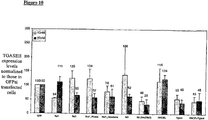
- TGaseII gene HNOEL gene HFL-1 cells 100% 100% PTEN 108% 147% GFPsi 128% 122% SeqO2b 28% 42% TGaseII 38% 137% HNOEL 90% 28% TGaseII/HNOEL 20% 20% TGaseII+2nt 44% 98% HNOEL+2nt 86% 67% TGaseII/HNOEL+2nt 83% 82% (20nM concentration for all tested oligos)
- Table 11- Experiment 2 TGaseII gene HNOEL gene PTEN_20nM 100% 100% GFPsi_20nM 109% 124% SeqO2b_20nM 32% 43% 5nM 15% 25% SeqO2b/2_20nM 11% 8% 5nM 13% 16% TGaseII_20nM 83% 42% 5nM 66% 59% HNOEL_20nM 16% 58% 5nM 14% 15% TG
- RNAstar gapped molecules The activity of the RNAstar gapped molecules was examined 72h following transfection.
- the control active siRNAs chosen for the assay were MRH2 (HNOEL), HMRG1 (TGASEII), QH1 (P53) and SeqO2b_SeqO2b/2 (TGASEII and HNOEL) siRNA molecules, which have been found to be active in down-regulating their target genes by the assignee of the present invention.
- PTEN siRNA and GFP siRNA were used as negative controls.
- Table 14 demonstrate residual (% of PTEN) human HNOEL expression in HFL-1 cells.
- Table 14 siRNA concentration 0.5nm 5nM 20nM PTEN-Cy3 100% SiGFP 199% HNOEL monomer 111% 144% 129% SeqO2b/2 (positive Control) 104% 37% 16% Complex-p53/HNOEL/TGASEII siRNA monomers 115% 70% 82% RNAstar 39% 33% 30% Ig/4 (HNOEL) 89% 207% 181% Ig/5 (gapped RNAstar) 149% 126% 63% Ig/6 (gapped RNAstar) 115% 37% 41% Ig/7 (gapped RNAstar) 14%
- Table 15 demonstrate residual (% of PTEN) human TGASEII expression in HFL-1 cells.
- Table 15 siRNA concentration 0.5nM 5nM 20nM PTEN-Cy3 100% siGFP 131% TGASEII monomer 144% 134% 113% SeqO2b/2 (positive Control) 137% 145% 103% Complex-p53/NOEL/TGASEII siRNA monomers 164% 88% 93% RNAstar 63% 89% 62% Ig/2 (TGASEII) 134% 157% 113% Ig/5 (gapped RNAstar) 137% 83% 38% Ig/6 (gapped RNAstar) 28% 53% Ig/7 (gapped RNAstar) 50%
- Table 16 demonstrate residual (% of PTEN) human p53 expression in HFL-1 cells.
- Table 16 siRNA concentration 0.5nM 5nM 20nM PTEN-Cy3 100% siGFP 127% Tp53 monomer 37% 24% 15% complex-p53/HNOEL/TGASEII siRNA monomers 89% 66% 93% RNAstar 92% 92% Ig/3 (p53) 97% 121% 81% Ig/5 (gapped RNAstar) 82% 43% 23% Ig/6 (gapped RNAstar) 97% 52% 76% Ig/7 (gapped RNAstar) 43%
- Table 18 demonstrate residual (% of Control) rat HNOEL expression in NRK49 cells.
- Table 18 siRNA concentration 5nM 20nM Exp 1 Exp2 Average Exp 1 Exp2 Average PTEN-Cy3 57% 69% 63 ⁇ 8 siGFP 119% 102% 110 ⁇ 12 HNOEL monomer 108% 72% 90 ⁇ 25 114% 88% 101 ⁇ 18 SEQO2B 85% 85 91% 91 Complex-p53/HNOEL/TGASEII siRNA monomers 69% 147% 108 ⁇ 55 62% 132% 97 ⁇ 49 RNAstar 74% 180% 127 ⁇ 75 154% 156% 155 ⁇ 1 Ig/5 (gapped RNAstar) 57% 200% 128.5 ⁇ 101 32% 123% 77.5 ⁇ 64 Ig/6 (gapped RNAstar) 44% 140% 92 ⁇ 69 20% 122% 71 ⁇ 72 Ig/7 (gapped RNAstar) 33% 146% 89.5 ⁇ 79 39% 173% 106 ⁇ 94
- RNAstar molecule on the transcription level of three target genes (p53, HNOEL and TGASEII) was examined. 60% inhibition of HNOEL expression, 40-50% inhibition of TGASEII expression, and a little inhibition of p53 expression were observed.
- the Ig/5 variant is significantly more active than Ig/6 and Ig/7 variants on p53 gene; the Ig/6 and Ig/7 variants displayed more activity on TGASE and HNOEL genes as compared to the Ig/5 variant; Further, the RNAstar gapped variants according to the invention appear significantly more active than the comparative non-gapped RNAstar molecule against the three particular targets tested.
- variant IIIa/1 reductase showed the highest activity against the target genes examined - approximately, 60% and 80% inhibition in HNOEL expression following transfection of 10nM and 20nM, respectively, and 40% inhibition in TGASEII expression following transfection of 20nM.
- the degree of inhibition varies between each variant / target gene combination.
- all variants are potentially active against any given gene.
- nucleotide sequences of the present invention can be delivered either directly or with viral or non-viral vectors. When delivered directly the sequences are generally rendered nuclease resistant. Alternatively the sequences can be incorporated into expression cassettes or constructs such that the sequence is expressed in the cell as discussed herein below. Generally the construct contains the proper regulatory sequence or promoter to allow the sequence to be expressed in the targeted cell.
- the compounds or pharmaceutical compositions of the present invention are administered and dosed in accordance with good medical practice, taking into account the clinical condition of the individual patient, the disease to be treated, the site and method of administration, scheduling of administration, patient age, sex, body weight and other factors known to medical practitioners.
- the pharmaceutically "effective amount” for purposes herein is thus determined by such considerations as are known in the art.
- the amount must be effective to achieve improvement including but not limited to improved survival rate or more rapid recovery, or improvement or elimination of symptoms and other indicators as are selected as appropriate measures by those skilled in the art.
- the treatment generally has a length proportional to the length of the disease process and drug effectiveness and the patient species being treated. It is noted that humans are treated generally longer than the mice or other experimental animals exemplified herein.
- the compounds of the present invention can be administered by any of the conventional routes of administration. It should be noted that the compound can be administered as the compound or as pharmaceutically acceptable salt and can be administered alone or as an active ingredient in combination with pharmaceutically acceptable carriers, solvents, diluents, excipients, adjuvants and vehicles.
- the compounds can be administered orally, subcutaneously or parenterally including intravenous, intraarterial, intramuscular, intraperitoneally, and intranasal administration as well as intrathecal and infusion techniques. Implants of the compounds are also useful. Liquid forms may be prepared for injection, the term including subcutaneous, transdermal, intravenous, intramuscular, intrathecal, and other parental routes of administration.
- the liquid compositions include aqueous solutions, with and without organic cosolvents, aqueous or oil suspensions, emulsions with edible oils, as well as similar pharmaceutical vehicles.
- the compositions for use in the novel treatments of the present invention may be formed as aerosols, for intranasal and like administration.
- the patient being treated is a warm-blooded animal and, in particular, mammals including man.
- the pharmaceutically acceptable carriers, solvents, diluents, excipients, adjuvants and vehicles as well as implant carriers generally refer to inert, non-toxic solid or liquid fillers, diluents or encapsulating material not reacting with the active ingredients of the invention.
- the pharmaceutical formulations suitable for injection include sterile aqueous solutions or dispersions and sterile powders for reconstitution into sterile injectable solutions or dispersions.
- the carrier can be a solvent or dispersing medium containing, for example, water, ethanol, polyol (for example, glycerol, propylene glycol, liquid polyethylene glycol, and the like), suitable mixtures thereof, and an oil, especially a vegetable oil and a lipid and suitable mixtures thereof.
- Proper fluidity can be maintained, for example, by the use of a coating such as lecithin, by the maintenance of the required particle size in the case of dispersion and by the use of surfactants.
- Nonaqueous vehicles such as cottonseed oil, sesame oil, olive oil, soybean oil, corn oil, sunflower oil, or peanut oil and esters, such as isopropyl myristate, can also be used as solvent systems for compound compositions.
- various additives which enhance the stability, sterility, and isotonicity of the compositions including antimicrobial preservatives, antioxidants, chelating agents, and buffers, can be added.
- antibacterial and antifungal agents for example, parabens, chlorobutanol, phenol, sorbic acid, and the like.
- isotonic agents for example, sugars, sodium chloride, and the like.
- Prolonged absorption of the injectable pharmaceutical form can be brought about by the use of agents delaying absorption, for example, aluminum monostearate and gelatin. According to the present invention, however, any vehicle, diluent, or additive used has to be compatible with the compounds.
- Sterile injectable solutions can be prepared by incorporating the compounds utilized in practicing the present invention in the required amount of the appropriate solvent with several of the other ingredients, as desired.
- a pharmacological formulation of the present invention can be administered to the patient in an injectable formulation containing any compatible carrier, such as various vehicle, adjuvants, additives, and diluents; or the compounds utilized in the present invention can be administered parenterally to the patient in the form of slow-release subcutaneous implants or targeted delivery systems such as monoclonal antibodies, vectored delivery, iontophoretic, polymer matrices, liposomes, and microspheres. Examples of delivery systems useful in the present invention include U. S. Patent Nos.
- a pharmacological formulation of the compound utilized in the present invention can be administered orally to the patient.
- Conventional methods such as administering the compound in tablets, suspensions, solutions, emulsions, capsules, powders, syrups and the like are usable.
- Known techniques which deliver it orally or intravenously and retain the biological activity are preferred.
- the compound of the present invention can be administered initially by intravenous injection to bring blood levels to a suitable level.
- the patient's levels are then maintained by an oral dosage form, although other forms of administration, dependent upon the patient's condition and as indicated above, can be used.
- the active dose of compound for humans is in the range of from 1ng/kg to about 20-100 mg/kg body weight per day, preferably about 0.01 mg to about 2-10 mg/kg body weight per day, in a regimen of one dose per day or twice or three or more times per day for a period of 1-2 weeks or longer, preferably for 24-to 48 hrs or by continuous infusion during a period of 1-2 weeks or longer.
- the compounds of the present invention can be administered to the eye topically or in the form of an injection, such as an intravitreal injection, a sub-retinal injection or a bilateral injection. Further information on administration of the compounds of the present invention can be found in Tolentino et al., Retina 24 (2004) 132-138 ; Reich et al., Molecular vision 9 (2003) 210-216 .
- compositions of the present invention are preferably administered into the lung by inhalation of an aerosol containing such composition / compound, or by intranasal or intratracheal instillation of said compositions.
- Formulating the compositions in liposomes may benefit absorption.
- the compositions may include a PFC liquid such as perflubron, and the compositions may be formulated as a complex of the compounds of the invention with polyethylemeimine (PEI).
- PEI polyethylemeimine
- a preferred administration mode is directly to the affected portion of the ear or vestibule, topically as by implant for example, and, preferably to the affected hair cells or their supporting cells, so as to direct the active molecules to the source and minimize its side effects.
- a preferred administration mode is a topical delivery of the inhibitor(s) onto the round window membrane of the cochlea. Such a method of administration of other compounds is disclosed for example in Tanaka et al. (Hear Res. 2003 Mar;177(1-2):21-31 ).
- Additional modes of administration to the ear are by administration of liquid drops to the ear canal, delivery to the scala tympani chamber of the inner ear by transtympanic injection, or provision as a diffusible member of a cochlear hearing implant.
- the administration of the pharmaceutical composition is preferably by topical application to the damaged area, but the compositions may also be administered systemically.
- Additional formulations for improved delivery of the compounds of the present invention can include non-formulated compounds, compounds covalently bound to cholesterol, and compounds bound to targeting antibodies ( Song et al., Antibody mediated in vivo delivery of small interfering RNAs via cell-surface receptors, Nat Biotechnol. 2005 Jun;23(6):709-17 ).
Landscapes
- Health & Medical Sciences (AREA)
- Engineering & Computer Science (AREA)
- Biomedical Technology (AREA)
- Life Sciences & Earth Sciences (AREA)
- Genetics & Genomics (AREA)
- Chemical & Material Sciences (AREA)
- Molecular Biology (AREA)
- Organic Chemistry (AREA)
- Biotechnology (AREA)
- General Engineering & Computer Science (AREA)
- Zoology (AREA)
- Bioinformatics & Cheminformatics (AREA)
- Wood Science & Technology (AREA)
- Microbiology (AREA)
- Plant Pathology (AREA)
- Physics & Mathematics (AREA)
- Biochemistry (AREA)
- General Health & Medical Sciences (AREA)
- Biophysics (AREA)
- Pharmaceuticals Containing Other Organic And Inorganic Compounds (AREA)
- Medicines That Contain Protein Lipid Enzymes And Other Medicines (AREA)
Claims (11)
- Satz von Oligonukleotiden der allgemeinen SLruktur:
5' Oligo1 (Sense) LINKER A Oligo2 (Sense) 3' 3' Oligo1 (Antisense) LINKER B Oligo3 (Sense) 5' 3' Oligo3 (Antisense) LINKER C Oligo2 (Antisense) 5' oder 5' Oligo1 (Sense) LINKER A Oligo2 (Antisense) 3' 3' Oligo1 (Antisense) LINKER B Oligo3 (Sense) 5' 3' Oligo3 (Antisense) LINKER C Oligo2 (Sense) 5' oder 5' Oligo1 (Sense) LINKER A Oligo3 (Antisense) 3' 3' Oligo1 (Antisense) LINKER B Oligo2 (Sense) 5' 3' Oligo3 (Sense) LINKER C Oligo2 (Antisense) 5'
wobei jeder Arm einen Sense-Strang und einen komplementaren Antisense-Strang umfasst,
Basenpaarung aufweist,
wobei einer von Linker A, Linker B oder Linker C eine Lucke ist. - Satz von Oligonukleotiden nach Anspruch 1, wobei die beiden vorhandenen Linker nicht identisch sind.
- Satz von Oligonukleotiden nach Anspruch 1, wobei mindestens einer der Linker ein Hexaethylenglycol-Linker, ein Nukleotid-Linker oder ein DNA-Linker ist.
- Satz von Oligonukleotiden nach Anspruch 1, wobei mindestens einer der Linker eine Disulfidbindung oder einen Peptid-Linker umfasst.
- Satz von Oligonukleotiden nach Anspruch 1, wobei die zwei vorhandenen Linker Nukleotid-Linker sind.
- Satz von Oligonukleotiden nach Anspruch 5, wobei der Nukleotid-Linker 2-10 Nukleotide lang ist.
- Satz von Oligonukleotiden nach Anspruch 1, wobei die drei siRNAs auf das gleiche Gen oder auf bis zu drei unterschiedliche Gene abzielen.
- Satz von Oligonukleotiden nach Anspruch 1, der eine Modifikation an der 2'-Position eines oder mehrerer Zucker aufweist.
- Satz von Oligonukleotiden nach Anspruch 8, wobei die ModilikaLion eine 2'-O-Methyl-Substitution oder 2'-Fluor-Substitution oder sowohl eine 2'-O-Methyl- als auch eine 2'-Fluor-Substitution ist.
- Satz von Oligonukleotiden nach Anspruch 9, wobei die 2'-Zucker-Modifikationen auf sich abwechselnden Nukleotiden sind.
- Pharmazeutische Zusammensetzung, umfassend den Satz von Oligonukleotiden nach Anspruch 1; und einen pharmazeutisch annehmbaren Träger.
Applications Claiming Priority (2)
| Application Number | Priority Date | Filing Date | Title |
|---|---|---|---|
| US77123806P | 2006-02-08 | 2006-02-08 | |
| PCT/IL2007/000184 WO2007091269A2 (en) | 2006-02-08 | 2007-02-08 | NOVEL TANDEM siRNAS |
Publications (3)
| Publication Number | Publication Date |
|---|---|
| EP1989307A2 EP1989307A2 (de) | 2008-11-12 |
| EP1989307A4 EP1989307A4 (de) | 2009-11-04 |
| EP1989307B1 true EP1989307B1 (de) | 2012-08-08 |
Family
ID=38345547
Family Applications (1)
| Application Number | Title | Priority Date | Filing Date |
|---|---|---|---|
| EP07706127A Not-in-force EP1989307B1 (de) | 2006-02-08 | 2007-02-08 | Neue tandem-sirnas |
Country Status (3)
| Country | Link |
|---|---|
| US (1) | US8362229B2 (de) |
| EP (1) | EP1989307B1 (de) |
| WO (1) | WO2007091269A2 (de) |
Families Citing this family (186)
| Publication number | Priority date | Publication date | Assignee | Title |
|---|---|---|---|---|
| US20080311040A1 (en) * | 2007-03-06 | 2008-12-18 | Flagship Ventures | METHODS AND COMPOSITIONS FOR IMPROVED THERAPEUTIC EFFECTS WITH siRNA |
| RU2487716C2 (ru) * | 2007-10-03 | 2013-07-20 | Кварк Фармасьютикалс, Инк. | Новые структуры малых интерферирующих рнк (sirna) |
| WO2009147684A2 (en) | 2008-06-06 | 2009-12-10 | Quark Pharmaceuticals, Inc. | Compositions and methods for treatment of ear disorders |
| US11414664B2 (en) | 2008-12-18 | 2022-08-16 | Dicerna Pharmaceuticals, Inc. | Extended dicer substrate agents and methods for the specific inhibition of gene expression |
| US20110288155A1 (en) | 2008-12-18 | 2011-11-24 | Elena Feinstein | Sirna compounds and methods of use thereof |
| US20100249214A1 (en) * | 2009-02-11 | 2010-09-30 | Dicerna Pharmaceuticals | Multiplex dicer substrate rna interference molecules having joining sequences |
| JP5529895B2 (ja) * | 2009-02-04 | 2014-06-25 | ソンギュングヮン ユニバーシティ ファウンデーション フォー コーポレート コラボレーション | 細胞内の伝達能が増加した低分子干渉rna複合体 |
| CA2764158A1 (en) * | 2009-06-01 | 2010-12-09 | Halo-Bio Rnai Therapeutics, Inc. | Polynucleotides for multivalent rna interference, compositions and methods of use thereof |
| DK3276004T3 (da) | 2009-06-08 | 2020-04-06 | Quark Pharmaceuticals Inc | Fremgangsmåder til behandling af kronisk nyresygdom |
| US9187746B2 (en) | 2009-09-22 | 2015-11-17 | Alnylam Pharmaceuticals, Inc. | Dual targeting siRNA agents |
| US8778904B2 (en) | 2009-12-09 | 2014-07-15 | Quark Pharmaceuticals, Inc. | Methods and compositions for treating diseases, disorders or injury of the CNS |
| US9045755B2 (en) | 2010-06-24 | 2015-06-02 | Quark Pharmaceuticals, Inc. | Double stranded RNA compounds to RhoA and use thereof |
| CN103562387A (zh) | 2011-03-03 | 2014-02-05 | 夸克医药公司 | Toll样受体途径的寡核苷酸调剂 |
| SG192961A1 (en) | 2011-03-03 | 2013-09-30 | Quark Pharmaceuticals Inc | Compositions and methods for treating lung disease and injury |
| US9796979B2 (en) | 2011-03-03 | 2017-10-24 | Quark Pharmaceuticals Inc. | Oligonucleotide modulators of the toll-like receptor pathway |
| CA2848753C (en) * | 2011-09-14 | 2022-07-26 | Rana Therapeutics, Inc. | Multimeric oligonucleotide compounds |
| SG11201401648RA (en) | 2011-11-03 | 2014-05-29 | Quark Pharmaceuticals Inc | Methods and compositions for neuroprotection |
| US20140323549A1 (en) | 2011-11-08 | 2014-10-30 | Quark Pharmaceuticals, Inc. | Methods and compositions for treating diseases, disorders or injury of the nervous system |
| RU2678807C2 (ru) | 2011-11-18 | 2019-02-01 | Элнилэм Фармасьютикалз, Инк. | СРЕДСТВА ДЛЯ РНКи, КОМПОЗИЦИИ И СПОСОБЫ ИХ ПРИМЕНЕНИЯ ДЛЯ ЛЕЧЕНИЯ ЗАБОЛЕВАНИЙ, АССОЦИИРОВАННЫХ С ТРАНСТИРЕТИНОМ (TTR) |
| LT3366775T (lt) | 2011-11-18 | 2022-08-10 | Alnylam Pharmaceuticals, Inc. | Modifikuoti rnri agentai |
| EP2802657B1 (de) | 2012-01-12 | 2018-05-02 | Quark Pharmaceuticals, Inc. | Kombinationstherapie zur behandlung von gehör-und gleichgewichtsstörungen |
| US10407677B2 (en) | 2012-04-26 | 2019-09-10 | Intana Bioscience Gmbh | High complexity siRNA pools |
| AU2013262709A1 (en) | 2012-05-16 | 2015-01-22 | Rana Therapeutics, Inc. | Compositions and methods for modulating MECP2 expression |
| EP2850188A4 (de) | 2012-05-16 | 2016-01-20 | Rana Therapeutics Inc | Zusammensetzungen und verfahren zur modulierung der expression der hämoglobin-genfamilien |
| US10174323B2 (en) | 2012-05-16 | 2019-01-08 | The General Hospital Corporation | Compositions and methods for modulating ATP2A2 expression |
| US10837014B2 (en) | 2012-05-16 | 2020-11-17 | Translate Bio Ma, Inc. | Compositions and methods for modulating SMN gene family expression |
| US10059941B2 (en) | 2012-05-16 | 2018-08-28 | Translate Bio Ma, Inc. | Compositions and methods for modulating SMN gene family expression |
| EA201492122A1 (ru) | 2012-05-16 | 2015-10-30 | Рана Терапьютикс, Инк. | Композиции и способы для модулирования экспрессии utrn |
| EP2880162B1 (de) | 2012-08-03 | 2017-07-05 | Alnylam Pharmaceuticals, Inc. | Modifizierte rnai-mittel |
| US9611474B2 (en) | 2012-09-12 | 2017-04-04 | Quark Pharmaceuticals, Inc. | Double-stranded oligonucleotide molecules to DDIT4 and methods of use thereof |
| EP2895608B1 (de) | 2012-09-12 | 2018-12-05 | Quark Pharmaceuticals, Inc. | Doppelsträngige oligonukleotidmoleküle an p53 und verfahren zur verwendung davon |
| AU2013315225B2 (en) * | 2012-09-14 | 2018-11-08 | Translate Bio Ma, Inc. | Multimeric oligonucleotide compounds |
| SMT201800039T1 (it) | 2012-12-05 | 2018-03-08 | Alnylam Pharmaceuticals Inc | Composizioni di irna di pcsk9 e metodi di uso delle stesse |
| SG10201707569YA (en) | 2012-12-12 | 2017-10-30 | Broad Inst Inc | Delivery, Engineering and Optimization of Systems, Methods and Compositions for Sequence Manipulation and Therapeutic Applications |
| EP3434776A1 (de) | 2012-12-12 | 2019-01-30 | The Broad Institute, Inc. | Verfahren, modelle, systeme und vorrichtungen zur identifikation von zielsequenzen für cas-enzyme oder crispr-cas-systeme für zielsequenzen und förderresultate davon |
| EP2931899A1 (de) | 2012-12-12 | 2015-10-21 | The Broad Institute, Inc. | Funktionale genomik unter verwendung von crispr-cas systemen, zusammensetzungen, verfahren, knockout-bibliotheken und anwendungen davon |
| CN120574828A (zh) | 2013-03-14 | 2025-09-02 | 阿尔尼拉姆医药品有限公司 | 补体组分C5 iRNA组合物及其使用方法 |
| PL2999785T3 (pl) | 2013-05-22 | 2018-09-28 | Alnylam Pharmaceuticals, Inc. | Kompozycje iRNA Serpina1 i sposoby ich zastosowania |
| SG10202103166XA (en) | 2013-05-22 | 2021-04-29 | Alnylam Pharmaceuticals Inc | Tmprss6 irna compositions and methods of use thereof |
| WO2014204724A1 (en) * | 2013-06-17 | 2014-12-24 | The Broad Institute Inc. | Delivery, engineering and optimization of tandem guide systems, methods and compositions for sequence manipulation |
| WO2014204727A1 (en) | 2013-06-17 | 2014-12-24 | The Broad Institute Inc. | Functional genomics using crispr-cas systems, compositions methods, screens and applications thereof |
| AU2014281031B2 (en) | 2013-06-17 | 2020-05-21 | Massachusetts Institute Of Technology | Delivery, use and therapeutic applications of the CRISPR-Cas systems and compositions for targeting disorders and diseases using viral components |
| JP6738728B2 (ja) | 2013-06-17 | 2020-08-19 | ザ・ブロード・インスティテュート・インコーポレイテッド | 肝臓ターゲティングおよび治療のためのCRISPR−Cas系、ベクターおよび組成物の送達および使用 |
| WO2014204725A1 (en) | 2013-06-17 | 2014-12-24 | The Broad Institute Inc. | Optimized crispr-cas double nickase systems, methods and compositions for sequence manipulation |
| CA3177846A1 (en) * | 2013-07-11 | 2015-01-15 | Alnylam Pharmaceuticals, Inc. | Oligonucleotide-ligand conjugates and process for their preparation |
| TW201610151A (zh) | 2013-09-23 | 2016-03-16 | 阿尼拉製藥公司 | 治療或預防與甲狀腺素運載蛋白相關疾病之方法 |
| MX374529B (es) | 2013-12-12 | 2025-03-06 | Broad Inst Inc | Suministro, uso y aplicaciones terapeuticas de sistemas y composiciones crispr-cas para edicion del genoma. |
| JP2017527256A (ja) | 2013-12-12 | 2017-09-21 | ザ・ブロード・インスティテュート・インコーポレイテッド | HBV及びウイルス性疾患及び障害のためのCRISPR−Cas系及び組成物の送達、使用及び治療適用 |
| WO2015089364A1 (en) | 2013-12-12 | 2015-06-18 | The Broad Institute Inc. | Crystal structure of a crispr-cas system, and uses thereof |
| JP6793547B2 (ja) | 2013-12-12 | 2020-12-02 | ザ・ブロード・インスティテュート・インコーポレイテッド | 最適化機能CRISPR−Cas系による配列操作のための系、方法および組成物 |
| SG11201604692UA (en) | 2013-12-12 | 2016-07-28 | Alnylam Pharmaceuticals Inc | Complement component irna compositions and methods of use thereof |
| MX2016007325A (es) | 2013-12-12 | 2017-07-19 | Broad Inst Inc | Composiciones y metodos de uso de sistemas crispr-cas en desordenes debidos a repeticion de nucleotidos. |
| WO2015089473A1 (en) | 2013-12-12 | 2015-06-18 | The Broad Institute Inc. | Engineering of systems, methods and optimized guide compositions with new architectures for sequence manipulation |
| WO2015106128A2 (en) | 2014-01-09 | 2015-07-16 | Alnylam Pharmaceuticals, Inc. | MODIFIED RNAi AGENTS |
| CN106103718B (zh) | 2014-02-11 | 2021-04-02 | 阿尔尼拉姆医药品有限公司 | 己酮糖激酶(KHK)iRNA组合物及其使用方法 |
| TW201607559A (zh) | 2014-05-12 | 2016-03-01 | 阿尼拉製藥公司 | 治療serpinc1相關疾患之方法和組成物 |
| WO2015179724A1 (en) | 2014-05-22 | 2015-11-26 | Alnylam Pharmaceuticals, Inc. | Angiotensinogen (agt) irna compositions and methods of use thereof |
| HUE054226T2 (hu) | 2014-05-29 | 2021-08-30 | Quark Pharmaceuticals Inc | Módszerek és készítmények az ischaemia reperfúziós károsodás megelõzésére a szervekben |
| IL316808A (en) | 2014-08-20 | 2025-01-01 | Alnylam Pharmaceuticals Inc | Modified double-stranded RNA materials and their uses |
| JOP20200115A1 (ar) | 2014-10-10 | 2017-06-16 | Alnylam Pharmaceuticals Inc | تركيبات وطرق لتثبيط التعبير الجيني عن hao1 (حمض أوكسيداز هيدروكسيلي 1 (أوكسيداز جليكولات)) |
| JOP20200092A1 (ar) | 2014-11-10 | 2017-06-16 | Alnylam Pharmaceuticals Inc | تركيبات iRNA لفيروس الكبد B (HBV) وطرق لاستخدامها |
| JP2017535552A (ja) | 2014-11-17 | 2017-11-30 | アルナイラム ファーマシューティカルズ, インコーポレイテッドAlnylam Pharmaceuticals, Inc. | アポリポタンパク質C3(APOC3)iRNA組成物およびその使用方法 |
| EP3985115A1 (de) | 2014-12-12 | 2022-04-20 | The Broad Institute, Inc. | Geschützte guide-rnas (pgrnas) |
| AU2015364508A1 (en) | 2014-12-18 | 2017-07-06 | Alnylam Pharmaceuticals, Inc. | ReversirTM compounds |
| EP3237615B2 (de) | 2014-12-24 | 2023-07-26 | The Broad Institute, Inc. | Crispr mit destabilisierungsdomänen oder mit destabilisierungsdomänenassoziierung |
| JP2018510621A (ja) | 2015-02-13 | 2018-04-19 | アルナイラム ファーマシューティカルズ, インコーポレイテッドAlnylam Pharmaceuticals, Inc. | パタチン様ホスホリパーゼドメイン含有3(PNPLA3)iRNA組成物およびその使用方法 |
| EP3277811B1 (de) | 2015-04-03 | 2020-12-23 | University of Massachusetts | Vollständig stabilisierte asymmetrische sirna |
| WO2016201301A1 (en) | 2015-06-12 | 2016-12-15 | Alnylam Pharmaceuticals, Inc. | Complement component c5 irna compositions and methods of use thereof |
| CA2989830A1 (en) | 2015-06-18 | 2016-12-22 | The Broad Institute, Inc. | Crispr enzyme mutations reducing off-target effects |
| WO2016205759A1 (en) | 2015-06-18 | 2016-12-22 | The Broad Institute Inc. | Engineering and optimization of systems, methods, enzymes and guide scaffolds of cas9 orthologs and variants for sequence manipulation |
| WO2017007886A2 (en) * | 2015-07-08 | 2017-01-12 | Idera Pharmaceuticals, Inc. | Compositions for inhibiting dux4 gene expression and uses thereof |
| WO2017011286A1 (en) | 2015-07-10 | 2017-01-19 | Alnylam Pharmaceuticals, Inc. | Insulin-like growth factor binding protein, acid labile subunit (igfals) and insulin-like growth factor 1 (igf-1) irna compositions and methods of use thereof |
| US10633653B2 (en) | 2015-08-14 | 2020-04-28 | University Of Massachusetts | Bioactive conjugates for oligonucleotide delivery |
| WO2017035278A1 (en) | 2015-08-24 | 2017-03-02 | Halo-Bio Rnai Therapeutics, Inc. | Polynucleotide nanoparticles for the modulation of gene expression and uses thereof |
| AU2016315584B2 (en) | 2015-09-02 | 2022-07-14 | Alnylam Pharmaceuticals, Inc. | Programmed cell death 1 ligand 1 (PD-L1) iRNA compositions and methods of use thereof |
| TWI836281B (zh) | 2015-12-07 | 2024-03-21 | 美商健贊公司 | 治療serpinc1相關疾患之方法及組成物 |
| WO2017132669A1 (en) | 2016-01-31 | 2017-08-03 | University Of Massachusetts | Branched oligonucleotides |
| WO2017214518A1 (en) | 2016-06-10 | 2017-12-14 | Alnylam Pharmaceuticals, Inc. | COMPLETMENT COMPONENT C5 iRNA COMPOSTIONS AND METHODS OF USE THEREOF FOR TREATING PAROXYSMAL NOCTURNAL HEMOGLOBINURIA (PNH) |
| US11299733B2 (en) | 2016-07-15 | 2022-04-12 | University Of Massachusetts | Process of delivering small RNAs to sperm |
| CA3033867A1 (en) | 2016-08-17 | 2018-02-22 | Solstice Biologics, Ltd. | Polynucleotide constructs |
| TWI788312B (zh) | 2016-11-23 | 2023-01-01 | 美商阿尼拉製藥公司 | 絲胺酸蛋白酶抑制因子A1 iRNA組成物及其使用方法 |
| US20180193270A1 (en) | 2016-11-29 | 2018-07-12 | PureTech Health LLC | Exosomes for delivery of therapeutic agents |
| KR20190098181A (ko) | 2016-12-16 | 2019-08-21 | 알닐람 파마슈티칼스 인코포레이티드 | 트랜스티레틴(TTR) iRNA 조성물을 사용하여 TTR-관련 질병을 치료하거나 예방하는 방법 |
| CN110799647A (zh) | 2017-06-23 | 2020-02-14 | 马萨诸塞大学 | 双尾自递送sirna及相关的方法 |
| EP3645546A4 (de) | 2017-06-30 | 2021-12-01 | Solstice Biologics, Ltd. | Chirale phosphoramidithilfsmittel und verfahren zu ihrer verwendung |
| JP2020530442A (ja) | 2017-07-10 | 2020-10-22 | ジェンザイム・コーポレーション | 血友病を有する対象の出血事象を処置するための方法および組成物 |
| JP7277432B2 (ja) | 2017-07-13 | 2023-05-19 | アルナイラム ファーマシューティカルズ, インコーポレイテッド | 乳酸脱水素酵素A(LDHA)iRNA組成物及びその使用方法 |
| EP3710587A1 (de) | 2017-11-16 | 2020-09-23 | Alnylam Pharmaceuticals, Inc. | Apolipoprotein-c3 kisspeptin 1 (kiss1)-irna-zusammensetzungen und verfahren zur verwendung davon |
| WO2019100039A1 (en) | 2017-11-20 | 2019-05-23 | Alnylam Pharmaceuticals, Inc. | Serum amyloid p component (apcs) irna compositions and methods of use thereof |
| EA202091520A1 (ru) | 2017-12-18 | 2020-10-05 | Элнилэм Фармасьютикалз, Инк. | Композиции на основе irna против бокса-1 высокомобильной группы (hmgb1) и способы их применения |
| MX2020011570A (es) | 2018-05-07 | 2020-11-24 | Alnylam Pharmaceuticals Inc | Administracion extrahepatica. |
| TWI851574B (zh) | 2018-05-14 | 2024-08-11 | 美商阿尼拉製藥公司 | 血管收縮素原(AGT)iRNA組成物及其使用方法 |
| AU2019316640A1 (en) | 2018-08-10 | 2021-03-18 | University Of Massachusetts | Modified oligonucleotides targeting SNPs |
| EP3840759A4 (de) | 2018-08-23 | 2022-06-01 | University Of Massachusetts | O-methyl-reiche vollstabilisierte oligonukleotide |
| WO2020060986A1 (en) | 2018-09-18 | 2020-03-26 | Alnylam Pharmaceuticals, Inc. | Ketohexokinase (khk) irna compositions and methods of use thereof |
| BR112021005777A2 (pt) * | 2018-09-28 | 2022-04-19 | Sirnaomics Inc | Produtos e composições |
| AU2019350765A1 (en) | 2018-09-28 | 2021-05-27 | Alnylam Pharmaceuticals, Inc. | Transthyretin (TTR) iRNA compositions and methods of use thereof for treating or preventing TTR-associated ocular diseases |
| AU2020207935A1 (en) | 2019-01-18 | 2021-08-26 | University Of Massachusetts | Dynamic pharmacokinetic-modifying anchors |
| EP3937951A4 (de) * | 2019-03-15 | 2023-04-05 | University Of Massachusetts | Oligonukleotide zur gewebespezifischen apoe-modulation |
| EP3969052A1 (de) | 2019-05-17 | 2022-03-23 | Alnylam Pharmaceuticals Inc. | Orale verabreichung von oligonukleotiden |
| EP4007812A1 (de) | 2019-08-01 | 2022-06-08 | Alnylam Pharmaceuticals, Inc. | Irna-zusammensetzungen der serpinfamilie f element 2 (serpinf2) und verfahren zu deren verwendung |
| WO2021022108A2 (en) | 2019-08-01 | 2021-02-04 | Alnylam Pharmaceuticals, Inc. | CARBOXYPEPTIDASE B2 (CPB2) iRNA COMPOSITIONS AND METHODS OF USE THEREOF |
| WO2021030213A1 (en) | 2019-08-09 | 2021-02-18 | University Of Massachusetts | Chemically modified oligonucleotides targeting snps |
| WO2021030522A1 (en) | 2019-08-13 | 2021-02-18 | Alnylam Pharmaceuticals, Inc. | SMALL RIBOSOMAL PROTEIN SUBUNIT 25 (RPS25) iRNA AGENT COMPOSITIONS AND METHODS OF USE THEREOF |
| US12365894B2 (en) | 2019-09-16 | 2025-07-22 | University Of Massachusetts | Branched lipid conjugates of siRNA for specific tissue delivery |
| EP4038189A1 (de) | 2019-10-04 | 2022-08-10 | Alnylam Pharmaceuticals, Inc. | Zusammensetzungen und verfahren zum ausschalten einer ugt1a1-genexpression |
| WO2021076828A1 (en) | 2019-10-18 | 2021-04-22 | Alnylam Pharmaceuticals, Inc. | Solute carrier family member irna compositions and methods of use thereof |
| AU2020369515A1 (en) | 2019-10-22 | 2022-04-21 | Alnylam Pharmaceuticals, Inc. | Complement component C3 iRNA compositions and methods of use thereof |
| WO2021087325A1 (en) | 2019-11-01 | 2021-05-06 | Alnylam Pharmaceuticals, Inc. | Compositions and methods for silencing dnajb1-prkaca fusion gene expression |
| AR120341A1 (es) | 2019-11-01 | 2022-02-09 | Alnylam Pharmaceuticals Inc | COMPOSICIONES DE AGENTES DE ARNi CONTRA LA HUNTINGTINA (HTT) Y SUS MÉTODOS DE USO |
| CA3160329A1 (en) | 2019-11-06 | 2021-05-14 | Alnylam Pharmaceuticals, Inc. | Extrahepatic delivery |
| EP4055165A1 (de) | 2019-11-06 | 2022-09-14 | Alnylam Pharmaceuticals, Inc. | Transthyretin (ttr)-irna-zusammensetzungen und verfahren zur verwendung davon für die behandlung oder prävention ttr-assoziierter augenerkrankungen |
| WO2021096763A1 (en) | 2019-11-13 | 2021-05-20 | Alnylam Pharmaceuticals, Inc. | Methods and compositions for treating an angiotensinogen- (agt-) associated disorder |
| US20230056569A1 (en) | 2019-11-22 | 2023-02-23 | Alnylam Pharmaceuticals, Inc. | Ataxin3 (atxn3) rnai agent compositions and methods of use thereof |
| TWI897902B (zh) | 2019-12-13 | 2025-09-21 | 美商阿尼拉製藥公司 | 人類染色體9開讀框72 (C9ORF72) iRNA劑組成物及其使用方法 |
| TW202138559A (zh) | 2019-12-16 | 2021-10-16 | 美商阿尼拉製藥公司 | 含類PATATIN磷脂酶結構域3(PNPLA3)iRNA組成物及其使用方法 |
| WO2021154941A1 (en) | 2020-01-31 | 2021-08-05 | Alnylam Pharmaceuticals, Inc. | Complement component c5 irna compositions for use in the treatment of amyotrophic lateral sclerosis (als) |
| IL295445A (en) | 2020-02-10 | 2022-10-01 | Alnylam Pharmaceuticals Inc | Preparations and methods for silencing vegf-a expression |
| KR20220143106A (ko) | 2020-02-18 | 2022-10-24 | 알닐람 파마슈티칼스 인코포레이티드 | 아포지질단백질 C3 (APOC3) iRNA 조성물 및 이의 사용 방법 |
| WO2021178607A1 (en) | 2020-03-05 | 2021-09-10 | Alnylam Pharmaceuticals, Inc. | Complement component c3 irna compositions and methods of use thereof for treating or preventing complement component c3-associated diseases |
| IL296109A (en) | 2020-03-06 | 2022-11-01 | Alnylam Pharmaceuticals Inc | Ketohexokinase (khk) irna compositions and methods of use thereof |
| WO2021188611A1 (en) | 2020-03-18 | 2021-09-23 | Alnylam Pharmaceuticals, Inc. | Compositions and methods for treating subjects having a heterozygous alanine-glyoxylate aminotransferase gene (agxt) variant |
| JP2023519274A (ja) | 2020-03-26 | 2023-05-10 | アルナイラム ファーマシューティカルズ, インコーポレイテッド | コロナウイルスiRNA組成物およびその使用方法 |
| WO2021202443A2 (en) | 2020-03-30 | 2021-10-07 | Alnylam Pharmaceucticals, Inc. | Compositions and methods for silencing dnajc15 gene expression |
| EP4127134A4 (de) | 2020-04-01 | 2024-07-31 | Alnylam Pharmaceuticals, Inc. | Irna-wirkstoffzusammensetzungen mit alpha-2a-adrenergen rezeptor (adra2a) und verfahren zur verwendung davon |
| EP4133078A1 (de) | 2020-04-06 | 2023-02-15 | Alnylam Pharmaceuticals, Inc. | Zusammensetzungen und verfahren zur ausschaltung der myoc-expression |
| KR20230008078A (ko) | 2020-04-07 | 2023-01-13 | 알닐람 파마슈티칼스 인코포레이티드 | Scn9a 발현을 사일런싱하기 위한 조성물 및 방법 |
| EP4133077A1 (de) | 2020-04-07 | 2023-02-15 | Alnylam Pharmaceuticals, Inc. | Irna-zusammensetzungen mit transmembran-serinprotease 2 (tmprss2) und verfahren zur verwendung davon |
| EP4133076A1 (de) | 2020-04-07 | 2023-02-15 | Alnylam Pharmaceuticals, Inc. | Irna-zusammensetzungen aus angiotensin-konvertierendem enzym 2 (ace2) und verfahren zur verwendung davon |
| BR112022021813A2 (pt) | 2020-04-27 | 2023-01-17 | Alnylam Pharmaceuticals Inc | Composições de agente de apolipoproteína e (apoe) irna e métodos de uso das mesmas |
| WO2021222549A1 (en) | 2020-04-30 | 2021-11-04 | Alnylam Pharmaceuticals, Inc. | Complement factor b (cfb) irna compositions and methods of use thereof |
| WO2021237097A1 (en) | 2020-05-21 | 2021-11-25 | Alnylam Pharmaceuticals, Inc. | Compositions and methods for inhibiting marc1 gene expression |
| WO2021242883A1 (en) | 2020-05-26 | 2021-12-02 | University Of Massachusetts | Synthetic oligonucleotides having regions of block and cluster modifications |
| EP4162050A1 (de) | 2020-06-09 | 2023-04-12 | Alnylam Pharmaceuticals, Inc. | Rnai-zusammensetzungen und verfahren zur verwendung davon zur verabreichung durch inhalation |
| CN116075592A (zh) | 2020-06-09 | 2023-05-05 | 阿尔尼拉姆医药品有限公司 | 用于沉默gpam(线粒体甘油-3-磷酸酰基转移酶1)表达的sirna组合物和方法 |
| AU2021292296A1 (en) | 2020-06-18 | 2023-01-19 | Alnylam Pharmaceuticals, Inc. | Xanthine dehydrogenase (XDH) iRNA compositions and methods of use thereof |
| US20230257745A1 (en) | 2020-07-10 | 2023-08-17 | Alnylam Pharmaceuticals, Inc. | Circular siRNAs |
| WO2022066847A1 (en) | 2020-09-24 | 2022-03-31 | Alnylam Pharmaceuticals, Inc. | Dipeptidyl peptidase 4 (dpp4) irna compositions and methods of use thereof |
| EP4225917A1 (de) | 2020-10-05 | 2023-08-16 | Alnylam Pharmaceuticals, Inc. | G-protein-gekoppelter rezeptor-75 (gpr75)-irna-zusammensetzungen und verfahren zur verwendung davon |
| CA3198823A1 (en) | 2020-10-21 | 2022-04-28 | Alnylam Pharmaceuticals, Inc. | Methods and compositions for treating primary hyperoxaluria |
| WO2022087329A1 (en) | 2020-10-23 | 2022-04-28 | Alnylam Pharmaceuticals, Inc. | Mucin 5b (muc5b) irna compositions and methods of use thereof |
| IL302709A (en) | 2020-11-13 | 2023-07-01 | Alnylam Pharmaceuticals Inc | Coagulation factor iRNA compositions (F5) and methods of using them |
| AU2021393417A1 (en) | 2020-12-01 | 2023-06-29 | Alnylam Pharmaceuticals, Inc. | Methods and compositions for inhibition of hao1 (hydroxyacid oxidase 1 (glycolate oxidase)) gene expression |
| EP4259795A1 (de) | 2020-12-08 | 2023-10-18 | Alnylam Pharmaceuticals, Inc. | Gerinnungsfaktor x (f10)-irna-zusammensetzungen und verfahren zur verwendung davon |
| WO2022147223A2 (en) | 2020-12-31 | 2022-07-07 | Alnylam Pharmaceuticals, Inc. | 2'-modified nucleoside based oligonucleotide prodrugs |
| AU2021411579A1 (en) | 2020-12-31 | 2023-07-13 | Alnylam Pharmaceuticals, Inc. | Cyclic-disulfide modified phosphate based oligonucleotide prodrugs |
| WO2022150260A1 (en) | 2021-01-05 | 2022-07-14 | Alnylam Pharmaceuticals, Inc. | COMPLEMENT COMPONENT 9 (C9) iRNA COMPOSITIONS AND METHODS OF USE THEREOF |
| TW202305131A (zh) | 2021-02-12 | 2023-02-01 | 美商艾拉倫製藥股份有限公司 | 用於治療或預防超氧歧化酶1-(SOD1-)相關的神經退化疾病的超氧歧化酶1(SOD1)iRNA組成物及其使用方法 |
| JP2024509783A (ja) | 2021-02-25 | 2024-03-05 | アルナイラム ファーマシューティカルズ, インコーポレイテッド | プリオンタンパク質(prnp)irna組成物およびその使用方法 |
| EP4298218A1 (de) | 2021-02-26 | 2024-01-03 | Alnylam Pharmaceuticals, Inc. | Ketohexokinase (khk)-irna-zusammensetzungen und verfahren zur verwendung davon |
| IL305442A (en) | 2021-03-04 | 2023-10-01 | Alnylam Pharmaceuticals Inc | Angiopoietin-like 3 (ANGPTL3) IRNA compositions and methods of using them |
| WO2022192519A1 (en) | 2021-03-12 | 2022-09-15 | Alnylam Pharmaceuticals, Inc. | Glycogen synthase kinase 3 alpha (gsk3a) irna compositions and methods of use thereof |
| EP4314296A2 (de) | 2021-03-29 | 2024-02-07 | Alnylam Pharmaceuticals, Inc. | Huntingtin (htt)-irna-wirkstoffzusammensetzungen und verfahren zur verwendung davon |
| WO2022212153A1 (en) | 2021-04-01 | 2022-10-06 | Alnylam Pharmaceuticals, Inc. | Proline dehydrogenase 2 (prodh2) irna compositions and methods of use thereof |
| CA3216106A1 (en) | 2021-04-26 | 2022-11-03 | Alnylam Pharmaceuticals, Inc. | Transmembrane protease, serine 6 (tmprss6) irna compositions and methods of use thereof |
| EP4330396A1 (de) | 2021-04-29 | 2024-03-06 | Alnylam Pharmaceuticals, Inc. | Signalwandler und aktivator von transkriptionsfaktor 6 (stat6)-irna-zusammensetzungen und verfahren zur verwendung davon |
| WO2022245583A1 (en) | 2021-05-18 | 2022-11-24 | Alnylam Pharmaceuticals, Inc. | Sodium-glucose cotransporter-2 (sglt2) irna compositions and methods of use thereof |
| EP4347823A1 (de) | 2021-06-02 | 2024-04-10 | Alnylam Pharmaceuticals, Inc. | Patin-ähnliche phospholipasedomäne mit 3 (pnpla3)-irna-zusammensetzungen und verfahren zur verwendung davon |
| EP4347822A2 (de) | 2021-06-04 | 2024-04-10 | Alnylam Pharmaceuticals, Inc. | Irna-wirkstoffzusammensetzungen mit offenem leserahmen 72 (c9orf72) auf menschlichem chromosom 9 und verfahren zur verwendung davon |
| EP4351541A2 (de) | 2021-06-08 | 2024-04-17 | Alnylam Pharmaceuticals, Inc. | Zusammensetzungen und verfahren zur behandlung oder prävention von erkrankungen im zusammenhang mit morbus stargardt und/oder retinal-bindendem protein 4 (rbp4) |
| US20240309384A1 (en) * | 2021-06-21 | 2024-09-19 | The University Of North Carolina At Chapel Hill | INVERTED CHIMERIC siRNA MOLECULES AND METHODS OF USE THEREOF |
| MX2023015523A (es) | 2021-06-23 | 2024-03-11 | Univ Massachusetts | Compuestos de oligonucleotidos anti-flt1 optimizados para el tratamiento de la preeclampsia y otros desordenes angiogenicos. |
| EP4363580A1 (de) | 2021-06-30 | 2024-05-08 | Alnylam Pharmaceuticals, Inc. | Verfahren und zusammensetzungen zur behandlung einer angiotensinogen- (gt-) assoziierten erkrankung |
| WO2023283403A2 (en) | 2021-07-09 | 2023-01-12 | Alnylam Pharmaceuticals, Inc. | Bis-rnai compounds for cns delivery |
| WO2023003805A1 (en) | 2021-07-19 | 2023-01-26 | Alnylam Pharmaceuticals, Inc. | Methods and compositions for treating subjects having or at risk of developing a non-primary hyperoxaluria disease or disorder |
| MX2024000981A (es) | 2021-07-21 | 2024-02-12 | Alnylam Pharmaceuticals Inc | Composiciones de acido ribonucleico de interferencia (arni) de gen diana asociado con trastorno metabolico y sus metodos de uso. |
| AU2022316139A1 (en) | 2021-07-23 | 2024-01-18 | Alnylam Pharmaceuticals, Inc. | Beta-catenin (ctnnb1) irna compositions and methods of use thereof |
| JP2024529437A (ja) | 2021-07-29 | 2024-08-06 | アルナイラム ファーマシューティカルズ, インコーポレイテッド | 3-ヒドロキシ-3-メチルグリタル-COAレダクターゼ(HMGCR)iRNA組成物およびその使用方法 |
| CN117795074A (zh) | 2021-08-03 | 2024-03-29 | 阿尔尼拉姆医药品有限公司 | 转甲状腺素蛋白(TTR)iRNA组合物和其使用方法 |
| PE20241132A1 (es) | 2021-08-04 | 2024-05-24 | Alnylam Pharmaceuticals Inc | Composiciones de arni y metodos para silenciar el angiotensinogeno (agt) |
| JP2024534766A (ja) | 2021-08-13 | 2024-09-26 | アルナイラム ファーマシューティカルズ, インコーポレイテッド | 第XII因子(F12)iRNA組成物およびその使用方法 |
| EP4395790A2 (de) | 2021-08-31 | 2024-07-10 | Alnylam Pharmaceuticals, Inc. | Zelltodinduzierende dffa-ähnliche effektor-b (cideb)-irna-zusammensetzungen und verfahren zur verwendung davon |
| WO2023044370A2 (en) | 2021-09-17 | 2023-03-23 | Alnylam Pharmaceuticals, Inc. | Irna compositions and methods for silencing complement component 3 (c3) |
| CA3232420A1 (en) | 2021-09-20 | 2023-03-23 | Alnylam Pharmaceuticals, Inc. | Inhibin subunit beta e (inhbe) modulator compositions and methods of use thereof |
| MX2024003519A (es) | 2021-09-24 | 2024-04-01 | Alnylam Pharmaceuticals Inc | Composiciones de agentes de acido ribonucleico de interferencia (arni) de proteina tau asociada a microtubulos (mapt) y sus metodos de uso. |
| KR20240101590A9 (ko) | 2021-10-15 | 2025-12-10 | 알닐람 파마슈티칼스 인코포레이티드 | 간외 전달 irna 조성물 및 이를 이용하는 방법 |
| EP4423273A1 (de) | 2021-10-29 | 2024-09-04 | Alnylam Pharmaceuticals, Inc. | Komplementfaktor-b (cfb)-irna-zusammensetzungen und verfahren zur verwendung davon |
| WO2023076450A2 (en) | 2021-10-29 | 2023-05-04 | Alnylam Pharmaceuticals, Inc. | HUNTINGTIN (HTT) iRNA AGENT COMPOSITIONS AND METHODS OF USE THEREOF |
| EP4469575A2 (de) | 2022-01-24 | 2024-12-04 | Alnylam Pharmaceuticals, Inc. | Enzym-irna-wirkstoffzusammensetzungen für den heparinsulfatbiosyntheseweg und verfahren zur verwendung davon |
| WO2024006999A2 (en) | 2022-06-30 | 2024-01-04 | Alnylam Pharmaceuticals, Inc. | Cyclic-disulfide modified phosphate based oligonucleotide prodrugs |
| JP2025532593A (ja) | 2022-09-15 | 2025-10-01 | リジェネロン・ファーマシューティカルズ・インコーポレイテッド | 17b-ヒドロキシステロイドデヒドロゲナーゼ13型(hsd17b13)irna組成物およびその使用方法 |
| JP2025532985A (ja) | 2022-09-30 | 2025-10-03 | アルナイラム ファーマシューティカルズ, インコーポレイテッド | 修飾二本鎖rna剤 |
| WO2024216155A1 (en) | 2023-04-12 | 2024-10-17 | Alnylam Pharmaceuticals, Inc. | Extrahepatic delivery of double-stranded rna agents |
| WO2025034422A1 (en) | 2023-08-04 | 2025-02-13 | Alnylam Pharmaceuticals, Inc. | Methods and compositions for treating ctnnb1-associated disorders |
| WO2025064660A2 (en) | 2023-09-21 | 2025-03-27 | Alnylam Pharmaceuticals, Inc. | Activin a receptor type 1c (acvr1c) irna compositions and methods of use thereof |
| WO2025076031A2 (en) | 2023-10-03 | 2025-04-10 | Alnylam Pharmaceuticals, Inc. | Peritoneal macrophages comprising a nanoparticle encapsulating a nucleic acid molecule and methods of use thereof |
Family Cites Families (12)
| Publication number | Priority date | Publication date | Assignee | Title |
|---|---|---|---|---|
| US20050059016A1 (en) * | 2002-11-05 | 2005-03-17 | Ecker David J. | Structural motifs and oligomeric compounds and their use in gene modulation |
| WO2003070918A2 (en) | 2002-02-20 | 2003-08-28 | Ribozyme Pharmaceuticals, Incorporated | Rna interference by modified short interfering nucleic acid |
| US20030084471A1 (en) * | 2000-03-16 | 2003-05-01 | David Beach | Methods and compositions for RNA interference |
| IL155991A0 (en) * | 2000-12-01 | 2003-12-23 | Max Planck Gesellschaft | Rna interference mediating small rna molecules |
| US20050282188A1 (en) * | 2001-05-18 | 2005-12-22 | Sirna Therapeutics, Inc. | RNA interference mediated inhibition of gene expression using short interfering nucleic acid (siNA) |
| US20070032441A1 (en) * | 2001-05-18 | 2007-02-08 | Sirna Therapeutics, Inc. | Rna interference mediated inhibition of gene expression using chemically modified short interfering nucleic acid (sina) |
| EP2128248B2 (de) * | 2002-02-01 | 2017-01-11 | Life Technologies Corporation | Oligonukleotid-Zusammensetzungen mit verbesserter Wirksamkeit |
| US20040053876A1 (en) * | 2002-03-26 | 2004-03-18 | The Regents Of The University Of Michigan | siRNAs and uses therof |
| BRPI0313202A8 (pt) * | 2002-08-05 | 2016-08-16 | Atugen Ag | Formas adicionais para interferir com as moléculas de rna |
| PL1633767T3 (pl) * | 2003-06-02 | 2019-07-31 | University Of Massachusetts | Sposoby i kompozycje do kontrolowania wydajności wyciszania rna |
| EP1773857A4 (de) * | 2004-07-02 | 2009-05-13 | Protiva Biotherapeutics Inc | Das immunsystem stimulierende sirna-moleküle und anwendungen davon |
| PT2170403E (pt) | 2007-06-27 | 2014-07-17 | Quark Pharmaceuticals Inc | Composições e métodos para inibição da expressão de genes pró-apoptóticos |
-
2007
- 2007-02-08 EP EP07706127A patent/EP1989307B1/de not_active Not-in-force
- 2007-02-08 WO PCT/IL2007/000184 patent/WO2007091269A2/en not_active Ceased
- 2007-02-08 US US11/704,600 patent/US8362229B2/en not_active Expired - Fee Related
Also Published As
| Publication number | Publication date |
|---|---|
| EP1989307A4 (de) | 2009-11-04 |
| WO2007091269A3 (en) | 2009-04-09 |
| WO2007091269A2 (en) | 2007-08-16 |
| US20080293655A1 (en) | 2008-11-27 |
| US8362229B2 (en) | 2013-01-29 |
| EP1989307A2 (de) | 2008-11-12 |
Similar Documents
| Publication | Publication Date | Title |
|---|---|---|
| EP1989307B1 (de) | Neue tandem-sirnas | |
| US20100292301A1 (en) | Novel sirna structures | |
| EP2521783B1 (de) | Oligonukleotidverbindungen mit nicht-nukleodtid-überhängen | |
| AU2008306455B2 (en) | Novel siRNA structures | |
| EP2371958B1 (de) | Neue siRNA und Verfahren zur ihrer Anwendung | |
| EP2293800B1 (de) | Zusammensetzungen und verfahren zur behandlung von ohrerkrankungen | |
| CN103562387A (zh) | Toll样受体途径的寡核苷酸调剂 | |
| TW201124160A (en) | SiRNA compounds comprising terminal substitutions | |
| WO2008152636A2 (en) | Compositions and methods for inhibiting nadph oxidase expression | |
| JP2011521652A (ja) | Dna様ヌクレオチドおよびrna様ヌクレオチドを含むオリゴヌクレオチド二重鎖およびその使用 | |
| US20140350068A1 (en) | Rtp801l sirna compounds and methods of use thereof | |
| WO2010080452A2 (en) | siRNA COMPOUNDS AND METHODS OF USE THEREOF | |
| US8278287B2 (en) | siRNA compounds for inhibiting NRF2 | |
| EP2268316A2 (de) | Neue sirna-verbindungen zur hemmung von rtp801 | |
| WO2009074990A2 (en) | Rtp801l sirna compounds and methods of use thereof | |
| CN101291948B (zh) | 寡核糖核苷酸以及其用于治疗脱发、肾衰竭和其它疾病的方法 | |
| DK2521783T3 (en) | OLIGONUCLEOTIDE COMPOUNDS INCLUDING NON-NUCLEOTIDE COVERAGE | |
| JP2009504190A (ja) | Rna干渉を媒介する化学修飾低分子干渉核酸分子 | |
| HK1178566B (en) | Oligonucleotide compounds comprising non-nucleotide overhangs |
Legal Events
| Date | Code | Title | Description |
|---|---|---|---|
| PUAI | Public reference made under article 153(3) epc to a published international application that has entered the european phase |
Free format text: ORIGINAL CODE: 0009012 |
|
| 17P | Request for examination filed |
Effective date: 20080908 |
|
| AK | Designated contracting states |
Kind code of ref document: A2 Designated state(s): AT BE BG CH CY CZ DE DK EE ES FI FR GB GR HU IE IS IT LI LT LU LV MC NL PL PT RO SE SI SK TR |
|
| AX | Request for extension of the european patent |
Extension state: AL BA HR MK RS |
|
| RIN1 | Information on inventor provided before grant (corrected) |
Inventor name: AYGUN, HUSEYIN Inventor name: FEINSTEIN, ELENA |
|
| R17D | Deferred search report published (corrected) |
Effective date: 20090409 |
|
| RIC1 | Information provided on ipc code assigned before grant |
Ipc: C07H 21/04 20060101AFI20090506BHEP |
|
| A4 | Supplementary search report drawn up and despatched |
Effective date: 20091002 |
|
| 17Q | First examination report despatched |
Effective date: 20100907 |
|
| 111Z | Information provided on other rights and legal means of execution |
Free format text: AT BE BG CH CY CZ DE DK EE ES FI FR GB GR HU IE IS IT LT LU LV MC NL PL PT RO SE SI SK TR Effective date: 20110917 |
|
| 111L | Licence recorded |
Designated state(s): AT BE BG CH CY CZ DE DK EE ES FI FR GB GR HU IE IS IT LT LU LV MC NL PL PT RO SE SI SK TR Name of requester: NITTO DENKO CORPORATION, JP Effective date: 20111121 |
|
| RIC1 | Information provided on ipc code assigned before grant |
Ipc: C12N 15/11 20060101AFI20111219BHEP Ipc: C12N 15/113 20100101ALI20111219BHEP |
|
| GRAP | Despatch of communication of intention to grant a patent |
Free format text: ORIGINAL CODE: EPIDOSNIGR1 |
|
| DAX | Request for extension of the european patent (deleted) | ||
| GRAS | Grant fee paid |
Free format text: ORIGINAL CODE: EPIDOSNIGR3 |
|
| GRAA | (expected) grant |
Free format text: ORIGINAL CODE: 0009210 |
|
| 111L | Licence recorded |
Designated state(s): AT BE BG CH CY CZ DE DK EE ES FI FR GB GR HU IE IS IT LT LU LV MC NL PL PT RO SE SI SK TR Name of requester: NITTO DENKO CORPORATION, JP Effective date: 20111121 |
|
| AK | Designated contracting states |
Kind code of ref document: B1 Designated state(s): AT BE BG CH CY CZ DE DK EE ES FI FR GB GR HU IE IS IT LI LT LU LV MC NL PL PT RO SE SI SK TR |
|
| REG | Reference to a national code |
Ref country code: GB Ref legal event code: FG4D |
|
| REG | Reference to a national code |
Ref country code: CH Ref legal event code: PK Free format text: ERGAENZUNG LIZENZEINTRAG: NICHT AUSSCHLIESSLICHE LIZENZ Ref country code: CH Ref legal event code: EP Ref country code: AT Ref legal event code: REF Ref document number: 569815 Country of ref document: AT Kind code of ref document: T Effective date: 20120815 |
|
| REG | Reference to a national code |
Ref country code: IE Ref legal event code: FG4D |
|
| REG | Reference to a national code |
Ref country code: DE Ref legal event code: R096 Ref document number: 602007024543 Country of ref document: DE Effective date: 20121004 |
|
| REG | Reference to a national code |
Ref country code: NL Ref legal event code: VDEP Effective date: 20120808 |
|
| REG | Reference to a national code |
Ref country code: AT Ref legal event code: MK05 Ref document number: 569815 Country of ref document: AT Kind code of ref document: T Effective date: 20120808 |
|
| REG | Reference to a national code |
Ref country code: LT Ref legal event code: MG4D Effective date: 20120808 |
|
| PG25 | Lapsed in a contracting state [announced via postgrant information from national office to epo] |
Ref country code: AT Free format text: LAPSE BECAUSE OF FAILURE TO SUBMIT A TRANSLATION OF THE DESCRIPTION OR TO PAY THE FEE WITHIN THE PRESCRIBED TIME-LIMIT Effective date: 20120808 Ref country code: FI Free format text: LAPSE BECAUSE OF FAILURE TO SUBMIT A TRANSLATION OF THE DESCRIPTION OR TO PAY THE FEE WITHIN THE PRESCRIBED TIME-LIMIT Effective date: 20120808 Ref country code: IS Free format text: LAPSE BECAUSE OF FAILURE TO SUBMIT A TRANSLATION OF THE DESCRIPTION OR TO PAY THE FEE WITHIN THE PRESCRIBED TIME-LIMIT Effective date: 20121208 Ref country code: CY Free format text: LAPSE BECAUSE OF FAILURE TO SUBMIT A TRANSLATION OF THE DESCRIPTION OR TO PAY THE FEE WITHIN THE PRESCRIBED TIME-LIMIT Effective date: 20120808 Ref country code: LT Free format text: LAPSE BECAUSE OF FAILURE TO SUBMIT A TRANSLATION OF THE DESCRIPTION OR TO PAY THE FEE WITHIN THE PRESCRIBED TIME-LIMIT Effective date: 20120808 |
|
| PG25 | Lapsed in a contracting state [announced via postgrant information from national office to epo] |
Ref country code: SI Free format text: LAPSE BECAUSE OF FAILURE TO SUBMIT A TRANSLATION OF THE DESCRIPTION OR TO PAY THE FEE WITHIN THE PRESCRIBED TIME-LIMIT Effective date: 20120808 Ref country code: SE Free format text: LAPSE BECAUSE OF FAILURE TO SUBMIT A TRANSLATION OF THE DESCRIPTION OR TO PAY THE FEE WITHIN THE PRESCRIBED TIME-LIMIT Effective date: 20120808 Ref country code: PT Free format text: LAPSE BECAUSE OF FAILURE TO SUBMIT A TRANSLATION OF THE DESCRIPTION OR TO PAY THE FEE WITHIN THE PRESCRIBED TIME-LIMIT Effective date: 20121210 Ref country code: PL Free format text: LAPSE BECAUSE OF FAILURE TO SUBMIT A TRANSLATION OF THE DESCRIPTION OR TO PAY THE FEE WITHIN THE PRESCRIBED TIME-LIMIT Effective date: 20120808 Ref country code: LV Free format text: LAPSE BECAUSE OF FAILURE TO SUBMIT A TRANSLATION OF THE DESCRIPTION OR TO PAY THE FEE WITHIN THE PRESCRIBED TIME-LIMIT Effective date: 20120808 Ref country code: BE Free format text: LAPSE BECAUSE OF FAILURE TO SUBMIT A TRANSLATION OF THE DESCRIPTION OR TO PAY THE FEE WITHIN THE PRESCRIBED TIME-LIMIT Effective date: 20120808 Ref country code: GR Free format text: LAPSE BECAUSE OF FAILURE TO SUBMIT A TRANSLATION OF THE DESCRIPTION OR TO PAY THE FEE WITHIN THE PRESCRIBED TIME-LIMIT Effective date: 20121109 |
|
| PG25 | Lapsed in a contracting state [announced via postgrant information from national office to epo] |
Ref country code: NL Free format text: LAPSE BECAUSE OF FAILURE TO SUBMIT A TRANSLATION OF THE DESCRIPTION OR TO PAY THE FEE WITHIN THE PRESCRIBED TIME-LIMIT Effective date: 20120808 |
|
| PG25 | Lapsed in a contracting state [announced via postgrant information from national office to epo] |
Ref country code: CZ Free format text: LAPSE BECAUSE OF FAILURE TO SUBMIT A TRANSLATION OF THE DESCRIPTION OR TO PAY THE FEE WITHIN THE PRESCRIBED TIME-LIMIT Effective date: 20120808 Ref country code: DK Free format text: LAPSE BECAUSE OF FAILURE TO SUBMIT A TRANSLATION OF THE DESCRIPTION OR TO PAY THE FEE WITHIN THE PRESCRIBED TIME-LIMIT Effective date: 20120808 Ref country code: ES Free format text: LAPSE BECAUSE OF FAILURE TO SUBMIT A TRANSLATION OF THE DESCRIPTION OR TO PAY THE FEE WITHIN THE PRESCRIBED TIME-LIMIT Effective date: 20121119 Ref country code: EE Free format text: LAPSE BECAUSE OF FAILURE TO SUBMIT A TRANSLATION OF THE DESCRIPTION OR TO PAY THE FEE WITHIN THE PRESCRIBED TIME-LIMIT Effective date: 20120808 Ref country code: RO Free format text: LAPSE BECAUSE OF FAILURE TO SUBMIT A TRANSLATION OF THE DESCRIPTION OR TO PAY THE FEE WITHIN THE PRESCRIBED TIME-LIMIT Effective date: 20120808 |
|
| PG25 | Lapsed in a contracting state [announced via postgrant information from national office to epo] |
Ref country code: IT Free format text: LAPSE BECAUSE OF FAILURE TO SUBMIT A TRANSLATION OF THE DESCRIPTION OR TO PAY THE FEE WITHIN THE PRESCRIBED TIME-LIMIT Effective date: 20120808 Ref country code: SK Free format text: LAPSE BECAUSE OF FAILURE TO SUBMIT A TRANSLATION OF THE DESCRIPTION OR TO PAY THE FEE WITHIN THE PRESCRIBED TIME-LIMIT Effective date: 20120808 |
|
| PLBE | No opposition filed within time limit |
Free format text: ORIGINAL CODE: 0009261 |
|
| STAA | Information on the status of an ep patent application or granted ep patent |
Free format text: STATUS: NO OPPOSITION FILED WITHIN TIME LIMIT |
|
| 26N | No opposition filed |
Effective date: 20130510 |
|
| PG25 | Lapsed in a contracting state [announced via postgrant information from national office to epo] |
Ref country code: BG Free format text: LAPSE BECAUSE OF FAILURE TO SUBMIT A TRANSLATION OF THE DESCRIPTION OR TO PAY THE FEE WITHIN THE PRESCRIBED TIME-LIMIT Effective date: 20121108 |
|
| REG | Reference to a national code |
Ref country code: DE Ref legal event code: R097 Ref document number: 602007024543 Country of ref document: DE Effective date: 20130510 |
|
| PG25 | Lapsed in a contracting state [announced via postgrant information from national office to epo] |
Ref country code: MC Free format text: LAPSE BECAUSE OF NON-PAYMENT OF DUE FEES Effective date: 20130228 |
|
| REG | Reference to a national code |
Ref country code: CH Ref legal event code: PL |
|
| PG25 | Lapsed in a contracting state [announced via postgrant information from national office to epo] |
Ref country code: CH Free format text: LAPSE BECAUSE OF NON-PAYMENT OF DUE FEES Effective date: 20130228 Ref country code: LI Free format text: LAPSE BECAUSE OF NON-PAYMENT OF DUE FEES Effective date: 20130228 |
|
| REG | Reference to a national code |
Ref country code: IE Ref legal event code: MM4A |
|
| PG25 | Lapsed in a contracting state [announced via postgrant information from national office to epo] |
Ref country code: IE Free format text: LAPSE BECAUSE OF NON-PAYMENT OF DUE FEES Effective date: 20130208 |
|
| REG | Reference to a national code |
Ref country code: FR Ref legal event code: RL Name of requester: NITTO DENKO CORPORATION, JP Effective date: 20140428 |
|
| PG25 | Lapsed in a contracting state [announced via postgrant information from national office to epo] |
Ref country code: TR Free format text: LAPSE BECAUSE OF FAILURE TO SUBMIT A TRANSLATION OF THE DESCRIPTION OR TO PAY THE FEE WITHIN THE PRESCRIBED TIME-LIMIT Effective date: 20120808 |
|
| PG25 | Lapsed in a contracting state [announced via postgrant information from national office to epo] |
Ref country code: HU Free format text: LAPSE BECAUSE OF FAILURE TO SUBMIT A TRANSLATION OF THE DESCRIPTION OR TO PAY THE FEE WITHIN THE PRESCRIBED TIME-LIMIT; INVALID AB INITIO Effective date: 20070208 Ref country code: LU Free format text: LAPSE BECAUSE OF NON-PAYMENT OF DUE FEES Effective date: 20130208 |
|
| REG | Reference to a national code |
Ref country code: FR Ref legal event code: PLFP Year of fee payment: 10 |
|
| REG | Reference to a national code |
Ref country code: FR Ref legal event code: PLFP Year of fee payment: 11 |
|
| REG | Reference to a national code |
Ref country code: FR Ref legal event code: PLFP Year of fee payment: 12 |
|
| PGFP | Annual fee paid to national office [announced via postgrant information from national office to epo] |
Ref country code: FR Payment date: 20210224 Year of fee payment: 15 |
|
| PGFP | Annual fee paid to national office [announced via postgrant information from national office to epo] |
Ref country code: DE Payment date: 20210217 Year of fee payment: 15 Ref country code: GB Payment date: 20210219 Year of fee payment: 15 |
|
| REG | Reference to a national code |
Ref country code: DE Ref legal event code: R119 Ref document number: 602007024543 Country of ref document: DE |
|
| GBPC | Gb: european patent ceased through non-payment of renewal fee |
Effective date: 20220208 |
|
| PG25 | Lapsed in a contracting state [announced via postgrant information from national office to epo] |
Ref country code: FR Free format text: LAPSE BECAUSE OF NON-PAYMENT OF DUE FEES Effective date: 20220228 |
|
| PG25 | Lapsed in a contracting state [announced via postgrant information from national office to epo] |
Ref country code: GB Free format text: LAPSE BECAUSE OF NON-PAYMENT OF DUE FEES Effective date: 20220208 Ref country code: DE Free format text: LAPSE BECAUSE OF NON-PAYMENT OF DUE FEES Effective date: 20220901 |