EP1690847B1 - Composés pi-conjugués ayant une structure de type cardo, procédé pour leur preparation et leur utilisation - Google Patents
Composés pi-conjugués ayant une structure de type cardo, procédé pour leur preparation et leur utilisation Download PDFInfo
- Publication number
- EP1690847B1 EP1690847B1 EP06101717.4A EP06101717A EP1690847B1 EP 1690847 B1 EP1690847 B1 EP 1690847B1 EP 06101717 A EP06101717 A EP 06101717A EP 1690847 B1 EP1690847 B1 EP 1690847B1
- Authority
- EP
- European Patent Office
- Prior art keywords
- group
- carbon atoms
- compound
- atom
- branched
- Prior art date
- Legal status (The legal status is an assumption and is not a legal conclusion. Google has not performed a legal analysis and makes no representation as to the accuracy of the status listed.)
- Not-in-force
Links
- 0 Cc1cc(*(*)c2cccnc2-2)c-2nc1 Chemical compound Cc1cc(*(*)c2cccnc2-2)c-2nc1 0.000 description 2
- WMJNKNUXDNDTRH-UHFFFAOYSA-N Cc1ccc2-c3ccccc3C3(c4cccnc4-c4c3cccn4)c2c1 Chemical compound Cc1ccc2-c3ccccc3C3(c4cccnc4-c4c3cccn4)c2c1 WMJNKNUXDNDTRH-UHFFFAOYSA-N 0.000 description 1
Images


Classifications
-
- C—CHEMISTRY; METALLURGY
- C07—ORGANIC CHEMISTRY
- C07C—ACYCLIC OR CARBOCYCLIC COMPOUNDS
- C07C13/00—Cyclic hydrocarbons containing rings other than, or in addition to, six-membered aromatic rings
- C07C13/28—Polycyclic hydrocarbons or acyclic hydrocarbon derivatives thereof
- C07C13/32—Polycyclic hydrocarbons or acyclic hydrocarbon derivatives thereof with condensed rings
- C07C13/54—Polycyclic hydrocarbons or acyclic hydrocarbon derivatives thereof with condensed rings with three condensed rings
- C07C13/547—Polycyclic hydrocarbons or acyclic hydrocarbon derivatives thereof with condensed rings with three condensed rings at least one ring not being six-membered, the other rings being at the most six-membered
- C07C13/567—Polycyclic hydrocarbons or acyclic hydrocarbon derivatives thereof with condensed rings with three condensed rings at least one ring not being six-membered, the other rings being at the most six-membered with a fluorene or hydrogenated fluorene ring system
-
- A—HUMAN NECESSITIES
- A47—FURNITURE; DOMESTIC ARTICLES OR APPLIANCES; COFFEE MILLS; SPICE MILLS; SUCTION CLEANERS IN GENERAL
- A47J—KITCHEN EQUIPMENT; COFFEE MILLS; SPICE MILLS; APPARATUS FOR MAKING BEVERAGES
- A47J37/00—Baking; Roasting; Grilling; Frying
- A47J37/06—Roasters; Grills; Sandwich grills
- A47J37/07—Roasting devices for outdoor use; Barbecues
- A47J37/0763—Small-size, portable barbecues
-
- C—CHEMISTRY; METALLURGY
- C07—ORGANIC CHEMISTRY
- C07D—HETEROCYCLIC COMPOUNDS
- C07D213/00—Heterocyclic compounds containing six-membered rings, not condensed with other rings, with one nitrogen atom as the only ring hetero atom and three or more double bonds between ring members or between ring members and non-ring members
- C07D213/02—Heterocyclic compounds containing six-membered rings, not condensed with other rings, with one nitrogen atom as the only ring hetero atom and three or more double bonds between ring members or between ring members and non-ring members having three double bonds between ring members or between ring members and non-ring members
- C07D213/04—Heterocyclic compounds containing six-membered rings, not condensed with other rings, with one nitrogen atom as the only ring hetero atom and three or more double bonds between ring members or between ring members and non-ring members having three double bonds between ring members or between ring members and non-ring members having no bond between the ring nitrogen atom and a non-ring member or having only hydrogen or carbon atoms directly attached to the ring nitrogen atom
- C07D213/06—Heterocyclic compounds containing six-membered rings, not condensed with other rings, with one nitrogen atom as the only ring hetero atom and three or more double bonds between ring members or between ring members and non-ring members having three double bonds between ring members or between ring members and non-ring members having no bond between the ring nitrogen atom and a non-ring member or having only hydrogen or carbon atoms directly attached to the ring nitrogen atom containing only hydrogen and carbon atoms in addition to the ring nitrogen atom
-
- C—CHEMISTRY; METALLURGY
- C07—ORGANIC CHEMISTRY
- C07D—HETEROCYCLIC COMPOUNDS
- C07D471/00—Heterocyclic compounds containing nitrogen atoms as the only ring hetero atoms in the condensed system, at least one ring being a six-membered ring with one nitrogen atom, not provided for by groups C07D451/00 - C07D463/00
- C07D471/02—Heterocyclic compounds containing nitrogen atoms as the only ring hetero atoms in the condensed system, at least one ring being a six-membered ring with one nitrogen atom, not provided for by groups C07D451/00 - C07D463/00 in which the condensed system contains two hetero rings
- C07D471/04—Ortho-condensed systems
-
- C—CHEMISTRY; METALLURGY
- C09—DYES; PAINTS; POLISHES; NATURAL RESINS; ADHESIVES; COMPOSITIONS NOT OTHERWISE PROVIDED FOR; APPLICATIONS OF MATERIALS NOT OTHERWISE PROVIDED FOR
- C09B—ORGANIC DYES OR CLOSELY-RELATED COMPOUNDS FOR PRODUCING DYES, e.g. PIGMENTS; MORDANTS; LAKES
- C09B57/00—Other synthetic dyes of known constitution
-
- C—CHEMISTRY; METALLURGY
- C09—DYES; PAINTS; POLISHES; NATURAL RESINS; ADHESIVES; COMPOSITIONS NOT OTHERWISE PROVIDED FOR; APPLICATIONS OF MATERIALS NOT OTHERWISE PROVIDED FOR
- C09B—ORGANIC DYES OR CLOSELY-RELATED COMPOUNDS FOR PRODUCING DYES, e.g. PIGMENTS; MORDANTS; LAKES
- C09B57/00—Other synthetic dyes of known constitution
- C09B57/001—Pyrene dyes
-
- C—CHEMISTRY; METALLURGY
- C09—DYES; PAINTS; POLISHES; NATURAL RESINS; ADHESIVES; COMPOSITIONS NOT OTHERWISE PROVIDED FOR; APPLICATIONS OF MATERIALS NOT OTHERWISE PROVIDED FOR
- C09K—MATERIALS FOR MISCELLANEOUS APPLICATIONS, NOT PROVIDED FOR ELSEWHERE
- C09K11/00—Luminescent, e.g. electroluminescent, chemiluminescent materials
- C09K11/06—Luminescent, e.g. electroluminescent, chemiluminescent materials containing organic luminescent materials
-
- A—HUMAN NECESSITIES
- A47—FURNITURE; DOMESTIC ARTICLES OR APPLIANCES; COFFEE MILLS; SPICE MILLS; SUCTION CLEANERS IN GENERAL
- A47J—KITCHEN EQUIPMENT; COFFEE MILLS; SPICE MILLS; APPARATUS FOR MAKING BEVERAGES
- A47J37/00—Baking; Roasting; Grilling; Frying
- A47J37/06—Roasters; Grills; Sandwich grills
- A47J37/07—Roasting devices for outdoor use; Barbecues
- A47J37/0781—Barbecue tables, e.g. central grilling areas surrounded by an eating table
-
- A—HUMAN NECESSITIES
- A47—FURNITURE; DOMESTIC ARTICLES OR APPLIANCES; COFFEE MILLS; SPICE MILLS; SUCTION CLEANERS IN GENERAL
- A47J—KITCHEN EQUIPMENT; COFFEE MILLS; SPICE MILLS; APPARATUS FOR MAKING BEVERAGES
- A47J37/00—Baking; Roasting; Grilling; Frying
- A47J37/06—Roasters; Grills; Sandwich grills
- A47J37/07—Roasting devices for outdoor use; Barbecues
- A47J37/0786—Accessories
-
- C—CHEMISTRY; METALLURGY
- C09—DYES; PAINTS; POLISHES; NATURAL RESINS; ADHESIVES; COMPOSITIONS NOT OTHERWISE PROVIDED FOR; APPLICATIONS OF MATERIALS NOT OTHERWISE PROVIDED FOR
- C09K—MATERIALS FOR MISCELLANEOUS APPLICATIONS, NOT PROVIDED FOR ELSEWHERE
- C09K2211/00—Chemical nature of organic luminescent or tenebrescent compounds
- C09K2211/10—Non-macromolecular compounds
- C09K2211/1003—Carbocyclic compounds
- C09K2211/1007—Non-condensed systems
-
- C—CHEMISTRY; METALLURGY
- C09—DYES; PAINTS; POLISHES; NATURAL RESINS; ADHESIVES; COMPOSITIONS NOT OTHERWISE PROVIDED FOR; APPLICATIONS OF MATERIALS NOT OTHERWISE PROVIDED FOR
- C09K—MATERIALS FOR MISCELLANEOUS APPLICATIONS, NOT PROVIDED FOR ELSEWHERE
- C09K2211/00—Chemical nature of organic luminescent or tenebrescent compounds
- C09K2211/10—Non-macromolecular compounds
- C09K2211/1003—Carbocyclic compounds
- C09K2211/1011—Condensed systems
-
- C—CHEMISTRY; METALLURGY
- C09—DYES; PAINTS; POLISHES; NATURAL RESINS; ADHESIVES; COMPOSITIONS NOT OTHERWISE PROVIDED FOR; APPLICATIONS OF MATERIALS NOT OTHERWISE PROVIDED FOR
- C09K—MATERIALS FOR MISCELLANEOUS APPLICATIONS, NOT PROVIDED FOR ELSEWHERE
- C09K2211/00—Chemical nature of organic luminescent or tenebrescent compounds
- C09K2211/10—Non-macromolecular compounds
- C09K2211/1018—Heterocyclic compounds
- C09K2211/1025—Heterocyclic compounds characterised by ligands
- C09K2211/1029—Heterocyclic compounds characterised by ligands containing one nitrogen atom as the heteroatom
Definitions
- This invention relates to a ⁇ -conjugated compound having a cardo structure, a process for preparing the ⁇ -conjugated compound, and an organic electroluminescence (EL) element.
- EL organic electroluminescence
- the ⁇ -conjugated compound having a cardo structure can be widely used as an organic semiconductor material. More particularly it can be used as a light emitting material or an electron transport material of an organic EL element used for a flat light source or a display, or as an organic transistor material.
- an electroluminescence (EL) element for flat panel display characterized as autogeneous light emission, high-speed response and wide view angle.
- EL electroluminescence
- organic light emitting material As a material for the EL element, an increasing attention is paid to an organic light emitting material.
- the first benefit of an organic light emitting material lies in the fact that the optical characteristics can be desirably varied to a certain extent depending upon the designed molecular structure.
- a full-color organic light emitting element is available by using light emitting materials of red, green and blue primary colors.
- organic light emitting materials have been developed.
- most of the organic light emitting materials have a low utility because of a low solubility in organic solvents and a high crystallizability.
- polyphenylene compounds as represented by sexiphenyl derivatives and analogues have a high crystallizability, and therefore, when a thin film is formed from these compounds by vacuum deposition, cohesion tends to occur and a stable film is difficult to obtain.
- an organic thin-film device such as an organic EL element, dark spots and short-circuit points tend to occur (see, for example, Japanese Unexamined Patent Publication No. H7-278537 and Organic EL Material and Display (Japanese publication), page 195, published by CMC Publishing Co., Ltd., Japan ).
- Bathophenanthroline used as an electron transport material and a hole blocking material exhibits a high electron mobility, but its thin film has poor stability and its EL element has poor durability.
- phenanthroline derivatives having introduced therein a 9,9-dialkylfluorenylene group have been proposed in Japanese Unexamined Patent Publication No. 2004-277377 .
- WO2005068413 (A1 ), which is a prior art document pursuant to Article 54(3) EPC, discloses novel amine compounds utilizable as a hole-transporting or hole-injecting material in organic electroluminescent elements, electrophotographic photoreceptors, etc.
- the novel amine compound is represented by the following general formula (1) of WO2005068413 (A1 ).
- EP1400578 (A1 ) discloses arylamine derivatives that can be utilized as hole transport or hole injection materials of organic electroluminescence devices, electrophotographic reactors, etc., and synthetic intermediates thereof, and processes of producing those.
- the arylamine derivative is represented by the general formula (1) of EP1400578 .
- US2002132134 mentions an electroluminescent device containing an anode, an organic electroluminescent element, and a cathode wherein the electroluminescent element contains, for example, a fluorescent hydrocarbon component of Formula (I) wherein R1 and R2 are substituents, which are selected from the group consisting of hydrogen, an alkyl, an alicyclic alkyl, an alkoxy, a halogen, and a cyano; Ar1 and Ar2 are each independently an aromatic component or an aryl group comprised of a from about 4 to about 15 conjugate-bonded or fused benzene rings.
- a fluorescent hydrocarbon component of Formula (I) wherein R1 and R2 are substituents, which are selected from the group consisting of hydrogen, an alkyl, an alicyclic alkyl, an alkoxy, a halogen, and a cyano
- Ar1 and Ar2 are each independently an aromatic component or an aryl group comprised of a from about 4 to about 15 conjugate-
- a primary object of the present invention is to provide a light emitting material, especially light emitting material exhibiting blue color, a hole blocking material and an electron transport material, giving a stable thin film which is not crystallized over a long period of time, and has enhanced durability, and can be made by spin coating due to its high solubility, as well as by vacuum deposition.
- the inventors made extensive researches and found that (i) specific ⁇ -conjugated compounds having a cardo structure have a high glass transition temperature which can be an indicator showing a high heat stability; (ii) most of the ⁇ -conjugated compounds are not crystalline and have an amorphous structure, and thus give a thin film of enhanced stability; (iii) even though a part of the ⁇ -conjugated compounds is crystalline, a thin film made from the ⁇ -conjugated compounds even by a coating method such as spin coating as well as a vacuum deposition method does not become white, turbid over a long period of time, which would be due to the fact that the ⁇ -conjugated compounds have a cardo structure (note, the term "cardo" refers to a hinge and thus a structure such that cyclic groups are bonded directly to the back bone chain) ; and (iv) the ⁇ -conjugated compounds having a cardo structure are especially suitable as a light emitting material,
- an organic electroluminescence element characterized as having a light emitting layer, a hole blocking layer or an electron transport layer, which layers comprise the above-mentioned ⁇ -conjugated compound.
- Ar 1 independently represents a group represented by the following formula (3): where R 5 and R 6 independently represent a hydrogen atom, a straight-chain, branched or cyclic alkyl or alkoxy group having 1 to 18 carbon atoms, and m is an integer of 0 to 3, and n is an integer of 0 to 2.
- the straight-chain, branched or cyclic alkyl group having 1 to 18 carbon atoms which may have a substituent, in formulae (1), there can be mentioned a methyl group, an ethyl group, a propyl group, an isopropyl group, a n-butyl group, a sec-butyl group, a tert-butyl group, a pentyl group, a hexyl group, a heptyl group, an octyl group, a stearyl group, a trichloromethyl group, a trifluoromethyl group, a cyclopropyl group, a cyclohexyl group, a 1,3-cyclohexadienyl group and a 2-cyclopenten-1-yl group.
- a methyl group an ethyl group, a propyl group, an isopropyl group, a n-butyl group, a sec
- straight-chain, branched or cyclic alkoxy group having 1 to 18 carbon atoms which may have a substituent, in formulae (1), there can be mentioned a methoxy group, an ethoxy group, a propoxy group, an isopropoxy group, an n-butoxy group, a sec-butoxy group, a tert-butoxy group, a pentyloxy group, a hexyloxy group, a stearyloxy group and a trifluoromethoxy group.
- an aryloxy group having 6 to 24 carbon atoms ther can be mentioned a phenoxy group.
- Ar 2 is as defined in claim 1.
- an aryl group there can be mentioned a phenyl group, a 1-naphthyl group, a 2-naphthyl group, a 2-anthryl group, a 9-anthryl group, a 2-fluorenyl group, a phenanthryl group, a pyrenyl group, a chrysenyl group, a perylenyl group and a picenyl group.
- a heteroaryl group includes, for example, those which are an aromatic group having at least one hetero atom selected from an oxygen atom, a nitrogen atom and a sulfur atom, and, as specific examples thereof, there can be mentioned 4-quinolyl group, 4-pyridyl group, 3-pyridyl group, 2-pyridyl group, 2-dipyridyl group, 1,10-phenanthrolinyl group, 3-furyl group, 2-furyl group, 3-thienyl group, 2-thienyl group, 2-oxazolyl group, 2-thiazolyl group, 2-benzoxazolyl group, 2-benzothiazolyl group and 2-benzoimidazolyl group.
- fused-ring aromatic groups such as a naphthyl group, a phenanthryl group, a fluorenyl group, an anthryl group, a pyrenyl group, a chrysenyl group, a picenyl group, a perylenyl group and a benzo[c]fluorenyl group; heteroaryl groups such as 1,10-phenanthrolinyl group; and those which are represented by the following formula (6a) or (6b): where R 13 , R 14 and R 15 independently represent a hydrogen atom, a straight-chain, branched or cyclic alkyl or alkoxy group having 1 to 10 carbon atoms, or an aryl group having 6 to 24 carbon atoms, or a heteroaryl group having 3 to 24 carbon atoms ; and p and q are integers satisfying the following formula: 1 ⁇ p + q ⁇ 3 and s and
- aryl and heteroaryl groups more preferable are fused-ring aromatic groups and hetero aryl groups, which are represented by the following formulae (4a), (4b) and (5).
- R 7 , R 8 and R 9 independently represent a hydrogen atom, a straight-chain, branched or cyclic alkyl or alkoxy group having 1 to 18 carbon atoms, or an aryl or aryloxy group having 6 to 24 carbon atoms, or a heteroaryl group having 3 to 24 carbon atoms, or a halogen atom
- X represents a carbon atom or a nitrogen atom.
- R 10 , R 11 and R 12 independently represent a hydrogen atom, a straight-chain, branched or cyclic alkyl or alkoxy group having 1 to 18 carbon atoms, or an aryl or aryloxy group having 6 to 24 carbon atoms, or a heteroaryl group having 3 to 24 carbon atoms, or a halogen atom, provided that R 10 and R 11 may be bonded together with each other to form a ring; and X represents a carbon atom or a nitrogen atom.
- alkyl, alkoxy, aryl, heteroaryl and aryloxy groups in formulae (4a), (4b), (5), (6a) and (6b) there can be mentioned those which are recited for the alkyl, alkoxy, aryl, hetero-aryl and aryloxy groups in formulae (1), (2) and (3).
- the ⁇ -conjugated compound of formula (1) can be synthesized according to a known type of reaction scheme (For example, see Chem. Rev. 19955, 95, p2457-2483 ).
- a typical example of the synthesis process comprises the steps of (i) allowing a fluorene intermediate compound represented by the formula (7), shown below, to react with a boric acid compound A represented by the formula (8), shown below, in the presence of a transition metal catalyst; (ii) deblocking the thus-obtained reaction product in the presence of an acid catalyst; (iii) trifluoromethanesulfonylating the deblocked product; and then (iv) allowing the trifluoromethanesulfonylated product to react with a boric acid compound B represented by the formula (9), shown below, in the presence of a transition metal catalyst.
- the transition metal catalyst as used in step (i) includes, for example, a nickel catalyst and a palladium catalyst, and, as specific examples thereof, there can be mentioned nickel catalysts such as 1,4-bis(diphenylphosphino)butanenickel(II) chloride, 1,1'-bis(diphenylphosphino)ferrocenenickel(II) chloride, 1,2-bis(diphenylphosphino)ethanenickel(II) chloride and 1,3-bis(diphenylphosphino)propanenickel(II) chloride; and palladium catalysts such as tetrakis(triphenylphosphine)-palladium(0), bis(triphenylphosphino)palladium(II) chloride, 1,1'-bis(diphenylphosphino)ferrocenepalladium(II) chloride, 1,2-bis(diphenylphosphino)ethanepalladium(II) chloride
- Formula (7) where Z is a protecting group for a phenol group, R 1 and R 2 independently represent a hydrogen atom, a straight-chain, branched or cyclic alkyl or alkoxy group having 1 to 18 carbon atoms which may have a substituent, a phenyl, naphthyl or phenoxy group which may have a substituent, or a halogen atom, and X represents an iodine atom, a bromine atom or a chlorine atom; Formulae (8) and (9):
- the protecting group Z in formula (7) is not particularly limited and can be chosen from known protecting groups for phenolic hydroxyl groups (see, for example, Protecting Group in Organic Synthesis, published by John Wiley & Sons ). In view of ease in deblocking, alkoxyalkyl groups such as ethoxyethoxymethyl group and methoxymethyl group are preferable.
- the protecting group Z for phenolic hydroxyl group can be released in the presence of an acid catalyst.
- the acid catalyst includes, for example, hydrochloric acid, nitric acid, sulfuric acid, p-toluenesulfonic acid, methanesulfonic acid and boron trifluoride. Of these acid catalysts, hydrochloric acid is preferable.
- the ⁇ -conjugated compound having a cardo structure according to the present invention can be used as a blue-color light-emitting material, a hole blocking material and an electron transport material in an organic electroluminescence element.
- the hole blocking material preferably has an ionizing potential larger than those of light-emitting materials used in the element, which include, for example, aluminum trisquinolinol complex (Alq 3 ) as a green fluorescent material, and 4,4'-N,N'-dicarbazole-biphenyl (CBP) as a phosphorescence host material.
- the electron transport material preferably has an electron affinity equal to or larger than those of conventional electron transport materials such as Alq 3 and bathophenanthroline.
- the electron transport material preferably has an electron mobility larger than those (approximately 10 -6 cm 2 /V.s) of conventional electron transport materials such as Alq 3 .
- the ionizing potential can be measured generally by photoelectron spectroscopy or cyclic voltammetry.
- the electron affinity can be determined from the ionizing potential as measured by photoelectron spectroscopy, and from the energy at an absorption spectrum end, or measured by cyclic voltammetry.
- the ⁇ -conjugated compound having a cardo structure according to the present invention gives a thin film having far enhanced stability as compared with the conventional thin films. Therefore, the ⁇ -conjugated compound can be used as an organic transistor material, and an organic semiconductor material in a photoelectric transfer element, a solar battery and an image sensor, as well as a light-emitting material, a hole blocking material and an electron transport material in an organic EL element and an electrophotography photoconductor.
- % is by weight unless otherwise specified.
- GCMS Gas chromatography mass spectrometry
- the obtained 2-bromo-9- (2-biphenylyl) -9-hydroxyfluorene was mixed with 65 mL of acetic acid, and the mixture was heated to 100°C. Several drops of a concentrated aqueous hydrochloric acid solution was added to the heated mixture, and the mixture was maintained at that temperature for 1.5 hours while being stirred. After the completion of reaction, the reaction liquid was incorporated in 120 g of ice-water. The thus-obtained precipitate was filtered and washed with water. Recrystallization of the precipitate from a chloroform/ethanol mixed liquid gave 8.1 g of 2-bromo-9,9'-spirobifluorene (melting point: 181-183°C).
- a Grignard reagent was prepared from 0.40 g (16.3 mmol) of magnesium, 3.82 g (16.4 mmol) of 2-bromobiphenyl and 20 mL of tetrahydrofuran.
- a solution of 2.71 g (14.9 mmol) of 4,5-diazafluorenone in 65 mL of tetrahydrofuran was dropwise added to the Grignard reagent under reflux, and heated under reflux for 21 hours. Then the reaction liquid was allowed to cool to room temperature, and 50 g of water was added to terminate the reaction.
- the reaction liquid was extracted with two 50 mL portions of chloroform, and then dried over anhydrous magnesium sulfate.
- a 2L separable flask was charged with 18 g (99.9 mmol) of fenanthroline, 18 g (320.8 mmol) of potassium hydroxide and 900 g of water, and the content was heated to 80°C.
- a mixed liquid comprising 45 g of potassium permanganate and 720 g of water was dropwise added to the content while the content was stirred at that temperature. After the completion of addition, the stirring was further continued for 30 minutes and the reaction was terminated.
- the hot reaction liquid was filtered to remove manganese dioxide. Then the reaction liquid was allowed to cool to room temperature, and then extracted with chloroform. The extract was treated in the conventional manner, and concentrated to give a yellow powder. Recrystallization of the powder from acetone gave 7.54 g of a yellow needle crystal (yield: 41%).
- the compound 3 had a melting point of 289°C and a glass transition temperature of 159°C.
- the compound 6 had a glass transition temperature of 232°C. Maximum fluorescence measurement on a thin film of the compound 6 revealed blue fluorescence at 421 nm.
- FDMS 778 13 C-NMR: (CDCl 3 , ppm); 153.38, 152.54, 149.85, 148.48, 148.07, 144.23, 140.40, 139.94, 139.69, 137.23, 135.57, 135.20, 134.39, 134.16, 128.74, 128.50, 128.17, 127.23, 126.92, 124.82, 123.61, 121,25, 120.29, 65.41
- the electron affinity was measured by a cell available from B.A.S. Co. under the following conditions.
- Compound 12 and compound 13 exhibited an electron affinity of -2.40 eV and -2.38 eV, respectively, as ferrocene (Fc/Fc + ) being reference. It is to be noted that these values are comparable to or better than those (-2.41 eV) of Alq 3 and bathophenanthroline.
- the electron mobility was measured by a time-of-flight method using a mobility analyzer available from Optel Co.
- Compound 12 and compound 13 exhibited an electron mobility of approximately 10 -4 cm 2 /V.sec, i.e., a higher speed than that of the conventional Alq 3 .
- the ⁇ -conjugated compound of the present invention has good electrical stability, and gives an organic EL element having enhanced durability.
- the ionization potential of compound 17 as a typical example of a ⁇ -conjugated compound was measured by "AC-3" available from Riken Keiki Co., Ltd.
- a ⁇ -conjugated compound can be used as a hole blocking material.
- a glass substrate provided with an ITO electrode with a thickness of 130 nm was subjected to ultrasonic cleaning using acetone and then isopropyl alcohol, and then boiling cleaning using isopropyl alcohol, and then dried. Then the cleaned glass substrate was subjected to a UV/ozone treatment to prepare a transparent electro-conductive substrate.
- copper phthalocyanine was vacuum-deposited to form a thin film having a thickness of 20 nm.
- a -NPD was vacuum- deposited to form a thin film having a thickness of 40 nm on the copper phthalocyanine thin film.
- a hole transport layer was formed.
- LiF was vacuum-deposited to a thickness of 0.5 nm as an cathode, and aluminum was deposited thereon to a thickness of 150 nm as a metal electrode.
- an element having the same layer structure as mentioned above was prepared except that the electron transport layer was formed from aluminum trisquinolinol complex (Alq 3 ).
- the current density was 1/2.7 of that of the above-mentioned element according to the present invention.
- Luminance half life of the element with compound 17 was approximately the same as that of the element with aluminum trisquinolinol complex (Alq 3 )
- the ⁇ -conjugated compound having a cardo structure according to the present invention gives a thin film having far enhanced stability and durability, as compared with the conventional thin films. Therefore, the ⁇ -conjugated compound can be used as an organic transistor material, and a photoelectric transfer element, a solar battery and an image sensor in an organic semiconductor material, as well as a light-emitting material and an electron transport material in an organic EL element and an electrophotography photoconductor.
- a ⁇ -conjugated compound as defined in claim 1. formula (1):
- the ⁇ -conjugated compound has good stability and is used as light emitting material.
Landscapes
- Chemical & Material Sciences (AREA)
- Organic Chemistry (AREA)
- Engineering & Computer Science (AREA)
- Materials Engineering (AREA)
- Food Science & Technology (AREA)
- Electroluminescent Light Sources (AREA)
- Luminescent Compositions (AREA)
- Indole Compounds (AREA)
Claims (3)
- Composé π-conjugué ayant une structure de type cardo représentée par la formule (1) suivante :
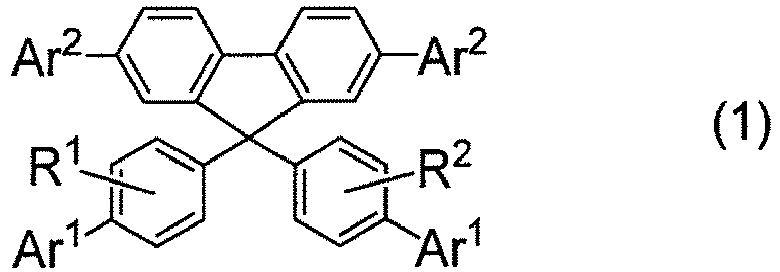 dans laquelle R1 et R2 représentent indépendamment un atome d'hydrogène, un groupe alkyle ou alcoxy linéaire, ramifié ou cyclique ayant 1 à 18 atomes de carbone et pouvant porter un substituant, un groupe phényle, naphtyle ou phénoxy pouvant porter un substituant, ou un atome d'halogène ;Ar1 représente indépendamment un groupe représenté par la formule (3) suivante :
 Ar2 représente indépendamment un groupe phényle, un groupe naphtyle, un groupe anthryle, un groupe phénanthryle, un groupe pyrényle, un groupe fluorényle, un groupe chrysényle, un groupe pérylényle, un groupe picényle, un groupe benzo[c]fluorényle, un groupe 4-quinolyle, un groupe 4-pyridyle, un groupe 3-pyridyle, un groupe 2-pyridyle, un groupe 2-dipyridyle, un groupe 3-furyle, un groupe 2-furyle, un groupe 3-thiényle, un groupe 2-thiényle, un groupe 2-oxazolyle, un groupe 2-thiazolyle, un groupe 2-benzoxazolyle, un groupe 2-benzothiazolyle, un groupe 2-benzimidazolyle, un groupe 1,10-phénanthrolinyle ou l'une quelconque des formules (4a), (4b), (5), (6a) et (6b) suivantes :


- Procédé pour préparer le composé π-conjugué tel que revendiqué dans la revendication 1, qui comprend les étapes consistant à :(i) laisser un composé intermédiaire fluorène représenté par la formule (7) suivante :

réagir avec un composé acide borique A représenté par la formule (8) suivante :

en présence d'un catalyseur de métal de transition ;(ii) débloquer le produit réactionnel ainsi obtenu en présence d'un catalyseur acide ;(iii)trifluorométhanesulfonyler le produit débloqué ; et ensuite(iv) laisser le produit trifluorométhanesulfonylé réagir avec un composé acide borique (B) représenté par la formule (9) ci-dessus,
où Ar1 représente indépendamment un groupe représenté par la formule (3) suivante :
en présence d'un catalyseur à base de métal de transition. - Elément électroluminescent organique caractérisé en ce qu'il a une couche d'émission de lumière, une couche de blocage de trous ou une couche de transport d'électrons, lesquelles couches comprennent le composé π-conjugué tel que revendiqué dans la revendication 1.
Applications Claiming Priority (1)
| Application Number | Priority Date | Filing Date | Title |
|---|---|---|---|
| JP2005038241 | 2005-02-15 |
Publications (2)
| Publication Number | Publication Date |
|---|---|
| EP1690847A1 EP1690847A1 (fr) | 2006-08-16 |
| EP1690847B1 true EP1690847B1 (fr) | 2016-06-22 |
Family
ID=36578334
Family Applications (1)
| Application Number | Title | Priority Date | Filing Date |
|---|---|---|---|
| EP06101717.4A Not-in-force EP1690847B1 (fr) | 2005-02-15 | 2006-02-15 | Composés pi-conjugués ayant une structure de type cardo, procédé pour leur preparation et leur utilisation |
Country Status (4)
| Country | Link |
|---|---|
| US (1) | US20060186797A1 (fr) |
| EP (1) | EP1690847B1 (fr) |
| KR (1) | KR101267854B1 (fr) |
| TW (1) | TWI382080B (fr) |
Families Citing this family (18)
| Publication number | Priority date | Publication date | Assignee | Title |
|---|---|---|---|---|
| WO2005068413A1 (fr) * | 2004-01-15 | 2005-07-28 | Tosoh Corporation | Compose amine comprenant un groupe fluorene en tant que structure, procede de production dudit compose amine, et utilisation de ce dernier |
| US7964293B2 (en) * | 2005-09-05 | 2011-06-21 | Jnc Corporation | Electron transport material and organic electroluminescent device using the same |
| JP5176366B2 (ja) * | 2006-03-30 | 2013-04-03 | Jnc株式会社 | 新規ビピリジン誘導体、およびこれを含む有機電界発光素子 |
| JP5262081B2 (ja) * | 2006-11-20 | 2013-08-14 | Jnc株式会社 | 電子輸送材料およびこれを用いた有機電界発光素子 |
| JP5058588B2 (ja) * | 2006-12-26 | 2012-10-24 | キヤノン株式会社 | アザフルオレン誘導体及びこれを用いた有機発光素子 |
| JP5176343B2 (ja) * | 2007-03-07 | 2013-04-03 | Jnc株式会社 | 電子輸送材料およびこれを用いた有機電界発光素子 |
| JP5262192B2 (ja) * | 2007-03-07 | 2013-08-14 | Jnc株式会社 | 電子輸送材料およびこれを用いた有機電界発光素子 |
| KR101058103B1 (ko) * | 2008-04-15 | 2011-08-24 | 삼성모바일디스플레이주식회사 | 바이피리딘계 화합물 및 이를 포함한 유기막을 구비한 유기발광 소자 |
| EP2431445B1 (fr) * | 2009-05-15 | 2016-11-23 | Cheil Industries Inc. | Composé pour dispositif photoélectrique organique et dispositif photoélectrique organique comprenant ce composé |
| DE102009053644B4 (de) | 2009-11-17 | 2019-07-04 | Merck Patent Gmbh | Materialien für organische Elektrolumineszenzvorrichtungen |
| CN101973933B (zh) * | 2010-10-22 | 2012-05-02 | 湘潭大学 | 一类二(吡啶苯基)芴衍生物及其双核环金属铂配合物液晶偏振发光材料 |
| JP5598489B2 (ja) * | 2011-03-28 | 2014-10-01 | 信越化学工業株式会社 | ビフェニル誘導体、レジスト下層膜材料、レジスト下層膜形成方法及びパターン形成方法 |
| CN107074784B (zh) | 2014-10-30 | 2020-09-22 | 株式会社Lg化学 | 环状化合物及包含其的有机发光元件 |
| CN105440024A (zh) * | 2016-01-04 | 2016-03-30 | 京东方科技集团股份有限公司 | 一种化合物及制备方法、有机电致发光器件 |
| KR102117738B1 (ko) * | 2016-05-10 | 2020-06-01 | 주식회사 엘지화학 | 신규한 화합물 및 이를 포함하는 유기 발광 소자 |
| CN116836186A (zh) * | 2023-06-30 | 2023-10-03 | 京东方科技集团股份有限公司 | 一种有机电子传输材料及有机电致发光器件 |
| KR20250016021A (ko) * | 2023-07-24 | 2025-02-03 | 주식회사 진웅산업 | 신규 화합물 및 이를 포함하는 유기 발광 소자 |
| KR20250016020A (ko) * | 2023-07-24 | 2025-02-03 | 주식회사 진웅산업 | 신규 화합물 및 이를 포함하는 유기 발광 소자 |
Family Cites Families (10)
| Publication number | Priority date | Publication date | Assignee | Title |
|---|---|---|---|---|
| EP0676461B1 (fr) * | 1994-04-07 | 2002-08-14 | Covion Organic Semiconductors GmbH | Composés spiro et leur application comme matières électroluminescentes |
| US6479172B2 (en) * | 2001-01-26 | 2002-11-12 | Xerox Corporation | Electroluminescent (EL) devices |
| JP4080213B2 (ja) * | 2002-02-01 | 2008-04-23 | 三井化学株式会社 | 有機電界発光素子 |
| JP4338367B2 (ja) * | 2002-07-11 | 2009-10-07 | 三井化学株式会社 | 化合物、有機電界発光素子用材料および有機電界発光素子 |
| JP3848224B2 (ja) * | 2002-08-27 | 2006-11-22 | キヤノン株式会社 | スピロ化合物及びそれを用いた有機発光素子 |
| JP3902993B2 (ja) * | 2002-08-27 | 2007-04-11 | キヤノン株式会社 | フルオレン化合物及びそれを用いた有機発光素子 |
| JP4506113B2 (ja) * | 2002-09-20 | 2010-07-21 | 東ソー株式会社 | フルオレン骨格を有する新規アリールアミン誘導体、その合成中間体及びこれらの製造方法並びに有機el素子 |
| JP4261948B2 (ja) * | 2003-03-18 | 2009-05-13 | 三井化学株式会社 | フルオレン化合物、および該フルオレン化合物を含有する有機電界発光素子 |
| EP2592905B1 (fr) * | 2003-07-31 | 2014-11-12 | Mitsubishi Chemical Corporation | Composé, matériau de transport de charge et élément électroluminescent organique |
| WO2005068413A1 (fr) * | 2004-01-15 | 2005-07-28 | Tosoh Corporation | Compose amine comprenant un groupe fluorene en tant que structure, procede de production dudit compose amine, et utilisation de ce dernier |
-
2006
- 2006-02-14 US US11/353,175 patent/US20060186797A1/en not_active Abandoned
- 2006-02-14 TW TW095104879A patent/TWI382080B/zh not_active IP Right Cessation
- 2006-02-15 EP EP06101717.4A patent/EP1690847B1/fr not_active Not-in-force
- 2006-02-15 KR KR1020060014714A patent/KR101267854B1/ko not_active Expired - Fee Related
Non-Patent Citations (1)
| Title |
|---|
| "RÖMPP CHEMIE LEXICON", 1989, J. FALBE, M. REGITZ, pages: 154 - 154 * |
Also Published As
| Publication number | Publication date |
|---|---|
| TWI382080B (zh) | 2013-01-11 |
| KR101267854B1 (ko) | 2013-05-27 |
| US20060186797A1 (en) | 2006-08-24 |
| KR20060092121A (ko) | 2006-08-22 |
| TW200643139A (en) | 2006-12-16 |
| EP1690847A1 (fr) | 2006-08-16 |
Similar Documents
| Publication | Publication Date | Title |
|---|---|---|
| EP1690847B1 (fr) | Composés pi-conjugués ayant une structure de type cardo, procédé pour leur preparation et leur utilisation | |
| EP2873667B1 (fr) | Composé hétérocyclique et élément électronique organique comprenant ce composé | |
| US7345301B2 (en) | Mixtures of matrix materials and organic semiconductors capable of emission, use of the same and electronic components containing said mixtures | |
| KR101473019B1 (ko) | 신규한 화합물 및 이를 이용한 유기 전자 소자 | |
| US20090200926A1 (en) | Novel organic electroluminescent compounds and organic electroluminescent device using the same | |
| EP3342774B1 (fr) | Composé hétérocyclique et élément électroluminescent organique le comprenant | |
| EP3378864B1 (fr) | Composé spiro et élément électroluminescent organique comprenant ledit composé | |
| KR101515814B1 (ko) | 융합된 고리 치환기를 갖는 방향족 화합물 및 이를 포함하는 유기 발광 소자 | |
| AU2003247965A1 (en) | Charge transport compositions which are quinazoline derivatives and electronic devices made with such compositions | |
| CN101508649A (zh) | 新的有机电致发光化合物和使用它的有机电致发光设备 | |
| US8357821B2 (en) | Aromatic amine compound, organic electroluminescent element including the same, and display device including organic electroluminescent element | |
| KR20100119077A (ko) | 신규한 화합물 및 이를 이용한 유기 전자 소자 | |
| KR102657636B1 (ko) | 안트라센계 화합물, 이를 포함하는 코팅조성물 및 유기 발광 소자 | |
| EP1824942A1 (fr) | Dérivés d'imidazole et dispositif électronique organique les utilisant | |
| CN111233867A (zh) | 一种以咔唑衍生物为核心的有机化合物及其在有机电致发光器件上的应用 | |
| EP3263555B1 (fr) | Composé hétérocyclique et élément luminescent organique comprenant celui-ci | |
| JP5011743B2 (ja) | カルド構造を有するπ共役化合物並びにその製造方法及び用途 | |
| CN115433120B (zh) | 含七元环的螺芴衍生物、电子传输材料及有机电致发光元件 | |
| JP4721475B2 (ja) | ジインデノピセン化合物及びこれを使用した有機発光素子 | |
| JP7604755B2 (ja) | 化合物およびこれを含む有機発光素子 | |
| KR102832006B1 (ko) | 화합물 및 이를 포함하는 유기 발광 소자 | |
| KR20140015226A (ko) | 신규한 화합물 및 이를 이용한 유기 전자 소자 | |
| CN115160241A (zh) | 一种三嗪类电子传输材料及其制备方法与应用、包含其的有机电致发光器件 | |
| CN113429397A (zh) | 化合物、显示面板及显示装置 | |
| EP4431506A1 (fr) | Composé et dispositif électroluminescent organique le comprenant |
Legal Events
| Date | Code | Title | Description |
|---|---|---|---|
| PUAI | Public reference made under article 153(3) epc to a published international application that has entered the european phase |
Free format text: ORIGINAL CODE: 0009012 |
|
| AK | Designated contracting states |
Kind code of ref document: A1 Designated state(s): AT BE BG CH CY CZ DE DK EE ES FI FR GB GR HU IE IS IT LI LT LU LV MC NL PL PT RO SE SI SK TR |
|
| AX | Request for extension of the european patent |
Extension state: AL BA HR MK YU |
|
| 17P | Request for examination filed |
Effective date: 20061121 |
|
| AKX | Designation fees paid |
Designated state(s): DE GB NL |
|
| 17Q | First examination report despatched |
Effective date: 20090311 |
|
| GRAP | Despatch of communication of intention to grant a patent |
Free format text: ORIGINAL CODE: EPIDOSNIGR1 |
|
| INTG | Intention to grant announced |
Effective date: 20160112 |
|
| RAP1 | Party data changed (applicant data changed or rights of an application transferred) |
Owner name: TOSOH CORPORATION |
|
| GRAS | Grant fee paid |
Free format text: ORIGINAL CODE: EPIDOSNIGR3 |
|
| GRAA | (expected) grant |
Free format text: ORIGINAL CODE: 0009210 |
|
| AK | Designated contracting states |
Kind code of ref document: B1 Designated state(s): DE GB NL |
|
| REG | Reference to a national code |
Ref country code: GB Ref legal event code: FG4D |
|
| REG | Reference to a national code |
Ref country code: DE Ref legal event code: R096 Ref document number: 602006049373 Country of ref document: DE |
|
| REG | Reference to a national code |
Ref country code: NL Ref legal event code: MP Effective date: 20160622 |
|
| PG25 | Lapsed in a contracting state [announced via postgrant information from national office to epo] |
Ref country code: NL Free format text: LAPSE BECAUSE OF FAILURE TO SUBMIT A TRANSLATION OF THE DESCRIPTION OR TO PAY THE FEE WITHIN THE PRESCRIBED TIME-LIMIT Effective date: 20160622 |
|
| REG | Reference to a national code |
Ref country code: DE Ref legal event code: R097 Ref document number: 602006049373 Country of ref document: DE |
|
| PLBE | No opposition filed within time limit |
Free format text: ORIGINAL CODE: 0009261 |
|
| STAA | Information on the status of an ep patent application or granted ep patent |
Free format text: STATUS: NO OPPOSITION FILED WITHIN TIME LIMIT |
|
| 26N | No opposition filed |
Effective date: 20170323 |
|
| GBPC | Gb: european patent ceased through non-payment of renewal fee |
Effective date: 20170215 |
|
| PG25 | Lapsed in a contracting state [announced via postgrant information from national office to epo] |
Ref country code: GB Free format text: LAPSE BECAUSE OF NON-PAYMENT OF DUE FEES Effective date: 20170215 |
|
| PGFP | Annual fee paid to national office [announced via postgrant information from national office to epo] |
Ref country code: DE Payment date: 20221229 Year of fee payment: 18 |
|
| P01 | Opt-out of the competence of the unified patent court (upc) registered |
Effective date: 20230523 |
|
| REG | Reference to a national code |
Ref country code: DE Ref legal event code: R119 Ref document number: 602006049373 Country of ref document: DE |
|
| PG25 | Lapsed in a contracting state [announced via postgrant information from national office to epo] |
Ref country code: DE Free format text: LAPSE BECAUSE OF NON-PAYMENT OF DUE FEES Effective date: 20240903 |
|
| PG25 | Lapsed in a contracting state [announced via postgrant information from national office to epo] |
Ref country code: DE Free format text: LAPSE BECAUSE OF NON-PAYMENT OF DUE FEES Effective date: 20240903 |