EP1370521B1 - Formanilide derivatives as beta2-adrenoreceptor agonists - Google Patents
Formanilide derivatives as beta2-adrenoreceptor agonists Download PDFInfo
- Publication number
- EP1370521B1 EP1370521B1 EP02730035A EP02730035A EP1370521B1 EP 1370521 B1 EP1370521 B1 EP 1370521B1 EP 02730035 A EP02730035 A EP 02730035A EP 02730035 A EP02730035 A EP 02730035A EP 1370521 B1 EP1370521 B1 EP 1370521B1
- Authority
- EP
- European Patent Office
- Prior art keywords
- formula
- compound
- solvate
- butyl
- salt
- Prior art date
- Legal status (The legal status is an assumption and is not a legal conclusion. Google has not performed a legal analysis and makes no representation as to the accuracy of the status listed.)
- Expired - Lifetime
Links
- 239000000556 agonist Substances 0.000 title description 8
- 102100039705 Beta-2 adrenergic receptor Human genes 0.000 title 1
- 101710152983 Beta-2 adrenergic receptor Proteins 0.000 title 1
- DYDNPESBYVVLBO-UHFFFAOYSA-N formanilide Chemical class O=CNC1=CC=CC=C1 DYDNPESBYVVLBO-UHFFFAOYSA-N 0.000 title 1
- 150000001875 compounds Chemical class 0.000 claims abstract description 138
- 238000000034 method Methods 0.000 claims abstract description 23
- 238000011282 treatment Methods 0.000 claims abstract description 16
- 238000011321 prophylaxis Methods 0.000 claims abstract description 12
- 239000008194 pharmaceutical composition Substances 0.000 claims abstract description 8
- 230000008569 process Effects 0.000 claims abstract description 6
- 150000003839 salts Chemical class 0.000 claims description 58
- 239000012453 solvate Substances 0.000 claims description 46
- 239000000203 mixture Substances 0.000 claims description 38
- -1 C(O)NR8R9 Chemical group 0.000 claims description 23
- 229940123932 Phosphodiesterase 4 inhibitor Drugs 0.000 claims description 20
- 239000002587 phosphodiesterase IV inhibitor Substances 0.000 claims description 20
- 229910052739 hydrogen Inorganic materials 0.000 claims description 19
- 239000001257 hydrogen Substances 0.000 claims description 18
- 125000006239 protecting group Chemical group 0.000 claims description 14
- 125000004435 hydrogen atom Chemical group [H]* 0.000 claims description 12
- 125000004169 (C1-C6) alkyl group Chemical group 0.000 claims description 11
- 239000003814 drug Substances 0.000 claims description 11
- 239000004615 ingredient Substances 0.000 claims description 10
- 125000001997 phenyl group Chemical group [H]C1=C([H])C([H])=C(*)C([H])=C1[H] 0.000 claims description 10
- 238000006243 chemical reaction Methods 0.000 claims description 9
- 239000003246 corticosteroid Substances 0.000 claims description 8
- IJGRMHOSHXDMSA-UHFFFAOYSA-N nitrogen Substances N#N IJGRMHOSHXDMSA-UHFFFAOYSA-N 0.000 claims description 8
- 239000000546 pharmaceutical excipient Substances 0.000 claims description 8
- 230000001225 therapeutic effect Effects 0.000 claims description 8
- 229940124225 Adrenoreceptor agonist Drugs 0.000 claims description 7
- KHBQMWCZKVMBLN-UHFFFAOYSA-N Benzenesulfonamide Chemical compound NS(=O)(=O)C1=CC=CC=C1 KHBQMWCZKVMBLN-UHFFFAOYSA-N 0.000 claims description 7
- 208000006545 Chronic Obstructive Pulmonary Disease Diseases 0.000 claims description 7
- 208000006673 asthma Diseases 0.000 claims description 7
- 125000004051 hexyl group Chemical group [H]C([H])([H])C([H])([H])C([H])([H])C([H])([H])C([H])([H])C([H])([H])* 0.000 claims description 7
- 229910052757 nitrogen Inorganic materials 0.000 claims description 7
- QJGQUHMNIGDVPM-UHFFFAOYSA-N nitrogen group Chemical group [N] QJGQUHMNIGDVPM-UHFFFAOYSA-N 0.000 claims description 7
- 125000004191 (C1-C6) alkoxy group Chemical group 0.000 claims description 6
- HBAQYPYDRFILMT-UHFFFAOYSA-N 8-[3-(1-cyclopropylpyrazol-4-yl)-1H-pyrazolo[4,3-d]pyrimidin-5-yl]-3-methyl-3,8-diazabicyclo[3.2.1]octan-2-one Chemical class C1(CC1)N1N=CC(=C1)C1=NNC2=C1N=C(N=C2)N1C2C(N(CC1CC2)C)=O HBAQYPYDRFILMT-UHFFFAOYSA-N 0.000 claims description 6
- UFHFLCQGNIYNRP-UHFFFAOYSA-N Hydrogen Chemical compound [H][H] UFHFLCQGNIYNRP-UHFFFAOYSA-N 0.000 claims description 6
- 206010057190 Respiratory tract infections Diseases 0.000 claims description 5
- 208000011479 upper respiratory tract disease Diseases 0.000 claims description 5
- 125000000171 (C1-C6) haloalkyl group Chemical group 0.000 claims description 4
- 230000001078 anti-cholinergic effect Effects 0.000 claims description 4
- 125000004432 carbon atom Chemical group C* 0.000 claims description 4
- 238000010511 deprotection reaction Methods 0.000 claims description 4
- 238000004519 manufacturing process Methods 0.000 claims description 4
- 230000009467 reduction Effects 0.000 claims description 4
- 238000002360 preparation method Methods 0.000 claims description 3
- 238000000926 separation method Methods 0.000 claims description 3
- 125000004178 (C1-C4) alkyl group Chemical group 0.000 claims description 2
- 125000006590 (C2-C6) alkenylene group Chemical group 0.000 claims description 2
- 125000005913 (C3-C6) cycloalkyl group Chemical group 0.000 claims description 2
- 125000006272 (C3-C7) cycloalkyl group Chemical group 0.000 claims description 2
- 239000003937 drug carrier Substances 0.000 claims description 2
- 238000013160 medical therapy Methods 0.000 claims description 2
- MTLUJYLGPUXELO-VWLOTQADSA-N n-[2-hydroxy-5-[(1r)-1-hydroxy-2-[6-[4-(3-sulfamoylphenyl)butoxy]hexylamino]ethyl]phenyl]formamide Chemical compound NS(=O)(=O)C1=CC=CC(CCCCOCCCCCCNC[C@H](O)C=2C=C(NC=O)C(O)=CC=2)=C1 MTLUJYLGPUXELO-VWLOTQADSA-N 0.000 claims description 2
- MTLUJYLGPUXELO-RUZDIDTESA-N n-[2-hydroxy-5-[(1s)-1-hydroxy-2-[6-[4-(3-sulfamoylphenyl)butoxy]hexylamino]ethyl]phenyl]formamide Chemical compound NS(=O)(=O)C1=CC=CC(CCCCOCCCCCCNC[C@@H](O)C=2C=C(NC=O)C(O)=CC=2)=C1 MTLUJYLGPUXELO-RUZDIDTESA-N 0.000 claims description 2
- 125000001475 halogen functional group Chemical group 0.000 claims 2
- 208000023504 respiratory system disease Diseases 0.000 abstract description 2
- 238000002560 therapeutic procedure Methods 0.000 abstract 1
- 238000009472 formulation Methods 0.000 description 19
- 102000011017 Type 4 Cyclic Nucleotide Phosphodiesterases Human genes 0.000 description 15
- 108010037584 Type 4 Cyclic Nucleotide Phosphodiesterases Proteins 0.000 description 15
- MSYGAHOHLUJIKV-UHFFFAOYSA-N 3,5-dimethyl-1-(3-nitrophenyl)-1h-pyrazole-4-carboxylic acid ethyl ester Chemical compound CC1=C(C(=O)OCC)C(C)=NN1C1=CC=CC([N+]([O-])=O)=C1 MSYGAHOHLUJIKV-UHFFFAOYSA-N 0.000 description 14
- ZMXDDKWLCZADIW-UHFFFAOYSA-N N,N-Dimethylformamide Chemical compound CN(C)C=O ZMXDDKWLCZADIW-UHFFFAOYSA-N 0.000 description 14
- HJORMJIFDVBMOB-UHFFFAOYSA-N rolipram Chemical compound COC1=CC=C(C2CC(=O)NC2)C=C1OC1CCCC1 HJORMJIFDVBMOB-UHFFFAOYSA-N 0.000 description 14
- 239000004480 active ingredient Substances 0.000 description 13
- 208000037265 diseases, disorders, signs and symptoms Diseases 0.000 description 13
- YMWUJEATGCHHMB-UHFFFAOYSA-N Dichloromethane Chemical compound ClCCl YMWUJEATGCHHMB-UHFFFAOYSA-N 0.000 description 12
- XEKOWRVHYACXOJ-UHFFFAOYSA-N Ethyl acetate Chemical compound CCOC(C)=O XEKOWRVHYACXOJ-UHFFFAOYSA-N 0.000 description 12
- 229950005741 rolipram Drugs 0.000 description 11
- LFQSCWFLJHTTHZ-UHFFFAOYSA-N Ethanol Chemical compound CCO LFQSCWFLJHTTHZ-UHFFFAOYSA-N 0.000 description 10
- 239000002585 base Substances 0.000 description 10
- 230000000694 effects Effects 0.000 description 10
- 239000003112 inhibitor Substances 0.000 description 10
- 239000000243 solution Substances 0.000 description 10
- WEVYAHXRMPXWCK-UHFFFAOYSA-N Acetonitrile Chemical compound CC#N WEVYAHXRMPXWCK-UHFFFAOYSA-N 0.000 description 9
- RTZKZFJDLAIYFH-UHFFFAOYSA-N Diethyl ether Chemical compound CCOCC RTZKZFJDLAIYFH-UHFFFAOYSA-N 0.000 description 9
- HEMHJVSKTPXQMS-UHFFFAOYSA-M Sodium hydroxide Chemical compound [OH-].[Na+] HEMHJVSKTPXQMS-UHFFFAOYSA-M 0.000 description 9
- ZMANZCXQSJIPKH-UHFFFAOYSA-N Triethylamine Chemical compound CCN(CC)CC ZMANZCXQSJIPKH-UHFFFAOYSA-N 0.000 description 9
- 239000005557 antagonist Substances 0.000 description 9
- 238000004895 liquid chromatography mass spectrometry Methods 0.000 description 9
- GUBGYTABKSRVRQ-QKKXKWKRSA-N Lactose Natural products OC[C@H]1O[C@@H](O[C@H]2[C@H](O)[C@@H](O)C(O)O[C@@H]2CO)[C@H](O)[C@@H](O)[C@H]1O GUBGYTABKSRVRQ-QKKXKWKRSA-N 0.000 description 8
- 102000004861 Phosphoric Diester Hydrolases Human genes 0.000 description 8
- 108090001050 Phosphoric Diester Hydrolases Proteins 0.000 description 8
- VYPSYNLAJGMNEJ-UHFFFAOYSA-N Silicium dioxide Chemical compound O=[Si]=O VYPSYNLAJGMNEJ-UHFFFAOYSA-N 0.000 description 8
- 239000002253 acid Substances 0.000 description 8
- 230000003197 catalytic effect Effects 0.000 description 8
- 239000007788 liquid Substances 0.000 description 8
- 239000002245 particle Substances 0.000 description 8
- 230000001175 peptic effect Effects 0.000 description 8
- 208000017520 skin disease Diseases 0.000 description 8
- 239000000739 antihistaminic agent Substances 0.000 description 7
- 150000002148 esters Chemical class 0.000 description 7
- 239000008101 lactose Substances 0.000 description 7
- 239000002904 solvent Substances 0.000 description 7
- XLYOFNOQVPJJNP-UHFFFAOYSA-N water Substances O XLYOFNOQVPJJNP-UHFFFAOYSA-N 0.000 description 7
- HJORMJIFDVBMOB-LBPRGKRZSA-N (-)-rolipram Chemical compound COC1=CC=C([C@H]2CC(=O)NC2)C=C1OC1CCCC1 HJORMJIFDVBMOB-LBPRGKRZSA-N 0.000 description 6
- IVOMOUWHDPKRLL-KQYNXXCUSA-N Cyclic adenosine monophosphate Chemical compound C([C@H]1O2)OP(O)(=O)O[C@H]1[C@@H](O)[C@@H]2N1C(N=CN=C2N)=C2N=C1 IVOMOUWHDPKRLL-KQYNXXCUSA-N 0.000 description 6
- TWRXJAOTZQYOKJ-UHFFFAOYSA-L Magnesium chloride Chemical compound [Mg+2].[Cl-].[Cl-] TWRXJAOTZQYOKJ-UHFFFAOYSA-L 0.000 description 6
- OKKJLVBELUTLKV-UHFFFAOYSA-N Methanol Chemical compound OC OKKJLVBELUTLKV-UHFFFAOYSA-N 0.000 description 6
- 238000003556 assay Methods 0.000 description 6
- 230000008878 coupling Effects 0.000 description 6
- 238000010168 coupling process Methods 0.000 description 6
- 238000005859 coupling reaction Methods 0.000 description 6
- 239000000843 powder Substances 0.000 description 6
- 230000009471 action Effects 0.000 description 5
- 229940125715 antihistaminic agent Drugs 0.000 description 5
- 238000004587 chromatography analysis Methods 0.000 description 5
- 201000010099 disease Diseases 0.000 description 5
- 125000005843 halogen group Chemical group 0.000 description 5
- 238000000159 protein binding assay Methods 0.000 description 5
- 239000003826 tablet Substances 0.000 description 5
- CPELXLSAUQHCOX-UHFFFAOYSA-M Bromide Chemical compound [Br-] CPELXLSAUQHCOX-UHFFFAOYSA-M 0.000 description 4
- 206010007559 Cardiac failure congestive Diseases 0.000 description 4
- 101100135868 Dictyostelium discoideum pde3 gene Proteins 0.000 description 4
- VZCYOOQTPOCHFL-OWOJBTEDSA-N Fumaric acid Chemical class OC(=O)\C=C\C(O)=O VZCYOOQTPOCHFL-OWOJBTEDSA-N 0.000 description 4
- 206010019280 Heart failures Diseases 0.000 description 4
- VEXZGXHMUGYJMC-UHFFFAOYSA-N Hydrochloric acid Chemical compound Cl VEXZGXHMUGYJMC-UHFFFAOYSA-N 0.000 description 4
- RKUNBYITZUJHSG-UHFFFAOYSA-N Hyosciamin-hydrochlorid Natural products CN1C(C2)CCC1CC2OC(=O)C(CO)C1=CC=CC=C1 RKUNBYITZUJHSG-UHFFFAOYSA-N 0.000 description 4
- 206010028289 Muscle atrophy Diseases 0.000 description 4
- KDLHZDBZIXYQEI-UHFFFAOYSA-N Palladium Chemical compound [Pd] KDLHZDBZIXYQEI-UHFFFAOYSA-N 0.000 description 4
- 229940123263 Phosphodiesterase 3 inhibitor Drugs 0.000 description 4
- 206010036600 Premature labour Diseases 0.000 description 4
- 206010062109 Reversible airways obstruction Diseases 0.000 description 4
- 208000025865 Ulcer Diseases 0.000 description 4
- 239000000443 aerosol Substances 0.000 description 4
- 230000000172 allergic effect Effects 0.000 description 4
- 208000010668 atopic eczema Diseases 0.000 description 4
- 230000015572 biosynthetic process Effects 0.000 description 4
- 239000003054 catalyst Substances 0.000 description 4
- 210000004027 cell Anatomy 0.000 description 4
- 239000000812 cholinergic antagonist Substances 0.000 description 4
- 208000035475 disorder Diseases 0.000 description 4
- 230000002496 gastric effect Effects 0.000 description 4
- 230000002757 inflammatory effect Effects 0.000 description 4
- 201000000585 muscular atrophy Diseases 0.000 description 4
- 239000003208 petroleum Substances 0.000 description 4
- 239000002570 phosphodiesterase III inhibitor Substances 0.000 description 4
- 239000000047 product Substances 0.000 description 4
- 230000002062 proliferating effect Effects 0.000 description 4
- 230000001185 psoriatic effect Effects 0.000 description 4
- 239000000741 silica gel Substances 0.000 description 4
- 229910002027 silica gel Inorganic materials 0.000 description 4
- 239000000725 suspension Substances 0.000 description 4
- 238000003786 synthesis reaction Methods 0.000 description 4
- 230000036269 ulceration Effects 0.000 description 4
- QKNYBSVHEMOAJP-UHFFFAOYSA-N 2-amino-2-(hydroxymethyl)propane-1,3-diol;hydron;chloride Chemical compound Cl.OCC(N)(CO)CO QKNYBSVHEMOAJP-UHFFFAOYSA-N 0.000 description 3
- 101000959437 Homo sapiens Beta-2 adrenergic receptor Proteins 0.000 description 3
- CPELXLSAUQHCOX-UHFFFAOYSA-N Hydrogen bromide Chemical class Br CPELXLSAUQHCOX-UHFFFAOYSA-N 0.000 description 3
- 229940121948 Muscarinic receptor antagonist Drugs 0.000 description 3
- GIIZNNXWQWCKIB-UHFFFAOYSA-N Serevent Chemical compound C1=C(O)C(CO)=CC(C(O)CNCCCCCCOCCCCC=2C=CC=CC=2)=C1 GIIZNNXWQWCKIB-UHFFFAOYSA-N 0.000 description 3
- GUGOEEXESWIERI-UHFFFAOYSA-N Terfenadine Chemical compound C1=CC(C(C)(C)C)=CC=C1C(O)CCCN1CCC(C(O)(C=2C=CC=CC=2)C=2C=CC=CC=2)CC1 GUGOEEXESWIERI-UHFFFAOYSA-N 0.000 description 3
- WYURNTSHIVDZCO-UHFFFAOYSA-N Tetrahydrofuran Chemical compound C1CCOC1 WYURNTSHIVDZCO-UHFFFAOYSA-N 0.000 description 3
- 150000003973 alkyl amines Chemical class 0.000 description 3
- 230000001387 anti-histamine Effects 0.000 description 3
- 229940121363 anti-inflammatory agent Drugs 0.000 description 3
- 239000002260 anti-inflammatory agent Substances 0.000 description 3
- 239000004599 antimicrobial Substances 0.000 description 3
- GZUXJHMPEANEGY-UHFFFAOYSA-N bromomethane Chemical class BrC GZUXJHMPEANEGY-UHFFFAOYSA-N 0.000 description 3
- 239000000872 buffer Substances 0.000 description 3
- 239000002775 capsule Substances 0.000 description 3
- 239000000969 carrier Substances 0.000 description 3
- 239000003795 chemical substances by application Substances 0.000 description 3
- 229960001334 corticosteroids Drugs 0.000 description 3
- IJKVHSBPTUYDLN-UHFFFAOYSA-N dihydroxy(oxo)silane Chemical compound O[Si](O)=O IJKVHSBPTUYDLN-UHFFFAOYSA-N 0.000 description 3
- BPZSYCZIITTYBL-UHFFFAOYSA-N formoterol Chemical compound C1=CC(OC)=CC=C1CC(C)NCC(O)C1=CC=C(O)C(NC=O)=C1 BPZSYCZIITTYBL-UHFFFAOYSA-N 0.000 description 3
- 239000008187 granular material Substances 0.000 description 3
- 238000010438 heat treatment Methods 0.000 description 3
- NSILVESQCSUIAJ-UHFFFAOYSA-M hexocyclium methyl sulfate Chemical compound COS([O-])(=O)=O.C1C[N+](C)(C)CCN1CC(O)(C=1C=CC=CC=1)C1CCCCC1 NSILVESQCSUIAJ-UHFFFAOYSA-M 0.000 description 3
- 125000002887 hydroxy group Chemical group [H]O* 0.000 description 3
- 239000000543 intermediate Substances 0.000 description 3
- 229910001629 magnesium chloride Inorganic materials 0.000 description 3
- 239000000041 non-steroidal anti-inflammatory agent Substances 0.000 description 3
- 229940021182 non-steroidal anti-inflammatory drug Drugs 0.000 description 3
- NXJCBFBQEVOTOW-UHFFFAOYSA-L palladium(2+);dihydroxide Chemical compound O[Pd]O NXJCBFBQEVOTOW-UHFFFAOYSA-L 0.000 description 3
- ULSIYEODSMZIPX-UHFFFAOYSA-N phenylethanolamine Chemical class NCC(O)C1=CC=CC=C1 ULSIYEODSMZIPX-UHFFFAOYSA-N 0.000 description 3
- 239000000049 pigment Substances 0.000 description 3
- 230000036515 potency Effects 0.000 description 3
- 229940002612 prodrug Drugs 0.000 description 3
- 239000000651 prodrug Substances 0.000 description 3
- 239000003380 propellant Substances 0.000 description 3
- 229940124597 therapeutic agent Drugs 0.000 description 3
- 230000000699 topical effect Effects 0.000 description 3
- XTNYQMSCYWBFJX-KRWDZBQOSA-N (4r)-1-[(4-bromophenyl)methyl]-4-(2-cyclopentyloxy-4-methoxyphenyl)pyrrolidin-2-one Chemical compound C([C@H](CC1=O)C2=CC=C(C=C2OC2CCCC2)OC)N1CC1=CC=C(Br)C=C1 XTNYQMSCYWBFJX-KRWDZBQOSA-N 0.000 description 2
- RKUNBYITZUJHSG-FXUDXRNXSA-N (S)-atropine Chemical compound C1([C@@H](CO)C(=O)O[C@H]2C[C@H]3CC[C@@H](C2)N3C)=CC=CC=C1 RKUNBYITZUJHSG-FXUDXRNXSA-N 0.000 description 2
- AIQSQNBXZYYDNO-RHWBLDFMSA-N (e)-but-2-enedioic acid;n-[2-hydroxy-5-[(1r)-1-hydroxy-2-[6-[4-(3-sulfamoylphenyl)butoxy]hexylamino]ethyl]phenyl]formamide Chemical compound OC(=O)\C=C\C(O)=O.NS(=O)(=O)C1=CC=CC(CCCCOCCCCCCNC[C@H](O)C=2C=C(NC=O)C(O)=CC=2)=C1 AIQSQNBXZYYDNO-RHWBLDFMSA-N 0.000 description 2
- KZIWFMXWSZGCQH-UHFFFAOYSA-N 1-bromo-6-but-3-ynoxyhexane Chemical compound BrCCCCCCOCCC#C KZIWFMXWSZGCQH-UHFFFAOYSA-N 0.000 description 2
- ZOOGRGPOEVQQDX-UUOKFMHZSA-N 3',5'-cyclic GMP Chemical compound C([C@H]1O2)OP(O)(=O)O[C@H]1[C@@H](O)[C@@H]2N1C(N=C(NC2=O)N)=C2N=C1 ZOOGRGPOEVQQDX-UUOKFMHZSA-N 0.000 description 2
- CVDXFPBVOIERBH-JWQCQUIFSA-N 4-[(4ar,10bs)-9-ethoxy-8-methoxy-2-methyl-3,4,4a,10b-tetrahydro-1h-benzo[c][1,6]naphthyridin-6-yl]-n,n-di(propan-2-yl)benzamide Chemical compound N([C@@H]1CCN(C)C[C@@H]1C=1C=C(C(=CC=11)OC)OCC)=C1C1=CC=C(C(=O)N(C(C)C)C(C)C)C=C1 CVDXFPBVOIERBH-JWQCQUIFSA-N 0.000 description 2
- 229930000680 A04AD01 - Scopolamine Natural products 0.000 description 2
- 241000220479 Acacia Species 0.000 description 2
- QGZKDVFQNNGYKY-UHFFFAOYSA-N Ammonia Chemical compound N QGZKDVFQNNGYKY-UHFFFAOYSA-N 0.000 description 2
- 229930003347 Atropine Natural products 0.000 description 2
- CURLTUGMZLYLDI-UHFFFAOYSA-N Carbon dioxide Chemical compound O=C=O CURLTUGMZLYLDI-UHFFFAOYSA-N 0.000 description 2
- HEDRZPFGACZZDS-UHFFFAOYSA-N Chloroform Chemical compound ClC(Cl)Cl HEDRZPFGACZZDS-UHFFFAOYSA-N 0.000 description 2
- 229910021595 Copper(I) iodide Inorganic materials 0.000 description 2
- XDTMQSROBMDMFD-UHFFFAOYSA-N Cyclohexane Chemical compound C1CCCCC1 XDTMQSROBMDMFD-UHFFFAOYSA-N 0.000 description 2
- 102000004127 Cytokines Human genes 0.000 description 2
- 108090000695 Cytokines Proteins 0.000 description 2
- 102000004190 Enzymes Human genes 0.000 description 2
- 108090000790 Enzymes Proteins 0.000 description 2
- BDAGIHXWWSANSR-UHFFFAOYSA-N Formic acid Chemical compound OC=O BDAGIHXWWSANSR-UHFFFAOYSA-N 0.000 description 2
- PEDCQBHIVMGVHV-UHFFFAOYSA-N Glycerine Chemical compound OCC(O)CO PEDCQBHIVMGVHV-UHFFFAOYSA-N 0.000 description 2
- VPNYRYCIDCJBOM-UHFFFAOYSA-M Glycopyrronium bromide Chemical compound [Br-].C1[N+](C)(C)CCC1OC(=O)C(O)(C=1C=CC=CC=1)C1CCCC1 VPNYRYCIDCJBOM-UHFFFAOYSA-M 0.000 description 2
- NTYJJOPFIAHURM-UHFFFAOYSA-N Histamine Chemical compound NCCC1=CN=CN1 NTYJJOPFIAHURM-UHFFFAOYSA-N 0.000 description 2
- ZTVIKZXZYLEVOL-MCOXGKPRSA-N Homatropine Chemical compound O([C@H]1C[C@H]2CC[C@@H](C1)N2C)C(=O)C(O)C1=CC=CC=C1 ZTVIKZXZYLEVOL-MCOXGKPRSA-N 0.000 description 2
- STECJAGHUSJQJN-GAUPFVANSA-N Hyoscine Natural products C1([C@H](CO)C(=O)OC2C[C@@H]3N([C@H](C2)[C@@H]2[C@H]3O2)C)=CC=CC=C1 STECJAGHUSJQJN-GAUPFVANSA-N 0.000 description 2
- 235000010643 Leucaena leucocephala Nutrition 0.000 description 2
- CSNNHWWHGAXBCP-UHFFFAOYSA-L Magnesium sulfate Chemical compound [Mg+2].[O-][S+2]([O-])([O-])[O-] CSNNHWWHGAXBCP-UHFFFAOYSA-L 0.000 description 2
- 241000124008 Mammalia Species 0.000 description 2
- GZHFODJQISUKAY-UHFFFAOYSA-N Methantheline Chemical compound C1=CC=C2C(C(=O)OCC[N+](C)(CC)CC)C3=CC=CC=C3OC2=C1 GZHFODJQISUKAY-UHFFFAOYSA-N 0.000 description 2
- LRHPLDYGYMQRHN-UHFFFAOYSA-N N-Butanol Chemical compound CCCCO LRHPLDYGYMQRHN-UHFFFAOYSA-N 0.000 description 2
- STECJAGHUSJQJN-UHFFFAOYSA-N N-Methyl-scopolamin Natural products C1C(C2C3O2)N(C)C3CC1OC(=O)C(CO)C1=CC=CC=C1 STECJAGHUSJQJN-UHFFFAOYSA-N 0.000 description 2
- GLUUGHFHXGJENI-UHFFFAOYSA-N Piperazine Chemical compound C1CNCCN1 GLUUGHFHXGJENI-UHFFFAOYSA-N 0.000 description 2
- NQRYJNQNLNOLGT-UHFFFAOYSA-N Piperidine Chemical compound C1CCNCC1 NQRYJNQNLNOLGT-UHFFFAOYSA-N 0.000 description 2
- 229910006074 SO2NH2 Inorganic materials 0.000 description 2
- UIIMBOGNXHQVGW-UHFFFAOYSA-M Sodium bicarbonate Chemical compound [Na+].OC([O-])=O UIIMBOGNXHQVGW-UHFFFAOYSA-M 0.000 description 2
- 229930006000 Sucrose Natural products 0.000 description 2
- CZMRCDWAGMRECN-UGDNZRGBSA-N Sucrose Chemical compound O[C@H]1[C@H](O)[C@@H](CO)O[C@@]1(CO)O[C@@H]1[C@H](O)[C@@H](O)[C@H](O)[C@@H](CO)O1 CZMRCDWAGMRECN-UGDNZRGBSA-N 0.000 description 2
- QAOWNCQODCNURD-UHFFFAOYSA-L Sulfate Chemical compound [O-]S([O-])(=O)=O QAOWNCQODCNURD-UHFFFAOYSA-L 0.000 description 2
- NINIDFKCEFEMDL-UHFFFAOYSA-N Sulfur Chemical group [S] NINIDFKCEFEMDL-UHFFFAOYSA-N 0.000 description 2
- 239000005864 Sulphur Chemical group 0.000 description 2
- HEDRZPFGACZZDS-MICDWDOJSA-N Trichloro(2H)methane Chemical compound [2H]C(Cl)(Cl)Cl HEDRZPFGACZZDS-MICDWDOJSA-N 0.000 description 2
- 125000002252 acyl group Chemical group 0.000 description 2
- OIRDTQYFTABQOQ-KQYNXXCUSA-N adenosine Chemical compound C1=NC=2C(N)=NC=NC=2N1[C@@H]1O[C@H](CO)[C@@H](O)[C@H]1O OIRDTQYFTABQOQ-KQYNXXCUSA-N 0.000 description 2
- 229910052783 alkali metal Inorganic materials 0.000 description 2
- 125000004450 alkenylene group Chemical group 0.000 description 2
- 239000003242 anti bacterial agent Substances 0.000 description 2
- 229960005475 antiinfective agent Drugs 0.000 description 2
- 239000000010 aprotic solvent Substances 0.000 description 2
- 125000003710 aryl alkyl group Chemical group 0.000 description 2
- QVGXLLKOCUKJST-UHFFFAOYSA-N atomic oxygen Chemical group [O] QVGXLLKOCUKJST-UHFFFAOYSA-N 0.000 description 2
- RKUNBYITZUJHSG-SPUOUPEWSA-N atropine Chemical compound O([C@H]1C[C@H]2CC[C@@H](C1)N2C)C(=O)C(CO)C1=CC=CC=C1 RKUNBYITZUJHSG-SPUOUPEWSA-N 0.000 description 2
- 229960000396 atropine Drugs 0.000 description 2
- 125000001797 benzyl group Chemical group [H]C1=C([H])C([H])=C(C([H])=C1[H])C([H])([H])* 0.000 description 2
- WGQKYBSKWIADBV-UHFFFAOYSA-N benzylamine Chemical compound NCC1=CC=CC=C1 WGQKYBSKWIADBV-UHFFFAOYSA-N 0.000 description 2
- 125000001246 bromo group Chemical group Br* 0.000 description 2
- 206010006451 bronchitis Diseases 0.000 description 2
- 229940124630 bronchodilator Drugs 0.000 description 2
- 239000000168 bronchodilator agent Substances 0.000 description 2
- 229910052799 carbon Inorganic materials 0.000 description 2
- 229910002092 carbon dioxide Inorganic materials 0.000 description 2
- LSXDOTMGLUJQCM-UHFFFAOYSA-M copper(i) iodide Chemical compound I[Cu] LSXDOTMGLUJQCM-UHFFFAOYSA-M 0.000 description 2
- HPXRVTGHNJAIIH-UHFFFAOYSA-N cyclohexanol Chemical compound OC1CCCCC1 HPXRVTGHNJAIIH-UHFFFAOYSA-N 0.000 description 2
- 238000011161 development Methods 0.000 description 2
- YNHIGQDRGKUECZ-UHFFFAOYSA-N dichloropalladium;triphenylphosphanium Chemical compound Cl[Pd]Cl.C1=CC=CC=C1[PH+](C=1C=CC=CC=1)C1=CC=CC=C1.C1=CC=CC=C1[PH+](C=1C=CC=CC=1)C1=CC=CC=C1 YNHIGQDRGKUECZ-UHFFFAOYSA-N 0.000 description 2
- 239000003085 diluting agent Substances 0.000 description 2
- 125000005982 diphenylmethyl group Chemical group [H]C1=C([H])C([H])=C(C([H])=C1[H])C([H])(*)C1=C([H])C([H])=C([H])C([H])=C1[H] 0.000 description 2
- 239000000839 emulsion Substances 0.000 description 2
- 150000002169 ethanolamines Chemical class 0.000 description 2
- 150000002171 ethylene diamines Chemical class 0.000 description 2
- 229960000289 fluticasone propionate Drugs 0.000 description 2
- WMWTYOKRWGGJOA-CENSZEJFSA-N fluticasone propionate Chemical compound C1([C@@H](F)C2)=CC(=O)C=C[C@]1(C)[C@]1(F)[C@@H]2[C@@H]2C[C@@H](C)[C@@](C(=O)SCF)(OC(=O)CC)[C@@]2(C)C[C@@H]1O WMWTYOKRWGGJOA-CENSZEJFSA-N 0.000 description 2
- 229960002848 formoterol Drugs 0.000 description 2
- 229920000159 gelatin Polymers 0.000 description 2
- 235000019322 gelatine Nutrition 0.000 description 2
- 125000005842 heteroatom Chemical group 0.000 description 2
- 229960000857 homatropine Drugs 0.000 description 2
- 238000007327 hydrogenolysis reaction Methods 0.000 description 2
- 230000007062 hydrolysis Effects 0.000 description 2
- 238000006460 hydrolysis reaction Methods 0.000 description 2
- 229930005342 hyoscyamine Natural products 0.000 description 2
- 229960003210 hyoscyamine Drugs 0.000 description 2
- 208000030603 inherited susceptibility to asthma Diseases 0.000 description 2
- 230000002401 inhibitory effect Effects 0.000 description 2
- 238000002347 injection Methods 0.000 description 2
- 239000007924 injection Substances 0.000 description 2
- 125000002346 iodo group Chemical group I* 0.000 description 2
- 239000003446 ligand Substances 0.000 description 2
- 229960003088 loratadine Drugs 0.000 description 2
- JCCNYMKQOSZNPW-UHFFFAOYSA-N loratadine Chemical compound C1CN(C(=O)OCC)CCC1=C1C2=NC=CC=C2CCC2=CC(Cl)=CC=C21 JCCNYMKQOSZNPW-UHFFFAOYSA-N 0.000 description 2
- 239000000314 lubricant Substances 0.000 description 2
- 210000004072 lung Anatomy 0.000 description 2
- 210000003574 melanophore Anatomy 0.000 description 2
- 125000002496 methyl group Chemical group [H]C([H])([H])* 0.000 description 2
- 238000002156 mixing Methods 0.000 description 2
- 125000002757 morpholinyl group Chemical group 0.000 description 2
- 238000000465 moulding Methods 0.000 description 2
- QXZOYHDZGYDRNA-NDEPHWFRSA-N n-[5-[(1r)-2-[6-[4-[3-(tert-butylsulfamoyl)phenyl]butoxy]hexylamino]-1-hydroxyethyl]-2-hydroxyphenyl]formamide Chemical compound CC(C)(C)NS(=O)(=O)C1=CC=CC(CCCCOCCCCCCNC[C@H](O)C=2C=C(NC=O)C(O)=CC=2)=C1 QXZOYHDZGYDRNA-NDEPHWFRSA-N 0.000 description 2
- AAOABHUBJHOCRR-YTTGMZPUSA-N n-[5-[(1r)-2-[benzyl(6-but-3-ynoxyhexyl)amino]-1-hydroxyethyl]-2-phenylmethoxyphenyl]formamide Chemical compound C([C@H](O)C=1C=C(NC=O)C(OCC=2C=CC=CC=2)=CC=1)N(CCCCCCOCCC#C)CC1=CC=CC=C1 AAOABHUBJHOCRR-YTTGMZPUSA-N 0.000 description 2
- IRTDBQHCOKYUFD-LHEWISCISA-N n-[5-[(1r)-2-[benzyl-[6-[4-(3-sulfamoylphenyl)but-3-ynoxy]hexyl]amino]-1-hydroxyethyl]-2-phenylmethoxyphenyl]formamide Chemical compound NS(=O)(=O)C1=CC=CC(C#CCCOCCCCCCN(C[C@H](O)C=2C=C(NC=O)C(OCC=3C=CC=CC=3)=CC=2)CC=2C=CC=CC=2)=C1 IRTDBQHCOKYUFD-LHEWISCISA-N 0.000 description 2
- QIQDCZAWYRKEIK-UHFFFAOYSA-N n-benzyl-6-but-3-ynoxyhexan-1-amine Chemical compound C#CCCOCCCCCCNCC1=CC=CC=C1 QIQDCZAWYRKEIK-UHFFFAOYSA-N 0.000 description 2
- ZQPPMHVWECSIRJ-KTKRTIGZSA-N oleic acid group Chemical group C(CCCCCCC\C=C/CCCCCCCC)(=O)O ZQPPMHVWECSIRJ-KTKRTIGZSA-N 0.000 description 2
- 150000007530 organic bases Chemical class 0.000 description 2
- 239000012044 organic layer Substances 0.000 description 2
- 239000001301 oxygen Chemical group 0.000 description 2
- 229910052760 oxygen Chemical group 0.000 description 2
- 125000004193 piperazinyl group Chemical group 0.000 description 2
- 125000003386 piperidinyl group Chemical group 0.000 description 2
- 125000002924 primary amino group Chemical group [H]N([H])* 0.000 description 2
- 239000011535 reaction buffer Substances 0.000 description 2
- 229940044551 receptor antagonist Drugs 0.000 description 2
- 239000002464 receptor antagonist Substances 0.000 description 2
- MNDBXUUTURYVHR-UHFFFAOYSA-N roflumilast Chemical compound FC(F)OC1=CC=C(C(=O)NC=2C(=CN=CC=2Cl)Cl)C=C1OCC1CC1 MNDBXUUTURYVHR-UHFFFAOYSA-N 0.000 description 2
- 229960004017 salmeterol Drugs 0.000 description 2
- 229920006395 saturated elastomer Polymers 0.000 description 2
- STECJAGHUSJQJN-FWXGHANASA-N scopolamine Chemical compound C1([C@@H](CO)C(=O)O[C@H]2C[C@@H]3N([C@H](C2)[C@@H]2[C@H]3O2)C)=CC=CC=C1 STECJAGHUSJQJN-FWXGHANASA-N 0.000 description 2
- 229960002646 scopolamine Drugs 0.000 description 2
- 238000004611 spectroscopical analysis Methods 0.000 description 2
- 238000012289 standard assay Methods 0.000 description 2
- 239000000126 substance Substances 0.000 description 2
- 239000000758 substrate Substances 0.000 description 2
- 239000005720 sucrose Substances 0.000 description 2
- 239000004094 surface-active agent Substances 0.000 description 2
- 150000003512 tertiary amines Chemical class 0.000 description 2
- 238000012360 testing method Methods 0.000 description 2
- 125000001412 tetrahydropyranyl group Chemical group 0.000 description 2
- ZFXYFBGIUFBOJW-UHFFFAOYSA-N theophylline Chemical compound O=C1N(C)C(=O)N(C)C2=C1NC=N2 ZFXYFBGIUFBOJW-UHFFFAOYSA-N 0.000 description 2
- 231100001274 therapeutic index Toxicity 0.000 description 2
- VZCYOOQTPOCHFL-UHFFFAOYSA-N trans-butenedioic acid Natural products OC(=O)C=CC(O)=O VZCYOOQTPOCHFL-UHFFFAOYSA-N 0.000 description 2
- XJGONMZLEDGBRM-UHFFFAOYSA-M tridihexethyl chloride Chemical compound [Cl-].C=1C=CC=CC=1C(O)(CC[N+](CC)(CC)CC)C1CCCCC1 XJGONMZLEDGBRM-UHFFFAOYSA-M 0.000 description 2
- ITMCEJHCFYSIIV-UHFFFAOYSA-M triflate Chemical compound [O-]S(=O)(=O)C(F)(F)F ITMCEJHCFYSIIV-UHFFFAOYSA-M 0.000 description 2
- 125000002221 trityl group Chemical group [H]C1=C([H])C([H])=C([H])C([H])=C1C([*])(C1=C(C(=C(C(=C1[H])[H])[H])[H])[H])C1=C([H])C([H])=C([H])C([H])=C1[H] 0.000 description 2
- XWTYSIMOBUGWOL-UHFFFAOYSA-N (+-)-Terbutaline Chemical compound CC(C)(C)NCC(O)C1=CC(O)=CC(O)=C1 XWTYSIMOBUGWOL-UHFFFAOYSA-N 0.000 description 1
- GKEGFOKQMZHVOW-UHFFFAOYSA-M (1-methyl-1-azoniabicyclo[2.2.2]octan-3-yl) 2-hydroxy-2,2-diphenylacetate;bromide Chemical compound [Br-].C1C[N+](C)(C2)CCC1C2OC(=O)C(O)(C=1C=CC=CC=1)C1=CC=CC=C1 GKEGFOKQMZHVOW-UHFFFAOYSA-M 0.000 description 1
- AFDXODALSZRGIH-QPJJXVBHSA-N (E)-3-(4-methoxyphenyl)prop-2-enoic acid Chemical compound COC1=CC=C(\C=C\C(O)=O)C=C1 AFDXODALSZRGIH-QPJJXVBHSA-N 0.000 description 1
- WRIDQFICGBMAFQ-UHFFFAOYSA-N (E)-8-Octadecenoic acid Natural products CCCCCCCCCC=CCCCCCCC(O)=O WRIDQFICGBMAFQ-UHFFFAOYSA-N 0.000 description 1
- SKYSRIRYMSLOIN-OAHLLOKOSA-N (S)-cyclopentolate Chemical compound C1([C@H](C(=O)OCCN(C)C)C2(O)CCCC2)=CC=CC=C1 SKYSRIRYMSLOIN-OAHLLOKOSA-N 0.000 description 1
- PMGQWSIVQFOFOQ-BDUVBVHRSA-N (e)-but-2-enedioic acid;(2r)-2-[2-[1-(4-chlorophenyl)-1-phenylethoxy]ethyl]-1-methylpyrrolidine Chemical compound OC(=O)\C=C\C(O)=O.CN1CCC[C@@H]1CCOC(C)(C=1C=CC(Cl)=CC=1)C1=CC=CC=C1 PMGQWSIVQFOFOQ-BDUVBVHRSA-N 0.000 description 1
- YFMFNYKEUDLDTL-UHFFFAOYSA-N 1,1,1,2,3,3,3-heptafluoropropane Chemical compound FC(F)(F)C(F)C(F)(F)F YFMFNYKEUDLDTL-UHFFFAOYSA-N 0.000 description 1
- LVGUZGTVOIAKKC-UHFFFAOYSA-N 1,1,1,2-tetrafluoroethane Chemical compound FCC(F)(F)F LVGUZGTVOIAKKC-UHFFFAOYSA-N 0.000 description 1
- DDMOUSALMHHKOS-UHFFFAOYSA-N 1,2-dichloro-1,1,2,2-tetrafluoroethane Chemical compound FC(F)(Cl)C(F)(F)Cl DDMOUSALMHHKOS-UHFFFAOYSA-N 0.000 description 1
- SGRHVVLXEBNBDV-UHFFFAOYSA-N 1,6-dibromohexane Chemical compound BrCCCCCCBr SGRHVVLXEBNBDV-UHFFFAOYSA-N 0.000 description 1
- JOROEVAWQLGPFQ-UHFFFAOYSA-N 1-benzhydryl-4-methylpiperazine;2-hydroxypropanoic acid Chemical compound CC(O)C(O)=O.C1CN(C)CCN1C(C=1C=CC=CC=1)C1=CC=CC=C1 JOROEVAWQLGPFQ-UHFFFAOYSA-N 0.000 description 1
- 125000004972 1-butynyl group Chemical group [H]C([H])([H])C([H])([H])C#C* 0.000 description 1
- VSWPGAIWKHPTKX-UHFFFAOYSA-N 1-methyl-10-[2-(4-methyl-1-piperazinyl)-1-oxoethyl]-5H-thieno[3,4-b][1,5]benzodiazepin-4-one Chemical compound C1CN(C)CCN1CC(=O)N1C2=CC=CC=C2NC(=O)C2=CSC(C)=C21 VSWPGAIWKHPTKX-UHFFFAOYSA-N 0.000 description 1
- IIZPXYDJLKNOIY-JXPKJXOSSA-N 1-palmitoyl-2-arachidonoyl-sn-glycero-3-phosphocholine Chemical compound CCCCCCCCCCCCCCCC(=O)OC[C@H](COP([O-])(=O)OCC[N+](C)(C)C)OC(=O)CCC\C=C/C\C=C/C\C=C/C\C=C/CCCCC IIZPXYDJLKNOIY-JXPKJXOSSA-N 0.000 description 1
- PDNHLCRMUIGNBV-UHFFFAOYSA-N 1-pyridin-2-ylethanamine Chemical compound CC(N)C1=CC=CC=N1 PDNHLCRMUIGNBV-UHFFFAOYSA-N 0.000 description 1
- UBRKDAVQCKZSPO-UHFFFAOYSA-N 11-[2-[2-(diethylaminomethyl)-1-piperidinyl]-1-oxoethyl]-5H-pyrido[2,3-b][1,4]benzodiazepin-6-one Chemical compound CCN(CC)CC1CCCCN1CC(=O)N1C2=NC=CC=C2NC(=O)C2=CC=CC=C21 UBRKDAVQCKZSPO-UHFFFAOYSA-N 0.000 description 1
- SVUOLADPCWQTTE-UHFFFAOYSA-N 1h-1,2-benzodiazepine Chemical compound N1N=CC=CC2=CC=CC=C12 SVUOLADPCWQTTE-UHFFFAOYSA-N 0.000 description 1
- UTQNKKSJPHTPBS-UHFFFAOYSA-N 2,2,2-trichloroethanone Chemical group ClC(Cl)(Cl)[C]=O UTQNKKSJPHTPBS-UHFFFAOYSA-N 0.000 description 1
- LQJBNNIYVWPHFW-UHFFFAOYSA-N 20:1omega9c fatty acid Natural products CCCCCCCCCCC=CCCCCCCCC(O)=O LQJBNNIYVWPHFW-UHFFFAOYSA-N 0.000 description 1
- VDQBCIQHOXPLFI-UHFFFAOYSA-N 3-iodobenzenesulfonamide Chemical compound NS(=O)(=O)C1=CC=CC(I)=C1 VDQBCIQHOXPLFI-UHFFFAOYSA-N 0.000 description 1
- PFIYKHNOMGYTGR-UHFFFAOYSA-N 3-iodobenzenesulfonyl chloride Chemical compound ClS(=O)(=O)C1=CC=CC(I)=C1 PFIYKHNOMGYTGR-UHFFFAOYSA-N 0.000 description 1
- GMQPELBCDCDDHW-UHFFFAOYSA-N 4-(3,9-diazaspiro[5.5]undecan-3-yl)benzonitrile Chemical compound C1=CC(C#N)=CC=C1N1CCC2(CCNCC2)CC1 GMQPELBCDCDDHW-UHFFFAOYSA-N 0.000 description 1
- RURHILYUWQEGOS-VOTSOKGWSA-N 4-Methylcinnamic acid Chemical group CC1=CC=C(\C=C\C(O)=O)C=C1 RURHILYUWQEGOS-VOTSOKGWSA-N 0.000 description 1
- CFBUZOUXXHZCFB-UHFFFAOYSA-N 4-cyano-4-(3-cyclopentyloxy-4-methoxyphenyl)-1-cyclohexanecarboxylic acid Chemical compound COC1=CC=C(C2(CCC(CC2)C(O)=O)C#N)C=C1OC1CCCC1 CFBUZOUXXHZCFB-UHFFFAOYSA-N 0.000 description 1
- 125000005274 4-hydroxybenzoic acid group Chemical group 0.000 description 1
- 125000002373 5 membered heterocyclic group Chemical group 0.000 description 1
- LSLYOANBFKQKPT-DIFFPNOSSA-N 5-[(1r)-1-hydroxy-2-[[(2r)-1-(4-hydroxyphenyl)propan-2-yl]amino]ethyl]benzene-1,3-diol Chemical compound C([C@@H](C)NC[C@H](O)C=1C=C(O)C=C(O)C=1)C1=CC=C(O)C=C1 LSLYOANBFKQKPT-DIFFPNOSSA-N 0.000 description 1
- LXLHBNBFXRIZAS-UHFFFAOYSA-N 5-methylsulfanyl-1,3-diphenylpyrazole Chemical compound CSC1=CC(C=2C=CC=CC=2)=NN1C1=CC=CC=C1 LXLHBNBFXRIZAS-UHFFFAOYSA-N 0.000 description 1
- 125000004070 6 membered heterocyclic group Chemical group 0.000 description 1
- 125000003341 7 membered heterocyclic group Chemical group 0.000 description 1
- QSBYPNXLFMSGKH-UHFFFAOYSA-N 9-Heptadecensaeure Natural products CCCCCCCC=CCCCCCCCC(O)=O QSBYPNXLFMSGKH-UHFFFAOYSA-N 0.000 description 1
- MRHCSNNEUHXNIC-UHFFFAOYSA-N 9-benzylpurin-6-amine Chemical class C1=NC=2C(N)=NC=NC=2N1CC1=CC=CC=C1 MRHCSNNEUHXNIC-UHFFFAOYSA-N 0.000 description 1
- AEOBEOJCBAYXBA-UHFFFAOYSA-N A2P5P Natural products C1=NC=2C(N)=NC=NC=2N1C1OC(COP(O)(O)=O)C(O)C1OP(O)(O)=O AEOBEOJCBAYXBA-UHFFFAOYSA-N 0.000 description 1
- USFZMSVCRYTOJT-UHFFFAOYSA-N Ammonium acetate Chemical compound N.CC(O)=O USFZMSVCRYTOJT-UHFFFAOYSA-N 0.000 description 1
- 239000005695 Ammonium acetate Substances 0.000 description 1
- 241000416162 Astragalus gummifer Species 0.000 description 1
- 241001106067 Atropa Species 0.000 description 1
- 108091003079 Bovine Serum Albumin Proteins 0.000 description 1
- 206010006448 Bronchiolitis Diseases 0.000 description 1
- 206010006458 Bronchitis chronic Diseases 0.000 description 1
- VOVIALXJUBGFJZ-KWVAZRHASA-N Budesonide Chemical compound C1CC2=CC(=O)C=C[C@]2(C)[C@@H]2[C@@H]1[C@@H]1C[C@H]3OC(CCC)O[C@@]3(C(=O)CO)[C@@]1(C)C[C@@H]2O VOVIALXJUBGFJZ-KWVAZRHASA-N 0.000 description 1
- 239000002126 C01EB10 - Adenosine Substances 0.000 description 1
- QGBIFMJAQARMNQ-QISPFCDLSA-N C1([C@@H](F)C2)=CC(=O)CC[C@]1(C)[C@]1(F)[C@@H]2[C@@H]2C[C@H]3O[C@@H](CCC)O[C@@]3(SC)[C@@]2(C)C[C@@H]1O Chemical compound C1([C@@H](F)C2)=CC(=O)CC[C@]1(C)[C@]1(F)[C@@H]2[C@@H]2C[C@H]3O[C@@H](CCC)O[C@@]3(SC)[C@@]2(C)C[C@@H]1O QGBIFMJAQARMNQ-QISPFCDLSA-N 0.000 description 1
- 108010059108 CD18 Antigens Proteins 0.000 description 1
- 101100296719 Caenorhabditis elegans pde-4 gene Proteins 0.000 description 1
- OYPRJOBELJOOCE-UHFFFAOYSA-N Calcium Chemical compound [Ca] OYPRJOBELJOOCE-UHFFFAOYSA-N 0.000 description 1
- ZKLPARSLTMPFCP-UHFFFAOYSA-N Cetirizine Chemical compound C1CN(CCOCC(=O)O)CCN1C(C=1C=CC(Cl)=CC=1)C1=CC=CC=C1 ZKLPARSLTMPFCP-UHFFFAOYSA-N 0.000 description 1
- 102000019034 Chemokines Human genes 0.000 description 1
- 108010012236 Chemokines Proteins 0.000 description 1
- LUKZNWIVRBCLON-GXOBDPJESA-N Ciclesonide Chemical compound C1([C@H]2O[C@@]3([C@H](O2)C[C@@H]2[C@@]3(C[C@H](O)[C@@H]3[C@@]4(C)C=CC(=O)C=C4CC[C@H]32)C)C(=O)COC(=O)C(C)C)CCCCC1 LUKZNWIVRBCLON-GXOBDPJESA-N 0.000 description 1
- 239000004338 Dichlorodifluoromethane Substances 0.000 description 1
- XBPCUCUWBYBCDP-UHFFFAOYSA-N Dicyclohexylamine Chemical compound C1CCCCC1NC1CCCCC1 XBPCUCUWBYBCDP-UHFFFAOYSA-N 0.000 description 1
- 206010014561 Emphysema Diseases 0.000 description 1
- RRJFVPUCXDGFJB-UHFFFAOYSA-N Fexofenadine hydrochloride Chemical compound Cl.C1=CC(C(C)(C(O)=O)C)=CC=C1C(O)CCCN1CCC(C(O)(C=2C=CC=CC=2)C=2C=CC=CC=2)CC1 RRJFVPUCXDGFJB-UHFFFAOYSA-N 0.000 description 1
- 108010010803 Gelatin Proteins 0.000 description 1
- 239000001828 Gelatine Substances 0.000 description 1
- 241000282412 Homo Species 0.000 description 1
- 101000892264 Homo sapiens Beta-1 adrenergic receptor Proteins 0.000 description 1
- 101000780539 Homo sapiens Beta-3 adrenergic receptor Proteins 0.000 description 1
- DGAQECJNVWCQMB-PUAWFVPOSA-M Ilexoside XXIX Chemical compound C[C@@H]1CC[C@@]2(CC[C@@]3(C(=CC[C@H]4[C@]3(CC[C@@H]5[C@@]4(CC[C@@H](C5(C)C)OS(=O)(=O)[O-])C)C)[C@@H]2[C@]1(C)O)C)C(=O)O[C@H]6[C@@H]([C@H]([C@@H]([C@H](O6)CO)O)O)O.[Na+] DGAQECJNVWCQMB-PUAWFVPOSA-M 0.000 description 1
- DHUZAAUGHUHIDS-ONEGZZNKSA-N Isomyristicin Chemical compound COC1=CC(\C=C\C)=CC2=C1OCO2 DHUZAAUGHUHIDS-ONEGZZNKSA-N 0.000 description 1
- BFSMWENDZZIWPW-UHFFFAOYSA-N Isopropamide iodide Chemical compound [I-].C=1C=CC=CC=1C(C(N)=O)(CC[N+](C)(C(C)C)C(C)C)C1=CC=CC=C1 BFSMWENDZZIWPW-UHFFFAOYSA-N 0.000 description 1
- OICFWWJHIMKBCD-VALQNVSPSA-N Livostin (TN) Chemical compound Cl.C1([C@@]2(C(O)=O)CCN(C[C@H]2C)[C@@H]2CC[C@@](CC2)(C#N)C=2C=CC(F)=CC=2)=CC=CC=C1 OICFWWJHIMKBCD-VALQNVSPSA-N 0.000 description 1
- FYYHWMGAXLPEAU-UHFFFAOYSA-N Magnesium Chemical compound [Mg] FYYHWMGAXLPEAU-UHFFFAOYSA-N 0.000 description 1
- KDLHYOMCWBWLMM-UHFFFAOYSA-N Meclizine hydrochloride Chemical compound O.Cl.Cl.CC1=CC=CC(CN2CCN(CC2)C(C=2C=CC=CC=2)C=2C=CC(Cl)=CC=2)=C1 KDLHYOMCWBWLMM-UHFFFAOYSA-N 0.000 description 1
- YJPIGAIKUZMOQA-UHFFFAOYSA-N Melatonin Natural products COC1=CC=C2N(C(C)=O)C=C(CCN)C2=C1 YJPIGAIKUZMOQA-UHFFFAOYSA-N 0.000 description 1
- AFVFQIVMOAPDHO-UHFFFAOYSA-M Methanesulfonate Chemical compound CS([O-])(=O)=O AFVFQIVMOAPDHO-UHFFFAOYSA-M 0.000 description 1
- FQISKWAFAHGMGT-SGJOWKDISA-M Methylprednisolone sodium succinate Chemical compound [Na+].C([C@@]12C)=CC(=O)C=C1[C@@H](C)C[C@@H]1[C@@H]2[C@@H](O)C[C@]2(C)[C@@](O)(C(=O)COC(=O)CCC([O-])=O)CC[C@H]21 FQISKWAFAHGMGT-SGJOWKDISA-M 0.000 description 1
- 102000014415 Muscarinic acetylcholine receptor Human genes 0.000 description 1
- 108050003473 Muscarinic acetylcholine receptor Proteins 0.000 description 1
- MBBZMMPHUWSWHV-BDVNFPICSA-N N-methylglucamine Chemical compound CNC[C@H](O)[C@@H](O)[C@H](O)[C@H](O)CO MBBZMMPHUWSWHV-BDVNFPICSA-N 0.000 description 1
- 239000007832 Na2SO4 Substances 0.000 description 1
- 102100029438 Nitric oxide synthase, inducible Human genes 0.000 description 1
- 101710089543 Nitric oxide synthase, inducible Proteins 0.000 description 1
- 0 O*c(cc1NC=O)*cc1O Chemical compound O*c(cc1NC=O)*cc1O 0.000 description 1
- 239000005642 Oleic acid Substances 0.000 description 1
- ZQPPMHVWECSIRJ-UHFFFAOYSA-N Oleic acid Natural products CCCCCCCCC=CCCCCCCCC(O)=O ZQPPMHVWECSIRJ-UHFFFAOYSA-N 0.000 description 1
- 239000002202 Polyethylene glycol Substances 0.000 description 1
- 229920002873 Polyethylenimine Polymers 0.000 description 1
- ZLMJMSJWJFRBEC-UHFFFAOYSA-N Potassium Chemical compound [K] ZLMJMSJWJFRBEC-UHFFFAOYSA-N 0.000 description 1
- 108700008625 Reporter Genes Proteins 0.000 description 1
- 206010039085 Rhinitis allergic Diseases 0.000 description 1
- 208000036284 Rhinitis seasonal Diseases 0.000 description 1
- PMZURENOXWZQFD-UHFFFAOYSA-L Sodium Sulfate Chemical compound [Na+].[Na+].[O-]S([O-])(=O)=O PMZURENOXWZQFD-UHFFFAOYSA-L 0.000 description 1
- FAPWRFPIFSIZLT-UHFFFAOYSA-M Sodium chloride Chemical compound [Na+].[Cl-] FAPWRFPIFSIZLT-UHFFFAOYSA-M 0.000 description 1
- 229920002472 Starch Polymers 0.000 description 1
- 229920001615 Tragacanth Polymers 0.000 description 1
- UFLGIAIHIAPJJC-UHFFFAOYSA-N Tripelennamine Chemical compound C=1C=CC=NC=1N(CCN(C)C)CC1=CC=CC=C1 UFLGIAIHIAPJJC-UHFFFAOYSA-N 0.000 description 1
- BGDKAVGWHJFAGW-UHFFFAOYSA-N Tropicamide Chemical compound C=1C=CC=CC=1C(CO)C(=O)N(CC)CC1=CC=NC=C1 BGDKAVGWHJFAGW-UHFFFAOYSA-N 0.000 description 1
- 102000001400 Tryptase Human genes 0.000 description 1
- 108060005989 Tryptase Proteins 0.000 description 1
- IVOMOUWHDPKRLL-UHFFFAOYSA-N UNPD107823 Natural products O1C2COP(O)(=O)OC2C(O)C1N1C(N=CN=C2N)=C2N=C1 IVOMOUWHDPKRLL-UHFFFAOYSA-N 0.000 description 1
- 208000027418 Wounds and injury Diseases 0.000 description 1
- HCHKCACWOHOZIP-UHFFFAOYSA-N Zinc Chemical compound [Zn] HCHKCACWOHOZIP-UHFFFAOYSA-N 0.000 description 1
- JPKKQJKQTPNWTR-BRYCGAMXSA-N [(1r,5s)-8-methyl-8-azabicyclo[3.2.1]octan-3-yl] 3-hydroxy-2-phenylpropanoate;sulfuric acid;hydrate Chemical compound O.OS(O)(=O)=O.C([C@H]1CC[C@@H](C2)N1C)C2OC(=O)C(CO)C1=CC=CC=C1.C([C@H]1CC[C@@H](C2)N1C)C2OC(=O)C(CO)C1=CC=CC=C1 JPKKQJKQTPNWTR-BRYCGAMXSA-N 0.000 description 1
- HOOSGZJRQIVJSZ-GTPZEUEISA-N [(3r)-1-methyl-1-azoniabicyclo[2.2.2]octan-3-yl] 2-hydroxy-2,2-diphenylacetate Chemical compound O([C@@H]1C2CC[N+](CC2)(C1)C)C(=O)C(O)(C=1C=CC=CC=1)C1=CC=CC=C1 HOOSGZJRQIVJSZ-GTPZEUEISA-N 0.000 description 1
- CDKNUFNIFGPFSF-AYVLZSQQSA-N [(8s,9s,10r,11s,13s,14s,17r)-11-hydroxy-10,13-dimethyl-3-oxo-17-(2-propanoylsulfanylacetyl)-2,6,7,8,9,11,12,14,15,16-decahydro-1h-cyclopenta[a]phenanthren-17-yl] butanoate Chemical compound C1CC2=CC(=O)CC[C@]2(C)[C@@H]2[C@@H]1[C@@H]1CC[C@@](C(=O)CSC(=O)CC)(OC(=O)CCC)[C@@]1(C)C[C@@H]2O CDKNUFNIFGPFSF-AYVLZSQQSA-N 0.000 description 1
- MRXBWTQQUHVOIT-UHFFFAOYSA-N [5-(hydroxymethyl)-1-[[6-(4-phenylbutoxy)hexylamino]methyl]cyclohexa-2,4-dien-1-yl]methyl 1-hydroxynaphthalene-2-carboxylate Chemical compound OC1=C(C=CC2=CC=CC=C12)C(=O)OCC1(CC(=CC=C1)CO)CNCCCCCCOCCCCC1=CC=CC=C1 MRXBWTQQUHVOIT-UHFFFAOYSA-N 0.000 description 1
- 230000002378 acidificating effect Effects 0.000 description 1
- PWACSDKDOHSSQD-IUTFFREVSA-N acrivastine Chemical compound C1=CC(C)=CC=C1C(\C=1N=C(\C=C\C(O)=O)C=CC=1)=C/CN1CCCC1 PWACSDKDOHSSQD-IUTFFREVSA-N 0.000 description 1
- 229960003792 acrivastine Drugs 0.000 description 1
- 239000013543 active substance Substances 0.000 description 1
- 229960005305 adenosine Drugs 0.000 description 1
- UDMBCSSLTHHNCD-KQYNXXCUSA-N adenosine 5'-monophosphate Chemical compound C1=NC=2C(N)=NC=NC=2N1[C@@H]1O[C@H](COP(O)(O)=O)[C@@H](O)[C@H]1O UDMBCSSLTHHNCD-KQYNXXCUSA-N 0.000 description 1
- 230000002776 aggregation Effects 0.000 description 1
- 238000004220 aggregation Methods 0.000 description 1
- NDAUXUAQIAJITI-UHFFFAOYSA-N albuterol Chemical compound CC(C)(C)NCC(O)C1=CC=C(O)C(CO)=C1 NDAUXUAQIAJITI-UHFFFAOYSA-N 0.000 description 1
- 239000003513 alkali Substances 0.000 description 1
- 150000001340 alkali metals Chemical class 0.000 description 1
- 229910052784 alkaline earth metal Inorganic materials 0.000 description 1
- 229930013930 alkaloid Natural products 0.000 description 1
- 125000005907 alkyl ester group Chemical group 0.000 description 1
- 125000000217 alkyl group Chemical group 0.000 description 1
- 201000010105 allergic rhinitis Diseases 0.000 description 1
- 239000004411 aluminium Substances 0.000 description 1
- 150000001398 aluminium Chemical class 0.000 description 1
- XAGFODPZIPBFFR-UHFFFAOYSA-N aluminium Chemical compound [Al] XAGFODPZIPBFFR-UHFFFAOYSA-N 0.000 description 1
- 229910052782 aluminium Inorganic materials 0.000 description 1
- 239000005030 aluminium foil Substances 0.000 description 1
- 229910021529 ammonia Inorganic materials 0.000 description 1
- 229940043376 ammonium acetate Drugs 0.000 description 1
- 235000019257 ammonium acetate Nutrition 0.000 description 1
- 150000003863 ammonium salts Chemical class 0.000 description 1
- 238000010171 animal model Methods 0.000 description 1
- 230000003110 anti-inflammatory effect Effects 0.000 description 1
- 230000000840 anti-viral effect Effects 0.000 description 1
- 229940088710 antibiotic agent Drugs 0.000 description 1
- 229940052651 anticholinergic tertiary amines Drugs 0.000 description 1
- 229940065524 anticholinergics inhalants for obstructive airway diseases Drugs 0.000 description 1
- 239000003963 antioxidant agent Substances 0.000 description 1
- 235000006708 antioxidants Nutrition 0.000 description 1
- 239000003443 antiviral agent Substances 0.000 description 1
- 229940121357 antivirals Drugs 0.000 description 1
- 239000007864 aqueous solution Substances 0.000 description 1
- 239000007900 aqueous suspension Substances 0.000 description 1
- 239000008135 aqueous vehicle Substances 0.000 description 1
- GVTLDPJNRVMCAL-UHFFFAOYSA-N arofylline Chemical compound C1=2N=CNC=2C(=O)N(CCC)C(=O)N1C1=CC=C(Cl)C=C1 GVTLDPJNRVMCAL-UHFFFAOYSA-N 0.000 description 1
- 229950009746 arofylline Drugs 0.000 description 1
- 125000003118 aryl group Chemical group 0.000 description 1
- GXDALQBWZGODGZ-UHFFFAOYSA-N astemizole Chemical compound C1=CC(OC)=CC=C1CCN1CCC(NC=2N(C3=CC=CC=C3N=2)CC=2C=CC(F)=CC=2)CC1 GXDALQBWZGODGZ-UHFFFAOYSA-N 0.000 description 1
- HGWPFSBHDACWNL-LZYIFBDPSA-N atropine oxyde Chemical compound O([C@H]1C[C@H]2CC[C@@H](C1)[N+]2([O-])C)C(=O)C(CO)C1=CC=CC=C1 HGWPFSBHDACWNL-LZYIFBDPSA-N 0.000 description 1
- 229950010917 atropine oxyde Drugs 0.000 description 1
- 229960002028 atropine sulfate Drugs 0.000 description 1
- 229940098165 atrovent Drugs 0.000 description 1
- JXLHNMVSKXFWAO-UHFFFAOYSA-N azane;7-fluoro-2,1,3-benzoxadiazole-4-sulfonic acid Chemical compound N.OS(=O)(=O)C1=CC=C(F)C2=NON=C12 JXLHNMVSKXFWAO-UHFFFAOYSA-N 0.000 description 1
- YEJAJYAHJQIWNU-UHFFFAOYSA-N azelastine hydrochloride Chemical compound Cl.C1CN(C)CCCC1N1C(=O)C2=CC=CC=C2C(CC=2C=CC(Cl)=CC=2)=N1 YEJAJYAHJQIWNU-UHFFFAOYSA-N 0.000 description 1
- 229960004335 azelastine hydrochloride Drugs 0.000 description 1
- 239000011324 bead Substances 0.000 description 1
- NBMKJKDGKREAPL-DVTGEIKXSA-N beclomethasone Chemical class C1CC2=CC(=O)C=C[C@]2(C)[C@]2(Cl)[C@@H]1[C@@H]1C[C@H](C)[C@@](C(=O)CO)(O)[C@@]1(C)C[C@@H]2O NBMKJKDGKREAPL-DVTGEIKXSA-N 0.000 description 1
- 229940049706 benzodiazepine Drugs 0.000 description 1
- 150000005528 benzodioxoles Chemical class 0.000 description 1
- WPYMKLBDIGXBTP-UHFFFAOYSA-N benzoic acid group Chemical group C(C1=CC=CC=C1)(=O)O WPYMKLBDIGXBTP-UHFFFAOYSA-N 0.000 description 1
- 125000001584 benzyloxycarbonyl group Chemical group C(=O)(OCC1=CC=CC=C1)* 0.000 description 1
- 229940124748 beta 2 agonist Drugs 0.000 description 1
- 239000011230 binding agent Substances 0.000 description 1
- 230000003115 biocidal effect Effects 0.000 description 1
- 230000004071 biological effect Effects 0.000 description 1
- 210000004369 blood Anatomy 0.000 description 1
- 239000008280 blood Substances 0.000 description 1
- 238000009835 boiling Methods 0.000 description 1
- 229940098773 bovine serum albumin Drugs 0.000 description 1
- 210000004556 brain Anatomy 0.000 description 1
- 229960004436 budesonide Drugs 0.000 description 1
- 239000000337 buffer salt Substances 0.000 description 1
- OTJZCIYGRUNXTP-UHFFFAOYSA-N but-3-yn-1-ol Chemical compound OCCC#C OTJZCIYGRUNXTP-UHFFFAOYSA-N 0.000 description 1
- 229910052791 calcium Inorganic materials 0.000 description 1
- 239000011575 calcium Substances 0.000 description 1
- GVNWHCVWDRNXAZ-BTJKTKAUSA-N carbinoxamine maleate Chemical compound OC(=O)\C=C/C(O)=O.C=1C=CC=NC=1C(OCCN(C)C)C1=CC=C(Cl)C=C1 GVNWHCVWDRNXAZ-BTJKTKAUSA-N 0.000 description 1
- 229960000456 carbinoxamine maleate Drugs 0.000 description 1
- 239000001569 carbon dioxide Substances 0.000 description 1
- 229960001803 cetirizine Drugs 0.000 description 1
- 230000008859 change Effects 0.000 description 1
- XGGHHHBGPSNXFE-ZSHCYNCHSA-N chembl1186610 Chemical compound C1[C@H](OC(=O)C(CCC)CCC)C[C@@H]2CC[C@H]1[N+]2(C)C XGGHHHBGPSNXFE-ZSHCYNCHSA-N 0.000 description 1
- QSFKGMJOKUZAJM-CNKDKAJDSA-M chembl1578 Chemical compound [Br-].C1[C@H](OC(=O)C(CCC)CCC)C[C@@H]2CC[C@H]1[N+]2(C)C QSFKGMJOKUZAJM-CNKDKAJDSA-M 0.000 description 1
- KEWHKYJURDBRMN-XSAPEOHZSA-M chembl2134724 Chemical compound O.[Br-].O([C@H]1C[C@H]2CC[C@@H](C1)[N+]2(C)C(C)C)C(=O)C(CO)C1=CC=CC=C1 KEWHKYJURDBRMN-XSAPEOHZSA-M 0.000 description 1
- 210000004978 chinese hamster ovary cell Anatomy 0.000 description 1
- KYKAJFCTULSVSH-UHFFFAOYSA-N chloro(fluoro)methane Chemical compound F[C]Cl KYKAJFCTULSVSH-UHFFFAOYSA-N 0.000 description 1
- 208000007451 chronic bronchitis Diseases 0.000 description 1
- 230000001684 chronic effect Effects 0.000 description 1
- 229960003728 ciclesonide Drugs 0.000 description 1
- 229960002689 clemastine fumarate Drugs 0.000 description 1
- 229960003154 clidinium Drugs 0.000 description 1
- GKEGFOKQMZHVOW-KUTGSRRKSA-M clidinium bromide Chemical compound [Br-].C1([C@H]2CC[N@+](CC2)(C1)C)OC(=O)C(O)(C=1C=CC=CC=1)C1=CC=CC=C1 GKEGFOKQMZHVOW-KUTGSRRKSA-M 0.000 description 1
- 229960005098 clidinium bromide Drugs 0.000 description 1
- 229940110456 cocoa butter Drugs 0.000 description 1
- 235000019868 cocoa butter Nutrition 0.000 description 1
- 229910052681 coesite Inorganic materials 0.000 description 1
- 230000002860 competitive effect Effects 0.000 description 1
- 239000007891 compressed tablet Substances 0.000 description 1
- 238000007906 compression Methods 0.000 description 1
- 230000006835 compression Effects 0.000 description 1
- 238000012790 confirmation Methods 0.000 description 1
- 238000013270 controlled release Methods 0.000 description 1
- 238000007796 conventional method Methods 0.000 description 1
- 239000006184 cosolvent Substances 0.000 description 1
- 229910052906 cristobalite Inorganic materials 0.000 description 1
- 229960000265 cromoglicic acid Drugs 0.000 description 1
- IMZMKUWMOSJXDT-UHFFFAOYSA-N cromoglycic acid Chemical compound O1C(C(O)=O)=CC(=O)C2=C1C=CC=C2OCC(O)COC1=CC=CC2=C1C(=O)C=C(C(O)=O)O2 IMZMKUWMOSJXDT-UHFFFAOYSA-N 0.000 description 1
- 229940095074 cyclic amp Drugs 0.000 description 1
- UKPBEPCQTDRZSE-UHFFFAOYSA-N cyclizine hydrochloride Chemical compound Cl.C1CN(C)CCN1C(C=1C=CC=CC=1)C1=CC=CC=C1 UKPBEPCQTDRZSE-UHFFFAOYSA-N 0.000 description 1
- 229960002128 cyclizine lactate Drugs 0.000 description 1
- RHKZVMUBMXGOLL-UHFFFAOYSA-N cyclopentolate hydrochloride Chemical compound Cl.C1CCCC1(O)C(C(=O)OCCN(C)C)C1=CC=CC=C1 RHKZVMUBMXGOLL-UHFFFAOYSA-N 0.000 description 1
- 229960000710 cyclopentolate hydrochloride Drugs 0.000 description 1
- 229960003957 dexamethasone Drugs 0.000 description 1
- UREBDLICKHMUKA-CXSFZGCWSA-N dexamethasone Chemical compound C1CC2=CC(=O)C=C[C@]2(C)[C@]2(F)[C@@H]1[C@@H]1C[C@@H](C)[C@@](C(=O)CO)(O)[C@@]1(C)C[C@@H]2O UREBDLICKHMUKA-CXSFZGCWSA-N 0.000 description 1
- PXBRQCKWGAHEHS-UHFFFAOYSA-N dichlorodifluoromethane Chemical compound FC(F)(Cl)Cl PXBRQCKWGAHEHS-UHFFFAOYSA-N 0.000 description 1
- 235000019404 dichlorodifluoromethane Nutrition 0.000 description 1
- 229940042935 dichlorodifluoromethane Drugs 0.000 description 1
- 229940087091 dichlorotetrafluoroethane Drugs 0.000 description 1
- MZDOIJOUFRQXHC-UHFFFAOYSA-N dimenhydrinate Chemical compound O=C1N(C)C(=O)N(C)C2=NC(Cl)=N[C]21.C=1C=CC=CC=1C(OCCN(C)C)C1=CC=CC=C1 MZDOIJOUFRQXHC-UHFFFAOYSA-N 0.000 description 1
- 229960004993 dimenhydrinate Drugs 0.000 description 1
- PCHPORCSPXIHLZ-UHFFFAOYSA-N diphenhydramine hydrochloride Chemical compound [Cl-].C=1C=CC=CC=1C(OCC[NH+](C)C)C1=CC=CC=C1 PCHPORCSPXIHLZ-UHFFFAOYSA-N 0.000 description 1
- 239000002270 dispersing agent Substances 0.000 description 1
- 239000002552 dosage form Substances 0.000 description 1
- 229940079593 drug Drugs 0.000 description 1
- 230000002500 effect on skin Effects 0.000 description 1
- 239000003602 elastase inhibitor Substances 0.000 description 1
- 238000010828 elution Methods 0.000 description 1
- 238000003821 enantio-separation Methods 0.000 description 1
- 238000001952 enzyme assay Methods 0.000 description 1
- ZVOSDSASASEZEK-HNNXBMFYSA-N ethyl 2-[(4R)-4-(3-cyclopentyloxy-4-methoxyphenyl)pyrrolidin-2-ylidene]acetate Chemical compound C1NC(=CC(=O)OCC)C[C@@H]1C1=CC=C(OC)C(OC2CCCC2)=C1 ZVOSDSASASEZEK-HNNXBMFYSA-N 0.000 description 1
- ZVOSDSASASEZEK-OAHLLOKOSA-N ethyl 2-[(4S)-4-(3-cyclopentyloxy-4-methoxyphenyl)pyrrolidin-2-ylidene]acetate Chemical compound C1NC(=CC(=O)OCC)C[C@H]1C1=CC=C(OC)C(OC2CCCC2)=C1 ZVOSDSASASEZEK-OAHLLOKOSA-N 0.000 description 1
- DEFVIWRASFVYLL-UHFFFAOYSA-N ethylene glycol bis(2-aminoethyl)tetraacetic acid Chemical compound OC(=O)CN(CC(O)=O)CCOCCOCCN(CC(O)=O)CC(O)=O DEFVIWRASFVYLL-UHFFFAOYSA-N 0.000 description 1
- 125000000816 ethylene group Chemical group [H]C([H])([*:1])C([H])([H])[*:2] 0.000 description 1
- 239000000284 extract Substances 0.000 description 1
- 229960001022 fenoterol Drugs 0.000 description 1
- 229960000354 fexofenadine hydrochloride Drugs 0.000 description 1
- 239000000706 filtrate Substances 0.000 description 1
- 238000001914 filtration Methods 0.000 description 1
- 239000010419 fine particle Substances 0.000 description 1
- 239000000796 flavoring agent Substances 0.000 description 1
- 229960000676 flunisolide Drugs 0.000 description 1
- NBVXSUQYWXRMNV-UHFFFAOYSA-N fluoromethane Chemical compound FC NBVXSUQYWXRMNV-UHFFFAOYSA-N 0.000 description 1
- 235000013355 food flavoring agent Nutrition 0.000 description 1
- 239000012458 free base Substances 0.000 description 1
- 239000001530 fumaric acid Substances 0.000 description 1
- 235000011087 fumaric acid Nutrition 0.000 description 1
- 239000007789 gas Substances 0.000 description 1
- 239000008273 gelatin Substances 0.000 description 1
- 235000011852 gelatine desserts Nutrition 0.000 description 1
- 230000008570 general process Effects 0.000 description 1
- 235000011187 glycerol Nutrition 0.000 description 1
- 229960002462 glycopyrronium bromide Drugs 0.000 description 1
- 229960001168 hexocyclium methylsulfate Drugs 0.000 description 1
- 229960001340 histamine Drugs 0.000 description 1
- 239000000938 histamine H1 antagonist Substances 0.000 description 1
- 150000004677 hydrates Chemical class 0.000 description 1
- 150000003840 hydrochlorides Chemical class 0.000 description 1
- 150000005828 hydrofluoroalkanes Chemical class 0.000 description 1
- 238000005984 hydrogenation reaction Methods 0.000 description 1
- SHFJWMWCIHQNCP-UHFFFAOYSA-M hydron;tetrabutylazanium;sulfate Chemical compound OS([O-])(=O)=O.CCCC[N+](CCCC)(CCCC)CCCC SHFJWMWCIHQNCP-UHFFFAOYSA-M 0.000 description 1
- 230000002209 hydrophobic effect Effects 0.000 description 1
- 229960000930 hydroxyzine Drugs 0.000 description 1
- ZQDWXGKKHFNSQK-UHFFFAOYSA-N hydroxyzine Chemical compound C1CN(CCOCCO)CCN1C(C=1C=CC(Cl)=CC=1)C1=CC=CC=C1 ZQDWXGKKHFNSQK-UHFFFAOYSA-N 0.000 description 1
- 229960001560 hydroxyzine pamoate Drugs 0.000 description 1
- 239000003701 inert diluent Substances 0.000 description 1
- 229940125369 inhaled corticosteroids Drugs 0.000 description 1
- 238000013383 initial experiment Methods 0.000 description 1
- 150000007529 inorganic bases Chemical class 0.000 description 1
- 230000003993 interaction Effects 0.000 description 1
- 230000003834 intracellular effect Effects 0.000 description 1
- 238000007918 intramuscular administration Methods 0.000 description 1
- 238000001990 intravenous administration Methods 0.000 description 1
- OEXHQOGQTVQTAT-JRNQLAHRSA-N ipratropium Chemical compound O([C@H]1C[C@H]2CC[C@@H](C1)[N@@+]2(C)C(C)C)C(=O)C(CO)C1=CC=CC=C1 OEXHQOGQTVQTAT-JRNQLAHRSA-N 0.000 description 1
- 229960001888 ipratropium Drugs 0.000 description 1
- SUMDYPCJJOFFON-UHFFFAOYSA-N isethionic acid Chemical class OCCS(O)(=O)=O SUMDYPCJJOFFON-UHFFFAOYSA-N 0.000 description 1
- QXJSBBXBKPUZAA-UHFFFAOYSA-N isooleic acid Natural products CCCCCCCC=CCCCCCCCCC(O)=O QXJSBBXBKPUZAA-UHFFFAOYSA-N 0.000 description 1
- 229960001543 isopropamide iodide Drugs 0.000 description 1
- 239000010410 layer Substances 0.000 description 1
- 239000000787 lecithin Substances 0.000 description 1
- 235000010445 lecithin Nutrition 0.000 description 1
- 229940067606 lecithin Drugs 0.000 description 1
- 239000003199 leukotriene receptor blocking agent Substances 0.000 description 1
- 150000002617 leukotrienes Chemical class 0.000 description 1
- 229920001684 low density polyethylene Polymers 0.000 description 1
- 239000007937 lozenge Substances 0.000 description 1
- 230000001050 lubricating effect Effects 0.000 description 1
- 229910052749 magnesium Inorganic materials 0.000 description 1
- 239000011777 magnesium Substances 0.000 description 1
- 229910052943 magnesium sulfate Inorganic materials 0.000 description 1
- 230000014759 maintenance of location Effects 0.000 description 1
- 150000002688 maleic acid derivatives Chemical class 0.000 description 1
- 238000001819 mass spectrum Methods 0.000 description 1
- 238000005259 measurement Methods 0.000 description 1
- 229960003987 melatonin Drugs 0.000 description 1
- DRLFMBDRBRZALE-UHFFFAOYSA-N melatonin Chemical compound COC1=CC=C2NC=C(CCNC(C)=O)C2=C1 DRLFMBDRBRZALE-UHFFFAOYSA-N 0.000 description 1
- 229960003869 mepenzolate bromide Drugs 0.000 description 1
- YECBIJXISLIIDS-UHFFFAOYSA-N mepyramine Chemical compound C1=CC(OC)=CC=C1CN(CCN(C)C)C1=CC=CC=N1 YECBIJXISLIIDS-UHFFFAOYSA-N 0.000 description 1
- 229960000582 mepyramine Drugs 0.000 description 1
- 229910052751 metal Inorganic materials 0.000 description 1
- 239000002184 metal Substances 0.000 description 1
- 229940071648 metered dose inhaler Drugs 0.000 description 1
- 229960001470 methantheline Drugs 0.000 description 1
- HNJJXZKZRAWDPF-UHFFFAOYSA-N methapyrilene Chemical compound C=1C=CC=NC=1N(CCN(C)C)CC1=CC=CS1 HNJJXZKZRAWDPF-UHFFFAOYSA-N 0.000 description 1
- 229960001869 methapyrilene Drugs 0.000 description 1
- RPMBYDYUVKEZJA-UHFFFAOYSA-N methoctramine Chemical compound COC1=CC=CC=C1CNCCCCCCNCCCCCCCCNCCCCCCNCC1=CC=CC=C1OC RPMBYDYUVKEZJA-UHFFFAOYSA-N 0.000 description 1
- 125000000956 methoxy group Chemical group [H]C([H])([H])O* 0.000 description 1
- FXXQDYPNDZFBMV-UHFFFAOYSA-N methyl 5-cyano-5-[3-(cyclopropylmethoxy)-4-(difluoromethoxy)phenyl]-2-oxocyclohexane-1-carboxylate Chemical compound C1CC(=O)C(C(=O)OC)CC1(C#N)C1=CC=C(OC(F)F)C(OCC2CC2)=C1 FXXQDYPNDZFBMV-UHFFFAOYSA-N 0.000 description 1
- 229940102396 methyl bromide Drugs 0.000 description 1
- 229960005096 methylatropine Drugs 0.000 description 1
- PIPAJLPNWZMYQA-YVSFHVDLSA-N methylatropine Chemical compound C[N+]1(C)[C@@H]2CC[C@H]1C[C@@H](C2)OC(=O)[C@@H](CO)c3ccccc3 PIPAJLPNWZMYQA-YVSFHVDLSA-N 0.000 description 1
- 229960004584 methylprednisolone Drugs 0.000 description 1
- 230000003278 mimic effect Effects 0.000 description 1
- 150000007522 mineralic acids Chemical class 0.000 description 1
- 230000004048 modification Effects 0.000 description 1
- 238000012986 modification Methods 0.000 description 1
- QLIIKPVHVRXHRI-CXSFZGCWSA-N mometasone Chemical class C1CC2=CC(=O)C=C[C@]2(C)[C@]2(Cl)[C@@H]1[C@@H]1C[C@@H](C)[C@@](C(=O)CCl)(O)[C@@]1(C)C[C@@H]2O QLIIKPVHVRXHRI-CXSFZGCWSA-N 0.000 description 1
- 210000001616 monocyte Anatomy 0.000 description 1
- DPHDSIQHVGSITN-UHFFFAOYSA-N n-(3,5-dichloropyridin-4-yl)-2-[1-[(4-fluorophenyl)methyl]-5-hydroxyindol-3-yl]-2-oxoacetamide Chemical compound C1=C(C(=O)C(=O)NC=2C(=CN=CC=2Cl)Cl)C2=CC(O)=CC=C2N1CC1=CC=C(F)C=C1 DPHDSIQHVGSITN-UHFFFAOYSA-N 0.000 description 1
- MTLUJYLGPUXELO-UHFFFAOYSA-N n-[2-hydroxy-5-[1-hydroxy-2-[6-[4-(3-sulfamoylphenyl)butoxy]hexylamino]ethyl]phenyl]formamide Chemical compound NS(=O)(=O)C1=CC=CC(CCCCOCCCCCCNCC(O)C=2C=C(NC=O)C(O)=CC=2)=C1 MTLUJYLGPUXELO-UHFFFAOYSA-N 0.000 description 1
- QXZOYHDZGYDRNA-MUUNZHRXSA-N n-[5-[(1s)-2-[6-[4-[3-(tert-butylsulfamoyl)phenyl]butoxy]hexylamino]-1-hydroxyethyl]-2-hydroxyphenyl]formamide Chemical compound CC(C)(C)NS(=O)(=O)C1=CC=CC(CCCCOCCCCCCNC[C@@H](O)C=2C=C(NC=O)C(O)=CC=2)=C1 QXZOYHDZGYDRNA-MUUNZHRXSA-N 0.000 description 1
- QXZOYHDZGYDRNA-UHFFFAOYSA-N n-[5-[2-[6-[4-[3-(tert-butylsulfamoyl)phenyl]butoxy]hexylamino]-1-hydroxyethyl]-2-hydroxyphenyl]formamide Chemical compound CC(C)(C)NS(=O)(=O)C1=CC=CC(CCCCOCCCCCCNCC(O)C=2C=C(NC=O)C(O)=CC=2)=C1 QXZOYHDZGYDRNA-UHFFFAOYSA-N 0.000 description 1
- KBVDFESREWIRRA-UHFFFAOYSA-N n-tert-butyl-3-iodobenzenesulfonamide Chemical compound CC(C)(C)NS(=O)(=O)C1=CC=CC(I)=C1 KBVDFESREWIRRA-UHFFFAOYSA-N 0.000 description 1
- 229960002259 nedocromil sodium Drugs 0.000 description 1
- 125000004433 nitrogen atom Chemical group N* 0.000 description 1
- 229950005306 octatropine methylbromide Drugs 0.000 description 1
- 229940124624 oral corticosteroid Drugs 0.000 description 1
- 150000007524 organic acids Chemical class 0.000 description 1
- 239000012074 organic phase Substances 0.000 description 1
- NVOYVOBDTVTBDX-PMEUIYRNSA-N oxitropium Chemical compound CC[N+]1(C)[C@H]2C[C@@H](C[C@@H]1[C@H]1O[C@@H]21)OC(=O)[C@H](CO)C1=CC=CC=C1 NVOYVOBDTVTBDX-PMEUIYRNSA-N 0.000 description 1
- 229960000797 oxitropium Drugs 0.000 description 1
- MUMZUERVLWJKNR-UHFFFAOYSA-N oxoplatinum Chemical compound [Pt]=O MUMZUERVLWJKNR-UHFFFAOYSA-N 0.000 description 1
- AFDXODALSZRGIH-UHFFFAOYSA-N p-coumaric acid methyl ether Natural products COC1=CC=C(C=CC(O)=O)C=C1 AFDXODALSZRGIH-UHFFFAOYSA-N 0.000 description 1
- 238000004806 packaging method and process Methods 0.000 description 1
- 238000007911 parenteral administration Methods 0.000 description 1
- 235000010603 pastilles Nutrition 0.000 description 1
- 239000012071 phase Substances 0.000 description 1
- 125000001484 phenothiazinyl group Chemical class C1(=CC=CC=2SC3=CC=CC=C3NC12)* 0.000 description 1
- UYWQUFXKFGHYNT-UHFFFAOYSA-N phenylmethyl ester of formic acid Natural products O=COCC1=CC=CC=C1 UYWQUFXKFGHYNT-UHFFFAOYSA-N 0.000 description 1
- 230000035790 physiological processes and functions Effects 0.000 description 1
- 150000004885 piperazines Chemical class 0.000 description 1
- 150000003053 piperidines Chemical class 0.000 description 1
- RMHMFHUVIITRHF-UHFFFAOYSA-N pirenzepine Chemical compound C1CN(C)CCN1CC(=O)N1C2=NC=CC=C2NC(=O)C2=CC=CC=C21 RMHMFHUVIITRHF-UHFFFAOYSA-N 0.000 description 1
- 229960004633 pirenzepine Drugs 0.000 description 1
- 229910003446 platinum oxide Inorganic materials 0.000 description 1
- 229920001223 polyethylene glycol Polymers 0.000 description 1
- 229910052700 potassium Inorganic materials 0.000 description 1
- 239000011591 potassium Substances 0.000 description 1
- 230000003389 potentiating effect Effects 0.000 description 1
- 239000002243 precursor Substances 0.000 description 1
- 229960005205 prednisolone Drugs 0.000 description 1
- OIGNJSKKLXVSLS-VWUMJDOOSA-N prednisolone Chemical compound O=C1C=C[C@]2(C)[C@H]3[C@@H](O)C[C@](C)([C@@](CC4)(O)C(=O)CO)[C@@H]4[C@@H]3CCC2=C1 OIGNJSKKLXVSLS-VWUMJDOOSA-N 0.000 description 1
- 229960005439 propantheline bromide Drugs 0.000 description 1
- 108090000623 proteins and genes Proteins 0.000 description 1
- 102000004169 proteins and genes Human genes 0.000 description 1
- 229950010090 pumafentrine Drugs 0.000 description 1
- 238000000746 purification Methods 0.000 description 1
- 239000003379 purinergic P1 receptor agonist Substances 0.000 description 1
- 239000000296 purinergic P1 receptor antagonist Substances 0.000 description 1
- MIXMJCQRHVAJIO-TZHJZOAOSA-N qk4dys664x Chemical compound O.C1([C@@H](F)C2)=CC(=O)C=C[C@]1(C)[C@@H]1[C@@H]2[C@@H]2C[C@H]3OC(C)(C)O[C@@]3(C(=O)CO)[C@@]2(C)C[C@@H]1O.C1([C@@H](F)C2)=CC(=O)C=C[C@]1(C)[C@@H]1[C@@H]2[C@@H]2C[C@H]3OC(C)(C)O[C@@]3(C(=O)CO)[C@@]2(C)C[C@@H]1O MIXMJCQRHVAJIO-TZHJZOAOSA-N 0.000 description 1
- 102000005962 receptors Human genes 0.000 description 1
- 108020003175 receptors Proteins 0.000 description 1
- 230000002829 reductive effect Effects 0.000 description 1
- 238000011160 research Methods 0.000 description 1
- 238000012827 research and development Methods 0.000 description 1
- 230000000717 retained effect Effects 0.000 description 1
- 230000002441 reversible effect Effects 0.000 description 1
- 206010039083 rhinitis Diseases 0.000 description 1
- 229940106905 robinul Drugs 0.000 description 1
- 229950004432 rofleponide Drugs 0.000 description 1
- IXTCZMJQGGONPY-XJAYAHQCSA-N rofleponide Chemical compound C1([C@@H](F)C2)=CC(=O)CC[C@]1(C)[C@]1(F)[C@@H]2[C@@H]2C[C@H]3O[C@@H](CCC)O[C@@]3(C(=O)CO)[C@@]2(C)C[C@@H]1O IXTCZMJQGGONPY-XJAYAHQCSA-N 0.000 description 1
- 229960002586 roflumilast Drugs 0.000 description 1
- 229960002052 salbutamol Drugs 0.000 description 1
- 229960005018 salmeterol xinafoate Drugs 0.000 description 1
- 230000001932 seasonal effect Effects 0.000 description 1
- 230000001624 sedative effect Effects 0.000 description 1
- 238000007493 shaping process Methods 0.000 description 1
- 238000007873 sieving Methods 0.000 description 1
- 239000000377 silicon dioxide Substances 0.000 description 1
- 239000002356 single layer Substances 0.000 description 1
- 239000011734 sodium Substances 0.000 description 1
- 229910052708 sodium Inorganic materials 0.000 description 1
- 235000017557 sodium bicarbonate Nutrition 0.000 description 1
- 229910000030 sodium bicarbonate Inorganic materials 0.000 description 1
- 239000011780 sodium chloride Substances 0.000 description 1
- 229910052938 sodium sulfate Inorganic materials 0.000 description 1
- 239000007787 solid Substances 0.000 description 1
- 239000007921 spray Substances 0.000 description 1
- 239000008107 starch Substances 0.000 description 1
- 235000019698 starch Nutrition 0.000 description 1
- 239000012258 stirred mixture Substances 0.000 description 1
- 229910052682 stishovite Inorganic materials 0.000 description 1
- 238000005556 structure-activity relationship Methods 0.000 description 1
- 238000007920 subcutaneous administration Methods 0.000 description 1
- 125000001424 substituent group Chemical group 0.000 description 1
- 229910021653 sulphate ion Inorganic materials 0.000 description 1
- 239000006228 supernatant Substances 0.000 description 1
- 239000000829 suppository Substances 0.000 description 1
- 239000000375 suspending agent Substances 0.000 description 1
- 229950004351 telenzepine Drugs 0.000 description 1
- 229960000195 terbutaline Drugs 0.000 description 1
- 229960000351 terfenadine Drugs 0.000 description 1
- YUSMZDVTEOAHDL-NTMALXAHSA-N tert-butyl (3z)-3-(dimethylaminomethylidene)-4-oxopiperidine-1-carboxylate Chemical compound CN(C)\C=C1\CN(C(=O)OC(C)(C)C)CCC1=O YUSMZDVTEOAHDL-NTMALXAHSA-N 0.000 description 1
- YBRBMKDOPFTVDT-UHFFFAOYSA-N tert-butylamine Chemical compound CC(C)(C)N YBRBMKDOPFTVDT-UHFFFAOYSA-N 0.000 description 1
- 125000005931 tert-butyloxycarbonyl group Chemical group [H]C([H])([H])C(OC(*)=O)(C([H])([H])[H])C([H])([H])[H] 0.000 description 1
- 125000005207 tetraalkylammonium group Chemical group 0.000 description 1
- 229960000278 theophylline Drugs 0.000 description 1
- 239000002562 thickening agent Substances 0.000 description 1
- LERNTVKEWCAPOY-DZZGSBJMSA-N tiotropium Chemical compound O([C@H]1C[C@@H]2[N+]([C@H](C1)[C@@H]1[C@H]2O1)(C)C)C(=O)C(O)(C=1SC=CC=1)C1=CC=CS1 LERNTVKEWCAPOY-DZZGSBJMSA-N 0.000 description 1
- 229940110309 tiotropium Drugs 0.000 description 1
- 238000011200 topical administration Methods 0.000 description 1
- 235000010487 tragacanth Nutrition 0.000 description 1
- 239000000196 tragacanth Substances 0.000 description 1
- 229940116362 tragacanth Drugs 0.000 description 1
- 238000012546 transfer Methods 0.000 description 1
- 238000002834 transmittance Methods 0.000 description 1
- 125000005270 trialkylamine group Chemical group 0.000 description 1
- 125000004665 trialkylsilyl group Chemical group 0.000 description 1
- 229960002117 triamcinolone acetonide Drugs 0.000 description 1
- YNDXUCZADRHECN-JNQJZLCISA-N triamcinolone acetonide Chemical compound C1CC2=CC(=O)C=C[C@]2(C)[C@]2(F)[C@@H]1[C@@H]1C[C@H]3OC(C)(C)O[C@@]3(C(=O)CO)[C@@]1(C)C[C@@H]2O YNDXUCZADRHECN-JNQJZLCISA-N 0.000 description 1
- CYRMSUTZVYGINF-UHFFFAOYSA-N trichlorofluoromethane Chemical compound FC(Cl)(Cl)Cl CYRMSUTZVYGINF-UHFFFAOYSA-N 0.000 description 1
- 229940029284 trichlorofluoromethane Drugs 0.000 description 1
- 229960001205 tridihexethyl chloride Drugs 0.000 description 1
- 229910052905 tridymite Inorganic materials 0.000 description 1
- 125000004044 trifluoroacetyl group Chemical group FC(C(=O)*)(F)F 0.000 description 1
- QDWJJTJNXAKQKD-UHFFFAOYSA-N trihexyphenidyl hydrochloride Chemical compound Cl.C1CCCCC1C(C=1C=CC=CC=1)(O)CCN1CCCCC1 QDWJJTJNXAKQKD-UHFFFAOYSA-N 0.000 description 1
- 229960004479 trihexyphenidyl hydrochloride Drugs 0.000 description 1
- 229960003223 tripelennamine Drugs 0.000 description 1
- 229960002147 tripelennamine citrate Drugs 0.000 description 1
- 229960004791 tropicamide Drugs 0.000 description 1
- 239000002750 tryptase inhibitor Substances 0.000 description 1
- 238000003828 vacuum filtration Methods 0.000 description 1
- 239000008215 water for injection Substances 0.000 description 1
- 238000004804 winding Methods 0.000 description 1
- 229950000339 xinafoate Drugs 0.000 description 1
- 229910052727 yttrium Inorganic materials 0.000 description 1
- VWQVUPCCIRVNHF-UHFFFAOYSA-N yttrium atom Chemical compound [Y] VWQVUPCCIRVNHF-UHFFFAOYSA-N 0.000 description 1
- 229910052725 zinc Inorganic materials 0.000 description 1
- 239000011701 zinc Substances 0.000 description 1
- NWONKYPBYAMBJT-UHFFFAOYSA-L zinc sulfate Chemical compound [Zn+2].[O-]S([O-])(=O)=O NWONKYPBYAMBJT-UHFFFAOYSA-L 0.000 description 1
- 229960001763 zinc sulfate Drugs 0.000 description 1
- 229910000368 zinc sulfate Inorganic materials 0.000 description 1
Classifications
-
- C—CHEMISTRY; METALLURGY
- C07—ORGANIC CHEMISTRY
- C07C—ACYCLIC OR CARBOCYCLIC COMPOUNDS
- C07C311/00—Amides of sulfonic acids, i.e. compounds having singly-bound oxygen atoms of sulfo groups replaced by nitrogen atoms, not being part of nitro or nitroso groups
- C07C311/22—Sulfonamides, the carbon skeleton of the acid part being further substituted by singly-bound oxygen atoms
- C07C311/29—Sulfonamides, the carbon skeleton of the acid part being further substituted by singly-bound oxygen atoms having the sulfur atom of at least one of the sulfonamide groups bound to a carbon atom of a six-membered aromatic ring
-
- A—HUMAN NECESSITIES
- A61—MEDICAL OR VETERINARY SCIENCE; HYGIENE
- A61P—SPECIFIC THERAPEUTIC ACTIVITY OF CHEMICAL COMPOUNDS OR MEDICINAL PREPARATIONS
- A61P1/00—Drugs for disorders of the alimentary tract or the digestive system
- A61P1/04—Drugs for disorders of the alimentary tract or the digestive system for ulcers, gastritis or reflux esophagitis, e.g. antacids, inhibitors of acid secretion, mucosal protectants
-
- A—HUMAN NECESSITIES
- A61—MEDICAL OR VETERINARY SCIENCE; HYGIENE
- A61P—SPECIFIC THERAPEUTIC ACTIVITY OF CHEMICAL COMPOUNDS OR MEDICINAL PREPARATIONS
- A61P11/00—Drugs for disorders of the respiratory system
- A61P11/06—Antiasthmatics
-
- A—HUMAN NECESSITIES
- A61—MEDICAL OR VETERINARY SCIENCE; HYGIENE
- A61P—SPECIFIC THERAPEUTIC ACTIVITY OF CHEMICAL COMPOUNDS OR MEDICINAL PREPARATIONS
- A61P11/00—Drugs for disorders of the respiratory system
- A61P11/08—Bronchodilators
-
- A—HUMAN NECESSITIES
- A61—MEDICAL OR VETERINARY SCIENCE; HYGIENE
- A61P—SPECIFIC THERAPEUTIC ACTIVITY OF CHEMICAL COMPOUNDS OR MEDICINAL PREPARATIONS
- A61P15/00—Drugs for genital or sexual disorders; Contraceptives
- A61P15/06—Antiabortive agents; Labour repressants
-
- A—HUMAN NECESSITIES
- A61—MEDICAL OR VETERINARY SCIENCE; HYGIENE
- A61P—SPECIFIC THERAPEUTIC ACTIVITY OF CHEMICAL COMPOUNDS OR MEDICINAL PREPARATIONS
- A61P17/00—Drugs for dermatological disorders
- A61P17/06—Antipsoriatics
-
- A—HUMAN NECESSITIES
- A61—MEDICAL OR VETERINARY SCIENCE; HYGIENE
- A61P—SPECIFIC THERAPEUTIC ACTIVITY OF CHEMICAL COMPOUNDS OR MEDICINAL PREPARATIONS
- A61P25/00—Drugs for disorders of the nervous system
- A61P25/24—Antidepressants
-
- A—HUMAN NECESSITIES
- A61—MEDICAL OR VETERINARY SCIENCE; HYGIENE
- A61P—SPECIFIC THERAPEUTIC ACTIVITY OF CHEMICAL COMPOUNDS OR MEDICINAL PREPARATIONS
- A61P27/00—Drugs for disorders of the senses
- A61P27/16—Otologicals
-
- A—HUMAN NECESSITIES
- A61—MEDICAL OR VETERINARY SCIENCE; HYGIENE
- A61P—SPECIFIC THERAPEUTIC ACTIVITY OF CHEMICAL COMPOUNDS OR MEDICINAL PREPARATIONS
- A61P29/00—Non-central analgesic, antipyretic or antiinflammatory agents, e.g. antirheumatic agents; Non-steroidal antiinflammatory drugs [NSAID]
-
- A—HUMAN NECESSITIES
- A61—MEDICAL OR VETERINARY SCIENCE; HYGIENE
- A61P—SPECIFIC THERAPEUTIC ACTIVITY OF CHEMICAL COMPOUNDS OR MEDICINAL PREPARATIONS
- A61P37/00—Drugs for immunological or allergic disorders
- A61P37/08—Antiallergic agents
-
- A—HUMAN NECESSITIES
- A61—MEDICAL OR VETERINARY SCIENCE; HYGIENE
- A61P—SPECIFIC THERAPEUTIC ACTIVITY OF CHEMICAL COMPOUNDS OR MEDICINAL PREPARATIONS
- A61P43/00—Drugs for specific purposes, not provided for in groups A61P1/00-A61P41/00
-
- A—HUMAN NECESSITIES
- A61—MEDICAL OR VETERINARY SCIENCE; HYGIENE
- A61P—SPECIFIC THERAPEUTIC ACTIVITY OF CHEMICAL COMPOUNDS OR MEDICINAL PREPARATIONS
- A61P9/00—Drugs for disorders of the cardiovascular system
- A61P9/04—Inotropic agents, i.e. stimulants of cardiac contraction; Drugs for heart failure
Definitions
- the present invention is concerned with phenethanolamine derivatives, processes for their preparation, compositions containing them and their use in medicine, particularly in the prophylaxis and treatment of respiratory diseases.
- phenethanolamine compounds are known in the art as having selective stimulant action at ⁇ 2 -adrenoreceptors and therefore having utility in the treatment of bronchial asthma and related disorders.
- GB 2 140 800 describes phenethanolamine compounds including 4-hydroxy- ⁇ 1 -[[[6-(4-phenylbutoxy)hexyl]amino]methyl]-1,3-benzenedimethanol 1-hydroxy-2-naphthalenecarboxylate (salmeterol xinafoate) which is now used clinically in the treatment of such medical conditions.
- Formoterol i.e. 2'-hydroxy-5'-[(RS)-1-hydroxy-2 ⁇ [(RS)-p-methoxy- ⁇ -methylphenethyl]amino ⁇ ethyl]formanilide ( US 3994974 ), particularly its fumarate salt is another well-known adrenoreceptor agonist which is now used clinically in the treatment of bronchial asthma and related disorders.
- a compound of formula (I) or a salt, solvate, or physiologically functional derivative thereof wherein: m is an integer of from 2 to 8; n is an integer of from 3 to 11, preferably from 3 to 7; with the proviso that m + n is 5 to 19, preferably 5 to 12; R 1 is -XSO 2 NR 6 R 7 wherein X is -(CH 2 ) p - or C 2-6 alkenylene; R 6 and R 7 are independently selected from hydrogen, C 1-6 alkyl, C 3-7 cycloalkyl, C(O)NR 8 R 9 , phenyl, and phenyl (C 1-4 alkyl)-, or R 6 and R 7 , together with the nitrogen to which they are bonded, form a 5-, 6-, or 7-membered nitrogen containing ring, and R 6 and R 7 are each optionally substituted by one or two groups selected from halo, C 1-6 alkyl, C 1-6 halo
- the group R 1 is preferably attached to the meta-position relative to the -O-(CH 2 ) n -, -O-(CH 2 ) 4 - or -O-(CH 2 ) 3 - link respectively.
- R 4 and R 5 are preferably independently selected from hydrogen and methyl, more preferably R 4 and R 5 are both hydrogen.
- n is suitably 4, 5, or 6, and preferably m is 5, and n is suitably 3, 4, 5 or 6.
- m is 5 or 6 and n is 3 or 4 such that m + n is 8, 9 or 10, preferably 9.
- R 1 is preferably -SO 2 NR 6 R 7 wherein R 6 and R 7 are independently selected from hydrogen and C 1-6 alkyl, more preferably R 1 is -SO 2 NH 2 .
- the group R' is preferably attached to the meta-position relative to the -O-(CH 2 ) n -, -O-(CH 2 ) 4 - or -O-(CH 2 ) 3 - link respectively.
- Preferred compounds of the invention include:
- the term "5-, 6-, or 7- membered nitrogen containing ring” means a 5-, 6-, or 7- membered saturated or unsaturated ring which includes a nitrogen atom and optionally 1 or 2 other heteroatoms independently selected from nitrogen, sulphur, and oxygen. Suitable examples of such a ring include piperidinyl, morpholinyl, and piperazinyl.
- the term "5-, 6-, or 7- membered heterocyclic ring” means a 5-, 6-, or 7- membered saturated or unsaturated ring which includes 1, 2 or 3 heteroatoms independently selected from nitrogen, sulphur, and oxygen. Suitable examples of such a ring include piperidinyl, morpholinyl, and piperazinyl.
- the compounds of formulae (I), (Ia) and (Ib) include an asymmetric centre, namely the carbon atom of the group.
- the present invention includes both (S) and (R) enantiomers either in substantially pure form or admixed in any proportions.
- R 4 and R 5 are different groups
- the carbon atom to which they are attached is an asymmetric centre and the present invention includes both (S) and (R) enantiomers at this centre either in substantially pure form or admixed in any proportions.
- Particularly preferred compounds of the invention include:
- Salts and solvates of compounds of formulae (I), (Ia) and (Ib) which are suitable for use in medicine are those wherein the counterion or associated solvent is pharmaceutically acceptable.
- salts and solvates having non-pharmaceutically acceptable counterions or associated solvents are within the scope of the present invention, for example, for use as intermediates in the preparation of other compounds of formulae (I), (Ia) and (Ib) and their pharmaceutically acceptable salts, solvates, and physiologically functional derivatives.
- physiologically functional derivative a chemical derivative of a compound of formula (I), (Ia) or (Ib) having the same physiological function as the free compound of formula (I), (Ia) or (Ib), for example, by being convertible in the body thereto.
- physiologically functional derivatives include esters.
- Suitable salts according to the invention include those formed with both organic and inorganic acids or bases.
- Pharmaceutically acceptable acid addition salts include those formed from hydrochloric, hydrobromic, sulphuric, citric, tartaric, phosphoric, lactic, pyruvic, acetic, trifluoroacetic, triphenylacetic, sulphamic, sulphanilic, succinic, oxalic, fumaric, maleic, malic, glutamic, aspartic, oxaloacetic, methanesulphonic, ethanesulphonic, arylsulponic (for example p-toluenesulphonic, benzenesulphonic, naphthalenesulphonic or naphthalenedisulphonic), salicylic, glutaric, gluconic, tricarballylic, cinnamic, substituted cinnamic (for example, methyl , methoxy or halo substituted cinna
- Pharmaceutically acceptable base salts include ammonium salts, alkali metal salts such as those of sodium and potassium, alkaline earth metal salts such as those of calcium and magnesium and salts with organic bases such as dicyclohexyl amine and N-methyl-D-glucamine.
- esters of the compounds of formulae (I), (Ia) and (Ib) may have a hydroxyl group converted to a C 1-6 alkyl, aryl, aryl C 1-6 alkyl, or amino acid ester.
- the compounds of formulae (I), (Ia) and (Ib) are selective ⁇ 2 -adrenoreceptor agonists as demonstrated using functional or reporter gene readout from cell lines transfected with human beta-adrenoreceptors as described below.
- Compounds according to the present invention also have the potential to combine long duration of effect with rapid onset of action.
- certain compounds have shown an improved therapeutic index in animal models relative to existing long-acting ⁇ 2 -agonist bronchodilators. As such, compounds of the invention may be suitable for once-daily administration.
- compounds of formulae (I), (Ia) and (Ib) and their pharmaceutically acceptable salts, solvates, and physiologically functional derivatives have use in the prophylaxis and treatment of clinical conditions for which a selective ⁇ 2 -adrenoreceptor agonist is indicated.
- Such conditions include diseases associated with reversible airways obstruction such as asthma, chronic obstructive pulmonary diseases (COPD) (e.g. chronic and whez bronchitis, emphysema), respiratory tract infection and upper respiratory tract disease (e.g. rhinitis, including seasonal and allergic rhinitis).
- COPD chronic obstructive pulmonary diseases
- rhinitis e.g. chronic and whez bronchitis, emphysema
- respiratory tract infection e.g. rhinitis, including seasonal and allergic rhinitis.
- Other conditions which may be treated include premature labour, depression, congestive heart failure, skin diseases (e.g. inflammatory, allergic, psoriatic, and proliferative skin diseases), conditions where lowering peptic acidity is desirable (e.g. peptic and gastric ulceration) and muscle wasting disease.
- skin diseases e.g. inflammatory, allergic, psoriatic, and proliferative skin diseases
- conditions where lowering peptic acidity is desirable e.g. peptic and gastric ulceration
- muscle wasting disease e.g. peptic and gastric ulceration
- the present invention provides a method for the prophylaxis or treatment of a clinical condition in a mammal, such as a human, for which a selective ⁇ 2 -adrenoreceptor agonist is indicated, which comprises administration of a therapeutically effective amount of a compound of formula (I), (Ia) or (Ib), or a pharmaceutically acceptable salt, solvate, or physiologically functional derivative thereof.
- a mammal such as a human
- a selective ⁇ 2 -adrenoreceptor agonist is indicated
- the present invention provides such a method for the prophylaxis or treatment of a disease associated with reversible airways obstruction such as asthma, chronic obstructive pulmonary disease (COPD), respiratory tract infection or upper respiratory tract disease.
- COPD chronic obstructive pulmonary disease
- the present invention provides such a method for the prophylaxis or treatment of a clinical condition selected from premature labour, depression, congestive heart failure, skin diseases (e.g. inflammatory, allergic, psoriatic, and proliferative skin diseases), conditions where lowering peptic acidity is desirable (e.g. peptic and gastric ulceration) or muscle wasting disease.
- a clinical condition selected from premature labour, depression, congestive heart failure, skin diseases (e.g. inflammatory, allergic, psoriatic, and proliferative skin diseases), conditions where lowering peptic acidity is desirable (e.g. peptic and gastric ulceration) or muscle wasting disease.
- a compound of formula (I), (Ia) or (Ib) or a pharmaceutically acceptable salt, solvate, or physiologically functional derivative thereof for use in medical therapy, particularly, for use in the prophylaxis or treatment of a clinical condition in a mammal, such as a human, for which a selective ⁇ 2 -adrenoreceptor agonist is indicated.
- a compound of formula (I), (Ia) or (Ib) or a pharmaceutically acceptable salt, solvate, or physiologically functional derivative thereof for the prophylaxis or treatment of a disease associated with reversible airways obstruction such as asthma, chronic obstructive pulmonary disease (COPD), respiratory tract infection or upper respiratory tract disease.
- COPD chronic obstructive pulmonary disease
- a clinical condition selected from premature labour, depression, congestive heart failure, skin diseases (e.g. inflammatory, allergic, psoriatic, and proliferative skin diseases), conditions where lowering peptic acidity is desirable (e.g. peptic and gastric ulceration) or muscle wasting disease.
- the present invention also provides the use of a compound of formula (I), (Ia) or (Ib), or a pharmaceutically acceptable salt, solvate, or physiologically functional derivative thereof in the manufacture of a medicament for the prophylaxis or treatment of a clinical condition for which a selective ⁇ 2 -adrenoreceptor agonist is indicated, for example a disease associated with reversible airways obstruction such as asthma, chronic obstructive pulmonary disease (COPD), respiratory tract infection or upper respiratory tract disease.
- COPD chronic obstructive pulmonary disease
- a clinical condition selected from premature labour, depression, congestive heart failure, skin diseases (e.g. inflammatory, allergic, psoriatic, and proliferative skin diseases), conditions where lowering peptic acidity is desirable (e.g. peptic and gastric ulceration) and muscle wasting disease.
- the amount of a compound of formula (I), (Ia) or (Ib), or a pharmaceutically acceptable salt, solvate or physiologically functional derivative thereof which is required to achieve a therapeutic effect will, of course, vary with the particular compound, the route of administration, the subject under treatment, and the particular disorder or disease being treated.
- the compounds of the invention may be administered by inhalation at a dose of from 0.0005mg to 10 mg, preferably 0.005mg to 0.5mg.
- the dose range for adult humans is generally from 0.0005 mg to 100mg per day and preferably 0.01 mg to 1 mg per day.
- the present invention further provides a pharmaceutical formulation comprising a compound of formula (I), (Ia) or (Ib) or a pharmaceutically acceptable salt, solvate, or physiologically functional derivative thereof, and a pharmaceutically acceptable carrier or excipient, and optionally one or more other therapeutic ingredients.
- active ingredient means a compound of formula (I), (Ia) or (Ib), or a pharmaceutically acceptable salt, solvate, or physiologically functional derivative thereof.
- the formulations include those suitable for oral, parenteral (including subcutaneous, intradermal, intramuscular, intravenous and intraarticular), intranasal, inhalation (including fine particle dusts or mists which may be generated by means of various types of metered dose pressurised aerosols, nebulisers or insufflators), rectal and topical (including dermal, buccal, sublingual and intraocular) administration although the most suitable route may depend upon for example the condition and disorder of the recipient.
- the formulations may conveniently be presented in unit dosage form and may be prepared by any of the methods well known in the art of pharmacy. All methods include the step of bringing the active ingredient into association with the carrier which constitutes one or more accessory ingredients. In general the formulations are prepared by uniformly and intimately bringing into association the active ingredient with liquid carriers or finely divided solid carriers or both and then, if necessary, shaping the product into the desired formulation.
- Formulations of the present invention suitable for oral administration may be presented as discrete units such as capsules, cachets or tablets each containing a predetermined amount of the active ingredient; as a powder or granules; as a solution or a suspension in an aqueous liquid or a non-aqueous liquid; or as an oil-in-water liquid emulsion or a water-in-oil liquid emulsion.
- the active ingredient may also be presented as a bolus, electuary or paste.
- a tablet may be made by compression or moulding, optionally with one or more accessory ingredients.
- Compressed tablets may be prepared by compressing in a suitable machine the active ingredient in a free-flowing form such as a powder or granules, optionally mixed with a binder, lubricant, inert diluent, lubricating, surface active or dispersing agent.
- Moulded tablets may be made by moulding in a suitable machine a mixture of the powdered compound moistened with an inert liquid diluent.
- the tablets may optionally be coated or scored and may be formulated so as to provide slow or controlled release of the active ingredient therein.
- Formulations for parenteral administration include aqueous and non-aqueous sterile injection solutions which may contain anti-oxidants, buffers, bacteriostats and solutes which render the formulation isotonic with the blood of the intended recipient; and aqueous and non-aqueous sterile suspensions which may include suspending agents and thickening agents.
- the formulations may be presented in unit-dose or multi-dose containers, for example sealed ampoules and vials, and may be stored in a freeze-dried (lyophilised) condition requiring only the addition of the sterile liquid carrier, for example saline or water-for-injection, immediately prior to use.
- Extemporaneous injection solutions and suspensions may be prepared from sterile powders, granules and tablets of the kind previously described.
- Dry powder compositions for topical delivery to the lung by inhalation may, for example, be presented in capsules and cartridges of for example gelatine, or blisters of for example laminated aluminium foil, for use in an inhaler or insufflator.
- Formulations generally contain a powder mix for inhalation of the compound of the invention and a suitable powder base (carrier substance) such as lactose or starch. Use of lactose is preferred.
- Carrier substance such as lactose or starch.
- lactose lactose or starch.
- Each capsule or cartridge may generally contain between 20 ⁇ g-10mg of the compound of formula (I) optionally in combination with another therapeutically active ingredient.
- the compound of the invention may be presented without excipients.
- Packaging of the formulation may be suitable for unit dose or multi-dose delivery.
- the formulation can be pre-metered (eg as in Diskus, see GB 2242134 or Diskhaler, see GB 2178965 , 2129691 and 2169265 ) or metered in use (eg as in Turbuhaler, see EP 69715 ).
- An example of a unit-dose device is Rotahaler (see GB 2064336 ).
- the Diskus inhalation device comprises an elongate strip formed from a base sheet having a plurality of recesses spaced along its length and a lid sheet hermetically but peelably sealed thereto to define a plurality of containers, each container having therein an inhalable formulation containing a compound of formula (I) preferably combined with lactose.
- the strip is sufficiently flexible to be wound into a roll.
- the lid sheet and base sheet will preferably have leading end portions which are not sealed to one another and at least one of the said leading end portions is constructed to be attached to a winding means. Also, preferably the hermetic seal between the base and lid sheets extends over their whole width.
- the lid sheet may preferably be peeled from the base sheet in a longitudinal direction from a first end of the said base sheet.
- Spray compositions for topical delivery to the lung by inhalation may for example be formulated as aqueous solutions or suspensions or as aerosols delivered from pressurised packs, such as a metered dose inhaler, with the use of a suitable liquefied propellant.
- Aerosol compositions suitable for inhalation can be either a suspension or a solution and generally contain the compound of formula (1) optionally in combination with another therapeutically active ingredient and a suitable propellant such as a fluorocarbon or hydrogen-containing chlorofluorocarbon or mixtures thereof, particularly hydrofluoroalkanes, e.g.
- the aerosol composition may be excipient free or may optionally contain additional formulation excipients well known in the art such as surfactants eg oleic acid or lecithin and cosolvents eg ethanol. Pressurised formulations will generally be retained in a canister (eg an aluminium canister) closed with a valve (eg a metering valve) and fitted into an actuator provided with a mouthpiece.
- a canister eg an aluminium canister
- a valve eg a metering valve
- Medicaments for administration by inhalation desirably have a controlled particle size.
- the optimum particle size for inhalation into the bronchial system is usually 1-10 ⁇ m, preferably 2-5 ⁇ m. Particles having a size above 20 ⁇ m are generally too large when inhaled to reach the small airways.
- the particles of the active ingredient as produced may be size reduced by conventional means eg by micronisation.
- the desired fraction may be separated out by air classification or sieving.
- the particles will be crystalline.
- an excipient such as lactose is employed, generally, the particle size of the excipient will be much greater than the inhaled medicament within the present invention.
- the excipient is lactose it will typically be present as milled lactose, wherein not more than 85% of lactose particles will have a MMD of 60-90 ⁇ m and not less than 15% will have a MMD of less than 15 ⁇ m.
- Solutions for inhalation by nebulation may be formulated with an aqueous vehicle with the addition of agents such as acid or alkali, buffer salts, isotonicity adjusting agents or antimicrobials. They may be sterilised by filtration or heating in an autoclave, or presented as a non-sterile product.
- Formulations for rectal administration may be presented as a suppository with the usual carriers such as cocoa butter or polyethylene glycol.
- Formulations for topical administration in the mouth include lozenges comprising the active ingredient in a flavoured basis such as sucrose and acacia or tragacanth, and pastilles comprising the active ingredient in a basis such as gelatin and glycerin or sucrose an acacia.
- Preferred unit dosage formulations are those containing an effective dose, as hereinbefore recited, or an appropriate fraction thereof, of the active ingredient.
- formulations of this invention may include other agents conventional in the art having regard to the type of formulation in question, for example those suitable for oral administration may include flavouring agents.
- the compounds and pharmaceutical formulations according to the invention may be used in combination with or include one or more other therapeutic agents, for example anti-inflammatory agents, anticholinergic agents (particularly an M 1 , M 2 , M 1 /M 2 or M 3 receptor antagonist), other ⁇ 2 -adrenoreceptor agonists, antiinfective agents (e.g. antibiotics, antivirals), or antihistamines.
- anti-inflammatory agents for example anti-inflammatory agents, anticholinergic agents (particularly an M 1 , M 2 , M 1 /M 2 or M 3 receptor antagonist), other ⁇ 2 -adrenoreceptor agonists, antiinfective agents (e.g. antibiotics, antivirals), or antihistamines.
- the invention thus provides, in a further aspect, a combination comprising a compound of formula (I) or a pharmaceutically acceptable salt, solvate or physiologically functional derivative thereof together with one or more other therapeutically active agents, for example, an anti-inflammatory agent (for example a corticosteroid or an NSAID), an anticholinergic agent, another ⁇ 2 -adrenoreceptor agonist, an antiinfective agent (e.g. an antibiotic or an antiviral), or an antihistamine.
- an anti-inflammatory agent for example a corticosteroid or an NSAID
- an anticholinergic agent for example a corticosteroid or an NSAID
- an antiinfective agent e.g. an antibiotic or an antiviral
- Preferred combinations comprising a compound of formula (I) or a pharmaceutically acceptable salt, solvate or physiologically functional derivative thereof together with a corticosteroid, and/or an anticholinergic, and/or a PDE-4 inhibitor.
- Preferred combinations
- the other therapeutic ingredient(s) may be used in the form of salts, (e.g. as alkali metal or amine salts or as acid addition salts), or prodrugs, or as esters (e.g. lower alkyl esters), or as solvates (e.g. hydrates) to optimise the activity and/or stability and/or physical characteristics (e.g. solubility) of the therapeutic ingredient
- the therapeutic ingredients may be used in optically pure form.
- Suitable anti-inflammatory agents include corticosteroids and NSAIDs.
- Suitable corticosteroids which may be used in combination with the compounds of the invention are those oral and inhaled corticosteroids and their pro-drugs which have anti-inflammatory activity. Examples include methyl prednisolone, prednisolone, dexamethasone, fluticasone propionate, 6 ⁇ ,9 ⁇ -difluoro-17 ⁇ -[(2-furanylcarbonyl)oxy]-11 ⁇ -hydroxy-16 ⁇ -methyl-3-oxo-androsta-1,4-diene-17 ⁇ -carbothioic acid S-fluoromethyl ester, 6 ⁇ ,9 ⁇ -difluoro-11 ⁇ -hydroxy-16 ⁇ -methyl-3-oxo-17 ⁇ -propionyloxy- androsta-1,4-diene-17 ⁇ -carbothioic acid S -(2-oxo-tetrahydro-furan-3S-yl) ester, beclomethasone esters (e.g
- the 17-propionate ester or the 17,21-dipropionate ester the 17-propionate ester or the 17,21-dipropionate ester
- budesonide flunisolide
- mometasone esters e.g. the furoate ester
- triamcinolone acetonide e.g. the furoate ester
- rofleponide triamcinolone acetonide
- ciclesonide butixocort propionate
- RPR-106541 the 17-propionate ester or the 17,21-dipropionate ester
- ST-126 the 17-propionate ester or the 17,21-dipropionate ester
- Preferred corticosteroids include fluticasone propionate, 6 ⁇ ,9 ⁇ -difluoro-11 ⁇ -hydroxy-16 ⁇ -methyl-17 ⁇ -[(4-methyl-1,3-thiazole-5-carbonyl)oxy]-3-oxo-androsta-1,4-diene-17 ⁇ -carbothloic acid S -fluoromethyl ester and 6 ⁇ ,9 ⁇ -difluoro-17 ⁇ -[(2-furanylcarbonyl)oxy]-11 ⁇ -hydroxy-16 ⁇ -methyl-3-oxo-androsta-1,4-diene-17 ⁇ -carbothioic acid S -fluoromethyl ester, more preferably 6 ⁇ ,9 ⁇ -difluoro-17 ⁇ -[(2-furanylcarbonyl)oxy]-11 ⁇ -hydroxy-16 ⁇ -methyl-3-oxo-androsta-1,4-diene-17 ⁇ -carbothioic acid S-fluoromethyl ester.
- Suitable NSAIDs include sodium cromoglycate, nedocromil sodium, phosphodiesterase (PDE) inhibitors (e.g. theophylline, PDE4 inhibitors or mixed PDE3/PDE4 inhibitors), leukotriene antagonists, inhibitors of leukotriene synthesis, iNOS inhibitors, tryptase and elastase inhibitors, beta-2 integrin antagonists and adenosine receptor agonists or antagonists (e.g. adenosine 2a agonists), cytokine antagonists (e.g. chemokine antagonists) or inhibitors of cytokine synthesis.
- PDE phosphodiesterase
- Suitable other ⁇ 2 -adrenoreceptor agonists include salmeterol (e.g. as the xinafoate), salbutamol (e.g. as the sulphate or the free base), formoterol (e.g. as the fumarate), fenoterol or terbutaline and salts thereof.
- the PDE4-specific inhibitor useful in this aspect of the invention may be any compound that is known to inhibit the PDE4 enzyme or which is discovered to act as a PDE4 inhibitor, and which are only PDE4 inhibitors, not compounds which inhibit other members of the PDE family as well as PDE4.
- a PDE4 inhibitor which has an IC 50 ratio of about 0.1 or greater as regards the IC 50 for the PDE4 catalytic form which binds rolipram with a high affinity divided by the IC 50 for the form which binds rolipram with a low affinity.
- the cAMP catalytic site which binds R and S rolipram with a low affinity is denominated the "low affinity” binding site (LPDE 4) and the other form of this catalytic site which binds rolipram with a high affinity is denominated the "high affinity” binding site (HPDE 4).
- LPDE 4 low affinity binding site
- HPDE 4 high affinity binding site
- the preferred PDE4 inhibitors of use in this invention will be those compounds which have a salutary therapeutic ratio, i.e., compounds which preferentially inhibit cAMP catalytic activity where the enzyme is in the form that binds rolipram with a low affinity, thereby reducing the side effects which apparently are linked to inhibiting the form which binds rolipram with a high affinity.
- the preferred compounds will have an IC 50 ratio of about 0.1 or greater as regards the IC 50 for the PDE4 catalytic form which binds rolipram with a high affinity divided by the IC 50 for the form which binds rolipram with a low affinity.
- a further refinement of this standard is that of one wherein the PDE4 inhibitor has an IC 50 ratio of about 0.1 or greater; said ratio is the ratio of the IC 50 value for competing with the binding of 1nM of [ 3 H]R-rolipram to a form of PDE4 which binds rolipram with a high affinity over the IC 50 value for inhibiting the PDE4 catalytic activity of a form which binds rolipram with a low affinity using 1 ⁇ M[ 3 H]-cAMP as the substrate.
- PDE4 inhibitors which have an IC 50 ratio of greater than 0.5, and particularly those compounds having a ratio of greater than 1.0.
- Preferred compounds are cis 4-cyano-4-(3-cyclopentyloxy-4-methoxyphenyl)cyclohexan-1-carboxylic acid, 2-carbomethoxy-4-cyano-4-(3-cyclopropylmethoxy-4-difluoromethoxyphenyl)cyclohexan-1-one and cis-[4-cyano-4-(3-cyclopropylmethoxy-4-difluoromethoxyphenyl)cyclohexan-1-ol]; these are examples of compounds which bind preferentially to the low affinity binding site and which have an IC 50 ratio of 0.1 or greater.
- PDE-4 and mixed PDE3/PDE4 inhibitors include those listed in WO01/13953 , the disclosure of which is hereby incorporated by reference.
- Isolated human monocyte PDE4 and hrPDE human recombinant PDE4 was determined to exist primarily in the low affinity form.
- the activity of test compounds against the low affinity form of PDE4 can be assessed using standard assays for PDE4 catalytic activity employing 1 ⁇ M [ 3 H]cAMP as a substrate ( Torphy et al., J. of Biol. Chem., Vol. 267, No. 3 pp1798-1804, 1992 ).
- Rat brain high speed supernatants were used as a source of protein and both enantiomers of [ 3 H]-rolipram were prepared to a specific activity of 25.6 Ci/mmol.
- Standard assay conditions were modified from the published procedure to be identical to the PDE assay conditions, except for the last of the cAMP: 50mM Tris HCl (pH 7.5), 5 mM MgCl 2 , 50 ⁇ M 5'-AMP and 1 nM of [ 3 H]-rolipram ( Torphy et al., J. of Biol. Chem., Vol. 267, No. 3 pp1798-1804, 1992 ).
- the assay was run for 1 hour at 30° C.
- the reaction was terminated and bound ligand was separated from free ligand using a Brandel cell harvester. Competition for the high affinity binding site was assessed under conditions that were identical to those used for measuring low affinity PDE activity, expect that [ 3 H]-cAMP was not present.
- PDE activity was assayed using a [ 3 H]cAMP SPA or [ 3 H]cGMP SPA enzyme assay as described by the supplier (Amersham Life Sciences).
- the reactions were conducted in 96-well plates at room temperature, in 0.1 ml of reaction buffer containing (final concentrations): 50 mM Tris-HCl, pH 7.5, 8.3 mM MgCl 2 , 1.7 mM EGTA, [ 3 H]cAMP or [ 3 H] cGMP (approximately 2000 dpm/pmol), enzyme and various concentrations of the inhibitors.
- the assay was allowed to proceed for 1 hr and was terminated by adding 50 ⁇ l of SPA yttrium silicate beads in the presence of zinc sulfate. The plates were shaken and allowed to stand at room temperature for 20 min. Radiolabeled product formation was assessed by scintillation spectrometry.
- the assay was performed at 30°C for 1 hr in 0.5 ⁇ l buffer containing (final concentrations): 50 mM Tris-HCl, pH 7.5, 5 mM MgCl 2 , 0.05% bovine serum albumin, 2 nM [ 3 H]R-rolipram (5.7 x 10⁴ dpm/pmol) and various concentrations of non-radiolabeled inhibitors.
- the reaction was stopped by the addition of 2.5 ml of ice-cold reaction buffer (without [ 3 H]-R-rolipram) and rapid vacuum filtration (Brandel Cell Harvester) through Whatman GF/B filters that had been soaked in 0.3% polyethylenimine. The filters were washed with an additional 7.5 ml of cold buffer, dried, and counted via liquid scintillation spectrometry.
- Suitable anticholinergic agents are those compounds that act as antagonists at the muscarinic receptor, in particular those compounds which are antagonists of the M 1 and M 2 receptors.
- Exemplary compounds include the alkaloids of the belladonna plants as illustrated by the likes of atropine, scopolamine, homatropine, hyoscyamine; these compounds are normally administered as a salt, being tertiary amines.
- These drugs, particularly the salt forms are readily available from a number of commercial sources or can be made or prepared from literature data via, to wit:
- Preferred anticholinergics include ipratropium (e.g. as the bromide), sold under the name Atrovent, oxitropium (e.g. as the bromide) and tiotropium (e.g. as the bromide) (CAS-139404-48-1 ).
- methantheline CAS-53-46-3
- propantheline bromide CAS- 50-34-9
- anisotropine methyl bromide or Valpin 50 CAS- 80-50-2
- clidinium bromide Quarzan, CAS-3485-62-9
- copyrrolate Robotul
- isopropamide iodide CAS-71-81-8
- mepenzolate bromide U.S.
- Suitable antihistamines include any one or more of the numerous antagonists known which inhibit H 1 -receptors, and are safe for human use. All are reversible, competitive inhibitors of the interaction of histamine with H 1 -receptors. The majority of these inhibitors, mostly first generation antagonists, have a core structure, which can be represented by the following formula:
- This generalized structure represents three types of antihistamines generally available: ethanolamines, ethylenediamines, and alkylamines.
- first generation antihistamines include those which can be characterized as based on piperizine and phenothiazines.
- Second generation antagonists which are non-sedating, have a similar structure-activity relationship in that they retain the core ethylene group (the alkylamines) or mimic the tertiary amine group with piperizine or piperidine.
- Exemplary antagonists are as follows: Ethanolamines: carbinoxamine maleate, clemastine fumarate, diphenylhydramine hydrochloride, and dimenhydrinate.
- Ethylenediamines pyrilamine amleate, tripelennamine HCl, and tripelennamine citrate.
- Alkylamines chlropheniramine and its salts such as the maleate salt, and acrivastine.
- Piperazines hydroxyzine HCl, hydroxyzine pamoate, cyclizine HCl, cyclizine lactate, meclizine HCl, and cetirizine HCl.
- Piperidines Astemizole, levocabastine HCl, loratadine or its descarboethoxy analogue, and terfenadine and fexofenadine hydrochloride or another pharmaceutically acceptable salt.
- Azelastine hydrochloride is yet another H 1 receptor antagonist which may be used in combination with a PDE4 inhibitor.
- Examples of preferred anti-histamines include methapyrilene and loratadine.
- the invention thus provides, in a further aspect, a combination comprising a compound of formula (I) a pharmaceutically acceptable salt, solvate or physiologically functional derivative thereof together with a PDE4 inhibitor.
- the invention thus provides, in a further aspect, a combination comprising a compound of formula (I) a pharmaceutically acceptable salt, solvate or physiologically functional derivative thereof together with a corticosteroid.
- the invention thus provides, in a further aspect, a combination comprising a compound of formula (I) a pharmaceutically acceptable salt, solvate or physiologically functional derivative thereof together with an anticholinergic.
- the invention thus provides, in a further aspect, a combination comprising a compound of formula (I) a pharmaceutically acceptable salt, solvate or physiologically functional derivative thereof together with an antihistamine.
- the invention thus provides, in a further aspect, a combination comprising a compound of formula (I) a pharmaceutically acceptable salt, solvate or physiologically functional derivative thereof together with a PDE4 inhibitor and a corticosteroid.
- the invention thus provides, in a further aspect, a combination comprising a compound of formula (I) a pharmaceutically acceptable salt, solvate or physiologically functional derivative thereof together with an anticholinergic and a PDE-4 inhibitor.
- compositions comprising a combination as defined above together with a physiologically acceptable diluent or carrier represent a further aspect of the invention.
- the individual compounds of such combinations may be administered either sequentially or simultaneously in separate or combined pharmaceutical formulations. Appropriate doses of known therapeutic agents will be readily appreciated by those skilled in the art.
- a process for preparing a compound of formula (I), (Ia) or (Ib) or a salt, solvate, or physiologically functional derivative thereof which comprises a process as defined below followed by the following steps in any order.
- a compound of formula (I), (Ia) or (Ib) may be obtained by deprotection of a protected intermediate, for example of formula (II): or a salt or solvate thereof, wherein R 1 , R 2 , R 3 , R 4 , R 5 , m, and n are as defined for the compound of formula (I), (Ia) or (Ib), and R 8 , and R 9 are each independently either hydrogen or a protecting group provided that at least one of R 8 , and R 9 is a protecting group.
- Suitable protecting groups may be any conventional protecting group such as those described in " Protective Groups in Organic Synthesis” by Theodora W Greene and Peter G M Wuts, 3rd edition (John Wiley & Sons, 1999 ).
- suitable hydroxyl protecting groups represented by R 8 are esters such as acetate ester, aralkyl groups such as benzyl, diphenylmethyl, or triphenylmethyl, and tetrahydropyranyl.
- Suitable amino protecting groups represented by R 9 include benzyl, ⁇ -methylbenzyl, diphenylmethyl, triphenylmethyl, benzyloxycarbonyl, tert-butoxycarbonyl, and acyl groups such as trichloroacetyl or trifluoroacetyl.
- protecting groups may include orthogonal protection of groups in the compounds of formula (II) to facilitate the selective removal of one group in the presence of another, thus enabling selective functionalisation of a single amino or hydroxyl function.
- the -CH(OH) group may be orthogonally protected using, for example, a trialkylsilyl group such as triethylsilyl.
- a trialkylsilyl group such as triethylsilyl.
- orthogonal protection strategies available by conventional means as described in Theodora W Greene (see above).
- the deprotection to yield a compound of formula (I), (1a) or (Ib) may be effected using conventional techniques.
- R 8 , and/or R 9 is an aralkyl group, this may be cleaved by hydrogenolysis in the presence of a metal catalyst (e.g. palladium on charcoal and/or palladium hydroxide on carbon).
- a metal catalyst e.g. palladium on charcoal and/or palladium hydroxide on carbon.
- R 8 When R 8 is tetrahydropyranyl this may be cleaved by hydrolysis under acidic conditions.
- Acyl groups represented by R 9 may be removed by hydrolysis, for example with a base such as sodium hydroxide, or a group such as trichloroethoxycarbonyl may be removed by reduction with, for example, zinc and acetic add.
- Other deprotection methods may be found in Theodora W Greene (see above).
- the enantiomeric compounds of the invention may be obtained (i) by separation of the components of the corresponding racemic mixture, for example, by means of a chiral chromatography column, enzymic resolution methods, or preparing and separating suitable diastereoisomers, or (ii) by direct synthesis from the appropriate chiral intermediates by the methods described herein.
- Optional conversions of a compound of formula (I), (Ia) or (Ib) to a corresponding salt may conveniently be effected by reaction with the appropriate acid or base.
- Optional conversion of a compound of formula (I), (Ia) or (Ib) to a corresponding solvate or physiologically functional derivative may be effected by methods known to those skilled in the art.
- Compounds of formulae (I) and (II) may be prepared from the corresponding compound of formula (III): or a salt or solvate thereof, wherein R 1 , R 2 , R 3 , R 4 , R 5 , m, and n are as defined for the compound of formula (I) or (II), and R 8 , and R 9 are each independently hydrogen or a protecting group.
- the conversion of a compound of formula (III) to a compound of formula (I) or (II) may be effected by reducing the triple bond.
- the reduction may be effected by any suitable method such as hydrogenation in the presence of a catalyst, for example, palladium/charcoal, palladium hydroxide on carbon, or platinum oxide.
- R 8 and/or R 9 is a protecting group which is cleavable by hydrogenolysis, then it may be removed under the conditions used for the reduction of the triple bond in the compound of formula (III) to give a compound of formula (I) directly or a compound of formula (II) wherein one of R 8 and R 9 is hydrogen.
- Compounds of formula (III) may be prepared from the corresponding compound of formula (IV): or a salt or solvate thereof, wherein R 4 , R 5 , R 8 , R 9 , m and n are as defined for the compound of formula (III); by coupling with a compound of formula (V): wherein R 1 , R 2 , and R 3 are as defined for the compound of formula (III) and L is a leaving group, such as a halo group (typically, bromo or iodo) or a sulphonate ester such as a haloalkyl sulphonate (typically, trifluoromethanesulphonate), or a precursor thereof (wherein one or more of the substituents R 1 , R 2 or R 3 is a group which is convertible to the desired group R 1 , R 2 , or R 3 ).
- a halo group typically, bromo or iodo
- a sulphonate ester such as
- the coupling of compound of formula (IV) with a compound of formula (V) is conveniently effected in the presence of a catalyst system such as bis (triphenylphosphine) palladium dichloride with cuprous iodide and an organic base such as a trialkylamine, for example, triethylamine, in a suitable solvent, for example acetonitrile or dimethylformamide.
- a catalyst system such as bis (triphenylphosphine) palladium dichloride with cuprous iodide and an organic base such as a trialkylamine, for example, triethylamine, in a suitable solvent, for example acetonitrile or dimethylformamide.
- Compounds of formula (IV) may be prepared by coupling a compound of formula (VI): or a salt or solvate thereof, wherein R 8 is as defined for the compound of formula (IV), with a compound of formula (VII): NHR 9 CR 4 R 5 (CH 2 )m -O-(CH 2 ) n-2 - C ⁇ CH (VII) wherein R 4 , R 5 , R 9 , m and n are as defined for the compound of formula (II).
- the coupling of a compound of formula (VI) with a compound of formula (VII) may be effected by simply mixing and optionally heating the compounds together, either neat or in a solvent, for example an aprotic solvent such as dimethylformamide or an alcohol such as n-butanol.
- a solvent for example an aprotic solvent such as dimethylformamide or an alcohol such as n-butanol.
- Compounds of formula (VII) may be prepared by coupling a compound of formula (VIII): L 1 CR 4 R 5 (CH 2 ) m -O-(CH 2 ) n-2 - C ⁇ CH (VIII) wherein R 4 , R 5 , m and n are as defined for the compound of formula (I) and L 1 is a leaving group, for example a halo group (typically bromo or iodo) or a sulphonate such as an alkyl sulphonate (typically, methanesulphonate), an arylsulphonate (typically, toluenesulphonate), or a haloalkyl sulphonate (typically, trifluoromethanesulphonate), with a compound of formula (IX): R 9 NH 2 (IX) wherein R 9 is as defined for the compound of formula (III).
- the coupling of a compound of formula (VIII) with a compound of formula (IX) may be effected by simply mixing and optionally heating the compounds together, either neat or in an aprotic solvent, for example dimethylformamide.
- Compounds of formula (VIII) may be prepared from the corresponding dihaloalkane and hydroxyalkyne by conventional chemistry, typically in the presence of an inorganic base, such as aqueous sodium hydroxide, under phase transfer conditions in the presence of a salt such as tetraalkylammonium bromide.
- an inorganic base such as aqueous sodium hydroxide
- the compounds of formula (VI) are known in the art, for example in ES-A2005492 and R. Hett et al, Organic Process Research and Development, 1998, 2, 96-99 , or may be prepared by methods well known to the person skilled in the art.
- Silica gel refers to Merck silica gel 60 Art number 7734.
- Flash silica gel refers to Merck silica gel 60 Art number 9385.
- Biotage refers to prepacked silica gel cartridges containing KP-Sil run on flash 12i chromatography module. Bond Elut are prepacked cartridges used in parallel purifications, normally under vacuum. These are commercially available from Varian.
- LCMS was conducted on a Supelcosil LCABZ+PLUS column (3.3 cm x 4.6 mm ID) eluting with 0.1% HCO 2 H and 0.01 M ammonium acetate in water (solvent A), and 0.05% HCO 2 H 5% water in acetonitrile (solvent B), using the following elution gradient 0-0.7 min 0%B, 0.7-4.2 min 100%B, 4.2-5.3 min 0%B, 5.3-5.5 min 0%B at a flow rate of 3 ml/min.
- the mass spectra were recorded on a Fisons VG Platform spectrometer using electrospray positive and negative mode (ES+ve and ES-ve).
- the potencies of the aforementioned compounds were determined using frog melanophores transfected with the human beta 2 adrenoreceptor.
- the cells were incubated with melatonin to induce pigment aggregation.
- Pigment dispersal was induced by compounds acting on the human beta 2 adrenoreceptor.
- the beta 2 agonist activity of test compounds was assessed by their ability to induce a change in light transmittance across a melanophore monolayer (a consequence of pigment dispersal).
- compounds of examples 1 and 2 had IC 50 values below 1 ⁇ M.
- Potency at other beta adrenoreceptor subtypes was determined using chinese hamster ovary cells transfected with either the human beta 1 adrenoreceptor or the human beta 3 adrenoreceptor. Agonist activity was assessed by measuring changes in intracellular cyclic AMP.
Landscapes
- Health & Medical Sciences (AREA)
- Chemical & Material Sciences (AREA)
- Organic Chemistry (AREA)
- Medicinal Chemistry (AREA)
- Chemical Kinetics & Catalysis (AREA)
- General Chemical & Material Sciences (AREA)
- Engineering & Computer Science (AREA)
- Nuclear Medicine, Radiotherapy & Molecular Imaging (AREA)
- Bioinformatics & Cheminformatics (AREA)
- Pharmacology & Pharmacy (AREA)
- Life Sciences & Earth Sciences (AREA)
- Animal Behavior & Ethology (AREA)
- General Health & Medical Sciences (AREA)
- Public Health (AREA)
- Veterinary Medicine (AREA)
- Pulmonology (AREA)
- Cardiology (AREA)
- Pain & Pain Management (AREA)
- Gynecology & Obstetrics (AREA)
- Pregnancy & Childbirth (AREA)
- Heart & Thoracic Surgery (AREA)
- Rheumatology (AREA)
- Psychiatry (AREA)
- Biomedical Technology (AREA)
- Neurology (AREA)
- Neurosurgery (AREA)
- Hospice & Palliative Care (AREA)
- Immunology (AREA)
- Endocrinology (AREA)
- Reproductive Health (AREA)
- Dermatology (AREA)
- Acyclic And Carbocyclic Compounds In Medicinal Compositions (AREA)
- Pharmaceuticals Containing Other Organic And Inorganic Compounds (AREA)
- Organic Low-Molecular-Weight Compounds And Preparation Thereof (AREA)
- Pyrrole Compounds (AREA)
- Medicines That Contain Protein Lipid Enzymes And Other Medicines (AREA)
Abstract
Description
- The present invention is concerned with phenethanolamine derivatives, processes for their preparation, compositions containing them and their use in medicine, particularly in the prophylaxis and treatment of respiratory diseases.
- Certain phenethanolamine compounds are known in the art as having selective stimulant action at β2-adrenoreceptors and therefore having utility in the treatment of bronchial asthma and related disorders. Thus
GB 2 140 800 - Formoterol, i.e. 2'-hydroxy-5'-[(RS)-1-hydroxy-2{[(RS)-p-methoxy-α-methylphenethyl]amino}ethyl]formanilide (
US 3994974 ), particularly its fumarate salt is another well-known adrenoreceptor agonist which is now used clinically in the treatment of bronchial asthma and related disorders. - Although salmeterol and the other commercially available β2-adrenoreceptor agonists are effective bronchodilators, the maximum duration of action is 12 hours, hence twice daily dosing is often required. There is therefore a clinical need for compounds having potent and selective stimulant action at β2-adrenoreceptors and having an advantageous profile of action.
- According to the present invention, there is provided a compound of formula (I)

m is an integer of from 2 to 8;
n is an integer of from 3 to 11, preferably from 3 to 7;
with the proviso that m + n is 5 to 19, preferably 5 to 12;
R1 is -XSO2NR6R7
wherein X is -(CH2)p- or C2-6 alkenylene;
R6 and R7 are independently selected from hydrogen, C1-6alkyl,
C3-7cycloalkyl, C(O)NR8R9, phenyl, and phenyl (C1-4alkyl)-,
or R6 and R7, together with the nitrogen to which they are bonded, form a 5-, 6-, or 7-membered nitrogen containing ring,
and R6 and R7 are each optionally substituted by one or two groups selected from halo, C1-6alkyl, C1-6haloalkyl, C1-6alkoxy, hydroxy-substituted C1-6alkoxy, -CO2R8, -SO2NR8R9, -CONR8R9, -NRBC(O)R9, or a 5-, 6- or 7-membered heterocylic ring;
R8 and R9 are independently selected from hydrogen, C1-6alkyl,
C3-6cycloalkyl, phenyl, and phenyl (C1-4alkyl)-; and
p is an integer of from 0 to 6, preferably from 0 to 4;
R2 and R3 are independently selected from hydrogen, C1-6alkyl, C1-6alkoxy, halo, phenyl, and C1-6haloalkyl;
R4 and R5 are independently selected from hydrogen and C1-4alkyl with the proviso that the total number of carbon atoms in R4 and R5 is not more than 4.
In the compounds of formulae (I) and R1 is preferably -SO2NR6R7 wherein R6 and R7 are independently selected from hydrogen and C1-6alkyl, more preferably R1 is -SO2NH2. - In the compounds of formula (I) the group R1 is preferably attached to the meta-position relative to the -O-(CH2)n-, -O-(CH2)4- or -O-(CH2)3- link respectively.
- In the compounds of formula (I), R4 and R5 are preferably independently selected from hydrogen and methyl, more preferably R4 and R5 are both hydrogen.
- In the compounds of formula (I), m is suitably 4, 5, or 6, and preferably m is 5, and n is suitably 3, 4, 5 or 6. Preferably m is 5 or 6 and n is 3 or 4 such that m + n is 8, 9 or 10, preferably 9.
- According to a preferred aspect of the invention, there is provided a compound of formula (Ia)

R1 is as defined above for formula (I). - According to a further preferred aspect of the invention, there is provided a compound of formula (Ib)

R1 is as defined above for formula (I). - In the compounds of formulae (Ia) and (Ib), R1 is preferably -SO2NR6R7 wherein R6 and R7 are independently selected from hydrogen and C1-6alkyl, more preferably R1 is -SO2NH2.
- In the compounds of formulae (Ia) and (Ib), the group R' is preferably attached to the meta-position relative to the -O-(CH2)n-, -O-(CH2)4- or -O-(CH2)3- link respectively.
- It is to be understood that the present invention covers all combinations of particular and preferred groups described hereinabove.
Preferred compounds of the invention include: - 3-(4-{[6-({2-[3-(formylamino)-4-hydroxyphenyl]-2-hydroxyethyl}amino)hexyl]oxy}butyl)benzenesulfonamide; and
- N-(tert-butyl)-3-(4-{[6-({2-[3-(formylamino)-4-hydroxyphenyl]-2-hydroxyethyl}amino)hexyl]oxy}butyl)benzenesulfonamide;
- In the definition of R1, the term "5-, 6-, or 7- membered nitrogen containing ring" means a 5-, 6-, or 7- membered saturated or unsaturated ring which includes a nitrogen atom and optionally 1 or 2 other heteroatoms independently selected from nitrogen, sulphur, and oxygen. Suitable examples of such a ring include piperidinyl, morpholinyl, and piperazinyl.
- In the definition of R1, the term "5-, 6-, or 7- membered heterocyclic ring" means a 5-, 6-, or 7- membered saturated or unsaturated ring which includes 1, 2 or 3 heteroatoms independently selected from nitrogen, sulphur, and oxygen. Suitable examples of such a ring include piperidinyl, morpholinyl, and piperazinyl.
- In the definition of X, the term "alkenylene" includes both cis and trans structures. Suitable examples of alkenylene groups include -CH=CH-.
- The compounds of formulae (I), (Ia) and (Ib) include an asymmetric centre, namely the carbon atom of the

- Similarly, where R4 and R5 are different groups, the carbon atom to which they are attached is an asymmetric centre and the present invention includes both (S) and (R) enantiomers at this centre either in substantially pure form or admixed in any proportions.
- Thus the compounds of formulae (I), (la) and (Ib) include all enantiomers and diastereoisomers as well as mixtures thereof in any proportions.
- Particularly preferred compounds of the invention include:
- 3-(4-{[6-({(2R)-2-[3-(formylamino)-4-hydroxyphenyl]-2-hydroxyethyl}amino)hexyl]oxy}butyl)benzenesulfonamide;
- 3-(4-{[6-({(2S)2-[3-(formylamino)-4-hydroxyphenyl]-2-hydroxyethyl}amino)hexyl]oxy}butyl)benzenesulfonamide;
- 3-(4-{[6-({(2R/S)-2-[3-(formylamino)-4-hydroxyphenyl]-2-hydroxyethyl}amino)hexyl]oxy}butyl)benzenesulfonamide;
- N-(tert-butyl)-3-(4-{[6-({(2R)-2-[3-(formylamino)-4-hydroxyphenyl]-2-hydroxyethyl}amino)hexyl]oxy}butyl)benzenesulfonamide;
- N-(tert-butyl)-3-(4-{[6-({(2S)-2-[3-(formylamino)-4-hydroxyphenyl]-2-hydroxyethyl}amino)hexyl]oxy}butyl)benzenesulfonamide;
- N-(tert-butyl)-3-(4-{[6-({(2R/S)-2-[3-(formylamino)-4-hydroxyphenyl]-2-hydroxyethyl}amino)hexyl]oxy}butyl)benzenesulfonamide;
- Salts and solvates of compounds of formulae (I), (Ia) and (Ib) which are suitable for use in medicine are those wherein the counterion or associated solvent is pharmaceutically acceptable. However, salts and solvates having non-pharmaceutically acceptable counterions or associated solvents are within the scope of the present invention, for example, for use as intermediates in the preparation of other compounds of formulae (I), (Ia) and (Ib) and their pharmaceutically acceptable salts, solvates, and physiologically functional derivatives.
- By the term "physiologically functional derivative" is meant a chemical derivative of a compound of formula (I), (Ia) or (Ib) having the same physiological function as the free compound of formula (I), (Ia) or (Ib), for example, by being convertible in the body thereto. According to the present invention, examples of physiologically functional derivatives include esters.
- Suitable salts according to the invention include those formed with both organic and inorganic acids or bases. Pharmaceutically acceptable acid addition salts include those formed from hydrochloric, hydrobromic, sulphuric, citric, tartaric, phosphoric, lactic, pyruvic, acetic, trifluoroacetic, triphenylacetic, sulphamic, sulphanilic, succinic, oxalic, fumaric, maleic, malic, glutamic, aspartic, oxaloacetic, methanesulphonic, ethanesulphonic, arylsulponic (for example p-toluenesulphonic, benzenesulphonic, naphthalenesulphonic or naphthalenedisulphonic), salicylic, glutaric, gluconic, tricarballylic, cinnamic, substituted cinnamic (for example, methyl , methoxy or halo substituted cinnamic, including 4-methyl and 4-methoxycinnamic acid), ascorbic, oleic, naphthoic, hydroxynaphthoic (for example 1- or 3-hydroxy-2-naphthoic), naphthaleneacrylic (for example naphthalene-2-acrylic), benzoic, 4-methoxybenzoic, 2-or 4-hydroxybenzoic, 4-chlorobenzoic, 4-phenylbenzoic, bezeneacrylic (for example 1,4-benzenediacrylic) and isethionic acids. Pharmaceutically acceptable base salts include ammonium salts, alkali metal salts such as those of sodium and potassium, alkaline earth metal salts such as those of calcium and magnesium and salts with organic bases such as dicyclohexyl amine and N-methyl-D-glucamine.
- Pharmaceutically acceptable esters of the compounds of formulae (I), (Ia) and (Ib) may have a hydroxyl group converted to a C1-6alkyl, aryl, aryl C1-6 alkyl, or amino acid ester.
- As mentioned above, the compounds of formulae (I), (Ia) and (Ib) are selective β2-adrenoreceptor agonists as demonstrated using functional or reporter gene readout from cell lines transfected with human beta-adrenoreceptors as described below. Compounds according to the present invention also have the potential to combine long duration of effect with rapid onset of action. Furthermore, certain compounds have shown an improved therapeutic index in animal models relative to existing long-acting β2-agonist bronchodilators. As such, compounds of the invention may be suitable for once-daily administration.
- Therefore, compounds of formulae (I), (Ia) and (Ib) and their pharmaceutically acceptable salts, solvates, and physiologically functional derivatives have use in the prophylaxis and treatment of clinical conditions for which a selective β2-adrenoreceptor agonist is indicated. Such conditions include diseases associated with reversible airways obstruction such as asthma, chronic obstructive pulmonary diseases (COPD) (e.g. chronic and wheezy bronchitis, emphysema), respiratory tract infection and upper respiratory tract disease (e.g. rhinitis, including seasonal and allergic rhinitis).
- Other conditions which may be treated include premature labour, depression, congestive heart failure, skin diseases (e.g. inflammatory, allergic, psoriatic, and proliferative skin diseases), conditions where lowering peptic acidity is desirable (e.g. peptic and gastric ulceration) and muscle wasting disease.
- Accordingly, the present invention provides a method for the prophylaxis or treatment of a clinical condition in a mammal, such as a human, for which a selective β2-adrenoreceptor agonist is indicated, which comprises administration of a therapeutically effective amount of a compound of formula (I), (Ia) or (Ib), or a pharmaceutically acceptable salt, solvate, or physiologically functional derivative thereof. In particular, the present invention provides such a method for the prophylaxis or treatment of a disease associated with reversible airways obstruction such as asthma, chronic obstructive pulmonary disease (COPD), respiratory tract infection or upper respiratory tract disease. In a further aspect the present invention provides such a method for the prophylaxis or treatment of a clinical condition selected from premature labour, depression, congestive heart failure, skin diseases (e.g. inflammatory, allergic, psoriatic, and proliferative skin diseases), conditions where lowering peptic acidity is desirable (e.g. peptic and gastric ulceration) or muscle wasting disease.
- In the alternative, there is also provided a compound of formula (I), (Ia) or (Ib) or a pharmaceutically acceptable salt, solvate, or physiologically functional derivative thereof for use in medical therapy, particularly, for use in the prophylaxis or treatment of a clinical condition in a mammal, such as a human, for which a selective β2-adrenoreceptor agonist is indicated. In particular, there is provided a compound of formula (I), (Ia) or (Ib) or a pharmaceutically acceptable salt, solvate, or physiologically functional derivative thereof for the prophylaxis or treatment of a disease associated with reversible airways obstruction such as asthma, chronic obstructive pulmonary disease (COPD), respiratory tract infection or upper respiratory tract disease. In a further aspect, there is provided a compound of formula (I), (Ia) or (Ib) or a pharmaceutically acceptable salt, solvate, or physiologically functional derivative thereof for the prophylaxis or treatment of a clinical condition selected from premature labour, depression, congestive heart failure, skin diseases (e.g. inflammatory, allergic, psoriatic, and proliferative skin diseases), conditions where lowering peptic acidity is desirable (e.g. peptic and gastric ulceration) or muscle wasting disease.
- The present invention also provides the use of a compound of formula (I), (Ia) or (Ib), or a pharmaceutically acceptable salt, solvate, or physiologically functional derivative thereof in the manufacture of a medicament for the prophylaxis or treatment of a clinical condition for which a selective β2-adrenoreceptor agonist is indicated, for example a disease associated with reversible airways obstruction such as asthma, chronic obstructive pulmonary disease (COPD), respiratory tract infection or upper respiratory tract disease. In a further aspect, there is provided a compound of formula (I), (Ia) or (Ib), or a pharmaceutically acceptable salt, solvate, or physiologically functional derivative thereof in the manufacture of a medicament for the prophylaxis or treatment of a clinical condition selected from premature labour, depression, congestive heart failure, skin diseases (e.g. inflammatory, allergic, psoriatic, and proliferative skin diseases), conditions where lowering peptic acidity is desirable (e.g. peptic and gastric ulceration) and muscle wasting disease.
- The amount of a compound of formula (I), (Ia) or (Ib), or a pharmaceutically acceptable salt, solvate or physiologically functional derivative thereof which is required to achieve a therapeutic effect will, of course, vary with the particular compound, the route of administration, the subject under treatment, and the particular disorder or disease being treated. The compounds of the invention may be administered by inhalation at a dose of from 0.0005mg to 10 mg, preferably 0.005mg to 0.5mg. The dose range for adult humans is generally from 0.0005 mg to 100mg per day and preferably 0.01 mg to 1 mg per day.
- While it is possible for the compound of formula (I), (Ia) or (Ib), or a pharmaceutically acceptable salt, solvate, or physiologically functional derivative thereof to be administered alone, it is preferable to present it as a pharmaceutical formulation.
- Accordingly, the present invention further provides a pharmaceutical formulation comprising a compound of formula (I), (Ia) or (Ib) or a pharmaceutically acceptable salt, solvate, or physiologically functional derivative thereof, and a pharmaceutically acceptable carrier or excipient, and optionally one or more other therapeutic ingredients.
- Hereinafter, the term "active ingredient" means a compound of formula (I), (Ia) or (Ib), or a pharmaceutically acceptable salt, solvate, or physiologically functional derivative thereof.
- The formulations include those suitable for oral, parenteral (including subcutaneous, intradermal, intramuscular, intravenous and intraarticular), intranasal, inhalation (including fine particle dusts or mists which may be generated by means of various types of metered dose pressurised aerosols, nebulisers or insufflators), rectal and topical (including dermal, buccal, sublingual and intraocular) administration although the most suitable route may depend upon for example the condition and disorder of the recipient. The formulations may conveniently be presented in unit dosage form and may be prepared by any of the methods well known in the art of pharmacy. All methods include the step of bringing the active ingredient into association with the carrier which constitutes one or more accessory ingredients. In general the formulations are prepared by uniformly and intimately bringing into association the active ingredient with liquid carriers or finely divided solid carriers or both and then, if necessary, shaping the product into the desired formulation.
- Formulations of the present invention suitable for oral administration may be presented as discrete units such as capsules, cachets or tablets each containing a predetermined amount of the active ingredient; as a powder or granules; as a solution or a suspension in an aqueous liquid or a non-aqueous liquid; or as an oil-in-water liquid emulsion or a water-in-oil liquid emulsion. The active ingredient may also be presented as a bolus, electuary or paste.
- A tablet may be made by compression or moulding, optionally with one or more accessory ingredients. Compressed tablets may be prepared by compressing in a suitable machine the active ingredient in a free-flowing form such as a powder or granules, optionally mixed with a binder, lubricant, inert diluent, lubricating, surface active or dispersing agent. Moulded tablets may be made by moulding in a suitable machine a mixture of the powdered compound moistened with an inert liquid diluent. The tablets may optionally be coated or scored and may be formulated so as to provide slow or controlled release of the active ingredient therein.
- Formulations for parenteral administration include aqueous and non-aqueous sterile injection solutions which may contain anti-oxidants, buffers, bacteriostats and solutes which render the formulation isotonic with the blood of the intended recipient; and aqueous and non-aqueous sterile suspensions which may include suspending agents and thickening agents. The formulations may be presented in unit-dose or multi-dose containers, for example sealed ampoules and vials, and may be stored in a freeze-dried (lyophilised) condition requiring only the addition of the sterile liquid carrier, for example saline or water-for-injection, immediately prior to use. Extemporaneous injection solutions and suspensions may be prepared from sterile powders, granules and tablets of the kind previously described.
- Dry powder compositions for topical delivery to the lung by inhalation may, for example, be presented in capsules and cartridges of for example gelatine, or blisters of for example laminated aluminium foil, for use in an inhaler or insufflator. Formulations generally contain a powder mix for inhalation of the compound of the invention and a suitable powder base (carrier substance) such as lactose or starch. Use of lactose is preferred. Each capsule or cartridge may generally contain between 20µg-10mg of the compound of formula (I) optionally in combination with another therapeutically active ingredient. Alternatively, the compound of the invention may be presented without excipients. Packaging of the formulation may be suitable for unit dose or multi-dose delivery. In the case of multi-dose delivery, the formulation can be pre-metered (eg as in Diskus, see
GB 2242134 GB 2178965 2129691 2169265 EP 69715 GB 2064336 - Spray compositions for topical delivery to the lung by inhalation may for example be formulated as aqueous solutions or suspensions or as aerosols delivered from pressurised packs, such as a metered dose inhaler, with the use of a suitable liquefied propellant. Aerosol compositions suitable for inhalation can be either a suspension or a solution and generally contain the compound of formula (1) optionally in combination with another therapeutically active ingredient and a suitable propellant such as a fluorocarbon or hydrogen-containing chlorofluorocarbon or mixtures thereof, particularly hydrofluoroalkanes, e.g. dichlorodifluoromethane, trichlorofluoromethane, dichlorotetrafluoroethane, especially 1,1,1,2-tetrafluoroethane, 1,1,1,2,3,3,3-heptafluoro-n-propane or a mixture thereof. Carbon dioxide or other suitable gas may also be used as propellant. The aerosol composition may be excipient free or may optionally contain additional formulation excipients well known in the art such as surfactants eg oleic acid or lecithin and cosolvents eg ethanol. Pressurised formulations will generally be retained in a canister (eg an aluminium canister) closed with a valve (eg a metering valve) and fitted into an actuator provided with a mouthpiece.
- Medicaments for administration by inhalation desirably have a controlled particle size. The optimum particle size for inhalation into the bronchial system is usually 1-10µm, preferably 2-5µm. Particles having a size above 20µm are generally too large when inhaled to reach the small airways. To achieve these particle sizes the particles of the active ingredient as produced may be size reduced by conventional means eg by micronisation. The desired fraction may be separated out by air classification or sieving. Preferably, the particles will be crystalline. When an excipient such as lactose is employed, generally, the particle size of the excipient will be much greater than the inhaled medicament within the present invention. When the excipient is lactose it will typically be present as milled lactose, wherein not more than 85% of lactose particles will have a MMD of 60-90µm and not less than 15% will have a MMD of less than 15µm.
- Solutions for inhalation by nebulation may be formulated with an aqueous vehicle with the addition of agents such as acid or alkali, buffer salts, isotonicity adjusting agents or antimicrobials. They may be sterilised by filtration or heating in an autoclave, or presented as a non-sterile product.
- Formulations for rectal administration may be presented as a suppository with the usual carriers such as cocoa butter or polyethylene glycol.
- Formulations for topical administration in the mouth, for example buccally or sublingually, include lozenges comprising the active ingredient in a flavoured basis such as sucrose and acacia or tragacanth, and pastilles comprising the active ingredient in a basis such as gelatin and glycerin or sucrose an acacia.
- Preferred unit dosage formulations are those containing an effective dose, as hereinbefore recited, or an appropriate fraction thereof, of the active ingredient.
- It should be understood that in addition to the ingredients particularly mentioned above, the formulations of this invention may include other agents conventional in the art having regard to the type of formulation in question, for example those suitable for oral administration may include flavouring agents.
- The compounds and pharmaceutical formulations according to the invention may be used in combination with or include one or more other therapeutic agents, for example anti-inflammatory agents, anticholinergic agents (particularly an M1, M2, M1/M2 or M3 receptor antagonist), other β2-adrenoreceptor agonists, antiinfective agents (e.g. antibiotics, antivirals), or antihistamines. The invention thus provides, in a further aspect, a combination comprising a compound of formula (I) or a pharmaceutically acceptable salt, solvate or physiologically functional derivative thereof together with one or more other therapeutically active agents, for example, an anti-inflammatory agent (for example a corticosteroid or an NSAID), an anticholinergic agent, another β2-adrenoreceptor agonist, an antiinfective agent (e.g. an antibiotic or an antiviral), or an antihistamine. Preferred are combinations comprising a compound of formula (I) or a pharmaceutically acceptable salt, solvate or physiologically functional derivative thereof together with a corticosteroid, and/or an anticholinergic, and/or a PDE-4 inhibitor. Preferred combinations are those comprising one or two other therapeutic agents.
- It will be clear to a person skilled in the art that, where appropriate, the other therapeutic ingredient(s) may be used in the form of salts, (e.g. as alkali metal or amine salts or as acid addition salts), or prodrugs, or as esters (e.g. lower alkyl esters), or as solvates (e.g. hydrates) to optimise the activity and/or stability and/or physical characteristics (e.g. solubility) of the therapeutic ingredient It will be clear also that where appropriate, the therapeutic ingredients may be used in optically pure form.
- Suitable anti-inflammatory agents include corticosteroids and NSAIDs. Suitable corticosteroids which may be used in combination with the compounds of the invention are those oral and inhaled corticosteroids and their pro-drugs which have anti-inflammatory activity. Examples include methyl prednisolone, prednisolone, dexamethasone, fluticasone propionate, 6α,9α-difluoro-17α-[(2-furanylcarbonyl)oxy]-11β-hydroxy-16α-methyl-3-oxo-androsta-1,4-diene-17β-carbothioic acid S-fluoromethyl ester, 6α,9α-difluoro-11 β-hydroxy-16α-methyl-3-oxo-17α-propionyloxy- androsta-1,4-diene-17β-carbothioic acid S-(2-oxo-tetrahydro-furan-3S-yl) ester, beclomethasone esters (e.g. the 17-propionate ester or the 17,21-dipropionate ester), budesonide, flunisolide, mometasone esters (e.g. the furoate ester), triamcinolone acetonide, rofleponide, ciclesonide, butixocort propionate, RPR-106541, and ST-126. Preferred corticosteroids include fluticasone propionate, 6α,9α-difluoro-11β-hydroxy-16α-methyl-17α-[(4-methyl-1,3-thiazole-5-carbonyl)oxy]-3-oxo-androsta-1,4-diene-17β-carbothloic acid S-fluoromethyl ester and 6α,9α-difluoro-17α-[(2-furanylcarbonyl)oxy]-11β-hydroxy-16α-methyl-3-oxo-androsta-1,4-diene-17β-carbothioic acid S-fluoromethyl ester, more preferably 6α,9α-difluoro-17α-[(2-furanylcarbonyl)oxy]-11β-hydroxy-16α-methyl-3-oxo-androsta-1,4-diene-17β-carbothioic acid S-fluoromethyl ester.
- Suitable NSAIDs include sodium cromoglycate, nedocromil sodium, phosphodiesterase (PDE) inhibitors (e.g. theophylline, PDE4 inhibitors or mixed PDE3/PDE4 inhibitors), leukotriene antagonists, inhibitors of leukotriene synthesis, iNOS inhibitors, tryptase and elastase inhibitors, beta-2 integrin antagonists and adenosine receptor agonists or antagonists (e.g. adenosine 2a agonists), cytokine antagonists (e.g. chemokine antagonists) or inhibitors of cytokine synthesis. Suitable other β2-adrenoreceptor agonists include salmeterol (e.g. as the xinafoate), salbutamol (e.g. as the sulphate or the free base), formoterol (e.g. as the fumarate), fenoterol or terbutaline and salts thereof.
- Of particular interest is use of the compound of formula (I) in combination with a phosphodiesterase 4 (PDE4) inhibitor or a mixed PDE3/PDE4 inhibitor. The PDE4-specific inhibitor useful in this aspect of the invention may be any compound that is known to inhibit the PDE4 enzyme or which is discovered to act as a PDE4 inhibitor, and which are only PDE4 inhibitors, not compounds which inhibit other members of the PDE family as well as PDE4. Generally it is preferred to use a PDE4 inhibitor which has an IC50 ratio of about 0.1 or greater as regards the IC50 for the PDE4 catalytic form which binds rolipram with a high affinity divided by the IC50 for the form which binds rolipram with a low affinity. For the purposes of this disclosure, the cAMP catalytic site which binds R and S rolipram with a low affinity is denominated the "low affinity" binding site (LPDE 4) and the other form of this catalytic site which binds rolipram with a high affinity is denominated the "high affinity" binding site (HPDE 4). This term "HPDE4" should not be confused with the term "hPDE4" which is used to denote human PDE4. Initial experiments were conducted to establish and validate a [3H]-rolipram binding assay. Details of this work are given in the Binding Assays described in detail below.
- The preferred PDE4 inhibitors of use in this invention will be those compounds which have a salutary therapeutic ratio, i.e., compounds which preferentially inhibit cAMP catalytic activity where the enzyme is in the form that binds rolipram with a low affinity, thereby reducing the side effects which apparently are linked to inhibiting the form which binds rolipram with a high affinity. Another way to state this is that the preferred compounds will have an IC50 ratio of about 0.1 or greater as regards the IC50 for the PDE4 catalytic form which binds rolipram with a high affinity divided by the IC50 for the form which binds rolipram with a low affinity.
- A further refinement of this standard is that of one wherein the PDE4 inhibitor has an IC50 ratio of about 0.1 or greater; said ratio is the ratio of the IC50 value for competing with the binding of 1nM of [3H]R-rolipram to a form of PDE4 which binds rolipram with a high affinity over the IC50 value for inhibiting the PDE4 catalytic activity of a form which binds rolipram with a low affinity using 1 µM[3H]-cAMP as the substrate.
- Examples of useful PDE4 inhibitors are:
- (R)-(+)-1-(4-bromobenzyl)-4-[(3-cyclopentyloxy)-4-methoxyphenyl]-2-pyrrolidone;
- (R)-(+)-1-(4-bromobenzyl)-4-[(3-cyclopentyloxy)-4-methoxyphenyl]-2-pyrrolidone;
- 3-(cyclopentyloxy-4-methoxyphenyl)-1-(4-N'-[N2-cyano-S-methyl-isothioureido]benzyl)-2-pyrrolidone;
- cis 4-cyano-4-(3-cyclopentyloxy-4-methoxyphenyl)cyclohexan-1-carboxylic acid];
- cis-[4-cyano-4-(3-cyclopropylmethoxy-4-difluoromethoxyphenyl)cyclohexan-1-ol];
- (R)-(+)-ethyl [4-(3-cyclopentyloxy-4-methoxyphenyl)pyrrolidine-2-ylidene]acetate; and
- (S)-(-)-ethyl [4-(3-cyclopentyloxy-4-methoxyphenyl)pyrrolidine-2-ylidene]acetate.
- Most preferred are those PDE4 inhibitors which have an IC50 ratio of greater than 0.5, and particularly those compounds having a ratio of greater than 1.0. Preferred compounds are cis 4-cyano-4-(3-cyclopentyloxy-4-methoxyphenyl)cyclohexan-1-carboxylic acid, 2-carbomethoxy-4-cyano-4-(3-cyclopropylmethoxy-4-difluoromethoxyphenyl)cyclohexan-1-one and cis-[4-cyano-4-(3-cyclopropylmethoxy-4-difluoromethoxyphenyl)cyclohexan-1-ol]; these are examples of compounds which bind preferentially to the low affinity binding site and which have an IC50 ratio of 0.1 or greater.
- Other compounds of interest include:
- Compounds set out in
U.S. patent 5,552,438 issued 03 September, 1996 ; this patent and the compounds it discloses are incorporated herein in full by reference. The compound of particular interest, which is disclosed inU.S. patent 5,552,438 , is cis-4-cyano-4-[3-(cyclopentyloxy)-4-methoxyphenyl]cyclohexane-1-carboxylic acid (also known as cilomalast) and its salts, esters, pro-drugs or physical forms; - AWD-12-281 from Asta Medica (Hofgen, N. et al. 15th EFMC Int Symp Med Chem (Sept 6-10, Edinburgh) 1998, Abst P.98; CAS reference No. 247584020-9); a 9-benzyladenine derivative nominated NCS-613 (INSERM); D-4418 from Chiroscience and Schering-Plough; a benzodiazepine PDE4 inhibitor identified as CI-1018 (PD-168787) and attributed to Pfizer; a benzodioxole derivative disclosed by Kyowa Hakko in
WO99/16766 WO99/47505 - Other possible PDE-4 and mixed PDE3/PDE4 inhibitors include those listed in
WO01/13953 - Isolated human monocyte PDE4 and hrPDE (human recombinant PDE4) was determined to exist primarily in the low affinity form. Hence, the activity of test compounds against the low affinity form of PDE4 can be assessed using standard assays for PDE4 catalytic activity employing 1 µM [3H]cAMP as a substrate (Torphy et al., J. of Biol. Chem., Vol. 267, No. 3 pp1798-1804, 1992).
Rat brain high speed supernatants were used as a source of protein and both enantiomers of [3H]-rolipram were prepared to a specific activity of 25.6 Ci/mmol. Standard assay conditions were modified from the published procedure to be identical to the PDE assay conditions, except for the last of the cAMP: 50mM Tris HCl (pH 7.5), 5 mM MgCl2, 50 µM 5'-AMP and 1 nM of [3H]-rolipram (Torphy et al., J. of Biol. Chem., Vol. 267, No. 3 pp1798-1804, 1992). The assay was run for 1 hour at 30° C. The reaction was terminated and bound ligand was separated from free ligand using a Brandel cell harvester. Competition for the high affinity binding site was assessed under conditions that were identical to those used for measuring low affinity PDE activity, expect that [3H]-cAMP was not present. - PDE activity was assayed using a [3H]cAMP SPA or [3H]cGMP SPA enzyme assay as described by the supplier (Amersham Life Sciences). The reactions were conducted in 96-well plates at room temperature, in 0.1 ml of reaction buffer containing (final concentrations): 50 mM Tris-HCl, pH 7.5, 8.3 mM MgCl2, 1.7 mM EGTA, [3H]cAMP or [3H] cGMP (approximately 2000 dpm/pmol), enzyme and various concentrations of the inhibitors. The assay was allowed to proceed for 1 hr and was terminated by adding 50 µl of SPA yttrium silicate beads in the presence of zinc sulfate. The plates were shaken and allowed to stand at room temperature for 20 min. Radiolabeled product formation was assessed by scintillation spectrometry.
- The [3H]R-rolipram binding assay was performed by modification of the method of Schneider and co-workers, see Nicholson, et al., Trends Pharmacol. Sci., Vol. 12, pp.19-27 (1991) and McHale et al., Mol. Pharmacol., Vol. 39, 109-113 (1991). R-Rolipram binds to the catalytic site of PDE4 see Torphy et al., Mol. Pharmacol., Vol. 39, pp. 376-384 (1991). Consequently, competition for [3H]R-rolipram binding provides an independent confirmation of the PDE4 inhibitor potencies of unlabeled competitors. The assay was performed at 30°C for 1 hr in 0.5 µl buffer containing (final concentrations): 50 mM Tris-HCl, pH 7.5, 5 mM MgCl2, 0.05% bovine serum albumin, 2 nM [3H]R-rolipram (5.7 x 10⁴ dpm/pmol) and various concentrations of non-radiolabeled inhibitors. The reaction was stopped by the addition of 2.5 ml of ice-cold reaction buffer (without [3H]-R-rolipram) and rapid vacuum filtration (Brandel Cell Harvester) through Whatman GF/B filters that had been soaked in 0.3% polyethylenimine. The filters were washed with an additional 7.5 ml of cold buffer, dried, and counted via liquid scintillation spectrometry.
- Suitable anticholinergic agents are those compounds that act as antagonists at the muscarinic receptor, in particular those compounds which are antagonists of the M1 and M2 receptors. Exemplary compounds include the alkaloids of the belladonna plants as illustrated by the likes of atropine, scopolamine, homatropine, hyoscyamine; these compounds are normally administered as a salt, being tertiary amines. These drugs, particularly the salt forms, are readily available from a number of commercial sources or can be made or prepared from literature data via, to wit:
- Atropine - CAS-51-55-8 or CAS-51-48-1 (anhydrous form), atropine sulfate - CAS-5908-99-6; atropine oxide - CAS-4438-22-6 or its HCl salt - CAS-4574-60-1 and
- methylatropine nitrate - CAS-52-88-0.
- Homatropine - CAS-87-00-3, hydrobromide salt - CAS-51-56-9, methylbromide salt - CAS-80-49-9.
- Hyoscyamine (d, l) - CAS-101-31-5, hydrobromide salt - CAS-306-03-6 and sulfate salt-CAS-6835-16-1.
- Scopolamine - CAS-51-34-3, hydrobromide salt - CAS-6533-68-2, methylbromide salt-CAS-155-41-9.
- Preferred anticholinergics include ipratropium (e.g. as the bromide), sold under the name Atrovent, oxitropium (e.g. as the bromide) and tiotropium (e.g. as the bromide) (CAS-139404-48-1 ). Also of interest are: methantheline (CAS-53-46-3), propantheline bromide (CAS- 50-34-9), anisotropine methyl bromide or Valpin 50 (CAS- 80-50-2), clidinium bromide (Quarzan, CAS-3485-62-9), copyrrolate (Robinul), isopropamide iodide (CAS-71-81-8), mepenzolate bromide (
U.S. patent 2,918,408 ), tridihexethyl chloride (Pathilone, CAS-4310-35-4), and hexocyclium methylsulfate (Tral, CAS-115-63-9). See also cyclopentolate hydrochloride (CAS-5870-29-1), tropicamide (CAS-1508-75-4), trihexyphenidyl hydrochloride (CAS-144-11-6), pirenzepine (CAS-29868-97-1), telenzepine (CAS-80880-90-9), AF-DX 116, or methoctramine, and the compounds disclosed inW001/04118 - Suitable antihistamines (also referred to as H1-receptor antagonists) include any one or more of the numerous antagonists known which inhibit H1-receptors, and are safe for human use. All are reversible, competitive inhibitors of the interaction of histamine with H1-receptors. The majority of these inhibitors, mostly first generation antagonists, have a core structure, which can be represented by the following formula:

- This generalized structure represents three types of antihistamines generally available: ethanolamines, ethylenediamines, and alkylamines. In addition, other first generation antihistamines include those which can be characterized as based on piperizine and phenothiazines. Second generation antagonists, which are non-sedating, have a similar structure-activity relationship in that they retain the core ethylene group (the alkylamines) or mimic the tertiary amine group with piperizine or piperidine. Exemplary antagonists are as follows:
Ethanolamines: carbinoxamine maleate, clemastine fumarate, diphenylhydramine hydrochloride, and dimenhydrinate.
Ethylenediamines: pyrilamine amleate, tripelennamine HCl, and tripelennamine citrate. Alkylamines: chlropheniramine and its salts such as the maleate salt, and acrivastine. Piperazines: hydroxyzine HCl, hydroxyzine pamoate, cyclizine HCl, cyclizine lactate, meclizine HCl, and cetirizine HCl.
Piperidines: Astemizole, levocabastine HCl, loratadine or its descarboethoxy analogue, and terfenadine and fexofenadine hydrochloride or another pharmaceutically acceptable salt. - Azelastine hydrochloride is yet another H1 receptor antagonist which may be used in combination with a PDE4 inhibitor.
- Examples of preferred anti-histamines include methapyrilene and loratadine.
- The invention thus provides, in a further aspect, a combination comprising a compound of formula (I) a pharmaceutically acceptable salt, solvate or physiologically functional derivative thereof together with a PDE4 inhibitor.
- The invention thus provides, in a further aspect, a combination comprising a compound of formula (I) a pharmaceutically acceptable salt, solvate or physiologically functional derivative thereof together with a corticosteroid.
- The invention thus provides, in a further aspect, a combination comprising a compound of formula (I) a pharmaceutically acceptable salt, solvate or physiologically functional derivative thereof together with an anticholinergic.
- The invention thus provides, in a further aspect, a combination comprising a compound of formula (I) a pharmaceutically acceptable salt, solvate or physiologically functional derivative thereof together with an antihistamine.
- The invention thus provides, in a further aspect, a combination comprising a compound of formula (I) a pharmaceutically acceptable salt, solvate or physiologically functional derivative thereof together with a PDE4 inhibitor and a corticosteroid.
- The invention thus provides, in a further aspect, a combination comprising a compound of formula (I) a pharmaceutically acceptable salt, solvate or physiologically functional derivative thereof together with an anticholinergic and a PDE-4 inhibitor.
- The combinations referred to above may conveniently be presented for use in the form of a pharmaceutical formulation and thus pharmaceutical formulations comprising a combination as defined above together with a physiologically acceptable diluent or carrier represent a further aspect of the invention.
- The individual compounds of such combinations may be administered either sequentially or simultaneously in separate or combined pharmaceutical formulations. Appropriate doses of known therapeutic agents will be readily appreciated by those skilled in the art.
- According to a further aspect of the invention, there is provided a process for preparing a compound of formula (I), (Ia) or (Ib) or a salt, solvate, or physiologically functional derivative thereof which comprises a process as defined below followed by the following steps in any order.
- (i) optional removal of any protecting groups;
- (ii) optional separation of an enantiomer from a mixture of enantiomers;
- (iii) optional conversion of the product to a corresponding salt, solvate,
- In one general process, a compound of formula (I), (Ia) or (Ib) may be obtained by deprotection of a protected intermediate, for example of formula (II):

- Suitable protecting groups may be any conventional protecting group such as those described in "Protective Groups in Organic Synthesis" by Theodora W Greene and Peter G M Wuts, 3rd edition (John Wiley & Sons, 1999). Examples of suitable hydroxyl protecting groups represented by R8 are esters such as acetate ester, aralkyl groups such as benzyl, diphenylmethyl, or triphenylmethyl, and tetrahydropyranyl. Examples of suitable amino protecting groups represented by R9 include benzyl, α-methylbenzyl, diphenylmethyl, triphenylmethyl, benzyloxycarbonyl, tert-butoxycarbonyl, and acyl groups such as trichloroacetyl or trifluoroacetyl.
- As will be appreciated by the person skilled in the art, use of such protecting groups may include orthogonal protection of groups in the compounds of formula (II) to facilitate the selective removal of one group in the presence of another, thus enabling selective functionalisation of a single amino or hydroxyl function. For example, the -CH(OH) group may be orthogonally protected using, for example, a trialkylsilyl group such as triethylsilyl. A person skilled in the art will also appreciate other orthogonal protection strategies, available by conventional means as described in Theodora W Greene (see above).
- The deprotection to yield a compound of formula (I), (1a) or (Ib) may be effected using conventional techniques. Thus, for example, when R8, and/or R9 is an aralkyl group, this may be cleaved by hydrogenolysis in the presence of a metal catalyst (e.g. palladium on charcoal and/or palladium hydroxide on carbon).
- When R8 is tetrahydropyranyl this may be cleaved by hydrolysis under acidic conditions. Acyl groups represented by R9 may be removed by hydrolysis, for example with a base such as sodium hydroxide, or a group such as trichloroethoxycarbonyl may be removed by reduction with, for example, zinc and acetic add. Other deprotection methods may be found in Theodora W Greene (see above).
- The enantiomeric compounds of the invention may be obtained (i) by separation of the components of the corresponding racemic mixture, for example, by means of a chiral chromatography column, enzymic resolution methods, or preparing and separating suitable diastereoisomers, or (ii) by direct synthesis from the appropriate chiral intermediates by the methods described herein.
- Optional conversions of a compound of formula (I), (Ia) or (Ib) to a corresponding salt may conveniently be effected by reaction with the appropriate acid or base. Optional conversion of a compound of formula (I), (Ia) or (Ib) to a corresponding solvate or physiologically functional derivative may be effected by methods known to those skilled in the art.
- Compounds of formulae (I) and (II) may be prepared from the corresponding compound of formula (III):

- The conversion of a compound of formula (III) to a compound of formula (I) or (II) may be effected by reducing the triple bond. The reduction may be effected by any suitable method such as hydrogenation in the presence of a catalyst, for example, palladium/charcoal, palladium hydroxide on carbon, or platinum oxide.
- If R8 and/or R9 is a protecting group which is cleavable by hydrogenolysis, then it may be removed under the conditions used for the reduction of the triple bond in the compound of formula (III) to give a compound of formula (I) directly or a compound of formula (II) wherein one of R8 and R9 is hydrogen.
- Compounds of formula (III) may be prepared from the corresponding compound of formula (IV):

by coupling with a compound of formula (V):
- The coupling of compound of formula (IV) with a compound of formula (V) is conveniently effected in the presence of a catalyst system such as bis (triphenylphosphine) palladium dichloride with cuprous iodide and an organic base such as a trialkylamine, for example, triethylamine, in a suitable solvent, for example acetonitrile or dimethylformamide.
- Compounds of formula (V) are commercially available or may be prepared by methods well known to the person skilled in the art.
- Compounds of formula (IV) may be prepared by coupling a compound of formula (VI):

NHR9CR4R5(CH2)m -O-(CH2)n-2 - C ≡ CH (VII)
wherein R4, R5, R9, m and n are as defined for the compound of formula (II). - The coupling of a compound of formula (VI) with a compound of formula (VII) may be effected by simply mixing and optionally heating the compounds together, either neat or in a solvent, for example an aprotic solvent such as dimethylformamide or an alcohol such as n-butanol.
- Compounds of formula (VII) may be prepared by coupling a compound of formula (VIII):
L1CR4R5(CH2)m-O-(CH2)n-2- C ≡ CH (VIII)
wherein R4, R5, m and n are as defined for the compound of formula (I)
and L1 is a leaving group, for example a halo group (typically bromo or iodo) or a sulphonate such as an alkyl sulphonate (typically, methanesulphonate), an arylsulphonate (typically, toluenesulphonate), or a haloalkyl sulphonate (typically, trifluoromethanesulphonate),
with a compound of formula (IX):
R9NH2 (IX)
wherein R9 is as defined for the compound of formula (III). - The coupling of a compound of formula (VIII) with a compound of formula (IX) may be effected by simply mixing and optionally heating the compounds together, either neat or in an aprotic solvent, for example dimethylformamide.
- Compounds of formula (VIII) may be prepared from the corresponding dihaloalkane and hydroxyalkyne by conventional chemistry, typically in the presence of an inorganic base, such as aqueous sodium hydroxide, under phase transfer conditions in the presence of a salt such as tetraalkylammonium bromide.
- The compounds of formula (IX) are commercially available or may be prepared by methods well known to the person skilled in the art.
- The compounds of formula (VI) are known in the art, for example in
ES-A2005492 - For a better understanding of the invention, the following Examples are given by way of illustration.
- Throughout the examples, the following abbreviations are used:
- LCMS: Liquid Chromatography Mass Spectrometry.
- RT : retention time
- THF : tetrahydofuran
- DMF : N,N-dimethylformamide
- bp : boiling point
- ca : circa
- h : hour(s)
- min : minute(s)
- All temperatures are given in degrees centigrade.
Silica gel refers to Merck silica gel 60 Art number 7734.
Flash silica gel refers to Merck silica gel 60 Art number 9385.
Biotage refers to prepacked silica gel cartridges containing KP-Sil run on flash 12i chromatography module.
Bond Elut are prepacked cartridges used in parallel purifications, normally under vacuum. These are commercially available from Varian. - LCMS was conducted on a Supelcosil LCABZ+PLUS column (3.3 cm x 4.6 mm ID) eluting with 0.1% HCO2H and 0.01 M ammonium acetate in water (solvent A), and 0.05% HCO2H 5% water in acetonitrile (solvent B), using the following elution gradient 0-0.7 min 0%B, 0.7-4.2 min 100%B, 4.2-5.3 min 0%B, 5.3-5.5 min 0%B at a flow rate of 3 ml/min. The mass spectra were recorded on a Fisons VG Platform spectrometer using electrospray positive and negative mode (ES+ve and ES-ve).
- 3-Butyn-1-ol (42.4ml) was stirred vigorously with 1,6-dibromohexane (260ml) and tetrabutylammonium bisulphate (2.4g) in 50% aqueous sodium hydroxide solution (200ml) under nitrogen for 3 days. Water (ca 700ml) was added and the organic layer was separated. The aqueous layer was extracted twice with dichloromethane (2 x 100ml) and the combined organic layers were washed with water, dried (MgSO4) and concentrated. The residue in petroleum ether (bp 40 - 60°) was loaded onto a column of silica gel (1.5kg) and the column was eluted with petroleum ether (bp 40 - 60°), then 10% diethyl ether in petroleum ether (bp 40 - 60°) to give the title compound (103.3g), δ (CDCl3) 3.56(2H, t, J 7Hz), 3.47(2H, t, J 7Hz), 3.42(2H, t, J 7Hz), 2.45(2H, m), 1.99(1 H, t, J 2Hz), 1.87(2H, m), 1.60(2H, m) and 1.50 to 1.33 (4H, m).
- A mixture of 6-bromohexyl but-3-ynyl ether (21.5g) and benzylamine (49.3g) was heated at 120° for 2h. The mixture was cooled and partitioned between 2M hydrochloric acid (40ml) and ethyl acetate (2 x 200ml). The combined extracts were washed with an aqueous sodium bicarbonate solution (100ml), water (200ml) and dried (Na2SO4). The solvent was removed in vacuo and the residue was purified by chromatography (Merck 9385) eluting with 2% methanol/chloroform. The appropriate fractions were evaporated to give the title compound (25.3g). LCMS RT=2.2min.
- A stirred mixture of 2-(benzyloxy -5 -[(2R)-oxiran-2-yl]phenylformamide (R Hett et al, Organic Process Research & Development, 1998, 2, 96-99) (8.6 g) and N-benzyl-6-(but-3-ynyloxy)hexan-1-amine (9.1 g) was heated at 120° for 2h. The mixture was purified by chromatography (Merck 9385) eluting with cyclohexane/ethyl acetate (2 :1) to give the title compound (13.47g). LCMS RT=2.68min.
- A stirred solution of 5-((1R)-2-{benzyl[6-(but-3-ynyloxy)hexyl]amino}-1-hydroxyethyl)-2-(benzyloxy)phenylformamide (500mg) and 3-iodobenzenesulfonamide (340mg) in acetonitrile (10ml) and triethylamine (10ml) with cuprous iodide (50mg) and bis(triphenylphosphine) palladium dichloride (100mg) was stirred at ambient temperature under nitrogen for 2h. The mixture was evaporated in vacuo and the residue was purified by chromatography on Biotage (40g) cartridge eluting with light petroleum 40-60° / ethyl acetate (9:1) to give the title compound (330 mg). LCMS RT=3.04min.
- A solution of 3-(4-{[6-(benzyl{(2R)-2-[4-(benzyloxy)-3-(formylamino)phenyl]-2-hydroxyethyl}amino)hexyl]oxy}but-1-ynyl)benzenesulfonamide (320mg) in ethanol (15ml) was hydrogenated in the presence of 10% palladium on carbon (50mg) and palladium hydroxide on carbon (100mg) at 100p.s.i for 18h. The catalyst was filtered off onto celite and the filtrate was evaporated to dryness. The residual oil was purified by chromatography on Biotage (8g) cartridge eluting with dichloromethane/ethanol/0.88 ammonia (25:8:1). The residual oil (118mg) was dissolved in methanol (20ml) and treated with fumaric acid (0.5 equivalent) and evaporated to give the title compound (80mg). LCMS RT=2.39min, ES+ve 508 (MH)+.
- tert-Butylamine (300mg) was added to a stirred, cooled (ice-bath) solution of 3-iodobenzenesulfonyl chloride (Bromidge et al, J. Med. Chem., 1999, 42(2), 202-205) and triethylamine (420mg) in dichloromethane (7ml). The mixture was then stirred for 2h at room temperature, diluted with dichloromethane (10ml) and washed with 2M hydrochloric acid (5ml). The mixture was separated on a hydrophobic frit and the organic phase was evaporated to give the title compound (1.26g). LCMS ES+ve 340 (MH)+
- was prepared by methods similar to those described in Example 1 iv. TLC SiO2, cyclohexane/ethyl acetate 1:1 Rf=0.37.
- was prepared by methods similar to those described in Example 1v. LCMS RT=2.51 min, ES+ve 564 (MH)+
- The potencies of the aforementioned compounds were determined using frog melanophores transfected with the human beta 2 adrenoreceptor. The cells were incubated with melatonin to induce pigment aggregation. Pigment dispersal was induced by compounds acting on the human beta 2 adrenoreceptor. The beta 2 agonist activity of test compounds was assessed by their ability to induce a change in light transmittance across a melanophore monolayer (a consequence of pigment dispersal). At the human beta 2 adrenoreceptor, compounds of examples 1 and 2 had IC50 values below 1 µM.
- Potency at other beta adrenoreceptor subtypes was determined using chinese hamster ovary cells transfected with either the human beta 1 adrenoreceptor or the human beta 3 adrenoreceptor. Agonist activity was assessed by measuring changes in intracellular cyclic AMP.
Claims (10)
- A compound of formula (I)
 m is an integer of from 2 to 8 ;n is an integer of from 3 to 11;with the proviso that m + n is 5 to 19;R1 is -XSO2NR6R7
wherein X is -(CH2)p- or C2-6 alkenylene;
R6 and R7 are independently selected from hydrogen, C1-6alkyl,
C3-7cycloalkyl, C(O)NR8R9, phenyl, and phenyl (C1-4alkyl)-,
or R6 and R7, together with the nitrogen to which they are bonded, form a 5-, 6-, or 7-membered nitrogen containing ring,
and R6 and R7 are each optionally substituted by one or two groups selected from halo, C1-6alkyl, C1-6haloalkyl, C1-6alkoxy, hydroxy-substituted C1-6alkoxy, -CO2R8, -SO2NR6R9, -CONR8R9, -NR8C(O)R9, or a 5-, 6- or 7-membered heterocylic ring;
R8 and R9 are independently selected from hydrogen, C1-6alkyl,
C3-6cycloalkyl, phenyl, and phenyl (C1-4alkyl)-; and
p is an integer of from 0 to 6;R2 and R3 are independently selected from hydrogen, C1-6alkyl, C1-6alkoxy, halo, phenyl, and C1-6haloalkyl;R4 and R5 are independently selected from hydrogen and C1-4alkyl with the proviso that the total number of carbon atoms in R4 and R5 is not more than 4. - A compound according to claim 1 of formula (Ia)

R1 is as defined in claim 1 for formula (I). - A compound according to claim 1 of formula (Ib)
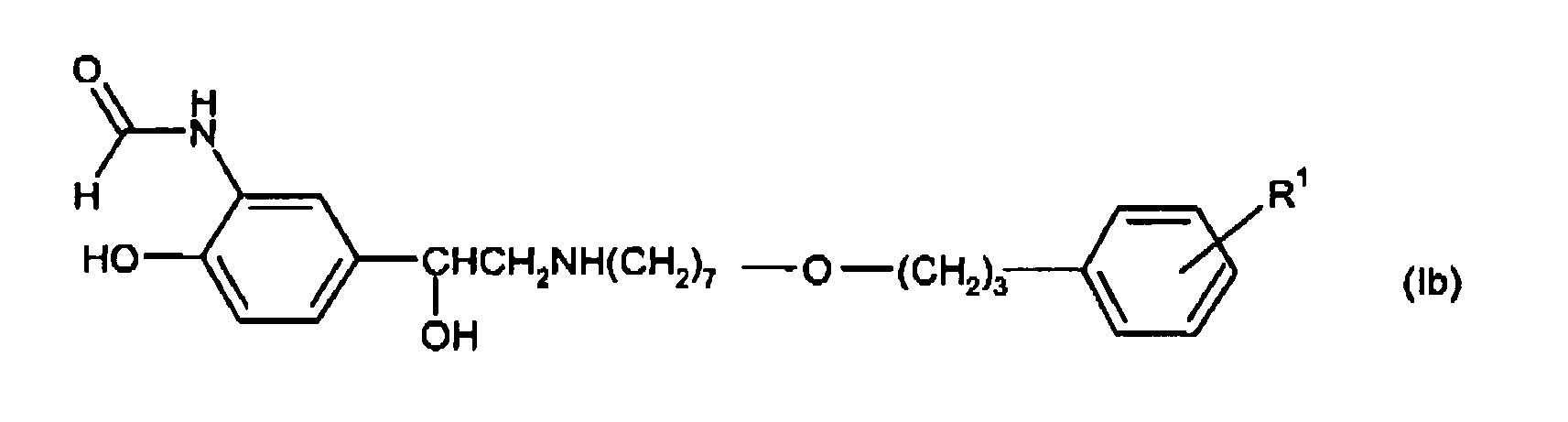
R1 is as defined in claim 1 for formula (1). - A compound according to claim 1 or claim 2 of formula (I) or formula (1a) selected from:3-(4-{[6-({(2R)-2-[3-(formylamino)-4-hydroxyphenyl]-2-hydroxyethyl}amino)hexyl]oxy}butyl)benzenesulfonamide;3-{4-{[6-({(2S)-2-[3-(formylamino)-4-hydroxyphenyl]-2-hydroxyethyl}amino)hexyl]oxy}butyl)benzenesulfonamide;3-(4-{[6-({(2R/S)-2-[3-(formylamino)-4-hydroxyphenyl]-2-hydroxyethyl}amino)hexyl]oxy}butyl)benzenesulfonamide;N-(tert-butyl)-3-(4-{[6-{{(2R)-2-[3-(fonnylamino)-4-hydroxyphenyl]-2-hydroxyethyl}amino)hexyl]oxy}butyl)benzenesulfonamide;N-(tert-butyl)-3-(4-{(6-({(2S)-2-[3-(formylamino)-4-hydroxyphenyl]-2-hydroxyethyl}amino)hexyl]oxy}butyl)benzenesulfonamide; andN-(tert-butyl)-3-(4-{[6-({(2R/S)-2-[3-(formylamino)-4-hydroxyphenyl]-2-hydroxyethyl}amino)hexyl]oxy}butyl)benzenesulfonamide;or a salt or solvate thereof.
- A compound of formula (I), (Ia) or (Ib) according to any of claims 1 to 4, or a pharmaceutically acceptable salt or solvate thereof for use in medical therapy.
- A pharmaceutical formulation comprising a compound of formula (I), (Ia) or (Ib) according to any of claims 1 to 4, or a pharmaceutically acceptable salt or solvate thereof, and a pharmaceutically acceptable carrier or excipient, and optionally one or more other therapeutic ingredients.
- A combination comprising a compound of formula (I), (Ia) or (Ib) according to any of claims 1 to 4, or a pharmaceutically acceptable salt or solvate thereof, and one or more other therapeutic ingredients.
- A combination according to claim 7 wherein the other therapeutic ingredient is a PDE4 inhibitor, a corticosteroid or an anticholinergic.
- The use of a compound of formula according to any of claims 1 to 4, or a pharmaceutically acceptable salt or solvate thereof in the manufacture of a medicament for the prophylaxis or treatment of a clinical condition for which a selective β2-adrenoreceptor agonist is indicated wherein said condition is selected from asthma, chronic obstructive pulmonary diseases (COPD) respiratory tract infection and upper respiratory tract disease.
- A process for the preparation of a compound of formula (I), (Ia) or (Ib) according to any of claims 1 to 4, or a salt or solvate thereof, which comprises:(a) deprotection of a protected intermediate, for example of formula (II):
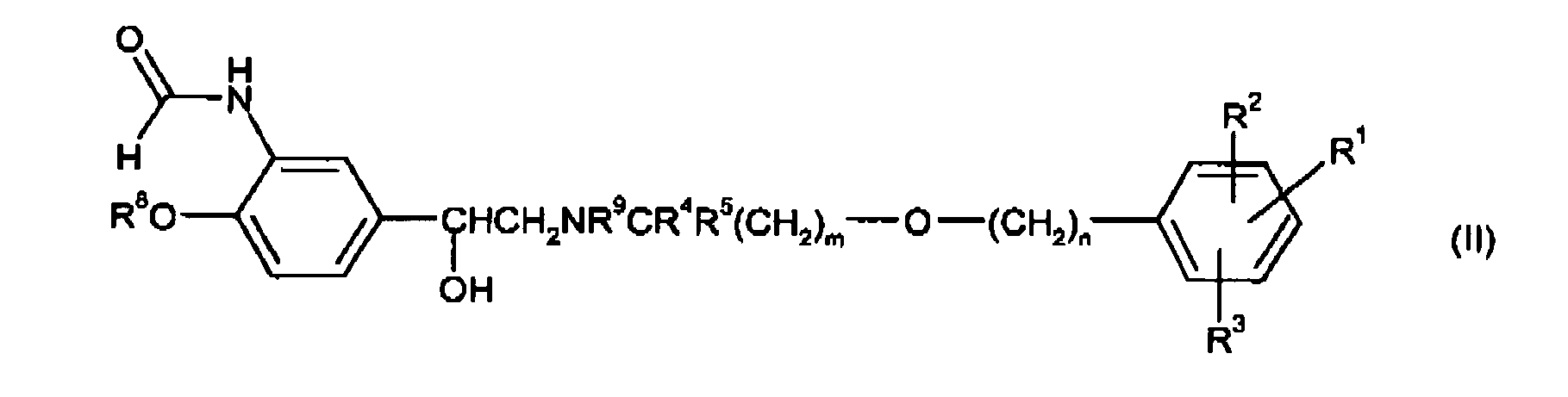 (b) reduction of a compound of formula (III):wherein R1, R2, R3. R4. R5, m, and n are as defined for the compound of formula (I) in claim 1, and R6, and R9, are each independently either hydrogen or a protecting group ;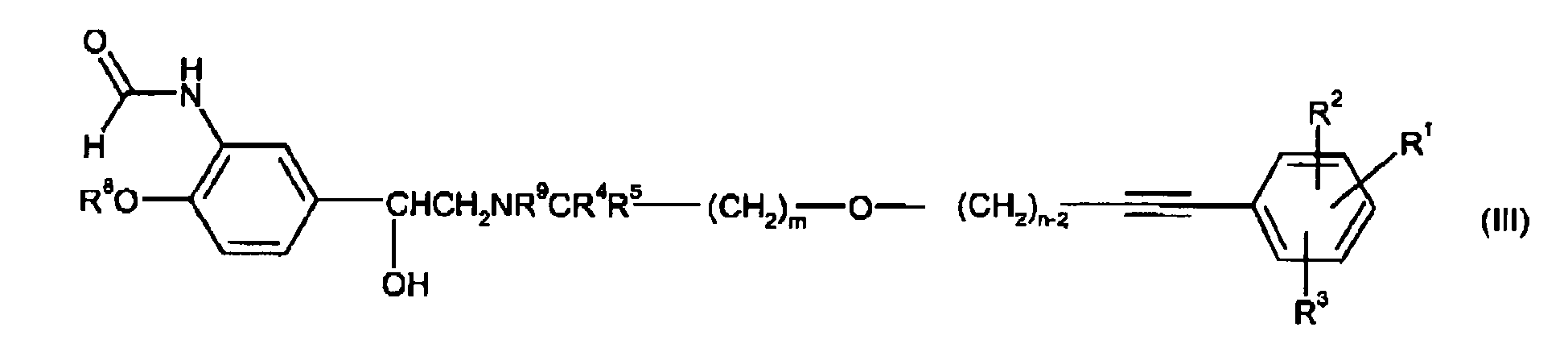
followed by the following steps in any order :(i) optional removal of any protecting groups;(ii) optional separation of an enantiomer from a mixture of enantiomers;(iii) optional conversion of the product to a corresponding salt or solvate thereof.
Applications Claiming Priority (5)
| Application Number | Priority Date | Filing Date | Title |
|---|---|---|---|
| GB0107213 | 2001-03-22 | ||
| GB0107213A GB0107213D0 (en) | 2001-03-22 | 2001-03-22 | Chemical compounds |
| GB0126995A GB0126995D0 (en) | 2001-11-09 | 2001-11-09 | Chemical compounds |
| GB0126995 | 2001-11-09 | ||
| PCT/EP2002/003122 WO2002076933A1 (en) | 2001-03-22 | 2002-03-20 | Formailide derivatives as beta2-adrenoreceptor agonists |
Publications (2)
| Publication Number | Publication Date |
|---|---|
| EP1370521A1 EP1370521A1 (en) | 2003-12-17 |
| EP1370521B1 true EP1370521B1 (en) | 2007-12-19 |
Family
ID=26245880
Family Applications (1)
| Application Number | Title | Priority Date | Filing Date |
|---|---|---|---|
| EP02730035A Expired - Lifetime EP1370521B1 (en) | 2001-03-22 | 2002-03-20 | Formanilide derivatives as beta2-adrenoreceptor agonists |
Country Status (7)
| Country | Link |
|---|---|
| US (1) | US7045658B2 (en) |
| EP (1) | EP1370521B1 (en) |
| JP (1) | JP4143413B2 (en) |
| AT (1) | ATE381537T1 (en) |
| DE (1) | DE60224172T2 (en) |
| ES (1) | ES2296923T3 (en) |
| WO (1) | WO2002076933A1 (en) |
Families Citing this family (149)
| Publication number | Priority date | Publication date | Assignee | Title |
|---|---|---|---|---|
| AR028948A1 (en) | 2000-06-20 | 2003-05-28 | Astrazeneca Ab | NEW COMPOUNDS |
| US6777399B2 (en) | 2000-08-05 | 2004-08-17 | Smithkline Beecham Corporation | Anti-inflammatory androstane derivative compositions |
| US6750210B2 (en) | 2000-08-05 | 2004-06-15 | Smithkline Beecham Corporation | Formulation containing novel anti-inflammatory androstane derivative |
| US6777400B2 (en) | 2000-08-05 | 2004-08-17 | Smithkline Beecham Corporation | Anti-inflammatory androstane derivative compositions |
| US6858596B2 (en) | 2000-08-05 | 2005-02-22 | Smithkline Beecham Corporation | Formulation containing anti-inflammatory androstane derivative |
| GB0019172D0 (en) | 2000-08-05 | 2000-09-27 | Glaxo Group Ltd | Novel compounds |
| US6759398B2 (en) | 2000-08-05 | 2004-07-06 | Smithkline Beecham Corporation | Anti-inflammatory androstane derivative |
| US6858593B2 (en) | 2000-08-05 | 2005-02-22 | Smithkline Beecham Corporation | Anti-inflammatory androstane derivative compositions |
| KR100889426B1 (en) | 2000-08-05 | 2009-03-23 | 글락소 그룹 리미티드 | 6.alpha., 9.alpha.-difluoro-17.alpha .- '(2-furanylcarboxyl) oxy-11.beta.-hydroxy-16.alpha.-methyl-3-oxo as anti-inflammatory -Androst-1,4-diene-17-carbothioic acid S-fluoromethyl ester |
| US6787532B2 (en) | 2000-08-05 | 2004-09-07 | Smithkline Beecham Corporation | Formulation containing anti-inflammatory androstane derivatives |
| UA77656C2 (en) | 2001-04-07 | 2007-01-15 | Glaxo Group Ltd | S-fluoromethyl ester of 6-alpha, 9-alpha-difluoro-17-alpha-[(2-furanylcarbonyl)oxy]-11-beta-hydroxy-16- alpha-methyl-3-oxoandrosta-1,4-dien-17-beta-carbothioacid as anti-inflammatory agent |
| AU2002253342B2 (en) | 2001-04-30 | 2007-01-04 | Glaxo Group Limited | Novel anti-inflammatory androstane derivatives |
| US8337816B2 (en) | 2001-09-17 | 2012-12-25 | Glaxo Group Limited | Dry powder medicament formulations |
| US20030229058A1 (en) | 2001-11-13 | 2003-12-11 | Moran Edmund J. | Aryl aniline beta2 adrenergic receptor agonists |
| DE60321311D1 (en) * | 2002-02-04 | 2008-07-10 | Glaxo Group Ltd | PREPARATION FOR INHALATION CONTAINING A GLUCOCORTICOID AND A BETA 2 ADRENOR RECEPTOR AGONISTS |
| EP1507754A1 (en) | 2002-05-28 | 2005-02-23 | Theravance, Inc. | Alkoxy aryl beta-2 adrenergic receptor agonists |
| GB2389530B (en) | 2002-06-14 | 2007-01-10 | Cipla Ltd | Pharmaceutical compositions |
| PL216752B1 (en) * | 2002-11-27 | 2014-05-30 | Nycomed Gmbh | New synergistic combination comprising roflumilast and formoterol |
| CA2506956C (en) * | 2002-11-27 | 2012-10-02 | Altana Pharma Ag | Synergistic combination comprising roflumilast and (r,r)-formoterol |
| PE20040950A1 (en) | 2003-02-14 | 2005-01-01 | Theravance Inc | BIPHENYL DERIVATIVES AS AGONISTS OF ß2-ADRENERGIC RECEPTORS AND AS ANTAGONISTS OF MUSCARINAL RECEPTORS |
| GB0303396D0 (en) | 2003-02-14 | 2003-03-19 | Glaxo Group Ltd | Medicinal compounds |
| JP2006528242A (en) | 2003-05-08 | 2006-12-14 | セラヴァンス インコーポレーテッド | Crystalline form of arylaniline β2 adrenergic receptor agonist |
| TW200510277A (en) | 2003-05-27 | 2005-03-16 | Theravance Inc | Crystalline form of β2-adrenergic receptor agonist |
| GB0316290D0 (en) | 2003-07-11 | 2003-08-13 | Glaxo Group Ltd | Novel compounds |
| TW200526547A (en) * | 2003-09-22 | 2005-08-16 | Theravance Inc | Amino-substituted ethylamino β2 adrenergic receptor agonists |
| TW200531692A (en) | 2004-01-12 | 2005-10-01 | Theravance Inc | Aryl aniline derivatives as β2 adrenergic receptor agonists |
| GB0401334D0 (en) | 2004-01-21 | 2004-02-25 | Novartis Ag | Organic compounds |
| TWI341836B (en) | 2004-03-11 | 2011-05-11 | Theravance Inc | Biphenyl compounds useful as muscarinic receptor antagonists |
| GB0411056D0 (en) | 2004-05-18 | 2004-06-23 | Novartis Ag | Organic compounds |
| PE20060272A1 (en) | 2004-05-24 | 2006-05-22 | Glaxo Group Ltd | (2R, 3R, 4S, 5R, 2'R, 3'R, 4'S, 5'S) -2.2 '- {TRANS-1,4-CYCLOHEXANODIYLBIS- [IMINO (2 - {[2- (1-METHYL- 1H-IMIDAZOL-4-IL) ETHYL] AMINO} -9H-PURIN-6,9-DIYL)]} BIS [5- (2-ETHYL-2H-TETRAZOLE-5-IL) TETRAHYDRO-3,4-FURANODIOL] AS AN A2A AGONIST |
| EP1751086A2 (en) * | 2004-06-03 | 2007-02-14 | Theravance, Inc. | DIAMINE ß2 ADRENERGIC RECEPTOR AGONISTS |
| TWI307630B (en) | 2004-07-01 | 2009-03-21 | Glaxo Group Ltd | Immunoglobulins |
| GB0418045D0 (en) | 2004-08-12 | 2004-09-15 | Glaxo Group Ltd | Compounds |
| EP1778626A1 (en) | 2004-08-16 | 2007-05-02 | Theravance, Inc. | Compounds having beta2 adrenergic receptor agonist and muscarinic receptor antagonist activity |
| US7569586B2 (en) | 2004-08-16 | 2009-08-04 | Theravance, Inc. | Compounds having β2 adrenergic receptor agonist and muscarinic receptor antagonist activity |
| US7566785B2 (en) * | 2004-09-10 | 2009-07-28 | Theravance, Inc. | Amidine substituted aryl aniline compounds |
| GT200500281A (en) | 2004-10-22 | 2006-04-24 | Novartis Ag | ORGANIC COMPOUNDS. |
| GB0424284D0 (en) | 2004-11-02 | 2004-12-01 | Novartis Ag | Organic compounds |
| GB0426164D0 (en) | 2004-11-29 | 2004-12-29 | Novartis Ag | Organic compounds |
| WO2006072599A2 (en) | 2005-01-10 | 2006-07-13 | Glaxo Group Limited | Androstane 17-alpha carbonate derivatives for use in the treatment of allergic and inflammatory conditions |
| UY29440A1 (en) | 2005-03-25 | 2006-10-02 | Glaxo Group Ltd | NEW COMPOUNDS |
| GB0507577D0 (en) | 2005-04-14 | 2005-05-18 | Novartis Ag | Organic compounds |
| GB0514809D0 (en) | 2005-07-19 | 2005-08-24 | Glaxo Group Ltd | Compounds |
| TW200738634A (en) | 2005-08-02 | 2007-10-16 | Astrazeneca Ab | New salt |
| US7994211B2 (en) | 2005-08-08 | 2011-08-09 | Argenta Discovery Limited | Bicyclo[2.2.1]hept-7-ylamine derivatives and their uses |
| GB0516313D0 (en) | 2005-08-08 | 2005-09-14 | Argenta Discovery Ltd | Azole derivatives and their uses |
| TW200738658A (en) | 2005-08-09 | 2007-10-16 | Astrazeneca Ab | Novel compounds |
| AU2006282122A1 (en) * | 2005-08-26 | 2007-03-01 | Astrazeneca Ab | A combination of compounds, which can be used in the treatment of respiratory diseases, especially chronic obstructive pulmonary disease (COPD) and asthma |
| MY144906A (en) | 2005-10-21 | 2011-11-30 | Novartis Ag | Human antibodies against il13 and therapeutic uses |
| AR058109A1 (en) | 2005-12-20 | 2008-01-23 | Glaxo Group Ltd | ACID 3 - (4 - {[4 - (4 - {[3 - (3, 3 - DIMETILE - 1 - PIPERIDINIL) PROPIL] OXI} PHENYL) - 1 - PIPERIDINIL] CARBONIL} - 1 - NAFTALENIL) PROPANOIC AS ANTAGONISTS OF THE RECEIVERS OF HISTAMINE H1 / H3, PHARMACEUTICAL COMPOSITIONS THAT CONTAIN THEM AND THEIR USE IN THE PREPARATION OF MEDICINES FOR THE TREATMENT |
| GB0601951D0 (en) | 2006-01-31 | 2006-03-15 | Novartis Ag | Organic compounds |
| TW200745067A (en) | 2006-03-14 | 2007-12-16 | Astrazeneca Ab | Novel compounds |
| MX2008013411A (en) | 2006-04-20 | 2008-11-04 | Glaxo Group Ltd | Novel compounds. |
| RU2457209C2 (en) | 2006-04-21 | 2012-07-27 | Новартис Аг | Purine derivatives applicable as adenosine receptor a2a agonists |
| TW200811105A (en) * | 2006-04-25 | 2008-03-01 | Theravance Inc | Dialkylphenyl compounds having beta2 adrenergic receptor agonist and muscarinic receptor antagonist activity |
| GB0611587D0 (en) | 2006-06-12 | 2006-07-19 | Glaxo Group Ltd | Novel compounds |
| PE20080943A1 (en) | 2006-06-23 | 2008-09-27 | Smithkline Beecham Corp | SALT TOLUENOSULPHONATE OF 4 - {[6-CHLORO-3 - ({[(2-CHLORO-3-FLUOROPHENYL) AMINO] CARBONYL} AMINO) -2-HYDROXYPHENYL] SULFONYL} -1-PIPERAZINACARBOXYLATE 1,1-DIMETHYLETHYL ANTAGON IL-8 RECEIVER |
| WO2008002594A2 (en) * | 2006-06-27 | 2008-01-03 | Neuroprotection For Life Corp. | Neuronal circuit-dependent neuroprotection by interaction between nicotinic receptors |
| JP2009543860A (en) | 2006-07-19 | 2009-12-10 | アストラゼネカ・アクチエボラーグ | Novel tricyclic spiropiperidine compounds, their synthesis and their use as chemokine receptor activity modulators |
| EP2046787B1 (en) | 2006-08-01 | 2011-04-06 | Glaxo Group Limited | Pyrazolo[3,4-b]pyridine compounds, and their use as pde4 inhibitors |
| CA2660707C (en) | 2006-08-10 | 2014-07-08 | The Government Of The United States Of America As Represented By The Secretary Of The Department Of Health And Human Services | Preparation of (r,r)-fenoterol and (r,r)- or (r,s)-fenoterol analogues and their use in treating congestive heart failure |
| WO2008041914A1 (en) * | 2006-10-06 | 2008-04-10 | Astrazeneca Ab | 5-(2-AMINO-L-HYDROXYETHYL)-8-HYDROXY-2-OXOQUINOLINE DERIVATIVES AND OTHER COMPOUNDS AS β2 -ADRENERGIC AGONISTS |
| TW200825084A (en) | 2006-11-14 | 2008-06-16 | Astrazeneca Ab | New compounds 521 |
| WO2008075005A1 (en) | 2006-12-19 | 2008-06-26 | Astrazeneca Ab | Quinuclidinol derivatives as muscarinic receptor antagonists |
| TW200833670A (en) | 2006-12-20 | 2008-08-16 | Astrazeneca Ab | Novel compounds 569 |
| HRP20110201T1 (en) | 2007-01-10 | 2011-08-31 | Irm Llc | COMPOUNDS AND COMPOSITIONS AS PROTEASE INHIBITORS OF CANALIZED ACTIVATION |
| GB0702458D0 (en) | 2007-02-08 | 2007-03-21 | Astrazeneca Ab | Salts 668 |
| BRPI0806970A2 (en) | 2007-02-09 | 2014-04-08 | Irm Llc | COMPOUNDS AND COMPOSITIONS AS CHANNEL ACTIVATE PROTEASE INHIBITORS |
| PE20081889A1 (en) | 2007-03-23 | 2009-03-05 | Smithkline Beecham Corp | INDOL CARBOXAMIDES AS INHIBITORS OF IKK2 |
| DE602008005140D1 (en) | 2007-05-07 | 2011-04-07 | Novartis Ag | ORGANIC CONNECTIONS |
| AR069637A1 (en) | 2007-12-10 | 2010-02-10 | Novartis Ag | PIRAZINE DERIVATIVES |
| CN101910153B (en) | 2008-01-11 | 2014-01-22 | 诺华股份有限公司 | Pyrimidines as Kinase Inhibitors |
| BRPI0822693A2 (en) | 2008-05-13 | 2015-07-07 | Astrazeneca Ab | Quinuclidine derivatives as m3 muscarinic receptor antagonists |
| MX2010012814A (en) | 2008-05-23 | 2010-12-20 | Amira Pharmaceuticals Inc | 5-lipoxygenase-activating protein inhibitor. |
| AU2009252938B2 (en) | 2008-05-27 | 2012-04-26 | Astrazeneca Ab | Phenoxypyridinylamide derivatives and their use in the treatment of PDE4 mediated disease states |
| WO2009147187A1 (en) | 2008-06-05 | 2009-12-10 | Glaxo Group Limited | 4-carboxamide indazole derivatives useful as inhibitors of p13-kinases |
| WO2009150137A2 (en) | 2008-06-10 | 2009-12-17 | Novartis Ag | Organic compounds |
| CA2726746A1 (en) | 2008-06-18 | 2009-12-23 | Astrazeneca Ab | Benzoxazinone derivatives acting as beta2-adrenoreceptor agonist for the treatment of respiratory disorders |
| US8236786B2 (en) | 2008-08-07 | 2012-08-07 | Pulmagen Therapeutics (Inflammation) Limited | Respiratory disease treatment |
| WO2010067102A1 (en) | 2008-12-09 | 2010-06-17 | Astrazeneca Ab | Diazaspiro [5.5] undecane derivatives and related compounds as muscarinic-receptor antagonists and beta-adrenoreceptor agonists for the treatment of pulmonary disorders |
| PL2379507T3 (en) | 2008-12-30 | 2014-03-31 | Pulmagen Therapeutics Inflammation Ltd | Sulfonamide compounds for the treatment of respiratory disorders |
| WO2010094643A1 (en) | 2009-02-17 | 2010-08-26 | Glaxo Group Limited | Quinoline derivatives and their uses for rhinitis and urticaria |
| WO2010102958A1 (en) | 2009-03-09 | 2010-09-16 | Glaxo Group Limited | 4-oxadiazol-2 -yl- indazoles as inhibitors of p13 kinases |
| US8354539B2 (en) | 2009-03-10 | 2013-01-15 | Glaxo Group Limited | Indole derivatives as IKK2 inhibitors |
| US20120058984A1 (en) | 2009-03-17 | 2012-03-08 | Catherine Mary Alder | Pyrimidine derivatives used as itk inhibitors |
| US20120035247A1 (en) | 2009-03-19 | 2012-02-09 | Merck Sharp & Dohme Corp. | RNA Interference Mediated Inhibition of Signal Transducer and Activator of Transcription 6 (STAT6) Gene Expression Using Short Interfering Nucleic Acid (siNA) |
| US20120016010A1 (en) | 2009-03-19 | 2012-01-19 | Merck Sharp & Dohme Corp | RNA Interference Mediated Inhibition of BTB and CNC Homology 1, Basic Leucine Zipper Transcription Factor 1 (BACH1) Gene Expression Using Short Interfering Nucleic Acid (siNA) |
| US20120029054A1 (en) | 2009-03-19 | 2012-02-02 | Merck Sharp & Dohme Corp. | RNA Interference Mediated Inhibition of GATA Binding Protein 3 (GATA3) Gene Expression Using Short Intefering Nucleic Acid (siNA) |
| WO2010107952A2 (en) | 2009-03-19 | 2010-09-23 | Merck Sharp & Dohme Corp. | RNA INTERFERENCE MEDIATED INHIBITION OF CONNECTIVE TISSUE GROWTH FACTOR (CTGF) GENE EXPRESSION USING SHORT INTERFERING NUCLEIC ACID (siNA) |
| US20120022143A1 (en) | 2009-03-27 | 2012-01-26 | Merck Sharp & Dohme Corp | RNA Interference Mediated Inhibition of the Thymic Stromal Lymphopoietin (TSLP) Gene Expression Using Short Interfering Nucliec Acid (siNA) |
| EP2411019A2 (en) | 2009-03-27 | 2012-02-01 | Merck Sharp&Dohme Corp. | RNA INTERFERENCE MEDIATED INHIBITION OF SIGNAL TRANSDUCER AND ACTIVATOR OF TRANSCRIPTION 1 (STAT1) GENE EXPRESSION USING SHORT INTERFERING NUCLEIC ACID (siNA) |
| KR20110138223A (en) | 2009-03-27 | 2011-12-26 | 머크 샤프 앤드 돔 코포레이션 | RNA Interference-mediated Inhibition of Intercellular Adhesion Molecule 1 (ICAM-1) Gene Expression Using Short Interfering Nucleic Acids (SINA) |
| WO2010111464A1 (en) | 2009-03-27 | 2010-09-30 | Merck Sharp & Dohme Corp. | RNA INTERFERENCE MEDIATED INHIBITION OF APOPTOSIS SIGNAL-REGULATING KINASE 1 (ASK1) GENE EXPRESSION USING SHORT INTERFERING NUCLEIC ACID (siNA) |
| WO2010111468A2 (en) | 2009-03-27 | 2010-09-30 | Merck Sharp & Dohme Corp. | RNA INTERFERENCE MEDIATED INHIBITION OF THE NERVE GROWTH FACTOR BETA CHAIN (NGFß) GENE EXPRESSION USING SHORT INTERFERING NUCLEIC ACID (SINA) |
| JP2012524754A (en) | 2009-04-24 | 2012-10-18 | グラクソ グループ リミテッド | Pyrazole and triazolcarboxamides as CRAC channel inhibitors |
| AR076373A1 (en) | 2009-04-24 | 2011-06-08 | Glaxo Group Ltd | N-PIRAZOLIL CARBOXAMIDS AS CALCIUM CHANNEL INHIBITORS |
| PL2899191T3 (en) | 2009-04-30 | 2018-01-31 | Glaxo Group Ltd | Oxazole substituted indazoles as pi3-kinase inhibitors |
| WO2010150014A1 (en) | 2009-06-24 | 2010-12-29 | Pulmagen Therapeutics (Inflammation) Limited | 5r- 5 -deuterated glitazones for respiratory disease treatment |
| BR112012000890A2 (en) | 2009-07-15 | 2017-10-31 | Theravance Inc | crystalline free base forms of a biphenyl compound |
| JP2013508414A (en) | 2009-10-22 | 2013-03-07 | バーテックス ファーマシューティカルズ インコーポレイテッド | Compositions for the treatment of cystic fibrosis and other chronic diseases |
| GB0918923D0 (en) | 2009-10-28 | 2009-12-16 | Vantia Ltd | Aminothiazole derivatives |
| GB0918922D0 (en) | 2009-10-28 | 2009-12-16 | Vantia Ltd | Aminopyridine derivatives |
| GB0918924D0 (en) | 2009-10-28 | 2009-12-16 | Vantia Ltd | Azaindole derivatives |
| WO2011061527A1 (en) | 2009-11-17 | 2011-05-26 | Astrazeneca Ab | Combinations comprising a glucocorticoid receptor modulator for the treatment of respiratory diseases |
| EP2507231A1 (en) | 2009-12-03 | 2012-10-10 | Glaxo Group Limited | Indazole derivatives as pi 3 - kinase inhibitors |
| WO2011067365A1 (en) | 2009-12-03 | 2011-06-09 | Glaxo Group Limited | Benzpyrazole derivatives as inhibitors of p13 kinases |
| US20120238559A1 (en) | 2009-12-03 | 2012-09-20 | Glaxo Group Limited | Novel compounds |
| EP2512438B1 (en) | 2009-12-16 | 2017-01-25 | 3M Innovative Properties Company | Formulations and methods for controlling mdi particle size delivery |
| WO2011098746A1 (en) | 2010-02-09 | 2011-08-18 | Pulmagen Therapeutics (Inflammation) Limited | Crystalline acid addition salts of ( 5r) -enanti0mer of pioglitazone |
| GB201002224D0 (en) | 2010-02-10 | 2010-03-31 | Argenta Therapeutics Ltd | Respiratory disease treatment |
| GB201002243D0 (en) | 2010-02-10 | 2010-03-31 | Argenta Therapeutics Ltd | Respiratory disease treatment |
| US9492405B2 (en) | 2010-03-10 | 2016-11-15 | The United States Of America, As Represented By The Secretary, Department Of Health And Human Services | Use of fenoterol and fenoterol analogues in the treatment of glioblastomas and astrocytomas |
| WO2011110575A1 (en) | 2010-03-11 | 2011-09-15 | Glaxo Group Limited | Derivatives of 2-[2-(benzo- or pyrido-) thiazolylamino]-6-aminopyridine, useful in the treatment of respiratoric, allergic or inflammatory diseases |
| US8247436B2 (en) | 2010-03-19 | 2012-08-21 | Novartis Ag | Pyridine and pyrazine derivative for the treatment of CF |
| GB201007203D0 (en) | 2010-04-29 | 2010-06-16 | Glaxo Group Ltd | Novel compounds |
| HUE026059T2 (en) | 2010-09-08 | 2016-05-30 | Glaxosmithkline Ip Dev Ltd | POLYMORPHS AND SALTS OF N-[5-[4-(5-{[(2R,6S)-2,6-DIMETHYL-4-MORPHOLINYL]METHYL}-& xA;1,3-OXAZOL-2-YL)-1H-INDAZOL-6-YL]-2-(METHYLOXY)-3-PYRIDINYL]METHANESULFONAMIDE |
| WO2012034095A1 (en) | 2010-09-09 | 2012-03-15 | Irm Llc | Compounds and compositions as trk inhibitors |
| UY33597A (en) | 2010-09-09 | 2012-04-30 | Irm Llc | COMPOUNDS AND COMPOSITIONS AS INHIBITORS OF THE TRK |
| WO2012035055A1 (en) | 2010-09-17 | 2012-03-22 | Glaxo Group Limited | Novel compounds |
| US8372845B2 (en) | 2010-09-17 | 2013-02-12 | Novartis Ag | Pyrazine derivatives as enac blockers |
| GB201016912D0 (en) | 2010-10-07 | 2010-11-24 | Astrazeneca Ab | Novel combination |
| US9149462B2 (en) | 2010-10-21 | 2015-10-06 | Glaxo Group Limited | Pyrazole compounds acting against allergic, inflammatory and immune disorders |
| WO2012052458A1 (en) | 2010-10-21 | 2012-04-26 | Glaxo Group Limited | Pyrazole compounds acting against allergic, immune and inflammatory conditions |
| GB201018124D0 (en) | 2010-10-27 | 2010-12-08 | Glaxo Group Ltd | Polymorphs and salts |
| BR112013021638A2 (en) | 2011-02-25 | 2016-08-02 | Irm Llc | "trk inhibiting compounds, their use and compositions comprising them" |
| GB201104153D0 (en) | 2011-03-11 | 2011-04-27 | Glaxo Group Ltd | Novel compounds |
| EP2683716A1 (en) | 2011-03-11 | 2014-01-15 | Glaxo Group Limited | Pyrido[3,4-b]pyrazine derivatives as syk inhibitors |
| UY34305A (en) | 2011-09-01 | 2013-04-30 | Novartis Ag | DERIVATIVES OF BICYCLIC HETEROCICLES FOR THE TREATMENT OF PULMONARY ARTERIAL HYPERTENSION |
| WO2013038378A1 (en) | 2011-09-16 | 2013-03-21 | Novartis Ag | Pyridine amide derivatives |
| WO2013038373A1 (en) | 2011-09-16 | 2013-03-21 | Novartis Ag | Pyridine amide derivatives |
| WO2013038381A1 (en) | 2011-09-16 | 2013-03-21 | Novartis Ag | Pyridine/pyrazine amide derivatives |
| ES2882807T3 (en) | 2011-09-16 | 2021-12-02 | Novartis Ag | N-substituted heterocyclyl carboxamides |
| CN103946221B (en) | 2011-09-16 | 2016-08-03 | 诺华股份有限公司 | Heterocyclic compounds for the treatment of cystic fibrosis |
| US8809340B2 (en) | 2012-03-19 | 2014-08-19 | Novartis Ag | Crystalline form |
| US9073921B2 (en) | 2013-03-01 | 2015-07-07 | Novartis Ag | Salt forms of bicyclic heterocyclic derivatives |
| HRP20180684T1 (en) | 2013-03-15 | 2018-06-01 | Verona Pharma Plc | COMBINATION OF MEDICINES |
| CA2923995A1 (en) | 2013-10-17 | 2015-04-23 | Glaxosmithkline Intellectual Property Development Limited | Pi3k inhibitor for treatment of respiratory disease |
| WO2015055691A1 (en) | 2013-10-17 | 2015-04-23 | Glaxosmithkline Intellectual Property Development Limited | Pi3k inhibitor for treatment of respiratory disease |
| EP3134396B1 (en) | 2014-04-24 | 2019-09-18 | Novartis AG | Amino pyridine derivatives as phosphatidylinositol 3-kinase inhibitors |
| BR112016023967A2 (en) | 2014-04-24 | 2017-08-15 | Novartis Ag | pyrazine derivatives as phosphatidylinositol 3-kinase inhibitors |
| CN106458979B (en) | 2014-04-24 | 2020-03-27 | 诺华股份有限公司 | Aminopyrazine derivatives as phosphatidylinositol 3-kinase inhibitors |
| TW201625247A (en) | 2014-05-12 | 2016-07-16 | 葛蘭素史密斯克藍智慧財產權有限公司 | Pharmaceutical composition for treating infectious diseases |
| GB201602527D0 (en) | 2016-02-12 | 2016-03-30 | Glaxosmithkline Ip Dev Ltd | Chemical compounds |
| EP3497100A1 (en) | 2016-08-08 | 2019-06-19 | GlaxoSmithKline Intellectual Property Development Limited | Chemical compounds |
| GB201706102D0 (en) | 2017-04-18 | 2017-05-31 | Glaxosmithkline Ip Dev Ltd | Chemical compounds |
| GB201712081D0 (en) | 2017-07-27 | 2017-09-13 | Glaxosmithkline Ip Dev Ltd | Chemical compounds |
| AU2020290094B2 (en) | 2019-06-10 | 2024-01-18 | Novartis Ag | Pyridine and pyrazine derivative for the treatment of CF, COPD, and bronchiectasis |
| PE20220346A1 (en) | 2019-08-28 | 2022-03-14 | Novartis Ag | 1,3-HETEROARYL SUBSTITUTED DERIVATIVES AND THEIR USE IN THE TREATMENT OF DISEASES |
| TW202140550A (en) | 2020-01-29 | 2021-11-01 | 瑞士商諾華公司 | Methods of treating an inflammatory or obstructive airway disease using anti-tslp antibody |
Family Cites Families (26)
| Publication number | Priority date | Publication date | Assignee | Title |
|---|---|---|---|---|
| US3994974A (en) * | 1972-02-05 | 1976-11-30 | Yamanouchi Pharmaceutical Co., Ltd. | α-Aminomethylbenzyl alcohol derivatives |
| CY1308A (en) | 1979-12-06 | 1985-12-06 | Glaxo Group Ltd | Device for dispensing medicaments |
| ATE23272T1 (en) | 1981-07-08 | 1986-11-15 | Draco Ab | POWDER INHALER. |
| ES286422Y (en) | 1982-10-08 | 1986-09-16 | Glaxo Group Limited | DEVICE FOR ADMINISTERING MEDICINES TO PATIENTS |
| GB2169265B (en) | 1982-10-08 | 1987-08-12 | Glaxo Group Ltd | Pack for medicament |
| ZW6584A1 (en) * | 1983-04-18 | 1985-04-17 | Glaxo Group Ltd | Phenethanolamine derivatives |
| DE3513885A1 (en) * | 1984-04-17 | 1985-10-17 | Glaxo Group Ltd., London | PHENETHANOLAMINE COMPOUNDS, METHOD FOR THE PRODUCTION THEREOF AND MEDICINAL PRODUCTS CONTAINING THESE COMPOUNDS |
| DK173685A (en) | 1984-04-17 | 1985-10-18 | Glaxo Group Ltd | Safety and pouring stopper |
| US4853381A (en) * | 1984-04-17 | 1989-08-01 | Glaxo Group Limited | Ethanolamine compounds |
| LU86002A1 (en) | 1984-07-13 | 1986-08-04 | Glaxo Group Ltd | AMINOPHENOL COMPOUNDS |
| GB8426200D0 (en) * | 1984-10-17 | 1984-11-21 | Glaxo Holdings Ltd | Chemical compounds |
| SE8603252L (en) | 1985-07-30 | 1987-01-31 | Glaxo Group Ltd | DEVICE FOR SUPPLYING MEDICINE TO PATIENTS |
| EP0220054A3 (en) * | 1985-10-16 | 1987-12-02 | Glaxo Group Limited | Ethanolamine derivatives |
| EP0223410A3 (en) | 1985-10-16 | 1987-11-19 | Glaxo Group Limited | Ethanolamine derivatives |
| GB8525483D0 (en) | 1985-10-16 | 1985-11-20 | Glaxo Group Ltd | Chemical compounds |
| JPS6485964A (en) | 1987-03-12 | 1989-03-30 | Glaxo Group Ltd | Compound |
| GB8718940D0 (en) * | 1987-08-11 | 1987-09-16 | Glaxo Group Ltd | Chemical compounds |
| JPH0228141A (en) * | 1987-11-13 | 1990-01-30 | Glaxo Group Ltd | Phenethanolamine derivative |
| GB8909273D0 (en) * | 1989-04-24 | 1989-06-07 | Glaxo Group Ltd | Chemical compounds |
| IL95590A (en) | 1989-09-08 | 1996-06-18 | Glaxo Group Ltd | Pharmaceutical compositions comprising salmeterol and fluticasone propionate |
| GB9004781D0 (en) | 1990-03-02 | 1990-04-25 | Glaxo Group Ltd | Device |
| HU225869B1 (en) * | 1992-04-02 | 2007-11-28 | Smithkline Beecham Corp | Compounds with antiallergic and antiinflammatory activity and pharmaceutical compns. contg. them |
| GB9313574D0 (en) | 1993-07-01 | 1993-08-18 | Glaxo Group Ltd | Medicaments |
| AU9281298A (en) | 1997-10-01 | 1999-04-23 | Kyowa Hakko Kogyo Co. Ltd. | Benzodioxole derivatives |
| JP2002506856A (en) | 1998-03-14 | 2002-03-05 | ビイク グルデン ロンベルク ヒエーミツシエ フアブリーク ゲゼルシヤフト ミツト ベシユレンクテル ハフツング | Phthalazinone PDEIII / IV inhibitor |
| AU777012B2 (en) | 1999-08-21 | 2004-09-30 | Takeda Gmbh | Synergistic combination of PDE inhibitors and beta 2 adrenoceptor agonist |
-
2002
- 2002-03-20 AT AT02730035T patent/ATE381537T1/en not_active IP Right Cessation
- 2002-03-20 EP EP02730035A patent/EP1370521B1/en not_active Expired - Lifetime
- 2002-03-20 WO PCT/EP2002/003122 patent/WO2002076933A1/en not_active Ceased
- 2002-03-20 US US10/472,343 patent/US7045658B2/en not_active Expired - Fee Related
- 2002-03-20 DE DE60224172T patent/DE60224172T2/en not_active Expired - Fee Related
- 2002-03-20 JP JP2002576195A patent/JP4143413B2/en not_active Expired - Fee Related
- 2002-03-20 ES ES02730035T patent/ES2296923T3/en not_active Expired - Lifetime
Also Published As
| Publication number | Publication date |
|---|---|
| US20040157830A1 (en) | 2004-08-12 |
| ES2296923T3 (en) | 2008-05-01 |
| ATE381537T1 (en) | 2008-01-15 |
| JP2004538259A (en) | 2004-12-24 |
| DE60224172D1 (en) | 2008-01-31 |
| DE60224172T2 (en) | 2008-12-04 |
| EP1370521A1 (en) | 2003-12-17 |
| US7045658B2 (en) | 2006-05-16 |
| WO2002076933A1 (en) | 2002-10-03 |
| JP4143413B2 (en) | 2008-09-03 |
Similar Documents
| Publication | Publication Date | Title |
|---|---|---|
| EP1370521B1 (en) | Formanilide derivatives as beta2-adrenoreceptor agonists | |
| US7271197B2 (en) | Phenethanolamine derivatives | |
| US7442837B2 (en) | Phenethanolamine derivatives for treatment of respiratory diseases | |
| US7538127B2 (en) | Medicinal compounds | |
| US7982067B2 (en) | Phenethanolamine derivatives for treatment of respiratory diseases | |
| US20070135490A1 (en) | Phenetanolamine derivatives | |
| EP1675823B1 (en) | Phenethanolamine derivatives for the treatment of respiratory diseases | |
| WO2004037768A2 (en) | Phenethanolamine derivatives | |
| WO2004039766A1 (en) | Phenylethanolamine derivatives for the treatment of respiratory diseases | |
| US7294650B2 (en) | Benzothiophen and thiochrone containing phenethanolamine derivatives for the treatment of respiratory disorders | |
| WO2004016578A2 (en) | Arylethanolamine beta2-adrenoreceptor agonist compounds | |
| WO2004039762A1 (en) | Phenethanolamine derivatives for the treatment of respiratory diseases | |
| WO2005058299A1 (en) | Phenethanolamine derivatives for treatment of respiratory diseases |
Legal Events
| Date | Code | Title | Description |
|---|---|---|---|
| PUAI | Public reference made under article 153(3) epc to a published international application that has entered the european phase |
Free format text: ORIGINAL CODE: 0009012 |
|
| 17P | Request for examination filed |
Effective date: 20030922 |
|
| AK | Designated contracting states |
Kind code of ref document: A1 Designated state(s): AT BE CH CY DE DK ES FI FR GB GR IE IT LI LU MC NL PT SE TR |
|
| AX | Request for extension of the european patent |
Extension state: AL LT LV MK RO SI |
|
| 17Q | First examination report despatched |
Effective date: 20060822 |
|
| 17Q | First examination report despatched |
Effective date: 20060822 |
|
| GRAP | Despatch of communication of intention to grant a patent |
Free format text: ORIGINAL CODE: EPIDOSNIGR1 |
|
| GRAS | Grant fee paid |
Free format text: ORIGINAL CODE: EPIDOSNIGR3 |
|
| GRAA | (expected) grant |
Free format text: ORIGINAL CODE: 0009210 |
|
| AK | Designated contracting states |
Kind code of ref document: B1 Designated state(s): AT BE CH CY DE DK ES FI FR GB GR IE IT LI LU MC NL PT SE TR |
|
| REG | Reference to a national code |
Ref country code: GB Ref legal event code: FG4D |
|
| REG | Reference to a national code |
Ref country code: IE Ref legal event code: FG4D |
|
| REG | Reference to a national code |
Ref country code: CH Ref legal event code: EP |
|
| REF | Corresponds to: |
Ref document number: 60224172 Country of ref document: DE Date of ref document: 20080131 Kind code of ref document: P |
|
| PG25 | Lapsed in a contracting state [announced via postgrant information from national office to epo] |
Ref country code: SE Free format text: LAPSE BECAUSE OF FAILURE TO SUBMIT A TRANSLATION OF THE DESCRIPTION OR TO PAY THE FEE WITHIN THE PRESCRIBED TIME-LIMIT Effective date: 20080319 Ref country code: CH Free format text: LAPSE BECAUSE OF FAILURE TO SUBMIT A TRANSLATION OF THE DESCRIPTION OR TO PAY THE FEE WITHIN THE PRESCRIBED TIME-LIMIT Effective date: 20071219 Ref country code: LI Free format text: LAPSE BECAUSE OF FAILURE TO SUBMIT A TRANSLATION OF THE DESCRIPTION OR TO PAY THE FEE WITHIN THE PRESCRIBED TIME-LIMIT Effective date: 20071219 |
|
| REG | Reference to a national code |
Ref country code: ES Ref legal event code: FG2A Ref document number: 2296923 Country of ref document: ES Kind code of ref document: T3 |
|
| PG25 | Lapsed in a contracting state [announced via postgrant information from national office to epo] |
Ref country code: NL Free format text: LAPSE BECAUSE OF FAILURE TO SUBMIT A TRANSLATION OF THE DESCRIPTION OR TO PAY THE FEE WITHIN THE PRESCRIBED TIME-LIMIT Effective date: 20071219 Ref country code: FI Free format text: LAPSE BECAUSE OF FAILURE TO SUBMIT A TRANSLATION OF THE DESCRIPTION OR TO PAY THE FEE WITHIN THE PRESCRIBED TIME-LIMIT Effective date: 20071219 |
|
| NLV1 | Nl: lapsed or annulled due to failure to fulfill the requirements of art. 29p and 29m of the patents act | ||
| REG | Reference to a national code |
Ref country code: CH Ref legal event code: PL |
|
| PG25 | Lapsed in a contracting state [announced via postgrant information from national office to epo] |
Ref country code: AT Free format text: LAPSE BECAUSE OF FAILURE TO SUBMIT A TRANSLATION OF THE DESCRIPTION OR TO PAY THE FEE WITHIN THE PRESCRIBED TIME-LIMIT Effective date: 20071219 |
|
| ET | Fr: translation filed | ||
| PG25 | Lapsed in a contracting state [announced via postgrant information from national office to epo] |
Ref country code: PT Free format text: LAPSE BECAUSE OF FAILURE TO SUBMIT A TRANSLATION OF THE DESCRIPTION OR TO PAY THE FEE WITHIN THE PRESCRIBED TIME-LIMIT Effective date: 20080519 |
|
| PLBE | No opposition filed within time limit |
Free format text: ORIGINAL CODE: 0009261 |
|
| STAA | Information on the status of an ep patent application or granted ep patent |
Free format text: STATUS: NO OPPOSITION FILED WITHIN TIME LIMIT |
|
| PG25 | Lapsed in a contracting state [announced via postgrant information from national office to epo] |
Ref country code: MC Free format text: LAPSE BECAUSE OF NON-PAYMENT OF DUE FEES Effective date: 20080331 Ref country code: DK Free format text: LAPSE BECAUSE OF FAILURE TO SUBMIT A TRANSLATION OF THE DESCRIPTION OR TO PAY THE FEE WITHIN THE PRESCRIBED TIME-LIMIT Effective date: 20071219 |
|
| 26N | No opposition filed |
Effective date: 20080922 |
|
| PG25 | Lapsed in a contracting state [announced via postgrant information from national office to epo] |
Ref country code: IE Free format text: LAPSE BECAUSE OF NON-PAYMENT OF DUE FEES Effective date: 20080320 Ref country code: GR Free format text: LAPSE BECAUSE OF FAILURE TO SUBMIT A TRANSLATION OF THE DESCRIPTION OR TO PAY THE FEE WITHIN THE PRESCRIBED TIME-LIMIT Effective date: 20080320 |
|
| PGFP | Annual fee paid to national office [announced via postgrant information from national office to epo] |
Ref country code: ES Payment date: 20090325 Year of fee payment: 8 |
|
| PGFP | Annual fee paid to national office [announced via postgrant information from national office to epo] |
Ref country code: GB Payment date: 20090206 Year of fee payment: 8 |
|
| PG25 | Lapsed in a contracting state [announced via postgrant information from national office to epo] |
Ref country code: CY Free format text: LAPSE BECAUSE OF FAILURE TO SUBMIT A TRANSLATION OF THE DESCRIPTION OR TO PAY THE FEE WITHIN THE PRESCRIBED TIME-LIMIT Effective date: 20071219 |
|
| PGFP | Annual fee paid to national office [announced via postgrant information from national office to epo] |
Ref country code: DE Payment date: 20090331 Year of fee payment: 8 Ref country code: IT Payment date: 20090317 Year of fee payment: 8 |
|
| PGFP | Annual fee paid to national office [announced via postgrant information from national office to epo] |
Ref country code: BE Payment date: 20090429 Year of fee payment: 8 |
|
| PGFP | Annual fee paid to national office [announced via postgrant information from national office to epo] |
Ref country code: FR Payment date: 20090306 Year of fee payment: 8 |
|
| PG25 | Lapsed in a contracting state [announced via postgrant information from national office to epo] |
Ref country code: LU Free format text: LAPSE BECAUSE OF NON-PAYMENT OF DUE FEES Effective date: 20080320 |
|
| PG25 | Lapsed in a contracting state [announced via postgrant information from national office to epo] |
Ref country code: TR Free format text: LAPSE BECAUSE OF FAILURE TO SUBMIT A TRANSLATION OF THE DESCRIPTION OR TO PAY THE FEE WITHIN THE PRESCRIBED TIME-LIMIT Effective date: 20071219 |
|
| BERE | Be: lapsed |
Owner name: GLAXO GROUP LTD Effective date: 20100331 |
|
| GBPC | Gb: european patent ceased through non-payment of renewal fee |
Effective date: 20100320 |
|
| REG | Reference to a national code |
Ref country code: FR Ref legal event code: ST Effective date: 20101130 |
|
| PG25 | Lapsed in a contracting state [announced via postgrant information from national office to epo] |
Ref country code: FR Free format text: LAPSE BECAUSE OF NON-PAYMENT OF DUE FEES Effective date: 20100331 |
|
| PG25 | Lapsed in a contracting state [announced via postgrant information from national office to epo] |
Ref country code: DE Free format text: LAPSE BECAUSE OF NON-PAYMENT OF DUE FEES Effective date: 20101001 Ref country code: BE Free format text: LAPSE BECAUSE OF NON-PAYMENT OF DUE FEES Effective date: 20100331 |
|
| PG25 | Lapsed in a contracting state [announced via postgrant information from national office to epo] |
Ref country code: GB Free format text: LAPSE BECAUSE OF NON-PAYMENT OF DUE FEES Effective date: 20100320 Ref country code: IT Free format text: LAPSE BECAUSE OF NON-PAYMENT OF DUE FEES Effective date: 20100320 |
|
| REG | Reference to a national code |
Ref country code: ES Ref legal event code: FD2A Effective date: 20110415 |
|
| PG25 | Lapsed in a contracting state [announced via postgrant information from national office to epo] |
Ref country code: ES Free format text: LAPSE BECAUSE OF NON-PAYMENT OF DUE FEES Effective date: 20110404 |
|
| PG25 | Lapsed in a contracting state [announced via postgrant information from national office to epo] |
Ref country code: ES Free format text: LAPSE BECAUSE OF NON-PAYMENT OF DUE FEES Effective date: 20100321 |