EP1066372B1 - Novel recombinant baculovirus, construction method thereof and insect pesticidal composition containing the same - Google Patents
Novel recombinant baculovirus, construction method thereof and insect pesticidal composition containing the same Download PDFInfo
- Publication number
- EP1066372B1 EP1066372B1 EP98951790A EP98951790A EP1066372B1 EP 1066372 B1 EP1066372 B1 EP 1066372B1 EP 98951790 A EP98951790 A EP 98951790A EP 98951790 A EP98951790 A EP 98951790A EP 1066372 B1 EP1066372 B1 EP 1066372B1
- Authority
- EP
- European Patent Office
- Prior art keywords
- baculovirus
- gene
- protein
- recombinant
- polyhedrin
- Prior art date
- Legal status (The legal status is an assumption and is not a legal conclusion. Google has not performed a legal analysis and makes no representation as to the accuracy of the status listed.)
- Expired - Lifetime
Links
- 241000701447 unidentified baculovirus Species 0.000 title claims abstract description 75
- 241000238631 Hexapoda Species 0.000 title claims abstract description 31
- 238000010276 construction Methods 0.000 title claims description 10
- 239000000203 mixture Substances 0.000 title claims description 8
- 230000000361 pesticidal effect Effects 0.000 title description 3
- 108090000623 proteins and genes Proteins 0.000 claims abstract description 63
- 101710182846 Polyhedrin Proteins 0.000 claims abstract description 32
- 239000013598 vector Substances 0.000 claims abstract description 30
- 210000004027 cell Anatomy 0.000 claims abstract description 29
- 238000012546 transfer Methods 0.000 claims abstract description 27
- 108010043121 Green Fluorescent Proteins Proteins 0.000 claims abstract description 24
- 102000037865 fusion proteins Human genes 0.000 claims abstract description 21
- 108020001507 fusion proteins Proteins 0.000 claims abstract description 21
- 241000700605 Viruses Species 0.000 claims abstract description 19
- 239000012634 fragment Substances 0.000 claims abstract description 17
- 108700020497 Nucleopolyhedrovirus polyhedrin Proteins 0.000 claims abstract description 15
- 241000242583 Scyphozoa Species 0.000 claims abstract description 12
- 230000004927 fusion Effects 0.000 claims abstract description 12
- 239000013612 plasmid Substances 0.000 claims abstract description 12
- 101000878902 Bacillus thuringiensis Pesticidal crystal protein Cry6Aa Proteins 0.000 claims abstract description 11
- 101000878906 Bacillus thuringiensis Pesticidal crystal protein Cry6Ba Proteins 0.000 claims abstract description 11
- 101000997963 Aequorea victoria Green fluorescent protein Proteins 0.000 claims abstract description 9
- 210000004899 c-terminal region Anatomy 0.000 claims abstract description 7
- 239000013604 expression vector Substances 0.000 claims abstract description 7
- 238000003752 polymerase chain reaction Methods 0.000 claims abstract description 7
- 230000002194 synthesizing effect Effects 0.000 claims abstract description 7
- 241000201370 Autographa californica nucleopolyhedrovirus Species 0.000 claims abstract description 4
- 108700003918 Bacillus Thuringiensis insecticidal crystal Proteins 0.000 claims abstract description 3
- 238000012258 culturing Methods 0.000 claims abstract description 3
- 102000004169 proteins and genes Human genes 0.000 claims description 29
- 230000000749 insecticidal effect Effects 0.000 claims description 15
- 238000013518 transcription Methods 0.000 claims description 11
- 230000035897 transcription Effects 0.000 claims description 11
- 238000000034 method Methods 0.000 claims description 7
- 238000000746 purification Methods 0.000 claims description 4
- 230000008021 deposition Effects 0.000 claims description 2
- 125000003275 alpha amino acid group Chemical group 0.000 claims 1
- 239000005090 green fluorescent protein Substances 0.000 abstract description 30
- 102000004144 Green Fluorescent Proteins Human genes 0.000 abstract description 17
- 101150055906 PH gene Proteins 0.000 abstract description 12
- 230000007918 pathogenicity Effects 0.000 abstract description 8
- 241000607479 Yersinia pestis Species 0.000 abstract description 7
- 101710151559 Crystal protein Proteins 0.000 abstract description 5
- 238000012806 monitoring device Methods 0.000 abstract description 2
- 241000500437 Plutella xylostella Species 0.000 description 12
- 108091005804 Peptidases Proteins 0.000 description 9
- 239000004365 Protease Substances 0.000 description 9
- 239000002158 endotoxin Substances 0.000 description 9
- 238000001000 micrograph Methods 0.000 description 9
- 101150066002 GFP gene Proteins 0.000 description 8
- 102000035195 Peptidases Human genes 0.000 description 8
- 239000002917 insecticide Substances 0.000 description 8
- 235000011389 fruit/vegetable juice Nutrition 0.000 description 7
- 238000001262 western blot Methods 0.000 description 7
- 239000013256 coordination polymer Substances 0.000 description 6
- 239000002245 particle Substances 0.000 description 6
- 230000001717 pathogenic effect Effects 0.000 description 6
- 235000010149 Brassica rapa subsp chinensis Nutrition 0.000 description 5
- 235000000536 Brassica rapa subsp pekinensis Nutrition 0.000 description 5
- 241000499436 Brassica rapa subsp. pekinensis Species 0.000 description 5
- 231100000636 lethal dose Toxicity 0.000 description 5
- 230000009471 action Effects 0.000 description 4
- 150000001413 amino acids Chemical group 0.000 description 4
- 238000005119 centrifugation Methods 0.000 description 4
- PCHJSUWPFVWCPO-UHFFFAOYSA-N gold Chemical compound [Au] PCHJSUWPFVWCPO-UHFFFAOYSA-N 0.000 description 4
- 208000015181 infectious disease Diseases 0.000 description 4
- 239000006228 supernatant Substances 0.000 description 4
- 239000003053 toxin Substances 0.000 description 4
- 231100000765 toxin Toxicity 0.000 description 4
- XLYOFNOQVPJJNP-UHFFFAOYSA-N water Substances O XLYOFNOQVPJJNP-UHFFFAOYSA-N 0.000 description 4
- 241000242764 Aequorea victoria Species 0.000 description 3
- PEDCQBHIVMGVHV-UHFFFAOYSA-N Glycerine Chemical compound OCC(O)CO PEDCQBHIVMGVHV-UHFFFAOYSA-N 0.000 description 3
- 239000003242 anti bacterial agent Substances 0.000 description 3
- 239000007864 aqueous solution Substances 0.000 description 3
- 238000013320 baculovirus expression vector system Methods 0.000 description 3
- 239000003795 chemical substances by application Substances 0.000 description 3
- 210000002919 epithelial cell Anatomy 0.000 description 3
- 210000002468 fat body Anatomy 0.000 description 3
- 238000010353 genetic engineering Methods 0.000 description 3
- 239000010931 gold Substances 0.000 description 3
- 229910052737 gold Inorganic materials 0.000 description 3
- 230000006872 improvement Effects 0.000 description 3
- 238000011534 incubation Methods 0.000 description 3
- 230000003389 potentiating effect Effects 0.000 description 3
- 230000009467 reduction Effects 0.000 description 3
- 238000011160 research Methods 0.000 description 3
- 239000000243 solution Substances 0.000 description 3
- 208000024891 symptom Diseases 0.000 description 3
- JKMHFZQWWAIEOD-UHFFFAOYSA-N 2-[4-(2-hydroxyethyl)piperazin-1-yl]ethanesulfonic acid Chemical compound OCC[NH+]1CCN(CCS([O-])(=O)=O)CC1 JKMHFZQWWAIEOD-UHFFFAOYSA-N 0.000 description 2
- 241000255789 Bombyx mori Species 0.000 description 2
- 241000283707 Capra Species 0.000 description 2
- 241000196324 Embryophyta Species 0.000 description 2
- DHMQDGOQFOQNFH-UHFFFAOYSA-N Glycine Chemical compound NCC(O)=O DHMQDGOQFOQNFH-UHFFFAOYSA-N 0.000 description 2
- 239000007995 HEPES buffer Substances 0.000 description 2
- 102000014150 Interferons Human genes 0.000 description 2
- 108010050904 Interferons Proteins 0.000 description 2
- PXHVJJICTQNCMI-UHFFFAOYSA-N Nickel Chemical compound [Ni] PXHVJJICTQNCMI-UHFFFAOYSA-N 0.000 description 2
- 229930006000 Sucrose Natural products 0.000 description 2
- CZMRCDWAGMRECN-UGDNZRGBSA-N Sucrose Chemical compound O[C@H]1[C@H](O)[C@@H](CO)O[C@@]1(CO)O[C@@H]1[C@H](O)[C@@H](O)[C@H](O)[C@@H](CO)O1 CZMRCDWAGMRECN-UGDNZRGBSA-N 0.000 description 2
- 238000003917 TEM image Methods 0.000 description 2
- 229940088710 antibiotic agent Drugs 0.000 description 2
- 239000008280 blood Substances 0.000 description 2
- 210000004369 blood Anatomy 0.000 description 2
- 238000004113 cell culture Methods 0.000 description 2
- 230000008859 change Effects 0.000 description 2
- 238000003776 cleavage reaction Methods 0.000 description 2
- 238000011161 development Methods 0.000 description 2
- 230000018109 developmental process Effects 0.000 description 2
- 230000001079 digestive effect Effects 0.000 description 2
- 229940079593 drug Drugs 0.000 description 2
- 239000003814 drug Substances 0.000 description 2
- 230000000694 effects Effects 0.000 description 2
- 235000013305 food Nutrition 0.000 description 2
- NOESYZHRGYRDHS-UHFFFAOYSA-N insulin Chemical compound N1C(=O)C(NC(=O)C(CCC(N)=O)NC(=O)C(CCC(O)=O)NC(=O)C(C(C)C)NC(=O)C(NC(=O)CN)C(C)CC)CSSCC(C(NC(CO)C(=O)NC(CC(C)C)C(=O)NC(CC=2C=CC(O)=CC=2)C(=O)NC(CCC(N)=O)C(=O)NC(CC(C)C)C(=O)NC(CCC(O)=O)C(=O)NC(CC(N)=O)C(=O)NC(CC=2C=CC(O)=CC=2)C(=O)NC(CSSCC(NC(=O)C(C(C)C)NC(=O)C(CC(C)C)NC(=O)C(CC=2C=CC(O)=CC=2)NC(=O)C(CC(C)C)NC(=O)C(C)NC(=O)C(CCC(O)=O)NC(=O)C(C(C)C)NC(=O)C(CC(C)C)NC(=O)C(CC=2NC=NC=2)NC(=O)C(CO)NC(=O)CNC2=O)C(=O)NCC(=O)NC(CCC(O)=O)C(=O)NC(CCCNC(N)=N)C(=O)NCC(=O)NC(CC=3C=CC=CC=3)C(=O)NC(CC=3C=CC=CC=3)C(=O)NC(CC=3C=CC(O)=CC=3)C(=O)NC(C(C)O)C(=O)N3C(CCC3)C(=O)NC(CCCCN)C(=O)NC(C)C(O)=O)C(=O)NC(CC(N)=O)C(O)=O)=O)NC(=O)C(C(C)CC)NC(=O)C(CO)NC(=O)C(C(C)O)NC(=O)C1CSSCC2NC(=O)C(CC(C)C)NC(=O)C(NC(=O)C(CCC(N)=O)NC(=O)C(CC(N)=O)NC(=O)C(NC(=O)C(N)CC=1C=CC=CC=1)C(C)C)CC1=CN=CN1 NOESYZHRGYRDHS-UHFFFAOYSA-N 0.000 description 2
- 229940079322 interferon Drugs 0.000 description 2
- 210000002751 lymph Anatomy 0.000 description 2
- 230000007246 mechanism Effects 0.000 description 2
- 239000012528 membrane Substances 0.000 description 2
- 238000000386 microscopy Methods 0.000 description 2
- 238000012544 monitoring process Methods 0.000 description 2
- 230000001769 paralizing effect Effects 0.000 description 2
- 230000007170 pathology Effects 0.000 description 2
- 239000012071 phase Substances 0.000 description 2
- 239000000047 product Substances 0.000 description 2
- 230000007017 scission Effects 0.000 description 2
- 239000005720 sucrose Substances 0.000 description 2
- 230000004083 survival effect Effects 0.000 description 2
- 231100000419 toxicity Toxicity 0.000 description 2
- 230000001988 toxicity Effects 0.000 description 2
- 238000001890 transfection Methods 0.000 description 2
- 229960005486 vaccine Drugs 0.000 description 2
- 230000029812 viral genome replication Effects 0.000 description 2
- 210000002845 virion Anatomy 0.000 description 2
- 108020004774 Alkaline Phosphatase Proteins 0.000 description 1
- 102000002260 Alkaline Phosphatase Human genes 0.000 description 1
- 244000257727 Allium fistulosum Species 0.000 description 1
- 241000239238 Androctonus australis Species 0.000 description 1
- 241000193388 Bacillus thuringiensis Species 0.000 description 1
- 240000007124 Brassica oleracea Species 0.000 description 1
- 235000003899 Brassica oleracea var acephala Nutrition 0.000 description 1
- 235000011301 Brassica oleracea var capitata Nutrition 0.000 description 1
- 235000001169 Brassica oleracea var oleracea Nutrition 0.000 description 1
- 241000282472 Canis lupus familiaris Species 0.000 description 1
- 101710158332 Diuretic hormone Proteins 0.000 description 1
- 102000004190 Enzymes Human genes 0.000 description 1
- 108090000790 Enzymes Proteins 0.000 description 1
- 241000282326 Felis catus Species 0.000 description 1
- 241000192125 Firmicutes Species 0.000 description 1
- 239000004471 Glycine Substances 0.000 description 1
- 101001010573 Heliothis virescens Juvenile hormone esterase Proteins 0.000 description 1
- 241000282414 Homo sapiens Species 0.000 description 1
- 101000634170 Hottentotta tamulus sindicus Insect toxin BsIT1 Proteins 0.000 description 1
- 241001531327 Hyphantria cunea Species 0.000 description 1
- 102000004877 Insulin Human genes 0.000 description 1
- 108090001061 Insulin Proteins 0.000 description 1
- 231100000111 LD50 Toxicity 0.000 description 1
- 101000634165 Leiurus quinquestriatus quinquestriatus Beta-insect excitatory toxin LqqIT1 Proteins 0.000 description 1
- 241000255777 Lepidoptera Species 0.000 description 1
- 241000218922 Magnoliophyta Species 0.000 description 1
- 241000255908 Manduca sexta Species 0.000 description 1
- 241001481690 Mesobuthus eupeus Species 0.000 description 1
- 240000000249 Morus alba Species 0.000 description 1
- 235000008708 Morus alba Nutrition 0.000 description 1
- 239000000020 Nitrocellulose Substances 0.000 description 1
- 229930040373 Paraformaldehyde Natural products 0.000 description 1
- 239000004372 Polyvinyl alcohol Substances 0.000 description 1
- 241000238709 Pyemotes tritici Species 0.000 description 1
- 102100037486 Reverse transcriptase/ribonuclease H Human genes 0.000 description 1
- VYPSYNLAJGMNEJ-UHFFFAOYSA-N Silicium dioxide Chemical compound O=[Si]=O VYPSYNLAJGMNEJ-UHFFFAOYSA-N 0.000 description 1
- 241000256247 Spodoptera exigua Species 0.000 description 1
- 101710172711 Structural protein Proteins 0.000 description 1
- 229920004890 Triton X-100 Polymers 0.000 description 1
- 239000013504 Triton X-100 Substances 0.000 description 1
- COQLPRJCUIATTQ-UHFFFAOYSA-N Uranyl acetate Chemical compound O.O.O=[U]=O.CC(O)=O.CC(O)=O COQLPRJCUIATTQ-UHFFFAOYSA-N 0.000 description 1
- 241000251539 Vertebrata <Metazoa> Species 0.000 description 1
- 206010047700 Vomiting Diseases 0.000 description 1
- 230000004913 activation Effects 0.000 description 1
- 239000002671 adjuvant Substances 0.000 description 1
- 239000002246 antineoplastic agent Substances 0.000 description 1
- 238000013459 approach Methods 0.000 description 1
- 229940097012 bacillus thuringiensis Drugs 0.000 description 1
- 229910000278 bentonite Inorganic materials 0.000 description 1
- 239000000440 bentonite Substances 0.000 description 1
- SVPXDRXYRYOSEX-UHFFFAOYSA-N bentoquatam Chemical compound O.O=[Si]=O.O=[Al]O[Al]=O SVPXDRXYRYOSEX-UHFFFAOYSA-N 0.000 description 1
- 238000004166 bioassay Methods 0.000 description 1
- 230000005540 biological transmission Effects 0.000 description 1
- HOQPTLCRWVZIQZ-UHFFFAOYSA-H bis[[2-(5-hydroxy-4,7-dioxo-1,3,2$l^{2}-dioxaplumbepan-5-yl)acetyl]oxy]lead Chemical compound [Pb+2].[Pb+2].[Pb+2].[O-]C(=O)CC(O)(CC([O-])=O)C([O-])=O.[O-]C(=O)CC(O)(CC([O-])=O)C([O-])=O HOQPTLCRWVZIQZ-UHFFFAOYSA-H 0.000 description 1
- UDSAIICHUKSCKT-UHFFFAOYSA-N bromophenol blue Chemical compound C1=C(Br)C(O)=C(Br)C=C1C1(C=2C=C(Br)C(O)=C(Br)C=2)C2=CC=CC=C2S(=O)(=O)O1 UDSAIICHUKSCKT-UHFFFAOYSA-N 0.000 description 1
- 239000013592 cell lysate Substances 0.000 description 1
- 230000034994 death Effects 0.000 description 1
- 230000003247 decreasing effect Effects 0.000 description 1
- 238000009826 distribution Methods 0.000 description 1
- 235000013399 edible fruits Nutrition 0.000 description 1
- 238000005516 engineering process Methods 0.000 description 1
- 230000002255 enzymatic effect Effects 0.000 description 1
- 230000005284 excitation Effects 0.000 description 1
- 239000008187 granular material Substances 0.000 description 1
- 229940125396 insulin Drugs 0.000 description 1
- 238000002955 isolation Methods 0.000 description 1
- 239000007791 liquid phase Substances 0.000 description 1
- 238000004519 manufacturing process Methods 0.000 description 1
- 238000012986 modification Methods 0.000 description 1
- 230000004048 modification Effects 0.000 description 1
- 229910052759 nickel Inorganic materials 0.000 description 1
- 229920001220 nitrocellulos Polymers 0.000 description 1
- 231100000956 nontoxicity Toxicity 0.000 description 1
- 229920002866 paraformaldehyde Polymers 0.000 description 1
- 229920002401 polyacrylamide Polymers 0.000 description 1
- 229920002451 polyvinyl alcohol Polymers 0.000 description 1
- 235000019422 polyvinyl alcohol Nutrition 0.000 description 1
- 244000144977 poultry Species 0.000 description 1
- 239000000843 powder Substances 0.000 description 1
- 230000003449 preventive effect Effects 0.000 description 1
- 239000012723 sample buffer Substances 0.000 description 1
- 239000002795 scorpion venom Substances 0.000 description 1
- 238000000926 separation method Methods 0.000 description 1
- 238000002415 sodium dodecyl sulfate polyacrylamide gel electrophoresis Methods 0.000 description 1
- 239000002689 soil Substances 0.000 description 1
- 239000002708 spider venom Substances 0.000 description 1
- 230000028070 sporulation Effects 0.000 description 1
- 239000008223 sterile water Substances 0.000 description 1
- 238000003860 storage Methods 0.000 description 1
- 239000000725 suspension Substances 0.000 description 1
- 238000003786 synthesis reaction Methods 0.000 description 1
- 238000004627 transmission electron microscopy Methods 0.000 description 1
- 235000013311 vegetables Nutrition 0.000 description 1
- 230000003612 virological effect Effects 0.000 description 1
- DGVVWUTYPXICAM-UHFFFAOYSA-N β‐Mercaptoethanol Chemical compound OCCS DGVVWUTYPXICAM-UHFFFAOYSA-N 0.000 description 1
Images


Classifications
-
- C—CHEMISTRY; METALLURGY
- C12—BIOCHEMISTRY; BEER; SPIRITS; WINE; VINEGAR; MICROBIOLOGY; ENZYMOLOGY; MUTATION OR GENETIC ENGINEERING
- C12N—MICROORGANISMS OR ENZYMES; COMPOSITIONS THEREOF; PROPAGATING, PRESERVING, OR MAINTAINING MICROORGANISMS; MUTATION OR GENETIC ENGINEERING; CULTURE MEDIA
- C12N15/00—Mutation or genetic engineering; DNA or RNA concerning genetic engineering, vectors, e.g. plasmids, or their isolation, preparation or purification; Use of hosts therefor
- C12N15/09—Recombinant DNA-technology
- C12N15/63—Introduction of foreign genetic material using vectors; Vectors; Use of hosts therefor; Regulation of expression
- C12N15/79—Vectors or expression systems specially adapted for eukaryotic hosts
- C12N15/85—Vectors or expression systems specially adapted for eukaryotic hosts for animal cells
- C12N15/86—Viral vectors
-
- C—CHEMISTRY; METALLURGY
- C12—BIOCHEMISTRY; BEER; SPIRITS; WINE; VINEGAR; MICROBIOLOGY; ENZYMOLOGY; MUTATION OR GENETIC ENGINEERING
- C12N—MICROORGANISMS OR ENZYMES; COMPOSITIONS THEREOF; PROPAGATING, PRESERVING, OR MAINTAINING MICROORGANISMS; MUTATION OR GENETIC ENGINEERING; CULTURE MEDIA
- C12N15/00—Mutation or genetic engineering; DNA or RNA concerning genetic engineering, vectors, e.g. plasmids, or their isolation, preparation or purification; Use of hosts therefor
- C12N15/09—Recombinant DNA-technology
- C12N15/11—DNA or RNA fragments; Modified forms thereof; Non-coding nucleic acids having a biological activity
-
- A—HUMAN NECESSITIES
- A01—AGRICULTURE; FORESTRY; ANIMAL HUSBANDRY; HUNTING; TRAPPING; FISHING
- A01N—PRESERVATION OF BODIES OF HUMANS OR ANIMALS OR PLANTS OR PARTS THEREOF; BIOCIDES, e.g. AS DISINFECTANTS, AS PESTICIDES OR AS HERBICIDES; PEST REPELLANTS OR ATTRACTANTS; PLANT GROWTH REGULATORS
- A01N63/00—Biocides, pest repellants or attractants, or plant growth regulators containing microorganisms, viruses, microbial fungi, animals or substances produced by, or obtained from, microorganisms, viruses, microbial fungi or animals, e.g. enzymes or fermentates
- A01N63/50—Isolated enzymes; Isolated proteins
-
- C—CHEMISTRY; METALLURGY
- C07—ORGANIC CHEMISTRY
- C07K—PEPTIDES
- C07K14/00—Peptides having more than 20 amino acids; Gastrins; Somatostatins; Melanotropins; Derivatives thereof
- C07K14/195—Peptides having more than 20 amino acids; Gastrins; Somatostatins; Melanotropins; Derivatives thereof from bacteria
- C07K14/32—Peptides having more than 20 amino acids; Gastrins; Somatostatins; Melanotropins; Derivatives thereof from bacteria from Bacillus (G)
- C07K14/325—Bacillus thuringiensis crystal peptides, i.e. delta-endotoxins
-
- C—CHEMISTRY; METALLURGY
- C12—BIOCHEMISTRY; BEER; SPIRITS; WINE; VINEGAR; MICROBIOLOGY; ENZYMOLOGY; MUTATION OR GENETIC ENGINEERING
- C12N—MICROORGANISMS OR ENZYMES; COMPOSITIONS THEREOF; PROPAGATING, PRESERVING, OR MAINTAINING MICROORGANISMS; MUTATION OR GENETIC ENGINEERING; CULTURE MEDIA
- C12N7/00—Viruses; Bacteriophages; Compositions thereof; Preparation or purification thereof
-
- C—CHEMISTRY; METALLURGY
- C12—BIOCHEMISTRY; BEER; SPIRITS; WINE; VINEGAR; MICROBIOLOGY; ENZYMOLOGY; MUTATION OR GENETIC ENGINEERING
- C12N—MICROORGANISMS OR ENZYMES; COMPOSITIONS THEREOF; PROPAGATING, PRESERVING, OR MAINTAINING MICROORGANISMS; MUTATION OR GENETIC ENGINEERING; CULTURE MEDIA
- C12N2710/00—MICROORGANISMS OR ENZYMES; COMPOSITIONS THEREOF; PROPAGATING, PRESERVING, OR MAINTAINING MICROORGANISMS; MUTATION OR GENETIC ENGINEERING; CULTURE MEDIA dsDNA viruses
- C12N2710/00011—Details
- C12N2710/14011—Baculoviridae
- C12N2710/14111—Nucleopolyhedrovirus, e.g. autographa californica nucleopolyhedrovirus
- C12N2710/14141—Use of virus, viral particle or viral elements as a vector
- C12N2710/14143—Use of virus, viral particle or viral elements as a vector viral genome or elements thereof as genetic vector
Definitions
- the present invention relates to a novel recombinant baculovirus which exhibits quick and potent insecticidal activity, a construction method thereof and an insect pesticidal composition comprising the same.
- Baculoviruses are pathogenic to insects, so that they are proliferated to kill the hosts. In addition, baculoviruses are nonpathogenic to the vertebrate and maintain their activity for a long time in fields. Owing to these advantages, as many as 20 viruses are developed as commercially available insecticides. However, baculoviruses have a limited host range and the insecticidal effects are relatively slow. These disadvantages have limited their use as control agents of insect pests.
- the delta-endotoxin of Bacillus thuringiensis (a gram positive bacteria, hereinafter referred to as "Bt"), an insect-specific toxin which accumulates in large amounts during the sporulation of Bt, has been demonstrated as an effective means of controlling pest populations by virtue of its potent insecticidal activity and nontoxicity to humans and poultry (Feitelson et al., Bio / Technology , 10 , 271-275 (1992)).
- Bacillus thuringiensis a gram positive bacteria, hereinafter referred to as "Bt”
- the endotoxin When taken in by a susceptible insect, the endotoxin is solubilized in the alkaline environment of the gut and cleaved to a smaller active protein by the action of proteases present in the gut juices.
- the activated protein binds to the epithelial cells of the gut, leading to disruption of the gut. While showing paralytic symptoms owing to the change in the pH of the digestive juice and humor, the susceptible insects cease to eat food and are finally put to death in 24-48 hours.
- the lepidoptera specific crystal protein (Cry 1), a kind of Bt endotoxin, is 130-140 kDa in total, but its toxicity is greatly enhanced if the protein is cleaved by proteases to a highly active fragment of about 60-70 kDa which corresponds to the N-terminal half of the protein (Aronson, et al., Microbiol. Rev ., 50 , 1-24 (1986)).
- the present inventors repeated thorough and intensive research with the aim of developing a novel baculovirus which can kill insect pests with high pathogenicity within a short time and finally, resulted in finding that fusion of Bacillus thuringiensis crystal protein with the baculovirus polyhedrin allows a significant improvement in pathogenicity and killing time.
- baculovirus which contains two independent transcription units as set forth:
- baculovirus transfer vector comprising the steps of:
- a method of constructing the recombinant baculovirus comprising the steps of:
- an insecticidal composition which comprises the recombinant virus.
- baculoviruses mean the virions embedded in polyhedra.
- the polyhedra is an assembly of polyhedron-shaped polyhedrins (PH) which are expressed at the very late stage of infection in the nucleus of the infected insect.
- recombinant polyhedra means the polyhedra consisting of PH-CP-GFP fusion proteins.
- the PH-CP-GFP fusion protein is structured in such a way that the C-terminal of the PH protein is linked to the N-terminal of the CP whose the C-terminal is connected to the N-terminal of the GFP.
- the PH itself is of no pathogenicity and protects virus particles against the environment.
- PH When taken in by insects, PH is solubilized in the alkaline environment of the gut and cleaved by proteases to release virus particles.
- the CP is a Bt endotoxin, examples of which include Cry1Ac, Cry1Ab, Cry I E, and protein segments containing the pathogenic natures thereof.
- Cry1Ac Cry1Ab
- Cry I E Cry I E
- protein segments containing the pathogenic natures thereof Preferable,is the Cry1Ac protein segment containing the amino acid sequence of No. 1 to No. 613.
- the CP is solubilized in the alkaline condition of the gut and cleaved to an activated pathogenic segment by proteases.
- the pathogenic segment of Cry1Ac is the amino acid sequence of No. 27 to No. 607.
- the fusion protein of the present invention is disintegrated in the alkaline environment of the gut and by the action of proteases. That is, the fused PH is decomposed to release viruses while the CP is cleaved to the activated pathogenic segment which, then, binds to the epithelial cells of the gut, disrupting the gut.
- the insects which take in the fusion protein of the present invention cease to eat food and show paralytic symptoms owing to the change in the pH of the digestive juice and humor and are finally killed in 24 to 48 hours.
- the GFP used in the present invention derived from jellyfish Aequorea victoria, is a very stable protein which emits green light on excitation with ultraviolet.
- the GFP was introduced in a recombinant virus with the aim of controlling insect pests (Chao et al., Nature, 380 , 396-397, 1996).
- the GFP serves to facilitate the detecting and monitoring of the recombinant baculovirus-infected larvae and their distribution in an ecosystem, thereby preventing injudicious abuse of the insecticide.
- baculovirus ColorBtrus which produces a recombinant polyhedra made up of the fusion protein in which an AcNPV-derived PH, a Cry1Ac protein segment of amino acid sequence No. 1 to 613, and a GFP are, in sequence, linked.
- the baculovirus ColorBtrus was deposited in the Korean Collection for Type Cultures, Korean Research Institute of Bioscience and Biotechnology on March 10, 1998 and received a deposition No. KCTC 0444BP.
- a plausible approach to the development of the novel recombinant baculovirus, ColorBtrus, is to construct a baculovirus transfer vector carrying a fusion gene encoding the PH-CP-GFP protein.
- a fusion gene three base sequence fragments which respectively encode PH, CP and GFP, are sequentially linked.
- Available for the gene encoding PH are those which are derived from AcNPV, Spodoptera exigua NPV or Bombix mori NPV with preference to the PH gene of AcNPV.
- Examples of the CP-coding base sequence include those encoding Cry1Ac (Adang, M.J.
- the base sequence corresponding to the Cry1Ac protein segment of amino acid sequence No. 1 to 613 is the base sequence corresponding to the GFP-coding base sequence.
- the GFP-coding base sequence it preferably contains the GFP gene derived from jellyfish Aequorea victoria. These base sequences may be obtained by PCR or enzymatic cleavage from vectors carrying corresponding genes or by chemical synthesis.
- sequences are sequentially linked in such a way that the 5'-end of the PH-coding base sequence and the 3'-end of the GFP -coding base sequence are the opposite ends of the resulting base sequence.
- This fusion sequence is inserted in a known baculovirus transfer vector, e.g, pAcUW31 (GenBank Registration No. U02452) to give a novel baculovirus transfer vector carrying a fusion gene encoding the PH-CP-GFP fusion protein.
- the GFP gene and the PH gene may be amplified from plasmid pGFP (Clontech) and wild-type AcNPV, respectively, by PCR.
- the 5'-end of the GFP gene is linked to the 3'-end of the PH gene and the linked sequence is inserted in a baculovirus expression vector PAcUW31 (Clontech) to construct a baculovirus transfer vector pColorPol (Fig. 1b).
- the Cry1Ac gene is amplified from plasmid pPN6.6 (obtained from Dr. Adang) by PCR and inserted between the PH gene and the GFP gene on the pColorPol to give a plasmid pColorBtrus (Fig.
- a DNA solution of the recombinant baculovirus transfer vector thus obtained and the genomic DNA of wild-type baculovirus in 20 mM HEPES buffer is mixed with LipofectinTM (Gibco) and allowed to stand at room temperature. Thereafter, this Lipofectin-DNA complex solution is dropwise added in a cell culture dish seeded with Sf9 cells (InVitrogen) and incubated to produce recombinant baculoviruses.
- Sf21 and Tn5 can also be used as host cells. But, preferable is Sf9.
- An inverted phase contrast microscope is useful to observe the polyhedra. After a predetermined time, the culture is centrifuged and the recombinant virus, ColorBtrus, is obtained from the supernatant.
- the recombinant baculovirus of the present invention shows an insecticidal activity 100 times as large as, and a killing time three times as fast as those of the wild-type AcNPV.
- the recombinant baculovirus may be formulated into granules, powders, liquid phase agents and aqueous solutions with preference to aqueous solutions.
- an aqueous solution comprises 2x10 10 particles of the recombinant baculovirus, 100 g of white carbon, 100 g of sucrose, 50 g of polyvinylalcohol, 10 ml of Triton X-100 and 10 g of bentonite, added with water to a final volume of 10 liters.
- the formulated insecticide composition of the present invention can be applied to the surfaces of plants, such as stone-leeks, cabbages, mulberry leaves, fruit trees, flowering plants, garden stuffs, etc, as well as to the soils in which the plants grow.
- the harvested vegetables can be treated with the insecticide composition during transportation or storage.
- lepidopteran insects such as Plutella xylostella, Sopdoptera exigua , and Hyphantria Cunea , etc.
- Sodoptera frugiperda Sf cells (InVitrogen, Cat. No. B825-01) seeded in each of cell culture dishes were incubated at 27 °C until they attached onto the dishes. Meanwhile, a DNA solution of 1 ⁇ g of wild-type AcNPV genomic DNA (BacPAK6, Clontech, Cat. No. 6144-1) and 5 ⁇ g of the transfer vector pAcG, pColorPol or pColorBtrus DNA in 20 mM HEPES buffer, whose volume was adjusted with sterile water to 50 ⁇ l of a final volume, was added with an equivolume of LipofectinTM (Gibco).
- the supernatant was taken and centrifuged at 7,000 g for 5 min to obtain recombinant a baculovirus AcG, ColorPol or ColorBtrus. Before centrifugation, the supernatant was preferably observed with an inverted phase contrast microscope (x100) to confirm polyhedra.
- the recombinant baculovirus AcG, ColorPol or ColorBtrus was seeded at a population of 2.0x10 6 per 60mmx15mm plate and allowed to stand for 1 hour before infection to Sf9 cells. In regard to infection, about 5 viruses per Sf9 cell were preferred.
- the cells infected with the recombinant baculovirus were observed at 4 days postinfection by a light microscope and a fluorescent microscope (Axiophot Universal Microscope, Zeiss, x1,000).
- a wild-type baculovirus AcNPV (Clontech, Cat. No. K1601-D) was used.
- Figs. 2a to 2h are respectively a light microphotograph and a fluorescent microphotograph for the Sf9 cells infected with wild-type AcNPV, Figs. 2c and 2d for the Sf9 cells infected with AcG, Figs. 2e and 2f for the Sf9 cells infected with ColorPol, and Figs. 2g and 2h for the Sf9 cells infected with ColorBtrus.
- the fusion proteins of ColorPol and ColorBtrus have normal polyhedra shapes, emitting green light under ultraviolet light.
- this microscopy of the cells infected with the recombinant baculovirus ColorPol and ColorBtrus revealed that GFP with fluorescence activity was fused in the polyhedra.
- the polyhedra produced from the wild-type baculovirus AcNPV had a normal appearance, but did not emit green light under ultraviolet light.
- the bright glow of the GFP produced clearly appeared in the whole cells.
- Sf9 cells were infected with the recombinant baculoviruses AcG, ColorPol and ColorBtrus in the same manner as that of Example III. After incubation at 27 °C, the cells were harvested at 3 days postinfection by centrifugation at 4,000xg for 5 min.
- the cells After being washed with PBS and mixed with 5x sample buffer [0.6ml 1M Tris-HC1 (pH 6.8), 5ml 50% glycerol, 2ml 10% SDS, 0.5 ml ⁇ -mercaptoethanol, 1 ml 1% bromophenol blue, 0.9 ml H 2 O), the cells were water-boiled at 100 °C for 5 min, allowed to stand at room temperature for a while and then, clarified by centrifugation at 7,000xg for 5 min. The supernatants of the cell lysates were electrophoresed on a 10% polyacrylamide separation gel with a 3% stacking gel containing SDS. The proteins run on the gel were transferred to nitrocellulose membrane.
- 5x sample buffer [0.6ml 1M Tris-HC1 (pH 6.8), 5ml 50% glycerol, 2ml 10% SDS, 0.5 ml ⁇ -mercaptoethanol, 1 ml 1% bromophenol blue, 0.9 ml H 2
- the membrane was bound with anti-GFP antibody (Clontech, Cat. No. 8363-2), anti-AcNPV PH antibody (possessed in the Laboratory of Insect Pathology and Genetic Engineering Division of Applied Biology and Chemistry, Seoul National University) Or anti-Bt Cry1Ac antibody (possessed in the Laboratory of Insect Pathology and Genetic Engineering Division of Applied Biology and Chemistry, Seoul National University) and then, incubated with goat anti-rabbit IgG alkaline phosphatase conjugate (Sigma) at room temperature.
- anti-GFP antibody (Clontech, Cat. No. 8363-2)
- anti-AcNPV PH antibody possessed in the Laboratory of Insect Pathology and Genetic Engineering Division of Applied Biology and Chemistry, Seoul National University
- anti-Bt Cry1Ac antibody possessed in the Laboratory of Insect Pathology and Genetic Engineering Division of Applied Biology and Chemistry, Seoul National University
- goat anti-rabbit IgG alkaline phosphatase conjugate Sigma
- the western blots obtained by use of an anti-GFP antibody, an anti-PH antibody and an anti-Cry1Ac antibody are given as shown in Figs. 3a, 3b and 3c, respectively.
- the polyhedras produced from the recombinant baculoviruses ColorPol and ColorBtrus were composed of a PH-GFP fusion protein 60 kDa in molecular weight and a PH-Cry1Ac-GFP, respectively.
- Samples were prepared by ultracentrifuging the same recombinant baculoviruses ColorBtrus and wild-type AcNPV cultures as in Example III in a gradient sucrose ranging from 40 to 65% and isolating the AcNPV polyhedra and the ColorBtrus polyhedra at the 56% region. These samples were fixed in a 0.1M PBS (pH 7.5) containing 1% (w/v) paraformaldehyde, rinsed with 0.1M glycine (pH 7.5), dehydrated and then, embedded in Lowicryl K4M (polysciences). Ultrathin sections of the embedded polyhedras were treated with an anti-GFP antibody, an anti-Cry1Ac antibody and an anti-PH antibody on nickel grids.
- FIG. 4 there are transmission electron microphotographs showing the immunogold-labeled recombinant polyhedra.
- the wild-type AcNPV polyhedra is shown in Fig. 4a and the recombinant ColorBtrus polyhedra in Fig. 4b.
- GFP, Cry1Ac and PH are discriminated by the gold particles with a diameter of 30 nm, 20 nm and 10 nm, respectively.
- gold particles with anti-PH, Cry1Ac and GFP antibodies are concurrently observed in the recombinant polyhedra of ColorBtrus while only gold particles with an anti-PH antibody are shown in Fig. 4a.
- This transmission electron microscopy therefore, revealed that the recombinant polyhedra of ColorBtrus was a fusion protein of PH, Cry1Ac and GFP.
- the gut juices vomited from the 5th instar silkworm shocked with an electric current were added to equivolumes of a wild-type AcNPV polyhedra, the recombinant ColorBtrus polyhedra and a Bt Cry1Ac protein and allowed to stand at room temperature for 5 min. These samples were subjected to 10% SDS-PAGE and Western blot analysis using an anti-Bt Cry1Ac antibody, in the same manner as in Example IV. Upon mock infection, water was used.
- the toxicity of the recombinant virus ColorBtrus was determined against the Diamondback moth, Plutella xylostella with a control of wild-type AcNPV.
- LD 50 median lethal dose
- fifty second instar larvae were fed with eight 2-fold series diluted virus stocks (5120, 1280, 640, 320, 160, 80, 40 and 20 polyhedra per larva) on Chinese cabbage leaves.
- Larvae that consumed the dose in 24 hr were transferred to fresh leaves of Chinese cabbage and examined daily. The mortality was scored for a determined time for the determination of LD 50 . This procedure was repeated three times.
- the improved insecticidal activity of the recombinant polyhedra of ColorBtrus was demonstrated by reduction in both medial lethal dose (LD 50 ) and median survival time (ST 50 ).
- LD 50 medial lethal dose
- ST 50 median survival time
- the recombinant virus ColorBtrus shows 100-fold increased insecticidal activity and 5-fold decreased killing time compared with the wild-type AcNPV virus. Therefore, the recombinant virus of the present invention, even though used at a significantly small amount, is able to kill insect pests within a short time.
- FIG. 6 there is shown the accumulated insecticidal activity of the recombinant baculovirus ColorBtrus against P. Xylostella larvae.
- P. xylostella was fed at a dose of 5120 (closed circle ⁇ ) and 1280 (open circle ⁇ ) recombinant polyhedra per larva, the mortality reached approximately up to 100% and 90%, respectively, in three days. In the latter case, the number of dead larvae started to increase again at the sixth day from the treatment, and the mortality reached 94% finally.
- Fig. 7a shows P. xylostella larvae which were infected with the recombinant polyhedra of ColorBtrus three days earlier and Fig. 7b is a fluorescent microphotograph showing the fat body from the dead larvae which was infected with ColorBtrus six days earlier.
- the larvae which were killed at three days postinfection exhibited a typical symptom due to Bt Cry1Ac (a) and the production of the recombinant polyhedra by the ColorBtrus was confirmed from the fat body from the dead larvae infected with ColorBtrus at 6 days postinfection (b).
- FIG. 8 there is shown a reduction in feeding damage by ColorBtrus-infected P. xylostella larvae.
- the polyhedra of ColorBtrus (Fig. 8a) and of wild-type AcNPV (Fig. 8b) were treated on Chinese cabbage leaves.
- P. xylostella larvae treated with the recombinant polyhedra of ColorBtrus caused much less damage to the leaves than did the larvae infected with wild-type AcNPV.
- foreign proteins can be introduced to the polyhedra of wild type AcNPV, thereby constructing a novel baculovirus expression vector system which expresses many foreign proteins and facilitates their isolation, as apparent in the recombinant baculovirus ColorBtrus.
- the novel baculovirus expression system carrying the polyhedra gene expresses the introduced foreign proteins in a form convenient to purify, for example, only by centrifugation.
- veterinary medicines such as interferon for cats or dogs
- human medicines such as anticancer agents, insulin and interferon, antibacterial agents, antibiotics, etc.
- the recombinant polyhedra of the present invention can be applied for vaccine development. If a gene encoding foreign protein for use as a vaccine is fused to the gene encoding the polyhedrin protein in the baculovirus expression vector system, the foreign protein can be produced in a crystalline form along with the polyhedrin protein which is harmless to the body, so that the protein can maintain its vaccinal function without the aid of an adjuvant.
- the recombinant baculovirus ColorBtrus of the present invention expresses polyhedra made up of a PH-CP-GFP fusion protein the CP moiety of which is solubilized in the alkaline environment of an insect's gut juice and cleaved to an active form by proteases while the virions are released.
- a baculovirus insecticide of the recombinant polyhedra of ColorBtrus exerts the double action mode of Bt crystal protein and viral replication of AcNPV on insects, improving its pathogenicity and host range.
- the recombinant polyhedra emits green fluorescence under UV light, it can be applied for monitoring and/or detecting infected insects in fields. In addition, this watching device can prevent the insecticide from being overused.
Landscapes
- Life Sciences & Earth Sciences (AREA)
- Health & Medical Sciences (AREA)
- Chemical & Material Sciences (AREA)
- Genetics & Genomics (AREA)
- Engineering & Computer Science (AREA)
- Organic Chemistry (AREA)
- Zoology (AREA)
- General Health & Medical Sciences (AREA)
- Wood Science & Technology (AREA)
- Biotechnology (AREA)
- Biomedical Technology (AREA)
- Bioinformatics & Cheminformatics (AREA)
- General Engineering & Computer Science (AREA)
- Biochemistry (AREA)
- Microbiology (AREA)
- Molecular Biology (AREA)
- Biophysics (AREA)
- Virology (AREA)
- Plant Pathology (AREA)
- Proteomics, Peptides & Aminoacids (AREA)
- Medicinal Chemistry (AREA)
- Physics & Mathematics (AREA)
- Crystallography & Structural Chemistry (AREA)
- Gastroenterology & Hepatology (AREA)
- Agronomy & Crop Science (AREA)
- Pest Control & Pesticides (AREA)
- Dentistry (AREA)
- Environmental Sciences (AREA)
- Immunology (AREA)
- Micro-Organisms Or Cultivation Processes Thereof (AREA)
- Agricultural Chemicals And Associated Chemicals (AREA)
- Preparation Of Compounds By Using Micro-Organisms (AREA)
Abstract
Description
- The present invention relates to a novel recombinant baculovirus which exhibits quick and potent insecticidal activity, a construction method thereof and an insect pesticidal composition comprising the same.
- Baculoviruses are pathogenic to insects, so that they are proliferated to kill the hosts. In addition, baculoviruses are nonpathogenic to the vertebrate and maintain their activity for a long time in fields. Owing to these advantages, as many as 20 viruses are developed as commercially available insecticides. However, baculoviruses have a limited host range and the insecticidal effects are relatively slow. These disadvantages have limited their use as control agents of insect pests.
- Recently, active research has been and continues to be directed to the improvement of baculoviruses in usability as specific pest control agents. In this regard, genetic engineering technology provides a useful means therefor. In fact, a number of attempts have been made to produce the baculoviruses which are improved in killing speed, by introducing various foreign genes into the baculoviruses. The foreign genes with this purpose include those coding for Buthus eupeus insect toxin-1 (Carbonell et al., Gene, 73, 409-418 (1988)), Manduca sexta diuretic hormone (Maeda, Biochem. Biophys. Res. Commun., 165, 1177-1183 (1989)), Heliothis virescens juvenile hormone esterase (Hammock et al., Nature, 344, 458-461 (1990); Bonning et al., Insect Biochem. Mol. Biol., 22, 453-458 (1992)), Pyemotes tritici TxP-I toxin (Tomalski and Miller, nature, 352, 82-85 (1991)), Androctonus australis AalT toxin (Stewart et al., Nature, 352, 85-88) and insect-specific spider toxin (Hughes et al., J. Invertebr. Pa thol. , 69, 112-118 (1997)). Of them, only the gene encoding scorpion toxin allowed the recombinant baculoviruses to show an increased pathogenicity. The killing speed, however, remains slow even in the baculoviruses carrying this gene.
- The delta-endotoxin of Bacillus thuringiensis (a gram positive bacteria, hereinafter referred to as "Bt"), an insect-specific toxin which accumulates in large amounts during the sporulation of Bt, has been demonstrated as an effective means of controlling pest populations by virtue of its potent insecticidal activity and nontoxicity to humans and poultry (Feitelson et al., Bio/Technology, 10, 271-275 (1992)). As for the insecticidal mechanism of the endotoxin, it starts by enzyme cleavage. When taken in by a susceptible insect, the endotoxin is solubilized in the alkaline environment of the gut and cleaved to a smaller active protein by the action of proteases present in the gut juices. The activated protein binds to the epithelial cells of the gut, leading to disruption of the gut. While showing paralytic symptoms owing to the change in the pH of the digestive juice and humor, the susceptible insects cease to eat food and are finally put to death in 24-48 hours. For instance, the lepidoptera specific crystal protein (Cry 1), a kind of Bt endotoxin, is 130-140 kDa in total, but its toxicity is greatly enhanced if the protein is cleaved by proteases to a highly active fragment of about 60-70 kDa which corresponds to the N-terminal half of the protein (Aronson, et al., Microbiol. Rev., 50, 1-24 (1986)).
- There were noticeable studies on the improvement of viral insecticidal activity by expressing the Bt endotoxin protein in baculoviruses (Bonning and Hammock, Annu. Rev. Entomol., 41, 191-210 (1996)). However, there was observed no enhancement in pathogenicity of the recombinant baculoviruses although they produce a large amount of the Bt endotoxin proteins in the blood lymphs of the insects. This results from no consideration for the insecticidal mechanism of Bt endotoxin which is fulfilled in the presence of the proteases and the epithelial cells in the gut. That is, the single Bt endotoxin protein which is expressed under the control of the promotor Ppol in the blood lymphs, is not activated as in the gut.
- Bearing the activation of the baculovirus polyhedrin by protease in the alkaline environment of the insect gut in mind, the present inventors repeated thorough and intensive research with the aim of developing a novel baculovirus which can kill insect pests with high pathogenicity within a short time and finally, resulted in finding that fusion of Bacillus thuringiensis crystal protein with the baculovirus polyhedrin allows a significant improvement in pathogenicity and killing time.
- Therefore, it is an object of the present invention to overcome the above problems encountered in prior arts and to provide a novel recombinant baculovirus which can exhibit pathogenicity within a short time.
- It is another object of the present invention to provide a novel recombinant baculovirus which is equipped with a monitoring device for infected insects.
- It is a further object of the present invention to provide a construction method of the recombinant baculovirus.
- It is still a further object of the present invention to provide a method of constructing a transfer vector for the recombinant baculovirus.
- It is still another object of the present invention to provide an insect pesticidal composition which is of potent insecticidal activity and quickness and preventive of overuse.
- It is yet another object of the present invention to provide a simple purification method of proteins.
- Acccording to an aspect of the present invention, there is provided a recombinant baculovirus, which contains two independent transcription units as set forth:
- (a) a transcription unit encoding a baculovirus polyhedrin protein linked to a promoter;
- (b) a transcription unit encoding a fusion protein of baculovirus polyhedrin, a Bacillus thuringiensis crystal protein and jellyfish Aequorea Victoria green fluorescent protein linked to another promoter; wherein the baculovirus can produce a recombinant polyhedra made up of a baculovirus polyhedrin, a Bacillus thuringiensis crystal protein and jellyfish Aequorea victoria green fluorescent protein.
-
- According to another aspect of the present invention, there is provided a construction method of baculovirus transfer vector, comprising the steps of:
- (a) synthesizing a green fluorescent protein (GFP)-coding DNA fragment from plasmid pGFP by a polymerase chain reaction;
- (b) synthesizing a polyhedrin (PH) gene from wild-type Autographa californica Nucleopolyhedrovirus by a polymerase chain reaction;
- (c) inserting the green fluorescent protein-coding DNA fragment and the polyhedrin gene in baculovirus expression vector pAcUW31 in such a way that the 5'-end of the green fluorescent protein-coding DNA fragment is linked to the 3'-end of the polyhedrin gene, to yield baculovirus transfer vector pColorPol;
- (d) synthesizing a Cry1Ac gene from plasmid pPN6.6 carrying a Bacillus thuringiensis Cry1Ac gene by a polymerase chain reaction; and
- (e) inserting the Cry1Ac gene between the polyhedrin gene and the green fluorescent protein-coding DNA fragment.
-
- According to a further object of the present invention, there is provided a method of constructing the recombinant baculovirus, comprising the steps of:
- (a) introducing a transfer vector carrying a fusion gene encoding a fusion protein in which a baculovirus polyhedrin, a Bacillus thuringiensis crystal protein and a jellyfish Aequorea victoria green fluorescent protein are directly linked from N-terminal to C-terminal, in sequence, and a wild-type baculovirus into an insect cell, simultaneously; and
- (b) culturing the cell.
-
- According to a further object of the present invention to provide an insecticidal composition which comprises the recombinant virus.
- According to still another object of the present invention, there is provided a purification method of proteins using the transfer vector system.
-
- Figs. 1a, 1b and 1c are baculovirus transfer vector maps of pAcG, pColorPol and pColorBtrus, respectively.
- Figs. 2a and 2b are respectively light and fluorescent microphotographs, showing Sf9 cells infected with control (wild-type) AcNPV.
- Figs. 2c and 2d are respectively light and fluorescent microphotographs, showing sf9 cells infected with recombinant baculovirus AcG.
- Figs. 2e and 2f are respectively light and fluorescent microphotographs, showing sf9 cells infected with recombinant baculovirus ColorPol.
- Figs 2g and 2h are respectively light and fluorescent microphotographs, showing sf9 cells infected with recombinant baculovirus ColorBtrus.
- Figs. 3a, 3b and 3c show the western blots obtained from the recombinant polyhedra by use of anti-GFP antibody, anti-PH antibody and anti-Cry1Ac antibody, respectively.
- Figs. 4a and 4b are transmission electron microphotographs showing the immunogold-labeled recombinant polyhedra of wild-type AcNPV and the recombinant ColorBtrus polyhedra, respectively.
- Fig. 5 shows Western blots obtained from the recombinant polyhedra by use of an anti-Cry1Ac antibody.
- Fig. 6 is a graph showing the accumulated insecticidal activity of recombinant baculovirus ColorBtrus against P. Xylostella larvae.
- Fig. 7a is a photograph showing P. xylostella larvae which were infected with the recombinant polyhedra of ColorBtrus three days earlier, and Fig. 7b is a fluorescent microphotograph showing the fat body from the dead larvae which was infected with ColorBtrus six days earlier.
- Figs. 8a and 8b are microphotographs showing a reduction in feeding damage by ColorBtrus-infected P. xylostella larvae on Chinese cabbage leaves which the polyhedra of ColorBtrus and wild-type AcNPV were treated, respectively.
-
- Throughout the specification, the term baculoviruses mean the virions embedded in polyhedra. The polyhedra is an assembly of polyhedron-shaped polyhedrins (PH) which are expressed at the very late stage of infection in the nucleus of the infected insect. Unless specifically mentioned, the term recombinant polyhedra means the polyhedra consisting of PH-CP-GFP fusion proteins.
- The PH-CP-GFP fusion protein is structured in such a way that the C-terminal of the PH protein is linked to the N-terminal of the CP whose the C-terminal is connected to the N-terminal of the GFP.
- As a structural protein, the PH itself is of no pathogenicity and protects virus particles against the environment. When taken in by insects, PH is solubilized in the alkaline environment of the gut and cleaved by proteases to release virus particles.
- The CP is a Bt endotoxin, examples of which include Cry1Ac, Cry1Ab, Cry I E, and protein segments containing the pathogenic natures thereof. Preferable,is the Cry1Ac protein segment containing the amino acid sequence of No. 1 to No. 613. Like the PH, the CP is solubilized in the alkaline condition of the gut and cleaved to an activated pathogenic segment by proteases. For example, the pathogenic segment of Cry1Ac is the amino acid sequence of No. 27 to No. 607.
- Composing the recombinant polyhedra of baculovirus, the fusion protein of the present invention, therefore, is disintegrated in the alkaline environment of the gut and by the action of proteases. That is, the fused PH is decomposed to release viruses while the CP is cleaved to the activated pathogenic segment which, then, binds to the epithelial cells of the gut, disrupting the gut. In result, the insects which take in the fusion protein of the present invention, cease to eat food and show paralytic symptoms owing to the change in the pH of the digestive juice and humor and are finally killed in 24 to 48 hours.
- The GFP used in the present invention, derived from jellyfish Aequorea victoria, is a very stable protein which emits green light on excitation with ultraviolet. The GFP was introduced in a recombinant virus with the aim of controlling insect pests (Chao et al., Nature, 380, 396-397, 1996). In the present invention, the GFP serves to facilitate the detecting and monitoring of the recombinant baculovirus-infected larvae and their distribution in an ecosystem, thereby preventing injudicious abuse of the insecticide.
- In the present invention, there was developed a novel recombinant baculovirus, ColorBtrus, which produces a recombinant polyhedra made up of the fusion protein in which an AcNPV-derived PH, a Cry1Ac protein segment of amino acid sequence No. 1 to 613, and a GFP are, in sequence, linked. The baculovirus ColorBtrus was deposited in the Korean Collection for Type Cultures, Korean Research Institute of Bioscience and Biotechnology on March 10, 1998 and received a deposition No. KCTC 0444BP.
- A plausible approach to the development of the novel recombinant baculovirus, ColorBtrus, is to construct a baculovirus transfer vector carrying a fusion gene encoding the PH-CP-GFP protein. For the fusion gene, three base sequence fragments which respectively encode PH, CP and GFP, are sequentially linked. Available for the gene encoding PH are those which are derived from AcNPV, Spodoptera exigua NPV or Bombix mori NPV with preference to the PH gene of AcNPV. Examples of the CP-coding base sequence include those encoding Cry1Ac (Adang, M.J. et al., Gene, 36, 289-300 91985)), Cry1Ab, CrylE, or protein segments containing the pathogenic natures thereof. Preferable is the base sequence corresponding to the Cry1Ac protein segment of amino acid sequence No. 1 to 613. As for the GFP-coding base sequence, it preferably contains the GFP gene derived from jellyfish Aequorea victoria. These base sequences may be obtained by PCR or enzymatic cleavage from vectors carrying corresponding genes or by chemical synthesis.
- These sequences are sequentially linked in such a way that the 5'-end of the PH-coding base sequence and the 3'-end of the GFP -coding base sequence are the opposite ends of the resulting base sequence. This fusion sequence is inserted in a known baculovirus transfer vector, e.g, pAcUW31 (GenBank Registration No. U02452) to give a novel baculovirus transfer vector carrying a fusion gene encoding the PH-CP-GFP fusion protein.
- In detail, the GFP gene and the PH gene may be amplified from plasmid pGFP (Clontech) and wild-type AcNPV, respectively, by PCR. The 5'-end of the GFP gene is linked to the 3'-end of the PH gene and the linked sequence is inserted in a baculovirus expression vector PAcUW31 (Clontech) to construct a baculovirus transfer vector pColorPol (Fig. 1b). The Cry1Ac gene is amplified from plasmid pPN6.6 (obtained from Dr. Adang) by PCR and inserted between the PH gene and the GFP gene on the pColorPol to give a plasmid pColorBtrus (Fig. 1c). In the pColorBtrus, the three genes coding respectively for PH, Cry1Ac and GFP are sequentially fused. Both native polyhedrin and the fusion proteins need to be expressed in the same cell in order to stably produce the recombinant polyhedra. For this, a strategy is to create a recombinant virus with two promoters, p10 and polyhedrin gene promoters which initiate transcription of native polyhedrin and the fusion proteins, respectively, as seen in Figs. 1b and 1c. These two independent transcription units are in opposite directions. In these vector systems, the native PH gene and the fusion genes are introduced downstream the promoter, Pp10 and PPH, respectively.
- A DNA solution of the recombinant baculovirus transfer vector thus obtained and the genomic DNA of wild-type baculovirus in 20 mM HEPES buffer is mixed with Lipofectin™ (Gibco) and allowed to stand at room temperature. Thereafter, this Lipofectin-DNA complex solution is dropwise added in a cell culture dish seeded with Sf9 cells (InVitrogen) and incubated to produce recombinant baculoviruses. For this transfection, Sf21 and Tn5 can also be used as host cells. But, preferable is Sf9. An inverted phase contrast microscope is useful to observe the polyhedra. After a predetermined time, the culture is centrifuged and the recombinant virus, ColorBtrus, is obtained from the supernatant.
- The recombinant baculovirus of the present invention shows an
insecticidal activity 100 times as large as, and a killing time three times as fast as those of the wild-type AcNPV. For use as an insecticide, the recombinant baculovirus may be formulated into granules, powders, liquid phase agents and aqueous solutions with preference to aqueous solutions. For example, an aqueous solution comprises 2x10¹⁰ particles of the recombinant baculovirus, 100 g of white carbon, 100 g of sucrose, 50 g of polyvinylalcohol, 10 ml of Triton X-100 and 10 g of bentonite, added with water to a final volume of 10 liters. - The formulated insecticide composition of the present invention can be applied to the surfaces of plants, such as stone-leeks, cabbages, mulberry leaves, fruit trees, flowering plants, garden stuffs, etc, as well as to the soils in which the plants grow. In addition, the harvested vegetables can be treated with the insecticide composition during transportation or storage.
- Within the targets of the insecticide of the present invention, there are included lepidopteran insects, such as Plutella xylostella, Sopdoptera exigua, and Hyphantria Cunea, etc.
- A better understanding of the present invention may be obtained in light of the following examples which are set forth to illustrate, but are not to be construed to limit the present invention.
-
- (1) Construction of transfer vector pAcG
A GFP gene, derived from jellyfish Aequorea victoria,
was amplified from pGFP (Clontech) by PCR using the
following two primers:
 The amplified gene product was digested with BamHI and PstI and inserted into the BamHI-PstI site of pBacPAK8 (Clontech) to yield a transfer vector pAcG. In this vector, the GFP gene was located downstream polyhedrin promoter (PPH), as seen in Fig. 1a.
- (2) Construction of transfer vector pColorPol
A PH gene was amplified from the genomic DNA of wild-type
baculovirus AcNPV by PCR using the following two
primers:
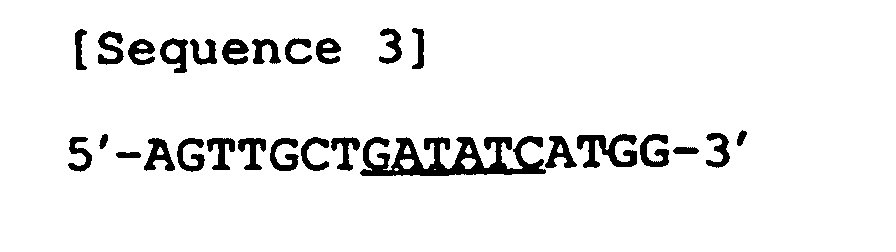 In the
Sequence 3, the underlined part represents the recognition site of EcoRV.The amplified gene product was digested with EcoRV and XhoI and inserted into the EcoRV-XhoI site of pBacPAK6 to yield a transfer vector pPol.Separately, a GFP gene was synthesized from the pGFP by PCR using the following two primers: In the
Sequence 5, the underlined part represents the recognition site of XhoI.This GFP gene was digested with XhoI and SnaBI and inserted into the XhoI-SnaBI site of the plasmid pPol to yield a transfer plasmid pPolGFP. After being digested with SnaB1 and BamHI, the PH-GFP fusion gene obtained from the pPolGFP was inserted into the SnaB1-BamH1 site of an expression vector pAcUW31 (U02452) containing independent double promoters while a wild-type AcNPV PH gene was inserted into the EcoRI-BglII site of the expression vector to yield a transfer vector pColorPol. In this vector, the GFP-PH fusion gene and the AcNPV PH gene were located downstream the PH promoter (PPH) and the p10 promoter (Pp10), as seen in Fig. 1b. - (3) Construction of transfer vector pColorBtrus
A Cry1Ac DNA fragment was synthesized from a plasmid
pPN6.6 containing a Bt. Cry1Ac gene (Adang, M. J. et al.,
Gene, 36, 289-300 (1985)) by PCR using the following two
primers:
 In the
Sequences
Accordingly, a PH-Cry1Ac-GFP fusion gene was located downstream the promoter PPH in the pColorBtrus, as seen in Fig. 1c. -
- 1-1.5x10⁶ Sodoptera frugiperda Sf cells (InVitrogen, Cat. No. B825-01) seeded in each of cell culture dishes were incubated at 27 °C until they attached onto the dishes. Meanwhile, a DNA solution of 1 µg of wild-type AcNPV genomic DNA (BacPAK6, Clontech, Cat. No. 6144-1) and 5 µg of the transfer vector pAcG, pColorPol or pColorBtrus DNA in 20 mM HEPES buffer, whose volume was adjusted with sterile water to 50 µl of a final volume, was added with an equivolume of Lipofectin™ (Gibco). Subsequently, the mixture was incubated at room temperature for 15 min. The cells were washed twice with 2 ml serum-free TC-100 medium (Sigma). TC-100 (1.5 ml) was added to each dish. The Lipofectin-DNA complexes were added dropwise to the medium covering the cells while gently swirling the dish. Following incubation of the cells at 27 °C for 6 hour, 1.5 ml of TC-100 supplemented with 10% FBS (Gibco BRL) and antibiotics were added to each dish and the incubation at 27 °C continued. 4 or 5 days after transfection, the supernatant was taken and centrifuged at 7,000 g for 5 min to obtain recombinant a baculovirus AcG, ColorPol or ColorBtrus. Before centrifugation, the supernatant was preferably observed with an inverted phase contrast microscope (x100) to confirm polyhedra.
- The recombinant baculovirus AcG, ColorPol or ColorBtrus was seeded at a population of 2.0x10⁶ per 60mmx15mm plate and allowed to stand for 1 hour before infection to Sf9 cells. In regard to infection, about 5 viruses per Sf9 cell were preferred. To characterize the expression of the recombinant polyhedrin or the fusion proteins, the cells infected with the recombinant baculovirus were observed at 4 days postinfection by a light microscope and a fluorescent microscope (Axiophot Universal Microscope, Zeiss, x1,000). As a control, a wild-type baculovirus AcNPV (Clontech, Cat. No. K1601-D) was used.
- The results are shown in Figs. 2a to 2h. Figs. 2a and 2b are respectively a light microphotograph and a fluorescent microphotograph for the Sf9 cells infected with wild-type AcNPV, Figs. 2c and 2d for the Sf9 cells infected with AcG, Figs. 2e and 2f for the Sf9 cells infected with ColorPol, and Figs. 2g and 2h for the Sf9 cells infected with ColorBtrus.
- As seen in Figs. 2e to 2h, the fusion proteins of ColorPol and ColorBtrus have normal polyhedra shapes, emitting green light under ultraviolet light. Thus, this microscopy of the cells infected with the recombinant baculovirus ColorPol and ColorBtrus revealed that GFP with fluorescence activity was fused in the polyhedra. In contrast, the polyhedra produced from the wild-type baculovirus AcNPV had a normal appearance, but did not emit green light under ultraviolet light. For AcG, the bright glow of the GFP produced clearly appeared in the whole cells.
- Sf9 cells were infected with the recombinant baculoviruses AcG, ColorPol and ColorBtrus in the same manner as that of Example III. After incubation at 27 °C, the cells were harvested at 3 days postinfection by centrifugation at 4,000xg for 5 min. After being washed with PBS and mixed with 5x sample buffer [0.6ml 1M Tris-HC1 (pH 6.8), 5ml 50% glycerol, 2ml 10% SDS, 0.5 ml β-mercaptoethanol, 1
ml 1% bromophenol blue, 0.9 ml H2O), the cells were water-boiled at 100 °C for 5 min, allowed to stand at room temperature for a while and then, clarified by centrifugation at 7,000xg for 5 min. The supernatants of the cell lysates were electrophoresed on a 10% polyacrylamide separation gel with a 3% stacking gel containing SDS. The proteins run on the gel were transferred to nitrocellulose membrane. After blotting, the membrane was bound with anti-GFP antibody (Clontech, Cat. No. 8363-2), anti-AcNPV PH antibody (possessed in the Laboratory of Insect Pathology and Genetic Engineering Division of Applied Biology and Chemistry, Seoul National University) Or anti-Bt Cry1Ac antibody (possessed in the Laboratory of Insect Pathology and Genetic Engineering Division of Applied Biology and Chemistry, Seoul National University) and then, incubated with goat anti-rabbit IgG alkaline phosphatase conjugate (Sigma) at room temperature. - The western blots obtained by use of an anti-GFP antibody, an anti-PH antibody and an anti-Cry1Ac antibody are given as shown in Figs. 3a, 3b and 3c, respectively. As demonstrated from the figures, the polyhedras produced from the recombinant baculoviruses ColorPol and ColorBtrus, were composed of a PH-GFP fusion protein 60 kDa in molecular weight and a PH-Cry1Ac-GFP, respectively.
- Samples were prepared by ultracentrifuging the same recombinant baculoviruses ColorBtrus and wild-type AcNPV cultures as in Example III in a gradient sucrose ranging from 40 to 65% and isolating the AcNPV polyhedra and the ColorBtrus polyhedra at the 56% region. These samples were fixed in a 0.1M PBS (pH 7.5) containing 1% (w/v) paraformaldehyde, rinsed with 0.1M glycine (pH 7.5), dehydrated and then, embedded in Lowicryl K4M (polysciences). Ultrathin sections of the embedded polyhedras were treated with an anti-GFP antibody, an anti-Cry1Ac antibody and an anti-PH antibody on nickel grids. These sections were exposed to a secondary antibody, such as colloidal gold-conjugated goat anti-rabbit antibody (Biocell), and stained with 0.2% lead citrate and 2% uranyl acetate before being observed with a transmission electron microscope (Hitachi M-600).
- Referring to Fig. 4, there are transmission electron microphotographs showing the immunogold-labeled recombinant polyhedra. The wild-type AcNPV polyhedra is shown in Fig. 4a and the recombinant ColorBtrus polyhedra in Fig. 4b. In the photographs, GFP, Cry1Ac and PH are discriminated by the gold particles with a diameter of 30 nm, 20 nm and 10 nm, respectively. As seen, gold particles with anti-PH, Cry1Ac and GFP antibodies are concurrently observed in the recombinant polyhedra of ColorBtrus while only gold particles with an anti-PH antibody are shown in Fig. 4a. This transmission electron microscopy, therefore, revealed that the recombinant polyhedra of ColorBtrus was a fusion protein of PH, Cry1Ac and GFP.
- The gut juices vomited from the 5th instar silkworm shocked with an electric current, were added to equivolumes of a wild-type AcNPV polyhedra, the recombinant ColorBtrus polyhedra and a Bt Cry1Ac protein and allowed to stand at room temperature for 5 min. These samples were subjected to 10% SDS-PAGE and Western blot analysis using an anti-Bt Cry1Ac antibody, in the same manner as in Example IV. Upon mock infection, water was used.
- The Western blots are shown in Fig. 5. In the ColorBtrus lane, a band of about 65 kDa was detected which is identical to the cleaved, active protein of Cry1Ac. Thus, the data demonstrate that the recombinant polyhedra of ColorBtrus taken by insects are immediately solubilized in the alkaline environment of the gut juice and cleaved to the activated toxin by the action of the proteases present therein.
- The toxicity of the recombinant virus ColorBtrus was determined against the Diamondback moth, Plutella xylostella with a control of wild-type AcNPV. To determine the median lethal dose (LD50), fifty second instar larvae were fed with eight 2-fold series diluted virus stocks (5120, 1280, 640, 320, 160, 80, 40 and 20 polyhedra per larva) on Chinese cabbage leaves. Larvae that consumed the dose in 24 hr were transferred to fresh leaves of Chinese cabbage and examined daily. The mortality was scored for a determined time for the determination of LD50. This procedure was repeated three times.
- In order to determine the median survival time ST50, fifty second-instar larvae each were fed with a virus suspension (1500 polyhedra per larva) on Chinese cabbage leaves.
- The results are given in Table 1, below.
Virus LD50 (No. polyhedra/larva) ST50 (hr) wt AcNPV 3,000 153.6 ColorBtrus 29.6 31.8 - The improved insecticidal activity of the recombinant polyhedra of ColorBtrus was demonstrated by reduction in both medial lethal dose (LD50) and median survival time (ST50). For. P. Xylostella larvae, the recombinant virus ColorBtrus shows 100-fold increased insecticidal activity and 5-fold decreased killing time compared with the wild-type AcNPV virus. Therefore, the recombinant virus of the present invention, even though used at a significantly small amount, is able to kill insect pests within a short time.
- With reference to Fig. 6, there is shown the accumulated insecticidal activity of the recombinant baculovirus ColorBtrus against P. Xylostella larvae. When P. xylostella was fed at a dose of 5120 (closed circle ) and 1280 (open circle ○) recombinant polyhedra per larva, the mortality reached approximately up to 100% and 90%, respectively, in three days. In the latter case, the number of dead larvae started to increase again at the sixth day from the treatment, and the mortality reached 94% finally.
- Fig. 7a shows P. xylostella larvae which were infected with the recombinant polyhedra of ColorBtrus three days earlier and Fig. 7b is a fluorescent microphotograph showing the fat body from the dead larvae which was infected with ColorBtrus six days earlier. The larvae which were killed at three days postinfection, exhibited a typical symptom due to Bt Cry1Ac (a) and the production of the recombinant polyhedra by the ColorBtrus was confirmed from the fat body from the dead larvae infected with ColorBtrus at 6 days postinfection (b). These data reveal that the recombinant baculovirus ColorBtrus has a killing power endowed from the crystal protein until 3 days postinfection while killing the larvae by viral replication from 6 days postinfection.
- Referring to Fig. 8, there is shown a reduction in feeding damage by ColorBtrus-infected P. xylostella larvae. The polyhedra of ColorBtrus (Fig. 8a) and of wild-type AcNPV (Fig. 8b) were treated on Chinese cabbage leaves. As seen, P. xylostella larvae treated with the recombinant polyhedra of ColorBtrus caused much less damage to the leaves than did the larvae infected with wild-type AcNPV.
- According to another aspect of the present invention, foreign proteins can be introduced to the polyhedra of wild type AcNPV, thereby constructing a novel baculovirus expression vector system which expresses many foreign proteins and facilitates their isolation, as apparent in the recombinant baculovirus ColorBtrus. Because almost all of the proteins which are expressed in conventional expression vectors are present in soluble forms, they are difficult to purify and require expensive apparatuses in the purification. In contrast, the novel baculovirus expression system carrying the polyhedra gene expresses the introduced foreign proteins in a form convenient to purify, for example, only by centrifugation. Thus, a significant economical profit can be obtained in terms of time and cost. Examples of the proteins which can be expressed by the baculovirus expression vector system of the present invention, include veterinary medicines such as interferon for cats or dogs, human medicines such as anticancer agents, insulin and interferon, antibacterial agents, antibiotics, etc.
- In addition, the recombinant polyhedra of the present invention can be applied for vaccine development. If a gene encoding foreign protein for use as a vaccine is fused to the gene encoding the polyhedrin protein in the baculovirus expression vector system, the foreign protein can be produced in a crystalline form along with the polyhedrin protein which is harmless to the body, so that the protein can maintain its vaccinal function without the aid of an adjuvant.
- As described hereinbefore, the recombinant baculovirus ColorBtrus of the present invention expresses polyhedra made up of a PH-CP-GFP fusion protein the CP moiety of which is solubilized in the alkaline environment of an insect's gut juice and cleaved to an active form by proteases while the virions are released. Thus, a baculovirus insecticide of the recombinant polyhedra of ColorBtrus exerts the double action mode of Bt crystal protein and viral replication of AcNPV on insects, improving its pathogenicity and host range. Moreover, because the recombinant polyhedra emits green fluorescence under UV light, it can be applied for monitoring and/or detecting infected insects in fields. In addition, this watching device can prevent the insecticide from being overused.
- The present invention has been described in an illustrative manner, and it is to be understood the terminology used is intended to be in the nature of description rather than of limitation.
- Many modifications and variations of the present invention are possible in light of the above teachings. Therefore, it is to be understood that within the scope of the appended claims, the invention may be practiced otherwise than as specifically described.
Claims (9)
- A recombinant baculovirus, which contains two independent transcription units as set forth:wherein the baculovirus can produce a recombinant polyhedra made up of a baculovirus polyhedrin, a Bacillus thuringiensis crystal protein and jellyfish Aequorea victoria green fluorescent protein.(a) a transcription unit encoding a baculovirus polyhedrin protein linked to a promoter;(b) a transcription unit encoding a fusion protein of baculovirus polyhedrin, a Bacillus thuringiensis crystal protein and jellyfish Aequorea Victoria green fluorescent protein linked to another promoter;
- A recombinant baculovirus as set forth in claim 1, wherein said baculovirus polyhedrin of said fusion protein of (b) is derived from Autographa californica Nucleopolyhedrovirus and said Bacillus thuringiensis crystal protein is a Cry1Ac protein segment containing the amino acid sequence of No. 1 to No. 613.
- A recombinant baculovirus as set forth in claim 1, having a Deposition No. KCTC 0444BP.
- A recombinant baculovirus as set forth in claim 1, wherein said baculovirus polyhedrin, said Bacillus thuringiensis crystal protein and said jellyfish Aequorea victoria green fluorescent protein are sequentially linked from N-terminal to C-terminal in said fusion protein of (b).
- A transfer vector, carrying two independent transcription units as set forth:(a) a transcription unit encoding a baculovirus polyhedrin protein linked to a promoter;(b) a transcription unit encoding a fusion protein of baculovirus polyhedrin, a Bacillus thuringiensis crystal protein and jellyfish Aequorea victoria green fluorescent protein linked from N-terminal to C-terminal, in sequence linked to another promoter;
- A construction method of baculovirus transfer vector, comprising the steps of:(a) synthesizing a green fluorescent protein-coding DNA fragment from plasmid pGFP by a polymerase chain reaction;(b) synthesizing a polyhedrin gene from wild-type Autographa californica Nucleopolyhedrovirus by a polymerase chain reaction;(c) inserting the green fluorescent protein-coding DNA fragment and the polyhedrin gene in baculovirus expression vector pAcUW31 in such a way that the 5'-end of the green fluorescent protein-coding DNA fragment is linked to the 3'-end of the polyhedrin gene;(d) synthesizing a Cry1Ac gene from a plasmid carrying a Bacillus thuringiensis Cry1Ac gene by a polymerase chain reaction; and(e) inserting the Cry1Ac gene between the polyhedrin gene and the green fluorescent protein-coding DNA fragment of said (c).
- A method of constructing the recombinant baculovirus of claim 1, comprising the steps of:(a) introducing a transfer vector carrying a fusion gene encoding a fusion protein in which a baculovirus polyhedrin, a Bacillus thuringiensis crystal protein and a jellyfish Aequorea victoria green fluorescent protein are directly linked from N-terminal to C-terminal, in sequence, and a wild-type baculovirus into an insect cell, simultaneously; and(b) culturing the cell.
- An insecticidal composition, comprising the recombinant virus of claim 1.
- A purification method of proteins using the transfer vector system of claim 5.
Applications Claiming Priority (3)
| Application Number | Priority Date | Filing Date | Title |
|---|---|---|---|
| KR1019980011914A KR100264953B1 (en) | 1998-04-03 | 1998-04-03 | Recombinant baculovirus, process for preparing thereof and microbial insecticides containing same |
| KR9811914 | 1998-04-03 | ||
| PCT/KR1998/000338 WO1999051721A1 (en) | 1998-04-03 | 1998-10-28 | Novel recombinant baculovirus, construction method thereof and insect pesticidal composition containing the same |
Publications (2)
| Publication Number | Publication Date |
|---|---|
| EP1066372A1 EP1066372A1 (en) | 2001-01-10 |
| EP1066372B1 true EP1066372B1 (en) | 2005-08-17 |
Family
ID=36571490
Family Applications (1)
| Application Number | Title | Priority Date | Filing Date |
|---|---|---|---|
| EP98951790A Expired - Lifetime EP1066372B1 (en) | 1998-04-03 | 1998-10-28 | Novel recombinant baculovirus, construction method thereof and insect pesticidal composition containing the same |
Country Status (11)
| Country | Link |
|---|---|
| US (1) | US6338846B1 (en) |
| EP (1) | EP1066372B1 (en) |
| JP (1) | JP3790100B2 (en) |
| KR (1) | KR100264953B1 (en) |
| CN (1) | CN1161458C (en) |
| AU (1) | AU742821B2 (en) |
| BR (1) | BRPI9815793B1 (en) |
| CA (1) | CA2327107C (en) |
| DE (2) | DE69831273T2 (en) |
| MX (1) | MXPA00009707A (en) |
| WO (1) | WO1999051721A1 (en) |
Cited By (1)
| Publication number | Priority date | Publication date | Assignee | Title |
|---|---|---|---|---|
| RU2581794C1 (en) * | 2015-05-12 | 2016-04-20 | Федеральное государственное автономное образовательное учреждение высшего образования "Крымский федеральный университет имени В.И. Вернадского" | Method of improving efficiency of baculovirus drugs |
Families Citing this family (42)
| Publication number | Priority date | Publication date | Assignee | Title |
|---|---|---|---|---|
| AU765767B2 (en) | 1999-03-12 | 2003-09-25 | Basf Aktiengesellschaft | Synergistic insecticidal compositions |
| WO2000062615A1 (en) | 1999-04-21 | 2000-10-26 | University Of Florida Research Foundation, Inc. | Neuropeptides and their use for pest control |
| US7354776B2 (en) * | 2000-12-14 | 2008-04-08 | Strategic Diagnostics Inc. | Method of processing and testing powdered samples using immunochromatographic strip tests |
| KR100436232B1 (en) * | 2001-07-13 | 2004-06-12 | 제연호 | Recombinant virus and a method for expressing foreign gene by vaculovirus expression system using same |
| CN1317387C (en) * | 2001-12-31 | 2007-05-23 | 中国科学院武汉病毒研究所 | Rapid donor plasmid and its construction method with mononuclear polyhedrosis virus gene and P10 gene promoter sequence of cotton bollworm |
| KR100491970B1 (en) * | 2002-06-26 | 2005-05-27 | 학교법인 포항공과대학교 | A fusion protein of baculoviral polyhedrin protein-target protein and method for producing the target protein using the same |
| SG135176A1 (en) * | 2004-02-02 | 2007-09-28 | Ambrx Inc | Modified human four helical bundle polypeptides and their uses |
| CN102603895B (en) | 2004-06-18 | 2016-09-28 | Ambrx公司 | Novel antigen-binding polypeptides and its purposes |
| WO2006091231A2 (en) * | 2004-07-21 | 2006-08-31 | Ambrx, Inc. | Biosynthetic polypeptides utilizing non-naturally encoded amino acids |
| KR100600837B1 (en) * | 2004-09-02 | 2006-07-14 | 학교법인 포항공과대학교 | Biopesticides Convergence of Baculovirus Polyhedral Proteins and Toxic Proteins |
| US7638491B2 (en) | 2004-12-22 | 2009-12-29 | Ambrx, Inc. | Therapies using non-natural amino acids and polypeptides |
| WO2006073846A2 (en) | 2004-12-22 | 2006-07-13 | Ambrx, Inc. | Methods for expression and purification of recombinant human growth hormone |
| US7816320B2 (en) | 2004-12-22 | 2010-10-19 | Ambrx, Inc. | Formulations of human growth hormone comprising a non-naturally encoded amino acid at position 35 |
| MX2007007581A (en) | 2004-12-22 | 2007-07-24 | Ambrx Inc | Compositions of aminoacyl-trna synthetase and uses thereof. |
| CN103690936A (en) | 2004-12-22 | 2014-04-02 | Ambrx公司 | Modified human growth hormone |
| KR100664994B1 (en) * | 2004-12-27 | 2007-01-09 | 건국대학교 산학협력단 | Recombinant baculovirus and method for introducing the gene of interest into the somatic cells of an animal using the same |
| CN101247821B (en) | 2005-06-03 | 2013-01-23 | Ambrx公司 | Improved human interferon molecules and uses thereof |
| JP4829969B2 (en) | 2005-08-18 | 2011-12-07 | アンブルックス,インコーポレイテッド | tRNA compositions and uses thereof |
| KR20080079643A (en) | 2005-11-16 | 2008-09-01 | 암브룩스, 인코포레이티드 | Methods and Compositions Including Non-Natural Amino Acids |
| CN101541955B (en) | 2006-09-08 | 2016-09-28 | Ambrx公司 | Hybrid suppressor tRNA for vertebrate cells |
| EP2064333B1 (en) | 2006-09-08 | 2014-02-26 | Ambrx, Inc. | Suppressor trna transcription in vertebrate cells |
| CA2663083A1 (en) | 2006-09-08 | 2008-03-13 | Ambrx, Inc. | Modified human plasma polypeptide or fc scaffolds and their uses |
| US8052968B2 (en) | 2006-10-16 | 2011-11-08 | Genelux Corporation | Modified vaccinia virus strains for use in diagnostic and therapeutic methods |
| EP2121764B1 (en) * | 2007-02-28 | 2014-07-16 | National University Corporation Kyoto Institute of Technology | Viral polyhedra complexes and their use |
| BRPI0809583B1 (en) | 2007-03-30 | 2022-02-22 | Ambrx, Inc | Modified fgf-21 polypeptide, composition comprising the same, method for producing said fgf-21 polypeptide, and cell comprising a polynucleotide |
| MX2009011870A (en) | 2007-05-02 | 2009-11-12 | Ambrx Inc | Modified interferon beta polypeptides and their uses. |
| ES2632504T3 (en) | 2007-11-20 | 2017-09-13 | Ambrx, Inc. | Modified insulin polypeptides and their uses |
| NZ620606A (en) | 2008-02-08 | 2015-08-28 | Ambrx Inc | Modified leptin polypeptides and their uses |
| PE20110426A1 (en) | 2008-07-23 | 2011-07-01 | Ambrx Inc | MODIFIED BOVINE G-CSF POLYPEPTIDES |
| PT2337846T (en) | 2008-09-26 | 2018-04-05 | Ambrx Inc | Non-natural amino acid replication-dependent microorganisms and vaccines |
| CN102232085A (en) | 2008-09-26 | 2011-11-02 | Ambrx公司 | Modified animal erythropoietin polypeptide and use thereof |
| CA2763492A1 (en) * | 2009-06-05 | 2010-12-09 | The Ohio State University Research Foundation | Biomaterials, compositions, and methods |
| WO2011087810A1 (en) | 2009-12-21 | 2011-07-21 | Ambrx, Inc. | Modified porcine somatotropin polypeptides and their uses |
| JP2013515080A (en) | 2009-12-21 | 2013-05-02 | アンブルックス,インコーポレイテッド | Modified bovine somatotropin polypeptides and their use |
| AU2011291943B2 (en) | 2010-08-17 | 2015-01-22 | Ambrx, Inc. | Modified relaxin polypeptides and their uses |
| US9567386B2 (en) | 2010-08-17 | 2017-02-14 | Ambrx, Inc. | Therapeutic uses of modified relaxin polypeptides |
| TWI480288B (en) | 2010-09-23 | 2015-04-11 | Lilly Co Eli | Formulations for bovine granulocyte colony stimulating factor and variants thereof |
| CN103267747A (en) * | 2013-04-17 | 2013-08-28 | 江苏大学 | A method for rapid identification of recombinant virion production in eukaryotic expression |
| JP5839644B1 (en) * | 2014-02-18 | 2016-01-06 | 日本写真印刷株式会社 | Pest control sheet |
| SG11201702824UA (en) | 2014-10-24 | 2017-05-30 | Bristol Myers Squibb Co | Modified fgf-21 polypeptides and uses thereof |
| CN104560934B (en) * | 2015-02-13 | 2016-05-11 | 江西省科学院微生物研究所 | A kind of polyhedrin coated phytase |
| KR102670432B1 (en) | 2017-02-08 | 2024-05-28 | 브리스톨-마이어스 스큅 컴퍼니 | Modified relaxin polypeptides containing pharmacokinetic enhancers and uses thereof |
Family Cites Families (4)
| Publication number | Priority date | Publication date | Assignee | Title |
|---|---|---|---|---|
| US5041379A (en) * | 1987-03-16 | 1991-08-20 | American Biogenetic Science, Inc. | Heliothis expression systems |
| AU1717688A (en) * | 1987-03-16 | 1988-10-10 | American Biogenetic Sciences, Inc. | Recombinant baculovirus occlusion bodies in vaccines and biological insecticides |
| GB2228486A (en) * | 1989-02-27 | 1990-08-29 | Univ Ottawa | Improved baculovirus expression system capable of producing foreign gene proteins at high levels |
| GB9405951D0 (en) * | 1994-03-25 | 1994-05-11 | Zeneca Ltd | Biological control agents |
-
1998
- 1998-04-03 KR KR1019980011914A patent/KR100264953B1/en not_active Expired - Lifetime
- 1998-10-28 CA CA002327107A patent/CA2327107C/en not_active Expired - Fee Related
- 1998-10-28 AU AU97645/98A patent/AU742821B2/en not_active Ceased
- 1998-10-28 MX MXPA00009707A patent/MXPA00009707A/en active IP Right Grant
- 1998-10-28 JP JP2000542434A patent/JP3790100B2/en not_active Expired - Fee Related
- 1998-10-28 DE DE69831273T patent/DE69831273T2/en not_active Expired - Lifetime
- 1998-10-28 CN CNB988140187A patent/CN1161458C/en not_active Expired - Fee Related
- 1998-10-28 WO PCT/KR1998/000338 patent/WO1999051721A1/en not_active Ceased
- 1998-10-28 DE DE1066372T patent/DE1066372T1/en active Pending
- 1998-10-28 EP EP98951790A patent/EP1066372B1/en not_active Expired - Lifetime
- 1998-10-28 BR BRPI9815793A patent/BRPI9815793B1/en not_active IP Right Cessation
- 1998-11-06 US US09/187,164 patent/US6338846B1/en not_active Expired - Lifetime
Cited By (1)
| Publication number | Priority date | Publication date | Assignee | Title |
|---|---|---|---|---|
| RU2581794C1 (en) * | 2015-05-12 | 2016-04-20 | Федеральное государственное автономное образовательное учреждение высшего образования "Крымский федеральный университет имени В.И. Вернадского" | Method of improving efficiency of baculovirus drugs |
Also Published As
| Publication number | Publication date |
|---|---|
| CN1161458C (en) | 2004-08-11 |
| CA2327107A1 (en) | 1999-10-14 |
| MXPA00009707A (en) | 2002-06-04 |
| DE69831273D1 (en) | 2005-09-22 |
| JP3790100B2 (en) | 2006-06-28 |
| BRPI9815793B1 (en) | 2015-10-13 |
| DE69831273T2 (en) | 2006-06-22 |
| BR9815793A (en) | 2001-10-16 |
| JP2002510483A (en) | 2002-04-09 |
| KR19990079361A (en) | 1999-11-05 |
| WO1999051721A1 (en) | 1999-10-14 |
| AU9764598A (en) | 1999-10-25 |
| EP1066372A1 (en) | 2001-01-10 |
| CA2327107C (en) | 2007-01-09 |
| US6338846B1 (en) | 2002-01-15 |
| KR100264953B1 (en) | 2001-03-02 |
| CN1292817A (en) | 2001-04-25 |
| DE1066372T1 (en) | 2001-07-05 |
| AU742821B2 (en) | 2002-01-10 |
Similar Documents
| Publication | Publication Date | Title |
|---|---|---|
| EP1066372B1 (en) | Novel recombinant baculovirus, construction method thereof and insect pesticidal composition containing the same | |
| US6096304A (en) | Recombinant baculovirus insecticides | |
| McCutchen et al. | Development of a recombinant baculovirus expressing an insect-selective neurotoxin: potential for pest control | |
| Gopalakrishnan et al. | Baculovirus-mediated expression of a Manduca sexta chitinase gene: properties of the recombinant protein | |
| US5547871A (en) | Heterologous signal sequences for secretion of insect controlling proteins | |
| Prikhod'ko et al. | Properties of three baculovirus-expressing genes that encode insect-selective toxins: μ-Aga-IV, As II, and Sh I | |
| Jarvis et al. | Construction and characterization of immediate early baculovirus pesticides | |
| US6087165A (en) | Recombinant baculovirus and its use as a biocontrol agent for crop pests | |
| AU753930B2 (en) | Recombinant baculovirus-based insecticides | |
| van Beek et al. | Effect of signal sequence and promoter on the speed of action of a genetically modified Autographa californica nucleopolyhedrovirus expressing the scorpion toxin LqhIT2 | |
| EP0621337A1 (en) | Codon optimized DNA sequence for insect toxin AaIT | |
| AU743526B2 (en) | Transgenic virus | |
| KR19990076627A (en) | Preparation of Recombinant Baculovirus | |
| Kuzio et al. | An overview of the molecular biology and applications of baculoviruses | |
| Shu-Jen et al. | Improved plant protective efficacy of a baculovirus using an early promoter to drive insect-specific neurotoxin expression | |
| US6355240B1 (en) | Enhanced insecticidal insect virus through the expression of heterologous proteins with early promoters | |
| US5593669A (en) | Stable pre-occluded virus particle | |
| AU720082B2 (en) | Heterologous signal sequences for secretion of insect controlling toxins | |
| MXPA00010981A (en) | Recombinant baculovirus-based insecticides |
Legal Events
| Date | Code | Title | Description |
|---|---|---|---|
| PUAI | Public reference made under article 153(3) epc to a published international application that has entered the european phase |
Free format text: ORIGINAL CODE: 0009012 |
|
| 17P | Request for examination filed |
Effective date: 20001031 |
|
| AK | Designated contracting states |
Kind code of ref document: A1 Designated state(s): DE FR GB IT |
|
| EL | Fr: translation of claims filed | ||
| DET | De: translation of patent claims | ||
| RIN1 | Information on inventor provided before grant (corrected) |
Inventor name: CHANG, JIN, HEE Inventor name: ROH,JONG,YUL LAB. INSECT PATH. AGRIC. BIOTECHN. Inventor name: PARK, HYUN, WOO Inventor name: JIN, BYUNG, RAE Inventor name: JE, YEON, HO Inventor name: KANG, SEOK, KWON |
|
| RAP1 | Party data changed (applicant data changed or rights of an application transferred) |
Owner name: DONGBU HANNONG CHEMICAL CO., LTD. Owner name: JE, YEONHO |
|
| 17Q | First examination report despatched |
Effective date: 20031016 |
|
| GRAP | Despatch of communication of intention to grant a patent |
Free format text: ORIGINAL CODE: EPIDOSNIGR1 |
|
| RIN1 | Information on inventor provided before grant (corrected) |
Inventor name: CHANG, JIN, HEE Inventor name: ROH,JONG,YULLAB. INSECT PATH. AGRIC. BIOTECHN. Inventor name: PARK, HYUN, WOO Inventor name: JIN, BYUNG, RAE Inventor name: JE, YEON, HO Inventor name: KANG, SEOK, KWON |
|
| GRAS | Grant fee paid |
Free format text: ORIGINAL CODE: EPIDOSNIGR3 |
|
| GRAA | (expected) grant |
Free format text: ORIGINAL CODE: 0009210 |
|
| AK | Designated contracting states |
Kind code of ref document: B1 Designated state(s): DE FR GB IT |
|
| REG | Reference to a national code |
Ref country code: GB Ref legal event code: FG4D |
|
| REF | Corresponds to: |
Ref document number: 69831273 Country of ref document: DE Date of ref document: 20050922 Kind code of ref document: P |
|
| ET | Fr: translation filed | ||
| PLBE | No opposition filed within time limit |
Free format text: ORIGINAL CODE: 0009261 |
|
| STAA | Information on the status of an ep patent application or granted ep patent |
Free format text: STATUS: NO OPPOSITION FILED WITHIN TIME LIMIT |
|
| 26N | No opposition filed |
Effective date: 20060518 |
|
| REG | Reference to a national code |
Ref country code: FR Ref legal event code: PLFP Year of fee payment: 18 |
|
| REG | Reference to a national code |
Ref country code: DE Ref legal event code: R082 Ref document number: 69831273 Country of ref document: DE Representative=s name: VOSSIUS & PARTNER PATENTANWAELTE RECHTSANWAELT, DE Ref country code: DE Ref legal event code: R081 Ref document number: 69831273 Country of ref document: DE Owner name: JE, YEONHO, SUWON, KR Free format text: FORMER OWNERS: JE, YEONHO, SUWON, KYUNGGI, KR; DONGBU HANNONG CHEMICAL CO., LTD., SEOUL/SOUL, KR Ref country code: DE Ref legal event code: R081 Ref document number: 69831273 Country of ref document: DE Owner name: JE, YEONHO, SUWON, KR Free format text: FORMER OWNERS: DONGBU HANNONG CO., LTD., SEOUL, GANGNAM-GU, KR; JE, YEONHO, SUWON, KYUNGGI, KR Ref country code: DE Ref legal event code: R081 Ref document number: 69831273 Country of ref document: DE Owner name: DONGBU FARM HANNONG CO., LTD., KR Free format text: FORMER OWNERS: DONGBU HANNONG CO., LTD., SEOUL, GANGNAM-GU, KR; JE, YEONHO, SUWON, KYUNGGI, KR Ref country code: DE Ref legal event code: R081 Ref document number: 69831273 Country of ref document: DE Owner name: DONGBU FARM HANNONG CO., LTD., KR Free format text: FORMER OWNERS: JE, YEONHO, SUWON, KYUNGGI, KR; DONGBU HANNONG CHEMICAL CO., LTD., SEOUL/SOUL, KR |
|
| REG | Reference to a national code |
Ref country code: DE Ref legal event code: R082 Ref document number: 69831273 Country of ref document: DE Representative=s name: VOSSIUS & PARTNER PATENTANWAELTE RECHTSANWAELT, DE Ref country code: DE Ref legal event code: R081 Ref document number: 69831273 Country of ref document: DE Owner name: DONGBU FARM HANNONG CO., LTD., KR Free format text: FORMER OWNERS: DONGBU HITEK CO., LTD., SEOUL, KR; JE, YEONHO, SUWON, KYUNGGI, KR Ref country code: DE Ref legal event code: R081 Ref document number: 69831273 Country of ref document: DE Owner name: JE, YEONHO, SUWON, KR Free format text: FORMER OWNERS: DONGBU HITEK CO., LTD., SEOUL, KR; JE, YEONHO, SUWON, KYUNGGI, KR |
|
| REG | Reference to a national code |
Ref country code: GB Ref legal event code: 732E Free format text: REGISTERED BETWEEN 20160121 AND 20160127 |
|
| REG | Reference to a national code |
Ref country code: FR Ref legal event code: TQ Owner name: DONGBU FARM HANNONG CO., LTD., KR Effective date: 20160222 Ref country code: FR Ref legal event code: CD Owner name: DONGBU FARM HANNONG CO., LTD., KR Effective date: 20160222 Ref country code: FR Ref legal event code: CA Effective date: 20160222 |
|
| REG | Reference to a national code |
Ref country code: FR Ref legal event code: PLFP Year of fee payment: 19 |
|
| PGFP | Annual fee paid to national office [announced via postgrant information from national office to epo] |
Ref country code: DE Payment date: 20161027 Year of fee payment: 19 Ref country code: GB Payment date: 20161027 Year of fee payment: 19 Ref country code: FR Payment date: 20161025 Year of fee payment: 19 |
|
| PGFP | Annual fee paid to national office [announced via postgrant information from national office to epo] |
Ref country code: IT Payment date: 20161024 Year of fee payment: 19 |
|
| REG | Reference to a national code |
Ref country code: DE Ref legal event code: R119 Ref document number: 69831273 Country of ref document: DE |
|
| GBPC | Gb: european patent ceased through non-payment of renewal fee |
Effective date: 20171028 |
|
| REG | Reference to a national code |
Ref country code: FR Ref legal event code: ST Effective date: 20180629 |
|
| PG25 | Lapsed in a contracting state [announced via postgrant information from national office to epo] |
Ref country code: DE Free format text: LAPSE BECAUSE OF NON-PAYMENT OF DUE FEES Effective date: 20180501 Ref country code: GB Free format text: LAPSE BECAUSE OF NON-PAYMENT OF DUE FEES Effective date: 20171028 |
|
| PG25 | Lapsed in a contracting state [announced via postgrant information from national office to epo] |
Ref country code: FR Free format text: LAPSE BECAUSE OF NON-PAYMENT OF DUE FEES Effective date: 20171031 |
|
| PG25 | Lapsed in a contracting state [announced via postgrant information from national office to epo] |
Ref country code: IT Free format text: LAPSE BECAUSE OF NON-PAYMENT OF DUE FEES Effective date: 20171028 |