EP0605522B1 - Methods for the production of humanized antibodies - Google Patents
Methods for the production of humanized antibodies Download PDFInfo
- Publication number
- EP0605522B1 EP0605522B1 EP92919846A EP92919846A EP0605522B1 EP 0605522 B1 EP0605522 B1 EP 0605522B1 EP 92919846 A EP92919846 A EP 92919846A EP 92919846 A EP92919846 A EP 92919846A EP 0605522 B1 EP0605522 B1 EP 0605522B1
- Authority
- EP
- European Patent Office
- Prior art keywords
- population
- antigen
- antibody
- polypeptide
- human
- Prior art date
- Legal status (The legal status is an assumption and is not a legal conclusion. Google has not performed a legal analysis and makes no representation as to the accuracy of the status listed.)
- Expired - Lifetime
Links
- 238000000034 method Methods 0.000 title claims abstract description 106
- 238000004519 manufacturing process Methods 0.000 title abstract description 5
- 108090000765 processed proteins & peptides Proteins 0.000 claims abstract description 242
- 102000004196 processed proteins & peptides Human genes 0.000 claims abstract description 220
- 229920001184 polypeptide Polymers 0.000 claims abstract description 217
- 239000000427 antigen Substances 0.000 claims abstract description 174
- 108091007433 antigens Proteins 0.000 claims abstract description 174
- 102000036639 antigens Human genes 0.000 claims abstract description 174
- 230000027455 binding Effects 0.000 claims abstract description 161
- 239000000539 dimer Substances 0.000 claims abstract description 89
- 239000012634 fragment Substances 0.000 claims description 134
- 108090000623 proteins and genes Proteins 0.000 claims description 94
- 108010047041 Complementarity Determining Regions Proteins 0.000 claims description 65
- 239000013598 vector Substances 0.000 claims description 61
- 150000007523 nucleic acids Chemical class 0.000 claims description 42
- 102000001706 Immunoglobulin Fab Fragments Human genes 0.000 claims description 36
- 108010054477 Immunoglobulin Fab Fragments Proteins 0.000 claims description 36
- 108020004707 nucleic acids Proteins 0.000 claims description 30
- 102000039446 nucleic acids Human genes 0.000 claims description 30
- 102000004169 proteins and genes Human genes 0.000 claims description 24
- 230000004927 fusion Effects 0.000 claims description 19
- 108010067060 Immunoglobulin Variable Region Proteins 0.000 claims description 14
- 102000017727 Immunoglobulin Variable Region Human genes 0.000 claims description 14
- 230000002068 genetic effect Effects 0.000 claims description 12
- 150000001413 amino acids Chemical class 0.000 claims description 6
- 239000013604 expression vector Substances 0.000 claims description 6
- 238000012217 deletion Methods 0.000 claims description 5
- 230000037430 deletion Effects 0.000 claims description 5
- 239000003814 drug Substances 0.000 claims description 5
- 238000003780 insertion Methods 0.000 claims description 5
- 230000037431 insertion Effects 0.000 claims description 5
- 238000007792 addition Methods 0.000 claims description 2
- 229910052739 hydrogen Inorganic materials 0.000 claims description 2
- 238000006467 substitution reaction Methods 0.000 claims description 2
- 102000008394 Immunoglobulin Fragments Human genes 0.000 abstract description 13
- 108010021625 Immunoglobulin Fragments Proteins 0.000 abstract description 13
- 230000000295 complement effect Effects 0.000 abstract description 13
- 238000002823 phage display Methods 0.000 abstract description 9
- 238000005516 engineering process Methods 0.000 abstract description 8
- 230000001965 increasing effect Effects 0.000 abstract description 8
- 230000004048 modification Effects 0.000 abstract description 5
- 238000012986 modification Methods 0.000 abstract description 5
- 239000013615 primer Substances 0.000 description 77
- 108020004414 DNA Proteins 0.000 description 54
- 210000004027 cell Anatomy 0.000 description 48
- 101000611183 Homo sapiens Tumor necrosis factor Proteins 0.000 description 41
- 238000002965 ELISA Methods 0.000 description 40
- 102100040247 Tumor necrosis factor Human genes 0.000 description 36
- 239000000047 product Substances 0.000 description 28
- 101100112922 Candida albicans CDR3 gene Proteins 0.000 description 27
- 210000004602 germ cell Anatomy 0.000 description 26
- 241000283984 Rodentia Species 0.000 description 25
- 238000010367 cloning Methods 0.000 description 23
- 239000000203 mixture Substances 0.000 description 22
- 229940098773 bovine serum albumin Drugs 0.000 description 20
- 108091003079 Bovine Serum Albumin Proteins 0.000 description 19
- 238000006243 chemical reaction Methods 0.000 description 19
- 235000018102 proteins Nutrition 0.000 description 17
- 108060003951 Immunoglobulin Proteins 0.000 description 16
- 102000018358 immunoglobulin Human genes 0.000 description 16
- XLYOFNOQVPJJNP-UHFFFAOYSA-N water Substances O XLYOFNOQVPJJNP-UHFFFAOYSA-N 0.000 description 16
- 230000003321 amplification Effects 0.000 description 15
- 238000003199 nucleic acid amplification method Methods 0.000 description 15
- FAPWRFPIFSIZLT-UHFFFAOYSA-M sodium chloride Inorganic materials [Na+].[Cl-] FAPWRFPIFSIZLT-UHFFFAOYSA-M 0.000 description 15
- 241000588724 Escherichia coli Species 0.000 description 14
- TWRXJAOTZQYOKJ-UHFFFAOYSA-L Magnesium chloride Chemical compound [Mg+2].[Cl-].[Cl-] TWRXJAOTZQYOKJ-UHFFFAOYSA-L 0.000 description 14
- 108091034117 Oligonucleotide Proteins 0.000 description 14
- 230000008569 process Effects 0.000 description 14
- 239000013612 plasmid Substances 0.000 description 13
- 238000002360 preparation method Methods 0.000 description 13
- LFQSCWFLJHTTHZ-UHFFFAOYSA-N Ethanol Chemical compound CCO LFQSCWFLJHTTHZ-UHFFFAOYSA-N 0.000 description 12
- AVKUERGKIZMTKX-NJBDSQKTSA-N ampicillin Chemical compound C1([C@@H](N)C(=O)N[C@H]2[C@H]3SC([C@@H](N3C2=O)C(O)=O)(C)C)=CC=CC=C1 AVKUERGKIZMTKX-NJBDSQKTSA-N 0.000 description 12
- 229960000723 ampicillin Drugs 0.000 description 12
- 239000011230 binding agent Substances 0.000 description 12
- 230000035772 mutation Effects 0.000 description 12
- 239000006228 supernatant Substances 0.000 description 12
- 241001465754 Metazoa Species 0.000 description 11
- 239000002773 nucleotide Substances 0.000 description 11
- 125000003729 nucleotide group Chemical group 0.000 description 11
- 239000002245 particle Substances 0.000 description 11
- QKNYBSVHEMOAJP-UHFFFAOYSA-N 2-amino-2-(hydroxymethyl)propane-1,3-diol;hydron;chloride Chemical compound Cl.OCC(N)(CO)CO QKNYBSVHEMOAJP-UHFFFAOYSA-N 0.000 description 10
- HEDRZPFGACZZDS-UHFFFAOYSA-N Chloroform Chemical compound ClC(Cl)Cl HEDRZPFGACZZDS-UHFFFAOYSA-N 0.000 description 10
- ISWSIDIOOBJBQZ-UHFFFAOYSA-N Phenol Chemical compound OC1=CC=CC=C1 ISWSIDIOOBJBQZ-UHFFFAOYSA-N 0.000 description 10
- JLCPHMBAVCMARE-UHFFFAOYSA-N [3-[[3-[[3-[[3-[[3-[[3-[[3-[[3-[[3-[[3-[[3-[[5-(2-amino-6-oxo-1H-purin-9-yl)-3-[[3-[[3-[[3-[[3-[[3-[[5-(2-amino-6-oxo-1H-purin-9-yl)-3-[[5-(2-amino-6-oxo-1H-purin-9-yl)-3-hydroxyoxolan-2-yl]methoxy-hydroxyphosphoryl]oxyoxolan-2-yl]methoxy-hydroxyphosphoryl]oxy-5-(5-methyl-2,4-dioxopyrimidin-1-yl)oxolan-2-yl]methoxy-hydroxyphosphoryl]oxy-5-(6-aminopurin-9-yl)oxolan-2-yl]methoxy-hydroxyphosphoryl]oxy-5-(6-aminopurin-9-yl)oxolan-2-yl]methoxy-hydroxyphosphoryl]oxy-5-(6-aminopurin-9-yl)oxolan-2-yl]methoxy-hydroxyphosphoryl]oxy-5-(6-aminopurin-9-yl)oxolan-2-yl]methoxy-hydroxyphosphoryl]oxyoxolan-2-yl]methoxy-hydroxyphosphoryl]oxy-5-(5-methyl-2,4-dioxopyrimidin-1-yl)oxolan-2-yl]methoxy-hydroxyphosphoryl]oxy-5-(4-amino-2-oxopyrimidin-1-yl)oxolan-2-yl]methoxy-hydroxyphosphoryl]oxy-5-(5-methyl-2,4-dioxopyrimidin-1-yl)oxolan-2-yl]methoxy-hydroxyphosphoryl]oxy-5-(5-methyl-2,4-dioxopyrimidin-1-yl)oxolan-2-yl]methoxy-hydroxyphosphoryl]oxy-5-(6-aminopurin-9-yl)oxolan-2-yl]methoxy-hydroxyphosphoryl]oxy-5-(6-aminopurin-9-yl)oxolan-2-yl]methoxy-hydroxyphosphoryl]oxy-5-(4-amino-2-oxopyrimidin-1-yl)oxolan-2-yl]methoxy-hydroxyphosphoryl]oxy-5-(4-amino-2-oxopyrimidin-1-yl)oxolan-2-yl]methoxy-hydroxyphosphoryl]oxy-5-(4-amino-2-oxopyrimidin-1-yl)oxolan-2-yl]methoxy-hydroxyphosphoryl]oxy-5-(6-aminopurin-9-yl)oxolan-2-yl]methoxy-hydroxyphosphoryl]oxy-5-(4-amino-2-oxopyrimidin-1-yl)oxolan-2-yl]methyl [5-(6-aminopurin-9-yl)-2-(hydroxymethyl)oxolan-3-yl] hydrogen phosphate Polymers Cc1cn(C2CC(OP(O)(=O)OCC3OC(CC3OP(O)(=O)OCC3OC(CC3O)n3cnc4c3nc(N)[nH]c4=O)n3cnc4c3nc(N)[nH]c4=O)C(COP(O)(=O)OC3CC(OC3COP(O)(=O)OC3CC(OC3COP(O)(=O)OC3CC(OC3COP(O)(=O)OC3CC(OC3COP(O)(=O)OC3CC(OC3COP(O)(=O)OC3CC(OC3COP(O)(=O)OC3CC(OC3COP(O)(=O)OC3CC(OC3COP(O)(=O)OC3CC(OC3COP(O)(=O)OC3CC(OC3COP(O)(=O)OC3CC(OC3COP(O)(=O)OC3CC(OC3COP(O)(=O)OC3CC(OC3COP(O)(=O)OC3CC(OC3COP(O)(=O)OC3CC(OC3COP(O)(=O)OC3CC(OC3COP(O)(=O)OC3CC(OC3CO)n3cnc4c(N)ncnc34)n3ccc(N)nc3=O)n3cnc4c(N)ncnc34)n3ccc(N)nc3=O)n3ccc(N)nc3=O)n3ccc(N)nc3=O)n3cnc4c(N)ncnc34)n3cnc4c(N)ncnc34)n3cc(C)c(=O)[nH]c3=O)n3cc(C)c(=O)[nH]c3=O)n3ccc(N)nc3=O)n3cc(C)c(=O)[nH]c3=O)n3cnc4c3nc(N)[nH]c4=O)n3cnc4c(N)ncnc34)n3cnc4c(N)ncnc34)n3cnc4c(N)ncnc34)n3cnc4c(N)ncnc34)O2)c(=O)[nH]c1=O JLCPHMBAVCMARE-UHFFFAOYSA-N 0.000 description 10
- 239000000499 gel Substances 0.000 description 10
- 238000001727 in vivo Methods 0.000 description 10
- 238000004091 panning Methods 0.000 description 10
- 239000011541 reaction mixture Substances 0.000 description 10
- PEDCQBHIVMGVHV-UHFFFAOYSA-N Glycerine Chemical compound OCC(O)CO PEDCQBHIVMGVHV-UHFFFAOYSA-N 0.000 description 9
- 102000009270 Tumour necrosis factor alpha Human genes 0.000 description 9
- 108050000101 Tumour necrosis factor alpha Proteins 0.000 description 9
- 239000011543 agarose gel Substances 0.000 description 9
- 238000003752 polymerase chain reaction Methods 0.000 description 9
- 239000011535 reaction buffer Substances 0.000 description 9
- 238000012163 sequencing technique Methods 0.000 description 9
- SJHPCNCNNSSLPL-CSKARUKUSA-N (4e)-4-(ethoxymethylidene)-2-phenyl-1,3-oxazol-5-one Chemical compound O1C(=O)C(=C/OCC)\N=C1C1=CC=CC=C1 SJHPCNCNNSSLPL-CSKARUKUSA-N 0.000 description 8
- 108091028043 Nucleic acid sequence Proteins 0.000 description 8
- 101150117115 V gene Proteins 0.000 description 8
- 238000010804 cDNA synthesis Methods 0.000 description 8
- 230000009977 dual effect Effects 0.000 description 8
- 238000002474 experimental method Methods 0.000 description 8
- 238000000338 in vitro Methods 0.000 description 8
- 230000004044 response Effects 0.000 description 8
- 239000011780 sodium chloride Substances 0.000 description 8
- WQZGKKKJIJFFOK-GASJEMHNSA-N Glucose Natural products OC[C@H]1OC(O)[C@H](O)[C@@H](O)[C@@H]1O WQZGKKKJIJFFOK-GASJEMHNSA-N 0.000 description 7
- 241001529936 Murinae Species 0.000 description 7
- 238000012408 PCR amplification Methods 0.000 description 7
- 125000003275 alpha amino acid group Chemical group 0.000 description 7
- 238000004458 analytical method Methods 0.000 description 7
- 238000000137 annealing Methods 0.000 description 7
- 230000006870 function Effects 0.000 description 7
- 239000008103 glucose Substances 0.000 description 7
- 229910001629 magnesium chloride Inorganic materials 0.000 description 7
- 230000014759 maintenance of location Effects 0.000 description 7
- 238000012216 screening Methods 0.000 description 7
- 101100263673 Caenorhabditis elegans vhp-1 gene Proteins 0.000 description 6
- 108020004705 Codon Proteins 0.000 description 6
- 206010028980 Neoplasm Diseases 0.000 description 6
- ZMANZCXQSJIPKH-UHFFFAOYSA-N Triethylamine Chemical compound CCN(CC)CC ZMANZCXQSJIPKH-UHFFFAOYSA-N 0.000 description 6
- 238000013459 approach Methods 0.000 description 6
- 238000010276 construction Methods 0.000 description 6
- 102000057041 human TNF Human genes 0.000 description 6
- 210000004408 hybridoma Anatomy 0.000 description 6
- 239000000463 material Substances 0.000 description 6
- 238000000746 purification Methods 0.000 description 6
- 241000282412 Homo Species 0.000 description 5
- 235000001014 amino acid Nutrition 0.000 description 5
- 125000000539 amino acid group Chemical group 0.000 description 5
- 239000000872 buffer Substances 0.000 description 5
- 238000011534 incubation Methods 0.000 description 5
- 238000002955 isolation Methods 0.000 description 5
- 238000003032 molecular docking Methods 0.000 description 5
- 239000000243 solution Substances 0.000 description 5
- 241001515965 unidentified phage Species 0.000 description 5
- 102000004190 Enzymes Human genes 0.000 description 4
- 108090000790 Enzymes Proteins 0.000 description 4
- 241000724791 Filamentous phage Species 0.000 description 4
- 108010006785 Taq Polymerase Proteins 0.000 description 4
- 239000007983 Tris buffer Substances 0.000 description 4
- 201000011510 cancer Diseases 0.000 description 4
- 239000002299 complementary DNA Substances 0.000 description 4
- 230000002950 deficient Effects 0.000 description 4
- 238000004925 denaturation Methods 0.000 description 4
- 230000036425 denaturation Effects 0.000 description 4
- 230000029087 digestion Effects 0.000 description 4
- 229940088598 enzyme Drugs 0.000 description 4
- 208000015181 infectious disease Diseases 0.000 description 4
- 239000002609 medium Substances 0.000 description 4
- 102000013415 peroxidase activity proteins Human genes 0.000 description 4
- 108040007629 peroxidase activity proteins Proteins 0.000 description 4
- 239000004033 plastic Substances 0.000 description 4
- 229920003023 plastic Polymers 0.000 description 4
- 229920001223 polyethylene glycol Polymers 0.000 description 4
- 238000001556 precipitation Methods 0.000 description 4
- 230000006798 recombination Effects 0.000 description 4
- 238000005215 recombination Methods 0.000 description 4
- 230000010076 replication Effects 0.000 description 4
- 230000000717 retained effect Effects 0.000 description 4
- 230000009870 specific binding Effects 0.000 description 4
- OFVLGDICTFRJMM-WESIUVDSSA-N tetracycline Chemical compound C1=CC=C2[C@](O)(C)[C@H]3C[C@H]4[C@H](N(C)C)C(O)=C(C(N)=O)C(=O)[C@@]4(O)C(O)=C3C(=O)C2=C1O OFVLGDICTFRJMM-WESIUVDSSA-N 0.000 description 4
- 229930101283 tetracycline Natural products 0.000 description 4
- 230000001225 therapeutic effect Effects 0.000 description 4
- 238000002560 therapeutic procedure Methods 0.000 description 4
- 239000003053 toxin Substances 0.000 description 4
- 231100000765 toxin Toxicity 0.000 description 4
- 108700012359 toxins Proteins 0.000 description 4
- 238000012546 transfer Methods 0.000 description 4
- 230000009466 transformation Effects 0.000 description 4
- NKDFYOWSKOHCCO-YPVLXUMRSA-N 20-hydroxyecdysone Chemical compound C1[C@@H](O)[C@@H](O)C[C@]2(C)[C@@H](CC[C@@]3([C@@H]([C@@](C)(O)[C@H](O)CCC(C)(O)C)CC[C@]33O)C)C3=CC(=O)[C@@H]21 NKDFYOWSKOHCCO-YPVLXUMRSA-N 0.000 description 3
- 102000053602 DNA Human genes 0.000 description 3
- 241000713772 Human immunodeficiency virus 1 Species 0.000 description 3
- 108700005091 Immunoglobulin Genes Proteins 0.000 description 3
- 101100370002 Mus musculus Tnfsf14 gene Proteins 0.000 description 3
- 229920001213 Polysorbate 20 Polymers 0.000 description 3
- 108020005038 Terminator Codon Proteins 0.000 description 3
- 101000865057 Thermococcus litoralis DNA polymerase Proteins 0.000 description 3
- 239000002253 acid Substances 0.000 description 3
- 150000007513 acids Chemical class 0.000 description 3
- BFNBIHQBYMNNAN-UHFFFAOYSA-N ammonium sulfate Chemical compound N.N.OS(O)(=O)=O BFNBIHQBYMNNAN-UHFFFAOYSA-N 0.000 description 3
- 229910052921 ammonium sulfate Inorganic materials 0.000 description 3
- 230000003302 anti-idiotype Effects 0.000 description 3
- 210000004899 c-terminal region Anatomy 0.000 description 3
- 238000005119 centrifugation Methods 0.000 description 3
- KRKNYBCHXYNGOX-UHFFFAOYSA-N citric acid Chemical compound OC(=O)CC(O)(C(O)=O)CC(O)=O KRKNYBCHXYNGOX-UHFFFAOYSA-N 0.000 description 3
- 230000001351 cycling effect Effects 0.000 description 3
- 230000009089 cytolysis Effects 0.000 description 3
- 230000000694 effects Effects 0.000 description 3
- 238000010828 elution Methods 0.000 description 3
- 230000028993 immune response Effects 0.000 description 3
- 238000002649 immunization Methods 0.000 description 3
- 229940072221 immunoglobulins Drugs 0.000 description 3
- BPHPUYQFMNQIOC-NXRLNHOXSA-N isopropyl beta-D-thiogalactopyranoside Chemical compound CC(C)S[C@@H]1O[C@H](CO)[C@H](O)[C@H](O)[C@H]1O BPHPUYQFMNQIOC-NXRLNHOXSA-N 0.000 description 3
- 108020004999 messenger RNA Proteins 0.000 description 3
- 239000003471 mutagenic agent Substances 0.000 description 3
- 230000037361 pathway Effects 0.000 description 3
- 239000000256 polyoxyethylene sorbitan monolaurate Substances 0.000 description 3
- 235000010486 polyoxyethylene sorbitan monolaurate Nutrition 0.000 description 3
- 230000006337 proteolytic cleavage Effects 0.000 description 3
- 238000010791 quenching Methods 0.000 description 3
- 108020003175 receptors Proteins 0.000 description 3
- 102000005962 receptors Human genes 0.000 description 3
- 238000012409 standard PCR amplification Methods 0.000 description 3
- 230000008685 targeting Effects 0.000 description 3
- UNXRWKVEANCORM-UHFFFAOYSA-N triphosphoric acid Chemical compound OP(O)(=O)OP(O)(=O)OP(O)(O)=O UNXRWKVEANCORM-UHFFFAOYSA-N 0.000 description 3
- QCVGEOXPDFCNHA-UHFFFAOYSA-N 5,5-dimethyl-2,4-dioxo-1,3-oxazolidine-3-carboxamide Chemical compound CC1(C)OC(=O)N(C(N)=O)C1=O QCVGEOXPDFCNHA-UHFFFAOYSA-N 0.000 description 2
- 208000030507 AIDS Diseases 0.000 description 2
- 241001244729 Apalis Species 0.000 description 2
- 241000713838 Avian myeloblastosis virus Species 0.000 description 2
- 102100030497 Cytochrome c Human genes 0.000 description 2
- 108010075031 Cytochromes c Proteins 0.000 description 2
- 239000003155 DNA primer Substances 0.000 description 2
- RTZKZFJDLAIYFH-UHFFFAOYSA-N Diethyl ether Chemical compound CCOCC RTZKZFJDLAIYFH-UHFFFAOYSA-N 0.000 description 2
- 108010000912 Egg Proteins Proteins 0.000 description 2
- 102000002322 Egg Proteins Human genes 0.000 description 2
- 101100297421 Homarus americanus phc-2 gene Proteins 0.000 description 2
- 101000800133 Homo sapiens Thyroglobulin Proteins 0.000 description 2
- MHAJPDPJQMAIIY-UHFFFAOYSA-N Hydrogen peroxide Chemical compound OO MHAJPDPJQMAIIY-UHFFFAOYSA-N 0.000 description 2
- 206010020751 Hypersensitivity Diseases 0.000 description 2
- OUYCCCASQSFEME-QMMMGPOBSA-N L-tyrosine Chemical compound OC(=O)[C@@H](N)CC1=CC=C(O)C=C1 OUYCCCASQSFEME-QMMMGPOBSA-N 0.000 description 2
- 102000016943 Muramidase Human genes 0.000 description 2
- 108010014251 Muramidase Proteins 0.000 description 2
- 108010062010 N-Acetylmuramoyl-L-alanine Amidase Proteins 0.000 description 2
- 239000000020 Nitrocellulose Substances 0.000 description 2
- 108091008606 PDGF receptors Proteins 0.000 description 2
- 241000577979 Peromyscus spicilegus Species 0.000 description 2
- 102000011653 Platelet-Derived Growth Factor Receptors Human genes 0.000 description 2
- 108010076504 Protein Sorting Signals Proteins 0.000 description 2
- 206010042566 Superinfection Diseases 0.000 description 2
- 241000700605 Viruses Species 0.000 description 2
- 238000000246 agarose gel electrophoresis Methods 0.000 description 2
- 208000026935 allergic disease Diseases 0.000 description 2
- 230000036436 anti-hiv Effects 0.000 description 2
- 125000003118 aryl group Chemical group 0.000 description 2
- 230000008901 benefit Effects 0.000 description 2
- 230000015572 biosynthetic process Effects 0.000 description 2
- 239000007853 buffer solution Substances 0.000 description 2
- 239000007795 chemical reaction product Substances 0.000 description 2
- 239000007979 citrate buffer Substances 0.000 description 2
- 239000012228 culture supernatant Substances 0.000 description 2
- 210000000172 cytosol Anatomy 0.000 description 2
- 238000013461 design Methods 0.000 description 2
- 238000001514 detection method Methods 0.000 description 2
- VHJLVAABSRFDPM-QWWZWVQMSA-N dithiothreitol Chemical compound SC[C@@H](O)[C@H](O)CS VHJLVAABSRFDPM-QWWZWVQMSA-N 0.000 description 2
- 229940079593 drug Drugs 0.000 description 2
- 239000012636 effector Substances 0.000 description 2
- 235000014103 egg white Nutrition 0.000 description 2
- 210000000969 egg white Anatomy 0.000 description 2
- 229960003692 gamma aminobutyric acid Drugs 0.000 description 2
- 238000007429 general method Methods 0.000 description 2
- 238000003384 imaging method Methods 0.000 description 2
- 229910052500 inorganic mineral Inorganic materials 0.000 description 2
- 230000003993 interaction Effects 0.000 description 2
- 238000005304 joining Methods 0.000 description 2
- 108010045069 keyhole-limpet hemocyanin Proteins 0.000 description 2
- 210000004698 lymphocyte Anatomy 0.000 description 2
- 229960000274 lysozyme Drugs 0.000 description 2
- 239000004325 lysozyme Substances 0.000 description 2
- 235000010335 lysozyme Nutrition 0.000 description 2
- 235000010755 mineral Nutrition 0.000 description 2
- 239000011707 mineral Substances 0.000 description 2
- 238000002703 mutagenesis Methods 0.000 description 2
- 231100000350 mutagenesis Toxicity 0.000 description 2
- 231100000219 mutagenic Toxicity 0.000 description 2
- 230000003505 mutagenic effect Effects 0.000 description 2
- 229920001220 nitrocellulos Polymers 0.000 description 2
- 239000003921 oil Substances 0.000 description 2
- 239000012188 paraffin wax Substances 0.000 description 2
- 239000008188 pellet Substances 0.000 description 2
- SCVFZCLFOSHCOH-UHFFFAOYSA-M potassium acetate Chemical compound [K+].CC([O-])=O SCVFZCLFOSHCOH-UHFFFAOYSA-M 0.000 description 2
- 239000000843 powder Substances 0.000 description 2
- 239000002244 precipitate Substances 0.000 description 2
- 230000006916 protein interaction Effects 0.000 description 2
- 230000008707 rearrangement Effects 0.000 description 2
- 108091008146 restriction endonucleases Proteins 0.000 description 2
- 238000002741 site-directed mutagenesis Methods 0.000 description 2
- PUZPDOWCWNUUKD-UHFFFAOYSA-M sodium fluoride Chemical compound [F-].[Na+] PUZPDOWCWNUUKD-UHFFFAOYSA-M 0.000 description 2
- 241000894007 species Species 0.000 description 2
- 238000010561 standard procedure Methods 0.000 description 2
- 238000003786 synthesis reaction Methods 0.000 description 2
- 238000012360 testing method Methods 0.000 description 2
- 238000004448 titration Methods 0.000 description 2
- 238000013519 translation Methods 0.000 description 2
- 239000001226 triphosphate Substances 0.000 description 2
- 235000011178 triphosphate Nutrition 0.000 description 2
- LENZDBCJOHFCAS-UHFFFAOYSA-N tris Chemical compound OCC(N)(CO)CO LENZDBCJOHFCAS-UHFFFAOYSA-N 0.000 description 2
- 238000005406 washing Methods 0.000 description 2
- 108091032973 (ribonucleotides)n+m Proteins 0.000 description 1
- OVSKIKFHRZPJSS-UHFFFAOYSA-N 2,4-D Chemical compound OC(=O)COC1=CC=C(Cl)C=C1Cl OVSKIKFHRZPJSS-UHFFFAOYSA-N 0.000 description 1
- DLZKEQQWXODGGZ-KCJUWKMLSA-N 2-[[(2r)-2-[[(2s)-2-amino-3-(4-hydroxyphenyl)propanoyl]amino]propanoyl]amino]acetic acid Chemical compound OC(=O)CNC(=O)[C@@H](C)NC(=O)[C@@H](N)CC1=CC=C(O)C=C1 DLZKEQQWXODGGZ-KCJUWKMLSA-N 0.000 description 1
- QKCKCXFWENOGER-UHFFFAOYSA-N 2-phenyloxazol-5(4H)-one Chemical compound O1C(=O)CN=C1C1=CC=CC=C1 QKCKCXFWENOGER-UHFFFAOYSA-N 0.000 description 1
- QMVDSTMRMBTHIF-UHFFFAOYSA-N 4-methylidene-2-phenyl-1,3-oxazol-5-one Chemical compound O1C(=O)C(=C)N=C1C1=CC=CC=C1 QMVDSTMRMBTHIF-UHFFFAOYSA-N 0.000 description 1
- PGSPUKDWUHBDKJ-UHFFFAOYSA-N 6,7-dihydro-3h-purin-2-amine Chemical compound C1NC(N)=NC2=C1NC=N2 PGSPUKDWUHBDKJ-UHFFFAOYSA-N 0.000 description 1
- 206010069754 Acquired gene mutation Diseases 0.000 description 1
- 101710117290 Aldo-keto reductase family 1 member C4 Proteins 0.000 description 1
- 206010002198 Anaphylactic reaction Diseases 0.000 description 1
- 108010032595 Antibody Binding Sites Proteins 0.000 description 1
- 239000004475 Arginine Substances 0.000 description 1
- 101100136076 Aspergillus oryzae (strain ATCC 42149 / RIB 40) pel1 gene Proteins 0.000 description 1
- 208000003950 B-cell lymphoma Diseases 0.000 description 1
- 241000894006 Bacteria Species 0.000 description 1
- 101000800130 Bos taurus Thyroglobulin Proteins 0.000 description 1
- FGUUSXIOTUKUDN-IBGZPJMESA-N C1(=CC=CC=C1)N1C2=C(NC([C@H](C1)NC=1OC(=NN=1)C1=CC=CC=C1)=O)C=CC=C2 Chemical compound C1(=CC=CC=C1)N1C2=C(NC([C@H](C1)NC=1OC(=NN=1)C1=CC=CC=C1)=O)C=CC=C2 FGUUSXIOTUKUDN-IBGZPJMESA-N 0.000 description 1
- 102100025570 Cancer/testis antigen 1 Human genes 0.000 description 1
- 241000283707 Capra Species 0.000 description 1
- 108090000565 Capsid Proteins Proteins 0.000 description 1
- 102000012406 Carcinoembryonic Antigen Human genes 0.000 description 1
- 108010022366 Carcinoembryonic Antigen Proteins 0.000 description 1
- 102000016289 Cell Adhesion Molecules Human genes 0.000 description 1
- 108010067225 Cell Adhesion Molecules Proteins 0.000 description 1
- 102100023321 Ceruloplasmin Human genes 0.000 description 1
- 108010038061 Chymotrypsinogen Proteins 0.000 description 1
- 108010051219 Cre recombinase Proteins 0.000 description 1
- 102000004127 Cytokines Human genes 0.000 description 1
- 108090000695 Cytokines Proteins 0.000 description 1
- 238000001712 DNA sequencing Methods 0.000 description 1
- 108010014303 DNA-directed DNA polymerase Proteins 0.000 description 1
- 102000016928 DNA-directed DNA polymerase Human genes 0.000 description 1
- 102000001301 EGF receptor Human genes 0.000 description 1
- 108060006698 EGF receptor Proteins 0.000 description 1
- 241000702374 Enterobacteria phage fd Species 0.000 description 1
- 241001117170 Euplectes Species 0.000 description 1
- 108010008177 Fd immunoglobulins Proteins 0.000 description 1
- 239000001828 Gelatine Substances 0.000 description 1
- 101000690301 Homo sapiens Aldo-keto reductase family 1 member C4 Proteins 0.000 description 1
- 101000856237 Homo sapiens Cancer/testis antigen 1 Proteins 0.000 description 1
- 101001116548 Homo sapiens Protein CBFA2T1 Proteins 0.000 description 1
- 102000008100 Human Serum Albumin Human genes 0.000 description 1
- 241000725303 Human immunodeficiency virus Species 0.000 description 1
- 102100034343 Integrase Human genes 0.000 description 1
- 102000010789 Interleukin-2 Receptors Human genes 0.000 description 1
- 108010038453 Interleukin-2 Receptors Proteins 0.000 description 1
- 108091036060 Linker DNA Proteins 0.000 description 1
- KDXKERNSBIXSRK-UHFFFAOYSA-N Lysine Natural products NCCCCC(N)C(O)=O KDXKERNSBIXSRK-UHFFFAOYSA-N 0.000 description 1
- 239000004472 Lysine Substances 0.000 description 1
- 241000288147 Meleagris gallopavo Species 0.000 description 1
- 101710135898 Myc proto-oncogene protein Proteins 0.000 description 1
- 102100038895 Myc proto-oncogene protein Human genes 0.000 description 1
- 108010058846 Ovalbumin Proteins 0.000 description 1
- 229910019145 PO4.2H2O Inorganic materials 0.000 description 1
- 239000005662 Paraffin oil Substances 0.000 description 1
- 239000002202 Polyethylene glycol Substances 0.000 description 1
- 108010092799 RNA-directed DNA polymerase Proteins 0.000 description 1
- 108020004511 Recombinant DNA Proteins 0.000 description 1
- 208000035415 Reinfection Diseases 0.000 description 1
- 241000725643 Respiratory syncytial virus Species 0.000 description 1
- 102100037968 Ribonuclease inhibitor Human genes 0.000 description 1
- 240000004808 Saccharomyces cerevisiae Species 0.000 description 1
- 229920002684 Sepharose Polymers 0.000 description 1
- 238000012300 Sequence Analysis Methods 0.000 description 1
- 241000700584 Simplexvirus Species 0.000 description 1
- 206010042618 Surgical procedure repeated Diseases 0.000 description 1
- 241000589500 Thermus aquaticus Species 0.000 description 1
- 101710150448 Transcriptional regulator Myc Proteins 0.000 description 1
- 239000013504 Triton X-100 Substances 0.000 description 1
- 229920004890 Triton X-100 Polymers 0.000 description 1
- 108060008682 Tumor Necrosis Factor Proteins 0.000 description 1
- 206010047115 Vasculitis Diseases 0.000 description 1
- ZTOJFFHGPLIVKC-CLFAGFIQSA-N abts Chemical compound S/1C2=CC(S(O)(=O)=O)=CC=C2N(CC)C\1=N\N=C1/SC2=CC(S(O)(=O)=O)=CC=C2N1CC ZTOJFFHGPLIVKC-CLFAGFIQSA-N 0.000 description 1
- 230000009824 affinity maturation Effects 0.000 description 1
- 125000001931 aliphatic group Chemical group 0.000 description 1
- 230000000172 allergic effect Effects 0.000 description 1
- 230000007815 allergy Effects 0.000 description 1
- 230000004075 alteration Effects 0.000 description 1
- 230000036783 anaphylactic response Effects 0.000 description 1
- 208000003455 anaphylaxis Diseases 0.000 description 1
- 230000001093 anti-cancer Effects 0.000 description 1
- 230000001188 anti-phage Effects 0.000 description 1
- 230000000840 anti-viral effect Effects 0.000 description 1
- 230000000890 antigenic effect Effects 0.000 description 1
- ODKSFYDXXFIFQN-UHFFFAOYSA-N arginine Natural products OC(=O)C(N)CCCNC(N)=N ODKSFYDXXFIFQN-UHFFFAOYSA-N 0.000 description 1
- 238000003556 assay Methods 0.000 description 1
- 208000010668 atopic eczema Diseases 0.000 description 1
- OHDRQQURAXLVGJ-HLVWOLMTSA-N azane;(2e)-3-ethyl-2-[(e)-(3-ethyl-6-sulfo-1,3-benzothiazol-2-ylidene)hydrazinylidene]-1,3-benzothiazole-6-sulfonic acid Chemical compound [NH4+].[NH4+].S/1C2=CC(S([O-])(=O)=O)=CC=C2N(CC)C\1=N/N=C1/SC2=CC(S([O-])(=O)=O)=CC=C2N1CC OHDRQQURAXLVGJ-HLVWOLMTSA-N 0.000 description 1
- 108010058966 bacteriophage T7 induced DNA polymerase Proteins 0.000 description 1
- 230000000903 blocking effect Effects 0.000 description 1
- 210000004369 blood Anatomy 0.000 description 1
- 239000008280 blood Substances 0.000 description 1
- AIYUHDOJVYHVIT-UHFFFAOYSA-M caesium chloride Chemical compound [Cl-].[Cs+] AIYUHDOJVYHVIT-UHFFFAOYSA-M 0.000 description 1
- 230000015556 catabolic process Effects 0.000 description 1
- 230000001413 cellular effect Effects 0.000 description 1
- 238000012512 characterization method Methods 0.000 description 1
- 239000003153 chemical reaction reagent Substances 0.000 description 1
- 239000003795 chemical substances by application Substances 0.000 description 1
- 101150076615 ck gene Proteins 0.000 description 1
- 239000000356 contaminant Substances 0.000 description 1
- 235000018417 cysteine Nutrition 0.000 description 1
- XUJNEKJLAYXESH-UHFFFAOYSA-N cysteine Natural products SCC(N)C(O)=O XUJNEKJLAYXESH-UHFFFAOYSA-N 0.000 description 1
- 125000000151 cysteine group Chemical group N[C@@H](CS)C(=O)* 0.000 description 1
- 230000001461 cytolytic effect Effects 0.000 description 1
- RGWHQCVHVJXOKC-SHYZEUOFSA-N dCTP Chemical compound O=C1N=C(N)C=CN1[C@@H]1O[C@H](CO[P@](O)(=O)O[P@](O)(=O)OP(O)(O)=O)[C@@H](O)C1 RGWHQCVHVJXOKC-SHYZEUOFSA-N 0.000 description 1
- NHVNXKFIZYSCEB-XLPZGREQSA-N dTTP Chemical compound O=C1NC(=O)C(C)=CN1[C@@H]1O[C@H](COP(O)(=O)OP(O)(=O)OP(O)(O)=O)[C@@H](O)C1 NHVNXKFIZYSCEB-XLPZGREQSA-N 0.000 description 1
- 230000007547 defect Effects 0.000 description 1
- 238000011161 development Methods 0.000 description 1
- 238000003745 diagnosis Methods 0.000 description 1
- 239000012502 diagnostic product Substances 0.000 description 1
- 239000005546 dideoxynucleotide Substances 0.000 description 1
- FFYPMLJYZAEMQB-UHFFFAOYSA-N diethyl pyrocarbonate Chemical compound CCOC(=O)OC(=O)OCC FFYPMLJYZAEMQB-UHFFFAOYSA-N 0.000 description 1
- 238000010790 dilution Methods 0.000 description 1
- 239000012895 dilution Substances 0.000 description 1
- BNIILDVGGAEEIG-UHFFFAOYSA-L disodium hydrogen phosphate Chemical compound [Na+].[Na+].OP([O-])([O-])=O BNIILDVGGAEEIG-UHFFFAOYSA-L 0.000 description 1
- 229910000397 disodium phosphate Inorganic materials 0.000 description 1
- 238000001962 electrophoresis Methods 0.000 description 1
- 238000012869 ethanol precipitation Methods 0.000 description 1
- 230000001605 fetal effect Effects 0.000 description 1
- 238000003348 filter assay Methods 0.000 description 1
- 229920000159 gelatin Polymers 0.000 description 1
- 235000019322 gelatine Nutrition 0.000 description 1
- 238000002523 gelfiltration Methods 0.000 description 1
- 230000004077 genetic alteration Effects 0.000 description 1
- 231100000118 genetic alteration Toxicity 0.000 description 1
- 230000009395 genetic defect Effects 0.000 description 1
- 239000011521 glass Substances 0.000 description 1
- 102000054751 human RUNX1T1 Human genes 0.000 description 1
- 102000047688 human TG Human genes 0.000 description 1
- 230000009610 hypersensitivity Effects 0.000 description 1
- 230000001900 immune effect Effects 0.000 description 1
- 210000000987 immune system Anatomy 0.000 description 1
- 230000002163 immunogen Effects 0.000 description 1
- 230000005847 immunogenicity Effects 0.000 description 1
- 238000009169 immunotherapy Methods 0.000 description 1
- 239000000411 inducer Substances 0.000 description 1
- 230000001939 inductive effect Effects 0.000 description 1
- 230000002458 infectious effect Effects 0.000 description 1
- 230000005764 inhibitory process Effects 0.000 description 1
- JEIPFZHSYJVQDO-UHFFFAOYSA-N iron(III) oxide Inorganic materials O=[Fe]O[Fe]=O JEIPFZHSYJVQDO-UHFFFAOYSA-N 0.000 description 1
- YOBAEOGBNPPUQV-UHFFFAOYSA-N iron;trihydrate Chemical compound O.O.O.[Fe].[Fe] YOBAEOGBNPPUQV-UHFFFAOYSA-N 0.000 description 1
- 238000002372 labelling Methods 0.000 description 1
- UEGPKNKPLBYCNK-UHFFFAOYSA-L magnesium acetate Chemical compound [Mg+2].CC([O-])=O.CC([O-])=O UEGPKNKPLBYCNK-UHFFFAOYSA-L 0.000 description 1
- 239000011654 magnesium acetate Substances 0.000 description 1
- 235000011285 magnesium acetate Nutrition 0.000 description 1
- 229940069446 magnesium acetate Drugs 0.000 description 1
- 238000002844 melting Methods 0.000 description 1
- 230000008018 melting Effects 0.000 description 1
- 244000005700 microbiome Species 0.000 description 1
- 235000013336 milk Nutrition 0.000 description 1
- 239000008267 milk Substances 0.000 description 1
- 210000004080 milk Anatomy 0.000 description 1
- 230000003278 mimic effect Effects 0.000 description 1
- 239000002480 mineral oil Substances 0.000 description 1
- 235000010446 mineral oil Nutrition 0.000 description 1
- 238000002156 mixing Methods 0.000 description 1
- 238000010369 molecular cloning Methods 0.000 description 1
- 238000000302 molecular modelling Methods 0.000 description 1
- 229940126619 mouse monoclonal antibody Drugs 0.000 description 1
- 239000013642 negative control Substances 0.000 description 1
- 238000007857 nested PCR Methods 0.000 description 1
- 238000006386 neutralization reaction Methods 0.000 description 1
- 238000002515 oligonucleotide synthesis Methods 0.000 description 1
- 229940092253 ovalbumin Drugs 0.000 description 1
- 238000012856 packing Methods 0.000 description 1
- 101150040383 pel2 gene Proteins 0.000 description 1
- 101150050446 pelB gene Proteins 0.000 description 1
- 210000005105 peripheral blood lymphocyte Anatomy 0.000 description 1
- 108010024226 placental ribonuclease inhibitor Proteins 0.000 description 1
- 235000011056 potassium acetate Nutrition 0.000 description 1
- 235000008476 powdered milk Nutrition 0.000 description 1
- 238000012545 processing Methods 0.000 description 1
- 230000001737 promoting effect Effects 0.000 description 1
- 230000000069 prophylactic effect Effects 0.000 description 1
- 230000005180 public health Effects 0.000 description 1
- 238000002708 random mutagenesis Methods 0.000 description 1
- 238000010188 recombinant method Methods 0.000 description 1
- 230000009467 reduction Effects 0.000 description 1
- 238000011160 research Methods 0.000 description 1
- 206010039073 rheumatoid arthritis Diseases 0.000 description 1
- 150000003839 salts Chemical class 0.000 description 1
- 230000003248 secreting effect Effects 0.000 description 1
- 238000010187 selection method Methods 0.000 description 1
- 238000013207 serial dilution Methods 0.000 description 1
- 235000020183 skimmed milk Nutrition 0.000 description 1
- 239000001509 sodium citrate Substances 0.000 description 1
- 239000011775 sodium fluoride Substances 0.000 description 1
- 235000013024 sodium fluoride Nutrition 0.000 description 1
- 230000037439 somatic mutation Effects 0.000 description 1
- 210000000952 spleen Anatomy 0.000 description 1
- 239000007858 starting material Substances 0.000 description 1
- 239000000126 substance Substances 0.000 description 1
- 230000009897 systematic effect Effects 0.000 description 1
- 239000012085 test solution Substances 0.000 description 1
- 239000013638 trimer Substances 0.000 description 1
- PIEPQKCYPFFYMG-UHFFFAOYSA-N tris acetate Chemical compound CC(O)=O.OCC(N)(CO)CO PIEPQKCYPFFYMG-UHFFFAOYSA-N 0.000 description 1
- HRXKRNGNAMMEHJ-UHFFFAOYSA-K trisodium citrate Chemical compound [Na+].[Na+].[Na+].[O-]C(=O)CC(O)(CC([O-])=O)C([O-])=O HRXKRNGNAMMEHJ-UHFFFAOYSA-K 0.000 description 1
- 229940038773 trisodium citrate Drugs 0.000 description 1
- 239000007160 ty medium Substances 0.000 description 1
- OUYCCCASQSFEME-UHFFFAOYSA-N tyrosine Natural products OC(=O)C(N)CC1=CC=C(O)C=C1 OUYCCCASQSFEME-UHFFFAOYSA-N 0.000 description 1
- 238000011144 upstream manufacturing Methods 0.000 description 1
- 108700026220 vif Genes Proteins 0.000 description 1
- 238000002424 x-ray crystallography Methods 0.000 description 1
Images


Classifications
-
- C—CHEMISTRY; METALLURGY
- C40—COMBINATORIAL TECHNOLOGY
- C40B—COMBINATORIAL CHEMISTRY; LIBRARIES, e.g. CHEMICAL LIBRARIES
- C40B40/00—Libraries per se, e.g. arrays, mixtures
- C40B40/02—Libraries contained in or displayed by microorganisms, e.g. bacteria or animal cells; Libraries contained in or displayed by vectors, e.g. plasmids; Libraries containing only microorganisms or vectors
-
- A—HUMAN NECESSITIES
- A61—MEDICAL OR VETERINARY SCIENCE; HYGIENE
- A61P—SPECIFIC THERAPEUTIC ACTIVITY OF CHEMICAL COMPOUNDS OR MEDICINAL PREPARATIONS
- A61P35/00—Antineoplastic agents
-
- C—CHEMISTRY; METALLURGY
- C07—ORGANIC CHEMISTRY
- C07K—PEPTIDES
- C07K16/00—Immunoglobulins [IGs], e.g. monoclonal or polyclonal antibodies
-
- C—CHEMISTRY; METALLURGY
- C07—ORGANIC CHEMISTRY
- C07K—PEPTIDES
- C07K16/00—Immunoglobulins [IGs], e.g. monoclonal or polyclonal antibodies
- C07K16/005—Immunoglobulins [IGs], e.g. monoclonal or polyclonal antibodies constructed by phage libraries
-
- C—CHEMISTRY; METALLURGY
- C07—ORGANIC CHEMISTRY
- C07K—PEPTIDES
- C07K16/00—Immunoglobulins [IGs], e.g. monoclonal or polyclonal antibodies
- C07K16/18—Immunoglobulins [IGs], e.g. monoclonal or polyclonal antibodies against material from animals or humans
-
- C—CHEMISTRY; METALLURGY
- C07—ORGANIC CHEMISTRY
- C07K—PEPTIDES
- C07K16/00—Immunoglobulins [IGs], e.g. monoclonal or polyclonal antibodies
- C07K16/18—Immunoglobulins [IGs], e.g. monoclonal or polyclonal antibodies against material from animals or humans
- C07K16/22—Immunoglobulins [IGs], e.g. monoclonal or polyclonal antibodies against material from animals or humans against growth factors ; against growth regulators
-
- C—CHEMISTRY; METALLURGY
- C07—ORGANIC CHEMISTRY
- C07K—PEPTIDES
- C07K16/00—Immunoglobulins [IGs], e.g. monoclonal or polyclonal antibodies
- C07K16/18—Immunoglobulins [IGs], e.g. monoclonal or polyclonal antibodies against material from animals or humans
- C07K16/24—Immunoglobulins [IGs], e.g. monoclonal or polyclonal antibodies against material from animals or humans against cytokines, lymphokines or interferons
- C07K16/241—Tumor Necrosis Factors
-
- C—CHEMISTRY; METALLURGY
- C07—ORGANIC CHEMISTRY
- C07K—PEPTIDES
- C07K16/00—Immunoglobulins [IGs], e.g. monoclonal or polyclonal antibodies
- C07K16/18—Immunoglobulins [IGs], e.g. monoclonal or polyclonal antibodies against material from animals or humans
- C07K16/28—Immunoglobulins [IGs], e.g. monoclonal or polyclonal antibodies against material from animals or humans against receptors, cell surface antigens or cell surface determinants
-
- C—CHEMISTRY; METALLURGY
- C07—ORGANIC CHEMISTRY
- C07K—PEPTIDES
- C07K16/00—Immunoglobulins [IGs], e.g. monoclonal or polyclonal antibodies
- C07K16/18—Immunoglobulins [IGs], e.g. monoclonal or polyclonal antibodies against material from animals or humans
- C07K16/28—Immunoglobulins [IGs], e.g. monoclonal or polyclonal antibodies against material from animals or humans against receptors, cell surface antigens or cell surface determinants
- C07K16/2803—Immunoglobulins [IGs], e.g. monoclonal or polyclonal antibodies against material from animals or humans against receptors, cell surface antigens or cell surface determinants against the immunoglobulin superfamily
- C07K16/2812—Immunoglobulins [IGs], e.g. monoclonal or polyclonal antibodies against material from animals or humans against receptors, cell surface antigens or cell surface determinants against the immunoglobulin superfamily against CD4
-
- C—CHEMISTRY; METALLURGY
- C07—ORGANIC CHEMISTRY
- C07K—PEPTIDES
- C07K16/00—Immunoglobulins [IGs], e.g. monoclonal or polyclonal antibodies
- C07K16/18—Immunoglobulins [IGs], e.g. monoclonal or polyclonal antibodies against material from animals or humans
- C07K16/28—Immunoglobulins [IGs], e.g. monoclonal or polyclonal antibodies against material from animals or humans against receptors, cell surface antigens or cell surface determinants
- C07K16/2863—Immunoglobulins [IGs], e.g. monoclonal or polyclonal antibodies against material from animals or humans against receptors, cell surface antigens or cell surface determinants against receptors for growth factors, growth regulators
-
- C—CHEMISTRY; METALLURGY
- C07—ORGANIC CHEMISTRY
- C07K—PEPTIDES
- C07K16/00—Immunoglobulins [IGs], e.g. monoclonal or polyclonal antibodies
- C07K16/18—Immunoglobulins [IGs], e.g. monoclonal or polyclonal antibodies against material from animals or humans
- C07K16/28—Immunoglobulins [IGs], e.g. monoclonal or polyclonal antibodies against material from animals or humans against receptors, cell surface antigens or cell surface determinants
- C07K16/2866—Immunoglobulins [IGs], e.g. monoclonal or polyclonal antibodies against material from animals or humans against receptors, cell surface antigens or cell surface determinants against receptors for cytokines, lymphokines, interferons
-
- C—CHEMISTRY; METALLURGY
- C07—ORGANIC CHEMISTRY
- C07K—PEPTIDES
- C07K16/00—Immunoglobulins [IGs], e.g. monoclonal or polyclonal antibodies
- C07K16/18—Immunoglobulins [IGs], e.g. monoclonal or polyclonal antibodies against material from animals or humans
- C07K16/28—Immunoglobulins [IGs], e.g. monoclonal or polyclonal antibodies against material from animals or humans against receptors, cell surface antigens or cell surface determinants
- C07K16/30—Immunoglobulins [IGs], e.g. monoclonal or polyclonal antibodies against material from animals or humans against receptors, cell surface antigens or cell surface determinants from tumour cells
- C07K16/3007—Carcino-embryonic Antigens
-
- C—CHEMISTRY; METALLURGY
- C07—ORGANIC CHEMISTRY
- C07K—PEPTIDES
- C07K16/00—Immunoglobulins [IGs], e.g. monoclonal or polyclonal antibodies
- C07K16/40—Immunoglobulins [IGs], e.g. monoclonal or polyclonal antibodies against enzymes
-
- C—CHEMISTRY; METALLURGY
- C07—ORGANIC CHEMISTRY
- C07K—PEPTIDES
- C07K16/00—Immunoglobulins [IGs], e.g. monoclonal or polyclonal antibodies
- C07K16/42—Immunoglobulins [IGs], e.g. monoclonal or polyclonal antibodies against immunoglobulins
- C07K16/4208—Immunoglobulins [IGs], e.g. monoclonal or polyclonal antibodies against immunoglobulins against an idiotypic determinant on Ig
-
- C—CHEMISTRY; METALLURGY
- C07—ORGANIC CHEMISTRY
- C07K—PEPTIDES
- C07K16/00—Immunoglobulins [IGs], e.g. monoclonal or polyclonal antibodies
- C07K16/46—Hybrid immunoglobulins
- C07K16/461—Igs containing Ig-regions, -domains or -residues form different species
- C07K16/462—Igs containing a variable region (Fv) from one specie and a constant region (Fc) from another
-
- C—CHEMISTRY; METALLURGY
- C07—ORGANIC CHEMISTRY
- C07K—PEPTIDES
- C07K16/00—Immunoglobulins [IGs], e.g. monoclonal or polyclonal antibodies
- C07K16/46—Hybrid immunoglobulins
- C07K16/468—Immunoglobulins having two or more different antigen binding sites, e.g. multifunctional antibodies
-
- C—CHEMISTRY; METALLURGY
- C12—BIOCHEMISTRY; BEER; SPIRITS; WINE; VINEGAR; MICROBIOLOGY; ENZYMOLOGY; MUTATION OR GENETIC ENGINEERING
- C12N—MICROORGANISMS OR ENZYMES; COMPOSITIONS THEREOF; PROPAGATING, PRESERVING, OR MAINTAINING MICROORGANISMS; MUTATION OR GENETIC ENGINEERING; CULTURE MEDIA
- C12N15/00—Mutation or genetic engineering; DNA or RNA concerning genetic engineering, vectors, e.g. plasmids, or their isolation, preparation or purification; Use of hosts therefor
- C12N15/09—Recombinant DNA-technology
- C12N15/10—Processes for the isolation, preparation or purification of DNA or RNA
- C12N15/1034—Isolating an individual clone by screening libraries
- C12N15/1037—Screening libraries presented on the surface of microorganisms, e.g. phage display, E. coli display
-
- B—PERFORMING OPERATIONS; TRANSPORTING
- B01—PHYSICAL OR CHEMICAL PROCESSES OR APPARATUS IN GENERAL
- B01J—CHEMICAL OR PHYSICAL PROCESSES, e.g. CATALYSIS OR COLLOID CHEMISTRY; THEIR RELEVANT APPARATUS
- B01J2219/00—Chemical, physical or physico-chemical processes in general; Their relevant apparatus
- B01J2219/00274—Sequential or parallel reactions; Apparatus and devices for combinatorial chemistry or for making arrays; Chemical library technology
- B01J2219/00718—Type of compounds synthesised
-
- C—CHEMISTRY; METALLURGY
- C07—ORGANIC CHEMISTRY
- C07K—PEPTIDES
- C07K2317/00—Immunoglobulins specific features
- C07K2317/20—Immunoglobulins specific features characterized by taxonomic origin
- C07K2317/24—Immunoglobulins specific features characterized by taxonomic origin containing regions, domains or residues from different species, e.g. chimeric, humanized or veneered
-
- C—CHEMISTRY; METALLURGY
- C07—ORGANIC CHEMISTRY
- C07K—PEPTIDES
- C07K2317/00—Immunoglobulins specific features
- C07K2317/30—Immunoglobulins specific features characterized by aspects of specificity or valency
- C07K2317/34—Identification of a linear epitope shorter than 20 amino acid residues or of a conformational epitope defined by amino acid residues
-
- C—CHEMISTRY; METALLURGY
- C07—ORGANIC CHEMISTRY
- C07K—PEPTIDES
- C07K2317/00—Immunoglobulins specific features
- C07K2317/50—Immunoglobulins specific features characterized by immunoglobulin fragments
- C07K2317/55—Fab or Fab'
-
- C—CHEMISTRY; METALLURGY
- C07—ORGANIC CHEMISTRY
- C07K—PEPTIDES
- C07K2317/00—Immunoglobulins specific features
- C07K2317/60—Immunoglobulins specific features characterized by non-natural combinations of immunoglobulin fragments
- C07K2317/62—Immunoglobulins specific features characterized by non-natural combinations of immunoglobulin fragments comprising only variable region components
- C07K2317/622—Single chain antibody (scFv)
-
- C—CHEMISTRY; METALLURGY
- C07—ORGANIC CHEMISTRY
- C07K—PEPTIDES
- C07K2319/00—Fusion polypeptide
- C07K2319/01—Fusion polypeptide containing a localisation/targetting motif
- C07K2319/02—Fusion polypeptide containing a localisation/targetting motif containing a signal sequence
-
- C—CHEMISTRY; METALLURGY
- C07—ORGANIC CHEMISTRY
- C07K—PEPTIDES
- C07K2319/00—Fusion polypeptide
- C07K2319/40—Fusion polypeptide containing a tag for immunodetection, or an epitope for immunisation
- C07K2319/41—Fusion polypeptide containing a tag for immunodetection, or an epitope for immunisation containing a Myc-tag
-
- C—CHEMISTRY; METALLURGY
- C07—ORGANIC CHEMISTRY
- C07K—PEPTIDES
- C07K2319/00—Fusion polypeptide
- C07K2319/70—Fusion polypeptide containing domain for protein-protein interaction
- C07K2319/735—Fusion polypeptide containing domain for protein-protein interaction containing a domain for self-assembly, e.g. a viral coat protein (includes phage display)
Definitions
- the present invention relates to the production of antibodies. More particularly, it relates to the production of antibodies with increased human characteristics over a parent antibody specific for the same antigen.
- the foreign immunoglobulins can elicit an anti-globulin response (known as a human anti-mouse antibody (HAMA) response) which can interfere with therapy ( R.A. Miller et al, 1983 Blood 62 988-995) or cause allergic or immune complex hypersensitivity (B. Ratner, 1943, Allergy, Anaphylaxis and Immunotherapy Williams and Wilkins, Baltimore).
- HAMA human anti-mouse antibody
- CDRs complementarity determining regions
- CDR-grafting or “CDR-imprinting”.
- CAMPATH-1 L-. Riechmann et al, 1988 Nature 332, pp323-327 has been used successfully in the treatment of B cell lymphoma (G. Hale et al, 1988 Lancet 2, pp1394-1399) and vasculitis (P.W.
- CDR grafting involves the transfer of the antigen binding site from a non-human (animal) antibody to the human antibody. In most cases all three CDRs from both heavy and light chains have been transplanted from the animal antibody to a single human framework. It is expected that it should not always be necessary to transplant all the CDRs, as some CDRs may not be involved in binding to antigen, and CDRs with different sequences (and the same length) can have the same folding (and therefore contacts from antigen to the main chain contacts could be retained despite the different sequences). Indeed single domains (Ward et al, 1989, Nature 341, pp.544-546) or even single CDRs (R. Taub et al, 1989, J.
- Biol Chem 264, pp.259-265) can have antigen binding activities alone. However, whether all or only some of the CDRs are transplanted, the intention of CDR grafting is to transplant the same, or much the same antigen binding site, from animal to human antibodies.
- the simplest antibody comprises four polypeptide chains, two heavy (H) chains and two light (L) chains inter-connected by disulphide bonds (see figure 1).
- the light chains exist in two distinct forms called kappa (K) and lambda ( ⁇ ).
- K kappa
- ⁇ lambda
- Each chain has a constant region (C) and a variable region (V).
- Each chain is organized into a series of domains.
- the light chains have two domains, corresponding to the C region and the other to the V region.
- the heavy chains have four domains, one corresponding to the V region and three domains (1,2 and 3) in the C region.
- the antibody has two arms (each arm being a Fab region), each of which has a VL and a VH region associated with each other.
- each V region is made up from three complementarity determining regions (CDR) separated by four framework regions (FR).
- CDR complementarity determining regions
- FR framework regions
- Example binding fragments are (i) the Fab fragment consisting of the VL, VH, CL and CHl domains; (ii) the Fd fragment consisting of the VH and CH1 domains; (iii) the Fv fragment consisting of the VL and VH domains of a single arm of an antibody, (iv) the dAb fragment (Ward, E.S. et al., Nature 341, 544-546 (1989) which consists of a VH domain; (v) isolated CDR regions; and (vi) F(ab') 2 fragments, a bivalent fragment comprising two Fab fragments linked by a disulphide bridge at the hinge region.
- the particle can display on its surface at least part of a polypeptide.
- the polypeptide can be encoded by genetic information native to the particle and/or artificially placed into the particle or an ancestor of it.
- the displayed polypeptide may be any member of a specific binding pair eg. heavy or light chain domains based on an immunoglobulin molecule, an enzyme or a receptor etc.
- the particle may be a virus eg. a bacteriophage such as fd or M13.
- the package may be a bacteriophage which displays an antigen binding domain at its surface.
- This type of package has been called a phage antibody (pAb).
- Example antibodies are the immunoglobulin isotypes and the Fab, F(ab 1 ) 2 , scFv, Fv, dAb, Fd fragments.
- An antibody polypeptide dimer is an association of two polypeptide chain components of an antibody, capable of binding an antigen.
- it may be one arm of an antibody consisting of a heavy chain and a light chain, it may be a Fab fragment consisting of V L , V H , C L and C H l antibody domains, an Fv fragment consisting of a V L domain and a V H domain, or a scFv ("single chain Fv”) fragment consisting of a V L domain linked to a V H domain by a synthetic linker.
- An scFv fragment is a single polypeptide chain that falls within a definition of an "antibody polypeptide dimer” because it consists of two polypeptide chain components of an antibody, associated by means of the synthetic linker, and is capable of binding an antigen.
- Example members of an immunoglobulin superfamily are CD4, platelet derived growth factor receptor (PDGFR), intercellular adhesion molecule. (ICAM). Except where the context otherwise dictates, reference to immunoglobulins and immunoglobulin homologs in this application includes members of the immunoglobulin superfamily and homologs thereof.
- polypeptides having the same or conserved residues at a corresponding position in their primary, secondary or tertiary structure indicates polypeptides having the same or conserved residues at a corresponding position in their primary, secondary or tertiary structure.
- the term also extends to two or more nucleotide sequences encoding the homologous polypeptides.
- Example homologous peptides are the immunoglobulin isotypes.
- Mutation in vitro may for example, involve random mutagenesis using oligonucleotides having random mutations of the sequence desired to be varied.
- In vivo mutagenesis may for example, use mutator strains of host microorganisms to harbour the DNA (see Example 38 of WO 92/01047).
- the words "unique population" may be used to denote a plurality of e.g. polypeptide chains, which are not genetically diverse i.e. they are all the same.
- a restricted population is one which is diverse but less so than the full repertoire of an animal. The diversity may have been reduced by prior selection, eg using antigen binding specificity.
- a domain is a part of a protein that is folded within itself and independently of other parts of the same protein and independently of a complementary binding member.
- a gene may express a protein which is defective under one set of conditions, but not under another set.
- An example is a gene with a temperature sensitive mutation.
- Example mutator strains are NR9046mutD5 and NR9046 mut T1 (See Example 38 of WO 92/01047).
- the defective phage genome can be a phagemid or a phage with some function encoding gene sequences removed.
- helper phages are M13K07, M13K07 gene III no. 3; and phage displaying or encoding a binding molecule fused to a capsid protein.
- This is a vector derived by modification of a plasmid genome, containing an origin of replication for a bacteriophage as well as the plasmid origin of replication.
- a collection of naturally occurring nucleotides eg DNA sequences which encoded expressed immunoglobulin genes in an animal.
- the sequences are generated by the in vivo rearrangement of eg V, D and J segments for H chains and eg the V and J segments for L chains.
- the sequences may be generated from a cell line immunised in vitro and in which the rearrangement in response to immunisation occurs intracellularly.
- the word "repertoire" is used to indicate genetic diversity.
- DNA sequences may be derived by oligonucleotide synthesis.
- the linkage can be a non-covalent or covalent bond(s).
- the two molecules can be members of a sbp.
- the derivative polypeptide may differ from the encoded polypeptide by the addition, deletion, substitution or insertion of amino acids, or by the linkage of other molecules to the encoded polypetide. These changes may be made at the nucleotide or protein level.
- the encoded polypeptide may be a Fab fragment which is then linked to an Fc tail from another source.
- markers such as enzymes, flouresceins etc may be linked to eg Fab, scFv fragments.
- Antibody polypeptide dimers are defined elsewhere in the text. The term is broad enough to encompass Fab, Fv and scFv fragments of antibodies as well as a complete arm of anantibody.
- a “component part of an antibody antigen-binding site” may be or correspond to a polypeptide chain component, eg a VH or a VL domain. However, it may be a CDR, or a VL sequence plus CDR of a VH, a VH sequence plus CDR of a VL, a VH plus VL sequence lacking only a CDR, and so on.
- the proviso is that the first and second component parts of an antigen-binding site of an antibody must in combination (together) form an antigen-binding site.
- the first component part of an antigen-binding site of a human antibody will comprise the remainder of a VH and VL region required to form a antigen-binding site (with or without associated antibody constant domains (in a Fab format), or with or without a linker peptide sequence (in a Fv format).
- the second component part of an antigen-binding site of a non-human antibody may comprise a VL domain plus part of a VH domain, that part being one or more CDRs,for instance, perhaps CDR3.
- the first component part of an antigen-binding site of a human antibody would comprise the remainder of a VH sequence which in combination with the second component part forms an antigen-binding site.
- the converse situation holds and the person skilled in the art will be able to envisage other combinations of first and second component parts which together form an antigen-binding site.
- step (v) There may be an additional step (v) wherein antibody polypeptide dimers selected in step (iv) are modified to remove or reduce non-human characteristics.
- This modification may be by genetically altering the dimers or a component thereof.
- This genetic alteration may be mutation, point mutation, insertion or deletion, for instance, specifically to remove or mask non-human residues, particularly those residues which might invoke an anti-idiotypic immune response upon administration of the non-human/human hybrid antibody polypeptide dimers to a human.
- step (v) may comprise:
- Selected antibody polypeptide dimers may be expressed as soluble polypeptides or in free form.
- said second component part of an antigen-binding site of a non-human antibody may be an antibody region which makes contact with antigen, that region perhaps being a complementarity determining region (CDR).
- CDR complementarity determining region
- Said second component part of an antigen-binding site of a non-human antibody may be a second polypeptide chain component of an antibody.
- each said second component part of non-human antibody may be genetically altered to increase its homology to a second component part of a human antibody prior to said combination in step (ii) of the method.
- Each antibody polypeptide dimer of any of said libraries of antibody polypeptide dimers may be expressed as a single polypeptide chain, which could be a scFv fragment (preferably).
- An scFv fragment meets the requirements of the definition of an antibody polypeptide dimer.
- each antibody polypeptide dimer of any of said libraries of antibody polypeptide dimers may be expressed as two polypeptide chains, preferably as a Fv or a Fab fragment, but also perhaps as polypeptides with additional, non-antibody domains which will interact, either covalently or non-covalently, to hold the variable domains in a conformation which allows them to form an antigen-binding site.
- Said population A may be expressed from the same vector as said population B, or these populations may be not expressed from the same vector.
- Said population D may be expressed from the same vector as said population E, or these populations D and E may be not expressed from the same vector.
- the method might be in a dual combinatorial format or not, perhaps being in a hierarchical format, as discussed elsewhere, amongst other possibilities.
- Each antibody polypeptide dimer of any of said libraries of antibody polypeptide dimers may be expressed as a single polypeptide chain, which may be a scFv fragment.
- Each antibody polypeptide dimer of any of said libraries of antibody polypeptide dimers may be expressed as two polypeptide chains, preferably a Fv or Fab fragment, as discussed already above in the context of another aspect of the present invention.
- Polypeptides of said population B may be chimaeric, each comprising a human antibody constant domain (along with a non-human, eg. rodent, variable domain).
- the polypeptides of said population E may each comprise a region from a non-human antibody specific for said antigen, which region is one which makes contact with antigen, such as a complementarity determining region (CDR), particularly CDR3.
- CDR complementarity determining region
- Said first polypeptide chain may be antibody light chain, said second polypeptide chain being antibody heavy chain, or vice versa.
- Any one of said populations C and F may be selected by binding with said antigen.
- kits comprising vectors and reagents for use in any of the methods. It further extends to libraries and antibodies or antibody fragments produced by any of the methods. Also encompassed by the present invention is a method wherein nucleic acid encoding any selected polypeptide components of an antibody polypeptide dimer, or encoding a selected antibody polypeptide dimer, is used to express said polypeptide component or polypeptide dimer or a derivative thereof in a recombinant host organism. Any polypeptide or dimer from a library produced using a method according to the present invention may be modified to produce a derivative thereof, or used to prepare a therapeutic or prophylactic medicament or a diagnostic product.
- the light chain of a rodent antibody could be combined with a repertoire of human heavy chain variable domains; or the third CDR of the heavy chain of a rodent antibody could be combined with a repertoire of human heavy chains encoding the rest of the heavy chain variable domains and a repertoire of human light chain variable domains.
- the antigen binding sites comprising these sequences are then selected for binding to antigen.
- sequences comprising a component part of the antigen binding site could be a portion of primary sequence generally thought to be involved in antigen binding, for example a CDR or CDRs, or the residues at the tip of the loop of (a) CDR(s).
- the sequences could be sequences of the antibody that are known to contact the antigen, as determined for example from the structure of a complex of antigen and antibody solved by X-ray crystallography or NMR, or as determined from site directed mutagenesis of the antibody.
- the antigen binding sites created by this process differ from those created by CDR grafting, in that only the portion of sequence of the original rodent antibody is likely to make contacts with antigen in a similar manner.
- the selected human sequences are likely to differ in sequence and make alternative contacts with the antigen from those of the original binding site.
- the constraints imposed by binding of the portion of original sequence to antigen and the shapes of the antigen and its antigen binding sites are likely to drive the new contacts of the human sequences to the same region or epitope of the antigen. We have therefore termed the process "epitope imprinted selection" (EIS).
- antibodies that are partly human antibodies may be sufficiently similar in sequence to human antibodies to be used directly in therapy or after alteration of a few key residues.
- antibodies created with human heavy and light chain variable domains that also comprise the VH-CDR3 region from a rodent antibody will closely resemble genuine human antibodies as the CDR3 region of both human and rodent antibodies is highly variable.
- the light chains of some rodent antibodies are very similar in sequence to the light chains of human anitbodies. Thus antibodies created from these rodent light chains in combination with a repertoire of human heavy chains may closely resemble human antibodies.
- Sequence differences between the rodent component of the selected antibody with human sequences could be minimised by replacing those residues that differ with the residues of human sequences, for example, by site directed mutagenesis of individual residues, or by CDR grafting of entire loops.
- an animal antibody it should also be possible to start with an genetically engineered antibody derived from an animal antibody.
- the starting engineered antibody might for example be a CDR grafted antibody with human framework regions and mouse complementarity regions (as described in GB2188638B, for instance).
- the starting engineered antibody could comprise heavy or light chains in which residues had been altered to maximise sequence homology with human antibodies.
- the invention may also be used to create antibodies with entirely human sequences.
- the non-human light chain could be replaced by repertoires of human light chains.
- the sequences of the selected antibodies will be entirely human and yet the antigen binding site should be directed towards the same epitope of the antigen.
- EIS therefore offers a method for making partly human or entirely human antibodies that bind to the same epitope as animal or partly human antibodies respectively.
- Chain shuffling has been applied, for example, to obtaining further light chain and heavy chain partners for the complementary chain of a hapten binding antibody (Clackson et al, 1991, Nature, 352, 624-628) and to build high affinity human antibodies (J.D. Marks et al, 1992 Bio/Technology 10, 779-783).
- the new partner chains were highly related in sequence to those chains seen in the original combination.
- the CDR3 of the original mouse heavy chain was retained, and combined with a repertoire of human heavy chain variable domains by PCR amplification of a repertoire of human heavy chain variable domains with a primer incorporating the mouse CDR3.
- the retention of mouse VH-CDR3 may be particularly advantageous in that CDR3 of the heavy chain is often most important for antigen binding.
- This principle could be extended to a mouse CDR3 repertoire by amplifying the rearranged mouse VH genes with human JH primers (forward primers) and human VH framework 3 primers (backward primers). These primers would have to be designed with homology to both mouse and human V-genes.
- the amplified DNA repertoire of mouse CDR3s could then be assembled by PCR with a repertoire of human heavy chain genes.
- the chain shuffling can be performed in a single replicon using a PCR assembly process as in Clackson et al, 1991, supra, or by sequential cloning of libraries of restriction fragments at appropriate sites which have been incorporated into the original constructs, for instance into the linker region of a single chain Fv.
- the present invention encompasses the replacement of both chains by two shuffle steps and in one embodiment to the development of a human antibody with similar or improved characteristics to a non-human, eg. rodent, antibody.
- the parent eg rodent antibody would be made into a "phage antibody”.
- a phage antibody is defined as a bacteriophage virus particle which displays at its surface an antibody, an antibody derivative or fragment, such as Fab, Fv, scFv etc, or a domain homologous to an immunoglobulin domain: see WO 92/01047.
- One chain would be replaced with a repertoire of chains derived from a human immunoglobulin repertoire, for example from an adult lymphocyte population or from fetal or artificially derived sources.
- This mixed population of phage can be selected by binding to antigen to derive a population of phage antibodies that bind to the original antigen but now consists of one (eg) rodent and one human antibody chain.
- the remaining rodent chain can be replaced by a repertoire of similar chains derived from a human repertoire, either the same or a different source as was used in the initial shuffle.
- After selection a population of antibodies is obtained which still binds antigen, a population consisting of antibodies containing two human antibody chains.
- the original rodent antibody has been converted into a human antibody that binds the same antigen.
- humanised antibodies may have advantages beyond allowing selection of antibodies of desired affinity and specificity.
- humanised antibodies When humanised antibodies are used in humans in therapy it is possible that there may be an anti-idiotype response.
- the antibodies isolated may be surveyed for anti-idiotype response when administered in vivo and those with the lowest response selected. Alternatively, one antibody may be administered therapeutically until an anti-idiotype response is detected at which time the antibody used is switched to a second, equally effective antibody with a different idiotype.
- Humanised antibodies which may be obtained using the present invention are likely to be better than conventional CDR-grafted humanised antibodies, in the sense that they will be less likely to invoke an anti-idiotypic response.
- variable domains may be fused with further coding sequences, for example with human constant regions to generate antibody molecules with, for example, human effector functions.
- the variable domains could be fused to sequences encoding an enzyme or a toxin molecule to allow antibody directed targeting of drugs or toxins to particular cell types (although if these molecules are not of human origin some of the advantages of humanising are lost).
- the isolation of antibodies by selection for binding to antigen may be performed using phage display at each stage, where chain shuffling is performed by PCR assembly or insertion of restriction fragments, particularly when the numbers have been reduced the antibodies may be screened for antigen binding using a filter assay (A. Skerra et al 1991 Anal Biochem 196 151-155; M.L. Dreher et al 1991 J. Immunol Methods 139 197-205; PCT/GB90/01476). These procedures will be effective with a relatively small number of clones compared with the number which can be handled using phage display .
- Figure 1 shows the principle of Epitope Imprinted Selection.
- Figure 2 shows the polylinker region of vector pUC19-pelB-myc. (SEQ.ID NO: 126)
- Figure 3 shows results of ELISA of phage displaying Fab fragments, with one chain displayed on phage as a g3p fusion (indicated by fd-%), and the other chain provided as a secreted, soluble chain partner.
- Figure 4 shows a specificity ELISA of the original Mab32 antibody and a range of mouse (scFv-Mab32) and human (other scFv) antibodies.
- Figure 5 shows nucleotide and deduced amino-acid sequences of the V-genes of Mab32.
- the CDR-regions are in bold. (Heavy chain nucleotides SEQ ID NO:2; Light chain amino acids SEQ ID NO:3; Light chain nucleotides SEQ ID NO:4).
- Figure 6 shows the deduced protein sequences of V H and V L antibody genes of antibody fragments binding to human TNF.
- Light chains Mab32 SEQ ID NO:110; V ⁇ l-1-1 SEQ ID NO:111; V ⁇ AZ SEQ ID NO:112; V ⁇ C4 SEQ ID NO:113; V ⁇ D1 SEQ ID NO:114.
- Heavy chains Mab32 SEQ ID NO:115; DP-51 SEQ ID NO:116; VHP1 SEQ ID NO:117; VHP2 SEQ ID NO:133; VHP3 SEQ ID NO:134; DP-46 SEQ ID NO:118; VHLM2 SEQ ID NO:135; VHLM8 SEQ ID NO:141).
- Figure 7 shows the results of a competition ELISA between FabMab32 and single chain Fv fragments.
- Figure 8 shows an example of a scheme for humanising a mouse antibody using CDR imprinted selection using a dual combinatorial method.
- Figure 9 shows an example of a scheme for humanising a mouse antibody using CDR imprinted selection using combinatorial libraries in a single replicon, single chain Fv format.
- Figure 10 shows relative ELISA signals obtained with scFv fragments selected by CDR imprinted selection compared to the original F58 single chain Fv fragment.
- Figure 11 shows the deduced amino acid sequences of the selected heavy chains Graft/27, Graft/2, Graft/H3 and Graft/H9 in comparison to the original F58 heavy chain and to the most closely related human germ line VH genes.
- VH6 F58 SEQ ID NO:127; DP-74 SEQ ID NO:128; Graft/27 SEQ ID NO:136; Graft/2 SEQ ID NO:137; GRAFT/H3 SEQ ID NO:138; GRAFT/H9 SEQ ID NO:139.
- VH1 F58 SEQ ID NO:129, DP-2 SEQ ID NO:130; Graft/20 SEQ ID NO:140).
- Figure 12 shows the vector pCANTAB3-myc and the DNA and amino acid sequences in the region of the cloning site. (SEQ ID NO:131).
- Figure 13 shows the vector pCANTAB5-myc and the DNA and amino acid sequence in the region of the cloning site. (SEQ ID NO:132).
- Figure 14 shows the assembly of rearranged VH genes.
- Table 1 lists oligonucleotide primers and peptides mentioned in the text. The attention of readers of this document is directed to table 1 for sequence information on these oligonucleotides and peptides, complete with the SEQ ID NO of sequences in the listing.
- a mouse antibody directed against an epitope of TNF was cloned as a Fab fragment for display on phage, and by combining the heavy chain with repertoires of human light chains (or indeed the light chain with repertoires of human heavy chains), it was possible to select phage bearing Fab fragments with one mouse and one human chain. These antibody fragments bound to the same epitope of TNF as the original mouse antibody.
- the new human chain (heavy or light) was then combined with a repertoire of human partner chains to create an entirely human antibody Fab fragment which binds to the same epitope of TNF.
- Example 2 illustrates CDR imprinted selection in a dual combinatorial format.
- An anti-HIV gpl20 antibody was humanised by epitope imprinted selection with retention of the original mouse heavy chain CDR3.
- the VH and VL domains of the mouse antibody were cloned as fusions with mouse CHl and Ck chains.
- the resulting heavy chain VHCH1 fragment was displayed on phage in combination with a repertoire of human light chains expressed as a g3p fusion from phage vector.
- Human light chains displayed on phage were selected and the selected chains displayed in phage in combination with a library of human naive heavy chain VHCH1 fragments amplified so as to comprise the CDR3 of the original mouse heavy chain, expressed as g3p fusions.
- Selected phage were obtained displaying antibody polypeptide dimers which retain the original specificity against gp120 but are now of fully human origin apart from retaing the mouse heavy chain CDR3.
- Example 3 illustrates CDR imprinted selection in a single replicon, single chain Fv format.
- An anti-HIV gp120 antibody was humanised by epitope imprinted selection with retention of the original mouse heavy chain CDR3.
- a single chain Fv library was displayed on phage, the fragments comprising the original mouse light chain and CDR3 of the heavy chain but with the remainder of the light being of human origin, derived from a library of human naive heavy chains.
- the heavy chain variable domain of selected phage was then combined with a repertoire of human light chain variable domains to generate a scFv library on phage. Phage selected from this library displayed scFv fragments in which the variable domains were of fully human origin except for the retention of CDR3 of the mouse heavy chain.
- Example 4 illustrates the isolation of human antibodies derived from the immune repertoire of an immunised mouse.
- a repertoire of mouse heavy and light chain V genes derived from a mouse immunised with TNF are displayed as single chain Fv fragments and phage selected for binding to TNF.
- VH genes derived from this selected mouse population are then combined with VL genes derived from a human naive library as single chain Fv fragments and phage selected.
- Selected semi-humanised antibody polypeptide dimers are then fully humanised by pairing the human VLs with human VHs derived from a human naive library. Fully humanised antibody polypeptide dimers specific for TNF may then be selected from the resulting library.
- Example 5 illustrates creation of a synthetic library.
- TNF-alpha tumour necrosis factor alpha
- the antibody Mab32 (class IgG2b, k) (D. Rathjen et al., 1991 Mol. Immunol. 28, p79; D.Rathjen et al, 1992 Brit. J. Cancer 65, pp852-856; Australian Patent Application 7,576; EP 486,526) does not inhibit the cytolytic effect of TNF (presumably because it does not inhibit the binding of TNF to its receptors), but it enhances the in vivo anti-cancer and anti-viral effects of the cytokine.
- the antibody binding site is localised in a region of the TNF-trimer, which encompasses the first 18 residues of TNF.
- This example demonstrates that epitope imprinted selection can be used to generate human antibodies specifically recognising this same epitope on human TNF-alpha.
- the genes of the mouse Mab32 antibody (IgG2b, Kappa) were rescued by PCR essentially as described (Clackson et al., 1991, supra, Clackson et al in "PCR: a practical approach, eds Mr Phenox et al, IRL Press, Oxford pp 187-214) using the primers VH1BACk and VHlFOR2 for the VH gene and VK2BACK and VK4FOR for the VL gene and the polymerase chain reaction (PCR, R.K.Saiki et al., 1985, Science 230, p1350).
- mice VH and Vk genes were assembled for expression as scFv fragments by PCR assembly (Clackson et al., supra) amplified with VHlBACKSfi and VKFOR4NOT and ligated into phagemid pHEN1 (H.R.Hoogenboom et al., 1991 Nucl. Acids. Res. 19, pp4133-4137) as a SfiI-NotI cut restriction fragment, and electroporated into E.coli HB2151 cells. Of 96 clones analysed by ELISA (see below), 9 secreted TNF-binding soluble scFv fragments.
- the murine V-genes were recloned for soluble expression of heavy (Fd, VHCHl) or light chain, by linking the mouse V-genes to the human CHl (of the mu-isotype) or human Ck gene respectively by splice overlap extension.
- the mouse Vk gene was amplified from scFv-Mab32 DNA with oligonucleotides MOJK1FORNX (binds in joining region of V-gene; the sequences of all oligonucleotides used in these examples are shown in Table 1) and MVKBASFI (binds in 5' region and adds SfiI restriction site);
- the human Ck was obtained by PCR from a mouse-human chimaeric light chain gene (of NQ10.12.5, described in Hoogenboom et al., 1991, supra), with oligonucleotides MOVK-HUCK-BACK (binds in 5' of human Ck and is partially complementary with mouse Jk 1 region) and HUCKNOT16NOMYC (sits in 3' end of human Ck, retains the terminal cysteine, and tags on a NotI restriction site) as in Clackson et al, 1991 using a two fragment assembly.
- the two PCR fragments were mixed and amplified with MVKBASFI and HUCKNOT16NOMYC.
- the chimaeric VkCk gene was subsequently cloned as a SfiI-NotI fragment in pUC19 derivative containing the pelB signal peptide sequence and appropriate cloning sites for soluble expression of the light chain (pUC19-pelB-myc, Figure 2).
- mouse VH gene (amplified from scFv-Mab32 with LMB3 and VHlFOR-2) was combined by splicing by overlap extension PCR with the human u-CHl domain (amplified from human IgM-derived cDNA (Marks et al., 1991, supra WO 92/01047) with Mo-VH-Hu-CHl and HCMlFONO, and cloned as SfiI-NotI fragment into a pUCl9-pelB-myc for soluble expression of a tagged chain.
- the chimaeric light chain was displayed on phage fd by reamplification of the mouse/human chimaeric chain with HUCKCYSNOT and MVKBAAPA and cloning into fd-tet-DOGl as an ApaLI-NotI fragment.
- Cells harbouring a plasmid with the heavy Fd chain gene were grown in 2xTY containing AMP-GLU (1%) to logarithmic phase (OD600 of 0.5) and infected with a 20-fold excess of light-chain displaying phage.
- the heavy chain VHCH1 fragment was cloned into fd-tet-DOGl (after amplification of the Fd chain gene from the mouse/human chimeric construct with VHlBACKAPA and HCM1FONO), and phage used to infect cells capable of producing soluble light chain. Phage particles collected from the supernatant of such culture displayed TNF-binding Fab fragments anchored through the heavy chain VHCH1 fragment on their surface.
- the V-genes of the murine antibody Mab32 were cloned by amplifying the hybridoma V-genes, cloning the VH and Vk genes as scFv fragments in phagemid pHEN1 as above. Antibody scFv fragments which bind to TNF were identified by ELISA (see below for details).
- the mouse VH gene was recloned in pUC19-pelB-myc ( Figure 2) for soluble expression as a mouse VH linked to human mu-CHl, while the light chain was recloned with the human Ck domain in vector fd-tet-DOGl as a fusion with g3p.
- Kappa, lambda light chain and Mu-specific cDNA was made from the mRNA prepared from the peripheral blood lymphocytes from two healthy donors essentially as in Marks et al., 1991, supra.
- the first-strand cDNA synthesis was performed with oligonucleotides HCM1FO, HUCLCYS and HUCKCYS for Mu-specific, lambda and kappa libraries respectively.
- VH-CH 1 repertoire was amplified from this cDNA with oligonucleotides HCM1FO and six family specific VHBACK primers (as in Marks et al., 1991, supra), reamplified with a NotI-tagged forward primer (HCM1FONO) and ApaLI tagged VHBACK primers (6 primers HuVH1BAAPA to HuVH6BAAPA; Tablel).
- the light chain repertoires were amplified with HUCLCYS or HUCKCYS forward primers and HUV ⁇ 1BACK to HuV ⁇ 6BACK or HuVklBACK to HuVk6BACK back primers described in Marks et al., 1991, supra and PCT/GB91/01134 (WO 92/01047).
- the lambda and kappa chain variable repertoires were amplified separately.
- the amplified repertoires were reamplified with ApaLI and NotI tagged versions of these oligonucleotides (13 back primers HuV ⁇ 1BAAPA to HuV/ ⁇ 6BAAPA or HuVk1BAAPA to HuVkBAAPA and two forward primers HuCLCYSNOT and HuCKCYSNOT, respectively). All three repertoires were cloned into vector fd-tet-DOG1 as ApaLI-NotI fragments, and electroporated into E.coli MC1061 cells, to obtain libraries of 1.0 x 10 7 clones for V ⁇ C ⁇ , 1.4 x 10 7 clones for VkCk, and 5 x 10 6 clones for IgM-derived VHCHl. The presence of insert was checked and the frequency of inserts in the library found to be higher than 95% in all three cases.
- Figure 1 shows the principle of Epitope Imprinted Selection, as exemplified using a mouse antibody to start with.
- the clear rectangles represent the original mouse antibody VH and VL domains. Shaded rectangles represent human VH and VL domains.
- the human antibodies derived shown on the left on the bottom line are produced by a procedure involving:
- the human antibodies derived shown on the right on the bottom line are derived by the alternative pathway involving:
- the human antibodies in the middle of the bottom line are derived by;
- the mouse VH (linked to the human CHl domain), expressed from pUC19-pelB-myc, was paired as Fab fragment with a library of 10 7 different human V ⁇ C ⁇ , domains. Phage displaying the antibody fragments were subjected to rounds of panning on TNF-coated tubes. By following the titre of the eluted phage, the extent of selection can be monitored. After 4 rounds (with a 100-fold increase in the titre of eluted phage), 24 out of 28 individual clones were found to be binding to TNF in an ELISA with phage expressing Fab fragments (all with the mouse VH-human CH1). Phage only displaying the selected human V ⁇ C ⁇ domains gave a background similar to phage displaying only the chimaeric mouseVk-human Ck. Sixteen clones taken after the first round of selection were found to be negative.
- the germline character of the clones is also noted in the CDR3 sequence, with minimal variation in sequence and no length variation between the three clones. Hence, only a very limited number of genes with very similar sequences fit the stringent requirements (being compatible with the mouse VH and forming an antigen-binding pair).
- human germline encoded V-genes can supply domains that fit those conditions.
- the starting material of this library has proven to be very diverse in other experiments. For example, from an unimmunised scFv library made from the same two donors, we derived many different ⁇ chains with a range of nucleotide mutations compared to known germline genes (Marks et al., 1991, supra). In addition, light chain genes derived from the same donors were used in a chain shuffling experiment for affinity maturation, and light chain variants (all V ⁇ 1) with numerous mutations isolated (Marks et al., 1992, supra).
- V ⁇ genes were recloned in pUC19-pelB-myc for soluble expression as V ⁇ C ⁇ chains.
- E.coli cells harbouring the three light chain plasmids were mixed, infected with a phage library of human VHCH1 genes, expressed from the fd-tet-DOGl library described earlier and the library subjected to rounds of panning on TNF-coated Immuno tubes. Clones were picked after 5 rounds, when the titre of eluted phage increased 100-fold. Fifteen out of 20 clones analysed by BstNI fingerprint of the DNA insert used one of two patterns (with approximately the same frequency).
- the two patterns could be assigned to three unique human VH sequences (clones VHP1/2/3, with clone VHP1 having a BstNI fingerprint which is nearly identical to that of clone VHP2).
- the selected heavy chain genes are derived from the same germline VH gene (germline DP-51 from the VH3 family, Tomlinson et al., J. Mol. Biol. 227, pp776-798 1992; Figure 6), with minimal residue differences.
- Figure 6 shows the deduced protein sequences of V H and V L antibody genes of antibody fragments binding to human TNF.
- VH-CDR3 is naturally the most diverse region of all six antibody variable loops, the chance of selecting clones with a consensus in that region is very low indeed.
- Figure 3 shows results of ELISA of phage displaying Fab fragments, with one chain displayed on phage as a g3p fusion (indicated by fd-%), and the other chain provided as a secreted, soluble chain partner.
- Clones display a combination of the following chains: fd-DOG1 (no antibody); light chains : mouse MoV L (from Mab32), human V ⁇ A2 and V ⁇ C4 (selected with mouse V H ),; heavy chains : mouse MoV H (from Mab32), human V H P1,2,3 (selected with human V ⁇ A2, V ⁇ D1, V ⁇ C4), human V H LM2, V H LM8 (selected with mouse V L ). V ⁇ chains are indicated as VL. Fully humanised clones were obtained which bound to both peptide 301 and TNF.
- mice Mab32 antibody and purified, monomeric forms of the recombinant mouse scFv-Mab32 and the human scFv antibodies VHP1-V ⁇ A2, VH ⁇ P2-V ⁇ A2 and VHP3-V ⁇ A2, were subjected to competition ELISA for the determination of the relative affinity for TNF.
- Antibodies were incubated on a TNF-coated surface in the presence of increasing amounts of soluble TNF. All the clones showed a roughly similar decrease in the ELISA signal over the same range of increasing TNF concentrations (with an IC50 in the 10nM to 100nM range).
- the Mab32 and VHP3V ⁇ A2 fragments were also analysed for binding properties using the Pharmacia BIAcore. TNF was indirectly immobilised on the surface, and the binding of antibody monitored. The properties of the original mouse antibody were analysing two monomeric forms of Mab32. On the TNF surface, the Fab fragment from Mab32 by proteolytic cleavage and the scFv Mab32 showed very similar fast off rates (approximately 10 -2 s -1 ). The human VHP3-V ⁇ A2 antibody has an off rate in the same range as the original scFv-Mab32.
- VH-LM2 and VH-LM8 use a germline of the same (VH3) family, and share the same canonical loop structure for CDR1 and CDR2 (I.M.Tomlinson et al., 1992, supra; C.Chothia et al., 1992 J. Mol. Biol.
- VH-LM2 and VH-LM8 use a rather long VH ⁇ -CDR3 compared with VH ⁇ P1, 2 and 3 (18 and 14 amino acid residues compared to 8,9 and 10 residues respectively), and their respective germlines differ in 15 amino-acid residues.
- VH-LM2 domain was combined with the human V ⁇ A2 domain either as a Fab on phage or in a scFv configuration. Both yielded binding combinations ( Figure 3 and results not shown).
- the mouse VL forms a relatively weak binder in combination with the human VHP3 (as Fab fragments on phage).
- E.coli cells containing plasmid encoding the antibody chain for soluble expression were grown at 37'C in 10 ml 2 x TY containing 100 ug/ml ampicillin and 1% glucose to an OD600 of 0.5.
- the cells were infected with either 10 11 tranforming units (TU) prepared from the original library (by growing libraries at 37'C in 2 x TY with tetracyclin at 15 ug/ml and collecting phage by two rounds of PEG precipitation), or with 1 ml eluate (variable titre) from the panning experiments, by incubating at 37'C for 45 min without and 45 min with shaking.
- TU tranforming units
- the cells were inoculated into 500 ml of prewarmed medium with ampicillin (100 ug/ml) and tetracyclin (15 ug/ml), and after growing forl hour at 37'C transferred to a 30'C shaker for an overnight incubation. Phage was prepared by two rounds of PEG-NaCl precipitation, and resuspended in water to approximately 10 13 TU/ml before selection.
- Immuno tubes (Nunc) were coated overnight with 2 ml of a 10 ug TNF per ml of 50 mM bicarbonate buffer (pH 9.6). Incubation with phage, washing and elution conditions were as described by Marks et al., 1991. E.coli cells expressing the soluble complementary chain were infected with the eluted phage and grown in 2 x TY medium with tetracyclin ug/ml) for amplification of the selected phage population (as described above).
- Recombinant human TNF- ⁇ (produced in yeast, specific activity of 3.2 x 10 7 units/mg, Peptide Technology) was coated onto plastic flat-bottomed microtiterplates (Falcon 3912) at 10 ug/ml in 50 mM bicarbonate buffer (pH 9.6) or PBS, at 50 ul/well overnight at room temperature. After washing with PBS, blocking for 2 hours with 2% Dried Skimmed Milk Powder (Marvel), 50 ul phage per well was added to 50 ul 4% Marvel, after which the ELISA was continued (with anti-phage antiserum) as described (Marks et al., 1991 and PCT/GB91/01134).
- the 301-peptide (gift from Peptide Technology, sequence was coated by overnight incubation at room temperature with 100 ⁇ l per well of 10 ug/ml peptide in PBS. The wells were blocked for 2 hours with 3% BSA, and the ELISA continued as above (using incubations with Marvel).
- soluble antibody fragments were made by r ecloning the selected chains in one plasmid (either as scFv fragments), inducing expression in the appropriate strain and detecting bound antibody fragments in the supernatant of the E.coli cultures with the anti-myc-tag antibody.
- Purified monomeric scFv fragments (see below for purification) were used for competition ELISA experiments and to check the specificity of binding.
- plates were coated with various proteins as described (Marks et al., 1991, supra and WO 92/01047). In all cases where soluble fragments were assayed in ELISA, Marvel was replaced by BSA.
- Fab fragment derived by proteolytic cleavage of Mab32 gift of Peptide Technology
- 9E10-protein A purified mouse scFv-Mab32 or the protein A-purified human scFv fragments VHP1/2/3-V ⁇ 2
- TNF coated plate blocked with 3% BSA in PBS
- a mixture was added of one of each of the four scFv fragments and increasing amounts of the mouse Fab fragment (in 100ul total volume, 1.2ul, 4ul and 10ul of a 1 mg/ml solution.
- V-gene DNA of phage clones positive in TNF-ELISA was analysed by DNA-fingerprinting (as in Clackson et al., 1991, supra). Briefly, the genes were amplified with fd-PCR-BACK and, for heavy chains, fd-SEQ1, or, for light chains, HULAMBDASEQ, for 25 cycles (94'C, 1 min; 50'C, 1 min and 72'C, 2 min), and the DNA cut with BstNI. Analysis of the digest by agarose gelelectrophoresis allowed then to identify major differences between the positive clones. The nucleic acid sequences of selected V-regions were determined by the dideoxy chain termination method (F.Sanger et al., 1977 Proc.
- Murine V-genes cloned into pHENl were sequenced with pHEN-SEQ and LINKSEQ; human VH genes were sequenced with a primer sited in the human CH1(mu) region (Hu-MCH1FORSEQ2), while for human V ⁇ genes, HULAMBDASEQ was taken.
- Selected light chains were amplified with SfiI-tagged backward and NotI tagged forward primers for cloning into pUC19-pelB-myc.
- Human light chains V ⁇ A2, V ⁇ D1 and V ⁇ C4 were amplified from fd with HuVL1BACKSFI and HuCL1FORAMBNOT and cloned into pUC19-pelB-myc (as SfiI-NotI fragments) for soluble expression as tag-less light chains (in non-suppressor strains).
- V-genes were assembled as scFv genes essentially as described (Clackson et al., 1991, supra; Marks et al., 1991, supra and WO 92/01047) using oligonucleotides described in Marks et al. (1991, supra and WO 92/01047) and cloned into pHENl (Hoogenboom et al., 1991, supra) for expression in HB2151 E.coli cells as soluble scFv fragments with a C-terminal myc-tag.
- the original mouse scFv-Mab32-c14 fragment with the C-terminal myc-tag was purified from E.coli supernatant using an affinity 9E10-Protein A column (as described in Clackson et al., 1991, supra).
- the human scFv fragments (all with VH3 genes) were purified on Protein A-sepharose columns (H.R.Hoogenboom and G.Winter, J. Mol. Biol. 227, pp381-388, 1992). All proteins were further purified using gelfiltration (Superdex-75, Pharmacia), and the monomeric fraction taken for BIAcore analysis.
- the standard reaction mixture for the polymerase chain reaction was: 5 ⁇ l template DNA; 20pmol back primer(s); 20pmol forward primer(s); 10mM KCl; 10mM (NH 4 ) 2 SO 4 ; 20mM Tris HCl (pH88); 2mM MgCl 2 ; 100 ⁇ g BSA/ml and 1 unit Taq DNA polymerase (Perkin Elmer Cetus).
- the reaction mixture was overlaid with mineral oil and subjected to 30 cycles of amplification using a Techne thermal cycler (Duxford, England). The cycle was 94°C for 1 min (denaturation), 55°C for 1 min (annealing) and 72°C for 1.5 min (extension). Other PCR conditions are given in the text or in references.
- mice antibody can be rebuilt into a human antibody with the same specificity by the process of epitope imprinted selection (EIS).
- EIS epitope imprinted selection
- a library of human light chains were shuffled with a mouse VH domain, binding combinations selected and then used in a second shuffle as 'docking domains' for a library of human VH genes.
- Completely human antibodies were isolated from such 'genuine' human library. The antibodies were shown to bind retain binding specificity.
- the mouse VL was used as docking chain for selecting human VH partners.
- Such VH domains can be used to find human VL genes, or, alternatively, can be combined with human VL domains selected with the mouse VH domain. Indeed, binding activity was obtained by combining two independently selected V-genes, pointing towards potential additivity of the EIS procedure.
- the EIS approach may serve to humanise antibodies more rapidly than by CDR-grafting (Riechmann et al., 1988, supra), as this method requires very often a detailed knowledge of the 3-D structure of the antibody.
- the EIS method can be extended to for example antibody repertoires obtained by phage selection from immunised rodents. Following immunisation with antigen, a repertoire of V-genes with high affinity and specificity may be selected and then used in a epitope imprinted selection (see example 4) to generate a range of human antibodies of high affini ty and enriched for the desired specificity.
- CDR 3 of the heavy chain is generally found to be the most variable of all CDRs in terms of both length and sequence, and can make important contacts with antigen (Winter, G. and Milstein C. Man-made Antibodies.(1991) Nature 349, pp293-299). This is an important consideration when humanising, whether by CDR-grafting (Patent GB2188638B) or as described in this application using chain-shuffling. It may be advantageous to apply the polycombinatorial approach to humanising by a chain-shuffling process in which the VHCDR3 sequence of the rodent antibody is imprinted upon the human VH segments.
- one fragment eg VHCHl is displayed on phage as a fusion from a phage vector and the other, eg light chain, is expressed as a soluble fragment from eg a plasmid.
- Super-infection with phage is used to display both fragments on phage as a Fab fragment.
- a mouse anti-HIVgp120 monoclonal antibody was humanised.
- the VH domain of this mouse antibody was fused to the human Cgammal domain and cloned into pUC19Sfi/Not/polymyc.
- fd-DOG-1 also known as fd-CAT-2 in WO 92/01047
- fd-CAT-2 in WO 92/01047
- Light chains selected this way were then paired with a library of naive human VH domains, PCR-amplified in such a way that CDR3 of the human antibodies were replaced with that of the original mouse heavy chain.
- Section (a) deals with construction of a chimaeric Fab fragment in which the mouse F58 VH and VL domains are fused to human CH1 and CK sequences. This clone was used in early characterisation of the antibody and served as a template for subsequent PCR amplification of the heavy chain, which was then cloned into pUC19 Sfi-Not polymyc as a PstI-Not I fragment (section (b)). Section (c) describes construction of a human light chain repertoire in fdDOG, which was then infected into cells containing the chimaeric heavy chain on pUC19 (section (d)).
- the resulting phage were panned against the peptide (section (e)) and the selected light chains PCR-amplified and cloned as Asc I-Not I fragments alongside the chimaeric heavy chain (section (f)) and assayed for their ability to bind antigen by ELISA (section (g)).
- Selected light chains were recloned in pUC (section (h)) and naive human VH domains amplified with a mutagenic primer imposing the F58 CDR3 sequence on the domains, and the resulting fragments cloned in phage (section (i)).
- AMV avian myeloblastosis virus
- the reaction mixture was overlaid with paraffin oil and subjected to 30 cycles of amplification using a Techne PHC-2 thermal cycler.
- the cycle was 94'C for 1 minute (denaturation), 55'C for 1 minute (annealing) and 72'C for 1 minute (extension).
- the product was analyzed by running 5 ul on a 2% agarose gel. The remainder was extracted twice with ether, once with phenol/chloroform, ethanol precipitated and resuspended in 50 ul of water.
- the amplified VH DNA was digested with PstI and BstEII, purified on a 2% low melting point agarose gel and ligated into M13VHPCR1 digested with PstI and BstEII (Orlandi, R., D. H. Gussow, P. T. Jones and G. Winter. (1989). Cloning immunoglobulin variable domains for expression by the polymerase chain reaction. Proc. Natl. Acad. Sci., USA, 86 (10), pp3833-7).
- the amplified VK DNA was digested with PvuII and Bgl II and ligated into M13VKPCR1 digested with Pvu II and Bcl I. The ligation mixtures were used to transform competent TG1 cells. Two clones from separate amplifications were sequenced for each VH and Vk chain using the dideoxynucleotide chain termination method.
- a chimaeric Fab containing the F58 variable domains and the human IgG1 CH1 and Ck domains was constructed by ligating the F58 V-domains into a vector containing the constant domains.
- M13VHPCRl containing the F58 VH was digested with PstI and BstEII.
- the resulting F58VH fragment was then purified on a 1.5 % agarose gel, isolated from the gel with Geneclean and ligated into pJM-1FabD1.3 (PCT/GB91/01134) digested with PstI and BstEII.
- the ligation mixture was used to transform competent E. coli N4830-1 cells (Gottesman, M.E., Adhya, S.
- the F58 Vk was amplified by PCR with the primers Vk2BACK and Vk3FOR2 (Clackson, T. et al. (1991) supra.) using M13VkPCR containing the F58 Vk as template.
- the PCR product was digested with SacI and XhoI, purified on a 1.5% agarose gel, isolated from the gel with Geneclean and ligated into pJM-1 Fab vector containing the F58 VH digested with SacI and XhoI.
- the ligation mixture was used to transform competent E. coli N4830-1 cells and clones containing the F58 Vk identified by restriction analysis of RF DNA.
- the F58 chimaeric heavy chain derived above was PCR amplified from F58 Fab clone DNA, using the primers VH1BACKSFI15 and HUCH1FORASCNOT (Tablel).
- the resulting ca. 700bp fragment was digested with Pst I and Not I and cloned into Pst I and Not I-cut pUC19Sfi/Not/polymyc plasmid using standard procedures (Sambrook, J. et al. 1989, supra. and example 1).
- Kappa and lambda-chain genes were amplified separately using an equimolar mixture of the appropriate family based BACK and FORWARD primers (Table 1).
- Kappa-chain genes were amplified from the cDNA synthesis using HUCKFOR primer, using an equimolar mixture of the 6 HUVKBACK 1a-6a primers in conjunction with the HUCKFORSER primer.
- Lambda-chain genes were amplified from the cDNA synthesis using the HUCLFOR primer, and amplified using an equimolar mixture of the 7 HULBACK 1-6 primers in conjunction with the HUCLFORSER primer.
- reaction mixtures were prepared containing 5 ⁇ l of the supernatant from the appropriate cDNA synthesis, 20pmol total concentration of the BACK primers, 20pmol total concentration of the FORWARD primers, 250 ⁇ M dNTPs, 10mM KCl, 10mM (NH 4 ) 2 SO 4 , 20mM Tris.HCl (pH 8.8), 2.0mM MgCl2, 100mg/ml BSA and 1 ⁇ l (1 unit) Vent DNA polymerase (New England Biolabs).
- the reaction mixture was overlaid with mineral (paraffin) oil and subjected to 30 cycles of amplification using a Techne thermal cycler.
- the cycle was 94°C for 1 minute (denaturation), 57°C for 1 minute (annealing) and 72°C for 2.5 minutes (extension).
- the products were purified on a 2% agarose gel, isolated from the gel by Geneclean (Bio-101) and resuspended in 25 ⁇ l of H 2 O.
- Kappa-chain genes were amplified in two reactions, using an equimolar mixture of the 6 HUVKBAAPA primers in conjunction with HUCKFORSERNOT.
- Lambda-chain genes were also amplified in two reactions, using an equimolar mixture of the 7 HUVLBAAPA primers in conjunction with HUCLFORSERNOT. Pullthrough conditions were performed as for the primary light chain PCRs above except that 25 cycles of amplification were used.
- PCR products were digested with Apa LI and Not I using the standard format and cloned into Apa LI and Not I-cut fd-DOG as described in example 1. Phage were prepared from the library clones as described in example 1 and used to infect cells containing the heavy chain (see below).
- Cells containing the F58 chimaeric heavy chain were grown overnight at 37'C in 2YTAG and 500ul added to 50 mls fresh 2YTAmp medium, prewarmed to 37'C, in a conical flask. The cells were grown with shaking to OD600 of about 0.5 before adding a total of 10 11 phage from the light chain repertoire. The culture was left at 37'C for 45 minutes without shaking then shaken vigorously for another 45 minutes at 37'C before adding tetracyline to 15 ug/ml and shaking overnight.
- Phage were harvested by PEG precipitation of the culture supernatant as previously described (example 1) and used for selection experiments.
- Selected light chains were PCR-amplified from fd-DOG Light chain DNA using primers G3LASCGTGBACK and HUCLFORSERNOT or HUCKFORSERNOT.
- the G3LASCGTGBACK primer anneals upstream of the translational start of the gIII signal in fd, and brings in an Asc I site and a ribosome binding site (RBS).
- RBS ribosome binding site
- Light chains were PCR-amplified from DNA of selected clones using an equimolar mix of the 7 HUVLBAS FI primers in conjunction with HUCLFORSERASCNOT or an equimolar mix of the 6 HUVKBASFIprimers in conjunction with HUCKFORSERASCNOT. Reaction conditions were as described for the primary PCR reactions above except that 25 cycles of amplification were used. PCR fragments were cut with Sfi I and Not I and cloned into Sfi I and Not I-cut pUC19Sfi/Not/polym yc then transformed into TG1.
- VH domains were amplified from the pooled primary PCR material prepared as described below.
- Two preparations of PCR-amplified VH genes were made. Both preparations used an equimolar mixture of the HUJHFOR primers (Table 1); in one of the preparations, 6 separate PCR amplifications were performed with each of the HUVHBACK primers individually (Table 1), and in the other, a single PCR reaction was performed with an equimolar mix of all 6 HUVHBACK primers.
- reaction mixtures were prepared containing 5 ⁇ l of the supernatant from the cDNA synthesis using the HUIGMFOR primer, 20pmol total concentration of the BACK primers, 20pmol total concentration of the FORWARD primers, 250 ⁇ M dNTPs, 10mM KCl, 10mM (NH 4 ) 2 SO 4 , 20mM Tris. HCl (pH 8.8), 2.0mM MgC12, 100mg/ml BSA and 1 ⁇ l (1 units) Vent DNA polymerase (New England Biolabs).
- the reaction mixture was overlaid with mineral (paraffin) oil and subjected to 30 cycles of amplification using a Techne PHC-2 thermal cycler.
- the cycle was 94°C for 1 minute (denaturation), 57°C for 1 minute (annealing) and 72°C for 1 minute (extension).
- the products were purified on a 1.5% agarose gel, isolated from the gel by Geneclean (Bio-101) and resuspended in 25 ⁇ l of H 2 O. The seven products were then pooled and 'pullthrough' PCR reactions performed.
- Pullthrough reactions were set up with the primers HUVHBAAPA (equimolar mix of all 6 primers) and HUJHFORSAL (equimolar mix of all 4 primers). 50 ⁇ l reactions of containing 5 ⁇ l of the pooled PCR products from the previous step were amplified using the same conditions as for the primary PCR except that 25 cycles of amplification were used, and the annealing temperature was 45°C.
- VH fragments were pooled and cut with Apa LI and Sal I using standard conditions and cloned into Apa LI and Xho I-cut fd-DOG-G1CH1 using standard protocols (Sall and Xho I produce compatible CTAG overh angs). Phage were prepared from this library as described above, this time using the heavy chain phage to infect cells carrying the selected light chains expressed in pUC19Sfi/Not/polymyc.
- the end-products are completely human Fab fragments with the same or similar antigen-specificity as the parent rodent antibody.
- mice anti-HIV-1 gp120 monoclonal antibody F58 was humanised as shown schematically in fig. 9.
- a vector (pHENMBF58VL) was constructed carrying the F58 Vk-domain, the single chain Fv linker and the first residues of a human VH-framework 4 with a Xhol restriction site. This vector allows the cloning of VH repertoires as Nco I/Sal I fragments to give complete scFvs.
- a human repertoire of VHs was amplified by PCR in such a way that each heavy chain contained the CDR3 of the original mouse mab F58 and a human framework 4 and was finally cloned into pHENMBF58VL.
- the scFv library was selected for binding to a HIV-1 gp120 derived peptide. Heavy chain variable domains from selected scFvs were then combined by PCR-assembly with a repertoire of human light chain variable domains to give fully humanised scFvs and again selected for antigen binding.
- the procedure illustrated here is therefore a synthesis of CDR-grafting and combinatorial phage display libraries.
- VH and VL domains characterised above were assembled to form, scFv fragments, basically as described by Clackson et al, 1991, supra.
- PCR amplifications Two 50 ul reactions were prepared containing 1 ng of either the above mentioned templates, 20 pmol VH1BACK and 20 pmol VH1FOR-1 (20 pmol VK2BACK and 20 pmol VK4FOR to amplify the VL), 250 uM dNTPs, 5 ul 10xVent polymerase reaction buffer (as obtained from the supplier New England Biolabs) and 2 units Vent DNA polymerase. The amplifications were performed with 25 cycles of PCR (94'C for 1 min, 55'C for 1 min, 72'C for 2 min).
- linker DNA was similarly amplified from about 1 ng of template DNA pSW2scD1.3 (McCafferty et al., Nature 348, 552-554, 1990) using the primers LINKBACK and LINKFOR (Clackson et al., 1991, supra).
- each of the VH and the Vk product were mixed with 300 ng of linker in a 25 ul PCR mix without primers. and cycled 7 times(94'C 2 min, 72'C 4min) to join the fragments, then amplified for 20 cycles (94'C 1.5 min, 72'C 2.5 min) using 25 pmol each of VH1BACK and VK4FOR primers.
- the assembled product was gel purified and reamplified with the primers VH1BACK-SfiI and VK4FOR-NotI to append restriction sites (Note VK4FOR and VK4FOR-NotI are equimolar mixture of 4 different primers).
- the F58 scFv was then digested with SfiI and NotI and cloned into the similarly digested vector pUC119Sfi-Notpolymyc. Recombinants were subsequently verified by DNA sequencing.
- the 6 separate reactions to amplify the heavy chain variable domains contained each 2 ul of the cDNA synthesis from above, 20 pmol of the individual HUVHBACKSfi primers and 20 pmol of the primer F58GRAFTSAL in an otherwise standard PCR mixture. Since the primer F58GRAF TSAL had to anneal to the framework 3 regions of the 6 human VH families, the annealing temperature for the PCR cycling was reduced to 45'C. The PCR was run for 25 cycles (94'C 1 min, 45'C 1 min, 72'C 1 min), after which the products were gel purified.
- the peptide antigen corresponds to the gp120 V3 loop of the HIV-1 isolate IIIB and was obtained from the AIDS-directed program of the MRC (repository reference ADP737).
- the sequence is:
- the end products are completely human scFv fragments with the same or very similar specificity as the parent murine antibody F58, ie they bind to gp120 V3 loop but not to heterologous proteins.
- This example describes the generation of human antibodies specific for TNF-alpha from an original library of mouse antibodies derived from an immunised mouse by successive rounds of chain shuffling, illustrating a further embodiment of the present invention.
- the method depends upon the fact that an intermediate VH/VL combination, where one chain is mouse and the other is human, binds to the antigenic epitope to which the original mouse VH/VL pairings are directed.
- mice VH chains from the selected mouse population are kept fixed and assembled with a set of human VL chains from a naive human library.
- This mouse VH/human VL library is then subjected to rounds of selection for binders to the antigen of interest.
- This selected population of semi-humanised antibodies is then fully humanised by pairing these human VLs with human VHs again derived from a naive human library.
- the resulting library can then be selected for binders specific for the antigen.
- mouse VL chains can be fixed and assembled with human VH chains, and after selection for binding to antigen fully humanised by pairing the isolated human VH chains with VL from the naive human library.
- RNA is extracted from lymphocytes prepared from the spleen of a mouse hyperimmunised with TNF-alpha.
- DNA sequences encoding variable regions of the heavy and light chains are amplified by PCR and assembled as single chain Fv fragments as described in WO 92/01047. Sites are incorporated into the 5' and 3' ends for restriction endonucleases ApaLl and Notl. Following digestion with ApaLl and Notl the assembled DNA is ligated into ApaLl/Notl digested pCANTAB3-myc ( Figure 12) and electroporated into E.coli TGl cells and plated on ampicillin selection media (see protocol (h) below).
- Phagemids are rescued by superinfection with M13K07 helper phage and precipitated using 1/5 volume 20% polyethylene glycol/2.5 M NaCl.
- a selected population of TNF-alpha binding phage antibodies is prepared by panning the phage antibodies on TNF-alpha coated immunosorb tubes (1 mL, 10ug/mL in PBS) and eluting with 1 mL 100mM triethylamine for 5 minutes followed by neutralisation with 0.5 mL TRIS (1M, pH 7.4).
- the eluted phage is used to infect 10 mL TGl cells in logarithmic growth for 30 minutes at 37'C and plated for ampicillin resistant colonies. The resulting colonies are scraped into 2YT media and rescued with M13K07. Phage antibodies are selected once again on TNF-alpha coated immunosorb tubes as above. E.coli TGl cells are infected with the eluted phage and plated and ampicillin resistant colonies are scraped into 2YT media and glycerol added to 15% and stored at -70'C. The frequency of clones binding to TNF in the selected population is checked at this stage by ELISA as described in example 1.
- a library encoding scFv fragments derived from the V genes of unimmunised humans has been constructed in the vector pHENl (WO 92/01047, example 42).
- Miniprep DNA was prepared by alkaline lysis from the colonies of the second round of selection (mouse DNA) and from the naive human library (human DNA).
- LMB3 and FDTSEQ1 anneal, respectively, to sequences 5' and 3' flanking the antibody cloning sites of the pCANTAB series of vectors.
- PCRHLINK and LINKPCRL and anneal with the sequence encoding the (gly4ser3) peptide linker.
- primers in pairs LMB3/PCRHLINK and FDTSEQ1/LINKPCRL in PCT amplifications heavy and light chain fragments will be generated that have complementary 3'/5' ends and restriction recognition sites at the 5'/3' ends.
- HEAVY LIGHT Miniprep DNA e.g.mouse
- 2ng Miniprep DNA e.g. human
- 2ng LMB3 primer 10pmoles/ ⁇ l) 2.5 ⁇ l
- FDTSEQ1 primer 10pmoles/ ⁇ l
- PCRHLINK primer 10pmoles/ ⁇ l
- LINKPCRL primer 10pmoles/ ⁇ l
- 10X PCR 10X PCR reaction buffer 1 5.0 ⁇ l reaction buffer 1 5.0 ⁇ l 5mM each dNTP's 2.5 ⁇ l 5mM each dNTP's 2.5 ⁇ l Taq polmerase (5U/ ⁇ l) 0.3 ⁇ l Taq polymerase (5U/ ⁇ l) 0.3 ⁇ l water 37 ⁇ l water 37 ⁇ l
- the "reaction buffer” is 10X PCR reaction buffer: 0.1M TRIS pH 8.3, 0.5M KCl, 15 mM MgCl 2 , 0.1% gelatine. PCR conditions are 25 cycles of 94'C 1
- PCR conditions are 25 cycles of 94'C 1 minute and 65'C for 4 minutes, followed by a final 10 minutes at 72'C.
- the PCR conditions given for the primary PCR will also work, but 65'C is preferred for the linkage reaction.
- PCR conditions are 25 cycles of 94'C 1 minute, 60'C 1 minute, 72'C 2 minutes with a final 10 minutes at 72'C.
- 10X ApaLl buffer 0.5M potassium acetate, 0.2M TRIS-acetate, 100mM magnesium acetate, lOmM dithiothreitol (pH 7.9 @ 25'C).
- 10X Notl buffer 1.5M NaCl, 100mM TRIS-HCl, 100mM MgCl 2 , 0.1% Triton X-100 (pH 7.9 @ 25'C).
- 10X Sfil buffer 0.5M NaCl, 100mM TRIS-HCl, 100mM MgCl 2 , lOmM dithiothreitol (pH 7.9 @ 25'C).
- the digest is treated with phenol:chloroform, ethanol precipitated and dissolved in 20 ul water.
- the product is run out on a 1.5% agarose gel, the band at approximately 750 bp is excised from the gel and purified using a geneclean kit.
- the DNA is eluted into a final volume of 10-15ul water and is ready for cloning.
- Plasmid DNA is prepared by the alkaline lysis method and is purified by cesium chloride centrifugation.
- the purified DNA is digested using a DNA concentration of 100ug/ml with Sfil (for pCANTAB5-myc) or ApaL1 (for pCANTAB3-myc) according to manufacturers instructions (50'C for Sfil, overnight if convenient) followed by a 3 hour digestion with Not 1.
- the digestion product is loaded on directly on to a Chromaspin 1000 column to remove the stuffer fragment and spun for 3 minutes at 2200 r.p.m. in a bench top centrifuge .
- the DNA was then phenol:chloroform extracted and dissolved at 100ug/ml for use.
- Ligations are carried out using an Amersham ligation kit as follows: Vector DNA 1 ⁇ l(100ng) insert DNA 2 ⁇ l( 10-50ng) 10mMMgCl, 200mM Tris pH7.4 3 ⁇ l buffer A 24 ⁇ l buffer B 6 ⁇ l
- the selected clones from this first shuffle are used as a source of miniprep DNA to repeat the chain shuffling and cloning procedure described in 4 and 5 above, e.g. with the human naive heavy chain variable domains of the library derived in WO 92/01047, example 42. Selection is then performed on this second shuffled library to isolate fully humanised antibodies binding to TNF-alpha derived by this repertoire imprinted selection procedure.
- V-genes By display of antibody repertoires on the surface of filamentous phage and selection of the phage with antigen 1 , we can mimic immune selection 2,3 and make human antibodies from the rearranged V-genes of unimmunised donors 4 .
- Human antibodies have now been made by synthesis from defined V-gene elements.
- a repertoire of 49 human germ line V H gene segments was rearranged in vitro by joining to a synthetic "D-segment" of five random amino acid residues and a J-segment, to create a synthetic third complementarity determining region 5 (CDR) of eight residues.
- CDR complementarity determining region 5
- the library of 10 7 phages was panned with a hapten 2-phenyl-oxazol-5-one (phOx) conjugate to bovine serum albumin (BSA), and phage isolated that encoded fragments with specific binding activity to phOx-BSA, and with affinities to phOx-gamma-aminobutyric acid (phOx-GABA) in the micromolar range.
- BSA bovine serum albumin
- phOx-GABA phOx-gamma-aminobutyric acid
- Antibody variable domains consist of a ⁇ -sheet framework with three loops of hypervariable sequence or CDRs 5 .
- the loops create antigen binding sites of a variety of shapes, ranging from flat surfaces 7 to pockets 8 .
- the sequence diversity of the first two CDRs are encoded by a repertoire of about fifty germ line V H segments. (I.M. Tomlinson et al., supra).
- the third CDR is generated from the recombination of these segments with about thirty D and six J segments 9 , and although its sequence is highly variable, it often includes a salt bridge from Asp101 of the loop to Arg94 of the framework 10 .
- the structures and lengths of the first two CDRs are restricted 10,11 , but those of CDR3 differ greatly, with lengths ranging from 4 to 25 residues 5 .
- V H genes with a CDR3 of eight residues including AsplOl, in combination with a single V ⁇ (ref.12) light chain.
- V H segments encoding most of the human V H repertoire (Tomlinson et al., supra) were each amplified using the polymerase chain reaction 13 and oligonucleotide primers that introduce a synthetic D-segment (of 15 bases of random sequence at the 3' end of the V H segment) and a J-segment, together encoding a CDR3 loop of eight residues (Fig.14).
- the rearranged segments were pooled and cloned for phage display with a human V ⁇ 3 light chain, creating a synthetic library of 10 7 phage clones.
- the synthetic library of 10 7 phage clones can tap only a small fraction of the potential diversity.
- the library was subjected to four rounds of growth and panning on phOx-bovine serum albumin (BSA) coated tubes, and clones screened as soluble 14 single chain Fv fragments 15,16 for binding activity to phOx-BSA by ELISA 4 .
- BSA phOx-bovine serum albumin
- 14/96 and 61/96 clones respectively were identified with binding activities to phOx-BSA and of these (29 tested) none bound to other proteins (see legend Table 4).
- their binding to phOx-BSA coated plates could be competed with the soluble hapten (Table 4).
- the majority of the unique clones (16/21) were derived from the VH26 segment 6 and have related sequences in the third hypervariable loop: in this group the first residue tends to have a branched aliphatic side chain (15/16), the second residue tends to be lysine or arginine (11/16), while the fourth residue is always an aromatic residue (most frequently tyrosine).
- the affinities (K d ) of two of the stronger binders (Ox 13 and Ox-31, Table 4) for phOx-GABA were determined by fluorescence quench titration 17 as 3.1 ⁇ 0.2 ⁇ M and 6.7 ⁇ 0.7 ⁇ M respectively.
- the synthetic antibody library lacks the diverse VH-CDR3 lengths and the different light chains of antibodies made in vivo
- the affinities for phOx-GABA compare with 0.5 ⁇ M for a (phage) antibody made from unimmunised human donors 4 , or 1 ⁇ M for several hybridomas from a mouse primary immune response 18 (but see caveat, Table 3 legend). To improve these affinities, one could systematically alter (see below) the many different phOx antibodies selected (Table 3).
- phage display libraries of V-genes rearranged in vitro offers an attractive alternative to those rearranged in vivo 4 .
- the framework regions and first two hypervariable loops of both heavy and light chains of the synthetic human antibodies created from the library are essentially germ line. This contrasts with the "primary" phage antibodies tapped from human V-genes rearranged in vivo, in which the extent of somatic mutation varied widely 4 . Leaving aside polymorphism, the VH gene segments are identical in different individuals, and the synthetic antibodies are potentially less immunogenic.
- both kinds of libraries are highly biased.
- the bias is outside our control, and is imposed for example by allelic variation, deletion polymorphism and deletion of self-reactive clones.
- the synthetic library the bias can be introduced systematically.
- all the VH-gene segments were chosen and thereby the folding of the first and second hypervariable loops: also fixed were the length and diversity of VH-CDR3 and the light chain.
- design principles into the encoded structures. If the shape of the antigen were known, an envelope of roughly complementary binding sites might be designed and built with defined V-gene elements.
- VH segments Library x 10 -6 size (%) V H 1 14 1-5,7,8,10,12, 14,15,20,21,25 2.3 (20) V H 2 1 27 1.0 (9) V H 3 23 29-33,35,38-40, 42,44-54,58,59 2.1 (19) V H 4 9 63-71 2.6 (23) V H 5 1 73 1.4 (12) V H 6 1 74 1.9 (17) Total: 49 11.3 (100)
- V H segments Forty nine human V H segments (Tomlinson et al, supra) were used, one for each of the V H 2, V H 5 and V H 6 gene families and multiple segments for the other three families, and cloned according to family. Clones from the V H segments of each family (see legend Fig.1) were checked for presence of insert (on average 85%) and pooled into a single large library as in Table 4, creating a (controlled) bias for certain gene families. The segments from the V H 2, V H 5, V H 6 families are thereby "overrepresented" with respect to the segments from other families.
- V H segments were identified in clones with detectable expression levels, for example V H 1 (DP-7), V H 2 (DP-27), V H 3 ( DP-29,35,38,44,47,51,53), V H 4 (DP-63,69), V H 5 (DP-73) and V H 6 (DP-74).
- V H 1 DP-7
- V H 2 DP-27
- V H 3 DP-29,35,38,44,47,51,53
- V H 4 DP-63,69
- V H 5 DP-73
- V H 6 DP-74
- the clones were checked for presence of insert by 'PCR-screening' 21 with oligonucleotides LMB3 and pHEN-SEQ (ref.4) and sequenced from double-stranded DNA by the dideoxy chain termination method 22 with oligonucleotide LINKSEQ (5'-CGA TCC GCC ACC GCC AGA G-3'). (The numbers in the tables are corrected for insert). Expression of soluble scFv fragments was checked by spotting 10 ⁇ l supernatant of induced overnight cultures in E.
- Phage were prepared from the library by rescue with VCS-M13, and subjected to rounds of panning in phOx-BSA coated tubes as in ref.4.
- the sequences of 21 phage binding to phOx revealed four germ line VH segments, DP-42,45,47 (VH3 family) and DP-67 (VH4 family).
- DP-47 is identical to VH26 (ref.6, corrected in ref.24), while DP-42, DP-45 and DP-67 only differ in one or a few framework residues from 8-1B (ref.25), 65-2 (ref.26) or VH4.22 (ref.27) respectively.
- Clones from the unselected library using the DP47 V H segment and lacking the characteristic pattern of CDR3 did not bind to phOx. Of the 21 phOx binders tested, none bound to BSA, NIP-BSA, plastic, chymotrypsinogen A, cytochrome c, bovine thyroglobulin, keyhole limpet haemocyanin or turkey egg white lysozyme. Four clones that bound to BSA (but not to phOx) were found to be contaminants (aBSA3 clones, from ref.4).
- the relative affinities of the scFv fragments were determined by inhibition ELISA 28 .
- the concentration of phOx-GABA resulting in a 50% reduction of the signal (I 50 ) for binding to phOx-BSA was noted.
- the affinities of the clones Ox-13 and Ox-31 for phOx-GABA were determined by fluorescence quench titration using scFv purified by the c-myc tag (ref.4). Ideally, the affinity for the phOx-BSA conjugate would have been measured directly, or that for phOx-caproic acid, but phOx-GABA was used here to allow comparison with the hybridoma data of ref.18.
- the affinities of the antibodies for the phOx conjugate, or for phOx-caproic acid are likely to be better than those measured for phOx-GABA.
- a synthetic oligonucleotide SYNLIB1 5' GCC TCC ACC TCT CGA GAC GGT GAC CAG GGT ACC TTG GCC CCA ATA GTC AAA ([A/C]NN) 5 TCT TGC ACA GTA ATA CAC GGC CGT GTC 3' (SEQ ID NO: 109, see Table 1) introduced a D-segment with a five residue random amino acid sequence, a J-segment and an XhoI restriction site, to the 3' end of each of 49 human V H germline segments (Tomlinson et al., supra).
- VHBACK V H family based back primer
Landscapes
- Chemical & Material Sciences (AREA)
- Health & Medical Sciences (AREA)
- Organic Chemistry (AREA)
- Immunology (AREA)
- Life Sciences & Earth Sciences (AREA)
- Genetics & Genomics (AREA)
- Biochemistry (AREA)
- General Health & Medical Sciences (AREA)
- Medicinal Chemistry (AREA)
- Molecular Biology (AREA)
- Biophysics (AREA)
- Proteomics, Peptides & Aminoacids (AREA)
- Engineering & Computer Science (AREA)
- Biotechnology (AREA)
- Zoology (AREA)
- Chemical Kinetics & Catalysis (AREA)
- General Chemical & Material Sciences (AREA)
- Microbiology (AREA)
- Wood Science & Technology (AREA)
- Bioinformatics & Cheminformatics (AREA)
- General Engineering & Computer Science (AREA)
- Biomedical Technology (AREA)
- Virology (AREA)
- Plant Pathology (AREA)
- Animal Behavior & Ethology (AREA)
- Cell Biology (AREA)
- Veterinary Medicine (AREA)
- Oncology (AREA)
- Public Health (AREA)
- Physics & Mathematics (AREA)
- Pharmacology & Pharmacy (AREA)
- Crystallography & Structural Chemistry (AREA)
- Nuclear Medicine, Radiotherapy & Molecular Imaging (AREA)
- Peptides Or Proteins (AREA)
- Preparation Of Compounds By Using Micro-Organisms (AREA)
- Medicines Containing Antibodies Or Antigens For Use As Internal Diagnostic Agents (AREA)
- Micro-Organisms Or Cultivation Processes Thereof (AREA)
- Medicines That Contain Protein Lipid Enzymes And Other Medicines (AREA)
Abstract
Description
- The present invention relates to the production of antibodies. More particularly, it relates to the production of antibodies with increased human characteristics over a parent antibody specific for the same antigen.
- Many rodent monoclonal antibodies have been isolated using hybridoma technology and utilised for in vivo therapeutic and diagnostic purposes in humans . For example, an early application of these mouse monoclonal antibodies was as targeting agents to kill or image tumours (F.H. Deland and D.M. Goldenberg 1982 in 'Radionuclide Imaging' ed. D.E. Kuhl pp289-297, Pergamon, Paris; R. Levy and R.A. Miller Ann. Rev. Med. 1983,34 pplO7-116). However, the use of such antibodies in vivo can lead to problems. The foreign immunoglobulins can elicit an anti-globulin response (known as a human anti-mouse antibody (HAMA) response) which can interfere with therapy ( R.A. Miller et al, 1983 Blood 62 988-995) or cause allergic or immune complex hypersensitivity (B. Ratner, 1943, Allergy, Anaphylaxis and Immunotherapy Williams and Wilkins, Baltimore).
- To overcome these problems, Winter and colleagues (GB2188638B) developed a method of humanising or "reshaping' such antibodies. The complementarity determining regions (CDRs) of the mouse antibody, which comprise the antigen combining site, are inserted into human framework regions thereby generating antibodies in which only the CDR sequences are derived from the original mouse antibody. This is the technique known as "CDR-grafting" or "CDR-imprinting". One such reshaped antibody CAMPATH-1 (L-. Riechmann et al, 1988 Nature 332, pp323-327 has been used successfully in the treatment of B cell lymphoma (G. Hale et al, 1988 Lancet 2, pp1394-1399) and vasculitis (P.W. Mathieson et al New Engl. J. Med. 1990 323, pp250-254) and rheumatoid arthritis (V. Kyle et al 1991 J. Rheumatol. 18, pp1737-1738). This has prompted the humanisation of a large number of antibodies for therapeutic purposes directed against cancer markers, for example the
interleukin 2 receptor (C. Queen et al, 1989 Proc. Natl. Acad. Sci. USA, 86, pp10029-10033); epidermal growth factor receptor (C.A. Kettleborough et al 1991 Protein Eng. 4, pp773-783; P.Carter et al 1992 Proc. Natl. Acad. Sci. USA 89, pp4285-4289) and carcinoembryonic antigen ( K.Bosslet et al. Brit. J. Cancer 65, pp234-238, 1992). A number of antibodies directed against infectious viruses have also been humanised, for instance antibodies directed against respiratory syncytial virus ( P.R. Tempest et al, 1991 Bio/ Technology 9, pp266-271); herpes simplex virus (M.S. Co et al 1991 Proc. Natl. Acad. Sci. USA 88, pp2869-2873) and human immunodeficiency virus (H. Maeda et al 1991 Human Antibodies and Hybridomas 2, pp124-134). Humanised antibodies have also been used for imaging tumours after labelling with radioisotopes (V. Hird et al, 1991 Brit. J. Cancer 64 911-914). - Successful reshaping depends on the rodent and human framework regions being structurally conserved both in the orientation of the beta-sheets of each domain and in the packing of the heavy and light chains together; the hypervariable loops making the majority of contacts with antigen and the loops being supported in a similar way by the underlying beta-sheet framework. Although these conditions are likely to be true for some antibodies, the restitution of key contacts between the loops and the framework has proved necessary in others, and has been assisted by molecular modelling (Riechmann et al, 1988 supra; Tempest et al, 1991 supra) and systematic matching of rodent and human framework regions to minimise differences in primary sequences (Queen et al, 1989 supra; Gorman et al, 1991 supra; Maeda et al supr a). Studies have shown that there are a number of residues in the 'Vernier' zone underlying the CDRs of both heavy and light chain variable domains which may adjust CDR structure and fine tune to fit the antigen and thus have a strong effect on affinity and specificity (J.Foote and G. Winter 1992 J. Mol. Biol. 224 487-499).A variation of this approach is to transfer the mouse CDRs onto a chimaeric human/mouse framework in which the buried amino acid residues are derived from the mouse antibody and the exposed amino acids are derived from homologous human frameworks (E.A. Padlan et al 1991 Mol. Immunol. 28, 485-498).
- The process of CDR grafting involves the transfer of the antigen binding site from a non-human (animal) antibody to the human antibody. In most cases all three CDRs from both heavy and light chains have been transplanted from the animal antibody to a single human framework. It is expected that it should not always be necessary to transplant all the CDRs, as some CDRs may not be involved in binding to antigen, and CDRs with different sequences (and the same length) can have the same folding (and therefore contacts from antigen to the main chain contacts could be retained despite the different sequences). Indeed single domains (Ward et al, 1989, Nature 341, pp.544-546) or even single CDRs (R. Taub et al, 1989, J. Biol Chem 264, pp.259-265) can have antigen binding activities alone. However, whether all or only some of the CDRs are transplanted, the intention of CDR grafting is to transplant the same, or much the same antigen binding site, from animal to human antibodies.
- Structurally, the simplest antibody (IgG) comprises four polypeptide chains, two heavy (H) chains and two light (L) chains inter-connected by disulphide bonds (see figure 1). The light chains exist in two distinct forms called kappa (K) and lambda (λ). Each chain has a constant region (C) and a variable region (V). Each chain is organized into a series of domains. The light chains have two domains, corresponding to the C region and the other to the V region. The heavy chains have four domains, one corresponding to the V region and three domains (1,2 and 3) in the C region. The antibody has two arms (each arm being a Fab region), each of which has a VL and a VH region associated with each other. It is this pair of V regions (VL and VH) that differ from one antibody to another (owing to amino acid sequence variations), and which together are responsible for recognising the antigen and providing an antigen binding site (ABS). In even more detail, each V region is made up from three complementarity determining regions (CDR) separated by four framework regions (FR). The CDR's are the most variable part of the variable regions, and they perform critical antigen binding function. The CDR regions are derived from many potential germ line sequences via a complex process involving recombination, mutation and selection.
- It has been shown that the function of binding antigens can be performed by fragments of a whole antibody. Example binding fragments are (i) the Fab fragment consisting of the VL, VH, CL and CHl domains; (ii) the Fd fragment consisting of the VH and CH1 domains; (iii) the Fv fragment consisting of the VL and VH domains of a single arm of an antibody, (iv) the dAb fragment (Ward, E.S. et al., Nature 341, 544-546 (1989) which consists of a VH domain; (v) isolated CDR regions; and (vi) F(ab')2 fragments, a bivalent fragment comprising two Fab fragments linked by a disulphide bridge at the hinge region.
- Although the two domains of the Fv fragment are coded for by separate genes, it has proved possible to make a synthetic linker that enables them to be made as a single protein chain (known as single chain Fv (scFv); Bird, R.E. et al., Science 242, 423-426 (1988) Huston, J.S. et al., Proc. Natl. Acad. Sci., USA 85, 5879-5883 (1988)) by recombinant methods.
- Experience with humanisation of monoclonal antibodies has shown that these molecules can be of great value in therapy and diagnosis. However, there is a requirement to be able to monitor a number of humanised antibody derivative molecules to obtain one which retains or improves on the original characteristics of the
mouse 5 monoclonals. Further there is a requirement to generate such molecules by a rapid and convenient procedure. - Much of the terminology discussed in this section has been mentioned in the text where appropriate.
- This describes a biological particle which has genetic information providing the particle with the ability to replicate. The particle can display on its surface at least part of a polypeptide. The polypeptide can be encoded by genetic information native to the particle and/or artificially placed into the particle or an ancestor of it. The displayed polypeptide may be any member of a specific binding pair eg. heavy or light chain domains based on an immunoglobulin molecule, an enzyme or a receptor etc.
- The particle may be a virus eg. a bacteriophage such as fd or M13.
- This describes a replicable genetic display package in which the particle is displaying a member of a specific binding pair at its surface. The package may be a bacteriophage which displays an antigen binding domain at its surface. This type of package has been called a phage antibody (pAb).
- This describes an immunoglobulin whether natural or partly or wholly synthetically produced. These proteins can be derived from natural sources, or partly or wholly synthetically produced.
- Example antibodies are the immunoglobulin isotypes and the Fab, F(ab1)2, scFv, Fv, dAb, Fd fragments.
- An antibody polypeptide dimer is an association of two polypeptide chain components of an antibody, capable of binding an antigen. Thus, it may be one arm of an antibody consisting of a heavy chain and a light chain, it may be a Fab fragment consisting of VL, VH, CL and CHl antibody domains, an Fv fragment consisting of a VL domain and a VH domain, or a scFv ("single chain Fv") fragment consisting of a VL domain linked to a VH domain by a synthetic linker. An scFv fragment is a single polypeptide chain that falls within a definition of an "antibody polypeptide dimer" because it consists of two polypeptide chain components of an antibody, associated by means of the synthetic linker, and is capable of binding an antigen.
- This describes a family of polypeptides, the members of which have at least one domain with a structure related to that of the variable or constant domain of immunoglobulin molecules. The domain contains two β-sheets and usually a conserved disulphide bond (see A.F. Williams and A.N. Barclay 1988 Ann. Rev Immunol. 6 381-405).
- Example members of an immunoglobulin superfamily are CD4, platelet derived growth factor receptor (PDGFR), intercellular adhesion molecule. (ICAM). Except where the context otherwise dictates, reference to immunoglobulins and immunoglobulin homologs in this application includes members of the immunoglobulin superfamily and homologs thereof.
- This term indicates polypeptides having the same or conserved residues at a corresponding position in their primary, secondary or tertiary structure. The term also extends to two or more nucleotide sequences encoding the homologous polypeptides.
- Example homologous peptides are the immunoglobulin isotypes.
- In connection with antibodies or polypeptide components thereof, this is referring not only to diversity that can exist in the natural population of cells or organisms, but also diversity that can be created by artificial mutation in vitro or in vivo.
- Mutation in vitro may for example, involve random mutagenesis using oligonucleotides having random mutations of the sequence desired to be varied. In vivo mutagenesis may for example, use mutator strains of host microorganisms to harbour the DNA (see Example 38 of WO 92/01047). The words "unique population" may be used to denote a plurality of e.g. polypeptide chains, which are not genetically diverse i.e. they are all the same. A restricted population is one which is diverse but less so than the full repertoire of an animal. The diversity may have been reduced by prior selection, eg using antigen binding specificity.
- A domain is a part of a protein that is folded within itself and independently of other parts of the same protein and independently of a complementary binding member.
- This is a specific combination of an alpha-helix and/or beta-strand and/or beta-turn structure. Domains and folded units contain structures that bring together amino acids that are not adjacent in the primary structure.
- This describes the state of a polypeptide which is not displayed by a replicable genetic display package.
- This describes a gene which does not express a particular polypeptide under one set of conditions, but expresses it under another set of conditions. An example, is a gene containing an amber mutation expressed in non-suppressing or suppressing hosts respectively.
- Alternatively, a gene may express a protein which is defective under one set of conditions, but not under another set. An example is a gene with a temperature sensitive mutation.
- This describes a codon which allows the translation of nucleotide sequences downstream of the codon under one set of conditions, but under another set of conditions translation ends at the codon. Example of suppressible translational stop codons are the amber, ochre and opal codons.
- This is a host cell which has a genetic defect which causes DNA replicated within it to be mutated with respect to its parent DNA. Example mutator strains are NR9046mutD5 and NR9046 mut T1 (See Example 38 of WO 92/01047).
- This is a phage which is used to infect cells containing a defective phage genome and which functions to complement the defect. The defective phage genome can be a phagemid or a phage with some function encoding gene sequences removed. Examples of helper phages are M13K07, M13K07 gene III no. 3; and phage displaying or encoding a binding molecule fused to a capsid protein.
- This is a DNA molecule, capable of replication in a host organism, into which a gene is inserted to construct a recombinant DNA molecule.
- This is a vector derived by modification of a phage genome, containing an origin of replication for a bacteriophage, but not one for a plasmid.
- This is a vector derived by modification of a plasmid genome, containing an origin of replication for a bacteriophage as well as the plasmid origin of replication.
- This describes a rgdp or molecule that associates with the polypeptide displayed on the rgdp, in which the polypeptide and/or the molecule, have been folded and the package assembled externally to the cellular cytosol.
- A collection of naturally occurring nucleotides eg DNA sequences which encoded expressed immunoglobulin genes in an animal. The sequences are generated by the in vivo rearrangement of eg V, D and J segments for H chains and eg the V and J segments for L chains. Alternatively the sequences may be generated from a cell line immunised in vitro and in which the rearrangement in response to immunisation occurs intracellularly. The word "repertoire" is used to indicate genetic diversity.
- A collection of nucleotide eg DNA, sequences within clones; or a genetically diverse collection of polypeptides, or specific binding pair members, or polypeptides or sbp members displayed on rgdps capable of selection or screening to provide an individual polypeptide or sbp members or a mixed population of polypeptides or sbp members.
- A collection of nucleotide eg DNA, sequences derived wholly or partly from a source other than the rearranged immunoglobulin sequences from an animal. This may include for example, DNA sequences encoding VH domains by combining unrearranged V segments with D and J segments and DNA sequences encoding VL domains by combining V and J segments.
- Part or all of the DNA sequences may be derived by oligonucleotide synthesis.
- This is a sequence of amino acids joined to the N-terminal end of a polypeptide and which directs movement of the polypeptide out of the cytosol.
- This is a solution used to breakdown the linkage between two molecules. The linkage can be a non-covalent or covalent bond(s). The two molecules can be members of a sbp.
- This is a substance which derived from a polypeptide which is encoded by the DNA within a selected rgdp. The derivative polypeptide may differ from the encoded polypeptide by the addition, deletion, substitution or insertion of amino acids, or by the linkage of other molecules to the encoded polypetide. These changes may be made at the nucleotide or protein level. For example the encoded polypeptide may be a Fab fragment which is then linked to an Fc tail from another source. Alternatively markers such as enzymes, flouresceins etc may be linked to eg Fab, scFv fragments.
- According to one aspect of the present invention there is provided a method of producing antibody polypeptide dimers specific for an antigen of interest, the method having the following steps:
- (i) providing nucleic acid expression vectors which are capable of being packaged using a component of a replicable genetic display package (rgdp);
- (ii) combining (a) a genetically diverse repertoire of nucleic acid sequences which each encode a first component part of an antigen-binding site of a human antibody with (b) nucleic acid which encodes a unique or genetically diverse population of a second component part of an antigen-binding site of a non-human antibody known to bind said antigen of interest, to form a library of nucleic acid sequences on said expression vectors encoding antibody polypeptide dimers, which dimers each consist of a first polypeptide chain component and a second polypeptide chain component, a first antigen-binding site component part and a second antigen-binding site component part in combination forming an antigen-binding site of an antibody polypeptide dimer;
- (iii) expressing said library from said vectors in recombinant host organism cells, each of the said first polypeptide chain components being expressed as a fusion with a component of an rgdp which thereby displays said first polypeptide chain component at the surface of rgdps;
- (iv) selecting from said expressed library by binding with antigen a unique or restricted population of said antibody polypeptide dimers which have binding specificity for said antigen of interest, each selected antibody polypeptide dimer being associated in its respective rgdp with nucleic acid encoding a said first component part of the antigen-binding site thereof.
-
- Antibody polypeptide dimers are defined elsewhere in the text. The term is broad enough to encompass Fab, Fv and scFv fragments of antibodies as well as a complete arm of anantibody.
- A "component part of an antibody antigen-binding site" may be or correspond to a polypeptide chain component, eg a VH or a VL domain. However, it may be a CDR, or a VL sequence plus CDR of a VH, a VH sequence plus CDR of a VL, a VH plus VL sequence lacking only a CDR, and so on. The proviso is that the first and second component parts of an antigen-binding site of an antibody must in combination (together) form an antigen-binding site. Thus, if the second component part of an antigen-binding site of a non-human antibody specific for an antigen of interest is a CDR, then the first component part of an antigen-binding site of a human antibody will comprise the remainder of a VH and VL region required to form a antigen-binding site (with or without associated antibody constant domains (in a Fab format), or with or without a linker peptide sequence (in a Fv format). (In a scFv format a linker peptide links a light chain domain to a heavy chain domain.) The second component part of an antigen-binding site of a non-human antibody may comprise a VL domain plus part of a VH domain, that part being one or more CDRs,for instance, perhaps CDR3. In such case, the first component part of an antigen-binding site of a human antibody would comprise the remainder of a VH sequence which in combination with the second component part forms an antigen-binding site. Of course, the converse situation holds and the person skilled in the art will be able to envisage other combinations of first and second component parts which together form an antigen-binding site.
- There may be an additional step (v) wherein antibody polypeptide dimers selected in step (iv) are modified to remove or reduce non-human characteristics. This modification may be by genetically altering the dimers or a component thereof. This genetic alteration may be mutation, point mutation, insertion or deletion, for instance, specifically to remove or mask non-human residues, particularly those residues which might invoke an anti-idiotypic immune response upon administration of the non-human/human hybrid antibody polypeptide dimers to a human.
- The modification of step (v) may comprise:
- (a) combining a unique or restricted population of nucleic acid encoding said first antigen-binding site component parts selected in step (iv) with a genetically diverse repertoire of nucleic acid sequences each encoding a second component part of an antigen-binding site of human antibody, to form a second library of nucleic acid sequences encoding antibody polypeptide dimers, each antibody polypeptide dimer comprising a second antibody polypeptide chain component which is expressed from nucleic acid which is capable of being packaged using a component of an rgdp, said second chain component being expressed as a fusion with a component of an rgdp which thereby display it at the surface of rgdps, so that antibody polypeptide dimers specific for said antigen of interest, are selectable from said second library by binding with said antigen of interest. each antibody polypeptide dimer being associated in its rgdp with nucleic acid encoding a second polypeptide component thereof.
-
- Selected antibody polypeptide dimers may be expressed as soluble polypeptides or in free form.
- As explained, said second component part of an antigen-binding site of a non-human antibody may be an antibody region which makes contact with antigen, that region perhaps being a complementarity determining region (CDR).
- Said second component part of an antigen-binding site of a non-human antibody may be a second polypeptide chain component of an antibody.
- The sequence encoding each said second component part of non-human antibody may be genetically altered to increase its homology to a second component part of a human antibody prior to said combination in step (ii) of the method.
- Each antibody polypeptide dimer of any of said libraries of antibody polypeptide dimers may be expressed as a single polypeptide chain, which could be a scFv fragment (preferably). An scFv fragment meets the requirements of the definition of an antibody polypeptide dimer.
- On the other hand, each antibody polypeptide dimer of any of said libraries of antibody polypeptide dimers may be expressed as two polypeptide chains, preferably as a Fv or a Fab fragment, but also perhaps as polypeptides with additional, non-antibody domains which will interact, either covalently or non-covalently, to hold the variable domains in a conformation which allows them to form an antigen-binding site.
- According to an aspect of the present invention there is provided a method of producing human antibody polypeptide dimers specific for an antigen of interest, comprising
- (i) combining a diverse population of polypeptides each comprising a variable domain of a first polypeptide chain of a human antibody (population A) with a unique or restricted population of polypeptides each comprising a variable domain of a second polypeptide chain of a non-human antibody specific for said antigen (population B), thereby forming a library of antibody polypeptide dimers each consisting of a polypeptide which comprises a variable domain of a first polypeptide chain of a human antibody and a polypeptide which comprises a variable domain of a second polypeptide chain of a non-human antibody;
- (ii) selecting from said library a unique or restricted population of said antibody polypeptide dimers which have binding specificity for said antigen (population C);
- (iii) combining a unique or restricted population of polypeptides derived from polypeptide dimers selected in step (ii) each comprising a human first polypeptide chain (population D) with a diverse population of polypeptides each comprising a variable domain of a second polypeptide chain of a human antibody (population E), thereby forming a library of human antibody polypeptide chain dimers from which a unique or restricted population of human antibody polypeptide dimers specific for said antigen (population F) are selectable.
-
- In a preferred embodiment of this aspect:
- (a) said polypeptides of population A are each expressed from a vector (X) in recombinant host organism cells as a fusion with a component of a replicable genetic display package (rgdp) which thereby displays said polypeptide at the surface of rgdps in a first population of rgdps;
- (b) nucleic acid of said vector (X) is capable of being packaged using said rgdp component, whereby the genetic material of each said rgdp encodes a said polypeptide of population A, so that the antibody polypeptide dimers of population C are each associated in their respective rgdp with nucleic acid encoding a polypeptide comprising a variable domain of a first polypeptide chain of a human antibody;
- (c) each of said polypeptides of population E is expressed from a vector (Y) in recombinant host organism cells as a fusion with a component of a rgdp which thereby displays it at the surface of rgdps in a second population of rgdps; and
- (d) nucleic acid of said vector (Y) is capable of being packaged using said rgdp component, whereby the genetic material of each said rgdp in the second population of rgdps encodes a said polypeptide of population E.
-
- Said population A may be expressed from the same vector as said population B, or these populations may be not expressed from the same vector. Said population D may be expressed from the same vector as said population E, or these populations D and E may be not expressed from the same vector. In other words, the method might be in a dual combinatorial format or not, perhaps being in a hierarchical format, as discussed elsewhere, amongst other possibilities.
- Each antibody polypeptide dimer of any of said libraries of antibody polypeptide dimers may be expressed as a single polypeptide chain, which may be a scFv fragment.
- Each antibody polypeptide dimer of any of said libraries of antibody polypeptide dimers may be expressed as two polypeptide chains, preferably a Fv or Fab fragment, as discussed already above in the context of another aspect of the present invention.
- Polypeptides of said population B may be chimaeric, each comprising a human antibody constant domain (along with a non-human, eg. rodent, variable domain).
- The polypeptides of said population E may each comprise a region from a non-human antibody specific for said antigen, which region is one which makes contact with antigen, such as a complementarity determining region (CDR), particularly CDR3.
- Said first polypeptide chain may be antibody light chain, said second polypeptide chain being antibody heavy chain, or vice versa.
- There may be an additional step of selecting said population F of human antibody polypeptide dimers specific for said antigen.
- Any one of said populations C and F may be selected by binding with said antigen.
- The present invention also encompasses kits comprising vectors and reagents for use in any of the methods. It further extends to libraries and antibodies or antibody fragments produced by any of the methods. Also encompassed by the present invention is a method wherein nucleic acid encoding any selected polypeptide components of an antibody polypeptide dimer, or encoding a selected antibody polypeptide dimer, is used to express said polypeptide component or polypeptide dimer or a derivative thereof in a recombinant host organism. Any polypeptide or dimer from a library produced using a method according to the present invention may be modified to produce a derivative thereof, or used to prepare a therapeutic or prophylactic medicament or a diagnostic product.
- Demonstrated here are new methods of making antibodies, by utilising sequences from the antigen binding site of an antibody or population of antibodies directed against an antigen of interest. This offers another means of humanising animal antibodies with defined antigen binding activities. Thus for a single rodent antibody, sequences comprising part of the antigen binding site of the antibody may be combined with diverse repertoires of sequences of human antibodies that can in combination create a complete antigen binding site. The original rodent (and human) sequences could comprise entire chains or parts of chains. For example the light chain of a rodent antibody could be combined with a repertoire of human heavy chain variable domains; or the third CDR of the heavy chain of a rodent antibody could be combined with a repertoire of human heavy chains encoding the rest of the heavy chain variable domains and a repertoire of human light chain variable domains. The antigen binding sites comprising these sequences are then selected for binding to antigen.
- The sequences comprising a component part of the antigen binding site could be a portion of primary sequence generally thought to be involved in antigen binding, for example a CDR or CDRs, or the residues at the tip of the loop of (a) CDR(s). Alternatively, the sequences could be sequences of the antibody that are known to contact the antigen, as determined for example from the structure of a complex of antigen and antibody solved by X-ray crystallography or NMR, or as determined from site directed mutagenesis of the antibody.
- The antigen binding sites created by this process differ from those created by CDR grafting, in that only the portion of sequence of the original rodent antibody is likely to make contacts with antigen in a similar manner. The selected human sequences are likely to differ in sequence and make alternative contacts with the antigen from those of the original binding site. However, the constraints imposed by binding of the portion of original sequence to antigen and the shapes of the antigen and its antigen binding sites, are likely to drive the new contacts of the human sequences to the same region or epitope of the antigen. We have therefore termed the process "epitope imprinted selection" (EIS).
- Starting with an animal antibody, one process results in the selection of antibodies that are partly human antibodies. Such antibodies may be sufficiently similar in sequence to human antibodies to be used directly in therapy or after alteration of a few key residues. For example, antibodies created with human heavy and light chain variable domains that also comprise the VH-CDR3 region from a rodent antibody will closely resemble genuine human antibodies as the CDR3 region of both human and rodent antibodies is highly variable. Likewise the light chains of some rodent antibodies are very similar in sequence to the light chains of human anitbodies. Thus antibodies created from these rodent light chains in combination with a repertoire of human heavy chains may closely resemble human antibodies. Sequence differences between the rodent component of the selected antibody with human sequences could be minimised by replacing those residues that differ with the residues of human sequences, for example, by site directed mutagenesis of individual residues, or by CDR grafting of entire loops. Instead of starting with an animal antibody, it should also be possible to start with an genetically engineered antibody derived from an animal antibody. The starting engineered antibody might for example be a CDR grafted antibody with human framework regions and mouse complementarity regions (as described in GB2188638B, for instance). Alternatively the starting engineered antibody could comprise heavy or light chains in which residues had been altered to maximise sequence homology with human antibodies.
- However, the invention may also be used to create antibodies with entirely human sequences. For example, starting with a partly human antibody with human heavy chain non-human, e.g. mouse, light chain, the non-human light chain could be replaced by repertoires of human light chains. In this way, the sequences of the selected antibodies will be entirely human and yet the antigen binding site should be directed towards the same epitope of the antigen. EIS therefore offers a method for making partly human or entirely human antibodies that bind to the same epitope as animal or partly human antibodies respectively.
- In CDR grafting the entire antigen binding site is transplanted, and it is usually necessary to test only one or a few antibodies for binding to antigen. However, EIS may use only part of the antigen binding site in combination with a, perhaps very large, repertoire of human sequences, when there is a requirement for the screening of a much larger number of antibodies. Indeed in a preferred embodiment, repertoires of antibody fragments are displayed on the surface of filamentous phage and the genes encoding fragments with antigen binding activities are selected by binding of the phage to antigen. It was disclosed in patent application WO 92/01047 that antibody fragments can be displayed on phage and that they will bind antigen and that they can be selected. The ability to select antibodies provided by the use of display on phage as described in WO 92/01047 allows the rapid screening of large numbers of humanised antibody derivatives which can be generated using insertion of CDRs at restriction sites or in vitro mutagenesis techniques (Riechmann et al, 1988 supra; Patent GB2188638B) or using PCR technology (B.L. Daugherty et al 1991 Nucl. Acids Res. 19, pp2471-2476). In the application WO 92/01047, the generation of hierarchical libraries was described in which one antibody heavy or light chain variable domain was kept constant and displayed on phage with a library of the complementary chain variable domain for the selection of partners that bind to antigen. Such an approach generates a highly diverse pool of heavy and light chain variable domain combinations from which antibody specificities can be selected. Chain shuffling has been applied, for example, to obtaining further light chain and heavy chain partners for the complementary chain of a hapten binding antibody (Clackson et al, 1991, Nature, 352, 624-628) and to build high affinity human antibodies (J.D. Marks et al, 1992 Bio/
Technology 10, 779-783). In these cases, the new partner chains were highly related in sequence to those chains seen in the original combination. - In these examples, chains of different species were not combined. However, there is a report of an attempt to shuffle the heavy chains of a mouse antibody directed against a hapten with a repertoire of human light chains (and also with a repertoire of mouse light chains), and screening for binding of individual clones to antigen using nitrocellulose filters. However, no binders were detected, nor was the process proposed as a means to "humanise" mouse antibodies (A.S. Kang et al, Proc. Natl. Acad. Sci. USA 1991, 88, 11120-11123). The authors concluded that the "redesign of antibodies through recombination of a somatically mutated chain with a naive partner may be a difficult process". The use of EIS (as illustrated by chain shuffling using chains from different species) therefore appears to be a novel concept. Furthermore, in view of the example from Kang et al, 1991 supra, it is surprising that antigen binding combinations can be produced by combining the chains from a mouse antibody with repertoires of chains from unimmunised human sources (as described in Example 1 below).
- There are a wide range of formats for use of methods according to the present invention. For example:
- (1) the use of Fv, single chain Fv and Fab fragments is favoured for expression in bacteria or display on filamentous phage (for Fab fragments see Examples 1 and 2; for scFv see Examples 3 and 4). Most preferably, the antibody fragments are displayed on filamentous phage, and the phages selected directly to binding to antigen. The antibodies selected by these procedures may be used directly, or fused with further coding sequences, for example with human constant regions to generate antibody molecules with human effector functions. The variable domains could also be fused to sequences encoding an enzyme or a toxin molecule to allow antibody directed targeting of drugs or toxins to particular cell types.
- (2) The repertoires of human chains may be readily provided from any of several possible repertoires of V-genes, for example from the rearranged V-genes of unimmunised humans (Marks et al, 1991, J. Mol. Biol., 222, pp581-597; and Example 1), or from immunised humans, or from synthetic V-gene repertoires. For instance, libraries of human germ line heavy and light chain V-genes may be generated with synthetic CDR3 regions incorporating human J regions and antibody specificities isolated (Hoogenboom and Winter, 1992, J. Mol Biol., 227, pp381-388). Furthermore, it may be possible to use repertoires of human V-genes (for example made synthetically) which are closely related in sequence (perhaps the most homologous) to each of the chains of a mouse antibody. (See Example 5).
- (3) The heavy and light chains of the original antibody may be provided by their encoding V-genes (isolated for example by PCR, Orlandi et al., 1989) (Examples 1, 2 and 3) However, it is also possible to start with a repertoire of mouse chains, preferably raised by immunisation (Example 4). For example, a repertoire of mouse heavy chains could be combined with mouse light chains and selected for binding (as in Clackson et al.,1991 supra): the selected repertoires of paired chains could then be recombined with repertoires of complementary human chains to force new pairings. Alternatively, the repertoire of mouse chains from the mRNA of an immunised mouse could simply be combined with a repertoire of complementary human chains.
- (4) It is possible to use entire heavy and light chain
variable domains, as in "chain shuffling" methods or
component parts of the chains, for example as in Marks et
al, 1992 supra, by retaining the light chain and CDR3 of
the heavy chain of an antibody (and shuffling this sequence
with a repertoire of chains comprising the remainder of the
heavy chain
variable domain CDRs 1 and 2). One embodiment of the present invention, illustrated by examples 2 and 3, involves retaining at least one region from the original parent non-human antibody, which region contacts antigen, when shuffling with human chains, or component parts of human antibody antigen-binding site. This region may be a CDR, in which case the procedure is "CDR-imprinted selection". -
- Indeed, in examples 2 and 3, the CDR3 of the original mouse heavy chain was retained, and combined with a repertoire of human heavy chain variable domains by PCR amplification of a repertoire of human heavy chain variable domains with a primer incorporating the mouse CDR3. The retention of mouse VH-CDR3 may be particularly advantageous in that CDR3 of the heavy chain is often most important for antigen binding.
- This principle could be extended to a mouse CDR3 repertoire by amplifying the rearranged mouse VH genes with human JH primers (forward primers) and
human VH framework 3 primers (backward primers). These primers would have to be designed with homology to both mouse and human V-genes. The amplified DNA repertoire of mouse CDR3s could then be assembled by PCR with a repertoire of human heavy chain genes. - (5) The chain shuffling could be performed using two
replicons, for example using a dual combinatorial procedure
as described in Hoogenboom et al, 1991 Nucleic Acids
Research,19, pp4133-4137, in which the chain which is to be
kept constant is cloned in one replicon, for instance a
phage, and then combined with a repertoire of chains in
another replicon, for instance a plasmid, as illustrated in
Example 1. Alternative methods enabling both chains to be
cloned on the same replicon with high efficiency have also
been devised. These again rely on cloning heavy and light
chain genes on separate replicons, but this time with the
aim of promoting recombination between two vectors so that
both chains are placed on the same replicon. An example
system is based on the lox P/Cre recombinase system of
coliphage P1 (Hoess and Abremski, 1990, in "Nucleic acids
and Molecular Biology", Eckstein and Lilley, eds.
Vol 4, pp99-109, Springer-Verlag, Berlin, Heidelberg). For the dual combinatorial procedure the antibody may be expressed as a Fv fragment or as a Fab fragment (as in Example 1). In the case of a Fab fragment, the VH1CH1 portion of the heavy chain is expressed on one replicon, eg. phage, and the light chain on the other, eg. plasmid. The V domains of the Fab fragment to be used in the shuffling procedures as a source of new specificities may optionally be fused to cloned human domains eg. Cγl and Ck domains. (The V-domains can also be fused directly to the CH1, Ck or Cλ domains by amplifying directly from the human antibody mRNA repertoire.) -
- Alternatively, the chain shuffling can be performed in a single replicon using a PCR assembly process as in Clackson et al, 1991, supra, or by sequential cloning of libraries of restriction fragments at appropriate sites which have been incorporated into the original constructs, for instance into the linker region of a single chain Fv.
- The present invention encompasses the replacement of both chains by two shuffle steps and in one embodiment to the development of a human antibody with similar or improved characteristics to a non-human, eg. rodent, antibody. In this embodiment, the parent eg rodent antibody would be made into a "phage antibody". A phage antibody (pAb) is defined as a bacteriophage virus particle which displays at its surface an antibody, an antibody derivative or fragment, such as Fab, Fv, scFv etc, or a domain homologous to an immunoglobulin domain: see WO 92/01047. One chain would be replaced with a repertoire of chains derived from a human immunoglobulin repertoire, for example from an adult lymphocyte population or from fetal or artificially derived sources. This mixed population of phage can be selected by binding to antigen to derive a population of phage antibodies that bind to the original antigen but now consists of one (eg) rodent and one human antibody chain. The remaining rodent chain can be replaced by a repertoire of similar chains derived from a human repertoire, either the same or a different source as was used in the initial shuffle. After selection a population of antibodies is obtained which still binds antigen, a population consisting of antibodies containing two human antibody chains. Thus the original rodent antibody has been converted into a human antibody that binds the same antigen.
- The generation of a large number of humanised antibodies by methods according to the present invention may have advantages beyond allowing selection of antibodies of desired affinity and specificity. When humanised antibodies are used in humans in therapy it is possible that there may be an anti-idiotype response. The antibodies isolated may be surveyed for anti-idiotype response when administered in vivo and those with the lowest response selected. Alternatively, one antibody may be administered therapeutically until an anti-idiotype response is detected at which time the antibody used is switched to a second, equally effective antibody with a different idiotype.
- Humanised antibodies which may be obtained using the present invention are likely to be better than conventional CDR-grafted humanised antibodies, in the sense that they will be less likely to invoke an anti-idiotypic response.
- The antibodies selected by the procedures of the present invention may be used directly in the single chain Fv or Fab format. Alternatively , the variable domains may be fused with further coding sequences, for example with human constant regions to generate antibody molecules with, for example, human effector functions. The variable domains could be fused to sequences encoding an enzyme or a toxin molecule to allow antibody directed targeting of drugs or toxins to particular cell types (although if these molecules are not of human origin some of the advantages of humanising are lost).
- Although the isolation of antibodies by selection for binding to antigen may be performed using phage display at each stage, where chain shuffling is performed by PCR assembly or insertion of restriction fragments, particularly when the numbers have been reduced the antibodies may be screened for antigen binding using a filter assay (A. Skerra et al 1991 Anal Biochem 196 151-155; M.L. Dreher et al 1991 J. Immunol Methods 139 197-205; PCT/GB90/01476). These procedures will be effective with a relatively small number of clones compared with the number which can be handled using phage display .
- Aspects and embodiments of the present invention will now be explained further by means of the following examples. These are intended to illustrate the invention without limitation. In addition to the documents mentioned throughout the text, attention is drawn to WO 92/01047 wherein many of the materials and methods used here were described. The disclosure of WO 92/01047 is herein incorporated by reference. Readers of the present document are urged to consult WO 92/01047 for further details and explanation of functional display of antibodies and antibody fragments, including antibody polypeptide dimers, on the surface of rgdps. Throughout the text there are references to figures, wherein:
- Figure 1 shows the principle of Epitope Imprinted Selection.
- Figure 2 shows the polylinker region of vector pUC19-pelB-myc. (SEQ.ID NO: 126)
- Figure 3 shows results of ELISA of phage displaying Fab fragments, with one chain displayed on phage as a g3p fusion (indicated by fd-...), and the other chain provided as a secreted, soluble chain partner.
- Figure 4 shows a specificity ELISA of the original Mab32 antibody and a range of mouse (scFv-Mab32) and human (other scFv) antibodies.
- Figure 5 shows nucleotide and deduced amino-acid sequences of the V-genes of Mab32. The CDR-regions are in bold. (Heavy chain nucleotides SEQ ID NO:2; Light chain amino acids SEQ ID NO:3; Light chain nucleotides SEQ ID NO:4).
- Figure 6 shows the deduced protein sequences of VH and VL antibody genes of antibody fragments binding to human TNF.
- (Light chains: Mab32 SEQ ID NO:110; Vλl-1-1 SEQ ID NO:111; VλAZ SEQ ID NO:112; VλC4 SEQ ID NO:113; VλD1 SEQ ID NO:114. Heavy chains: Mab32 SEQ ID NO:115; DP-51 SEQ ID NO:116; VHP1 SEQ ID NO:117; VHP2 SEQ ID NO:133; VHP3 SEQ ID NO:134; DP-46 SEQ ID NO:118; VHLM2 SEQ ID NO:135; VHLM8 SEQ ID NO:141).
- Figure 7 shows the results of a competition ELISA between FabMab32 and single chain Fv fragments.
- Figure 8 shows an example of a scheme for humanising a mouse antibody using CDR imprinted selection using a dual combinatorial method.
- Figure 9 shows an example of a scheme for humanising a mouse antibody using CDR imprinted selection using combinatorial libraries in a single replicon, single chain Fv format.
- Figure 10 shows relative ELISA signals obtained with scFv fragments selected by CDR imprinted selection compared to the original F58 single chain Fv fragment.
- Figure 11 shows the deduced amino acid sequences of the selected heavy chains Graft/27, Graft/2, Graft/H3 and Graft/H9 in comparison to the original F58 heavy chain and to the most closely related human germ line VH genes. (VH6: F58 SEQ ID NO:127; DP-74 SEQ ID NO:128; Graft/27 SEQ ID NO:136; Graft/2 SEQ ID NO:137; GRAFT/H3 SEQ ID NO:138; GRAFT/H9 SEQ ID NO:139. VH1: F58 SEQ ID NO:129, DP-2 SEQ ID NO:130; Graft/20 SEQ ID NO:140).
- Figure 12 shows the vector pCANTAB3-myc and the DNA and amino acid sequences in the region of the cloning site. (SEQ ID NO:131).
- Figure 13 shows the vector pCANTAB5-myc and the DNA and amino acid sequence in the region of the cloning site. (SEQ ID NO:132).
- Figure 14 shows the assembly of rearranged VH genes.
- Table 1 lists oligonucleotide primers and peptides mentioned in the text. The attention of readers of this document is directed to table 1 for sequence information on these oligonucleotides and peptides, complete with the SEQ ID NO of sequences in the listing.


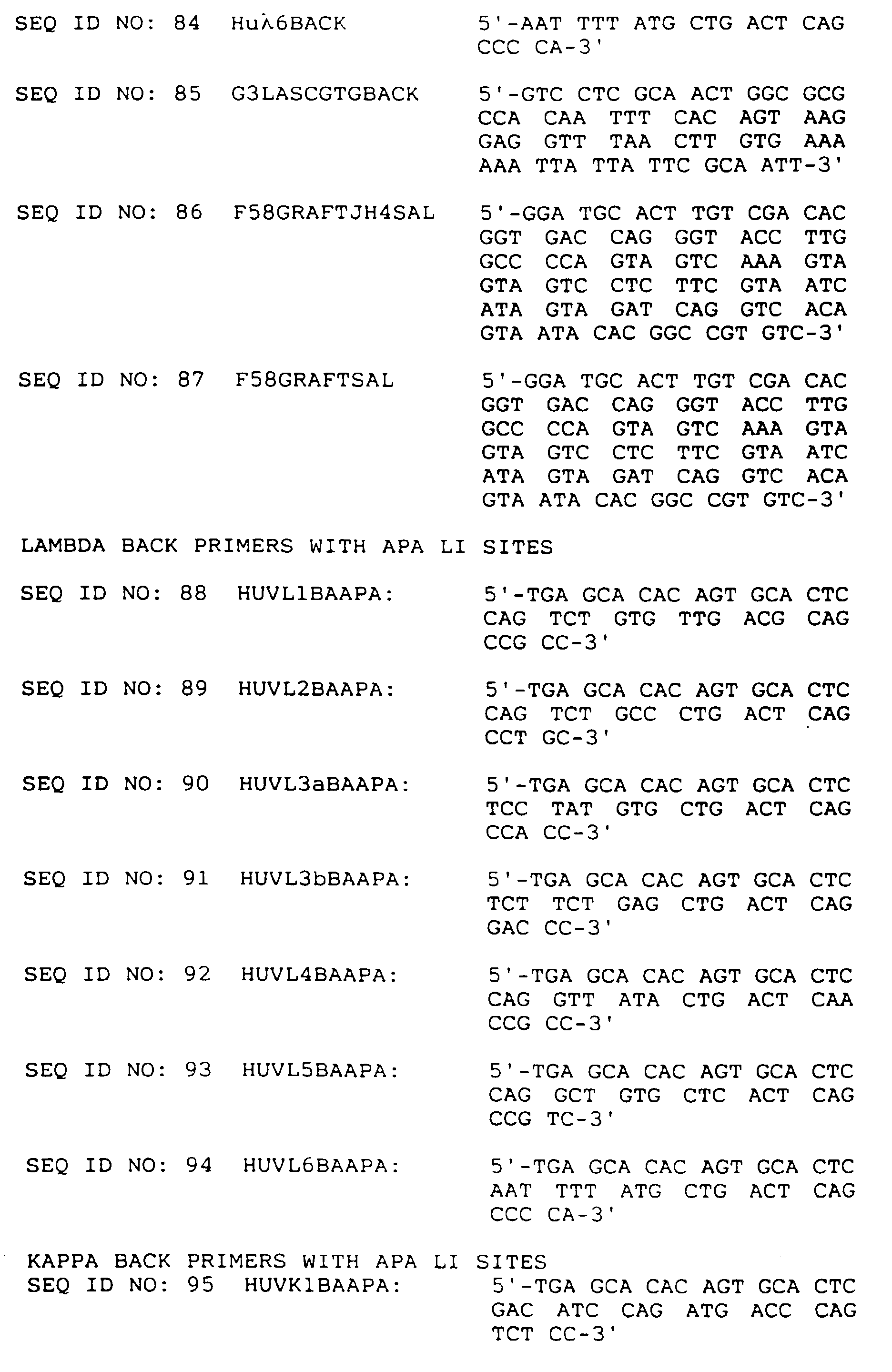

- The examples illustrate embodiments of processes according to the present invention as follows:
- In the work described in example 1, a mouse antibody directed against an epitope of TNF was cloned as a Fab fragment for display on phage, and by combining the heavy chain with repertoires of human light chains (or indeed the light chain with repertoires of human heavy chains), it was possible to select phage bearing Fab fragments with one mouse and one human chain. These antibody fragments bound to the same epitope of TNF as the original mouse antibody. The new human chain (heavy or light) was then combined with a repertoire of human partner chains to create an entirely human antibody Fab fragment which binds to the same epitope of TNF.
- Example 2 illustrates CDR imprinted selection in a dual combinatorial format. An anti-HIV gpl20 antibody was humanised by epitope imprinted selection with retention of the original mouse heavy chain CDR3. The VH and VL domains of the mouse antibody were cloned as fusions with mouse CHl and Ck chains. The resulting heavy chain VHCH1 fragment was displayed on phage in combination with a repertoire of human light chains expressed as a g3p fusion from phage vector. Human light chains displayed on phage were selected and the selected chains displayed in phage in combination with a library of human naive heavy chain VHCH1 fragments amplified so as to comprise the CDR3 of the original mouse heavy chain, expressed as g3p fusions. Selected phage were obtained displaying antibody polypeptide dimers which retain the original specificity against gp120 but are now of fully human origin apart from retaing the mouse heavy chain CDR3.
- Example 3 illustrates CDR imprinted selection in a single replicon, single chain Fv format. An anti-HIV gp120 antibody was humanised by epitope imprinted selection with retention of the original mouse heavy chain CDR3. A single chain Fv library was displayed on phage, the fragments comprising the original mouse light chain and CDR3 of the heavy chain but with the remainder of the light being of human origin, derived from a library of human naive heavy chains. The heavy chain variable domain of selected phage was then combined with a repertoire of human light chain variable domains to generate a scFv library on phage. Phage selected from this library displayed scFv fragments in which the variable domains were of fully human origin except for the retention of CDR3 of the mouse heavy chain.
- Example 4 illustrates the isolation of human antibodies derived from the immune repertoire of an immunised mouse. A repertoire of mouse heavy and light chain V genes derived from a mouse immunised with TNF are displayed as single chain Fv fragments and phage selected for binding to TNF. VH genes derived from this selected mouse population are then combined with VL genes derived from a human naive library as single chain Fv fragments and phage selected. Selected semi-humanised antibody polypeptide dimers are then fully humanised by pairing the human VLs with human VHs derived from a human naive library. Fully humanised antibody polypeptide dimers specific for TNF may then be selected from the resulting library.
- Example 5 illustrates creation of a synthetic library.
- We chose a murine monoclonal antibody directed against human TNF as our target antibody for humanisation by double chain shuffling. The antibody Mab32 (class IgG2b, k) (D. Rathjen et al., 1991 Mol. Immunol. 28, p79; D.Rathjen et al, 1992 Brit. J. Cancer 65, pp852-856; Australian Patent Application 7,576; EP 486,526) does not inhibit the cytolytic effect of TNF (presumably because it does not inhibit the binding of TNF to its receptors), but it enhances the in vivo anti-cancer and anti-viral effects of the cytokine. The antibody binding site is localised in a region of the TNF-trimer, which encompasses the first 18 residues of TNF. This example demonstrates that epitope imprinted selection can be used to generate human antibodies specifically recognising this same epitope on human TNF-alpha.
- Cloning of the V-genes of Mab32:
- The genes of the mouse Mab32 antibody (IgG2b, Kappa) were rescued by PCR essentially as described (Clackson et al., 1991, supra, Clackson et al in "PCR: a practical approach, eds Mr Phenox et al, IRL Press, Oxford pp 187-214) using the primers VH1BACk and VHlFOR2 for the VH gene and VK2BACK and VK4FOR for the VL gene and the polymerase chain reaction (PCR, R.K.Saiki et al., 1985, Science 230, p1350). The mouse VH and Vk genes were assembled for expression as scFv fragments by PCR assembly (Clackson et al., supra) amplified with VHlBACKSfi and VKFOR4NOT and ligated into phagemid pHEN1 (H.R.Hoogenboom et al., 1991 Nucl. Acids. Res. 19, pp4133-4137) as a SfiI-NotI cut restriction fragment, and electroporated into E.coli HB2151 cells. Of 96 clones analysed by ELISA (see below), 9 secreted TNF-binding soluble scFv fragments. Sequencing revealed in all clones a mouse VH of family IIB and a mouse Vk of family VI (E.A.Kabat et al., 1991 Sequences of Proteins of Immunological Interest, US Public Health Services). Nucleotide mutations which were probably introduced by the PCR were detected by comparing the 9 sequences, and a clone with 'consensus' sequence and binding activity (scFv-Mab32) chosen for further cloning experiments (Figure 5).
- Recloning of the Mab32 V-genes for soluble expression:
- The murine V-genes were recloned for soluble expression of heavy (Fd, VHCHl) or light chain, by linking the mouse V-genes to the human CHl (of the mu-isotype) or human Ck gene respectively by splice overlap extension. The mouse Vk gene was amplified from scFv-Mab32 DNA with oligonucleotides MOJK1FORNX (binds in joining region of V-gene; the sequences of all oligonucleotides used in these examples are shown in Table 1) and MVKBASFI (binds in 5' region and adds SfiI restriction site); the human Ck was obtained by PCR from a mouse-human chimaeric light chain gene (of NQ10.12.5, described in Hoogenboom et al., 1991, supra), with oligonucleotides MOVK-HUCK-BACK (binds in 5' of human Ck and is partially complementary with
mouse Jk 1 region) and HUCKNOT16NOMYC (sits in 3' end of human Ck, retains the terminal cysteine, and tags on a NotI restriction site) as in Clackson et al, 1991 using a two fragment assembly. For linkage of the DNA fragments, the two PCR fragments were mixed and amplified with MVKBASFI and HUCKNOT16NOMYC. The chimaeric VkCk gene was subsequently cloned as a SfiI-NotI fragment in pUC19 derivative containing the pelB signal peptide sequence and appropriate cloning sites for soluble expression of the light chain (pUC19-pelB-myc, Figure 2). Similarly, the mouse VH gene (amplified from scFv-Mab32 with LMB3 and VHlFOR-2) was combined by splicing by overlap extension PCR with the human u-CHl domain (amplified from human IgM-derived cDNA (Marks et al., 1991, supra WO 92/01047) with Mo-VH-Hu-CHl and HCMlFONO, and cloned as SfiI-NotI fragment into a pUCl9-pelB-myc for soluble expression of a tagged chain. - The chimaeric light chain was displayed on phage fd by reamplification of the mouse/human chimaeric chain with HUCKCYSNOT and MVKBAAPA and cloning into fd-tet-DOGl as an ApaLI-NotI fragment. Cells harbouring a plasmid with the heavy Fd chain gene were grown in 2xTY containing AMP-GLU (1%) to logarithmic phase (OD600 of 0.5) and infected with a 20-fold excess of light-chain displaying phage. After 45 min at 37'C without shaking and 45 min at 37'C with shaking in the 2xTY, ampicillin (100 ug/ml),
Glucose 1% medium, a sample was diluted into 50-fold volume of prewarmed (37'C) 2 x TY, ampicillin (100 ug/ml) and tetracyclin (15 ug/ml, grown for 1 hr at 37'C and then overnight at 30'C (shaking). Phage particles collected from the supernatant of such culture displayed TNF-binding Fab fragments anchored through the light chain on their surface. - Similarly, the reversed configuration was made. The heavy chain VHCH1 fragment was cloned into fd-tet-DOGl (after amplification of the Fd chain gene from the mouse/human chimeric construct with VHlBACKAPA and HCM1FONO), and phage used to infect cells capable of producing soluble light chain. Phage particles collected from the supernatant of such culture displayed TNF-binding Fab fragments anchored through the heavy chain VHCH1 fragment on their surface.
- Properties of Mab32 fragments displayed on phage:
- The V-genes of the murine antibody Mab32 were cloned by amplifying the hybridoma V-genes, cloning the VH and Vk genes as scFv fragments in phagemid pHEN1 as above. Antibody scFv fragments which bind to TNF were identified by ELISA (see below for details). The mouse VH gene was recloned in pUC19-pelB-myc (Figure 2) for soluble expression as a mouse VH linked to human mu-CHl, while the light chain was recloned with the human Ck domain in vector fd-tet-DOGl as a fusion with g3p. When cells harbouring the heavy chain construct were infected with the fd-phage carrying the light chain, phage particles emerged which carried light chain-g3p associated with the Fd heavy chain. Indeed, binding to TNF and the 301 peptide was retained, as judged by ELISA with phage displaying the mouse-human chimaeric Fab fragment (Figure 3). In the phage ELISA, the background signal of phage carrying the light chain only was s lightly higher than wild-type fd-tet-DOG1 phage, but always lower than the signal obtained with Fab-displaying phage. Similarly, TNF binding phage was made with the heavy chain VHCH1 fragment anchored on phage, and the light chain provided as a soluble fragment. Hence, Mab32 is functional in the dual combinatorial format in both display orientations.
- Construction of One chain-Libraries:
- Kappa, lambda light chain and Mu-specific cDNA was made from the mRNA prepared from the peripheral blood lymphocytes from two healthy donors essentially as in Marks et al., 1991, supra. The first-strand cDNA synthesis was performed with oligonucleotides HCM1FO, HUCLCYS and HUCKCYS for Mu-specific, lambda and kappa libraries respectively. The VH-
CH 1 repertoire was amplified from this cDNA with oligonucleotides HCM1FO and six family specific VHBACK primers (as in Marks et al., 1991, supra), reamplified with a NotI-tagged forward primer (HCM1FONO) and ApaLI tagged VHBACK primers (6 primers HuVH1BAAPA to HuVH6BAAPA; Tablel). Similarly, the light chain repertoires were amplified with HUCLCYS or HUCKCYS forward primers and HUVλ1BACK to HuVλ6BACK or HuVklBACK to HuVk6BACK back primers described in Marks et al., 1991, supra and PCT/GB91/01134 (WO 92/01047). In each case described in this section the lambda and kappa chain variable repertoires were amplified separately. The amplified repertoires were reamplified with ApaLI and NotI tagged versions of these oligonucleotides (13 back primers HuVλ1BAAPA to HuV/λ6BAAPA or HuVk1BAAPA to HuVkBAAPA and two forward primers HuCLCYSNOT and HuCKCYSNOT, respectively). All three repertoires were cloned into vector fd-tet-DOG1 as ApaLI-NotI fragments, and electroporated into E.coli MC1061 cells, to obtain libraries of 1.0 x 10⁷ clones for VλCλ, 1.4 x 10⁷ clones for VkCk, and 5 x 10⁶ clones for IgM-derived VHCHl. The presence of insert was checked and the frequency of inserts in the library found to be higher than 95% in all three cases. - When chain shuffling using epitope imprinted selection, there are two routes from the mouse to the human antibody, depending on which mouse V-gene is kept constant in the first rounds of selection (see Figure 1). The influence of the mouse heavy and light chain in binding to antigen and their influence on docking human partner chains onto the original epitope may vary considerably between antibodies, perhaps depending on which domain forms most of the antigen-binding contacts.
- Figure 1 shows the principle of Epitope Imprinted Selection, as exemplified using a mouse antibody to start with. The clear rectangles represent the original mouse antibody VH and VL domains. Shaded rectangles represent human VH and VL domains. The human antibodies derived shown on the left on the bottom line are produced by a procedure involving:
- (a) (i) retention of the original mouse VH and shuffling with a library of human VL domains followed by selection by binding to antigen.
- (a) (ii) shuffling of these selected human VL domains with a library of human VH domains followed by selection by binding to antigen.
-
- The human antibodies derived shown on the right on the bottom line are derived by the alternative pathway involving:
- (b) (i) retention of the original mouse VL and shuffling with a library of human VH domains followed by selection by binding to antigen.
- (b) (ii) shuffling of these selected human VH domains with a library of human VL domains followed by selection by binding to antibody.
-
- The human antibodies in the middle of the bottom line are derived by;
- (c) shuffling the selected human VL chains derived in
(a) (i) with the selected human VH chains derived
in (b) (i) and then selecting by binding to
antigen.
VH chains derived in (b) (ii) can be combined with VL chains derived in (a) (ii) and vice versa.
The current section describes procedure (a) and subsequent sections procedures (b) and (c). This example describes the procedures in a dual replicon, dual combinatorial format although the methods are equally applicable to a single replicon, single chain Fv format. -
- In the first chain shuffling experiment, the mouse VH (linked to the human CHl domain), expressed from pUC19-pelB-myc, was paired as Fab fragment with a library of 107 different human VλCλ, domains. Phage displaying the antibody fragments were subjected to rounds of panning on TNF-coated tubes. By following the titre of the eluted phage, the extent of selection can be monitored. After 4 rounds (with a 100-fold increase in the titre of eluted phage), 24 out of 28 individual clones were found to be binding to TNF in an ELISA with phage expressing Fab fragments (all with the mouse VH-human CH1). Phage only displaying the selected human VλCλ domains gave a background similar to phage displaying only the chimaeric mouseVk-human Ck. Sixteen clones taken after the first round of selection were found to be negative.
- Only three different BstNI fingerprints were found amongst the 24 binders, with one pattern dominating (21/24). Light chains VλA2, VλC4 and VλD1 were found with frequencies of 21/24, 2/24 and 1/24 respectively. Sequencing revealed that all three light chains are derived from the same germline gene, a human Vλ1-1-1. Clone VλC4 has 1,clone VλD1 has 2 and clone VλA2 7 amino-acid residue differences from the germline (Figure 6). However, clone VλA2 uses a framework-1 region which more closely resembles the germline sequence of a related Vλ1, humvl117, and therefore may be the result of a cross-over. The germline character of the clones is also noted in the CDR3 sequence, with minimal variation in sequence and no length variation between the three clones. Apparently, only a very limited number of genes with very similar sequences fit the stringent requirements (being compatible with the mouse VH and forming an antigen-binding pair). One of the surprises is that human germline encoded V-genes can supply domains that fit those conditions. However, the starting material of this library has proven to be very diverse in other experiments. For example, from an unimmunised scFv library made from the same two donors, we derived many different λ chains with a range of nucleotide mutations compared to known germline genes (Marks et al., 1991, supra). In addition, light chain genes derived from the same donors were used in a chain shuffling experiment for affinity maturation, and light chain variants (all Vλ1) with numerous mutations isolated (Marks et al., 1992, supra).
- The 3 selected Vλ genes were recloned in pUC19-pelB-myc for soluble expression as VλCλ chains. E.coli cells harbouring the three light chain plasmids were mixed, infected with a phage library of human VHCH1 genes, expressed from the fd-tet-DOGl library described earlier and the library subjected to rounds of panning on TNF-coated Immuno tubes. Clones were picked after 5 rounds, when the titre of eluted phage increased 100-fold. Fifteen out of 20 clones analysed by BstNI fingerprint of the DNA insert used one of two patterns (with approximately the same frequency). The 15 clones when combining their heavy chain VHCH1 fragments with the VλA2 light chain gave stronger phage ELISA signals than when combined with the VλC4 or VλD1 light chain (Figure 3). Background signals obtained with phage displaying the heavy chain VHCH1 fragment only were similar to the signal of the murine VH-human CH1.
- Sequencing revealed that the two patterns could be assigned to three unique human VH sequences (clones VHP1/2/3, with clone VHP1 having a BstNI fingerprint which is nearly identical to that of clone VHP2). Like the selected light chain genes, the selected heavy chain genes are derived from the same germline VH gene (germline DP-51 from the VH3 family, Tomlinson et al., J. Mol. Biol. 227, pp776-798 1992; Figure 6), with minimal residue differences. Figure 6 shows the deduced protein sequences of VH and VL antibody genes of antibody fragments binding to human TNF. The selected human V-genes were aligned to their closest germline homologue; identical residues in the selected genes are represented by hyphens.
Framework 4 of the VH genes has been truncated at 4th residue. Clone VHP1 most likely is a cross-over between DP-51 and a related germline, DP-47. All three selected VH-genes have relatively short CDR3 loops (8,9 and 10 residues), but share little homology in this sequence. Since the VH-CDR3 is naturally the most diverse region of all six antibody variable loops, the chance of selecting clones with a consensus in that region is very low indeed. - A specificity ELISA with Mab32 and soluble scFv fragments on a number of antigens showed that the original Mab32 antibody, its scFv-derivative and three of the humanised TNF-binders (as scFv-fragments) bind specifically to TNF (Figure 4). No significant binding was obtained to ELISA plates coated with keyhole limpet haemocyanin, ovalbumin, cytochrome c, bovine serum albumin, human thyroglobulin, or 2-phenyloxazol-5-one-BSA or to plastic only. Proof that the humanised antibodies bind to the same epitope came first from phage ELISA with peptide-301-coated plates and phage displaying the original mouse/human chimaeric Fab or the humanised Fab fragments (this assay is not sensitive enough to allow the detection of soluble scFv fragments) (Figure 3). Figure 3 shows results of ELISA of phage displaying Fab fragments, with one chain displayed on phage as a g3p fusion (indicated by fd-...), and the other chain provided as a secreted, soluble chain partner. Clones display a combination of the following chains: fd-DOG1 (no antibody); light chains : mouse MoVL (from Mab32), human VλA2 and VλC4 (selected with mouse VH),; heavy chains : mouse MoVH (from Mab32), human VHP1,2,3 (selected with human VλA2, VλD1, VλC4), human VHLM2, VHLM8 (selected with mouse VL). Vλ chains are indicated as VL. Fully humanised clones were obtained which bound to both
peptide 301 and TNF. - In addition, to show that the human scFv fragments compete with the original antibody for binding to TNF, we analysed binding of the scFv constructs in a competition ELISA with the Fab fragment derived by proteolytic cleavage of Mab32. Single chain Fv frag ments were incubated on a TNF-coated surface with increasing amounts of the Fab fragment and the amount of bound scFv dete cted in ELISA (Figure 7). Each of the scFv fragments competes with the FabMab32 for binding to TNF, including both the original scFv-Mab32 and the humanised scFv fragments.
- Thus the fine specificity of Mab32 for
peptide 301 of TNF is retained through the humanisation process. - The mouse Mab32 antibody and purified, monomeric forms of the recombinant mouse scFv-Mab32 and the human scFv antibodies VHP1-VλA2, VH}P2-VλA2 and VHP3-VλA2, were subjected to competition ELISA for the determination of the relative affinity for TNF. Antibodies were incubated on a TNF-coated surface in the presence of increasing amounts of soluble TNF. All the clones showed a roughly similar decrease in the ELISA signal over the same range of increasing TNF concentrations (with an IC50 in the 10nM to 100nM range). Although the parent Mab32 has been reported to bind more strongly (affinity constant for binding to human TNF of 8.77 x 10⁹ M-1) this reflects the bivalency of the whole antibody molecule compared to the monovalency of a scFv fragment.
- The Mab32 and VHP3VλA2 fragments were also analysed for binding properties using the Pharmacia BIAcore. TNF was indirectly immobilised on the surface, and the binding of antibody monitored. The properties of the original mouse antibody were analysing two monomeric forms of Mab32. On the TNF surface, the Fab fragment from Mab32 by proteolytic cleavage and the scFv Mab32 showed very similar fast off rates (approximately 10-2 s-1). The human VHP3-VλA2 antibody has an off rate in the same range as the original scFv-Mab32. On rates for antibody protein interactions are in the range seen for the interaction between other proteins and their receptors, and cover a 100 fold range between 104 and 106 M-1s-1 (Mason D.W. and Williams, A.F., 1986, Kinetics of Antibody Reactions and the Analysis of Cell Surface Antigens, Blackwell, Oxford; Pecht, I. , 1992 in Sela,M. (ed), Dynamic Aspects of Antibody Function, Academic Press Inc., New York, Vol. 6, pp 1-68). Assuming the on rates of the antibody TNF interactions are typical of antibody protein interactions, the off rate derived by the BIACore analysis is consistent with the affinity indicated by the competition ELISA (Kd = 10-7 to 10-8M).
- Thus, these determinations are consistent with scFvMab32 and the humanised scFv clone VHP3-VλA2 having a similar affinity and thus with the retention of affinity, as well as specificity, through epitope imprinted selection.
- To answer the question of whether further human chains could be selected using the alternative pathway, we first selected a human VH using the mouse VL domain as imprinting chain. After four rounds of panning, two human VH domains dominated the population (VH-LM2 and VH-LM8). Both VH genes show minimal differences compared with the germline (DP-46), which is of the VH3 family. Compared with the VHP1, 2 and 3 sequences, VH-LM2 and VH-LM8 use a germline of the same (VH3) family, and share the same canonical loop structure for CDR1 and CDR2 (I.M.Tomlinson et al., 1992, supra; C.Chothia et al., 1992 J. Mol. Biol. 227, pp789-817). However, clones VH-LM2 and VH-LM8 use a rather long VH}-CDR3 compared with VH} P1, 2 and 3 (18 and 14 amino acid residues compared to 8,9 and 10 residues respectively), and their respective germlines differ in 15 amino-acid residues. To test the complementarity of the chains selected on different (but complementary moulds), the VH-LM2 domain was combined with the human VλA2 domain either as a Fab on phage or in a scFv configuration. Both yielded binding combinations (Figure 3 and results not shown). In addition, the mouse VL forms a relatively weak binder in combination with the human VHP3 (as Fab fragments on phage).
- E.coli cells containing plasmid encoding the antibody chain for soluble expression were grown at 37'C in 10 ml 2 x TY containing 100 ug/ml ampicillin and 1% glucose to an OD600 of 0.5. The cells were infected with either 1011 tranforming units (TU) prepared from the original library (by growing libraries at 37'C in 2 x TY with tetracyclin at 15 ug/ml and collecting phage by two rounds of PEG precipitation), or with 1 ml eluate (variable titre) from the panning experiments, by incubating at 37'C for 45 min without and 45 min with shaking. Subsequently the cells were inoculated into 500 ml of prewarmed medium with ampicillin (100 ug/ml) and tetracyclin (15 ug/ml), and after growing forl hour at 37'C transferred to a 30'C shaker for an overnight incubation. Phage was prepared by two rounds of PEG-NaCl precipitation, and resuspended in water to approximately 1013 TU/ml before selection.
- Immuno tubes (Nunc) were coated overnight with 2 ml of a 10 ug TNF per ml of 50 mM bicarbonate buffer (pH 9.6). Incubation with phage, washing and elution conditions were as described by Marks et al., 1991. E.coli cells expressing the soluble complementary chain were infected with the eluted phage and grown in 2 x TY medium with tetracyclin ug/ml) for amplification of the selected phage population (as described above).
- Individual clones were assayed for binding in phage ELISA, by preparing one-chain phage stocks, and using this phage to infect cells harbouring a gene encoding a partner chain (the one(s) which was (were) used to select the clones). Phage displaying Fab fragments prepared from such (2 ml) overnight cultures as decribed above, was 10-fold concentrated by PEG precipitation and 50 ul assayed in ELISA. Recombinant human TNF-α (produced in yeast, specific activity of 3.2 x 10⁷ units/mg, Peptide Technology) was coated onto plastic flat-bottomed microtiterplates (Falcon 3912) at 10 ug/ml in 50 mM bicarbonate buffer (pH 9.6) or PBS, at 50 ul/well overnight at room temperature. After washing with PBS, blocking for 2 hours with 2% Dried Skimmed Milk Powder (Marvel), 50 ul phage per well was added to 50
ul 4% Marvel, after which the ELISA was continued (with anti-phage antiserum) as described (Marks et al., 1991 and PCT/GB91/01134). For the detection of binding to the Mab32 epitope, the 301-peptide (gift from Peptide Technology, sequencewas coated by overnight incubation at room temperature with 100 µl per well of 10 ug/ml peptide in PBS. The wells were blocked for 2 hours with 3% BSA, and the ELISA continued as above (using incubations with Marvel).
- Alternatively, soluble antibody fragments were made by r ecloning the selected chains in one plasmid (either as scFv fragments), inducing expression in the appropriate strain and detecting bound antibody fragments in the supernatant of the E.coli cultures with the anti-myc-tag antibody. Purified monomeric scFv fragments (see below for purification) were used for competition ELISA experiments and to check the specificity of binding. For the specificity ELISA, plates were coated with various proteins as described (Marks et al., 1991, supra and WO 92/01047). In all cases where soluble fragments were assayed in ELISA, Marvel was replaced by BSA.
- For competition ELISA, we used Fab fragment derived by proteolytic cleavage of Mab32 (gift of Peptide Technology) and either the 9E10-protein A purified mouse scFv-Mab32 or the protein A-purified human scFv fragments (VHP1/2/3-Vλ2). To a TNF coated plate (blocked with 3% BSA in PBS), a mixture was added of one of each of the four scFv fragments and increasing amounts of the mouse Fab fragment (in 100ul total volume, 1.2ul, 4ul and 10ul of a 1 mg/ml solution. After incubation for 2 hours, the plate was washed, and bound scFv detected with the antibody 9E10 (which recognises the C-terminal myc-tag of the scFv fragments; Munro and Pelham 1986
Cell 46 291-300) and peroxidase labelled goat anti-mouse antibody (Fc specific). As negative control, the same antibodies were used to detect increasing amounts of Fab fragment only (the anti-mouse (Fc specific) cross-reacts weakly with the mouse Fab). Experiments were done with a range of concentrations of scFv fragments (up to 250ug/ml), to establish the minimal detectable amount of scFv where competition was visible (when an excess of scFv is used, no competition is visible). - The V-gene DNA of phage clones positive in TNF-ELISA was analysed by DNA-fingerprinting (as in Clackson et al., 1991, supra). Briefly, the genes were amplified with fd-PCR-BACK and, for heavy chains, fd-SEQ1, or, for light chains, HULAMBDASEQ, for 25 cycles (94'C, 1 min; 50'C, 1 min and 72'C, 2 min), and the DNA cut with BstNI. Analysis of the digest by agarose gelelectrophoresis allowed then to identify major differences between the positive clones. The nucleic acid sequences of selected V-regions were determined by the dideoxy chain termination method (F.Sanger et al., 1977 Proc. Natl.
Acad. Sci. USA 74, pp5463-5467) using a Sequenase kit (USB) and appropriate sequencing primers. Murine V-genes cloned into pHENl were sequenced with pHEN-SEQ and LINKSEQ; human VH genes were sequenced with a primer sited in the human CH1(mu) region (Hu-MCH1FORSEQ2), while for human Vλ genes, HULAMBDASEQ was taken. - Selected light chains were amplified with SfiI-tagged backward and NotI tagged forward primers for cloning into pUC19-pelB-myc. Human light chains VλA2, Vλ D1 and VλC4 were amplified from fd with HuVL1BACKSFI and HuCL1FORAMBNOT and cloned into pUC19-pelB-myc (as SfiI-NotI fragments) for soluble expression as tag-less light chains (in non-suppressor strains).
- Alternatively, selected V-genes were assembled as scFv genes essentially as described (Clackson et al., 1991, supra; Marks et al., 1991, supra and WO 92/01047) using oligonucleotides described in Marks et al. (1991, supra and WO 92/01047) and cloned into pHENl (Hoogenboom et al., 1991, supra) for expression in HB2151 E.coli cells as soluble scFv fragments with a C-terminal myc-tag.
- The original mouse scFv-Mab32-c14 fragment with the C-terminal myc-tag was purified from E.coli supernatant using an affinity 9E10-Protein A column (as described in Clackson et al., 1991, supra). The human scFv fragments (all with VH3 genes) were purified on Protein A-sepharose columns (H.R.Hoogenboom and G.Winter, J. Mol. Biol. 227, pp381-388, 1992). All proteins were further purified using gelfiltration (Superdex-75, Pharmacia), and the monomeric fraction taken for BIAcore analysis.
- The standard reaction mixture for the polymerase chain reaction was: 5µl template DNA; 20pmol back primer(s); 20pmol forward primer(s); 10mM KCl; 10mM (NH4)2SO4; 20mM Tris HCl (pH88); 2mM MgCl2; 100µg BSA/ml and 1 unit Taq DNA polymerase (Perkin Elmer Cetus). The reaction mixture was overlaid with mineral oil and subjected to 30 cycles of amplification using a Techne thermal cycler (Duxford, England). The cycle was 94°C for 1 min (denaturation), 55°C for 1 min (annealing) and 72°C for 1.5 min (extension). Other PCR conditions are given in the text or in references.
- Products were purified following agarose gel electrophoresis using Geneclean (BiolOl) or by electroelution and ethanol precipitation (J Sambrook et al 1989 Molecular Cloning: A Laboratory Manual, Cold Spring Harbor Laboratory Press, Cold Spring Harbor, NY.)
- Were performed according to the manufacturers instructions (New England Biolabs, CP Labs, Bishops Stortford, Herts). Ligations were performed according to Sambrook et al (1989 supra).
- We have shown that a mouse antibody can be rebuilt into a human antibody with the same specificity by the process of epitope imprinted selection (EIS).
- A library of human light chains were shuffled with a mouse VH domain, binding combinations selected and then used in a second shuffle as 'docking domains' for a library of human VH genes. Completely human antibodies were isolated from such 'genuine' human library. The antibodies were shown to bind retain binding specificity. Alternatively, the mouse VL was used as docking chain for selecting human VH partners. Such VH domains can be used to find human VL genes, or, alternatively, can be combined with human VL domains selected with the mouse VH domain. Indeed, binding activity was obtained by combining two independently selected V-genes, pointing towards potential additivity of the EIS procedure.
- The EIS approach may serve to humanise antibodies more rapidly than by CDR-grafting (Riechmann et al., 1988, supra), as this method requires very often a detailed knowledge of the 3-D structure of the antibody. However, the EIS method can be extended to for example antibody repertoires obtained by phage selection from immunised rodents. Following immunisation with antigen, a repertoire of V-genes with high affinity and specificity may be selected and then used in a epitope imprinted selection (see example 4) to generate a range of human antibodies of high affini ty and enriched for the desired specificity.
-
CDR 3 of the heavy chain is generally found to be the most variable of all CDRs in terms of both length and sequence, and can make important contacts with antigen (Winter, G. and Milstein C. Man-made Antibodies.(1991) Nature 349, pp293-299). This is an important consideration when humanising, whether by CDR-grafting (Patent GB2188638B) or as described in this application using chain-shuffling. It may be advantageous to apply the polycombinatorial approach to humanising by a chain-shuffling process in which the VHCDR3 sequence of the rodent antibody is imprinted upon the human VH segments. - In the polycombinatorial approach, one fragment eg VHCHl, is displayed on phage as a fusion from a phage vector and the other, eg light chain, is expressed as a soluble fragment from eg a plasmid. Super-infection with phage is used to display both fragments on phage as a Fab fragment.
- In this example a mouse anti-HIVgp120 monoclonal antibody was humanised. The VH domain of this mouse antibody was fused to the human Cgammal domain and cloned into pUC19Sfi/Not/polymyc.
- A repertoire of naive human light chains cloned as g3 fusions in fd-DOG-1 (also known as fd-CAT-2 in WO 92/01047) was then infected into the cells carrying the chimaeric heavy chain, and phage selected on antigen. These phage have both heavy and light chains on their surface, though the phage genome encodes just the light chain; this is not a problem since the only heavy chain is the one provided.
- Light chains selected this way were then paired with a library of naive human VH domains, PCR-amplified in such a way that CDR3 of the human antibodies were replaced with that of the original mouse heavy chain.
- Section (a) deals with construction of a chimaeric Fab fragment in which the mouse F58 VH and VL domains are fused to human CH1 and CK sequences. This clone was used in early characterisation of the antibody and served as a template for subsequent PCR amplification of the heavy chain, which was then cloned into pUC19 Sfi-Not polymyc as a PstI-Not I fragment (section (b)). Section (c) describes construction of a human light chain repertoire in fdDOG, which was then infected into cells containing the chimaeric heavy chain on pUC19 (section (d)). The resulting phage were panned against the peptide (section (e)) and the selected light chains PCR-amplified and cloned as Asc I-Not I fragments alongside the chimaeric heavy chain (section (f)) and assayed for their ability to bind antigen by ELISA (section (g)). Selected light chains were recloned in pUC (section (h)) and naive human VH domains amplified with a mutagenic primer imposing the F58 CDR3 sequence on the domains, and the resulting fragments cloned in phage (section (i)). This repertoire of imprinted heavy chain phage was then used to infect cells carrying the selected light chains on pUC and the resulting phage panned on antigen. Finally, the selected heavy and light chains are cloned together on the same replicon and assayed for binding to antigen (section (j)).
- Five ml of cultured hybridoma cells (approximately 2 x 10⁶ cells) were washed in PBS, pelleted, resuspended in 200 ul 0.1% diethylpyrocarbonate in water and immediately boiled for 5 minutes. After centrifugation, 68 ul of the 'boilate' supernatant was added to a 28 ul reaction mixture resulting in a 96 ul reaction mixture containing 140 mM KCl, 50 mM Tris.HCl (pH8.1 @ 42'C), 8 mM MgCl2, 10mM DTT, 500 uM deoxythymidine triphosphate, 500 uM deoxycytidine triphosphate, 500 uM deoxyadenine triphosphate and 500 uM deoxyguanine triphosphate nucleotide triphosphate (500 uM dNTPs), 160 units of human placental RNAse inhibitor and 10 pmol of forward primer. Four ul (100 units) of avian myeloblastosis virus (AMV) reverse transcriptase was added, the reaction incubated at 42'C for 1 hour, heated to 100'C for 3 minutes, quenched on ice and centrifuged for 5 minutes. The supernatant was then used immediately for PCR.
- Separate PCR amplifications were performed for the heavy and light chains. Fifty ul reaction mixtures were prepared containing 5 ul of the supernatant from the cDNA synthesis, 250 uM dNTPs, 50mM KCl, 100mM Tris.HCl (pH 8.3), 1.5mM MgCl2, 175 ug/ml BSA, 20 pmol each of the appropriate mixtures of forward and back primers (Clackson, T et al. (1991) supra.) and 1 ul (5 units) Thermus aquaticus (Taq) DNA polymerase (Cetus, Emeryville, CA). The reaction mixture was overlaid with paraffin oil and subjected to 30 cycles of amplification using a Techne PHC-2 thermal cycler. The cycle was 94'C for 1 minute (denaturation), 55'C for 1 minute (annealing) and 72'C for 1 minute (extension). The product was analyzed by running 5 ul on a 2% agarose gel. The remainder was extracted twice with ether, once with phenol/chloroform, ethanol precipitated and resuspended in 50 ul of water.
- The amplified VH DNA was digested with PstI and BstEII, purified on a 2% low melting point agarose gel and ligated into M13VHPCR1 digested with PstI and BstEII (Orlandi, R., D. H. Gussow, P. T. Jones and G. Winter. (1989). Cloning immunoglobulin variable domains for expression by the polymerase chain reaction. Proc. Natl. Acad. Sci., USA, 86 (10), pp3833-7). The amplified VK DNA was digested with PvuII and Bgl II and ligated into M13VKPCR1 digested with Pvu II and Bcl I. The ligation mixtures were used to transform competent TG1 cells. Two clones from separate amplifications were sequenced for each VH and Vk chain using the dideoxynucleotide chain termination method.
- A chimaeric Fab containing the F58 variable domains and the human IgG1 CH1 and Ck domains was constructed by ligating the F58 V-domains into a vector containing the constant domains. M13VHPCRl containing the F58 VH was digested with PstI and BstEII. The resulting F58VH fragment was then purified on a 1.5 % agarose gel, isolated from the gel with Geneclean and ligated into pJM-1FabD1.3 (PCT/GB91/01134) digested with PstI and BstEII. The ligation mixture was used to transform competent E. coli N4830-1 cells (Gottesman, M.E., Adhya, S. and Das, A. (1980) J. Mol. Biol. 140, pp57-75) and clones containing the F58 VH identified by restriction analysis of RF DNA. The F58 Vk was amplified by PCR with the primers Vk2BACK and Vk3FOR2 (Clackson, T. et al. (1991) supra.) using M13VkPCR containing the F58 Vk as template. The PCR product was digested with SacI and XhoI, purified on a 1.5% agarose gel, isolated from the gel with Geneclean and ligated into pJM-1 Fab vector containing the F58 VH digested with SacI and XhoI. The ligation mixture was used to transform competent E. coli N4830-1 cells and clones containing the F58 Vk identified by restriction analysis of RF DNA.
- The F58 chimaeric heavy chain derived above was PCR amplified from F58 Fab clone DNA, using the primers VH1BACKSFI15 and HUCH1FORASCNOT (Tablel). The resulting ca. 700bp fragment was digested with Pst I and Not I and cloned into Pst I and Not I-cut pUC19Sfi/Not/polymyc plasmid using standard procedures (Sambrook, J. et al. 1989, supra. and example 1).
- Kappa and lambda-chain genes were amplified separately using an equimolar mixture of the appropriate family based BACK and FORWARD primers (Table 1). Kappa-chain genes were amplified from the cDNA synthesis using HUCKFOR primer, using an equimolar mixture of the 6 HUVKBACK 1a-6a primers in conjunction with the HUCKFORSER primer. Lambda-chain genes were amplified from the cDNA synthesis using the HUCLFOR primer, and amplified using an equimolar mixture of the 7 HULBACK 1-6 primers in conjunction with the HUCLFORSER primer. In each case 50µl reaction mixtures were prepared containing 5µl of the supernatant from the appropriate cDNA synthesis, 20pmol total concentration of the BACK primers, 20pmol total concentration of the FORWARD primers, 250µM dNTPs, 10mM KCl, 10mM (NH4)2SO4, 20mM Tris.HCl (pH 8.8), 2.0mM MgCl2, 100mg/ml BSA and 1µl (1 unit) Vent DNA polymerase (New England Biolabs). The reaction mixture was overlaid with mineral (paraffin) oil and subjected to 30 cycles of amplification using a Techne thermal cycler. The cycle was 94°C for 1 minute (denaturation), 57°C for 1 minute (annealing) and 72°C for 2.5 minutes (extension). The products were purified on a 2% agarose gel, isolated from the gel by Geneclean (Bio-101) and resuspended in 25µl of H2O.
- Two different pullthrough reactions were now performed on each of the two light chain preparations. Kappa-chain genes were amplified in two reactions, using an equimolar mixture of the 6 HUVKBAAPA primers in conjunction with HUCKFORSERNOT. Lambda-chain genes were also amplified in two reactions, using an equimolar mixture of the 7 HUVLBAAPA primers in conjunction with HUCLFORSERNOT. Pullthrough conditions were performed as for the primary light chain PCRs above except that 25 cycles of amplification were used.
- PCR products were digested with Apa LI and Not I using the standard format and cloned into Apa LI and Not I-cut fd-DOG as described in example 1. Phage were prepared from the library clones as described in example 1 and used to infect cells containing the heavy chain (see below).
- Cells containing the F58 chimaeric heavy chain were grown overnight at 37'C in 2YTAG and 500ul added to 50 mls fresh 2YTAmp medium, prewarmed to 37'C, in a conical flask. The cells were grown with shaking to OD600 of about 0.5 before adding a total of 1011 phage from the light chain repertoire. The culture was left at 37'C for 45 minutes without shaking then shaken vigorously for another 45 minutes at 37'C before adding tetracyline to 15 ug/ml and shaking overnight.
- Phage were harvested by PEG precipitation of the culture supernatant as previously described (example 1) and used for selection experiments.
- This was performed on maxisorb plates as previously described (Marks J. et al., 1991, supra.), with the exception that the tubes were coated with env gp120 V3 loop peptide of HIV-1 isolate IIIB dissolved to 10 ug/ml in water. This peptide was obtained from the AIDS-directed program (repository ref: ADP737) and has the sequence: CTRPNNNTRRSIRIQRGPGRAFVTIGKIGNMRQAHCN (SEQ ID NO 120) The phage eluted from the tubes were used to re-infect fresh cells containing the F58 chimaeric heavy chain and the panning/reinfection procedure repeated another three times.
- Selected light chains were PCR-amplified from fd-DOG Light chain DNA using primers G3LASCGTGBACK and HUCLFORSERNOT or HUCKFORSERNOT. The G3LASCGTGBACK primer anneals upstream of the translational start of the gIII signal in fd, and brings in an Asc I site and a ribosome binding site (RBS). These fragments were digested with Asc I and Not I and cloned into Asc I and Not I-cleaved pUC19F58 plasmid (as shown in fig 8) so as to create a cistron, enabling soluble Fab to be produced. This was analysed for peptide binding in ELISA and bound antibody detected by virtue of the myc tag peptide on the end of the light chain.
- This was performed as described below.
- 1
Inoculate 100 ul 2 x TY, 100 µg/ml ampicillin, 1% glucose in 96-well plates ('cell \tab wells', Nuclon) and grow with shaking (300 r.p.m.) overnight at 37'C. - 2 Use a 96-well transfer device to transfer small inocula
from this plate to a second 96-well plate containing 200 ul
fresh 2 x TY, 100 ug/ml ampicillin, 0.1% glucose per well.
Grow at 37'C, shaking until OD600nm is approximately 0.9
(about 3 hrs). To the wells of the original plate, add 25
ul 60 % glycerol per well and store at -70'C. - 3 Add 25 ul 2 x TY, 100 ug/ml ampicillin, 9 mM IPTG
(
final concentration 1 mM IPTG). Continue shaking at 30'C for a further 16 to 24 hrs. - 4 Spin 4,000 r.p.m. for 10 min and use 100 ul supernatant in ELISA.
- 5 Coat plate (Falcon 3912) with 50 ul per well of peptide at 10 ug/ml in water. Leave overnight at room temp.
- 6 Rinse wells 3x with PBS, and block with 200 ul per well of 1%BSA/PBS, for 1hr at 37'C
- 7 Rinse wells 3x with PBS, then add 25ul 6% BSA/PBS to all wells.
- 8 Add 100 ul culture supernatant containing soluble Fab to the appropriate wells. Mix, leave 1.5 hrs room temp.
- 9 Discard test solution, and wash out
wells 3 times with PBS, 0.05% Tween - 10 Discard 9E10 antibody, and wash out wells with 3 times
with PBS, 0.05
% Tween - 11 Discard 2nd antibody, and wash
wells 3 times with PBS, 0.05% Tween - 12 Add one 10 mg ABTS (2,2'-azino
bis(3-ethylbenzthiazoline-6-sulphonic acid), diammonium
salt) tablet to 20
ml 50 mM citrate buffer, pH4.5. (50 mM citrate buffer, pH4.5 is made by mixingequal volumes 50 mM trisodium citrate and 50 mM citric acid). - 13
Add 2ul 30% hydrogen peroxide to the above solution immediately before dispensing. - 14
Add 100 ul of the above solution to each well. Leave room temp. 20-30 min. - 15 Quench by adding 50 ul 3.2 mg/ml sodium fluoride. Read at 405 nm.
- Note 1: Alternatively, inoculate clones from
transformation plate into 100 ul 2 x TY, 100 ug/ml
ampicillin, 0.1% glucose in 96-well plates ('cell wells',
Nuclon) and grow with shaking (300 r.p.m.) 37'C, shaking
until OD600nm is approximately 0.9 (about 6 hrs). Continue
with
step 3. - Note 2: This method is based on that of DeBellis D. and Schwartz I., 1990 Nucl. Acids Res. 18: p1311, and relies on the low levels of glucose present in the starting medium being metabolised by the time the inducer (IPTG) is added.
- Note 3: 'Marvel' is dried milk powder. PBS is 5.84 g NaCl, 4.72 g Na2HPO4 and 2.64 g NaH2PO4.2H2O, pH 7.2, in 1 litre. BSA is Bovine Serum Albumin.
-
- Light chains were PCR-amplified from DNA of selected clones using an equimolar mix of the 7 HUVLBAS FI primers in conjunction with HUCLFORSERASCNOT or an equimolar mix of the 6 HUVKBASFIprimers in conjunction with HUCKFORSERASCNOT. Reaction conditions were as described for the primary PCR reactions above except that 25 cycles of amplification were used. PCR fragments were cut with Sfi I and Not I and cloned into Sfi I and Not I-cut pUC19Sfi/Not/polym yc then transformed into TG1.
- The panning/infection process described above is essentially repeated again, this time with the positions of the heavy and light chains reversed.
- VH domains were amplified from the pooled primary PCR material prepared as described below.
- Two preparations of PCR-amplified VH genes were made. Both preparations used an equimolar mixture of the HUJHFOR primers (Table 1); in one of the preparations, 6 separate PCR amplifications were performed with each of the HUVHBACK primers individually (Table 1), and in the other, a single PCR reaction was performed with an equimolar mix of all 6 HUVHBACK primers. For all seven PCRs, 50µl reaction mixtures were prepared containing 5µl of the supernatant from the cDNA synthesis using the HUIGMFOR primer, 20pmol total concentration of the BACK primers, 20pmol total concentration of the FORWARD primers, 250µM dNTPs, 10mM KCl, 10mM (NH4)2SO4, 20mM Tris. HCl (pH 8.8), 2.0mM MgC12, 100mg/ml BSA and 1µl (1 units) Vent DNA polymerase (New England Biolabs). The reaction mixture was overlaid with mineral (paraffin) oil and subjected to 30 cycles of amplification using a Techne PHC-2 thermal cycler. The cycle was 94°C for 1 minute (denaturation), 57°C for 1 minute (annealing) and 72°C for 1 minute (extension). The products were purified on a 1.5% agarose gel, isolated from the gel by Geneclean (Bio-101) and resuspended in 25µl of H2O. The seven products were then pooled and 'pullthrough' PCR reactions performed.
- Six separate pullthrough reactions were performed with the mutagenic F58GRAFTJH4SAL primer and each of the HUVHBAAPA1-6 primers individually.
- Pullthrough reactions were set up with the primers HUVHBAAPA (equimolar mix of all 6 primers) and HUJHFORSAL (equimolar mix of all 4 primers). 50µl reactions of containing 5µl of the pooled PCR products from the previous step were amplified using the same conditions as for the primary PCR except that 25 cycles of amplification were used, and the annealing temperature was 45°C.
- The resulting VH fragments were pooled and cut with Apa LI and Sal I using standard conditions and cloned into Apa LI and Xho I-cut fd-DOG-G1CH1 using standard protocols (Sall and Xho I produce compatible CTAG overh angs). Phage were prepared from this library as described above, this time using the heavy chain phage to infect cells carrying the selected light chains expressed in pUC19Sfi/Not/polymyc.
- The end result of this process is a pool of selected heavy chains and a pool of selected light chains. These are now combined at random. Heavy chain clones are now PCR-amplified using an equimolar mix of all 6 HUVHBACKSFI primers in conjunction HUCH1FORA SCNOT using the procedure described in example 1. These fragments are cut with Sfi I and Asc I and gel-purified using standard procedures (Example 1), then ligated to equimolar quantities of Asc I-Not I -cut light chains produced in step f) above and Sfi I and Not I-cut pUC 19Sfi/Not/polymyc vector, also produced earlier. Alternatively, these Sfi I-Asc I fragments replace the F58 heavy chain in the constructs shown at the end of fig 8 (A). These constructs were then transformed into TG1 and analysed for peptide binding activity by ELISA as described above.
- The end-products are completely human Fab fragments with the same or similar antigen-specificity as the parent rodent antibody.
- In the work described in this example the mouse anti-HIV-1 gp120 monoclonal antibody F58 was humanised as shown schematically in fig. 9. A vector (pHENMBF58VL) was constructed carrying the F58 Vk-domain, the single chain Fv linker and the first residues of a human VH-
framework 4 with a Xhol restriction site. This vector allows the cloning of VH repertoires as Nco I/Sal I fragments to give complete scFvs. A human repertoire of VHs was amplified by PCR in such a way that each heavy chain contained the CDR3 of the original mouse mab F58 and ahuman framework 4 and was finally cloned into pHENMBF58VL. The scFv library was selected for binding to a HIV-1 gp120 derived peptide. Heavy chain variable domains from selected scFvs were then combined by PCR-assembly with a repertoire of human light chain variable domains to give fully humanised scFvs and again selected for antigen binding. The procedure illustrated here is therefore a synthesis of CDR-grafting and combinatorial phage display libraries. - The VH and VL domains characterised above were assembled to form, scFv fragments, basically as described by Clackson et al, 1991, supra.
- Sequences of the primers mentioned in section 2.1 are given in Clackson et al (1991 supra) except for VH1BACKSfi which is described in Hoogenboom et al, supra.
- About 1 ng of M13VHPCR1 (Orlandi et al, 1989 supra) containing the F58 VH and 1 ng of M13VkPCR (Orlandi et al, 1989 supra) containing the F58 Vk were used as template in two separate, but in terms of cycling conditions identical, PCR amplifications: Two 50 ul reactions were prepared containing 1 ng of either the above mentioned templates, 20 pmol VH1BACK and 20 pmol VH1FOR-1 (20 pmol VK2BACK and 20 pmol VK4FOR to amplify the VL), 250 uM dNTPs, 5 ul 10xVent polymerase reaction buffer (as obtained from the supplier New England Biolabs) and 2 units Vent DNA polymerase. The amplifications were performed with 25 cycles of PCR (94'C for 1 min, 55'C for 1 min, 72'C for 2 min).
- The linker DNA was similarly amplified from about 1 ng of template DNA pSW2scD1.3 (McCafferty et al., Nature 348, 552-554, 1990) using the primers LINKBACK and LINKFOR (Clackson et al., 1991, supra).
- After
gel purification 1 ug each of the VH and the Vk product were mixed with 300 ng of linker in a 25 ul PCR mix without primers. and cycled 7 times(94'C 2 min, 72'C 4min) to join the fragments, then amplified for 20 cycles (94'C 1.5 min, 72'C 2.5 min) using 25 pmol each of VH1BACK and VK4FOR primers. Finally, the assembled product was gel purified and reamplified with the primers VH1BACK-SfiI and VK4FOR-NotI to append restriction sites (Note VK4FOR and VK4FOR-NotI are equimolar mixture of 4 different primers). The F58 scFv was then digested with SfiI and NotI and cloned into the similarly digested vector pUC119Sfi-Notpolymyc. Recombinants were subsequently verified by DNA sequencing. - 10 ng of purified pUC119F58scFv DNA from the clone isolated above was used as template in a standard PCR amplification with the primers HuVHLBACK-XhoI and VK4FOR-NotI. The PCR product was purified, digested with Xhol and Notl and cloned into the similarly digested vector pHENl to generate the new vector pHENMBF58VL.
- The procedure was exactly as described in example 2(a)(i) using the IgM constant region forward primers described by Marks et al, 1991, supra and in WO 92/01047.
- The 6 separate reactions to amplify the heavy chain variable domains contained each 2 ul of the cDNA synthesis from above, 20 pmol of the individual HUVHBACKSfi primers and 20 pmol of the primer F58GRAFTSAL in an otherwise standard PCR mixture. Since the primer F58GRAF TSAL had to anneal to the
framework 3 regions of the 6 human VH families, the annealing temperature for the PCR cycling was reduced to 45'C. The PCR was run for 25 cycles (94'C 1 min,45'C 1 min,72'C 1 min), after which the products were gel purified. To obtain more material for the subsequent cloning steps a secondary PCR was performed using the same series of HuVHBACKSfi primers and the primer HuJH4FORSalI, the conditions were as above with the exception of an annealing step at 52'C instead of 45'C. - Equal amounts each of the PCR products from above were pooled and digested with NcoI and SalI. 1 ug of this material was ligated into 3 ug of NcoI/SalI digested vector pHENMBF58VL. The Ligation reaction was processed and used for the transformation of TG1 cells as described in Hoogenboom et al supra and WO 92/01047.
- The infection of the library in TG1 with helper phage VCSM13 and the processing of the phages for the subsequent rounds of selection was done as described (Hoogenboom et al, 1991, supra and WO 92/01047). For each selection, 8 wells of a Maxisorp plate (NUNC) were inoculated with a 50ul solution of 3ug/ml peptide in water. The wells were allowed to dry completely over night, blocked with 1% BSA in PBS for 30 min at room temperature and finally washed 2x wi th PBS. To each well were added 50 ul of phage and 150 ul of Tris-HCl, pH 8.3, 0.5 M NaCl, 4% BSA. After 2 hrs the wells were washed 3x with Tris-HCl, pH 8.3, 0.1 M NaCl and 3x with Tris-HCl, pH 8.3, 0.5 M NaCl. Elution of bound phages and infection TGl cells was performed as described (WO 92/01047). Briefly: Phages were eluted with 50 ul of 100 mM Triethylamine per well for 10 min. The eluted material was than immediately neutralized with 1/2 volume of 1 M Tris-HCl, pH 7.4 and used to infect logarithmically growing TGl cell.
- The peptide antigen corresponds to the gp120 V3 loop of the HIV-1 isolate IIIB and was obtained from the AIDS-directed program of the MRC (repository reference ADP737). The sequence is:

- After 3 rounds of selection an aliquot of the eluted phages was used to infect HB2151 cells to allow for expression of soluble scFvs. The identification of individual binding clones by peptide ELISA was done as described previously in example 2 except that scFv fragments rather than Fab fragments were prepared.
- About 15% of the analysed clones scored positive at this stage, giving ELISA signals of 50%-150% of the signal obtained with the original F58 scFv which was run as a control on the same plate (see fig.10). None of the positive scFvs reacted with plastic, Hen eggwhite lysozyme or human thyroglobulin.
- Nucleotide sequence analysis revealed that the positive clones contained somatically mutated human VH-genes derived from germ line genes of the VH-
families 1 and 6 (see fig. 11). - About 10 ng of the pooled clones, which have been shown to be active in the peptide ELISA, were used as template in a 50 ul standard PCR amplification to obtain the selected heavy chain variable domains. As primers were used 20 pmol of each LMB3 and HuJH4FORASSXhoI. The human light chain variable domains were amplified from an IgG-scFv library (WO 92/01047 example 42) using 50 ng of DNA as template with the primers fdSEQ1 and HuVHLBACK in a standard PCR amplification. The products of both heavy and light chain amplifications were gel purified and used in a PCR assembly (1 ug each) for 7 cycles essentially as described above. Cycling conditions were 94'C 1 min,
55'C 1 min and 72'C 2 min. After completing the assembly reaction the primers LMB3 and fdSEQ1 were added (20 pmol each) and the PCR was continued for further 20 cycles. The assembled products were gel purified and digested with NcoI and NotI. Finally 1 ug of cut scFvs were ligated into 3 ug of the NcoI/NotI digested vector pHEN1. The resulting library scFv was selected as described above (step 6). Finally individual clones were screened for binding to the V3 loop peptide as mentioned before (step 7). - The end products are completely human scFv fragments with the same or very similar specificity as the parent murine antibody F58, ie they bind to gp120 V3 loop but not to heterologous proteins.
- This example describes the generation of human antibodies specific for TNF-alpha from an original library of mouse antibodies derived from an immunised mouse by successive rounds of chain shuffling, illustrating a further embodiment of the present invention. The method depends upon the fact that an intermediate VH/VL combination, where one chain is mouse and the other is human, binds to the antigenic epitope to which the original mouse VH/VL pairings are directed.
- In this example, it is preferable to increase the frequency of antibodies to the antigen, here TNF-alpha, in the mouse library by preselecting the mouse library for binding to the antigen. This population of mouse antibodies can then be humanised by chain shuffling. The VH chains from the selected mouse population are kept fixed and assembled with a set of human VL chains from a naive human library. This mouse VH/human VL library is then subjected to rounds of selection for binders to the antigen of interest. This selected population of semi-humanised antibodies is then fully humanised by pairing these human VLs with human VHs again derived from a naive human library. The resulting library can then be selected for binders specific for the antigen. Conversely, in the first instance mouse VL chains can be fixed and assembled with human VH chains, and after selection for binding to antigen fully humanised by pairing the isolated human VH chains with VL from the naive human library.
- RNA is extracted from lymphocytes prepared from the spleen of a mouse hyperimmunised with TNF-alpha. DNA sequences encoding variable regions of the heavy and light chains are amplified by PCR and assembled as single chain Fv fragments as described in WO 92/01047. Sites are incorporated into the 5' and 3' ends for restriction endonucleases ApaLl and Notl. Following digestion with ApaLl and Notl the assembled DNA is ligated into ApaLl/Notl digested pCANTAB3-myc (Figure 12) and electroporated into E.coli TGl cells and plated on ampicillin selection media (see protocol (h) below).
- Phagemids are rescued by superinfection with M13K07 helper phage and precipitated using 1/5
volume 20% polyethylene glycol/2.5 M NaCl. A selected population of TNF-alpha binding phage antibodies is prepared by panning the phage antibodies on TNF-alpha coated immunosorb tubes (1 mL, 10ug/mL in PBS) and eluting with 1 mL 100mM triethylamine for 5 minutes followed by neutralisation with 0.5 mL TRIS (1M, pH 7.4). - The eluted phage is used to infect 10 mL TGl cells in logarithmic growth for 30 minutes at 37'C and plated for ampicillin resistant colonies. The resulting colonies are scraped into 2YT media and rescued with M13K07. Phage antibodies are selected once again on TNF-alpha coated immunosorb tubes as above. E.coli TGl cells are infected with the eluted phage and plated and ampicillin resistant colonies are scraped into 2YT media and glycerol added to 15% and stored at -70'C. The frequency of clones binding to TNF in the selected population is checked at this stage by ELISA as described in example 1.
- A library encoding scFv fragments derived from the V genes of unimmunised humans has been constructed in the vector pHENl (WO 92/01047, example 42).
- Miniprep DNA was prepared by alkaline lysis from the colonies of the second round of selection (mouse DNA) and from the naive human library (human DNA).
- Approximately 5 x 10⁷ cells from glycerol stocks are grown overnight at 30'C in 10 mL 2YT media containing 100 ug/mL ampicillin, 2% glucose. The cells are pelleted by centrifugation (3500 rpm, 15 minutes) and DNA prepared from the cell pellet by alkaline lysis using a commercially available kit (Promega).
- The following primers are used:

- LMB3 and FDTSEQ1 anneal, respectively, to sequences 5' and 3' flanking the antibody cloning sites of the pCANTAB series of vectors. PCRHLINK and LINKPCRL and anneal with the sequence encoding the (gly4ser3) peptide linker. Using the primers in pairs LMB3/PCRHLINK and FDTSEQ1/LINKPCRL in PCT amplifications, heavy and light chain fragments will be generated that have complementary 3'/5' ends and restriction recognition sites at the 5'/3' ends.
- In this procedure the human library described by Marks et al., 1991 (supra) is used as the source of heavy chain and light chain variable domain encoding DNA. The following chain shuffling protocol is used for each shuffle. It is followed once for, e.g. shuffling human naive light chain variable domains with the mouse heavy chain variable domains and then again with the selected human light chain variable domains with the human naive heavy chain variable domains. The DNA encoding shuffled scFv fragments produced by this procedure is inserted into pCANTAB3-myc or pCANTAB5-myc (Figl3) depending on whether mouse VH genes or human VH genes have been used in the shuffle respectively.
- Prepare primary heavy and light chain products in the following reactions:
HEAVY LIGHT Miniprep DNA (e.g.mouse) 2ng Miniprep DNA (e.g. human) 2ng LMB3 primer (10pmoles/µl) 2.5µl FDTSEQ1 primer (10pmoles/µl) 2.5µl PCRHLINK primer (10pmoles/µl) 2.5µl LINKPCRL primer (10pmoles/µl) 2.5µl 10X PCR 10X PCR reaction buffer1 5.0µl reaction buffer1 5.0µl 5mM each dNTP's 2.5µl 5mM each dNTP's 2.5µl Taq polmerase (5U/µl) 0.3µl Taq polymerase (5U/µl) 0.3µl water 37µl water 37µl 94'C 1 minute,60'C 1 minute,72'C 2 minutes with a final 10 minutes at 72'C . - Primary PCR products are purified on agarose gels and purified using 5ul of "glass milk" (Geneclean, Bio 101) with two elutions in water of 10ul each.
- Assembly is carried out as follows\:
purified heavy 2.5ul purified light 2.5ul 10X reaction buffer 2ul 5mM each dNTP's 1.0ul Taq polymerase 0.2ul water 37ul - PCR conditions are 25 cycles of
94'C 1 minute and 65'C for 4 minutes, followed by a final 10 minutes at 72'C. The PCR conditions given for the primary PCR will also work, but 65'C is preferred for the linkage reaction. - For secondary PCRs use lul of the linked material from (c) as template. Set the reaction up as follows:
linked PCR product 1µl LMB3 primer 10pmoles/µl) 2.5µl FDTSEQ1 primer (10pmoles/µl) 2.5µl 10X PCR reaction buffer 5.0µl 5mM each dNTP's 2.5µl Taq polmerase (5U/µl) 0.3µl water 37µl - PCR conditions are 25 cycles of
94'C 1 minute,60'C 1 minute,72'C 2 minutes with a final 10 minutes at 72'C. - Extract the secondary PCR product with phenol:chloroform and ethanol precipitate, to remove Taq polymerase. Dissolve the PCR product in 270ul of water, add 30ul of 10X reaction buffer. Add 50 units Notl and digest at 37'C for 3 hours. Extract with phenol:chloroform and ethanol precipitate. Resuspend the pellet in 270uL water, and add 30 uL 10X reaction buffer. If the VH used is human use Sfil (50 units) and digest overnight at 50'C, whereas if the VH is mouse use ApaLl (50 units) and digest overnight at 37'C.
- 10X ApaLl buffer: 0.5M potassium acetate, 0.2M TRIS-acetate, 100mM magnesium acetate, lOmM dithiothreitol (pH 7.9 @ 25'C).
- 10X Notl buffer: 1.5M NaCl, 100mM TRIS-HCl, 100mM MgCl2, 0.1% Triton X-100 (pH 7.9 @ 25'C).
- 10X Sfil buffer: 0.5M NaCl, 100mM TRIS-HCl, 100mM MgCl2, lOmM dithiothreitol (pH 7.9 @ 25'C).
- The digest is treated with phenol:chloroform, ethanol precipitated and dissolved in 20 ul water. The product is run out on a 1.5% agarose gel, the band at approximately 750 bp is excised from the gel and purified using a geneclean kit. The DNA is eluted into a final volume of 10-15ul water and is ready for cloning.
- Plasmid DNA is prepared by the alkaline lysis method and is purified by cesium chloride centrifugation. The purified DNA is digested using a DNA concentration of 100ug/ml with Sfil (for pCANTAB5-myc) or ApaL1 (for pCANTAB3-myc) according to manufacturers instructions (50'C for Sfil, overnight if convenient) followed by a 3 hour digestion with
Not 1. The digestion product is loaded on directly on to a Chromaspin 1000 column to remove the stuffer fragment and spun for 3 minutes at 2200 r.p.m. in a bench top centrifuge . The DNA was then phenol:chloroform extracted and dissolved at 100ug/ml for use. - Ligations are carried out using an Amersham ligation kit as follows:
Vector DNA 1µl(100ng) insert DNA 2µl( 10-50ng) 10mMMgCl, 200mM Tris pH7.4 3µl buffer A 24µl buffer B 6µl - Incubate for 30-60 minutes at 16'C. For library preparation,
use 5 times the volumes shown above. The ligation product is concentrated and purified using Geneclean and eluted into a volume of 10-15 ul of water. This is introduced into electrocompetent TGl cells where typical transformation efficiencies are as follows:pUC119 1.6 X 10⁹ transformants/µg ligated vector with insert 1.0 X 10⁷ transformants/µg ligated vector without insert 2.0 X 10⁶ transformants/µg - After each chain shuffling procedure clones which bind to TNF-a are selected by the procedure described in 2 above for selection from the mouse antibody library and binding assayed by ELISA.
- Following the initial shuffle e.g. of a selected population of mouse heavy chain variable domains with human naive light chain variable domains, the selected clones from this first shuffle are used as a source of miniprep DNA to repeat the chain shuffling and cloning procedure described in 4 and 5 above, e.g. with the human naive heavy chain variable domains of the library derived in WO 92/01047, example 42. Selection is then performed on this second shuffled library to isolate fully humanised antibodies binding to TNF-alpha derived by this repertoire imprinted selection procedure.
- By display of antibody repertoires on the surface of filamentous phage and selection of the phage with antigen1, we can mimic immune selection 2,3 and make human antibodies from the rearranged V-genes of unimmunised donors4. Human antibodies have now been made by synthesis from defined V-gene elements. A repertoire of 49 human germ line VH gene segments was rearranged in vitro by joining to a synthetic "D-segment" of five random amino acid residues and a J-segment, to create a synthetic third complementarity determining region5 (CDR) of eight residues. The rearranged VH genes were cloned with a human Vλ3 light chain as single-chain Fv fragments for phage display. The library of 107 phages was panned with a hapten 2-phenyl-oxazol-5-one (phOx) conjugate to bovine serum albumin (BSA), and phage isolated that encoded fragments with specific binding activity to phOx-BSA, and with affinities to phOx-gamma-aminobutyric acid (phOx-GABA) in the micromolar range. Comparison of twenty one clones with unique sequences showed that the in vitro "immune response" to the hapten was largely restricted to the VH26 segment (
V H3 family)6 with an invariant aromatic residue (Tyr, Phe, Trp) at residue 98 of CDR3. The use of V-genes rearranged in vitro may allow the design of antibody libraries biased towards the binding of antigens of known structure, and the creation of therapeutic human antibodies with reduced immunogenicity. - Antibody variable domains consist of a β-sheet framework with three loops of hypervariable sequence or CDRs5. The loops create antigen binding sites of a variety of shapes, ranging from flat surfaces7 to pockets8. For human heavy chains, the sequence diversity of the first two CDRs are encoded by a repertoire of about fifty germ line VH segments. (I.M. Tomlinson et al., supra). The third CDR is generated from the recombination of these segments with about thirty D and six J segments9, and although its sequence is highly variable, it often includes a salt bridge from Asp101 of the loop to Arg94 of the framework10. The structures and lengths of the first two CDRs are restricted10,11, but those of CDR3 differ greatly, with lengths ranging from 4 to 25 residues5.
- A library was created of rearranged VH genes with a CDR3 of eight residues including AsplOl, in combination with a single Vλ (ref.12) light chain. Forty nine germ line VH segments encoding most of the human VH repertoire (Tomlinson et al., supra) were each amplified using the polymerase chain reaction13 and oligonucleotide primers that introduce a synthetic D-segment (of 15 bases of random sequence at the 3' end of the VH segment) and a J-segment, together encoding a CDR3 loop of eight residues (Fig.14). The rearranged segments were pooled and cloned for phage display with a human Vλ3 light chain, creating a synthetic library of 107 phage clones. Like the immune system, the synthetic library of 107 phage clones can tap only a small fraction of the potential diversity. Thus the diversity is potentially 49 x 325 = 1.6 x 10⁹ different nucleotide sequences, or 49 x 205 = 1.6 x 10⁸ different amino acid sequences.
- The library was subjected to four rounds of growth and panning on phOx-bovine serum albumin (BSA) coated tubes, and clones screened as soluble14 single chain Fv fragments15,16 for binding activity to phOx-BSA by ELISA4. After the third and fourth rounds, 14/96 and 61/96 clones respectively were identified with binding activities to phOx-BSA and of these (29 tested) none bound to other proteins (see legend Table 4). Furthermore their binding to phOx-BSA coated plates could be competed with the soluble hapten (Table 4).
- Sequencing revealed that many (21/29) of the phOx binders were unique, with an eight residue CDR3, and utilised either a segment from the
V H4 family, or one of three segments from theV H3 family (Table 4). Together these segments use three of the seven "canonical" folds available to the first two hypervariable loops of human VH segments. (C. Chothia, et ai., supra). The majority of the unique clones (16/21) were derived from the VH26 segment6 and have related sequences in the third hypervariable loop: in this group the first residue tends to have a branched aliphatic side chain (15/16), the second residue tends to be lysine or arginine (11/16), while the fourth residue is always an aromatic residue (most frequently tyrosine). - The affinities (Kd) of two of the stronger binders (Ox 13 and Ox-31, Table 4) for phOx-GABA were determined by fluorescence quench titration17 as 3.1 ± 0.2 µM and 6.7 ± 0.7 µM respectively. Although the synthetic antibody library lacks the diverse VH-CDR3 lengths and the different light chains of antibodies made in vivo, the affinities for phOx-GABA compare with 0.5 µM for a (phage) antibody made from unimmunised human donors4, or 1µM for several hybridomas from a mouse primary immune response18 (but see caveat, Table 3 legend). To improve these affinities, one could systematically alter (see below) the many different phOx antibodies selected (Table 3).
- In principle, the use of phage display libraries of V-genes rearranged in vitro offers an attractive alternative to those rearranged in vivo 4. Firstly the framework regions and first two hypervariable loops of both heavy and light chains of the synthetic human antibodies created from the library are essentially germ line. This contrasts with the "primary" phage antibodies tapped from human V-genes rearranged in vivo, in which the extent of somatic mutation varied widely4. Leaving aside polymorphism, the VH gene segments are identical in different individuals, and the synthetic antibodies are potentially less immunogenic. By altering the lengths and sequences of the heavy and light chain CDR3 loops, or by localising the minimal mutations in the other CDR loops, or by shuffling with synthetic "germ line" light chains19.20, it may be possible to improve their affinities while retaining their germ line character.
- Secondly both kinds of libraries are highly biased. In the "natural" libraries, the bias is outside our control, and is imposed for example by allelic variation, deletion polymorphism and deletion of self-reactive clones. In the synthetic library, the bias can be introduced systematically. Here for example, all the VH-gene segments, were chosen and thereby the folding of the first and second hypervariable loops: also fixed were the length and diversity of VH-CDR3 and the light chain. Although several ways of making diverse synthetic libraries have been suggested2, it should also be possible to incorporate design principles into the encoded structures. If the shape of the antigen were known, an envelope of roughly complementary binding sites might be designed and built with defined V-gene elements. Use of such "designer" libraries would favour the isolation of antibodies with higher affinities.
Family No. of genes VH segments Library x 10-6 size (%) V H114 1-5,7,8,10,12, 14,15,20,21,25 2.3 (20) V H21 27 1.0 (9) V H323 29-33,35,38-40, 42,44-54,58,59 2.1 (19) V H49 63-71 2.6 (23) V H51 73 1.4 (12) VH6 1 74 1.9 (17) Total: 49 11.3 (100) - Forty nine human VH segments (Tomlinson et al, supra) were used, one for each of the
V H2,V H5 and VH6 gene families and multiple segments for the other three families, and cloned according to family. Clones from the VH segments of each family (see legend Fig.1) were checked for presence of insert (on average 85%) and pooled into a single large library as in Table 4, creating a (controlled) bias for certain gene families. The segments from theV H2,V H5, VH6 families are thereby "overrepresented" with respect to the segments from other families. Sequencing of thirty five clones from the unselected library confirmed that VH segments from each family were present, and that the nucleotides were present in the expected ratios in the D-segment, but with a slight bias for C. (At the first and second position of each codon, A, 21.3%; G, 17.9%; C33.7% and T, 27.1%; at the third position, G, 42.6% and T, 57.4%). The expression levels of the antibody fragments were also checked, and VH segments were identified in clones with detectable expression levels, for example VH1 (DP-7), VH2 (DP-27), VH3 ( DP-29,35,38,44,47,51,53), VH4 (DP-63,69), VH5 (DP-73) and VH6 (DP-74). - The clones were checked for presence of insert by 'PCR-screening'21 with oligonucleotides LMB3 and pHEN-SEQ (ref.4) and sequenced from double-stranded DNA by the dideoxy chain termination method22 with oligonucleotide LINKSEQ (5'-CGA TCC GCC ACC GCC AGA G-3'). (The numbers in the tables are corrected for insert). Expression of soluble scFv fragments was checked by spotting 10µl supernatant of induced overnight cultures in E. coli HB2151 (ref.14) onto a nitrocellulose filter using a slot-blot device (Minifold II, Schleicher and Schuell), and detecting the bound peptide-tagged scFv fragments with 9E10 antibody23 and peroxidase labelled anti-mouse antibodies (Sigma).
Clone Family Germline gene* Canonical Loop structure I50 Ox-31 V H3DP-42 1-1 26 Ox-15 V H3DP-45 1-1 >300 Ox-18 " " " >300 Ox-33 V H3DP-47 1-3 20 Ox-13 " " " 50 Ox-9 " " " 80 Ox-7 " " " 86 Ox-30 " " " 86 Ox-12 " " " 86 Ox-5 " " " 100 Ox-3 " " " 125 Ox-20 " " " 125 Ox-21 " " " 125 Ox-4 " " " 130 Ox-10 " " " 150 Ox-14 " " " 180 Ox-19 " " " 250 Ox-25 " " " >400 Ox-27 " " " Ox-2 V H4DP-67 2-1 >400 Ox-1 " " " >400 - Phage were prepared from the library by rescue with VCS-M13, and subjected to rounds of panning in phOx-BSA coated tubes as in ref.4. The sequences of 21 phage binding to phOx revealed four germ line VH segments, DP-42,45,47 (VH3 family) and DP-67 (VH4 family). DP-47 is identical to VH26 (ref.6, corrected in ref.24), while DP-42, DP-45 and DP-67 only differ in one or a few framework residues from 8-1B (ref.25), 65-2 (ref.26) or VH4.22 (ref.27) respectively. Clones from the unselected library using the DP47 VH segment and lacking the characteristic pattern of CDR3 did not bind to phOx. Of the 21 phOx binders tested, none bound to BSA, NIP-BSA, plastic, chymotrypsinogen A, cytochrome c, bovine thyroglobulin, keyhole limpet haemocyanin or turkey egg white lysozyme. Four clones that bound to BSA (but not to phOx) were found to be contaminants (aBSA3 clones, from ref.4).
- As in ref.4. The relative affinities of the scFv fragments were determined by inhibition ELISA28. A serial dilution of 4-gamma-amino-butyric acid methylene 2-phenyloxazol-5-one (phOx-GABA), with concentrations ranging from 6 to 400µM, was made in 4% Marvel-PBS, and scFv supernatant added. The concentration of phOx-GABA resulting in a 50% reduction of the signal (I50) for binding to phOx-BSA was noted. The affinities of the clones Ox-13 and Ox-31 for phOx-GABA were determined by fluorescence quench titration using scFv purified by the c-myc tag (ref.4). Ideally, the affinity for the phOx-BSA conjugate would have been measured directly, or that for phOx-caproic acid, but phOx-GABA was used here to allow comparison with the hybridoma data of ref.18. The affinities of the antibodies for the phOx conjugate, or for phOx-caproic acid are likely to be better than those measured for phOx-GABA.
- A synthetic oligonucleotide SYNLIB1 5' GCC TCC ACC TCT CGA GAC GGT GAC CAG GGT ACC TTG GCC CCA ATA GTC AAA ([A/C]NN)5 TCT TGC ACA GTA ATA CAC GGC CGT GTC 3' (SEQ ID NO: 109, see Table 1) introduced a D-segment with a five residue random amino acid sequence, a J-segment and an XhoI restriction site, to the 3' end of each of 49 human VH germline segments (Tomlinson et al., supra). The primer was used in the polymerase chain reaction13 with a VH family based back primer (VHBACK) incorporating an NcoI site4. Each VH segment clone (provided as single stranded template in M13 vector) was amplified separately at 94°C for 1 min, 50°C for 1 min, and 72°C for 1.5 min, for 25 cycles, on a PHC-3 thermocycler (Techne). Each amplification was checked by electrophoresis on agarose gel, and similar amounts of DNA from VH segments of the same family were pooled, digested with NcoI and XhoI, and cloned into the vector pHENl (ref.14) carrying a rearranged Vλ3 light chain variable domain (IGLV3S1; ref.12) taken from a scFv fragment binding to BSA4.
- If, instead of a random oligonucleotide, an oligonucleotide encoding a CDR, eg rodent, is used, this would imprint that non-human CDR on the product synthetic human library.
-
- 1. McCafferty, J., Griffiths, A.D., Winter, G. & Chiswell D.J. (1990). Nature, 348, 552-554.
- 2. Milstein, C. (1990). Proc R Soc Lond Biol, 239, 1-16.
- 3. Winter, G. & Milstein, C (1991). Nature, 349, 293-299.
- 4. Marks, J.D., et al (1991). J Mol Biol, 222, 581-597.
- 5. Kabat, E.A., Wu, T.T., Reid-Miller, M., Perry, H.M. & Gottesman, K.S. Sequences of proteins of immunological interest (US Department of Health and Human Services, US Government Printing Office, 1987).
- 6. Matthyssens, G. & Rabbits, T.H. (1980). Proc Natl Acad Sci USA, 77, 6561-6565.
- 7. Amit, A.G., Mariuzza, R.A., Phillips, S.E. & Poljak, R.J. (1986). Science, 233, 747-753.
- 8. Alzari, P.M., et al (1990). Embo J, 9, 3807-3814.
- 9. Ichihara, Y., Matsuoka, H. & Kurosawa, Y (1988). Embo J, 7, 4141-4150.
- 10. Chothia, C. & Lesk, A.M. (1987). J Mol Biol, 196, 901-917.
- 11. Chothia, C., et al (1989). Nature, 342, 877-883.
- 12. Frippiat, J.P., et al (1990). Nucleic Acids Res, 18, 7134.
- 13. Saiki, R.K., et al (1985). Science, 230, 1350-1354.
- 14. Hoogenboom, H.R., et al (1991). Nucleic Acids Res, 19, 4133-4137.
- 15. Huston, J.S., et al (1988). Proc Natl Acad Sci USA, 85, 5879-5883.
- 16. Bird, R.E., et al (1988). Science, 242, 423-426.
- 17. Eisen, H.N. (1964). Meth Med Research, 10, 115-121.
- 18. Foote, J. & Milstein, C. (1991). Nature, 352, 530-532.
- 19. Clackson, T., Hoogenboom, H.R., Griffiths, A.D. & Winter, G (1991). Nature, 352, 624-628.
- 20. Roberts, A.J., et al (1992). Bio/Technology, in press.
- 21. Gussow, D. & Clackson, T. (1989). Nucleic Acids Res, 17, 4000.
- 22. Sanger, F., Nicklen, S. & Coulson, A.R. (1977). Proc Natl Acad Sci USA, 74, 5463-5467.
- 23. Munro, S. & Pelham, H.R.B. (1986). Cell, 46, 291-300.
- 24. Chen, P.P., Liu, M.F., Sinha, S. & Carson, D.A. (1988). Arthritis Rheum, 31, 1429-1431.
- 25. Berman, J.E., et al (1988). Embo J, 7, 727-738.
- 26. Matsuda, F., et al (1990). Embo J, 9, 2501-2506. 27. Sanz, I., et al (1989). Embo J, 8, 3741-3748.
- 28. Rath, S., Stanley, C.M. & Steward, M.W. (1988). J Immunol Methods, 106, 245-249.
-
Claims (34)
- A method of producing antibody polypeptide dimers or scFv fragments specific for an antigen of interest, having the following steps:(i) providing nucleic acid expression vectors which are capable of being packaged using a component of a replicable genetic display package (rgdp);(ii) combining (a) a genetically diverse repertoire of nucleic acid sequences which each encode a first component part of an antigen-binding site of a human antibody with (b) nucleic acid which encodes a unique or genetically diverse population of a second component part of an antigen-binding site of a non-human antibody known to bind said antigen of interest, to form a library of nucleic acid sequences on said expression vectors encoding antibody polypeptide dimers of scFv fragments, which dimers or scFv fragments each consist of a first polypeptide chain component and a second polypeptide chain component, a first antigen-binding site component part and a second antigen-binding site component part in combination forming an antigen-binding site of an antibody polypeptide dimer or scFv fragment;(iii) expressing said library from said vectors in recombinant host organism cells, each of the said first polypeptide chain components being expressed as a fusion with a component of an rgdp which thereby displays said first polypeptide chain component at the surface of rgdps;(iv) selecting from said expressed library by binding with antigen a unique or restricted population of said antibody polypeptide dimers or scFv fragments which have binding specificity for said antigen of interest, each selected antibody polypeptide dimer or scFv fragment being associated in its respective rgdp with nucleic acid encoding a said first component part of the antigen-binding site thereof.
- A method according to claim 1 wherein said antibody polypeptide dimers or scFv fragments are expressed as soluble polypeptides after selection in step (iv).
- A method according to claim 1 or claim 2 wherein the sequence encoding each said second component part of non-human antibody is genetically altered to increase its homology to a second component part of a human antibody prior to said combination in step (ii).
- A method according to any one of the preceding claims having an additional step (v) wherein antibody polypeptide dimers or scFv fragments selected in step (iv) are genetically altered to remove or reduce non-human characteristics.
- A method according to claim 4 wherein step (v) comprises:(a) combining a unique or restricted population of nucleic acid encoding said first antigen-binding site component parts selected in step (iv) with a genetically diverse repertoire of nucleic acid sequences each encoding a second component part of an antigen-binding site of human antibody, to form a second library of nucleic acid sequences encoding antibody polypeptide dimers or scFv fragments, each antibody polypeptide dimer or scFv fragment comprising a second antibody polypeptide chain component which is expressed from nucleic acid which is capable of being packaged using a component of an rgdp, said second chain component being expressed as a fusion with a component of an rgdp which thereby display it at the surface of rgdps, so that antibody polypeptide dimers or scFv fragments specific for said antigen of interest, are selectable from said second library by binding with said antigen of interest, each antibody polypeptide dimer or scFv fragment being associated in its rgdp with nucleic acid encoding a second polypeptide component thereof.
- A method according to claim 4, wherein step (v) comprises:a) providing nucleic acid expression vectors which are capable of being packaged using a component of a replicable genetic display package (rgdp);b) combining nucleic acid which encodes a unique or genetically diverse population of a first component part of an antigen binding site of a non-human antibody known to bind said antigen of interest with a genetically diverse repertoire of nucleic acid sequences which each encode a second component part of an antigen-binding site of a human antibody, to form a second library of nucleic acid sequences on said expression vectors encoding antibody polypeptide dimers or scFv fragments, which dimers or scFv fragments each consist of a first polypeptide chain component and a second polypeptide chain component, a first antigen-binding site component part and a second antigen-binding site component part in combination forming an antigen-binding site of an antibody polypeptide dimer or scFv fragment;c) expressing said second library from said vectors in recombinant host organism cells, each of the said second polypeptide chain components being expressed as a fusion with a component of an rgdp which thereby displays said second polypeptide chain component at the surface of rgdps;d) selecting from said second expressed library by binding with antigen a unique or restricted population of said antibody polypeptide dimers or scFv fragments which have binding specificity for said antigen of interest, each selected antibody polypeptide dimer or scFv fragment being associated in its respective rgdp with nucleic acid encoding a said second component part of the antigen-binding site thereof;e) combining a unique or restricted population of nucleic acid encoding said first antigen-binding site component parts selected in step (iv) with the unique or restricted population of nucleic acid encoding said second antigen-binding site component parts selected in step (d), to form a third library of nucleic acid sequences encoding antibody polypeptide dimers or scFv fragments, from which a unique or restricted population of human polypeptide dimers or scFv fragments specific for said antigen are selectable.
- A method according to any one of the preceding claims wherein said second component part of an antigen-binding site of a non-human antibody is an antibody region which makes contact with antigen.
- A method according to claim 7 wherein said region is a complementarity determining region (CDR).
- A method according to any one of claims 1 to 6 wherein said second component part of an antigen-binding site of a non-human antibody is a second polypeptide chain component of an antibody.
- A method of producing human antibody polypeptide dimers or scFv fragments specific for an antigen of interest, comprising(i) combining a diverse population of polypeptides each comprising a variable domain of a first polypeptide chain of a human antibody (population A) with a unique or restricted population of polypeptides each comprising a variable domain of a second polypeptide chain of a non-human antibody specific for said antigen (population B), thereby forming a library of antibody polypeptide dimers or scFv fragments each consisting of a polypeptide which comprises a variable domain of a first polypeptide chain of a human antibody and a polypeptide which comprises a variable domain of a second polypeptide chain of a non-human antibody;(ii) selecting from said library a unique or restricted population of said antibody polypeptide dimers or scFv fragments which have binding specificity for said antigen (population C);(iii) combining a unique or restricted population of polypeptides derived from polypeptide dimers or scFv fragments selected in step (ii) each comprising a human first polypeptide chain (population D) with a diverse population of polypeptides each comprising a variable domain of a second polypeptide chain of a human antibody (population E), thereby forming a library of human antibody polypeptide chain dimers or scFv fragments from which a unique or restricted population of human antibody polypeptide dimers or scFv fragments specific for said antigen (population F) are selectable.
- A method according to claim 10 wherein:(a) said polypeptides of population A are each expressed from a vector (X) in recombinant host organism cells as a fusion with a component of a replicable genetic display package (rgdp) which thereby displays said polypeptide at the surface of rgdps in a first population of rgdps;(b) nucleic acid of said vector (X) is capable of being packaged using said rgdp component, whereby the genetic material of each said rgdp encodes a said polypeptide of population A, so that the antibody polypeptide dimers or scFv fragments of population C are each associated in their respective rgdp with nucleic acid encoding a polypeptide comprising a variable domain of a first polypeptide chain of a human antibody;(c) each of said polypeptides of population E is expressed from a vector (Y) in recombinant host organism cells as a fusion with a component of a rgdp which thereby displays it at the surface of rgdps in a second population of rgdps; and(d) nucleic acid of said vector (Y) is capable of being packaged using said rgdp component, whereby the genetic material of each said rgdp in the second population of rgdps encodes a said polypeptide of population E.
- A method according to claim 10 or claim 11 wherein said population A is not expressed from the same vector as said population B; and said population D is not expressed from the same vector as said population E.
- A method according to claim 10 or claim 11 wherein said population A is expressed from the same vector as said population B; and said population D is expressed from the same vector as said population E.
- A method according to claim 10 or claim 11 wherein polypeptides of said population B are chimaeric, each comprising a human antibody constant domain.
- A method according to claim 10 or claim 11 wherein the polypeptides of said population E each comprise region from a non-human antibody specific for said antigen, which region is one which makes contact with antigen.
- A method according to claim 15 wherein said region is a complementarity determining region (CDR).
- A method according to claim 16 wherein said CDR is CDR3.
- A method according to any one of claims 10 to 17 wherein said first polypeptide chain is antibody light chain, said second polypeptide chain being antibody heavy chain.
- A method of producing human antibody polypeptide dimers or scFv fragments specific for an antigen of interest, comprisingi) combining a diverse population of polypeptides each comprising a variable domain of a first polypeptide chain of a human antibody (Population A) with a unique or restricted population of polypeptides each comprising a variable domain of a second polypeptide chain of a non-human antibody specific for said antigen (population B), thereby forming a library of antibody polypeptide dimers or scFv fragments each consisting of a polypeptide which comprises a variable domain of a first polypeptide chain of a human antibody and a polypeptide which comprises a variable domain of a second polypeptide chain of a non-human antibody;ii) selecting from said library a unique or restricted population of said antibody polypeptide dimers or scFv fragments which have binding specificity for said antigen (population C);iii) combining a unique or restricted population of polypeptides each comprising a variable domain of a first polypeptide chain of a non-human antibody specific for said antigen (population H) with a diverse population of polypeptides each comprising a variable domain of a second polypeptide chain of a human antibody (Population I), thereby forming a second library of antibody polypeptide dimers or scFv fragments each consisting of a polypeptide which comprises a variable domain of a first polypeptide chain of a non-human antibody and a polypeptide which comprises a variable domain of a second polypeptide chain of a human antibody;iv) selecting from said second library a unique or restricted population of said antibody polypeptide dimers or scFv fragments which have binding specificity for said antigen (population J)v) combining a unique or restricted population of polypeptides derived from polypeptide dimers or scFv fragments selected in step (ii) each comprising a human first polypeptide chain (population K) with a unique or restricted population of polypeptides derived from polypeptide dimers or scFv fragments selected in step (iv) each comprising a human second polypeptide chain (population L), thereby forming a library of human antibody polypeptide chain dimers or scFv fragments from which a unique or restricted population of human polypeptide dimers or scFv fragments specific for said antigen (population F) are selectable.
- A method according to claim 19 wherein:(a) said polypeptides of population A are each expressed from a vector (X) in recombinant host organism cells as a fusion with a component of a replicable genetic display package (rgdp) which thereby displays said polypeptide at the surface of rgdps in a first population of rgdps;(b) nucleic acid of said vector (X) is capable of being packaged using said rgdp component, whereby the genetic material of each said rgdp encodes a said polypeptide of population A, so that the antibody polypeptide dimers or scFv fragments of population C are each associated in their respective rgdp with nucleic acid encoding a polypeptide comprising a variable domain of a first polypeptide chain of a human antibody;(c) each of said polypeptides of population I is expressed from a vector (Z) in recombinant host organism cells as a fusion with a component of a rgdp which thereby displays it at the surface of rgdps in a second population of rgdps; and(d) nucleic acid of said vector (Z) is capable of being packaged using said rgdp component, whereby the genetic material of each said rgdp in the second population of rgdps encodes a said polypeptide of population I.
- A method according to claim 19 or claim 20 wherein said population A is not expressed from the same vector as said population B; and said population H is not expressed from the same vector as said population I.
- A method according to claim 19 or claim 20 wherein said population A is expressed from the same vector as said population B; and said population H is expressed from the same vector as said population I.
- A method according to claim 19 or claim 20 wherein polypeptides of any one of said populations B and H are chimaeric, each comprising a human antibody constant domain.
- A method according to claim 19 or claim 20 wherein the polypeptides of said population I each comprise region from a non-human antibody specific for said antigen, which region is one which makes contact with antigen.
- A method according to claim 24 wherein said region is a complementarity determining region (CDR).
- A method according to claim 25 wherein said CDR is CDR3.
- A method according to any one of claims 19 to 26 wherein said first polypeptide chain is antibody light chain, said second polypeptide chain being antibody heavy chain.
- A method according to any of claims 10 to 27 comprising an additional step of selecting said population F of human antibody polypeptide dimers or scFv fragments specific for said antigen.
- A method according to any one of claims 10 to 28 wherein any one of said populations C and F is selected by binding with said antigen.
- A method according to any one of claims 19 to 30 wherein population I is selected by binding with said antigen.
- A method according to any one of the previous claims wherein each antibody polypeptide dimer of any of said libraries of antibody polypeptide dimers is expressed as a Fv or Fab fragment.
- A method according to any of claims 1 to 9 wherein nucleic acid encoding a selected antibody polypeptide dimer or scFv fragment or a said component part from an associated rgdp is used to express the encoded antibody polypeptide dimer or scFv fragment or a said component part or is modified and used to express a derivative of the encoded antibody polypeptide dimer or scFv fragment or a said component part by way of addition, deletion, substitution or insertion of amino acids or linkage of another molecule.
- A method according to claim 32 wherein the expressed antibody polypeptide dimer or scFv fragment or derivative thereof is used to prepare a medicament.
- A method according to claim 28 wherein a human antibody polypeptide dimer or scFv fragment specific for said antigen selected from said population F is used to prepare a medicament.
Applications Claiming Priority (11)
| Application Number | Priority Date | Filing Date | Title |
|---|---|---|---|
| GB919120252A GB9120252D0 (en) | 1991-09-23 | 1991-09-23 | Improvement binding substances |
| GB9120252 | 1991-09-23 | ||
| GB9120377 | 1991-09-25 | ||
| GB919120377A GB9120377D0 (en) | 1991-09-25 | 1991-09-25 | Improved binding substances |
| GB929206318A GB9206318D0 (en) | 1992-03-24 | 1992-03-24 | Binding substances |
| GB9206372 | 1992-03-24 | ||
| GB929206372A GB9206372D0 (en) | 1992-03-24 | 1992-03-24 | Binding substances |
| GB9206318 | 1992-03-24 | ||
| WOPCT/GB92/00883 | 1992-05-15 | ||
| PCT/GB1992/000883 WO1992020791A1 (en) | 1990-07-10 | 1992-05-15 | Methods for producing members of specific binding pairs |
| PCT/GB1992/001755 WO1993006213A1 (en) | 1991-09-23 | 1992-09-23 | Production of chimeric antibodies - a combinatorial approach |
Publications (2)
| Publication Number | Publication Date |
|---|---|
| EP0605522A1 EP0605522A1 (en) | 1994-07-13 |
| EP0605522B1 true EP0605522B1 (en) | 1999-06-23 |
Family
ID=27517078
Family Applications (1)
| Application Number | Title | Priority Date | Filing Date |
|---|---|---|---|
| EP92919846A Expired - Lifetime EP0605522B1 (en) | 1991-09-23 | 1992-09-23 | Methods for the production of humanized antibodies |
Country Status (8)
| Country | Link |
|---|---|
| EP (1) | EP0605522B1 (en) |
| JP (1) | JP3540315B2 (en) |
| AT (1) | ATE181571T1 (en) |
| AU (1) | AU665025B2 (en) |
| CA (1) | CA2119930C (en) |
| DE (1) | DE69229477T2 (en) |
| DK (1) | DK0605522T3 (en) |
| WO (1) | WO1993006213A1 (en) |
Cited By (6)
| Publication number | Priority date | Publication date | Assignee | Title |
|---|---|---|---|---|
| US7527791B2 (en) | 2004-03-31 | 2009-05-05 | Genentech, Inc. | Humanized anti-TGF-beta antibodies |
| US7696324B2 (en) | 1998-11-30 | 2010-04-13 | Perlan Therapeutics, Inc. | Humanized antibodies |
| US7741077B2 (en) | 2001-12-22 | 2010-06-22 | 4-Antibody Ag | Method for the generation of genetically modified vertebrate precursor lymphocytes and use thereof for the production of heterologous binding proteins |
| US8394771B1 (en) | 2001-07-19 | 2013-03-12 | Perlan Therapeutics, Inc. | Multimeric proteins and methods of making and using same |
| US8921281B2 (en) | 2009-05-20 | 2014-12-30 | Novimmune S.A. | Synthetic polypeptide libraries and methods for generating naturally diversified polypeptide variants |
| US9290564B2 (en) | 2012-05-24 | 2016-03-22 | Mountgate Group Limited | Compositions and methods related to the prevention and treatment of rabies infection |
Families Citing this family (773)
| Publication number | Priority date | Publication date | Assignee | Title |
|---|---|---|---|---|
| US20030225254A1 (en) | 1989-08-07 | 2003-12-04 | Rathjen Deborah Ann | Tumour necrosis factor binding ligands |
| AU640400B2 (en) | 1989-08-07 | 1993-08-26 | Peptide Technology Ltd. | Tumour necrosis factor binding ligands |
| DE69233782D1 (en) | 1991-12-02 | 2010-05-20 | Medical Res Council | Preparation of Autoantibodies on Phage Surfaces Starting from Antibody Segment Libraries |
| PT1231268E (en) | 1994-01-31 | 2005-11-30 | Univ Boston | BANKS OF POLYCLONE ANTIBODIES |
| NZ278607A (en) * | 1994-02-07 | 1999-05-28 | Knoll Ag | Use of tnf antagonists for treating disorders involving elevated serum levels of il-6 wherein the serum levels are 500pg/ml or above |
| US20060257890A1 (en) * | 1996-05-20 | 2006-11-16 | Maxygen, Inc. | Methods and compositions for cellular and metabolic engineering |
| US6117679A (en) | 1994-02-17 | 2000-09-12 | Maxygen, Inc. | Methods for generating polynucleotides having desired characteristics by iterative selection and recombination |
| US6995017B1 (en) | 1994-02-17 | 2006-02-07 | Maxygen, Inc. | Methods for generating polynucleotides having desired characteristics by iterative selection and recombination |
| US6165793A (en) * | 1996-03-25 | 2000-12-26 | Maxygen, Inc. | Methods for generating polynucleotides having desired characteristics by iterative selection and recombination |
| US5605793A (en) * | 1994-02-17 | 1997-02-25 | Affymax Technologies N.V. | Methods for in vitro recombination |
| US5837458A (en) | 1994-02-17 | 1998-11-17 | Maxygen, Inc. | Methods and compositions for cellular and metabolic engineering |
| US6309883B1 (en) | 1994-02-17 | 2001-10-30 | Maxygen, Inc. | Methods and compositions for cellular and metabolic engineering |
| US6335160B1 (en) | 1995-02-17 | 2002-01-01 | Maxygen, Inc. | Methods and compositions for polypeptide engineering |
| US5877016A (en) | 1994-03-18 | 1999-03-02 | Genentech, Inc. | Human trk receptors and neurotrophic factor inhibitors |
| US5824485A (en) * | 1995-04-24 | 1998-10-20 | Chromaxome Corporation | Methods for generating and screening novel metabolic pathways |
| DK1143006T3 (en) | 1995-08-18 | 2008-07-14 | Morphosys Ip Gmbh | Vectors / DNA sequences from human combinatorial antibody libraries |
| US7368111B2 (en) | 1995-10-06 | 2008-05-06 | Cambridge Antibody Technology Limited | Human antibodies specific for TGFβ2 |
| US6090382A (en) | 1996-02-09 | 2000-07-18 | Basf Aktiengesellschaft | Human antibodies that bind human TNFα |
| AU2006241387B2 (en) * | 1996-02-09 | 2009-07-23 | Abbvie Biotechnology Ltd | Human antibodies that bind human TNFalpha |
| AU2013203420B2 (en) * | 1996-02-09 | 2014-02-20 | Abbvie Biotechnology Ltd | Human antibodies that bind human TNFalpha |
| AU2013257402B2 (en) * | 1996-02-09 | 2014-02-20 | Abbvie Biotechnology Ltd | Human antibodies that bind human TNFalpha |
| US6258562B1 (en) * | 1996-02-09 | 2001-07-10 | Basf Aktiengesellschaft | Human antibodies that bind human TNFα |
| AU2012261708B2 (en) * | 1996-02-09 | 2014-02-20 | Abbvie Biotechnology Ltd | Human antibodies that bind human TNFalpha |
| US6538114B1 (en) | 1996-04-19 | 2003-03-25 | Karolina Innovations Ab | Human monoclonal antibodies specific for hepatitis C virus (HCV) E2 antigen |
| US6747136B2 (en) | 1996-04-19 | 2004-06-08 | Karolinska Innovations Ab | Human monoclonal antibodies specific for hepatitis C virus (HCV) E2 antigen |
| US5783431A (en) * | 1996-04-24 | 1998-07-21 | Chromaxome Corporation | Methods for generating and screening novel metabolic pathways |
| US6242211B1 (en) | 1996-04-24 | 2001-06-05 | Terragen Discovery, Inc. | Methods for generating and screening novel metabolic pathways |
| US6153410A (en) * | 1997-03-25 | 2000-11-28 | California Institute Of Technology | Recombination of polynucleotide sequences using random or defined primers |
| WO1998047343A2 (en) * | 1997-04-04 | 1998-10-29 | Biosite Diagnostics, Inc. | Antibodies or binding protein libraries displayed on phage, cells, or other replicatable genetic packages |
| US20030148463A1 (en) | 1997-04-14 | 2003-08-07 | Micromet Ag | Novel method for the production of anti-human antigen receptors and uses thereof |
| US6342369B1 (en) | 1997-05-15 | 2002-01-29 | Genentech, Inc. | Apo-2-receptor |
| US6610293B1 (en) * | 1997-06-16 | 2003-08-26 | The Henry M. Jackson Foundation For The Advancement Of Military Medicine | Opsonic and protective monoclonal and chimeric antibodies specific for lipoteichoic acid of gram positive bacteria |
| GB9712512D0 (en) | 1997-06-16 | 1997-08-20 | Bioinvent Int Ab | A method for in vitro molecular evolution of protein function |
| WO1999006833A1 (en) * | 1997-07-29 | 1999-02-11 | Huston James S | Methods for obtaining probes of peptide function |
| US6342220B1 (en) | 1997-08-25 | 2002-01-29 | Genentech, Inc. | Agonist antibodies |
| CA2313380C (en) | 1997-12-08 | 2008-12-30 | California Institute Of Technology | Method for creating polynucleotide and polypeptide sequences |
| JP2002517223A (en) | 1998-06-12 | 2002-06-18 | ジェネンテック・インコーポレーテッド | Monoclonal antibodies, cross-reactive antibodies and methods for producing them |
| US7153655B2 (en) | 1998-06-16 | 2006-12-26 | Alligator Bioscience Ab | Method for in vitro molecular evolution of protein function involving the use of exonuclease enzyme and two populations of parent polynucleotide sequence |
| US6312689B1 (en) | 1998-07-23 | 2001-11-06 | Millennium Pharmaceuticals, Inc. | Anti-CCR2 antibodies and methods of use therefor |
| US6972125B2 (en) | 1999-02-12 | 2005-12-06 | Genetics Institute, Llc | Humanized immunoglobulin reactive with B7-2 and methods of treatment therewith |
| EP1159300A2 (en) | 1999-02-12 | 2001-12-05 | Genetics Institute, Inc. | Humanized immunoglobulin reactive with b7 molecules and methods of treatment therewith |
| US6914128B1 (en) | 1999-03-25 | 2005-07-05 | Abbott Gmbh & Co. Kg | Human antibodies that bind human IL-12 and methods for producing |
| US6492497B1 (en) | 1999-04-30 | 2002-12-10 | Cambridge Antibody Technology Limited | Specific binding members for TGFbeta1 |
| AU784460B2 (en) | 1999-08-23 | 2006-04-06 | Chugai Seiyaku Kabushiki Kaisha | HM1.24 antigen expression potentiators |
| US20010046496A1 (en) | 2000-04-14 | 2001-11-29 | Brettman Lee R. | Method of administering an antibody |
| EP1176200A3 (en) | 2000-06-20 | 2005-01-12 | Switch Biotech Aktiengesellschaft | Use of polyeptides or their encoding nucleic acids for the diagnosis or treatment of skin diseases or wound healing and their use in indentifying pharmacologically acitve substances |
| US6958213B2 (en) | 2000-12-12 | 2005-10-25 | Alligator Bioscience Ab | Method for in vitro molecular evolution of protein function |
| US20020086292A1 (en) | 2000-12-22 | 2002-07-04 | Shigeaki Harayama | Synthesis of hybrid polynucleotide molecules using single-stranded polynucleotide molecules |
| SV2007000775A (en) | 2001-01-05 | 2007-03-15 | Pfizer | ANTIBODIES AGAINST THE RECEIVER OF THE SIMILAR TO INSULIN GROWTH FACTOR |
| JP3986439B2 (en) | 2001-02-07 | 2007-10-03 | 中外製薬株式会社 | Hematopoietic tumor therapeutic agent |
| US7087726B2 (en) | 2001-02-22 | 2006-08-08 | Genentech, Inc. | Anti-interferon-α antibodies |
| UA80091C2 (en) | 2001-04-02 | 2007-08-27 | Chugai Pharmaceutical Co Ltd | Remedies for infant chronic arthritis-relating diseases and still's disease which contain an interleukin-6 (il-6) antagonist |
| BR0210231A (en) | 2001-05-30 | 2004-09-14 | Genentech Inc | Method of controlling nerve growth factor (ngf) related dysfunction, pharmaceutical composition, manufactured article and use of anti-ngf monoclonal antibody |
| CA2385745C (en) | 2001-06-08 | 2015-02-17 | Abbott Laboratories (Bermuda) Ltd. | Methods of administering anti-tnf.alpha. antibodies |
| CA2453662A1 (en) * | 2001-07-19 | 2003-01-30 | Stefan Ewert | Modification of human variable domains |
| SI1427830T1 (en) | 2001-08-29 | 2012-08-31 | Genentech Inc | Bv8 NUCLEIC ACIDS AND POLYPEPTIDES WITH MITOGENIC ACTIVITY |
| AR039067A1 (en) | 2001-11-09 | 2005-02-09 | Pfizer Prod Inc | ANTIBODIES FOR CD40 |
| US7094579B2 (en) | 2002-02-13 | 2006-08-22 | Xoma Technology Ltd. | Eukaryotic signal sequences for prokaryotic expression |
| PL213311B1 (en) | 2002-02-14 | 2013-02-28 | Chugai Pharmaceutical Co Ltd | Antibody-containing solution pharmaceuticals |
| SI1527100T1 (en) | 2002-03-29 | 2009-12-31 | Schering Corp | Human monoclonal antibodies to interleukin-5 and methods and compositions comprising same |
| US20030206898A1 (en) | 2002-04-26 | 2003-11-06 | Steven Fischkoff | Use of anti-TNFalpha antibodies and another drug |
| AU2003230027A1 (en) | 2002-05-17 | 2003-12-02 | Alligator Bioscience Ab | A method for in vitro molecular evolution of protein function |
| CA2488441C (en) | 2002-06-03 | 2015-01-27 | Genentech, Inc. | Synthetic antibody phage libraries |
| EP2305710A3 (en) | 2002-06-03 | 2013-05-29 | Genentech, Inc. | Synthetic antibody phage libraries |
| US9321832B2 (en) | 2002-06-28 | 2016-04-26 | Domantis Limited | Ligand |
| EP2283868B1 (en) | 2002-07-15 | 2016-03-30 | Board of Regents, The University of Texas System | Peptides binding to phosphatidylethanolamine and their use in treating viral infections and cancer |
| WO2004019966A1 (en) | 2002-08-27 | 2004-03-11 | Chugai Seiyaku Kabushiki Kaisha | Method of stabilizing protein solution preparation |
| EP2261230B1 (en) | 2002-09-11 | 2017-05-10 | Chugai Seiyaku Kabushiki Kaisha | Protein purification method |
| WO2005000194A2 (en) | 2002-10-08 | 2005-01-06 | Rinat Neuroscience Corp. | Methods for treating post-surgical pain by administering an anti-nerve growth factor antagonist antibody and compositions containing the same |
| US7252822B2 (en) | 2002-10-08 | 2007-08-07 | Rinat Neuroscience Corp. | Methods for treating post-surgical pain by administering an anti-nerve growth factor antagonist |
| UA80447C2 (en) | 2002-10-08 | 2007-09-25 | Methods for treating pain by administering nerve growth factor antagonist and opioid analgesic | |
| MY150740A (en) | 2002-10-24 | 2014-02-28 | Abbvie Biotechnology Ltd | Low dose methods for treating disorders in which tnf? activity is detrimental |
| EP3539569A1 (en) * | 2002-12-24 | 2019-09-18 | Rinat Neuroscience Corp. | Anti-ngf antibodies and methods using the same in treating pain associated with musculo-skeletal disorders |
| US7569364B2 (en) | 2002-12-24 | 2009-08-04 | Pfizer Inc. | Anti-NGF antibodies and methods using same |
| US9498530B2 (en) | 2002-12-24 | 2016-11-22 | Rinat Neuroscience Corp. | Methods for treating osteoarthritis pain by administering a nerve growth factor antagonist and compositions containing the same |
| WO2004073653A2 (en) * | 2003-02-19 | 2004-09-02 | Rinat Neuroscience Corp. | Methods for treating pain by administering a nerve growth factor antagonist and an nsaid and compositions containing the same |
| EP2526960A1 (en) | 2003-03-12 | 2012-11-28 | Genentech, Inc. | Use of BV8 and/or EG-VEGF to promote hematopoiesis |
| GB2401040A (en) | 2003-04-28 | 2004-11-03 | Chugai Pharmaceutical Co Ltd | Method for treating interleukin-6 related diseases |
| US9708410B2 (en) | 2003-05-30 | 2017-07-18 | Janssen Biotech, Inc. | Anti-tissue factor antibodies and compositions |
| EP2228445A1 (en) | 2003-06-18 | 2010-09-15 | Chugai Seiyaku Kabushiki Kaisha | Fucose Transporter |
| EP1498133A1 (en) | 2003-07-18 | 2005-01-19 | Aventis Pharma Deutschland GmbH | Use of a pak inhibitor for the treatment of a joint disease |
| US7834155B2 (en) | 2003-07-21 | 2010-11-16 | Immunogen Inc. | CA6 antigen-specific cytotoxic conjugate and methods of using the same |
| WO2005009369A2 (en) * | 2003-07-21 | 2005-02-03 | Immunogen, Inc. | A ca6 antigen-specific cytotoxic conjugate and methods of using the same |
| HN2004000285A (en) | 2003-08-04 | 2006-04-27 | Pfizer Prod Inc | ANTIBODIES DIRECTED TO c-MET |
| US20080153104A1 (en) | 2003-08-08 | 2008-06-26 | Hiroyuki Aburantai | Gene Overexpressed in Cancer |
| EP3168304A1 (en) | 2003-08-27 | 2017-05-17 | Ophthotech Corporation | Combination therapy for the treatment of ocular neovascular disorders |
| AR045563A1 (en) | 2003-09-10 | 2005-11-02 | Warner Lambert Co | ANTIBODIES DIRECTED TO M-CSF |
| FR2859725B1 (en) | 2003-09-16 | 2006-03-10 | Neovacs | HIGH EFFICIENCY PROCESS FOR OBTAINING HUMAN ANTIBODIES THAT NEUTRALIZE THE BIOLOGICAL ACTIVITY OF A HUMAN CYTOKINE |
| CA2539434C (en) | 2003-09-23 | 2014-03-18 | University Of North Carolina At Chapel Hill | Methods and compositions for the correlation of single nucleotide polymorphisms in the vitamin k epoxide reductase gene and warfarin dosage |
| ES2437491T3 (en) | 2003-10-10 | 2014-01-10 | Alchemia Oncology Pty Limited | Modulation of the synthesis and degradation of hyaluronan in the treatment of disease |
| ATE466074T1 (en) | 2003-10-14 | 2010-05-15 | Baxter Int | VKORC1 (VITAMIN K EPOXIDE RECYCLING POLYPEPTIDE), A THERAPEUTIC TARGET FOR COUMARIN AND THEIR DERIVATIVES |
| MXPA06000176A (en) | 2003-12-10 | 2006-06-27 | Millennium Pharm Inc | Humanized anti-ccr2 antibodies and methods of use. |
| ITRM20030601A1 (en) | 2003-12-24 | 2005-06-25 | Lay Line Genomics Spa | METHOD FOR THE HUMANIZATION OF HUMANIZED ANTIBODIES AND ANTIBODIES WITH IT OBTAINED. |
| DE602005026779D1 (en) | 2004-01-09 | 2011-04-21 | Pfizer | ANTIBODIES AGAINST MAdCAM |
| WO2005080432A2 (en) | 2004-02-19 | 2005-09-01 | Genentech, Inc. | Cdr-repaired antibodies |
| EP2275445A3 (en) | 2004-03-12 | 2012-02-29 | Vasgene Therapeutics, Inc. | Antibodies binding to ephb4 for inhibiting angiogenesis and tumor growth |
| NZ550225A (en) | 2004-03-30 | 2010-11-26 | Glaxo Group Ltd | Immunoglobulins that bind oncostatin and inhibit or block interaction between hOSM and pg130 |
| NZ549990A (en) | 2004-04-07 | 2009-08-28 | Rinat Neuroscience Copr | Methods for treating bone cancer pain by administering a nerve growth factor antagonist |
| TWI556829B (en) | 2004-04-09 | 2016-11-11 | 艾伯維生物技術有限責任公司 | Multiple variable dose therapy for the treatment of TNFα-related disorders |
| US7785903B2 (en) | 2004-04-09 | 2010-08-31 | Genentech, Inc. | Variable domain library and uses |
| CA2562764A1 (en) | 2004-04-23 | 2005-11-03 | Richard Kroczek | Method for the treatment of t cell mediated conditions by depletion of icos-positive cells in vivo |
| US7311906B2 (en) | 2004-04-30 | 2007-12-25 | Brigham Young University | Anti-viral activity of an anti-thymidine kinase monoclonal antibody |
| CA2810292C (en) | 2004-05-14 | 2015-09-29 | Euroscreen S.A. | Ligand for g-protein coupled receptor fprl2 and uses thereof |
| US7837998B2 (en) | 2004-05-21 | 2010-11-23 | Nathaniel Lallatin | Anti-cancer activity of an anti-thymidine kinase monoclonal antibody |
| US8551486B2 (en) | 2004-05-21 | 2013-10-08 | Savoy Pharmaceuticals, Inc. | Monoclonal antibodies to human thymidine kinase to treat cancer |
| JP2008500830A (en) | 2004-06-01 | 2008-01-17 | ドマンティス リミテッド | Bispecific fusion antibodies with increased serum half-life |
| GB0414054D0 (en) | 2004-06-23 | 2004-07-28 | Owen Mumford Ltd | Improvements relating to automatic injection devices |
| TWI307630B (en) | 2004-07-01 | 2009-03-21 | Glaxo Group Ltd | Immunoglobulins |
| CN101014365B (en) | 2004-07-16 | 2011-04-13 | 辉瑞产品公司 | Combination treatment for non-hematologic malignancies using an anti-igf-1r antibody |
| AU2005269265B2 (en) | 2004-08-02 | 2012-01-12 | Zenyth Operations Pty Ltd | A method of treating cancer comprising a VEGF-B antagonist |
| HUE028441T2 (en) | 2004-09-03 | 2016-12-28 | Genentech Inc | Humanized anti-beta7 antagonists and uses therefor |
| RU2428431C2 (en) | 2004-12-02 | 2011-09-10 | Домантис Лимитед | Fused drug constructs and conjugates |
| JPWO2006067847A1 (en) | 2004-12-22 | 2008-06-12 | 中外製薬株式会社 | Antibody production method using cells in which fucose transporter function is inhibited |
| DK1831258T4 (en) | 2004-12-28 | 2023-08-28 | Innate Pharma Sa | Monoklonale antistoffer mod NKG2A |
| US8029783B2 (en) | 2005-02-02 | 2011-10-04 | Genentech, Inc. | DR5 antibodies and articles of manufacture containing same |
| PT1850873T (en) | 2005-02-08 | 2019-02-19 | Genzyme Corp | Antibodies to tgfbeta |
| BRPI0609209A2 (en) | 2005-03-11 | 2010-03-02 | Sanofi Aventis | use of mgc4504 |
| AU2005329450A1 (en) | 2005-03-15 | 2006-09-28 | University Of North Carolina At Chapel Hill | Methods and compositions for producing active Vitamin K-dependent proteins |
| JP5225069B2 (en) | 2005-03-23 | 2013-07-03 | ゲンマブ エー/エス | Antibodies against CD38 for the treatment of multiple myeloma |
| WO2006106905A1 (en) | 2005-03-31 | 2006-10-12 | Chugai Seiyaku Kabushiki Kaisha | Process for production of polypeptide by regulation of assembly |
| ZA200709291B (en) | 2005-04-25 | 2009-01-28 | Pfizer | Antibodies to myostatin |
| US20060252096A1 (en) * | 2005-04-26 | 2006-11-09 | Glycofi, Inc. | Single chain antibody with cleavable linker |
| EP2444421A1 (en) | 2005-04-26 | 2012-04-25 | Pfizer Inc. | P-Cadherin antibodies |
| EP1882044A1 (en) | 2005-05-11 | 2008-01-30 | sanofi-aventis | Use of a gip promoter polymorphism |
| MX2007014440A (en) | 2005-05-16 | 2008-02-11 | Abbott Biotech Ltd | Use of tnf inhibitor for treatment of erosive polyarthritis. |
| EP3613767A1 (en) | 2005-05-18 | 2020-02-26 | Ablynx N.V. | Improved nanobodiestm against tumor cecrosis factor-alpha |
| KR101414438B1 (en) | 2005-05-20 | 2014-07-10 | 아블린쓰 엔.브이. | Single domain vhh antibodies against von willebrand factor |
| US8355776B2 (en) | 2005-05-27 | 2013-01-15 | Board Of Regents, The University Of Texas System | Hemoglobin contrast in magneto-motive optical doppler tomography, optical coherence tomography, and ultrasound imaging methods and apparatus |
| US8454511B2 (en) | 2005-05-27 | 2013-06-04 | Board Of Regents, The University Of Texas System | Magneto-motive ultrasound detection of magnetic nanoparticles |
| ITRM20050290A1 (en) | 2005-06-07 | 2006-12-08 | Lay Line Genomics Spa | USE OF MOLECULES ABLE TO INHIBIT THE BOND BETWEEN NGF AND ITS TRKA RECEPTOR AS AN EXTENDED EFFECT ANALGESICS. |
| US8945543B2 (en) | 2005-06-10 | 2015-02-03 | Chugai Seiyaku Kabushiki Kaisha | Stabilizer for protein preparation comprising meglumine and use thereof |
| EP1899376A2 (en) | 2005-06-16 | 2008-03-19 | The Feinstein Institute for Medical Research | Antibodies against hmgb1 and fragments thereof |
| CN103146708A (en) | 2005-06-30 | 2013-06-12 | Abbvie公司 | Il-12/p40 binding proteins |
| CA2615615A1 (en) | 2005-07-22 | 2007-02-01 | Y's Therapeutics Co., Ltd. | Anti-cd26 antibodies and methods of use thereof |
| US7612181B2 (en) | 2005-08-19 | 2009-11-03 | Abbott Laboratories | Dual variable domain immunoglobulin and uses thereof |
| US20070041905A1 (en) | 2005-08-19 | 2007-02-22 | Hoffman Rebecca S | Method of treating depression using a TNF-alpha antibody |
| CN101517068B (en) | 2005-09-07 | 2017-02-08 | 安进弗里蒙特公司 | Human monoclonal antibodies to activin receptor-like kinase-1 |
| CA2624562A1 (en) | 2005-09-30 | 2007-04-12 | Abbott Gmbh & Co. Kg | Binding domains of proteins of the repulsive guidance molecule (rgm) protein family and functional fragments thereof, and their use |
| DE102005048898A1 (en) | 2005-10-12 | 2007-04-19 | Sanofi-Aventis Deutschland Gmbh | EGLN2 variants and their use in the prevention or treatment of thromboembolic disorders and coronary heart disease |
| US8470316B2 (en) | 2005-10-14 | 2013-06-25 | Chugai Seiyaku Kabushiki Kaisha | Agents for suppressing damage to transplanted islets after islet transplantation |
| CA2626688C (en) | 2005-10-21 | 2017-10-03 | Chugai Seiyaku Kabushiki Kaisha | Agents for treating cardiopathy |
| HRP20131112T1 (en) | 2005-11-01 | 2014-01-03 | Abbvie Biotechnology Ltd | Methods for determining efficacy of adalimumab in subjects having ankylosing spondylitis using ctx-ii and mmp3 as biomarkers |
| EP1957531B1 (en) | 2005-11-07 | 2016-04-13 | Genentech, Inc. | Binding polypeptides with diversified and consensus vh/vl hypervariable sequences |
| EP2338517A1 (en) | 2005-11-14 | 2011-06-29 | Ribomic Inc | Method for treatment or prevention of disease associated with functional disorder of regulatory T cell |
| EP1957106B2 (en) | 2005-11-14 | 2019-07-24 | Teva Pharmaceuticals International GmbH | Antagonist antibodies directed against calcitonin gene-related peptide and methods using same |
| AR057582A1 (en) | 2005-11-15 | 2007-12-05 | Nat Hospital Organization | AGENTS TO DELETE INDUCTION OF CYTOTOXIC T LYMPHOCYTES |
| JPWO2007061029A1 (en) | 2005-11-25 | 2009-05-07 | 学校法人慶應義塾 | Prostate cancer treatment |
| KR101434682B1 (en) | 2005-12-02 | 2014-08-27 | 제넨테크, 인크. | Binding polypeptides and uses thereof |
| EP3006466B1 (en) | 2005-12-02 | 2018-08-01 | Genentech, Inc. | Compositions and methods for the treatment of diseases and disorders associated with cytokine signaling involving antibodies that bind to il-22 and il-22r |
| JP5358187B2 (en) | 2005-12-15 | 2013-12-04 | ジェネンテック, インコーポレイテッド | Methods and compositions targeting polyubiquitin |
| JP5231810B2 (en) | 2005-12-28 | 2013-07-10 | 中外製薬株式会社 | Antibody-containing stabilized preparation |
| EP3156418A1 (en) | 2006-01-05 | 2017-04-19 | Genentech, Inc. | Anti-ephb4 antibodies and methods using same |
| EP1981910B1 (en) | 2006-01-13 | 2013-06-26 | A Chan Holding B.V. | Method for identifying inhibitor of the glypican-sclerostin interaction |
| CN101370521A (en) | 2006-01-27 | 2009-02-18 | 学校法人庆应义塾 | Therapeutic agent for diseases accompanied by choroidal angiogenesis |
| CA3148917A1 (en) | 2006-03-08 | 2007-09-13 | Archemix Llc | Complement binding aptamers and anti-c5 agents useful in the treatment of ocular disorders |
| US8097425B2 (en) | 2006-03-10 | 2012-01-17 | Tethys Bioscience, Inc. | Multiplex protein fractionation |
| AR059851A1 (en) | 2006-03-16 | 2008-04-30 | Genentech Inc | ANTIBODIES OF EGFL7 AND METHODS OF USE |
| JP5144499B2 (en) | 2006-03-31 | 2013-02-13 | 中外製薬株式会社 | Antibody modification method for purifying bispecific antibodies |
| DK2006381T3 (en) | 2006-03-31 | 2016-02-22 | Chugai Pharmaceutical Co Ltd | PROCEDURE FOR REGULATING ANTIBODIES BLOOD PHARMACOKINETICS |
| SG170837A1 (en) | 2006-04-05 | 2011-05-30 | Abbott Biotech Ltd | Antibody purification |
| JP2009533028A (en) | 2006-04-07 | 2009-09-17 | ザ ガバメント オブ ザ ユナイテッド ステイツ オブ アメリカ アズ リプレゼンティッド バイ ザ セクレタリー デパートメント オブ ヘルス アンド ヒューマン サービシーズ | Antibody compositions and methods for the treatment of neoplastic diseases |
| US9260516B2 (en) | 2006-04-07 | 2016-02-16 | Osaka University | Method for promoting muscle regeneration by administering an antibody to the IL-6 receptor |
| EP2666478A3 (en) | 2006-04-10 | 2014-10-22 | AbbVie Biotechnology Ltd | Uses and compositions for treatment of psoriasis |
| EP2010214A4 (en) | 2006-04-10 | 2010-06-16 | Abbott Biotech Ltd | Uses and compositions for treatment of rheumatoid arthritis |
| EP2007426A4 (en) | 2006-04-10 | 2010-06-16 | Abbott Biotech Ltd | Uses and compositions for treatment of psoriatic arthritis |
| CA2564435A1 (en) | 2006-04-10 | 2007-10-10 | Abbott Biotechnology Ltd. | Methods for monitoring and treating intestinal disorders |
| US9605064B2 (en) | 2006-04-10 | 2017-03-28 | Abbvie Biotechnology Ltd | Methods and compositions for treatment of skin disorders |
| WO2007119796A1 (en) | 2006-04-14 | 2007-10-25 | Medical And Biological Laboratories Co., Ltd. | Mutant polypeptide having effector function |
| RS54163B1 (en) | 2006-05-30 | 2015-12-31 | Genentech Inc. | ANTI-CD22 ANTIBODIES, THEIR IMMUNCONJUGATES AND THEIR USE |
| HUE043255T2 (en) | 2006-06-07 | 2019-08-28 | Bioalliance Cv | Antibodies that recognize a carbohydrate-containing epitope on CD43 and CEA expressed on cancer cells and methods for their use |
| WO2007142325A1 (en) | 2006-06-08 | 2007-12-13 | Chugai Seiyaku Kabushiki Kaisha | Preventive or remedy for inflammatory disease |
| CN107243099A (en) | 2006-06-30 | 2017-10-13 | 艾伯维生物技术有限公司 | Automated injection device |
| BRPI0714209A2 (en) | 2006-07-13 | 2014-06-24 | Chugai Pharmaceutical Co Ltd | CELL DEATH INDUCER |
| JP5175729B2 (en) | 2006-07-21 | 2013-04-03 | 中外製薬株式会社 | Kidney disease treatment |
| DK2511301T3 (en) | 2006-08-04 | 2018-03-12 | Medimmune Ltd | HUMAN ANTIBODIES AGAINST ERBB 2 |
| US9867530B2 (en) | 2006-08-14 | 2018-01-16 | Volcano Corporation | Telescopic side port catheter device with imaging system and method for accessing side branch occlusions |
| US20100092457A1 (en) | 2006-08-14 | 2010-04-15 | Forerunner Pharma Research Co., Ltd. | Diagnosis and Treatment of Cancer Using Anti-Desmoglein-3 Antibodies |
| CN101512008B (en) | 2006-09-08 | 2015-04-01 | 艾伯维巴哈马有限公司 | Interleukin-13 binding proteins |
| EP2083017A4 (en) | 2006-09-14 | 2011-01-12 | Med & Biological Lab Co Ltd | Antibody having enhanced adcc activity and method for production thereof |
| PT2081595T (en) | 2006-09-26 | 2019-07-16 | Genmab As | Anti-cd38 plus corticosteroids plus a non-corticosteroid chemotherapeutic for treating tumors |
| AU2007312367B2 (en) | 2006-10-12 | 2012-09-06 | Chugai Seiyaku Kabushiki Kaisha | Diagnosis and treatment of cancer using anti-EREG antibody |
| CA2666559A1 (en) | 2006-10-20 | 2008-04-24 | Forerunner Pharma Research Co., Ltd. | Pharmaceutical composition comprising anti-hb-egf antibody as active ingredient |
| CA2666809A1 (en) | 2006-10-20 | 2008-04-24 | Forerunner Pharma Research Co., Ltd. | Anti-cancer agent comprising anti-hb-egf antibody as active ingredient |
| US8108030B2 (en) | 2006-10-20 | 2012-01-31 | Board Of Regents, The University Of Texas System | Method and apparatus to identify vulnerable plaques with thermal wave imaging of heated nanoparticles |
| LT2845866T (en) | 2006-10-27 | 2017-07-10 | Genentech, Inc. | Antibodies and immunoconjugates and uses therefor |
| CA2671264C (en) | 2006-11-30 | 2015-11-24 | Research Development Foundation | Improved immunoglobulin libraries |
| CA2672581A1 (en) | 2006-12-14 | 2008-06-19 | Forerunner Pharma Research Co., Ltd. | Anti-claudin 3 monoclonal antibody and treatment and diagnosis of cancer using the same |
| EP2557090A3 (en) | 2006-12-19 | 2013-05-29 | Ablynx N.V. | Amino acid sequences directed against GPCRs and polypeptides comprising the same for the treatment of GPCR-related diseases and disorders |
| EP2514767A1 (en) | 2006-12-19 | 2012-10-24 | Ablynx N.V. | Amino acid sequences directed against a metalloproteinase from the ADAM family and polypeptides comprising the same for the treatment of ADAM-related diseases and disorders |
| EP2097448A4 (en) | 2006-12-22 | 2010-07-21 | Univ Utah Res Found | METHOD FOR DETECTING DISEASES AND OCULAR DISEASE CONDITIONS AND TREATMENT THEREOF |
| US20100111851A1 (en) | 2007-01-05 | 2010-05-06 | The University Of Tokyo | Diagnosis and treatment of cancer by using anti-prg-3 antibody |
| SG177982A1 (en) | 2007-01-16 | 2012-02-28 | Abbott Lab | Methods for treating psoriasis |
| WO2008090901A1 (en) | 2007-01-23 | 2008-07-31 | Shinshu University | Chronic rejection inhibitor |
| AU2008216495A1 (en) | 2007-02-09 | 2008-08-21 | Genentech, Inc. | Anti-Robo4 antibodies and uses therefor |
| CA2679266A1 (en) | 2007-02-27 | 2008-09-04 | Forerunner Pharma Research Co., Ltd. | Pharmaceutical composition comprising anti-grp78 antibody as active ingredient |
| CL2008000719A1 (en) | 2007-03-12 | 2008-09-05 | Univ Tokushima Chugai Seiyaku | THERAPEUTIC AGENT FOR CANCER RESISTANT TO CHEMOTHERAPEUTIC AGENTS THAT UNDERSTAND AN ANTIBODY THAT RECOGNIZES IT CLASS I AS ACTIVE INGREDIENT; PHARMACEUTICAL COMPOSITION THAT INCLUDES SUCH ANTIBODY; AND METHOD TO TREAT CANCER RESISTANT TO |
| US7960139B2 (en) | 2007-03-23 | 2011-06-14 | Academia Sinica | Alkynyl sugar analogs for the labeling and visualization of glycoconjugates in cells |
| TW200904470A (en) | 2007-04-02 | 2009-02-01 | Pfizer | Anti-IgE antibodies |
| JP5117765B2 (en) | 2007-05-28 | 2013-01-16 | 国立大学法人 東京大学 | Tumor diagnostic agent for PET containing anti-ROBO1 antibody |
| PE20090321A1 (en) | 2007-06-04 | 2009-04-20 | Genentech Inc | ANTI-NOTCH1 NRR ANTIBODIES, METHOD OF PREPARATION AND PHARMACEUTICAL COMPOSITION |
| EP2171451A4 (en) | 2007-06-11 | 2011-12-07 | Abbott Biotech Ltd | Methods for treating juvenile idiopathic arthritis |
| EP2631248B9 (en) | 2007-06-15 | 2018-05-23 | Medigene AG | Treatment of tumors using specific anti-L1 antibody |
| JP5524835B2 (en) | 2007-07-12 | 2014-06-18 | ヴォルカノ コーポレイション | In vivo imaging catheter |
| WO2009009802A1 (en) | 2007-07-12 | 2009-01-15 | Volcano Corporation | Oct-ivus catheter for concurrent luminal imaging |
| US9596993B2 (en) | 2007-07-12 | 2017-03-21 | Volcano Corporation | Automatic calibration systems and methods of use |
| JP5424330B2 (en) | 2007-07-26 | 2014-02-26 | 国立大学法人大阪大学 | A therapeutic agent for ocular inflammatory diseases comprising an interleukin 6 receptor inhibitor as an active ingredient |
| EP2023144A1 (en) | 2007-08-01 | 2009-02-11 | Sanofi-Aventis | Novel AS160-like protein, test systems, methods and uses involving it for the identification of diabetes type 2 therapeutics |
| CA2696210A1 (en) | 2007-08-28 | 2009-03-12 | Abbott Biotechnology Ltd. | Compositions and methods comprising binding proteins for adalimumab |
| DK2199390T3 (en) | 2007-08-30 | 2017-04-03 | Daiichi Sankyo Co Ltd | ANTI-EphA2 ANTIBODY |
| DK2202245T3 (en) | 2007-09-26 | 2016-11-21 | Chugai Pharmaceutical Co Ltd | A method of modifying an antibody isoelectric point VIA amino acid substitution in CDR |
| CN101809162B (en) | 2007-09-28 | 2013-06-05 | 中外制药株式会社 | Anti-glypican-3 antibody having improved kinetics in plasma |
| AU2008308163B2 (en) | 2007-10-02 | 2013-03-21 | Chugai Seiyaku Kabushiki Kaisha | Therapeutic agents for graft-versus-host disease comprising interleukin 6 receptor inhibitor as active ingredient |
| US8470560B2 (en) | 2007-10-03 | 2013-06-25 | The United States Of America As Represented By The Secretary Of The Army | CR-2 binding peptide P28 as molecular adjuvant for DNA vaccines |
| KR101577935B1 (en) | 2007-10-11 | 2015-12-16 | 다이이찌 산쿄 가부시키가이샤 | ANTIBODY TARGETING OSTEOCLAST-RELATED PROTEIN Siglec-15 |
| SI2202307T2 (en) | 2007-10-15 | 2021-11-30 | Chugai Seiyaku Kabushiki Kaisha | Method for production of antibody |
| EP2230300A4 (en) | 2007-10-24 | 2012-08-08 | Otsuka Chemical Holdings Co Ltd | Polypeptide having enhanced effector function |
| US8663980B2 (en) | 2007-10-26 | 2014-03-04 | Janssen Biotech, Inc. | Vectors, host cells, and methods of production and uses |
| CN103142999A (en) | 2007-11-07 | 2013-06-12 | 健泰科生物技术公司 | Compositions and methods for treatment of microbial disorders |
| US8680243B2 (en) | 2007-11-14 | 2014-03-25 | Chugai Seiyaku Kabushiki Kaisha | Diagnosis and treatment of cancer using anti-GPR49 antibody |
| KR101568051B1 (en) | 2007-11-15 | 2015-11-10 | 추가이 세이야쿠 가부시키가이샤 | Monoclonal antibody capable of binding to Anexelekto, and use thereof |
| AR069501A1 (en) | 2007-11-30 | 2010-01-27 | Genentech Inc | ANTI-VEGF ANTIBODIES (VASCULAR ENDOTELIAL GROWTH FACTOR) |
| KR20160074019A (en) | 2007-12-05 | 2016-06-27 | 추가이 세이야쿠 가부시키가이샤 | Anti-NR10 antibody and use thereof |
| MX2010006097A (en) | 2007-12-05 | 2010-08-04 | Chugai Pharmaceutical Co Ltd | Therapeutic agent for pruritus. |
| EP2808345A3 (en) | 2007-12-05 | 2015-03-11 | Massachusetts Institute of Technology | Aglycosylated immunoglobulin mutants |
| EP2241333A1 (en) | 2007-12-12 | 2010-10-20 | National Cancer Center | Therapeutic agent for mll leukemia and moz leukemia of which molecular target is m-csf receptor, and use thereof |
| PT2594590E (en) | 2007-12-14 | 2015-01-14 | Bristol Myers Squibb Co | Method of producing binding molecules for the human ox40 receptor |
| JP5568478B2 (en) | 2007-12-18 | 2014-08-06 | バイオアライアンス セー.フェー. | Antibodies that recognize carbohydrate-containing epitopes of CD-43 and CEA expressed in cancer cells and methods of using the same |
| PE20091174A1 (en) | 2007-12-27 | 2009-08-03 | Chugai Pharmaceutical Co Ltd | LIQUID FORMULATION WITH HIGH CONCENTRATION OF ANTIBODY CONTENT |
| HUE031207T2 (en) | 2008-01-11 | 2017-07-28 | Adheron Therapeutics Inc | Anti-cadherin-11 ec1 domain antibodies for treating inflammatory joint disorders |
| RU2010133547A (en) | 2008-01-11 | 2012-02-20 | Дзе Юниверсити Оф Токио (Jp) | ANTI-CLDN ANTIBODIES |
| NZ621174A (en) | 2008-01-15 | 2015-09-25 | Abbvie Deutschland | Powdered protein compositions and methods of making same |
| US8962803B2 (en) | 2008-02-29 | 2015-02-24 | AbbVie Deutschland GmbH & Co. KG | Antibodies against the RGM A protein and uses thereof |
| EP2098536A1 (en) | 2008-03-05 | 2009-09-09 | 4-Antibody AG | Isolation and identification of antigen- or ligand-specific binding proteins |
| BRPI0908715A2 (en) | 2008-03-18 | 2016-05-03 | Abbott Lab | Methods for psoriasis treatment |
| EP2105742A1 (en) | 2008-03-26 | 2009-09-30 | Sanofi-Aventis | Use of cathepsin C |
| CL2009000647A1 (en) | 2008-04-04 | 2010-06-04 | Chugai Pharmaceutical Co Ltd | Pharmaceutical composition for treating or preventing liver cancer comprising a combination of a chemotherapeutic agent and an anti-glypican 3 antibody; agent for attenuating a side effect comprising said antibody; method of treating or preventing liver cancer of a subject. |
| CN102056945A (en) | 2008-04-07 | 2011-05-11 | 埃博灵克斯股份有限公司 | Amino acid sequences directed against the Notch pathways and uses thereof |
| UA121453C2 (en) | 2008-04-11 | 2020-06-10 | Чугей Сейяку Кабусікі Кайся | METHOD OF PREPARATION OF PHARMACEUTICAL COMPOSITION CONTAINING ANTIBODY |
| CN102076355B (en) | 2008-04-29 | 2014-05-07 | Abbvie公司 | Dual varistructure domain immunoglobulins and uses thereof |
| CN104558178A (en) | 2008-05-09 | 2015-04-29 | Abbvie公司 | Antibodies to receptor of advanced glycation end products (rage) and uses thereof |
| BRPI0911984A2 (en) | 2008-05-16 | 2016-09-20 | Ablynx Nv | amino acid sequences directed against cxcr4 and other gpcrs compounds comprising the same |
| EP2283862B1 (en) | 2008-06-02 | 2018-08-08 | The University of Tokyo | Combination treatment of cancer comprising anti-mfg-e8 antibody |
| US9109026B2 (en) | 2008-06-03 | 2015-08-18 | Abbvie, Inc. | Dual variable domain immunoglobulins and uses thereof |
| TW201008580A (en) | 2008-06-03 | 2010-03-01 | Abbott Lab | Dual variable domain immunoglobulin and uses thereof |
| CN104906581A (en) | 2008-06-05 | 2015-09-16 | 国立研究开发法人国立癌症研究中心 | Neuroinvasion inhibitor |
| US8741287B2 (en) | 2008-06-18 | 2014-06-03 | Abbott Laboratories | PlGF-1 assay and kits and components thereof |
| KR20110038047A (en) | 2008-06-20 | 2011-04-13 | 고꾸리츠 다이가꾸 호우징 오까야마 다이가꾸 | Antibodies to LdL / β 2 WPI Complexes and Their Uses |
| JP5674654B2 (en) | 2008-07-08 | 2015-02-25 | アッヴィ・インコーポレイテッド | Prostaglandin E2 double variable domain immunoglobulin and use thereof |
| DK2318832T3 (en) | 2008-07-15 | 2014-01-20 | Academia Sinica | Glycan arrays on PTFE-like aluminum coated slides and related methods |
| US8563697B2 (en) | 2008-08-14 | 2013-10-22 | Cephalon Australia Pty. Ltd. | Anti-IL-12/IL-23 antibodies |
| TWI445716B (en) | 2008-09-12 | 2014-07-21 | Rinat Neuroscience Corp | Pcsk9 antagonists |
| CN110317272A (en) | 2008-10-14 | 2019-10-11 | 霍夫曼-拉罗奇有限公司 | Immunoglobulin variants and application thereof |
| ES2732504T3 (en) | 2008-10-29 | 2019-11-22 | Circular Commitment Company | Procedures and agents for the diagnosis and treatment of hepatocellular carcinoma |
| US8497075B2 (en) | 2008-12-09 | 2013-07-30 | Novartis Ag | Methods of identifying a modulator that inhibits the binding between Epstein-Barr virus induced receptor 2 and cholesterol derived ligands |
| AR074777A1 (en) | 2008-12-19 | 2011-02-09 | Glaxo Group Ltd | PROTEINS OF UNION TO ANTIGEN |
| US8349325B2 (en) | 2008-12-23 | 2013-01-08 | Abbott Laboratories | Soluble FMS-like tyrosine kinase-1 (sFLT-1) antibody and related composition, kit, methods of using, and materials and method for making |
| US20120009182A1 (en) | 2008-12-23 | 2012-01-12 | Genentech, Inc. | Immunoglobulin variants with altered binding to protein a |
| MX2011006908A (en) | 2008-12-26 | 2011-10-06 | Univ Tokio | DIAGNOSIS AND TREATMENT OF CANCER USING ANTI-LGR7 ANTIBODY. |
| EP2379598B1 (en) | 2009-01-19 | 2015-03-11 | Innate Pharma | Anti-kir3d antibodies |
| RU2011135768A (en) | 2009-01-29 | 2013-03-10 | Эбботт Лэборетриз | PROTEINS BINDING IL-1 |
| EP2219029A1 (en) | 2009-01-30 | 2010-08-18 | Sanofi-Aventis | Test systems, methods and uses involving AS160 protein |
| WO2010086828A2 (en) | 2009-02-02 | 2010-08-05 | Rinat Neuroscience Corporation | Agonist anti-trkb monoclonal antibodies |
| US8030026B2 (en) | 2009-02-24 | 2011-10-04 | Abbott Laboratories | Antibodies to troponin I and methods of use thereof |
| EP2403530B1 (en) | 2009-02-27 | 2016-05-11 | Massachusetts Institute of Technology | Engineered proteins with high affinity for dota chelates |
| EP2403531A4 (en) | 2009-03-05 | 2013-02-27 | Abbott Lab | Il-17 binding proteins |
| JP2010210772A (en) | 2009-03-13 | 2010-09-24 | Dainippon Screen Mfg Co Ltd | Method of manufacturing liquid crystal display device |
| DK3702371T5 (en) | 2009-03-25 | 2024-08-26 | Genentech Inc | Anti-FGFR3 antibodies and methods of using them |
| NZ605450A (en) | 2009-04-09 | 2014-07-25 | Daiichi Sankyo Co Ltd | Anti-siglec-15 antibody |
| KR101470690B1 (en) | 2009-04-10 | 2014-12-10 | 아블린쓰 엔.브이. | Improved amino acid sequences directed against il-6r and polypeptides comprising the same for the treatment of il-6r related diseases and disorders |
| NZ595885A (en) | 2009-04-29 | 2014-05-30 | Abbvie Biotechnology Ltd | Automatic injection device |
| EP2426149A4 (en) | 2009-05-01 | 2013-01-23 | Univ Tokyo | ANTI-CADHERINE ANTIBODIES |
| EP2270053A1 (en) | 2009-05-11 | 2011-01-05 | U3 Pharma GmbH | Humanized AXL antibodies |
| PT2435568E (en) | 2009-05-29 | 2014-10-08 | Morphosys Ag | Collection of synthetic antibodies for treating disease |
| WO2010137654A1 (en) | 2009-05-29 | 2010-12-02 | 株式会社未来創薬研究所 | Pharmaceutical composition containing antagonist of egf family ligand as component |
| EP3205670A1 (en) | 2009-06-05 | 2017-08-16 | Ablynx N.V. | Improved amino acid sequences directed against human respiratory syncytial virus (hrsv) and polypeptides comprising the same for the prevention and/or treatment of respiratory tract infections |
| EP3431501A1 (en) | 2009-06-18 | 2019-01-23 | Pfizer Inc | Anti notch-1 antibodies |
| WO2011014457A1 (en) | 2009-07-27 | 2011-02-03 | Genentech, Inc. | Combination treatments |
| MY161541A (en) | 2009-07-31 | 2017-04-28 | Shin Maeda | Cancer metastasis inhibitor |
| JP5764127B2 (en) | 2009-08-17 | 2015-08-12 | ロシュ グリクアート アーゲー | Targeted immunoconjugate |
| EP2468771A4 (en) | 2009-08-17 | 2013-06-05 | Forerunner Pharma Res Co Ltd | PHARMACEUTICAL COMPOSITION CONTAINING ANTI-HB-EGF ANTIBODY AS ACTIVE INGREDIENT |
| TWI465250B (en) | 2009-08-29 | 2014-12-21 | Abbvie Inc | Therapeutic dll4 binding proteins |
| EP2293072A1 (en) | 2009-08-31 | 2011-03-09 | Sanofi-Aventis | Use of cathepsin H |
| NZ598929A (en) | 2009-09-01 | 2014-05-30 | Abbvie Inc | Dual variable domain immunoglobulins and uses thereof |
| ES2599076T3 (en) | 2009-09-02 | 2017-01-31 | Genentech, Inc. | Smoothened mutant and methods of use thereof |
| TW201127400A (en) | 2009-09-14 | 2011-08-16 | Abbott Lab | Methods for treating psoriasis |
| TW201118166A (en) | 2009-09-24 | 2011-06-01 | Chugai Pharmaceutical Co Ltd | HLA class I-recognizing antibodies |
| EP2480572B1 (en) | 2009-09-25 | 2019-01-30 | The United States of America, as represented by The Secretary, Department of Health and Human Services | Neutralizing antibodies to hiv-1 and their use |
| BR112012008833A2 (en) | 2009-10-15 | 2015-09-08 | Abbott Lab | double variable domain immunoglobulins and uses thereof |
| TW201121566A (en) | 2009-10-22 | 2011-07-01 | Genentech Inc | Anti-hepsin antibodies and methods using same |
| WO2011056502A1 (en) | 2009-10-26 | 2011-05-12 | Genentech, Inc. | Bone morphogenetic protein receptor type ii compositions and methods of use |
| WO2011056497A1 (en) | 2009-10-26 | 2011-05-12 | Genentech, Inc. | Activin receptor type iib compositions and methods of use |
| WO2011056494A1 (en) | 2009-10-26 | 2011-05-12 | Genentech, Inc. | Activin receptor-like kinase-1 antagonist and vegfr3 antagonist combinations |
| UY32979A (en) | 2009-10-28 | 2011-02-28 | Abbott Lab | IMMUNOGLOBULINS WITH DUAL VARIABLE DOMAIN AND USES OF THE SAME |
| US8420083B2 (en) | 2009-10-31 | 2013-04-16 | Abbvie Inc. | Antibodies to receptor for advanced glycation end products (RAGE) and uses thereof |
| WO2011057120A1 (en) | 2009-11-05 | 2011-05-12 | Genentech, Inc. | Methods and composition for secretion of heterologous polypeptides |
| WO2011057188A1 (en) | 2009-11-06 | 2011-05-12 | Idexx Laboratories, Inc. | Canine anti-cd20 antibodies |
| KR20120103587A (en) | 2009-11-12 | 2012-09-19 | 제넨테크, 인크. | A method of promoting dendritic spine density |
| US9872905B2 (en) | 2009-12-01 | 2018-01-23 | President And Fellows Of Harvard College | Modulation of NK cell antigen specific effector activity by modulation of CXCR6 (CD186) |
| US11377485B2 (en) | 2009-12-02 | 2022-07-05 | Academia Sinica | Methods for modifying human antibodies by glycan engineering |
| US10087236B2 (en) | 2009-12-02 | 2018-10-02 | Academia Sinica | Methods for modifying human antibodies by glycan engineering |
| ES2562832T3 (en) | 2009-12-08 | 2016-03-08 | Abbvie Deutschland Gmbh & Co Kg | Monoclonal antibodies against the RGM protein for use in the treatment of degeneration of the retinal nerve fiber layer |
| WO2011080050A2 (en) | 2009-12-11 | 2011-07-07 | Novartis Ag | Binding molecules |
| AR078377A1 (en) | 2009-12-11 | 2011-11-02 | Genentech Inc | ANTI-VEGF-C ANTIBODIES (ISOLATED ANTI-VASCULAR ENDOTELIAL GROWTH FACTOR C) AND ITS METHODS OF USE |
| KR20190067275A (en) | 2009-12-21 | 2019-06-14 | 제넨테크, 인크. | Antibody formulation |
| EP2516465B1 (en) | 2009-12-23 | 2016-05-18 | F.Hoffmann-La Roche Ag | Anti-bv8 antibodies and uses thereof |
| US9267948B2 (en) | 2009-12-30 | 2016-02-23 | Brigham Young University | Compositions and methods for cancer management using antibodies binding to nucleotide salvage pathway enzymes and complexes thereof |
| TWI505838B (en) | 2010-01-20 | 2015-11-01 | Chugai Pharmaceutical Co Ltd | Stabilized antibody |
| EP2528947A4 (en) | 2010-01-28 | 2013-09-18 | Glaxo Group Ltd | CD127 BINDING PROTEINS |
| CN102712769B (en) | 2010-01-29 | 2014-12-03 | 东丽株式会社 | Polylactic acid-based resin sheet |
| CA2789168A1 (en) | 2010-02-02 | 2011-08-11 | Abbott Biotechnology Ltd. | Methods and compositions for predicting responsiveness to treatment with tnf-.alpha. inhibitor |
| US8815211B2 (en) | 2010-02-10 | 2014-08-26 | Fujifilm Ri Pharma Co., Ltd. | Radioactive metal-labeled anti-cadherin antibody |
| CA3014767C (en) | 2010-02-24 | 2023-08-29 | Immunogen, Inc. | Folate receptor 1 antibodies and immunoconjugates and uses thereof |
| TWI596114B (en) | 2010-02-24 | 2017-08-21 | 雷那特神經科學股份有限公司 | Antagonist anti-IL-7 receptor antibody and method |
| EP2542582A4 (en) | 2010-03-02 | 2013-12-04 | Abbvie Inc | Therapeutic dll4 binding proteins |
| UA108227C2 (en) | 2010-03-03 | 2015-04-10 | ANTIGENCY PROTEIN | |
| WO2011108714A1 (en) | 2010-03-04 | 2011-09-09 | 中外製薬株式会社 | Antibody constant region variant |
| KR20150002894A (en) | 2010-03-11 | 2015-01-07 | 리나트 뉴로사이언스 코프. | ANTIBODIES WITH pH DEPENDENT ANTIGEN BINDING |
| TWI667257B (en) | 2010-03-30 | 2019-08-01 | 中外製藥股份有限公司 | Antibodies with modified affinity to fcrn that promote antigen clearance |
| WO2011130332A1 (en) | 2010-04-12 | 2011-10-20 | Academia Sinica | Glycan arrays for high throughput screening of viruses |
| WO2011133512A1 (en) | 2010-04-19 | 2011-10-27 | Research Development Foundation | Rtef-1 variants and uses thereof |
| CN103068378B (en) | 2010-05-10 | 2016-07-06 | 中央研究院 | Zanamivirdronate analogs with anti-influenza activity and preparation method thereof |
| KR101848225B1 (en) | 2010-05-14 | 2018-04-12 | 애브비 인코포레이티드 | Il-1 binding proteins |
| US9539322B2 (en) | 2010-05-28 | 2017-01-10 | National University Corporation Hokkaido University | Method of enhancing an antitumor T cell response by administering an anti-IL-6 receptor antibody |
| EP2578233B1 (en) | 2010-05-28 | 2017-04-26 | National Cancer Center | Therapeutic agent for pancreatic cancer |
| MX336109B (en) | 2010-06-03 | 2016-01-08 | Genentech Inc | FORMATION OF IMMUNE-TEP IMAGES OF ANTIBODIES AND IMMUNOCUSES AND USES OF THE SAME. |
| CN103079594B (en) | 2010-06-03 | 2016-04-13 | 艾伯维生物技术有限公司 | Uses and compositions for the treatment of hidradenitis suppurativa (HS) |
| UY33421A (en) | 2010-06-03 | 2011-12-30 | Glaxo Wellcome House | HUMANIZED ANTIGEN UNION PROTEINS |
| WO2012047324A2 (en) | 2010-06-10 | 2012-04-12 | President And Fellows Of Harvard College | Systems and methods for amplification and phage display |
| MX347734B (en) | 2010-06-14 | 2017-05-11 | Lykera Biomed Sa | S100a4 antibodies and therapeutic uses thereof. |
| SI2593128T1 (en) | 2010-07-15 | 2018-08-31 | Adheron Therapeutics, Inc. | Humanized antibodies targeting the ec1 domain of cadherin-11 and related compositions and methods |
| PE20131412A1 (en) | 2010-08-03 | 2014-01-19 | Abbvie Inc | IMMUNOGLOBULINS WITH DUAL VARIABLE DOMAIN AND USES OF THE SAME |
| LT3333188T (en) | 2010-08-19 | 2022-06-10 | Zoetis Belgium S.A. | Anti-ngf antibodies and their use |
| EP2608803A4 (en) | 2010-08-26 | 2014-01-15 | Abbvie Inc | Dual variable domain immunoglobulins and uses thereof |
| PT2616090T (en) | 2010-09-17 | 2023-10-16 | Takeda Pharmaceuticals Co | Stabilization of immunoglobulins through aqueous formulation with histidine at weak acidic to neutral ph |
| DK2625197T3 (en) | 2010-10-05 | 2016-10-03 | Genentech Inc | Smoothened MUTANT AND METHODS OF USING THE SAME |
| CN103491978A (en) | 2010-10-25 | 2014-01-01 | 明尼苏达大学评议会 | Therapeutic compositions for treating glioblastoma |
| BR112013010535A2 (en) | 2010-10-27 | 2017-11-07 | Univ New York State Res Found | compositions targeting soluble extracellular domain of e-cadherin and related methods for cancer therapy |
| HUE039375T2 (en) | 2010-10-29 | 2018-12-28 | Perseus Proteomics Inc | Anti-cdh3 antibody having high internalization capacity |
| EP3020812B1 (en) | 2010-10-29 | 2018-05-02 | Daiichi Sankyo Company, Limited | Novel anti-dr5 antibody |
| US20120115244A1 (en) | 2010-11-09 | 2012-05-10 | Abbott Laboratories | Materials and methods for immunoassay of pterins |
| US9072766B2 (en) | 2010-11-18 | 2015-07-07 | Beth Israel Deaconess Medical Center, Inc. | Methods of treating obesity by inhibiting nicotinamide N-methyl transferase (NNMT) |
| US8728981B2 (en) | 2010-11-19 | 2014-05-20 | Morphosys Ag | Collection and methods for its use |
| KR101919170B1 (en) | 2010-11-19 | 2018-11-15 | 에자이 알앤드디 매니지먼트 가부시키가이샤 | Neutralizing anti-ccl20 antibodies |
| KR102385507B1 (en) | 2010-11-30 | 2022-04-12 | 추가이 세이야쿠 가부시키가이샤 | Antigen-binding molecule capable of binding to plurality of antigen molecules repeatedly |
| MX349057B (en) | 2010-11-30 | 2017-07-07 | Chugai Pharmaceutical Co Ltd | THERAPEUTIC AGENT THAT INDUCES CYTOTOXICITY. |
| SG191039A1 (en) | 2010-12-15 | 2013-08-30 | Wyeth Llc | Anti-notch1 antibodies |
| TW201241179A (en) | 2010-12-17 | 2012-10-16 | Sanofi Sa | MiRNAs in joint disease |
| TW201239097A (en) | 2010-12-17 | 2012-10-01 | Sanofi Sa | MiRNAs in joint disease |
| UY33807A (en) | 2010-12-17 | 2012-07-31 | Sanofi Sa | miRNAs as indicators of tissue status or of diseases such as osteoarthritis |
| TW201238974A (en) | 2010-12-17 | 2012-10-01 | Sanofi Sa | MiRNAs in joint disease |
| US9631002B2 (en) | 2010-12-21 | 2017-04-25 | The University Of North Carolina At Chapel Hill | Methods and compositions for producing active vitamin K-dependent proteins |
| US20120275996A1 (en) | 2010-12-21 | 2012-11-01 | Abbott Laboratories | IL-1 Binding Proteins |
| US11141063B2 (en) | 2010-12-23 | 2021-10-12 | Philips Image Guided Therapy Corporation | Integrated system architectures and methods of use |
| US11040140B2 (en) | 2010-12-31 | 2021-06-22 | Philips Image Guided Therapy Corporation | Deep vein thrombosis therapeutic methods |
| WO2012092539A2 (en) | 2010-12-31 | 2012-07-05 | Takeda Pharmaceutical Company Limited | Antibodies to dll4 and uses thereof |
| WO2012103141A1 (en) | 2011-01-24 | 2012-08-02 | Abbott Biotechnology Ltd. | Automatic injection devices having overmolded gripping surfaces |
| WO2012104824A1 (en) | 2011-02-04 | 2012-08-09 | Ecole polytechnique fédérale de Lausanne (EPFL) | Therapeutic antibodies targeting app-c99 |
| AU2012214643B2 (en) | 2011-02-07 | 2016-12-15 | Research Development Foundation | Engineered immunoglobulin Fc polypeptides |
| WO2012133782A1 (en) | 2011-03-30 | 2012-10-04 | 中外製薬株式会社 | Retention of antigen-binding molecules in blood plasma and method for modifying immunogenicity |
| CA2827923C (en) | 2011-02-25 | 2021-11-23 | Chugai Seiyaku Kabushiki Kaisha | Fc.gamma.riib-specific fc antibody |
| FI3556774T3 (en) | 2011-03-11 | 2024-03-15 | Beth Israel Deaconess Medical Ct Inc | ANTI-CD40 ANTIBODIES AND THEIR USES |
| CN103826657A (en) | 2011-04-04 | 2014-05-28 | 衣阿华大学研究基金会 | Methods of improving vaccine immunogenicity |
| US9150644B2 (en) | 2011-04-12 | 2015-10-06 | The United States Of America, As Represented By The Secretary, Department Of Health And Human Services | Human monoclonal antibodies that bind insulin-like growth factor (IGF) I and II |
| EP2700652B1 (en) | 2011-04-18 | 2018-12-19 | The University of Tokyo | Diagnosis and treatment of cancer using anti-itm2a antibody |
| RS57279B1 (en) | 2011-04-25 | 2018-08-31 | Daiichi Sankyo Co Ltd | Anti-b7-h3 antibody |
| EP2518157A1 (en) | 2011-04-26 | 2012-10-31 | Sanofi | Test Systems and methods for identifying a compound altering cellular DDR activity |
| WO2012149197A2 (en) | 2011-04-27 | 2012-11-01 | Abbott Laboratories | Methods for controlling the galactosylation profile of recombinantly-expressed proteins |
| EP2708560A4 (en) | 2011-05-09 | 2015-01-14 | Perseus Proteomics Inc | ANTIBODIES SPECIFICALLY RECEIVING A TRANSFERRIN RECEPTOR |
| WO2012163887A1 (en) | 2011-05-27 | 2012-12-06 | Ablynx Nv | Inhibition of bone resorption with rankl binding peptides |
| EP2537532A1 (en) | 2011-06-22 | 2012-12-26 | J. Stefan Institute | Cathepsin-binding compounds bound to a nanodevice and their diagnostic and therapeutic use |
| RU2641256C2 (en) | 2011-06-30 | 2018-01-16 | Чугаи Сейяку Кабусики Кайся | Heterodimerizated polypeptide |
| JP6176849B2 (en) | 2011-07-19 | 2017-08-09 | 中外製薬株式会社 | A stable protein-containing preparation containing arginine amide or a similar compound |
| JP6101205B2 (en) | 2011-08-23 | 2017-03-22 | 中外製薬株式会社 | Novel anti-DDR1 antibody having antitumor activity |
| WO2013033592A1 (en) | 2011-08-31 | 2013-03-07 | Volcano Corporation | Optical-electrical rotary joint and methods of use |
| EP2749641B1 (en) | 2011-09-07 | 2021-06-02 | Chugai Seiyaku Kabushiki Kaisha | Cancer stem cell isolation |
| CN107287660A (en) | 2011-09-30 | 2017-10-24 | 中外制药株式会社 | Ion concentration dependence binding molecule library |
| TWI681970B (en) | 2011-09-30 | 2020-01-11 | 日商中外製藥股份有限公司 | An antigen-binding molecule comprising an antigen-binding domain whose binding activity to an antigen is changed according to the ion concentration condition, and an FcRn-binding domain having binding activity to FcRn under pH-neutral conditions, and which induces an immune response against the target antigen |
| EP2762166B1 (en) | 2011-09-30 | 2019-09-18 | Chugai Seiyaku Kabushiki Kaisha | Antigen-binding molecules for promoting elimination of antigens |
| JP6322411B2 (en) | 2011-09-30 | 2018-05-09 | 中外製薬株式会社 | Antigen-binding molecules that promote the disappearance of antigens with multiple physiological activities |
| TW201817745A (en) | 2011-09-30 | 2018-05-16 | 日商中外製藥股份有限公司 | Therapeutic antigen-binding molecule having an FcRn binding domain that promotes antigen clearance |
| WO2013051294A1 (en) | 2011-10-05 | 2013-04-11 | 中外製薬株式会社 | Antigen-binding molecule for promoting clearance from plasma of antigen comprising saccharide chain receptor-binding domain |
| HUE039133T2 (en) | 2011-10-14 | 2018-12-28 | Hoffmann La Roche | ANTI-HtrA1 ANTIBODIES AND METHODS OF USE |
| TW201323440A (en) | 2011-10-24 | 2013-06-16 | Abbvie Inc | Immunobinders directed against sclerostin |
| US20140302511A1 (en) | 2011-10-28 | 2014-10-09 | Pharmalogicals Research Pte. Ltd. | Cancer stem cell-specific molecule |
| ES2732712T3 (en) | 2011-10-31 | 2019-11-25 | Chugai Pharmaceutical Co Ltd | Antigen binding molecule that has a regulated conjugation between the heavy chain and the light chain |
| BR112014011115A2 (en) | 2011-11-08 | 2017-06-13 | Pfizer | Methods for treating inflammatory disorders using anti-csf antibodies |
| CN104053672A (en) | 2011-11-11 | 2014-09-17 | 瑞纳神经科学公司 | Antibodies specific for Trop-2 and their uses |
| EP2782935A1 (en) | 2011-11-23 | 2014-10-01 | Igenica Inc. | Anti-cd98 antibodies and methods of use thereof |
| SG10201609301QA (en) | 2011-11-30 | 2016-12-29 | Chugai Pharmaceutical Co Ltd | Drug containing carrier into cell for forming immune complex |
| AU2012346861A1 (en) | 2011-11-30 | 2014-06-19 | AbbVie Deutschland GmbH & Co. KG | Methods and compositions for determining responsiveness to treatment with a tnf-alpha inhibitor |
| WO2013093693A1 (en) | 2011-12-22 | 2013-06-27 | Rinat Neuroscience Corp. | Staphylococcus aureus specific antibodies and uses thereof |
| BR112014014824A2 (en) | 2011-12-22 | 2019-09-24 | Rinat Neuroscience Corp | human growth hormone receptor antagonist antibodies and methods of use |
| WO2013091903A1 (en) | 2011-12-22 | 2013-06-27 | Novo Nordisk A/S | Anti-crac channel antibodies |
| TWI593705B (en) | 2011-12-28 | 2017-08-01 | Chugai Pharmaceutical Co Ltd | Humanized anti-epiregulin antibody and cancer therapeutic agent containing the antibody as an active ingredient |
| UY34558A (en) | 2011-12-30 | 2013-07-31 | Abbvie Inc | DUAL SPECIFIC UNION PROTEINS DIRECTED AGAINST IL-13 AND / OR IL-17 |
| MY194587A (en) | 2012-01-27 | 2022-12-05 | Abbvie Inc | Composition and method for the diagnosis and treatment of diseases associated with neurite degeneration |
| SG10201704849PA (en) | 2012-02-09 | 2017-07-28 | Chugai Pharmaceutical Co Ltd | Modified fc region of antibody |
| CA2865158C (en) | 2012-02-24 | 2022-11-01 | Chugai Seiyaku Kabushiki Kaisha | Antigen-binding molecule for promoting disappearance of antigen via fc.gamma.riib |
| WO2013147153A1 (en) | 2012-03-29 | 2013-10-03 | 株式会社未来創薬研究所 | Anti-lamp5 antibody and utilization thereof |
| BR112014024267A8 (en) | 2012-03-30 | 2017-07-25 | Daiichi Sankyo Co Ltd | antibody or an antigen binding fragment of the antibody, pharmaceutical composition, uses of at least one of the antibody or antigen binding fragments and of a transformed host cell composition, polynucleotide, vector, and |
| AU2012376421A1 (en) | 2012-04-04 | 2014-11-13 | Perseus Proteomics Inc. | Drug conjugate comprising anti-cdh3 (p-cadherin) antibody |
| CA2870126C (en) | 2012-04-09 | 2020-10-27 | Daiichi Sankyo Company, Limited | Anti-fgfr2 antibody |
| US10130714B2 (en) | 2012-04-14 | 2018-11-20 | Academia Sinica | Enhanced anti-influenza agents conjugated with anti-inflammatory activity |
| WO2013158273A1 (en) | 2012-04-20 | 2013-10-24 | Abbvie Inc. | Methods to modulate c-terminal lysine variant distribution |
| US9067990B2 (en) | 2013-03-14 | 2015-06-30 | Abbvie, Inc. | Protein purification using displacement chromatography |
| US9150645B2 (en) | 2012-04-20 | 2015-10-06 | Abbvie, Inc. | Cell culture methods to reduce acidic species |
| DK2841457T3 (en) | 2012-04-27 | 2019-07-22 | Daiichi Sankyo Co Ltd | Antibody against ROBO4 |
| US9249182B2 (en) | 2012-05-24 | 2016-02-02 | Abbvie, Inc. | Purification of antibodies using hydrophobic interaction chromatography |
| DK2857419T3 (en) | 2012-05-30 | 2021-03-29 | Chugai Pharmaceutical Co Ltd | Antigen-binding molecule for the elimination of aggregated antigens |
| CN107964042B (en) | 2012-05-30 | 2022-04-19 | 中外制药株式会社 | Target tissue specific antigen binding molecules |
| EP2859018B1 (en) | 2012-06-06 | 2021-09-22 | Zoetis Services LLC | Caninized anti-ngf antibodies and methods thereof |
| US11142563B2 (en) | 2012-06-14 | 2021-10-12 | Chugai Seiyaku Kabushiki Kaisha | Antigen-binding molecule containing modified Fc region |
| UY34905A (en) | 2012-07-12 | 2014-01-31 | Abbvie Inc | IL-1 UNION PROTEINS |
| ES2775192T3 (en) | 2012-08-16 | 2020-07-24 | Ipierian Inc | Tauopathy treatment procedures |
| JP6302909B2 (en) | 2012-08-18 | 2018-03-28 | アカデミア シニカAcademia Sinica | Cell-permeable probes for sialidase identification and imaging |
| US9547009B2 (en) | 2012-08-21 | 2017-01-17 | Academia Sinica | Benzocyclooctyne compounds and uses thereof |
| JP6774164B2 (en) | 2012-08-24 | 2020-10-21 | 中外製薬株式会社 | Mouse FcγRII specific Fc antibody |
| AU2013306700B2 (en) | 2012-08-24 | 2019-05-02 | Chugai Seiyaku Kabushiki Kaisha | FcgammaRIIb-specific Fc region variant |
| SG11201500938XA (en) | 2012-08-31 | 2015-04-29 | Immunogen Inc | Diagnostic assays and kits for detection of folate receptor 1 |
| US9512214B2 (en) | 2012-09-02 | 2016-12-06 | Abbvie, Inc. | Methods to control protein heterogeneity |
| EP2890782A1 (en) | 2012-09-02 | 2015-07-08 | AbbVie Inc. | Methods to control protein heterogeneity |
| JOP20200308A1 (en) | 2012-09-07 | 2017-06-16 | Novartis Ag | IL-18 binding molecules |
| CN107501413A (en) | 2012-09-27 | 2017-12-22 | 中外制药株式会社 | FGFR3 fusion gene and drugs targeting it |
| PL2905335T3 (en) * | 2012-10-03 | 2018-06-29 | Chiome Bioscience Inc. | Anti-human dlk-1 antibody having anti-tumor activity in vivo |
| US9367965B2 (en) | 2012-10-05 | 2016-06-14 | Volcano Corporation | Systems and methods for generating images of tissue |
| US10070827B2 (en) | 2012-10-05 | 2018-09-11 | Volcano Corporation | Automatic image playback |
| US9292918B2 (en) | 2012-10-05 | 2016-03-22 | Volcano Corporation | Methods and systems for transforming luminal images |
| US9324141B2 (en) | 2012-10-05 | 2016-04-26 | Volcano Corporation | Removal of A-scan streaking artifact |
| US10568586B2 (en) | 2012-10-05 | 2020-02-25 | Volcano Corporation | Systems for indicating parameters in an imaging data set and methods of use |
| US11272845B2 (en) | 2012-10-05 | 2022-03-15 | Philips Image Guided Therapy Corporation | System and method for instant and automatic border detection |
| US9307926B2 (en) | 2012-10-05 | 2016-04-12 | Volcano Corporation | Automatic stent detection |
| US9286673B2 (en) | 2012-10-05 | 2016-03-15 | Volcano Corporation | Systems for correcting distortions in a medical image and methods of use thereof |
| CA2887421A1 (en) | 2012-10-05 | 2014-04-10 | David Welford | Systems and methods for amplifying light |
| US9858668B2 (en) | 2012-10-05 | 2018-01-02 | Volcano Corporation | Guidewire artifact removal in images |
| US20140100454A1 (en) | 2012-10-05 | 2014-04-10 | Volcano Corporation | Methods and systems for establishing parameters for three-dimensional imaging |
| EP2903692B1 (en) | 2012-10-08 | 2019-12-25 | St. Jude Children's Research Hospital | Therapies based on control of regulatory t cell stability and function via a neuropilin-1:semaphorin axis |
| WO2014059028A1 (en) | 2012-10-09 | 2014-04-17 | Igenica, Inc. | Anti-c16orf54 antibodies and methods of use thereof |
| KR102853456B1 (en) | 2012-10-11 | 2025-09-01 | 다이이찌 산쿄 가부시키가이샤 | Method for producing a glycinamide compound |
| WO2014061277A1 (en) | 2012-10-19 | 2014-04-24 | 第一三共株式会社 | Antibody-drug conjugate produced by binding through linker having hydrophilic structure |
| US9840734B2 (en) | 2012-10-22 | 2017-12-12 | Raindance Technologies, Inc. | Methods for analyzing DNA |
| CA3124553A1 (en) | 2012-10-25 | 2014-05-01 | Bioverativ Usa Inc. | Anti-complement c1s antibodies and uses thereof |
| KR20190096459A (en) | 2012-11-01 | 2019-08-19 | 애브비 인코포레이티드 | Anti-vegf/dll4 dual variable domain immunoglobulins and uses thereof |
| CN116063483A (en) | 2012-11-02 | 2023-05-05 | 美国比奥维拉迪维股份有限公司 | Anti-complement C1s antibodies and uses thereof |
| CN104797599A (en) | 2012-11-05 | 2015-07-22 | 全药工业株式会社 | Method for preparing antibody or antibody composition |
| PL2918603T3 (en) | 2012-11-08 | 2019-01-31 | University Of Miyazaki | Antibody capable of specifically recognizing transferrin receptor |
| MX2015005831A (en) | 2012-11-08 | 2015-09-24 | Eleven Biotherapeutics Inc | Il-6 antagonists and uses thereof. |
| HK1216428A1 (en) | 2012-11-09 | 2016-11-11 | 辉瑞公司 | Platelet-derived growth factor b specific antibodies and compositions and uses thereof |
| WO2014085821A2 (en) | 2012-11-30 | 2014-06-05 | The Regents Of The University Of California | Fully human antibodies and fragments recognizing human c-met |
| JP6322210B2 (en) | 2012-12-13 | 2018-05-09 | ボルケーノ コーポレイション | Devices, systems, and methods for targeted intubation |
| US10942022B2 (en) | 2012-12-20 | 2021-03-09 | Philips Image Guided Therapy Corporation | Manual calibration of imaging system |
| US10939826B2 (en) | 2012-12-20 | 2021-03-09 | Philips Image Guided Therapy Corporation | Aspirating and removing biological material |
| WO2014100602A1 (en) | 2012-12-20 | 2014-06-26 | Hospital For Special Surgery | Treatment of egf-receptor dependent pathologies |
| CA2895770A1 (en) | 2012-12-20 | 2014-07-24 | Jeremy Stigall | Locating intravascular images |
| US9709379B2 (en) | 2012-12-20 | 2017-07-18 | Volcano Corporation | Optical coherence tomography system that is reconfigurable between different imaging modes |
| CA2895502A1 (en) | 2012-12-20 | 2014-06-26 | Jeremy Stigall | Smooth transition catheters |
| US11406498B2 (en) | 2012-12-20 | 2022-08-09 | Philips Image Guided Therapy Corporation | Implant delivery system and implants |
| CA2895940A1 (en) | 2012-12-21 | 2014-06-26 | Andrew Hancock | System and method for multipath processing of image signals |
| WO2014100530A1 (en) | 2012-12-21 | 2014-06-26 | Whiseant Chester | System and method for catheter steering and operation |
| CA2895993A1 (en) | 2012-12-21 | 2014-06-26 | Jason Spencer | System and method for graphical processing of medical data |
| US9486143B2 (en) | 2012-12-21 | 2016-11-08 | Volcano Corporation | Intravascular forward imaging device |
| US9550986B2 (en) | 2012-12-21 | 2017-01-24 | Abbvie Inc. | High-throughput antibody humanization |
| US10058284B2 (en) | 2012-12-21 | 2018-08-28 | Volcano Corporation | Simultaneous imaging, monitoring, and therapy |
| US9612105B2 (en) | 2012-12-21 | 2017-04-04 | Volcano Corporation | Polarization sensitive optical coherence tomography system |
| US10993694B2 (en) | 2012-12-21 | 2021-05-04 | Philips Image Guided Therapy Corporation | Rotational ultrasound imaging catheter with extended catheter body telescope |
| JP2016501625A (en) | 2012-12-21 | 2016-01-21 | ジェローム マイ, | Ultrasound imaging with variable line density |
| CA2896004A1 (en) | 2012-12-21 | 2014-06-26 | Nathaniel J. Kemp | Power-efficient optical buffering using optical switch |
| US9383263B2 (en) | 2012-12-21 | 2016-07-05 | Volcano Corporation | Systems and methods for narrowing a wavelength emission of light |
| KR102249779B1 (en) | 2012-12-27 | 2021-05-07 | 추가이 세이야쿠 가부시키가이샤 | Heterodimerized polypeptide |
| US10226597B2 (en) | 2013-03-07 | 2019-03-12 | Volcano Corporation | Guidewire with centering mechanism |
| CN105103163A (en) | 2013-03-07 | 2015-11-25 | 火山公司 | Multimodal Segmentation in Intravascular Images |
| JP2016521138A (en) | 2013-03-12 | 2016-07-21 | コリンズ,ドナ | System and method for diagnosing coronary microvascular disease |
| US20140276923A1 (en) | 2013-03-12 | 2014-09-18 | Volcano Corporation | Vibrating catheter and methods of use |
| US9809645B2 (en) | 2013-03-12 | 2017-11-07 | Zenyaku Kogyo Kabushikikaisha | Anti-Staphylococcus antibody, method for manufacturing same, and usage of same |
| EP2830651A4 (en) | 2013-03-12 | 2015-09-02 | Abbvie Inc | Human antibodies that bind human tnf-alpha and methods of preparing the same |
| US11026591B2 (en) | 2013-03-13 | 2021-06-08 | Philips Image Guided Therapy Corporation | Intravascular pressure sensor calibration |
| CN110538322A (en) | 2013-03-13 | 2019-12-06 | 豪夫迈·罗氏有限公司 | Antibody formulations |
| MX369671B (en) | 2013-03-13 | 2019-11-15 | Genentech Inc | Formulations with reduced oxidation. |
| US10653779B2 (en) | 2013-03-13 | 2020-05-19 | Genentech, Inc. | Formulations with reduced oxidation |
| CN105120759B (en) | 2013-03-13 | 2018-02-23 | 火山公司 | System and method for producing image from rotation intravascular ultrasound equipment |
| US20140314778A1 (en) | 2013-03-13 | 2014-10-23 | Genentech, Inc. | Formulations with reduced oxidation |
| CA3135558A1 (en) | 2013-03-13 | 2014-10-02 | Genentech, Inc. | Prevention of protein oxidation in a composition |
| US9301687B2 (en) | 2013-03-13 | 2016-04-05 | Volcano Corporation | System and method for OCT depth calibration |
| BR112015023239A8 (en) | 2013-03-14 | 2018-04-17 | Abbott Lab | hcv antibody-antigen combination assay and methods and compositions for use thereof |
| WO2014151878A2 (en) | 2013-03-14 | 2014-09-25 | Abbvie Inc. | Methods for modulating protein glycosylation profiles of recombinant protein therapeutics using monosaccharides and oligosacharides |
| US10426590B2 (en) | 2013-03-14 | 2019-10-01 | Volcano Corporation | Filters with echogenic characteristics |
| WO2014143343A1 (en) | 2013-03-14 | 2014-09-18 | Abbott Laboratories | Hcv core lipid binding domain monoclonal antibodies |
| US10219887B2 (en) | 2013-03-14 | 2019-03-05 | Volcano Corporation | Filters with echogenic characteristics |
| US9017687B1 (en) | 2013-10-18 | 2015-04-28 | Abbvie, Inc. | Low acidic species compositions and methods for producing and using the same using displacement chromatography |
| US10292677B2 (en) | 2013-03-14 | 2019-05-21 | Volcano Corporation | Endoluminal filter having enhanced echogenic properties |
| WO2014151917A1 (en) | 2013-03-14 | 2014-09-25 | Ffe Therapeutics Llc | Compositions and methods for treating angiogenesis-related disorders |
| US10093921B2 (en) | 2013-03-14 | 2018-10-09 | The Governing Council Of The University Of Toronto | Scaffolded peptidic libraries and methods of making and screening the same |
| BR112015023355A8 (en) | 2013-03-14 | 2018-01-30 | Abbott Lab | hcv ns3 recombinant antigens and mutants thereof for enhanced antibody detection. |
| US12343198B2 (en) | 2013-03-14 | 2025-07-01 | Philips Image Guided Therapy Corporation | Delivery catheter having imaging capabilities |
| US8921526B2 (en) | 2013-03-14 | 2014-12-30 | Abbvie, Inc. | Mutated anti-TNFα antibodies and methods of their use |
| JP6448614B2 (en) | 2013-03-15 | 2019-01-09 | ベス イスラエル デアコネス メディカル センター インコーポレイテッド | Methods and compositions for generation and use of conformation specific antibodies |
| BR112015023797A2 (en) | 2013-03-15 | 2017-10-24 | Abbvie Inc | dual specificity binding proteins directed against il-1b and / or il-17 |
| KR20210037745A (en) | 2013-03-15 | 2021-04-06 | 제넨테크, 인크. | Cell culture compositions with antioxidants and methods for polypeptide production |
| KR102202476B1 (en) | 2013-03-15 | 2021-01-12 | 제넨테크, 인크. | Cell culture media and methods of antibody production |
| WO2014163101A1 (en) | 2013-04-02 | 2014-10-09 | 中外製薬株式会社 | Fc region variant |
| CA2910553A1 (en) | 2013-04-30 | 2014-11-06 | Universite De Montreal | Novel biomarkers for acute myeloid leukemia |
| WO2014181229A2 (en) | 2013-05-07 | 2014-11-13 | Rinat Neuroscience Corp. | Anti-glucagon receptor antibodies and methods of use thereof |
| US9863953B2 (en) | 2013-05-16 | 2018-01-09 | Kyoto University | Method for determining prognosis of cancer |
| HUE050485T2 (en) | 2013-06-10 | 2020-12-28 | Ipierian Inc | Methods of treatment of tauopathy |
| JP6442404B2 (en) | 2013-06-11 | 2018-12-19 | 国立研究開発法人国立精神・神経医療研究センター | Method for predicting treatment prognosis in patients with relapsing-remitting multiple sclerosis (RRMS), and method for determining new treatment indication |
| WO2014208482A1 (en) | 2013-06-24 | 2014-12-31 | 中外製薬株式会社 | Therapeutic agent comprising humanized anti-epiregulin antibody as active ingredient for non-small-cell lung carcinoma excluding adenocarcinoma |
| WO2014210397A1 (en) | 2013-06-26 | 2014-12-31 | Academia Sinica | Rm2 antigens and use thereof |
| EP3013347B1 (en) | 2013-06-27 | 2019-12-11 | Academia Sinica | Glycan conjugates and use thereof |
| BR112016002008B1 (en) | 2013-08-02 | 2021-06-22 | Pfizer Inc. | ANTI-CXCR4 ANTIBODIES, THEIR USE, ANTIBODY-DRUG CONJUGATE AND PHARMACEUTICAL COMPOSITION |
| JP6552412B2 (en) | 2013-09-05 | 2019-07-31 | 国立大学法人 宮崎大学 | Antibody specifically reacting with human integrin A6B4 |
| CA2923579C (en) | 2013-09-06 | 2023-09-05 | Academia Sinica | Human inkt cell activation using glycolipids with altered glycosyl groups |
| CN105764921B (en) | 2013-09-17 | 2020-06-30 | 台湾浩鼎生技股份有限公司 | Carbohydrate vaccine compositions for inducing immune response and use thereof for treating cancer |
| JP6445440B2 (en) | 2013-09-20 | 2018-12-26 | 中外製薬株式会社 | Treatment of bleeding disorders with anti-protein C antibodies |
| CN105764923A (en) | 2013-09-24 | 2016-07-13 | 范因斯坦医学研究院 | Peptides Inhibiting Cold-Inducible RNA Binding Protein Activity |
| WO2015048531A1 (en) | 2013-09-26 | 2015-04-02 | Beth Israel Deaconess Medical Center, Inc. | Inhibition of sgk1 in the treatment of heart conditions |
| SG11201602283UA (en) | 2013-09-27 | 2016-04-28 | Genentech Inc | Anti-pdl1 antibody formulations |
| SG10201803449VA (en) | 2013-09-27 | 2018-05-30 | Chugai Pharmaceutical Co Ltd | Method for producing polypeptide heteromultimer |
| RU2016116949A (en) | 2013-09-30 | 2017-11-10 | Дайити Санкио Компани, Лимитед | ANTI-LPS O11-ANTIBODY |
| WO2015051293A2 (en) | 2013-10-04 | 2015-04-09 | Abbvie, Inc. | Use of metal ions for modulation of protein glycosylation profiles of recombinant proteins |
| WO2015053407A1 (en) | 2013-10-08 | 2015-04-16 | 第一三共株式会社 | Combination of anti-fgfr2 antibody and other agent |
| US9085618B2 (en) | 2013-10-18 | 2015-07-21 | Abbvie, Inc. | Low acidic species compositions and methods for producing and using the same |
| US9181337B2 (en) | 2013-10-18 | 2015-11-10 | Abbvie, Inc. | Modulated lysine variant species compositions and methods for producing and using the same |
| US8946395B1 (en) | 2013-10-18 | 2015-02-03 | Abbvie Inc. | Purification of proteins using hydrophobic interaction chromatography |
| US10203327B2 (en) | 2013-11-05 | 2019-02-12 | Novartis Ag | Organic compounds |
| KR102551410B1 (en) | 2013-11-11 | 2023-07-04 | 추가이 세이야쿠 가부시키가이샤 | Antigen-binding molecule containing modified antibody variable region |
| AU2014348676B2 (en) | 2013-11-13 | 2020-06-18 | Bristol-Myers Squibb Company | Tumor necrosis factor-like ligand 1A specific antibodies and compositions and uses thereof |
| WO2015073884A2 (en) | 2013-11-15 | 2015-05-21 | Abbvie, Inc. | Glycoengineered binding protein compositions |
| MX384909B (en) | 2013-11-27 | 2025-03-14 | Ipierian Inc | AN ANTI-TAU ANTIBODY FOR USE IN TREATING TAUOPATHY. |
| EP3077412B1 (en) | 2013-12-02 | 2023-01-04 | Baylor College of Medicine | Identification of a new polypeptide hormone for maintenance of optimal body weight and blood glucose |
| TWI664331B (en) | 2013-12-04 | 2019-07-01 | 日商中外製藥股份有限公司 | Antigen-binding molecules that change antigen-binding ability in response to compound concentration and its database |
| NZ720769A (en) | 2013-12-09 | 2022-10-28 | Allakos Inc | Anti-siglec-8 antibodies and methods of use thereof |
| WO2015087187A1 (en) | 2013-12-10 | 2015-06-18 | Rinat Neuroscience Corp. | Anti-sclerostin antibodies |
| KR102444529B1 (en) | 2013-12-25 | 2022-09-19 | 다이이찌 산쿄 가부시키가이샤 | Anti-TROP2 Antibody-Drug Conjugate |
| JP6514645B2 (en) | 2013-12-27 | 2019-05-15 | 中外製薬株式会社 | FGFR Gatekeeper Mutant Gene and Drug Targeting the Same |
| KR102344170B1 (en) | 2013-12-27 | 2021-12-27 | 추가이 세이야쿠 가부시키가이샤 | Method for purifying antibody having low isoelectric point |
| WO2016114819A1 (en) | 2015-01-16 | 2016-07-21 | Academia Sinica | Compositions and methods for treatment and detection of cancers |
| US10150818B2 (en) | 2014-01-16 | 2018-12-11 | Academia Sinica | Compositions and methods for treatment and detection of cancers |
| JP2017507118A (en) | 2014-01-16 | 2017-03-16 | アカデミア シニカAcademia Sinica | Compositions and methods for the treatment and detection of cancer |
| WO2015109212A1 (en) | 2014-01-17 | 2015-07-23 | Pfizer Inc. | Anti-il-2 antibodies and compositions and uses thereof |
| SI3097122T1 (en) | 2014-01-24 | 2020-07-31 | Ngm Biopharmaceuticals, Inc. | Antibodies binding beta klotho domain 2 and methods of use thereof |
| ES2895254T3 (en) | 2014-01-31 | 2022-02-18 | Daiichi Sankyo Co Ltd | Anti-HER2 drug-antibody conjugate |
| CA2937539A1 (en) | 2014-02-04 | 2015-08-13 | Genentech, Inc. | Mutant smoothened and methods of using the same |
| EP3110446B1 (en) | 2014-02-28 | 2021-12-01 | Allakos Inc. | Methods and compositions for treating siglec-8 associated diseases |
| SI3119431T1 (en) | 2014-03-21 | 2024-06-28 | Teva Pharmaceuticals International Gmbh | Antagonist antibodies directed against calcitonin gene-related peptide and methods using same |
| CN106415244B (en) | 2014-03-27 | 2020-04-24 | 中央研究院 | Reactive marker compounds and uses thereof |
| KR20160138494A (en) | 2014-03-31 | 2016-12-05 | 데비오팜 인터네셔날 에스 에이 | Fgfr fusions |
| WO2015157629A2 (en) | 2014-04-10 | 2015-10-15 | Obi Pharma Inc. | Antibodies, pharmaceutical compositions and uses thereof |
| AU2015245122B2 (en) | 2014-04-10 | 2019-10-24 | Daiichi Sankyo Company, Limited | Anti-HER3 antibody-drug conjugate |
| GB201406767D0 (en) | 2014-04-15 | 2014-05-28 | Cancer Rec Tech Ltd | Humanized anti-Tn-MUC1 antibodies anf their conjugates |
| KR20170003720A (en) | 2014-05-27 | 2017-01-09 | 아카데미아 시니카 | Anti-cd20 glycoantibodies and uses thereof |
| US10118969B2 (en) | 2014-05-27 | 2018-11-06 | Academia Sinica | Compositions and methods relating to universal glycoforms for enhanced antibody efficacy |
| WO2015184008A1 (en) | 2014-05-27 | 2015-12-03 | Academia Sinica | Fucosidase from bacteroides and methods using the same |
| CA2950440A1 (en) | 2014-05-27 | 2015-12-03 | Academia Sinica | Anti-her2 glycoantibodies and uses thereof |
| CN106714829A (en) | 2014-05-28 | 2017-05-24 | 中央研究院 | anti-TNF-alpha carbohydrate antibodies and uses thereof |
| NL2013661B1 (en) | 2014-10-21 | 2016-10-05 | Ablynx Nv | KV1.3 Binding immunoglobulins. |
| EP3185004A4 (en) | 2014-08-20 | 2018-05-30 | Chugai Seiyaku Kabushiki Kaisha | Method for measuring viscosity of protein solution |
| EP3191500A4 (en) | 2014-09-08 | 2018-04-11 | Academia Sinica | HUMAN iNKT CELL ACTIVATION USING GLYCOLIPIDS |
| EP3193932B1 (en) | 2014-09-15 | 2023-04-26 | F. Hoffmann-La Roche AG | Antibody formulations |
| CN107001471B (en) | 2014-09-16 | 2022-01-18 | 西福根有限公司 | anti-MET antibodies and compositions |
| MA40764A (en) | 2014-09-26 | 2017-08-01 | Chugai Pharmaceutical Co Ltd | THERAPEUTIC AGENT INDUCING CYTOTOXICITY |
| WO2016059602A2 (en) | 2014-10-16 | 2016-04-21 | Glaxo Group Limited | Methods of treating cancer and related compositions |
| KR20170080675A (en) | 2014-11-05 | 2017-07-10 | 제넨테크, 인크. | Anti-fgfr2/3 antibodies and methods using same |
| WO2016073157A1 (en) | 2014-11-06 | 2016-05-12 | Genentech, Inc. | Anti-ang2 antibodies and methods of use thereof |
| WO2016073894A1 (en) | 2014-11-07 | 2016-05-12 | Eleven Biotherapeutics, Inc. | Therapeutic agents with increased ocular retention |
| PH12017500809B1 (en) | 2014-11-07 | 2023-09-20 | F Hoffmann La Roche Ltd | Improved il-6 antibodies |
| TWI880146B (en) | 2014-11-11 | 2025-04-11 | 日商中外製藥股份有限公司 | Database of antigen-binding molecules comprising altered antibody variable regions |
| TWI595006B (en) | 2014-12-09 | 2017-08-11 | 禮納特神經系統科學公司 | Anti-PD-1 antibodies and methods of using same |
| US10093733B2 (en) | 2014-12-11 | 2018-10-09 | Abbvie Inc. | LRP-8 binding dual variable domain immunoglobulin proteins |
| WO2016102588A1 (en) * | 2014-12-22 | 2016-06-30 | Genmab A/S | Method for the production of antibodies |
| US10495645B2 (en) | 2015-01-16 | 2019-12-03 | Academia Sinica | Cancer markers and methods of use thereof |
| US9975965B2 (en) | 2015-01-16 | 2018-05-22 | Academia Sinica | Compositions and methods for treatment and detection of cancers |
| EP3248005B1 (en) | 2015-01-24 | 2020-12-09 | Academia Sinica | Novel glycan conjugates and methods of use thereof |
| CN107430127B (en) | 2015-01-24 | 2020-08-28 | 中央研究院 | Cancer markers and methods of use thereof |
| KR102620346B1 (en) | 2015-01-30 | 2024-01-02 | 아카데미아 시니카 | Compositions and Methods Related to Universal Glycoforms for Enhanced Antibody Efficacy |
| EP3253784B1 (en) | 2015-02-04 | 2020-05-06 | Genentech, Inc. | Mutant smoothened and methods of using the same |
| WO2016130516A1 (en) | 2015-02-09 | 2016-08-18 | Research Development Foundation | Engineered immunoglobulin fc polypeptides displaying improved complement activation |
| WO2016136933A1 (en) | 2015-02-27 | 2016-09-01 | 中外製薬株式会社 | Composition for treating il-6-related diseases |
| PT3280440T (en) | 2015-04-06 | 2023-02-14 | Bioverativ Usa Inc | HUMANIZED ANTI-C1S ANTIBODIES AND METHODS OF THEIR USE |
| PL3988117T3 (en) | 2015-04-13 | 2025-03-10 | Pfizer Inc. | Therapeutic antibodies and their uses |
| EP3095465A1 (en) | 2015-05-19 | 2016-11-23 | U3 Pharma GmbH | Combination of fgfr4-inhibitor and bile acid sequestrant |
| TW201710286A (en) | 2015-06-15 | 2017-03-16 | 艾伯維有限公司 | Binding proteins against VEGF, PDGF, and/or their receptors |
| EP3310385A4 (en) | 2015-06-17 | 2018-12-19 | Allakos Inc. | Methods and compositions for treating fibrotic diseases |
| KR102905519B1 (en) | 2015-06-19 | 2025-12-29 | 라드알엑스 코포레이션 | Delivery systems for controlled drug release |
| HUE061408T2 (en) | 2015-06-29 | 2023-06-28 | Daiichi Sankyo Co Ltd | Method for selectively manufacturing antibody-drug conjugate |
| US11066481B2 (en) | 2015-07-23 | 2021-07-20 | The Regents Of The University Of California | Antibodies to coagulation factor XIa and uses thereof |
| WO2017023861A1 (en) | 2015-08-03 | 2017-02-09 | The Regents Of The University Of California | Compositions and methods for modulating abhd2 activity |
| TWI797060B (en) | 2015-08-04 | 2023-04-01 | 美商再生元醫藥公司 | Taurine supplemented cell culture medium and methods of use |
| WO2017040380A2 (en) | 2015-08-28 | 2017-03-09 | Research Development Foundation | Engineered antibody fc variants |
| CN108136014A (en) | 2015-08-31 | 2018-06-08 | 蓝鸟生物公司 | anti-sialic acid TN chimeric antigen receptor |
| MX2018002610A (en) | 2015-09-02 | 2018-09-27 | Immutep Sas | ANTI-LAG-3 ANTIBODIES. |
| HUE056769T2 (en) | 2015-09-04 | 2022-03-28 | Primatope Therapeutics Inc | Humanized anti-cd40 antibodies and uses thereof |
| HK1256912A1 (en) | 2015-09-04 | 2019-10-04 | 台湾浩鼎生技股份有限公司 | Glycan arrays and method of use |
| CA2992602A1 (en) | 2015-09-23 | 2017-03-30 | Genentech, Inc. | Optimized variants of anti-vegf antibodies |
| TWI836305B (en) | 2015-09-24 | 2024-03-21 | 日商第一三共股份有限公司 | Anti-garp antibody and producing method and use thereof |
| WO2017058859A1 (en) | 2015-09-29 | 2017-04-06 | Celgene Corporation | Pd-1 binding proteins and methods of use thereof |
| US10604577B2 (en) | 2015-10-22 | 2020-03-31 | Allakos Inc. | Methods and compositions for treating systemic mastocytosis |
| CN109071648B (en) | 2015-10-23 | 2022-07-19 | 辉瑞有限公司 | anti-IL-2 antibodies and compositions and uses thereof |
| EP3368578B1 (en) | 2015-10-30 | 2021-03-17 | H. Hoffnabb-La Roche Ag | Anti-htra1 antibodies and methods of use thereof |
| WO2017086367A1 (en) | 2015-11-18 | 2017-05-26 | 中外製薬株式会社 | Combination therapy using t cell redirection antigen binding molecule against cell having immunosuppressing function |
| US11649293B2 (en) | 2015-11-18 | 2023-05-16 | Chugai Seiyaku Kabushiki Kaisha | Method for enhancing humoral immune response |
| SG10202103844WA (en) | 2015-12-30 | 2021-06-29 | Genentech Inc | Use of tryptophan derivatives for protein formulations |
| KR20250052501A (en) | 2015-12-30 | 2025-04-18 | 제넨테크, 인크. | Formulations with reduced degradation of polysorbate |
| IL260289B (en) | 2016-01-08 | 2022-08-01 | Bioalliance Cv | Quadrivalent anti-psgl-1 antibodies and uses thereof |
| CN109219618B (en) | 2016-01-21 | 2022-08-09 | 辉瑞大药厂 | Monospecific and bispecific antibodies against epidermal growth factor receptor variants III and CD3 and uses thereof |
| WO2017136558A1 (en) | 2016-02-04 | 2017-08-10 | Curis, Inc. | Mutant smoothened and methods of using the same |
| JP2019510078A (en) | 2016-02-23 | 2019-04-11 | セセン バイオ, インコーポレイテッド | IL-6 antagonist preparation and use thereof |
| CN109195996A (en) | 2016-03-08 | 2019-01-11 | 中央研究院 | Modular synthesis method of N-glycan and array thereof |
| RU2746754C2 (en) | 2016-03-14 | 2021-04-20 | Чугаи Сейяку Кабусики Кайся | Cell damage inducing therapeutic medicinal product for anticancer therapy |
| CN109311995A (en) | 2016-03-29 | 2019-02-05 | 台湾浩鼎生技股份有限公司 | Antibodies, pharmaceutical compositions and methods |
| US10980894B2 (en) | 2016-03-29 | 2021-04-20 | Obi Pharma, Inc. | Antibodies, pharmaceutical compositions and methods |
| WO2017176651A1 (en) | 2016-04-04 | 2017-10-12 | True North Therapeutics, Inc. | Anti-complement factor bb antibodies and uses thereof |
| WO2017180993A1 (en) | 2016-04-14 | 2017-10-19 | Bluebird Bio, Inc. | Salvage chimeric antigen receptor systems |
| RU2018140976A (en) | 2016-04-22 | 2020-05-22 | Оби Фарма, Инк. | CANCER IMMUNOTHERAPY BY IMMUNE ACTIVATION OR IMMUNE MODULATION THROUGH GLOBO SERIES ANTIGENS |
| EP3835322A3 (en) | 2016-06-08 | 2021-10-06 | AbbVie Inc. | Anti-b7-h3 antibodies and antibody drug conjugates |
| US10562975B2 (en) | 2016-06-15 | 2020-02-18 | The Regents Of The University Of Michigan | CD6 antibody for treatment of T-cell mediated diseases or disorders |
| KR20230117482A (en) | 2016-07-27 | 2023-08-08 | 오비아이 파머 인코퍼레이티드 | Immunogenic/therapeutic glycan compositions and uses thereof |
| KR102528998B1 (en) | 2016-07-29 | 2023-05-03 | 오비아이 파머 인코퍼레이티드 | Human Antibodies, Pharmaceutical Compositions and Methods |
| CN109963868B (en) | 2016-08-22 | 2023-11-14 | 醣基生医股份有限公司 | Antibodies, binding fragments and methods of use |
| EP3512880A1 (en) | 2016-09-15 | 2019-07-24 | Ablynx NV | Immunoglobulin single variable domains directed against macrophage migration inhibitory factor |
| JP2019534859A (en) | 2016-09-19 | 2019-12-05 | セルジーン コーポレイション | Method for treating vitiligo using PD-1 binding protein |
| CN109952317A (en) | 2016-09-19 | 2019-06-28 | 细胞基因公司 | Use the method for PD-1 binding protein treatment immune disorders |
| AU2017341000B2 (en) | 2016-10-07 | 2024-11-28 | Daiichi Sankyo Company, Limited | Therapy for drug-resistant cancer by administration of anti-HER2 antibody/drug conjugate |
| WO2018071676A1 (en) | 2016-10-12 | 2018-04-19 | Bioverativ Usa Inc. | Anti-c1s antibodies and methods of use thereof |
| KR102613430B1 (en) | 2016-10-19 | 2023-12-18 | 더 스크립스 리서치 인스티튜트 | Chimeric antigen receptor effector cell switches with humanized targeting moieties and/or optimized chimeric antigen receptor-interacting domains and uses thereof |
| WO2018081649A1 (en) | 2016-10-28 | 2018-05-03 | Banyan Biomarkers, Inc. | Antibodies to ubiquitin c-terminal hydrolase l1 (uch-l1) and glial fibrillary acidic protein (gfap) and related methods |
| KR20190078648A (en) | 2016-11-16 | 2019-07-04 | 얀센 바이오테크 인코포레이티드 | Methods for treating psoriasis with anti-IL23 specific antibodies |
| IL266628B2 (en) | 2016-11-17 | 2024-06-01 | Bluebird Bio Inc | TGFBeta SIGNAL CONVERTOR |
| CN110290800A (en) | 2016-11-21 | 2019-09-27 | 台湾浩鼎生技股份有限公司 | Conjugated biomolecules, pharmaceutical compositions and methods |
| EP3544628A4 (en) | 2016-11-23 | 2020-11-18 | Immunoah Therapeutics, Inc. | 4-1BB BINDING PROTEINS AND USES THEREOF |
| CA3039316A1 (en) | 2016-11-28 | 2018-05-31 | Chugai Seiyaku Kabushiki Kaisha | Ligand-binding molecule having adjustable ligand binding activity |
| CN110431231B (en) | 2016-12-22 | 2024-01-02 | 第一三共株式会社 | Anti-CD3 antibodies and molecules containing the same |
| EP3565845A4 (en) | 2017-01-06 | 2020-10-07 | Biosion, Inc. | ERBB2 ANTIBODIES AND THEIR USES |
| BR112019012847A2 (en) | 2017-01-17 | 2019-12-10 | Daiichi Sankyo Co Ltd | antibody or antibody functional fragment, polynucleotide, expression vector, host cells, method for producing an antibody of interest or antibody functional fragment and for producing an antibody-drug conjugate, antibody-drug conjugate, pharmaceutical composition , antitumor drug; and, method of treating a tumor. |
| CN110234351A (en) | 2017-01-30 | 2019-09-13 | 詹森生物科技公司 | For treating the anti-TNF antibodies, composition and method of activity psoriatic arthritis |
| CA3052578A1 (en) | 2017-02-07 | 2018-08-16 | Janssen Biotech, Inc. | Anti-tnf antibodies, compositions, and methods for the treatment of active ankylosing spondylitis |
| WO2018147245A1 (en) | 2017-02-07 | 2018-08-16 | 第一三共株式会社 | Anti-gprc5d antibody and molecule containing same |
| MX2019010458A (en) | 2017-03-03 | 2020-01-20 | Rinat Neuroscience Corp | Anti-gitr antibodies and methods of use thereof. |
| EP3596121A1 (en) | 2017-03-14 | 2020-01-22 | Bioverativ USA Inc. | Methods for treating complement-mediated diseases and disorders |
| WO2018170168A1 (en) | 2017-03-15 | 2018-09-20 | Cue Biopharma, Inc. | Methods for modulating an immune response |
| KR20190133005A (en) | 2017-03-24 | 2019-11-29 | 젠야쿠코교가부시키가이샤 | Anti IgM / B Cell Surface Antigen Bispecific Antibodies |
| US20180284118A1 (en) | 2017-04-04 | 2018-10-04 | The Johns Hopkins University | Anti-pad2 antibody for treating and evaluating autoimmune and inflammatory diseases |
| WO2018189611A1 (en) | 2017-04-12 | 2018-10-18 | Pfizer Inc. | Antibodies having conditional affinity and methods of use thereof |
| US11851486B2 (en) | 2017-05-02 | 2023-12-26 | National Center Of Neurology And Psychiatry | Method for predicting and evaluating therapeutic effect in diseases related to IL-6 and neutrophils |
| AU2018261887A1 (en) | 2017-05-05 | 2019-12-05 | Allakos Inc. | Methods and compositions for treating allergic ocular diseases |
| TW202530220A (en) | 2017-05-15 | 2025-08-01 | 日商第一三共股份有限公司 | Method for producing antibody-drug conjugates |
| TWI811220B (en) | 2017-06-02 | 2023-08-11 | 比利時商艾伯林克斯公司 | Aggrecan binding immunoglobulins |
| TWI757499B (en) | 2017-06-02 | 2022-03-11 | 美商輝瑞大藥廠 | Antibodies specific for flt3 and their uses |
| UY37758A (en) | 2017-06-12 | 2019-01-31 | Novartis Ag | METHOD OF MANUFACTURING OF BIESPECTIFIC ANTIBODIES, BISPECTIFIC ANTIBODIES AND THERAPEUTIC USE OF SUCH ANTIBODIES |
| US20210145828A1 (en) | 2017-06-29 | 2021-05-20 | Rutgers, The State University Of New Jersey | Compositions And Methods Targeting G12 Signaling For Bronchodilator Therapy |
| US20200115446A1 (en) | 2017-06-30 | 2020-04-16 | National University Corporation Hokkaido University | Pediatric osteoporosis drug that does not cause growth disorder |
| EA202090286A1 (en) | 2017-07-14 | 2020-05-12 | Пфайзер, Инк. | ANTIBODIES TO MAdCAM |
| WO2019022187A1 (en) | 2017-07-27 | 2019-01-31 | 第一三共株式会社 | ANTIBODY ANTI CD147 |
| WO2019025299A1 (en) | 2017-07-31 | 2019-02-07 | F. Hoffmann-La Roche Ag | Three-dimensional structure-based humanization method |
| EP3444275A1 (en) | 2017-08-16 | 2019-02-20 | Exiris S.r.l. | Monoclonal antibody anti-fgfr4 |
| TW201922780A (en) | 2017-09-25 | 2019-06-16 | 美商健生生物科技公司 | Safe and effective method for treating lupus with anti-IL12/IL23 antibody |
| TWI885539B (en) | 2017-09-29 | 2025-06-01 | 日商第一三共股份有限公司 | Antibody-pyrrolobenzodiazepine derivative complex |
| EP3693012A4 (en) | 2017-10-05 | 2021-07-21 | Daiichi Sankyo Company, Limited | COMPOSITION FOR DEPLOYMENT OF T-CYTOTOXIC LYMPHOCYTES |
| US11230601B2 (en) | 2017-10-10 | 2022-01-25 | Tilos Therapeutics, Inc. | Methods of using anti-lap antibodies |
| EP3698808B1 (en) | 2017-10-20 | 2025-01-01 | Hyogo College Of Medicine | Anti-il-6 receptor antibody-containing medicinal composition for preventing post-surgical adhesion |
| KR20200076731A (en) | 2017-11-06 | 2020-06-29 | 얀센 바이오테크 인코포레이티드 | Safe and effective way to treat psoriatic arthritis with anti-IL23 specific antibodies |
| AU2018364630A1 (en) | 2017-11-09 | 2020-05-21 | Pinteon Therapeutics Inc. | Methods and compositions for the generation and use of humanized conformation-specific phosphorylated tau antibodies |
| TWI818934B (en) | 2017-11-28 | 2023-10-21 | 日商中外製藥股份有限公司 | Ligand-binding molecules with adjustable ligand-binding activity |
| ES2970618T3 (en) | 2017-11-30 | 2024-05-29 | Ladrx Corp | Albumin-binding prodrugs of auristatin E derivatives |
| JP7442821B2 (en) | 2017-11-30 | 2024-03-05 | センチュリオン バイオファーマ コーポレイション | Maytansinoid drug delivery system |
| TWI817974B (en) | 2017-12-28 | 2023-10-11 | 日商中外製藥股份有限公司 | Cytotoxicity-inducing therapeutic agent |
| WO2019151418A1 (en) | 2018-01-31 | 2019-08-08 | 元一 加藤 | Therapeutic agent for asthma containing il-6 inhibitor |
| BR112020015662A2 (en) | 2018-02-01 | 2020-12-08 | Pfizer Inc. | CHEMICAL ANTIGEN RECEPTORS AIMED AT CD70 |
| SG11202006988WA (en) | 2018-02-01 | 2020-08-28 | Pfizer | Antibodies specific for cd70 and their uses |
| CA3091184A1 (en) | 2018-02-14 | 2019-08-22 | Viela Bio, Inc. | Antibodies to feline mcdonough sarcoma (fms)-like tyrosine kinase 3 receptor ligand (flt3l) and uses thereof for treating autoimmune and inflammatory diseases |
| TW202000232A (en) | 2018-03-05 | 2020-01-01 | 學校法人埼玉醫科大學 | Pharmaceutical composition for treatment or prevention of ectopic ossification |
| EP3762015B1 (en) | 2018-03-05 | 2025-12-24 | Janssen Biotech, Inc. | Guselkumab for use in the treatment of crohn's disease with a dosage regimen |
| KR20200130696A (en) | 2018-03-12 | 2020-11-19 | 조에티스 서비시즈 엘엘씨 | Anti-NGF antibodies and methods thereof |
| WO2019178218A1 (en) | 2018-03-14 | 2019-09-19 | Memorial Sloan Kettering Cancer Center | Anti-polysialic acid antibodies and uses thereof |
| WO2019217913A1 (en) | 2018-05-10 | 2019-11-14 | Sensei Biotherapeutics, Inc. | Aspartate beta-hydroxylase chimeric antigen receptors and uses thereof |
| ES2986389T3 (en) | 2018-05-21 | 2024-11-11 | Chugai Pharmaceutical Co Ltd | Lyophilized formulation sealed in a glass vial |
| BR112020022897A2 (en) | 2018-05-23 | 2021-02-23 | Pfizer Inc. | specific antibodies to cd3 and their uses |
| JP7057843B2 (en) | 2018-05-23 | 2022-04-20 | ファイザー・インク | GUCY2c-specific antibodies and their use |
| WO2019241686A1 (en) | 2018-06-14 | 2019-12-19 | Bluebird Bio, Inc. | Anti-bcma car antibodies, conjugates, and methods of use |
| JP2021527409A (en) | 2018-06-14 | 2021-10-14 | ブルーバード バイオ, インコーポレイテッド | CD79A chimeric antigen receptor |
| WO2019244107A1 (en) | 2018-06-21 | 2019-12-26 | Daiichi Sankyo Company, Limited | Compositions including cd3 antigen binding fragments and uses thereof |
| WO2020006176A1 (en) | 2018-06-27 | 2020-01-02 | Obi Pharma, Inc. | Glycosynthase variants for glycoprotein engineering and methods of use |
| US20200025776A1 (en) | 2018-07-18 | 2020-01-23 | Janssen Biotech, Inc. | Sustained Response Predictors After Treatment With Anti-IL23 Specific Antibody |
| WO2020033485A1 (en) | 2018-08-08 | 2020-02-13 | Genentech, Inc. | Use of tryptophan derivatives and l-methionine for protein formulation |
| HRP20230886T1 (en) | 2018-09-24 | 2023-11-24 | Janssen Biotech, Inc. | Safe and effective method of treating ulcerative colitis with anti-il12/il23 antibody |
| AU2019349651B2 (en) | 2018-09-27 | 2023-12-07 | Celgene Corporation | SIRP alpha binding proteins and methods of use thereof |
| CA3114295A1 (en) | 2018-09-28 | 2020-04-02 | Kyowa Kirin Co., Ltd. | Il-36 antibodies and uses thereof |
| TW202035445A (en) | 2018-10-10 | 2020-10-01 | 美商帝洛斯療法股份有限公司 | Anti-lap antibody variants and uses thereof |
| WO2020078454A1 (en) | 2018-10-18 | 2020-04-23 | Sinomab Bioscience Limited | Method of modulating autoimmunity by disrupting cis‐ligand binding of siglec type antigens |
| US20220016257A1 (en) | 2018-11-14 | 2022-01-20 | Daiichi Sankyo Company, Limited | Anti-cdh6 antibody-pyrrolobenzodiazepine derivative conjugate |
| JP7410051B2 (en) | 2018-11-20 | 2024-01-09 | 株式会社ペルセウスプロテオミクス | Inhibitor of iron uptake into cells |
| EP3883607A4 (en) | 2018-11-20 | 2022-08-17 | Janssen Biotech, Inc. | SAFE AND EFFECTIVE PROCESS FOR TREATING PSORIASIS WITH A SPECIFIC ANTI-IL-23 ANTIBODY |
| MA54562A (en) | 2018-12-18 | 2021-10-27 | Janssen Biotech Inc | SAFE AND EFFECTIVE METHOD OF TREATING LUPUS WITH AN ANTI-IL12/IL23 ANTIBODY |
| US20220089770A1 (en) | 2019-01-24 | 2022-03-24 | Chugai Seiyaku Kabushiki Kaisha | Novel cancer antigens and antibodies of said antigens |
| KR20210134705A (en) | 2019-02-28 | 2021-11-10 | 각코우호우진 쥰텐도 | Antibodies that bind to truncated variant Calreticulin, and drugs for diagnosis, prevention or treatment of myeloproliferative tumors |
| WO2020185763A1 (en) | 2019-03-11 | 2020-09-17 | Memorial Sloan Kettering Cancer Center | Cd22 antibodies and methods of using the same |
| EA202192508A1 (en) | 2019-03-14 | 2022-03-29 | Янссен Байотек, Инк. | METHODS FOR OBTAINING COMPOSITIONS OF ANTIBODIES TO TNF |
| CA3133395A1 (en) | 2019-03-14 | 2020-09-17 | Janssen Biotech, Inc. | Manufacturing methods for producing anti-il12/il23 antibody compositions |
| MA55282A (en) | 2019-03-14 | 2022-01-19 | Janssen Biotech Inc | MANUFACTURING METHODS FOR THE PRODUCTION OF ANTI-TNF ANTIBODY COMPOSITIONS |
| JP7635137B2 (en) | 2019-03-14 | 2025-02-25 | ヤンセン バイオテツク,インコーポレーテツド | Methods for Producing Anti-TNF Antibody Compositions |
| CA3134079A1 (en) | 2019-03-18 | 2020-09-24 | Janssen Biotech, Inc. | Method of treating psoriasis in pediatric subjects with anti-il12/il23 antibody |
| WO2020189748A1 (en) | 2019-03-19 | 2020-09-24 | 中外製薬株式会社 | Antigen-binding molecule containing antigen-binding domain of which binding activity to antigen is changed depending on mta, and library for obtaining said antigen-binding domain |
| WO2020196474A1 (en) | 2019-03-25 | 2020-10-01 | 第一三共株式会社 | Antibody-pyrrolobenzodiazepine derivative conjugate |
| SG11202109860VA (en) | 2019-03-25 | 2021-10-28 | Daiichi Sankyo Co Ltd | Anti-her2 antibody-pyrrolobenzodiazepine derivative conjugate |
| BR112021017350A2 (en) | 2019-03-27 | 2021-11-16 | Daiichi Sankyo Co Ltd | Combination of antibody-pyrrolobenzodiazepine derivative conjugate and parp inhibitor |
| CA3136398A1 (en) | 2019-04-10 | 2020-10-15 | Chugai Seiyaku Kabushiki Kaisha | Method for purifying fc region-modified antibody |
| KR20220019670A (en) | 2019-04-17 | 2022-02-17 | 고쿠리츠다이가쿠호진 히로시마다이가쿠 | A therapeutic agent for urinary cancer, characterized in that it is administered in combination with an IL-6 inhibitor and a CCR2 inhibitor |
| EP3955923A1 (en) | 2019-04-18 | 2022-02-23 | The Regents Of The University Of Michigan | Combination with checkpoint inhibitors to treat cancer |
| CA3137397A1 (en) | 2019-04-19 | 2020-10-22 | Chugai Seiyaku Kabushiki Kaisha | Chimeric receptor that recognizes engineered site in antibody |
| JP7805788B2 (en) | 2019-05-23 | 2026-01-26 | ヤンセン バイオテツク,インコーポレーテツド | Method for treating inflammatory bowel disease with combined therapy of antibodies against IL-23 and TNF alpha |
| JP7705809B2 (en) | 2019-05-29 | 2025-07-10 | 第一三共株式会社 | Dosage of antibody drug conjugate |
| MX2021014953A (en) | 2019-06-04 | 2022-01-24 | Janssen Biotech Inc | Safe and effective method of treating psoriatic arthritis with anti-il23 specific antibody. |
| AU2020288499A1 (en) | 2019-06-05 | 2022-01-27 | Chugai Seiyaku Kabushiki Kaisha | Antibody cleavage site-binding molecule |
| US12384832B2 (en) | 2019-06-19 | 2025-08-12 | Christopher Oelkrug | Antibody-mediated neutralization of beta-lactamases |
| WO2021010326A1 (en) | 2019-07-12 | 2021-01-21 | 中外製薬株式会社 | Anti-mutation type fgfr3 antibody and use therefor |
| JP7668013B2 (en) | 2019-07-26 | 2025-04-24 | 学校法人 埼玉医科大学 | Antibody that recognizes the extracellular domain of ALK2/ACVR1 |
| CN114364699B (en) | 2019-09-04 | 2024-03-29 | 株式会社英仙蛋白质科学 | polycythemia treatment drugs |
| US12297451B1 (en) | 2019-10-25 | 2025-05-13 | Regeneron Pharmaceuticals, Inc. | Cell culture medium |
| KR20220088425A (en) | 2019-10-25 | 2022-06-27 | 다이이찌 산쿄 가부시키가이샤 | Combination of anti-GARP antibodies and immunomodulators |
| EP4066858A4 (en) | 2019-11-27 | 2023-12-27 | Perseus Proteomics Inc. | THERAPEUTIC AGENT AGAINST CARCINOMAOUS PERITONITIS |
| CN115335082A (en) | 2020-03-27 | 2022-11-11 | 光爱科技公司 | Medicinal product for killing tumor cells |
| KR20220160598A (en) | 2020-03-30 | 2022-12-06 | 고쿠리츠다이가쿠호진 미에다이가쿠 | bispecific antibody |
| WO2021206078A1 (en) | 2020-04-06 | 2021-10-14 | 株式会社PhotoQ3 | Medicine for killing tumor cells |
| WO2021205325A1 (en) | 2020-04-08 | 2021-10-14 | Pfizer Inc. | Anti-gucy2c antibodies and uses thereof |
| US20210347880A1 (en) | 2020-05-05 | 2021-11-11 | Janssen Biotech, Inc. | Methods of Treating Crohn's Disease with Anti-IL23 Specific Antibody |
| MX2022014430A (en) | 2020-05-21 | 2023-02-22 | Janssen Biotech Inc | Method of treating inflammatory bowel disease with a combination therapy of antibodies to il-23 and tnf alpha. |
| JP7690172B2 (en) | 2020-06-24 | 2025-06-10 | 国立大学法人 東京大学 | Photosensitizer dye |
| US20220025035A1 (en) | 2020-07-13 | 2022-01-27 | Janssen Biotech, Inc. | Safe and Effective Method of Treating Psoriatic Arthritis with Anti-IL23 Specific Antibody |
| WO2022013775A1 (en) | 2020-07-17 | 2022-01-20 | Pfizer Inc. | Therapeutic antibodies and their uses |
| WO2022025030A1 (en) | 2020-07-28 | 2022-02-03 | 中外製薬株式会社 | Prefilled syringe preparation with needle, provided with needle shield and including novel modified antibody |
| EP4188443A4 (en) | 2020-07-30 | 2024-09-18 | Janssen Biotech, Inc. | METHOD OF TREATMENT OF PSORIASIS IN PEDIATRIC SUBJECTS WITH ANTI-IL12/IL23 ANTIBODY |
| KR20230048059A (en) | 2020-07-31 | 2023-04-10 | 추가이 세이야쿠 가부시키가이샤 | Pharmaceutical composition comprising cells expressing chimeric receptors |
| CA3187866A1 (en) | 2020-08-06 | 2022-02-10 | Jaime Morales ARIAS | Inflammatory cytokines and fatigue in subject with a complement mediated disease |
| KR20230057351A (en) | 2020-08-27 | 2023-04-28 | 각코우호우진 쥰텐도 | Anti-cleavage variant CALR-CD3 bispecific antibody and pharmaceutical composition |
| EP4227686A4 (en) | 2020-10-08 | 2024-11-06 | National University Corporation Tokai National Higher Education and Research System | METHOD FOR DETERMINING SENSITIVITY OR MEDICINAL EFFECT OF AN ANTI-TRANSFERRIN RECEPTOR ANTIBODY |
| CN117425500A (en) | 2021-01-13 | 2024-01-19 | 纪念斯隆凯特琳癌症中心 | Anti-DLL3 antibody-drug conjugate |
| CA3204628A1 (en) | 2021-01-13 | 2022-07-21 | John T. POIRIER | Antibody-pyrrolobenzodiazepine derivative conjugate |
| AR124681A1 (en) | 2021-01-20 | 2023-04-26 | Abbvie Inc | ANTI-EGFR ANTIBODY-DRUG CONJUGATES |
| US12521444B2 (en) | 2021-02-25 | 2026-01-13 | Fortvita Biologics Limited | Anti-HER2 antibody-drug conjugates and uses thereof |
| EP4306127A4 (en) | 2021-03-12 | 2025-04-09 | Chugai Seiyaku Kabushiki Kaisha | PHARMACEUTICAL COMPOSITION FOR THE TREATMENT OR PREVENTION OF MYASTHENIA GRAVIS |
| JP2024511078A (en) | 2021-03-17 | 2024-03-12 | レセプトス エルエルシー | Method of treating atopic dermatitis using anti-IL-13 antibody |
| PH12023500022A1 (en) | 2021-03-29 | 2024-03-11 | Daiichi Sankyo Co Ltd | Stable multispecific molecule and use thereof |
| CN117241828A (en) | 2021-03-31 | 2023-12-15 | 美国比奥维拉迪维股份有限公司 | Reducing surgery-related hemolysis in patients with cold agglutinin disease |
| US20240294626A1 (en) | 2021-06-22 | 2024-09-05 | Novartis Ag | Bispecific antibodies for use in treatment of hidradenitis suppurativa |
| AU2022308201A1 (en) | 2021-07-09 | 2024-02-22 | Janssen Biotech, Inc. | Manufacturing methods for producing anti-tnf antibody compositions |
| EP4393509A4 (en) | 2021-08-26 | 2025-11-19 | Perseus Proteomics Inc | PROMOTOR FOR THE PRODUCTION OF REACTIVE OXYGEN SPECIES (ROS) |
| TW202508643A (en) | 2021-09-15 | 2025-03-01 | 日商第一三共股份有限公司 | Use of antibody-drug conjugate |
| JPWO2023048231A1 (en) | 2021-09-24 | 2023-03-30 | ||
| CN118043031A (en) | 2021-10-04 | 2024-05-14 | 诺华股份有限公司 | Surfactant Stabilizer |
| JPWO2023058723A1 (en) | 2021-10-08 | 2023-04-13 | ||
| KR20240099178A9 (en) | 2021-10-18 | 2025-12-10 | 다이이찌 산쿄 가부시키가이샤 | anti-CD37 antibody-drug conjugate |
| JP7748680B2 (en) | 2021-11-16 | 2025-10-03 | 国立大学法人鳥取大学 | Mammalian artificial chromosome vector having a human immunoglobulin heavy chain locus containing a modified D region, and cells or non-human animals harboring the vector |
| JPWO2023100829A1 (en) | 2021-11-30 | 2023-06-08 | ||
| EP4442274A4 (en) | 2021-12-01 | 2025-12-24 | Chugai Pharmaceutical Co Ltd | METHOD FOR PRODUCING AN ANTIBODY-CONTAINING FORMULATION |
| EP4477674A1 (en) | 2022-02-09 | 2024-12-18 | Daiichi Sankyo Company, Limited | Environmentally responsive masked antibody and use thereof |
| JPWO2023163087A1 (en) | 2022-02-25 | 2023-08-31 | ||
| KR20240161968A (en) | 2022-03-16 | 2024-11-13 | 다이이찌 산쿄 가부시키가이샤 | Combination of multi-specific molecules and immune checkpoint inhibitors |
| KR20250007549A (en) | 2022-04-19 | 2025-01-14 | 토카이 유니버시티 에듀케이셔널시스템 | NK cell tumor treatment |
| JP7544986B2 (en) | 2022-04-26 | 2024-09-03 | 中外製薬株式会社 | Syringe with built-in filter containing pharmaceutical preparation |
| CA3255838A1 (en) | 2022-04-26 | 2023-11-02 | Novartis Ag | Multispecific antibodies targeting il-13 and il-18 |
| KR20250012631A (en) | 2022-05-24 | 2025-01-24 | 다이이찌 산쿄 가부시키가이샤 | Dosing of anti-CDH6 antibody-drug conjugates |
| US20240010742A1 (en) | 2022-06-10 | 2024-01-11 | Research Development Foundation | Engineered fcriib selective igg1 fc variants and uses thereof |
| US20240117021A1 (en) | 2022-06-15 | 2024-04-11 | Bioverativ Usa Inc. | Anti-complement c1s antibody formulation |
| WO2023250507A1 (en) | 2022-06-24 | 2023-12-28 | Bioverativ Usa Inc. | Methods for treating complement-mediated diseases |
| JP2025525530A (en) | 2022-07-15 | 2025-08-05 | ヤンセン バイオテツク,インコーポレーテツド | Materials and methods for improved bioengineered pairing of antigen-binding variable regions |
| JPWO2024090458A1 (en) | 2022-10-25 | 2024-05-02 | ||
| WO2024089551A1 (en) | 2022-10-25 | 2024-05-02 | Janssen Biotech, Inc. | Msln and cd3 binding agents and methods of use thereof |
| TW202434310A (en) | 2023-01-27 | 2024-09-01 | 日商第一三共股份有限公司 | Anti-LRRC15 antibody |
| KR20250164708A (en) | 2023-03-29 | 2025-11-25 | 다이이찌 산쿄 가부시키가이샤 | Anti-CD25 antibodies and anti-CD25 antibody-drug conjugates |
| JPWO2024214811A1 (en) | 2023-04-14 | 2024-10-17 | ||
| JPWO2024219442A1 (en) | 2023-04-19 | 2024-10-24 | ||
| AU2024277829A1 (en) | 2023-05-19 | 2025-12-04 | Les Laboratoires Servier | Anti-met antibodies, antibody-drug conjugates, compositions and uses thereof |
| WO2025032508A1 (en) | 2023-08-07 | 2025-02-13 | Janssen Biotech, Inc. | Enpp3 and cd3 binding agents and methods of use thereof |
| WO2025126102A1 (en) | 2023-12-12 | 2025-06-19 | Janssen Biotech, Inc. | Enpp3 × cd3 bispecific antibodies and use thereof |
| WO2025198912A1 (en) | 2024-03-21 | 2025-09-25 | Hoffmann-La Roche Inc. | Methods of treating myasthenia gravis |
Family Cites Families (3)
| Publication number | Priority date | Publication date | Assignee | Title |
|---|---|---|---|---|
| EP0349578B2 (en) * | 1987-03-02 | 1998-10-28 | Enzon Labs Inc. | Organism carrying a Single Chain Antibody Domain at its surface. |
| EP0478627A4 (en) * | 1989-05-16 | 1992-08-19 | William D. Huse | Co-expression of heteromeric receptors |
| GB9015198D0 (en) * | 1990-07-10 | 1990-08-29 | Brien Caroline J O | Binding substance |
-
1992
- 1992-09-23 WO PCT/GB1992/001755 patent/WO1993006213A1/en not_active Ceased
- 1992-09-23 JP JP50593293A patent/JP3540315B2/en not_active Expired - Lifetime
- 1992-09-23 EP EP92919846A patent/EP0605522B1/en not_active Expired - Lifetime
- 1992-09-23 DK DK92919846T patent/DK0605522T3/en active
- 1992-09-23 DE DE69229477T patent/DE69229477T2/en not_active Expired - Lifetime
- 1992-09-23 AU AU25933/92A patent/AU665025B2/en not_active Expired
- 1992-09-23 AT AT92919846T patent/ATE181571T1/en active
- 1992-09-23 CA CA002119930A patent/CA2119930C/en not_active Expired - Lifetime
Cited By (8)
| Publication number | Priority date | Publication date | Assignee | Title |
|---|---|---|---|---|
| US7696324B2 (en) | 1998-11-30 | 2010-04-13 | Perlan Therapeutics, Inc. | Humanized antibodies |
| US8586712B2 (en) | 1998-11-30 | 2013-11-19 | Perlan Therapeutics, Inc. | Humanized antibodies |
| US8394771B1 (en) | 2001-07-19 | 2013-03-12 | Perlan Therapeutics, Inc. | Multimeric proteins and methods of making and using same |
| US7741077B2 (en) | 2001-12-22 | 2010-06-22 | 4-Antibody Ag | Method for the generation of genetically modified vertebrate precursor lymphocytes and use thereof for the production of heterologous binding proteins |
| US7527791B2 (en) | 2004-03-31 | 2009-05-05 | Genentech, Inc. | Humanized anti-TGF-beta antibodies |
| US8012482B2 (en) | 2004-03-31 | 2011-09-06 | Genentech, Inc. | Humanized anti-TGF-beta antibodies |
| US8921281B2 (en) | 2009-05-20 | 2014-12-30 | Novimmune S.A. | Synthetic polypeptide libraries and methods for generating naturally diversified polypeptide variants |
| US9290564B2 (en) | 2012-05-24 | 2016-03-22 | Mountgate Group Limited | Compositions and methods related to the prevention and treatment of rabies infection |
Also Published As
| Publication number | Publication date |
|---|---|
| WO1993006213A1 (en) | 1993-04-01 |
| JP3540315B2 (en) | 2004-07-07 |
| DE69229477T2 (en) | 1999-12-09 |
| JPH06510671A (en) | 1994-12-01 |
| CA2119930C (en) | 2002-10-01 |
| DK0605522T3 (en) | 2000-01-17 |
| AU2593392A (en) | 1993-04-27 |
| EP0605522A1 (en) | 1994-07-13 |
| CA2119930A1 (en) | 1993-04-01 |
| ATE181571T1 (en) | 1999-07-15 |
| DE69229477D1 (en) | 1999-07-29 |
| AU665025B2 (en) | 1995-12-14 |
Similar Documents
| Publication | Publication Date | Title |
|---|---|---|
| EP0605522B1 (en) | Methods for the production of humanized antibodies | |
| US5565332A (en) | Production of chimeric antibodies - a combinatorial approach | |
| US7195866B2 (en) | Production of anti-self antibodies from antibody segment repertoires and displayed on phage | |
| US5871907A (en) | Methods for producing members of specific binding pairs | |
| EP1024191B1 (en) | Production of anti-self antibodies from antibody segment repertoires and displayed on phage | |
| US6225447B1 (en) | Methods for producing members of specific binding pairs | |
| EP0585287B1 (en) | Methods for producing members of specific binding pairs | |
| US5858657A (en) | Methods for producing members of specific binding pairs | |
| EP0589877B1 (en) | METHODS FOR PRODUCING FUNCTIONAL, SINGLE-CHAIN Fv ANTIBODY FRAGMENTS ON THE SURFACE OF BACTERIOPHAGE PARTICLES | |
| EP0656941B1 (en) | Methods for producing members of specific binding pairs | |
| US7662557B2 (en) | Methods for producing members of specific binding pairs | |
| Marks | V-Gene Repertoires Expressed on Bacteriophage | |
| EP1696031B1 (en) | Production of anti-self antibodies from antibody segment repertoires and displayed on phage | |
| Sblattero | The Development of a Single Vector Recombination System to Make Large Phage Antibody Libraries | |
| HK1131637B (en) | Methods for producing members of specific binding pairs | |
| HK1108714A (en) | Methods for producing members of specific binding pairs |
Legal Events
| Date | Code | Title | Description |
|---|---|---|---|
| PUAI | Public reference made under article 153(3) epc to a published international application that has entered the european phase |
Free format text: ORIGINAL CODE: 0009012 |
|
| 17P | Request for examination filed |
Effective date: 19940412 |
|
| AK | Designated contracting states |
Kind code of ref document: A1 Designated state(s): AT BE CH DE DK ES FR GB GR IE IT LI LU MC NL SE |
|
| 17Q | First examination report despatched |
Effective date: 19970901 |
|
| GRAG | Despatch of communication of intention to grant |
Free format text: ORIGINAL CODE: EPIDOS AGRA |
|
| GRAG | Despatch of communication of intention to grant |
Free format text: ORIGINAL CODE: EPIDOS AGRA |
|
| GRAG | Despatch of communication of intention to grant |
Free format text: ORIGINAL CODE: EPIDOS AGRA |
|
| GRAH | Despatch of communication of intention to grant a patent |
Free format text: ORIGINAL CODE: EPIDOS IGRA |
|
| GRAH | Despatch of communication of intention to grant a patent |
Free format text: ORIGINAL CODE: EPIDOS IGRA |
|
| GRAA | (expected) grant |
Free format text: ORIGINAL CODE: 0009210 |
|
| AK | Designated contracting states |
Kind code of ref document: B1 Designated state(s): AT BE CH DE DK ES FR GB GR IE IT LI LU MC NL SE |
|
| REF | Corresponds to: |
Ref document number: 181571 Country of ref document: AT Date of ref document: 19990715 Kind code of ref document: T |
|
| REG | Reference to a national code |
Ref country code: CH Ref legal event code: EP |
|
| REF | Corresponds to: |
Ref document number: 69229477 Country of ref document: DE Date of ref document: 19990729 |
|
| REG | Reference to a national code |
Ref country code: IE Ref legal event code: FG4D |
|
| ITF | It: translation for a ep patent filed | ||
| ET | Fr: translation filed | ||
| REG | Reference to a national code |
Ref country code: ES Ref legal event code: FG2A Ref document number: 2136092 Country of ref document: ES Kind code of ref document: T3 |
|
| REG | Reference to a national code |
Ref country code: DK Ref legal event code: T3 |
|
| PLBE | No opposition filed within time limit |
Free format text: ORIGINAL CODE: 0009261 |
|
| STAA | Information on the status of an ep patent application or granted ep patent |
Free format text: STATUS: NO OPPOSITION FILED WITHIN TIME LIMIT |
|
| 26N | No opposition filed | ||
| REG | Reference to a national code |
Ref country code: GB Ref legal event code: IF02 |
|
| PGFP | Annual fee paid to national office [announced via postgrant information from national office to epo] |
Ref country code: GR Payment date: 20050531 Year of fee payment: 14 |
|
| PGFP | Annual fee paid to national office [announced via postgrant information from national office to epo] |
Ref country code: MC Payment date: 20050614 Year of fee payment: 14 |
|
| PGFP | Annual fee paid to national office [announced via postgrant information from national office to epo] |
Ref country code: LU Payment date: 20050928 Year of fee payment: 14 |
|
| PG25 | Lapsed in a contracting state [announced via postgrant information from national office to epo] |
Ref country code: MC Free format text: LAPSE BECAUSE OF NON-PAYMENT OF DUE FEES Effective date: 20060930 |
|
| PG25 | Lapsed in a contracting state [announced via postgrant information from national office to epo] |
Ref country code: LU Free format text: LAPSE BECAUSE OF NON-PAYMENT OF DUE FEES Effective date: 20060923 |
|
| PG25 | Lapsed in a contracting state [announced via postgrant information from national office to epo] |
Ref country code: GR Free format text: LAPSE BECAUSE OF NON-PAYMENT OF DUE FEES Effective date: 20070404 |
|
| PGFP | Annual fee paid to national office [announced via postgrant information from national office to epo] |
Ref country code: DK Payment date: 20110725 Year of fee payment: 20 Ref country code: FR Payment date: 20110804 Year of fee payment: 20 Ref country code: IE Payment date: 20110726 Year of fee payment: 20 Ref country code: CH Payment date: 20110725 Year of fee payment: 20 |
|
| PGFP | Annual fee paid to national office [announced via postgrant information from national office to epo] |
Ref country code: ES Payment date: 20110727 Year of fee payment: 20 Ref country code: GB Payment date: 20110720 Year of fee payment: 20 Ref country code: SE Payment date: 20110725 Year of fee payment: 20 Ref country code: AT Payment date: 20110726 Year of fee payment: 20 Ref country code: DE Payment date: 20110725 Year of fee payment: 20 |
|
| PGFP | Annual fee paid to national office [announced via postgrant information from national office to epo] |
Ref country code: NL Payment date: 20110728 Year of fee payment: 20 Ref country code: BE Payment date: 20110727 Year of fee payment: 20 Ref country code: IT Payment date: 20110727 Year of fee payment: 20 |
|
| REG | Reference to a national code |
Ref country code: DE Ref legal event code: R071 Ref document number: 69229477 Country of ref document: DE |
|
| REG | Reference to a national code |
Ref country code: DK Ref legal event code: EUP |
|
| REG | Reference to a national code |
Ref country code: DE Ref legal event code: R071 Ref document number: 69229477 Country of ref document: DE |
|
| REG | Reference to a national code |
Ref country code: CH Ref legal event code: PL |
|
| BE20 | Be: patent expired |
Owner name: CAMBRIDGE *ANTIBODY TECHNOLOGY LTD Effective date: 20120923 Owner name: *MEDICAL RESEARCH COUNCIL Effective date: 20120923 |
|
| REG | Reference to a national code |
Ref country code: NL Ref legal event code: V4 Effective date: 20120923 |
|
| REG | Reference to a national code |
Ref country code: GB Ref legal event code: PE20 Expiry date: 20120922 |
|
| REG | Reference to a national code |
Ref country code: SE Ref legal event code: EUG |
|
| PG25 | Lapsed in a contracting state [announced via postgrant information from national office to epo] |
Ref country code: GB Free format text: LAPSE BECAUSE OF EXPIRATION OF PROTECTION Effective date: 20120922 Ref country code: DE Free format text: LAPSE BECAUSE OF EXPIRATION OF PROTECTION Effective date: 20120925 |
|
| REG | Reference to a national code |
Ref country code: AT Ref legal event code: MK07 Ref document number: 181571 Country of ref document: AT Kind code of ref document: T Effective date: 20120923 |
|
| REG | Reference to a national code |
Ref country code: IE Ref legal event code: MM4A |
|
| REG | Reference to a national code |
Ref country code: ES Ref legal event code: FD2A Effective date: 20130717 |
|
| PG25 | Lapsed in a contracting state [announced via postgrant information from national office to epo] |
Ref country code: IE Free format text: LAPSE BECAUSE OF EXPIRATION OF PROTECTION Effective date: 20120923 Ref country code: ES Free format text: LAPSE BECAUSE OF EXPIRATION OF PROTECTION Effective date: 20120924 |