WO2024089551A1 - Msln and cd3 binding agents and methods of use thereof - Google Patents
Msln and cd3 binding agents and methods of use thereof Download PDFInfo
- Publication number
- WO2024089551A1 WO2024089551A1 PCT/IB2023/060582 IB2023060582W WO2024089551A1 WO 2024089551 A1 WO2024089551 A1 WO 2024089551A1 IB 2023060582 W IB2023060582 W IB 2023060582W WO 2024089551 A1 WO2024089551 A1 WO 2024089551A1
- Authority
- WO
- WIPO (PCT)
- Prior art keywords
- seq
- amino acid
- acid sequence
- lcdr2
- lcdr1
- Prior art date
- Legal status (The legal status is an assumption and is not a legal conclusion. Google has not performed a legal analysis and makes no representation as to the accuracy of the status listed.)
- Ceased
Links
Classifications
-
- A—HUMAN NECESSITIES
- A61—MEDICAL OR VETERINARY SCIENCE; HYGIENE
- A61K—PREPARATIONS FOR MEDICAL, DENTAL OR TOILETRY PURPOSES
- A61K39/00—Medicinal preparations containing antigens or antibodies
- A61K39/0005—Vertebrate antigens
- A61K39/0011—Cancer antigens
- A61K39/001166—Adhesion molecules, e.g. NRCAM, EpCAM or cadherins
- A61K39/001168—Mesothelin [MSLN]
-
- A—HUMAN NECESSITIES
- A61—MEDICAL OR VETERINARY SCIENCE; HYGIENE
- A61K—PREPARATIONS FOR MEDICAL, DENTAL OR TOILETRY PURPOSES
- A61K40/00—Cellular immunotherapy
- A61K40/40—Cellular immunotherapy characterised by antigens that are targeted or presented by cells of the immune system
- A61K40/41—Vertebrate antigens
- A61K40/42—Cancer antigens
- A61K40/4254—Adhesion molecules, e.g. NRCAM, EpCAM or cadherins
- A61K40/4255—Mesothelin [MSLN]
-
- A—HUMAN NECESSITIES
- A61—MEDICAL OR VETERINARY SCIENCE; HYGIENE
- A61P—SPECIFIC THERAPEUTIC ACTIVITY OF CHEMICAL COMPOUNDS OR MEDICINAL PREPARATIONS
- A61P35/00—Antineoplastic agents
-
- C—CHEMISTRY; METALLURGY
- C07—ORGANIC CHEMISTRY
- C07K—PEPTIDES
- C07K14/00—Peptides having more than 20 amino acids; Gastrins; Somatostatins; Melanotropins; Derivatives thereof
- C07K14/435—Peptides having more than 20 amino acids; Gastrins; Somatostatins; Melanotropins; Derivatives thereof from animals; from humans
- C07K14/705—Receptors; Cell surface antigens; Cell surface determinants
-
- C—CHEMISTRY; METALLURGY
- C07—ORGANIC CHEMISTRY
- C07K—PEPTIDES
- C07K14/00—Peptides having more than 20 amino acids; Gastrins; Somatostatins; Melanotropins; Derivatives thereof
- C07K14/435—Peptides having more than 20 amino acids; Gastrins; Somatostatins; Melanotropins; Derivatives thereof from animals; from humans
- C07K14/705—Receptors; Cell surface antigens; Cell surface determinants
- C07K14/70503—Immunoglobulin superfamily
- C07K14/7051—T-cell receptor (TcR)-CD3 complex
-
- C—CHEMISTRY; METALLURGY
- C07—ORGANIC CHEMISTRY
- C07K—PEPTIDES
- C07K16/00—Immunoglobulins [IGs], e.g. monoclonal or polyclonal antibodies
- C07K16/18—Immunoglobulins [IGs], e.g. monoclonal or polyclonal antibodies against material from animals or humans
- C07K16/28—Immunoglobulins [IGs], e.g. monoclonal or polyclonal antibodies against material from animals or humans against receptors, cell surface antigens or cell surface determinants
-
- C—CHEMISTRY; METALLURGY
- C07—ORGANIC CHEMISTRY
- C07K—PEPTIDES
- C07K16/00—Immunoglobulins [IGs], e.g. monoclonal or polyclonal antibodies
- C07K16/18—Immunoglobulins [IGs], e.g. monoclonal or polyclonal antibodies against material from animals or humans
- C07K16/28—Immunoglobulins [IGs], e.g. monoclonal or polyclonal antibodies against material from animals or humans against receptors, cell surface antigens or cell surface determinants
- C07K16/2803—Immunoglobulins [IGs], e.g. monoclonal or polyclonal antibodies against material from animals or humans against receptors, cell surface antigens or cell surface determinants against the immunoglobulin superfamily
- C07K16/2809—Immunoglobulins [IGs], e.g. monoclonal or polyclonal antibodies against material from animals or humans against receptors, cell surface antigens or cell surface determinants against the immunoglobulin superfamily against the T-cell receptor (TcR)-CD3 complex
-
- C—CHEMISTRY; METALLURGY
- C12—BIOCHEMISTRY; BEER; SPIRITS; WINE; VINEGAR; MICROBIOLOGY; ENZYMOLOGY; MUTATION OR GENETIC ENGINEERING
- C12N—MICROORGANISMS OR ENZYMES; COMPOSITIONS THEREOF; PROPAGATING, PRESERVING, OR MAINTAINING MICROORGANISMS; MUTATION OR GENETIC ENGINEERING; CULTURE MEDIA
- C12N15/00—Mutation or genetic engineering; DNA or RNA concerning genetic engineering, vectors, e.g. plasmids, or their isolation, preparation or purification; Use of hosts therefor
- C12N15/09—Recombinant DNA-technology
- C12N15/63—Introduction of foreign genetic material using vectors; Vectors; Use of hosts therefor; Regulation of expression
-
- G01N33/57557—
-
- A—HUMAN NECESSITIES
- A61—MEDICAL OR VETERINARY SCIENCE; HYGIENE
- A61K—PREPARATIONS FOR MEDICAL, DENTAL OR TOILETRY PURPOSES
- A61K39/00—Medicinal preparations containing antigens or antibodies
- A61K2039/505—Medicinal preparations containing antigens or antibodies comprising antibodies
-
- C—CHEMISTRY; METALLURGY
- C07—ORGANIC CHEMISTRY
- C07K—PEPTIDES
- C07K2317/00—Immunoglobulins specific features
- C07K2317/30—Immunoglobulins specific features characterized by aspects of specificity or valency
- C07K2317/31—Immunoglobulins specific features characterized by aspects of specificity or valency multispecific
-
- C—CHEMISTRY; METALLURGY
- C07—ORGANIC CHEMISTRY
- C07K—PEPTIDES
- C07K2317/00—Immunoglobulins specific features
- C07K2317/30—Immunoglobulins specific features characterized by aspects of specificity or valency
- C07K2317/34—Identification of a linear epitope shorter than 20 amino acid residues or of a conformational epitope defined by amino acid residues
-
- C—CHEMISTRY; METALLURGY
- C07—ORGANIC CHEMISTRY
- C07K—PEPTIDES
- C07K2317/00—Immunoglobulins specific features
- C07K2317/50—Immunoglobulins specific features characterized by immunoglobulin fragments
- C07K2317/52—Constant or Fc region; Isotype
- C07K2317/524—CH2 domain
-
- C—CHEMISTRY; METALLURGY
- C07—ORGANIC CHEMISTRY
- C07K—PEPTIDES
- C07K2317/00—Immunoglobulins specific features
- C07K2317/50—Immunoglobulins specific features characterized by immunoglobulin fragments
- C07K2317/52—Constant or Fc region; Isotype
- C07K2317/526—CH3 domain
-
- C—CHEMISTRY; METALLURGY
- C07—ORGANIC CHEMISTRY
- C07K—PEPTIDES
- C07K2317/00—Immunoglobulins specific features
- C07K2317/50—Immunoglobulins specific features characterized by immunoglobulin fragments
- C07K2317/55—Fab or Fab'
-
- C—CHEMISTRY; METALLURGY
- C07—ORGANIC CHEMISTRY
- C07K—PEPTIDES
- C07K2317/00—Immunoglobulins specific features
- C07K2317/50—Immunoglobulins specific features characterized by immunoglobulin fragments
- C07K2317/56—Immunoglobulins specific features characterized by immunoglobulin fragments variable (Fv) region, i.e. VH and/or VL
- C07K2317/565—Complementarity determining region [CDR]
-
- C—CHEMISTRY; METALLURGY
- C07—ORGANIC CHEMISTRY
- C07K—PEPTIDES
- C07K2317/00—Immunoglobulins specific features
- C07K2317/60—Immunoglobulins specific features characterized by non-natural combinations of immunoglobulin fragments
- C07K2317/62—Immunoglobulins specific features characterized by non-natural combinations of immunoglobulin fragments comprising only variable region components
- C07K2317/622—Single chain antibody (scFv)
Definitions
- MSLN mesothelin
- CD3 CD3, compositions comprising same and methods of using same.
- BACKGROUND [0004]
- Mesothelin (MSLN) is a lineage-restricted cell surface protein that originates from the MSLN gene.
- MSLN encodes a 71 kDa precursor protein that is processed intracellularly by furin cleavage into a secreted 31 kDa protein megakaryocyte promoting factor (MPF) and the membrane expressed 40 kDa protein MSLN (Ho et al., 2011, “A novel high-affinity human monoclonal antibody to mesothelin,” Int. J. Cancer). MSLN is a glycosylated and GPI- anchored glycoprotein. [0005] Therapeutic antibodies have been developed against MSLN but were found to have medium to low efficacy. There exists a need for new and more effective therapeutic molecules targeting MSLN. The present disclosure meets this and other needs. NAI-1533500164v1 - 1 - 5.
- a binding agent comprising an antigen binding region that (a) binds to an epitope of MSLN recognized by an antibody comprising a heavy chain variable (VH) domain comprising a VH complementarity determining region 1 (HCDR1), a HCDR2, and a HCDR3 having an amino acid sequence of a HCDR1, a HCDR2, and a HCDR3, respectively, of a VH domain having an amino acid sequence of SEQ ID NO:81 and a light chain variable (VL) domain comprising a LCDR1, a LCDR2, and a LCDR3 having an amino acid sequence of a LCDR1, a LCDR2, and a LCDR3, respectively, of a VL domain having an amino acid sequence of SEQ ID NO:82; (b) competes for the binding to MSLN with an antibody comprising a VH domain comprising a HCDR1, a HCDR2, and a HCDR3 having an amino acid sequence
- a binding agent comprising an antigen binding region that binds to MSLN, wherein the antigen binding region comprises: (a) a heavy chain variable (VH) domain comprising VH complementarity determining region 1 (HCDR1), HCDR2, and HCDR3 of any one of antibodies MSNB457, MSNB71, MSNB124, MSNB133, MSNB459, MSNB568, MSNB569, MSNB570, MSNB571, MSNB590, MSNB591, or MSNB592 as set forth in Tables 1 to 12; and/or (b) a light chain variable (VL) domain comprising LCDR1, LCDR2, and LCDR3 of any one of antibodies MSNB457, MSNB71, MSNB124, MSNB133, MSNB459, MSNB568, MSNB569, MSNB570, MSNB571, MSNB590, MSNB591, or MSNB592 as set forth in Tables 1 to 12.
- VH heavy chain variable
- HCDR1 VH complementarity determining region 1
- the antigen binding region comprises a VH domain comprising a HCDR1, HCDR2, and HCDR3 as set forth in SEQ ID NO:81, and a VL domain comprising a LCDR1, LCDR2, and LCDR3 as set forth in SEQ ID NO:82.
- the antigen binding region comprises a VH domain comprising a HCDR1, HCDR2, and HCDR3 as set forth in SEQ ID NO:22, and a VL domain comprising a LCDR1, LCDR2, and LCDR3 as set forth in SEQ ID NO:23.
- the antigen binding region comprises a VH domain comprising a HCDR1, HCDR2, and HCDR3 as set forth in SEQ ID NO:45, and a VL domain comprising a LCDR1, LCDR2, and LCDR3 as set forth in SEQ ID NO:46.
- the antigen binding region comprises a VH domain comprising a HCDR1, HCDR2, and HCDR3 as set forth in SEQ ID NO:62, and a VL domain comprising a LCDR1, LCDR2, and LCDR3 as set forth in SEQ ID NO:63.
- the antigen binding region comprises a VH domain comprising a HCDR1, HCDR2, and HCDR3 as set forth in SEQ ID NO:94, and a VL domain comprising a LCDR1, LCDR2, and LCDR3 as set forth in SEQ ID NO:95.
- the antigen binding region comprises a VH domain comprising a HCDR1, HCDR2, and HCDR3 as set forth in SEQ ID NO:106, and a VL domain comprising a LCDR1, LCDR2, and LCDR3 as set forth in SEQ ID NO:107.
- the antigen binding region comprises a VH domain comprising a HCDR1, HCDR2, and HCDR3 as set forth in SEQ ID NO:120, and a VL domain comprising a LCDR1, LCDR2, and LCDR3 as set forth in SEQ ID NO:121.
- the antigen binding region comprises a VH domain comprising a HCDR1, HCDR2, and HCDR3 as set forth in SEQ ID NO:132, and a VL domain comprising a LCDR1, LCDR2, and LCDR3 as set forth in SEQ ID NO:133.
- the antigen binding region comprises a VH domain comprising a HCDR1, HCDR2, and HCDR3 as set forth in SEQ ID NO:138, and a VL domain comprising a LCDR1, LCDR2, and LCDR3 as set forth in SEQ ID NO:133.
- the antigen binding region comprises a VH domain comprising a HCDR1, HCDR2, and HCDR3 as set forth in SEQ ID NO:120, and a VL domain comprising a LCDR1, LCDR2, and LCDR3 as set forth in SEQ ID NO:139.
- the antigen binding region comprises a VH domain comprising a HCDR1, HCDR2, and HCDR3 as set forth in SEQ ID NO:106, and a VL domain comprising a LCDR1, LCDR2, and LCDR3 as set forth in SEQ ID NO:140.
- the antigen binding region comprises a VH domain comprising a HCDR1, HCDR2, and HCDR3 as set forth in SEQ ID NO:132, and a VL domain comprising a LCDR1, LCDR2, and LCDR3 as set forth in SEQ ID NO:142.
- a binding agent comprising an antigen binding region that binds to MSLN, wherein the antigen binding region comprises: (a) a VH domain comprising HCDR1, HCDR2, and HCDR3; and/or a VL domain comprising LCDR1, LCDR2, and LCDR3.
- HCDR1 comprises an amino acid sequence of SEQ ID NO:70
- HCDR2 comprises an amino acid sequence of SEQ ID NO:31
- HCDR3 comprises an amino acid sequence of SEQ ID NO:66
- LCDR1 comprises an amino acid sequence of SEQ ID NO:67
- LCDR2 comprises an amino acid sequence of SEQ ID NO:68
- LCDR3 comprises an amino acid sequence of SEQ ID NO:69.
- HCDR1 comprises an amino acid sequence of SEQ ID NO:34;
- HCDR2 comprises an amino acid sequence of SEQ ID NO:65;
- HCDR3 comprises an amino acid sequence of SEQ ID NO:36;
- LCDR1 comprises an amino acid sequence of SEQ ID NO:37;
- LCDR2 comprises an amino acid sequence of SEQ ID NO:38;
- LCDR3 comprises an amino acid sequence of SEQ ID NO:39.
- HCDR1 comprises an amino acid sequence of SEQ ID NO:112; HCDR2 comprises an amino acid sequence of SEQ ID NO:31; HCDR3 comprises an amino acid sequence of SEQ ID NO:110; LCDR1 comprises an amino acid sequence of SEQ ID NO:111; LCDR2 comprises an amino acid sequence of SEQ ID NO:28; and LCDR3 comprises an amino acid sequence of SEQ ID NO:87.
- a binding agent comprising an antigen binding region that binds to MSLN, wherein the antigen binding region comprises a VH and/or a VL domain.
- the antigen binding region comprises a VH comprising an amino acid sequence of SEQ ID NO:81. In particular embodiments, the antigen binding region comprises a VH comprising an amino acid sequence of SEQ ID NO:22. In particular embodiments, the antigen binding region comprises a VH comprising an amino acid sequence of SEQ ID NO:45. In particular embodiments, the antigen binding region comprises a VH comprising an amino acid sequence of SEQ ID NO:62. In particular embodiments, the antigen binding region comprises a VH comprising an amino acid sequence of SEQ ID NO:94. In particular embodiments, the antigen binding region comprises a VH comprising an amino acid sequence of SEQ ID NO:106.
- the antigen binding region comprises a VH comprising an amino acid sequence of SEQ ID NO:120. In particular embodiments, the antigen binding region comprises a VH comprising an amino acid sequence of SEQ ID NO:132. In particular embodiments, the antigen binding region comprises a VH comprising an amino acid sequence of SEQ ID NO:138. [0083] In particular embodiments, the antigen binding region comprises a VL comprising an amino acid sequence of SEQ ID NO:82. In particular embodiments, the antigen binding region comprises a VL comprising an amino acid sequence of SEQ ID NO:23. In particular embodiments, the antigen binding region comprises a VL comprising an amino acid sequence of SEQ ID NO:46.
- the antigen binding region comprises a VL comprising an amino acid sequence of SEQ ID NO:63. In particular embodiments, the antigen binding region comprises a VL comprising an amino acid sequence of SEQ ID NO:82. In particular embodiments, the antigen binding region comprises a VL comprising an amino acid sequence of SEQ ID NO:95. In particular embodiments, the antigen binding region comprises a VL comprising an amino acid sequence of SEQ ID NO:107. In particular embodiments, the antigen binding region comprises a VL comprising an amino acid sequence of SEQ ID NO:121. In particular embodiments, the antigen binding region comprises a VL comprising an amino acid sequence of SEQ ID NO:133.
- the antigen binding region comprises a NAI-1533500164v1 14 VL comprising an amino acid sequence of SEQ ID NO:139.
- the antigen binding region comprises a VL comprising an amino acid sequence of SEQ ID NO:140.
- the antigen binding region comprises a VL comprising an amino acid sequence of SEQ ID NO:142.
- the antigen binding region comprises a VH domain comprising an amino acid sequence of SEQ ID NO:81, and a VL domain comprising an amino acid sequence of SEQ ID NO:82.
- the antigen binding region comprises a VH domain comprising an amino acid sequence of SEQ ID NO:22, and a VL domain comprising an amino acid sequence of SEQ ID NO:23.
- the antigen binding region comprises a VH domain comprising an amino acid sequence of SEQ ID NO:45, and a VL domain comprising an amino acid sequence of SEQ ID NO:46.
- the antigen binding region comprises a VH domain comprising an amino acid sequence of SEQ ID NO:62, and a VL domain comprising an amino acid sequence of SEQ ID NO:63.
- the antigen binding region comprises a VH domain comprising an amino acid sequence of SEQ ID NO:94, and a VL domain comprising an amino acid sequence of SEQ ID NO:95.
- the antigen binding region comprises a VH domain comprising an amino acid sequence of SEQ ID NO:106, and a VL domain comprising an amino acid sequence of SEQ ID NO:107.
- the antigen binding region comprises a VH domain comprising an amino acid sequence of SEQ ID NO:120, and a VL domain comprising an amino acid sequence of SEQ ID NO:121.
- the antigen binding region comprises a VH domain comprising an amino acid sequence of SEQ ID NO:132, and a VL domain comprising an amino acid sequence of SEQ ID NO:133.
- the antigen binding region comprises a VH domain comprising an amino acid sequence of SEQ ID NO:138, and a VL domain comprising an amino acid sequence of SEQ ID NO:133.
- the antigen binding region comprises a VH domain comprising an amino acid sequence of SEQ ID NO:120, and a VL domain comprising an amino acid sequence of SEQ ID NO:139.
- the antigen binding region comprises a VH domain comprising an amino acid sequence of SEQ ID NO:106, and a VL domain comprising an amino acid sequence of SEQ ID NO:140.
- the antigen binding region comprises a VH domain comprising an amino acid sequence of SEQ ID NO:132, and a VL domain comprising an amino acid sequence of SEQ ID NO:142.
- NAI-1533500164v1 15 [0085]
- the antigen binding region that binds to MSLN is a scFv, a (scFv)2, a Fv, a Fab, a F(ab’)2, a Fd, or a dAb.
- the antigen binding region that binds to MSLN is the Fab.
- the antigen binding region that binds to MSLN is the scFv.
- the scFv comprises, from the N- to C-terminus, a VH, a first linker (L1) and a VL (VH-L1-VL) or the VL, the L1 and the VH (VL-L1-VH).
- the L1 comprises (a) about 5 to 50 amino acids; (b) about 5 to 40 amino acids; (c) about 10 to 30 amino acids; or (d) about 10 to 20 amino acids.
- the L1 comprises the amino acid sequence of SEQ ID NO:166, 167, 168, 169, 170, 171, 172, 173, 174, 175, 176, 177, 178, 179, 180, 181, 182, 183, 184, 185, 186, 187, 188, 189, 190, 191, 192, 193, 194, 195, 196, 197, 198, or 199.
- the binding agent is a multi-specific protein.
- the multispecific protein is a bispecific protein.
- the multispecific protein is a trispecific protein.
- the binding agent further comprises an immunoglobulin (Ig) constant region of or a fragment of the Ig constant region.
- the fragment of the Ig constant region comprises a Fc region.
- the fragment of the Ig constant region comprises a CH2 domain.
- the fragment of the Ig constant region comprises a CH3 domain.
- the fragment of the Ig constant region comprises a CH2 domain and a CH3 domain.
- the fragment of the Ig constant region comprises at least portion of a hinge, a CH2 domain and a CH3 domain.
- the fragment of the Ig constant region comprises a hinge, a CH2 domain and a CH3 domain.
- the antigen binding region that binds MSLN is fused or conjugated to the N-terminus of the Ig constant region or the fragment of the Ig constant region. In some embodiments, the antigen binding region that binds MSLN is fused or conjugated to the C-terminus of the Ig constant region or the fragment of the Ig constant region. [0090] In some embodiments, the antigen binding region that binds MSLN is fused or conjugated to the Ig constant region or the fragment of the Ig constant region via a second linker (L2).
- L2 second linker
- the L2 comprises the amino acid sequence of SEQ ID NO:166, 167, NAI-1533500164v1 16 168, 169, 170, 171, 172, 173, 174, 175, 176, 177, 178, 179, 180, 181, 182, 183, 184, 185, 186, 187, 188, 189, 190, 191, 192, 193, 194, 195, 196, 197, 198, or 199.
- the Ig constant region or the fragment of the Ig constant region is of an IgG1, an IgG2, an IgG3 or an IgG4 isotype.
- the Ig constant region or the fragment of the Ig constant region comprises at least one mutation that results in reduced binding of the protein to a Fc ⁇ receptor (Fc ⁇ R).
- the at least one mutation that results in reduced binding of the binding agent to the Fc ⁇ R is selected from the group consisting of F234A/L235A, L234A/L235A, L234A/L235A/D265S, V234A/G237A/ P238S/H268A/V309L/A330S/P331S, F234A/L235A, S228P/F234A/ L235A, N297A, V234A/G237A, K214T/E233P/ L234V/L235A/G236-deleted/A327G/P331A/D365E/L358M, H268Q/V309L/A330S/P331S, S267E/L
- the Fc ⁇ R is Fc ⁇ RI, Fc ⁇ RIIA, Fc ⁇ RIIB or Fc ⁇ RIII, or any combination thereof.
- the protein comprises at least one mutation in a CH3 domain of the Ig constant region or the fragment of the Ig constant region.
- the at least one mutation in the CH3 domain is selected from the group consisting of T350V, L351Y, F405A, Y407V, T366Y, T366W, T366L, F405W, T394W, K392L, T394S, Y407T, Y407A, T366S/L368A/Y407V, L351Y/F405A/Y407V, T366I/K392M/T394W, F405A/Y407V, T366L/K392M/T394W, T366L/K392L/T394W, L351Y/Y407A, L351Y/Y407V, L351Y/Y407V, T366A/K409F, T366V/K409F, T366A/K409F, T350V/L351Y/F405A/Y407V and T350V/T
- At least one mutation in the CH3 domain is selected from the group consisting of H435R, Y436F and H435R/L436F.
- the antigen binding region specifically binds to membrane- associated MSLN and does not bind to a soluble MSLN isoform or shed MSLN. In some embodiments, when bound to MSLN, the antigen binding region binds to at least one of residues 587-598 within an amino acid sequence of SEQ ID NO:200.
- the antigen binding region when bound to MSLN, binds to at least one residue selected from the group consisting of L589, D590, M593, V588, S592, L597, E595, and A596 with an amino acid NAI-1533500164v1 17 sequence of SEQ ID NO:200. In some embodiments, when bound to MSLN, the antigen binding region binds to at least one residue selected from the group consisting of L589, D590, and M593 with an amino acid sequence of SEQ ID NO:200.
- the antigen binding region when bound to MSLN, binds to at least one residue selected from the group consisting of V588, S592, E595, and L597 with an amino acid sequence of SEQ ID NO:200. In some embodiments, when bound to MSLN, the antigen binding region binds to at least one residue selected from the group consisting of V588, S592, and L597 with an amino acid sequence of SEQ ID NO:200.
- the multispecific protein comprises an antigen binding region that binds a second antigen other than MSLN. In some embodiments, the second antigen is cluster of differentiation 3 ⁇ (CD3 ⁇ ).
- a binding agent comprising a first antigen binding region that binds to MSLN and a second antigen binding region that binds to CD3 ⁇ , wherein (i) the first antigen binding region comprises a VH domain comprising a HCDR1, HCDR2, and HCDR3 as set forth in SEQ ID NO:81, and a VL domain comprising a LCDR1, LCDR2, and LCDR3 as set forth in SEQ ID NO:82; and (ii) the second antigen binding region a VH domain comprising a HCDR1, HCDR2, and HCDR3 as set forth in SEQ ID NO:159, and a VL domain comprising a LCDR1, LCDR2, and LCDR3 as set forth in SEQ ID NO:160.
- HCDR1 comprises an amino acid sequence of SEQ ID NO:64; HCDR2 comprises an amino acid sequence of SEQ ID NO:65; HCDR3 comprises an amino acid sequence of SEQ ID NO:66; LCDR1 comprises an amino acid sequence of SEQ ID NO:67; LCDR2 comprises an amino acid sequence of SEQ ID NO:68; and LCDR3 comprises an amino acid sequence of SEQ ID NO:69; and (ii) in the second antigen binding region that binds to CD3 ⁇ , HCDR1 comprises an amino acid sequence of SEQ ID NO:143; HCDR2 comprises an amino acid sequence of SEQ ID NO:144; HCDR3 comprises an amino acid sequence of SEQ ID NO:145; LCDR1 comprises an amino acid sequence of SEQ ID NO:146; LCDR2 comprises an amino acid sequence of SEQ ID NO:147; and LCDR3 comprises an amino acid sequence of SEQ ID NO:148.
- HCDR1 comprises an amino acid sequence of SEQ ID NO:64; HCDR2 comprises an amino acid sequence of SEQ ID NO:65; HCDR3 comprises an amino acid sequence of SEQ ID NAI-1533500164v1 18 NO:66; LCDR1 comprises an amino acid sequence of SEQ ID NO:67; LCDR2 comprises an amino acid sequence of SEQ ID NO:68; and LCDR3 comprises an amino acid sequence of SEQ ID NO:69; and (ii) in the second antigen binding region that binds to CD3 ⁇ , HCDR1 comprises an amino acid sequence of SEQ ID NO:149; HCDR2 comprises an amino acid sequence of SEQ ID NO:150; HCDR3 comprises an amino acid sequence of SEQ ID NO:151; LCDR1 comprises an amino acid sequence of SEQ ID NO:152; LCDR2 comprises an amino acid sequence of YAS; and LCDR3 comprises an amino acid sequence of SEQ ID NO:
- HCDR1 comprises an amino acid sequence of SEQ ID NO:64; HCDR2 comprises an amino acid sequence of SEQ ID NO:65; HCDR3 comprises an amino acid sequence of SEQ ID NO:66; LCDR1 comprises an amino acid sequence of SEQ ID NO:67; LCDR2 comprises an amino acid sequence of SEQ ID NO:68; and LCDR3 comprises an amino acid sequence of SEQ ID NO:69; and (ii) in the second antigen binding region that binds to CD3 ⁇ , HCDR1 comprises an amino acid sequence of SEQ ID NO:155; HCDR2 comprises an amino acid sequence of SEQ ID NO:156; HCDR3 comprises an amino acid sequence of SEQ ID NO:157; LCDR1 comprises an amino acid sequence of SEQ ID NO:158; LCDR2 comprises an amino acid sequence of YAS; and LCDR3 comprises an amino acid sequence of SEQ ID NO:148.
- HCDR1 comprises an amino acid sequence of SEQ ID NO:70; HCDR2 comprises an amino acid sequence of SEQ ID NO:31; HCDR3 comprises an amino acid sequence of SEQ ID NO:66; LCDR1 comprises an amino acid sequence of SEQ ID NO:67; LCDR2 comprises an amino acid sequence of SEQ ID NO:68; and LCDR3 comprises an amino acid sequence of SEQ ID NO:69; and (ii) in the second antigen binding region that binds to CD3 ⁇ , HCDR1 comprises an amino acid sequence of SEQ ID NO:143; HCDR2 comprises an amino acid sequence of SEQ ID NO:144; HCDR3 comprises an amino acid sequence of SEQ ID NO:145; LCDR1 comprises an amino acid sequence of SEQ ID NO:146; LCDR2 comprises an amino acid sequence of SEQ ID NO:147; and LCDR3 comprises an amino acid sequence of SEQ ID NO:148.
- HCDR1 comprises an amino acid sequence of SEQ ID NO:70; HCDR2 comprises an amino acid sequence of SEQ ID NO:31; HCDR3 comprises an amino acid sequence of SEQ ID NO:66; LCDR1 comprises an amino acid sequence of SEQ ID NO:67; LCDR2 comprises an NAI-1533500164v1 19 amino acid sequence of SEQ ID NO:68; and LCDR3 comprises an amino acid sequence of SEQ ID NO:69; and (ii) in the second antigen binding region that binds to CD3 ⁇ , HCDR1 comprises an amino acid sequence of SEQ ID NO:149; HCDR2 comprises an amino acid sequence of SEQ ID NO:150; HCDR3 comprises an amino acid sequence of SEQ ID NO:151; LCDR1 comprises an amino acid sequence of SEQ ID NO:152; LCDR2 comprises an amino acid sequence of YAS; and LCDR3 comprises an amino acid sequence of SEQ ID NO:
- HCDR1 comprises an amino acid sequence of SEQ ID NO:70; HCDR2 comprises an amino acid sequence of SEQ ID NO:31; HCDR3 comprises an amino acid sequence of SEQ ID NO:66; LCDR1 comprises an amino acid sequence of SEQ ID NO:67; LCDR2 comprises an amino acid sequence of SEQ ID NO:68; and LCDR3 comprises an amino acid sequence of SEQ ID NO:69; and (ii) in the second antigen binding region that binds to CD3 ⁇ , HCDR1 comprises an amino acid sequence of SEQ ID NO:155; HCDR2 comprises an amino acid sequence of SEQ ID NO:156; HCDR3 comprises an amino acid sequence of SEQ ID NO:157; LCDR1 comprises an amino acid sequence of SEQ ID NO:158; LCDR2 comprises an amino acid sequence of YAS; and LCDR3 comprises an amino acid sequence of SEQ ID NO:148.
- HCDR1 comprises an amino acid sequence of SEQ ID NO:71; HCDR2 comprises an amino acid sequence of SEQ ID NO:52; HCDR3 comprises an amino acid sequence of SEQ ID NO:66; LCDR1 comprises an amino acid sequence of SEQ ID NO:67; LCDR2 comprises an amino acid sequence of SEQ ID NO:68; and LCDR3 comprises an amino acid sequence of SEQ ID NO:69; and (ii) in the second antigen binding region that binds to CD3 ⁇ , HCDR1 comprises an amino acid sequence of SEQ ID NO:143; HCDR2 comprises an amino acid sequence of SEQ ID NO:144; HCDR3 comprises an amino acid sequence of SEQ ID NO:145; LCDR1 comprises an amino acid sequence of SEQ ID NO:146; LCDR2 comprises an amino acid sequence of SEQ ID NO:147; and LCDR3 comprises an amino acid sequence of SEQ ID NO:148.
- HCDR1 comprises an amino acid sequence of SEQ ID NO:71; HCDR2 comprises an amino acid sequence of SEQ ID NO:52; HCDR3 comprises an amino acid sequence of SEQ ID NO:66; LCDR1 comprises an amino acid sequence of SEQ ID NO:67; LCDR2 comprises an amino acid sequence of SEQ ID NO:68; and LCDR3 comprises an amino acid sequence of SEQ NAI-1533500164v1 20 ID NO:69; and (ii) in the second antigen binding region that binds to CD3 ⁇ , HCDR1 comprises an amino acid sequence of SEQ ID NO:149; HCDR2 comprises an amino acid sequence of SEQ ID NO:150; HCDR3 comprises an amino acid sequence of SEQ ID NO:151; LCDR1 comprises an amino acid sequence of SEQ ID NO:152; LCDR2 comprises an amino acid sequence of YAS; and LCDR3 comprises an amino acid sequence of SEQ ID NO:
- HCDR1 comprises an amino acid sequence of SEQ ID NO:71; HCDR2 comprises an amino acid sequence of SEQ ID NO:52; HCDR3 comprises an amino acid sequence of SEQ ID NO:66; LCDR1 comprises an amino acid sequence of SEQ ID NO:67; LCDR2 comprises an amino acid sequence of SEQ ID NO:68; and LCDR3 comprises an amino acid sequence of SEQ ID NO:69; and (ii) in the second antigen binding region that binds to CD3 ⁇ , HCDR1 comprises an amino acid sequence of SEQ ID NO:155; HCDR2 comprises an amino acid sequence of SEQ ID NO:156; HCDR3 comprises an amino acid sequence of SEQ ID NO:157; LCDR1 comprises an amino acid sequence of SEQ ID NO:158; LCDR2 comprises an amino acid sequence of YAS; and LCDR3 comprises an amino acid sequence of SEQ ID NO:148.
- HCDR1 comprises an amino acid sequence of SEQ ID NO:72; HCDR2 comprises an amino acid sequence of SEQ ID NO:54; HCDR3 comprises an amino acid sequence of SEQ ID NO:73; LCDR1 comprises an amino acid sequence of SEQ ID NO:74; LCDR2 comprises an amino acid sequence of SEQ ID NO:75; and LCDR3 comprises an amino acid sequence of SEQ ID NO:76; and (ii) in the second antigen binding region that binds to CD3 ⁇ , HCDR1 comprises an amino acid sequence of SEQ ID NO:143; HCDR2 comprises an amino acid sequence of SEQ ID NO:144; HCDR3 comprises an amino acid sequence of SEQ ID NO:145; LCDR1 comprises an amino acid sequence of SEQ ID NO:146; LCDR2 comprises an amino acid sequence of SEQ ID NO:147; and LCDR3 comprises an amino acid sequence of SEQ ID NO:148.
- HCDR1 comprises an amino acid sequence of SEQ ID NO:72; HCDR2 comprises an amino acid sequence of SEQ ID NO:54; HCDR3 comprises an amino acid sequence of SEQ ID NO:73; LCDR1 comprises an amino acid sequence of SEQ ID NO:74; LCDR2 comprises an amino acid sequence of SEQ ID NO:75; and LCDR3 comprises an amino acid sequence of SEQ ID NO:76; and (ii) in the second antigen binding region that binds to CD3 ⁇ , HCDR1 comprises NAI-1533500164v1 21 an amino acid sequence of SEQ ID NO:149; HCDR2 comprises an amino acid sequence of SEQ ID NO:150; HCDR3 comprises an amino acid sequence of SEQ ID NO:151; LCDR1 comprises an amino acid sequence of SEQ ID NO:152; LCDR2 comprises an amino acid sequence of YAS; and LCDR3 comprises an amino acid sequence of SEQ ID NO:
- HCDR1 comprises an amino acid sequence of SEQ ID NO:72; HCDR2 comprises an amino acid sequence of SEQ ID NO:54; HCDR3 comprises an amino acid sequence of SEQ ID NO:73; LCDR1 comprises an amino acid sequence of SEQ ID NO:74; LCDR2 comprises an amino acid sequence of SEQ ID NO:75; and LCDR3 comprises an amino acid sequence of SEQ ID NO:76; and (ii) in the second antigen binding region that binds to CD3 ⁇ , HCDR1 comprises an amino acid sequence of SEQ ID NO:155; HCDR2 comprises an amino acid sequence of SEQ ID NO:156; HCDR3 comprises an amino acid sequence of SEQ ID NO:157; LCDR1 comprises an amino acid sequence of SEQ ID NO:158; LCDR2 comprises an amino acid sequence of YAS; and LCDR3 comprises an amino acid sequence of SEQ ID NO:148.
- HCDR1 comprises an amino acid sequence of SEQ ID NO:77; HCDR2 comprises an amino acid sequence of SEQ ID NO:59; HCDR3 comprises an amino acid sequence of SEQ ID NO:78; LCDR1 comprises an amino acid sequence of SEQ ID NO:79; LCDR2 comprises an amino acid sequence of WAS; and LCDR3 comprises an amino acid sequence of SEQ ID NO:69; and (ii) in the second antigen binding region that binds to CD3 ⁇ , HCDR1 comprises an amino acid sequence of SEQ ID NO:143; HCDR2 comprises an amino acid sequence of SEQ ID NO:144; HCDR3 comprises an amino acid sequence of SEQ ID NO:145; LCDR1 comprises an amino acid sequence of SEQ ID NO:146; LCDR2 comprises an amino acid sequence of SEQ ID NO:147; and LCDR3 comprises an amino acid sequence of SEQ ID NO:148.
- HCDR1 comprises an amino acid sequence of SEQ ID NO:77; HCDR2 comprises an amino acid sequence of SEQ ID NO:59; HCDR3 comprises an amino acid sequence of SEQ ID NO:78; LCDR1 comprises an amino acid sequence of SEQ ID NO:79; LCDR2 comprises an amino acid sequence of WAS; and LCDR3 comprises an amino acid sequence of SEQ ID NO:69; and (ii) in the second antigen binding region that binds to CD3 ⁇ , HCDR1 comprises an amino acid sequence of SEQ ID NO:149; HCDR2 comprises an amino acid sequence of SEQ ID NAI-1533500164v1 22 NO:150; HCDR3 comprises an amino acid sequence of SEQ ID NO:151; LCDR1 comprises an amino acid sequence of SEQ ID NO:152; LCDR2 comprises an amino acid sequence of YAS; and LCDR3 comprises an amino acid sequence of SEQ ID NO:154.
- HCDR1 comprises an amino acid sequence of SEQ ID NO:77; HCDR2 comprises an amino acid sequence of SEQ ID NO:59; HCDR3 comprises an amino acid sequence of SEQ ID NO:78; LCDR1 comprises an amino acid sequence of SEQ ID NO:79; LCDR2 comprises an amino acid sequence of WAS; and LCDR3 comprises an amino acid sequence of SEQ ID NO:69; and (ii) in the second antigen binding region that binds to CD3 ⁇ , HCDR1 comprises an amino acid sequence of SEQ ID NO:155; HCDR2 comprises an amino acid sequence of SEQ ID NO:156; HCDR3 comprises an amino acid sequence of SEQ ID NO:157; LCDR1 comprises an amino acid sequence of SEQ ID NO:158; LCDR2 comprises an amino acid sequence of YAS; and LCDR3 comprises an amino acid sequence of SEQ ID NO:148.
- the first binding region comprises a VH domain comprising an amino acid sequence of SEQ ID NO:81, and a VL domain comprising an amino acid sequence of SEQ ID NO:82; and (ii) the second binding region comprises a VH domain comprising an amino acid sequence of SEQ ID NO:159, and a VL domain comprising an amino acid sequence of SEQ ID NO:160.
- the first antigen binding region comprises a Fab
- the second antigen binding region comprises a scFv.
- the scFv comprises an amino acid sequence of SEQ ID NO:161 or SEQ ID NO:162.
- the binding agent further comprises an immunoglobulin (Ig) constant region of or a fragment of the Ig constant region.
- the fragment of the Ig constant region comprises a Fc region.
- the binding agent comprises: (i) a first polypeptide comprising the second antigen binding region as a scFv, a CH2 domain and a CH3 domain; (ii) a second polypeptide comprising the VH domain of the first antigen binding region, a CH2 domain and a CH3 domain; and (iii) a third polypeptide comprising the VL domain of the first antigen binding region, wherein the VH domain and the VL domain of the first antigen binding region form a Fab, and the first polypeptide and the second polypeptide forms a Fc region.
- the first polypeptide comprising an amino acid sequence of SEQ ID NO:163, a second polypeptide comprising an amino acid sequence of SEQ ID NO:164, and a third polypeptide comprising an amino acid sequence of SEQ ID NO:165.
- the binding agent is a bispecific antibody. In some embodiments, the binding agent is a monoclonal antibody. In some embodiments, the binding agent is a humanized antibody.
- a binding agent comprises (i) a first polypeptide comprising a scFv that binds CD3 ⁇ , a CH2 domain and a CH3 domain; (ii) a second polypeptide comprising a VH domain that binds MSLN, a CH2 domain and a CH3 domain; and (iii) a third polypeptide comprising a VL domain that binds MSLN, wherein the scFv that binds CD3 ⁇ comprises a VH domain comprising a HCDR1, HCDR2, and HCDR3 as set forth in SEQ ID NO:159, and a VL domain comprising a LCDR1, LCDR2, and LCDR3 as set forth in SEQ ID NO:160; and wherein the VH domain that binds MSLN comprises a HCDR1, HCDR2, and HCDR3 as set forth in SEQ ID NO:81, and the VL domain that binds MSLN comprises a
- the scFv that binds CD3 ⁇ comprises HCDR1 comprising an amino acid sequence of SEQ ID NO:143; HCDR2 comprising an amino acid sequence of SEQ ID NO:144; HCDR3 comprising an amino acid sequence of SEQ ID NO:145; LCDR1 comprising an amino acid sequence of SEQ ID NO:146; LCDR2 comprising an amino acid sequence of SEQ ID NO:147; and LCDR3 comprising an amino acid sequence of SEQ ID NO:148; and (ii) in the VH domain that binds MSLN, HCDR1 comprises an amino acid sequence of SEQ ID NO:64; HCDR2 comprises an amino acid sequence of SEQ ID NO:65; HCDR3 comprises an amino acid sequence of SEQ ID NO:66; and in the VL domain that binds MSLN, LCDR1 comprises an amino acid sequence of SEQ ID NO:67; LCDR2 comprises an amino acid sequence of SEQ ID NO:68; and LCDR3 comprises an
- the scFv that binds CD3 ⁇ comprises HCDR1 comprising an amino acid sequence of SEQ ID NO:143; HCDR2 comprising an amino acid sequence of SEQ ID NO:144; HCDR3 comprising an amino acid sequence of SEQ ID NO:145; LCDR1 comprising an amino acid sequence of SEQ ID NO:146; LCDR2 comprising an amino acid sequence of SEQ ID NO:147; and LCDR3 comprising an amino acid sequence of SEQ ID NAI-1533500164v1 24 NO:148; and (ii) in the VH domain that binds MSLN, HCDR1 comprises an amino acid sequence of SEQ ID NO:70; HCDR2 comprises an amino acid sequence of SEQ ID NO:31; HCDR3 comprises an amino acid sequence of SEQ ID NO:66; and in the VL domain that binds MSLN, LCDR1 comprises an amino acid sequence of SEQ ID NO:67; LCDR2 comprises an amino acid sequence of SEQ ID NO:67; LCDR2 comprises an amino acid sequence of S
- the scFv that binds CD3 ⁇ comprises HCDR1 comprising an amino acid sequence of SEQ ID NO:143; HCDR2 comprising an amino acid sequence of SEQ ID NO:144; HCDR3 comprising an amino acid sequence of SEQ ID NO:145; LCDR1 comprising an amino acid sequence of SEQ ID NO:146; LCDR2 comprising an amino acid sequence of SEQ ID NO:147; and LCDR3 comprising an amino acid sequence of SEQ ID NO:148; and (ii) in the VH domain that binds MSLN, HCDR1 comprises an amino acid sequence of SEQ ID NO:71; HCDR2 comprises an amino acid sequence of SEQ ID NO:52; HCDR3 comprises an amino acid sequence of SEQ ID NO:66; and in the VL domain that binds MSLN, LCDR1 comprises an amino acid sequence of SEQ ID NO:67; LCDR2 comprises an amino acid sequence of SEQ ID NO:68; and LCDR3 comprises an
- the scFv that binds CD3 ⁇ comprises HCDR1 comprising an amino acid sequence of SEQ ID NO:143; HCDR2 comprising an amino acid sequence of SEQ ID NO:144; HCDR3 comprising an amino acid sequence of SEQ ID NO:145; LCDR1 comprising an amino acid sequence of SEQ ID NO:146; LCDR2 comprising an amino acid sequence of SEQ ID NO:147; and LCDR3 comprising an amino acid sequence of SEQ ID NO:148; and (ii) in the VH domain that binds MSLN, HCDR1 comprises an amino acid sequence of SEQ ID NO:72; HCDR2 comprises an amino acid sequence of SEQ ID NO:54; HCDR3 comprises an amino acid sequence of SEQ ID NO:73; and in the VL domain that binds MSLN, LCDR1 comprises an amino acid sequence of SEQ ID NO:74; LCDR2 comprises an amino acid sequence of SEQ ID NO:75; and LCDR3 comprises an
- the scFv that binds CD3 ⁇ comprises HCDR1 comprising an amino acid sequence of SEQ ID NO:143; HCDR2 comprising an amino acid sequence of SEQ ID NO:144; HCDR3 comprising an amino acid sequence of SEQ ID NO:145; NAI-1533500164v1 25 LCDR1 comprising an amino acid sequence of SEQ ID NO:146; LCDR2 comprising an amino acid sequence of SEQ ID NO:147; and LCDR3 comprising an amino acid sequence of SEQ ID NO:148; and (ii) in the VH domain that binds MSLN, HCDR1 comprises an amino acid sequence of SEQ ID NO:77; HCDR2 comprises an amino acid sequence of SEQ ID NO:59; HCDR3 comprises an amino acid sequence of SEQ ID NO:78; and in the VL domain that binds MSLN, LCDR1 comprises an amino acid sequence of SEQ ID NO:79; LCDR2 comprises an amino acid sequence of WAS; and
- the scFv that binds CD3 ⁇ comprises HCDR1 comprising an amino acid sequence of SEQ ID NO:149; HCDR2 comprising an amino acid sequence of SEQ ID NO:150; HCDR3 comprising an amino acid sequence of SEQ ID NO:151; LCDR1 comprising an amino acid sequence of SEQ ID NO:152; LCDR2 comprising an amino acid sequence of YAS; and LCDR3 comprising an amino acid sequence of SEQ ID NO:154; and (ii) in the VH domain that binds MSLN, HCDR1 comprises an amino acid sequence of SEQ ID NO:64; HCDR2 comprises an amino acid sequence of SEQ ID NO:65; HCDR3 comprises an amino acid sequence of SEQ ID NO:66; and in the VL domain that binds MSLN, LCDR1 comprises an amino acid sequence of SEQ ID NO:67; LCDR2 comprises an amino acid sequence of SEQ ID NO:68; and LCDR3 comprises an amino acid sequence
- the scFv that binds CD3 ⁇ comprises HCDR1 comprising an amino acid sequence of SEQ ID NO:149; HCDR2 comprising an amino acid sequence of SEQ ID NO:150; HCDR3 comprising an amino acid sequence of SEQ ID NO:151; LCDR1 comprising an amino acid sequence of SEQ ID NO:152; LCDR2 comprising an amino acid sequence of YAS; and LCDR3 comprising an amino acid sequence of SEQ ID NO:154; and (ii) in the VH domain that binds MSLN, HCDR1 comprises an amino acid sequence of SEQ ID NO:70; HCDR2 comprises an amino acid sequence of SEQ ID NO:31; HCDR3 comprises an amino acid sequence of SEQ ID NO:66; and in the VL domain that binds MSLN, LCDR1 comprises an amino acid sequence of SEQ ID NO:67; LCDR2 comprises an amino acid sequence of SEQ ID NO:68; and LCDR3 comprises an amino acid sequence
- the scFv that binds CD3 ⁇ comprises HCDR1 comprising an amino acid sequence of SEQ ID NO:149; HCDR2 comprising an amino acid sequence of SEQ ID NO:150; HCDR3 comprising an amino acid sequence of SEQ ID NO:151; NAI-1533500164v1 26 LCDR1 comprising an amino acid sequence of SEQ ID NO:152; LCDR2 comprising an amino acid sequence of YAS; and LCDR3 comprising an amino acid sequence of SEQ ID NO:154; and (ii) in the VH domain that binds MSLN, HCDR1 comprises an amino acid sequence of SEQ ID NO:71; HCDR2 comprises an amino acid sequence of SEQ ID NO:52; HCDR3 comprises an amino acid sequence of SEQ ID NO:66; and in the VL domain that binds MSLN, LCDR1 comprises an amino acid sequence of SEQ ID NO:67; LCDR2 comprises an amino acid sequence of SEQ ID NO:68;
- the scFv that binds CD3 ⁇ comprises HCDR1 comprising an amino acid sequence of SEQ ID NO:149; HCDR2 comprising an amino acid sequence of SEQ ID NO:150; HCDR3 comprising an amino acid sequence of SEQ ID NO:151; LCDR1 comprising an amino acid sequence of SEQ ID NO:152; LCDR2 comprising an amino acid sequence of YAS; and LCDR3 comprising an amino acid sequence of SEQ ID NO:154; and (ii) in the VH domain that binds MSLN, HCDR1 comprises an amino acid sequence of SEQ ID NO:72; HCDR2 comprises an amino acid sequence of SEQ ID NO:54; HCDR3 comprises an amino acid sequence of SEQ ID NO:73; and in the VL domain that binds MSLN, LCDR1 comprises an amino acid sequence of SEQ ID NO:74; LCDR2 comprises an amino acid sequence of SEQ ID NO:75; and LCDR3 comprises an amino acid sequence
- the scFv that binds CD3 ⁇ comprises HCDR1 comprising an amino acid sequence of SEQ ID NO:149; HCDR2 comprising an amino acid sequence of SEQ ID NO:150; HCDR3 comprising an amino acid sequence of SEQ ID NO:151; LCDR1 comprising an amino acid sequence of SEQ ID NO:152; LCDR2 comprising an amino acid sequence of YAS; and LCDR3 comprising an amino acid sequence of SEQ ID NO:154; and (ii) in the VH domain that binds MSLN, HCDR1 comprises an amino acid sequence of SEQ ID NO:77; HCDR2 comprises an amino acid sequence of SEQ ID NO:59; HCDR3 comprises an amino acid sequence of SEQ ID NO:78; and in the VL domain that binds MSLN, LCDR1 comprises an amino acid sequence of SEQ ID NO:79; LCDR2 comprises an amino acid sequence of WAS; and LCDR3 comprises an amino acid sequence of SEQ ID
- the scFv that binds CD3 ⁇ comprises HCDR1 comprising an amino acid sequence of SEQ ID NO:155; HCDR2 comprising an amino acid sequence of SEQ ID NO:156; HCDR3 comprising an amino acid sequence of SEQ ID NO:157; LCDR1 comprising an amino acid sequence of SEQ ID NO:158; LCDR2 comprising an amino NAI-1533500164v1 27 acid sequence of YAS; and LCDR3 comprising an amino acid sequence of SEQ ID NO:148; and (ii) in the VH domain that binds MSLN, HCDR1 comprises an amino acid sequence of SEQ ID NO:64; HCDR2 comprises an amino acid sequence of SEQ ID NO:65; HCDR3 comprises an amino acid sequence of SEQ ID NO:66; and in the VL domain that binds MSLN, LCDR1 comprises an amino acid sequence of SEQ ID NO:67; LCDR2 comprises an amino acid sequence of SEQ ID NO:68;
- the scFv that binds CD3 ⁇ comprises HCDR1 comprising an amino acid sequence of SEQ ID NO:155; HCDR2 comprising an amino acid sequence of SEQ ID NO:156; HCDR3 comprising an amino acid sequence of SEQ ID NO:157; LCDR1 comprising an amino acid sequence of SEQ ID NO:158; LCDR2 comprising an amino acid sequence of YAS; and LCDR3 comprising an amino acid sequence of SEQ ID NO:148; and (ii) in the VH domain that binds MSLN, HCDR1 comprises an amino acid sequence of SEQ ID NO:70; HCDR2 comprises an amino acid sequence of SEQ ID NO:31; HCDR3 comprises an amino acid sequence of SEQ ID NO:66; and in the VL domain that binds MSLN, LCDR1 comprises an amino acid sequence of SEQ ID NO:67; LCDR2 comprises an amino acid sequence of SEQ ID NO:68; and LCDR3 comprises an amino acid sequence
- the scFv that binds CD3 ⁇ comprises HCDR1 comprising an amino acid sequence of SEQ ID NO:155; HCDR2 comprising an amino acid sequence of SEQ ID NO:156; HCDR3 comprising an amino acid sequence of SEQ ID NO:157; LCDR1 comprising an amino acid sequence of SEQ ID NO:158; LCDR2 comprising an amino acid sequence of YAS; and LCDR3 comprising an amino acid sequence of SEQ ID NO:148; and (ii) in the VH domain that binds MSLN, HCDR1 comprises an amino acid sequence of SEQ ID NO:71; HCDR2 comprises an amino acid sequence of SEQ ID NO:52; HCDR3 comprises an amino acid sequence of SEQ ID NO:66; and in the VL domain that binds MSLN, LCDR1 comprises an amino acid sequence of SEQ ID NO:67; LCDR2 comprises an amino acid sequence of SEQ ID NO:68; and LCDR3 comprises an amino acid sequence
- the scFv that binds CD3 ⁇ comprises HCDR1 comprising an amino acid sequence of SEQ ID NO:155; HCDR2 comprising an amino acid sequence of SEQ ID NO:156; HCDR3 comprising an amino acid sequence of SEQ ID NO:157; LCDR1 comprising an amino acid sequence of SEQ ID NO:158; LCDR2 comprising an amino acid sequence of YAS; and LCDR3 comprising an amino acid sequence of SEQ ID NO:148; and NAI-1533500164v1 28 (ii) in the VH domain that binds MSLN, HCDR1 comprises an amino acid sequence of SEQ ID NO:72; HCDR2 comprises an amino acid sequence of SEQ ID NO:54; HCDR3 comprises an amino acid sequence of SEQ ID NO:73; and in the VL domain that binds MSLN, LCDR1 comprises an amino acid sequence of SEQ ID NO:74; LCDR2 comprises an amino acid sequence of SEQ ID NO:75;
- the scFv that binds CD3 ⁇ comprises HCDR1 comprising an amino acid sequence of SEQ ID NO:155; HCDR2 comprising an amino acid sequence of SEQ ID NO:156; HCDR3 comprising an amino acid sequence of SEQ ID NO:157; LCDR1 comprising an amino acid sequence of SEQ ID NO:158; LCDR2 comprising an amino acid sequence of YAS; and LCDR3 comprising an amino acid sequence of SEQ ID NO:148; and (ii) in the VH domain that binds MSLN, HCDR1 comprises an amino acid sequence of SEQ ID NO:77; HCDR2 comprises an amino acid sequence of SEQ ID NO:59; HCDR3 comprises an amino acid sequence of SEQ ID NO:78; and in the VL domain that binds MSLN, LCDR1 comprises an amino acid sequence of SEQ ID NO:79; LCDR2 comprises an amino acid sequence of WAS; and LCDR3 comprises an amino acid sequence of SEQ ID
- the scFv that binds CD3 ⁇ comprises a VH domain comprising an amino acid sequence of SEQ ID NO:159, and a VL domain comprising an amino acid sequence of SEQ ID NO:160; the VH domain that binds MSLN comprises an amino acid sequence of SEQ ID NO:81, and the VL domain that binds MSLN comprises an amino acid sequence of SEQ ID NO:82.
- the scFv comprises an amino acid sequence of SEQ ID NO:161 or SEQ ID NO:162.
- a polynucleotide comprising nucleotide sequences encoding a VH, a VL, or both a VH and a VL of any of the binding agent described herein.
- a polynucleotide comprising nucleotide sequences encoding the first polypeptide, the second polypeptide, and/or the third polypeptide of a binding agent described herein.
- the polynucleotide is operably linked to a promoter.
- a vector comprising any of the polynucleotide described herein.
- NAI-1533500164v1 29 [00139] In one aspect, provided herein is a cell comprising any of the polynucleotide described herein. In one aspect, provided herein is a cell comprising any of the vector described herein. In one aspect, provided herein is an isolated cell producing any of the binding agent described herein. [00140] In one aspect, provided herein is a kit comprising any of the binding agent described herein. [00141] In one aspect, provided herein is a method of making a binding agent which binds to a membrane-restricted epitope of MSLN, comprising culturing the cell descried herein to express the binding agent.
- a method of making a binding agent which binds to a membrane-restricted epitope of MSLN comprising expressing a polynucleotide described herein.
- a method of directing a T cell to a target cell expressing MSLN comprising contacting the T cell with an effective amount of a MSLNxCD3 binding agent described herein or a composition comprising the MSLNxCD3 binding agent, wherein the antigen binding region that binds to CD3 ⁇ binds the T cell and the antigen binding region that binds to MSLN binds to the target cell.
- the T cell induces apoptosis in the target cell.
- the apoptosis is induced via T-cell dependent cytotoxicity (TDCC) of the directed T cell.
- TDCC T-cell dependent cytotoxicity
- the method induces differential cytokine releases by the directed T cell; optionally wherein the cytokine is IL-1 ⁇ , IL-2, IL-4, IL-6, IL-8, IL-12, IL-13, TNF- ⁇ , IFN- ⁇ , or any combination thereof.
- the target cell expresses MSLN at a level higher than a reference expression level of MSLN; optionally wherein the reference expression level of MSLN is:(a) a predetermined expression level of MSLN; (b) an MSLN expression level in a corresponding normal cell or issue; (c) an MSLN expression level measured in a neighboring non-cancerous cell or tissue in the same subject; or (d) an MSLN expression level in a corresponding cell or tissue measured in a cohort of healthy subjects.
- the target cell is a cancer or tumor cell.
- the cancer or tumor is selected from mesothelioma, serous ovarian carcinoma, and pancreatic NAI-1533500164v1 30 cancer. In some embodiments, the cancer is mesothelioma, serous ovarian carcinoma, and pancreatic cancer.
- the target cell comprises a single nucleotide polymorphism (SNP) in the MSLN gene that result in Met593Val substitution in the encoded MSLN protein, and wherein the target cell is not homozygous for the SNP.
- SNP single nucleotide polymorphism
- a method of activating a population of T cells comprising contacting the population of T cells with an effective amount of a MSLNxCD3 binding agent described herein or a composition comprising the MSLNxCD3 binding agent, and wherein said binding agent activates the population of T cells upon binding to CD3 ⁇ .
- activation of the population of T cells is measured by an increase in expression of T cell activation marker(s) CD25, CD69, or a combination thereof.
- the percentage of CD25+ T cells, the percentage of CD69+ T cells, and/or the percentage of CD25+/CD69+ T cells in the population of T cells is increased.
- activation of the population of T cells is measured by an increase in secretion of a cytokine by the population of T cells; optionally wherein the cytokine is IL-1 ⁇ , IL-2, IL-4, IL-6, IL-8, IL-12, IL-13, TNF- ⁇ , IFN- ⁇ , or any combination thereof.
- a method of killing or inhibiting the proliferation of a cancer or tumor cell comprising contacting the cancer or tumor cell with an effective amount of a MSLNxCD3 binding agent described herein or a composition comprising the MSLNxCD3 binding agent.
- the cancer or tumor is selected from mesothelioma, serous ovarian carcinoma, and pancreatic cancer. In some embodiments, the cancer is mesothelioma, serous ovarian carcinoma, and pancreatic cancer.
- the cancer or tumor cell expresses MSLN at a level higher than a reference expression level of MSLN; optionally wherein the reference expression level of MSLN is:(a) a predetermined expression level of MSLN; (b) an MSLN expression level in a corresponding normal cell or issue; (c) an MSLN expression level measured in a neighboring non-cancerous cell or tissue in the same subject; or (d) an MSLN expression level in a corresponding cell or tissue measured in a cohort of healthy subjects.
- the reference expression level of MSLN is:(a) a predetermined expression level of MSLN; (b) an MSLN expression level in a corresponding normal cell or issue; (c) an MSLN expression level measured in a neighboring non-cancerous cell or tissue in the same subject; or (d) an MSLN expression level in a corresponding cell or tissue measured in a cohort of healthy subjects.
- a method of treating a cancer or tumor in a subject in need thereof comprising administering an effective amount of a MSLNxCD3 binding agent described herein or a composition comprising the MSLNxCD3 binding agent to the subject.
- the cancer or tumor is selected from mesothelioma, serous ovarian carcinoma, and pancreatic cancer.
- the cancer is mesothelioma, serous ovarian carcinoma, and pancreatic cancer.
- the administering is intravenous administration.
- the administering is subcutaneous administration.
- the subject is not homozygous for an SNP in the MLSN gene that results in Met593Val substitution in the encoded MSLN.
- a method of diagnosing and treating a subject having a MSLN-expressing cancer or tumor comprising (a) detecting presence or absence of a SNP in the MSLN gene in the subject that results in Met593Val substitution in the encoded MSLN protein; (b) diagnosing the subject as likely responsive to the treatment of a binding agent comprising a first antigen binding region that binds to MSLN and a second antigen binding region that binds to CD3 ⁇ if the subject is not homozygous for the SNP; and (c) administering or provide for administration of an effective amount of a MSLNxCD3 binding agent described herein or a composition comprising the MSLNxCD3 binding agent to the subject if the subject is diagnosed as likely responsive in step (b).
- the cancer or tumor is selected from mesothelioma, serous ovarian carcinoma, and pancreatic cancer. 6. BRIEF DESCRIPTION OF THE DRAWINGS [00154]
- FIG.1 shows cleavage of full-length membrane-bound MSLN in the membrane- restricted stub region and shed MSLN released from the cell membrane.
- FIGs.2A-D shows quantification of shed MSLN in healthy and cancer serum (FIG. 2A), serosal fluids (FIG.2B), full-length MSLN in patient-derived xenografts (FIG.2C), full- length MSLN in NSCLC adenocarcinoma tumors (FIG.2D).
- FIG.3 shows a graphic depiction of the antigens used to raise antibodies against the C-terminus of human MSLN.
- MSNW20 is shown in SEQ ID NO:245; MSNW23 is shown in SEQ ID NO:246.
- FIGs.4A-B shows a H838 selectivity assay using MSNB124 (FIG.4A) and MSNB110 (FIG.4B).
- FIG.5 shows staining of smooth muscle and cardiac muscle using MSNB71. NAI-1533500164v1 32
- FIG.6 shows the uncorrected total intensity in the cell area as a function of antibody concentration in C2C12 cells.
- FIG.7 shows the uncorrected total intensity in the cell area as a function of antibody concentration in KELLY cells.
- FIG.8 shows the uncorrected total intensity in the cell area as a function of antibody concentration in OCVAR8 cells.
- FIG.9 shows bispecific antibodies binding to the MSLN expressing tumor cell lines.
- FIG.10 shows T-cell cytotoxicity assessment of MSNB457 x CD3 bispecific antibodies.
- FIG.11 shows OVCAR-8 xenograft in vivo assessment of MNC3B55 and MNC3B130.
- FIG.12 shows T-cell cytotoxicity assessment of MSNB457 x CD3 bispecific antibodies.
- FIG.13 shows a Bipod cytotoxicity comparison.
- FIG.14 shows Bipod and 2+1 format glyphs.
- FIG.15 shows Bipod and 2+1 T-cell binding
- FIG.16 shows Bipod and 2+1 cytotoxicity comparison.
- FIG.17 shows an illustration of the bispecific antibody MNC3B304.
- FIG.18 shows the amino acid sequences of the heavy and light chains of the MNC3B304 antibody.
- FIG.19 shows a time course 37°C binding of the MNC3B304 antibody to -OVCAR- 8 MSLN HI+ , -OVCAR-8 K1/C8 MSLN MED+ , and SK-OV-3SK-OV-3 MSLN LO+ cells.
- FIG.20 shows a competition experiment of binding of membrane-restricted antibody MSNB457.003 or non-membrane-restricted antibody MSNB90.003 in OVCAR-8 cells in the presence or absence of MSLN.
- FIG.21 shows the 12-amino acid C-terminal stub-region sequence alignment of human MSLN compared to SNP-containing MSLN.
- FIG.22 shows a FACS-based binding in OVCAR 8 SNP A
- FIG.23 shows Incucyte-based cytotoxicity in -OVCAR-8 SNP A
- Incucyte cytotoxicity was determined at 72 hours, E:T 1:1, using Annexin V or Caspase 3/7 as a measure of apoptosis-induced cell death by membrane-restricted MNC3B130 (mrMSLN-MSNB457xW245LH alternative heterodimerization scaffold) or MNC3B304 (mrMSLN-MSNB457xW245LH, KiH), and non- membrane-restricted MNC3B70 (nmrMSLN-MSNB9xW245LH alternative heterodimerization scaffold), or MNC3B232 (nmrMSLN-MSNB9xW245LH, KiH).
- MNC3B58 and MNC3B53 are the respective alternative heterodimerization scaffold and KiH W245LHxNull controls.
- FIG.24 shows T-cell-mediated cytotoxicity in 17-cell-line panel with different receptor densities: MNC3B304 versus reference bispecific antibody binding to membrane- proximal mesothelin. Cytotoxicity was measured by Incucyte. Caspase 3/7 signal over background was used as measure of cancer cell death.
- FIG.25A-B shows in vitro cytotoxicity in models with respectively, low, medium, and high MSLN expression. Incucyte using Caspase 3/7 as a measure of cancer cell death. E:T 1:1. Graphs represent killing at 72 hours.
- A Dose-response curves of MNC3B304 and MNC3B232.
- FIG.26 shows an immunohistochemistry (IHC) using MNC3B30 (membrane restricted) and 5B2 (non-membrane restricted) antibodies in CDX models with respectively, low, medium, and high MSLN expression.
- FIG.27 shows in vitro cytotoxicity with membrane-restricted MNC3B304 and non- membrane-restricted MNC3B232 in the presence or absence of shed MSLN using models with medium and high MSLN expression.
- FIG.28A-C shows the effect of MNC3B304 on MSLN LO+ , MSLN MED+ , and MSLN HI+ xenografts in T-cell humanized mice (Studies ONC2021-083, P764S2, P764B).
- T-cell- humanized NSG mice bearing established SC (A) SK-OV-3-, (B) OVCAR-8 K1/C8, or (C) OVCAR-8- tumors were IP dosed with MNC3B304at the indicated doses.
- MNC3B232 was dosed at 0.1 mg/kg.
- Control mice received PBS.
- Group tumor volumes are graphed as mean ⁇ SEM. Tumor cells were implanted on Day 0.
- T-cells were implanted on Day 22, followed by treatment on Day 23, 27, 30, 34, 38, 41, 44, 48,
- (B) T-cells were implanted on Day 34, followed by treatment on Day 35, 39, 42, 46, 49, 53, or
- (C) T-cells were implanted on Day 24, followed by treatment on Day 25, 28, 32, 35, 39, 42 (dosing indicated by bar beneath the X-axis).
- FIG.29 shows determination of the minimal efficacious dose of MNC3B304 on established OVCAR-8 K1/C8 MSLN MED+ tumors in T-cell humanized mice.
- T-cell-humanized NSG mice bearing established SC OVCAR-8 K1/C8 tumors were IP dosed with MNC3B304 at 0.5, 0.1, and 0.05 mg/kg.
- Control mice received PBS.
- Group tumor volumes are graphed as mean ⁇ SEM. Tumor cells were implanted on Day 0, T-cells implanted on Day 27, followed by treatment on Day 28, 32, 35, 39, 42, 46, 49, 53 (dosing indicated by bar beneath the X-axis).
- MSLN Methothelin
- MSLN knockout mice do not show a detectable phenotype (Bera et al., 2000, “Mesothelin is not required for normal mouse development or reproduction,” Cell Biol.). It has been suggested that MSLN plays a role in tumor adhesion and metastasis, based on evidence that MSLN can bind to the ovarian tumor-associated antigen MUC16/CA125.
- MUC16/CA125 binding to MSLN may contribute to metastasis of ovarian cancer to the peritoneum by initiating cell attachment to the mesothelial cell lining (Gubbels et al., 2006, “Mesothelin-MUC16 binding is a high affinity, N-glycan dependent interaction that facilitates peritoneal metastasis of ovarian tumors,” Mol Cancer).
- MSLN has been shown to be shed from the membrane in ovarian carcinoma patients due to the sheddase TACE, which is a member of the matrix metalloproteinase (MMP) disintegrin and metalloprotease family.
- TACE matrix metalloproteinase
- FIG.1 shows that TACE cleaves MSLN at 7 to 12 amino acids distal from the GPI anchor, releasing shed MSLN into the circulation.
- other proteases including disintegrin and metalloproteinase (ADAM)10, ADAM17, b-secretase (BACE)2, BACE1, and MMP15 have also been shown to cleave MSLN close to the cell membrane and more than one sheddase can catalyze MSLN release in the same cell.
- ADAM disintegrin and metalloproteinase
- BACE b-secretase
- MMP15 b-secretase
- shed MSLN fragments can compete with cell membrane-bound MSLN for binding with an anti-MSLN antibody, thereby impairing biological and therapeutic effects of the antibody.
- anti- MSLN antibodies specifically targeting the membrane-restricted non-shed region (“stub”) of MSLN thus avoiding the soluble “sink.”
- stub membrane-restricted non-shed region
- Techniques and procedures described or referenced herein include those that are generally well understood and/or commonly employed using conventional methodology by those skilled in the art, such as, for example, the widely utilized methodologies described in Sambrook et al., Molecular Cloning: A Laboratory Manual (3d ed.2001); Current Protocols in Molecular Biology (Ausubel et al. eds., 2003); Therapeutic Monoclonal Antibodies: From Bench to Clinic (An ed.2009); Monoclonal Antibodies: Methods and Protocols (Albitar ed.2010); and Antibody Engineering Vols 1 and 2 (Kontermann and Dübel eds., 2d ed.2010).
- binding agent refers to a molecule that binds a specific antigen or target (e.g., MSLN and/or CD3).
- a binding agent may comprise a protein, peptide, nucleic acid, carbohydrate, lipid, or small molecular weight compound.
- a binding agent comprises a full-length antibody.
- a binding agent is an antigen binding fragment of an antibody.
- a binding agent comprises an alternative protein scaffold or artificial scaffold (e.g., a non-immunoglobulin backbone).
- a binding agent is a fusion protein comprising an antigen-binding site. In some embodiments, a binding agent is a bispecific molecule comprising at least two antigen- NAI-1533500164v1 37 binding sites. In some embodiments, a binding agent is a multispecific molecule comprising at least three antigen-binding sites.
- MSLN protein MSLN polypeptide encompass a polypeptide (“polypeptide” and “protein” are used interchangeably herein), including any native polypeptide, from any vertebrate source, including mammals such as primates (e.g., humans and cynomolgus monkeys (cynomolgus)), dogs, and rodents (e.g., mice and rats), unless otherwise indicated.
- the terms include “related MSLN polypeptides,” including SNP variants thereof.
- MSLN also encompasses “full- length,” unprocessed MSLN as well as any form that results from processing.
- MSLN is actively shed from cells due to the cleavage of full-length membrane-associated protein close to the cell membrane, e.g., by the sheddase TACE (which is a member of the matrix metalloproteinase (MMP) disintegrin and metalloprotease family), or cleavage by other proteases including disintegrin and metalloproteinase (ADAM)10, ADAM17, b-secretase (BACE)2, BACE1, and MMP15 at location(s) close to the cell membrane, and more than one sheddase can catalyze MSLN release in the same cell.
- TACE matrix metalloproteinase
- ADAM disintegrin and metalloproteinase
- BACE b-secretase
- MMP15 b-secretase
- shed MSLN refers to the fragment or fragments of the MSLN protein that are shed and released from the cell membrane
- membrane-restricted portion or “membrane-restricted region” of MSLN refer to the fragment of the MSLN protein that remains associated with the cell membrane after shedding.
- NCBI National Center for Biotechnology Information
- Variant 1 (GenBank accession NM_005823) encodes the main MSLN/MPF isoform.
- Variant 2 (NM_013404) encodes a rare MSLN isoform containing an 8-amino-acid insertion following amino acid 410.
- Variant 3 (AF180951) is a partial complementary DNA (cDNA) encoding MSLN with an alternatively spliced C-terminus. Alternative splicing in Variant 3 leads to a frame shift and an altered C-terminus lacking the GPI anchor site. This isoform, therefore, is not expressed at the cell membrane but directly secreted from the cell as a soluble protein (Muminova et al., 2004, “Characterization of human mesothelin transcripts in ovarian and pancreatic cancer,” BMC Cancer).
- MSLN has also been described to contain single nucleotide polymorphisms (SNPs).
- SNPs single nucleotide polymorphisms
- rs1135210 GRCh38 – chromosome 16:768559
- MSLN:p.Met593Val methionine to valine in the C-terminal MSLN region
- CD3 ⁇ Cluster of Differentiation 3 ⁇
- CD3 ⁇ refers to a known protein which is also called “T-cell surface glycoprotein CD3 epsilon chain,” or “T3E.”
- CD3 ⁇ together with CD3-gamma, -delta and -zeta, and the T-cell receptor alpha/beta and gamma/delta heterodimers, forms the T-cell receptor-CD3 complex.
- This complex plays an important role in coupling antigen recognition to several intracellular signal-transduction pathways.
- the CD3 complex mediates signal transduction, resulting in T cell activation and proliferation.
- CD3 is required for the immune response.
- the amino acid sequence of a full length CD3 ⁇ is shown in SEQ ID NO: 201.
- CD3 ⁇ -specific or “specifically binds CD3 ⁇ ” or “anti- CD3 ⁇ antibody” refers to antibodies that bind specifically to the CD3 ⁇ polypeptide (SEQ ID NO: 201), including antibodies that bind specifically to the CD3 ⁇ extracellular domain (ECD) (SEQ ID NO: 202);
- CENCMEMDVMSVATIVIVDICITGGLLLLVYYWSKNRKAKAKPVTRGAGAGGRQRGQNK ERPPPVPNPDYEPIRKGQRDLYSGLNQRRI SEQ ID NO:
- binding refers to an interaction between molecules including, for example, to form a complex. Interactions can be, for example, non-covalent interactions including hydrogen bonds, ionic bonds, hydrophobic interactions, and/or van der Waals interactions. A complex can also include the binding of two or more molecules held together by covalent or non-covalent bonds, interactions, or forces. The strength of the total non-covalent interactions between a single antigen-binding site on an antibody and a single epitope of a target molecule, such as an antigen, is the affinity of the antibody or functional fragment for that epitope.
- the ratio of dissociation rate (koff) to association rate (kon) of a binding molecule (e.g., an antibody) to a monovalent antigen (k off /k on ) is the dissociation constant K D , which is inversely related to affinity.
- K D the dissociation constant
- the value of KD varies for different complexes of antibody and antigen and depends on both kon and koff.
- the dissociation constant K D for an antibody provided herein can be determined using any method provided herein or any other method well known to those skilled in the art.
- the affinity at one binding site does not always reflect the true strength of the interaction between an antibody and an antigen.
- a binding molecule or antigen binding domain that binds to or specifically binds to an antigen can be identified, for example, by immunoassays, Octet ® , Biacore ® , or other techniques known to those of skill in the art.
- a binding molecule or antigen binding domain binds to or specifically binds to an antigen when it binds to an antigen NAI-1533500164v1 40 with higher affinity than to any cross-reactive antigen as determined using experimental techniques, such as enzyme linked immunosorbent assay (ELISA).
- ELISA enzyme linked immunosorbent assay
- a specific or selective reaction will be at least twice background signal or noise and may be more than 10 times background.
- the extent of binding of a binding molecule or antigen binding domain to a “non-target” protein is less than about 10% of the binding of the binding molecule or antigen binding domain to its particular target antigen, for example, as determined by fluorescence activated cell sorting (FACS) analysis.
- a binding molecule or antigen binding domain that binds to an antigen includes one that is capable of binding the antigen with sufficient affinity such that the binding molecule is useful, for example, as a therapeutic and/or diagnostic agent in targeting the antigen.
- a binding molecule or antigen binding domain that binds to an antigen has a dissociation constant (K D ) of less than or equal to 1 ⁇ M, 800 nM, 600 nM, 550 nM, 500 nM, 300 nM, 250 nM, 100 nM, 50 nM, 10 nM, 5 nM, 4 nM, 3 nM, 2 nM, 1 nM, 0.9 nM, 0.8 nM, 0.7 nM, 0.6 nM, 0.5 nM, 0.4 nM, 0.3 nM, 0.2 nM, or 0.1 nM.
- K D dissociation constant
- a binding molecule or antigen binding domain binds to an epitope of an antigen that is conserved among the antigen from different species.
- the term “antibody,” “immunoglobulin,” or “Ig” is used interchangeably herein, and is used in the broadest sense and specifically covers, for example polyclonal antibodies, monoclonal antibodies (including agonist, antagonist, neutralizing antibodies, full-length monoclonal antibodies), antibody compositions with polyepitopic or monoepitopic specificity, recombinantly produced antibodies, single domain (e.g., VHH) antibodies, monospecific antibodies, multispecific antibodies (including bispecific antibodies), synthetic antibodies, chimeric antibodies, humanized antibodies, or human versions of antibodies having full-length heavy and/or light chains.
- Antibodies also include antibody fragments (and/or polypeptides that comprise antibody fragments) that retain binding characteristics of their parental antibodies.
- antibody fragments include antigen-binding regions and/or effector regions of the antibody, e.g., Fab, Fab’, F(ab’)2, Fv, scFv, (scFv)2, single chain antibody molecule, dual variable domain antibody, single variable domain, linear antibody, V region, a multispecific antibody formed from antibody fragments, F(ab) 2 , Fd, Fc, diabody, di-diabody, disulfide-linked Fvs (dsFv), single-domain antibody (e.g., nanobody) or other fragments (e.g., NAI-1533500164v1 41 fragments consisting of the variable regions of the heavy and light chains that are non-covalently coupled).
- variable region domain may be any suitable arrangement of immunoglobulin heavy (VH) and/or light (VL) variable domains.
- VH immunoglobulin heavy
- VL light
- antibodies also include tetrameric antibodies comprising two heavy chain and two light chain molecules, an antibody light chain monomer, and an antibody heavy chain monomer.
- the V region domain may be dimeric and contain VHH-VHH, VH-VH, VH-VL, or VL-VL dimers that bind NKG2A.
- the VH and VL may be covalently coupled either directly or through a linker to form a single chain Fv (scFv).
- scFv proteins are referred to herein as included in the category “antibody fragments.”
- Another form of an antibody fragment is a peptide comprising one or more complementarity determining regions (CDRs) of an antibody.
- CDRs also termed “minimal recognition units” or “hypervariable regions” can be obtained by constructing polynucleotides that encode one or more CDRs of interest.
- Such polynucleotides are prepared, for example, by using the polymerase chain reaction to synthesize the variable region using mRNA of antibody-producing cells as a template (see, for example, Larrick et al., Methods: A Companion to Methods in Enzymology, 2:106 (1991); Courtenay- Luck, “Genetic Manipulation of Monoclonal Antibodies,” in Monoclonal Antibodies Production, Engineering and Clinical Application, Ritter et al.
- Antibody fragments may be incorporated, for example, into single domain antibodies, maxibodies, minibodies, intrabodies, diabodies, triabodies, tetrabodies, variable domains of new antigen receptors (v-NAR), and bis-single chain Fv regions (see, e.g., Hollinger and Hudson, Nature Biotechnology, 23(9):1126-1136, 2005).
- antibodies comprising a VH and/or VL contain a light chain and/or a heavy chain constant region, such as one or more constant regions, including one or more IgG1, IgG2, IgG3 and/or IgG4 constant regions.
- antibodies can include epitope-binding fragments of any of the above.
- the antibodies described herein can be of any class (e.g., IgG, IgE, IgM, IgD, and IgA) or any subclass (e.g., IgG1, IgG2, IgG3, IgG4, IgA1, and IgA2) of immunoglobulin molecule.
- an “intact” antibody is one comprising an antigen-binding site as well as a CL and at least heavy chain constant regions, CH1, CH2 and CH3.
- the constant regions may include human constant regions or amino acid sequence variants thereof.
- an NAI-1533500164v1 42 intact antibody has one or more effector functions.
- a “functional fragment,” “binding fragment,” or “antigen binding fragment” of a therapeutic antibody will exhibit at least one if not some or all of the biological functions attributed to the intact antibody, the function comprising at least binding to the target antigen (e.g., a MSLN binding fragment or fragment that binds to MSLN).
- a typical 4-chain antibody unit is a heterotetrametric glycoprotein composed of two identical light (L) chains and two identical heavy (H) chains.
- the 4-chain unit is generally about 150,000 daltons.
- Each L chain is linked to an H chain by one covalent disulfide bond, while the two H chains are linked to each other by one or more disulfide bonds depending on the H chain isotype.
- Each H and L chain also has regularly spaced intrachain disulfide bridges.
- Each H chain has at the N-terminus, a variable domain (VH) followed by three constant domains (CH) for each of the ⁇ and ⁇ chains and four CH domains for ⁇ and ⁇ isotypes.
- Each L chain has at the N-terminus, a variable domain (VL) followed by a constant domain (CL) at its other end.
- VL variable domain
- CL constant domain
- the VL is aligned with the VH
- the CL is aligned with the first constant domain of the heavy chain (CH1).
- Particular amino acid residues are believed to form an interface between the light chain and heavy chain variable domains.
- the pairing of a VH and VL together forms a single antigen-binding site.
- variable region refers to a portion of the light or heavy chains of an antibody that is generally located at the amino-terminal of the light or heavy chain and has a length of about 120 to 130 amino acids in the heavy chain and about 100 to 110 amino acids in the light chain, and are used in the binding and specificity of each particular antibody for its particular antigen.
- the variable region of the heavy chain may be referred to as “VH.”
- the variable region of the light chain may be referred to as “VL.”
- variable refers to the fact that certain segments of the variable regions differ extensively in sequence among antibodies. The V region mediates antigen binding and defines specificity of a particular antibody for its particular antigen.
- variable regions consist of less variable (e.g., relatively invariant) stretches called framework regions (FRs) of about 15-30 amino acids separated by shorter regions of greater variability (e.g., extreme variability) called “hypervariable regions” that are each about 9-12 amino acids long.
- FRs framework regions
- hypervariable regions that are each about 9-12 amino acids long.
- the variable regions of NAI-1533500164v1 43 heavy and light chains each comprise four FRs, largely adopting a ⁇ sheet configuration, connected by three hypervariable regions, which form loops connecting, and in some cases form part of, the ⁇ sheet structure.
- the hypervariable regions in each chain are held together in close proximity by the FRs and, with the hypervariable regions from the other chain, contribute to the formation of the antigen-binding site of antibodies (see, e.g., Kabat et al., Sequences of Proteins of Immunological Interest (5th ed.1991)).
- the constant regions are not involved directly in binding an antibody to an antigen, but exhibit various effector functions, such as participation of the antibody in antibody dependent cellular cytotoxicity (ADCC) and complement dependent cytotoxicity (CDC).
- the variable regions differ extensively in sequence between different antibodies.
- the variable region is a human variable region.
- variable region residue numbering refers to the numbering system used for heavy chain variable regions or light chain variable regions of the compilation of antibodies in Kabat et al., supra. Using this numbering system, the actual linear amino acid sequence may contain fewer or additional amino acids corresponding to a shortening of, or insertion into, an FR or CDR of the variable domain.
- a heavy chain variable domain may include a single amino acid insert (residue 52a according to Kabat) after residue 52 and three inserted residues (e.g., residues 82a, 82b, and 82c, etc. according to Kabat) after residue 82.
- the Kabat numbering of residues may be determined for a given antibody by alignment at regions of homology of the sequence of the antibody with a “standard” Kabat numbered sequence.
- the Kabat numbering system is generally used when referring to a residue in the variable domain (approximately residues 1-107 of the light chain and residues 1-113 of the heavy chain) (e.g., Kabat et al., supra).
- the “EU numbering system” or “EU index” is generally used when referring to a residue in an immunoglobulin heavy chain constant region (e.g., the EU index reported in Kabat et al., supra).
- the “EU index as in Kabat” refers to the residue numbering of the human IgG 1 EU antibody.
- the term “heavy chain” when used in reference to an antibody refers to a polypeptide chain of about 50-70 kDa, wherein the amino-terminal portion includes a variable region of about 120 to 130 or more amino acids, and a carboxy-terminal portion includes a constant region.
- the constant region can be one of five distinct types, (e.g., isotypes) referred to as alpha NAI-1533500164v1 44 ( ⁇ ), delta ( ⁇ ), epsilon ( ⁇ ), gamma ( ⁇ ), and mu ( ⁇ ), based on the amino acid sequence of the heavy chain constant region.
- the distinct heavy chains differ in size: ⁇ , ⁇ , and ⁇ contain approximately 450 amino acids, while ⁇ and ⁇ contain approximately 550 amino acids.
- these distinct types of heavy chains give rise to five well known classes (e.g., isotypes) of antibodies, IgA, IgD, IgE, IgG, and IgM, respectively, including four subclasses of IgG, namely IgG1, IgG2, IgG3, and IgG4.
- the term “light chain” when used in reference to an antibody refers to a polypeptide chain of about 25 kDa, wherein the amino-terminal portion includes a variable region of about 100 to about 110 or more amino acids, and a carboxy-terminal portion includes a constant region.
- the approximate length of a light chain is 211 to 217 amino acids.
- ⁇ kappa
- ⁇ lambda
- the terms “hypervariable region,” “HVR,” “Complementarity Determining Region,” and “CDR” are used interchangeably.
- CDR refers to one of three hypervariable regions (H1, H2 or H3) within the non-framework region of the immunoglobulin (Ig or antibody) VH ⁇ -sheet framework, or one of three hypervariable regions (L1, L2 or L3) within the non-framework region of the antibody VL ⁇ -sheet framework.
- CDR1, CDR2 and CDR3 in VH domain are also referred to as HCDR1, HCDR2 and HCDR3, respectively.
- CDR1, CDR2 and CDR3 in VL domain are also referred to as LCDR1, LCDR2 and LCDR3, respectively. Accordingly, CDRs are variable region sequences interspersed within the framework region sequences.
- CDR regions are well known to those skilled in the art and have been defined by well-known numbering systems.
- CDRs Kabat Complementarity Determining Regions
- Chothia refers instead to the location of the structural loops (see, e.g., Chothia and Lesk, J. Mol. Biol.196:901-17 (1987)).
- the end of the Chothia CDR-H1 loop when numbered using the Kabat numbering convention varies between H32 and H34 depending on the length of the loop (this is because the Kabat numbering scheme places the insertions at H35A and H35B; if neither 35A nor 35B is present, the loop ends at 32; if only 35A is present, the loop ends at 33; if both 35A and 35B are present, the loop ends at 34).
- the AbM hypervariable regions represent a compromise between the Kabat NAI-1533500164v1 45 CDRs and Chothia structural loops, and are used by Oxford Molecular’s AbM antibody modeling software (see, e.g., Antibody Engineering Vol.2 (Kontermann and Dübel eds., 2d ed. 2010)).
- the “contact” hypervariable regions are based on an analysis of the available complex crystal structures.
- Another universal numbering system that has been developed and widely adopted is ImMunoGeneTics (IMGT) Information System ® (Lafranc et al., Dev. Comp. Immunol.27(1):55-77 (2003)).
- IMGT is an integrated information system specializing in immunoglobulins (IG), T-cell receptors (TCR), and major histocompatibility complex (MHC) of human and other vertebrates.
- CDRs are referred to in terms of both the amino acid sequence and the location within the light or heavy chain.
- location of the CDRs within the structure of the immunoglobulin variable domain is conserved between species and present in structures called loops, by using numbering systems that align variable domain sequences according to structural features, CDR and framework residues are readily identified. This information can be used in grafting and replacement of CDR residues from immunoglobulins of one species into an acceptor framework from, typically, a human antibody.
- CDRs According to Various Numbering Systems Loo Kabat AbM Chothia Contact IMGT NAI-1533500164v1 46 Loop Kabat AbM Chothia Contact IMGT H96--H101 [ identification.
- CDR and “complementary determining region” of a given antibody or region thereof, such as a variable region, as well as individual CDRs (e.g., CDR-H1, CDR-H2) of the antibody or region thereof, should be understood to encompass the complementary determining region as defined by any of the known schemes described herein above.
- the scheme for identification of a particular CDR or CDRs is specified, such as the CDR as defined by the IMGT, Kabat, Chothia, or Contact method.
- CDR regions may also be defined by a combination of various numbering systems, e.g., a combination of Kabat and Chothia numbering systems, or a combination of Kabat and IMGT numbering systems. Therefore, the term such as “a CDR1 as set forth in a specific VH” includes any CDR1 as defined by the exemplary CDR numbering systems described above, but is not limited thereby.
- a variable region e.g., a VH or VL
- those skilled in the art would understand that CDRs within the region can be defined by different numbering systems or combinations thereof.
- Hypervariable regions may comprise “extended hypervariable regions” as follows: 24-36 or 24-34 (L1), 46-56 or 50-56 (L2), and 89-97 or 89-96 (L3) in the VL, and 26-35 or 26- 35A (H1), 50-65 or 49-65 (H2), and 93-102, 94-102, or 95-102 (H3) in the VH.
- the term “framework” or “FR” refers to those variable region residues flanking the CDRs. FR residues are present, for example, in chimeric, humanized, human, domain antibodies, diabodies, linear antibodies, and bispecific antibodies.
- FR residues are those variable domain residues other than the hypervariable region residues or CDR residues.
- the term “constant region” or “constant domain” refers to a carboxy terminal portion of the light and heavy chain which is not directly involved in binding of the antibody to antigen but exhibits various effector function, such as interaction with the Fc receptor.
- the term refers to the portion of an immunoglobulin molecule having a more conserved amino acid sequence relative to the other portion of the immunoglobulin, the variable region, which contains the NAI-1533500164v1 47 antigen binding site.
- the constant region may contain the CH1, CH2, and CH3 regions of the heavy chain and the CL region of the light chain.
- Fc region herein is used to define a C-terminal region of an immunoglobulin heavy chain, including, for example, native sequence Fc regions, recombinant Fc regions, and variant Fc regions. Although the boundaries of the Fc region of an immunoglobulin heavy chain might vary, the human IgG heavy chain Fc region is often defined to stretch from an amino acid residue at position Cys226, or from Pro230, to the carboxyl- terminus thereof.
- the C-terminal lysine (residue 447 according to the EU numbering system) of the Fc region may be removed, for example, during production or purification of the antibody, or by recombinantly engineering the nucleic acid encoding a heavy chain of the antibody.
- a composition of intact antibodies may comprise antibody populations with all K447 residues removed, antibody populations with no K447 residues removed, and antibody populations having a mixture of antibodies with and without the K447 residue.
- a “functional Fc region” possesses an “effector function” of a native sequence Fc region.
- exemplary “effector functions” include C1q binding; CDC; Fc receptor binding; ADCC; phagocytosis; downregulation of cell surface receptors (e.g., B cell receptor), etc.
- effector functions generally require the Fc region to be combined with a binding region or binding domain (e.g., an antibody variable region or domain) and can be assessed using various assays known to those skilled in the art.
- a “variant Fc region” comprises an amino acid sequence which differs from that of a native sequence Fc region by virtue of at least one amino acid modification (e.g., substituting, addition, or deletion).
- the variant Fc region has at least one amino acid substitution compared to a native sequence Fc region or to the Fc region of a parent polypeptide, for example, from about one to about ten amino acid substitutions, or from about one to about five amino acid substitutions in a native sequence Fc region or in the Fc region of a parent polypeptide.
- the variant Fc region herein can possess at least about 80% homology with a native sequence Fc region and/or with an Fc region of a parent polypeptide, or at least about 90% homology therewith, for example, at least about 95% homology therewith.
- the term “antigen binding domain” or “antigen binding region” refers to a binding agent or a portion of a binding agent as described herein (such as a protein or an antibody or fragment thereof) that binds an antigen.
- an antigen binding region can comprise one or more fragments or portions of an intact antibody as described herein.
- NAI-1533500164v1 48 “antigen binding domain” or “antigen binding region” can be an antibody fragment as described above.
- Fab refers to an antibody region that binds to antigens.
- a conventional IgG usually comprises two Fab regions, each residing on one of the two arms of the Y-shaped IgG structure.
- Each Fab region is typically composed of one variable region and one constant region of each of the heavy and the light chain. More specifically, the variable region and the constant region of the heavy chain in a Fab region are VH and CH1 regions, and the variable region and the constant region of the light chain in a Fab region are VL and CL regions.
- the VH, CH1, VL, and CL in a Fab region can be arranged in various ways to confer an antigen binding capability according to the present disclosure.
- VH and CH1 regions can be on one polypeptide, and VL and CL regions can be on a separate polypeptide, similarly to a Fab region of a conventional IgG.
- VH, CH1, VL and CL regions can all be on the same polypeptide and oriented in different orders as described in more detail the sections below.
- the term “single chain Fv” or “scFv” refers to a fusion protein comprising at least one antibody fragment comprising a light chain variable region (VL) and at least one antibody fragment comprising a heavy chain variable region (VH), wherein the VL and the VH are contiguously linked via a polypeptide linker, and capable of being expressed as a single chain polypeptide.
- a scFv may have the VL and VH variable regions in either order, e.g., with respect to the N- terminal and C-terminal ends of the polypeptide, the scFv may comprise VL-linker-VH or may comprise VH-linker-VL.
- the term “(scFv)2” or “tandem scFv” or “bis-scFv” refers to a fusion protein comprising two light chain variable region (VL) and two heavy chain variable region (VH), wherein the two VL and the two VH are contiguously linked via polypeptide linkers, and capable of being expressed as a single chain polypeptide.
- the two VL and two VH are fused by peptide linkers to form a bivalent molecule VLA-linker-VHA-linker-VLB-linker-VHB to form two binding sites, capable of binding two different antigens or epitopes concurrently.
- the term “multispecific” refers to a molecule, such as an antibody that specifically binds two or more distinct antigens or two or more distinct epitopes within the same antigen.
- Multispecific molecule may have cross-reactivity to other related antigens, for example to the same antigen from other species (homologs), such as human or monkey, for example Macaca NAI-1533500164v1 49 fascicularis (cynomolgus, cyno) or Pan troglodytes, or may bind an epitope that is shared between two or more distinct antigens.
- homologs such as human or monkey
- the term “bispecific” refers to a molecule (such as a protein or an antibody) that specifically binds two distinct antigens or two distinct epitopes within the same antigen.
- the bispecific molecule may have cross-reactivity to other related antigens, for example to the same antigen from other species (homologs), such as human or monkey, for example Macaca cynomolgus (cynomolgus, cyno) or Pan troglodytes, or may bind an epitope that is shared between two or more distinct antigens.
- homologs such as human or monkey
- Macaca cynomolgus cynomolgus, cyno
- Pan troglodytes or may bind an epitope that is shared between two or more distinct antigens.
- bispecific anti-MSLN/anti-CD3 antibody refers to an antibody that binds MSLN and CD3, i.e., comprising at least one binding domain specifically binding MSNL and at least one binding domain specifically binding CD3.
- the domains specifically binding MSLN and CD3 are typically V H /V L pairs.
- the bispecific anti-MSLN ⁇ CD3 antibody may be monovalent in terms of its binding to either MSLN or CD3.
- the term “monoclonal antibody” as used herein refers to a substantially homogenous antibody population involved in the highly specific recognition and binding of a single antigenic determinant or epitope.
- the term “monoclonal antibody” encompasses intact and full-length antibodies as well as antibody fragments (e.g., Fab, Fab′, F(ab′)2, Fv), single chain antibodies, scFv, fusion proteins comprising an antigen-binding antibody fragment, and any other modified immunoglobulin molecule comprising at least one antigen-binding site.
- “monoclonal antibody” refers to such antibodies made by any number of techniques, including but not limited to, hybridoma production, phage library display, recombinant expression, and transgenic animals.
- epitope and “antigenic determinant” are used interchangeably herein and refer to that portion of an antigen or target capable of being recognized and bound by a particular antibody.
- epitopes can be formed both from contiguous amino acids and noncontiguous amino acids juxtaposed by tertiary folding of the protein.
- Epitopes formed from contiguous amino acids are typically retained upon protein denaturing, whereas epitopes formed by tertiary folding (also referred to as conformational epitopes) are typically lost upon protein denaturing.
- An epitope typically includes at least 3, and more usually, at least 5, 6, 7, or 8-10 amino acids in a unique NAI-1533500164v1 50 spatial conformation.
- Epitopes can be predicted using any one of a large number of publicly available bioinformatic software tools. X-ray crystallography may be used to characterize an epitope on a target protein by analyzing the amino acid residue interactions of an antigen/antibody complex.
- chimeric antibody refers to an antibody in which a portion of the heavy and/or light chain is derived from a first source or species, while the remainder of the heavy and/or light chain is derived from a different source or species.
- humanized antibody refers to an antibody that comprises a human heavy chain variable region and a light chain variable region wherein the native CDR amino acid residues are replaced by residues from corresponding CDRs from a non-human antibody (e.g., mouse, rat, rabbit, or non-human primate), wherein the non-human antibody has the desired specificity, affinity, and/or activity.
- one or more framework region amino acid residues of the human heavy chain or light chain variable regions are replaced by corresponding residues from the non-human antibody.
- humanized antibodies can comprise amino acid residues that are not found in the human antibody or in the non-human antibody. In some embodiments, these modifications are made to further refine and/or optimize antibody characteristics.
- the humanized antibody comprises at least a portion of a human immunoglobulin constant region (e.g., CH1, CH2, CH3, Fc, and/or hinge region).
- human antibody refers to an antibody that possesses an amino acid sequence that corresponds to an antibody produced by a human and/or an antibody that has been made using any of the techniques that are known to those of skill in the art for making human antibodies. These techniques include, but not limited to, phage display libraries, yeast display libraries, transgenic animals, recombinant protein production, and B-cell hybridoma technology.
- polypeptide and peptide and protein are used interchangeably herein and refer to polymers of amino acids of any length. The polymer may be linear or branched, it may comprise modified amino acids, and it may be interrupted by non-amino acids.
- polypeptide encompasses polypeptides as a single chain and polypeptides of two or more associated chains.
- nucleic acid and nucleic acid molecule are used interchangeably herein and refer to polymers of nucleotides of any length, and include DNA and RNA.
- the nucleotides can be deoxyribonucleotides, ribonucleotides, modified nucleotides or bases, and/or their analogs, or any substrate that can be incorporated into a polymer by DNA or RNA polymerase.
- nucleic acids or polypeptides refer to two or more sequences or subsequences that are the same or have a specified percentage of nucleotides or amino acid residues that are the same, when compared and aligned (introducing gaps, if necessary) for maximum correspondence, not considering any conservative amino acid substitutions as part of the sequence identity.
- the percent identity may be measured using sequence comparison software or algorithms or by visual inspection.
- Various algorithms and software that may be used to obtain alignments of amino acid or nucleotide sequences are well-known in the art. These include, but are not limited to, BLAST, ALIGN, Megalign, BestFit, GCG Wisconsin Package, and variants thereof.
- two nucleic acids or polypeptides of the disclosure are substantially identical, meaning they have at least 70%, at least 75%, at least 80%, at least 85%, at least 90%, and in some embodiments at least 95%, 96%, 97%, 98%, 99% nucleotide or amino acid identity, when compared and aligned for maximum correspondence, as measured using a sequence comparison algorithm or by visual inspection.
- identity exists over a region of the sequences that is at least about 10, at least about 20, at least about 20-40, at least about 40-60, at least about 60-80 nucleotides or amino acids in length, or any integral value there between.
- identity exists over a longer region than 60-80 nucleotides or amino acids, such as at least about 80-100 nucleotides or amino acids, and in some embodiments the sequences are substantially identical over the full length of the sequences being compared, for example, (i) the coding region of a nucleotide sequence or (ii) an amino acid sequence.
- vector as used herein means a construct that is capable of delivering, and usually expressing, one or more gene(s) or sequence(s) of interest in a host cell.
- vectors include, but are not limited to, viral vectors, naked DNA or RNA expression vectors, plasmid, cosmid, or phage vectors, DNA or RNA expression vectors associated with cationic condensing agents, and DNA or RNA expression vectors encapsulated in liposomes.
- isolated refers to a polypeptide, soluble protein, antibody, polynucleotide, vector, cell, or composition that is in a form not found in nature.
- An “isolated” antibody is substantially free of material from the cellular source from which it is derived.
- isolated polypeptides, soluble proteins, antibodies, polynucleotides, vectors, cells, or compositions are those that have been purified to a degree that they are no longer in a form in which they are found in nature.
- a polypeptide, soluble protein, antibody, polynucleotide, vector, cell, or composition that is isolated is substantially pure.
- a polypeptide, soluble protein, antibody, polynucleotide, vector, cell, or composition can be isolated from a natural source (e.g., tissue) or from a source such as an engineered cell line.
- substantially pure refers to material that is at least 50% pure (i.e., free from contaminants), at least 90% pure, at least 95% pure, at least 98% pure, or at least 99% pure.
- subject refers to any animal (e.g., a mammal), including, but not limited to, humans, non-human primates, canines, felines, rabbits, rodents, and the like.
- excipient means a pharmaceutically-acceptable material, composition, or vehicle, such as a liquid or solid filler, diluent, solvent, or encapsulating material.
- Excipients include, for example, encapsulating materials or additives such as absorption accelerators, antioxidants, binders, buffers, carriers, coating agents, coloring agents, diluents, disintegrating agents, emulsifiers, extenders, fillers, flavoring agents, humectants, lubricants, perfumes, preservatives, propellants, releasing agents, sterilizing agents, sweeteners, solubilizers, wetting agents and mixtures thereof.
- the term “excipient” can also refer to a diluent, adjuvant (e.g., Freunds’ adjuvant (complete or incomplete) or vehicle.
- excipients are pharmaceutically acceptable excipients.
- Examples of pharmaceutically acceptable excipients include buffers, such as phosphate, citrate, and other organic acids; antioxidants, including ascorbic acid; low molecular weight (e.g., fewer than about 10 amino acid residues) polypeptide; proteins, such as serum albumin, gelatin, or immunoglobulins; hydrophilic polymers, such as NAI-1533500164v1 53 polyvinylpyrrolidone; amino acids, such as glycine, glutamine, asparagine, arginine, or lysine; monosaccharides, disaccharides, and other carbohydrates, including glucose, mannose, or dextrins; chelating agents, such as EDTA; sugar alcohols, such as mannitol or sorbitol; salt- forming counterions, such as sodium; and/or nonionic surfactants, such as TWEENTM, polyethylene glycol (PEG), and PLURONICSTM.
- buffers such as phosphate, citrate, and other organic acids
- each component is “pharmaceutically acceptable” in the sense of being compatible with the other ingredients of a pharmaceutical formulation, and suitable for use in contact with the tissue or organ of humans and animals without excessive toxicity, irritation, allergic response, immunogenicity, or other problems or complications, commensurate with a reasonable benefit/risk ratio.
- pharmaceutically acceptable excipients are nontoxic to the cell or mammal being exposed thereto at the dosages and concentrations employed.
- a pharmaceutically acceptable excipient is an aqueous pH buffered solution.
- excipients are sterile liquids, such as water and oils, including those of petroleum, animal, vegetable, or synthetic origin, such as peanut oil, soybean oil, mineral oil, sesame oil, and the like.
- Water is an exemplary excipient when a composition (e.g., a pharmaceutical composition) is administered intravenously.
- Saline solutions and aqueous dextrose and glycerol solutions can also be employed as liquid excipients, particularly for injectable solutions.
- An excipient can also include starch, glucose, lactose, sucrose, gelatin, malt, rice, flour, chalk, silica gel, sodium stearate, glycerol monostearate, talc, sodium chloride, dried skim milk, glycerol, propylene, glycol, water, ethanol, and the like.
- the composition if desired, can also contain minor amounts of wetting or emulsifying agents, or pH buffering agents.
- Compositions can take the form of solutions, suspensions, emulsion, tablets, pills, capsules, powders, sustained-release formulations, and the like.
- compositions can include standard excipients such as pharmaceutical grades of mannitol, lactose, starch, magnesium stearate, sodium saccharine, cellulose, magnesium carbonate, etc.
- Compositions, including pharmaceutical compounds may contain a prophylactically or therapeutically effective amount of a NKG2A binding agent (e.g., an antibody), for example, in isolated or purified form, together with a suitable amount of excipient so as to provide the form for proper administration to the subject (e.g., patient).
- a NKG2A binding agent e.g., an antibody
- the formulation should suit the mode of administration.
- composition refers to a preparation that is in such form as to permit the biological activity of the binding agent to be effective.
- a pharmaceutical formulation or composition generally comprises additional components, such as a pharmaceutically acceptable excipient, carrier, adjuvant, buffers, etc.
- effective amount or “therapeutically effective amount” as used herein refers to the amount of an agent that is sufficient to reduce and/or ameliorate the severity and/or duration of (i) a disease, disorder or condition in a subject, and/or (ii) a symptom in a subject.
- the term also encompasses an amount of an agent necessary for the (i) reduction or amelioration of the advancement or progression of a given disease, disorder, or condition, (ii) reduction or amelioration of the recurrence, development, or onset of a given disease, disorder, or condition, and/or (iii) the improvement or enhancement of the prophylactic or therapeutic effect(s) of another agent or therapy (e.g., an agent other than the binding agents provided herein).
- another agent or therapy e.g., an agent other than the binding agents provided herein.
- the term “treat” or “treatment” or “treating” or “to treat” or “alleviate” or alleviation” or “alleviating” or “to alleviate” as used herein refers to therapeutic measures that aim to cure, slow down, lessen symptoms of, and/or halt progression of a pathologic condition or disorder. Thus, those in need of treatment include those already with the disorder.
- the term “immune response” as used herein includes responses from both the innate immune system and the adaptive immune system. It includes both cell-mediated and/or humoral immune responses. It includes both T-cell and B-cell responses, as well as responses from other cells of the immune system such as natural killer (NK) cells, monocytes, macrophages, dendritic cells, etc.
- NK natural killer
- a binding agent comprising an antigen binding region that binds MSLN (e.g., human MSLN).
- the present binding agent comprises at least one portion that is a polypeptide.
- the present binding agent comprises at least one portion that is not a polypeptide.
- the present binding agents are MSLN binding proteins.
- the present disclosure provides binding agents (e.g., antibodies or proteins) that bind MSLN.
- the MSLN binding agent binds a MSLN protein or a fragment thereof of a mammalian origin.
- the MSLN binding agent binds a human MSLN protein or a fragment thereof. In some embodiments, the MSLN binding agent binds a MSLN protein or a fragment thereof originated from a non-human mammalian species. In some embodiments, the non-human mammalian species is a rodent (e.g., mice and rats). In some embodiments, the non-human mammalian species is a dog. In some embodiments, the non-human mammalian species is a cynomolgus monkeys (cynomolgus). [00240] In some embodiments, the binding agent comprises an antigen binding region that binds to MSLN.
- the MSLN binding region in the present binding protein is an antibody or a binding domain derived from an antibody.
- the antibody is a recombinant antibody.
- the antibody is a monoclonal NAI-1533500164v1 56 antibody.
- the antibody is a chimeric antibody.
- the antibody is a humanized antibody.
- the antibody is a human antibody.
- the antibody is an IgG antibody.
- the antibody is an IgG1 antibody.
- the antibody is an IgG2 antibody.
- the antibody is an IgG3 antibody.
- the antibody is an IgG4 antibody.
- the antibody comprises an IgG heavy chain. In some embodiments, the antibody comprises an IgG1 heavy chain. In some embodiments, the antibody comprises an IgG2 heavy chain. In some embodiments, the antibody comprises an IgG4 heavy chain. In some embodiments, the antibody comprises a kappa light chain. In some embodiments, the antibody comprises a kappa light chain constant region. In some embodiments, the antibody comprises a lambda light chain. In some embodiments, the antibody comprises a lambda light chain constant region. In some embodiments, the antibody is an antibody fragment comprising an antigen- binding site. In some embodiments, the antibody is an scFv. In some embodiments, the antibody is a disulfide-linked scFv.
- the antibody is a disulfide-linked sc(Fv)2. In some embodiments, the antibody is a Fab, Fab’, or a F(ab)2 antibody. In some embodiments, the antibody is a diabody. In some embodiments, the antibody is a nanobody. In some embodiments, the antibody is a monospecific antibody. In some embodiments, the antibody is a bispecific antibody. In some embodiments, the antibody is a trispecific antibody. In some embodiments, the antibody is a multispecific antibody. In some embodiments, the antibody is a monovalent antibody. In some embodiments, the antibody is a multivalent antibody. In some embodiments, the antibody is a bivalent antibody. In some embodiments, the antibody is a trivalent antibody.
- the antibody is a tetravalent antibody.
- the MSLN binding region provided herein binds to MSLN (e.g., human MSLN) with a dissociation constant (KD) of ⁇ 1 ⁇ M, ⁇ 100 nM, ⁇ 10 nM, ⁇ 1 nM, ⁇ 0.1 nM, ⁇ 0.01 nM, or ⁇ 0.001 nM (e.g. 10 -8 M or less, e.g. from 10 -8 M to 10 -13 M, e.g., from 10 -9 M to 10 -13 M).
- KD dissociation constant
- the MSLN binding region provided herein binds to MSLN with a dissociation constant of ⁇ 0.1 nM. In some embodiments, the MSLN binding region provided herein binds to MSLN with a dissociation constant of ⁇ 0.2 nM. In some embodiments, the MSLN binding region provided herein binds to MSLN with a dissociation constant of ⁇ 0.3 nM. In some embodiments, the MSLN binding region provided herein binds to MSLN with a dissociation constant of ⁇ 0.8 nM.
- the MSLN binding NAI-1533500164v1 57 region provided herein binds to MSLN with a dissociation constant of ⁇ 3 nM. In some embodiments, the MSLN binding region provided herein binds to MSLN with a dissociation constant of ⁇ 9 nM.
- RIA for example, performed with the Fab version of an antibody of interest and its antigen (Chen et al., 1999, J.
- An “on-rate” or “rate of association” or “association rate” or “kon” may also be determined with the same biolayer interferometry (BLI) or surface plasmon resonance (SPR) techniques described above using, for example, the Octet®Red96, the Biacore®TM-3000, or the Biacore®TM-8000 system.
- the binding agent comprises a MSLN binding region.
- the MSLN binding region is any one of those in Tables 1-12.
- the MSLN binding region provided herein comprises one or more CDR sequences of the VH or VL having the amino acid sequence set forth in any one of SEQ ID NO:22, SEQ ID NO:23, SEQ ID NO:45, SEQ ID NO:46, SEQ ID NO:62, SEQ ID NO:63, SEQ ID NO:81, SEQ ID NO:82, SEQ ID NO:94, SEQ ID NO:95, SEQ ID NO:106, SEQ ID NO:107, SEQ ID NO:120, SEQ ID NO:121, SEQ ID NO:132, SEQ ID NO:133, SEQ ID NO:138, SEQ ID NO:139, SEQ ID NO:140, and SEQ ID NO:142.
- the MSLN binding region comprises a VH comprising a HCDR1, a HCDR2, and a HCDR3 having an amino acid sequence of a HCDR1, a HCDR2, and a HCDR3, respectively, of a VH having an amino acid sequence of SEQ ID NO:22.
- the MSLN binding region comprises a VL comprising a LCDR1, a LCDR2, and a LCDR3 having an amino acid sequence of a LCDR1, a LCDR2, and a LCDR3, respectively, of a VL having an amino acid sequence of SEQ ID NO:23.
- the MSLN binding region comprises: (i) a VH comprising a HCDR1, a HCDR2, and a HCDR3 having an amino acid sequence of a HCDR1, a HCDR2, and a HCDR3, respectively, of a VH having an amino acid sequence of SEQ ID NO:22, and (ii) a VL comprising a LCDR1, a LCDR2, and a LCDR3 having an amino acid sequence of a LCDR1, a LCDR2, and a LCDR3, respectively, of a VL having an amino acid sequence of SEQ ID NO:23.
- CDR sequences can be determined NAI-1533500164v1 58 according to well-known numbering systems or a combination thereof.
- the CDRs are according to IMGT numbering. In some embodiments, the CDRs are according to Kabat numbering. In some embodiments, the CDRs are according to AbM numbering. In other embodiments, the CDRs are according to Chothia numbering. In other embodiments, the CDRs are according to Contact numbering.
- the MSLN binding region comprises an HCDR1 comprising an amino acid sequence having at least 75%, 80%, 85%, 86%, 87%, 88%, 89%, 90%, 91%, 92%, 93%, 94%, 95%, 96%, 97%, 98%, 99%, or 100% sequence identity to any of SEQ ID NOs:1, 7, 9, 11, and 17; (ii) an HCDR2 comprising an amino acid sequence having at least 75%, 80%, 85%, 86%, 87%, 88%, 89%, 90%, 91%, 92%, 93%, 94%, 95%, 96%, 97%, 98%, 99%, or 100% sequence identity to any of SEQ ID NOs:2, 8, 10, 12, and 18, (iii) an HCDR3 comprising an amino acid sequence having at least 75%, 80%, 85%, 86%, 87%, 88%, 89%, 90%, 91%, 92%, 93%, 94%, 95%, 96%, 97%, 98%, 99%, or 100% sequence identity to any of
- the MSLN binding region is humanized. In some embodiments, the MSLN binding region comprises an acceptor human framework, e.g., a human immunoglobulin framework or a human consensus framework. [00246] In some specific embodiments, the MSLN binding region provided herein comprises one or more CDRs in Table 1.
- the MSLN binding region provided herein comprises an HCDR1 comprising an amino acid sequence of any of SEQ ID NOs:1, 7, 9, 11, and 17; (ii) an HCDR2 comprising an amino acid sequence of any of SEQ ID NOs:2, 8, 10, 12, and 18, (iii) an HCDR3 comprising an amino acid sequence of SEQ ID NOs:3, 13, and 19; (iv) a LCDR1 comprising an amino acid sequence of SEQ ID NOs:4, 14, and 20; (v) a LCDR2 comprising an NAI-1533500164v1 59 amino acid sequence of SEQ ID NOs:5, 15, and 21; and/or (vi) a LCDR3 comprising an amino acid sequence of SEQ ID NOs:6 and 16.
- the HCDR1 comprises the amino acid sequence of SEQ ID NO:1
- the HCDR2 comprises the amino acid sequence of SEQ ID NO:2
- the HCDR3 comprises the amino acid sequence of SEQ ID NO:3
- the LCDR1 comprises the amino acid sequence of SEQ ID NO:4
- the LCDR2 comprises the amino acid sequence of SEQ ID NO:5
- the LCDR3 comprises the amino acid sequence of SEQ ID NO:6.
- the HCDR1 comprises the amino acid sequence of SEQ ID NO:7
- the HCDR2 comprises the amino acid sequence of SEQ ID NO:8
- the HCDR3 comprises the amino acid sequence of SEQ ID NO:3
- the LCDR1 comprises the amino acid sequence of SEQ ID NO:4
- the LCDR2 comprises the amino acid sequence of SEQ ID NO:5
- the LCDR3 comprises the amino acid sequence of SEQ ID NO:6.
- the HCDR1 comprises the amino acid sequence of SEQ ID NO:9
- the HCDR2 comprises the amino acid sequence of SEQ ID NO:10
- the HCDR3 comprises the amino acid sequence of SEQ ID NO:3
- the LCDR1 comprises the amino acid sequence of SEQ ID NO:4
- the LCDR2 comprises the amino acid sequence of SEQ ID NO:5
- the LCDR3 comprises the amino acid sequence of SEQ ID NO:6.
- the HCDR1 comprises the amino acid sequence of SEQ ID NO:11
- the HCDR2 comprises the amino acid sequence of SEQ ID NO:12
- the HCDR3 comprises the amino acid sequence of SEQ ID NO:13
- the LCDR1 comprises the amino acid sequence of SEQ ID NO:14
- the LCDR2 comprises the amino acid sequence of SEQ ID NO:15
- the LCDR3 comprises the amino acid sequence of SEQ ID NO:16.
- the HCDR1 comprises the amino acid sequence of SEQ ID NO:17
- the HCDR2 comprises the amino acid sequence of SEQ ID NO:18
- the HCDR3 comprises the amino acid sequence of SEQ ID NO:19
- the LCDR1 comprises the amino acid sequence of SEQ ID NO:20
- the LCDR2 NAI-1533500164v1 60 comprises the amino acid sequence of LVS
- the LCDR3 comprises the amino acid sequence of SEQ ID NO:6.
- a binding region that binds MSLN comprising a VH comprising a HCDR1, a HCDR2, and a HCDR3 having an amino acid sequence of SEQ ID NOs:1, 2, and 3, respectively.
- a binding region that binds MSLN comprising a VL comprising a LCDR1, a LCDR2, and a LCDR3 having an amino acid sequence of SEQ ID NOs:4, 5, and 6, respectively.
- a binding region that binds MSLN comprising: (i) a VH comprising a HCDR1, a HCDR2, and a HCDR3 having an amino acid sequence of SEQ ID NOs:1, 2, and 3, respectively, and (ii) a VL comprising a LCDR1, a LCDR2, and a LCDR3 having an amino acid sequence of SEQ ID NOs:4, 5, and 6, respectively.
- a binding region that binds MSLN comprising a VH comprising a HCDR1, a HCDR2, and a HCDR3 having an amino acid sequence of SEQ ID NOs:7, 8, and 3, respectively.
- a binding region that binds MSLN comprising a VL comprising a LCDR1, a LCDR2, and a LCDR3 having an amino acid sequence of SEQ ID NOs:4, 5, and 6, respectively.
- a binding region that binds MSLN comprising: (i) a VH comprising a HCDR1, a HCDR2, and a HCDR3 having an amino acid sequence of SEQ ID NOs:7, 8, and 3, respectively, and (ii) a VL comprising a LCDR1, a LCDR2, and a LCDR3 having an amino acid sequence of SEQ ID NOs:4, 5, and 6, respectively.
- a binding region that binds MSLN comprising a VH comprising a HCDR1, a HCDR2, and a HCDR3 having an amino acid sequence of SEQ ID NOs:9, 10, and 3, respectively.
- a binding region that binds MSLN comprising a VL comprising a LCDR1, a LCDR2, and a LCDR3 having an amino acid sequence of SEQ ID NOs:4, 5, and 6, respectively.
- a binding region that binds MSLN comprising: (i) a VH comprising a HCDR1, a HCDR2, and a HCDR3 having an amino acid sequence of SEQ ID NOs:9, 10, and 3, respectively, and (ii) a VL comprising a LCDR1, a LCDR2, and a LCDR3 having an amino acid sequence of SEQ ID NOs:4, 5, and 6, respectively.
- a binding region that binds MSLN comprising a VH comprising a HCDR1, a HCDR2, and a HCDR3 having an amino acid sequence of SEQ NAI-1533500164v1 61 ID NOs:11, 12, and 13, respectively.
- a binding region that binds MSLN comprising a VL comprising a LCDR1, a LCDR2, and a LCDR3 having an amino acid sequence of SEQ ID NOs:14, 15, and 16, respectively.
- a binding region that binds MSLN comprising: (i) a VH comprising a HCDR1, a HCDR2, and a HCDR3 having an amino acid sequence of SEQ ID NOs:11, 12, and 13, respectively, and (ii) a VL comprising a LCDR1, a LCDR2, and a LCDR3 having an amino acid sequence of SEQ ID NOs:14, 15, and 16, respectively.
- a binding region that binds MSLN comprising a VH comprising a HCDR1, a HCDR2, and a HCDR3 having an amino acid sequence of SEQ ID NOs:17, 18, and 19, respectively.
- a binding region that binds MSLN comprising a VL comprising a LCDR1, a LCDR2, and a LCDR3 having an amino acid sequence of SEQ ID NOs:20, 21, and 6, respectively.
- a binding region that binds MSLN comprising: (i) a VH comprising a HCDR1, a HCDR2, and a HCDR3 having an amino acid sequence of SEQ ID NOs:17, 18, and 19, respectively, and (ii) a VL comprising a LCDR1, a LCDR2, and a LCDR3 having an amino acid sequence of SEQ ID NOs:20, 21, and 6, respectively.
- the MSLN binding region comprises a VH comprising a HCDR1, a HCDR2, and a HCDR3 having an amino acid sequence of a HCDR1, a HCDR2, and a HCDR3, respectively, of a VH having an amino acid sequence of SEQ ID NO:45.
- the MSLN binding region comprises a VL comprising a LCDR1, a LCDR2, and a LCDR3 having an amino acid sequence of a LCDR1, a LCDR2, and a LCDR3, respectively, of a VL having an amino acid sequence of SEQ ID NO:46.
- the MSLN binding region comprises: (i) a VH comprising a HCDR1, a HCDR2, and a HCDR3 having an amino acid sequence of a HCDR1, a HCDR2, and a HCDR3, respectively, of a VH having an amino acid sequence of SEQ ID NO:45, and (ii) a VL comprising a LCDR1, a LCDR2, and a LCDR3 having an amino acid sequence of a LCDR1, a LCDR2, and a LCDR3, respectively, of a VL having an amino acid sequence of SEQ ID NO:46.
- CDR sequences can be determined according to well-known numbering systems or a combination thereof.
- the CDRs are according to IMGT numbering. In some embodiments, the CDRs are according to Kabat numbering. In some embodiments, the CDRs are according to AbM numbering. In other NAI-1533500164v1 62 embodiments, the CDRs are according to Chothia numbering. In other embodiments, the CDRs are according to Contact numbering.
- the MSLN binding region comprises an HCDR1 comprising an amino acid sequence having at least 75%, 80%, 85%, 86%, 87%, 88%, 89%, 90%, 91%, 92%, 93%, 94%, 95%, 96%, 97%, 98%, 99%, or 100% sequence identity to any of SEQ ID NOs:24, 30, 32, 34, and 40; (ii) an HCDR2 comprising an amino acid sequence having at least 75%, 80%, 85%, 86%, 87%, 88%, 89%, 90%, 91%, 92%, 93%, 94%, 95%, 96%, 97%, 98%, 99%, or 100% sequence identity to any of SEQ ID NOs:25, 252, 33, 35, and 41, (iii) an HCDR3 comprising an amino acid sequence having at least 75%, 80%, 85%, 86%, 87%, 88%, 89%, 90%, 91%, 92%, 93%, 94%, 95%, 96%, 96%, 96%, 97%
- the MSLN binding region is humanized. In some embodiments, the MSLN binding region comprises an acceptor human framework, e.g., a human immunoglobulin framework or a human consensus framework. [00260] In some specific embodiments, the MSLN binding region provided herein comprises one or more CDRs in Table 2.
- the MSLN binding region provided herein comprises an HCDR1 comprising an amino acid sequence of any of SEQ ID NOs:24, 30, 32, 34, and 40; (ii) an HCDR2 comprising an amino acid sequence of any of SEQ ID NOs:25, 252, 33, 35, and 41, (iii) an HCDR3 comprising an amino acid sequence of SEQ ID NOs:26, 36, and 42; (iv) a LCDR1 comprising an amino acid sequence of SEQ ID NOs:27, 37, and 43; (v) a LCDR2 comprising an amino acid sequence of SEQ ID NOs:28, 38, and 44; and/or (vi) a LCDR3 comprising an amino acid sequence of SEQ ID NOs:29 and 39.
- the HCDR1 comprises the amino acid sequence of SEQ ID NO:24
- the HCDR2 comprises the amino NAI-1533500164v1 63 acid sequence of SEQ ID NO:25
- the HCDR3 comprises the amino acid sequence of SEQ ID NO:26
- the LCDR1 comprises the amino acid sequence of SEQ ID NO:27
- the LCDR2 comprises the amino acid sequence of SEQ ID NO:28
- the LCDR3 comprises the amino acid sequence of SEQ ID NO:29.
- the HCDR1 comprises the amino acid sequence of SEQ ID NO:30
- the HCDR2 comprises the amino acid sequence of SEQ ID NO:252
- the HCDR3 comprises the amino acid sequence of SEQ ID NO:26
- the LCDR1 comprises the amino acid sequence of SEQ ID NO:27
- the LCDR2 comprises the amino acid sequence of SEQ ID NO:28
- the LCDR3 comprises the amino acid sequence of SEQ ID NO:29.
- the HCDR1 comprises the amino acid sequence of SEQ ID NO:32
- the HCDR2 comprises the amino acid sequence of SEQ ID NO:33
- the HCDR3 comprises the amino acid sequence of SEQ ID NO:26
- the LCDR1 comprises the amino acid sequence of SEQ ID NO:27
- the LCDR2 comprises the amino acid sequence of SEQ ID NO:28
- the LCDR3 comprises the amino acid sequence of SEQ ID NO:29.
- the HCDR1 comprises the amino acid sequence of SEQ ID NO:34
- the HCDR2 comprises the amino acid sequence of SEQ ID NO:35
- the HCDR3 comprises the amino acid sequence of SEQ ID NO:36
- the LCDR1 comprises the amino acid sequence of SEQ ID NO:37
- the LCDR2 comprises the amino acid sequence of SEQ ID NO:38
- the LCDR3 comprises the amino acid sequence of SEQ ID NO:39.
- the HCDR1 comprises the amino acid sequence of SEQ ID NO:40
- the HCDR2 comprises the amino acid sequence of SEQ ID NO:41
- the HCDR3 comprises the amino acid sequence of SEQ ID NO:42
- the LCDR1 comprises the amino acid sequence of SEQ ID NO:43
- the LCDR2 comprises the amino acid sequence of LGS
- the LCDR3 comprises the amino acid sequence of SEQ ID NO:29.
- a binding region that binds MSLN, comprising a VH comprising a HCDR1, a HCDR2, and a HCDR3 having an amino acid sequence of SEQ ID NOs:24, 25, and 26, respectively.
- a binding region NAI-1533500164v1 64 that binds MSLN, comprising a VL comprising a LCDR1, a LCDR2, and a LCDR3 having an amino acid sequence of SEQ ID NOs:27, 28, and 29, respectively.
- a binding region that binds MSLN comprising: (i) a VH comprising a HCDR1, a HCDR2, and a HCDR3 having an amino acid sequence of SEQ ID NOs:24, 25, and 26, respectively, and (ii) a VL comprising a LCDR1, a LCDR2, and a LCDR3 having an amino acid sequence of SEQ ID NOs:27, 28, and 29, respectively.
- a binding region that binds MSLN comprising a VH comprising a HCDR1, a HCDR2, and a HCDR3 having an amino acid sequence of SEQ ID NOs:30, 252, and 26, respectively.
- a binding region that binds MSLN comprising a VL comprising a LCDR1, a LCDR2, and a LCDR3 having an amino acid sequence of SEQ ID SEQ ID NOs:27, 28, and 29, respectively.
- a binding region that binds MSLN comprising: (i) a VH comprising a HCDR1, a HCDR2, and a HCDR3 having an amino acid sequence of SEQ ID NOs:30, 252, and 26, respectively, and (ii) a VL comprising a LCDR1, a LCDR2, and a LCDR3 having an amino acid sequence of SEQ ID SEQ ID NOs:27, 28, and 29, respectively.
- a binding region that binds MSLN comprising a VH comprising a HCDR1, a HCDR2, and a HCDR3 having an amino acid sequence of SEQ ID NOs:32, 33, and 26, respectively.
- a binding region that binds MSLN comprising a VL comprising a LCDR1, a LCDR2, and a LCDR3 having an amino acid sequence of SEQ ID NOs:27, 28, and 29, respectively.
- a binding region that binds MSLN comprising: (i) a VH comprising a HCDR1, a HCDR2, and a HCDR3 having an amino acid sequence of SEQ ID NOs:32, 33, and 26, respectively, and (ii) a VL comprising a LCDR1, a LCDR2, and a LCDR3 having an amino acid sequence of SEQ ID NOs:27, 28, and 29, respectively.
- a binding region that binds MSLN comprising a VH comprising a HCDR1, a HCDR2, and a HCDR3 having an amino acid sequence of SEQ ID NOs:34, 35, and 36, respectively.
- a binding region that binds MSLN comprising a VL comprising a LCDR1, a LCDR2, and a LCDR3 having an amino acid sequence of SEQ ID NOs:37, 38, and 39, respectively.
- a binding region that binds MSLN comprising: (i) a VH comprising a HCDR1, a HCDR2, and a HCDR3 having an amino acid sequence of SEQ ID NOs:34, 35, and NAI-1533500164v1 65 36, respectively, and (ii) a VL comprising a LCDR1, a LCDR2, and a LCDR3 having an amino acid sequence of SEQ ID NOs:37, 38, and 39, respectively.
- a binding region that binds MSLN comprising a VH comprising a HCDR1, a HCDR2, and a HCDR3 having an amino acid sequence of SEQ ID NOs:40, 41, and 42, respectively.
- a binding region that binds MSLN comprising a VL comprising a LCDR1, a LCDR2, and a LCDR3 having an amino acid sequence of SEQ ID NOs:43, 44, and 29, respectively.
- a binding region that binds MSLN comprising: (i) a VH comprising a HCDR1, a HCDR2, and a HCDR3 having an amino acid sequence of SEQ ID NOs:40, 41, and 42, respectively, and (ii) a VL comprising a LCDR1, a LCDR2, and a LCDR3 having an amino acid sequence of SEQ ID NOs:43, 44, and 29, respectively.
- the MSLN binding region comprises a VH comprising a HCDR1, a HCDR2, and a HCDR3 having an amino acid sequence of a HCDR1, a HCDR2, and a HCDR3, respectively, of a VH having an amino acid sequence of SEQ ID NO:62.
- the MSLN binding region comprises a VL comprising a LCDR1, a LCDR2, and a LCDR3 having an amino acid sequence of a LCDR1, a LCDR2, and a LCDR3, respectively, of a VL having an amino acid sequence of SEQ ID NO:63.
- the MSLN binding region comprises: (i) a VH comprising a HCDR1, a HCDR2, and a HCDR3 having an amino acid sequence of a HCDR1, a HCDR2, and a HCDR3, respectively, of a VH having an amino acid sequence of SEQ ID NO:62, and (ii) a VL comprising a LCDR1, a LCDR2, and a LCDR3 having an amino acid sequence of a LCDR1, a LCDR2, and a LCDR3, respectively, of a VL having an amino acid sequence of SEQ ID NO:63.
- CDR sequences can be determined according to well-known numbering systems or a combination thereof.
- the CDRs are according to IMGT numbering. In some embodiments, the CDRs are according to Kabat numbering. In some embodiments, the CDRs are according to AbM numbering. In other embodiments, the CDRs are according to Chothia numbering. In other embodiments, the CDRs are according to Contact numbering.
- the MSLN binding region comprises an HCDR1 comprising an amino acid sequence having at least 75%, 80%, 85%, 86%, 87%, 88%, 89%, 90%, 91%, 92%, 93%, 94%, 95%, 96%, 97%, 98%, 99%, or 100% sequence identity to any of SEQ ID NOs:47, 251, 51, 53, and 58; (ii) an HCDR2 comprising an amino acid sequence having at least 75%, NAI-1533500164v1 66 80%, 85%, 86%, 87%, 88%, 89%, 90%, 91%, 92%, 93%, 94%, 95%, 96%, 97%, 98%, 99%, or 100% sequence identity to any of SEQ ID NOs:48, 31, 52, 54, and 59, (iii) an HCDR3 comprising an amino acid sequence having at least 75%, 80%, 85%, 86%, 87%, 88%, 89%, 90%, 91%, 92%
- the MSLN binding region is humanized. In some embodiments, the MSLN binding region comprises an acceptor human framework, e.g., a human immunoglobulin framework or a human consensus framework. [00274] In some specific embodiments, the MSLN binding region provided herein comprises one or more CDRs in Table 3.
- the MSLN binding region provided herein comprises an HCDR1 comprising an amino acid sequence of any of SEQ ID NOs:47, 251, 51, 53, and 58; (ii) an HCDR2 comprising an amino acid sequence of any of SEQ ID NOs:48, 31, 52, 54, and 59, (iii) an HCDR3 comprising an amino acid sequence of SEQ ID NOs:3, 55, and 60; (iv) a LCDR1 comprising an amino acid sequence of SEQ ID NOs:49,56, and 61; (v) a LCDR2 comprising an amino acid sequence of SEQ ID NOs:28, 38, and 44; and/or (vi) a LCDR3 comprising an amino acid sequence of SEQ ID NOs:50 and 57.
- the HCDR1 comprises the amino acid sequence of SEQ ID NO:47
- the HCDR2 comprises the amino acid sequence of SEQ ID NO:48
- the HCDR3 comprises the amino acid sequence of SEQ ID NO:3
- the LCDR1 comprises the amino acid sequence of SEQ ID NO:49
- the LCDR2 comprises the amino acid sequence of SEQ ID NO:28
- the LCDR3 comprises the amino acid sequence of SEQ ID NO:50.
- the HCDR1 comprises the amino acid sequence of SEQ ID NO:251
- the HCDR2 comprises the NAI-1533500164v1 67 amino acid sequence of SEQ ID NO:31
- the HCDR3 comprises the amino acid sequence of SEQ ID NO:3
- the LCDR1 comprises the amino acid sequence of SEQ ID NO:49
- the LCDR2 comprises the amino acid sequence of SEQ ID NO:28
- the LCDR3 comprises the amino acid sequence of SEQ ID NO:50.
- the HCDR1 comprises the amino acid sequence of SEQ ID NO:51
- the HCDR2 comprises the amino acid sequence of SEQ ID NO:52
- the HCDR3 comprises the amino acid sequence of SEQ ID NO:3
- the LCDR1 comprises the amino acid sequence of SEQ ID NO:49
- the LCDR2 comprises the amino acid sequence of SEQ ID NO:28
- the LCDR3 comprises the amino acid sequence of SEQ ID NO:50.
- the HCDR1 comprises the amino acid sequence of SEQ ID NO:53
- the HCDR2 comprises the amino acid sequence of SEQ ID NO:54
- the HCDR3 comprises the amino acid sequence of SEQ ID NO:55
- the LCDR1 comprises the amino acid sequence of SEQ ID NO:56
- the LCDR2 comprises the amino acid sequence of SEQ ID NO:38
- the LCDR3 comprises the amino acid sequence of SEQ ID NO:57.
- the HCDR1 comprises the amino acid sequence of SEQ ID NO:58
- the HCDR2 comprises the amino acid sequence of SEQ ID NO:59
- the HCDR3 comprises the amino acid sequence of SEQ ID NO:60
- the LCDR1 comprises the amino acid sequence of SEQ ID NO:61
- the LCDR2 comprises the amino acid sequence of LGS
- the LCDR3 comprises the amino acid sequence of SEQ ID NO:50.
- a binding region that binds MSLN comprising a VH comprising a HCDR1, a HCDR2, and a HCDR3 having an amino acid sequence of SEQ ID NOs:47, 48, and 3, respectively.
- a binding region that binds MSLN comprising a VL comprising a LCDR1, a LCDR2, and a LCDR3 having an amino acid sequence of SEQ ID NOs:49, 28, and 50, respectively.
- a binding region that binds MSLN comprising: (i) a VH comprising a HCDR1, a HCDR2, and a HCDR3 having an amino acid sequence of SEQ ID NOs:47, 48, and 3, respectively, and (ii) a VL comprising a LCDR1, a LCDR2, and a LCDR3 having an amino acid sequence of SEQ ID NOs:49, 28, and 50, respectively.
- a binding region that binds MSLN comprising a VH comprising a HCDR1, a HCDR2, and a HCDR3 having an amino acid sequence of SEQ ID NOs:251, 31, and 3, respectively.
- a binding region that binds MSLN comprising a VL comprising a LCDR1, a LCDR2, and a LCDR3 having an amino acid sequence of SEQ ID NOs:49, 28, and 50, respectively.
- a binding region that binds MSLN comprising: (i) a VH comprising a HCDR1, a HCDR2, and a HCDR3 having an amino acid sequence of SEQ ID NOs:251, 31, and 3, respectively, and (ii) a VL comprising a LCDR1, a LCDR2, and a LCDR3 having an amino acid sequence of SEQ ID NOs:49, 28, and 50, respectively.
- a binding region that binds MSLN comprising a VH comprising a HCDR1, a HCDR2, and a HCDR3 having an amino acid sequence of SEQ ID NOs:51, 52, and 3, respectively.
- a binding region that binds MSLN comprising a VL comprising a LCDR1, a LCDR2, and a LCDR3 having an amino acid sequence of SEQ ID NOs:49, 28, and 50, respectively.
- a binding region that binds MSLN comprising: (i) a VH comprising a HCDR1, a HCDR2, and a HCDR3 having an amino acid sequence of SEQ ID NOs:51, 52, and 3, respectively, and (ii) a VL comprising a LCDR1, a LCDR2, and a LCDR3 having an amino acid sequence of SEQ ID NOs:49, 28, and 50, respectively.
- a binding region that binds MSLN comprising a VH comprising a HCDR1, a HCDR2, and a HCDR3 having an amino acid sequence of SEQ ID NOs:53, 54, and 55, respectively.
- a binding region that binds MSLN comprising a VL comprising a LCDR1, a LCDR2, and a LCDR3 having an amino acid sequence of SEQ ID NOs:56, 38, and 57, respectively.
- a binding region that binds MSLN comprising: (i) a VH comprising a HCDR1, a HCDR2, and a HCDR3 having an amino acid sequence of SEQ ID NOs:53, 54, and 55, respectively, and (ii) a VL comprising a LCDR1, a LCDR2, and a LCDR3 having an amino acid sequence of SEQ ID NOs:56, 38, and 57, respectively.
- a binding region that binds MSLN comprising a VH comprising a HCDR1, a HCDR2, and a HCDR3 having an amino acid sequence of SEQ ID NOs:58, 59, and 60, respectively.
- a binding region that binds MSLN comprising a VL comprising a LCDR1, a LCDR2, and a LCDR3 having an NAI-1533500164v1 69 amino acid sequence of SEQ ID NOs:61, 44, and 50, respectively.
- a binding region that binds MSLN comprising: (i) a VH comprising a HCDR1, a HCDR2, and a HCDR3 having an amino acid sequence of SEQ ID NOs:58, 59, and 60, respectively, and (ii) a VL comprising a LCDR1, a LCDR2, and a LCDR3 having an amino acid sequence of SEQ ID NOs:61, 44, and 50, respectively.
- the MSLN binding region comprises a VH comprising a HCDR1, a HCDR2, and a HCDR3 having an amino acid sequence of a HCDR1, a HCDR2, and a HCDR3, respectively, of a VH having an amino acid sequence of SEQ ID NO:81.
- the MSLN binding region comprises a VL comprising a LCDR1, a LCDR2, and a LCDR3 having an amino acid sequence of a LCDR1, a LCDR2, and a LCDR3, respectively, of a VL having an amino acid sequence of SEQ ID NO:82.
- the MSLN binding region comprises: (i) a VH comprising a HCDR1, a HCDR2, and a HCDR3 having an amino acid sequence of a HCDR1, a HCDR2, and a HCDR3, respectively, of a VH having an amino acid sequence of SEQ ID NO:81, and (ii) a VL comprising a LCDR1, a LCDR2, and a LCDR3 having an amino acid sequence of a LCDR1, a LCDR2, and a LCDR3, respectively, of a VL having an amino acid sequence of SEQ ID NO:82.
- CDR sequences can be determined according to well-known numbering systems or a combination thereof.
- the CDRs are according to IMGT numbering. In some embodiments, the CDRs are according to Kabat numbering. In some embodiments, the CDRs are according to AbM numbering. In other embodiments, the CDRs are according to Chothia numbering. In other embodiments, the CDRs are according to Contact numbering.
- the MSLN binding region comprises an HCDR1 comprising an amino acid sequence having at least 75%, 80%, 85%, 86%, 87%, 88%, 89%, 90%, 91%, 92%, 93%, 94%, 95%, 96%, 97%, 98%, 99%, or 100% sequence identity to any of SEQ ID NOs:64, 70, 71, 72, and 77; (ii) an HCDR2 comprising an amino acid sequence having at least 75%, 80%, 85%, 86%, 87%, 88%, 89%, 90%, 91%, 92%, 93%, 94%, 95%, 96%, 97%, 98%, 99%, or 100% sequence identity to any of SEQ ID NOs:65, 31, 52, 54, and 59, (iii) an HCDR3 comprising an amino acid sequence having at least 75%, 80%, 85%, 86%, 87%, 88%, 89%, 90%, 91%, 92%, 93%, 94%, 95%, 95%, 95%, 92%
- the MSLN binding region is humanized. In some embodiments, the MSLN binding region comprises an acceptor human framework, e.g., a human immunoglobulin framework or a human consensus framework. [00288] In some specific embodiments, the MSLN binding region provided herein comprises one or more CDRs in Table 4.
- the MSLN binding region provided herein comprises an HCDR1 comprising an amino acid sequence of any of SEQ ID NOs:64, 70, 71, 72, and 77; (ii) an HCDR2 comprising an amino acid sequence of any of SEQ ID NOs:65, 31, 52, 54, and 59, (iii) an HCDR3 comprising an amino acid sequence of SEQ ID NOs:66, 73, and 78; (iv) a LCDR1 comprising an amino acid sequence of SEQ ID NOs:67, 74, and 79; (v) a LCDR2 comprising an amino acid sequence of SEQ ID NOs:68, 75, and 80; and/or (vi) a LCDR3 comprising an amino acid sequence of SEQ ID NOs:69 and 76.
- the HCDR1 comprises the amino acid sequence of SEQ ID NO:64
- the HCDR2 comprises the amino acid sequence of SEQ ID NO:65
- the HCDR3 comprises the amino acid sequence of SEQ ID NO:66
- the LCDR1 comprises the amino acid sequence of SEQ ID NO:67
- the LCDR2 comprises the amino acid sequence of SEQ ID NO:68
- the LCDR3 comprises the amino acid sequence of SEQ ID NO:69.
- the HCDR1 comprises the amino acid sequence of SEQ ID NO:70
- the HCDR2 comprises the amino acid sequence of SEQ ID NO:31
- the HCDR3 comprises the amino acid sequence of SEQ ID NO:66
- the LCDR1 comprises the amino acid sequence of SEQ ID NO:67
- the LCDR2 comprises the amino acid sequence of SEQ ID NO:68
- the LCDR3 comprises the amino acid sequence of SEQ ID NO:69.
- the HCDR1 comprises the amino acid sequence of SEQ ID NO:71
- the HCDR2 comprises the amino NAI-1533500164v1 71 acid sequence of SEQ ID NO:52
- the HCDR3 comprises the amino acid sequence of SEQ ID NO:66
- the LCDR1 comprises the amino acid sequence of SEQ ID NO:67
- the LCDR2 comprises the amino acid sequence of SEQ ID NO:68
- the LCDR3 comprises the amino acid sequence of SEQ ID NO:69.
- the HCDR1 comprises the amino acid sequence of SEQ ID NO:72
- the HCDR2 comprises the amino acid sequence of SEQ ID NO:54
- the HCDR3 comprises the amino acid sequence of SEQ ID NO:73
- the LCDR1 comprises the amino acid sequence of SEQ ID NO:74
- the LCDR2 comprises the amino acid sequence of SEQ ID NO:75
- the LCDR3 comprises the amino acid sequence of SEQ ID NO:76.
- the HCDR1 comprises the amino acid sequence of SEQ ID NO:77
- the HCDR2 comprises the amino acid sequence of SEQ ID NO:59
- the HCDR3 comprises the amino acid sequence of SEQ ID NO:78
- the LCDR1 comprises the amino acid sequence of SEQ ID NO:79
- the LCDR2 comprises the amino acid sequence of WAS
- the LCDR3 comprises the amino acid sequence of SEQ ID NO:69.
- a binding region that binds MSLN comprising a VH comprising a HCDR1, a HCDR2, and a HCDR3 having an amino acid sequence of SEQ ID NOs:64, 65, and 66, respectively.
- a binding region that binds MSLN comprising a VL comprising a LCDR1, a LCDR2, and a LCDR3 having an amino acid sequence of SEQ ID NOs:67, 68, and 69, respectively.
- a binding region that binds MSLN comprising: (i) a VH comprising a HCDR1, a HCDR2, and a HCDR3 having an amino acid sequence of SEQ ID NOs:64, 65, and 66, respectively, and (ii) a VL comprising a LCDR1, a LCDR2, and a LCDR3 having an amino acid sequence of SEQ ID NOs:67, 68, and 69, respectively.
- a binding region that binds MSLN comprising a VH comprising a HCDR1, a HCDR2, and a HCDR3 having an amino acid sequence of SEQ ID NOs:70, 31, and 66, respectively.
- a binding region that binds MSLN comprising a VL comprising a LCDR1, a LCDR2, and a LCDR3 having an amino acid sequence of SEQ ID NOs:67, 68, and 69, respectively.
- a binding region that binds MSLN comprising: (i) a VH comprising a NAI-1533500164v1 72 HCDR1, a HCDR2, and a HCDR3 having an amino acid sequence of SEQ ID NOs:70, 31, and 66, respectively, and (ii) a VL comprising a LCDR1, a LCDR2, and a LCDR3 having an amino acid sequence of SEQ ID NOs:67, 68, and 69, respectively.
- a binding region that binds MSLN comprising a VH comprising a HCDR1, a HCDR2, and a HCDR3 having an amino acid sequence of SEQ ID NOs:71, 52, and 66, respectively.
- a binding region that binds MSLN comprising a VL comprising a LCDR1, a LCDR2, and a LCDR3 having an amino acid sequence of SEQ ID NOs:67, 68, and 69, respectively.
- a binding region that binds MSLN comprising: (i) a VH comprising a HCDR1, a HCDR2, and a HCDR3 having an amino acid sequence of SEQ ID NOs:71, 52, and 66, respectively, and (ii) a VL comprising a LCDR1, a LCDR2, and a LCDR3 having an amino acid sequence of SEQ ID NOs:67, 68, and 69, respectively.
- a binding region that binds MSLN comprising a VH comprising a HCDR1, a HCDR2, and a HCDR3 having an amino acid sequence of SEQ ID NOs:72, 54, and 73, respectively.
- a binding region that binds MSLN comprising a VL comprising a LCDR1, a LCDR2, and a LCDR3 having an amino acid sequence of SEQ ID NOs:74, 75, and 76, respectively.
- a binding region that binds MSLN comprising: (i) a VH comprising a HCDR1, a HCDR2, and a HCDR3 having an amino acid sequence of SEQ ID NOs:72, 54, and 73, respectively, and (ii) a VL comprising a LCDR1, a LCDR2, and a LCDR3 having an amino acid sequence of SEQ ID NOs:74, 75, and 76, respectively.
- a binding region that binds MSLN comprising a VH comprising a HCDR1, a HCDR2, and a HCDR3 having an amino acid sequence of SEQ ID NOs:77, 59, and 78, respectively.
- a binding region that binds MSLN comprising a VL comprising a LCDR1, a LCDR2, and a LCDR3 having an amino acid sequence of SEQ ID NOs:79, 80, and 69, respectively.
- a binding region that binds MSLN comprising: (i) a VH comprising a HCDR1, a HCDR2, and a HCDR3 having an amino acid sequence of SEQ ID NOs:77, 59, and 78, respectively, and (ii) a VL comprising a LCDR1, a LCDR2, and a LCDR3 having an amino acid sequence of SEQ ID NOs:79, 80, and 69, respectively.
- the MSLN binding region comprises a VH comprising a HCDR1, a HCDR2, and a HCDR3 having an amino acid sequence of a HCDR1, a HCDR2, and a HCDR3, respectively, of a VH having an amino acid sequence of SEQ ID NO:94.
- the MSLN binding region comprises a VL comprising a LCDR1, a LCDR2, and a LCDR3 having an amino acid sequence of a LCDR1, a LCDR2, and a LCDR3, respectively, of a VL having an amino acid sequence of SEQ ID NO:95.
- the MSLN binding region comprises: (i) a VH comprising a HCDR1, a HCDR2, and a HCDR3 having an amino acid sequence of a HCDR1, a HCDR2, and a HCDR3, respectively, of a VH having an amino acid sequence of SEQ ID NO:94, and (ii) a VL comprising a LCDR1, a LCDR2, and a LCDR3 having an amino acid sequence of a LCDR1, a LCDR2, and a LCDR3, respectively, of a VL having an amino acid sequence of SEQ ID NO:95.
- CDR sequences can be determined according to well-known numbering systems or a combination thereof.
- the CDRs are according to IMGT numbering. In some embodiments, the CDRs are according to Kabat numbering. In some embodiments, the CDRs are according to AbM numbering. In other embodiments, the CDRs are according to Chothia numbering. In other embodiments, the CDRs are according to Contact numbering.
- the MSLN binding region comprises an HCDR1 comprising an amino acid sequence having at least 75%, 80%, 85%, 86%, 87%, 88%, 89%, 90%, 91%, 92%, 93%, 94%, 95%, 96%, 97%, 98%, 99%, or 100% sequence identity to any of SEQ ID NOs: 30, 40, 253, 83, and 88; (ii) an HCDR2 comprising an amino acid sequence having at least 75%, 80%, 85%, 86%, 87%, 88%, 89%, 90%, 91%, 92%, 93%, 94%, 95%, 96%, 97%, 98%, 99%, or 100% sequence identity to any of SEQ ID NOs:31, 52, 54, 59, and 84 (iii) an HCDR3 comprising an amino acid sequence having at least 75%, 80%, 85%, 86%, 87%, 88%, 89%, 90%, 91%, 92%, 93%, 94%, 95%, 95%,
- the MSLN binding region is humanized. In some embodiments, the MSLN binding region comprises an acceptor human framework, e.g., a human immunoglobulin framework or a human consensus framework. [00302] In some specific embodiments, the MSLN binding region provided herein comprises one or more CDRs in Table 5.
- the MSLN binding region provided herein comprises an HCDR1 comprising an amino acid sequence of any of SEQ ID NOs:30, 40, 253, 83, and 88; (ii) an HCDR2 comprising an amino acid sequence of any of SEQ ID NOs:31, 52, 54, 59, and 84, (iii) an HCDR3 comprising an amino acid sequence of SEQ ID NOs:85, 89, and 92; (iv) a LCDR1 comprising an amino acid sequence of SEQ ID NOs:86, 90, and 93; (v) a LCDR2 comprising an amino acid sequence of SEQ ID NOs:28, 38, and 44; and/or (vi) a LCDR3 comprising an amino acid sequence of SEQ ID NOs:87 and 91.
- the HCDR1 comprises the amino acid sequence of SEQ ID NO:83
- the HCDR2 comprises the amino acid sequence of SEQ ID NO:84
- the HCDR3 comprises the amino acid sequence of SEQ ID NO:85
- the LCDR1 comprises the amino acid sequence of SEQ ID NO:86
- the LCDR2 comprises the amino acid sequence of SEQ ID NO:28
- the LCDR3 comprises the amino acid sequence of SEQ ID NO:87.
- the HCDR1 comprises the amino acid sequence of SEQ ID NO:30
- the HCDR2 comprises the amino acid sequence of SEQ ID NO:31
- the HCDR3 comprises the amino acid sequence of SEQ ID NO:85
- the LCDR1 comprises the amino acid sequence of SEQ ID NO:86
- the LCDR2 comprises the amino acid sequence of SEQ ID NO:28
- the LCDR3 comprises the amino acid sequence of SEQ ID NO:87.
- the HCDR1 comprises the amino acid sequence of SEQ ID NO:253
- the HCDR2 comprises the amino acid sequence of SEQ ID NO:52
- the HCDR3 comprises the amino acid sequence of SEQ ID NO:85
- the LCDR1 comprises the amino acid sequence of SEQ ID NO:86
- the LCDR2 comprises the amino acid sequence of SEQ ID NO:28
- the LCDR3 comprises the amino acid sequence of SEQ ID NO:87.
- the HCDR1 comprises the amino acid sequence of SEQ ID NO:88
- the HCDR2 comprises the amino acid sequence of SEQ ID NO:54
- the HCDR3 comprises the amino acid sequence of SEQ ID NO:89
- the LCDR1 comprises the amino acid sequence of SEQ ID NO:90
- the LCDR2 comprises the amino acid sequence of SEQ ID NO:38
- the LCDR3 comprises the amino acid sequence of SEQ ID NO:91.
- the HCDR1 comprises the amino acid sequence of SEQ ID NO:40
- the HCDR2 comprises the amino acid sequence of SEQ ID NO:59
- the HCDR3 comprises the amino acid sequence of SEQ ID NO:92
- the LCDR1 comprises the amino acid sequence of SEQ ID NO:93
- the LCDR2 comprises the amino acid sequence of LGS
- the LCDR3 comprises the amino acid sequence of SEQ ID NO:87.
- a binding region that binds MSLN comprising a VH comprising a HCDR1, a HCDR2, and a HCDR3 having an amino acid sequence of SEQ ID NOs:83, 84, and 85, respectively.
- a binding region that binds MSLN comprising a VL comprising a LCDR1, a LCDR2, and a LCDR3 having an amino acid sequence of SEQ ID NOs:86, 28, and 87, respectively.
- a binding region that binds MSLN comprising: (i) a VH comprising a HCDR1, a HCDR2, and a HCDR3 having an amino acid sequence of SEQ ID NOs:83, 84, and 85, respectively, and (ii) a VL comprising a LCDR1, a LCDR2, and a LCDR3 having an amino acid sequence of SEQ ID NOs:86, 28, and 87, respectively.
- a binding region that binds MSLN comprising a VH comprising a HCDR1, a HCDR2, and a HCDR3 having an amino acid sequence of SEQ ID NOs:30, 31, and 85, respectively.
- a binding region that binds MSLN comprising a VL comprising a LCDR1, a LCDR2, and a LCDR3 having an amino acid sequence of SEQ ID NOs:86, 28, and 87, respectively.
- a binding region that binds MSLN comprising: (i) a VH comprising a HCDR1, a HCDR2, and a HCDR3 having an amino acid sequence of SEQ ID NOs:30, 31, and 85, respectively, and (ii) a VL comprising a LCDR1, a LCDR2, and a LCDR3 having an amino acid sequence of SEQ ID NOs:86, 28, and 87, respectively.
- a binding region that binds MSLN comprising a VH comprising a HCDR1, a HCDR2, and a HCDR3 having an amino acid sequence of SEQ ID NOs:253, 52, and 85, respectively.
- a binding region that binds MSLN comprising a VL comprising a LCDR1, a LCDR2, and a LCDR3 having an amino acid sequence of SEQ ID NOs:86, 28, and 87, respectively.
- a binding region that binds MSLN comprising: (i) a VH comprising a HCDR1, a HCDR2, and a HCDR3 having an amino acid sequence of SEQ ID NOs:253, 52, and 85, respectively, and (ii) a VL comprising a LCDR1, a LCDR2, and a LCDR3 having an amino acid sequence of SEQ ID NOs:86, 28, and 87, respectively.
- a binding region that binds MSLN comprising a VH comprising a HCDR1, a HCDR2, and a HCDR3 having an amino acid sequence of SEQ ID NOs:88, 54, and 89, respectively.
- a binding region that binds MSLN comprising a VL comprising a LCDR1, a LCDR2, and a LCDR3 having an amino acid sequence of SEQ ID NOs:90, 38, and 91, respectively.
- a binding region that binds MSLN comprising: (i) a VH comprising a HCDR1, a HCDR2, and a HCDR3 having an amino acid sequence of SEQ ID NOs:88, 54, and 89, respectively, and (ii) a VL comprising a LCDR1, a LCDR2, and a LCDR3 having an amino acid sequence of SEQ ID NOs:90, 38, and 91, respectively.
- a binding region that binds MSLN comprising a VH comprising a HCDR1, a HCDR2, and a HCDR3 having an amino acid sequence of SEQ ID NOs:40, 59, and 92, respectively.
- a binding region that binds MSLN comprising a VL comprising a LCDR1, a LCDR2, and a LCDR3 having an amino acid sequence of SEQ ID NOs:93, 44, and 87, respectively.
- a binding region that binds MSLN comprising: (i) a VH comprising a HCDR1, a HCDR2, and a HCDR3 having an amino acid sequence of SEQ ID NOs:40, 59, and 92, respectively, and (ii) a VL comprising a LCDR1, a LCDR2, and a LCDR3 having an amino acid sequence of SEQ ID NOs:93, 44, and 87, respectively.
- the MSLN binding region comprises a VH comprising a HCDR1, a HCDR2, and a HCDR3 having an amino acid sequence of a HCDR1, a HCDR2, and a HCDR3, respectively, of a VH having an amino acid sequence of SEQ ID NO:106.
- the MSLN binding region comprises a VL comprising a LCDR1, a LCDR2, and a NAI-1533500164v1 77 LCDR3 having an amino acid sequence of a LCDR1, a LCDR2, and a LCDR3, respectively, of a VL having an amino acid sequence of SEQ ID NO:107.
- the MSLN binding region comprises: (i) a VH comprising a HCDR1, a HCDR2, and a HCDR3 having an amino acid sequence of a HCDR1, a HCDR2, and a HCDR3, respectively, of a VH having an amino acid sequence of SEQ ID NO:106, and (ii) a VL comprising a LCDR1, a LCDR2, and a LCDR3 having an amino acid sequence of a LCDR1, a LCDR2, and a LCDR3, respectively, of a VL having an amino acid sequence of SEQ ID NO:107.
- CDR sequences can be determined according to well-known numbering systems or a combination thereof.
- the CDRs are according to IMGT numbering. In some embodiments, the CDRs are according to Kabat numbering. In some embodiments, the CDRs are according to AbM numbering. In other embodiments, the CDRs are according to Chothia numbering. In other embodiments, the CDRs are according to Contact numbering.
- the MSLN binding region comprises an HCDR1 comprising an amino acid sequence having at least 75%, 80%, 85%, 86%, 87%, 88%, 89%, 90%, 91%, 92%, 93%, 94%, 95%, 96%, 97%, 98%, 99%, or 100% sequence identity to any of SEQ ID NOs:1, 7, 9, 11, and 17; (ii) an HCDR2 comprising an amino acid sequence having at least 75%, 80%, 85%, 86%, 87%, 88%, 89%, 90%, 91%, 92%, 93%, 94%, 95%, 96%, 97%, 98%, 99%, or 100% sequence identity to any of SEQ ID NOs:31, 52, 54, 59, and 96, (iii) an HCDR3 comprising an amino acid sequence having at least 75%, 80%, 85%, 86%, 87%, 88%, 89%, 90%, 91%, 92%, 93%, 94%, 95%, 96%, 96%,
- the MSLN binding region is humanized. In some embodiments, the MSLN binding region comprises an acceptor human framework, e.g., a human immunoglobulin framework or a human consensus framework. NAI-1533500164v1 78 [00316] In some specific embodiments, the MSLN binding region provided herein comprises one or more CDRs in Table 6.
- the MSLN binding region provided herein comprises an HCDR1 comprising an amino acid sequence of any of SEQ ID NOs:1, 7, 9, 11, and 17; (ii) an HCDR2 comprising an amino acid sequence of any of SEQ ID NOs:31, 52, 54, 59, and 96, (iii) an HCDR3 comprising an amino acid sequence of SEQ ID NOs:97, 100, and 104; (iv) a LCDR1 comprising an amino acid sequence of SEQ ID NOs:98, 101, and 105; (v) a LCDR2 comprising an amino acid sequence of SEQ ID NOs5, 21, and 102; and/or (vi) a LCDR3 comprising an amino acid sequence of SEQ ID NOs:99 and 103.
- the HCDR1 comprises the amino acid sequence of SEQ ID NO:1
- the HCDR2 comprises the amino acid sequence of SEQ ID NO:96
- the HCDR3 comprises the amino acid sequence of SEQ ID NO:97
- the LCDR1 comprises the amino acid sequence of SEQ ID NO:98
- the LCDR2 comprises the amino acid sequence of SEQ ID NO:5
- the LCDR3 comprises the amino acid sequence of SEQ ID NO:99.
- the HCDR1 comprises the amino acid sequence of SEQ ID NO:7
- the HCDR2 comprises the amino acid sequence of SEQ ID NO:31
- the HCDR3 comprises the amino acid sequence of SEQ ID NO:97
- the LCDR1 comprises the amino acid sequence of SEQ ID NO:98
- the LCDR2 comprises the amino acid sequence of SEQ ID NO:5
- the LCDR3 comprises the amino acid sequence of SEQ ID NO:99.
- the HCDR1 comprises the amino acid sequence of SEQ ID NO:9
- the HCDR2 comprises the amino acid sequence of SEQ ID NO:52
- the HCDR3 comprises the amino acid sequence of SEQ ID NO:97
- the LCDR1 comprises the amino acid sequence of SEQ ID NO:98
- the LCDR2 comprises the amino acid sequence of SEQ ID NO:5
- the LCDR3 comprises the amino acid sequence of SEQ ID NO:99.
- the HCDR1 comprises the amino acid sequence of SEQ ID NO:11
- the HCDR2 comprises the amino acid sequence of SEQ ID NO:54
- the HCDR3 comprises the amino acid sequence of SEQ ID NO:100
- the LCDR1 comprises the amino acid sequence of SEQ ID NO:101
- the LCDR2 NAI-1533500164v1 79 comprises the amino acid sequence of SEQ ID NO:102
- the LCDR3 comprises the amino acid sequence of SEQ ID NO:103.
- the HCDR1 comprises the amino acid sequence of SEQ ID NO:17
- the HCDR2 comprises the amino acid sequence of SEQ ID NO:59
- the HCDR3 comprises the amino acid sequence of SEQ ID NO:104
- the LCDR1 comprises the amino acid sequence of SEQ ID NO:105
- the LCDR2 comprises the amino acid sequence of LVS
- the LCDR3 comprises the amino acid sequence of SEQ ID NO:99.
- a binding region that binds MSLN comprising a VH comprising a HCDR1, a HCDR2, and a HCDR3 having an amino acid sequence of SEQ ID NOs:1, 96, and 97, respectively.
- a binding region that binds MSLN comprising a VL comprising a LCDR1, a LCDR2, and a LCDR3 having an amino acid sequence of SEQ ID NOs:98, 5, and 99, respectively.
- a binding region that binds MSLN comprising: (i) a VH comprising a HCDR1, a HCDR2, and a HCDR3 having an amino acid sequence of SEQ ID NOs:1, 96, and 97, respectively, and (ii) a VL comprising a LCDR1, a LCDR2, and a LCDR3 having an amino acid sequence of SEQ ID NOs:98, 5, and 99, respectively.
- a binding region that binds MSLN comprising a VH comprising a HCDR1, a HCDR2, and a HCDR3 having an amino acid sequence of SEQ ID NOs:7, 31, and 97, respectively.
- a binding region that binds MSLN comprising a VL comprising a LCDR1, a LCDR2, and a LCDR3 having an amino acid sequence of SEQ ID NOs:98, 5, and 99, respectively.
- a binding region that binds MSLN comprising: (i) a VH comprising a HCDR1, a HCDR2, and a HCDR3 having an amino acid sequence of SEQ ID NOs:7, 31, and 97, respectively, and (ii) a VL comprising a LCDR1, a LCDR2, and a LCDR3 having an amino acid sequence of SEQ ID NOs:98, 5, and 99, respectively.
- a binding region that binds MSLN comprising a VH comprising a HCDR1, a HCDR2, and a HCDR3 having an amino acid sequence of SEQ ID NOs:9, 52, and 97, respectively.
- a binding region that binds MSLN comprising a VL comprising a LCDR1, a LCDR2, and a LCDR3 having an amino acid sequence of SEQ ID NOs:98, 5, and 99, respectively.
- NAI-1533500164v1 80 provided herein is a binding region that binds MSLN, comprising: (i) a VH comprising a HCDR1, a HCDR2, and a HCDR3 having an amino acid sequence of SEQ ID NOs:9, 52, and 97, respectively, and (ii) a VL comprising a LCDR1, a LCDR2, and a LCDR3 having an amino acid sequence of SEQ ID NOs:98, 5, and 99, respectively.
- a binding region that binds MSLN comprising a VH comprising a HCDR1, a HCDR2, and a HCDR3 having an amino acid sequence of SEQ ID NOs:11, 54, and 100, respectively.
- a binding region that binds MSLN comprising a VL comprising a LCDR1, a LCDR2, and a LCDR3 having an amino acid sequence of SEQ ID NOs:101, 102, and 103, respectively.
- a binding region that binds MSLN comprising: (i) a VH comprising a HCDR1, a HCDR2, and a HCDR3 having an amino acid sequence of SEQ ID NOs:11, 54, and 100, respectively, and (ii) a VL comprising a LCDR1, a LCDR2, and a LCDR3 having an amino acid sequence of SEQ ID NOs:101, 102, and 103, respectively.
- a binding region that binds MSLN comprising a VH comprising a HCDR1, a HCDR2, and a HCDR3 having an amino acid sequence of SEQ ID NOs:17, 59, and 104, respectively.
- a binding region that binds MSLN comprising a VL comprising a LCDR1, a LCDR2, and a LCDR3 having an amino acid sequence of SEQ ID NOs:105, 21, and 99, respectively.
- a binding region that binds MSLN comprising: (i) a VH comprising a HCDR1, a HCDR2, and a HCDR3 having an amino acid sequence of SEQ ID NOs:17, 59, and 104, respectively, and (ii) a VL comprising a LCDR1, a LCDR2, and a LCDR3 having an amino acid sequence of SEQ ID NOs:105, 21, and 99, respectively.
- the MSLN binding region comprises a VH comprising a HCDR1, a HCDR2, and a HCDR3 having an amino acid sequence of a HCDR1, a HCDR2, and a HCDR3, respectively, of a VH having an amino acid sequence of SEQ ID NO:120.
- the MSLN binding region comprises a VL comprising a LCDR1, a LCDR2, and a LCDR3 having an amino acid sequence of a LCDR1, a LCDR2, and a LCDR3, respectively, of a VL having an amino acid sequence of SEQ ID NO:121.
- the MSLN binding region comprises: (i) a VH comprising a HCDR1, a HCDR2, and a HCDR3 having an amino acid sequence of a HCDR1, a HCDR2, and a HCDR3, respectively, of a VH having an amino acid sequence of SEQ ID NO:120, and (ii) a VL comprising a LCDR1, a LCDR2, and a NAI-1533500164v1 81 LCDR3 having an amino acid sequence of a LCDR1, a LCDR2, and a LCDR3, respectively, of a VL having an amino acid sequence of SEQ ID NO:121.
- CDR sequences can be determined according to well-known numbering systems or a combination thereof.
- the CDRs are according to IMGT numbering. In some embodiments, the CDRs are according to Kabat numbering. In some embodiments, the CDRs are according to AbM numbering. In other embodiments, the CDRs are according to Chothia numbering. In other embodiments, the CDRs are according to Contact numbering.
- the MSLN binding region comprises an HCDR1 comprising an amino acid sequence having at least 75%, 80%, 85%, 86%, 87%, 88%, 89%, 90%, 91%, 92%, 93%, 94%, 95%, 96%, 97%, 98%, 99%, or 100% sequence identity to any of SEQ ID NOs:108, 112, 113, 114, and 117; (ii) an HCDR2 comprising an amino acid sequence having at least 75%, 80%, 85%, 86%, 87%, 88%, 89%, 90%, 91%, 92%, 93%, 94%, 95%, 96%, 97%, 98%, 99%, or 100% sequence identity to any of SEQ ID NOs:31, 52, 54, 59, and 109 (iii) an HCDR3 comprising an amino acid sequence having at least 75%, 80%, 85%, 86%, 87%, 88%, 89%, 90%, 91%, 92%, 93%, 94%,
- the MSLN binding region is humanized. In some embodiments, the MSLN binding region comprises an acceptor human framework, e.g., a human immunoglobulin framework or a human consensus framework. [00330] In some specific embodiments, the MSLN binding region provided herein comprises one or more CDRs in Table 7.
- the MSLN binding region provided herein comprises an HCDR1 comprising an amino acid sequence of any of SEQ ID NOs:108, 112, 113, 114, and 117; (ii) an HCDR2 comprising an amino acid sequence of any of SEQ ID NOs:31, 52, 54, 59, and 109 (iii) an HCDR3 comprising an amino acid sequence of SEQ ID NOs:110, 115, and 118; (iv) NAI-1533500164v1 82 a LCDR1 comprising an amino acid sequence of SEQ ID NOs:111, 116, and 119; (v) a LCDR2 comprising an amino acid sequence of SEQ ID NOs:28, 38, and 44; and/or (vi) a LCDR3 comprising an amino acid sequence of SEQ ID NOs:87 and 91.
- the HCDR1 comprises the amino acid sequence of SEQ ID NO:108
- the HCDR2 comprises the amino acid sequence of SEQ ID NO:109
- the HCDR3 comprises the amino acid sequence of SEQ ID NO:110
- the LCDR1 comprises the amino acid sequence of SEQ ID NO:111
- the LCDR2 comprises the amino acid sequence of SEQ ID NO:28
- the LCDR3 comprises the amino acid sequence of SEQ ID NO:87.
- the HCDR1 comprises the amino acid sequence of SEQ ID NO:112
- the HCDR2 comprises the amino acid sequence of SEQ ID NO:31
- the HCDR3 comprises the amino acid sequence of SEQ ID NO:110
- the LCDR1 comprises the amino acid sequence of SEQ ID NO:111
- the LCDR2 comprises the amino acid sequence of SEQ ID NO:28
- the LCDR3 comprises the amino acid sequence of SEQ ID NO:87.
- the HCDR1 comprises the amino acid sequence of SEQ ID NO:113
- the HCDR2 comprises the amino acid sequence of SEQ ID NO:52
- the HCDR3 comprises the amino acid sequence of SEQ ID NO:110
- the LCDR1 comprises the amino acid sequence of SEQ ID NO:111
- the LCDR2 comprises the amino acid sequence of SEQ ID NO:28
- the LCDR3 comprises the amino acid sequence of SEQ ID NO:38.
- the HCDR1 comprises the amino acid sequence of SEQ ID NO:114
- the HCDR2 comprises the amino acid sequence of SEQ ID NO:54
- the HCDR3 comprises the amino acid sequence of SEQ ID NO:115
- the LCDR1 comprises the amino acid sequence of SEQ ID NO:116
- the LCDR2 comprises the amino acid sequence of SEQ ID NO:38
- the LCDR3 comprises the amino acid sequence of SEQ ID NO:91.
- the HCDR1 comprises the amino acid sequence of SEQ ID NO:117
- the HCDR2 comprises the amino acid sequence of SEQ ID NO:59
- the HCDR3 comprises the amino acid sequence of SEQ ID NO:118
- the LCDR1 comprises the amino acid sequence of SEQ ID NO:119
- the LCDR2 NAI-1533500164v1 83 comprises the amino acid sequence of LGS
- the LCDR3 comprises the amino acid sequence of SEQ ID NO:87.
- a binding region that binds MSLN comprising a VH comprising a HCDR1, a HCDR2, and a HCDR3 having an amino acid sequence of SEQ ID NOs:108, 109, and 110, respectively.
- a binding region that binds MSLN comprising a VL comprising a LCDR1, a LCDR2, and a LCDR3 having an amino acid sequence of SEQ ID NOs:111, 28, and 87, respectively.
- a binding region that binds MSLN comprising: (i) a VH comprising a HCDR1, a HCDR2, and a HCDR3 having an amino acid sequence of SEQ ID NOs:108, 109, and 110, respectively, and (ii) a VL comprising a LCDR1, a LCDR2, and a LCDR3 having an amino acid sequence of SEQ ID NOs:111, 28, and 87, respectively.
- a binding region that binds MSLN comprising a VH comprising a HCDR1, a HCDR2, and a HCDR3 having an amino acid sequence of SEQ ID NOs:112, 31, and 110, respectively.
- a binding region that binds MSLN comprising a VL comprising a LCDR1, a LCDR2, and a LCDR3 having an amino acid sequence of SEQ ID NOs:111, 28, and 87, respectively.
- a binding region that binds MSLN comprising: (i) a VH comprising a HCDR1, a HCDR2, and a HCDR3 having an amino acid sequence of SEQ ID NOs:112, 31, and 110, respectively, and (ii) a VL comprising a LCDR1, a LCDR2, and a LCDR3 having an amino acid sequence of SEQ ID NOs:111, 28, and 87, respectively.
- a binding region that binds MSLN comprising a VH comprising a HCDR1, a HCDR2, and a HCDR3 having an amino acid sequence of SEQ ID NOs:113, 52, and 110, respectively.
- a binding region that binds MSLN comprising a VL comprising a LCDR1, a LCDR2, and a LCDR3 having an amino acid sequence of SEQ ID NOs:111, 28, and 87, respectively.
- a binding region that binds MSLN comprising: (i) a VH comprising a HCDR1, a HCDR2, and a HCDR3 having an amino acid sequence of SEQ ID NOs:113, 52, and 110, respectively, and (ii) a VL comprising a LCDR1, a LCDR2, and a LCDR3 having an amino acid sequence of SEQ ID NOs:111, 28, and 87, respectively.
- a binding region that binds MSLN comprising a VH comprising a HCDR1, a HCDR2, and a HCDR3 having an amino acid sequence of SEQ NAI-1533500164v1 84 ID NOs:114, 54, and 115, respectively.
- a binding region that binds MSLN comprising a VL comprising a LCDR1, a LCDR2, and a LCDR3 having an amino acid sequence of SEQ ID NOs:116, 38, and 91, respectively.
- a binding region that binds MSLN comprising: (i) a VH comprising a HCDR1, a HCDR2, and a HCDR3 having an amino acid sequence of SEQ ID NOs:114, 54, and 115, respectively, and (ii) a VL comprising a LCDR1, a LCDR2, and a LCDR3 having an amino acid sequence of SEQ ID NOs:116, 38, and 91, respectively.
- a binding region that binds MSLN comprising a VH comprising a HCDR1, a HCDR2, and a HCDR3 having an amino acid sequence of SEQ ID NOs:117, 59, and 118, respectively.
- a binding region that binds MSLN comprising a VL comprising a LCDR1, a LCDR2, and a LCDR3 having an amino acid sequence of SEQ ID NOs:119, 44, and 87, respectively.
- a binding region that binds MSLN comprising: (i) a VH comprising a HCDR1, a HCDR2, and a HCDR3 having an amino acid sequence of SEQ ID NOs:117, 59, and 118, respectively, and (ii) a VL comprising a LCDR1, a LCDR2, and a LCDR3 having an amino acid sequence of SEQ ID NOs:119, 44, and 87, respectively.
- the MSLN binding region comprises a VH comprising a HCDR1, a HCDR2, and a HCDR3 having an amino acid sequence of a HCDR1, a HCDR2, and a HCDR3, respectively, of a VH having an amino acid sequence of SEQ ID NO:132.
- the MSLN binding region comprises a VL comprising a LCDR1, a LCDR2, and a LCDR3 having an amino acid sequence of a LCDR1, a LCDR2, and a LCDR3, respectively, of a VL having an amino acid sequence of SEQ ID NO:133.
- the MSLN binding region comprises: (i) a VH comprising a HCDR1, a HCDR2, and a HCDR3 having an amino acid sequence of a HCDR1, a HCDR2, and a HCDR3, respectively, of a VH having an amino acid sequence of SEQ ID NO:132, and (ii) a VL comprising a LCDR1, a LCDR2, and a LCDR3 having an amino acid sequence of a LCDR1, a LCDR2, and a LCDR3, respectively, of a VL having an amino acid sequence of SEQ ID NO:133.
- CDR sequences can be determined according to well-known numbering systems or a combination thereof.
- the CDRs are according to IMGT numbering. In some embodiments, the CDRs are according to Kabat numbering. In some embodiments, the CDRs are according to AbM numbering. In other NAI-1533500164v1 85 embodiments, the CDRs are according to Chothia numbering. In other embodiments, the CDRs are according to Contact numbering.
- the MSLN binding region comprises an HCDR1 comprising an amino acid sequence having at least 75%, 80%, 85%, 86%, 87%, 88%, 89%, 90%, 91%, 92%, 93%, 94%, 95%, 96%, 97%, 98%, 99%, or 100% sequence identity to any of SEQ ID NOs:122, 125, 126, 127, and 130; (ii) an HCDR2 comprising an amino acid sequence having at least 75%, 80%, 85%, 86%, 87%, 88%, 89%, 90%, 91%, 92%, 93%, 94%, 95%, 96%, 97%, 98%, 99%, or 100% sequence identity to any of SEQ ID NOs:31, 52, 54, 59, and 84, (iii) an HCDR3 comprising an amino acid sequence having at least 75%, 80%, 85%, 86%, 87%, 88%, 89%, 90%, 91%, 92%, 93%, 94%
- the MSLN binding region is humanized. In some embodiments, the MSLN binding region comprises an acceptor human framework, e.g., a human immunoglobulin framework or a human consensus framework. [00344] In some specific embodiments, the MSLN binding region provided herein comprises one or more CDRs in Table 8.
- the MSLN binding region provided herein comprises an HCDR1 comprising an amino acid sequence of any of SEQ ID NOs:122, 125, 126, 127 and 130; (ii) an HCDR2 comprising an amino acid sequence of any of SEQ ID NOs:31, 52, 54, 59, and 84, (iii) an HCDR3 comprising an amino acid sequence of SEQ ID NOs:3, 13, and 19; (iv) a LCDR1 comprising an amino acid sequence of SEQ ID NOs:123, 128, and 131; (v) a LCDR2 comprising an amino acid sequence of SEQ ID NOs:44, 124, and 129; and/or (vi) a LCDR3 comprising an amino acid sequence of SEQ ID NOs:99 and 103.
- the HCDR1 comprises the amino acid sequence of SEQ ID NO:122
- the HCDR2 comprises the NAI-1533500164v1 86 amino acid sequence of SEQ ID NO:84
- the HCDR3 comprises the amino acid sequence of SEQ ID NO:3
- the LCDR1 comprises the amino acid sequence of SEQ ID NO:123
- the LCDR2 comprises the amino acid sequence of SEQ ID NO:124
- the LCDR3 comprises the amino acid sequence of SEQ ID NO:99.
- the HCDR1 comprises the amino acid sequence of SEQ ID NO:125
- the HCDR2 comprises the amino acid sequence of SEQ ID NO:31
- the HCDR3 comprises the amino acid sequence of SEQ ID NO:3
- the LCDR1 comprises the amino acid sequence of SEQ ID NO:123
- the LCDR2 comprises the amino acid sequence of SEQ ID NO:124
- the LCDR3 comprises the amino acid sequence of SEQ ID NO:99.
- the HCDR1 comprises the amino acid sequence of SEQ ID NO:126
- the HCDR2 comprises the amino acid sequence of SEQ ID NO:52
- the HCDR3 comprises the amino acid sequence of SEQ ID NO:3
- the LCDR1 comprises the amino acid sequence of SEQ ID NO:123
- the LCDR2 comprises the amino acid sequence of SEQ ID NO:124
- the LCDR3 comprises the amino acid sequence of SEQ ID NO:99.
- the HCDR1 comprises the amino acid sequence of SEQ ID NO:127
- the HCDR2 comprises the amino acid sequence of SEQ ID NO:54
- the HCDR3 comprises the amino acid sequence of SEQ ID NO:13
- the LCDR1 comprises the amino acid sequence of SEQ ID NO:1208
- the LCDR2 comprises the amino acid sequence of SEQ ID NO:129
- the LCDR3 comprises the amino acid sequence of SEQ ID NO:103.
- the HCDR1 comprises the amino acid sequence of SEQ ID NO:130
- the HCDR2 comprises the amino acid sequence of SEQ ID NO:59
- the HCDR3 comprises the amino acid sequence of SEQ ID NO:19
- the LCDR1 comprises the amino acid sequence of SEQ ID NO:131
- the LCDR2 comprises the amino acid sequence of LGS
- the LCDR3 comprises the amino acid sequence of SEQ ID NO:99.
- a binding region that binds MSLN comprising a VH comprising a HCDR1, a HCDR2, and a HCDR3 having an amino acid sequence of SEQ ID NOs:122, 84, and 3, respectively.
- a binding region NAI-1533500164v1 87 that binds MSLN comprising a VL comprising a LCDR1, a LCDR2, and a LCDR3 having an amino acid sequence of SEQ ID NOs:123, 124, and 99, respectively.
- a binding region that binds MSLN comprising: (i) a VH comprising a HCDR1, a HCDR2, and a HCDR3 having an amino acid sequence of SEQ ID NOs:122, 84, and 3, respectively, and (ii) a VL comprising a LCDR1, a LCDR2, and a LCDR3 having an amino acid sequence of SEQ ID NOs:123, 124, and 99, respectively.
- a binding region that binds MSLN comprising a VH comprising a HCDR1, a HCDR2, and a HCDR3 having an amino acid sequence of SEQ ID NOs:125, 31, and 3, respectively.
- a binding region that binds MSLN comprising a VL comprising a LCDR1, a LCDR2, and a LCDR3 having an amino acid sequence of SEQ ID NOs:123, 124, and 99, respectively.
- a binding region that binds MSLN comprising: (i) a VH comprising a HCDR1, a HCDR2, and a HCDR3 having an amino acid sequence of SEQ ID NOs:125, 31, and 3, respectively, and (ii) a VL comprising a LCDR1, a LCDR2, and a LCDR3 having an amino acid sequence of SEQ ID NOs:123, 124, and 99, respectively.
- a binding region that binds MSLN comprising a VH comprising a HCDR1, a HCDR2, and a HCDR3 having an amino acid sequence of SEQ ID NOs:126, 52, and 3, respectively.
- a binding region that binds MSLN comprising a VL comprising a LCDR1, a LCDR2, and a LCDR3 having an amino acid sequence of SEQ ID NOs:123, 124, and 99, respectively.
- a binding region that binds MSLN comprising: (i) a VH comprising a HCDR1, a HCDR2, and a HCDR3 having an amino acid sequence of SEQ ID NOs:126, 52, and 3, respectively, and (ii) a VL comprising a LCDR1, a LCDR2, and a LCDR3 having an amino acid sequence of SEQ ID NOs:123, 124, and 99, respectively.
- a binding region that binds MSLN comprising a VH comprising a HCDR1, a HCDR2, and a HCDR3 having an amino acid sequence of SEQ ID NOs:127, 54, and 13, respectively.
- a binding region that binds MSLN comprising a VL comprising a LCDR1, a LCDR2, and a LCDR3 having an amino acid sequence of SEQ ID NOs:128, 129, and 103, respectively.
- a binding region that binds MSLN comprising: (i) a VH comprising a HCDR1, a HCDR2, and a HCDR3 having an amino acid sequence of SEQ ID NAI-1533500164v1 88 NOs:127, 54, and 13, respectively, and (ii) a VL comprising a LCDR1, a LCDR2, and a LCDR3 having an amino acid sequence of SEQ ID NOs:128, 129, and 103, respectively.
- a binding region that binds MSLN comprising a VH comprising a HCDR1, a HCDR2, and a HCDR3 having an amino acid sequence of SEQ ID NOs:130, 59, and 19, respectively.
- a binding region that binds MSLN comprising a VL comprising a LCDR1, a LCDR2, and a LCDR3 having an amino acid sequence of SEQ ID NOs:131, 44, and 99, respectively.
- a binding region that binds MSLN comprising: (i) a VH comprising a HCDR1, a HCDR2, and a HCDR3 having an amino acid sequence of SEQ ID NOs:130, 59, and 19, respectively, and (ii) a VL comprising a LCDR1, a LCDR2, and a LCDR3 having an amino acid sequence of SEQ ID NOs:131, 44, and 99, respectively.
- the MSLN binding region comprises a VH comprising a HCDR1, a HCDR2, and a HCDR3 having an amino acid sequence of a HCDR1, a HCDR2, and a HCDR3, respectively, of a VH having an amino acid sequence of SEQ ID NO:138.
- the MSLN binding region comprises a VL comprising a LCDR1, a LCDR2, and a LCDR3 having an amino acid sequence of a LCDR1, a LCDR2, and a LCDR3, respectively, of a VL having an amino acid sequence of SEQ ID NO:133.
- the MSLN binding region comprises: (i) a VH comprising a HCDR1, a HCDR2, and a HCDR3 having an amino acid sequence of a HCDR1, a HCDR2, and a HCDR3, respectively, of a VH having an amino acid sequence of SEQ ID NO:138, and (ii) a VL comprising a LCDR1, a LCDR2, and a LCDR3 having an amino acid sequence of a LCDR1, a LCDR2, and a LCDR3, respectively, of a VL having an amino acid sequence of SEQ ID NO:133.
- CDR sequences can be determined according to well-known numbering systems or a combination thereof.
- the CDRs are according to IMGT numbering. In some embodiments, the CDRs are according to Kabat numbering. In some embodiments, the CDRs are according to AbM numbering. In other embodiments, the CDRs are according to Chothia numbering. In other embodiments, the CDRs are according to Contact numbering.
- the MSLN binding region comprises an HCDR1 comprising an amino acid sequence having at least 75%, 80%, 85%, 86%, 87%, 88%, 89%, 90%, 91%, 92%, 93%, 94%, 95%, 96%, 97%, 98%, 99%, or 100% sequence identity to any of SEQ ID NOs:122, 125, 126, 127, and 130; (ii) an HCDR2 comprising an amino acid sequence having at least 75%, NAI-1533500164v1 89 80%, 85%, 86%, 87%, 88%, 89%, 90%, 91%, 92%, 93%, 94%, 95%, 96%, 97%, 98%, 99%, or 100% sequence identity to any of SEQ ID NOs:31, 134, 135, 136, and 137, (iii) an HCDR3 comprising an amino acid sequence having at least 75%, 80%, 85%, 86%, 87%, 88%, 89%, 90%,
- the MSLN binding region is humanized. In some embodiments, the MSLN binding region comprises an acceptor human framework, e.g., a human immunoglobulin framework or a human consensus framework. [00358] In some specific embodiments, the MSLN binding region provided herein comprises one or more CDRs in Table 9.
- the MSLN binding region provided herein comprises an HCDR1 comprising an amino acid sequence of any of SEQ ID NOs:122, 125, 126, 127 and 130; (ii) an HCDR2 comprising an amino acid sequence of any of SEQ ID NOs:31, 134, 135, 136, and 137, (iii) an HCDR3 comprising an amino acid sequence of SEQ ID NOs:3, 13, and 19; (iv) a LCDR1 comprising an amino acid sequence of SEQ ID NOs:123, 128, and 131; (v) a LCDR2 comprising an amino acid sequence of SEQ ID NOs:44, 124, and 129; and/or (vi) a LCDR3 comprising an amino acid sequence of SEQ ID NOs:99 and 103.
- the HCDR1 comprises the amino acid sequence of SEQ ID NO:122
- the HCDR2 comprises the amino acid sequence of SEQ ID NO:134
- the HCDR3 comprises the amino acid sequence of SEQ ID NO:3
- the LCDR1 comprises the amino acid sequence of SEQ ID NO:123
- the LCDR2 comprises the amino acid sequence of SEQ ID NO:124
- the LCDR3 comprises the amino acid sequence of SEQ ID NO:99.
- the HCDR1 comprises the amino acid sequence of SEQ ID NO:125
- the HCDR2 comprises the NAI-1533500164v1 90 amino acid sequence of SEQ ID NO:31
- the HCDR3 comprises the amino acid sequence of SEQ ID NO:3
- the LCDR1 comprises the amino acid sequence of SEQ ID NO:123
- the LCDR2 comprises the amino acid sequence of SEQ ID NO:124
- the LCDR3 comprises the amino acid sequence of SEQ ID NO:99.
- the HCDR1 comprises the amino acid sequence of SEQ ID NO:126
- the HCDR2 comprises the amino acid sequence of SEQ ID NO:13
- the HCDR3 comprises the amino acid sequence of SEQ ID NO:3
- the LCDR1 comprises the amino acid sequence of SEQ ID NO:123
- the LCDR2 comprises the amino acid sequence of SEQ ID NO:124
- the LCDR3 comprises the amino acid sequence of SEQ ID NO:99.
- the HCDR1 comprises the amino acid sequence of SEQ ID NO:127
- the HCDR2 comprises the amino acid sequence of SEQ ID NO:136
- the HCDR3 comprises the amino acid sequence of SEQ ID NO:13
- the LCDR1 comprises the amino acid sequence of SEQ ID NO:128, the LCDR2 comprises the amino acid sequence of SEQ ID NO:129
- the LCDR3 comprises the amino acid sequence of SEQ ID NO:103.
- the HCDR1 comprises the amino acid sequence of SEQ ID NO:130
- the HCDR2 comprises the amino acid sequence of SEQ ID NO:137
- the HCDR3 comprises the amino acid sequence of SEQ ID NO:19
- the LCDR1 comprises the amino acid sequence of SEQ ID NO:131
- the LCDR2 comprises the amino acid sequence of LGS
- the LCDR3 comprises the amino acid sequence of SEQ ID NO:99.
- a binding region that binds MSLN comprising a VH comprising a HCDR1, a HCDR2, and a HCDR3 having an amino acid sequence of SEQ ID NOs:122, 134, and 3, respectively.
- a binding region that binds MSLN comprising a VL comprising a LCDR1, a LCDR2, and a LCDR3 having an amino acid sequence of SEQ ID NOs:123, 124, and 99, respectively.
- a binding region that binds MSLN comprising: (i) a VH comprising a HCDR1, a HCDR2, and a HCDR3 having an amino acid sequence of SEQ ID NOs:122, 134, and 3, respectively, and (ii) a VL comprising a LCDR1, a LCDR2, and a LCDR3 having an amino acid sequence of SEQ ID NOs:123, 124, and 99, respectively.
- a binding region that binds MSLN comprising a VH comprising a HCDR1, a HCDR2, and a HCDR3 having an amino acid sequence of SEQ ID NOs:125, 31, and 3, respectively.
- a binding region that binds MSLN comprising a VL comprising a LCDR1, a LCDR2, and a LCDR3 having an amino acid sequence of SEQ ID NOs:123, 124, and 99, respectively.
- a binding region that binds MSLN comprising: (i) a VH comprising a HCDR1, a HCDR2, and a HCDR3 having an amino acid sequence of SEQ ID NOs:125, 31, and 3, respectively, and (ii) a VL comprising a LCDR1, a LCDR2, and a LCDR3 having an amino acid sequence of SEQ ID NOs:123, 124, and 99, respectively.
- a binding region that binds MSLN comprising a VH comprising a HCDR1, a HCDR2, and a HCDR3 having an amino acid sequence of SEQ ID NOs:126, 135, and 3, respectively.
- a binding region that binds MSLN comprising a VL comprising a LCDR1, a LCDR2, and a LCDR3 having an amino acid sequence of SEQ ID NOs:123, 124, and 99, respectively.
- a binding region that binds MSLN comprising: (i) a VH comprising a HCDR1, a HCDR2, and a HCDR3 having an amino acid sequence of SEQ ID NOs:126, 135, and 3, respectively, and (ii) a VL comprising a LCDR1, a LCDR2, and a LCDR3 having an amino acid sequence of SEQ ID NOs:123, 124, and 99, respectively.
- a binding region that binds MSLN comprising a VH comprising a HCDR1, a HCDR2, and a HCDR3 having an amino acid sequence of SEQ ID NOs:127, 136, and 13, respectively.
- a binding region that binds MSLN comprising a VL comprising a LCDR1, a LCDR2, and a LCDR3 having an amino acid sequence of SEQ ID NOs:128, 129, and 103, respectively.
- a binding region that binds MSLN comprising: (i) a VH comprising a HCDR1, a HCDR2, and a HCDR3 having an amino acid sequence of SEQ ID NOs:127, 136, and 13, respectively, and (ii) a VL comprising a LCDR1, a LCDR2, and a LCDR3 having an amino acid sequence of SEQ ID NOs:128, 129, and 103, respectively.
- a binding region that binds MSLN comprising a VH comprising a HCDR1, a HCDR2, and a HCDR3 having an amino acid sequence of SEQ ID NOs:130, 137, and 19, respectively.
- a binding region that binds MSLN comprising a VL comprising a LCDR1, a LCDR2, and a LCDR3 NAI-1533500164v1 92 having an amino acid sequence of SEQ ID NOs:131, 44, and 99, respectively.
- a binding region that binds MSLN comprising: (i) a VH comprising a HCDR1, a HCDR2, and a HCDR3 having an amino acid sequence of SEQ ID NOs:130, 137, and 19, respectively, and (ii) a VL comprising a LCDR1, a LCDR2, and a LCDR3 having an amino acid sequence of SEQ ID NOs:131, 44, and 99, respectively.
- the MSLN binding region comprises a VH comprising a HCDR1, a HCDR2, and a HCDR3 having an amino acid sequence of a HCDR1, a HCDR2, and a HCDR3, respectively, of a VH having an amino acid sequence of SEQ ID NO:120.
- the MSLN binding region comprises a VL comprising a LCDR1, a LCDR2, and a LCDR3 having an amino acid sequence of a LCDR1, a LCDR2, and a LCDR3, respectively, of a VL having an amino acid sequence of SEQ ID NO:139.
- the MSLN binding region comprises: (i) a VH comprising a HCDR1, a HCDR2, and a HCDR3 having an amino acid sequence of a HCDR1, a HCDR2, and a HCDR3, respectively, of a VH having an amino acid sequence of SEQ ID NO:120, and (ii) a VL comprising a LCDR1, a LCDR2, and a LCDR3 having an amino acid sequence of a LCDR1, a LCDR2, and a LCDR3, respectively, of a VL having an amino acid sequence of SEQ ID NO:139.
- CDR sequences can be determined according to well-known numbering systems or a combination thereof.
- the CDRs are according to IMGT numbering. In some embodiments, the CDRs are according to Kabat numbering. In some embodiments, the CDRs are according to AbM numbering. In other embodiments, the CDRs are according to Chothia numbering. In other embodiments, the CDRs are according to Contact numbering.
- the MSLN binding region comprises an HCDR1 comprising an amino acid sequence having at least 75%, 80%, 85%, 86%, 87%, 88%, 89%, 90%, 91%, 92%, 93%, 94%, 95%, 96%, 97%, 98%, 99%, or 100% sequence identity to any of SEQ ID NOs:108, 112, 113, 114, and 117 ; (ii) an HCDR2 comprising an amino acid sequence having at least 75%, 80%, 85%, 86%, 87%, 88%, 89%, 90%, 91%, 92%, 93%, 94%, 95%, 96%, 97%, 98%, 99%, or 100% sequence identity to any of SEQ ID NOs:31, 52, 54, 59, and 109, (iii) an HCDR3 comprising an amino acid sequence having at least 75%, 80%, 85%, 86%, 87%, 88%, 89%, 90%, 91%, 92%, 93%, 95%, 95%, 95%, 9
- the MSLN binding region is humanized. In some embodiments, the MSLN binding region comprises an acceptor human framework, e.g., a human immunoglobulin framework or a human consensus framework. [00372] In some specific embodiments, the MSLN binding region provided herein comprises one or more CDRs in Table 10.
- the MSLN binding region provided herein comprises an HCDR1 comprising an amino acid sequence of any of SEQ ID NOs:108, 112, 113, 114, and 117; (ii) an HCDR2 comprising an amino acid sequence of any of SEQ ID NOs:31, 52, 54, 59, and 109, (iii) an HCDR3 comprising an amino acid sequence of SEQ ID NOs:110, 115, and 118; (iv) a LCDR1 comprising an amino acid sequence of SEQ ID NOs:111, 116, and 119; (v) a LCDR2 comprising an amino acid sequence of SEQ ID NOs:28, and 38, and 44; and/or (vi) a LCDR3 comprising an amino acid sequence of SEQ ID NOs:87 and 91.
- the HCDR1 comprises the amino acid sequence of SEQ ID NO:108
- the HCDR2 comprises the amino acid sequence of SEQ ID NO:109
- the HCDR3 comprises the amino acid sequence of SEQ ID NO:110
- the LCDR1 comprises the amino acid sequence of SEQ ID NO:111
- the LCDR2 comprises the amino acid sequence of SEQ ID NO:28
- the LCDR3 comprises the amino acid sequence of SEQ ID NO:87.
- the HCDR1 comprises the amino acid sequence of SEQ ID NO:112
- the HCDR2 comprises the amino acid sequence of SEQ ID NO:31
- the HCDR3 comprises the amino acid sequence of SEQ ID NO:110
- the LCDR1 comprises the amino acid sequence of SEQ ID NO:111
- the LCDR2 comprises the amino acid sequence of SEQ ID NO:28
- the LCDR3 comprises the amino acid sequence of SEQ ID NO:87.
- the HCDR1 comprises the amino acid sequence of SEQ ID NO:113
- the HCDR2 comprises the NAI-1533500164v1 94 amino acid sequence of SEQ ID NO:52
- the HCDR3 comprises the amino acid sequence of SEQ ID NO:110
- the LCDR1 comprises the amino acid sequence of SEQ ID NO:111
- the LCDR2 comprises the amino acid sequence of SEQ ID NO:28
- the LCDR3 comprises the amino acid sequence of SEQ ID NO:87.
- the HCDR1 comprises the amino acid sequence of SEQ ID NO:114
- the HCDR2 comprises the amino acid sequence of SEQ ID NO:54
- the HCDR3 comprises the amino acid sequence of SEQ ID NO:115
- the LCDR1 comprises the amino acid sequence of SEQ ID NO:116
- the LCDR2 comprises the amino acid sequence of SEQ ID NO:38
- the LCDR3 comprises the amino acid sequence of SEQ ID NO:91.
- the HCDR1 comprises the amino acid sequence of SEQ ID NO:117
- the HCDR2 comprises the amino acid sequence of SEQ ID NO:59
- the HCDR3 comprises the amino acid sequence of SEQ ID NO:118
- the LCDR1 comprises the amino acid sequence of SEQ ID NO:119
- the LCDR2 comprises the amino acid sequence of LGS
- the LCDR3 comprises the amino acid sequence of SEQ ID NO:87.
- a binding region that binds MSLN comprising a VH comprising a HCDR1, a HCDR2, and a HCDR3 having an amino acid sequence of SEQ ID NOs:108, 109, and 110, respectively.
- a binding region that binds MSLN comprising a VL comprising a LCDR1, a LCDR2, and a LCDR3 having an amino acid sequence of SEQ ID NOs:111, 28, and 87, respectively.
- a binding region that binds MSLN comprising: (i) a VH comprising a HCDR1, a HCDR2, and a HCDR3 having an amino acid sequence of SEQ ID NOs:108, 109, and 110, respectively, and (ii) a VL comprising a LCDR1, a LCDR2, and a LCDR3 having an amino acid sequence of SEQ ID NOs:111, 28, and 87, respectively.
- a binding region that binds MSLN comprising a VH comprising a HCDR1, a HCDR2, and a HCDR3 having an amino acid sequence of SEQ ID NOs:112, 31, and 110, respectively.
- a binding region that binds MSLN comprising a VL comprising a LCDR1, a LCDR2, and a LCDR3 having an amino acid sequence of SEQ ID NOs:111, 28, and 87, respectively.
- a binding region that binds MSLN comprising: (i) a VH NAI-1533500164v1 95 comprising a HCDR1, a HCDR2, and a HCDR3 having an amino acid sequence of SEQ ID NOs:112, 31, and 110, respectively, and (ii) a VL comprising a LCDR1, a LCDR2, and a LCDR3 having an amino acid sequence of SEQ ID NOs:111, 28, and 87, respectively.
- a binding region that binds MSLN comprising a VH comprising a HCDR1, a HCDR2, and a HCDR3 having an amino acid sequence of SEQ ID NOs:113, 52, and 110, respectively.
- a binding region that binds MSLN comprising a VL comprising a LCDR1, a LCDR2, and a LCDR3 having an amino acid sequence of SEQ ID NOs:111, 28, and 87, respectively.
- a binding region that binds MSLN comprising: (i) a VH comprising a HCDR1, a HCDR2, and a HCDR3 having an amino acid sequence of SEQ ID NOs:113, 52, and 110, respectively, and (ii) a VL comprising a LCDR1, a LCDR2, and a LCDR3 having an amino acid sequence of SEQ ID NOs:111, 28, and 87, respectively.
- a binding region that binds MSLN comprising a VH comprising a HCDR1, a HCDR2, and a HCDR3 having an amino acid sequence of SEQ ID NOs:114, 54, and 115, respectively.
- a binding region that binds MSLN comprising a VL comprising a LCDR1, a LCDR2, and a LCDR3 having an amino acid sequence of SEQ ID NOs:116, 38, and 91, respectively.
- a binding region that binds MSLN comprising: (i) a VH comprising a HCDR1, a HCDR2, and a HCDR3 having an amino acid sequence of SEQ ID NOs:114, 54, and 115, respectively, and (ii) a VL comprising a LCDR1, a LCDR2, and a LCDR3 having an amino acid sequence of SEQ ID SEQ ID NOs:116, 38, and 91, respectively.
- a binding region that binds MSLN comprising a VH comprising a HCDR1, a HCDR2, and a HCDR3 having an amino acid sequence of SEQ ID NOs:117, 59, and 118, respectively.
- a binding region that binds MSLN comprising a VL comprising a LCDR1, a LCDR2, and a LCDR3 having an amino acid sequence of SEQ ID NOs:119, 44, and 87, respectively.
- a binding region that binds MSLN comprising: (i) a VH comprising a HCDR1, a HCDR2, and a HCDR3 having an amino acid sequence of SEQ ID NOs:117, 59, and 118, respectively, and (ii) a VL comprising a LCDR1, a LCDR2, and a LCDR3 having an amino acid sequence of SEQ ID NOs:119, 44, and 87, respectively.
- the MSLN binding region comprises a VH comprising a HCDR1, a HCDR2, and a HCDR3 having an amino acid sequence of a HCDR1, a HCDR2, and a HCDR3, respectively, of a VH having an amino acid sequence of SEQ ID NO:106.
- the MSLN binding region comprises a VL comprising a LCDR1, a LCDR2, and a LCDR3 having an amino acid sequence of a LCDR1, a LCDR2, and a LCDR3, respectively, of a VL having an amino acid sequence of SEQ ID NO:140.
- the MSLN binding region comprises: (i) a VH comprising a HCDR1, a HCDR2, and a HCDR3 having an amino acid sequence of a HCDR1, a HCDR2, and a HCDR3, respectively, of a VH having an amino acid sequence of SEQ ID NO:106, and (ii) a VL comprising a LCDR1, a LCDR2, and a LCDR3 having an amino acid sequence of a LCDR1, a LCDR2, and a LCDR3, respectively, of a VL having an amino acid sequence of SEQ ID NO:140.
- CDR sequences can be determined according to well-known numbering systems or a combination thereof.
- the CDRs are according to IMGT numbering. In some embodiments, the CDRs are according to Kabat numbering. In some embodiments, the CDRs are according to AbM numbering. In other embodiments, the CDRs are according to Chothia numbering. In other embodiments, the CDRs are according to Contact numbering.
- the MSLN binding region comprises an HCDR1 comprising an amino acid sequence having at least 75%, 80%, 85%, 86%, 87%, 88%, 89%, 90%, 91%, 92%, 93%, 94%, 95%, 96%, 97%, 98%, 99%, or 100% sequence identity to any of SEQ ID NOs:1, 7, 9, 11, and 17; (ii) an HCDR2 comprising an amino acid sequence having at least 75%, 80%, 85%, 86%, 87%, 88%, 89%, 90%, 91%, 92%, 93%, 94%, 95%, 96%, 97%, 98%, 99%, or 100% sequence identity to any of SEQ ID NOs:31, 52, 54, 59, and 96, (iii) an HCDR3 comprising an amino acid sequence having at least 75%, 80%, 85%, 86%, 87%, 88%, 89%, 90%, 91%, 92%, 93%, 94%, 95%, 96%, 96%,
- the MSLN binding region is humanized. In some embodiments, the MSLN binding region comprises an acceptor human framework, e.g., a human immunoglobulin framework or a human consensus framework. [00386] In some specific embodiments, the MSLN binding region provided herein comprises one or more CDRs in Table 11.
- the MSLN binding region provided herein comprises an HCDR1 comprising an amino acid sequence of any of SEQ ID NOs:1, 7, 9, 11, and 17; (ii) an HCDR2 comprising an amino acid sequence of any of SEQ ID NOs:31, 52, 54, 59, and 96, (iii) an HCDR3 comprising an amino acid sequence of SEQ ID NOs:97, 100, and 104; (iv) a LCDR1 comprising an amino acid sequence of SEQ ID NOs:98, 101, and 105; (v) a LCDR2 comprising an amino acid sequence of SEQ ID NOs:5, 21, and 102; and/or (vi) a LCDR3 comprising an amino acid sequence of SEQ ID NOs:99 and 103.
- the HCDR1 comprises the amino acid sequence of SEQ ID NO:1
- the HCDR2 comprises the amino acid sequence of SEQ ID NO:96
- the HCDR3 comprises the amino acid sequence of SEQ ID NO:97
- the LCDR1 comprises the amino acid sequence of SEQ ID NO:98
- the LCDR2 comprises the amino acid sequence of SEQ ID NO:5
- the LCDR3 comprises the amino acid sequence of SEQ ID NO:99.
- the HCDR1 comprises the amino acid sequence of SEQ ID NO:7
- the HCDR2 comprises the amino acid sequence of SEQ ID NO:31
- the HCDR3 comprises the amino acid sequence of SEQ ID NO:97
- the LCDR1 comprises the amino acid sequence of SEQ ID NO:98
- the LCDR2 comprises the amino acid sequence of SEQ ID NO:5
- the LCDR3 comprises the amino acid sequence of SEQ ID NO:99.
- the HCDR1 comprises the amino acid sequence of SEQ ID NO:9
- the HCDR2 comprises the amino acid sequence of SEQ ID NO:52
- the HCDR3 comprises the amino acid sequence of SEQ ID NO:97
- the LCDR1 comprises the amino acid sequence of SEQ ID NO:98
- the LCDR2 comprises the amino acid sequence of SEQ ID NO:5
- the LCDR3 comprises the amino acid sequence of SEQ ID NO:99.
- the HCDR1 comprises the amino acid sequence of SEQ ID NO:11
- the HCDR2 comprises the amino acid sequence of SEQ ID NO:54
- the HCDR3 comprises the amino acid sequence of SEQ ID NO:100
- the LCDR1 comprises the amino acid sequence of SEQ ID NO:101
- the LCDR2 comprises the amino acid sequence of SEQ ID NO:102
- the LCDR3 comprises the amino acid sequence of SEQ ID NO:103.
- the HCDR1 comprises the amino acid sequence of SEQ ID NO:17
- the HCDR2 comprises the amino acid sequence of SEQ ID NO:59
- the HCDR3 comprises the amino acid sequence of SEQ ID NO:104
- the LCDR1 comprises the amino acid sequence of SEQ ID NO:105
- the LCDR2 comprises the amino acid sequence of LVS
- the LCDR3 comprises the amino acid sequence of SEQ ID NO:99.
- a binding region that binds MSLN comprising a VH comprising a HCDR1, a HCDR2, and a HCDR3 having an amino acid sequence of SEQ ID NOs:1, 96, and 97, respectively.
- a binding region that binds MSLN comprising a VL comprising a LCDR1, a LCDR2, and a LCDR3 having an amino acid sequence of SEQ ID NOs:98, 5, and 99, respectively.
- a binding region that binds MSLN comprising: (i) a VH comprising a HCDR1, a HCDR2, and a HCDR3 having an amino acid sequence of SEQ ID NOs:1, 96, and 97, respectively, and (ii) a VL comprising a LCDR1, a LCDR2, and a LCDR3 having an amino acid sequence of SEQ ID NOs:98, 5, and 99, respectively.
- a binding region that binds MSLN comprising a VH comprising a HCDR1, a HCDR2, and a HCDR3 having an amino acid sequence of SEQ ID NOs:7, 31, and 97, respectively.
- a binding region that binds MSLN comprising a VL comprising a LCDR1, a LCDR2, and a LCDR3 having an amino acid sequence of SEQ ID NOs:98, 5, and 99, respectively.
- a binding region that binds MSLN comprising: (i) a VH comprising a HCDR1, a HCDR2, and a HCDR3 having an amino acid sequence of SEQ ID NOs:7, 31, and 97, respectively, and (ii) a VL comprising a LCDR1, a LCDR2, and a LCDR3 having an amino acid sequence of SEQ ID NOs:98, 5, and 99, respectively.
- a binding region that binds MSLN comprising a VH comprising a HCDR1, a HCDR2, and a HCDR3 having an amino acid sequence of SEQ ID NOs:9, 52, and 97, respectively.
- a binding region that binds MSLN comprising a VL comprising a LCDR1, a LCDR2, and a LCDR3 having an amino acid sequence of SEQ ID NOs:98, 5, and 99, respectively.
- a binding region that binds MSLN comprising: (i) a VH comprising a HCDR1, a HCDR2, and a HCDR3 having an amino acid sequence of SEQ ID NOs:9, 52, and 97, respectively, and (ii) a VL comprising a LCDR1, a LCDR2, and a LCDR3 having an amino acid sequence of SEQ ID NOs:98, 5, and 99, respectively.
- a binding region that binds MSLN comprising a VH comprising a HCDR1, a HCDR2, and a HCDR3 having an amino acid sequence of SEQ ID NOs:11, 54, and 100, respectively.
- a binding region that binds MSLN comprising a VL comprising a LCDR1, a LCDR2, and a LCDR3 having an amino acid sequence of SEQ ID NOs:101, 102, and 103, respectively.
- a binding region that binds MSLN comprising: (i) a VH comprising a HCDR1, a HCDR2, and a HCDR3 having an amino acid sequence of SEQ ID NOs:11, 54, and 100, respectively, and (ii) a VL comprising a LCDR1, a LCDR2, and a LCDR3 having an amino acid sequence of SEQ ID NOs:101, 102, and 103, respectively.
- a binding region that binds MSLN comprising a VH comprising a HCDR1, a HCDR2, and a HCDR3 having an amino acid sequence of SEQ ID NOs:17, 59, and 104, respectively.
- a binding region that binds MSLN comprising a VL comprising a LCDR1, a LCDR2, and a LCDR3 having an amino acid sequence of SEQ ID NOs:105, 21, and 99, respectively.
- a binding region that binds MSLN comprising: (i) a VH comprising a HCDR1, a HCDR2, and a HCDR3 having an amino acid sequence of SEQ ID NOs:17, 59, and 104, respectively, and (ii) a VL comprising a LCDR1, a LCDR2, and a LCDR3 having an amino acid sequence of SEQ ID NOs:105, 21, and 99, respectively.
- the MSLN binding region comprises a VH comprising a HCDR1, a HCDR2, and a HCDR3 having an amino acid sequence of a HCDR1, a HCDR2, and a HCDR3, respectively, of a VH having an amino acid sequence of SEQ ID NO:132.
- the MSLN binding region comprises a VL comprising a LCDR1, a LCDR2, and a NAI-1533500164v1 100 LCDR3 having an amino acid sequence of a LCDR1, a LCDR2, and a LCDR3, respectively, of a VL having an amino acid sequence of SEQ ID NO:142.
- the MSLN binding region comprises: (i) a VH comprising a HCDR1, a HCDR2, and a HCDR3 having an amino acid sequence of a HCDR1, a HCDR2, and a HCDR3, respectively, of a VH having an amino acid sequence of SEQ ID NO:132, and (ii) a VL comprising a LCDR1, a LCDR2, and a LCDR3 having an amino acid sequence of a LCDR1, a LCDR2, and a LCDR3, respectively, of a VL having an amino acid sequence of SEQ ID NO:142.
- CDR sequences can be determined according to well-known numbering systems or a combination thereof.
- the CDRs are according to IMGT numbering. In some embodiments, the CDRs are according to Kabat numbering. In some embodiments, the CDRs are according to AbM numbering. In other embodiments, the CDRs are according to Chothia numbering. In other embodiments, the CDRs are according to Contact numbering.
- the MSLN binding region comprises an HCDR1 comprising an amino acid sequence having at least 75%, 80%, 85%, 86%, 87%, 88%, 89%, 90%, 91%, 92%, 93%, 94%, 95%, 96%, 97%, 98%, 99%, or 100% sequence identity to any of SEQ ID NOs:122, 125, 126, 127, and 130; (ii) an HCDR2 comprising an amino acid sequence having at least 75%, 80%, 85%, 86%, 87%, 88%, 89%, 90%, 91%, 92%, 93%, 94%, 95%, 96%, 97%, 98%, 99%, or 100% sequence identity to any of SEQ ID NOs:31, 52, 54, 59, and 84, (iii) an HCDR3 comprising an amino acid sequence having at least 75%, 80%, 85%, 86%, 87%, 88%, 89%, 90%, 91%, 92%, 93%, 94%
- the MSLN binding region is humanized. In some embodiments, the MSLN binding region comprises an acceptor human framework, e.g., a human immunoglobulin framework or a human consensus framework. NAI-1533500164v1 101 [00400] In some specific embodiments, the MSLN binding region provided herein comprises one or more CDRs in Table 12.
- the MSLN binding region provided herein comprises an HCDR1 comprising an amino acid sequence of any of SEQ ID NOs:122, 125, 126, 127, and 130; (ii) an HCDR2 comprising an amino acid sequence of any of SEQ ID NOs:31, 52, 54, 59, and 84, (iii) an HCDR3 comprising an amino acid sequence of SEQ ID NOs:3, 13, and 19; (iv) a LCDR1 comprising an amino acid sequence of SEQ ID NOs:123, 128, and 131; (v) a LCDR2 comprising an amino acid sequence of SEQ ID NOs:28, 44, and 141; and/or (vi) a LCDR3 comprising an amino acid sequence of SEQ ID NOs:99 and 103.
- the HCDR1 comprises the amino acid sequence of SEQ ID NO:122
- the HCDR2 comprises the amino acid sequence of SEQ ID NO:84
- the HCDR3 comprises the amino acid sequence of SEQ ID NO:3
- the LCDR1 comprises the amino acid sequence of SEQ ID NO:123
- the LCDR2 comprises the amino acid sequence of SEQ ID NO:28
- the LCDR3 comprises the amino acid sequence of SEQ ID NO:99.
- the HCDR1 comprises the amino acid sequence of SEQ ID NO:125
- the HCDR2 comprises the amino acid sequence of SEQ ID NO:31
- the HCDR3 comprises the amino acid sequence of SEQ ID NO:3
- the LCDR1 comprises the amino acid sequence of SEQ ID NO:123
- the LCDR2 comprises the amino acid sequence of SEQ ID NO:28
- the LCDR3 comprises the amino acid sequence of SEQ ID NO:99.
- the HCDR1 comprises the amino acid sequence of SEQ ID NO:126
- the HCDR2 comprises the amino acid sequence of SEQ ID NO:52
- the HCDR3 comprises the amino acid sequence of SEQ ID NO:3
- the LCDR1 comprises the amino acid sequence of SEQ ID NO:123
- the LCDR2 comprises the amino acid sequence of SEQ ID NO:28
- the LCDR3 comprises the amino acid sequence of SEQ ID NO:99.
- the HCDR1 comprises the amino acid sequence of SEQ ID NO:127
- the HCDR2 comprises the amino acid sequence of SEQ ID NO:54
- the HCDR3 comprises the amino acid sequence of SEQ ID NO:13
- the LCDR1 comprises the amino acid sequence of SEQ ID NO:12
- the LCDR2 NAI-1533500164v1 102 comprises the amino acid sequence of SEQ ID NO:141
- the LCDR3 comprises the amino acid sequence of SEQ ID NO:103.
- the HCDR1 comprises the amino acid sequence of SEQ ID NO:130
- the HCDR2 comprises the amino acid sequence of SEQ ID NO:59
- the HCDR3 comprises the amino acid sequence of SEQ ID NO:19
- the LCDR1 comprises the amino acid sequence of SEQ ID NO:131
- the LCDR2 comprises the amino acid sequence of LGS
- the LCDR3 comprises the amino acid sequence of SEQ ID NO:99.
- a binding region that binds MSLN comprising a VH comprising a HCDR1, a HCDR2, and a HCDR3 having an amino acid sequence of SEQ ID NOs:122, 84, and 3, respectively.
- a binding region that binds MSLN comprising a VL comprising a LCDR1, a LCDR2, and a LCDR3 having an amino acid sequence of SEQ ID NOs:123, 28, and 99, respectively.
- a binding region that binds MSLN comprising: (i) a VH comprising a HCDR1, a HCDR2, and a HCDR3 having an amino acid sequence of SEQ ID NOs:122, 84, and 3, respectively, and (ii) a VL comprising a LCDR1, a LCDR2, and a LCDR3 having an amino acid sequence of SEQ ID NOs:123, 28, and 99, respectively.
- a binding region that binds MSLN comprising a VH comprising a HCDR1, a HCDR2, and a HCDR3 having an amino acid sequence of SEQ ID NOs:125, 31, and 3, respectively.
- a binding region that binds MSLN comprising a VL comprising a LCDR1, a LCDR2, and a LCDR3 having an amino acid sequence of SEQ ID NOs:123, 28, and 99, respectively.
- a binding region that binds MSLN comprising: (i) a VH comprising a HCDR1, a HCDR2, and a HCDR3 having an amino acid sequence of SEQ ID NOs:125, 31, and 3, respectively, and (ii) a VL comprising a LCDR1, a LCDR2, and a LCDR3 having an amino acid sequence of SEQ ID NOs:123, 28, and 99, respectively.
- a binding region that binds MSLN comprising a VH comprising a HCDR1, a HCDR2, and a HCDR3 having an amino acid sequence of SEQ ID NOs:126, 53, and 3, respectively.
- a binding region that binds MSLN comprising a VL comprising a LCDR1, a LCDR2, and a LCDR3 having an amino acid sequence of SEQ ID NOs:123, 28, and 99, respectively.
- NAI-1533500164v1 103 provided herein is a binding region that binds MSLN, comprising: (i) a VH comprising a HCDR1, a HCDR2, and a HCDR3 having an amino acid sequence of SEQ ID NOs:126, 53, and 3, respectively, and (ii) a VL comprising a LCDR1, a LCDR2, and a LCDR3 having an amino acid sequence of SEQ ID NOs:123, 28, and 99, respectively.
- a binding region that binds MSLN comprising a VH comprising a HCDR1, a HCDR2, and a HCDR3 having an amino acid sequence of SEQ ID NOs:127, 54, and 13, respectively.
- a binding region that binds MSLN comprising a VL comprising a LCDR1, a LCDR2, and a LCDR3 having an amino acid sequence of SEQ ID NOs:128, 141, and 103, respectively.
- a binding region that binds MSLN comprising: (i) a VH comprising a HCDR1, a HCDR2, and a HCDR3 having an amino acid sequence of SEQ ID NOs:127, 54, and 13, respectively, and (ii) a VL comprising a LCDR1, a LCDR2, and a LCDR3 having an amino acid sequence of SEQ ID NOs:128, 141, and 103, respectively.
- a binding region that binds MSLN comprising a VH comprising a HCDR1, a HCDR2, and a HCDR3 having an amino acid sequence of SEQ ID NOs:130, 59, and 19, respectively.
- a binding region that binds MSLN comprising a VL comprising a LCDR1, a LCDR2, and a LCDR3 having an amino acid sequence of SEQ ID NOs:131, 44, and 99, respectively.
- a binding region that binds MSLN comprising: (i) a VH comprising a HCDR1, a HCDR2, and a HCDR3 having an amino acid sequence of SEQ ID NOs:130, 59, and 19, respectively, and (ii) a VL comprising a LCDR1, a LCDR2, and a LCDR3 having an amino acid sequence of SEQ ID NOs:131, 44, and 99, respectively.
- the MSLN binding region further comprises one or more framework regions of the VH or VL having the amino acid sequence of any one of SEQ ID NO:22, SEQ ID NO:23, SEQ ID NO:45, SEQ ID NO:46, SEQ ID NO:62, SEQ ID NO:63, SEQ ID NO:81, SEQ ID NO:82, SEQ ID NO:94, SEQ ID NO:95, SEQ ID NO:106, SEQ ID NO:107, SEQ ID NO:120, SEQ ID NO:121, SEQ ID NO:132, SEQ ID NO:133, SEQ ID NO:138, SEQ ID NO:139, SEQ ID NO:140, and SEQ ID NO:142.
- Framework regions described herein are determined based upon the boundaries of the CDR numbering system.
- the CDRs are determined by, e.g., Kabat, IMGT, or Chothia
- the framework regions are the amino acid residues surrounding the CDRs in the variable region in the format, from the N- NAI-1533500164v1 104 terminus to C-terminus: FR1-CDR1-FR2-CDR2-FR3-CDR3-FR4.
- FR1 is defined as the amino acid residues N-terminal to the CDR1 amino acid residues as defined by, e.g., the Kabat numbering system, the IMGT numbering system, or the Chothia numbering system
- FR2 is defined as the amino acid residues between CDR1 and CDR2 amino acid residues as defined by, e.g., the Kabat numbering system, the IMGT numbering system, or the Chothia numbering system
- FR3 is defined as the amino acid residues between CDR2 and CDR3 amino acid residues as defined by, e.g., the Kabat numbering system, the IMGT numbering system, or the Chothia numbering system
- FR4 is defined as the amino acid residues C-terminal to the CDR3 amino acid residues as defined by, e.g., the Kabat numbering system, the IMGT numbering system, or the Chothia numbering system.
- a binding region that binds MSLN comprising a VH having an amino acid sequence of SEQ ID NO:22.
- a binding region that binds MSLN comprising a VL having an amino acid sequence of SEQ ID NO:23.
- a binding region that binds MSLN comprising: (i) a VH having an amino acid sequence of SEQ ID NO:22, and (ii) a VL having an amino acid sequence of SEQ ID NO:23.
- a binding region that binds MSLN comprising a VH having an amino acid sequence of SEQ ID NO:45.
- a binding region that binds MSLN comprising a VL having an amino acid sequence of SEQ ID NO:46.
- a binding region that binds MSLN comprising: (i) a VH having an amino acid sequence of SEQ ID NO:45, and (ii) a VL having an amino acid sequence of SEQ ID NO:46.
- a binding region that binds MSLN comprising a VH having an amino acid sequence of SEQ ID NO:62.
- a binding region that binds MSLN comprising a VL having an amino acid sequence of SEQ ID NO:63.
- a binding region that binds MSLN comprising: (i) a VH having an amino acid sequence of SEQ ID NO:62, and (ii) a VL having an amino acid sequence of SEQ ID NO:63. [00416] In one embodiment, provided herein is a binding region that binds MSLN, comprising a VH having an amino acid sequence of SEQ ID NO:81. In another embodiment, provided herein is a binding region that binds MSLN, comprising a VL having an amino acid sequence of NAI-1533500164v1 105 SEQ ID NO:82.
- a binding region that binds MSLN comprising: (i) a VH having an amino acid sequence of SEQ ID NO:81, and (ii) a VL having an amino acid sequence of SEQ ID NO:82. [00417] In one embodiment, provided herein is a binding region that binds MSLN, comprising a VH having an amino acid sequence of SEQ ID NO:94. In another embodiment, provided herein is a binding region that binds MSLN, comprising a VL having an amino acid sequence of SEQ ID NO:95.
- a binding region that binds MSLN comprising: (i) a VH having an amino acid sequence of SEQ ID NO:94, and (ii) a VL having an amino acid sequence of SEQ ID NO:95. [00418] In one embodiment, provided herein is a binding region that binds MSLN, comprising a VH having an amino acid sequence of SEQ ID NO:106. In another embodiment, provided herein is a binding region that binds MSLN, comprising a VL having an amino acid sequence of SEQ ID NO:107.
- a binding region that binds MSLN comprising: (i) a VH having an amino acid sequence of SEQ ID NO:106, and (ii) a VL having an amino acid sequence of SEQ ID NO:107. [00419] In one embodiment, provided herein is a binding region that binds MSLN, comprising a VH having an amino acid sequence of SEQ ID NO:120. In another embodiment, provided herein is a binding region that binds MSLN, comprising a VL having an amino acid sequence of SEQ ID NO:121.
- a binding region that binds MSLN comprising: (i) a VH having an amino acid sequence of SEQ ID NO:120, and (ii) a VL having an amino acid sequence of SEQ ID NO:121. [00420] In one embodiment, provided herein is a binding region that binds MSLN, comprising a VH having an amino acid sequence of SEQ ID NO:132. In another embodiment, provided herein is a binding region that binds MSLN, comprising a VL having an amino acid sequence of SEQ ID NO:133.
- a binding region that binds MSLN comprising: (i) a VH having an amino acid sequence of SEQ ID NO:132, and (ii) a VL having an amino acid sequence of SEQ ID NO:133. [00421] In one embodiment, provided herein is a binding region that binds MSLN, comprising a VH having an amino acid sequence of SEQ ID NO:138. In another embodiment, provided herein is a binding region that binds MSLN, comprising a VL having an amino acid sequence of SEQ ID NO:133.
- a binding region that binds MSLN, NAI-1533500164v1 106 comprising: (i) a VH having an amino acid sequence of SEQ ID NO:138, and (ii) a VL having an amino acid sequence of SEQ ID NO:133.
- a binding region that binds MSLN, comprising a VL having an amino acid sequence of SEQ ID NO:139 comprising a VL having an amino acid sequence of SEQ ID NO:
- a binding region that binds MSLN comprising: (i) a VH having an amino acid sequence of SEQ ID NO:120, and (ii) a VL having an amino acid sequence of SEQ ID NO:139. [00423] In one embodiment, provided herein is a binding region that binds MSLN, comprising a VH having an amino acid sequence of SEQ ID NO:106. In another embodiment, provided herein is a binding region that binds MSLN, comprising a VL having an amino acid sequence of SEQ ID NO:140.
- a binding region that binds MSLN comprising: (i) a VH having an amino acid sequence of SEQ ID NO:106, and (ii) a VL having an amino acid sequence of SEQ ID NO:140. [00424] In one embodiment, provided herein is a binding region that binds MSLN, comprising a VH having an amino acid sequence of SEQ ID NO:132. In another embodiment, provided herein is a binding region that binds MSLN, comprising a VL having an amino acid sequence of SEQ ID NO:142.
- a binding region that binds MSLN comprising: (i) a VH having an amino acid sequence of SEQ ID NO:132, and (ii) a VL having an amino acid sequence of SEQ ID NO:142.
- the MSLN binding region provided herein comprises amino acid sequences with certain percent identity relative to any MSLN binding region provided herein (such as in Table 1, Table 2, Table 3, Table 4, Table 5, Table 6, Table 7, Table 8, Table 9, Table 10, Table 11, and Table 12).
- the determination of percent identity between two sequences can be accomplished using a mathematical algorithm.
- a non-limiting example of a mathematical algorithm utilized for the comparison of two sequences is the algorithm of Karlin and Altschul, Proc. Natl. Acad. Sci. U.S.A.87:22642268 (1990), modified as in Karlin and Altschul, Proc. Natl. Acad. Sci. U.S.A.90:58735877 (1993). Such an algorithm is incorporated into the NBLAST and XBLAST programs of Altschul et al., J. Mol. Biol.215:403 (1990).
- Gapped BLAST can be utilized as described in Altschul et al., Nucleic Acids Res.25:33893402 (1997).
- PSI BLAST can be used to perform an iterated search which detects distant relationships between molecules (Id.).
- the default parameters of the respective programs e.g., of XBLAST and NBLAST
- NCBI National Center for Biotechnology Information
- Another non- limiting example of a mathematical algorithm utilized for the comparison of sequences is the algorithm of Myers and Miller, CABIOS 4:11-17 (1998). Such an algorithm is incorporated in the ALIGN program (version 2.0) which is part of the GCG sequence alignment software package.
- the MSLN binding region contains substitutions (e.g., conservative substitutions), insertions, or deletions relative to the reference sequence, but the MSLN binding region comprising that sequence retains the ability to bind to MSLN. In some embodiments, a total of 1 to 10 amino acids have been substituted, inserted and/or deleted in a reference amino acid sequence.
- the MSLN binding region provided herein includes post-translational modifications of a reference sequence.
- the MSLN binding region provided herein comprises a VH domain having at least 75%, at least 80%, at least 85%, at least 90%, at least 91%, at least 92%, at least 93%, at least 94%, at least 95%, at least 96%, at least 97%, at least 98%, or at least 99% sequence identity to the amino acid sequence of SEQ ID NO:22, and a VL domain having at least 75%, at least 80%, at least 85%, at least 90%, at least 91%, at least 92%, at least 93%, at NAI-1533500164v1 108 least 94%, at least 95%, at least 96%, at least 97%, at least 98%, or at least 99% sequence identity to the amino acid sequence of S
- the MSLN binding region provided herein comprises a VH domain having at least 75%, at least 80%, at least 85%, at least 90%, at least 91%, at least 92%, at least 93%, at least 94%, at least 95%, at least 96%, at least 97%, at least 98%, or at least 99% sequence identity to the amino acid sequence of SEQ ID NO:45, and a VL domain having at least 75%, at least 80%, at least 85%, at least 90%, at least 91%, at least 92%, at least 93%, at least 94%, at least 95%, at least 96%, at least 97%, at least 98%, or at least 99% sequence identity to the amino acid sequence of SEQ ID NO:46.
- the MSLN binding region provided herein comprises a VH domain having at least 75%, at least 80%, at least 85%, at least 90%, at least 91%, at least 92%, at least 93%, at least 94%, at least 95%, at least 96%, at least 97%, at least 98%, or at least 99% sequence identity to the amino acid sequence of SEQ ID NO:62, and a VL domain having at least 75%, at least 80%, at least 85%, at least 90%, at least 91%, at least 92%, at least 93%, at least 94%, at least 95%, at least 96%, at least 97%, at least 98%, or at least 99% sequence identity to the amino acid sequence of SEQ ID NO:63.
- the MSLN binding region provided herein comprises a VH domain having at least 75%, at least 80%, at least 85%, at least 90%, at least 91%, at least 92%, at least 93%, at least 94%, at least 95%, at least 96%, at least 97%, at least 98%, or at least 99% sequence identity to the amino acid sequence of SEQ ID NO:81, and a VL domain having at least 75%, at least 80%, at least 85%, at least 90%, at least 91%, at least 92%, at least 93%, at least 94%, at least 95%, at least 96%, at least 97%, at least 98%, or at least 99% sequence identity to the amino acid sequence of SEQ ID NO:82.
- the MSLN binding region provided herein comprises a VH domain having at least 75%, at least 80%, at least 85%, at least 90%, at least 91%, at least 92%, at least 93%, at least 94%, at least 95%, at least 96%, at least 97%, at least 98%, or at least 99% sequence identity to the amino acid sequence of SEQ ID NO:94, and a VL domain having at least 75%, at least 80%, at least 85%, at least 90%, at least 91%, at least 92%, at least 93%, at least 94%, at least 95%, at least 96%, at least 97%, at least 98%, or at least 99% sequence identity to the amino acid sequence of SEQ ID NO:95.
- the MSLN binding region provided herein comprises a VH domain having at least 75%, at least 80%, at least 85%, at least 90%, at least 91%, at least 92%, at least 93%, at least 94%, at least 95%, at least 96%, at least 97%, at least 98%, or at least 99% NAI-1533500164v1 109 sequence identity to the amino acid sequence of SEQ ID NO:106, and a VL domain having at least 75%, at least 80%, at least 85%, at least 90%, at least 91%, at least 92%, at least 93%, at least 94%, at least 95%, at least 96%, at least 97%, at least 98%, or at least 99% sequence identity to the amino acid sequence of SEQ ID NO:107.
- the MSLN binding region provided herein comprises a VH domain having at least 75%, at least 80%, at least 85%, at least 90%, at least 91%, at least 92%, at least 93%, at least 94%, at least 95%, at least 96%, at least 97%, at least 98%, or at least 99% sequence identity to the amino acid sequence of SEQ ID NO:120, and a VL domain having at least 75%, at least 80%, at least 85%, at least 90%, at least 91%, at least 92%, at least 93%, at least 94%, at least 95%, at least 96%, at least 97%, at least 98%, or at least 99% sequence identity to the amino acid sequence of SEQ ID NO:121.
- the MSLN binding region provided herein comprises a VH domain having at least 75%, at least 80%, at least 85%, at least 90%, at least 91%, at least 92%, at least 93%, at least 94%, at least 95%, at least 96%, at least 97%, at least 98%, or at least 99% sequence identity to the amino acid sequence of SEQ ID NO:132, and a VL domain having at least 75%, at least 80%, at least 85%, at least 90%, at least 91%, at least 92%, at least 93%, at least 94%, at least 95%, at least 96%, at least 97%, at least 98%, or at least 99% sequence identity to the amino acid sequence of SEQ ID NO:133.
- the MSLN binding region provided herein comprises a VH domain having at least 75%, at least 80%, at least 85%, at least 90%, at least 91%, at least 92%, at least 93%, at least 94%, at least 95%, at least 96%, at least 97%, at least 98%, or at least 99% sequence identity to the amino acid sequence of SEQ ID NO:138, and a VL domain having at least 75%, at least 80%, at least 85%, at least 90%, at least 91%, at least 92%, at least 93%, at least 94%, at least 95%, at least 96%, at least 97%, at least 98%, or at least 99% sequence identity to the amino acid sequence of SEQ ID NO:133.
- the MSLN binding region provided herein comprises a VH domain having at least 75%, at least 80%, at least 85%, at least 90%, at least 91%, at least 92%, at least 93%, at least 94%, at least 95%, at least 96%, at least 97%, at least 98%, or at least 99% sequence identity to the amino acid sequence of SEQ ID NO:120, and a VL domain having at least 75%, at least 80%, at least 85%, at least 90%, at least 91%, at least 92%, at least 93%, at least 94%, at least 95%, at least 96%, at least 97%, at least 98%, or at least 99% sequence identity to the amino acid sequence of SEQ ID NO:139.
- the MSLN binding region provided herein comprises a VH domain having at least 75%, at least 80%, at NAI-1533500164v1 110 least 85%, at least 90%, at least 91%, at least 92%, at least 93%, at least 94%, at least 95%, at least 96%, at least 97%, at least 98%, or at least 99% sequence identity to the amino acid sequence of SEQ ID NO:106, and a VL domain having at least 75%, at least 80%, at least 85%, at least 90%, at least 91%, at least 92%, at least 93%, at least 94%, at least 95%, at least 96%, at least 97%, at least 98%, or at least 99% sequence identity to the amino acid sequence of SEQ ID NO:140.
- the MSLN binding region provided herein comprises a VH domain having at least 75%, at least 80%, at least 85%, at least 90%, at least 91%, at least 92%, at least 93%, at least 94%, at least 95%, at least 96%, at least 97%, at least 98%, or at least 99% sequence identity to the amino acid sequence of SEQ ID NO:132, and a VL domain having at least 75%, at least 80%, at least 85%, at least 90%, at least 91%, at least 92%, at least 93%, at least 94%, at least 95%, at least 96%, at least 97%, at least 98%, or at least 99% sequence identity to the amino acid sequence of SEQ ID NO:142.
- the MSLN binding region provided herein binds to the same epitope as an MSLN binding region comprising a VH comprising the amino acid sequence of SEQ ID NO:22, and a VL comprising the amino acid sequence of SEQ ID NO:23. In some embodiments, the MSLN binding region provided herein binds to the same epitope as an MSLN binding region comprising a VH comprising the amino acid sequence of SEQ ID NO:45, and a VL comprising the amino acid sequence of SEQ ID NO:46.
- the MSLN binding region provided herein binds to the same epitope as an MSLN binding region comprising a VH comprising the amino acid sequence of SEQ ID NO:62, and a VL comprising the amino acid sequence of SEQ ID NO:63. In some embodiments, the MSLN binding region provided herein binds to the same epitope as an MSLN binding region comprising a VH comprising the amino acid sequence of SEQ ID NO:81, and a VL comprising the amino acid sequence of SEQ ID NO:82.
- the MSLN binding region provided herein binds to the same epitope as an MSLN binding region comprising a VH comprising the amino acid sequence of SEQ ID NO:94, and a VL comprising the amino acid sequence of SEQ ID NO:95. In some embodiments, the MSLN binding region provided herein binds to the same epitope as an MSLN binding region comprising a VH comprising the amino acid sequence of SEQ ID NO:106, and a VL comprising the amino acid sequence of SEQ ID NO:107.
- the MSLN binding region provided herein binds to the same epitope as an MSLN binding region comprising a VH comprising the amino acid sequence of SEQ ID NO:120, and a VL comprising the amino NAI-1533500164v1 111 acid sequence of SEQ ID NO:121. In some embodiments, the MSLN binding region provided herein binds to the same epitope as an MSLN binding region comprising a VH comprising the amino acid sequence of SEQ ID NO:132, and a VL comprising the amino acid sequence of SEQ ID NO:133.
- the MSLN binding region provided herein binds to the same epitope as an MSLN binding region comprising a VH comprising the amino acid sequence of SEQ ID NO:138, and a VL comprising the amino acid sequence of SEQ ID NO:133. In some embodiments, the MSLN binding region provided herein binds to the same epitope as an MSLN binding region comprising a VH comprising the amino acid sequence of SEQ ID NO:120, and a VL comprising the amino acid sequence of SEQ ID NO:139.
- the MSLN binding region provided herein binds to the same epitope as an MSLN binding region comprising a VH comprising the amino acid sequence of SEQ ID NO:106, and a VL comprising the amino acid sequence of SEQ ID NO:140. In some embodiments, the MSLN binding region provided herein binds to the same epitope as an MSLN binding region comprising a VH comprising the amino acid sequence of SEQ ID NO:132, and a VL comprising the amino acid sequence of SEQ ID NO:142.
- the MSLN binding region provided herein specifically binds to MSLN competitively with an MSLN binding region comprising a VH comprising the amino acid sequence of SEQ ID NO:22, and a VL comprising the amino acid sequence of SEQ ID NO:23. In some embodiments, the MSLN binding region provided herein specifically binds to MSLN competitively with an MSLN binding region comprising a VH comprising the amino acid sequence of SEQ ID NO:45, and a VL comprising the amino acid sequence of SEQ ID NO:46.
- the MSLN binding region provided herein specifically binds to MSLN competitively with an MSLN binding region comprising a VH comprising the amino acid sequence of SEQ ID NO:62, and a VL comprising the amino acid sequence of SEQ ID NO:63. In some embodiments, the MSLN binding region provided herein specifically binds to MSLN competitively with an MSLN binding region comprising a VH comprising the amino acid sequence of SEQ ID NO:81, and a VL comprising the amino acid sequence of SEQ ID NO:82.
- the MSLN binding region provided herein specifically binds to MSLN competitively with an MSLN binding region comprising a VH comprising the amino acid sequence of SEQ ID NO:94, and a VL comprising the amino acid sequence of SEQ ID NO:95.
- the MSLN binding region provided herein specifically binds to MSLN NAI-1533500164v1 112 competitively with an MSLN binding region comprising a VH comprising the amino acid sequence of SEQ ID NO:106, and a VL comprising the amino acid sequence of SEQ ID NO:107.
- the MSLN binding region provided herein specifically binds to MSLN competitively with an MSLN binding region comprising a VH comprising the amino acid sequence of SEQ ID NO:120, and a VL comprising the amino acid sequence of SEQ ID NO:121.
- the MSLN binding region provided herein specifically binds to MSLN competitively with an MSLN binding region comprising a VH comprising the amino acid sequence of SEQ ID NO:132, and a VL comprising the amino acid sequence of SEQ ID NO:133
- the MSLN binding region provided herein specifically binds to MSLN competitively with an MSLN binding region comprising a VH comprising the amino acid sequence of SEQ ID NO:138, and a VL comprising the amino acid sequence of SEQ ID NO:133.
- the MSLN binding region provided herein specifically binds to MSLN competitively with an MSLN binding region comprising a VH comprising the amino acid sequence of SEQ ID NO:120, and a VL comprising the amino acid sequence of SEQ ID NO:139. In some embodiments, the MSLN binding region provided herein specifically binds to MSLN competitively with an MSLN binding region comprising a VH comprising the amino acid sequence of SEQ ID NO:106, and a VL comprising the amino acid sequence of SEQ ID NO:140.
- the MSLN binding region provided herein specifically binds to MSLN competitively with an MSLN binding region comprising a VH comprising the amino acid sequence of SEQ ID NO:132, and a VL comprising the amino acid sequence of SEQ ID NO:142.
- the MSLN binding region provided herein specifically binds to a discontinuous epitope on MSLN comprising 585-594 and 596-597 amino acids of MSLN (SEQ ID NO: 200).
- the MSLN binding region provided herein specifically binds to a discontinuous epitope on MSLN having 585-594 and 596-597 amino acids of MSLN (SEQ ID NO: 200).
- the MSLN binding region provided herein specifically binds to a discontinuous epitope on MSLN having G585, Y586, L587, V588, L589, D590, L591, S592, M593, Q594, A596, and L597. [00433] In some embodiments, the MSLN binding region provided herein specifically binds to an epitope on MSLN comprising 587-593 amino acid residues of MSLN (SEQ ID NO: 200). In some embodiments, the MSLN binding region provided herein specifically binds to an epitope NAI-1533500164v1 113 on MSLN having 587-593 amino acid residues of MSLN (SEQ ID NO: 200).
- the MSLN binding region provided herein specifically binds to an epitope on MSLN having L587, V588, L589, D590, L591, S592, M593.
- NAI-1533500164v1 114 Table 1: MSNB71 Binding Region Sequences Kabat Chothia AbM Contact IMGT Heavy SSSSVAWN (SEQ VA Y DY YD T :6) D P NAI-1533500164v1 - 115 - Table 2: MSNB124 Binding Region Sequences Kabat Chothia AbM Contact IMGT Heavy SSNSVAWH (SEQ VA N DY NY T ND PD NAI-1533500164v1 116 Table 3: MSNB133 Binding Region Sequences Kabat Chothia AbM Contact IMGT Heavy SSNRVAWN (SEQ VA N DY Y N T ND P NAI-1533500164v1 117 Table 4: MSNB457 Binding Region Sequences Kabat Chothia AbM Contact IMGT Heavy
- the MSLN binding agent described herein binds MSLN that is full length MSLN. In some embodiments, the MSLN binding agent described herein binds MSLN that is less than the full-length MSLN. In particular embodiments, MSLN that is bound by the present MSLN binding agent is a membrane-associated fragment of MSLN. [00431] In particular embodiments, MSLN that is bound by the present MSLN binding agent is the membrane-associated portion of MSLN produced by processing of MSLN catalyzed by one or more enzymes. In some embodiments, MSLN that is bound by the present MSLN binding agent is the membrane-associated portion of MSLN produced by protease cleavage of MSLN.
- MSLN that is bound by the present MSLN binding agent is the membrane-associated portion of MSLN produced by cleavage by a member of the matrix metalloproteinase (MMP) disintegrin and metalloprotease family.
- MSLN that is bound by the present MSLN binding agent is the membrane-associated portion of MSLN produced by sheddase TACE cleavage.
- MSLN that is bound by the present MSLN binding agent is the membrane-associated portion of MSLN produced by proteases (ADAM)10 cleavage.
- ADAM proteases
- MSLN that is bound by the present MSLN binding agent is the membrane-associated portion of MSLN produced by proteases ADAM17 cleavage.
- MSLN that is bound by the present MSLN binding agent is the membrane-associated portion of MSLN produced by proteases b-secretase (BACE)2 cleavage. In some embodiments, MSLN that is bound by the present MSLN binding agent is the membrane-associated portion of MSLN produced by proteases BACE1 cleavage. In some embodiments, MSLN that is bound by the present MSLN binding agent is the membrane- associated portion of MSLN produced by proteases MMP15 cleavage. [00432] In some embodiments, the MSLN binding agent does not bind any MSLN polypeptide that lacks the membrane-restricted region.
- BACE b-secretase
- the MSLN binding agent does not bind to any soluble MSLN isoform. In some embodiments, the MSLN binding agent does not bind to any species of shed MSLN. In some embodiments, the MSLN binding agent does not bind to any soluble MSLN isoform and does not bind to any species of shed MSLN. In some embodiments, the MSLN binding agent does not bind to any species of shed MSLN produced by processing of MSLN by any enzymes selected from sheddase TACE, NAI-1533500164v1 disintegrin and metalloproteinase (ADAM)10, ADAM17, b-secretase (BACE)2, BACE1, and MMP15.
- ADAM NAI-1533500164v1 disintegrin and metalloproteinase
- BACE b-secretase
- the membrane-restricted region corresponds to residues 587-598 within an amino acid sequence of SEQ ID NO:200. In some embodiments, the membrane- restricted region corresponds to residues 592-598 within an amino acid sequence of SEQ ID NO:200. [00433] In particular embodiments, the MSLN binding agent binds to MSLN at least one of residues corresponding to residues 587-598 within an amino acid sequence of SEQ ID NO:200.
- the MSLN binding agent when bound to MSLN, binds to at least one residue selected from the group consisting of L589, D590, M593, V588, S592, L597, E595, and A596 with an amino acid sequence of SEQ ID NO:200.
- the MSLN binding molecule when bound to MSLN, binds to at least the residue corresponding to L589 in the amino acid sequence of SEQ ID NO:200.
- the MSLN binding molecule when bound to MSLN, binds to at least the residue corresponding to D590 in the amino acid sequence of SEQ ID NO:200.
- the MSLN binding molecule when bound to MSLN, binds to at least the residue corresponding to M593in the amino acid sequence of SEQ ID NO:200. In some embodiments, the MSLN binding molecule, when bound to MSLN, binds to at least the residue corresponding to V588 in the amino acid sequence of SEQ ID NO:200. In some embodiments, the MSLN binding molecule, when bound to MSLN, binds to at least the residue corresponding to S592 in the amino acid sequence of SEQ ID NO:200. In some embodiments, the MSLN binding molecule, when bound to MSLN, binds to at least the residue corresponding to L597 in the amino acid sequence of SEQ ID NO:200.
- the MSLN binding molecule when bound to MSLN, binds to at least the residue corresponding to E595 in the amino acid sequence of SEQ ID NO:200. In some embodiments, the MSLN binding molecule, when bound to MSLN, binds to at least the residue corresponding to A596 in the amino acid sequence of SEQ ID NO:200. [00434] In some embodiments, the MSLN binding molecule, when bound to MSLN, binds to at least the residues corresponding to L589, D590, and M593 in the amino acid sequence of SEQ ID NO:200.
- the MSLN binding molecule when bound to MSLN, binds to at least the residues corresponding to V588, S592, E595, and L597 in the amino acid sequence of SEQ ID NO:200. In some embodiments, the MSLN binding molecule, when bound to MSLN, NAI-1533500164v1 binds to at least the residues corresponding to V588, S592, and L597 in the amino acid sequence of SEQ ID NO:200. [00435] In some embodiments, upon binding to the MSLN molecule, the present MSLN- binding molecule binds to the cell expressing the MSLN protein. In some embodiments, the MSLN-expressing cell is a cancer cell.
- the cancer cell is selected from mesothelioma, serous ovarian carcinoma, and pancreatic cancer. In some embodiments, the cancer cell is mesothelioma, ovarian carcinoma, and pancreatic cancer. 7.4 Antibody Methodology [00436]
- the MSLN binding agents described herein are anti-MSLN antibodies. In some embodiments, the MSLN binding agents described herein comprises one or more domain or fragments derived from an antibody (e.g., an anti-MSLN antibody). In some embodiments, the MSLN binding agents described herein can be generated with methods and processes for the generation, selection, modification, and fragmentation, etc. of antibody molecules that are known in the art.
- the anti-MSLN antibodies of the present disclosure may comprise polyclonal antibodies.
- Methods of preparing polyclonal antibodies are known to the skilled artisan.
- Polyclonal antibodies can be raised in a mammal, for example, by one or more injections of an immunizing agent and, if desired, an adjuvant.
- the immunizing agent and/or adjuvant will be injected in the mammal by multiple subcutaneous or intraperitoneal injections.
- the immunizing agent may include a MSLN polypeptide or a fusion protein thereof.
- immunogenic proteins include, but are not limited to, keyhole limpet hemocyanin, serum albumin, bovine thyroglobulin, and soybean trypsin inhibitor.
- adjuvants which may be employed include Ribi, CpG, Poly 1C, Freund’s complete adjuvant, and MPL-TDM adjuvant (monophosphoryl Lipid A, synthetic trehalose dicorynomycolate).
- the immunization protocol may be selected by one skilled in the art without undue experimentation.
- the mammal can then be bled, and the serum assayed for MSLN NAI-1533500164v1 antibody titer. If desired, the mammal can be boosted until the antibody titer increases or plateaus. Additionally or alternatively, lymphocytes may be obtained from the immunized animal for fusion and preparation of monoclonal antibodies from hybridoma as described below. 7.4.2 Monoclonal Antibodies [00438]
- the antibodies of the present disclosure may alternatively be monoclonal antibodies. Monoclonal antibodies may be made using the hybridoma method first described by Kohler et al., 1975, Nature 256:495-97, or may be made by recombinant DNA methods (see, e.g., U.S. Pat.
- a mouse or other appropriate host animal such as a hamster
- lymphocytes may be immunized in vitro.
- the immunizing antigen is a human protein or a fragment thereof.
- the immunizing antigen is a mouse protein or a fragment thereof.
- the immunizing antigen is a cyno protein or a fragment thereof.
- lymphocytes are isolated and then fused with a myeloma cell line using a suitable fusing agent, such as polyethylene glycol, to form a hybridoma cell (Goding, Monoclonal Antibodies: Principles and Practice 59-103 (1986)).
- a suitable fusing agent such as polyethylene glycol
- the hybridoma cells thus prepared are seeded and grown in a suitable culture medium which, in certain embodiments, contains one or more substances that inhibit the growth or survival of the unfused, parental myeloma cells (also referred to as fusion partner).
- the selective culture medium for the hybridomas typically will include hypoxanthine, aminopterin, and thymidine (HAT medium), which prevent the growth of HGPRT-deficient cells.
- HGPRT hypoxanthine guanine phosphoribosyl transferase
- Exemplary fusion partner myeloma cells are those that fuse efficiently, support stable high-level production of antibody by the selected antibody-producing cells, and are sensitive to a selective medium that selects against the unfused parental cells.
- Exemplary myeloma cell lines are murine myeloma lines, such as SP-2 and derivatives, for example, X63-Ag8-653 cells available from the American Type Culture Collection (Manassas, VA), and those derived from MOPC-21 and MPC-11 mouse tumors available from the Salk Institute Cell Distribution Center NAI-1533500164v1 (San Diego, CA).
- Human myeloma and mouse-human heteromyeloma cell lines also have been described for the production of human monoclonal antibodies (Kozbor, 1984, Immunol. 133:3001-05; and Brodeur et al., Monoclonal Antibody Production Techniques and Applications 51-63 (1987)).
- Suitable culture media for this purpose include, for example, DMEM or RPMI-1640 medium.
- the hybridoma cells may be grown in vivo as ascites tumors in an animal, for example, by i.p. injection of the cells into mice.
- the monoclonal antibodies secreted by the subclones are suitably separated from the culture medium, ascites fluid, or serum by conventional antibody purification procedures such as, for example, affinity chromatography (e.g., using protein A or protein G-Sepharose) or ion- exchange chromatography, hydroxylapatite chromatography, gel electrophoresis, dialysis, etc.
- DNA encoding the monoclonal antibodies is readily isolated and sequenced using conventional procedures (e.g., by using oligonucleotide probes that are capable of binding specifically to genes encoding the heavy and light chains of murine antibodies).
- the hybridoma cells can serve as a source of such DNA.
- the DNA may be placed into expression vectors, which are then transfected into host cells, such as E. coli cells, simian COS cells, Chinese Hamster Ovary (CHO) cells, or myeloma cells that do not otherwise produce antibody protein, to obtain the synthesis of monoclonal antibodies in the recombinant host cells.
- an antibody that binds an MSLN epitope comprises an amino acid sequence of a VH domain and/or an amino acid sequence of a VL domain encoded by a NAI-1533500164v1 nucleotide sequence that hybridizes to (1) the complement of a nucleotide sequence encoding any one of the VH and/or VL domain described herein under stringent conditions (e.g., hybridization to filter-bound DNA in 6X sodium chloride/sodium citrate (SSC) at about 45 °C followed by one or more washes in 0.2X SSC/0.1% SDS at about 50-65 °C), under highly stringent conditions (e.g., hybridization to filter-bound nucleic acid in 6X SSC at about 45 °C followed by one or more washes in 0.1X SSC/0.2% SDS at about 68 °C), or under other stringent hybridization conditions which are known to those of skill in the art.
- stringent conditions e.g., hybridization to filter-bound DNA
- an antibody that binds an MSLN epitope comprises an amino acid sequence of a HCDR or an amino acid sequence of a LCDR depicted in Tables 1-12 under stringent conditions (e.g., hybridization to filter-bound DNA in 6X SSC at about 45 °C followed by one or more washes in 0.2X SSC/0.1% SDS at about 50-65 °C), under highly stringent conditions (e.g., hybridization to filter-bound nucleic acid in 6X SSC at about 45 °C followed by one or more washes in 0.1X SSC/0.2% SDS at about 68 °C), or under other stringent hybridization conditions which are known to those of skill in the art (see, e.g., Ausubel et al., supra).
- stringent conditions e.g., hybridization to filter-bound DNA in 6X SSC at about 45 °C followed by one or more washes in 0.2X SSC/0.1% SDS at about 50-65 °C
- monoclonal antibodies or antibody fragments can be isolated from antibody phage libraries generated using the techniques described in, for example, Antibody Phage Display: Methods and Protocols (O’Brien and Aitken eds., 2002).
- synthetic antibody clones are selected by screening phage libraries containing phages that display various fragments of antibody variable region (Fv) fused to phage coat protein. Such phage libraries are screened against the desired antigen. Clones expressing Fv fragments capable of binding to the desired antigen are adsorbed to the antigen and thus separated from the non- binding clones in the library.
- Fv antibody variable region
- Variable domains can be displayed functionally on phage, either as single-chain Fv (scFv) fragments, in which VH and VL are covalently linked through a short, flexible peptide, or as Fab fragments, in which they are each fused to a constant domain and interact non-covalently, as described, for example, in Winter et al., 1994, Ann. Rev. Immunol. 12:433-55.
- scFv single-chain Fv
- naive libraries can also be made synthetically by cloning the unrearranged V-gene segments from stem cells, and using PCR primers containing random sequence to encode the highly variable CDR3 regions and to accomplish rearrangement in vitro as described, for example, by Hoogenboom and Winter, 1992, J. Mol. Biol.227:381-88. [00451] Screening of the libraries can be accomplished by various techniques known in the art.
- MSLN e.g., a MSLN polypeptide, fragment, or epitope
- MSLN polypeptide, fragment, or epitope can be used to coat the wells of adsorption plates, expressed on host cells affixed to adsorption plates or used in cell sorting, conjugated to biotin for capture with streptavidin-coated beads, or used in any other method for panning display libraries.
- Anti-MSLN antibodies can be obtained by designing a suitable antigen screening procedure to select for the phage clone of interest followed by construction of a full length anti-MSLN antibody clone using VH and/or VL sequences (e.g., the Fv sequences), or various CDR sequences from VH and VL sequences, from the phage clone of interest and suitable constant region (e.g., Fc) sequences described in Kabat et al., supra.
- VH and/or VL sequences e.g., the Fv sequences
- suitable constant region e.g., Fc
- anti-MSLN antibody is generated by using methods as described in Bowers et al., 2011, Proc Natl Acad Sci USA.108:20455-60, e.g., the SHM-XHL TM platform (AnaptysBio, San Diego, CA). Briefly, in this approach, a fully human library of IgGs is constructed in a mammalian cell line (e.g., HEK293) as a starting library.
- a mammalian cell line e.g., HEK293
- Mammalian cells displaying immunoglobulin that binds to a target peptide or epitope are selected (e.g., by FACS sorting), then activation-induced cytidine deaminase (AID)-triggered somatic hypermutation is reproduced in vitro to expand diversity of the initially selected pool of antibodies.
- AID activation-induced cytidine deaminase
- affinity maturation by coupling mammalian cell surface display with in vitro somatic NAI-1533500164v1 hypermutation, high affinity, high specificity anti-MSLN antibodies are generated.
- Further methods that can be used to generate antibody libraries and/or antibody affinity maturation are disclosed, e.g., in U.S. Patent Nos.8,685,897 and 8,603,930, and U.S. Publ.
- an antibody is a single chain Fv fragment (scFv) (see, e.g., WO 93/16185; U.S. Pat.
- Fv and scFv have intact combining sites that are devoid of constant regions; thus, they may be suitable for reduced nonspecific binding during in vivo use.
- scFv fusion proteins may be constructed to yield fusion of an effector protein at either the amino or the carboxy terminus of an scFv (See, e.g., Borrebaeck ed., supra).
- the antibody fragment NAI-1533500164v1 may also be a “linear antibody,” for example, as described in the references cited above. Such linear antibodies may be monospecific or multi-specific, such as bispecific.
- V domains also termed single variable domain antibodies (sdAbs).
- sdAbs single variable domain antibodies
- VhH and V-NAR domains have been used to engineer sdAbs.
- Human V domain variants have been designed using selection from phage libraries and other approaches that have resulted in stable, high binding VL- and VH-derived domains.
- Antibodies provided herein include, but are not limited to, immunoglobulin molecules and immunologically active portions of immunoglobulin molecules, for example, molecules that contain an antigen binding site that bind to a MSLN epitope.
- immunoglobulin molecules provided herein can be of any class (e.g., IgG, IgE, IgM, IgD, and IgA) or any subclass (e.g., IgG1, IgG2, IgG3, IgG4, IgA1, and IgA2) of immunoglobulin molecule.
- Variants and derivatives of antibodies include antibody functional fragments that retain the ability to bind to a MSLN epitope.
- Exemplary functional fragments include Fab fragments (e.g., an antibody fragment that contains the antigen-binding domain and comprises a light chain and part of a heavy chain bridged by a disulfide bond); Fab’ (e.g., an antibody fragment containing a single antigen-binding domain comprising an Fab and an additional portion of the heavy chain through the hinge region); F(ab’)2 (e.g., two Fab’ molecules joined by interchain disulfide bonds in the hinge regions of the heavy chains; the Fab’ molecules may be directed toward the same or different epitopes); a bispecific Fab (e.g., a Fab molecule having two antigen binding domains, each of which may be directed to a different epitope); a single chain comprising a variable region, also known as, scFv (e.g., the variable, antigen-binding determinative region of a single light and heavy chain of an antibody linked together by a chain of 10-25 amino acids); a disulfide-
- an MSLN binding region is an antigen binding fragment of an antibody. In some embodiments, the MSLN binding region is a portion of an intact antibody. In some embodiments, the MSLN binding region is a Fab, Fab′, F(ab′)2, Fv, single chain antibody molecules(e.g., scFv), disulfide-linked scFv (dsscFv). In some embodiments, the MSLN binding region is a Fab. In other specific embodiments, an MSLN binding region comprises two Fabs. In other specific embodiments, an MSLN binding region comprises two Fabs in tandem. In some embodiments, the MSLN binding region is a scFv.
- the MSLN binding region is selected from nanobodies, diabodies, tribodies, tetrabodies, minibodies, dual variable domain antibodies (DVD), single variable domain antibodies (e.g., camelid antibodies).
- VD dual variable domain antibodies
- Any of the VH and the VL domains described herein that bind MSLN can be engineered into the binding molecule in the various formats described above, and their binding to MSLN and thermostability may be assessed using the assays described herein.
- an MSLN binding region comprises an scFv that binds MSLN.
- the VH and the VL domains described herein that bind MSLN may be engineered into scFv format in either VH-linker-VL or VL-linker-VH orientation.
- the VH and VL domains may be engineered into scFv format without the use of a linker in either the VH-VL or VL-VH orientation.
- the MSLN binding agent described herein comprises an scFv that binds MSLN in the format of VH-linker-VL.
- the MSLN binding agent described herein comprises an scFv that binds MSLN in NAI-1533500164v1 the format of VL-linker-VH.
- the MSLN binding agent described herein comprises an scFv that binds MSLN in the format of VH-VL. In some embodiments, the MSLN binding agent described herein comprises an scFv that binds MSLN in the format of VL-VH. [00462] In particular embodiments, the VH forming any of the scFv described herein is selected from the VH sequences disclosed in any of Tables 1 to 12. In particular embodiments, the VH forming any of the scFv described herein is selected from SEQ ID NOS:22, 45, 62, 81, 94, 106, 120, 132, and 138.
- the VL forming any of the scFv described herein is selected from the VL sequences disclosed in any of Tables 1 to 12. In particular embodiments, the VL forming any of the scFv described herein is selected from SEQ ID NOS:23, 46, 63, 82, 95, 107, 121, 133, 139, 140, and 142.
- the VH forming any of the scFv described herein is selected from SEQ ID NOS:22, 45, 62, 81, 94, 106, 120, 132, and 138
- the VL forming any of the scFv described herein is selected from SEQ ID NOS:23, 46, 63, 82, 95, 107, 121, 133, 139, 140, and 142.
- the scFv comprises the VH and VL sequences disclosed in any of Tables 1 to 12.
- the scFv comprises the VH comprising SEQ ID NO: 22 and the VL comprising SEQ ID NO: 23.
- the VH comprising SEQ ID NO:22 and the VL comprising SEQ ID NO:23 are fused directly with one another without a linker in the scFv.
- the VH comprising SEQ ID NO:22 is fused to the N terminus of the VL comprising SEQ ID NO:23 in the VH-VL orientation.
- the VH comprising SEQ ID NO:22 is fused to the C terminus of the VL comprising SEQ ID NO:23 in the VL-VH orientation.
- the VH comprising SEQ ID NO:22 and the VL comprising SEQ ID NO:23 are linked with a linker in the scFv.
- the VH comprising SEQ ID NO:22 and the VL comprising SEQ ID NO:23 and the linker are fused in the VH-linker-VL orientation in the scFv. In other embodiments, the VH comprising SEQ ID NO:22 and the VL comprising SEQ ID NO:23 and the linker are fused in the VL-linker-VH orientation in the scFv. In some embodiments described in the present paragraph, the linker connecting the VH and VL in the scFv comprises a sequence selected from SEQ ID NOS:166-199. [00464] In some embodiments, the scFv comprises the VH comprising SEQ ID NO: 45 and the VL comprising SEQ ID NO: 46.
- the VH comprising SEQ ID NO:45 and the VL comprising SEQ ID NO:46 are fused directly with one another without a NAI-1533500164v1 linker in the scFv.
- the VH comprising SEQ ID NO:45 is fused to the N terminus of the VL comprising SEQ ID NO:46 in the VH-VL orientation.
- the VH comprising SEQ ID NO:45 is fused to the C terminus of the VL comprising SEQ ID NO:46 in the VL-VH orientation.
- the VH comprising SEQ ID NO:45 and the VL comprising SEQ ID NO:46 are linked with a linker in the scFv.
- the VH comprising SEQ ID NO:45 and the VL comprising SEQ ID NO:46 and the linker are fused in the VH-linker-VL orientation in the scFv. In other embodiments, the VH comprising SEQ ID NO:45 and the VL comprising SEQ ID NO:46 and the linker are fused in the VL-linker-VH orientation in the scFv. In some embodiments described in the present paragraph, the linker connecting the VH and VL in the scFv comprises a sequence selected from SEQ ID NOS:166-199.
- the scFv comprises the VH comprising SEQ ID NO: 62 and the VL comprising SEQ ID NO: 63.
- the VH comprising SEQ ID NO:62 and the VL comprising SEQ ID NO:63 are fused directly with one another without a linker in the scFv.
- the VH comprising SEQ ID NO:62 is fused to the N terminus of the VL comprising SEQ ID NO:63 in the VH-VL orientation.
- the VH comprising SEQ ID NO:62 is fused to the C terminus of the VL comprising SEQ ID NO:63 in the VL-VH orientation.
- the VH comprising SEQ ID NO:62 and the VL comprising SEQ ID NO:63 are linked with a linker in the scFv.
- the VH comprising SEQ ID NO:62 and the VL comprising SEQ ID NO:63 and the linker are fused in the VH-linker-VL orientation in the scFv.
- the VH comprising SEQ ID NO:62 and the VL comprising SEQ ID NO:63 and the linker are fused in the VL-linker-VH orientation in the scFv.
- the linker connecting the VH and VL in the scFv comprises a sequence selected from SEQ ID NOS:166-199.
- the scFv comprises the VH comprising SEQ ID NO: 81 and the VL comprising SEQ ID NO: 82.
- the VH comprising SEQ ID NO:81 and the VL comprising SEQ ID NO:82 are fused directly with one another without a linker in the scFv.
- the VH comprising SEQ ID NO:81 is fused to the N terminus of the VL comprising SEQ ID NO:82 in the VH-VL orientation.
- the VH comprising SEQ ID NO:81 is fused to the C terminus of the VL NAI-1533500164v1 comprising SEQ ID NO:82 in the VL-VH orientation.
- the VH comprising SEQ ID NO:81 and the VL comprising SEQ ID NO:82 are linked with a linker in the scFv.
- the VH comprising SEQ ID NO:81 and the VL comprising SEQ ID NO:82 and the linker are fused in the VH-linker-VL orientation in the scFv.
- the VH comprising SEQ ID NO:81 and the VL comprising SEQ ID NO:82 and the linker are fused in the VL-linker-VH orientation in the scFv.
- the linker connecting the VH and VL in the scFv comprises a sequence selected from SEQ ID NOS:166-199.
- the scFv comprises the VH comprising SEQ ID NO: 94 and the VL comprising SEQ ID NO: 95.
- the VH comprising SEQ ID NO:94 and the VL comprising SEQ ID NO:95 are fused directly with one another without a linker in the scFv.
- the VH comprising SEQ ID NO:94 is fused to the N terminus of the VL comprising SEQ ID NO:95 in the VH-VL orientation. In other embodiments, the VH comprising SEQ ID NO:94 is fused to the C terminus of the VL comprising SEQ ID NO:95 in the VL-VH orientation. In some embodiments, the VH comprising SEQ ID NO:94 and the VL comprising SEQ ID NO:95 are linked with a linker in the scFv. In some embodiments, the VH comprising SEQ ID NO:94 and the VL comprising SEQ ID NO:95 and the linker are fused in the VH-linker-VL orientation in the scFv.
- the VH comprising SEQ ID NO:94 and the VL comprising SEQ ID NO:95 and the linker are fused in the VL-linker-VH orientation in the scFv.
- the linker connecting the VH and VL in the scFv comprises a sequence selected from SEQ ID NOS:166-199.
- the scFv comprises the VH comprising SEQ ID NO: 106 and the VL comprising SEQ ID NO: 107.
- the VH comprising SEQ ID NO:106 and the VL comprising SEQ ID NO:107 are fused directly with one another without a linker in the scFv.
- the VH comprising SEQ ID NO:106 is fused to the N terminus of the VL comprising SEQ ID NO:107 in the VH-VL orientation. In other embodiments, the VH comprising SEQ ID NO:106 is fused to the C terminus of the VL comprising SEQ ID NO:107 in the VL-VH orientation. In some embodiments, the VH comprising SEQ ID NO:106 and the VL comprising SEQ ID NO:107 are linked with a linker in the scFv.
- the VH comprising SEQ ID NO:106 and the VL comprising NAI-1533500164v1 SEQ ID NO:107 and the linker are fused in the VH-linker-VL orientation in the scFv. In other embodiments, the VH comprising SEQ ID NO:106 and the VL comprising SEQ ID NO:107 and the linker are fused in the VL-linker-VH orientation in the scFv. In some embodiments described in the present paragraph, the linker connecting the VH and VL in the scFv comprises a sequence selected from SEQ ID NOS:166-199.
- the scFv comprises the VH comprising SEQ ID NO: 120 and the VL comprising SEQ ID NO: 121.
- the VH comprising SEQ ID NO:120 and the VL comprising SEQ ID NO:121 are fused directly with one another without a linker in the scFv.
- the VH comprising SEQ ID NO:120 is fused to the N terminus of the VL comprising SEQ ID NO:121 in the VH-VL orientation.
- the VH comprising SEQ ID NO:120 is fused to the C terminus of the VL comprising SEQ ID NO:121 in the VL-VH orientation.
- the VH comprising SEQ ID NO:120 and the VL comprising SEQ ID NO:121 are linked with a linker in the scFv.
- the VH comprising SEQ ID NO:120 and the VL comprising SEQ ID NO:121 and the linker are fused in the VH-linker-VL orientation in the scFv.
- the VH comprising SEQ ID NO:120 and the VL comprising SEQ ID NO:121 and the linker are fused in the VL-linker-VH orientation in the scFv.
- the linker connecting the VH and VL in the scFv comprises a sequence selected from SEQ ID NOS:166-199.
- the scFv comprises the VH comprising SEQ ID NO: 132 and the VL comprising SEQ ID NO: 133.
- the VH comprising SEQ ID NO:132 and the VL comprising SEQ ID NO:133 are fused directly with one another without a linker in the scFv.
- the VH comprising SEQ ID NO:132 is fused to the N terminus of the VL comprising SEQ ID NO:133 in the VH-VL orientation.
- the VH comprising SEQ ID NO:132 is fused to the C terminus of the VL comprising SEQ ID NO:133 in the VL-VH orientation.
- the VH comprising SEQ ID NO:132 and the VL comprising SEQ ID NO:133 are linked with a linker in the scFv.
- the VH comprising SEQ ID NO:132 and the VL comprising SEQ ID NO:133 and the linker are fused in the VH-linker-VL orientation in the scFv.
- the VH comprising SEQ ID NO:132 and the VL comprising SEQ ID NO:133 and the linker are fused in the VL-linker-VH orientation in the scFv.
- the linker connecting the VH and VL in the scFv comprises a sequence selected from SEQ ID NOS:166-199.
- the scFv comprises the VH comprising SEQ ID NO: 138 and the VL comprising SEQ ID NO: 133.
- the VH comprising SEQ ID NO:138 and the VL comprising SEQ ID NO:133 are fused directly with one another without a linker in the scFv.
- the VH comprising SEQ ID NO:138 is fused to the N terminus of the VL comprising SEQ ID NO:133 in the VH-VL orientation.
- the VH comprising SEQ ID NO:138 is fused to the C terminus of the VL comprising SEQ ID NO:133 in the VL-VH orientation.
- the VH comprising SEQ ID NO:138 and the VL comprising SEQ ID NO:133 are linked with a linker in the scFv.
- the VH comprising SEQ ID NO:138 and the VL comprising SEQ ID NO:133 and the linker are fused in the VH-linker-VL orientation in the scFv. In other embodiments, the VH comprising SEQ ID NO:138 and the VL comprising SEQ ID NO:133 and the linker are fused in the VL-linker-VH orientation in the scFv. In some embodiments described in the present paragraph, the linker connecting the VH and VL in the scFv comprises a sequence selected from SEQ ID NOS:166-199.
- the scFv comprises the VH comprising SEQ ID NO: 120 and the VL comprising SEQ ID NO: 139.
- the VH comprising SEQ ID NO:120 and the VL comprising SEQ ID NO:139 are fused directly with one another without a linker in the scFv.
- the VH comprising SEQ ID NO:120 is fused to the N terminus of the VL comprising SEQ ID NO:139 in the VH-VL orientation.
- the VH comprising SEQ ID NO:120 is fused to the C terminus of the VL comprising SEQ ID NO:139 in the VL-VH orientation.
- the VH comprising SEQ ID NO:120 and the VL comprising SEQ ID NO:139 are linked with a linker in the scFv.
- the VH comprising SEQ ID NO:120 and the VL comprising SEQ ID NO:139 and the linker are fused in the VH-linker-VL orientation in the scFv.
- the VH comprising SEQ ID NO:120 and the VL comprising SEQ ID NO:139 and the linker are fused in the VL-linker-VH orientation in the scFv.
- the linker connecting the VH and VL in the scFv comprises a sequence selected from SEQ ID NOS:166-199. NAI-1533500164v1 [00473]
- the scFv comprises the VH comprising SEQ ID NO: 106 and the VL comprising SEQ ID NO: 140.
- the VH comprising SEQ ID NO:106 and the VL comprising SEQ ID NO:140 are fused directly with one another without a linker in the scFv.
- the VH comprising SEQ ID NO:106 is fused to the N terminus of the VL comprising SEQ ID NO: 140in the VH-VL orientation.
- the VH comprising SEQ ID NO:106 is fused to the C terminus of the VL comprising SEQ ID NO: 140in the VL-VH orientation.
- the VH comprising SEQ ID NO:106 and the VL comprising SEQ ID NO: 140 are linked with a linker in the scFv.
- the VH comprising SEQ ID NO:106 and the VL comprising SEQ ID NO: 140and the linker are fused in the VH-linker-VL orientation in the scFv.
- the VH comprising SEQ ID NO:106 and the VL comprising SEQ ID NO: 140and the linker are fused in the VL-linker-VH orientation in the scFv.
- the linker connecting the VH and VL in the scFv comprises a sequence selected from SEQ ID NOS:166-199.
- the scFv comprises the VH comprising SEQ ID NO:132 and the VL comprising SEQ ID NO:142.
- the VH comprising SEQ ID NO:132 and the VL comprising SEQ ID NO:142 are fused directly with one another without a linker in the scFv.
- the VH comprising SEQ ID NO:132 is fused to the N terminus of the VL comprising SEQ ID NO:142 in the VH-VL orientation. In other embodiments, the VH comprising SEQ ID NO:132 is fused to the C terminus of the VL comprising SEQ ID NO:142 in the VL-VH orientation. In some embodiments, the VH comprising SEQ ID NO:132 and the VL comprising SEQ ID NO:142 are linked with a linker in the scFv. In some embodiments, the VH comprising SEQ ID NO:132 and the VL comprising SEQ ID NO:142 and the linker are fused in the VH-linker-VL orientation in the scFv.
- the VH comprising SEQ ID NO:132 and the VL comprising SEQ ID NO:142 and the linker are fused in the VL-linker-VH orientation in the scFv.
- the linker connecting the VH and VL in the scFv comprises a sequence selected from SEQ ID NOS:166-199.
- the VH and the VL domains identified herein may be incorporated into a scFv format and the binding and thermostability of the resulting scFv to MSLN can be assessed using known methods.
- binding of the resulting NAI-1533500164v1 scFv to MSLN can be assessed using ProteOn XPR36, Biacore 3000 or KinExA instrumentation, ELISA or competitive binding assays known to those skilled in the art.
- binding of the resulting scFv to MSLN can be evaluated using purified scFvs or E. coli supernatants or lysed cells containing the expressed scFv.
- the measured affinity of a test scFv to MSLN may vary if measured under different conditions (e.g., osmolarity, pH).
- measurements of affinity and other binding parameters are typically made with standardized conditions and standardized buffers.
- Thermostability may be evaluated by heating the test scFv at elevated temperatures, such as at 50 o C, 55 o C or 60 o C for a period of time, such as 5 minutes (min), 10 min, 15 min, 20 min, 25 min or 30 min and measuring binding of the test scFv to MSLN.
- the scFvs retaining comparable binding to MSLN when compared to a non-heated scFv sample are referred to as being thermostable.
- the linker is a peptide linker and may include any naturally occurring amino acid.
- Exemplary amino acids that can be included into the linker are Gly, Ser Pro, Thr, Glu, Lys, Arg, Ile, Leu, His and The.
- the linker should have a length that is adequate to link the VH and the VL in such a way that they form the correct conformation relative to one another so that they retain the desired activity, such as binding to MSLN.
- the linker is about 5-50 amino acids long. In other embodiments, the linker is about 10-40 amino acids long. In other embodiments, the linker is about 10-35 amino acids long. In other embodiments, the linker is about 10-30 amino acids long. In other embodiments, the linker is about 10-25 amino acids long.
- the linker is about 10-20 amino acids long. In other embodiments, the linker is about 15-20 amino acids long. In other embodiments, the linker is about 16-19 amino acids long. In other embodiments, the linker is 6 amino acids long. In other embodiments, the linker is 7 amino acids long. In other embodiments, the linker is 8 amino acids long. In other embodiments, the linker is 9 amino acids long. In other embodiments, the linker is 10 amino acids long. In other embodiments, the linker is 11 amino acids long. In other embodiments, the linker is 12 amino acids long. In other embodiments, the linker is 13 amino acids long. In other embodiments, the linker is 14 amino acids long. In other embodiments, the linker is 15 amino acids long.
- the linker is 16 amino acids long. In other embodiments, the linker is 17 amino acids long. In other embodiments, the linker is 18 amino acids long. In other embodiments, the linker is 19 amino acids long. In other embodiments, the linker is 20 amino acids long. In other NAI-1533500164v1 embodiments, the linker is 21 amino acids long. In other embodiments, the linker is 22 amino acids long. In other embodiments, the linker is 23 amino acids long. In other embodiments, the linker is 24 amino acids long. In other embodiments, the linker is 25 amino acids long. In other embodiments, the linker is 26 amino acids long. In other embodiments, the linker is 27 amino acids long. In other embodiments, the linker is 28 amino acids long.
- the linker is 29 amino acids long . In other embodiments, the linker is 30 amino acids long. In other embodiments, the linker is 31 amino acids long. In other embodiments, the linker is 32 amino acids long. In other embodiments, the linker is 33 amino acids long. In other embodiments, the linker is 34 amino acids long. In other embodiments, the linker is 35 amino acids long. In other embodiments, the linker is 36 amino acids long. In other embodiments, the linker is 37 amino acids long. In other embodiments, the linker is 38 amino acids long. In other embodiments, the linker is 39 amino acids long. In other embodiments, the linker is 40 amino acids long.
- linkers that can be used are Gly rich linkers, Gly and Ser containing linkers, Gly and Ala containing linkers, Ala and Ser containing linkers, and other flexible linkers.
- Other linker sequences can include portions of immunoglobulin hinge area, CL or CH1 derived from any immunoglobulin heavy or light chain isotype.
- non-proteinaceous polymers including polyethylene glycol (PEG), polypropylene glycol, polyoxyalkylenes, or copolymers of polyethylene glycol and polypropylene glycol, may find use as linkers.
- Exemplary linkers that may be used are shown in the following Table. Additional linkers are described for example in Int. Pat. Publ. No.
- the scFv comprises, from the N- to C-terminus, a VH, a first linker (L1) and a VL (VH-L1-VL).
- the scFv comprises, from the N-to C-terminus, the VL, the L1 and the VH (VL-L1-VH).
- the L1 comprises the amino acid sequence of SEQ ID NO: 166.
- the L1 NAI-1533500164v1 comprises the amino acid sequence of SEQ ID NO: 167.
- the L1 comprises the amino acid sequence of SEQ ID NO: 168.
- the L1 comprises the amino acid sequence of SEQ ID NO: 169.
- the L1 comprises the amino acid sequence of SEQ ID NO: 170.
- the L1 comprises the amino acid sequence of SEQ ID NO: 171.
- the L1 comprises the amino acid sequence of SEQ ID NO: 172.
- the L1 comprises the amino acid sequence of SEQ ID NO: 173.
- the L1 comprises the amino acid sequence of SEQ ID NO: 174.
- the L1 comprises the amino acid sequence of SEQ ID NO: 175. In particular embodiments, the L1 comprises the amino acid sequence of SEQ ID NO: 176. In particular embodiments, the L1 comprises the amino acid sequence of SEQ ID NO: 177. In particular embodiments, the L1 comprises the amino acid sequence of SEQ ID NO: 178. In particular embodiments, the L1 comprises the amino acid sequence of SEQ ID NO: 179. In particular embodiments, the L1 comprises the amino acid sequence of SEQ ID NO: 180. In particular embodiments, the L1 comprises the amino acid sequence of SEQ ID NO: 181. In particular embodiments, the L1 comprises the amino acid sequence of SEQ ID NO: 182.
- the L1 comprises the amino acid sequence of SEQ ID NO: 183. In particular embodiments, the L1 comprises the amino acid sequence of SEQ ID NO: 184. In particular embodiments, the L1 comprises the amino acid sequence of SEQ ID NO: 185. In particular embodiments, the L1 comprises the amino acid sequence of SEQ ID NO: 186. In particular embodiments, the L1 comprises the amino acid sequence of SEQ ID NO: 187. In particular embodiments, the L1 comprises the amino acid sequence of SEQ ID NO: 188. In particular embodiments, the L1 comprises the amino acid sequence of SEQ ID NO: 189. In particular embodiments, the L1 comprises the amino acid sequence of SEQ ID NO: 190.
- the L1 comprises the amino acid sequence of SEQ ID NO: 191. In particular embodiments, the L1 comprises the amino acid sequence of SEQ ID NO: 192. In particular embodiments, the L1 comprises the amino acid sequence of SEQ ID NO: 193. In particular embodiments, the L1 comprises the amino acid sequence of SEQ ID NO: 194. In particular embodiments, the L1 comprises the amino acid sequence of SEQ ID NO: 195. In particular embodiments, the L1 comprises the amino acid sequence of SEQ ID NO: 196. In particular embodiments, the L1 comprises the amino acid sequence of SEQ ID NO: 197. In particular embodiments, the L1 NAI-1533500164v1 comprises the amino acid sequence of SEQ ID NO: 198.
- the L1 comprises the amino acid sequence of SEQ ID NO: 199. 7.4.4 Multivalent Antibodies [00480] Without being bound by any theory, it is contemplated that a multivalent antibody may be internalized (and/or catabolized) faster than a monovalent antibody by a cell expressing an antigen to which the antibodies bind, and a multivalent antibody with three or more antigen binding sites may be internalized (and/or catabolized) faster than a bivalent antibody.
- the binding agents of the present disclosure can be a bivalent antibody with two antigen binding sites.
- the binding agents of the present disclosure can be multivalent antibodies (which are other than of the IgM class) with three or more antigen binding sites (e.g., tetravalent antibodies).
- the multivalent antibodies can be readily produced by recombinant expression of nucleic acid encoding the polypeptide chains of the antibody.
- the multivalent antibody can comprise a dimerization domain and three or more antigen binding sites.
- the dimerization domain comprises (or consists of) an Fc region or a hinge region.
- the antibody will comprise an Fc region and three or more antigen binding sites amino-terminal to the Fc region.
- a multivalent antibody comprises (or consists of) three to about eight antigen binding sites.
- a multivalent antibody comprises (or consists of) four antigen binding sites.
- the multivalent antibody comprises at least one polypeptide chain (e.g., two polypeptide chains), wherein the polypeptide chain(s) comprise two or more variable domains.
- the polypeptide chain(s) may comprise VD1-(X1)n-VD2-(X2)n-Fc, wherein VD1 is a first variable domain, VD2 is a second variable domain, Fc is one polypeptide chain of an Fc region, X1 and X2 represent an amino acid or polypeptide, and n is 0 or 1.
- the polypeptide chain(s) may comprise: VH-CH1-flexible linker-VH-CH1-Fc region chain; or VH-CH1-VH-CH1-Fc region chain.
- the multivalent antibody herein may further comprise at least two (e.g., four) light chain variable domain polypeptides.
- the multivalent antibody herein may, for instance, comprise from about two to about eight light chain variable domain polypeptides.
- the light chain variable domain polypeptides contemplated here comprise a light chain variable domain and, optionally, further comprise a CL domain.
- NAI-1533500164v1 [00481]
- the multivalent binding agents disclosed herein comprises one or more bivalent sc(Fv)2 structures.
- any of the VH and the VL domains identified herein may also be used to generate bivalent sc(Fv) 2 structures, such as in the bivalent format of VH-linker-VL-linker-VL-linker-VH, VH-linker-VL-linker-VH-linker-VL, VH-linker-VH-linker-VL-linker-VL, VL-linker-VH-linker-VH-linker-VL, VL-linker-VH-linker- VL-linker-VH, or VL-linker-VL-linker-VH-linker-VH.
- the MSLN binding agent described herein comprises an sc(Fv) 2 that binds MSLN in the format of VH- linker-VL-linker-VL-linker-VH. In some embodiments, the MSLN binding agent described herein comprises an sc(Fv) 2 that binds MSLN in the format of VH-linker-VL-linker-VH-linker- VL. In some embodiments, the MSLN binding agent described herein comprises an sc(Fv) 2 that binds MSLN in the format of VH-linker-VH-linker-VL-linker-VL.
- the MSLN binding agent described herein comprises an sc(Fv)2 that binds MSLN in the format of VL-linker-VH-linker-VH-linker-VL. In some embodiments, the MSLN binding agent described herein comprises an sc(Fv)2 that binds MSLN in the format of VL-linker-VH-linker-VL-linker- VH. In some embodiments, the MSLN binding agent described herein comprises an sc(Fv)2 that binds MSLN in the format of VL-linker-VL-linker-VH-linker-VH.
- the MSLN binding agent described herein comprises an sc(Fv) 2 that binds MSLN in the format of VH-VL-linker-VL-linker-VH.
- the MSLN binding agent described herein comprises an sc(Fv)2 that binds MSLN in the format of VH-linker-VL- VL-linker-VH.
- the MSLN binding agent described herein comprises an sc(Fv) 2 that binds MSLN in the format of VH-linker-VL-linker-VL-VH. In some embodiments, the MSLN binding agent described herein comprises an sc(Fv)2 that binds MSLN in the format of VH-VL-VL-linker-VH. In some embodiments, the MSLN binding agent described herein comprises an sc(Fv) 2 that binds MSLN in the format of VH-VL-linker-VL-VH.
- the MSLN binding agent described herein comprises an sc(Fv)2 that binds MSLN in the format of VH-linker-VL-VL-VH. In some embodiments, the MSLN binding agent described herein comprises an sc(Fv) 2 that binds MSLN in the format of VH-VL-VL-VH. [00483] In some embodiments, the MSLN binding agent described herein comprises an sc(Fv)2 that binds MSLN in the format of VH-VL-linker-VH-linker-VL.
- NAI-1533500164v1 the MSLN binding agent described herein comprises an sc(Fv)2 that binds MSLN in the format of VH-linker-VL-VH-linker-VL.
- the MSLN binding agent described herein comprises an sc(Fv) 2 that binds MSLN in the format of VH-linker-VL-linker-VH-VL.
- the MSLN binding agent described herein comprises an sc(Fv)2 that binds MSLN in the format of VH- VL- VH-linker-VL.
- the MSLN binding agent described herein comprises an sc(Fv) 2 that binds MSLN in the format of VH- VL-linker- VH- VL. In some embodiments, the MSLN binding agent described herein comprises an sc(Fv) 2 that binds MSLN in the format of VH-linker-VL- VH- VL. In some embodiments, the MSLN binding agent described herein comprises an sc(Fv) 2 that binds MSLN in the format of VH-VL- VH-VL.
- the MSLN binding agent described herein comprises an sc(Fv)2 that binds MSLN in the format of VH-VH-linker-VL-linker-VL. In some embodiments, the MSLN binding agent described herein comprises an sc(Fv) 2 that binds MSLN in the format of VH-linker-VH-VL-linker-VL. In some embodiments, the MSLN binding agent described herein comprises an sc(Fv)2 that binds MSLN in the format of VH-linker-VH-linker-VL-VL.
- the MSLN binding agent described herein comprises an sc(Fv) 2 that binds MSLN in the format of VH-VH-VL-linker-VL. In some embodiments, the MSLN binding agent described herein comprises an sc(Fv)2 that binds MSLN in the format of VH-VH-linker-VL-VL. In some embodiments, the MSLN binding agent described herein comprises an sc(Fv) 2 that binds MSLN in the format of VH-linker-VH-VL-VL.
- the MSLN binding agent described herein comprises an sc(Fv)2 that binds MSLN in the format of VH-VH-VL-VL. [00485] In some embodiments, the MSLN binding agent described herein comprises an sc(Fv) 2 that binds MSLN in the format of VL-VH-linker-VH-linker-VL. In some embodiments, the MSLN binding agent described herein comprises an sc(Fv)2 that binds MSLN in the format of VL-linker-VH-VH-linker-VL.
- the MSLN binding agent described herein comprises an sc(Fv) 2 that binds MSLN in the format of VL-linker-VH-linker-VH-VL. In some embodiments, the MSLN binding agent described herein comprises an sc(Fv)2 that binds MSLN in the format of VL-VH-VH-linker-VL. In some embodiments, the MSLN binding agent described herein comprises an sc(Fv) 2 that binds MSLN in the format of VL-VH-linker-VH-VL.
- the MSLN binding agent described herein comprises an sc(Fv) 2 that binds NAI-1533500164v1 MSLN in the format of VL-linker-VH-VH-VL. In some embodiments, the MSLN binding agent described herein comprises an sc(Fv)2 that binds MSLN in the format of VL-VH-VH-VL. [00486] In some embodiments, the MSLN binding agent described herein comprises an sc(Fv)2 that binds MSLN in the format of VL-VH-linker-VL-linker-VH.
- the MSLN binding agent described herein comprises an sc(Fv)2 that binds MSLN in the format of VL-linker-VH-VL-linker-VH. In some embodiments, the MSLN binding agent described herein comprises an sc(Fv) 2 that binds MSLN in the format of VL-linker-VH-linker-VL-VH. In some embodiments, the MSLN binding agent described herein comprises an sc(Fv)2 that binds MSLN in the format of VL-VH-VL-linker-VH.
- the MSLN binding agent described herein comprises an sc(Fv) 2 that binds MSLN in the format of VL-VH-linker-VL-VH. In some embodiments, the MSLN binding agent described herein comprises an sc(Fv)2 that binds MSLN in the format of VL-linker-VH-VL-VH. In some embodiments, the MSLN binding agent described herein comprises an sc(Fv) 2 that binds MSLN in the format of VL-VH-VL-VH.
- the MSLN binding agent described herein comprises an sc(Fv)2 that binds MSLN in the format of VL-VL-linker-VH-linker-VH. In some embodiments, the MSLN binding agent described herein comprises an sc(Fv) 2 that binds MSLN in the format of VL-linker-VL-VH-linker-VH. In some embodiments, the MSLN binding agent described herein comprises an sc(Fv)2 that binds MSLN in the format of VL-linker-VL-linker-VH-VH.
- the MSLN binding agent described herein comprises an sc(Fv) 2 that binds MSLN in the format of VL-VL-VH-linker-VH. In some embodiments, the MSLN binding agent described herein comprises an sc(Fv)2 that binds MSLN in the format of VL-VL-linker-VH-VH. In some embodiments, the MSLN binding agent described herein comprises an sc(Fv) 2 that binds MSLN in the format of VL-linker-VL-VH-VH.
- the MSLN binding agent described herein comprises an sc(Fv)2 that binds MSLN in the format of VL-VL-VH-VH.
- the two VH domains in an sc(Fv)2 described herein are the same. In some embodiments, the two VH domains in an sc(Fv) 2 described herein are different. In some embodiments, the two VL domains in an sc(Fv)2 described herein are the same. In some embodiments, the two VL domains in an sc(Fv)2 described herein are different.
- the two VH domains forming any of the sc(Fv) 2 structures described herein are independently selected from the VH sequences disclosed in any of Tables 1 to 12.
- NAI-1533500164v1 [00489]
- the two VH domains forming any of the sc(Fv)2 structures described herein are independently selected from SEQ ID NOS:22, 45, 62, 81, 94, 106, 120, 132, and 138.
- the two VL domains forming any of the sc(Fv) 2 structures described herein are independently selected from the VL sequences disclosed in any of Tables 1 to 12.
- the two VL domains forming any of the sc(Fv)2 structures described herein are independently selected from SEQ ID NOS:23, 46, 63, 82, 95, 107, 121, 133, 139, 140, and 142.
- the two VH domains forming any of the sc(Fv)2 structures described herein are independently selected from SEQ ID NOS:22, 45, 62, 81, 94, 106, 120, 132, and 138, and the two VL domains forming any of the sc(Fv) 2 structures described herein are independently selected from SEQ ID NOS:23, 46, 63, 82, 95, 107, 121, 133, 139, 140, and 142.
- the linker is a peptide linker and may include any naturally occurring amino acid.
- linker Exemplary amino acids that can be included into the linker are Gly, Ser Pro, Thr, Glu, Lys, Arg, Ile, Leu, His and The.
- the linker should have a length that is adequate to link the VH and the VL in such a way that they form the correct conformation relative to one another so that they retain the desired activity, such as binding to MSLN.
- one or more linkers used in the sc(Fv) 2 structures described herein is about 5-50 amino acids long. In other embodiments, the one or more linkers is about 10-40 amino acids long. In other embodiments, the one or more linkers is about 10-35 amino acids long. In other embodiments, the one or more linkers is about 10-30 amino acids long.
- the linker is about 10-25 amino acids long. In other embodiments, the one or more linkers is about 10-20 amino acids long. In other embodiments, the one or more linkers is about 15-20 amino acids long. In other embodiments, the one or more linkers is about 16-19 amino acids long. In other embodiments, the one or more linkers is 6 amino acids long. In other embodiments, the one or more linkers is 7 amino acids long. In other embodiments, the one or more linkers is 8 amino acids long. In other embodiments, the one or more linkers is 9 amino acids long. In other embodiments, the one or more linkers is 10 amino acids long. In other embodiments, the one or more linkers is 11 amino acids long. In other embodiments, the one or more linkers is 12 amino acids long.
- the one or more linkers is 13 amino acids long. In other embodiments, the one or more linkers is 14 amino acids long. In other embodiments, the one or more linkers is 15 amino acids long. In other embodiments, the one or NAI-1533500164v1 more linkers is 16 amino acids long. In other embodiments, the one or more linkers is 17 amino acids long. In other embodiments, the one or more linkers is 18 amino acids long. In other embodiments, the one or more linkers is 19 amino acids long. In other embodiments, the one or more linkers is 20 amino acids long. In other embodiments, the one or more linkers is 21 amino acids long. In other embodiments, the one or more linkers is 22 amino acids long.
- the one or more linkers is 23 amino acids long. In other embodiments, the one or more linkers is 24 amino acids long. In other embodiments, the one or more linkers is 25 amino acids long. In other embodiments, the one or more linkers is 26 amino acids long. In other embodiments, the one or more linkers is 27 amino acids long. In other embodiments, the one or more linkers is 28 amino acids long. In other embodiments, the one or more linkers is 29 amino acids long . In other embodiments, the one or more linkers is 30 amino acids long. In other embodiments, the one or more linkers is 31 amino acids long. In other embodiments, the one or more linkers is 32 amino acids long. In other embodiments, the one or more linkers is 33 amino acids long.
- the one or more linkers is 34 amino acids long. In other embodiments, the one or more linkers is 35 amino acids long. In other embodiments, the one or more linkers is 36 amino acids long. In other embodiments, the one or more linkers is 37 amino acids long. In other embodiments, the one or more linkers is 38 amino acids long. In other embodiments, the one or more linkers is 39 amino acids long. In other embodiments, the one or more linkers is 40 amino acids long. Exemplary linkers that can be used are Gly rich linkers, Gly and Ser containing linkers, Gly and Ala containing linkers, Ala and Ser containing linkers, and other flexible linkers.
- linker sequences can include portions of immunoglobulin hinge area, CL or CH1 derived from any immunoglobulin heavy or light chain isotype.
- CL immunoglobulin hinge area
- CH1 immunoglobulin heavy or light chain isotype.
- non-proteinaceous polymers including polyethylene glycol (PEG), polypropylene glycol, polyoxyalkylenes, or copolymers of polyethylene glycol and polypropylene glycol, may find use as linkers.
- Exemplary linkers that may be used are shown in the following Table. Additional linkers are described for example in Int. Pat. Publ. No. WO2019/060695.
- the one or more linkers used in the sc(Fv)2 structures described herein are independently selected from any one of SEQ ID NOS:166 to 169.
- at least one of the linkers in the sc(Fv) 2 structure comprises the amino acid sequence of SEQ ID NO: 166.
- at least one of the linkers in the NAI-1533500164v1 sc(Fv)2 structure comprises the amino acid sequence of SEQ ID NO: 167.
- at least one of the linkers in the sc(Fv)2 structure comprises the amino acid sequence of SEQ ID NO: 168.
- At least one of the linkers in the sc(Fv)2 structure comprises the amino acid sequence of SEQ ID NO: 169. In particular embodiments, at least one of the linkers in the sc(Fv)2 structure comprises the amino acid sequence of SEQ ID NO: 170. In particular embodiments, at least one of the linkers in the sc(Fv) 2 structure comprises the amino acid sequence of SEQ ID NO: 171. In particular embodiments, at least one of the linkers in the sc(Fv)2 structure comprises the amino acid sequence of SEQ ID NO: 172. In particular embodiments, at least one of the linkers in the sc(Fv) 2 structure comprises the amino acid sequence of SEQ ID NO: 173.
- At least one of the linkers in the sc(Fv)2 structure comprises the amino acid sequence of SEQ ID NO: 174. In particular embodiments, at least one of the linkers in the sc(Fv) 2 structure comprises the amino acid sequence of SEQ ID NO: 175. In particular embodiments, at least one of the linkers in the sc(Fv)2 structure comprises the amino acid sequence of SEQ ID NO: 176. In particular embodiments, at least one of the linkers in the sc(Fv) 2 structure comprises the amino acid sequence of SEQ ID NO: 177. In particular embodiments, at least one of the linkers in the sc(Fv) 2 structure comprises the amino acid sequence of SEQ ID NO: 178.
- At least one of the linkers in the sc(Fv) 2 structure comprises the amino acid sequence of SEQ ID NO: 179. In particular embodiments, at least one of the linkers in the sc(Fv) 2 structure comprises the amino acid sequence of SEQ ID NO: 180. In particular embodiments, at least one of the linkers in the sc(Fv) 2 structure comprises the amino acid sequence of SEQ ID NO: 181. In particular embodiments, at least one of the linkers in the sc(Fv) 2 structure comprises the amino acid sequence of SEQ ID NO: 182. In particular embodiments, at least one of the linkers in the sc(Fv)2 structure comprises the amino acid sequence of SEQ ID NO: 183.
- At least one of the linkers in the sc(Fv) 2 structure comprises the amino acid sequence of SEQ ID NO: 184. In particular embodiments, at least one of the linkers in the sc(Fv)2 structure comprises the amino acid sequence of SEQ ID NO: 185. In particular embodiments, at least one of the linkers in the sc(Fv) 2 structure comprises the amino acid sequence of SEQ ID NO: 186. In particular embodiments, at least one of the linkers in the sc(Fv)2 structure comprises the amino acid sequence of SEQ ID NO: 187.
- At least one of the linkers in the sc(Fv)2 structure comprises the amino acid sequence of SEQ ID NO: 188.
- at least one of the linkers in the sc(Fv) 2 structure comprises the amino acid sequence of SEQ ID NO: 189.
- at least one of the linkers in the sc(Fv)2 structure comprises the amino acid sequence of SEQ ID NO: 190.
- at least one of the linkers in the sc(Fv) 2 structure comprises the amino acid sequence of SEQ ID NO: 191.
- at least one of the linkers in the sc(Fv) 2 structure comprises the amino acid sequence of SEQ ID NO: 192.
- At least one of the linkers in the sc(Fv) 2 structure comprises the amino acid sequence of SEQ ID NO: 193. In particular embodiments, at least one of the linkers in the sc(Fv) 2 structure comprises the amino acid sequence of SEQ ID NO: 194. In particular embodiments, at least one of the linkers in the sc(Fv)2 structure comprises the amino acid sequence of SEQ ID NO: 195. In particular embodiments, at least one of the linkers in the sc(Fv) 2 structure comprises the amino acid sequence of SEQ ID NO: 196. In particular embodiments, at least one of the linkers in the sc(Fv)2 structure comprises the amino acid sequence of SEQ ID NO: 197.
- antibodies provided herein can be humanized antibodies that bind MSLN, including human and/or cynomolgus MSLN.
- humanized antibodies of the present disclosure may comprise one or more CDRs as shown in Tables 1-12.
- Various methods for humanizing non-human antibodies are known in the art.
- a humanized antibody can have one or more amino acid residues introduced into it from a source that is non-human. These non-human amino acid residues are often referred to as “import” residues, which are typically taken from an “import” variable domain. Humanization may be performed, for example, following the method of Jones et al., 1986, Nature 321:522-25; Riechmann et al., 1988, Nature 332:323-27; and Verhoeyen et al., 1988, Science 239:1534-36), by substituting hypervariable region sequences for the corresponding sequences of a human antibody.
- the humanized antibodies are constructed by CDR grafting, in which the amino acid sequences of the six CDRs of the parent non-human antibody (e.g., rodent) are grafted onto a human antibody framework.
- CDR grafting in which the amino acid sequences of the six CDRs of the parent non-human antibody (e.g., rodent) are grafted onto a human antibody framework.
- the parent non-human antibody e.g., rodent
- variable domains both light and heavy
- sequence of the variable domain of a non-human (e.g., rodent) antibody is screened against the entire library of known human variable-domain sequences.
- the human sequence that is closest to that of the rodent may be selected as the human framework for the humanized antibody (Sims et al., 1993, J. Immunol.151:2296-308; and Chothia et al., 1987, J. Mol. Biol.196:901-17).
- Another method uses a particular framework derived from the consensus sequence of all human antibodies of a particular subgroup of light or heavy chains.
- the same framework may be used for several different humanized antibodies (Carter et al., 1992, Proc. Natl. Acad. Sci. USA 89:4285-89; and Presta et al., 1993, J. Immunol.151:2623-32).
- the framework is derived from the consensus sequences of the most abundant human subclasses, V L ⁇ subgroup I (V L ⁇ I) and V H subgroup III (V H III).
- human germline genes are used as the source of the framework regions.
- FR homology is irrelevant.
- the method consists of comparison of the non-human sequence with the functional human germline gene repertoire. Those genes encoding the same or closely related canonical structures to the murine sequences are then selected. Next, within the genes sharing the canonical structures with the non-human antibody, those with highest homology within the CDRs are chosen as FR donors. Finally, the non-human CDRs are grafted onto these FRs (see, e.g., Tan et al., 2002, J. Immunol.169:1119-25). [00498] It is further generally desirable that antibodies be humanized with retention of their affinity for the antigen and other favorable biological properties.
- humanized antibodies are prepared by a process of analysis of the parental sequences and various conceptual humanized products using three-dimensional models of the NAI-1533500164v1 parental and humanized sequences.
- Three-dimensional immunoglobulin models are commonly available and are familiar to those skilled in the art.
- Computer programs are available which illustrate and display probable three-dimensional conformational structures of selected candidate immunoglobulin sequences. These include, for example, WAM (Whitelegg and Rees, 2000, Protein Eng.13:819-24), Modeller (Sali and Blundell, 1993, J. Mol. Biol.234:779-815), and Swiss PDB Viewer (Guex and Peitsch, 1997, Electrophoresis 18:2714-23).
- HSC Human String Content
- the target sequence is then humanized by maximizing its HSC rather than using a global identity measure to generate multiple diverse humanized variants (Lazar et al., 2007, Mol. Immunol.44:1986-98).
- empirical methods may be used to generate and select humanized antibodies. These methods include those that are based upon the generation of large libraries of humanized variants and selection of the best clones using enrichment technologies or high throughput screening techniques.
- Antibody variants may be isolated from phage, ribosome, and yeast display libraries as well as by bacterial colony screening (see, e.g., Hoogenboom, 2005, Nat.
- FR shuffling whole FRs are combined with the non-human CDRs instead of creating combinatorial libraries of selected residue variants (see, e.g., Dall’Acqua et al., 2005, Methods 36:43-60).
- the libraries may be screened for binding in a two-step process, first humanizing VL, followed by VH. Alternatively, a one-step FR shuffling process may be used.
- the “humaneering” method is based on experimental identification of essential minimum specificity determinants (MSDs) and is based on sequential replacement of non-human fragments into libraries of human FRs and assessment of binding. It begins with regions of the CDR3 of non-human VH and VL chains and progressively replaces other regions of the non-human antibody into the human FRs, including the CDR1 and CDR2 of both VH and VL.
- MSDs essential minimum specificity determinants
- the “human engineering” method involves altering a non-human antibody or antibody fragment, such as a mouse or chimeric antibody or antibody fragment, by making specific changes to the amino acid sequence of the antibody so as to produce a modified antibody with reduced immunogenicity in a human that nonetheless retains the desirable binding properties of the original non-human antibodies.
- the technique involves classifying amino acid residues of a non-human (e.g., mouse) antibody as “low risk,” “moderate risk,” or “high risk” residues.
- the classification is performed using a global risk/reward calculation that evaluates the predicted benefits of making particular substitution (e.g., for immunogenicity in humans) against the risk that the substitution will affect the resulting antibody’s folding.
- the particular human amino acid residue to be substituted at a given position (e.g., low or moderate risk) of a non-human (e.g., mouse) antibody sequence can be selected by aligning an amino acid sequence from the non-human antibody’s variable regions with the corresponding region of a specific or consensus human antibody sequence.
- Human anti-MSLN antibodies can be constructed by combining Fv clone variable domain sequence(s) selected from human-derived phage display libraries with known human constant domain sequences(s).
- human monoclonal anti-MSLN antibodies of the present disclosure can be made by the hybridoma method.
- Human myeloma and mouse-human heteromyeloma cell lines for the production of human monoclonal antibodies have been described, for example, by Kozbor, 1984, J. Immunol.133:3001-05; Brodeur et al., Monoclonal Antibody Production Techniques and Applications 51-63 (1987); and Boerner et al., 1991, J. Immunol.147:86-95.
- transgenic animals e.g., mice
- transgenic animals e.g., mice
- the human antibody may be prepared via immortalization of human B lymphocytes producing an antibody directed against a target antigen (e.g., such B lymphocytes may be recovered from an individual or may have been immunized in vitro) (see, e.g., Cole et al., Monoclonal Antibodies and Cancer Therapy (1985); Boerner et al., 1991, J. Immunol. 147(1):86-95; and U.S. Pat. No.5,750,373).
- Gene shuffling can also be used to derive human antibodies from non-human, for example, rodent, antibodies, where the human antibody has similar affinities and specificities to the starting non-human antibody.
- Selection with antigen results in isolation of a non-human chain/human chain chimeric scFv or Fab wherein the human chain restores the antigen binding site destroyed upon removal of the corresponding non-human chain in the primary phage display clone (e.g., the epitope guides (imprints) the choice of the human chain partner).
- a human antibody is obtained (see, e.g., PCT WO 93/06213; and Osbourn et al., 2005, Methods 36:61-68).
- this technique provides completely human antibodies, which have no FR or CDR residues of non-human origin.
- Examples of guided selection to humanize mouse antibodies towards cell surface antigens include the folate-binding protein present on ovarian cancer cells (see, e.g., Figini et al., 1998, Cancer Res.
- a potential disadvantage of the guided selection approach is that shuffling of one antibody chain while keeping the other constant could result in epitope drift.
- CDR retention can be applied (see, e.g., Klimka et al., 2000, Br. J. Cancer.83:252-60; and Beiboer et al., 2000, J. Mol. Biol. 296:833-49).
- the non-human HCDR3 is commonly retained, as this CDR may be at the center of the antigen-binding site and may be the most important region of the antibody for antigen recognition. In some instances, however, HCDR3 and LCDR3, as well as HCDR2, LCDR2, and LCDR1 of the non-human antibody may be retained.
- the antigen binding domains that bind MSLN of the disclosure are conjugated to an Ig constant region or a fragment of the Ig constant region to impart antibody-like properties, including Fc effector functions C1q binding, complement dependent cytotoxicity (CDC), Fc receptor binding, antibody-dependent cell-mediated cytotoxicity (ADCC), phagocytosis or down regulation of cell surface receptors (e.g., B cell receptor; BCR).
- CDC complement dependent cytotoxicity
- ADCC antibody-dependent cell-mediated cytotoxicity
- phagocytosis e.g., B cell receptor; BCR.
- the antigen binding domains that bind MSLN of the disclosure are used to make a fusion protein, wherein the fusion protein comprises the antigen binding domains that bind MSLN and an Ig constant region or a fragment of the Ig constant region to impart antibody- NAI-1533500164v1 like properties, including Fc effector functions C1q binding, complement dependent cytotoxicity (CDC), Fc receptor binding, antibody-dependent cell-mediated cytotoxicity (ADCC), phagocytosis or down regulation of cell surface receptors (e.g., B cell receptor; BCR).
- the Ig constant region or the fragment of the Ig constant region functions also as a half-life extending moiety as discussed herein.
- the antigen binding domains that bind MSLN of the disclosure may be engineered into conventional full-length antibodies using standard methods.
- the full-length antibodies comprising the antigen binding domain that binds MSLN may further be engineered as described herein.
- Immunoglobulin heavy chain constant region comprised of subdomains CH1, hinge, CH2 and CH3.
- the CH1 domain spans residues A118-V215, the CH2 domain residues A231- K340 and the CH3 domain residues G341-K447 on the heavy chain, residue numbering according to the EU Index.
- G341 is referred as a CH2 domain residue.
- Hinge is generally defined as including E216 and terminating at P230 of human IgG1.
- the Ig Fc region comprises at least the CH2 and the CH3 domains of the Ig constant region, and therefore comprises at least a region from about A231 to K447 of Ig heavy chain constant region.
- the C-terminal lysine (CTL) is removed from the Ig constant region.
- the Ig Fc region comprises at least a region from about A231 to G446 of Ig heavy chain constant region.
- the CTL is removed from the Ig constant region by endogenous circulating carboxypeptidases in the blood stream (Cai et al., (2011) Biotechnol Bioeng 108:404-412).
- CTL removal may be controlled to less than the maximum level by control of concentration of extracellular Zn 2+ , EDTA or EDTA – Fe 3+ as described in U.S. Patent Publ. No. US20140273092.
- CTL content of proteins may be measured using known methods.
- the antigen binding fragment that binds MSLN fused to the Ig constant region has a C-terminal lysine content from about 10% to about 90%. In other embodiments, the C-terminal lysine content is from about 20% to about 80%. In other embodiments, the C-terminal lysine content is from about 40% to about 70%.
- the C-terminal lysine content is from about 55% to about 70%. In other embodiments, the C-terminal lysine content is about 60%.
- NAI-1533500164v1 The present disclosure also provides an antigen binding domain that binds MSLN fused or conjugated to an immunoglobulin (Ig) constant region or a fragment of the Ig constant region.
- the Ig constant region is a heavy chain constant region. In some embodiments, the Ig constant region is a light chain constant region.
- the fragment of the Ig constant region comprises a Fc region. In some embodiments, the fragment of the Ig constant region comprises a CH2 domain.
- the fragment of the Ig constant region comprises a CH3 domain. In some embodiments, the fragment of the Ig constant region comprises the CH2 domain and the CH3 domain. In some embodiments, the fragment of the Ig constant region comprises at least portion of a hinge, the CH2 domain and the CH3 domain. Portion of the hinge refers to one or more amino acid residues of the Ig hinge. In some embodiments, the fragment of the Ig constant region comprises the hinge, the CH2 domain and the CH3 domain. [00515] In some embodiments, the antigen binding domain that binds MSLN is fused or conjugated to the N-terminus of the Ig constant region or the fragment of the Ig constant region.
- the antigen binding domain that binds MSLN is fused or conjugated to the C-terminus of the Ig constant region or the fragment of the Ig constant region. In some embodiments, the antigen binding domain that binds MSLN is fused or conjugated to the Ig constant region or the fragment of the Ig constant region via a second linker (L2).
- the L2 comprises the amino acid sequence selected from SEQ ID NOS:166 to 199. In particular embodiments, the L2 comprises the amino acid sequence of SEQ ID NO: 166. In particular embodiments, the L2 comprises the amino acid sequence of SEQ ID NO: 167. In particular embodiments, the L2 comprises the amino acid sequence of SEQ ID NO: 168.
- the L2 comprises the amino acid sequence of SEQ ID NO: 169. In particular embodiments, the L2 comprises the amino acid sequence of SEQ ID NO: 170. In particular embodiments, the L2 comprises the amino acid sequence of SEQ ID NO: 171. In particular embodiments, the L2 comprises the amino acid sequence of SEQ ID NO: 172. In particular embodiments, the L2 comprises the amino acid sequence of SEQ ID NO: 173. In particular embodiments, the L2 comprises the amino acid sequence of SEQ ID NO: 174. In particular embodiments, the L2 comprises the amino acid sequence of SEQ ID NO: 175. In particular embodiments, the L2 comprises the amino acid sequence of SEQ ID NO: 176.
- the L2 comprises the amino acid sequence of SEQ ID NO: 177.
- the L2 comprises the amino acid sequence of SEQ ID NO: 178.
- the L2 comprises the amino acid sequence of SEQ ID NO: 179.
- the L2 comprises the amino acid sequence of SEQ ID NO: 180.
- the L2 comprises the amino acid sequence of SEQ ID NO: 181.
- the L2 comprises the amino acid sequence of SEQ ID NO: 182.
- the L2 comprises the amino acid sequence of SEQ ID NO: 183.
- the L2 comprises the amino acid sequence of SEQ ID NO: 184.
- the L2 comprises the amino acid sequence of SEQ ID NO: 185. In particular embodiments, the L2 comprises the amino acid sequence of SEQ ID NO: 186. In particular embodiments, the L2 comprises the amino acid sequence of SEQ ID NO: 187. In particular embodiments, the L2 comprises the amino acid sequence of SEQ ID NO: 188. In particular embodiments, the L2 comprises the amino acid sequence of SEQ ID NO: 189. In particular embodiments, the L2 comprises the amino acid sequence of SEQ ID NO: 190. In particular embodiments, the L2 comprises the amino acid sequence of SEQ ID NO: 191. In particular embodiments, the L2 comprises the amino acid sequence of SEQ ID NO: 192.
- the L2 comprises the amino acid sequence of SEQ ID NO: 193. In particular embodiments, the L2 comprises the amino acid sequence of SEQ ID NO: 194. In particular embodiments, the L2 comprises the amino acid sequence of SEQ ID NO: 195. In particular embodiments, the L2 comprises the amino acid sequence of SEQ ID NO: 196. In particular embodiments, the L2 comprises the amino acid sequence of SEQ ID NO: 197. In particular embodiments, the L2 comprises the amino acid sequence of SEQ ID NO: 198. In particular embodiments, the L2 comprises the amino acid sequence of SEQ ID NO: 199.
- the antigen binding domains that bind MSLN of the disclosure fused or conjugated to Ig constant region or the fragment of the Ig constant region may be assessed for their functionality using several known assays. Binding to MSLN can be assessed using methods described herein. Altered properties imparted by the Ig constant domain or the fragment of the Ig constant region such as Fc region may be assayed in Fc receptor binding assays using soluble forms of the receptors, such as the Fc ⁇ RI, Fc ⁇ RII, Fc ⁇ RIII or FcRn receptors, or using cell-based assays measuring for example ADCC, CDC or ADCP.
- ADCC can be assessed using an in vitro assay using MSLN expressing cells as target cells and NK cells as effector cells. Cytolysis may be detected by the release of label (e.g. NAI-1533500164v1 radioactive substrates, fluorescent dyes or natural intracellular proteins) from the lysed cells.
- label e.g. NAI-1533500164v1 radioactive substrates, fluorescent dyes or natural intracellular proteins
- target cells are used with a ratio of 1 target cell to 4 effector cells.
- Target cells are pre-labeled with BATDA and combined with effector cells and the test antibody. The samples are incubated for 2 hours and cell lysis measured by measuring released BATDA into the supernatant.
- ADCP can be evaluated by using monocyte-derived macrophages as effector cells and any MSLN expressing cells as target cells which are engineered to express GFP or other labeled molecule.
- effector:target cell ratio may be for example 4:1. Effector cells may be incubated with target cells for 4 hours with or without the antibody of the invention. After incubation, cells may be detached using accutase.
- Macrophages may be identified with anti-CD11b and anti-CD14 antibodies coupled to a fluorescent label, and percent phagocytosis may be determined based on % GFP fluorescence in the CD11 + CD14 + macrophages using standard methods.
- CDC of cells may be measured for example by plating Daudi cells at 1 ⁇ 10 5 cells/well (50 ⁇ L/well) in RPMI-B (RPMI supplemented with 1% BSA), adding 50 ⁇ L of test protein to the wells at final concentration between 0-100 ⁇ g/mL, incubating the reaction for 15 min at room temperature, adding 11 ⁇ L of pooled human serum to the wells, and incubation the reaction for 45 min at 37° C.
- Percentage (%) lysed cells may be detected as % propidium iodide stained cells in FACS assay using standard methods.
- the modification to the Fc region of the antibody results in the decrease or elimination of an effector function of the antibody.
- the effector function is ADCC, ADCP, and/or CDC.
- the effector function is ADCC.
- the effector function is ADCP.
- the effector function is CDC.
- the effector function is ADCC and ADCP.
- the effector function is ADCC and CDC.
- the effector function is ADCP and CDC. In one embodiment, the effector function is ADCC, ADCP and CDC. This may be achieved by introducing one or more amino acid substitutions in an Fc region of the antibody. For example, substitutions into human IgG1 NAI-1533500164v1 using IgG2 residues at positions 233-236 and IgG4 residues at positions 327, 330, and 331 were shown to greatly reduce ADCC and CDC (see, e.g., Armour et al., 1999, Eur. J. Immunol. 29(8):2613-24; and Shields et al., 2001, J. Biol. Chem.276(9): 6591-604). Other Fc variants are provided elsewhere herein.
- a salvage receptor binding epitope into the antibody (especially an antibody fragment), for example, as described in U.S. Pat. No.5,739,277.
- Term “salvage receptor binding epitope” refers to an epitope of the Fc region of an IgG molecule (e.g., IgG1, IgG2, IgG3, or IgG4) that is responsible for increasing the in vivo serum half-life of the IgG molecule.
- the Ig constant region or the fragment of the Ig constant region comprises at least one mutation that modulates a half-life of the MLSN binding agent.
- the at least one mutation that modulates the half-life of the MLSN binding agent is selected from the group consisting of H435A, P257I/N434H, D376V/N434H, M252Y/S254T/T256E/H433K/N434F, T308P/N434A, and H435R, wherein residue numbering is according to the EU index.
- the MSLN binding agent comprises a first Ig constant region or a fragment thereof and a second Ig constant region or a fragment thereof.
- one or both of the first Ig constant region or a fragment thereof and a second Ig constant region or a fragment thereof comprises at least one mutation that modulates a half- life of the MLSN binding agent independently selected from the group consisting of H435A, P257I/N434H, D376V/N434H, M252Y/S254T/T256E/H433K/N434F, T308P/N434A, and H435R, wherein residue numbering is according to the EU index.
- the Ig constant region or the fragment of the Ig constant region comprises at least one mutation that results in reduced binding of the MSLN binding agent to a Fc ⁇ R.
- the at least one mutation that results in reduced binding of the MSLN binding agent to the Fc ⁇ R is selected from the group consisting of F234A/L235A, L234A/L235A, L234A/L235A/D265S, V234A/G237A/ P238S/H268A/V309L/A330S/P331S, F234A/L235A, S228P/F234A/ L235A, N297A, V234A/G237A, K214T/E233P/ L234V/L235A/G236-deleted/A327G/P331A/D365E/L358M, H268Q/V309L/A330S/P331S, S267E/L328F, L234F/L235E/D265A, L234A/L235A/G237A/P238S/H268A
- the MSLN binding agent comprises a first Ig constant region or a fragment thereof and a second Ig constant region or a fragment thereof.
- one or both of the first Ig constant region or a fragment thereof and a second Ig constant region or a fragment thereof comprises at least one mutation that modulates a half-life of the MLSN binding agent independently selected from the group consisting of F234A/L235A, L234A/L235A, L234A/L235A/D265S, V234A/G237A/ P238S/H268A/V309L/A330S/P331S, F234A/L235A, S228P/F234A/ L235A, N297A, V234A/G237A, K214T/E233P/ L234V/L235A/G236-deleted/A327G/P331A/D365E/L358M, H268Q/V309
- the Ig constant region or the fragment of the Ig constant region comprises at least one mutation that results in enhanced binding of the MSLN binding agent to a Fc ⁇ R.
- the at least one mutation that results in enhanced binding of the MSLN binding agent to the Fc ⁇ R is selected from the group consisting of S239D/I332E, S298A/E333A/K334A, F243L/R292P/Y300L, F243L/R292P/Y300L/P396L, F243L/R292P/Y300L/V305I/P396L and G236A/S239D/I332E, wherein residue numbering is according to the EU index.
- the Fc ⁇ R is Fc ⁇ RI, Fc ⁇ RIIA, Fc ⁇ RIIB or Fc ⁇ RIII, or any combination thereof.
- the MSLN binding agent comprises a first Ig constant region or a fragment thereof and a second Ig constant region or a fragment thereof.
- one or both of the first Ig constant region or a fragment thereof and a second Ig constant region or a fragment thereof comprises at least one mutation that modulates a half-life of the MLSN binding agent independently selected from the group consisting of S239D/I332E, S298A/E333A/K334A, F243L/R292P/Y300L, F243L/R292P/Y300L/P396L, F243L/R292P/Y300L/V305I/P396L and G236A/S239D/I332E, wherein residue numbering is according to the EU index.
- the MSLN binding agent comprises at least one mutation in a CH3 domain of a first Ig constant region or in a CH3 domain of the fragment of the first Ig constant region and/or at least one mutation in a CH3 domain of a second Ig constant region or in NAI-1533500164v1 a CH3 domain of the fragment of the second Ig constant region.
- the at least one mutation in a CH3 domain of the first Ig constant region or in a CH3 domain of the fragment of the first Ig constant region and/or at least one mutation in a CH3 domain of the second Ig constant region or in a CH3 domain of the fragment of the second Ig constant region is selected from the group consisting of T350V, L351Y, F405A, Y407V, T366Y, T366W, T366L, F405W, K392L, T394W, T394S, Y407T, Y407A, H435R, Y436F, T366S/L368A/Y407V, L351Y/F405A/Y407V, T366I/K392M/T394W, T366L/K392L/T394W, F405A/Y407V, T366L/K392M/T394W, L351Y/Y4040
- At least one mutation in the CH3 domain is selected from the group consisting of H435R, Y436F and H435R/L436F, wherein residue numbering is according to the EU index [00528]
- the first Ig constant region or the fragment of the first Ig constant region and the second Ig constant region or the fragment of the second Ig constant region comprise the following mutations L234A_L235A_D265S_T350V_L351Y_F405A_Y407V in the first Ig constant region and L234A_L235A_D265S_T350V_T366L_K392L_T394W in the second Ig constant region; or L234A_L235A_D265S_T350V_T366L_K392L_T394W in the first Ig constant region and L234A_L235A_D265S_T350V_T350V_T366L_K392L_T394W in the first
- the present disclosure encompasses non-immunoglobulin binding agents that specifically bind to the same epitope as an anti-MSLN antibody disclosed herein.
- a non-immunoglobulin binding agent is identified as an agent that displaces or is displaced by an anti-MSLN antibody of the present disclosure in a competitive binding assay.
- These alternative binding agents may include, for example, any of the engineered protein scaffolds known in the art. Such scaffolds may comprise one or more CDRs as shown in Tables 1-12.
- Such scaffolds include, for example, anticalins, which are based upon the lipocalin scaffold, a protein structure characterized by a rigid beta-barrel that supports four hypervariable loops which form the ligand binding site. Novel binding specificities may be engineered by targeted random mutagenesis in the loop regions, in combination with functional display and NAI-1533500164v1 guided selection (see, e.g., Skerra, 2008, FEBS J.275:2677-83).
- Other suitable scaffolds may include, for example, adnectins, or monobodies, based on the tenth extracellular domain of human fibronectin III (see, e.g., Koide and Koide, 2007, Methods Mol.
- Chem.282:3196-204 affitins, based on Sac7d from Sulfolobus acidolarius (see, e.g., Krehenbrink et al., 2008, J. Mol. Biol. 383:1058-68); affilins, based on human y-B-crystallin (see, e.g., Ebersbach et al., 2007, J. Mol.
- Biol.372:172-85 avimers, based on the A domain of membrane receptor proteins (see, e.g., Silverman et al., 2005, Biotechnol.23:1556-61); cysteine-rich knottin peptides (see, e.g., Kolmar, 2008, FEBS J.275:2684-90); and engineered Kunitz-type inhibitors (see, e.g., Nixon and Wood, 2006, Curr. Opin. Drug. Discov. Dev.9:261-68).
- Kunitz-type inhibitors see, e.g., Nixon and Wood, 2006, Curr. Opin. Drug. Discov. Dev.9:261-68.
- Gebauer and Skerra 2009, Curr. Opin. Chem. Biol.13:245-55.
- the MSLN binding agents described herein are multispecific (e.g., bispecific or trispecific) binding molecules that can bind to one or more other antigens in addition to MSLN.
- multispecific antibodies e.g., bispecific or trispecific binding molecules that can bind to one or more other antigens in addition to MSLN.
- Methods for making multispecific antibodies are known in the art, such as, by co-expression of two immunoglobulin heavy chain-light chain pairs, where the two heavy chains have different specificities (see, e.g., Milstein and Cuello, 1983, Nature 305:537-40). For further details of generating bispecific antibodies, see, for example, Bispecific Antibodies (Kontermann ed., 2011).
- the multispecific protein is bispecific.
- the multispecific protein is trispecific. In some embodiments, the multispecific protein is tetraspecific.
- the MSLN binding agents described herein are bispecific antibodies. In some embodiments, bispecific antibodies described herein are monoclonal antibodies that have binding specificities for at least two different antigens. In certain embodiments, bispecific antibodies are human or humanized antibodies. In certain NAI-1533500164v1 embodiments, one of the binding specificities is for MSLN and the other is for any other antigen. In some embodiments, one of the binding specificities is for MSLN, and the other is for another surface antigen expressed on cells expressing MSLN.
- bispecific antibodies may bind to two different epitopes of MSLN (i.e., bivalent for MSLN).
- Bispecific antibodies can be prepared as full length antibodies or antibody fragments (e.g., F(ab’)2 bispecific antibodies).
- the multispecific protein is monovalent for binding to MSLN.
- the multispecific protein is bivalent for binding to MSLN.
- the multispecific protein is monovalent for binding to the second antigen.
- the multispecific protein is bivalent for binding to second antigen.
- the multispecific protein is monovalent for binding to MSLN, and is monovalent for binding to the second antigen.
- the multispecific protein is bivalent for binding to MSLN, and is monovalent for binding to the second antigen. In other embodiments, the multispecific protein is monovalent for binding to MSLN, and is bivalent for binding to the second antigen. In other embodiments, the multispecific protein is bivalent for binding to MSLN, and is bivalent for binding to the second antigen.
- the first antigen binding domain that binds MSLN and/or the second antigen binding domain that binds the second antigen are independently selected from a scFv, a (scFv) 2 , a Fv, a Fab, a F(ab’) 2 , a Fd, a dAb or a VHH.
- the first antigen binding domain that binds MSLN and/or the second antigen binding domain that binds the second antigen comprise the Fab.
- the first antigen binding domain that binds MSLN and/or the second antigen binding domain that binds the second antigen comprise the F(ab’) 2 .
- the first antigen binding domain that binds MSLN and/or the second antigen binding domain that binds the second antigen comprise the VHH. In some embodiments, the first antigen binding domain that binds MSLN and/or the second antigen binding domain that binds the second antigen comprise the Fv. In some embodiments, the first antigen binding domain that binds MSLN and/or the second antigen binding domain that binds the second antigen comprise the Fd. In some embodiments, the first antigen binding domain that binds MSLN and/or the second antigen binding domain that binds the second antigen comprise the scFv.
- the first antigen binding domain that binds MSLN comprises the NAI-1533500164v1 Fab
- the second antigen binding domain that binds the second antigen comprises the scFv.
- the second antigen is a tumor antigen.
- the first antigen binding domain that binds MSLN is fused or conjugated to a first immunoglobulin (Ig) constant region or a fragment of the first Ig constant region and/or the second antigen binding domain that binds the tumor antigen is fused or conjugated to a second immunoglobulin (Ig) constant region or a fragment of the second Ig constant region.
- the fragment of the first Ig constant region and/or the fragment of the second Ig constant region comprises a Fc region. In some embodiments, the fragment of the first Ig constant region and/or the fragment of the second Ig constant region comprises a CH2 domain. In some embodiments, the fragment of the first Ig constant region and/or the fragment of the second Ig constant region comprises a CH3 domain. In some embodiments, the fragment of the first Ig constant region and/or the fragment of the second Ig constant region comprises the CH2 domain and the CH3 domain. [00538] In some embodiments, the fragment of the first Ig constant region and/or the fragment of the second Ig constant region comprises at least portion of a hinge, the CH2 domain and the CH3 domain.
- the fragment of the Ig constant region comprises the hinge, the CH2 domain and the CH3 domain.
- the multispecific protein further comprises a second linker (L2) between the first antigen binding domain that binds MSLN and the first Ig constant region or the fragment of the first Ig constant region and the second antigen binding domain that binds the tumor antigen and the second Ig constant region or the fragment of the second Ig constant region.
- the L2 comprises the amino acid sequence of any one of SEQ ID NOs: 166 to 169.
- the first Ig constant region or the fragment of the first Ig constant region and the second Ig constant region or the fragment of the second Ig constant region is an IgG1, an IgG2, and IgG3 or an IgG4 isotype. In some embodiments, the first Ig constant region or the fragment of the first Ig constant region and the second Ig constant region or the fragment of the second Ig constant region is an IgG1 isotype. In some embodiments, the first Ig constant region or the fragment of the first Ig constant region and the second Ig constant region or the fragment of the second Ig constant region is an IgG2 isotype.
- the first Ig constant region or the fragment of the first Ig constant region and the second Ig constant region or the fragment of the second Ig constant region is an IgG3 isotype. In some embodiments, the first Ig constant region or the fragment of the first Ig constant region and the second Ig constant region or the fragment of the second Ig constant region is an IgG4 isotype. [00541] The first Ig constant region or the fragment of the first Ig constant region and the second Ig constant region or the fragment of the second Ig constant region can further be engineered as described herein.
- the first Ig constant region or the fragment of the first Ig constant region and the second Ig constant region or the fragment of the second Ig constant region comprises at least one mutation that results in reduced binding of the multispecific protein to a Fc ⁇ R.
- the at least one mutation that results in reduced binding of the multispecific protein to the Fc ⁇ R is selected from the group consisting of F234A/L235A, L234A/L235A, L234A/L235A/D265S, V234A/G237A/ P238S/H268A/V309L/A330S/P331S, F234A/L235A, S228P/F234A/ L235A, N297A, V234A/G237A, K214T/E233P/ L234V/L235A/G236-deleted/A327G/P331A/D365E/L358M, H268Q/
- the first Ig constant region or the fragment of the first Ig constant region and the second Ig constant region or the fragment of the second Ig constant region comprises at least one mutation that results in enhanced binding of the multispecific protein to a Fc ⁇ receptor (Fc ⁇ R).
- Fc ⁇ R Fc ⁇ receptor
- the at least one mutation that results in enhanced binding of the multispecific protein to the Fc ⁇ R is selected from the group consisting of S239D/I332E, S298A/E333A/K334A, F243L/R292P/Y300L, F243L/R292P/Y300L/P396L, F243L/R292P/Y300L/V305I/P396L and G236A/S239D/I332E, wherein residue numbering is according to the EU index.
- the Fc ⁇ R is Fc ⁇ RI, Fc ⁇ RIIA, Fc ⁇ RIIB or Fc ⁇ RIII, or any combination thereof.
- the first Ig constant region or the fragment of the first Ig constant region and the second Ig constant region or the fragment of the second Ig constant region comprises at least one mutation that modulates a half-life of the multispecific protein.
- the at least one mutation that modulates the half-life of the multispecific protein is selected from the group consisting of H435A, P257I/N434H, D376V/N434H, M252Y/S254T/T256E/H433K/N434F, T308P/N434A, and H435R, wherein residue numbering is according to the EU index.
- the multispecific protein comprises at least one mutation in a CH3 domain of the first Ig constant region or in a CH3 domain of the fragment of the first Ig constant region and/or at least one mutation in a CH3 domain of the second Ig constant region or in a CH3 domain of the fragment of the second Ig constant region.
- the at least one mutation in a CH3 domain of the first Ig constant region or in a CH3 domain of the fragment of the first Ig constant region and/or at least one mutation in a CH3 domain of the second Ig constant region or in a CH3 domain of the fragment of the second Ig constant region is selected from the group consisting of T350V, L351Y, F405A, Y407V, T366Y, T366W, T366L, F405W, K392L, T394W, T394S, Y407T, Y407A, T366S/L368A/Y407V, L351Y/F405A/Y407V, T366I/K392M/T394W, T366L/K392L/T394W, F405A/Y407V, T366L/K392M/T394W, L351Y/Y407A, L351Y/Y407A, L35
- the first Ig constant region or the fragment of the first Ig constant region and the second Ig constant region or the fragment of the second Ig constant region comprise the following mutations L234A_L235A_D265S_T350V_L351Y_F405A_Y407V in the first Ig constant region and L234A_L235A_D265S_T350V_T366L_K392L_T394W in the second Ig constant region; or L234A_L235A_D265S_T350V_T366L_K392L_T394W in the first Ig constant region and L234A_L235A_D265S_T350V_L351Y_F405A_Y407V in the second Ig constant region.
- the multispecific binding proteins provided herein are antibodies having a full length antibody structure.
- “Full length antibody” refers to an antibody having two full length antibody heavy chains and two full length antibody light chains.
- a full length antibody heavy chain (HC) consists of well-known heavy chain variable and constant domains VH, CH1, hinge, CH2, and CH3.
- a full length antibody light chain (LC) consists of well-known light chain variable and constant domains VL and CL.
- the full length antibody can NAI-1533500164v1 be lacking the C-terminal lysine (K) in either one or both heavy chains.
- “Fab-arm” or “half molecule” refers to one heavy chain-light chain pair that specifically binds an antigen.
- Full length bispecific antibodies can be generated for example using Fab arm exchange (or half molecule exchange) between two monospecific bivalent antibodies by introducing substitutions at the heavy chain CH3 interface in each half molecule to favor heterodimer formation of two antibody half molecules having distinct specificity either in vitro in cell-free environment or using co-expression.
- the Fab arm exchange reaction is the result of a disulfide-bond isomerization reaction and dissociation-association of CH3 domains. The heavy chain disulfide bonds in the hinge regions of the parental monospecific antibodies are reduced.
- the resulting free cysteines of one of the parental monospecific antibodies form an inter heavy- chain disulfide bond with cysteine residues of a second parental monospecific antibody molecule and simultaneously CH3 domains of the parental antibodies release and reform by dissociation- association.
- the CH3 domains of the Fab arms can be engineered to favor heterodimerization over homodimerization.
- the resulting product is a bispecific antibody having two Fab arms or half molecules which each bind a distinct epitope, i.e. an epitope on MSLN and an epitope on CD3.
- “Homodimerization” refers to an interaction of two heavy chains having identical CH3 amino acid sequences.
- “Homodimer” refers to an antibody having two heavy chains with identical CH3 amino acid sequences. “Heterodimerization” refers to an interaction of two heavy chains having non-identical CH3 amino acid sequences. “Heterodimer” refers to an antibody having two heavy chains with non-identical CH3 amino acid sequences.
- the binding proteins provided herein include designs such as the Triomab/Quadroma (Trion Pharma/Fresenius Biotech), Knob-in-Hole (Genentech), CrossMAbs (Roche) and the electrostatically-matched (Chugai, Amgen, NovoNordisk, Oncomed), the LUZ-Y (Genentech), the Strand Exchange Engineered Domain body (SEEDbody) (EMD Serono), the Biclonic (Merus) and the DuoBody (Genmab A/S).
- a multispecific binding protein provided herein is in the knob- and-hole format.
- a multispecific binding protein provided herein is in a DuoBody format.
- the Triomab quadroma technology can be used to generate full length bispecific antibodies provided herein. Triomab technology promotes Fab arm exchange between two NAI-1533500164v1 parental chimeric antibodies, one parental mAb having IgG2a and the second parental mAb having rat IgG2b constant regions, yielding chimeric bispecific antibodies.
- the “knob-in-hole” strategy see, e.g., International Publication No. WO 2006/028936) can be used to generate full length bispecific antibodies.
- selected amino acids forming the interface of the CH3 domains in human IgG can be mutated at positions affecting CH3 domain interactions to promote heterodimer formation.
- An amino acid with a small side chain (hole) is introduced into a heavy chain of an antibody specifically binding a first antigen and an amino acid with a large side chain (knob) is introduced into a heavy chain of an antibody specifically binding a second antigen.
- a heterodimer is formed as a result of the preferential interaction of the heavy chain with a “hole” with the heavy chain with a “knob.”
- Exemplary CH3 substitution pairs forming a knob and a hole are (expressed as modified position in the first CH3 domain of the first heavy chain/modified position in the second CH3 domain of the second heavy chain): T366Y/F405A, T366W/ F405W, F405W/Y407A, T394W/Y407T, T394S/Y407A, T366W/T394S, F405W/T394S and T366W/T366S_L368A_Y407V.
- CrossMAb technology can be used to generate full length bispecific antibodies provided herein.
- CrossMAbs in addition to utilizing the “knob-in-hole” strategy to promoter Fab arm exchange, have in one of the half arms the CH1 and the CL domains exchanged to ensure correct light chain pairing of the resulting bispecific antibody (see e.g. U.S. Patent No. 8,242,247).
- Other cross-over strategies can be used to generate full length bispecific antibodies provided herein by exchanging variable or constant, or both domains between the heavy chain and the light chain or within the heavy chain in the bispecific antibodies, either in one or both arms.
- heterodimerization can be promoted by NAI-1533500164v1 the following substitutions (expressed as modified position in the first CH3 domain of the first heavy chain/modified position in the second CH3 domain of the second heavy chain): L351Y_F405AY407V/T394W, T366I_K392M_T394W/F405A_Y407V, T366L_K392M_T394W/F405A_Y407V, L351Y_Y407A/T366A_K409F, L351Y_Y407A/T366V K409F Y407A/T366A_K409F, or T350V_L351Y_F405A Y407V/T350V_T366L_K392L_T394W as described in U.S.
- SEEDbody technology can be utilized to generate bispecific antibodies provided herein.
- SEEDbodies have, in their constant domains, select IgG residues substituted with IgA residues to promote heterodimerization as described in U.S. Patent No. US20070287170.
- binding agents provided herein can be generated in vitro in a cell-free environment by introducing asymmetrical mutations in the CH3 regions of two mono specific homodimeric antibodies and forming the bispecific heterodimeric antibody from two parent monospecific homodimeric antibodies in reducing conditions to allow disulfide bond isomerization according to methods described in PCT Pat. Publ. No. WO 2011/131746.
- the bispecific MSLN binding agent described herein comprises a first binding region binding MSLN and a second binding region binding a second antigen, and comprises at least one substitution in an antibody CH3 constant domain. Substitutions are typically made at the DNA level to a molecule such as the constant domain of the antibody using standard methods.
- the antibodies provided herein can be engineered into various well-known antibody forms.
- the bispecific antibody is a diabody or a cross-body.
- the bispecific antibody includes IgG-like molecules with complementary CH3 domains that promote heterodimerization; recombinant IgG-like dual targeting molecules, wherein the two sides of the molecule each contain the Fab fragment or part of the Fab fragment of at least two different antibodies; IgG fusion molecules, wherein full length IgG antibodies are fused to an extra Fab fragment or parts of Fab fragment; Fc fusion molecules, wherein single chain Fv molecules or stabilized diabodies are fused to heavy-chain constant-domains, Fc-regions or parts thereof; Fab fusion molecules, wherein different Fab- fragments are fused together; ScFv- and diabody-based and heavy chain antibodies (e.g., domain antibodies, nanobodies) wherein different single chain Fv molecules or different diabodies or different heavy-chain antibodies (e.g.
- IgG-like dual targeting molecules include Dual Targeting (DT)-Ig (GSK/Domantis), Two-in-one Antibody (Genentech), Cross-linked Mabs (Karmanos Cancer Center), mAb2 (F-Star) and CovX-body (CovX/Pfizer).
- DT Dual Targeting
- Genentech Two-in-one Antibody
- Cross-linked Mabs Karmanos Cancer Center
- mAb2 F-Star
- CovX-body CovX/Pfizer
- IgG fusion molecules include Dual Variable Domain (DVD)- Ig (Abbott), IgG-like Bispecific (ImClone/Eli Lilly), Ts2Ab (MedImmune/AZ) and BsAb (Zymogenetics), HERCULES (Biogen Idec) and TvAb (Roche).
- DVD Dual Variable Domain
- IgG-like Bispecific ImClone/Eli Lilly
- Ts2Ab MedImmune/AZ
- BsAb Zymogenetics
- HERCULES Biogen Idec
- TvAb Roche
- Fc fusion molecules can include ScFv/Fc Fusions (Academic Institution), SCORPION (Emergent BioSolutions/Trubion, Zymogenetics/BMS), Dual Affinity Retargeting Technology (Fc-DART) (MacroGenics) and Dual(ScFv) 2 -Fab (National Research Center for Antibody Medicine--China).
- Fab fusion bispecific antibodies include F(ab) 2 (Medarex/AMGEN), Dual-Action or Bis-Fab (Genentech), Dock-and-Lock (DNL) (ImmunoMedics), Bivalent Bispecific (Biotecnol) and Fab-Fv (UCB-Celltech).
- ScFv-, diabody- based, and domain antibodies include but are not limited to, Bispecific T Cell Engager (BiTE) (Micromet), Tandem Diabody (Tandab) (Affimed), Dual Affinity Retargeting Technology (DART) (MacroGenics), Single-chain Diabody (Academic), TCR-like Antibodies (AIT, ReceptorLogics), Human Serum Albumin ScFv Fusion (Merrimack) and COMBODY (Epigen Biotech), dual targeting nanobodies (Ablynx), dual targeting heavy chain only domain antibodies.
- BiTE Bispecific T Cell Engager
- Tiandab Tandem Diabody
- DART Dual Affinity Retargeting Technology
- AIT TCR-like Antibodies
- AIT ReceptorLogics
- Human Serum Albumin ScFv Fusion Merrimack
- COMBODY Epigen Biotech
- any antigen other than MSLN can be selected as the second antigen target for the present multispecific MSLN binding agent.
- the multispecific binding agent is a multispecific binding protein.
- the second antigen is expressed on an immune cell.
- the second antigen is CD3.
- the second antigen is CD3 ⁇ .
- the multispecific binding protein described herein is a bispecific MSLNxCD3 binding protein comprising a first antigen binding region that binds MSLN and a second antigen binding region that binds CD3 ⁇ .
- the MSLN binding region of multispecific binding protein can be any MSLN binding region or MSLN binding protein described herein (e.g., in Section 7.3).
- the CD3 ⁇ binding region of the multispecific binding protein comprises one or more binding sequences set forth in Tables 13A to 14.
- the CD3 ⁇ binding region comprises one or more CDR sequences set forth in SEQ ID NOs:159 and 160. CDR sequences can be determined according to well-known numbering systems.
- the CDRs are according to IMGT numbering. In some embodiments, the CDRs are according to Kabat numbering. In some embodiments, the CDRs are according to AbM numbering. In other embodiments, the CDRs are according to Chothia numbering. In other embodiments, the CDRs are according to Contact numbering.
- the CD3 ⁇ binding region is humanized. In some embodiments, the CD3 ⁇ binding region comprises an acceptor human framework, e.g., a human immunoglobulin framework or a human consensus framework. [00572] In some embodiments, the CD3 ⁇ binding region provided herein comprises HCDR1, HCDR2, and HCDR3 as set forth in SEQ ID NO:159.
- the CD3 ⁇ binding region provided herein comprises LCDR1, LCDR2, and LCDR3 as set forth in SEQ ID NO:160. In some embodiments, the CD3 ⁇ binding region provided herein comprises HCDR1, HCDR2, and HCDR3 as set forth in SEQ ID NO:159, and LCDR1, LCDR2, and LCDR3 as set forth in SEQ ID NO:160.
- CDR sequences can be determined according to well-known numbering NAI-1533500164v1 systems or a combination thereof. In some embodiments, the CDRs are according to IMGT numbering. In some embodiments, the CDRs are according to Kabat numbering. In some embodiments, the CDRs are according to AbM numbering.
- the CDRs are according to Chothia numbering. In other embodiments, the CDRs are according to Contact numbering.
- the CD3 ⁇ binding region comprises an HCDR1 comprising an amino acid sequence having at least 75%, 80%, 85%, 86%, 87%, 88%, 89%, 90%, 91%, 92%, 93%, 94%, 95%, 96%, 97%, 98%, 99%, or 100% sequence identity to SEQ ID NOs:143, 149, and 155; (ii) an HCDR2 comprising an amino acid sequence having at least 75%, 80%, 85%, 86%, 87%, 88%, 89%, 90%, 91%, 92%, 93%, 94%, 95%, 96%, 97%, 98%, 99%, or 100% sequence identity to SEQ ID NOs:144, 150, and 156, (iii) an HCDR3 comprising an amino acid sequence having at least 75%, 80%, 85%, 86%, 87%
- the CD3 ⁇ binding region is humanized. In some embodiments, the CD3 ⁇ binding region comprises an acceptor human framework, e.g., a human immunoglobulin framework or a human consensus framework. [00574] In some specific embodiments, the CD3 binding region provided herein comprises one or more CDRs in Table 13A.
- HCDR1 comprises the amino acid sequence of SEQ ID NO:143
- the HCDR2 comprises the amino acid sequence of SEQ ID NO:144
- the HCDR3 comprises the amino acid sequence of SEQ ID NO:145
- the LCDR1 comprises the amino acid sequence of SEQ ID NO:146
- the LCDR2 comprises the amino acid sequence of SEQ ID NO:147
- the LCDR3 comprises the amino acid sequence of SEQ ID NO:148.
- the HCDR1 comprises the amino acid sequence of SEQ ID NO:149
- the HCDR2 comprises the amino acid sequence of SEQ ID NO:150
- the HCDR3 comprises the amino acid sequence of SEQ ID NO:151
- the LCDR1 comprises the amino acid sequence of SEQ ID NO:152
- the LCDR2 comprises the amino acid sequence of YAS
- the LCDR3 comprises the amino acid sequence of SEQ ID NO:154.
- the HCDR1 comprises the amino acid sequence of SEQ ID NO:155
- the HCDR2 comprises the amino acid sequence of SEQ ID NO:156
- the HCDR3 comprises the amino acid sequence of SEQ ID NO:157
- the LCDR1 comprises the amino acid sequence of SEQ ID NO:158
- the LCDR2 comprises the amino acid sequence of YAS
- the LCDR3 comprises the amino acid sequence of SEQ ID NO:148.
- the CD3 ⁇ binding region further comprises one or more framework regions. Framework regions described herein are determined based upon the NAI-1533500164v1 boundaries of the CDR numbering system.
- the framework regions are the amino acid residues surrounding the CDRs in the variable region in the format, from the N-terminus to C-terminus: FR1-CDR1- FR2-CDR2-FR3-CDR3-FR4.
- FR1 is defined as the amino acid residues N- terminal to the CDR1 amino acid residues as defined by, e.g., the Kabat numbering system, the IMGT numbering system, or the Chothia numbering system
- FR2 is defined as the amino acid residues between CDR1 and CDR2 amino acid residues as defined by, e.g., the Kabat numbering system, the IMGT numbering system, or the Chothia numbering system
- FR3 is defined as the amino acid residues between CDR2 and CDR3 amino acid residues as defined by, e.g., the Kabat numbering system, the IMGT numbering system, or the Chothia numbering system
- FR4 is defined as the amino acid residues C-terminal to the CDR3 amino acid residues as defined by, e.g., the Kabat numbering system, the IMGT numbering system, or the Chothia numbering system.
- the CD3 ⁇ binding region further comprises one or more framework regions of SEQ ID NOs:159 and 160.
- the CD3 ⁇ binding region provided herein comprises a VH comprising the amino acid sequence of SEQ ID NO:159, and a VL comprising the amino acid sequence of SEQ ID NO:160.
- the CD3 ⁇ binding region provided herein comprises amino acid sequences with certain percent identity relative to any CD3 ⁇ binding region provided herein. The determination of percent identity can be accomplished using mathematical algorithms known in the art or described herein.
- the CD3 ⁇ binding region provided herein contains substitutions (e.g., conservative substitutions), insertions, or deletions relative to the reference sequence, but the CD3 ⁇ binding region comprising that sequence retains the ability to bind to CD3 ⁇ .
- a total of 1 to 10 amino acids have been substituted, inserted and/or deleted in a reference amino acid sequence.
- substitutions, insertions, or deletions occur in regions outside the CDRs (i.e., in the FRs).
- the CD3 ⁇ binding region provided herein includes post-translational modifications of a reference sequence.
- the CD3 ⁇ binding region provided herein comprises a VH domain having at least 75%, at least 80%, at least 85%, at least 90%, at least 91%, at least 92%, NAI-1533500164v1 at least 93%, at least 94%, at least 95%, at least 96%, at least 97%, at least 98%, or at least 99% sequence identity to the amino acid sequence of SEQ ID NO:159, and a VL domain having at least 75%, at least 80%, at least 85%, at least 90%, at least 91%, at least 92%, at least 93%, at least 94%, at least 95%, at least 96%, at least 97%, at least 98%, or at least 99% sequence identity to the amino acid sequence of SEQ ID NO:160.
- the CD3 ⁇ binding region provided herein binds to the same epitope as a CD3 ⁇ binding region comprising a VH comprising the amino acid sequence of SEQ ID NO:159, and a VL comprising the amino acid sequence of SEQ ID NO:160.
- the CD3 ⁇ binding region provided herein specifically binds to CD3 ⁇ competitively with a CD3 ⁇ binding region comprising a VH comprising the amino acid sequence of SEQ ID NO:159, and a VL comprising the amino acid sequence of SEQ ID NO:160.
- the CD3 binding region provided herein comprises one or more CDRs in Table 13B.
- the HCDR1 comprises the amino acid sequence of SEQ ID NO:204
- the HCDR2 comprises the NAI-1533500164v1 amino acid sequence of SEQ ID NO:205
- the HCDR3 comprises the amino acid sequence of SEQ ID NO:206
- the LCDR1 comprises the amino acid sequence of SEQ ID NO:207
- the LCDR2 comprises the amino acid sequence of SEQ ID NO:208
- the LCDR3 comprises the amino acid sequence of SEQ ID NO:209.
- the CD3 ⁇ binding region further comprises one or more framework regions.
- Framework regions described herein are determined based upon the boundaries of the CDR numbering system. In other words, if the CDRs are determined by, e.g., Kabat, IMGT, or Chothia, then the framework regions are the amino acid residues surrounding the CDRs in the variable region in the format, from the N-terminus to C-terminus: FR1-CDR1- FR2-CDR2-FR3-CDR3-FR4.
- FR1 is defined as the amino acid residues N- terminal to the CDR1 amino acid residues as defined by, e.g., the Kabat numbering system, the IMGT numbering system, or the Chothia numbering system
- FR2 is defined as the amino acid residues between CDR1 and CDR2 amino acid residues as defined by, e.g., the Kabat numbering system, the IMGT numbering system, or the Chothia numbering system
- FR3 is defined as the amino acid residues between CDR2 and CDR3 amino acid residues as defined by, e.g., the Kabat numbering system, the IMGT numbering system, or the Chothia numbering system
- FR4 is defined as the amino acid residues C-terminal to the CDR3 amino acid residues as defined by, e.g., the Kabat numbering system, the IMGT numbering system, or the Chothia numbering system.
- the CD3 ⁇ binding region further comprises one or more framework regions of SEQ ID NOs:233 and 234. [00588] In some embodiments, the CD3 ⁇ binding region provided herein comprises a VH comprising the amino acid sequence of SEQ ID NO:233, and a VL comprising the amino acid sequence of SEQ ID NO:234.
- the CD3 ⁇ binding region provided herein comprises a VH domain having at least 75%, at least 80%, at least 85%, at least 90%, at least 91%, at least 92%, at least 93%, at least 94%, at least 95%, at least 96%, at least 97%, at least 98%, or at least 99% sequence identity to the amino acid sequence of SEQ ID NO:233, and a VL domain having at least 75%, at least 80%, at least 85%, at least 90%, at least 91%, at least 92%, at least 93%, at least 94%, at least 95%, at least 96%, at least 97%, at least 98%, or at least 99% sequence identity to the amino acid sequence of SEQ ID NO:234.
- the CD3 ⁇ binding region provided herein binds to the same epitope as a CD3 ⁇ binding region comprising a VH comprising the amino acid sequence of SEQ ID NO:233, and a VL comprising the amino acid sequence of SEQ ID NO:234.
- the CD3 ⁇ binding region provided herein specifically binds to CD3 ⁇ competitively with a CD3 ⁇ binding region comprising a VH comprising the amino acid sequence of SEQ ID NO:233, and a VL comprising the amino acid sequence of SEQ ID NO:234.
- the CD3 binding region provided herein comprises one or more CDRs in Table 13C.
- HCDR1 comprises the amino acid sequence of SEQ ID NO:210
- the HCDR2 comprises the amino acid sequence of SEQ ID NO:211
- the HCDR3 comprises the amino acid sequence of SEQ ID NO:212
- the LCDR1 comprises the amino acid sequence of SEQ ID NO:213
- the LCDR2 comprises the amino acid sequence of SEQ ID NO:214
- the LCDR3 comprises the amino acid sequence of SEQ ID NO:215.
- NAI-1533500164v1 [00594]
- the CD3 ⁇ binding region further comprises one or more framework regions.
- Framework regions described herein are determined based upon the boundaries of the CDR numbering system. In other words, if the CDRs are determined by, e.g., Kabat, IMGT, or Chothia, then the framework regions are the amino acid residues surrounding the CDRs in the variable region in the format, from the N-terminus to C-terminus: FR1-CDR1- FR2-CDR2-FR3-CDR3-FR4.
- FR1 is defined as the amino acid residues N- terminal to the CDR1 amino acid residues as defined by, e.g., the Kabat numbering system, the IMGT numbering system, or the Chothia numbering system
- FR2 is defined as the amino acid residues between CDR1 and CDR2 amino acid residues as defined by, e.g., the Kabat numbering system, the IMGT numbering system, or the Chothia numbering system
- FR3 is defined as the amino acid residues between CDR2 and CDR3 amino acid residues as defined by, e.g., the Kabat numbering system, the IMGT numbering system, or the Chothia numbering system
- FR4 is defined as the amino acid residues C-terminal to the CDR3 amino acid residues as defined by, e.g., the Kabat numbering system, the IMGT numbering system, or the Chothia numbering system.
- the CD3 ⁇ binding region further comprises one or more framework regions of SEQ ID NOs:235 and 236. [00595] In some embodiments, the CD3 ⁇ binding region provided herein comprises a VH comprising the amino acid sequence of SEQ ID NO:235, and a VL comprising the amino acid sequence of SEQ ID NO:236.
- the CD3 ⁇ binding region provided herein comprises a VH domain having at least 75%, at least 80%, at least 85%, at least 90%, at least 91%, at least 92%, at least 93%, at least 94%, at least 95%, at least 96%, at least 97%, at least 98%, or at least 99% sequence identity to the amino acid sequence of SEQ ID NO:235, and a VL domain having at least 75%, at least 80%, at least 85%, at least 90%, at least 91%, at least 92%, at least 93%, at least 94%, at least 95%, at least 96%, at least 97%, at least 98%, or at least 99% sequence identity to the amino acid sequence of SEQ ID NO:236.
- the CD3 ⁇ binding region provided herein binds to the same epitope as a CD3 ⁇ binding region comprising a VH comprising the amino acid sequence of SEQ ID NO:235, and a VL comprising the amino acid sequence of SEQ ID NO:236.
- NAI-1533500164v1 the CD3 ⁇ binding region provided herein specifically binds to CD3 ⁇ competitively with a CD3 ⁇ binding region comprising a VH comprising the amino acid sequence of SEQ ID NO:235, and a VL comprising the amino acid sequence of SEQ ID NO:236.
- the CD3 binding region provided herein comprises one or more CDRs in Table 13D.
- HCDR1 comprises the amino acid sequence of SEQ ID NO:216
- the HCDR2 comprises the amino acid sequence of SEQ ID NO:217
- the HCDR3 comprises the amino acid sequence of SEQ ID NO:218,
- the LCDR1 comprises the amino acid sequence of SEQ ID NO:219
- the LCDR2 comprises the amino acid sequence of SEQ ID NO:220
- the LCDR3 comprises the amino acid sequence of SEQ ID NO:221.
- the HCDR1 comprises the amino acid sequence of SEQ ID NO:222
- the HCDR2 comprises the amino acid sequence of SEQ ID NO:223
- the HCDR3 comprises the amino acid sequence of NAI-1533500164v1 SEQ ID NO:224
- the LCDR1 comprises the amino acid sequence of SEQ ID NO:225
- the LCDR2 comprises the amino acid sequence of DSS
- the LCDR3 comprises the amino acid sequence of SEQ ID NO:227.
- the HCDR1 comprises the amino acid sequence of SEQ ID NO:228, the HCDR2 comprises the amino acid sequence of SEQ ID NO:229, the HCDR3 comprises the amino acid sequence of SEQ ID NO:230, the LCDR1 comprises the amino acid sequence of SEQ ID NO:231, the LCDR2 comprises the amino acid sequence of DSS, and the LCDR3 comprises the amino acid sequence of SEQ ID NO:232.
- the CD3 ⁇ binding region further comprises one or more framework regions. Framework regions described herein are determined based upon the boundaries of the CDR numbering system.
- the framework regions are the amino acid residues surrounding the CDRs in the variable region in the format, from the N-terminus to C-terminus: FR1-CDR1- FR2-CDR2-FR3-CDR3-FR4.
- FR1 is defined as the amino acid residues N- terminal to the CDR1 amino acid residues as defined by, e.g., the Kabat numbering system, the IMGT numbering system, or the Chothia numbering system
- FR2 is defined as the amino acid residues between CDR1 and CDR2 amino acid residues as defined by, e.g., the Kabat numbering system, the IMGT numbering system, or the Chothia numbering system
- FR3 is defined as the amino acid residues between CDR2 and CDR3 amino acid residues as defined by, e.g., the Kabat numbering system, the IMGT numbering system, or the Chothia numbering system
- FR4 is defined as the amino acid residues C-terminal to the CDR3 amino acid residues as defined by, e.g., the Kabat numbering system, the IMGT numbering system, or the Chothia numbering system.
- the CD3 ⁇ binding region further comprises one or more framework regions of SEQ ID NOs:237 and 238.
- the CD3 ⁇ binding region provided herein comprises a VH comprising the amino acid sequence of SEQ ID NO:237, and a VL comprising the amino acid sequence of SEQ ID NO:238.
- the CD3 ⁇ binding region provided herein comprises a VH domain having at least 75%, at least 80%, at least 85%, at least 90%, at least 91%, at least 92%, at least 93%, at least 94%, at least 95%, at least 96%, at least 97%, at least 98%, or at least 99% NAI-1533500164v1 sequence identity to the amino acid sequence of SEQ ID NO:237 and a VL domain having at least 75%, at least 80%, at least 85%, at least 90%, at least 91%, at least 92%, at least 93%, at least 94%, at least 95%, at least 96%, at least 97%, at least 98%, or at least 99% sequence identity to the amino acid sequence of SEQ ID NO:238.
- the CD3 ⁇ binding region provided herein binds to the same epitope as a CD3 ⁇ binding region comprising a VH comprising the amino acid sequence of SEQ ID NO:237, and a VL comprising the amino acid sequence of SEQ ID NO:238.
- the CD3 ⁇ binding region provided herein specifically binds to CD3 ⁇ competitively with a CD3 ⁇ binding region comprising a VH comprising the amino acid sequence of SEQ ID NO:237, and a VL comprising the amino acid sequence of SEQ ID NO:238.
- the CD3 ⁇ binding region is a scFv.
- the CD3 ⁇ binding scFv comprises one or more amino acid substitutions, such as those stabilizing scFv.
- the CD3 ⁇ binding scFv comprises the VH and VL sequences disclosed in any of Tables 13A to 13D.
- the CD3 ⁇ binding scFv comprises a VH comprising the sequence selected from SEQ ID NOS:159, 233, 235, and 237.
- the CD3 ⁇ binding scFv comprises a VH comprising the sequence selected from SEQ ID NOS:160, 234, 236, and 238.
- the CD3 ⁇ binding scFv comprises a VH comprising the sequence of SEQ ID NO:159 and a VL comprising the sequence of SEQ ID NO:160. In some embodiments, the CD3 ⁇ binding scFv comprises a VH comprising the sequence of SEQ ID NO:233 and a VL comprising the sequence of SEQ ID NO:234. In some embodiments, the CD3 ⁇ binding scFv comprises a VH comprising the sequence of SEQ ID NO:235 and a VL comprising the sequence of SEQ ID NO:236.
- the CD3 ⁇ binding scFv comprises a VH comprising the sequence of SEQ ID NO:237 and a VL comprising the sequence of SEQ ID NO:238.
- any of the VH and the VL domains described herein that bind CD3 ⁇ may be engineered into scFv format in either VH-linker-VL or VL-linker-VH orientation.
- the VH and VL domains may be engineered into scFv format without the use of a linker in either the VH-VL or VL-VH orientation.
- the CD3 ⁇ binding scFv comprises the VH comprising SEQ ID NO:159 and the VL comprising SEQ ID NO:160.
- the VH NAI-1533500164v1 comprising SEQ ID NO:159 and the VL comprising SEQ ID NO:160 are fused directly with one another without a linker in the scFv.
- the VH comprising SEQ ID NO:159 is fused to the N terminus of the VL comprising SEQ ID NO:160 in the VH-VL orientation.
- the VH comprising SEQ ID NO:159 is fused to the C terminus of the VL comprising SEQ ID NO:160 in the VL-VH orientation.
- the VH comprising SEQ ID NO:159 and the VL comprising SEQ ID NO:160 are linked with a linker in the scFv.
- the VH comprising SEQ ID NO:159 and the VL comprising SEQ ID NO:160 and the linker are fused in the VH-linker-VL orientation in the scFv.
- the VH comprising SEQ ID NO:159 and the VL comprising SEQ ID NO:160 and the linker are fused in the VL-linker-VH orientation in the scFv.
- the linker connecting the VH and VL in the scFv comprises a sequence selected from SEQ ID NOS:166-199.
- the CD3 ⁇ binding scFv comprises the VH comprising SEQ ID NO:233 and the VL comprising SEQ ID NO:234.
- the VH comprising SEQ ID NO:233 and the VL comprising SEQ ID NO:234 are fused directly with one another without a linker in the scFv.
- the VH comprising SEQ ID NO:233 is fused to the N terminus of the VL comprising SEQ ID NO:234 in the VH-VL orientation.
- the VH comprising SEQ ID NO:233 is fused to the C terminus of the VL comprising SEQ ID NO:234 in the VL-VH orientation.
- the VH comprising SEQ ID NO:233 and the VL comprising SEQ ID NO:234 are linked with a linker in the scFv.
- the VH comprising SEQ ID NO:233 and the VL comprising SEQ ID NO:234 and the linker are fused in the VH-linker-VL orientation in the scFv.
- the VH comprising SEQ ID NO:233 and the VL comprising SEQ ID NO:234 and the linker are fused in the VL-linker-VH orientation in the scFv.
- the linker connecting the VH and VL in the scFv comprises a sequence selected from SEQ ID NOS:166-199.
- the CD3 ⁇ binding scFv comprises the VH comprising SEQ ID NO:235 and the VL comprising SEQ ID NO:236.
- the VH comprising SEQ ID NO:235 and the VL comprising SEQ ID NO:236 are fused directly with one another without a linker in the scFv.
- the VH comprising SEQ ID NO:235 is fused to the N terminus of the VL comprising SEQ ID NO:236 in the VH-VL orientation.
- the VH comprising SEQ ID NO:235 is fused to the C terminus of the VL comprising SEQ ID NO:236 in the VL-VH orientation.
- the VH comprising SEQ ID NO:235 and the VL comprising SEQ ID NO:236 are linked with a linker in the scFv.
- the VH comprising SEQ ID NO:235 and the VL comprising SEQ ID NO:236 and the linker are fused in the VH-linker-VL orientation in the scFv.
- the VH comprising SEQ ID NO:235 and the VL comprising SEQ ID NO:236 and the linker are fused in the VL-linker-VH orientation in the scFv.
- the linker connecting the VH and VL in the scFv comprises a sequence selected from SEQ ID NOS:166-199.
- the CD3 ⁇ binding scFv comprises the VH comprising SEQ ID NO:237 and the VL comprising SEQ ID NO:238.
- the VH comprising SEQ ID NO:237 and the VL comprising SEQ ID NO:238 are fused directly with one another without a linker in the scFv.
- the VH comprising SEQ ID NO:237 is fused to the N terminus of the VL comprising SEQ ID NO:238 in the VH-VL orientation.
- the VH comprising SEQ ID NO:237 is fused to the C terminus of the VL comprising SEQ ID NO:238 in the VL-VH orientation.
- the VH comprising SEQ ID NO:237 and the VL comprising SEQ ID NO:238 are linked with a linker in the scFv.
- the VH comprising SEQ ID NO:237 and the VL comprising SEQ ID NO:238 and the linker are fused in the VH-linker-VL orientation in the scFv.
- the VH comprising SEQ ID NO:237 and the VL comprising SEQ ID NO:238 and the linker are fused in the VL-linker-VH orientation in the scFv.
- the linker connecting the VH and VL in the scFv comprises a sequence selected from SEQ ID NOS:166-199.
- the CD3 ⁇ binding scFv is in the orientation of VH-linker- VL.
- the scFv comprises an amino acid sequence of SEQ ID NO:161.
- the scFv comprises an amino acid sequence of SEQ ID NO:241.
- the scFv comprises an amino acid sequence of SEQ ID NO:243. In some embodiments, the CD3 ⁇ binding scFv is in the orientation of VL-linker-VH. In some embodiments, the scFv comprises an amino acid sequence of SEQ ID NO:162. In some embodiments, the scFv comprises an amino acid sequence of SEQ ID NO:242. In some embodiments, the scFv comprises an amino acid sequence of SEQ ID NO:244.
- the MSLN x CD3 binding protein provided herein has the po s uc u e as us a e . e . spec c e o e s, e binding protein provided herein comprises a scFv that binds CD3 ⁇ and a Fab that binds MSLN, and the binding protein further comprises a Fc region (see FIG.17).
- the MSLN x CD3 binding protein comprises: (i) a first polypeptide comprising a scFv that binds CD3 ⁇ that is linked to one arm of an antibody Fc region, (ii) a second polypeptide comprising the VH domain that binds MSLN that is linked to the other arm of an antibody Fc region, and (iii) a third polypeptide comprising the VL domain that binds MSLN, wherein the VH domain and the VL domain forms a Fab that binds MSLN, and the first polypeptide and the second polypeptide forms a Fc region.
- the MSLN x CD3 binding protein comprises: (i) a first polypeptide comprising a scFv that binds MSLN that is linked to one arm of an antibody Fc region, (ii) a second polypeptide comprising the VH domain that binds CD3 ⁇ that is linked to the other arm of an antibody Fc region, and (iii) a third polypeptide comprising the VL domain that binds CD3 ⁇ , wherein the VH domain and the VL domain forms a Fab that binds MSLN, and the first polypeptide and the second polypeptide forms a Fc region [00618]
- the Fc regions comprise one or more modifications that facilitate heterodimerization of the first and second polypeptides.
- one arm of the Fc region comprises T366W substitution and the other arm of the Fc region comprises the T366S, L368A, Y407V substitutions.
- the one arm of the Fc region comprises the H435R and Y436F substitution.
- the second arm of the Fc region comprises the H435R and Y436F substitution.
- the Fc region comprises one or more mutations that reduces binding affinity of the Fc domain to Fc receptors.
- one arm of the Fc region comprises L234A, L235A, and D265S (AAS) mutations.
- the second arm of the Fc region comprises L234A, L235A, and D265S (AAS) mutations.
- each the first and second arms of the Fc region comprises L234A, L235A, and D265S (AAS) mutations.
- the MSLN x CD3 binding protein comprises: (i) a first polypeptide comprising a scFv that binds CD3 ⁇ that is linked to one arm of an antibody Fc region, (ii) a second polypeptide comprising the VH domain that binds MSLN that is linked NAI-1533500164v1 to the other arm of an antibody Fc region, and (iii) a third polypeptide comprising the VL domain that binds MSLN, wherein the VH domain and the VL domain forms a Fab that binds MSLN, and the first polypeptide and the second polypeptide forms a Fc region; further wherein the Fc region of the first polypeptide comprises the T366S, L368A, Y407V substitutions, and the Fc region of the second polypeptide comprises the T366W substitution.
- the Fc region of the first polypeptide further comprises the L234A, L235A, and D265S (AAS) mutations.
- the Fc region of the second polypeptide further comprises the L234A, L235A, and D265S (AAS) mutations.
- both Fc regions of the first and second polypeptides further comprise the L234A, L235A, and D265S (AAS) mutations.
- the MSLN x CD3 binding protein comprises: (i) a first polypeptide comprising a scFv that binds CD3 ⁇ that is linked to one arm of an antibody Fc region, (ii) a second polypeptide comprising the VH domain that binds MSLN that is linked to the other arm of an antibody Fc region, and (iii) a third polypeptide comprising the VL domain that binds MSLN, wherein the VH domain and the VL domain forms a Fab that binds MSLN, and the first polypeptide and the second polypeptide forms a Fc region; further wherein the Fc region of the first polypeptide comprises the T366W substitution and the Fc region of the second polypeptide comprises the T366S, L368A, Y407V substitutions.
- the Fc region of the first polypeptide further comprises the L234A, L235A, and D265S (AAS) mutations.
- the Fc region of the second polypeptide further comprises the L234A, L235A, and D265S (AAS) mutations.
- both Fc regions of the first and second polypeptides further comprise the L234A, L235A, and D265S (AAS) mutations.
- the MSLN x CD3 binding protein comprises: (i) a first polypeptide comprising a scFv that binds CD3 ⁇ that is linked to one arm of an antibody Fc region, (ii) a second polypeptide comprising the VH domain that binds MSLN that is linked to the other arm of an antibody Fc region, and (iii) a third polypeptide comprising the VL domain that binds MSLN, wherein the VH domain and the VL domain forms a Fab that binds MSLN, and the first polypeptide and the second polypeptide forms a Fc region.
- the first polypeptide comprising an amino acid sequence of SEQ ID NO:163.
- the first polypeptide is encoded by a nucleic acid molecule comprising the sequence of SEQ ID NO:248.
- the second polypeptide comprising an amino acid sequence of SEQ ID NO:164.
- the second polypeptide is encoded by a nucleic acid molecule comprising the sequence of SEQ ID NO:239.
- the third polypeptide comprising an amino acid sequence of SEQ ID NO:165.
- the third polypeptide is encoded by a nucleic acid sequence of SEQ ID NO:240.
- the MSLN x CD3 binding protein comprises: (i) a first polypeptide comprising a scFv that binds CD3 ⁇ that is linked to one arm of an antibody Fc region, (ii) a second polypeptide comprising the VH domain that binds MSLN that is linked to the other arm of an antibody Fc region, and (iii) a third polypeptide comprising the VL domain that binds MSLN, wherein the VH domain and the VL domain forms a Fab that binds MSLN, and the first polypeptide and the second polypeptide forms a Fc region, wherein the first polypeptide comprises an amino acid sequence of SEQ ID NO:163, the second polypeptide comprises an amino acid sequence of SEQ ID NO:164, and the third polypeptide comprises an amino acid sequence of SEQ ID NO:165 (see Table 15 or FIG.18).
- the MSLN x CD3 binding protein provided herein has the “2+1” structure as illustrated in FIG.14 (right).
- the MSLN x CD3 binding protein comprises: (i) a first polypeptide comprising a scFv that binds a CD3 ⁇ , wherein the scFv is linked with a first VH (or first VL) domain that binds MSLN on one end, and is further linked to one arm of an antibody Fc region on the other end; (ii) a second polypeptide comprising a first VL (or first VH) domain that binds MSLN, wherein the first VH (or first VL) and the first VL (or first VH) domains form a Fab that binds MSLN; (iii) a third polypeptide comprising a second VH domain that binds CD3 ⁇ , wherein the second VH domain is linked to the other arm of an antibody Fc region, and (iv) a fourth polypeptide comprising the second VL domain that binds CD3 ⁇ , wherein the second VH domain and the second VL
- the MSLN x CD3 binding protein comprises: (i) a first polypeptide comprising a scFv that binds a CD3 ⁇ , wherein the scFv is linked with a first VH (or first VL) domain that binds MSLN on one end, and is further linked to one arm of an antibody Fc region on the other end; (ii) a second polypeptide comprising a first VL (or first VH) domain that binds MSLN, wherein the first VH (or first VL) and the first VL (or first VH) domains form a Fab that binds MSLN; (iii) a third polypeptide comprising a second VH domain that binds CD3 ⁇ , wherein the second VH domain is linked to the other arm of an antibody Fc region, and (iv) a fourth polypeptide comprising the second VL domain that binds CD3
- the MSLN x CD3 binding protein comprises: (i) a first polypeptide comprising a scFv that binds a MSLN, wherein the scFv is linked with a first VH (or first VL) domain that binds CD3 ⁇ on one end, and is further linked to one arm of an antibody Fc region on the other end; (ii) a second polypeptide comprising a first VL (or first VH) domain that binds CD3 ⁇ , wherein the first VH (or first VL) and the first VL (or first VH) domains form a Fab that binds CD3 ⁇ ; (iii) a third polypeptide comprising a second VH domain that binds MSLN, wherein the second VH domain is linked to the other arm of an antibody Fc region, and (iv) a fourth polypeptide comprising the second VL domain that binds MSLN, wherein the second VH
- the MSLN x CD3 binding protein comprises: (i) a first polypeptide comprising a scFv that binds a CD3 ⁇ , wherein the scFv is linked with a first VH (or first VL) domain that binds CD3 ⁇ on one end, and is further linked to one arm of an antibody Fc region on the other end; (ii) a second polypeptide comprising a first VL (or first VH) domain that binds CD3 ⁇ , wherein the first VH (or first VL) and the first VL (or first VH) domains form a Fab that binds CD3 ⁇ ; (iii) a third polypeptide comprising a second VH domain that binds MSLN, wherein the second VH domain is linked to the other arm of an antibody Fc region, and (iv) a fourth polypeptide comprising the second VL domain that binds MSLN, wherein the second VH
- the MSLN x CD3 binding protein comprises: (i) a first polypeptide comprising a scFv that binds a MSLN, wherein the scFv is linked with a first VH (or first VL) domain that binds MSLN on one end, and is further linked to one arm of an antibody Fc region on the other end; (ii) a second polypeptide comprising a first VL (or first VH) domain that binds MLSN, wherein the first VH (or first VL) and the first VL (or first VH) domains form a Fab that binds MSLN; (iii) a third polypeptide comprising a second VH domain that binds CD3 ⁇ , wherein the second VH domain is linked to the other arm of an antibody Fc region, and (iv) a fourth polypeptide comprising the second VL domain that binds CD3
- the MSLN x CD3 binding protein comprises: (i) a first polypeptide comprising a scFv that binds a MSLN, wherein the scFv is linked with a first VH (or first VL) domain that binds CD3 ⁇ on one end, and is further linked to one arm of an antibody Fc region on the other end; (ii) a second polypeptide comprising a first VL (or first VH) domain that binds CD3 ⁇ , wherein the first VH (or first VL) and the first VL (or first VH) domains form a Fab that binds CD3 ⁇ ; (iii) a third polypeptide comprising a second VH domain that binds CD3 ⁇ , wherein the second VH domain is linked to the other arm of an antibody Fc region, and (iv) a fourth polypeptide comprising the second VL domain that binds CD3 ⁇ , wherein the second VH
- the MSLN x CD3 binding protein comprises: (i) a first polypeptide comprising a scFv that binds a CD3 ⁇ , wherein the scFv is linked with a first VH (or first VL) domain that binds MSLN on one end, and is further linked to one arm of an antibody Fc region on the other end; (ii) a second polypeptide comprising a first VL (or first VH) domain that binds MSLN, wherein the first VH (or first VL) and the first VL (or first VH) domains form a Fab that binds MSLN; (iii) a third polypeptide comprising a second VH domain that binds MSLN, wherein the second VH domain is linked to the other arm of an antibody Fc region, and (iv) a fourth polypeptide comprising the second VL domain that binds MSLN, wherein the second VH
- the MSLN x CD3 binding protein provided is in the Central-scFv format as described in U.S. Patent No.10,889,653, the content of which is herein incorporated by reference in its entirety.
- the Fc region comprises one or more amino acid mutations that facilitate the dimerization of the two arms of the Fc region.
- the MSLN x CD3 binding protein comprises: (i) a first polypeptide comprising a scFv that binds CD3 ⁇ , a CH2, and a CH3, (ii) a second polypeptide comprising the VH domain that binds MSLN, a CH2, and a CH3, and (iii) a third polypeptide comprising the VL domain that binds MSLN, wherein the VH domain and the VL domain forms a Fab that binds MSLN, and the first polypeptide and the second polypeptide forms a Fc region.
- the MSLN x CD3 binding protein provided herein comprises a scFv that binds CD3 and two Fabs each bind MSLN, and the binding agent further comprises a Fc region.
- the two Fabs are identical and are linked to each other.
- the MSLN x CD3 binding protein comprises: (i) a first polypeptide comprising a scFv that binds CD3 ⁇ that is linked to one arm of an antibody Fc region, (ii) a second polypeptide comprising two identical VH domains in tandem each bind MSLN that is linked to the other arm of an antibody Fc region, (iii) a third polypeptide comprising a VL domain that binds MSLN, and (iv) a fourth polypeptide comprising a VL domain that binds MSLN, wherein the two VH domains and the two VL domains form two Fabs that bind MSLN, and the first polypeptide and the second polypeptide forms a Fc region.
- the Fc region comprises one or more amino acid mutations that facilitate the dimerization of the two arms of the Fc region.
- the MSLN x CD3 binding protein provided herein comprises: (i) a first polypeptide comprising a scFv that binds CD3 ⁇ , a CH2, and a CH3, (ii) a second polypeptide comprising a first VH domain that binds MSLN, a second VH domain that binds MSLN, a CH2, and a CH3, (iii) a third polypeptide comprising a first VL domain that binds MSLN, and (iv) a fourth polypeptide comprising a second VH domain that binds MSLN, wherein the first VH domain and the first VL domain forms a first Fab that binds MSLN, the second VH domain and the second VL domain forms a second Fab that binds MSLN, and the first polypeptide and
- compositions comprising the MSLN binding agent (monospecific or multispecific) provided herein and a pharmaceutically acceptable excipient.
- the MSLN binding agent is a MSLN binding protein.
- a pharmaceutical composition comprising a nucleic acid encoding the MSLN binding protein (monospecific or multispecific) provided herein or a fragment or a portion thereof and a pharmaceutically acceptable excipient.
- a pharmaceutical composition comprising an engineered cell expressing the MSLN binding protein (monospecific or multispecific) provided herein a pharmaceutically acceptable excipient.
- a method of producing a pharmaceutical composition comprising a binding agent or an antigen binding region thereof provided herein, comprising combining a binding agent or an antigen binding region thereof with a pharmaceutically acceptable carrier to obtain the pharmaceutical composition.
- Methods of Use include, but are not limited to, affinity and specificity assays including Biacore, ELISA, and OctetRed analysis; binding assays to detect the binding of antibodies to target cells by FACS; binding assays to detect the binding of antibodies to the target antigen on cells.
- the methods for characterizing binding agents include those described below.
- An MSLN binding agent (monospecific or multispecific) of the disclosure is useful in a variety of applications including, but not limited to, therapeutic treatment methods, such as treatment of cancer.
- the therapeutic treatment methods comprise immunotherapy for cancer.
- the MSLN binding agent is useful for activating, promoting, increasing, and/or enhancing an immune response to a cancer or cancer cell.
- the MSLN binding agent is useful for activating, promoting, increasing, and/or enhancing an immune response to a tumor or tumor cell.
- the MSLN binding agent is useful for activating, promoting, increasing, and/or enhancing a T cell response to a cancer or cancer cells.
- the MSLN NAI-1533500164v1 binding agent is useful for activating, promoting, increasing, and/or enhancing a T cell response to a tumor or tumor cell.
- the methods of use may be in vitro, ex vivo, or in vivo methods.
- provided herein is a method of directing a T cell to a target cell expressing MSLN by contacting the T cell with an effective amount of an MSLN x CD3 binding agent provided herein. In some embodiments, wherein the CD3 binding region binds the T cell.
- the MSLN binding region binds the target cell.
- the target cell is a tumor or cancer cell.
- the target cell expresses MSLN at a level higher than a reference level of expression of MSLN.
- the target cell expresses MSLN at a lower level than a reference level of expression of MSLN.
- the target cell is not homozygous for a single nucleotide polymorphism in the MSLN gene that results in Met593Val substitution in the encoded MSLN.
- the target cell is does not contain an SNP in the MSLN gene that results in Met593Val substitution in the encoded MSLN.
- the target cell contains an SNP in the MSLN gene that results in results in Met593Val substitution in the encoded MSLN, but is heterozygous for the SNP.
- a method of directing a T cell to a cancer or tumor cell comprising contacting the T cell with an effective amount of a pharmaceutical composition comprising an MSLN x CD3 binding agent provided herein, wherein the CD3 binding region binds the T cell.
- the directed T cell incudes cytokine release. In some embodiments, cytokine release is increased compared to a reference.
- said cytokine release is determined by measuring IL-1 ⁇ , IL-2, IL-4, IL-6, IL-8, IL- 10, IL-12, IL-13, TNF- ⁇ , IFN- ⁇ , or any combination thereof.
- the directed T cell induces cytokine release, and release of one or more of IL-1 ⁇ , IL-2, IL-4, IL-6, IL-8, IL- 10, IL-12, IL-13, TNF- ⁇ , and IFN- ⁇ is increased as compared to a reference.
- a cytokine reference is:(a) a cytokine measured in a corresponding normal cell or issue; (b) a cytokine measured in a neighboring non-cancerous cell or tissue in the same subject; or (c) a cytokine measured in a corresponding cell or tissue measured in a cohort of healthy subjects.
- the directed T cell induces apoptosis in the cancer or tumor cell.
- the T cell when the T cell is directed to the cancer or tumor cell, the T cell induces differential cytotoxicity and cytokine release.
- a method of directing a T cell to a cancer or tumor cell results in T-cell dependent cytotoxicity (TDCC) that is inversely related to T cell NAI-1533500164v1 cytokine release.
- TDCC is increased compared to a reference and cytokine release is decreased compared to a reference.
- said TDCC reference is: (a) TDCC measured in a corresponding normal cell or tissue; (b) TDCC measured in a neighboring non-cancerous cell or tissue in the same subject; or (c) TDCC measured in a corresponding cell or tissue measured in a cohort of healthy subjects.
- said TDCC is determined by measuring apoptosis.
- a cytokine reference is:(a) a cytokine measured in a corresponding normal cell or issue; (b) a cytokine measured in a neighboring non- cancerous cell or tissue in the same subject; or (c) a cytokine measured in a corresponding cell or tissue measured in a cohort of healthy subjects.
- said cytokine release is determined by measuring IL-1 ⁇ , IL-2, IL-4, IL-6, IL-8, IL-10, IL-12, IL-13, TNF- ⁇ , IFN- ⁇ , or any combination thereof.
- the cancer or tumor cell comprises an ovarian cancer, a primary pleural and peritoneal mesothelioma, a primary pleural mesothelioma, a primary peritoneal mesothelioma, and a pancreatic ductal adenocarcinoma.
- an ovarian cancer is high grade serous epithelial ovary cancer, fallopian tube cancer or primary peritoneal cancer.
- a primary pleural and/or peritoneal mesothelioma do not include sarcomatoid and well-differentiated papillary histologies.
- a pancreatic ductal adenocarcinoma does not include neuroendocrine cancer, squamous cancer or pseudopapillary cancer.
- the cancer cell expresses MSLN. In some embodiments, the cancer cell expresses high levels of MSLN compared to a reference expression level. In some embodiments, the cancer cell expresses low levels of MSLN compared to a reference expression level.
- said reference expression level of MSLN is:(a) a predetermined expression level of MSLN; (b) an MSLN expression level in a corresponding normal cell or issue; (c) an MSLN expression level measured in a neighboring non-cancerous cell or tissue in the same subject; or (d) an MSLN expression level in a corresponding cell or tissue measured in a cohort of healthy subjects.
- said expression level of MSLN is determined by measuring the protein expression level of MSLN.
- the cancer or tumor cell does not contain a homozygous single nucleotide polymorphism (SNP) in the MSLN gene that results in Met593Val substitution in the encoded MSLN.
- SNP single nucleotide polymorphism
- a method of activating a T cell comprising contacting the T cell with an effective amount of the MSLN x CD3 binding protein provided herein, wherein the CD3 binding region binds the T cell.
- a method of activating a T cell comprising contacting the T cell with a pharmaceutical composition comprising an MSLN x CD3 binding protein provided herein.
- T cell activation is measured by expression of certain markers by the T cells. In some embodiments, T cell activation is measured by the percentage of T cells positive for a particular marker in a population of T cells. In some embodiments, the T cell activation marker is CD25.
- the T cell activation marker is CD69.
- the method of activating the T cell increases expression of CD25, CD69 or both CD25 and CD69 in the T cells.
- the method of activating the T cell increases the percentage of CD25+ T cells, CD69+ T cells, and/or CD25+/CD69+ T cell in the population of T cells.
- a method of targeting an antigen on the surface of a target cell comprising contacting the target cell with an effective amount of a pharmaceutical composition comprising a MSLN x CD3 binding protein provided herein, wherein the MSLN binding region binds to the target cell.
- a method of targeting an antigen on the surface of a target cell comprising contacting the target cell with an effective amount of a pharmaceutical composition comprising a MSLN x CD3 binding protein provided herein.
- the target cell is a cancer or tumor cell that expresses MSLN.
- the target cell expresses high levels of MSLN compared to a reference expression level.
- the target cell expresses low levels of MSLN compared to a reference expression level.
- said reference expression level of MSLN is:(a) a predetermined expression level of MSLN; (b) an MSLN expression level in a corresponding normal cell or issue; (c) an MSLN expression level measured in a neighboring non-cancerous cell or tissue in the same subject; or (d) an MSLN expression level in a corresponding cell or tissue measured in a cohort of healthy subjects.
- said expression level of MSLN is determined by measuring the NAI-1533500164v1 protein expression level of MSLN.
- the cancer or tumor cell comprises an ovarian cancer, a primary pleural and peritoneal mesothelioma, a primary pleural mesothelioma, a primary peritoneal mesothelioma, and a pancreatic ductal adenocarcinoma.
- an ovarian cancer is high grade serous epithelial ovary cancer, fallopian tube cancer or primary peritoneal cancer.
- a primary pleural and/or peritoneal mesothelioma does not include sarcomatoid and well-differentiated papillary histologies.
- a pancreatic ductal adenocarcinoma does not include neuroendocrine cancer, squamous cancer or pseudopapillary cancer.
- the cancer or tumor cells does not contain a homozygous single nucleotide polymorphism (SNP) in the MSLN gene that results in Met593Val substitution in the encoded MSLN protein.
- SNP single nucleotide polymorphism
- a method of killing or inhibiting the proliferation of a cancer or tumor cell comprising contacting the cancer or tumor cell with a pharmaceutical composition comprising a MSLN x CD3 binding protein provided herein.
- the MSLN x CD3 binding protein activates a T cell.
- the CD3 binding region activates the T cell.
- the activated T cell induces apoptosis in the cancer or tumor cell.
- the cancer or tumor cell comprises an ovarian cancer, a primary pleural and peritoneal mesothelioma, a primary pleural mesothelioma, a primary peritoneal mesothelioma, or a pancreatic ductal adenocarcinoma.
- an ovarian cancer is high grade serous epithelial ovary cancer, fallopian tube cancer or primary peritoneal cancer.
- a primary pleural and/or peritoneal mesothelioma does not include sarcomatoid and well-differentiated papillary histologies.
- a pancreatic ductal adenocarcinoma does not include neuroendocrine cancer, squamous cancer, or pseudopapillary cancer.
- the cancer or tumor cells does not contain a homozygous single nucleotide polymorphism (SNP) in the MSLN gene that results in Met593Val substitution in the encoded MSLN protein.
- SNP single nucleotide polymorphism
- the cancer or tumor cell expresses high levels of MSLN compared to a reference expression level. In some embodiments, the cancer or tumor cell expresses low levels of MSLN compared to a reference expression level.
- said reference expression level of MSLN is:(a) a predetermined expression level of MSLN; (b) NAI-1533500164v1 an MSLN expression level in a corresponding normal cell or issue; (c) an MSLN expression level measured in a neighboring non-cancerous cell or tissue in the same subject; or (d) an MSLN expression level in a corresponding cell or tissue measured in a cohort of healthy subjects.
- said expression level of MSLN is determined by measuring the protein expression level of MSLN.
- the cancer or tumor cell comprises an ovarian cancer, a primary pleural and peritoneal mesothelioma, a primary pleural mesothelioma, a primary peritoneal mesothelioma, and a pancreatic ductal adenocarcinoma.
- an ovarian cancer is high grade serous epithelial ovary cancer, fallopian tube cancer or primary peritoneal cancer.
- a primary pleural and/or peritoneal mesothelioma does not include sarcomatoid and well-differentiated papillary histologies.
- a pancreatic ductal adenocarcinoma does not include neuroendocrine cancer, squamous cancer or pseudopapillary cancer.
- the cancer or tumor cells does not contain a homozygous single nucleotide polymorphism (SNP) in the MSLN gene that results in Met593Val substitution in the encoded MSLN protein.
- the cancer or tumor cell expresses MSLN.
- the cancer or tumor cell expresses high levels of MSLN compared to a reference expression level. In some embodiments, the cancer or tumor cell expresses low levels of MSLN compared to a reference expression level.
- said reference expression level of MSLN is:(a) a predetermined expression level of MSLN; (b) an MSLN expression level in a corresponding normal cell or issue; (c) an MSLN expression level measured in a neighboring non-cancerous cell or tissue in the same subject; or (d) an MSLN expression level in a corresponding cell or tissue measured in a cohort of healthy subjects. In some embodiments, said expression level of MSLN is determined by measuring the protein expression level of MSLN.
- the MSLN x CD3 binding protein provided herein in the manufacture of a medicament for treatment of a cancer or tumor in a NAI-1533500164v1 subject thereof.
- a binding agent for use in the treatment of a cancer or tumor comprises an ovarian cancer, a primary pleural and peritoneal mesothelioma, a primary pleural mesothelioma, a primary peritoneal mesothelioma, and a pancreatic ductal adenocarcinoma.
- an ovarian cancer is high grade serous epithelial ovary cancer, fallopian tube cancer or primary peritoneal cancer.
- a primary pleural and/or peritoneal mesothelioma does not include sarcomatoid and well-differentiated papillary histologies.
- a pancreatic ductal adenocarcinoma does not include neuroendocrine cancer, squamous cancer or pseudopapillary cancer.
- the cancer or tumor cells does not contain a homozygous single nucleotide polymorphism (SNP) in the MSLN gene that results in Met593Val substitution in the encoded MSLN protein.
- SNP single nucleotide polymorphism
- the cancer or tumor cell expresses MSLN. In some embodiments, the cancer or tumor cell expresses high levels of MSLN compared to a reference expression level. In some embodiments, the cancer or tumor cell expresses low levels of MSLN compared to a reference expression level. In some embodiments, said reference expression level of MSLN is:(a) a predetermined expression level of MSLN; (b) an MSLN expression level in a corresponding normal cell or issue; (c) an MSLN expression level measured in a neighboring non-cancerous cell or tissue in the same subject; or (d) an MSLN expression level in a corresponding cell or tissue measured in a cohort of healthy subjects.
- said expression level of MSLN is determined by measuring the protein expression level of MSLN.
- a method of diagnosing and treating a subject having a MSLN-expressing cancer or tumor comprising (a) detecting presence or absence of a SNP in the MSLN gene in the subject that results in Met593Val substitution in the encoded MSLN protein; (b) diagnosing the subject as likely responsive to the treatment of an MSLN x CD3 binding protein described herein if the subject is not homozygous for the SNP; and (c) administering or provide for administration of an effective amount of the MSLN x CD3 binding protein to the subject if the subject is diagnosed as likely responsive in step (b).
- a method of treating a subject having a MSLN-expressing cancer or tumor comprising administering or providing for administration of an effective amount of the MSLN x CD3 binding protein to the subject wherein the subject has a MSLN-expressing cancer or tumor that does not express a homozygous SNP wherein the SNP is germline homozygous SNP NAI-1533500164v1 resulting in Met593Val substitution in the MSLN protein.
- the cancer or tumor cell comprises an ovarian cancer, a primary pleural and peritoneal mesothelioma, a primary pleural mesothelioma, a primary peritoneal mesothelioma, and a pancreatic ductal adenocarcinoma.
- an ovarian cancer is high grade serous epithelial ovary cancer, fallopian tube cancer or primary peritoneal cancer.
- a primary pleural and/or peritoneal mesothelioma does not include sarcomatoid and well-differentiated papillary histologies.
- a pancreatic ductal adenocarcinoma does not include neuroendocrine cancer, squamous cancer or pseudopapillary cancer.
- the cancer or tumor cell expresses MSLN.
- the cancer or tumor cell expresses high levels of MSLN compared to a reference expression level.
- the cancer or tumor cell expresses low levels of MSLN compared to a reference expression level.
- said reference expression level of MSLN is:(a) a predetermined expression level of MSLN; (b) an MSLN expression level in a corresponding normal cell or issue; (c) an MSLN expression level measured in a neighboring non-cancerous cell or tissue in the same subject; or (d) an MSLN expression level in a corresponding cell or tissue measured in a cohort of healthy subjects.
- said expression level of MSLN is determined by measuring the protein expression level of MSLN.
- the subject is a subject in need thereof.
- the subject is a human.
- the subject is administered an effective amount.
- kits comprising an isolated binding agent or antigen binding region thereof provided herein and instructions for use.
- kits comprising the MSLN binding agent (monospecific or bispecific) provided herein. The described kits can be used to carry out the methods of using the MSLN binding fragments provided herein, or other methods known to those skilled in the art.
- the described kits can include the binding proteins NAI-1533500164v1 described herein and reagents for use in detecting the presence of a target antigen (e.g., MSLN and CD3) in a biological sample.
- the described kits can include one or more of the binding agents (e.g., antibodies or proteins), or an antigen binding region(s) thereof, described herein and a vessel for containing the binding agent or antigen binding region when not in use, instructions for use of the antibody or fragment, the binding agent or antigen binding region affixed to a solid support, and/or detectably labeled forms of the binding agent or antigen binding region, as described herein.
- kits comprising the MSLN binding agent (monospecific or bispecific) comprising a first binding region specifically binding MSLN and a second binding region specifically binding CD3 ⁇ provided herein.
- the kit comprises an antibody described herein and reagents for detecting the binding agent.
- the kit can further include one or more other elements including: instructions for use; other reagents, e.g., a label, a therapeutic agent, or an agent useful for chelating, or otherwise coupling, an antibody to a label or therapeutic agent, or a radioprotective composition; devices or other materials for preparing the antibody for administration; pharmaceutically acceptable carriers; and devices or other materials for administration to a subject.
- the kit comprises the MSLN binding agent (monospecific or bispecific) provided herein in a container and instructions for use of the kit.
- the MSLN binding agent in the kit is labeled.
- the specification, including definitions, will control.
- the singular forms “a,” “an,” and “the” include plural referents unless the context clearly dictates otherwise.
- reference to “a peptide sequence” or “a treatment,” includes a plurality of such sequences, treatments, and so forth. It is further noted that the claims can be drafted to exclude any optional element.
- reference to a range of 90-100% includes 91-99%, 92-98%, 93-95%, 91-98%, 91-97%, 91-96%, 91-95%, 91- 94%, 91-93%, and so forth.
- Reference to a range of 90-100% also includes 91%, 92%, 93%, 94%, 95%, 96%, 97%, etc., as well as 91.1%, 91.2%, 91.3%, 91.4%, 91.5%, etc., 92.1%, 92.2%, 92.3%, 92.4%, 92.5%, etc., and so forth.
- reference to a range of 1-3, 3-5, 5-10, 10- 20, 20-30, 30-40, 40-50, 50-60, 60-70, 70-80, 80-90, 90-100, 100-110, 110-120, 120-130, 130- 140, 140-150, 150-160, 160-170, 170-180, 180-190, 190-200, 200-225, 225-250 includes 1, 2, 3, 4, 5, 6, 7, 8, 9, 10, 11, 12, 13, 14, 15, 16, 17, 18, 19, 20, etc.
- reference to a range of 25-250, 250-500, 500-1000, 1000-2500, 2500-5000, 5000-25,000, or 5000-50,000 includes any numerical value or range within or encompassing such values, e.g., 25, 26, 27, 28, 29...250, 251, 252, 253, 254....500, 501, 502, 503, 504..., etc.
- the use of a series of ranges includes combinations of the upper and lower ranges to provide another range. This construction applies regardless of the breadth of the range and in all contexts throughout this patent document.
- ranges such as 5-10, 10-20, 20-30, 30-40, 40-50, 50- 75, 75-100, 100-150, includes ranges such as 5-20, 5-30, 5-40, 5-50, 5-75, 5-100, 5-150, and 10- 30, 10-40, 10-50, 10-75, 10-100, 10-150, and 20-40, 20-50, 20-75, 20-100, 20-150, and so forth.
- certain abbreviations are used herein.
- One example is the single letter abbreviation to represent amino acid residues.
- NAI-1533500164v1 alanine Ala A
- arginine Arg R
- asparagine Asn N
- aspartic acid Asp D
- cysteine Cys C
- glutamic acid Glu E
- glutamine Gln Q
- G histidine His
- H isoleucine Ile
- I leucine Leu
- L lysine Lys
- K methionine Met
- M phenylalanine
- F proline Pro
- P serine Ser
- S threonine Thr
- tryptophan Trp W
- tyrosine Tyr Y
- valine Val V
- the invention also includes embodiments in which particular subject matter is excluded, in full or in part, such as substances or materials, method steps and conditions, protocols, procedures, assays or analysis. Thus, even though the invention is generally not expressed herein in terms of what the invention does not include, aspects that are not expressly included in the invention are nevertheless disclosed herein. [00662] Particular embodiments of this invention are described herein, including the best mode known to the inventors for carrying out the invention. Upon reading the foregoing description, variations of the disclosed embodiments may become apparent to individuals working in the art, and it is expected that those skilled artisans may employ such variations as appropriate.
- a binding agent comprising an antigen binding region that (a) binds to an epitope of MSLN recognized by an antibody comprising a heavy chain variable (VH) domain comprising a VH complementarity determining region 1 (HCDR1), a HCDR2, and a HCDR3 having an amino acid sequence of a HCDR1, a HCDR2, and a HCDR3, respectively, of a VH domain having an amino acid sequence of SEQ ID NO:81; and a light chain variable (VL) domain comprising a LCDR1, a LCDR2, and a LCDR3 having an amino acid sequence of a LCDR1, a LCDR2, and a LCDR3, respectively, of a VL domain having an amino acid sequence of SEQ ID NO:82; (b) competes for the binding to MSLN with an antibody comprising a VH domain comprising a VH complementarity determining region 1 (HCDR1), a HCDR2, and a HCDR3 having an amino acid sequence of a HC
- a binding agent comprising an antigen binding region that binds to MSLN, wherein the antigen binding region comprises: (a) a heavy chain variable (VH) domain comprising VH complementarity determining region 1 (HCDR1), HCDR2, and HCDR3 of any one of antibodies MSNB457, MSNB71, MSNB124, MSNB133, MSNB459, MSNB568, MSNB569, MSNB570, MSNB571, MSNB590, MSNB591, or MSNB592 as set forth in Tables 1 to 12; and/or (b) a light chain variable (VL) domain comprising LCDR1, LCDR2, and LCDR3 of any one of antibodies MSNB457, MSNB71, MSNB124, MSNB133, MSNB459, MSNB568, MSNB569, MSNB570, MSNB571, MSNB590, MSNB591, or MSNB592 as set forth in Tables 1 to 12.
- VH heavy chain variable
- HCDR1 VH complementarity determining region 1
- the binding agent of embodiment 1 or 2, wherein the antigen binding region comprises: (a) a VH domain comprising a HCDR1, HCDR2, and HCDR3 as set forth in SEQ ID NO:81, and a VL domain comprising a LCDR1, LCDR2, and LCDR3 as set forth in SEQ ID NO:82; (b) a VH domain comprising a HCDR1, HCDR2, and HCDR3 as set forth in SEQ ID NO:22, and a VL domain comprising a LCDR1, LCDR2, and LCDR3 as set forth in SEQ ID NO:23; (c) a VH domain comprising a HCDR1, HCDR2, and HCDR3 as set forth in SEQ ID NO:45, and a VL domain comprising a LCDR1, LCDR2, and LCDR3 as set forth in SEQ ID NO:46; NAI-1533500164v1 (d) a VH domain comprising a HCDR1, HCDR2, and HCDR3 as set forth
- HCDR1 comprises an amino acid sequence of SEQ ID NO:64; HCDR2 comprises an amino acid sequence of SEQ ID NO:65; HCDR3 comprises an amino acid sequence of SEQ ID NO:66; LCDR1 comprises an amino acid sequence of SEQ ID NO:67; LCDR2 comprises an amino acid sequence of SEQ ID NO:68; and LCDR3 comprises an amino acid sequence of SEQ ID NO:69;
- HCDR1 comprises an amino acid sequence of SEQ ID NO:70;
- HCDR2 comprises an amino acid sequence of SEQ ID NO:31;
- HCDR3 comprises an amino acid sequence of SEQ ID NO:66;
- LCDR1 comprises an amino acid sequence of SEQ ID NO:67; LCDR2 comprises an amino acid sequence of SEQ ID NO:68; and LCDR3 comprises an amino acid sequence of SEQ ID NO:69;
- HCDR1 comprises an amino acid sequence of SEQ ID NO:71;
- HCDR2 comprises an amino acid sequence of SEQ ID NO:65;
- HCDR3 comprises an
- the antigen binding region comprises: NAI-1533500164v1 (i) a VH comprising an amino acid sequence of SEQ ID NO:81; (ii) a VH comprising an amino acid sequence of SEQ ID NO:22; (iii) a VH comprising an amino acid sequence of SEQ ID NO:45; (iv) a VH comprising an amino acid sequence of SEQ ID NO:62; (v) a VH comprising an amino acid sequence of SEQ ID NO:94; (vi) a VH comprising an amino acid sequence of SEQ ID NO:106; (vii) a VH comprising an amino acid sequence of SEQ ID NO:120; (viii) a VH comprising an amino acid sequence of SEQ ID NO:132; (ix) a VH comprising an amino acid sequence of SEQ ID NO:138; (x) a VL comprising an amino acid sequence of SEQ ID NO:82; (xi) a VL comprising
- the antigen binding region comprises: (a) a VH domain comprising an amino acid sequence of SEQ ID NO:81, and a VL domain comprising an amino acid sequence of SEQ ID NO:82; (b) a VH domain comprising an amino acid sequence of SEQ ID NO:22, and a VL domain comprising an amino acid sequence of SEQ ID NO:23; (c) a VH domain comprising an amino acid sequence of SEQ ID NO:45, and a VL domain comprising an amino acid sequence of SEQ ID NO:46; (d) a VH domain comprising an amino acid sequence of SEQ ID NO:62, and a VL domain comprising an amino acid sequence of SEQ ID NO:63; (e) a VH domain comprising an amino acid sequence of SEQ ID NO:94, and a VL domain comprising an amino acid sequence of SEQ ID NO:95; (f) a VH domain comprising an amino acid sequence of SEQ ID NO:106, and
- the antigen binding region that binds to MSLN comprises a Fab, an scFv, a (scFv)2, a Fv, a F(ab’)2, a Fd, or a dAb.
- the antigen binding region that binds to MSLN is the Fab.
- the antigen binding region that binds to MSLN is the scFv. 10.
- the binding agent of embodiment 9, wherein the scFv comprises, from the N- to C- terminus, a VH, a first linker (L1) and a VL (VH-L1-VL) or the VL, the L1 and the VH (VL-L1-VH).
- the L1 comprises (a) about 5 to 50 amino acids; (b) about 5 to 40 amino acids; (c) about 10 to 30 amino acids; or (d) about 10 to 20 amino acids. 12.
- the binding agent of embodiment 10 or 11, wherein the L1 comprises the amino acid sequence of SEQ ID NO:166, 167, 168, 169, 170, 171, 172, 173, 174, 175, 176, 177, 178, 179, 180, 181, 182, 183, 184, 185, 186, 187, 188, 189, 190, 191, 192, 193, 194, 195, 196, 197, 198, or 199.
- NAI-1533500164v1 14.
- the binding agent of embodiment 13, wherein the multispecific protein is a bispecific protein.
- the binding agent of embodiment 13, wherein the multispecific protein is a trispecific protein. 16.
- the binding agent of embodiment 16, wherein the fragment of the Ig constant region comprises a CH2 domain and a CH3 domain.
- 21. The binding agent of embodiment 16, wherein the fragment of the Ig constant region comprises at least portion of a hinge, a CH2 domain and a CH3 domain. 22.
- the binding agent of embodiment 16, wherein the fragment of the Ig constant region comprises a hinge, a CH2 domain and a CH3 domain.
- 23. The binding agent of any one of embodiments 6 to 22, wherein the antigen binding region that binds MSLN is fused to the N-terminus of the Ig constant region or the fragment of the Ig constant region.
- 24. The binding agent of any one of embodiments 16 to 22, wherein the antigen binding region that binds MSLN is fused to the C-terminus of the Ig constant region or the fragment of the Ig constant region.
- L2 comprises the amino acid sequence of SEQ ID NO:166, 167, 168, 169, 170, 171, 172, 173, 174, 175, 176, 177, 178, 179, 180, 181, 182, 183, 184, 185, 186, 187, 188, 189, 190, 191, 192, 193, 194, 195, 196, 197, 198, or 199. 27.
- the binding agent of embodiment 28, wherein the at least one mutation that results in reduced binding of the binding agent to the Fc ⁇ R is selected from the group consisting of , L234A/L235A/D265S, F234A/L235A, L234A/L235A, V234A/G237A/ P238S/H268A/V309L/A330S/P331S, F234A/L235A, S228P/F234A/ L235A, N297A, V234A/G237A, K214T/E233P/ L234V/L235A/G236- deleted/A327G/P331A/D365E/L358M, H268Q/V309L/A330S/P331S, S267E/L328F, L234F/L235E/D265A, L234A/L235A/G237A/P238S/H268A/A330S/
- the binding agent of embodiment 31, wherein the at least one mutation in the CH3 domain is selected from the group consisting of T350V, L351Y, F405A, Y407V, T366Y, T366W, T366L, F405W, T394W, K392L, T394S, Y407T, Y407A, T366S/L368A/Y407V, L351Y/F405A/Y407V, T366I/K392M/T394W, F405A/Y407V, T366L/K392M/T394W, T366L/K392L/T394W, L351Y/Y407A, L351Y/Y407V, L351Y/Y407V, T366A/K409F, T366V/K409F, T366A/K409F, T350V/L351Y/F405A/Y40
- 35. The binding agent of any one of embodiments 1 to 33, wherein, when bound to MSLN, the antigen binding region binds to at least one of residues 587-598 within an amino acid sequence of SEQ ID NO:200. 36.
- the binding agent of any one of embodiments 1 to 34 wherein, when bound to MSLN, the antigen binding region binds to at least one residue selected from the group consisting of L589, D590, M593, V588, S592, L597, E595, and A596 with an amino acid sequence of SEQ ID NO:200. 37.
- the binding agent of any one of embodiments 1 to 34 wherein, when bound to MSLN, the antigen binding region binds to at least one residue selected from the group consisting of V588, S592, E595, and L597 with an amino acid sequence of SEQ ID NO:200. NAI-1533500164v1 39.
- 40 The binding agent of any one of embodiments 13 to 39, wherein the multispecific protein comprises an antigen binding region that binds a second antigen other than MSLN. 41.
- a binding agent comprising a first antigen binding region that binds to MSLN and a second antigen binding region that binds to CD3 ⁇ , wherein (i) the first antigen binding region comprises a VH domain comprising a HCDR1, HCDR2, and HCDR3 as set forth in SEQ ID NO:81, and a VL domain comprising a LCDR1, LCDR2, and LCDR3 as set forth in SEQ ID NO:82; and (ii) the second antigen binding region a VH domain comprising a HCDR1, HCDR2, and HCDR3 as set forth in SEQ ID NO:159, and a VL domain comprising a LCDR1, LCDR2, and LCDR3 as set forth in SEQ ID NO:160.
- HCDR1 comprises an amino acid sequence of SEQ ID NO:64; HCDR2 comprises an amino acid sequence of SEQ ID NO:65; HCDR3 comprises an amino acid sequence of SEQ ID NO:66; LCDR1 comprises an amino acid sequence of SEQ ID NO:67; LCDR2 comprises an amino acid sequence of SEQ ID NO:68; and LCDR3 comprises an amino acid sequence of SEQ ID NO:69;
- HCDR1 comprises an amino acid sequence of SEQ ID NO:70;
- HCDR2 comprises an amino acid sequence of SEQ ID NO:31;
- HCDR3 comprises an amino acid sequence of SEQ ID NO:66;
- LCDR1 comprises an amino NAI-1533500164v1 acid sequence of SEQ ID NO:67; LCDR2 comprises an amino acid sequence of SEQ ID NO:68; and LCDR3 comprises an amino acid sequence of SEQ ID NO:69;
- HCDR1 comprises an amino acid sequence of SEQ ID NO:64; HCDR2 comprises an amino acid sequence of SEQ ID NO:65; HC
- the binding agent of embodiment 42 or 43 wherein (i) the first binding region comprises a VH domain comprising an amino acid sequence of SEQ ID NO:81, and a VL domain comprising an amino acid sequence of SEQ ID NO:82; and (ii) the second binding region comprises a VH domain comprising an amino acid sequence of SEQ ID NO:159, and a VL domain comprising an amino acid sequence of SEQ ID NO:160.
- Ig immunoglobulin
- NAI-1533500164v1 48.
- the binding agent of embodiment 47 or 48 wherein the binding agent comprises: (i) a first polypeptide comprising the second antigen binding region as a scFv, a CH2 domain and a CH3 domain; (ii) a second polypeptide comprising the VH domain of the first antigen binding region, a CH2 domain and a CH3 domain; and (iii) a third polypeptide comprising the VL domain of the first antigen binding region, wherein the VH domain and the VL domain of the first antigen binding region form a Fab, and the first polypeptide and the second polypeptide forms a Fc region. 50.
- the binding agent of embodiment 49 wherein the first polypeptide comprising an amino acid sequence of SEQ ID NO:163, a second polypeptide comprising an amino acid sequence of SEQ ID NO:164, and a third polypeptide comprising an amino acid sequence of SEQ ID NO:165.
- 53. The binding agent of any one of embodiments 42 to 52, wherein the binding agent is a humanized antibody. 54.
- a binding agent comprises (i) a first polypeptide comprising a scFv that binds CD3 ⁇ , a CH2 domain and a CH3 domain; NAI-1533500164v1 (ii) a second polypeptide comprising a VH domain that binds MSLN, a CH2 domain and a CH3 domain; and (iii) a third polypeptide comprising a VL domain that binds MSLN, wherein the scFv that binds CD3 ⁇ comprises a VH domain comprising a HCDR1, HCDR2, and HCDR3 as set forth in SEQ ID NO:159, and a VL domain comprising a LCDR1, LCDR2, and LCDR3 as set forth in SEQ ID NO:160; and wherein the VH domain that binds MSLN comprises a HCDR1, HCDR2, and HCDR3 as set forth in SEQ ID NO:81, and the VL domain that binds MSLN comprises a LCDR1, LCD
- the scFv that binds CD3 ⁇ comprises: (a) HCDR1 comprising an amino acid sequence of SEQ ID NO:143; HCDR2 comprising an amino acid sequence of SEQ ID NO:144; HCDR3 comprising an amino acid sequence of SEQ ID NO:145; LCDR1 comprising an amino acid sequence of SEQ ID NO:146; LCDR2 comprising an amino acid sequence of SEQ ID NO:147; and LCDR3 comprising an amino acid sequence of SEQ ID NO:148; (b) HCDR1 comprising an amino acid sequence of SEQ ID NO:149; HCDR2 comprising an amino acid sequence of SEQ ID NO:150; HCDR3 comprising an amino acid sequence of SEQ ID NO:151; LCDR1 comprising an amino acid sequence of SEQ ID NO:152; LCDR2 comprising an amino acid sequence of YAS; and LCDR3 comprising an amino acid sequence of SEQ ID NO:154; or (c) HCDR1 comprising
- the binding agent of embodiment 54 or 55, wherein the scFv that binds CD3 ⁇ comprises a VH domain comprising an amino acid sequence of SEQ ID NO:159, and a VL domain comprising an amino acid sequence of SEQ ID NO:160; the VH domain that binds MSLN comprises an amino acid sequence of SEQ ID NO:81, and the VL domain that binds MSLN comprises an amino acid sequence of SEQ ID NO:82.
- a composition comprising the binding agent of any one of embodiments 1 to 40, and a pharmaceutically acceptable carrier. 59.
- a composition comprising the binding agent of any one of embodiments 41 to 57, and a pharmaceutically acceptable carrier.
- 60 A polynucleotide comprising nucleotide sequences encoding a VH, a VL, or both a VH and a VL of the binding agent of any one of embodiments 1 to 57.
- 61 A polynucleotide comprising nucleotide sequences encoding the first polypeptide, the second polypeptide, and/or the third polypeptide of the binding agent of any one of embodiments 49, 50, or 54 to 57.
- 62 The polynucleotide of embodiment 60 or 61, wherein the polynucleotide is operably linked to a promoter.
- a method of making a binding agent which binds to a membrane-restricted epitope of MSLN comprising culturing the cell of any one of embodiments 64 to 66 to express the binding agent. 69.
- a method of making a binding agent which binds to a membrane-restricted epitope of MSLN comprising expressing the polynucleotide of any one of embodiments 60 to 62.
- 70. A method of directing a T cell to a target cell expressing MSLN, comprising contacting the T cell with an effective amount of the binding agent of any one of embodiments 41 to 57 or the composition of embodiment 59, wherein the antigen binding region that binds to CD3 ⁇ binds the T cell and the antigen binding region that binds to MSLN binds to the target cell.
- TDCC T-cell dependent cytotoxicity
- any one of embodiments 70 to 73 wherein the target cell expresses MSLN at a level higher than a reference expression level of MSLN; optionally wherein the reference expression level of MSLN is:(a) a predetermined expression level of MSLN; (b) an MSLN expression level in a corresponding normal cell or issue; (c) an MSLN expression level measured in a neighboring non-cancerous cell or tissue in the NAI-1533500164v1 same subject; or (d) an MSLN expression level in a corresponding cell or tissue measured in a cohort of healthy subjects.
- the target cell is a cancer or tumor cell.
- the method of embodiment 75 wherein the cancer or tumor is selected from mesothelioma, ovarian cancer, and pancreatic cancer.
- the mesothelioma is a pleural mesothelioma or a peritoneal mesothelioma
- the ovarian cancer is a serous ovarian carcinoma
- the pancreatic cancer is a pancreatic ductal adenocarcinoma.
- any one of embodiments 70 to 77 wherein the target cell comprises a single nucleotide polymorphism (SNP) in the MSLN gene that result in Met593Val substitution in the encoded MSLN protein, and wherein the target cell is not homozygous for the SNP.
- a method of activating a population of T cells comprising contacting the population of T cells with an effective amount of the binding agent of any one of embodiments 41 to 57 or the composition of embodiment 59, wherein said binding agent activates the population of T cells upon binding to CD3 ⁇ .
- activation of the population of T cells is measured by an increase in expression of T cell activation marker(s) CD25, CD69, or a combination thereof.
- a method of killing or inhibiting the proliferation of a cancer or tumor cell comprising contacting the cancer or tumor cell with an effective amount the binding agent of any one of embodiments any one of embodiments 41 to 57 or the composition of embodiment 59.
- the cancer or tumor is selected from mesothelioma, serous ovarian carcinoma, and pancreatic cancer.
- the method of embodiment 84, wherein the cancer is mesothelioma, serous ovarian carcinoma, and pancreatic cancer.
- any one of embodiment 83 to 85 wherein the cancer or tumor cell expresses MSLN at a level higher than a reference expression level of MSLN; optionally wherein the reference expression level of MSLN is:(a) a predetermined expression level of MSLN; (b) an MSLN expression level in a corresponding normal cell or issue; (c) an MSLN expression level measured in a neighboring non-cancerous cell or tissue in the same subject; or (d) an MSLN expression level in a corresponding cell or tissue measured in a cohort of healthy subjects. 87.
- the cancer or tumor is selected from mesothelioma, ovarian cancer, and pancreatic cancer.
- a method for diagnosing and treating a subject having a MSLN-expressing cancer or tumor comprising (a) detecting presence or absence of a SNP in the MSLN gene in the subject that results in Met593Val substitution in the encoded MSLN protein; (b) diagnosing the subject as likely responsive to the treatment of a binding agent comprising a first antigen binding region that binds to MSLN and a second antigen binding region that binds to CD3 ⁇ if the subject is not homozygous for the SNP; and (c) administering or providing for administration of an effective amount of the binding agent of any one of embodiments 41 to 57 or the composition of embodiment 59 to the subject if the subject is diagnosed as likely responsive in step (b). 93.
- a method for treating a subject having a MSLN-expressing cancer or tumor comprising administering or provide for administration of an effective amount of the binding agent of any one of embodiments 41 to 57 or the composition of embodiment 59 to a subject wherein the subject is not homozygous for a SNP in the MSLN gene that results in Met593Val substitution in the encoded MSLN protein.
- the cancer or tumor is selected from mesothelioma, ovarian cancer, and pancreatic cancer. 8.
- Example 1 Targeting Intact MSLN on the Membrane
- TACE matrix metalloproteinase
- FIG.1 shows that TACE cleaves MSLN at 7 to 12 amino acids distal from the GPI anchor, releasing shed MSLN into the circulation. Further, other proteases including disintegrin and metalloproteinase (ADAM)10, ADAM17, b-secretase (BACE)2, BACE1, and MMP15 have also been shown to cleave MSLN close to the cell membrane and more than one sheddase can catalyze MSLN release in the same cell. NAI-1533500164v1 [00670] FIG.2A shows that elevated blood levels of soluble MSLN, particularly in mesothelioma and ovarian cancers.
- ADAM disintegrin and metalloproteinase
- BACE b-secretase
- MMP15 b-secretase
- FIG.2A shows that elevated blood levels of soluble MSLN, particularly in mesothelioma and ovarian cancers.
- Serosal fluids of cancer patients in which normal mesothelial cells and circulating cancer cells can be found, contained up to 70-fold higher amounts of soluble MSLN compared to serum of healthy individuals (FIG.2B).
- Tumor tissues from different indications were also shown to contain high levels of soluble MSLN, amounts that in many cases were higher than those of membrane-bound MSLN (FIG.2D).
- FIG.3 shows a graphical depiction of two of the immunogens. They differ in the length of sequence at the C-terminus that is derived from the human sequence.
- MSNW20 the sequence of the last 52 amino acids was derived from the human isoform 2 sequence (Q13421-3), with the remainder of the sequence derived from the mouse sequence (sQ16468).
- MSNW23 only the last 8 amino acids were derived from the human sequence with the rest derived from the mouse sequence.
- Clones from which antibody sequences were successfully recovered were first screened for binding to recombinant full length human MSLN (MSNW10) and H838 cells that express MSLN on the cell surface. Binders were further screened for binding to cells in the presence of recombinant soluble MSLN lacking the C-terminal 7 AAs (MSNW11). This form of recombinant MSLN represented the product of cleavage at the closest cleavage site to the C-terminus known at the time, therefore, it theoretically represented the longest form of shed MSLN. The final concentration of shed MSLN in the assays was 100 nM. This approximates the highest concentration that was measured in tumor ascites.
- FIGs.4A-B shows selected binding curves from the selectivity assay.
- FIG.4A shows the results for the antibody MSNB124 whose binding was not competed by a consistent amount of excess recombinant shed MSLN.
- FIG.4B shows the results from antibody MSNB110 NAI-1533500164v1 whose binding was completely abrogated with the addition of shed MSLN, demonstrating that this antibody was not selective for membrane MSLN.
- Table 17 gives a full list of the antibodies whose binding was not inhibited when recombinant shed MSLN was added to the cell binding assay.
- Table 17 Ab ID Host Species Immunogen Recovery Affinity Tm1 Tagg (nM) [00675]
- Table 18 lists a subset of antibodies identified in the same screen that bind to soluble MSLN. These antibodies were later used as assay controls to differentiate the activity of a membrane selective antibody from that of a non-selective antibody. Control antibodies were also generated from published sequences for this purpose.
- Table 18 Ab ID Host Species/Source Immunogen Recovery Affinity Tm1 Tagg NAI-1533500164v1 MSNB90 Ablexis Mouse MSNW20 Hybridoma 0.33 70 nd MSNB95 Ablexis Mouse MSNW20 Hybridoma 3.90 72 nd r affinity for recombinant full-length human MSLN by SPR, and for their Tm & Tagg by DSC (Table 17). The minimal binding affinity cutoff was 10 nM. All of the Ablexis-derived antibodies except for MSNB451 and MSNB455 had an affinity ⁇ 10 nM.
- the affinities of five of the Ablexis-derived antibodies were not determined using SPR but, based on cell binding, these were estimated to be in the 1-5 nM range and were advanced.
- the affinities of MSLNB568, MSLNB569, MSLNB590, MSLNB591, and MSLNB592 were 0.5, 3.4, 1.2, 0.3, and 0.9 nM respectively, as determined by SPR.
- the criterion for minimum Tm was > 65 ⁇ C and only MSNB75 failed to meet this criterion. [00677] MSNB75 also contained a free cystine in its CDR which would be problematic for development.
- Table 19 lists Ablexis-derived antibodies that passed the initial criteria for affinity and Tm and were therefore advanced for more in-depth characterization. Antibodies derived from the wild-type AJ mice were not advanced due to the additional effort that would be needed for humanization.
- NAI-1533500164v1 Table 19 Ab ID Campaign ID MSNB71 HYB604 Binding to MSLN comprising a s gu a uc eo e va a on/polymorphism. [00678] The membrane restricted region of MSLN contains a M>V singular nucleotide variation/polymorphism (SNV or SNP) caused by a A-to-G mutation.
- SNV singular nucleotide variation/polymorphism
- the homozygous SNVG/G is present in 11.5% of the general population and incidence of the genotype varies in different ancestry groups. The highest incidence is approximately 27% in African/African Americans, while European (non-Finnish) have an incidence of approximately 5% (data derived from gnomAD for rs1135210 SNV).
- Select antibodies were screened for binding to the SNVG/G variant, using SPR, including MSNB71, MSNB124, MSLNB568, MSLNB569, MSLNB570, and MSLNB591.
- the ⁇ -MSLN mAbs were captured on G ⁇ H ( ⁇ 30-40 RUS), followed by injection of either wild-type recombinant human MSLN or the SNV containing MSLN protein in a 3-fold serial dilution in HBSP+ buffer supplemented with 0.1 mg/mL of BSA for antigen stabilization.
- the results showed that the binding to the SNV could not be accurately modeled to yield an affinity value for any of the antibodies tested, since the biphasic binding was observed.
- the highest affinity membrane restricted binder, MSNB71 was used for immunohistochemistry to identify cells and tissues that expressed mesothelin.
- FIG.5 shows that unexpected staining of smooth muscle, cardiac muscle and peripheral neurons was observed.
- OVCAR8 cells were cultured in RPMI 1640 medium supplemented with 10% FCS, 1% L-glutamine and 1% Gentamycin and seeded in Greiner CELLSTAR plate one day before experiment.
- antibody mixture was prepared by diluting MSLN and control antibodies in Table 21 in full media containing CellMaskTM Deep Red Plasma Membrane Stain (ThermoFisher, C10046) in 12 concentrations each with 3 folds dilution starting from 20 ⁇ g/ml and 20 ⁇ l of which were added directly to the cells in 20 ⁇ l.
- Antibodies were allowed for binding to the cell surface for 2h inside the incubator (37 °C) and the surface bound antibodies were fixed for 15min at RT by directly adding 30 ⁇ l of 10% Formaldehyde (04018-1, Polysciences).
- Formaldehyde was removed by washing the cells twice with PBS and the primary antibodies were stained with secondary antibodies (Alexa Fluor 488 goat anti-human IgG, Invitrogen, A11013) complemented with Hoechst 33342 (H3570, ThermoFisher) and HCS CellMaskTM Deep Red Stain (ThermoFisher, H32721) in PBS for 1h at RT. After removing unbound antibodies and other dyes by washing the cells 3 times with PBS cells were imaged on the CellVoyager 7000 (Yokogawa, Tokyo, Japan) using a 40x/0.95 objective. Of each well, 9 fields were imaged.
- Kelly cells were cultured in RPMI-1640 supplemented with 10% FCS, 2 mM L-glutamine and 50 ⁇ g/ml Gentamycin and C2C12 cells were grown in DMEM complemented with 10% FCS, 1 mM Sodium Pyruvate, 2 mM L-glutamine and 50 ⁇ g/ml Gentamycin.
- DMEM fetal calf serum
- Horse serum once the cells reached 80-90% confluency.
- Kelly and C2C12 cells were fixed by Formaldehyde as described above for OVCAR-8 cells without preincubation with MSLN antibodies. Permeabilization, blocking and staining were performed in one step protocol as described in following.
- the cells were incubated with MSLN and isotype controls antibodies in Table 21 at 12 concentrations with 3 folds dilution starting from the top concentration at 20 ⁇ g/ml in PBS consisting of 5% BSA (Sigma), 0.3% Triton X-100 (Sigma) for 2h at RT. After removing unbound antibodies by washing the cells twice with PBS the cells were incubated with secondary antibodies (Alexa Fluor 488 goat anti-human IgG, Invitrogen, A11013), Hoechst 33342 (H3570, ThermoFisher) and HCS CellMaskTM Deep Red Stain (ThermoFisher, H32721) in PBS for 1h at RT.
- secondary antibodies Alexa Fluor 488 goat anti-human IgG, Invitrogen, A11013
- Hoechst 33342 H3570, ThermoFisher
- HCS CellMaskTM Deep Red Stain ThermoFisher, H3272
- FIGs.6, 7, and 8 show the uncorrected total intensity in the cell area as a function of antibody concentration, for C2C12, KELLY and OVCAR8 cells, respectively.
- KELLY and C2C12 cells where MSLN is absent, some aspecific binding was detected at high concentrations of B71, B124, B568, B570 and B571 whereas almost no aspecific staining was seen in B236, B457 and B569 in comparison to isotype control (ITC).
- ITC isotype control
- OVCAR8 we see much stronger binding with an onset at earlier concentrations due to strong binding of the MSLN antibodies to the target.
- Example 2 Characterization of the epitope of select antibodies. Epitope characterization by alanine scan [00686] To further confirm that MSNB457 binds the membrane restricted C-terminal portion of MSLN, an alanine scan of this region was done. [00687] Each AA in the membrane-restricted C-terminal epitope, 587LVLDLSMQEALS598 (SEQ ID NO: 203), was replaced by alanine. These mutations were made in the context of full length MSLN.
- MSNW10 huMSLN ECD-6xHis
- MSNW28 6xHisAvis-huMSLN ECD
- SCK single-cycle kinetics
- MSLNW23 human mature MSLN protein as shown in SEQ ID NO:247, with an amino acid substitution of D590A
- MSLN26 human mature MSLN protein as shown in SEQ ID NO:247 with an amino acid substitution of M593A
- MSLNW22 human mature MSLN protein as shown in SEQ ID NO:247 with an amino acid substitution of L589A
- SCK concentrations 1000, 333, 111, and 37nM All run in HBSP+0.01%BSA Buffer.
- the membrane-restricted epitope of MSNB457 in full-length membrane-associated MSLN may also be present in the “stub” that is left on the membrane after MSLN is shed from the cell.
- the exact site of cleavage varies depending on the responsible protease and is further complicated by the lack of a specific recognition and cleavage sites for NAI-1533500164v1 some proteases.
- the length of the stub remaining on the cell after cleavage varies, and therefore the binding of antibodies directed to the stub would be expected to vary as well.
- the confirmation of the membrane restricted epitope could change after cleavage, and, as a result, antibodies that bind this epitope in the context of the full-length protein may not retain after cleavage.
- synthesized peptides corresponding to the stub region were synthesized, and cell lines expressing the stub were also synthesized. The peptides corresponded to either the last 8 or the last 12 C-terminal amino acids.
- Binding to these peptides was assessed via SPR and in OVCAR- 8 binding assays where the peptides were assessed for their ability to compete with binding.
- the cell line used for overexpressing the stub was an OVCAR8 MSLN-knock-out line. Rather than generating multiple cell lines, each expressing stubs of different length, a single cell line expressing a stub that was 12 AAs in length was generated. It was understood that, as the stub gets shorter, binding could potentially be reduced, and therefore the results would not directly translate to the disease setting where stubs of multiple lengths could be present. If binding to the 12 AA stub were observed, it would be necessary to evaluate binding of progressively shorter stubs.
- Table 24A summarizes the results of SPR binding analysis and binding competition assays using peptides, as well as FACS analysis of binding using recombinant cell lines.
- Three of the mAbs tested bound to the 12 AA stub in all cases (MSNB71, MSNB124 & MSLNB570).
- One mAb, MSLNB571 was tested only in the SPR assay, and was shown to bind the 12 AA peptide.
- GAH-Fc was used to capture mAbs on C4 sensor chip followed by antigen injection starting at 30nM (14 amino acid stub), 100nM (10-13 amino acid stubs), or 1000nM (7-9 amino acid stubs) progressing in a 3-fold dilution series in single cycle kinetics mode.
- HBSP+0.01%BSA was used in the assay.
- the extracellular domain (ECD) 17- mer peptide of human mesothelin (residues 582 – 598 of SEQ ID NO: 200) was resuspended in DMSO to a final concentration of 40 mg/mL.
- Fab and peptide reagents were stored at -80°C until use. [00695] The peptide and Fab were mixed at a molar ratio 2:1 (excess of peptide) for 2 hours on ice.
- the Fab-peptide complex was crystallized with the Mosquito LCP (STP Labtech) crystallization robot at 20°C using the sitting drop vapor-diffusion method from solution containing 30% PEG1500.
- Crystals of the Fab-peptide complex were harvested in cryoprotectant (30% PEG1500, 30% (v/v) glycerol) and flash frozen in liquid nitrogen.
- the epitope for the binding of MSLNB703 Fab to the ECD peptide of human mesothelin was determined by X-ray crystallography. Crystals were grown in 30% PEG1500 and belong to the triclinic space group P 1 with unit cell dimensions of 60.2 ⁇ 79.7 ⁇ 86.8 ⁇ .
- the asymmetric unit (ASU) contains four Fab complexes, each with a single bound peptide.
- the contact residues of MSLN within 4 or 5 A of MSLNB703 Fab for the four Fab/peptide complexes are shown below: Copy 1 MSLN contact residues within 4 A: (i) G585 to Q594, (ii) A596 to L597.
- the MSNB457-derived scFv in the LH orientation was then formatted as a bispecific antibody in combination with the CD3B376 CD3 binding Fab arm (described in U.S. Patent Application Publication No.: 2020/0048349, the content of which is herein incorporated by reference in its entirety) to yield two bispecific antibodies MNC3B170 and MNC3B305. These two differed in the Fc mutations used to drive heterodimerization but were otherwise identical. Both had a Tonset of 57.5°C, Tm1 of 64.5° C and Tagg of 66°C.
- Tonset and Tm1 values were similar to related molecules which used MSNB457 in the Fab format, MNC3B193 and MNC3B304 (Tonset 59°C, Tm164°C).
- the Tagg values for MNC3B170 and MNC3B305 were ⁇ 10°C lower than MNC3B193 & MNC3B304, suggesting that formatting MSNB457 as a scFv could increase the resulting bispecific antibody’s propensity to aggregate.
- MNC3B170 and MNC3B305 were evaluated by SPR for binding to recombinant mesothelin (MSNW10).
- MSNW10 recombinant mesothelin
- MNC3B170 and MNC3B305 which featured MSNB457 as a Fab and had an average KD of ⁇ 9 nM.
- This result shows that the affinity of MSNB457 for mesothelin is reduced by half when it is formatted as a scFv. This reduction of binding affinity was confirmed in cell binding assays where the binding EC50 and maximum binding of MNC3B170 was consistently lower than similar bispecific antibodies that used MSNB457 as a Fab (FIG.9).
- MSNB457 Because of the reduction in SPR-measured affinity for recombinant MSLN and reduction in binding to cells expressing MSLN when MSNB457 was formatted as a scFv, for the construction of bispecific antibodies, MSNB457 was used in the Fab format and paired with a CD3 targeting scFv. [00705] MSNB457 has human germline-derived sequences and lacks substantial PTM liabilities. It binds specifically to the membrane-restricted region of full length MSLN. The thermal stability of MSNB457 is in the acceptable range and it shows little or no binding to type III intermediate filaments.
- CD3B450 (described in International Patent Application Publication No.: WO 2019/224717, the content of which is herein incorporated by reference in its entirety), had substantially weaker binding. Additional CD3 targeting scFv were characterized in combination with MSNB457.
- CD3B2051-N106A and CD3B2030-N106A were reported to have a cell binding EC50 that ranges between 50 and 100 nM, which provided options that were intermediate between CD3W245 LH and CD3B450. See Table 25.
- Table 25 Anti-CD3 CD3 binding Tcell binding EC50 Cyno Cross P t l/F t affinity (SPR) range to report ti it [00707]
- SPR Cross P t l/F t affinity
- the receptor density of the tumor-associated antigen on tumor cells, and the normal tissue expression of the antigen are important considerations. Maximizing the binding affinity of the tumor antigen targeting arm could result in potent killing of normal cells and decrease the therapeutic window, therefore the affinity must be “tuned” to provide efficacy and while minimizing normal tissue damage. Concurrently, the affinity of the NAI-1533500164v1 CD3-targeting arm must be tuned to favor T-cell activation in the tumor, but not in peripheral tissues where generalized activation of T-cells can elicit dose-limiting toxicities. [00708] The initial screen of MSNB457 combined with different CD3-targeting scFv was done using the NCI-H838 tumor cell line (MSLN-00369).
- NCI-H838 is considered a high- expressing tumor line with a receptor density in the range of 200K receptors/cell.
- pan T-cells were used at a 5:1 E:T ratio and cytotoxicity was assessed at 48 hours.
- MSNB457 was combined with either the CD3W245 HL scFv (MNC3B55), the CD3W245 LH scFv (MNC3B130) or the CD3B450 LH scFv (MNC3B49). See FIG.10. [00709]
- the affinity of the CD3 targeting arm correlated with % tumor cell death.
- the MSNB457-containing bispecific antibody killed with an EC50 of 0.027 nM.
- the CD3W245 HL scFv (MNC3B55) and CD3W245 LH scFv (MNC3B130) containing bispecific antibodies were evaluated in a xenograft model using the OVCAR-8 cell line.
- OVCAR-8 cells express ⁇ 250K copies of mesothelin/cell. This cell line was chosen based on its behavior as a xenograft, and previous experience.
- the bispecific antibodies containing the CD3W245 LH scFv and B2030 N106A scFv were further characterized in cell lines with varying receptor density.
- the cytotoxicity of the two Bipods against cell lines with a range of receptor densities was determined. Cytotoxicity EC 50 was then plotted against receptor density (FIG.13).
- a comparison of the slope of lines fitted to the data points was used to compare selectivity.
- the Bipod featuring the higher affinity CD3 binder, MNC3B304 was more potent than the Bipod containing the lower affinity CD3 binder, MNC3B352.
- the slope of the fitted lines was almost identical, -1.264 +/-0.198 vs.
- the NAI-1533500164v1 second binding moiety can be a Fab or scFv, although the use of a Fab necessitates the incorporation of strategies to drive proper HC-LC pairing.
- a 2+1 bispecific which comprises two MSLN targeting Fabs and a CD3 targeting scFv (FIG.14).
- MSNB457 combined with the CD3W245 LH scFv in the Bipod format demonstrated potent in vivo efficacy and receptor density-dependent in vitro cytotoxicity while balancing CD3 affinity to reduce non-specific T-cell activation.
- BsAbs in the 2+1 format were evaluated using the same criteria.
- FIG.15 shows the results of a T-cell binding assay done to access the binding of CD3-targeting scFv in different formats.
- the CD3W245 HL containing Bipod, MNC3B187 showed the strongest binding with an EC50 of 2 nM.
- the CD3W245 HL was formatted in the 2+1 format its EC50 was reduced to 44 nM.
- the CD3W245 LH formatted in the 2+1 showed an even greater reduction in binding, and an EC50 could not be calculated.
- the CD3W245 LH Bipod and the CD3W245 HL 2+1 was used.
- the cytotoxicity against cell lines with a range of receptor densities was determined. Cytotoxicity EC50 was then plotted against receptor density. A comparison of the slope of lines fitted to the data points was used to compare selectivity.
- the bsAbs using in this assay differed from the ones used in the binding assay presented in figure 12 in that the Fc heterodimerization mutations were different, however the binding arms were identical.
- the values were -1.264 +/-0.198 and -1.468 +/-0.198. This difference was not statistically significant indicating that the 2+1 format did not provide an enhanced selectivity benefit. While the 2+1 format had increased potency, likely due to the increase in binding strength imparted by avidity, the Bipod was sufficiently potent in in vivo studies, and any need for increased efficacy could be addressed with dosing. See FIG.16.
- rs1135210 (GRCh38 – chromosome 16:768559) is a SNP that codes for an adenosine to guanine change resulting in replacement of methionine to valine in the very C-terminal MSLN region (MSLN:p.Met593Val). Allele frequencies for 16:768559-A-G were retrieved from gnomAD (Karczewski et al., 2020, “The mutational constraint spectrum quantified from variation in 141,456 humans,” Nature). GnomAD v.3.1.2 contains data from 75,800 individuals for this SNP (all profiled with whole- genome sequencing) (Table 27).
- Genotype frequencies are A
- 11.5% 8,721 individuals of the 75,800 profiled with whole-genome sequencing in gnomAD v3.1.2 contain the homozygous SNP G
- This data was accessed through Ensembl (Howe et al., 2021, Nucleic Acid Research). This SNPs analysis is relevant as homozygous SNP G
- MSLN is expressed to varying degrees on other solid tumors including cervical, head and neck, gastric, colorectal, esophageal, and bile duct carcinoma (Zhang et al., 2011, “Cytotoxic activity of immunotoxin SS1P is modulated by TACE-dependent mesothelin shedding,” Cancer Res).
- MNC3B304 is an IgG1 bispecific antibody that can simultaneously bind CD3 ⁇ (Uniprot ID: P07766) on T-cells and the C-terminal membrane-restricted region of MSLN (Uniprot ID: Q13421) (FIG.17).
- the anti-CD3 ⁇ variable region was discovered by immunizing human antibody transgenic mice (Ablexis) with recombinant CD3 ⁇ protein followed by humanization of the light chain (LC).
- the anti-MSLN v-region was discovered by immunizing transgenic mice (Ablexis) with a mouse/human chimeric recombinant human MSLN protein for the purpose of directing the antibody response toward the C-terminal region.
- MNC3B304 was generated by co-expression of the anti-CD3 ⁇ scFv ‘knob’ heavy chain (HC) with the anti-MSLN Fab HC containing the ‘hole’ and paired with its cognate LC.
- the epitope on mrMSLN was further characterized using a series of variants wherein each of the amino acids in the stub region, 587-LVLDLSMQEALS-598 (SEQ ID NO: 203), was replaced by alanine.
- SEQ ID NO: 203 which used the parental anti-MSLN antibody MSNB457, 3 amino acid residues, L589, D590, and M593, were critical for binding.
- Mutation of V588, S592, E595, or L597 to alanine resulted in a partial reduction in binding, and mutation of the other 4 had no effect on binding.
- the role of A596 was not determined.
- MNC3B304 demonstrated potent in vitro activity and efficacy in tumor models. Recombinant shed MSLN lacking the 7 most C-terminal amino acids was not bound by MNC3B304, supporting its specificity for the mrMSLN region. MNC3B304 bound recombinant CD3 with K D ⁇ 0.12 nM, as measured by surface plasmon resonance (SPR). However, when formatted as a scFv in the light-heavy orientation, MNC3B304 bound at substantially lower affinity to T-cells expressing CD3 on their surface.
- SPR surface plasmon resonance
- T-cell binding by MNC3B304 did not reach saturation at concentrations as high as 1 ⁇ M; therefore, the EC 50 value was estimated to be >100 nM.
- MNC3B304 demonstrated a 20% reduction in binding to CD3 upon high pH (pH 8.5) stress.
- isomerization of D27 in heavy-chain complementarity determining region 1 (HCDR1) of the parental anti-mrMSLN antibody MSNB457 was observed in 10% of the stressed material but did not affect binding.
- HCDR1 heavy-chain complementarity determining region 1
- MSNB457 was observed in 10% of the stressed material but did not affect binding.
- MNC3B304 was incubated for 2 weeks at 4, 25, and 40°C at 25 mg/mL in histidine pH 6.5 buffer (Table 29).
- Analysis with analytical size exclusion chromatography (aSEC) demonstrated that loss of monomer was observed only at 40°C (Table 29).
- MNC3B304 was incubated for 2 weeks at 4, 25, and 40°C at 25 mg/mL in histidine pH 6.5 buffer, followed by analysis with aSEC. The % HMW species for each condition is listed. 8.5.4 Endogenous Tumor Cell Line and Human T-cell Binding of MNC3B304 [00724] MNC3B304’s in vitro binding profile was defined for a wide range of candidate cell lines across different receptor densities. MNC3B304 displayed binding to target cell lines that was consistent with receptor densities.
- MNC3B304 showed significant and mostly stable binding to medium-high-MSLN-expressing lines (i.e., OVCAR-8 MSLNHI+, OVCAR-8 K1/C8 MSLNMED+; see FIG.28), a profile that provides sufficient time to induce tumor cell death.
- medium-high-MSLN-expressing lines i.e., OVCAR-8 MSLNHI+, OVCAR-8 K1/C8 MSLNMED+; see FIG.28
- MNC3B304 For 1-hour dose-response binding against the same MSLN-positive cells, MNC3B304 also demonstrated significant binding but failed to NAI-1533500164v1 show consistent saturation, preventing quantitative binding affinity determination (FIG.19). The inability to saturate binding underscores the complex nature of MSLN targeting.
- MNC3B304 is a bispecific antibody formatted to contain the CD3W245 CD3- targeting scFv arm in the light-heavy chain orientation, which has historically been characterized as ‘medium affinity’ relative to other in-house CD3 binders. Because CD3 cell affinity can be impacted by its paired target arm, T-cell target engagement with MNC3B304 was investigated.
- MNC3B304 binding did not reach saturation at concentrations as high as 1 ⁇ M; therefore, the EC50 value was estimated to be >100 nM.
- MSNB457 binding Epitope Resides in the mrMSLN Region MNC3B304 targets MSLN in the C-terminal membrane-restricted stub region of MSLN that is not present in shed MSLN. Competition experiments using parental anti-mrMSLN mAb MSNB457, further confirmed that MNC3B304 does not bind soluble MSLN (FIG.20).
- SNP rs1135210 (GRCh38 – chromosome 16:768559) with a methionine to valine change (MSLN:p.Met593Val) exists in the mrMSLN region (FIG.21).
- RNA sequencing was performed on a panel of cell lines to characterize different MSLN isoforms as well as SNP status, identifying wild-type, heterozygous, and homozygous MSLN:p.Met593Val cells lines that were used to assess MNC3B304 binding and T-cell-mediated killing.
- OVCAR-8 K1/C8 was shown to be a medium-MSLN-expressing clone (45,110 receptors/cell) representing an average level of MSLN expression from tumor cells used for experiments.
- T-cell-mediated killing by MNC3B304 was assessed in -OVCAR-8 K1/C8 MSLNMED+ cancer cells using an impedance/xCelligence (live time-lapse) based approach. These experiments were designed to characterize the in vitro potency of MNC3B304. While MNC3B304 showed tumor cell cytotoxicity across 6 different T-cell donors, as expected the NullxCD3 control showed no activity in this assay.
- MNC3B304 showed significant donor-to- donor variability at the 1:3 E:T ratio, ranging from 30 to 90 percent maximal cytolysis, but did reach near 100% maximal activity at the 1:1 E:T ratio for all 6 donors. EC50 values for MNC3B304-induced cytolysis across all 6 T-cell donors at the 1:3 and 1:1 E:T ratios. [00731] To determine the level of T-cell activation in the cell cytotoxicity assays described above, CD25 and CD69 expression were measured on T-cells by FACS. EC50 values for CD69 were consistently lower than for CD25. Overall T-cell activation comparison at the most potent E:T of 1:1 suggests CD69 was a sensitive marker for activity.
- cytokine release profiles of 11 cytokines i.e., interferon IFN- ⁇ , interleukin IL-1 ⁇ , IL-2, IL-4, IL-6, IL-8, IL-10, IL-13, tumor necrosis factor TNF- ⁇ , IL-12p70
- 11 cytokines i.e., interferon IFN- ⁇ , interleukin IL-1 ⁇ , IL-2, IL-4, IL-6, IL-8, IL-10, IL-13, tumor necrosis factor TNF- ⁇ , IL-12p70
- MNC3B304-induced cytokine release was demonstrated for 4 T-cell donors at an E:T ratio of 1:1. None of the cytokine release effective concentrations were more potent than values derived for T-cell activation using CD25 or CD69, further supporting CD69 as a sensitive marker of MNC3B304 activity.
- MNC3B304 induced killing in all cells tested with EC50 values ranging from 0.04 to 88.59 nM while EC 50 values for MNC3B232 ranged from 0.01 to 1.14 nM (FIG.24).
- the killing potency significantly correlated with receptor densities with more potent killing seen at higher expression levels, while EC50 values for MNC3B232 did not correlate with receptor densities.
- the MNC3B232 nmrMSLNxCD3 NAI-1533500164v1 bispecific antibody showed potent cytotoxicity ranging from 0.01 to 0.03 nM across these cell lines in vitro.
Landscapes
- Health & Medical Sciences (AREA)
- Chemical & Material Sciences (AREA)
- Life Sciences & Earth Sciences (AREA)
- Immunology (AREA)
- Organic Chemistry (AREA)
- General Health & Medical Sciences (AREA)
- Genetics & Genomics (AREA)
- Medicinal Chemistry (AREA)
- Molecular Biology (AREA)
- Biochemistry (AREA)
- Biophysics (AREA)
- Proteomics, Peptides & Aminoacids (AREA)
- Engineering & Computer Science (AREA)
- Zoology (AREA)
- Veterinary Medicine (AREA)
- Public Health (AREA)
- Animal Behavior & Ethology (AREA)
- Biomedical Technology (AREA)
- Pharmacology & Pharmacy (AREA)
- Biotechnology (AREA)
- Microbiology (AREA)
- Wood Science & Technology (AREA)
- Bioinformatics & Cheminformatics (AREA)
- Cell Biology (AREA)
- General Engineering & Computer Science (AREA)
- Nuclear Medicine, Radiotherapy & Molecular Imaging (AREA)
- Chemical Kinetics & Catalysis (AREA)
- General Chemical & Material Sciences (AREA)
- Epidemiology (AREA)
- Gastroenterology & Hepatology (AREA)
- Toxicology (AREA)
- Physics & Mathematics (AREA)
- Oncology (AREA)
- Plant Pathology (AREA)
- Mycology (AREA)
- Hematology (AREA)
- Urology & Nephrology (AREA)
- Peptides Or Proteins (AREA)
- Hospice & Palliative Care (AREA)
- Pathology (AREA)
Abstract
Description
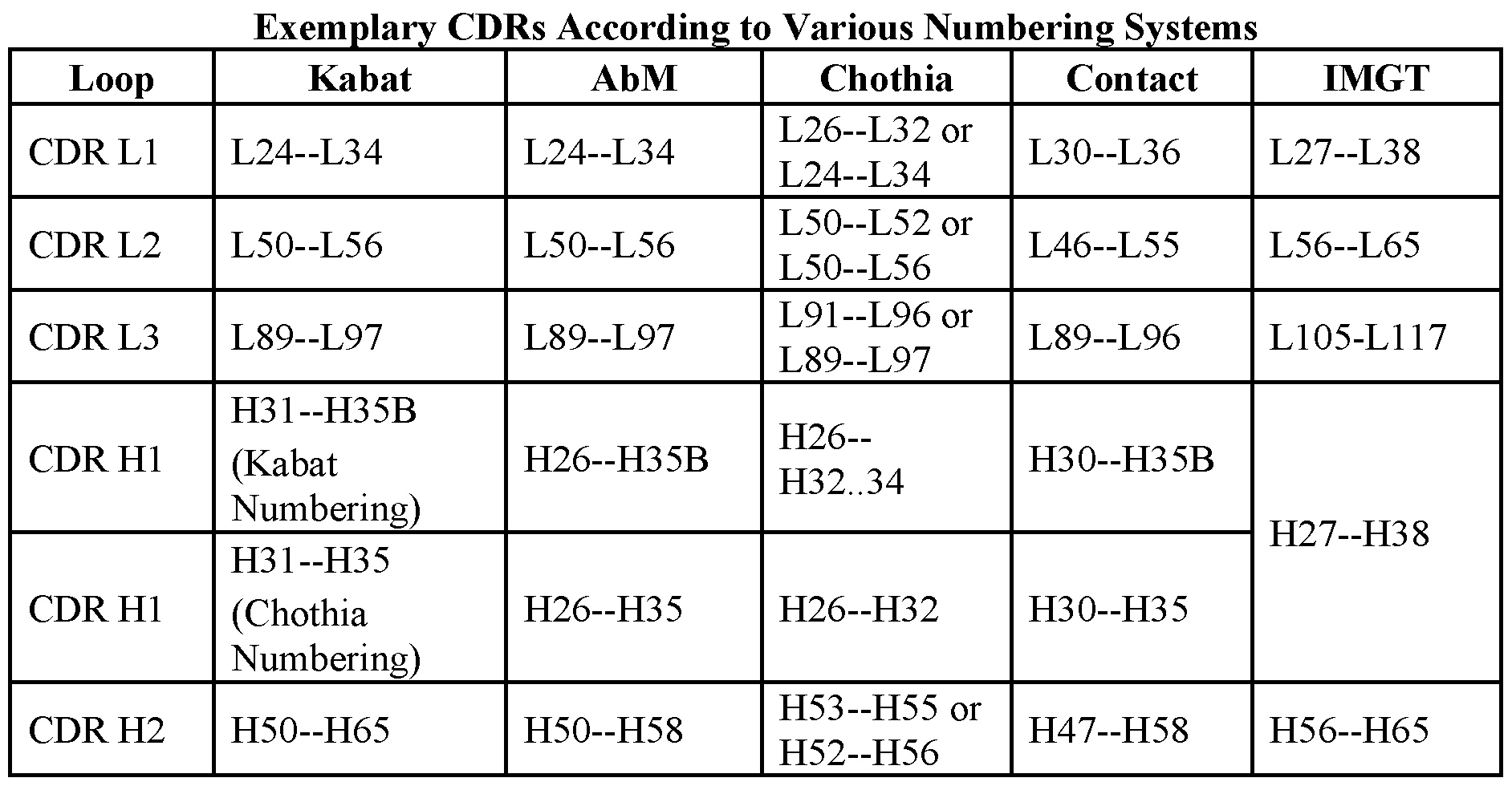

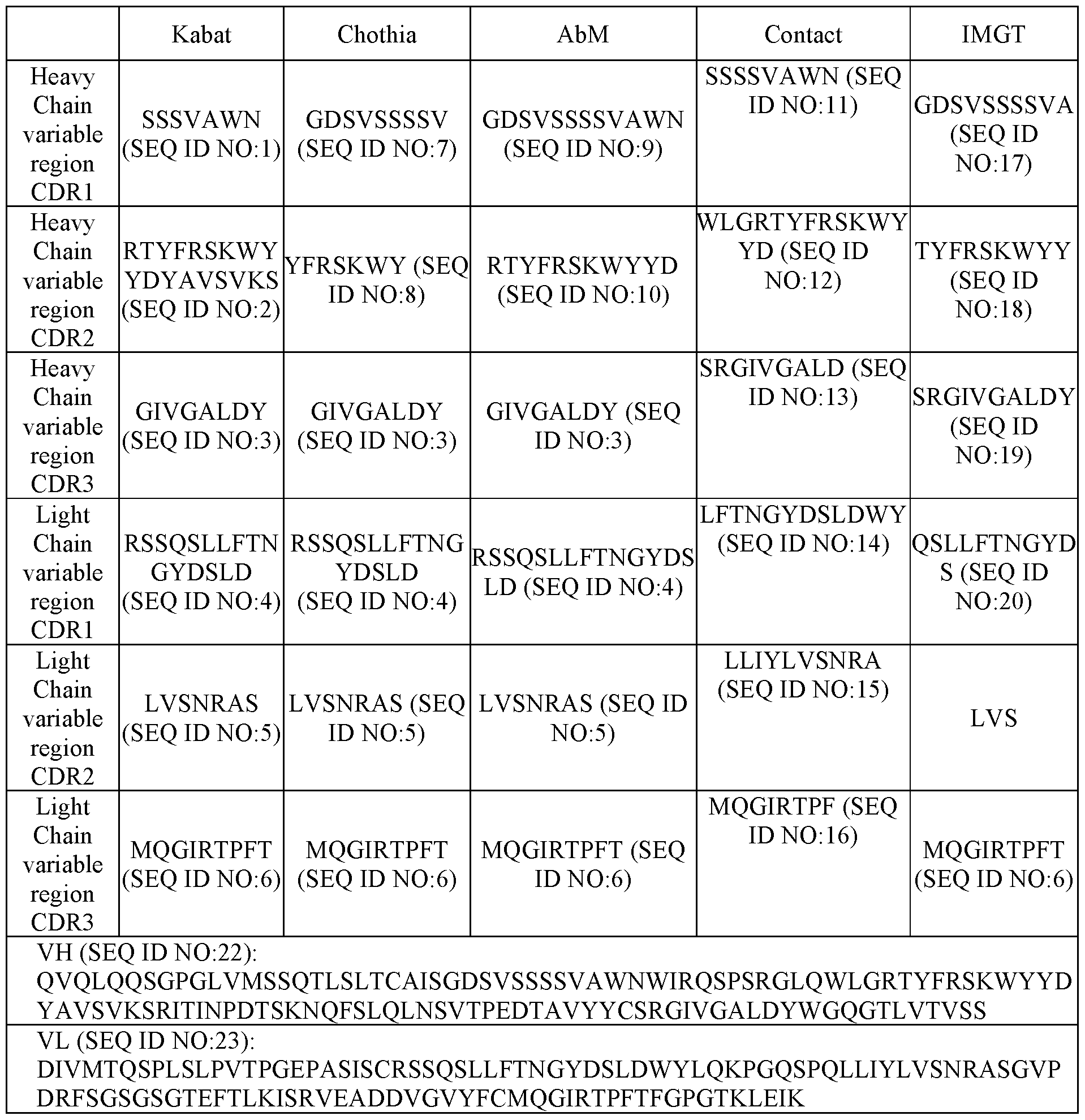

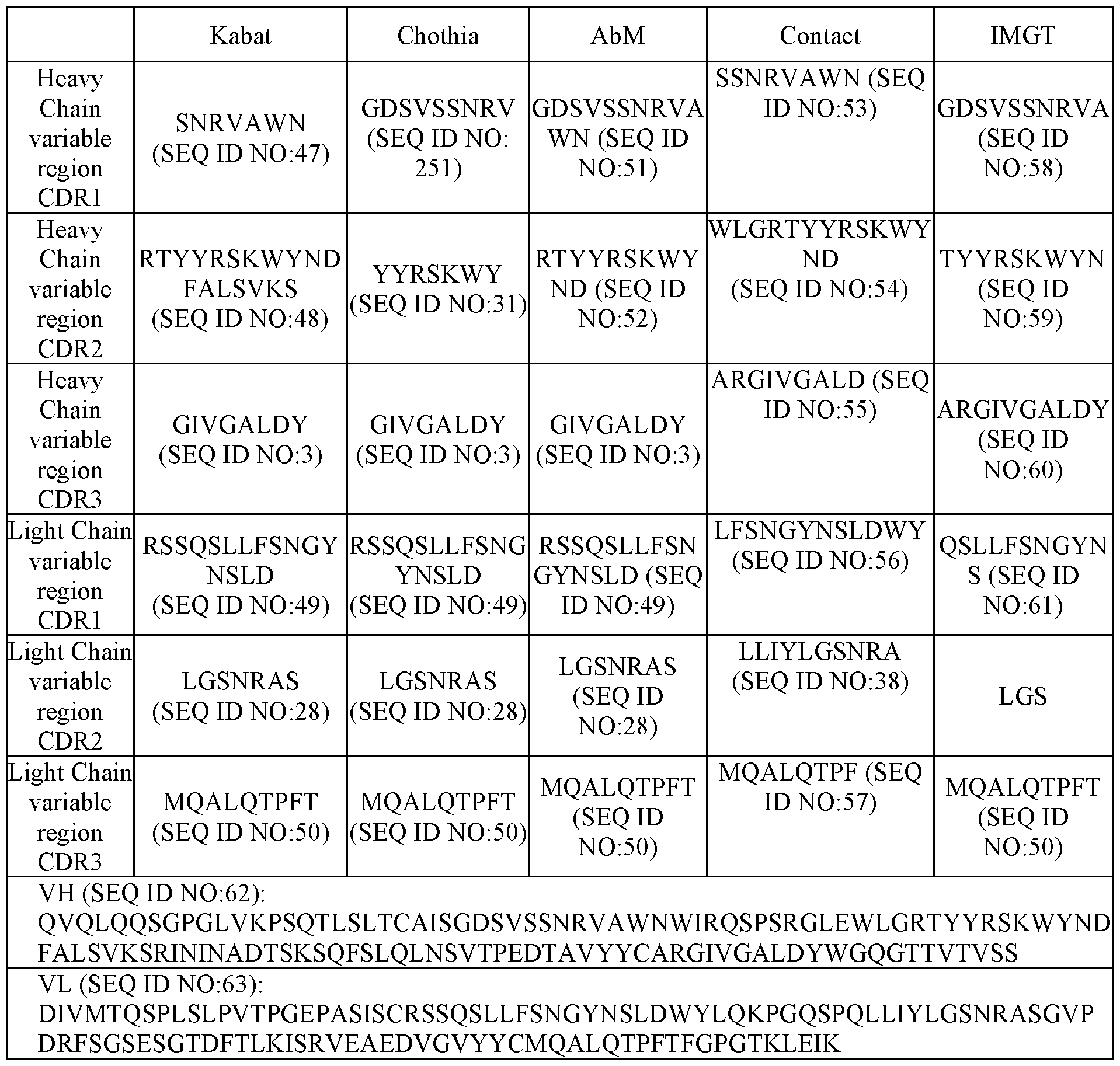
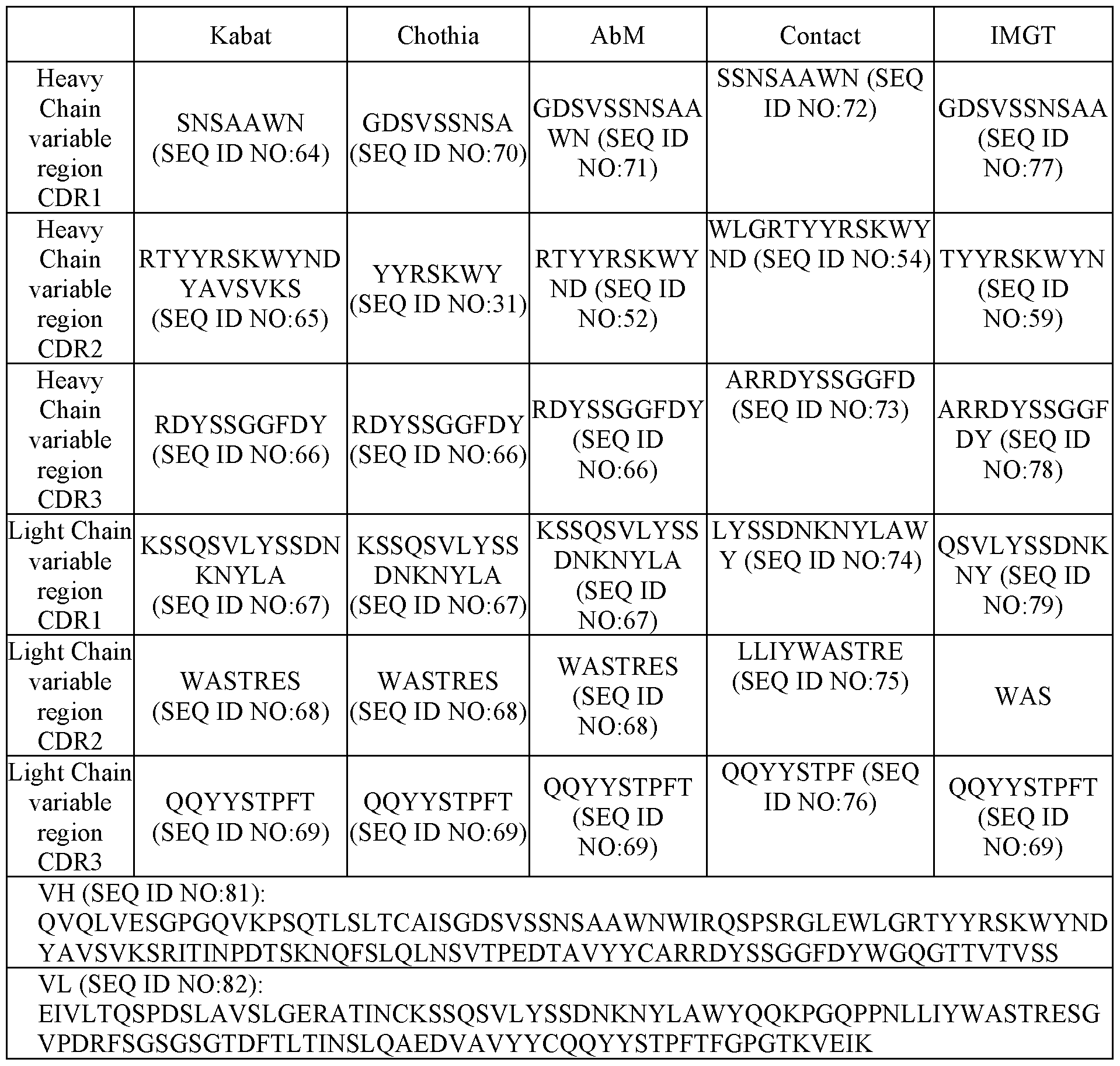


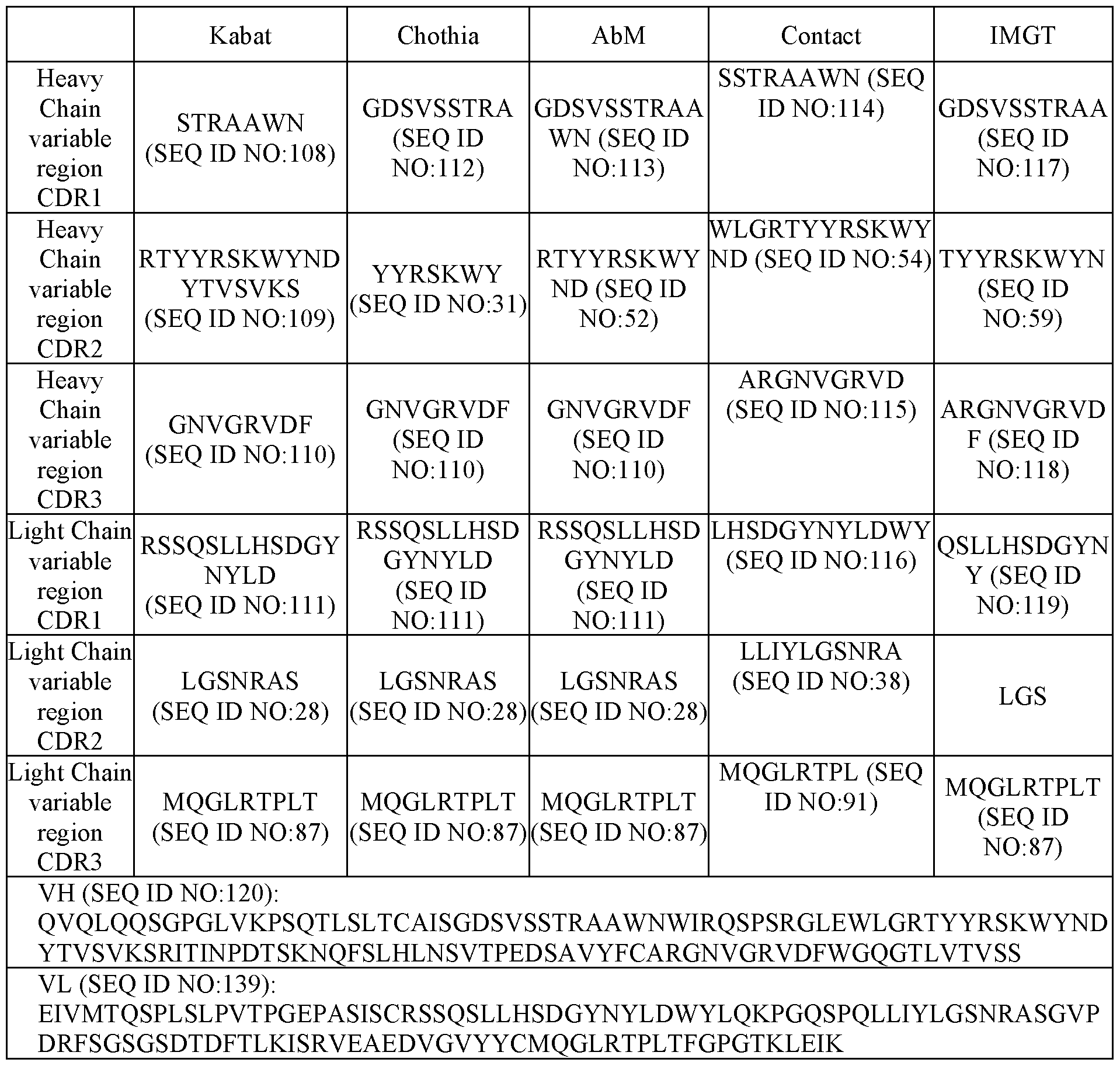


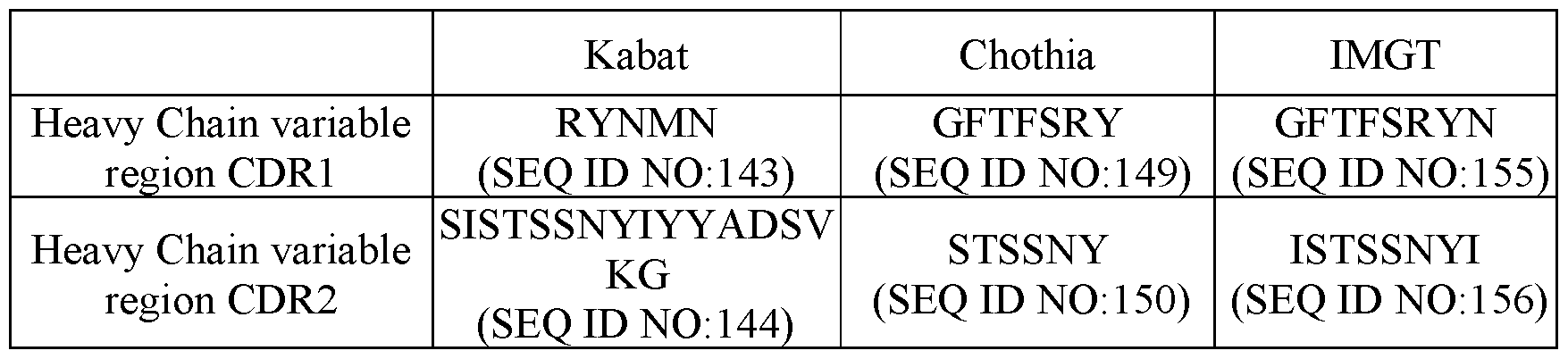
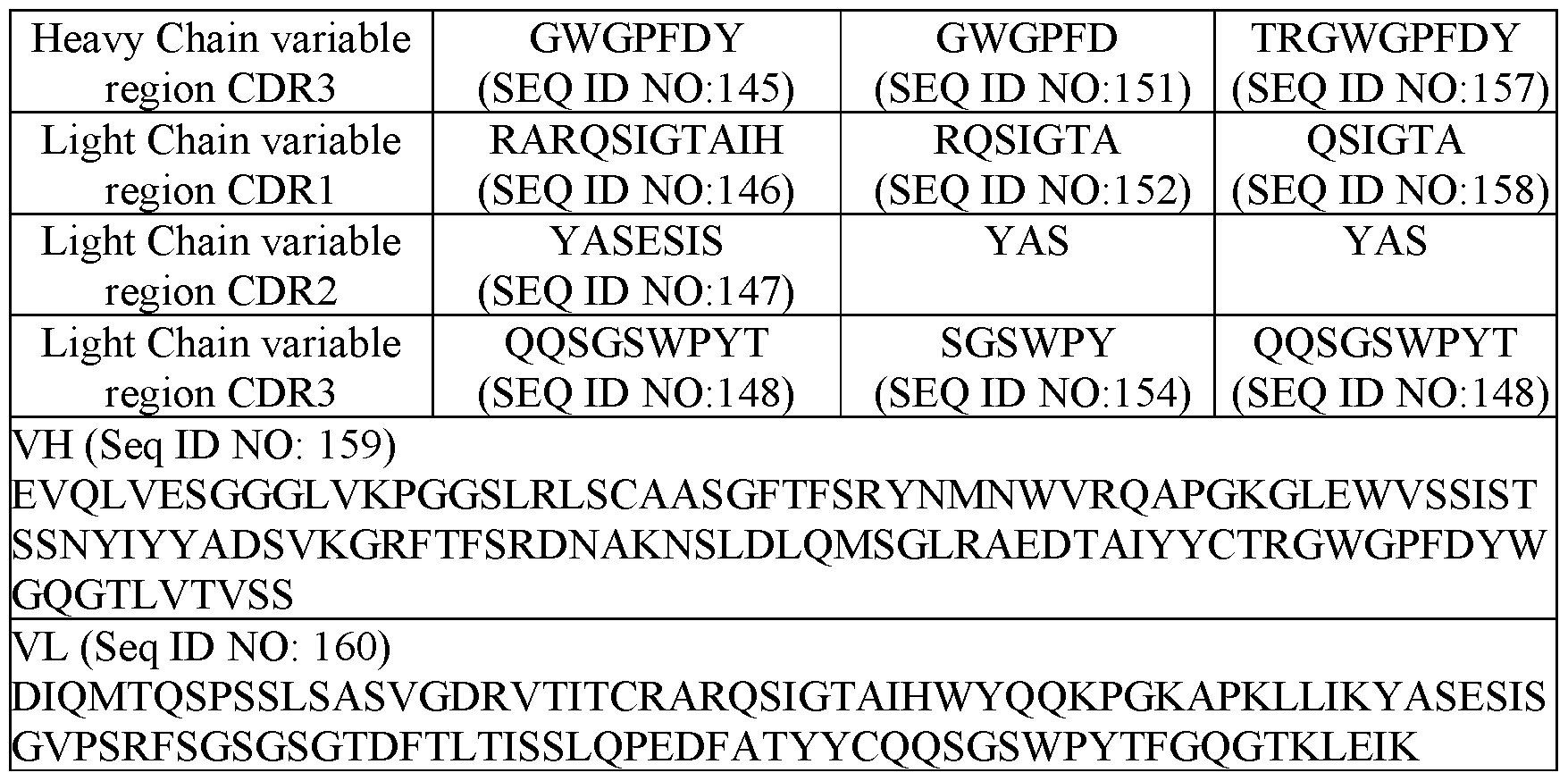


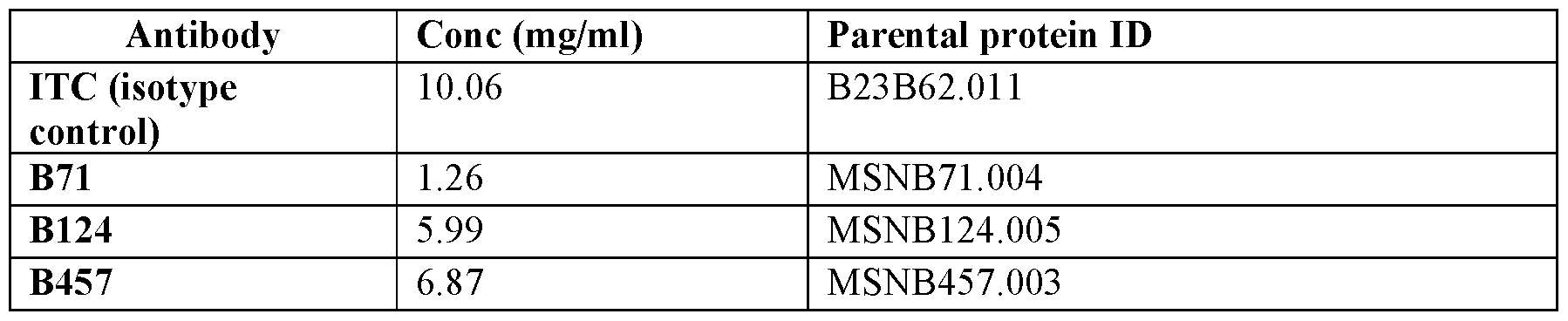


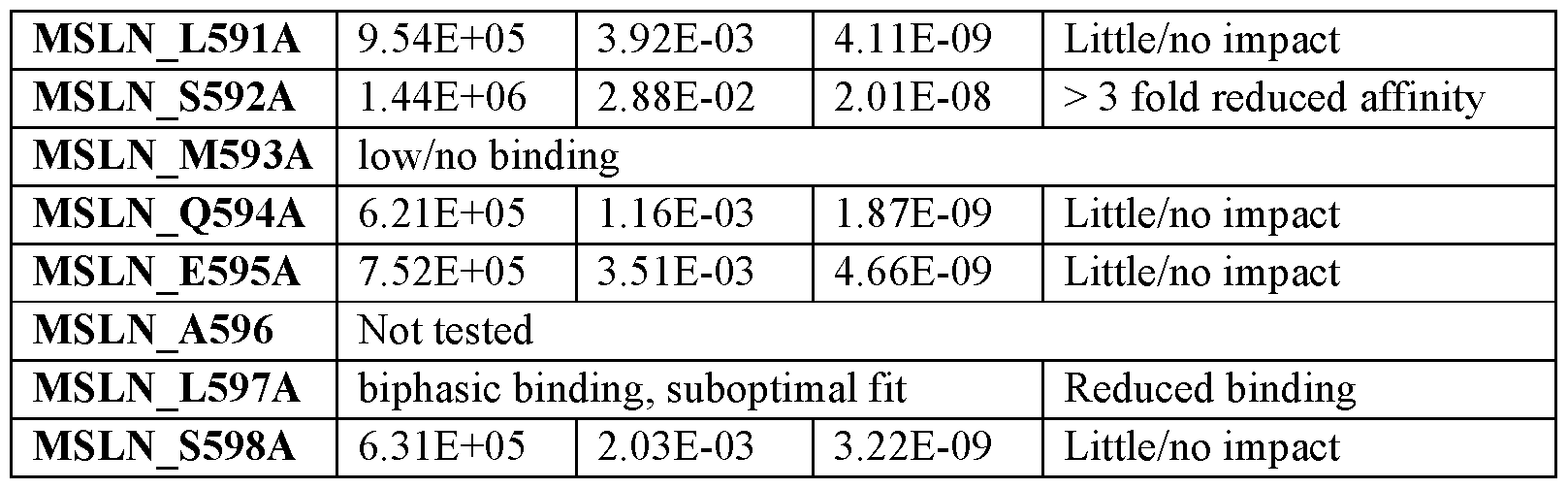


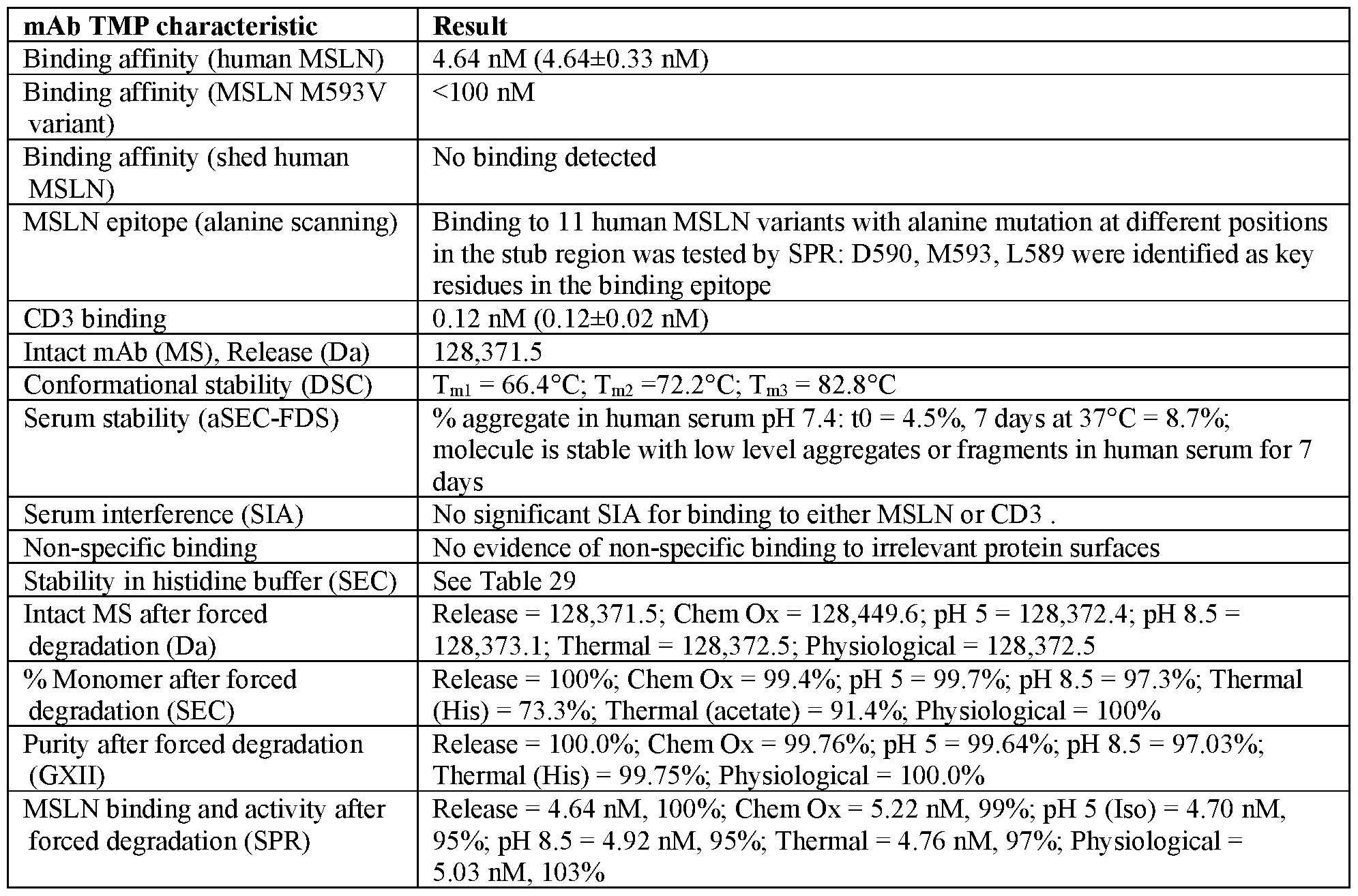


Claims
Priority Applications (1)
| Application Number | Priority Date | Filing Date | Title |
|---|---|---|---|
| TW112140520A TW202428620A (en) | 2022-10-25 | 2023-10-24 | Msln and cd3 binding agents and methods of use thereof |
Applications Claiming Priority (2)
| Application Number | Priority Date | Filing Date | Title |
|---|---|---|---|
| US202263419174P | 2022-10-25 | 2022-10-25 | |
| US63/419,174 | 2022-10-25 |
Publications (1)
| Publication Number | Publication Date |
|---|---|
| WO2024089551A1 true WO2024089551A1 (en) | 2024-05-02 |
Family
ID=88690122
Family Applications (1)
| Application Number | Title | Priority Date | Filing Date |
|---|---|---|---|
| PCT/IB2023/060582 Ceased WO2024089551A1 (en) | 2022-10-25 | 2023-10-19 | Msln and cd3 binding agents and methods of use thereof |
Country Status (4)
| Country | Link |
|---|---|
| US (1) | US20240166737A1 (en) |
| AR (1) | AR130865A1 (en) |
| TW (1) | TW202428620A (en) |
| WO (1) | WO2024089551A1 (en) |
Citations (36)
| Publication number | Priority date | Publication date | Assignee | Title |
|---|---|---|---|---|
| US4816567A (en) | 1983-04-08 | 1989-03-28 | Genentech, Inc. | Recombinant immunoglobin preparations |
| WO1992009690A2 (en) | 1990-12-03 | 1992-06-11 | Genentech, Inc. | Enrichment method for variant proteins with altered binding properties |
| WO1993006213A1 (en) | 1991-09-23 | 1993-04-01 | Medical Research Council | Production of chimeric antibodies - a combinatorial approach |
| WO1993011794A1 (en) | 1991-12-13 | 1993-06-24 | Xoma Corporation | Methods and materials for preparation of modified antibody variable domains and therapeutic uses thereof |
| WO1993016185A2 (en) | 1992-02-06 | 1993-08-19 | Creative Biomolecules, Inc. | Biosynthetic binding protein for cancer marker |
| US5571894A (en) | 1991-02-05 | 1996-11-05 | Ciba-Geigy Corporation | Recombinant antibodies specific for a growth factor receptor |
| US5587458A (en) | 1991-10-07 | 1996-12-24 | Aronex Pharmaceuticals, Inc. | Anti-erbB-2 antibodies, combinations thereof, and therapeutic and diagnostic uses thereof |
| US5739277A (en) | 1995-04-14 | 1998-04-14 | Genentech Inc. | Altered polypeptides with increased half-life |
| US5869046A (en) | 1995-04-14 | 1999-02-09 | Genentech, Inc. | Altered polypeptides with increased half-life |
| US5869619A (en) | 1991-12-13 | 1999-02-09 | Xoma Corporation | Modified antibody variable domains |
| US6075181A (en) | 1990-01-12 | 2000-06-13 | Abgenix, Inc. | Human antibodies derived from immunized xenomice |
| US6150584A (en) | 1990-01-12 | 2000-11-21 | Abgenix, Inc. | Human antibodies derived from immunized xenomice |
| WO2006028936A2 (en) | 2004-09-02 | 2006-03-16 | Genentech, Inc. | Heteromultimeric molecules |
| US20070287170A1 (en) | 2006-03-24 | 2007-12-13 | Merck Patent Gmbh | Engineered heterodimeric protein domains |
| WO2009018386A1 (en) | 2007-07-31 | 2009-02-05 | Medimmune, Llc | Multispecific epitope binding proteins and uses thereof |
| US20090075378A1 (en) | 2007-02-20 | 2009-03-19 | Anaptysbio, Inc. | Somatic hypermutation systems |
| WO2009080251A1 (en) | 2007-12-21 | 2009-07-02 | F. Hoffmann-La Roche Ag | Bivalent, bispecific antibodies |
| WO2009080254A1 (en) | 2007-12-21 | 2009-07-02 | F. Hoffmann-La Roche Ag | Bivalent, bispecific antibodies |
| WO2009080252A1 (en) | 2007-12-21 | 2009-07-02 | F. Hoffmann-La Roche Ag | Bivalent, bispecific antibodies |
| US20090182127A1 (en) | 2006-06-22 | 2009-07-16 | Novo Nordisk A/S | Production of Bispecific Antibodies |
| US20100015133A1 (en) | 2005-03-31 | 2010-01-21 | Chugai Seiyaku Kabushiki Kaisha | Methods for Producing Polypeptides by Regulating Polypeptide Association |
| US20100028637A1 (en) | 2005-06-22 | 2010-02-04 | Sunjuet Deutschland Gmbh | Multi-Layer Film Comprising a Barrier Layer and an Antistatic Layer |
| US20110123532A1 (en) | 2009-04-27 | 2011-05-26 | Oncomed Pharmaceuticals, Inc. | Method for Making Heteromultimeric Molecules |
| WO2011131746A2 (en) | 2010-04-20 | 2011-10-27 | Genmab A/S | Heterodimeric antibody fc-containing proteins and methods for production thereof |
| US20120149876A1 (en) | 2010-11-05 | 2012-06-14 | Zymeworks Inc. | Stable Heterodimeric Antibody Design with Mutations in the Fc Domain |
| US8242247B2 (en) | 2007-12-21 | 2012-08-14 | Hoffmann-La Roche Inc. | Bivalent, bispecific antibodies |
| US20130195849A1 (en) | 2011-11-04 | 2013-08-01 | Zymeworks Inc. | Stable Heterodimeric Antibody Design with Mutations in the Fc Domain |
| US8603930B2 (en) | 2005-10-07 | 2013-12-10 | Sulzer Metco (Us), Inc. | High-purity fused and crushed zirconia alloy powder and method of producing same |
| US20140273092A1 (en) | 2013-03-15 | 2014-09-18 | Janssen Biologics B.V. | Manufacturing methods to control c-terminal lysine, galactose and sialic acid content in recombinant proteins |
| WO2018213612A1 (en) * | 2017-05-18 | 2018-11-22 | The United States Of America, As Represented By The Secretary, Department Of Health And Human Services | Anti-mesothelin polypeptides and proteins |
| WO2019060695A1 (en) | 2017-09-22 | 2019-03-28 | Kite Pharma, Inc. | Chimeric polypeptides and uses thereof |
| WO2019224717A2 (en) | 2018-05-24 | 2019-11-28 | Janssen Biotech, Inc. | Anti-cd3 antibodies and uses thereof |
| US10889653B2 (en) | 2014-11-26 | 2021-01-12 | Xencor, Inc. | Heterodimeric antibodies that bind CD3 and tumor antigens |
| WO2021019389A1 (en) * | 2019-07-26 | 2021-02-04 | Janssen Biotech, Inc. | Proteins comprising kallikrein related peptidase 2 antigen binding domains and their uses |
| WO2021240388A1 (en) | 2020-05-27 | 2021-12-02 | Janssen Biotech, Inc. | Proteins comprising cd3 antigen binding domains and uses thereof |
| WO2022052646A1 (en) | 2020-09-11 | 2022-03-17 | 华为数字能源技术有限公司 | Direct-current combiner box, inverter, photovoltaic system and protection method |
-
2023
- 2023-10-19 WO PCT/IB2023/060582 patent/WO2024089551A1/en not_active Ceased
- 2023-10-24 TW TW112140520A patent/TW202428620A/en unknown
- 2023-10-24 US US18/493,367 patent/US20240166737A1/en active Pending
- 2023-10-25 AR ARP230102851A patent/AR130865A1/en unknown
Patent Citations (46)
| Publication number | Priority date | Publication date | Assignee | Title |
|---|---|---|---|---|
| US4816567A (en) | 1983-04-08 | 1989-03-28 | Genentech, Inc. | Recombinant immunoglobin preparations |
| US6075181A (en) | 1990-01-12 | 2000-06-13 | Abgenix, Inc. | Human antibodies derived from immunized xenomice |
| US6150584A (en) | 1990-01-12 | 2000-11-21 | Abgenix, Inc. | Human antibodies derived from immunized xenomice |
| US5750373A (en) | 1990-12-03 | 1998-05-12 | Genentech, Inc. | Enrichment method for variant proteins having altered binding properties, M13 phagemids, and growth hormone variants |
| WO1992009690A2 (en) | 1990-12-03 | 1992-06-11 | Genentech, Inc. | Enrichment method for variant proteins with altered binding properties |
| US5571894A (en) | 1991-02-05 | 1996-11-05 | Ciba-Geigy Corporation | Recombinant antibodies specific for a growth factor receptor |
| WO1993006213A1 (en) | 1991-09-23 | 1993-04-01 | Medical Research Council | Production of chimeric antibodies - a combinatorial approach |
| US5587458A (en) | 1991-10-07 | 1996-12-24 | Aronex Pharmaceuticals, Inc. | Anti-erbB-2 antibodies, combinations thereof, and therapeutic and diagnostic uses thereof |
| WO1993011794A1 (en) | 1991-12-13 | 1993-06-24 | Xoma Corporation | Methods and materials for preparation of modified antibody variable domains and therapeutic uses thereof |
| US5766886A (en) | 1991-12-13 | 1998-06-16 | Xoma Corporation | Modified antibody variable domains |
| US5770196A (en) | 1991-12-13 | 1998-06-23 | Xoma Corporation | Modified antibody variable domains and therapeutic uses thereof |
| US5821123A (en) | 1991-12-13 | 1998-10-13 | Xoma Corporation | Modified antibody variable domains |
| US5869619A (en) | 1991-12-13 | 1999-02-09 | Xoma Corporation | Modified antibody variable domains |
| WO1993016185A2 (en) | 1992-02-06 | 1993-08-19 | Creative Biomolecules, Inc. | Biosynthetic binding protein for cancer marker |
| US5869046A (en) | 1995-04-14 | 1999-02-09 | Genentech, Inc. | Altered polypeptides with increased half-life |
| US5739277A (en) | 1995-04-14 | 1998-04-14 | Genentech Inc. | Altered polypeptides with increased half-life |
| WO2006028936A2 (en) | 2004-09-02 | 2006-03-16 | Genentech, Inc. | Heteromultimeric molecules |
| US20100015133A1 (en) | 2005-03-31 | 2010-01-21 | Chugai Seiyaku Kabushiki Kaisha | Methods for Producing Polypeptides by Regulating Polypeptide Association |
| US20100028637A1 (en) | 2005-06-22 | 2010-02-04 | Sunjuet Deutschland Gmbh | Multi-Layer Film Comprising a Barrier Layer and an Antistatic Layer |
| US8603930B2 (en) | 2005-10-07 | 2013-12-10 | Sulzer Metco (Us), Inc. | High-purity fused and crushed zirconia alloy powder and method of producing same |
| US20070287170A1 (en) | 2006-03-24 | 2007-12-13 | Merck Patent Gmbh | Engineered heterodimeric protein domains |
| US20090182127A1 (en) | 2006-06-22 | 2009-07-16 | Novo Nordisk A/S | Production of Bispecific Antibodies |
| US20120028301A1 (en) | 2007-02-20 | 2012-02-02 | Anaptysbio, Inc. | Somatic hypermutation systems |
| US20140094392A1 (en) | 2007-02-20 | 2014-04-03 | Anaptysbio, Inc. | Methods of generating libraries and uses thereof |
| US8685897B2 (en) | 2007-02-20 | 2014-04-01 | Anaptysbio, Inc. | Methods of generating libraries and uses thereof |
| US20090075378A1 (en) | 2007-02-20 | 2009-03-19 | Anaptysbio, Inc. | Somatic hypermutation systems |
| US20110183855A1 (en) | 2007-02-20 | 2011-07-28 | Anaptysbio, Inc. | Somatic hypermutation systems |
| US20140170705A1 (en) | 2007-02-20 | 2014-06-19 | Anaptysbio, Inc. | Methods of generating libraries and uses thereof |
| WO2009018386A1 (en) | 2007-07-31 | 2009-02-05 | Medimmune, Llc | Multispecific epitope binding proteins and uses thereof |
| WO2009080251A1 (en) | 2007-12-21 | 2009-07-02 | F. Hoffmann-La Roche Ag | Bivalent, bispecific antibodies |
| US8242247B2 (en) | 2007-12-21 | 2012-08-14 | Hoffmann-La Roche Inc. | Bivalent, bispecific antibodies |
| WO2009080252A1 (en) | 2007-12-21 | 2009-07-02 | F. Hoffmann-La Roche Ag | Bivalent, bispecific antibodies |
| WO2009080254A1 (en) | 2007-12-21 | 2009-07-02 | F. Hoffmann-La Roche Ag | Bivalent, bispecific antibodies |
| US20110123532A1 (en) | 2009-04-27 | 2011-05-26 | Oncomed Pharmaceuticals, Inc. | Method for Making Heteromultimeric Molecules |
| WO2011131746A2 (en) | 2010-04-20 | 2011-10-27 | Genmab A/S | Heterodimeric antibody fc-containing proteins and methods for production thereof |
| US20120149876A1 (en) | 2010-11-05 | 2012-06-14 | Zymeworks Inc. | Stable Heterodimeric Antibody Design with Mutations in the Fc Domain |
| US20130195849A1 (en) | 2011-11-04 | 2013-08-01 | Zymeworks Inc. | Stable Heterodimeric Antibody Design with Mutations in the Fc Domain |
| US20140273092A1 (en) | 2013-03-15 | 2014-09-18 | Janssen Biologics B.V. | Manufacturing methods to control c-terminal lysine, galactose and sialic acid content in recombinant proteins |
| US10889653B2 (en) | 2014-11-26 | 2021-01-12 | Xencor, Inc. | Heterodimeric antibodies that bind CD3 and tumor antigens |
| WO2018213612A1 (en) * | 2017-05-18 | 2018-11-22 | The United States Of America, As Represented By The Secretary, Department Of Health And Human Services | Anti-mesothelin polypeptides and proteins |
| WO2019060695A1 (en) | 2017-09-22 | 2019-03-28 | Kite Pharma, Inc. | Chimeric polypeptides and uses thereof |
| WO2019224717A2 (en) | 2018-05-24 | 2019-11-28 | Janssen Biotech, Inc. | Anti-cd3 antibodies and uses thereof |
| US20200048349A1 (en) | 2018-05-24 | 2020-02-13 | Janssen Biotech, Inc. | Anti-cd3 antibodies and uses thereof |
| WO2021019389A1 (en) * | 2019-07-26 | 2021-02-04 | Janssen Biotech, Inc. | Proteins comprising kallikrein related peptidase 2 antigen binding domains and their uses |
| WO2021240388A1 (en) | 2020-05-27 | 2021-12-02 | Janssen Biotech, Inc. | Proteins comprising cd3 antigen binding domains and uses thereof |
| WO2022052646A1 (en) | 2020-09-11 | 2022-03-17 | 华为数字能源技术有限公司 | Direct-current combiner box, inverter, photovoltaic system and protection method |
Non-Patent Citations (91)
| Title |
|---|
| "Antibody Engineering", vol. 2, 2010 |
| "Current Protocols in Molecular Biology", vol. I, 1989, pages: 332 - 36 |
| ALFENITO: "The Protein Engineering Summit", 2007, article "Cambridge Healthtech Institute's Third Annual PEGS" |
| ALTSCHUL ET AL., J. MOL. BIOL., vol. 215, 1990, pages 403 |
| ALTSCHUL ET AL., NUCLEIC ACIDS RES., vol. 25, 1997, pages 3389 3402 |
| ARMOUR ET AL., EUR. J. IMMUNOL., vol. 29, no. 8, 1999, pages 2613 - 24 |
| BACA ET AL., J. BIOL. CHEM., vol. 272, 1997, pages 10678 - 84 |
| BAO ET AL., CANCER BIOL. THER, vol. 4, 2005, pages 1374 - 80 |
| BASS ET AL., PROTEINS, vol. 8, 1990, pages 309 - 14 |
| BEIBOER ET AL., J. MOL. BIOL., vol. 296, 2000, pages 833 - 49 |
| BERA ET AL.: "Mesothelin is not required for normal mouse development or reproduction", CELL BIOL, 2000 |
| BOERNER ET AL., J. IMMUNOL., vol. 147, no. 1, 1991, pages 86 - 95 |
| BOWERS ET AL., PROC NATL ACAD SCI USA., vol. 108, 2011, pages 20455 - 60 |
| BRENNAN ET AL., SCIENCE, vol. 229, 1985, pages 81 - 83 |
| BRODEUR ET AL., MONOCLONAL ANTIBODY PRODUCTION TECHNIQUES AND APPLICATIONS, 1987, pages 51 - 63 |
| BRUGGEMANNTAUSSING, CURR. OPIN. BIOTECHNOL, vol. 8, no. 4, 1997, pages 455 - 58 |
| CAI ET AL., BIOTECHNOL BIOENG, vol. 108, 2011, pages 404 - 412 |
| CARTER ET AL., BIO/TECHNOLOGY, vol. 10, 1992, pages 163 - 67 |
| CARTER ET AL., PROC. NATL. ACAD. SCI. USA, vol. 89, 1992, pages 4285 - 89 |
| CHAMESBATY, CURR OPIN DRUG DISC DEV, vol. 12, 2009, pages 276 |
| CHANG ET AL.: "Isolation and characterization of a monoclonal antibody, K1, reactive with ovarian cancers and normal mesothelium", INT. J. CANCER, 1992 |
| CHEN ET AL., J. MOL BIOL, vol. 293, 1999, pages 865 - 81 |
| CHOTHIA ET AL., J. MOL. BIOL., vol. 196, 1987, pages 901 - 17 |
| COLE ET AL., MONOCLONAL ANTIBODIES AND CANCER THERAPY, 1985 |
| COURTENAY-LUCK ET AL.: "Monoclonal Antibodies Production, Engineering and Clinical Application", 1995, CAMBRIDGE UNIVERSITY PRESS, article "Genetic Manipulation of Monoclonal Antibodies", pages: 166 |
| DALL'ACQUA ET AL., METHODS, vol. 36, 2005, pages 61 - 68 |
| DAMSCHRODER ET AL., MOL. IMMUNOL, vol. 44, 2007, pages 3049 - 60 |
| DUFNER ET AL., TRENDS BIOTECHNOL, vol. 24, 2006, pages 523 - 29 |
| EBERSBACH ET AL., J. MOL. BIOL., vol. 372, pages 172 - 85 |
| FELDHAUS ET AL., NAT. BIOTECHNOL., vol. 21, 2003, pages 163 - 70 |
| FIGINI ET AL., CANCER RES., vol. 58, 1998, pages 991 - 96 |
| GEBAUERSKERRA, CURR. OPIN. CHEM. BIOL., vol. 13, 2009, pages 245 - 55 |
| GODING, MONOCLONAL ANTIBODIES: PRINCIPLES AND PRACTICE, 1986, pages 59 - 103 |
| GRABULOVSKI ET AL., J. BIOL. CHEM., vol. 282, 2007, pages 3196 - 204 |
| GRIFFITHS ET AL., EMBO J, vol. 12, 1993, pages 725 - 34 |
| GUBBELS ET AL.: "Mesothelin-MUC16 binding is a high affinity, N-glycan dependent interaction that facilitates peritoneal metastasis of ovarian tumors", MOL CANCER, 2006 |
| GUEXPEITSCH, ELECTROPHORESIS, vol. 18, 1997, pages 2714 - 23 |
| HO ET AL.: "A novel high-affinity human monoclonal antibody to mesothelin", INT. J. CANCER, 2011 |
| HOLLINGERHUDSON, NATURE BIOTECHNOLOGY, vol. 23, no. 9, 2005, pages 1126 - 1136 |
| HONEGGERPLUCKTHUN, J. MOL. BIOL., vol. 309, 2001, pages 657 - 70 |
| HOOGENBOOM, NAT. BIOTECHNOL., vol. 23, 2005, pages 1105 - 16 |
| HOOGENBOOMWINTER, J. MOL. BIOL., vol. 224, 1992, pages 487 - 99 |
| HOWE ET AL., NUCLEIC ACID RESEARCH, 2021 |
| HUDSON ET AL., NATURE MED., vol. 9, 2003, pages 129 - 34 |
| INAGUMA ET AL.: "Comprehensive immunohistochemical study of mesothelin (MSLN) using different monoclonal antibodies 5B2 and MN-1 in 1562 tumors with evaluation of its prognostic value in malignant pleural mesothelioma", ONCOTARGET, 2017 |
| JAKOBOVITS, A, CURR. OPIN. BIOTECHNOL, vol. 6, no. 5, 1995, pages 561 - 66 |
| JONES ET AL., NATURE, vol. 321, 1986, pages 522 - 25 |
| KARCZEWSKI ET AL.: "The mutational constraint spectrum quantified from variation in 141,456 humans", NATURE, 2020 |
| KARLINALTSCHUL, PROC. NATL. ACAD. SCI. U.S.A, vol. 87, 1990, pages 2264 2268 |
| KARLINALTSCHUL, PROC. NATL. ACAD. SCI. U.S.A., vol. 90, 1993, pages 5873 5877 |
| KLIMKA ET AL., BR. J. CANCER, vol. 83, 2000, pages 252 - 60 |
| KOHLER ET AL., NATURE, vol. 256, 1975, pages 495 - 97 |
| KOIDEKOIDE, METHODS MOL. BIOL, vol. 352, 2007, pages 95 - 109 |
| KOZBOR, IMMUNOL, vol. 133, 1984, pages 3001 - 05 |
| KOZBOR: "J. Immunol", vol. 133, 1984, pages: 3001 - 05 |
| KREHENBRINK ET AL., J. MOL. BIOL., vol. 383, 2008, pages 1058 - 68 |
| LAFRANC ET AL., DEV. COMP. IMMUNOL, vol. 27, no. 1, 2003, pages 55 - 77 |
| LARRICK ET AL., METHODS: A COMPANION TO METHODS IN ENZYMOLOGY, vol. 2, 1991, pages 106 |
| LEE Y-J ET AL: "MG1122, a whole IgG-like bispecific antibody targeting mesothelin and CD3, induces T cellmediated killing of MSLN-expressing tumor cells", CANCER RESEARCH; PROCEEDINGS: AACR ANNUAL MEETING 2018; APRIL 14-18, 2018; CHICAGO, IL, AMERICAN ASSOCIATION FOR CANCER RESEARCH, US, vol. 78, no. 13, Supplement 1, 1 July 2018 (2018-07-01), pages 1 - 3, XP009527591, ISSN: 1538-7445, DOI: 10.1158/1538-7445.AM2018-5768 * |
| LONBERG ET AL., NATURE BIOTECHNOL., vol. 23, 2005, pages 1117 - 25 |
| MARKS ET AL., BIOTECHNOL, vol. 10, 1992, pages 779 - 83 |
| MILSTEINCUELLO, NATURE, vol. 305, 1983, pages 537 - 40 |
| MORIMOTO ET AL., J. BIOCHEM. BIOPHYS. METHODS, vol. 24, 1992, pages 107 - 17 |
| MUMINOVA ET AL.: "Characterization of human mesothelin transcripts in ovarian and pancreatic cancer", BMC CANCER, 2004 |
| MUNSON ET AL., ANAL. BIOCHEM., vol. 107, 1980, pages 220 - 39 |
| MYERSMILLER, CABIOS, vol. 4, 1998, pages 11 - 17 |
| NICK DESCHACHT ET AL., J IMMUNOL, vol. 184, 2010, pages 5696 - 5704 |
| NIXONWOOD, CURR. OPIN. DRUG. DISCOV. DEV, vol. 9, 2006, pages 261 - 68 |
| NUNEZ-PRADO ET AL., DRUG DISCOVERY TODAY, vol. 20, no. 5, 2015, pages 588 - 594 |
| NYGREN ET AL., FEBS J, vol. 275, 2008, pages 2684 - 90 |
| PADLAN ET AL., FASEB J, vol. 9, 1995, pages 133 - 39 |
| PLUCKTHUN, IMMUNOL. REVS, vol. 130, 1992, pages 151 - 88 |
| PRESTA ET AL., J. IMMUNOL., vol. 151, 1993, pages 2623 - 308 |
| RIECHMANN ET AL., NATURE, vol. 332, 1988, pages 323 - 27 |
| SALIBLUNDELL, J. MOL. BIOL., vol. 234, 1993, pages 779 - 815 |
| SCHLAPSCHY ET AL., PROTEIN ENG. DES. SEL, vol. 17, 2004, pages 847 - 60 |
| SHIELDS ET AL., J. BIOL. CHEM., vol. 276, no. 9, 2001, pages 6591 - 604 |
| SILVERMAN ET AL., BIOTECHNOL, vol. 23, 2005, pages 1556 - 61 |
| SKERRA ET AL., CURR. OPINION IN IMMUNOL, vol. 5, 1993, pages 256 - 62 |
| STRELTSOV ET AL., PROC NATL ACAD SCI USA., vol. 101, 2004, pages 12444 - 49 |
| STUDNICKA ET AL., PROTEIN ENGINEERING, vol. 7, 1994, pages 805 - 14 |
| STUMPP ET AL., DRUG. DISCOV. TODAY, vol. 13, 2008, pages 695 - 701 |
| TAN ET AL., J. IMMUNOL., vol. 169, 2002, pages 1119 - 25 |
| VERHOEYEN ET AL., SCIENCE, vol. 239, 1988, pages 1534 - 36 |
| WARD ET AL.: "Monoclonal Antibodies: Principles and Applications", 1995, WILEY-LISS, INC, article "Genetic Manipulation and Expression of Antibodies", pages: 137 |
| WHITELEGGREES, PROTEIN ENG, vol. 13, 2000, pages 819 - 24 |
| WINTER ET AL., ANN. REV. IMMUNOL, vol. 12, 1994, pages 433 - 55 |
| WOOLVEN ET AL., IMMUNOGENETICS, vol. 50, 1999, pages 98 - 101 |
| WRAMK ET AL., J BIOL CHEM, vol. 287, no. 52, 2012, pages 42221 - 9 |
| YOON AERIN ET AL: "A Novel T Cell-Engaging Bispecific Antibody for Treating Mesothelin-Positive Solid Tumors", BIOMOLECULES, vol. 10, no. 3, 4 March 2020 (2020-03-04), pages 399, XP055784331, DOI: 10.3390/biom10030399 * |
| ZHANG ET AL.: "Cytotoxic activity of immunotoxin SS1P is modulated by TACE-dependent mesothelin shedding", CANCER RES, 2011 |
Also Published As
| Publication number | Publication date |
|---|---|
| AR130865A1 (en) | 2025-01-29 |
| TW202428620A (en) | 2024-07-16 |
| US20240166737A1 (en) | 2024-05-23 |
Similar Documents
| Publication | Publication Date | Title |
|---|---|---|
| CN112912397B (en) | Anti-CD3 antibodies and uses thereof | |
| US12460001B2 (en) | Proteins comprising CD3 antigen binding domains and uses thereof | |
| AU2024219504A1 (en) | BINDING MOLECULES SPECIFIC FOR FCyGAMMA RIIA AND USES THEREOF | |
| CA3147735A1 (en) | Proteins comprising kallikrein related peptidase 2 antigen binding domains and their uses | |
| TWI865451B (en) | Monospecific and multispecifc anti-tmeff2 antibodies and their uses | |
| US20230088269A1 (en) | Anti-il-22r antibodies | |
| US20250236682A1 (en) | Antigen-binding protein comprising two fc domains and use thereof | |
| JP2024504758A (en) | PSMA binding protein and its use | |
| US20240025992A1 (en) | Proteins comprising delta-like ligand 3 (dll3) antigen binding domains and their uses | |
| JP2024531462A (en) | FAP/CD40 binding molecules and their pharmaceutical uses | |
| TW202509068A (en) | Antibodies that bind ox40l and methods of use | |
| US20250206820A1 (en) | Ilt3 and cd3 binding agents and methods of use thereof | |
| US20250163182A1 (en) | Enpp3 and cd3 binding agents and methods of use thereof | |
| TW202521579A (en) | Stabilized cd3 antigen binding agents and methods of use thereof | |
| US20240166737A1 (en) | Msln and cd3 binding agents and methods of use thereof | |
| KR20250113441A (en) | CLDN18.2/4-1BB binding protein and its medical uses | |
| CA3254085A1 (en) | Klrb1 binding agents and methods of use thereof | |
| IL297286A (en) | Biosynthetic glycoprotein populations | |
| US20240301086A1 (en) | Tumor-associated antigens and cd3-binding proteins, related compositions, and methods | |
| WO2025126102A1 (en) | Enpp3 × cd3 bispecific antibodies and use thereof | |
| WO2025195358A1 (en) | Pd-1 binding protein and pharmaceutical use | |
| EA045935B1 (en) | ANTIBODIES TO CD3 AND THEIR APPLICATION |
Legal Events
| Date | Code | Title | Description |
|---|---|---|---|
| 121 | Ep: the epo has been informed by wipo that ep was designated in this application |
Ref document number: 23800546 Country of ref document: EP Kind code of ref document: A1 |
|
| WWE | Wipo information: entry into national phase |
Ref document number: 2501002581 Country of ref document: TH |
|
| NENP | Non-entry into the national phase |
Ref country code: DE |
|
| WWE | Wipo information: entry into national phase |
Ref document number: 11202502371P Country of ref document: SG |
|
| WWP | Wipo information: published in national office |
Ref document number: 11202502371P Country of ref document: SG |
|
| 122 | Ep: pct application non-entry in european phase |
Ref document number: 23800546 Country of ref document: EP Kind code of ref document: A1 |