EP0021349B1 - High tensile steel and process for producing the same - Google Patents
High tensile steel and process for producing the same Download PDFInfo
- Publication number
- EP0021349B1 EP0021349B1 EP80103423A EP80103423A EP0021349B1 EP 0021349 B1 EP0021349 B1 EP 0021349B1 EP 80103423 A EP80103423 A EP 80103423A EP 80103423 A EP80103423 A EP 80103423A EP 0021349 B1 EP0021349 B1 EP 0021349B1
- Authority
- EP
- European Patent Office
- Prior art keywords
- steel
- weight
- procedure
- temperature
- corrosion
- Prior art date
- Legal status (The legal status is an assumption and is not a legal conclusion. Google has not performed a legal analysis and makes no representation as to the accuracy of the status listed.)
- Expired
Links
Images


Classifications
-
- C—CHEMISTRY; METALLURGY
- C22—METALLURGY; FERROUS OR NON-FERROUS ALLOYS; TREATMENT OF ALLOYS OR NON-FERROUS METALS
- C22C—ALLOYS
- C22C38/00—Ferrous alloys, e.g. steel alloys
- C22C38/10—Ferrous alloys, e.g. steel alloys containing cobalt
Definitions
- the present invention relates to a process for producing a high tensile steel. More particularly, the present invention relates to a high tensile steel having excellent resistances to sulfide-corrosive cracking and corrosion in an environmental atmosphere containing sulfides, especially, hydrogen sulfide (H 2 S).
- H 2 S hydrogen sulfide
- the steel material used to produce the above-mentioned pipes and tanks is required to have an increased mechanical strength.
- the increase in the mechanical strength of the steel material causes the resistance of the steel material to sulfide-corrosion cracking to be deteriorated.
- hydrogen sulfide is highly corrosive to such steel material. Therefore, when the pipes or tanks are kept in contact with oil or LPG containing hydrogen sulfide for a long period of time, the pipes and tanks are corroded so that the thicknesses of the peripheral walls of the pipes and tanks are decreased. The reduced thickness of the walls of the pipes and tanks causes them to exhibit a poor mechanical strength so that they cannot satisfactorily effect their functions.
- the mechanical strength of the steel material should be limited to a certain range. That is, it has been considered that a lower limit of the resistance of the steel material to sulfide corrosion cracking can be set by determining an upper limit of the mechanical strength of the steel material.
- API Standard, 5AC relating the pipes for oil-wells. That is, the Standard stipulates an upper limit in the hardness of the steel material, and states that quenching and tempering operations should be applied to the steel material. Also, the Standard stipulate the lower limit in the tempering temperature to be applied to the steel material. However, even if a steel material is produced in accordance with the Standard, the resultant steel material usually exhibits an unsatisfactory resistance to sulfide corrosion cracking.
- the steel material is coated with a corrosion-resistant paint or protected by means of a cathodic protection or by applying a corrosion-inhibitor to the corrosive environment.
- a corrosion-resistant paint or protected by means of a cathodic protection or by applying a corrosion-inhibitor to the corrosive environment.
- GB-A-404 565 discloses a process for producing a steel alloy having a high creep strength at a temperature above 400°C and comprising C in an amount not exceeding 0,5% Co between 0,3 and 10%, Mo between 0,3 and 3% and e.g. Cu, Si and Mn in a total amount not exceeding 1,5%.
- a specific heat treatment of the steel is not disclosed.
- GB-A-734 676 is known a heat resistant steel, which comprises as indispensable elements, Cr, Co, Ni, Co and Fe.
- the steel is heated to a temperature of 840 and 1100°C, cooled and then heated to a temperature between 550 and 750°C.
- the cooling procedure is carried out by means of an air-cooling method or an isothermic cooling method which is performed slowly or stepwise at a low cooling rate.
- An object of the present invention is to provide a process for producing a high tensile steel having a high yield strength of 60 kg/mm 2 or more and exhibiting excellent resistances to sulfide corrosion cracking and corrosion, and said steel produced.
- the above-mentioned object can be attained by the process of the present invention, which consists of the steps of hot- or cold rolling a steel consisting of 0.5% to 0.50% by weight of carbon, 0.1 % to 1.0% by weight of silicon, 0.1 % to 2.0% by weight of manganese, 0.05 to 1.50% by weight of cobalt and optionally 0.10% to 0.50% by weight of copper, 0.2 to 2.0% by weight of chromium, 0.05 to 1.0% by weight of molybdenum, 0.05 to 1.0% by weight of tungsten, 0.01 to 0.15% by weight of niobium, 0.01 to 0.15% by weight of vanadium, 0.01 to 0.15% by weight of titanium, 0.0003 to 0.0050% by weight of boron, 0.001 to 0.010% by weight of calcium, 0.001 to 0.050% by weight of lanthanum, and 0.001 to 0.050% by weight of cerium, the balance consisting of iron and inevitable impurities; rapidly heating said rolled steel to
- Carbon contained in the steel of the present invention should be in a content of 0.05% by weight or more in order to enhance the hardenability of the steel.
- the content of carbon in order to avoid an undesirable decrease in toughness and an undesirable increase in sensitivity to quenching cracks during a heat treatment, it is necessary that the content of carbon be 0.50% by weight or less.
- the amount of carbon be in a range of from 0.10 to 0.35% by weight.
- the amount of silicon contained in the steel be 0.1 % by weight or more.
- the amount of silicon should be limited to 1.0% by weight or less.
- Manganese is effective for enhancing the hardenability property of the steel and increasing the strength and toughness of the steel when used in an amount of 0.1 % by weight or more.
- the amount of manganese is less than 01% by weight, the above-mentioned enhancing and increasing effects cannot be expected.
- an excessively large content of manganese in the steel results in a deteriorated workability of the resultant steel. Therefore, the content of manganese in the steel should be not more than 2.0% by weight.
- Cobalt is remarkably effective for enhancing the resistances of the steel to sulfide corrosion cracking and corrosion when used in a content of 0.5% by weight or more.
- a content of cobalt of less than 0.5% by weight is not effective for the above-mentioned enhancement.
- this enhancement in the resistances to sulfide corrosion cracking and corrosion is maximized by the content of cobalt of 1.5% by weight. Therefore, from the view point of economy, it is not preferable that the content of cobalt in the steel be more than 1.5% by weight. In the range of from 0.05 to 1.5% by weight, the larger the content of cobalt, the higher the resistances of the steel to sulfide corrosion cracking and corrosion.
- the content of cobalt in the steel be in a range of from 0.05 to 1.0% by weight.
- sulfide corrosion cracking of the steel is mainly derived from penetration of hydrogen into the steel.
- Copper is effective for preventing the penetration of hydrogen into the steel.
- the content of copper in the steel is less than 0.1 %, the effect of preventing the penetration of hydrogen is unsatisfactory.
- the content of copper is more than 0.5% by weight, the resultant steel exhibits a poor workability.
- the content of copper in the steel be in a range of from 0.1 to 0.35% by weight.
- Chromium is effective for increasing the resistance of the steel to corrosion and enhancing the quenching property and the strength of the steel.
- the above-mentioned effects are not satisfactory if the content of chromium is less than 0.2% by weight. Also, an excessively large content of chromium causes the resultant steel to exhibit an increased brittleness, and a deterioration hot-workability and welding property. Therefore, the content of chromium in the steel should be 2.0% by weight or less.
- Titanium is effective for fixing free nitrogen in the steel and promoting the effect of boron in enhancing the quenching property of the steel.
- the resultant steel contains nitrogen in an amount of from 0.003 to 0.01 %. Therefore, in order to completely fix the above-mentioned amount of nitrogen, it is necessary that the content of titanium in the steel be at least 0.01 % by weight. Also, a content of titanium of more than 0.15% by weight will cause the resultant steel to be embrittled. Accordingly, it is necessary that the content of titanium in the steel be in a range of from 0.01 to 0.15% by weight.
- Boron is effective for enhancing the hardenability of the steel even when the content of boron is very small.
- the content of boron in the steel should be in a range of from 0.0003 to 0.005% by weight, because a content of boron of less than 0.0003% by weight is not sufficient for attaining the above-mentioned effect on the steel and a content of boron of more than 0.005% by weight result in an deteriorated hardenability hot-workability and toughness of the resultant steel.
- Niobium and vanadium each in a content of from 0.01 to 0.15% by weight, and molybdenum and tungsten, each in a content of from 0.5 to 1.0% by weight, are effective for imparting a proper hardenability and a necessary strength to a steel product having a desired thickness.
- the content of each of the above-mentioned metals is Ipwer than the corresponding lower limit stated above, the above-mentioned effect on the resultant steel is unsatisfactory.
- a content of each metal higher than the corresponding upper limit stated above causes the resultant steel to exhibit an enhanced brittleness and deteriorated hot-workability, machinability and weldability.
- the high tensile steel of the present invention may contain further additional component consisting of at least one member selected from the group consisting of:
- Calcium, lanthanum and cerium are effective for spheroidizing sulfide-type inclusion in the steel so as to improve anisotropy in the mechanical property of the steel, and also, for preventing cracking of the steel due to the sulfide corrosion.
- a content of each of the above-mentioned metals lower than the corresponding lower limit thereof causes the above-mentioned effect on the resultant steel to be unsatisfactory.
- a content of each metal higher than the corresponding upper limit thereof in a deterioration in cleanness of the resultant steel are effective for spheroidizing sulfide-type inclusion in the steel so as to improve anisotropy in the mechanical property of the steel, and also, for preventing cracking of the steel due to the sulfide corrosion.
- the high tensile steel of the present invention has a yield strength of 60 kg/mm 2 or more, preferably, 65 kg/mm 2 or more. Due to the fact that the depth of an oil well increases with years of use, it is required to enhance the strength of the steel pipes for oil wells.
- the American Petroleum Institute's Standard, API-5A, N-80 requires that steel pipes for oil wells have a yield strength of from 56 to 77 kg/mm 2 .
- Conventional steel pipes having the above-mentioned yield strength exhibit an unsatisfactory resistance to sulfide corrosion cracking.
- the high tensile steel of the present invention has not only a satisfactory yield strength, but also, an excellent resistance to sulfide corrosion cracking.
- the high tensile steel of the present invention can be produced in a process in which a steel comprising at least the afore-mentioned indispensable components is hot- or cold-rolled, rapidly heated to a temperature at which the steel is austenitized, quenched by using water or oil and, finally, tempered at a temperature not higher than the A C1 point of the steel.
- the steel is produced in a converter or electric furnace and the melted steel is continuously casted or poured to provide a steel ingot.
- the steel ingot is bloomed and the bloom is hot-rolled to convert it to a pipe, plate or bar, or the steel is cold-rolled.
- the hot- or cold-rolled steel is rapidly heated to a temperature at which the steel is austenitized. That is, it is preferable that the temperature of the steel reach a level of from 850 to 950°C during the heating procedure.
- the rapid heating procedure be carried out at a heating rate of 2°C/sec or more.
- This rapid heating procedure can be effected by using any heating method.
- the austenitized steel is preferably subjected to a quenching procedure within ten minutes after the steel reaches the austenitizing temperature thereof. That is, it is preferable that the austenite structure of the steel be maintained only for a short time of 10 minutes or less.
- the quenching procedure for the austenitized-steel is carried out by using water or quenching oil.
- the quenching temperature is preferably in a range of from 800 to 950°C. This quenching procedure usually causes the quenched steel to have at least a 90% martensite structure.
- the tempering procedure for the quenched steel is carried out at a temperature not higher than the AC 1 point of the steel. However, it is preferable that the tempering temperature be from 500 to 720°C. This procedure can be effected by any heating method.
- the combination of the above-specified composition of the steel with the above-specified quenching and tempering procedure is important to import not only an excellent yield strength of 60 Kg/mm 2 or more, but also, excellent resistances to sulfide corrosion cracking and corrosion to the high tensile steel of the present invention.
- the cobalt-containing steel be rapidly heated for the austenitization.
- This feature is effective for enhancing the resistances of the steel to sulfide corrosion cracking and corrosion. That is, the effect of cobalt on enhancing the above-mentioned resistances of the steel is remarkable when the steel has a tempered martensite structure. However, this effect is very slight when the steel has a ferrite perlite structure which has been produced by a rolling or a normalizing procedure applied to the steel.
- cobalt can enhance the resistances of the high tensile steel to sulfide corrosion cracking and corrosion.
- a layer containing cobalt in an enriched content is formed on the peripheral surface of the steel product, and serves as a protecting layer for the steel product from the corrosive action of the wet environment containing hydrogen sulfide.
- the cobalt-enriched layer serves as a layer which prevents penetration of hydrogen, which has been produced by the corrosion of the steel with hydrogen sulfide, into the inside of the steel product.
- the cobalt improves the composition and distribution of carbides distributed in a matrix in the tempered martensite structure of the steel, which increases the resistance of the steel to the initiation and propagation of sulfide corrosion cracks.
- the heat procedure for the austenitization is rapidly carried out, preferably, at a heating rate of more than 2°C/sec and by using an induction heating method.
- This feature results in a very fine grain structure of the austenitized steel. This fine grain structure is maintained even after the austenitized steel is martensitized and, therefore, serves to enhance the resistances of the steel to sulfide corrosion cracking and corrosion.
- the enhancement of the resistance of the steel to sulfide corrosion cracking can be attained by satisfactorily tempering the steel so as to form stable carbides therein. Also, it is generally recognized that the tempering procedure by using an induction heating method is not proper for attaining the above-mentioned enhancement, because this induction tempering procedure is carried out rapidly within such a short time that the formation of the stable carbides is not satisfactory.
- cobalt added to the steel serves to increase the diffusing rate of carbon in the steel during the tempering procedure and, therefore, to promote the formation of the carbides. Consequently, even when the cobalt-containing steel is tempered by using the induction heating method, the resultant tempered steel can exhibit an excellent resistance to sulfide corrosion cracking.
- a resistance of a steel to sulfide corrosion cracking was determined by the following testing method.
- a testing specimen 1 of a steel had a length of 67 mm, a width of 4.6 mm, and a thickness of 1.5 mm.
- the specimen 1 had two holes 2 (stress raisers) having a diameter of 0.7 mm and located in the center of the specimen 1.
- the specimen 1 was supported at a center point B thereof and bent downward by applying a load to each of points A and C located in the ends of the specimen 1, so as to produce a stress S at the center point B of the specimen 1.
- the intensity of the stress S was calculated in accordance with the following equation. wherein L represents a length between the points A and C in the specimen 1, E represents a Young's modulus of the specimen 1, t represents a thickness of the specimen 1 and 6 represents a strain at the center point B.
- the specimen Under the above-mentioned loaded condition, the specimen was immersed in an aqueous solution containing 0.5% of acetic acid, 5% of sodium chloride and 3000 ppm of hydrogen sulfide, and having a pH of 3.0 to 3.5, at a temperature of 25°C, for 14 days.
- the yield strength (YS), tensile strength (TS) and critical stress (Sc), and the average corrosion amount of the resultant steel are indicated in Table 1.
- Table 1 clearly indicates that the steel produced in each of Examples 1 through 8 exhibited not only a satisfactory yield strength and tensile strength, but also, excellent resistances to sulfide corrosive cracking and corrosion.
- the resistance to sulfide corrosive cracking remarkably decreased with increases in the yield strength thereof.
- the steels of Comparison Examples 1 through 5 which contained no cobalt exhibited poor resistances to sulfide corrosion cracking and corrosion, while the yield strength of the steels were satisfactory.
- the steel of Comparison Example 6 which contained no cobalt exhibited an excellent resistance to sulfide corrosive cracking. However, this steel also exhibited a very poor yield strength and resistance to corrosion.
- a change in the yield point of the steel of Example 3, containing 0.50% of cobalt, from about 60 to about 80 Kg/mm 2 causes the critical stress Sc of the steel to change from 136 to 102 Kg/mm 2 which are in a satisfactory high level.
- a change in the yield strength of the steel of Example 4, containing 0.91 % of cobalt, from about 60 to about 80 Kg/mm 2 causes the critical stress Sc of the steel to change from 136 to 117 Kg/mm 2 which are in a satisfactory high level.
- Example 9 a steel pipe which had been hot rolled, was heated to a temperature of 900°C at a heating rate of 5°C/sec by an induction heating method at a frequency of 360 Hz. After the temperature of the steel was maintained at the level of 900°C for 30 seconds, the steel was quenched at a quenching temperature indicated in Table 2 by using water as a quenching medium, and the tempering procedure was carried out at a temperature of 690°C by using an induction heating method at a frequency of 360 Hz.
- Example 10 the same procedures as those mentioned in Example 1 were carried out, except that the tempering procedure was carried out at a temperature of 610°C by using an electric furnace.
- Example 11 the same procedures as those mentioned in Example 9 were carried out, except that the tempering procedure was carried out at a temperature of 690°C by using an induction heating method at a frequency of 360 Hz.
- Example 12 the same procedures as those mentioned in Example 1 were carried out, except that the tempering procedure was carried out at a temperature of 610°C by using an electric furnace.
- Example 13 the same procedures as those mentioned in Example 9 were carried out, except that the tempering procedure was carried out at a temperature of 690°C by using an induction heating method at a frequency of 360 Hz.
- Example 14 the same procedures as those mentioned in Example 1 were carried out, except that the tempering procedure was carried out at a temperature of 610°C by using an electric furnace.
- Example 15 through 21 the same procedures as those mentioned in Example 9 were carried out, except that the steel had a composition indicated in Table 2, and the tempering temperature was as indicated in Table 2.
Landscapes
- Chemical & Material Sciences (AREA)
- Engineering & Computer Science (AREA)
- Materials Engineering (AREA)
- Mechanical Engineering (AREA)
- Metallurgy (AREA)
- Organic Chemistry (AREA)
- Heat Treatment Of Articles (AREA)
- Heat Treatment Of Steel (AREA)
Description
- The present invention relates to a process for producing a high tensile steel. More particularly, the present invention relates to a high tensile steel having excellent resistances to sulfide-corrosive cracking and corrosion in an environmental atmosphere containing sulfides, especially, hydrogen sulfide (H2S).
- In the excavation, transportation and storage of oil, it is frequently found that various pipes, machines and tanks made of steel are corroded and corrosion-embrittled by sulfides, especially, hydrogen sulfide (H2S) contained in oil. Also, welded portions of tanks for storing liquidized propane gas (LPG) are frequently corrosion-embrittled by sulfides, especially, hydrogen sulfide.
- Recently, the steel material used to produce the above-mentioned pipes and tanks is required to have an increased mechanical strength. However, it is known that the increase in the mechanical strength of the steel material causes the resistance of the steel material to sulfide-corrosion cracking to be deteriorated. Also, hydrogen sulfide is highly corrosive to such steel material. Therefore, when the pipes or tanks are kept in contact with oil or LPG containing hydrogen sulfide for a long period of time, the pipes and tanks are corroded so that the thicknesses of the peripheral walls of the pipes and tanks are decreased. The reduced thickness of the walls of the pipes and tanks causes them to exhibit a poor mechanical strength so that they cannot satisfactorily effect their functions.
- In the past, many attempts were made to resolve the above-mentioned problem. However, none of the attempts were successful in providing a high tensile low alloyed steel having excellent resistances to both sulfide corrosion cracking and corrosion.
- Generally, it has been believed that, in order to provide a certain level of resistance to sulfide corrosion cracking, the mechanical strength of the steel material should be limited to a certain range. That is, it has been considered that a lower limit of the resistance of the steel material to sulfide corrosion cracking can be set by determining an upper limit of the mechanical strength of the steel material.
- Also, it has been believed that, in order to increase the resistance of the steel material to sulfide corrosion cracking, satisfactory quenching and tempering procedures should be applied to the steel material so that the steel material has a tempered martensite structure.
- The above-mentioned beliefs are accepted in API Standard, 5AC, relating the pipes for oil-wells. That is, the Standard stipulates an upper limit in the hardness of the steel material, and states that quenching and tempering operations should be applied to the steel material. Also, the Standard stipulate the lower limit in the tempering temperature to be applied to the steel material. However, even if a steel material is produced in accordance with the Standard, the resultant steel material usually exhibits an unsatisfactory resistance to sulfide corrosion cracking.
- Forthe purpose of protecting the low alloyed steel material from corrosion, usually the steel material is coated with a corrosion-resistant paint or protected by means of a cathodic protection or by applying a corrosion-inhibitor to the corrosive environment. However, substantially no attempts have been made to increase the resistance of the steel material itself to the corrosion.
- GB-A-404 565 discloses a process for producing a steel alloy having a high creep strength at a temperature above 400°C and comprising C in an amount not exceeding 0,5% Co between 0,3 and 10%, Mo between 0,3 and 3% and e.g. Cu, Si and Mn in a total amount not exceeding 1,5%. A specific heat treatment of the steel is not disclosed. From GB-A-734 676 is known a heat resistant steel, which comprises as indispensable elements, Cr, Co, Ni, Co and Fe. In the method of GB-A-734 676 the steel is heated to a temperature of 840 and 1100°C, cooled and then heated to a temperature between 550 and 750°C. The cooling procedure is carried out by means of an air-cooling method or an isothermic cooling method which is performed slowly or stepwise at a low cooling rate.
- An object of the present invention is to provide a process for producing a high tensile steel having a high yield strength of 60 kg/mm2 or more and exhibiting excellent resistances to sulfide corrosion cracking and corrosion, and said steel produced.
- The above-mentioned object can be attained by the process of the present invention, which consists of the steps of hot- or cold rolling a steel consisting of 0.5% to 0.50% by weight of carbon, 0.1 % to 1.0% by weight of silicon, 0.1 % to 2.0% by weight of manganese, 0.05 to 1.50% by weight of cobalt and optionally 0.10% to 0.50% by weight of copper, 0.2 to 2.0% by weight of chromium, 0.05 to 1.0% by weight of molybdenum, 0.05 to 1.0% by weight of tungsten, 0.01 to 0.15% by weight of niobium, 0.01 to 0.15% by weight of vanadium, 0.01 to 0.15% by weight of titanium, 0.0003 to 0.0050% by weight of boron, 0.001 to 0.010% by weight of calcium, 0.001 to 0.050% by weight of lanthanum, and 0.001 to 0.050% by weight of cerium, the balance consisting of iron and inevitable impurities; rapidly heating said rolled steel to a temperature of from 850°C to 950°C at a heating rate of 2°C/sec or more, to austenitize it; quenching said austenitized steel by using water or oil; and tempering said quenched steel at a temperature not higher than the AC1 point of said steel.
- Further embodiments of the invention are given in
claims 2 to 8. -
- Fig. 1 is a plane view of a specimen for testing resistances of a steel to sulfide corrosion cracking and corrosion;
- Fig. 2 is a front view of the specimen indicated in Fig. 1, for explaining a testing method on a resistance of the steel to sulfide corrosion cracking;
- Figs. 3 through 6 are respectively a graph showing a relationship between the yield strength of steel and the critical stress (Sc) thereof, and;
- Fig. 7 is a graph showing a relationship between contents of cobalt in various steels and the average corrosion amounts of the steels.
- The reasons of the content limitations for the alloy components are as follows.
- Carbon contained in the steel of the present invention should be in a content of 0.05% by weight or more in order to enhance the hardenability of the steel. However, in order to avoid an undesirable decrease in toughness and an undesirable increase in sensitivity to quenching cracks during a heat treatment, it is necessary that the content of carbon be 0.50% by weight or less.
- In consideration of the desired resistance to the sulfide corrosion cracking and desirable strength of the steel, it is preferable that the amount of carbon be in a range of from 0.10 to 0.35% by weight.
- In order to obtain a steel material having no defect by satisfactorily deoxidizing the steel during a steelmaking process, it is necessary that the amount of silicon contained in the steel be 0.1 % by weight or more. However, an excessively large content of silicon causes the workability of the steel to be deteriorated. Therefore, the amount of silicon should be limited to 1.0% by weight or less.
- Manganese is effective for enhancing the hardenability property of the steel and increasing the strength and toughness of the steel when used in an amount of 0.1 % by weight or more. When the amount of manganese is less than 01% by weight, the above-mentioned enhancing and increasing effects cannot be expected. However, an excessively large content of manganese in the steel results in a deteriorated workability of the resultant steel. Therefore, the content of manganese in the steel should be not more than 2.0% by weight.
- Cobalt is remarkably effective for enhancing the resistances of the steel to sulfide corrosion cracking and corrosion when used in a content of 0.5% by weight or more. A content of cobalt of less than 0.5% by weight is not effective for the above-mentioned enhancement. However, this enhancement in the resistances to sulfide corrosion cracking and corrosion is maximized by the content of cobalt of 1.5% by weight. Therefore, from the view point of economy, it is not preferable that the content of cobalt in the steel be more than 1.5% by weight. In the range of from 0.05 to 1.5% by weight, the larger the content of cobalt, the higher the resistances of the steel to sulfide corrosion cracking and corrosion. However, in consideration of economy, it is preferable that the content of cobalt in the steel be in a range of from 0.05 to 1.0% by weight.
- It is believed that in a corrosive environment having a pH of 4.5 or more, sulfide corrosion cracking of the steel is mainly derived from penetration of hydrogen into the steel. Copper is effective for preventing the penetration of hydrogen into the steel. When the content of copper in the steel is less than 0.1 %, the effect of preventing the penetration of hydrogen is unsatisfactory. Also, when the content of copper is more than 0.5% by weight, the resultant steel exhibits a poor workability. Usually, it is preferable that the content of copper in the steel be in a range of from 0.1 to 0.35% by weight.
- Chromium is effective for increasing the resistance of the steel to corrosion and enhancing the quenching property and the strength of the steel. However, the above-mentioned effects are not satisfactory if the content of chromium is less than 0.2% by weight. Also, an excessively large content of chromium causes the resultant steel to exhibit an increased brittleness, and a deterioration hot-workability and welding property. Therefore, the content of chromium in the steel should be 2.0% by weight or less.
- Titanium is effective for fixing free nitrogen in the steel and promoting the effect of boron in enhancing the quenching property of the steel. Usually, when a steel is produced in an ordinary melting furnace, the resultant steel contains nitrogen in an amount of from 0.003 to 0.01 %. Therefore, in order to completely fix the above-mentioned amount of nitrogen, it is necessary that the content of titanium in the steel be at least 0.01 % by weight. Also, a content of titanium of more than 0.15% by weight will cause the resultant steel to be embrittled. Accordingly, it is necessary that the content of titanium in the steel be in a range of from 0.01 to 0.15% by weight.
- Boron is effective for enhancing the hardenability of the steel even when the content of boron is very small. However, the content of boron in the steel should be in a range of from 0.0003 to 0.005% by weight, because a content of boron of less than 0.0003% by weight is not sufficient for attaining the above-mentioned effect on the steel and a content of boron of more than 0.005% by weight result in an deteriorated hardenability hot-workability and toughness of the resultant steel.
- Niobium and vanadium, each in a content of from 0.01 to 0.15% by weight, and molybdenum and tungsten, each in a content of from 0.5 to 1.0% by weight, are effective for imparting a proper hardenability and a necessary strength to a steel product having a desired thickness. When the content of each of the above-mentioned metals is Ipwer than the corresponding lower limit stated above, the above-mentioned effect on the resultant steel is unsatisfactory. Also, a content of each metal higher than the corresponding upper limit stated above causes the resultant steel to exhibit an enhanced brittleness and deteriorated hot-workability, machinability and weldability.
- The high tensile steel of the present invention may contain further additional component consisting of at least one member selected from the group consisting of:
- 0.001 to 0.010% by weight of calcium;
- 0.001 to 0.050% by weight of lanthanum, and;
- 0.001 to 0.050% by weight of cerium.
- Calcium, lanthanum and cerium are effective for spheroidizing sulfide-type inclusion in the steel so as to improve anisotropy in the mechanical property of the steel, and also, for preventing cracking of the steel due to the sulfide corrosion. However, a content of each of the above-mentioned metals lower than the corresponding lower limit thereof causes the above-mentioned effect on the resultant steel to be unsatisfactory. Also, a content of each metal higher than the corresponding upper limit thereof in a deterioration in cleanness of the resultant steel.
- The high tensile steel of the present invention has a yield strength of 60 kg/mm2 or more, preferably, 65 kg/mm2 or more. Due to the fact that the depth of an oil well increases with years of use, it is required to enhance the strength of the steel pipes for oil wells. The American Petroleum Institute's Standard, API-5A, N-80 requires that steel pipes for oil wells have a yield strength of from 56 to 77 kg/mm2. Conventional steel pipes having the above-mentioned yield strength exhibit an unsatisfactory resistance to sulfide corrosion cracking. However, the high tensile steel of the present invention has not only a satisfactory yield strength, but also, an excellent resistance to sulfide corrosion cracking.
- The high tensile steel of the present invention can be produced in a process in which a steel comprising at least the afore-mentioned indispensable components is hot- or cold-rolled, rapidly heated to a temperature at which the steel is austenitized, quenched by using water or oil and, finally, tempered at a temperature not higher than the AC1 point of the steel. Usually, the steel is produced in a converter or electric furnace and the melted steel is continuously casted or poured to provide a steel ingot. The steel ingot is bloomed and the bloom is hot-rolled to convert it to a pipe, plate or bar, or the steel is cold-rolled.
- The hot- or cold-rolled steel is rapidly heated to a temperature at which the steel is austenitized. That is, it is preferable that the temperature of the steel reach a level of from 850 to 950°C during the heating procedure.
- It is preferable that the rapid heating procedure be carried out at a heating rate of 2°C/sec or more. This rapid heating procedure can be effected by using any heating method. However, it is preferable that the heating procedure be carried out by using an induction heating method.
- The austenitized steel is preferably subjected to a quenching procedure within ten minutes after the steel reaches the austenitizing temperature thereof. That is, it is preferable that the austenite structure of the steel be maintained only for a short time of 10 minutes or less. The quenching procedure for the austenitized-steel is carried out by using water or quenching oil. The quenching temperature is preferably in a range of from 800 to 950°C. This quenching procedure usually causes the quenched steel to have at least a 90% martensite structure.
- The tempering procedure for the quenched steel is carried out at a temperature not higher than the AC1 point of the steel. However, it is preferable that the tempering temperature be from 500 to 720°C. This procedure can be effected by any heating method.
- The combination of the above-specified composition of the steel with the above-specified quenching and tempering procedure is important to import not only an excellent yield strength of 60 Kg/mm2 or more, but also, excellent resistances to sulfide corrosion cracking and corrosion to the high tensile steel of the present invention.
- In the process of the present invention, it is important that the cobalt-containing steel be rapidly heated for the austenitization. This feature is effective for enhancing the resistances of the steel to sulfide corrosion cracking and corrosion. That is, the effect of cobalt on enhancing the above-mentioned resistances of the steel is remarkable when the steel has a tempered martensite structure. However, this effect is very slight when the steel has a ferrite perlite structure which has been produced by a rolling or a normalizing procedure applied to the steel.
- It has not yet completely clarified why cobalt can enhance the resistances of the high tensile steel to sulfide corrosion cracking and corrosion. However, it is assumed that a layer containing cobalt in an enriched content is formed on the peripheral surface of the steel product, and serves as a protecting layer for the steel product from the corrosive action of the wet environment containing hydrogen sulfide. Also, it is assumed that the cobalt-enriched layer serves as a layer which prevents penetration of hydrogen, which has been produced by the corrosion of the steel with hydrogen sulfide, into the inside of the steel product. Furthermore, it is assumed that the cobalt improves the composition and distribution of carbides distributed in a matrix in the tempered martensite structure of the steel, which increases the resistance of the steel to the initiation and propagation of sulfide corrosion cracks.
- As mentioned above, in the process of the present invention, the heat procedure for the austenitization is rapidly carried out, preferably, at a heating rate of more than 2°C/sec and by using an induction heating method. This feature results in a very fine grain structure of the austenitized steel. This fine grain structure is maintained even after the austenitized steel is martensitized and, therefore, serves to enhance the resistances of the steel to sulfide corrosion cracking and corrosion.
- Generally, it is believed that the enhancement of the resistance of the steel to sulfide corrosion cracking can be attained by satisfactorily tempering the steel so as to form stable carbides therein. Also, it is generally recognized that the tempering procedure by using an induction heating method is not proper for attaining the above-mentioned enhancement, because this induction tempering procedure is carried out rapidly within such a short time that the formation of the stable carbides is not satisfactory.
- However, cobalt added to the steel serves to increase the diffusing rate of carbon in the steel during the tempering procedure and, therefore, to promote the formation of the carbides. Consequently, even when the cobalt-containing steel is tempered by using the induction heating method, the resultant tempered steel can exhibit an excellent resistance to sulfide corrosion cracking.
- The following specific examples are presented for the purpose of clarifying the present invention. However, it should be understood that these are intended only to be examples of the present invention and are not intended to limit the present invention in any way.
- In the examples, a resistance of a steel to sulfide corrosion cracking was determined by the following testing method.
- Referring to Fig. 1, a
testing specimen 1 of a steel had a length of 67 mm, a width of 4.6 mm, and a thickness of 1.5 mm. Thespecimen 1 had two holes 2 (stress raisers) having a diameter of 0.7 mm and located in the center of thespecimen 1. - Referring to Fig. 2, the
specimen 1 was supported at a center point B thereof and bent downward by applying a load to each of points A and C located in the ends of thespecimen 1, so as to produce a stress S at the center point B of thespecimen 1. The intensity of the stress S was calculated in accordance with the following equation.
specimen 1, E represents a Young's modulus of thespecimen 1, t represents a thickness of thespecimen 1 and 6 represents a strain at the center point B. - Under the above-mentioned loaded condition, the specimen was immersed in an aqueous solution containing 0.5% of acetic acid, 5% of sodium chloride and 3000 ppm of hydrogen sulfide, and having a pH of 3.0 to 3.5, at a temperature of 25°C, for 14 days. A critical stress Sc under which cracks were produced on the specimen due to sulfide corrosion thereof, was determined for the specimen. Also, an average corroding rate of the specimen per cm2 of the peripheral surface area of the specimen per day was determined.
- In each of the Examples 1 through 8 and Comparison Examples 1 through 6, a steel pipe which had been hot rolled and has a composition indicated in Table 1 was heated to 900°C at a heating rate of 30°C/ min by using an electric furnace. After the temperature of the steel was maintained at the level of 900°C for 30 minutes, the steel was quenched at a quenching temperature indicated in Table 1 by using water as a quenching medium. The quenched steel had a more than 90% martensite structure. The quenched steel was tempered at a tempering temperature indicated in Table 1 by using an electric furnace.
- The yield strength (YS), tensile strength (TS) and critical stress (Sc), and the average corrosion amount of the resultant steel are indicated in Table 1.
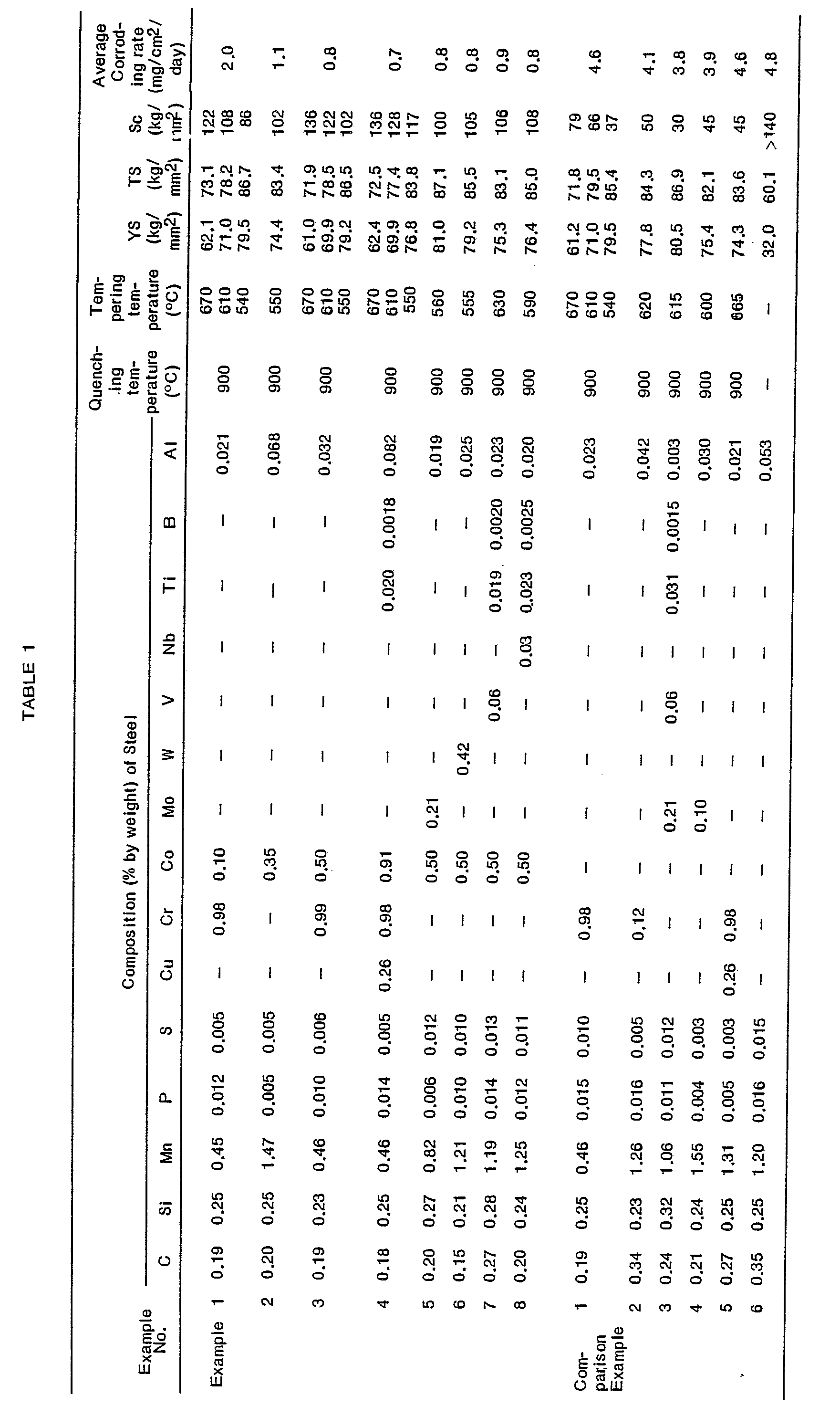
- Table 1 clearly indicates that the steel produced in each of Examples 1 through 8 exhibited not only a satisfactory yield strength and tensile strength, but also, excellent resistances to sulfide corrosive cracking and corrosion. However, in the conventional steel of Comparison Example 1, the resistance to sulfide corrosive cracking remarkably decreased with increases in the yield strength thereof. Also, the steels of Comparison Examples 1 through 5 which contained no cobalt, exhibited poor resistances to sulfide corrosion cracking and corrosion, while the yield strength of the steels were satisfactory. The steel of Comparison Example 6, which contained no cobalt, exhibited an excellent resistance to sulfide corrosive cracking. However, this steel also exhibited a very poor yield strength and resistance to corrosion.
- Referring to Fig. 3 when the yield point of the steel of Comparison Example 1, containing no cobalt, is changed from about 60 to about 80 Kg/mm2, the critical stress Sc remarkable decreases from about 80 to 36 Kg/mm2.
- However, referring to Fig. 4, a change in the yield point of the steel of Example 1, containing 0.10% of cobalt, from about 60 to about 80 Kg/mm2 causes the critical stress Sc of the steel to change from 122 to 86 Kg/mm2 which are in a satisfactory high level.
- Also, referring to Fig. 5, a change in the yield point of the steel of Example 3, containing 0.50% of cobalt, from about 60 to about 80 Kg/mm2 causes the critical stress Sc of the steel to change from 136 to 102 Kg/mm2 which are in a satisfactory high level.
- Furthermore, referring to Fig. 6, a change in the yield strength of the steel of Example 4, containing 0.91 % of cobalt, from about 60 to about 80 Kg/mm2 causes the critical stress Sc of the steel to change from 136 to 117 Kg/mm2 which are in a satisfactory high level.
- Referring to Fig. 7, showing a relationship between content of cobalt in a steel and the average corroding rate of a steel in the above-mentioned aqueous solution containing hydrogen sulfide, it is clear than an increase in the content of cobalt in the steel from 0 to 1.5% by weight causes the average corroding rate of the steel to remarkably decrease.
- In Example 9, a steel pipe which had been hot rolled, was heated to a temperature of 900°C at a heating rate of 5°C/sec by an induction heating method at a frequency of 360 Hz. After the temperature of the steel was maintained at the level of 900°C for 30 seconds, the steel was quenched at a quenching temperature indicated in Table 2 by using water as a quenching medium, and the tempering procedure was carried out at a temperature of 690°C by using an induction heating method at a frequency of 360 Hz.
- In Example 10, the same procedures as those mentioned in Example 1 were carried out, except that the tempering procedure was carried out at a temperature of 610°C by using an electric furnace.
- In Example 11, the same procedures as those mentioned in Example 9 were carried out, except that the tempering procedure was carried out at a temperature of 690°C by using an induction heating method at a frequency of 360 Hz.
- In Example 12, the same procedures as those mentioned in Example 1 were carried out, except that the tempering procedure was carried out at a temperature of 610°C by using an electric furnace.
- In Example 13, the same procedures as those mentioned in Example 9 were carried out, except that the tempering procedure was carried out at a temperature of 690°C by using an induction heating method at a frequency of 360 Hz.
- In Example 14, the same procedures as those mentioned in Example 1 were carried out, except that the tempering procedure was carried out at a temperature of 610°C by using an electric furnace.
- The properties of the resultant steels of Examples 9 through 14 are indicated in Table 2.
- In each of the Examples 15 through 21, the same procedures as those mentioned in Example 9 were carried out, except that the steel had a composition indicated in Table 2, and the tempering temperature was as indicated in Table 2.
- The properties of the resultant steels of Examples 15 through 21 are indicated in Table 2.

Claims (8)
Applications Claiming Priority (4)
| Application Number | Priority Date | Filing Date | Title |
|---|---|---|---|
| JP81472/79 | 1979-06-29 | ||
| JP54081472A JPS609582B2 (en) | 1979-06-29 | 1979-06-29 | High tensile strength steel with excellent sulfide corrosion cracking resistance and corrosion resistance |
| JP10102079A JPS5625925A (en) | 1979-08-08 | 1979-08-08 | Manufacture of high-strength steel superior in sulfide corrosion cracking resistance and corrosion resistance |
| JP101020/79 | 1979-08-08 |
Publications (2)
| Publication Number | Publication Date |
|---|---|
| EP0021349A1 EP0021349A1 (en) | 1981-01-07 |
| EP0021349B1 true EP0021349B1 (en) | 1985-04-17 |
Family
ID=26422490
Family Applications (1)
| Application Number | Title | Priority Date | Filing Date |
|---|---|---|---|
| EP80103423A Expired EP0021349B1 (en) | 1979-06-29 | 1980-06-19 | High tensile steel and process for producing the same |
Country Status (4)
| Country | Link |
|---|---|
| US (1) | US4407681A (en) |
| EP (1) | EP0021349B1 (en) |
| CA (1) | CA1169682A (en) |
| DE (1) | DE3070501D1 (en) |
Families Citing this family (99)
| Publication number | Priority date | Publication date | Assignee | Title |
|---|---|---|---|---|
| EP0021349B1 (en) * | 1979-06-29 | 1985-04-17 | Nippon Steel Corporation | High tensile steel and process for producing the same |
| JPS58199812A (en) * | 1982-05-18 | 1983-11-21 | Kobe Steel Ltd | Manufacture of steel material with superior resistance to stress corrosion cracking due to sulfide |
| FR2658207B1 (en) * | 1990-02-14 | 1993-09-24 | Creusot Loire | LOW ALLOY BOILER AND / OR CONSTRUCTION STEEL FOR USE IN PARTICULAR IN HYDROGEN MEDIA. |
| US5294271A (en) * | 1991-06-14 | 1994-03-15 | Nisshin Steel Co., Ltd. | Heat treatment for manufacturing spring steel excellent in high-temperature relaxation resistance |
| JPH06323399A (en) * | 1992-06-30 | 1994-11-25 | Sumitomo Metal Ind Ltd | Automotive gear and manufacturing method thereof |
| US5975569A (en) * | 1997-11-03 | 1999-11-02 | Illinois Tool Works | Heat treated combustion chamber housing and process for making same |
| US6557640B1 (en) | 1998-12-07 | 2003-05-06 | Shell Oil Company | Lubrication and self-cleaning system for expansion mandrel |
| US7603758B2 (en) | 1998-12-07 | 2009-10-20 | Shell Oil Company | Method of coupling a tubular member |
| US7357188B1 (en) | 1998-12-07 | 2008-04-15 | Shell Oil Company | Mono-diameter wellbore casing |
| US6745845B2 (en) | 1998-11-16 | 2004-06-08 | Shell Oil Company | Isolation of subterranean zones |
| US6712154B2 (en) * | 1998-11-16 | 2004-03-30 | Enventure Global Technology | Isolation of subterranean zones |
| US6640903B1 (en) | 1998-12-07 | 2003-11-04 | Shell Oil Company | Forming a wellbore casing while simultaneously drilling a wellbore |
| US6575240B1 (en) | 1998-12-07 | 2003-06-10 | Shell Oil Company | System and method for driving pipe |
| WO2001098623A1 (en) | 1998-11-16 | 2001-12-27 | Shell Oil Company | Radial expansion of tubular members |
| US6823937B1 (en) | 1998-12-07 | 2004-11-30 | Shell Oil Company | Wellhead |
| US7231985B2 (en) | 1998-11-16 | 2007-06-19 | Shell Oil Company | Radial expansion of tubular members |
| US7121352B2 (en) | 1998-11-16 | 2006-10-17 | Enventure Global Technology | Isolation of subterranean zones |
| US6634431B2 (en) * | 1998-11-16 | 2003-10-21 | Robert Lance Cook | Isolation of subterranean zones |
| US7185710B2 (en) | 1998-12-07 | 2007-03-06 | Enventure Global Technology | Mono-diameter wellbore casing |
| US7363984B2 (en) | 1998-12-07 | 2008-04-29 | Enventure Global Technology, Llc | System for radially expanding a tubular member |
| US7195064B2 (en) | 1998-12-07 | 2007-03-27 | Enventure Global Technology | Mono-diameter wellbore casing |
| US7552776B2 (en) | 1998-12-07 | 2009-06-30 | Enventure Global Technology, Llc | Anchor hangers |
| AU3792000A (en) | 1998-12-07 | 2000-12-21 | Shell Internationale Research Maatschappij B.V. | Lubrication and self-cleaning system for expansion mandrel |
| GB2344606B (en) | 1998-12-07 | 2003-08-13 | Shell Int Research | Forming a wellbore casing by expansion of a tubular member |
| US6758278B2 (en) * | 1998-12-07 | 2004-07-06 | Shell Oil Company | Forming a wellbore casing while simultaneously drilling a wellbore |
| AU770359B2 (en) | 1999-02-26 | 2004-02-19 | Shell Internationale Research Maatschappij B.V. | Liner hanger |
| US7055608B2 (en) | 1999-03-11 | 2006-06-06 | Shell Oil Company | Forming a wellbore casing while simultaneously drilling a wellbore |
| CA2306656C (en) | 1999-04-26 | 2006-06-06 | Shell Internationale Research Maatschappij B.V. | Expandable connector for borehole tubes |
| US7350563B2 (en) | 1999-07-09 | 2008-04-01 | Enventure Global Technology, L.L.C. | System for lining a wellbore casing |
| JP2001080050A (en) | 1999-09-16 | 2001-03-27 | Komori Corp | Sheet-fed rotary printing press |
| GB2374622B (en) | 1999-11-01 | 2003-12-10 | Shell Oil Co | Wellbore casing repair |
| EG22306A (en) | 1999-11-15 | 2002-12-31 | Shell Int Research | Expanding a tubular element in a wellbore |
| US7516790B2 (en) | 1999-12-03 | 2009-04-14 | Enventure Global Technology, Llc | Mono-diameter wellbore casing |
| US7234531B2 (en) | 1999-12-03 | 2007-06-26 | Enventure Global Technology, Llc | Mono-diameter wellbore casing |
| KR100470046B1 (en) * | 2000-06-05 | 2005-02-04 | 주식회사 포스코 | Cold rolled steel sheet having excellent corrosion resistance to sulfuric acid |
| US7100684B2 (en) | 2000-07-28 | 2006-09-05 | Enventure Global Technology | Liner hanger with standoffs |
| AU2001292695B2 (en) | 2000-09-18 | 2006-07-06 | Shell Internationale Research Maatschappij B.V. | Liner hanger with sliding sleeve valve |
| US7100685B2 (en) | 2000-10-02 | 2006-09-05 | Enventure Global Technology | Mono-diameter wellbore casing |
| AU2001294802B2 (en) | 2000-10-02 | 2005-12-01 | Shell Internationale Research Maatschappij B.V. | Method and apparatus for casing expansion |
| CA2428819A1 (en) | 2001-01-03 | 2002-07-11 | Enventure Global Technology | Mono-diameter wellbore casing |
| US7410000B2 (en) | 2001-01-17 | 2008-08-12 | Enventure Global Technology, Llc. | Mono-diameter wellbore casing |
| CA2453034C (en) | 2001-07-06 | 2010-09-14 | Enventure Global Technology | Liner hanger |
| AU2002345912A1 (en) | 2001-07-06 | 2003-01-21 | Enventure Global Technology | Liner hanger |
| US7258168B2 (en) | 2001-07-27 | 2007-08-21 | Enventure Global Technology L.L.C. | Liner hanger with slip joint sealing members and method of use |
| WO2003023178A2 (en) | 2001-09-07 | 2003-03-20 | Enventure Global Technology | Adjustable expansion cone assembly |
| WO2004081346A2 (en) | 2003-03-11 | 2004-09-23 | Enventure Global Technology | Apparatus for radially expanding and plastically deforming a tubular member |
| GB2421257B (en) | 2001-11-12 | 2006-08-16 | Enventure Global Technology | Mono diameter wellbore casing |
| GB2401893B (en) | 2001-12-27 | 2005-07-13 | Enventure Global Technology | Seal receptacle using expandable liner hanger |
| WO2004027786A2 (en) | 2002-09-20 | 2004-04-01 | Enventure Global Technology | Protective sleeve for expandable tubulars |
| US7424918B2 (en) | 2002-08-23 | 2008-09-16 | Enventure Global Technology, L.L.C. | Interposed joint sealing layer method of forming a wellbore casing |
| EP1985797B1 (en) | 2002-04-12 | 2011-10-26 | Enventure Global Technology | Protective sleeve for threated connections for expandable liner hanger |
| EP1501645A4 (en) | 2002-04-15 | 2006-04-26 | Enventure Global Technology | Protective sleeve for threaded connections for expandable liner hanger |
| WO2003102365A1 (en) | 2002-05-29 | 2003-12-11 | Eventure Global Technology | System for radially expanding a tubular member |
| GB2418943B (en) | 2002-06-10 | 2006-09-06 | Enventure Global Technology | Mono Diameter Wellbore Casing |
| JP4267367B2 (en) * | 2002-06-19 | 2009-05-27 | 新日本製鐵株式会社 | Crude oil tank steel and its manufacturing method, crude oil tank and its anticorrosion method |
| AU2003258274A1 (en) | 2002-08-23 | 2004-03-11 | Enventure Global Technology | Magnetic impulse applied sleeve method of forming a wellbore casing |
| WO2004027392A1 (en) | 2002-09-20 | 2004-04-01 | Enventure Global Technology | Pipe formability evaluation for expandable tubulars |
| CA2499071C (en) | 2002-09-20 | 2014-06-03 | Enventure Global Technology | Self-lubricating expansion mandrel for expandable tubular |
| AU2003270774A1 (en) | 2002-09-20 | 2004-04-08 | Enventure Global Technlogy | Bottom plug for forming a mono diameter wellbore casing |
| US7886831B2 (en) | 2003-01-22 | 2011-02-15 | Enventure Global Technology, L.L.C. | Apparatus for radially expanding and plastically deforming a tubular member |
| GB2433281B (en) | 2003-01-27 | 2007-08-01 | Enventure Global Technology | Lubrication system for radially expanding tubular members |
| GB2415983B (en) | 2003-02-26 | 2007-09-05 | Enventure Global Technology | Apparatus for radially expanding and plastically deforming a tubular member |
| CA2523862C (en) | 2003-04-17 | 2009-06-23 | Enventure Global Technology | Apparatus for radially expanding and plastically deforming a tubular member |
| DK1627931T3 (en) * | 2003-04-25 | 2018-11-05 | Tubos De Acero De Mexico S A | Seamless steel tube which is intended to be used as a guide pipe and production method thereof |
| US7169239B2 (en) * | 2003-05-16 | 2007-01-30 | Lone Star Steel Company, L.P. | Solid expandable tubular members formed from very low carbon steel and method |
| US20050166387A1 (en) | 2003-06-13 | 2005-08-04 | Cook Robert L. | Method and apparatus for forming a mono-diameter wellbore casing |
| US7712522B2 (en) | 2003-09-05 | 2010-05-11 | Enventure Global Technology, Llc | Expansion cone and system |
| WO2006020960A2 (en) | 2004-08-13 | 2006-02-23 | Enventure Global Technology, Llc | Expandable tubular |
| MXPA05008339A (en) * | 2005-08-04 | 2007-02-05 | Tenaris Connections Ag | HIGH RESISTANCE STEEL FOR SOLDABLE AND SEAMLESS STEEL PIPES. |
| KR20110084462A (en) * | 2006-02-27 | 2011-07-22 | 제이에프이 스틸 가부시키가이샤 | Corrosion-resistant steel material for ship and vessel |
| MX2009000219A (en) * | 2006-06-29 | 2009-03-20 | Tenaris Connections Ag | Seamless precision steel tubes with improved isotropic toughness at low temperature for hydraulic cylinders and process for obtaining the same. |
| MX2007004600A (en) * | 2007-04-17 | 2008-12-01 | Tubos De Acero De Mexico S A | Seamless steel pipe for use as vertical work-over sections. |
| DE102007023306A1 (en) * | 2007-05-16 | 2008-11-20 | Benteler Stahl/Rohr Gmbh | Use of a steel alloy for jacket pipes for perforation of borehole casings and jacket pipe |
| US7862667B2 (en) | 2007-07-06 | 2011-01-04 | Tenaris Connections Limited | Steels for sour service environments |
| ATE490347T1 (en) * | 2007-07-10 | 2010-12-15 | Aubert & Duval Sa | HARDENED MARTENSITIC STEEL WITH LOW OR NO COBALT CONTENT, METHOD FOR PRODUCING A PART FROM SUCH STEEL AND PART PRODUCED BY THIS PROCESS |
| US8328960B2 (en) * | 2007-11-19 | 2012-12-11 | Tenaris Connections Limited | High strength bainitic steel for OCTG applications |
| BRPI0904814B1 (en) * | 2008-11-25 | 2020-11-10 | Maverick Tube, Llc | method of manufacturing a steel product |
| EP2325435B2 (en) | 2009-11-24 | 2020-09-30 | Tenaris Connections B.V. | Threaded joint sealed to [ultra high] internal and external pressures |
| US9163296B2 (en) | 2011-01-25 | 2015-10-20 | Tenaris Coiled Tubes, Llc | Coiled tube with varying mechanical properties for superior performance and methods to produce the same by a continuous heat treatment |
| IT1403688B1 (en) | 2011-02-07 | 2013-10-31 | Dalmine Spa | STEEL TUBES WITH THICK WALLS WITH EXCELLENT LOW TEMPERATURE HARDNESS AND RESISTANCE TO CORROSION UNDER TENSIONING FROM SULFUR. |
| IT1403689B1 (en) | 2011-02-07 | 2013-10-31 | Dalmine Spa | HIGH-RESISTANCE STEEL TUBES WITH EXCELLENT LOW TEMPERATURE HARDNESS AND RESISTANCE TO CORROSION UNDER VOLTAGE SENSORS. |
| US8636856B2 (en) | 2011-02-18 | 2014-01-28 | Siderca S.A.I.C. | High strength steel having good toughness |
| US8414715B2 (en) | 2011-02-18 | 2013-04-09 | Siderca S.A.I.C. | Method of making ultra high strength steel having good toughness |
| US9340847B2 (en) | 2012-04-10 | 2016-05-17 | Tenaris Connections Limited | Methods of manufacturing steel tubes for drilling rods with improved mechanical properties, and rods made by the same |
| US9970242B2 (en) | 2013-01-11 | 2018-05-15 | Tenaris Connections B.V. | Galling resistant drill pipe tool joint and corresponding drill pipe |
| US9187811B2 (en) | 2013-03-11 | 2015-11-17 | Tenaris Connections Limited | Low-carbon chromium steel having reduced vanadium and high corrosion resistance, and methods of manufacturing |
| US9803256B2 (en) | 2013-03-14 | 2017-10-31 | Tenaris Coiled Tubes, Llc | High performance material for coiled tubing applications and the method of producing the same |
| EP2789700A1 (en) | 2013-04-08 | 2014-10-15 | DALMINE S.p.A. | Heavy wall quenched and tempered seamless steel pipes and related method for manufacturing said steel pipes |
| EP2789701A1 (en) | 2013-04-08 | 2014-10-15 | DALMINE S.p.A. | High strength medium wall quenched and tempered seamless steel pipes and related method for manufacturing said steel pipes |
| KR20160023682A (en) | 2013-06-25 | 2016-03-03 | 테나리스 커넥션즈 리미티드 | High-chromium heat-resistant steel |
| US20160305192A1 (en) | 2015-04-14 | 2016-10-20 | Tenaris Connections Limited | Ultra-fine grained steels having corrosion-fatigue resistance |
| AU2017226127B2 (en) * | 2016-03-04 | 2020-04-30 | Nippon Steel Corporation | Steel material and oil-well steel pipe |
| BR112018017036B1 (en) * | 2016-03-04 | 2022-09-06 | Nippon Steel Corporation | STEEL MATERIAL AND OIL WELL STEEL PIPE |
| US11124852B2 (en) | 2016-08-12 | 2021-09-21 | Tenaris Coiled Tubes, Llc | Method and system for manufacturing coiled tubing |
| US10655200B2 (en) * | 2016-09-01 | 2020-05-19 | Nippon Steel Corporation | Steel material and oil-well steel pipe |
| US10434554B2 (en) | 2017-01-17 | 2019-10-08 | Forum Us, Inc. | Method of manufacturing a coiled tubing string |
| CN110129508A (en) * | 2019-05-23 | 2019-08-16 | 包头钢铁(集团)有限责任公司 | A kind of technique improving rare earth high-strength steel impact flexibility |
| CN112063922B (en) * | 2020-09-02 | 2022-03-11 | 衡阳华菱钢管有限公司 | Steel pipe, its preparation method and application |
| CN115449711B (en) * | 2022-09-13 | 2023-05-09 | 佛冈达味特钢有限公司 | Corrosion-resistant hot-rolled steel bar and preparation method thereof |
Family Cites Families (13)
| Publication number | Priority date | Publication date | Assignee | Title |
|---|---|---|---|---|
| FR626814A (en) * | 1926-12-28 | 1927-09-20 | Composite molten steel | |
| GB404565A (en) * | 1932-08-01 | 1934-01-18 | Krupp Ag | Improvements in the manufacture of articles from steel alloys |
| US2147122A (en) * | 1934-08-27 | 1939-02-14 | Cleveland Twist Drill Co | Alloy compositions |
| GB734676A (en) * | 1950-11-03 | 1955-08-03 | Nyby Bruk Ab | Heat resisting alloy steel and method for its heat treatment |
| US3068095A (en) * | 1959-05-29 | 1962-12-11 | Wilson Brothers | Alloy steels |
| GB1218927A (en) * | 1967-06-29 | 1971-01-13 | English Steel Corp Ltd | Improvements in heat-resisting alloy steels |
| US3711340A (en) * | 1971-03-11 | 1973-01-16 | Jones & Laughlin Steel Corp | Corrosion-resistant high-strength low-alloy steels |
| JPS5110569B2 (en) * | 1971-09-07 | 1976-04-05 | ||
| DE2413015A1 (en) * | 1973-04-25 | 1974-11-21 | North American Rockwell | ELECTRONIC FUEL INJECTION DEVICE |
| JPS553424B2 (en) * | 1973-12-31 | 1980-01-25 | ||
| JPS52101627A (en) * | 1976-02-23 | 1977-08-25 | Sumitomo Metal Ind Ltd | Non-tempered shape steel in low temp. toughness |
| US4226645A (en) * | 1979-01-08 | 1980-10-07 | Republic Steel Corp. | Steel well casing and method of production |
| EP0021349B1 (en) * | 1979-06-29 | 1985-04-17 | Nippon Steel Corporation | High tensile steel and process for producing the same |
-
1980
- 1980-06-19 EP EP80103423A patent/EP0021349B1/en not_active Expired
- 1980-06-19 DE DE8080103423T patent/DE3070501D1/en not_active Expired
- 1980-06-25 CA CA000354715A patent/CA1169682A/en not_active Expired
-
1982
- 1982-06-09 US US06/387,264 patent/US4407681A/en not_active Expired - Lifetime
Also Published As
| Publication number | Publication date |
|---|---|
| US4407681A (en) | 1983-10-04 |
| EP0021349A1 (en) | 1981-01-07 |
| CA1169682A (en) | 1984-06-26 |
| DE3070501D1 (en) | 1985-05-23 |
Similar Documents
| Publication | Publication Date | Title |
|---|---|---|
| EP0021349B1 (en) | High tensile steel and process for producing the same | |
| US20120018058A1 (en) | Process for manufacturing a cold rolled trip steel product | |
| WO2020201437A1 (en) | High-hardness steel product and method of manufacturing the same | |
| Porter et al. | The evolution of HSLA steels | |
| JPH06104849B2 (en) | Method for producing low alloy high strength oil well steel excellent in sulfide stress cracking resistance | |
| CA1091959A (en) | Heat treatment for improving the toughness of high manganese steels | |
| EP0738784B1 (en) | High chromium martensitic steel pipe having excellent pitting resistance and method of manufacturing | |
| US4491476A (en) | Boron-containing steel and a process for producing the same | |
| JPH06271975A (en) | High strength steel excellent in hydrogen embrittlement resistance and its production | |
| JPH07188840A (en) | High strength steel excellent in hydrogen embrittlement resistance and its production | |
| KR102698603B1 (en) | Steel plate and method for manufacturing same | |
| JPH05156409A (en) | High-strength martensitic stainless steel with excellent seawater resistance and its manufacturing method | |
| JP3201081B2 (en) | Stainless steel for oil well and production method thereof | |
| KR100411286B1 (en) | High strength austenitic stainless steel with excellent corrosion resistance and weather resistance and steel sheet manufacturing method using the same | |
| JP3422880B2 (en) | High corrosion resistance martensitic stainless steel with low weld hardness | |
| JP3422877B2 (en) | High corrosion resistance martensitic stainless steel with low weld hardness | |
| JPS61272316A (en) | Manufacture of high tension steel having more than 100kgf/mm2 yield strength and superior in stress corrosion cracking resistance | |
| KR940008060B1 (en) | Making method of high tension steel | |
| JPS6358892B2 (en) | ||
| JPS609582B2 (en) | High tensile strength steel with excellent sulfide corrosion cracking resistance and corrosion resistance | |
| JPS5844726B2 (en) | Method for manufacturing high-strength ERW steel pipes for oil wells with excellent hydrogen embrittlement resistance | |
| JPH0711331A (en) | Pipe joint manufacturing method | |
| JPH09209085A (en) | Steel for machine structure and manufacturing method thereof | |
| AU2023377031A1 (en) | Clad steel plate and method of producing same | |
| JPS62235420A (en) | Manufacture of forged steel for pressure vessel |
Legal Events
| Date | Code | Title | Description |
|---|---|---|---|
| PUAI | Public reference made under article 153(3) epc to a published international application that has entered the european phase |
Free format text: ORIGINAL CODE: 0009012 |
|
| 17P | Request for examination filed |
Effective date: 19800619 |
|
| AK | Designated contracting states |
Designated state(s): DE FR GB IT |
|
| ITF | It: translation for a ep patent filed | ||
| GRAA | (expected) grant |
Free format text: ORIGINAL CODE: 0009210 |
|
| AK | Designated contracting states |
Designated state(s): DE FR GB IT |
|
| REF | Corresponds to: |
Ref document number: 3070501 Country of ref document: DE Date of ref document: 19850523 |
|
| ET | Fr: translation filed | ||
| PLBE | No opposition filed within time limit |
Free format text: ORIGINAL CODE: 0009261 |
|
| STAA | Information on the status of an ep patent application or granted ep patent |
Free format text: STATUS: NO OPPOSITION FILED WITHIN TIME LIMIT |
|
| 26N | No opposition filed | ||
| PG25 | Lapsed in a contracting state [announced via postgrant information from national office to epo] |
Ref country code: GB Effective date: 19880619 |
|
| GBPC | Gb: european patent ceased through non-payment of renewal fee | ||
| PG25 | Lapsed in a contracting state [announced via postgrant information from national office to epo] |
Ref country code: FR Free format text: LAPSE BECAUSE OF NON-PAYMENT OF DUE FEES Effective date: 19890228 |
|
| PG25 | Lapsed in a contracting state [announced via postgrant information from national office to epo] |
Ref country code: DE Effective date: 19890301 |
|
| REG | Reference to a national code |
Ref country code: FR Ref legal event code: ST |