DE60014079T2 - Substituted heterocyclic condensed gamma-carbolines - Google Patents
Substituted heterocyclic condensed gamma-carbolines Download PDFInfo
- Publication number
- DE60014079T2 DE60014079T2 DE60014079T DE60014079T DE60014079T2 DE 60014079 T2 DE60014079 T2 DE 60014079T2 DE 60014079 T DE60014079 T DE 60014079T DE 60014079 T DE60014079 T DE 60014079T DE 60014079 T2 DE60014079 T2 DE 60014079T2
- Authority
- DE
- Germany
- Prior art keywords
- substituted
- phenyl
- alkyl
- independently selected
- methyl
- Prior art date
- Legal status (The legal status is an assumption and is not a legal conclusion. Google has not performed a legal analysis and makes no representation as to the accuracy of the status listed.)
- Expired - Lifetime
Links
- 125000000623 heterocyclic group Chemical group 0.000 title claims description 125
- -1 ethylenedioxy Chemical group 0.000 claims description 708
- 125000000217 alkyl group Chemical group 0.000 claims description 311
- 125000001495 ethyl group Chemical group [H]C([H])([H])C([H])([H])* 0.000 claims description 189
- 229910052739 hydrogen Inorganic materials 0.000 claims description 187
- 125000002496 methyl group Chemical group [H]C([H])([H])* 0.000 claims description 165
- 229910052760 oxygen Inorganic materials 0.000 claims description 151
- 229910052717 sulfur Inorganic materials 0.000 claims description 147
- 125000005842 heteroatom Chemical group 0.000 claims description 145
- 150000001875 compounds Chemical class 0.000 claims description 137
- 229910052799 carbon Inorganic materials 0.000 claims description 125
- 125000003342 alkenyl group Chemical group 0.000 claims description 123
- 125000000304 alkynyl group Chemical group 0.000 claims description 120
- 125000003545 alkoxy group Chemical group 0.000 claims description 113
- 125000003118 aryl group Chemical group 0.000 claims description 110
- VEAUDLLZYJVHRI-UHFFFAOYSA-N Trichlormethine Chemical compound Cl.ClCCN(CCCl)CCCl VEAUDLLZYJVHRI-UHFFFAOYSA-N 0.000 claims description 109
- 125000004765 (C1-C4) haloalkyl group Chemical group 0.000 claims description 108
- 125000001997 phenyl group Chemical group [H]C1=C([H])C([H])=C(*)C([H])=C1[H] 0.000 claims description 106
- 125000005913 (C3-C6) cycloalkyl group Chemical group 0.000 claims description 96
- 125000001436 propyl group Chemical group [H]C([*])([H])C([H])([H])C([H])([H])[H] 0.000 claims description 93
- 125000000484 butyl group Chemical group [H]C([*])([H])C([H])([H])C([H])([H])C([H])([H])[H] 0.000 claims description 84
- NBVXSUQYWXRMNV-UHFFFAOYSA-N fluoromethane Chemical compound FC NBVXSUQYWXRMNV-UHFFFAOYSA-N 0.000 claims description 82
- 125000001255 4-fluorophenyl group Chemical group [H]C1=C([H])C(*)=C([H])C([H])=C1F 0.000 claims description 76
- 229910052736 halogen Inorganic materials 0.000 claims description 76
- 150000002367 halogens Chemical class 0.000 claims description 76
- 239000000460 chlorine Substances 0.000 claims description 75
- 125000000882 C2-C6 alkenyl group Chemical group 0.000 claims description 62
- 125000002837 carbocyclic group Chemical group 0.000 claims description 58
- 150000003254 radicals Chemical group 0.000 claims description 55
- 125000003601 C2-C6 alkynyl group Chemical group 0.000 claims description 52
- 125000005843 halogen group Chemical group 0.000 claims description 51
- 125000006569 (C5-C6) heterocyclic group Chemical group 0.000 claims description 42
- 125000000956 methoxy group Chemical group [H]C([H])([H])O* 0.000 claims description 42
- 229910052801 chlorine Inorganic materials 0.000 claims description 40
- 125000002618 bicyclic heterocycle group Chemical group 0.000 claims description 39
- 229910052731 fluorine Inorganic materials 0.000 claims description 38
- 125000004435 hydrogen atom Chemical class [H]* 0.000 claims description 36
- 125000000999 tert-butyl group Chemical group [H]C([H])([H])C(*)(C([H])([H])[H])C([H])([H])[H] 0.000 claims description 33
- 239000001257 hydrogen Substances 0.000 claims description 31
- 150000003839 salts Chemical group 0.000 claims description 31
- 125000006376 (C3-C10) cycloalkyl group Chemical group 0.000 claims description 29
- 125000004106 butoxy group Chemical group [*]OC([H])([H])C([H])([H])C(C([H])([H])[H])([H])[H] 0.000 claims description 26
- 125000001449 isopropyl group Chemical group [H]C([H])([H])C([H])(*)C([H])([H])[H] 0.000 claims description 25
- 125000002023 trifluoromethyl group Chemical group FC(F)(F)* 0.000 claims description 25
- 125000001797 benzyl group Chemical group [H]C1=C([H])C([H])=C(C([H])=C1[H])C([H])([H])* 0.000 claims description 23
- 125000000113 cyclohexyl group Chemical group [H]C1([H])C([H])([H])C([H])([H])C([H])(*)C([H])([H])C1([H])[H] 0.000 claims description 22
- 125000001511 cyclopentyl group Chemical group [H]C1([H])C([H])([H])C([H])([H])C([H])(*)C1([H])[H] 0.000 claims description 18
- 125000006583 (C1-C3) haloalkyl group Chemical group 0.000 claims description 17
- 125000003387 indolinyl group Chemical group N1(CCC2=CC=CC=C12)* 0.000 claims description 17
- 229910052794 bromium Inorganic materials 0.000 claims description 16
- 125000001424 substituent group Chemical group 0.000 claims description 16
- 125000000876 trifluoromethoxy group Chemical group FC(F)(F)O* 0.000 claims description 16
- 125000001559 cyclopropyl group Chemical group [H]C1([H])C([H])([H])C1([H])* 0.000 claims description 15
- 238000002360 preparation method Methods 0.000 claims description 15
- 229920006395 saturated elastomer Polymers 0.000 claims description 15
- 125000001617 2,3-dimethoxy phenyl group Chemical group [H]C1=C([H])C(*)=C(OC([H])([H])[H])C(OC([H])([H])[H])=C1[H] 0.000 claims description 14
- 125000000339 4-pyridyl group Chemical group N1=C([H])C([H])=C([*])C([H])=C1[H] 0.000 claims description 14
- 125000001995 cyclobutyl group Chemical group [H]C1([H])C([H])([H])C([H])(*)C1([H])[H] 0.000 claims description 14
- 125000004076 pyridyl group Chemical group 0.000 claims description 14
- PXGOKWXKJXAPGV-UHFFFAOYSA-N Fluorine Chemical compound FF PXGOKWXKJXAPGV-UHFFFAOYSA-N 0.000 claims description 13
- 239000011737 fluorine Substances 0.000 claims description 13
- 125000000449 nitro group Chemical group [O-][N+](*)=O 0.000 claims description 13
- 125000004201 2,4-dichlorophenyl group Chemical group [H]C1=C([H])C(*)=C(Cl)C([H])=C1Cl 0.000 claims description 12
- GVNVAWHJIKLAGL-UHFFFAOYSA-N 2-(cyclohexen-1-yl)cyclohexan-1-one Chemical compound O=C1CCCCC1C1=CCCCC1 GVNVAWHJIKLAGL-UHFFFAOYSA-N 0.000 claims description 12
- 125000004198 2-fluorophenyl group Chemical group [H]C1=C([H])C(F)=C(*)C([H])=C1[H] 0.000 claims description 12
- 125000004180 3-fluorophenyl group Chemical group [H]C1=C([H])C(*)=C([H])C(F)=C1[H] 0.000 claims description 12
- 101150065749 Churc1 gene Proteins 0.000 claims description 12
- 102100038239 Protein Churchill Human genes 0.000 claims description 12
- 125000003854 p-chlorophenyl group Chemical group [H]C1=C([H])C(*)=C([H])C([H])=C1Cl 0.000 claims description 12
- 125000004215 2,4-difluorophenyl group Chemical group [H]C1=C([H])C(*)=C(F)C([H])=C1F 0.000 claims description 11
- ZAMOUSCENKQFHK-UHFFFAOYSA-N Chlorine atom Chemical compound [Cl] ZAMOUSCENKQFHK-UHFFFAOYSA-N 0.000 claims description 11
- 125000003785 benzimidazolyl group Chemical group N1=C(NC2=C1C=CC=C2)* 0.000 claims description 10
- 125000004122 cyclic group Chemical group 0.000 claims description 10
- 201000000980 schizophrenia Diseases 0.000 claims description 10
- 125000004800 4-bromophenyl group Chemical group [H]C1=C([H])C(*)=C([H])C([H])=C1Br 0.000 claims description 9
- WKBOTKDWSSQWDR-UHFFFAOYSA-N Bromine atom Chemical compound [Br] WKBOTKDWSSQWDR-UHFFFAOYSA-N 0.000 claims description 9
- GDTBXPJZTBHREO-UHFFFAOYSA-N bromine Substances BrBr GDTBXPJZTBHREO-UHFFFAOYSA-N 0.000 claims description 9
- 125000001153 fluoro group Chemical group F* 0.000 claims description 9
- 125000001041 indolyl group Chemical group 0.000 claims description 9
- 238000004519 manufacturing process Methods 0.000 claims description 9
- 125000002914 sec-butyl group Chemical group [H]C([H])([H])C([H])([H])C([H])(*)C([H])([H])[H] 0.000 claims description 9
- 125000004182 2-chlorophenyl group Chemical group [H]C1=C([H])C(Cl)=C(*)C([H])=C1[H] 0.000 claims description 8
- 125000004179 3-chlorophenyl group Chemical group [H]C1=C([H])C(*)=C([H])C(Cl)=C1[H] 0.000 claims description 8
- 125000004176 4-fluorobenzyl group Chemical group [H]C1=C([H])C(=C([H])C([H])=C1F)C([H])([H])* 0.000 claims description 8
- 125000004172 4-methoxyphenyl group Chemical group [H]C1=C([H])C(OC([H])([H])[H])=C([H])C([H])=C1* 0.000 claims description 8
- 125000004414 alkyl thio group Chemical group 0.000 claims description 8
- 125000004210 cyclohexylmethyl group Chemical group [H]C([H])(*)C1([H])C([H])([H])C([H])([H])C([H])([H])C([H])([H])C1([H])[H] 0.000 claims description 8
- 125000000040 m-tolyl group Chemical group [H]C1=C([H])C(*)=C([H])C(=C1[H])C([H])([H])[H] 0.000 claims description 8
- 125000001037 p-tolyl group Chemical group [H]C1=C([H])C(=C([H])C([H])=C1*)C([H])([H])[H] 0.000 claims description 8
- 208000008589 Obesity Diseases 0.000 claims description 7
- 125000001164 benzothiazolyl group Chemical group S1C(=NC2=C1C=CC=C2)* 0.000 claims description 7
- 125000004935 benzoxazolinyl group Chemical group O1C(=NC2=C1C=CC=C2)* 0.000 claims description 7
- 125000004541 benzoxazolyl group Chemical group O1C(=NC2=C1C=CC=C2)* 0.000 claims description 7
- 235000020824 obesity Nutrition 0.000 claims description 7
- 125000006179 2-methyl benzyl group Chemical group [H]C1=C([H])C(=C(C([H])=C1[H])C([H])([H])*)C([H])([H])[H] 0.000 claims description 6
- 125000003762 3,4-dimethoxyphenyl group Chemical group [H]C1=C([H])C(OC([H])([H])[H])=C(OC([H])([H])[H])C([H])=C1* 0.000 claims description 6
- 125000006497 3-methoxybenzyl group Chemical group [H]C1=C([H])C(=C([H])C(OC([H])([H])[H])=C1[H])C([H])([H])* 0.000 claims description 6
- 125000006180 3-methyl benzyl group Chemical group [H]C1=C([H])C(=C([H])C(=C1[H])C([H])([H])[H])C([H])([H])* 0.000 claims description 6
- 125000003349 3-pyridyl group Chemical group N1=C([H])C([*])=C([H])C([H])=C1[H] 0.000 claims description 6
- 125000006181 4-methyl benzyl group Chemical group [H]C1=C([H])C(=C([H])C([H])=C1C([H])([H])[H])C([H])([H])* 0.000 claims description 6
- 125000001301 ethoxy group Chemical group [H]C([H])([H])C([H])([H])O* 0.000 claims description 6
- 125000001188 haloalkyl group Chemical group 0.000 claims description 6
- 125000003453 indazolyl group Chemical group N1N=C(C2=C1C=CC=C2)* 0.000 claims description 6
- 125000000959 isobutyl group Chemical group [H]C([H])([H])C([H])(C([H])([H])[H])C([H])([H])* 0.000 claims description 6
- 125000004108 n-butyl group Chemical group [H]C([H])([H])C([H])([H])C([H])([H])C([H])([H])* 0.000 claims description 6
- 125000004123 n-propyl group Chemical group [H]C([H])([H])C([H])([H])C([H])([H])* 0.000 claims description 6
- 125000004206 2,2,2-trifluoroethyl group Chemical group [H]C([H])(*)C(F)(F)F 0.000 claims description 5
- 125000006176 2-ethylbutyl group Chemical group [H]C([H])([H])C([H])([H])C([H])(C([H])([H])*)C([H])([H])C([H])([H])[H] 0.000 claims description 5
- 125000006022 2-methyl-2-propenyl group Chemical group 0.000 claims description 5
- 125000004493 2-methylbut-1-yl group Chemical group CC(C*)CC 0.000 claims description 5
- 125000005916 2-methylpentyl group Chemical group 0.000 claims description 5
- 125000003903 2-propenyl group Chemical group [H]C([*])([H])C([H])=C([H])[H] 0.000 claims description 5
- 125000004975 3-butenyl group Chemical group C(CC=C)* 0.000 claims description 5
- 125000005917 3-methylpentyl group Chemical group 0.000 claims description 5
- 125000003119 4-methyl-3-pentenyl group Chemical group [H]\C(=C(/C([H])([H])[H])C([H])([H])[H])C([H])([H])C([H])([H])* 0.000 claims description 5
- 125000000753 cycloalkyl group Chemical group 0.000 claims description 5
- 125000002883 imidazolyl group Chemical group 0.000 claims description 5
- 125000004491 isohexyl group Chemical group C(CCC(C)C)* 0.000 claims description 5
- 125000001280 n-hexyl group Chemical group C(CCCCC)* 0.000 claims description 5
- 125000000740 n-pentyl group Chemical group [H]C([H])([H])C([H])([H])C([H])([H])C([H])([H])C([H])([H])* 0.000 claims description 5
- 125000000168 pyrrolyl group Chemical group 0.000 claims description 5
- 125000006645 (C3-C4) cycloalkyl group Chemical group 0.000 claims description 4
- 125000006272 (C3-C7) cycloalkyl group Chemical group 0.000 claims description 4
- 125000004214 1-pyrrolidinyl group Chemical group [H]C1([H])N(*)C([H])([H])C([H])([H])C1([H])[H] 0.000 claims description 4
- 125000004778 2,2-difluoroethyl group Chemical group [H]C([H])(*)C([H])(F)F 0.000 claims description 4
- 125000005808 2,4,6-trimethoxyphenyl group Chemical group [H][#6]-1=[#6](-[#8]C([H])([H])[H])-[#6](-*)=[#6](-[#8]C([H])([H])[H])-[#6]([H])=[#6]-1-[#8]C([H])([H])[H] 0.000 claims description 4
- KLIDCXVFHGNTTM-UHFFFAOYSA-N 2,6-dimethoxyphenol Chemical group COC1=CC=CC(OC)=C1O KLIDCXVFHGNTTM-UHFFFAOYSA-N 0.000 claims description 4
- 125000006280 2-bromobenzyl group Chemical group [H]C1=C([H])C(Br)=C(C([H])=C1[H])C([H])([H])* 0.000 claims description 4
- 125000006276 2-bromophenyl group Chemical group [H]C1=C([H])C(Br)=C(*)C([H])=C1[H] 0.000 claims description 4
- 125000006282 2-chlorobenzyl group Chemical group [H]C1=C([H])C(Cl)=C(C([H])=C1[H])C([H])([H])* 0.000 claims description 4
- 125000004847 2-fluorobenzyl group Chemical group [H]C1=C([H])C(F)=C(C([H])=C1[H])C([H])([H])* 0.000 claims description 4
- 125000004777 2-fluoroethyl group Chemical group [H]C([H])(F)C([H])([H])* 0.000 claims description 4
- 125000002941 2-furyl group Chemical group O1C([*])=C([H])C([H])=C1[H] 0.000 claims description 4
- 125000002927 2-methoxybenzyl group Chemical group [H]C1=C([H])C([H])=C(C(OC([H])([H])[H])=C1[H])C([H])([H])* 0.000 claims description 4
- 125000004204 2-methoxyphenyl group Chemical group [H]C1=C([H])C(*)=C(OC([H])([H])[H])C([H])=C1[H] 0.000 claims description 4
- RMAINTGPKFNBDP-UHFFFAOYSA-N 2-methylphenol Chemical group [CH2]C1=CC=CC=C1O RMAINTGPKFNBDP-UHFFFAOYSA-N 0.000 claims description 4
- 125000001622 2-naphthyl group Chemical group [H]C1=C([H])C([H])=C2C([H])=C(*)C([H])=C([H])C2=C1[H] 0.000 claims description 4
- 125000006499 2-trifluoromethoxy benzyl group Chemical group [H]C1=C([H])C(OC(F)(F)F)=C(C([H])=C1[H])C([H])([H])* 0.000 claims description 4
- 125000006494 2-trifluoromethyl benzyl group Chemical group [H]C1=C([H])C([H])=C(C(=C1[H])C([H])([H])*)C(F)(F)F 0.000 claims description 4
- 125000004189 3,4-dichlorophenyl group Chemical group [H]C1=C([H])C(Cl)=C(Cl)C([H])=C1* 0.000 claims description 4
- 125000006279 3-bromobenzyl group Chemical group [H]C1=C([H])C(=C([H])C(Br)=C1[H])C([H])([H])* 0.000 claims description 4
- 125000003852 3-chlorobenzyl group Chemical group [H]C1=C([H])C(=C([H])C(Cl)=C1[H])C([H])([H])* 0.000 claims description 4
- 125000006284 3-fluorobenzyl group Chemical group [H]C1=C([H])C(=C([H])C(F)=C1[H])C([H])([H])* 0.000 claims description 4
- 125000004207 3-methoxyphenyl group Chemical group [H]C1=C([H])C(*)=C([H])C(OC([H])([H])[H])=C1[H] 0.000 claims description 4
- 125000006500 3-trifluoromethoxy benzyl group Chemical group [H]C1=C([H])C(=C([H])C(OC(F)(F)F)=C1[H])C([H])([H])* 0.000 claims description 4
- 125000006495 3-trifluoromethyl benzyl group Chemical group [H]C1=C([H])C(=C([H])C(=C1[H])C([H])([H])*)C(F)(F)F 0.000 claims description 4
- 125000006281 4-bromobenzyl group Chemical group [H]C1=C([H])C(=C([H])C([H])=C1Br)C([H])([H])* 0.000 claims description 4
- 125000006283 4-chlorobenzyl group Chemical group [H]C1=C([H])C(=C([H])C([H])=C1Cl)C([H])([H])* 0.000 claims description 4
- 125000004801 4-cyanophenyl group Chemical group [H]C1=C([H])C(C#N)=C([H])C([H])=C1* 0.000 claims description 4
- 125000004860 4-ethylphenyl group Chemical group [H]C1=C([H])C(=C([H])C([H])=C1*)C([H])([H])C([H])([H])[H] 0.000 claims description 4
- 125000004861 4-isopropyl phenyl group Chemical group [H]C1=C([H])C(=C([H])C([H])=C1*)C([H])(C([H])([H])[H])C([H])([H])[H] 0.000 claims description 4
- 125000004217 4-methoxybenzyl group Chemical group [H]C1=C([H])C(=C([H])C([H])=C1OC([H])([H])[H])C([H])([H])* 0.000 claims description 4
- 125000001318 4-trifluoromethylbenzyl group Chemical group [H]C1=C([H])C(=C([H])C([H])=C1C([H])([H])*)C(F)(F)F 0.000 claims description 4
- 125000004199 4-trifluoromethylphenyl group Chemical group [H]C1=C([H])C(=C([H])C([H])=C1*)C(F)(F)F 0.000 claims description 4
- 125000000499 benzofuranyl group Chemical group O1C(=CC2=C1C=CC=C2)* 0.000 claims description 4
- 125000004196 benzothienyl group Chemical group S1C(=CC2=C1C=CC=C2)* 0.000 claims description 4
- 125000003354 benzotriazolyl group Chemical group N1N=NC2=C1C=CC=C2* 0.000 claims description 4
- 125000004369 butenyl group Chemical group C(=CCC)* 0.000 claims description 4
- 125000004850 cyclobutylmethyl group Chemical group C1(CCC1)C* 0.000 claims description 4
- 125000004851 cyclopentylmethyl group Chemical group C1(CCCC1)C* 0.000 claims description 4
- 125000004186 cyclopropylmethyl group Chemical group [H]C([H])(*)C1([H])C([H])([H])C1([H])[H] 0.000 claims description 4
- 239000003814 drug Substances 0.000 claims description 4
- 125000001972 isopentyl group Chemical group [H]C([H])([H])C([H])(C([H])([H])[H])C([H])([H])C([H])([H])* 0.000 claims description 4
- 125000001624 naphthyl group Chemical group 0.000 claims description 4
- 125000003261 o-tolyl group Chemical group [H]C1=C([H])C(*)=C(C([H])=C1[H])C([H])([H])[H] 0.000 claims description 4
- 239000008194 pharmaceutical composition Substances 0.000 claims description 4
- 125000003386 piperidinyl group Chemical group 0.000 claims description 4
- 125000004368 propenyl group Chemical group C(=CC)* 0.000 claims description 4
- 125000003039 tetrahydroisoquinolinyl group Chemical group C1(NCCC2=CC=CC=C12)* 0.000 claims description 4
- 125000000147 tetrahydroquinolinyl group Chemical group N1(CCCC2=CC=CC=C12)* 0.000 claims description 4
- 238000002560 therapeutic procedure Methods 0.000 claims description 4
- 125000000171 (C1-C6) haloalkyl group Chemical group 0.000 claims description 3
- 125000004173 1-benzimidazolyl group Chemical group [H]C1=NC2=C([H])C([H])=C([H])C([H])=C2N1* 0.000 claims description 3
- 125000006275 3-bromophenyl group Chemical group [H]C1=C([H])C(Br)=C([H])C(*)=C1[H] 0.000 claims description 3
- 125000004863 4-trifluoromethoxyphenyl group Chemical group [H]C1=C([H])C(OC(F)(F)F)=C([H])C([H])=C1* 0.000 claims description 3
- 229940079593 drug Drugs 0.000 claims description 3
- 239000003937 drug carrier Substances 0.000 claims description 3
- 125000002757 morpholinyl group Chemical group 0.000 claims description 3
- 125000000719 pyrrolidinyl group Chemical group 0.000 claims description 3
- JOXIMZWYDAKGHI-UHFFFAOYSA-N toluene-4-sulfonic acid Chemical compound CC1=CC=C(S(O)(=O)=O)C=C1 JOXIMZWYDAKGHI-UHFFFAOYSA-N 0.000 claims description 3
- 125000000391 vinyl group Chemical group [H]C([*])=C([H])[H] 0.000 claims description 3
- 125000004455 (C1-C3) alkylthio group Chemical group 0.000 claims description 2
- 125000006555 (C3-C5) cycloalkyl group Chemical group 0.000 claims description 2
- 125000004345 1-phenyl-2-propyl group Chemical group [H]C1=C([H])C([H])=C(C([H])=C1[H])C([H])([H])C([H])(*)C([H])([H])[H] 0.000 claims description 2
- BAXOFTOLAUCFNW-UHFFFAOYSA-N 1H-indazole Chemical compound C1=CC=C2C=NNC2=C1 BAXOFTOLAUCFNW-UHFFFAOYSA-N 0.000 claims description 2
- 125000005807 2,4,5-trimethoxybenzyl group Chemical group [H]C1=C(OC([H])([H])[H])C(OC([H])([H])[H])=C([H])C(=C1OC([H])([H])[H])C([H])([H])* 0.000 claims description 2
- 125000006183 2,4-dimethyl benzyl group Chemical group [H]C1=C(C([H])=C(C(=C1[H])C([H])([H])*)C([H])([H])[H])C([H])([H])[H] 0.000 claims description 2
- 125000006184 2,5-dimethyl benzyl group Chemical group [H]C1=C(C([H])=C(C(=C1[H])C([H])([H])[H])C([H])([H])*)C([H])([H])[H] 0.000 claims description 2
- 125000006188 2-phenyl benzyl group Chemical group [H]C1=C([H])C([H])=C(C([H])=C1[H])C1=C(C([H])=C([H])C([H])=C1[H])C([H])([H])* 0.000 claims description 2
- 125000000094 2-phenylethyl group Chemical group [H]C1=C([H])C([H])=C(C([H])=C1[H])C([H])([H])C([H])([H])* 0.000 claims description 2
- 125000005806 3,4,5-trimethoxybenzyl group Chemical group [H]C1=C(OC([H])([H])[H])C(OC([H])([H])[H])=C(OC([H])([H])[H])C([H])=C1C([H])([H])* 0.000 claims description 2
- 125000002774 3,4-dimethoxybenzyl group Chemical group [H]C1=C([H])C(=C([H])C(OC([H])([H])[H])=C1OC([H])([H])[H])C([H])([H])* 0.000 claims description 2
- 125000006186 3,5-dimethyl benzyl group Chemical group [H]C1=C(C([H])=C(C([H])=C1C([H])([H])[H])C([H])([H])*)C([H])([H])[H] 0.000 claims description 2
- 125000006189 4-phenyl benzyl group Chemical group [H]C1=C([H])C([H])=C(C([H])=C1[H])C1=C([H])C([H])=C(C([H])=C1[H])C([H])([H])* 0.000 claims description 2
- 125000004125 inden-2-yl group Chemical group [H]C1=C(*)C([H])([H])C2=C([H])C([H])=C([H])C([H])=C12 0.000 claims description 2
- 125000004438 haloalkoxy group Chemical group 0.000 claims 7
- 125000000000 cycloalkoxy group Chemical group 0.000 claims 4
- 125000000173 4-trifluoromethoxy benzyl group Chemical group [H]C1=C([H])C(=C([H])C([H])=C1OC(F)(F)F)C([H])([H])* 0.000 claims 2
- 125000004188 dichlorophenyl group Chemical group 0.000 claims 2
- 125000004178 (C1-C4) alkyl group Chemical group 0.000 claims 1
- YYFFEPUCAKVRJX-UHFFFAOYSA-N 6-fluoro-1h-indole Chemical compound FC1=CC=C2C=CNC2=C1 YYFFEPUCAKVRJX-UHFFFAOYSA-N 0.000 claims 1
- PBLNKUULIMDAIC-UHFFFAOYSA-N 6-fluoro-2,3-dihydro-1h-indole Chemical compound FC1=CC=C2CCNC2=C1 PBLNKUULIMDAIC-UHFFFAOYSA-N 0.000 claims 1
- ORTFAQDWJHRMNX-UHFFFAOYSA-N hydroxidooxidocarbon(.) Chemical group O[C]=O ORTFAQDWJHRMNX-UHFFFAOYSA-N 0.000 claims 1
- 125000000593 indol-1-yl group Chemical group [H]C1=C([H])C([H])=C2N([*])C([H])=C([H])C2=C1[H] 0.000 claims 1
- 150000002500 ions Chemical class 0.000 claims 1
- 125000004545 purin-9-yl group Chemical group N1=CN=C2N(C=NC2=C1)* 0.000 claims 1
- 125000005490 tosylate group Chemical group 0.000 claims 1
- HEDRZPFGACZZDS-MICDWDOJSA-N Trichloro(2H)methane Chemical compound [2H]C(Cl)(Cl)Cl HEDRZPFGACZZDS-MICDWDOJSA-N 0.000 description 83
- 238000005160 1H NMR spectroscopy Methods 0.000 description 61
- XEKOWRVHYACXOJ-UHFFFAOYSA-N Ethyl acetate Chemical compound CCOC(C)=O XEKOWRVHYACXOJ-UHFFFAOYSA-N 0.000 description 60
- 239000000243 solution Substances 0.000 description 60
- 238000006243 chemical reaction Methods 0.000 description 58
- 238000000034 method Methods 0.000 description 54
- XLYOFNOQVPJJNP-UHFFFAOYSA-N water Substances O XLYOFNOQVPJJNP-UHFFFAOYSA-N 0.000 description 52
- YMWUJEATGCHHMB-UHFFFAOYSA-N Dichloromethane Chemical compound ClCCl YMWUJEATGCHHMB-UHFFFAOYSA-N 0.000 description 51
- HEMHJVSKTPXQMS-UHFFFAOYSA-M Sodium hydroxide Chemical compound [OH-].[Na+] HEMHJVSKTPXQMS-UHFFFAOYSA-M 0.000 description 48
- WYURNTSHIVDZCO-UHFFFAOYSA-N Tetrahydrofuran Chemical compound C1CCOC1 WYURNTSHIVDZCO-UHFFFAOYSA-N 0.000 description 43
- 239000000203 mixture Substances 0.000 description 42
- ZMXDDKWLCZADIW-UHFFFAOYSA-N N,N-Dimethylformamide Chemical compound CN(C)C=O ZMXDDKWLCZADIW-UHFFFAOYSA-N 0.000 description 38
- RTZKZFJDLAIYFH-UHFFFAOYSA-N Diethyl ether Chemical compound CCOCC RTZKZFJDLAIYFH-UHFFFAOYSA-N 0.000 description 36
- CSNNHWWHGAXBCP-UHFFFAOYSA-L Magnesium sulfate Chemical compound [Mg+2].[O-][S+2]([O-])([O-])[O-] CSNNHWWHGAXBCP-UHFFFAOYSA-L 0.000 description 34
- SIKJAQJRHWYJAI-UHFFFAOYSA-N Indole Chemical compound C1=CC=C2NC=CC2=C1 SIKJAQJRHWYJAI-UHFFFAOYSA-N 0.000 description 30
- VLKZOEOYAKHREP-UHFFFAOYSA-N n-Hexane Chemical compound CCCCCC VLKZOEOYAKHREP-UHFFFAOYSA-N 0.000 description 29
- VEXZGXHMUGYJMC-UHFFFAOYSA-N Hydrochloric acid Chemical compound Cl VEXZGXHMUGYJMC-UHFFFAOYSA-N 0.000 description 26
- 235000019439 ethyl acetate Nutrition 0.000 description 25
- LFQSCWFLJHTTHZ-UHFFFAOYSA-N Ethanol Chemical compound CCO LFQSCWFLJHTTHZ-UHFFFAOYSA-N 0.000 description 24
- OKKJLVBELUTLKV-UHFFFAOYSA-N Methanol Chemical compound OC OKKJLVBELUTLKV-UHFFFAOYSA-N 0.000 description 24
- 239000011541 reaction mixture Substances 0.000 description 23
- 238000010992 reflux Methods 0.000 description 23
- 239000007788 liquid Substances 0.000 description 22
- KDLHZDBZIXYQEI-UHFFFAOYSA-N palladium Substances [Pd] KDLHZDBZIXYQEI-UHFFFAOYSA-N 0.000 description 22
- 230000002829 reductive effect Effects 0.000 description 22
- 239000007787 solid Substances 0.000 description 22
- 239000012267 brine Substances 0.000 description 21
- HPALAKNZSZLMCH-UHFFFAOYSA-M sodium;chloride;hydrate Chemical compound O.[Na+].[Cl-] HPALAKNZSZLMCH-UHFFFAOYSA-M 0.000 description 21
- 239000002904 solvent Substances 0.000 description 20
- QTBSBXVTEAMEQO-UHFFFAOYSA-N Acetic acid Chemical compound CC(O)=O QTBSBXVTEAMEQO-UHFFFAOYSA-N 0.000 description 19
- 239000002585 base Substances 0.000 description 19
- 239000000284 extract Substances 0.000 description 19
- IJGRMHOSHXDMSA-UHFFFAOYSA-N Atomic nitrogen Chemical compound N#N IJGRMHOSHXDMSA-UHFFFAOYSA-N 0.000 description 18
- DTQVDTLACAAQTR-UHFFFAOYSA-N trifluoroacetic acid Substances OC(=O)C(F)(F)F DTQVDTLACAAQTR-UHFFFAOYSA-N 0.000 description 18
- 229910052943 magnesium sulfate Inorganic materials 0.000 description 17
- 235000019341 magnesium sulphate Nutrition 0.000 description 17
- 239000003921 oil Substances 0.000 description 17
- 235000019198 oils Nutrition 0.000 description 17
- 238000003818 flash chromatography Methods 0.000 description 16
- KWYUFKZDYYNOTN-UHFFFAOYSA-M Potassium hydroxide Chemical compound [OH-].[K+] KWYUFKZDYYNOTN-UHFFFAOYSA-M 0.000 description 15
- ZMANZCXQSJIPKH-UHFFFAOYSA-N Triethylamine Chemical compound CCN(CC)CC ZMANZCXQSJIPKH-UHFFFAOYSA-N 0.000 description 15
- 208000037265 diseases, disorders, signs and symptoms Diseases 0.000 description 15
- INUNLMUAPJVRME-UHFFFAOYSA-N 3-chloropropanoyl chloride Chemical compound ClCCC(Cl)=O INUNLMUAPJVRME-UHFFFAOYSA-N 0.000 description 14
- IAZDPXIOMUYVGZ-UHFFFAOYSA-N Dimethylsulphoxide Chemical compound CS(C)=O IAZDPXIOMUYVGZ-UHFFFAOYSA-N 0.000 description 14
- PAYRUJLWNCNPSJ-UHFFFAOYSA-N N-phenyl amine Natural products NC1=CC=CC=C1 PAYRUJLWNCNPSJ-UHFFFAOYSA-N 0.000 description 14
- 239000002253 acid Substances 0.000 description 14
- 230000008878 coupling Effects 0.000 description 14
- 238000010168 coupling process Methods 0.000 description 14
- 238000005859 coupling reaction Methods 0.000 description 14
- 229910052757 nitrogen Inorganic materials 0.000 description 14
- 239000012044 organic layer Substances 0.000 description 13
- 230000009467 reduction Effects 0.000 description 13
- RYHBNJHYFVUHQT-UHFFFAOYSA-N 1,4-Dioxane Chemical compound C1COCCO1 RYHBNJHYFVUHQT-UHFFFAOYSA-N 0.000 description 12
- WEVYAHXRMPXWCK-UHFFFAOYSA-N Acetonitrile Chemical compound CC#N WEVYAHXRMPXWCK-UHFFFAOYSA-N 0.000 description 12
- YXFVVABEGXRONW-UHFFFAOYSA-N Toluene Chemical compound CC1=CC=CC=C1 YXFVVABEGXRONW-UHFFFAOYSA-N 0.000 description 12
- 125000004432 carbon atom Chemical group C* 0.000 description 12
- IXCSERBJSXMMFS-UHFFFAOYSA-N hydrogen chloride Substances Cl.Cl IXCSERBJSXMMFS-UHFFFAOYSA-N 0.000 description 12
- 229910000041 hydrogen chloride Inorganic materials 0.000 description 12
- 239000000463 material Substances 0.000 description 12
- 102000056834 5-HT2 Serotonin Receptors Human genes 0.000 description 11
- 108091005479 5-HT2 receptors Proteins 0.000 description 11
- HWNODXFLDHFFLZ-UHFFFAOYSA-N 6,10,14-triazatetracyclo[8.6.1.05,17.011,16]heptadeca-1(17),2,4,6,8,12,15-heptaene-14-carboxylic acid Chemical compound OC(N(C=CC12)C=C1C1=CC=CC3=C1N2C=CC=N3)=O HWNODXFLDHFFLZ-UHFFFAOYSA-N 0.000 description 11
- KQVQOHNQYWBUPT-UHFFFAOYSA-N 6,7-dihydroquinoxaline-5-carboxylic acid Chemical compound N1=CC=NC2=CCCC(C(=O)O)=C21 KQVQOHNQYWBUPT-UHFFFAOYSA-N 0.000 description 11
- VYPSYNLAJGMNEJ-UHFFFAOYSA-N Silicium dioxide Chemical compound O=[Si]=O VYPSYNLAJGMNEJ-UHFFFAOYSA-N 0.000 description 11
- 201000010099 disease Diseases 0.000 description 11
- PZOUSPYUWWUPPK-UHFFFAOYSA-N indole Natural products CC1=CC=CC2=C1C=CN2 PZOUSPYUWWUPPK-UHFFFAOYSA-N 0.000 description 11
- RKJUIXBNRJVNHR-UHFFFAOYSA-N indolenine Natural products C1=CC=C2CC=NC2=C1 RKJUIXBNRJVNHR-UHFFFAOYSA-N 0.000 description 11
- NLKNQRATVPKPDG-UHFFFAOYSA-M potassium iodide Chemical compound [K+].[I-] NLKNQRATVPKPDG-UHFFFAOYSA-M 0.000 description 11
- 229910000104 sodium hydride Inorganic materials 0.000 description 10
- HBAQYPYDRFILMT-UHFFFAOYSA-N 8-[3-(1-cyclopropylpyrazol-4-yl)-1H-pyrazolo[4,3-d]pyrimidin-5-yl]-3-methyl-3,8-diazabicyclo[3.2.1]octan-2-one Chemical class C1(CC1)N1N=CC(=C1)C1=NNC2=C1N=C(N=C2)N1C2C(N(CC1CC2)C)=O HBAQYPYDRFILMT-UHFFFAOYSA-N 0.000 description 9
- 150000001412 amines Chemical class 0.000 description 9
- 150000002475 indoles Chemical class 0.000 description 9
- 239000010410 layer Substances 0.000 description 9
- 239000000047 product Substances 0.000 description 9
- 238000003756 stirring Methods 0.000 description 9
- WLODWTPNUWYZKN-UHFFFAOYSA-N 1h-pyrrol-2-ol Chemical compound OC1=CC=CN1 WLODWTPNUWYZKN-UHFFFAOYSA-N 0.000 description 8
- KFZMGEQAYNKOFK-UHFFFAOYSA-N Isopropanol Chemical compound CC(C)O KFZMGEQAYNKOFK-UHFFFAOYSA-N 0.000 description 8
- GTZBUWRNUWNLOT-UHFFFAOYSA-N N=1C=CN2C3=C(CC(=CC13)C(=O)O)C=C2 Chemical compound N=1C=CN2C3=C(CC(=CC13)C(=O)O)C=C2 GTZBUWRNUWNLOT-UHFFFAOYSA-N 0.000 description 8
- 150000002576 ketones Chemical class 0.000 description 8
- 150000003951 lactams Chemical class 0.000 description 8
- 208000019901 Anxiety disease Diseases 0.000 description 7
- PCLIMKBDDGJMGD-UHFFFAOYSA-N N-bromosuccinimide Chemical compound BrN1C(=O)CCC1=O PCLIMKBDDGJMGD-UHFFFAOYSA-N 0.000 description 7
- 238000006069 Suzuki reaction reaction Methods 0.000 description 7
- 150000001350 alkyl halides Chemical class 0.000 description 7
- 230000036506 anxiety Effects 0.000 description 7
- 125000004429 atom Chemical group 0.000 description 7
- 230000015572 biosynthetic process Effects 0.000 description 7
- SIPUZPBQZHNSDW-UHFFFAOYSA-N bis(2-methylpropyl)aluminum Chemical compound CC(C)C[Al]CC(C)C SIPUZPBQZHNSDW-UHFFFAOYSA-N 0.000 description 7
- 210000003169 central nervous system Anatomy 0.000 description 7
- 239000003638 chemical reducing agent Substances 0.000 description 7
- 238000004440 column chromatography Methods 0.000 description 7
- 238000004128 high performance liquid chromatography Methods 0.000 description 7
- 239000000543 intermediate Substances 0.000 description 7
- 239000000741 silica gel Substances 0.000 description 7
- 229910002027 silica gel Inorganic materials 0.000 description 7
- ZWEHNKRNPOVVGH-UHFFFAOYSA-N 2-Butanone Chemical compound CCC(C)=O ZWEHNKRNPOVVGH-UHFFFAOYSA-N 0.000 description 6
- HXAOUYGZEOZTJO-UHFFFAOYSA-N 4-chloro-1-(4-fluorophenyl)butan-1-one Chemical compound FC1=CC=C(C(=O)CCCCl)C=C1 HXAOUYGZEOZTJO-UHFFFAOYSA-N 0.000 description 6
- ISWSIDIOOBJBQZ-UHFFFAOYSA-N Phenol Chemical compound OC1=CC=CC=C1 ISWSIDIOOBJBQZ-UHFFFAOYSA-N 0.000 description 6
- 230000029936 alkylation Effects 0.000 description 6
- 238000005804 alkylation reaction Methods 0.000 description 6
- 208000015114 central nervous system disease Diseases 0.000 description 6
- 239000003153 chemical reaction reagent Substances 0.000 description 6
- 125000001309 chloro group Chemical group Cl* 0.000 description 6
- 230000000694 effects Effects 0.000 description 6
- 238000007363 ring formation reaction Methods 0.000 description 6
- QZAYGJVTTNCVMB-UHFFFAOYSA-N serotonin Chemical compound C1=C(O)C=C2C(CCN)=CNC2=C1 QZAYGJVTTNCVMB-UHFFFAOYSA-N 0.000 description 6
- 239000011734 sodium Substances 0.000 description 6
- 238000003786 synthesis reaction Methods 0.000 description 6
- RMVRSNDYEFQCLF-UHFFFAOYSA-N thiophenol Chemical compound SC1=CC=CC=C1 RMVRSNDYEFQCLF-UHFFFAOYSA-N 0.000 description 6
- PVFOHMXILQEIHX-UHFFFAOYSA-N 8-[(6-bromo-1,3-benzodioxol-5-yl)sulfanyl]-9-[2-(2-bromophenyl)ethyl]purin-6-amine Chemical compound C=1C=2OCOC=2C=C(Br)C=1SC1=NC=2C(N)=NC=NC=2N1CCC1=CC=CC=C1Br PVFOHMXILQEIHX-UHFFFAOYSA-N 0.000 description 5
- XTHFKEDIFFGKHM-UHFFFAOYSA-N Dimethoxyethane Chemical compound COCCOC XTHFKEDIFFGKHM-UHFFFAOYSA-N 0.000 description 5
- 229930195212 Fischerindole Natural products 0.000 description 5
- 208000019695 Migraine disease Diseases 0.000 description 5
- 208000028017 Psychotic disease Diseases 0.000 description 5
- PMZURENOXWZQFD-UHFFFAOYSA-L Sodium Sulfate Chemical compound [Na+].[Na+].[O-]S([O-])(=O)=O PMZURENOXWZQFD-UHFFFAOYSA-L 0.000 description 5
- 239000003054 catalyst Substances 0.000 description 5
- 238000001816 cooling Methods 0.000 description 5
- 230000006870 function Effects 0.000 description 5
- OAKJQQAXSVQMHS-UHFFFAOYSA-N hydrazine Substances NN OAKJQQAXSVQMHS-UHFFFAOYSA-N 0.000 description 5
- 125000004433 nitrogen atom Chemical group N* 0.000 description 5
- 230000008569 process Effects 0.000 description 5
- 125000006239 protecting group Chemical group 0.000 description 5
- 229910052938 sodium sulfate Inorganic materials 0.000 description 5
- 235000011152 sodium sulphate Nutrition 0.000 description 5
- 239000000725 suspension Substances 0.000 description 5
- 125000001544 thienyl group Chemical group 0.000 description 5
- 230000009466 transformation Effects 0.000 description 5
- QLGUCSLWLPCOTR-RYUDHWBXSA-N (6br,10as)-3-methyl-2,3,6b,7,8,9,10,10a-octahydro-1h-pyrido[3',4':4,5]pyrrolo[1,2,3-de]quinoxaline Chemical compound C1([C@@H]2CNCC[C@@H]22)=CC=CC3=C1N2CCN3C QLGUCSLWLPCOTR-RYUDHWBXSA-N 0.000 description 4
- QXNQHNWWRRMQPS-AAEUAGOBSA-N (6br,10as)-ethyl 2,3,6b,9,10,10a-hexahydro-2-oxo-1h-pyrido[3',4':4,5]-pyrrolo[1,2,3-de]quinoxaline-8-carboxylate Chemical compound N1C(=O)CN2[C@H]3CCN(C(=O)OCC)C[C@H]3C3=CC=CC1=C32 QXNQHNWWRRMQPS-AAEUAGOBSA-N 0.000 description 4
- KWKAKUADMBZCLK-UHFFFAOYSA-N 1-octene Chemical compound CCCCCCC=C KWKAKUADMBZCLK-UHFFFAOYSA-N 0.000 description 4
- 125000005955 1H-indazolyl group Chemical group 0.000 description 4
- NHQDETIJWKXCTC-UHFFFAOYSA-N 3-chloroperbenzoic acid Chemical compound OOC(=O)C1=CC=CC(Cl)=C1 NHQDETIJWKXCTC-UHFFFAOYSA-N 0.000 description 4
- 208000018522 Gastrointestinal disease Diseases 0.000 description 4
- WTDHULULXKLSOZ-UHFFFAOYSA-N Hydroxylamine hydrochloride Chemical compound Cl.ON WTDHULULXKLSOZ-UHFFFAOYSA-N 0.000 description 4
- LRHPLDYGYMQRHN-UHFFFAOYSA-N N-Butanol Chemical compound CCCCO LRHPLDYGYMQRHN-UHFFFAOYSA-N 0.000 description 4
- CTQNGGLPUBDAKN-UHFFFAOYSA-N O-Xylene Chemical group CC1=CC=CC=C1C CTQNGGLPUBDAKN-UHFFFAOYSA-N 0.000 description 4
- 206010041250 Social phobia Diseases 0.000 description 4
- QAOWNCQODCNURD-UHFFFAOYSA-N Sulfuric acid Chemical compound OS(O)(=O)=O QAOWNCQODCNURD-UHFFFAOYSA-N 0.000 description 4
- 150000001408 amides Chemical class 0.000 description 4
- 150000001448 anilines Chemical class 0.000 description 4
- 125000002619 bicyclic group Chemical group 0.000 description 4
- BFTSQLRGEOKCJS-RYUDHWBXSA-N chembl2337103 Chemical compound S1CCCN2[C@H]3CCNC[C@H]3C3=CC=CC1=C32 BFTSQLRGEOKCJS-RYUDHWBXSA-N 0.000 description 4
- 239000012043 crude product Substances 0.000 description 4
- 125000002541 furyl group Chemical group 0.000 description 4
- 229910052500 inorganic mineral Inorganic materials 0.000 description 4
- 239000003446 ligand Substances 0.000 description 4
- 206010027599 migraine Diseases 0.000 description 4
- 235000010755 mineral Nutrition 0.000 description 4
- 239000011707 mineral Substances 0.000 description 4
- 150000005181 nitrobenzenes Chemical class 0.000 description 4
- 239000012074 organic phase Substances 0.000 description 4
- 229910052763 palladium Inorganic materials 0.000 description 4
- 239000002244 precipitate Substances 0.000 description 4
- 238000000746 purification Methods 0.000 description 4
- 125000003373 pyrazinyl group Chemical group 0.000 description 4
- 102000005962 receptors Human genes 0.000 description 4
- 108020003175 receptors Proteins 0.000 description 4
- 208000012201 sexual and gender identity disease Diseases 0.000 description 4
- 208000015891 sexual disease Diseases 0.000 description 4
- 208000019116 sleep disease Diseases 0.000 description 4
- 238000010189 synthetic method Methods 0.000 description 4
- YLQBMQCUIZJEEH-UHFFFAOYSA-N tetrahydrofuran Natural products C=1C=COC=1 YLQBMQCUIZJEEH-UHFFFAOYSA-N 0.000 description 4
- 238000000844 transformation Methods 0.000 description 4
- CYPYTURSJDMMMP-WVCUSYJESA-N (1e,4e)-1,5-diphenylpenta-1,4-dien-3-one;palladium Chemical compound [Pd].[Pd].C=1C=CC=CC=1\C=C\C(=O)\C=C\C1=CC=CC=C1.C=1C=CC=CC=1\C=C\C(=O)\C=C\C1=CC=CC=C1.C=1C=CC=CC=1\C=C\C(=O)\C=C\C1=CC=CC=C1 CYPYTURSJDMMMP-WVCUSYJESA-N 0.000 description 3
- QNEGDGPAXKYZHZ-UHFFFAOYSA-N (2,4-dichlorophenyl)boronic acid Chemical compound OB(O)C1=CC=C(Cl)C=C1Cl QNEGDGPAXKYZHZ-UHFFFAOYSA-N 0.000 description 3
- WFDIJRYMOXRFFG-UHFFFAOYSA-N Acetic anhydride Chemical compound CC(=O)OC(C)=O WFDIJRYMOXRFFG-UHFFFAOYSA-N 0.000 description 3
- CSCPPACGZOOCGX-UHFFFAOYSA-N Acetone Chemical compound CC(C)=O CSCPPACGZOOCGX-UHFFFAOYSA-N 0.000 description 3
- UHOVQNZJYSORNB-UHFFFAOYSA-N Benzene Chemical compound C1=CC=CC=C1 UHOVQNZJYSORNB-UHFFFAOYSA-N 0.000 description 3
- OKTJSMMVPCPJKN-UHFFFAOYSA-N Carbon Chemical group [C] OKTJSMMVPCPJKN-UHFFFAOYSA-N 0.000 description 3
- UFHFLCQGNIYNRP-UHFFFAOYSA-N Hydrogen Chemical compound [H][H] UFHFLCQGNIYNRP-UHFFFAOYSA-N 0.000 description 3
- 238000005481 NMR spectroscopy Methods 0.000 description 3
- KEAYESYHFKHZAL-UHFFFAOYSA-N Sodium Chemical compound [Na] KEAYESYHFKHZAL-UHFFFAOYSA-N 0.000 description 3
- UIIMBOGNXHQVGW-UHFFFAOYSA-M Sodium bicarbonate Chemical compound [Na+].OC([O-])=O UIIMBOGNXHQVGW-UHFFFAOYSA-M 0.000 description 3
- NINIDFKCEFEMDL-UHFFFAOYSA-N Sulfur Chemical group [S] NINIDFKCEFEMDL-UHFFFAOYSA-N 0.000 description 3
- 238000013459 approach Methods 0.000 description 3
- 150000001543 aryl boronic acids Chemical class 0.000 description 3
- 239000012298 atmosphere Substances 0.000 description 3
- 125000004603 benzisoxazolyl group Chemical group O1N=C(C2=C1C=CC=C2)* 0.000 description 3
- 150000005347 biaryls Chemical group 0.000 description 3
- 150000001649 bromium compounds Chemical class 0.000 description 3
- 239000011203 carbon fibre reinforced carbon Substances 0.000 description 3
- 230000003197 catalytic effect Effects 0.000 description 3
- 238000010511 deprotection reaction Methods 0.000 description 3
- 208000035475 disorder Diseases 0.000 description 3
- 230000004064 dysfunction Effects 0.000 description 3
- 239000003480 eluent Substances 0.000 description 3
- 150000002148 esters Chemical class 0.000 description 3
- IIOWSVKQLNZUKM-UHFFFAOYSA-N ethyl 2,3,9,10-tetrahydro-2-oxo-1h-pyrido[3',4':4,5]-pyrrolo[1,2,3-de]quinoxaline-8(7h)-carboxylate Chemical compound C1=2C3=CC=CC=2NC(=O)CN1C1=C3CN(C(=O)OCC)CC1 IIOWSVKQLNZUKM-UHFFFAOYSA-N 0.000 description 3
- LUBGFMZTGFXIIN-UHFFFAOYSA-N ethyl 4-oxopiperidine-1-carboxylate Chemical compound CCOC(=O)N1CCC(=O)CC1 LUBGFMZTGFXIIN-UHFFFAOYSA-N 0.000 description 3
- 210000001035 gastrointestinal tract Anatomy 0.000 description 3
- 125000004594 isoindolinyl group Chemical group C1(NCC2=CC=CC=C12)* 0.000 description 3
- 230000004899 motility Effects 0.000 description 3
- 239000012299 nitrogen atmosphere Substances 0.000 description 3
- 231100000252 nontoxic Toxicity 0.000 description 3
- 230000003000 nontoxic effect Effects 0.000 description 3
- 150000007524 organic acids Chemical class 0.000 description 3
- 125000000160 oxazolidinyl group Chemical group 0.000 description 3
- 125000004430 oxygen atom Chemical group O* 0.000 description 3
- 125000004193 piperazinyl group Chemical group 0.000 description 3
- 239000000843 powder Substances 0.000 description 3
- 125000003226 pyrazolyl group Chemical group 0.000 description 3
- 238000012552 review Methods 0.000 description 3
- 239000012896 selective serotonin reuptake inhibitor Substances 0.000 description 3
- 229940124834 selective serotonin reuptake inhibitor Drugs 0.000 description 3
- 229940076279 serotonin Drugs 0.000 description 3
- 239000012312 sodium hydride Substances 0.000 description 3
- 125000004434 sulfur atom Chemical group 0.000 description 3
- QIGHHQYLULYKDA-UHFFFAOYSA-N tert-butyl 6-amino-1,3,4,5-tetrahydropyrido[4,3-b]indole-2-carboxylate Chemical compound N1C2=C(N)C=CC=C2C2=C1CCN(C(=O)OC(C)(C)C)C2 QIGHHQYLULYKDA-UHFFFAOYSA-N 0.000 description 3
- CXWXQJXEFPUFDZ-UHFFFAOYSA-N tetralin Chemical compound C1=CC=C2CCCCC2=C1 CXWXQJXEFPUFDZ-UHFFFAOYSA-N 0.000 description 3
- SMHCVIMFGNWZTE-NKGQWRHHSA-N (10R,15S)-7-(2,4-dichlorophenyl)-1,4,12-triazatetracyclo[7.6.1.05,16.010,15]hexadeca-5,7,9(16)-triene hydrochloride Chemical compound Cl.ClC1=CC(Cl)=CC=C1C1=CC([C@H]2[C@H](CCNC2)N2CCN3)=C2C3=C1 SMHCVIMFGNWZTE-NKGQWRHHSA-N 0.000 description 2
- FVOXYNZXOANMHE-ROUUACIJSA-N (6br,10as)-3-benzyl-2,3,6b,7,8,9,10,10a-octahydro-1h-pyrido[3',4':4,5]pyrrolo[1,2,3-de]quinoxaline Chemical compound C1([C@@H]2CNCC[C@@H]2N(C=21)CC1)=CC=CC=2N1CC1=CC=CC=C1 FVOXYNZXOANMHE-ROUUACIJSA-N 0.000 description 2
- VZFZQNJKDXPQJK-STQMWFEESA-N (6br,10as)-3-ethyl-2,3,6b,7,8,9,10,10a-octahydro-1h-pyrido[3',4':4,5]pyrrolo[1,2,3-de]quinoxaline Chemical compound C1([C@@H]2CNCC[C@@H]22)=CC=CC3=C1N2CCN3CC VZFZQNJKDXPQJK-STQMWFEESA-N 0.000 description 2
- NNDWCWODSHSNPT-KBPBESRZSA-N (6br,10as)-3-isopropyl-2,3,6b,7,8,9,10,10a-octahydro-1h-pyrido[3',4':4,5]pyrrolo[1,2,3-de]quinoxaline Chemical compound C1([C@@H]2CNCC[C@@H]22)=CC=CC3=C1N2CCN3C(C)C NNDWCWODSHSNPT-KBPBESRZSA-N 0.000 description 2
- USASUEYARBQNBM-UHFFFAOYSA-N 1h-indol-2-ylboronic acid Chemical compound C1=CC=C2NC(B(O)O)=CC2=C1 USASUEYARBQNBM-UHFFFAOYSA-N 0.000 description 2
- CCVZFJUHEVGREL-UHFFFAOYSA-N 2,4-dimethyl-1,4,12-triazatetracyclo[7.6.1.05,16.010,15]hexadeca-5,7,9(16)-triene Chemical compound C12CNCCC2N2C(C)CN(C)C3=CC=CC1=C32 CCVZFJUHEVGREL-UHFFFAOYSA-N 0.000 description 2
- SMZOUWXMTYCWNB-UHFFFAOYSA-N 2-(2-methoxy-5-methylphenyl)ethanamine Chemical compound COC1=CC=C(C)C=C1CCN SMZOUWXMTYCWNB-UHFFFAOYSA-N 0.000 description 2
- NIXOWILDQLNWCW-UHFFFAOYSA-N 2-Propenoic acid Natural products OC(=O)C=C NIXOWILDQLNWCW-UHFFFAOYSA-N 0.000 description 2
- NGNBDVOYPDDBFK-UHFFFAOYSA-N 2-[2,4-di(pentan-2-yl)phenoxy]acetyl chloride Chemical compound CCCC(C)C1=CC=C(OCC(Cl)=O)C(C(C)CCC)=C1 NGNBDVOYPDDBFK-UHFFFAOYSA-N 0.000 description 2
- HYTIPJFUWHYQON-UHFFFAOYSA-N 3,4-dihydro-1h-quinoxalin-2-one Chemical compound C1=CC=C2NC(=O)CNC2=C1 HYTIPJFUWHYQON-UHFFFAOYSA-N 0.000 description 2
- BNWKYOPYWRLTQD-UHFFFAOYSA-N 3-(3-chloropropyl)-1,2-benzoxazole Chemical compound C1=CC=C2C(CCCCl)=NOC2=C1 BNWKYOPYWRLTQD-UHFFFAOYSA-N 0.000 description 2
- XONBKLFCLPGIPC-UHFFFAOYSA-N 3-(3-chloropropyl)-6-fluoro-1,2-benzoxazole Chemical compound FC1=CC=C2C(CCCCl)=NOC2=C1 XONBKLFCLPGIPC-UHFFFAOYSA-N 0.000 description 2
- QLGUCSLWLPCOTR-UHFFFAOYSA-N 3-methyl-2,3,6b,7,8,9,10,10a-octahydro-1h-pyrido[3',4':4,5]pyrrolo[1,2,3-de]quinoxaline Chemical compound C12CCNCC2C2=CC=CC3=C2N1CCN3C QLGUCSLWLPCOTR-UHFFFAOYSA-N 0.000 description 2
- HOIIHACBCFLJET-SFTDATJTSA-N 4-((6br,10as)-3-methyl-2,3,6b,9,10,10a-hexahydro-1h-pyrido-[3',4':4,5]-pyrrolo[1,2,3-de]quinoxalin-8-(7h)-yl)-1-(4-fluorophenyl)-1-butanone Chemical compound C([C@@H]1N2CCN(C=3C=CC=C(C2=3)[C@@H]1C1)C)CN1CCCC(=O)C1=CC=C(F)C=C1 HOIIHACBCFLJET-SFTDATJTSA-N 0.000 description 2
- JVVRCYWZTJLJSG-UHFFFAOYSA-N 4-dimethylaminophenol Chemical compound CN(C)C1=CC=C(O)C=C1 JVVRCYWZTJLJSG-UHFFFAOYSA-N 0.000 description 2
- 229960000549 4-dimethylaminophenol Drugs 0.000 description 2
- VHYFNPMBLIVWCW-UHFFFAOYSA-N 4-dimethylaminopyridine Substances CN(C)C1=CC=NC=C1 VHYFNPMBLIVWCW-UHFFFAOYSA-N 0.000 description 2
- 125000005986 4-piperidonyl group Chemical group 0.000 description 2
- 125000002471 4H-quinolizinyl group Chemical group C=1(C=CCN2C=CC=CC12)* 0.000 description 2
- 102000049773 5-HT2A Serotonin Receptor Human genes 0.000 description 2
- 102000006902 5-HT2C Serotonin Receptor Human genes 0.000 description 2
- 101710138091 5-hydroxytryptamine receptor 2A Proteins 0.000 description 2
- 102100036321 5-hydroxytryptamine receptor 2A Human genes 0.000 description 2
- 101710138093 5-hydroxytryptamine receptor 2C Proteins 0.000 description 2
- 102100024959 5-hydroxytryptamine receptor 2C Human genes 0.000 description 2
- 102000040125 5-hydroxytryptamine receptor family Human genes 0.000 description 2
- 108091032151 5-hydroxytryptamine receptor family Proteins 0.000 description 2
- NBBGHADNMPMHST-UHFFFAOYSA-N 6-fluoro-2,3-dihydrothiochromen-4-one Chemical compound S1CCC(=O)C2=CC(F)=CC=C21 NBBGHADNMPMHST-UHFFFAOYSA-N 0.000 description 2
- PGXOPLPDWBIBGG-UHFFFAOYSA-N 7-fluoro-2,3,4,5-tetrahydro-1,5-benzothiazepine Chemical compound S1CCCNC2=CC(F)=CC=C21 PGXOPLPDWBIBGG-UHFFFAOYSA-N 0.000 description 2
- PNRGVLXPICMCNX-UHFFFAOYSA-N 7-fluoro-3,4-dihydro-2h-1,5-benzothiazepin-5-amine Chemical compound NN1CCCSC2=CC=C(F)C=C12 PNRGVLXPICMCNX-UHFFFAOYSA-N 0.000 description 2
- UUWPTDPTYIKFAU-UHFFFAOYSA-N 7-fluoro-3,5-dihydro-2h-1,5-benzothiazepin-4-one Chemical compound S1CCC(=O)NC2=CC(F)=CC=C21 UUWPTDPTYIKFAU-UHFFFAOYSA-N 0.000 description 2
- YJFVFJABOKNOIF-UHFFFAOYSA-N 7-fluoro-5-nitroso-3,4-dihydro-2h-1,5-benzothiazepine Chemical compound S1CCCN(N=O)C2=CC(F)=CC=C21 YJFVFJABOKNOIF-UHFFFAOYSA-N 0.000 description 2
- QGZKDVFQNNGYKY-UHFFFAOYSA-N Ammonia Chemical compound N QGZKDVFQNNGYKY-UHFFFAOYSA-N 0.000 description 2
- NLXLAEXVIDQMFP-UHFFFAOYSA-N Ammonia chloride Chemical compound [NH4+].[Cl-] NLXLAEXVIDQMFP-UHFFFAOYSA-N 0.000 description 2
- XKRFYHLGVUSROY-UHFFFAOYSA-N Argon Chemical compound [Ar] XKRFYHLGVUSROY-UHFFFAOYSA-N 0.000 description 2
- KZMGYPLQYOPHEL-UHFFFAOYSA-N Boron trifluoride etherate Chemical compound FB(F)F.CCOCC KZMGYPLQYOPHEL-UHFFFAOYSA-N 0.000 description 2
- CPELXLSAUQHCOX-UHFFFAOYSA-M Bromide Chemical compound [Br-] CPELXLSAUQHCOX-UHFFFAOYSA-M 0.000 description 2
- HEDRZPFGACZZDS-UHFFFAOYSA-N Chloroform Chemical compound ClC(Cl)Cl HEDRZPFGACZZDS-UHFFFAOYSA-N 0.000 description 2
- 206010016059 Facial pain Diseases 0.000 description 2
- 238000005727 Friedel-Crafts reaction Methods 0.000 description 2
- 229910004373 HOAc Inorganic materials 0.000 description 2
- 101150104779 HTR2A gene Proteins 0.000 description 2
- 101150013372 Htr2c gene Proteins 0.000 description 2
- 239000002841 Lewis acid Substances 0.000 description 2
- AFVFQIVMOAPDHO-UHFFFAOYSA-N Methanesulfonic acid Chemical compound CS(O)(=O)=O AFVFQIVMOAPDHO-UHFFFAOYSA-N 0.000 description 2
- SECXISVLQFMRJM-UHFFFAOYSA-N N-Methylpyrrolidone Chemical compound CN1CCCC1=O SECXISVLQFMRJM-UHFFFAOYSA-N 0.000 description 2
- 208000002193 Pain Diseases 0.000 description 2
- NBIIXXVUZAFLBC-UHFFFAOYSA-N Phosphoric acid Chemical compound OP(O)(O)=O NBIIXXVUZAFLBC-UHFFFAOYSA-N 0.000 description 2
- JUJWROOIHBZHMG-UHFFFAOYSA-N Pyridine Chemical compound C1=CC=NC=C1 JUJWROOIHBZHMG-UHFFFAOYSA-N 0.000 description 2
- PXIPVTKHYLBLMZ-UHFFFAOYSA-N Sodium azide Chemical compound [Na+].[N-]=[N+]=[N-] PXIPVTKHYLBLMZ-UHFFFAOYSA-N 0.000 description 2
- FAPWRFPIFSIZLT-UHFFFAOYSA-M Sodium chloride Chemical compound [Na+].[Cl-] FAPWRFPIFSIZLT-UHFFFAOYSA-M 0.000 description 2
- HCHKCACWOHOZIP-UHFFFAOYSA-N Zinc Chemical compound [Zn] HCHKCACWOHOZIP-UHFFFAOYSA-N 0.000 description 2
- 230000002378 acidificating effect Effects 0.000 description 2
- HFBMWMNUJJDEQZ-UHFFFAOYSA-N acryloyl chloride Chemical compound ClC(=O)C=C HFBMWMNUJJDEQZ-UHFFFAOYSA-N 0.000 description 2
- 125000005073 adamantyl group Chemical group C12(CC3CC(CC(C1)C3)C2)* 0.000 description 2
- 125000001931 aliphatic group Chemical group 0.000 description 2
- 150000008064 anhydrides Chemical class 0.000 description 2
- 239000000935 antidepressant agent Substances 0.000 description 2
- 229940005513 antidepressants Drugs 0.000 description 2
- 238000007080 aromatic substitution reaction Methods 0.000 description 2
- 230000003542 behavioural effect Effects 0.000 description 2
- 125000004604 benzisothiazolyl group Chemical group S1N=C(C2=C1C=CC=C2)* 0.000 description 2
- UORVGPXVDQYIDP-UHFFFAOYSA-N borane Chemical compound B UORVGPXVDQYIDP-UHFFFAOYSA-N 0.000 description 2
- QOPVNWQGBQYBBP-UHFFFAOYSA-N chloroethyl chloroformate Chemical compound CC(Cl)OC(Cl)=O QOPVNWQGBQYBBP-UHFFFAOYSA-N 0.000 description 2
- 238000004140 cleaning Methods 0.000 description 2
- 239000012230 colorless oil Substances 0.000 description 2
- 238000009833 condensation Methods 0.000 description 2
- 230000005494 condensation Effects 0.000 description 2
- 239000010779 crude oil Substances 0.000 description 2
- 238000002425 crystallisation Methods 0.000 description 2
- NLUNLVTVUDIHFE-UHFFFAOYSA-N cyclooctylcyclooctane Chemical compound C1CCCCCCC1C1CCCCCCC1 NLUNLVTVUDIHFE-UHFFFAOYSA-N 0.000 description 2
- NNBZCPXTIHJBJL-UHFFFAOYSA-N decalin Chemical compound C1CCCC2CCCCC21 NNBZCPXTIHJBJL-UHFFFAOYSA-N 0.000 description 2
- 238000000354 decomposition reaction Methods 0.000 description 2
- OIYJIONQEHSMKD-UHFFFAOYSA-N diethyl 2-methyl-1-oxo-6b,9,10,10a-tetrahydro- 1h-pyrido[3',4':4,5]pyrrolo[1,2,3-de]quinoxaline-3,8(2h,7h)-dicarboxylate Chemical compound CCOC(=O)N1C(C)C(=O)N2C3CCN(C(=O)OCC)CC3C3=CC=CC1=C32 OIYJIONQEHSMKD-UHFFFAOYSA-N 0.000 description 2
- 229960004132 diethyl ether Drugs 0.000 description 2
- 125000004177 diethyl group Chemical group [H]C([H])([H])C([H])([H])* 0.000 description 2
- XBDQKXXYIPTUBI-UHFFFAOYSA-N dimethylselenoniopropionate Natural products CCC(O)=O XBDQKXXYIPTUBI-UHFFFAOYSA-N 0.000 description 2
- OLAMWIPURJGSKE-UHFFFAOYSA-N et2o diethylether Chemical compound CCOCC.CCOCC OLAMWIPURJGSKE-UHFFFAOYSA-N 0.000 description 2
- LJQKCYFTNDAAPC-UHFFFAOYSA-N ethanol;ethyl acetate Chemical compound CCO.CCOC(C)=O LJQKCYFTNDAAPC-UHFFFAOYSA-N 0.000 description 2
- 239000012259 ether extract Substances 0.000 description 2
- QBGIZVNVXDJYKA-UHFFFAOYSA-N ethyl 1,1,3-trimethyl-2-oxo-2,3,9,10-tetrahydro-1h-pyrido[3',4':4,5]pyrrolo[1,2,3-de]quinoxaline-8(7h)-carboxylate Chemical compound C1=2C3=CC=CC=2N(C)C(=O)C(C)(C)N1C1=C3CN(C(=O)OCC)CC1 QBGIZVNVXDJYKA-UHFFFAOYSA-N 0.000 description 2
- JSWIYJANWQWSCK-UHFFFAOYSA-N ethyl 6-(ethoxycarbonylamino)-1,3,4,4a,5,9b-hexahydropyrido[4,3-b]indole-2-carboxylate Chemical compound C12CN(C(=O)OCC)CCC2NC2=C1C=CC=C2NC(=O)OCC JSWIYJANWQWSCK-UHFFFAOYSA-N 0.000 description 2
- RIFGWPKJUGCATF-UHFFFAOYSA-N ethyl chloroformate Chemical compound CCOC(Cl)=O RIFGWPKJUGCATF-UHFFFAOYSA-N 0.000 description 2
- UQFOQIKAEAIXBD-UHFFFAOYSA-N ethyl-1,1,3-trimethyl-2,3,9,10-tetrahydro-1h-pyrido[3',4':4,5]pyrrolo[1,2,3-de]quinoxaline-8(7h)-carboxylate Chemical compound C1=2C3=CC=CC=2N(C)CC(C)(C)N1C1=C3CN(C(=O)OCC)CC1 UQFOQIKAEAIXBD-UHFFFAOYSA-N 0.000 description 2
- 238000000605 extraction Methods 0.000 description 2
- 239000012458 free base Substances 0.000 description 2
- 238000007306 functionalization reaction Methods 0.000 description 2
- 239000007789 gas Substances 0.000 description 2
- 238000007429 general method Methods 0.000 description 2
- 229940093915 gynecological organic acid Drugs 0.000 description 2
- 238000010438 heat treatment Methods 0.000 description 2
- 150000002430 hydrocarbons Chemical group 0.000 description 2
- 125000002636 imidazolinyl group Chemical group 0.000 description 2
- SYJRVVFAAIUVDH-UHFFFAOYSA-N ipa isopropanol Chemical compound CC(C)O.CC(C)O SYJRVVFAAIUVDH-UHFFFAOYSA-N 0.000 description 2
- 125000004936 isatinoyl group Chemical group N1(C(=O)C(=O)C2=CC=CC=C12)C(=O)* 0.000 description 2
- 125000002183 isoquinolinyl group Chemical group C1(=NC=CC2=CC=CC=C12)* 0.000 description 2
- 150000007517 lewis acids Chemical class 0.000 description 2
- 239000012280 lithium aluminium hydride Substances 0.000 description 2
- 238000002844 melting Methods 0.000 description 2
- 230000008018 melting Effects 0.000 description 2
- COTNUBDHGSIOTA-UHFFFAOYSA-N meoh methanol Chemical compound OC.OC COTNUBDHGSIOTA-UHFFFAOYSA-N 0.000 description 2
- 150000007522 mineralic acids Chemical class 0.000 description 2
- 230000004048 modification Effects 0.000 description 2
- 238000012986 modification Methods 0.000 description 2
- TVMXDCGIABBOFY-UHFFFAOYSA-N n-Octanol Natural products CCCCCCCC TVMXDCGIABBOFY-UHFFFAOYSA-N 0.000 description 2
- LQNUZADURLCDLV-UHFFFAOYSA-N nitrobenzene Chemical compound [O-][N+](=O)C1=CC=CC=C1 LQNUZADURLCDLV-UHFFFAOYSA-N 0.000 description 2
- 230000000269 nucleophilic effect Effects 0.000 description 2
- 229940078552 o-xylene Drugs 0.000 description 2
- 235000005985 organic acids Nutrition 0.000 description 2
- CTSLXHKWHWQRSH-UHFFFAOYSA-N oxalyl chloride Chemical compound ClC(=O)C(Cl)=O CTSLXHKWHWQRSH-UHFFFAOYSA-N 0.000 description 2
- 125000002971 oxazolyl group Chemical group 0.000 description 2
- 150000002923 oximes Chemical class 0.000 description 2
- 125000004095 oxindolyl group Chemical group N1(C(CC2=CC=CC=C12)=O)* 0.000 description 2
- MUMZUERVLWJKNR-UHFFFAOYSA-N oxoplatinum Chemical compound [Pt]=O MUMZUERVLWJKNR-UHFFFAOYSA-N 0.000 description 2
- UYWQUFXKFGHYNT-UHFFFAOYSA-N phenylmethyl ester of formic acid Natural products O=COCC1=CC=CC=C1 UYWQUFXKFGHYNT-UHFFFAOYSA-N 0.000 description 2
- 229910003446 platinum oxide Inorganic materials 0.000 description 2
- BWHMMNNQKKPAPP-UHFFFAOYSA-L potassium carbonate Chemical compound [K+].[K+].[O-]C([O-])=O BWHMMNNQKKPAPP-UHFFFAOYSA-L 0.000 description 2
- 125000001042 pteridinyl group Chemical group N1=C(N=CC2=NC=CN=C12)* 0.000 description 2
- 125000000714 pyrimidinyl group Chemical group 0.000 description 2
- 125000002943 quinolinyl group Chemical group N1=C(C=CC2=CC=CC=C12)* 0.000 description 2
- XSCHRSMBECNVNS-UHFFFAOYSA-N quinoxaline Chemical compound N1=CC=NC2=CC=CC=C21 XSCHRSMBECNVNS-UHFFFAOYSA-N 0.000 description 2
- 230000008707 rearrangement Effects 0.000 description 2
- 229940044601 receptor agonist Drugs 0.000 description 2
- 239000000018 receptor agonist Substances 0.000 description 2
- 229940044551 receptor antagonist Drugs 0.000 description 2
- 239000002464 receptor antagonist Substances 0.000 description 2
- 239000011347 resin Substances 0.000 description 2
- 229920005989 resin Polymers 0.000 description 2
- 239000002400 serotonin 2A antagonist Substances 0.000 description 2
- 239000002485 serotonin 2C agonist Substances 0.000 description 2
- 210000003625 skull Anatomy 0.000 description 2
- LPXPTNMVRIOKMN-UHFFFAOYSA-M sodium nitrite Chemical compound [Na+].[O-]N=O LPXPTNMVRIOKMN-UHFFFAOYSA-M 0.000 description 2
- 239000007790 solid phase Substances 0.000 description 2
- 238000006467 substitution reaction Methods 0.000 description 2
- MDXGSDGDCZISCM-HOCLYGCPSA-N tert-butyl (6bs,11as)-3-methyl-2,3,6b,7,8,10,11,11a-octahydro-1h,9h-azepino[4',5':4,5]pyrrolo[1,2,3-de]quinoxaline-9-carboxylate Chemical compound C([C@@H]12)CN(C(=O)OC(C)(C)C)CC[C@H]1C1=CC=CC3=C1N2CCN3C MDXGSDGDCZISCM-HOCLYGCPSA-N 0.000 description 2
- ZZZHQIOADUTRCR-UHFFFAOYSA-N tert-butyl 6-(3-chloropropanoylamino)-1,3,4,5-tetrahydropyrido[4,3-b]indole-2-carboxylate Chemical compound N1C2=C(NC(=O)CCCl)C=CC=C2C2=C1CCN(C(=O)OC(C)(C)C)C2 ZZZHQIOADUTRCR-UHFFFAOYSA-N 0.000 description 2
- NYIMJIXFNGFXDQ-UHFFFAOYSA-N tert-butyl-2,3,6b,9,10,10a-hexahydro-1h-pyrido[3',4':4,5]pyrrolo[1,2,3-de]quinoxaline-8(7h)-carboxylate Chemical compound N1CCN2C3CCN(C(=O)OC(C)(C)C)CC3C3=CC=CC1=C32 NYIMJIXFNGFXDQ-UHFFFAOYSA-N 0.000 description 2
- WHRNULOCNSKMGB-UHFFFAOYSA-N tetrahydrofuran thf Chemical compound C1CCOC1.C1CCOC1 WHRNULOCNSKMGB-UHFFFAOYSA-N 0.000 description 2
- 125000000335 thiazolyl group Chemical group 0.000 description 2
- 238000004809 thin layer chromatography Methods 0.000 description 2
- 229910052725 zinc Inorganic materials 0.000 description 2
- 239000011701 zinc Substances 0.000 description 2
- BXWGGUPCFAJWLY-UHFFFAOYSA-N (+/-)-1-(4-fluorophenyl)-4-(1,1,3-trimethyl-2,3,6b,9,10,10a-hexahydro-1h-pyrido[3',4':4,5]pyrrolo[1,2,3-de]quinoxalin-8(7h)-yl)-1-butanone Chemical compound C1C2C(C3=4)=CC=CC=4N(C)CC(C)(C)N3C2CCN1CCCC(=O)C1=CC=C(F)C=C1 BXWGGUPCFAJWLY-UHFFFAOYSA-N 0.000 description 1
- OFFNBPFQVIXQFB-RQBPZYBGSA-N (11S,16R)-3-(4-methoxy-2-methylphenyl)-6,10,14-triazatetracyclo[8.6.1.05,17.011,16]heptadeca-1(17),2,4-triene hydrochloride Chemical compound Cl.CC1=CC(OC)=CC=C1C1=CC([C@H]2[C@H](CCNC2)N2CCCN3)=C2C3=C1 OFFNBPFQVIXQFB-RQBPZYBGSA-N 0.000 description 1
- FRBUNLLUASHNDJ-UHFFFAOYSA-N (2-nitrophenyl)hydrazine Chemical compound NNC1=CC=CC=C1[N+]([O-])=O FRBUNLLUASHNDJ-UHFFFAOYSA-N 0.000 description 1
- DOMQFIFVDIAOOT-ROUUACIJSA-N (2S,3R)-N-[4-(2,6-dimethoxyphenyl)-5-(5-methylpyridin-3-yl)-1,2,4-triazol-3-yl]-3-(5-methylpyrimidin-2-yl)butane-2-sulfonamide Chemical compound COC1=C(C(=CC=C1)OC)N1C(=NN=C1C=1C=NC=C(C=1)C)NS(=O)(=O)[C@@H](C)[C@H](C)C1=NC=C(C=N1)C DOMQFIFVDIAOOT-ROUUACIJSA-N 0.000 description 1
- AMSQNQJCBXQYEX-UHFFFAOYSA-N (4-methoxy-2-methylphenyl)boronic acid Chemical compound COC1=CC=C(B(O)O)C(C)=C1 AMSQNQJCBXQYEX-UHFFFAOYSA-N 0.000 description 1
- NXLNNXIXOYSCMB-UHFFFAOYSA-N (4-nitrophenyl) carbonochloridate Chemical compound [O-][N+](=O)C1=CC=C(OC(Cl)=O)C=C1 NXLNNXIXOYSCMB-UHFFFAOYSA-N 0.000 description 1
- LEDSAIXFIJNHLZ-JQWIXIFHSA-N (6br,10as)-2,3,6b,7,8,9,10,10a-octahydro-1h-pyrido[3',4':4,5]pyrrolo[1,2,3-de]quinoxaline Chemical compound N1CCN2[C@H]3CCNC[C@H]3C3=CC=CC1=C32 LEDSAIXFIJNHLZ-JQWIXIFHSA-N 0.000 description 1
- VAFGDPQXWFEANO-GJZGRUSLSA-N (6br,10as)-3-butyl-2,3,6b,7,8,9,10,10a-octahydro-1h-pyrido[3',4':4,5]pyrrolo[1,2,3-de]quinoxaline Chemical compound C1([C@@H]2CNCC[C@@H]22)=CC=CC3=C1N2CCN3CCCC VAFGDPQXWFEANO-GJZGRUSLSA-N 0.000 description 1
- RQXYMDRQLCHIKT-KBPBESRZSA-N (6br,10as)-3-propyl-2,3,6b,7,8,9,10,10a-octahydro-1h-pyrido[3',4':4,5]pyrrolo[1,2,3-de]quinoxaline Chemical compound C1([C@@H]2CNCC[C@@H]22)=CC=CC3=C1N2CCN3CCC RQXYMDRQLCHIKT-KBPBESRZSA-N 0.000 description 1
- GAUXFZSUIYBKKJ-WMZOPIPTSA-N (6br,10as)-5-(2,4-dichlorophenyl)-3-methyl-2,3,6b,7,8,9,10,10a-octahydro-1h-pyrido[3',4':4,5]pyrrolo[1,2,3-de]quinoxaline Chemical compound C1([C@@H]2CNCC[C@@H]2N2CCN(C(C=3)=C21)C)=CC=3C1=CC=C(Cl)C=C1Cl GAUXFZSUIYBKKJ-WMZOPIPTSA-N 0.000 description 1
- VZXGIHLGDNDCEB-RQBPZYBGSA-N (6br,10as)-8-[3-(1,2-benzisoxazol-3-yl)propyl]-3-methyl-2,3,6b,7,8,9,10,10a-octahydro-1h-pyrido[3',4':4,5]pyrrolo[1,2,3-de]quinoxaline hydrochloride Chemical compound Cl.C1([C@@H]2CN(CCCC=3C4=CC=CC=C4ON=3)CC[C@@H]22)=CC=CC3=C1N2CCN3C VZXGIHLGDNDCEB-RQBPZYBGSA-N 0.000 description 1
- KYGHHIXRLYGGCO-RQBPZYBGSA-N (6br,10as)-8-[3-(6-fluoro-1,2-benzisoxazol-3-yl)propyl]-3-methyl-2,3,6b,7,8,9,10,10a-octahydro-1h-pyrido[3',4':4,5]pyrrolo[1,2,3-de]quinoxaline hydrochloride Chemical compound Cl.C1([C@@H]2CN(CCCC=3C4=CC=C(F)C=C4ON=3)CC[C@@H]22)=CC=CC3=C1N2CCN3C KYGHHIXRLYGGCO-RQBPZYBGSA-N 0.000 description 1
- SWSTXUDGWSKUSH-AAEUAGOBSA-N (6bs,11as)-3-methyl-2,3,7,8,9,10,11,11a-octahydro-1h,6bh-azepino[4',5':4,5]pyrrolo[1,2,3-de]quinoxaline Chemical compound C([C@@H]12)CNCC[C@H]1C1=CC=CC3=C1N2CCN3C SWSTXUDGWSKUSH-AAEUAGOBSA-N 0.000 description 1
- KZPYGQFFRCFCPP-UHFFFAOYSA-N 1,1'-bis(diphenylphosphino)ferrocene Chemical compound [Fe+2].C1=CC=C[C-]1P(C=1C=CC=CC=1)C1=CC=CC=C1.C1=CC=C[C-]1P(C=1C=CC=CC=1)C1=CC=CC=C1 KZPYGQFFRCFCPP-UHFFFAOYSA-N 0.000 description 1
- 125000004502 1,2,3-oxadiazolyl group Chemical group 0.000 description 1
- 125000004511 1,2,3-thiadiazolyl group Chemical group 0.000 description 1
- 125000001399 1,2,3-triazolyl group Chemical group N1N=NC(=C1)* 0.000 description 1
- 125000004504 1,2,4-oxadiazolyl group Chemical group 0.000 description 1
- 125000004514 1,2,4-thiadiazolyl group Chemical group 0.000 description 1
- 125000001376 1,2,4-triazolyl group Chemical group N1N=C(N=C1)* 0.000 description 1
- 125000004506 1,2,5-oxadiazolyl group Chemical group 0.000 description 1
- 125000004517 1,2,5-thiadiazolyl group Chemical group 0.000 description 1
- 125000001781 1,3,4-oxadiazolyl group Chemical group 0.000 description 1
- 125000004520 1,3,4-thiadiazolyl group Chemical group 0.000 description 1
- WMKGGPCROCCUDY-UHFFFAOYSA-N 1,5-diphenylpenta-1,4-dien-3-one Chemical compound C=1C=CC=CC=1C=CC(=O)C=CC1=CC=CC=C1 WMKGGPCROCCUDY-UHFFFAOYSA-N 0.000 description 1
- PAEWLYMIIHHNKB-UHFFFAOYSA-N 1,9-diazatricyclo[6.3.1.04,12]dodeca-2,4(12),5,7,9-pentaene Chemical compound C1C=NC2=CC=CC3=C2N1C=C3 PAEWLYMIIHHNKB-UHFFFAOYSA-N 0.000 description 1
- DCVFEAFPVZHBJO-UHFFFAOYSA-N 1,9-diazatricyclo[6.3.1.04,12]dodeca-2,4(12),5,7,9-pentaene-7-carboxylic acid Chemical compound C1C=NC2=C(C=CC3=C2N1C=C3)C(=O)O DCVFEAFPVZHBJO-UHFFFAOYSA-N 0.000 description 1
- DFFWYMMOMUTKOI-UHFFFAOYSA-N 1-(3-chloropropoxy)-4-fluorobenzene Chemical compound FC1=CC=C(OCCCCl)C=C1 DFFWYMMOMUTKOI-UHFFFAOYSA-N 0.000 description 1
- SOGXTCTZOFKAHA-UHFFFAOYSA-N 1-bromo-2,3-dihydroindole Chemical compound C1=CC=C2N(Br)CCC2=C1 SOGXTCTZOFKAHA-UHFFFAOYSA-N 0.000 description 1
- ORPVVAKYSXQCJI-UHFFFAOYSA-N 1-bromo-2-nitrobenzene Chemical class [O-][N+](=O)C1=CC=CC=C1Br ORPVVAKYSXQCJI-UHFFFAOYSA-N 0.000 description 1
- MICMHFIQSAMEJG-UHFFFAOYSA-N 1-bromopyrrolidine-2,5-dione Chemical compound BrN1C(=O)CCC1=O.BrN1C(=O)CCC1=O MICMHFIQSAMEJG-UHFFFAOYSA-N 0.000 description 1
- QDKWLJJOYIFEBS-UHFFFAOYSA-N 1-fluoro-4-$l^{1}-oxidanylbenzene Chemical group [O]C1=CC=C(F)C=C1 QDKWLJJOYIFEBS-UHFFFAOYSA-N 0.000 description 1
- 125000006017 1-propenyl group Chemical group 0.000 description 1
- HCUARRIEZVDMPT-UHFFFAOYSA-M 1h-indole-2-carboxylate Chemical compound C1=CC=C2NC(C(=O)[O-])=CC2=C1 HCUARRIEZVDMPT-UHFFFAOYSA-M 0.000 description 1
- LEDSAIXFIJNHLZ-UHFFFAOYSA-N 2,3,6b,7,8,9,10,10a-octahydro-1h-pyrido[3',4':4,5]pyrrolo [1,2,3-de]quinoxaline Chemical compound N1CCN2C3CCNCC3C3=CC=CC1=C32 LEDSAIXFIJNHLZ-UHFFFAOYSA-N 0.000 description 1
- SKENTPREXNBZNB-UHFFFAOYSA-N 2,3-dihydro-1h-indole;hydrochloride Chemical compound Cl.C1=CC=C2NCCC2=C1 SKENTPREXNBZNB-UHFFFAOYSA-N 0.000 description 1
- MKHJUXZYCZAJAH-UKTHLTGXSA-N 2-[(E)-C-(3-chloropropyl)-N-hydroxycarbonimidoyl]-5-fluorophenol Chemical compound ClCCC\C(=N/O)C1=CC=C(F)C=C1O MKHJUXZYCZAJAH-UKTHLTGXSA-N 0.000 description 1
- ZQSUQDSJMYNONS-FMIVXFBMSA-N 2-[(E)-C-(3-chloropropyl)-N-hydroxycarbonimidoyl]phenol Chemical compound ClCCC\C(=N/O)C1=CC=CC=C1O ZQSUQDSJMYNONS-FMIVXFBMSA-N 0.000 description 1
- 125000005273 2-acetoxybenzoic acid group Chemical group 0.000 description 1
- RGHQKFQZGLKBCF-UHFFFAOYSA-N 2-bromoethyl acetate Chemical compound CC(=O)OCCBr RGHQKFQZGLKBCF-UHFFFAOYSA-N 0.000 description 1
- 125000004974 2-butenyl group Chemical group C(C=CC)* 0.000 description 1
- RWAKBGVDMQRDNA-UHFFFAOYSA-N 2-chloro-1-phenylbutan-1-one Chemical compound CCC(Cl)C(=O)C1=CC=CC=C1 RWAKBGVDMQRDNA-UHFFFAOYSA-N 0.000 description 1
- SVDDJQGVOFZBNX-UHFFFAOYSA-N 2-chloroethyl carbonochloridate Chemical compound ClCCOC(Cl)=O SVDDJQGVOFZBNX-UHFFFAOYSA-N 0.000 description 1
- 125000006040 2-hexenyl group Chemical group 0.000 description 1
- 125000006024 2-pentenyl group Chemical group 0.000 description 1
- FDINPNNZXJHPKE-UHFFFAOYSA-N 3-(4-fluorophenyl)sulfanylpropanoic acid Chemical compound OC(=O)CCSC1=CC=C(F)C=C1 FDINPNNZXJHPKE-UHFFFAOYSA-N 0.000 description 1
- AUOJGJQMJQUYSP-UHFFFAOYSA-N 3-(4-fluorophenyl)sulfonylpropanoic acid Chemical compound OC(=O)CCS(=O)(=O)C1=CC=C(F)C=C1 AUOJGJQMJQUYSP-UHFFFAOYSA-N 0.000 description 1
- SJTBRFHBXDZMPS-UHFFFAOYSA-N 3-fluorophenol Chemical compound OC1=CC=CC(F)=C1 SJTBRFHBXDZMPS-UHFFFAOYSA-N 0.000 description 1
- 125000006041 3-hexenyl group Chemical group 0.000 description 1
- SWSTXUDGWSKUSH-UHFFFAOYSA-N 3-methyl-2,3,7,8,9,10,11,11a-octahydro-1h,6bh-azepino[4',5':4,5]pyrrolo[1,2,3-de]quinoxaline Chemical compound C12CCNCCC2C2=CC=CC3=C2N1CCN3C SWSTXUDGWSKUSH-UHFFFAOYSA-N 0.000 description 1
- LNBHDMAZKDTOLZ-FKLPMGAJSA-N 4-((6br,10as)-3-methyl-2,3,6b,9,10,10a-hexahydro-1h-pyrido[3',4':4,5]pyrrolo[1,2,3-de]quinoxalin-8(7h)-yl)-1-(4-pyridinyl)-1-butanone hydrochloride Chemical compound Cl.C([C@@H]1N2CCN(C=3C=CC=C(C2=3)[C@@H]1C1)C)CN1CCCC(=O)C1=CC=NC=C1 LNBHDMAZKDTOLZ-FKLPMGAJSA-N 0.000 description 1
- HOIIHACBCFLJET-NHCUHLMSSA-N 4-((6bs,10ar)-3-methyl-2,3,6b,9,10,10a-hexahydro-1h-pyrido[3',4':4,5]pyrrolo[1,2,3-de]quinoxalin-8(7h)-yl)-1-(4-fluorophenyl)-1-butanone Chemical compound C([C@H]1N2CCN(C=3C=CC=C(C2=3)[C@H]1C1)C)CN1CCCC(=O)C1=CC=C(F)C=C1 HOIIHACBCFLJET-NHCUHLMSSA-N 0.000 description 1
- QWOQSWADTUZGSG-UHFFFAOYSA-N 4-(2,4-dimethyl-1,4,12-triazatetracyclo[7.6.1.05,16.010,15]hexadeca-5,7,9(16)-trien-12-yl)-1-(4-fluorophenyl)butan-1-one Chemical compound C1CC2N(C3=4)C(C)CN(C)C3=CC=CC=4C2CN1CCCC(=O)C1=CC=C(F)C=C1 QWOQSWADTUZGSG-UHFFFAOYSA-N 0.000 description 1
- ZVZSSCYKMISSIN-UHFFFAOYSA-N 4-(3-methyl-2,3,6b,7,8,10,11,1 la-octahydro-1h,9h-azepino[4',5':4,5]pyrrolo[1,2,3-de]quinoxalin-9-yl)-1-(4-fluorophenyl)-1-butanone Chemical compound C1CC2C(C3=4)=CC=CC=4N(C)CCN3C2CCN1CCCC(=O)C1=CC=C(F)C=C1 ZVZSSCYKMISSIN-UHFFFAOYSA-N 0.000 description 1
- OKIHXNKYYGUVTE-UHFFFAOYSA-N 4-Fluorothiophenol Chemical compound FC1=CC=C(S)C=C1 OKIHXNKYYGUVTE-UHFFFAOYSA-N 0.000 description 1
- QCQCHGYLTSGIGX-GHXANHINSA-N 4-[[(3ar,5ar,5br,7ar,9s,11ar,11br,13as)-5a,5b,8,8,11a-pentamethyl-3a-[(5-methylpyridine-3-carbonyl)amino]-2-oxo-1-propan-2-yl-4,5,6,7,7a,9,10,11,11b,12,13,13a-dodecahydro-3h-cyclopenta[a]chrysen-9-yl]oxy]-2,2-dimethyl-4-oxobutanoic acid Chemical compound N([C@@]12CC[C@@]3(C)[C@]4(C)CC[C@H]5C(C)(C)[C@@H](OC(=O)CC(C)(C)C(O)=O)CC[C@]5(C)[C@H]4CC[C@@H]3C1=C(C(C2)=O)C(C)C)C(=O)C1=CN=CC(C)=C1 QCQCHGYLTSGIGX-GHXANHINSA-N 0.000 description 1
- GAMYYCRTACQSBR-UHFFFAOYSA-N 4-azabenzimidazole Chemical compound C1=CC=C2NC=NC2=N1 GAMYYCRTACQSBR-UHFFFAOYSA-N 0.000 description 1
- FKBCLQRLYCUPIY-UHFFFAOYSA-N 4-chloro-1-(4-fluoro-2-hydroxyphenyl)butan-1-one Chemical compound OC1=CC(F)=CC=C1C(=O)CCCCl FKBCLQRLYCUPIY-UHFFFAOYSA-N 0.000 description 1
- FUHGFUBJUUFMSF-UHFFFAOYSA-N 4-chloro-1-(4-methylphenyl)butan-1-one Chemical compound CC1=CC=C(C(=O)CCCCl)C=C1 FUHGFUBJUUFMSF-UHFFFAOYSA-N 0.000 description 1
- DUNPXWOFDQPIRH-UHFFFAOYSA-N 4-chloro-1-pyridin-4-ylbutan-1-one Chemical compound ClCCCC(=O)C1=CC=NC=C1 DUNPXWOFDQPIRH-UHFFFAOYSA-N 0.000 description 1
- CDIIZULDSLKBKV-UHFFFAOYSA-N 4-chlorobutanoyl chloride Chemical compound ClCCCC(Cl)=O CDIIZULDSLKBKV-UHFFFAOYSA-N 0.000 description 1
- 125000006042 4-hexenyl group Chemical group 0.000 description 1
- CYBHWCLUGRHMCK-UHFFFAOYSA-N 4aH-carbazole Chemical compound C1=CC=C2C3C=CC=CC3=NC2=C1 CYBHWCLUGRHMCK-UHFFFAOYSA-N 0.000 description 1
- 229940116892 5 Hydroxytryptamine 2B receptor antagonist Drugs 0.000 description 1
- 108010072584 5-HT2B Serotonin Receptor Proteins 0.000 description 1
- 102000006969 5-HT2B Serotonin Receptor Human genes 0.000 description 1
- 125000006043 5-hexenyl group Chemical group 0.000 description 1
- 101710138092 5-hydroxytryptamine receptor 2B Proteins 0.000 description 1
- 102100024956 5-hydroxytryptamine receptor 2B Human genes 0.000 description 1
- RDMFHRSPDKWERA-UHFFFAOYSA-N 5H-Pyrido[4,3-b]indole Chemical compound C1=NC=C2C3=CC=CC=C3NC2=C1 RDMFHRSPDKWERA-UHFFFAOYSA-N 0.000 description 1
- LCAGSMZBBMODGT-UHFFFAOYSA-N 5h-pyrido[4,3-b]indole;hydrochloride Chemical compound Cl.C1=NC=C2C3=CC=CC=C3NC2=C1 LCAGSMZBBMODGT-UHFFFAOYSA-N 0.000 description 1
- ZCYVEMRRCGMTRW-UHFFFAOYSA-N 7553-56-2 Chemical compound [I] ZCYVEMRRCGMTRW-UHFFFAOYSA-N 0.000 description 1
- DJHXDDVRIZCZNA-UHFFFAOYSA-N 9-thia-1-azatricyclo[6.4.1.04,13]trideca-2,4(13),5,7,11-pentaene hydrochloride Chemical compound Cl.C1=CCSC2=CC=CC3=C2N1C=C3 DJHXDDVRIZCZNA-UHFFFAOYSA-N 0.000 description 1
- QTBSBXVTEAMEQO-UHFFFAOYSA-M Acetate Chemical compound CC([O-])=O QTBSBXVTEAMEQO-UHFFFAOYSA-M 0.000 description 1
- VHUUQVKOLVNVRT-UHFFFAOYSA-N Ammonium hydroxide Chemical compound [NH4+].[OH-] VHUUQVKOLVNVRT-UHFFFAOYSA-N 0.000 description 1
- COVZYZSDYWQREU-UHFFFAOYSA-N Busulfan Chemical compound CS(=O)(=O)OCCCCOS(C)(=O)=O COVZYZSDYWQREU-UHFFFAOYSA-N 0.000 description 1
- ODXIOKASJQTTEX-FCHUYYIVSA-N C([C@H]1C=2C=C(C=C3N(C)CCN(C=23)[C@@H]1CC1)OC)N1CCCC(=O)C1=CC=C(F)C=C1 Chemical compound C([C@H]1C=2C=C(C=C3N(C)CCN(C=23)[C@@H]1CC1)OC)N1CCCC(=O)C1=CC=C(F)C=C1 ODXIOKASJQTTEX-FCHUYYIVSA-N 0.000 description 1
- FDZYOXOYAZYYKM-UHFFFAOYSA-N C1=2C3=C(F)C=CC=2SCCCN1C1=C3CN(C(=O)OCC)CC1 Chemical compound C1=2C3=C(F)C=CC=2SCCCN1C1=C3CN(C(=O)OCC)CC1 FDZYOXOYAZYYKM-UHFFFAOYSA-N 0.000 description 1
- 101100021281 Caenorhabditis elegans lin-8 gene Proteins 0.000 description 1
- VEXZGXHMUGYJMC-UHFFFAOYSA-M Chloride anion Chemical compound [Cl-] VEXZGXHMUGYJMC-UHFFFAOYSA-M 0.000 description 1
- HEZUEXIDTVSVKS-FXMYHANSSA-N Cl.C1([C@@H]2CNCC[C@@H]22)=CC(Br)=CC3=C1N2CCN3C Chemical compound Cl.C1([C@@H]2CNCC[C@@H]22)=CC(Br)=CC3=C1N2CCN3C HEZUEXIDTVSVKS-FXMYHANSSA-N 0.000 description 1
- BPRNQCPFDSRSDR-VROPFNGYSA-N Cl.C1=CC(C)=CC=C1C(=O)CCCN1C[C@@H](C=2C=3N4CCCSC=3C=CC=2)[C@@H]4CC1 Chemical compound Cl.C1=CC(C)=CC=C1C(=O)CCCN1C[C@@H](C=2C=3N4CCCSC=3C=CC=2)[C@@H]4CC1 BPRNQCPFDSRSDR-VROPFNGYSA-N 0.000 description 1
- OUZSKTNZKJSMDT-JHEYCYPBSA-N Cl.C1CN(C)C2=CC(OC)=CC3=C2N1[C@@H]1CCNC[C@H]13 Chemical compound Cl.C1CN(C)C2=CC(OC)=CC3=C2N1[C@@H]1CCNC[C@H]13 OUZSKTNZKJSMDT-JHEYCYPBSA-N 0.000 description 1
- HDCORIIGKHILOP-NKGQWRHHSA-N Cl.ClC1=CC(Cl)=CC=C1C1=CC([C@H]2[C@H](CCNC2)N2CCC(=O)N3)=C2C3=C1 Chemical compound Cl.ClC1=CC(Cl)=CC=C1C1=CC([C@H]2[C@H](CCNC2)N2CCC(=O)N3)=C2C3=C1 HDCORIIGKHILOP-NKGQWRHHSA-N 0.000 description 1
- 206010010774 Constipation Diseases 0.000 description 1
- 102000004980 Dopamine D2 Receptors Human genes 0.000 description 1
- 108090001111 Dopamine D2 Receptors Proteins 0.000 description 1
- 208000027776 Extrapyramidal disease Diseases 0.000 description 1
- 238000005863 Friedel-Crafts acylation reaction Methods 0.000 description 1
- 230000005526 G1 to G0 transition Effects 0.000 description 1
- 241000282412 Homo Species 0.000 description 1
- 206010020751 Hypersensitivity Diseases 0.000 description 1
- DGAQECJNVWCQMB-PUAWFVPOSA-M Ilexoside XXIX Chemical compound C[C@@H]1CC[C@@]2(CC[C@@]3(C(=CC[C@H]4[C@]3(CC[C@@H]5[C@@]4(CC[C@@H](C5(C)C)OS(=O)(=O)[O-])C)C)[C@@H]2[C@]1(C)O)C)C(=O)O[C@H]6[C@@H]([C@H]([C@@H]([C@H](O6)CO)O)O)O.[Na+] DGAQECJNVWCQMB-PUAWFVPOSA-M 0.000 description 1
- 229930194542 Keto Natural products 0.000 description 1
- 241001465754 Metazoa Species 0.000 description 1
- JGFZNNIVVJXRND-UHFFFAOYSA-N N,N-Diisopropylethylamine (DIPEA) Chemical compound CCN(C(C)C)C(C)C JGFZNNIVVJXRND-UHFFFAOYSA-N 0.000 description 1
- GRYLNZFGIOXLOG-UHFFFAOYSA-N Nitric acid Chemical compound O[N+]([O-])=O GRYLNZFGIOXLOG-UHFFFAOYSA-N 0.000 description 1
- PQIKJBTZPQEGRC-UHFFFAOYSA-N OC(C(CN=C1C=C(C2)C(O)=O)N3C1=C2C=C3)=O Chemical compound OC(C(CN=C1C=C(C2)C(O)=O)N3C1=C2C=C3)=O PQIKJBTZPQEGRC-UHFFFAOYSA-N 0.000 description 1
- YKYPYOQKIZGMSS-UHFFFAOYSA-N OC(N1C=C(C2=CC=CC3=C2N2C=CC=N3)C2=CC1)=O Chemical compound OC(N1C=C(C2=CC=CC3=C2N2C=CC=N3)C2=CC1)=O YKYPYOQKIZGMSS-UHFFFAOYSA-N 0.000 description 1
- 241000700159 Rattus Species 0.000 description 1
- 238000006923 Schmidt rearrangement reaction Methods 0.000 description 1
- QAOWNCQODCNURD-UHFFFAOYSA-L Sulfate Chemical compound [O-]S([O-])(=O)=O QAOWNCQODCNURD-UHFFFAOYSA-L 0.000 description 1
- 206010043118 Tardive Dyskinesia Diseases 0.000 description 1
- 239000007983 Tris buffer Substances 0.000 description 1
- 239000003875 Wang resin Substances 0.000 description 1
- BBAWTPDTGRXPDG-UHFFFAOYSA-N [1,3]thiazolo[4,5-b]pyridine Chemical compound C1=CC=C2SC=NC2=N1 BBAWTPDTGRXPDG-UHFFFAOYSA-N 0.000 description 1
- NERFNHBZJXXFGY-UHFFFAOYSA-N [4-[(4-methylphenyl)methoxy]phenyl]methanol Chemical compound C1=CC(C)=CC=C1COC1=CC=C(CO)C=C1 NERFNHBZJXXFGY-UHFFFAOYSA-N 0.000 description 1
- JEDZLBFUGJTJGQ-UHFFFAOYSA-N [Na].COCCO[AlH]OCCOC Chemical compound [Na].COCCO[AlH]OCCOC JEDZLBFUGJTJGQ-UHFFFAOYSA-N 0.000 description 1
- IPBVNPXQWQGGJP-UHFFFAOYSA-N acetic acid phenyl ester Natural products CC(=O)OC1=CC=CC=C1 IPBVNPXQWQGGJP-UHFFFAOYSA-N 0.000 description 1
- XVUDRSZQKGTCPH-UHFFFAOYSA-N acetic acid;n,n-dimethylformamide Chemical compound CC(O)=O.CN(C)C=O XVUDRSZQKGTCPH-UHFFFAOYSA-N 0.000 description 1
- WETWJCDKMRHUPV-UHFFFAOYSA-N acetyl chloride Chemical compound CC(Cl)=O WETWJCDKMRHUPV-UHFFFAOYSA-N 0.000 description 1
- 239000012346 acetyl chloride Substances 0.000 description 1
- 125000000641 acridinyl group Chemical group C1(=CC=CC2=NC3=CC=CC=C3C=C12)* 0.000 description 1
- 230000009471 action Effects 0.000 description 1
- 239000004480 active ingredient Substances 0.000 description 1
- 230000001154 acute effect Effects 0.000 description 1
- 230000010933 acylation Effects 0.000 description 1
- 238000005917 acylation reaction Methods 0.000 description 1
- 230000008484 agonism Effects 0.000 description 1
- 230000001476 alcoholic effect Effects 0.000 description 1
- 150000001447 alkali salts Chemical class 0.000 description 1
- 150000001336 alkenes Chemical class 0.000 description 1
- 125000004450 alkenylene group Chemical group 0.000 description 1
- 125000002947 alkylene group Chemical group 0.000 description 1
- 125000004419 alkynylene group Chemical group 0.000 description 1
- 208000030961 allergic reaction Diseases 0.000 description 1
- HSFWRNGVRCDJHI-UHFFFAOYSA-N alpha-acetylene Natural products C#C HSFWRNGVRCDJHI-UHFFFAOYSA-N 0.000 description 1
- 229910000147 aluminium phosphate Inorganic materials 0.000 description 1
- 230000009435 amidation Effects 0.000 description 1
- 238000007112 amidation reaction Methods 0.000 description 1
- 238000005576 amination reaction Methods 0.000 description 1
- 229910021529 ammonia Inorganic materials 0.000 description 1
- 235000019270 ammonium chloride Nutrition 0.000 description 1
- 239000000908 ammonium hydroxide Substances 0.000 description 1
- 230000008485 antagonism Effects 0.000 description 1
- 239000005557 antagonist Substances 0.000 description 1
- 230000000561 anti-psychotic effect Effects 0.000 description 1
- 239000003420 antiserotonin agent Substances 0.000 description 1
- 230000036528 appetite Effects 0.000 description 1
- 235000019789 appetite Nutrition 0.000 description 1
- 239000012736 aqueous medium Substances 0.000 description 1
- 229910052786 argon Inorganic materials 0.000 description 1
- 150000001499 aryl bromides Chemical class 0.000 description 1
- QAYPFHIZJSDUSF-UHFFFAOYSA-N azepin-3-one Chemical compound O=C1C=CC=CN=C1 QAYPFHIZJSDUSF-UHFFFAOYSA-N 0.000 description 1
- 125000004931 azocinyl group Chemical group N1=C(C=CC=CC=C1)* 0.000 description 1
- RQPZNWPYLFFXCP-UHFFFAOYSA-L barium dihydroxide Chemical compound [OH-].[OH-].[Ba+2] RQPZNWPYLFFXCP-UHFFFAOYSA-L 0.000 description 1
- 229910001863 barium hydroxide Inorganic materials 0.000 description 1
- 230000006399 behavior Effects 0.000 description 1
- 230000008901 benefit Effects 0.000 description 1
- WPYMKLBDIGXBTP-UHFFFAOYSA-N benzoic acid group Chemical group C(C1=CC=CC=C1)(=O)O WPYMKLBDIGXBTP-UHFFFAOYSA-N 0.000 description 1
- 125000005512 benztetrazolyl group Chemical group 0.000 description 1
- 125000001584 benzyloxycarbonyl group Chemical group C(=O)(OCC1=CC=CC=C1)* 0.000 description 1
- VEZXCJBBBCKRPI-UHFFFAOYSA-N beta-propiolactone Chemical compound O=C1CCO1 VEZXCJBBBCKRPI-UHFFFAOYSA-N 0.000 description 1
- 239000012455 biphasic mixture Substances 0.000 description 1
- AZWXAPCAJCYGIA-UHFFFAOYSA-N bis(2-methylpropyl)alumane Chemical compound CC(C)C[AlH]CC(C)C AZWXAPCAJCYGIA-UHFFFAOYSA-N 0.000 description 1
- 229910000085 borane Inorganic materials 0.000 description 1
- VEWFZHAHZPVQES-UHFFFAOYSA-N boron;n,n-diethylethanamine Chemical compound [B].CCN(CC)CC VEWFZHAHZPVQES-UHFFFAOYSA-N 0.000 description 1
- ZADPBFCGQRWHPN-UHFFFAOYSA-N boronic acid Chemical compound OBO ZADPBFCGQRWHPN-UHFFFAOYSA-N 0.000 description 1
- 230000031709 bromination Effects 0.000 description 1
- 238000005893 bromination reaction Methods 0.000 description 1
- 244000309464 bull Species 0.000 description 1
- KMGBZBJJOKUPIA-UHFFFAOYSA-N butyl iodide Chemical compound CCCCI KMGBZBJJOKUPIA-UHFFFAOYSA-N 0.000 description 1
- 125000000480 butynyl group Chemical group [*]C#CC([H])([H])C([H])([H])[H] 0.000 description 1
- 125000000609 carbazolyl group Chemical group C1(=CC=CC=2C3=CC=CC=C3NC12)* 0.000 description 1
- 125000004623 carbolinyl group Chemical group 0.000 description 1
- 150000001721 carbon Chemical group 0.000 description 1
- 125000002915 carbonyl group Chemical group [*:2]C([*:1])=O 0.000 description 1
- 125000003178 carboxy group Chemical group [H]OC(*)=O 0.000 description 1
- 150000007942 carboxylates Chemical class 0.000 description 1
- 150000001732 carboxylic acid derivatives Chemical class 0.000 description 1
- 150000001735 carboxylic acids Chemical class 0.000 description 1
- 210000003710 cerebral cortex Anatomy 0.000 description 1
- WPJSNLWFVMFFSG-FPOVZHCZSA-N chembl3233143 Chemical compound C1=CC(F)=CC=C1C(=O)CCCN1C[C@@H](C=2C=3N4CCNC=3C=CC=2)[C@@H]4CC1 WPJSNLWFVMFFSG-FPOVZHCZSA-N 0.000 description 1
- FGLHWNAUXDJDRA-VXKWHMMOSA-N chembl3233144 Chemical compound C([C@@H]1N2CCN(C=3C=CC=C(C2=3)[C@@H]1C1)CC)CN1CCCC(=O)C1=CC=C(F)C=C1 FGLHWNAUXDJDRA-VXKWHMMOSA-N 0.000 description 1
- AWTJSBNHYBHAKG-GOTSBHOMSA-N chembl3233145 Chemical compound C([C@@H]1N2CCN(C=3C=CC=C(C2=3)[C@@H]1C1)C(C)C)CN1CCCC(=O)C1=CC=C(F)C=C1 AWTJSBNHYBHAKG-GOTSBHOMSA-N 0.000 description 1
- RLXPBWGKEXGWMJ-SVBPBHIXSA-N chembl3233147 Chemical compound C1=CC(F)=CC=C1C(=O)CCCN1C[C@@H](C=2C=3N4CCN(CC=5C=CC=CC=5)C=3C=CC=2)[C@@H]4CC1 RLXPBWGKEXGWMJ-SVBPBHIXSA-N 0.000 description 1
- ZESQNJZGANZOAY-SFTDATJTSA-N chembl3233148 Chemical compound C([C@@H]1N2CCN(C=3C=C(Br)C=C(C2=3)[C@@H]1C1)C)CN1CCCC(=O)C1=CC=C(F)C=C1 ZESQNJZGANZOAY-SFTDATJTSA-N 0.000 description 1
- HQQJXCPFCHRCKP-SFTDATJTSA-N chembl3233409 Chemical compound C([C@@H]1N2CCN(C=3C=CC=C(C2=3)[C@@H]1C1)C)CN1CCCOC1=CC=C(F)C=C1 HQQJXCPFCHRCKP-SFTDATJTSA-N 0.000 description 1
- 238000001311 chemical methods and process Methods 0.000 description 1
- 238000004296 chiral HPLC Methods 0.000 description 1
- 125000003016 chromanyl group Chemical group O1C(CCC2=CC=CC=C12)* 0.000 description 1
- 238000004587 chromatography analysis Methods 0.000 description 1
- 125000004230 chromenyl group Chemical group O1C(C=CC2=CC=CC=C12)* 0.000 description 1
- 125000000259 cinnolinyl group Chemical group N1=NC(=CC2=CC=CC=C12)* 0.000 description 1
- IAQRGUVFOMOMEM-ARJAWSKDSA-N cis-but-2-ene Chemical compound C\C=C/C IAQRGUVFOMOMEM-ARJAWSKDSA-N 0.000 description 1
- 238000003776 cleavage reaction Methods 0.000 description 1
- 235000008504 concentrate Nutrition 0.000 description 1
- 239000012141 concentrate Substances 0.000 description 1
- 239000000470 constituent Substances 0.000 description 1
- 238000010276 construction Methods 0.000 description 1
- 230000009260 cross reactivity Effects 0.000 description 1
- 239000013058 crude material Substances 0.000 description 1
- 239000002178 crystalline material Substances 0.000 description 1
- 230000008025 crystallization Effects 0.000 description 1
- XSYZCZPCBXYQTE-UHFFFAOYSA-N cyclodecylcyclodecane Chemical compound C1CCCCCCCCC1C1CCCCCCCCC1 XSYZCZPCBXYQTE-UHFFFAOYSA-N 0.000 description 1
- 125000000582 cycloheptyl group Chemical group [H]C1([H])C([H])([H])C([H])([H])C([H])([H])C([H])(*)C([H])([H])C1([H])[H] 0.000 description 1
- 125000000640 cyclooctyl group Chemical group [H]C1([H])C([H])([H])C([H])([H])C([H])([H])C([H])(*)C([H])([H])C([H])([H])C1([H])[H] 0.000 description 1
- 125000004856 decahydroquinolinyl group Chemical group N1(CCCC2CCCCC12)* 0.000 description 1
- 238000001212 derivatisation Methods 0.000 description 1
- 238000011161 development Methods 0.000 description 1
- 125000000664 diazo group Chemical group [N-]=[N+]=[*] 0.000 description 1
- NTBIYBAYFBNTCD-UHFFFAOYSA-N dibenzoyl 2,3-dihydroxybutanedioate Chemical compound C=1C=CC=CC=1C(=O)OC(=O)C(O)C(O)C(=O)OC(=O)C1=CC=CC=C1 NTBIYBAYFBNTCD-UHFFFAOYSA-N 0.000 description 1
- JQVDAXLFBXTEQA-UHFFFAOYSA-N dibutylamine Chemical class CCCCNCCCC JQVDAXLFBXTEQA-UHFFFAOYSA-N 0.000 description 1
- 229960001760 dimethyl sulfoxide Drugs 0.000 description 1
- 239000006185 dispersion Substances 0.000 description 1
- 238000004821 distillation Methods 0.000 description 1
- UZZWBUYVTBPQIV-UHFFFAOYSA-N dme dimethoxyethane Chemical compound COCCOC.COCCOC UZZWBUYVTBPQIV-UHFFFAOYSA-N 0.000 description 1
- CETRZFQIITUQQL-UHFFFAOYSA-N dmso dimethylsulfoxide Chemical compound CS(C)=O.CS(C)=O CETRZFQIITUQQL-UHFFFAOYSA-N 0.000 description 1
- 239000002552 dosage form Substances 0.000 description 1
- 238000003821 enantio-separation Methods 0.000 description 1
- LHWWETDBWVTKJO-UHFFFAOYSA-N et3n triethylamine Chemical compound CCN(CC)CC.CCN(CC)CC LHWWETDBWVTKJO-UHFFFAOYSA-N 0.000 description 1
- GCFHZZWXZLABBL-UHFFFAOYSA-N ethanol;hexane Chemical compound CCO.CCCCCC GCFHZZWXZLABBL-UHFFFAOYSA-N 0.000 description 1
- 125000003754 ethoxycarbonyl group Chemical group C(=O)(OCC)* 0.000 description 1
- FAGHUWIRBRMPCV-STQMWFEESA-N ethyl (6br, 10as)-3-methyl-2-oxo-2,3,6b,9,10,10a-hexahydro-1h-pyrido[3',4':4,5]pyrrolo[1,2,3-de]quinoxaline-8(7h)-carboxylate Chemical compound CN1C(=O)CN2[C@H]3CCN(C(=O)OCC)C[C@H]3C3=CC=CC1=C32 FAGHUWIRBRMPCV-STQMWFEESA-N 0.000 description 1
- SWTLTYLHHUNZMX-JSGCOSHPSA-N ethyl (6br,10as)-2,3,6b,9,10,10a-hexahydro-1h-pyrido[3',4':4,5]pyrrolo[1,2,3-de]quinoxaline-8(7h)-carboxylate Chemical compound N1CCN2[C@H]3CCN(C(=O)OCC)C[C@H]3C3=CC=CC1=C32 SWTLTYLHHUNZMX-JSGCOSHPSA-N 0.000 description 1
- AQOAJSNJMGGYSU-UHFFFAOYSA-N ethyl 1,1,3-trimethyl-2,3, 6b,9,10,10a-hexahydro-1h-pyrido[3',4':4,5]pyrrolo[1,2,3-de]quinoxaline-8(7h)-carboxylate Chemical compound CN1CC(C)(C)N2C3CCN(C(=O)OCC)CC3C3=CC=CC1=C32 AQOAJSNJMGGYSU-UHFFFAOYSA-N 0.000 description 1
- PLHOTJDNAUDKPW-UHFFFAOYSA-N ethyl 6-(ethoxycarbonylamino)-1,3,4,5-tetrahydropyrido[4,3-b]indole-2-carboxylate Chemical compound C1N(C(=O)OCC)CCC2=C1C(C=CC=C1NC(=O)OCC)=C1N2 PLHOTJDNAUDKPW-UHFFFAOYSA-N 0.000 description 1
- 125000002534 ethynyl group Chemical group [H]C#C* 0.000 description 1
- 230000002349 favourable effect Effects 0.000 description 1
- 230000003031 feeding effect Effects 0.000 description 1
- 239000000706 filtrate Substances 0.000 description 1
- 125000003983 fluorenyl group Chemical group C1(=CC=CC=2C3=CC=CC=C3CC12)* 0.000 description 1
- 238000009472 formulation Methods 0.000 description 1
- 125000000524 functional group Chemical group 0.000 description 1
- 125000003838 furazanyl group Chemical group 0.000 description 1
- 230000014509 gene expression Effects 0.000 description 1
- 150000004795 grignard reagents Chemical class 0.000 description 1
- 125000006343 heptafluoro propyl group Chemical group 0.000 description 1
- 125000005980 hexynyl group Chemical group 0.000 description 1
- XMBWDFGMSWQBCA-UHFFFAOYSA-N hydrogen iodide Chemical compound I XMBWDFGMSWQBCA-UHFFFAOYSA-N 0.000 description 1
- USZLCYNVCCDPLQ-UHFFFAOYSA-N hydron;n-methoxymethanamine;chloride Chemical compound Cl.CNOC USZLCYNVCCDPLQ-UHFFFAOYSA-N 0.000 description 1
- XLYOFNOQVPJJNP-UHFFFAOYSA-M hydroxide Chemical compound [OH-] XLYOFNOQVPJJNP-UHFFFAOYSA-M 0.000 description 1
- UWYVPFMHMJIBHE-OWOJBTEDSA-N hydroxymaleic acid group Chemical group O/C(/C(=O)O)=C/C(=O)O UWYVPFMHMJIBHE-OWOJBTEDSA-N 0.000 description 1
- 208000013403 hyperactivity Diseases 0.000 description 1
- 230000035873 hypermotility Effects 0.000 description 1
- 210000003016 hypothalamus Anatomy 0.000 description 1
- 125000002632 imidazolidinyl group Chemical group 0.000 description 1
- 230000006872 improvement Effects 0.000 description 1
- 125000003392 indanyl group Chemical group C1(CCC2=CC=CC=C12)* 0.000 description 1
- 125000004926 indolenyl group Chemical group 0.000 description 1
- 125000003406 indolizinyl group Chemical group C=1(C=CN2C=CC=CC12)* 0.000 description 1
- 239000002198 insoluble material Substances 0.000 description 1
- 238000011835 investigation Methods 0.000 description 1
- 229910052740 iodine Inorganic materials 0.000 description 1
- 239000011630 iodine Substances 0.000 description 1
- HVTICUPFWKNHNG-UHFFFAOYSA-N iodoethane Chemical compound CCI HVTICUPFWKNHNG-UHFFFAOYSA-N 0.000 description 1
- INQOMBQAUSQDDS-UHFFFAOYSA-N iodomethane Chemical compound IC INQOMBQAUSQDDS-UHFFFAOYSA-N 0.000 description 1
- XJTQJERLRPWUGL-UHFFFAOYSA-N iodomethylbenzene Chemical compound ICC1=CC=CC=C1 XJTQJERLRPWUGL-UHFFFAOYSA-N 0.000 description 1
- 208000002551 irritable bowel syndrome Diseases 0.000 description 1
- 230000007794 irritation Effects 0.000 description 1
- 125000001977 isobenzofuranyl group Chemical group C=1(OC=C2C=CC=CC12)* 0.000 description 1
- 125000003384 isochromanyl group Chemical group C1(OCCC2=CC=CC=C12)* 0.000 description 1
- 125000005438 isoindazolyl group Chemical group 0.000 description 1
- 125000000904 isoindolyl group Chemical group C=1(NC=C2C=CC=CC12)* 0.000 description 1
- 238000002955 isolation Methods 0.000 description 1
- FMKOJHQHASLBPH-UHFFFAOYSA-N isopropyl iodide Chemical compound CC(C)I FMKOJHQHASLBPH-UHFFFAOYSA-N 0.000 description 1
- 125000001786 isothiazolyl group Chemical group 0.000 description 1
- 125000000842 isoxazolyl group Chemical group 0.000 description 1
- 125000000468 ketone group Chemical group 0.000 description 1
- 238000002372 labelling Methods 0.000 description 1
- 210000003715 limbic system Anatomy 0.000 description 1
- 230000000670 limiting effect Effects 0.000 description 1
- 238000001819 mass spectrum Methods 0.000 description 1
- 230000010534 mechanism of action Effects 0.000 description 1
- 230000001404 mediated effect Effects 0.000 description 1
- 229910052751 metal Inorganic materials 0.000 description 1
- 239000002184 metal Substances 0.000 description 1
- 229940098779 methanesulfonic acid Drugs 0.000 description 1
- 125000002950 monocyclic group Chemical group 0.000 description 1
- 230000036651 mood Effects 0.000 description 1
- 230000037023 motor activity Effects 0.000 description 1
- SYSQUGFVNFXIIT-UHFFFAOYSA-N n-[4-(1,3-benzoxazol-2-yl)phenyl]-4-nitrobenzenesulfonamide Chemical class C1=CC([N+](=O)[O-])=CC=C1S(=O)(=O)NC1=CC=C(C=2OC3=CC=CC=C3N=2)C=C1 SYSQUGFVNFXIIT-UHFFFAOYSA-N 0.000 description 1
- NNKPHNTWNILINE-UHFFFAOYSA-N n-cyclopropyl-3-fluoro-4-methyl-5-[3-[[1-[2-[2-(methylamino)ethoxy]phenyl]cyclopropyl]amino]-2-oxopyrazin-1-yl]benzamide Chemical compound CNCCOC1=CC=CC=C1C1(NC=2C(N(C=3C(=C(F)C=C(C=3)C(=O)NC3CC3)C)C=CN=2)=O)CC1 NNKPHNTWNILINE-UHFFFAOYSA-N 0.000 description 1
- PVWOIHVRPOBWPI-UHFFFAOYSA-N n-propyl iodide Chemical compound CCCI PVWOIHVRPOBWPI-UHFFFAOYSA-N 0.000 description 1
- 125000004593 naphthyridinyl group Chemical group N1=C(C=CC2=CC=CN=C12)* 0.000 description 1
- 210000005036 nerve Anatomy 0.000 description 1
- 230000000955 neuroendocrine Effects 0.000 description 1
- 208000015706 neuroendocrine disease Diseases 0.000 description 1
- 239000002858 neurotransmitter agent Substances 0.000 description 1
- 229910017604 nitric acid Inorganic materials 0.000 description 1
- 150000002825 nitriles Chemical group 0.000 description 1
- 125000004999 nitroaryl group Chemical group 0.000 description 1
- QJGQUHMNIGDVPM-UHFFFAOYSA-N nitrogen group Chemical group [N] QJGQUHMNIGDVPM-UHFFFAOYSA-N 0.000 description 1
- ZCYXXKJEDCHMGH-UHFFFAOYSA-N nonane Chemical compound CCCC[CH]CCCC ZCYXXKJEDCHMGH-UHFFFAOYSA-N 0.000 description 1
- BKIMMITUMNQMOS-UHFFFAOYSA-N normal nonane Natural products CCCCCCCCC BKIMMITUMNQMOS-UHFFFAOYSA-N 0.000 description 1
- 238000004305 normal phase HPLC Methods 0.000 description 1
- 238000000655 nuclear magnetic resonance spectrum Methods 0.000 description 1
- 239000012038 nucleophile Substances 0.000 description 1
- 125000004930 octahydroisoquinolinyl group Chemical group C1(NCCC2CCCC=C12)* 0.000 description 1
- 239000003960 organic solvent Substances 0.000 description 1
- 125000002524 organometallic group Chemical group 0.000 description 1
- 125000001715 oxadiazolyl group Chemical group 0.000 description 1
- QNNHQVPFZIFNFK-UHFFFAOYSA-N oxazolo[4,5-b]pyridine Chemical compound C1=CC=C2OC=NC2=N1 QNNHQVPFZIFNFK-UHFFFAOYSA-N 0.000 description 1
- 239000001301 oxygen Substances 0.000 description 1
- 238000010651 palladium-catalyzed cross coupling reaction Methods 0.000 description 1
- 230000036961 partial effect Effects 0.000 description 1
- 230000018052 penile erection Effects 0.000 description 1
- 125000006340 pentafluoro ethyl group Chemical group FC(F)(F)C(F)(F)* 0.000 description 1
- 125000005981 pentynyl group Chemical group 0.000 description 1
- 230000000144 pharmacologic effect Effects 0.000 description 1
- 125000004934 phenanthridinyl group Chemical group C1(=CC=CC2=NC=C3C=CC=CC3=C12)* 0.000 description 1
- 125000004625 phenanthrolinyl group Chemical group N1=C(C=CC2=CC=C3C=CC=NC3=C12)* 0.000 description 1
- 125000004624 phenarsazinyl group Chemical group C1(=CC=CC2=NC3=CC=CC=C3[As]=C12)* 0.000 description 1
- 125000001791 phenazinyl group Chemical group C1(=CC=CC2=NC3=CC=CC=C3N=C12)* 0.000 description 1
- 125000001484 phenothiazinyl group Chemical group C1(=CC=CC=2SC3=CC=CC=C3NC12)* 0.000 description 1
- 125000005954 phenoxathiinyl group Chemical group 0.000 description 1
- 125000001644 phenoxazinyl group Chemical group C1(=CC=CC=2OC3=CC=CC=C3NC12)* 0.000 description 1
- 229940049953 phenylacetate Drugs 0.000 description 1
- WLJVXDMOQOGPHL-UHFFFAOYSA-N phenylacetic acid Chemical compound OC(=O)CC1=CC=CC=C1 WLJVXDMOQOGPHL-UHFFFAOYSA-N 0.000 description 1
- 125000004592 phthalazinyl group Chemical group C1(=NN=CC2=CC=CC=C12)* 0.000 description 1
- 230000001766 physiological effect Effects 0.000 description 1
- 125000004928 piperidonyl group Chemical group 0.000 description 1
- 229920000137 polyphosphoric acid Polymers 0.000 description 1
- 229910000027 potassium carbonate Inorganic materials 0.000 description 1
- LPNYRYFBWFDTMA-UHFFFAOYSA-N potassium tert-butoxide Chemical compound [K+].CC(C)(C)[O-] LPNYRYFBWFDTMA-UHFFFAOYSA-N 0.000 description 1
- 230000003389 potentiating effect Effects 0.000 description 1
- 239000002243 precursor Substances 0.000 description 1
- 238000012746 preparative thin layer chromatography Methods 0.000 description 1
- 230000002265 prevention Effects 0.000 description 1
- 125000002924 primary amino group Chemical group [H]N([H])* 0.000 description 1
- 239000000651 prodrug Chemical group 0.000 description 1
- 229940002612 prodrug Drugs 0.000 description 1
- 229960000380 propiolactone Drugs 0.000 description 1
- 235000019260 propionic acid Nutrition 0.000 description 1
- 125000002568 propynyl group Chemical group [*]C#CC([H])([H])[H] 0.000 description 1
- 125000000561 purinyl group Chemical group N1=C(N=C2N=CNC2=C1)* 0.000 description 1
- 125000004309 pyranyl group Chemical group O1C(C=CC=C1)* 0.000 description 1
- 125000003072 pyrazolidinyl group Chemical group 0.000 description 1
- 125000002755 pyrazolinyl group Chemical group 0.000 description 1
- 125000002098 pyridazinyl group Chemical group 0.000 description 1
- UMJSCPRVCHMLSP-UHFFFAOYSA-N pyridine Natural products COC1=CC=CN=C1 UMJSCPRVCHMLSP-UHFFFAOYSA-N 0.000 description 1
- 125000001422 pyrrolinyl group Chemical group 0.000 description 1
- 150000003242 quaternary ammonium salts Chemical class 0.000 description 1
- 125000002294 quinazolinyl group Chemical group N1=C(N=CC2=CC=CC=C12)* 0.000 description 1
- IUVKMZGDUIUOCP-BTNSXGMBSA-N quinbolone Chemical compound O([C@H]1CC[C@H]2[C@H]3[C@@H]([C@]4(C=CC(=O)C=C4CC3)C)CC[C@@]21C)C1=CCCC1 IUVKMZGDUIUOCP-BTNSXGMBSA-N 0.000 description 1
- 125000001567 quinoxalinyl group Chemical group N1=C(C=NC2=CC=CC=C12)* 0.000 description 1
- 125000004621 quinuclidinyl group Chemical group N12C(CC(CC1)CC2)* 0.000 description 1
- 230000035484 reaction time Effects 0.000 description 1
- 238000004366 reverse phase liquid chromatography Methods 0.000 description 1
- 238000004007 reversed phase HPLC Methods 0.000 description 1
- 230000007017 scission Effects 0.000 description 1
- 150000003335 secondary amines Chemical class 0.000 description 1
- 238000000926 separation method Methods 0.000 description 1
- 230000000862 serotonergic effect Effects 0.000 description 1
- 239000000952 serotonin receptor agonist Substances 0.000 description 1
- 230000009329 sexual behaviour Effects 0.000 description 1
- 230000007958 sleep Effects 0.000 description 1
- 229910052708 sodium Inorganic materials 0.000 description 1
- 235000017557 sodium bicarbonate Nutrition 0.000 description 1
- 229910000030 sodium bicarbonate Inorganic materials 0.000 description 1
- 239000012279 sodium borohydride Substances 0.000 description 1
- 229910000033 sodium borohydride Inorganic materials 0.000 description 1
- 239000011780 sodium chloride Substances 0.000 description 1
- BEOOHQFXGBMRKU-UHFFFAOYSA-N sodium cyanoborohydride Chemical compound [Na+].[B-]C#N BEOOHQFXGBMRKU-UHFFFAOYSA-N 0.000 description 1
- 235000010288 sodium nitrite Nutrition 0.000 description 1
- 229910052979 sodium sulfide Inorganic materials 0.000 description 1
- GRVFOGOEDUUMBP-UHFFFAOYSA-N sodium sulfide (anhydrous) Chemical compound [Na+].[Na+].[S-2] GRVFOGOEDUUMBP-UHFFFAOYSA-N 0.000 description 1
- 150000003413 spiro compounds Chemical class 0.000 description 1
- 238000010561 standard procedure Methods 0.000 description 1
- 239000007858 starting material Substances 0.000 description 1
- 239000000126 substance Substances 0.000 description 1
- 125000000547 substituted alkyl group Chemical group 0.000 description 1
- 239000000758 substrate Substances 0.000 description 1
- 239000011593 sulfur Substances 0.000 description 1
- 239000006228 supernatant Substances 0.000 description 1
- 239000013589 supplement Substances 0.000 description 1
- 210000000225 synapse Anatomy 0.000 description 1
- 238000001308 synthesis method Methods 0.000 description 1
- 230000036263 tachygastria Effects 0.000 description 1
- JVAFIJHIRKZGRR-RXVVDRJESA-N tert-butyl (6br, 10as)-5-(2,4-dichlorophenyl)-2,3,6b,9,10,10a-hexahydro-1h-pyrido[3',4':4,5]pyrrolo[1,2,3-de]quinoxaline-8(7h)-carboxylate Chemical compound C1([C@H]2[C@@H](N3CCNC(=C13)C=1)CCN(C2)C(=O)OC(C)(C)C)=CC=1C1=CC=C(Cl)C=C1Cl JVAFIJHIRKZGRR-RXVVDRJESA-N 0.000 description 1
- NBDLYGSLLIVRDE-FPOVZHCZSA-N tert-butyl (6br,10as)-5-(2,4-dichlorophenyl)-3-methyl-2,3,6b,9,10,10a-hexahydro-1h-pyrido[3',4':4,5]pyrrolo[1,2,3-de]quinoxaline-8(7h)-carboxylate Chemical compound C1([C@@H]2CN(CC[C@@H]2N2CCN(C(C=3)=C21)C)C(=O)OC(C)(C)C)=CC=3C1=CC=C(Cl)C=C1Cl NBDLYGSLLIVRDE-FPOVZHCZSA-N 0.000 description 1
- YHFALQBLOBIDOP-UHFFFAOYSA-N tert-butyl 14-methyl-15-oxo-1,5,14-triazatetracyclo[7.7.1.02,8.013,17]heptadeca-2(8),9(17),10,12-tetraene-5-carboxylate Chemical compound C1CN(C(=O)OC(C)(C)C)CCC2=C1N1CC(=O)N(C)C3=C1C2=CC=C3 YHFALQBLOBIDOP-UHFFFAOYSA-N 0.000 description 1
- ZHFTZHKVPCRSLX-UHFFFAOYSA-N tert-butyl 6-(ethoxycarbonylamino)-1,3,4,5-tetrahydropyrido[4,3-b]indole-2-carboxylate Chemical compound C1N(C(=O)OC(C)(C)C)CCC2=C1C(C=CC=C1NC(=O)OCC)=C1N2 ZHFTZHKVPCRSLX-UHFFFAOYSA-N 0.000 description 1
- WUBUKBWYRCVCST-UHFFFAOYSA-N tert-butyl 6-nitro-1,3,4,5-tetrahydropyrido[4,3-b]indole-2-carboxylate Chemical compound N1C2=C([N+]([O-])=O)C=CC=C2C2=C1CCN(C(=O)OC(C)(C)C)C2 WUBUKBWYRCVCST-UHFFFAOYSA-N 0.000 description 1
- KLGQFVFMVBPMLD-UHFFFAOYSA-N tert-butyl 7-nitro-2,4,5,6-tetrahydro-1h-azepino[4,5-b]indole-3-carboxylate Chemical compound C1CN(C(=O)OC(C)(C)C)CCC2=C1C1=CC=CC([N+]([O-])=O)=C1N2 KLGQFVFMVBPMLD-UHFFFAOYSA-N 0.000 description 1
- 125000005931 tert-butyloxycarbonyl group Chemical group [H]C([H])([H])C(OC(*)=O)(C([H])([H])[H])C([H])([H])[H] 0.000 description 1
- DPKBAXPHAYBPRL-UHFFFAOYSA-M tetrabutylazanium;iodide Chemical compound [I-].CCCC[N+](CCCC)(CCCC)CCCC DPKBAXPHAYBPRL-UHFFFAOYSA-M 0.000 description 1
- 125000003718 tetrahydrofuranyl group Chemical group 0.000 description 1
- 125000001712 tetrahydronaphthyl group Chemical group C1(CCCC2=CC=CC=C12)* 0.000 description 1
- CZDYPVPMEAXLPK-UHFFFAOYSA-N tetramethylsilane Chemical compound C[Si](C)(C)C CZDYPVPMEAXLPK-UHFFFAOYSA-N 0.000 description 1
- 230000001225 therapeutic effect Effects 0.000 description 1
- 125000004627 thianthrenyl group Chemical group C1(=CC=CC=2SC3=CC=CC=C3SC12)* 0.000 description 1
- IUTCEZPPWBHGIX-UHFFFAOYSA-N tin(2+) Chemical compound [Sn+2] IUTCEZPPWBHGIX-UHFFFAOYSA-N 0.000 description 1
- 210000001519 tissue Anatomy 0.000 description 1
- 231100000419 toxicity Toxicity 0.000 description 1
- 230000001988 toxicity Effects 0.000 description 1
- IAQRGUVFOMOMEM-ONEGZZNKSA-N trans-but-2-ene Chemical compound C\C=C\C IAQRGUVFOMOMEM-ONEGZZNKSA-N 0.000 description 1
- 238000012546 transfer Methods 0.000 description 1
- 125000004306 triazinyl group Chemical group 0.000 description 1
- 125000003866 trichloromethyl group Chemical group ClC(Cl)(Cl)* 0.000 description 1
- VOITXYVAKOUIBA-UHFFFAOYSA-N triethylaluminium Chemical compound CC[Al](CC)CC VOITXYVAKOUIBA-UHFFFAOYSA-N 0.000 description 1
- 150000008648 triflates Chemical class 0.000 description 1
- JLTRXTDYQLMHGR-UHFFFAOYSA-N trimethylaluminium Chemical compound C[Al](C)C JLTRXTDYQLMHGR-UHFFFAOYSA-N 0.000 description 1
- LENZDBCJOHFCAS-UHFFFAOYSA-N tris Chemical compound OCC(N)(CO)CO LENZDBCJOHFCAS-UHFFFAOYSA-N 0.000 description 1
- 238000003828 vacuum filtration Methods 0.000 description 1
- PXXNTAGJWPJAGM-UHFFFAOYSA-N vertaline Natural products C1C2C=3C=C(OC)C(OC)=CC=3OC(C=C3)=CC=C3CCC(=O)OC1CC1N2CCCC1 PXXNTAGJWPJAGM-UHFFFAOYSA-N 0.000 description 1
- 239000003039 volatile agent Substances 0.000 description 1
- 238000010626 work up procedure Methods 0.000 description 1
- 125000001834 xanthenyl group Chemical group C1=CC=CC=2OC3=CC=CC=C3C(C12)* 0.000 description 1
Classifications
-
- C—CHEMISTRY; METALLURGY
- C07—ORGANIC CHEMISTRY
- C07D—HETEROCYCLIC COMPOUNDS
- C07D471/00—Heterocyclic compounds containing nitrogen atoms as the only ring hetero atoms in the condensed system, at least one ring being a six-membered ring with one nitrogen atom, not provided for by groups C07D451/00 - C07D463/00
- C07D471/02—Heterocyclic compounds containing nitrogen atoms as the only ring hetero atoms in the condensed system, at least one ring being a six-membered ring with one nitrogen atom, not provided for by groups C07D451/00 - C07D463/00 in which the condensed system contains two hetero rings
- C07D471/06—Peri-condensed systems
-
- A—HUMAN NECESSITIES
- A61—MEDICAL OR VETERINARY SCIENCE; HYGIENE
- A61P—SPECIFIC THERAPEUTIC ACTIVITY OF CHEMICAL COMPOUNDS OR MEDICINAL PREPARATIONS
- A61P1/00—Drugs for disorders of the alimentary tract or the digestive system
-
- A—HUMAN NECESSITIES
- A61—MEDICAL OR VETERINARY SCIENCE; HYGIENE
- A61P—SPECIFIC THERAPEUTIC ACTIVITY OF CHEMICAL COMPOUNDS OR MEDICINAL PREPARATIONS
- A61P15/00—Drugs for genital or sexual disorders; Contraceptives
-
- A—HUMAN NECESSITIES
- A61—MEDICAL OR VETERINARY SCIENCE; HYGIENE
- A61P—SPECIFIC THERAPEUTIC ACTIVITY OF CHEMICAL COMPOUNDS OR MEDICINAL PREPARATIONS
- A61P25/00—Drugs for disorders of the nervous system
-
- A—HUMAN NECESSITIES
- A61—MEDICAL OR VETERINARY SCIENCE; HYGIENE
- A61P—SPECIFIC THERAPEUTIC ACTIVITY OF CHEMICAL COMPOUNDS OR MEDICINAL PREPARATIONS
- A61P25/00—Drugs for disorders of the nervous system
- A61P25/06—Antimigraine agents
-
- A—HUMAN NECESSITIES
- A61—MEDICAL OR VETERINARY SCIENCE; HYGIENE
- A61P—SPECIFIC THERAPEUTIC ACTIVITY OF CHEMICAL COMPOUNDS OR MEDICINAL PREPARATIONS
- A61P25/00—Drugs for disorders of the nervous system
- A61P25/18—Antipsychotics, i.e. neuroleptics; Drugs for mania or schizophrenia
-
- A—HUMAN NECESSITIES
- A61—MEDICAL OR VETERINARY SCIENCE; HYGIENE
- A61P—SPECIFIC THERAPEUTIC ACTIVITY OF CHEMICAL COMPOUNDS OR MEDICINAL PREPARATIONS
- A61P25/00—Drugs for disorders of the nervous system
- A61P25/20—Hypnotics; Sedatives
-
- A—HUMAN NECESSITIES
- A61—MEDICAL OR VETERINARY SCIENCE; HYGIENE
- A61P—SPECIFIC THERAPEUTIC ACTIVITY OF CHEMICAL COMPOUNDS OR MEDICINAL PREPARATIONS
- A61P25/00—Drugs for disorders of the nervous system
- A61P25/22—Anxiolytics
-
- A—HUMAN NECESSITIES
- A61—MEDICAL OR VETERINARY SCIENCE; HYGIENE
- A61P—SPECIFIC THERAPEUTIC ACTIVITY OF CHEMICAL COMPOUNDS OR MEDICINAL PREPARATIONS
- A61P25/00—Drugs for disorders of the nervous system
- A61P25/24—Antidepressants
-
- A—HUMAN NECESSITIES
- A61—MEDICAL OR VETERINARY SCIENCE; HYGIENE
- A61P—SPECIFIC THERAPEUTIC ACTIVITY OF CHEMICAL COMPOUNDS OR MEDICINAL PREPARATIONS
- A61P3/00—Drugs for disorders of the metabolism
- A61P3/04—Anorexiants; Antiobesity agents
-
- A—HUMAN NECESSITIES
- A61—MEDICAL OR VETERINARY SCIENCE; HYGIENE
- A61P—SPECIFIC THERAPEUTIC ACTIVITY OF CHEMICAL COMPOUNDS OR MEDICINAL PREPARATIONS
- A61P43/00—Drugs for specific purposes, not provided for in groups A61P1/00-A61P41/00
-
- C—CHEMISTRY; METALLURGY
- C07—ORGANIC CHEMISTRY
- C07D—HETEROCYCLIC COMPOUNDS
- C07D221/00—Heterocyclic compounds containing six-membered rings having one nitrogen atom as the only ring hetero atom, not provided for by groups C07D211/00 - C07D219/00
- C07D221/02—Heterocyclic compounds containing six-membered rings having one nitrogen atom as the only ring hetero atom, not provided for by groups C07D211/00 - C07D219/00 condensed with carbocyclic rings or ring systems
- C07D221/04—Ortho- or peri-condensed ring systems
- C07D221/18—Ring systems of four or more rings
-
- C—CHEMISTRY; METALLURGY
- C07—ORGANIC CHEMISTRY
- C07D—HETEROCYCLIC COMPOUNDS
- C07D223/00—Heterocyclic compounds containing seven-membered rings having one nitrogen atom as the only ring hetero atom
- C07D223/14—Heterocyclic compounds containing seven-membered rings having one nitrogen atom as the only ring hetero atom condensed with carbocyclic rings or ring systems
- C07D223/32—Heterocyclic compounds containing seven-membered rings having one nitrogen atom as the only ring hetero atom condensed with carbocyclic rings or ring systems containing carbocyclic rings other than six-membered
-
- C—CHEMISTRY; METALLURGY
- C07—ORGANIC CHEMISTRY
- C07D—HETEROCYCLIC COMPOUNDS
- C07D491/00—Heterocyclic compounds containing in the condensed ring system both one or more rings having oxygen atoms as the only ring hetero atoms and one or more rings having nitrogen atoms as the only ring hetero atoms, not provided for by groups C07D451/00 - C07D459/00, C07D463/00, C07D477/00 or C07D489/00
- C07D491/02—Heterocyclic compounds containing in the condensed ring system both one or more rings having oxygen atoms as the only ring hetero atoms and one or more rings having nitrogen atoms as the only ring hetero atoms, not provided for by groups C07D451/00 - C07D459/00, C07D463/00, C07D477/00 or C07D489/00 in which the condensed system contains two hetero rings
- C07D491/06—Peri-condensed systems
-
- C—CHEMISTRY; METALLURGY
- C07—ORGANIC CHEMISTRY
- C07D—HETEROCYCLIC COMPOUNDS
- C07D495/00—Heterocyclic compounds containing in the condensed system at least one hetero ring having sulfur atoms as the only ring hetero atoms
- C07D495/02—Heterocyclic compounds containing in the condensed system at least one hetero ring having sulfur atoms as the only ring hetero atoms in which the condensed system contains two hetero rings
- C07D495/06—Peri-condensed systems
Landscapes
- Chemical & Material Sciences (AREA)
- Organic Chemistry (AREA)
- Health & Medical Sciences (AREA)
- Engineering & Computer Science (AREA)
- Bioinformatics & Cheminformatics (AREA)
- Medicinal Chemistry (AREA)
- General Chemical & Material Sciences (AREA)
- Nuclear Medicine, Radiotherapy & Molecular Imaging (AREA)
- Chemical Kinetics & Catalysis (AREA)
- Pharmacology & Pharmacy (AREA)
- Life Sciences & Earth Sciences (AREA)
- Animal Behavior & Ethology (AREA)
- General Health & Medical Sciences (AREA)
- Public Health (AREA)
- Veterinary Medicine (AREA)
- Biomedical Technology (AREA)
- Neurology (AREA)
- Neurosurgery (AREA)
- Psychiatry (AREA)
- Pain & Pain Management (AREA)
- Anesthesiology (AREA)
- Hematology (AREA)
- Obesity (AREA)
- Diabetes (AREA)
- Child & Adolescent Psychology (AREA)
- Endocrinology (AREA)
- Reproductive Health (AREA)
- Pharmaceuticals Containing Other Organic And Inorganic Compounds (AREA)
- Nitrogen Condensed Heterocyclic Rings (AREA)
- Nitrogen And Oxygen Or Sulfur-Condensed Heterocyclic Ring Systems (AREA)
- Plural Heterocyclic Compounds (AREA)
- Other In-Based Heterocyclic Compounds (AREA)
- Agricultural Chemicals And Associated Chemicals (AREA)
Description
Gebiet der ErfindungField of the invention
Die
vorliegende Erfindung betrifft bestimmte neue Verbindungen der Strukturformel
(I) 
Hintergrund der ErfindungBackground of the invention
Es gibt einen direkten Zusammenhang in der Beziehung zwischen 5-HT2-Rezeptormodulation und vielen Erkrankungen und Therapien. Bis heute sind drei Subtypen der 5-HT2 Rezeptorklasse identifiziert, 5-HT2A, 5-HT2B und 5-HT2C. Bis Anfang der 1990er Jahre wurden die 5-HT2C- und 5-HT2A-Rezeptoren als 5-HT1C beziehungsweise 5-HT2 bezeichnet.It gives a direct relationship in the relationship between 5-HT2 receptor modulation and many diseases and therapies. To date, there are three subtypes 5-HT2 receptor class, 5-HT2A, 5-HT2B and 5-HT2C. Until the early 1990s, the 5-HT2C and 5-HT2A receptors were designated 5-HT1C and 5-HT2, respectively.
Der entweder selektive oder unselektive Agonismus oder Antagonismus der 5-HT2-Rezeptoren wurde mit der Behandlung verschiedener Erkrankungen des zentralen Nervensystems (ZNS) in Verbindung gebracht. Liganden mit einer Affinität zu 5-HT2-Rezeptoren zeigen zahlreiche physiologische und Verhaltenseffekte (Trends in Pharmacological Sciences, 11, 181, 1990). In den letzten Jahren wurde der Beitrag der serotonergen Aktivität auf die Wirkungsweise von Antidepressiva gut dokumentiert. Verbindungen, die den gesamten Basalspiegel des Serotonins im ZNS erhöhen, wurden erfolgreich als Antidepressiva entwickelt. Die selektiven Serotonin-Wiederaufnahmehemmer (SSRI) wirken dadurch, dass sie die in der Nervensynapse vorhandene Konzentration des Serotonins erhöhen. Diese bahnbrechende Behandlung ist jedoch nicht ohne Nebenwirkungen und weist den Nachteil eines verspäteten Einsetzens der Wirkung auf (Leonard, J. Clin. Psychiatry, 54 (Ergänzung), 3, 1993). Aufgrund ihres Wirkungsmechanismus beeinflussen SSRIs die Aktivität zahlreicher Serotonin-Rezeptor-Subtypen. Diese unspezifische Modulation der Rezeptoren aus der Serotoninfamilie spielt höchstwahrscheinlich eine entscheidende Rolle in dem Nebenwirkungsprofil. Außerdem weisen diese Verbindungen häufig eine hohe Affinität zu zahlreichen Serotoninrezeptoren ebenso wie zu vielen anderen Monoamin-Neurotransmittern und weiteren störenden Rezeptoren auf. Wenn man einen Teil der Kreuzreaktivität mit Rezeptoren entfernt, so würde dies die Untersuchung und mögliche Entwicklung potenter therapeutischer Liganden mit einem verbesserten Nebenwirkungsprofil ermöglichen.Of the either selective or nonselective agonism or antagonism The 5-HT2 receptor has been used to treat various diseases of the central nervous system (CNS). ligands with an affinity to 5-HT2 receptors show numerous physiological and behavioral effects (Trends in Pharmacological Sciences, 11, 181, 1990). In recent years the contribution of serotonergic activity to the mode of action of Antidepressants well documented. Compounds that cover the entire basal level of serotonin in the CNS, have been successfully developed as antidepressants. Selective serotonin reuptake inhibitors (SSRIs) work by controlling the concentration in the nerve synapse of serotonin increase. However, this groundbreaking treatment is not without side effects and has the disadvantage of late onset of the effect (Leonard, J. Clin. Psychiatry, 54 (supplement), 3, 1993). by virtue of By their mechanism of action, SSRIs affect the activity of many Serotonin receptor subtypes. This nonspecific modulation of the Receptors from the serotonin family will most likely play a crucial role Role in the side effect profile. In addition, these compounds exhibit often a high affinity to numerous serotonin receptors as well as many others Monoamine neurotransmitters and other disturbing Receptors on. If you have a part of cross-reactivity with receptors away, so would this the investigation and possible Development of potent therapeutic ligands with an improved Enable side effect profile.
Es liegt ausreichend Beweismaterial vor, das die Funktion selektiver 5-HT2-Rezeptorliganden in zahlreichen Therapien von Krankheiten belegt. Die 5-HT2-Rezeptormodulation wird mit der Behandlung von Schizophrenie und Psychosen (Ugedo, L., et al., Psychopharmacology, 98, 45, 1989) in Verbindung gebracht. Stimmung, Verhalten und Halluzinogenese können durch 5-HT2-Rezeptoren im limbischen System und in der zerebralen Kortex beeinflusst werden. Die 5-HT2-Rezeptormodulation im Hypothalamus kann den Appetit, die Steuerung der Temperatur, den Schlaf, das sexuelle Verhalten, die motorische Aktivität und die neuroendokrine Funktion beeinflussen (Hartig, P., et al., Annals New York Academy of Science, 149, 159). Es gibt außerdem Beweise, die belegen, dass 5-HT2-Rezeptoren Hyperaktivität vermitteln, das Fressen bei Ratten bewirken und Peniserektionen vermitteln (Pyschopharmacology, 101, 57, 1990).It there is sufficient evidence to support the function of selective 5-HT2 receptor ligands proven in numerous therapies of diseases. 5-HT2 receptor modulation is used in the treatment of schizophrenia and psychosis (Ugedo, L., et al., Psychopharmacology, 98, 45, 1989). Mood, behavior and hallucinogenesis may be due to 5-HT2 receptors be influenced in the limbic system and in the cerebral cortex. The 5-HT2 receptor modulation in the hypothalamus can control the appetite temperature, sleep, sexual behavior, motor activity and neuroendocrine function (Hartig, P., et al., Annals New York Academy of Science, 149, 159). There is also evidence which demonstrate that 5-HT2 receptors mediate hyperactivity, feeding Effect rats and mediate penile erections (Pyschopharmacology, 101, 57, 1990).
Verbindungen, die eine Selektivität gegenüber dem 5-HT2B-Rezeptor aufweisen, sind zur Behandlung von Erkrankungen wie Tachygastrie, Hypermotilität in Zusammenhang mit Reizdarmerkrankung, Obstipation, Dyspesie und anderen peripher vermittelten Erkrankungen brauchbar.Compounds having selectivity to the 5-HT2B receptor are for treatment of diseases such as tachygastria, hypermotility associated with irritable bowel disease, constipation, dyspesia, and other peripherally mediated diseases.
5-HT2A-Antagonisten wirken bekanntlich in der Behandlung von Schizophrenie, Angst, Depression und Migränen (Koek, W., Neuroscience and Behavioral reviews, 16, 95, 1996). Abgesehen von den erwünschten antipsychotischen Wirkungen sind klassische Neuroleptika häufig für das Auslösen akut extrapyramidaler Nebenwirkungen und neuroendokriner Störungen verantwortlich. Diese Verbindungen weisen im Allgemeinen eine signifikante Dopamin-D2-Rezeptoraffinität (ebenso wie zusätzliche Affinitäten zu störenden Rezeptoren) auf, die häufig mit extrapyramidalen Symptomen und tardiver Dyskinesie in Zusammenhang steht, und beeinträchtigen dadurch ihre Wirksamkeit in der Behandlung von Schizophrenie und verwandten Stö rungen als Mittel der 1. Wahl. Verbindungen mit einem günstigeren Selektivitätsprofil könnten eine mögliche Verbesserung in der Behandlung von ZNS-Störungen darstellen.5-HT2A antagonists are known to be effective in the treatment of schizophrenia, anxiety, and depression migraines (Koek, W., Neuroscience and Behavioral reviews, 16, 95, 1996). apart from the desired ones Antipsychotic effects are common for triggering acute neuroleptics extrapyramidal side effects and neuroendocrine disorders. These compounds generally have significant dopamine D2 receptor affinity (as well like additional affinities too disturbing Receptors) that are common associated with extrapyramidal symptoms and tardive dyskinesia stands, and interfere thereby their effectiveness in the treatment of schizophrenia and related disorders as a means of 1st choice. Compounds with a more favorable selectivity profile could a possible Represent improvement in the treatment of CNS disorders.
Die
U.S.-Patente 3,914,421; 4,013,652; 4,115,577; 4,183,936; und 4,238,607
beschreiben Pyridopyrrolobenzheterocyclen der Formel: 
Das
U.S.-Patent 4,219,550 beschreibt Pyridopyrrolobenzheterocyclen der
Formel: 
Zusammenfassung der ErfindungSummary of the invention
Ein Gegenstand der vorliegenden Erfindung betrifft neue Verbindungen, die als 5-HT2-Rezeptoragonisten oder -antagonisten, insbesondere 5-HT2A- und 5-HT2C-Rezeptoren, brauchbar sind oder pharmazeutisch verträgliche Salze davon.One The present invention relates to new compounds, as 5-HT2 receptor agonists or antagonists, in particular 5-HT2A and 5-HT2C receptors, are useful or pharmaceutically acceptable salts thereof.
Ein weiterer Gegenstand der vorliegenden Erfindung betrifft pharmazeutische Zusammensetzungen, die einen pharmazeutisch verträglichen Träger und eine therapeutisch wirksame Menge wenigstens einer erfindungsgemäßen Verbindung oder ein pharmazeutisch verträgliches Salz oder eine Prodrugform davon enthalten.One Another object of the present invention relates to pharmaceutical Compositions containing a pharmaceutically acceptable carrier and a therapeutically effective amount of at least one compound of the invention or a pharmaceutically acceptable Salt or a prodrug form thereof.
Ein weiterer Gegenstand der vorliegenden Erfindung betrifft neue Verbindungen zur Verwendung in der Behandlung von Erkrankungen des zentralen Nervensystems, einschließlich Obesitas, Angst, Depression, Psychose, Schizophrenie, Schlafstörungen und sexuelle Störungen, Migräne und andere Erkrankungen im Zusam menhang mit Schädelschmerz, soziale Phobien und gastrointestinale Störungen wie Dysfunktion der Motilität des Gastrointestinaltrakts.One Another object of the present invention relates to novel compounds for use in the treatment of diseases of the central Nervous system, including Obesity, anxiety, depression, psychosis, schizophrenia, sleep disorders and sexual disorders, migraine and other disorders related to craniofacial pain, social phobias and gastrointestinal disorders like dysfunction of motility of the gastrointestinal tract.
Insbesondere
betrifft die vorliegende Erfindung neue Verbindungen zur Verwendung
in der Behandlung von Obesitas, Angst, Depression oder Schizophrenie.
Diese und weitere Gegenstände,
die im Laufe der nachfolgenden ausführlichen Beschreibung offensichtlich
werden, werden durch die Entdeckung der Erfinder erreicht, dass
Verbindungen der Formel (I): 
Ausführliche Beschreibung der ErfindungDetailed description of the invention
Eine
erste Ausführungsform
der vorliegenden Erfindung betrifft daher eine neue Verbindung der
Formel (I): 
b für
eine Einfachbindung steht;
X für -NR10A-,
-C(=O)NR10A- oder -NR10AC(=O)-steht;
R1 ausgewählt
ist unter H,
C(=O)R2,
C(=O)OR2,
C1-8-Alkyl,
C2-8-Alkenyl,
C2-8-Alkinyl,
C3-7-Cycloalkyl,
C1-6-Alkyl,
das mit Z substituiert ist,
C2-6-Alkenyl,
das mit Z substituiert ist,
C2-6-Alkinyl,
das mit Z substituiert ist,
C3-6-Cycloalkyl,
das mit Z substituiert ist,
Aryl, das mit Z substituiert ist,
einem
5- bis 6-gliedrigen heterocyclischen Ringsystem, das wenigstens
ein Heteroatom enthält,
das ausgewählt
ist unter N, O und S, wobei das heterocyclische Ringsystem mit Z
substituiert ist;
C1-3-Alkyl, das mit
Y substituiert ist,
C2-3-Alkenyl, das
mit Y substituiert ist,
C2-3-Alkinyl,
das mit Y substituiert ist,
C1-6-Alkyl,
das mit 0-2 R2 substituiert ist,
C2-6-Alkenyl, das mit 0-2 R2 substituiert
ist,
C2-6-Alkinyl, das mit 0-2 R2 substituiert ist,
Aryl, das mit 0-2
R2 substituiert ist, und einem 5- bis 6-gliedrigen
heterocyclischen Ringsystem, das wenigstens ein Heteroatom enthält, welches
ausgewählt
ist unter N, O und S, wobei das heterocyclische Ringsystem mit 0-2
R2 substituiert ist;
Y ausgewählt ist
unter
C3-6-Cycloalkyl, das mit Z substituiert
ist,
Aryl, das mit Z substituiert ist,
einem 5- bis 6-gliedrigen
heterocyclischen Ringsystem, das wenigstens ein Heteroatom enthält, welches
ausgewählt
ist unter N, O und S, wobei das heterocyclische Ringsystem mit Z
substituiert ist;
C3-6-Cycloalkyl,
das mit -(C1-3-Alkyl)-Z substituiert ist,
Aryl,
das mit -(C1-3-Alkyl)-Z substituiert ist,
und
einem 5- bis 6-gliedrigen heterocyclischen Ringsystem,
das wenigstens ein Heteroatom enthält, welches ausgewählt ist
unter N, O und S, wobei das heterocyclische Ringsystem mit -(C1-3-Alkyl)-Z substituiert ist;
Z ausgewählt ist
unter H,
–CH(OH)R2,
–C(ethylendioxy)R2,
–OR2
–SR2
–NR2R3,
–C(O)R2,
–C(O)NR2R3,
–NR3C(O)R2,
–C(O)OR2,
–OC(O)R2,
–CH(=NR4)NR2R3,
–NHC(=NR4)NR2R3,
–S(O)R2,
–S(O)2R2,
–S(O)2NR2R3 und
-NR3S(O)2R2;
R2 jeweils
unabhängig
ausgewählt
ist unter Halogen,
C1-3-Halogenalkyl,
C1-4-Alkyl,
C2-4-Alkenyl,
C2-4-Alkinyl,
C3-6-Cycloalkyl,
Aryl,
das mit 0-5 R42 substituiert ist;
einem
carbocyclischen C3-10-Rest, der mit 0-3
R41 substituiert ist, und
einem 5-
bis 10-gliedrigen heterocyclischen Ringsystem, das 1–4 Heteroatome
enthält,
welche ausgewählt sind
unter N, O und S, und das mit 0-3 R41 substituiert
ist;
R3 jeweils unabhängig ausgewählt ist
unter H, C1-4-Alkyl, C2-4-Alkenyl,
C2-4-Alkinyl und C1-4-Alkoxy;
R2 und R3 alternativ
zusammen einen 5- oder 6-gliedrigen Ring bilden, der gegebenenfalls
mit -O- oder -N(R4)- substituiert ist;
R4 jeweils unabhängig ausgewählt ist unter H und C1-4-Alkyl;
R5 für H oder
C1-4-Alkyl steht;
R6a und
R6b jeweils unabhängig ausgewählt sind unter
H, -OH,
-NR46R47, -CF3, C1-4-Alkyl, C2-4-Alkenyl, C2-4-Alkinyl,
C1-4-Alkoxy,
C1-4-Halogenalkyl,
C3-6-Cycloalkyl und
Aryl, das mit 0-3
R44 substituiert ist;
R7 und
R9 jeweils unabhängig ausgewählt sind unter
H, Halogen,
-CF3, -OCF3, -OH,
-CN, -NO2, -NR6sR47
C1-8-Alkyl,
C2-8-Alkenyl, C2-8-Alkinyl,
C1-4-Halogenalkyl, C1-8-Alkoxy,
(C1-4-Halogenalkyl)oxy,
C3-10-Cycloalkyl,
das mit 0-2 R33 substituiert ist,
C1-4-Alkyl, das mit 0-2 R11 substituiert
ist,
einem carbocyclischen C3-10-Rest,
der mit 0-3 R33 substituiert ist,
Aryl,
das mit 0-5 R33 substituiert ist,
einem
5- bis 10-gliedrigen heterocyclischen Ringsystem, das 1-4 Heteroatome
enthält,
welche ausgewählt sind
unter N, O und S, und das mit 0-3 R31 substituiert
ist;
OR12, SR12,
NR12R13, C(O)H,
C(O)R12, C(O)NR12R13,
NR14C(O)R12, C(O)OR12, OC(O)R12, OC(O)OR12,
CH(=NR14)NR12R13,
NHC(=NR14)NR12R13, S(O)R12, S(O)2R12,
S(O)NR12R13, S(O)2NR12R13,
NR14S(O)R12, NR14S(O)2R12,
NR12C(O)R15, NR12C(O)OR15, NR12S(O)2R15 und
NR12C(O)NHR15;
R8 ausgewählt
ist unter
H, Halogen, -CF3, -OCF3, -OH, -CN, -NO2,
C1-8-Alkyl, C2-8-Alkenyl,
C2-8-Alkinyl, C1-4-Halogenalkyl,
C1-8-Alkoxy,
(C1-4-Halogenalkyl)oxy,
C3-10-Cycloalkyl, das mit 0-2 R33 substituiert
ist,
C1-4-Alkyl, das mit 0-2 R11 substituiert ist,
C2-4-Alkenyl,
das mit 0-2 R11 substituiert ist,
C2-4-Alkinyl, das mit 0-1 R11 substituiert
ist,
einem carboxyclischen C3-10-Rest,
der mit 0-3 R33 substituiert ist,
Aryl,
das mit 0-5 R33 substituiert ist,
einem
5- bis 10-gliedrigen heterocyclischen Ringsystem, das 1-4 Heteroatome
enthält,
welche ausgewählt sind
unter N, O und S, und das mit 0-3 R31 substituiert
ist,
OR12, SR12,
NR12R13, C(O)H,
C(O)R12, C(O)NR12R13,
NR14C(O)R12, C(O)OR12, OC(O)R12, OC(O)OR12,
CH(=NR14)NR12R13,
NHC(=NR14)NR12R13, S(O)R12, S(O)2R12,
S(O)NR12R13, S(O)2NR12R13,
NR14S(O)R12, NR14S(O)2R12,
NR12C(O)R15, NR12C(O)OR15, NR12S(O)2R15 und
NR12C(O)NHR15;
R10A ausgewählt ist unter H,
C1-6-Alkyl, das mit 0-1 R10B substituiert
ist,
C2-6-Alkenyl, das mit 0-1 R10B substituiert ist,
C2-6-Alkinyl,
das mit 0-1 R10B substituiert ist, und
C1-6-Alkoxy;
R10B ausgewählt ist
unter
C1-4-Alkoxy,
C3-6-Cycloalkyl,
einem
carbocyclischen C3-10-Rest, der mit 0-3
R33 substituiert ist,
Phenyl, das mit
0-3 R33 substituiert ist, und
einem
5- bis 6-gliedrigen heterocyclischen Ringsystem, das 1, 2 oder 3
Heteroatome enthält,
welche ausgewählt
sind unter N, O und S, und das mit 0-2 R44 substituiert
ist;
R11 ausgewählt ist unter
H, Halogen,
-CF3, -CN, -NO2,
C1-8-Alkyl, C2-8-Alkenyl,
C2-8-Alkinyl, C1-4-Halogenalkyl,
C1-8-Alkoxy, C3-10-Cycloalkyl,
einem
carbocyclischen C3-10-Rest, der mit 0-3
R33 substituiert ist,
Aryl, das mit
0-5 R33 substituiert ist,
einem 5-
bis 10-gliedrigen heterocyclischen Ringsystem, das 1–4 Heteroatome
enthält,
die ausgewählt
sind unter N, O und S, und das mit 0-3 R31 substituiert
ist,
OR12, SR12,
NR12R13, C(O)H,
C(O)R12, C(O)NR12R13,
NR14C(O)R12, C(O)OR12, OC(O)R12, OC(O)OR12,
CH(=NR14)NR12R13,
NHC(=NR14)NR12R13, S(O)R12, S(O)2R12,
S(O)NR12R13, S(O)2NR12R13,
NR14S(O)R12, NR14S(O)2R12,
NR12C(O)R15, NR12C(O)OR15, NR12S(O)2R15 und
NR12C(O)NHR15;
R12 jeweils unabhängig ausgewählt ist unter
C1-4-Alkyl, das mit 0-1 R12a substituiert
ist,
C2-4-Alkenyl, das mit 0-1 R12a substituiert ist,
C2-4-Alkinyl,
das mit 0-1 R12a substituiert ist,
C3-6-Cycloalkyl, das mit 0-3 R33 substituiert
ist,
Phenyl, das mit 0-5 R33 substituiert
ist;
einem carbocyclischen C3-10-Rest,
der mit 0-3 R33 substituiert ist, und
einem
5- bis 10-gliedrigen heterocyclischen Ringsystem, das 1–4 Heteroatome
enthält,
welche ausgewählt sind
unter N, O und S, und das mit 0-3 R31 substituiert
ist;
R12a jeweils unabhängig ausgewählt ist
unter
Phenyl, das mit 0-5 R33 substituiert
ist,
einem carbocyclischen C3-10-Rest,
der mit 0-3 R33 substituiert ist, und
einem
5- bis 10-gliedrigen heterocyclischen Ringsystem, das 1–4 Heteroatome
enthält,
welche ausgewählt sind
unter N, O und S, und das mit 0-3 R31 substituiert
ist;
R13 jeweils unabhängig ausgewählt ist
unter
H, C1-4-Alkyl, C2-4-Alkenyl
und C2-4-Alkinyl;
R12 und
R13 alternativ zusammen einen 5- oder 6-gliedrigen
Ring bilden, der gegebenenfalls mit -O- oder -N(R14)-
substituiert ist;
R12 und R13, wenn sie an N gebunden sind, alternativ
zusammen ein 9- oder 10-gliedriges
bicyclisches heterocyclisches Ringsystem bilden, das 1–3 Heteroatome
enthält,
welche ausgewählt
sind unter N, O und S, wobei das bicyclische heterocyclische Ringsystem
ungesättigt
oder teilweise gesättigt
ist und wobei das bicyclische heterocyclische Ringsystem mit 0-3
R16 substituiert ist;
R14 jeweils
unabhängig
ausgewählt
ist unter H und C1-4-Alkyl;
R15 jeweils unabhängig ausgewählt ist unter
H, C1-4-Alkyl, C2-4-Alkenyl
und C2-4-Alkinyl;
R16 jeweils
unabhängig
ausgewählt
ist unter
H, OH, Halogen, CN, NO2,
CF3, SO2R45, NR46R47, -C(=O)H, C1-4-Alkyl,
C2-4-Alkenyl,
C2-4-Alkinyl, C1-4-Halogenalkyl,
C1-3-Halogenalkyl-oxy- und C1-3-Alkyloxy-;
R31 jeweils unabhängig ausgewählt ist unter
H, OH, Halogen,
CF3, SO2R45, NR46R4 7 und C1-4-Alkyl;
R33 jeweils unabhängig ausgewählt ist unter
H, OH Halogen,
CN, NO2, CF3, SO2R45, NR46R47, -C(=O)H, C1-6-Alkyl,
C2-6-Alkenyl,
C2-6-Alkinyl,
C3-6-Cycloalkyl,
C1-4-Halogenalkyl, C1-4-Halogenalkyl-oxy-,
C1-4-Alkyloxy-, C1-4-Alkylthio-,
C1-4-Alkyl-C(=O)-, C1-4-Alkyl-C(=O)NH-,
C1-4-Alkyl-C(=O)O-, C3-6-Cycloalkyl-oxy-,
C3-6-Cycloalkylmethyl-oxy-,
C1-6-Alkyl, das mit OH, Methoxy, Ethoxy, Propoxy
oder Butoxy substituiert ist; und
C2-6-Alkenyl,
das mit OH, Methoxy, Ethoxy, Propoxy oder Butoxy substituiert ist;
R41 jeweils unabhängig ausgewählt ist unter
H, CF3, Halogen, OH, CO2H,
SO2R45, NR46R47, NO2, CN, =O;
C2-8-Alkenyl,
C2-8-Alkinyl, C1-4-Alkoxy,
C1-4-Halogenalkyl,
C1-4-Alkyl,
das mit 0-1 R43 substituiert ist,
Aryl,
das mit 0-3 R42 substituiert ist, und
einem
5- bis 10-gliedrigen heterocyclischen Ringsystem, das 1–4 Heteroatome
enthält,
welche ausgewählt sind
unter N, O und S, und das mit 0-3 R44 substituiert
ist;
R42 jeweils unabhängig ausgewählt ist
unter
H, CF3, Halogen, OH, CO2H, SO2R45,
SOR45, SR45, NR46SO2R45,
NR46COR45 NR46R47, NO2, CN, CH(=NH)NH2, NHC(=NH)NH2,
C2-6-Alkenyl,
C2-6-Alkinyl, C1-4-Alkoxy,
C1-4-Halogenalkyl, C3-6-Cycloalkyl,
C1-4-Alkyl, das mit 0-1 R43 substituiert
ist,
Aryl, das mit 0-3 R44 substituiert
ist, und
einem 5- bis 10-gliedrigen heterocyclischen Ringsystem,
das 1–4
Heteroatome enthält,
welche ausgewählt sind
unter N, O und S, und das mit 0-3 R44 substituiert
ist;
R43 für C3-6-Cycloalkyl
oder Aryl steht, das mit 0-3 R44 substituiert
ist;
R44 jeweils unabhängig ausgewählt ist
unter
H, Halogen, -OH, NR46R47, CO2H, SO2R45, -CF3, -OCF3, -CN, -NO2, C1-4-Alkyl und
C1-4-Alkoxy;
R45 für C1-4-Alkyl steht;
R46 jeweils
unabhängig
ausgewählt
ist unter H und C1-4-Alkyl;
R47 jeweils unabhängig ausgewählt ist unter H, C1-4-Alkyl,
-C(=O)NH(C1-4-Alkyl),
-SO2(C1-4-Alkyl), -C(=O)O(C1-4-Alkyl),
-C(=O)(C1-4-Alkyl) und -C(=O)H;
k für 1 oder
2 steht;
m für
0, 1 oder 2 steht;
n für
1, 2 oder 3 steht;
unter der Voraussetzung, dass k für 1 oder
2 steht, wenn m für
0 oder 1 steht;
unter der Voraussetzung, dass k für 1 steht,
wenn m für
2 steht;
unter der Voraussetzung, dass, wenn n = 0, R6 oder R6a nicht
für NH2 oder -OH stehen.A first embodiment of the present invention therefore relates to a novel compound of the formula (I):
b represents a single bond;
X is -NR 10A -, -C (= O) NR 10A - or -NR 10A C (= O) -;
R 1 is selected under H,
C (= O) R 2 ,
C (= O) OR 2 ,
C 1-8 alkyl,
C 2-8 alkenyl,
C 2-8 alkynyl,
C 3-7 cycloalkyl,
C 1-6 alkyl substituted with Z,
C 2-6 alkenyl substituted with Z,
C 2-6 alkynyl substituted with Z,
C 3-6 cycloalkyl substituted with Z,
Aryl substituted with Z,
a 5- to 6-membered heterocyclic ring system containing at least one heteroatom selected from N, O and S, wherein the heterocyclic ring system is substituted with Z;
C 1-3 alkyl substituted with Y,
C 2-3 alkenyl substituted with Y,
C 2-3 alkynyl substituted with Y,
C 1-6 alkyl substituted with 0-2 R 2 ,
C 2-6 alkenyl substituted with 0-2 R 2 ,
C 2-6 alkynyl substituted with 0-2 R 2 ,
Aryl substituted with 0-2 R 2 , and a 5- to 6-membered heterocyclic ring system containing at least one heteroatom which is selected from N, O and S, wherein the heterocyclic ring system substituted with 0-2 R 2 is;
Y is selected under
C 3-6 cycloalkyl substituted with Z,
Aryl substituted with Z,
a 5- to 6-membered heterocyclic ring system containing at least one heteroatom selected from N, O and S, wherein the heterocyclic ring system is substituted with Z;
C 3-6 -cycloalkyl which is substituted by - (C 1-3 -alkyl) -Z,
Aryl substituted with - (C 1-3 alkyl) -Z, and
a 5- to 6-membered heterocyclic ring system containing at least one heteroatom selected from N, O and S, wherein the heterocyclic ring system is substituted with - (C 1-3 alkyl) -Z;
Z is selected under H,
-CH (OH) R 2 ,
-C (ethylenedioxy) R 2 ,
-OR 2
-SR 2
-NR 2 R 3 ,
-C (O) R 2 ,
-C (O) NR 2 R 3 ,
-NR 3 C (O) R 2 ,
-C (O) OR 2 ,
-OC (O) R 2 ,
-CH (= NR 4 ) NR 2 R 3 ,
-NHC (= NR 4 ) NR 2 R 3 ,
-S (O) R 2 ,
-S (O) 2 R 2 ,
-S (O) 2 NR 2 R 3 and -NR 3 S (O) 2 R 2 ;
Each R 2 is independently selected from halogen,
C 1-3 haloalkyl,
C 1-4 alkyl,
C 2-4 alkenyl,
C 2-4 alkynyl,
C 3-6 cycloalkyl,
Aryl substituted with 0-5 R 42 ;
a C 3-10 carbocyclic radical substituted with 0-3 R 41 , and
a 5- to 10-membered heterocyclic ring system containing 1-4 heteroatoms selected from N, O and S, and substituted with 0-3 R 41 ;
Each R 3 is independently selected from H, C 1-4 alkyl, C 2-4 alkenyl, C 2-4 alkynyl and C 1-4 alkoxy;
R 2 and R 3 alternatively together form a 5- or 6-membered ring optionally substituted with -O- or -N (R 4 ) -;
Each R 4 is independently selected from H and C 1-4 alkyl;
R 5 is H or C 1-4 alkyl;
R 6a and R 6b are each independently selected from
H, -OH, -NR 46 R 47 , -CF 3 , C 1-4 -alkyl, C 2-4 -alkenyl, C 2-4 -alkynyl, C 1-4 -alkoxy,
C 1-4 haloalkyl, C 3-6 cycloalkyl and
Aryl substituted with 0-3 R 44 ;
R 7 and R 9 are each independently selected under
H, halo, -CF 3 , -OCF 3 , -OH, -CN, -NO 2 , -NR 6s R 47
C 1-8 -alkyl, C 2-8 -alkenyl, C 2-8 -alkynyl, C 1-4 -haloalkyl, C 1-8 -alkoxy, (C 1-4 -haloalkyl) oxy,
C 3-10 -cycloalkyl substituted with 0-2 R 33 ,
C 1-4 alkyl substituted with 0-2 R 11 ,
a carbocyclic C 3-10 radical substituted with 0-3 R 33 ,
Aryl substituted with 0-5 R 33 ,
a 5- to 10-membered heterocyclic ring system containing 1-4 heteroatoms selected from N, O and S, and substituted with 0-3 R 31 ;
OR 12 , SR 12 , NR 12 R 13 , C (O) H, C (O) R 12 , C (O) NR 12 R 13 ,
NR 14 C (O) R 12 , C (O) OR 12 , OC (O) R 12 , OC (O) OR 12 ,
CH (= NR 14 ) NR 12 R 13 , NHC (= NR 14 ) NR 12 R 13 , S (O) R 12 , S (O) 2 R 12 ,
S (O) NR 12 R 13 , S (O) 2 NR 12 R 13 , NR 14 S (O) R 12 , NR 14 S (O) 2 R 12 ,
NR 12 C (O) R 15 , NR 12 C (O) OR 15 , NR 12 S (O) 2 R 15 and
NR 12 C (O) NHR 15 ;
R 8 is selected under
H, halogen, -CF 3 , -OCF 3 , -OH, -CN, -NO 2 ,
C 1-8 -alkyl, C 2-8 -alkenyl, C 2-8 -alkynyl, C 1-4 -haloalkyl, C 1-8 -alkoxy,
(C 1-4 -haloalkyl) oxy,
C 3-10 -cycloalkyl substituted with 0-2 R 33 ,
C 1-4 alkyl substituted with 0-2 R 11 ,
C 2-4 alkenyl substituted with 0-2 R 11 ,
C 2-4 alkynyl substituted with 0-1 R 11 ,
a carboxy C 3-10 radical substituted with 0-3 R 33 ,
Aryl substituted with 0-5 R 33 ,
a 5- to 10-membered heterocyclic ring system containing 1-4 heteroatoms selected from N, O and S and substituted with 0-3 R 31 ,
OR 12 , SR 12 , NR 12 R 13 , C (O) H, C (O) R 12 , C (O) NR 12 R 13 ,
NR 14 C (O) R 12 , C (O) OR 12 , OC (O) R 12 , OC (O) OR 12 ,
CH (= NR 14 ) NR 12 R 13 , NHC (= NR 14 ) NR 12 R 13 , S (O) R 12 , S (O) 2 R 12 ,
S (O) NR 12 R 13 , S (O) 2 NR 12 R 13 , NR 14 S (O) R 12 , NR 14 S (O) 2 R 12 ,
NR 12 C (O) R 15 , NR 12 C (O) OR 15 , NR 12 S (O) 2 R 15 and NR 12 C (O) NHR 15 ;
R 10A is selected under H,
C 1-6 alkyl substituted with 0-1 R 10B ,
C 2-6 alkenyl substituted with 0-1 R 10B ,
C 2-6 alkynyl substituted with 0-1 R 10B , and
C 1-6 alkoxy;
R 10B is selected under
C 1-4 alkoxy,
C 3-6 cycloalkyl,
a carbocyclic C 3-10 radical substituted with 0-3 R 33 ,
Phenyl substituted with 0-3 R 33 , and
a 5- to 6-membered heterocyclic ring system containing 1, 2 or 3 heteroatoms selected from N, O and S, substituted with 0-2 R 44 ;
R 11 is selected under
H, halogen, -CF 3 , -CN, -NO 2 ,
C 1-8 -alkyl, C 2-8 -alkenyl, C 2-8 -alkynyl, C 1-4 -haloalkyl, C 1-8 -alkoxy, C 3-10 -cycloalkyl,
a carbocyclic C 3-10 radical substituted with 0-3 R 33 ,
Aryl substituted with 0-5 R 33 ,
a 5- to 10-membered heterocyclic ring system containing 1-4 heteroatoms selected from N, O and S and substituted with 0-3 R 31 ,
OR 12 , SR 12 , NR 12 R 13 , C (O) H, C (O) R 12 , C (O) NR 12 R 13 ,
NR 14 C (O) R 12 , C (O) OR 12 , OC (O) R 12 , OC (O) OR 12 ,
CH (= NR 14 ) NR 12 R 13 , NHC (= NR 14 ) NR 12 R 13 , S (O) R 12 , S (O) 2 R 12 ,
S (O) NR 12 R 13 , S (O) 2 NR 12 R 13 , NR 14 S (O) R 12 , NR 14 S (O) 2 R 12 ,
NR 12 C (O) R 15 , NR 12 C (O) OR 15 , NR 12 S (O) 2 R 15 and
NR 12 C (O) NHR 15 ;
Each R 12 is independently selected under
C 1-4 alkyl substituted with 0-1 R 12a ,
C 2-4 alkenyl substituted with 0-1 R 12a ,
C 2-4 alkynyl substituted with 0-1 R 12a ,
C 3-6 cycloalkyl substituted with 0-3 R 33 ,
Phenyl substituted with 0-5 R 33 ;
a carbocyclic C 3-10 radical substituted with 0-3 R 33 , and
a 5- to 10-membered heterocyclic ring system containing 1-4 heteroatoms selected from N, O and S, and substituted with 0-3 R 31 ;
R 12a is each independently selected under
Phenyl substituted with 0-5 R 33 ,
a carbocyclic C 3-10 radical substituted with 0-3 R 33 , and
a 5- to 10-membered heterocyclic ring system containing 1-4 heteroatoms selected from N, O and S, and substituted with 0-3 R 31 ;
Each R 13 is independently selected under
H, C 1-4 alkyl, C 2-4 alkenyl and C 2-4 alkynyl;
R 12 and R 13 alternatively together form a 5- or 6-membered ring optionally substituted with -O- or -N (R 14 ) -;
R 12 and R 13 , when attached to N, alternatively together form a 9- or 10-membered bicyclic heterocyclic ring system containing 1-3 heteroatoms selected from N, O and S, the bicyclic heterocyclic ring system being unsaturated or partially saturated and wherein the bicyclic heterocyclic ring system is substituted with 0-3 R 16 ;
Each R 14 is independently selected from H and C 1-4 alkyl;
Each R 15 is independently selected under
H, C 1-4 alkyl, C 2-4 alkenyl and C 2-4 alkynyl;
Each R 16 is independently selected under
H, OH, halogen, CN, NO 2 , CF 3 , SO 2 R 45 , NR 46 R 47 , -C (= O) H, C 1-4 alkyl, C 2-4 alkenyl, C 2-4 Alkynyl, C 1-4 haloalkyl, C 1-3 haloalkyl oxy and C 1-3 alkyloxy;
R 31 is independently selected under
H, OH, halo, CF 3 , SO 2 R 45 , NR 46 R 4 7 and C 1-4 alkyl;
Each R 33 is independently selected under
H, OH is halogen, CN, NO 2 , CF 3 , SO 2 R 45 , NR 46 R 47 , -C (= O) H, C 1-6 -alkyl, C 2-6 -alkenyl, C 2-6 - alkynyl,
C 3-6 cycloalkyl, C 1-4 haloalkyl, C 1-4 haloalkyl oxy-, C 1-4 alkyloxy-, C 1-4 alkylthio, C 1-4 alkyl-C (= O) -, C 1-4 -alkyl-C (= O) NH-,
C 1-4 -alkyl-C (= O) O-, C 3-6 -cycloalkyl-oxy, C 3-6 -cycloalkylmethyl-oxy-,
C 1-6 alkyl substituted with OH, methoxy, ethoxy, propoxy or butoxy; and
C 2-6 alkenyl substituted with OH, methoxy, ethoxy, propoxy or butoxy;
Each R 41 is independently selected under
H, CF 3 , halogen, OH, CO 2 H, SO 2 R 45 , NR 46 R 47 , NO 2 , CN, = O;
C 2-8 alkenyl, C 2-8 alkynyl, C 1-4 alkoxy, C 1-4 haloalkyl,
C 1-4 alkyl substituted with 0-1 R 43 ,
Aryl substituted with 0-3 R 42 , and
a 5- to 10-membered heterocyclic ring system containing 1-4 heteroatoms selected from N, O and S and substituted with 0-3 R 44 ;
Each R 42 is independently selected under
H, CF 3 , halogen, OH, CO 2 H, SO 2 R 45 , SOR 45 , SR 45 , NR 46 SO 2 R 45 , NR 46 COR 45 NR 46 R 47 , NO 2 , CN, CH (= NH) NH 2 , NHC (= NH) NH 2 ,
C 2-6 alkenyl, C 2-6 alkynyl, C 1-4 alkoxy, C 1-4 haloalkyl, C 3-6 cycloalkyl,
C 1-4 alkyl substituted with 0-1 R 43 ,
Aryl, substituted with 0-3 R 44, and
a 5- to 10-membered heterocyclic ring system containing 1-4 heteroatoms selected from N, O and S and substituted with 0-3 R 44 ;
R 43 is C 3-6 cycloalkyl or aryl substituted with 0-3 R 44 ;
Each R 44 is independently selected under
H, halogen, -OH, NR 46 R 47 , CO 2 H, SO 2 R 45 , -CF 3 , -OCF 3 , -CN, -NO 2 , C 1-4 alkyl and C 1-4 alkoxy;
R 45 is C 1-4 alkyl;
Each R 46 is independently selected from H and C 1-4 alkyl;
Each R 47 is independently selected from H, C 1-4 alkyl, -C (= O) NH (C 1-4 alkyl),
-SO 2 (C 1-4 alkyl), -C (= O) O (C 1-4 alkyl), -C (= O) (C 1-4 alkyl) and -C (= O) H ;
k is 1 or 2;
m is 0, 1 or 2;
n is 1, 2 or 3;
provided that k is 1 or 2 when m is 0 or 1;
provided that k is 1 when m is 2;
with the proviso that when n = 0, R 6 or R 6a are not NH 2 or -OH.
Bevorzugt
ist eine Ausführungsform
der vorliegenden Erfindung, worin
X für -NR10A-,
-C(=O)NH- oder -NHC(=O)- steht;
R1 ausgewählt ist
unter
H,
C(=O)R2,
C(=O) OR2,
C1-8-Alkyl,
C2-8-Alkenyl,
C2-8-Alkinyl,
C3-7-Cycloalkyl,
C1-6-Alkyl,
das mit 0-2 R2 substituiert ist,
C2-6-Alkenyl, das mit 0-2 R2 substituiert
ist,
C2-6-Alkinyl, das mit 0-2 R2 substituiert ist,
Aryl, das mit 0-2
R2 substituiert ist, und
einem 5- bis
6-gliedrigen heterocyclischen Ringsystem, das wenigstens ein Heteroatom
enthält,
welches ausgewählt
ist unter N, O und S, wobei das heterocyclische Ringsystem mit 0-2
R2 substituiert ist;
R2 jeweils
unabhängig
ausgewählt
ist unter
F, Cl, CH2F, CHF2,
CF3,
C1-4-Alkyl
C2-4-Alkenyl,
C2-4-Alkinyl,
C3-6-Cycloalkyl,
Phenyl, das mit 0-5
R42 substituiert ist;
einem carbocyclischen
C3-10-Rest, der mit 0-3 R41 substituiert
ist, und
einem 5- bis 10-gliedrigen heterocyclischen Ringsystem,
das 1–4
Heteroatome enthält,
welche ausgewählt sind
unter N, O und S, und das mit 0-3 R41 substituiert
ist;
R5 für H, Methyl, Ethyl, Propyl
oder Butyl steht;
R6a ausgewählt ist
unter
H, -OH, -NR46R47 -CF3,
C1-4-Alkyl,
C1-4-Alkoxy, C1-4-Halogenalkyl
und
Aryl, das mit 0-3 R44 substituiert
ist;
R6b für H steht;
R7 und
R9 jeweils unabhängig ausgewählt sind unter
H, Halogen,
-CF3, -OCF3, -OH,
-CN, -NO2, -NR46R47
C1-8-Alkyl,
C2-8-Alkenyl, C2-8-Alkinyl,
C1-4-Halogenalkyl, C1-8-Alkoxy,
(C1-4-Halogenalkyl)oxy,
C3-10-Cycloalkyl,
das mit 0-2 R33 substituiert ist,
C1-4-Alkyl, das mit 0-2 R11 substituiert
ist,
einem carbocyclischen C3-10-Rest,
der mit 0-3 R33 substituiert ist,
Aryl,
das mit 0-5 R33 substituiert ist,
einem
5- bis 10-gliedrigen heterocyclischen Ringsystem, das 1–4 Heteroatome
enthält,
welche ausgewählt sind
unter N, O und S, und das mit 0-3 R31 substituiert
ist,
OR12, SR12,
NR12R13, C(O)H,
C(O)R12, C(O)NR12R13,
NR14C(O)R12, C(O)OR12, OC(O)R12, OC(O)OR12,
CH(=NR14)NR12R13,
NHC(=NR14)NR12R13, S(O)R12, S(O)2R12,
S(O)NR12R13, S(O)2NR12R13,
NR14S(O)R12, NR14S(O)2R12,
NR12C(O)R15, NR12C(O)OR15, NR12S(O)2R15 und
NR12C(O)NHR15;
R8 ausgewählt
ist unter
H, Halogen, -CF3, -OCF3, -OH, -CN, -NO2,
C1-8-Alkyl, C2-8-Alkenyl,
C2-8-Alkinyl, C1-4-Halogenalkyl,
C1-8-Alkoxy,
(C1-4-Halogenalkyl)oxy,
C3-10-Cycloalkyl, das mit 0-2 R33 substituiert
ist,
C1-4-Alkyl, das mit 0-2 R11 substituiert ist,
C2-4-Alkenyl,
das mit 0-2 R11 substituiert ist,
C2-4-Alkinyl, das mit 0-1 R11 substituiert
ist,
einem carbocyclischen C3-10-Rest,
der mit 0-3 R33 substituiert ist,
Aryl,
das mit 0-5 R33 substituiert ist,
einem
5- bis 10-gliedrigen heterocyclischen Ringsystem, das 1–4 Heteroatome
enthält,
welche ausgewählt sind
unter N, O und S, und das mit 0-3 R31 substituiert
ist,
OR12, SR12,
NR12R13, C(O)H,
C(O)R12, C(O)NR12R13,
NR14C(O)R12, C(O)OR12, OC(O)R12, OC(O)OR12,
CH(=NR14)NR12R13,
NHC(=NR14)NR12R13, S(O)R12, S(O)2R12,
S(O)NR12R13, S(O)2NR12R13,
NR14S(O)R12, NR14S(O)2R12,
NR12C(O)R15, NR12C(O)OR15, NR12S(O)2R15 und
NR12C(O)NHR15;
R10A ausgewählt ist unter H,
C1-6-Alkyl, das mit 0-1 R10B substituiert
ist,
C2-6-Alkenyl, das mit 0-1 R10B substituiert ist,
C2-6-Alkinyl,
das mit 0-1 R10B substituiert ist, und
C1-6-Alkoxy;
R10B ausgewählt ist
unter
C1-4-Alkoxy,
C3-6-Cycloalkyl,
einem
carbocyclischen C3-10-Rest, der mit 0-3
R33 substituiert ist, Phenyl, das mit 0-3
R33 substituiert ist, und
einem 5-6-gliedrigen
heterocyclischen Ringsystem, das 1, 2 oder 3 Heteroatome enthält, welche
ausgewählt sind
unter N, O und S, und das mit 0-2 R44 substituiert
ist;
R11 ausgewählt ist unter
H, Halogen,
-CF3, -CN, -NO2,
C1-8-Alkyl, C2-8-Alkenyl,
C2-8-Alkinyl, C1-4-Halogenalkyl,
C1-8-Alkoxy, C3-10-Cycloalkyl,
einem
carbocyclischen C3-10-Rest, der mit 0-3
R33 substituiert ist, Aryl, das mit 0-5
R33 substituiert ist,
einem 5- bis
10-gliedrigen heterocyclischen Ringsystem, das 1–4 Heteroatome enthält, welche
ausgewählt sind
unter N, O und S, und das mit 0-3 R31 substituiert
ist;
OR12, SR12,
NR12R13, C(O)H,
C(O)R12, C(O)NR12R13,
NR14C(O)R12, C(O)OR12, OC(O)R12, OC(O)OR12,
CH(=NR14)NR12R13,
NHC(=NR14)NR12R13, S(O)R12, S(O)2R12,
S(O)NR12R13, S(O)2NR12R13,
NR14S(O)R12, NR14S(O)2R12,
NR12C(O)R15, NR12C(O)OR15, NR12S(O)2R15 und
NR12C(O)NHR15;
R12 jeweils unabhängig ausgewählt ist unter
C1-4-Alkyl, das mit 0-1 R12a substituiert
ist,
C2-4-Alkenyl, das mit 0-1 R12a substituiert ist,
C2-4-Alkinyl,
das mit 0-1 R12a substituiert ist,
C3-6-Cycloalkyl, das mit 0-3 R33 substituiert
ist,
Phenyl, das mit 0-5 R33 substituiert
ist,
einem carbocyclischen C3-10-Rest,
der mit 0-3 R33 substituiert ist, und
einem
5- bis 10-gliedrigen heterocyclischen Ringsystem, das 1–4 Heteroatome
enthält,
welche ausgewählt sind
unter N, O und S, und das mit 0-3 R31 substituiert
ist;
R12a jeweils unabhängig ausgewählt ist
unter
Phenyl, das mit 0–5
R33 substituiert ist,
einem carbocyclischen
C3-10-Rest, der mit 0-3 R33 substituiert
ist, und
einem 5- bis 10-gliedrigen heterocyclischen Ringsystem,
das 1–4
Heteroatome enthält,
welche ausgewählt sind
unter N, O und S, und das mit 0-3 R31 substituiert
ist;
R13 jeweils unabhängig ausgewählt ist
unter
H, C1-4-Alkyl, C2-4-Alkenyl
und C2-4-Alkinyl;
R12 und
R13 alternativ zusammen einen 5- oder 6-gliedrigen
Ring bilden, der gegebenenfalls mit -O- oder -N(R14)-substituiert
ist;
R12 und R13,
wenn sie an N gebunden sind, alternativ zusammen ein 9- oder 10-gliedriges bicyclisches
heterocyclisches Ringsystem bilden, das 1–3 Heteroatome enthält, welche
ausgewählt
sind unter N, O und S, wobei das bicyclische heterocyclische Ringsystem
ungesättigt
oder teilweise gesättigt
ist und wobei das bicyclische heterocyclische Ringsystem mit 0-3
R16 substituiert ist;
R14 jeweils
unabhängig
ausgewählt
ist unter H und C1-4-Alkyl;
R15 jeweils unabhängig ausgewählt ist unter
H, C1-4-Alkyl, C2-4-Alkenyl
und C2-4-Alkinyl;
R16 jeweils
unabhängig
ausgewählt
ist unter
H, OH, Halogen, CN, NO2,
CF3, SO2R45, NR46R47, -C(=O)H,
C1-4-Alkyl,
C2-4-Alkenyl, C2-4-Alkinyl,
C1-4-Halogenalkyl,
C1-3-Halogenalkyl-oxy-
und C1-3-Alkyloxy-;
R31 jeweils
unabhängig
ausgewählt
ist unter
H, OH, Halogen, CF3, SO2R45, NR46R4 7 und C1-4-Alkyl;
R33 jeweils unabhängig ausgewählt ist unter
H, OH, Halogen,
CN, NO2, CF3, SO2R45, NR46R47, -C(=O)H,
C1-6-Alkyl,
C2-6-Alkenyl, C2-6-Alkinyl,
C3-6-Cycloalkyl, C1-4-Halogenalkyl,
C1-4-Halogenalkyl-oxy-,
C1-4-Alkyloxy-,
C1-4-Alkylthio-, C1-4-Alkyl-C(=O)-,
C1-4-Alkyl-C(=O)NH-,
C1-4-Alkyl-C(=O)O-,
C3-6-Cycloalkyl-oxy-, C3-6-Cycloalkylmethyl-oxy-,
C1-6-Alkyl, das mit OH, Methoxy, Ethoxy, Propoxy
oder Butoxy substituiert ist;
und
C2-6-Alkenyl,
das mit OH, Methoxy, Ethoxy, Propoxy oder Butoxy substituiert ist;
R4 1 jeweils unabhängig ausgewählt ist
unter
H, CF3, Halogen, OH, CO2H, SO2R45 NR46R47 NO2,
CN;
C2-8-Alkenyl, C2-8-Alkinyl,
C1-4-Alkoxy, C1-4-Halogenalkyl,
C1-4-Alkyl, das mit 0-1 R43 substituiert
ist,
Aryl, das mit 0-3 R42 substituiert
ist, und
einem 5- bis 10-gliedrigen heterocyclischen Ringsystem,
das 1–4
Heteroatome enthält,
welche ausgewählt sind
unter N, O und S, und das mit 0-3 R44 substituiert
ist;
R42 jeweils unabhängig ausgewählt ist
unter
H, CF3, Halogen, OH, CO2H, SO2R45,
NR46R47, NO2, CN, CH(=NH)NH2,
NHC(=NH)NH2,
C2-6-Alkenyl,
C2-6-Alkinyl, C1-4-Alkoxy,
C1-4-Halogenalkyl, C3-6-Cycloalkyl,
C1-4-Alkyl, das mit 0-1 R43 substituiert
ist,
Aryl, das mit 0-3 R44 substituiert
ist, und einem 5-10-gliedrigen heterocyclischen Ringsystem, das
1–4 Heteroatome
enthält,
welche ausgewählt
sind unter N, O und S, und das mit 0-3 R44 substituiert
ist;
R43 für C3-6-Cycloalkyl
oder Aryl steht, das mit 0-3 R44 substituiert
ist;
R44 jeweils unabhängig ausgewählt ist
unter H, Halogen, -OH, NR46R47,
CO2H,
SO2R45, -CF3, -OCF3, -CN, -NO2, C1-4-Alkyl und C1-4-Alkoxy;
R45 für
C1-4-Alkyl steht;
R46 jeweils
unabhängig
ausgewählt
ist unter H und C1-4-Alkyl;
R47 jeweils unabhängig ausgewählt ist unter H und C1-4-Alkyl;
k für 1 oder 2 steht;
m für 0, 1 oder
2 steht; und
n für
1, 2 oder 3 steht.Preferred is an embodiment of the present invention wherein
X is -NR 10A -, -C (= O) NH- or -NHC (= O) -;
R 1 is selected under
H,
C (= O) R 2 ,
C (= O) OR 2 ,
C 1-8 alkyl,
C 2-8 alkenyl,
C 2-8 alkynyl,
C 3-7 cycloalkyl,
C 1-6 alkyl substituted with 0-2 R 2 ,
C 2-6 alkenyl substituted with 0-2 R 2 ,
C 2-6 alkynyl substituted with 0-2 R 2 ,
Aryl substituted with 0-2 R 2 , and
a 5- to 6-membered heterocyclic ring system containing at least one heteroatom selected from N, O and S, wherein the heterocyclic ring system is substituted with 0-2 R 2 ;
Each R 2 is independently selected under
F, Cl, CH 2 F, CHF 2 , CF 3 ,
C 1-4 alkyl
C 2-4 alkenyl,
C 2-4 alkynyl,
C 3-6 cycloalkyl,
Phenyl substituted with 0-5 R 42 ;
a C 3-10 carbocyclic radical substituted with 0-3 R 41 , and
a 5- to 10-membered heterocyclic ring system containing 1-4 heteroatoms selected from N, O and S, and substituted with 0-3 R 41 ;
R 5 is H, methyl, ethyl, propyl or butyl;
R 6a is selected under
H, -OH, -NR 46 R 47 -CF 3 ,
C 1-4 alkyl, C 1-4 alkoxy, C 1-4 haloalkyl and
Aryl substituted with 0-3 R 44 ;
R 6b is H;
R 7 and R 9 are each independently selected under
H, halo, -CF 3 , -OCF 3 , -OH, -CN, -NO 2 , -NR 46 R 47
C 1-8 -alkyl, C 2-8 -alkenyl, C 2-8 -alkynyl, C 1-4 -haloalkyl, C 1-8 -alkoxy,
(C 1-4 -haloalkyl) oxy,
C 3-10 -cycloalkyl substituted with 0-2 R 33 ,
C 1-4 alkyl substituted with 0-2 R 11 ,
a carbocyclic C 3-10 radical substituted with 0-3 R 33 ,
Aryl substituted with 0-5 R 33 ,
a 5- to 10-membered heterocyclic ring system containing 1-4 heteroatoms selected from N, O and S and substituted with 0-3 R 31 ,
OR 12 , SR 12 , NR 12 R 13 , C (O) H, C (O) R 12 , C (O) NR 12 R 13 ,
NR 14 C (O) R 12 , C (O) OR 12 , OC (O) R 12 , OC (O) OR 12 ,
CH (= NR 14 ) NR 12 R 13 , NHC (= NR 14 ) NR 12 R 13 , S (O) R 12 , S (O) 2 R 12 ,
S (O) NR 12 R 13 , S (O) 2 NR 12 R 13 , NR 14 S (O) R 12 , NR 14 S (O) 2 R 12 ,
NR 12 C (O) R 15 , NR 12 C (O) OR 15 , NR 12 S (O) 2 R 15 and
NR 12 C (O) NHR 15 ;
R 8 is selected under
H, halogen, -CF 3 , -OCF 3 , -OH, -CN, -NO 2 ,
C 1-8 -alkyl, C 2-8 -alkenyl, C 2-8 -alkynyl, C 1-4 -haloalkyl, C 1-8 -alkoxy,
(C 1-4 -haloalkyl) oxy,
C 3-10 -cycloalkyl substituted with 0-2 R 33 ,
C 1-4 alkyl substituted with 0-2 R 11 ,
C 2-4 alkenyl substituted with 0-2 R 11 ,
C 2-4 alkynyl substituted with 0-1 R 11 ,
a carbocyclic C 3-10 radical substituted with 0-3 R 33 ,
Aryl substituted with 0-5 R 33 ,
a 5- to 10-membered heterocyclic ring system containing 1-4 heteroatoms selected from N, O and S and substituted with 0-3 R 31 ,
OR 12 , SR 12 , NR 12 R 13 , C (O) H, C (O) R 12 , C (O) NR 12 R 13 ,
NR 14 C (O) R 12 , C (O) OR 12 , OC (O) R 12 , OC (O) OR 12 ,
CH (= NR 14 ) NR 12 R 13 , NHC (= NR 14 ) NR 12 R 13 , S (O) R 12 , S (O) 2 R 12 ,
S (O) NR 12 R 13 , S (O) 2 NR 12 R 13 , NR 14 S (O) R 12 , NR 14 S (O) 2 R 12 ,
NR 12 C (O) R 15 , NR 12 C (O) OR 15 , NR 12 S (O) 2 R 15 and
NR 12 C (O) NHR 15 ;
R 10A is selected under H,
C 1-6 alkyl substituted with 0-1 R 10B ,
C 2-6 alkenyl substituted with 0-1 R 10B ,
C 2-6 alkynyl substituted with 0-1 R 10B , and
C 1-6 alkoxy;
R 10B is selected under
C 1-4 alkoxy,
C 3-6 cycloalkyl,
a carbocyclic C 3-10 radical substituted with 0-3 R 33 , phenyl substituted with 0-3 R 33 , and
a 5-6 membered heterocyclic ring system containing 1, 2 or 3 heteroatoms selected are under N, O and S, and which is substituted with 0-2 R 44 ;
R 11 is selected under
H, halogen, -CF 3 , -CN, -NO 2 ,
C 1-8 -alkyl, C 2-8 -alkenyl, C 2-8 -alkynyl, C 1-4 -haloalkyl, C 1-8 -alkoxy, C 3-10 -cycloalkyl,
a carbocyclic C 3-10 radical substituted with 0-3 R 33 , aryl substituted with 0-5 R 33 ,
a 5- to 10-membered heterocyclic ring system containing 1-4 heteroatoms selected from N, O and S, and substituted with 0-3 R 31 ;
OR 12 , SR 12 , NR 12 R 13 , C (O) H, C (O) R 12 , C (O) NR 12 R 13 ,
NR 14 C (O) R 12 , C (O) OR 12 , OC (O) R 12 , OC (O) OR 12 ,
CH (= NR 14 ) NR 12 R 13 , NHC (= NR 14 ) NR 12 R 13 , S (O) R 12 , S (O) 2 R 12 ,
S (O) NR 12 R 13 , S (O) 2 NR 12 R 13 , NR 14 S (O) R 12 , NR 14 S (O) 2 R 12 ,
NR 12 C (O) R 15 , NR 12 C (O) OR 15 , NR 12 S (O) 2 R 15 and
NR 12 C (O) NHR 15 ;
Each R 12 is independently selected under
C 1-4 alkyl substituted with 0-1 R 12a ,
C 2-4 alkenyl substituted with 0-1 R 12a ,
C 2-4 alkynyl substituted with 0-1 R 12a ,
C 3-6 cycloalkyl substituted with 0-3 R 33 ,
Phenyl substituted with 0-5 R 33 ,
a carbocyclic C 3-10 radical substituted with 0-3 R 33 , and
a 5- to 10-membered heterocyclic ring system containing 1-4 heteroatoms selected from N, O and S, and substituted with 0-3 R 31 ;
R 12a is each independently selected under
Phenyl substituted with 0-5 R 33 ,
a carbocyclic C 3-10 radical substituted with 0-3 R 33 , and
a 5- to 10-membered heterocyclic ring system containing 1-4 heteroatoms selected from N, O and S, and substituted with 0-3 R 31 ;
Each R 13 is independently selected under
H, C 1-4 alkyl, C 2-4 alkenyl and C 2-4 alkynyl;
R 12 and R 13 alternatively together form a 5- or 6-membered ring optionally substituted with -O- or -N (R 14 ) -substituted;
R 12 and R 13 , when attached to N, alternatively together form a 9- or 10-membered bicyclic heterocyclic ring system containing 1-3 heteroatoms selected from N, O and S, the bicyclic heterocyclic ring system being unsaturated or partially saturated and wherein the bicyclic heterocyclic ring system is substituted with 0-3 R 16 ;
Each R 14 is independently selected from H and C 1-4 alkyl;
Each R 15 is independently selected under
H, C 1-4 alkyl, C 2-4 alkenyl and C 2-4 alkynyl;
Each R 16 is independently selected under
H, OH, halogen, CN, NO 2 , CF 3 , SO 2 R 45 , NR 46 R 47 , -C (= O) H,
C 1-4 -alkyl, C 2-4 -alkenyl, C 2-4 -alkynyl, C 1-4 -haloalkyl,
C 1-3 haloalkyl oxy and C 1-3 alkyloxy;
R 31 is independently selected under
H, OH, halo, CF 3 , SO 2 R 45 , NR 46 R 4 7 and C 1-4 alkyl;
Each R 33 is independently selected under
H, OH, halogen, CN, NO 2 , CF 3 , SO 2 R 45 , NR 46 R 47 , -C (= O) H,
C 1-6 alkyl, C 2-6 alkenyl, C 2-6 alkynyl,
C 3-6 cycloalkyl, C 1-4 haloalkyl, C 1-4 haloalkyl oxy-,
C 1-4 alkyloxy,
C 1-4 -alkylthio, C 1-4 -alkyl-C (= O) -, C 1-4 -alkyl-C (= O) NH-,
C 1-4 -alkyl-C (= O) O-, C 3-6 -cycloalkyl-oxy, C 3-6 -cycloalkylmethyl-oxy-,
C 1-6 alkyl substituted with OH, methoxy, ethoxy, propoxy or butoxy;
and
C 2-6 alkenyl substituted with OH, methoxy, ethoxy, propoxy or butoxy;
R 4 1 is independently selected under
H, CF 3 , halogen, OH, CO 2 H, SO 2 R 45 NR 46 R 47 NO 2 , CN;
C 2-8 alkenyl, C 2-8 alkynyl, C 1-4 alkoxy, C 1-4 haloalkyl,
C 1-4 alkyl substituted with 0-1 R 43 ,
Aryl substituted with 0-3 R 42 , and
a 5- to 10-membered heterocyclic ring system containing 1-4 heteroatoms selected are N, O and S, and which is substituted with 0-3 R 44 ;
Each R 42 is independently selected under
H, CF 3 , halogen, OH, CO 2 H, SO 2 R 45 , NR 46 R 47 , NO 2 , CN, CH (= NH) NH 2 , NHC (= NH) NH 2 ,
C 2-6 alkenyl, C 2-6 alkynyl, C 1-4 alkoxy, C 1-4 haloalkyl, C 3-6 cycloalkyl,
C 1-4 alkyl substituted with 0-1 R 43 ,
Aryl substituted with 0-3 R 44 and a 5-10 membered heterocyclic ring system containing 1-4 heteroatoms selected from N, O and S, and substituted with 0-3 R 44 ;
R 43 is C 3-6 cycloalkyl or aryl substituted with 0-3 R 44 ;
Each R 44 is independently selected from H, halogen, -OH, NR 46 R 47 , CO 2 H,
SO 2 R 45 , -CF 3 , -OCF 3 , -CN, -NO 2 , C 1-4 alkyl and C 1-4 alkoxy;
R 45 is C 1-4 alkyl;
Each R 46 is independently selected from H and C 1-4 alkyl;
Each R 47 is independently selected from H and C 1-4 alkyl;
k is 1 or 2;
m is 0, 1 or 2; and
n is 1, 2 or 3.
Insbesondere
bevorzugt ist eine Ausführungsform
der vorliegenden Erfindung,
worin
X für -NR10A-
steht;
R1 ausgewählt ist unter
H,
C(=O)R2,
C(=O)OR2,
C1-6-Alkyl,
C2-6-Alkenyl,
C2-6-Alkinyl,
C3-6-Cycloalkyl,
C1-4-Alkyl, das mit 0-2 R2 substituiert
ist,
C2-4-Alkenyl, das mit 0-2 R2 substituiert ist,
C2-4-Alkinyl,
das mit 0-2 R2 substituiert ist,
R2 jeweils unabhängig ausgewählt ist unter
C1-4-Alkyl,
C2-4-Alkenyl,
C2-4-Alkinyl,
C3-6-Cycloalkyl,
Phenyl,
das mit 0-5 R42 substituiert ist,
einem
carbocyclischen C3-10-Rest, der mit 0-3
R41 substituiert ist, und
einem 5-
bis 10-gliedrigen heterocyclischen Ringsystem, das 1–4 Heteroatome
enthält,
welche ausgewählt sind
unter N, O und S, und das mit 0-3 R41 substituiert
ist;
R5 für H, Methyl, Ethyl, Propyl
oder Butyl steht;
R6a ausgewählt ist
unter
H, -OH, -NR46R47,
-CF3, C1-3-Alkyl
und C1-3-Alkoxy;
R6b für H steht;
R7 und R9 jeweils
unabhängig
ausgewählt
sind unter
H, Halogen, -CF3, -OCF3, -OH, -CN, -NO2,
-NR46R47
C1-6-Alkyl, C2-6-Alkenyl,
C2-6-Alkinyl, C1-6-Halogenalkyl,
C1-6-Alkoxy, (C1-4-Halogenalkyl)oxy,
C3-10-Cycloalkyl, das mit 0-2 R33 substituiert
ist,
C1-4-Alkyl, das mit 0-2 R11 substituiert ist,
einem carbocyclischen
C3-10-Rest, der mit 0-3 R33 substituiert
ist,
Aryl, das mit 0-5 R33 substituiert
ist,
einem 5- bis 10-gliedrigen heterocyclischen Ringsystem,
das 1–4
Heteroatome enthält,
die ausgewählt
sind unter N, O und S, und das mit 0-3 R31 substituiert
ist,
OR12, SR12,
NR12R13, C(O)H,
C(O)R12, C(O)NR12R13, NR14C(O)R12, C(O)OR12, OC(O)R12, OC(O)OR12, CH(=NR14)NR12R13,
NHC(=NR14)NR12R13,
S(O)R12,
S(O)2R12, S(O)NR12R13, S(O)2NR12R13,
NR14S(O)R12 und
NR14S(O)2R12;
R8 ausgewählt
ist unter
H, Halogen, -CF3, -OCF3, -OH, -CN, -NO2,
C1-6-Alkyl, C2-6-Alkenyl,
C2-6-Alkinyl, C1-6-Halogenalkyl,
C1-6-Alkoxy, (C1-4-Halogenalkyl)oxy,
C3-10-Cycloalkyl, das mit 0-2 R33 substituiert
ist,
C1-4-Alkyl, das mit 0-2 R11 substituiert ist,
C2-4-Alkenyl,
das mit 0-2 R11 substituiert ist,
C2-4-Alkinyl, das mit 0-1 R11 substituiert
ist,
einem carboyclischen C3-10-Rest,
der mit 0-3 R33 substituiert ist,
Aryl,
das mit 0-5 R33 substituiert ist,
einem
5- bis 10-gliedrigen heterocyclischen Ringsystem, das 1–4 Heteroatome
enthält,
welche ausgewählt sind
unter N, O und S, und das mit 0-3 R31 substituiert
ist,
OR12, SR12,
NR12R13, C(O)H,
C(O)R12, C(O)NR12R13,
NR14C(O)R12, C(O)OR12, OC(O)R12, OC(O)OR12,
CH(=NR14)NR12R13,
NHC(=NR14)NR12R13, S(O)R12, S(O)2R12,
S(O)NR12R13, S(O)2NR12R13,
NR14S(O)R12, NR14S(O)2R12,
NR12C(O)R15, NR12C(O)OR15, NR12S(O)2R15 und
NR12C(O)NHR15;
R10A ausgewählt ist unter H,
C1-4-Alkyl, das mit 0-1 R10B substituiert
ist,
C2-4-Alkenyl, das mit 0-1 R10B substituiert ist,
C2-4-Alkinyl,
das mit 0-1 R10B substituiert ist, und
C1-6-Alkoxy;
R10B ausgewählt ist
unter
C1-4-Alkoxy,
C3-6-Cycloalkyl,
Phenyl,
das mit 0-3 R33 substituiert ist, und
einem
5- bis 6-gliedrigen heterocyclischen Ringsystem, das 1, 2 oder 3
Heteroatome enthält,
welche ausgewählt
sind unter N, O und S, und das mit 0-2
R44 substituiert
ist;
R11 ausgewählt ist unter
H, Halogen,
-CF3, -CN, -NO2,
C1-6-Alkyl,
C2-6-Alkenyl,
C2-6-Alkinyl, C1-4-Halogenalkyl,
C1-6-Alkoxy, C3-10-Cycloalkyl,
einem
carbocyclischen C3-10-Rest, der mit 0-3
R33 substituiert ist,
Aryl, das mit
0-5 R33 substituiert ist,
einem 5-
bis 10-gliedrigen heterocyclischen Ringsystem, das 1–4 Heteroatome
enthält,
die ausgewählt
sind unter N, O und S, und das mit 0-3 R31 substituiert
ist;
OR12, SR12,
NR12R13, C(O)H,
C(O)R12, C(O)NR12R13, NR14C(O)R12, C(O)OR12,
OC(O)R12, OC(O)OR12, CH(=NR14)NR12R13,
NHC(=NR14)NR12R13,
S(O)R12,
S(O)2R12, S(O)NR12R13, S(O)2NR12R13,
NR14S(O)R12 und
NR14S(O)2R12;
R12 jeweils unabhängig ausgewählt ist unter
C1-4-Alkyl, das mit 0-1 R12a substituiert
ist,
C2-4-Alkenyl, das mit 0-1 R12a substituiert ist,
C2-4-Alkinyl,
das mit 0-1 R12a substituiert ist,
C3-6-Cycloalkyl, das mit 0-3 R33 substituiert
ist,
Phenyl, das mit 0-5 R33 substituiert
ist,
einem carbocyclischen C3-10-Rest,
der mit 0-3 R33 substituiert ist, und
einem
5- bis 10-gliedrigen heterocyclischen Ringsystem, das 1–4 Heteroatome
enthält,
welche ausgewählt sind
unter N, O und S, und das mit 0-3 R31 substituiert
ist;
R12a jeweils unabhängig ausgewählt ist
unter
Phenyl, das mit 0-5 R33 substituiert
ist,
einem carbocyclischen C3-10-Rest,
der mit 0-3 R33 substituiert ist, und
einem
5- bis 10-gliedrigen heterocyclischen Ringsystem, das 1–4 Heteroatome
enthält,
die ausgewählt
sind unter N, O und S, und das mit 0-3 R31 substituiert
ist;
R13 jeweils unabhängig ausgewählt ist
unter
H, C1-4-Alkyl, C2-4-Alkenyl
und C2-4-Alkinyl;
R12 und
R13 alternativ zusammen einen 5- oder 6-gliedrigen
Ring bilden, der gegebenenfalls mit -O- oder -N(R14)-
substituiert ist;
R12 und R13, wenn sie an N gebunden sind, alternativ
zusammen ein 9- oder 10-gliedriges
bicyclisches heterocyclisches Ringsystem bilden, das 1–3 Heteroatome
enthält,
die ausgewählt
sind unter N, O und S, wobei das bicyclische heterocyclische Ringsystem
ungesättigt
oder teilweise gesättigt
ist und wobei das bicyclische heterocyclische Ringsystem mit 0-3
R16 substituiert ist;
R14 jeweils
unabhängig
ausgewählt
ist unter
H, Methyl, Ethyl, Propyl und Butyl;
R15 jeweils unabhängig ausgewählt ist unter
H, C1-4-Alkyl, C2-4-Alkenyl
und C2-4-Alkinyl;
R16 jeweils
unabhängig
ausgewählt
ist unter
H, OH, F, Cl, CN, NO2, CF3, SO2R45,
NR46R47, -C(=O)H,
Methyl,
Ethyl, Methoxy, Ethoxy, Trifluormethyl und Trifluormethoxy;
R31 jeweils unabhängig ausgewählt ist unter
H, OH, Halogen,
CF3, SO2R45, NR46R4 7 und C1-4-Alkyl;
R33 jeweils unabhängig ausgewählt ist unter
H, OH, Halogen,
CN, NO2, CF3, SO2R45, NR46R47, -C(=O)H,
C1-6-Alkyl,
C2-6-Alkenyl, C2-6-Alkinyl,
C3-6-Cycloalkyl, C1-4-Halogenalkyl,
C1-4-Halogenalkyl-oxy-,
C1-4-Alkyloxy-,
C1-4-Alkylthio-, C1-4-Alkyl-C(=O)-,
C1-4-Alkyl-C(=O)NH-,
C1-4-Alkyl-C(=O)O-,
C3-6-Cycloalkyl-oxy-,
C3-6-Cycloalkylmethyl-oxy-,
C1-6-Alkyl, das mit OH, Methoxy, Ethoxy, Propoxy
oder Butoxy substituiert ist,
und
C2-6-Alkenyl,
das mit OH, Methoxy, Ethoxy, Propoxy oder Butoxy substituiert ist;
R41 jeweils unabhängig ausgewählt ist unter
H, CF3, Halogen, OH, CO2H,
SO2R45, NR46R47, NO2, CN,
C2-8-Alkenyl,
C2-8-Alkinyl, C1-4-Alkoxy,
C1-4-Halogenalkyl,
C2-4-Alkyl,
das mit 0-1 R43 substituiert ist,
Aryl,
das mit 0-3 R42 substituiert ist, und
einem
5- bis 10-gliedrigen heterocyclischen Ringsystem, das 1–4 Heteroatome
enthält,
die ausgewählt
sind unter N, O und S, und das mit 0-3 R44 substituiert
ist;
R42 jeweils unabhängig ausgewählt ist
unter
H, CF3, Halogen, OH, CO2H, SO2R45,
NR46R47, NO2, CN, CH(=NH)NH2,
NHC(=NH)NH2,
C2-6-Alkenyl,
C2-6-Alkinyl, C1-4-Alkoxy,
C1-4-Halogenalkyl, C3-6-Cycloalkyl,
C1-4-Alkyl, das mit 0-1 R43 substituiert
ist,
Aryl, das mit 0-3 R44 substituiert
ist, und
einem 5- bis 10-gliedrigen heterocyclischen Ringsystem,
das 1–4
Heteroatome enthält,
welche ausgewählt sind
unter N, O und S, und das mit 0-3 R44 substituiert
ist;
R43 für C3-6-Cycloalkyl
oder Aryl steht, das mit 0-3 R44 substituiert
ist;
R44 jeweils unabhängig ausgewählt ist
unter
H, Halogen, -OH, NR46R47, CO2H, SO2R45, -CF3, -OCF3, -CN, -NO2, C1-4-Alkyl und
C1-4-Alkoxy;
R45 für C1-4-Alkyl steht;
R46 jeweils
unabhängig
ausgewählt
ist unter H und C1-4-Alkyl;
R47 jeweils unabhängig ausgewählt ist unter H und C1-4-Alkyl;
k für 1 oder 2 steht;
m für 0 oder
1 steht; und
n für
1 oder 2 steht.Particularly preferred is an embodiment of the present invention,
wherein
X is -NR 10A -;
R 1 is selected under
H,
C (= O) R 2 ,
C (= O) OR 2 ,
C 1-6 alkyl,
C 2-6 alkenyl,
C 2-6 alkynyl,
C 3-6 cycloalkyl,
C 1-4 alkyl substituted with 0-2 R 2 ,
C 2-4 alkenyl substituted with 0-2 R 2 ,
C 2-4 alkynyl substituted with 0-2 R 2 ,
Each R 2 is independently selected under
C 1-4 alkyl,
C 2-4 alkenyl,
C 2-4 alkynyl,
C 3-6 cycloalkyl,
Phenyl substituted with 0-5 R 42 ,
a C 3-10 carbocyclic radical substituted with 0-3 R 41 , and
a 5- to 10-membered heterocyclic ring system containing 1-4 heteroatoms selected from N, O and S, and substituted with 0-3 R 41 ;
R 5 is H, methyl, ethyl, propyl or butyl;
R 6a is selected under
H, -OH, -NR 46 R 47 , -CF 3 , C 1-3 alkyl and C 1-3 alkoxy;
R 6b is H;
R 7 and R 9 are each independently selected under
H, halo, -CF 3 , -OCF 3 , -OH, -CN, -NO 2 , -NR 46 R 47
C 1-6 -alkyl, C 2-6 -alkenyl, C 2-6 -alkynyl, C 1-6 -haloalkyl, C 1-6 -alkoxy, (C 1-4 -haloalkyl) oxy,
C 3-10 -cycloalkyl substituted with 0-2 R 33 ,
C 1-4 alkyl substituted with 0-2 R 11 ,
a carbocyclic C 3-10 radical substituted with 0-3 R 33 ,
Aryl substituted with 0-5 R 33 ,
a 5- to 10-membered heterocyclic ring system containing 1-4 heteroatoms selected from N, O and S and substituted with 0-3 R 31 ,
OR 12 , SR 12 , NR 12 R 13 , C (O) H, C (O) R 12 , C (O) NR 12 R 13 , NR 14 C (O) R 12 , C (O) OR 12 , OC (O) R 12 , OC (O) OR 12 , CH (= NR 14 ) NR 12 R 13 , NHC (= NR 14 ) NR 12 R 13 ,
S (O) R 12 , S (O) 2 R 12 , S (O) NR 12 R 13 , S (O) 2 NR 12 R 13 , NR 14 S (O) R 12 and
NR 14 S (O) 2 R 12 ;
R 8 is selected under
H, halogen, -CF 3 , -OCF 3 , -OH, -CN, -NO 2 ,
C 1-6 -alkyl, C 2-6 -alkenyl, C 2-6 -alkynyl, C 1-6 -haloalkyl, C 1-6 -alkoxy, (C 1-4 -haloalkyl) oxy,
C 3-10 -cycloalkyl substituted with 0-2 R 33 ,
C 1-4 alkyl substituted with 0-2 R 11 ,
C 2-4 alkenyl substituted with 0-2 R 11 ,
C 2-4 alkynyl substituted with 0-1 R 11 ,
a carbocyclic C 3-10 radical substituted with 0-3 R 33 ,
Aryl substituted with 0-5 R 33 ,
a 5- to 10-membered heterocyclic ring system containing 1-4 heteroatoms selected from N, O and S and substituted with 0-3 R 31 ,
OR 12 , SR 12 , NR 12 R 13 , C (O) H, C (O) R 12 , C (O) NR 12 R 13 ,
NR 14 C (O) R 12 , C (O) OR 12 , OC (O) R 12 , OC (O) OR 12 ,
CH (= NR 14 ) NR 12 R 13 , NHC (= NR 14 ) NR 12 R 13 , S (O) R 12 , S (O) 2 R 12 ,
S (O) NR 12 R 13 , S (O) 2 NR 12 R 13 , NR 14 S (O) R 12 , NR 14 S (O) 2 R 12 ,
NR 12 C (O) R 15 , NR 12 C (O) OR 15 , NR 12 S (O) 2 R 15 and
NR 12 C (O) NHR 15 ;
R 10A is selected under H,
C 1-4 alkyl substituted with 0-1 R 10B ,
C 2-4 alkenyl substituted with 0-1 R 10B ,
C 2-4 alkynyl substituted with 0-1 R 10B , and
C 1-6 alkoxy;
R 10B is selected under
C 1-4 alkoxy,
C 3-6 cycloalkyl,
Phenyl substituted with 0-3 R 33 , and
a 5- to 6-membered heterocyclic ring system containing 1, 2 or 3 heteroatoms selected from N, O and S, and 0-2
R 44 is substituted;
R 11 is selected under
H, halogen, -CF 3 , -CN, -NO 2 , C 1-6 -alkyl,
C 2-6 alkenyl, C 2-6 alkynyl, C 1-4 haloalkyl, C 1-6 alkoxy, C 3-10 cycloalkyl,
a carbocyclic C 3-10 radical substituted with 0-3 R 33 ,
Aryl substituted with 0-5 R 33 ,
a 5- to 10-membered heterocyclic ring system containing 1-4 heteroatoms selected from N, O and S, and substituted with 0-3 R 31 ;
OR 12 , SR 12 , NR 12 R 13 , C (O) H, C (O) R 12 , C (O) NR 12 R 13 , NR 14 C (O) R 12 , C (O) OR 12 ,
OC (O) R 12 , OC (O) OR 12 , CH (= NR 14 ) NR 12 R 13 , NHC (= NR 14 ) NR 12 R 13 ,
S (O) R 12 , S (O) 2 R 12 , S (O) NR 12 R 13 , S (O) 2 NR 12 R 13 , NR 14 S (O) R 12 and
NR 14 S (O) 2 R 12 ;
Each R 12 is independently selected under
C 1-4 alkyl substituted with 0-1 R 12a ,
C 2-4 alkenyl substituted with 0-1 R 12a ,
C 2-4 alkynyl substituted with 0-1 R 12a ,
C 3-6 cycloalkyl substituted with 0-3 R 33 ,
Phenyl substituted with 0-5 R 33 ,
a carbocyclic C 3-10 radical substituted with 0-3 R 33 , and
a 5- to 10-membered heterocyclic ring system containing 1-4 heteroatoms selected from N, O and S, and substituted with 0-3 R 31 ;
R 12a is each independently selected under
Phenyl substituted with 0-5 R 33 ,
a carbocyclic C 3-10 radical substituted with 0-3 R 33 , and
a 5- to 10-membered heterocyclic ring system containing 1-4 heteroatoms selected from N, O and S, and substituted with 0-3 R 31 ;
Each R 13 is independently selected under
H, C 1-4 alkyl, C 2-4 alkenyl and C 2-4 alkynyl;
R 12 and R 13 alternatively together form a 5- or 6-membered ring optionally substituted with -O- or -N (R 14 ) -;
R 12 and R 13 , when attached to N, alternatively together form a 9- or 10-membered bicyclic heterocyclic ring system containing 1-3 heteroatoms selected from N, O and S, the bicyclic heterocyclic ring system being unsaturated or partially saturated and wherein the bicyclic heterocyclic ring system is substituted with 0-3 R 16 ;
Each R 14 is independently selected under
H, methyl, ethyl, propyl and butyl;
Each R 15 is independently selected under
H, C 1-4 alkyl, C 2-4 alkenyl and C 2-4 alkynyl;
Each R 16 is independently selected under
H, OH, F, Cl, CN, NO 2 , CF 3 , SO 2 R 45 , NR 46 R 47 , -C (= O) H,
Methyl, ethyl, methoxy, ethoxy, trifluoromethyl and trifluoromethoxy;
R 31 is independently selected under
H, OH, halo, CF 3 , SO 2 R 45 , NR 46 R 4 7 and C 1-4 alkyl;
Each R 33 is independently selected under
H, OH, halogen, CN, NO 2 , CF 3 , SO 2 R 45 , NR 46 R 47 , -C (= O) H,
C 1-6 alkyl, C 2-6 alkenyl, C 2-6 alkynyl,
C 3-6 cycloalkyl, C 1-4 haloalkyl, C 1-4 haloalkyl oxy-,
C 1-4 alkyloxy,
C 1-4 -alkylthio, C 1-4 -alkyl-C (= O) -, C 1-4 -alkyl-C (= O) NH-,
C 1-4 -alkyl-C (= O) O-, C 3-6 -cycloalkyl-oxy-,
C 3-6 -cycloalkylmethyl-oxy-,
C 1-6 alkyl substituted with OH, methoxy, ethoxy, propoxy or butoxy,
and
C 2-6 alkenyl substituted with OH, methoxy, ethoxy, propoxy or butoxy;
Each R 41 is independently selected under
H, CF 3 , halogen, OH, CO 2 H, SO 2 R 45 , NR 46 R 47 , NO 2 , CN,
C 2-8 alkenyl, C 2-8 alkynyl, C 1-4 alkoxy, C 1-4 haloalkyl,
C 2-4 alkyl substituted with 0-1 R 43 ,
Aryl substituted with 0-3 R 42 , and
a 5- to 10-membered heterocyclic ring system containing 1-4 heteroatoms selected from N, O and S, and substituted with 0-3 R 44 ;
Each R 42 is independently selected under
H, CF 3 , halogen, OH, CO 2 H, SO 2 R 45 , NR 46 R 47 , NO 2 , CN, CH (= NH) NH 2 ,
NHC (= NH) NH 2 ,
C 2-6 alkenyl, C 2-6 alkynyl, C 1-4 alkoxy, C 1-4 haloalkyl, C 3-6 cycloalkyl,
C 1-4 alkyl substituted with 0-1 R 43 ,
Aryl, substituted with 0-3 R 44, and
a 5- to 10-membered heterocyclic ring system containing 1-4 heteroatoms selected from N, O and S and substituted with 0-3 R 44 ;
R 43 is C 3-6 cycloalkyl or aryl substituted with 0-3 R 44 ;
Each R 44 is independently selected under
H, halogen, -OH, NR 46 R 47 , CO 2 H, SO 2 R 45 , -CF 3 , -OCF 3 , -CN, -NO 2 , C 1-4 alkyl and C 1-4 alkoxy;
R 45 is C 1-4 alkyl;
Each R 46 is independently selected from H and C 1-4 alkyl;
Each R 47 is independently selected from H and C 1-4 alkyl;
k is 1 or 2;
m is 0 or 1; and
n stands for 1 or 2.
Ganz
besonders bevorzugt ist eine Ausführungsform der vorliegenden
Erfindung, worin
X für
-NH- steht;
R1 ausgewählt ist
unter
H,
C1-4-Alkyl,
C2-4-Alkenyl,
C2-4-Alkinyl,
C3-4-Cycloalkyl,
C1-3-Alkyl,
das mit 0-1 R2 substituiert ist,
C2-3-Alkenyl, das mit 0-1 R2 substituiert
ist,
C2-3-Alkinyl, dass mit 0-1 R2 substituiert ist;
R2 jeweils
unabhängig
ausgewählt
ist unter
C1-4-Alkyl
C2-4-Alkenyl,
C2-4-Alkinyl,
C3-6-Cycloalkyl,
Phenyl, das mit 0-5
R42 substituiert ist;
einem carbocyclischen
C3-6-Rest, der mit 0-3 R41 substituiert
ist, und
einem 5- bis 6-gliedrigen heterocyclischen Ringsystem,
das 1, 2 oder 3 Heteroatome enthält,
die ausgewählt sind
unter N, O und S, und das mit 0-3 R4 1 substituiert ist;
R5 für H, Methyl,
Ethyl, Propyl oder Butyl steht;
R6a für H, Methyl,
Ethyl, Methoxy, -OH oder -CF3 steht;
R6b für
H steht;
R7 und R9 jeweils
unabhängig
ausgewählt
sind unter
H, Halogen, -CF3, -OCF3, -OH, -CN, -NO2,
-NR46R47,
C1-4-Alkyl, C2-4-Alkenyl,
C2-4-Alkinyl, C1-4-Halogenalkyl,
C1-4-Alkoxy, (C1-4-Halogenalkyl)oxy,
C3-10-Cycloalkyl, das mit 0-2 R33 substituiert
ist,
C1-4-Alkyl, das mit 0-2 R11 substituiert ist,
einem carbocyclischen
C3-10-Rest, der mit 0-3 R33 substituiert
ist,
Aryl, das mit 0-5 R33 substituiert
ist, und
einem 5- bis 6-gliedrigen heterocyclischen Ringsystem,
das 1, 2 oder 3 Heteroatome enthält,
welche ausgewählt
sind unter N, O und S, und das mit 0-3
R31 substituiert
ist,
R8 ausgewählt ist unter
H, Halogen,
-CF3, -OCF3, -OH,
-CN, -NO2,
C1-4-Alkyl,
C2-4-Alkenyl, C2-4-Alkinyl,
C1-4-Halogenalkyl,
C1-4-Alkoxy,
(C1-4-Halogenalkyl)oxy,
C3-10-Cycloalkyl,
das mit 0-2 R33 substituiert ist,
C1-4-Alkyl, das mit 0-2 R11 substituiert
ist,
C2-4-Alkenyl, das mit 0-2 R11 substituiert ist,
C2-4-Alkinyl,
das mit 0-1 R11 substituiert ist,
einem
carbocyclischen C3-10-Rest, der mit 0-3
R33 substituiert ist,
Aryl, das mit
0-5 R33 substituiert ist,
einem 5-
bis 6-gliedrigen heterocyclischen Ringsystem, das 1, 2 oder 3 Heteroatome
enthält,
welche ausgewählt
sind unter N, O und S, und das mit 0-3
R31 substituiert
ist;
OR12, SR12,
NR12R13, NR12C(O)R15, NR12C(O)OR15, NR12S(O)2R15 und
NR12C(O)NHR15;
R11 ausgewählt
ist unter
H, Halogen, -CF3, -CN, -NO2,
C1-4-Alkyl,
C2-4-Alkenyl, C2-4-Alkinyl,
C1-4-Halogenalkyl, C1-4-Alkoxy,
(C1-4-Halogenalkyl)oxy,
C3-10-Cycloallcyl,
das mit 0-2 R33 substituiert ist,
einem
carbocyclischen C3-10-Rest, der mit 0-3
R33 substituiert ist,
Aryl, das mit
0-5 R33 substituiert ist, und
einem
5- bis 6-gliedrigen heterocyclischen Ringsystem, das 1, 2 oder 3
Heteroatome enthält,
welche ausgewählt
sind unter N, O und S, und das mit 0-3
R31 substituiert
ist;
R12 jeweils unabhängig ausgewählt ist
unter
C1-4-Alkyl, das mit 0-1 R12a substituiert ist,
C2-4-Alkenyl,
das mit 0-1 R12a substituiert ist,
C2-4-Alkinyl, das mit 0-1 R12a substituiert
ist,
C3-6-Cycloalkyl, das mit 0-3 R33 substituiert ist,
Phenyl, das mit
0-5 R33 substituiert ist,
einem carbocyclischen
C3-10-Rest, der mit 0-3 R33 substituiert
ist, und
einem 5- bis 10-gliedrigen heterocyclischen Ringsystem,
das 1–4
Heteroatome enthält,
welche ausgewählt sind
unter N, O und S, und das mit 0-3 R31 substituiert
ist;
R12a jeweils unabhängig ausgewählt ist
unter
Phenyl, das mit 0-5 R33 substituiert
ist,
einem carbocyclischen C3-10-Rest,
der mit 0-3 R33 substituiert ist, und
einem
5- bis 10-gliedrigen heterocyclischen Ringsystem, das 1–4 Heteroatome
enthält,
welche ausgewählt sind
unter N, O und S, und das mit 0-3 R31 substituiert
ist;
R13 jeweils unabhängig ausgewählt ist
unter
H, C1-4-Alkyl, C2-4-Alkenyl
und C2-4-Alkinyl;
R12 und
R13 alternativ zusammen einen 5- oder 6-gliedrigen
Ring bilden, der gegebenenfalls mit -O- oder -N(R14)-
substituiert ist;
R12 und R13, wenn sie an N gebunden sind, alternativ
zusammen ein 9- oder 10-gliedriges
bicyclisches heterocyclisches Ringsystem bilden, das 1–3 Heteroatome
enthält,
die ausgewählt
sind unter einem N, zwei N, drei N, einem N einem O und einem N
einem S, wobei das bicyclische heterocyclische Ringsystem ungesättigt oder teilweise
gesättigt
ist und wobei das bicyclische heterocyclische Ringsystem mit 0-2
R16 substituiert ist;
R14 jeweils
unabhängig
ausgewählt
ist unter H, Methyl, Ethyl, Propyl und Butyl;
R15 jeweils
unabhängig
ausgewählt
ist unter H, Methyl, Ethyl, Propyl und Butyl;
R16 jeweils
unabhängig
ausgewählt
ist unter
H, OH, F, Cl, CN, NO2, Methyl,
Ethyl, Methoxy, Ethoxy, Trifluormethyl und Trifluormethoxy;
R31 jeweils unabhängig ausgewählt ist unter
H, OH, Halogen,
CF3, Methyl, Ethyl und Propyl;
R33 jeweils unabhängig ausgewählt ist unter
H, OH, Halogen,
CN, NO2, CF3, SO2R45, NR46R47, -C(=O)H,
C1-6-Alkyl,
C2-6-Alkenyl, C2-6-Alkinyl,
C3-6-Cycloalkyl, C1-4-Halogenalkyl,
C1-4-Halogenalkyl-oxy-, C1-4-Alkyloxy-,
C1-4-Alkylthio-, C1-4-Alkyl-C(=O)-,
C1-4-Alkyl-C(=O)NH-,
C1-4-Alkyl-C(=O)O-,
C3-6-Cycloalkyl-oxy-, C3-6-Cycloalkylmethyl-oxy-,
C1-6-Alkyl, das mit OH, Methoxy, Ethoxy, Propoxy
oder Butoxy substituiert ist, und
C2-6-Alkenyl,
das mit OH, Methoxy, Ethoxy, Propoxy oder Butoxy substituiert ist;
R41 jeweils unabhängig ausgewählt ist unter
H, CF3, Halogen, OH, CO2H,
SO2R45, NR46R4 7,
NO2, CN;
C2-4-Alkenyl,
C2-4-Alkinyl, C1-3-Alkoxy,
C1-3-Halogenalkyl und C1-3-Alkyl;
R42 jeweils unabhängig ausgewählt ist unter
H, CF3, Halogen, OH, CO2H,
SO2R45, NR46R47, NO2, CN, CH(=NH)NH2,
NHC(=NH)NH2,
C2-4-Alkenyl,
C2-4-Alkinyl, C1-3-Alkoxy,
C1-3-Halogenalkyl, C3-6-Cycloalkyl
und C1-3-Alkyl;
R43 für Cyclopropyl,
Cyclobutyl, Cyclopentyl, Cyclohexyl, Phenyl oder Pyridyl steht,
jeweils substituiert mit 0-3 R44;
R44 jeweils unabhängig ausgewählt ist unter
H, Halogen,
-OH, NR46R47, CO2H, SO2R45,
-CF3, -OCF3, -CN,
-NO2,
Methyl, Ethyl, Propyl, Butyl,
Methoxy, Ethoxy, Propoxy und Butoxy;
R45 für Methyl,
Ethyl, Propyl oder Butyl steht;
R46 jeweils
unabhängig
ausgewählt
ist unter H, Methyl, Ethyl, Propyl und Butyl;
R47 jeweils
unabhängig
ausgewählt
ist unter H, Methyl, Ethyl, Propyl und Butyl;
k für 1 steht;
m
für 1 steht;
und
n für
1 oder 2 steht.Very particular preference is given to an embodiment of the present invention in which
X is -NH-;
R 1 is selected under
H,
C 1-4 alkyl,
C 2-4 alkenyl,
C 2-4 alkynyl,
C 3-4 cycloalkyl,
C 1-3 alkyl substituted with 0-1 R 2 ,
C 2-3 alkenyl substituted with 0-1 R 2 ,
C 2-3 alkynyl substituted with 0-1 R 2 ;
Each R 2 is independently selected under
C 1-4 alkyl
C 2-4 alkenyl,
C 2-4 alkynyl,
C 3-6 cycloalkyl,
Phenyl substituted with 0-5 R 42 ;
a carbocyclic C 3-6 radical substituted with 0-3 R 41 , and
a 5- to 6-membered heterocyclic ring system containing 1, 2 or 3 heteroatoms selected from N, O and S, substituted with 0-3 R 4 1 ;
R 5 is H, methyl, ethyl, propyl or butyl;
R 6a is H, methyl, ethyl, methoxy, -OH or -CF 3 ;
R 6b is H;
R 7 and R 9 are each independently selected under
H, halogen, -CF 3 , -OCF 3 , -OH, -CN, -NO 2 , -NR 46 R 47 ,
C 1-4 -alkyl, C 2-4 -alkenyl, C 2-4 -alkynyl, C 1-4 -haloalkyl, C 1-4 -alkoxy, (C 1-4 -haloalkyl) oxy,
C 3-10 -cycloalkyl substituted with 0-2 R 33 ,
C 1-4 alkyl substituted with 0-2 R 11 ,
a carbocyclic C 3-10 radical substituted with 0-3 R 33 ,
Aryl substituted with 0-5 R 33 , and
a 5- to 6-membered heterocyclic ring system containing 1, 2 or 3 heteroatoms selected from N, O and S, and 0-3
R 31 is substituted,
R 8 is selected under
H, halogen, -CF 3 , -OCF 3 , -OH, -CN, -NO 2 ,
C 1-4 -alkyl, C 2-4 -alkenyl, C 2-4 -alkynyl, C 1-4 -haloalkyl,
C 1-4 -alkoxy, (C 1-4 -haloalkyl) oxy,
C 3-10 -cycloalkyl substituted with 0-2 R 33 ,
C 1-4 alkyl substituted with 0-2 R 11 ,
C 2-4 alkenyl substituted with 0-2 R 11 ,
C 2-4 alkynyl substituted with 0-1 R 11 ,
a carbocyclic C 3-10 radical substituted with 0-3 R 33 ,
Aryl substituted with 0-5 R 33 ,
a 5- to 6-membered heterocyclic ring system containing 1, 2 or 3 heteroatoms selected from N, O and S, and 0-3
R 31 is substituted;
OR 12 , SR 12 , NR 12 R 13 , NR 12 C (O) R 15 , NR 12 C (O) OR 15 , NR 12 S (O) 2 R 15 and
NR 12 C (O) NHR 15 ;
R 11 is selected under
H, halogen, -CF 3 , -CN, -NO 2 ,
C 1-4 -alkyl, C 2-4 -alkenyl, C 2-4 -alkynyl, C 1-4 -haloalkyl, C 1-4 -alkoxy, (C 1-4 -haloalkyl) oxy,
C 3-10 cycloalkyl substituted with 0-2 R 33 ,
a carbocyclic C 3-10 radical substituted with 0-3 R 33 ,
Aryl substituted with 0-5 R 33 , and
a 5- to 6-membered heterocyclic ring system containing 1, 2 or 3 heteroatoms selected from N, O and S, and 0-3
R 31 is substituted;
Each R 12 is independently selected under
C 1-4 alkyl substituted with 0-1 R 12a ,
C 2-4 alkenyl substituted with 0-1 R 12a ,
C 2-4 alkynyl substituted with 0-1 R 12a ,
C 3-6 cycloalkyl substituted with 0-3 R 33 ,
Phenyl substituted with 0-5 R 33 ,
a carbocyclic C 3-10 radical substituted with 0-3 R 33 , and
a 5- to 10-membered heterocyclic ring system containing 1-4 heteroatoms selected from N, O and S, and substituted with 0-3 R 31 ;
R 12a is each independently selected under
Phenyl substituted with 0-5 R 33 ,
a carbocyclic C 3-10 radical substituted with 0-3 R 33 , and
a 5- to 10-membered heterocyclic ring system containing 1-4 heteroatoms selected from N, O and S, and substituted with 0-3 R 31 ;
Each R 13 is independently selected under
H, C 1-4 alkyl, C 2-4 alkenyl and C 2-4 alkynyl;
R 12 and R 13 alternatively together form a 5- or 6-membered ring optionally substituted with -O- or -N (R 14 ) -;
R 12 and R 13 , when attached to N, alternatively together form a 9- or 10-membered bicyclic hetero form a cyclic ring system containing 1-3 heteroatoms selected from N, two N, three N, one N, O and one S, wherein the bicyclic heterocyclic ring system is unsaturated or partially saturated and wherein the bicyclic heterocyclic ring system substituted with 0-2 R 16 ;
Each R 14 is independently selected from H, methyl, ethyl, propyl and butyl;
Each R 15 is independently selected from H, methyl, ethyl, propyl and butyl;
Each R 16 is independently selected under
H, OH, F, Cl, CN, NO 2 , methyl, ethyl, methoxy, ethoxy, trifluoromethyl and trifluoromethoxy;
R 31 is independently selected under
H, OH, halogen, CF 3 , methyl, ethyl and propyl;
Each R 33 is independently selected under
H, OH, halogen, CN, NO 2 , CF 3 , SO 2 R 45 , NR 46 R 47 , -C (= O) H,
C 1-6 alkyl, C 2-6 alkenyl, C 2-6 alkynyl,
C 3-6 cycloalkyl, C 1-4 haloalkyl, C 1-4 haloalkyl oxy-, C 1-4 alkyloxy-,
C 1-4 -alkylthio, C 1-4 -alkyl-C (= O) -, C 1-4 -alkyl-C (= O) NH-,
C 1-4 -alkyl-C (= O) O-, C 3-6 -cycloalkyl-oxy, C 3-6 -cycloalkylmethyl-oxy-,
C 1-6 alkyl substituted with OH, methoxy, ethoxy, propoxy or butoxy, and
C 2-6 alkenyl substituted with OH, methoxy, ethoxy, propoxy or butoxy;
Each R 41 is independently selected under
H, CF 3 , halo, OH, CO 2 H, SO 2 R 45 , NR 46 R 4 7 , NO 2 , CN;
C 2-4 alkenyl, C 2-4 alkynyl, C 1-3 alkoxy, C 1-3 haloalkyl and C 1-3 alkyl;
Each R 42 is independently selected under
H, CF 3 , halogen, OH, CO 2 H, SO 2 R 45 , NR 46 R 47 , NO 2 , CN, CH (= NH) NH 2 , NHC (= NH) NH 2 ,
C 2-4 alkenyl, C 2-4 alkynyl, C 1-3 alkoxy, C 1-3 haloalkyl, C 3-6 cycloalkyl and C 1-3 alkyl;
R 43 is cyclopropyl, cyclobutyl, cyclopentyl, cyclohexyl, phenyl or pyridyl, each substituted with 0-3 R 44 ;
Each R 44 is independently selected under
H, halogen, -OH, NR 46 R 47 , CO 2 H, SO 2 R 45 , -CF 3 , -OCF 3 , -CN, -NO 2 ,
Methyl, ethyl, propyl, butyl, methoxy, ethoxy, propoxy and butoxy;
R 45 is methyl, ethyl, propyl or butyl;
Each R 46 is independently selected from H, methyl, ethyl, propyl and butyl;
Each R 47 is independently selected from H, methyl, ethyl, propyl and butyl;
k is 1;
m is 1; and
n stands for 1 or 2.
Ganz
besonders bevorzugt ist des Weiteren eine erfindungsgemäße Ausführungsform,
worin
X für
-NH- steht;
R1 ausgewählt ist
unter
H,
C1-4-Alkyl,
C2-4-Alkenyl,
C2-4-Alkinyl,
C3-4-Cycloalkyl,
C1-3-Alkyl,
das mit 0-1 R2 substituiert ist,
C2-3-Alkenyl, das mit 0-1 R2 substituiert
ist, und
C2-3-Alkinyl, das mit 0-1
R2 substituiert ist;
R2 jeweils
unabhängig
ausgewählt
ist unter
C1-4-Alkyl,
C2-4-Alkenyl,
C2-4-Alkinyl,
C3-6-Cycloalkyl,
Phenyl, das mit 0-5
R42 substituiert ist;
einem carbocyclischen
C3-6-Rest, der mit 0-3 R41 substituiert
ist, und
einem 5- bis 6-gliedrigen heterocyclischen Ringsystem,
das 1, 2 oder 3 Heteroatome enthält,
die ausgewählt sind
unter N, O und S, und das mit 0-3 R41 substituiert
ist;
R5 für H, Methyl, Ethyl, Propyl
oder Butyl steht;
R6a für H, Methyl,
Ethyl, Methoxy, -OH oder -CF3 steht;
R6b für
H steht;
R7 und R9 jeweils
unabhängig
ausgewählt
sind unter
H, F, Cl, -CH3, -OCH3, -CF3, -OCF3, -CN und -NO2;
R8 ausgewählt
ist unter
H, F, Cl, Br, -CF3, -OCF3, -OH, -CN, -NO2,
C1-4-Alkyl, C2-4-Alkenyl,
C2-4-Alkinyl, C1-4-Halogenalkyl,
C1-4-Alkoxy, (C1-4-Halogenalkyl)oxy,
C3-10-Cycloalkyl, das mit 0-2 R33 substituiert
ist,
C1-4-Alkyl, das mit 0-2 R11 substituiert ist,
C2-4-Alkenyl,
das mit 0-2 R11 substituiert ist,
C2-4-Alkinyl, das mit 0-1 R11 substituiert
ist,
einem carbocyclischen C3-10-Rest,
der mit 0-3 R33 substituiert ist,
Aryl,
das mit 0-5 R33 substituiert ist,
einem
5- bis 6-gliedrigen heterocyclischen Ringsystem, das 1, 2 oder 3
Heteroatome enthält,
welche ausgewählt
sind unter N, O und S, und das mit 0-3
R31 substituiert
ist;
OR12, SR12,
NR12R13, NR12C(O)R15, NR12C(O)OR15, NR12S(O)2R15 und
NR12C(O)NHR15;
R11 ausgewählt
ist unter
H, Halogen, -CF3, -CN, -NO2,
C1-4-Alkyl,
C2-4-Alkenyl, C2-4-Alkinyl,
C1-4-Halogenalkyl, C1-4-Alkoxy,
(C1-4-Halogenalkyl)oxy,
C3-10-Cycloalkyl,
das mit 0-2 R33 substituiert ist,
einem
carbocyclischen C3-10-Rest, der mit 0-3
R33 substituiert ist, Aryl, das mit 0-5
R33 substituiert ist, und
einem 5-
bis 6-gliedrigen heterocyclischen Ringsystem, das 1, 2 oder 3 Heteroatome
enthält,
welche ausgewählt
sind unter N, O und S, und das mit 0-3
R31 substituiert
ist;
R12 jeweils unabhängig ausgewählt ist
unter
C1-4-Alkyl, das mit 0-1 R12a substituiert ist,
C2-4-Alkenyl,
das mit 0-1 R12a substituiert ist,
C2-4-Alkinyl, das mit 0-1 R12a substituiert
ist,
C3-6-Cycloalkyl, das mit 0-3 R33 substituiert ist,
Phenyl, das mit
0-5 R33 substituiert ist,
einem carbocyclischen
C3-10-Rest, der mit 0-3 R33 substituiert
ist, und
einem 5- bis 10-gliedrigen heterocyclischen Ringsystem,
das 1–4
Heteroatome enthält,
welche ausgewählt sind
unter N, O und S, und das mit 0-3 R31 substituiert
ist;
R12a jeweils unabhängig ausgewählt ist
unter
Phenyl, das mit 0-5 R33 substituiert
ist,
einem carbocyclischen C3-10-Rest,
der mit 0-3 R33 substituiert ist, und
einem
5- bis 10-gliedrigen heterocyclischen Ringsystem, das 1–4 Heteroatome
enthält,
welche ausgewählt sind
unter N, O und S, und das mit 0-3 R31 substituiert
ist;
R13 jeweils unabhängig ausgewählt ist
unter
H, C1-4-Alkyl, C2-4-Alkenyl
und C2-4-Alkinyl;
R12 und
R13 alternativ zusammen einen 5- oder 6-gliedrigen
Ring bilden, der gegebenenfalls mit -O- oder -N(R14)
substituiert ist;
R12 und R13, wenn sie an N gebunden sind, alternativ
zusammen ein 9- oder 10-gliedriges
bicyclisches heterocyclisches Ringsystem bilden, das 1–3 Heteroatome
enthält,
die ausgewählt
sind unter N, O und S, wobei das bicyclische heterocyclische Ringsystem
ausgewählt
ist unter Indolyl, Indolinyl, Indazolyl, Benzimidazolyl, Benzimidazolinyl,
Benztriazolyl, Benzoxazolyl, Benzoxazolinyl, Benzthiazolyl und Dioxobenzthiazolyl,
wobei das bicyclische heterocyclische Ringsystem mit 0-1 R16 substituiert ist;
R14 jeweils
unabhängig
ausgewählt
ist unter H, Methyl, Ethyl, Propyl und Butyl;
R15 jeweils
unabhängig
ausgewählt
ist unter H, Methyl, Ethyl, Propyl und Butyl;
R16 jeweils
unabhängig
ausgewählt
ist unter
H, OH, F, Cl, CN, NO2, Methyl,
Ethyl, Methoxy, Ethoxy, Trifluormethyl und Trifluormethoxy;
R31 jeweils unabhängig ausgewählt ist unter
H, OH, Halogen,
CF3, Methyl, Ethyl und Propyl;
R33 jeweils unabhängig ausgewählt ist unter
H, OH, Halogen,
CN, NO2, CF3, SO2R45, NR46R47, -C(=O)H,
C1-6-Alkyl,
C2-6-Alkenyl, C2-6-Alkinyl,
C3-6-Cycloalkyl, C1-4-Halogenalkyl,
C1-4-Halogenalkyl-oxy-, C1-4-Alkyloxy-,
C1-4-Alkylthio-, C1-4-Alkyl-C(=O)-, C1-4-Alkyl-C(=O)NH-,
C1-4-Alkyl-C(=O)O-,
C3-6-Cycloalkyl-oxy-, C3-6-Cycloalkylmethyl-oxy-,
C1-6-Alkyl, das mit OH, Methoxy, Ethoxy, Propoxy
oder Butoxy substituiert ist, und
C2-6-Alkenyl,
das mit OH, Methoxy, Ethoxy, Propoxy oder Butoxy substituiert ist;
R41 jeweils unabhängig ausgewählt ist unter
H, CF3, Halogen, OH, CO2H,
SO2R45, NR46R47, NO2, CN;
C2-4-Alkenyl,
C2-4-Alkinyl, C1-3-Alkoxy,
C1-3-Halogenalkyl und C1-3-Alkyl;
R42 jeweils unabhängig ausgewählt ist unter
H, CF3, Halogen, OH, CO2H,
SO2R45, NR46R47, NO2, CN, CH(=NH)NH2,
NHC(=NH)NH2,
C2-4-Alkenyl,
C2-4-Alkinyl, C1-3-Alkoxy,
C1-3-Halogenalkyl, C3-6-Cycloalkyl
und C1-3-Alkyl;
R43 für Cyclopropyl,
Cyclobutyl, Cyclopentyl, Cyclohexyl, Phenyl oder Pyridyl steht,
das jeweils mit 0-3 R44 substituiert ist;
R44 jeweils unabhängig ausgewählt ist unter
H, Halogen,
-OH, NR46R47, CO2H, SO2R45,
-CF3, -OCF3, -CN,
-NO2,
Methyl, Ethyl, Propyl, Butyl,
Methoxy, Ethoxy, Propoxy und Butoxy; R45 für Methyl,
Ethyl, Propyl oder Butyl steht;
R46 jeweils
unabhängig
ausgewählt
ist unter H, Methyl, Ethyl, Propyl und Butyl;
R47 jeweils
unabhängig
ausgewählt
ist unter H, Methyl, Ethyl, Propyl und Butyl;
k für 1 steht;
m
für 1 steht;
und
n für
1 oder 2 steht.Furthermore, an embodiment according to the invention is particularly preferred in which
X is -NH-;
R 1 is selected under
H,
C 1-4 alkyl,
C 2-4 alkenyl,
C 2-4 alkynyl,
C 3-4 cycloalkyl,
C 1-3 alkyl substituted with 0-1 R 2 ,
C 2-3 alkenyl substituted with 0-1 R 2 , and
C 2-3 alkynyl substituted with 0-1 R 2 ;
Each R 2 is independently selected under
C 1-4 alkyl,
C 2-4 alkenyl,
C 2-4 alkynyl,
C 3-6 cycloalkyl,
Phenyl substituted with 0-5 R 42 ;
a carbocyclic C 3-6 radical substituted with 0-3 R 41 , and
a 5- to 6-membered heterocyclic ring system containing 1, 2 or 3 heteroatoms selected from N, O and S, substituted with 0-3 R 41 ;
R 5 is H, methyl, ethyl, propyl or butyl;
R 6a is H, methyl, ethyl, methoxy, -OH or -CF 3 ;
R 6b is H;
R 7 and R 9 are each independently selected under
H, F, Cl, -CH 3 , -OCH 3 , -CF 3 , -OCF 3 , -CN and -NO 2 ;
R 8 is selected under
H, F, Cl, Br, -CF 3 , -OCF 3 , -OH, -CN, -NO 2 ,
C 1-4 -alkyl, C 2-4 -alkenyl, C 2-4 -alkynyl, C 1-4 -haloalkyl, C 1-4 -alkoxy, (C 1-4 -haloalkyl) oxy,
C 3-10 -cycloalkyl substituted with 0-2 R 33 ,
C 1-4 alkyl substituted with 0-2 R 11 ,
C 2-4 alkenyl substituted with 0-2 R 11 ,
C 2-4 alkynyl substituted with 0-1 R 11 ,
a carbocyclic C 3-10 radical substituted with 0-3 R 33 ,
Aryl substituted with 0-5 R 33 ,
a 5- to 6-membered heterocyclic ring system containing 1, 2 or 3 heteroatoms selected from N, O and S, and 0-3
R 31 is substituted;
OR 12 , SR 12 , NR 12 R 13 , NR 12 C (O) R 15 , NR 12 C (O) OR 15 , NR 12 S (O) 2 R 15 and
NR 12 C (O) NHR 15 ;
R 11 is selected under
H, halogen, -CF 3 , -CN, -NO 2 ,
C 1-4 -alkyl, C 2-4 -alkenyl, C 2-4 -alkynyl, C 1-4 -haloalkyl, C 1-4 -alkoxy, (C 1-4 -haloalkyl) oxy,
C 3-10 -cycloalkyl substituted with 0-2 R 33 ,
a C 3-10 carbocyclic radical substituted with 0-3 R 33 , aryl substituted with 0-5 R 33 , and
a 5- to 6-membered heterocyclic ring system containing 1, 2 or 3 heteroatoms selected from N, O and S, and 0-3
R 31 is substituted;
Each R 12 is independently selected under
C 1-4 alkyl substituted with 0-1 R 12a ,
C 2-4 alkenyl substituted with 0-1 R 12a ,
C 2-4 alkynyl substituted with 0-1 R 12a ,
C 3-6 cycloalkyl substituted with 0-3 R 33 ,
Phenyl substituted with 0-5 R 33 ,
a carbocyclic C 3-10 radical substituted with 0-3 R 33 , and
a 5- to 10-membered heterocyclic ring system containing 1-4 heteroatoms selected from N, O and S, and substituted with 0-3 R 31 ;
R 12a is each independently selected under
Phenyl substituted with 0-5 R 33 ,
a carbocyclic C 3-10 radical substituted with 0-3 R 33 , and
a 5- to 10-membered heterocyclic ring system containing 1-4 heteroatoms selected from N, O and S, and substituted with 0-3 R 31 ;
Each R 13 is independently selected under
H, C 1-4 alkyl, C 2-4 alkenyl and C 2-4 alkynyl;
R 12 and R 13 alternatively together form a 5- or 6-membered ring optionally substituted with -O- or -N (R 14 );
R 12 and R 13 , when attached to N, alternatively together form a 9- or 10-membered bicyclic heterocyclic ring system containing 1-3 heteroatoms selected from N, O and S, the bicyclic heterocyclic ring system being selected is indolyl, indolinyl, indazolyl, benzimidazolyl, benzimidazolinyl, benztriazolyl, benzoxazolyl, benzoxazolinyl, benzthiazolyl and dioxobenzothiazolyl, wherein the bicyclic heterocyclic ring system is substituted with 0-1 R 16 ;
Each R 14 is independently selected from H, methyl, ethyl, propyl and butyl;
Each R 15 is independently selected from H, methyl, ethyl, propyl and butyl;
Each R 16 is independently selected under
H, OH, F, Cl, CN, NO 2 , methyl, ethyl, methoxy, ethoxy, trifluoromethyl and trifluoromethoxy;
R 31 is independently selected under
H, OH, halogen, CF 3 , methyl, ethyl and propyl;
Each R 33 is independently selected under
H, OH, halogen, CN, NO 2 , CF 3 , SO 2 R 45 , NR 46 R 47 , -C (= O) H,
C 1-6 alkyl, C 2-6 alkenyl, C 2-6 alkynyl,
C 3-6 cycloalkyl, C 1-4 haloalkyl, C 1-4 haloalkyl oxy-, C 1-4 alkyloxy-, C 1-4 alkylthio, C 1-4 alkyl-C (= O) -, C 1-4 -alkyl-C (= O) NH-,
C 1-4 -alkyl-C (= O) O-, C 3-6 -cycloalkyl-oxy, C 3-6 -cycloalkylmethyl-oxy-,
C 1-6 alkyl substituted with OH, methoxy, ethoxy, propoxy or butoxy, and
C 2-6 alkenyl substituted with OH, methoxy, ethoxy, propoxy or butoxy;
Each R 41 is independently selected under
H, CF 3 , halo, OH, CO 2 H, SO 2 R 45 , NR 46 R 47 , NO 2 , CN;
C 2-4 alkenyl, C 2-4 alkynyl, C 1-3 alkoxy, C 1-3 haloalkyl and C 1-3 alkyl;
Each R 42 is independently selected under
H, CF 3 , halogen, OH, CO 2 H, SO 2 R 45 , NR 46 R 47 , NO 2 , CN, CH (= NH) NH 2 , NHC (= NH) NH 2 ,
C 2-4 alkenyl, C 2-4 alkynyl, C 1-3 alkoxy, C 1-3 haloalkyl, C 3-6 cycloalkyl and C 1-3 alkyl;
R 43 is cyclopropyl, cyclobutyl, cyclopentyl, cyclohexyl, phenyl or pyridyl, each substituted with 0-3 R 44 ;
Each R 44 is independently selected under
H, halogen, -OH, NR 46 R 47 , CO 2 H, SO 2 R 45 , -CF 3 , -OCF 3 , -CN, -NO 2 ,
Methyl, ethyl, propyl, butyl, methoxy, ethoxy, propoxy and butoxy; R 45 is methyl, ethyl, propyl or butyl;
Each R 46 is independently selected from H, methyl, ethyl, propyl and butyl;
Each R 47 is independently selected from H, methyl, ethyl, propyl and butyl;
k is 1;
m is 1; and
n stands for 1 or 2.
Ganz
besonders bevorzugt ist des Weiteren eine Ausführungsform der vorliegenden
Erfindung, worin
X für
-NH- steht;
R1 ausgewählt ist
unter H,
C1-5-Alkyl, das mit 0-1 R2 substituiert ist,
C2-5-Alkenyl,
das mit 0-1 R2 substituiert ist, und
C2-3-Alkinyl, das mit 0-1 R2 substituiert
ist;
R2 für C3-6-Cycloalkyl
steht;
R5 für H, Methyl, Ethyl oder Propyl
steht;
R6a für H, Methyl oder Ethyl steht;
R6b für
H steht;
R7 und R9 jeweils
unabhängig
ausgewählt
sind unter
H, F, Cl, -CH3, -OCH3, -CF3, -OCF3, -CN und -NO2;
R8 ausgewählt
ist unter
Methyl, das mit R11 substituiert
ist;
Ethenyl, das mit R11 substituiert
ist;
OR12, SR12,
NR12R13, NR12C(O)R15, NR12C(O)OR15, NR12S(O)2R15 und
NR12C(O)NHR15;
R11 ausgewählt
ist unter
Phenyl, das mit 0-5 Fluor substituiert ist;
2-(H3CCH2C(=O))-Phenyl,
das mit R33 substituiert ist;
2-(H3CC (=O))-Phenyl, das mit R33 substituiert
ist;
2-(HC(=O))-Phenyl, das mit R33 substituiert
ist;
2-(H3CCH(OH))-Phenyl, das mit
R33 substituiert ist;
2-(H3CCH2CH(OH))-Phenyl, das mit R33 substituiert
ist;
2-(HOCH2)-Phenyl, das mit R33 substituiert ist;
2-(HOCH2CH2)-Phenyl, das
mit R33 substituiert ist;
2-(H3COCH2)-Phenyl, das
mit R33 substituiert ist;
2-(H3COCH2CH2)-Phenyl,
das mit R33 substituiert ist;
2-(H3CCH(OMe))-Phenyl, das mit R33 substituiert
ist;
2-(H3COC(=O))-Phenyl, das mit
R33 substituiert ist;
2-(HOCH2CH=CH)-Phenyl, das mit R33 substituiert
ist;
2-((MeOC=O)CH=CH)-Phenyl, das mit R33 substituiert
ist;
2-(Methyl)-phenyl, das mit R33 substituiert
ist;
2-(Ethyl)-phenyl, das mit R33 substituiert
ist;
2-(i-Propyl)-phenyl, das mit R33 substituiert
ist;
2-(F3C)-Phenyl, das mit R33 substituiert ist;
2-(NC)-Phenyl,
das mit R33 substituiert ist;
2-(H3CO)-Phenyl, das mit R33 substituiert
ist;
2-(Fluor)-phenyl, das mit R33 substituiert
ist;
2-(Chlor)-phenyl, das mit R33 substituiert
ist;
3-(NC)-Phenyl, das mit R33 substituiert
ist;
3-(H3CO)-Phenyl, das mit R33 substituiert ist;
3-(Fluor)-phenyl,
das mit R33 substituiert ist;
3-(Chlor)-phenyl,
das mit R33 substituiert ist;
4-(NC)-Phenyl,
das mit R33 substituiert ist;
4-(Fluor)-phenyl,
das mit R33 substituiert ist;
4-(Chlor)-phenyl,
das mit R33 substituiert ist;
4-(H3CS)-phenyl, das mit R33 substituiert
ist;
4-(H3CO)-phenyl, das mit R33 substituiert ist;
4-(Ethoxy)-phenyl,
das mit R33 substituiert ist;
4-(i-Propoxy)-phenyl,
das mit R33 substituiert ist;
4-(i-Butoxy)-phenyl,
das mit R33 substituiert ist;
4-(H3CCH2CH2C(=O))-phenyl,
das mit R33 substituiert ist;
4-((H3C)2CHC(=O))-phenyl,
das mit R33 substituiert ist;
4-(H3CCH2C(=O))-phenyl,
das mit R33 substituiert ist;
4-(H3CC(=O))-phenyl, das mit R33 substituiert
ist;
4-(H3CCH2CH2CH(OH))-phenyl, das mit R33 substituiert
ist;
4-((H3C)2CHCH(OH)-phenyl,
das mit R33 substituiert ist;
4-(H3CCH2CH(OH))-phenyl,
das mit R33 substituiert ist;
4-(H3CCH(OH))-phenyl, das mit R33 substituiert
ist;
4-(Cyclopropyloxy)-phenyl, das mit R33 substituiert
ist;
4-(Cyclobutyloxy)-phenyl, das mit R33 substituiert
ist; und
4-(Cyclopentyloxy)-phenyl, das mit R33 substituiert
ist;
R12 ausgewählt ist unter
Phenyl,
das mit 0-5 Fluor substituiert ist;
2-(H3CCH2C(=O))-Phenyl, das mit R33 substituiert
ist;
2-(H3CC(=O))-Phenyl, das mit R33 substituiert ist;
2-(HC(=O))-Phenyl,
das mit R33 substituiert ist;;
2-(H3CCH(OH))-Phenyl, das mit R33 substituiert
ist;
2-(H3CCH2CH(OH))-Phenyl,
das mit R33 substituiert ist;
2-(HOCH2)-Phenyl, das mit R33 substituiert
ist;
2-(HOCH2CH2)-Phenyl,
das mit R33 substituiert ist;
2-(H3COCH2)-Phenyl, das
mit R33 substituiert ist;
2-(H3COCH2CH2)-Phenyl,
das mit R33 substituiert ist;
2-(H3CCH(OMe))-Phenyl, das mit R33 substituiert
ist;
2-(H3COC(=O))-Phenyl, das mit
R33 substituiert ist;
2-(HOCH2CH=CH)-Phenyl, das mit R33 substituiert
ist;
2-((MeOC=O)CH=CH)-Phenyl, das mit R33 substituiert
ist;
2-(Methyl)-phenyl, das mit R33 substituiert
ist;
2-(Ethyl)-phenyl, das mit R33 substituiert
ist;
2-(i-Propyl)-phenyl, das mit R33 substituiert
ist;
2-(F3C)-Phenyl, das mit R33 substituiert ist;
2-(NC)-Phenyl,
das mit R33 substituiert ist;
2-(H3CO)-Phenyl, das mit R33 substituiert
ist;
2-(Fluor)-phenyl, das mit R33 substituiert
ist;
2-(Chlor)-phenyl, das mit R33 substituiert
ist;
3-(NC)-Phenyl, das mit R33 substituiert
ist;
3-(H3CO)-Phenyl, das mit R33 substituiert ist;
3-(Fluor)-phenyl,
das mit R33 substituiert ist;
3-(Chlor)-phenyl,
das mit R33 substituiert ist;
4-(NC)-Phenyl,
das mit R33 substituiert ist;
4-(Fluor)-phenyl,
das mit R33 substituiert ist;
4-(Chlor)-phenyl,
das mit R33 substituiert ist;
4-(H3CS)-Phenyl, das mit R33 substituiert
ist;
4-(H3CO)-Phenyl, das mit R33 substituiert ist;
4-(Ethoxy)-Phenyl,
das mit R33 substituiert ist;
4-(i-Propoxy)-phenyl,
das mit R33 substituiert ist;
4-(i-Butoxy)-phenyl,
das mit R33 substituiert ist;
4-(H3CCH2CH2C(=O))-Phenyl,
das mit R33 substituiert ist;
4-((H3C)2CHC(=O))-Phenyl,
das mit R33 substituiert ist;
4-(H3CCH2C(=O))-Phenyl,
das mit R33 substituiert ist;
4-(H3CC(=O))-Phenyl, das mit R33 substituiert
ist;
4-(H3CCH2CH2CH(OH))-Phenyl, das mit R33 substituiert
ist;
4-((H3C)2CHCH(OH))-Phenyl,
das mit R33 substituiert ist;
4-(H3CCH2CH(OH))-Phenyl,
das mit R33 substituiert ist;
4-(H3CCH(OH))-Phenyl, das mit R33 substituiert
ist;
4-(Cyclopropyloxy)-phenyl, das mit R33 substituiert
ist;
4-(Cyclobutyloxy)-phenyl, das mit R33 substituiert
ist; und
4-(Cyclopentyloxy)-phenyl, das mit R33 substituiert
ist;
R13 für H, Methyl oder Ethyl steht;
R12 und R13 alternativ
zusammen einen 5- oder 6-gliedrigen Ring bilden, der ausgewählt ist
unter Pyrrolyl, Pyrrolidinyl, Imidazolyl, Piperidinyl, Piperizinyl,
Methylpiperizinyl und Morpholinyl;
R12 und
R13, wenn sie an N gebunden sind, alternativ
zusammen ein 9- oder 10-gliedriges
bicyclisches heterocyclisches Ringsystem bilden, das 1–3 Heteroatome
enthält,
die ausgewählt
sind unter N, O und S, wobei das bicyclische heterocyclische Ringsystem
ausgewählt
ist unter Indolyl, Indolinyl, Indazolyl, Benz imidazolyl, Benzimidazolinyl,
Benztriazolyl, Benzoxazolyl, Benzoxazolinyl, Benzthiazolyl und Dioxobenzthiazolyl
und wobei das bicyclische heterocyclische Ringsystem mit 0-1 R16 substituiert ist;
R15 für H, Methyl,
Ethyl, Propyl oder Butyl steht;
R16 jeweils
unabhängig
ausgewählt
ist unter
H, OH, F, Cl, CN, NO2, Methyl,
Ethyl, Methoxy, Ethoxy, Trifluormethyl und
Trifluormethoxy;
R33 jeweils unabhängig ausgewählt ist unter
H, F, Cl,
-CH3, -OCH3, -CF3, -OCF3, -CN und
-NO2;
k für 1 steht;
m für 1 steht;
und
n für
1 oder 2 steht.Furthermore, an embodiment of the present invention is particularly preferred in which
X is -NH-;
R 1 is selected under H,
C 1-5 alkyl substituted with 0-1 R 2 ,
C 2-5 alkenyl substituted with 0-1 R 2 , and
C 2-3 alkynyl substituted with 0-1 R 2 ;
R 2 is C 3-6 cycloalkyl;
R 5 is H, methyl, ethyl or propyl;
R 6a is H, methyl or ethyl;
R 6b is H;
R 7 and R 9 are each independently selected under
H, F, Cl, -CH 3 , -OCH 3 , -CF 3 , -OCF 3 , -CN and -NO 2 ;
R 8 is selected under
Methyl substituted with R 11 ;
Ethenyl substituted with R 11 ;
OR 12 , SR 12 , NR 12 R 13 , NR 12 C (O) R 15 , NR 12 C (O) OR 15 , NR 12 S (O) 2 R 15 and NR 12 C (O) NHR 15 ;
R 11 is selected under
Phenyl substituted with 0-5 fluorine;
2- (H 3 CCH 2 C (= O)) - phenyl substituted with R 33 ;
2- (H 3 CC (= O)) - phenyl substituted with R 33 ;
2- (HC (= O)) -phenyl substituted with R 33 ;
2- (H 3 CCH (OH)) - phenyl substituted with R 33 ;
2- (H 3 CCH 2 CH (OH)) - phenyl substituted with R 33 ;
2- (HIGH 2 ) -phenyl substituted with R 33 ;
2- (HOCH 2 CH 2) -phenyl, which is substituted with R 33;
2- (H 3 COCH 2 ) -phenyl substituted with R 33 ;
2- (H 3 COCH 2 CH 2 ) -phenyl substituted with R 33 ;
2- (H 3 CCH (OMe)) - phenyl substituted with R 33 ;
2- (H 3 COC (= O)) - phenyl substituted with R 33 ;
2- (HIGHCH 2 CH = CH) -phenyl substituted with R 33 ;
2 - ((MeOC = O) CH = CH) -phenyl substituted with R 33 ;
2- (methyl) -phenyl substituted with R 33 ;
2- (ethyl) -phenyl substituted with R 33 ;
2- (i-propyl) -phenyl substituted with R 33 ;
2- (F 3 C) -phenyl substituted with R 33 ;
2- (NC) -phenyl substituted with R 33 ;
2- (H 3 CO) -phenyl substituted with R 33 ;
2- (fluoro) -phenyl substituted with R 33 ;
2- (chloro) -phenyl substituted with R 33 ;
3- (NC) -phenyl substituted with R 33 ;
3- (H 3 CO) -phenyl substituted with R 33 ;
3- (fluoro) -phenyl substituted with R 33 ;
3- (chloro) -phenyl substituted with R 33 ;
4- (NC) -phenyl substituted with R 33 ;
4- (fluoro) -phenyl substituted with R 33 ;
4- (chloro) -phenyl substituted with R 33 ;
4- (H 3 CS) -phenyl substituted with R 33 ;
4- (H 3 CO) -phenyl substituted with R 33 ;
4- (ethoxy) -phenyl substituted with R 33 ;
4- (i-propoxy) -phenyl substituted with R 33 ;
4- (i-butoxy) -phenyl substituted with R 33 ;
4- (H 3 CCH 2 CH 2 C (= O)) - phenyl substituted with R 33 ;
4 - ((H 3 C) 2 CHC (= O)) - phenyl substituted with R 33 ;
4- (H 3 CCH 2 C (= O)) - phenyl substituted with R 33 ;
4- (H 3 CC (= O)) -phenyl substituted with R 33 ;
4- (H 3 CCH 2 CH 2 CH (OH)) - phenyl substituted with R 33 ;
4 - ((H 3 C) 2 CHCH (OH) -phenyl substituted with R 33 ;
4- (H 3 CCH 2 CH (OH)) -phenyl substituted with R 33 ;
4- (H 3 CCH (OH)) -phenyl substituted with R 33 ;
4- (cyclopropyloxy) -phenyl substituted with R 33 ;
4- (cyclobutyloxy) -phenyl substituted with R 33 ; and
4- (cyclopentyloxy) -phenyl substituted with R 33 ;
R 12 is selected under
Phenyl substituted with 0-5 fluorine;
2- (H 3 CCH 2 C (= O)) - phenyl substituted with R 33 ;
2- (H 3 CC (= O)) - phenyl substituted with R 33 ;
2- (HC (= O)) -phenyl substituted with R 33 ;
2- (H 3 CCH (OH)) - phenyl substituted with R 33 ;
2- (H 3 CCH 2 CH (OH)) - phenyl substituted with R 33 ;
2- (HIGH 2 ) -phenyl substituted with R 33 ;
2- (HOCH 2 CH 2) -phenyl, which is substituted with R 33;
2- (H 3 COCH 2 ) -phenyl substituted with R 33 ;
2- (H 3 COCH 2 CH 2 ) -phenyl substituted with R 33 ;
2- (H 3 CCH (OMe)) - phenyl substituted with R 33 ;
2- (H 3 COC (= O)) - phenyl substituted with R 33 ;
2- (HIGHCH 2 CH = CH) -phenyl substituted with R 33 ;
2 - ((MeOC = O) CH = CH) -phenyl substituted with R 33 ;
2- (methyl) -phenyl substituted with R 33 ;
2- (ethyl) -phenyl substituted with R 33 ;
2- (i-propyl) -phenyl substituted with R 33 ;
2- (F 3 C) -phenyl substituted with R 33 ;
2- (NC) -phenyl substituted with R 33 ;
2- (H 3 CO) -phenyl substituted with R 33 ;
2- (fluoro) -phenyl substituted with R 33 ;
2- (chloro) -phenyl substituted with R 33 ;
3- (NC) -phenyl substituted with R 33 ;
3- (H 3 CO) -phenyl substituted with R 33 ;
3- (fluoro) -phenyl substituted with R 33 ;
3- (chloro) -phenyl substituted with R 33 ;
4- (NC) -phenyl substituted with R 33 ;
4- (fluoro) -phenyl substituted with R 33 ;
4- (chloro) -phenyl substituted with R 33 ;
4- (H 3 CS) -phenyl substituted with R 33 ;
4- (H 3 CO) -phenyl substituted with R 33 ;
4- (ethoxy) -phenyl substituted with R 33 ;
4- (i-propoxy) -phenyl substituted with R 33 ;
4- (i-butoxy) -phenyl substituted with R 33 ;
4- (H 3 CCH 2 CH 2 C (= O)) - phenyl substituted with R 33 ;
4 - ((H 3 C) 2 CHC (= O)) - phenyl substituted with R 33 ;
4- (H 3 CCH 2 C (= O)) - phenyl substituted with R 33 ;
4- (H 3 CC (= O)) - phenyl substituted with R 33 ;
4- (H 3 CCH 2 CH 2 CH (OH)) - phenyl substituted with R 33 ;
4 - ((H 3 C) 2 CHCH (OH)) - phenyl substituted with R 33 ;
4- (H 3 CCH 2 CH (OH)) - phenyl substituted with R 33 ;
4- (H 3 CCH (OH)) - phenyl substituted with R 33 ;
4- (cyclopropyloxy) -phenyl substituted with R 33 ;
4- (cyclobutyloxy) -phenyl substituted with R 33 ; and
4- (cyclopentyloxy) -phenyl substituted with R 33 ;
R 13 is H, methyl or ethyl;
R 12 and R 13 alternatively together form a 5- or 6-membered ring selected from pyrrolyl, pyrrolidinyl, imidazolyl, piperidinyl, piperizinyl, methylpiperizinyl and morpholinyl;
R 12 and R 13 , when attached to N, alternatively together form a 9- or 10-membered bicyclic heterocyclic ring system containing 1-3 heteroatoms selected from N, O and S, the bicyclic heterocyclic ring system being selected is indolyl, indolinyl, indazolyl, benzimidazolyl, benzimidazolinyl, benztriazolyl, benzoxazolyl, benzoxazolinyl, benzthiazolyl and dioxobenzothiazolyl and wherein the bicyclic heterocyclic ring system is substituted with 0-1 R 16 ;
R 15 is H, methyl, ethyl, propyl or butyl;
Each R 16 is independently selected under
H, OH, F, Cl, CN, NO 2 , methyl, ethyl, methoxy, ethoxy, trifluoromethyl and
trifluoromethoxy;
Each R 33 is independently selected under
H, F, Cl, -CH 3 , -OCH 3 , -CF 3 , -OCF 3 , -CN and -NO 2 ;
k is 1;
m is 1; and
n stands for 1 or 2.
In
einer ganz besonders bevorzugten Ausführungsform der vorliegenden
Erfindung ist die Verbindung der Formel (I) ausgewählt unter
Verbindungen der Formel (I-a): 
b für eine Einfachbindung
steht;
X für
-NR10A- steht;
R1 ausgewählt ist
unter
Wasserstoff, Methyl, Ethyl, n-Propyl, n-Butyl, s-Butyl,
t-Butyl, n-Pentyl, n-Hexyl, 2-Propyl, 2-Butyl, 2-Pentyl, 2-Hexyl,
2-Methylpropyl, 2-Methylbutyl, 2-Methylpentyl, 2-Ethylbutyl, 3-Methylpentyl,
3-Methylbutyl, 4-Methylpentyl, 2-Fluorethyl, 2,2-Difluorethyl, 2,2,2-Trifluorethyl,
2-Propenyl,
2-Methyl-2-propenyl, trans-2-Butenyl, 3-Methyl-butenyl, 3-Butenyl,
trans-2-Pentenyl, cis-2-Pentenyl, 4-Pentenyl, 4-Methyl-3-pentenyl,
3,3-Dichlor-2-propenyl, trans-3-Phenyl-2-propenyl, Cyclopropyl,
Cyclobutyl, Cyclopentyl, Cyclohexyl, Cyclopropylmethyl, Cyclobutylmethyl,
Cyclopentylmethyl, Cyclohexylmethyl,
Benzyl, 2-Methylbenzyl,
3-Methylbenzyl, 4-Methylbenzyl, 2,5-Dimethylbenzyl, 2,4-Dimethylbenzyl,
3,5-Dimethylbenzyl, 2,4,6-Trimethylbenzyl, 3-Methoxybenzyl, 3,5-Dimethoxybenzyl,
Pentafluorbenzyl, 2-Phenylethyl, 1-Phenyl-2-propyl, 4-Phenylbutyl,
4-Phenylbenzyl, 2-Phenylbenzyl,
(2,3-Dimethoxy-phenyl)C(=O)-,
(2,5-Dimethoxy-phenyl)C(=O)-, (3,4-Dimethoxy-phenyl)C(=O)-, (3,5-Dimethoxy-phenyl)C(=O)-,
Cyclopropyl-C(=O)-, Isopropyl-C(=O)-, Ethyl-CO2-,
Propyl-CO2-, t-Butyl-CO2-,
2,6-Dimethoxy-benzyl, 2,4-Dimethoxy-benzyl, 2,4,6-Trimethoxy-benzyl,
2,3-Dimethoxy-benzyl, 2,4,5-Trimethoxy-benzyl, 2,3,4-Trimethoxy-benzyl,
3,4-Dimethoxy-benzyl, 3,4,5-Trimethoxy-benzyl, (4-Fluor-phenyl)ethyl,
-CH=CH2, -CH2-CH=CH2, -CH=CH-CH3, -C≡CH, -C≡C-CH3 und -CH2-C≡CH;
R7, R8 und R9 jeweils unabhängig ausgewählt sind unter:
Wasserstoff,
Fluor, Chlor, Brom, Cyano, Methyl, Ethyl, Propyl, Isopropyl, Butyl,
t-Butyl, Nitro, Trifluormethyl, Methoxy, Ethoxy, Isopropoxy, Trifluormethoxy,
Phenyl,
MethylC(=O)-, EthylC(=O)-, PropylC(=O)-, IsopropylC(=O)-,
ButylC(=O)-, PhenylC(=O)-,
MethylCO2-,
EthylCO2-, PropylCO2-,
IsopropylCO2-, ButylCO2-,
PhenylCO2-,
Dimethylamino-S(=O)-, Diethylamino-S(=O)-,
Dipropylamino-S(=O)-, Di-isopropylamino-S(=O)-, Dibutylamino-S(=O)-,
Diphenylamino-S(=O)-,
Dimethylamino-SO2-,
Diethylamino-SO2-, Dipropylamino-SO2-, Di-isopropylamino-SO2-,
Dibutylamino-SO2-, Diphenylamino-SO2-,
Dimethylamino-C(=O)-, Diethylamino-C(=O)-,
Dipropylamino-C(=O)-, Di-isopropylamino-C(=O)-, Dibutylamino-C(=O)-,
Diphenylamino-C(=O)-,
2-Chlorphenyl, 2-Fluorphenyl, 2-Bromphenyl,
2-Cyanophenyl, 2-Methylphenyl, 2-Trifluormethylphenyl, 2-Methoxyphenyl,
2-Trifluormethoxyphenyl,
3-Chlorphenyl, 3-Fluorphenyl, 3-Bromphenyl,
3-Cyanophenyl, 3-Methylphenyl, 3-Ethylphenyl, 3-Propylphenyl, 3-Isopropylphenyl,
3-Butylphenyl, 3-Trifluormethylphenyl, 3-Methoxyphenyl, 3-Isopropoxyphenyl,
3-Trifluormethoxyphenyl, 3-Thiomethoxyphenyl,
4-Chlorphenyl,
4-Fluorphenyl, 4-Bromphenyl, 4-Cyanophenyl, 4-Methylphenyl, 4-Ethylphenyl,
4-Propylphenyl, 4-Isopropylphenyl, 4-Butylphenyl, 4-Trifluormethylphenyl,
4-Methoxyphenyl, 4-Isopropoxyphenyl, 4-Trifluormethoxyphenyl, 4-Thiomethoxyphenyl,
2,3-Dichlorphenyl,
2,3-Difluorphenyl, 2,3-Dimethylphenyl, 2,3-Ditrifluormethylphenyl,
2,3-Dimethoxyphenyl, 2,3-Ditrifluormethoxyphenyl,
2,4-Dichlorphenyl,
2,4-Difluorphenyl, 2,4-Dimethylphenyl, 2,4-Ditrifluormethylphenyl,
2,4-Dimethoxyphenyl, 2,4-Ditrifluormethoxyphenyl,
2,5-Dichlorphenyl,
2,5-Difluorphenyl, 2,5-Dimethylphenyl, 2,5-Ditrifluormethylphenyl,
2,5-Dimethoxyphenyl, 2,5-Ditrifluormethoxyphenyl,
2,6-Dichlorphenyl,
2,6-Difluorphenyl, 2,6-Dimethylphenyl, 2,6-Ditrifluormethylphenyl,
2,6-Dimethoxyphenyl, 2,6-Ditrifluormethoxyphenyl,
3,4-Dichlorphenyl,
3,4-Difluorphenyl, 3,4-Dimethylphenyl, 3,4-Ditrifluormethylphenyl,
3,4-Dimethoxyphenyl, 3,4-Ditrifluormethoxyphenyl,
2,4,6-Trichlorphenyl,
2,4,6-Trifluorphenyl, 2,4,6-Trimethylphenyl, 2,4,6-Tritrifluormethylphenyl,
2,4,6-Trimethoxyphenyl, 2,4,6-Tritrifluormethoxyphenyl,
2-Chlor-4-CF3-phenyl, 2-Fluor-3-chlor-phenyl, 2-Chlor-4-CF3-phenyl, 2-Chlor-4-methoxy-phenyl, 2-Methoxy-4-isopropyl-phenyl,
2-CF3-4-methoxy-phenyl, 2-Methyl-4-methoxy-5-fluor-phenyl,
2-Methyl-4-methoxy-phenyl, 2-Chlor-4-CF3O-phenyl,
2,4,5-Trimethyl-phenyl, 2-Methyl-4-chlor-phenyl,
Methyl-C(=O)NH-,
Ethyl-C(=O)NH-, Propyl-C(=O)NH-, Isopropyl-C(=O)NH-, Butyl-C(=O)NH-,
Phenyl-C(=O)NH-,
4-Acetylphenyl, 3-Acetamidophenyl, 4-Pyridyl,
2-Furanyl, 2-Thiophenyl, 2-Naphthyl;
2-Me-5-F-phenyl, 2-F-5-Me-phenyl,
2-MeO-5-F-phenyl, 2-Me-3-Cl-phenyl, 3-NO2-phenyl,
2-NO2-phenyl, 2-Cl-3-Me-phenyl, 2-Me-4-EtO-phenyl,
2-Me-4-F-phenyl, 2-Cl-6-F-phenyl, 2-Cl-4-(CHF2)O-phenyl, 2,4-diMeO-6-F-phenyl,
2-CF3-6-F-phenyl, 2-MeS-phenyl, 2,6-diCl-4-MeO-phenyl,
2,3,4-triF-phenyl, 2,6-diF-4-Cl-phenyl, 2,3,4,6-tetraF-phenyl, 2,3,4,5,6-pentaF-phenyl,
2-CF3-4-EtO-phenyl, 2-CF3-4-iPrO-phenyl,
2-CF3-4-Cl-phenyl, 2-CF3-4-F-phenyl,
2-Cl-4-EtO-phenyl, 2-Cl-4-iPrO-phenyl, 2-Et-4-MeO-phenyl, 2-CHO-4-MeO-phenyl,
2-CH(OH)Me-4-MeO-phenyl, 2-CH(OMe)Me-4-MeO-phenyl, 2-C(=O)Me-4-MeO-phenyl,
2-CH2(OH)-4-MeO-phenyl, 2-CH2(OMe)-4-MeO-phenyl,
2-CH(OH)Et-4-MeO-phenyl, 2-C(=O)Et-4-MeO-phenyl, (Z)-2-CH=CHCO2Me-4-MeO-phenyl, 2-CH2CH2CO2Me-4-MeO-phenyl, (Z)-2-CH=CHCH2(OH)-4-MeO-phenyl, (E)-2-CH=CHCO2Me-4-MeO-phenyl, (E)-2-CH=CHCH2(OH)-4-MeO-phenyl,
2-CH2CH2OMe-4-MeO-phenyl,
2-F-4-MeO-phenyl, 2-Cl-4-F-phenyl, (2-Cl-Phenyl)-CH=CH-, (3-Cl-Phenyl)-CH=CH-,
(2,6-diF-Phenyl)-CH=CH-, -CH2CH=CH2, Phenyl-CH=CH-, (2-Me-4-MeO-Phenyl)-CH=CH-,
Cyclohexyl, Cyclopentyl, Cyclohexylmethyl, -CH2CH2CO2Et, -(CH2)3CO2Et, -(CH2)4CO2Et,
Benzyl, 2-F-Benzyl, 3-F-Benzyl, 4-F-Benzyl, 3-MeO-Benzyl, 3-OH-Benzyl,
2-MeO-Benzyl, 2-OH-Benzyl, 2-CO2Me-3-MeO-Phenyl,
2-Me-4-CN-Phenyl, 2-Me-3-CN-Phenyl, 2-CF3-4-CN-Phenyl, 3-CHO-Phenyl,
3-CH2(OH)-Phenyl, 3-CH2(OMe)-Phenyl,
3-CH2(NMe2)-Phenyl,
3-CN-4-F-Phenyl, 3-CONH2-4-F-Phenyl, 2-CH2(NH2)-4-MeO-Phenyl-,
Phenyl-NH-, (4-F-Phenyl)-NH-, (2,4-diCl-Phenyl)-NH-, Phenyl-C(=O)NH-,
Benzyl-NH-, (2-Me-4-MeO-Phenyl)-NH-, (2-F-4-MeO-Phenyl)-NH-, (2-Me-4-F-Phenyl)-NH-,
Phenyl-S-, -NMe2, 1-Pyrrolidinyl und -N(tosylat)2,
unter der Voraussetzung, dass zwei
der Reste R7, R8 und
R9 unabhängig
ausgewählt
sind unter Wasserstoff, Fluor, Chlor, Brom, Cyano, Methyl, Ethyl,
Propyl, Isopropyl, Butyl, t-Butyl, Nitro, Trifluormethyl, Methoxy,
Ethoxy, Isopropoxy und Trifluormethoxy;
R10A ausgewählt ist
unter Wasserstoff, Methyl, Ethyl, Benzyl und 4-Fluorbenzyl;
m
für 1 steht;
und
n für
1 oder 2 steht.In a very particularly preferred embodiment of the present invention, the compound of the formula (I) is selected from compounds of the formula (Ia):
b represents a single bond;
X is -NR 10A -;
R 1 is selected under
Is hydrogen, methyl, ethyl, n-propyl, n-butyl, s-butyl, t-butyl, n-pentyl, n-hexyl, 2-propyl, 2-butyl, 2-pentyl, 2-hexyl, 2-methylpropyl, 2-methylbutyl, 2-methylpentyl, 2-ethylbutyl, 3-methylpentyl, 3-methylbutyl, 4-methylpentyl, 2-fluoroethyl, 2,2-difluoroethyl, 2,2,2-trifluoroethyl,
2-propenyl, 2-methyl-2-propenyl, trans-2-butenyl, 3-methyl-butenyl, 3-butenyl, trans-2-pentenyl, cis-2-pentenyl, 4-pentenyl, 4-methyl-3 pentenyl, 3,3-dichloro-2-propenyl, trans-3-phenyl-2-propenyl, cyclopropyl, cyclobutyl, cyclopentyl, cyclohexyl, cyclopropylmethyl, cyclobutylmethyl, cyclopentylmethyl, cyclohexylmethyl,
Benzyl, 2-methylbenzyl, 3-methylbenzyl, 4-methylbenzyl, 2,5-dimethylbenzyl, 2,4-dimethylbenzyl, 3,5-dimethylbenzyl, 2,4,6-trimethylbenzyl, 3-methoxybenzyl, 3,5-dimethoxybenzyl, Pentafluorobenzyl, 2-phenylethyl, 1-phenyl-2-propyl, 4-phenylbutyl, 4-phenylbenzyl, 2-phenylbenzyl,
(2,3-dimethoxyphenyl) C (= O) -, (2,5-dimethoxyphenyl) C (= O) -, (3,4-dimethoxyphenyl) C (= O) -, (3 , 5-dimethoxy-phenyl) C (= O) -, cyclopropyl-C (= O) -, isopropyl-C (= O) -, ethyl-CO 2 -, propyl-CO 2 -, t-butyl-CO 2 , 2,6-dimethoxybenzyl, 2,4-dimethoxybenzyl, 2,4,6-trimethoxybenzyl, 2,3-dimethoxybenzyl, 2,4,5-trimethoxybenzyl, 2,3, 4-trimethoxy-benzyl, 3,4-dimethoxy-benzyl, 3,4,5-trimethoxy-benzyl, (4-fluoro-phenyl) -ethyl,
-CH = CH 2 , -CH 2 -CH = CH 2 , -CH = CH-CH 3 , -C≡CH, -C≡C-CH 3 and -CH 2 -C≡CH;
R 7 , R 8 and R 9 are each independently selected from:
Hydrogen, fluorine, chlorine, bromine, cyano, methyl, ethyl, propyl, isopropyl, butyl, t-butyl, nitro, trifluoromethyl, methoxy, ethoxy, isopropoxy, trifluoromethoxy, phenyl,
MethylC (= O) -, ethylC (= O) -, propylC (= O) -, isopropylC (= O) -, butylC (= O) -, phenylC (= O) -,
MethylCO 2 -, ethylCO 2 -, propylCO 2 -, isopropylCO 2 -, butylCO 2 -, phenylCO 2 -,
Dimethylamino-S (= O) -, diethylamino-S (= O) -, dipropylamino-S (= O) -, di-isopropylamino-S (= O) -, dibutylamines no-S (= O) -, diphenylamino-S (= O) -,
Dimethylamino-SO 2 -, diethylamino-SO 2 -, dipropylamino-SO 2 -, di-isopropylamino-SO 2 -, dibutylamino-SO 2 -, diphenylamino-SO 2 -,
Dimethylamino-C (= O) -, diethylamino-C (= O) -, dipropylamino-C (= O) -, di-isopropylamino-C (= O) -, dibutylamino-C (= O) -, diphenylamino-C (= O) -,
2-chlorophenyl, 2-fluorophenyl, 2-bromophenyl, 2-cyanophenyl, 2-methylphenyl, 2-trifluoromethylphenyl, 2-methoxyphenyl, 2-trifluoromethoxyphenyl,
3-chlorophenyl, 3-fluorophenyl, 3-bromophenyl, 3-cyanophenyl, 3-methylphenyl, 3-ethylphenyl, 3-propylphenyl, 3-isopropylphenyl, 3-butylphenyl, 3-trifluoromethylphenyl, 3-methoxyphenyl, 3-isopropoxyphenyl, 3 Trifluoromethoxyphenyl, 3-thiomethoxyphenyl,
4-chlorophenyl, 4-fluorophenyl, 4-bromophenyl, 4-cyanophenyl, 4-methylphenyl, 4-ethylphenyl, 4-propylphenyl, 4-isopropylphenyl, 4-butylphenyl, 4-trifluoromethylphenyl, 4-methoxyphenyl, 4-isopropoxyphenyl, 4- Trifluoromethoxyphenyl, 4-thiomethoxyphenyl,
2,3-dichlorophenyl, 2,3-difluorophenyl, 2,3-dimethylphenyl, 2,3-ditrifluoromethylphenyl, 2,3-dimethoxyphenyl, 2,3-ditrifluoromethoxyphenyl,
2,4-dichlorophenyl, 2,4-difluorophenyl, 2,4-dimethylphenyl, 2,4-ditrifluoromethylphenyl, 2,4-dimethoxyphenyl, 2,4-ditrifluoromethoxyphenyl,
2,5-dichlorophenyl, 2,5-difluorophenyl, 2,5-dimethylphenyl, 2,5-ditrifluoromethylphenyl, 2,5-dimethoxyphenyl, 2,5-ditrifluoromethoxyphenyl,
2,6-dichlorophenyl, 2,6-difluorophenyl, 2,6-dimethylphenyl, 2,6-ditrifluoromethylphenyl, 2,6-dimethoxyphenyl, 2,6-ditrifluoromethoxyphenyl,
3,4-dichlorophenyl, 3,4-difluorophenyl, 3,4-dimethylphenyl, 3,4-ditrifluoromethylphenyl, 3,4-dimethoxyphenyl, 3,4-ditrifluoromethoxyphenyl,
2,4,6-trichlorophenyl, 2,4,6-trifluorophenyl, 2,4,6-trimethylphenyl, 2,4,6-tritrifluoromethylphenyl, 2,4,6-trimethoxyphenyl, 2,4,6-tritrifluoromethoxyphenyl,
2-chloro-4-CF 3 -phenyl, 2-fluoro-3-chlorophenyl, 2-chloro-4-CF 3 -phenyl, 2-chloro-4-methoxyphenyl, 2-methoxy-4-isopropyl phenyl, 2-CF 3 -4-methoxyphenyl, 2-methyl-4-methoxy-5-fluorophenyl, 2-methyl-4-methoxyphenyl, 2-chloro-4-CF 3 O -phenyl, 2 , 4,5-trimethyl-phenyl, 2-methyl-4-chlorophenyl,
Methyl C (= O) NH, ethyl C (= O) NH, propyl C (= O) NH, isopropyl C (= O) NH, butyl C (= O) NH-, phenyl-C (= O) NH-,
4-acetylphenyl, 3-acetamidophenyl, 4-pyridyl, 2-furanyl, 2-thiophenyl, 2-naphthyl;
2-Me-5-F-phenyl, 2-F-5-Me-phenyl, 2-MeO-5-F-phenyl, 2-Me-3-Cl-phenyl, 3-NO 2 -phenyl, 2-NO 2 -phenyl, 2-Cl-3-Me-phenyl, 2-Me-4-EtO-phenyl, 2-Me-4-F-phenyl, 2-Cl-6-F-phenyl, 2-Cl-4 (CHF 2 ) O-phenyl, 2,4-diMeO-6-F-phenyl, 2-CF 3 -6-F-phenyl, 2-MeS-phenyl, 2,6-diCl-4-MeO-phenyl, 2 , 3,4-triF-phenyl, 2,6-diF-4-Cl-phenyl, 2,3,4,6-tetraF-phenyl, 2,3,4,5,6-pentaF-phenyl, 2-CF 3 -4-EtO-phenyl, 2-CF 3 -4-iPrO-phenyl, 2-CF 3 -4-Cl-phenyl, 2-CF 3 -4-F-phenyl, 2-Cl-4-EtO-phenyl , 2-Cl-4-iPrO-phenyl, 2-Et-4-MeO-phenyl, 2-CHO-4-MeO-phenyl, 2-CH (OH) Me-4-MeO-phenyl, 2-CH (OMe ) Me-4-MeO-phenyl, 2-C (= O) Me-4-MeO-phenyl, 2-CH 2 (OH) -4-MeO-phenyl, 2-CH 2 (OMe) -4-MeO- phenyl, 2-CH (OH) Et-4-MeO-phenyl, 2-C (= O) Et-4-MeO-phenyl, (Z) -2-CH = CHCO 2 Me-4-MeO-phenyl, 2 -CH 2 CH 2 CO 2 Me-4-MeO-phenyl, (Z) -2-CH = CHCH 2 (OH) -4-MeO-phenyl, (E) -2-CH = CHCO 2 Me-4-MeO -phenyl, (E) -2-CH = CHCH 2 (OH) -4-MeO-phenyl, 2-CH 2 CH 2 OMe-4-MeO-phenyl, 2-F-4-MeO-phenyl, 2-Cl 4-F-phenyl, (2-Cl-phenyl) -CH = CH-, (3-Cl-phenyl) -CH = CH-, (2,6-diF-phenyl ) -CH = CH-, -CH 2 CH = CH 2 , phenyl-CH = CH-, (2-Me-4-MeO-phenyl) -CH = CH-, cyclohexyl, cyclopentyl, cyclohexylmethyl, -CH 2 CH 2 CO 2 Et, - (CH 2 ) 3 CO 2 Et, - (CH 2 ) 4 CO 2 Et, benzyl, 2-F-benzyl, 3-F-benzyl, 4-F-benzyl, 3-MeO-benzyl, 3-OH-benzyl, 2-MeO-benzyl, 2-OH-benzyl, 2-CO 2 Me-3-MeO-phenyl, 2-Me-4-CN-phenyl, 2-Me-3-CN-phenyl, 2-CF 3 -4-CN-phenyl, 3-CHO-phenyl, 3-CH 2 (OH) -phenyl, 3-CH 2 (OMe) -phenyl, 3-CH 2 (NMe 2 ) -phenyl, 3- CN-4-F-phenyl, 3-CONH 2 -4-F-phenyl, 2-CH 2 (NH 2 ) -4-MeO-phenyl, phenyl-NH-, (4-F-phenyl) -NH- , (2,4-diCl-phenyl) -NH-, phenyl-C (= O) NH-, benzyl-NH-, (2-Me-4-MeO-phenyl) -NH-, (2-F-4 -MeO-phenyl) -NH-, (2-Me-4-F-phenyl) -NH-, phenyl-S-, -NMe 2 , 1-pyrrolidinyl and -N (tosylate) 2 ,
with the proviso that two of the radicals R 7 , R 8 and R 9 are independently selected from hydrogen, fluorine, chlorine, bromine, cyano, methyl, ethyl, propyl, isopropyl, butyl, t-butyl, nitro, trifluoromethyl, methoxy, Ethoxy, isopropoxy and trifluoromethoxy;
R 10A is selected from hydrogen, methyl, ethyl, benzyl and 4-fluorobenzyl;
m is 1; and
n stands for 1 or 2.
In
einer ganz besonders bevorzugten Ausführungsform der vorliegenden
Erfindung ist die Verbindung der Formel (I) ausgewählt unter
Verbindungen der Formel (IV): 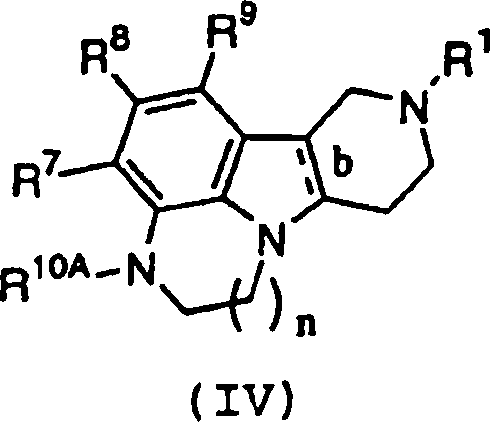
b für eine Einfachbindung
steht, wobei sich die Brückenwasserstoffatome
in cis-Position
befinden;
R1 ausgewählt ist unter
Wasserstoff,
Methyl, Ethyl, n-Propyl, n-Butyl, s-Butyl, t-Butyl, n-Pentyl, n-Hexyl,
2-Propyl, 2-Butyl, 2-Pentyl, 2-Hexyl, 2-Methylpropyl, 2-Methylbutyl,
2-Methylpentyl, 2-Ethylbutyl, 3-Methylpentyl, 3-Methylbutyl, 4-Methylpentyl,
2-Fluorethyl, 2,2-Difluorethyl, 2,2,2-Trifluorethyl, 2-Propenyl,
2-Methyl-2-propenyl, trans-2-Butenyl, 3-Methyl-butenyl, 3-Butenyl,
trans-2-Pentenyl, cis-2-Pentenyl, 4-Pentenyl, 4-Methyl-3-pentenyl,
3,3-Dichlor-2-propenyl, trans-3-Phenyl-2-propenyl, Cyclopropyl,
Cyclobutyl, Cyclopentyl, Cyclohexyl, Cyclopropylmethyl, Cyclobutylmethyl,
Cyclopentylmethyl, Cyclohexylmethyl, -CH=CH2,
-CH2-CH=CH2, -CH=CH-CH3, -C≡CH,
-C≡C-CH3 und -CH2-C≡CH;
R7 und R9 jeweils
unabhängig
ausgewählt
sind unter: Wasserstoff, Fluor, Methyl, Trifluormethyl und Methoxy;
R8 ausgewählt
ist unter:
Wasserstoff, Fluor, Chlor, Brom, Cyano, Methyl,
Ethyl, Propyl, Isopropyl, Butyl, t-Butyl, Nitro, Trifluormethyl, Methoxy,
Ethoxy, Isopropoxy, Trifluormethoxy, Phenyl,
MethylC(=O)-,
EthylC(=O)-, PropylC(=O)-, IsopropylC(=O), ButylC(=O)-, PhenylC(=O)-,
MethylCO2-, EthylCO2-, PropylCO2-, IsopropylCO2-,
ButylCO2-, PhenylCO2-,
Dimethylamino-S(=O)-,
Diethylamino-S(=O)-, Dipropylamino-S(=O)-, Di-isopropylamino-S(=O)-,
Dibutylamino-S(=O)-, Diphenylamino-S(=O)-,
Dimethylamino-SO2-, Diethylamino-SO2-,
Dipropylamino-SO2-, Di-isopropylamino-SO2-, Dibutylamino-SO2-, Diphenylamino-SO2-,
Dimethylamino-C(=O)-, Diethylamino-C(=O)-,
Dipropylamino-C(=O)-, Di-isopropylamino-C(=O)-, Dibutylamino-C(=O)-,
Diphenylamino-C (=O)-,
2-Chlorphenyl, 2-Fluorphenyl, 2-Bromphenyl,
2-Cyanophenyl, 2-Methylphenyl, 2-Trifluormethylphenyl, 2-Methoxyphenyl,
2-Trifluormethoxyphenyl,
3-Chlorphenyl, 3-Fluorphenyl, 3-Bromphenyl,
3-Cyanophenyl, 3-Methylphenyl, 3-Ethylphenyl, 3-Propylphenyl, 3-Isopropylphenyl,
3-Butylphenyl, 3-Trifluormethylphenyt, 3-Methoxyphenyl, 3-Isopropoxyphenyl,
3-Trifluormethoxyphenyl, 3-Thiomethoxyphenyl,
4-Chlorphenyl,
4-Fluorphenyl, 4-Bromphenyl, 4-Cyanophenyl, 4-Methylphenyl, 4-Ethylphenyl,
4-Propylphenyl, 4-Isopropylphenyl, 4-Butylphenyl, 4-Trifluormethylphenyl,
4-Methoxyphenyl, 4-Isopropoxyphenyl, 4-Trifluormethoxyphenyl, 4-Thiomethoxyphenyl,
2,3-Dichlorphenyl,
2,3-Difluorphenyl, 2,3-Dimethylphenyl, 2,3-Ditrifluormethylphenyl,
2,3-Dimethoxyphenyl, 2,3-Ditrifluormethoxyphenyl,
2,4-Dichlorphenyl,
2,4-Difluorphenyl, 2,4-Dimethylphenyl, 2,4-Ditrifluormethylphenyl,
2,4-Dimethoxyphenyl; 2,4-Ditrifluormethoxyphenyl,
2,5-Dichlorphenyl,
2,5-Difluorphenyl, 2,5-Dimethylphenyl, 2,5-Ditrifluormethylphenyl,
2,5-Dimethoxyphenyl, 2,5-Ditrifluormethoxyphenyl,
2,6-Dichlorphenyl,
2,6-Difluorphenyl, 2,6-Dimethylphenyl, 2,6-Ditrifluormethylphenyl,
2,6-Dimethoxyphenyl, 2,6-Ditrifluormethoxyphenyl,
3,4-Dichlorphenyl,
3,4-Difluorphenyl, 3,4-Dimethylphenyl, 3,4-Ditrifluormethylphenyl,
3,4-Dimethoxyphenyl, 3,4-Ditrifluormethoxyphenyl,
2,4,6-Trichlorphenyl,
2,4,6-Trifluorphenyl, 2,4,6-Trimethylphenyl, 2,4,6-Tritrifluormethylphenyl,
2,4,6-Trimethoxyphenyl, 2,4,6-Tritrifluormethoxyphenyl,
2-Chlor-4-CF3-phenyl, 2-Fluor-3-chlor-phenyl, 2-Chlor-4-CF3-phenyl, 2-Chlor-4-methoxy-phenyl, 2-Methoxy-4-isopropyl-phenyl,
2-CF3-4-methoxy-phenyl, 2-Methyl-4-methoxy-5-fluor-phenyl,
2-Methyl-4-methoxy-phenyl, 2-Chlor-4-CF3O-phenyl,
2,4,5-Trimethyl-phenyl, 2-Methyl-4-chlor-phenyl, Methyl-C(=O)NH-, Ethyt-C(=O)NH-,
Propyl-C(=O)NH-, Isopropyl-C(=O)NH-, Butyl-C(=O)NH-, Phenyl-C(=O)NH-,
4-Acetylphenyl,
3-Acetamidophenyl, 4-Pyridyl, 2-Furanyl, 2-Thiophenyl, 2-Naphthyl;
2-Me-5-F-phenyl,
2-F-5-Me-phenyl, 2-MeO-5-F-phenyl, 2-Me-3-Cl-phenyl, 3-NO2-phenyl, 2-NO2-phenyl, 2-Cl-3-Me-phenyt,
2-Me-4-EtO-phenyl, 2-Me-4-F-phenyl, 2-Cl-6-F-phenyl, 2-Cl-4-(CHF2)O-phenyl, 2,4-diMeO-6-F-phenyl, 2-CF3-6-F-phenyl, 2-MeS-phenyl, 2,6-diCl-4-MeO-phenyl,
2,3,4-triF-phenyl, 2,6-diF-4-Cl-phenyl, 2,3,4,6-tetraF-phenyl, 2,3,4,5,6-pentaF-phenyl,
2-CF3-4-EtO-phenyl, 2-CF3-4-iPrO-phenyl,
2-CF3-4-Cl-phenyl, 2-CF3-4-F-phenyl,
2-Cl-4-EtO-phenyl, 2-Cl-4-iPrO-phenyl, 2-Et-4-MeO-phenyl, 2-CHO-4-MeO-phenyl,
2-CH(OH)Me-4-MeO-phenyl, 2-CH(OMe)Me-4-MeO-phenyl, 2-C(=O)Me-4-MeO-phenyl,
2-CH2(OH)-4-MeO-phenyl, 2-CH2(OMe)-4-MeO-phenyl,
2-CH(OH)Et-4-MeO-phenyl, 2-C(=O)Et-4-MeO-phenyl, (Z)-2-CH=CHCO2Me-4-MeO-phenyl, 2-CH2CH2CO2Me-4-MeO-phenyl, (Z)-2-CH=CHCH2(OH)-4-MeO-phenyl, (E)-2-CH=CHCO2Me-4-MeO-phenyl, (E)-2-CH=CHCH2(OH)-4-MeO-phenyl,
2-CH2CH2OMe-4-MeO-phenyl,
2-F-4-MeO-phenyl, 2-Cl-4-F-phenyl, (2-Cl-phenyl)-CH=CH-, (3-Cl-phenyl)-CH=CH-,
(2,6-diF-phenyl)-CH=CH-, -CH2CH=CH2, Phenyl-CH=CH-, (2-Me-4-MeO-phenyl)-CH=CH-,
Cyclohexyl, Cyclopentyl, Cyclohexylmethyl, -CH2CH2CO2Et, -(CH2)3CO2Et, -(CH2)4CO2Et,
Benzyl, 2-F-Benzyl, 3-F-Benzyl, 4-F-Benzyl, 3-MeO-Benzyl, 3-OH-Benzyl,
2-MeO-Benzyl, 2-OH-Benzyl, 2-CO2Me-3-MeO-phenyl,
2-Me-4-CN-Phenyl, 2-Me-3-CN-Phenyl, 2-CF3-4-CN-Phenyl, 3-CHO-phenyl,
3-CH2(OH)-phenyl, 3-CH2(OMe)-phenyl,
3-CH2(NMe2)-phenyl,
3-CN-4-F-phenyl, 3-CONH2-4-F-phenyl, 2-CH2(NH2)-4-MeO-phenyl-,
Phenyl-NH-, (4-F-phenyl)-NH-, (2,4-diCl-phenyl)-NH-, phenyl-C(=O)NH-,
Benzyl-NH-, (2-Me-4-MeO-phenyl)-NH-, (2-F-4-MeO-phenyl)-NH-, (2-Me-4-F-phenyl)-NH-, Phenyl-S-,
-NMe2, 1-Pyrrolidinyl und -N(tosylat)2;
R10A ausgewählt ist
unter Wasserstoff, Methyl, Ethyl, 4-Fluorbenzyl und Benzyl; und
n
für 1 oder
2 steht.In a very particularly preferred embodiment of the present invention, the compound of the formula (I) is selected from compounds of the formula (IV):
b is a single bond, with the bridged hydrogen atoms in the cis position;
R 1 is selected under
Is hydrogen, methyl, ethyl, n-propyl, n-butyl, s-butyl, t-butyl, n-pentyl, n-hexyl, 2-propyl, 2-butyl, 2-pentyl, 2-hexyl, 2-methylpropyl, 2-methylbutyl, 2-methylpentyl, 2-ethylbutyl, 3-methylpentyl, 3-methylbutyl, 4-methylpentyl, 2-fluoroethyl, 2,2-difluoroethyl, 2,2,2-trifluoroethyl, 2-propenyl, 2-methyl 2-propenyl, trans-2-butenyl, 3-methyl-butenyl, 3-butenyl, trans-2-pentenyl, cis-2-pentenyl, 4-pentenyl, 4-methyl-3-pentenyl, 3,3-dichloro 2-propenyl, trans-3-phenyl-2-propenyl, cyclopropyl, cyclobutyl, cyclopentyl, cyclohexyl, cyclopropylmethyl, cyclobutylmethyl, cyclopentylmethyl, cyclohexylmethyl, -CH = CH 2 , -CH 2 -CH = CH 2 , -CH = CH- CH 3 , -C≡CH, -C≡C-CH 3 and -CH 2 -C≡CH;
R 7 and R 9 are each independently selected from: hydrogen, fluoro, methyl, trifluoromethyl and methoxy;
R 8 is selected under:
Hydrogen, fluorine, chlorine, bromine, cyano, methyl, ethyl, propyl, isopropyl, butyl, t-butyl, nitro, trifluoromethyl, methoxy, ethoxy, isopropoxy, trifluoromethoxy, phenyl,
MethylC (= O) -, ethylC (= O) -, propylC (= O) -, isopropylC (= O), butylC (= O) -, phenylC (= O) -,
MethylCO 2 -, ethylCO 2 -, propylCO 2 -, isopropylCO 2 -, butylCO 2 -, phenylCO 2 -,
Dimethylamino-S (= O) -, diethylamino-S (= O) -, dipropylamino-S (= O) -, di-isopropylamino-S (= O) -, dibutylamino-S (= O) -, diphenylamino-S (= O) -,
Dimethylamino-SO 2 -, diethylamino-SO 2 -, dipropylamino-SO 2 -, di-isopropylamino-SO 2 -, dibutylamino-SO 2 -, diphenylamino-SO 2 -,
Dimethylamino-C (= O) -, diethylamino-C (= O) -, dipropylamino-C (= O) -, di-isopropylamino-C (= O) -, dibutylamino-C (= O) -, diphenylamino-C (= O) -,
2-chlorophenyl, 2-fluorophenyl, 2-bromophenyl, 2-cyanophenyl, 2-methylphenyl, 2-trifluoromethylphenyl, 2-methoxyphenyl, 2-trifluoromethoxyphenyl,
3-chlorophenyl, 3-fluorophenyl, 3-bromophenyl, 3-cyanophenyl, 3-methylphenyl, 3-ethylphenyl, 3-propylphenyl, 3-isopropylphenyl, 3-butylphenyl, 3-trifluoromethylphenyl, 3-methoxyphenyl, 3-isopropoxyphenyl, 3 Trifluoromethoxyphenyl, 3-thiomethoxyphenyl,
4-chlorophenyl, 4-fluorophenyl, 4-bromophenyl, 4-cyanophenyl, 4-methylphenyl, 4-ethylphenyl, 4-propylphenyl, 4-isopropylphenyl, 4-butylphenyl, 4-trifluoromethylphenyl, 4-methoxyphenyl, 4-isopropoxyphenyl, 4- Trifluoromethoxyphenyl, 4-thiomethoxyphenyl,
2,3-dichlorophenyl, 2,3-difluorophenyl, 2,3-dimethylphenyl, 2,3-ditrifluoromethylphenyl, 2,3-dimethoxyphenyl, 2,3-ditrifluoromethoxyphenyl,
2,4-dichlorophenyl, 2,4-difluorophenyl, 2,4-dimethylphenyl, 2,4-ditrifluoromethylphenyl, 2,4-dimethoxyphenyl; 2,4-Ditrifluormethoxyphenyl,
2,5-dichlorophenyl, 2,5-difluorophenyl, 2,5-dimethylphenyl, 2,5-ditrifluoromethylphenyl, 2,5-dimethoxyphenyl, 2,5-ditrifluoromethoxyphenyl,
2,6-dichlorophenyl, 2,6-difluorophenyl, 2,6-dimethylphenyl, 2,6-ditrifluoromethylphenyl, 2,6-dimethoxyphenyl, 2,6-ditrifluoromethoxyphenyl,
3,4-dichlorophenyl, 3,4-difluorophenyl, 3,4-dimethylphenyl, 3,4-ditrifluoromethylphenyl, 3,4-dimethoxyphenyl, 3,4-ditrifluoromethoxyphenyl,
2,4,6-trichlorophenyl, 2,4,6-trifluorophenyl, 2,4,6-trimethylphenyl, 2,4,6-tritrifluoromethylphenyl, 2,4,6-trimethoxyphenyl, 2,4,6-tritrifluoromethoxyphenyl,
2-chloro-4-CF 3 -phenyl, 2-fluoro-3-chlorophenyl, 2-chloro-4-CF 3 -phenyl, 2-chloro-4-methoxyphenyl, 2-methoxy-4-isopropyl phenyl, 2-CF 3 -4-methoxyphenyl, 2-methyl-4-methoxy-5-fluorophenyl, 2-methyl-4-methoxyphenyl, 2-chloro-4-CF 3 O -phenyl, 2 , 4,5-trimethyl-phenyl, 2-methyl-4-chlorophenyl, methyl-C (= O) NH-, ethyl-C (= O) NH-, propyl-C (= O) NH-, isopropyl -C (= O) NH-, butyl-C (= O) NH-, phenyl-C (= O) NH-,
4-acetylphenyl, 3-acetamidophenyl, 4-pyridyl, 2-furanyl, 2-thiophenyl, 2-naphthyl;
2-Me-5-F-phenyl, 2-F-5-Me-phenyl, 2-MeO-5-F-phenyl, 2-Me-3-Cl-phenyl, 3-NO 2 -phenyl, 2-NO 2- phenyl, 2-Cl-3-methylphenyl, 2-Me-4-EtO-phenyl, 2-Me-4-F-phenyl, 2-Cl-6-F-phenyl, 2-Cl-4 (CHF 2 ) O-phenyl, 2,4-diMeO-6-F-phenyl, 2-CF 3 -6-F-phenyl, 2-MeS-phenyl, 2,6-diCl-4-MeO-phenyl, 2 , 3,4-triF-phenyl, 2,6-diF-4-Cl-phenyl, 2,3,4,6-tetraF-phenyl, 2,3,4,5,6-pentaF-phenyl, 2-CF 3 -4-EtO-phenyl, 2-CF 3 -4-iPrO-phe nyl, 2-CF 3 -4-Cl -phenyl, 2-CF 3 -4-F-phenyl, 2-Cl-4-EtO-phenyl, 2-Cl-4-iPrO-phenyl, 2-Et-4 MeO-phenyl, 2-CHO-4-MeO-phenyl, 2-CH (OH) Me-4-MeO-phenyl, 2-CH (OMe) Me-4-MeO-phenyl, 2-C (= O) Me -4-MeO-phenyl, 2-CH 2 (OH) -4-MeO-phenyl, 2-CH 2 (OMe) -4-MeO-phenyl, 2-CH (OH) Et-4-MeO-phenyl, 2 -C (= O) Et-4-MeO-phenyl, (Z) -2-CH = CHCO 2 Me-4-MeO-phenyl, 2-CH 2 CH 2 CO 2 Me-4-MeO-phenyl, (Z ) -2-CH = CHCH 2 (OH) -4-MeO-phenyl, (E) -2-CH = CHCO 2 Me-4-MeO-phenyl, (E) -2-CH = CHCH 2 (OH) - 4-MeO-phenyl, 2-CH 2 CH 2 OMe-4-MeO-phenyl, 2-F-4-MeO-phenyl, 2-Cl-4-F-phenyl, (2-Cl-phenyl) -CH = CH, (3-Cl-phenyl) -CH = CH-, (2,6-di-F-phenyl) -CH = CH-, -CH 2 CH = CH 2 , phenyl-CH = CH-, (2-Me 4-MeO-phenyl) -CH = CH-, cyclohexyl, cyclopentyl, cyclohexylmethyl, -CH 2 CH 2 CO 2 Et, - (CH 2 ) 3 CO 2 Et, - (CH 2 ) 4 CO 2 Et, benzyl, 2-F-benzyl, 3-F-benzyl, 4-F-benzyl, 3-MeO-benzyl, 3-OH-benzyl, 2-MeO-benzyl, 2-OH-benzyl, 2-CO 2 Me-3 MeO-phenyl, 2-Me-4-CN-phenyl, 2-Me-3-CN-phenyl, 2-CF 3 -4-CN-phenyl, 3-CHO-phenyl, 3-CH 2 (OH) -phenyl , 3-CH 2 (OMe) -phenyl, 3-CH 2 (NMe 2 ) -phenyl, 3-CN-4-F-phenyl, 3-CONH 2 -4-F-phenyl, 2-CH 2 (NH 2 ) -4-MeO-phenyl, phenyl NH-, (4-F-phenyl) -NH-, (2,4-diC-phenyl) -NH-, phenyl-C (= O) NH-, benzyl-NH-, (2-Me-4-MeO -phenyl) -NH-, (2-F-4-MeO-phenyl) -NH-, (2-Me-4-F-phenyl) -NH-, phenyl-S-, -NMe 2 , 1-pyrrolidinyl and -N (tosylate) 2 ;
R 10A is selected from hydrogen, methyl, ethyl, 4-fluorobenzyl and benzyl; and
n stands for 1 or 2.
Besonders
bevorzugt ist des Weiteren eine erfindungsgemäße Ausführungsform, worin
X für -NR10A-, -C(=O)NR10A-
oder -NR10AC(=O)- steht;
R1 ausgewählt ist
unter
C1-6-Alkyl, das mit Z substituiert
ist,
C2-6-Alkenyl, das mit Z substituiert
ist,
C2-6-Alkinyl, das mit Z substituiert
ist,
C3-6-Cycloalkyl, das mit Z substituiert
ist,
Aryl, das mit Z substituiert ist,
einem 5- bis 6-gliedrigen
heterocyclischen Ringsystem, das wenigstens ein Heteroatom enthält, welches
ausgewählt
ist unter N, O und S, wobei das heterocyclische Ringsystem mit Z
substituiert ist;
C1-6-Alkyl, das mit
0-2 R2 substituiert ist,
C2-6-Alkenyl,
das mit 0-2 R2 substituiert ist,
C2-6-Alkinyl, das mit 0-2 R2 substituiert
ist,
Aryl, das mit 0-2 R2 substituiert
ist, und
einem 5- bis 6-gliedrigen heterocyclischen Ringsystem,
das wenigstens ein Heteroatom enthält, welches ausgewählt ist
unter N, O und S, wobei das heterocyclische Ringsystem mit 0-2 R2 substituiert ist;
Z ausgewählt ist
unter H,
–CH(OH)R2,
–C(Ethylendioxy)
R2,
–OR2
–SR2
–NR2R3,
–C(O)R2,
–C(O)NR2R3,
–NR3C(O)R2,
–C(O)OR2,
–OC(O)R2,
–CH(=NR4)NR2R3,
–NHC(=NR4)NR2R3,
–S(O)R2,
–S(O)2R2,
–S(O)2NR2R3 und
-NR3S(O)2R2;
R2 jeweils
unabhängig
ausgewählt
ist unter
C1-4-Alkyl,
C2-4-Alkenyl,
C2-4-Alkinyl,
C3-6-Cycloalkyl,
Aryl, das mit 0-5 R42 substituiert ist,
einem carbocyclischen
C3-10-Rest, der mit 0-3 R41 substituiert
ist, und
einem 5- bis 10-gliedrigen heterocyclischen Ringsystem,
das 1–4
Heteroatome enthält,
welche ausgewählt sind
unter N, O und S, und das mit 0-3 R41 substituiert
ist;
R3 jeweils unabhängig ausgewählt ist
unter H, C1-4-Alkyl, C2-4-Alkenyl,
C2-4-Alkinyl und C1-4-Alkoxy;
R2 und R3 alternativ
zusammen einen 5- oder 6-gliedrigen Ring bilden, der gegebenenfalls
mit -O- oder -N(R4) -substituiert ist;
R4 jeweils unabhängig ausgewählt ist unter H, Methyl, Ethyl,
Propyl und Butyl;
R5 für H, Methyl,
Ethyl, Propyl oder Butyl steht;
R6a ausgewählt ist
unter
H, -OH, -NR46R47,
-CF3,
C1-4-Alkyl,
C2-4-Alkenyl, C2-4-Alkinyl,
C1-4-Alkoxy, C1-4-Halogenalkyl,
C3-6-Cycloalkyl und
Aryl, das mit 0-3
R44 substituiert ist;
R6b für H steht;
R7, R8 und R9 jeweils unabhängig ausgewählt sind unter
H, Halogen,
-CF3, -OCF3, -OH,
-CN, -NO2, -NR46R47
C1-8-Alkyl,
C2-8-Alkenyl, C2-8-Alkinyl,
C1-4-Halogenalkyl, C1-8-Alkoxy,
(C1-4-Halogenalkyl)oxy,
C1-4-Alkyl,
das mit 0-2 R11 substituiert ist,
einem
carbocyclischen C3-10-Rest, der mit 0-3
R33 substituiert ist,
Aryl, das mit
0–5 R33 substituiert ist,
einem 5- bis 10-gliedrigen
heterocyclischen Ringsystem, das 1–4 Heteroatome enthält, welche
ausgewählt sind
unter N, O und S, und das mit 0-3 R31 substituiert
ist;
OR12, SR12,
NR12R13, C(O)H,
C(O)R12, C(O)NR12R13, NR14C(O)R12, C(O)OR12, OC(O)R12, OC(O)OR12, CH(=NR14)NR12R13,
NHC(=NR14)NR12R13, S(O)R12, S(O)2R12, S(O)NR12R13, S(O)2NR12R13,
NR14S(O)R12, NR14S(O)2R12,
NR12C(O)R15, NR12C(O)OR15, NR12S(O)2R15 und
NR12C(O)NHR15;
R10A ausgewählt ist unter H,
C1-6-Alkyl, das mit 0-1 R10B substituiert
ist,
C2-6-Alkenyl, das mit 0-1 R10B substituiert ist,
C2-6-Alkinyl,
das mit 0-1 R10B substituiert ist, und
C1-6-Alkoxy;
R10B ausgewählt ist
unter
C1-4-Alkoxy,
C3-6-Cycloalkyl,
einem
carbocyclischen C3-10-Rest, der mit 0-3
R33 substituiert ist, Phenyl, das mit 0-3
R33 substituiert ist, und
einem 5-
bis 6-gliedrigen heterocyclischen Ringsystem, das 1, 2 oder 3 Heteroatome
enthält,
welche ausgewählt
sind unter N, O und S, und das mit 0-2
R44 substituiert
ist;
R11 ausgewählt ist unter
H, Halogen,
-CF3, -CN, -NO2,
C1-8-Alkyl, C2-8-Alkenyl,
C2-8-Alkinyl, C1-4-Halogenalkyl,
C1-8-Alkoxy, C3-10-Cycloalkyl,
einem
carbocyclischen C3-10-Rest, der mit 0-3
R33 substituiert ist,
Aryl, das mit
0-5 R33 substituiert ist,
einem 5-
bis 10-gliedrigen heterocyclischen Ringsystem, das 1–4 Heteroatome
enthält,
die ausgewählt
sind unter N, O und S, und das mit 0-3 R31 substituiert
ist,
OR12, SR12,
NR12R13, C(O)H,
C(O)R12, C(O)NR12R13, NR14C(O)R12, C(O)OR12, OC(O)R12, OC(O)OR12, CH(=NR14)NR12R13,
NHC(=NR14)NR12R13, S(O)R12, S(O)2R12, S(O)NR12R13, S(O)2NR12R13,
NR14S(O)R12 und NR14S(O)2R12;
R12 jeweils unabhängig ausgewählt ist unter
C1-4-Alkyl,
C2-4-Alkenyl,
C2-4-Alkinyl,
C3-6-Cycloalkyl,
Phenyl,
das mit 0-5 R33 substituiert ist,
einem
carbocyclischen C3-10-Rest der mit 0-3 R33 substituiert ist, und
einem 5- bis
10-gliedrigen heterocyclischen Ringsystem, das 1–4 Heteroatome enthält, welche
ausgewählt sind
unter N, O und S, und das mit 0-3 R31 substituiert
ist;
R13 jeweils unabhängig ausgewählt ist
unter
H, C1-4-Alkyl, C2-4-Alkenyl
und C2-4-Alkinyl;
R12 und
R13 alternativ zusammen einen 5- oder 6-gliedrigen
Ring bilden, der gegebenenfalls mit -O- oder -N(R14) – substituiert
ist;
R14 jeweils unabhängig ausgewählt ist
unter
H und C1-4-Alkyl;
R31 jeweils unabhängig ausgewählt ist unter
H, OH, Halogen,
CF3, SO2R45, NR46R47, Methyl, Ethyl und Propyl;
R33 jeweils unabhängig ausgewählt ist unter
H, OH, Halogen,
CN, NO2, CF3, SO2R45, NR46R47,
C1-3-Alkyl,
C2-3-Alkenyl, C2-3-Alkinyl,
C3-5-Cycloalkyl, C1-3-Halogenalkyl,
C1-3-Halogenalkyl-oxy-,
C1-3-Alkyloxy-,
C1-3-Alkylthio-, C1-3-Alkyl-C(=O)-
und C1-3-Alkyl-C(=O)NH-;
R41 jeweils
unabhängig
ausgewählt
ist unter
H, CF3, Halogen, OH, CO2H, SO2R45,
NR46R47, NO2, CN, =O, C2-8-Alkenyl,
C2-8-Alkinyl, C1-4-Alkoxy,
C1-4-Halogenalkyl,
C1-4-Alkyl,
das mit 0-1 R43 substituiert ist,
Aryl,
das mit 0-3 R42 substituiert ist, und
einem
5- bis 10-gliedrigen heterocyclischen Ringsystem, das 1–4 Heteroatome
enthält,
welche ausgewählt sind
unter N, O und S, und das mit 0-3 R44 substituiert
ist;
R42 jeweils unabhängig ausgewählt ist
unter
H, CF3, Halogen, OH, CO2H, SO2R45,
SR45, NR46R47, OR48 NO2, CN, CH(=NH)NH2,
NHC(=NH)NH2,
C2-6-Alkenyl,
C2-6-Alkinyl, C1-4-Alkoxy,
C1-4-Halogenalkyl, C3-6-Cycloalkyl;
C1-4-Alkyl, das mit 0-1 R43 substituiert ist,
Aryl,
das mit 0-3 R44 substituiert ist, und
einem
5- bis 10-gliedrigen heterocyclischen Ringsystem, das 1–4 Heteroatome
enthält,
welche ausgewählt sind
unter N, O und S, und das mit 0-3 R44 substituiert
ist;
R43 für C3-6-Cycloalkyl
oder Aryl steht, das jeweils mit 0-3 R44 substituiert
ist;
R44 jeweils unabhängig ausgewählt ist
unter H, Halogen, -OH, NR46R47,
CO2H, SO2R45, -CF3, -OCF3, -CN, -NO2, C1-4-Alkyl und C1-4-Alkoxy;
R45 für
C1-4-Alkyl steht;
R46 jeweils
unabhängig
ausgewählt
ist unter H und C1-4-Alkyl;
R47 jeweils unabhängig ausgewählt ist unter H, C1-4-Alkyl,
-C(=O)NH(C1-4-Alkyl), -SO2(C1-4-Alkyl), -SO2(Phenyl), -C(=O)O(C1-4-Alkyl), -C(=O)(C1-4-Alkyl)
und -C(=O)H;
R48 jeweils unabhängig ausgewählt ist
unter H, C1-4-Alkyl, -C(=O)NH(C1-4-Alkyl),
-C(=O)O(C1-4-Alkyl), -C(=O)(C1-4-Alkyl)
und -C(=O)H;
k für
1 oder 2 steht;
m für
0, 1 oder 2 steht; und
n für
1 oder 2 steht.Furthermore, an embodiment according to the invention is particularly preferred in which
X is -NR 10A -, -C (= O) NR 10A - or -NR 10A C (= O) -;
R 1 is selected under
C 1-6 alkyl substituted with Z,
C 2-6 alkenyl substituted with Z,
C 2-6 alkynyl substituted with Z,
C 3-6 cycloalkyl substituted with Z,
Aryl substituted with Z,
a 5- to 6-membered heterocyclic ring system containing at least one heteroatom selected from N, O and S, wherein the heterocyclic ring system is substituted with Z;
C 1-6 alkyl substituted with 0-2 R 2 ,
C 2-6 alkenyl substituted with 0-2 R 2 ,
C 2-6 alkynyl substituted with 0-2 R 2 ,
Aryl substituted with 0-2 R 2 , and
a 5- to 6-membered heterocyclic ring system containing at least one heteroatom selected from N, O and S, wherein the heterocyclic ring system is substituted with 0-2 R 2 ;
Z is selected under H,
-CH (OH) R 2 ,
-C (ethylenedioxy) R 2 ,
-OR 2
-SR 2
-NR 2 R 3 ,
-C (O) R 2 ,
-C (O) NR 2 R 3 ,
-NR 3 C (O) R 2 ,
-C (O) OR 2 ,
-OC (O) R 2 ,
-CH (= NR 4 ) NR 2 R 3 ,
-NHC (= NR 4 ) NR 2 R 3 ,
-S (O) R 2 ,
-S (O) 2 R 2 ,
-S (O) 2 NR 2 R 3 and -NR 3 S (O) 2 R 2 ;
Each R 2 is independently selected under
C 1-4 alkyl,
C 2-4 alkenyl,
C 2-4 alkynyl,
C 3-6 cycloalkyl,
Aryl substituted with 0-5 R 42 ,
a C 3-10 carbocyclic radical substituted with 0-3 R 41 , and
a 5- to 10-membered heterocyclic ring system containing 1-4 heteroatoms selected from N, O and S, and substituted with 0-3 R 41 ;
Each R 3 is independently selected from H, C 1-4 alkyl, C 2-4 alkenyl, C 2-4 alkynyl and C 1-4 alkoxy;
Alternatively, R 2 and R 3 together form a 5- or 6-membered ring optionally substituted with -O- or -N (R 4 ) is -substituted;
Each R 4 is independently selected from H, methyl, ethyl, propyl and butyl;
R 5 is H, methyl, ethyl, propyl or butyl;
R 6a is selected under
H, -OH, -NR 46 R 47 , -CF 3 ,
C 1-4 alkyl, C 2-4 alkenyl, C 2-4 alkynyl, C 1-4 alkoxy, C 1-4 haloalkyl, C 3-6 cycloalkyl and
Aryl substituted with 0-3 R 44 ;
R 6b is H;
R 7 , R 8 and R 9 are each independently selected from
H, halo, -CF 3 , -OCF 3 , -OH, -CN, -NO 2 , -NR 46 R 47
C 1-8 -alkyl, C 2-8 -alkenyl, C 2-8 -alkynyl, C 1-4 -haloalkyl, C 1-8 -alkoxy, (C 1-4 -haloalkyl) oxy,
C 1-4 alkyl substituted with 0-2 R 11 ,
a carbocyclic C 3-10 radical substituted with 0-3 R 33 ,
Aryl substituted with 0-5 R 33 ,
a 5- to 10-membered heterocyclic ring system containing 1-4 heteroatoms selected from N, O and S, and substituted with 0-3 R 31 ;
OR 12 , SR 12 , NR 12 R 13 , C (O) H, C (O) R 12 , C (O) NR 12 R 13 , NR 14 C (O) R 12 , C (O) OR 12 , OC (O) R 12 , OC (O) OR 12 , CH (= NR 14 ) NR 12 R 13 , NHC (= NR 14 ) NR 12 R 13 , S (O) R 12 , S (O) 2 R 12 , S (O) NR 12 R 13 , S (O) 2 NR 12 R 13 , NR 14 S (O) R 12 , NR 14 S (O) 2 R 12 , NR 12 C (O) R 15 , NR 12 C (O) OR 15 , NR 12 S (O) 2 R 15 and NR 12 C (O) NHR 15 ;
R 10A is selected under H,
C 1-6 alkyl substituted with 0-1 R 10B ,
C 2-6 alkenyl substituted with 0-1 R 10B ,
C 2-6 alkynyl substituted with 0-1 R 10B , and
C 1-6 alkoxy;
R 10B is selected under
C 1-4 alkoxy,
C 3-6 cycloalkyl,
a carbocyclic C 3-10 radical substituted with 0-3 R 33 , phenyl substituted with 0-3 R 33 , and
a 5- to 6-membered heterocyclic ring system containing 1, 2 or 3 heteroatoms selected from N, O and S, and 0-2
R 44 is substituted;
R 11 is selected under
H, halogen, -CF 3 , -CN, -NO 2 ,
C 1-8 -alkyl, C 2-8 -alkenyl, C 2-8 -alkynyl, C 1-4 -haloalkyl, C 1-8 -alkoxy, C 3-10 -cycloalkyl,
a carbocyclic C 3-10 radical substituted with 0-3 R 33 ,
Aryl substituted with 0-5 R 33 ,
a 5- to 10-membered heterocyclic ring system containing 1-4 heteroatoms selected from N, O and S and substituted with 0-3 R 31 ,
OR 12 , SR 12 , NR 12 R 13 , C (O) H, C (O) R 12 , C (O) NR 12 R 13 , NR 14 C (O) R 12 , C (O) OR 12 , OC (O) R 12 , OC (O) OR 12 , CH (= NR 14 ) NR 12 R 13 , NHC (= NR 14 ) NR 12 R 13 , S (O) R 12 , S (O) 2 R 12 , S (O) NR 12 R 13 , S (O) 2 NR 12 R 13 , NR 14 S (O) R 12 and NR 14 S (O) 2 R 12 ;
Each R 12 is independently selected under
C 1-4 alkyl,
C 2-4 alkenyl,
C 2-4 alkynyl,
C 3-6 cycloalkyl,
Phenyl substituted with 0-5 R 33 ,
a carbocyclic C 3-10 radical substituted with 0-3 R 33 , and
a 5- to 10-membered heterocyclic ring system containing 1-4 heteroatoms selected from N, O and S, and substituted with 0-3 R 31 ;
Each R 13 is independently selected under
H, C 1-4 alkyl, C 2-4 alkenyl and C 2-4 alkynyl;
R 12 and R 13 alternatively together form a 5- or 6-membered ring optionally substituted with -O- or -N (R 14 ) -;
Each R 14 is independently selected under
H and C 1-4 alkyl;
R 31 is independently selected under
H, OH, halogen, CF 3 , SO 2 R 45 , NR 46 R 47 , methyl, ethyl and propyl;
Each R 33 is independently selected under
H, OH, halogen, CN, NO 2 , CF 3 , SO 2 R 45 , NR 46 R 47 ,
C 1-3 -alkyl, C 2-3 -alkenyl, C 2-3 -alkynyl,
C 3-5 cycloalkyl, C 1-3 haloalkyl, C 1-3 haloalkyl oxy-,
C 1-3 -alkyloxy, C 1-3 -alkylthio, C 1-3 -alkyl-C (= O) - and C 1-3 -alkyl-C (= O) NH-;
Each R 41 is independently selected under
H, CF 3 , halogen, OH, CO 2 H, SO 2 R 45 , NR 46 R 47 , NO 2 , CN, = O, C 2-8 alkenyl, C 2-8 alkynyl, C 1-4 Alkoxy, C 1-4 -haloalkyl,
C 1-4 alkyl substituted with 0-1 R 43 ,
Aryl substituted with 0-3 R 42 , and
a 5- to 10-membered heterocyclic ring system containing 1-4 heteroatoms selected from N, O and S and substituted with 0-3 R 44 ;
Each R 42 is independently selected under
H, CF 3 , halogen, OH, CO 2 H, SO 2 R 45 , SR 45 , NR 46 R 47 , OR 48 NO 2 , CN, CH (= NH) NH 2 , NHC (= NH) NH 2 ,
C 2-6 alkenyl, C 2-6 alkynyl, C 1-4 alkoxy, C 1-4 haloalkyl, C 3-6 cycloalkyl; C 1-4 alkyl substituted with 0-1 R 43 ,
Aryl, substituted with 0-3 R 44, and
a 5- to 10-membered heterocyclic ring system containing 1-4 heteroatoms selected from N, O and S and substituted with 0-3 R 44 ;
R 43 is C 3-6 cycloalkyl or aryl substituted with 0-3 R 44 , respectively;
R 44 is each independently selected from H, halo, -OH, NR 46 R 47 , CO 2 H, SO 2 R 45 , -CF 3 , -OCF 3 , -CN, -NO 2 , C 1-4 alkyl and C 1-4 alkoxy;
R 45 is C 1-4 alkyl;
Each R 46 is independently selected from H and C 1-4 alkyl;
Each R 47 is independently selected from H, C 1-4 alkyl, -C (= O) NH (C 1-4 alkyl), -SO 2 (C 1-4 alkyl), -SO 2 (phenyl) , -C (= O) O (C 1-4 alkyl), -C (= O) (C 1-4 alkyl) and -C (= O) H;
Each R 48 is independently selected from H, C 1-4 alkyl, -C (= O) NH (C 1-4 alkyl), -C (= O) O (C 1-4 alkyl), -C (= O) (C 1-4 alkyl) and -C (= O) H;
k is 1 or 2;
m is 0, 1 or 2; and
n stands for 1 or 2.
Bevorzugt
ist des Weiteren eine erfindungsgemäße Ausführungsform, worin
X für -NR10A- steht;
R1 ausgewählt ist
unter
C2-5-Alkyl, das mit Z substituiert
ist,
C2-5-Alkenyl, das mit Z substituiert
ist,
C2-5-Alkinyl, das mit Z substituiert
ist,
C3-6-Cycloalkyl, das mit Z substituiert
ist,
Aryl, das mit Z substituiert ist,
einem 5-6-gliedrigen
heterocyclischen Ringsystem, das wenigstens ein Heteroatom enthält, welches
ausgewählt
ist unter N, O und S, wobei das heterocyclische Ringsystem mit Z
substituiert ist;
C1-5-Alkyl, das mit
0-2 R2 substituiert ist,
C2-5-Alkenyl,
das mit 0-2 R2 substituiert ist,
C2-5-Alkinyl, das mit 0-2 R2 substituiert
ist,
Z ausgewählt
ist unter H,
–CH(OH)R2,
–C(Ethylendioxy)R2,
–OR2,
–SR2.
–NR2R3,
–C(O)R2,
–C(O)NR2R3,
–NR3C(O)R2,
–C(O)OR2,
–OC(O)R2,
–CH(=NR4)NR2R3,
–NHC(=NR4)NR2R3,
–S(O)R2,
–S(O)2R2,
–S(O)2NR2R3 und
-NR3S(O)2R2;
R2 jeweils
unabhängig
ausgewählt
ist unter
C1-4-Alkyl,
C2-4-Alkenyl,
C2-4-Alkinyl,
C3-6-Cycloalkyl,
Aryl, das mit 0-5 R42 substituiert ist,
einem carbocyclischen
C3-10-Rest, der mit 0-3 R41 substituiert
ist, und einem 5- bis 10-gliedrigen heterocyclischen Ringsystem,
das 1–4
Heteroatome enthält,
welche ausgewählt
sind unter N, O und S, und das mit 0-3 R41 substituiert
ist;
R3 jeweils unabhängig ausgewählt ist
unter H, C1-4-Alkyl, C2-4-Alkenyl,
C2-4-Alkinyl und C1-4-Alkoxy;
R2 und R3 alternativ
zusammen einen 5- oder 6-gliedrigen Ring bilden, der gegebenenfalls
mit -O- oder -N(R4) -substituiert ist;
R4 jeweils unabhängig ausgewählt ist unter H, Methyl, Ethyl,
Propyl und Butyl;
R5 für H, Methyl
oder Ethyl steht;
R6a ausgewählt ist
unter
H, -OH, -NR46R47,
-CF3,
C1-4-Alkyl,
C2-4-Alkenyl, C2-4-Alkinyl,
C1-4-Alkoxy, C1-4-Halogenalkyl
und C3-6-Cycloalkyl;
R6b für H steht;
R7 , R8 und R9 jeweils unabhängig ausgewählt sind unter
H, Halogen,
-CF3, -OCF3, -OH,
-OCH3, -CN, -NO2,
-NR46R47
C1-6-Alkyl, C2-6-Alkenyl,
C2-6-Alkinyl, C1-4-Halogenalkyl,
C1-6-Alkoxy, (C1-4-Halogenalkyl)oxy,
C1-4-Alkyl, das mit 0-2 R11 substituiert
ist,
einem carbocyclischen C3-10-Rest,
der mit 0-3 R33 substituiert ist,
Aryl,
das mit 0-5 R33 substituiert ist,
einem
5- bis 10-gliedrigen heterocyclischen Ringsystem, das 1–4 Heteroatome
enthält,
welche ausgewählt sind
unter N, O und S, und das mit 0-3 R31 substituiert
ist;
OR12, SR12,
NR12R13, C(O)H,
C(O)R12, C(O)NR12R13, NR14C(O)R12, C(O)OR12, OC(O)R12, CH(=NR14)NR12R13, NHC(=NR14)NR12R13,
S(O)R12, S(O)2R12, S(O)2NR12R13, NR14S(O)2R12,
NR14S(O)R12, NR14S(O)2R12, NR12C(O)R15, NR12C(O)OR15, NR12S(O)2R15 und
NR12C(O)NHR15;
R10A ausgewählt ist unter H,
C1-6-Alkyl, das mit 0-1 R10B substituiert
ist,
C2-6-Alkenyl, das mit 0-1 R10B substituiert ist,
C2-6-Alkinyl,
das mit 0-1 R10B substituiert ist, und
C1-6-Alkoxy;
R10B ausgewählt ist
unter
C1-4-Alkoxy,
C3-6-Cycloalkyl,
einem
carbocyclischen C3-6-Rest, der mit 0-3 R33 substituiert ist, Phenyl, das mit 0-3
R33 substituiert ist, und
einem 5-
bis 6-gliedrigen heterocyclischen Ringsystem, das 1, 2 oder 3 Heteroatome
enthält,
welche ausgewählt
sind unter N, O und S, und das mit 0-2
R44 substituiert
ist;
R11 ausgewählt ist unter
H, Halogen,
-CF3, -OCF3, -OH,
-OCH3, -CN, -NO2,
-NR46R47,
C1-6-Alkyl, C2-6-Alkenyl,
C2-6-Alkinyl, C1-4-Halogenalkyl,
C1-6-Alkoxy, C1-4-(Halogenalkyl)oxy,
einem
carbocyclischen C3-10-Rest, der mit 0-3
R33 substituiert ist, Aryl, das mit 0-5
R33 substituiert ist,
einem 5- bis
10-gliedrigen heterocyclischen Ringsystem, das 1–4 Heteroatome enthält, die
ausgewählt
sind unter N, O und S, und das mit 0-3 R31 substituiert
ist,
OR12, SR12,
NR12R13, C(O)H,
C(O)R12, C(O)NR12R13, NR14C(O)R12, C(O)OR12, OC(O)R12, CH(=NR14)NR12R13, NHC(=NR14)NR12R13,
S(O)R12, S(O)2R12, S(O)2NR12R13 und NR14S(O)2R12;
R12 jeweils unabhängig ausgewählt ist unter
C1-4-Alkyl,
C2-4-Alkenyl,
C2-4-Alkinyl,
C3-6-Cycloalkyl,
Phenyl,
das mit 0–5
R33 substituiert ist,
einem carbocyclischen
C3-10-Rest, der mit 0-3 R33 substituiert
ist, und
einem 5- bis 10-gliedrigen heterocyclischen Ringsystem,
das 1–4
Heteroatome enthält,
welche ausgewählt sind
unter N, O und S, und das mit 0-3 R31 substituiert
ist;
R13 jeweils unabhängig ausgewählt ist
unter H, C1-4-Alkyl, C2-4-Alkenyl
und C2-4-Alkinyl;
R12 und
R13 alternativ zusammen einen 5- oder 6-gliedrigen
Ring bilden, der gegebenenfalls mit -O- oder -N(R14)
-substituiert ist;
R14 jeweils unabhängig ausgewählt ist
unter H und C1-4-Alkyl;
R31 jeweils
unabhängig
ausgewählt
ist unter
H, OH, Halogen, CF3, Methyl
und Ethyl;
R33 jeweils unabhängig ausgewählt ist
unter
H, OH, Halogen, CN, NO2, CF3, Methyl und Ethyl;
R41 jeweils
unabhängig
ausgewählt
ist unter
H, CF3, Halogen, OH, CO2H, SO2R45,
NR46R47, NO2, CN, =O, C2-8-Alkenyl,
C2-8-Alkinyl, C1-4-Alkoxy,
C1-4-Halogenalkyl, C1-4-Alkyl,
das mit 0-1 R43 substituiert ist,
Aryl,
das mit 0-3 R42 substituiert ist, und
einem
5- bis 10-gliedrigen heterocyclischen Ringsystem, das 1–4 Heteroatome
enthält,
welche ausgewählt sind
unter N, O und S, und das mit 0-3 R44 substituiert
ist;
R42 jeweils unabhängig ausgewählt ist
unter
H, CF3, Halogen, OH, CO2H, SO2R45,
SR45, NR46R47, OR48, NO2, CN, CH(=NH)NH2,
NHC(=NH)NH2,
C2-6-Alkenyl,
C2-6-Alkinyl, C1-4-Alkoxy,
C1-4-Halogenalkyl, C3-6-Cycloalkyl,
C1-4-Alkyl, das mit 0-1 R43 substituiert
ist,
Aryl, das mit 0-3 R44 substituiert
ist, und
einem 5- bis 10-gliedrigen heterocyclischen Ringsystem,
das 1–4
Heteroatome enthält,
welche ausgewählt sind
unter N, O und S, und das mit 0-3 R44 substituiert
ist;
R43 für C3-6-Cycloalkyl
oder Aryl steht, das mit 0-3 R44 substituiert
ist;
R44 jeweils unabhängig ausgewählt ist
unter
H, Halogen, -OH, NR46R47, CO2H, SO2R45, -CF3, -OCF3, -CN, -NO2, C1-4-Alkyl und
C1-4-Alkoxy;
R45 für C1-4-Alkyl steht;
R46 jeweils
unabhängig
ausgewählt
ist unter H und C1-3-Alkyl;
R47 jeweils unabhängig ausgewählt ist unter H,
C1-4-Alkyl, -C(=O)NH(C1-4-Alkyl),
-SO2(C1-4-Alkyl),
-SO2(Phenyl), -C(=O)O(C1-4-Alkyl),
-C(=O)(C1-4-Alkyl) und -C(=O)H;
R48 jeweils unabhängig ausgewählt ist unter H,
C1-4-Alkyl, -C(=O)NH(C1-4-Alkyl),
-C(=O)O(C1-4-Alkyl), -C(=O)(C1-4-Alkyl)
und -C(=O)H;
k für
1 oder 2 steht;
m für
0, 1 oder 2 steht; und
n für
1 oder 2 steht.Furthermore, an embodiment according to the invention is preferred in which
X is -NR 10A -;
R 1 is selected under
C 2-5 alkyl substituted with Z,
C 2-5 alkenyl substituted with Z,
C 2-5 alkynyl substituted with Z,
C 3-6 cycloalkyl substituted with Z,
Aryl substituted with Z,
a 5-6 membered heterocyclic ring system containing at least one heteroatom selected from N, O and S, wherein the heterocyclic ring system is substituted with Z;
C 1-5 alkyl substituted with 0-2 R 2 ,
C 2-5 alkenyl substituted with 0-2 R 2 ,
C 2-5 alkynyl substituted with 0-2 R 2 ,
Z is selected under H,
-CH (OH) R 2 ,
-C (ethylenedioxy) R 2 ,
-OR 2 ,
-SR 2 .
-NR 2 R 3 ,
-C (O) R 2 ,
-C (O) NR 2 R 3 ,
-NR 3 C (O) R 2 ,
-C (O) OR 2 ,
-OC (O) R 2 ,
-CH (= NR 4 ) NR 2 R 3 ,
-NHC (= NR 4 ) NR 2 R 3 ,
-S (O) R 2 ,
-S (O) 2 R 2 ,
-S (O) 2 NR 2 R 3 and -NR 3 S (O) 2 R 2 ;
Each R 2 is independently selected under
C 1-4 alkyl,
C 2-4 alkenyl,
C 2-4 alkynyl,
C 3-6 cycloalkyl,
Aryl substituted with 0-5 R 42 ,
a carbocyclic C 3-10 radical substituted with 0-3 R 41 , and a 5- to 10-membered heterocyclic ring system containing 1-4 heteroatoms selected from N, O and S, and that having 0-3 R 41 is substituted;
Each R 3 is independently selected from H, C 1-4 alkyl, C 2-4 alkenyl, C 2-4 alkynyl and C 1-4 alkoxy;
R 2 and R 3 alternatively together form a 5- or 6-membered ring optionally substituted with -O- or -N (R 4 ) -substituted;
Each R 4 is independently selected from H, methyl, ethyl, propyl and butyl;
R 5 is H, methyl or ethyl;
R 6a is selected under
H, -OH, -NR 46 R 47 , -CF 3 ,
C 1-4 alkyl, C 2-4 alkenyl, C 2-4 alkynyl, C 1-4 alkoxy, C 1-4 haloalkyl and C 3-6 cycloalkyl;
R 6b is H;
R 7 , R 8 and R 9 are each independently selected from
H, halo, -CF 3 , -OCF 3 , -OH, -OCH 3 , -CN, -NO 2 , -NR 46 R 47
C 1-6 alkyl, C 2-6 alkenyl, C 2-6 alkynyl, C 1-4 haloalkyl,
C 1-6 alkoxy, (C 1-4 -haloalkyl) oxy,
C 1-4 alkyl substituted with 0-2 R 11 ,
a carbocyclic C 3-10 radical substituted with 0-3 R 33 ,
Aryl substituted with 0-5 R 33 ,
a 5- to 10-membered heterocyclic ring system containing 1-4 heteroatoms selected from N, O and S, and substituted with 0-3 R 31 ;
OR 12 , SR 12 , NR 12 R 13 , C (O) H, C (O) R 12 , C (O) NR 12 R 13 , NR 14 C (O) R 12 , C (O) OR 12 , OC (O) R 12 , CH (= NR 14 ) NR 12 R 13 , NHC (= NR 14 ) NR 12 R 13 , S (O) R 12 , S (O) 2 R 12 , S (O) 2 NR 12 R 13 , NR 14 S (O) 2 R 12 , NR 14 S (O) R 12 , NR 14 S (O) 2 R 12 , NR 12 C (O) R 15 , NR 12 C (O) OR 15 , NR 12 S (O) 2 R 15 and NR 12 C (O) NHR 15 ;
R 10A is selected under H,
C 1-6 alkyl substituted with 0-1 R 10B ,
C 2-6 alkenyl substituted with 0-1 R 10B ,
C 2-6 alkynyl substituted with 0-1 R 10B , and
C 1-6 alkoxy;
R 10B is selected under
C 1-4 alkoxy,
C 3-6 cycloalkyl,
a carbocyclic C 3-6 radical substituted with 0-3 R 33 , phenyl substituted with 0-3 R 33 , and
a 5- to 6-membered heterocyclic ring system containing 1, 2 or 3 heteroatoms selected from N, O and S, and 0-2
R 44 is substituted;
R 11 is selected under
H, halogen, -CF 3 , -OCF 3 , -OH, -OCH 3 , -CN, -NO 2 , -NR 46 R 47 ,
C 1-6 alkyl, C 2-6 alkenyl, C 2-6 alkynyl, C 1-4 haloalkyl, C 1-6 alkoxy, C 1-4 (haloalkyl) oxy,
a carbocyclic C 3-10 radical substituted with 0-3 R 33 , aryl substituted with 0-5 R 33 ,
a 5- to 10-membered heterocyclic ring system containing 1-4 heteroatoms selected from N, O and S and substituted with 0-3 R 31 ,
OR 12 , SR 12 , NR 12 R 13 , C (O) H, C (O) R 12 , C (O) NR 12 R 13 , NR 14 C (O) R 12 , C (O) OR 12 , OC (O) R 12 , CH (= NR 14 ) NR 12 R 13 , NHC (= NR 14 ) NR 12 R 13 , S (O) R 12 , S (O) 2 R 12 , S (O) 2 NR 12 R 13 and NR 14 S (O) 2 R 12 ;
Each R 12 is independently selected under
C 1-4 alkyl,
C 2-4 alkenyl,
C 2-4 alkynyl,
C 3-6 cycloalkyl,
Phenyl substituted with 0-5 R 33 ,
a carbocyclic C 3-10 radical substituted with 0-3 R 33 , and
a 5- to 10-membered heterocyclic ring system containing 1-4 heteroatoms selected from N, O and S, and substituted with 0-3 R 31 ;
Each R 13 is independently selected from H, C 1-4 alkyl, C 2-4 alkenyl and C 2-4 alkynyl;
Alternatively, R 12 and R 13 together form a 5- or 6-membered ring optionally substituted with -O- or -N (R 14 ) -substituted;
Each R 14 is independently selected from H and C 1-4 alkyl;
R 31 is independently selected under
H, OH, halogen, CF 3 , methyl and ethyl;
Each R 33 is independently selected under
H, OH, halogen, CN, NO 2 , CF 3 , methyl and ethyl;
Each R 41 is independently selected under
H, CF 3 , halogen, OH, CO 2 H, SO 2 R 45 , NR 46 R 47 , NO 2 , CN, = O, C 2-8 alkenyl, C 2-8 alkynyl, C 1-4 Alkoxy, C 1-4 -haloalkyl, C 1-4 -alkyl substituted with 0-1 R 43 ,
Aryl substituted with 0-3 R 42 , and
a 5- to 10-membered heterocyclic ring system containing 1-4 heteroatoms selected from N, O and S and substituted with 0-3 R 44 ;
Each R 42 is independently selected under
H, CF 3 , halogen, OH, CO 2 H, SO 2 R 45 , SR 45 , NR 46 R 47 , OR 48 , NO 2 , CN, CH (= NH) NH 2 , NHC (= NH) NH 2 ,
C 2-6 alkenyl, C 2-6 alkynyl, C 1-4 alkoxy, C 1-4 haloalkyl, C 3-6 cycloalkyl,
C 1-4 alkyl substituted with 0-1 R 43 ,
Aryl, substituted with 0-3 R 44, and
a 5- to 10-membered heterocyclic ring system containing 1-4 heteroatoms selected from N, O and S and substituted with 0-3 R 44 ;
R 43 is C 3-6 cycloalkyl or aryl substituted with 0-3 R 44 ;
Each R 44 is independently selected under
H, halogen, -OH, NR 46 R 47 , CO 2 H, SO 2 R 45 , -CF 3 , -OCF 3 , -CN, -NO 2 , C 1-4 alkyl and C 1-4 alkoxy;
R 45 is C 1-4 alkyl;
Each R 46 is independently selected from H and C 1-3 alkyl;
Each R 47 is independently selected from H,
C 1-4 alkyl, -C (= O) NH (C 1-4 alkyl), -SO 2 (C 1-4 alkyl), -SO 2 (phenyl), -C (= O) O ( C 1-4 alkyl), -C (= O) (C 1-4 alkyl) and -C (= O) H;
Each R 48 is independently selected from H,
C 1-4 alkyl, -C (= O) NH (C 1-4 alkyl), -C (= O) O (C 1-4 alkyl), -C (= O) (C 1-4 -Alkyl) and -C (= O) H;
k is 1 or 2;
m is 0, 1 or 2; and
n stands for 1 or 2.
Besonders
bevorzugt ist eine erfindungsgemäße Ausführungsform,
worin
X für
-NR1 0 A-
steht;
R1 ausgewählt ist unter
C2-4-Alkyl, das mit Z substituiert ist,
C2-4-Alkenyl, das mit Z substituiert ist,
C2-4-Alkinyl, das mit Z substituiert ist,
C3-6-Cycloalkyl, das mit Z substituiert ist,
Aryl,
das mit Z substituiert ist,
einem 5- bis 6-gliedrigen heterocyclischen
Ringsystem, das wenigstens ein Heteroatom enthält, welches ausgewählt ist
unter N, O und S, wobei das heterocyclische Ringsystem mit Z substituiert
ist;
C2-4-Alkyl, das mit 0-2 R2 substituiert ist, und
C2-4-Alkenyl,
das mit 0-2 R2 substituiert ist,
Z
ausgewählt
ist unter H,
–CH(OH)R2,
–C(Ethylendioxy)R2,
–OR2,
–SR2,
–NR2R3,
–C(O)R2,
–C(O)NR2R3,
–NR3C(O)R2,
–C(O)OR2,
–S(O)R2,
–S(O)2R2,
–S(O)2NR2R3 und
-NR3S(O)2 R2;
R2 jeweils
unabhängig
ausgewählt
ist unter
Phenyl, das mit 0–5 R42 substituiert
ist;
einem carbocyclischen C3-10-Rest,
der mit 0-3 R41 substituiert ist, und
einem
5- bis 10-gliedrigen heterocyclischen Ringsystem, das 1–4 Heteroatome
enthält,
welche ausgewählt sind
unter N, O und S, und das mit 0-3 R41 substituiert
ist;
R3 jeweils unabhängig ausgewählt ist
unter
H, C1-4-Alkyl, C2-4-Alkenyl,
C2-4-Alkinyl und C1-4-Alkoxy;
R2 und R3 alternativ
zusammen einen 5- oder 6-gliedrigen Ring bilden, der gegebenenfalls
mit -O- oder -N(R4)-substituiert ist;
R4 jeweils unabhängig ausgewählt ist unter H, Methyl, Ethyl,
Propyl und Butyl;
R5 für H steht;
R6a ausgewählt
ist unter H, -OH, -CF3, Methyl, Ethyl, Propyl,
Butyl, Methoxy und Ethoxy;
R6b für H steht;
R7 , R8 und R9 jeweils unabhängig ausgewählt sind unter
H, Halogen,
-CF3, -OCF3, -OH,
-OCH3, -CN, -NO2,
C1-4-Alkyl, C1-4-Halogenalkyl,
C1-4-Alkoxy, (C1-3-Halogenalkyl)oxy
und
C1-4-Alkyl, das mit 0-2 R11 substituiert ist,
R10A ausgewählt ist
unter H, C1-6-Alkyl, C1-4-Alkoxy
und C1-2-Alkyl, das mit 0-1 R10B substituiert
ist;
R10B für C3-6-Cycloalkyl
oder Phenyl steht, das mit 0-3 R33 substituiert
ist;
R11 ausgewählt ist unter
H, Halogen,
-CF3, -OCF3, -OH,
-OCH3, -CN, -NO2,
C1-4-Alkyl, C1-4-Halogenalkyl,
C1-4-Alkoxy und C1-3-(Halogenalkyl)oxy;
R33 jeweils unabhängig ausgewählt ist unter
H, OH, Halogen,
CF3 und Methyl;
R41 jeweils
unabhängig
ausgewählt
ist unter
H, CF3, Halogen, OH, CO2H, SO2R45,
NR46R47, NO2, CN, =O, C2-8-Alkenyl,
C2-8-Alkinyl, C1-4-Alkoxy,
C1-4-Halogenalkyl,
C1-4-Alkyl,
das mit 0-1 R43 substituiert ist,
Aryl,
das mit 0-3 R42 substituiert ist, und
einem
5- bis 10-gliedrigen heterocyclischen Ringsystem, das 1–4 Heteroatome
enthält,
welche ausgewählt sind
unter N, O und S, und das mit 0-3 R44 substituiert
ist;
R42 jeweils unabhängig ausgewählt ist
unter
H, CF3, Halogen, OH, CO2H, SO2R45,
SR45, NR46R47, OR48, NO2, CN, CH(=NH)NH2,
NHC(=NH)NH2,
C2-6-Alkenyl,
C2-6-Alkinyl, C1-4-Alkoxy,
C1-4-Halogenalkyl, C3-6-Cycloalkyl;
C1-4-Alkyl, das mit 0-1 R43 substituiert
ist,
Aryl, das mit 0-3 R44 substituiert
ist, und
einem 5- bis 10-gliedrigen heterocyclischen Ringsystem,
das 1–4
Heteroatome enthält,
welche ausgewählt sind
unter N, O und S, und das mit 0-3 R44 substituiert
ist;
R43 für Cyclopropyl, Cyclobutyl,
Cyclopentyl, Cyclohexyl, Phenyl oder Pyridyl steht, das jeweils
mit 0-3 R44 substituiert ist;
R44 jeweils unabhängig ausgewählt ist unter
H, Halogen,
-OH, NR46R47, CO2H, SO2R45,
-CF3, -OCF3, -CN,
-NO2,
Methyl, Ethyl, Propyl, Butyl,
Methoxy, Ethoxy, Propoxy und Butoxy;
R45 für Methyl,
Ethyl, Propyl oder Butyl steht;
R46 jeweils
unabhängig
ausgewählt
ist unter H, Methyl, Ethyl, Propyl und Butyl;
R47 jeweils
unabhängig
ausgewählt
ist unter
H, Methyl, Ethyl, n-Propyl, i-Propyl, n-Butyl, i-Butyl,
-C(=O)NH(Methyl),
-C(=O)NH(Ethyl), -SO2(Methyl),
-SO2(Ethyl), -SO2(Phenyl),
-C(=O)O(Methyl),
-C(=O)O(Ethyl), -C(=O)(Methyl), -C(=O)(Ethyl) und -C(=O)H;
R48 jeweils unabhängig ausgewählt ist unter
H, Methyl,
Ethyl, n-Propyl, i-Propyl, -C(=O)NH(Methyl), -C(=O)NH(Ethyl), -C(=O)O(Methyl),
-C(=O)O(Ethyl), -C(=O)(Methyl), -C(=O)(Ethyl) und -C(=O)H;
k
für 1 steht;
m
für 0,
1 oder 2 steht; und
n für
1 oder 2 steht.Particularly preferred is an embodiment of the invention, wherein
X is -NR 1 0 A -;
R 1 is selected under
C 2-4 alkyl substituted with Z,
C 2-4 alkenyl substituted with Z,
C 2-4 alkynyl substituted with Z,
C 3-6 cycloalkyl substituted with Z,
Aryl substituted with Z,
a 5- to 6-membered heterocyclic ring system containing at least one heteroatom selected from N, O and S, wherein the heterocyclic ring system is substituted with Z;
C 2-4 alkyl substituted with 0-2 R 2 , and
C 2-4 alkenyl substituted with 0-2 R 2 ,
Z is selected under H,
-CH (OH) R 2 ,
-C (ethylenedioxy) R 2 ,
-OR 2 ,
-SR 2 ,
-NR 2 R 3 ,
-C (O) R 2 ,
-C (O) NR 2 R 3 ,
-NR 3 C (O) R 2 ,
-C (O) OR 2 ,
-S (O) R 2 ,
-S (O) 2 R 2 ,
-S (O) 2 NR 2 R 3 and -NR 3 S (O) 2 R 2 ;
Each R 2 is independently selected under
Phenyl substituted with 0-5 R 42 ;
a C 3-10 carbocyclic radical substituted with 0-3 R 41 , and
a 5- to 10-membered heterocyclic ring system containing 1-4 heteroatoms selected from N, O and S, and substituted with 0-3 R 41 ;
Each R 3 is independently selected under
H, C 1-4 alkyl, C 2-4 alkenyl, C 2-4 alkynyl and C 1-4 alkoxy;
R 2 and R 3 alternatively together form a 5- or 6-membered ring optionally substituted with -O- or -N (R 4 ) -substituted;
Each R 4 is independently selected from H, methyl, ethyl, propyl and butyl;
R 5 is H;
R 6a is selected from H, -OH, -CF 3 , methyl, ethyl, propyl, butyl, methoxy and ethoxy;
R 6b is H;
R 7 , R 8 and R 9 are each independently selected from
H, halogen, -CF 3 , -OCF 3 , -OH, -OCH 3 , -CN, -NO 2 ,
C 1-4 alkyl, C 1-4 haloalkyl, C 1-4 alkoxy, (C 1-3 haloalkyl) oxy and
C 1-4 alkyl substituted with 0-2 R 11 ,
R 10A is selected from H, C 1-6 alkyl, C 1-4 alkoxy and C 1-2 alkyl substituted with 0-1 R 10B ;
R 10B is C 3-6 cycloalkyl or phenyl substituted with 0-3 R 33 ;
R 11 is selected under
H, halogen, -CF 3 , -OCF 3 , -OH, -OCH 3 , -CN, -NO 2 ,
C 1-4 alkyl, C 1-4 haloalkyl, C 1-4 alkoxy and C 1-3 (haloalkyl) oxy;
Each R 33 is independently selected under
H, OH, halogen, CF 3 and methyl;
Each R 41 is independently selected under
H, CF 3 , halogen, OH, CO 2 H, SO 2 R 45 , NR 46 R 47 , NO 2 , CN, = O, C 2-8 alkenyl, C 2-8 alkynyl, C 1-4 Alkoxy, C 1-4 -haloalkyl,
C 1-4 alkyl substituted with 0-1 R 43 ,
Aryl substituted with 0-3 R 42 , and
a 5- to 10-membered heterocyclic ring system containing 1-4 heteroatoms selected from N, O and S and substituted with 0-3 R 44 ;
Each R 42 is independently selected under
H, CF 3 , halogen, OH, CO 2 H, SO 2 R 45 , SR 45 , NR 46 R 47 , OR 48 , NO 2 , CN, CH (= NH) NH 2 , NHC (= NH) NH 2 ,
C 2-6 alkenyl, C 2-6 alkynyl, C 1-4 alkoxy, C 1-4 haloalkyl, C 3-6 cycloalkyl;
C 1-4 alkyl substituted with 0-1 R 43 ,
Aryl, substituted with 0-3 R 44, and
a 5- to 10-membered heterocyclic ring system containing 1-4 heteroatoms selected from N, O and S and substituted with 0-3 R 44 ;
R 43 is cyclopropyl, cyclobutyl, cyclopentyl, cyclohexyl, phenyl or pyridyl, each substituted with 0-3 R 44 ;
Each R 44 is independently selected under
H, halogen, -OH, NR 46 R 47 , CO 2 H, SO 2 R 45 , -CF 3 , -OCF 3 , -CN, -NO 2 ,
Methyl, ethyl, propyl, butyl, methoxy, ethoxy, propoxy and butoxy;
R 45 is methyl, ethyl, propyl or butyl;
Each R 46 is independently selected from H, methyl, ethyl, propyl and butyl;
Each R 47 is independently selected under
H, methyl, ethyl, n-propyl, i-propyl, n-butyl, i-butyl, -C (= O) NH (methyl),
-C (= O) NH (ethyl), -SO 2 (methyl), -SO 2 (ethyl), -SO 2 (phenyl),
-C (= O) O (methyl), -C (= O) O (ethyl), -C (= O) (methyl), -C (= O) (ethyl) and -C (= O) H;
Each R 48 is independently selected under
H, methyl, ethyl, n -propyl, i -propyl, -C (= O) NH (methyl), -C (= O) NH (ethyl), -C (= O) O (methyl), -C ( = O) O (ethyl), -C (= O) (methyl), -C (= O) (ethyl) and -C (= O) H;
k is 1;
m is 0, 1 or 2; and
n stands for 1 or 2.
Ganz
besonders bevorzugt ist eine erfindungsgemäße Ausführungsform, worin
X für -NH- steht;
R1 ausgewählt
ist unter
Ethyl, das mit Z substituiert ist,
Propyl, das
mit Z substituiert ist,
Butyl, das mit Z substituiert ist,
Propenyl,
das mit Z substituiert ist,
Butenyl, das mit Z substituiert
ist,
Ethyl, das mit R2 substituiert
ist,
Propyl, das mit R2 substituiert
ist,
Butyl, das mit R2 substituiert
ist,
Propenyl, das mit R2 substituiert
ist, und
Butenyl, das mit R2 substituiert
ist;
Z ausgewählt
ist unter H,
-CH(OH)R2,
-OR2,
-SR2,
-NR2R3,
-C(O)R2,
-C(O)NR2R3,
-NR3C(O)R2,
-C(O)OR2,
-S(O)R2,
-S(O)2R2,
-S(O)2NR2R3 und -NR3S(O)2R2;
R2 jeweils unabhängig ausgewählt ist unter
Phenyl,
das mit 0-3 R42 substituiert ist,
Naphthyl,
das mit 0-3 R42 substituiert ist,
Cyclopropyl,
das mit 0-3 R41 substituiert ist,
Cyclobutyl,
das mit 0-3 R41 substituiert ist,
Cyclopentyl,
das mit 0-3 R41 substituiert ist,
Cyclohexyl,
das mit 0-3 R41 substituiert ist,
Pyridyl,
das mit 0-3 R41 substituiert ist,
Indolyl,
das mit 0-3 R41 substituiert ist,
Indolinyl,
das mit 0-3 R41 substituiert ist,
Benzimidazolyl,
das mit 0-3 R41 substituiert ist,
Benzotriazolyl,
das mit 0-3 R41 substituiert ist,
Benzothienyl,
das mit 0-3 R41 substituiert ist,
Benzofuranyl,
das mit 0-3 R41 substituiert ist,
Phthalimid-1-yl,
das mit 0-3 R41substituiert ist,
Inden-2-yl,
das mit 0-3 R41 substituiert ist,
2,3-Dihydro-1H-inden-2-yl,
das mit 0-3 R41 substituiert ist,
Indazolyl,
das mit 0-3 R41substituiert ist,
Tetrahydrochinolinyl,
das mit 0-3 R41 substituiert ist; und
Tetrahydroisochinolinyl,
das mit 0-3 R41 substituiert ist,
R3 jeweils unabhängig ausgewählt ist unter H, Methyl und
Ethyl;
R5 für H steht;
R6a ausgewählt ist
unter H, -OH, Methyl und Methoxy;
R6b für H steht;
R7 , R8 und R9 jeweils unabhängig ausgewählt sind unter
H, F, Cl,
Methyl, Ethyl, Methoxy, -CF3 und -OCF3;
R41 jeweils
unabhängig
ausgewählt
ist unter
H, F, Cl, Br, OH, CF3, NO2, CN, =O, Methyl, Ethyl, Propyl, Butyl,
Methoxy und Ethoxy;
R42 jeweils unabhängig ausgewählt ist
unter
H, F, Cl, Br, OH, CF3, SO2R45, SR45,
NR46R47, OR48, NO2, CN, =O,
Methyl, Ethyl, Propyl, Butyl, Methoxy und Ethoxy;
R45 für
Methyl, Ethyl, Propyl oder Butyl steht;
R46 jeweils
unabhängig
ausgewählt
ist unter H, Methyl, Ethyl, Propyl und Butyl;
R47 jeweils
unabhängig
ausgewählt
ist unter
H, Methyl, Ethyl, n-Propyl, i-Propyl, n-Butyl, i-Butyl,
-C(=O)NH(Methyl), -C(=O)NH(Ethyl), -SO2(Methyl), -SO2(Ethyl), -SO2(Phenyl),
-C(=O)O(Methyl),
-C(=O)O(Ethyl), -C(=O)(Methyl), -C(=O)(Ethyl) und
-C(=O)H;
R48 jeweils unabhängig ausgewählt ist unter
H, Methyl,
Ethyl, n-Propyl, i-Propyl, -C(=O)NH(Methyl), -C(=O)NH(Ethyl), -C(=O)O(Methyl),
-C(=O)O(Ethyl), -C(=O)(Methyl), -C(=O)(Ethyl) und -C(=O)H;
k
für 1 steht;
m
für 0,
1 oder 2 steht; und
n für
1 oder 2 steht.Very particular preference is given to an embodiment according to the invention, in which
X is -NH-;
R 1 is selected under
Ethyl substituted with Z,
Propyl substituted with Z,
Butyl substituted with Z,
Propenyl substituted with Z,
Butenyl substituted with Z,
Ethyl substituted with R 2 ,
Propyl substituted with R 2 ,
Butyl substituted with R 2 ,
Propenyl substituted with R 2 , and
Butenyl substituted with R 2 ;
Z is selected under H,
-CH (OH) R 2 ,
-OR 2 ,
-SR 2 ,
-NR 2 R 3 ,
-C (O) R 2 ,
-C (O) NR 2 R 3 ,
-NR 3 C (O) R 2 ,
-C (O) OR 2 ,
-S (O) R 2 ,
-S (O) 2 R 2 ,
-S (O) 2 NR 2 R 3 and -NR 3 S (O) 2 R 2 ;
Each R 2 is independently selected under
Phenyl substituted with 0-3 R 42 ,
Naphthyl substituted with 0-3 R 42 ,
Cyclopropyl substituted with 0-3 R 41 ,
Cyclobutyl substituted with 0-3 R 41 ,
Cyclopentyl substituted with 0-3 R 41 ,
Cyclohexyl substituted with 0-3 R 41 ,
Pyridyl substituted with 0-3 R 41 ,
Indolyl substituted with 0-3 R 41 ,
Indolinyl substituted with 0-3 R 41 ,
Benzimidazolyl substituted with 0-3 R 41 ,
Benzotriazolyl substituted with 0-3 R 41 ,
Benzothienyl substituted with 0-3 R 41 ,
Benzofuranyl substituted with 0-3 R 41 ,
Phthalimid-1-yl substituted with 0-3 R 41 ,
Inden-2-yl substituted with 0-3 R 41 ,
2,3-dihydro-1H-inden-2-yl substituted with 0-3 R 41 ,
Indazolyl substituted with 0-3 R 41 ,
Tetrahydroquinolinyl substituted with 0-3 R 41 ; and
Tetrahydroisoquinolinyl substituted with 0-3 R 41 ,
Each R 3 is independently selected from H, methyl and ethyl;
R 5 is H;
R 6a is selected from H, -OH, methyl and methoxy;
R 6b is H;
R 7 , R 8 and R 9 are each independently selected from
H, F, Cl, methyl, ethyl, methoxy, -CF 3 and -OCF 3 ;
Each R 41 is independently selected under
H, F, Cl, Br, OH, CF 3, NO 2, CN, = O, methyl, ethyl, propyl, butyl, methoxy and ethoxy;
Each R 42 is independently selected under
H, F, Cl, Br, OH, CF 3, SO 2 R 45, SR 45, NR 46 R 47, OR 48, NO 2, CN, = O, methyl, ethyl, propyl, butyl, methoxy and ethoxy;
R 45 is methyl, ethyl, propyl or butyl;
Each R 46 is independently selected from H, methyl, ethyl, propyl and butyl;
Each R 47 is independently selected under
H, methyl, ethyl, n-propyl, i-propyl, n-butyl, i-butyl, -C (= O) NH (methyl), -C (= O) NH (ethyl), -SO 2 (methyl) , -SO 2 (ethyl), -SO 2 (phenyl),
-C (= O) O (methyl), -C (= O) O (ethyl), -C (= O) (methyl), -C (= O) (ethyl) and
-C (= O) H;
Each R 48 is independently selected under
H, methyl, ethyl, n -propyl, i -propyl, -C (= O) NH (methyl), -C (= O) NH (ethyl), -C (= O) O (methyl), -C ( = O) O (ethyl), -C (= O) (methyl), -C (= O) (ethyl) and -C (= O) H;
k is 1;
m is 0, 1 or 2; and
n stands for 1 or 2.
In
einer weiteren insbesondere bevorzugten Ausführungsform der vorliegenden
Erfindung ist die Verbindung der Formel (I) ausgewählt unter
Verbindungen der Formel (I-a): 
b für eine Einfachverbindung
steht;
X für
-NR10A- steht;
R1 ausgewählt ist
unter
–(CH2)3C(=O)(4-fluor-phenyl),
–(CH2)3C(=O)(4-brom-phenyl),
–(CH2)3C(=O)(4-methyl-phenyl),
–(CH2)3C(=O)(4-methoxy-phenyl),
–(CH2)3C(=O)(4-(3,4-dichlor-phenyl)phenyl),
–(CH2)3C(=O)(3-methyl-4-fluor-phenyl),
–(CH2)3C(=O)(2,3-dimethoxy-phenyl),
–(CH2)3C(=O)(phenyl),
–(CH2)3C(=O)(4-chlor-phenyl),
–(CH2)3C(=O)(3-methyl-phenyl),
–(CH2)3C(=O)(4-t-butyl-phenyl),
–(CH2)3C(=O)(3,4-difluor-phenyl),
–(CH2)3C(=O)(2-methoxy-5-fluor-phenyl),
–(CH2)3C(=O)(4-fluor-1-naphthyl),
–(CH2)3C(=O)(benzyl),
–(CH2)3C(=O)(4-pyridyl),
–(CH2)3C(=O)(3-pyridyl),
–(CH2)3CH(OH)(4-fluor-phenyl),
–(CH2)3CH(OH)(4-pyridyl),
–(CH2)3CH(OH)(2,3-dimethoxy-phenyl),
–(CH2)3S(3-fluor-phenyl),
–(CH2)3S(4-fluor-phenyl),
–(CH2)3S(=O)(4-fluor-phenyl),
–(CH2)3SO2(3-fluor-phenyl),
–(CH2)3SO2(4-fluor-phenyl),
–(CH2)3O(4-fluor-phenyl),
–(CH2)3O(phenyl),
–(CH2)3O(3-pyridyl),
–(CH2)3O(4-pyridyl),
–(CH2)3O(2-NH2-phenyl),
–(CH2)3O(2-NH2-5-F-phenyl),
–(CH2)3O(2-NH2-4-F-phenyl),
–(CH2)3O(2-NH2-3-F-phenyl),
–(CH2)3O(2-NH2-4-Cl-phenyl),
–(CH2)3O(2-NH2-4-OH-phenyl),
–(CH2)3O(2-NH2-4-Br-phenyl),
–(CH2)3O(2-NHC(=O)Me-4-F-phenyl),
–(CH2)3O(2-NHC(=O)Me-phenyl),
–(CH2)3NH(4-fluor-phenyl),
–(CH2)3N(methyl)(4-fluor-phenyl),
–(CH2)3CO2(ethyl),
–(CH2)3C(=O)N(methyl)(methoxy),
–(CH2)3C(=O)NH(4-fluor-phenyl),
–(CH2)2NHC(=O)(phenyl),
–(CH2)2NMeC(=O)(phenyl),
–(CH2)2NHC(=O)(2-fluor-phenyl),
–(CH2)2NMeC(=O)(2-fluor-phenyl),
–(CH2)2NHC(=O)(4-fluor-phenyl),
–(CH2)2NMeC(=O)(4-fluor-phenyl),
–(CH2)2N HC(=O)(2,4-difluor-phenyl),
–(CH2)2NMeC(=O)(2,4-difluor-phenyl),
–(CH2)3(3-indolyl),
–(CH2)3(1-methyl-3-indolyl),
–(CH2)3(1-indolyl),
–(CH2)3(1-indolinyl),
–(CH2)3(1-benzimidazolyl),
–(CH2)3(1H-1,2,3-benzotriazol-1-yl),
–(CH2)3(1H-1,2,3-benzotriazol-2-yl),
–(CH2)2(1H-1,2,3-benzotriazol-1-yl),
–(CH2)2(1H-1,2,3-benzotriazol-2-yl),
–(CH2)3(3,4-dihydro-1(2H)-chinolinyl),
–(CH2)2C(=O)(4-fluor-phenyl),
–(CH2)2C(=O)NH(4-fluor-phenyl),
–CH2CH2(3-indolyl),
–CH2CH2(1-phthalimidyl),
–(CH2)4C(=O)N(methyl)(methoxy),
–(CH2)4CO2(ethyl),
–(CH2)4C(=O)(phenyl),
–(CH2)4(cyclohexyl),
–(CH2)3CH(phenyl)2,
–CH2CH2CH=C(phenyl)2,
–CH2CH2CH=CMe(4-F-phenyl),
–(CH2)3CH(4-fluor-phenyl)2,
–CH2CH2CH=C(4-fluor-phenyl)2,
–(CH2)2(2,3-dihydro-1H-inden-2-yl),
–(CH2)3C(=O)(2-NH2-phenyl),
–(CH2)3C(=O)(2-NH2-5-F-phenyl),
–(CH2)3C(=O)(2-NH2-4-F-phenyl),
–(CH2)3C(=O)(2-NH2-3-F-phenyl),
–(CH2)3C(=O)(2-NH2-4-Cl-phenyl),
–(CH2)3C(=O)(2-NH2-4-OH-phenyl),
–(CH2)3C(=O)(2-NH2-4-Br-phenyl),
–(CH2)3(1H-indazol-3-yl),
–(CH2)3(5-F-1H-indazol-3-yl),
–(CH2)3(7-F-1H-indazol-3-yl),
–(CH2)3(6-Cl-1H-indazol-3-yl),
–(CH2)3(6-Br-1H-indazol-3-yl),
–(CH2)3C(=O)(2-NHMe-phenyl),
–(CH2)3(1-benzothien-3-yl),
–(CH2)3(6-F-1H-indol-1-yl),
–(CH2)3(5-F-1H-indol-1-yl),
–(CH2)3(6-F-2,3-dihydro-1H-indol-1-yl),
–(CH2)3(5-F-2,3-dihydro-1H-indol-1-yl),
–(CH2)3(6-F-1H-indol-3-yl),
–(CH2)3(5-F-1H-indol-3-yl),
–(CH2)3(5-F-1H-indol-3-yl),
–(CH2)3(9H-purin-9-yl),
–(CH2)3(7H-purin-7-yl),
–(CH2)3(6-F-1H-indazol-3-yl),
–(CH2)3C(=O)(2-NHSO2Me-4-F-phenyl),
–(CH2)3C(=O)(2-NHC(=O)Me-4-F-phenyl),
–(CH2)3C(=O)(2-NHC(=O)Me-phenyl),
–(CH2)3C(=O)(2-NHCO2Et-4-F-phenyl),
–(CH2)3C(=O)(2-NHC(=O)NHEt-4-F-phenyl),
–(CH2)3C(=O)(2-NHCHO-4-F-phenyl),
–(CH2)3C(=O)(2-OH-4-F-phenyl),
–(CH2)3C(=O)(2-MeS-4-F-phenyl),
–(CH2)3C(=O)(2-NHSO2Me-4-F-phenyl),
–(CH2)2C(Me)CO2Me,
–(CH2)2C(Me)CH(OH)(4-F-phenyl)2,
–(CH2)2C(Me)CH(OH)(4-Cl-phenyl)2,
–(CH2)2C(Me)C(=O)(4-F-phenyl),
–(CH2)2C(Me)C(=O)(2-MeO-4-F-phenyl),
–(CH2)2C(Me)C(=O)(3-Me-4-F-phenyl),
–(CH2)2C(Me)C(=O)(2-Me-phenyl),
–(CH2)2C(Me)C(=O)phenyl, 
Wasserstoff,
Fluor, Chlor, Brom, Cyano, Methyl, Ethyl, Propyl, Isopropyl, Butyl,
t-Butyl, Nitro, Trifluormethyl, Methoxy, Ethoxy, Isopropoxy, Trifluormethoxy,
Phenyl, Benzyl,
HC(=O)-, MethylC(=O)-, EthylC(=O)-, PropylC(=O)-,
IsopropylC(=O)-, n-ButylC(=O)-, IsobutylC(=O)-, sec-ButylC(=O),
tert-ButylC(=O)-, PhenylC(=O)-,
MethylC(=O)NH-, EthylC (=O)NH-,
PropylC (=O)NH-, IsopropylC(=O)NH-, n-ButylC(=O)NH-, IsobutylC(=O)NH-,
sec-ButylC(=O)NH-, tert-ButylC(=O)NH-, PhenylC(=O)NH-,
Methylamino-,
Ethylamino-, Propylamino-, Isopropylamino-, n-Butylamino-, Isobutylamino-,
sec-Butylamino-, tert-Butylamino-, Phenylamino-,
unter der
Voraussetzung, dass zwei der Substituenten R7,
R8 und R9 unabhängig ausgewählt sind
unter Wasserstoff, Fluor, Chlor, Brom, Cyano, Methyl, Ethyl, Propyl,
Isopropyl, Butyl, t-Butyl, Nitro, Trifluormethyl, Methoxy, Ethoxy,
Isopropoxy und Trifluormethoxy;
R10A ausgewählt ist
unter Wasserstoff, Methyl, Ethyl, Propyl, Isopropyl, Butyl, Benzyl,
2-Chlorbenzyl, 2-Fluorbenzyl, 2-Brombenzyl, 2-Methylbenzyl, 2-Trifluormethylbenzyl,
2-Methoxybenzyl, 2-Trifluormethoxybenzyl, 3-Chlorbenzyl, 3-Fluorbenzyl,
3-Brombenzyl, 3-Methylbenzyl, 3-Trifluormethylbenzyl, 3-Methoxybenzyl, 3-Trifluormethoxybenzyl,
4-Chlorbenzyl, 4-Fluorbenzyl, 4-Brombenzyl, 4-Methylbenzyl, 4-Trifluormethylbenzyl,
4-Methoxybenzyl und 4-Trifluormethoxybenzyl;
k für 1 oder
2 steht;
m für
1 oder 2 steht; und
n für
1 oder 2 steht.In a further particularly preferred embodiment of the present invention, the compound of the formula (I) is selected from compounds of the formula (Ia):
b is a single compound;
X is -NR 10A -;
R 1 is selected under
- (CH 2 ) 3 C (= O) (4-fluorophenyl),
- (CH 2 ) 3 C (= O) (4-bromophenyl),
- (CH 2 ) 3 C (= O) (4-methylphenyl),
- (CH 2 ) 3 C (= O) (4-methoxyphenyl),
- (CH 2 ) 3 C (= O) (4- (3,4-dichloro-phenyl) -phenyl),
- (CH 2 ) 3 C (= O) (3-methyl-4-fluorophenyl),
- (CH 2 ) 3 C (= O) (2,3-dimethoxyphenyl),
- (CH 2 ) 3 C (= O) (phenyl),
- (CH 2 ) 3 C (= O) (4-chlorophenyl),
- (CH 2 ) 3 C (= O) (3-methylphenyl),
- (CH 2 ) 3 C (= O) (4-t-butylphenyl),
- (CH 2 ) 3 C (= O) (3,4-difluorophenyl),
- (CH 2 ) 3 C (= O) (2-methoxy-5-fluorophenyl),
- (CH 2 ) 3 C (= O) (4-fluoro-1-naphthyl),
- (CH 2 ) 3 C (= O) (benzyl),
- (CH 2 ) 3 C (= O) (4-pyridyl),
- (CH 2 ) 3 C (= O) (3-pyridyl),
- (CH 2 ) 3 CH (OH) (4-fluoro-phenyl),
- (CH 2 ) 3 CH (OH) (4-pyridyl),
- (CH 2 ) 3 CH (OH) (2,3-dimethoxy-phenyl),
- (CH 2 ) 3 S (3-fluorophenyl),
- (CH 2 ) 3 S (4-fluorophenyl),
- (CH 2 ) 3 S (= O) (4-fluorophenyl),
- (CH 2 ) 3 SO 2 (3-fluorophenyl),
- (CH 2 ) 3 SO 2 (4-fluorophenyl),
- (CH 2 ) 3 O (4-fluoro-phenyl),
- (CH 2 ) 3 O (phenyl),
- (CH 2 ) 3 O (3-pyridyl),
- (CH 2 ) 3 O (4-pyridyl),
- (CH 2 ) 3 O (2-NH 2 -phenyl),
- (CH 2 ) 3 O (2-NH 2 -5-F-phenyl),
- (CH 2 ) 3 O (2-NH 2 -4-F -phenyl),
- (CH 2 ) 3 O (2-NH 2 -3-F-phenyl),
- (CH 2 ) 3 O (2-NH 2 -4-Cl-phenyl),
- (CH 2 ) 3 O (2-NH 2 -4-OH-phenyl),
- (CH 2 ) 3 O (2-NH 2 -4-Br-phenyl),
- (CH 2 ) 3 O (2-NHC (= O) Me-4-F-phenyl),
- (CH 2 ) 3 O (2-NHC (= O) Me -phenyl),
- (CH 2 ) 3 NH (4-fluoro-phenyl),
- (CH 2 ) 3 N (methyl) (4-fluorophenyl),
- (CH 2 ) 3 CO 2 (ethyl),
- (CH 2 ) 3 C (= O) N (methyl) (methoxy),
- (CH 2 ) 3 C (= O) NH (4-fluorophenyl),
- (CH 2 ) 2 NHC (= O) (phenyl),
- (CH 2 ) 2 NMeC (= O) (phenyl),
- (CH 2 ) 2 NHC (= O) (2-fluorophenyl),
- (CH 2 ) 2 NMeC (= O) (2-fluoro-phenyl),
- (CH 2 ) 2 NHC (= O) (4-fluorophenyl),
- (CH 2 ) 2 NMeC (= O) (4-fluoro-phenyl),
- (CH 2 ) 2 N HC (= O) (2,4-difluorophenyl),
- (CH 2 ) 2 NMeC (= O) (2,4-difluorophenyl),
- (CH 2 ) 3 (3-indolyl),
- (CH 2 ) 3 (1-methyl-3-indolyl),
- (CH 2 ) 3 (1-indolyl),
- (CH 2 ) 3 (1-indolinyl),
- (CH 2 ) 3 (1-benzimidazolyl),
- (CH 2 ) 3 (1H-1,2,3-benzotriazol-1-yl),
- (CH 2 ) 3 (1H-1,2,3-benzotriazol-2-yl),
- (CH 2 ) 2 (1H-1,2,3-benzotriazol-1-yl),
- (CH 2 ) 2 (1H-1,2,3-benzotriazol-2-yl),
- (CH 2 ) 3 (3,4-dihydro-1 (2H) -quinolinyl),
- (CH 2 ) 2 C (= O) (4-fluoro-phenyl),
- (CH 2 ) 2 C (= O) NH (4-fluorophenyl),
-CH 2 CH 2 (3-indolyl),
-CH 2 CH 2 (1-phthalimidyl),
- (CH 2 ) 4 C (= O) N (methyl) (methoxy),
- (CH 2 ) 4 CO 2 (ethyl),
- (CH 2 ) 4 C (= O) (phenyl),
- (CH 2 ) 4 (cyclohexyl),
- (CH 2 ) 3 CH (phenyl) 2 ,
-CH 2 CH 2 CH = C (phenyl) 2 ,
-CH 2 CH 2 CH = CMe (4-F-phenyl),
- (CH 2 ) 3 CH (4-fluoro-phenyl) 2 ,
-CH 2 CH 2 CH = C (4-fluoro-phenyl) 2 ,
- (CH 2 ) 2 (2,3-dihydro-1H-inden-2-yl),
- (CH 2 ) 3 C (= O) (2-NH 2 -phenyl),
- (CH 2 ) 3 C (= O) (2-NH 2 -5-F-phenyl),
- (CH 2 ) 3 C (= O) (2-NH 2 -4-F-phenyl),
- (CH 2 ) 3 C (= O) (2-NH 2 -3-F-phenyl),
- (CH 2 ) 3 C (= O) (2-NH 2 -4-Cl-phenyl),
- (CH 2 ) 3 C (= O) (2-NH 2 -4-OH-phenyl),
- (CH 2 ) 3 C (= O) (2-NH 2 -4-Br-phenyl),
- (CH 2 ) 3 (1H-indazol-3-yl),
- (CH 2 ) 3 (5-F-1H-indazol-3-yl),
- (CH 2 ) 3 (7-F-1H-indazol-3-yl),
- (CH 2 ) 3 (6-Cl-1H-indazol-3-yl),
- (CH 2 ) 3 (6-Br-1H-indazol-3-yl),
- (CH 2 ) 3 C (= O) (2-NHMe-phenyl),
- (CH 2 ) 3 (1-benzothien-3-yl),
- (CH 2 ) 3 (6-F-1H-indol-1-yl),
- (CH 2 ) 3 (5-F-1H-indol-1-yl),
- (CH 2 ) 3 (6-F-2,3-dihydro-1H-indol-1-yl),
- (CH 2 ) 3 (5-F-2,3-dihydro-1H-indol-1-yl),
- (CH 2 ) 3 (6-F-1H-indol-3-yl),
- (CH 2 ) 3 (5-F-1H-indol-3-yl),
- (CH 2 ) 3 (5-F-1H-indol-3-yl),
- (CH 2 ) 3 (9H-purin-9-yl),
- (CH 2 ) 3 (7H -purin-7-yl),
- (CH 2 ) 3 (6-F-1H-indazol-3-yl),
- (CH 2 ) 3 C (= O) (2-NHSO 2 Me-4-F-phenyl),
- (CH 2 ) 3 C (= O) (2-NHC (= O) Me-4-F-phenyl),
- (CH 2 ) 3 C (= O) (2-NHC (= O) Me-phenyl),
- (CH 2 ) 3 C (= O) (2-NHCO 2 Et-4-F-phenyl),
- (CH 2 ) 3 C (= O) (2-NHC (= O) NHEt-4-F-phenyl),
- (CH 2 ) 3 C (= O) (2-NHCHO-4-F-phenyl),
- (CH 2 ) 3 C (= O) (2-OH-4-F-phenyl),
- (CH 2 ) 3 C (= O) (2-MeS-4-F-phenyl),
- (CH 2 ) 3 C (= O) (2-NHSO 2 Me-4-F-phenyl),
- (CH 2 ) 2 C (Me) CO 2 Me,
- (CH 2 ) 2 C (Me) CH (OH) (4-F-phenyl) 2 ,
- (CH 2 ) 2 C (Me) CH (OH) (4-Cl-phenyl) 2 ,
- (CH 2 ) 2 C (Me) C (= O) (4-F-phenyl),
- (CH 2 ) 2 C (Me) C (= O) (2-MeO-4-F-phenyl),
- (CH 2 ) 2 C (Me) C (= O) (3-Me-4-F-phenyl),
- (CH 2 ) 2 C (Me) C (= O) (2-Me-phenyl),
- (CH 2 ) 2 C (Me) C (= O) phenyl,
Is hydrogen, fluorine, chlorine, bromine, cyano, methyl, ethyl, propyl, isopropyl, butyl, t-butyl, nitro, trifluoromethyl, methoxy, ethoxy, isopropoxy, trifluoromethoxy, phenyl, benzyl,
HC (= O) -, methylC (= O) -, ethylC (= O) -, propylC (= O) -, isopropylC (= O) -, n-butylC (= O) -, isobutylC (= O) - , sec-butylC (= O), tert-butylC (= O) -, phenylC (= O) -,
MethylC (= O) NH-, ethylC (= O) NH-, propylC (= O) NH-, isopropylC (= O) NH-, n-butylC (= O) NH-, isobutylC (= O) NH-, sec-butylC (= O) NH-, tert-butylC (= O) NH-, phenylC (= O) NH-,
Methylamino, ethylamino, propylamino, isopropylamino, n-butylamino, isobutylamino, sec-butylamino, tert-butylamino, phenylamino,
with the proviso that two of the substituents R 7 , R 8 and R 9 are independently selected from hydrogen, fluorine, chlorine, bromine, cyano, methyl, ethyl, propyl, isopropyl, butyl, t-butyl, nitro, trifluoromethyl, methoxy, Ethoxy, isopropoxy and trifluoromethoxy;
R 10A is selected from hydrogen, methyl, ethyl, propyl, isopropyl, butyl, benzyl, 2-chlorobenzyl, 2-fluorobenzyl, 2-bromobenzyl, 2-methylbenzyl, 2-trifluoromethylbenzyl, 2-methoxybenzyl, 2-trifluoromethoxybenzyl, 3-chlorobenzyl , 3-fluorobenzyl, 3-bromobenzyl, 3-methylbenzyl, 3-trifluoromethylbenzyl, 3-methoxybenzyl, 3-trifluoromethoxybenzyl, 4-chlorobenzyl, 4-fluorobenzyl, 4-bromobenzyl, 4-methylbenzyl, 4-trifluoromethylbenzyl, 4-methoxybenzyl and 4 -Trifluormethoxybenzyl;
k is 1 or 2;
m is 1 or 2; and
n stands for 1 or 2.
In
einer weiteren ganz besonders bevorzugten Ausführungsform der vorliegenden
Erfindung ist die Verbindung der Formel (I) ausgewählt unter
Verbindungen der Formel (IV-a) 
b für eine Einfachbindung
steht, wobei die Brückenwasserstoffatome
sich in cis-Position
befinden;
R1 ausgewählt ist unter
–(CH2)3C(=O)(4-fluor-phenyl),
–(CH2)3C(=O)(4-brom-phenyl),
–(CH2)3C(=O)(4-methyl-phenyl),
–(CH2)3C(=O)(4-methoxy-phenyl),
–(CH2)3C(=O)(4-(3,4-dichlor-phenyl)phenyl),
–(CH2)3C(=O)(3-methyl-4-fluor-phenyl),
–(CH2)3C(=O)(2,3-dimethoxy-phenyl),
–(CH2)3C(=O)(phenyl),
–(CH2)3C(=O)(4-chlor-phenyl),
–(CH2)3C(=O)(3-methyl-phenyl),
–(CH2)3C(=O)(4-t-butyl-phenyl),
–(CH2)3C(=O)(3,4-difluor-phenyl),
–(CH2)3C(=O)(2-methoxy-5-fluor-phenyl),
–(CH2)3C(=O)(4-fluor-1-naphthyl),
–(CH2)3C(=O)(benzyl),
–(CH2)3C(=O)(4-pyridyl),
–(CH2)3C(=O)(3-pyridyl),
–(CH2)3CH(OH)(4-fluor-phenyl),
–(CH2)3CH(OH)(4-pyridyl),
–(CH2)3CH(OH)(2,3-dimethoxy-phenyl),
–(CH2)3S(3-fluor-phenyl),
–(CH2)3S(4-fluor-phenyl),
–(CH2)3S(=O)(4-fluor-phenyl),
–(CH2)3SO2(3-fluor-phenyl),
–(CH2)3SO2(4-fluor-phenyl),
–(CH2)3O(4-fluor-phenyl),
–(CH2)3O(phenyl),
–(CH2)3NH(4-fluor-phenyl),
–(CH2)3N(Methyl)(4-fluor-phenyl),
–(CH2)3CO2(ethyl),
–(CH2)3C(=O)N(methyl)(methoxy),
–(CH2)3C(=O)NH(4-fluor-phenyl),
–(CH2)2NHC(=O)(phenyl),
–(CH2)2 NMeC(=O)(phenyl),
–(CH2)2NHC(=O)(2-fluor-phenyl),
–(CH2)2NMeC(=O)(2-fluor-phenyl),
–(CH2)2NHC(=O)(4-fluor-phenyl),
–(CH2)2NMeC(=O)(4-fluor-phenyl),
–(CH2)2NHC(=O)(2,4-difluor-phenyl),
–(CH2)2NMeC(=O)(2,4-difluor-phenyl),
–(CH2)3(3-indolyl),
–(CH2)3(1-methyl-3-indolyl),
–(CH2)3(1-indolyl),
–(CH2)3(1-indolinyl),
–(CH2)3(1-benzimidazolyl),
–(CH2)3(1H-1, 2,3-benzotriazol-1-yl),
–(CH2)3(1H-1,2,3-benzotriazol-2-yl),
–(CH2)2(1H-1, 2,3-benzotriazol-1-yl),
–(CH2)2(1H-1, 2,3-benzotriazol-2-yl),
–(CH2)3(3,4-dihydro-1(2H)-chinolinyl),
–(CH2)2C(=O)(4-fluor-phenyl),
–(CH2)2C(=O)NH(4-fluor-phenyl),
–CH2CH2(3-indolyl),
–CH2CH2(1-phthalimidyl),
–(CH2)4C(=O)N(methyl)(methoxy),
–(CH2)4CO2(ethyl),
–(CH2)4C(=O)(phenyl),
–(CH2)4(cyclohexyl),
–(CH2)3CH(phenyl)2,
–CH2CH2CH=C(phenyl)2,
–CH2CH2CH=CMe(4-F-phenyl),
–(CH2)3CH(4-fluor-phenyl)2,
–CH2CH2CH=C(4-fluor-phenyl)2,
–(CH2)2(2, 3-dihydro-1H-inden-2-yl),
–(CH2)3C(=O)(2-NH2-phenyl),
–(CH2)3C(=O)(2-NH2-5-F-phenyl),
–(CH2)3C(=O)(2-NH2-4-F-phenyl),
–(CH2)3C(=O)(2-NH2-3-F-phenyl),
–(CH2)3C(=O)(2-NH2-4-Cl-phenyl),
–(CH2)3C(=O)(2-NH2-4-OH-phenyl),
–(CH2)3C(=O)(2-NH2-4-Br-phenyl),
–(CH2)3(1H-indazol-3-yl),
–(CH2)3(5-F-1H-indazol-3-yl),
–(CH2)3(7-F-1H-indazol-3-yl),
–(CH2)3(6-Cl-1H-indazol-3-yl),
–(CH2)3(6-Br-1H-indazol-3-yl),
–(CH2)3C(=O)(2-NHMe-phenyl),
–(CH2)3(1-Benzothien-3-yl),
–(CH2)3(6-F-1H-indol-1-yl),
–(CH2)3(5-F-1H-indol-1-yl),
–(CH2)3(6-F-2,3-dihydro-1H-indol-1-yl),
–(CH2)3(5-F-2, 3-dihydro-1H-indol-1-yl),
–(CH2)3(6-F-1H-indol-3-yl),
–(CH2)3(5-F-1H-indol-3-yl),
–(CH2)3(5-F-1H-indol-3-yl),
–(CH2)3(9H-purin-9-yl),
–(CH2)3(7H-purin-7-yl),
–(CH2)3(6-F-1H-indazol-3-yl),
–(CH2)3C(=O)(2-NHSO2Me-4-F-phenyl),
–(CH2)3C(=O)(2-NHC(=O)Me-4-F-phenyl),
–(CH2)3C(=O)(2-NHC(=O)Me-4-F-phenyl),
–(CH2)3C(=O)(2-NHCO2Et-4-F-phenyl),
–(CH2)3C(=O)(2-NHC(=O)NHEt-4-F-phenyl),
–(CH2)3C(=O)(2-NHCHO-4-F-phenyl),
–(CH2)3C(=O)(2-OH-4-F-phenyl),
–(CH2)3C(=O)(2-MeS-4-F-phenyl),
–(CH2)3C(=O)(2-NHSO2Me-4-F-phenyl),
–(CH2)2C(Me)CO2Me,
–(CH2)2C(Me)CH(OH)(4-F-phenyl)2,
–(CH2)2C(Me)CH(OH)(4-Cl-phenyl)2,
–(CH2)2C(Me)C(=O)(4-F-phenyl),
–(CH2)2C(Me)C(=O)(2-MeO-4-F-phenyl),
–(CH2)2C(Me)C(=O)(3-Me-4-F-phenyl),
–(CH2)2C(Me)C(=O)(2-Me-phenyl),
–(CH2)2C(Me)C(=O)phenyl, 
R10A ausgewählt ist
unter Wasserstoff, Methyl, Ethyl, Propyl, Isopropyl, Butyl, Benzyl,
2-Chlorbenzyl, 2-Fluorbenzyl, 2-Brombenzyl, 2-Methylbenzyl, 2-Trifluormethylbenzyl,
2-Methoxybenzyl, 2-Trifluormethoxybenzyl, 3-Chlorbenzyl, 3-Fluorbenzyl,
3-Brombenzyl, 3-Methylbenzyl, 3-Trifluormethylbenzyl, 3-Methoxybenzyl, 3-Trifluormethoxybenzyl,
4-Chlorbenzyl, 4-Fluorbenzyl, 4-Brombenzyl, 4-Methylbenzyl, 4-Trifluormethylbenzyl,
4-Methoxybenzyl und 4-Trifluormethoxybenzyl;
m für 1 oder
2 steht; und
n für
1 oder 2 steht.In a further very particularly preferred embodiment of the present invention, the compound of the formula (I) is selected from compounds of the formula (IV-a)
b is a single bond, with the bridged hydrogen atoms in the cis position;
R 1 is selected under
- (CH 2 ) 3 C (= O) (4-fluorophenyl),
- (CH 2 ) 3 C (= O) (4-bromophenyl),
- (CH 2 ) 3 C (= O) (4-methylphenyl),
- (CH 2 ) 3 C (= O) (4-methoxyphenyl),
- (CH 2 ) 3 C (= O) (4- (3,4-dichloro-phenyl) -phenyl),
- (CH 2 ) 3 C (= O) (3-methyl-4-fluorophenyl),
- (CH 2 ) 3 C (= O) (2,3-dimethoxyphenyl),
- (CH 2 ) 3 C (= O) (phenyl),
- (CH 2 ) 3 C (= O) (4-chlorophenyl),
- (CH 2 ) 3 C (= O) (3-methylphenyl),
- (CH 2 ) 3 C (= O) (4-t-butylphenyl),
- (CH 2 ) 3 C (= O) (3,4-difluorophenyl),
- (CH 2 ) 3 C (= O) (2-methoxy-5-fluorophenyl),
- (CH 2 ) 3 C (= O) (4-fluoro-1-naphthyl),
- (CH 2 ) 3 C (= O) (benzyl),
- (CH 2 ) 3 C (= O) (4-pyridyl),
- (CH 2 ) 3 C (= O) (3-pyridyl),
- (CH 2 ) 3 CH (OH) (4-fluoro-phenyl),
- (CH 2 ) 3 CH (OH) (4-pyridyl),
- (CH 2 ) 3 CH (OH) (2,3-dimethoxy-phenyl),
- (CH 2 ) 3 S (3-fluorophenyl),
- (CH 2 ) 3 S (4-fluorophenyl),
- (CH 2 ) 3 S (= O) (4-fluorophenyl),
- (CH 2 ) 3 SO 2 (3-fluorophenyl),
- (CH 2 ) 3 SO 2 (4-fluorophenyl),
- (CH 2 ) 3 O (4-fluoro-phenyl),
- (CH 2 ) 3 O (phenyl),
- (CH 2 ) 3 NH (4-fluoro-phenyl),
- (CH 2 ) 3 N (methyl) (4-fluoro-phenyl),
- (CH 2 ) 3 CO 2 (ethyl),
- (CH 2 ) 3 C (= O) N (methyl) (methoxy),
- (CH 2 ) 3 C (= O) NH (4-fluorophenyl),
- (CH 2 ) 2 NHC (= O) (phenyl),
- (CH 2 ) 2 NMeC (= O) (phenyl),
- (CH 2 ) 2 NHC (= O) (2-fluorophenyl),
- (CH 2 ) 2 NMeC (= O) (2-fluoro-phenyl),
- (CH 2 ) 2 NHC (= O) (4-fluorophenyl),
- (CH 2 ) 2 NMeC (= O) (4-fluoro-phenyl),
- (CH 2 ) 2 NHC (= O) (2,4-difluorophenyl),
- (CH 2 ) 2 NMeC (= O) (2,4-difluorophenyl),
- (CH 2 ) 3 (3-indolyl),
- (CH 2 ) 3 (1-methyl-3-indolyl),
- (CH 2 ) 3 (1-indolyl),
- (CH 2 ) 3 (1-indolinyl),
- (CH 2 ) 3 (1-benzimidazolyl),
- (CH 2 ) 3 (1H-1,2,3-benzotriazol-1-yl),
- (CH 2 ) 3 (1H-1,2,3-benzotriazol-2-yl),
- (CH 2 ) 2 (1H-1,2,3-benzotriazol-1-yl),
- (CH 2 ) 2 (1H-1,2,3-benzotriazol-2-yl),
- (CH 2 ) 3 (3,4-dihydro-1 (2H) -quinolinyl),
- (CH 2 ) 2 C (= O) (4-fluoro-phenyl),
- (CH 2 ) 2 C (= O) NH (4-fluorophenyl),
-CH 2 CH 2 (3-indolyl),
-CH 2 CH 2 (1-phthalimidyl),
- (CH 2 ) 4 C (= O) N (methyl) (methoxy),
- (CH 2 ) 4 CO 2 (ethyl),
- (CH 2 ) 4 C (= O) (phenyl),
- (CH 2 ) 4 (cyclohexyl),
- (CH 2 ) 3 CH (phenyl) 2 ,
-CH 2 CH 2 CH = C (phenyl) 2 ,
-CH 2 CH 2 CH = CMe (4-F-phenyl),
- (CH 2 ) 3 CH (4-fluoro-phenyl) 2 ,
-CH 2 CH 2 CH = C (4-fluoro-phenyl) 2 ,
- (CH 2 ) 2 (2, 3-dihydro-1H-inden-2-yl),
- (CH 2 ) 3 C (= O) (2-NH 2 -phenyl),
- (CH 2 ) 3 C (= O) (2-NH 2 -5-F-phenyl),
- (CH 2 ) 3 C (= O) (2-NH 2 -4-F-phenyl),
- (CH 2 ) 3 C (= O) (2-NH 2 -3-F-phenyl),
- (CH 2 ) 3 C (= O) (2-NH 2 -4-Cl-phenyl),
- (CH 2 ) 3 C (= O) (2-NH 2 -4-OH-phenyl),
- (CH 2 ) 3 C (= O) (2-NH 2 -4-Br-phenyl),
- (CH 2 ) 3 (1H-indazol-3-yl),
- (CH 2 ) 3 (5-F-1H-indazol-3-yl),
- (CH 2 ) 3 (7-F-1H-indazol-3-yl),
- (CH 2 ) 3 (6-Cl-1H-indazol-3-yl),
- (CH 2 ) 3 (6-Br-1H-indazol-3-yl),
- (CH 2 ) 3 C (= O) (2-NHMe-phenyl),
- (CH 2 ) 3 (1-benzothien-3-yl),
- (CH 2 ) 3 (6-F-1H-indol-1-yl),
- (CH 2 ) 3 (5-F-1H-indol-1-yl),
- (CH 2 ) 3 (6-F-2,3-dihydro-1H-indol-1-yl),
- (CH 2 ) 3 (5-F-2,3-dihydro-1H-indol-1-yl),
- (CH 2 ) 3 (6-F-1H-indol-3-yl),
- (CH 2 ) 3 (5-F-1H-indol-3-yl),
- (CH 2 ) 3 (5-F-1H-indol-3-yl),
- (CH 2 ) 3 (9H-purin-9-yl),
- (CH 2 ) 3 (7H -purin-7-yl),
- (CH 2 ) 3 (6-F-1H-indazol-3-yl),
- (CH 2 ) 3 C (= O) (2-NHSO 2 Me-4-F-phenyl),
- (CH 2 ) 3 C (= O) (2-NHC (= O) Me-4-F-phenyl),
- (CH 2 ) 3 C (= O) (2-NHC (= O) Me-4-F-phenyl),
- (CH 2 ) 3 C (= O) (2-NHCO 2 Et-4-F-phenyl),
- (CH 2 ) 3 C (= O) (2-NHC (= O) NHEt-4-F-phenyl),
- (CH 2 ) 3 C (= O) (2-NHCHO-4-F-phenyl),
- (CH 2 ) 3 C (= O) (2-OH-4-F-phenyl),
- (CH 2 ) 3 C (= O) (2-MeS-4-F-phenyl),
- (CH 2 ) 3 C (= O) (2-NHSO 2 Me-4-F-phenyl),
- (CH 2 ) 2 C (Me) CO 2 Me,
- (CH 2 ) 2 C (Me) CH (OH) (4-F-phenyl) 2 ,
- (CH 2 ) 2 C (Me) CH (OH) (4-Cl-phenyl) 2 ,
- (CH 2 ) 2 C (Me) C (= O) (4-F-phenyl),
- (CH 2 ) 2 C (Me) C (= O) (2-MeO-4-F-phenyl),
- (CH 2 ) 2 C (Me) C (= O) (3-Me-4-F-phenyl),
- (CH 2 ) 2 C (Me) C (= O) (2-Me-phenyl),
- (CH 2 ) 2 C (Me) C (= O) phenyl,
R 10A is selected from hydrogen, methyl, ethyl, propyl, isopropyl, butyl, benzyl, 2-chlorobenzyl, 2-fluorobenzyl, 2-bromobenzyl, 2-methylbenzyl, 2-trifluoromethylbenzyl, 2-methoxybenzyl, 2-trifluoromethoxybenzyl, 3-chlorobenzyl , 3-fluorobenzyl, 3-bromobenzyl, 3-methylbenzyl, 3-trifluoromethylbenzyl, 3-methoxybenzyl, 3-trifluoromethoxybenzyl, 4-chlorobenzyl, 4-fluorobenzyl, 4-bromobenzyl, 4-methylbenzyl, 4-trifluoromethylbenzyl, 4-methoxybenzyl and 4 -Trifluormethoxybenzyl;
m is 1 or 2; and
n stands for 1 or 2.
In einer weiteren ganz besonders bevorzugten Ausführungsform der vorliegenden Erfindung sind Verbindungen der Formel (I) ausgewählt unter denen der Tabelle 1.In another most preferred embodiment of the present invention Invention are compounds of formula (I) selected from those of Table 1.
Eine zweite Ausführungsform der vorliegenden Erfindung betrifft eine pharmazeutische Zusammensetzung, die eine Verbindung der Formel (I) und einen pharmazeutisch verträglichen Träger enthält.A second embodiment of the present invention relates to a pharmaceutical composition, the one compound of formula (I) and a pharmaceutically acceptable carrier contains.
Eine dritte Ausführungsform der vorliegenden Erfindung betrifft neue Verbindungen der Formel (I) oder pharmazeutisch verträgliche Salze davon zur Verwendung in der Therapie.A third embodiment The present invention relates to novel compounds of the formula (I) or pharmaceutically acceptable Salts thereof for use in therapy.
Eine bevorzugte Ausführungsform betrifft eine Verbindung der Formel (I) oder ein pharmazeutisch verträgliches Salz davon zur Verwendung zur Behandlung einer Erkrankung des zentralen Nervensystems, wobei die Verbindung ein 5HT2a-Antagonist oder ein 5HT2c-Agonist ist.A preferred embodiment relates to a compound of the formula (I) or a pharmaceutically compatible Salt thereof for use in treating a disease of the central Nervous system, wherein the compound is a 5HT2a antagonist or a 5HT2c agonist.
In einer bevorzugten Ausführungsform ist die Verbindung ein 5HT2a-Antagonist.In a preferred embodiment the compound is a 5HT2a antagonist.
In einer weiteren bevorzugten Ausführungsform ist die Verbindung ein 5HT2c-Agonist.In a further preferred embodiment the compound is a 5HT2c agonist.
In einer insbesondere bevorzugten Ausführungsform umfassen die Erkrankungen des zentralen Nervensystems Obesitas, Angst, Depression, Psychose, Schizophrenie, Schlafstörungen, sexuelle Störungen, Migräne, Erkrankungen im Zusammenhang mit Schädelschmerz, soziale Phobien und gastrointestinale Störungen wie Dysfunktion der Motilität des Gastrointestinaltrakts.In In a particularly preferred embodiment, the diseases include of the central nervous system obesity, anxiety, depression, psychosis, Schizophrenia, sleep disorders, sexual disorders, migraine, illnesses related to skull pain, social phobias and gastrointestinal disorders such as dysfunction of the motility of the gastrointestinal tract.
In einer weiteren bevorzugten Ausführungsform umfasst die Erkrankung des zentralen Nervensystems Obesitas.In another preferred embodiment, the disease includes the central nervous system Obesity.
In einer weiteren bevorzugten Ausführungsform umfasst die Erkrankung des zentralen Nervensystems Schizophrenie.In a further preferred embodiment includes the disease of the central nervous system schizophrenia.
In einer weiteren bevorzugten Ausführungsform umfasst die Erkrankung des zentralen Nervensystems Depression.In a further preferred embodiment The disease of the central nervous system includes depression.
In einer weiteren bevorzugten Ausführungsform umfasst die Erkrankung des zentralen Nervensystems Angst.In a further preferred embodiment The disease of the central nervous system includes anxiety.
Eine vierte Ausführungsform der vorliegenden Erfindung betrifft die Verwendung der neuen Verbindungen der Formel (I) oder pharmazeutisch verträgliche Salze davon zur Herstellung eines Medikaments zur Behandlung von Erkrankungen des zentralen Nervensystems, einschließlich Obesitas, Angst, Depression, Psychose, Schizophrenie, Schlafstörungen, sexuelle Störungen, Migräne, Erkrankungen im Zusammenhang mit Schädelschmerz, soziale Phobien und gastrointestinale Störungen.A fourth embodiment The present invention relates to the use of the novel compounds of the formula (I) or pharmaceutically acceptable salts thereof for the preparation of a drug for the treatment of diseases of the central Nervous system, including Obesity, anxiety, depression, psychosis, schizophrenia, sleep disorders, sexual disorders, Migraine, Diseases related to skull pain, social phobias and gastrointestinal disorders.
Definitionendefinitions
Die nachfolgend beschriebenen Verbindungen können Asymmetriezentren aufweisen. Erfindungsgemäße Verbindungen mit einem asymmetrisch substituierten Atom können in optisch aktiver oder racemischer Form isoliert werden. Die Herstellung optisch aktiver Formen ist bekannt, beispielsweise durch Aufspaltung von Racematen oder durch Herstellung aus optisch aktiven Ausgangsmaterialien. Viele Konfigurationsisomere von Olefinen, C=N-Doppelbindungen und dergleichen können in den hierin beschriebenen Verbindungen vorliegen und alle stabilen Isomere werden von der vorliegenden Erfindung umfasst. Cis und trans Konfigurationsisomere der erfindungsgemäßen Verbindungen sind beschrieben und können als Isomerengemisch oder als getrennte isomere Formen isoliert werden. Alle chiralen, diastere omeren, racemischen Formen und alle geometrisch isomeren Modifikationen einer Struktur sind beansprucht, sofern die spezifische Stereochemie oder isomere Form nicht speziell angegeben ist.The compounds described below may have asymmetric centers. Compounds of the invention with an asymmetrically substituted atom can be in optically active or be isolated racemic form. The production optically active Shapes are known, for example by resolution of racemates or by preparation from optically active starting materials. Many configurational isomers of olefins, C = N double bonds and like that in the compounds described herein and all stable Isomers are encompassed by the present invention. Cis and trans Configuration isomers of the compounds of the invention are described and can be isolated as a mixture of isomers or as a separate isomeric forms. All chiral, diastere omeren, racemic forms and all geometric isomeric modifications of a structure are claimed, provided that the specific stereochemistry or isomeric form not specifically indicated is.
Die Nummerierung des in den Verbindungen (I) vorliegenden tetrazyklischen Ringssystems, wie in der dem Fachmann bekannten Nomenklatur definiert, ist an zwei Beispielen erläutert, an Formel (I'), worin k für 1 steht, m für 1 steht und n für 1 steht; und an Formel (I"), worin k für 1 steht, m für 1 steht und n für 2 steht:The Numbering of the present in the compounds (I) tetracyclic Ring system as defined in the nomenclature known to those skilled in the art, is explained by two examples, to formula (I '), where k is for 1 stands, m for 1 is and n is for 1 stands; and to formula (I "), where k is for 1 stands, m for 1 is and n is for 2 stands:

Das in Verbindungen der Formel (I) vorhandene tetrazyklische Ringsystem kommt als „cis"- oder „trans"-Isomer vor, wenn die Kohlenstoff-Kohlenstoff-Bindung b in Formel (I) eine Einfachbindung ist. Als solche bezeichnen die Begriffe „cis" und „trans" in Zusammenhang mit der tetrazyklischen Ringstruktur die Konfiguration der Wasserstoffatome an den Kohlenstoffatomen 7a und 11a in obiger Formel (I') oder beispielsweise an den Kohlenstoffatomen 8a und 12a in obiger Formel (I"). Befinden sich beide Wasserstoffe auf der gleichen Seite der mittleren Ebene, die durch den tetrazyklischen Octahydromolekülteil festgelegt ist, so bezeichnet man die Konfiguration als „cis", ansonsten bezeichnet man die Konfiguration als „trans". Selbstverständlich dient das obige Beispiel nur der Erläuterung und soll nicht den Umfang des in Verbindungen der Formel (I) vorhandenen tetrazyklischen Ringsystems beschränken. Als solches ist es selbstverständlich, dass ein Fachmann auf dem Gebiet der organischen Chemie das obige Nummerierungssystem auf andere Werte von k, m und n im Umfang der Verbindungen der Formel (I) übertragen kann, um die zutreffende Nummerierung zu bestimmen. Weitere Beispiele zur Nummerierung des tetrazyklischen Ringsystems findet man außerdem in den nachfolgenden präparativen Beispielen. Schließlich ist es selbstverständlich, dass die Verwendung der Begriffe „cis" oder „trans" in der Kennzeichnung des tetrazyklischen Ringsystems nicht die Konfiguration eines anderen cis oder trans geometrischen Isomers in dem Molekül, beispielsweise cis- oder trans-Buten, interpretieren soll.The tetracyclic ring system present in compounds of the formula (I) occurs as a "cis" or "trans" isomer when the carbon-carbon bond b in formula (I) is a single bond is. As such, the terms "cis" and "trans" refer to tetracyclic Ring structure the configuration of the hydrogen atoms on the carbon atoms 7a and 11a in the above formula (I ') or for example at the carbon atoms 8a and 12a in the above Formula (I ") both hydrogens are on the same side of the middle level, which is defined by the tetracyclic Octahydromolekülteil, so called the configuration as "cis", otherwise called the configuration is called "trans" the above example is for explanation only and is not intended to limit the scope of the compounds present in compounds of formula (I) Restrict tetracyclic ring system. As such, it goes without saying that one skilled in the field of organic chemistry would be aware of the above Numbering system to other values of k, m and n in the scope of Transfer compounds of formula (I) can to determine the appropriate numbering. Further examples for the numbering of the tetracyclic ring system one also finds in the following preparative Examples. After all it goes without saying that the use of the terms "cis" or "trans" in the labeling of the tetracyclic Ringsystems not the configuration of another cis or trans geometric isomer in the molecule, for example cis- or trans-butene, should interpret.
Der Begriff „substituiert" wie hierin verwendet bedeutet, dass ein oder mehrere Wasserstoffe an dem gekennzeichneten Atom durch eine Auswahl aus der angege benen Gruppe ersetzt ist (sind), unter der Maßgabe, dass die normale Valenz des gekennzeichneten Atoms nicht überschritten wird und dass die Substitution zu einer stabilen Verbindung führt. Wenn ein Substituent für Keto (d.h. = O) steht, dann sind an dem Atom 2 Wasserstoffe ersetzt.Of the Term "substituted" as used herein means that one or more hydrogens marked on the Atom is replaced by a selection from the given group (are), under the condition, that the normal valence of the labeled atom is not exceeded and that the substitution leads to a stable compound. If a substituent for Keto (i.e., = O), then 2 hydrogens are replaced on the atom.
Wenn eine Variable (z. B. R2) mehr als einmal in einem Bestandteil oder in einer Formel für eine Verbindung vorkommt, so ist ihre Definition jeweils unabhängig von ihrer Definition bei jedem anderen Vorkommen. Wenn beispielsweise eine Gruppe mit 0-2 Resten R2 substituiert ist, dann kann die Gruppe fakultativ mit bis zu zwei Resten R2 substituiert sein und jeder dieser Reste R2 ist jeweils unabhängig aus der Definition von R2 ausgewählt. Auch sind Kombinationen von Substituenten und/oder Variablen nur zulässig, wenn solche Kombinationen zu stabilen Verbindungen führen.If a variable (eg R 2 ) occurs more than once in a constituent or formula for a compound, its definition is independent of its definition at any other occurrence. For example, when a group is substituted with 0-2 R 2 , then the group may optionally be substituted with up to two R 2 and each of R 2 is independently selected from the definition of R 2 . Also, combinations of substituents and / or variables are permissible only if such combinations result in stable compounds.
Wenn eine Bindung zu einem Substituenten eine Bindung zwischen zwei Atomen in einem Ring kreuzt, dann kann ein solcher Substituent an ein beliebiges Atom im Ring gebunden sein. Wenn ein Substituent aufgelistet ist, ohne dass das Atom angegeben ist, über das dieser Substituent an den Rest der Verbindung einer gegebenen Formel gebunden ist, dann kann dieser Substituent über ein beliebiges Atom an einen solchen Substituenten gebunden sein. Kombinationen von Substituenten und/oder Variablen sind nur zulässig, wenn solche Kombinationen zu stabilen Verbindungen führen.If a bond to a substituent a bond between two atoms crosses in a ring, then such a substituent can be attached to any Be bound in the ring. If a substituent is listed, without indicating the atom over which this substituent is given is bound to the rest of the compound of a given formula, then this substituent can be over any atom may be bonded to such a substituent. Combinations of substituents and / or variables are only allowed if Such combinations lead to stable connections.
„Alkyl" oder „Alkylen" wie hierin verwendet soll sowohl verzweigte als auch geradkettige gesättigte aliphatische Kohlenwasserstoffgruppen mit der angegebenen Anzahl an Kohlenstoffatomen umfassen; beispielsweise steht „C1-C6-Alkyl" für Alkyl mit 1 bis 6 Kohlenstoffatomen. Beispiele für Alkyl umfassen, ohne darauf beschränkt zu sein, Methyl, Ethyl, n-Propyl, i-Propyl, n-Butyl, i-Butyl, sek-Butyl, t-Butyl, n-Pentyl, n-Hexyl, 2-Methylbutyl, 2-Methylpentyl, 2-Ethylbutyl, 3-Methylpentyl und 4-Methylpentyl."Alkyl" or "alkylene" as used herein is intended to include both branched and straight chain saturated aliphatic hydrocarbon groups having the indicated number of carbon atoms; For example, "C 1 -C 6 alkyl" is alkyl of 1 to 6 carbon atoms, and examples of alkyl include, but are not limited to, methyl, ethyl, n -propyl, i -propyl, n -butyl, i -butyl, sec-butyl, t-butyl, n-pentyl, n-hexyl, 2-methylbutyl, 2-methylpentyl, 2-ethylbutyl, 3-methylpentyl and 4-methylpentyl.
„Alkenyl" oder „Alkenylen" soll Kohlenwasserstoffketten mit entweder geradkettiger oder verzweigter Konfiguration und mit der angegebenen Anzahl an Kohlenstoffatomen und einer oder mehreren ungesättigten Kohlenstoff-Kohlenstoff-Bindungen umfassen, die an beliebiger stabiler Stelle in der Kette vorkommen können. Beispiele für Alkenyl umfassen, ohne darauf beschränkt zu sein, Ethenyl, 1-Propenyl, 2-Propenyl, 2-Butenyl, 3-Butenyl, 2-Pentenyl, 3-Pentenyl, 4-Pentenyl, 2-Hexenyl, 3-Hexenyl, 4-Hexenyl, 5-Hexenyl, 2-Methyl-2-propenyl, 4-Methyl-3-pentenyl und dergleichen."Alkenyl" or "alkenylene" is intended to mean hydrocarbon chains with either straight-chain or branched configuration and with the specified number of carbon atoms and one or more include unsaturated carbon-carbon bonds, which can occur at any stable point in the chain. Examples for alkenyl include, but are not limited to ethenyl, 1-propenyl, 2-propenyl, 2-butenyl, 3-butenyl, 2-pentenyl, 3-pentenyl, 4-pentenyl, 2-hexenyl, 3-hexenyl, 4-hexenyl, 5-hexenyl, 2-methyl-2-propenyl, 4-methyl-3-pentenyl and the like.
„Alkinyl" oder „Alkinylen" soll Kohlenwasserstoffketten mit entweder geradkettiger oder verzweigter Konfiguration und einer oder mehreren Kohlenstoff-Kohlenstoff- Dreifachbindungen umfassen, die an beliebiger Stelle in der Kette vorkommen können wie Ethinyl, Propinyl, Butinyl, Pentinyl, Hexinyl und dergleichen."Alkynyl" or "alkynylene" is intended to mean hydrocarbon chains with either straight-chain or branched configuration and one or more carbon-carbon triple bonds attached to any one or more carbon-carbon triple bonds Can occur in the chain such as ethynyl, propynyl, butynyl, pentynyl, hexynyl and the like.
„Cycloalkyl" soll gesättigte Ringgruppen mit der angegebenen Anzahl an Kohlenstoffatomen umfassen. Beispielsweise steht C3-C6-Cycloalkyl für Cyclopropyl, Cyclobutyl, Cyclopentyl oder Cyclohexyl."Cycloalkyl" is intended to include saturated ring groups having the number of carbon atoms specified, for example, C 3 -C 6 cycloalkyl is cyclopropyl, cyclobutyl, cyclopentyl or cyclohexyl.
„Alkoxy" oder „Alkyloxy" steht für eine Alkylgruppe wie oben definiert mit der angegebenen Anzahl an Kohlenstoffatomen, die über eine Sauerstoffbrücke verknüpft ist. Beispiele für Alkoxy umfassen, ohne darauf beschränkt zu sein, Methoxy, Ethoxy, n-Propoxy, i-Propoxy, n-Butoxy, sek-Butoxy, t-Butoxy, n-Pentoxy und sek-Pentoxy. In gleicher Weise steht „Alkylthio" für eine Alkylgruppe wie oben definiert mit der angegebenen Anzahl an Kohlenstoffatomen, die über eine Schwefelbrücke verknüpft ist."Alkoxy" or "alkyloxy" means an alkyl group as defined above with the indicated number of carbon atoms, the above an oxygen bridge connected is. examples for Alkoxy include, but are not limited to, methoxy, ethoxy, n-propoxy, i-propoxy, n-butoxy, sec-butoxy, t-butoxy, n-pentoxy and sec-pentoxy. Similarly, "alkylthio" represents an alkyl group as defined above with the indicated number of carbon atoms, the above a sulfur bridge connected is.
„Halo" oder „Halogen" wie hierin verwendet steht für Fluor, Chlor, Brom und Iod; und „Gegenion" wie hierin verwendet steht für eine kleine, negativ geladene Spezies wie Chlorid, Bromid, Hydroxid, Acetat, Sulfat und dergleichen."Halo" or "halogen" as used herein stands for Fluorine, chlorine, bromine and iodine; and "counterion" as used herein means a small, negatively charged species such as chloride, bromide, hydroxide, acetate, Sulfate and the like.
„Halogenalkyl" soll sowohl verzweigte als auch geradkettige gesättigte aliphatische Kohlenwasserstoffgruppen mit der angegebenen Anzahl an Kohlenstoffatomen umfassen, die mit 1 oder mehreren Halogatomen (z.B. -CvFw, worin v = 1 bis 3 und w = 1 bis (2v+1)) substituiert sind. Beispiele für Halogenalkyl umfassen, ohne darauf beschränkt zu sein, Trifluormethyl, Trichlormethyl, Pentafluorethyl, Pentachlorethyl, 2,2,2-Trifluorethyl, Heptafluorpropyl und Heptachlorpropyl."Haloalkyl" is intended to include both branched and straight chain saturated aliphatic hydrocarbon groups having the number of carbon atoms specified and having one or more halo atoms (eg -C v F w , where v = 1 to 3 and w = 1 to (2v + 1) Examples of haloalkyl include, but are not limited to, trifluoromethyl, trichloromethyl, pentafluoroethyl, pentachloroethyl, 2,2,2-trifluoroethyl, heptafluoropropyl and heptachloropropyl.
„Carbocyclus" wie hierin verwendet soll für einen stabilen 3- bis 7-gliedrigen Monocyclus oder Bicyclus oder 7- bis 10-gliedrigen Bicyclus oder Tricyclus stehen, die jeweils gesättigt, partiell ungesättigt oder aromatisch sein können. Beispiele für solche Carbocyclen umfassen, ohne darauf beschränkt zu sein, Cyclopropyl, Cyclobutyl, Cyclopentyl, Cyclohexyl, Cycloheptyl, Adamantyl, Cyclooctyl, [3.3.0]Bicyclooctan, [4.3.0]Bicyclononan, [4.4.0]Bicyclodecan (Decalin), [2.2.2]Bicyclooctan, Fluorenyl, Phenyl, Naphthyl, Indanyl, Adamantyl oder Tetrahydronaphthyl (Tetralin)."Carbocycle" as used herein is intended to mean a stable 3 to 7 membered monocycle or bicyclic or 7 to 10 membered bicyclic or tricyclic each of which may be saturated, partially unsaturated or aromatic Examples of such carbocycles include, but are not limited to cyclopropyl, cyclobutyl, cyclopentyl, cyclohexyl, cycloheptyl, adamantyl, cyclooctyl, [3.3.0] bicyclooctane, [4.3.0] bicyclo nonane, [4.4.0] bicyclodecane (decalin), [2.2.2] bicyclooctane, fluorenyl, phenyl, naphthyl, indanyl, adamantyl or tetrahydronaphthyl (tetralin).
Der Begriff „Heterocyclus" oder „heterocyclischer Ring" wie hierin verwendet soll für einen stabilen 5- bis 7-gliedrigen monocyclischen oder bicyclischen oder I- bis 10-gliedrigen bicyclischen heterocyclischen Ring stehen, der gesättigt, partiell ungesättigt oder ungesättigt (aromatisch) ist und der aus Kohlenstoffatomen und 1, 2, 3 oder 4 Heteroatomen besteht, die unabhängig voneinander unter N, O und S ausgewählt sind und eine bicyclische Gruppe umfasst, worin einer der zuvor definierten heterocyclische Ringe an einen Benzolring anelliert ist. Die Stickstoff- und Schwefelheteroatome können gegebenenfalls oxidiert sein. Der heterocyclische Ring kann an die daran befindliche Gruppe über jedes Heteroatom oder Kohlenstoffatom verknüpft sein, für den eine stabile Struktur resultiert. Die hierin beschriebenen heterocyclischen Ringe können am Kohlenstoff- oder an einem Stickstoffatom substituiert sein, wenn die resultierende Verbindung stabil ist. Wenn dies speziell erwähnt ist, kann ein Stickstoff in dem Heterocyclus gegebenenfalls quaternisiert sein. Wenn die Gesamtanzahl an S- und O-Atomen in dem Heterocyclus größer 1 ist, dann sind diese Heteroatome vorzugsweise nicht nachbarständig angeordnet. Die Gesamtanzahl an S- und O-Atomen in dem Heterocyclus ist vorzugsweise nicht größer als 1.Of the Term "heterocycle" or "heterocyclic Ring "as here used for a stable 5- to 7-membered monocyclic or bicyclic or 1- to 10-membered bicyclic heterocyclic ring, which is saturated, partial unsaturated or unsaturated (aromatic) and is composed of carbon atoms and 1, 2, 3 or 4 heteroatoms independently of one another under N, O and S selected and a bicyclic group, wherein one of the above defined heterocyclic rings fused to a benzene ring is. The nitrogen and sulfur heteroatoms may optionally be oxidized be. The heterocyclic ring may be attached to the group attached thereto via each Heteroatom or carbon atom linked, for a stable structure results. The heterocyclic rings described herein can be used on the Be carbon or substituted on a nitrogen atom, if the resulting compound is stable. If this is specifically mentioned, For example, a nitrogen in the heterocycle may optionally be quaternized be. When the total number of S and O atoms in the heterocycle greater than 1, then these heteroatoms are preferably not arranged adjacent. The total number of S and O atoms in the heterocycle is preferably not greater than 1.
Beispiele für Heterocyclen umfassen, ohne darauf beschränkt zu sein, 1H-Indazol, 2-Pyrrolidonyl, 2H,6H-1,5,2-Dithiazinyl, 2H-Pyrrolyl, 3H-Indolyl, 4-Piperidonyl, 4aH-Carbazol, 4H-Chinolizinyl, 6H-1,2,5-Thiadiazinyl, Acridinyl, Azocinyl, Benzimidazolyl, Benzofuranyl, Benzothiofuranyl, Benzothiophenyl, Benzoxazolyl, Benzoxazolinyl, Benzthiazolyl, Benztriazolyl, Benztetrazolyl, Benzisoxazolyl, Benzisothiazolyl, Benzimidazalonyl, Carbazolyl, 4aH-Carbazolyl, b-Carbolinyl, Chromanyl, Chromenyl, Cinnolinyl, Decahydrochinolinyl, 2H,6H-1,5,2-Dithiazinyl, Dihydrofuro[2,3-b]tetrahydrofuran, Furanyl, Furazanyl, Imidazolidinyl, Imidazolinyl, Imidazolyl, Imidazolopyridinyl, 1H-Indazolyl, Indolenyl, Indolinyl, Indolizinyl, Indolyl, Isatinoyl, Isobenzofuranyl, Isochromanyl, Isoindazolyl, Isoindolinyl, Isoindolyl, Isochinolinyl, Isothiazolyl, Isothiazolopyridinyl, Isoxazolyl, Isoxazolopyridinyl, Morpholinyl, Naphthyridinyl, Octahydroisochinolinyl, Oxadiazolyl, 1,2,3-Oxadiazolyl, 1,2,4-Oxadiazolyl, 1,2,5-Oxadiazolyl, 1,3,4-Oxadiazolyl, Oxazolidinyl, Oxazolyl, Oxazolopyridinyl, Oxazolidinylperimidinyl, Oxindolyl, Phenanthridinyl, Phenanthrolinyl, Phenarsazinyl, Phenazinyl, Phenothiazinyl, Phenoxathiinyl, Phenoxazinyl, Phthalazinyl, Piperazinyl, Piperidinyl, Pteridinyl, Piperidonyl, 4-Piperidonyl, Pteridinyl, Purinyl, Pyranyl, Pyrazinyl, Pyrazolidinyl, Pyrazolinyl, Pyrazolopyridinyl, Pyrazolyl, Pyridazinyl, Pyridooxazol, Pyridoimidazol, Pyridothiazol, Pyridinyl, Pyridyl, Pyrimidinyl, Pyrrolidinyl, Pyrrolinyl, Pyrrolyl, Chinazolinyl, Chinolinyl, 4H-Chinolizinyl, Chinoxalinyl, Chinuclidinyl, Carbolinyl, Tetrahydrofuranyl, Tetrahydroisochinolinyl, Tetrahydrochinolinyl, 6H-1,2,5-Thiadiazinyl, 1,2,3-Thiadiazolyl, 1,2,4-Thiadiazolyl, 1,2,5-Thiadiazolyl, 1,3,4-Thiadiazolyl, Thianthrenyl, Thiazolyl, Thiazolopyridinyl, Thienyl, Thienothiazolyl, Thienooxazolyl, Thienoimidazolyl, Thiophenyl, Triazinyl, 1,2,3-Triazolyl, 1,2,4-Triazolyl, 1,2,5-Triazolyl, 1,3,4-Triazolyl und Xanthenyl. Bevorzugte Heterocyclen umfassen, ohne darauf beschränkt zu sein, Pyridinyl, Furanyl, Thienyl, Pyrrolyl, Pyrazolyl, Pyrazinyl, Piperazinyl, Imidazolyl, Indolyl, Benzimidazolyl, 1H-Indazolyl, Oxazolidinyl, Benzotriazolyl, Benzisoxazolyl, Benzoxazolyl, Oxindolyl, Benzoxazolinyl, Benzthiazolyl, Benzisothiazolyl, Isatinoyl, Isoxazolopyridinyl, Isothiazolopyridinyl, Thiazolopyridinyl, Oxazolopyridinyl, Imidazolopyridinyl und Pyrazolopyridinyl. Bevorzugte 5- bis 6-gliedrige Hete rocyclen umfassen, ohne darauf beschränkt zu sein, Pyridinyl, Furanyl, Thienyl, Pyrrolyl, Pyrazolyl, Pyrazinyl, Piperazinyl, Imidazolyl, und Oxazolidinyl. Ebenfalls umfasst sind anellierte Ring- und Spiroverbindungen, die beispielsweise die oben genannten Heterocyclen enthalten.Examples for heterocycles include, but are not limited to to be 1H-indazole, 2-pyrrolidonyl, 2H, 6H-1,5,2-dithiazinyl, 2H-pyrrolyl, 3H-indolyl, 4-piperidonyl, 4aH-carbazole, 4H-quinolizinyl, 6H-1,2,5-thiadiazinyl, acridinyl, azocinyl, benzimidazolyl, Benzofuranyl, benzothiofuranyl, benzothiophenyl, benzoxazolyl, benzoxazolinyl, Benzothiazolyl, benztriazolyl, benztetrazolyl, benzisoxazolyl, benzisothiazolyl, Benzimidazalonyl, carbazolyl, 4aH-carbazolyl, b-carbolinyl, chromanyl, Chromenyl, cinnolinyl, decahydroquinolinyl, 2H, 6H-1,5,2-dithiazinyl, Dihydrofuro [2,3-b] tetrahydrofuran, furanyl, furazanyl, imidazolidinyl, Imidazolinyl, imidazolyl, imidazolopyridinyl, 1H-indazolyl, indolenyl, Indolinyl, indolizinyl, indolyl, isatinoyl, isobenzofuranyl, isochromanyl, Isoindazolyl, isoindolinyl, isoindolyl, isoquinolinyl, isothiazolyl, Isothiazolopyridinyl, isoxazolyl, isoxazolopyridinyl, morpholinyl, Naphthyridinyl, octahydroisoquinolinyl, oxadiazolyl, 1,2,3-oxadiazolyl, 1,2,4-oxadiazolyl, 1,2,5-oxadiazolyl, 1,3,4-oxadiazolyl, oxazolidinyl, oxazolyl, oxazolopyridinyl, Oxazolidinylperimidinyl, oxindolyl, phenanthridinyl, phenanthrolinyl, Phenarsazinyl, phenazinyl, phenothiazinyl, phenoxathiinyl, phenoxazinyl, Phthalazinyl, piperazinyl, piperidinyl, pteridinyl, piperidonyl, 4-piperidonyl, pteridinyl, purinyl, pyranyl, pyrazinyl, pyrazolidinyl, Pyrazolinyl, pyrazolopyridinyl, pyrazolyl, pyridazinyl, pyridooxazole, pyridoimidazole, Pyridothiazole, pyridinyl, pyridyl, pyrimidinyl, pyrrolidinyl, pyrrolinyl, Pyrrolyl, quinazolinyl, quinolinyl, 4H-quinolizinyl, quinoxalinyl, Quinuclidinyl, carbolinyl, tetrahydrofuranyl, tetrahydroisoquinolinyl, Tetrahydroquinolinyl, 6H-1,2,5-thiadiazinyl, 1,2,3-thiadiazolyl, 1,2,4-thiadiazolyl, 1,2,5-thiadiazolyl, 1,3,4-thiadiazolyl, thianthrenyl, Thiazolyl, thiazolopyridinyl, thienyl, thienothiazolyl, thienooxazolyl, Thienoimidazolyl, thiophenyl, triazinyl, 1,2,3-triazolyl, 1,2,4-triazolyl, 1,2,5-triazolyl, 1,3,4-triazolyl and xanthenyl. Preferred heterocycles include, but are not limited to pyridinyl, furanyl, thienyl, pyrrolyl, pyrazolyl, pyrazinyl, Piperazinyl, imidazolyl, indolyl, benzimidazolyl, 1H-indazolyl, Oxazolidinyl, benzotriazolyl, benzisoxazolyl, benzoxazolyl, oxindolyl, Benzoxazolinyl, benzthiazolyl, benzisothiazolyl, isatinoyl, isoxazolopyridinyl, Isothiazolopyridinyl, thiazolopyridinyl, oxazolopyridinyl, imidazolopyridinyl and pyrazolopyridinyl. Preferred 5- to 6-membered heterocycles include, but are not limited to pyridinyl, furanyl, thienyl, pyrrolyl, pyrazolyl, pyrazinyl, Piperazinyl, imidazolyl, and oxazolidinyl. Also included are fused ring and spiro compounds, for example, the above contain heterocycles mentioned.
Der Begriff „bicyclisches heterocyclisches Ringsystem" wie hierin verwendet soll für einen stabilen 9- bis 10-gliedrigen bicyclischen heterocyclischen Ring stehen, gebildet von dem Substituenten NR12R13, das teilweise ungesättigt oder ungesättigt (aromatisch) ist, und das aus Kohlenstoffatomen, einem Stickstoffatom und 1 oder 2 zusätzlichen Heteroatomen besteht, die unabhängig unter N, O und S ausgewählt sind. Die zusätzlichen Stickstoff- und Schwefelheteroatome können gegebenenfalls oxidiert sein. Der heterocyclische Ring ist an die daran befindliche Gruppe über das Stickstoffatom der NR12R13-Gruppe verknüpft und für den eine stabile Struktur resultiert. Die hierin beschriebenen heterocyclischen Ringe können am Kohlenstoff- oder an einem Stickstoffatom substituiert sein, wenn die resultierende Verbindung stabil ist. Wenn dies speziell erwähnt ist, kann ein Stickstoffatom in dem Heterocyclus gegebenenfalls quaternisiert sein. Wenn die Gesamtanzahl an S- und O-Atomen in dem Heterocyclus größer 1 ist, dann sind diese Heteroatome vorzugsweise nicht nachbarständig angeordnet. Die Gesamtanzahl an S- und O-Atomen in dem Heterocyclus ist vorzugsweise nicht größer als 1. Der Ausdruck „bicyclisches heterocyclisches Ringsystem" soll eine Teilmenge des Ausdrucks „heterocyclisches Ringsystem" sein. Bevorzugte Beispiele für ein 9- bis 10-gliedriges bicyclisches heterocyclisches Ringsystem sind Benzimidazolyl, Benzimidazolinyl, Benzoxazolinyl, Dihydrobenzthiazolyl, Dihydrodioxobenzthiazolyl, Benzisoxazolinyl,1H-Indazolyl, Indolyl, Indolinyl, Isoindolinyl, Tetrahydroisochinolinyl, Tetrahydrochinolinyl und Benzotriazolyl.The term "bicyclic heterocyclic ring system" as used herein is intended to mean a stable 9 to 10 membered bicyclic heterocyclic ring formed from the substituent NR 12 R 13 which is partially unsaturated or unsaturated (aromatic) and that consisting of carbon atoms, a Nitrogen atom and 1 or 2 additional heteroatoms independently selected from N, O and S. The additional nitrogen and sulfur heteroatoms may be optionally oxidized, the heterocyclic ring being attached to the group via the nitrogen atom of the NR 12 R 13 group The heterocyclic rings described herein may be substituted on the carbon or on a nitrogen atom when the resulting compound is stable, and when specifically mentioned, a nitrogen atom in the heterocycle may optionally be quaternized Total number of S and O ato in the heterocycle is greater than 1, then these heteroatoms are preferably not arranged adjacent. The total number of S and O atoms in the heterocycle is preferably not greater than 1. The term "bicyclic heterocyclic ring system" is intended to be a subset of the term "heterocyclic ring system". Preferred examples of a 9 to 10 membered bicyclic heterocyclic ring system are benzimidazolyl, benzimidazolinyl, benzoxazolinyl, dihydrobenzothiazolyl, dihydrodioxobenzothiazolyl, benzisoxazolinyl, 1H-indazolyl, indolyl, indolinyl, isoindolinyl, tetrahydroisoquinolinyl, tetrahydroquinolinyl and benzotriazolyl.
Außerdem sind eine Unterklasse bevorzugter Heterocyclen Heterocyclen, die als ein Isoster eines cyclischen, aber nicht heterocyclischen Substituenten wie -CH2-C(=O)-Phenyl fungieren. Bevorzugte Beispiele solcher Heterocyclen umfassen, ohne darauf beschränkt zu sein, Benzimidazolyl, Benzofuranyl, Benzothiophenyl, Benzoxazolyl, Benzthiazolyl, Benzisoxazolyl, Furanyl, Imidazolinyl,1H-Indazolyl, Indolinyl, Isoindolinyl, Isochinolinyl, Oxazolyl, Piperidinyl, Pyrazinyl, Pyridinyl, Pyrimidinyl, Chinolinyl, Thiazolyl, Thiophenyl und 1,2,3-Triazotyl.In addition, a subclass of preferred heterocycles are heterocycles that function as an isoster of a cyclic but non-heterocyclic substituent such as -CH 2 -C (= O) -phenyl. Preferred examples of such heterocycles include, but are not limited to, benzimidazolyl, benzofuranyl, benzothiophenyl, benzoxazolyl, benzthiazolyl, benzisoxazolyl, furanyl, imidazolinyl, 1H-indazolyl, indolinyl, isoindolinyl, isoquinolinyl, oxazolyl, piperidinyl, pyrazinyl, pyridinyl, pyrimidinyl, quinolinyl, Thiazolyl, thiophenyl and 1,2,3-triazotyl.
Der Ausdruck „Aryl" oder aromatischer Rest wie hierin verwendet soll für eine aromatische Gruppe mit der angegebenen Anzahl an Kohlenstoffatomen stehen wie Phenyl, Pyridinyl oder Naphthyl.Of the Term "aryl" or more aromatic Rest as used herein is intended for an aromatic group with the specified number of carbon atoms such as phenyl, pyridinyl or naphthyl.
Der Ausdruck „pharmazeutisch verträglich" soll sich im Folgenden auf solche Verbindungen, Materialien, Zusammensetzungen und/oder Dosierungsformen beziehen, die im Rahmen einer vernünftigen medizinischen Beurteilung zur Verwendung im Kontakt mit Geweben von Menschen und Tieren ohne übermäßige Toxizität, Irritation, allergische Reaktion oder ein anderes Problem oder eine Komplikation, entsprechend einem vernünftigen Nutzen/Risiko-Verhältnis, geeignet sind.Of the Term "pharmaceutical compatible "should be below to such compounds, materials, compositions and / or Refer to dosage forms, which are part of a reasonable medical assessment for use in contact with tissues of humans and animals without excessive toxicity, irritation, allergic reaction or another problem or complication according to a reasonable Benefit / risk ratio, are suitable.
Der Ausdruck „pharmazeutisch verträgliche Salze" wie hierin verwendet bezieht sich auf Derivate der offenbarten Verbindungen, worin die Stammverbindung durch Herstellung der Säure- oder Basensalze davon modifiziert ist. Beispiele für pharmazeutisch verträgliche Salze umfassen, ohne darauf beschränkt zu sein, Mineralsäuresalze oder organische Säuresalze von basischen Resten wie Aminen; Alkalisalze oder organische Salze von sauren Resten wie Carbonsäuren; und dergleichen. Die pharmazeutisch verträglichen Salze umfassen die üblichen nicht toxischen Salze oder die quartären Ammoniumsalze der Stammverbindung, die beispielsweise aus nicht toxischen anorganischen oder organischen Säuren gebildet sind. Solche üblichen nicht toxischen Salze umfassen beispielsweise solche, die sich von anorganischen Säuren ableiten, wie Chlorwasserstoffsäure, Bromwasserstoffsäure, Schwefelsäure, Sulfaminsäure, Phosphorsäure, Salpetersäure und dergleichen; und die Salze, hergestellt aus organischen Säuren wie Essigsäure, Propionsäure, Bernsteinsäure, Glycolsäure, Stearinsäure, Milchsäure, Äpfelsäure, Weinsäure, Zitronensäure, Ascorbinsäure, Pamoasäure, Maleinsäure, Hydroxymaleinsäure, Phenylessigsäure, Glutaminsäure, Benzoesäure, Salicylsäure, Sulfanilsäure, 2-Acetoxybenzoesäure, Fumarsäure, Toluolsulfonsäure, Methansulfonsäure, Ethandisulfonsäure, Oxalsäure, Isethionsäure und dergleichen.Of the Term "pharmaceutical compatible Salts "as herein refers to derivatives of the disclosed compounds, wherein the parent compound is prepared by preparing the acid or Base salts thereof is modified. Examples of pharmaceutically acceptable salts include, but are not limited to to be, mineral acid salts or organic acid salts basic radicals such as amines; Alkali salts or organic salts acidic residues such as carboxylic acids; and the same. The pharmaceutically acceptable salts include the usual ones non-toxic salts or the quaternary ammonium salts of the parent compound, for example, non-toxic inorganic or organic acids are formed. Such usual non-toxic salts include, for example, those that are different from inorganic acids derive, such as hydrochloric acid, hydrobromic, Sulfuric acid, sulfamic, Phosphoric acid, nitric acid and the same; and the salts made from organic acids such as Acetic acid, propionic acid, Succinic, glycolic, stearic, lactic, malic, tartaric, citric, ascorbic, pamoic, maleic, hydroxymaleic, phenylacetic, glutamic, benzoic, salicylic, sulphanilic, 2-acetoxybenzoic, fumaric, toluenesulfonic, methanesulfonic, ethanedisulfonic, oxalic, isethionic and like.
Die erfindungsgemäßen pharmazeutisch verträglichen Salze lassen sich nach üblichen chemischen Verfahren aus der Stammverbindung, die eine basische oder saure Funktion enthält, herstellen. Üblicherweise kann man solche Salze durch Umsetzen der freien Säure- oder Basenform dieser Verbindungen mit einer stöchiometrischen Menge der geeigneten Base oder Säure in Wasser oder in einem organischen Lösungsmittel oder in einer Mischung der zwei herstellen; üblicherweise wird ein nicht wässriges Medium wie Ether, Ethylacetat, Ethanol, Isopropanol oder Acetonitril bevorzugt. Eine Auflistung geeigneter Salze findet man in Remington's Pharmaceutical Sciences, 17. Auflage, Mack Publishing Company, Easton, PA, 1985, S. 1418, und auf diese Offenbarung wird hiermit in vollem Umfang Bezug genommen.The according to the invention pharmaceutically acceptable Salts can be customary chemical process from the parent compound, which is a basic or contains acidic function, produce. Usually can such salts by reacting the free acid or base form of these Compounds with a stoichiometric Amount of suitable base or acid in water or in an organic solvent or in a mixture the two make; usually becomes a non-aqueous Medium such as ether, ethyl acetate, ethanol, isopropanol or acetonitrile prefers. A list of suitable salts can be found in Remington's Pharmaceutical Sciences, 17th Edition, Mack Publishing Company, Easton, PA, 1985, P. 1418, and this disclosure is hereby incorporated by reference Referenced.
Der Ausdruck „stabile Verbindung" und „stabile Struktur" soll eine Verbindung bezeichnen, die ausreichend unempfindlich ist, um die Isolierung bis zu einem brauchbaren Reinheitsgrad aus einem Reaktionsgemisch und Formulierung in ein wirksames Heilmittel zu überstehen.Of the Expression "stable Connection "and" stable Structure "should be one Denote connection that is sufficiently insensitive to the Isolation to a usable degree of purity from a reaction mixture and formulation to survive in an effective cure.
Herstellungmanufacturing
In der gesamten Erfindung werden die folgenden Abkürzungen mit den folgenden Bedeutungen verwendet:In The following abbreviations of the entire invention are given the following meanings used:
Reagentien:
- MCPBA
- m-Chlorperbenzoesäure
- DIBAL
- Diisobutylaluminumhydrid
- Et3N
- Triethylamin
- TFA
- Trifluoressigsäure
- LAH
- Lithiumaluminumhydrid
- NBS
- N-Bromsuccinimid
- Red-Al
- Natrium-bis-(2-methoxyethoxy)-aluminiumdihydrid
- Pd2dba3
- Tris(dibenzylidenaceton)dipalladium(0)
- ACE-Cl
- 2-Chlorethylchloroformiat
- MCPBA
- m-chloroperbenzoic acid
- DIBAL
- diisobutylaluminum
- Et 3 N
- triethylamine
- TFA
- trifluoroacetic
- LAH
- lithium aluminum hydride
- NBS
- N-bromosuccinimide
- Red-Al
- Sodium bis (2-methoxyethoxy) aluminum dihydride
- Pd 2 dba 3
- Tris (dibenzylideneacetone) dipalladium (0)
- ACE-Cl
- 2-chloroethyl chloroformate
Lösungsmittel:
- THF
- Tetrahydrofuran
- MeOH
- Methanol
- Et
- OH Ethanol
- EtOAc
- Ethylacetat
- HOAc
- Essigsäure
- DMF
- Dimethylformamid
- DMSO
- Dimethylsulfoxid
- DME
- Dimethoxyethan
- Et2O
- Diethylether
- iPrOH
- Isopropanol
- MEK
- Methylethylketon
- THF
- tetrahydrofuran
- MeOH
- methanol
- et
- OH ethanol
- EtOAc
- ethyl acetate
- HOAc
- acetic acid
- DMF
- dimethylformamide
- DMSO
- dimethyl sulfoxide
- DME
- dimethoxyethane
- Et 2 O
- diethyl ether
- iPrOH
- isopropanol
- MEK
- methyl ethyl ketone
Sonstige:
- Ar
- Aryl
- Ph
- Phenyl
- Me
- Methyl
- Et
- Ethyl
- NMR
- kernmagnetische Resonanz
- MHz
- Megahertz
- BOC
- tert-Butoxycarbonyl
- CBZ
- Benzyloxycarbonyl
- Bn
- Benzyl
- Bu
- Butyl
- Pr
- Propyl
- kat.
- katalytisch
- mL
- Milliliter
- nM
- Nanometer
- ppm
- Teile pro Million
- mmol
- Millimol
- mg
- Milligramm
- g
- Gramm
- kg
- Kilogramm
- TLC
- Dünnschichtchromatographie
- HPLC
- Hochdruckflüssigkeitschromatographie
- UPM
- Umdrehungen pro Minute
- RT
- Raumtemperatur
- aq.
- wässrig
- sat.
- gesättigt
- Ar
- aryl
- Ph
- phenyl
- me
- methyl
- et
- ethyl
- NMR
- nuclear magnetic resonance
- MHz
- megahertz
- BOC
- tert-butoxycarbonyl
- CBZ
- benzyloxycarbonyl
- Bn
- benzyl
- Bu
- butyl
- pr
- propyl
- cat.
- catalytic
- mL
- milliliter
- nM
- nanometer
- ppm
- Parts per million
- mmol
- millimoles
- mg
- milligram
- G
- gram
- kg
- kilogram
- TLC
- TLC
- HPLC
- High Pressure Liquid Chromatography
- UPM
- revolutions per minute
- RT
- room temperature
- aq.
- aqueous
- sat.
- saturated
Die erfindungsgemäßen Verbindungen lassen sich auf zahlreichen Wegen, die dem Fachmann auf dem Gebiet der organischen Synthese geläufig sind, herstellen. Die erfindungsgemäßen Verbindungen lassen sich unter Anwendung der nachfolgend beschriebenen Verfahren, zusammen mit auf dem Gebiet der synthetischen organischen Chemie bekannten Syntheseverfahren oder Abwandlungen davon, wie sie für den Fachmann selbstverständlich sind, herstellen. Bevorzugte Verfahren umfassen, ohne darauf beschränkt zu sein, die nachfolgend beschriebenen. Auf alle hierin genannten Literaturstellen wird hiermit in vollem Umfang Bezug genommen.The Compounds of the invention can be explained in numerous ways to those skilled in the art the organic synthesis common are, manufacture. The compounds of the invention can be using the methods described below together known in the field of synthetic organic chemistry Synthetic methods or modifications thereof, as understood by those skilled in the art Of course are, manufacture. Preferred methods include, but are not limited to, the ones described below. For all references cited herein is hereby incorporated by reference.
Die neuen erfindungsgemäßen Verbindungen können unter Verwendung der in diesem Abschnitt beschriebenen Umsetzungen und Verfahren hergestellt werden. Die Umsetzungen werden in Lösungsmitteln durchgeführt, die für die verwendeten Reagenzien und Materialien zweckdienlich und für die auszuführenden Umwandlungen geeignet sind. Es ist auch selbstverständlich, dass in der Beschreibung der nachfolgend beschriebenen Syntheseverfahren alle vorgeschlagenen Reaktionsbedingungen, einschließlich der Wahl des Lösungsmittels, Reaktionsatmosphäre, Reaktionstemperatur, Reaktionsdauer und Aufarbeitungsverfahren so gewählt werden, dass sie Standardbedingungen für die Umsetzung sind, was für einen Fachmann ohne Weiteres ersichtlich sein sollte. Es ist für den Fachmann auf dem Gebiet der organischen Synthese selbstverständlich, dass die an verschiedenen Molekülteilen vorhandene Funktionalität mit den vorgeschlagenen Reagenzien und Umsetzungen kompatibel sein muss. Solche Einschränkungen auf Substituenten, die mit den Reak tionsbedingungen kompatibel sind, sind für den Fachmann ohne Weiteres offensichtlich und alternative Verfahren müssen dann verwendet werden.The novel compounds of this invention can be prepared using the reactions and procedures described in this section. The reactions are carried out in solvents which are suitable for the reagents and materials used and suitable for the conversions to be carried out. It is also to be understood that in the description of the synthetic methods described below, all proposed reaction conditions, including the choice of solvent, reaction atmosphere, reaction temperature, reaction time, and work-up procedures, are chosen to be standard conditions for the reaction, as will be readily apparent to one skilled in the art should. It will be understood by those skilled in the art of organic synthesis that the functionality present on various moieties must be compatible with the reagents and reactions proposed. Such restrictions on substituents that are compatible with the reaction conditions are readily apparent to those skilled in the art and are alternative methods must then be used.
Die Herstellung der erfindungsgemäßen Verbindungen der Formel (I) kann nach einer konvergenten oder aufeinanderfolgenden Synthesemethode erfolgen. Synthetische Herstellungen der Verbindungen der Formel (I) sind in den nachfolgenden Reaktionsschemata detailliert dargestellt. Der Fachmann verfügt über das Fachwissen, das zur Herstellung und Reinigung der Verbindungen der Formel (I) und der Zwischenverbindungen, die zu diesen Verbindungen führen, erforderlich ist. Reinigungsverfahren umfassen, ohne darauf beschränkt zu sein, normale oder Umkehrphasenchromatographie, Kristallisation und Destillation.The Preparation of the compounds of the invention of the formula (I) may be of a convergent or sequential type Synthesis method done. Synthetic preparations of the compounds of formula (I) are detailed in the following reaction schemes shown. The expert has the Expertise required to manufacture and purify the compounds of the Formula (I) and the intermediate compounds leading to these compounds to lead, is required. Cleaning methods include, but are not limited to, normal or reverse phase chromatography, crystallization and distillation.
Verschiedene Verfahren zur Herstellung der erfindungsgemäßen Verbindungen werden in den nachfolgenden Schemata und Beispielen erläutert. Die Substitutionen sind wie zuvor beschrieben und definiert.Various Process for the preparation of the compounds according to the invention are described in the following schemes and examples explained. The substitutions are as previously described and defined.
Erfindungsgemäße Verbindungen der Formel (I) können wie in Schema 1 gezeigt hergestellt werden. So gelingt die Herstellung eines Arylhydrazins (III) beispielsweise durch Behandlung eines entsprechend substituierten Anilins (II) mit NaNO2 und danach wird die N-Nitroso-Zwischenverbindung mit einem Reduktionsmittel wie LAH oder Zink und einer organischen Säure wie Essigsäure oder Trifluoressigsäure bei tiefer Temperatur reduziert. Der Aufbau des tetrazyklischen Kerns der Indolzwischenverbindung (V) wird durch Fischer-Indolcyclisierung aus dem Arylhydrazin und einem geeignet substituierten Keton (d.h. (IV)) mit Verfahren erreicht, die, ohne darauf beschränkt zu sein, von R.J. Sundberg, „Indoles, Best Synthetic Methods" 1996, Academic Press, San Diego, CA, beschrieben sind. Beispielsweise führt die Umsetzung des Arylhydrazins (III) in Form der freien Base oder des entsprechenden Mineralsäuresalzes mit dem Keton (IV) (R1 = H, Bn, CBZ, CO2Et, usw.) in einem alkoholischen Lösungsmittel in Gegenwart einer Mineralsäure zu den Indolen (V) in Form der freien Basen (nach der Behandlung mit wässriger NaOH). Die Reduktion der Indole zu den entsprechenden cis- oder trans-substituierten Dihydroindolen gelingt beispielsweise durch Behandlung mit Wasserstoff in Gegenwart eines Katalysators wie Platinoxid oder Palladium auf Kohle oder mit einem Metall wie Zink und einer Mineralsäure wie Salzsäure oder mit Natrium und flüssigem Ammoniak oder mit einem Boran-Amin-Komplex wie Boran-Triethylamin in Tetrahydrofuran oder vorzugsweise durch Behandeln mit NaCNBH3 in einer Säure wie Essigsäure oder Trifluoressigsäure.Compounds of the formula (I) according to the invention can be prepared as shown in Scheme 1. Thus, the preparation of an arylhydrazine (III), for example, by treatment of an appropriately substituted aniline (II) with NaNO 2 and then the N-nitroso intermediate is reduced with a reducing agent such as LAH or zinc and an organic acid such as acetic acid or trifluoroacetic acid at low temperature , Construction of the tetracyclic nucleus of the indole intermediate (V) is accomplished by Fischer indole cyclization from the arylhydrazine and an appropriately substituted ketone (ie, (IV)) by methods which include, but are not limited to, RJ Sundberg, "Indoles, Best Synthetic Methods "1996, Academic Press, San Diego, CA. For example, the reaction of the arylhydrazine (III) in the form of the free base or the corresponding mineral acid salt with the ketone (IV) (R 1 = H, Bn, CBZ, CO 2 Et, etc.) in an alcoholic solvent in the presence of a mineral acid to form the indoles (V) in the form of the free bases (after treatment with aqueous NaOH) The reduction of the indoles to the corresponding cis- or trans-substituted dihydroindoles succeeds, for example by treatment with hydrogen in the presence of a catalyst such as platinum oxide or palladium on carbon or with a metal such as zinc and a mineral acid such as hydrochloric acid or with sodium and fl igerigem ammonia or with a borane-amine complex such as borane-triethylamine in tetrahydrofuran or preferably by treatment with NaCNBH 3 in an acid such as acetic acid or trifluoroacetic acid.
Die entsprechenden Enantiomere können durch Trennung der racemischen Mischung von (I) an einer Säule mit einer chiralen stationären Phase unter Verwendung normaler oder Umkehrphasen-HPLC-Verfahren isoliert werden, wobei Einzelheiten diesbezüglich in den Beispielen beschrieben sind. Alternativ kann man ein Diastereomerengemisch von (I) durch Behandlung von (I) (R1 = H) mit einer geeigneten chiralen Säure (oder eines entsprechend aktivierten Derivates) wie beispielsweise Dibenzoyltartrat oder dergleichen herstellen (siehe zum Beispiel Kinbara, K., et al., J.The corresponding enantiomers may be isolated by separation of the racemic mixture of (I) on a chiral stationary phase column using normal or reverse phase HPLC methods, details of which are described in the Examples. Alternatively, a diastereomeric mixture of (I) may be prepared by treating (I) (R 1 = H) with a suitable chiral acid (or appropriately activated derivative) such as dibenzoyl tartrate or the like (see, for example, Kinbara, K., et al ., J.
Chem. Soc., Perkin Trans. 2, 1996, 2615; und Tomori, H., et al., Bull. Chem. Sog., Jpn., 1996, 3581). Die Diastereomeren könnten dann mit Hilfe herkömmlicher Verfahren (d.h., Chromatographie an Kieselgel, Kristallisation, HPLC usw.) und anschließendem Entfernen des chiralen Hilfstoffs getrennt werden, wobei man das enantiomerenreine (I) erhält.Chem. Soc., Perkin Trans. 2, 1996, 2615; and Tomori, H., et al., Bull. Chem. Sog., Jpn., 1996, 3581). The diastereomers could then with the help of conventional Process (i.e., chromatography on silica gel, crystallisation, HPLC, etc.) and then Removing the chiral auxiliary can be separated, taking the enantiomerically pure (I).
Wenn der Carbolinstickstoff geschützt wurde (VI) (d.h. R1 = Boc, Bn, CBZ, CO2R), so kann die Schutzgruppe unter verschiedenen Bedingungen wie von Greene, T.W., Wuts, P.G. W., „Protective Groups in Organic Synthesis, 2. Auflage", John Wiley and Sons, Inc., New York, Seiten 309–405, 1991 beschrieben, entfernt werden. Das freie sekundäre Amin könnte danach alkyliert werden, zum Beispiel durch Behandlung mit einem entsprechend substituierten Alkylhalogenid (R1Cl oder R1I) und einer Base, so dass man weitere Verbindungen des Typs (I) erhält, wie beispielsweise von Glennon, R.A. et at., Med. Chem. Res., 1996, 197 beschrieben.When the carboline nitrogen has been protected (VI) (ie, R 1 = Boc, Bn, CBZ, CO 2 R), the protecting group may be removed under various conditions as described by Greene, TW, Wuts, PGW, Protective Groups in Organic Synthesis, 2. Edition ", John Wiley and Sons, Inc., New York, pages 309-405, 1991. The free secondary amine could then be alkylated, for example by treatment with an appropriately substituted alkyl halide (R 1 Cl or R 1 I) and a base to give further compounds of type (I) as described, for example, by Glennon, RA et al., Med. Chem. Res., 1996, 197.
Schema
1 
Alternativ lassen sich Verbindungen der Formel (I) wie in Schema 2 beschrieben herstellen. Zunächst behandelt man eine ortho-Halogennitrobenzol-Verbindung (VII) mit einem nucleophilen Alkylhalogenid (X = OH, SH, NHR, (VIII)) (wie beschrieben von Kharasch, N., Langford, R. B., J. Org. Chem., 1963, 1903) und einer geeigneten Base und reduziert danach das entsprechende Nitroaryl-Derivat zum Anilin (IX). Die Reduktion lässt sich mit vielen Reduktionsmitteln, beispielsweise LAH, SnCl2, NaBH4, N2H4 usw. oder mit Wasserstoff in Gegenwart eines geeigneten Katalysators wie Palladium auf Kohle oder Platinoxid, usw. (siehe Hudlicky, M., „Reductions in Organic Chemistry", Ellis Horwood, Ltd., Chichester, UK, 1984) durchführen. Die Bildung des Arylhydrazins (X) lässt sich wie zuvor in Schema 1 beschrieben erreichen oder direkter durch Behandeln des Anilins (IX) mit wässriger Salzsäure, Zinn(II)-chlorid und NaNO2 bei Raumtemperatur (siehe Buck, J. S., Ide, W. S., Org. Syn., Coll. Vol., 2, 1943, 130). Dieses primäre Arylhydrazin (X) kann danach unter Bedingungen der Fischer-Indolcyclisierung cyclisiert werden wie im Einzelnen für Verbindung (V) wiedergegeben, wobei das entsprechende Salz des Indols (XI) erhalten wird. Das Behandeln des Indols (XI) mit einer Base wie Kaliumhydroxid oder Kalium-tert-butoxid in einem Lösungsmittel wie DME oder THF liefert die tetrazyklischen Indol-Zwischenverbindungen (V). Diese Indole lassen sich zu den entsprechenden cis- oder trans-Indolinen (I) wie zuvor in Schema 1 beschrieben reduzieren.Alternatively, compounds of formula (I) can be prepared as described in Scheme 2. First, an ortho-halogenonitrobenzene compound (VII) is treated with a nucleophilic alkyl halide (X = OH, SH, NHR, (VIII)) (as described by Kharasch, N., Langford, RB, J. Org. Chem., 1963 , 1903) and a suitable base and thereafter reduces the corresponding nitroaryl derivative to aniline (IX). The reduction can be carried out with many reducing agents, for example LAH, SnCl 2 , NaBH 4 , N 2 H 4 etc. or with hydrogen in the presence of a suitable catalyst such as palladium on carbon or platinum oxide, etc. (see Hudlicky, M., "Reductions in Organic Chemistry, Ellis Horwood, Ltd., Chichester, UK, 1984. The formation of the aryl hydrazine (X) can be accomplished as previously described in Scheme 1 or directly by treating the aniline (IX) with aqueous hydrochloric acid, tin (II ) and NaNO 2 at room temperature (see Buck, JS, Ide, WS, Org. Syn., Coll. Vol., 2, 1943, 130) .This primary arylhydrazine (X) can then be cyclized under Fischer indole cyclization conditions are reproduced in detail for compound (V) to give the corresponding salt of indole (XI) Treatment of the indole (XI) with a base such as potassium hydroxide or potassium tert-butoxide in a solvent such as DME or THF provides tetracyclic indole intermediate Compounds (V). These indoles can be reduced to the corresponding cis- or trans-indolines (I) as described previously in Scheme 1.
Schema
2 
Noch eine weitere ähnliche Route zu Verbindungen der Formel (I) ist in Schema 3 dargestellt. Die Synthese geht von einem Nitrobenzol-Derivat wie (XII) aus und dieser Zugang ermöglicht eine Vielzahl an Deriviatisierungen. Höher substituierte Nitrobenzole können durch übliche synthetische Verfahren (d.h. aromatische Substitution)erhalten werden und sind dem Fachmann bekannt (siehe Larock, R. C., Comprehensive Organic Transformations, VCH Publishers, New York, 1989). Das Behandeln des Nitrobenzolderivats mit einem Reduktionsmittel wie LAH usw. wie zuvor beschrieben (siehe Hudlicky, et al.) liefert die entsprechende Anilin-Zwischenverbindung. Die anschließende Bildung des Hydrazins und im Anschluss daran die Fischer-Indolcyclisierung mit einem geeignet funktionalisierten Keton wie zuvor beschrieben (d.h. Schema 1, (III) bis (V)) ergibt das g-Carbolinindol (XIII). Zu diesem Zeitpunkt lässt sich der annelierte Ring durch Kondensation einer Halogenalkylcarbonsäure oder einer verwandten aktivierten Carbonsäure (d.h., Säurechlorid, gemischtes Anhydrid usw.) wie beispielsweise (XIV) einführen. Die Reduktion des resultierenden heterocyclischen Carbonyls lässt sich mit verschiedenen Reduktionsmitteln, zum Beispiel Natriumborhydrid, Diisobutylaluminiumhydrid und dergleichen (siehe Larock, R, C., Comprehensive Organic Transformations, VCH Publishers, New York, 1989 und/oder Hudlicky, M., „Reductions in Organic Chemistry", Ellis Horwood, Ltd., Chichester, UK, 1984) durchführen, wobei man die tetrazyklischen Indole (V) erhält. Die weitere Reduktion des Indols (V) zu den Indolinen (I) erfolgt wie zuvor in Schema 1 beschrieben.Yet another similar Route to compounds of formula (I) is shown in Scheme 3. The synthesis starts from a nitrobenzene derivative like (XII) and this access allows a variety of derivatizations. Higher substituted nitrobenzenes can by usual synthetic methods (i.e., aromatic substitution) can be obtained and are known to those skilled in the art (see Larock, R.C., Comprehensive Organic Transformations, VCH Publishers, New York, 1989). The treating of the nitrobenzene derivative with a reducing agent such as LAH, etc. as previously described (see Hudlicky, et al.) provides the corresponding Aniline intermediate. The subsequent formation of the hydrazine and then the Fischer indole cyclization with one suitable functionalized ketone as previously described (i.e., Scheme 1, (III) to (V)) gives the g-carboline indole (XIII). At this time let yourself the fused ring by condensation of a haloalkylcarboxylic acid or a related activated carboxylic acid (i.e., acid chloride, mixed anhydride, etc.) such as (XIV). The Reduction of the resulting heterocyclic carbonyl can be with various reducing agents, for example sodium borohydride, Diisobutylaluminum hydride and the like (see Larock, R, C., Comprehensive Organic Transformations, VCH Publishers, New York, 1989 and / or Hudlicky, M., "Reductions in Organic Chemistry ", Ellis Horwood, Ltd., Chichester, UK, 1984), wherein to obtain the tetracyclic indoles (V). The further reduction of the Indole (V) to the indolines (I) is carried out as previously described in Scheme 1.
Schema
3 
Die Herstellung der Anilinvorstufen (II) für die Fischer-Indolcyclisierungen ist in Schema 4 dargestellt. Das Behandeln eines entsprechend ortho-funktionalisierten Anilins (XVI) mit einer Chloralkylcarbonsäure oder einem Chloralkylcarbonsäureester (oder ein gleichwertiges Substrat, d.h., Acrylsäure, Acryloylchlorid usw.) und gleichzeitige Kondensation, anschließende Reduktion des resultierenden heterocyclischen Carbonyls mit einem Reduktionsmittel wie LAH, DIBAL oder Red-Al ergibt die annelierten heterocyclischen Benzolderivate (II). Weitere Zwischenverbindungen (II) können durch Bildung des ortho-substituierten Anilins aus den entsprechenden orthosubstituierten Nitrobenzolen und anschließende Reduktion der Nitrofunktion wie zuvor beschrieben erhalten werden. Außerdem wird die aromatische Substitution der Fluorfunktionalität in (XV) (oder eines anderen Halogennitrobenzols) durch eine Sau erstoff- oder Schwefelfunktion, beispielsweise durch Behandeln von (XV) mit einem Nucleophil wie Natriumsulfid oder einem Alkohol und anschließende Bildung des erforderlichen Thiophenols beziehungsweise Phenols, unter Verwendung von dem Fachmann bekannten Standardverfahren erreicht (siehe Larock, R. C., Comprehensive Organic Transformations, VCH Publishers, New York, 1989, Seite 481). Die Reduktion der Nitrogruppe wie zuvor beschrieben liefert die substituierten Aniline (XVI).The Preparation of Aniline Precursors (II) for Fischer Indole Cyclizations is shown in Scheme 4. Treating a suitably ortho-functionalized Aniline (XVI) with a chloroalkylcarboxylic acid or a chloroalkylcarboxylic acid ester (or an equivalent substrate, i.e., acrylic acid, acryloyl chloride, etc.) and simultaneous condensation, subsequent reduction of the resulting heterocyclic carbonyl with a reducing agent such as LAH, DIBAL or Red-Al gives the annelated heterocyclic benzene derivatives (II). Further intermediate compounds (II) can be prepared by formation of the ortho-substituted Aniline from the corresponding ortho-substituted nitrobenzenes and subsequent Reduction of the nitrile function can be obtained as described above. Furthermore is the aromatic substitution of the fluorine functionality in (XV) (or another halogen nitrobenzene) by a or sulfur function, for example by treating (XV) with a nucleophile such as sodium sulfide or an alcohol and subsequent formation of the required thiophenol or phenol, using achieved by standard methods known to those skilled in the art (see Larock, R.C., Comprehensive Organic Transformations, VCH Publishers, New York, 1989, page 481). The reduction of the nitro group as before describes the substituted anilines (XVI).
Schema
4 
Ein alternativer Zugang zu den substituierten annelierten Anilinen (II) ist in Schema 5 dargestellt. Das Behandeln des Phenols (X=OH), Thiophenols (X=SH) oder anderer nucleophil aromatisch substituierter Derivate (XVII) mit beispielsweise einer Halogenalkylcarbonsäure (oder einem aktivierten Äquivalent einer Halogenalkylcarbonsäure (d.h. Säurechlorid, gemischtes Anhydrid, Acrylsäure, Acryloylchlorid usw.) liefert das Derivat (XVIII), das beim Behandeln unter Friedel-Crafts-Acylierungsbedingungen (siehe Herausgeber G. A. Olah, „Friedel-Crafts and Related Reactions", J. Wiley and Sons, New York, 1964, Bd. 3, Teile 1 und 2 oder Chem. Rev., 1955, 229 oder Olah, G. A., „Friedel-Crafts-Chemistry", Wiley Interscience, New York, 1973 für verschiedene Bedingungen und Protokolle), d.h. starke Lewis-Säuren (AlCl3, FeCl3 usw.), die cyclischen Alkylphenone (XIX) liefert. Das Einführen der Stickstofffunktionalität kann auf verschiedene Weise erfolgen. Beispielsweise wird eine Schmidt-Umlagerung (wie beschrieben von Smith, P.A.S., J. Am. Chem. Soc., 1948, 320) durch Behandeln des Carbonylderivats (XIX) mit NaN3 und Methansulfonsäure durchgeführt, wobei das bicyclische Lactam (XX) erhalten wird. Alternativ lässt sich die Umwandlung unter Bedingungen für eine Hoffmann-Umlagerung (siehe, beispielsweise Dike, S. Y., et al., Bioorg. Med. Chem. Lett., 1991, 383) durchführen, wobei zunächst durch Behandlung mit Hydroxylaminhydrochlorid ein Oximderivat (XXI) gebildet wird. Die anschließende Umlagerung zu dem Lactam wird effizient durch Erwärmen in Polyphosphorsäure unter Bildung des Lactams (XX) erreicht. Die Reduktion des Lactams (XX) kann mit vielen Reduktionsmitteln, zum Bei spiel DIBAL, Red-Al und dergleichen erzielt werden, wobei das Anilin (II) erhalten wirdAn alternative approach to the substituted annelated anilines (II) is shown in Scheme 5. Treating the phenol (X = OH), thiophenol (X = SH) or other nucleophilic aromatic substituted derivative (XVII) with, for example, a haloalkylcarboxylic acid (or an activated equivalent of a haloalkylcarboxylic acid (ie, acid chloride, mixed anhydride, acrylic acid, acryloyl chloride, etc.) the derivative (XVIII) obtained when treated under Friedel-Crafts acylation conditions (see Editors GA Olah, "Friedel-Crafts and Related Reactions", J. Wiley and Sons, New York, 1964, Vol. 3, parts 1 and 2, or Chem. Rev., 1955, 229 or Olah, GA, "Friedel-Crafts Chemistry", Wiley Interscience, New York, 1973 for various conditions and protocols), ie, strong Lewis acids (AlCl 3 , FeCl 3 , etc.), The introduction of nitrogen functionality can be accomplished in various ways For example, a Schmidt rearrangement (as described by Smith, PAS, J. Am. Chem. Soc., 1948, 320) is prepared by treating the carbonyl derivative (XIX) with NaN 3 and methanesulfonic acid, the bicycl clic lactam (XX) is obtained. Alternatively, the transformation can be carried out under conditions for Hoffmann rearrangement (see, for example, Dike, SY, et al., Bioorg. Med. Chem. Lett., 1991, 383), first by treatment with hydroxylamine hydrochloride, an oxime derivative (XXI). is formed. The subsequent rearrangement to the lactam is efficiently achieved by heating in polyphosphoric acid to give the lactam (XX). The reduction of the lactam (XX) can be achieved with many reducing agents, for example DIBAL, Red-Al and the like, to give the aniline (II)
Schema
5 
Die Herstellung der Verbindungen der Formel (I) mit verschiedenen funktionellen Gruppen am aromatischen A-Ring des Tetrazyklus ist in den Schemata 6 und 7 dargestellt und nachfolgend beschrieben. Verbindungen mit Halogensubstituenten am A-Ring sind auf dem in Schema 1 angegebenen Syntheseroute zur Herstellung von Derivaten der Formel (I) schwierig herzustellen. Wenn das Amin geschützt ist, beispielsweise mit der Boc- oder CBZ-Schutzgruppe, liefert jedoch die Bromierung der Indolive (I, R8 = H), zum Beispiel mit NBS in DMF, Derivate (XXII), worin R8 für Brom steht. Diese aktivierten Arylderivate (XXII) fungieren als ausgezeichnete Pendants für zahlreiche wichtige synthetische Umwandlungen.The preparation of the compounds of formula (I) having different functional groups on the aromatic A-ring of the tetracycle is shown in Schemes 6 and 7 and described below. Compounds with halogen substituents on the A-ring are difficult to prepare on the synthetic route given in Scheme 1 for the preparation of derivatives of the formula (I). However, when the amine is protected, for example with the Boc or CBZ protecting group, bromination of the indolives (I, R 8 = H), for example with NBS in DMF, provides derivatives (XXII) where R 8 is bromine. These activated aryl derivatives (XXII) function as excellent counterparts for many important synthetic transformations.
Beispielweise gelingt die Biarylkupplung unter Bedingungen für eine Suzuki-Kupplung. Für eine Übersicht und weiterführende Referenzen über Palladiumkatalysierte Kreuzkupplungsreaktionen, siehe Miyaura, N., Suzuki, A., Chem. Rev., 1995, 2457. Ein solches Verfahren umfasst die Behandlung des Arylbromids (XXII) mit einer funktionalisierten Arylboronsäure (XXIII) in Gegenwart eines Pd(0)-Katalysators, wie Pd(PPh3)4, Pd(PPh3)2Cl2, Pd(OAc)2, Pd2(dba)3 und einem geeigneten Liganden wie PPh3, AsPh3, usw. oder ein anderer Pd(0)-Katalysator, und einer Base wie Na2CO3 oder Et3N in einem geeigneten Lösungsmittel wie DMF, Toluol, THF, DME oder dergleichen, wobei die Indoline (XXIV) gebildet werden. Alternativ würde die Bildung der Indolboronsäure aus dem Bromderivat (XXII) (d.h. (I, R8 = B(OH)2)) eine größere Vielfalt in der anschließenden Kupplung dieser Indolboronsäure mit kommerziell erhältlichen Halogenaromat-Derivaten in einer analogen Suzuki-Kupplung wie zuvor beschrieben unter Erhalt der Indoline (XXIV) ermöglichen.For example, the biaryl coupling succeeds under conditions for a Suzuki coupling. For a review and further references on palladium-catalyzed cross-coupling reactions, see Miyaura, N., Suzuki, A., Chem. Rev., 1995, 2457. Such a process comprises treating the aryl bromide (XXII) with a functionalized arylboronic acid (XXIII) in the presence a Pd (0) catalyst, such as Pd (PPh 3) 4, Pd (PPh 3) 2 Cl 2, Pd (OAc) 2, Pd 2 (dba) 3 and a suitable ligand such as PPh 3, AsPh 3, etc. or another Pd (0) catalyst, and a base such as Na 2 CO 3 or Et 3 N in a suitable solvent such as DMF, toluene, THF, DME or the like to form the indolines (XXIV). Alternatively, the formation of the indole boronic acid from the bromo derivative (XXII) (ie, (I, R 8 = B (OH) 2 ) would become a greater variety in the subsequent coupling of this indolboronic acid with commercially available haloaromatic derivatives in a Suzuki analogous coupling as before described under Obtaining the indolines (XXIV).
Schema
6 
Schema 7 zeigt in analoger Weise die Biarylkupplung der Bromderivate (XXV), die problemlos gemäß der in Schema 2 veranschaulichten Synthesesequenz erhalten werden (ausgehend von entsprechend funktionalisierten Bromnitrobenzolen (II)). Dieser Zugang ermöglicht sowohl die Herstellung von Biarylindolen als auch die Herstellung der entsprechenden Indolin-Derivate. Die Aminfunktionalität muss geschützt werden, wenn R1 = H ist (siehe Greene et al für das Schützen von Aminen). Dies lässt sich ohne Weiteres beispielsweise durch Behandlung der Bromderivate (XXV) mit (Boc)2O in wässrigem Natriumhydroxid und Dioxan erreichen. Die anschließende Suzuki-Kupplung mit verschiedenen Arylboronsäuren erfolgt wie in Schema 6 beschrieben, wobei die Biaryladdukte (XXVI) gebildet werden. Dieses Verfahren ist geeignet für R7, R8 und R9 gleich Bromid, Iodid, Triflate und/oder Diazoderivate (für eine Übersicht über Arylkupplungen, siehe Miyaura, N., Suzuki, A., Chem. Rev., 1995, 2457).Scheme 7 shows, in an analogous manner, the biaryl coupling of the bromo derivatives (XXV) which are readily obtained according to the synthetic sequence illustrated in Scheme 2 (starting from correspondingly functionalized bromonitrobenzenes (II)). This approach allows both the production of biarylindoles and the preparation of the corresponding indoline derivatives. The amine functionality must be protected when R 1 = H (see Greene et al for protecting amines). This can easily be achieved, for example, by treating the bromo derivatives (XXV) with (Boc) 2 O in aqueous sodium hydroxide and dioxane. The subsequent Suzuki coupling with various arylboronic acids is carried out as described in Scheme 6, forming the biaryladducts (XXVI). This method is suitable for R 7 , R 8 and R 9 are bromide, iodide, triflates and / or diazo derivatives (for a review of aryl couplings, see Miyaura, N., Suzuki, A., Chem. Rev., 1995, 2457) ,
Schema
7 
Zudem und in Erweiterung dieses Zugangs zur raschen Herstellung einer großen Anzahl an Biarylindolen und Indolinderivaten können diese Bromidderivate (XXV) an einen festen Träger gebunden werden und die Suzuki-Kupplungen können an diesem festen Träger (siehe XXVIII) durchgeführt werden wie in Schema 8 veranschaulicht. Nach Behandlung des Indolins (XXV) mit TFA in CH2Cl2 zur Entfernung der Boc-Schutzgruppe extrahiert man anschließend aus wässriger Base, wobei man das freie Amin (XXVII) erhält. Man kann danach einen geeigneten festen Träger wie (XXVIII) mit dem freien Amin beladen, wobei die Bedingungen hierfür dem Fachmann bekannt sind. So wird ein p-Nitrophenylchloroformiat-Wangharz (XXVIII), das kommerziell beispielsweise von Novabiochem, Inc., vertrieben wird, in einem geeigneten Lösungsmittel wie N-Methylpyrrolidinon gequollen und danach mit 1,5 Äquivalenten Amin behandelt, wobei das funktionalisierte Harz (XXIX) gebildet wird. Man führt danach die Suzuki-Kupplungen im Arrayformat durch, indem man die Harze (XXIX) mit einer geeigneten Palladiumquelle wie Pd(PPh3)4 oder Pd(dppf)Cl2 und einer geeigneten Base wie 2M wässriges K2CO3 oder Na2CO3 oder Triethylamin mit einem Überschuss (üblicherweise 5 Äquivalente) einer Arylboronsäure behandelt (Verfahren für Festphasen-Suzuki-Kupplungen und Verfahren für andere Festphasen-Palladiumkupplungen sind dem Fachmann bekannt, siehe zum Beispiel L. A. Thompson und J. A. Ellman, Chem. Rev. 1996, 96, (1), 555–600). Die Kupplung kann wiederholt werden, um die vollständige Umwandlung in das gewünschte Kupplungsprodukt zu gewährleisten. Die Abspaltung vom festen Träger durch Behandlung mit TFA liefert die entsprechenden Indole und Indoline (XXX) als deren TFA-Salze.In addition, and in extension of this approach to the rapid production of a large number of biarylindoles and indoline derivatives, these bromide derivatives (XXV) can be attached to a solid support and the Suzuki couplings can be carried out on this solid support (see XXVIII) as illustrated in Scheme 8. After treatment of the indoline (XXV) with TFA in CH 2 Cl 2 to remove the Boc protective group, the mixture is then extracted from aqueous base to give the free amine (XXVII). It is then possible to load a suitable solid carrier such as (XXVIII) with the free amine, the conditions of which are known to those skilled in the art. Thus, a p-nitrophenyl chloroformate Wang resin (XXVIII), commercially available, for example, from Novabiochem, Inc., is swollen in a suitable solvent, such as N-methylpyrrolidinone, and then treated with 1.5 equivalents of amine using the functionalized resin (XXIX). ge is formed. The Suzuki couplings are then run in array format by reacting the resins (XXIX) with a suitable palladium source such as Pd (PPh 3 ) 4 or Pd (dppf) Cl 2 and a suitable base such as 2M aqueous K 2 CO 3 or Na 2 CO 3 or triethylamine treated with an excess (usually 5 equivalents) of an aryl boronic acid (methods for solid phase Suzuki couplings and methods for other solid phase palladium couplings are known in the art, see, for example, LA Thompson and JA Ellman, Chem. Rev. 1996, 96, (1), 555-600). The coupling can be repeated to ensure complete conversion to the desired coupling product. Cleavage from the solid support by treatment with TFA affords the corresponding indoles and indolines (XXX) as their TFA salts.
Schema
8 
Zusätzlich gibt es eine große Auswahl an Verfahren und Protokollen zur Funktionalisierung von Halogenaromaten, Aryldiazoniumverbindungen und Aryltriflatverbindungen. Diese Verfahren sind dem Fachmann bekannt und sind beispielsweise von Stanforth, S. P., Tetrahedron,1998, 263; Buchwald, S. L., et. al., J. Am. Chem. Soc., 1998, 9722; Stille, J. K., et. al., J. Am. Chem.Soc., 1984, 7500 beschrieben. Zu diesen Verfahren gehören Biarylkupplungen, Alkylierungen, Acylierungen, Aminierungen und Amidierungen. Das Potential der Palladium-katalysierten Funktionalisierung aromatischer Kerne wurde detailliert im letzten Jahrzehnt erforscht. Einen ausgezeichneten Überblick über dieses Gebiet kann man bei J. Tsuji, „Palladium Reagents and Catalysts, Innovations in Organic Synthesis", J. Wiley and Sons, New York, 1995 finden.In addition there it's a big one Selection of methods and protocols for the functionalization of Haloaromatics, aryldiazonium compounds and aryl triflate compounds. These methods are known to the person skilled in the art and are, for example Stanforth, S.P., Tetrahedron, 1998, 263; Buchwald, S.L., et. al., J. Am. Chem. Soc., 1998, 9722; Stille, J.K., et. al., J. Am. Chem. Soc., 1984, 7500. These methods include biaryl couplings, Alkylations, acylations, aminations and amidations. The Potential of palladium-catalyzed functionalization of aromatic Kernels has been explored in detail over the last decade. An excellent overview of this Area can be found in J. Tsuji, "Palladium Reagents and Catalysts, Innovations in Organic Synthesis, J. Wiley and Sons. New York, 1995.
Schema 9 zeigt ein solches Verfahren, mit dem sich Verbindungen der Formel (I), worin R1 für eine substituierte Seitenkette steht, auf direkterem Weg herstellen lassen. Die Alkylierung der Indol- oder Indolinderivate (I, R1 = H) mit einem Halogenalkylesterwie ClCH2(CH2)pCO2Me in Gegenwart von Nal oder Kl und einer Base wie K2CO3, Na2CO3 oder dergleichen in Dioxan oder THF oder einem anderen derartigen Lösungsmittel unter Erwärmen (siehe, Glennon, R. A., et. al., Med. Chem. Res., 1996, 197) liefert die R1 alkylierten Ester. Die anschließende Bildung der aktivierten Amide (XXXI) wird durch Behandeln des Esters mit N,O-Dimethylhydroxylamin-Hydrochlorid und einer Lewis-Säure wie Trimethylaluminium oder Triethylaluminium in Toluol (siehe zum Beispiel Golec, J. M. C., et.al., Tetrahedron, 1994, 809) bei 0 °C erreicht. Die Behandlung des Amids (XXXI) mit einer Vielzahl an organometallischen Reagenzien wie Grignard-Reagenzien R1aMgBr, Alkyllithium- und Aryllithiumreagenzien usw. (siehe Sibi, M. P., et.al., Tetrahedron Lett., 1992, 1941; und allgemeiner House, H. O., Modern Synthetic Reactions, W. A. Benjamin, Inc., Menlo Park, CA., 1972) in einem geeigneten Lösungsmittel wie THF, Ether usw. bei tiefen Temperaturen liefert die substituierten Ketone (XXXII).Scheme 9 shows such a process which allows compounds of formula (I) wherein R 1 is a substituted side chain to be more directly prepared. The alkylation of the indole or indoline derivatives (I, R 1 = H) with a haloalkyl ester such as ClCH 2 (CH 2 ) p CO 2 Me in the presence of Nal or Cl and a base such as K 2 CO 3 , Na 2 CO 3 or the like in Dioxane or THF or other such solvent with heating (see, Glennon, RA, et al., Med. Chem. Res., 1996, 197) provides the R 1 alkylated esters. Subsequent formation of the activated amides (XXXI) is accomplished by treating the ester with N, O-dimethylhydroxylamine hydrochloride and a Lewis acid such as trimethylaluminum or triethylaluminum in toluene (see, for example, Golec, JMC, et al., Tetrahedron, 1994, 809) at 0 ° C. Treatment of the amide (XXXI) with a variety of organometallic reagents such as Grignard reagents R 1a MgBr, alkyllithium and aryllithium reagents, etc. (see Sibi, MP, et al, Tetrahedron Lett., 1992, 1941; HO, Modern Synthetic Reactions, WA Benjamin, Inc., Menlo Park, CA., 1972) in a suitable solvent such as THF, ether, etc. at low temperatures provides the substituted ketones (XXXII).
Schema
9 
Die Herstellung der Verbindungen der Formel (I), worin m für 0, k für 1 steht, ist in Schema 10 skizziert und nachfolgend beschrieben. Die Fischer-Indolcyclisierung des zuvor beschriebenen Hydrazins (III) mit einem bekannten, geschützten 2,3-Dioxopyrolidin (Carlson, E. H., et. al., J. Org. Chem., 1956, 1087) liefert unter einer Vielzahl an üblichen Cyclisierungsbedingungen das tetracyclische Indol (XXXIII). Die Reduktion kann mit einer Vielzahl an Reduktionsmitteln, beispielsweise LAH, DIBAL usw. unter Erhalt eines Indols mit anneliertem Pyrolring (XXXIV) durchgeführt werden. Dieses Derivat kann danach entschützt und anschließend wie zuvor beschrieben alkyliert werden (siehe Greene, T. W., Wuts, P. G. W., „Protective Groups in Organic Synthesis, 2. Auflage", John Wiley and Sons, Inc., New York, 1991, und Schema 1), wobei die R1 alkylierten Indolanaloga (XXXV) gebildet werden. Alternativ liefert die Reduktion des Indols zum Indolin wie zuvor beschrieben (siehe Schema 1), anschließendes Entschützen der Benzylgruppe unter Erhalt von (XXXVI) und Alkylierung einen Zugang zu den entsprechenden R1 alkylierten Indolinderivaten (XXXVII). Alle zuvor beschriebenen Verfahren zur Funktionalisierung des aromatischen Rings und zur Bildung von Derivaten mit verschiedenen R1-Seitenketten sind auf diese Kerne anwendbar.The preparation of the compounds of formula (I) wherein m is 0, k is 1 is outlined in Scheme 10 and described below. The Fischer indole cyclization of the previously described hydrazine (III) with a known, protected 2,3-dioxopyrolidine (Carlson, EH, et al., J. Org. Chem., 1956, 1087) provides, under a variety of conventional cyclization conditions tetracyclic indole (XXXIII). The reduction can be carried out with a variety of reducing agents, for example, LAH, DIBAL, etc., to give an annulated pyrolyzed indole (XXXIV). This derivative can then be deprotected and then alkylated as previously described (see Greene, TW, Wuts, PGW, "Protective Groups in Organic Synthesis, 2nd Edition", John Wiley and Sons, Inc., New York, 1991, and Scheme 1 ), the R 1 alkylated indole analogues (XXXV) are formed. Alternatively, the reduction yields the indole to the indoline, as described previously (see scheme 1), followed by deprotection of the benzyl group to give (XXXVI) and alkylation access to the corresponding R 1 Alkylated Indoline Derivatives (XXXVII) All previously described procedures for functionalizing the aromatic ring and forming derivatives with different R 1 side chains are applicable to these cores.
Schema
10 
BeispieleExamples
Die in den Beispielen verwendeten chemischen Abkürzungen sind wie vorstehend definiert. Die detaillierten Verfahren zur Herstellung der Verbindungen der Formel (I) sind in den nachfolgenden Beispielen erläutert. Es ist jedoch selbstverständlich, dass die vorliegende Erfindung nicht auf die speziellen Einzelheiten der Beispiele beschränkt ist. Die nachfolgend beschriebenen Beispiele sollen die Erfindung erläutern, ohne ihren Umfang einzuschränken. Die protonenkernmagnetischen Reso nanzspektren (1H-NMR) wurden in Chloroform-d (CDCl3) gemessen, sofern nichts Anderes vermerkt ist und die Peaks sind in parts per million (ppm) angegeben, Tieffeld nach Tetramethylsilan (TMS). Die Kupplungsmuster sind wie folgt angegeben: s Singulett; d Dublett; dd Dublett von Dublett; t Triplett; q Quartett; m Multiplett; bs breites Singulett; bm, breites Multiplett.The chemical abbreviations used in the examples are as defined above. The detailed procedures for the preparation of the compounds of formula (I) are illustrated in the following examples. It is to be understood, however, that the present invention is not limited to the specific details of the examples. The examples described below are intended to illustrate the invention without limiting its scope. The proton nuclear magnetic resonance spectra ( 1 H-NMR) were measured in chloroform-d (CDCl 3 ), unless otherwise noted, and the peaks are reported in parts per million (ppm), downfield to tetramethylsilane (TMS). The coupling patterns are given as follows: s singlet; d doublet; dd doublet of doublet; t triplet; q quartet; m multiplet; bs broad singlet; bm, broad multiplet.
Beispiel 4Example 4
[Verfahren zur Herstellung von Zwischenverbindungen][Method of production of intermediates]
Ethyl-1-fluor-6,7,9,12-tetrahydro-5H-pyrido[4,3-b][1,4]thiazepino[2,3,4-hi]indol-11-(10H)-carboxylatEthyl-1-fluoro-6,7,9,12-tetrahydro-5H-pyrido [4,3-b] [1,4] thiazepino [2,3,4-hi] indole-11 (10H) -carboxylate
Schritt AStep A
Man
löste p-Fluorthiophenol
(5 g, 40 mmol) und β-Propiolacton
(2,8 g, 40 mmol) in THF (36 mL, frisch destilliert) und stellte
danach die Lösung
in ein Eisbad. In kleinen Portionen gab man 95 % Natriumhydrid (1
g, 42,9 mmol) in einem Zeitraum von einer Stunde zu. Die Umsetzung
ließ man
2 h bei 0 °C
rühren
und stellte sie danach über
Nacht in den Gefrierschrank. Die Umsetzung quenchte man mit Eisstückchen und
säuerte
danach mit konzentrierter Salzsäure
auf pH 2 an. Man extrahierte das Produkt mit Ethylacetat (1 × 200 mL)
und Dichlormethan (2 × 200
mL), trocknete (Natriumsulfat) und engte ein, wobei man 3-[(4-Fluorphenyl)sulfanyl]propansäure (7,08
g, 89 %) erhielt.
1H-NMR (CDCl3, 300 MHz): δ 7,42–7,35 (m, 2H), 7,02 (t, 2H,
J = 8,6 Hz), 4,35 (t, 1H, J = 6,2 Hz), 3,10 (t, 2H, J = 7,3 MHz),
2,63 (t, 2H, J = 7,3 Hz) ppm.P -fluorothiophenol (5 g, 40 mmol) and β-propiolactone (2.8 g, 40 mmol) were dissolved in THF (36 mL, freshly distilled) and the solution was placed in an ice bath. In small portions, 95% sodium hydride (1 g, 42.9 mmol) was added over one hour. The reaction was allowed to stir for 2 h at 0 ° C and then placed in the freezer overnight. The reaction was quenched with pieces of ice and then acidified to pH 2 with concentrated hydrochloric acid. The product was extracted with ethyl acetate (1 x 200 mL) and Dichloromethane (2 x 200 mL), dried (sodium sulfate) and concentrated to give 3 - [(4-fluorophenyl) sulfanyl] propanoic acid (7.08 g, 89%).
1 H-NMR (CDCl3, 300 MHz): δ 7.42-7.35 (m, 2H), 7.02 (t, 2H, J = 8.6 Hz), 4.35 (t, 1H, J = 6.2 Hz), 3.10 (t, 2H, J = 7.3 MHz), 2.63 (t, 2H, J = 7.3 Hz) ppm.
Schritt BStep B
Man
löste 3-[(4-Fluorphenyl)sulfonyl]propansäure (3 g,
15 mmol) in Dichlormethan (30 mL) und kühlte in einem Eisbad auf 0 °C. Man gab
langsam Oxalylchlorid (10 mL) und danach Dimethylformamid (1 Tropfen) zu
und rührte
das Reaktionsgemisch 0,5 Stunden bei 0 °C. Danach engte man die Umsetzung
unter vermindertem Druck zu einem Rückstand ein, resuspendierte
diesen danach in Dichlormethan und kühlte in einem Eisbad auf 0 °C, gab CS2 (1 mL) zu und gab langsam AlCl3 (4
g, 15 mmol) zu. Das Reaktionsgemisch ließ man auf danach auf Raumtemperatur
erwärmen
und rührte über Nacht.
Man gab Eisstückchen
und Wasser (250 mL) zu und rührte.
Danach gab man konzentrierte Salzsäure zu, bis der pH Wert 2 betrug
und extrahierte mit Dichlormethan (3 × 150 mL). Die organischen
Phasen vereinigte man, wusch mit Kochsalzlösung (1 × 100 mL) und Wasser (1 × 100 mL),
trocknete (Natriumsulfat) und engte zu einem gelben Feststoff ein.
Den Feststoff reinigte man durch Flash-Säulenchromatographie an 100
g Kieselgel unter Verwendung eines Gemischs von 10 % Ethylacetat
in Hexan als Eluierungsmittel, wobei man 6-Fluor-2,3-dihydro-4H-1-benzothiopyran-4-on (2,55
g, 93 %) erhielt.
1H-NMR (CDCl3, 300 MHz): δ 7,80–7,76 (m, 1H), 7,27–7,23 (m,
2H), 7,15–7,09
(m, 1H), 3,23 (t, 2H, J = 6,4 Hz), 2,97 (t, 2H, J = 6,4 Hz) ppm.3 - [(4-Fluorophenyl) sulfonyl] propanoic acid (3 g, 15 mmol) was dissolved in dichloromethane (30 mL) and cooled to 0 ° C in an ice bath. Oxalyl chloride (10 mL) was added slowly followed by dimethylformamide (1 drop), and the reaction mixture was stirred at 0 ° C for 0.5 h. Thereafter, the reaction was concentrated to a residue under reduced pressure, then re-suspended in dichloromethane and cooled to 0 ° C in an ice bath, CS 2 (1 mL) added and AlCl 3 (4 g, 15 mmol) was added slowly. The reaction mixture was then allowed to warm to room temperature and stirred overnight. Ice cubes and water (250 mL) were added and stirred. Concentrated hydrochloric acid was then added until the pH was 2, and extracted with dichloromethane (3 x 150 mL). The organics were combined, washed with brine (1 x 100 mL) and water (1 x 100 mL), dried (sodium sulfate) and concentrated to a yellow solid. The solid was purified by flash column chromatography on 100 g of silica gel using a mixture of 10% ethyl acetate in hexane as the eluent to give 6-fluoro-2,3-dihydro-4H-1-benzothiopyran-4-one (2.55 g, 93%).
1 H-NMR (CDCl3, 300 MHz): δ 7.80-7.76 (m, 1H), 7.27-7.23 (m, 2H), 7.15 to 7.09 (m, 1H ), 3.23 (t, 2H, J = 6.4 Hz), 2.97 (t, 2H, J = 6.4 Hz) ppm.
Schritt CStep C
Man
löste 6-Fluor-2,3-dihydro-4H-1-benzothiopyran-4-on
(100 mg, 0,54 mmol) in Essigsäure
(0,5 mL, 1,1 Äquivalente),
gab Natriumazid (71,2 mg, 1,1 mmol) zu und erwärmte das Gemisch auf 50 °C. Langsam gab
man Schwefelsäure
(0,13 mL, 4,3 Äquivalente)
zu und rührte
1,5 Stunden bei 50 °C.
Man gab Eisstückchen
(150 mg) zu und ein grüner
Niederschlag fiel aus, den man abfiltrierte, mit Wasser wusch und
trocknete, wobei man 7-Fluor-2,3-dihydro-1,5-benzothiazepin-4(5H)-on
(80 mg, 24 %) erhielt.
1H-NMR (CDCl3, 300 MHz): δ 7,77 (s-breit, 1 H), 7,69 (t,
1 H, J = 7,3 Hz), 6,94–6,82
(m, 2H), 3,42 (t, 2H, J = 7 Hz), 2,63 (t, 2H, J = 6,7 Hz) ppm.6-Fluoro-2,3-dihydro-4H-1-benzothiopyran-4-one (100mg, 0.54mmol) in acetic acid (0.5mL, 1.1equi.) Was dissolved, sodium azide (71.2 mg, 1.1 mmol) and the mixture warmed to 50 ° C. Slowly, sulfuric acid (0.13 mL, 4.3 equivalents) was added and stirred at 50 ° C for 1.5 hours. Ice pieces (150mg) were added and a green precipitate precipitated, which was filtered, washed with water and dried to give 7-fluoro-2,3-dihydro-1,5-benzothiazepin-4 (5H) -one ( 80 mg, 24%).
1 H-NMR (CDCl3, 300 MHz): δ 7.77 (s-broad, 1 H), 7.69 (t, 1 H, J = 7.3 Hz), 6.94-6.82 ( m, 2H), 3.42 (t, 2H, J = 7 Hz), 2.63 (t, 2H, J = 6.7 Hz) ppm.
Schritt DStep D
Man
löste 7-Fluor-2,3-dihydro-1,5-benzothiazepin-4(5H)-on
(76 mg, 0,38 mmol) in Toluol (1 mL) und kühlte in einem Eisbad auf 0 °C. Man gab
Red-Al (275 mL, 0,91 mmol) zu und ließ danach die Umsetzung auf Raumtemperatur
erwärmen.
Die Umsetzung erwärmte
man 1,5 Stunden am Rückfluss.
Man gab langsam 1 N Natriumhydroxid zu, bis der pH > 10, war, rührte die
Umsetzung 10 Minuten, extrahierte mit Dichlormethan (3 × 25 mL),
wusch mit Wasser und trocknete (Natriumsulfat). Die konzentrierten
organischen Phasen reinigte man durch präparative Dünnschichtchromatographie an
Kieselgel unter Verwendung eines Gemischs von 50 % Ethylacetat in
Hexan, wobei man 7-Fluor-2,3,4,5 tetrahydro-1,5-benzothiazepin (30,8
mg, 93 %) erhielt.
1H-NMR (CDCl3, 300 MHz): δ 7,32 (t, 1H, J = 7,5 Hz), 6,53–6,42 (m,
2H), 4,09 (s-breit,
1H), 3,31–3,27
(m, 2H), 2,83–2,79
(m, 2H), 2,11–2,04
(m, 2H) ppm.7-Fluoro-2,3-dihydro-1,5-benzothiazepin-4 (5H) -one (76 mg, 0.38 mmol) was dissolved in toluene (1 mL) and cooled to 0 ° C in an ice bath. Red Al (275 mL, 0.91 mmol) was added and the reaction was allowed to warm to room temperature. The reaction was heated at reflux for 1.5 hours. 1N sodium hydroxide was added slowly until the pH was> 10, the reaction stirred for 10 minutes, extracted with dichloromethane (3 x 25 mL), washed with water and dried (sodium sulfate). The concentrated organic phases were purified by preparative thin layer chromatography on silica gel using a mixture of 50% ethyl acetate in hexane to give 7-fluoro-2,3,4,5-tetrahydro-1,5-benzothiazepine (30.8 mg, 93%). ) received.
1 H-NMR (CDCl3, 300 MHz): δ 7.32 (t, 1H, J = 7.5 Hz), 6.53 to 6.42 (m, 2H), 4.09 (s-broad, 1H), 3.31-3.27 (m, 2H), 2.83-2.79 (m, 2H), 2.11-2.04 (m, 2H) ppm.
Schritt ESteps
Man
löste 7-Fluor-2,3,4,5
tetrahydro-1,5-benzothiazepin (423 mg, 2,3 mmol) in Essigsäure (1,15
mL) in einem Eisbad bei 0 °C.
Man gab 2,7 M wässriges
Natriumnitrit (1 mL) zu und rührte
danach das Gemisch über
Nacht. Man gab Wasser (100 mL) zu und extrahierte mit Dichlormethan
(3 × 50
mL). Die organischen Phasen vereinigte man und engte ein, wobei
man 7-Fluor-5-nitroso-2,3,4,5-tetrahydro-1,5-benzothiazepin (449
mg, 92 %) erhielt.
1H-NMR (CDCl3, 300 MHz): δ 7,43 (t, 1 H, J = 7,1 Hz),
7,30 (dd, 1 H, J = 9,1 Hz, J = 9,2 MHz), 7,26–7,00 (m, 1H), 4,18 (t, 2H,
J = 5,8 Hz), 2,86 (t, 2H, J = 7,2 Hz), 2,17-2,04 (m, 2H) ppm.7-Fluoro-2,3,4,5-tetrahydro-1,5-benzothiazepine (423 mg, 2.3 mmol) in acetic acid (1.15 mL) was dissolved in an ice bath at 0 ° C. 2.7 M aqueous sodium nitrite (1 mL) was added, and then the mixture was stirred overnight. Water (100 mL) was added and extracted with dichloromethane (3 x 50 mL). The organics were combined and concentrated to give 7-fluoro-5-nitroso-2,3,4,5-tetrahydro-1,5-benzothiazepine (449 mg, 92%).
1 H-NMR (CDCl 3 , 300 MHz): δ 7.43 (t, 1 H, J = 7.1 Hz), 7.30 (dd, 1 H, J = 9.1 Hz, J = 9, 2 MHz), 7.26-7.00 (m, 1H), 4.18 (t, 2H, J = 5.8 Hz), 2.86 (t, 2H, J = 7.2 Hz), 2 , 17-2.04 (m, 2H) ppm.
Schritt FStep F
Man
suspendierte 7-Fluor-5-nitroso-2,3,4,5-tetrahydro-1,5-benzothiazepin
(449 mg, 2,11 mmol) in THF (1 mL, frisch destilliert) und kühlte in
einem Eisbad auf 0 °C.
Man gab portionsweise Lithiumaluminumhydrid (80 mg, 2,11 mmol) zu.
Man nahm den Kolben aus dem Eisbad und ließ auf Raumtemperatur erwärmen und
rührte
2 Stunden. Man gab Wasser (0,08 mL) zu und rührte über einen Zeitraum von 10 Minuten.
Danach gab 15 % Natriumhydroxid (0,08 mL) zu und rührte 10
Minuten. Man gab Wasser (0,024 mL) zu und rührte über einen Zeitraum von 10 Minuten.
Die Umsetzung extrahierte man mit Dichlormethan (2 × 25 mL).
Die organischen Phasen engte man zu einem Rückstand ein, nahm diesen danach
in einer minimalen Menge Dichlormethan auf und gab danach Chlorwasserstoff
in Ether (1 M) zu, bis sich ein Niederschlag bildete. Den Niederschlag
filtrierte man ab, wobei man 7-Fluor-3,4-dihydro-1,5-benzothiazepin-5(2H)-amin
(471 mg, 95 %) erhielt.
1H-NMR (CD3OD, 300 MHz): δ 7,59 (t, 1H, J = 7,5 Hz), 7,28
(d, 1H, J = 9,9 Hz), 7,00 (t, 1H, J = 8,2 Hz), 3,52 (t, 1H, J =
7,5 Hz), 2,92–2,86
(m, 1H), 2,72–2,70
(m, 2H), 2,40–2,31
(m, 1H), 2,2–2,18
(m, 2H) ppm.7-Fluoro-5-nitroso-2,3,4,5-tetrahydro-1,5-benzothiazepine (449 mg, 2.11 mmol) was suspended in THF (1 mL, freshly distilled) and cooled to 0 in an ice bath ° C. Lithium aluminum hydride (80 mg, 2.11 mmol) was added portionwise. The flask was removed from the ice bath and allowed to warm to room temperature and stirred for 2 hours. Water (0.08 mL) was added and stirred for a period of 10 minutes. After that added 15% sodium hydroxide (0.08 mL) and stirred for 10 minutes. Water (0.024 mL) was added and stirred for a period of 10 minutes. The reaction was extracted with dichloromethane (2 x 25 mL). The organics were concentrated to a residue, then taken up in a minimum amount of dichloromethane and then hydrogen chloride in ether (1 M) was added until a precipitate formed. The precipitate was filtered off to give 7-fluoro-3,4-dihydro-1,5-benzothiazepine-5 (2H) -amine (471 mg, 95%).
1 H-NMR (CD 3 OD, 300 MHz): δ 7.59 (t, 1H, J = 7.5 Hz), 7.28 (d, 1H, J = 9.9 Hz), 7.00 ( t, 1H, J = 8.2 Hz), 3.52 (t, 1H, J = 7.5 Hz), 2.92-2.86 (m, 1H), 2.72-2.70 (m , 2H), 2.40-2.31 (m, 1H), 2.2-2.18 (m, 2H) ppm.
Schritt GStep G
Man
vermischte 7-Fluor-3,4-dihydro-1,5-benzothiazepin-5(2H)-amin (470
mg, 2 mmol), 1-Ethoxycarbonyl-4-piperidon (0,3 mL, 2 mmol) und Ethanol
(11 mL) und erwärmte über Nacht
am Rückfluss.
Die Umsetzung engte man zu einem Rückstand ein und reinigte durch
Flash-Säulenchromatographie
an 20 g Kieselgel unter Verwendung von Gemischen von (1 %, 2 %,
3 % und10 %) Methanol in Dichlormethan, wobei man die Titelverbindung
erhielt (115 mg, 54 %).
1H-NMR (CDCl3, 300 MHz): δ 6,84 (t, 1H, J = 6,4 Hz), 6,50
(t, 1H, J = 6 Hz), 4,72 (s-breit,
2H), 4,47 (t, 2H, J = 5,8 Hz), 4,20–4,13 (m, 2H), 3,82 (s-breit,
2H), 3,27 (t, 2H, J = 6,7 Hz), 2,69 (s-breit, 2H), 2,27 (q, 2H,
J = 6,1 Hz), 1,36 (t, 3H, J = 6,9 Hz) ppm. Massenspektrum (ESI):
335 (Basispeak, M+H).7-Fluoro-3,4-dihydro-1,5-benzothiazepine-5 (2H) -amine (470 mg, 2 mmol), 1-ethoxycarbonyl-4-piperidone (0.3 mL, 2 mmol) and ethanol were mixed (11 mL) and heated at reflux overnight. The reaction was concentrated to a residue and purified by flash column chromatography on 20 g of silica gel using mixtures of (1%, 2%, 3% and 10%) methanol in dichloromethane to give the title compound (115 mg, 54%). ).
1 H-NMR (CDCl3, 300 MHz): δ 6.84 (t, 1H, J = 6.4 Hz), 6.50 (t, 1H, J = 6 Hz), 4.72 (s-broad , 2H), 4.47 (t, 2H, J = 5.8 Hz), 4.20-4.13 (m, 2H), 3.82 (s-wide, 2H), 3.27 (t, 2H, J = 6.7 Hz), 2.69 (s-wide, 2H), 2.27 (q, 2H, J = 6.1 Hz), 1.36 (t, 3H, J = 6.9 Hz) ppm. Mass Spectrum (ESI): 335 (base peak, M + H).
Beispiel 197Example 197
4-((8aS,12aR)-6,7,9,10,12,12a-Hexahydro-5H-pyrido[4,3-b][1,4]thiazepino[2,3,4-hi]indol-11(8aH)-yl)-1-(4-methylphenyl)-1-butanon-Hydrochlorid4 - ((8aS, 12aR) -6,7,9,10,12,12a-hexahydro-5H-pyrido [4,3-b] [1,4] thiazepino [2,3,4-hi] indole 11 (8aH) -yl) -1- (4-methylphenyl) -1-butanone hydrochloride
Allgemeines Verfahren AGeneral procedure A
Zu einer Suspension aus (8aS,12aR)-6,7,8a,9,10,11,12,12a-Octahydro-5H-pyrido[4,3-b][1,4]thiazepino[2,3,4-hi]indol (0,5 mmol) in 1,4-Dioxan (3 mL) gab man das entsprechende Chlorbutyrophenon (0,5–1,0 mmol), Kaliumiodid (100 mg) und Kaliumcarbonat (300 mg). Man erwärmte das Reaktionsgemisch 2 Tage am Rückfluss. Das Lösungsmittel entfernte man unter vermindertem Druck. Den Rückstand behandelte man mit Wasser (50 mL) und extrahierte mit Diethylether (3 × 50 mL). Den Etherextrakt wusch man mit Kochsalzlösung (150 mL), trocknete über MgSO4, filtrierte und engte zu einem Rückstand ein. Den Rückstand reinigte man durch Flash-Säulenchromatographie (Kieselgel, CH2Cl2:CH3OH 9:1). Das Produkt löste man in Ether (2 mL), rührte10 Minuten bei 0 °C und gab 1N HCl in Ether (0,5 mL) bei 0 °C zu. Den weißen kristallinen Feststoff filtrierte man ab, wobei man die Titelverbindung in einer Ausbeute von 50–90 % erhielt.To a suspension of (8aS, 12aR) -6,7,8a, 9,10,11,12,12a-octahydro-5H-pyrido [4,3-b] [1,4] thiazepino [2,3,4 -hi] indole (0.5 mmol) in 1,4-dioxane (3 mL) was added the corresponding chlorobutyrophenone (0.5-1.0 mmol), potassium iodide (100 mg) and potassium carbonate (300 mg). The reaction mixture was heated at reflux for 2 days. The solvent was removed under reduced pressure. The residue was treated with water (50 mL) and extracted with diethyl ether (3 × 50 mL). The ether extract was washed with brine (150 mL), dried over MgSO 4 , filtered and concentrated to a residue. The residue was purified by flash column chromatography (silica gel, CH 2 Cl 2 : CH 3 OH 9: 1). The product was dissolved in ether (2 mL), stirred at 0 ° C for 10 minutes, and 1N HCl in ether (0.5 mL) was added at 0 ° C. The white crystalline solid was filtered off to give the title compound in a yield of 50-90%.
Allgemeines Verfahren BGeneral procedure B
Zu einer Suspension aus (8aS,12aR)-6,7,8a,9,10,11,12,12a-Octahydro-5H-pyrido[4,3-b][1,4]thiazepino[2,3,4-hi]indol (0,5 mmol) in 1,4-Dioxan (3 mL) gab man das entsprechende Alkylhalogenid (0,5–1,0 mmol), Kaliumiodid (100 mg) und Triethylamin (1,5 mmol). Das Reaktionsgemisch erwärmte man 2 Tage am Rückfluss. Das Lösungsmittel entfernte man unter vermindertem Druck. Den Rückstand behandelte man mit Wasser (50 mL) und extrahierte mit Diethylether (3 × 50 mL). Den Etherextrakt wusch man mit Kochsalzlösung (150 mL), trocknete über MgSO4, filtrierte und engte zu einem Rückstand ein. Den Rückstand reinigte man durch Flash-Säulenchromatographie (Kieselgel, CH2Cl2:CH3OH 9:1). Das Produkt löste man in Ether (2 mL) und rührte 10 Minuten bei 0 °C, gab 1N HCl in Ether (0,5 mL) bei 0 °C zu. Den weißen kristallinen Feststoff filtrierte man ab, wobei man die Titelverbindung in einer Ausbeute von 50–90 % erhielt.To a suspension of (8aS, 12aR) -6,7,8a, 9,10,11,12,12a-octahydro-5H-pyrido [4,3-b] [1,4] thiazepino [2,3,4 -hi] indole (0.5 mmol) in 1,4-dioxane (3 mL) was added the appropriate alkyl halide (0.5-1.0 mmol), potassium iodide (100 mg) and triethylamine (1.5 mmol). The reaction mixture was heated at reflux for 2 days. The solvent was removed under reduced pressure. The residue was treated with water (50 mL) and extracted with diethyl ether (3 × 50 mL). The ether extract was washed with brine (150 mL), dried over MgSO 4 , filtered and concentrated to a residue. The residue was purified by flash column chromatography (silica gel, CH 2 Cl 2 : CH 3 OH 9: 1). The product was dissolved in ether (2 mL) and stirred at 0 ° C for 10 minutes, 1N HCl in ether (0.5 mL) was added at 0 ° C. The white crystalline solid was filtered off to give the title compound in a yield of 50-90%.
Man
stellte die Titelverbindung durch Zugabe von 4-Chlor-4'-methylbutyrophenon
zu (8aS,12aR)-6,7,8a,9,10,11,12,12a-Octahydro-5H-pyrido[4,3-b][1,4]thiazepino[2,3,4-hi]indol
gemäß dem obigen
allgemeinen Verfahren A her.
1H-NMR
(300 MHz, CDCl3) δ 7,86 (d, J = 8,0 Hz, 2H), 7,25
(d, J = 8,0 Hz, 2H), 6,94 (d, J = 7,7 Hz, 1H), 6,84 (d, J = 7,3
Hz, 1H), 6,61 (dd, J = 7,7 Hz, 7,3 Hz, 1H), 3,72-3,86 (m, 2H), 3,44–3,59 (m, 2H), 3,22–3,27 (m,
1H), 2,98–3,14
(m, 7H), 2,41 (s, 3H), 2,68–2,84
(m, 2H), 1,89–2,16
(m, 6H) ppm.
MS-ESI: 407 [MH]+.The title compound was prepared by adding 4-chloro-4'-methylbutyrophenone to (8aS, 12aR) -6,7,8a, 9,10,11,12,12a-octahydro-5H-pyrido [4,3-b] [1,4] thiazepino [2,3,4-hi] indole according to general method A above.
1 H-NMR (300 MHz, CDCl 3) δ 7.86 (d, J = 8.0 Hz, 2H), 7.25 (d, J = 8.0 Hz, 2H), 6.94 (d, J = 7.7Hz, 1H), 6.84 (d, J = 7.3Hz, 1H), 6.61 (dd, J = 7.7Hz, 7.3Hz, 1H), 3.72 3.86 (m, 2H), 3.44-3.59 (m, 2H), 3.22-3.27 (m, 1H), 2.98-3.14 (m, 7H), 2 , 41 (s, 3H), 2.68-2.84 (m, 2H), 1.89-2.16 (m, 6H) ppm.
MS-ESI: 407 [MH] + .
Beispiel 203Example 203
(8aS,12aR)-11-[3-(4-Fluorphenoxy)propyl]-6,7,8a,9,10,11,12,12a-octahydro-SH-pyrido[4,3-b][1,4]thiazepino[2,3,4-hi]indol-Hydrochlorid (8aS, 12aR) -11- [3- (4-fluorophenoxy) propyl] -6,7,8a, 9,10,11,12,12a-octahydro-SH-pyrido [4,3-b] [1, 4] thiazepino [2,3,4-hi] indole hydrochloride
Man
stellte die Titelverbindung durch Zugabe von 3-Chlor-1-(4-fluorphenoxy)-propan zu (8aS,12aR)-6,7,8a,9,10,11,12,12a-Octahydro-5H-pyrido[4,3-b][1,4]thiazepino[2,3,4-hi]indol
gemäß dem allgemeinen
Verfahren A aus Beispiel 197 her.
1H-NMR
(300 MHz, CDCl3) δ 6,91–7,00 (m, 3H), 6,79–6,87 (m,
3H), 6,62 (dd, J = 7,7 Hz, 7,3 Hz, 1H), 3,97 (t, J = 6,2, 2H), 3,70–3,87 (m,
1H), 3,50–3,60
(m, 1H), 3,18–3,31
(m, 2H), 2,90–3,12
(m, 2H), 2,70–2,80
(m, 2H), 2,40–2,62
(m, 2H), 2,22–2,38
(m, 1H), 1,90–2,11
(m, 7H) ppm.
MS-ESI: 399 [MH]+.The title compound was prepared by adding 3-chloro-1- (4-fluorophenoxy) -propane to (8aS, 12aR) -6,7,8a, 9,10,11,12,12a-octahydro-5H-pyrido [4 , 3-b] [1,4] thiazepino [2,3,4-hi] indole according to general procedure A from example 197 forth.
1 H-NMR (300 MHz, CDCl 3) δ 6.91 to 7.00 (m, 3H), 6.79 to 6.87 (m, 3H), 6.62 (dd, J = 7.7 Hz , 7.3 Hz, 1H), 3.97 (t, J = 6.2, 2H), 3.70-3.87 (m, 1H), 3.50-3.60 (m, 1H), 3.18-3.31 (m, 2H), 2.90-3.12 (m, 2H), 2.70-2.80 (m, 2H), 2.40-2.62 (m, 2H ), 2.22-2.38 (m, 1H), 1.90-2.11 (m, 7H) ppm.
MS-ESI: 399 [MH] + .
Beispiel 210Example 210
4-((6bR,10aS)-3-Methyl-2,3,6b,9,10,10a-hexahydro-1H-pyrido[3',4':4,5]pyrrolo[1,2,3-de]chinoxalin-8(7H)-yl)-1-(4-pyridinyl)-1-butanon-Hydrochlorid4 - ((6bR, 10aS) -3-methyl-2,3,6b, 9,10,10a-hexahydro-1H-pyrido [3 ', 4': 4,5] pyrrolo [1,2,3-de ] quinoxaline-8 (7H) -yl) -1- (4-pyridinyl) -1-butanone hydrochloride
Man
stellte die Titelverbindung durch Zugabe von 4-Chlor-1-(4-pyridyl)butan-1-on zu 3-Methyl-2,3,6b,7,8,9,10,10a-octahydro-1H-pyrido[3',4':4,5]pyrrolo[1,2,3-de]chinoxalin gemäß dem allgemeinen Verfahren
A aus Beispiel 197 her.
1H-NMR (300
MHz, CDCl3) δ 8,79 (dd, J = 4,4 Hz, 1,8 Hz,
2H), 7,74 (dd, J = 4,4 Hz, 1,4 Hz, 2H), 6,64 (dd, J = 7,4 Hz, 7,6
Hz,1H), 6,49 (d, J = 6,9 Hz, 1H), 6,39 (d, J = 7,7 Hz, 1H), 3,54–3,62 (m,
1H), 3,23–3,31
(m, 2H), 3,13–3,17
(m, 1H), 2,95–3,03
(m, 2H), 2,85 (s, 3H), 2,76–2,84
(m, 2H), 2,57–2,60
(m, 1H), 2,31–2,41
(m, 1H), 2,22 (td, J = 11,7 Hz, 2,9 Hz, 1H), 1,92–2,02 (m,
3H), 1,83–1,88
(m, 1H), 1,66–1,76
(m, 2H) ppm.
MS (Cl, NH3)m/e 376 (Basispeak,
M+H+).The title compound was prepared by adding 4-chloro-1- (4-pyridyl) butan-1-one to 3-methyl-2,3,6b, 7,8,9,10,10a-octahydro-1H-pyrido [ 3 ', 4': 4,5] pyrrolo [1,2,3-de] quinoxaline according to the general procedure A from Example 197 forth.
1 H-NMR (300 MHz, CDCl 3 ) δ 8.79 (dd, J = 4.4 Hz, 1.8 Hz, 2H), 7.74 (dd, J = 4.4 Hz, 1.4 Hz , 2H), 6.64 (dd, J = 7.4 Hz, 7.6 Hz, 1H), 6.49 (d, J = 6.9 Hz, 1H), 6.39 (d, J = 7 , 7Hz, 1H), 3.54-3.62 (m, 1H), 3.23-3.31 (m, 2H), 3.13-3.17 (m, 1H), 2.95- 3.03 (m, 2H), 2.85 (s, 3H), 2.76-2.84 (m, 2H), 2.57-2.60 (m, 1H), 2.31-2, 41 (m, 1H), 2.22 (td, J = 11.7 Hz, 2.9 Hz, 1H), 1.92-2.02 (m, 3H), 1.83-1.88 (m , 1H), 1.66-1.76 (m, 2H) ppm.
MS (Cl, NH 3) m / e 376 (base peak, M + H +).
Mit
chiraler Chromatographie trennte man die Titelverbindung in die
entsprechenden Enantiomeren (Chiralpak AD Säule, Methanol/Ethanol: 50/50):
1H-NMR (300 MHz, CDCl3) δ 8,79 (dd,
J = 4,4 Hz, 1,8 Hz, 2H), 7,74 (dd, J = 4,4 Hz, 1,4 Hz, 2H), 6,64
(dd, J = 7,4 Hz, 7,6 Hz, 1H), 6,49 (d, J = 6,9 Hz, 1H), 6,39 (d,
J = 7,7 Hz, 1H), 3,54–3,62
(m, 1H), 3,23–3,31
(m, 2H), 3,13–3,17
(m, 1H), 2,95–3,03
(m, 2H), 2,85 (s, 3H), 2,76–2,84
(m, 2H), 2,57–2,60
(m, 1H), 2,31–2,41
(m, 1H), 2,22 (td, J = 11,7 Hz, 2,9 Hz, 1H), 1,92–2,02 (m,
3H), 1,83–1,88
(m, 1H), 1,66–1,76
(m, 2H) ppm.
MS (Cl, NH3)m/e 376 (Basispeak,
M+H+).Chiral chromatography was used to separate the title compound into the corresponding enantiomers (Chiralpak AD column, methanol / ethanol: 50/50):
1 H-NMR (300 MHz, CDCl 3 ) δ 8.79 (dd, J = 4.4 Hz, 1.8 Hz, 2H), 7.74 (dd, J = 4.4 Hz, 1.4 Hz , 2H), 6.64 (dd, J = 7.4 Hz, 7.6 Hz, 1H), 6.49 (d, J = 6.9 Hz, 1H), 6.39 (d, J = 7 , 7Hz, 1H), 3.54-3.62 (m, 1H), 3.23-3.31 (m, 2H), 3.13-3.17 (m, 1H), 2.95- 3.03 (m, 2H), 2.85 (s, 3H), 2.76-2.84 (m, 2H), 2.57-2.60 (m, 1H), 2.31-2, 41 (m, 1H), 2.22 (td, J = 11.7 Hz, 2.9 Hz, 1H), 1.92-2.02 (m, 3H), 1.83-1.88 (m , 1H), 1.66-1.76 (m, 2H) ppm.
MS (Cl, NH 3) m / e 376 (base peak, M + H +).
Beispiel 211Example 211
(6bR,10aS)-2,3,6b,7,8,9,10,10a-Octahydro-1H-pyrido[3',4':4,5]pyrrolo[1,2,3-de]chinoxalin(6bR, 10aS) -2,3,6b, 7,8,9,10,10a-octahydro-1H-pyrido [3 ', 4': 4,5] pyrrolo [1,2,3-de] quinoxaline
Schritt AStep A
Man
wendete das in Beispiel 4, Schritte E bis G beschriebene Verfahren
an, um Ethyl-2-oxo-2,3,9,10-tetrahydro-1H-pyrido[3',4':4,5]-pyrrolo[1,2,3-de]chinoxalin-8(7H)-carboxylat aus dem
entsprechenden Amin, 1,3,4-Trihydrochinoxalin-2-on, und Ethyl- 4-oxopiperidincarboxylat
herzustellen. Dieses Indol (5,74 g, 19,2 mmol) löste man in TFA (100 mL). Die
Umsetzung kühlte
man auf 0 °C.
In kleinen Portionen gab man NaCNBH3 (3,96
g, 63,0 mmol) in einem Zeitraum von 30 Minuten zu, wobei man die
Temperatur unterhalb 5 °C
hielt. Die Umsetzung rührte
man 4 Stunden bei Raumtemperatur. Man gab Eis in den Reaktionskolben
und stellte die Umsetzung mit 50 NaOH auf pH=12 basisch. Man gab
Wasser (80 mL) zu, um den Niederschlag zu lösen. Die Umsetzung extrahierte
man mit CHCl3 (3 × 200 mL). Die vereinigten
organischen Schichten wusch man mit Kochsalzlösung, trocknete und engte ein,
wobei man Ethyl-(6bR,10aS)-2-oxo-2,3,6b,9,10,10a-hexahydro-1H-pyrido[3',4':4,5]pyrrolo[1,2,3-de]chinoxalin-8(7H)-carboxylat
(4,41 g, 77 %) erhielt.
1H-NMR (CDCl3, 300 MHz) δ 8,45 (bs, 1H), 6,86 (d, J =
7,4 Hz, 1H), 6,74 (dd, J = 7,7 Hz, 7,7 Hz, 1H), 6,63 (d, J = 7,3
Hz, 1H), 4,15 (q, J = 7,0 Hz, 2H), 3,89–3,993 (m, 2H), 3,41–3,47 (m,
2H), 3,33–3,41
(m, 2H), 3,12–3,31 (m,
1 H), 2,69–2,75
(m, 2H), 1,90–1,92
(m, 2H), 1,28 (t, J = 7,3 Hz, 3H) ppm.
MS-APcl: 302 [MH]+ The procedure described in Example 4, Steps E through G was followed to give ethyl 2-oxo-2,3,9,10-tetrahydro-1 H -pyrido [3 ', 4': 4,5] -pyrrolo [1 To prepare 2,3-dequinoxalin-8 (7H) -carboxylate from the corresponding amine, 1,3,4-trihydroquinoxalin-2-one, and ethyl 4-oxopiperidinecarboxylate. This indole (5.74 g, 19.2 mmol) was dissolved in TFA (100 mL). The reaction was cooled to 0 ° C. In small portions, NaCNBH 3 (3.96 g, 63.0 mmol) was added over a period of 30 minutes, keeping the temperature below 5 ° C. The reaction was stirred for 4 hours at room temperature. Ice was added to the reaction flask and the reaction was basified to pH = 12 with 50% NaOH. Water (80 mL) was added to dissolve the precipitate. The reaction was extracted with CHCl 3 (3 x 200 mL). The combined organic layers were washed with brine, dried and concentrated to give ethyl (6bR, 10aS) -2-oxo-2,3,6b, 9,10,10a-hexahydro-1H-pyrido [3 ', 4 ': 4,5] pyrrolo [1,2,3-de] quinoxaline-8 (7H) -carboxylate (4.41 g, 77%).
1 H-NMR (CDCl3, 300 MHz) δ 8.45 (bs, 1H), 6.86 (d, J = 7.4 Hz, 1H), 6.74 (dd, J = 7.7 Hz, 7.7 Hz, 1H), 6.63 (d, J = 7.3 Hz, 1H), 4.15 (q, J = 7.0 Hz, 2H), 3.89-3.993 (m, 2H) , 3.41-3.47 (m, 2H), 3.33-3.41 (m, 2H), 3.12-3.31 (m, 1H), 2.69-2.75 (m , 2H), 1.90-1.92 (m, 2H), 1.28 (t, J = 7.3 Hz, 3H) ppm.
MS-APcl: 302 [MH] +
Schritt BStep B
Zu
Ethyl-(6bR,10aS)-2-oxo-2,3,6b,9,10,10a-hexahydro-1H-pyrido[3',4':4,5]pyrrolo[1,2,3-de]chinoxalin-8(7H)-carboxylat
(4,41 g, 14,6 mmol) gab man eine 1M Lösung des BH3-THF
Komplexes (36,6 mL). Die Umsetzung erwärmte man 5 Stunden am Rückfluss.
Nach dem Abkühlen
der Umsetzung auf Raumtemperatur tropfte man unter Kühlung 6N
HCl (40 mL) zu. Die Reaktionslösung
erwärmte
man 30 Minuten am Rückfluss. Nach
dem Abkühlen
auf Raumtemperatur stellte man das Reaktionsgemisch basisch durch
Zugabe von 1N NaOH auf pH = 8. Die Umsetzung extrahierte man mit
CH2Cl2 (2 × 200 mL).
Die vereinigten organischen Extrakte wusch man mit Kochsalzlösung, trocknete über MgSO4 und engte ein, wobei man Ethyl-(6bR,10aS)-2,3,6b,9,10,10a-hexahydro-1H-pyrido[3',4':4,5]pyrrolo[1,2,3-de]chinoxalin-8(7H)-carboxylat
(4,10 g, 98 %) erhielt. Das Produkt setzte man ohne weitere Reinigung
im nächsten
Schritt ein.
MS-APcl: 288 [MH]+ To ethyl (6bR, 10aS) -2-oxo-2,3,6b, 9,10,10a-hexahydro-1H-pyrido [3 ', 4': 4,5] pyrrolo [1,2,3-de ] quinoxaline-8 (7H) -carboxylate (4.41 g, 14.6 mmol) was added a 1M solution of the BH 3 -THF complex (36.6 mL). The reaction was heated at reflux for 5 hours. After cooling the reaction to room temperature 6N HCl (40 mL) was added dropwise with cooling. The reaction solution was heated at reflux for 30 minutes. After cooling to room temperature, the reaction mixture was basified to pH = 8 by addition of 1N NaOH. The reaction was extracted with CH 2 Cl 2 (2 x 200 mL). The combined organic extracts were washed with brine, dried over MgSO 4, and concentrated to give ethyl (6bR, 10aS) -2,3,6b, 9,10,10a-hexahydro-1H-pyrido [3 ', 4']. : 4,5] pyrrolo [1,2,3-de] quinoxaline-8 (7H) -carboxylate (4.10 g, 98%). The product was used in the next step without further purification.
MS-APcl: 288 [MH] +
Schritt CStep C
Zu
Ethyl-(6bR,10aS)-2,3,6b,9,10,10a-hexahydro-1H-pyrido[3',4':4,5]pyrrolo-[1,2,3-de]chinoxalin-8(7H)-carboxylat
(4,10 g, 14,3 mmol) gab man n-Butanol (18,0 mL) und KOH-Pulver (3,0
g). Die Umsetzung erwärmte
man in einem Einschlussrohr 18 Stunden auf 119 °C. Das Lösungsmittel entfernte man unter
vermindertem Druck. Zu dem Rückstand
gab man Wasser (30 mL) und extrahierte mit CH2Cl2 (3 × 50
mL). Die vereinigten organischen Schichten wusch man mit Kochsalzlösung, trocknete über MgSO4 und engte ein, wobei man die Titelverbindung
als blassgelbes Öl
(2,70 g, 78 %) erhielt.
MS-ESI: 216 [MH]+.To ethyl (6bR, 10aS) -2,3,6b, 9,10,10a-hexahydro-1H-pyrido [3 ', 4': 4,5] pyrrolo [1,2,3-de] quinoxaline 8 (7H) -carboxylate (4.10 g, 14.3 mmol) was added with n-butanol (18.0 mL) and KOH powder (3.0 g). The reaction was heated to 119 ° C in a containment tube for 18 hours. The solvent was removed under reduced pressure. To the residue was added water (30 mL) and extracted with CH 2 Cl 2 (3 x 50 mL). The combined organic layers were washed with brine, dried over MgSO 4, and concentrated to give the title compound as a pale yellow oil (2.70 g, 78%).
MS-ESI: 216 [MH] + .
Beispiel 212Example 212
4-((6bR,10aS)-2,3,6b,9,10,10a-Hexahydro-1H-pyrido[3',4':4,5]pyrrolo[1,2,3-de]chinoxalin-8(7H)-yl)-1-(4-fluorphenyl)-1-butanon4 - ((6bR, 10aS) -2,3,6b, 9,10,10a-hexahydro-1H-pyrido [3 ', 4': 4,5] pyrrolo [1,2,3-de] quinoxaline-8 (7H) -yl) -1- (4-fluorophenyl) -1-butanone
Schritt AStep A
Zu 2,3,6b,7,8,9,10,10a-Octahydro-1H-pyrido[3',4':4,5]pyrrolo[1,2,3-de]chinoxalin (2,70 g, 10,8 mmol) gab man 1N NaOH (40,0 mL) und Dioxan (40,0 mL). In kleinen Portionen gab man Boc2O bei 0 °C innerhalb 30 Minuten zu. Die Umsetzung rührte man 18 Stunden bei Raumtemperatur. Die Umsetzung extrahierte man mit CH2Cl2 (3 × 150 mL). Die vereinigten organischen Schichten wusch man mit Kochsalzlösung, trocknete über MgSO4 und engte ein, wobei man einen Rückstand erhielt, den man durch Flash-Säulenchromatographie (Hexan/Ethylacetat: 50/50) reinigte, so dass man tert-Butyl-2,3,6b,9,10,10a-hexahydro-1H-pyrido[3',4':4,5]pyrrolo[1,2,3-de]chinoxalin-8(7H)-carboxylat erhielt. Das Racemat konnte an einer Chiralcel OD Säule (5 cm × 50 cm, 20u; IPA/Hexan: 8 %) getrennt werden, wobei die entsprechenden Enantiomeren erhalten wurden.To 2,3,6b, 7,8,9,10,10a-octahydro-1H-pyrido [3 ', 4': 4,5] pyrrolo [1,2,3-de] quinoxaline (2.70 g, 10.8 mmol) were added 1N NaOH (40.0 mL) and dioxane (40.0 mL). In small portions, Boc 2 O was added at 0 ° C within 30 minutes. The reaction was stirred for 18 hours at room temperature. The reaction was extracted with CH 2 Cl 2 (3 x 150 mL). The combined organic layers were washed with brine, dried over MgSO 4, and concentrated to give a residue, which was purified by flash column chromatography (hexane / ethyl acetate: 50/50) to give tert -butyl-2,3 , 6b, 9,10,10a-hexahydro-1H-pyrido [3 ', 4': 4,5] pyrrolo [1,2,3-de] quinoxaline-8 (7H) -carboxylate. The racemate could be separated on a Chiralcel OD column (5 cm x 50 cm, 20 μ, IPA / hexane: 8%) to give the corresponding enantiomers.
Schritt BStep B
Zu
jedem der Enantiomere von tert-Butyl-2,3,6b,9,10,10a-hexahydro-1H-pyrido-[3',4':4,5]pyrrolo[1,2,3-de]chinoxalin-8(7H)-carboxylat
(790 mg, 2,25 mmol) gab man 20 % TFA/CH2Cl2 (5 mL) und rührte über Nacht bei Raumtemperatur.
Die Lösung
engte man zu einem Rückstand
ein, wobei man das TFA-Salz in einer Ausbeute von 99 % erhielt.
Zu diesem Indolin-TFA-Salz (493,5 mg, 1,5 mmol) gab man Triethylamin
(0,4 mL), K2CO3 (300
mg), Kl (100 mg) und 1,4-Dioxan (6 mL). Danach gab man 4-Chlor-4'-fluorbutyrophenon
(3,37 mmol) zu und erwärmte
das Gemisch in einem Einschlussrohr 24 Stunden auf 103 °C. Das Lösungsmittel
entfernte man unter vermindertem Druck. Zu dem Rückstand gab man Wasser (30
mL) und extrahierte mit CH2Cl2 (3 × 50 mL).
Die vereinigten organischen Schichten wusch man mit Kochsalzlösung, trocknete über MgSO4 und engte zu einem Rückstand ein. Den Rückstand
reinigte man durch Flash-Säulenchromatographie,
wobei man die Titelverbindung erhielt (280 mg, 53 % Ausbeute).
1H-NMR (CDCl3, 300
MHz) δ 7,97–8,02 (m,
2H), 7,09–7,15
(m, 2H), 6,51–6,61
(m, 2H), 6,38 (dd, J = 7,3 Hz, J = 1,4 Hz, 1H), 3,64–3,72 (m,
2H), 3,26–3,49
(m, 2H), 3,13–3,24
(m, 2H), 2,99–3,04
(m, 2H), 2,91–2,97
(m, 1H), 2,61–2,79
(m, 2H), 2,43-2,53
(m, 2H), 2,34–2,43
(m, 1H), 1,95–2,13
(m, 4H) ppm.
MS-ESI: 380 [MH]+ To each of the enantiomers of tert -butyl-2,3,6b, 9,10,10a-hexahydro-1H-pyrido [3 ', 4': 4,5] pyrrolo [1,2,3-de] quinoxaline 8 (7H) -carboxylate (790 mg, 2.25 mmol) was added with 20% TFA / CH 2 Cl 2 (5 mL) and stirred at room temperature overnight. The solution was concentrated to a residue to obtain the TFA salt in a yield of 99%. Triethylamine (0.4 mL), K 2 CO 3 (300 mg), KI (100 mg) and 1,4-dioxane (6 mL). Thereafter, 4-chloro-4'-fluorobutyrophenone (3.37 mmol) was added and the mixture was heated in a containment tube to 103 ° C for 24 hours. The solvent was removed under reduced pressure. To the residue was added water (30 mL) and extracted with CH 2 Cl 2 (3 x 50 mL). The combined organic layers were washed with brine, dried over MgSO 4, and concentrated to a residue. The residue was purified by flash column chromatography to give the title compound (280 mg, 53% yield).
1 H-NMR (CDCl3, 300 MHz) δ 7.97 to 8.02 (m, 2H), 7.09-7.15 (m, 2H), 6.51 to 6.61 (m, 2H) , 6.38 (dd, J = 7.3 Hz, J = 1.4 Hz, 1H), 3.64-3.72 (m, 2H), 3.26-3.49 (m, 2H), 3.13-3.24 (m, 2H), 2.99-3.04 (m, 2H), 2.91-2.97 (m, 1H), 2.61-2.79 (m, 2H ), 2.43-2.53 (m, 2H), 2.34-2.43 (m, 1H), 1.95-2.13 (m, 4H) ppm.
MS-ESI: 380 [MH] +
Beispiel 217Example 217
(6bR,10aS)-8-[3-(6-Fluor-1,2-benzisoxazol-3-yl)propyl]-3-methyl-2,3,6b,7,8,9,10,10a-octahydro-1H-pyrido[3',4':4,5]pyrrolo[1,2,3-de]chinoxalin-Hydrochlorid(6bR, 10aS) -8- [3- (6-fluoro-1,2-benzisoxazol-3-yl) propyl] -3-methyl-2,3,6b, 7,8,9,10,10a-octahydro -1H-pyrido [3 ', 4': 4,5] pyrrolo [1,2,3-de] quinoxaline hydrochloride
Schritt AStep A
Zu einer kalten Lösung von Bortrifluoridetherat (280 mmol) gab man 3-Fluorphenol beziehungsweise Phenol (89 mmol) und 4-Chlorbutyrylchlorid (178 mmol). Die erhaltene Lösung rührte man 18 Stunden bei 130 °C. Das Reaktionsgemisch ließ man abkühlen und goss es in Wasser (100 mL). Man rührte 10 Minuten und extrahierte danach das wässrige Gemisch mit Ether (3 × 100 mL). Die Etherschicht wusch man mit Kochsalzlösung (100 mL), trocknete über MgSO4, filtrierte und engte zu einem Rückstand ein, wobei man 4-Chlor-1-(4-fluor-2-hydroxyphenyl)butan-1-on beziehungsweise 4-Chlor-1-(2-hydroxyphenyl)butan-1-on in einer Ausbeute von 52-67 % erhielt, und verwendete das Material jeweils ohne weitere Reinigung in dem nachfolgenden Schritt.To a cold solution of boron trifluoride etherate (280 mmol) was added 3-fluorophenol or phenol (89 mmol) and 4-chlorobutyryl chloride (178 mmol). The resulting solution was stirred at 130 for 18 hours ° C. The reaction mixture was allowed to cool and poured into water (100 mL). After stirring for 10 minutes, the aqueous mixture was extracted with ether (3 x 100 mL). The ether layer was washed with brine (100 mL), dried over MgSO 4 , filtered and concentrated to a residue to give 4-chloro-1- (4-fluoro-2-hydroxyphenyl) butan-1-one and 4-chloro respectively -1- (2-hydroxyphenyl) butan-1-one in a yield of 52-67%, and each used the material without further purification in the subsequent step.
Schritt BStep B
Zu Pyridin (25 mL) gab man das entsprechende Keton aus Schritt A (46,5 mmol) und Hydroxylamin-Hydrochlorid (53,5 mmol). Man rührte das erhaltene Gemisch über Nacht bei Umgebungstemperatur und goss danach in verdünnte HCl (100 mL). Das Gemisch rührte man 5 Minuten und extrahierte mit Ether (3 × 50 mL). Die Etherschicht trocknete man über MgSO4, filtrierte und engte zu einem Rückstand ein, wobei man (1E)-4-Chlor-1-(4-fluor-2-hydroxyphenyl)-1-butanonoxim beziehungsweise (1E)-4-Chlor-1-(2-hydroxyphenyl)-1-butanonoxim in einer Ausbeute von 99 % erhielt, und verwendete das Material jeweils ohne weitere Reinigung in dem nachfolgenden Schritt.To pyridine (25 mL) was added the corresponding ketone from step A (46.5 mmol) and hydroxylamine hydrochloride (53.5 mmol). The resulting mixture was stirred at ambient temperature overnight and then poured into dilute HCl (100 mL). The mixture was stirred for 5 minutes and extracted with ether (3 x 50 mL). The ether layer was dried over MgSO 4 , filtered and concentrated to a residue to give (1E) -4-chloro-1- (4-fluoro-2-hydroxyphenyl) -1-butanone oxime and (1E) -4-chloro 1- (2-hydroxyphenyl) -1-butanone oxime in a yield of 99%, and each used the material without further purification in the subsequent step.
Schritt CStep C
Zu Essigsäureanhydrid (10 mL) gab man das entsprechende Oxim aus Schritt B (40,0 mmol). Das Reaktionsgemisch erwärmte man 2 Stunden auf 60 °C und goss es danach in Ether (10 mL). Das Gemisch wusch man mit gesättigter NaHCO3-Lösung (4 × 10 mL) und danach mit Kochsalzlösung (10 mL). Man trennte die organische Schicht ab, trocknete über MgSO4, filtrierte und engte ein, wobei man 2-[(1E)-N-(Acetyloxy)-4-chlorbutanimidoyl]-5-fluorphenylacetat beziehungsweise 2-[(1E)-N-(Acetyloxy)-4-chlorbutanimidoyl]phenylacetat in einer Ausbeute von 61–75 % erhielt.To acetic anhydride (10 mL) was added the corresponding oxime from Step B (40.0 mmol). The reaction mixture was warmed to 60 ° C for 2 hours and then poured into ether (10 mL). The mixture was washed with saturated NaHCO 3 solution (4 × 10 mL) and then brine (10 mL). The organic layer was separated, dried over MgSO 4 , filtered and concentrated to give 2 - [(1E) -N- (acetyloxy) -4-chlorobutanimidoyl] -5-fluorophenylacetate and 2 - [(1E) -N- (Acetyloxy) -4-chlorobutanimidoyl] phenyl acetate in a yield of 61-75%.
Schritt DStep D
Zu den entsprechenden bisacylierten Derivaten aus Schritt C (5,2 mmol) in Ethanol (4 mL) gab man KOH (14,4 mmol). Das Reaktionsgemisch erwärmte man 2 Stunden am Rückfluss, kühlte auf Raumtemperatur ab, gab Ethylacetat (10 mL) zu, wusch mit Kochsalzlösung (10 mL), trocknete über MgSO4, filtrierte und engte zu einem Rückstand ein. Den Rückstand reinigte man durch Flash-Säulenchromatographie an Kieselgel (Ethylacetat/Hexan:3:7), wobei man 3-(3-Chlorpropyl)-6-fluor-1,2-benzisoxazol und 3-(3-Chlorpropyl)-1,2-benzisoxazol in einer Ausbeute von 32 % erhielt.To the corresponding bisacylated derivatives from step C (5.2 mmol) in ethanol (4 mL) was added KOH (14.4 mmol). Reflux the reaction mixture for 2 hours, cool to room temperature, add ethyl acetate (10 mL), wash with brine (10 mL), dry over MgSO 4 , filter, and concentrate to a residue. The residue was purified by flash column chromatography on silica gel (ethyl acetate / hexane: 3: 7) to give 3- (3-chloropropyl) -6-fluoro-1,2-benzisoxazole and 3- (3-chloropropyl) -1, 2-benzisoxazole in a yield of 32%.
Schritt ESteps
Man
stellte die Titelverbindung durch Zugabe von 3-(3-Chlorpropyl)-6-fluor-1,2-benzisoxazol aus Schritt
D und (6bR,10aS)-3-Methyl-2,3,6b,7,8,9,10,10a-octahydro-1H-pyrido[3',4':4,5]pyrrolo[1,2,3-de]chinoxalin
gemäß dem allgemeinem
Verfahren A aus Beispiel 197 her.
1H-NMR
(300 MHz, CDCl3) δ 7,63 (dd, J = 8,8 Hz, 4,7 Hz,
1H), 7,20–7,24
(m, 1H), 7,03–7,10
(m, 1H), 6,65 (dd, J = 7,7 Hz, 7,7 Hz, 1H), 6,50 (d, J = 7,3 Hz,
1H), 6,41 (d, J = 7,3 Hz), 3,73–3,77
(m, 1H), 3,55–3,62
(m, 1H), 3,21–3,32
(m, 3H), 2,91–3,10
(m, 3H), 2,86 (s, 3H), 2,75–2,82
(m, 2H), 2,54–2,63
(m, 1H), 2,41–2,48
(m, 1H), 1,95–2,11
(m, 6H) ppm.
MS (Cl, NH3) m/e 407 (Basispeak,
M+H+).The title compound was prepared by adding 3- (3-chloropropyl) -6-fluoro-1,2-benzisoxazole from step D and (6bR, 10aS) -3-methyl-2,3,6b, 7,8,9, 10,10a-octahydro-1H-pyrido [3 ', 4': 4,5] pyrrolo [1,2,3-de] quinoxaline according to general procedure A of Example 197.
1 H-NMR (300 MHz, CDCl 3 ) δ 7.63 (dd, J = 8.8 Hz, 4.7 Hz, 1H), 7.20-7.24 (m, 1H), 7.03 7.10 (m, 1H), 6.65 (dd, J = 7.7 Hz, 7.7 Hz, 1H), 6.50 (d, J = 7.3 Hz, 1H), 6.41 ( d, J = 7.3 Hz), 3.73-3.77 (m, 1H), 3.55-3.62 (m, 1H), 3.21-3.32 (m, 3H), 2 , 91-3.10 (m, 3H), 2.86 (s, 3H), 2.75-2.82 (m, 2H), 2.54-2.63 (m, 1H), 2.41 -2.48 (m, 1H), 1.95-2.11 (m, 6H) ppm.
MS (Cl, NH 3) m / e 407 (base peak, M + H +).
Beispiel 218Example 218
(6bR,10aS)-8-[3-(1,2-Benzisoxazol-3-yl)propyl]-3-methyl-2,3,6b,7,8,9,10,10a-octahydro-1H-pyrido[3',4':4,5]pyrrolo[1,2,3-de]chinoxalin-Hydrochlorid(6bR, 10aS) -8- [3- (1,2-benzisoxazol-3-yl) propyl] -3-methyl-2,3,6b, 7,8,9,10,10a-octahydro-1H-pyrido [3 ', 4': 4,5] pyrrolo [1,2,3-de] quinoxaline hydrochloride
Man
stellte die Titelverbindung durch Zugabe von 3-(3-Chlorpropyl)-1,2-benzisoxazol aus
Schritt D, Beispiel 22 und (6bR,10aS)-3-Methyl-2,3,6b,7,8,9,10,10a-octahydro-1H-pyrido[3',4':4,5]pyrrolo[1,2,3-de]chinoxalin
gemäß dem allgemeinen
Verfahren A aus Beispiel 197 her.
1H-NMR
(300 MHz, CDCl3) δ 7,59–7,62 (m, 1H), 7,46–7,50 (m,
2H), 7,20–7,25
(m, 1H), 6,57 (dd, J = 7,7 Hz, 7,3 Hz, 1H), 6,43 (d, J = 6,9 Hz,
1H), 6,33 (d, J = 7,3 Hz), 3,48–3,52
(m, 1H), 3,06–3,25
(m, 4H), 2,94–2,99
(m, 2H), 2,70–2,89
(m, 4H), 2,79 (s, 3H), 2,20–2,65
(m, 3H), 1,92–2,07
(m, 4H) ppm.
MS (Cl, NH3)m/e 389 (Basispeak,
M+H+).The title compound was prepared by adding 3- (3-chloropropyl) -1,2-benzisoxazole from Step D, Example 22 and (6bR, 10aS) -3-methyl-2,3,6b, 7,8,9,10 , 10a-octahydro-1H-pyrido [3 ', 4': 4,5] pyrrolo [1,2,3-de] quinoxaline according to general procedure A of Example 197.
1 H-NMR (300 MHz, CDCl 3) δ 7.59-7.62 (m, 1H), 7.46-7.50 (m, 2H), 7.20-7.25 (m, 1H) , 6.57 (dd, J = 7.7 Hz, 7.3 Hz, 1H), 6.43 (d, J = 6.9 Hz, 1H), 6.33 (d, J = 7.3 Hz ), 3.48-3.52 (m, 1H), 3.06-3.25 (m, 4H), 2.94-2.99 (m, 2H), 2.70-2.89 (m , 4H), 2.79 (s, 3H), 2.20-2.65 (m, 3H), 1.92-2.07 (m, 4H) ppm.
MS (Cl, NH 3 ) m / e 389 (base peak, M + H + ).
Beispiel 255Example 255
(6bR,10aS)-3-Methyl-2,3,6b,7,8,9,10,10a-octahydro-1H-pyrido[3',4':4,5]pyrrolo[1,2,3-de]chinoxalin(6bR, 10aS) -3-methyl-2,3,6b, 7,8,9,10,10a-octahydro-1H-pyrido [3 ', 4': 4,5] pyrrolo [1,2,3- de] quinoxaline
Man wendete das in Beispiel 4, Schritte E bis G beschriebene Verfahren zur Herstellung von Ethyl-2,3,9,10-tetrahydro-2-oxo-1H-pyrido[3',4':4,5]-pyrrolo[1,2,3-de]chinoxalin-8(7H)-carboxylat aus dem entsprechenden Amin, 1,3,4-Trihydrochinoxalin-2-on und Ethyl-4-oxopiperidincarboxylat an.you used the method described in Example 4, Steps E to G. for the preparation of ethyl 2,3,9,10-tetrahydro-2-oxo-1H-pyrido [3 ', 4': 4,5] -pyrrolo [1,2,3-de] quinoxaline-8 (7H) carboxylate from the corresponding amine, 1,3,4-trihydroquinoxaline-2-one and ethyl 4-oxopiperidinecarboxylate at.
Schritt AStep A
Unter
Stickstoff gab man in kleinen Portionen Natriumcyanborhydrid (4,0
g, 65 mmol) zu einer in einem Eisbad gekühlten Lösung von Ethyl-2,3,9,10-tetrahydro-2-oxo-1H-pyrido[3',4':4,5]pyrrolo[1,2,3-de]chinoxalin-8(7H)-carboxylat
(11,97 g, 40 mmol) in Trifluoressigsäure (125 mL) unter kräftigem Rühren. Nach
beendeter Zugabe rührte
man das Gemisch 30 min und goss es danach langsam in Ammoniumhydroxid
(300 mL), das Eis enthielt, und gab danach 1 N Natriumhydroxid zu,
um das Gemisch basisch zu stellen. Das Gemisch extrahierte man mit
Dichlormethan (2x) und den Extrakt wusch man mit Wasser, trocknete über Magnesiumsulfat und
engte bis zur Trockne ein, wobei man 10,89 g (90 %) Ethyl-(6bR,10aS)-2-oxo-2,3,6b,9,10,10a-hexahydro-1H-pyrido[3',4':4,5]pyrrolo[1,2,3-de]chinoxalin-8(7H)-carboxylat als grauweißes Pulver
mit einem Schmelzpunkt von 167–168 °C (Zersetzung,
sintert bei 70 °C)
erhielt.
1H-NMR (CDCl3,
300 MHz) δ 1,28
(t, J = 7 Hz, 3H), 1,81–1,95
(m, 2H), 3,13–3,22
(m, 1H), 3,23–3,39
(m, 1H), 3,44 (d, J = 14,7 Hz, 1H), 3,41–3,51 (m, 1H), 3,80–3,95 (m,
1H), 3,98 (d, J = 14,7 Hz, 2H), 4,16 (q, 2H), 6,59 (d, J = 7,7 Hz,
1H), 6,74 (t, J = 7,7 Hz, 1H), 6,83 (d, J = 7,7 Hz, 1H), 8,17 (s,
1H) ppm.
MS (Cl): 302 (M+H+).Sodium cyanoborohydride (4.0 g, 65 mmol) was added in small portions under nitrogen to a solution of ethyl 2,3,9,10-tetrahydro-2-oxo-1H-pyrido cooled in an ice-bath [3 ', 4']. : 4.5] pyrrolo [1,2,3-de] quinoxaline-8 (7H) -carboxylate (11.97 g, 40 mmol) in trifluoroacetic acid (125 mL) with vigorous stirring. After completion of the addition, the mixture was stirred for 30 minutes and then slowly poured into ammonium hydroxide (300 mL) containing ice, followed by 1N sodium hydroxide to basify the mixture. The mixture was extracted with dichloromethane (2x) and the extract was washed with water, dried over magnesium sulfate and concentrated to dryness to give 10.89 g (90%) of ethyl (6bR, 10aS) -2-oxo-2 , 3,6b, 9,10,10a-hexahydro-1H-pyrido [3 ', 4': 4,5] pyrrolo [1,2,3-de] quinoxaline-8 (7H) -carboxylate as a gray-white powder with a Melting point of 167-168 ° C (decomposition, sintered at 70 ° C).
1 H-NMR (CDCl3, 300 MHz) δ 1.28 (t, J = 7 Hz, 3H), 1.81 to 1.95 (m, 2H), 3.13 to 3.22 (m, 1H 3.23-3.39 (m, 1H), 3.44 (d, J = 14.7Hz, 1H), 3.41-3.51 (m, 1H), 3.80-3, 95 (m, 1H), 3.98 (d, J = 14.7 Hz, 2H), 4.16 (q, 2H), 6.59 (d, J = 7.7 Hz, 1H), 6, 74 (t, J = 7.7Hz, 1H), 6.83 (d, J = 7.7Hz, 1H), 8.17 (s, 1H) ppm.
MS (CI): 302 (M + H + ).
Schritt BStep B
Man
wusch Natriumhydrid (900 mg einer 60 % Dispersion in Öl; 22,5
mmol) mit Hexan und suspendierte das Natriumhydrid in wasserfreiem
Dimethylformamid (5 mL). Die Suspension gab man zu einer gerührten Lösung von
Ethyl-(6bR,10aS)-2-oxo-2,3,6b,9,10,10a-hexahydro-1H-pyrido[3',4':4,5]pyrrolo[1,2,3-de]chinoxalin-8(7H)-carboxylat (6,02
g, 20 mmol) in wasserfreiem Dimethylformamid (50 mL) unter Stickstoff.
Nach beendeter Gasentwicklung kühlte
man das Gemisch in einem Eis-/Wasserbad und behandelte es mit Methyliodid
(3,55 g, 25 mmol). Das Gemisch rührte
man 1 Stunde bei Raumtemperatur und engte danach ein. Den Rückstand
behandelte man mit Wasser und extrahierte mit Dichlormethan (2x)
und wusch den Extrakt mit einer Kochsalzlösung, trocknete über Magnesiumsulfat
und engte zur Trockne ein, wobei man 5,48 g (87 %) Ethyl-(6bR,10aS)-3-methyl-2-oxo-2,3,6b,9,10,10a-hexahydro-1H-pyrido[3',4':4,5]pyrrolo[1,2,3-de]chinoxalin-8(7H)-carboxylat
als gelbbraunen Feststoff mit einem Schmelzpunkt von 149–151 °C (Zersetzung)
erhielt.
[M+H] berechnet: 316; gefunden: 316.
1H-NMR (CDCl3, 300
MHz) δ 1,28
(t, J = 7,3 Hz, 3H), 1,85 bis 1,93 (m, 1H), 2,65 bis 2,82 (m, 1H),
3,08 bis 3,25 (m, 1H), 3,25 bis 3,40 (m, 1H), 3,30–3,50 (m,
1H), 3,34 (s, 3H), 3,42 (d, J = 14,3 Hz, 1H), 3,85 bis 4,0 (m, 1H), 4,02
(d, J = 14,3 Hz, 1H, 4,15 (q, J = 7,2 Hz, 4H), 6,76 (d, J = 8,1
Hz, 1H), 6,83 (t, J = 7,3 Hz, 1H), 6,90 (d, J = 7,3 Hz, 1H).
MS
(Cl): 316 (M+H+).Sodium hydride (900 mg of a 60% dispersion in oil, 22.5 mmol) was washed with hexane and the sodium hydride was suspended in anhydrous dimethylformamide (5 mL). The suspension was added to a stirred solution of ethyl (6bR, 10aS) -2-oxo-2,3,6b, 9,10,10a-hexahydro-1H-pyrido [3 ', 4': 4,5] pyrrolo [1,2,3-de] quinoxaline-8 (7H) -carboxylate (6.02g, 20mmol) in anhydrous dimethylformamide (50mL) under nitrogen. After completion of gas evolution, the mixture was cooled in an ice / water bath and treated with methyl iodide (3.55 g, 25 mmol). The mixture was stirred for 1 hour at room temperature and then concentrated. The residue was treated with water and extracted with dichloromethane (2x) and the extract washed with a brine, dried over magnesium sulfate and concentrated to dryness to give 5.48 g (87%) of ethyl (6bR, 10aS) -3- methyl-2-oxo-2,3,6b, 9,10,10a-hexahydro-1H-pyrido [3 ', 4': 4,5] pyrrolo [1,2,3-de] quinoxaline-8 (7H) Carboxylate as a tan solid with a melting point of 149-151 ° C (decomposition).
[M + H] calculates: 316; found: 316.
1 H-NMR (CDCl3, 300 MHz) δ 1.28 (t, J = 7.3 Hz, 3H), 1.85 to 1.93 (m, 1H), 2.65 to 2.82 (m , 1H), 3.08-3.25 (m, 1H), 3.25-3.40 (m, 1H), 3.30-3.50 (m, 1H), 3.34 (s, 3H ), 3.42 (d, J = 14.3 Hz, 1H), 3.85 to 4.0 (m, 1H), 4.02 (d, J = 14.3 Hz, 1H, 4.15 ( q, J = 7.2 Hz, 4H), 6.76 (d, J = 8.1 Hz, 1H), 6.83 (t, J = 7.3 Hz, 1H), 6.90 (d, J = 7.3 Hz, 1H).
MS (CI): 316 (M + H + ).
Schritt CStep C
Zu
einer Lösung
von Ethyl-(6bR,10aS)-3-methyl-2-oxo-2,3,6b,9,10,10a-hexahydro-1H-pyrido[3',4':4,5]pyrrolo[1,2,3-de]chinoxalin-8(7H)-carboxylat
(5,24 g, 16,6 mmol) in wasserfreiem Tetrahydrofuran (25 mL) tropfte
man unter Rühren
und unter Stickstoff eine Lösung
von Boran in Tetrahydrofuran (1M, 33 mL, 33 mmol). Nach beendeter
Zugabe rührte
man das Gemisch und erwärmte
es 1 Stunde am Rückfluss,
kühlte es
ab und behandelte es danach mit 6N Salzsäure (15 mL). Man erwärmte danach
30 Minuten am Rückfluss, kühlte und
engte zur Trockne unter vermindertem Druck ein. Den Rückstand
löste man
in einer geringen Menge Wasser und stellte die Lösung mit 1N Natriumhydroxid
basisch und extrahierte mit Dichlormethan (2x). Den Extrakt wusch
man mit Wasser, trocknete über
Magnesiumsulfat und engte ein, wobei man 4,65 g (93 %) Ethyl-(6bR,10aS)-3-methyl-2,3,6b,9,10,10a-hexahydro-1H-pyrido[3',4':4,5]pyrrolo[1,2,3-de]chinoxalin-8(7H)-carboxylat
als zähflüssige Flüssigkeit
erhielt.
1H-NMR (CDCl3,
300 MHz) δ 1,28
(t, J = 7 Hz, 3H), 1,68–1,78
(m, 1H), 1,78–1,93
(m, 2H), 2,81–2,90
(m, 2H), 2,86 (s, 3H), 3,05–3,26
(m, 2H), 3,26–3,38
(m, 2H), 3,56–3,75
(m, 2H), 3,79–3,87
(m, 1H), 4,16 (q, J = 7 Hz, 2H), 6,41 (d, J = 8,1 Hz, 1H), 6,61
(d, J = 8,1 Hz, 1H), 6,67 (t, J = 8,1 Hz, 1H) ppm.
MS (Cl):
302 (M+H+).To a solution of ethyl (6bR, 10aS) -3-methyl-2-oxo-2,3,6b, 9,10,10a-hexahydro-1H-pyrido [3 ', 4': 4,5] pyrrolo [ 1,2,3-d] quinoxaline-8 (7H) -carboxylate (5.24 g, 16.6 mmol) in anhydrous tetrahydrofuran (25 mL) was added dropwise, with stirring and under nitrogen, a solution of borane in tetrahydrofuran (1M, 33 mL, 33 mmol). Upon completion of the addition, the mixture was stirred, heated to reflux for 1 hour, cooled, and then treated with 6N hydrochloric acid (15 mL). It was then heated for 30 minutes at reflux, cooled and concentrated to dryness under reduced pressure. The residue was dissolved in a small amount of water and the solution basified with 1N sodium hydroxide and extracted with dichloromethane (2x). The extract was washed with water, dried over magnesium sulfate and concentrated to give 4.65 g (93%) of ethyl (6bR, 10aS) -3-methyl-2,3,6b, 9,10,10a-hexahydroxybenzene. 1H-pyrido [3 ', 4': 4.5] pyrrolo [1,2,3-de] quinoxaline-8 (7H) -carboxylate as a viscous liquid.
1 H-NMR (CDCl3, 300 MHz) δ 1.28 (t, J = 7 Hz, 3H), 1.68-1.78 (m, 1H), 1.78 to 1.93 (m, 2H 2.81-2.90 (m, 2H), 2.86 (s, 3H), 3.05-3.26 (m, 2H), 3.26-3.38 (m, 2H), 3.56-3.75 (m, 2H), 3.79-3.87 (m, 1H), 4.16 (q, J = 7Hz, 2H), 6.41 (d, J = 8, 1 Hz, 1H), 6.61 (d, J = 8.1 Hz, 1H), 6.67 (t, J = 8.1 Hz, 1H) ppm.
MS (CI): 302 (M + H + ).
Schritt DStep D
Zu
einer gerührten
Lösung
von Ethyl-(6bR,10aS)-3-methyl-2,3,6b,9,10,10a-hexahydro-1H-pyrido[3',4':4,5]pyrrolo[1,2,3-de]chinoxalin-8(7H)-carboxylat
(4,52 g, 15,0 mmol) in warmem 1-Butanol (50 mL) gab man Kaliumhydroxid-Pulver
(10,0 g) und erwärmte
das erhaltene Gemisch 5h am Rückfluss.
Danach dampfte man das Gemisch unter vermindertem Druck ein und
den Rückstand
behandelte man mit Wasser und extrahierte mit Dichlormethan (2x).
Den Extrakt wusch man mit Wasser, trocknete über Magnesiumsulfat und engte ein,
wobei man 3,27 g (95 %) der Titelverbindung als zähflüssige Flüssigkeit
erhielt.
1H-NMR (CDCl3,
300 MHz) δ 1,74–1,93 (m,
4H), 2,57–2,71
(m, 1H), 2,80–2,95
(m, 3H), 2,87 (s, 3H), 2,95–3,12 (m,
2H), 3,26–3,38
(m, 3H), 3,55–3,64
(m, 1H), 6,41 (d, J = 7,3 Hz, 1H), 6,51 (d, J = 7,3 Hz, 1H), 6,65
(t, J =7,3 Hz, 1H) ppm.
MS (Cl): 230 (M+H+).To a stirred solution of ethyl (6bR, 10aS) -3-methyl-2,3,6b, 9,10,10a-hexahydro-1H-pyrido [3 ', 4': 4,5] pyrrolo [1,2 Potassium hydroxide powder (10.0 g) was added to the resulting mixture and heated for 5 h at reflux. Thereafter, the mixture was evaporated under reduced pressure and the residue was treated with water and extracted with dichloromethane (2x). The extract was washed with water, dried over magnesium sulfate and concentrated to give 3.27 g (95%) of the title compound as a viscous liquid.
1 H-NMR (CDCl3, 300 MHz) δ 1.74 to 1.93 (m, 4H), 2.57 to 2.71 (m, 1H), 2.80-2.95 (m, 3H) , 2.87 (s, 3H), 2.95-3.12 (m, 2H), 3.26-3.38 (m, 3H), 3.55-3.64 (m, 1H), 6 , 41 (d, J = 7.3 Hz, 1H), 6.51 (d, J = 7.3 Hz, 1H), 6.65 (t, J = 7.3 Hz, 1H) ppm.
MS (CI): 230 (M + H + ).
Beispiel 256Example 256
(6bR,10aS)-3-Ethyl-2,3,6b,7,8,9,10,10a-octahydro-1H-pyrido[3',4':4,5]pyrrolo[1,2,3-de]chinoxalin(6bR, 10aS) -3-ethyl-2,3,6b, 7,8,9,10,10a-octahydro-1H-pyrido [3 ', 4': 4,5] pyrrolo [1,2,3- de] quinoxaline
Man
verwendete das Material aus Beispiel 255, Schritt A und stellte
in analoger Weise die Titelverbindung als hellbraunen, amorphen
Feststoff her, wobei man Ethyliodid als Alkylhalogenid einsetzte
und das Verfahren aus Beispiel 255, Schritte B-D anwendete.
1H-NMR (CDCl3, 300
MHz) δ 1,15
(t, 3H), 1,70–2,01
(m, 3H), 2,65–2,70
(t, J = 9,6 Hz, 3H), 2,70–2,95
(m, 2H), 2,95–3,13
(m, 2H), 3,13–3,72
(m, 5H), 3,60–3,95
(m, 1H), 6,39 (d, J = 8,0 Hz, 1H), 6,47 (d, J = 7,4 Hz, 1H), 6,64
(t, J = 7,3 Hz), 1H) ppm.
MS (Cl): 244 (M+H+).The material from Example 255, Step A, was used and the analogously prepared the title compound as a tan, amorphous solid using ethyl iodide as the alkyl halide and using the procedure of Example 255, Steps BD.
1 H-NMR (CDCl3, 300 MHz) δ 1.15 (t, 3H), 1.70 to 2.01 (m, 3H), 2.65-2.70 (t, J = 9.6 Hz , 3H), 2.70-2.95 (m, 2H), 2.95-3.13 (m, 2H), 3.13-3.72 (m, 5H), 3.60-3.95 (m, 1H), 6.39 (d, J = 8.0Hz, 1H), 6.47 (d, J = 7.4Hz, 1H), 6.64 (t, J = 7.3Hz ), 1H) ppm.
MS (CI): 244 (M + H + ).
Schritt BStep B
Ethyl-(6bR,10aS)-3-ethyl-2-oxo-2,3,6b,9,10,10a-hexahydro-1H-pyrido[3',4':4,5]pyrrolol[1,2,3-de]chinoxalin-8(7H)-carboxylat.
Viskose, braune Flüssigkeit.
Ausbeute: 70 %.
MS (Cl) 330 (M+H+).Ethyl (6bR, 10aS) -3-ethyl-2-oxo-2,3,6b, 9,10,10a-hexahydro-1H-pyrido [3 ', 4': 4,5] pyrrolol [1,2, 3-de] quinoxaline-8 (7H) -carboxylate. Viscous, brown liquid. Yield: 70%.
MS (Cl) 330 (M + H + ).
Schritt CStep C
Ethyl-(6bR,10aS)-3-ethyl-2,3,6b,9,10,10a-hexahydro-1H-pyrido[3',4':4,5]pyrrolol[1,2,3-de]chinoxalin-8(7H)-carboxylat.
Zähflüssige, braune
Flüssigkeit.
Ausbeute: 70 %.
MS (Cl): 316 (M+H+).Ethyl (6bR, 10aS) -3-ethyl-2,3,6b, 9,10,10a-hexahydro-1H-pyrido [3 ', 4': 4,5] pyrrolol [1,2,3-de] quinoxaline-8 (7H) -carboxylate. Viscous, brown liquid. Yield: 70%.
MS (CI): 316 (M + H + ).
Beispiel 257Example 257
(6bR,10aS)-3-Propyl-2,3,6b,7,8,9,10,10a-octahydro-1H-pyrido[3',4':4,5]pyrrolo[1,2,3-de]chinoxalin(6bR, 10aS) -3-propyl-2,3,6b, 7,8,9,10,10a-octahydro-1H-pyrido [3 ', 4': 4,5] pyrrolo [1,2,3- de] quinoxaline
Schritt AStep A
Man
verwendete das Material aus Beispiel 255, Schritt A und stellte
in analoger Weise die Titelverbindung als gelbbraunen, amorphen
Feststoff her, wobei man Propyliodid als Alkylhalogenid einsetzte
und das Verfahren aus Beispiel 255, Schritte B-Danwendete.
1H-NMR
(CDCl3, 300 MHz) δ 0,94 (t, 2H), 1,40–2,01 (m,
6H), 2,65–2,70
(t, J = 9,6 Hz, 2H), 2,70–2,95
(m, 2H), 2,95–3,45
(m, 7H), 3,3,60–3,95
(m, 1H), 6,37 (d, J = 7,7 Hz, 1H), 6,46 (d, J = 7,0 Hz, 1H), 6,64
(t, J = 7,6 Hz) ppm.
MS (Cl): 258 (M+H+).The material from Example 255, Step A, was used and the title compound was prepared analogously as a tan, amorphous solid using propyl iodide as the alkyl halide and following the procedure of Example 255, Steps B-Dan.
1 H-NMR (CDCl3, 300 MHz) δ 0.94 (t, 2H), 1.40 to 2.01 (m, 6H), 2.65-2.70 (t, J = 9.6 Hz , 2H), 2.70-2.95 (m, 2H), 2.95-3.45 (m, 7H), 3.3.60-3.95 (m, 1H), 6.37 (i.e. , J = 7.7 Hz, 1H), 6.46 (d, J = 7.0 Hz, 1H), 6.64 (t, J = 7.6 Hz) ppm.
MS (CI): 258 (M + H + ).
Schritt BStep B
Ethyl-(6bR,10aS)-3-propyl-2-oxo-2,3,6b,9,10,10a-hexahydro-1H-pyrido[3',4':4,5]pyrrolol[1,2,3-de]chinoxalin-8(7H)-carboxylat.
Zähflüssige, braune
Flüssigkeit.
Ausbeute: 72 %.
MS (Cl) 344 (M+H+).Ethyl (6bR, 10aS) -3-propyl-2-oxo-2,3,6b, 9,10,10a-hexahydro-1H-pyrido [3 ', 4': 4,5] pyrrolol [1,2, 3-de] quinoxaline-8 (7H) -carboxylate. Viscous, brown liquid. Yield: 72%.
MS (CI) 344 (M + H + ).
Schritt CStep C
Ethyl-(6bR,10aS)-3-propyl-2,3,6b,9,10,10a-hexahydro-1H-pyrido[3',4':4,5]pyrrolol[1,2,3-de]chinoxalin-8(7H)-carboxylat.
Hellbraune zähflüssige Flüssigkeit.
Ausbeute: 69 %.
MS (Cl): 330 (M+H+).Ethyl (6bR, 10aS) -3-propyl-2,3,6b, 9,10,10a-hexahydro-1H-pyrido [3 ', 4': 4,5] pyrrolol [1,2,3-de] chinoxa lin-8 (7H) -carboxylate. Light brown viscous liquid. Yield: 69%.
MS (CI): 330 (M + H + ).
Beispiel 258Example 258
(6bR,10aS)-3-Isopropyl-2,3,6b,7,8,9,10,10a-octahydro-1H-pyrido[3',4':4,5]pyrrolo[1,2,3-de]chinoxalin(6bR, 10aS) -3-isopropyl-2,3,6b, 7,8,9,10,10a-octahydro-1H-pyrido [3 ', 4': 4,5] pyrrolo [1,2,3- de] quinoxaline
Schritt AStep A
Man
verwendete das Material aus Beispiel 255, Schritt A und stellte
in analoger Weise die Titelverbindung als braune, zähflüssige Flüssigkeit
her, wobei man Isopropyliodid als Alkylhalogenid einsetzte und das Verfahren
aus Beispiel 255, Schritte B-Danwendete.
1H-NMR (CDCl3, 300
MHz) δ 1,18
(d, 6H), 1,60–1,67
(m, 1H), 1,71–1,94
(m, 2H), 2,63–2,75
(m, 2H), 2,81–2,95 (m,
2H), 2,99–3,20
(m, 2H), 3,30–3,55
(m, 3H), 3,99-4,12
(m, 1H), 6,45 (d, J = 7,4 Hz, 2H), 6,65 (t, J = 7,3 Hz, 1H) ppm.
MS
(Cl): 258 (M+H+).The material from Example 255, Step A, was used and the analogously prepared the title compound as a brown, viscous liquid using isopropyl iodide as the alkyl halide and following the procedure of Example 255, Steps B-Dan.
1 H-NMR (CDCl3, 300 MHz) δ 1.18 (d, 6H), 1.60-1.67 (m, 1H), 1.71 to 1.94 (m, 2H), 2.63 -2.75 (m, 2H), 2.81-2.95 (m, 2H), 2.99-3.20 (m, 2H), 3.30-3.55 (m, 3H), 3 , 99-4.12 (m, 1H), 6.45 (d, J = 7.4Hz, 2H), 6.65 (t, J = 7.3Hz, 1H) ppm.
MS (CI): 258 (M + H + ).
Schritt BStep B
Ethyl-(6bR,10aS)-3-isopropyl-2-oxo-2,3,6b,9,10,10a-hexahydro-1H-pyrido[3',4':4,5]pyrrolol[1,2,3-de]chinoxalin-8(7H)-carboxylat.
Zähflüssige, braune
Flüssigkeit.
Ausbeute: 69 %.
MS (Cl) 344 (M+H+).Ethyl (6bR, 10aS) -3-isopropyl-2-oxo-2,3,6b, 9,10,10a-hexahydro-1H-pyrido [3 ', 4': 4,5] pyrrolol [1,2, 3-de] quinoxaline-8 (7H) -carboxylate. Viscous, brown liquid. Yield: 69%.
MS (CI) 344 (M + H + ).
Schritt CStep C
Ethyl-(6bR,10aS)-3-isopropyl-2,3,6b,9,10,10a-hexahydro-1H-pyrido[3',4':4,5]pyrrolol(1,2,3-de]chinoxalin-8(7H)-carboxylat.
Zähflüssige braune
Flüssigkeit.
Ausbeute: 97 %.
MS (Cl): 330 (M+H+).Ethyl (6bR, 10aS) -3-isopropyl-2,3,6b, 9,10,10a-hexahydro-1H-pyrido [3 ', 4': 4,5] pyrrolol (1,2,3-de] quinoxaline-8 (7H) -carboxylate, viscous brown liquid Yield: 97%.
MS (CI): 330 (M + H + ).
Beispiel 259Example 259
(6bR,10aS)-3-Butyl-2,3,6b,7,8,9,10,10a-octahydro-1H-pyrido[3',4':4,5]pyrrolo[1,2,3-de]chinoxalin(6bR, 10aS) -3-butyl-2,3,6b, 7,8,9,10,10a-octahydro-1H-pyrido [3 ', 4': 4,5] pyrrolo [1,2,3- de] quinoxaline
Schritt AStep A
Man
verwendete das Material aus Beispiel 255, Schritt A und stellte
in analoger Weise die Titelverbindung als braune, zähflüssige Flüssigkeit
her, wobei man n-Butyliodid
als Alkylhalogenid einsetzte und das Verfahren aus Beispiel 255,
Schritte B-D anwendete.
1H-NMR (CDCl3, 300 MHz) δ 0,95 (t, 3H), 1,30–1,45 (m,
2H), 1,50–1,65
(m, 2H), 1,95-2,15
(m, 2H), 2,65–2,80 (m,
2H), 2,65–2,80
(m, 2H), 2,85–3,08
(m, 1H), 3,08–3,22
(m, 3H), 3,22–3,40
(m, 6H), 3,68–3,78
(m, 1H), 6,38 (d, J = 7,1 Hz), 6,46 (d, J = 7,1 Hz, 1H), 6,66 (t,
J = 7,7 Hz, 1H) ppm.
MS (Cl): 436 (M+H+).The material from Example 255, Step A, was used and the title compound was prepared analogously as a brown, viscous liquid using n-butyl iodide as the alkyl halide and using the procedure of Example 255, Steps BD.
1 H-NMR (CDCl3, 300 MHz) δ 0.95 (t, 3H), 1.30-1.45 (m, 2H), 1.50-1.65 (m, 2H), 1.95 -2.15 (m, 2H), 2.65-2.80 (m, 2H), 2.65-2.80 (m, 2H), 2.85-3.08 (m, 1H), 3 , 08-3.22 (m, 3H), 3.22-3.40 (m, 6H), 3.68-3.78 (m, 1H), 6.38 (d, J = 7.1 Hz ), 6.46 (d, J = 7.1 Hz, 1H), 6.66 (t, J = 7.7 Hz, 1H) ppm.
MS (CI): 436 (M + H + ).
Schritt BStep B
Ethyl-(6bR,10aS)-3-butyl-2-oxo-2,3,6b,9,10,10a-hexahydro-1H-pyrido[3',4':4,5]pyrrolol[1,2,3-de]chinoxalin-8(7H)-carboxylat.
Zähflüssige, braune
Flüssigkeit.
Ausbeute: 82 %.
MS (Cl): 358 (M+H+).Ethyl (6bR, 10aS) -3-butyl-2-oxo-2,3,6b, 9,10,10a-hexahydro-1H-pyrido [3 ', 4': 4,5] pyrrolol [1,2, 3-de] quinoxaline-8 (7H) -carboxylate. Viscous, brown liquid. Yield: 82%.
MS (CI): 358 (M + H + ).
Schritt CStep C
Ethyl-(6bR,10aS)-3-butyl-2,3,6b,9,10,10a-hexahydro-1H-pyrido[3',4':4,5]pyrrolol-[1,2,3-de]chinoxalin-8(7H)-carboxylat.
Zähflüssige, braune
Flüssigkeit.
Ausbeute: 92 %.
MS (Cl): 344 (M+H+).Ethyl (6bR, 10aS) -3-butyl-2,3,6b, 9,10,10a-hexahydro-1H-pyrido [3 ', 4': 4,5] pyrrolol- [1,2,3-de ] quinoxaline-8 (7H) -carboxylate. Viscous, brown liquid. Yield: 92%.
MS (CI): 344 (M + H + ).
Beispiel 260Example 260
(6bR,10aS)-3-Benzyl-2,3,6b,7,8,9,10,10a-octahydro-1H-pyrido[3',4':4,5]pyrrolo[1,2,3-de]chinoxalin(6bR, 10aS) -3-benzyl-2,3,6b, 7,8,9,10,10a-octahydro-1H-pyrido [3 ', 4': 4,5] pyrrolo [1,2,3- de] quinoxaline
Schritt AStep A
Man
verwendete das Material aus Beispiel 255, Schritt A und stellte
in analoger Weise die Titelverbindung als zähflüssige Flüssigkeit her, wobei man Benzyliodid
als Alkylhalogenid einsetzte und das Verfahren aus Beispiel 255,
Schritte B-D anwendete.
1H-NMR (CDCl3, 300 MHz) δ 1,60–2,0 (m, 2H), 2,55–2,95 (m,
4H), 2,95–3,15
(m, 2H), 3,20–3,45
(m, 3H), 4,40 (q, J = 16,1 Hz, 2H), 6,41 (d, J = 7,1 Hz, 1H), 6,51
(d, J = 7,1 Hz, 1H), 6,62 (t, J = 7,1 Hz, 1H), 7,20–7,40 (m, 5H)
ppm.
MS (Cl): 306 (M+H+).The material of Example 255, Step A, was used and the analogously prepared the title compound as a viscous liquid using benzyl iodide as the alkyl halide and using the procedure of Example 255, Steps BD.
1 H-NMR (CDCl3, 300 MHz) δ 1.60 to 2.0 (m, 2H), 2.55-2.95 (m, 4H), 2.95-3.15 (m, 2H) , 3.20-3.45 (m, 3H), 4.40 (q, J = 16.1 Hz, 2H), 6.41 (d, J = 7.1 Hz, 1H), 6.51 ( d, J = 7.1 Hz, 1H), 6.62 (t, J = 7.1 Hz, 1H), 7.20-7.40 (m, 5H) ppm.
MS (CI): 306 (M + H + ).
Schritt BStep B
Ethyl-(6bR,10aS)-3-benzyl-2-oxo-2,3,6b,9,10,10a-hexahydro-1H-pyrido[3',4':4,5]pyrrolol[1,2,3-de]chinoxalin-8(7H)-carboxylat.
Zähflüssige, braune
Flüssigkeit.
Ausbeute: 80 %.
MS (Cl): 392 (M+H+).Ethyl (6bR, 10aS) -3-benzyl-2-oxo-2,3,6b, 9,10,10a-hexahydro-1H-pyrido [3 ', 4': 4,5] pyrrolol [1,2, 3-de] quinoxaline-8 (7H) -carboxylate. Viscous, brown liquid. Yield: 80%.
MS (CI): 392 (M + H + ).
Schritt CStep C
Ethyl-(6bR,10aS)-3-Benzyl-2,3,6b,9,10,10a-hexahydro-1H-pyrido[3',4':4,5]pyrrolol[1,2,3-de]chinoxalin-8(7H)-carboxylat.
Zähflüssige, braune
Flüssigkeit.
Ausbeute: 85 %.
MS (Cl): 378 (M+H+).Ethyl (6bR, 10aS) -3-benzyl-2,3,6b, 9,10,10a-hexahydro-1H-pyrido [3 ', 4': 4,5] pyrrolol [1,2,3-de] quinoxaline-8 (7H) -carboxylate. Viscous, brown liquid. Yield: 85%.
MS (CI): 378 (M + H + ).
Beispiel 261Example 261
4-((6bR,10aS)-3-Methyl-2,3,6b,9,10,10a-hexahydro-1H-pyrido[3',4':4,5]pyrrolo[1,2,3-de]chinoxalin-8(7H)-yl)-1-(4-fluorphenyl)-1-butanon4 - ((6bR, 10aS) -3-methyl-2,3,6b, 9,10,10a-hexahydro-1H-pyrido [3 ', 4': 4,5] pyrrolo [1,2,3-de ] quinoxaline-8 (7H) -yl) -1- (4-fluorophenyl) -1-butanone
Man
rührte
und erwärmte
ein Gemisch aus 3-Methyl-2,3,6b,7,8,9,10,10a-octahydro-1H-pyrido[3',4':4,5]pyrrolo[1,2,3-de]chinoxalin
(3,20 g, 14 mmol), 4-Chlor-4'-fluor-butyrophenon
(4,21 g, 21 mmol), Triethylamin (3 mL), Kaliumiodid (3,48 g, 21
mmol), Dioxan (25 mL) und Toluol (25 mL) unter einer Stickstoffatmosphäre 15 h
am Rückfluss
und dampfte danach unter vermindertem Druck ein, um die flüchtigen
Bestandteile zu entfernen. Den Rückstand
verrieb man mit einem kleinen Volumen Dichlormethan und dekantierte
vom unlöslichen
Material ab. Dieses Verfahren wiederholte man zwei weitere Male
und gab die vereinigten Dichlormethan-Lösungen zu einer 0,5N Lösung von
Chlorwasserstoff in Ether (200 mL). Das ausgefallene Salz filtrierte
man ab, wusch es mit Ether, löste
es sofort in einer geringen Menge Wasser und extrahierte die Lösung mit
Ether. Den Etherextrakt verwarf man und stellte die wässrige Schicht
mit 10 % wässrigem
Natriumhydroxid basisch. Das erhaltene Gemisch extrahierte man mit
Dichlormethan (2x) und trocknete den Extrakt über Magnesiumsulfat und zog
das Lösungsmittel
unter vermindertem Druck ab, wobei man 4,15 g (75 % Ausbeute) einer
hochzähflüssigen braunen
Flüssigkeit
erhielt.
1H-NMR (CDCl3,
300 MHz) δ 1,79–2,13 (m,
6H), 2,21–2,32
(m, 1H), 2,32–2,44
(m, 2H), 2,60–2,71
(m, 1H), 2,75–2,92
(m, 2H), 2,86 (s, 3H), 2,98 (t, J = 7,3 Hz, 2H), 3,04-3,16 (m, 1H), 3,16–3,35 (m,
2H), 3,55–3,64
(m, 1H), 6,39 (d, J = 8, 1Hz, 1H), 6,50 (d, J = 8,1 Hz, 1H), 6,64
(t, J = 7,7 Hz, 1H), 7,12 (t, 2H), 8,01 (m, 2H) ppm.
MS (Cl):
394 (M+H+).The mixture was stirred and heated a mixture of 3-methyl-2,3,6b, 7,8,9,10,10a-octahydro-1H-pyrido [3 ', 4': 4,5] pyrrolo [1,2,3 -de] quinoxaline (3.20 g, 14 mmol), 4-chloro-4'-fluorobutyrrophenone (4.21 g, 21 mmol), triethylamine (3 mL), potassium iodide (3.48 g, 21 mmol) , Dioxane (25 mL) and toluene (25 mL) under reflux for 15 h under a nitrogen atmosphere and then evaporated under reduced pressure to remove the volatiles. The residue was triturated with a small volume of dichloromethane and decanted from the insoluble material. This procedure was repeated two more times and the combined dichloromethane solutions added to a 0.5N solution of hydrogen chloride in ether (200 mL). The precipitated salt was filtered off, washed with ether, immediately dissolved in a small amount of water, and the solution extracted with ether. The ethereal extract was discarded and the aqueous layer basified with 10% aqueous sodium hydroxide. The resulting mixture was extracted with dichloromethane (2x) and the extract was dried over magnesium sulfate, and the solvent was removed under reduced pressure to give 4.15 g (75% yield) of a highly viscous brown liquid.
1 H-NMR (CDCl3, 300 MHz) δ 1.79 to 2.13 (m, 6H), 2.21 to 2.32 (m, 1H), 2.32 to 2.44 (m, 2H) , 2.60-2.71 (m, 1H), 2.75-2.92 (m, 2H), 2.86 (s, 3H), 2.98 (t, J = 7.3Hz, 2H ), 3.34-3.16 (m, 1H), 3.16-3.35 (m, 2H), 3.55-3.64 (m, 1H), 6.39 (d, J = 8 , 1Hz, 1H), 6.50 (d, J = 8.1 Hz, 1H), 6.64 (t, J = 7.7 Hz, 1H), 7.12 (t, 2H), 8.01 (m, 2H) ppm.
MS (CI): 394 (M + H + ).
Man
spaltete die obige Verbindung an einer chiralen HPLC-Säule in ihre
Enantiomeren auf. 4-((6bS,10aR)-3-Methyl-2,3,6b,9,10,10a-hexahydro-1H- pyrido[3',4':4,5]pyrrolo[1,2,3-de]chinoxalin-8(7H)-yl)-1-(4-fluorphenyl)-1-butanon.
Viskose, gelbbraune Flüssigkeit.
[α]D= –36,8° (c = 0,886,
CHCl3).
MS (Cl): 394 (M+H+).
4-((6bR,10aS)-3-Methyl-2,3,6b,9,10,10a-hexahydro-1H-pyrido[3',4':4,5]pyrrolo[1,2,3-de]chinoxalin-8(7H)-yl)-1-(4-fluorphenyl)-1-butanon.
Zähflüssige, braune
Flüssigkeit.
[α]D =+33,6° (c
= 0,646, CHCl3).
MS (Cl): 394 (M+H+).The above compound was cleaved into its enantiomers on a chiral HPLC column. 4 - ((6bS, 10aR) -3-methyl-2,3,6b, 9,10,10a-hexahydro-1H-pyrido [3 ', 4': 4,5] pyrrolo [1,2,3-de ] quinoxaline-8 (7H) -yl) -1- (4-fluorophenyl) -1-butanone. Viscous, yellow-brown liquid.
[α] D = -36.8 ° (c = 0.886, CHCl 3 ).
MS (CI): 394 (M + H + ).
4 - ((6bR, 10aS) -3-methyl-2,3,6b, 9,10,10a-hexahydro-1H-pyrido [3 ', 4': 4,5] pyrrolo [1,2,3-de ] quinoxaline-8 (7H) -yl) -1- (4-fluorophenyl) -1-butanone. Viscous, brown liquid.
[α] D = + 33.6 ° (c = 0.666, CHCl 3 ).
MS (CI): 394 (M + H + ).
Beispiel 262Example 262
4-((6bR,10aS)-3-Ethyl-2,3,6b,9,10,10a-hexahydro-1H-pyrido[3', 4':4,5]pyrrolo[1,2,3-de]chinoxalin-8(7H)-yl)-1-(4-fluorphenyl)-1-butanon4 - ((6bR, 10aS) -3-ethyl-2,3,6b, 9,10,10a-hexahydro-1H-pyrido [3 ', 4': 4,5] pyrrolo [1,2,3-de ] quinoxaline-8 (7H) -yl) -1- (4-fluorophenyl) -1-butanone
Die
Behandlung von (6bR,10aS)-3-Ethyl-2,3,6b,7,8,9,10,10a-octahydro-1H-pyrido[3',4':4,5]pyrrolo[1,2,3-de]chinoxalin
gemäß dem Verfahren
aus Beispiel 261 ergab in guter Ausbeute die Titelverbindung als zähflüssige braune
Flüssigkeit.
1H-NMR (300 MHz, CDCl3) δ 1,15 (t,
J = 7,0 Hz, 3H), 1,75–2,03
(m, 5H), 2,20 bis 2,30 (m, 1H), 2,30–2,42 (m, 2H), 2,63 bis 2,77
(m, 3H), 2,77 bis 2,87 (m, 1H), 2,98 (t, J = 7,0 Hz, 2H), 3,04–3,43 (m,
5H), 3,64–3,72
(m, 1H0, 6,30 (d, J = 7,7 Hz, 1H), 6,47 (d, J = 7,7 Hz, 1H), 6,64
(d, J = 7,7 Hz, 1H), 7,12 (t, J = 8,5 Hz, 2H), 7,98 bis 8,03 (m,
2H) ppm.
MS (Cl): 408 (M+H+).The treatment of (6bR, 10aS) -3-ethyl-2,3,6b, 7,8,9,10,10a-octahydro-1H-pyrido [3 ', 4': 4,5] pyrrolo [1,2 , 3-de] quinoxaline according to the procedure of Example 261 gave in good yield the title compound as a viscous brown liquid.
1 H-NMR (300 MHz, CDCl 3 ) δ 1.15 (t, J = 7.0 Hz, 3H), 1.75-2.03 (m, 5H), 2.20 to 2.30 (m , 1H), 2.30-2.42 (m, 2H), 2.63 to 2.77 (m, 3H), 2.77 to 2.87 (m, 1H), 2.98 (t, J = 7.0 Hz, 2H), 3.04-3.43 (m, 5H), 3.64-3.72 (m, 1H0, 6.30 (d, J = 7.7 Hz, 1H), 6.47 (d, J = 7.7 Hz, 1H), 6.64 (d, J = 7.7 Hz, 1H), 7.12 (t, J = 8.5 Hz, 2H), 7, 98 to 8.03 (m, 2H) ppm.
MS (CI): 408 (M + H + ).
Beispiel 263Example 263
4-((6bR,10aS)-3-Isopropyl-2,3,6b,9,10,10a-hexahydro-1H-pyrido[3',4':4,5]pyrrolo[1,2,3-de]chinoxalin-8(7H)-yl)-1-(4-fluorphenyl)-1-butanon4 - ((6bR, 10aS) -3-isopropyl-2,3,6b, 9,10,10a-hexahydro-1H-pyrido [3 ', 4': 4,5] pyrrolo [1,2,3-de ] quinoxaline-8 (7H) -yl) -1- (4-fluorophenyl) -1-butanone
Die
Behandlung von (6bR,10aS)-3-Isopropyl-2,3,6b,7,8,9,10,10a-octahydro-1H-pyrido[3',4':4,5]pyrrolo[1,2,3-de]chinoxalin
gemäß dem Verfahren
aus Beispiel 261 ergab in guter Ausbeute die Titelverbindung als zähflüssige, braune
Flüssigkeit.
1H-NMR (CDCl3, 300
MHz) δ 1,18
(d, J = 6,6 Hz, 6H), 1,82–1,84
(m, 5H), 2,21–2,29
(m, 1 H), 2,29–2,41
(m, 2H), 2,64–2,68
(m, 2H), 2,79–2,87
(m, 1H), 2,98 (t, J = 7,3 Hz, 2H), 3,03–3,17 (m, 2H), 3,21–3,45 (m,
3H), 4,03 (dt, J = 6,6, 2,3 Hz, 1H), 6,45 (d, J = 6,2 Hz, 2H), 6,64
(t, J = 7,7 Hz, 1H), 7,12 (t, J = 8,3 Hz, 2H), 8,0–8,03 (m, 2H)
ppm.
MS (Cl): 422 (M+H+).Treatment of (6bR, 10aS) -3-isopropyl-2,3,6b, 7,8,9,10,10a-octahydro-1H-pyrido [3 ', 4': 4,5] pyrrolo [1,2 , 3-de] quinoxaline according to the procedure of Example 261 gave in good yield the title compound as a viscous, brown liquid.
1 H-NMR (CDCl3, 300 MHz) δ 1.18 (d, J = 6.6 Hz, 6H), 1.82 to 1.84 (m, 5H), 2.21 to 2.29 (m , 1H), 2.29-2.41 (m, 2H), 2.64-2.68 (m, 2H), 2.79-2.87 (m, 1H), 2.98 (t, J = 7.3 Hz, 2H), 3.03-3.17 (m, 2H), 3.21-3.45 (m, 3H), 4.03 (dt, J = 6.6, 2, 3 Hz, 1H), 6.45 (d, J = 6.2 Hz, 2H), 6.64 (t, J = 7.7 Hz, 1H), 7.12 (t, J = 8.3 Hz , 2H), 8.0-8.03 (m, 2H) ppm.
MS (CI): 422 (M + H + ).
Beispiel 264Example 264
4-((6bR,10aS)-3-Benzyl-2,3,6b,9,10,10a-hexahydro-1H-pyrido[3',4':4,5]pyrrolo[1,2,3-de]chinoxalin-8(7H)-yl)-1-(4-fluorphenyl)-1-butanon4 - ((6bR, 10aS) -3-benzyl-2,3,6b, 9,10,10a-hexahydro-1H-pyrido [3 ', 4': 4,5] pyrrolo [1,2,3-de ] quinoxaline-8 (7H) -yl) -1- (4-fluorophenyl) -1-butanone
Die
Behandlung von (6bR,10aS)-3-Benzyl-2,3,6b,7,8,9,10,10a-octahydro-1H-pyrido[3',4':4,5]pyrrolo[1,2,3-de]chinoxalin
gemäß dem Verfahren
aus Beispiel 261 ergab in guter Ausbeute die Titelverbindung als zähflüssige, braune
Flüssigkeit.
Ausbeute: 23 %.
1H-NMR (CDCl3, 300 MHz) δ 1,84–2,05 (m, 5H), 2,20–2,31 (m,
1H), 2,31–2,43
(m, 2H), 2,64–2,72
(m, 1H), 2,72–2,80
(m, 1H), 2,80–2,89
(m, 1H), 2,99 (t, J = 7,3 Hz, 2H), 3,06–3,14 (m, 1H), 3,14–3,26 (m,
1H), 3,26–3,34 (m,
2H), 3,65–3,74
(m, 1H), 4,43 (q, J = 16,5 Hz, 2H), 6,40 (d, J = 8,0 Hz, 1H), 6,50
(d, J = 7,0 Hz, 1H), 6,61 (t, J = 8,1 Hz, 1H), 7,13 (t, J = 8,5
Hz, 2H) 7,20–7,35
(m, 5H), 8,00–8,03
(m, 2H) ppm.
MS (Cl): 470 (M+H+).The treatment of (6bR, 10aS) -3-benzyl-2,3,6b, 7,8,9,10,10a-octahydro-1H-pyrido [3 ', 4': 4,5] pyrrolo [1,2 , 3-de] quinoxaline according to the procedure of Example 261 gave in good yield the title compound as a viscous, brown liquid. Yield: 23%.
1 H-NMR (CDCl3, 300 MHz) δ 1.84-2.05 (m, 5H), 2.20 to 2.31 (m, 1H), 2.31 to 2.43 (m, 2H) , 2.64-2.72 (m, 1H), 2.72-2.80 (m, 1H), 2.80-2.89 (m, 1H), 2.99 (t, J = 7, 3Hz, 2H), 3.06-3.14 (m, 1H), 3.14-3.26 (m, 1H), 3.26-3.34 (m, 2H), 3.65-3 , 74 (m, 1H), 4.43 (q, J = 16.5 Hz, 2H), 6.40 (d, J = 8.0 Hz, 1H), 6.50 (d, J = 7, 0 Hz, 1H), 6.61 (t, J = 8.1 Hz, 1H), 7.13 (t, J = 8.5 Hz, 2H) 7.20-7.35 (m, 5H), 8.00-8.03 (m, 2H) ppm.
MS (CI): 470 (M + H + ).
Beispiel 269Example 269
(6bR,10aS)-8-[3-(4-Fluorphenoxy)propyl]-3-methyl-2,3,6b,7,8,9,10,10a-octahydro-1H-pyrido[3', 4':4,5]pyrrolo[1,2,3-de]chinoxalin(6bR, 10aS) -8- [3- (4-fluorophenoxy) propyl] -3-methyl-2,3,6b, 7,8,9,10,10a-octahydro-1H-pyrido [3 ', 4' : 4,5] pyrrolo [1,2,3-de] quinoxaline
Die
Behandlung von (6bR,10aS)-3-Methyl-2,3,6b,7,8,9,10,10a-octahydro-1H-pyrido[3',4':4,5]pyrrolo[1,2,3-de]chinoxalin
gemäß dem Verfahren
aus Beispiel 203 ergab in guter Ausbeute die Titelverbindung als zähflüssige Flüssigkeit.
Ausbeute: 30 %.
1H-NMR (CDCl3, 300 MHz): δ 1,85–2,10 (m, 5H), 2,20–2,40 (m,
1H) 2,40–2,60
(m, 2H), 2,66–2,78
(m, 1H), 2,78–2,95
(m, 2H), 2,87 (t, 3H), 3,10–3,35
(m, 4H), 3,55–3,70
(m, 1H), 3,97 (t, J = 6,2 Hz, 2H), 6,40 (d, J = 7,7 Hz, 1H), 6,52
(d, J = 7,3 Hz, 1H), 6,65 (t, J = 7,7 Hz, 1H), 6,79–6,90 (m,
2H), 6,96 (t, J = 8,5 Hz, 2H) ppm.
MS (Cl): 382 (M+H+).The treatment of (6bR, 10aS) -3-methyl-2,3,6b, 7,8,9,10,10a-octahydro-1H-pyrido [3 ', 4': 4,5] pyrrolo [1,2 , 3-de] quinoxaline according to the procedure of Example 203 gave in good yield the title compound as a viscous liquid. Yield: 30%.
1 H-NMR (CDCl3, 300 MHz): δ 1.85-2.10 (m, 5H), 2.20-2.40 (m, 1H) 2.40-2.60 (m, 2H) , 2.66-2.78 (m, 1H), 2.78-2.95 (m, 2H), 2.87 (t, 3H), 3.10-3.35 (m, 4H), 3 , 55-3.70 (m, 1H), 3.97 (t, J = 6.2 Hz, 2H), 6.40 (d, J = 7.7 Hz, 1H), 6.52 (d, J = 7.3 Hz, 1H), 6.65 (t, J = 7.7 Hz, 1H), 6.79-6.90 (m, 2H), 6.96 (t, J = 8.5 Hz, 2H) ppm.
MS (CI): 382 (M + H + ).
Beispiel 274Example 274
(6bR,10aS)-5-(2,4-Dichlorphenyl)-3-methyl-2,3,6b,7,8,9,10,10a-octahydro-1H-pyrido[3',4':4,5]pyrrolo[1,2,3-de]chinoxalin(6bR, 10aS) -5- (2,4-dichlorophenyl) -3-methyl-2,3,6b, 7,8,9,10,10a-octahydro-1H-pyrido [3 ', 4': 4, 5] pyrrolo [1,2,3-de] quinoxaline
Zu einer Lösung von tert-Butyl-(6bR,10aS)-5-(2,4-dichlorphenyl)-3-methyl-2-oxo-2,3,6b,9,10,10a-hexahydro-1H-pyrido[3',4':4,5]pyrrolo[1,2,3-de]chinoxalin-8(7H)-carboxylat (100 mg, 0,21 mmol) in THF (5,0 mL) tropfte man BH3-THF (1M in THF) (0,82 mL, 0,82 mmol). Nach beendeter Zugabe erwärmte man das erhaltene Reaktionsgemisch 4 h am Rückfluss, kühlte auf Raumtemperatur und quenchte vorsichtig mit Wasser (1,0 mL). Das Gemisch dampfte man unter vermindertem Druck bis zur Trockne ein und den erhaltenen Rückstand behandelte man mit o-Xylol (10 mL) und 1-Octen (5 mL) und erwärmte 4 h am Rückfluss. Das Reaktionsgemisch kühlte man auf Raumtemperatur und engte unter vermindertem Druck bis zur Trockne ein, wobei man tert-Butyl-(6bR,10aS)-5-(2,4-dichlorphenyl)-3-methyl-2,3,6b,9,10,10a- hexahydro-1H-pyrido[3',4':4,5]pyrrolo[1,2,3-de]chinoxalin-8(7H)-carboxylat als weißen Feststoff (50 mg, 58 %) erhielt.To a solution of tert-butyl (6bR, 10aS) -5- (2,4-dichlorophenyl) -3-methyl-2-oxo-2,3,6b, 9,10,10a-hexahydro-1H-pyrido [ 3 ', 4': 4.5] pyrrolo [1,2,3-de] quinoxaline-8 (7H) -carboxylate (100 mg, 0.21 mmol) in THF (5.0 mL) was added dropwise to BH 3 - THF (1M in THF) (0.82 mL, 0.82 mmol). After completion of the addition, the resulting reaction mixture was heated at reflux for 4 h, cooled to room temperature and cautiously quenched with water (1.0 mL). The mixture was evaporated to dryness under reduced pressure and the resulting residue was treated with o-xylene (10 mL) and 1-octene (5 mL) and heated at reflux for 4 h. The reaction mixture was cooled to room temperature and concentrated to dryness under reduced pressure to give tert-butyl (6bR, 10aS) -5- (2,4-dichlorophenyl) -3-methyl-2,3,6b, 9, 10.10a-hexahydro-1H-pyrido [3 ', 4': 4.5] pyrrolo [1,2,3-de] quinoxaline-8 (7H) -carboxylate as a white solid (50mg, 58%).
Man
stellte das Hydrochtoridsalz der Titelverbindung aus tert-Butyl-(6bR,10aS)-5-(2,4-dichlorphenyl)-3-methyl-2,3,6b,9,10,10a-hexahydro-1H-pyrido[3',4':4,5]pyrrolo[1,2,3-de]chinoxalin-8(7H)-carboxylat
(50 mg) her, wobei man das in Beispiel 275, Schritt B beschriebene
Verfahren zum Entschützen
anwendete. Das gebildete Salz wurde mit 6 N NaOH behandelt, wobei
man die Titelverbindung in Form der freien Base (31 mg, 80 %) erhielt.
1H-NMR (CD3OD, 300
MHz) δ 1,80–1,90 (m,
1H), 1,96–2,10
(m, 1H), 2,50 (m, 2H), 2,76–2,90
(m, 5H), 2,93–3,1 (m,
2H), 3,20–3,50
(m, 4H), 3,50–3,60
(m, 2H), 6,40 (d, 1H), 6,5 (d, 1H), 7,22–7,32 (m, 2H), 7,44 (d, 1H)
ppm.
MS-Cl m/z = 374 [C20CH21Cl2N3+H]+ The hydrochloride salt of the title compound was prepared from tert -butyl (6bR, 10aS) -5- (2,4-dichlorophenyl) -3-methyl-2,3,6b, 9,10,10a-hexahydro-1H-pyrido [3 ', 4': 4,5] pyrrolo [1,2,3-de] quinoxaline-8 (7H) -carboxylate (50 mg) using the deprotection method described in Example 275, step B. The resulting salt was treated with 6N NaOH to give the title compound as the free base (31 mg, 80%).
1 H-NMR (CD 3 OD, 300 MHz) δ 1.80-1.90 (m, 1H), 1.96-2.10 (m, 1H), 2.50 (m, 2H), 2, 76-2.90 (m, 5H), 2.93-3.1 (m, 2H), 3.20-3.50 (m, 4H), 3.50-3.60 (m, 2H), 6.40 (d, 1H), 6.5 (d, 1H), 7.22-7.32 (m, 2H), 7.44 (d, 1H) ppm.
MS-Cl m / z = 374 [C 20 CH 21 Cl 2 N 3 + H] +
Beispiel 275Example 275
(6bR,10aS)-5-(2,4-Dichlorphenyl)-2,3,6b,7,8,9,10,10a-octahydro-1H-pyrido[3',4':4,5]pyrrolo[1,2,3-de]chinoxalin-Hydrochlorid(6bR, 10aS) -5- (2,4-dichlorophenyl) -2,3,6b, 7,8,9,10,10a-octahydro-1H-pyrido [3 ', 4': 4,5] pyrrolo [ 1,2,3-de] quinoxaline hydrochloride
Schritt AStep A
Typisches Verfahren für die Suzuki-KupplungTypical procedure for Suzuki coupling
Zu einer gerührten Lösung von Wasser und DME gab man das entsprechende Bromindolin (1,0 Äquivalent), die Boronsäure (1,5–2 Äquivalente) und Bariumhydroxid (1,5 Äquivalente) und erwärmt danach auf 60 °C, während man einen Argongasstrom 20 Minuten durch die Lösung leitete. Man ließ das Reaktionsgemisch auf Raumtemperatur abkühlen und gab rasch Pd(PPh3)2Cl2 (2,5–5 mol %) und PPh3 (3 Äquivalente, bezogen auf die Pd-Quelle) zu und erwärmte 4 Stunden am Rückfluss. Nach beendeter Umsetzung, wie durch TLC nachgewiesen, gab man Ethylacetat zu und filtrierte das Gemisch über eine Celite-Einlage. Die organische Schicht trennte man, trocknete über Natriumsulfat und engte unter vermindertem Druck ein, wobei man ein gelbes Öl erhielt. Diesen Rückstand reinigte man durch Flash-Säulenchromatographie unter Verwendung von 10 % EtOAc/Hexan als Eluierungsmittel, wobei man das gewünschte Produkt erhielt.To a stirred solution of water and DME was added the corresponding bromoindoline (1.0 equivalent), the boronic acid (1.5-2 equivalents) and barium hydroxide (1.5 equivalents) and then heated to 60 ° C while passing an argon gas stream Passed through the solution for 20 minutes. The reaction mixture was allowed to cool to room temperature and Pd (PPh 3 ) 2 Cl 2 (2.5-5 mol%) and PPh 3 (3 equivalents based on the Pd source) were added rapidly and heated at reflux for 4 hours. Upon completion of the reaction as detected by TLC, ethyl acetate was added and the mixture was filtered through a pad of Celite. The organic layer was separated, dried over sodium sulfate and concentrated in vacuo to give a yellow oil. This residue was purified by flash column chromatography using 10% EtOAc / hexane as the eluent to give the desired product.
Tert-Butyl-(6bR,10aS)-5-(2,4-dichlorphenyl)-2,3,6b,9,10,10a-hexahydro-1H-pyrido[3',4':4,5]pyrrolo[1,2,3-de]chinoxalin-8(7H)-carboxylat
(37 mg, 60 %) stellte man durch Kupplung von tert-Butyl-(6bR,10aS)-5-brom-2,3,6b,9,10,10a-hexahydro-1H-pyrido[3',4':4,5]pyrrolo[1,2,3-de]chinoxalin-8(7H)-carboxylat
(50 mg, 0,13 mmol) mit 2,4-Dichlorphenylboronsäure (74 mg, 0,39 mmol) gemäß dem allgemeinen
Verfahren zur Suzuki-Kupplung wie zuvor beschrieben her.
1H-NMR (CDCl3, 300
MHz) δ 1,46
(s, 9H), 1,82–1,96
(m, 2H), 2,74–2,82
(m, 1H), 2,99–3,05
(m, 1H), 3,16–3,22 (m,
2H), 3,33–3,39
(m, 1H), 3,43–3,50
(m, 1H), 3,52-3,57
(m, 1H), 3,62–3,69
(m, 1H), 3,43–3,50
(m, 1H), 3,52–3,57
(m, 1H), 3,62–3,69
(m, 1H), 3,71–3,79
(m, 1H), 3,80–3,85
(m, 1H), 3,89–4,14
(m, 1H), 6,44 (s, 1H), 6,59 (s, 1H), 7,22 (s, 2H), 7,42 (s, 1H)
ppm.Tert-butyl (6bR, 10aS) -5- (2,4-dichlorophenyl) -2,3,6b, 9,10,10a-hexahydro-1H-pyrido [3 ', 4': 4,5] pyrrolo [ 1,2,3-de] quinoxaline-8 (7H) -carboxylate (37 mg, 60%) was prepared by coupling tert-butyl (6bR, 10aS) -5-bromo-2,3,6b, 9, 10.10a-hexahydro-1H-pyrido [3 ', 4': 4.5] pyrrolo [1,2,3-de] quinoxaline-8 (7H) -carboxylate (50 mg, 0.13 mmol) with 2, 4-dichlorophenylboronic acid (74 mg, 0.39 mmol) according to the general Suzuki coupling procedure as described previously.
1 H-NMR (CDCl3, 300 MHz) δ 1.46 (s, 9H), 1.82 to 1.96 (m, 2H), 2.74 to 2.82 (m, 1H), 2.99 -3.05 (m, 1H), 3.16-3.22 (m, 2H), 3.33-3.39 (m, 1H), 3.43-3.50 (m, 1H), 3 , 52-3.57 (m, 1H), 3.62-3.69 (m, 1H), 3.43-3.50 (m, 1H), 3.52-3.57 (m, 1H) , 3.62-3.69 (m, 1H), 3.71-3.79 (m, 1H), 3.80-3.85 (m, 1H), 3.89-4.14 (m, 1H), 6.44 (s, 1H), 6.59 (s, 1H), 7.22 (s, 2H), 7.42 (s, 1H) ppm.
Schritt 6Step 6
Allgemeines Verfahren zur Entfernung der Boc-SchutzgruppeGeneral procedure to remove the Boc protecting group
Man vermischt das Indolin (100–150 mg) mit kalter ethanolischer Salzsäure (4M) (5 mL) und rührt die Lösung bei 0 °C über einen Zeitraum von 10 min. Das Lösungsmittel entfernt man unter vermindertem Druck und löst den Rückstand in heißem Acetonitril, das eine kleine Menge Methanol enthält. Beim Abkühlen auf Raumtemperatur erhält man das gewünschte Salz als kristallines Material.Mix the indoline (100-150 mg) with cold ethanolic hydrochloric acid (4M) (5 mL) and stir the Solution at 0 ° C over a period of 10 min. The solvent is removed under reduced pressure and the residue is dissolved in hot acetonitrile containing a small amount of methanol. Upon cooling to room temperature, the desired salt is obtained as a crystalline material.
(6bR,10aS)-5-(2,4-Dichlorphenyl)-2,3,6b,7,8,9,10,10a-octahydro-1H-pyrido[3',4':4,5]pyrrolo[1,2,3-de]chinoxalin-Hydrochlorid
(57 mg, 78 %) wurde aus tert-Butyl-(6bR,10aS)-5-(2,4-dichlorphenyl)-2,3,6b,9,10,10a-hexahydro-1H-pyrido[3',4':4,5]pyrrolo[1,2,3-de]chinoxalin-8(7H)-carboxylat
(110 mg) gebildet, wobei das zuvor beschriebene Verfahren zum Entschützen unter Erhalt
der Titelverbindung angewendet wurde.
1H-NMR
(CD3OD, 300 MHz) δ 1,80–1,92 (m, 1H), 1,96–2,10 (m,
1H), 2,5–2,69
(m, 2H), 2,76–2,90
(m, 2H), 2,97–3,1
(m, 2H), 3,35–3,50
(m, 4H), 3,57–3,70
(m, 2H), 6,40 (d, 1H), 6,5 (d, 1H), 7,22–7,32 (m, 2H), 7,44 (d, 1H)
ppm.
MS-Cl m/z= 361 [C19H19Cl2N3+H]+ (6bR, 10aS) -5- (2,4-dichlorophenyl) -2,3,6b, 7,8,9,10,10a-octahydro-1H-pyrido [3 ', 4': 4,5] pyrrolo [ 1,2,3-de] quinoxaline hydrochloride (57 mg, 78%) was prepared from tert -butyl (6bR, 10aS) -5- (2,4-dichlorophenyl) -2,3,6b, 9,10, 10a-hexahydro-1 H -pyrido [3 ', 4': 4.5] pyrrolo [1,2,3-de] quinoxaline-8 (7H) -carboxylate (110 mg), the procedure described above for deprotection under Receipt of the title connection was applied.
1 H-NMR (CD 3 OD, 300 MHz) δ 1.80-1.92 (m, 1H), 1.96-2.10 (m, 1H), 2.5-2.69 (m, 2H ), 2.76-2.90 (m, 2H), 2.97-3.1 (m, 2H), 3.35-3.50 (m, 4H), 3.57-3.70 (m , 2H), 6.40 (d, 1H), 6.5 (d, 1H), 7.22-7.32 (m, 2H), 7.44 (d, 1H) ppm.
MS-Cl m / z = 361 [C 19 H 19 Cl 2 N 3 + H] +
Beispiel 276Example 276
4-((6bR,10aS)-5-Brom-3-methyl-2,3,6b,9,10,10a-hexahydro-1H-pyrido[3',4':4,5]pyrrolo[1,2,3-de]chinoxalin-8(7H)-yl)-1-(4-fluorphenyl)-1-butanon4 - ((6bR, 10aS) -5-bromo-3-methyl-2,3,6b, 9,10,10a-hexahydro-1H-pyrido [3 ', 4': 4,5] pyrrolo [1,2 , 3-de] quinoxaline-8 (7H) -yl) -1- (4-fluorophenyl) -1-butanone
Typisches Verfahren zur Alkylierung von CarbolinenTypical procedure for Alkylation of Carbolines
Man behandelte ein Gemisch aus Indolin-Hydrochlorid (188 mg, 0,7 mmol) in Dioxan (4 mL) mit Hünig-Base (10 Äquivalente) und erwärmte 15 Minuten am Rückfluss. Zu dem abgekühlten Reaktionsgemisch gab man 4-Chlor-4'-fluor-butyrophenon (5 Äquivalente), Kl (0,9 Äquivalente) und erwärmte danach das gesamte Gemisch 48 Stunden am Rückfluss. Die Umsetzung verdünnte man danach mit Chloroform (20 mL) und extrahierte danach einmal mit einer gesättigten Ammoniumchloridlösung (10 mL) und zweimal mit eiskaltem Wasser (100 mL). Die organische Schicht trocknete man über Natriumsulfat und engte danach unter vermindertem Druck bis zur Trockne ein. Den Rückstand reinigte man durch Flash-Chromatographie, wobei man mit ei nem Hexan/Ethylacetat-Gradienten (z.B. 96:4 bis 50:50) und danach mit einem Methanol/ Dichlormethan-Gradienten (z.B. 1:99 bis 3:97) eluierte, so dass man das gewünschte Produkt erhielt.you treated a mixture of indoline hydrochloride (188 mg, 0.7 mmol) in dioxane (4 mL) with Hünig base (10 equivalents) and heated 15 minutes at reflux. To the cooled Reaction mixture was added 4-chloro-4'-fluoro-butyrophenone (5 equivalents), K1 (0.9 equivalents) and heated then the entire mixture for 48 hours at reflux. The reaction was diluted then with chloroform (20 mL) and then extracted once with a saturated one Ammonium chloride solution (10 mL) and twice with ice-cold water (100 mL). The organic Layer dried over Sodium sulfate and then concentrated under reduced pressure until Dry. The residue Purified by flash chromatography, using a hexane / ethyl acetate gradient (e.g., 96: 4 to 50:50) and then with a methanol / dichloromethane gradient (e.g., 1:99 to 3:97) to give the desired product received.
Durch
Alkylierung von (6bR,10aS)-5-Brom-3-methyl-2,3,6b,7,8,9,10,10a-octahydro-1H-pyrido[3',4':4,5]pyrrolo[1,2,3-de]chinoxalin-Hydrochlorid
(200 mg, 0,65 mmol) mit 4-Chlor-4'-fluorbutyrophenon (0,53 mL, 3,24 mmol)
gemäß dem zuvor
beschriebenen allgemeinen Verfahren erhielt man die Titelverbindung (271
mg, 95 %).
1H-NMR (CDCl3,
300 MHz) δ 2,00–1,30 (m,
4H), 1,82–2,40
(m, 4H), 2,66–2,80
(m, 2H), 2,86 (s, 3H), 3,07–3,37 (m,
4H), 3,55–3,70
(m, 7H), 6,07 (s, 1H), 6,12 (s, 1H), 7,10–7,19 (m, 2H), 7,92–8,10 (m,
2H) ppm.
MS-Cl/EI m/z = 473 [C24H27BrFN3O+H].By alkylation of (6bR, 10aS) -5-bromo-3-methyl-2,3,6b, 7,8,9,10,10a-octahydro-1H-pyrido [3 ', 4': 4,5] pyrrolo [1,2,3-de] quinoxaline hydrochloride (200 mg, 0.65 mmol) with 4-chloro-4'-fluorobutyrophenone (0.53 mL, 3.24 mmol) according to the general procedure described above was obtained Title compound (271 mg, 95%).
1 H-NMR (CDCl3, 300 MHz) δ 2.00 to 1.30 (m, 4H), 1.82 to 2.40 (m, 4H), 2.66 to 2.80 (m, 2H) , 2.86 (s, 3H), 3.07-3.37 (m, 4H), 3.55-3.70 (m, 7H), 6.07 (s, 1H), 6.12 (s , 1H), 7,10-7,19 (m, 2H), 7,92-8,10 (m, 2H) ppm.
MS-CI / EI m / z = 473 [C 24 H 27 BrFN 3 O + H].
Beispiel 277Example 277
4-((6bR,10aR)-5-Methoxy-3-methyl-2,3,6b,9,10,10a-hexahydro-1H-pyrido[3',4':4,5]pyrrolo[1,2,3-de]chinoxalin-8(7H)-yl)-1-(4-fluorphenyl)-1-butanon4 - ((6bR, 10aR) -5-methoxy-3-methyl-2,3,6b, 9,10,10a-hexahydro-1H-pyrido [3 ', 4': 4,5] pyrrolo [1,2 , 3-de] quinoxaline-8 (7H) -yl) -1- (4-fluorophenyl) -1-butanone
Durch
Alkylierung von optisch reinem (6bR,10aR)-5-Methoxy-3-methyl-2,3,6b,7,8,9,10,10a-octahydro-1H-pyrido[3',4':4,5]pyrrolo[1,2,3-de]chinoxalin-Hydrochlorid (4,2
mg) mit 4-Chlor-4'-fluorbutyrophenon
(5,0 Äquivalente)
gemäß dem in
Beispiel 276 beschrieben allgemeinen Verfahren stellte man die Titelverbindung (2,0
mg, 52 %) her.
1H-NMR (CDCl3, 300 MHz) δ 1,42–1,79 (m, 4H), 1,92–2,50 (m,
4H), 2,66–2,79
(m, 2H), 286 (s, 3H), 3,07–3,32 (m,
4H), 3,55–3,75
(m, 7H), 6,07 (s, 1H), 6,12 (s, 1H), 7,06–7,21 (m, 2H), 7,92–8,10 (m,
2H) ppm.
MS-Cl/EI m/z = 424 [C25H30FN3O2+H].By alkylation of optically pure (6bR, 10aR) -5-methoxy-3-methyl-2,3,6b, 7,8,9,10,10a-octahydro-1H-pyrido [3 ', 4': 4,5 ] pyrrolo [1,2,3-de] quinoxaline hydrochloride (4.2 mg) with 4-chloro-4'-fluorobutyrophenone (5.0 equivalents) according to the general procedure described in Example 276 to afford the title compound (2, 0 mg, 52%).
1 H-NMR (CDCl3, 300 MHz) δ 1.42 to 1.79 (m, 4H), 1.92 to 2.50 (m, 4H), 2.66 to 2.79 (m, 2H) , 286 (s, 3H), 3.07-3.32 (m, 4H), 3.55-3.75 (m, 7H), 6.07 (s, 1H), 6.12 (s, 1H ), 7.06-7.21 (m, 2H), 7.92-8.10 (m, 2H) ppm.
MS-Cl / EI m / z = 424 [C 25 H 30 FN 3 O 2 + H].
Beispiel 278Example 278
(8aS,12aR)-2-(2,4-Dichlorphenyl)-4,5,6,7,8a,9,10,11,12,12a-decahydro[1,4]diazepino[3,2,1-hi]pyrido[4,3-b]indol-Hydrochlorid(8aS, 12aR) -2- (2,4-dichlorophenyl) -4,5,6,7,8a, 9,10,11,12,12a-decahydro [1,4] diazepino [3,2,1 hi] pyrido [4,3-b] indole hydrochloride
Schritt AStep A
Zu
einer Lösung
von tert-Butyl-6-nitro-1,3,4,5-tetrahydro-2H-pyrido[4,3-b]indol-2-carboxylat (15,6
g, 49,15 mmol) in Ethanol (250 mL) gab man 10 % Pd/C (eine Spatelspitze).
Man schüttelte
das Reaktionsgemisch 2 Stunden unter einer Wasserstoffatmosphäre (15 psi,
Parr-Apparatur). Nach der Entnahme aus der Parr-Apparatur filtrierte man das Reaktionsgemisch über Celite.
Die Celite wusch man Ethanol und die vereinigten Filtrate engte
man unter vermindertem Druck ein, wobei man in quantitativer Ausbeute
tert-Butyl-6-amino-1,3,4,5-tetrahydro-2H-pyrido[4,3-b]indol-2-carboxylat
als weißen
Feststoff erhielt.
1H-NMR (CDCl3, 500 MHz) δ 1,42–1,67 (m, 9H), 2,74–2,85 (m,
2H), 3,58 (brs, 2H), 3,79 (brs, 2H), 4,60 (brs, 2H), 6,53–6,56 (m,
1H), 6,89–6,99
(m, 2H), 7,77 (brs, 1H) ppm.To a solution of tert -butyl-6-nitro-1,3,4,5-tetrahydro-2H-pyrido [4,3-b] indole-2-carboxylate (15.6 g, 49.15 mmol) in ethanol (250 mL) was added 10% Pd / C (a spatula tip). The reaction mixture was shaken for 2 hours under a hydrogen atmosphere (15 psi, Parr apparatus). After removal from the Parr apparatus, the reaction mixture was filtered through Celite. The celite was washed with ethanol and the combined filtrates were concentrated under reduced pressure to give in quantitative yield tert-butyl-6-amino-1,3,4,5-tetrahydro-2H-pyrido [4,3-b] indole -2-carboxylate as a white solid.
1 H-NMR (CDCl 3, 500 MHz) δ 1.42 to 1.67 (m, 9H), 2.74 to 2.85 (m, 2H), 3.58 (brs, 2H), 3.79 (brs, 2H), 4.60 (brs, 2H), 6.53-6.56 (m, 1H), 6.89-6.99 (m, 2H), 7.77 (brs, 1H) ppm ,
Schritt BStep B
Zu
einer Lösung
von tert-Butyl-6-amino-1,3,4,5-tetrahydro-2H-pyrido[4,3-b]indol-2-carboxylat
(4,62 g, 16,08 mmol) in Benzol (100 mL) gab man eine katalytische
Menge DMAP. Unter einer Inertatmosphäre tropfte man Chlorpropionylchlorid
(2) (1,68 mL) zu dem Reaktionsgemisch. Man rührte 20 Minuten bei Raumtemperatur
und überführte danach
das Reaktionsgemisch in einen Scheidetrichter, der eine 50%ige Natriumbicarbonat-Lösung enthielt,
und extrahierte mit CH2Cl2 (3 × 250 mL).
Die vereinigten organischen Phasen trocknete man über Na2SO4 und engte unter
vermindertem Druck ein, wobei man tert-Butyl-6-[(3-chlorpropanoyl)amino]-1,3,4,5-tetrahydro-2H-pyrido[4,3-b]indol-2-carboxylat
als weißen
Feststoff in einer Ausbeute von 99 % erhielt.
1H-NMR
(DMSO, 500 MHz) δ 1,38–1,53 (m,
9H), 2,75–2,99
(m, 2H), 3,65–3,78
(m, 4H), 3,88–3,97
(m, 2H), 4,53 (brs, 2H), 6,88–6,96
(m, 1H), 7,15–7,22
(m, 1H), 7,31-7,37
(m, 1H), 9,72 (brs, 1H), 10,44 (brs, 1H) ppm.To a solution of tert -butyl-6-amino-1,3,4,5-tetrahydro-2H-pyrido [4,3-b] indole-2-carboxylate (4.62 g, 16.08 mmol) in benzene (100 mL) was added a catalytic amount of DMAP. Under an inert atmosphere, chloropropionyl chloride (2) (1.68 mL) was added dropwise to the reaction mixture. After stirring at room temperature for 20 minutes, the reaction mixture was transferred to a separatory funnel containing a 50% sodium bicarbonate solution and extracted with CH 2 Cl 2 (3 x 250 mL). The combined organic phases were dried over Na 2 SO 4 and concentrated under reduced pressure to give tert-butyl-6 - [(3-chloropropanoyl) amino] -1,3,4,5-tetrahydro-2H-pyrido [4 , 3-b] indole-2-carboxylate as a white solid in 99% yield.
1 H-NMR (DMSO, 500 MHz) δ 1.38-1.53 (m, 9H), 2.75-2.99 (m, 2H), 3.65-3.78 (m, 4H), 3.88-3.97 (m, 2H), 4.53 (brs, 2H), 6.88-6.96 (m, 1H), 7.15-7.22 (m, 1H), 7, 31-7.37 (m, 1H), 9.72 (brs, 1H), 10.44 (brs, 1H) ppm.
Schritt CStep C
Zu
einer Suspension aus NaH (95 %) (100 mg, 3,96 mmol) in DMF (4 mL)
gab man bei 0 °C
unter Rühren
und unter einer Stickstoffatmosphäre tropfenweise eine Lösung von
tert-Butyl-6-[(3-chlorpropanoyl)amino]-1,3,4,5-tetrahydro-2H-pyrido[4,3-b]indol-2-carboxylat
(500 mg, 1,32 mmol) und TBAI (katalytisch) in DMF (4 mL). Die Umsetzung
erwärmte
man 6 h auf 70 °C
und rührte
danach 14 h bei Raumtemperatur. Das Gemisch quenchte man, indem
man das Reaktionsgemisch langsam in einen Scheidetrichter mit einer
gesättigten
Natriumbicarbonat-Lösung überführte. Das
Gemisch extrahierte man mit Et2O (3 × 25 mL).
Die vereinigten organischen Phasen engte man unter vermindertem
Druck ein und den erhaltenen Rückstand
kristallisierte man aus CH3CN um, wobei
man tert-Butyl-5-oxo-4,5,6,7,9,12-hexahydro[1,4]diazepino[3,2,1-hi]pyrido[4,3-b]indol-11(10H)-carboxylat
erhielt:
1H-NMR (CDCl3,
500 MHz) δ 1,49
(brs, 9H), 2,78 (brs, 2H), 3,02–3,07
(m, 2H), 3,84 (brs, 2H), 4,24–4,28
(m, 2H), 4,62 (brs, 2H), 6,66 (d, 1H, J = 7,9 Hz), 7,02 (t, 1H,
J = 7,9 Hz), 7,19 (d, 1H, J = 7,9 Hz), 7,80 (brs, 1H) ppm.To a suspension of NaH (95%) (100 mg, 3.96 mmol) in DMF (4 mL) was added dropwise at 0 ° C with stirring and under a nitrogen atmosphere, a solution of tert-butyl-6 - [(3 chloropropanoyl) amino] -1,3,4,5-tetrahydro-2H-pyrido [4,3-b] indole-2-carboxylate (500mg, 1.32mmol) and TBAI (catalytic) in DMF (4mL) , The reaction was heated for 6 h at 70 ° C and then stirred for 14 h at room temperature. The mixture was quenched by slowly transferring the reaction mixture to a separatory funnel with a saturated sodium bicarbonate solution. The mixture was extracted with Et 2 O (3 x 25 mL). The combined organic phases were concentrated under reduced pressure and the resulting residue was recrystallized from CH 3 CN to give tert-butyl-5-oxo-4,5,6,7,9,12-hexahydro [1,4] diazepino [3,2,1-hi] pyrido [4,3-b] indole-11 (10H) -carboxylate:
1 H-NMR (CDCl 3, 500 MHz) δ 1.49 (brs, 9H), 2.78 (brs, 2H), 3.02 to 3.07 (m, 2H), 3.84 (brs, 2H ), 4.24-4.28 (m, 2H), 4.62 (brs, 2H), 6.66 (d, 1H, J = 7.9 Hz), 7.02 (t, 1H, J = 7.9 Hz), 7.19 (d, 1H, J = 7.9 Hz), 7.80 (brs, 1H) ppm.
Schritt DStep D
Zu
einer Lösung
von tert-Butyl-5-oxo-4,5,6,7,9,12-hexahydro[1,4]diazepino[3,2,1-hi]pyrido[4,3-b]indol-11(10H)-carboxylat
(914 mg, 2,68 mmol) in TFA (25 mL) gab man unter Rühren bei –20 °C in 5 Portionen NaCNBH3 (675 mg, 10,71 mmol). Die Umsetzung rührte man
danach 2 h bei –10 °C. Die gelbe
Reaktionslösung
quenchte man durch Zutropfen von 6 N HCl (50 mL) und erwärmte danach
35 Minuten am Rückfluss. Nach
dem Abkühlen
auf Raumtemperatur stellte man das Reaktionsgemisch durch langsames
Gießen
in eine K2CO3-Lösung basisch.
Das Gemisch überführte man
in einen Scheidetrichter und extrahierte mit CH2Cl2 (3 × 250
mL). Die vereinigten organischen Phasen trocknete man über Na2SO4 und engte unter
vermindertem Druck ein und reinigte durch Säulenchromatographie, wobei
man tert-Butyl-(8aS,12aR)-5-oxo-4,5,6,7,9,10,12,12a-octahydro[1,4]diazepino[3,2,1-hi]pyrido[4,3-b]indol-11(8aH)-carboxylat
erhielt.
1H-NMR (CDCl3,
300 MHz) δ 1,49
(brs, 9H), 1,81–1,94
(m, 2H), 2,77–3,94
(m, 10H), 6,58–6,69
(m, 2H), 6,83 (d, 1H, J = 6,7 Hz), 7,87 (s, 1H) ppm.To a solution of tert -butyl-5-oxo-4,5,6,7,9,12-hexahydro [1,4] diazepino [3,2,1-hi] pyrido [4,3-b] indole 11 (10H) -carboxylate (914 mg, 2.68 mmol) in TFA (25 mL) was added with stirring at -20 ° C in 5 portions of NaCNBH 3 (675 mg, 10.71 mmol). The reaction was then stirred for 2 h at -10 ° C. The yellow reaction solution was quenched by dropwise addition of 6N HCl (50 mL) and then heated at reflux for 35 minutes. After cooling to room temperature, the reaction mixture was basified by slowly pouring into a K 2 CO 3 solution. The mixture was transferred to a separatory funnel and extracted with CH 2 Cl 2 (3 x 250 mL). The combined organic phases were dried over Na 2 SO 4 and concentrated under reduced pressure and purified by column chromatography to give tert-butyl (8aS, 12aR) -5-oxo-4,5,6,7,9,10, 12,12a-octahydro [1,4] diazepino [3,2,1-hi] pyrido [4,3-b] indole-11 (8aH) -carboxylate.
1 H-NMR (CDCl3, 300 MHz) δ 1.49 (brs, 9H), 1.81-1.94 (m, 2H), 2.77 to 3.94 (m, 10H), 6.58 -6.69 (m, 2H), 6.83 (d, 1H, J = 6.7 Hz), 7.87 (s, 1H) ppm.
Schritt ESteps
Zu
einer Lösung
von tert-Butyl-(8aS,12aR)-5-oxo-4,5,6,7,9,10,12,12a-octahydro[1,4]diazepino[3,2,1-hi]pyrido[4,3-b]indol-11(8aH)-carboxylat
(449 mg, 1,31 mmol) in DMF (6 mL) gab man unter Rühren und
unter einer Stickstoffatmosphäre
N-Bromsuccinimid (243 mg, 1,37 mmol) bei –10 °C. Nach 1 h fällte man die
bromierte Verbindung durch Zugabe von zerstoßenem Eis aus. Man ließ das Reaktionsgemisch
auf Raumtemperatur erwärmen
und filtrierte den Feststoff durch Vakuumfiltration ab. Den weißen Feststoff
wusch man mit H2O bei 0 °C und trocknete unter vermindertem
Druck, wobei man tert-Butyl-(8aS,12aR)-2-brom-5-oxo-4,5,6,7,9,10,12,12a-octahydro[1,4]diazepino[3,2,1-hi]pyrido(4,3-b]indol-11(8aH)-carboxylat in einer
Ausbeute von 65 % erhielt.
1H-NMR (CDCl3, 500 MHz) δ 1,40–1,53 (m, 9H), 1,80–1,94 (m,
2H), 2,76–2,92
(m, 2H), 3,19–3,89
(m, 8H), 6,71 (s, 1H), 6,93 (s, 1H), 7,35 (brs, 1H) ppm.To a solution of tert-butyl (8aS, 12aR) -5-oxo-4,5,6,7,9,10,12,12a-octahydro [1,4] diazepino [3,2,1-hi] Pyrido [4,3-b] indole-11 (8aH) -carboxylate (449 mg, 1.31 mmol) in DMF (6 mL) was added under stirring and under a nitrogen atmosphere N-bromosuccinimide (243 mg, 1.37 mmol ) at -10 ° C. After 1 h, the brominated compound was precipitated by addition of crushed ice. The reaction mixture was allowed to warm to room temperature and the solid filtered by vacuum filtration. The white solid was washed with H 2 O at 0 ° C and dried under reduced pressure to give tert-butyl (8aS, 12aR) -2-bromo-5-oxo-4,5,6,7,9,10 , 12,12a-octahydro [1,4] diazepino [3,2,1-hi] pyrido (4,3-b] indole-11 (8aH) -carboxylate in 65% yield.
1 H-NMR (CDCl 3, 500 MHz) δ 1.40 to 1.53 (m, 9H), 1.80-1.94 (m, 2H), 2.76 to 2.92 (m, 2H) , 3.19-3.89 (m, 8H), 6.71 (s, 1H), 6.93 (s, 1H), 7.35 (brs, 1H) ppm.
Schritt FStep F
Allgemeines Verfahren zur Reduktion von LactamenGeneral procedure for the reduction of lactams
Zu einer Lösung des Lactams (etwa 100 mg) in THF (5,0 mL) tropft man BH3-THF (1M in THF) (4 Äquivalente). Nach beendeter Zugabe erwärmt man das erhaltene Reaktionsgemisch 4 Stunden am Rückfluss, kühlt auf Raumtemperatur ab und quencht danach vorsichtig mit Wasser (1,0 mL). Das Gemisch engt man unter vermindertem Druck bis zur Trockne ein und behandelt den erhaltenen Rückstand mit o-Xylol (10 mL) und 1-Octen (5 mL) und erwärmt 4 Stunden am Rückfluss. Man lässt das Reaktionsgemisch auf Raumtemperatur abkühlen und engt unter vermindertem Druck bis zur Trockne ein, wobei man die gewünschte Zielverbindung als Feststoff erhält.To a solution of the lactam (about 100 mg) in THF (5.0 mL) is added dropwise BH 3 -THF ( 1 M in THF) (4 equivalents). After completion of the addition, the resulting reaction mixture is heated for 4 hours at reflux, cooled to room temperature and then quenched gently with water (1.0 mL). The mixture is concentrated to dryness under reduced pressure and the resulting residue is treated with o-xylene (10 mL) and 1-octene (5 mL) and heated at reflux for 4 hours. The reaction mixture is allowed to cool to room temperature and concentrated to dryness under reduced pressure to give the desired target compound as a solid.
Man
stellte tert-Butyl-(8aS,12aR)-2-brom-4,5,6,7,9,10,12,12a-octahydro[1,4]di-azepino[3,2,1-hi]pyrido[4,3-b]indol-11(8aH)-carboxylat
(188 mg, 100 %) durch Reduktion von tert-Butyl-(8aS,12aR)-2-brom-5-oxo-4,5,6,7,9,10,12,12a-octahydro[1,4]diazepino[3,2,1-hi]pyrido[4,3-b]indol-11(8aH)-carboxylat
aus Schritt E (179 mg, 0,82 mmol) gemäß dem zuvor beschriebenen Verfahren
her.
1H-NMR (CDCl3,
500 MHz) δ 0,85–0,95 (m,
2H), 1,30–1,62
(m, 9H), 1,76–2,01
(m, 3H), 2,32–2,46
(m, 1H), 2,77–2,84
(m, 1H), 3,32–3,49
(m, 4H), 3,56–3,98
(m, 3H), 6,64 (s, 1H), 6,72 (s, 1H) ppm.Tert -Butyl (8aS, 12aR) -2-bromo-4,5,6,7,9,10,12,12a-octahydro [1,4] di-azepino [3,2,1-hi] was prepared pyrido [4,3-b] indole-11 (8aH) -carboxylate (188 mg, 100%) by reduction of tert-butyl (8aS, 12aR) -2-bromo-5-oxo-4,5,6, 7,9,10,12,12a-octahydro [1,4] diazepino [3,2,1-hi] pyrido [4,3-b] indole-11 (8aH) -carboxylate from step E (179 mg, 0 , 82 mmol) according to the method described above ago.
1 H-NMR (CDCl 3, 500 MHz) δ 0.85-0.95 (m, 2H), 1.30 to 1.62 (m, 9H), 1.76 to 2.01 (m, 3H) , 2.32-2.46 (m, 1H), 2.77-2.84 (m, 1H), 3.32-3.49 (m, 4H), 3.56-3.98 (m, 3H), 6.64 (s, 1H), 6.72 (s, 1H) ppm.
Schritt GStep G
Man stellte tert-Butyl-(8aS,12aR)-2-(2,4-dichlorphenyl)-4,5,6,7,9,10,12,12a-octahydro[1,4]diazepino[3,2,1-hi]pyrido[4,3-b]indol-11(8aH)-carboxylat (48 mg, 42 %) durch Kupplung von tert-Butyl-(8aS,12aR)-2-brom-4,5,6,7,9,10,12,12a-octahydro[1,4]diazepino[3,2,1-hi]pyrido[4,3-b]indol-11(8aH)-carboxylat (85 mg, 0,21 mmol) mit 2,4-Dichlorphenylboronsäure (60 mg, 0,31 mmol) her wie in dem allgemeinen Verfahren aus Beispiel 275, Schritt A. Ohne weitere Reinigung setzte man dieses Material im nachfolgenden Schritt ein.you prepared tert-butyl (8aS, 12aR) -2- (2,4-dichlorophenyl) -4,5,6,7,9,10,12,12a-octahydro [1,4] diazepino [3,2,1 -hi] pyrido [4,3-b] indole-11 (8aH) -carboxylate (48 mg, 42%) by coupling tert-butyl (8aS, 12aR) -2-bromo-4,5,6,7,9,10,12,12a-octahydro [1,4] diazepino [3, 2,1-hi] pyrido [4,3-b] indole-11 (8aH) -carboxylate (85 mg, 0.21 mmol) with 2,4-dichlorophenylboronic acid (60 mg, 0.31 mmol) as in the general procedure of Example 275, step A. Without further cleaning was done by placing this material in the subsequent step one.
Tert-Butyl-(8aS,12aR)-2-(2,4-dichlorphenyl)-4,5,6,7,9,10,12,12a-octahydro[1,4]diazepino[3,2,1-hi]pyrido[4,3-b]indol-11(8aH)-carboxylat
(35 mg) wurde gemäß dem in
Beispiel 275, Schritt B beschriebenen Verfahren entschützt, wobei
die Titelverbindung (20 mg, 63 %) erhalten wurde.
1H-NMR
(DMSO, 500 MHz) δ 1,59–1,76 (m,
1H), 1,79–2,78
(m, 4H), 2,81–5,0
(m, 9H), 6,82–7,20
(m, 2H), 7,32–7,44
(m, 1H), 7,47–7,53
(m, 1H), 7,65–7,75
(m, 1H), 8,81-9,23
(m, 2H) ppm.
MS-Cl; m/z = 376 [C20H21Cl2N3+H]+ Tert-butyl (8aS, 12aR) -2- (2,4-dichlorophenyl) -4,5,6,7,9,10,12,12a-octahydro [1,4] diazepino [3,2,1 hi] pyrido [4,3-b] indole-11 (8aH) -carboxylate (35 mg) was deprotected according to the procedure described in Example 275, Step B to give the title compound (20 mg, 63%).
1 H-NMR (DMSO, 500 MHz) δ 1.59-1.76 (m, 1H), 1.79-2.78 (m, 4H), 2.81-5.0 (m, 9H), 6.82-7.20 (m, 2H), 7.32-7.44 (m, 1H), 7.47-7.53 (m, 1H), 7.65-7.75 (m, 1H ), 8.81-9.23 (m, 2H) ppm.
MS-Cl; m / z = 376 [C 20 H 21 Cl 2 N 3 + H] +
Beispiel 279Example 279
(8aS,12aR)-2-(4-Methoxy-2-methylphenyl)-4,5,6,7,8a,9,10,11,12,12a-decahydro[1,4]diazepino[3,2,1-hi]pyrido [4,3-b]indol-Hydrochlorid(8aS, 12aR) -2- (4-methoxy-2-methylphenyl) -4,5,6,7,8a, 9,10,11,12,12a-decahydro [1,4] diazepino [3,2, 1-hi] pyrido [4,3-b] indole hydrochloride
Man stellte tert-Butyl-(8aS,12aR)-2-(4-methoxy-2-methylphenyl)-4,5,6,7,9,10,12,12a-octahydro[1,4]diazepino[3,2,1-hi]pyrido[4,3-b]indol-11(8aH)-carboxylat (48 mg, 52 %) durch Kupplung von tert-Butyl-(8aS,12aR)-2-brom-4,5,6,7,9,10,12,12a-octahydro[1,4]diazepino[3,2,1-hi]pyrido[4,3-b)indol-11(8aH)-carboxylat (85 mg, 0,21 mmol) mit 2-Methyl-4-methoxyphenylboronsäure (53 mg, 0,31 mmol) gemäß dem in Beispiel 275, Schritt A beschriebenen allgemeinen Verfahren her. Dieses Material wurde ohne weitere Reinigung im nächsten Schritt eingesetzt.you prepared tert-butyl (8aS, 12aR) -2- (4-methoxy-2-methylphenyl) -4,5,6,7,9,10,12,12a-octahydro [1,4] diazepino [3,2 , 1-hi] pyrido [4,3-b] indole-11 (8aH) -carboxylate (48 mg, 52%) by coupling tert-butyl (8aS, 12aR) -2-bromo-4,5,6,7,9,10,12,12a-octahydro [1,4] diazepino [3,2,1- hi] pyrido [4,3-b] indole-11 (8aH) -carboxylate (85 mg, 0.21 mmol) with 2-methyl-4-methoxyphenylboronic acid (53 mg, 0.31 mmol) according to the in Example 275, step A described general method. This material was used in the next step without further purification used.
Tert-Butyl-(8aS,12aR)-2-(4-methoxy-2-methylphenyl)-4,5,6,7,9,10,12,12a-octahydro[1,4]diazepino[3,2,1-hi]pyrido[4,3-b]indol-11(8aH)-carboxylat
(38 mg) wurde gemäß dem in
Beispiel 275, Schritt B beschriebenen allgemeinen Verfahren entschützt, wobei
die Titelverbindung erhalten wurde (22 mg, 61 %).
1H-NMR
(DMSO, 500 MHz) δ 1,86–1,97 (m,
1H), 2,07–2,18
(m, 2H), 2,22 (s, 3H), 2,35–2,48
(m, 2H), 2,62–2,70 (m,
1H), 2,86–2,93
(m, 1H), 3,17–3,71
(m, 9H), 3,79 (s, 3H), 6,71–6,82
(m, 4H), 7,02–7,07
(m, 1H) ppm.
MS-Cl; m/z = 350 [C22H27N3O + H]+.Tert-butyl (8aS, 12aR) -2- (4-methoxy-2-methylphenyl) -4,5,6,7,9,10,12,12a-octahydro [1,4] diazepino [3,2, 1-hi] pyrido [4,3-b] indole-11 (8aH) -carboxylate (38 mg) was deprotected according to the general procedure described in Example 275, step B to give the title compound (22 mg, 61%). ,
1 H-NMR (DMSO, 500 MHz) δ 1.86-1.97 (m, 1H), 2.07-2.18 (m, 2H), 2.22 (s, 3H), 2.35- 2.48 (m, 2H), 2.62-2.70 (m, 1H), 2.86-2.93 (m, 1H), 3.17-3.71 (m, 9H), 3, 79 (s, 3H), 6.71-6.82 (m, 4H), 7.02-7.07 (m, 1H) ppm.
MS-Cl; m / z = 350 [C 22 H 27 N 3 O + H] +.
Beispiel 280Example 280
(8aS,12aR)-2-(2,4-Dichlorphenyl)-6,7,8a,9,10,11,12,12a-octahydro[1,4]diazepino[3,2,1-hi]pyrido[4,3-b]indol-5(4H)-on-Hydrochlorid(8aS, 12aR) -2- (2,4-dichlorophenyl) -6,7,8a, 9,10,11,12,12a-octahydro [1,4] diazepino [3,2,1-hi] pyrido [ 4,3-b] indol-5 (4H) -one hydrochloride
Man
stellte tert-Butyl-(8aS,12aR)-2-(2,4-dichlorphenyl)-4-methyl-5-oxo-4,5,6,7,9,10,12,12a-octahydro[1,4]diazepino[3,2,1-hi]pyrido[4,3-b]indol-11(8aH)-carboxylat (223 mg,
48 %) durch Kupplung von tert-Butyl-(8aS,12aR)-2-brom-4-methyl-5-oxo-4,5,6,7,9,10,12,12a-octahydro[1,4]diazepino[3,2,1-hi]pyrido[4,3-b]indol-11(8aH)-carboxylat
(404 mg, 0,96 mmol) mit 2,4-Dichlorphenylboronsäure (275 mg, 1,44 mmol) gemäß dem in
Beispiel 275, Schritt A beschriebenen allgemeinen Verfahren her.
1H-NMR (CDCl3 500
MHz) δ 1,41
(brs, 9H), 1,85–1,98
(m, 2H), 2,83–2,96
(m, 2H), 3,18–3,46
(m, 4H), 3,46–3,54
(m, 2H), 3,76 (d, 1H, J = 1,6 Hz), 3,83 (brs, 1H), 6,63 (s, 1H),
6,92 (s, 1H), 7,18–7,27
(m, 2H), 7,39 (s, 1H), 7,45 (s, 1H) ppm.Tert-butyl- (8aS, 12aR) -2- (2,4-dichlorophenyl) -4-methyl-5-oxo-4,5,6,7,9,10,12,12a-octahydro was prepared [1, 4] diazepino [3,2,1-hi] pyrido [4,3-b] indole-11 (8aH) -carboxylate (223 mg, 48%) by coupling tert-butyl (8aS, 12aR) -2- bromo-4-methyl-5-oxo-4,5,6,7,9,10,12,12a-octahydro [1,4] diazepino [3,2,1-hi] pyrido [4,3-b] indole-11 (8aH) -carboxylate (404mg, 0.96mmol) with 2,4-dichlorophenylboronic acid (275mg, 1.44mmol) according to the general procedure described in Example 275, step A.
1 H-NMR (CDCl3 500 MHz) δ 1.41 (brs, 9H), 1.85 to 1.98 (m, 2H), 2.83 to 2.96 (m, 2H), 3,18- 3.46 (m, 4H), 3.46-3.54 (m, 2H), 3.76 (d, 1H, J = 1.6 Hz), 3.83 (brs, 1H), 6.63 (s, 1H), 6.92 (s, 1H), 7.18-7.27 (m, 2H), 7.39 (s, 1H), 7.45 (s, 1H) ppm.
Man
entschützte tert-Butyl-(8aS,12aR)-2-(2,4-dichlorphenyl)-4-methyl-5-oxo-4,5,6,7,9,10,12,12a-octahydro[1,4]diazepino[3,2,1-hi]pyrido[4,3-b]indol-11(8aH)-carboxylat (75 mg)
gemäß dem in
Beispiel 275, Schritt B beschriebenen Verfahren, wobei man die Titelverbindung
(52 mg, 83 %) erhielt.
1H-NMR (CD3OD, 300 MHz) δ 2,06–2,19 (m, 1H), 2,27–2,36 (m,
1H), 2,80–2,92
(m, 4H), 3,16–3,34
(m, 3H), 3,37–3,59
(m 4H), 3,68–3,74
(m, 1H), 6,94 (d, 1H, J =3,3 Hz), 7,04 (d, 1H, J =3,3 Hz), 7,29–7,38 (m,
2H), 7,53 (d, 1H, J =1,7 Hz) ppm.
MS-Cl; m/z = 389 [C20H19Cl2N3O+H]+.Deprotected tert-butyl (8aS, 12aR) -2- (2,4-dichlorophenyl) -4-methyl-5-oxo-4,5,6,7,9,10,12,12a-octahydro [1, 4] diazepino [3,2,1-hi] pyrido [4,3-b] indole-11 (8aH) -carboxylate (75 mg) according to the procedure described in Example 275, step B, to give the title compound (52 mg , 83%).
1 H-NMR (CD 3 OD, 300 MHz) δ 2.06-2.19 (m, 1H), 2.27-2.36 (m, 1H), 2.80-2.92 (m, 4H ), 3.16-3.34 (m, 3H), 3.37-3.59 (m 4H), 3.68-3.74 (m, 1H), 6.94 (d, 1H, J = 3.3 Hz), 7.04 (d, 1H, J = 3.3 Hz), 7.29-7.38 (m, 2H), 7.53 (d, 1H, J = 1.7 Hz) ppm.
MS-Cl; m / z = 389 [C 20 H 19 Cl 2 N 3 O + H] + .
Beispiel 281Example 281
(6bS,11aS)-3-Methyl-2,3,7,8,9,10,11,11 a-octahydro-1H,6bH-azepino[4',5':4,5]pyrrolo[1,2,3-de]chinoxalin(6BS, 11aS) -3-methyl-2,3,7,8,9,10,11,11 a-octahydro-1H, 6Bh-azepino [4 ', 5': 4,5] pyrrolo [1,2,3-de] quinoxaline
Schritt AStep A
Man
löste o-Nitrophenylhydrazin
(5,22 g, 34 mmol) und Azepin3-on 2 (5,09 g, 34 mmol) in 60 mL CF3CH2OH. Die Lösung erwärmte man
1 h am Rückfluss.
Die Umsetzung ließ man
auf Raumtemperatur abkühlen
und engte ein. Den organischen Feststoff überführte man in ein Einschlussrohr
und gab 100 mL konzentrierte HCl zu. Das Gemisch erwärmte man
18 Stunden auf 80 °C.
Die Umsetzung ließ man
auf 0 °C
abkühlen
und gab danach Eisstücke
in das Reaktionsgefäß. Man stellte
die Umsetzung mit 50%iger NaOH basisch auf pH 14. Man gab Dioxan
(100 mL) und Boc2O (8,18 g, 3,7 mmol) zu.
Diese Lösung
rührte
man 18 Stunden bei Raumtemperatur. Die Umsetzung engte man ein.
Zu dem Rückstand
gab man Kochsalzlösung (50
mL) und CHCl3 und rührte das zweiphasige Gemisch
10 Minuten. Die Schichten trennte man und die wässrige Schicht extrahierte
man erneut mit CHCl3 (2 × 30 mL). Die vereinigten organischen
Schichten wusch man mit Kochsalzlösung, trocknete, und engte
ein, wobei man 7,8 g eines braunen Rückstands erhielt. Dieses rohe Produkt
reinigte man durch Säulenchromatographie
(1–2 %
MeOH/CH2Cl2), wobei
man tert-Butyl-7-nitro-1,4,5,6-tetrahydroazepino[4,5-b]indol-3(2H)-carboxylat
(5,87 g, 52 %) als amorphen Feststoff erhielt.
1H-NMR
(CDCl3, 300 MHz) δ 9,45 (1H, bs), 8,07 (1H, bd,
J = 8,1 Hz), 7,7–7,9
(1H, m), 7,13–7,19
(1H, m), 3,69–3,73
(4H, m), 2,9–3,11
(4H, m), 1,50 (9H, s) ppm.Dissolved o-nitrophenylhydrazine (5.22 g, 34 mmol) and azepine 3-one 2 (5.09 g, 34 mmol) in 60 mL CF 3 CH 2 OH. The solution was heated at reflux for 1 h. The reaction was allowed to cool to room temperature and concentrated. The organic solid was transferred to a containment tube and 100 mL of concentrated HCl added. The mixture was heated to 80 ° C for 18 hours. The reaction was allowed to cool to 0 ° C and then poured ice cubes into the reaction vessel. The reaction was basified to pH14 with 50% NaOH. Dioxane (100 mL) and Boc 2 O (8.18 g, 3.7 mmol) were added. This solution was stirred for 18 hours at room temperature. The implementation was narrowed. To the residue was added brine (50 mL) and CHCl 3, and the biphasic mixture was stirred for 10 minutes. The layers were separated and the aqueous layer extracted again with CHCl 3 (2 x 30 mL). The combined organic layers were washed with brine, dried, and concentrated to give 7.8 g of a brown residue. This crude product was purified by column chromatography (1-2% MeOH / CH 2 Cl 2 ) to give tert -butyl-7-nitro-1,4,5,6-tetrahydroazepino [4,5-b] indole-3 ( 2H) -carboxylate (5.87 g, 52%) as an amorphous solid.
1 H-NMR (CDCl3, 300 MHz) δ 9.45 (1H, bs), 8.07 (1H, bd, J = 8.1 Hz), 7.7-7.9 (1H, m), 7.13-7.19 (1H, m), 3.69-3.73 (4H, m), 2.9-3.11 (4H, m), 1.50 (9H, s) ppm.
Schritt BStep B
Bei
0 °C suspendierte
man NaH in DMF (2 mL). Danach tropfte man eine Lösung von tert-Butyl-7-nitro-1,4,5,6-tetrahydroazepino[4,5-b]indol-3(2H)-carboxylat
(462 mg, 1,4 mmol) in DMF (4 mL) zu. Die Umsetzung erwärmte man
10 Minuten auf 40 °C
und kühlte
danach auf 0 °C
ab. Danach tropfte man Bromethylacetat zu. Man erwärmte die
Umsetzung auf Raumtemperatur und rührte 3 Stunden. Man gab Kochsalzlösung (20 mL)
und EtOAc (20 mL) zu dem Gemisch und rührte über einen Zeitraum von 10 min.
Die Schichten trennte man. Die wässrige
Schicht extrahierte man erneut mit EtOAc (2 × 20 mL). Die vereinigten organischen
Schichten wusch man mit Kochsalzlösung, trocknete und engte ein,
wobei man 498 mg eines braunen, zähflüssigen Öls erhielt. Das rohe Produkt
reinigte man durch Säulenchromatographie
(30 % EtOAc/Hexan), wobei man tert-Butyl-6-(2-ethoxy-2-oxoethyl)-7-nitro-1,4,5,6-tetrahydroazepino[4,5-b]indol-3(2H)-carboxylat
als orangen, amorphen Feststoff erhielt (453 mg, 53 %).
1H-NMR (CDCl3, 300
MHz) δ 7,80
(1H, d, J = 7,7 Hz), 7,10–7,75
(1H, m), 7,11–7,16
(1H, m), 4,82 (2H, s), 4,25 (2H, q, J = 7,0 Hz), 3,6–3,9 (4H,
m), 2,8–3,1
(4H, m), 1,48 (9H, s), 1,30 (3H, t, J = 7,0 Hz) ppm.At 0 ° C, NaH was suspended in DMF (2 mL). Thereafter, a solution of tert-butyl-7-nitro-1,4,5,6-tetrahydroazepino [4,5-b] indole-3 (2H) -carboxylate (462 mg, 1.4 mmol) in DMF was added dropwise ( 4 mL). The reaction was heated to 40 ° C for 10 minutes and then cooled to 0 ° C. Thereafter, added dropwise to bromoethyl acetate. The reaction was warmed to room temperature and stirred for 3 hours. Brine (20 mL) and EtOAc (20 mL) were added to the mixture and stirred for a period of 10 min. The layers were separated. The aqueous layer was re-extracted with EtOAc (2 x 20 mL). The combined organic layers were washed with brine, dried, and concentrated to give 498 mg of a brown, viscous oil. The crude product was purified by column chromatography (30% EtOAc / hexanes) to give tert -butyl 6- (2-ethoxy-2-oxoethyl) -7-nitro-1,4,5,6-tetrahydroazepino [4,5 -b] indole-3 (2H) -carboxylate as an orange, amorphous solid (453 mg, 53%).
1 H-NMR (CDCl3, 300 MHz) δ 7.80 (1H, d, J = 7.7 Hz), 7.10 to 7.75 (1H, m), 7.11 to 7.16 (1 H , m), 4.82 (2H, s), 4.25 (2H, q, J = 7.0 Hz), 3.6-3.9 (4H, m), 2.8-3.1 ( 4H, m), 1.48 (9H, s), 1.30 (3H, t, J = 7.0 Hz) ppm.
Schritt CStep C
Man gab tert-Butyl-6-(2-ethoxy-2-oxoethyl)-7-nitro-1,4,5,6-tetrahydroazepino[4,5-b]indol-3(2H)-carboxylat (146 mg, 0,35 mmol) zu EtOH (15 mL). Man evakuierte den Reaktionskolben und schüttelte ihn auf einem Parr-Rüttler unter 55 psi H2.Tert -Butyl 6- (2-ethoxy-2-oxoethyl) -7-nitro-1,4,5,6-tetrahydroazepino [4,5-b] indole-3 (2H) -carboxylate (146 mg) was added. 0.35 mmol) to EtOH (15 mL). The reaction flask was evacuated and shaken on a Parr shaker under 55 psi H 2 .
Nach
18 Stunden wurde die Umsetzung beendet und über einen Celite-Kuchen filtriert.
Den Überstand engte
man ein, wobei man 115 mg eines schwarzen Materials erhielt, das
man durch Säulenchromatographie reinigte.
Man isolierte tert-Butyl-2-oxo-2,3,7,8,10,11-hexahydro-1H,9H-azepino[4',5':4,5]pyrrolo[1,2,3-de]chinoxalin-9-carboxylat (93,6
mg, 78 %) als weißen
amorphen Feststoff.
1H-NMR (CDCl3, 300 MHz) δ 7,96 (1H, bs), 7,11–7,17 (1H,
m), 6,92–6,98
(1H, s), 6,50 (1H, s), 4,86 (2H, s), 3,68–3,73 (4H, m), 2,91–3,05 (4H,
m) 1,59 (9H, s) ppm.After 18 hours, the reaction was stopped and filtered through a celite cake. The supernatant was concentrated to give 115 mg of a black material, which was purified by column chromatography. Tert-Butyl 2-oxo-2,3,7,8,10,11-hexahydro-1H, 9H-azepino [4 ', 5': 4,5] pyrrolo [1,2,3-de] was isolated quinoxaline-9-carboxylate (93.6 mg, 78%) as a white amorphous solid.
1 H-NMR (CDCl3, 300 MHz) δ 7.96 (1H, bs), 7.11-7.17 (1H, m), 6.92-6.98 (1H, s), 6.50 (1H, s), 4.86 (2H, s), 3.68-3.73 (4H, m), 2.91-3.05 (4H, m) 1.59 (9H, s) ppm.
Schritt DStep D
Man
löste tert-Butyl-2-oxo-2,3,7,8,10,11-hexahydro-1H,9H-azepino[4',5':4,5]pyrrolo[1,2,3-de]chinoxalin-9-carboxylat
(501,4 mg, 1,5 mmol) in DMF (5mL). Die Lösung kühlte man auf 0 °C. Danach
gab man NaH (44,5 mg, 1,76 mmol) zu. Man erwärmte die Umsetzung 45 min auf
50 °C. Die
Umsetzung kühlte
man erneut auf 0 °C
und gab Mel im Überschuss
zu. Die Umsetzung rührte
man danach 2h bei 0 °C.
Die Umsetzung quenchte man mit einer gesättigten wässrigen NH4Cl-Lösung. Die
Umsetzung extrahierte man mit EtOAc (3 × 15 mL). Die vereinigten organischen
Schichten wusch man mit Kochsalzlösung, trocknete und engte ein,
wobei man 558 mg eines braunen Öls
erhielt. Das rohe Produkt reinigte man durch Säulenchromatographie (2–5 % MeOH/CH2Cl2), wobei man
tert-Butyl-3-methyl-2-oxo-2,3,7,8,10,11-hexahydro-1H,9H-azepino[4',5':4,5]pyrrolo[1,2,3-de]chinoxalin-9-carboxylat
(152,9 mg, 29 %) als weißen
amorphen Feststoff erhielt.
1H-NMR
(CDCl3, 300 MHz) δ 7,14–7,18 (1H, m), 6,99–7,04 (1H,
m), 6,63 (1H, d, J = 7,3 Hz), 4,88 (2H, s), 3,63–3,74 (4H, m), 3,46 (3H, s),
2,89–2,99
(4H, m), 1,59 (9H, m) ppm.Tert-butyl-2-oxo-2,3,7,8,10,11-hexahydro-1H, 9H-azepino [4 ', 5': 4,5] pyrrolo [1,2,3-de] was dissolved quinoxaline-9-carboxylate (501.4 mg, 1.5 mmol) in DMF (5 mL). The solution was cooled to 0 ° C. Thereafter, NaH (44.5 mg, 1.76 mmol) was added. The reaction was heated to 50 ° C. for 45 minutes. The reaction was re-cooled to 0 ° C and Mel was added in excess. The reaction was then stirred for 2 h at 0 ° C. The reaction was quenched with a saturated aqueous NH 4 Cl solution. The reaction was extracted with EtOAc (3 x 15 mL). The combined organic layers were washed with brine, dried and concentrated to give 558 mg of a brown oil. The crude product was purified by column chromatography (2-5% MeOH / CH 2 Cl 2 ) to give tert -butyl 3-methyl-2-oxo-2,3,7,8,10,11-hexahydro-1H, 9H-azepino [4 ', 5': 4.5] pyrrolo [1,2,3-de] quinoxaline-9-carboxylate (152.9 mg, 29%) as a white amorphous solid.
1 H-NMR (CDCl3, 300 MHz) δ 7.14-7.18 (1H, m), 6.99-7.04 (1H, m), 6.63 (1H, d, J = 7, 3 Hz), 4.88 (2H, s), 3.63-3.74 (4H, m), 3.46 (3H, s), 2.89-2.99 (4H, m), 1, 59 (9H, m) ppm.
Schritt ESteps
Man
löste tert-Butyl-3-methyl-2-oxo-2,3,7,8,10,11-hexahydro-1H,9H-azepino[4',5':4,5]pyrrolo[1,2,3-de]chinoxalin-9-carboxylat
(153,3 mg, 0,6 mmol) in THF (20 mL). Danach tropfte man 1M BH3·THF (2,1
mL, 2,1 mmol) zu. Die Umsetzung erwärmte man 2 Stunden am Rückfluss
und kühlte
danach auf Raumtemperatur. Man tropfte 5M HCl (12 mL) zu. Nachdem
sich keine Blasen mehr bildeten, erwärmte man die Umsetzung 30 Minuten
am Rückfluss
und kühlte
sie danach auf 0 °C.
Man tropfte solange 50%ige NaOH zu, bis der pH-Wert 14 betrug. Das
Reaktionsgemisch extrahierte man mit CHCl3 (3 × 20 mL).
Die vereinigten organischen Schichten wusch man mit Kochsalzlösung, trocknete
und engte ein, wobei man 190 mg eines hellbraunen Öls erhielt.
Das rohe Material löste
man in Dioxan (4 mL) und 1M NaOH (2mL) und gab danach Boc2O (143 mg, 6,6 mmol) zu. Die Lösung rührte man
18 Stunden und engte danach ein. Zu dem Rückstand gab man EtOAc (20 mL) und
Kochsalzlösung
(20 mL) und rührte über einen
Zeitraum von 10 min. Die Schichten trennte man und extrahierte die
wässrige
Schicht erneut mit EtOAc (2 × 20
mL). Die vereinigten organischen Schichten wusch man mit Kochsalzlösung, trocknete
und engte ein, wobei man 220 mg eines braunen Öls erhielt. Dieses rohe Produkt
reinigte man durch Säulenchromatographie
(30 % Aceton/Hexan), wobei man (120 mg, 58 %) tert-Butyl-(6bS,11aS)-3-methyl-2,3,6b,7,8,10,11,11a-octahydro-1H,9H-azepino[4',5':4,5]pyrrolo[1,2,3-de]chinoxalin-9-carboxylat
als klares Öl
erhielt.
1H-NMR (CDCl3,
300 MHz) δ 6,55–6,7 (1H,
m), 6,4–6,5
(1H, m), 6,37 (1H, d, J = 7,7 Hz), 3,1–3,7 (9H, m), 3,8–3,9 (4H,
m), 1,7–2,1
(4H, m), 1,46 (9H, s) ppm.Tert-butyl-3-methyl-2-oxo-2,3,7,8,10,11-hexahydro-1H, 9H-azepino [4 ', 5': 4,5] pyrrolo [1,2, 3-de] quinoxaline-9-carboxylate (153.3 mg, 0.6 mmol) in THF (20 mL). Thereafter, 1M BH 3 · THF (2.1 mL, 2.1 mmol) was added dropwise. The reaction was heated at reflux for 2 hours and then cooled to room temperature. 5M HCl (12 mL) was added dropwise. After no more bubbles formed, the reaction was heated for 30 minutes at reflux and then cooled to 0 ° C. 50% NaOH was added dropwise until the pH was 14. The reaction mixture was extracted with CHCl 3 (3 x 20 mL). The combined organic layers were washed with brine, dried and concentrated to give 190 mg of a light brown oil. The crude material was dissolved in dioxane (4 mL) and 1M NaOH (2 mL) and then Boc 2 O (143 mg, 6.6 mmol) was added. The solution was stirred for 18 hours and then concentrated. To the residue was added EtOAc (20 mL) and brine (20 mL) and stirred for a period of 10 min. The layers were separated and the aqueous layer extracted again with EtOAc (2 x 20 mL). The combined organic layers were washed with brine, dried and concentrated to give 220 mg of a brown oil. This crude product was purified by column chromatography (30% acetone / hexane) to give (120 mg, 58%) tert-butyl (6bS, 11aS) -3-methyl-2,3,6b, 7,8,10, 11,11a-octahydro-1H, 9H-azepino [4 ', 5': 4,5] pyrrolo [1,2,3-de] quinoxaline-9-carboxylate as a clear oil.
1 H-NMR (CDCl3, 300 MHz) δ 6.55 to 6.7 (1H, m), 6.4-6.5 (1H, m), 6.37 (1H, d, J = 7, 7Hz), 3.1-3.7 (9H, m), 3.8-3.9 (4H, m), 1.7-2.1 (4H, m), 1.46 (9H, s ) ppm.
Schritt FStep F
Man
löste bei
Raumtemperatur tert-Butyl-(6bS,11aS)-3-methyl-2,3,6b,7,8,10,11,11a-octahydro-1H,9H-azepino[4', 5':4,5]pyrrolo[1,2,3-de]chinoxalin-9-carboxylat (115
mg, 0,33 mmol) in einem Gemisch aus 20 % TFA (3 mL) in CH2Cl2. Die Umsetzung
rührte
man 2,5 Stunden bei Raumtemperatur. Danach gab man Eisstückchen zu
der Umsetzung und stellte diese durch Zugabe von 50%iger NaOH basisch
auf pH = 14. Man gab Kochsalzlösung
(5 mL) zu und extrahierte danach die Umsetzung mit CH2Cl2 (2 × 10
mL). Die vereinigten organischen Schichten wusch man mit Kochsalzlösung, trocknete
und engte ein, wobei man die Titelverbindung (84,1 mg, 103 %) als
zähflüssiges Öl erhielt.
1H-NMR (CDCl3, 300
MHz) δ 6,59–6,64 (1H,
m), 6,48 (1H, d, J = 7,3 Hz), 6,37 (1H, d, J = 7,7 Hz), 3,4–3,7 (4H, m),
2,6–3,3
(10H, m), 1,7–2,2
(4H, m) ppm.
MS (ESI): 244,2 (Basispeak, M+H).Tert-butyl- (6bS, 11aS) -3-methyl-2,3,6b, 7,8,10,11,11a-octahydro-1H, 9H-azepino [4 ', 5': 4, 5] pyrrolo [1,2,3-de] quinoxaline-9-carboxylate (115 mg, 0.33 mmol) in a mixture of 20% TFA (3 mL) in CH 2 Cl 2 . The reaction was stirred for 2.5 hours at room temperature. Ice pieces were then added to the reaction and basified to pH = 14 by addition of 50% NaOH. Sodium chloride solution (5 mL) was added and the reaction was then extracted with CH 2 Cl 2 (2 × 10 mL). The combined organic layers were washed with brine, dried and concentrated to give the title compound (84.1 mg, 103%) as a viscous oil.
1 H-NMR (CDCl3, 300 MHz) δ 6.59 to 6.64 (1H, m), 6.48 (1H, d, J = 7.3 Hz), 6.37 (1H, d, J = 7.7 Hz), 3.4-3.7 (4H, m), 2.6-3.3 (10H, m), 1.7-2.2 (4H, m) ppm.
MS (ESI): 244.2 (base peak, M + H).
Beispiel 282Example 282
4-(3-Methyl-2,3,6b,7,8,10,11,11a-octahydro-1H,9H-azepino[4',5':4,5]pyrrolo[1,2,3-de]chinoxalin-9-yl)-1-(4-fluorphenyl)-1-butanon4- (3-methyl-2,3,6b, 7,8,10,11,11a-octahydro-1H, 9H-azepino [4 ', 5': 4,5] pyrrolo [1,2,3-de ] quinoxalin-9-yl) -1- (4-fluorophenyl) -1-butanone
Man
gab 3-Methyl-2,3,7,8,9,10,11,11a-octahydro-1H,6bH-azepino[4',5':4,5]pyrrolo[1,2,3-de]chinoxalin
(72 mg, 0,3 mmol), 4-Chlor-4'-fluorbutyrophenon
(119 mg, 0,6 mmol), KI (49 mg, 0,3 mmol) und DIEA (383 mg, 3 mmol)
zu Dioxan (2,5 mL). Die Suspension rührte man 18 Stunden bei 96 °C. Die Umsetzung
kühlte
man auf Raumtemperatur und engte danach ein. Den Rückstand
reinigte man durch Säulenchromatographie
(5–10 %
MeOH/CH2Cl2), wobei
man die Titelverbindung (37,5 mg, 31 %) als Öl erhielt. Man trennte die
Enantiomeren der Titelverbindung an einer Chiracel OD Säule unter
Verwendung von 8 % EtOH-Hexan als Eluierungsmittel.
1H-NMR (CDCl3, 300
MHz) δ 7,9–8,1 (2H,
m), 7,1–7,2
(2H, m), 6,6–6,7
(1H, m), 6,3-6,5
(2H, m), 2,7–3,8
(19H, m), 1,9–2,3
(4H, m) ppm.
MS (ESI): 408,3 (Basispeak, M+H).3-Methyl-2,3,7,8,9,10,11,11a-octahydro-1H, 6bH-azepino [4 ', 5': 4,5] pyrrolo [1,2,3-de] quinoxaline (72 mg, 0.3 mmol), 4-chloro-4'-fluorobutyrophenone (119 mg, 0.6 mmol), KI (49 mg, 0.3 mmol) and DIEA (383 mg, 3 mmol) to dioxane (2.5 mL). The suspension was stirred for 18 hours at 96 ° C. The reaction was cooled to room temperature and then concentrated. The residue was purified by column chromatography (5-10% MeOH / CH 2 Cl 2 ) to give the title compound (37.5 mg, 31%) as an oil. The enantiomers of the title compound were separated on a Chiracel OD column using 8% EtOH-hexane as the eluent.
1 H-NMR (CDCl3, 300 MHz) δ 7.9-8.1 (2H, m), 7.1-7.2 (2H, m), 6.6-6.7 (1H, m) , 6.3-6.5 (2H, m), 2.7-3.8 (19H, m), 1.9-2.3 (4H, m) ppm.
MS (ESI): 408.3 (base peak, M + H).
Beispiel 283Example 283
(+/-)-1,1,3-Trimethyl-2,3,6b,7,8,9,10,10a-oetahydro-1H-pyrido[3',4':4,5]pyrrolo[1,2,3-de]chinoxalin(+/-) - 1,1,3-trimethyl-2,3,6b, 7,8,9,10,10a-oetahydro-1H-pyrido [3 ', 4': 4,5] pyrrolo [1, 2,3-de] quinoxaline
Schritt AStep A
Zu
einer Lösung
von Ethyl-2-oxo-2,3,9,10-tetrahydro-1H-pyrido[3',4':4,5]pyrrolo(1,2,3-de]chinoxalin-8(7H)-carboxylat
(aus Beispiel 211, Schritt A) (360 mg, 1,2 mmol) in DMF (20 mL)
gab man bei Raumtemperatur NaH (172 mg, 4,8 mmol), Mel (0,25 mL,
4,0 mmol) und rührte
6 Stunden bei 25 °C.
Die Lösung
verdünnte
man mit Wasser (30 mL) und extrahierte mit EtOAc (2 × 30 mL).
Die vereinigten Extrakte trocknete man über Magnesiumsulfat, engte
ein und reinigte durch Flash-Chromatographie, wobei man Ethyl-1,1,3-trimethyl-2-oxo-2,3,9,10-tetrahydro-1H-pyrido[3',4':4,5]pyrrolo[1,2,3-de]chinoxalin-8(7H)-carboxylat
(370 mg, 90 %) als Öl
erhielt.
MS [M + H]+ 342.
1H-NMR (CDCl3, 300
MHz): δ 7,12
(d, 1H, J = 7,7 Hz), 7,01 (t, 1H, J = 7,7 Hz), 6,63 (d, 1H, J =
7,7 Hz), 4,69 (s, 2H), 4,23 (m, 2H), 3,86 (m, 2H), 3,43 (s, 3H),
3,01 (m, 2H), 1,81 (s, 6H), 1,24 (t, 3H, J = 7,3 Hz) ppm.To a solution of ethyl 2-oxo-2,3,9,10-tetrahydro-1H-pyrido [3 ', 4': 4,5] pyrrolo (1,2,3-de] quinoxaline-8 (7H) -carboxylate (from Example 211, Step A) (360 mg, 1.2 mmol) in DMF (20 mL) at room temperature was added NaH (172 mg, 4.8 mmol), Mel (0.25 mL, 4.0 mmol) and stirred for 6 hours at 25 ° C. The solution was diluted with water (30 mL) and extracted with EtOAc (2 × 30 mL). The combined extracts were dried over magnesium sulfate, concentrated and purified by flash chromatography ethyl-1,1,3-trimethyl-2-oxo-2,3,9,10-tetrahydro-1H-pyrido [3 ', 4': 4,5] pyrrolo [1,2,3-de] quinoxaline -8 (7H) -carboxylate (370 mg, 90%) as an oil.
MS [M + H] + 342.
1 H-NMR (CDCl3, 300 MHz): δ 7.12 (d, 1H, J = 7.7 Hz), 7.01 (t, 1H, J = 7.7 Hz), 6.63 (d , 1H, J = 7.7 Hz), 4.69 (s, 2H), 4.23 (m, 2H), 3.86 (m, 2H), 3.43 (s, 3H), 3.01 (m, 2H), 1.81 (s, 6H), 1.24 (t, 3H, J = 7.3 Hz) ppm.
Schritt BStep B
Zu
einer Lösung
von Ethyl-1,1,3-trimethyl-2-oxo-2,3,9,10-tetrahydro-1H-pyrido[3',4' :4,5]pyrrolo[1,2,3-de]chinoxalin-8(7H)-carboxylat
(240 mg, 0,7 mmol) in THF (20 mL) gab man bei 25 °C den BH3/THF-Komplex (0,7 mL, 0,7 mmol). Das Gemisch
rührte
man 5 Stunden bei 80 °C
und kühlte
danach auf Raumtemperatur und gab 6N HCl (10 mL) zu und rührte 1 weitere
Stunde. Man gab etwa 30 mL H2O zu und extrahierte
danach mit EtOAc (2 × 30
mL). Die vereinigten Extrakte trocknete man über Magnesiumsulfat, engte
ein und reinigte durch Flash-Chromatographie, wobei man Ethyl-1,1,3-trimethyl-2,3,9,10-tetrahydro-1H-pyrido[3',4':4,5]pyrrolo[1,2,3-de]chinoxalin-8(7H)-carboxylat
als Öl
erhielt (152 mg, 66 %).
MS [M + H]+ 327.
1H-NMR (CDCl3, 300
MHz) δ 7,01
(t, 1H, J = 7,7 Hz), 6,97 (d, 1H, J = 7,7 Hz), 6,41 (d, 1H, J =
7,7 Hz), 4,68 (s, 2H), 4,23 (m, 2H), 3,84 (m, 2H), 3,11 (m, 2H),
2,99 (s,3H), 1,54 (s, 6H), 1,27 (t, 3H, J = 7,3 Hz) ppm.To a solution of ethyl 1,1,3-trimethyl-2-oxo-2,3,9,10-tetrahydro-1H-pyrido [3 ', 4': 4,5] pyrrolo [1,2,3- de] quinoxaline-8 (7H) -carboxylate (240 mg, 0.7 mmol) in THF (20 mL) was added at 25 ° C BH 3 / THF complex (0.7 mL, 0.7 mmol). The mixture was stirred at 80 ° C for 5 hours and then cooled to room temperature and 6N HCl (10 mL) added and stirred for an additional 1 hour. About 30 mL of H 2 O was added, followed by extraction with EtOAc (2 x 30 mL). The combined extracts were dried over magnesium sulfate, concentrated and purified by flash chromatography to give ethyl 1,1,3-trimethyl-2,3,9,10-tetrahydro-1H-pyrido [3 ', 4': 4 , 5] pyrrolo [1,2,3-de] quinoxaline-8 (7H) -carboxylate as an oil (152 mg, 66%).
MS [M + H] + 327.
1 H-NMR (CDCl3, 300 MHz) δ 7.01 (t 1H, J = 7.7 Hz), 6.97 (d, 1H, J = 7.7 Hz), 6.41 (d, 1H, J = 7.7Hz), 4.68 (s, 2H), 4.23 (m, 2H), 3.84 (m, 2H), 3.11 (m, 2H), 2.99 ( s, 3H), 1.54 (s, 6H), 1.27 (t, 3H, J = 7.3 Hz) ppm.
Schritt CStep C
Zu einer Lösung von Ethyl-1,1,3-trimethyl-2,3,9,10-tetrahydro-1H-pyrido[3',4':4,5]pyrrolo[1,2,3-de]chinoxalin-8(7H)-carboxylat (69 mg, 0,21 mmol) in TFA (2 mL) gab man bei 0 °C NaBH3CN (53 mg, 0,84 mmol). Das Gemisch rührte man 4 Stunden bei Raumtemperatur und entfernte danach mit Hilfe von N2 die TFA.To a solution of ethyl 1,1,3-trimethyl-2,3,9,10-tetrahydro-1 H -pyrido [3 ', 4': 4,5] pyrrolo [1,2,3-de] quinoxaline 8 (7H) -carboxylate (69 mg, 0.21 mmol) in TFA (2 mL) at 0 ° C was added NaBH 3 CN (53 mg, 0.84 mmol). The mixture was stirred for 4 hours at room temperature and then removed with the help of N 2 TFA.
Man
gab etwa 10 mL H2O zu und extrahierte danach
mit EtOAc (2 × 10
mL). Die vereinigten Extrakte trocknete man über Magnesiumsulfat und engte
ein, wobei man Ethyl-1,1,3-trimethyl-2,3,6b,9,10,10a-hexahydro-1H-pyrido[3', 4' :4,5]pyrrolo[1,2,3-de]chinoxalin-8(7H)-carboxylat
als Öl
erhielt, das man im nächsten Schritt
einsetzte
MS [M +H]+ 330.About 10 mL H 2 O was added, followed by extraction with EtOAc (2 × 10 mL). The combined extracts were dried over magnesium sulfate and concentrated to give ethyl 1,1,3-trimethyl-2,3,6b, 9,10,10a-hexahydro-1 H -pyrido [3 ', 4': 4.5 ] pyrrolo [1,2,3-de] quinoxaline-8 (7H) -carboxylate as an oil, which was used in the next step
MS [M + H] + 330.
Schritt DStep D
Zu
einer Lösung
von Ethyl-1,1,3-trimethyl-2,3,6b,9,10,10a-hexahydro-1H-pyrido[3',4':4,5]pyrrolo[1,2,3-de]chinoxalin-8(7H)-carboxylat
(8 mg, 0,02 mmol) in n-Butanol (5 mL) gab man bei Raumtemperatur KOH
(50 mg, 0,89 mmol) und rührte
20 Stunden bei 120 °C.
Die Lösung
verdünnte
man mit Wasser (10 mL) und extrahierte mit EtOAc (2 × 20 mL).
Die vereinigten Extrakte trocknete man über Magnesiumsulfat und engte
ein, wobei man die Titelverbindung (5 mg, 81 %) erhielt.
MS
[M + H]+ 258.To a solution of ethyl 1,1,3-trimethyl-2,3,6b, 9,10,10a-hexahydro-1 H -pyrido [3 ', 4': 4,5] pyrrolo [1,2,3- de] quinoxaline-8 (7H) -carboxylate (8 mg, 0.02 mmol) in n-butanol (5 mL) was added KOH (50 mg, 0.89 mmol) at room temperature and stirred at 120 ° C for 20 hours. The solution was diluted with water (10 mL) and extracted with EtOAc (2 x 20 mL). The combined extracts were dried over magnesium sulfate and concentrated to give the title compound (5 mg, 81%).
MS [M + H] + 258.
Beispiel 284Example 284
(+/-)-1-(4-Fluorphenyl)-4-(1,1,3-trimethyl-2,3,6b,9,10,10a-hexahydro-1H-pyrido[3',4':4,5]pyrrolo[1,2,3-de]chinoxalin-8(7H)-yl)-1-butanon(+/-) - 1- (4-fluorophenyl) -4- (1,1,3-trimethyl-2,3,6b, 9,10,10a-hexahydro-1H-pyrido [3 ', 4': 4 , 5] pyrrolo [1,2,3-de] quinoxaline-8 (7H) -yl) -1-butanone

Zu
einer Lösung
von 1,1,3-Trimethyl-2,3,6b,7,8,9,10,10a-octahydro-1H-pyrido[3',4':4,5]pyrrolo[1,2,3-de]chinoxalin
(aus Beispiel 283) (82 mg, 0,32 mmol) in Dioxan (10 mL) gab man
bei Raumtemperatur 4-Chlor-1-(4-fluorphenyl)butan-1-on (83 mg, 0,42
mmol), K2CO3 (100
mg), Kl (30 mg) und rührte
24 Stunden bei 25 °C.
Die Lösung
verdünnte
man mit Wasser (30 mL) und extrahierte mit EtOAc (2 × 30 mL).
Die vereinigten Extrakte trocknete man über Magnesiumsulfat, engte
ein und reinigte durch Flash-Chromatographie, wobei man die Titelverbindung
(58 mg, 43 %) erhielt.
MS [M + H]+ 422.
1H-NMR (CDCl3, 300
MHz): δ 8,01
(m, 2H), 7,15 (t, 2H, J = 7,7 Hz), 6,65 (t, 1H, J = 7,7 Hz), 6,51
(d, 1H, J = 7,0 Hz), 6,43 (d, 1H, J = 7,0 Hz), 3,63 (m, 1H), 3,25
(d, 1H, J = 11 Hz), 3,09 (m, 2H), 2,89 (s, 3H), 2,63 (m, 2H), 2,25
(m, 2H), 2,17 (m, 2H), 1,31 (s, 3H), 1,12 (s, 3H) ppm. Dieses Racemat
trennte man in seine entsprechenden Enantiomeren mit Hilfe von HPLC,
wobei man eine Chiralcel AD Säule
unter Verwendung von 50 % Ethanol/Methanol als Lösungsmittelsystem verwendete.To a solution of 1,1,3-trimethyl-2,3,6b, 7,8,9,10,10a-octahydro-1H-pyrido [3 ', 4': 4,5] pyrrolo [1,2, 3-de! Quinoxaline (from Example 283) (82 mg, 0.32 mmol) in dioxane (10 mL) at room temperature was added 4-chloro-1- (4-fluorophenyl) butan-1-one (83 mg, 0 , 42 mmol), K 2 CO 3 (100 mg), Kl (30 mg) and stirred at 25 ° C for 24 hours. The solution was diluted with water (30 mL) and extracted with EtOAc (2 x 30 mL). The combined extracts were dried over magnesium sulfate, concentrated and purified by flash chromatography to give the title compound (58mg, 43%).
MS [M + H] + 422.
1 H-NMR (CDCl3, 300 MHz): δ 8.01 (m, 2H), 7.15 (t, 2H, J = 7.7 Hz), 6.65 (t, 1H, J = 7, 7 Hz), 6.51 (d, 1H, J = 7.0 Hz), 6.43 (d, 1H, J = 7.0 Hz), 3.63 (m, 1H), 3.25 (i.e. , 1H, J = 11 Hz), 3.09 (m, 2H), 2.89 (s, 3H), 2.63 (m, 2H), 2.25 (m, 2H), 2.17 (m , 2H), 1.31 (s, 3H), 1.12 (s, 3H) ppm. This racemate was separated into its corresponding enantiomers by HPLC using a Chiralcel AD column using 50% ethanol / methanol as the solvent system.
Beispiel 285Example 285
(+/-)-1,3-Dimethyl-2,3,6b,7,8,9,10,10a-octahydro-1H-pyrido[3',4':4,5]pyrrolo[1,2,3-de]chinoxalin(+/-) - 1,3-Dimethyl-2,3,6b, 7,8,9,10,10a-octahydro-1H-pyrido [3 ', 4': 4,5] pyrrolo [1,2, 3-de] quinoxaline

Schritt A:Step A:
Zu
einer Lösung
von Ethyl-2-oxo-2,3,9,10-tetrahydro-1H-pyrido[3',4':4,5]pyrrolo[1,2,3-de]chinoxalin-8(7H)-carboxylat
(aus Beispiel 211, Schritt A) (500 mg, 1,6 mmol) in DMF (20 mL)
gab man bei Raumtemperatur NaH (147 mg, 3,6 mmol), Mel (0,25 mL,
4,0 mmol) und rührte
3 Stunden bei 25 °C.
Die Lösung
verdünnte
man mit Wasser (30 mL) und extrahierte mit EtOAc (2 × 30 mL).
Die vereinigten Extrakte trocknete man über Magnesiumsulfat, engte
ein und reinigte durch Flash-Chromatographie, wobei man Ethyl-1,3-dimethyl-2-oxo-2,3,9,10-tetrahydro-1H-pyrido[3',4':4,5]-pyrrolo[1,2,3-de]chinoxalin-8(7H)-carboxylat
(350 mg, 64 %) als Öl
erhielt.
MS [M +H]+ 328.
1H-NMR (CDCl3, 300
MHz): δ 7,18
(d, 1H, J = 7,7 Hz), 7,01 (t, 1H, J = 7,7 Hz), 6,63 (d, 1H, J =
7,7 Hz), 4,90 (m, 1H), 4,51 (m, 1H), 3,20 (m, 5H), 3,49 (m, 1H),
3,42 (s, 3H), 2,91 (m, 1H), 2,80 (m, 1H), 1,61 (d, 3H, J = 7,0),
1,28 (t, 3H, J = 7,3 Hz) ppm.To a solution of ethyl 2-oxo-2,3,9,10-tetrahydro-1 H -pyrido [3 ', 4': 4,5] pyrrolo [1,2,3-de] quinoxaline-8 (7H) -carboxylate (from Example 211, Step A) (500 mg, 1.6 mmol) in DMF (20 mL) at room temperature was added NaH (147 mg, 3.6 mmol), Mel (0.25 mL, 4.0 mmol) and stirred for 3 hours at 25 ° C. The solution was diluted with water (30 mL) and extracted with EtOAc (2 x 30 mL). The combined extracts were dried over magnesium sulfate, concentrated and purified by flash chromatography to give ethyl 1,3-dimethyl-2-oxo-2,3,9,10-tetrahydro-1H-pyrido [3 ', 4']. : 4,5] -pyrrolo [1,2,3-de] quinoxaline-8 (7H) -carboxylate (350 mg, 64%) as an oil.
MS [M + H] + 328.
1 H-NMR (CDCl3, 300 MHz): δ 7.18 (d, 1H, J = 7.7 Hz), 7.01 (t, 1H, J = 7.7 Hz), 6.63 (d , 1H, J = 7.7 Hz), 4.90 (m, 1H), 4.51 (m, 1H), 3.20 (m, 5H), 3.49 (m, 1H), 3.42 (s, 3H), 2.91 (m, 1H), 2.80 (m, 1H), 1.61 (d, 3H, J = 7.0), 1.28 (t, 3H, J = 7.3 Hz) ppm.
Schritt B:Step B:
Analog
zu dem Verfahren aus Beispiel 283, Schritte B-D erhielt man die
Titelverbindung.
MS [M + H]+ 258.The title compound was obtained analogously to the process from Example 283, Steps BD.
MS [M + H] + 258.
Beispiel 286Example 286
4-(1,3-Dimethyl-2,3,6b,9,10,10a-hexahydro-1H-pyrido[3',4':4,5]pyrrolo[1,2,3-de]chinoxalin-8(7H)-yl)-1-(4-fluorphenyl)-1-butanon 4- (1,3-Dimethyl-2,3,6b, 9,10,10a-hexahydro-1H-pyrido [3 ', 4': 4,5] pyrrolo [1,2,3-de] quinoxaline-8 (7H) -yl) -1- (4-fluorophenyl) -1-butanone

Man
stellte die Titelverbindung in ähnlicher
Weise wie für
Beispiel 284 beschrieben her, wobei man 1,3-Dimethyl-2,3,6b,7,8,9,10,10a-octahydro-1H-pyrido[3',4':4,5]pyrrolo[1,2,3-de]chinoxalin
aus Beispiel 285 einsetzte. Man erhielt das Produkt als farbloses Öl.
MS
[M +H]+ 408.
1H-NMR
(CDCl3, 300 MHz): δ 7,89 (m, 2H), 7,15 (t, 2H,
J = 8,4 Hz), 6,62 (t, 1H, J = 7,3 Hz), 6,51 (d, 1H, J 7,4 Hz), 6,39
(d, 1H, J = 7,4 Hz), 3,63 (m, 1H), 3,52 (m, 4H), 3,15 (m, 4H), 3,86
(s, 3H), 3,65 (m, 4H), 2,17 (m, 2H), 1,81 (m, 1H), 1,21 (m, 1H),
1,13 (d, 3H, J = 6,2 Hz) ppm. Dieses Racemat trennte man in seine
entsprechenden Enantiomere mit Hilfe von HPLC an einer Chiralcel
AD Säule
unter Verwendung eines Lösungsmittelsystems aus
90 % Acetonitril/2-Propanol.The title compound was prepared in a manner similar to that described for Example 284 to give 1,3-dimethyl-2,3,6b, 7,8,9,10,10a-octahydro-1H-pyrido [3 ', 4': 4,5] pyrrolo [1,2,3-de] quinoxaline from Example 285. The product was obtained as a colorless oil.
MS [M + H] + 408.
1 H-NMR (CDCl3, 300 MHz): δ 7.89 (m, 2H), 7.15 (t, 2H, J = 8.4 Hz), 6.62 (t, 1H, J = 7, 3 Hz), 6.51 (d, 1H, J 7.4 Hz), 6.39 (d, 1H, J = 7.4 Hz), 3.63 (m, 1H), 3.52 (m, 3H), 3.65 (m, 4H), 2.17 (m, 2H), 1.81 (m, 1H), 1, 21 (m, 1H), 1.13 (d, 3H, J = 6.2 Hz) ppm. This racemate was separated into its corresponding enantiomers by HPLC on a Chiralcel AD column using a 90% acetonitrile / 2-propanol solvent system.
Beispiel 287Example 287
4-(1,3-Dimethyl-2,3,6b,9,10,10a-hexahydro-1H-pyrido[3',4':4,5]pyrrolo(1,2,3-de]chinoxalin-8(7H)-yl)-1-(4-fluorphenyl)-1-butanon4- (1,3-Dimethyl-2,3,6b, 9,10,10a-hexahydro-1H-pyrido [3 ', 4': 4,5] pyrrolo (1,2,3-de] quinoxaline-8 (7H) -yl) -1- (4-fluorophenyl) -1-butanone

Man
stellte die Titelverbindung in ähnlicher
Weise wie für
Beispiel 284 beschrieben her, wobei man 1,3-Dimethyl-2,3,6b,7,8,9,10,10a-octahydro-1H-pyrido[3',4':4,5]pyrrolo[1,2,3-de]chinoxalin
aus Beispiel 285 verwendete. Man erhielt das Produkt als farbloses Öl.
MS
[M + H]+ 408.
1H-NMR
(CDCl3, 300 MHz): δ 8,00 (m, 2H), 7,15 (m, 2H),
6,62 (t, 1H, J = 7,3 Hz), 6,51 (d, 1H, J = 7,4 Hz), 6,39 (d, 1H,
J = 7,4 Hz), 3,63 (t, 1H, J = 5,2 Hz), 3,60 (m, 1H), 3,40 (m, 4H),
3,25 (m, 4H), 2,82 (s,3H), 2,60 (m, 4H), 2,17 (m, 2H), 1,81 (m,
1H), 1,13 (d, 3H, J = 6,2 Hz) ppm. Dieses Racemat trennte man in
seine entspre chenden Enantiomere mit Hilfe von HPLC an einer Chiralcel
AD Säule
unter Verwendung eines Lösungsmittelsystems aus
90 % Acetonitril/2-Propanol.The title compound was prepared in a manner similar to that described for Example 284 to give 1,3-dimethyl-2,3,6b, 7,8,9,10,10a-octahydro-1H-pyrido [3 ', 4': 4,5] pyrrolo [1,2,3-de] quinoxaline from Example 285. The product was obtained as a colorless oil.
MS [M + H] + 408.
1 H-NMR (CDCl3, 300 MHz): δ 8.00 (m, 2H), 7.15 (m, 2H), 6.62 (t, 1H, J = 7.3 Hz), 6.51 (d, 1H, J = 7.4 Hz), 6.39 (d, 1H, J = 7.4 Hz), 3.63 (t, 1H, J = 5.2 Hz), 3.60 (m , 1H), 3.40 (m, 4H), 3.25 (m, 4H), 2.82 (s, 3H), 2.60 (m, 4H), 2.17 (m, 2H), 1 , 81 (m, 1H), 1.13 (d, 3H, J = 6.2 Hz) ppm. This racemate was separated into its corresponding enantiomers by HPLC on a Chiralcel AD column using a 90% acetonitrile / 2-propanol solvent system.
Beispiel 288Example 288
(+/-)-5-(2,4-Dichlorphenyl)-2-methyl-2,3,6b,7,8,9,10,10a-octahydro-1H-pyrido[3',4':4,5]pyrrolo[1,2,3-de]chinoxalin(+/-) - 5- (2,4-dichlorophenyl) -2-methyl-2,3,6b, 7,8,9,10,10a-octahydro-1H-pyrido [3 ', 4': 4, 5] pyrrolo [1,2,3-de] quinoxaline
Schritt AStep A
Zu
einer Lösung
von tert-Butyl-6-amino-1,3,4,5-tetrahydro-2H-pyrido[4,3-b]indol-2-carboxylat
(7 g, 24,3 mmol) in CH2Cl2 (40
mL) gab man bei Raumtemperaturgesättigtes K2CO3 (30 mL), Chlorameisensäureethylester (2,4 mL, 4,0
mmol) und rührte
0,5 Stunden bei 25 °C.
Die Lösung
verdünnte
man mit Wasser (30 mL) und extrahierte mit CH2Cl2 (2 × 30
mL). Die vereinigten Extrakte trocknete man über Magnesiumsulfat und engte
ein, wobei man tert-Butyl-6-[(ethoxycarbonyl)amino]-1,3,4,5-tetrahydro-2H-pyrido[4,3-b]indol-2-carboxylat (8,7
g,100 %) als rohes Öl
erhielt.
MS [M +H]+ 360.To a solution of tert -butyl 6-amino-1,3,4,5-tetrahydro-2 H -pyrido [4,3-b] indole-2-carboxylate (7 g, 24.3 mmol) in CH 2 Cl 2 (40 mL) was added at room temperature saturated K 2 CO 3 (30 mL), ethyl chloroformate (2.4 mL, 4.0 mmol) and stirred for 0.5 hours at 25 ° C. The solution was diluted with water (30 mL) and extracted with CH 2 Cl 2 (2 × 30 mL). The combined extracts were dried over magnesium sulfate and concentrated to give tert-butyl 6 - [(ethoxycarbonyl) amino] -1,3,4,5-tetrahydro-2H-pyrido [4,3-b] indole-2-ol. carboxylate (8.7 g, 100%) as a crude oil.
MS [M + H] + 360.
Schritt BStep B
Zu
einer Lösung
von tert-Butyl-6-[(ethoxycarbonyl)amino]-1,3,4,5-tetrahydro-2H-pyrido[4,3-b]indol-2-carboxylat
(8,7 g, 24,3 mmol) in CH2Cl2 (40
mL) gab man bei Raumtemperatur TFA (20 mL) und rührte 3 Stunden bei Raumtemperatur
und entfernte danach mit einem Stickstoffstrom das Lösungsmittel.
Die Lösung verdünnte man
mit Wasser (30 mL) und extrahierte mit CH2Cl2 (2 × 30
mL). Die vereinigten Extrakte trocknete man über Magnesiumsulfat und engte
ein, wobei man einen rohen Rückstand
erhielt, den man in CH2Cl2 (40 mL)
wieder löste
und gab danach gesättigtes
K2CO3 (30 mL) und
Chlorameisensäureethylester
(2,4 mL, 4,0 mmol) zu und rührte
0,5 Stunden bei 25 °C.
Die Lösung
verdünnte
man mit Wasser (30 mL) und extrahierte mit CH2Cl2 (2 × 30
mL). Die vereinigten Extrakte trocknete man über Magnesiumsulfat, engte
ein und reinigte durch Flash-Chromatographie, wobei man Ethyl-6-[(ethoxycarbonyl)amino]-1,3,4,5-tetrahydro-2H-pyrido[4,3-b]indol-2-carboxylat
(4,5 g, 67 %) als klares Öl
erhielt.
MS [M + H]+ 332.
1H-NMR (CDCl3, 300
MHz): δ 7,00
(t, 1H, J = 7,7 Hz), 6,82 (m, 1H), 6,71 (m, 1H), 4,62 (s, 2H), 4,02–4,31 (m, 4H),
3,82 (t, 1H, J = 5,5 Hz), 2,82 (t, 1H, J = 5,5 Hz), 1,20-1,24 (m, 6H) ppm.To a solution of tert -butyl 6 - [(ethoxycarbonyl) amino] -1,3,4,5-tetrahydro-2H-pyrido [4,3-b] indole-2-carboxylate (8.7 g, 24, 3 mmol) in CH 2 Cl 2 (40 mL) was added at room temperature TFA (20 mL) and stirred for 3 hours at room temperature and then removed with a stream of nitrogen, the solvent. The solution was diluted with water (30 mL) and extracted with CH 2 Cl 2 (2 × 30 mL). The combined extracts were dried over magnesium sulfate and concentrated to give a crude residue, which was redissolved in CH 2 Cl 2 (40 mL) and then saturated K 2 CO 3 (30 mL) and ethyl chloroformate (2.4 mL , 4.0 mmol) and stirred for 0.5 hours at 25 ° C. The solution was diluted with water (30 mL) and extracted with CH 2 Cl 2 (2 × 30 mL). The combined extracts were dried over magnesium sulfate, concentrated and purified by flash chromatography to give ethyl 6 - [(ethoxycarbonyl) amino] -1,3,4,5-tetrahydro-2H-pyrido [4,3-b]. indole-2-carboxylate (4.5 g, 67%) as a clear oil.
MS [M + H] + 332.
1 H-NMR (CDCl3, 300 MHz): δ 7.00 (t, 1H, J = 7.7 Hz), 6.82 (m, 1H), 6.71 (m, 1H), 4.62 (s, 2H), 4.02-4.31 (m, 4H), 3.82 (t, 1H, J = 5.5 Hz), 2.82 (t, 1H, J = 5.5 Hz) , 1.20-1.24 (m, 6H) ppm.
Schritt CStep C
Zu
einer Lösung
von Ethyl-6-[(ethoxycarbonyl)amino]-1,3,4,5-tetrahydro-2H-pyrido[4,3-b]indol-2-carboxylat
(4,5 g, 13,6 mmol) in CH2Cl2 (40
mL) gab man bei 0 °C
TFA (20 mL) und anschließend
NaCNBH3 (1,8 g, 27 mmol) und rührte 3 Stunden
bei Raumtemperatur und entfernte danach das Lösungsmittel mit einem Stickstoffstrom.
Zu dem erhaltenen Rückstand
gab man CH2Cl2 (40
mL) und 6N HCl (20 mL) und rührte
0,5 Stunden. Die Lösung
verdünnte
man mit Wasser (20 mL), 1N NaOH (30 mL) und extrahierte mit CH2Cl2 (2 × 30 mL).
Die vereinigten Extrakte trocknete mag über Magnesiumsulfat, engte
ein und reinigte durch Flash-Chromatographie,
wobei man Ethyl-6-[(ethoxycarbonyl)amino]-1,3,4,4a,5,9b-hexahydro-2H-pyrido[4,3-b]indol-2-carboxylat
(3,6 g, 80 %) als klares Öl
erhielt.
MS [M + H]+ 334.
1H-NMR (CDCl3, 300
MHz): δ 6,97
(d, 1H, J = 7,3 Hz), 6,85 (d, 1H, J = 7,3 Hz), 6,72 (t, 1H, J =
7,3 Hz), 4,05 (m, 4H), 3,41 (m, 4H), 1,92 (m, 2H), 1,20–1,24 (m,
6H) ppm.To a solution of ethyl 6 - [(ethoxycarbonyl) amino] -1,3,4,5-tetrahydro-2H-pyrido [4,3-b] indole-2-carboxylate (4.5 g, 13.6 mmol ) in CH 2 Cl 2 (40 mL) at 0 ° C was added TFA (20 mL) followed by NaCNBH 3 (1.8 g, 27 mmol) and stirred at room temperature for 3 hours and then the solvent was removed with a stream of nitrogen. To the resulting residue was added CH 2 Cl 2 (40 mL) and 6N HCl (20 mL) and stirred for 0.5 hour. The solution was diluted with water (20 mL), 1 N NaOH (30 mL) and extracted with CH 2 Cl 2 (2 x 30 mL). The combined extracts may dry over magnesium sulfate, concentrated and purified by flash chromatography to give ethyl 6 - [(ethoxycarbonyl) amino] -1,3,4,4a, 5,9b-hexahydro-2H-pyrido [4, 3-b] indole-2-carboxylate (3.6 g, 80%) as a clear oil.
MS [M + H] + 334.
1 H-NMR (CDCl3, 300 MHz): δ 6.97 (d, 1H, J = 7.3 Hz), 6.85 (d, 1H, J = 7.3 Hz), 6.72 (t , 1H, J = 7.3 Hz), 4.05 (m, 4H), 3.41 (m, 4H), 1.92 (m, 2H), 1.20-1.24 (m, 6H) ppm.
Schritt DStep D
Zu
einer Lösung
von Ethyl-6-[(ethoxycarbonyl)amino]-1,3,4,4a,5,9b-hexahydro-2H-pyrido[4,3-b]indol-2-carboxylat
(2,2 g, 6,6 mmol) in DMF (20 mL) gab man bei 0 °C NaH (660 mg, 16,5 mmol), DMAP
(878 mg, 7,2 mmol), Acetylchlorid (0,6 mL, 7,2 mmol) und rührte 16
Stunden bei Raumtemperatur. Die Lösung verdünnte man mit Wasser (30 mL)
und extrahierte mit EtOAc (2 × 30
mL). Die vereinigten Extrakte trocknete man über Magnesiumsulfat, engte
ein und reinigte durch Flash-Chromatographie,
wobei man Diethyl-1-oxo-6b,9,10,10a-tetrahydro-1H-pyrido[3',4':4,5]pyrrolo[1,2,3-de]chinoxalin-3,8(2H,7H)-dicarboxylat
(1,1 g, 57 %) als klares Öl
erhielt.
MS [M +H]+ 374.
1H-NMR (CDCl3, 300
MHz): δ 6,75
(t, 1H, J = 7,7 Hz), 6,59 (m, 1H), 6,45 (m, 1H), 4,05 (m, 1H), 3,60–4,00 (m, 7H),
3,40 (m, 1H), 3,00 (m, 3H), 1,92 (m, 2H), 0,91 (m, 1H), 0,85 (m,
6H) ppm.To a solution of ethyl 6 - [(ethoxycarbonyl) amino] -1,3,4,4a, 5,9b-hexahydro-2H-pyrido [4,3-b] indole-2-carboxylate (2.2 g, 6.6 mmol) in DMF (20 mL) at 0 ° C was added NaH (660 mg, 16.5 mmol), DMAP (878 mg, 7.2 mmol), acetyl chloride (0.6 mL, 7.2 mmol ) and stirred for 16 hours at room temperature. The solution was diluted with water (30 mL) and extracted with EtOAc (2 x 30 mL). The combined extracts were dried over magnesium sulfate, concentrated and purified by flash chromatography to give diethyl 1-oxo-6b, 9,10, 10a-tetrahydro-1 H -pyrido [3 ', 4': 4.5] pyrrolo [1,2,3-de] quinoxaline-3,8 (2H, 7H) -dicarboxylate (1.1 g, 57%) as a clear oil.
MS [M + H] + 374.
1 H-NMR (CDCl3, 300 MHz): δ 6.75 (t, 1H, J = 7.7 Hz), 6.59 (m, 1H), 6.45 (m, 1H), 4.05 (m, 1H), 3.60-4.00 (m, 7H), 3.40 (m, 1H), 3.00 (m, 3H), 1.92 (m, 2H), 0.91 ( m, 1H), 0.85 (m, 6H) ppm.
Schritt ESteps
Zu
einer Lösung
von Diethyl-1-oxo-6b,9,10,10a-tetrahydro-1H-pyrido[3',4':4,5]pyrrolo[1,2,3-de]chinoxalin-3,8(2H,7H)-dicarboxylat
(360 mg, 0,97 mmol) in DMF (20 mL) gab man bei 0 °C NaH (193
mg, 4,8 mmol), Mel (0,3 mL, 4,8 mmol) und rührte 16 Stunden bei Raumtemperatur.
Die Lösung
verdünnte
man mit Wasser (20 mL) und extrahierte mit EtOAc (2 × 20 mL).
Die vereinigten Extrakte trocknete man über Magnesiumsulfat und engte
ein, wobei man Diethyl-2-methyl-1- oxo-6b,9,10,10a-tetrahydro-1H-pyrido[3',4':4,5]pyrrolo[1,2,3-de]chinoxalin-3,8(2H,7H)-dicarboxylat
(300 mg, 80 %) als rohes Öl
erhielt.
MS [M + H]+ 388.To a solution of diethyl 1-oxo-6b, 9,10,10a-tetrahydro-1 H -pyrido [3 ', 4': 4,5] pyrrolo [1,2,3-de] quinoxaline-3,8 ( 2H, 7H) -dicarboxylate (360 mg, 0.97 mmol) in DMF (20 mL) was added at 0 ° C NaH (193 mg, 4.8 mmol), Mel (0.3 mL, 4.8 mmol) and stirred for 16 hours at room temperature. The solution was diluted with water (20 mL) and extracted with EtOAc (2 x 20 mL). The combined extracts were dried over magnesium sulfate and concentrated to give diethyl 2-methyl-1-oxo-6b, 9,10,10a-tetrahydro-1H-pyrido [3 ', 4': 4,5] pyrrolo [1 , 2,3-de] quinoxaline-3,8 (2H, 7H) -dicarboxylate (300 mg, 80%) as a crude oil.
MS [M + H] + 388.
Schritt FStep F
Zu
einer Lösung
von Diethyl-2-methyl-1-oxo-6b,9,10,10a-tetrahydro-1H-pyrido[3',4':4,5]pyrrolo[1,2,3-de]chinoxalin-3,8(2H,7H)-dicarboxylat
(300 mg, 0,77 mmol) in THF (10 mL) gab man bei Raumtemperatur den
BH3·THF-Komplex
(3,8 mL, 3,8 mmol) und erwärmte
5 Stunden am Rückfluss.
Bei Raumtemperatur gab man 6N HCl (10 mL) zu und rührte 0,5
Stunden; danach verdünnte
man die Lösung
mit Wasser (20 mL) und extrahierte mit EtOAc (2 × 20 mL). Die vereinigten Extrakte
trocknete man über
Magnesiumsulfat, engte ein und reinigte durch Flash-Chromatographie,
wobei man Diethyl-2-methyl-6b,9,10,10a-tetrahydro-1H-pyrido[3',4':4,5]pyrrolo[1,2,3-de]chinoxalin-3,8
(2H,7H)-dicarboxylat (200 mg, 69 %) als klares Öl erhielt.
MS [M + H]+ 374.To a solution of diethyl 2-methyl-1-oxo-6b, 9,10,10a-tetrahydro-1 H -pyrido [3 ', 4': 4,5] pyrrolo [1,2,3-de] quinoxaline 3.8 (2H, 7H) -dicarboxylate (300 mg, 0.77 mmol) in THF (10 mL) at room temperature was added the BH 3 .THF complex (3.8 mL, 3.8 mmol) and heated to 5 Hours at reflux. At room temperature, 6N HCl (10 mL) was added and stirred for 0.5 h; then the solution was diluted with water (20 mL) and extracted with EtOAc (2 x 20 mL). The combined extracts were dried over magnesium sulfate, concentrated and purified by flash chromatography to give diethyl 2-methyl-6b, 9,10,10a-tetrahydro-1 H -pyrido [3 ', 4': 4,5] pyrrolo [1,2,3-de] quinoxaline-3,8 (2H, 7H) -dicarboxylate (200 mg, 69%) as a clear oil.
MS [M + H] + 374.
Schritt GStep G
Zu
einer Lösung
von Diethyl-2-methyl-6b,9,10,10a-tetrahydro-1H-pyrido[3',4':4,5]pyrrolo[1,2,3-de]chinoxalin-3,8(2H,7H)-dicarboxylat
(40 mg, 0,1 mmol) in DMF (10 mL) gab man bei 0 °C NBS (20 mg, 0,11 mmol) und
rührte
2 Stunden bei 0 °C.
Die Lösung
verdünnte
man mit Wasser (10 mL) und extrahierte mit EtOAc (2 × 20 mL).
Die vereinigten Extrakte trocknete man über Magnesiumsulfat, engte
ein und reinigte durch Flash-Chromatographie, wobei man Diethyl-5-brom-2-methyl-6b,9,10,10a-tetrahydro-1H-pyrido[3',4':4,5]pyrrolo[1,2,3-de]chinoxalin-3,8(2H,7H)dicarboxylat
(40 mg, 88 %) als klares Öl
erhielt.
MS [M + H]+ 454.To a solution of diethyl 2-methyl-6b, 9,10,10a-tetrahydro-1 H -pyrido [3 ', 4': 4,5] pyrrolo [1,2,3-de] quinoxaline-3,8 ( 2H, 7H) -dicarboxylate (40 mg, 0.1 mmol) in DMF (10 mL) was added NBS at 0 ° C (20 mg, 0.11 mmol) and stirred at 0 ° C for 2 hours. The solution was diluted with water (10 mL) and extracted with EtOAc (2 x 20 mL). The combined extracts were dried over magnesium sulfate, concentrated and purified by flash chromatography to give diethyl 5-bromo-2-methyl-6b, 9,10,10a-tetrahydro-1H-pyrido [3 ', 4': 4 , 5] pyrrolo [1,2,3-de] quinoxaline-3,8 (2H, 7H) -dicarboxylate (40 mg, 88%) as a clear oil.
MS [M + H] + 454.
Schritt HStep H
Zu
einer Lösung
von Diethyl-5-brom-2-methyl-6b,9,10,10a-tetrahydro-1H-pyrido[3',4':4,5]pyrrolo[1,2,3-de]chinoxalin-3,8(2H,7H)-dicarboxylat
(100 mg, 0,22 mmol) in DMF (10 mL) gab man 2,4-Dichlorphenylboronsäure (63
mg, 0,33 mmol) und Na2CO3 (58
mg, 0,55 mmol, in 0,4 ml H2O). Das Gemisch
entgaste man 20 Minuten mit einem Stickstoffstrom und gab danach
Pd(PPh3)4 (35 mg,
0,03 mmol) zu und rührte
das Gemisch 16 Stunden bei 100 °C.
Die Umsetzung ließ man
auf Umgebungstemperatur abkühlen
und verdünnte mit
Ethylacetat, wusch mit einer gesättigten
wässrigen
Natriumbicarbonat-Lösung
und Kochsalzlösung,
trocknete (MgSO4), filtrierte über Celite
und engte unter vermindertem Druck ein. Den Rückstand reinigte man durch Flash-Chromatographie
(Eluierungsmittel: Hexan/Ethylacetat), wobei man Diethyl-5-(2,4-dichlorphenyl)-2-methyl-6b,9,10,10a-tetrahydro-1H- pyrido[3',4':4,5]pyrrolo[1,2,3-de]chinoxalin-3,8
(2H, H)-dicarboxylat (30 mg, 29 Ausbeute) erhielt.
MS [M +H]+ 517.To a solution of diethyl 5-bromo-2-methyl-6b, 9,10,10a-tetrahydro-1H-pyrido [3 ', 4': 4,5] pyrrolo [1,2,3-de] quinoxaline 3.8 (2H, 7H) -dicarboxylate (100 mg, 0.22 mmol) in DMF (10 mL) was added 2,4-dichlorophenylboronic acid (63 mg, 0.33 mmol) and Na 2 CO 3 (58 mg, 0.55 mmol, in 0.4 ml H 2 O). The mixture degassed to 20 minutes with a stream of nitrogen and then was Pd (PPh3) 4 (35 mg, 0.03 mmol) was added and the mixture was stirred for 16 hours at 100 ° C. The reaction was allowed to cool to ambient temperature and diluted with ethyl acetate, washed with a saturated aqueous sodium bicarbonate solution and brine, dried (MgSO 4 ), filtered through Celite, and concentrated in vacuo. The residue was purified by flash chromatography (eluent: hexane / ethyl acetate) to give diethyl 5- (2,4-dichlorophenyl) -2-methyl-6b, 9,10,10a-tetrahydro-1H-pyrido [3 ' , 4 ': 4,5] pyrrolo [1,2,3-de] quinoxaline-3,8 (2H, H) -dicarboxylate (30 mg, 29% yield).
MS [M + H] + 517.
Schritt IStep I
Zu
einer Lösung
von Diethyl-5-(2,4-dichlorphenyl)-2-methyl-6b,9,10,10a-tetrahydro-1H-pyrido[3',4':4,5]pyrrolo[1,2,3-de]chinoxalin-3,8(2H,7H)-dicarboxylat
(30 mg, 0,06 mmol) in 10 mL n-BuOH gab man KOH (33 mg, 0,6 mmol)
und rührte
16 Stunden bei 120 °C.
Die Umsetzung ließ man
auf Umgebungstemperatur abkühlen
und verdünnte
mit Ethylacetat und wusch mit Wasser (10 mL). Die vereinigte organische
Schicht wusch man mit 1N HCl (10 mL) und Wasser (10 mL). Nun hebte
man die wässrige
Schicht auf und neutralisierte mit gesättigtem wässrigen Natriumbicarbonat und
extrahierte mit EtOAc (2 × 20
mL). Die vereinigten Extrakte trocknete man über Magnesiumsulfat, engte
ein, wobei man 5-(2,4-Dichlorphenyl)-2-methyl-2,3,6b,7,8,9,10,10a-octahydro-1H-pyrido[3',4':4,5]pyrrolo[1,2,3-de]chinoxalin
(10 mg, 45 %) als Feststoff erhielt.
MS [M + H]+ 374.To a solution of diethyl 5- (2,4-dichlorophenyl) -2-methyl-6b, 9,10,10a-tetrahydro-1H-pyrido [3 ', 4': 4,5] pyrrolo [1,2, 3-dex-quinoxaline-3,8 (2H, 7H) -dicarboxylate (30 mg, 0.06 mmol) in 10 mL n-BuOH was added KOH (33 mg, 0.6 mmol) and stirred at 120 ° for 16 hours C. The reaction was allowed to cool to ambient temperature and diluted with ethyl acetate and washed with water (10mL). The combined organic layer was washed with 1N HCl (10 mL) and water (10 mL). The aqueous layer was then removed and neutralized with saturated aqueous sodium bicarbonate and extracted with EtOAc (2 × 20 mL). The combined extracts were dried over magnesium sulfate and concentrated to give 5- (2,4-dichlorophenyl) -2-methyl-2,3,6b, 7,8,9,10,10a-octahydro-1H-pyrido [3 ', 4': 4,5] pyrrolo [1,2,3-de] quinoxaline (10 mg, 45%) as a solid.
MS [M + H] + 374.
Anwendbarkeitapplicability
Die erfindungsgemäßen Verbindungen weisen eine therapeutische Anwendbarkeit für Erkrankungen oder Störungen auf, in die der Neurotransmitter Serotonin (5-Hydroxytryptamin oder 5-HT) und entweder 5-HT2-Rezeptoragonisten oder -antagonisten involviert sind, wie in den nachfolgend beschriebenen Assays dargelegt. Die therapeutische Anwendbarkeit für diese Krankheiten oder Störungen kann zahlreiche biologische Prozesse betreffen, die durch Serotonin beeinflusst werden, und hierzu zählen, ohne darauf beschränkt zu sein, Appetit, Stimmung, Schlaf, sexuelle Aktivität und Arterienstriktur. Diese biologischen Prozesse können auch für zahlreiche Erkrankungen des zentralen Nervensystems (ZNS) wichtig sein, einschließlich solchen, die mit affektiven Störungen wie Depression, Angst, Psychose und Schizophrenie ebenso wie mit Störungen der Nahrungsaufnahme wie Anorexie, Bulimie und Obesitas verwandt sind. Die erfindungsgemäßen Verbindungen weisen potenziell eine therapeutische Anwendbarkeit bei anderen Leiden, in die Serotonin verwickelt ist, auf, wie Migräne, Aufmerksamkeits-Defizit-Syndrom, oder Aufmerksamkeits-Defizit-Syndrom mit Hyperaktivität, Suchtverhalten und Zwangsneurose ebenso wie Zustände in Zusammenhang mit Schädelschmerz, sozialen Phobien und gastrointestinalen Störungen wie Dysfunktion der Motilität des Gastrointestinaltrakts. Schließlich haben die erfindungsgemäßen Verbindungen eine therapeutische Anwendbarkeit bei neurode generativen Erkrankungen und traumatischen Leiden wie beispielsweise Alzheimer-Erkrankung und Schädel-/Rückenmarktrauma.The Compounds of the invention have therapeutic applicability to diseases or disorders, into which the neurotransmitter serotonin (5-hydroxytryptamine or 5-HT) and either 5-HT2 receptor agonists or antagonists involved are as set forth in the assays described below. The therapeutic applicability for these diseases or disorders can affect many biological processes caused by serotonin are affected and include without being limited to be, appetite, mood, sleep, sexual activity and arterial stricture. These biological processes can too for many Diseases of the central nervous system (CNS), including those those with mood disorders like depression, anxiety, psychosis and schizophrenia as well as with disorders related to food intake such as anorexia, bulimia and obesity are. The compounds of the invention potentially have therapeutic utility in others Suffering, in which serotonin is involved, such as migraine, attention deficit syndrome, or attention deficit syndrome with hyperactivity, addictive behavior and obsessional neurosis as well as conditions related to craniofacial pain, social phobias and gastrointestinal disorders such as dysfunction of the motility of the gastrointestinal tract. Finally, the compounds of the invention a therapeutic applicability in neurodegenerative diseases and traumatic conditions such as Alzheimer's disease and cranial / spinal cord trauma.
Die pharmakologische Analyse jeder Verbindung auf entweder Antagonismus oder Agonismus an 5-HT2A-und 5-HT2C-Rezeptoren setzte sich aus in vitro- und in vivo-Studien zusammen. In vitro-Analysen umfassten Ki-Bestimmungen an 5-HT2A- und 5-HT2C-Rezeptoren und eine Bewertung der funktionellen (d.h. Agonismus oder Antagonismus) Aktivität einer jeden Rezeptorklasse durch IP3-Hydrolyseassays. Zusätzliche Rezeptorassays wurden zur Evaluierung der Rezeptorspezifität der 5-HT2A- und 5-HT2C-Rezeptoren gegenüber Monoaminrezeptoren und störenden Rezeptoren (z.B. die auf Histamin, Dopamin und Muscarin ansprechen) durchgeführt. Eine Verbindung gilt als ein wirksamer 5-HT2A-Antagonist oder 5-HT2C-Agonist, wenn sie einen IC50-Wert oder einen Ki-Wert von weniger als etwa 1 Mikromolar aufweist, vorzugsweise weniger als etwa 0,1 Mikromolar, insbesondere weniger als etwa 0,01 Mikromolar. Erfindungsgemäße Verbindungen weisen einen IC50-Wert von weniger als etwa 1 Mikromolar im Falle von 5-HT2A-Antagonismus oder 5-HT2C-Agonismus auf.The pharmacological analysis of each compound for either antagonism or agonism at 5-HT2A and 5-HT2C receptors was from in vitro and in vivo studies. In vitro analyzes included K i determinations at 5-HT2A and 5-HT2C receptors and an assessment of the functional (ie, agonism or antagonism) activity of each receptor class by IP3 hydrolysis assays. Additional receptor assays were performed to evaluate the receptor specificity of the 5-HT2A and 5-HT2C receptors to monoamine receptors and interfering receptors (eg, those responsive to histamine, dopamine, and muscarine). A compound is considered to be an effective 5-HT2A antagonist or 5-HT2C agonist if it has an IC 50 value or a K i value of less than about 1 micromolar, preferably less than about 0.1 micromolar, more preferably less as about 0.01 micromolar. Compounds of the invention have an IC 50 of less than about 1 micromolar in the case of 5-HT 2A antagonism or 5-HT 2 C agonism.
Man bewertete anhand von in vivo-Assays die Aktivität der Verbindung in vielen Verhaltensparadigmen, einschließlich Quipazin induziertes Kopfzucken, akute und chronische Fütterungsmodelle, Angst- und Depressionsmodelle (gelernte Hilflosigkeit, Elevated-plus-maze, Geller-Siefter, konditionierte Geschmacksaversion, Geschmacksreaktion, Sättigungssequenz). Im Ganzen spiegeln diese Modelle eine Aktivität als 5-HT2A-Antagonist (Quipazin induziertes Kopfzucken, Depressionsmodelle) oder 5-HT2C-Agonist (Fütterungsmodelle, Angstmodelle, Depressionsmodelle) wider und liefern einige Anhaltspunkte bezüglich der Bioverfügbarkeit, Metabolismus und Pharmakokinetiken.you evaluated the activity of the compound in many by in vivo assays Behavioral paradigms, including Quipazine-induced headache, acute and chronic feeding patterns, Models of anxiety and depression (learned helplessness, elevated-plus-maze, Geller-Siefter, conditioned taste aversion, taste reaction, Saturation sequence). On the whole, these models reflect activity as a 5-HT2A antagonist (quipazine induced head twitch, depression models) or 5-HT2C agonist (Feeding models Anxiety models, depression models) and provide some clues in terms of the bioavailability, Metabolism and pharmacokinetics.
Radioligandbindungsexperimente wurden an in HEK293E-Zellen exprimierten rekombinanten humanen 5-HT2A- und 5-HT2C-Rezeptoren durchgeführt. Die Affinitäten der erfindungsgemäßen Verbindungen, an diese Rezeptoren zu binden werden über ihre Fähigkeit bestimmt, mit [125I]-1-(2,5-Dimethoxy-4-iodphenyl)-2-aminopropan (DOI) um die Bindung an 5-HT2A oder 5-HT2C zu kompetitieren. Allgemeine Referenzen für Bindungsassays umfassen 1) Lucaites VL, Nelson DL, Wainscott DB, Baez M (1996) Receptor subtype and density determine the coupling repertoire of the 5-HT2 receptor subfamily. Life Sci., 59(13) :1081–95. J Med Chem 1988 Jan; 31(1) : 5–7; 2) Glennon RA, Seggel MR, Soine WH, Herrick-Davis K, Lyon RA, Titeler M (1988) [125I]-1-(2,5-Dimethoxy-4-iodphenyl)-2-amino-propan: an iodinated radiologand that specifically labels the agonist high-affinity state of 5-HT2 serotonin receptors. J Med. Chem. 31(1) : 5–7 und 3) Leonhardt S, Gorospe E, Hoffman BJ, Teitler M (1992) Molecular pharmacological differences in the interaction of serotonin with 5-hydroxytryptamine 1C and 5-hydroxytropytamine2 receptors. Mol Pharmacol., 42(2) : 328–35.Radioligand binding experiments were performed on recombinant human 5-HT2A and 5-HT2C receptors expressed in HEK293E cells. The affinities of the compounds of the present invention to bind to these receptors are determined by their ability to bind to 5-HT2A with [ 125 I] -1- (2,5-dimethoxy-4-iodophenyl) -2-aminopropane (DOI) or 5-HT2C. General references for binding assays include 1) Lucaites VL, Nelson DL, Wainscott DB, Baez M (1996) Receptor subtype and density determining the coupling repertoire of the 5-HT2 receptor subfamily. Life Sci., 59 (13): 1081-95. J Med Chem 1988 Jan; 31 (1): 5-7; 2) Glennon RA, Seggel MR, Soine WH, Herrick-Davis K, Lyon RA, Title M (1988) [ 125 I] -1- (2,5-dimethoxy-4-iodophenyl) -2-amino-propane iodinated radiologist that specifically labels the agonist high-affinity state of 5-HT2 serotonin receptors. J Med. Chem. 31 (1): 5-7 and 3) Leonhardt S, Gorospe E, Hoffman BJ, Teitler M (1992) Molecular pharmacological differences in the interaction of serotonin with 5-hydroxytryptamine 1C and 5-hydroxytropytamine 2 receptor. Mol Pharmacol., 42 (2): 328-35.
Man bestimmte die funktionellen Eigenschaften der Verbindungen (Wirksamkeit und Potenz) an ganzen Zellen, die 5-HT2A- oder 5-HT2C-Rezeptoren exprimieren, indem man die Fähigkeit der Verbindungen bewertete, die rezeptorvermittelte Phosphoinositolhydrolyse zu stimulieren oder zu hemmen. Die angewendeten Verfahren sind nachfolgend beschrieben.you determined the functional properties of the compounds (efficacy and potency) on whole cells, the 5-HT2A or 5-HT2C receptors express by the ability compounds, receptor-mediated phosphoinositol hydrolysis to stimulate or inhibit. The methods used are below described.
In vitro-BindungsassaysIn vitro binding assays
Stabile Expression von 5-HT2A- und 5-HT2C-Rezeptoren in HEK293E-Zellen Stabile Zelllinien wurden durch Transfektion von 293EBNA-Zellen mit Plasmiden, die humane HT2A-, 5-HT26- oder 5-HT2C- (VNV editierte Isoform) cDNA enthielten, unter Verwendung von Calciumphosphat generiert. Diese Plasmide enthielten auch den Immediate-early-promoten des Cytomegalovirus (CMV), um die Rezeptorexpression zu gewährleisten und EBV oriP für ihre Aufrechterhaltung als extrachromosomales Element und das hph-Gen von E. Coli, um Hygromycin B-Resistenz zu erzeugen (Horlick et al., 1997). Man bewahrte die transfektierten Zellen in Dulbecco's Modified Eagle medium (DMEM) mit 10 % fetalem Rinderserum in einer feuchten Umgebung (5 % CO2) 10 Tage bei 37°C auf. Die 5-HT2A-Zellen wurden an Spinnerkultur für Massenverarbeitung adaptiert, wohingegen es notwendig war, die anderen Linien als adhärente Kulturen aufzubewahren. Am Tag der Ernte wurden die Zellen mit Phosphat gepufferter Kochsalzlösung (PBS) gewaschen, gezählt und bei –80°C aufbewahrt.Stable Expression of 5-HT2A and 5-HT2C Receptors in HEK293E Cells Stable cell lines were obtained by transfecting 293EBNA cells with plasmids containing human HT2A, 5-HT26 or 5-HT2C (VNV edited isoform) cDNA generated using calcium phosphate. These plasmids also contained the cytomegalovirus immediate early promoter (CMV) to ensure receptor expression and EBV oriP for their maintenance as an extrachromosomal element and E. coli's hph gene to produce hygromycin B resistance (Horlick et al., 1997). The transfected cells were stored in Dulbecco's Modified Eagle medium (DMEM) with 10% fetal bovine serum in a humidified environment (5% CO 2 ) for 10 days at 37 ° C. The 5-HT2A cells were adapted to spinner culture for mass processing, whereas it was necessary to retain the other lines as adherent cultures. On the day of harvest, the cells were washed with phosphate buffered saline (PBS), counted and stored at -80 ° C.
Membranpräparationmembrane preparation
Am Untersuchungstag wurden Pellets von ganzen Zellen (enthaltend etwa 1 × 10⁸ Zellen), die den 5-HT2A- oder HT2C-Rezeptor exprimieren, auf Eis aufgetaut und unter Verwendung eines Brinkman-Polytrons (PT-10, Einstellung 6, 10 sec.) in 50 mM Tris HCl (pH 7,7), das 1,0 mM EDTA enthielt, homogenisiert. Man zentrifugierte das Homogenisat 10 Minuten bei 48000g und wusch das erhaltene Pellet zweimal durch wiederholte Homogenisation und Zentrifugation. Das endgültige Pellet wurde in Gewebepuffer resuspendiert und die Proteinbestimmungen wurden mit dem Bicinchoninsäure-Assay (BCA) (Pierce Co., IL) unter Verwendung von Rinderserumalbumin als Standard durchgeführt.At the On the day of the study, pellets of whole cells (containing approx 1 × 10⁸ Cells expressing the 5-HT2A or HT2C receptor on ice thawed and using a Brinkman polytron (PT-10, Setting 6, 10 sec.) In 50 mM Tris HCl (pH 7.7) containing 1.0 mM EDTA contained, homogenized. The homogenate was centrifuged for 10 minutes at 48000g and washed the resulting pellet twice by repeated Homogenization and centrifugation. The final pellet was in tissue buffer The protein was resuspended and the protein determinations were made using the bicinchoninic acid assay (BCA) (Pierce Co., IL) using bovine serum albumin Standard performed.
Radioligandbindungsassays an HT2A- und 5-HT2C-Rezeptoren Radioligandbindungsstudien zur Bestimmung der Bindungsaffinitäten (Ki-Werte) der Verbindungen an humane rekombinante 5-HT2A-, 5-HT2B- und 5HT2C-Rezeptoren wurden durchgeführt (Fitzgerald et al., 1999). Die Assays wurden in Einwegpolypropylenplatten mit 96 Vertiefungen (Well) (Costar Corp., Cambridge, MA) in Anwesenheit oder Abwesenheit des kompetitierenden Wirkstoffs (d.h., die neu synthetisierte chemische Verbindung) durchgeführt und durch Zugabe von 5-HT2A-, 5-HT2B- oder 5HT2C-Membranhomogenisat in Gewebepuffer (10–30 (g/Well)) zu dem Assaypuffer (50 mM Tris HCl, 0,5 mM EDTA, 10 mM Pargylin, 10 mM MgSO4, 0,05% Ascorbinsäure, pH 7,5), der [125I]DOI für die 5-HT2A- und HT2C-Rezeptoren (0,3–0,5 nM, Endkonzentration) oder [3H]LSD (2–2,5 nM, Endkonzentration) für den 5-HT2B-Rezeptorenthielt, initiiert. Bei einem typischen Verdrängungsexperiment konkurrierte eine festgelegte Konzentration des Radioliganden mit der zweifachen Konzentration des Liganden (12 verschiedene Konzentrationen im Bereich von 10 Picomolar bis 10 Mikromolar). Die Reaktionsgemische wurden zur Äquilibrierung 45 Minuten bei 37°C inkubiert und durch rasche Filtration (Zeltsammler; Inotech Biosystems Inc., Lansing, MI) über GFF-Glasfaserfilter, die zuvor in 0,3% Polyethylenimin vorgetränkt worden waren, abgestoppt. Die Filter wurden mit eiskaltem 50 mM Tris-HCl-Puffer (pH 7,5) gewaschen und im Falle der 5-HT2A- und 5-HT2C-Assays in einem Gammazähler oder im Falle des 5HT2B-Assay durch Flüssigszintillationsspektroskopie gezählt.Radioligand binding assays to HT2A and 5HT2C receptors, radioligand binding assays to determine binding affinities (K i values) of the compounds to human recombinant 5-HT2A, 5-HT2B and 5HT2C receptors were performed (Fitzgerald et al., 1999). The assays were performed in disposable polypropylene 96-well plates (Costar Corp., Cambridge, MA) in the presence or absence of the competing agent (ie, the newly synthesized chemical compound) and by addition of 5-HT2A, 5-HT2B- or 5HT2C membrane homogenate in tissue buffer (10-30 (g / well)) to the assay buffer (50 mM Tris HCl, 0.5 mM EDTA, 10 mM pargyline, 10 mM MgSO 4 , 0.05% ascorbic acid, pH 7.5 ), the [ 125 I] DOI for the 5-HT2A and HT2C receptors (0.3-0.5 nM, final concentration) or [ 3 H] LSD (2-2.5 nM, final concentration) for the 5-HT2A and HT2C receptors. HT2B receptor contained, initiated. In a typical displacement experiment, a fixed concentration of radioligand competed with twice the concentration of ligand (12 different concentrations ranging from 10 picomolar to 10 micromolar). The reaction mixtures were incubated for 45 minutes at 37 ° C for equilibration and stopped by rapid filtration (cell collector, Inotech Biosystems Inc., Lansing, MI) via GFF glass fiber filters previously presoaked in 0.3% polyethylenimine. The filters were washed with ice-cold 50 mM Tris-HCl buffer (pH 7.5) and counted in the case of the 5-HT2A and 5-HT2C assays in a gamma counter or in the case of the 5HT2B assay by liquid scintillation spectroscopy.
PhosphoinositidhydrolysestudienPhosphoinositidhydrolysestudien
Die Fähigkeit der neu hergestellten Verbindungen, die Phosphoinositidhydrolyse (PI) zu stimulieren, wurde an ganzen Zellen unter Verwendung einer Variante (Egan et al., 1998) eines zuvor beschriebenen Protokolls (Berridge et al., 1982) kontrolliert. HEK293E-Zellen, die den humanen 5-HT2A-, 5-HT2B- oder 5-HT2C-Rezeptor exprimieren, wurden in 0,5 mM EDTA gequollen und in einer Dichte von 100000/Well in Poly-D-lysin-beschichteten 24-Well-Platten (Biocoat; Becton Dickinson, Bedford, MA) in Dulbecco's modified Eagle's serum (DMEM; Gibco BRL) unter Zusatz von frischer Glucose, 2 mM Glutamin, 10 % dialysiertem fetalen Kälberserum, 250 g/ml Hygromycin B und 250 g/ml G418 ausplattiert. Nach einer Zeitspanne von 24–48 Stunden wurde das Wachstumsmedium entfernt und durch DMEM, das kein fetales Kälberserum und Inositol (Gibco BRL) enthielt, ausgetauscht. Die Zellen wurden danach in DMEM (ohne Serum und Inositol), das eine Endkonzentration von 0,5 μCi/Well myo-[3H]Inositol enthielt, 16–18 Stunden inkubiert. Nach dieser Inkubation wurden die Zellen mit DMEM (ohne Serum oder Inositol), das 10 mM LiCl und 10 (M Pargylin enthielt, gewaschen und danach 30 Minuten in dem gleichen Medium, das nun aber eine der verschiedenen Testsubstanzen enthielt, inkubiert. Die Umsetzungen wurden durch Aspirieren des Mediums und Lysieren der Zellen durch Gefrieren-Auftauen gestoppt. [3H]Phosphoinositide wurden mit Chloroform/Methanol (1:2 V/V) extrahiert, durch Anionenaustauschchromatographie (Bio-Rad AGI-X8 Harz) getrennt und durch Flüssigszintillationsspektroskopie wie zuvor beschrieben gezählt (Egan et al., 1998).The ability of the newly prepared compounds to stimulate phosphoinositide hydrolysis (PI) was monitored on whole cells using a variant (Egan et al., 1998) of a previously described protocol (Berridge et al., 1982). HEK293E cells expressing the human 5-HT2A, 5-HT2B or 5-HT2C receptor were swollen in 0.5 mM EDTA and incubated at a density of 100,000 / well in poly-D-lysine-coated 24- Well plates (Biocoat, Becton Dickinson, Bedford, MA) in Dulbecco's modified Eagle's serum (DMEM; Gibco BRL) supplemented with fresh glucose, 2 mM glutamine, 10% dialyzed fetal calf serum, 250 g / ml hygromycin B and 250 g / ml G418 plated. After a period of 24-48 hours, the growth medium was removed and replaced with DMEM containing no fetal calf serum and inositol (Gibco BRL). The cells were then incubated in DMEM (without serum and inositol) containing a final concentration of 0.5 μCi / well of myo- [ 3 H] inositol for 16-18 hours. After this incubation, the cells were washed with DMEM (without serum or inositol) containing 10 mM LiCl and 10 (M pargyline) and then incubated for 30 minutes in the same medium but containing one of the various test substances by aspirating the medium and lyzing the cells by freeze-thawing. [ 3 H] Phosphoinositides were extracted with chloroform / methanol (1: 2 v / v), separated by anion exchange chromatography (Bio-Rad AGI-X8 resin), and by liquid scintillation spectroscopy such as previously described (Egan et al., 1998).
Datenanalysendata analysis
Man berechnete aus den Verdrängungsexperimenten die scheinbaren Gleichgewichtsdissoziationskonstanten (Ki's) unter Verwendung eines iterativen nicht linearen Regressionskurvenanpassungsprogramms (GraphPad Prism; San Diego, CA). Im Falle der PI-Hydrolyseexperimente berechnete man die EC50's unter Verwendung eines eindimensionalen „Pseudo" Hill-Modells: y = ((Rmax-Rmin)/(1+R/EC50)nH)+Rmax, worin R = Antwort (DeltaGraph, Monterey, CA) bedeutet. Emax (maximale Antwort) wurde aus den vorhandenen Kurvenmaxima (reine IP-Stimulation)für jede Verbindung abgeleitet. Die intrinsische Aktivität (IA) wurde bestimmt, indem man Emax einer Verbindung als % Emax von 5-HT(IA=1,0) bestimmte.The apparent equilibrium dissociation constants (Ki's) were calculated from the displacement experiments using an iterative nonlinear regression curve fitting program (GraphPad Prism, San Diego, CA). In the case of the PI hydrolysis experiments, the EC50's were calculated below Using a one-dimensional "pseudo" Hill model: y = ((Rmax-Rmin) / (1 + R / EC50) nH) + Rmax, where R = response (DeltaGraph, Monterey, CA) Emax (maximal response) derived from the available curve maxima (pure IP stimulation) for each compound The intrinsic activity (IA) was determined by determining Emax of a compound as% Emax of 5-HT (IA = 1.0).
In vivo-Experimente für serotonerge LigandenIn vivo experiments for serotonergic ligands
Präklinische Wirksamkeit, Potenz und Anfälligkeit für Nebenwirkungen
- a) Antiserotonerge Wirksamkeit Antagonismus beim Quipazin-induzierten Kopfzucken bei Ratten. Quipazin, ein Agonist an 5-HT-Rezeptoren, ruft bei Ratten ein charakteristisches Kopfzucken als Reaktion hervor. 5-HT-Rezeptorantagonisten heben effektiv diesen durch 5-HT-Agonisten induzierten Verhaltenseffekt auf (Lucki et al., 1984). Folglich kann das Quipazin-induzierte Kopfzucken bei der Ratte als Modellsystem für ein in vivo-Verhaltenskorrelat an der 5-HT-Rezeptorbindung fungieren. Die Verbindungen werden 30 Minuten vor dem Verhaltenstest (und 25 Minuten vor dem Quipazin) verabreicht und ein dosisbedingter Antagonismus der Quipazin-Antwort wird bestimmt.
- b) Antipsychotische Wirksamkeit Inhibierung der konditionierten Vermeidungsreaktion (CAR) bei der Ratte. Man trainiert Ratten, konsequent einen elektrischen, vom Gitterboden der Testkammer abgegebenen Fußschock (0,75 mA) zu vermeiden (durch Klettern auf einen Pfosten, der an der Decke der Testkammer aufgehängt ist). Alle antipsychotischen Wirkstoffe inhibieren effektiv diese konditionierte Vermeidungsreaktion (Arnt, 1982). Die Fähig keit einer Verbindung, diese Reaktion zu inhibieren, wird zur Bestimmung der antipsychotischen Wirksamkeit potenzieller Wirkstoffkandidaten verwendet.
- c) Anfälligkeit für extrapyramidale Nebenwirkungen Induktion von Katalepsie bei der Ratte. Typische antipsychotische Wirkstoffe erzeugen unter klinisch effektiven Dosierungen extrapyramidale Nebenwirkungen (EPS). Der sehr weit akzeptierte präklinische Indikator für EPS-Anfälligkeit bei Menschen ist ein wirkstoffinduziertes Katalepsie-Syndrom bei der Ratte (Costall and Naylor, 1975), ein Zustand, bei dem das Tier in einer extern aufgezwungenen Haltung unbeweglich bleibt (analog zu einem katatonischen Stupor bei Menschen). Nach oraler Verabreichung der Verbindungen werden die Ratten in einer Dosis-Wirkungsprüfung auf die Induktion der Katalepsie getestet.
- d) ZNS-Penetration; in vivo-Besetzung der Gehirnrezeptoren In vivo-Bindung. Zur Bestimmung des Ausmaßes der in vivo-Rezeptorbesetzung verwendet man ein in vivo-Rezeptorbindungsprotokoll. Bei diesem Verfahren verwendet man einen geeigneten Radioliganden, um den in Frage kommenden Rezeptor zu markieren. Um beispielsweise sowohl Dopamin-D2- als auch 5-HT2A-Rezeptoren in vivo zu messen, kann man 3H-N-Methylspiperon (3H-NMSP), (Frost et al. 1987) verwenden. Bei diesem Verfahren verwendet man Ratten (oder Mäuse), die die Nacht zuvor nichts zu fressen erhalten hatten. Um die Wirkungen der Verbindungen auf die in Frage kommenden Rezeptoren zu messen, dosiert man die Verbindungen üblicherweise p.o., beispielsweise in 2 Mikroliter/Gramm Körpergewicht in 0,25 % Methocel-Suspension. Die radiomarkierte Verbindung (in diesem Beispiel 3H-NMSP) wird durch i.v. Injektion in die Schwanzvene (10 Mikrocuries Markierung/200 Gramm Ratte) verabreicht. Die Experimente werden zur Bestimmung der optimalen Bindungszeit für die radiomarkierte und die unmarkierte Verbindung mit unterschiedlicher Zeitdauer durchgeführt. Man verwendet diese optimalen Zeitrahmen für alle nachfolgenden Dosis-Wirkungs-Experimente. Wenn die Tiere über eine geeignete Zeitspanne der Verbindung bzw. dem Radioliganden exponiert sind, werden sie getötet und die relevanten Gehirnregionen werden seziert (Frontalkortex für 5-HT2A-Rezeptoren und Striatum für D2-Rezeptoren) und auf ihren Gehalt an Radioaktivität untersucht. Man bestimmt das Ausmaß der nichtspezifischen Bindung, indem man eine Gehirnregion untersucht, von der man weiß, dass sie den in Frage kommenden Rezeptor nicht enthält (in diesem Fall das Cerebellum) oder indem man einen Überschuss einer Verbindung verabreicht, von der man weiß, dass sie mit dem Rezeptor pharmakologisch wechselwirkt.
- a) Antiserotonergic activity antagonism in quipazine-induced head twitching in rats. Quipazine, an agonist of 5-HT receptors, causes a characteristic head-twitch response in rats. 5-HT receptor antagonists effectively abrogate this 5-HT agonist-induced behavioral effect (Lucki et al., 1984). Thus, quipazine-induced head twitching in the rat may function as a model system for in vivo behavioral correlate to 5-HT receptor binding. Compounds are administered 30 minutes before the behavioral test (and 25 minutes before quipazine) and dose-related antagonism of the quipazine response is determined.
- b) Antipsychotic activity Inhibition of the conditioned avoidance reaction (CAR) in the rat. Rats are trained to consistently avoid electrical footshock (0.75 mA) delivered from the grid floor of the test chamber (by climbing onto a post suspended from the ceiling of the test chamber). All antipsychotic agents effectively inhibit this conditioned avoidance response (Arnt, 1982). The ability of a compound to inhibit this response is used to determine the antipsychotic potency of potential drug candidates.
- c) susceptibility to extrapyramidal side effects induction of catalepsy in the rat. Typical antipsychotic drugs produce extrapyramidal side effects (EPS) at clinically effective dosages. The widely accepted preclinical indicator of EPS susceptibility in humans is an agent-induced catalepsy syndrome in the rat (Costall and Naylor, 1975), a condition in which the animal remains immobile in an externally imposed posture (analogous to a catatonic stupor) People). After oral administration of the compounds, the rats are tested in a dose-response test for the induction of catalepsy.
- d) CNS penetration; in vivo occupancy of brain receptors in vivo binding. To determine the extent of in vivo receptor occupancy, an in vivo receptor binding protocol is used. In this method, a suitable radioligand is used to label the candidate receptor. For example, to measure both dopamine D2 and 5-HT2A receptors in vivo, 3 HN-methylspiperone ( 3 H-NMSP), (Frost et al., 1987) can be used. This method uses rats (or mice) that had not eaten the night before. To measure the effects of the compounds on the receptors in question, the compounds are usually dosed po, for example in 2 microliters / gram body weight in 0.25% Methocel suspension. The radiolabelled compound (in this example 3 H-NMSP) is administered by iv injection into the tail vein (10 microcuries mark / 200 grams rat). The experiments are performed to determine the optimal binding time for the radiolabelled and unlabelled compound with different time periods. Use these optimal time frames for all subsequent dose-response experiments. When the animals are exposed for a suitable period of time of the compound or radioligand, they are sacrificed and the relevant brain regions are dissected (frontal cortex for 5-HT2A receptors and striatum for D2 receptors) and examined for their level of radioactivity. The extent of nonspecific binding is determined by examining a region of the brain known to contain the receptor in question (in this case, the cerebellum) or by administering an excess of a compound known to be it pharmacologically interacts with the receptor.
Referenzenreferences
- Arnt, J. Acta Pharmacol. et Toxicol. 1982: 51,321–329. Berridge M. J., Downes P. C., Hanley M. R. (1982) Lithium amplifies agonistdependent phosphotidyinositol response in brain und salivary glands. Biochem. J., 206, 587–595.Arnt, J. Acta Pharmacol. et Toxicol. 1982: 51, 321-329. Berridge M.J., Downes P.C., Hanley M.R. (1982) Lithium amplifies agonist-dependent phosphotidyinositol response in brain and salivary glands. Biochem. J., 206, 587-595.
- Costall, B. und Naylor, RJ. Psychopharmacology. 1975: 43, 69–74.Costall, B. and Naylor, RJ. Psychopharmacology. 1975: 43, 69-74.
- Egan C. T., Herrick-Davis K., Miller K., Glennon R. A. und Teitler M. (1998) Agonist activity of LSD and lisuride at cloned 5-HT2A und 5-HT2C receptors. Psychopharmacology, 136, 409–414.Egan C.T., Herrick-Davis K., Miller K., Glennon R.A. and Teitler M. (1998) Agonist activity of LSD and lisuride at cloned 5-HT2A and 5-HT2C receptors. Psychopharmacology, 136, 409-414.
- Fitzgerald LW, Conklin DS, Krause CM, Marshall AP, Patterson JP, Tran DP, Iyer G., Kostich WA, Largent BL, Hartig PR (1999) High-affinity agonist binding correlates with efficacy (intrinsic activity) at the human serotonin 5-HT2A and 5-HT2C receptors: evidence favoring the ternary complex and two-state models of agonist action. J. Neurochem., 72, 2127–2134.Fitzgerald LW, Conklin DS, Krause CM, Marshall AP, Patterson JP, Tran DP, Iyer G., Kostich WA, Largent BL, Hartig PR (1999) High-affinity agonist binding correlates with efficacy (intrinsic activity) at the human serotonin 5-HT2A and 5-HT2C receptors: evidence favoring the complex ternary and two-state models of agonist action. J. Neurochem., 72, 2127-2134.
- Frost, J. J., Smith, A. C., Kuhar, M. J., Dannals, R. F., Wagner, H. N., 1987, In Vivo Binding of 3H-N-Methylspiperone to Dopamine und Serotonin Receptors. Life Sciences, 40: 987–995.Frost, JJ, Smith, AC, Kuhar, MJ, Dannals, RF, Wagner, HN, 1987, In Vivo Binding of 3 HN-Methylspiperones to Dopamine and Serotonin Receptors. Life Sciences, 40: 987-995.
- Horlick, R. A., Sperle, K., Breth, L. A., Reid, C. C., Shen, E. S., Robbinds, A. K., Cooke, G. M., Largent, B. L. (1997) Rapid Generation of stable cell lines expressing corticotrophin-releasing hormone receptor for drug discovery. Protein Expr. Purif. 9,301–308.Horlick, R.A., Sperle, K., Breth, L.A., Reid, C.C., Shen, E.S., Robbinds, A.K., Cooke, G.M., Largent, B.L. (1997) Rapid Generation of stable cell lines expressing corticotrophin-releasing hormone receptor for drug discovery. Protein Expr. Purif. 9.301 to 308.
- Lucki, I., Nobler, M. S., Frazer, A., 1984, Differential actions of serotonin antagonists an two behavioral models of serotonin receptor activation in the rat. J. Pharmacol. Exp. Ther. 228(1): 133–139.Lucki, I., Nobler, M.S., Frazer, A., 1984, Differential actions of serotonin antagonists on two behavioral models of serotonin receptor activation in the council. J. Pharmacol. Exp. Ther. 228 (1): 133-139.
Dosierung und Formulierungdosage and formulation
Die erfindungsgemäßen Serotonin-Agonist- und Serotonin-Antagonist-Verbindungen können bei der Behandlung zur Steuerung oder Prävention von Erkrankungen des zentralen Nervensystems, einschließlich Obesitas, Angst, Depression, Psychose, Schizophrenie, Schlafstörungen und sexuelle Störungen, Migräne und andere Erkrankungen in Zusammenhang mit Schädelschmerz, soziale Phobien und gastrointestinale Störungen wie Dysfunktion der Motilität des Gastrointestinaltrakts mit jedem Mittel verabreicht werden, das einen Kontakt des Wirkstoffs mit dem Wirkort des Wirkstoffs, d.h. 5-HT2-Rezeptoren, im Körper eines Säugers erzeugt. Er kann mit üblichen, zur Verwendung in Verbindung mit Arzneimitteln verfügbaren Mitteln, entweder als einzelnes Heilmittel oder in einer Kombination von Heilmitteln, verabreicht werden. Er kann für sich verabreicht werden, wird aber vorzugsweise zusam men mit einem pharmazeutischen Träger, der auf der Grundlage des gewählten Verabreichungsweges und der üblichen pharmazeutischen Praxis ausgewählt ist, verabreicht.The serotonin agonist according to the invention and serotonin antagonist compounds may be used in the treatment of Control or prevention of diseases of the central nervous system, including obesity, Anxiety, depression, psychosis, schizophrenia, sleep disorders and sexual disorders, Migraines and other disorders related to craniofacial, social phobias and gastrointestinal disorders like dysfunction of motility of the gastrointestinal tract are administered by any means, the one contact of the drug with the site of action of the drug, i.e. 5-HT2 receptors, in the body of a mammal generated. He can with usual, funds available for use in conjunction with medicines, either as a single remedy or in a combination of Remedies, administered. He can be administered for himself but is preferably together with a pharmaceutical carrier, the based on the chosen Routes of administration and the usual selected pharmaceutical practice is administered.
Die erfindungsgemäßen Verbindungen können in solchen oralen Dosierungsformen wie Tabletten, Kapseln (die jeweils Formulierungen mit Depoteffekt oder verzögerter Abgaberate umfassen), Pillen, Pulver, Granulate, Elixiere, Tinkturen, Suspensionen, Sirupe und Emulsionen verabreicht werden. Gleichermaßen können sie intravenös (Bolus oder Infusion), intraperitoneal, subkutan oder intramuskulär verabreicht werden, wobei jeweils Dosierungsformen verwendet werden, die dem Fachmann auf dem Gebiet der Pharmazie geläufig sind.The Compounds of the invention can in such oral dosage forms as tablets, capsules (each Include sustained release or delayed release formulations), Pills, powders, granules, elixirs, tinctures, suspensions, syrups and emulsions are administered. Similarly, they can be given intravenously (bolus or infusion), intraperitoneally, subcutaneously or intramuscularly be used, wherein each dosage forms are used, the One skilled in the pharmaceutical art.
Die verabreichte Dosis hängt natürlich von bekannten Faktoren wie den pharmakodynamischen Eigenschaften des speziellen Mittels und seiner Verabreichungsart und seinem Verabreichungsweg ab; dem Alter, der Gesundheit und dem Gewicht des Patienten; der Art und dem Ausmaß der Symptome; der Art der gleichzeitigen Behandlung; der Häufigkeit der Behandlung; und dem gewünschten Effekt. Als allgemeine Orientierungshilfe soll eine Tagedosis des Wirkstoffs bei etwa 0,001 bis etwa 1000 Milligramm pro Kilogramm Körpergewicht liegen; vorzugsweise beträgt die Dosis etwa 0,01 bis etwa 100 mg/kg; ganz besonders bevorzugt beträgt die Dosis etwa 0,1 bis etwa 30 mg/kg. Die erfindungsgemäßen Verbindungen können vorteilhafterweise in einer einzigen Tagesdosis verabreicht werden oder die gesamte Tagesdosis kann in aufgeteilten Dosen zweimal, dreimal oder viermal täglich verabreicht werden.The dose administered depends Naturally of known factors such as the pharmacodynamic properties the special agent and its route of administration and route of administration from; the age, health and weight of the patient; of the Nature and extent of symptoms; the type of simultaneous treatment; the frequency the treatment; and the desired one Effect. As a general guide to a daily dose of Active ingredient at about 0.001 to about 1000 milligrams per kilogram body weight lie; preferably the dose is about 0.01 to about 100 mg / kg; most preferably the dose is from about 0.1 to about 30 mg / kg. The compounds of the invention can advantageously be administered in a single daily dose or the whole Daily dose may be in divided doses twice, three times or four times Every day be administered.
Zur Verabreichung geeignete Dosierungsformen der Zusammensetzungen enthalten etwa 1 mg bis etwa 100 mg des Wirkstoffs pro Einheit. In diesen pharmazeutischen Zusammensetzungen liegt der Wirkstoff üblicherweise in einer Menge von etwa 0,5 – 95 %, bezogen auf das Gesamtgewicht der Zusammensetzung, vor. Der Wirkstoff kann oral in festen Dosierungsformen wie Kapseln, Tabletten oder Pulvern oder in flüssigen Dosierungsformen wie Elixiere, Sirupe und Suspensionen verabreicht werden. Er kann auch parenteral in sterilen flüssigen Dosierungsformen verabreicht werden.to Administration contain suitable dosage forms of the compositions about 1 mg to about 100 mg of the drug per unit. In these pharmaceutical compositions, the active ingredient is usually in an amount of about 0.5-95 %, based on the total weight of the composition. The active substance can be taken orally in solid dosage forms such as capsules, tablets or Powders or in liquid dosage forms as elixirs, syrups and suspensions are administered. He can also parenteral in sterile liquid Dosage forms are administered.
Gelatinekapseln enthalten den Wirkstoff und pulvrige Träger wie Lactose, Stärke, Cellulosederivate, Magnesiumstearat, Stearinsäure und dergleichen. Ähnliche Verdünnungsmittel können zur Herstellung komprimierter Tabletten verwendet werden. Sowohl Tabletten als auch Kapseln können als Depotprodukte hergestellt werden, um die kontinuierliche Abgabe des Arzneimittels über Stunden zu gewährleisten. Komprimierte Tabletten können mit Zucker überzogen sein oder einen Filmüberzug haben, um unangenehmen Geschmack zu verdecken und um die Tablette vor der Atmosphäre zu schützen oder können einen enterischen Überzug zur selektiven Desintegration im Gastrointestinaltrakt aufweisen. Flüssige Dosierungsformen zur oralen Verabreichung können Farbmittel und Geschmacksstoffe zur Verbesserung der Akzeptanz beim Patienten enthalten.gelatin capsules contain the active substance and powdery carriers such as lactose, starch, cellulose derivatives, magnesium stearate, stearic acid and the same. Similar thinner can used to make compressed tablets. Either Tablets as well as capsules can be prepared as a depot products to the continuous delivery of the drug To ensure hours. Compressed tablets can coated with sugar his or a movie cover have to mask unpleasant taste and to the tablet in front of the atmosphere to protect or can an enteric coating for have selective disintegration in the gastrointestinal tract. Liquid dosage forms for oral administration Colorants and flavoring agents to improve the acceptance of Patients included.
Im Allgemeinen sind Wasser, ein geeignetes Öl, Kochsalzlösung, wässrige Dextrose (Glucose) und verwandte Zuckerlösungen und Glycole wie Propylenglycol oder Polyethylenglycole geeignete Träger für parenterale Lösungen. Lösungen zur parenteralen Verabreichung enthalten vorzugsweise ein wasserlösliches Salz des Wirkstoffs, geeignete Stabilisierungsmittel und, sofern erforderlich, Puffersubstanzen. Antioxidationsmittel wie Natriumbisulfit, Natriumsulfit oder Ascorbinsäure, entweder für sich oder in Kombination, sind geeignete Stabilisierungsmittel. Ebenfalls verwendet werden Zitronensäure und ihre Salze und Natrium-EDTA. Zusätzlich können parenterale Lösungen Konservierungsmittel wie Benzalkoniumchlorid, Methylparaben oder Propylparaben und Chlorbutanol enthalten. Geeignete pharmazeutische Träger sind in Remington's Pharmaceutical Sciences, s.o., ein Standardreferenzwerk auf diesem Gebiet, beschrieben.In general, water, a suitable oil, saline, aqueous dextrose (glucose), and related sugar solutions and glycols such as propylene glycol or polyethylene glycols are suitable carriers for parenteral solutions. Solutions for parenteral administration preferably contain a water-soluble Salt of the active ingredient, suitable stabilizers and, if necessary, buffer substances. Antioxidants, such as sodium bisulfite, sodium sulfite or ascorbic acid, either alone or in combination, are suitable stabilizers. Also used are citric acid and its salts and sodium EDTA. In addition, parenteral solutions may contain preservatives such as benzalkonium chloride, methylparaben or propylparaben and chlorobutanol. Suitable pharmaceutical carriers are described in Remington's Pharmaceutical Sciences, supra, a standard reference work in this field.
Brauchbare pharmazeutische Dosierungsformen zur Verabreichung der erfindungsgemäßen Verbindungen können wie folgt veranschaulicht werden:useful pharmaceutical dosage forms for administering the compounds of the invention can as follows:
Kapselncapsules
Viele Kapseln mit einer Dosierungseinheit können durch Zugabe von jeweils 100 Milligramm pulvrigem Wirkstoff, 150 Milligramm Lactose, 50 Milligramm Cellulose und 6 Milligramm Magnesiumstearat in übliche zweiteilige Hartgelatinekapseln hergestellt werden.Lots Capsules with a dosage unit can be added by adding each 100 milligrams of powdered active ingredient, 150 milligrams of lactose, 50 milligrams Cellulose and 6 milligrams of magnesium stearate in common two-part hard gelatin capsules getting produced.
WeichgelatinekapselnSoft Gelatin Capsules
Eine Mischung des Wirkstoffs in einem verdaubaren Öl wie Sojabohnenöl, Baumwollsamenöl oder Olivenöl kann hergestellt und danach mit einer volumetrischen Pumpe in Gelatine injiziert werden, um Weichgelatinekapseln mit 100 Milligramm Wirkstoff herzustellen. Die Kapseln werden danach gewaschen und getrocknet.A Mixture of the active ingredient in a digestible oil such as soybean oil, cottonseed oil or olive oil can be made and then injected into gelatin with a volumetric pump to produce soft gelatin capsules containing 100 milligrams of active ingredient. The capsules are then washed and dried.
Tablettentablets
Viele Tabletten können auch nach üblichen Verfahren hergestellt werden, so dass die Dosierungseinheit 100 Milligramm Wirkstoff, 0,2 Milligramm kolloidales Siliciumdioxid, 5 Milligramm Magnesiumstearat, 275 mg mikrokristalline Cellulose, 11 Milligramm Stärke und 98,8 Milligramm Lactose beträgt. Geeignete Überzüge können zur Verbesserung des Geschmacks oder zur Verzögerung der Absorption aufgetragen werden.Lots Tablets can also after usual Process be prepared so that the dosage unit 100th Milligrams of active ingredient, 0.2 milligrams of colloidal silica, 5 milligrams of magnesium stearate, 275 milligrams of microcrystalline cellulose, 11 milligrams of starch and 98.8 milligrams of lactose. Suitable coatings can be used for Improved flavor or delayed absorption become.
Suspensionensuspensions
Eine wässrige Suspension zur oralen Verabreichung kann hergestellt werden, so dass 5 ml jeweils 25 mg fein verteilten Wirkstoff, 200 mg Natriumcarboxymethylcellulose, 5 mg Natriumbenzoat, 1,0 g Sorbitlösung, U.S.P., und 0,025 ml Vanillin enthalten.A aqueous Suspension for oral administration can be prepared so that 5 ml each 25 mg of finely divided active ingredient, 200 mg of sodium carboxymethylcellulose, 5 mg sodium benzoate, 1.0 g sorbitol solution, U.S.P., and 0.025 ml Vanillin included.
Injektioneninjections
Eine zur Verabreichung mittels Injektion geeignete, parenterale Zusammensetzung kann durch Rühren von 1,5 Gew.-% Wirkstoff in 10 Vol.-% Propylenglykol und Wasser hergestellt werden. Die Sterilisierung der Lösung efolgt nach üblichen Verfahren.A suitable for administration by injection, parenteral composition can by stirring of 1.5% by weight of active compound in 10% by volume of propylene glycol and water getting produced. The sterilization of the solution follows usual Method.
Die nachfolgenden Tabellen stellen repräsentative Beispiele der erfindungsgemäßen Verbindungen der Formel (I) dar, deren Synthesen zuvor beschrieben wurden. The The following tables represent representative examples of the compounds of the invention Formula (I) whose syntheses have been described previously.
Tabelle
1 
Tabelle
1 Fortsetzung 
Tabelle
2 
Tabelle
2 Fortsetzung 
Tabelle
2 Fortsetzung 
Tabelle
2 Fortsetzung 
Tabelle
2 Fortsetzung 
Tabelle
2 Fortsetzung 
Tabelle
2 Fortsetzung 
Tabelle
2 Fortsetzung 
Tabelle
2 Fortsetzung 
Tabelle
2 Fortsetzung 
Tabelle
2 Fortsetzung 
Tabelle
2 Fortsetzung 
Tabelle
2 Fortsetzung 
Tabelle
2A 
Tabelle
2A Fortsetzung 
Tabelle
2A Fortsetzung 
Tabelle
2A Fortsetzung 
Tabelle
2A Fortsetzung 
Tabelle
2A Fortsetzung 
Tabelle
2A Fortsetzung 
Tabelle
3 
Tabelle
3A 
Tabelle
4 
Tabelle
4 Fortsetzung 
Tabelle
4 Fortsetzung 
Tabelle
4A 
Tabelle
4A Fortsetzung 
Tabelle
5 
Tabelle
5A 
Tabelle
6 
Tabelle
7 
Tabelle
7 Fortsetzung 
Tabelle
7 Fortsetzung 
Tabelle
7 Fortsetzung 
Tabelle
7 Fortsetzung 
Tabelle
7 Fortsetzung 
Tabelle
7 Fortsetzung 
Tabelle
8 
Tabelle
9 
Claims (20)


Applications Claiming Priority (3)
| Application Number | Priority Date | Filing Date | Title |
|---|---|---|---|
| US13932199P | 1999-06-15 | 1999-06-15 | |
| US139321P | 1999-06-15 | ||
| PCT/US2000/016498 WO2000077002A1 (en) | 1999-06-15 | 2000-06-15 | Substituted heterocycle fused gamma-carbolines |
Publications (2)
| Publication Number | Publication Date |
|---|---|
| DE60014079D1 DE60014079D1 (en) | 2004-10-28 |
| DE60014079T2 true DE60014079T2 (en) | 2006-03-02 |
Family
ID=22486095
Family Applications (3)
| Application Number | Title | Priority Date | Filing Date |
|---|---|---|---|
| DE60014083T Expired - Lifetime DE60014083T2 (en) | 1999-06-15 | 2000-06-15 | SUBSTITUTED HETEROCYCLYL CONDENSED GAMMA CARBOLINE |
| DE60014370T Expired - Lifetime DE60014370T2 (en) | 1999-06-15 | 2000-06-15 | SUBSTITUTED HETEROCYCLYL CONDENSED GAMMA CARBOLINE |
| DE60014079T Expired - Lifetime DE60014079T2 (en) | 1999-06-15 | 2000-06-15 | Substituted heterocyclic condensed gamma-carbolines |
Family Applications Before (2)
| Application Number | Title | Priority Date | Filing Date |
|---|---|---|---|
| DE60014083T Expired - Lifetime DE60014083T2 (en) | 1999-06-15 | 2000-06-15 | SUBSTITUTED HETEROCYCLYL CONDENSED GAMMA CARBOLINE |
| DE60014370T Expired - Lifetime DE60014370T2 (en) | 1999-06-15 | 2000-06-15 | SUBSTITUTED HETEROCYCLYL CONDENSED GAMMA CARBOLINE |
Country Status (19)
| Country | Link |
|---|---|
| US (7) | US6548493B1 (en) |
| EP (3) | EP1189904B1 (en) |
| JP (3) | JP4762465B2 (en) |
| CN (3) | CN1370176A (en) |
| AR (3) | AR024377A1 (en) |
| AT (3) | ATE277055T1 (en) |
| AU (3) | AU5738000A (en) |
| BR (3) | BR0012084A (en) |
| CA (3) | CA2381322A1 (en) |
| DE (3) | DE60014083T2 (en) |
| ES (3) | ES2228549T3 (en) |
| HK (3) | HK1042480A1 (en) |
| IL (3) | IL145998A0 (en) |
| MX (3) | MXPA01012914A (en) |
| NO (3) | NO20016128L (en) |
| NZ (1) | NZ516031A (en) |
| TR (1) | TR200103658T2 (en) |
| WO (3) | WO2000077002A1 (en) |
| ZA (1) | ZA200109735B (en) |
Families Citing this family (168)
| Publication number | Priority date | Publication date | Assignee | Title |
|---|---|---|---|---|
| US6407092B1 (en) | 1999-04-23 | 2002-06-18 | Pharmacia & Upjohn Company | Tetracyclic azepinoindole compounds |
| ES2228549T3 (en) * | 1999-06-15 | 2005-04-16 | Bristol-Myers Squibb Pharma Company | GAMMA-CARBOLINS CONDENSED WITH REPLACED HETEROCICLE. |
| WO2002024700A2 (en) | 2000-09-20 | 2002-03-28 | Pharmacia & Upjohn Company | SUBSTITUTED AZEPINO[4,5b]INDOLINE DERIVATIVES |
| US6858604B2 (en) | 2000-11-03 | 2005-02-22 | Wyeth | Cyclohepta[b][1,4]diazepino[6,7,1-hi]indoles and derivatives |
| US6777407B2 (en) | 2000-11-03 | 2004-08-17 | Wyeth | Cyclopenta[b][1,4]diazepino[6,7,1-hi]indoles and derivatives |
| AR031200A1 (en) | 2000-11-03 | 2003-09-10 | Wyeth Corp | CYCLOCATE [B] [1,4] DIAZEPINO [6,7,1-HI] INDOLES AND DERIVATIVES |
| SE0004245D0 (en) | 2000-11-20 | 2000-11-20 | Pharmacia Ab | Novel compounds and their use |
| KR100831909B1 (en) | 2000-11-20 | 2008-05-26 | 바이오비트럼 에이비(피유비엘) | Piperazinylpyrazine Compounds As Antagonists of Serotonin 5-HT2 Receptors |
| US6699852B2 (en) * | 2000-12-20 | 2004-03-02 | Bristol-Myers Squibb Pharma Company | Substituted pyridoindoles as serotonin agonists and antagonists |
| US6849619B2 (en) | 2000-12-20 | 2005-02-01 | Bristol-Myers Squibb Company | Substituted pyridoindoles as serotonin agonists and antagonists |
| AU2002259312B2 (en) * | 2001-06-01 | 2007-01-04 | Alcon, Inc. | Novel arylaminopropane analogues and their use for the treatment of glaucoma |
| ATE318821T1 (en) * | 2001-06-01 | 2006-03-15 | Alcon Inc | PYRANOINDAZOLES AND THEIR USE IN GLAUCOMA TREATMENT |
| EP1392658A4 (en) * | 2001-06-01 | 2004-10-13 | Alcon Inc | Novel fused indazoles and indoles and their use for the treatment of glaucoma |
| BR0211559A (en) | 2001-08-06 | 2004-07-13 | Upjohn Co | Therapeutically useful compounds, tetracyclic binder compositions and their uses |
| US20030060462A1 (en) * | 2001-08-06 | 2003-03-27 | Hoffman Robert L. | Therapeutic compounds |
| BR0212676A (en) * | 2001-09-21 | 2006-05-23 | Upjohn Co | 5-ht ligand therapeutic compounds, pharmaceutical compositions comprising such compounds and their uses |
| MXPA04003594A (en) | 2001-10-18 | 2004-07-30 | Upjohn Co | Tetracyclic azaindoles and -indolines having serotonin 5-ht2cactivity. |
| TW200307540A (en) | 2002-04-25 | 2003-12-16 | Wyeth Corp | [1, 4]Diazocino[7, 8, 1-hi] indole derivatives as antipsychotic and antiobesity agents |
| TW200307682A (en) | 2002-04-25 | 2003-12-16 | Wyeth Corp | 1,2,3,4,7,8-Hexahydro-6H-[1,4]diazepino[6,7,1-ij]quinoline derivatives as antipsychotic and antiobesity agents |
| TWI312781B (en) | 2002-04-25 | 2009-08-01 | [1,4]diazepino[6,7,1-ij]quinoline derivatives as antipsychotic and antiobesity agents | |
| NZ536664A (en) | 2002-06-19 | 2007-07-27 | Biovitrum Ab | Piperazinylpyrazine derivative compounds, their use and preparation |
| US6958420B2 (en) * | 2002-07-19 | 2005-10-25 | Board Of Trustees Of Michigan State University | Synthesis of aminoarylboronic esters and substituted anilines from arenes via catalytic C-H activation/borylation/amination and uses thereof |
| PL375564A1 (en) * | 2002-08-30 | 2005-11-28 | Alcon, Inc. | Substituted 5-chroman-5-yl-ethylamine compounds and their use for the treatment of glaucoma |
| WO2004054572A2 (en) | 2002-12-13 | 2004-07-01 | Alcon, Inc. | Novel benzopyran analogs and their use for the treatment of glaucoma |
| AU2003303210A1 (en) * | 2002-12-19 | 2004-07-14 | Bristol-Myers Squibb Company | Substituted tricyclic gamma-carbolines as serotonin receptor agonists and antagonists |
| CL2004000826A1 (en) | 2003-04-25 | 2005-03-04 | Pfizer | USE OF AN AGONIST FOR THE 5-HT2C RECEPTOR TO PREPARE A USEFUL MEDICINAL PRODUCT IN THE TREATMENT OF URINARY INCONTINENCE CAUSED BY STRESS, WITH THE CONDITION THAT THE AGONIST IS NOT 1- [6-CHLORINE-5- (TRIFLUOROMETIL) -2- PIRIDINIL] PIPERAZINA (ORG-129 |
| US7371759B2 (en) | 2003-09-25 | 2008-05-13 | Bristol-Myers Squibb Company | HMG-CoA reductase inhibitors and method |
| US7728155B2 (en) | 2003-10-24 | 2010-06-01 | Wyeth Llc | Dihydrobenzofuranyl alkanamines and methods for using same as cns agents |
| US7435837B2 (en) | 2003-10-24 | 2008-10-14 | Wyeth | Dihydrobenzofuranyl alkanamine derivatives and methods for using same |
| US7420059B2 (en) | 2003-11-20 | 2008-09-02 | Bristol-Myers Squibb Company | HMG-CoA reductase inhibitors and method |
| WO2005053688A1 (en) | 2003-11-26 | 2005-06-16 | Alcon, Inc. | Substituted furo[2,3-g] indazoles for the treatment of glaucoma |
| US7129257B1 (en) | 2003-12-15 | 2006-10-31 | Alcon, Inc. | Pyrazolo[3,4- e]benzoxazoles for the treatment of glaucoma |
| US7338972B1 (en) | 2003-12-15 | 2008-03-04 | Alcon, Inc. | Substituted 1-alkylamino-1H-indazoles for the treatment of glaucoma |
| WO2005058911A2 (en) | 2003-12-15 | 2005-06-30 | Alcon, Inc. | Substituted [1,4]oxazino[2,3-g]indazoles for the treatment of glaucoma |
| EP1737461B1 (en) | 2004-03-15 | 2012-12-12 | PTC Therapeutics, Inc. | Carboline derivatives useful in the inhibition of angiogenesis |
| US8076352B2 (en) | 2004-03-15 | 2011-12-13 | Ptc Therapeutics, Inc. | Administration of carboline derivatives useful in the treatment of cancer and other diseases |
| US8076353B2 (en) | 2004-03-15 | 2011-12-13 | Ptc Therapeutics, Inc. | Inhibition of VEGF translation |
| US7767689B2 (en) * | 2004-03-15 | 2010-08-03 | Ptc Therapeutics, Inc. | Carboline derivatives useful in the treatment of cancer |
| JP2008503482A (en) | 2004-06-18 | 2008-02-07 | ワイス | Process for producing 6-alkyl-5-arylsulfonyl-dihydrophenanthridine |
| JP5173190B2 (en) | 2004-08-25 | 2013-03-27 | 武田薬品工業株式会社 | Preventive and therapeutic agent for stress urinary incontinence and screening method thereof |
| GT200500317A (en) | 2004-11-05 | 2006-10-27 | PROCESS TO PREPARE QUINOLINE COMPOUNDS AND PRODUCTS OBTAINED FROM THEM | |
| WO2006062839A1 (en) | 2004-12-08 | 2006-06-15 | Alcon, Inc. | Use of dioxindoindazoles and dioxoloindazoles for treating glaucoma |
| AR054849A1 (en) | 2005-07-26 | 2007-07-18 | Wyeth Corp | DIAZEPINOQUINOLINAS, SYNTHESIS OF THE SAME, AND INTERMEDIARIES TO OBTAIN THEM |
| AU2007207508B2 (en) * | 2006-01-19 | 2011-08-18 | Athersys, Inc. | Thiophenyl and pyrrolyl azepines as serotonin 5-HT2c receptor ligands and uses thereof |
| WO2007132841A1 (en) | 2006-05-16 | 2007-11-22 | Takeda Pharmaceutical Company Limited | Fused heterocyclic compound and use thereof |
| JP2010500300A (en) | 2006-08-08 | 2010-01-07 | サノフィ−アベンティス | Arylaminoaryl-alkyl-substituted imidazolidine-2,4-diones, processes for their preparation, agents containing these compounds, and uses thereof |
| EP3663294A1 (en) * | 2007-03-12 | 2020-06-10 | Intra-Cellular Therapies, Inc. | Substituted heterocycle fused gamma-carbolines synthesis |
| WO2008151257A2 (en) | 2007-06-04 | 2008-12-11 | Synergy Pharmaceuticals Inc. | Agonists of guanylate cyclase useful for the treatment of gastrointestinal disorders, inflammation, cancer and other disorders |
| US8969514B2 (en) | 2007-06-04 | 2015-03-03 | Synergy Pharmaceuticals, Inc. | Agonists of guanylate cyclase useful for the treatment of hypercholesterolemia, atherosclerosis, coronary heart disease, gallstone, obesity and other cardiovascular diseases |
| WO2009063992A1 (en) | 2007-11-15 | 2009-05-22 | Takeda Pharmaceutical Company Limited | Condensed pyridine derivative and use thereof |
| EP2476680B1 (en) | 2008-01-11 | 2014-08-27 | Albany Molecular Research, Inc. | (1-Azinone)-Substituted Pyridoindoles |
| ES2530090T3 (en) | 2008-03-12 | 2015-02-26 | Intra-Cellular Therapies, Inc. | Gamma-carboline solid fused with substituted heterocycle |
| AU2015218433B2 (en) * | 2008-05-27 | 2017-07-27 | Intra-Cellular Therapies, Inc. | Methods and compositions for sleep disorders and other disorders |
| WO2009145900A1 (en) * | 2008-05-27 | 2009-12-03 | Intra-Cellular Therapies, Inc. | Methods and compositions for sleep disorders and other disorders |
| WO2009149279A2 (en) | 2008-06-04 | 2009-12-10 | Synergy Pharmaceuticals Inc. | Agonists of guanylate cyclase useful for the treatment of gastrointestinal disorders, inflammation, cancer and other disorders |
| WO2010003624A2 (en) | 2008-07-09 | 2010-01-14 | Sanofi-Aventis | Heterocyclic compounds, processes for their preparation, medicaments comprising these compounds, and the use thereof |
| CA2730603C (en) | 2008-07-16 | 2019-09-24 | Synergy Pharmaceuticals Inc. | Agonists of guanylate cyclase useful for the treatment of gastrointestinal disorders, inflammation, cancer and other disorders |
| US9107696B2 (en) * | 2008-08-06 | 2015-08-18 | Emory University | Method of embryo transfer that eliminates transferred air while hormonally inducing implantation and apparatus |
| US9625475B2 (en) * | 2008-09-29 | 2017-04-18 | Abbvie Inc. | Indole and indoline derivatives and methods of use thereof |
| PA8843701A1 (en) * | 2008-09-29 | 2010-05-26 | Abbott Lab | INDOLINE DERIVATIVES AND METHODS TO USE THEM |
| WO2010068601A1 (en) | 2008-12-08 | 2010-06-17 | Sanofi-Aventis | A crystalline heteroaromatic fluoroglycoside hydrate, processes for making, methods of use and pharmaceutical compositions thereof |
| JP2012532144A (en) * | 2009-07-01 | 2012-12-13 | アルバニー モレキュラー リサーチ, インコーポレイテッド | Azinone-substituted azepino [B] indoles and pyrido-pyrrolo-azepine MCH-1 antagonists and methods for making and using the same |
| US8618299B2 (en) | 2009-07-01 | 2013-12-31 | Albany Molecular Research, Inc. | Azinone-substituted azapolycycle MCH-1 antagonists, methods of making, and use thereof |
| WO2011003021A1 (en) * | 2009-07-01 | 2011-01-06 | Albany Molecular Research, Inc. | Azinone-substituted azabicycloalkane-indole and azabicycloalkane-pyrrolo-pyridine mch-1 antagonists, methods of making, and use thereof |
| WO2011003007A1 (en) | 2009-07-01 | 2011-01-06 | Albany Molecular Research, Inc. | Azabicycloalkane-indole and azabicycloalkane-pyrrolo-pyridine mch-1 antagonists, methods of making, and use thereof |
| CA2767233A1 (en) | 2009-07-14 | 2011-01-20 | Albany Molecular Research, Inc. | 5-ht3 receptor modulators, methods of making, and use thereof |
| KR20120060207A (en) | 2009-08-26 | 2012-06-11 | 사노피 | Novel crystalline heteroaromatic fluoroglycoside hydrates, pharmaceuticals comprising these compounds and their use |
| WO2011044134A1 (en) | 2009-10-05 | 2011-04-14 | Albany Molecular Research, Inc. | Epiminocycloalkyl(b)indole derivatives as serotonin sub-type 6 (5-ht6) modulators and uses thereof |
| JPWO2011071136A1 (en) | 2009-12-11 | 2013-04-22 | アステラス製薬株式会社 | Fibromyalgia treatment |
| US9193728B2 (en) * | 2010-02-18 | 2015-11-24 | Medivation Technologies, Inc. | Fused tetracyclic pyrido [4,3-B] indole and pyrido [3,4-B] indole derivatives and methods of use |
| WO2011103485A1 (en) | 2010-02-18 | 2011-08-25 | Medivation Technologies, Inc. | Fused tetracyclic pyrido[4,3-b]indole and pyrido[3,4-b]indole derivatives and methods of use |
| US9034865B2 (en) | 2010-02-18 | 2015-05-19 | Medivation Technologies, Inc. | Pyrido [4,3-B] indole and pyrido [3,4-B] indole derivatives and methods of use |
| JP5894574B2 (en) * | 2010-04-22 | 2016-03-30 | イントラ−セルラー・セラピーズ・インコーポレイテッドIntra−Cellular Therapies, Inc. | Organic compounds |
| WO2012030953A1 (en) | 2010-09-01 | 2012-03-08 | Arena Pharmaceuticals, Inc. | 5-ht2c receptor agonists in the treatment of disorders ameliorated by reduction of norepinephrine level |
| US9616097B2 (en) | 2010-09-15 | 2017-04-11 | Synergy Pharmaceuticals, Inc. | Formulations of guanylate cyclase C agonists and methods of use |
| WO2012088124A2 (en) | 2010-12-21 | 2012-06-28 | Albany Molecular Research, Inc. | Tetrahydro-azacarboline mch-1 antagonists, methods of making, and uses thereof |
| WO2012088038A2 (en) | 2010-12-21 | 2012-06-28 | Albany Molecular Research, Inc. | Piperazinone-substituted tetrahydro-carboline mch-1 antagonists, methods of making, and uses thereof |
| US9067949B2 (en) | 2011-01-19 | 2015-06-30 | Albany Molecular Research, Inc. | Benzofuro[3,2-c] pyridines and related analogs as serotonin sub-type 6 (5-HT6) modulators for the treatment of obesity, metabolic syndrome, cognition and schizophrenia |
| US20140303144A1 (en) | 2011-02-18 | 2014-10-09 | Medivation Technologies, Inc. | Compounds and methods of treating hypertension |
| KR102034748B1 (en) | 2011-03-01 | 2019-10-21 | 시너지 파마슈티컬즈 인코포레이티드 | Process of preparing guanylate cyclase c agonists |
| US8828994B2 (en) | 2011-03-08 | 2014-09-09 | Sanofi | Di- and tri-substituted oxathiazine derivatives, method for the production thereof, use thereof as medicine and drug containing said derivatives and use thereof |
| US8828995B2 (en) | 2011-03-08 | 2014-09-09 | Sanofi | Branched oxathiazine derivatives, method for the production thereof, use thereof as medicine and drug containing said derivatives and use thereof |
| WO2012120056A1 (en) | 2011-03-08 | 2012-09-13 | Sanofi | Tetrasubstituted oxathiazine derivatives, method for producing them, their use as medicine and drug containing said derivatives and the use thereof |
| WO2012120057A1 (en) | 2011-03-08 | 2012-09-13 | Sanofi | Novel substituted phenyl-oxathiazine derivatives, method for producing them, drugs containing said compounds and the use thereof |
| EP2683701B1 (en) | 2011-03-08 | 2014-12-24 | Sanofi | Oxathiazine derivatives substituted with benzyl or heteromethylene groups, method for their preparation, their usage as medicament, medicament containing same and its use |
| WO2012120055A1 (en) | 2011-03-08 | 2012-09-13 | Sanofi | Di- and tri-substituted oxathiazine derivates, method for the production thereof, use thereof as medicine and drug containing said derivatives and use thereof |
| WO2012120051A1 (en) | 2011-03-08 | 2012-09-13 | Sanofi | Benzyl-oxathiazine derivates substituted with adamantane or noradamantane, medicaments containing said compounds and use thereof |
| EP2683702B1 (en) | 2011-03-08 | 2014-12-24 | Sanofi | New substituted phenyl oxathiazine derivatives, method for their manufacture, medicines containing these compounds and their application |
| EP2766349B1 (en) | 2011-03-08 | 2016-06-01 | Sanofi | Oxathiazine derivatives substituted with carbocycles or heterocycles, method for producing same, drugs containing said compounds, and use thereof |
| EP2567959B1 (en) | 2011-09-12 | 2014-04-16 | Sanofi | 6-(4-hydroxy-phenyl)-3-styryl-1h-pyrazolo[3,4-b]pyridine-4-carboxylic acid amide derivatives as kinase inhibitors |
| WO2013155505A1 (en) * | 2012-04-14 | 2013-10-17 | Intra-Cellular Therapies, Inc | Organic compounds |
| US20140206667A1 (en) | 2012-11-14 | 2014-07-24 | Michela Gallagher | Methods and compositions for treating schizophrenia |
| EP2981266B1 (en) * | 2013-03-04 | 2018-01-03 | Daya CNS LLC | Pentacyclic pyridoindolobenz[b,d]azepine derivatives and uses thereof |
| EP2970384A1 (en) | 2013-03-15 | 2016-01-20 | Synergy Pharmaceuticals Inc. | Agonists of guanylate cyclase and their uses |
| US9708322B2 (en) | 2013-03-15 | 2017-07-18 | Intra-Cellular Therapies, Inc. | Substituted pyrido[3',4':4,5]pyrrolo[1,2,3-de]quinoxalines for inhibiting serotonin reuptake transporter activity |
| AU2014274812B2 (en) | 2013-06-05 | 2018-09-27 | Bausch Health Ireland Limited | Ultra-pure agonists of guanylate cyclase C, method of making and using same |
| WO2015066344A1 (en) | 2013-11-01 | 2015-05-07 | Arena Pharmaceuticals, Inc. | 5-ht2c receptor agonists and compositions and methods of use |
| KR102373288B1 (en) * | 2013-12-03 | 2022-03-10 | 인트라-셀룰라 써래피스, 인코퍼레이티드. | Novel methods |
| JP2017509686A (en) | 2014-04-04 | 2017-04-06 | イントラ−セルラー・セラピーズ・インコーポレイテッドIntra−Cellular Therapies, Inc. | Organic compounds |
| AU2015240526A1 (en) | 2014-04-04 | 2016-11-24 | Intra-Cellular Therapies, Inc. | Organic compounds |
| US10646648B2 (en) | 2015-04-01 | 2020-05-12 | Becton, Dickinson And Company | IV flow management systems and methods |
| US10526287B2 (en) | 2015-04-23 | 2020-01-07 | Constellation Pharmaceuticals, Inc. | LSD1 inhibitors and uses thereof |
| MX385678B (en) | 2016-01-26 | 2025-03-18 | Intra Cellular Therapies Inc | SUBSTITUTED FUSED HETEROCYCLIC GAMMA-CARBOLINES, PHARMACEUTICAL COMPOSITIONS AND METHODS OF USE. |
| IL297676B2 (en) | 2016-03-25 | 2023-12-01 | Intra Cellular Therapies Inc | A sustained-release or delayed-release pharmaceutical composition comprising a deuterated compound |
| JP2019513143A (en) * | 2016-03-28 | 2019-05-23 | イントラ−セルラー・セラピーズ・インコーポレイテッドIntra−Cellular Therapies, Inc. | Novel salts and crystals |
| WO2017172811A1 (en) * | 2016-03-28 | 2017-10-05 | Intra-Cellular Therapies, Inc. | Novel co-crystals |
| US10682354B2 (en) | 2016-03-28 | 2020-06-16 | Intra-Cellular Therapies, Inc. | Compositions and methods |
| WO2018064465A1 (en) | 2016-09-29 | 2018-04-05 | The Regents Of The University Of California | Compounds for increasing neural plasticity |
| EP3525763B1 (en) | 2016-10-12 | 2025-03-05 | Intra-Cellular Therapies, Inc. | Amorphous solid dispersions |
| PT3532459T (en) | 2016-10-26 | 2023-11-10 | Constellation Pharmaceuticals Inc | Lsd1 inhibitors and medical uses thereof |
| WO2018106916A1 (en) * | 2016-12-07 | 2018-06-14 | Concert Pharmaceuticals, Inc. | Deuterated quinoxaline compounds |
| US10961245B2 (en) | 2016-12-29 | 2021-03-30 | Intra-Cellular Therapies, Inc. | Substituted heterocycle fused gamma-carbolines for treatment of central nervous system disorders |
| US10906906B2 (en) | 2016-12-29 | 2021-02-02 | Intra-Cellular Therapies, Inc. | Organic compounds |
| IL304026B2 (en) | 2017-03-24 | 2024-11-01 | Intra Cellular Therapies Inc | A PHARMACEUTICAL FORMULATION COMPRISING 1-(4-FLUORO-PHENYL)-4-((6bR,10aS)-2,2-D2-3-METHYL-2,3,6b,9,10,10a-HEXAHYDRO-1H,7H-PYRIDO[3',4':4,5]PYRROLO[1,2,3-de]QUINOXALIN-8-YL)-BUTAN-1-ONE AND USES THEREOF |
| WO2018189646A1 (en) | 2017-04-10 | 2018-10-18 | Dr. Reddy's Laboratories Limited | AMORPHOUS FORM AND SOLID DISPERSIONS OF LUMATEPERONE p-TOSYLATE |
| MX2020000967A (en) | 2017-07-26 | 2020-09-28 | Intra Cellular Therapies Inc | Organic compounds. |
| JP7223742B2 (en) * | 2017-07-26 | 2023-02-16 | イントラ-セルラー・セラピーズ・インコーポレイテッド | organic compound |
| US10513515B2 (en) | 2017-08-25 | 2019-12-24 | Biotheryx, Inc. | Ether compounds and uses thereof |
| CN111107847A (en) | 2017-09-26 | 2020-05-05 | 细胞内治疗公司 | Novel salts and crystals |
| US11655251B2 (en) | 2017-11-27 | 2023-05-23 | Egis Gyogyszergyar Zrt. | Method for the production of lumateperone and its salts |
| JPWO2019131902A1 (en) | 2017-12-27 | 2020-12-10 | 武田薬品工業株式会社 | Remedies for stress urinary incontinence and fecal incontinence |
| EP3765021A4 (en) | 2018-03-16 | 2022-03-09 | Intra-Cellular Therapies, Inc. | NEW PROCESSES |
| JP7462568B2 (en) | 2018-03-23 | 2024-04-05 | イントラ-セルラー・セラピーズ・インコーポレイテッド | Organic Compounds |
| BR112020019181A2 (en) | 2018-03-23 | 2021-01-05 | Intra-Cellular Therapies, Inc. | ORGANIC COMPOUNDS |
| AU2019280850C1 (en) | 2018-06-06 | 2025-02-13 | Intra-Cellular Therapies, Inc. | Novel salts and crystals |
| EP3801527B1 (en) | 2018-06-08 | 2025-02-19 | Intra-Cellular Therapies, Inc. | Fused gamma-carbolines for acute treatment of anxiety or depression |
| CA3240552A1 (en) | 2018-06-11 | 2019-12-19 | Intra-Cellular Therapies, Inc. | Substituted heterocycle fused gamma-carbolines synthesis |
| BR112021001738A2 (en) | 2018-06-21 | 2021-06-29 | Aquestive Therapeutics, Inc. | system and method for manufacturing personalized individual unit doses containing pharmaceutical actives |
| CN109100437A (en) * | 2018-07-22 | 2018-12-28 | 邯郸学院 | The Mass Spectrometry detection method of secondary amine class antidepressant |
| WO2020023782A1 (en) | 2018-07-27 | 2020-01-30 | Biotheryx, Inc. | Bifunctional compounds as cdk modulators |
| WO2020047241A1 (en) | 2018-08-29 | 2020-03-05 | Intra-Cellular Therapies, Inc. | Novel compositions and methods |
| CN118873536A (en) | 2018-08-31 | 2024-11-01 | 细胞内治疗公司 | New approach |
| BR112021003655A2 (en) | 2018-08-31 | 2021-05-18 | Intra-Cellular Therapies, Inc. | new methods |
| CA3110997A1 (en) | 2018-09-07 | 2020-03-12 | Aquestive Therapeutics, Inc. | Oral film compositions and dosage forms having precise active dissolution profiles |
| US20220024924A1 (en) | 2018-11-27 | 2022-01-27 | Teva Czech Industries S.R.O | Solid state forms of lumateperone salts and processes for preparation of lumateperone and salts thereof |
| WO2020131895A1 (en) | 2018-12-17 | 2020-06-25 | Intra-Cellular Therapies, Inc. | Substituted heterocycle fused gamma-carbolines synthesis |
| WO2020131911A1 (en) | 2018-12-17 | 2020-06-25 | Intra-Cellular Therapies, Inc. | Substituted heterocycle fused gamma-carbolines synthesis |
| WO2020131899A1 (en) * | 2018-12-17 | 2020-06-25 | Intra-Cellular Therapies, Inc. | Organic compound |
| WO2020132605A1 (en) | 2018-12-21 | 2020-06-25 | Intra-Cellular Therapies, Inc. | Organic compounds |
| US12195463B2 (en) | 2018-12-21 | 2025-01-14 | Intra-Cellular Therapies, Inc. | Organic compounds |
| JP7555343B2 (en) * | 2019-01-23 | 2024-09-24 | イントラ-セルラー・セラピーズ・インコーポレイテッド | How to Treat Addiction |
| AU2020229779B9 (en) | 2019-02-27 | 2025-09-18 | The Regents Of The University Of California | Azepino-indoles and other heterocycles for treating brain disorders |
| WO2020206391A1 (en) * | 2019-04-04 | 2020-10-08 | Intra-Cellular Therapies, Inc. | Methods of treating neuropathic pain |
| BR112022000231A2 (en) | 2019-07-07 | 2022-02-22 | Intra Cellular Therapies Inc | new methods |
| EP4034119A4 (en) | 2019-09-25 | 2023-10-18 | Intra-Cellular Therapies, Inc. | Novel methods |
| KR20220126286A (en) | 2019-11-01 | 2022-09-15 | 어퀘스티브 테라퓨틱스, 아이엔씨. | Prodrug compositions and methods of treatment |
| CA3159389A1 (en) | 2019-11-14 | 2021-05-20 | Aquestive Therapeutics, Inc. | Multimodal compositions comprising diazepam and methods of treatment |
| WO2021119334A1 (en) | 2019-12-11 | 2021-06-17 | Intra-Cellular Therapies, Inc. | Organic compound |
| WO2021127572A1 (en) | 2019-12-19 | 2021-06-24 | Intra-Cellular Therapies, Inc. | Methods of schizophrenia treatment |
| WO2021222150A2 (en) | 2020-04-28 | 2021-11-04 | Anwita Biosciences, Inc. | Interleukin-2 polypeptides and fusion proteins thereof, and their pharmaceutical compositions and therapeutic applications |
| KR102894755B1 (en) * | 2020-10-09 | 2025-12-02 | 슈징 바이오파마 컴퍼니 리미티드 | Heterocyclo substituted fused γ-carboline derivatives, preparation method thereof, intermediates and uses thereof |
| CN112062767B (en) * | 2020-10-20 | 2022-03-11 | 杭州科巢生物科技有限公司 | Preparation method and intermediate of rumepilone |
| CN116940351A (en) | 2021-01-15 | 2023-10-24 | 阿奎斯蒂弗医疗股份有限公司 | Prodrug compositions and methods of treatment |
| WO2022192476A1 (en) | 2021-03-09 | 2022-09-15 | Aquestive Therapeutics, Inc. | Dosage forms having equivalent biocomparable profiles |
| MX2024007221A (en) | 2021-12-15 | 2024-08-27 | Delix Therapeutics Inc | Phenoxy and benzyloxy substituted psychoplastogens and uses thereof. |
| KR20240146002A (en) * | 2022-01-14 | 2024-10-07 | 상하이테크 유니버시티 | Fused ring piperidine compound, method for preparing the same, and use thereof |
| CN114456149A (en) * | 2022-02-24 | 2022-05-10 | 中国科学技术大学 | Dopamine DRD2 receptor antagonist and application thereof |
| JP2025509570A (en) * | 2022-03-14 | 2025-04-11 | イントラ-セルラー・セラピーズ・インコーポレイテッド | Organic Compounds |
| US20250101029A1 (en) * | 2022-03-14 | 2025-03-27 | Intra-Cellular Therapies, Inc. | Organic compounds |
| US12414948B2 (en) | 2022-05-18 | 2025-09-16 | Intra-Cellular Therapies, Inc. | Methods |
| JP2025521115A (en) | 2022-05-18 | 2025-07-08 | イントラ-セルラー・セラピーズ・インコーポレイテッド | New Method |
| KR20250123225A (en) | 2022-12-30 | 2025-08-14 | 인트라-셀룰라 써래피스, 인코퍼레이티드. | organic compounds |
| WO2024173901A1 (en) | 2023-02-17 | 2024-08-22 | Intra-Cellular Therapies, Inc. | Lumateperone and derivatives thereof for modulating the nervous system |
| WO2025111568A1 (en) | 2023-11-22 | 2025-05-30 | Intra-Cellular Therapies, Inc. | Lumateperone and analogues, as 5-ht2a or 5-ht2a/d2 receptor modulators, for use in the treatment of psychiatric disorders caused by viral, bacterial, or autoimmune encephalitis, and of psychiatric symptoms thereof |
| CN119930620A (en) * | 2024-02-05 | 2025-05-06 | 和径医药科技(上海)有限公司 | Tetracyclic compounds, preparation methods, pharmaceutical compositions and applications thereof |
| WO2025240804A1 (en) | 2024-05-16 | 2025-11-20 | Intra-Cellular Therapies, Inc. | Novel compositions, devices and methods |
| WO2026011166A1 (en) | 2024-07-03 | 2026-01-08 | Intra-Cellular Therapies, Inc. | Substituted heterocycles for use in the treatment of diseases involving the 5-ht2a receptor |
| WO2026011136A1 (en) | 2024-07-03 | 2026-01-08 | Intra-Cellular Therapies, Inc. | Organic compounds |
Family Cites Families (31)
| Publication number | Priority date | Publication date | Assignee | Title |
|---|---|---|---|---|
| US3299078A (en) | 1962-10-01 | 1967-01-17 | Smith Kline French Lab | Pyrido [3', 4': 4, 5] pyrrolo [3, 2, 1-hi] indoles and-[3, 2, 1-ij] quinolines |
| US3813392A (en) | 1969-06-09 | 1974-05-28 | J Sellstedt | Pyrrolo(1,2,3-alpha epsilon)quinoxalin-2(3h)-ones and related compounds |
| US3892746A (en) | 1969-06-09 | 1975-07-01 | American Home Prod | Pyrrolo{8 1,2,3-de{9 quinoxalin-2(3H)-ones and related compounds |
| US3891643A (en) | 1972-05-15 | 1975-06-24 | American Home Prod | Pyrrolo{8 1,2,3-de{9 quinoxalin-2-(3H)-ones and related compounds |
| US4115577A (en) | 1972-06-19 | 1978-09-19 | Endo Laboratories, Inc. | Pyridopyrrolobenzheterocycles |
| US4183936A (en) | 1972-06-19 | 1980-01-15 | Endo Laboratories, Inc. | Pyridopyrrolobenzheterocycles |
| US4238607A (en) * | 1972-06-19 | 1980-12-09 | Endo Laboratories Inc. | Pyridopyrrolo benzheterocycles |
| US3914421A (en) | 1972-06-19 | 1975-10-21 | Endo Lab | Pyridopyrrolobenzheterocycles for combatting depression |
| US4013652A (en) | 1972-06-19 | 1977-03-22 | Endo Laboratories, Inc. | Pyridopyrrolobenzoxazine |
| JPS4949999A (en) * | 1973-06-19 | 1974-05-15 | ||
| FR2213283A1 (en) | 1973-11-15 | 1974-08-02 | Inst Im Ordzhonikidze | Pyrazino(1,2,3-ab)beta carbolines and homologues - antidepressants not acting by MAO inhibition |
| JPS569510B2 (en) * | 1973-11-17 | 1981-03-02 | ||
| US4088647A (en) | 1976-02-04 | 1978-05-09 | Glushkov Robert Georgievich | Pyrazino (1,2,3-ab)-β-carboline derivatives and salts thereof and method of preparing same |
| US4219550A (en) | 1978-11-09 | 1980-08-26 | E. I. Du Pont De Nemours And Company | Cis- and trans- octahydropyridopyrrolobenzheterocycles |
| US5328905A (en) * | 1987-07-20 | 1994-07-12 | Duphar International Research B.V. | 8,9-anellated-1,2,3,4-tetrahydro-β-carboline derivatives |
| ATE136032T1 (en) | 1987-07-20 | 1996-04-15 | Duphar Int Res | 8,9-ANNELLATED 1,2,3,4-TETRAHYDRO-BETA-CARBOLINE DERIVATIVES |
| EP0347980A1 (en) * | 1988-06-20 | 1989-12-27 | Duphar International Research B.V | 8,9-Annelated beta-carbolines and 8,9-anelated-3,4-dihydro-beta-carbolines |
| EP0357417A1 (en) * | 1988-09-01 | 1990-03-07 | Glaxo Group Limited | Lactam derivatives |
| US5223625A (en) | 1988-12-22 | 1993-06-29 | Duphar International Research B.V. | Annelated indolo [3,2,-C]lactams |
| EP0377238A1 (en) * | 1988-12-22 | 1990-07-11 | Duphar International Research B.V | New annelated indolo (3,2-c)-lactams |
| CA2011107A1 (en) | 1990-02-28 | 1991-08-31 | David E. Bays | Lactam derivatives |
| US5512575A (en) | 1991-08-15 | 1996-04-30 | Zeneca Limited | Methanoanthraceneyl methyl piperidinyl compounds |
| CA2174543A1 (en) * | 1993-10-20 | 1995-04-27 | Nobuyuki Yasuda | Indole derivative |
| US5654139A (en) | 1994-09-21 | 1997-08-05 | The United States Of America As Represented By The Department Of Health And Human Services | Allelic variation of the serotonin 5HT2c receptor |
| US5902815A (en) | 1996-09-03 | 1999-05-11 | Washington University | Use of 5HT-2A serotonin agonists to prevent adverse effects of NMDA receptor hypofunction |
| US5908830A (en) | 1996-10-31 | 1999-06-01 | Merck & Co., Inc. | Combination therapy for the treatment of diabetes and obesity |
| US6107324A (en) | 1998-04-14 | 2000-08-22 | Arena Pharmaceuticals Inc. | 5-HT2A receptor inverse agonists |
| US6140509A (en) | 1998-06-26 | 2000-10-31 | Arena Pharmaceuticals, Inc. | Non-endogenous, constitutively activated human serotonin receptors and small molecule modulators thereof |
| PE20010052A1 (en) | 1999-04-23 | 2001-01-27 | Upjohn Co | AZEPININDOL TETRACYCLIC COMPOUNDS AS AGONISTS OR ANTAGONISTS OF THE 5-HT RECEPTOR |
| US6407092B1 (en) | 1999-04-23 | 2002-06-18 | Pharmacia & Upjohn Company | Tetracyclic azepinoindole compounds |
| ES2228549T3 (en) * | 1999-06-15 | 2005-04-16 | Bristol-Myers Squibb Pharma Company | GAMMA-CARBOLINS CONDENSED WITH REPLACED HETEROCICLE. |
-
2000
- 2000-06-15 ES ES00941453T patent/ES2228549T3/en not_active Expired - Lifetime
- 2000-06-15 BR BR0012084-7A patent/BR0012084A/en not_active IP Right Cessation
- 2000-06-15 NZ NZ516031A patent/NZ516031A/en unknown
- 2000-06-15 CN CN00811620A patent/CN1370176A/en active Pending
- 2000-06-15 CA CA002381322A patent/CA2381322A1/en not_active Abandoned
- 2000-06-15 AT AT00942807T patent/ATE277055T1/en active
- 2000-06-15 HK HK02102387.5A patent/HK1042480A1/en unknown
- 2000-06-15 WO PCT/US2000/016498 patent/WO2000077002A1/en not_active Ceased
- 2000-06-15 JP JP2001503860A patent/JP4762465B2/en not_active Expired - Lifetime
- 2000-06-15 MX MXPA01012914A patent/MXPA01012914A/en unknown
- 2000-06-15 BR BR0012411-7A patent/BR0012411A/en not_active IP Right Cessation
- 2000-06-15 AR ARP000102979A patent/AR024377A1/en not_active Application Discontinuation
- 2000-06-15 CA CA002373920A patent/CA2373920A1/en not_active Abandoned
- 2000-06-15 AR ARP000102980A patent/AR024378A1/en not_active Application Discontinuation
- 2000-06-15 MX MXPA01012970A patent/MXPA01012970A/en unknown
- 2000-06-15 AU AU57380/00A patent/AU5738000A/en not_active Abandoned
- 2000-06-15 CN CN00811619A patent/CN1370169A/en active Pending
- 2000-06-15 DE DE60014083T patent/DE60014083T2/en not_active Expired - Lifetime
- 2000-06-15 MX MXPA01012969A patent/MXPA01012969A/en unknown
- 2000-06-15 IL IL14599800A patent/IL145998A0/en unknown
- 2000-06-15 DE DE60014370T patent/DE60014370T2/en not_active Expired - Lifetime
- 2000-06-15 TR TR2001/03658T patent/TR200103658T2/en unknown
- 2000-06-15 AT AT00942808T patent/ATE277928T1/en active
- 2000-06-15 ES ES00942808T patent/ES2223537T3/en not_active Expired - Lifetime
- 2000-06-15 JP JP2001503867A patent/JP4916633B2/en not_active Expired - Lifetime
- 2000-06-15 AR ARP000102981A patent/AR024379A1/en not_active Application Discontinuation
- 2000-06-15 AT AT00941453T patent/ATE277048T1/en active
- 2000-06-15 WO PCT/US2000/016375 patent/WO2000077001A1/en not_active Ceased
- 2000-06-15 BR BR0012086-3A patent/BR0012086A/en not_active IP Right Cessation
- 2000-06-15 US US09/594,008 patent/US6548493B1/en not_active Expired - Lifetime
- 2000-06-15 AU AU56159/00A patent/AU5615900A/en not_active Abandoned
- 2000-06-15 HK HK02102565.9A patent/HK1042481A1/en unknown
- 2000-06-15 WO PCT/US2000/016373 patent/WO2000077010A2/en not_active Ceased
- 2000-06-15 IL IL14710800A patent/IL147108A0/en unknown
- 2000-06-15 EP EP00941453A patent/EP1189904B1/en not_active Expired - Lifetime
- 2000-06-15 JP JP2001503859A patent/JP4863591B2/en not_active Expired - Lifetime
- 2000-06-15 DE DE60014079T patent/DE60014079T2/en not_active Expired - Lifetime
- 2000-06-15 CA CA002374239A patent/CA2374239A1/en not_active Abandoned
- 2000-06-15 AU AU57379/00A patent/AU5737900A/en not_active Abandoned
- 2000-06-15 EP EP00942807A patent/EP1192165B1/en not_active Expired - Lifetime
- 2000-06-15 ES ES00942807T patent/ES2223536T3/en not_active Expired - Lifetime
- 2000-06-15 US US09/595,250 patent/US6552017B1/en not_active Ceased
- 2000-06-15 IL IL14710900A patent/IL147109A0/en unknown
- 2000-06-15 HK HK02102386.6A patent/HK1043112A1/en unknown
- 2000-06-15 CN CN00811623A patent/CN1371374A/en active Pending
- 2000-06-15 EP EP00942808A patent/EP1189905B1/en not_active Expired - Lifetime
-
2001
- 2001-11-27 ZA ZA200109735A patent/ZA200109735B/en unknown
- 2001-12-14 NO NO20016128A patent/NO20016128L/en not_active Application Discontinuation
- 2001-12-14 NO NO20016115A patent/NO20016115L/en not_active Application Discontinuation
- 2001-12-14 NO NO20016116A patent/NO20016116L/en not_active Application Discontinuation
-
2003
- 2003-02-20 US US10/370,878 patent/US20040034015A1/en not_active Abandoned
- 2003-02-20 US US10/370,872 patent/US20040127482A1/en not_active Abandoned
-
2004
- 2004-02-25 US US10/786,935 patent/US7081455B2/en not_active Expired - Lifetime
-
2006
- 2006-02-16 US US11/356,421 patent/USRE39680E1/en not_active Expired - Lifetime
- 2006-03-15 US US11/375,935 patent/US7238690B2/en not_active Expired - Lifetime
Also Published As
Similar Documents
| Publication | Publication Date | Title |
|---|---|---|
| DE60014079T2 (en) | Substituted heterocyclic condensed gamma-carbolines | |
| US7071186B2 (en) | Substituted heterocycle fused gamma-carbolines | |
| USRE39679E1 (en) | Substituted heterocycle fused gamma-carbolines | |
| US6777406B2 (en) | Substituted pyrroloquinolines and pyridoquinolines as serotinin agonists and antagonists | |
| DE60117617T2 (en) | PYRAZINOCHINOXALINE DERIVATIVES AS SEROTONINE AGONISTS AND ANTAGONISTS | |
| AU2002248216A1 (en) | Pyrazinoquinoxaline derivatives as serotonin agonists and antagonists |
Legal Events
| Date | Code | Title | Description |
|---|---|---|---|
| 8364 | No opposition during term of opposition |