EP3801527B1 - Fused gamma-carbolines for acute treatment of anxiety or depression - Google Patents
Fused gamma-carbolines for acute treatment of anxiety or depression Download PDFInfo
- Publication number
- EP3801527B1 EP3801527B1 EP19815161.5A EP19815161A EP3801527B1 EP 3801527 B1 EP3801527 B1 EP 3801527B1 EP 19815161 A EP19815161 A EP 19815161A EP 3801527 B1 EP3801527 B1 EP 3801527B1
- Authority
- EP
- European Patent Office
- Prior art keywords
- compound
- formula
- use according
- reuptake inhibitor
- nri
- Prior art date
- Legal status (The legal status is an assumption and is not a legal conclusion. Google has not performed a legal analysis and makes no representation as to the accuracy of the status listed.)
- Active
Links
Classifications
-
- A—HUMAN NECESSITIES
- A61—MEDICAL OR VETERINARY SCIENCE; HYGIENE
- A61K—PREPARATIONS FOR MEDICAL, DENTAL OR TOILETRY PURPOSES
- A61K31/00—Medicinal preparations containing organic active ingredients
- A61K31/33—Heterocyclic compounds
- A61K31/395—Heterocyclic compounds having nitrogen as a ring hetero atom, e.g. guanethidine or rifamycins
- A61K31/495—Heterocyclic compounds having nitrogen as a ring hetero atom, e.g. guanethidine or rifamycins having six-membered rings with two or more nitrogen atoms as the only ring heteroatoms, e.g. piperazine or tetrazines
- A61K31/4985—Pyrazines or piperazines ortho- or peri-condensed with heterocyclic ring systems
-
- A—HUMAN NECESSITIES
- A61—MEDICAL OR VETERINARY SCIENCE; HYGIENE
- A61K—PREPARATIONS FOR MEDICAL, DENTAL OR TOILETRY PURPOSES
- A61K31/00—Medicinal preparations containing organic active ingredients
- A61K31/13—Amines
- A61K31/135—Amines having aromatic rings, e.g. ketamine, nortriptyline
-
- A—HUMAN NECESSITIES
- A61—MEDICAL OR VETERINARY SCIENCE; HYGIENE
- A61K—PREPARATIONS FOR MEDICAL, DENTAL OR TOILETRY PURPOSES
- A61K31/00—Medicinal preparations containing organic active ingredients
- A61K31/33—Heterocyclic compounds
- A61K31/395—Heterocyclic compounds having nitrogen as a ring hetero atom, e.g. guanethidine or rifamycins
- A61K31/495—Heterocyclic compounds having nitrogen as a ring hetero atom, e.g. guanethidine or rifamycins having six-membered rings with two or more nitrogen atoms as the only ring heteroatoms, e.g. piperazine or tetrazines
- A61K31/505—Pyrimidines; Hydrogenated pyrimidines, e.g. trimethoprim
- A61K31/519—Pyrimidines; Hydrogenated pyrimidines, e.g. trimethoprim ortho- or peri-condensed with heterocyclic rings
-
- A—HUMAN NECESSITIES
- A61—MEDICAL OR VETERINARY SCIENCE; HYGIENE
- A61K—PREPARATIONS FOR MEDICAL, DENTAL OR TOILETRY PURPOSES
- A61K31/00—Medicinal preparations containing organic active ingredients
- A61K31/33—Heterocyclic compounds
- A61K31/395—Heterocyclic compounds having nitrogen as a ring hetero atom, e.g. guanethidine or rifamycins
- A61K31/55—Heterocyclic compounds having nitrogen as a ring hetero atom, e.g. guanethidine or rifamycins having seven-membered rings, e.g. azelastine, pentylenetetrazole
- A61K31/554—Heterocyclic compounds having nitrogen as a ring hetero atom, e.g. guanethidine or rifamycins having seven-membered rings, e.g. azelastine, pentylenetetrazole having at least one nitrogen and one sulfur as ring hetero atoms, e.g. clothiapine, diltiazem
-
- A—HUMAN NECESSITIES
- A61—MEDICAL OR VETERINARY SCIENCE; HYGIENE
- A61P—SPECIFIC THERAPEUTIC ACTIVITY OF CHEMICAL COMPOUNDS OR MEDICINAL PREPARATIONS
- A61P25/00—Drugs for disorders of the nervous system
-
- A—HUMAN NECESSITIES
- A61—MEDICAL OR VETERINARY SCIENCE; HYGIENE
- A61P—SPECIFIC THERAPEUTIC ACTIVITY OF CHEMICAL COMPOUNDS OR MEDICINAL PREPARATIONS
- A61P25/00—Drugs for disorders of the nervous system
- A61P25/22—Anxiolytics
-
- A—HUMAN NECESSITIES
- A61—MEDICAL OR VETERINARY SCIENCE; HYGIENE
- A61P—SPECIFIC THERAPEUTIC ACTIVITY OF CHEMICAL COMPOUNDS OR MEDICINAL PREPARATIONS
- A61P25/00—Drugs for disorders of the nervous system
- A61P25/24—Antidepressants
-
- C—CHEMISTRY; METALLURGY
- C07—ORGANIC CHEMISTRY
- C07D—HETEROCYCLIC COMPOUNDS
- C07D471/00—Heterocyclic compounds containing nitrogen atoms as the only ring hetero atoms in the condensed system, at least one ring being a six-membered ring with one nitrogen atom, not provided for by groups C07D451/00 - C07D463/00
- C07D471/12—Heterocyclic compounds containing nitrogen atoms as the only ring hetero atoms in the condensed system, at least one ring being a six-membered ring with one nitrogen atom, not provided for by groups C07D451/00 - C07D463/00 in which the condensed system contains three hetero rings
- C07D471/16—Peri-condensed systems
-
- A—HUMAN NECESSITIES
- A61—MEDICAL OR VETERINARY SCIENCE; HYGIENE
- A61K—PREPARATIONS FOR MEDICAL, DENTAL OR TOILETRY PURPOSES
- A61K45/00—Medicinal preparations containing active ingredients not provided for in groups A61K31/00 - A61K41/00
- A61K45/06—Mixtures of active ingredients without chemical characterisation, e.g. antiphlogistics and cardiaca
Definitions
- the present disclosure relates to use of a 5-HT 2A /mu-opioid receptor or 5-HT 2A /D1 and/or D2/mu-opioid receptor ligand, for example, a substituted heterocycle fused gamma-carboline, as described herein, in free, or pharmaceutically acceptable salt form, for acute treatment of depression and anxiety, and/or symptoms related thereto.
- a 5-HT 2A /mu-opioid receptor or 5-HT 2A /D1 and/or D2/mu-opioid receptor ligand for example, a substituted heterocycle fused gamma-carboline, as described herein, in free, or pharmaceutically acceptable salt form, for acute treatment of depression and anxiety, and/or symptoms related thereto.
- Substituted heterocycle fused gamma-carbolines are known to be agonists or antagonists of 5-HT 2 receptors, particularly 5-HT 2A and 5-HT 2C receptors, in treating central nervous system disorders. These compounds have been disclosed in U.S. Pat. No. 6,548,493 ; 7,238,690 ; 6,552,017 ; 6,713,471 ; 7,183,282 ; U.S. RE39680 , and U.S.
- RE39679 as novel compounds useful for the treatment of disorders associated with 5-HT 2A receptor modulation such as obesity, anxiety, depression, psychosis, schizophrenia, sleep disorders, sexual disorders migraine, conditions associated with cephalic pain, social phobias, gastrointestinal disorders such as dysfunction of the gastrointestinal tract motility, and obesity.
- disorders associated with 5-HT 2A receptor modulation such as obesity, anxiety, depression, psychosis, schizophrenia, sleep disorders, sexual disorders migraine, conditions associated with cephalic pain, social phobias, gastrointestinal disorders such as dysfunction of the gastrointestinal tract motility, and obesity.
- PCT/US08/03340 WO 2008/112280
- US 2010/113781 and U.S. Application Serial No.
- Some substituted heterocycle fused gamma-carbolines are known to be 5-HT 2A /mu-opioid receptor or 5-HT 2A /D1 and/or D2/mu-opioid receptor ligands, which are useful in treating central nervous system disorders. These compounds antagonize the serotonin-2A (5-HT 2A ) receptor, and modulate activity at the mu-opioid receptor, and/or modulate dopamine receptor signaling at the level of key intra-cellular phosphoproteins. Such compounds are principally known to be useful for the treatment of substance abuse disorders and pain disorders.
- Some of such compounds may act as both post-synaptic antagonists and pre-synaptic partial agonists at D1 and/or D2 receptors. They may also stimulate phosphorylation of glutamatergic NMDA NR2B, or GluN2B, receptors in a mesolimbic specific manner. It is believed that this regional selectivity in the brain areas thought to mediate the efficacy of antipsychotic drugs, together with the serotonergic, glutamatergic, and dopaminergic interactions, may result in antipsychotic efficacy for positive, negative, affective and cognitive symptoms associated with schizophrenia.
- the compounds also exhibit serotonin reuptake inhibition, providing antidepressant activity for the treatment of schizoaffective disorder, co-morbid depression, and/or as a stand-alone treatment for major depressive disorder.
- These compounds display differential dose-dependent effects, selectively targeting the 5-HT 2A receptor at low doses, while progressively interacting with the dopamine receptors (D1 and/or D2) at higher doses.
- Lumateperone is in Phase III clinical development as a treatment for schizophrenia, bipolar depression and agitation in dementia, including Alzheimer's Disease.
- Lumateperone and related compounds have been disclosed in U.S. Pat. No. 6,548,493 ; 7,238,690 ; 6,552,017 ; 6,713,471 ; U.S. RE39680 , and U.S. RE39679 , as novel compounds useful for the treatment of disorders associated with 5-HT 2A receptor modulation such as anxiety, depression, psychosis, schizophrenia, sleep disorders, sexual disorders, migraine, conditions associated with cephalic pain, and social phobias.
- disorders associated with 5-HT 2A receptor modulation such as anxiety, depression, psychosis, schizophrenia, sleep disorders, sexual disorders, migraine, conditions associated with cephalic pain, and social phobias.
- 7,081,455 also disclose methods of making substituted heterocycle fused gamma-carbolines and uses of these gamma-carbolines as serotonin agonists and antagonists useful for the control and prevention of central nervous system disorders such as addictive behavior and sleep disorders.
- WO 2011/133224 and U.S. 8,993,572 disclose prodrugs/metabolites of substituted heterocycle fused gamma-carboline for improved formulation, e.g., extended/controlled release formulation.
- This application discloses that heterocycle fused gamma-carbolines N-substituted with a 4-fluorophenyl(4-hydroxy)butyl moiety are shown to have high selectivity for the serotonin transporter (SERT) relative to the heterocycle fused gamma-carboline containing 4-fluorophenylbutanone.
- SERT serotonin transporter
- WO 2009/145900 (and U.S. 8,598,119 ) teaches that selected substituted heterocycle fused gamma-carboline compounds have nanomolar affinity for the serotonin reuptake transporter (SERT) and so are selective serotonin reuptake inhibitors.
- SERT serotonin reuptake transporter
- the compounds described in the present disclosure have been disclosed in WO 2017/132408 (and also US 2017/0319580 ) as unexpectedly having potent activity at serotonin receptors (e.g., 5-HT 2A ), serotonin transporters (SERT), dopamine receptors (e.g., D1 and/or D2), and Mu-opiate receptors. It has further been found that these compounds display the unique Mu-opiate receptor activity of a biased ligand. As described herein, it is further believed that the compounds of the present disclosure, via their D1 receptor activity, may also produce enhanced NMDA and AMPA mediated signaling through the mTOR pathway.
- serotonin receptors e.g., 5-HT 2A
- SERT serotonin transporters
- D1 and/or D2 dopamine receptors
- Mu-opiate receptors e.g., D1 and/or D2
- these compounds display the unique Mu-opiate receptor activity of a biased ligand.
- the compounds of the present disclosure
- SSRIs selective serotonin reuptake inhibitors
- sertraline Zoloft, Lustral
- escitalopram Liexapro, Cipralex
- fluoxetine Prozac
- paroxetine Seroxat
- citalopram a compound that has been administered to depression.
- SSRIs are generally not effective right away, and so are not particularly useful for acute treatment of depression. This delayed onset of action increases the risk for suicidal behavior.
- Benzodiazepines can be used for acute treatment of anxiety but can be addictive and have a high risk of overdose.
- Ketamine has recently been tested as a rapid-acting antidepressant for treatment-resistant depression, in bipolar disorder and major depressive disorder, but it has significant side effects and risk of overdose, and it is not orally active.
- Ketamine also produces dissociative effects, such as hallucination and delirium, as well as analgesia and amnesia, none of which are associated with traditional antidepressants. These dissociative and other effects appear to be mediated by distinct cellular pathways from those which mediate the antidepressant effects of ketamine.
- ketamine is a selective NMDA receptor antagonist.
- the most widely prescribed current anti-depressants are SSRIs, monoamine oxidase inhibitors, and tricyclic antidepressants (primarily serotonin uptake, norepinephrine uptake, and/or dopamine uptake inhibitors).
- SSRIs monoamine oxidase inhibitors
- tricyclic antidepressants primarily serotonin uptake, norepinephrine uptake, and/or dopamine uptake inhibitors.
- Ketamine acts through a separate system unrelated to the monoamines, and this is a major reason for its much more rapid effect.
- Ketamine directly antagonizes extrasynaptic glutamatergic NMDA receptors, which also indirectly results in activation of AMPA-type glutamate receptors.
- the downstream effects involve the brain-derived neurotrophic factor (BDNF) and mTOR (e.g., mTORC1) kinase pathways (signal transduction pathways).
- BDNF brain-derived neurotrophic factor
- mTOR e.g., mTORC1
- mTOR e.g., mTORC1
- mTOR is a serine/threonine and tyrosine kinase which is a member of the phosphatidyl inositol 3-kinase family (PI3K family). It operates as a major component of the mTOR complex 1 (mTORC1) and the mTOR complex 2 (mTORC2).
- mTORC1 mTOR complex 1
- mTORC2 mTOR complex 2
- the mTOR pathways are central regulators of mammalian metabolism and physiology, with impacts on cell growth and survival, cytoskeleton organization, synaptic plasticity, memory retention, neuroendocrine regulation and neuronal recovery from stress (e.g. hypoxic stress).
- ketamine's anti-depressant effects may be mediated through its activation of mTOR signaling (in combination with its promotion of the release of stored BDNF).
- Research has shown that a single antidepressant-effective dose of ketamine can induce a rapid-onset (within 30 minutes of administration) induction of phospho-mTOR, as well as phospho-p70S6 kinase and phosphor-4EBP176,177, in the prefrontal cortex and hippocampus of mice and rats. This suggests a mechanism whereby ketamine-induced protein translation occurs in an mTOR activation-dependent manner.
- Ketamine S-ketamine, or esketamine was recently approved by the U.S. Food & Drug Administration (FDA) as a new treatment for treatment-resistant depression in adults (trade name Spravato).
- FDA U.S. Food & Drug Administration
- the FDA only approved Spravato for treatment in conjunction with an oral antidepressant, not as monotherapy, and requires that the drug be administered once or twice per week under the direct supervision of a healthcare provider.
- patients are required to remain under observation for 2 hours after each dose, in order to watch for the most dangerous side effects-sedation, disassociation, and hypertension.
- Clinical studies also suggest a high risk of abuse and suicidal ideation.
- the particular substituted heterocycle fused gamma-carbolines as described herein are believed to exhibit a fast-acting antidepressant action via indirect dopamine D1 receptor-dependent enhancement of NMDA and AMPA currents coupled with activation of the mTOR (e.g., mTORC1) signaling pathway, and paralleled by anti-inflammatory properties.
- mTOR e.g., mTORC1
- Such compounds may thus be useful as orally-available, rapid-acting treatments for depression and anxiety, alone or in conjunction with other anti-anxiety or anti-depressant drugs.
- Such compounds should lack the adverse side effects of ketamine and other current pharmacological approaches to depression.
- the unique pharmacological profile of the compounds described herein are predicted to result in immediate onset of action (e.g., hours to days after initial dosing).
- the compounds described herein appear to be non-addictive. They are therefore particularly suitable for the treatment of acute depressive episodes, including suicidal ideation and severe acute depression and/or severe acute anxiety.
- the present disclosure thus provides compounds for use in a method for the acute treatment of depression and/or anxiety comprising administering an effective amount of a 5-HT 2A /mu-opioid receptor or 5-HT 2A /D1 and/or D2 /mu-opioid receptor ligand, for example, a substituted heterocycle fused gamma-carboline, as described herein, in free, or pharmaceutically acceptable salt form, to a patient in need thereof.
- a 5-HT 2A /mu-opioid receptor or 5-HT 2A /D1 and/or D2 /mu-opioid receptor ligand for example, a substituted heterocycle fused gamma-carboline, as described herein, in free, or pharmaceutically acceptable salt form
- the present disclosure provides the above methods, wherein such methods further comprise the concurrent administration of a PDE1 inhibitor, for example, the compounds of Formula II, as disclosed herein.
- a PDE1 inhibitor for example, the compounds of Formula II, as disclosed herein.
- Such compounds are disclosed in, for example, U.S. Patent 9,545,406 , as having utility in the treatment of central nervous system diseases, disorders and injuries, and as neuroprotective and/or neural regenerative agents.
- Such compounds are further disclosed in, for example, WO 2018/049417 , as having utility in the treatment of diseases and disorders characterized by neuroinflammation.
- the compound of Formula A also known as lumateperone, is shown below:
- the compound of Formula A is known to provide effective treatment of 5-HT 2A , SERT and/or D 2 receptor related disorders without significant extrapyramidal side effects, as similarly disclosed and claimed in WO 2009/145900 and US 2011/0071080 .
- the compounds of Formula I have been unexpectedly found to have potent activity as antagonists of the ⁇ -opioid receptor. This is unexpected because the compound of Formula A has not been known or understood to have any ⁇ -opioid receptor activity or binding.
- Compounds according to Formula I demonstrate potent binding to the 5-HT 2A , D 1 and Mu opiate receptors, along with moderate binding to the D 2 and SERT receptors. Functionally, such binding can generally result in either agonist activity, partial agonist activity, or antagonist activity.
- the compounds according to Formula I produce antagonist activity at the 5-HT 2A and SERT receptors, and mixed agonist/antagonist activity at the D 1 , D 2 and mu-opiate receptors (depending on cell type). Furthermore, it has been unexpectedly found that such compounds may operate as "biased" Mu opiate ligands.
- Compounds according to Formula I are therefore expected to provide anti-depressant and anxiolytic activity, as well as pain relief, in patients suffering from acute depression or anxiety co-morbid with a pain disorder, with less severe gastrointestinal and respiratory side effects than existing opiate analgesics could provide. Furthermore, the Compounds of the present disclosure also have sleep maintenance effect due to their serotonergic activity. As many people suffering from chronic pain, depression and/or anxiety have difficulty sleeping, these compounds can help such patients sleep through the night due to the synergistic effects of serotonergic and opiate receptor activities.
- an antipsychotic drug enhances effectiveness of antidepressants in patients suffering from treatment-resistant depression (TRD) (Tohen et al., 2010).
- TRD treatment-resistant depression
- SSRIs selective serotonin uptake inhibitors
- mPFC medial prefrontal cortex
- the present disclosure provides a compound of Formula I for use in a method for the acute treatment of depression and/or anxiety comprising administering to a patient in need thereof, a therapeutically effective amount of a compound of Formula I: wherein:
- X in the compound of Formula I is -N(H);
- X in the compound of Formula I is -N(CH 3 )-;
- the Compound of Formula I is in the form of the tosylate salt
- the Compound of Formula I is in the form of the free base
- the Compound of Formula I is in deuterated form, e.g., wherein the deuterium:protium ratio for a specified carbon-bound hydrogen atom is significantly higher, e.g., at least 2x, for example at least 10x higher, than the natural isotope ratios;
- the Compound of Formula I is: wherein D represents a hydrogen position with substantially greater than natural deuterium incorporation (i.e., substantially greater than 0.0156%), e.g., greater than 60%, or greater than 70%, or greater than 80%, or greater than 90% or greater than 95%, or greater than 96%, or greater than 97%, or greater than 98%, or greater than 99%, in free or pharmaceutically acceptable salt form, e.g. tosylate salt form;
- the compound of Formula I in tosylate salt form is administered in a daily dose equivalent to 1 to 100 mg of free base, e.g., 1 to 75 mg, or 1 to 60 mg, or 1 to 40 mg, or 1 to 20 mg, or 1 to 10 mg, of free base;
- the method comprises once daily administration of a unit dosage for oral administration, for example a tablet or capsule, comprising the compound of Formula I in tosylate salt form in an amount equivalent 1 to 100 mg of free base, e.g., 1 to 75 mg, or 1 to 60 mg, or 1 to 40 mg, or 1 to 20 mg, or 1 to 10 mg, of free base, and a pharmaceutically acceptable diluent or carrier;
- the method comprises once daily administration of a unit dosage for subcutaneous or transmucosal administration, e.g., a sublingual or buccal orally disintegrating tablet or film, comprising the compound of Formula I in tosylate salt form in an amount equivalent to 0.5 to 30 mg of free base, e.g., 1-10 mg of free base, and a pharmaceutically acceptable diluent or carrier;
- condition to be treated is alleviated within one week, e.g., within three days, e.g., within one day;
- the patient is diagnosed as having suicidal ideation and/or suicidal tendencies;
- condition to be treated is acute anxiety (e.g., a short-duration anxious episode associated with generalized anxiety disorder, panic disorder, specific phobias, or social anxiety disorder, or social avoidance);
- acute anxiety e.g., a short-duration anxious episode associated with generalized anxiety disorder, panic disorder, specific phobias, or social anxiety disorder, or social avoidance
- condition to be treated is acute depression (e.g., acute major depressive episode, acute short-duration depressive episode, acute recurrent brief depressive episode);
- the condition to be treated is treatment resistant depression (e.g., depression which has not responded to treatment with an antidepressant agent selected from a selective serotonin reuptake inhibitor (SSRI), a serotonin reuptake inhibitor (SRI), a tricyclic antidepressant, a monoamine oxidase inhibitor, a norepinephrine reuptake inhibitor (NRI), a dopamine reuptake inhibitor (DRI), an SRI/NRI, an SRI/DRI, an NRI/DRI, an SRI/NRI/DRI (triple reuptake inhibitor), a serotonin receptor antagonist, or any combination thereof);
- an antidepressant agent selected from a selective serotonin reuptake inhibitor (SSRI), a serotonin reuptake inhibitor (SRI), a tricyclic antidepressant, a monoamine oxidase inhibitor, a norepinephrine reuptake inhibitor (NRI), a dopamine
- condition to be treated is selected from bipolar depression and major depressive disorder
- the Compound of Formula I is in combination (e.g. a fixed combination in a unit dosage form, or a free combination administered sequentially or simultaneously or within a 24-hour period) with an effective amount of an additional anxiolytic or antidepressant agent;
- the anxiolytic or antidepressant agent is selected from one or more compounds in free or pharmaceutically acceptable salt form, selected from selective serotonin reuptake inhibitors (SSRIs), serotonin-norepinephrine reuptake inhibitors (SNRIs), tricyclic antidepressants (TCAs), and atypical antipsychotics, e.g. one or more compounds in free or pharmaceutically acceptable salt form, selected from:
- the compound of Formula I is administered intra-nasally, subcutaneously, intravenously, orally, or sub-lingually, or intra-peritoneally or buccally;
- the method further comprises the concurrent administration of another anti-depressant agent (e.g., selected from a selective serotonin reuptake inhibitor (SSRI), a serotonin reuptake inhibitor (SRI), a tricyclic antidepressant, a monoamine oxidase inhibitor, a norepinephrine reuptake inhibitor (NRI), a dopamine reuptake inhibitor (DRI), an SRI/NRI, an SRI/DRI, an NRI/DRI, an SRI/NRI/DRI (triple reuptake inhibitor), a serotonin receptor antagonist, or any combination thereof), e.g., administered simultaneously, separately or sequentially;
- another anti-depressant agent e.g., selected from a selective serotonin reuptake inhibitor (SSRI), a serotonin reuptake inhibitor (SRI), a tricyclic antidepressant, a monoamine oxidase inhibitor, a norepinephrine re
- the method further comprises the concurrent administration of an NMDA receptor antagonist, for example, selected from ketamine (e.g., S-ketamine and/or R-ketamine), hydroxynorketamine, memantine, dextromethorphan, dextroallorphan, dextrorphan, amantadine, and agmatine, or any combination thereof, e.g., administered simultaneously, separately or sequentially;
- an NMDA receptor antagonist for example, selected from ketamine (e.g., S-ketamine and/or R-ketamine), hydroxynorketamine, memantine, dextromethorphan, dextroallorphan, dextrorphan, amantadine, and agmatine, or any combination thereof, e.g., administered simultaneously, separately or sequentially;
- the method further comprises the concurrent administration of a NMDA receptor allosteric modulator, e.g., a NMDA receptor glycine-site modulator, such as rapastinel, nebostinel, apimostinel, D-cycloserine, or any combination thereof, e.g., administered simultaneously, separately or sequentially;
- a NMDA receptor allosteric modulator e.g., a NMDA receptor glycine-site modulator, such as rapastinel, nebostinel, apimostinel, D-cycloserine, or any combination thereof, e.g., administered simultaneously, separately or sequentially;
- the method provides the patient with an acute response to treatment with the therapeutic agent or agents (e.g., the Compound of Formula I, and any additional antidepressant agents);
- the therapeutic agent or agents e.g., the Compound of Formula I, and any additional antidepressant agents
- the patient shows an acute response to treatment within less than 3 weeks, for example, less than 2 weeks, or less than 1 week, or from 1 to 7 days, or 1 to 5 days, or 1 to 3 days, or 1 to 2 days, or about 1 day, or less than 2 days, or less than 1 day (e.g., 12-24 hours);
- the patient has not responded to, or has not responded adequately to, or who suffers undesirable side effects from, treatment with another antidepressant agent, for example, any one or more of a selective serotonin reuptake inhibitor (SSRI), a serotonin reuptake inhibitor (SRI), a tricyclic antidepressant, a monoamine oxidase inhibitor, a norepinephrine reuptake inhibitor (NRI), a dopamine reuptake inhibitor (DRI), an SRI/NRI, an SRI/DRI, an NRI/DRI, an SRI/NRI/DRI (triple reuptake inhibitor, or a serotonin receptor antagonist;
- SSRI selective serotonin reuptake inhibitor
- SRI serotonin reuptake inhibitor
- a tricyclic antidepressant for example, any one or more of a selective serotonin reuptake inhibitor (SSRI), a serotonin reuptake inhibitor (SRI), a tri
- the anxiety or depression is not associated with schizophrenia or dementia
- the patient does not suffer from (or has not been diagnosed with) schizophrenia or dementia;
- the Compound of Formula I has an IC 50 of less than 250 nM or an EC 50 of less than 250 nM for activity (agonism and/or antagonism) at the 5-HT 2A receptor, e.g., an IC 50 or EC 50 of less than 200 nM, or less than 150 nM, or less than 100 nM, or less than 75 nM, or less than 60 nM, or less than 50 nM, or less than 40 nM, or less than 30 nM, or less than 20 nM, for activity at said receptor (agonism or antagonism);
- the Compound of Formula I has an IC 50 of less than 250 nM or an EC 50 of less than 250 nM for activity (agonism and/or antagonism) at the mu-opioid receptor, e.g., an IC 50 or EC 50 of less than 200 nM, or less than 150 nM, or less than 100 nM, or less than 75 nM, or less than 60 nM, or less than 50 nM, or less than 40 nM, or less than 30 nM, or less than 20 nM, for activity at said receptor (agonism or antagonism);
- the Compound of Formula I has an IC 50 of less than 250 nM or an EC 50 of less than 250 nM for activity (agonism and/or antagonism) at the D1 receptor, e.g., an IC 50 or EC 50 of less than 200 nM, or less than 150 nM, or less than 100 nM, or less than 75 nM, or less than 60 nM, or less than 50 nM, or less than 40 nM, or less than 30 nM, or less than 20 nM, for activity at said receptor (agonism or antagonism);
- the Compound of Formula I has an IC 50 of less than 250 nM or an EC 50 of less than 250 nM for activity (agonism and/or antagonism) at the D2 receptor, e.g., an IC 50 or EC 50 of less than 200 nM, or less than 150 nM, or less than 100 nM, or less than 75 nM, or less than 60 nM, or less than 50 nM, or less than 40 nM, or less than 30 nM, or less than 20 nM, for activity at said receptor (agonism or antagonism);
- the Compound of Formula I has an IC 50 of less than 250 nM or an EC 50 of less than 250 nM for activity (agonism and/or antagonism) at the serotonin transporter (SERT), e.g., an IC 50 or EC 50 of less than 200 nM, or less than 150 nM, or less than 100 nM, or less than 75 nM, or less than 60 nM, or less than 50 nM, or less than 40 nM, or less than 30 nM, or less than 20 nM, for activity at said transporter (agonism or antagonism);
- SERT serotonin transporter
- the Compound of Formula I is a biased ligand at the mu-opioid receptor
- the compound of Formula I e.g., in tosylate salt form, is administered in the form of a long-acting injectable (LAI) composition, e.g., for intramuscular or subcutaneous injection;
- LAI long-acting injectable
- the dose of the LAI composition is sufficient to provide the equivalent of a daily dose of 1 to 100 mg of free base, e.g., 1 to 75 mg, or 1 to 60 mg, or 1 to 40 mg, or 1 to 20 mg, or 1 to 10 mg, of free base, released over a period of time ranging from about 1 week to about 3 months, e.g., about 1 week to about 8 weeks, or about 1 week to about 6 weeks, or about 1 week to about 4 weeks, or about 1 week to about 3 weeks, or about 1 week to about 2 weeks;
- the LAI composition comprises the compound of Formula I dissolved, dispersed, suspended, or encapsulated in a polymeric matrix;
- the polymeric matrix comprises one or more biocompatible and biodegradable polymers as defined herein, e.g., poly(hydroxycarboxylic acids), poly(amino acids), cellulose polymers, modified cellulose polymers, polyamides, and polyesters;
- biocompatible and biodegradable polymers as defined herein, e.g., poly(hydroxycarboxylic acids), poly(amino acids), cellulose polymers, modified cellulose polymers, polyamides, and polyesters;
- the one or more polymers comprises polylactic acid, polyglycolic acid, polycitric acid, polymalic acid, poly-beta-hydroxybutyric acid, poly(lactic acid-glycolic acid) copolymer, 2-hydroxybutyric acid-glycolic acid copolymer, polylactic acid-polyethylene glycol copolymer, polyglycolic acid-polyethylene glycol copolymer, poly (alkyl alpha-cyanoacrylate) such as poly(butyl cyanoacrylate) or poly(2-octyl cyanoacrylate), poly(ortho ester), polycarbonate, polyortho-carbonate, a polyamino acid, (for example poly-gamma.-L-alanine, poly-.gamma.-benzyl-L-glutamic acid or poly-y-methyl-L-glutamic acid), and/or hyaluronic acid ester;
- polyamino acid for example poly-gamma.-L-a
- the one or more polymers comprises polylactic acid, polyglycolic acid, polycitric acid, polymalic acid, or a poly(lactic acid-glycolic acid) copolymer;
- the one or more polymers comprises a poly(lactic acid-glycolic acid) copolymer, e.g., poly-d,l-lactide-co-glycolide;
- the Compound of Formula I is administered as monotherapy, e.g., it is not administered concurrently or in conjunction with an anti-depressant, anti-psychotic, or anti-anxiety agent;
- the Compound of Formula I is administered without the direct supervision of a health care professional (e.g., the compound is self-administered by the patient);
- the method does not comprise supervision or observation of the patient by a health care professional during or after (e.g., within 2 hours after) administration of a dose of the Compound of Formula I ;
- the method does not put the patient at risk for sedation, dissociation, abuse, misuse, or suicidal ideation;
- the method does not result in hypertension (e.g., systolic and/or diastolic hypertension) within four hours after administration of a dose of the Compound of Formula I, e.g., an increase of more than 10 mm Hg, or more than 20 mm Hg, or more than 30 mm Hg, or more than 40 mm Hg, in systolic and/or diastolic blood pressure within 30 minutes to 4 hours after said dose;
- hypertension e.g., systolic and/or diastolic hypertension
- the method does not result in cognitive decline
- the patient has (e.g., has been diagnosed with) or is at risk of aneurysmal vascular disease (e.g., thoracic aorta, abdominal aorta, intracranial, or peripheral arterial aneurysms), arteriovenous malformation or intracerebral hemorrhage;
- aneurysmal vascular disease e.g., thoracic aorta, abdominal aorta, intracranial, or peripheral arterial aneurysms
- arteriovenous malformation or intracerebral hemorrhage e.g., arteriovenous malformation or intracerebral hemorrhage
- the patient is under concurrent treatment with an oral antidepressant selected from duloxetine, escitalopram, sertraline, or venlafaxine;
- the patient is not under concurrent treatment with an oral antidepressant selected from duloxetine, escitalopram, sertraline, or venlafaxine.
- an oral antidepressant selected from duloxetine, escitalopram, sertraline, or venlafaxine.
- the patient is unresponsive to, or cannot be treated with ketamine (e.g., S-ketamine), e.g., because it is contraindicated in said patient.
- ketamine e.g., S-ketamine
- the disclosure provides the use of a compound of Formula I, as hereinbefore described, in free or salt form, optionally in deuterated form, in in the manufacture of a medicament for the acute treatment of depression or anxiety, e.g., for any of Methods 1, et seq.
- 5-HT 2A /mu-opioid receptor refers to a compound which displays, at least, pharmacological activity at both the serotonin 5-HT 2A receptor and at the mu-opioid receptor, for example, compounds having an IC 50 of less than 250 nM or an EC 50 of less than 250 nM for activity (agonism and/or antagonism) at each of said receptors.
- this term refers to a compound having an IC 50 or EC 50 of less than 200 nM, or less than 150 nM, or less than 100 nM, or less than 75 nM, or less than 60 nM, or less than 50 nM, or less than 40 nM, or less than 30 nM, or less than 20 nM, for activity at one or both of these receptors (agonism or antagonism).
- 5-HT/D1 and/or D2/mu-opioid receptor ligand refers to a compound which displays, at least, pharmacological activity at both the serotonin 5-HT2A receptor and at the mu-opioid receptor, and either the D1 or D2 receptor (or both), for example, compounds having an IC 50 of less than 250 nM or an EC 50 of less than 250 nM for activity (agonism and/or antagonism) at each of said receptors.
- this term refers to a compound having an IC 50 or EC 50 of less than 200 nM, or less than 150 nM, or less than 100 nM, or less than 75 nM, or less than 60 nM, or less than 50 nM, or less than 40 nM, or less than 30 nM, or less than 20 nM, for activity at one or both of these receptors (agonism or antagonism).
- treatment and “treating” are to be understood accordingly as embracing prophylaxis and treatment or amelioration of symptoms of disease and/or treatment of the cause of the disease.
- treatment and “treating” refer to prophylaxis or amelioration of symptoms of the disease.
- patient may include a human or non-human patient.
- MDD major depressive disorder
- DSM-5" The Diagnostic and Statistical Manual of Mental Disorders, 5th Edition
- MDD diagnosis requires at least depressed mood or loss of interest or pleasure as one of the five symptoms.
- MDD may consist of one or more "major depressive episodes” which can be spaced many weeks or months apart (more than 2 weeks apart to qualify as separate episodes).
- major depressive episodes can be spaced many weeks or months apart (more than 2 weeks apart to qualify as separate episodes).
- the DSM-5 notes that there is a risk of suicidal behavior at all time during a major depressive episode.
- MDD is an acute disorder in so far as the DSM-5 distinguishes it from “persistent depressive disorder", in which a patient has many of the same symptoms as for MDD, but which persists for at least a 2-year period.
- the DSM-5 also defines a "short-duration depressive episode” as having a depressed affect and at least four of the other symptoms which define MDD for at least 4 days, but less than 14 days.
- the DSM further defines "recurrent brief depression” as the concurrent presence of depressed mood and at least four other symptoms of depression for 2 to 13 days at least once per month, and persisting for at least 12 consecutive months.
- recurrent brief depression similarly consists of brief episodes of depression which recur regularly.
- the DSM-5 also includes major depressive episodes as one of the diagnostic criteria for a patient suffering from bipolar disorder.
- a patient presenting a major depressive episode may be suffering from either major depressive disorder or bipolar disorder.
- the DSM-5 categorizes what has traditionally been termed "post partum depression” or "peri-partum depression” as a merely a sub-type of the DSM's recognized depressive disorders, rather than as an independent depressive disorder. Thus, both major depressive disorder and acute depressive disorders can be diagnosed as being "with peripartum onset” (DSM-5 also does not distinguish peri- versus post-partum). Thus, as used herein, any of the depression indications may be considered to include such depression indication with peri-partum or post-partum onset, and thus, these indications embrace post-partum and peri-partum depression as well.
- acute depression refers to the initial period of what may be a brief or a chronic episode of depression (e.g., lasting 2 days to 2 weeks, or 2 weeks to 2 months, or 2 months to 2 years, or more).
- acute depression may thus refer to the initial period of a major depressive episode, a short-duration depressive episode, or a recurrent brief depressive episode.
- a treatment initiated during this acute phase of depression may be continued indefinitely in those patients which respond thereto.
- the DSM-5 defines a variety of anxiety disorders, including generalized anxiety disorder, panic disorder, social anxiety disorder, and specific phobias. Like the depressive disorders discussed above, anxiety disorders can be marked by recurrent episodes of short duration, such as panic attacks, which may persist over the course of a chronic disorder.
- generalized anxiety disorder is defined by the DSM-5 to require excessive anxiety and worry occurring more days that not for at least 6 months, about a number of events or activities.
- a panic attack is defined as an abrupt surge of intense fear or intense discomfort that reaches a peak within minutes, but it can repeatedly recur in response to either expected stimuli or unexpected stimuli.
- acute anxiety refers to any short-duration episode of anxiety, e.g., lasting from one day or less to one week, which may be part of a chronic course of anxiety (e.g., lasting 2 days to 2 weeks, or 2 weeks to 2 months, or 2 months to 2 years, or more).
- acute anxiety may thus include a panic attack or any specific instance of an anxious response to triggering stimuli or events (e.g., to the stimuli which trigger a specific phobia, the events which trigger social anxiety or generalized anxiety).
- triggering stimuli or events e.g., to the stimuli which trigger a specific phobia, the events which trigger social anxiety or generalized anxiety.
- Social avoidance can be a critical and debilitating symptom in patients suffering from anxiety disorders, especially social anxiety disorder, as well as in patients suffering from traumatic anxiety disorders.
- Social avoidance is often one of the key determinants of whether a person with a severe anxiety disorder is capable of maintaining familial relationships or employment relationships. It has been unexpectedly found that certain substituted fused gamma carbolines having 5-HT 2A and dopamine receptor activity, such as the compound of Formula A (lumateperone), are effective in treating the emotional experience symptoms of psychiatric disorders (e.g., the emotional experience negative symptoms of schizophrenics).
- Negative symptoms of schizophrenia can be divided into two categories: emotional experience (e.g., emotional withdrawal, passive social withdrawal, active social avoidance) and emotional expression (e.g., blunted effect, poor rapport, lack of spontaneity, and motor retardation).
- emotional experience e.g., emotional withdrawal, passive social withdrawal, active social avoidance
- emotional expression e.g., blunted effect, poor rapport, lack of spontaneity, and motor retardation.
- Alkyl as used herein is a saturated or unsaturated hydrocarbon moiety, e.g., one to twenty-one carbon atoms in length, which may be linear or branched (e.g., n-butyl or tert-butyl), preferably linear, unless otherwise specified.
- C 1 - 21 alkyl denotes alkyl having 1 to 21 carbon atoms.
- alkyl is optionally substituted with one or more hydroxy or C 1-22 alkoxy (e.g., ethoxy) groups.
- alkyl contains 1 to 21 carbon atoms, preferably straight chain and optionally saturated or unsaturated
- R 1 is an alkyl chain containing 1 to 21 carbon atoms, preferably 6-15 carbon atoms, 16-21 carbon atoms, e.g., so that together with the -C(O)- to which it attaches, e.g., when cleaved from the compound of Formula I, forms the residue of a natural or unnatural, saturated or unsaturated fatty acid.
- the 5-HT 2A /mu-opioid receptor or 5-HT 2A /D1 and/or D2/mu-opioid receptor ligand, for example a substituted heterocycle fused gamma-carbolines as described herein may be in free, or pharmaceutically acceptable salt form.
- Pharmaceutically acceptable salts of such compounds include, for example, acid addition salts formed using any of the following acids: hydrochloric, hydrobromic, sulfuric, sulfamic, phosphoric, nitric, acetic, propionic, succinic, glycolic, stearic, lactic, malic, tartaric, citric, ascorbic, maleic, phenylacetic, glutamic, benzoic, salicylic, sulfanilic, fumaric, toluenesulfonic, methanesulfonic, ethanedisulfonic, oxalic, and isethionic. Where dosages or amounts of a salt are given by weight, e.g., milligrams per day or milligrams per unit dose, the dosage amount of the salt is given as the weight of the corresponding free base, unless otherwise indicated.
- the 5-HT 2A /mu-opioid receptor or 5-HT 2A /D1 and/or D2/mu-opioid receptor ligand may also be a SERT ligand, i.e., said compounds may be a 5-HT 2A /SERT or a 5-HT 2A /D1 and/or D2/SERT receptor ligand.
- Concurrently when referring to a therapeutic use means administration of two or more active ingredients to a patient as part of a regimen for the treatment of a disease or disorder, whether the two or more active agents are given at the same or different times or whether given by the same or different routes of administrations. Concurrent administration of the two or more active ingredients may be at different times on the same day, or on different dates or at different frequencies.
- a 5-HT 2A /mu-opioid receptor or 5-HT 2A /D1 and/or D2/mu-opioid receptor ligand e.g., a compound of Formula I
- an NMDA receptor antagonist e.g., ketamine
- an amount of an active compound for administration refers to or is based on the amount of the compound in free form (i.e., the calculation of the amount is based on the amount of active moiety in free form, not taking into account the weight of the counter ion in the case of a salt).
- the 5-HT 2A /mu-opioid receptor or 5-HT 2A /D1 and/or D2/mu-opioid receptor ligand may be administered by any suitable route, including orally, intramuscularly, subcutaneously, parenterally or transdermally, but are preferably administered orally.
- the 5-HT 2A /mu-opioid receptor or 5-HT 2A /D1 and/or D2/mu-opioid receptor ligand may be administered by any suitable route, including oral, parenteral, transdermal, or transmucosal, for example in the form of a tablet, a capsule, a subcutaneous injection, or an oral, rapidly disintegrating tablet or film for sublingual or buccal administration.
- any disclosure of a numerical range, e.g., "up to X” amount is intended to include the upper numerical limit X. Therefore, a disclosure of "up to 60 mg” is intended to include 60 mg.
- compositions comprising compounds of the Disclosure may be prepared using conventional diluents or excipients and techniques known in the galenic art.
- oral dosage forms may include tablets, capsules, solutions, suspensions and the like.
- Compounds of the present disclosure may be included as a depot formulation, e.g., by dispersing, dissolving, suspending, or encapsulating the Compounds of the Invention in a polymeric matrix as described in herein, such that the Compound is continually released as the polymer degrades over time.
- the release of the Compounds of the Invention from the polymeric matrix provides for the controlled- and/or delayed- and/or sustained-release of the Compounds, e.g., from the pharmaceutical depot composition, into a subject, for example a warm-blooded animal such as man, to which the pharmaceutical depot is administered.
- the pharmaceutical depot delivers the Compounds of the Invention to the subject at concentrations effective for treatment of the particular disease or medical condition over a sustained period of time, e.g., 1 week to 3 months.
- Polymers useful for the polymeric matrix in the Composition of the Invention may include a polyester of a hydroxyfatty acid and derivatives thereof or other agents such as polylactic acid, polyglycolic acid, polycitric acid, polymalic acid, poly-beta.-hydroxybutyric acid, epsilon.-capro-lactone ring opening polymer, lactic acid-glycolic acid copolymer, 2-hydroxybutyric acid-glycolic acid copolymer, polylactic acid-polyethyleneglycol copolymer or polyglycolic acid-polyethyleneglycol copolymer), a polymer of an alkyl alpha-cyanoacrylate (for example poly(butyl 2-cyanoacrylate)), a polyalkylene oxalate (for example polytrimethylene oxalate or polytetramethylene oxalate), a polyortho ester, a polycarbonate (for example polyethylene carbon
- the polymers are copolymers, they may be any of random, block and/or graft copolymers.
- any one of D-isomers, L-isomers and/or DL-isomers may be used.
- alpha-hydroxycarboxylic acid polymer preferably lactic acid-glycolic acid polymer
- its ester preferably lactic acid-glycolic acid polymer
- poly-alpha-cyanoacrylic acid esters etc.
- lactic acid-glycolic acid copolymer also referred to as poly(lactide-alpha-glycolide) or poly(lactic-co-glycolic acid), and hereinafter referred to as PLGA
- PLGA lactic acid-glycolic acid copolymer
- the polymer useful for the polymeric matrix is PLGA.
- the term PLGA includes polymers of lactic acid (also referred to as polylactide, poly(lactic acid), or PLA).
- the polymer is the biodegradable poly(d,l-lactide-co-glycolide) polymer, such as PLGA 50:50, PLGA 85:15 and PLGA 90:10
- the polymeric matrix of the invention is a biocompatible and biodegradable polymeric material.
- biocompatible is defined as a polymeric material that is not toxic, is not carcinogenic, and does not significantly induce inflammation in body tissues.
- the matrix material should be biodegradable wherein the polymeric material should degrade by bodily processes to products readily disposable by the body and should not accumulate in the body.
- the products of the biodegradation should also be biocompatible with the body in that the polymeric matrix is biocompatible with the body.
- polymeric matrix materials include poly(glycolic acid), poly-D,L-lactic acid, poly-L-lactic acid, copolymers of the foregoing, poly(aliphatic carboxylic acids), copolyoxalates, polycaprolactone, polydioxanone, poly(ortho carbonates), poly(acetals), poly(lactic acid-caprolactone), polyorthoesters, poly(glycolic acid-caprolactone), polyanhydrides, and natural polymers including albumin, casein, and waxes, such as, glycerol mono- and distearate, and the like.
- the preferred polymer for use in the practice of this invention is dl(polylactide-co-glycolide). It is preferred that the molar ratio of lactide to glycolide in such a copolymer be in the range of from about 75:25 to 50:50.
- Useful PLGA polymers may have a weight-average molecular weight of from about 5,000 to 500,000 Daltons, preferably about 150,000 Daltons. Dependent on the rate of degradation to be achieved, different molecular weight of polymers may be used. For a diffusional mechanism of drug release, the polymer should remain intact until all of the drug is released from the polymeric matrix and then degrade. The drug can also be released from the polymeric matrix as the polymeric excipient bioerodes.
- the PLGA may be prepared by any conventional method, or may be commercially available.
- PLGA can be produced by ring-opening polymerization with a suitable catalyst from cyclic lactide, glycolide, etc. (see EP-0058481B2 ; Effects of polymerization variables on PLGA properties: molecular weight, composition and chain structure).
- PLGA is biodegradable by means of the degradation of the entire solid polymer composition, due to the break-down of hydrolysable and enzymatically cleavable ester linkages under biological conditions (for example in the presence of water and biological enzymes found in tissues of warm-blooded animals such as humans) to form lactic acid and glycolic acid.
- Both lactic acid and glycolic acid are water-soluble, non-toxic products of normal metabolism, which may further biodegrade to form carbon dioxide and water.
- PLGA is believed to degrade by means of hydrolysis of its ester groups in the presence of water, for example in the body of a warm-blooded animal such as man, to produce lactic acid and glycolic acid and create the acidic microclimate. Lactic and glycolic acid are by-products of various metabolic pathways in the body of a warm-blooded animal such as man under normal physiological conditions and therefore are well tolerated and produce minimal systemic toxicity
- the mixture is cooled to room temperature and then filtered.
- the filter cake is purified by silica gel column chromatography using a gradient of 0 - 100% ethyl acetate in a mixture of methanol/7N NH 3 in methanol (1 : 0.1 v/v) as an eluent to produce partially purified product, which is further purified with a semi-preparative HPLC system using a gradient of 0 - 60% acetonitrile in water containing 0.1% formic acid over 16 min to obtain the title product as a solid (50mg, yield 30%).
- MS (ESI) m/z 406.2 [M+1] + .
- Receptor binding is determined for the Compound of Example 1, using the compound of Formula A as a control.
- the following literature procedures are used: 5-HT 2A : Bryant, H.U. et al. (1996), Life Sci., 15:1259-1268 ; D2: Hall, D.A. and Strange, P.G. (1997), Brit. J. Pharmacol., 121:731-736 ; D1: Zhou, Q.Y. et al. (1990), Nature, 347:76-80 ; SERT: Park, Y.M. et al. (1999), Anal. Biochem., 269:94-104 ; Mu opiate receptor: Wang, J.B. et al. (1994), FEBS Lett., 338:217-222 .
- results are expressed as a percent of control specific binding: measured specific binding control specific binding ⁇ 100 and as a percent inhibition of control specific binding: 100 ⁇ measured specific binding control specific binding ⁇ 100 obtained in the presence of the test compounds.
- IC 50 values concentration causing a half-maximal inhibition of control specific binding
- R-(-)-2,5-dimethoxy-4-iodoamphetamine is an agonist of the serotonin 5-HT 2 receptor family. When administered to mice, it produces a behavioral profile associated with frequent head twitches. The frequency of these head twitches during a predetermined period of time can be taken as an estimate of 5-HT 2 receptor agonism in the brain. Conversely, this behavioral assay can be used to determine 5-HT 2 receptor antagonism in the brain by administering the DOI with or without an antagonist and recording the reduction in DOI-induced head twitches after the administration of the antagonist.
- Example 1 potently block DOI head twitch, comparable to the reference compounds Formula A.
- the Mouse Tail Flick Assay is a measure of analgesia, indicated by the pain reflex threshold of restrained mice.
- Male CD-1 mice are positioned with their tails under a focused beam of a high-intensity infrared heat source, resulting in heating of the tail.
- the animal can withdraw its tail from the heat source at any time that it becomes uncomfortable.
- the amount of time (latency) between turning on the heating instrument and the flicking of the mouse's tail out of path of the heat source is recorded.
- Administration of morphine results in analgesia, and this produces a delay in the mouse's reaction to the heat (increased latency).
- a morphine (MOR) antagonist i.e., naloxone (NAL)
- NAL naloxone
- Example 4a Antagonism of morphine-induced analgesia by Compound of Example 1
- Groups (4)-(6) administered either 0.1 mg/kg, 0.3 mg/kg or 1 mg/kg of the test compound in 0.25% methylcellulose vehicle p.o., 60 minutes before the test, and 5 mg/kg morphine in 30 minutes before the test.
- Example 1 The results demonstrate that the compound of Example 1 exerts a blockade of morphine-induced mu-opiate receptor-mediated analgesia.
- Example 4b Analgesia by Compound of Example 1, inhibited by naloxone
- the compound of Example 1 is further compared at doses of 1.0 mg/kg, 3.0 mg/kg and 10 mg/kg against morphine at 5 mg/kg with and without pre-dosing with naloxone at 3 mg/kg (intraperitoneal).
- the naloxone is administered 20 minutes prior to the tail flick test.
- saline is administered 20 minutes prior to the tail flick test.
- the vehicle, morphine or compound of Example 1 is administered 30 minutes before the tail flick test.
- the results are shown in the table below as mean latency in seconds: Vehicle Morphine Ex. 1 at 1 mg/kg Ex. 1 at 3 mg/kg Ex. 1 at 10 mg/kg Saline pre-treatment 0.9 9.8 4.1 7.4 9.8 Naloxone pre-treatment 0.8 1.5 1.3 1.7 2.1
- Example 4c Time Course for Analgesia, Compound of Example 1
- mice are administered s.c. either (1) vehicle 30 minutes prior to assay, (2) 5 mg/kg morphine 30 minutes prior to assay, or (3)-(7) the 1mg/kg of compound of Example 3 30 minutes, 2 hours, 4 hours, 8 hours or 24 hours prior to assay.
- the results are shown in the table below as mean latency in seconds: Treatment TF Latency (s) Vehicle, 30 min prior 1.30 Morphine, 30 min prior 7.90 Cmpd. Ex. 1, 30 min prior 5.77 Cmpd. Ex. 1, 2 h prior 2.42 Cmpd. Ex. 1, 4 h prior 1.48 Cmpd. Ex. 1, 8 h prior 1.36 Cmpd. Ex. 1, 24 h prior 1.29
- ANOVA P ⁇ 0.001 vs. vehicle.
- the compound of Example 1 at 1 mg/kg does not produce an analgesic effect significantly different from the vehicle control.
- the compound of Example 1 does not produce prolonged analgesia, which means that it would have a lower potential for abuse and a lower risk of drug-drug interactions compared to other opiate analgesics.
- Example 4d Analgesia from Chronic Administration of the Compound of Example 1
- mice receive a 14-day chronic treatment regimen, followed by an acute treatment 30 minutes prior to the tail flick assay.
- the mice are divided into three broad groups with six sub-groups of 10 mice each.
- the three groups receive as the chronic treatment either (A) vehicle, (B) compound of Example 1 at 0.3 mg/kg, or (C) compound of Example 1 at 3.0 mg/kg.
- Each sub-group further receives as the acute treatment either (1) vehicle, or (2)-(6) the compound of Example 1 at 0.01, 0.03, 0.1, 0.3 or 1.0 mg/kg. All treatments are administered s.c.
- Example 1 The compound of Example 1 is tested in CHO-K1 cells expressing hOP3 (human mu-opiate receptor ⁇ 1 subtype) using an HTRF-based cAMP assay kit (cAMP Dynamic2 Assay Kit, from Cisbio, # 62AM4PEB). Frozen cells are thawed in a 37 °C water bath and are resuspended in 10 mL of Ham's F-12 medium containing 10% FBS.
- cAMP Dynamic2 Assay Kit from Cisbio, # 62AM4PEB
- Cells are recovered by centrifugation and resuspended in assay buffer (5 nM KCl, 1.25 mM MgSO 4 , 124 mM NaCl, 25 mM HEPES, 13.3 mM glucose, 1.25 mM KH 2 PO 4 , 1.45 mM CaCl 2 , 0.5 g/L protease-free BSA, supplemented with 1mM IBMX).
- Buprenorphine, a mu-opiate receptor partial agonist, and naloxone, a mu-opiate receptor antagonist, and DAMGO, a synthetic opioid peptide full agonist are run as controls.
- agonist assays 12 ⁇ L of cell suspension (2500 cells/well) are mixed with 6 ⁇ L forksolin (10 ⁇ M final assay concentration), and 6 ⁇ L of the test compound at increasing concentrations are combined in the wells of a 384-well white plate and the plate is incubated for 30 minutes at room temperature. After addition of lysis buffer and one hour of further incubation, cAMP concentrations are measured according to the kit instructions. All assay points are determined in triplicate. Curve fitting is performed using XLfit software (IDBS) and EC 50 values are determined using a 4-parameter logistic fit. The agonist assay measures the ability of the test compound to inhibit forskolin-stimulated cAMP accumulation.
- IDBS XLfit software
- 12 ⁇ L of cell suspension (2500 cells/well) are mixed with 6 ⁇ L of the test compound at increasing concentrations, and combined in the wells of a 384-well white plate and the plate is incubated for 10 minutes at room temperature.
- 6 ⁇ L of a mixture of DAMGO (D-Ala 2 - N -MePhe 4 -Gly-ol-enkephelin, 10 nM final assay concentration) and forksolin (10 ⁇ M final assay concentration) are added, and the plates are incubated for 30 minutes at room temperature. After addition of lysis buffer, and one hour of further incubation, cAMP concentrations are measured according the kit instructions. All assay points are determined in triplicate.
- Curve fitting is performed using XLfit software (IDBS) and IC 50 values are determined using a 4-parameter logistic fit. Apparent dissociation constants (K B ) are calculated using the modified Cheng-Prusoff equation.
- the antagonist assay measures the ability of the test compound to reverse the inhibition of forskolin-induced cAMP accumulation caused by DAMGO.
- Example 1 is a weak antagonist of the Mu receptor, showing much higher IC 50 compared to naloxone, and that it is a moderately high affinity, but partial agonist, showing only about 22% agonist activity relative to DAMGO (as compared to about 79% activity for buprenorphine relative to DAMGO).
- the compound of Example 1 is also shown to have moderately strong partial agonist activity.
- Compound Antagonist IC50 (nM) Agonist EC50 (nM) K B (nM) Naloxone 5.80 - 0.65 DAMGO - 1.56 - Buprenorphine - 0.95 - Cmpd. Ex. 1 641 64.5 71.4
- Buprenorphine is a drug used for chronic pain treatment and for opiate withdrawal, but it suffers from the problem that users can become addicted due to its high partial agonist activity.
- the commercial combination of buprenorphine with naloxone is used (sold as Suboxone).
- Suboxone the commercial combination of buprenorphine with naloxone.
- Example 1 In additional related study using a recombinant human MOP-beta-arresting signaling pathway, it is found that the Compound of Example 1 does not stimulate beta-arrestin signaling via the MOP receptor at concentrations up to 10 ⁇ M, but that it is an antagonist with an IC 50 of 0.189 ⁇ M. In contrast, the full opioid agonist Met-enkephalin stimulates beta-arrestin signaling with an EC 50 of 0.08 ⁇ M.
- Example 6 The Compound of Formula A, via its D1-receptor activity, has been shown to enhance NMDA and AMPA currents in rat mPFC, and to stimulate mTOR signaling
- the Compound of Formula A like the Compounds of Formula I, and the compound of Example 1, are both active at the D1 receptor.
- the Compound of Formula A has a D1 receptor Ki of 41 nM, while the compound of Example 1 has a D1 receptor Ki of 50 nM.
- the compound of Example 1 has similar effects on NMDA, AMPA and mTOR signaling as the Compound of Formula A.
- mTOR e.g., mTORC1
- mPFC medial pre-frontal cortex
- Ketamine is thus used as a positive control and compared to the effects of Compound of Formula A on the same signaling pathway.
- Compound of Formula A is given at different doses ranging from 1 to 8 mg/kg (i.p.) to adult rats and brain samples are analyzed 60 min, 90 min or 24 hours later.
- Results show that, like ketamine (30 mg/kg), the Compound of Formula A rapidly activates the mTORC1 signaling pathway in mPFC, and particularly in those intracellular cascades involved in synaptic plasticity (i.e., p-Akt thr308 and p-P70S6K). More precisely, the Compound of Formula A has a longer lasting effect compared with ketamine (30 mg/kg) on phospho-protein levels at 24 hours, which is consistent with the longer-lasting pharmacokinetic profile of lumateperone in vivo.
- the Compound of Formula A given alone, uniquely enhances both NMDA and AMPA receptor currents in mPFC neurons via activation of D1 receptors.
- the Compound of Formula A alone, in a bath applied to rat mPFC slices (3-100nM) enhanced NMDA and AMPA currents 5 min later measured using intracellular whole-cell patch clamp techniques (Björkholm et al., 2015).
- the effect of the Compound of Formula A (30nM) (*p ⁇ 0.05; **p ⁇ .01, t-test) is fully blocked in the presence of the D1 receptor antagonist, SCH-23390 (1 ⁇ M) (*p ⁇ 0.05; **p ⁇ .01; ##, p ⁇ .01, t-test).
- Combined administration of the antipsychotic, olanzapine, and the SSRI, fluoxetine similarly induces rapid antidepressant activity in humans and animals (Tohen et al., 2010); likewise, combined application of olanzapine and fluoxetine is required to induce AMPA receptor currents in vitro.
- Results show that while the Compound of Formula A at 30 nM concentration produces almost 150% increased NMDA-induced currents in rat mPFC compared to control, the combination of the Compound of Formula A (30 nM) and SCH 23390 (1 ⁇ M) results in a reduction in NMDA-induced currents compared to control (about 90% of control). Substantially the same results are observed for AMPA-induced currents.
- the antipsychotic drug olanzapine is found to enhance AMPA-induced currents only in the presence of the SSRI fluoxetine. 3 nM olanzapine alone results in about 100% of the AMPA-induced current of the control, while 100 nM fluoxetine results in about 90% of the AMPA-induced current of the control.
- Pre-frontal cortical phosphorylation levels of AKT (at Threonine 308), mTOR (at Serine 2448) or P70s6 kinase (at Threonine 389) are evaluated after normalization to total protein levels for each target, at both 1 hour and 24 hours. It is found that both the Compound of Formula A and ketamine increase phosphorylation of AKT at thr308 at both 1 hour and 24 hours post-administration (approx. a 50% increase in phosphorylation). Neither ketamine nor the Compound of Formula A results in a change in mTOR phosphorylation.
- Ketamine is found to transiently increase p70s6K phosphorylation, an effect which attenuates over the 24-time period, whereas the Compound of Formula A progressively increases p7-s6K phosphorylation over the 24 hour period. Overall, these results show the Compound of Formula A alters the mTORC1 signaling pathways in the same way as ketamine, but with more prolonged effects.
- the Compound of Formula A thus enhances both NMDA and AMPA-induced currents in mPFC pyramidal neurons via activation of D1 receptors. These changes have been implicated in the mechanism of action of rapid-acting antidepressants.
- an antipsychotic drug e.g., olanzapine, asenapine, brexpiprazole, or risperidone
- SSRI selective serotonin reuptake inhibitor
- ketamine which also exhibits rapid onset antidepressant activity in humans
- the Compound of Formula A increases protein phosphorylation of key proteins in the mTOR pathway, including the protein kinase, Akt, and p70S6 kinase, further supporting activation of a common pathway by lumateperone and ketamine.
- APD e.g., olanzapine, quetiapine, or aripiprazole
- SSRI like fluoxetine
- the Compounds of Formula I, as disclosed herein, and the compound of Example 1 in particular, are expected to have these same fast-acting antidepressant properties based on D1 receptor- dependent enhancement of NMDA and AMPA currents coupled with activation of the mTORC1 signaling pathway.
Landscapes
- Health & Medical Sciences (AREA)
- Chemical & Material Sciences (AREA)
- Medicinal Chemistry (AREA)
- Veterinary Medicine (AREA)
- Public Health (AREA)
- General Health & Medical Sciences (AREA)
- Animal Behavior & Ethology (AREA)
- Life Sciences & Earth Sciences (AREA)
- Pharmacology & Pharmacy (AREA)
- Organic Chemistry (AREA)
- Epidemiology (AREA)
- Biomedical Technology (AREA)
- Nuclear Medicine, Radiotherapy & Molecular Imaging (AREA)
- General Chemical & Material Sciences (AREA)
- Chemical Kinetics & Catalysis (AREA)
- Neurosurgery (AREA)
- Neurology (AREA)
- Bioinformatics & Cheminformatics (AREA)
- Engineering & Computer Science (AREA)
- Psychiatry (AREA)
- Pain & Pain Management (AREA)
- Pharmaceuticals Containing Other Organic And Inorganic Compounds (AREA)
- Nitrogen Condensed Heterocyclic Rings (AREA)
Description
- The present disclosure relates to use of a 5-HT2A/mu-opioid receptor or 5-HT2A/D1 and/or D2/mu-opioid receptor ligand, for example, a substituted heterocycle fused gamma-carboline, as described herein, in free, or pharmaceutically acceptable salt form, for acute treatment of depression and anxiety, and/or symptoms related thereto.
- Substituted heterocycle fused gamma-carbolines are known to be agonists or antagonists of 5-HT2 receptors, particularly 5-HT2A and 5-HT2C receptors, in treating central nervous system disorders. These compounds have been disclosed in
U.S. Pat. No. 6,548,493 ;7,238,690 ;6,552,017 ;6,713,471 ;7,183,282 ;U.S. RE39680 , andU.S. RE39679 , as novel compounds useful for the treatment of disorders associated with 5-HT2A receptor modulation such as obesity, anxiety, depression, psychosis, schizophrenia, sleep disorders, sexual disorders migraine, conditions associated with cephalic pain, social phobias, gastrointestinal disorders such as dysfunction of the gastrointestinal tract motility, and obesity.PCT/US08/03340 (WO 2008/112280 ), and its U.S. equivalentUS 2010/113781 , andU.S. Application Serial No. 10/786,935 (published asUS 2004/209864 ) also disclose methods of making substituted heterocycle fused gamma-carbolines and uses of these gamma-carbolines as serotonin receptor agonists and antagonists useful for the control and prevention of central nervous system disorders such as addictive behavior and sleep disorders. - Some substituted heterocycle fused gamma-carbolines are known to be 5-HT2A/mu-opioid receptor or 5-HT2A/D1 and/or D2/mu-opioid receptor ligands, which are useful in treating central nervous system disorders. These compounds antagonize the serotonin-2A (5-HT2A) receptor, and modulate activity at the mu-opioid receptor, and/or modulate dopamine receptor signaling at the level of key intra-cellular phosphoproteins. Such compounds are principally known to be useful for the treatment of substance abuse disorders and pain disorders.
- Some of such compounds may act as both post-synaptic antagonists and pre-synaptic partial agonists at D1 and/or D2 receptors. They may also stimulate phosphorylation of glutamatergic NMDA NR2B, or GluN2B, receptors in a mesolimbic specific manner. It is believed that this regional selectivity in the brain areas thought to mediate the efficacy of antipsychotic drugs, together with the serotonergic, glutamatergic, and dopaminergic interactions, may result in antipsychotic efficacy for positive, negative, affective and cognitive symptoms associated with schizophrenia. The compounds also exhibit serotonin reuptake inhibition, providing antidepressant activity for the treatment of schizoaffective disorder, co-morbid depression, and/or as a stand-alone treatment for major depressive disorder. These compounds display differential dose-dependent effects, selectively targeting the 5-HT2A receptor at low doses, while progressively interacting with the dopamine receptors (D1 and/or D2) at higher doses.
- Lumateperone, having the formula:

- Lumateperone and related compounds have been disclosed in
U.S. Pat. No. 6,548,493 ;7,238,690 ;6,552,017 ;6,713,471 ;U.S. RE39680 , andU.S. RE39679 , as novel compounds useful for the treatment of disorders associated with 5-HT2A receptor modulation such as anxiety, depression, psychosis, schizophrenia, sleep disorders, sexual disorders, migraine, conditions associated with cephalic pain, and social phobias.PCT/US08/03340 andU.S. Pat. No. 7,081,455 also disclose methods of making substituted heterocycle fused gamma-carbolines and uses of these gamma-carbolines as serotonin agonists and antagonists useful for the control and prevention of central nervous system disorders such as addictive behavior and sleep disorders.WO 2009/145900 andU.S. 8,598,119 , andWO 2013/155506 andUS 2015/0080404 , disclose the use of specific substituted heterocycle fused gamma-carbolines for the treatment of a combination of psychosis and depressive disorders as well as sleep, depressive and/or mood disorders in patients with psychosis or Parkinson's disease and for the treatment or prophylaxis of disorders associated with dementia, particularly behavioral or mood disturbances such as agitation, irritation, aggressive/assaultive behavior, anger, physical or emotional outbursts and psychosis and sleep disorders associated with dementia.WO 2009/114181 andU.S. 8,648,077 , disclose methods of preparing toluenesulfonic acid addition salt crystals of particular substituted heterocycle fused gamma-carbolines, e.g., toluenesulfonic acid addition salt of 4-((6bR,10aS)-3-methyl-2,3,6b,9,10,10a-hexahydro-1H-pyrido[3',4': 4,5]pyrrolo[1,2,3-de]quinoxalin-8(7H)-yl)-1-(4-fluorophenyl)-1-butanone. -
WO 2011/133224 andU.S. 8,993,572 , disclose prodrugs/metabolites of substituted heterocycle fused gamma-carboline for improved formulation, e.g., extended/controlled release formulation. This application discloses that heterocycle fused gamma-carbolines N-substituted with a 4-fluorophenyl(4-hydroxy)butyl moiety are shown to have high selectivity for the serotonin transporter (SERT) relative to the heterocycle fused gamma-carboline containing 4-fluorophenylbutanone. -
WO 2009/145900 (andU.S. 8,598,119 ) teaches that selected substituted heterocycle fused gamma-carboline compounds have nanomolar affinity for the serotonin reuptake transporter (SERT) and so are selective serotonin reuptake inhibitors. - As disclosed in
WO2015/154025 ,US 2017/0183350 , andWO 2017/165843 (andU.S. Applic. Ser. No. 16/088,397 ), deuterated forms of lumateperone and related compounds have been shown to have improved metabolic stability. - The compounds described in the present disclosure have been disclosed in
WO 2017/132408 (and alsoUS 2017/0319580 ) as unexpectedly having potent activity at serotonin receptors (e.g., 5-HT2A), serotonin transporters (SERT), dopamine receptors (e.g., D1 and/or D2), and Mu-opiate receptors. It has further been found that these compounds display the unique Mu-opiate receptor activity of a biased ligand. As described herein, it is further believed that the compounds of the present disclosure, via their D1 receptor activity, may also produce enhanced NMDA and AMPA mediated signaling through the mTOR pathway. - Conventional antidepressants often take weeks or months to achieve their full effects. For example, selective serotonin reuptake inhibitors (SSRIs), such as sertraline (Zoloft, Lustral), escitalopram (Lexapro, Cipralex), fluoxetine (Prozac), paroxetine (Seroxat), and citalopram, are considered first line therapies for depression, including major depressive disorder, due to their relatively mild side effects and broad effect on the symptoms of depression and anxiety. SSRIs, however, are generally not effective right away, and so are not particularly useful for acute treatment of depression. This delayed onset of action increases the risk for suicidal behavior. Benzodiazepines can be used for acute treatment of anxiety but can be addictive and have a high risk of overdose. Ketamine has recently been tested as a rapid-acting antidepressant for treatment-resistant depression, in bipolar disorder and major depressive disorder, but it has significant side effects and risk of overdose, and it is not orally active.
- Over the last twenty years, at least six placebo-controlled clinical trials have studied ketamine as a rapid-acting antidepressant. In one study by Berman et al., involving 23 to 56-year old patients with major depressive episodes, it was found that a 40-minute infusion of ketamine at a total dose of 0.5 mg/kg resulted in significantly improved ratings on the Hamilton Depression Rating Scale (HDRS) compared to placebo after only 24 hours. Similar results were shown by Zarate et al. in 2006. Ketamine's effects begin as early 4 hours after intravenous infusion and can persist for up to 2 weeks. However, ketamine's approved medical uses are limited because of side effects, including perceptual disturbances, anxiety, dizziness, feelings of depersonalization and even psychosis (and it is a schedule III drug carrying risks of addiction and abuse). Ketamine also produces dissociative effects, such as hallucination and delirium, as well as analgesia and amnesia, none of which are associated with traditional antidepressants. These dissociative and other effects appear to be mediated by distinct cellular pathways from those which mediate the antidepressant effects of ketamine.
- Unlike traditional antidepressants, which predominantly operate within the monoamine neurotransmitter sphere (i.e., serotonin, norepinephrine, and dopamine), ketamine is a selective NMDA receptor antagonist. The most widely prescribed current anti-depressants are SSRIs, monoamine oxidase inhibitors, and tricyclic antidepressants (primarily serotonin uptake, norepinephrine uptake, and/or dopamine uptake inhibitors). Ketamine acts through a separate system unrelated to the monoamines, and this is a major reason for its much more rapid effect. Ketamine directly antagonizes extrasynaptic glutamatergic NMDA receptors, which also indirectly results in activation of AMPA-type glutamate receptors. The downstream effects involve the brain-derived neurotrophic factor (BDNF) and mTOR (e.g., mTORC1) kinase pathways (signal transduction pathways).
- Animal studies of depression have shown a link to reduction of mTOR (e.g., mTORC1) expression or activity. mTOR is a serine/threonine and tyrosine kinase which is a member of the phosphatidyl inositol 3-kinase family (PI3K family). It operates as a major component of the mTOR complex 1 (mTORC1) and the mTOR complex 2 (mTORC2). The mTOR pathways are central regulators of mammalian metabolism and physiology, with impacts on cell growth and survival, cytoskeleton organization, synaptic plasticity, memory retention, neuroendocrine regulation and neuronal recovery from stress (e.g. hypoxic stress). Studies have shown that activation of mTOR signaling reverses some of the synaptic and behavioral deficits caused by stressors, including chronic stress. There is evidence suggesting that ketamine's anti-depressant effects may be mediated through its activation of mTOR signaling (in combination with its promotion of the release of stored BDNF). Research has shown that a single antidepressant-effective dose of ketamine can induce a rapid-onset (within 30 minutes of administration) induction of phospho-mTOR, as well as phospho-p70S6 kinase and phosphor-4EBP176,177, in the prefrontal cortex and hippocampus of mice and rats. This suggests a mechanism whereby ketamine-induced protein translation occurs in an mTOR activation-dependent manner.
- Ketamine (S-ketamine, or esketamine) was recently approved by the U.S. Food & Drug Administration (FDA) as a new treatment for treatment-resistant depression in adults (trade name Spravato). However, the approval came with several strict requirements and restrictions due to the observance of potentially severe side effects with ketamine treatment. For example, the FDA only approved Spravato for treatment in conjunction with an oral antidepressant, not as monotherapy, and requires that the drug be administered once or twice per week under the direct supervision of a healthcare provider. Moreover, patients are required to remain under observation for 2 hours after each dose, in order to watch for the most dangerous side effects-sedation, disassociation, and hypertension. Clinical studies also suggest a high risk of abuse and suicidal ideation.
- New, fast-acting methods for the acute treatment of depression are urgently needed.
- The particular substituted heterocycle fused gamma-carbolines as described herein are believed to exhibit a fast-acting antidepressant action via indirect dopamine D1 receptor-dependent enhancement of NMDA and AMPA currents coupled with activation of the mTOR (e.g., mTORC1) signaling pathway, and paralleled by anti-inflammatory properties. Such compounds may thus be useful as orally-available, rapid-acting treatments for depression and anxiety, alone or in conjunction with other anti-anxiety or anti-depressant drugs. Such compounds should lack the adverse side effects of ketamine and other current pharmacological approaches to depression. In contrast to traditional treatments for depression, such as SSRIs, which typically have an onset of action 3-4 weeks after initiation of daily dosing, the unique pharmacological profile of the compounds described herein are predicted to result in immediate onset of action (e.g., hours to days after initial dosing). In addition, unlike benzodiazepine class agents, the compounds described herein appear to be non-addictive. They are therefore particularly suitable for the treatment of acute depressive episodes, including suicidal ideation and severe acute depression and/or severe acute anxiety.
- The present disclosure thus provides compounds for use in a method for the acute treatment of depression and/or anxiety comprising administering an effective amount of a 5-HT2A/mu-opioid receptor or 5-HT2A/D1 and/or D2 /mu-opioid receptor ligand, for example, a substituted heterocycle fused gamma-carboline, as described herein, in free, or pharmaceutically acceptable salt form, to a patient in need thereof.
- In some embodiments, the present disclosure provides the above methods, wherein such methods further comprise the concurrent administration of a PDE1 inhibitor, for example, the compounds of Formula II, as disclosed herein. Such compounds are disclosed in, for example,
U.S. Patent 9,545,406 WO 2018/049417 , as having utility in the treatment of diseases and disorders characterized by neuroinflammation. - The compound of Formula A, also known as lumateperone, is shown below:

WO 2009/145900 andUS 2011/0071080 . Although similar in structure, the compounds of Formula I have been unexpectedly found to have potent activity as antagonists of the µ-opioid receptor. This is unexpected because the compound of Formula A has not been known or understood to have any µ-opioid receptor activity or binding. - Compounds according to Formula I, particularly wherein X is -NH, and L is O, demonstrate potent binding to the 5-HT2A, D1 and Mu opiate receptors, along with moderate binding to the D2 and SERT receptors. Functionally, such binding can generally result in either agonist activity, partial agonist activity, or antagonist activity. The compounds according to Formula I produce antagonist activity at the 5-HT2A and SERT receptors, and mixed agonist/antagonist activity at the D1, D2 and mu-opiate receptors (depending on cell type). Furthermore, it has been unexpectedly found that such compounds may operate as "biased" Mu opiate ligands. This means that when the compounds bind to Mu opiate receptors, they may operate as partial Mu agonists via G-protein coupled signaling, but as Mu antagonists via beta-arrestin signaling. This is in contrast to the traditional opiate agonists morphine and fentanyl, which tend to strongly activate both G-protein signaling and beta-arrestin signaling pathways. The activation of beta-arrestin signaling by such drugs is thought to mediate the gastrointestinal dysfunction and respiratory suppression typically mediated by opiate drugs. Compounds according to Formula I are therefore expected to provide anti-depressant and anxiolytic activity, as well as pain relief, in patients suffering from acute depression or anxiety co-morbid with a pain disorder, with less severe gastrointestinal and respiratory side effects than existing opiate analgesics could provide. Furthermore, the Compounds of the present disclosure also have sleep maintenance effect due to their serotonergic activity. As many people suffering from chronic pain, depression and/or anxiety have difficulty sleeping, these compounds can help such patients sleep through the night due to the synergistic effects of serotonergic and opiate receptor activities.
- Low doses of an antipsychotic drug (APD) enhance the effectiveness of antidepressants in patients suffering from treatment-resistant depression (TRD) (Tohen et al., 2010). At the molecular level, combined application of low concentrations of antipsychotic drugs with selective serotonin uptake inhibitors (SSRIs) robustly and synergistically increase the activity of NMDA receptors on pyramidal neurons in the medial prefrontal cortex (mPFC). Further, combined application of an APD with an SSRI enhances AMPA receptor currents in the mPFC- an effect not seen with either treatment alone. Interestingly, this enhancement of glutamatergic neurotransmission in mPFC via both NMDA and AMPA receptors is mimicked by non-anesthetic doses of ketamine, an agent which provides rapid antidepressant efficacy in patients with TRD. Together, this data indicates that a combination of APD and SSRI properties is effective for alleviating TRD.
- Compounds disclosed herein possess a highly unique combination of properties which shares some overlap with each of APD agents, SSRI agents and opiate agents (both agonists and antagonists). It is further believed that these compounds also enhance glutamatergic neurotransmission by effects on both NMDA and AMPA receptor conductance in the medial prefrontal cortex (mPFC) of the brain. Such actions would be consistent with the effects of other rapid-acting antidepressant therapies, including the combined use of olanzapine (a D2-receptor antagonist APD) with fluoxetine (an SSRI) and of ketamine, and further adding the pain-relief and anxiety-relief aspects of an opiate.
- In a particular embodiment, the present disclosure provides a compound of Formula I for use in a method for the acute treatment of depression and/or anxiety comprising administering to a patient in need thereof, a therapeutically effective amount of a compound of Formula I:
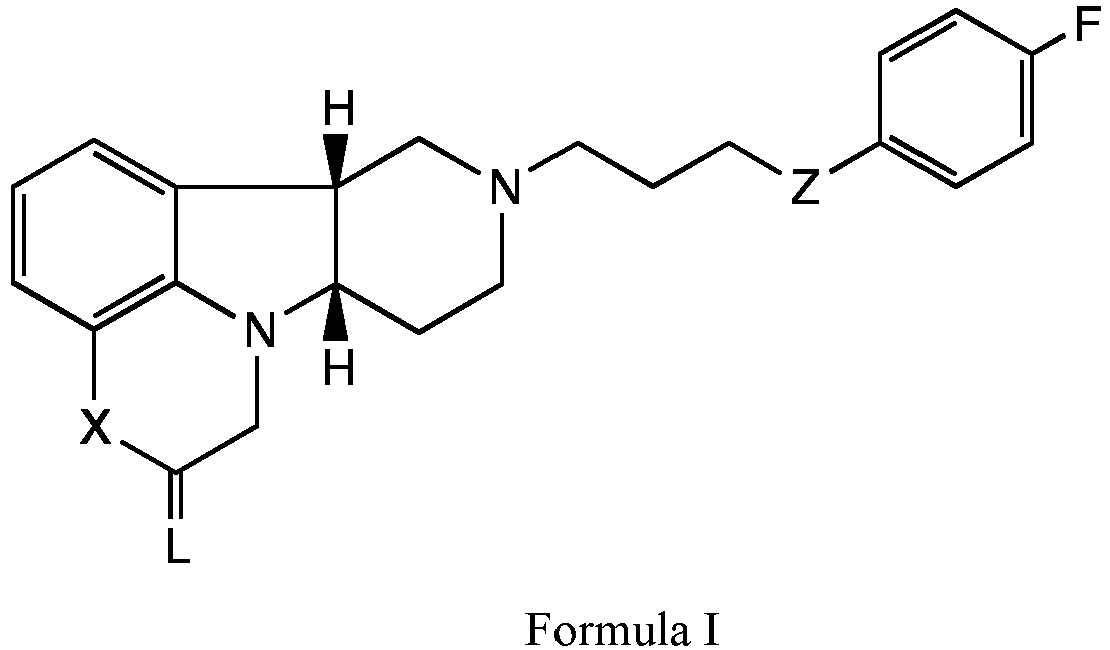
- X is -N(H)-,or -N(CH3)- ;
- L is O;
- Z is -O-;
- optionally in deuterated form,
- In some embodiments X in the compound of Formula I is -N(H);
- In some embodiments X in the compound of Formula I is -N(CH3)-;
- In some embodiments the compound of Formula I is:

- In some embodiments the Compound of Formula I is in the form of the tosylate salt;
- In some embodiments the Compound of Formula I is in the form of the free base;
- In some embodiments the Compound of Formula I is in deuterated form, e.g., wherein the deuterium:protium ratio for a specified carbon-bound hydrogen atom is significantly higher, e.g., at least 2x, for example at least 10x higher, than the natural isotope ratios;
- In some embodiments the Compound of Formula I is:

- In some embodiments the compound of Formula I in tosylate salt form is administered in a daily dose equivalent to 1 to 100 mg of free base, e.g., 1 to 75 mg, or 1 to 60 mg, or 1 to 40 mg, or 1 to 20 mg, or 1 to 10 mg, of free base;
- In some embodiments the method comprises once daily administration of a unit dosage for oral administration, for example a tablet or capsule, comprising the compound of Formula I in tosylate salt form in an amount equivalent 1 to 100 mg of free base, e.g., 1 to 75 mg, or 1 to 60 mg, or 1 to 40 mg, or 1 to 20 mg, or 1 to 10 mg, of free base, and a pharmaceutically acceptable diluent or carrier;
- In some embodiments the method comprises once daily administration of a unit dosage for subcutaneous or transmucosal administration, e.g., a sublingual or buccal orally disintegrating tablet or film, comprising the compound of Formula I in tosylate salt form in an amount equivalent to 0.5 to 30 mg of free base, e.g., 1-10 mg of free base, and a pharmaceutically acceptable diluent or carrier;
- In some embodiments the condition to be treated is alleviated within one week, e.g., within three days, e.g., within one day;
- In some embodiments the patient is diagnosed as having suicidal ideation and/or suicidal tendencies;
- In some embodiments the condition to be treated is acute anxiety (e.g., a short-duration anxious episode associated with generalized anxiety disorder, panic disorder, specific phobias, or social anxiety disorder, or social avoidance);
- In some embodiments the condition to be treated is acute depression (e.g., acute major depressive episode, acute short-duration depressive episode, acute recurrent brief depressive episode);
- In some embodiments the condition to be treated is treatment resistant depression (e.g., depression which has not responded to treatment with an antidepressant agent selected from a selective serotonin reuptake inhibitor (SSRI), a serotonin reuptake inhibitor (SRI), a tricyclic antidepressant, a monoamine oxidase inhibitor, a norepinephrine reuptake inhibitor (NRI), a dopamine reuptake inhibitor (DRI), an SRI/NRI, an SRI/DRI, an NRI/DRI, an SRI/NRI/DRI (triple reuptake inhibitor), a serotonin receptor antagonist, or any combination thereof);
- In some embodiments wherein the condition to be treated is selected from bipolar depression and major depressive disorder;
- In some embodiments the Compound of Formula I is in combination (e.g. a fixed combination in a unit dosage form, or a free combination administered sequentially or simultaneously or within a 24-hour period) with an effective amount of an additional anxiolytic or antidepressant agent;
- In some embodiments the anxiolytic or antidepressant agent is selected from one or more compounds in free or pharmaceutically acceptable salt form, selected from selective serotonin reuptake inhibitors (SSRIs), serotonin-norepinephrine reuptake inhibitors (SNRIs), tricyclic antidepressants (TCAs), and atypical antipsychotics, e.g. one or more compounds in free or pharmaceutically acceptable salt form, selected from:
- (a) Selective serotonin reuptake inhibitors (SSRIs), e.g., Citalopram (Celexa), Escitalopram (Lexapro, Cipralex), Paroxetine (Paxil, Seroxat), Fluoxetine (Prozac), Fluvoxamine (Luvox) Sertraline (Zoloft, Lustral);
- (b) Serotonin-norepinephrine reuptake inhibitors (SNRIs), e.g., Desvenlafaxine (Pristiq), Duloxetine (Cymbalta), Levomilnacipran (Fetzima), Milnacipran (Ixel, Savella), Tofenacin (Elamol, Tofacine), Venlafaxine (Effexor);
- (c) Tricyclic antidepressants (TCAs), e.g., Amitriptyline (Elavil, Endep), Amitriptylinoxide (Amioxid, Ambivalon, Equilibrin), Clomipramine (Anafranil), Desipramine (Norpramin, Pertofrane), Dibenzepin (Noveril, Victoril), Dimetacrine (Istonil), Dosulepin (Prothiaden), Doxepin (Adapin, Sinequan), Imipramine (Tofranil), Lofepramine (Lomont, Gamanil), Melitracen (Dixeran, Melixeran, Trausabun), Nitroxazepine (Sintamil), Nortriptyline (Pamelor, Aventyl), Noxiptiline (Agedal, Elronon, Nogedal), Pipofezine (Azafen/Azaphen), Protriptyline (Vivactil), Trimipramine (Surmontil);
- (d) Benzodiazepines, e.g., selected from 2-keto compounds (e.g., clorazepate, diazepam, flurazepam, halazepam, prazepam); 3-hydroxy compounds (lorazepam, lormetazepam, oxazepam, temazepam); 7-nitro compounds (e.g., clonazepam, flunitrazepam, nimetazepam, nitrazepam); triazolo compounds (e.g., adinazolam, alprazolam, estazolam, triazolam); and imidazo compounds (climazolam, loprazolam, midazolam);
- In some embodiments the compound of Formula I is administered intra-nasally, subcutaneously, intravenously, orally, or sub-lingually, or intra-peritoneally or buccally;
- In some embodiments the method further comprises the concurrent administration of another anti-depressant agent (e.g., selected from a selective serotonin reuptake inhibitor (SSRI), a serotonin reuptake inhibitor (SRI), a tricyclic antidepressant, a monoamine oxidase inhibitor, a norepinephrine reuptake inhibitor (NRI), a dopamine reuptake inhibitor (DRI), an SRI/NRI, an SRI/DRI, an NRI/DRI, an SRI/NRI/DRI (triple reuptake inhibitor), a serotonin receptor antagonist, or any combination thereof), e.g., administered simultaneously, separately or sequentially;
- In some embodiments the method further comprises the concurrent administration of an NMDA receptor antagonist, for example, selected from ketamine (e.g., S-ketamine and/or R-ketamine), hydroxynorketamine, memantine, dextromethorphan, dextroallorphan, dextrorphan, amantadine, and agmatine, or any combination thereof, e.g., administered simultaneously, separately or sequentially;
- In some embodiments the method further comprises the concurrent administration of a NMDA receptor allosteric modulator, e.g., a NMDA receptor glycine-site modulator, such as rapastinel, nebostinel, apimostinel, D-cycloserine, or any combination thereof, e.g., administered simultaneously, separately or sequentially;
- In some embodiments the method provides the patient with an acute response to treatment with the therapeutic agent or agents (e.g., the Compound of Formula I, and any additional antidepressant agents);
- In some embodiments the patient shows an acute response to treatment within less than 3 weeks, for example, less than 2 weeks, or less than 1 week, or from 1 to 7 days, or 1 to 5 days, or 1 to 3 days, or 1 to 2 days, or about 1 day, or less than 2 days, or less than 1 day (e.g., 12-24 hours);
- In some embodiments the patient has not responded to, or has not responded adequately to, or who suffers undesirable side effects from, treatment with another antidepressant agent, for example, any one or more of a selective serotonin reuptake inhibitor (SSRI), a serotonin reuptake inhibitor (SRI), a tricyclic antidepressant, a monoamine oxidase inhibitor, a norepinephrine reuptake inhibitor (NRI), a dopamine reuptake inhibitor (DRI), an SRI/NRI, an SRI/DRI, an NRI/DRI, an SRI/NRI/DRI (triple reuptake inhibitor, or a serotonin receptor antagonist;
- In some embodiments the anxiety or depression is not associated with schizophrenia or dementia;
- In some embodiments the patient does not suffer from (or has not been diagnosed with) schizophrenia or dementia;
- In some embodiments the Compound of Formula I has an IC50 of less than 250 nM or an EC50 of less than 250 nM for activity (agonism and/or antagonism) at the 5-HT2A receptor, e.g., an IC50 or EC50 of less than 200 nM, or less than 150 nM, or less than 100 nM, or less than 75 nM, or less than 60 nM, or less than 50 nM, or less than 40 nM, or less than 30 nM, or less than 20 nM, for activity at said receptor (agonism or antagonism);
- In some embodiments the Compound of Formula I has an IC50 of less than 250 nM or an EC50 of less than 250 nM for activity (agonism and/or antagonism) at the mu-opioid receptor, e.g., an IC50 or EC50 of less than 200 nM, or less than 150 nM, or less than 100 nM, or less than 75 nM, or less than 60 nM, or less than 50 nM, or less than 40 nM, or less than 30 nM, or less than 20 nM, for activity at said receptor (agonism or antagonism);
- In some embodiments the Compound of Formula I has an IC50 of less than 250 nM or an EC50 of less than 250 nM for activity (agonism and/or antagonism) at the D1 receptor, e.g., an IC50 or EC50 of less than 200 nM, or less than 150 nM, or less than 100 nM, or less than 75 nM, or less than 60 nM, or less than 50 nM, or less than 40 nM, or less than 30 nM, or less than 20 nM, for activity at said receptor (agonism or antagonism);
- In some embodiments the Compound of Formula I has an IC50 of less than 250 nM or an EC50 of less than 250 nM for activity (agonism and/or antagonism) at the D2 receptor, e.g., an IC50 or EC50 of less than 200 nM, or less than 150 nM, or less than 100 nM, or less than 75 nM, or less than 60 nM, or less than 50 nM, or less than 40 nM, or less than 30 nM, or less than 20 nM, for activity at said receptor (agonism or antagonism);
- In some embodiments the Compound of Formula I has an IC50 of less than 250 nM or an EC50 of less than 250 nM for activity (agonism and/or antagonism) at the serotonin transporter (SERT), e.g., an IC50 or EC50 of less than 200 nM, or less than 150 nM, or less than 100 nM, or less than 75 nM, or less than 60 nM, or less than 50 nM, or less than 40 nM, or less than 30 nM, or less than 20 nM, for activity at said transporter (agonism or antagonism);
- In some embodiments the Compound of Formula I is a biased ligand at the mu-opioid receptor;
- In some embodiments the compound of Formula I, e.g., in tosylate salt form, is administered in the form of a long-acting injectable (LAI) composition, e.g., for intramuscular or subcutaneous injection;
- In some embodiments the dose of the LAI composition is sufficient to provide the equivalent of a daily dose of 1 to 100 mg of free base, e.g., 1 to 75 mg, or 1 to 60 mg, or 1 to 40 mg, or 1 to 20 mg, or 1 to 10 mg, of free base, released over a period of time ranging from about 1 week to about 3 months, e.g., about 1 week to about 8 weeks, or about 1 week to about 6 weeks, or about 1 week to about 4 weeks, or about 1 week to about 3 weeks, or about 1 week to about 2 weeks;
- In some embodiments the LAI composition comprises the compound of Formula I dissolved, dispersed, suspended, or encapsulated in a polymeric matrix;
- In some embodiments the polymeric matrix comprises one or more biocompatible and biodegradable polymers as defined herein, e.g., poly(hydroxycarboxylic acids), poly(amino acids), cellulose polymers, modified cellulose polymers, polyamides, and polyesters;
- In some embodiments the one or more polymers comprises polylactic acid, polyglycolic acid, polycitric acid, polymalic acid, poly-beta-hydroxybutyric acid, poly(lactic acid-glycolic acid) copolymer, 2-hydroxybutyric acid-glycolic acid copolymer, polylactic acid-polyethylene glycol copolymer, polyglycolic acid-polyethylene glycol copolymer, poly (alkyl alpha-cyanoacrylate) such as poly(butyl cyanoacrylate) or poly(2-octyl cyanoacrylate), poly(ortho ester), polycarbonate, polyortho-carbonate, a polyamino acid, (for example poly-gamma.-L-alanine, poly-.gamma.-benzyl-L-glutamic acid or poly-y-methyl-L-glutamic acid), and/or hyaluronic acid ester;
- In some embodiments the one or more polymers comprises polylactic acid, polyglycolic acid, polycitric acid, polymalic acid, or a poly(lactic acid-glycolic acid) copolymer;
- In some embodiments the one or more polymers comprises a poly(lactic acid-glycolic acid) copolymer, e.g., poly-d,l-lactide-co-glycolide;
- In some embodiments the Compound of Formula I is administered as monotherapy, e.g., it is not administered concurrently or in conjunction with an anti-depressant, anti-psychotic, or anti-anxiety agent;
- In some embodiments the Compound of Formula I is administered without the direct supervision of a health care professional (e.g., the compound is self-administered by the patient);
- In some embodiments the method does not comprise supervision or observation of the patient by a health care professional during or after (e.g., within 2 hours after) administration of a dose of the Compound of Formula I ;
- In some embodiments the method does not put the patient at risk for sedation, dissociation, abuse, misuse, or suicidal ideation;
- In some embodiments the method does not result in hypertension (e.g., systolic and/or diastolic hypertension) within four hours after administration of a dose of the Compound of Formula I, e.g., an increase of more than 10 mm Hg, or more than 20 mm Hg, or more than 30 mm Hg, or more than 40 mm Hg, in systolic and/or diastolic blood pressure within 30 minutes to 4 hours after said dose;
- In some embodiments the method does not result in cognitive decline;
- In some embodiments the patient has (e.g., has been diagnosed with) or is at risk of aneurysmal vascular disease (e.g., thoracic aorta, abdominal aorta, intracranial, or peripheral arterial aneurysms), arteriovenous malformation or intracerebral hemorrhage;
- In some embodiments the patient is under concurrent treatment with an oral antidepressant selected from duloxetine, escitalopram, sertraline, or venlafaxine;
- In some embodiments the patient is not under concurrent treatment with an oral antidepressant selected from duloxetine, escitalopram, sertraline, or venlafaxine.
- In some embodiments the patient is unresponsive to, or cannot be treated with ketamine (e.g., S-ketamine), e.g., because it is contraindicated in said patient.
- In another aspect, the disclosure provides the use of a compound of Formula I, as hereinbefore described, in free or salt form, optionally in deuterated form, in in the manufacture of a medicament for the acute treatment of depression or anxiety, e.g., for any of Methods 1, et seq.
- The term "5-HT2A/mu-opioid receptor" ligand refers to a compound which displays, at least, pharmacological activity at both the serotonin 5-HT2A receptor and at the mu-opioid receptor, for example, compounds having an IC50 of less than 250 nM or an EC50 of less than 250 nM for activity (agonism and/or antagonism) at each of said receptors. In some embodiments, this term refers to a compound having an IC50 or EC50 of less than 200 nM, or less than 150 nM, or less than 100 nM, or less than 75 nM, or less than 60 nM, or less than 50 nM, or less than 40 nM, or less than 30 nM, or less than 20 nM, for activity at one or both of these receptors (agonism or antagonism).
- The term "5-HT/D1 and/or D2/mu-opioid receptor ligand" refers to a compound which displays, at least, pharmacological activity at both the serotonin 5-HT2A receptor and at the mu-opioid receptor, and either the D1 or D2 receptor (or both), for example, compounds having an IC50 of less than 250 nM or an EC50 of less than 250 nM for activity (agonism and/or antagonism) at each of said receptors. In some embodiments, this term refers to a compound having an IC50 or EC50 of less than 200 nM, or less than 150 nM, or less than 100 nM, or less than 75 nM, or less than 60 nM, or less than 50 nM, or less than 40 nM, or less than 30 nM, or less than 20 nM, for activity at one or both of these receptors (agonism or antagonism).
- The words "treatment" and "treating" are to be understood accordingly as embracing prophylaxis and treatment or amelioration of symptoms of disease and/or treatment of the cause of the disease. In particular embodiments, the words "treatment" and "treating" refer to prophylaxis or amelioration of symptoms of the disease.
- The term "patient" may include a human or non-human patient.
- The Diagnostic and Statistical Manual of Mental Disorders, 5th Edition ("DSM-5"), defines "major depressive disorder" (MDD) as having five or more of a set of symptoms during the same two-week period of time, which symptoms represent a change from the patient's previous functioning. The five symptoms are selected from depressed mood, markedly diminished interest or pleasure in almost all activities, significant weight changes, insomnia or hyposomnia, psychomotor agitation or retardation, fatigue, feelings of worthlessness or excessive guilt, diminished ability to think or indecisiveness, and recurrent thoughts of death or suicidal ideation, wherein each of such symptoms is present nearly every day. At a minimum, MDD diagnosis requires at least depressed mood or loss of interest or pleasure as one of the five symptoms. MDD may consist of one or more "major depressive episodes" which can be spaced many weeks or months apart (more than 2 weeks apart to qualify as separate episodes). The DSM-5 notes that there is a risk of suicidal behavior at all time during a major depressive episode.
- By its nature, MDD is an acute disorder in so far as the DSM-5 distinguishes it from "persistent depressive disorder", in which a patient has many of the same symptoms as for MDD, but which persists for at least a 2-year period. In addition to MDD, the DSM-5 also defines a "short-duration depressive episode" as having a depressed affect and at least four of the other symptoms which define MDD for at least 4 days, but less than 14 days. The DSM further defines "recurrent brief depression" as the concurrent presence of depressed mood and at least four other symptoms of depression for 2 to 13 days at least once per month, and persisting for at least 12 consecutive months. Thus, recurrent brief depression similarly consists of brief episodes of depression which recur regularly.
- The DSM-5 also includes major depressive episodes as one of the diagnostic criteria for a patient suffering from bipolar disorder. Thus, a patient presenting a major depressive episode may be suffering from either major depressive disorder or bipolar disorder.
- It is apparent that there are is a particular need for effective treatment of depression during the earliest stages of a major depressive episode, since each day of such episode can have profound consequences for a patient, yet typical SSRI anti-depressive agents take up to 2-4 weeks for beneficial effects to appear. The same is true for treatment of short duration depressive episodes as well as individual episodes of recurrent brief depression.
- The DSM-5 categorizes what has traditionally been termed "post partum depression" or "peri-partum depression" as a merely a sub-type of the DSM's recognized depressive disorders, rather than as an independent depressive disorder. Thus, both major depressive disorder and acute depressive disorders can be diagnosed as being "with peripartum onset" (DSM-5 also does not distinguish peri- versus post-partum). Thus, as used herein, any of the depression indications may be considered to include such depression indication with peri-partum or post-partum onset, and thus, these indications embrace post-partum and peri-partum depression as well.
- Thus, as used herein, the term "acute depression" refers to the initial period of what may be a brief or a chronic episode of depression (e.g., lasting 2 days to 2 weeks, or 2 weeks to 2 months, or 2 months to 2 years, or more). "Acute depression" may thus refer to the initial period of a major depressive episode, a short-duration depressive episode, or a recurrent brief depressive episode. There is a particular need in the art for the treatment of such acute stages of depressive episodes. A treatment initiated during this acute phase of depression may be continued indefinitely in those patients which respond thereto.
- The DSM-5 defines a variety of anxiety disorders, including generalized anxiety disorder, panic disorder, social anxiety disorder, and specific phobias. Like the depressive disorders discussed above, anxiety disorders can be marked by recurrent episodes of short duration, such as panic attacks, which may persist over the course of a chronic disorder. For example, generalized anxiety disorder is defined by the DSM-5 to require excessive anxiety and worry occurring more days that not for at least 6 months, about a number of events or activities. A panic attack is defined as an abrupt surge of intense fear or intense discomfort that reaches a peak within minutes, but it can repeatedly recur in response to either expected stimuli or unexpected stimuli. Thus, as for the depressive disorders described above, there is a need for rapidly-acting anxiolytic agents that can treat the symptoms of anxiety or panic, yet some of the most common treatments for anxiety disorders are the SSRIs and other antidepressant agents which take 2-4 weeks to provide relief.
- As used herein, "acute anxiety" refers to any short-duration episode of anxiety, e.g., lasting from one day or less to one week, which may be part of a chronic course of anxiety (e.g., lasting 2 days to 2 weeks, or 2 weeks to 2 months, or 2 months to 2 years, or more). "Acute anxiety" may thus include a panic attack or any specific instance of an anxious response to triggering stimuli or events (e.g., to the stimuli which trigger a specific phobia, the events which trigger social anxiety or generalized anxiety). There is a particular need in the art for the treatment of such acute stages of anxious episodes. A treatment initiated during this acute phase of anxiety may be continued indefinitely in those patients which respond thereto.
- Social avoidance can be a critical and debilitating symptom in patients suffering from anxiety disorders, especially social anxiety disorder, as well as in patients suffering from traumatic anxiety disorders. Social avoidance is often one of the key determinants of whether a person with a severe anxiety disorder is capable of maintaining familial relationships or employment relationships. It has been unexpectedly found that certain substituted fused gamma carbolines having 5-HT2A and dopamine receptor activity, such as the compound of Formula A (lumateperone), are effective in treating the emotional experience symptoms of psychiatric disorders (e.g., the emotional experience negative symptoms of schizophrenics). Negative symptoms of schizophrenia can be divided into two categories: emotional experience (e.g., emotional withdrawal, passive social withdrawal, active social avoidance) and emotional expression (e.g., blunted effect, poor rapport, lack of spontaneity, and motor retardation). In two clinical studies of patients with acute exacerbated schizophrenia, administration of lumateperone once daily (60 mg P.O.), for up to 28 days, resulted in a significant and unexpected improvement in symptoms of emotional experience compared to placebo. These are the symptoms that are most highly correlated with interpersonal functioning. As such, such compounds, including the compounds of Formula I, may be highly effective in treating the emotional experience symptoms of other psychiatric disorders, such as social anxiety disorders, or any other psychiatric disorders in which social withdrawal and social avoidance are symptoms.
- If not otherwise specified or clear from context, the following terms herein have the following meanings:
- "Alkyl" as used herein is a saturated or unsaturated hydrocarbon moiety, e.g., one to twenty-one carbon atoms in length, which may be linear or branched (e.g., n-butyl or tert-butyl), preferably linear, unless otherwise specified. For example, "C1-21 alkyl" denotes alkyl having 1 to 21 carbon atoms. In one embodiment, alkyl is optionally substituted with one or more hydroxy or C1-22alkoxy (e.g., ethoxy) groups. In another embodiment, alkyl contains 1 to 21 carbon atoms, preferably straight chain and optionally saturated or unsaturated, for example R1 is an alkyl chain containing 1 to 21 carbon atoms, preferably 6-15 carbon atoms, 16-21 carbon atoms, e.g., so that together with the -C(O)- to which it attaches, e.g., when cleaved from the compound of Formula I, forms the residue of a natural or unnatural, saturated or unsaturated fatty acid.
- The 5-HT2A/mu-opioid receptor or 5-HT2A/D1 and/or D2/mu-opioid receptor ligand, for example a substituted heterocycle fused gamma-carbolines as described herein may be in free, or pharmaceutically acceptable salt form. Pharmaceutically acceptable salts of such compounds (e.g., Compound of Formula I) or of Compounds of Formula II include, for example, acid addition salts formed using any of the following acids: hydrochloric, hydrobromic, sulfuric, sulfamic, phosphoric, nitric, acetic, propionic, succinic, glycolic, stearic, lactic, malic, tartaric, citric, ascorbic, maleic, phenylacetic, glutamic, benzoic, salicylic, sulfanilic, fumaric, toluenesulfonic, methanesulfonic, ethanedisulfonic, oxalic, and isethionic. Where dosages or amounts of a salt are given by weight, e.g., milligrams per day or milligrams per unit dose, the dosage amount of the salt is given as the weight of the corresponding free base, unless otherwise indicated.
- In any and all embodiments described herein, the 5-HT2A/mu-opioid receptor or 5-HT2A /D1 and/or D2/mu-opioid receptor ligand may also be a SERT ligand, i.e., said compounds may be a 5-HT2A/SERT or a 5-HT2A/D1 and/or D2/SERT receptor ligand.
- The term "concurrently" when referring to a therapeutic use means administration of two or more active ingredients to a patient as part of a regimen for the treatment of a disease or disorder, whether the two or more active agents are given at the same or different times or whether given by the same or different routes of administrations. Concurrent administration of the two or more active ingredients may be at different times on the same day, or on different dates or at different frequencies.
- The term "simultaneously" when referring to a therapeutic use means administration of two or more active ingredients at or about the same time by the same route of administration.
- The term "separately" when referring to a therapeutic use means administration of two or more active ingredients at or about the same time by different route of administration.
- With respect to concurrent treatment using a 5-HT2A/mu-opioid receptor or 5-HT2A/D1 and/or D2/mu-opioid receptor ligand (e.g., a compound of Formula I) and an NMDA receptor antagonist (e.g., ketamine), without being bound by theory, it is believed that the combination of these agents would permit lower doses of both agents to be used to treat depression, or other neuropsychiatric disorders described herein, such that the dissociative effects produced by the NMDA receptor antagonist would be minimized while the synergistic antidepressants effects would be maximized.
- Dosages employed in practicing the present disclosure will of course vary depending, e.g. on the particular disease or condition to be treated, the particular active compounds used, the mode of administration, and the therapy desired. Unless otherwise indicated, an amount of an active compound for administration (whether administered as a free base or as a salt form) refers to or is based on the amount of the compound in free form (i.e., the calculation of the amount is based on the amount of active moiety in free form, not taking into account the weight of the counter ion in the case of a salt). The 5-HT2A/mu-opioid receptor or 5-HT2A/D1 and/or D2/mu-opioid receptor ligand may be administered by any suitable route, including orally, intramuscularly, subcutaneously, parenterally or transdermally, but are preferably administered orally. The 5-HT2A/mu-opioid receptor or 5-HT2A/D1 and/or D2/mu-opioid receptor ligand may be administered by any suitable route, including oral, parenteral, transdermal, or transmucosal, for example in the form of a tablet, a capsule, a subcutaneous injection, or an oral, rapidly disintegrating tablet or film for sublingual or buccal administration.
- For the avoidance of doubt, any disclosure of a numerical range, e.g., "up to X" amount is intended to include the upper numerical limit X. Therefore, a disclosure of "up to 60 mg" is intended to include 60 mg.
- Pharmaceutical compositions comprising compounds of the Disclosure may be prepared using conventional diluents or excipients and techniques known in the galenic art. Thus, oral dosage forms may include tablets, capsules, solutions, suspensions and the like.
- Compounds of the present disclosure may be included as a depot formulation, e.g., by dispersing, dissolving, suspending, or encapsulating the Compounds of the Invention in a polymeric matrix as described in herein, such that the Compound is continually released as the polymer degrades over time. The release of the Compounds of the Invention from the polymeric matrix provides for the controlled- and/or delayed- and/or sustained-release of the Compounds, e.g., from the pharmaceutical depot composition, into a subject, for example a warm-blooded animal such as man, to which the pharmaceutical depot is administered. Thus, the pharmaceutical depot delivers the Compounds of the Invention to the subject at concentrations effective for treatment of the particular disease or medical condition over a sustained period of time, e.g., 1 week to 3 months.
- Polymers useful for the polymeric matrix in the Composition of the Invention (e.g., Depot composition of the Invention) may include a polyester of a hydroxyfatty acid and derivatives thereof or other agents such as polylactic acid, polyglycolic acid, polycitric acid, polymalic acid, poly-beta.-hydroxybutyric acid, epsilon.-capro-lactone ring opening polymer, lactic acid-glycolic acid copolymer, 2-hydroxybutyric acid-glycolic acid copolymer, polylactic acid-polyethyleneglycol copolymer or polyglycolic acid-polyethyleneglycol copolymer), a polymer of an alkyl alpha-cyanoacrylate (for example poly(butyl 2-cyanoacrylate)), a polyalkylene oxalate (for example polytrimethylene oxalate or polytetramethylene oxalate), a polyortho ester, a polycarbonate (for example polyethylene carbonate or polyethylenepropylene carbonate), a polyortho-carbonate, a polyamino acid (for example poly-gamma.-L-alanine, poly-.gamma.-benzyl-L-glutamic acid or poly-y-methyl-L-glutamic acid), a hyaluronic acid ester, and the like, and one or more of these polymers can be used.
- If the polymers are copolymers, they may be any of random, block and/or graft copolymers. When the above alpha-hydroxycarboxylic acids, hydroxydicarboxylic acids and hydroxytricarboxylic acids have optical activity in their molecules, any one of D-isomers, L-isomers and/or DL-isomers may be used. Among others, alpha-hydroxycarboxylic acid polymer (preferably lactic acid-glycolic acid polymer), its ester, poly-alpha-cyanoacrylic acid esters, etc. may be used, and lactic acid-glycolic acid copolymer (also referred to as poly(lactide-alpha-glycolide) or poly(lactic-co-glycolic acid), and hereinafter referred to as PLGA) are preferred. Thus, in one aspect the polymer useful for the polymeric matrix is PLGA. As used herein, the term PLGA includes polymers of lactic acid (also referred to as polylactide, poly(lactic acid), or PLA). Most preferably, the polymer is the biodegradable poly(d,l-lactide-co-glycolide) polymer, such as PLGA 50:50, PLGA 85:15 and PLGA 90:10
- In a preferred embodiment, the polymeric matrix of the invention is a biocompatible and biodegradable polymeric material. The term "biocompatible" is defined as a polymeric material that is not toxic, is not carcinogenic, and does not significantly induce inflammation in body tissues. The matrix material should be biodegradable wherein the polymeric material should degrade by bodily processes to products readily disposable by the body and should not accumulate in the body. The products of the biodegradation should also be biocompatible with the body in that the polymeric matrix is biocompatible with the body. Particular useful examples of polymeric matrix materials include poly(glycolic acid), poly-D,L-lactic acid, poly-L-lactic acid, copolymers of the foregoing, poly(aliphatic carboxylic acids), copolyoxalates, polycaprolactone, polydioxanone, poly(ortho carbonates), poly(acetals), poly(lactic acid-caprolactone), polyorthoesters, poly(glycolic acid-caprolactone), polyanhydrides, and natural polymers including albumin, casein, and waxes, such as, glycerol mono- and distearate, and the like. The preferred polymer for use in the practice of this invention is dl(polylactide-co-glycolide). It is preferred that the molar ratio of lactide to glycolide in such a copolymer be in the range of from about 75:25 to 50:50.
- Useful PLGA polymers may have a weight-average molecular weight of from about 5,000 to 500,000 Daltons, preferably about 150,000 Daltons. Dependent on the rate of degradation to be achieved, different molecular weight of polymers may be used. For a diffusional mechanism of drug release, the polymer should remain intact until all of the drug is released from the polymeric matrix and then degrade. The drug can also be released from the polymeric matrix as the polymeric excipient bioerodes.
- The PLGA may be prepared by any conventional method, or may be commercially available. For example, PLGA can be produced by ring-opening polymerization with a suitable catalyst from cyclic lactide, glycolide, etc. (see
EP-0058481B2 ; Effects of polymerization variables on PLGA properties: molecular weight, composition and chain structure). - It is believed that PLGA is biodegradable by means of the degradation of the entire solid polymer composition, due to the break-down of hydrolysable and enzymatically cleavable ester linkages under biological conditions (for example in the presence of water and biological enzymes found in tissues of warm-blooded animals such as humans) to form lactic acid and glycolic acid. Both lactic acid and glycolic acid are water-soluble, non-toxic products of normal metabolism, which may further biodegrade to form carbon dioxide and water. In other words, PLGA is believed to degrade by means of hydrolysis of its ester groups in the presence of water, for example in the body of a warm-blooded animal such as man, to produce lactic acid and glycolic acid and create the acidic microclimate. Lactic and glycolic acid are by-products of various metabolic pathways in the body of a warm-blooded animal such as man under normal physiological conditions and therefore are well tolerated and produce minimal systemic toxicity
-

- A mixture of (6bR,10aS)-6b,7,8,9,10,10a-hexahydro-1H-pyrido[3',4':4,5]pyrrolo[1,2,3-de]quinoxalin-2(3H)-one (100mg, 0.436 mmol), 1-(3-chloroproxy)-4-fluorobenzene (100µL, 0.65 mmol) and KI (144mg, 0.87 mmol) in DMF (2 mL) is degassed with argon for 3 minutes and DIPEA (150 µL, 0.87 mmol) is added. The resulting mixture is heated to 78 °C and stirred at this temperature for 2 h. The mixture is cooled to room temperature and then filtered. The filter cake is purified by silica gel column chromatography using a gradient of 0 - 100% ethyl acetate in a mixture of methanol/7N NH3 in methanol (1 : 0.1 v/v) as an eluent to produce partially purified product, which is further purified with a semi-preparative HPLC system using a gradient of 0 - 60% acetonitrile in water containing 0.1% formic acid over 16 min to obtain the title product as a solid (50mg, yield 30%). MS (ESI) m/z 406.2 [M+1]+. 1H NMR (500 MHz, DMSO-d6 ) δ 10.3 (s, 1H), 7.2 - 7.1 (m, 2H), 7.0 - 6.9 (m, 2H), 6.8 (dd, J = 1.03, 7.25 Hz, 1H), 6.6 (t, J = 7.55 Hz, 1H), 6.6 (dd, J = 1.07, 7.79 Hz, 1H), 4.0 (t, J = 6.35 Hz, 2H), 3.8 (d, J = 14.74 Hz, 1H), 3.3 - 3.2 (m, 3H), 2.9 (dd, J = 6.35, 11.13 Hz, 1H), 2.7 - 2.6 (m, 1H), 2.5 - 2.3 (m, 2H), 2.1 (t, J = 11.66 Hz, 1H), 2.0 (d, J = 14.50 Hz, 1H), 1.9 - 1.8 (m, 3H), 1.7 (t, J = 11.04 Hz, 1H).
- Receptor binding is determined for the Compound of Example 1, using the compound of Formula A as a control. The following literature procedures are used: 5-HT2A: Bryant, H.U. et al. (1996), Life Sci., 15:1259-1268; D2: Hall, D.A. and Strange, P.G. (1997), Brit. J. Pharmacol., 121:731-736; D1: Zhou, Q.Y. et al. (1990), Nature, 347:76-80; SERT: Park, Y.M. et al. (1999), Anal. Biochem., 269:94-104; Mu opiate receptor: Wang, J.B. et al. (1994), FEBS Lett., 338:217-222.
- In general, the results are expressed as a percent of control specific binding:


- The IC50 values (concentration causing a half-maximal inhibition of control specific binding) and Hill coefficients (nH) are determined by non-linear regression analysis of the competition curves generated with mean replicate values using Hill equation curve fitting:

- where Y = specific binding, A = left asymptote of the curve, D = right asymptote of the curve, C = compound concentration, C50 = IC50, and nH = slope factor. This analysis was performed using in -house software and validated by comparison with data generated by the commercial software SigmaPlot® 4.0 for Windows® (© 1997 by SPSS Inc.). The inhibition constants (Ki) were calculated using the Cheng Prusoff equation:

- where L = concentration of radioligand in the assay, and KD = affinity of the radioligand for the receptor. A Scatchard plot is used to determine the KD.
- The following receptor affinity results are obtained, using the tosylate salt of a Compound of Formula A as a control:
Receptor Example 1 Formula A (tosylate salt) Ki (nM) or maximum inhibition 5-HT2A 8.3 10 D2 160 49 D1 50 41 SERT 590 16 Mu opiate receptor 11 >10,000 Delta opioid No inhibition Kappa opioid 16% @ 100 nM NOP (Nociceptin Receptor) No inhibition - R-(-)-2,5-dimethoxy-4-iodoamphetamine (DOI) is an agonist of the serotonin 5-HT2 receptor family. When administered to mice, it produces a behavioral profile associated with frequent head twitches. The frequency of these head twitches during a predetermined period of time can be taken as an estimate of 5-HT2 receptor agonism in the brain. Conversely, this behavioral assay can be used to determine 5-HT2 receptor antagonism in the brain by administering the DOI with or without an antagonist and recording the reduction in DOI-induced head twitches after the administration of the antagonist.
- The method of Darmani et al., Pharmacol Biochem Behav. (1990) 36:901-906 is used with some modifications. (±)-DOI HCl is injected subcutaneously and the mice are immediately placed in a conventional plastic cage. The number of head twitches is counted during 6 min, beginning 1 min after DOI administration. The tested compound is administered orally 0.5 hr before the injection of DOI. Results area calculated as the EC50 for reducing DOI-induced head twitches. The results are shown in the following Table:
Compound EC50 (mg/kg, p.o.) Example 1 0.44 Formula A 0.09 - The results show that the compounds of Example 1 potently block DOI head twitch, comparable to the reference compounds Formula A.
- The Mouse Tail Flick Assay is a measure of analgesia, indicated by the pain reflex threshold of restrained mice. Male CD-1 mice are positioned with their tails under a focused beam of a high-intensity infrared heat source, resulting in heating of the tail. The animal can withdraw its tail from the heat source at any time that it becomes uncomfortable. The amount of time (latency) between turning on the heating instrument and the flicking of the mouse's tail out of path of the heat source is recorded. Administration of morphine results in analgesia, and this produces a delay in the mouse's reaction to the heat (increased latency). Prior administration of a morphine (MOR) antagonist, i.e., naloxone (NAL), reverses the effect and results in normal latency time. This test is used as a functional assay to gauge antagonism of mu-opiate receptors.
- Ten male CD-1 mice (about 8 weeks of age) are assigned to each of five treatment groups. The groups are treated as follows: Group (1) [negative control]: administered 0.25% methylcellulose vehicle p.o., 60 minutes before the tail flick test, and saline vehicle 30 minutes before the tail flick test; Group (2) [positive control]: administered 0.25% methylcellulose vehicle p.o., 60 minutes before the test, and 5 mg/kg morphine in saline 30 minutes before the test; Group (3) [positive control]: administered 3 mg/kg naloxone in saline 50 minutes before the test, and 5 mg/kg morphine in saline 30 minutes before the test; Groups (4)-(6): administered either 0.1 mg/kg, 0.3 mg/kg or 1 mg/kg of the test compound in 0.25% methylcellulose vehicle p.o., 60 minutes before the test, and 5 mg/kg morphine in 30 minutes before the test. The results are shown in the following table as mean latency measured in seconds:
Group 1 Veh/Veh Group 2 Veh/Mor Group 3 Nal/Mor Group 4 Cmpd/Mor (0.1 mg/kg) Group 5 Cmpd/Mor (0.3 mg/kg) Group 6 Cmpd/Mor (1 mg/kg) Ex. 1 0.887 8.261 3.013 6.947 5.853 6.537 - The results demonstrate that the compound of Example 1 exerts a blockade of morphine-induced mu-opiate receptor-mediated analgesia.
- In a second study using the mouse tail flick assay as described above, the compound of Example 1 is further compared at doses of 1.0 mg/kg, 3.0 mg/kg and 10 mg/kg against morphine at 5 mg/kg with and without pre-dosing with naloxone at 3 mg/kg (intraperitoneal). In the pre-treatment groups, the naloxone is administered 20 minutes prior to the tail flick test. In the non-pre-treatment controls, saline is administered 20 minutes prior to the tail flick test. In each group, the vehicle, morphine or compound of Example 1 is administered 30 minutes before the tail flick test. The results are shown in the table below as mean latency in seconds:
Vehicle Morphine Ex. 1 at 1 mg/kg Ex. 1 at 3 mg/kg Ex. 1 at 10 mg/kg Saline pre-treatment 0.9 9.8 4.1 7.4 9.8 Naloxone pre-treatment 0.8 1.5 1.3 1.7 2.1 - It is found that administration of the compound of Example 1 at all doses significantly increased the latency to tail flick, and that this effect is attenuated by pre-treatment with naloxone. The results demonstrate a dose-dependent analgesic effect produced by the Compound of Example 1, and further suggests that this effect is mediated by mu-opioid receptor agonism.
- The tail flick assay as described above is repeated to determine the time course of analgesia resulting from administration of the compound of Example 1. Mice are administered s.c. either (1) vehicle 30 minutes prior to assay, (2) 5 mg/kg morphine 30 minutes prior to assay,
or (3)-(7) the 1mg/kg of compound of Example 3 30 minutes, 2 hours, 4 hours, 8 hours or 24 hours prior to assay. The results are shown in the table below as mean latency in seconds:Treatment TF Latency (s) Vehicle, 30 min prior 1.30 Morphine, 30 min prior 7.90 Cmpd. Ex. 1, 30 min prior 5.77 Cmpd. Ex. 1, 2 h prior 2.42 Cmpd. Ex. 1, 4 h prior 1.48 Cmpd. Ex. 1, 8 h prior 1.36 Cmpd. Ex. 1, 24 h prior 1.29 - The results show that the Compound of Example 1 produces effective analgesia when administered 30 minutes or 2 hours prior to the tail flick assay (ANOVA, P < 0.001 vs. vehicle). When administered 4 hours, 8 hours, or 24 hours prior to the tail flick assay, the compound of Example 1 at 1 mg/kg does not produce an analgesic effect significantly different from the vehicle control. Thus, the compound of Example 1 does not produce prolonged analgesia, which means that it would have a lower potential for abuse and a lower risk of drug-drug interactions compared to other opiate analgesics.
- The tail flick assay described above is repeated using a test model in which animals receive a 14-day chronic treatment regimen, followed by an acute treatment 30 minutes prior to the tail flick assay. The mice are divided into three broad groups with six sub-groups of 10 mice each. The three groups receive as the chronic treatment either (A) vehicle, (B) compound of Example 1 at 0.3 mg/kg, or (C) compound of Example 1 at 3.0 mg/kg. Each sub-group further receives as the acute treatment either (1) vehicle, or (2)-(6) the compound of Example 1 at 0.01, 0.03, 0.1, 0.3 or 1.0 mg/kg. All treatments are administered s.c. The results are shown in the table below as mean latency to tail flick in seconds:
Group Chronic Treatment Acute Treatment Latency (s) (A) Vehicle Vehicle 1.09 Vehicle Ex. 1, 0.01 mg/kg 1.87 Vehicle Ex. 1, 0.03 mg/kg 2.50 Vehicle Ex. 1, 0.1 mg/kg 5.26 Vehicle Ex. 1, 0.3 mg/kg 8.26 Vehicle Ex. 1, 1.0 mg/kg 9.74 (B) Ex. 1, 0.3 mg/kg Vehicle 0.893 Ex. 1, 0.3 mg/kg Ex. 1, 0.01 mg/kg 1.66 Ex. 1, 0.3 mg/kg Ex. 1, 0.03 mg/kg 1.30 Ex. 1, 0.3 mg/kg Ex. 1, 0.1 mg/kg 2.60 Ex. 1, 0.3 mg/kg Ex. 1, 0.3 mg/kg 3.93 Ex. 1, 0.3 mg/kg Ex. 1, 1.0 mg/kg 5.64 (C) Ex. 1, 3.0 mg/kg Vehicle 1.04 Ex. 1, 3.0 mg/kg Ex. 1, 0.01 mg/kg 1.64 Ex. 1, 3.0 mg/kg Ex. 1, 0.03 mg/kg 1.80 Ex. 1, 3.0 mg/kg Ex. 1, 0.1 mg/kg 3.94 Ex. 1, 3.0 mg/kg Ex. 1, 0.3 mg/kg 4.84 Ex. 1, 3.0 mg/kg Ex. 1, 1.0 mg/kg 7.94 - It is found that 0.1, 0.3 and 1.0 mg/kg acute treatment with the compound of Example 1 produces a statistically significant dose-dependent analgesic effect compared to in-group acute treatment with vehicle. This is true for each of the chronic groups (A), (B) and (C). As compared to pre-treatment with vehicle, pre-treatment with the compound of Example 1 at 0.3 mg/kg or 3.0 mg/kg generally showed a statistically significant decrease in tail flick latency when the same acute treatment subgroups are compared. These results demonstrate that while some tolerance to the analgesic effect of the compound of Example 3 occurs after 14-days of chronic treatment, the analgesia obtained remains effective despite chronic pre-treatment.
- The compound of Example 1 is tested in CHO-K1 cells expressing hOP3 (human mu-opiate receptor µ1 subtype) using an HTRF-based cAMP assay kit (cAMP Dynamic2 Assay Kit, from Cisbio, # 62AM4PEB). Frozen cells are thawed in a 37 °C water bath and are resuspended in 10 mL of Ham's F-12 medium containing 10% FBS. Cells are recovered by centrifugation and resuspended in assay buffer (5 nM KCl, 1.25 mM MgSO4, 124 mM NaCl, 25 mM HEPES, 13.3 mM glucose, 1.25 mM KH2PO4, 1.45 mM CaCl2, 0.5 g/L protease-free BSA, supplemented with 1mM IBMX). Buprenorphine, a mu-opiate receptor partial agonist, and naloxone, a mu-opiate receptor antagonist, and DAMGO, a synthetic opioid peptide full agonist, are run as controls.
- For agonist assays, 12 µL of cell suspension (2500 cells/well) are mixed with 6µL forksolin (10 µM final assay concentration), and 6µL of the test compound at increasing concentrations are combined in the wells of a 384-well white plate and the plate is incubated for 30 minutes at room temperature. After addition of lysis buffer and one hour of further incubation, cAMP concentrations are measured according to the kit instructions. All assay points are determined in triplicate. Curve fitting is performed using XLfit software (IDBS) and EC50 values are determined using a 4-parameter logistic fit. The agonist assay measures the ability of the test compound to inhibit forskolin-stimulated cAMP accumulation.
- For antagonist assays, 12 µL of cell suspension (2500 cells/well) are mixed with 6µL of the test compound at increasing concentrations, and combined in the wells of a 384-well white plate and the plate is incubated for 10 minutes at room temperature. 6µL of a mixture of DAMGO (D-Ala2-N-MePhe4-Gly-ol-enkephelin, 10 nM final assay concentration) and forksolin (10 µM final assay concentration) are added, and the plates are incubated for 30 minutes at room temperature. After addition of lysis buffer, and one hour of further incubation, cAMP concentrations are measured according the kit instructions. All assay points are determined in triplicate. Curve fitting is performed using XLfit software (IDBS) and IC50 values are determined using a 4-parameter logistic fit. Apparent dissociation constants (KB) are calculated using the modified Cheng-Prusoff equation. The antagonist assay measures the ability of the test compound to reverse the inhibition of forskolin-induced cAMP accumulation caused by DAMGO.
- The results are shown the Table below. The results demonstrate that the compound of Example 1 is a weak antagonist of the Mu receptor, showing much higher IC50 compared to naloxone, and that it is a moderately high affinity, but partial agonist, showing only about 22% agonist activity relative to DAMGO (as compared to about 79% activity for buprenorphine relative to DAMGO). The compound of Example 1 is also shown to have moderately strong partial agonist activity.
Compound Antagonist IC50 (nM) Agonist EC50 (nM) KB (nM) Naloxone 5.80 - 0.65 DAMGO - 1.56 - Buprenorphine - 0.95 - Cmpd. Ex. 1 641 64.5 71.4 - Buprenorphine is a drug used for chronic pain treatment and for opiate withdrawal, but it suffers from the problem that users can become addicted due to its high partial agonist activity. To offset this, the commercial combination of buprenorphine with naloxone is used (sold as Suboxone). Without being bound by theory, it is believed that the compounds used in the present invention, which are weaker partial Mu agonists than buprenorphine, with some moderate antagonistic activity, will allow a patient to be more effectively treated for pain and/or opiate withdrawal with lower risks of addiction.
- In additional related study using a recombinant human MOP-beta-arresting signaling pathway, it is found that the Compound of Example 1 does not stimulate beta-arrestin signaling via the MOP receptor at concentrations up to 10 µM, but that it is an antagonist with an IC50 of 0.189 µM. In contrast, the full opioid agonist Met-enkephalin stimulates beta-arrestin signaling with an EC50 of 0.08 µM.
- The Compound of Formula A, like the Compounds of Formula I, and the compound of Example 1, are both active at the D1 receptor. The Compound of Formula A has a D1 receptor Ki of 41 nM, while the compound of Example 1 has a D1 receptor Ki of 50 nM. As a result, it is believed that the compound of Example 1 has similar effects on NMDA, AMPA and mTOR signaling as the Compound of Formula A.
- It is known that upstream and downstream effectors of the mTOR (e.g., mTORC1) signaling pathway are increased in the mPFC (medial pre-frontal cortex) of rats 1 hour and 24 hours after administration of the rapid-acting antidepressant ketamine. Ketamine is thus used as a positive control and compared to the effects of Compound of Formula A on the same signaling pathway. In this study, Compound of Formula A is given at different doses ranging from 1 to 8 mg/kg (i.p.) to adult rats and brain samples are analyzed 60 min, 90 min or 24 hours later. Results show that, like ketamine (30 mg/kg), the Compound of Formula A rapidly activates the mTORC1 signaling pathway in mPFC, and particularly in those intracellular cascades involved in synaptic plasticity (i.e., p-Akt thr308 and p-P70S6K). More precisely, the Compound of Formula A has a longer lasting effect compared with ketamine (30 mg/kg) on phospho-protein levels at 24 hours, which is consistent with the longer-lasting pharmacokinetic profile of lumateperone in vivo.
- The Compound of Formula A, given alone, uniquely enhances both NMDA and AMPA receptor currents in mPFC neurons via activation of D1 receptors. The Compound of Formula A, alone, in a bath applied to rat mPFC slices (3-100nM) enhanced NMDA and AMPA currents 5 min later measured using intracellular whole-cell patch clamp techniques (Björkholm et al., 2015). The effect of the Compound of Formula A (30nM) (*p<0.05; **p<.01, t-test) is fully blocked in the presence of the D1 receptor antagonist, SCH-23390 (1µM) (*p<0.05; **p<.01; ##, p<.01, t-test). Combined administration of the antipsychotic, olanzapine, and the SSRI, fluoxetine, similarly induces rapid antidepressant activity in humans and animals (Tohen et al., 2010); likewise, combined application of olanzapine and fluoxetine is required to induce AMPA receptor currents in vitro.
- Results show that while the Compound of Formula A at 30 nM concentration produces almost 150% increased NMDA-induced currents in rat mPFC compared to control, the combination of the Compound of Formula A (30 nM) and SCH 23390 (1 µM) results in a reduction in NMDA-induced currents compared to control (about 90% of control). Substantially the same results are observed for AMPA-induced currents. In contrast, the antipsychotic drug olanzapine, is found to enhance AMPA-induced currents only in the presence of the SSRI fluoxetine. 3 nM olanzapine alone results in about 100% of the AMPA-induced current of the control, while 100 nM fluoxetine results in about 90% of the AMPA-induced current of the control. However, the combination of 3 nM olanzapine and 100 nM fluoxetine is found to synergistically result in almost 150% of the AMPA-induced current of control. When SCH 23390 (1 µM) is combined with the olanzapine and fluoxetine, however, the AMPA-induced current returns to approximately 100% of the control level.
- The effects of the Compound of Formula A and ketamine on the phosphorylation of mTOR pathway proteins in rat PFC at 24 hours post-administration has also been studied. In this experiment, rats (N = 8 / group) are treated with one intraperitoneal injection (acutely) with either 30 mg/kg ketamine, or 3 mg/kg the Compound of Formula A in a vehicle of: 5% DMSO, 5% Tween20, 15% PEG400 and 75% water, and sacrificed 24h later. Pre-frontal cortical phosphorylation levels of AKT (at Threonine 308), mTOR (at Serine 2448) or P70s6 kinase (at Threonine 389) are evaluated after normalization to total protein levels for each target, at both 1 hour and 24 hours. It is found that both the Compound of Formula A and ketamine increase phosphorylation of AKT at thr308 at both 1 hour and 24 hours post-administration (approx. a 50% increase in phosphorylation). Neither ketamine nor the Compound of Formula A results in a change in mTOR phosphorylation. Ketamine is found to transiently increase p70s6K phosphorylation, an effect which attenuates over the 24-time period, whereas the Compound of Formula A progressively increases p7-s6K phosphorylation over the 24 hour period. Overall, these results show the Compound of Formula A alters the mTORC1 signaling pathways in the same way as ketamine, but with more prolonged effects.
- The Compound of Formula A thus enhances both NMDA and AMPA-induced currents in mPFC pyramidal neurons via activation of D1 receptors. These changes have been implicated in the mechanism of action of rapid-acting antidepressants. The Compound of Formula A alone activates AMPA-type receptor currents in mPFC in a manner previously reported only after combined application of an antipsychotic drug (e.g., olanzapine, asenapine, brexpiprazole, or risperidone) and a selective serotonin reuptake inhibitor (SSRI; fluoxetine or citalopram), or after ketamine, which also exhibits rapid onset antidepressant activity in humans.
- Additionally, the Compound of Formula A, like ketamine, increases protein phosphorylation of key proteins in the mTOR pathway, including the protein kinase, Akt, and p70S6 kinase, further supporting activation of a common pathway by lumateperone and ketamine. Clinically, combined adjunctive treatment with a low-dose of APD (e.g., olanzapine, quetiapine, or aripiprazole), and an SSRI, like fluoxetine, induces rapid, sustained antidepressant effects in patients with TRD. These data support that the Compound of Formula A achieves enhanced glutamatergic neurotransmission, owing to multiple pharmacological properties, including its uniquely potent activity (among antipsychotic medications) as a SERT inhibitor and its ability to enhance dopamine neurotransmission via D1 receptors.
- Together these studies further elucidate the signaling pathways that underlie the Compound of Formula A administration, supporting a fast-acting antidepressant action via indirect dopamine D1 receptor- dependent enhancement of NMDA and AMPA currents coupled with activation of the mTORC1 signaling pathway. Based on these data the Compound of Formula A may be useful as a single, stand-alone, orally-available, rapid-acting treatment for depression and anxiety, lacking the adverse side effects of ketamine and other current pharmacological approaches.
- The Compounds of Formula I, as disclosed herein, and the compound of Example 1 in particular, are expected to have these same fast-acting antidepressant properties based on D1 receptor- dependent enhancement of NMDA and AMPA currents coupled with activation of the mTORC1 signaling pathway.
Claims (17)
- A Compound of Formula I:
 X is -N(H)-, or -N(CH3)- ;L is O;Z is -O-;optionally in deuterated form,in free or pharmaceutically acceptable salt form for use in a method for the acute treatment of depression and/or anxiety; the method comprising administering to a patient in need thereof, a therapeutically effective amount of a compound of Formula I.
 - The compound of Formula I for use according to claim 1, wherein X in the compound of Formula I is -N(H)-.
- The compound of Formula I for use according to claim 1, wherein X in the compound of Formula I is -N(CH3)-.
- The compound of Formula I for use according to claim 1, wherein the Compound of Formula I is:

- The compound of Formula I for use according to any one of claims 1-4, wherein the Compound of Formula I is in the form of the tosylate salt.
- The compound of Formula I for use according to any one of claims 1-5, wherein the method comprises once daily administration of a unit dosage, for example a tablet or capsule, comprising the compound of Formula I in tosylate salt form in an amount equivalent to 1 to 100 mg of free base, e.g., 1 to 10 mg of free base, and a pharmaceutically acceptable diluent or carrier.
- The compound of Formula I for use according to any one of claims 1-6, wherein the condition to be treated is acute anxiety (e.g., a short-duration anxious episode associated with generalized anxiety disorder, panic disorder, specific phobias, or social anxiety disorder, or social avoidance).
- The compound of Formula I for use according to any one of claims 1-6, wherein the condition to be treated is acute depression (e.g., acute major depressive episode, acute short-duration depressive episode, acute recurrent brief depressive episode).
- The compound of Formula I for use according to any one of claims 1-6, wherein the condition to be treated is treatment resistant depression (e.g., depression which has not responded to treatment with an antidepressant agent selected from a selective serotonin reuptake inhibitor (SSRI), a serotonin reuptake inhibitor (SRI), a tricyclic antidepressant, a monoamine oxidase inhibitor, a norepinephrine reuptake inhibitor (NRI), a dopamine reuptake inhibitor (DRI), an SRI/NRI, an SRI/DRI, an NRI/DRI, an SRI/NRI/DRI (triple reuptake inhibitor), a serotonin receptor antagonist, or any combination thereof).
- The compound of Formula I for use according to any one of claims 1-9, wherein the compound of Formula I is in combination (e.g. a fixed combination in a unit dosage form, or a free combination administered sequentially or simultaneously or within a 24-hour period) with an effective amount of an additional anxiolytic or antidepressant agent, wherein the anxiolytic or antidepressant agent is selected from one or more compounds in free or pharmaceutically acceptable salt form, selected from selective serotonin reuptake inhibitors (SSRIs), serotonin-norepinephrine reuptake inhibitors (SNRIs), tricyclic antidepressants (TCAs), and atypical antipsychotics.
- The compound of Formula I for use according to any one of claims 1-10, wherein the compound of Formula I is administered intra-nasally, subcutaneously, intravenously, orally, or sub-lingually, or intra-peritoneally or buccally.
- The compound of Formula I for use according to any one of claims 1-11, wherein the method further comprises the concurrent administration of an NMDA receptor antagonist, for example, selected from ketamine (e.g., S-ketamine and/or R-ketamine), hydroxynorketamine, memantine, dextromethorphan, dextroallorphan, dextrorphan, amantadine, and agmatine, or any combination thereof, e.g., administered simultaneously, separately or sequentially; or wherein the method further comprises the concurrent administration of a NMDA receptor allosteric modulator, e.g., a NMDA receptor glycine-site modulator, such as rapastinel, nebostinel, apimostinel, D-cycloserine, or any combination thereof, e.g., administered simultaneously, separately or sequentially.
- The compound of Formula I for use according to any one of claims 1-11, wherein the condition to be treated is alleviated within one week, e.g., within three days or within one day.
- The compound of Formula I for use according to any one of claims 1-13, wherein the patient has not responded to, or has not responded adequately to, treatment with another antidepressant agent, for example, any one or more of a selective serotonin reuptake inhibitor (SSRI), a serotonin reuptake inhibitor (SRI), a tricyclic antidepressant, a monoamine oxidase inhibitor, a norepinephrine reuptake inhibitor (NRI), a dopamine reuptake inhibitor (DRI), an SRI/NRI, an SRI/DRI, an NRI/DRI, an SRI/NRI/DRI (triple reuptake inhibitor, or a serotonin receptor antagonist.
- The compound of Formula I for use according to any one of claims 1-14, wherein the patient suffers undesirable side effects from treatment with another antidepressant agent, for example, any one or more of a selective serotonin reuptake inhibitor (SSRI), a serotonin reuptake inhibitor (SRI), a tricyclic antidepressant, a monoamine oxidase inhibitor, a norepinephrine reuptake inhibitor (NRI), a dopamine reuptake inhibitor (DRI), an SRI/NRI, an SRI/DRI, an NRI/DRI, an SRI/NRI/DRI (triple reuptake inhibitor, or a serotonin receptor antagonist.
- The compound of Formula I for use according to any one of claims 1-15, wherein the compound of Formula I is administered as monotherapy, e.g., it is not administered concurrently or in conjunction with an anti-depressant, anti-psychotic, or anti-anxiety agent.
- The compound of Formula I for use according to any one of claims 1-16, wherein the method does not put the patient at risk for sedation, dissociation, abuse, misuse, or suicidal ideation, or does not result in hypertension within four hours after administration of a dose of the compound of Formula I.
Applications Claiming Priority (3)
| Application Number | Priority Date | Filing Date | Title |
|---|---|---|---|
| US201862682554P | 2018-06-08 | 2018-06-08 | |
| US201862780017P | 2018-12-14 | 2018-12-14 | |
| PCT/US2019/036114 WO2019237037A1 (en) | 2018-06-08 | 2019-06-07 | Novel methods |
Publications (3)
| Publication Number | Publication Date |
|---|---|
| EP3801527A1 EP3801527A1 (en) | 2021-04-14 |
| EP3801527A4 EP3801527A4 (en) | 2022-03-30 |
| EP3801527B1 true EP3801527B1 (en) | 2025-02-19 |
Family
ID=68769463
Family Applications (1)
| Application Number | Title | Priority Date | Filing Date |
|---|---|---|---|
| EP19815161.5A Active EP3801527B1 (en) | 2018-06-08 | 2019-06-07 | Fused gamma-carbolines for acute treatment of anxiety or depression |
Country Status (6)
| Country | Link |
|---|---|
| US (2) | US12023331B2 (en) |
| EP (1) | EP3801527B1 (en) |
| CA (1) | CA3102948A1 (en) |
| ES (1) | ES3028377T3 (en) |
| MX (1) | MX2020013335A (en) |
| WO (1) | WO2019237037A1 (en) |
Families Citing this family (18)
| Publication number | Priority date | Publication date | Assignee | Title |
|---|---|---|---|---|
| MX385678B (en) | 2016-01-26 | 2025-03-18 | Intra Cellular Therapies Inc | SUBSTITUTED FUSED HETEROCYCLIC GAMMA-CARBOLINES, PHARMACEUTICAL COMPOSITIONS AND METHODS OF USE. |
| IL297676B2 (en) | 2016-03-25 | 2023-12-01 | Intra Cellular Therapies Inc | A sustained-release or delayed-release pharmaceutical composition comprising a deuterated compound |
| MX2020000967A (en) | 2017-07-26 | 2020-09-28 | Intra Cellular Therapies Inc | Organic compounds. |
| JP7223742B2 (en) * | 2017-07-26 | 2023-02-16 | イントラ-セルラー・セラピーズ・インコーポレイテッド | organic compound |
| CN111107847A (en) | 2017-09-26 | 2020-05-05 | 细胞内治疗公司 | Novel salts and crystals |
| EP3765021A4 (en) | 2018-03-16 | 2022-03-09 | Intra-Cellular Therapies, Inc. | NEW PROCESSES |
| JP7462568B2 (en) | 2018-03-23 | 2024-04-05 | イントラ-セルラー・セラピーズ・インコーポレイテッド | Organic Compounds |
| EP3801527B1 (en) | 2018-06-08 | 2025-02-19 | Intra-Cellular Therapies, Inc. | Fused gamma-carbolines for acute treatment of anxiety or depression |
| WO2020131895A1 (en) * | 2018-12-17 | 2020-06-25 | Intra-Cellular Therapies, Inc. | Substituted heterocycle fused gamma-carbolines synthesis |
| WO2020131899A1 (en) | 2018-12-17 | 2020-06-25 | Intra-Cellular Therapies, Inc. | Organic compound |
| WO2020131911A1 (en) | 2018-12-17 | 2020-06-25 | Intra-Cellular Therapies, Inc. | Substituted heterocycle fused gamma-carbolines synthesis |
| US12195463B2 (en) | 2018-12-21 | 2025-01-14 | Intra-Cellular Therapies, Inc. | Organic compounds |
| WO2020132605A1 (en) | 2018-12-21 | 2020-06-25 | Intra-Cellular Therapies, Inc. | Organic compounds |
| JP7555343B2 (en) * | 2019-01-23 | 2024-09-24 | イントラ-セルラー・セラピーズ・インコーポレイテッド | How to Treat Addiction |
| BR112022000231A2 (en) | 2019-07-07 | 2022-02-22 | Intra Cellular Therapies Inc | new methods |
| WO2022261633A1 (en) * | 2021-06-07 | 2022-12-15 | Intra-Cellular Therapies, Inc. | Novel salts and crystals |
| US12414948B2 (en) | 2022-05-18 | 2025-09-16 | Intra-Cellular Therapies, Inc. | Methods |
| WO2024173901A1 (en) * | 2023-02-17 | 2024-08-22 | Intra-Cellular Therapies, Inc. | Lumateperone and derivatives thereof for modulating the nervous system |
Family Cites Families (107)
| Publication number | Priority date | Publication date | Assignee | Title |
|---|---|---|---|---|
| US2490813A (en) | 1944-11-29 | 1949-12-13 | Standard Oil Co | Continuous process for making aryl amines |
| US3299078A (en) | 1962-10-01 | 1967-01-17 | Smith Kline French Lab | Pyrido [3', 4': 4, 5] pyrrolo [3, 2, 1-hi] indoles and-[3, 2, 1-ij] quinolines |
| US3813392A (en) | 1969-06-09 | 1974-05-28 | J Sellstedt | Pyrrolo(1,2,3-alpha epsilon)quinoxalin-2(3h)-ones and related compounds |
| US4183936A (en) | 1972-06-19 | 1980-01-15 | Endo Laboratories, Inc. | Pyridopyrrolobenzheterocycles |
| US4115577A (en) | 1972-06-19 | 1978-09-19 | Endo Laboratories, Inc. | Pyridopyrrolobenzheterocycles |
| US3914421A (en) | 1972-06-19 | 1975-10-21 | Endo Lab | Pyridopyrrolobenzheterocycles for combatting depression |
| US4238607A (en) | 1972-06-19 | 1980-12-09 | Endo Laboratories Inc. | Pyridopyrrolo benzheterocycles |
| US4001263A (en) | 1974-04-01 | 1977-01-04 | Pfizer Inc. | 5-Aryl-1,2,3,4-tetrahydro-γ-carbolines |
| IE41352B1 (en) | 1974-04-01 | 1979-12-19 | Pfizer | 5-aryl-1,2,3,4-tetrahydro- -carbolines |
| US4219550A (en) | 1978-11-09 | 1980-08-26 | E. I. Du Pont De Nemours And Company | Cis- and trans- octahydropyridopyrrolobenzheterocycles |
| US4389330A (en) | 1980-10-06 | 1983-06-21 | Stolle Research And Development Corporation | Microencapsulation process |
| IE52535B1 (en) | 1981-02-16 | 1987-12-09 | Ici Plc | Continuous release pharmaceutical compositions |
| US4530840A (en) | 1982-07-29 | 1985-07-23 | The Stolle Research And Development Corporation | Injectable, long-acting microparticle formulation for the delivery of anti-inflammatory agents |
| US4522944A (en) | 1982-12-23 | 1985-06-11 | Erba Farmitalia | Carboxamido-derivatives of 5H-1,3,4-thiadiazolo[3,2-a]pyrimidines, compositions and use |
| CH656884A5 (en) | 1983-08-26 | 1986-07-31 | Sandoz Ag | POLYOLESTERS, THEIR PRODUCTION AND USE. |
| JPH07110865B2 (en) | 1986-03-19 | 1995-11-29 | クミアイ化学工業株式会社 | Thiadiazolopyrimidin-5-one derivatives and fungicides for agriculture and horticulture |
| DE3786365T2 (en) | 1986-04-07 | 1993-10-21 | Ihara Chemical Ind Co | 5H-1,3,4-thiadiazolo [3,2-a] pyrimidin-5-one derivatives and horticultural and agricultural fungicidal compositions containing them. |
| HU208484B (en) | 1988-08-17 | 1993-11-29 | Chinoin Gyogyszer Es Vegyeszet | Process for producing pharmaceutical composition containing acid additional salt of selegilin as active component for treating schisofrenia |
| US5114976A (en) | 1989-01-06 | 1992-05-19 | Norden Michael J | Method for treating certain psychiatric disorders and certain psychiatric symptoms |
| US5538739A (en) | 1989-07-07 | 1996-07-23 | Sandoz Ltd. | Sustained release formulations of water soluble peptides |
| IT1271352B (en) | 1993-04-08 | 1997-05-27 | Boehringer Ingelheim Italia | INDOLE DERIVATIVES USEFUL IN THE TREATMENT OF DISORDERS OF THE CENTRAL NERVOUS SYSTEM |
| SG47445A1 (en) | 1993-11-19 | 1998-04-17 | Janssen Pharmaceutica Nv | Microencapsulated 3-piperidinyl-substituted1 1 2-benzisoxazoles and 1 2-benzisothiazoles |
| US5576460A (en) | 1994-07-27 | 1996-11-19 | Massachusetts Institute Of Technology | Preparation of arylamines |
| EP0696119B1 (en) | 1994-07-28 | 2003-09-24 | Alcatel | Method for determining a number of discriminated digital data units and for estimation of response time |
| US5648542A (en) | 1996-02-29 | 1997-07-15 | Xerox Corporation | Arylamine processes |
| US5654482A (en) | 1996-02-29 | 1997-08-05 | Xerox Corporation | Triarylamine processes |
| US5648539A (en) | 1996-02-29 | 1997-07-15 | Xerox Corporation | Low temperature arylamine processes |
| US5847166A (en) | 1996-10-10 | 1998-12-08 | Massachusetts Institute Of Technology | Synthesis of aryl ethers |
| US5705697A (en) | 1997-01-30 | 1998-01-06 | Xerox Corporation | Arylamine processes |
| US5723671A (en) | 1997-01-30 | 1998-03-03 | Xerox Corporation | Arylamine processes |
| US5723669A (en) | 1997-01-30 | 1998-03-03 | Xerox Corporation | Arylamine processes |
| TWI242011B (en) | 1997-03-31 | 2005-10-21 | Eisai Co Ltd | 1,4-substituted cyclic amine derivatives |
| US6323366B1 (en) | 1997-07-29 | 2001-11-27 | Massachusetts Institute Of Technology | Arylamine synthesis |
| GB2328686B (en) | 1997-08-25 | 2001-09-26 | Sankio Chemical Co Ltd | Method for producing arylamine |
| US6395939B1 (en) | 1997-10-06 | 2002-05-28 | Massachusetts Institute Of Technology | Diaryl ether condensation reactions |
| CA2322194C (en) | 1998-02-26 | 2011-04-26 | Massachusetts Institute Of Technology | Metal-catalyzed arylations and vinylations of hydrazines, hydrazones, hydroxylamines and oximes |
| US6235936B1 (en) | 1998-02-26 | 2001-05-22 | Massachusetts Institute Of Technology | Metal-catalyzed arylations of hydrazines, hydrazones, and related substrates |
| US5902901A (en) | 1998-05-07 | 1999-05-11 | Xerox Corporation | Arylamine processes |
| US6307087B1 (en) | 1998-07-10 | 2001-10-23 | Massachusetts Institute Of Technology | Ligands for metals and improved metal-catalyzed processes based thereon |
| US7223879B2 (en) | 1998-07-10 | 2007-05-29 | Massachusetts Institute Of Technology | Ligands for metals and improved metal-catalyzed processes based thereon |
| ES2257864T3 (en) | 1998-07-10 | 2006-08-01 | Massachusetts Institute Of Technology | LINKS FOR METALS AND IMPROVED PROCESSES CATALYZED BY METALS BASED ON THE SAME. |
| US6395916B1 (en) | 1998-07-10 | 2002-05-28 | Massachusetts Institute Of Technology | Ligands for metals and improved metal-catalyzed processes based thereon |
| US20010008942A1 (en) | 1998-12-08 | 2001-07-19 | Buchwald Stephen L. | Synthesis of aryl ethers |
| DK1140012T3 (en) | 1998-12-17 | 2004-07-12 | Alza Corp | Conversion of liquid filled gelatin capsules to controlled release systems by multiple coatings |
| US6407092B1 (en) | 1999-04-23 | 2002-06-18 | Pharmacia & Upjohn Company | Tetracyclic azepinoindole compounds |
| PE20010052A1 (en) | 1999-04-23 | 2001-01-27 | Upjohn Co | AZEPININDOL TETRACYCLIC COMPOUNDS AS AGONISTS OR ANTAGONISTS OF THE 5-HT RECEPTOR |
| ES2228549T3 (en) | 1999-06-15 | 2005-04-16 | Bristol-Myers Squibb Pharma Company | GAMMA-CARBOLINS CONDENSED WITH REPLACED HETEROCICLE. |
| US6713471B1 (en) | 1999-06-15 | 2004-03-30 | Bristol-Myers Squibb Pharma Company | Substituted heterocycle fused gamma-carbolines |
| US7071186B2 (en) | 1999-06-15 | 2006-07-04 | Bristol-Myers Squibb Pharma Co. | Substituted heterocycle fused gamma-carbolines |
| US6541639B2 (en) | 2000-07-26 | 2003-04-01 | Bristol-Myers Squibb Pharma Company | Efficient ligand-mediated Ullmann coupling of anilines and azoles |
| US6699852B2 (en) | 2000-12-20 | 2004-03-02 | Bristol-Myers Squibb Pharma Company | Substituted pyridoindoles as serotonin agonists and antagonists |
| US6849619B2 (en) | 2000-12-20 | 2005-02-01 | Bristol-Myers Squibb Company | Substituted pyridoindoles as serotonin agonists and antagonists |
| DK2272813T3 (en) | 2001-04-24 | 2017-02-27 | Massachusetts Inst Of Tech (Mit) | COPPER CATALYST CREATION OF CARBON OXYGEN COMPOUNDS |
| DE60206636T2 (en) | 2001-08-08 | 2006-06-22 | Pharmacia & Upjohn Co. Llc, Kalamazoo | THERAPEUTIC 1H-PYRIDO [4,3-b] INDOLE |
| EP1314554A1 (en) | 2001-11-23 | 2003-05-28 | Kba-Giori S.A. | Removing device for security-elements |
| RU2321391C2 (en) | 2002-07-29 | 2008-04-10 | Алза Корпорейшн | Methods and medicinal formulations for controlled delivery of paliperidone |
| US20050232995A1 (en) | 2002-07-29 | 2005-10-20 | Yam Nyomi V | Methods and dosage forms for controlled delivery of paliperidone and risperidone |
| AU2003257062A1 (en) | 2002-08-02 | 2004-02-23 | Massachusetts Institute Of Technology | Copper-catalyzed formation of carbon-heteroatom and carbon-carbon bonds |
| WO2004041281A1 (en) | 2002-11-01 | 2004-05-21 | Oregon Health And Science University | Treatment of hyperkinetic movement disorder with donepezil |
| US7223870B2 (en) | 2002-11-01 | 2007-05-29 | Pfizer Inc. | Methods for preparing N-arylated oxazolidinones via a copper catalyzed cross coupling reaction |
| AU2003303210A1 (en) | 2002-12-19 | 2004-07-14 | Bristol-Myers Squibb Company | Substituted tricyclic gamma-carbolines as serotonin receptor agonists and antagonists |
| WO2005009956A1 (en) | 2003-07-21 | 2005-02-03 | Smithkline Beecham Corporation | (2s,4s)-4-fluoro-1-[4-fluoro-beta-(4-fluorophenyl)-l-phenylalanyl]-2-pyrrolidinecarbonitrile p-toluenesulfonic acid salt and anhydrous crystalline forms thereof |
| JP2005259113A (en) | 2004-02-12 | 2005-09-22 | Ricoh Co Ltd | Process editing apparatus, process management apparatus, process editing program, process management program, recording medium, process editing method and process management method |
| US20080280941A1 (en) | 2004-03-05 | 2008-11-13 | Pierre Lourtie | 8-Phenoxy-Gamma Carboline Derivatives |
| US20050222209A1 (en) | 2004-04-01 | 2005-10-06 | Zeldis Jerome B | Methods and compositions for the treatment, prevention or management of dysfunctional sleep and dysfunctional sleep associated with disease |
| US7592454B2 (en) | 2004-04-14 | 2009-09-22 | Bristol-Myers Squibb Company | Substituted hexahydro-pyridoindole derivatives as serotonin receptor agonists and antagonists |
| WO2006034187A2 (en) | 2004-09-20 | 2006-03-30 | Mount Sinai School Of Medicine | Use of memantine (namenda) to treat autism, compulsivity, and impulsivity |
| BRPI0515528A (en) | 2004-09-21 | 2008-07-29 | Pfizer Prod Inc | n-methyl hydroxyethylamine useful in treating central nervous system conditions |
| US7614727B2 (en) | 2004-09-30 | 2009-11-10 | Fujifilm Corporation | Liquid ejection head, manufacturing method thereof, and image forming apparatus |
| WO2006061392A2 (en) | 2004-12-07 | 2006-06-15 | Janssen Pharmaceutica N.V. | Substituted tetracyclic tetrahydrofuran, pyrrolidine and tetrahydrothiophene derivatives |
| ATE457989T1 (en) | 2004-12-15 | 2010-03-15 | Hoffmann La Roche | BI- AND TRIZYCLIC SUBSTITUTED PHENYL-METHANONES AS INHIBITORS OF GLYCINE-I (GLYT-1) TRANSPORTERS FOR THE TREATMENT OF ALZHEIMER'S DISEASE |
| AU2006208201A1 (en) | 2005-01-25 | 2006-08-03 | Celgene Corporation | Methods and compositions using 4-amino-2-(3-methyl-2,6-dioxopiperidin-3-yl)-isoindole-1-3-dione |
| EP1919287A4 (en) | 2005-08-23 | 2010-04-28 | Intra Cellular Therapies Inc | ORGANIC COMPOUNDS FOR TREATING A REDUCED DOPAMINE RECEPTOR ACTIVITY SIGNAL |
| MX2008009022A (en) | 2006-01-13 | 2008-09-24 | Wyeth Corp | Sulfonyl substituted 1h-indoles as ligands for the 5-hydroxytryptamine receptors. |
| WO2008030651A1 (en) | 2006-09-08 | 2008-03-13 | Braincells, Inc. | Combinations containing a 4-acylaminopyridine derivative |
| EP3663294A1 (en) | 2007-03-12 | 2020-06-10 | Intra-Cellular Therapies, Inc. | Substituted heterocycle fused gamma-carbolines synthesis |
| WO2009017836A1 (en) | 2007-08-01 | 2009-02-05 | Medivation Neurology, Inc. | Methods and compositions for treating schizophrenia using antipsychotic combination therapy |
| NZ586963A (en) | 2008-02-05 | 2012-11-30 | Clera Inc | Use of dopamine d2 receptor inhibitors for alleviating depression or improving cognition |
| ES2530090T3 (en) | 2008-03-12 | 2015-02-26 | Intra-Cellular Therapies, Inc. | Gamma-carboline solid fused with substituted heterocycle |
| WO2009145900A1 (en) | 2008-05-27 | 2009-12-03 | Intra-Cellular Therapies, Inc. | Methods and compositions for sleep disorders and other disorders |
| US8309772B2 (en) | 2008-07-31 | 2012-11-13 | Celanese International Corporation | Tunable catalyst gas phase hydrogenation of carboxylic acids |
| JP5894574B2 (en) | 2010-04-22 | 2016-03-30 | イントラ−セルラー・セラピーズ・インコーポレイテッドIntra−Cellular Therapies, Inc. | Organic compounds |
| US9737531B2 (en) | 2012-07-12 | 2017-08-22 | Glytech, Llc | Composition and method for treatment of depression and psychosis in humans |
| WO2013155505A1 (en) | 2012-04-14 | 2013-10-17 | Intra-Cellular Therapies, Inc | Organic compounds |
| US9708322B2 (en) | 2013-03-15 | 2017-07-18 | Intra-Cellular Therapies, Inc. | Substituted pyrido[3',4':4,5]pyrrolo[1,2,3-de]quinoxalines for inhibiting serotonin reuptake transporter activity |
| EP3479825B1 (en) | 2013-03-15 | 2021-02-17 | Intra-Cellular Therapies, Inc. | Pde1 inhibitors for use in the treatment and/or prevention of cns or pns diseases or disorders |
| KR102373288B1 (en) | 2013-12-03 | 2022-03-10 | 인트라-셀룰라 써래피스, 인코퍼레이티드. | Novel methods |
| AU2015240526A1 (en) | 2014-04-04 | 2016-11-24 | Intra-Cellular Therapies, Inc. | Organic compounds |
| JP2017509686A (en) | 2014-04-04 | 2017-04-06 | イントラ−セルラー・セラピーズ・インコーポレイテッドIntra−Cellular Therapies, Inc. | Organic compounds |
| WO2015191554A1 (en) | 2014-06-09 | 2015-12-17 | Intra-Cellular Therapies, Inc. | Compounds and methods of use to treat schizophrenia |
| MX385678B (en) | 2016-01-26 | 2025-03-18 | Intra Cellular Therapies Inc | SUBSTITUTED FUSED HETEROCYCLIC GAMMA-CARBOLINES, PHARMACEUTICAL COMPOSITIONS AND METHODS OF USE. |
| IL297676B2 (en) | 2016-03-25 | 2023-12-01 | Intra Cellular Therapies Inc | A sustained-release or delayed-release pharmaceutical composition comprising a deuterated compound |
| US10682354B2 (en) | 2016-03-28 | 2020-06-16 | Intra-Cellular Therapies, Inc. | Compositions and methods |
| JP2019513143A (en) | 2016-03-28 | 2019-05-23 | イントラ−セルラー・セラピーズ・インコーポレイテッドIntra−Cellular Therapies, Inc. | Novel salts and crystals |
| WO2017172811A1 (en) | 2016-03-28 | 2017-10-05 | Intra-Cellular Therapies, Inc. | Novel co-crystals |
| US11332469B2 (en) | 2016-08-09 | 2022-05-17 | Teva Pharmaceuticals International Gmbh | Solid state forms of lumateperone ditosylate salt |
| US11291666B2 (en) | 2016-09-12 | 2022-04-05 | Intra-Cellular Therapies, Inc. | Uses |
| US10961245B2 (en) | 2016-12-29 | 2021-03-30 | Intra-Cellular Therapies, Inc. | Substituted heterocycle fused gamma-carbolines for treatment of central nervous system disorders |
| US10906906B2 (en) | 2016-12-29 | 2021-02-02 | Intra-Cellular Therapies, Inc. | Organic compounds |
| IL304026B2 (en) | 2017-03-24 | 2024-11-01 | Intra Cellular Therapies Inc | A PHARMACEUTICAL FORMULATION COMPRISING 1-(4-FLUORO-PHENYL)-4-((6bR,10aS)-2,2-D2-3-METHYL-2,3,6b,9,10,10a-HEXAHYDRO-1H,7H-PYRIDO[3',4':4,5]PYRROLO[1,2,3-de]QUINOXALIN-8-YL)-BUTAN-1-ONE AND USES THEREOF |
| JP7223742B2 (en) | 2017-07-26 | 2023-02-16 | イントラ-セルラー・セラピーズ・インコーポレイテッド | organic compound |
| MX2020000967A (en) | 2017-07-26 | 2020-09-28 | Intra Cellular Therapies Inc | Organic compounds. |
| JP7462568B2 (en) | 2018-03-23 | 2024-04-05 | イントラ-セルラー・セラピーズ・インコーポレイテッド | Organic Compounds |
| EP3801527B1 (en) | 2018-06-08 | 2025-02-19 | Intra-Cellular Therapies, Inc. | Fused gamma-carbolines for acute treatment of anxiety or depression |
| CA3107982A1 (en) | 2018-08-08 | 2020-02-27 | Torralva Medical Therapeutics Llc | Compositions for opiate and opioid prevention and reversal, and methods of their use |
| WO2020132605A1 (en) | 2018-12-21 | 2020-06-25 | Intra-Cellular Therapies, Inc. | Organic compounds |
| EP3965765A4 (en) | 2019-05-07 | 2023-01-04 | Nirsum Laboratories, Inc. | OPIOID RECEPTOR ANTAGONIST PRODRUGS |
-
2019
- 2019-06-07 EP EP19815161.5A patent/EP3801527B1/en active Active
- 2019-06-07 WO PCT/US2019/036114 patent/WO2019237037A1/en not_active Ceased
- 2019-06-07 ES ES19815161T patent/ES3028377T3/en active Active
- 2019-06-07 CA CA3102948A patent/CA3102948A1/en active Pending
- 2019-06-07 MX MX2020013335A patent/MX2020013335A/en unknown
-
2020
- 2020-12-08 US US17/115,416 patent/US12023331B2/en active Active
-
2024
- 2024-05-21 US US18/670,391 patent/US20240307386A1/en active Pending
Also Published As
| Publication number | Publication date |
|---|---|
| US12023331B2 (en) | 2024-07-02 |
| ES3028377T3 (en) | 2025-06-19 |
| EP3801527A4 (en) | 2022-03-30 |
| MX2020013335A (en) | 2021-05-27 |
| US20240307386A1 (en) | 2024-09-19 |
| WO2019237037A1 (en) | 2019-12-12 |
| CA3102948A1 (en) | 2019-12-12 |
| EP3801527A1 (en) | 2021-04-14 |
| US20210093634A1 (en) | 2021-04-01 |
Similar Documents
| Publication | Publication Date | Title |
|---|---|---|
| EP3801527B1 (en) | Fused gamma-carbolines for acute treatment of anxiety or depression | |
| US12496300B2 (en) | Methods of treating acute depression and anxiety | |
| KR102667268B1 (en) | organic compounds | |
| KR20200033307A (en) | Organic compounds | |
| JP7487204B2 (en) | Organic Compounds | |
| US12478623B2 (en) | Methods of treating central nervous system disorders comprising administering lumateperone and a nitric oxide donor | |
| JP2022526596A (en) | How to treat neuropathic pain | |
| JP2022518495A (en) | How to treat addiction | |
| JP2009517393A (en) | How to treat anxiety | |
| HK40060686A (en) | Organic compound | |
| Baudy | Patent Update Central & Peripheral Nervous Systems: Agents for the treatment of neurodegenerative diseases: Part 6 | |
| HK40030440A (en) | Pyridopyrroloquinoxaline compounds, their compositions and uses in therapy | |
| HK40030440B (en) | Pyridopyrroloquinoxaline compounds, their compositions and uses in therapy |
Legal Events
| Date | Code | Title | Description |
|---|---|---|---|
| STAA | Information on the status of an ep patent application or granted ep patent |
Free format text: STATUS: THE INTERNATIONAL PUBLICATION HAS BEEN MADE |
|
| PUAI | Public reference made under article 153(3) epc to a published international application that has entered the european phase |
Free format text: ORIGINAL CODE: 0009012 |
|
| STAA | Information on the status of an ep patent application or granted ep patent |
Free format text: STATUS: REQUEST FOR EXAMINATION WAS MADE |
|
| 17P | Request for examination filed |
Effective date: 20201216 |
|
| AK | Designated contracting states |
Kind code of ref document: A1 Designated state(s): AL AT BE BG CH CY CZ DE DK EE ES FI FR GB GR HR HU IE IS IT LI LT LU LV MC MK MT NL NO PL PT RO RS SE SI SK SM TR |
|
| AX | Request for extension of the european patent |
Extension state: BA ME |
|
| DAV | Request for validation of the european patent (deleted) | ||
| DAX | Request for extension of the european patent (deleted) | ||
| A4 | Supplementary search report drawn up and despatched |
Effective date: 20220301 |
|
| RIC1 | Information provided on ipc code assigned before grant |
Ipc: A61P 25/00 20060101ALI20220223BHEP Ipc: A61K 31/519 20060101ALI20220223BHEP Ipc: A61K 31/554 20060101ALI20220223BHEP Ipc: A61K 31/135 20060101ALI20220223BHEP Ipc: A61K 31/4985 20060101AFI20220223BHEP |
|
| P01 | Opt-out of the competence of the unified patent court (upc) registered |
Effective date: 20230517 |
|
| STAA | Information on the status of an ep patent application or granted ep patent |
Free format text: STATUS: EXAMINATION IS IN PROGRESS |
|
| 17Q | First examination report despatched |
Effective date: 20240307 |
|
| REG | Reference to a national code |
Ref country code: DE Ref legal event code: R079 Free format text: PREVIOUS MAIN CLASS: A61K0031498500 Ipc: A61K0031519000 Ref document number: 602019066238 Country of ref document: DE |
|
| GRAP | Despatch of communication of intention to grant a patent |
Free format text: ORIGINAL CODE: EPIDOSNIGR1 |
|
| STAA | Information on the status of an ep patent application or granted ep patent |
Free format text: STATUS: GRANT OF PATENT IS INTENDED |
|
| RIC1 | Information provided on ipc code assigned before grant |
Ipc: A61P 25/00 20060101ALI20240816BHEP Ipc: A61K 31/554 20060101ALI20240816BHEP Ipc: A61K 31/135 20060101ALI20240816BHEP Ipc: A61K 31/4985 20060101ALI20240816BHEP Ipc: A61K 31/519 20060101AFI20240816BHEP |
|
| INTG | Intention to grant announced |
Effective date: 20240916 |
|
| RAP3 | Party data changed (applicant data changed or rights of an application transferred) |
Owner name: INTRA-CELLULAR THERAPIES, INC. |
|
| GRAS | Grant fee paid |
Free format text: ORIGINAL CODE: EPIDOSNIGR3 |
|
| GRAA | (expected) grant |
Free format text: ORIGINAL CODE: 0009210 |
|
| STAA | Information on the status of an ep patent application or granted ep patent |
Free format text: STATUS: THE PATENT HAS BEEN GRANTED |
|
| AK | Designated contracting states |
Kind code of ref document: B1 Designated state(s): AL AT BE BG CH CY CZ DE DK EE ES FI FR GB GR HR HU IE IS IT LI LT LU LV MC MK MT NL NO PL PT RO RS SE SI SK SM TR |
|
| REG | Reference to a national code |
Ref country code: GB Ref legal event code: FG4D |
|
| REG | Reference to a national code |
Ref country code: CH Ref legal event code: EP |
|
| REG | Reference to a national code |
Ref country code: IE Ref legal event code: FG4D |
|
| REG | Reference to a national code |
Ref country code: DE Ref legal event code: R096 Ref document number: 602019066238 Country of ref document: DE |
|
| REG | Reference to a national code |
Ref country code: ES Ref legal event code: FG2A Ref document number: 3028377 Country of ref document: ES Kind code of ref document: T3 Effective date: 20250619 |
|
| REG | Reference to a national code |
Ref country code: NL Ref legal event code: MP Effective date: 20250219 |
|
| PG25 | Lapsed in a contracting state [announced via postgrant information from national office to epo] |
Ref country code: RS Free format text: LAPSE BECAUSE OF FAILURE TO SUBMIT A TRANSLATION OF THE DESCRIPTION OR TO PAY THE FEE WITHIN THE PRESCRIBED TIME-LIMIT Effective date: 20250519 |
|
| PG25 | Lapsed in a contracting state [announced via postgrant information from national office to epo] |
Ref country code: FI Free format text: LAPSE BECAUSE OF FAILURE TO SUBMIT A TRANSLATION OF THE DESCRIPTION OR TO PAY THE FEE WITHIN THE PRESCRIBED TIME-LIMIT Effective date: 20250219 |
|
| PG25 | Lapsed in a contracting state [announced via postgrant information from national office to epo] |
Ref country code: PL Free format text: LAPSE BECAUSE OF FAILURE TO SUBMIT A TRANSLATION OF THE DESCRIPTION OR TO PAY THE FEE WITHIN THE PRESCRIBED TIME-LIMIT Effective date: 20250219 |
|
| PGFP | Annual fee paid to national office [announced via postgrant information from national office to epo] |
Ref country code: DE Payment date: 20250618 Year of fee payment: 7 |
|
| PGFP | Annual fee paid to national office [announced via postgrant information from national office to epo] |
Ref country code: GB Payment date: 20250618 Year of fee payment: 7 |
|
| REG | Reference to a national code |
Ref country code: LT Ref legal event code: MG9D |
|
| PG25 | Lapsed in a contracting state [announced via postgrant information from national office to epo] |
Ref country code: NO Free format text: LAPSE BECAUSE OF FAILURE TO SUBMIT A TRANSLATION OF THE DESCRIPTION OR TO PAY THE FEE WITHIN THE PRESCRIBED TIME-LIMIT Effective date: 20250519 Ref country code: IS Free format text: LAPSE BECAUSE OF FAILURE TO SUBMIT A TRANSLATION OF THE DESCRIPTION OR TO PAY THE FEE WITHIN THE PRESCRIBED TIME-LIMIT Effective date: 20250619 |
|
| PG25 | Lapsed in a contracting state [announced via postgrant information from national office to epo] |
Ref country code: NL Free format text: LAPSE BECAUSE OF FAILURE TO SUBMIT A TRANSLATION OF THE DESCRIPTION OR TO PAY THE FEE WITHIN THE PRESCRIBED TIME-LIMIT Effective date: 20250219 |
|
| PG25 | Lapsed in a contracting state [announced via postgrant information from national office to epo] |
Ref country code: HR Free format text: LAPSE BECAUSE OF FAILURE TO SUBMIT A TRANSLATION OF THE DESCRIPTION OR TO PAY THE FEE WITHIN THE PRESCRIBED TIME-LIMIT Effective date: 20250219 |
|
| PG25 | Lapsed in a contracting state [announced via postgrant information from national office to epo] |
Ref country code: PT Free format text: LAPSE BECAUSE OF FAILURE TO SUBMIT A TRANSLATION OF THE DESCRIPTION OR TO PAY THE FEE WITHIN THE PRESCRIBED TIME-LIMIT Effective date: 20250620 Ref country code: LV Free format text: LAPSE BECAUSE OF FAILURE TO SUBMIT A TRANSLATION OF THE DESCRIPTION OR TO PAY THE FEE WITHIN THE PRESCRIBED TIME-LIMIT Effective date: 20250219 |
|
| PG25 | Lapsed in a contracting state [announced via postgrant information from national office to epo] |
Ref country code: GR Free format text: LAPSE BECAUSE OF FAILURE TO SUBMIT A TRANSLATION OF THE DESCRIPTION OR TO PAY THE FEE WITHIN THE PRESCRIBED TIME-LIMIT Effective date: 20250520 Ref country code: BG Free format text: LAPSE BECAUSE OF FAILURE TO SUBMIT A TRANSLATION OF THE DESCRIPTION OR TO PAY THE FEE WITHIN THE PRESCRIBED TIME-LIMIT Effective date: 20250219 |
|
| PGFP | Annual fee paid to national office [announced via postgrant information from national office to epo] |
Ref country code: IE Payment date: 20250618 Year of fee payment: 7 |
|
| REG | Reference to a national code |
Ref country code: AT Ref legal event code: MK05 Ref document number: 1767666 Country of ref document: AT Kind code of ref document: T Effective date: 20250219 |
|
| PG25 | Lapsed in a contracting state [announced via postgrant information from national office to epo] |
Ref country code: SE Free format text: LAPSE BECAUSE OF FAILURE TO SUBMIT A TRANSLATION OF THE DESCRIPTION OR TO PAY THE FEE WITHIN THE PRESCRIBED TIME-LIMIT Effective date: 20250219 |
|
| PG25 | Lapsed in a contracting state [announced via postgrant information from national office to epo] |
Ref country code: SM Free format text: LAPSE BECAUSE OF FAILURE TO SUBMIT A TRANSLATION OF THE DESCRIPTION OR TO PAY THE FEE WITHIN THE PRESCRIBED TIME-LIMIT Effective date: 20250219 |
|
| PGFP | Annual fee paid to national office [announced via postgrant information from national office to epo] |
Ref country code: ES Payment date: 20250731 Year of fee payment: 7 |
|
| PG25 | Lapsed in a contracting state [announced via postgrant information from national office to epo] |
Ref country code: DK Free format text: LAPSE BECAUSE OF FAILURE TO SUBMIT A TRANSLATION OF THE DESCRIPTION OR TO PAY THE FEE WITHIN THE PRESCRIBED TIME-LIMIT Effective date: 20250219 |
|
| PG25 | Lapsed in a contracting state [announced via postgrant information from national office to epo] |
Ref country code: IT Free format text: LAPSE BECAUSE OF FAILURE TO SUBMIT A TRANSLATION OF THE DESCRIPTION OR TO PAY THE FEE WITHIN THE PRESCRIBED TIME-LIMIT Effective date: 20250219 |
|
| PG25 | Lapsed in a contracting state [announced via postgrant information from national office to epo] |
Ref country code: AT Free format text: LAPSE BECAUSE OF FAILURE TO SUBMIT A TRANSLATION OF THE DESCRIPTION OR TO PAY THE FEE WITHIN THE PRESCRIBED TIME-LIMIT Effective date: 20250219 |
|
| PGFP | Annual fee paid to national office [announced via postgrant information from national office to epo] |
Ref country code: CH Payment date: 20250701 Year of fee payment: 7 |
|
| PG25 | Lapsed in a contracting state [announced via postgrant information from national office to epo] |
Ref country code: CZ Free format text: LAPSE BECAUSE OF FAILURE TO SUBMIT A TRANSLATION OF THE DESCRIPTION OR TO PAY THE FEE WITHIN THE PRESCRIBED TIME-LIMIT Effective date: 20250219 Ref country code: EE Free format text: LAPSE BECAUSE OF FAILURE TO SUBMIT A TRANSLATION OF THE DESCRIPTION OR TO PAY THE FEE WITHIN THE PRESCRIBED TIME-LIMIT Effective date: 20250219 |
|
| PG25 | Lapsed in a contracting state [announced via postgrant information from national office to epo] |
Ref country code: RO Free format text: LAPSE BECAUSE OF FAILURE TO SUBMIT A TRANSLATION OF THE DESCRIPTION OR TO PAY THE FEE WITHIN THE PRESCRIBED TIME-LIMIT Effective date: 20250219 |
|
| PG25 | Lapsed in a contracting state [announced via postgrant information from national office to epo] |
Ref country code: SK Free format text: LAPSE BECAUSE OF FAILURE TO SUBMIT A TRANSLATION OF THE DESCRIPTION OR TO PAY THE FEE WITHIN THE PRESCRIBED TIME-LIMIT Effective date: 20250219 |
|
| REG | Reference to a national code |
Ref country code: DE Ref legal event code: R097 Ref document number: 602019066238 Country of ref document: DE |
|
| PLBE | No opposition filed within time limit |
Free format text: ORIGINAL CODE: 0009261 |
|
| STAA | Information on the status of an ep patent application or granted ep patent |
Free format text: STATUS: NO OPPOSITION FILED WITHIN TIME LIMIT |
|
| 26N | No opposition filed |
Effective date: 20251120 |
|
| PG25 | Lapsed in a contracting state [announced via postgrant information from national office to epo] |
Ref country code: MC Free format text: LAPSE BECAUSE OF FAILURE TO SUBMIT A TRANSLATION OF THE DESCRIPTION OR TO PAY THE FEE WITHIN THE PRESCRIBED TIME-LIMIT Effective date: 20250219 |