DE112011102750T5 - Electric device - Google Patents
Electric device Download PDFInfo
- Publication number
- DE112011102750T5 DE112011102750T5 DE112011102750T DE112011102750T DE112011102750T5 DE 112011102750 T5 DE112011102750 T5 DE 112011102750T5 DE 112011102750 T DE112011102750 T DE 112011102750T DE 112011102750 T DE112011102750 T DE 112011102750T DE 112011102750 T5 DE112011102750 T5 DE 112011102750T5
- Authority
- DE
- Germany
- Prior art keywords
- dimensional carbon
- electrode
- electrical device
- active material
- carbon
- Prior art date
- Legal status (The legal status is an assumption and is not a legal conclusion. Google has not performed a legal analysis and makes no representation as to the accuracy of the status listed.)
- Withdrawn
Links
Images


Classifications
-
- H—ELECTRICITY
- H01—ELECTRIC ELEMENTS
- H01M—PROCESSES OR MEANS, e.g. BATTERIES, FOR THE DIRECT CONVERSION OF CHEMICAL ENERGY INTO ELECTRICAL ENERGY
- H01M4/00—Electrodes
- H01M4/02—Electrodes composed of, or comprising, active material
- H01M4/13—Electrodes for accumulators with non-aqueous electrolyte, e.g. for lithium-accumulators; Processes of manufacture thereof
- H01M4/139—Processes of manufacture
- H01M4/1393—Processes of manufacture of electrodes based on carbonaceous material, e.g. graphite-intercalation compounds or CFx
-
- H—ELECTRICITY
- H01—ELECTRIC ELEMENTS
- H01M—PROCESSES OR MEANS, e.g. BATTERIES, FOR THE DIRECT CONVERSION OF CHEMICAL ENERGY INTO ELECTRICAL ENERGY
- H01M4/00—Electrodes
- H01M4/02—Electrodes composed of, or comprising, active material
- H01M4/04—Processes of manufacture in general
- H01M4/0402—Methods of deposition of the material
- H01M4/0407—Methods of deposition of the material by coating on an electrolyte layer
-
- H—ELECTRICITY
- H01—ELECTRIC ELEMENTS
- H01M—PROCESSES OR MEANS, e.g. BATTERIES, FOR THE DIRECT CONVERSION OF CHEMICAL ENERGY INTO ELECTRICAL ENERGY
- H01M4/00—Electrodes
- H01M4/02—Electrodes composed of, or comprising, active material
-
- B—PERFORMING OPERATIONS; TRANSPORTING
- B29—WORKING OF PLASTICS; WORKING OF SUBSTANCES IN A PLASTIC STATE IN GENERAL
- B29B—PREPARATION OR PRETREATMENT OF THE MATERIAL TO BE SHAPED; MAKING GRANULES OR PREFORMS; RECOVERY OF PLASTICS OR OTHER CONSTITUENTS OF WASTE MATERIAL CONTAINING PLASTICS
- B29B15/00—Pretreatment of the material to be shaped, not covered by groups B29B7/00 - B29B13/00
-
- H—ELECTRICITY
- H01—ELECTRIC ELEMENTS
- H01M—PROCESSES OR MEANS, e.g. BATTERIES, FOR THE DIRECT CONVERSION OF CHEMICAL ENERGY INTO ELECTRICAL ENERGY
- H01M4/00—Electrodes
- H01M4/02—Electrodes composed of, or comprising, active material
- H01M4/36—Selection of substances as active materials, active masses, active liquids
- H01M4/362—Composites
- H01M4/366—Composites as layered products
-
- H—ELECTRICITY
- H01—ELECTRIC ELEMENTS
- H01M—PROCESSES OR MEANS, e.g. BATTERIES, FOR THE DIRECT CONVERSION OF CHEMICAL ENERGY INTO ELECTRICAL ENERGY
- H01M4/00—Electrodes
- H01M4/02—Electrodes composed of, or comprising, active material
- H01M4/36—Selection of substances as active materials, active masses, active liquids
- H01M4/60—Selection of substances as active materials, active masses, active liquids of organic compounds
-
- H—ELECTRICITY
- H01—ELECTRIC ELEMENTS
- H01M—PROCESSES OR MEANS, e.g. BATTERIES, FOR THE DIRECT CONVERSION OF CHEMICAL ENERGY INTO ELECTRICAL ENERGY
- H01M4/00—Electrodes
- H01M4/02—Electrodes composed of, or comprising, active material
- H01M4/62—Selection of inactive substances as ingredients for active masses, e.g. binders, fillers
- H01M4/624—Electric conductive fillers
- H01M4/625—Carbon or graphite
-
- H—ELECTRICITY
- H01—ELECTRIC ELEMENTS
- H01M—PROCESSES OR MEANS, e.g. BATTERIES, FOR THE DIRECT CONVERSION OF CHEMICAL ENERGY INTO ELECTRICAL ENERGY
- H01M4/00—Electrodes
- H01M4/02—Electrodes composed of, or comprising, active material
- H01M4/64—Carriers or collectors
- H01M4/66—Selection of materials
- H01M4/661—Metal or alloys, e.g. alloy coatings
-
- H—ELECTRICITY
- H01—ELECTRIC ELEMENTS
- H01M—PROCESSES OR MEANS, e.g. BATTERIES, FOR THE DIRECT CONVERSION OF CHEMICAL ENERGY INTO ELECTRICAL ENERGY
- H01M50/00—Constructional details or processes of manufacture of the non-active parts of electrochemical cells other than fuel cells, e.g. hybrid cells
- H01M50/40—Separators; Membranes; Diaphragms; Spacing elements inside cells
- H01M50/489—Separators, membranes, diaphragms or spacing elements inside the cells, characterised by their physical properties, e.g. swelling degree, hydrophilicity or shut down properties
- H01M50/491—Porosity
-
- H—ELECTRICITY
- H01—ELECTRIC ELEMENTS
- H01M—PROCESSES OR MEANS, e.g. BATTERIES, FOR THE DIRECT CONVERSION OF CHEMICAL ENERGY INTO ELECTRICAL ENERGY
- H01M4/00—Electrodes
- H01M4/02—Electrodes composed of, or comprising, active material
- H01M2004/021—Physical characteristics, e.g. porosity, surface area
-
- Y—GENERAL TAGGING OF NEW TECHNOLOGICAL DEVELOPMENTS; GENERAL TAGGING OF CROSS-SECTIONAL TECHNOLOGIES SPANNING OVER SEVERAL SECTIONS OF THE IPC; TECHNICAL SUBJECTS COVERED BY FORMER USPC CROSS-REFERENCE ART COLLECTIONS [XRACs] AND DIGESTS
- Y02—TECHNOLOGIES OR APPLICATIONS FOR MITIGATION OR ADAPTATION AGAINST CLIMATE CHANGE
- Y02E—REDUCTION OF GREENHOUSE GAS [GHG] EMISSIONS, RELATED TO ENERGY GENERATION, TRANSMISSION OR DISTRIBUTION
- Y02E60/00—Enabling technologies; Technologies with a potential or indirect contribution to GHG emissions mitigation
- Y02E60/10—Energy storage using batteries
Landscapes
- Chemical & Material Sciences (AREA)
- Chemical Kinetics & Catalysis (AREA)
- Electrochemistry (AREA)
- General Chemical & Material Sciences (AREA)
- Engineering & Computer Science (AREA)
- Composite Materials (AREA)
- Materials Engineering (AREA)
- Manufacturing & Machinery (AREA)
- Mechanical Engineering (AREA)
- Battery Electrode And Active Subsutance (AREA)
- Electric Double-Layer Capacitors Or The Like (AREA)
Abstract
Eine Aufgabe besteht darin, die Leitfähigkeit einer Elektrode zu erhöhen, die Teilchen aus aktivem Material und dergleichen enthält und für eine Batterie eingesetzt. Als ein Leitungs-Hilfsmittel wird zweidimensionaler Kohlenstoff, der 1 bis 10 Graphene enthält, anstelle eines herkömmlicherweise eingesetzten Leitungs-Hilfsmittels eingesetzt, das sich höchstens eindimensional erstreckt, wie beispielsweise Graphitteilchen, Acetylen-Ruß oder Kohlenstofffasern. Bei einem Leitungs-Hilfsmittel, das sich zweidimensional erstreckt, ist die Wahrscheinlichkeit höher, dass es mit Teilchen aus aktivem Material oder anderen Leitungs-Hilfsmitteln in Kontakt ist, so dass die Leitfähigkeit verbessert werden kann.An object is to increase the conductivity of an electrode containing particles of active material and the like and used for a battery. As a conduction aid, two-dimensional carbon containing 1 to 10 graphene is used in place of a conventionally employed conduction aid which extends at most one-dimensionally, such as graphite particles, acetylene soot or carbon fibers. A conduit tool that extends two-dimensionally is more likely to be in contact with particles of active material or other conduit aids, so that the conductivity can be improved.
Description
Hintergrund der ErfindungBackground of the invention
1. Gebiet der Erfindung1. Field of the invention
Die vorliegende Erfindung betrifft eine Vielzahl elektrischer Vorrichtungen, insbesondere eine Batterie, die ein Teilchenmaterial enthält.The present invention relates to a variety of electrical devices, in particular a battery containing a particulate material.
2. Fehlt2. Missing
Bei einer Mangan-Batterie, einer Alkali-Batterie, einer Nickel-Hydrid-Batterie, einer Lithiumionen-Sekundärbatterie und dergleichen wird ein Teilchenmaterial als ein aktives Material zum Speichern von Strom eingesetzt. In einigen Fällen wird, wenn Teilchenmaterial (Teilchen des aktiven Materials) geringe Leitfähigkeit hat, dem Material ein Leitungs-Zusatzmittel (conduction auxiliary agent), wie beispielsweise Acetylen-Ruß, Graphitteilchen oder Kohlenstofffasern, beigemischt, um die Leitfähigkeit zu erhöhen (siehe Patentdokument 1).In a manganese battery, an alkaline battery, a nickel hydride battery, a lithium ion secondary battery, and the like, a particulate material is used as an active material for storing electricity. In some cases, when particulate matter (particles of the active material) has low conductivity, a conduction auxiliary agent such as acetylene black, graphite particles or carbon fibers is added to the material to increase the conductivity (see Patent Document 1) ).
Das heißt, die Teilchen aus aktivem Material, das Leitungs-Zusatzmittel und ein Bindemittel werden gemischt, und das Gemisch wird auf einen Stromabnehmer aufgebracht, geformt und dann getrocknet, um als eine Elektrode, wie beispielsweise eine positive Elektrode oder eine negative Elektrode, zu dienen.That is, the active material particles, the lead additive, and a binder are mixed, and the mixture is applied to a current collector, molded, and then dried to serve as an electrode such as a positive electrode or a negative electrode ,
Ein ähnlicher Vorgang wie der oben beschriebene wird bei anderen elektrischen Vorrichtungen, die ein Teilchenmaterial enthalten, ohne Einschränkung auf eine Batterie angewendet, um ihre Leitfähigkeit zu verbessern.A similar operation to that described above is applied to other electric devices containing a particulate matter without limitation to a battery to improve its conductivity.
Verweisreference
PatentdokumentPatent document
-
Patentdokument 1:
japanische veröffentlichte Patentanmeldung Nr. H6-60870 Japanese Published Patent Application No. H6-60870 - Patentdokument 2: veröffentlichte US-Patentanmeldung Nr. 2009/0110627Patent Document 2: Published US Patent Application No. 2009/0110627
- Patentdokument 3: veröffentlichte US-Patentanmeldung Nr. 2007/0131915Patent Document 3: Published US Patent Application No. 2007/0131915
Nicht-PatentdokumentNon-Patent Document
-
Nicht-Patentdokument 1:
P. Blake et al., ”Graphene-Based Liquid Crystal Device”, Nano Lett. 8, 1704 (2008) Blake, et al., Graphene-Based Liquid Crystal Device, Nano Lett. 8, 1704 (2008)
Zusammenfassung der ErfindungSummary of the invention
Wenn Graphitteilchen als ein Leitungs-Hilfsmittel in einer Mangan-Trockenbatterie oder dergleichen eingesetzt werden, wird im Allgemeinen aus Kostengründen natürliches Graphit eingesetzt. In diesem Fall reagiert jedoch Eisen, Blei, Kupfer oder dergleichen, das in den Graphitteilchen als eine Verunreinigung enthalten ist, mit einem aktiven Material oder einem Stromsammler, so dass das Potential und die Kapazität der Batterie verringert werden. Weiterhin weist natürliches Graphit schlechte Elektrolytdichtigkeit (electrolyte retention characteristics) auf. Diese Faktoren stellen ein Problem hinsichtlich des Nutzungswirkungsgrades des aktiven Materials dar.When graphite particles are used as a conduction aid in a manganese dry battery or the like, natural graphite is generally used for reasons of cost. In this case, however, iron, lead, copper or the like contained in the graphite particles as an impurity reacts with an active material or a current collector, so that the potential and the capacity of the battery are reduced. Furthermore, natural graphite has poor electrolyte retention (electrolyte retention). These factors pose a problem in terms of the utilization efficiency of the active material.
Des Weiteren besteht, wenn Graphit als ein Leitungs-Hilfsmittel für eine positive Elektrode einer Batterie, wie beispielsweise einer Lithiumionen-Batterie, eingesetzt wird, bei der Ladung und Entladung mittels Übertragung von Alkali-Ionen durchgeführt werden, ein Problem dahingehend, dass Graphitteilchen die Alkali-Ionen absorbieren und so der Nutzungswirkungsgrad von Strom verringert wird.Further, when graphite is used as a positive electrode lead-in of a battery such as a lithium ion battery in which charge and discharge are carried out by transfer of alkali ions, there is a problem that graphite particles become the alkali Ions, thus reducing the efficiency of use of electricity.
Acetylen-Ruß enthält hingegen weniger Verunreinigungen und verfügt über eine besser entwickelte Kettenstruktur auf als Graphitteilchen, so dass er ausgezeichnete Elektrolytdichtigkeit aufweist und damit der Nutzungswirkungsgrad eines aktiven Materials verbessert wird. Jedoch weist eine Batterie, die Acetylen-Ruß als ein Leitungs-Hilfsmittel enthält, einen Nachteil dahingehend auf, dass das Potential und die Entladungskapazität erheblich verringert werden, da eine funktionelle Gruppe mit einem hohen Reduktionsvermögen in Bezug auf ein aktives Material an einer Oberfläche von Acetylen-Ruß vorhanden ist.On the other hand, acetylene black contains less impurities and has a better-developed chain structure than graphite particles, so that it has excellent electrolyte-tightness, thereby improving the utilization efficiency of an active material. However, a battery containing acetylene black as a conduction aid has a drawback that the potential and the discharge capacity are considerably reduced because a functional group having a high reducing ability with respect to an active material on a surface of acetylene -Russ is present.
Des Weiteren wird, da Acetylen-Ruß in Mikroteilchen mit Durchmessern von ungefähr 10 nm vorliegt, Strom von den Teilchen des aktiven Materials zu einem Stromsammler durch Überspringen, sog. Hopping, zwischen Teilchen aus Acetylen-Ruß geleitet. Daher wird bei jedem Überspringen Widerstand erzeugt.
Wenn hingegen, wie in Patentdokument 1, Kohlenstofffasern als ein Leitungs-Hilfsmittel eingesetzt werden, ist zu erwarten, dass eine Verringerung der Leitfähigkeit aufgrund des oben beschriebenen zu starken Hopping verhindert wird. Das aktive Material und der Stromsammler sind jedoch nicht über eine einzelne Kohlenstofffaser verbunden und daher wird Strom durch Springen zwischen einer Vielzahl von Kohlenstofffasern geleitet.On the other hand, as in
Selbst wenn alle der Kohlenstofffasern in einer Richtung ausgerichtet sind, beträgt die Wahrscheinlichkeit, dass Kohlenstofffasern in Kontakt miteinander (oder ausreichend nahe zueinander) sind, weniger als 50%, was hinsichtlich der Leitfähigkeit nicht ausreicht.Even if all of the carbon fibers are aligned in one direction, the likelihood that carbon fibers are in contact (or sufficiently close to each other) is less than 50%, which is insufficient in terms of conductivity.
Des Weiteren ist es schwierig, alle Kohlenstofffasern in einer Elektrode, die mittels eines Gemischs mit einem Bindemittel geformt wird, in einer Richtung auszurichten, so dass die tatsächliche Leitfähigkeit geringer ist als bei der oben beschriebenen Annahme.Furthermore, it is difficult to align all the carbon fibers in an electrode formed by a mixture with a binder in one direction, so that the actual conductivity is lower than in the above-described assumption.
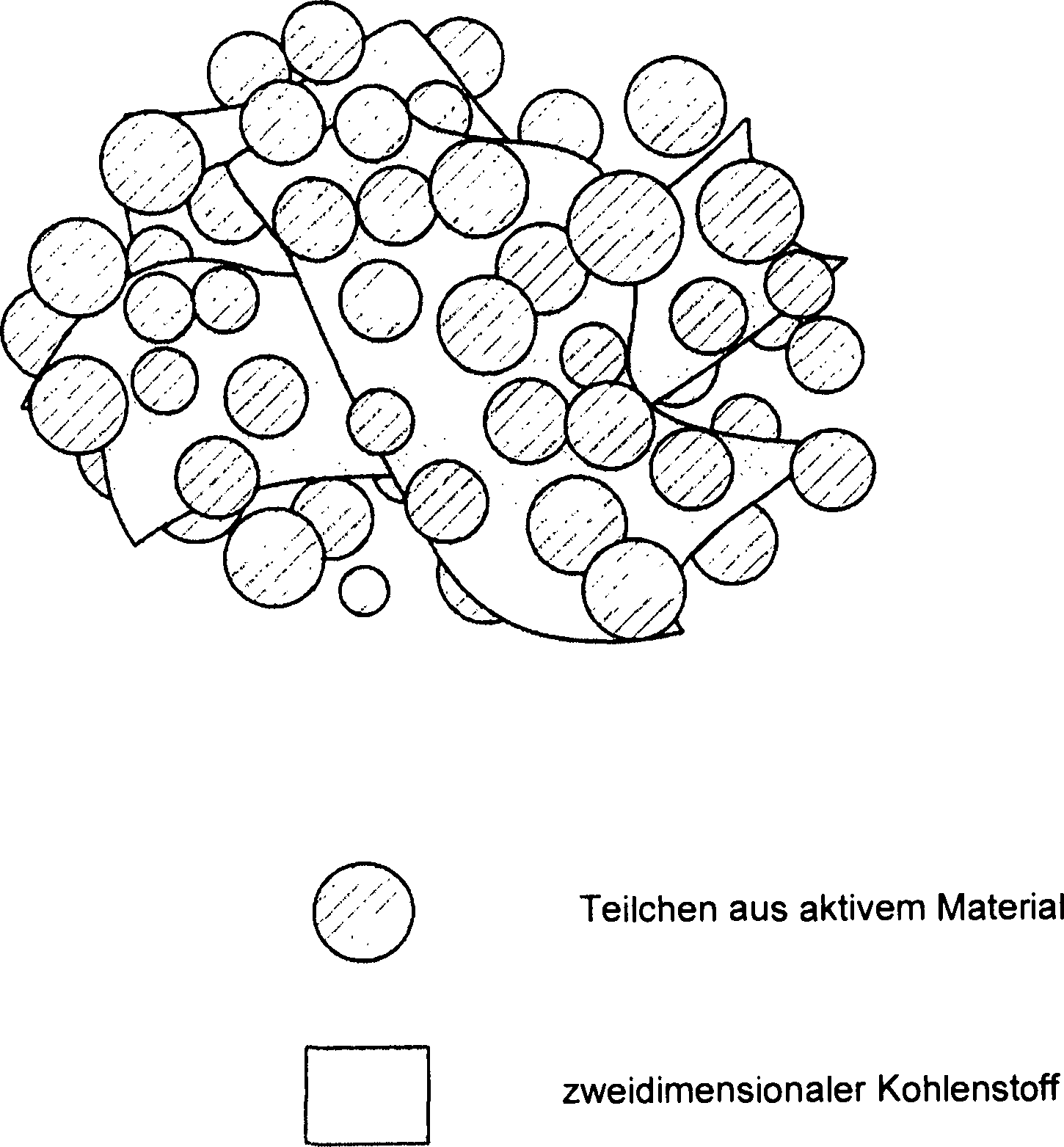
Die Leitfähigkeit kann unter Verwendung von zweidimensionalem Kohlenstoff verbessert werden, der 1 bis 100, vorzugsweise 1 bis 10 Graphene als ein Leitungs-Hilfsmittel enthält. Es ist zu bemerken, dass in der vorliegenden Patentbeschreibung ein Graphen eine Schicht aus Kohlenstoffmolekülen mit sp2-Bindungen mit einer Dicke einer Atomlage bezeichnet.
Beim Einsatz eines Materials, das sich zweidimensional erstreckt und dessen Dicke ignoriert werden kann, als ein Leitungs-Hilfsmittel kann ein äquivalenter Effekt selbst dann erzielt werden, wenn das Volumen des Leitungs-Hilfsmittels verringert wird. So kann das Volumen des Leitungs-Hilfsmittels, das die Elektrode einnimmt, verringert werden, so dass das Volumen der Elektrode reduziert werden kann. Beispielsweise beträgt die Dicke von zweidimensionalem Kohlenstoff, der 10 Graphene enthält, ungefähr 3 nm.When using a material which extends two-dimensionally and whose thickness can be ignored as a conduction assistant, an equivalent effect can be obtained even if the volume of the conduction assistant is reduced. Thus, the volume of the lead-holding means occupying the electrode can be reduced, so that the volume of the electrode can be reduced. For example, the thickness of two-dimensional carbon containing 10 graphenes is about 3 nm.
Ein Graphen zeichnet sich dadurch aus, dass, nachdem es einer Dotierungsbehandlung unterzogen wurde, hohe Leitfähigkeit erreicht wird. Es wird ein Wert von 106 S/cm oder mehr erzielt, der der Leitfähigkeit von Silber entspricht bzw. darüber liegt. Diese Tatsache erweist sich als Vorteil für den Einsatz des Graphens als ein Leitungs-Hilfsmittel. Dotieren kann durchgeführt werden, indem das Graphen teilweise oxidiert wird oder ein Alkalimetall, wie beispielsweise Kalium, zu dem Graphen hinzugefügt wird.A graphene is characterized in that high conductivity is achieved after being subjected to a doping treatment. A value of 10 6 S / cm or more is achieved, which corresponds to or exceeds the conductivity of silver. This fact proves to be an advantage for the use of graphene as a conduit aid. Doping may be carried out by partially oxidizing the graphene or adding an alkali metal such as potassium to the graphene.
Wenn ein Leitungs-Hilfsmittel, das zweidimensionalen Kohlenstoff enthält, für eine elektrische Vorrichtung, wie beispielsweise eine Lithiumionen-Sekundärbatterie, eingesetzt wird, bei der Ladung und Entladung mittels Übertragung von Alkalimetall-Ionen oder Alkalierdmetall-Ionen durchgeführt werden, wird in bestimmten Fällen Dotieren mit dem zweidimensionalen Kohlenstoff automatisch durchgeführt, so dass die Leitfähigkeit verbessert wird.When a conduction aid containing two-dimensional carbon is used for an electric device such as a lithium-ion secondary battery in which charge and discharge are carried out by transfer of alkali metal ions or alkaline earth metal ions, doping will be involved in some cases the two-dimensional carbon is automatically performed, so that the conductivity is improved.
Die Leitfähigkeit von zweidimensionalem Kohlenstoff wird durch Übereinanderschichten mehrerer Graphene verbessert. Jedoch ist eine Schichtanordnung von 101 oder mehr Graphenen nicht vorteilhaft, da sie zu starke graphitische Eigenschaften aufweist.The conductivity of two-dimensional carbon is improved by stacking several graphenes. However, stacking of 101 or more graphenes is not advantageous because it has too strong graphitic properties.
Wenn ein Material, das sich zweidimensional erstreckt, als ein Leitungs-Hilfsmittel eingesetzt wird, kann seine typische Länge 100 nm oder mehr und 100 μm oder weniger betragen, vorzugsweise 1 μm oder mehr und 20 μm oder weniger. Insbesondere beim Einsatz von zweidimensionalem Kohlenstoff weist zweidimensionaler Kohlenstoff mit einer typischen Länge von 100 nm oder weniger Halbleitereigenschaften und damit geringe Leitfähigkeit auf. Hingegen weist zweidimensionaler Kohlenstoff mit einer typischen Länge von 100 nm oder mehr elektrische Eigenschaften auf, die äquivalent zu denen eines guten Leiters sind. Um jedoch die Häufigkeit von Leitung durch sogenanntes Hopping (Übertragung von Elektronen von zweidimensionalem Kohlenstoff zu einem anderen zweidimensionalen Kohlenstoff) zu verringern, beträgt die typische Länge vorzugsweise 1 μm oder mehr.When a material extending two-dimensionally is used as a conduction assistant, its typical length may be 100 nm or more and 100 μm or less, preferably 1 μm or more and 20 μm or less. In particular, when using two-dimensional carbon, two-dimensional carbon having a typical length of 100 nm or less has semiconductor properties and hence low conductivity. On the other hand, two-dimensional carbon having a typical length of 100 nm or more has electrical properties equivalent to those of a good conductor. However, in order to reduce the frequency of conduction by so-called hopping (transfer of electrons from two-dimensional carbon to another two-dimensional carbon), the typical length is preferably 1 μm or more.
In der vorliegenden Beschreibung ist eine typische Länge als die Quadratwurzel aus der Fläche von zweidimensionalem Kohlenstoff definiert. Obwohl zweidimensionaler Kohlenstoff tatsächlich verschiedene Formen haben kann, wird die Länge in der Annahme definiert, dass der gesamte zweidimensionale Kohlenstoff rechteckige Formen hat. Dementsprechend beträgt eine typische Länge von rechteckigem zweidimensionalem Kohlenstoff mit einer langen Seite von 2 mm und einer kurzen Seite von 50 nm (diese Werte liegen nicht innerhalb des oben erwähnten bevorzugten Bereiches) beispielsweise 10 μm (dieser Wert liegt innerhalb des oben erwähnten bevorzugten Bereiches).In the present specification, a typical length is defined as the square root of the area of two-dimensional carbon. Although two-dimensional carbon may actually have different shapes, the length is defined on the assumption that the entire two-dimensional carbon has rectangular shapes. Accordingly, a typical length of rectangular two-dimensional carbon having a long side of 2 mm and a short side of 50 nm (these values are not within the above-mentioned preferred range) is 10 μm, for example (this value is within the above-mentioned preferred range).
Es ist zu bemerken, dass ein Leitungs-Hilfsmittel zusätzlich zu zweidimensionalem Kohlenstoff Teilchen aus Acetylen-Ruß oder Kohlenstoffteilchen (wie beispielsweise Kohlenstoff-Nanofasern), die sich eindimensional erstrecken, in einem Volumen enthalten kann, das das 0,1fache oder mehr und das 10fache oder weniger des zweidimensionalen Kohlenstoffs ausmacht.Note that, in addition to two-dimensional carbon, a line assistant may contain particles of acetylene black or carbon particles (such as carbon nanofibers) that extend one-dimensionally in a volume that is 0.1 times or more and 10 times or less of the two-dimensional carbon.
Der Widerstand der elektrischen Vorrichtung kann mit der oben beschriebenen Struktur verringert werden. Insbesondere, wenn ein Leitungs-Hilfsmittel gemäß der vorliegenden Erfindung für eine Primärbatterie oder eine Sekundärbatterie eingesetzt wird, ist der Widerstand (innerer Widerstand) einer Elektrode vorzugsweise niedriger, wobei sich dies für Anwendungszwecke eignet, bei denen eine große Menge an Energie sofort benötigt wird.The resistance of the electric device can be reduced with the structure described above. Especially if a conduit tool According to the present invention, for a primary battery or a secondary battery, the resistance (internal resistance) of an electrode is preferably lower, which is suitable for applications where a large amount of energy is needed immediately.
Beispielsweise verbraucht eine Energiequelle eines Elektrofahrzeugs relativ wenig Energie, wenn das Elektrofahrzeug auf ebenem Boden fährt. Jedoch wird bei starker Beschleunigung oder bei Bergauffahrt viel Energie verbracht. In diesem Fall muss die Energiequelle eine erhebliche Menge an Strom zuführen, jedoch kommt es, wenn der innere Widerstand hoch ist, zu einem erheblichen Spannungsabfall und auch einem Verlust aufgrund des inneren Widerstandes.For example, an electric vehicle's power source consumes relatively little energy when the electric vehicle is traveling on level ground. However, a lot of energy is spent in hard acceleration or when driving uphill. In this case, the power source must supply a significant amount of power, however, when the internal resistance is high, there is a significant voltage drop and also a loss due to the internal resistance.
Dadurch geht ein Teil der Energie, die als verfügbar erwartet wird, verloren. Das heißt, obwohl gespeicherte Energie nahezu vollständig genutzt werden kann, wenn das Fahrzeug auf ebenem Boden fährt, geht ein Teil der Energie bei Bergauffahrt oder bei Beschleunigung verloren. Durch Verringerung des inneren Widerstandes kann dieser Verlust eingeschränkt werden.As a result, some of the energy that is expected to be available is lost. That is, although stored energy can be used almost completely when the vehicle is traveling on level ground, some energy is lost when driving uphill or accelerating. By reducing the internal resistance, this loss can be limited.
Der Grund dafür, dass die Leitfähigkeit beim Einsatz eines Materials verbessert werden kann, das sich zweidimensional erstreckt und dessen Dicke ignoriert werden kann, wird unter Bezugnahme auf
Ein Abstand zwischen einer Oberfläche einer Kohlenstofffaser und einer Oberfläche einer anderen Kohlenstofffaser beträgt x. Das heißt, ein Durchmesser einer Kohlenstofffaser wird mittels Subtraktion von x von einem Gitterintervall ermittelt. Es gibt einen optimalen Wert für x, der von einer Teilchengröße eines aktiven Materials oder dergleichen abhängt.A distance between one surface of a carbon fiber and a surface of another carbon fiber is x. That is, a diameter of a carbon fiber is determined by subtracting x from a grid interval. There is an optimum value of x, which depends on a particle size of an active material or the like.
Es kann jedoch ein Fall vorliegen, in dem die Kohlenstofffasern
In
Dabei nimmt die Wahrscheinlichkeit erheblich zu, wenn ein Material eingesetzt wird, das sich zweidimensional erstreckt. Beispielsweise wird eine in
Es ist verständlich, dass es, wenn zweidimensionaler Kohlenstoff über dem zweidimensionalen Kohlenstoff
Es ist anzumerken, dass hier besonderes Augenmerk auf das Volumen eines Materials gelegt wird, das sich zweidimensional erstreckt. Beispielsweise ist die Fläche des zweidimensionalen Kohlenstoffs
Beispielsweise beträgt, wenn der zweidimensionale Kohlenstoff
Obwohl
Erstens wird in dem Fall, in dem der obere zweidimensionale Kohlenstoff in der gleichen Richtung angeordnet ist wie der zweidimensionale Kohlenstoff
Des Weiteren ist, wenn die Länge des zweidimensionalen Kohlenstoffs
Auf Basis der oben dargelegten Untersuchung kann geschlussfolgert werden, dass die Wahrscheinlichkeit von Überlappung nahezu 90% beträgt, wenn die Länge des zweidimensionalen Kohlenstoffs in der Richtung ”a” 5-mal so groß ist wie die Länge x oder mehr. vorzugsweise entspricht x dem 1fachen oder mehr und dem 5fachen oder weniger der Größe eines Teilchens aus aktivem Material, und die Länge des zweidimensionalen Kohlenstoffs kann entsprechend bestimmt werden. Das heißt, eine typische Länge von zweidimensionalem Kohlenstoff beträgt vorzugsweise das 1fache oder mehr und des Weiteren vorzugsweise das 5fache oder mehr eines Durchschnittswertes der Größen der Teilchen aus aktivem Material.Based on the above investigation, it can be concluded that the likelihood of overlap is nearly 90% when the length of the two-dimensional carbon in the direction "a" is 5 times as long as the length x or more. preferably, x is 1 times or more and 5 times or less the size of an active material particle, and the length of the two-dimensional carbon can be determined accordingly. That is, a typical length of two-dimensional carbon is preferably 1 times or more and more preferably 5 times or more an average value of the sizes of the active material particles.
Bei der Beschreibung der obenstehenden Untersuchung werden außerordentlich verkürzte Modelle verwendet, jedoch wird damit gezeigt, dass hervorragende Eigenschaften erzielt werden können, wenn ein sich zweidimensional erstreckendes Material als ein Leitungs-Hilfsmittel eingesetzt wird. Anhand dieser Modelle wird leicht verständlich, dass bei einem Leitungs-Hilfsmittel, das sich zweidimensional erstreckt, die Wahrscheinlichkeit von Kontakt mit Teilchen aus aktivem Material und anderen Leitungs-Hilfsmitteln hoch ist und dass eine Elektrode, die diese enthält, hohe Leitfähigkeit aufweist. Es versteht sich von selbst, dass die Verbesserung der Leitfähigkeit auf Basis des oben beschriebenen Prinzips nicht nur bei Teilchen aus aktivem Material, sondern auch bei anderen Teilchen mit niedriger Leitfähigkeit eingesetzt werden kann.Extremely shortened models are used in the description of the above investigation, but it demonstrates that excellent properties can be achieved when a two-dimensionally extending material is used as a conduit aid. From these models, it will be readily understood that with a conduit tool that extends two-dimensionally, the likelihood of contact with particles of active material and other conduit aids is high and that an electrode containing them has high conductivity. It goes without saying that the improvement in conductivity based on the above-described principle can be applied not only to particles of active material but also to other particles of low conductivity.
Kurze Beschreibung der ZeichnungenBrief description of the drawings
Ausführliche Beschreibung der ErfindungDetailed description of the invention
Im Folgenden werden Ausführungsformen unter Bezugnahme auf die Zeichnungen beschrieben. Die Ausführungsformen können jedoch auf verschiedene Weise umgesetzt werden. Dem Fachmann ist bewusst, dass Umsetzungsformen und Details auf verschiedene Weise geändert werden können, ohne vom Geist und vom Schutzumfang der vorliegenden Erfindung abzuweichen. Daher sollte die vorliegende Erfindung nicht so verstanden werden, dass sie auf die folgende Beschreibung der Ausführungsformen beschränkt ist.Hereinafter, embodiments will be described with reference to the drawings described. However, the embodiments can be implemented in various ways. It will be appreciated by those skilled in the art that implementations and details may be variously changed without departing from the spirit and scope of the present invention. Therefore, the present invention should not be understood as being limited to the following description of the embodiments.
Ausführungsform 1
In dieser Ausführungsform wird ein Verfahren zum Herstellen einer Lithiumionen-Sekundärbatterie beschrieben, die eine Ausführungsform der vorliegenden Erfindung ist. Zunächst wird zweidimensionaler Kohlenstoff hergestellt, der als ein Leitungs-Hilfsmittel eingesetzt werden soll. Als Verfahren zum Herstellen des zweidimensionalen Kohlenstoffs können ein CVD-Verfahren (Patentdokument 2), ein Beschichtungsverfahren (Patentdokument 3) oder ein Verfahren eingesetzt werden, bei dem zweidimensionaler Kohlenstoff chemisch aus Graphit abgeschieden wird (Nicht-Patentdokument 1).In this embodiment, a method of manufacturing a lithium ion secondary battery which is an embodiment of the present invention will be described. First, two-dimensional carbon is produced to be used as a conduit aid. As a method of manufacturing the two-dimensional carbon, a CVD method (Patent Document 2), a coating method (Patent Document 3), or a method in which two-dimensional carbon is chemically deposited from graphite (Non-Patent Document 1) may be employed.
Beispielsweise wird beim Einsatz eines CVD-Verfahrens eine Metallschicht aus Nickel, Eisen oder dergleichen, das als Katalysator dient, über einem Substrat ausgebildet, das Substrat wird eine Kammer eingebracht und bei einer Temperatur von 600°C bis 1100°C erhitzt, und ein Gas, das Kohlenwasserstoff, wie beispielsweise Methan oder Ethan, enthält, wird die in die Kammer eingeleitet, so dass eine zweidimensionale Kohlenstoffschicht, die 1 bis 10 Graphen-Lagen enthält, über dem Substrat geschaffen wird.For example, using a CVD method, a metal layer of nickel, iron or the like serving as a catalyst is formed over a substrate, the substrate is placed in a chamber and heated at a temperature of 600 ° C to 1100 ° C, and a gas containing hydrocarbons such as methane or ethane, is introduced into the chamber so that a two-dimensional carbon layer containing 1 to 10 graphene layers is created over the substrate.
Dann wird die Metallschicht mit Säure oder dergleichen geätzt, so dass eine in sich geschlossene zweidimensionale Kohlenstoffschicht gewonnen wird. Die gewonnene Schicht wird geschnitten und zu Rechtecken verarbeitet, bei denen die Länge einer Seite 1 μm bis 100 μm beträgt.Then, the metal layer is etched with acid or the like, so that a self-contained two-dimensional carbon layer is obtained. The recovered layer is cut and processed into rectangles in which the length of one side is 1 μm to 100 μm.
Wenn ein Beschichtungsverfahren eingesetzt wird, wird eine Schwefelsäurelösung von Kaliumpermanganat, Wasserstoffperoxid-Wasser oder dergleichen einem Pulver aus Einkristall-Graphit beigemischt, um eine Oxidationsreaktion zu bewirken, und so wird eine wässrige Lösung von Graphen-Oxid gewonnen. Die so gewonnene wässrige Lösung von Graphen-Oxid wird auf ein geeignetes Substrat aufgebracht, das mit einer Trennschicht versehen ist und getrocknet. Als die Trennschicht kann eine Schicht aus Metall, das in Säure löslich ist, mit einer Dicke von 1 nm bis 100 nm verwendet werden.When a coating method is employed, a sulfuric acid solution of potassium permanganate, hydrogen peroxide-water or the like is mixed with a powder of single crystal graphite to effect an oxidation reaction, and thus an aqueous solution of graphene oxide is recovered. The thus obtained aqueous solution of graphene oxide is applied to a suitable substrate provided with a release layer and dried. As the separation layer, a layer of acid-soluble metal having a thickness of 1 nm to 100 nm can be used.
Dann wird Graphen-Oxid mittels Hochtemperaturerhitzen im Vakuum, und Zusatz eines reduzierenden Wirkstoffs, wie beispielsweise Hydrazin oder dergleichen reduziert, so dass eine Schicht aus zweidimensionalem Kohlenstoff, die 1 bis 10 Graphen-Lagen enthält, gewonnen wird.Then, graphene oxide is reduced by means of high-temperature heating in vacuo, and addition of a reducing agent such as hydrazine or the like, so that a layer of two-dimensional carbon containing 1 to 10 graphene sheets is obtained.
Dann wird die Trennschicht mit Säure oder dergleichen geätzt, so dass eine in sich geschlossene Schicht aus zweidimensionalem Kohlenstoff gewonnen wird. Die gewonnene Schicht wird geschnitten und zu Rechtecken verarbeitet, wobei die Länge einer Seite 1 μm bis 100 μm beträgt. Es ist zu bemerken, dass die Verarbeitung zu Rechtecken in der Phase durchgeführt werden kann, in der die wässrige Lösung von Graphen-Oxid auf das Substrat aufgebracht und getrocknet wird.Then, the release layer is etched with acid or the like, so that a self-contained layer of two-dimensional carbon is obtained. The recovered layer is cut and processed into rectangles, the length of one side being 1 μm to 100 μm. It should be noted that the processing into rectangles may be performed in the phase in which the aqueous solution of graphene oxide is applied to the substrate and dried.
Bei einem Verfahren unter Einsatz eines reduzierenden Wirkstoffs findet eine Reduktionsreaktion von einer Oberfläche her statt, daher kann die Reduktionsreaktion in einer geeigneten Tiefe beendet werden, indem die Reaktionszeit gesteuert wird. In diesem Zustand wird reduzierter zweidimensionaler Kohlenstoff an der Oberfläche gewonnen, während in einem tieferen Abschnitt Graphen-Oxid verbleibt. Da Graphen-Oxid in Wasser suspendiert wird, kann eine in sich geschlossene Schicht aus zweidimensionalem Kohlenstoff (in Wasser nicht löslich) gewonnen werden, indem das Substrat in Wasser getaucht wird. Das in Wasser gelöste Graphen-Oxid kann aufgefangen und wiederum auf ein Substrat aufgebracht werden.In a method using a reducing agent, a reduction reaction takes place from a surface, therefore, the reduction reaction can be stopped at an appropriate depth by controlling the reaction time. In this state, reduced two-dimensional carbon is recovered at the surface while graphene oxide remains in a deeper portion. Since graphene oxide is suspended in water, a self-contained layer of two-dimensional carbon (insoluble in water) can be obtained by dipping the substrate in water. The graphene oxide dissolved in water can be collected and in turn applied to a substrate.
Wenn ein Verfahren des chemischen Ätzens zum Abscheiden von zweidimensionalem Kohlenstoff aus Graphit eingesetzt wird, wird Graphit in ein polares Lösungsmittel, wie beispielsweise Chloroform, N,N-Dimethylformamid (DMF) oder N-Methylpyrrolidon (NMP) gegeben und Bindung zwischen Graphitschichten wird mittels Ultraschallschwingung aufgebrochen, so dass zweidimensionaler Kohlenstoff gewonnen werden kann.When a chemical etching method of depositing two-dimensional carbon from graphite is employed, graphite is placed in a polar solvent such as chloroform, N, N-dimethylformamide (DMF) or N-methylpyrrolidone (NMP), and bonding between graphite layers is performed by ultrasonic vibration broken up so that two-dimensional carbon can be recovered.
Gewinnung einer planen, zweidimensionalen Kohlenstoffschicht mit diesem Verfahren wird als schwierig erachtet. Da jedoch beim Einsatz von zweidimensionalem Kohlenstoff als ein Leitungs-Hilfsmittel Planheit nicht erforderlich ist, stellt unzureichende Planheit kein Problem dar. Vielmehr ist dieses Verfahren hinsichtlich der Produktivität effizienter als andere Verfahren.Obtaining a planar, two-dimensional carbon layer with this method is considered difficult. However, since flatness is not required when using two-dimensional carbon as a conduction aid, insufficient flatness is not a problem. Rather, this process is more efficient in productivity than other processes.
Beim Schneiden der gewonnenen in sich geschlossenen Schicht aus zweidimensionalem Kohlenstoff wird vorzugsweise eine Schicht aus Material, das später mit dem zweidimensionalen Kohlenstoff gemischt werden soll, so beispielsweise Teilchen aus aktivem Material, vorzugsweise auf eine Fläche der in sich geschlossenen Schicht aus zweidimensionalem Kohlenstoff mit einer Dicke von 10 nm bis 100 nm aufgebracht. Obwohl es wahrscheinlich ist, dass der zweidimensionale Kohlenstoff Aggregate bildet, kann Aggregation verhindert werden, indem eine Schicht aus anderem Material an einer Oberfläche desselben geschaffen wird.When cutting the obtained self-contained layer of two-dimensional carbon, preferably a layer of material to be later mixed with the two-dimensional carbon, such as particles of active material, preferably on a surface of the self-contained layer of two-dimensional carbon with a thickness from 10 nm to 100 nm applied. Although it is likely that the two-dimensional carbon forms aggregates, aggregation can be prevented by adding a layer made of other material on a surface thereof.
Der zweidimensionale Kohlenstoff mit einer geeigneten Oberfläche, der auf die oben beschriebene Weise hergestellt wird, wird mit einem aktivem Material einer positiven Elektrode und einem Bindemittel vermischt, so dass eine Aufschlämmung entsteht. Andere Leitungs-Hilfsmittel, wie beispielsweise Acetylen-Ruß, können gegebenenfalls zusätzlich beigemischt werden. Als das aktive Material der positiven Elektrode kann Lithium-Eisen-Phosphat, Lithium-Mangan-Phosphat, Lithium-Mangan-Silikat, Lithium-Eisen-Silikat oder dergleichen eingesetzt werden, eine Ausführungsform der vorliegenden Erfindung ist jedoch nicht darauf beschränkt. Teilchen des aktiven Materials der positiven Elektrode haben vorzugsweise Größen im Bereich von 20 nm bis 100 nm. Des Weiteren kann ein Kohlehydrat, wie beispielsweise Glukose, beim Brennen der Teilchen aus aktivem Material der positiven Elektrode beigemischt werden, so dass die Teilchen des Materials der positiven Elektrode mit Kohlenstoff überzogen sind. Durch diese Behandlung kann die Leitfähigkeit verbessert werden.The two-dimensional carbon with a suitable surface prepared in the manner described above is mixed with a positive electrode active material and a binder to form a slurry. Other conduit aids, such as acetylene black, may optionally be added in addition. As the active material of the positive electrode, lithium iron phosphate, lithium manganese phosphate, lithium manganese silicate, lithium iron silicate or the like may be used, but an embodiment of the present invention is not limited thereto. Preferably, particles of the positive electrode active material have sizes in the range of 20 nm to 100 nm. Further, a carbohydrate such as glucose may be mixed in firing the positive-electrode active-material particles so that the particles of the positive-electrode material Electrode are coated with carbon. By this treatment, the conductivity can be improved.
In der folgenden Beschreibung wird auf
Die Knopf-Sekundärbatterie enthält, wie in
Vorzugsweise wird der Elektrolyt eingesetzt, in dem LiPF6 in einem gemischten Lösungsmittel aus Ethylencarbonat (EC) und Diethylcarbonat (DEC) gelöst ist, jedoch ist eine Ausführungsform der vorliegenden Erfindung nicht darauf beschränkt.It is preferable to use the electrolyte in which LiPF 6 is dissolved in a mixed solvent of ethylene carbonate (EC) and diethyl carbonate (DEC), but one embodiment of the present invention is not limited thereto.
Die negative Elektrode
Ein Isolator mit Röhren (beispielsweise Polypropylen) kann als der Separator (
Vorzugsweise werden das Gehäuse
Die negative Elektrode
Ausführungsform 2Embodiment 2
Beispiele für eine elektrische Einrichtung gemäß der vorliegenden Erfindung sind verschiedene Trockenbatterien, Speicherbatterien und dergleichen. Als ein Leitungs-Hilfsmittel für eine positive Elektrode oder eine negative Elektrode dieser Batterien kann beispielsweise das Leitungs-Hilfsmittel eingesetzt werden, das in Ausführungsform 1 beschriebenen zweidimensionalen Kohlenstoff enthält.Examples of an electric device according to the present invention are various dry type batteries, storage batteries and the like. As a lead aid for a positive electrode or a negative electrode of these batteries, there may be used, for example, the lead aid containing two-dimensional carbon described in
Weitere Beispiele für eine elektrische Einrichtung gemäß der vorliegenden Erfindung sind Elektrofahrzeuge, Elektrowerkzeuge, Personal Computer, Mobiltelefone und dergleichen. Derartige elektrische Einrichtung bzw. Geräte werden nicht immer über Kabel mit Strom versorgt und enthalten daher eine Speicherbatterie. Als ein Leitungs-Hilfsmittel für eine positive Elektrode oder eine negative Elektrode der Speicherbatterie kann beispielsweise das Leitungs-Hilfsmittel eingesetzt werden, das in Ausführungsform 1 beschriebenen zweidimensionalen Kohlenstoff enthält.Further examples of an electrical device according to the present invention are electric vehicles, power tools, personal computers, mobile phones and the like. Such electrical device or devices are not always supplied with power via cables and therefore contain a storage battery. As a lead aid for a positive electrode or a negative electrode of the storage battery, there may be used, for example, the lead aid including two-dimensional carbon described in
Eine Speicherbatterie mit niedrigem innerem Widerstand ist insbesondere für Einsatzzwecke erforderlich, bei denen eine große Strommenge sofort zugeführt werden muss oder ein erforderlicher Stromwert stark variiert. Daher kann mit der vorliegenden Erfindung ein ausreichender Effekt erzielt werden. A low internal resistance storage battery is particularly required for applications where a large amount of current must be supplied immediately or a required current value varies widely. Therefore, with the present invention, a sufficient effect can be obtained.
BezugszeichenlisteLIST OF REFERENCE NUMBERS
- 101101
- KohlenstofffasernCarbon fibers
- 102102
- obere Kohlenstofffasernupper carbon fibers
- 103103
- zweidimensionaler Kohlenstofftwo-dimensional carbon
- 104104
- zweidimensionaler Kohlenstofftwo-dimensional carbon
- 200200
- Stromsammler der negativen ElektrodeCurrent collector of the negative electrode
- 202202
- Schicht aus aktivem Material der negativen ElektrodeLayer of active material of the negative electrode
- 204204
- negative Elektrodenegative electrode
- 206206
- Gehäusecasing
- 210210
- Separatorseparator
- 220220
- ringförmiger Isolatorannular insulator
- 228228
- Stromsammler der positiven ElektrodeCurrent collector of the positive electrode
- 230230
- Schicht aus aktivem Material der positiven ElektrodeLayer of active material of the positive electrode
- 232232
- positive Elektrodepositive electrode
- 240240
- Abstandshalterspacer
- 242242
- Scheibe, undSlice, and
- 244244
- Gehäuse.Casing.
Die vorliegende Anmeldung basiert auf der am 19. August 2010 eingereichten
ZITATE ENTHALTEN IN DER BESCHREIBUNG QUOTES INCLUDE IN THE DESCRIPTION
Diese Liste der vom Anmelder aufgeführten Dokumente wurde automatisiert erzeugt und ist ausschließlich zur besseren Information des Lesers aufgenommen. Die Liste ist nicht Bestandteil der deutschen Patent- bzw. Gebrauchsmusteranmeldung. Das DPMA übernimmt keinerlei Haftung für etwaige Fehler oder Auslassungen.This list of the documents listed by the applicant has been generated automatically and is included solely for the better information of the reader. The list is not part of the German patent or utility model application. The DPMA assumes no liability for any errors or omissions.
Zitierte PatentliteraturCited patent literature
- JP 6-60870 [0005] JP 6-60870 [0005]
- JP 2010-183888 [0066] JP 2010-183888 [0066]
Zitierte Nicht-PatentliteraturCited non-patent literature
- P. Blake et al., ”Graphene-Based Liquid Crystal Device”, Nano Lett. 8, 1704 (2008) [0006] Blake, et al., Graphene-Based Liquid Crystal Device, Nano Lett. 8, 1704 (2008) [0006]
Claims (22)
Applications Claiming Priority (3)
| Application Number | Priority Date | Filing Date | Title |
|---|---|---|---|
| JP2010183888 | 2010-08-19 | ||
| JP2010-183888 | 2010-08-19 | ||
| PCT/JP2011/068214 WO2012023464A1 (en) | 2010-08-19 | 2011-08-03 | Electrical appliance |
Publications (1)
| Publication Number | Publication Date |
|---|---|
| DE112011102750T5 true DE112011102750T5 (en) | 2013-07-04 |
Family
ID=45594328
Family Applications (1)
| Application Number | Title | Priority Date | Filing Date |
|---|---|---|---|
| DE112011102750T Withdrawn DE112011102750T5 (en) | 2010-08-19 | 2011-08-03 | Electric device |
Country Status (7)
| Country | Link |
|---|---|
| US (2) | US20120045692A1 (en) |
| JP (3) | JP2012064571A (en) |
| KR (1) | KR101892984B1 (en) |
| CN (2) | CN103053055B (en) |
| DE (1) | DE112011102750T5 (en) |
| TW (1) | TWI597888B (en) |
| WO (1) | WO2012023464A1 (en) |
Families Citing this family (57)
| Publication number | Priority date | Publication date | Assignee | Title |
|---|---|---|---|---|
| DE112011102750T5 (en) | 2010-08-19 | 2013-07-04 | Semiconductor Energy Laboratory Co., Ltd. | Electric device |
| JP5601474B2 (en) * | 2011-02-28 | 2014-10-08 | 株式会社Gsユアサ | Negative electrode plate for lead acid battery and lead acid battery |
| CN103443971B (en) | 2011-03-25 | 2016-06-08 | 株式会社半导体能源研究所 | Lithium-ion secondary battery |
| CN105680049B (en) * | 2011-06-03 | 2020-05-05 | 株式会社半导体能源研究所 | Manufacturing method of electrodes |
| JP5778625B2 (en) | 2011-06-03 | 2015-09-16 | 株式会社半導体エネルギー研究所 | Ionic liquid and power storage device including ionic liquid |
| US9218916B2 (en) | 2011-06-24 | 2015-12-22 | Semiconductor Energy Laboratory Co., Ltd. | Graphene, power storage device, and electric device |
| JP6025284B2 (en) | 2011-08-19 | 2016-11-16 | 株式会社半導体エネルギー研究所 | Electrode for power storage device and power storage device |
| WO2013027561A1 (en) | 2011-08-19 | 2013-02-28 | Semiconductor Energy Laboratory Co., Ltd. | Method for manufacturing graphene-coated object, negative electrode of secondary battery including graphene-coated object, and secondary battery including the negative electrode |
| JP6035013B2 (en) | 2011-08-30 | 2016-11-30 | 株式会社半導体エネルギー研究所 | Electrode fabrication method |
| KR20130024769A (en) | 2011-08-30 | 2013-03-08 | 가부시키가이샤 한도오따이 에네루기 켄큐쇼 | Power storage device |
| US9249524B2 (en) | 2011-08-31 | 2016-02-02 | Semiconductor Energy Laboratory Co., Ltd. | Manufacturing method of composite oxide and manufacturing method of power storage device |
| JP6204004B2 (en) | 2011-08-31 | 2017-09-27 | 株式会社半導体エネルギー研究所 | Manufacturing method of secondary battery |
| JP2013054878A (en) | 2011-09-02 | 2013-03-21 | Semiconductor Energy Lab Co Ltd | Method of manufacturing electrode and power storage device |
| JP6029898B2 (en) | 2011-09-09 | 2016-11-24 | 株式会社半導体エネルギー研究所 | Method for producing positive electrode for lithium secondary battery |
| US8663841B2 (en) | 2011-09-16 | 2014-03-04 | Semiconductor Energy Laboratory Co., Ltd. | Power storage device |
| US9401247B2 (en) | 2011-09-21 | 2016-07-26 | Semiconductor Energy Laboratory Co., Ltd. | Negative electrode for power storage device and power storage device |
| CN103858259B (en) | 2011-09-30 | 2018-03-06 | 株式会社半导体能源研究所 | Graphene, electricity storage device, and their manufacturing method |
| CN103035922B (en) | 2011-10-07 | 2019-02-19 | 株式会社半导体能源研究所 | Electrical storage device |
| US9487880B2 (en) | 2011-11-25 | 2016-11-08 | Semiconductor Energy Laboratory Co., Ltd. | Flexible substrate processing apparatus |
| JP6059941B2 (en) | 2011-12-07 | 2017-01-11 | 株式会社半導体エネルギー研究所 | Negative electrode for lithium secondary battery and lithium secondary battery |
| JP6016597B2 (en) | 2011-12-16 | 2016-10-26 | 株式会社半導体エネルギー研究所 | Method for producing positive electrode for lithium ion secondary battery |
| KR20130073822A (en) | 2011-12-23 | 2013-07-03 | 가부시키가이샤 한도오따이 에네루기 켄큐쇼 | Ionic liquid, nonaqueous electrolyte, and power storage device |
| JP6009343B2 (en) | 2011-12-26 | 2016-10-19 | 株式会社半導体エネルギー研究所 | Secondary battery positive electrode and method for producing secondary battery positive electrode |
| US9680272B2 (en) | 2012-02-17 | 2017-06-13 | Semiconductor Energy Laboratory Co., Ltd. | Method for forming negative electrode and method for manufacturing lithium secondary battery |
| JP5719859B2 (en) | 2012-02-29 | 2015-05-20 | 株式会社半導体エネルギー研究所 | Power storage device |
| US9384904B2 (en) * | 2012-04-06 | 2016-07-05 | Semiconductor Energy Laboratory Co., Ltd. | Negative electrode for power storage device, method for forming the same, and power storage device |
| JP6077347B2 (en) | 2012-04-10 | 2017-02-08 | 株式会社半導体エネルギー研究所 | Method for producing positive electrode for non-aqueous secondary battery |
| JP6216154B2 (en) | 2012-06-01 | 2017-10-18 | 株式会社半導体エネルギー研究所 | Negative electrode for power storage device and power storage device |
| CN102683704B (en) * | 2012-06-15 | 2015-05-13 | 东莞市迈科新能源有限公司 | Lithium iron phosphate cathode of lithium ion battery and preparation method for lithium iron phosphate cathode |
| US9225003B2 (en) | 2012-06-15 | 2015-12-29 | Semiconductor Energy Laboratory Co., Ltd. | Method for manufacturing storage battery electrode, storage battery electrode, storage battery, and electronic device |
| CN104641500B (en) * | 2012-06-20 | 2017-10-13 | 卡博特公司 | Electrode formulations comprising graphene |
| US20140004412A1 (en) * | 2012-06-29 | 2014-01-02 | Semiconductor Energy Laboratory Co., Ltd. | Secondary battery |
| US20140023920A1 (en) | 2012-07-20 | 2014-01-23 | Semiconductor Energy Laboratory Co., Ltd. | Secondary battery |
| JP6207923B2 (en) | 2012-08-27 | 2017-10-04 | 株式会社半導体エネルギー研究所 | Method for producing positive electrode for secondary battery |
| DE112013005307T5 (en) | 2012-11-07 | 2015-07-23 | Semiconductor Energy Laboratory Co., Ltd. | Electrode for energy storage device, energy storage device and method of manufacturing the electrode for energy storage device |
| JP6159228B2 (en) * | 2012-11-07 | 2017-07-05 | 株式会社半導体エネルギー研究所 | Method for producing positive electrode for non-aqueous secondary battery |
| US9673454B2 (en) | 2013-02-18 | 2017-06-06 | Semiconductor Energy Laboratory Co., Ltd. | Sodium-ion secondary battery |
| US9490472B2 (en) | 2013-03-28 | 2016-11-08 | Semiconductor Energy Laboratory Co., Ltd. | Method for manufacturing electrode for storage battery |
| WO2014171337A1 (en) * | 2013-04-19 | 2014-10-23 | Semiconductor Energy Laboratory Co., Ltd. | Secondary battery and a method for fabricating the same |
| CN103326002B (en) * | 2013-06-26 | 2015-11-04 | 国网浙江嵊州市供电公司 | The preparation method of a kind of Graphene-ferrous disulfide composite positive pole |
| US20150044560A1 (en) | 2013-08-09 | 2015-02-12 | Semiconductor Energy Laboratory Co., Ltd. | Electrode for lithium-ion secondary battery and manufacturing method thereof, and lithium-ion secondary battery |
| CN103811718B (en) * | 2014-02-20 | 2016-08-17 | 深圳市贝特瑞新能源材料股份有限公司 | The preparation method of a kind of graphene-based composite negative pole material and prepared negative material and lithium ion battery |
| JP6745587B2 (en) | 2014-05-29 | 2020-08-26 | 株式会社半導体エネルギー研究所 | Electrode manufacturing method |
| JP6666107B2 (en) | 2014-10-24 | 2020-03-13 | 株式会社半導体エネルギー研究所 | Method for producing storage battery electrode, and storage battery electrode |
| US10158108B2 (en) | 2014-10-24 | 2018-12-18 | Semiconductor Energy Laboratory Co., Ltd. | Power storage device including separator surrounding electrode |
| WO2016178117A1 (en) | 2015-05-06 | 2016-11-10 | Semiconductor Energy Laboratory Co., Ltd. | Secondary battery and electronic device |
| JP2017045726A (en) | 2015-08-27 | 2017-03-02 | 株式会社半導体エネルギー研究所 | Electrode, manufacturing method thereof, storage battery, and electronic device |
| CN110957479A (en) | 2016-07-05 | 2020-04-03 | 株式会社半导体能源研究所 | Positive active material |
| US12308421B2 (en) | 2016-09-12 | 2025-05-20 | Semiconductor Energy Laboratory Co., Ltd. | Electrode and power storage device comprising graphene compound |
| KR20190065324A (en) | 2016-10-12 | 2019-06-11 | 가부시키가이샤 한도오따이 에네루기 켄큐쇼 | Method for producing cathode active material particles and cathode active material particles |
| KR102062550B1 (en) * | 2017-02-28 | 2020-01-06 | 한국과학기술원 | A pliable carbon pocket composite structure, a method of preparing the same, an electrode including the same, and an energy storage device including the electrode |
| US10985364B2 (en) | 2017-02-28 | 2021-04-20 | Korea Advanced Institute Of Science And Technology | Pliable carbonaceous pocket composite structure, method for preparing the same, electrode, including the same, and energy storage device including the electrode |
| CN118412521A (en) | 2017-05-12 | 2024-07-30 | 株式会社半导体能源研究所 | Positive electrode active material particles |
| KR20240023214A (en) | 2017-05-19 | 2024-02-20 | 가부시키가이샤 한도오따이 에네루기 켄큐쇼 | Positive electrode active material, method for manufacturing positive electrode active material, and secondary battery |
| CN110337744B (en) | 2017-06-26 | 2024-06-04 | 株式会社半导体能源研究所 | Method for producing positive electrode active material, and secondary battery |
| GB2570733B (en) * | 2018-02-06 | 2022-11-02 | Applied Graphene Mat Uk Ltd | Corrosion protection for metallic substrates |
| WO2021130646A1 (en) | 2019-12-27 | 2021-07-01 | 株式会社半導体エネルギー研究所 | Method for producing electrode slurry, method for producing electrode, method for producing positive electrode, electrode for secondary battery, and positive electrode for secondary battery |
Citations (2)
| Publication number | Priority date | Publication date | Assignee | Title |
|---|---|---|---|---|
| JPH0660870A (en) | 1992-08-05 | 1994-03-04 | Toshiba Battery Co Ltd | Manufacture of dry battery |
| JP2010183888A (en) | 2009-02-13 | 2010-08-26 | Mitsubishi Rayon Co Ltd | Method for selecting dna microarray probe and selected probe |
Family Cites Families (47)
| Publication number | Priority date | Publication date | Assignee | Title |
|---|---|---|---|---|
| JP4567822B2 (en) * | 1999-03-24 | 2010-10-20 | 株式会社東芝 | Square non-aqueous electrolyte secondary battery |
| JP2000294230A (en) * | 1999-04-09 | 2000-10-20 | Hitachi Powdered Metals Co Ltd | Slurry for forming negative electrode coating film of lithium ion secondary battery and lithium ion secondary battery |
| JP4839517B2 (en) * | 2001-02-28 | 2011-12-21 | 新神戸電機株式会社 | Nonaqueous electrolyte secondary battery |
| TW583153B (en) * | 2001-09-25 | 2004-04-11 | Showa Denko Kk | Carbon material, production method and use thereof |
| JP3643869B2 (en) | 2001-11-07 | 2005-04-27 | 独立行政法人産業技術総合研究所 | Nanocomposite, method for producing the same, and lithium secondary battery using the same |
| JP4053763B2 (en) * | 2001-11-21 | 2008-02-27 | 三菱電線工業株式会社 | Lithium ion secondary battery |
| CN100473601C (en) | 2003-01-23 | 2009-04-01 | 佳能株式会社 | Method for producing nano-carbon materials |
| US7842432B2 (en) | 2004-12-09 | 2010-11-30 | Nanosys, Inc. | Nanowire structures comprising carbon |
| KR101405353B1 (en) | 2004-12-09 | 2014-06-11 | 원드 매터리얼 엘엘씨 | Nanowire-based membrane electrode assembly for fuel cells |
| US7939218B2 (en) | 2004-12-09 | 2011-05-10 | Nanosys, Inc. | Nanowire structures comprising carbon |
| US8278011B2 (en) | 2004-12-09 | 2012-10-02 | Nanosys, Inc. | Nanostructured catalyst supports |
| JP4784085B2 (en) | 2004-12-10 | 2011-09-28 | 新神戸電機株式会社 | Positive electrode material for lithium secondary battery, method for producing the same, and lithium secondary battery |
| JP3850427B2 (en) | 2005-03-22 | 2006-11-29 | 株式会社物産ナノテク研究所 | Carbon fiber bonded body and composite material using the same |
| US8003257B2 (en) | 2005-07-04 | 2011-08-23 | Showa Denko K.K. | Method for producing anode for lithium secondary battery and anode composition, and lithium secondary battery |
| JP3958781B2 (en) | 2005-07-04 | 2007-08-15 | 昭和電工株式会社 | Negative electrode for lithium secondary battery, method for producing negative electrode composition, and lithium secondary battery |
| US7914844B2 (en) | 2005-11-18 | 2011-03-29 | Northwestern University | Stable dispersions of polymer-coated graphitic nanoplatelets |
| EP2378597A1 (en) | 2005-11-21 | 2011-10-19 | Nanosys, Inc. | Nanowire structures comprising carbon |
| JP2009062241A (en) * | 2007-09-07 | 2009-03-26 | Hokkaido Univ | Graphene sheet manufacturing method |
| KR20090026568A (en) * | 2007-09-10 | 2009-03-13 | 삼성전자주식회사 | Graphene sheet and its manufacturing method |
| KR100923304B1 (en) | 2007-10-29 | 2009-10-23 | 삼성전자주식회사 | Graphene sheet and process for preparing the same |
| KR101622306B1 (en) | 2009-10-29 | 2016-05-19 | 삼성전자주식회사 | Graphene sheet, substrate comprising graphene sheet and process for preparing these materials |
| US7745047B2 (en) | 2007-11-05 | 2010-06-29 | Nanotek Instruments, Inc. | Nano graphene platelet-base composite anode compositions for lithium ion batteries |
| CN101919089B (en) | 2007-12-25 | 2014-04-16 | 花王株式会社 | Composite material for positive electrode of lithium battery |
| JP5377946B2 (en) | 2007-12-25 | 2013-12-25 | 花王株式会社 | Composite material for lithium battery positive electrode |
| EP2276698A1 (en) | 2008-04-14 | 2011-01-26 | Dow Global Technologies Inc. | Lithium metal phosphate/carbon nanocomposites as cathode active materials for secondary lithium batteries |
| US8257867B2 (en) | 2008-07-28 | 2012-09-04 | Battelle Memorial Institute | Nanocomposite of graphene and metal oxide materials |
| US9190667B2 (en) * | 2008-07-28 | 2015-11-17 | Nanotek Instruments, Inc. | Graphene nanocomposites for electrochemical cell electrodes |
| US8580432B2 (en) | 2008-12-04 | 2013-11-12 | Nanotek Instruments, Inc. | Nano graphene reinforced nanocomposite particles for lithium battery electrodes |
| US9093693B2 (en) * | 2009-01-13 | 2015-07-28 | Samsung Electronics Co., Ltd. | Process for producing nano graphene reinforced composite particles for lithium battery electrodes |
| EP2237346B1 (en) | 2009-04-01 | 2017-08-09 | The Swatch Group Research and Development Ltd. | Electrically conductive nanocomposite material comprising sacrificial nanoparticles and open porous nanocomposites produced thereof |
| EP2228854B1 (en) | 2009-03-12 | 2014-03-05 | Belenos Clean Power Holding AG | Nitride and carbide anode materials |
| US20110135884A1 (en) * | 2009-04-06 | 2011-06-09 | Vorbeck Materials Corp. | Bent Coated Articles |
| US20140370380A9 (en) | 2009-05-07 | 2014-12-18 | Yi Cui | Core-shell high capacity nanowires for battery electrodes |
| CN101562248B (en) * | 2009-06-03 | 2011-05-11 | 龚思源 | Graphite composite lithium ion battery anode material lithium iron phosphate and preparation method thereof |
| JP2011048992A (en) | 2009-08-26 | 2011-03-10 | Sekisui Chem Co Ltd | Carbon material, electrode material, and lithium ion secondary battery negative electrode material |
| CN101654243B (en) * | 2009-08-28 | 2011-11-23 | 青岛大学 | A kind of preparation method of functional nano-graphene |
| US8426309B2 (en) * | 2009-09-10 | 2013-04-23 | Lockheed Martin Corporation | Graphene nanoelectric device fabrication |
| WO2011057074A2 (en) | 2009-11-06 | 2011-05-12 | Northwestern University | Electrode material comprising graphene-composite materials in a graphite network |
| KR20110054766A (en) | 2009-11-18 | 2011-05-25 | 삼성에스디아이 주식회사 | Superconductive Nanoparticles, Powders of Superconductive Nanoparticles, and Lithium Batteries |
| US9431649B2 (en) | 2009-11-23 | 2016-08-30 | Uchicago Argonne, Llc | Coated electroactive materials |
| CN101752561B (en) | 2009-12-11 | 2012-08-22 | 宁波艾能锂电材料科技股份有限公司 | Graphite alkene iron lithium phosphate positive active material, preparing method thereof, and lithium ion twice battery based on the graphite alkene modified iron lithium phosphate positive active material |
| JP4527194B1 (en) | 2009-12-11 | 2010-08-18 | エンパイア テクノロジー ディベロップメント エルエルシー | Graphene structure, method for producing graphene structure, and electronic device |
| US8652687B2 (en) | 2009-12-24 | 2014-02-18 | Nanotek Instruments, Inc. | Conductive graphene polymer binder for electrochemical cell electrodes |
| WO2011116369A2 (en) | 2010-03-19 | 2011-09-22 | Board Of Regents, The University Of Texas System | Electrophoretic deposition and reduction of graphene oxide to make graphene film coatings and electrode structures |
| CN101800310B (en) * | 2010-04-02 | 2013-02-13 | 中国科学院苏州纳米技术与纳米仿生研究所 | Method for preparing graphene-doped anode material for lithium-ion batteries |
| US20120021224A1 (en) * | 2010-07-23 | 2012-01-26 | Clean Energy Labs, Llc | Graphene/graphene oxide platelet composite membranes and methods and devices thereof |
| DE112011102750T5 (en) | 2010-08-19 | 2013-07-04 | Semiconductor Energy Laboratory Co., Ltd. | Electric device |
-
2011
- 2011-08-03 DE DE112011102750T patent/DE112011102750T5/en not_active Withdrawn
- 2011-08-03 CN CN201180040121.3A patent/CN103053055B/en active Active
- 2011-08-03 CN CN201610801763.5A patent/CN106207082A/en active Pending
- 2011-08-03 WO PCT/JP2011/068214 patent/WO2012023464A1/en not_active Ceased
- 2011-08-16 TW TW100129202A patent/TWI597888B/en not_active IP Right Cessation
- 2011-08-17 US US13/211,577 patent/US20120045692A1/en not_active Abandoned
- 2011-08-17 KR KR1020110081526A patent/KR101892984B1/en not_active Expired - Fee Related
- 2011-08-19 JP JP2011179362A patent/JP2012064571A/en not_active Withdrawn
-
2014
- 2014-08-28 US US14/471,906 patent/US10044027B2/en not_active Expired - Fee Related
-
2016
- 2016-01-13 JP JP2016004094A patent/JP6113309B2/en not_active Expired - Fee Related
-
2017
- 2017-03-14 JP JP2017048163A patent/JP6456994B2/en not_active Expired - Fee Related
Patent Citations (2)
| Publication number | Priority date | Publication date | Assignee | Title |
|---|---|---|---|---|
| JPH0660870A (en) | 1992-08-05 | 1994-03-04 | Toshiba Battery Co Ltd | Manufacture of dry battery |
| JP2010183888A (en) | 2009-02-13 | 2010-08-26 | Mitsubishi Rayon Co Ltd | Method for selecting dna microarray probe and selected probe |
Non-Patent Citations (1)
| Title |
|---|
| P. Blake et al., "Graphene-Based Liquid Crystal Device", Nano Lett. 8, 1704 (2008) |
Also Published As
| Publication number | Publication date |
|---|---|
| JP2016105409A (en) | 2016-06-09 |
| CN106207082A (en) | 2016-12-07 |
| JP2012064571A (en) | 2012-03-29 |
| US20120045692A1 (en) | 2012-02-23 |
| US10044027B2 (en) | 2018-08-07 |
| JP6113309B2 (en) | 2017-04-12 |
| TW201244235A (en) | 2012-11-01 |
| KR20120018075A (en) | 2012-02-29 |
| JP6456994B2 (en) | 2019-01-23 |
| US20140370184A1 (en) | 2014-12-18 |
| JP2017103257A (en) | 2017-06-08 |
| KR101892984B1 (en) | 2018-08-30 |
| CN103053055B (en) | 2016-10-12 |
| TWI597888B (en) | 2017-09-01 |
| CN103053055A (en) | 2013-04-17 |
| WO2012023464A1 (en) | 2012-02-23 |
Similar Documents
| Publication | Publication Date | Title |
|---|---|---|
| DE112011102750T5 (en) | Electric device | |
| DE112012002563B4 (en) | Lithium-ion secondary battery | |
| DE112009001242B4 (en) | Method for producing an intercalation electrode | |
| DE102016117690A1 (en) | A porous carbonized composite for high performance silicon anodes | |
| DE102018100278A1 (en) | POROUS CELLULOSE SUBSTRATES FOR LITHIUM ION BATTERY ELECTRODES | |
| DE202022003189U1 (en) | Electrode arrangement, cylindrical battery and battery pack and vehicle with the same | |
| DE202022002985U1 (en) | Cathode for lithium secondary battery and lithium secondary battery containing it | |
| DE112011105726T5 (en) | Non-aqueous secondary battery | |
| DE102014207999A1 (en) | Three-dimensionally structured lithium anode | |
| DE112021001770T5 (en) | ENERGY STORAGE DEVICE, METHOD OF MAKING AN ENERGY STORAGE DEVICE AND ENERGY STORAGE DEVICE | |
| DE202022105422U1 (en) | lithium secondary battery | |
| DE202022002935U1 (en) | Anode for lithium secondary battery and lithium secondary battery with this anode | |
| DE102023116918A1 (en) | MICRON AND SUBMICRON SIZED LITHIUM IRON PHOSPHATE PARTICLES AND METHOD FOR PRODUCING THE SAME | |
| DE102022101694A1 (en) | SOLID STATE BATTERY | |
| DE102023132928A1 (en) | METHOD FOR PREFORMING ANODE PARTICLES WITH TAILOR-MADE COMPOSITION OF SOLID-STATE ELECTROLYTE INTERPHASES | |
| DE102022101539A1 (en) | ANODE ACTIVE MATERIAL LAYER | |
| DE102021109245A1 (en) | COMPOSITE ELECTRODE MATERIALS AND METHODS OF PRODUCTION | |
| DE102024100001B4 (en) | SODIUM ION CYCLING BATTERY AND METHOD FOR MANUFACTURING SAME | |
| WO2022008235A1 (en) | Lithium ion battery and method for manufacturing such a lithium ion battery | |
| DE102020213063A1 (en) | Method for providing a battery cell and use of such | |
| EP3881374B1 (en) | Method for producing a positive electrode for a battery cell | |
| DE102024114383A1 (en) | Electrode, method for manufacturing the electrode and battery comprising the electrode according to the invention | |
| DE202024002625U1 (en) | Battery cell, battery device, power-consuming device | |
| DE212025000032U1 (en) | Battery cell, battery device and power-consuming device | |
| WO2017148653A1 (en) | Method for producing an electrode, electrode and battery cell |
Legal Events
| Date | Code | Title | Description |
|---|---|---|---|
| R005 | Application deemed withdrawn due to failure to request examination |