CN115558068A - Additive manufacturing using reactive compositions - Google Patents
Additive manufacturing using reactive compositions Download PDFInfo
- Publication number
- CN115558068A CN115558068A CN202211352651.8A CN202211352651A CN115558068A CN 115558068 A CN115558068 A CN 115558068A CN 202211352651 A CN202211352651 A CN 202211352651A CN 115558068 A CN115558068 A CN 115558068A
- Authority
- CN
- China
- Prior art keywords
- reactive
- component
- compound
- composition
- prepolymer
- Prior art date
- Legal status (The legal status is an assumption and is not a legal conclusion. Google has not performed a legal analysis and makes no representation as to the accuracy of the status listed.)
- Pending
Links
- 239000000203 mixture Substances 0.000 title claims abstract description 386
- 239000000654 additive Substances 0.000 title claims abstract description 48
- 238000004519 manufacturing process Methods 0.000 title claims abstract description 36
- 230000000996 additive effect Effects 0.000 title claims abstract description 34
- 238000000034 method Methods 0.000 claims abstract description 142
- 150000001875 compounds Chemical class 0.000 claims description 186
- 125000000524 functional group Chemical group 0.000 claims description 136
- 239000000945 filler Substances 0.000 claims description 91
- 229920001228 polyisocyanate Polymers 0.000 claims description 85
- 239000005056 polyisocyanate Substances 0.000 claims description 85
- 229920000768 polyamine Polymers 0.000 claims description 81
- 238000000151 deposition Methods 0.000 claims description 65
- 229920006295 polythiol Polymers 0.000 claims description 49
- 239000000178 monomer Substances 0.000 claims description 46
- 238000006243 chemical reaction Methods 0.000 claims description 41
- 229920000647 polyepoxide Polymers 0.000 claims description 40
- 230000005484 gravity Effects 0.000 claims description 24
- 230000010355 oscillation Effects 0.000 claims description 11
- 230000008569 process Effects 0.000 claims description 11
- 230000000750 progressive effect Effects 0.000 claims description 11
- 238000005086 pumping Methods 0.000 claims description 10
- 229920001187 thermosetting polymer Polymers 0.000 abstract description 20
- 239000010410 layer Substances 0.000 description 108
- -1 alkyl methacrylates Chemical class 0.000 description 94
- NIXOWILDQLNWCW-UHFFFAOYSA-M acrylate group Chemical group C(C=C)(=O)[O-] NIXOWILDQLNWCW-UHFFFAOYSA-M 0.000 description 72
- 239000011347 resin Substances 0.000 description 52
- 150000001412 amines Chemical class 0.000 description 50
- 229920005989 resin Polymers 0.000 description 49
- 238000000576 coating method Methods 0.000 description 46
- VYPSYNLAJGMNEJ-UHFFFAOYSA-N Silicium dioxide Chemical compound O=[Si]=O VYPSYNLAJGMNEJ-UHFFFAOYSA-N 0.000 description 43
- 239000002245 particle Substances 0.000 description 43
- 239000011248 coating agent Substances 0.000 description 40
- 239000000835 fiber Substances 0.000 description 40
- 239000003094 microcapsule Substances 0.000 description 40
- 230000008021 deposition Effects 0.000 description 38
- 238000002156 mixing Methods 0.000 description 36
- 239000000126 substance Substances 0.000 description 34
- 239000003795 chemical substances by application Substances 0.000 description 32
- 239000000370 acceptor Substances 0.000 description 30
- 239000000049 pigment Substances 0.000 description 30
- 239000003086 colorant Substances 0.000 description 29
- 239000003054 catalyst Substances 0.000 description 28
- 239000000463 material Substances 0.000 description 28
- OKTJSMMVPCPJKN-UHFFFAOYSA-N Carbon Chemical compound [C] OKTJSMMVPCPJKN-UHFFFAOYSA-N 0.000 description 27
- 229920002396 Polyurea Polymers 0.000 description 27
- 150000003335 secondary amines Chemical class 0.000 description 27
- BLRPTPMANUNPDV-UHFFFAOYSA-N Silane Chemical compound [SiH4] BLRPTPMANUNPDV-UHFFFAOYSA-N 0.000 description 25
- 125000003342 alkenyl group Chemical group 0.000 description 25
- 230000003068 static effect Effects 0.000 description 24
- 150000001252 acrylic acid derivatives Chemical class 0.000 description 23
- 150000003141 primary amines Chemical group 0.000 description 23
- 229910000077 silane Inorganic materials 0.000 description 23
- PXHVJJICTQNCMI-UHFFFAOYSA-N Nickel Chemical compound [Ni] PXHVJJICTQNCMI-UHFFFAOYSA-N 0.000 description 22
- 239000002318 adhesion promoter Substances 0.000 description 22
- 238000001723 curing Methods 0.000 description 22
- 229920001296 polysiloxane Polymers 0.000 description 22
- 229920001021 polysulfide Polymers 0.000 description 22
- 239000002904 solvent Substances 0.000 description 22
- 125000003396 thiol group Chemical group [H]S* 0.000 description 22
- 229920003180 amino resin Polymers 0.000 description 21
- 239000011231 conductive filler Substances 0.000 description 21
- 239000006185 dispersion Substances 0.000 description 21
- VTYYLEPIZMXCLO-UHFFFAOYSA-L Calcium carbonate Chemical compound [Ca+2].[O-]C([O-])=O VTYYLEPIZMXCLO-UHFFFAOYSA-L 0.000 description 20
- 125000002887 hydroxy group Chemical group [H]O* 0.000 description 20
- 239000000565 sealant Substances 0.000 description 20
- 229910052717 sulfur Inorganic materials 0.000 description 20
- 239000000499 gel Substances 0.000 description 19
- 239000011256 inorganic filler Substances 0.000 description 19
- 229910003475 inorganic filler Inorganic materials 0.000 description 19
- 239000012766 organic filler Substances 0.000 description 19
- 239000005077 polysulfide Substances 0.000 description 19
- 229920000877 Melamine resin Polymers 0.000 description 18
- 239000007795 chemical reaction product Substances 0.000 description 18
- JDSHMPZPIAZGSV-UHFFFAOYSA-N melamine Chemical compound NC1=NC(N)=NC(N)=N1 JDSHMPZPIAZGSV-UHFFFAOYSA-N 0.000 description 18
- 150000008117 polysulfides Polymers 0.000 description 18
- NINIDFKCEFEMDL-UHFFFAOYSA-N Sulfur Chemical compound [S] NINIDFKCEFEMDL-UHFFFAOYSA-N 0.000 description 17
- 125000005442 diisocyanate group Chemical group 0.000 description 17
- NIMLQBUJDJZYEJ-UHFFFAOYSA-N isophorone diisocyanate Chemical compound CC1(C)CC(N=C=O)CC(C)(CN=C=O)C1 NIMLQBUJDJZYEJ-UHFFFAOYSA-N 0.000 description 17
- 239000011593 sulfur Substances 0.000 description 17
- 230000000694 effects Effects 0.000 description 16
- 238000009472 formulation Methods 0.000 description 16
- 239000012948 isocyanate Substances 0.000 description 16
- 229920000435 poly(dimethylsiloxane) Polymers 0.000 description 16
- WSFSSNUMVMOOMR-UHFFFAOYSA-N Formaldehyde Chemical compound O=C WSFSSNUMVMOOMR-UHFFFAOYSA-N 0.000 description 15
- 239000005058 Isophorone diisocyanate Substances 0.000 description 15
- 150000002513 isocyanates Chemical class 0.000 description 15
- 239000002105 nanoparticle Substances 0.000 description 15
- 229920001169 thermoplastic Polymers 0.000 description 15
- 239000004416 thermosoftening plastic Substances 0.000 description 15
- 239000004721 Polyphenylene oxide Substances 0.000 description 14
- 229910052751 metal Inorganic materials 0.000 description 14
- 239000002184 metal Substances 0.000 description 14
- 229910000510 noble metal Inorganic materials 0.000 description 14
- 238000001125 extrusion Methods 0.000 description 13
- 229920005862 polyol Polymers 0.000 description 13
- 150000003573 thiols Chemical class 0.000 description 13
- 229920003270 Cymel® Polymers 0.000 description 12
- RTZKZFJDLAIYFH-UHFFFAOYSA-N Diethyl ether Chemical compound CCOCC RTZKZFJDLAIYFH-UHFFFAOYSA-N 0.000 description 12
- PEDCQBHIVMGVHV-UHFFFAOYSA-N Glycerine Chemical compound OCC(O)CO PEDCQBHIVMGVHV-UHFFFAOYSA-N 0.000 description 12
- 229920000570 polyether Polymers 0.000 description 12
- 229920000642 polymer Polymers 0.000 description 12
- 239000000376 reactant Substances 0.000 description 12
- 239000006254 rheological additive Substances 0.000 description 12
- 239000000377 silicon dioxide Substances 0.000 description 12
- LYCAIKOWRPUZTN-UHFFFAOYSA-N Ethylene glycol Chemical compound OCCO LYCAIKOWRPUZTN-UHFFFAOYSA-N 0.000 description 11
- GYZLOYUZLJXAJU-UHFFFAOYSA-N diglycidyl ether Chemical compound C1OC1COCC1CO1 GYZLOYUZLJXAJU-UHFFFAOYSA-N 0.000 description 11
- 229910052739 hydrogen Inorganic materials 0.000 description 11
- 239000001257 hydrogen Substances 0.000 description 11
- IQPQWNKOIGAROB-UHFFFAOYSA-N isocyanate group Chemical group [N-]=C=O IQPQWNKOIGAROB-UHFFFAOYSA-N 0.000 description 11
- 239000012071 phase Substances 0.000 description 11
- ISWSIDIOOBJBQZ-UHFFFAOYSA-N phenol group Chemical group C1(=CC=CC=C1)O ISWSIDIOOBJBQZ-UHFFFAOYSA-N 0.000 description 11
- 150000003077 polyols Chemical class 0.000 description 11
- 229920001451 polypropylene glycol Polymers 0.000 description 11
- 150000002009 diols Chemical class 0.000 description 10
- 229910002804 graphite Inorganic materials 0.000 description 10
- 239000010439 graphite Substances 0.000 description 10
- HJOVHMDZYOCNQW-UHFFFAOYSA-N isophorone Chemical compound CC1=CC(=O)CC(C)(C)C1 HJOVHMDZYOCNQW-UHFFFAOYSA-N 0.000 description 10
- 229920000193 polymethacrylate Polymers 0.000 description 10
- 229920001843 polymethylhydrosiloxane Polymers 0.000 description 10
- 238000000518 rheometry Methods 0.000 description 10
- 150000004756 silanes Chemical class 0.000 description 10
- 238000003860 storage Methods 0.000 description 10
- 239000000758 substrate Substances 0.000 description 10
- 238000010146 3D printing Methods 0.000 description 9
- CSCPPACGZOOCGX-UHFFFAOYSA-N Acetone Chemical compound CC(C)=O CSCPPACGZOOCGX-UHFFFAOYSA-N 0.000 description 9
- 239000004593 Epoxy Substances 0.000 description 9
- 239000004698 Polyethylene Substances 0.000 description 9
- 239000004734 Polyphenylene sulfide Substances 0.000 description 9
- 229910052782 aluminium Inorganic materials 0.000 description 9
- XAGFODPZIPBFFR-UHFFFAOYSA-N aluminium Chemical compound [Al] XAGFODPZIPBFFR-UHFFFAOYSA-N 0.000 description 9
- 235000010216 calcium carbonate Nutrition 0.000 description 9
- 229910052799 carbon Inorganic materials 0.000 description 9
- 150000002148 esters Chemical class 0.000 description 9
- 229910021485 fumed silica Inorganic materials 0.000 description 9
- 239000003365 glass fiber Substances 0.000 description 9
- 230000001965 increasing effect Effects 0.000 description 9
- 239000011229 interlayer Substances 0.000 description 9
- 229920001568 phenolic resin Polymers 0.000 description 9
- 239000005011 phenolic resin Substances 0.000 description 9
- 229920000573 polyethylene Polymers 0.000 description 9
- 229920000069 polyphenylene sulfide Polymers 0.000 description 9
- 238000007639 printing Methods 0.000 description 9
- DMYOHQBLOZMDLP-UHFFFAOYSA-N 1-[2-(2-hydroxy-3-piperidin-1-ylpropoxy)phenyl]-3-phenylpropan-1-one Chemical compound C1CCCCN1CC(O)COC1=CC=CC=C1C(=O)CCC1=CC=CC=C1 DMYOHQBLOZMDLP-UHFFFAOYSA-N 0.000 description 8
- OXBLVCZKDOZZOJ-UHFFFAOYSA-N 2,3-Dihydrothiophene Chemical compound C1CC=CS1 OXBLVCZKDOZZOJ-UHFFFAOYSA-N 0.000 description 8
- UPMLOUAZCHDJJD-UHFFFAOYSA-N 4,4'-Diphenylmethane Diisocyanate Chemical compound C1=CC(N=C=O)=CC=C1CC1=CC=C(N=C=O)C=C1 UPMLOUAZCHDJJD-UHFFFAOYSA-N 0.000 description 8
- VZCYOOQTPOCHFL-OWOJBTEDSA-N Fumaric acid Chemical group OC(=O)\C=C\C(O)=O VZCYOOQTPOCHFL-OWOJBTEDSA-N 0.000 description 8
- OKKJLVBELUTLKV-UHFFFAOYSA-N Methanol Chemical class OC OKKJLVBELUTLKV-UHFFFAOYSA-N 0.000 description 8
- 229920001079 Thiokol (polymer) Polymers 0.000 description 8
- 125000003277 amino group Chemical group 0.000 description 8
- WERYXYBDKMZEQL-UHFFFAOYSA-N butane-1,4-diol Chemical compound OCCCCO WERYXYBDKMZEQL-UHFFFAOYSA-N 0.000 description 8
- 229910000019 calcium carbonate Inorganic materials 0.000 description 8
- 230000007797 corrosion Effects 0.000 description 8
- 238000005260 corrosion Methods 0.000 description 8
- 229920000728 polyester Polymers 0.000 description 8
- 239000000843 powder Substances 0.000 description 8
- VZCYOOQTPOCHFL-UHFFFAOYSA-N trans-butenedioic acid Chemical group OC(=O)C=CC(O)=O VZCYOOQTPOCHFL-UHFFFAOYSA-N 0.000 description 8
- XLYOFNOQVPJJNP-UHFFFAOYSA-N water Substances O XLYOFNOQVPJJNP-UHFFFAOYSA-N 0.000 description 8
- UFHFLCQGNIYNRP-UHFFFAOYSA-N Hydrogen Chemical compound [H][H] UFHFLCQGNIYNRP-UHFFFAOYSA-N 0.000 description 7
- ZJCCRDAZUWHFQH-UHFFFAOYSA-N Trimethylolpropane Chemical compound CCC(CO)(CO)CO ZJCCRDAZUWHFQH-UHFFFAOYSA-N 0.000 description 7
- 239000007983 Tris buffer Substances 0.000 description 7
- JOBBTVPTPXRUBP-UHFFFAOYSA-N [3-(3-sulfanylpropanoyloxy)-2,2-bis(3-sulfanylpropanoyloxymethyl)propyl] 3-sulfanylpropanoate Chemical compound SCCC(=O)OCC(COC(=O)CCS)(COC(=O)CCS)COC(=O)CCS JOBBTVPTPXRUBP-UHFFFAOYSA-N 0.000 description 7
- 125000003118 aryl group Chemical group 0.000 description 7
- 239000003085 diluting agent Substances 0.000 description 7
- 239000004205 dimethyl polysiloxane Substances 0.000 description 7
- 229910021389 graphene Inorganic materials 0.000 description 7
- RRAMGCGOFNQTLD-UHFFFAOYSA-N hexamethylene diisocyanate Chemical compound O=C=NCCCCCCN=C=O RRAMGCGOFNQTLD-UHFFFAOYSA-N 0.000 description 7
- 238000005259 measurement Methods 0.000 description 7
- 125000002496 methyl group Chemical group [H]C([H])([H])* 0.000 description 7
- 229910052759 nickel Inorganic materials 0.000 description 7
- WXZMFSXDPGVJKK-UHFFFAOYSA-N pentaerythritol Chemical compound OCC(CO)(CO)CO WXZMFSXDPGVJKK-UHFFFAOYSA-N 0.000 description 7
- 238000006116 polymerization reaction Methods 0.000 description 7
- 229920002635 polyurethane Polymers 0.000 description 7
- 239000004814 polyurethane Substances 0.000 description 7
- 238000002310 reflectometry Methods 0.000 description 7
- 239000000243 solution Substances 0.000 description 7
- RIOQSEWOXXDEQQ-UHFFFAOYSA-N triphenylphosphine Chemical compound C1=CC=CC=C1P(C=1C=CC=CC=1)C1=CC=CC=C1 RIOQSEWOXXDEQQ-UHFFFAOYSA-N 0.000 description 7
- ATVJXMYDOSMEPO-UHFFFAOYSA-N 3-prop-2-enoxyprop-1-ene Chemical compound C=CCOCC=C ATVJXMYDOSMEPO-UHFFFAOYSA-N 0.000 description 6
- RYGMFSIKBFXOCR-UHFFFAOYSA-N Copper Chemical compound [Cu] RYGMFSIKBFXOCR-UHFFFAOYSA-N 0.000 description 6
- 239000004640 Melamine resin Substances 0.000 description 6
- DNIAPMSPPWPWGF-UHFFFAOYSA-N Propylene glycol Chemical compound CC(O)CO DNIAPMSPPWPWGF-UHFFFAOYSA-N 0.000 description 6
- XSQUKJJJFZCRTK-UHFFFAOYSA-N Urea Chemical compound NC(N)=O XSQUKJJJFZCRTK-UHFFFAOYSA-N 0.000 description 6
- QYKIQEUNHZKYBP-UHFFFAOYSA-N Vinyl ether Chemical group C=COC=C QYKIQEUNHZKYBP-UHFFFAOYSA-N 0.000 description 6
- PNEYBMLMFCGWSK-UHFFFAOYSA-N aluminium oxide Inorganic materials [O-2].[O-2].[O-2].[Al+3].[Al+3] PNEYBMLMFCGWSK-UHFFFAOYSA-N 0.000 description 6
- PXKLMJQFEQBVLD-UHFFFAOYSA-N bisphenol F Chemical compound C1=CC(O)=CC=C1CC1=CC=C(O)C=C1 PXKLMJQFEQBVLD-UHFFFAOYSA-N 0.000 description 6
- 239000000919 ceramic Substances 0.000 description 6
- 229910052802 copper Inorganic materials 0.000 description 6
- 239000010949 copper Substances 0.000 description 6
- 150000004985 diamines Chemical class 0.000 description 6
- 125000003700 epoxy group Chemical group 0.000 description 6
- ZFSLODLOARCGLH-UHFFFAOYSA-N isocyanuric acid Chemical compound OC1=NC(O)=NC(O)=N1 ZFSLODLOARCGLH-UHFFFAOYSA-N 0.000 description 6
- 229920001155 polypropylene Polymers 0.000 description 6
- 229920000909 polytetrahydrofuran Polymers 0.000 description 6
- 239000000047 product Substances 0.000 description 6
- 239000007787 solid Substances 0.000 description 6
- 229940113165 trimethylolpropane Drugs 0.000 description 6
- 229920000049 Carbon (fiber) Polymers 0.000 description 5
- OFOBLEOULBTSOW-UHFFFAOYSA-N Malonic acid Chemical group OC(=O)CC(O)=O OFOBLEOULBTSOW-UHFFFAOYSA-N 0.000 description 5
- 238000006845 Michael addition reaction Methods 0.000 description 5
- 239000004952 Polyamide Substances 0.000 description 5
- 239000004793 Polystyrene Substances 0.000 description 5
- BQCADISMDOOEFD-UHFFFAOYSA-N Silver Chemical compound [Ag] BQCADISMDOOEFD-UHFFFAOYSA-N 0.000 description 5
- 239000002253 acid Substances 0.000 description 5
- 230000008901 benefit Effects 0.000 description 5
- IISBACLAFKSPIT-UHFFFAOYSA-N bisphenol A Chemical class C=1C=C(O)C=CC=1C(C)(C)C1=CC=C(O)C=C1 IISBACLAFKSPIT-UHFFFAOYSA-N 0.000 description 5
- 239000006229 carbon black Substances 0.000 description 5
- 239000004917 carbon fiber Substances 0.000 description 5
- 230000000875 corresponding effect Effects 0.000 description 5
- 150000004662 dithiols Chemical class 0.000 description 5
- 238000005227 gel permeation chromatography Methods 0.000 description 5
- 239000011521 glass Substances 0.000 description 5
- 239000003112 inhibitor Substances 0.000 description 5
- 239000007788 liquid Substances 0.000 description 5
- VZCYOOQTPOCHFL-UPHRSURJSA-N maleic acid Chemical group OC(=O)\C=C/C(O)=O VZCYOOQTPOCHFL-UPHRSURJSA-N 0.000 description 5
- 125000001570 methylene group Chemical group [H]C([H])([*:1])[*:2] 0.000 description 5
- 229910052760 oxygen Inorganic materials 0.000 description 5
- 229920002647 polyamide Polymers 0.000 description 5
- 229920002223 polystyrene Polymers 0.000 description 5
- 239000002987 primer (paints) Substances 0.000 description 5
- 230000005855 radiation Effects 0.000 description 5
- 229910002027 silica gel Inorganic materials 0.000 description 5
- 239000000741 silica gel Substances 0.000 description 5
- 229910052709 silver Inorganic materials 0.000 description 5
- 239000004332 silver Substances 0.000 description 5
- 239000013638 trimer Substances 0.000 description 5
- KOMNUTZXSVSERR-UHFFFAOYSA-N 1,3,5-tris(prop-2-enyl)-1,3,5-triazinane-2,4,6-trione Chemical compound C=CCN1C(=O)N(CC=C)C(=O)N(CC=C)C1=O KOMNUTZXSVSERR-UHFFFAOYSA-N 0.000 description 4
- 229940008841 1,6-hexamethylene diisocyanate Drugs 0.000 description 4
- IMQFZQVZKBIPCQ-UHFFFAOYSA-N 2,2-bis(3-sulfanylpropanoyloxymethyl)butyl 3-sulfanylpropanoate Chemical compound SCCC(=O)OCC(CC)(COC(=O)CCS)COC(=O)CCS IMQFZQVZKBIPCQ-UHFFFAOYSA-N 0.000 description 4
- BJELTSYBAHKXRW-UHFFFAOYSA-N 2,4,6-triallyloxy-1,3,5-triazine Chemical compound C=CCOC1=NC(OCC=C)=NC(OCC=C)=N1 BJELTSYBAHKXRW-UHFFFAOYSA-N 0.000 description 4
- JZUHIOJYCPIVLQ-UHFFFAOYSA-N 2-methylpentane-1,5-diamine Chemical compound NCC(C)CCCN JZUHIOJYCPIVLQ-UHFFFAOYSA-N 0.000 description 4
- 125000003903 2-propenyl group Chemical group [H]C([*])([H])C([H])=C([H])[H] 0.000 description 4
- 229920003319 Araldite® Polymers 0.000 description 4
- 229920000742 Cotton Polymers 0.000 description 4
- 235000009161 Espostoa lanata Nutrition 0.000 description 4
- 240000001624 Espostoa lanata Species 0.000 description 4
- LFQSCWFLJHTTHZ-UHFFFAOYSA-N Ethanol Chemical compound CCO LFQSCWFLJHTTHZ-UHFFFAOYSA-N 0.000 description 4
- CERQOIWHTDAKMF-UHFFFAOYSA-M Methacrylate Chemical compound CC(=C)C([O-])=O CERQOIWHTDAKMF-UHFFFAOYSA-M 0.000 description 4
- LRHPLDYGYMQRHN-UHFFFAOYSA-N N-Butanol Chemical compound CCCCO LRHPLDYGYMQRHN-UHFFFAOYSA-N 0.000 description 4
- 239000004642 Polyimide Substances 0.000 description 4
- YAAUVJUJVBJRSQ-UHFFFAOYSA-N [3-(3-sulfanylpropanoyloxy)-2-[[3-(3-sulfanylpropanoyloxy)-2,2-bis(3-sulfanylpropanoyloxymethyl)propoxy]methyl]-2-(3-sulfanylpropanoyloxymethyl)propyl] 3-sulfanylpropanoate Chemical compound SCCC(=O)OCC(COC(=O)CCS)(COC(=O)CCS)COCC(COC(=O)CCS)(COC(=O)CCS)COC(=O)CCS YAAUVJUJVBJRSQ-UHFFFAOYSA-N 0.000 description 4
- NIXOWILDQLNWCW-UHFFFAOYSA-N acrylic acid group Chemical group C(C=C)(=O)O NIXOWILDQLNWCW-UHFFFAOYSA-N 0.000 description 4
- 150000001298 alcohols Chemical class 0.000 description 4
- 125000001931 aliphatic group Chemical group 0.000 description 4
- TZCXTZWJZNENPQ-UHFFFAOYSA-L barium sulfate Chemical compound [Ba+2].[O-]S([O-])(=O)=O TZCXTZWJZNENPQ-UHFFFAOYSA-L 0.000 description 4
- 235000013877 carbamide Nutrition 0.000 description 4
- 239000007859 condensation product Substances 0.000 description 4
- 229920001577 copolymer Polymers 0.000 description 4
- 239000000539 dimer Substances 0.000 description 4
- 239000000975 dye Substances 0.000 description 4
- 239000003822 epoxy resin Substances 0.000 description 4
- 150000002170 ethers Chemical class 0.000 description 4
- 229940052303 ethers for general anesthesia Drugs 0.000 description 4
- 229920001038 ethylene copolymer Polymers 0.000 description 4
- ACCCMOQWYVYDOT-UHFFFAOYSA-N hexane-1,1-diol Chemical class CCCCCC(O)O ACCCMOQWYVYDOT-UHFFFAOYSA-N 0.000 description 4
- 229920001519 homopolymer Polymers 0.000 description 4
- 125000002768 hydroxyalkyl group Chemical group 0.000 description 4
- 150000007974 melamines Chemical class 0.000 description 4
- 125000005394 methallyl group Chemical group 0.000 description 4
- 239000004005 microsphere Substances 0.000 description 4
- 238000003801 milling Methods 0.000 description 4
- SLCVBVWXLSEKPL-UHFFFAOYSA-N neopentyl glycol Chemical compound OCC(C)(C)CO SLCVBVWXLSEKPL-UHFFFAOYSA-N 0.000 description 4
- 125000000449 nitro group Chemical group [O-][N+](*)=O 0.000 description 4
- 150000001282 organosilanes Chemical class 0.000 description 4
- 125000003884 phenylalkyl group Chemical group 0.000 description 4
- 230000000704 physical effect Effects 0.000 description 4
- 229920001721 polyimide Polymers 0.000 description 4
- 125000002924 primary amino group Chemical group [H]N([H])* 0.000 description 4
- QQONPFPTGQHPMA-UHFFFAOYSA-N propylene Natural products CC=C QQONPFPTGQHPMA-UHFFFAOYSA-N 0.000 description 4
- 125000004805 propylene group Chemical group [H]C([H])([H])C([H])([*:1])C([H])([H])[*:2] 0.000 description 4
- KIDHWZJUCRJVML-UHFFFAOYSA-N putrescine Chemical compound NCCCCN KIDHWZJUCRJVML-UHFFFAOYSA-N 0.000 description 4
- HBMJWWWQQXIZIP-UHFFFAOYSA-N silicon carbide Chemical compound [Si+]#[C-] HBMJWWWQQXIZIP-UHFFFAOYSA-N 0.000 description 4
- 229910010271 silicon carbide Inorganic materials 0.000 description 4
- 238000012360 testing method Methods 0.000 description 4
- DVKJHBMWWAPEIU-UHFFFAOYSA-N toluene 2,4-diisocyanate Chemical compound CC1=CC=C(N=C=O)C=C1N=C=O DVKJHBMWWAPEIU-UHFFFAOYSA-N 0.000 description 4
- 229960000834 vinyl ether Drugs 0.000 description 4
- 230000000007 visual effect Effects 0.000 description 4
- 239000008096 xylene Substances 0.000 description 4
- 125000006652 (C3-C12) cycloalkyl group Chemical group 0.000 description 3
- POILWHVDKZOXJZ-ARJAWSKDSA-M (z)-4-oxopent-2-en-2-olate Chemical compound C\C([O-])=C\C(C)=O POILWHVDKZOXJZ-ARJAWSKDSA-M 0.000 description 3
- HAQZWTGSNCDKTK-UHFFFAOYSA-N 2-(3-sulfanylpropanoyloxy)ethyl 3-sulfanylpropanoate Chemical compound SCCC(=O)OCCOC(=O)CCS HAQZWTGSNCDKTK-UHFFFAOYSA-N 0.000 description 3
- UTNMPUFESIRPQP-UHFFFAOYSA-N 2-[(4-aminophenyl)methyl]aniline Chemical compound C1=CC(N)=CC=C1CC1=CC=CC=C1N UTNMPUFESIRPQP-UHFFFAOYSA-N 0.000 description 3
- KXGFMDJXCMQABM-UHFFFAOYSA-N 2-methoxy-6-methylphenol Chemical compound [CH]OC1=CC=CC([CH])=C1O KXGFMDJXCMQABM-UHFFFAOYSA-N 0.000 description 3
- KGIGUEBEKRSTEW-UHFFFAOYSA-N 2-vinylpyridine Chemical compound C=CC1=CC=CC=N1 KGIGUEBEKRSTEW-UHFFFAOYSA-N 0.000 description 3
- RNLHGQLZWXBQNY-UHFFFAOYSA-N 3-(aminomethyl)-3,5,5-trimethylcyclohexan-1-amine Chemical compound CC1(C)CC(N)CC(C)(CN)C1 RNLHGQLZWXBQNY-UHFFFAOYSA-N 0.000 description 3
- DLYLVPHSKJVGLG-UHFFFAOYSA-N 4-(cyclohexylmethyl)cyclohexane-1,1-diamine Chemical compound C1CC(N)(N)CCC1CC1CCCCC1 DLYLVPHSKJVGLG-UHFFFAOYSA-N 0.000 description 3
- NLHHRLWOUZZQLW-UHFFFAOYSA-N Acrylonitrile Chemical compound C=CC#N NLHHRLWOUZZQLW-UHFFFAOYSA-N 0.000 description 3
- ZOXJGFHDIHLPTG-UHFFFAOYSA-N Boron Chemical compound [B] ZOXJGFHDIHLPTG-UHFFFAOYSA-N 0.000 description 3
- 229920001651 Cyanoacrylate Polymers 0.000 description 3
- 239000009261 D 400 Substances 0.000 description 3
- IAYPIBMASNFSPL-UHFFFAOYSA-N Ethylene oxide Chemical compound C1CO1 IAYPIBMASNFSPL-UHFFFAOYSA-N 0.000 description 3
- IMNFDUFMRHMDMM-UHFFFAOYSA-N N-Heptane Chemical compound CCCCCCC IMNFDUFMRHMDMM-UHFFFAOYSA-N 0.000 description 3
- 239000005062 Polybutadiene Substances 0.000 description 3
- GOOHAUXETOMSMM-UHFFFAOYSA-N Propylene oxide Chemical compound CC1CO1 GOOHAUXETOMSMM-UHFFFAOYSA-N 0.000 description 3
- 229920001807 Urea-formaldehyde Polymers 0.000 description 3
- 150000001299 aldehydes Chemical class 0.000 description 3
- 125000002877 alkyl aryl group Chemical group 0.000 description 3
- 125000000217 alkyl group Chemical group 0.000 description 3
- 229920003235 aromatic polyamide Polymers 0.000 description 3
- 125000000751 azo group Chemical group [*]N=N[*] 0.000 description 3
- 230000004888 barrier function Effects 0.000 description 3
- 229910052796 boron Inorganic materials 0.000 description 3
- 239000004202 carbamide Substances 0.000 description 3
- 238000004132 cross linking Methods 0.000 description 3
- 230000001419 dependent effect Effects 0.000 description 3
- 238000005137 deposition process Methods 0.000 description 3
- MTHSVFCYNBDYFN-UHFFFAOYSA-N diethylene glycol Chemical compound OCCOCCO MTHSVFCYNBDYFN-UHFFFAOYSA-N 0.000 description 3
- VFHVQBAGLAREND-UHFFFAOYSA-N diphenylphosphoryl-(2,4,6-trimethylphenyl)methanone Chemical compound CC1=CC(C)=CC(C)=C1C(=O)P(=O)(C=1C=CC=CC=1)C1=CC=CC=C1 VFHVQBAGLAREND-UHFFFAOYSA-N 0.000 description 3
- 238000006073 displacement reaction Methods 0.000 description 3
- 125000006575 electron-withdrawing group Chemical group 0.000 description 3
- 230000009477 glass transition Effects 0.000 description 3
- XXMIOPMDWAUFGU-UHFFFAOYSA-N hexane-1,6-diol Chemical compound OCCCCCCO XXMIOPMDWAUFGU-UHFFFAOYSA-N 0.000 description 3
- 229930195733 hydrocarbon Natural products 0.000 description 3
- 150000002430 hydrocarbons Chemical class 0.000 description 3
- 125000004435 hydrogen atom Chemical group [H]* 0.000 description 3
- 229910002011 hydrophilic fumed silica Inorganic materials 0.000 description 3
- 239000004615 ingredient Substances 0.000 description 3
- UQSXHKLRYXJYBZ-UHFFFAOYSA-N iron oxide Inorganic materials [Fe]=O UQSXHKLRYXJYBZ-UHFFFAOYSA-N 0.000 description 3
- QWTDNUCVQCZILF-UHFFFAOYSA-N isopentane Chemical compound CCC(C)C QWTDNUCVQCZILF-UHFFFAOYSA-N 0.000 description 3
- 125000005647 linker group Chemical group 0.000 description 3
- 239000011976 maleic acid Substances 0.000 description 3
- VNWKTOKETHGBQD-UHFFFAOYSA-N methane Chemical compound C VNWKTOKETHGBQD-UHFFFAOYSA-N 0.000 description 3
- 239000010445 mica Substances 0.000 description 3
- 229910052618 mica group Inorganic materials 0.000 description 3
- 230000004048 modification Effects 0.000 description 3
- 238000012986 modification Methods 0.000 description 3
- 125000004971 nitroalkyl group Chemical group 0.000 description 3
- 229920003986 novolac Polymers 0.000 description 3
- UCUUFSAXZMGPGH-UHFFFAOYSA-N penta-1,4-dien-3-one Chemical class C=CC(=O)C=C UCUUFSAXZMGPGH-UHFFFAOYSA-N 0.000 description 3
- 229920003023 plastic Polymers 0.000 description 3
- 239000004033 plastic Substances 0.000 description 3
- 229920002857 polybutadiene Polymers 0.000 description 3
- 229920006393 polyether sulfone Polymers 0.000 description 3
- 150000003254 radicals Chemical class 0.000 description 3
- CQRYARSYNCAZFO-UHFFFAOYSA-N salicyl alcohol Chemical compound OCC1=CC=CC=C1O CQRYARSYNCAZFO-UHFFFAOYSA-N 0.000 description 3
- 229920006395 saturated elastomer Polymers 0.000 description 3
- 241000894007 species Species 0.000 description 3
- 229920006344 thermoplastic copolyester Polymers 0.000 description 3
- GWEVSGVZZGPLCZ-UHFFFAOYSA-N titanium dioxide Inorganic materials O=[Ti]=O GWEVSGVZZGPLCZ-UHFFFAOYSA-N 0.000 description 3
- PUPZLCDOIYMWBV-UHFFFAOYSA-N (+/-)-1,3-Butanediol Chemical compound CC(O)CCO PUPZLCDOIYMWBV-UHFFFAOYSA-N 0.000 description 2
- GPHWXFINOWXMDN-UHFFFAOYSA-N 1,1-bis(ethenoxy)hexane Chemical compound CCCCCC(OC=C)OC=C GPHWXFINOWXMDN-UHFFFAOYSA-N 0.000 description 2
- JYEUMXHLPRZUAT-UHFFFAOYSA-N 1,2,3-triazine Chemical group C1=CN=NN=C1 JYEUMXHLPRZUAT-UHFFFAOYSA-N 0.000 description 2
- CYIGRWUIQAVBFG-UHFFFAOYSA-N 1,2-bis(2-ethenoxyethoxy)ethane Chemical compound C=COCCOCCOCCOC=C CYIGRWUIQAVBFG-UHFFFAOYSA-N 0.000 description 2
- ZXHDVRATSGZISC-UHFFFAOYSA-N 1,2-bis(ethenoxy)ethane Chemical compound C=COCCOC=C ZXHDVRATSGZISC-UHFFFAOYSA-N 0.000 description 2
- MTZUIIAIAKMWLI-UHFFFAOYSA-N 1,2-diisocyanatobenzene Chemical compound O=C=NC1=CC=CC=C1N=C=O MTZUIIAIAKMWLI-UHFFFAOYSA-N 0.000 description 2
- PCDYXJDTBADWSU-UHFFFAOYSA-N 1,3,5-tris(prop-2-enyl)-1,3,5-triazinane-2,4-dione Chemical compound C=CCN1CN(CC=C)C(=O)N(CC=C)C1=O PCDYXJDTBADWSU-UHFFFAOYSA-N 0.000 description 2
- MWZJGRDWJVHRDV-UHFFFAOYSA-N 1,4-bis(ethenoxy)butane Chemical compound C=COCCCCOC=C MWZJGRDWJVHRDV-UHFFFAOYSA-N 0.000 description 2
- SBJCUZQNHOLYMD-UHFFFAOYSA-N 1,5-Naphthalene diisocyanate Chemical compound C1=CC=C2C(N=C=O)=CC=CC2=C1N=C=O SBJCUZQNHOLYMD-UHFFFAOYSA-N 0.000 description 2
- SAMJGBVVQUEMGC-UHFFFAOYSA-N 1-ethenoxy-2-(2-ethenoxyethoxy)ethane Chemical compound C=COCCOCCOC=C SAMJGBVVQUEMGC-UHFFFAOYSA-N 0.000 description 2
- BBMCTIGTTCKYKF-UHFFFAOYSA-N 1-heptanol Chemical compound CCCCCCCO BBMCTIGTTCKYKF-UHFFFAOYSA-N 0.000 description 2
- JPTSCQGFFOSLQE-UHFFFAOYSA-N 1-prop-2-enoxy-2,2-bis(prop-2-enoxymethyl)butane Chemical compound C=CCOCC(CC)(COCC=C)COCC=C JPTSCQGFFOSLQE-UHFFFAOYSA-N 0.000 description 2
- YQTMDWADSRBKTK-UHFFFAOYSA-N 2,2-bis(hydroxymethyl)propane-1,3-diol;3-sulfanylpropanoic acid Chemical compound OC(=O)CCS.OC(=O)CCS.OC(=O)CCS.OCC(CO)(CO)CO YQTMDWADSRBKTK-UHFFFAOYSA-N 0.000 description 2
- JWTVQZQPKHXGFM-UHFFFAOYSA-N 2,5-dimethylhexane-2,5-diamine Chemical compound CC(C)(N)CCC(C)(C)N JWTVQZQPKHXGFM-UHFFFAOYSA-N 0.000 description 2
- 150000003923 2,5-pyrrolediones Chemical class 0.000 description 2
- HQPZDTQSGNKMOM-UHFFFAOYSA-N 2-(hydroxymethyl)-2-methylpropane-1,3-diol;3-sulfanylpropanoic acid Chemical compound OC(=O)CCS.OC(=O)CCS.OC(=O)CCS.OCC(C)(CO)CO HQPZDTQSGNKMOM-UHFFFAOYSA-N 0.000 description 2
- QTUVQQKHBMGYEH-UHFFFAOYSA-N 2-(trichloromethyl)-1,3,5-triazine Chemical compound ClC(Cl)(Cl)C1=NC=NC=N1 QTUVQQKHBMGYEH-UHFFFAOYSA-N 0.000 description 2
- CFKONAWMNQERAG-UHFFFAOYSA-N 2-[2,4,6-trioxo-3,5-bis[2-(3-sulfanylpropanoyloxy)ethyl]-1,3,5-triazinan-1-yl]ethyl 3-sulfanylpropanoate Chemical compound SCCC(=O)OCCN1C(=O)N(CCOC(=O)CCS)C(=O)N(CCOC(=O)CCS)C1=O CFKONAWMNQERAG-UHFFFAOYSA-N 0.000 description 2
- UHFFVFAKEGKNAQ-UHFFFAOYSA-N 2-benzyl-2-(dimethylamino)-1-(4-morpholin-4-ylphenyl)butan-1-one Chemical compound C=1C=C(N2CCOCC2)C=CC=1C(=O)C(CC)(N(C)C)CC1=CC=CC=C1 UHFFVFAKEGKNAQ-UHFFFAOYSA-N 0.000 description 2
- XMLYCEVDHLAQEL-UHFFFAOYSA-N 2-hydroxy-2-methyl-1-phenylpropan-1-one Chemical compound CC(C)(O)C(=O)C1=CC=CC=C1 XMLYCEVDHLAQEL-UHFFFAOYSA-N 0.000 description 2
- PMNLUUOXGOOLSP-UHFFFAOYSA-N 2-mercaptopropanoic acid Chemical compound CC(S)C(O)=O PMNLUUOXGOOLSP-UHFFFAOYSA-N 0.000 description 2
- OGRORDCCINVZKC-UHFFFAOYSA-N 3-[bis(prop-2-enoxy)methoxy]prop-1-ene Chemical compound C=CCOC(OCC=C)OCC=C OGRORDCCINVZKC-UHFFFAOYSA-N 0.000 description 2
- FYRWKWGEFZTOQI-UHFFFAOYSA-N 3-prop-2-enoxy-2,2-bis(prop-2-enoxymethyl)propan-1-ol Chemical compound C=CCOCC(CO)(COCC=C)COCC=C FYRWKWGEFZTOQI-UHFFFAOYSA-N 0.000 description 2
- DZIHTWJGPDVSGE-UHFFFAOYSA-N 4-[(4-aminocyclohexyl)methyl]cyclohexan-1-amine Chemical compound C1CC(N)CCC1CC1CCC(N)CC1 DZIHTWJGPDVSGE-UHFFFAOYSA-N 0.000 description 2
- BMVWCPGVLSILMU-UHFFFAOYSA-N 5,6-dihydrodibenzo[2,1-b:2',1'-f][7]annulen-11-one Chemical compound C1CC2=CC=CC=C2C(=O)C2=CC=CC=C21 BMVWCPGVLSILMU-UHFFFAOYSA-N 0.000 description 2
- GZVHEAJQGPRDLQ-UHFFFAOYSA-N 6-phenyl-1,3,5-triazine-2,4-diamine Chemical compound NC1=NC(N)=NC(C=2C=CC=CC=2)=N1 GZVHEAJQGPRDLQ-UHFFFAOYSA-N 0.000 description 2
- ZCYVEMRRCGMTRW-UHFFFAOYSA-N 7553-56-2 Chemical compound [I] ZCYVEMRRCGMTRW-UHFFFAOYSA-N 0.000 description 2
- HGINCPLSRVDWNT-UHFFFAOYSA-N Acrolein Chemical compound C=CC=O HGINCPLSRVDWNT-UHFFFAOYSA-N 0.000 description 2
- KLSJWNVTNUYHDU-UHFFFAOYSA-N Amitrole Chemical compound NC1=NC=NN1 KLSJWNVTNUYHDU-UHFFFAOYSA-N 0.000 description 2
- LCFVJGUPQDGYKZ-UHFFFAOYSA-N Bisphenol A diglycidyl ether Chemical compound C=1C=C(OCC2OC2)C=CC=1C(C)(C)C(C=C1)=CC=C1OCC1CO1 LCFVJGUPQDGYKZ-UHFFFAOYSA-N 0.000 description 2
- KTQUPMJBODMHBB-UHFFFAOYSA-N CON(C1=CC=CC=C1)OC.N=C=O.N=C=O Chemical compound CON(C1=CC=CC=C1)OC.N=C=O.N=C=O KTQUPMJBODMHBB-UHFFFAOYSA-N 0.000 description 2
- 239000004971 Cross linker Substances 0.000 description 2
- IEPRKVQEAMIZSS-WAYWQWQTSA-N Diethyl maleate Chemical class CCOC(=O)\C=C/C(=O)OCC IEPRKVQEAMIZSS-WAYWQWQTSA-N 0.000 description 2
- JOYRKODLDBILNP-UHFFFAOYSA-N Ethyl urethane Chemical compound CCOC(N)=O JOYRKODLDBILNP-UHFFFAOYSA-N 0.000 description 2
- QUSNBJAOOMFDIB-UHFFFAOYSA-N Ethylamine Chemical compound CCN QUSNBJAOOMFDIB-UHFFFAOYSA-N 0.000 description 2
- PIICEJLVQHRZGT-UHFFFAOYSA-N Ethylenediamine Chemical compound NCCN PIICEJLVQHRZGT-UHFFFAOYSA-N 0.000 description 2
- XEEYBQQBJWHFJM-UHFFFAOYSA-N Iron Chemical compound [Fe] XEEYBQQBJWHFJM-UHFFFAOYSA-N 0.000 description 2
- RRHGJUQNOFWUDK-UHFFFAOYSA-N Isoprene Chemical compound CC(=C)C=C RRHGJUQNOFWUDK-UHFFFAOYSA-N 0.000 description 2
- KFZMGEQAYNKOFK-UHFFFAOYSA-N Isopropanol Chemical compound CC(C)O KFZMGEQAYNKOFK-UHFFFAOYSA-N 0.000 description 2
- OFOBLEOULBTSOW-UHFFFAOYSA-L Malonate Chemical compound [O-]C(=O)CC([O-])=O OFOBLEOULBTSOW-UHFFFAOYSA-L 0.000 description 2
- MWCLLHOVUTZFKS-UHFFFAOYSA-N Methyl cyanoacrylate Chemical compound COC(=O)C(=C)C#N MWCLLHOVUTZFKS-UHFFFAOYSA-N 0.000 description 2
- AMQJEAYHLZJPGS-UHFFFAOYSA-N N-Pentanol Chemical compound CCCCCO AMQJEAYHLZJPGS-UHFFFAOYSA-N 0.000 description 2
- DNNXXFFLRWCPBC-UHFFFAOYSA-N N=C=O.N=C=O.C1=CC=CC=C1 Chemical class N=C=O.N=C=O.C1=CC=CC=C1 DNNXXFFLRWCPBC-UHFFFAOYSA-N 0.000 description 2
- OMRDSWJXRLDPBB-UHFFFAOYSA-N N=C=O.N=C=O.C1CCCCC1 Chemical compound N=C=O.N=C=O.C1CCCCC1 OMRDSWJXRLDPBB-UHFFFAOYSA-N 0.000 description 2
- UFWIBTONFRDIAS-UHFFFAOYSA-N Naphthalene Chemical compound C1=CC=CC2=CC=CC=C21 UFWIBTONFRDIAS-UHFFFAOYSA-N 0.000 description 2
- 229920000299 Nylon 12 Polymers 0.000 description 2
- 229920002292 Nylon 6 Polymers 0.000 description 2
- BQMQLJQPTQPEOV-UHFFFAOYSA-N OP(=O)OC=C Chemical class OP(=O)OC=C BQMQLJQPTQPEOV-UHFFFAOYSA-N 0.000 description 2
- OFBQJSOFQDEBGM-UHFFFAOYSA-N Pentane Chemical compound CCCCC OFBQJSOFQDEBGM-UHFFFAOYSA-N 0.000 description 2
- XYFCBTPGUUZFHI-UHFFFAOYSA-N Phosphine Chemical compound P XYFCBTPGUUZFHI-UHFFFAOYSA-N 0.000 description 2
- 229920000608 Polyaspartic Polymers 0.000 description 2
- 239000004695 Polyether sulfone Substances 0.000 description 2
- 239000004743 Polypropylene Substances 0.000 description 2
- ATUOYWHBWRKTHZ-UHFFFAOYSA-N Propane Chemical compound CCC ATUOYWHBWRKTHZ-UHFFFAOYSA-N 0.000 description 2
- 239000005700 Putrescine Substances 0.000 description 2
- NRCMAYZCPIVABH-UHFFFAOYSA-N Quinacridone Chemical compound N1C2=CC=CC=C2C(=O)C2=C1C=C1C(=O)C3=CC=CC=C3NC1=C2 NRCMAYZCPIVABH-UHFFFAOYSA-N 0.000 description 2
- SMWDFEZZVXVKRB-UHFFFAOYSA-N Quinoline Chemical compound N1=CC=CC2=CC=CC=C21 SMWDFEZZVXVKRB-UHFFFAOYSA-N 0.000 description 2
- 229910000831 Steel Inorganic materials 0.000 description 2
- PPBRXRYQALVLMV-UHFFFAOYSA-N Styrene Chemical compound C=CC1=CC=CC=C1 PPBRXRYQALVLMV-UHFFFAOYSA-N 0.000 description 2
- WYURNTSHIVDZCO-UHFFFAOYSA-N Tetrahydrofuran Chemical compound C1CCOC1 WYURNTSHIVDZCO-UHFFFAOYSA-N 0.000 description 2
- RTAQQCXQSZGOHL-UHFFFAOYSA-N Titanium Chemical compound [Ti] RTAQQCXQSZGOHL-UHFFFAOYSA-N 0.000 description 2
- XLOMVQKBTHCTTD-UHFFFAOYSA-N Zinc monoxide Chemical compound [Zn]=O XLOMVQKBTHCTTD-UHFFFAOYSA-N 0.000 description 2
- QLBRROYTTDFLDX-UHFFFAOYSA-N [3-(aminomethyl)cyclohexyl]methanamine Chemical compound NCC1CCCC(CN)C1 QLBRROYTTDFLDX-UHFFFAOYSA-N 0.000 description 2
- YKTSYUJCYHOUJP-UHFFFAOYSA-N [O--].[Al+3].[Al+3].[O-][Si]([O-])([O-])[O-] Chemical compound [O--].[Al+3].[Al+3].[O-][Si]([O-])([O-])[O-] YKTSYUJCYHOUJP-UHFFFAOYSA-N 0.000 description 2
- 238000005299 abrasion Methods 0.000 description 2
- 238000010521 absorption reaction Methods 0.000 description 2
- NJYZCEFQAIUHSD-UHFFFAOYSA-N acetoguanamine Chemical compound CC1=NC(N)=NC(N)=N1 NJYZCEFQAIUHSD-UHFFFAOYSA-N 0.000 description 2
- 125000001539 acetonyl group Chemical group [H]C([H])([H])C(=O)C([H])([H])* 0.000 description 2
- 150000003926 acrylamides Chemical class 0.000 description 2
- 150000008360 acrylonitriles Chemical class 0.000 description 2
- 238000007259 addition reaction Methods 0.000 description 2
- 230000002730 additional effect Effects 0.000 description 2
- 239000000853 adhesive Substances 0.000 description 2
- 230000001070 adhesive effect Effects 0.000 description 2
- 238000013019 agitation Methods 0.000 description 2
- 150000001336 alkenes Chemical class 0.000 description 2
- WNROFYMDJYEPJX-UHFFFAOYSA-K aluminium hydroxide Chemical compound [OH-].[OH-].[OH-].[Al+3] WNROFYMDJYEPJX-UHFFFAOYSA-K 0.000 description 2
- 150000001408 amides Chemical class 0.000 description 2
- PYKYMHQGRFAEBM-UHFFFAOYSA-N anthraquinone Natural products CCC(=O)c1c(O)c2C(=O)C3C(C=CC=C3O)C(=O)c2cc1CC(=O)OC PYKYMHQGRFAEBM-UHFFFAOYSA-N 0.000 description 2
- 150000004056 anthraquinones Chemical class 0.000 description 2
- 239000004760 aramid Substances 0.000 description 2
- CKLJMWTZIZZHCS-REOHCLBHSA-L aspartate group Chemical group N[C@@H](CC(=O)[O-])C(=O)[O-] CKLJMWTZIZZHCS-REOHCLBHSA-L 0.000 description 2
- HUMNYLRZRPPJDN-UHFFFAOYSA-N benzaldehyde Chemical compound O=CC1=CC=CC=C1 HUMNYLRZRPPJDN-UHFFFAOYSA-N 0.000 description 2
- PPQNMKIMOCEJIR-UHFFFAOYSA-N benzene-1,2,3-trithiol Chemical compound SC1=CC=CC(S)=C1S PPQNMKIMOCEJIR-UHFFFAOYSA-N 0.000 description 2
- 239000012965 benzophenone Substances 0.000 description 2
- 230000015572 biosynthetic process Effects 0.000 description 2
- OHJMTUPIZMNBFR-UHFFFAOYSA-N biuret Chemical class NC(=O)NC(N)=O OHJMTUPIZMNBFR-UHFFFAOYSA-N 0.000 description 2
- 229920001400 block copolymer Polymers 0.000 description 2
- GZUXJHMPEANEGY-UHFFFAOYSA-N bromomethane Chemical compound BrC GZUXJHMPEANEGY-UHFFFAOYSA-N 0.000 description 2
- HQABUPZFAYXKJW-UHFFFAOYSA-N butan-1-amine Chemical compound CCCCN HQABUPZFAYXKJW-UHFFFAOYSA-N 0.000 description 2
- JPFWOZGXPKKIRM-UHFFFAOYSA-N butane-1,1,1-trithiol Chemical compound CCCC(S)(S)S JPFWOZGXPKKIRM-UHFFFAOYSA-N 0.000 description 2
- AXCZMVOFGPJBDE-UHFFFAOYSA-L calcium dihydroxide Chemical compound [OH-].[OH-].[Ca+2] AXCZMVOFGPJBDE-UHFFFAOYSA-L 0.000 description 2
- 239000000920 calcium hydroxide Substances 0.000 description 2
- 229910001861 calcium hydroxide Inorganic materials 0.000 description 2
- 239000000378 calcium silicate Substances 0.000 description 2
- 229910052918 calcium silicate Inorganic materials 0.000 description 2
- OYACROKNLOSFPA-UHFFFAOYSA-N calcium;dioxido(oxo)silane Chemical compound [Ca+2].[O-][Si]([O-])=O OYACROKNLOSFPA-UHFFFAOYSA-N 0.000 description 2
- 125000002915 carbonyl group Chemical group [*:2]C([*:1])=O 0.000 description 2
- 125000003178 carboxy group Chemical group [H]OC(*)=O 0.000 description 2
- 230000008859 change Effects 0.000 description 2
- 238000004140 cleaning Methods 0.000 description 2
- 230000000295 complement effect Effects 0.000 description 2
- 238000006482 condensation reaction Methods 0.000 description 2
- 239000004020 conductor Substances 0.000 description 2
- 125000001316 cycloalkyl alkyl group Chemical group 0.000 description 2
- GEQHKFFSPGPGLN-UHFFFAOYSA-N cyclohexane-1,3-diamine Chemical compound NC1CCCC(N)C1 GEQHKFFSPGPGLN-UHFFFAOYSA-N 0.000 description 2
- VKIRRGRTJUUZHS-UHFFFAOYSA-N cyclohexane-1,4-diamine Chemical compound NC1CCC(N)CC1 VKIRRGRTJUUZHS-UHFFFAOYSA-N 0.000 description 2
- PAFZNILMFXTMIY-UHFFFAOYSA-N cyclohexylamine Chemical compound NC1CCCCC1 PAFZNILMFXTMIY-UHFFFAOYSA-N 0.000 description 2
- 230000003247 decreasing effect Effects 0.000 description 2
- 235000014113 dietary fatty acids Nutrition 0.000 description 2
- QEBJRRFIWCWPMA-UHFFFAOYSA-N diethyl-bis(sulfanyl)-$l^{4}-sulfane Chemical class CCS(S)(S)CC QEBJRRFIWCWPMA-UHFFFAOYSA-N 0.000 description 2
- 238000007865 diluting Methods 0.000 description 2
- HASCQPSFPAKVEK-UHFFFAOYSA-N dimethyl(phenyl)phosphine Chemical compound CP(C)C1=CC=CC=C1 HASCQPSFPAKVEK-UHFFFAOYSA-N 0.000 description 2
- ZUOUZKKEUPVFJK-UHFFFAOYSA-N diphenyl Chemical compound C1=CC=CC=C1C1=CC=CC=C1 ZUOUZKKEUPVFJK-UHFFFAOYSA-N 0.000 description 2
- KPUWHANPEXNPJT-UHFFFAOYSA-N disiloxane Chemical class [SiH3]O[SiH3] KPUWHANPEXNPJT-UHFFFAOYSA-N 0.000 description 2
- 239000012153 distilled water Substances 0.000 description 2
- 238000009826 distribution Methods 0.000 description 2
- AFOSIXZFDONLBT-UHFFFAOYSA-N divinyl sulfone Chemical class C=CS(=O)(=O)C=C AFOSIXZFDONLBT-UHFFFAOYSA-N 0.000 description 2
- QFTYSVGGYOXFRQ-UHFFFAOYSA-N dodecane-1,12-diamine Chemical compound NCCCCCCCCCCCCN QFTYSVGGYOXFRQ-UHFFFAOYSA-N 0.000 description 2
- 238000010894 electron beam technology Methods 0.000 description 2
- 150000002081 enamines Chemical class 0.000 description 2
- 239000000194 fatty acid Substances 0.000 description 2
- 229930195729 fatty acid Natural products 0.000 description 2
- 239000003063 flame retardant Substances 0.000 description 2
- 239000001530 fumaric acid Substances 0.000 description 2
- HYBBIBNJHNGZAN-UHFFFAOYSA-N furfural Chemical compound O=CC1=CC=CO1 HYBBIBNJHNGZAN-UHFFFAOYSA-N 0.000 description 2
- VPVSTMAPERLKKM-UHFFFAOYSA-N glycoluril Chemical compound N1C(=O)NC2NC(=O)NC21 VPVSTMAPERLKKM-UHFFFAOYSA-N 0.000 description 2
- LEQAOMBKQFMDFZ-UHFFFAOYSA-N glyoxal Chemical compound O=CC=O LEQAOMBKQFMDFZ-UHFFFAOYSA-N 0.000 description 2
- OXHDYFKENBXUEM-UHFFFAOYSA-N glyphosine Chemical compound OC(=O)CN(CP(O)(O)=O)CP(O)(O)=O OXHDYFKENBXUEM-UHFFFAOYSA-N 0.000 description 2
- PCHJSUWPFVWCPO-UHFFFAOYSA-N gold Chemical compound [Au] PCHJSUWPFVWCPO-UHFFFAOYSA-N 0.000 description 2
- 229910052737 gold Inorganic materials 0.000 description 2
- 239000010931 gold Substances 0.000 description 2
- 229920000578 graft copolymer Polymers 0.000 description 2
- 239000011357 graphitized carbon fiber Substances 0.000 description 2
- 125000001475 halogen functional group Chemical group 0.000 description 2
- LNEPOXFFQSENCJ-UHFFFAOYSA-N haloperidol Chemical compound C1CC(O)(C=2C=CC(Cl)=CC=2)CCN1CCCC(=O)C1=CC=C(F)C=C1 LNEPOXFFQSENCJ-UHFFFAOYSA-N 0.000 description 2
- 238000010438 heat treatment Methods 0.000 description 2
- 125000000623 heterocyclic group Chemical group 0.000 description 2
- ZSIAUFGUXNUGDI-UHFFFAOYSA-N hexan-1-ol Chemical compound CCCCCCO ZSIAUFGUXNUGDI-UHFFFAOYSA-N 0.000 description 2
- NAQMVNRVTILPCV-UHFFFAOYSA-N hexane-1,6-diamine Chemical compound NCCCCCCN NAQMVNRVTILPCV-UHFFFAOYSA-N 0.000 description 2
- WJRBRSLFGCUECM-UHFFFAOYSA-N hydantoin Chemical compound O=C1CNC(=O)N1 WJRBRSLFGCUECM-UHFFFAOYSA-N 0.000 description 2
- 229940091173 hydantoin Drugs 0.000 description 2
- 230000002209 hydrophobic effect Effects 0.000 description 2
- 239000003999 initiator Substances 0.000 description 2
- 230000000977 initiatory effect Effects 0.000 description 2
- 238000007641 inkjet printing Methods 0.000 description 2
- 239000012784 inorganic fiber Substances 0.000 description 2
- 239000011630 iodine Substances 0.000 description 2
- 229910052740 iodine Inorganic materials 0.000 description 2
- 235000013980 iron oxide Nutrition 0.000 description 2
- NNPPMTNAJDCUHE-UHFFFAOYSA-N isobutane Chemical compound CC(C)C NNPPMTNAJDCUHE-UHFFFAOYSA-N 0.000 description 2
- 150000004658 ketimines Chemical class 0.000 description 2
- 150000002576 ketones Chemical class 0.000 description 2
- 239000004973 liquid crystal related substance Substances 0.000 description 2
- 239000012762 magnetic filler Substances 0.000 description 2
- 150000002690 malonic acid derivatives Chemical group 0.000 description 2
- 230000007246 mechanism Effects 0.000 description 2
- 239000007769 metal material Substances 0.000 description 2
- 229910044991 metal oxide Inorganic materials 0.000 description 2
- 150000004706 metal oxides Chemical class 0.000 description 2
- 150000002739 metals Chemical class 0.000 description 2
- 239000011859 microparticle Substances 0.000 description 2
- VLKZOEOYAKHREP-UHFFFAOYSA-N n-Hexane Chemical compound CCCCCC VLKZOEOYAKHREP-UHFFFAOYSA-N 0.000 description 2
- CRSOQBOWXPBRES-UHFFFAOYSA-N neopentane Chemical compound CC(C)(C)C CRSOQBOWXPBRES-UHFFFAOYSA-N 0.000 description 2
- 150000002825 nitriles Chemical class 0.000 description 2
- 230000003287 optical effect Effects 0.000 description 2
- 150000007524 organic acids Chemical class 0.000 description 2
- 235000005985 organic acids Nutrition 0.000 description 2
- 239000012860 organic pigment Substances 0.000 description 2
- 150000002917 oxazolidines Chemical class 0.000 description 2
- 239000003973 paint Substances 0.000 description 2
- DPBLXKKOBLCELK-UHFFFAOYSA-N pentan-1-amine Chemical compound CCCCCN DPBLXKKOBLCELK-UHFFFAOYSA-N 0.000 description 2
- WTSXICLFTPPDTL-UHFFFAOYSA-N pentane-1,3-diamine Chemical compound CCC(N)CCN WTSXICLFTPPDTL-UHFFFAOYSA-N 0.000 description 2
- 125000002080 perylenyl group Chemical group C1(=CC=C2C=CC=C3C4=CC=CC5=CC=CC(C1=C23)=C45)* 0.000 description 2
- CSHWQDPOILHKBI-UHFFFAOYSA-N peryrene Natural products C1=CC(C2=CC=CC=3C2=C2C=CC=3)=C3C2=CC=CC3=C1 CSHWQDPOILHKBI-UHFFFAOYSA-N 0.000 description 2
- 125000001997 phenyl group Chemical group [H]C1=C([H])C([H])=C(*)C([H])=C1[H] 0.000 description 2
- IEQIEDJGQAUEQZ-UHFFFAOYSA-N phthalocyanine Chemical compound N1C(N=C2C3=CC=CC=C3C(N=C3C4=CC=CC=C4C(=N4)N3)=N2)=C(C=CC=C2)C2=C1N=C1C2=CC=CC=C2C4=N1 IEQIEDJGQAUEQZ-UHFFFAOYSA-N 0.000 description 2
- 239000004014 plasticizer Substances 0.000 description 2
- 229920000515 polycarbonate Polymers 0.000 description 2
- 239000004417 polycarbonate Substances 0.000 description 2
- 229920001223 polyethylene glycol Polymers 0.000 description 2
- 229920000139 polyethylene terephthalate Polymers 0.000 description 2
- 239000005020 polyethylene terephthalate Substances 0.000 description 2
- 229920002620 polyvinyl fluoride Polymers 0.000 description 2
- 229940088417 precipitated calcium carbonate Drugs 0.000 description 2
- 239000011164 primary particle Substances 0.000 description 2
- HJWLCRVIBGQPNF-UHFFFAOYSA-N prop-2-enylbenzene Chemical compound C=CCC1=CC=CC=C1 HJWLCRVIBGQPNF-UHFFFAOYSA-N 0.000 description 2
- UWHMFGKZAYHMDJ-UHFFFAOYSA-N propane-1,2,3-trithiol Chemical compound SCC(S)CS UWHMFGKZAYHMDJ-UHFFFAOYSA-N 0.000 description 2
- AOHJOMMDDJHIJH-UHFFFAOYSA-N propylenediamine Chemical compound CC(N)CN AOHJOMMDDJHIJH-UHFFFAOYSA-N 0.000 description 2
- FYNROBRQIVCIQF-UHFFFAOYSA-N pyrrolo[3,2-b]pyrrole-5,6-dione Chemical compound C1=CN=C2C(=O)C(=O)N=C21 FYNROBRQIVCIQF-UHFFFAOYSA-N 0.000 description 2
- GUEIZVNYDFNHJU-UHFFFAOYSA-N quinizarin Chemical compound O=C1C2=CC=CC=C2C(=O)C2=C1C(O)=CC=C2O GUEIZVNYDFNHJU-UHFFFAOYSA-N 0.000 description 2
- 150000004053 quinones Chemical class 0.000 description 2
- 239000011541 reaction mixture Substances 0.000 description 2
- 238000010079 rubber tapping Methods 0.000 description 2
- 238000007789 sealing Methods 0.000 description 2
- 150000005619 secondary aliphatic amines Chemical class 0.000 description 2
- 125000000467 secondary amino group Chemical group [H]N([*:1])[*:2] 0.000 description 2
- 235000012239 silicon dioxide Nutrition 0.000 description 2
- 239000007921 spray Substances 0.000 description 2
- 239000010959 steel Substances 0.000 description 2
- 238000003756 stirring Methods 0.000 description 2
- 229920002994 synthetic fiber Polymers 0.000 description 2
- 239000012209 synthetic fiber Substances 0.000 description 2
- 238000010345 tape casting Methods 0.000 description 2
- FPGGTKZVZWFYPV-UHFFFAOYSA-M tetrabutylammonium fluoride Chemical compound [F-].CCCC[N+](CCCC)(CCCC)CCCC FPGGTKZVZWFYPV-UHFFFAOYSA-M 0.000 description 2
- YLQBMQCUIZJEEH-UHFFFAOYSA-N tetrahydrofuran Natural products C=1C=COC=1 YLQBMQCUIZJEEH-UHFFFAOYSA-N 0.000 description 2
- 239000012815 thermoplastic material Substances 0.000 description 2
- CWERGRDVMFNCDR-UHFFFAOYSA-N thioglycolic acid Chemical compound OC(=O)CS CWERGRDVMFNCDR-UHFFFAOYSA-N 0.000 description 2
- 239000010936 titanium Substances 0.000 description 2
- 229910052719 titanium Inorganic materials 0.000 description 2
- JOXIMZWYDAKGHI-UHFFFAOYSA-N toluene-4-sulfonic acid Chemical compound CC1=CC=C(S(O)(=O)=O)C=C1 JOXIMZWYDAKGHI-UHFFFAOYSA-N 0.000 description 2
- 238000012876 topography Methods 0.000 description 2
- RMZAYIKUYWXQPB-UHFFFAOYSA-N trioctylphosphane Chemical compound CCCCCCCCP(CCCCCCCC)CCCCCCCC RMZAYIKUYWXQPB-UHFFFAOYSA-N 0.000 description 2
- 150000004072 triols Chemical class 0.000 description 2
- BWHDROKFUHTORW-UHFFFAOYSA-N tritert-butylphosphane Chemical compound CC(C)(C)P(C(C)(C)C)C(C)(C)C BWHDROKFUHTORW-UHFFFAOYSA-N 0.000 description 2
- KLNPWTHGTVSSEU-UHFFFAOYSA-N undecane-1,11-diamine Chemical compound NCCCCCCCCCCCN KLNPWTHGTVSSEU-UHFFFAOYSA-N 0.000 description 2
- 150000003672 ureas Chemical class 0.000 description 2
- 239000000080 wetting agent Substances 0.000 description 2
- LRXTYHSAJDENHV-UHFFFAOYSA-H zinc phosphate Chemical compound [Zn+2].[Zn+2].[Zn+2].[O-]P([O-])([O-])=O.[O-]P([O-])([O-])=O LRXTYHSAJDENHV-UHFFFAOYSA-H 0.000 description 2
- 229910000165 zinc phosphate Inorganic materials 0.000 description 2
- WYTZZXDRDKSJID-UHFFFAOYSA-N (3-aminopropyl)triethoxysilane Chemical compound CCO[Si](OCC)(OCC)CCCN WYTZZXDRDKSJID-UHFFFAOYSA-N 0.000 description 1
- UOCLXMDMGBRAIB-UHFFFAOYSA-N 1,1,1-trichloroethane Chemical compound CC(Cl)(Cl)Cl UOCLXMDMGBRAIB-UHFFFAOYSA-N 0.000 description 1
- SCYULBFZEHDVBN-UHFFFAOYSA-N 1,1-Dichloroethane Chemical compound CC(Cl)Cl SCYULBFZEHDVBN-UHFFFAOYSA-N 0.000 description 1
- HIYIGPVBMDKPCR-UHFFFAOYSA-N 1,1-bis(ethenoxymethyl)cyclohexane Chemical compound C=COCC1(COC=C)CCCCC1 HIYIGPVBMDKPCR-UHFFFAOYSA-N 0.000 description 1
- KTRQRAQRHBLCSQ-UHFFFAOYSA-N 1,2,4-tris(ethenyl)cyclohexane Chemical compound C=CC1CCC(C=C)C(C=C)C1 KTRQRAQRHBLCSQ-UHFFFAOYSA-N 0.000 description 1
- MSAHTMIQULFMRG-UHFFFAOYSA-N 1,2-diphenyl-2-propan-2-yloxyethanone Chemical compound C=1C=CC=CC=1C(OC(C)C)C(=O)C1=CC=CC=C1 MSAHTMIQULFMRG-UHFFFAOYSA-N 0.000 description 1
- VYMPLPIFKRHAAC-UHFFFAOYSA-N 1,2-ethanedithiol Chemical compound SCCS VYMPLPIFKRHAAC-UHFFFAOYSA-N 0.000 description 1
- YGKHJWTVMIMEPQ-UHFFFAOYSA-N 1,2-propanedithiol Chemical compound CC(S)CS YGKHJWTVMIMEPQ-UHFFFAOYSA-N 0.000 description 1
- XMEPRJBZFCWFKN-UHFFFAOYSA-N 1,3-Butanedithiol Chemical compound CC(S)CCS XMEPRJBZFCWFKN-UHFFFAOYSA-N 0.000 description 1
- PCHXZXKMYCGVFA-UHFFFAOYSA-N 1,3-diazetidine-2,4-dione Chemical group O=C1NC(=O)N1 PCHXZXKMYCGVFA-UHFFFAOYSA-N 0.000 description 1
- SRZXCOWFGPICGA-UHFFFAOYSA-N 1,6-Hexanedithiol Chemical compound SCCCCCCS SRZXCOWFGPICGA-UHFFFAOYSA-N 0.000 description 1
- DKEGCUDAFWNSSO-UHFFFAOYSA-N 1,8-dibromooctane Chemical compound BrCCCCCCCCBr DKEGCUDAFWNSSO-UHFFFAOYSA-N 0.000 description 1
- UEIPWOFSKAZYJO-UHFFFAOYSA-N 1-(2-ethenoxyethoxy)-2-[2-(2-ethenoxyethoxy)ethoxy]ethane Chemical compound C=COCCOCCOCCOCCOC=C UEIPWOFSKAZYJO-UHFFFAOYSA-N 0.000 description 1
- VSSAADCISISCOY-UHFFFAOYSA-N 1-(4-furo[3,4-c]pyridin-1-ylphenyl)furo[3,4-c]pyridine Chemical compound C1=CN=CC2=COC(C=3C=CC(=CC=3)C3=C4C=CN=CC4=CO3)=C21 VSSAADCISISCOY-UHFFFAOYSA-N 0.000 description 1
- OSNILPMOSNGHLC-UHFFFAOYSA-N 1-[4-methoxy-3-(piperidin-1-ylmethyl)phenyl]ethanone Chemical compound COC1=CC=C(C(C)=O)C=C1CN1CCCCC1 OSNILPMOSNGHLC-UHFFFAOYSA-N 0.000 description 1
- DVXHRXDVNXCARD-UHFFFAOYSA-N 1-[ethoxy-methyl-(2-methylpropyl)silyl]oxy-n-ethylethanamine Chemical compound CCNC(C)O[Si](C)(CC(C)C)OCC DVXHRXDVNXCARD-UHFFFAOYSA-N 0.000 description 1
- BMVXCPBXGZKUPN-UHFFFAOYSA-N 1-hexanamine Chemical compound CCCCCCN BMVXCPBXGZKUPN-UHFFFAOYSA-N 0.000 description 1
- 239000012956 1-hydroxycyclohexylphenyl-ketone Substances 0.000 description 1
- OIKMJSPVIJVKSL-UHFFFAOYSA-N 1-n,4-n,6-n-triethyl-2h-1,3,5-triazine-1,4,6-triamine Chemical compound CCNN1CN=C(NCC)N=C1NCC OIKMJSPVIJVKSL-UHFFFAOYSA-N 0.000 description 1
- LPWZCJFZJCOBHO-UHFFFAOYSA-N 11-triethoxysilylundecan-1-amine Chemical compound CCO[Si](OCC)(OCC)CCCCCCCCCCCN LPWZCJFZJCOBHO-UHFFFAOYSA-N 0.000 description 1
- KAJBSGLXSREIHP-UHFFFAOYSA-N 2,2-bis[(2-sulfanylacetyl)oxymethyl]butyl 2-sulfanylacetate Chemical compound SCC(=O)OCC(CC)(COC(=O)CS)COC(=O)CS KAJBSGLXSREIHP-UHFFFAOYSA-N 0.000 description 1
- KIJDMKUPUUYDLN-UHFFFAOYSA-N 2,2-dimethyl-4-trimethoxysilylbutan-1-amine Chemical compound CO[Si](OC)(OC)CCC(C)(C)CN KIJDMKUPUUYDLN-UHFFFAOYSA-N 0.000 description 1
- TWWSEEHCVDRRRI-UHFFFAOYSA-N 2,3-Butanedithiol Chemical compound CC(S)C(C)S TWWSEEHCVDRRRI-UHFFFAOYSA-N 0.000 description 1
- HOPGWDUYWPMYFB-UHFFFAOYSA-N 2,4-bis(hydroxymethyl)phenol Chemical compound OCC1=CC=C(O)C(CO)=C1 HOPGWDUYWPMYFB-UHFFFAOYSA-N 0.000 description 1
- VOZKAJLKRJDJLL-UHFFFAOYSA-N 2,4-diaminotoluene Chemical compound CC1=CC=C(N)C=C1N VOZKAJLKRJDJLL-UHFFFAOYSA-N 0.000 description 1
- RLYCRLGLCUXUPO-UHFFFAOYSA-N 2,6-diaminotoluene Chemical compound CC1=C(N)C=CC=C1N RLYCRLGLCUXUPO-UHFFFAOYSA-N 0.000 description 1
- ASUQXIDYMVXFKU-UHFFFAOYSA-N 2,6-dibromo-9,9-dimethylfluorene Chemical compound C1=C(Br)C=C2C(C)(C)C3=CC=C(Br)C=C3C2=C1 ASUQXIDYMVXFKU-UHFFFAOYSA-N 0.000 description 1
- SMZOUWXMTYCWNB-UHFFFAOYSA-N 2-(2-methoxy-5-methylphenyl)ethanamine Chemical compound COC1=CC=C(C)C=C1CCN SMZOUWXMTYCWNB-UHFFFAOYSA-N 0.000 description 1
- PSYGHMBJXWRQFD-UHFFFAOYSA-N 2-(2-sulfanylacetyl)oxyethyl 2-sulfanylacetate Chemical compound SCC(=O)OCCOC(=O)CS PSYGHMBJXWRQFD-UHFFFAOYSA-N 0.000 description 1
- CNDCQWGRLNGNNO-UHFFFAOYSA-N 2-(2-sulfanylethoxy)ethanethiol Chemical class SCCOCCS CNDCQWGRLNGNNO-UHFFFAOYSA-N 0.000 description 1
- OEPOKWHJYJXUGD-UHFFFAOYSA-N 2-(3-phenylmethoxyphenyl)-1,3-thiazole-4-carbaldehyde Chemical compound O=CC1=CSC(C=2C=C(OCC=3C=CC=CC=3)C=CC=2)=N1 OEPOKWHJYJXUGD-UHFFFAOYSA-N 0.000 description 1
- MFYSUUPKMDJYPF-UHFFFAOYSA-N 2-[(4-methyl-2-nitrophenyl)diazenyl]-3-oxo-n-phenylbutanamide Chemical compound C=1C=CC=CC=1NC(=O)C(C(=O)C)N=NC1=CC=C(C)C=C1[N+]([O-])=O MFYSUUPKMDJYPF-UHFFFAOYSA-N 0.000 description 1
- WMYINDVYGQKYMI-UHFFFAOYSA-N 2-[2,2-bis(hydroxymethyl)butoxymethyl]-2-ethylpropane-1,3-diol Chemical compound CCC(CO)(CO)COCC(CC)(CO)CO WMYINDVYGQKYMI-UHFFFAOYSA-N 0.000 description 1
- LCZVSXRMYJUNFX-UHFFFAOYSA-N 2-[2-(2-hydroxypropoxy)propoxy]propan-1-ol Chemical compound CC(O)COC(C)COC(C)CO LCZVSXRMYJUNFX-UHFFFAOYSA-N 0.000 description 1
- KGRVIDRRBBIRLO-UHFFFAOYSA-N 2-[[2-hydroxy-3,5-bis(hydroxymethyl)cyclohexa-2,4-dien-1-yl]methyl]-4,6-bis(hydroxymethyl)phenol Chemical compound OC1=C(C=C(C=C1CC1C(=C(C=C(C1)CO)CO)O)CO)CO KGRVIDRRBBIRLO-UHFFFAOYSA-N 0.000 description 1
- JPBYEBLDZDYAIO-UHFFFAOYSA-N 2-[[2-hydroxy-5-(hydroxymethyl)cyclohexa-2,4-dien-1-yl]methyl]-4,6-bis(hydroxymethyl)phenol Chemical compound OC1=C(C=C(C=C1CC1C(=CC=C(C1)CO)O)CO)CO JPBYEBLDZDYAIO-UHFFFAOYSA-N 0.000 description 1
- TXBCBTDQIULDIA-UHFFFAOYSA-N 2-[[3-hydroxy-2,2-bis(hydroxymethyl)propoxy]methyl]-2-(hydroxymethyl)propane-1,3-diol Chemical compound OCC(CO)(CO)COCC(CO)(CO)CO TXBCBTDQIULDIA-UHFFFAOYSA-N 0.000 description 1
- FDSUVTROAWLVJA-UHFFFAOYSA-N 2-[[3-hydroxy-2,2-bis(hydroxymethyl)propoxy]methyl]-2-(hydroxymethyl)propane-1,3-diol;prop-2-enoic acid Chemical compound OC(=O)C=C.OC(=O)C=C.OC(=O)C=C.OC(=O)C=C.OC(=O)C=C.OCC(CO)(CO)COCC(CO)(CO)CO FDSUVTROAWLVJA-UHFFFAOYSA-N 0.000 description 1
- JSAWNNBNKSBJCB-UHFFFAOYSA-N 2-[ethoxy(dimethyl)silyl]propan-1-amine Chemical compound CCO[Si](C)(C)C(C)CN JSAWNNBNKSBJCB-UHFFFAOYSA-N 0.000 description 1
- POAOYUHQDCAZBD-UHFFFAOYSA-N 2-butoxyethanol Chemical compound CCCCOCCO POAOYUHQDCAZBD-UHFFFAOYSA-N 0.000 description 1
- KMNCBSZOIQAUFX-UHFFFAOYSA-N 2-ethoxy-1,2-diphenylethanone Chemical compound C=1C=CC=CC=1C(OCC)C(=O)C1=CC=CC=C1 KMNCBSZOIQAUFX-UHFFFAOYSA-N 0.000 description 1
- JJSYPAGPNHFLML-UHFFFAOYSA-N 2-ethyl-2-(hydroxymethyl)propane-1,3-diol;3-sulfanylpropanoic acid Chemical compound OC(=O)CCS.OC(=O)CCS.OC(=O)CCS.CCC(CO)(CO)CO JJSYPAGPNHFLML-UHFFFAOYSA-N 0.000 description 1
- QPXVRLXJHPTCPW-UHFFFAOYSA-N 2-hydroxy-2-methyl-1-(4-propan-2-ylphenyl)propan-1-one Chemical compound CC(C)C1=CC=C(C(=O)C(C)(C)O)C=C1 QPXVRLXJHPTCPW-UHFFFAOYSA-N 0.000 description 1
- 125000000954 2-hydroxyethyl group Chemical group [H]C([*])([H])C([H])([H])O[H] 0.000 description 1
- LWRBVKNFOYUCNP-UHFFFAOYSA-N 2-methyl-1-(4-methylsulfanylphenyl)-2-morpholin-4-ylpropan-1-one Chemical compound C1=CC(SC)=CC=C1C(=O)C(C)(C)N1CCOCC1 LWRBVKNFOYUCNP-UHFFFAOYSA-N 0.000 description 1
- QXULZQKARBZMBR-UHFFFAOYSA-N 2-methyl-n-(3-trimethoxysilylpropyl)propan-2-amine Chemical compound CO[Si](OC)(OC)CCCNC(C)(C)C QXULZQKARBZMBR-UHFFFAOYSA-N 0.000 description 1
- BNCADMBVWNPPIZ-UHFFFAOYSA-N 2-n,2-n,4-n,4-n,6-n,6-n-hexakis(methoxymethyl)-1,3,5-triazine-2,4,6-triamine Chemical compound COCN(COC)C1=NC(N(COC)COC)=NC(N(COC)COC)=N1 BNCADMBVWNPPIZ-UHFFFAOYSA-N 0.000 description 1
- KTALPKYXQZGAEG-UHFFFAOYSA-N 2-propan-2-ylthioxanthen-9-one Chemical compound C1=CC=C2C(=O)C3=CC(C(C)C)=CC=C3SC2=C1 KTALPKYXQZGAEG-UHFFFAOYSA-N 0.000 description 1
- AGIJRRREJXSQJR-UHFFFAOYSA-N 2h-thiazine Chemical compound N1SC=CC=C1 AGIJRRREJXSQJR-UHFFFAOYSA-N 0.000 description 1
- HUPGCAGBHBJUJC-UHFFFAOYSA-N 3-(3-trimethoxysilylpropoxy)aniline Chemical compound CO[Si](OC)(OC)CCCOC1=CC=CC(N)=C1 HUPGCAGBHBJUJC-UHFFFAOYSA-N 0.000 description 1
- HXLAEGYMDGUSBD-UHFFFAOYSA-N 3-[diethoxy(methyl)silyl]propan-1-amine Chemical compound CCO[Si](C)(OCC)CCCN HXLAEGYMDGUSBD-UHFFFAOYSA-N 0.000 description 1
- GGZBCIDSFGUWRA-UHFFFAOYSA-N 3-[dimethoxy(methyl)silyl]-n-methylpropan-1-amine Chemical compound CNCCC[Si](C)(OC)OC GGZBCIDSFGUWRA-UHFFFAOYSA-N 0.000 description 1
- GLISOBUNKGBQCL-UHFFFAOYSA-N 3-[ethoxy(dimethyl)silyl]propan-1-amine Chemical compound CCO[Si](C)(C)CCCN GLISOBUNKGBQCL-UHFFFAOYSA-N 0.000 description 1
- PJURIXUDYDHOMA-UHFFFAOYSA-N 3-[tris[2-(2-methoxyethoxy)ethoxy]silyl]propan-1-amine Chemical compound COCCOCCO[Si](CCCN)(OCCOCCOC)OCCOCCOC PJURIXUDYDHOMA-UHFFFAOYSA-N 0.000 description 1
- LAMUXTNQCICZQX-UHFFFAOYSA-N 3-chloropropan-1-ol Chemical compound OCCCCl LAMUXTNQCICZQX-UHFFFAOYSA-N 0.000 description 1
- VWTLYICOOPRVHY-UHFFFAOYSA-N 3-cyclohexyl-4-ethyl-3h-dithiole Chemical compound CCC1=CSSC1C1CCCCC1 VWTLYICOOPRVHY-UHFFFAOYSA-N 0.000 description 1
- JFGQHAHJWJBOPD-UHFFFAOYSA-N 3-hydroxy-n-phenylnaphthalene-2-carboxamide Chemical compound OC1=CC2=CC=CC=C2C=C1C(=O)NC1=CC=CC=C1 JFGQHAHJWJBOPD-UHFFFAOYSA-N 0.000 description 1
- DKIDEFUBRARXTE-UHFFFAOYSA-N 3-mercaptopropanoic acid Chemical compound OC(=O)CCS DKIDEFUBRARXTE-UHFFFAOYSA-N 0.000 description 1
- PZUUQOXIIQTQEJ-UHFFFAOYSA-N 3-methylbutane-1,3-dithiol Chemical compound CC(C)(S)CCS PZUUQOXIIQTQEJ-UHFFFAOYSA-N 0.000 description 1
- JTXUAHIMULPXKY-UHFFFAOYSA-N 3-trihydroxysilylpropan-1-amine Chemical compound NCCC[Si](O)(O)O JTXUAHIMULPXKY-UHFFFAOYSA-N 0.000 description 1
- YMTRNELCZAZKRB-UHFFFAOYSA-N 3-trimethoxysilylaniline Chemical compound CO[Si](OC)(OC)C1=CC=CC(N)=C1 YMTRNELCZAZKRB-UHFFFAOYSA-N 0.000 description 1
- SJECZPVISLOESU-UHFFFAOYSA-N 3-trimethoxysilylpropan-1-amine Chemical compound CO[Si](OC)(OC)CCCN SJECZPVISLOESU-UHFFFAOYSA-N 0.000 description 1
- YBRVSVVVWCFQMG-UHFFFAOYSA-N 4,4'-diaminodiphenylmethane Chemical compound C1=CC(N)=CC=C1CC1=CC=C(N)C=C1 YBRVSVVVWCFQMG-UHFFFAOYSA-N 0.000 description 1
- QCAWOHUJKPKOMD-UHFFFAOYSA-N 4,6-diamino-1h-pyrimidine-2-thione Chemical compound NC1=CC(N)=NC(S)=N1 QCAWOHUJKPKOMD-UHFFFAOYSA-N 0.000 description 1
- CPXYLMJQRDHHCI-UHFFFAOYSA-N 4-(1,3-dioxan-2-yl)-7-oxabicyclo[4.1.0]heptane Chemical compound O1CCCOC1C1CC2OC2CC1 CPXYLMJQRDHHCI-UHFFFAOYSA-N 0.000 description 1
- IXAUCVOJRVFRBJ-UHFFFAOYSA-N 4-(trichloromethyl)triazine Chemical class ClC(Cl)(Cl)C1=CC=NN=N1 IXAUCVOJRVFRBJ-UHFFFAOYSA-N 0.000 description 1
- IGSBHTZEJMPDSZ-UHFFFAOYSA-N 4-[(4-amino-3-methylcyclohexyl)methyl]-2-methylcyclohexan-1-amine Chemical compound C1CC(N)C(C)CC1CC1CC(C)C(N)CC1 IGSBHTZEJMPDSZ-UHFFFAOYSA-N 0.000 description 1
- KAQVOKWBCLGYFT-UHFFFAOYSA-N 4-[dimethoxy(methyl)silyl]-2,2-dimethylbutan-1-amine Chemical compound CO[Si](C)(OC)CCC(C)(C)CN KAQVOKWBCLGYFT-UHFFFAOYSA-N 0.000 description 1
- CXXSQMDHHYTRKY-UHFFFAOYSA-N 4-amino-2,3,5-tris(oxiran-2-ylmethyl)phenol Chemical compound C1=C(O)C(CC2OC2)=C(CC2OC2)C(N)=C1CC1CO1 CXXSQMDHHYTRKY-UHFFFAOYSA-N 0.000 description 1
- SXIFAEWFOJETOA-UHFFFAOYSA-N 4-hydroxy-butyl Chemical group [CH2]CCCO SXIFAEWFOJETOA-UHFFFAOYSA-N 0.000 description 1
- 125000004172 4-methoxyphenyl group Chemical group [H]C1=C([H])C(OC([H])([H])[H])=C([H])C([H])=C1* 0.000 description 1
- JFCDLQZJHFGWST-UHFFFAOYSA-N 4-nitro-3-nitroso-2H-oxazine Chemical compound [N+](=O)([O-])C1=C(NOC=C1)N=O JFCDLQZJHFGWST-UHFFFAOYSA-N 0.000 description 1
- SWDDLRSGGCWDPH-UHFFFAOYSA-N 4-triethoxysilylbutan-1-amine Chemical compound CCO[Si](OCC)(OCC)CCCCN SWDDLRSGGCWDPH-UHFFFAOYSA-N 0.000 description 1
- CNODSORTHKVDEM-UHFFFAOYSA-N 4-trimethoxysilylaniline Chemical compound CO[Si](OC)(OC)C1=CC=C(N)C=C1 CNODSORTHKVDEM-UHFFFAOYSA-N 0.000 description 1
- FVFVNNKYKYZTJU-UHFFFAOYSA-N 6-chloro-1,3,5-triazine-2,4-diamine Chemical compound NC1=NC(N)=NC(Cl)=N1 FVFVNNKYKYZTJU-UHFFFAOYSA-N 0.000 description 1
- HOSGXJWQVBHGLT-UHFFFAOYSA-N 6-hydroxy-3,4-dihydro-1h-quinolin-2-one Chemical group N1C(=O)CCC2=CC(O)=CC=C21 HOSGXJWQVBHGLT-UHFFFAOYSA-N 0.000 description 1
- CGLVZFOCZLHKOH-UHFFFAOYSA-N 8,18-dichloro-5,15-diethyl-5,15-dihydrodiindolo(3,2-b:3',2'-m)triphenodioxazine Chemical compound CCN1C2=CC=CC=C2C2=C1C=C1OC3=C(Cl)C4=NC(C=C5C6=CC=CC=C6N(C5=C5)CC)=C5OC4=C(Cl)C3=NC1=C2 CGLVZFOCZLHKOH-UHFFFAOYSA-N 0.000 description 1
- MBSOHMUBMHZCGE-UHFFFAOYSA-N 9h-carbazole;dioxazine Chemical compound O1ON=CC=C1.C1=CC=C2C3=CC=CC=C3NC2=C1 MBSOHMUBMHZCGE-UHFFFAOYSA-N 0.000 description 1
- 229910052582 BN Inorganic materials 0.000 description 1
- 229920002748 Basalt fiber Polymers 0.000 description 1
- 229930185605 Bisphenol Natural products 0.000 description 1
- 239000004604 Blowing Agent Substances 0.000 description 1
- PZNSFCLAULLKQX-UHFFFAOYSA-N Boron nitride Chemical compound N#B PZNSFCLAULLKQX-UHFFFAOYSA-N 0.000 description 1
- GCAXVAURFZBXQB-UHFFFAOYSA-N C(C1=CC=CC=C1)C1=C(C(=CC=C1)CO)O Chemical compound C(C1=CC=CC=C1)C1=C(C(=CC=C1)CO)O GCAXVAURFZBXQB-UHFFFAOYSA-N 0.000 description 1
- XMWRBQBLMFGWIX-UHFFFAOYSA-N C60 fullerene Chemical class C12=C3C(C4=C56)=C7C8=C5C5=C9C%10=C6C6=C4C1=C1C4=C6C6=C%10C%10=C9C9=C%11C5=C8C5=C8C7=C3C3=C7C2=C1C1=C2C4=C6C4=C%10C6=C9C9=C%11C5=C5C8=C3C3=C7C1=C1C2=C4C6=C2C9=C5C3=C12 XMWRBQBLMFGWIX-UHFFFAOYSA-N 0.000 description 1
- RRLLJSNFGNPDDI-UHFFFAOYSA-N CCC(CC(S)S)SC(CC)CC(S)S Chemical compound CCC(CC(S)S)SC(CC)CC(S)S RRLLJSNFGNPDDI-UHFFFAOYSA-N 0.000 description 1
- GAWIXWVDTYZWAW-UHFFFAOYSA-N C[CH]O Chemical group C[CH]O GAWIXWVDTYZWAW-UHFFFAOYSA-N 0.000 description 1
- 239000004215 Carbon black (E152) Substances 0.000 description 1
- 229920013683 Celanese Polymers 0.000 description 1
- VYZAMTAEIAYCRO-UHFFFAOYSA-N Chromium Chemical compound [Cr] VYZAMTAEIAYCRO-UHFFFAOYSA-N 0.000 description 1
- 229920003261 Durez Polymers 0.000 description 1
- BRLQWZUYTZBJKN-UHFFFAOYSA-N Epichlorohydrin Chemical compound ClCC1CO1 BRLQWZUYTZBJKN-UHFFFAOYSA-N 0.000 description 1
- JIGUQPWFLRLWPJ-UHFFFAOYSA-N Ethyl acrylate Chemical compound CCOC(=O)C=C JIGUQPWFLRLWPJ-UHFFFAOYSA-N 0.000 description 1
- 239000004606 Fillers/Extenders Substances 0.000 description 1
- PXGOKWXKJXAPGV-UHFFFAOYSA-N Fluorine Chemical compound FF PXGOKWXKJXAPGV-UHFFFAOYSA-N 0.000 description 1
- 239000005057 Hexamethylene diisocyanate Substances 0.000 description 1
- 241000700588 Human alphaherpesvirus 1 Species 0.000 description 1
- 241000701074 Human alphaherpesvirus 2 Species 0.000 description 1
- OAKJQQAXSVQMHS-UHFFFAOYSA-N Hydrazine Chemical compound NN OAKJQQAXSVQMHS-UHFFFAOYSA-N 0.000 description 1
- 235000000177 Indigofera tinctoria Nutrition 0.000 description 1
- 229920006309 Invista Polymers 0.000 description 1
- VHOQXEIFYTTXJU-UHFFFAOYSA-N Isobutylene-isoprene copolymer Chemical compound CC(C)=C.CC(=C)C=C VHOQXEIFYTTXJU-UHFFFAOYSA-N 0.000 description 1
- NHTMVDHEPJAVLT-UHFFFAOYSA-N Isooctane Chemical compound CC(C)CC(C)(C)C NHTMVDHEPJAVLT-UHFFFAOYSA-N 0.000 description 1
- DJOWTWWHMWQATC-KYHIUUMWSA-N Karpoxanthin Natural products CC(=C/C=C/C=C(C)/C=C/C=C(C)/C=C/C1(O)C(C)(C)CC(O)CC1(C)O)C=CC=C(/C)C=CC2=C(C)CC(O)CC2(C)C DJOWTWWHMWQATC-KYHIUUMWSA-N 0.000 description 1
- CKLJMWTZIZZHCS-REOHCLBHSA-N L-aspartic acid Chemical compound OC(=O)[C@@H](N)CC(O)=O CKLJMWTZIZZHCS-REOHCLBHSA-N 0.000 description 1
- 229920000106 Liquid crystal polymer Polymers 0.000 description 1
- 239000004977 Liquid-crystal polymers (LCPs) Substances 0.000 description 1
- CERQOIWHTDAKMF-UHFFFAOYSA-N Methacrylic acid Chemical compound CC(=C)C(O)=O CERQOIWHTDAKMF-UHFFFAOYSA-N 0.000 description 1
- NQSMEZJWJJVYOI-UHFFFAOYSA-N Methyl 2-benzoylbenzoate Chemical compound COC(=O)C1=CC=CC=C1C(=O)C1=CC=CC=C1 NQSMEZJWJJVYOI-UHFFFAOYSA-N 0.000 description 1
- VVQNEPGJFQJSBK-UHFFFAOYSA-N Methyl methacrylate Chemical compound COC(=O)C(C)=C VVQNEPGJFQJSBK-UHFFFAOYSA-N 0.000 description 1
- 229920001410 Microfiber Polymers 0.000 description 1
- MGJKQDOBUOMPEZ-UHFFFAOYSA-N N,N'-dimethylurea Chemical compound CNC(=O)NC MGJKQDOBUOMPEZ-UHFFFAOYSA-N 0.000 description 1
- RMILQUDZVJDHHB-UHFFFAOYSA-N NCCC[Si](OCC)(C(=C)C)C(=C)C Chemical compound NCCC[Si](OCC)(C(=C)C)C(=C)C RMILQUDZVJDHHB-UHFFFAOYSA-N 0.000 description 1
- 239000004677 Nylon Substances 0.000 description 1
- QVHMSMOUDQXMRS-UHFFFAOYSA-N PPG n4 Chemical compound CC(O)COC(C)COC(C)COC(C)CO QVHMSMOUDQXMRS-UHFFFAOYSA-N 0.000 description 1
- OFSAUHSCHWRZKM-UHFFFAOYSA-N Padimate A Chemical compound CC(C)CCOC(=O)C1=CC=C(N(C)C)C=C1 OFSAUHSCHWRZKM-UHFFFAOYSA-N 0.000 description 1
- SJEYSFABYSGQBG-UHFFFAOYSA-M Patent blue Chemical compound [Na+].C1=CC(N(CC)CC)=CC=C1C(C=1C(=CC(=CC=1)S([O-])(=O)=O)S([O-])(=O)=O)=C1C=CC(=[N+](CC)CC)C=C1 SJEYSFABYSGQBG-UHFFFAOYSA-M 0.000 description 1
- 239000004696 Poly ether ether ketone Substances 0.000 description 1
- 229920000674 Poly(dimethylsiloxane)-graft-polyacrylate Polymers 0.000 description 1
- 229920000805 Polyaspartic acid Polymers 0.000 description 1
- 239000002202 Polyethylene glycol Substances 0.000 description 1
- 229920000265 Polyparaphenylene Polymers 0.000 description 1
- 229920001328 Polyvinylidene chloride Polymers 0.000 description 1
- 229920000297 Rayon Polymers 0.000 description 1
- MOWJPXLTZMVEHR-UHFFFAOYSA-N SC(OO)(CCCCC)S Chemical class SC(OO)(CCCCC)S MOWJPXLTZMVEHR-UHFFFAOYSA-N 0.000 description 1
- XUIMIQQOPSSXEZ-UHFFFAOYSA-N Silicon Chemical group [Si] XUIMIQQOPSSXEZ-UHFFFAOYSA-N 0.000 description 1
- UIIMBOGNXHQVGW-UHFFFAOYSA-M Sodium bicarbonate Chemical class [Na+].OC([O-])=O UIIMBOGNXHQVGW-UHFFFAOYSA-M 0.000 description 1
- PJANXHGTPQOBST-VAWYXSNFSA-N Stilbene Natural products C=1C=CC=CC=1/C=C/C1=CC=CC=C1 PJANXHGTPQOBST-VAWYXSNFSA-N 0.000 description 1
- 239000002174 Styrene-butadiene Substances 0.000 description 1
- FZWLAAWBMGSTSO-UHFFFAOYSA-N Thiazole Chemical compound C1=CSC=N1 FZWLAAWBMGSTSO-UHFFFAOYSA-N 0.000 description 1
- 229910010413 TiO 2 Inorganic materials 0.000 description 1
- ATJFFYVFTNAWJD-UHFFFAOYSA-N Tin Chemical compound [Sn] ATJFFYVFTNAWJD-UHFFFAOYSA-N 0.000 description 1
- XSTXAVWGXDQKEL-UHFFFAOYSA-N Trichloroethylene Chemical compound ClC=C(Cl)Cl XSTXAVWGXDQKEL-UHFFFAOYSA-N 0.000 description 1
- 239000012963 UV stabilizer Substances 0.000 description 1
- 244000000188 Vaccinium ovalifolium Species 0.000 description 1
- XTXRWKRVRITETP-UHFFFAOYSA-N Vinyl acetate Chemical compound CC(=O)OC=C XTXRWKRVRITETP-UHFFFAOYSA-N 0.000 description 1
- 235000010724 Wisteria floribunda Nutrition 0.000 description 1
- HCHKCACWOHOZIP-UHFFFAOYSA-N Zinc Chemical compound [Zn] HCHKCACWOHOZIP-UHFFFAOYSA-N 0.000 description 1
- 229910000611 Zinc aluminium Inorganic materials 0.000 description 1
- 239000005083 Zinc sulfide Substances 0.000 description 1
- SEEVRZDUPHZSOX-WPWMEQJKSA-N [(e)-1-[9-ethyl-6-(2-methylbenzoyl)carbazol-3-yl]ethylideneamino] acetate Chemical compound C=1C=C2N(CC)C3=CC=C(C(\C)=N\OC(C)=O)C=C3C2=CC=1C(=O)C1=CC=CC=C1C SEEVRZDUPHZSOX-WPWMEQJKSA-N 0.000 description 1
- XZAHJRZBUWYCBM-UHFFFAOYSA-N [1-(aminomethyl)cyclohexyl]methanamine Chemical compound NCC1(CN)CCCCC1 XZAHJRZBUWYCBM-UHFFFAOYSA-N 0.000 description 1
- ORLQHILJRHBSAY-UHFFFAOYSA-N [1-(hydroxymethyl)cyclohexyl]methanol Chemical compound OCC1(CO)CCCCC1 ORLQHILJRHBSAY-UHFFFAOYSA-N 0.000 description 1
- BJXXCOMGRRCAGN-CLFAGFIQSA-N [2,2-bis(hydroxymethyl)-3-[(z)-octadec-9-enoyl]oxypropyl] (z)-octadec-9-enoate Chemical compound CCCCCCCC\C=C/CCCCCCCC(=O)OCC(CO)(CO)COC(=O)CCCCCCC\C=C/CCCCCCCC BJXXCOMGRRCAGN-CLFAGFIQSA-N 0.000 description 1
- INXWLSDYDXPENO-UHFFFAOYSA-N [2-(hydroxymethyl)-3-prop-2-enoyloxy-2-[[3-prop-2-enoyloxy-2,2-bis(prop-2-enoyloxymethyl)propoxy]methyl]propyl] prop-2-enoate Chemical compound C=CC(=O)OCC(COC(=O)C=C)(CO)COCC(COC(=O)C=C)(COC(=O)C=C)COC(=O)C=C INXWLSDYDXPENO-UHFFFAOYSA-N 0.000 description 1
- RUDUCNPHDIMQCY-UHFFFAOYSA-N [3-(2-sulfanylacetyl)oxy-2,2-bis[(2-sulfanylacetyl)oxymethyl]propyl] 2-sulfanylacetate Chemical compound SCC(=O)OCC(COC(=O)CS)(COC(=O)CS)COC(=O)CS RUDUCNPHDIMQCY-UHFFFAOYSA-N 0.000 description 1
- IDLJKTNBZKSHIY-UHFFFAOYSA-N [4-(diethylamino)phenyl]-phenylmethanone Chemical compound C1=CC(N(CC)CC)=CC=C1C(=O)C1=CC=CC=C1 IDLJKTNBZKSHIY-UHFFFAOYSA-N 0.000 description 1
- RJDOZRNNYVAULJ-UHFFFAOYSA-L [O--].[O--].[O--].[O--].[O--].[O--].[O--].[O--].[O--].[O--].[F-].[F-].[Mg++].[Mg++].[Mg++].[Al+3].[Si+4].[Si+4].[Si+4].[K+] Chemical compound [O--].[O--].[O--].[O--].[O--].[O--].[O--].[O--].[O--].[O--].[F-].[F-].[Mg++].[Mg++].[Mg++].[Al+3].[Si+4].[Si+4].[Si+4].[K+] RJDOZRNNYVAULJ-UHFFFAOYSA-L 0.000 description 1
- XAQHXGSHRMHVMU-UHFFFAOYSA-N [S].[S] Chemical compound [S].[S] XAQHXGSHRMHVMU-UHFFFAOYSA-N 0.000 description 1
- LOCXTTRLSIDGPS-UHFFFAOYSA-N [[1-oxo-1-(4-phenylsulfanylphenyl)octan-2-ylidene]amino] benzoate Chemical compound C=1C=C(SC=2C=CC=CC=2)C=CC=1C(=O)C(CCCCCC)=NOC(=O)C1=CC=CC=C1 LOCXTTRLSIDGPS-UHFFFAOYSA-N 0.000 description 1
- GUCYFKSBFREPBC-UHFFFAOYSA-N [phenyl-(2,4,6-trimethylbenzoyl)phosphoryl]-(2,4,6-trimethylphenyl)methanone Chemical compound CC1=CC(C)=CC(C)=C1C(=O)P(=O)(C=1C=CC=CC=1)C(=O)C1=C(C)C=C(C)C=C1C GUCYFKSBFREPBC-UHFFFAOYSA-N 0.000 description 1
- IKHGUXGNUITLKF-XPULMUKRSA-N acetaldehyde Chemical compound [14CH]([14CH3])=O IKHGUXGNUITLKF-XPULMUKRSA-N 0.000 description 1
- WDJHALXBUFZDSR-UHFFFAOYSA-N acetoacetic acid Chemical group CC(=O)CC(O)=O WDJHALXBUFZDSR-UHFFFAOYSA-N 0.000 description 1
- 150000004729 acetoacetic acid derivatives Chemical class 0.000 description 1
- 125000005595 acetylacetonate group Chemical group 0.000 description 1
- 239000000980 acid dye Substances 0.000 description 1
- 150000007513 acids Chemical class 0.000 description 1
- 229920006243 acrylic copolymer Polymers 0.000 description 1
- 125000002015 acyclic group Chemical group 0.000 description 1
- 238000005054 agglomeration Methods 0.000 description 1
- 150000004705 aldimines Chemical class 0.000 description 1
- 125000002723 alicyclic group Chemical group 0.000 description 1
- 150000001338 aliphatic hydrocarbons Chemical class 0.000 description 1
- 125000005370 alkoxysilyl group Chemical group 0.000 description 1
- 125000005907 alkyl ester group Chemical group 0.000 description 1
- 125000005103 alkyl silyl group Chemical group 0.000 description 1
- 229910045601 alloy Inorganic materials 0.000 description 1
- 239000000956 alloy Substances 0.000 description 1
- HSFWRNGVRCDJHI-UHFFFAOYSA-N alpha-acetylene Natural products C#C HSFWRNGVRCDJHI-UHFFFAOYSA-N 0.000 description 1
- AZDRQVAHHNSJOQ-UHFFFAOYSA-N alumane Chemical group [AlH3] AZDRQVAHHNSJOQ-UHFFFAOYSA-N 0.000 description 1
- ILRRQNADMUWWFW-UHFFFAOYSA-K aluminium phosphate Chemical compound O1[Al]2OP1(=O)O2 ILRRQNADMUWWFW-UHFFFAOYSA-K 0.000 description 1
- 229940001007 aluminium phosphate Drugs 0.000 description 1
- 125000003368 amide group Chemical group 0.000 description 1
- 150000001414 amino alcohols Chemical class 0.000 description 1
- 125000004202 aminomethyl group Chemical group [H]N([H])C([H])([H])* 0.000 description 1
- 238000004458 analytical method Methods 0.000 description 1
- 150000008064 anhydrides Chemical class 0.000 description 1
- PGEHNUUBUQTUJB-UHFFFAOYSA-N anthanthrone Chemical compound C1=CC=C2C(=O)C3=CC=C4C=CC=C5C(=O)C6=CC=C1C2=C6C3=C54 PGEHNUUBUQTUJB-UHFFFAOYSA-N 0.000 description 1
- 125000000732 arylene group Chemical group 0.000 description 1
- 229940009098 aspartate Drugs 0.000 description 1
- 239000000987 azo dye Substances 0.000 description 1
- 150000001553 barium compounds Chemical class 0.000 description 1
- 239000000981 basic dye Substances 0.000 description 1
- 239000011324 bead Substances 0.000 description 1
- MYONAGGJKCJOBT-UHFFFAOYSA-N benzimidazol-2-one Chemical compound C1=CC=CC2=NC(=O)N=C21 MYONAGGJKCJOBT-UHFFFAOYSA-N 0.000 description 1
- RWCCWEUUXYIKHB-UHFFFAOYSA-N benzophenone Chemical compound C=1C=CC=CC=1C(=O)C1=CC=CC=C1 RWCCWEUUXYIKHB-UHFFFAOYSA-N 0.000 description 1
- 150000008366 benzophenones Chemical class 0.000 description 1
- 239000004305 biphenyl Substances 0.000 description 1
- 235000010290 biphenyl Nutrition 0.000 description 1
- IPHKNOWSJUHYSE-UHFFFAOYSA-N bis(oxiran-2-ylmethyl) 3-methylcyclohexane-1,2-dicarboxylate Chemical compound CC1CCCC(C(=O)OCC2OC2)C1C(=O)OCC1CO1 IPHKNOWSJUHYSE-UHFFFAOYSA-N 0.000 description 1
- XFUOBHWPTSIEOV-UHFFFAOYSA-N bis(oxiran-2-ylmethyl) cyclohexane-1,2-dicarboxylate Chemical compound C1CCCC(C(=O)OCC2OC2)C1C(=O)OCC1CO1 XFUOBHWPTSIEOV-UHFFFAOYSA-N 0.000 description 1
- HGXHJQLDZPXEOG-UHFFFAOYSA-N bis(oxiran-2-ylmethyl) cyclohexane-1,4-dicarboxylate Chemical compound C1CC(C(=O)OCC2OC2)CCC1C(=O)OCC1CO1 HGXHJQLDZPXEOG-UHFFFAOYSA-N 0.000 description 1
- LMMDJMWIHPEQSJ-UHFFFAOYSA-N bis[(3-methyl-7-oxabicyclo[4.1.0]heptan-4-yl)methyl] hexanedioate Chemical compound C1C2OC2CC(C)C1COC(=O)CCCCC(=O)OCC1CC2OC2CC1C LMMDJMWIHPEQSJ-UHFFFAOYSA-N 0.000 description 1
- MQDJYUACMFCOFT-UHFFFAOYSA-N bis[2-(1-hydroxycyclohexyl)phenyl]methanone Chemical compound C=1C=CC=C(C(=O)C=2C(=CC=CC=2)C2(O)CCCCC2)C=1C1(O)CCCCC1 MQDJYUACMFCOFT-UHFFFAOYSA-N 0.000 description 1
- 229910052797 bismuth Inorganic materials 0.000 description 1
- JCXGWMGPZLAOME-UHFFFAOYSA-N bismuth atom Chemical compound [Bi] JCXGWMGPZLAOME-UHFFFAOYSA-N 0.000 description 1
- MTAZNLWOLGHBHU-UHFFFAOYSA-N butadiene-styrene rubber Chemical compound C=CC=C.C=CC1=CC=CC=C1 MTAZNLWOLGHBHU-UHFFFAOYSA-N 0.000 description 1
- 235000019437 butane-1,3-diol Nutrition 0.000 description 1
- SMTOKHQOVJRXLK-UHFFFAOYSA-N butane-1,4-dithiol Chemical compound SCCCCS SMTOKHQOVJRXLK-UHFFFAOYSA-N 0.000 description 1
- CQEYYJKEWSMYFG-UHFFFAOYSA-N butyl acrylate Chemical compound CCCCOC(=O)C=C CQEYYJKEWSMYFG-UHFFFAOYSA-N 0.000 description 1
- 239000006227 byproduct Substances 0.000 description 1
- 239000001506 calcium phosphate Substances 0.000 description 1
- 229910000389 calcium phosphate Inorganic materials 0.000 description 1
- 235000011010 calcium phosphates Nutrition 0.000 description 1
- 239000002041 carbon nanotube Substances 0.000 description 1
- 229910021393 carbon nanotube Inorganic materials 0.000 description 1
- 125000005587 carbonate group Chemical group 0.000 description 1
- NHWZQIYTQZEOSJ-UHFFFAOYSA-N carbonic acid;phosphoric acid Chemical class OC(O)=O.OP(O)(O)=O NHWZQIYTQZEOSJ-UHFFFAOYSA-N 0.000 description 1
- 125000002843 carboxylic acid group Chemical group 0.000 description 1
- 230000015556 catabolic process Effects 0.000 description 1
- 238000006555 catalytic reaction Methods 0.000 description 1
- 238000012512 characterization method Methods 0.000 description 1
- 125000003636 chemical group Chemical group 0.000 description 1
- NEHMKBQYUWJMIP-NJFSPNSNSA-N chloro(114C)methane Chemical compound [14CH3]Cl NEHMKBQYUWJMIP-NJFSPNSNSA-N 0.000 description 1
- QPAKKWCQMHUHNI-GQIQPHNSSA-N chlorotoxin Chemical compound C([C@H]1C(=O)NCC(=O)N2CCC[C@H]2C(=O)N[C@@H](CCC(N)=O)C(=O)N[C@H]2CSSC[C@H]3C(=O)N[C@@H](CC(O)=O)C(=O)N[C@@H](CC(O)=O)C(=O)N[C@H]4CSSC[C@@H](C(N[C@@H](CCSC)C(=O)N5CCC[C@H]5C(=O)N[C@@H](CSSC[C@@H](C(=O)N1)NC(=O)[C@H](CCCCN)NC(=O)CNC(=O)[C@H](CCCNC(N)=N)NC(=O)CNC(=O)[C@H](CCCCN)NC(=O)CNC(=O)CNC(=O)[C@H](CSSC[C@H](NC(=O)[C@H](CC(C)C)NC2=O)C(=O)N[C@@H](CCCNC(N)=N)C(N)=O)NC4=O)C(=O)N[C@@H](CC=1C=CC=CC=1)C(=O)N[C@@H]([C@@H](C)O)C(=O)N[C@@H]([C@@H](C)O)C(=O)N[C@@H](CC(O)=O)C(=O)N[C@@H](CC=1N=CNC=1)C(=O)N[C@@H](CCC(N)=O)C(=O)N[C@@H](CCSC)C(=O)N[C@@H](C)C(=O)N[C@@H](CCCNC(N)=N)C(=O)N[C@@H](CCCCN)C(=O)N3)=O)NC(=O)[C@@H](N)CCSC)C1=CC=C(O)C=C1 QPAKKWCQMHUHNI-GQIQPHNSSA-N 0.000 description 1
- 239000004927 clay Substances 0.000 description 1
- 229910052570 clay Inorganic materials 0.000 description 1
- 239000011247 coating layer Substances 0.000 description 1
- 239000010941 cobalt Substances 0.000 description 1
- 229910017052 cobalt Inorganic materials 0.000 description 1
- GUTLYIVDDKVIGB-UHFFFAOYSA-N cobalt atom Chemical compound [Co] GUTLYIVDDKVIGB-UHFFFAOYSA-N 0.000 description 1
- 238000009500 colour coating Methods 0.000 description 1
- 239000002131 composite material Substances 0.000 description 1
- 230000001010 compromised effect Effects 0.000 description 1
- 238000009833 condensation Methods 0.000 description 1
- 230000005494 condensation Effects 0.000 description 1
- 229920001940 conductive polymer Polymers 0.000 description 1
- 238000001816 cooling Methods 0.000 description 1
- 150000004696 coordination complex Chemical class 0.000 description 1
- XCJYREBRNVKWGJ-UHFFFAOYSA-N copper(II) phthalocyanine Chemical compound [Cu+2].C12=CC=CC=C2C(N=C2[N-]C(C3=CC=CC=C32)=N2)=NC1=NC([C]1C=CC=CC1=1)=NC=1N=C1[C]3C=CC=CC3=C2[N-]1 XCJYREBRNVKWGJ-UHFFFAOYSA-N 0.000 description 1
- 239000007771 core particle Substances 0.000 description 1
- 230000002596 correlated effect Effects 0.000 description 1
- 150000001896 cresols Chemical class 0.000 description 1
- 239000003431 cross linking reagent Substances 0.000 description 1
- MLUCVPSAIODCQM-NSCUHMNNSA-N crotonaldehyde Chemical compound C\C=C\C=O MLUCVPSAIODCQM-NSCUHMNNSA-N 0.000 description 1
- MLUCVPSAIODCQM-UHFFFAOYSA-N crotonaldehyde Natural products CC=CC=O MLUCVPSAIODCQM-UHFFFAOYSA-N 0.000 description 1
- 229910002026 crystalline silica Inorganic materials 0.000 description 1
- 238000002425 crystallisation Methods 0.000 description 1
- 230000008025 crystallization Effects 0.000 description 1
- NLCKLZIHJQEMCU-UHFFFAOYSA-N cyano prop-2-enoate Chemical class C=CC(=O)OC#N NLCKLZIHJQEMCU-UHFFFAOYSA-N 0.000 description 1
- HPXRVTGHNJAIIH-UHFFFAOYSA-N cyclohexanol Chemical compound OC1CCCCC1 HPXRVTGHNJAIIH-UHFFFAOYSA-N 0.000 description 1
- VEZUQRBDRNJBJY-UHFFFAOYSA-N cyclohexanone oxime Chemical compound ON=C1CCCCC1 VEZUQRBDRNJBJY-UHFFFAOYSA-N 0.000 description 1
- HGCIXCUEYOPUTN-UHFFFAOYSA-N cyclohexene Chemical compound C1CCC=CC1 HGCIXCUEYOPUTN-UHFFFAOYSA-N 0.000 description 1
- 125000000113 cyclohexyl group Chemical group [H]C1([H])C([H])([H])C([H])([H])C([H])(*)C([H])([H])C1([H])[H] 0.000 description 1
- 229940096890 d&c violet no. 2 Drugs 0.000 description 1
- 238000013016 damping Methods 0.000 description 1
- 238000007405 data analysis Methods 0.000 description 1
- UURSXESKOOOTOV-UHFFFAOYSA-N dec-5-ene Chemical compound CCCCC=CCCCC UURSXESKOOOTOV-UHFFFAOYSA-N 0.000 description 1
- 238000006731 degradation reaction Methods 0.000 description 1
- 239000008367 deionised water Substances 0.000 description 1
- 229910021641 deionized water Inorganic materials 0.000 description 1
- 238000013461 design Methods 0.000 description 1
- 238000001514 detection method Methods 0.000 description 1
- 150000004891 diazines Chemical class 0.000 description 1
- 125000000664 diazo group Chemical group [N-]=[N+]=[*] 0.000 description 1
- JBSLOWBPDRZSMB-FPLPWBNLSA-N dibutyl (z)-but-2-enedioate Chemical compound CCCCOC(=O)\C=C/C(=O)OCCCC JBSLOWBPDRZSMB-FPLPWBNLSA-N 0.000 description 1
- QGBSISYHAICWAH-UHFFFAOYSA-N dicyandiamide Chemical compound NC(N)=NC#N QGBSISYHAICWAH-UHFFFAOYSA-N 0.000 description 1
- 150000001993 dienes Chemical class 0.000 description 1
- ZBCBWPMODOFKDW-UHFFFAOYSA-N diethanolamine Chemical compound OCCNCCO ZBCBWPMODOFKDW-UHFFFAOYSA-N 0.000 description 1
- GAURFLBIDLSLQU-UHFFFAOYSA-N diethoxy(methyl)silicon Chemical compound CCO[Si](C)OCC GAURFLBIDLSLQU-UHFFFAOYSA-N 0.000 description 1
- 238000010790 dilution Methods 0.000 description 1
- 239000012895 dilution Substances 0.000 description 1
- AFABGHUZZDYHJO-UHFFFAOYSA-N dimethyl butane Natural products CCCC(C)C AFABGHUZZDYHJO-UHFFFAOYSA-N 0.000 description 1
- 125000000118 dimethyl group Chemical group [H]C([H])([H])* 0.000 description 1
- JVSWJIKNEAIKJW-UHFFFAOYSA-N dimethyl-hexane Natural products CCCCCC(C)C JVSWJIKNEAIKJW-UHFFFAOYSA-N 0.000 description 1
- PPSZHCXTGRHULJ-UHFFFAOYSA-N dioxazine Chemical compound O1ON=CC=C1 PPSZHCXTGRHULJ-UHFFFAOYSA-N 0.000 description 1
- SZXQTJUDPRGNJN-UHFFFAOYSA-N dipropylene glycol Chemical compound OCCCOCCCO SZXQTJUDPRGNJN-UHFFFAOYSA-N 0.000 description 1
- 239000000982 direct dye Substances 0.000 description 1
- 239000000986 disperse dye Substances 0.000 description 1
- 238000004090 dissolution Methods 0.000 description 1
- 238000005516 engineering process Methods 0.000 description 1
- 230000002708 enhancing effect Effects 0.000 description 1
- 230000007613 environmental effect Effects 0.000 description 1
- HQQADJVZYDDRJT-UHFFFAOYSA-N ethene;prop-1-ene Chemical group C=C.CC=C HQQADJVZYDDRJT-UHFFFAOYSA-N 0.000 description 1
- UHESRSKEBRADOO-UHFFFAOYSA-N ethyl carbamate;prop-2-enoic acid Chemical class OC(=O)C=C.CCOC(N)=O UHESRSKEBRADOO-UHFFFAOYSA-N 0.000 description 1
- 125000001495 ethyl group Chemical group [H]C([H])([H])C([H])([H])* 0.000 description 1
- 229920000840 ethylene tetrafluoroethylene copolymer Polymers 0.000 description 1
- 125000002534 ethynyl group Chemical group [H]C#C* 0.000 description 1
- 238000007765 extrusion coating Methods 0.000 description 1
- 239000004744 fabric Substances 0.000 description 1
- 150000004665 fatty acids Chemical class 0.000 description 1
- 239000010433 feldspar Substances 0.000 description 1
- 230000009970 fire resistant effect Effects 0.000 description 1
- 239000012530 fluid Substances 0.000 description 1
- 239000011737 fluorine Substances 0.000 description 1
- 229910052731 fluorine Inorganic materials 0.000 description 1
- XUCNUKMRBVNAPB-UHFFFAOYSA-N fluoroethene Chemical compound FC=C XUCNUKMRBVNAPB-UHFFFAOYSA-N 0.000 description 1
- 229920002313 fluoropolymer Polymers 0.000 description 1
- 239000004811 fluoropolymer Substances 0.000 description 1
- SLGWESQGEUXWJQ-UHFFFAOYSA-N formaldehyde;phenol Chemical compound O=C.OC1=CC=CC=C1 SLGWESQGEUXWJQ-UHFFFAOYSA-N 0.000 description 1
- 239000000446 fuel Substances 0.000 description 1
- 229910003472 fullerene Inorganic materials 0.000 description 1
- 239000007789 gas Substances 0.000 description 1
- 229940015043 glyoxal Drugs 0.000 description 1
- 150000002357 guanidines Chemical class 0.000 description 1
- 239000010440 gypsum Substances 0.000 description 1
- 229910052602 gypsum Inorganic materials 0.000 description 1
- 150000008282 halocarbons Chemical class 0.000 description 1
- 239000012760 heat stabilizer Substances 0.000 description 1
- 150000004000 hexols Chemical class 0.000 description 1
- 230000005660 hydrophilic surface Effects 0.000 description 1
- 230000005661 hydrophobic surface Effects 0.000 description 1
- WGCNASOHLSPBMP-UHFFFAOYSA-N hydroxyacetaldehyde Natural products OCC=O WGCNASOHLSPBMP-UHFFFAOYSA-N 0.000 description 1
- 125000001841 imino group Chemical group [H]N=* 0.000 description 1
- 239000007943 implant Substances 0.000 description 1
- 235000019239 indanthrene blue RS Nutrition 0.000 description 1
- UHOKSCJSTAHBSO-UHFFFAOYSA-N indanthrone blue Chemical compound C1=CC=C2C(=O)C3=CC=C4NC5=C6C(=O)C7=CC=CC=C7C(=O)C6=CC=C5NC4=C3C(=O)C2=C1 UHOKSCJSTAHBSO-UHFFFAOYSA-N 0.000 description 1
- 229940097275 indigo Drugs 0.000 description 1
- COHYTHOBJLSHDF-UHFFFAOYSA-N indigo powder Natural products N1C2=CC=CC=C2C(=O)C1=C1C(=O)C2=CC=CC=C2N1 COHYTHOBJLSHDF-UHFFFAOYSA-N 0.000 description 1
- 238000001746 injection moulding Methods 0.000 description 1
- 239000001023 inorganic pigment Substances 0.000 description 1
- 229910052742 iron Inorganic materials 0.000 description 1
- VBMVTYDPPZVILR-UHFFFAOYSA-N iron(2+);oxygen(2-) Chemical class [O-2].[Fe+2] VBMVTYDPPZVILR-UHFFFAOYSA-N 0.000 description 1
- 239000001282 iso-butane Substances 0.000 description 1
- PXZQEOJJUGGUIB-UHFFFAOYSA-N isoindolin-1-one Chemical compound C1=CC=C2C(=O)NCC2=C1 PXZQEOJJUGGUIB-UHFFFAOYSA-N 0.000 description 1
- GWVMLCQWXVFZCN-UHFFFAOYSA-N isoindoline Chemical compound C1=CC=C2CNCC2=C1 GWVMLCQWXVFZCN-UHFFFAOYSA-N 0.000 description 1
- 239000004922 lacquer Substances 0.000 description 1
- 239000006233 lamp black Substances 0.000 description 1
- XMGQYMWWDOXHJM-UHFFFAOYSA-N limonene Natural products CC(=C)C1CCC(C)=CC1 XMGQYMWWDOXHJM-UHFFFAOYSA-N 0.000 description 1
- 238000011068 loading method Methods 0.000 description 1
- 150000002681 magnesium compounds Chemical class 0.000 description 1
- HCWCAKKEBCNQJP-UHFFFAOYSA-N magnesium orthosilicate Chemical compound [Mg+2].[Mg+2].[O-][Si]([O-])([O-])[O-] HCWCAKKEBCNQJP-UHFFFAOYSA-N 0.000 description 1
- 239000000391 magnesium silicate Substances 0.000 description 1
- 229910052919 magnesium silicate Inorganic materials 0.000 description 1
- 235000019792 magnesium silicate Nutrition 0.000 description 1
- FPYJFEHAWHCUMM-UHFFFAOYSA-N maleic anhydride Chemical compound O=C1OC(=O)C=C1 FPYJFEHAWHCUMM-UHFFFAOYSA-N 0.000 description 1
- 239000011159 matrix material Substances 0.000 description 1
- 238000005058 metal casting Methods 0.000 description 1
- 239000002923 metal particle Substances 0.000 description 1
- 229910001463 metal phosphate Inorganic materials 0.000 description 1
- NYGZLYXAPMMJTE-UHFFFAOYSA-M metanil yellow Chemical group [Na+].[O-]S(=O)(=O)C1=CC=CC(N=NC=2C=CC(NC=3C=CC=CC=3)=CC=2)=C1 NYGZLYXAPMMJTE-UHFFFAOYSA-M 0.000 description 1
- QCGKUFZYSPBMAY-UHFFFAOYSA-N methyl 7-oxabicyclo[4.1.0]heptane-4-carboxylate Chemical compound C1C(C(=O)OC)CCC2OC21 QCGKUFZYSPBMAY-UHFFFAOYSA-N 0.000 description 1
- 229940102396 methyl bromide Drugs 0.000 description 1
- 239000003658 microfiber Substances 0.000 description 1
- 230000005012 migration Effects 0.000 description 1
- 238000013508 migration Methods 0.000 description 1
- 239000011490 mineral wool Substances 0.000 description 1
- 239000003607 modifier Substances 0.000 description 1
- 125000000896 monocarboxylic acid group Chemical group 0.000 description 1
- 239000000983 mordant dye Substances 0.000 description 1
- INJVFBCDVXYHGQ-UHFFFAOYSA-N n'-(3-triethoxysilylpropyl)ethane-1,2-diamine Chemical compound CCO[Si](OCC)(OCC)CCCNCCN INJVFBCDVXYHGQ-UHFFFAOYSA-N 0.000 description 1
- PHQOGHDTIVQXHL-UHFFFAOYSA-N n'-(3-trimethoxysilylpropyl)ethane-1,2-diamine Chemical compound CO[Si](OC)(OC)CCCNCCN PHQOGHDTIVQXHL-UHFFFAOYSA-N 0.000 description 1
- JAYXSROKFZAHRQ-UHFFFAOYSA-N n,n-bis(oxiran-2-ylmethyl)aniline Chemical compound C1OC1CN(C=1C=CC=CC=1)CC1CO1 JAYXSROKFZAHRQ-UHFFFAOYSA-N 0.000 description 1
- KBJFYLLAMSZSOG-UHFFFAOYSA-N n-(3-trimethoxysilylpropyl)aniline Chemical compound CO[Si](OC)(OC)CCCNC1=CC=CC=C1 KBJFYLLAMSZSOG-UHFFFAOYSA-N 0.000 description 1
- XCOASYLMDUQBHW-UHFFFAOYSA-N n-(3-trimethoxysilylpropyl)butan-1-amine Chemical compound CCCCNCCC[Si](OC)(OC)OC XCOASYLMDUQBHW-UHFFFAOYSA-N 0.000 description 1
- KGNDVXPHQJMHLX-UHFFFAOYSA-N n-(3-trimethoxysilylpropyl)cyclohexanamine Chemical compound CO[Si](OC)(OC)CCCNC1CCCCC1 KGNDVXPHQJMHLX-UHFFFAOYSA-N 0.000 description 1
- KOVKEDGZABFDPF-UHFFFAOYSA-N n-(triethoxysilylmethyl)aniline Chemical compound CCO[Si](OCC)(OCC)CNC1=CC=CC=C1 KOVKEDGZABFDPF-UHFFFAOYSA-N 0.000 description 1
- WUFHQGLVNNOXMP-UHFFFAOYSA-N n-(triethoxysilylmethyl)cyclohexanamine Chemical compound CCO[Si](OCC)(OCC)CNC1CCCCC1 WUFHQGLVNNOXMP-UHFFFAOYSA-N 0.000 description 1
- BNQFLOSSLHYGLQ-UHFFFAOYSA-N n-[[dimethoxy(methyl)silyl]methyl]aniline Chemical compound CO[Si](C)(OC)CNC1=CC=CC=C1 BNQFLOSSLHYGLQ-UHFFFAOYSA-N 0.000 description 1
- IJDNQMDRQITEOD-UHFFFAOYSA-N n-butane Chemical compound CCCC IJDNQMDRQITEOD-UHFFFAOYSA-N 0.000 description 1
- XHTUAIITEFRCHJ-UHFFFAOYSA-N n-ethyl-2-methyl-1-trimethoxysilylpropan-1-amine Chemical compound CCNC(C(C)C)[Si](OC)(OC)OC XHTUAIITEFRCHJ-UHFFFAOYSA-N 0.000 description 1
- DVYVMJLSUSGYMH-UHFFFAOYSA-N n-methyl-3-trimethoxysilylpropan-1-amine Chemical compound CNCCC[Si](OC)(OC)OC DVYVMJLSUSGYMH-UHFFFAOYSA-N 0.000 description 1
- UBVMBXTYMSRUDX-UHFFFAOYSA-N n-prop-2-enyl-3-trimethoxysilylpropan-1-amine Chemical compound CO[Si](OC)(OC)CCCNCC=C UBVMBXTYMSRUDX-UHFFFAOYSA-N 0.000 description 1
- 239000002064 nanoplatelet Substances 0.000 description 1
- 239000011858 nanopowder Substances 0.000 description 1
- 239000002071 nanotube Substances 0.000 description 1
- OBJNZHVOCNPSCS-UHFFFAOYSA-N naphtho[2,3-f]quinazoline Chemical compound C1=NC=C2C3=CC4=CC=CC=C4C=C3C=CC2=N1 OBJNZHVOCNPSCS-UHFFFAOYSA-N 0.000 description 1
- 125000001624 naphthyl group Chemical group 0.000 description 1
- 229910052757 nitrogen Inorganic materials 0.000 description 1
- 229910052755 nonmetal Inorganic materials 0.000 description 1
- 150000002843 nonmetals Chemical class 0.000 description 1
- 239000012011 nucleophilic catalyst Substances 0.000 description 1
- 229920001778 nylon Polymers 0.000 description 1
- 125000000962 organic group Chemical group 0.000 description 1
- 239000011368 organic material Substances 0.000 description 1
- 150000002923 oximes Chemical class 0.000 description 1
- AFEQENGXSMURHA-UHFFFAOYSA-N oxiran-2-ylmethanamine Chemical compound NCC1CO1 AFEQENGXSMURHA-UHFFFAOYSA-N 0.000 description 1
- 125000000466 oxiranyl group Chemical group 0.000 description 1
- AUONHKJOIZSQGR-UHFFFAOYSA-N oxophosphane Chemical compound P=O AUONHKJOIZSQGR-UHFFFAOYSA-N 0.000 description 1
- QNGNSVIICDLXHT-UHFFFAOYSA-N para-ethylbenzaldehyde Natural products CCC1=CC=C(C=O)C=C1 QNGNSVIICDLXHT-UHFFFAOYSA-N 0.000 description 1
- UWJJYHHHVWZFEP-UHFFFAOYSA-N pentane-1,1-diol Chemical compound CCCCC(O)O UWJJYHHHVWZFEP-UHFFFAOYSA-N 0.000 description 1
- UTQKOCMICXQWQW-UHFFFAOYSA-N pentane-1,3-dithiol Chemical compound CCC(S)CCS UTQKOCMICXQWQW-UHFFFAOYSA-N 0.000 description 1
- KMTUBAIXCBHPIZ-UHFFFAOYSA-N pentane-1,5-dithiol Chemical compound SCCCCCS KMTUBAIXCBHPIZ-UHFFFAOYSA-N 0.000 description 1
- 229940100684 pentylamine Drugs 0.000 description 1
- PNJWIWWMYCMZRO-UHFFFAOYSA-N pent‐4‐en‐2‐one Natural products CC(=O)CC=C PNJWIWWMYCMZRO-UHFFFAOYSA-N 0.000 description 1
- DGBWPZSGHAXYGK-UHFFFAOYSA-N perinone Chemical compound C12=NC3=CC=CC=C3N2C(=O)C2=CC=C3C4=C2C1=CC=C4C(=O)N1C2=CC=CC=C2N=C13 DGBWPZSGHAXYGK-UHFFFAOYSA-N 0.000 description 1
- 230000002572 peristaltic effect Effects 0.000 description 1
- 239000003208 petroleum Substances 0.000 description 1
- 150000002989 phenols Chemical class 0.000 description 1
- WVDDGKGOMKODPV-ZQBYOMGUSA-N phenyl(114C)methanol Chemical compound O[14CH2]C1=CC=CC=C1 WVDDGKGOMKODPV-ZQBYOMGUSA-N 0.000 description 1
- 229910000073 phosphorus hydride Inorganic materials 0.000 description 1
- 229920001084 poly(chloroprene) Polymers 0.000 description 1
- 229920000677 poly(dimethylsiloxane-co-alkylmethylsiloxane) Polymers 0.000 description 1
- 229920000679 poly(dimethylsiloxane-co-methylphenylsiloxane) Polymers 0.000 description 1
- 229920001643 poly(ether ketone) Polymers 0.000 description 1
- 229920003216 poly(methylphenylsiloxane) Polymers 0.000 description 1
- 229920000553 poly(phenylenevinylene) Polymers 0.000 description 1
- 229920001467 poly(styrenesulfonates) Polymers 0.000 description 1
- 229920002492 poly(sulfone) Polymers 0.000 description 1
- 229920000655 poly[dimethylsiloxane-co-(2-(3,4-epoxycyclohexyl)ethyl)methylsiloxane] Polymers 0.000 description 1
- 229920000442 poly[dimethylsiloxane-co-[3-(2-(2-hydroxyethoxy)ethoxy)propyl]methylsiloxane] polymer Polymers 0.000 description 1
- 229920001197 polyacetylene Polymers 0.000 description 1
- 229920000058 polyacrylate Polymers 0.000 description 1
- 229920002239 polyacrylonitrile Polymers 0.000 description 1
- 229920000767 polyaniline Polymers 0.000 description 1
- 108010064470 polyaspartate Proteins 0.000 description 1
- 125000005575 polycyclic aromatic hydrocarbon group Chemical group 0.000 description 1
- 125000003367 polycyclic group Chemical group 0.000 description 1
- 150000004291 polyenes Chemical class 0.000 description 1
- 229920002530 polyetherether ketone Polymers 0.000 description 1
- 229920001601 polyetherimide Polymers 0.000 description 1
- 229920001195 polyisoprene Polymers 0.000 description 1
- 229920000098 polyolefin Polymers 0.000 description 1
- 229920006380 polyphenylene oxide Polymers 0.000 description 1
- 229920005606 polypropylene copolymer Polymers 0.000 description 1
- 229920000128 polypyrrole Polymers 0.000 description 1
- 229920000123 polythiophene Polymers 0.000 description 1
- 229920000915 polyvinyl chloride Polymers 0.000 description 1
- 239000004800 polyvinyl chloride Substances 0.000 description 1
- 239000005033 polyvinylidene chloride Substances 0.000 description 1
- 239000011148 porous material Substances 0.000 description 1
- 238000001556 precipitation Methods 0.000 description 1
- 238000002360 preparation method Methods 0.000 description 1
- 238000012545 processing Methods 0.000 description 1
- BDERNNFJNOPAEC-UHFFFAOYSA-N propan-1-ol Chemical compound CCCO BDERNNFJNOPAEC-UHFFFAOYSA-N 0.000 description 1
- 125000006308 propyl amino group Chemical class 0.000 description 1
- WGYKZJWCGVVSQN-UHFFFAOYSA-N propylamine Chemical group CCCN WGYKZJWCGVVSQN-UHFFFAOYSA-N 0.000 description 1
- LLBIOIRWAYBCKK-UHFFFAOYSA-N pyranthrene-8,16-dione Chemical compound C12=CC=CC=C2C(=O)C2=CC=C3C=C4C5=CC=CC=C5C(=O)C5=C4C4=C3C2=C1C=C4C=C5 LLBIOIRWAYBCKK-UHFFFAOYSA-N 0.000 description 1
- CSNFMBGHUOSBFU-UHFFFAOYSA-N pyrimidine-2,4,5-triamine Chemical compound NC1=NC=C(N)C(N)=N1 CSNFMBGHUOSBFU-UHFFFAOYSA-N 0.000 description 1
- 238000000197 pyrolysis Methods 0.000 description 1
- 239000010453 quartz Substances 0.000 description 1
- IZMJMCDDWKSTTK-UHFFFAOYSA-N quinoline yellow Chemical compound C1=CC=CC2=NC(C3C(C4=CC=CC=C4C3=O)=O)=CC=C21 IZMJMCDDWKSTTK-UHFFFAOYSA-N 0.000 description 1
- 238000007712 rapid solidification Methods 0.000 description 1
- 239000002994 raw material Substances 0.000 description 1
- 239000002964 rayon Substances 0.000 description 1
- 239000000985 reactive dye Substances 0.000 description 1
- 230000009257 reactivity Effects 0.000 description 1
- 230000002787 reinforcement Effects 0.000 description 1
- 230000003014 reinforcing effect Effects 0.000 description 1
- 238000009877 rendering Methods 0.000 description 1
- 238000012827 research and development Methods 0.000 description 1
- 239000011342 resin composition Substances 0.000 description 1
- 150000003839 salts Chemical class 0.000 description 1
- 239000006120 scratch resistant coating Substances 0.000 description 1
- 230000035945 sensitivity Effects 0.000 description 1
- 229910001285 shape-memory alloy Inorganic materials 0.000 description 1
- 229910052710 silicon Inorganic materials 0.000 description 1
- 150000003384 small molecules Chemical class 0.000 description 1
- 239000000992 solvent dye Substances 0.000 description 1
- LJFWQNJLLOFIJK-UHFFFAOYSA-N solvent violet 13 Chemical compound C1=CC(C)=CC=C1NC1=CC=C(O)C2=C1C(=O)C1=CC=CC=C1C2=O LJFWQNJLLOFIJK-UHFFFAOYSA-N 0.000 description 1
- 235000012424 soybean oil Nutrition 0.000 description 1
- 239000003549 soybean oil Substances 0.000 description 1
- 239000012798 spherical particle Substances 0.000 description 1
- 239000011029 spinel Substances 0.000 description 1
- 229910052596 spinel Inorganic materials 0.000 description 1
- 238000009718 spray deposition Methods 0.000 description 1
- 239000003381 stabilizer Substances 0.000 description 1
- 229910001220 stainless steel Inorganic materials 0.000 description 1
- 239000010935 stainless steel Substances 0.000 description 1
- PJANXHGTPQOBST-UHFFFAOYSA-N stilbene Chemical compound C=1C=CC=CC=1C=CC1=CC=CC=C1 PJANXHGTPQOBST-UHFFFAOYSA-N 0.000 description 1
- 235000021286 stilbenes Nutrition 0.000 description 1
- 229910052712 strontium Inorganic materials 0.000 description 1
- CIOAGBVUUVVLOB-UHFFFAOYSA-N strontium atom Chemical compound [Sr] CIOAGBVUUVVLOB-UHFFFAOYSA-N 0.000 description 1
- 239000011115 styrene butadiene Substances 0.000 description 1
- 229920003048 styrene butadiene rubber Polymers 0.000 description 1
- 239000000988 sulfur dye Substances 0.000 description 1
- 238000003786 synthesis reaction Methods 0.000 description 1
- 150000003512 tertiary amines Chemical class 0.000 description 1
- 125000001302 tertiary amino group Chemical group 0.000 description 1
- 238000010998 test method Methods 0.000 description 1
- UWHCKJMYHZGTIT-UHFFFAOYSA-N tetraethylene glycol Chemical compound OCCOCCOCCOCCO UWHCKJMYHZGTIT-UHFFFAOYSA-N 0.000 description 1
- 229920005992 thermoplastic resin Polymers 0.000 description 1
- AYEKOFBPNLCAJY-UHFFFAOYSA-O thiamine pyrophosphate Chemical compound CC1=C(CCOP(O)(=O)OP(O)(O)=O)SC=[N+]1CC1=CN=C(C)N=C1N AYEKOFBPNLCAJY-UHFFFAOYSA-O 0.000 description 1
- YODZTKMDCQEPHD-UHFFFAOYSA-N thiodiglycol Chemical compound OCCSCCO YODZTKMDCQEPHD-UHFFFAOYSA-N 0.000 description 1
- 125000000101 thioether group Chemical group 0.000 description 1
- 150000003568 thioethers Chemical class 0.000 description 1
- JOUDBUYBGJYFFP-FOCLMDBBSA-N thioindigo Chemical compound S\1C2=CC=CC=C2C(=O)C/1=C1/C(=O)C2=CC=CC=C2S1 JOUDBUYBGJYFFP-FOCLMDBBSA-N 0.000 description 1
- 229910052718 tin Inorganic materials 0.000 description 1
- 239000004408 titanium dioxide Substances 0.000 description 1
- 238000004448 titration Methods 0.000 description 1
- 150000004992 toluidines Chemical class 0.000 description 1
- 125000003944 tolyl group Chemical group 0.000 description 1
- 125000005627 triarylcarbonium group Chemical group 0.000 description 1
- 150000003918 triazines Chemical class 0.000 description 1
- HUUBMTMJIQHAEN-UHFFFAOYSA-N triazole-1,4-diamine Chemical compound NC1=CN(N)N=N1 HUUBMTMJIQHAEN-UHFFFAOYSA-N 0.000 description 1
- 150000003852 triazoles Chemical class 0.000 description 1
- TUQOTMZNTHZOKS-UHFFFAOYSA-N tributylphosphine Chemical compound CCCCP(CCCC)CCCC TUQOTMZNTHZOKS-UHFFFAOYSA-N 0.000 description 1
- QORWJWZARLRLPR-UHFFFAOYSA-H tricalcium bis(phosphate) Chemical compound [Ca+2].[Ca+2].[Ca+2].[O-]P([O-])([O-])=O.[O-]P([O-])([O-])=O QORWJWZARLRLPR-UHFFFAOYSA-H 0.000 description 1
- WLPUWLXVBWGYMZ-UHFFFAOYSA-N tricyclohexylphosphine Chemical compound C1CCCCC1P(C1CCCCC1)C1CCCCC1 WLPUWLXVBWGYMZ-UHFFFAOYSA-N 0.000 description 1
- DHWBYAACHDUFAT-UHFFFAOYSA-N tricyclopentylphosphane Chemical compound C1CCCC1P(C1CCCC1)C1CCCC1 DHWBYAACHDUFAT-UHFFFAOYSA-N 0.000 description 1
- GRAKJTASWCEOQI-UHFFFAOYSA-N tridodecylphosphane Chemical compound CCCCCCCCCCCCP(CCCCCCCCCCCC)CCCCCCCCCCCC GRAKJTASWCEOQI-UHFFFAOYSA-N 0.000 description 1
- MMZPUXVBQAQQDQ-UHFFFAOYSA-N triethoxy(2-pyridin-4-ylethyl)silane Chemical compound CCO[Si](OCC)(OCC)CCC1=CC=NC=C1 MMZPUXVBQAQQDQ-UHFFFAOYSA-N 0.000 description 1
- ZIBGPFATKBEMQZ-UHFFFAOYSA-N triethylene glycol Chemical compound OCCOCCOCCO ZIBGPFATKBEMQZ-UHFFFAOYSA-N 0.000 description 1
- UBMUZYGBAGFCDF-UHFFFAOYSA-N trimethoxy(2-phenylethyl)silane Chemical compound CO[Si](OC)(OC)CCC1=CC=CC=C1 UBMUZYGBAGFCDF-UHFFFAOYSA-N 0.000 description 1
- XVZMLSWFBPLMEA-UHFFFAOYSA-N trimethoxy(2-pyridin-2-ylethyl)silane Chemical compound CO[Si](OC)(OC)CCC1=CC=CC=N1 XVZMLSWFBPLMEA-UHFFFAOYSA-N 0.000 description 1
- FTDRQHXSYGDMNJ-UHFFFAOYSA-N trimethoxy(3-pyrrol-1-ylpropyl)silane Chemical compound CO[Si](OC)(OC)CCCN1C=CC=C1 FTDRQHXSYGDMNJ-UHFFFAOYSA-N 0.000 description 1
- AAAQKTZKLRYKHR-UHFFFAOYSA-N triphenylmethane Chemical compound C1=CC=CC=C1C(C=1C=CC=CC=1)C1=CC=CC=C1 AAAQKTZKLRYKHR-UHFFFAOYSA-N 0.000 description 1
- DAGQYUCAQQEEJD-UHFFFAOYSA-N tris(2-methylpropyl)phosphane Chemical compound CC(C)CP(CC(C)C)CC(C)C DAGQYUCAQQEEJD-UHFFFAOYSA-N 0.000 description 1
- QZQIWEZRSIPYCU-UHFFFAOYSA-N trithiole Chemical compound S1SC=CS1 QZQIWEZRSIPYCU-UHFFFAOYSA-N 0.000 description 1
- WFKWXMTUELFFGS-UHFFFAOYSA-N tungsten Chemical compound [W] WFKWXMTUELFFGS-UHFFFAOYSA-N 0.000 description 1
- 229910052721 tungsten Inorganic materials 0.000 description 1
- 239000010937 tungsten Substances 0.000 description 1
- LSGOVYNHVSXFFJ-UHFFFAOYSA-N vanadate(3-) Chemical compound [O-][V]([O-])([O-])=O LSGOVYNHVSXFFJ-UHFFFAOYSA-N 0.000 description 1
- 239000012808 vapor phase Substances 0.000 description 1
- 239000003981 vehicle Substances 0.000 description 1
- 125000000391 vinyl group Chemical group [H]C([*])=C([H])[H] 0.000 description 1
- 229920002554 vinyl polymer Polymers 0.000 description 1
- 238000009736 wetting Methods 0.000 description 1
- 238000004383 yellowing Methods 0.000 description 1
- AYGUCHAPOTYFRT-UHFFFAOYSA-H zinc molybdenum(4+) diphosphate Chemical compound [Zn+2].[Mo+4].[O-]P([O-])([O-])=O.[O-]P([O-])([O-])=O AYGUCHAPOTYFRT-UHFFFAOYSA-H 0.000 description 1
- 239000011787 zinc oxide Substances 0.000 description 1
- 229910052984 zinc sulfide Inorganic materials 0.000 description 1
- DRDVZXDWVBGGMH-UHFFFAOYSA-N zinc;sulfide Chemical compound [S-2].[Zn+2] DRDVZXDWVBGGMH-UHFFFAOYSA-N 0.000 description 1
Images


Classifications
-
- B—PERFORMING OPERATIONS; TRANSPORTING
- B29—WORKING OF PLASTICS; WORKING OF SUBSTANCES IN A PLASTIC STATE IN GENERAL
- B29C—SHAPING OR JOINING OF PLASTICS; SHAPING OF MATERIAL IN A PLASTIC STATE, NOT OTHERWISE PROVIDED FOR; AFTER-TREATMENT OF THE SHAPED PRODUCTS, e.g. REPAIRING
- B29C64/00—Additive manufacturing, i.e. manufacturing of three-dimensional [3D] objects by additive deposition, additive agglomeration or additive layering, e.g. by 3D printing, stereolithography or selective laser sintering
- B29C64/10—Processes of additive manufacturing
- B29C64/106—Processes of additive manufacturing using only liquids or viscous materials, e.g. depositing a continuous bead of viscous material
- B29C64/112—Processes of additive manufacturing using only liquids or viscous materials, e.g. depositing a continuous bead of viscous material using individual droplets, e.g. from jetting heads
-
- B—PERFORMING OPERATIONS; TRANSPORTING
- B29—WORKING OF PLASTICS; WORKING OF SUBSTANCES IN A PLASTIC STATE IN GENERAL
- B29C—SHAPING OR JOINING OF PLASTICS; SHAPING OF MATERIAL IN A PLASTIC STATE, NOT OTHERWISE PROVIDED FOR; AFTER-TREATMENT OF THE SHAPED PRODUCTS, e.g. REPAIRING
- B29C64/00—Additive manufacturing, i.e. manufacturing of three-dimensional [3D] objects by additive deposition, additive agglomeration or additive layering, e.g. by 3D printing, stereolithography or selective laser sintering
- B29C64/10—Processes of additive manufacturing
-
- B—PERFORMING OPERATIONS; TRANSPORTING
- B33—ADDITIVE MANUFACTURING TECHNOLOGY
- B33Y—ADDITIVE MANUFACTURING, i.e. MANUFACTURING OF THREE-DIMENSIONAL [3-D] OBJECTS BY ADDITIVE DEPOSITION, ADDITIVE AGGLOMERATION OR ADDITIVE LAYERING, e.g. BY 3-D PRINTING, STEREOLITHOGRAPHY OR SELECTIVE LASER SINTERING
- B33Y10/00—Processes of additive manufacturing
-
- B—PERFORMING OPERATIONS; TRANSPORTING
- B33—ADDITIVE MANUFACTURING TECHNOLOGY
- B33Y—ADDITIVE MANUFACTURING, i.e. MANUFACTURING OF THREE-DIMENSIONAL [3-D] OBJECTS BY ADDITIVE DEPOSITION, ADDITIVE AGGLOMERATION OR ADDITIVE LAYERING, e.g. BY 3-D PRINTING, STEREOLITHOGRAPHY OR SELECTIVE LASER SINTERING
- B33Y70/00—Materials specially adapted for additive manufacturing
-
- B—PERFORMING OPERATIONS; TRANSPORTING
- B33—ADDITIVE MANUFACTURING TECHNOLOGY
- B33Y—ADDITIVE MANUFACTURING, i.e. MANUFACTURING OF THREE-DIMENSIONAL [3-D] OBJECTS BY ADDITIVE DEPOSITION, ADDITIVE AGGLOMERATION OR ADDITIVE LAYERING, e.g. BY 3-D PRINTING, STEREOLITHOGRAPHY OR SELECTIVE LASER SINTERING
- B33Y70/00—Materials specially adapted for additive manufacturing
- B33Y70/10—Composites of different types of material, e.g. mixtures of ceramics and polymers or mixtures of metals and biomaterials
-
- B—PERFORMING OPERATIONS; TRANSPORTING
- B33—ADDITIVE MANUFACTURING TECHNOLOGY
- B33Y—ADDITIVE MANUFACTURING, i.e. MANUFACTURING OF THREE-DIMENSIONAL [3-D] OBJECTS BY ADDITIVE DEPOSITION, ADDITIVE AGGLOMERATION OR ADDITIVE LAYERING, e.g. BY 3-D PRINTING, STEREOLITHOGRAPHY OR SELECTIVE LASER SINTERING
- B33Y80/00—Products made by additive manufacturing
-
- C—CHEMISTRY; METALLURGY
- C08—ORGANIC MACROMOLECULAR COMPOUNDS; THEIR PREPARATION OR CHEMICAL WORKING-UP; COMPOSITIONS BASED THEREON
- C08G—MACROMOLECULAR COMPOUNDS OBTAINED OTHERWISE THAN BY REACTIONS ONLY INVOLVING UNSATURATED CARBON-TO-CARBON BONDS
- C08G18/00—Polymeric products of isocyanates or isothiocyanates
- C08G18/06—Polymeric products of isocyanates or isothiocyanates with compounds having active hydrogen
- C08G18/08—Processes
- C08G18/10—Prepolymer processes involving reaction of isocyanates or isothiocyanates with compounds having active hydrogen in a first reaction step
-
- C—CHEMISTRY; METALLURGY
- C08—ORGANIC MACROMOLECULAR COMPOUNDS; THEIR PREPARATION OR CHEMICAL WORKING-UP; COMPOSITIONS BASED THEREON
- C08G—MACROMOLECULAR COMPOUNDS OBTAINED OTHERWISE THAN BY REACTIONS ONLY INVOLVING UNSATURATED CARBON-TO-CARBON BONDS
- C08G18/00—Polymeric products of isocyanates or isothiocyanates
- C08G18/06—Polymeric products of isocyanates or isothiocyanates with compounds having active hydrogen
- C08G18/28—Polymeric products of isocyanates or isothiocyanates with compounds having active hydrogen characterised by the compounds used containing active hydrogen
- C08G18/30—Low-molecular-weight compounds
- C08G18/32—Polyhydroxy compounds; Polyamines; Hydroxyamines
- C08G18/3225—Polyamines
- C08G18/3234—Polyamines cycloaliphatic
-
- C—CHEMISTRY; METALLURGY
- C08—ORGANIC MACROMOLECULAR COMPOUNDS; THEIR PREPARATION OR CHEMICAL WORKING-UP; COMPOSITIONS BASED THEREON
- C08G—MACROMOLECULAR COMPOUNDS OBTAINED OTHERWISE THAN BY REACTIONS ONLY INVOLVING UNSATURATED CARBON-TO-CARBON BONDS
- C08G18/00—Polymeric products of isocyanates or isothiocyanates
- C08G18/06—Polymeric products of isocyanates or isothiocyanates with compounds having active hydrogen
- C08G18/28—Polymeric products of isocyanates or isothiocyanates with compounds having active hydrogen characterised by the compounds used containing active hydrogen
- C08G18/30—Low-molecular-weight compounds
- C08G18/32—Polyhydroxy compounds; Polyamines; Hydroxyamines
- C08G18/3225—Polyamines
- C08G18/325—Polyamines containing secondary or tertiary amino groups
-
- C—CHEMISTRY; METALLURGY
- C08—ORGANIC MACROMOLECULAR COMPOUNDS; THEIR PREPARATION OR CHEMICAL WORKING-UP; COMPOSITIONS BASED THEREON
- C08G—MACROMOLECULAR COMPOUNDS OBTAINED OTHERWISE THAN BY REACTIONS ONLY INVOLVING UNSATURATED CARBON-TO-CARBON BONDS
- C08G18/00—Polymeric products of isocyanates or isothiocyanates
- C08G18/06—Polymeric products of isocyanates or isothiocyanates with compounds having active hydrogen
- C08G18/28—Polymeric products of isocyanates or isothiocyanates with compounds having active hydrogen characterised by the compounds used containing active hydrogen
- C08G18/30—Low-molecular-weight compounds
- C08G18/38—Low-molecular-weight compounds having heteroatoms other than oxygen
- C08G18/3819—Low-molecular-weight compounds having heteroatoms other than oxygen having nitrogen
- C08G18/3821—Carboxylic acids; Esters thereof with monohydroxyl compounds
-
- C—CHEMISTRY; METALLURGY
- C08—ORGANIC MACROMOLECULAR COMPOUNDS; THEIR PREPARATION OR CHEMICAL WORKING-UP; COMPOSITIONS BASED THEREON
- C08G—MACROMOLECULAR COMPOUNDS OBTAINED OTHERWISE THAN BY REACTIONS ONLY INVOLVING UNSATURATED CARBON-TO-CARBON BONDS
- C08G18/00—Polymeric products of isocyanates or isothiocyanates
- C08G18/06—Polymeric products of isocyanates or isothiocyanates with compounds having active hydrogen
- C08G18/28—Polymeric products of isocyanates or isothiocyanates with compounds having active hydrogen characterised by the compounds used containing active hydrogen
- C08G18/40—High-molecular-weight compounds
- C08G18/48—Polyethers
- C08G18/4854—Polyethers containing oxyalkylene groups having four carbon atoms in the alkylene group
-
- C—CHEMISTRY; METALLURGY
- C08—ORGANIC MACROMOLECULAR COMPOUNDS; THEIR PREPARATION OR CHEMICAL WORKING-UP; COMPOSITIONS BASED THEREON
- C08G—MACROMOLECULAR COMPOUNDS OBTAINED OTHERWISE THAN BY REACTIONS ONLY INVOLVING UNSATURATED CARBON-TO-CARBON BONDS
- C08G18/00—Polymeric products of isocyanates or isothiocyanates
- C08G18/06—Polymeric products of isocyanates or isothiocyanates with compounds having active hydrogen
- C08G18/28—Polymeric products of isocyanates or isothiocyanates with compounds having active hydrogen characterised by the compounds used containing active hydrogen
- C08G18/40—High-molecular-weight compounds
- C08G18/48—Polyethers
- C08G18/50—Polyethers having heteroatoms other than oxygen
- C08G18/5021—Polyethers having heteroatoms other than oxygen having nitrogen
- C08G18/5024—Polyethers having heteroatoms other than oxygen having nitrogen containing primary and/or secondary amino groups
-
- C—CHEMISTRY; METALLURGY
- C08—ORGANIC MACROMOLECULAR COMPOUNDS; THEIR PREPARATION OR CHEMICAL WORKING-UP; COMPOSITIONS BASED THEREON
- C08G—MACROMOLECULAR COMPOUNDS OBTAINED OTHERWISE THAN BY REACTIONS ONLY INVOLVING UNSATURATED CARBON-TO-CARBON BONDS
- C08G18/00—Polymeric products of isocyanates or isothiocyanates
- C08G18/06—Polymeric products of isocyanates or isothiocyanates with compounds having active hydrogen
- C08G18/28—Polymeric products of isocyanates or isothiocyanates with compounds having active hydrogen characterised by the compounds used containing active hydrogen
- C08G18/65—Low-molecular-weight compounds having active hydrogen with high-molecular-weight compounds having active hydrogen
- C08G18/66—Compounds of groups C08G18/42, C08G18/48, or C08G18/52
- C08G18/6666—Compounds of group C08G18/48 or C08G18/52
- C08G18/667—Compounds of group C08G18/48 or C08G18/52 with compounds of group C08G18/32 or polyamines of C08G18/38
- C08G18/6681—Compounds of group C08G18/48 or C08G18/52 with compounds of group C08G18/32 or polyamines of C08G18/38 with compounds of group C08G18/32 or C08G18/3271 and/or polyamines of C08G18/38
- C08G18/6685—Compounds of group C08G18/48 or C08G18/52 with compounds of group C08G18/32 or polyamines of C08G18/38 with compounds of group C08G18/32 or C08G18/3271 and/or polyamines of C08G18/38 with compounds of group C08G18/3225 or polyamines of C08G18/38
-
- C—CHEMISTRY; METALLURGY
- C08—ORGANIC MACROMOLECULAR COMPOUNDS; THEIR PREPARATION OR CHEMICAL WORKING-UP; COMPOSITIONS BASED THEREON
- C08G—MACROMOLECULAR COMPOUNDS OBTAINED OTHERWISE THAN BY REACTIONS ONLY INVOLVING UNSATURATED CARBON-TO-CARBON BONDS
- C08G18/00—Polymeric products of isocyanates or isothiocyanates
- C08G18/06—Polymeric products of isocyanates or isothiocyanates with compounds having active hydrogen
- C08G18/70—Polymeric products of isocyanates or isothiocyanates with compounds having active hydrogen characterised by the isocyanates or isothiocyanates used
- C08G18/72—Polyisocyanates or polyisothiocyanates
-
- C—CHEMISTRY; METALLURGY
- C08—ORGANIC MACROMOLECULAR COMPOUNDS; THEIR PREPARATION OR CHEMICAL WORKING-UP; COMPOSITIONS BASED THEREON
- C08G—MACROMOLECULAR COMPOUNDS OBTAINED OTHERWISE THAN BY REACTIONS ONLY INVOLVING UNSATURATED CARBON-TO-CARBON BONDS
- C08G18/00—Polymeric products of isocyanates or isothiocyanates
- C08G18/06—Polymeric products of isocyanates or isothiocyanates with compounds having active hydrogen
- C08G18/70—Polymeric products of isocyanates or isothiocyanates with compounds having active hydrogen characterised by the isocyanates or isothiocyanates used
- C08G18/72—Polyisocyanates or polyisothiocyanates
- C08G18/74—Polyisocyanates or polyisothiocyanates cyclic
- C08G18/75—Polyisocyanates or polyisothiocyanates cyclic cycloaliphatic
- C08G18/751—Polyisocyanates or polyisothiocyanates cyclic cycloaliphatic containing only one cycloaliphatic ring
- C08G18/752—Polyisocyanates or polyisothiocyanates cyclic cycloaliphatic containing only one cycloaliphatic ring containing at least one isocyanate or isothiocyanate group linked to the cycloaliphatic ring by means of an aliphatic group
- C08G18/753—Polyisocyanates or polyisothiocyanates cyclic cycloaliphatic containing only one cycloaliphatic ring containing at least one isocyanate or isothiocyanate group linked to the cycloaliphatic ring by means of an aliphatic group containing one isocyanate or isothiocyanate group linked to the cycloaliphatic ring by means of an aliphatic group having a primary carbon atom next to the isocyanate or isothiocyanate group
- C08G18/755—Polyisocyanates or polyisothiocyanates cyclic cycloaliphatic containing only one cycloaliphatic ring containing at least one isocyanate or isothiocyanate group linked to the cycloaliphatic ring by means of an aliphatic group containing one isocyanate or isothiocyanate group linked to the cycloaliphatic ring by means of an aliphatic group having a primary carbon atom next to the isocyanate or isothiocyanate group and at least one isocyanate or isothiocyanate group linked to a secondary carbon atom of the cycloaliphatic ring, e.g. isophorone diisocyanate
-
- C—CHEMISTRY; METALLURGY
- C08—ORGANIC MACROMOLECULAR COMPOUNDS; THEIR PREPARATION OR CHEMICAL WORKING-UP; COMPOSITIONS BASED THEREON
- C08G—MACROMOLECULAR COMPOUNDS OBTAINED OTHERWISE THAN BY REACTIONS ONLY INVOLVING UNSATURATED CARBON-TO-CARBON BONDS
- C08G59/00—Polycondensates containing more than one epoxy group per molecule; Macromolecules obtained by polymerising compounds containing more than one epoxy group per molecule using curing agents or catalysts which react with the epoxy groups
- C08G59/18—Macromolecules obtained by polymerising compounds containing more than one epoxy group per molecule using curing agents or catalysts which react with the epoxy groups ; e.g. general methods of curing
- C08G59/40—Macromolecules obtained by polymerising compounds containing more than one epoxy group per molecule using curing agents or catalysts which react with the epoxy groups ; e.g. general methods of curing characterised by the curing agents used
- C08G59/66—Mercaptans
-
- C—CHEMISTRY; METALLURGY
- C08—ORGANIC MACROMOLECULAR COMPOUNDS; THEIR PREPARATION OR CHEMICAL WORKING-UP; COMPOSITIONS BASED THEREON
- C08G—MACROMOLECULAR COMPOUNDS OBTAINED OTHERWISE THAN BY REACTIONS ONLY INVOLVING UNSATURATED CARBON-TO-CARBON BONDS
- C08G75/00—Macromolecular compounds obtained by reactions forming a linkage containing sulfur with or without nitrogen, oxygen, or carbon in the main chain of the macromolecule
- C08G75/02—Polythioethers
- C08G75/04—Polythioethers from mercapto compounds or metallic derivatives thereof
- C08G75/045—Polythioethers from mercapto compounds or metallic derivatives thereof from mercapto compounds and unsaturated compounds
-
- C—CHEMISTRY; METALLURGY
- C08—ORGANIC MACROMOLECULAR COMPOUNDS; THEIR PREPARATION OR CHEMICAL WORKING-UP; COMPOSITIONS BASED THEREON
- C08G—MACROMOLECULAR COMPOUNDS OBTAINED OTHERWISE THAN BY REACTIONS ONLY INVOLVING UNSATURATED CARBON-TO-CARBON BONDS
- C08G75/00—Macromolecular compounds obtained by reactions forming a linkage containing sulfur with or without nitrogen, oxygen, or carbon in the main chain of the macromolecule
- C08G75/14—Polysulfides
-
- C—CHEMISTRY; METALLURGY
- C08—ORGANIC MACROMOLECULAR COMPOUNDS; THEIR PREPARATION OR CHEMICAL WORKING-UP; COMPOSITIONS BASED THEREON
- C08L—COMPOSITIONS OF MACROMOLECULAR COMPOUNDS
- C08L75/00—Compositions of polyureas or polyurethanes; Compositions of derivatives of such polymers
- C08L75/02—Polyureas
-
- C—CHEMISTRY; METALLURGY
- C08—ORGANIC MACROMOLECULAR COMPOUNDS; THEIR PREPARATION OR CHEMICAL WORKING-UP; COMPOSITIONS BASED THEREON
- C08L—COMPOSITIONS OF MACROMOLECULAR COMPOUNDS
- C08L81/00—Compositions of macromolecular compounds obtained by reactions forming in the main chain of the macromolecule a linkage containing sulfur with or without nitrogen, oxygen or carbon only; Compositions of polysulfones; Compositions of derivatives of such polymers
- C08L81/02—Polythioethers; Polythioether-ethers
-
- C—CHEMISTRY; METALLURGY
- C09—DYES; PAINTS; POLISHES; NATURAL RESINS; ADHESIVES; COMPOSITIONS NOT OTHERWISE PROVIDED FOR; APPLICATIONS OF MATERIALS NOT OTHERWISE PROVIDED FOR
- C09D—COATING COMPOSITIONS, e.g. PAINTS, VARNISHES OR LACQUERS; FILLING PASTES; CHEMICAL PAINT OR INK REMOVERS; INKS; CORRECTING FLUIDS; WOODSTAINS; PASTES OR SOLIDS FOR COLOURING OR PRINTING; USE OF MATERIALS THEREFOR
- C09D175/00—Coating compositions based on polyureas or polyurethanes; Coating compositions based on derivatives of such polymers
- C09D175/02—Polyureas
-
- C—CHEMISTRY; METALLURGY
- C09—DYES; PAINTS; POLISHES; NATURAL RESINS; ADHESIVES; COMPOSITIONS NOT OTHERWISE PROVIDED FOR; APPLICATIONS OF MATERIALS NOT OTHERWISE PROVIDED FOR
- C09D—COATING COMPOSITIONS, e.g. PAINTS, VARNISHES OR LACQUERS; FILLING PASTES; CHEMICAL PAINT OR INK REMOVERS; INKS; CORRECTING FLUIDS; WOODSTAINS; PASTES OR SOLIDS FOR COLOURING OR PRINTING; USE OF MATERIALS THEREFOR
- C09D175/00—Coating compositions based on polyureas or polyurethanes; Coating compositions based on derivatives of such polymers
- C09D175/04—Polyurethanes
-
- C—CHEMISTRY; METALLURGY
- C08—ORGANIC MACROMOLECULAR COMPOUNDS; THEIR PREPARATION OR CHEMICAL WORKING-UP; COMPOSITIONS BASED THEREON
- C08G—MACROMOLECULAR COMPOUNDS OBTAINED OTHERWISE THAN BY REACTIONS ONLY INVOLVING UNSATURATED CARBON-TO-CARBON BONDS
- C08G18/00—Polymeric products of isocyanates or isothiocyanates
- C08G18/06—Polymeric products of isocyanates or isothiocyanates with compounds having active hydrogen
- C08G18/28—Polymeric products of isocyanates or isothiocyanates with compounds having active hydrogen characterised by the compounds used containing active hydrogen
- C08G18/30—Low-molecular-weight compounds
- C08G18/38—Low-molecular-weight compounds having heteroatoms other than oxygen
- C08G18/3855—Low-molecular-weight compounds having heteroatoms other than oxygen having sulfur
-
- C—CHEMISTRY; METALLURGY
- C08—ORGANIC MACROMOLECULAR COMPOUNDS; THEIR PREPARATION OR CHEMICAL WORKING-UP; COMPOSITIONS BASED THEREON
- C08G—MACROMOLECULAR COMPOUNDS OBTAINED OTHERWISE THAN BY REACTIONS ONLY INVOLVING UNSATURATED CARBON-TO-CARBON BONDS
- C08G18/00—Polymeric products of isocyanates or isothiocyanates
- C08G18/06—Polymeric products of isocyanates or isothiocyanates with compounds having active hydrogen
- C08G18/70—Polymeric products of isocyanates or isothiocyanates with compounds having active hydrogen characterised by the isocyanates or isothiocyanates used
- C08G18/72—Polyisocyanates or polyisothiocyanates
- C08G18/77—Polyisocyanates or polyisothiocyanates having heteroatoms in addition to the isocyanate or isothiocyanate nitrogen and oxygen or sulfur
- C08G18/78—Nitrogen
- C08G18/79—Nitrogen characterised by the polyisocyanates used, these having groups formed by oligomerisation of isocyanates or isothiocyanates
- C08G18/791—Nitrogen characterised by the polyisocyanates used, these having groups formed by oligomerisation of isocyanates or isothiocyanates containing isocyanurate groups
- C08G18/792—Nitrogen characterised by the polyisocyanates used, these having groups formed by oligomerisation of isocyanates or isothiocyanates containing isocyanurate groups formed by oligomerisation of aliphatic and/or cycloaliphatic isocyanates or isothiocyanates
-
- C—CHEMISTRY; METALLURGY
- C08—ORGANIC MACROMOLECULAR COMPOUNDS; THEIR PREPARATION OR CHEMICAL WORKING-UP; COMPOSITIONS BASED THEREON
- C08G—MACROMOLECULAR COMPOUNDS OBTAINED OTHERWISE THAN BY REACTIONS ONLY INVOLVING UNSATURATED CARBON-TO-CARBON BONDS
- C08G2150/00—Compositions for coatings
- C08G2150/50—Compositions for coatings applied by spraying at least two streams of reaction components
-
- C—CHEMISTRY; METALLURGY
- C08—ORGANIC MACROMOLECULAR COMPOUNDS; THEIR PREPARATION OR CHEMICAL WORKING-UP; COMPOSITIONS BASED THEREON
- C08K—Use of inorganic or non-macromolecular organic substances as compounding ingredients
- C08K3/00—Use of inorganic substances as compounding ingredients
- C08K3/02—Elements
- C08K3/04—Carbon
- C08K3/046—Carbon nanorods, nanowires, nanoplatelets or nanofibres
-
- C—CHEMISTRY; METALLURGY
- C08—ORGANIC MACROMOLECULAR COMPOUNDS; THEIR PREPARATION OR CHEMICAL WORKING-UP; COMPOSITIONS BASED THEREON
- C08K—Use of inorganic or non-macromolecular organic substances as compounding ingredients
- C08K3/00—Use of inorganic substances as compounding ingredients
- C08K3/34—Silicon-containing compounds
- C08K3/36—Silica
Landscapes
- Chemical & Material Sciences (AREA)
- Organic Chemistry (AREA)
- Health & Medical Sciences (AREA)
- Chemical Kinetics & Catalysis (AREA)
- Medicinal Chemistry (AREA)
- Polymers & Plastics (AREA)
- Engineering & Computer Science (AREA)
- Materials Engineering (AREA)
- Manufacturing & Machinery (AREA)
- Wood Science & Technology (AREA)
- Life Sciences & Earth Sciences (AREA)
- Physics & Mathematics (AREA)
- Mechanical Engineering (AREA)
- Optics & Photonics (AREA)
- Composite Materials (AREA)
- Civil Engineering (AREA)
- Ceramic Engineering (AREA)
- Structural Engineering (AREA)
- Nanotechnology (AREA)
- Polyurethanes Or Polyureas (AREA)
- Other Resins Obtained By Reactions Not Involving Carbon-To-Carbon Unsaturated Bonds (AREA)
- Macromonomer-Based Addition Polymer (AREA)
- Compositions Of Macromolecular Compounds (AREA)
Abstract
Methods of additive layer manufacturing using co-reactive components are disclosed. Thermosetting compositions for use in additive manufacturing are also disclosed.
Description
The application is a divisional application of an invention patent application with the application date of 2018, 8, 17 and the application number of 201880063885.6 and the title of 'additive layer manufacturing by using reactive compositions'.
This application claims the benefit of U.S. application No.15/680,846, filed 2017, 8, 18, which is incorporated by reference in its entirety.
Government licensing rights
This invention was made with government support under contract number DE-AC05-00OR22725 and cooperative research and development protocol NFE-14-05242 awarded by the united states department of energy. The government may have certain rights in the invention.
FIELD
The present invention relates to compositions and methods for additive manufacturing of co-reactive materials including polyurea.
Background
Additive manufacturing is an area of significant concern. Many additive manufacturing processes have been developed that use multiple substances, each with its own advantages and disadvantages.
In PCT International publication No. WO 2016/085914, additive layer fabrication using co-reactive components is disclosed. Rheological parameters of the coreactive composition are determined and correlated with manufacturability.
SUMMARY
According to the invention, a method of reactive additive manufacturing includes providing a first component including a first compound into a first pump; providing a second component comprising a second compound into a second pump, wherein the first compound is reactive with the second compound; pumping the first component from the first pump and the second component from the second pump through the mixer to provide a coreactive composition; and depositing the coreactive composition.
According to the invention, an extrudate is formed by the method according to the invention.
According to the invention, an object is formed using the method according to the invention.
Reference is now made to certain compounds and methods. The disclosed embodiments are not intended to limit the claims. On the contrary, the claims are intended to cover all alternatives, modifications, and equivalents.
Brief Description of Drawings
The drawings described herein are for illustration purposes only. The drawings are not intended to limit the scope of the present invention.
Fig. 1 is a graph showing the complex viscosity of two polyurea compositions during curing.
FIG. 2 is a graph showing the viscosity phase angle during curing of two polyurea compositions.
FIG. 3 shows the shear storage modulus G 'and the shear loss modulus G' of two polyurea compositions during curing.
FIG. 4 is a graph showing the complex viscosity of four polyurea compositions during curing.
Fig. 5 is a graph showing the complex viscosity of four polyurea compositions during curing.
FIG. 6 is a graph showing the viscosity η (cP) and shear rate γ (sec) of three (3) prepolymers -1 ) A graph of the dependence of (c).
Detailed Description
For the purposes of the following detailed description, it is to be understood that the invention may assume various alternative variations and step sequences, except where expressly specified to the contrary. Moreover, other than in any operating examples, or where otherwise indicated, all numbers expressing, for example, quantities of ingredients used in the specification and claims are to be understood as being modified in all instances by the term "about". Accordingly, unless indicated to the contrary, the numerical parameters set forth in the following specification and attached claims are approximations that may vary depending upon the desired properties to be obtained by the present invention. At the very least, and not as an attempt to limit the application of the doctrine of equivalents to the scope of the claims, each numerical parameter should at least be construed in light of the number of reported significant digits and by applying ordinary rounding techniques. Notwithstanding that the numerical ranges and parameters setting forth the broad scope of the invention are approximations, the numerical values set forth in the specific examples are reported as precisely as possible. Any numerical value, however, inherently contains certain errors necessarily resulting from the standard deviation found in their respective testing measurements.
Moreover, it should be understood that any numerical range recited herein is intended to include all sub-ranges subsumed therein. For example, a range of "1 to 10" is intended to include all sub-ranges between the recited minimum value of 1 and the recited maximum value of 10 (and including the minimum value of 1 and the maximum value of 10), i.e., having a minimum value equal to or greater than 1 and a maximum value of equal to or less than 10.
The use of the singular includes the plural and plural encompasses singular unless specifically stated otherwise. Additionally, unless specifically stated otherwise, use of "or" means "and/or," although "and/or" may be explicitly used in certain instances.
"extrusion" refers to a process to produce an object in which the material is pushed through a die. The extrusion die has a shape and dimensions suitable for building the object. The extrusion die may have a fixed shape or a shape that can be changed during extrusion. Coextrusion can be used to combine one or more compositions in the extrudate. Coextrusion can be used to provide regions of different compositions across a cross-section of the part. For example, the core of the extrudate may have one composition, one side of the extrudate may have a second composition, and one side of the extrudate may have a third composition. For example, a component can be made that has an aesthetically pleasing outer surface and an electrically conductive inner surface.
The "by 8230; \8230; formation" or "by 8230; \8230; preparation" indicates openness (e.g., inclusion) of claim language. Thus, a composition "formed from" or "prepared from" a series of such components is intended to be a composition comprising at least the component or a reaction product of at least the component, and may further comprise other components not recited, used to form or prepare a composition.
"reaction product" means a chemical reaction product of the reactants, and may include partial reaction products as well as complete reaction products and other reaction products present in minor amounts.
"monomer" refers to a compound characterized by, for example, a molecular weight of less than 1,000 daltons, less than 800 daltons, less than 600 daltons, less than 500 daltons, or less than 400 daltons. The monomers may or may not have repeating units. The monomer may comprise two or more, such as 2 to 6, reactive functional groups. Monomers encompass certain polyfunctionalizing agents.
"polyfunctionalizing agent" refers to compounds having three or more, such as 3 to 6, reactive functional groups. The polyfunctionalizing agent may have three reactive functional groups and may be referred to as a trifunctionalizing agent. The polyfunctionalizing agent may have, for example, a reactive terminal thiol group, a reactive terminal alkenyl group, a reactive isocyanate group, a reactive epoxy group, a reactive michael donor group, a reactive michael acceptor group, or a reactive amine. The polyfunctionalizing agent may have a calculated molecular weight, for example, less than 2,000 daltons, less than 1,800 daltons, less than 1,400 daltons, less than 1,200 daltons, less than 1,000 daltons, less than 800 daltons, less than 700 daltons, less than 600 daltons, less than 500 daltons, less than 400 daltons, less than 300 daltons, or less than 200 daltons. For example, the polyfunctionalizing agent may have a calculated molecular weight of from 100 daltons to 2,000 daltons, from 200 daltons to 1,800 daltons, from 300 daltons to 1,500 daltons or from 300 daltons to 1,000 daltons.
The polyfunctionalizing agent may have the structure of formula (1):
B{-V-R} z (1)
wherein B is the core of a polyfunctionalizing agent, each V is an organic moiety, each R is a moiety terminated with a reactive functional group such as a thiol group, alkenyl group, epoxy group, isocyanate group, amine group, michael acceptor group or other functional group disclosed herein, and z is an integer from 3 to 6, such as 3,4, 5 or 6. In the polyfunctionalizing agent of formula (1), each V may independently be, for example, C 2-10 Alkanediyl, C 2-10 Heteroalkanediyl, substituted C 2-10 Alkanediyl or substituted C 2-10 A heteroalkyldiyl group; and each R can be a reactive functional group.
Examples of suitable alkenyl-terminated polyfunctionalizing agents include Triallylcyanurate (TAC), triallylisocyanurate (TAIC), 1,3, 5-triallyl-1, 3, 5-triazine-2, 4, 6-trione, 1, 3-bis (2-methylallyl) -6-methylene-5- (2-oxopropyl) -1,3, 5-triazone-2, 4-dione, tris (allyloxy) methane, pentaerythritol triallylether, 1- (allyloxy) -2, 2-bis ((allyloxy) methyl) butane, 2-propane-2-ethoxy-1, 3, 5-tris (prop-2-enyl) benzene, 1,3, 5-tris (prop-2-enyl) -1,3, 5-triazine-2, 4-dione, and 1,3, 5-tris (2-methylallyl) -1,3, 5-triazine-2, 4, 6-trione, 1,2, 4-trivinyl ring, and any combination of the foregoing.
Examples of suitable trifunctional thiol-terminated polyfunctionalizing agents include, for example, 1,2,3-propanetrithiol, 1,2,3-benzenetrithiol, 1,1,1-butanetrithiol, heptane-1,3-7-trithiol, 1,3,5-triazine-2,4-6-trithiol, isocyanurate-containing trithiols, and combinations thereof, as disclosed in U.S. application publication No. 2010/0010133, and U.S. patent nos. 4,366,307; nos. 4,609,762; and polythiols as described in U.S. Pat. No. 5,225,472. Combinations of polyfunctionalizing agents may also be used.
Examples of suitable polythiol polyfunctionalizing agents include pentaerythritol tetrakis (3-mercapto-propionate) (PETMP), trimethylol-propane tris (3-mercaptopropionate) (TMPMP), ethylene glycol bis (3-mercaptopropionate) (GDMP), tris [2- (3-mercapto-propionyloxy) ethyl ] isocyanurate (TEMPIC), dipentaerythritol hexa (3-mercaptopropionate) (di-PETMP), tris (3-mercaptopropionate) pentaerythritol, trimethylolethane tris- (3-mercaptopropionate), and combinations of any of the foregoing.
Suitable polythiol polyfunctionalizing agents are Commercially available from, for example, brunoBock thiochemics.
Examples of suitable polyamine polyfunctionalizing agents include triaminononanes.
Examples of suitable polyisocyanate polyfunctionalizing agents include polyisocyanate trimers such as the trimer of hexamethylene diisocyanate isocyanurate or isophorone diisocyanate isocyanurate or the corresponding allophanates or biurets.
"prepolymer" refers to a compound having repeating units in the backbone and can be characterized by a weight average molecular weight of, for example, 1,000 daltons to 20,000 daltons, 1,000 daltons to 10,000 daltons, or2,000 daltons to 5,000 daltons. Prepolymers include homopolymers, copolymers and oligomers. The weight average molecular weight of the prepolymer can be determined by Gel Permeation Chromatography (GPC) using an appropriate standard, in many cases polystyrene or sulfonated polystyrene. "prepolymer" refers to oligomers, homopolymers, and copolymers, including block and graft copolymers. For thiol-terminated prepolymers, the molecular weight is the number average molecular weight "Mn" as determined by end group analysis using iodine titration. For prepolymers that are not terminated with thiol groups, the number average molecular weight is determined by gel permeation chromatography using polystyrene standards. Prepolymers, such as thiol-terminated sulfur-containing prepolymers, provided by the present invention can be combined with a curing agent to provide a curable composition, which can be cured to provide a cured polymer network. The prepolymer was liquid at room temperature (25 ℃ C.) and pressure (760 torr; 101 kPa).
"reactive functional group" refers to a chemical group that is capable of chemically reacting with another reactive functional group to form a covalent bond.
"coreactive composition" refers to a composition comprising at least two compounds capable of chemically reacting with each other to form a covalent bond.
"gel time" refers to the duration of time from the time the coreactive composition is initially mixed to the time the composition becomes solid and no further manual agitation is applied.
"tack-free time" refers to the duration of time from the time the reactive composition is initially mixed to the time the cotton balls applied to the surface of the reactive composition do not adhere.
"full cure time" refers to the duration of time between the time when the reactive components are initially combined and mixed with each other to form a reactive composition until the time when the hardness of the composition no longer increases.
"isocyanate group" means a-N = C = O group.
"alkenyl" means-CH = CH 2 A group.
"polyalkenyl" refers to a compound having at least two alkenyl groups. At least two alkenyl groups may be terminal alkenyl groups and such polyenyl groups may be referred to as alkenyl-terminated compounds. The alkenyl group may also be a pendant alkenyl group. The polyalkenyl group can be a dienyl group having two alkenyl groups. The polyalkenyl group can have more than two alkenyl groups, such as three to six alkenyl groups. The polyalkenyl group can comprise a single type of polyalkenyl group, can be a combination of polyalkenyl groups having the same alkenyl functionality, or can be a combination of polyalkenyl groups having different alkenyl functionalities.
"thiol" refers to the-SH group.
"amine" means-N (R) 2 Wherein each R is independently selected from hydrogen and an organic group. The amine may comprise a primary amine group (-NH) 2 ) Secondary amino (-NH-), tertiary amino (-NH-) 3 ) Or a combination of any of the foregoing.
"Michael donor" refers to a compound capable of reacting with an activated alkenyl group in a1, 4-addition reaction. Examples of michael donors include activated methylene groups such as malonates and nitroalkanes.
"Michael acceptor" refers to an activated alkene, such as an alkenyl group, such as a ketone, nitro, halo, nitrile, carbonyl, or nitro group, near an electron withdrawing group. Michael acceptors are well known in the art. "Michael acceptor group" refers to an activated alkenyl group and an electron withdrawing group. The michael acceptor group may be selected from vinyl ketones, vinyl sulfones, quinones, enamines, ketimines, oxazolidines, and acrylates. Other examples of michael acceptors are disclosed in Mather et al, prog.polym.sci.2006,31,487-531, and include acrylates, acrylonitriles, acrylamides, maleimides, alkyl methacrylates, cyanoacrylates. Other Michael acceptors include vinyl ketones, α, β -unsaturated aldehydes, vinyl phosphonates, acrylonitrile, vinyl pyridine, certain azo compounds, β -ketoacetylene, and acetylene esters.
"actinic radiation" refers to energy that can be applied to a composition to produce a reaction initiating species from a photopolymerization initiator when irradiated thereby, and includes, for example, alpha-rays, gamma-rays, X-rays, ultraviolet (UV) light, visible light, infrared light, or electron beams.
"residence time" refers to the duration of time after the first two reactive components are mixed with each other to form the coreactive composition until the time the coreactive composition is extruded from the deposition apparatus, such as the time the coreactive composition is extruded from a nozzle connected to a mixer. For example, the nozzle can have a length between where the nozzle is coupled to the mixer and the outlet, and the length of time the co-reactive composition is in the nozzle is the residence time.
Specific gravity was measured according to ASTM D1475.
Shore A hardness was measured according to ASTM D2240 using a type A durometer.
Tensile strength and elongation were measured according to AMS 3279.
"viscosity" Using an Anton Paar MCR302 rheometer with a gap of 1mm at 25 ℃ and 100sec -1 Is measured as the shear rate. "Low shear viscosity" Using an Anton Paar MCR302 rheometer with a gap of 1mm at 25 ℃ and 1sec -1 Is measured at the shear rate of (a). "high shear viscosity" Using an Anton Paar MCR302 rheometer with a gap of 1mm at 25 ℃ and 100sec -1 Is measured at the shear rate of (a). Dynamic viscosity was measured using an AntonPaar MCR302 rheometer with a 25mm diameter parallel disk rotor, an oscillation frequency of 1Hz and an amplitude of 0.3% and with a rheometer disk temperature of 25 ℃.
Reference is now made to certain compounds, compositions and methods of the present invention. The disclosed compounds, compositions, and methods are not intended to limit the claims. On the contrary, the claims are intended to cover all alternatives, modifications, and equivalents.
Additive layer manufacturing using co-reactive components has several advantages over alternative additive layer manufacturing methods. Additive layer manufacturing using co-reactive components can result in stronger parts because the materials forming successive layers can co-react to form covalent bonds between the layers. In addition, because the components have low viscosity when mixed, higher filler contents can be used. Higher filler contents may be used to alter the mechanical and/or electrical properties of the material of the object being constructed. The co-reactive component can extend the chemistry used in the build-up fabricated part to provide improved properties such as solvent resistance, electrical conductivity, thermal conductivity, and light weight. Finally, because the cure rate of the co-reactive compounds may be fast, co-reactive build-up layer fabrication may facilitate the use of high deposition rates.
For additive layer manufacturing of co-reactive components, it is generally desirable to control the rate of reaction between the reactive components and/or the deposition process so that the composition maintains a relatively low viscosity during deposition and then rapidly increases to provide a stable substrate upon which to coat subsequent layers. A low viscosity during deposition may contribute to a faster printing rate.
There are many chemicals that can be used in additive layer manufacturing of co-reactive components. Examples of co-reactive systems include polyisocyanates and polyamines that form polyureas. Polyurea is attractive for use in reactive additive manufacturing. The reaction of the polyisocyanate and the polyamine can proceed rapidly at room temperature, thereby eliminating the need to control heat flow during deposition. The polyurea reaction can also proceed rapidly in the absence of a catalyst.
The present disclosure relates to generating structural objects using three-dimensional printing. Three-dimensional objects can be created by depositing a coreactive composition comprising at least two coreactive components onto a substrate deposition and thereafter depositing additional portions or layers of the coreactive composition onto the underlying deposited portion or layer and/or onto an adjacent previously deposited portion or layer to form successive portions or layers of the object. Layers may be deposited sequentially adjacent to previously deposited layers to build up a printed object. The coreactive compositions may be mixed and then deposited or the reactive components may be deposited separately. When separately deposited, the reactive components may be deposited simultaneously, sequentially, or both simultaneously and sequentially.
Co-reactive compositions refer to compositions having at least one first compound reactive with at least one second compound. The first component may comprise at least one first compound and the second component may comprise at least one second compound. In addition to the first and second compounds, the respective first and second components may comprise further reactive components and additives such as fillers, rheology modifiers, adhesion promoters and other additives. The at least one first compound may comprise a first functional group and the at least one second compound may comprise a second functional group, wherein the first functional group is reactive with the second functional group. The first functional group may be reactive with the second functional group at 25 ℃ and in the absence of a catalyst. The first compound and the second compound may have a single reactive functional group, but typically comprise two or more reactive functional groups, such as 2 to 20 functional groups, 2 to 16, 2 to 12, 2 to 8, 2 to 6, 2 to 4, or2 to 3 reactive functional groups. The reactive functional group can be a terminal functional group, a pendant functional group, or a combination of terminal and pendant functional groups.
The first component and the second component can be combined and mixed to provide a co-reactive composition.
Deposition and like terms refer to the application of a printing substance comprising a thermosetting or co-reactive composition and/or its reactive components onto a substrate (for a first portion of an object) or onto a previously deposited portion or layer of an object. Each coreactive component may independently include a monomeric prepolymer, adduct, and/or crosslinker that is chemically reactive with the ingredients of the other coreactive component.
"portion of an object" means a sub-unit of an object, such as a layer of an object. The layers may lie in successive parallel horizontal planes. The portions may be parallel planes of deposited material or beads of deposited material produced in discrete droplets or in a continuous stream of material. Each of the at least two reactive components may be provided in pure form or may also include solvents (organic and/or water) and/or other additives as described below. The reactive components provided herein can be substantially free of solvent. Substantially free means that the reactive component comprises less than 5wt%, less than 4wt%, less than 2wt%, or less than 1wt% solvent, where wt% is based on the total weight of the reactive component. Similarly, the co-reactive compositions provided by the present disclosure can be substantially free of solvent, such as having less than 5wt%, less than 4wt%, less than 2wt%, or less than 1wt% solvent, where wt% is based on the total weight of the co-reactive composition.
At least two coreactive components may be mixed together and subsequently deposited as a mixture of coreactive components that react to form part of an object. For example, two coreactive components can be mixed together and deposited as a mixture of coreactive components that react to form a thermoset by delivering at least two separate streams of coreactive components into a mixer, such as a static mixer and/or a dynamic mixer, to produce a single stream that is then deposited. Upon deposition of a coreactive composition comprising the reaction mixture, the coreactive components may be at least partially reacted. The deposited reaction mixture may be at least partially reactive after deposition, and may also be reactive with previously deposited portions of the object and/or subsequently deposited portions (such as underlying or overlying layers of the object).
The two or more reactive components may be deposited using any suitable apparatus. The selection of a suitable deposition apparatus depends on a number of factors, including the deposition volume, the viscosity of the composition, and the complexity of the part being made. Two or more reactive components may each be introduced into a separate type pump and injected into a mixer to combine and mix the two reactive components. A nozzle can be coupled to the mixer and the mixed coreactive composition can be forced under pressure or extruded through the nozzle.
The pump may be, for example, a positive displacement pump, a syringe pump, a piston pump, or a progressive cavity pump. The two pumps delivering the two reactive components may be placed in parallel or in series. A suitable pump is capable of pushing a liquid or viscous liquid through the nozzle orifice. This process may also be referred to as extrusion. Two pumps in series may be used to introduce the reactive components into the mixer.
For example, two or more co-reactive components may be deposited by dispensing a substance through a disposable nozzle connected to a progressive cavity (progressive cavity) two-component delivery system, such as a ViscoTec eco-DUO 450 precision delivery system, in which the co-reactive components are mixed in-line. The two-component delivery system may comprise, for example, two screw pumps that separately deliver the reactants into a disposable static mixer dispenser or dynamic mixer. Other suitable pumps include positive displacement pumps, syringe pumps, piston pumps, and progressive cavity pumps. Upon dispensing, the co-reactive species form an extrudate to provide an initial layer and a continuous layer of co-reactive species on the substrate. The deposition system may be disposed orthogonal to the base and may also be set at any suitable angle to form the extrudate such that the extrudate and the deposition system form an obtuse angle with the extrudate parallel to the base. By extrudate is meant a combined co-reactive component, i.e. a co-reactive composition, that has been mixed, for example, in a static mixer or in a dynamic mixer.
The substrate, the deposition system, or both the substrate and the deposition system may be moved to construct the three-dimensional object. May be moved in a predetermined manner, which may be accomplished using any suitable CAD/CAM method and apparatus, such as robotics and/or computerized machine tool interfaces.
The extrudate can be continuously or intermittently dispensed to form an initial layer and a continuous layer. For intermittent deposition, the delivery system may be connected to a relay switch to turn off a pump, such as a progressive cavity pump, and prevent the flow of the co-reactive species. Any suitable switch, such as an electromechanical switch, may be used, which is suitably controllable by any suitable CAD/CAM method.
The deposition system can include an in-line static and/or dynamic mixer and a separate pressurized pumping chamber to contain at least two coreactive components and feed the coreactive materials into the static and/or dynamic mixer. A mixer such as a reactive mixer may comprise a variable speed central impeller with a high shear knife within a conical nozzle. A series of conical nozzles may be used having outlet dimensions of, for example, 0.2mm to 50mm, 0.5mm to 40mm, 1mm to 30mm, or 5mm to 20 mm.
A series of static and/or dynamic mixing nozzles may be used, having outlet dimensions of, for example, 0.6mm to 2.5mm and a length of 30mm to 150 mm. For example, the outlet diameter may be 0.2mm to 4.0mm, 0.4mm to 3.0mm, 0.6mm to 2.5mm, 0.8mm to 2mm, or 1.0mm to 1.6mm. The static mixer and/or the dynamic may have a length of, for example, 10mm to 200mm, 20mm to 175mm, 30mm to 150mm, or 50mm to 100 mm. The mixing nozzle may include a static and/or dynamic mixing portion and a dispensing portion coupled to the static and/or dynamic mixing portion. The static and/or dynamic mixing portions may be configured to combine and mix the co-reactive species. The dispensing portion may be, for example, a straight tube having any of the above orifice diameters. The length of the dispensing portion can be configured to provide a region where the co-reactive component can begin to react and build viscosity before being deposited on the object. The length of the dispensing portion may be selected, for example, based on the deposition rate, the reaction rate of the co-reactant, and the desired viscosity. The co-reactant may have a residence time in the static and/or dynamic mixing nozzle of, for example, 0.25 to 5 seconds, 0.3 to 4 seconds, 0.5 to 3 seconds, or 1 to 3 seconds. Other residence times may be used as appropriate based on the curing chemistry and curing rate. The flow rate can be, for example, 1mL/min to 20mL/min, 2mL/min to 15mL/min, 3mL/min to 10mL/min, or 4mL/min to 8mL/min through a nozzle having a diameter of, for example, 0.8mm to 1mm. Generally, suitable residence times are less than the gel time of the coreactive composition. Suitable gel times may be less than 10min, less than 8min, less than 6min, less than 5min, less than 4min, less than 3min, less than 2min, or less than 1min. The gel time of the co-reactive composition can be, for example, 0.5min to 10min, 1min to 7min, 2min to 6min, or 3min to 5min.
The co-reactive composition may have a gel time of, for example, less than 5 minutes, less than 4 minutes, less than 3 minutes, less than 2 minutes, less than 1 minute, less than 45 seconds, less than 30 seconds, less than 15 seconds, or less than 5 seconds. The co-reactive composition can have a gel time of, for example, 0.1 second to 5 minutes, 0.2 second to 3 minutes, 0.5 second to 2 minutes, 1 second to 1 minute, or2 seconds to 40 seconds.
The static and/or dynamic mixing nozzles may be heated or cooled to control, for example, the rate of reaction between the co-reactive compounds and/or the viscosity of the co-reactive compounds. The orifices of the deposition nozzles can have any suitable shape and size. The system may include a plurality of deposition nozzles. The nozzle may have a fixed orifice size and shape, or the nozzle orifice may be controllably adjustable. The mixer and/or nozzle may be cooled to control the exotherm generated by the reaction of the co-reactive compound.
Coreactive compositions suitable for use in additive layer manufacturing can exhibit tack free times of greater than 3 minutes, greater than 4 minutes, greater than 5 minutes, or greater than 6 minutes after mixing the coreactive compositions as measured using the cotton ball test as described in the examples. Coreactive compositions having tack-free times of less than 3 minutes tend to cure too quickly for practical use. For example, such co-reactive compositions may become excessively viscous in static and/or dynamic mixing nozzles and may clog the nozzles. The co-reactive composition may have a tack-free time of, for example, 3 minutes to 20 minutes, 4 minutes to 15 minutes, or 5 minutes to 10 minutes.
A co-reactive composition suitable for use in additive layer manufacturing may have a G "/G 'ratio (ratio of shear loss modulus G" to shear storage modulus G') determined at t =0 of, for example, greater than 2, greater than 3, or greater than 4 after mixing the co-reactive composition.
Suitable co-reactive chemicals include polyurea chemicals. As an example of a polyurea chemistry, the polyisocyanate can include a polyisocyanate prepolymer and/or a polyisocyanate monomer, and the polyamine component can include a polyamine prepolymer and/or a polyamine monomer.
The polyisocyanate and/or polyamine can be difunctional, trifunctional, or a combination thereof. The polyisocyanate and/or polyamine may comprise prepolymers and/or monomers having, for example, 2 to 6, such as four (4) to six (6) functional groups.
The polyisocyanate prepolymer and/or the polyamine prepolymer can have a number average molecular weight of, for example, 500 daltons to 20,000 daltons, 1,000 daltons to 10,000 daltons, 1,000 daltons to 8,000 daltons, 1,000 daltons to 6,000 daltons, 1,500 daltons to 5,500 daltons, or2,000 daltons to 6,000 daltons.
The polyisocyanate may include the reaction product of reactants comprising a polyol prepolymer and a polyisocyanate (such as a diisocyanate) and/or the reaction product of reactants comprising a polyamine prepolymer and a polyisocyanate (such as a diisocyanate).
The polyisocyanate may be prepared by reacting a polytetramethylene ether glycol (such as polytetramethylene ether glycol) having a molecular weight in the range of 500 daltons to 2,500 daltons (LyondellBasell)) with a diisocyanate such as isophorone diisocyanate.
The polyisocyanate can be prepared by reacting a polyetheramine (such as one having a molecular weight in the range of 500 daltons to 2,500 daltons) (Huntsman), e.g. polyoxypropylenediamine), for example with a diisocyanate, such as isophorone diisocyanate.
The reactive compositions provided herein can include a filler. For example, the reactive composition may comprise 0.1wt% to 30wt%, 0.1wt% to 20wt%, 2wt% to 20wt%, or 5wt% to 15wt% of the filler, where the wt% is based on the total weight of the co-reactive composition. The polyisocyanate component, the polyamine component, or both the polyisocyanate and the polyamine component may contain a filler.
To facilitate thorough mixing of the co-reactants in the static and/or dynamic mixing nozzle, suitable may be that the viscosities of the co-reactive compositions are similar, such as within 5%, within 10%, within 20%, within 30%, within 40%, or within 50% of each other. Fillers may be added to impart certain properties to the constructed object and/or added as rheology modifiers. The viscosity may be altered by additives such as rheology modifiers, reactive diluents and/or solvents. For co-reactive components with different viscosities, longer mixing tubes may be used to facilitate thorough mixing.
When using a co-reactive system in which one component comprises a higher molecular weight prepolymer and the second component comprises a low molecular weight curative, it may be desirable to increase the viscosity of the second component comprising the low molecular weight curative. Gradually increasing the amount (wt%) of filler in the reactive composition may increase the initial viscosity of the components and may slow the viscosity increase of the cured composition.
The complex viscosity | η |, and the phase angle δ of the two compositions after mixing with the polyamine curing agent are shown in fig. 1 and 2, respectively. It should be noted that the compositions referred to in the figures as composition a and composition B do not correspond to the compositions evaluated in example 1.
Composition B (having D-2000/IPDI) ratio of composition A (having
 2000/IPDI) is more flexible. At about 10 4 Pa x s to 10 5 Complex viscosity | η |, in the Pa × s range is suitable for additive manufacturing and provides a successful build. However, as reflected at a low initial phase angle of about 45 ° (fig. 2), composition B cured rapidly making the material unsuitable for additive layer manufacturing. In another aspect, composition A is at an initial age of about 65 °The phase onset angle δ begins and does not fall to 45 ° until about 8 minutes after the initial mixing of the polyisocyanate and polyamine components. Based on these studies, when the phase angle was 45 ° and less, the composition was no longer printable.
FIG. 3 shows the shear storage modulus G 'and the shear loss modulus G' of two coreactive compositions over time. Comprises 2000/IPDI、
 Composition A, T-5000 and 5wt% filler, exhibited an initial modulus ratio G "/G' of about 2 and reached a ratio of about 1 after about 7 minutes.
In contrast, comprises D-2000/IPDI、
 The reactive composition B of T-5000 and 5wt% filler exhibits an initial modulus ratio G "/G' of about 1 and increases over time to a ratio of less than 1.
The phase angle δ depicted in fig. 2 is calculated from the values reported in fig. 3 using the relation tan δ = G "/G'.
Fig. 4 and 5 show the complex viscosity | η |, and the phase angle δ, respectively, for various compositions with different amounts of filler. Composition A comprises T5000、
 1000、
1000、 T5000 and filler combination
 2000/IPDI. Composition comprising a fatty acid ester and a fatty acid esterB comprises and
 T5000、
 1000、
1000、 t5000 and filler combination
 D2000/IPDI。
 The amount of TS-720 fumed silica is shown in the figure.
In addition, with Comparison of D-2000 composition with
 2000 composition, initial storage modulus G 'and shear loss modulus G' are about one (1) order of magnitude less.
Based on experimental results, it was determined that compositions having the following properties can be successfully printed using, for example, a two-component screw pump, either alone or in various combinations after mixing of the co-reactive components: the initial G "/G' ratio is in the range of 1 to 5, such as greater than 2, greater than 3, or greater than 4; the initial phase angle δ is in the range 45 ° to 89 °; tan delta > 45 at 7 minutes; and/or the initial viscosities of the individual coreactive components differ from one another by no more than 20%.
FIG. 6 shows the shear-dependent viscosity of six (6) prepolymers. 2000. IPDI terminated
 2000 and
 t-5000 at 0.1sec -1 To about 2sec -1 Has a similar viscosity at shear rates of (a).
For polyurea cure chemistry in build-up manufacturing, an Anton Paar MCR 301 or 302 rheometer with a gap set to 1mm was used with a 25mm diameter parallel disk rotor and an oscillation frequency of 1Hz and an amplitude of 0.3%, measured, for example, at 0.7X 10 4 cP to 0.1.3X 10 4 cP、0.8×10 4 cP to 1.2X 10 4 cP, or 0.9X 10 4 cP to 1.1X 10 4 coreactive compositions having viscosities in the cP range may be suitable.
In FIG. 6 The prepolymer obtained,
 The high viscosity and short gel time of T-500 can also be attributed to the presence of pendant hydroxyl groups which can increase hydrogen bonding between the prepolymers.
Throughout the build-up printed object, different parts of the object can be formed using different proportions of the two co-reactive components such that different parts of the object can be characterized by different material properties. For example, some components of the object may be rigid and other components of the object may be flexible.
It will be appreciated that the viscosity, reaction rate, and other characteristics of the coreactive components can be adjusted to control the flow rate of the coreactive components and/or the thermoset composition such that the deposited portions and/or objects attain and retain the desired structural integrity after deposition. The viscosity of the coreactive component may be adjusted by including a solvent, or the coreactive component may be substantially free of solvent or completely free of solvent. The viscosity of the co-reactive component may be adjusted by including a filler, or the co-reactive component may be substantially free of filler or completely free of filler. The viscosity of the coreactive component can be adjusted by using components having lower or higher molecular weights. For example, the co-reactive component may comprise a prepolymer, a monomer, or a combination of a prepolymer and a monomer. The viscosity of the coreactive component can be adjusted by varying the deposition temperature. The co-reactive components may have viscosity and temperature profiles that may be adjusted for the particular deposition process used, such as mixing and/or ink jetting prior to deposition. The viscosity can be influenced by the composition of the coreactive component itself and/or can be controlled by including a rheology modifier as described herein.
The viscosity and/or reaction rate may be required such that the composition retains the desired shape after deposition of the coreactive component. For example, if the viscosity is too low and/or the reaction rate is too slow, the deposited composition may flow in a manner that compromises the desired shape of the finished object. Similarly, if the viscosity is too high and/or the reaction rate is too fast, the desired shape may be compromised.
For example, co-reactive components deposited together are each at 25 ℃ and 0.1sec -1 To 100sec -1 May each independently have a viscosity of 200cP to 20,000,000cP, 1,000cP to 18,000,000cP, 5,000cP to 15,000,000cP, 5,000cP to 10,000,000cP, 5,000cP to 5,000,000cP, 5,000cP to 1,000,000cP, 5,000cP to 100,000cP, 5,000cP to 50,000cP, 5,000 centipoise (cP) to 20,000cP, 6,000cP to 15,000cP, 7,000cP to 13,000cP, or 8,000cP to 12,000cP. Viscosity values Using an Anton Paar MCR302 rheometer with a gap of 1mm at a temperature of 25 ℃ and 100sec -1 Is measured at the shear rate of (a). Suitable viscosities may depend on several factors, including the deposition system used for printing, the size of the system, the deposition rate, and the cure rate of the reactive components.
A coreactive composition from a combination of two or more reactive components can have a dynamic viscosity of, for example, 200cP to 20,000,000cp, 1,000cp to 18,000,000cp, 5,000cp to 15,000,000cp, 5,000cp to 10,000,000cp, 5,000cp to 5,000,000cp, 5,000cp to 1,000,000cp, 5,000cp to 100,000cp, 5,000cp to 50,000cp, 5,000 centipoise (cP) to 20,000cp, 6,000cp to 15,000cp, 7,000cp to 13,000cp, or 8,000cp to 12,000cp.
The rate of interlayer crosslinking between successive and adjacent layers of the deposited object can be controlled to facilitate interlayer reaction and thus improve interlayer strength. For example, adjacent layers may need to be covalently bonded to each other. To achieve this, the second layer may be deposited on the first layer before the first layer is fully cured, so that the first layer has unreacted functional groups capable of reacting with the functional groups of the second layer. The interlayer crosslinking rate can be controlled, for example, by adjusting the time between deposition of successive layers, adjusting the temperature, adjusting the catalyst concentration, and/or adjusting the components of the composition (such as the amounts of monomers and prepolymers). The deposited layer may be homogeneous, or the deposited layer may be heterogeneous. For heterogeneous layers, the cross-section of the layer may have a different chemical composition. For example, to improve interlayer adhesion, a portion of a layer may have an excess of a particular co-reactive functional group, which may then react with an excess of a co-reactive functional group of an overlying layer. Similarly, to improve interlayer adhesion, the lower portion of a layer may have an excess of a particular co-reactive functional group, which may then react with the excess co-reactive functional group of the underlying layer. To improve interlayer bonding and/or adhesion, tie coats, films, or layers may be applied or deposited over the deposited layers before or during deposition of the overlayer. The interlayer connection layer may comprise, for example, a compound that reacts with the adjoining layer, a catalyst, and/or an adhesion promoter. The interlayer tie coat can be applied to the surface of the extrudate by coextrusion.
The co-reactive component can include a first compound having at least two functional groups per molecule (referred to as an "a" functional group) and a second compound having at least two functional groups per molecule (referred to as a "B" functional group), wherein the a and B functional groups are co-reactive with each other, are different from each other, and at least one of the two co-reactive compounds includes a saturated functional group.
"saturated functional group" refers to a functional group of a co-reactive compound that does not include an unsaturated reactive group, but in other (non-reactive) parts of the compound, unsaturation may be present. Examples of saturated groups include thiol groups and examples of unsaturated groups include alkenyl and acrylate groups. Examples of saturated functional groups include thiol groups, hydroxyl groups, primary amines, secondary amines, and epoxy groups. In certain compositions, the saturated functional group can be a thiol group, a primary amine, a secondary amine, or a combination of any of the foregoing. In certain compositions, the saturated functional group can be a thiol group, a primary amine, a secondary amine, an epoxy group, or a combination of any of the foregoing. Examples of unsaturated functional groups include alkenyl groups, activated unsaturated groups (such as acrylate, maleate, or fumarate groups), isocyanate groups, acyclic carbonate groups, acetoacetate groups, carboxylic acid groups, michael acceptor groups, vinyl ether groups, (meth) acrylate groups, and malonate groups.
In some compositions the saturated groups comprise amine groups and the unsaturated groups comprise isocyanate groups.
The compositions provided herein can include a first compound including a first functional group and a second compound including a second functional group, where the second functional group is reactive with the first functional group. The compositions provided herein can include a first compound including a first functional group and a second compound including a second functional group, where the second functional group is reactive with the first functional group, and both functional groups do not include an ethylenically unsaturated group. Examples of ethylenically unsaturated groups include (meth) acrylate groups, michael acceptor groups, and vinyl ether groups.
In certain compositions provided herein, the first component and the second component do not include a polyisocyanate and a polyol.
The B functional group may be capable of reacting with the a functional group at a moderate temperature, such as less than 140 ℃, less than 100 ℃, less than 60 ℃, less than 50 ℃, less than 40 ℃, less than 30 ℃ or less than 25 ℃. The A and B functional groups may be reacted together at room temperature, such as 25 ℃. One or both of the co-reactive components may have an average of more than two reactive groups per molecule, in which case the mixture of co-reactive components comprises a thermosetting composition. Suitable co-reactive functional groups are described, for example, in Noomen, proceedings of the XIITH International conference in Organic Coatings Science and Technology, athens,1987, page 251; and Tillet et al, progress in Polymer Science,36 (2011), 191-217, which are incorporated herein by reference in their entirety. The reaction between the a and B groups may not involve the removal of by-products. These reactions are often referred to as addition reactions. Examples of suitable co-reactive functional groups a and B are listed in table 1.
Table 1. Functional groups.
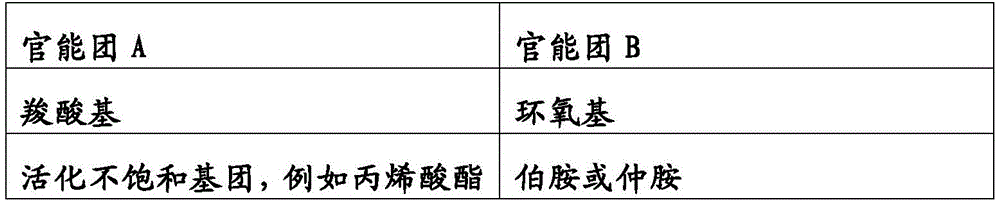
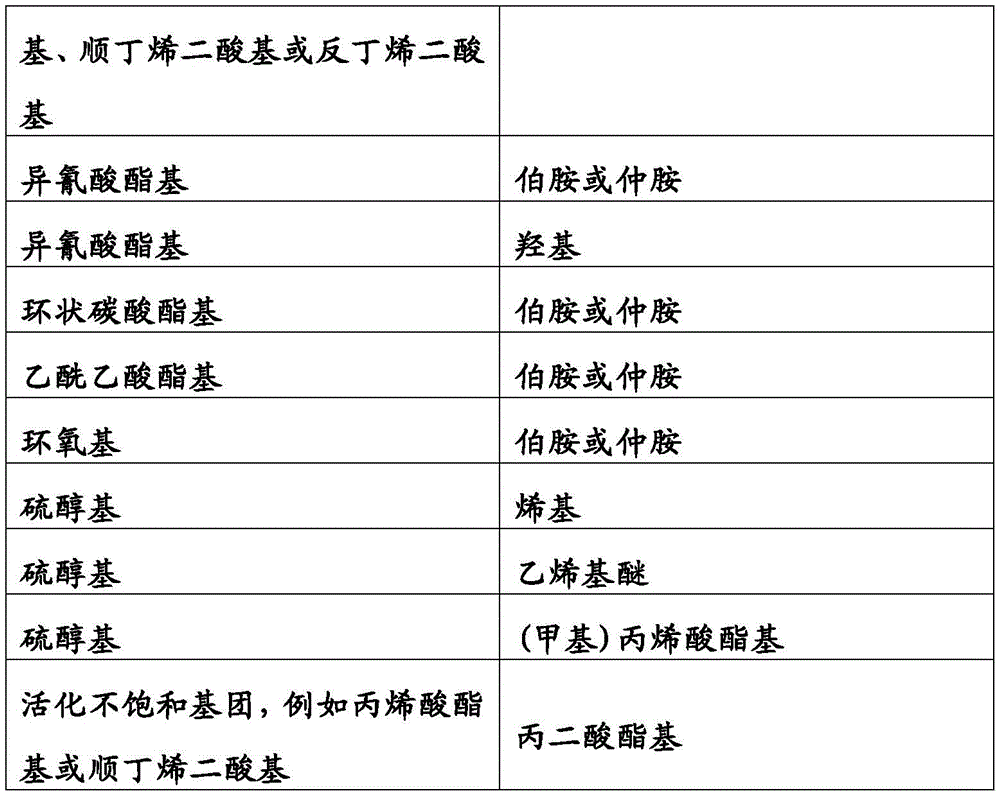
The first co-reactive component may include compounds having more than one type of functional group a and the second co-reactive component may include compounds having more than one type of functional group B, such that the build-up fabrication material may include at least two sets of co-reactive a and B groups, wherein at least one of the co-reactive compounds has a saturated functional group. For example, the first coreactive component can have a compound having a hydroxyl group and a secondary amine group (i.e., at least two different functional groups), and the second coreactive component can have a compound having an isocyanate group. One or both of the co-reactive components may optionally comprise a catalyst for catalyzing the reaction between the a and B groups.
The a and B groups may be attached to any suitable compound, such as a monomer and/or a prepolymer. The a and B groups may be attached to a prepolymer, such as a polyester, polyurethane or acrylic prepolymer.
Functional groups a and B may be terminal groups and/or pendant groups. The co-reactive compound may have a functionality of two, or a functionality greater than two, such as a functionality of 2 to 6. The functional groups of the co-reactive compounds may be the same or certain functional groups of the co-reactive compounds may be different. For example, the co-reactive compound may have more than one different type of functional group reactive with an isocyanate group, such as a primary amine group, a secondary amine group, or a hydroxyl group.
In a composition comprising at least two co-reactive compounds, the first compound may comprise a polyamine and the second compound may comprise a polyisocyanate; the first compound may comprise a polyalkenyl compound and the second compound may comprise a polythiol; or the first compound may comprise a michael addition acceptor and the second compound may comprise a michael addition donor. In a composition comprising at least two coreactive compounds, the first compound may comprise an isocyanate-functional prepolymer; and the second compound may comprise a compound such as a monomer and/or prepolymer comprising a primary amine, a secondary amine, a hydroxyl, or a combination of any of the foregoing. In a composition comprising at least two co-reactive compounds, the first compound may comprise a polythiol and the second compound may comprise a polyepoxide; or the first compound may comprise a polyamine and the second compound may comprise a polyepoxide
A co-reactive composition for additive layer manufacturing can include a first compound including a first functional group and a second compound including a second functional group, where the first and second functional groups are reactive with each other and at least one of the first functional group and the second functional group includes a saturated functional group. One of the first and second functional groups may be an unsaturated functional group, or the first and second functional groups may be saturated functional groups. The first functional group and the second functional group are not unsaturated functional groups. The compositions provided herein can contain co-additional reactive components, which can include saturated and/or unsaturated functional groups.
The co-reactive functional groups may react to form covalent bonds. The reaction between the co-reactive functional groups may be catalyzed by a catalyst. The catalyst may comprise a catalyst effective in catalyzing a reaction between the co-reactive compound and the co-reactive functional group. In certain compositions, the reaction between the co-reactive functional groups does not involve a free radical initiated reaction. The compositions provided herein can be thermosetting compositions.
The compositions provided herein can include two coreactive components or more than two coreactive components. The reactive component may comprise a combination of reactive compounds having the same functional group, such as a combination of monomers and prepolymers having the same functional group. The additional coreactive component, e.g., the third coreactive component, can comprise a compound having a different functional group that is reactive with the first functional group or the second functional group. Additional coreactive components may impart additional properties to the composition. For example, the reaction rate of the additional coreactive component with one of the other coreactive components may be rapid and thus help the deposited layer maintain a desired shape before the other coreactive components are fully cured. For example, a composition with a faster reaction rate may form an extruded core or extruded surface, and a composition with a slower reaction rate may form an extruded outer surface or extruded core, respectively.
The first component and the second component may be combined in a suitable ratio to form a curable coreactive composition. For example, the curable composition can have an equivalent ratio of functional group a to functional group B of 1 to 1.5. Suitable equivalent ratios of functional group a to functional group B of the curable composition can be, for example, 2.
The compositions provided herein can include one or both of the coreactive components such that the ratio of coreactive components in one portion of the object is different than the ratio of coreactive components in another portion of the object. In this way, portions of the object may have different curing compositions. The weight percentage of the co-reactive compounds, the equivalent ratio of reactive monomers or reactants within the co-reactive compounds, the type and/or content of filler, the crosslink density, and/or characteristics such as glass transition temperature may vary from composition to composition. Thus, a portion of an object produced in a three-dimensional printing manner may have different material properties, such as different chemical, physical, thermal, or material properties, than those of another portion of the three-dimensional object. For example, the outer surface of the object, the interior of the object, and/or the inner surface of the object may have different properties. The different properties may be located within the extrusion. For example, one or more surfaces or a portion of a surface of the extrudate may have different properties than another surface or a portion of a surface, and/or a surface or a portion of a surface may have different properties than the core. The core of the extrudate may also not be homogeneous, so that for a cross-section of the extrudate the properties may differ in different parts of the cross-section.
In addition, a portion of the object may react with at least some other co-reactive component moieties in an adjacent portion of the object. Such reactions can occur during deposition and/or after the co-reactive components are deposited in each adjacent portion, whereby the co-reactive components within each adjacent portion partially react and the co-reactive components between adjacent portions react. In this manner, as the co-reactive composition between portions of the object reacts, the deposited portions of the object may be covalently bonded together, thereby gradually increasing the physical and structural integrity of the three-dimensional object. For example, unreacted isocyanate and/or amino groups present on the surface of an underlying deposited layer may react with unreacted groups of a subsequently deposited layer. This increases the strength/integrity of the object by allowing reactions between layers of the deposited substance in addition to reactions within the same layer.
The additively manufactured object may include a layer formed from a thermoset or coreactive composition (such as a polyurea composition) that is produced from at least two deposited coreactive components and is crosslinkable. In the case of polyureas, one of the co-reactive components can include an isocyanate-functional prepolymer or oligomer and the other co-reactive component can include an amine, such as a primary or secondary amine. The isocyanate functional co-reactive component may further include an isocyanate functional monomer. The amine-containing co-reactive component can further include another reactant having a functional group (such as a hydroxyl group) reactive with the isocyanate-functional prepolymer, oligomer, and/or monomer. Adjacent portions of the printed three-dimensional object may react with some of the co-reactive composition in one or more of the adjacent portions.
For polyurea compositions, the co-reactive component can include an isocyanate-functional component that can include a polyisocyanate monomer and/or prepolymer or blend of polyisocyanates. The polyisocyanate prepolymer may be a polyisocyanate that is pre-reacted with a sufficient amount of a polyamine or other isocyanate-reactive component (such as one or more polyols) such that reactive isocyanate-based sites on the polyisocyanate remain in the isocyanate-functional prepolymer.
The reactive component may comprise a reactive compound, wherein the reactive compound may comprise a prepolymer or a combination of prepolymers, a monomer or a combination of monomers, or a combination of any of the foregoing. The prepolymer and monomer in the reactive component may have the same reactive functional group or different functional groups. For example, the reactive component may include polyamines and polyols, and may be combined with a reactive component comprising a polyisocyanate.
The polyisocyanate may comprise a polyisocyanate prepolymer, a polyisocyanate monomer, or a combination thereof.
Polyisocyanates can include polyisocyanate prepolymers prepared by reacting prepolymers having terminal groups reactive with isocyanate groups with polyisocyanates, such as diisocyanates. For example, polyisocyanate prepolymers can be prepared by reacting polyol prepolymers and/or polyamine prepolymers with polyisocyanates (such as diisocyanates). Suitable polyisocyanate prepolymers are commercially available.
Suitable monomeric polyisocyanates include, for example, isophorone diisocyanate (IPDI), which is 3, 5-trimethyl-5-isocyanato-methyl-cyclohexyl isocyanate; hydrogenated diisocyanates, such as cyclohexanediisocyanate, 4' -methylenedicyclohexyl diisocyanate (H) 12 MDI); mixed aralkyl diisocyanates, such as tetramethylditolyl diisocyanate, OCN-C (-CH) 3 ) 2 -C 6 H 4 C(CH 3 ) 2 -NCO; and polymethylene isocyanates such as 1, 4-tetramethylene diisocyanate, 1, 5-pentamethylene diisocyanate, 1, 6-hexamethylene diisocyanate (HMDI), 1, 7-heptamethylene diisocyanate, 2, 4-trimethylhexamethylene diisocyanate, 2, 4-trimethylhexamethylene diisocyanate, 1, 10-decamethylene diisocyanate and 2-methyl-1, 5-pentamethylene diisocyanate.
Aliphatic isocyanates may be suitable for producing three-dimensional polyurea objects that are resistant to degradation by UV light.
Examples of suitable monomeric aromatic polyisocyanates include principally phenylene diisocyanate, toluene Diisocyanate (TDI), xylene diisocyanate, 1, 5-naphthalene diisocyanate, chlorophenylene 2, 4-diisocyanate, xylene diisocyanate, dimethoxyaniline diisocyanate, tolidine diisocyanate and alkylated benzene diisocyanate; aromatic diisocyanates interrupted by methylene groups, such as methylene diphenyl diisocyanate, in particular the 4,4' -isomer (MDI), including alkylated analogs such as 3,3' -dimethyl-4, 4' -diphenylmethane diisocyanate and polymeric methylene diphenyl diisocyanate.
Suitable polyisocyanates also include polyisocyanates prepared from dimers and trimers of diisocyanate monomers. Dimers and trimers of the diisocyanate monomers can be prepared, for example, by the methods described in U.S. Pat. No. 5,777,061, column 3, line 44 to column 4, line 40, which is incorporated herein by reference in its entirety. Dimers and trimers of diisocyanate monomers may contain a linking group selected from the group consisting of isocyanurates, uretdione rings, biurets, allophanates, and combinations thereof, such as those available from Bayer Material Science N3600、
 CP2410 and
 N3400。
the polyisocyanate may also comprise a polyisocyanate prepolymer. For example, the polyisocyanate can include an isocyanate-terminated polyether diol, an isocyanate-terminated extended polyether diol, or a combination thereof. By extended polyether diol is meant a polyether diol which reacts with excess diisocyanate to produce an isocyanate-terminated polyether prepolymer having increased molecular weight and urethane linkages in the backbone. Examples of polyether diols include those available from Invista Polyether diols such as
 200 and
 650, or from BASF
 A polyether diol. Isocyanate-terminated polyether prepolymers may be prepared by reacting diisocyanates with polyether diols as described in U.S. application publication No. 2013/0344340, which is incorporated herein by reference in its entirety. The extended isocyanate-terminated prepolymer can have a number average molecular weight of, for example, from 250 daltons to 10,000 daltons or from 500 daltons to 7,500 daltons.
The polyisocyanate prepolymer may include an isocyanate-terminated polytetramethylene ether glycol, such as polytetramethylene ether glycol produced via polymerization of tetrahydrofuran. Examples of suitable polytetramethylene ether glycols include Polyols (LyondellBasell),
 Polyether glycol (BASF) or
 Polyol (Invista).
The polyisocyanate prepolymer can include an isocyanate-terminated polyetheramine. Examples of polyetheramines include Polyetheramines (Huntsman corp.) and polyetheramines from BASF. Examples of suitable polyetheramines include polyoxypropylenediamine.
The polyisocyanate prepolymer may comprise a difunctional isocyanate, a trifunctional isocyanate, a difunctional isocyanate-terminated prepolymer, an extended difunctional isocyanate-terminated prepolymer, or a combination of any of the foregoing.
The polyisocyanate may include a monomeric polyisocyanate or a combination of monomeric polyisocyanates. The monomeric polyisocyanate may be a diisocyanate or may have an isocyanate group functionality of, for example, 3 to 6.
Of suitable monomeric polyisocyanatesExamples include isophorone diisocyanate (IPDI), which is 3, 5-trimethyl-5-isocyanato-methyl-cyclohexyl isocyanate; hydrogenated substances, such as cyclohexanediisocyanate, 4' -methylenedicyclohexyl diisocyanate (H) 12 MDI); mixed aralkyl diisocyanates, such as tetramethylditolyl diisocyanate, OCN-C (-CH) 3 ) 2 -C 6 H 4 C(CH 3 ) 2 -NCO; and polymethylene isocyanates such as 1, 4-tetramethylene diisocyanate, 1, 5-pentamethylene diisocyanate, 1, 6-hexamethylene diisocyanate (HMDI), 1, 7-heptamethylene diisocyanate, 2, 4-trimethylhexamethylene diisocyanate, 2, 4-trimethylhexamethylene diisocyanate, 1, 10-decamethylene diisocyanate and 2-methyl-1, 5-pentamethylene diisocyanate.
Suitable monomeric aromatic polyisocyanates typically include phenylene diisocyanate, toluene Diisocyanate (TDI), xylene diisocyanate, 1, 5-naphthalene diisocyanate, chlorophenylene 2, 4-diisocyanate, xylene diisocyanate, dimethoxyaniline diisocyanate, tolidine diisocyanate, and alkylated benzene diisocyanate; aromatic diisocyanates interrupted with methylene, such as methylene diphenyl diisocyanate, especially the 4,4' -isomer (MDI), including alkylated analogs such as 3,3' -dimethyl-4, 4' -diphenylmethane diisocyanate and polymeric methylene diphenyl diisocyanate.
The amine-functional co-reactive component used to create the three-dimensional polyurea object can include a primary amine, a secondary amine, a tertiary amine, or a combination thereof. The polyamine can be a diamine or a polyamine having an amine functionality of, for example, 3 to 6, or a combination thereof. The polyamine can be a monomeric polyamine, a polyamine prepolymer, or a combination thereof,
examples of suitable monomeric aliphatic polyamines include ethylenediamine, 1, 2-diaminopropane, 1, 4-diaminobutane, 1, 3-diaminopentane, 1, 6-diaminohexane, 2-methyl-1, 5-pentanediamine, 2, 5-diamino-2, 5-dimethylhexane, 2, 4-trimethyl-1, 6-diamino-hexane and/or 2, 4-trimethyl-1, 6-diamino-hexane, 1, 11-diaminoundecane, 1, 12-diaminododecane, 1, 3-cyclohexanediamine and/or 1, 4-cyclohexanediamine, 1-amino-3, 5-trimethyl-5-aminomethyl-cyclohexane, 2, 4-hexahydrotoluenediamine and/or 2, 6-hexahydrotoluenediamine 2,4 '-diamino-dicyclohexylmethane and/or 4,4' -diamino-dicyclohexylmethane, 5-amino-1, 3-trimethylcyclohexanemethylamine (isophoronediamine), 1, 3-cyclohexanedi (methylamine) (1, 3 BAC) and 3,3 '-dialkyl-4, 4' -diaminodicyclohexylmethanes (such as 3,3 '-dimethyl-4, 4' -diaminodicyclohexylmethane and 3,3 '-diethyl-4, 4' -diaminodicyclohexylmethane), 2, 4-diaminotoluene and/or 2, 6-diaminotoluene and 2,4 '-diaminodiphenylmethane and/or 4,4' -diaminodiphenylmethane or mixtures thereof.
Suitable secondary amines include acrylate and methacrylate modified amines. "acrylate and methacrylate modified amines" include monoacrylate and polyacrylate modified amines as well as acrylate or methacrylate modified monoamines or polyamines. The acrylate or methacrylate modified amine may comprise an aliphatic amine.
The secondary amine can include aliphatic amines, such as cycloaliphatic diamines. Such amines may be Jefflink TM (such as Jefflink) TM 754 From Huntsman Corporation (Houston, TX). The amine may be provided as an amine functional resin. Such amine-functional resins may be relatively low viscosity amine-functional resins suitable for use in formulating high solids polyurea three-dimensional objects. The amine functional resin may include esters of organic acids, such as aspartic ester-based amine functional reactive resins that are compatible with isocyanates; such as a solvent-free amine functional resin. An example of such polyaspartic acid esters is Desmophen TM NH1220 is a derivative of diethyl maleate and 1, 5-diamino-2-methylpentane available under the trade names of Bayer Corporation, PA. Other suitable compounds containing an aspartate group may also be used.
The polyamine may include a high molecular weight primary amine, such as a polyoxyalkylene amine. The polyoxyalkylene amines contain two or more primary amine groups attached to a backbone derived from, for example, propylene oxide, ethylene oxide, or mixtures thereof. Examples of such amines include those such as may be named Jeffamine TM Polyoxypropylenediamine and glycerol tris [ poly (propylene glycol) available from Huntsman Corporation,amine capping]And (c) an ether. Such polyetheramines can have a molecular weight of 200 daltons to 7,500 daltons, such as Jeffamine TM D-230, D-400, D-2000, T-403 and T-5000.
The amine-functional co-reactive component may also include secondary aliphatic amines, such as those available from Dor-KetalChemicals, LLC 1000。
1000。
The amine-functional co-reactive component may comprise an amine-functional aspartate, a primary polyoxyalkylene amine, a secondary aliphatic amine, or a combination of any of the foregoing.
For polyureas formed from coreactive components comprising isocyanates and (meth) acrylate amine reaction products of monoamines and poly (meth) acrylates, the term "(meth) acrylate" indicates acrylate and corresponding (meth) acrylate. The poly (meth) acrylate may be any suitable poly (meth) acrylate and mixtures thereof. The poly (meth) acrylate may comprise a di (meth) acrylate, the poly (meth) acrylate may comprise a (meth) acrylate, or the poly (meth) acrylate may comprise a tetra (meth) acrylate. Suitable di (meth) acrylates include, for example, ethylene glycol, di (meth) acrylate, 1, 3-butanediol di (meth) acrylate, 1, 4-butanediol di (meth) acrylate, 2, 3-dimethylpropane 1, 3-di (meth) acrylate, 1, 6-hexanediol di (meth) acrylate, propylene glycol di (meth) acrylate, dipropylene glycol di (meth) acrylate, tripropylene glycol di (meth) acrylate, tetraethylene glycol di (meth) acrylate, tetrapropylene glycol di (meth) acrylate, ethoxylated hexanediol di (meth) acrylate, propoxylated hexanediol di (meth) acrylate, neopentyl glycol di (meth) acrylate, alkoxylated neopentyl glycol di (meth) acrylate, hexanediol di (meth) acrylate, diethylene glycol di (meth) acrylate, polyethylene glycol di (meth) acrylate, polybutadiene di (meth) acrylate, thiodiethylene glycol di (meth) acrylate, propylene glycol di (meth) acrylate, triethylene glycol di (meth) acrylate, alkoxylated hexanediol di (meth) acrylate, alkoxylated neopentyl glycol di (meth) acrylate, pentanediol di (meth) acrylate, cyclohexanedimethanol di (meth) acrylate, ethoxylated bisphenol a di (meth) acrylate, and combinations of any of the foregoing. Examples of tri-and higher (meth) acrylates include glycerol tri (meth) acrylate, trimethylolpropane tri (meth) acrylate, ethoxylated trimethylolpropane tri (meth) acrylate, propoxylated trimethylolpropane tri (meth) acrylate, ditrimethylolpropane tetra (meth) acrylate, pentaerythritol tetra (meth) acrylate, ethoxylated pentaerythritol tetra (meth) acrylate, propoxylated pentaerythritol tetra (meth) acrylate, and dipentaerythritol penta (meth) acrylate. Other suitable poly (meth) acrylate oligomers include (meth) acrylates of epoxidized soybean oil and urethane acrylates and hydroxyalkyl (meth) acrylates of polyisocyanates. Mixtures of poly (meth) acrylate monomers may also be used, including mixtures of mono, di, tri and/or tetra (meth) acrylates.
Other suitable poly (meth) acrylates include urethane (meth) acrylates such as those formed from the reaction of a hydroxyl functional (meth) acrylate with a polyisocyanate or with an isocyanate functional adduct of a polyisocyanate and a polyol or polyamine. Suitable hydroxy-functional (meth) acrylates include 2-hydroxyethyl, 1-methyl-2-hydroxyethyl, 2-hydroxypropyl, 2-hydroxybutyl, 4-hydroxybutyl and the like. Suitable polyisocyanates include, for example, any of the monomeric or oligomeric polyisocyanates, or isocyanate prepolymers disclosed herein.
Polyamines include diamines, polyamines having amine functionality, for example, of 3 to 6, and combinations thereof.
Examples of suitable aliphatic polyamines include ethylamine, the isomeric propylamines, butylamine, pentylamine, hexylamine, cyclohexylamine, ethylenediamine, 1, 3-bis (aminomethyl) diamine, 1, 2-diaminopropane, 1, 4-diaminobutane, 1, 3-diaminopentane, 1, 6-diaminohexane, 2-methyl-1, 5-pentanediamine, 2, 5-diamino-2, 5-dimethylhexane, 2, 4-trimethyl-1, 6-diamino-hexane and/or 2, 4-trimethyl-1, 6-diamino-hexane, 1, 11-diaminoundecane, 1, 12-diaminododecane, 1, 3-cyclohexanediamine and/or 1, 4-cyclohexanediamine, 1-amino-3, 5-trimethyl-5-aminomethyl-cyclohexane, 2, 4-hexahydrotoluenediamine and/or 2, 6-hexahydrotoluenediamine, 2,4 '-diamino-dicyclohexylmethane and/or 4,4' -diamino-dicyclohexylmethane and/or 3,3 '-dialkylmethane and/or 3, 4' -diaminodicyclohexylmethane (such as 2,4 '-diaminodiphenylmethane and/or 2,4' -diaminodiphenylmethane), and/or mixtures thereof. Specific examples of acrylate-modified amines are the reaction product of isophorone diamine, dibutyl maleate, and butyl acrylate.
Examples of suitable secondary amines can include aliphatic amines, such as cycloaliphatic diamines. Such amines may be (such as
 754 Available from Huntsman Corporation (Houston, TX). Other examples include
 1000 (Dorf-KetalChemicals, LLC) and aspartate-functional amines, such as
 (such as NH1220,
 NH 1420 and
 NH 1520) of the known aspartic ester functional amines (Bayer Materials Science LLC). The secondary amine can be the reaction product of isophorone diamine and acrylonitrile, such as
 136 (from BASF/Hansen Group LLC). The polyamine may also be provided as an amine functional resin. For example, the amine-functional resin may include esters of organic acids, such as aspartic ester-based amine-functional reactive resins that are compatible with isocyanates; for example, amine functional resins that are solvent free and/or have a molar ratio of amine functional groups to esters of no more than 1, thus remaining free of excess primary amine during the reaction. Examples of such polyaspartic esters are those available under the trade name Desmophen TM NH1220 is a derivative of diethyl maleate and 1, 5-diamino-2-methylpentane available from Bayer Corporation. Other suitable compounds containing an aspartate group may also be used. In addition, the secondary polyamines may include polyaspartic esters, which may include derivatives of compounds such as maleic acid, fumaric acid esters, aliphatic polyamines, and the like.
The polyamine may include a high molecular weight primary amine, such as a polyoxyalkylene amine. The polyoxyalkylene amines contain two or more primary amine groups attached to a backbone derived from, for example, propylene oxide, ethylene oxide, or mixtures thereof. Examples of such amines include the names Those obtained from Huntsman Corporation. Such amines typically have a molecular weight in the range of 200 to 7500, such as (but not limited to)
 D-230, D-400, D-2000, T-403 and T-5000.
The composition comprising a polyisocyanate and a polyamine may further comprise a polysiloxane. The polysiloxane is effective in increasing the tensile strength of the polyurea without decreasing elasticity. The composition can comprise, for example, 1wt% to 40wt%, 5wt% to 35wt%, or 10wt% to 30wt% polysiloxane, where the wt% is based on the total weight of polyisocyanate, polyamine, and polysiloxane in the composition.
The polysiloxane can have a number average molecular weight of, for example, 500 daltons to 50,000 daltons. The polysiloxane may have terminal isocyanate groups, amine groups, hydroxyl groups, or other suitable terminal groups suitable for the particular curing chemistry. The polysiloxane can be a homopolymer, a block copolymer, a graft copolymer, or a combination of any of the foregoing. The polysiloxane may comprise poly (methylhydrosiloxane), poly (dimethylsiloxane), or a combination thereof.
Examples of suitable polysiloxane homopolymers include hexamethylsiloxane, bis (3-aminopropyl) terminated poly (dimethylsiloxane), diglycidyl ether terminated (polydimethylsiloxane), hydrogen-terminated (polydimethylsiloxane), hydroxy-terminated (polydimethylsiloxane), monoacrylamidopropyl terminated (polydimethylsiloxane), vinyl-terminated (polydimethylsiloxane), poly (methylhydrosiloxane), trimethylsilyl-terminated poly (methylhydrosiloxane), poly (methylphenylsiloxane), and combinations of any of the foregoing.
Examples of suitable polysiloxane copolymers include poly (dimethylsiloxane-co-alkylmethylsiloxane), poly (dimethylsiloxane-co- (3-aminopropyl) methylsiloxane), dihydroxy-terminated poly (dimethylsiloxane-co-diphenylsiloxane), divinyl-terminated poly (dimethylsiloxane-co-diphenylsiloxane), poly [ dimethylsiloxane-co- (2- (3, 4-epoxycyclohexyl) ethyl) methylsiloxane ], poly [ dimethylsiloxane-co- [3- (2- (2-hydroxyethoxy) ethoxy) propyl ] methylsiloxane ], trimethylsilyl-terminated poly (dimethylsiloxane-co-methylhydrosiloxane), poly (dimethylsiloxane-co-methylphenylsiloxane), poly (dimethylsiloxane-co-methyl (stearyloxyalkyl) siloxane), poly (dimethylsiloxane) -graft-polyacrylate, and combinations of any of the foregoing.
The polysiloxane may comprise poly (dimethylsiloxane), poly (methylhydrogensiloxane), or a combination thereof. The polysiloxane may comprise an alkylsilyl terminated poly (dimethylsiloxane), an alkoxysilyl terminated poly (methylhydrosiloxane), or a combination thereof. The polysiloxane may comprise trimethylsilyl-terminated poly (dimethylsiloxane), trimethyl-terminated poly (methylhydrogensiloxane), or a combination thereof.
The siloxane may comprise poly (methylhydrosiloxane) or a combination of poly (methylhydrosiloxane). The polysiloxane may comprise poly (dimethylsiloxane) or a combination of poly (dimethylsiloxane).
Polysiloxanes such as poly (methylhydrogensiloxane) or poly (dimethylsiloxane) can have an average molecular weight of, for example, 500 daltons to 5,000 daltons from 750 daltons to 4,500 daltons, 1,000 daltons to 4,000 daltons, or 1,500 daltons to 4,500 daltons. Polysiloxanes such as poly (methylhydrogensiloxane) or poly (dimethylsiloxane) can have an average molecular weight of, for example, 1,000 to 100,000 daltons, 1,000 to 50,000 daltons, or 3,000 to 25,000 daltons. Molecular weight can be determined using gel permeation chromatography using polystyrene standards.
Suitable polysiloxanes include silicone urethane polyols. Examples of siloxane urethane polyols are disclosed, for example, in U.S. Pat. No. 7,459,515.
The co-reactive compositions provided herein may be based on thiol-ene chemistry.
The co-reactive composition may comprise a polythiol and a polyalkenyl group. The polythiol can comprise a monomeric polythiol, a polythiol prepolymer, or a combination thereof. The polythiol can comprise a dithiol, a polythiol having a thiol group functionality of, for example, 3 to 6, or a combination thereof. The polyalkenyl group can comprise a monomeric polyalkenyl group, a polyalkenyl prepolymer, or a combination thereof. The polythiol can comprise a dienyl group, a polyalkenyl group having a thiol functionality of, for example, 3 to 6, or a combination thereof.
The polythiol can comprise any suitable thiol-terminated prepolymer or combination of thiol-terminated prepolymers. Thiol-terminated sulfur-containing prepolymers are useful as sealants due to their solvent resistance and ability to maintain acceptable physical properties over a wide range of temperatures and environmental conditions. Examples of suitable thiol-terminated sulfur-containing prepolymers include thiol-terminated polythioethers, thiol-terminated polysulfides, thiol-terminated sulfur-containing polyformals, and thiol-terminated monosulfides. Sulfur-containing prepolymers are suitable for use as sealants.
The sulfur-containing prepolymer can comprise a thiol-terminated polythioether. Suitable thiol group sealsExamples of terminal polythioether prepolymers are disclosed, for example, in U.S. Pat. No. 6,172,179, which is incorporated herein by reference in its entirety. The thiol-terminated polythioether prepolymer can comprise P3.1E、
 P3.1E-2.8、
 L56086 or a combination of any of the foregoing, each obtained from PRC-DeSoto International Inc.
The thiol-terminated polythioether prepolymer can include a thiol-terminated polythioether prepolymer comprising at least one moiety having the structure of formula (2):
-R 1 -[S-(CH 2 ) 2 -O-(R 2 -O-) m (CH 2 ) 2 -S-R 1 ] n - (2)
wherein,
each R 1 Can independently contain C 2-10 N-alkanediyl, C 3-6 Branched alkanediyl, C 6-8 Cycloalkanediyl group, C 6-10 Cycloalkanediyl group, divalent heterocyclic group or- [ (CHR) 3 ) p -X-] q (CHR 3 ) r -, wherein each R 3 Comprising hydrogen or methyl;
each R 2 Can independently contain C 2-10 N-alkanediyl, C 3-6 Branched alkanediyl, C 6-8 Cycloalkanediyl group, C 6-14 Alkylcycloalkanediyl, divalent heterocyclic group or- [ (CH) 2 ) p -X-] q (CH 2 ) r -a group;
each X may independently comprise O, S or NR wherein R comprises hydrogen or methyl;
m ranges from 0 to 50;
n is an integer in the range of 1 to 60;
p is an integer ranging from 2 to 6;
q is an integer in the range of 1 to 5; and
r is an integer in the range of 2 to 10.
The thiol-terminated polythioether can have a structure of formula (3 a) and the moiety E derived from the thiol-terminated polythioether has a structure of formula (3 b):
HS-R 1 -[S-A-S-R 1 -] n -SH (3a)
-S-R 1 -[S-A-S-R 1 -] n -S- (3b)
wherein,
n is an integer from 1 to 60;
each R 1 Independently selected from C 2-10 Alkanediyl, C 6-8 Cycloalkanediyl group, C 6-14 Alkanecycloalkanediyl group, C 5-8 Heterocycloalkanediyl and- [ (CHR) 3 ) p -X-] q (CHR 3 ) r -, in which,
p is an integer from 2 to 6;
q is an integer of 1 to 5;
r is an integer from 2 to 10;
each R 3 Independently selected from hydrogen and methyl; and
each X is independently selected from O, S-S and NR, wherein R is selected from hydrogen and methyl; and
each a is independently derived from a polyalkenyl group.
In the thiol-terminated polythioether of formula (3 a) and the moiety of formula (3 b), each A can be independently selected from a moiety of formula (4 a) and a moiety of formula (4 b):
-(CH 2 ) 2 -O-(R 2 -O) m -(CH 2 ) 2 - (4a)
B 2 {-R 20 -(CH 2 ) 2 -} 2 {-R 20 -(CH 2 ) 2 -S-[-R 1 -S-A-S-] n1 -R 1 -S} z-2 (4b)
wherein,
each R 1 Independently selected from C 2-10 Alkanediyl, C 6-8 Cycloalkanediyl group, C 6-14 Alkylcycloalkanediyl, C 5-8 Heterocycloalkanediyl and- [ (CHR) 3 ) p -X-] q (CHR 3 ) r -, in which,
p is an integer from 2 to 6;
q is an integer of 1 to 5;
r is an integer from 2 to 10;
each R 2 Independently selected from C 1-10 Alkanediyl, C 6-8 Cycloalkanediyl group, C 6-14 Alkylcycloalkanediyl and- [ (CHR) 3 ) p -X-] q (CHR 3 ) r -, where p, q, R, R 3 And X is as R 1 Defining;
m is an integer of 0 to 50; and
each n1 is independently selected from an integer of 0 to 60;
B 2 represents a z-valent polyalkenyl polyfunctionalizing agent B 2 (-R 20 -CH=CH 2 ) z The core of (a), wherein,
z is an integer from 3 to 6; and
each R 20 Is independently selected from C 1-10 Alkanediyl, C 1-10 Heteroalkanediyl, substituted C 1-10 Alkanediyl and substituted C 1-10 A heteroalkyldiyl group.
The thiol-terminated sulfur-containing prepolymer may comprise a thiol-terminated sulfur-containing polyformal. Sulfur-containing polyformal prepolymers suitable for use in aerospace sealant applications are disclosed, for example, in U.S. patent No. 8,729,216 and U.S. patent No. 8,541,513, each of which is incorporated herein by reference in its entirety.
The thiol-terminated sulfur-containing polyformal prepolymer may have a structure of formula (5):
R 3 -R 1 -(S) p -R 1 -[O-C(R 2 ) 2 -O-R 1 -(S) p -R 1 -] n -R 3 (5)
wherein n is an integer selected from 1 to 50; each p is independently selected from 1 and 2; each R 1 Comprises C 2-6 An alkanediyl group; each R 2 Independently contain hydrogen and C 1-6 Alkyl radical, C 7-12 Phenylalkyl, substituted C 7-12 Phenylalkyl, C 6-12 Cycloalkylalkyl, substitutedC 6-12 Cycloalkylalkyl radical, C 3-12 Cycloalkyl, substituted C 3-12 Cycloalkyl radical, C 6-12 Aryl or substituted C 6-12 An aryl group; and each R 3 is-OR 3’ Wherein R is 3’ Comprising thiol-terminated groups.
The sulfur-containing polyformal prepolymer may have a structure according to formula (6):
{R 6 -R 1 -(S) p -R 1 -[O-C(R 3 ) 2 -O-R 1 -(S) p -R 1 -] n -O-C(R 3 ) 2 -O-] m -Z (6)
wherein each n is an integer selected from 1 to 50; m is an integer selected from 3 to 6; p independently comprises 1 or 2; each R 1 Independently contain C 2-6 An alkanediyl group; each R 3 Independently contain hydrogen and C 1-6 Alkyl radical, C 7-12 Phenylalkyl, substituted C 7-12 Phenylalkyl, C 6-12 Cycloalkylalkyl, substituted C 6-12 Cycloalkylalkyl radical, C 3-12 Cycloalkyl, substituted C 3-12 Cycloalkyl, C 6-12 Aryl or substituted C 6-12 An aryl group; each R 5 is-OR 5’ Wherein R is 5’ Comprising thiol-group endcapping.
The thiol-terminated sulfur-containing prepolymer may comprise a thiol-terminated polysulfide prepolymer. By polysulfide prepolymer is meant a prepolymer that contains one or more polysulfide linkages (i.e., -S-in the backbone of the prepolymer and/or pendant positions on the prepolymer chain x -a linker, wherein x is 2 to 4). The polysulfide prepolymer may have two or more sulfur-sulfur linkages. Suitable polysulfides are each referred to by the name And
And from, for example, akzo nobel and Toray Industries, inc.
Examples of suitable polysulfide prepolymers are disclosed in, for example, U.S. Pat. nos. 4,623,711; nos. 6,172,179; U.S. Pat. No. 6,509,418; nos. 7,009,032; and 7,879,955, each of which is incorporated herein by reference in its entirety.
Examples of suitable thiol-terminated polysulfides include Thioplast TM G polysulfides, such as Thioplast TM G1、Thioplast TM G4、Thioplast TM G10、Thioplast TM G12、Thioplast TM G21、Thioplast TM G22、Thioplast TM G44、Thioplast TM G122 and Thioplast TM G131, commercially available from akzo nobel. Thioplast TM The G resin is a liquid polysulfide polymer that is a blend of di-and trifunctional molecules, wherein the di-functional polysulfide polymer has a structure of formula (7):
SH-(-R-S-S-) n -R-SH (7)
and the trifunctional polysulfide polymer has the structure of formula (8):
HS-(-R-S-S-) a -CH 2 -CH{-(-S-S-R-) c -SH}{-CH 2 -(-S-S-R-) b -SH}(8)
wherein each R is- (CH) 2 ) 2 -O-CH 2 -O-(CH 2 ) 2 And n = a + b + c, wherein the value of n may be from 7 to 38 depending on the amount of trifunctional crosslinker (1, 2,3, -trichloropropane; TCP) used during the synthesis of the polysulfide polymer. Thioplast TM The G polysulfide can have a molecular weight of less than 1,000 daltons to 6,500 daltons, an SH content of 1% to greater than 5.5%, and a crosslink density of 0% to 2.0%.
Examples of suitable thiol-terminated polysulfide prepolymers also include Thiokol available from toray industries, inc TM LP polysulfides, such as Thiokol TM LP2、Thiokol TM LP3、Thiokol TM LP12、Thiokol TM LP23、Thiokol TM LP33 and Thiokol TM LP55。Thiokol TM The LP polysulfide has an average molecular weight of 1,000 to 7,500 daltons, an SH content of 0.8 to 7.7%, and a crosslink density of 0 to 2%.
The thiol-terminated sulfur-containing prepolymer may comprise Polysulfide,
 G polysulfide, or a combination thereof.
The thiol-terminated sulfur-containing prepolymer may comprise a thiol-terminated monosulfide.
The thiol-terminated monosulfide can comprise a thiol-terminated monosulfide of formula (9 a), a thiol-terminated monosulfide of formula (9 b), or a combination thereof:
HS-R 2 -[-S-(R-X) p -(R 1 -X) q -R 2 -] n -SH (9a)
{HS-R 2 -[-S-(R-X) p -(R 1 -X) q -R 2 -] n -S-V’-} z B (9b)
wherein each X independently comprises S, O or NR 3 Wherein R is 3 Comprises C 1-4 An alkyl group;
p is an integer from 1 to 5;
q is an integer of 0 to 5;
n is an integer from 1 to 60;
each R independently comprises C 2-10 Alkanediyl, C 6-8 Cycloalkanediyl group, C 1-4 Alkylcycloalkanediyl or C 8-10 An alkyl aryl diradical;
each R 1 Independently contain C 1-10 Alkanediyl, C 6-8 Cycloalkanediyl group, C 1-4 Alkylcycloalkanediyl or C 8-10 An alkyl aryl diradical;
each R 2 Independently contain C 2-10 Alkanediyl, C 6-8 Cycloalkanediyl group, C 1-4 Alkylcycloalkanediyl or C 8-10 An alkyl aryl diradical;
b represents a z-valent polyfunctionalizing agent B (-V) z The core of (a), wherein:
z is an integer from 3 to 6; and
each V is a moiety comprising a terminal group reactive with a thiol group; and
each-V' -is derived from the reaction of-V with a thiol group.
The thiol-terminated monosulfide can comprise a thiol-terminated monosulfide of formula (10 a), a thiol-terminated monosulfide of formula (10 b), or a combination thereof:
H-[-S-(R-X) p -C(R 1 ) 2 -(X-R) q -] n -SH (10a)
{H-[-S-(R-X) p -C(R 1 ) 2 -(X-R) q -] n -S-V’-} z B (10b)
wherein each X may independently be S or O;
p is an integer from 1 to 5;
q is an integer of 1 to 5;
n is an integer from 1 to 60;
each R independently comprises C 2-10 An alkanediyl group;
each R 1 Independently contain hydrogen or C 1-10 An alkanediyl group;
b represents a z-valent polyfunctionalizing agent B (-V) z The core of (1), wherein:
z is an integer from 3 to 6; and
each V is a moiety comprising a terminal group reactive with a thiol group; and
each-V' -is derived from the reaction of-V with a thiol group.
The thiol-terminated monosulfide can comprise a thiol-terminated monosulfide of formula (11 a), a thiol-terminated monosulfide of formula (11 b), or a combination thereof:
HS-R-(S y -R) t -SH (11a)
{HS-R-(S y -R) t -S-V’-} z B (11b)
wherein t is an integer from 1 to 60;
q is an integer from 1 to 8;
p is an integer from 1 to 10;
r is an integer from 1 to 10;
y has an average value in the range of 1.0 to 1.5;
each R independently comprises a branched alkanediyl group, a branched arenediyl group orHaving the structure- (CH) 2 ) p -O-(CH 2 ) q -O-(CH 2 ) r -a moiety of;
b represents a z-valent polyfunctionalizing agent B (-V) z The core of (1), wherein:
z is an integer from 3 to 6; and
each V is a moiety comprising a terminal group reactive with a thiol group; and
each-V' -is derived from the reaction of-V with a thiol group.
Examples of thiol-terminated monosulfides of formula (11 a) and formula (11 b) are disclosed, for example, in U.S. application publication No. 2016/0152775 and in U.S. patent No. 9,079,833.
The thiol-terminated monosulfide may comprise a thiol-terminated monosulfide of formula (12):
HS-(R-O-CH 2 -O-R-S m -) n-1 -R-O-CH 2 -O-R-SH (12)
wherein R is C 2-4 Alkanediyl, m is 1 to 8, and n is an integer of 2 to 370.
The polythiol can comprise a monomeric dithiol or a combination of monomeric dithiols.
The polythiol can comprise a monomeric polythiol having a thiol functionality of, for example, 3 to 6, or a combination of monomeric polythiols having a thiol functionality of, for example, 3 to 6.
The polythiol can comprise a dithiol having the structure of formula (13):
HS-R 1 -SH (13)
wherein R is 1 Is selected from C 2-6 Alkanediyl, C 6-8 Cycloalkanediyl group, C 6-10 Alkanecycloalkanediyl group, C 5-8 Heterocycloalkanediyl and- [ (CHR) 3 ) p -X-] q (CHR 3 ) r -; wherein each R is 3 Independently selected from hydrogen and methyl; each X is independently selected from O, S-S and NR wherein R is selected from hydrogen and methyl; p is an integer from 2 to 6; q is an integer of 1 to 5; and r is an integer from 2 to 10.
Examples of suitable dithiols include 1, 2-ethanedithiol, 1, 2-propanedithiol, 1, 3-butanedithiol, 1, 4-butanedithiol, 2, 3-butanedithiol, 1, 3-pentanedithiol, 1, 5-pentanedithiol, 1, 6-hexanedithiol, 1, 3-dimercapto-3-methylbutane, dipentene dithiol, ethylcyclohexyldithiol (ECHDT), dimercaptodiethylmethyl sulfide, methyl-substituted dimercaptodiethyl sulfide, dimethyl-substituted dimercaptodiethyl sulfide, dimercaptodioxaoctane, 1, 5-dimercapto-3-oxapentane, and combinations of any of the foregoing.
Examples of suitable polythiols having a thiol functionality greater than 2 include, for example, 1,2,3-propanetrithiol, 1,2,3-benzenetrithiol, 1,1,1-butanetrithiol, heptane-1,3-7-trithiol, 1,3,5-triazine-2,4-6-trithiol, isocyanurate-containing trithiol, and combinations thereof, as disclosed in U.S. application publication No. 2010/0010133, and U.S. patent No. 4,366,307; nos. 4,609,762; and polythiols as described in U.S. Pat. No. 5,225,472. Combinations of polyfunctionalizing agents may also be used.
Examples of suitable polythiol polyfunctionalizing agents include pentaerythritol tetrakis (3-mercapto-propionate) (PETMP), trimethylol-propane tris (3-mercaptopropionate) (TMPMP), ethylene glycol bis (3-mercaptopropionate) (GDMP), tris [2- (3-mercapto-propionyloxy) ethyl ] isocyanurate (TEMPIC), dipentaerythritol hexa (3-mercaptopropionate) (di-PETMP), tris (3-mercaptopropionate) pentaerythritol, trimethylolethane tris- (3-mercaptopropionate), and combinations of any of the foregoing.
Polythiol co-reactive components refer to polyfunctional compounds containing two or more thiol functional groups (-SH). Suitable polythiol-functional compounds include polythiols having at least two thiol groups, including monomers and prepolymers. The polythiol may have ether linkages (-O-), thioether linkages (-S-) (including polysulfide linkages (-S-)) x -) where x is at least 2, such as 2 to 4) and combinations of such linkers.
Examples of suitable polythiols include those of formula R 1 -(SH) n Wherein R is 1 Is a polyvalent organic moiety and n is an integer of at least 2, such as 2 to 6.
Examples of suitable polythiols include polythiols formed by reacting compounds of the formula HS-R 2 Thiol group-containing acid of-COOH (wherein R is 2 Is an organic moiety) and junctionStructure R of 3 -(OH) n Polyhydroxy compound of (2) (wherein R 3 Is an organic moiety and n is at least 2, such as 2 to 6). These components can be reacted under suitable conditions to give compounds having the general structure R 3 -(OC(O)-R 2 -SH) n Wherein R is 2 、R 3 And n is as defined above.
Examples of thiol-containing acid include thioglycolic acid (HS-CH) obtained with a polyol such as ethylene glycol, triol, tetrol, pentol, hexol and combinations of any of the foregoing 2 COOH), alpha-mercaptopropionic acid (HS-CH (CH) 3 ) -COOH) and beta-mercaptopropionic acid (HS-CH) 2 CH 2 COCH). Other suitable polythiols include ethylene glycol bis (thioglycolate), ethylene glycol bis (β -mercaptopropionate), trimethylolpropane tris (thioglycolate), trimethylolpropane tris (β -mercaptopropionate), pentaerythritol tetrakis (thioglycolate), and pentaerythritol tetrakis (β -mercaptopropionate), and combinations of any of the foregoing.
The polyalkenyl group can comprise any suitable polyalkenyl prepolymer or combination of polyalkenyl prepolymers. The polyalkenyl prepolymer can comprise an alkenyl-terminated sulfur-containing prepolymer, which can be prepared, for example, by reacting a diene-based compound with a thiol-terminated sulfur-containing prepolymer as described herein.
The polyalkenyl group may comprise a monomeric dienyl group or a combination of monomeric dienyl groups.
The polyalkenyl group can comprise a monomeric polythiol having an alkenyl functionality, e.g., from 3 to 6, or a combination of monomeric polyalkenyl groups having an alkenyl functionality, e.g., from 3 to 6.
The polyalkenyl group may comprise a polyalkenyl ether or a combination of polyalkenyl ethers. The polyalkenyl group can comprise a divinyl ether of formula (14 a), a polyalkenyl polyfunctionalizing agent of formula (14 b), or a combination thereof:
CH 2 =CH-O-(R 2 -O) m -CH=CH 2 (14a)B 2 (-R 20 -CH=CH 2 ) z (14b)
wherein,
each R 2 Independently selected from C 1-10 Alkanediyl, C 6-8 Cycloalkanediyl group, C 6-14 Cycloalkanediyl and- [ (CHR) 3 ) p -X-] q (CHR 3 ) r -, where p, q, R, R 3 And X is as R 1 Defining;
m is an integer of 0 to 50; and
B 2 represents a z-valent polyalkenyl polyfunctionalizing agent B 2 (-R 20 -CH=CH 2 ) z The core of (a), wherein,
z is an integer from 3 to 6; and
each R 20 Independently selected from C 1-10 Alkanediyl, C 1-10 Heteroalkanediyl, substituted C 1-10 Alkanediyl and substituted C 1-10 A heteroalkyldiyl group.
Examples of suitable bis (alkenyl) ethers include divinyl ether, ethylene glycol divinyl ether (EG-DVE), butanediol divinyl ether (BD-DVE), hexanediol divinyl ether (HD-DVE), diethylene glycol divinyl ether (DEG-DVE), triethylene glycol divinyl ether (TEG-DVE), tetraethylene glycol divinyl ether, and cyclohexanedimethanol divinyl ether.
Examples of suitable polyalkenyl groups having an alkenyl functionality of greater than 2 include triallyl cyanurate (TAC), triallylisocyanurate (TAIC), 1,3, 5-triallyl-1, 3, 5-triazine-2, 4, 6-trione, 1, 3-bis (2-methylallyl) -6-methylene-5- (2-oxopropyl) -1,3, 5-triazone-2, 4-dione, tris (allyloxy) methane, pentaerythritol triallyl ether, 1- (allyloxy) -2, 2-bis ((allyloxy) methyl) butane, 2-prop-2-ethoxy-1, 3, 5-tris (prop-2-enyl) benzene, 1,3, 5-tris (prop-2-enyl) -1,3, 5-triazine-2, 4-dione, and 1,3, 5-tris (2-methylallyl) -1,3, 5-triazine-2, 4, 6-trione, 1,2, 4-trivinylcyclohexane, and any combination of the foregoing.
For example, the co-reactive compositions provided herein having thiol-ene functionality may include a polyene co-reactive component comprising a compound or prepolymer having terminal and/or pendant olefinic double bonds (such as terminal olefinic groups). Examples of such compounds include (meth) acrylic functional (meth) acrylic copolymers, epoxy acrylates, such as epoxy (meth) acrylates (such as the reaction product of bisphenol a diglycidyl ether and acrylic acid), polyester (meth) acrylates, polyether (meth) acrylates, polyurethane (meth) acrylates, amino (meth) acrylates, silicone (meth) acrylates, and melamine (meth) acrylates.
Examples of suitable polyurethane (meth) acrylates include the reaction product of a polyisocyanate such as 1, 6-hexamethylene diisocyanate and/or isophorone diisocyanate, including its isocyanurate and biuret derivatives, and a hydroxyalkyl (meth) acrylate such as hydroxyethyl (meth) acrylate and/or hydroxypropyl (meth) acrylate. Examples of suitable polyester (meth) acrylates are the reaction products of (meth) acrylic acid or anhydrides and polyols such as diols, triols and tetraols, including alkylated polyols such as propoxylated diols and triols. Examples of suitable polyols include 1, 4-butanediol, 1, 6-hexanediol, neopentyl glycol, trimethylolpropane, pentaerythritol and propoxylated 1, 6-hexanediol. Examples of suitable polyester (meth) acrylates include glycerol tri (meth) acrylate, trimethylolpropane tri (meth) acrylate, pentaerythritol tri (meth) acrylate, and pentaerythritol tetra (meth) acrylate. Mixtures of polyurethane (meth) acrylates and polyester (meth) acrylates may be used.
In addition to the (meth) acrylate, (meth) allyl compounds or prepolymers may be used alone or in combination with the (meth) acrylate. Examples of (meth) allyl compounds include polyallyl ethers such as diallyl ether of 1, 4-butanediol and allyl ether of trimethylolpropane. Examples of other (meth) allyl compounds include polyurethanes containing (meth) allyl groups. For example, the reaction product of a polyisocyanate, such as 1, 6-hexamethylene diisocyanate and/or isophorone diisocyanate, including its isocyanurate and biuret derivatives, with a hydroxy-functional allyl ether, such as the monoallyl ether of 1, 4-butanediol and the diallyl ether of trimethylolpropane may be used.
The compound may comprise a polyepoxide or a combination of polyepoxides. The polyepoxide may be monomeric, a prepolymer, or a combination thereof.
Examples of suitable polyepoxides are hydantoin diepoxides, diglycidyl ethers of bisphenol a, diglycidyl ethers of bisphenol F, novolac-type polyepoxides, epoxidized unsaturated phenolic resins, dimer acid-based epoxy resins, and combinations of any of the foregoing.
Other examples of suitable polyepoxides include bisphenol A polyepoxides, brominated bisphenol A polyepoxides, bisphenol F polyepoxides, biphenyl polyepoxides, novolac polyepoxides, cycloaliphatic polyepoxides, naphthalene polyepoxides, ether or polyether polyepoxides, polybutadiene containing oxirane rings, and silicone polyepoxide copolymers.
Additional examples of suitable polyepoxides include bisphenol a-type polyepoxides having an average molecular weight of, for example, 400 daltons or less, 600 daltons or less, 1,000 daltons or less, 1,200 daltons or less, or 1,400 daltons or less; branched polyfunctional bisphenol a type polyepoxides such as p-glycidyloxyphenyl dimethyl tolyl bisphenol a diglycidyl ether; bisphenol F type epoxy resin; a phenolic novolac-type polyepoxide having an average molecular weight of, for example, 500 daltons or less, 700 daltons or less, 1,000 daltons or less, or 1,500 or less; alicyclic polyepoxides such as vinyl (3, 4-cyclohexene) dioxide, methyl 3, 4-epoxycyclohexanecarboxylate (3, 4-epoxycyclohexyl), bis (3, 4-epoxy-6-methylcyclohexylmethyl) adipate and 2- (3, 4-epoxycyclohexyl) -5, 1-spiro (3, 4-epoxycyclohexyl) -m-dioxane; bis-phenyl polyepoxides such as 3,3', 5' -tetramethyl-4, 4' -diglycidyloxybiphenyl; glycidyl ester type polyepoxides such as diglycidyl hexahydrophthalate, diglycidyl 3-methylhexahydrophthalate, and diglycidyl hexahydroterephthalate; glycidyl amine type polyepoxides such as diglycidyl aniline, diglycidyl toluidine, triglycidyl-p-aminophenol, tetraglycidyl-m-xylylenediamine, tetraglycidyl bis (aminomethyl) cyclohexane; hydantoin type polyepoxides, such as 1, 3-diglycidyl-5-methyl-5-ethyllactonurea; and polyepoxides containing naphthalene rings. In addition, polyepoxides having silicone such as 1, 3-bis (3-glycidoxy-propyl) -1, 3-tetramethyldisiloxane may be used.
Examples of commercially available polyepoxides suitable for use in the compositions and sealants provided herein include polyglycidyl derivatives of phenolic compounds, such as those available under the following trade names: EPON TM 824、EPON TM 825、EPON TM 826、EPON TM 827、EPON TM 828、EPON TM 829、EPON TM 830、EPON TM 834、EPON TM 862、EPON TM 863、EPON TM 8280、EPON TM 8281、EPON TM 872、EPON TM Resin blend, EPON TM 1001-A-80、EPON TM 1001-B-80、EPON TM 1001-CX-75、EPON TM 1001-DNT-75、EPON TM 1001-FT-75、EPON TM 1001-G-70、EPON TM 1001-H-75、EPON TM 1001-K-65、EPON TM 1001-O-75、EPON TM 1001-T-75、EPON TM 1001-UV-70、EPON TM 1001-X-75、EPON TM 1004-O-65、EPON TM 1007-CT-55、EPON TM 1007-FMU-50、EPON TM 1007-HT-55、EPON TM 1009-DU-40、EPON TM 1009-MX-40 and other EPONs available from, for example, momentive specialty Chemicals Inc. and/or Resolution Performance Products LLC TM Epoxy resin; and DER from Dow Chemical Co TM 331、DER TM 332、DER TM 334、DER TM 354、DER TM 383 and DER TM 542. Other suitable polyepoxides include those prepared from a polyol and a polyglycidyl derivative of a phenol-formaldehyde novolac, the latter being under the trade name DEN TM 431、DEN TM 438 and DEN TM 439 was purchased from Dow Chemical Company. The cresol analog is also ECN TM 1235、ECN TM 1273 and ECN TM 1299 is available from Ciba Specialty Chemicals, inc. SU-8 is available from Resolution Performance Products LBisphenol A type epoxy novolac of LC. Polyglycidyl adducts of amines, aminoalcohols, and polycarboxylic acids are also suitable for use in the present invention, with commercially available resins including Glyamine TM 135、Glyamine TM 125 and Glyamine TM 115, a base material; ARALDITE from Ciba Specialty Chemicals, inc TM MY-720、ARALDITE TM MY-721、ARALDITE TM 0500 and ARALDITE TM 0510 and PGA-X and PGA-C.
The diglycidyl ether of bisphenol a can contain pendant hydroxyl groups, such as 1 to 10 pendant hydroxyl groups, 1 to 8 hydroxyl groups, 1 to 6 hydroxyl groups, 1 to 4 pendant hydroxyl groups, or 1 to 2 pendant hydroxyl groups, such as 1,2,3, 4,5, or 6 pendant hydroxyl groups. The diglycidyl ether of bisphenol a having pendant hydroxyl groups can be referred to as a hydroxyl-functional diglycidyl ether of bisphenol a. The hydroxy-functional diglycidyl ether of bisphenol a can have an epoxy equivalent weight of 400 daltons to 1,500 daltons, 400 daltons to 1,000 daltons, or 400 daltons to 600 daltons. The diglycidyl ether of bisphenol a can comprise a diglycidyl ether of bisphenol a free of hydroxyl functional components, a diglycidyl ether of bisphenol a partially having hydroxyl functionality, or all diglycidyl ethers of bisphenol a can have hydroxyl functionality.
Certain coreactive compositions provided herein can employ Michael addition reactive components. A co-reactive composition that employs a michael addition cure chemistry may comprise a michael acceptor compound and a michael donor compound.
The michael acceptor compound may comprise a michael acceptor monomer, a michael acceptor prepolymer, or a combination thereof. The michael acceptor compound may comprise a michael acceptor compound having a michael acceptor functionality of two, a michael acceptor functionality of 3 to 6, or a combination thereof.
The michael donor compound may comprise a michael donor monomer, a michael donor prepolymer, or a combination thereof. The michael donor compound may comprise a michael donor compound having a michael donor functionality of two, a michael donor functionality of 3 to 6, or a combination thereof.
The reactive component may include a primary amine functional component and acrylate, maleic anhydrideAn acid or fumarate functional component. Compounds that are suitable primary amine functional components include polyoxyalkylene amines containing two or more primary amine groups attached to a backbone derived from, for example, propylene oxide, ethylene oxide, or mixtures thereof. Examples of such amines include those which may be referred to by the name Jeffamine TM Those obtained from Huntsman Corporation. Such amines may have a molecular weight in the range of 200 daltons to 7500 daltons, such as Jeffamine TM D-230, D-400, D-2000, T-403 and T-5000. Compounds suitable for use as the acrylate-based functional component include the acrylate-based functional components previously listed as embodiments of (poly) methacrylates. Compounds suitable for use as the maleic or fumaric acid component include maleic anhydride, maleic acid, fumaric acid or their corresponding compounds C 1-6 Alkyl ester prepared polyesters.
A michael acceptor group refers to an activated alkene, such as an alkenyl group, such as a ketone, nitro, halo, nitrile, carbonyl, or nitro group, proximate to an electron withdrawing group. Examples of michael acceptor groups include vinyl ketones, vinyl sulfones, quinones, enamines, ketimines, aldimines, oxazolidines, acrylates, acrylonitriles, acrylamides, maleimides, alkyl methacrylates, vinyl phosphonates, and vinyl pyridines.
Examples of catalysts suitable for Michael addition chemistry include tributylphosphine, triisobutylphosphine, tri-tert-butylphosphine, trioctylphosphine, tris (2, 4-trimethylpentyl) phosphine, tricyclopentylphosphine, tricyclohexylphosphine, tri-n-octylphosphine, tri-n-dodecylphosphine, triphenylphosphine, and dimethylphenylphosphine.
Michael donors include amines, oligomers or polymers containing hydroxyl groups, acetoacetates, malonates, and combinations of any of the foregoing.
Examples of suitable michael donors, michael acceptors, and suitable catalysts are provided in table 2.
Table 2: a michael donor/acceptor pair.
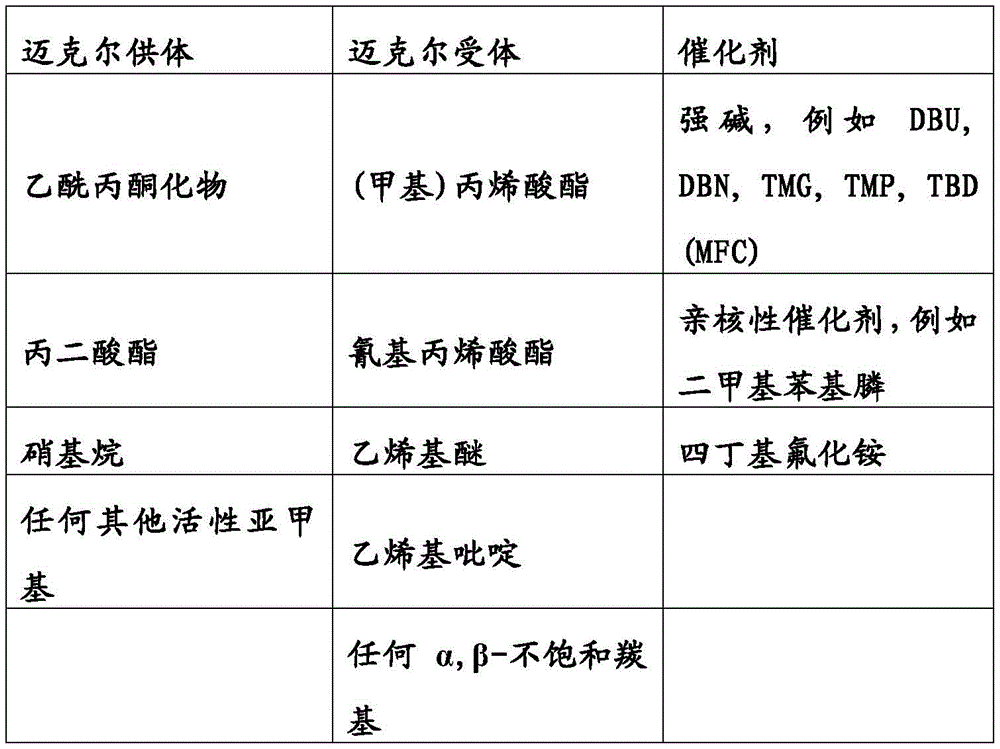
For example, the michael donor can comprise an acetylacetonate monomer and/or an acetylacetonate prepolymer and the michael acceptor can comprise a (meth) acrylate monomer and/or a (meth) acrylate prepolymer and the catalyst can comprise DBU, DBN, TMG, TMP, TBD, or a combination of any of the foregoing. For example, the michael donor may comprise a malonate monomer and/or malonate prepolymer, and the michael acceptor may comprise a cyanoacrylate monomer and/or a cyanoacrylate prepolymer, and the catalyst may comprise a nucleophilic catalyst, such as dimethylphenylphosphine. For example, the michael donor may comprise a nitroalkane monomer and/or a nitroalkane prepolymer, and the michael acceptor may comprise a vinyl ether monomer and/or a vinyl ether prepolymer, and the catalyst may comprise tetrabutylammonium fluoride. For example, a michael donor may include a monomer and/or prepolymer that includes an active methylene group, and a michael acceptor may include a monomer and/or prepolymer that includes vinylpyridine.
The co-reactive composition used in creating the three-dimensional object may include a variety of additives such as rheology modifiers (e.g., silica or other fillers), flow control agents, plasticizers, heat stabilizers, UV stabilizers, wetting agents, dispersion aids, defoamers, fillers, reactive diluents, flame retardants, catalysts, pigments, solvents, adhesion promoters, and combinations of any of the foregoing. Additionally, three-dimensional printing of the thermoset composition can include depositing the thermoset composition within a mold to provide temporary structural integrity to the object during the printing process.
Additives or combinations of additives may be used to control and/or facilitate printing operations, including mixing and extrusion. For example, the additive may control viscosity, mixing, hydrophobicity, hydrophilicity, rheology, or a combination of any of the foregoing.
Additives or combinations of additives may be used to impart one or more desired properties to the constructed object, including, for example, thermal conductivity, electrical conductivity, EMI/RFI shielding capability, light weight, low density, high tensile strength, high percent elongation, flame retardancy, fire resistance, antistatic properties, desired elastic modulus, solvent resistance, or a combination of any of the foregoing.
The co-reactive composition may include a variety of additives such as rheology modifiers (e.g., silica or other particulate fillers), flow control agents, plasticizers, stabilizers, wetting agents, dispersion aids, defoamers, pigments and other colorants, flame retardants, adhesion promoters, catalysts, or other performance or property modifiers (such as barium sulfate, clay, or magnesium compounds) as needed to impart barrier or corrosion resistance properties.
The composition may be formulated as a sealant. By formulated it is meant that in addition to the reactive species that form the cured polymer network, additional species may be added to the composition to impart desired characteristics to the uncured sealant and/or the cured sealant. For uncured sealants, these characteristics may include viscosity, pH, and/or rheology. For cured sealants, these properties may include weight, adhesion, corrosion resistance, color, glass transition temperature, electrical conductivity, cohesion and/or physical properties such as tensile strength, elongation and hardness. The compositions provided herein may comprise one or more additional components suitable for use in aerospace sealants, and will depend, at least in part, on the desired performance characteristics of the cured sealant under the conditions of use.
Because thermosetting compositions can have a low viscosity compared to thermoplastic compositions, high filler concentrations can be used. High filler concentrations may be used to alter the properties of the finished object, such as the mechanical, thermal, and/or electrical properties of the finished object. Thus, the design possibilities for three-dimensional printing can be greatly enhanced by using three-dimensional thermosetting compositions to facilitate the use of high filler concentrations. In addition, a thermosetting composition having excellent resistance to solvents and chemicals can be provided.
In addition to determining the characteristics of the built object, a filler or combination of fillers may be added to the co-reactive components to determine certain processing characteristics. For example, fillers may be added to adjust the viscosity of the components, the rheology of the components, aid in mixing the coreactive components, control the exotherm generated during the reaction of the coreactive components, or a combination of any of the foregoing.
The components, co-reactive compositions, and built objects can have a filler content of, for example, 0.1wt% to 95wt%, 1wt% to 90wt%, 2wt% to 80wt%, 5wt% to 70wt%, 10wt% to 60wt%, 15wt% to 50wt%, or 20wt% to 40wt%, where wt% is based on the total weight of the component, co-reactive composition, or built object.
The component, co-reactive composition, and built object can have, for example, a filler content of 0.1vol% to 95vol%, 1vol% to 90vol%, 2vol% to 80vol%, 5vol% to 70vol%, 10vol% to 60vol%, 15vol% to 50vol%, or 20vol% to 40vol%, where vol% is based on the total volume of the component, co-reactive composition, or built object.
The coreactive compositions provided herein can comprise a filler or a combination of fillers. The filler may comprise, for example, an inorganic filler, an organic filler, a low density filler, a conductive filler, or a combination of any of the foregoing. The filler may comprise an organic filler, an inorganic filler, a conductive filler, a low density filler, or a combination of any of the foregoing. Fillers may be added to the composition, for example, to improve the physical properties of the cured composition, to reduce the weight of the cured composition, and/or to impart electrical conductivity to the composition.
The filler may include organic fillers, inorganic fillers, metallic fillers, and combinations of any of the foregoing.
Inorganic fillers suitable for use in the compositions provided herein and for aerospace applications include carbon black, calcium carbonate, precipitated calcium carbonate, calcium hydroxide, hydrated alumina (aluminum hydroxide), fumed silica, precipitated silica, silica gel, and combinations of any of the foregoing. For example, the inorganic filler may include a combination of calcium carbonate and fumed silica, and the calcium carbonate and fumed silica may be treated and/or untreated. The inorganic filler may comprise calcium carbonate and fumed silica.
The inorganic filler may be coated or uncoated. For example, the inorganic filler may be coated with a hydrophobic substance, such as a coating of polydimethylsiloxane.
Suitable calcium carbonate fillers include products such as those available from Solvay specialty Chemicals 31、
31、 312、
312、 U1S1、
U1S1、 UaS2、
UaS2、 N2R、
N2R、 SPM and
 and (4) SPT. The calcium carbonate filler may include a combination of precipitated calcium carbonates.
The inorganic filler may be surface treated to provide a hydrophobic or hydrophilic surface, which may aid in dispersion and compatibility of the inorganic filler with the other components of the co-reactive composition.
Inorganic fillers suitable for use in the composition include carbon black, calcium carbonate, precipitated calcium carbonate, calcium hydroxide, hydrated alumina (aluminum hydroxide), fumed silica, precipitated silica, silica gel, and combinations of any of the foregoing. For example, the inorganic filler may include a combination of calcium carbonate and fumed silica, and the calcium carbonate and fumed silica may be treated and/or untreated.
The inorganic filler may be coated or uncoated. For example, the inorganic filler may be coated with a hydrophobic substance, such as a polydimethylsiloxane coating.
The compositions provided herein can comprise silica gel or a combination of silica gels. Suitable silica gels include those available from PQ Corporation Silica gel, and from Fuji Silysia chemical Ltd
 And
And silica gel.
Suitable organic fillers may also have acceptable adhesion to the sulfur-containing polymer matrix. The organic filler may include solid particles, hollow particles, or a combination thereof. The particles may be generally spherical (referred to as powders), generally non-spherical (referred to as microparticles), or a combination thereof.
The particles may have an average particle size of less than, for example, 100 μm, 50 μm, 40 μm, 30 μm, or less than 25 μm, as determined according to ASTM E-2651-13. The powder may comprise particles having an average particle size in the range of 0.25 μm to 100 μm, 0.5 μm to 50 μm, 0.5 μm to 40 μm, 0.5 μm to 30 μm, 0.5 μm to 20 μm, or 0.1 μm to 10 μm. The filler particles may comprise a nanopowder comprising particles characterized by an average particle size of, for example, 1nm to 100 nm.
The organic filler can have a specific gravity of, for example, less than 1.6, less than 1.4, less than 1.15, less than 1.1, less than 1.05, less than 1, less than 0.95, less than 0.9, less than 0.8, or less than 0.7, wherein the specific gravity is determined according to ISO787 (part 10). The organic filler may have a specific gravity, for example, in the range of 0.85 to 1.6, in the range of 0.85 to 1.4, in the range of 0.85 to 1.1, in the range of 0.9 to 1.05, or in the range of 0.9 to 1.05, wherein the specific gravity is determined according to ISO787 (part 10).
The organic filler may comprise a thermoplastic, a thermoset, or a combination thereof. Examples of suitable organic fillers include epoxy resins, epoxy amides, ETFE copolymers, polyethylene, polypropylene, polyvinylidene chloride, polyvinyl fluoride, TFE, polyamides, polyimides, ethylene propylene, perfluorocarbons, vinyl fluoride, polycarbonates, polyetheretherketone, polyetherketone, polyphenylene oxide, polyphenylene sulfide, polyethersulfone, thermoplastic copolyesters, polystyrene, polyvinyl chloride, melamine, polyesters, phenolic resins, epichlorohydrin, fluorinated hydrocarbons, polycycles, polybutadiene, polychloroprene, polyisoprene, polysulfide, polyurethane, isobutylene isoprene, silicone, styrene butadiene, liquid crystal polymers, and combinations of any of the foregoing.
Examples of suitable organic fillers include polyamides such as polyamide 6 and polyamide 12, polyimides, polyethylenes, polyphenylene sulfides, polyethersulfones, polysulfones, polyetherimides, polyvinylfluorides, thermoplastic copolyesters, and combinations of any of the foregoing.
Examples of suitable polyamide 6 and polyamide 12 particles are available from Toray Plastics in grades SP-500, SP-10, TR-1 and TR-2. Suitable polyamides are also known under the trade mark Available from Arkema Group and under the trademark Arkema
 Available from Evonik Industries. For example,
 polyamides, e.g.
 GPA-550 and GPA-700 are available from Persperse Sakai Trading, new York, NY.
Examples of suitable polyimide fillers may be trademarked NT was obtained from evonik industries.
The organic filler may include polyethylene, such as oxidized polyethylene powder. Suitable polyethylenes may be, for example, under the trademark PolyEthyl Available from Honeywell International, inc under the trademark HONEY
 Obtained from INEOS and sold under the trademark Mipelon TM Obtained from Mitsui chemical america, inc.
The use of organic fillers such as polyphenylene sulfide in aerospace sealants is disclosed in U.S. Pat. No. 9,422,451, which is incorporated herein in its entiretyIncorporated herein by way of reference. Polyphenylene sulfide is a thermoplastic engineering resin that exhibits dimensional stability, chemical resistance and corrosion resistance, and high temperature environment properties. Polyphenylene sulfide engineering resins can be given, for example, the trade name (Chevron)、
 (Quadrant)、
 (Celanese) and
 (Toray) was purchased. Polyphenylene sulfide resins are generally characterized by a specific gravity of about 1.3 to about 1.4, where the specific gravity is determined according to ISO787 (part 10). Having a density of 1.34g/cm 3 (iii) and polyphenylene sulfide particles having an average particle size of 0.2 μm to 0.25 μm (0.4 μm to 0.5 μm in water, or in isopropanol) are available from Toray Industries, inc.
The polyethersulfone particles were available from Toray Industries, inc. and had a density of 1.37g/cm 3 And an average particle diameter of 5 μm to 60 μm.
Thermoplastic copolyester particles are available from Toray Industries, inc.
The organic filler may have any suitable shape. For example, the organic filler may comprise a crushed polymer portion that has been filtered to a desired size range. The organic filler may comprise substantially spherical particles. The particles may be non-porous or may be porous. The porous particles can have an open channel network defining an interior surface.
The organic filler can have a specific gravity of, for example, less than 1.15, less than 1.1, less than 1.05, less than 1, less than 0.95, less than 0.9, less than 0.8, or less than 0.7. The organic filler may have a specific gravity, for example, in the range of 0.85 to 1.15, in the range of 0.9 to 1.1, in the range of 0.9 to 1.05, or in the range of 0.85 to 1.05.
The filler may comprise a metal.
The filler may comprise a conductive filler or a combination of conductive fillers. Examples of suitable conductive fillers include nickel powder, graphite, nickel-coated graphite, stainless steel, or a combination of any of the foregoing.
The compositions provided herein can comprise a conductive filler. Conductivity and EMI/RFI shielding effectiveness can be imparted to the composition by incorporating conductive materials into the polymer. The conductive elements may include, for example, metal or metal-plated particles, fabrics, meshes, fibers, and combinations thereof. The metal may be in the form of, for example, filaments, particles, flakes, or spheres. Examples of metals include copper, nickel, silver, aluminum, tin, and steel. Other conductive materials that may be used to impart electrical conductivity and EMI/RFI shielding effectiveness to the polymer composition include conductive particles or fibers comprising carbon or graphite. Conductive polymers such as polythiophene, polypyrrole, polyaniline, poly (p-phenylene) vinylene, polyphenylene sulfide, polyphenylene, and polyacetylene can also be used. Conductive fillers also include high band gap materials such as zinc sulfide and inorganic barium compounds.
Other examples of conductive fillers include conductive noble metal-based fillers, such as pure silver; noble metal plated noble metals such as silver plated gold; noble metal-plated non-noble metals such as silver-plated copper, nickel or aluminum, e.g., silver-plated aluminum core particles or platinum-plated copper particles; noble metal plated glass, plastic or ceramic, such as silver plated glass microspheres, noble metal plated aluminum or noble metal plated plastic microspheres; mica plated with noble metals; and other such noble metal conductive fillers. Non-noble metal based materials may also be used and include, for example, non-noble metal plated non-noble metals such as copper coated iron particles or nickel plated copper; non-noble metals, such as copper, aluminum, nickel, cobalt; non-noble metal plated non-metals, such as nickel plated graphite, and non-metallic substances, such as carbon black and graphite. Combinations of conductive fillers may also be used to meet desired conductivity, EMI/RFI shielding effectiveness, stiffness, and other characteristics suitable for a particular application.
The shape and size of the conductive filler used in the compositions of the present invention can be any suitable shape and size to impart conductivity and EMI/RFI shielding effectiveness to the cured composition. For example, the filler may have any shape commonly used in the manufacture of conductive fillers, including spheres, flakes, thin layers, particles, powders, irregularities, fibers, and the like. In certain sealant compositions of the invention, the base composition can comprise the Ni-coated graphite in the form of particles, powder, or flakes. The amount of Ni-coated graphite in the base composition may be in the range of 40wt% to 80wt%, or may be in the range of 50wt% to 70wt%, based on the total weight of the base composition. The conductive filler may comprise Ni fibers. The Ni fibers may have a diameter in the range of 10 to 50 μm and a length in the range of 250 to 750 μm. The base composition may comprise Ni fibers in an amount ranging, for example, from 2wt% to 10wt%, or from 4wt% to 8wt%, based on the total weight of the base composition.
Carbon fibers, particularly graphitized carbon fibers, may also be used to impart electrical conductivity to the compositions of the present invention. Hollow or solid carbon fibers having a fiber diameter in the range of 0.1 to several micrometers, which are formed by a vapor phase pyrolysis method and graphitized by heat treatment, have high electrical conductivity. As disclosed in U.S. patent No. 6,184,280, carbon microfibers, nanotubes, or carbon having an outer diameter of less than 0.1 μm to several tens of nanometers may be used as the conductive filler. Examples of graphitized carbon fibers suitable for use in the conductive composition of the present invention include 3OMF (Zoltek company, inc., st. Louis, mo.), a 0.921 μm diameter round fiber with an electrical resistivity of 0.00055 Ω -cm.
The average particle size of the conductive filler can be within a range suitable for imparting conductivity to the polymer-based composition. For example, the particle size of the one or more fillers may be in the range of 0.25 μm to 250 μm, may be in the range of 0.25 μm to 75 μm, or may be in the range of 0.25 μm to 60 μm. The compositions provided herein may comprise EC-600JD (Akzo Nobel, inc., chicago, ill.), a device characterized by an iodine uptake of 1,000mg/g to 11,500mg/g (J0/84-5 test method) and 480cm 3 100g to 510cm 3 Conductive carbon black/100 g pore volume (DBP absorption, KTM 81-3504). The conductive carbon Black filler is Black
 2000(Cabot Corporation,Boston,MA)。
The composition of the present invention may comprise more than one conductive filler, and the more than one conductive filler may be of the same or different materials and/or shapes. For example, the sealant composition can include conductive Ni fibers and conductive Ni-coated graphite in the form of powders, particles, or flakes. The amount and type of conductive filler can be selected to produce a conductive filler that exhibits less than 0.50 Ω/cm when cured 2 Sheet resistance (four-point resistance) or less than 0.15. Omega./cm 2 The sheet resistance sealant composition of (1). The amount and type of filler can also be selected to provide effective EMI/RFI shielding over the frequency range of 1MHz to 18GHz for apertures sealed using the sealant composition of the invention.
The organic filler may include a low density filler such as expanded thermoplastic microcapsules and/or modified expanded thermoplastic microcapsules. Suitable modified expanded thermoplastic microcapsules may comprise an outer coating of melamine or urea/formaldehyde resin. The filler may be a low density filler characterized by a specific gravity of, for example, less than 0.7, less than 0.3, or less than 0.1. The use of low density fillers can provide a three-dimensional printed object having a low specific gravity, such as 0.8 to 1 or 0.7 to 0.9.
Thermally expandable microcapsules refer to hollow shells containing volatile materials that expand at a predetermined temperature. The thermally expandable thermoplastic microcapsules may have an average primary particle size of from 5 μm to 70 μm, in some cases from 10 μm to 24 μm or from 10 μm to 17 μm. The term "average primary particle size" refers to the average particle size (the numerical weighted average of the particle size distribution) of the microcapsules prior to any expansion. The particle size distribution can be determined using a Fischer Sub-Sieve Sizer.
The thermally expandable thermoplastic microcapsules may contain a volatile hydrocarbon or volatile halogenated hydrocarbon within the thermoplastic resin wall. Examples of hydrocarbons suitable for use in such microcapsules include methyl chloride, methyl bromide, trichloroethane, dichloroethane, n-butane, n-heptane, n-propane, n-hexane, n-pentane, isobutane, isopentane, isooctane, neopentane, petroleum ethers, and aliphatic hydrocarbons containing fluorine (such as Freon's (r) f) TM ) And any of the foregoing groupsAnd (6) mixing.
Examples of materials suitable for forming the walls of the heat-expandable microcapsules include polymers of vinylidene chloride, acrylonitrile, styrene, polycarbonate, methyl methacrylate, ethyl acrylate, and vinyl acetate, copolymers of these monomers, and combinations of polymers and copolymers. The cross-linking agent may be included in the substance forming the wall of the thermally expandable microcapsules.
Examples of suitable thermoplastic microcapsules include Expancel TM Microcapsules, such as Expancel from akzo nobel TM DE microspheres. Suitable Expancel TM Examples of DE microspheres include Expancel TM 920 DE 40 and Expancel TM 920 DE 80. Suitable low density microcapsules are also available from Kureha Corporation.
The low density microcapsules may be characterized by a specific gravity within, for example, a range of 0.01 to 0.09, 0.04 to 0.08, 0.01 to 0.07, 0.02 to 0.06, 0.03 to 0.05, 0.05 to 0.09, 0.06 to 0.09, or 0.07 to 0.09, wherein the specific gravity is determined according to ISO787 (part 10). The low density microcapsules may be characterized by a specific gravity of, for example, less than 0.1, less than 0.09, less than 0.08, less than 0.07, less than 0.06, less than 0.05, less than 0.04, less than 0.03, or less than 0.02, wherein the specific gravity is determined according to ISO787 (part 10).
The low density microcapsules may be characterized by an average particle size of 1 μm to 100 μm and may have a substantially spherical shape. The low density microcapsules may be characterized by an average particle size of, for example, 10 μm to 100 μm, 10 μm to 60 μm, 10 μm to 40 μm, or 10 μm to 30 μm, as determined according to ASTM E-2651-13.
The low density filler may comprise uncoated microcapsules, coated microcapsules, or a combination thereof.
Low density fillers such as low density microcapsules may comprise expanded microcapsules having a coating of an aminoplast resin such as a melamine resin. Aminoplast resin coated particles are described, for example, in U.S. patent No. 8,993,691, which is incorporated herein by reference in its entirety. Such microcapsules may be formed by heating microcapsules containing a blowing agent surrounded by a thermoplastic shell. The uncoated, low density microcapsules can be reacted with an aminoplast resin (such as a urea/formaldehyde resin) to provide a coating of thermosetting resin on the outer surface of the particles.
Low density fillers such as low density microcapsules may comprise thermally expandable thermoplastic microcapsules having an outer coating of an aminoplast resin such as a melamine resin. The coated low density microcapsules may have an outer coating of melamine resin, wherein the coating may have a thickness of, for example, less than 2 μm, less than 1 μm, or less than 0.5 μm. It is believed that the melamine coating on the light weight microcapsules renders the microcapsules reactive with thiol-terminated polythioether prepolymers and/or curing agents, thereby enhancing fuel resistance and rendering the microcapsules resistant to pressure.
The thin coating of aminoplast resin may have a film thickness of less than 25 μm, less than 20 μm, less than 15 μm, or less than 5 μm. The thin coating of aminoplast resin may have a film thickness of at least 0.1nm, such as at least 10nm, or at least 100nm, or in some cases, at least 500 nm.
Aminoplast resins may be based on condensation products of formaldehyde with amino or amido groups. The condensation products may be obtained from the reaction of alcohols and formaldehyde with melamine, urea or benzoguanamine. Condensation products of other amines and amides may also be used, such as aldehyde condensates of triazines, diazines, triazoles, guanidines, guanamines, and alkyl-and aryl-substituted derivatives of such compounds, including alkyl-and aryl-substituted ureas and alkyl-and aryl-substituted melamines. Examples of such compounds include N, N' -dimethylurea, benzourea, dicyandiamide, formylguanamine, acetoguanamine, glycoluril, cyanuric diamide, 2-chloro-4, 6-diamino-1, 3, 5-triazine, 6-methyl-2, 4-diamino-1, 3, 5-triazine, 3, 5-diaminotriazole, triaminopyrimidine, 2-mercapto-4, 6-diaminopyrimidine, and 3,4, 6-tris (ethylamino) -1,3, 5-triazine. Suitable aminoplast resins may also be based on condensation products of other aldehydes such as acetaldehyde, crotonaldehyde, acrolein, benzaldehyde, furfural, and glyoxal.
The aminoplast resin may comprise a highly alkylated low imino aminoplast resin having a degree of polymerization of less than 3.75, such as less than 3.0 or less than 2.0. The number average degree of polymerization may be defined as the average number of structural units per polymer chain. For example, a degree of polymerization of 1.0 indicates a triazine structure of a complete monomer, while a degree of polymerization of 2.0 indicates two triazine rings bound by methylene or methylene-oxy bridges. The degree of polymerization represents the average degree of polymerization value as determined by gel permeation chromatography using polystyrene standards.
The aminoplast resin may contain methylol or other hydroxyalkyl groups, and at least a portion of the hydroxyalkyl groups may be etherified by reaction with an alcohol. Examples of suitable monohydric alcohols include alcohols such as methanol, ethanol, propanol, butanol, pentanol, hexanol, heptanol, benzyl alcohol, other aromatic alcohols, cyclic alcohols (such as cyclohexanol), monoethers of ethylene glycol, and halogen-substituted or otherwise substituted alcohols such as 3-chloropropanol and butoxyethanol. The aminoplast resin may be substantially alkylated with methanol or butanol.
The aminoplast resin may comprise a melamine resin. Examples of suitable melamine resins include methylated melamine resins (hexamethoxymethylmelamine), mixed ether melamine resins, butylated melamine resins, urea resins, butylated urea resins, benzoguanamine and glycoluril resins and formaldehyde-free resins. Such resins are available, for example, from Allnex Group and Hexion. Examples of suitable melamine resins include methylated melamine resins, such as Cymel TM 300、Cymel TM 301、Cymel TM 303LF、Cymel TM 303ULF、Cymel TM 304、Cymel TM 350、Cymel TM 3745、Cymel TM XW-3106、Cymel TM MM-100、Cymel TM 370、Cymel TM 373、Cymel TM 380、ASTRO MEL TM 601、ASTRO MEL TM 601ULF、ASTRO MEL TM 400、ASTRO MEL TM NVV-3A、Aricel PC-6A、ASTRO MEL TM CR-1 and ASTRO SET TM 90. Suitable aminoplast resins may comprise urea-formaldehyde resins.
Low density microcapsules can be prepared by any suitable technique, including, for example, as described in U.S. patent nos. 8,816,023 and 8,993,691, each of which is incorporated herein by reference in its entirety. The coated low-density microcapsules can be obtained, for example, by preparing an aqueous dispersion of the microcapsules with melamine resin in water under stirring. A catalyst may then be added and the dispersion heated to a temperature of, for example, 50 ℃ to 80 ℃. Low density microcapsules such as thermally expandable microcapsules with a polyacrylonitrile shell, deionized water and an aminoplast resin (such as melamine resin) can be combined and mixed. 10% w/w solution of p-toluenesulfonic acid in distilled water may then be added, and the mixture reacted at 60 ℃ for about 2 hours. Saturated sodium bicarbonate can then be added and the mixture stirred for 10 minutes. The solid can be filtered, washed with distilled water, and dried overnight at room temperature. The resulting powder of aminoplast resin-coated microcapsules can then be sieved through a 250 μm screen to remove and separate the agglomerates.
Prior to application of the aminoplast resin coating, the thermally expandable thermoplastic microcapsules may be characterized by a specific gravity, for example, in the range of 0.01 to 0.05, in the range of 0.015 to 0.045, in the range of 0.02 to 0.04, or in the range of 0.025 to 0.035, wherein the specific gravity is determined according to ISO787 (section 10). For example, expancel TM 920 DE 40 and Expancel TM 920 DE 80 may be characterized by a specific gravity of about 0.03, where the specific gravity is determined according to ISO787 (part 10).
After coating with the aminoplast resin, the aminoplast-coated microcapsules may be characterized by a specific gravity, for example, in the range of 0.02 to 0.08, in the range of 0.02 to 0.07, in the range of 0.02 to 0.06, in the range of 0.03 to 0.07, in the range of 0.03 to 0.065, in the range of 0.04 to 0.065, in the range of 0.045 to 0.06, or in the range of 0.05 to 0.06, wherein the specific gravity is determined according to ISO787 (part 10).
Aminoplast-coated microcapsules and methods of making aminoplast-coated microcapsules are disclosed, for example, in U.S. application publication No. 2016/0083619, which is incorporated herein by reference in its entirety.
The compositions provided herein can comprise, for example, 0.1wt% to 6wt%, 0.5wt% to 5wt%, 1wt% to 4wt%, or 2wt% to 4wt% of a lightweight filler or a combination of lightweight fillers, where wt% is based on the total weight of the composition. The compositions provided herein can comprise, for example, 1vol% to 80vol%, 2vol% to 60vol%, 5vol% to 50vol%, 10vol% to 40vol%, or 20vol% to 40vol% of a light filler or combination of light fillers, where vol% is based on the total volume of the composition.
The compositions and sealants provided herein may include an inorganic filler or a combination of inorganic fillers. Inorganic fillers may be included to provide mechanical reinforcement and control the rheology of the composition. Inorganic fillers may be added to the composition to impart desirable physical properties, such as to increase impact strength, control viscosity, or improve the electrical properties of the cured composition.
Suitable fillers also include magnetic fillers and opaque fillers.
The filler may comprise a fiber. The fibers may comprise inorganic fibers, organic fibers, ceramic fibers, metal fibers, combinations of any of the foregoing. Examples of suitable fibers include glass, silica, carbon, boron, silicon carbide, ceramics, metals, organic substances, and synthetic fibers. Examples of suitable synthetic fibers include nylon, polyester, polypropylene, meta-aramid, para-aramid, polyphenylene sulfide, and rayon. The fibers may be used to impart tensile strength, electrical conductivity, thermal conductivity, EMI/RFI shielding, flexural modulus, flexural strength, and/or tensile modulus to the constructed object.
Examples of suitable metal fibers include steel, titanium, aluminum, gold, silver, and alloys of any of the foregoing.
Examples of suitable ceramic fibers include metal oxide (e.g., alumina) fibers, aluminum silicate fibers, boron nitride fibers, silicon carbide fibers, and combinations of any of the foregoing.
Examples of suitable inorganic fibers include carbon, alumina, basalt, calcium silicate and rock wool.
The fibers may be glass fibers such as S-glass fibers, E-glass fibers, soda-lime-silica fibers, basalt fibers, or quartz fibers. The glass fibers may be in the form of woven and/or braided glass fibers or non-woven glass fibers.
The fibers may include carbon (e.g., graphite) fibers, glass fibers, ceramic fibers, silicon carbide fibers, polyimide fibers, polyamide fibers, or polyethylene fibers. The continuous fibers may comprise titanium, tungsten, boron, shape memory alloys, graphite, silicon carbide, boron, aramid, poly (p-phenylene-2, 6-benzobisoxazole), and combinations of any of the foregoing.
Fibers capable of withstanding high temperatures include, for example, carbon fibers, high strength glass (SiO) 2 ) Fibers, oxide fibers, alumina fibers, ceramic fibers, metal fibers, and fibers of high temperature thermoplastics or thermosets.
The filler may include carbon nanotubes, fullerenes, or combinations thereof.
The filler may include graphene or other flat polycyclic aromatic hydrocarbons. Graphene may be used to impart thermal conductivity, electrical conductivity, EMI/RFI shielding capabilities, and/or antistatic properties to a built object.
The filler may include surface-modified particles, such as surface-modified silica. The surface of the silica particles may be modified, for example, to adjust the hydrophobicity or hydrophilicity of the surface of the silica particles. Surface modification can affect the dispensability, viscosity, cure rate, and/or adhesion of the particles.
The co-reactive composition may also include a reactive rheology modifier such as polyethylene, or propylene/ethylene copolymer. Examples of suitable propylene/ethylene copolymers include 5000(Baker Hughes)。
The co-reactive components and compositions provided herein can include an adhesion promoter or a combination of adhesion promoters.
The co-reactive components and compositions provided herein can comprise, for example, less than 0.1wt% adhesion promoter, less than 0.2wt%, less than 0.3wt%, or less than 0.4wt% adhesion promoter, where the wt% is based on the total weight of the curable composition. The curable composition provided by the present invention may comprise, for example, 0.05wt% to 0.4wt%, 0.05wt% to 0.3wt%, 0.05wt% to 0.2wt% of an adhesion promoter.
The co-reactive components and compositions provided herein can comprise an adhesion promoter or a combination of adhesion promoters. The adhesion promoter may comprise a phenolic adhesion promoter, a combination of phenolic adhesion promoters, an organofunctional silane, a combination of organofunctional silanes, or a combination of any of the foregoing. The organosilane may be an amine functional silane.
The co-reactive components and compositions provided herein can comprise a phenolic adhesion promoter, an organosilane, or a combination thereof. The phenolic adhesion promoter may comprise a bake cured phenolic resin, an unbaked cured phenolic resin, or a combination thereof. Examples of suitable adhesion promoters include phenolic resins such as Phenolic resins and organosilanes, such as epoxy-, mercapto-or amine-functional silanes, such as
 An organosilane.
The phenolic adhesion promoter may comprise the reaction product of a condensation reaction of a phenolic resin and one or more thiol-terminated polysulfides. The phenolic adhesion promoter may be terminated with a thiol group.
Examples of suitable phenolic resins include 2- (hydroxymethyl) phenol, (4-hydroxy-1, 3-phenylene) dimethanol, (2-hydroxybenz-1, 3, 4-triyl) trimethanol, 2-benzyl-6- (hydroxymethyl) phenol, (4-hydroxy-5- ((2-hydroxy-5- (hydroxymethyl) cyclohexa-2, 4-dien-1-yl) methyl) -1, 3-phenylene) dimethanol, (4-hydroxy-5- ((2-hydroxy-3, 5-bis (hydroxymethyl) cyclohexa-2, 4-dien-1-yl) methyl) -1, 3-phenylene) dimethanol, and combinations of any of the foregoing.
Suitable phenolic resins can be synthesized by the base-catalyzed reaction of phenol with formaldehyde.
The phenolic adhesion promoter may comprise that available from Durez Corporation Resin, a,
 Resin or
 Resins with polysulfides terminated by thiol groups (such as
 Resin) of a condensation reaction.


















The co-reactive components and compositions provided herein can include an organofunctional adhesion promoter, such as an organofunctional silane. The organofunctional silane may comprise a hydrolyzable group bonded to the silicon atom and at least one organofunctional group. The organofunctional silane may have the structure R a -(CH 2 ) n -Si(-OR) 3-n R b n Wherein R is a Is an organofunctional group, n is 0, 1 or2, and R b Is an alkyl group such as methyl or ethyl. Examples of organofunctional groups include epoxy, amino, methacryloxy, or thioether groups. The organofunctional silane can be a podosilane having two or more silane groups, a functional podosilane, a nonfunctional podosilane, or a combination of any of the foregoing. The organofunctional silane can be a combination of monosilane and podosilane.
The amine functional silane can comprise a primary amine functional silane, a secondary amine functional silane, or a combination thereof. Primary amine functional silanes refer to silanes having primary amino groups. Secondary amine functional silanes refer to silanes having secondary amino groups. The amine functional silane can comprise, for example, 40 to 60 weight percent of the primary amine functional silane; and 40 to 60 weight percent of a secondary amine functional silane; 45 to 55 weight percent of a primary amine functional silane and 45 to 55 weight percent of a secondary amine functional silane; or 47 to 53 weight percent of a primary amine functional silane and 47 to 53 weight percent of a secondary amine functional silane; wherein the wt% is based on the total weight of amine functional silane in the composition.
The secondary amine functional silane may be a hindered amine functional silane. In the sterically hindered amine functional silane, the secondary amine may be adjacent to a bulky group or moiety that limits or defines the degree of freedom of the secondary amine as compared to the degree of freedom of the non-hindered secondary amine. For example, in the hindered secondary amine, the secondary amine can be adjacent to a phenyl group, a cyclohexyl group, or a branched alkyl group.
The amine functional silane can be a monomeric amine functional silane having a molecular weight of, for example, 100 daltons to 1000 daltons, 100 daltons to 800 daltons, 100 daltons to 600 daltons, or 200 daltons to 500 daltons.
Examples of suitable primary amine-functional silanes include 4-aminobutyltriethoxysilane, 4-amino-3, 3-dimethylbutyltrimethoxysilane, N- (2-aminoethyl) -3-aminopropyltriethoxysilane, 3 (m-aminophenoxy) propyltrimethoxysilane, m-aminophenyltrimethoxysilane, p-aminophenyltrimethoxysilane, 3-aminopropyltriethoxysilane, 3-aminopropyltrimethoxysilane, 3-aminopropyltris (methoxyethoxyethoxy) silane, 11-aminoundecyltriethoxysilane, 2- (4-pyridylethyl) triethoxysilane, 2- (2-pyridylethyltrimethoxysilane, N- (3-trimethoxysilylpropyl) pyrrole, 3-aminopropylsilanetriol, 4-amino-3, 3-dimethylbutylmethyldimethoxysilane, 3-aminopropylmethyldiethoxysilane, 1-amino-2- (dimethylethoxysilyl) propane, 3-aminopropyldiisopropenylethoxysilane, and 3-aminopropyldimethylethoxysilane.
Examples of suitable diamine-functional silanes include aminoethylaminomethyl) phenethyltrimethoxysilane and N- (2-aminoethyl) -3-aminopropyltrimethoxysilane.
Examples of suitable secondary amine functional silanes include 3- (N-allylamino) propyltrimethoxysilane, N-butylaminopropyltrimethoxysilane, t-butylaminopropyltrimethoxysilane, (N, N-cyclohexylaminomethyl) methyldiethoxysilane, (N-cyclohexylaminomethyl) triethoxysilane, (N-cyclohexylaminopropyl) trimethoxysilane, (3- (N-ethylamino) isobutyl) methyldiethoxysilane, (3- (N-ethylamino) isobutyl) trimethoxysilane, N-methylaminopropylmethyldimethoxysilane, N-methylaminopropyltrimethoxysilane, (phenylaminomethyl) methyldimethoxysilane, N-phenylaminomethyltriethoxysilane, and N-phenylaminopropyltrimethoxysilane.
Suitable amine functional silanes are available from, for example, gelest Inc and Dow corning corporation.
The co-reactive components and compositions provided herein can comprise less than 3wt%, less than 2wt%, less than 1wt%, or less than 0.5wt% of an adhesion promoter, where the wt% is based on the total weight of the curable composition.
The co-reactive components and compositions provided herein can include a reactive diluent or a combination of reactive diluents. Reactive diluents may be used to reduce the viscosity of the composition. The reactive diluent may be a low molecular weight compound having at least one functional group capable of reacting with at least one of the primary reactants of the composition, and becomes part of the crosslinked network. The reactive diluent may have, for example, one functional group or two functional groups. Reactive dilution may be used to control the viscosity of the composition or to improve wetting of the filler in the composition.
The co-reactive components and compositions may comprise one or more colorants.
Colorants refer to substances that impart color and/or other visual effects to a constructed object. The colorant can be added to the composition in any suitable form, such as discrete particles, dispersions, solutions, and/or flakes. A single colorant or a mixture of two or more colorants may be used.
Examples of colorants include pigments, dyes and tints, such as those used in the paint industry and/or listed in the Dry Color Manufacturers Association (DCMA), as well as special effect compositions (special effect compositions) and materials. The colorant may comprise, for example, a finely divided solid powder that is insoluble but wettable under the conditions of use. The colorant may be organic or inorganic, and may be aggregated or non-aggregated. The colorant can be incorporated into the composition by using a grind vehicle or by simple mixing. The colorant can be milled into the coating by using a milling carrier, such as an acrylic milling carrier.
Examples of suitable pigments and/or pigment compositions include carbazole dioxazine crude pigment, azo, monoazo, disazo, naphthol AS, salt types (lakes), benzimidazolone, condensate, metal complex, isoindolinone, isoindoline and polycyclic phthalocyanine, quinacridone, perylene, perinone, diketopyrrolopyrrole, thioindigo, anthraquinone, indanthrone, anthrapyrimidine, flavanthrone, pyranthrone, anthanthrone, dioxazine, triarylcarbonium, quinophthalone pigments, diketopyrrolopyrrole red ("DPPBO red"), carbon black, and combinations of any of the foregoing.
Examples of suitable dyes include those which are solvent-based and/or water-based, such as acid dyes, azo dyes, basic dyes, direct dyes, disperse dyes, reactive dyes, solvent dyes, sulfur dyes, mordant dyes such as bismuth vanadate, anthraquinone, perylene, aluminum, quinacridone, thiazole, thiazine, azo, indigo, nitro, nitroso, oxazine, phthalocyanine, quinoline, stilbene, quinizarine blue (D & C violet No. 2) and triphenylmethane.
Examples of suitable toners include pigments dispersed in a water-based or water-miscible carrier, such as those available from Degussa, inc 896. Charisma, available from Accurate Dispersions division of Eastman chemical, inc
 And
And an industrial colorant.
The colorant can be in the form of a dispersion, including, for example, a nanoparticle dispersion. Nanoparticle dispersions can include one or more highly dispersed nanoparticle colorants and/or colorant particles that produce a desired visible color and/or opacity and/or visual effect. The nanoparticle dispersion may include a colorant, such as a pigment or dye having a particle size of less than 150nm, such as less than 70nm or less than 30 nm. Nanoparticles can be produced by milling an organic or inorganic pigment raw material with a milling media having a particle size of less than 0.5 mm. Examples of nanoparticle dispersions and methods of making them are identified in U.S. Pat. No. 6,875,800B2, U.S. application publication No. 2005/0287354, and U.S. application publication No. 2006/0251896. Nanoparticle dispersions can also be produced by crystallization, precipitation, gas phase condensation and chemical attrition (i.e., partial dissolution). To minimize re-agglomeration of nanoparticles within the composition, a resin-coated nanoparticle dispersion may be used. By "dispersion of resin-coated nanoparticles" is meant a continuous phase having dispersed therein discrete "composite microparticles" comprising nanoparticles and a resin composition on the nanoparticles.
In the electronics industry, dispersions of non-hidden color-imparting organic pigment nanoparticles provide, among other things, useful aesthetic properties. Such pigment dispersions are sold under the trademark Andaro TM Obtained from PPGIndustries, inc. The low level of blue nanopigment can counteract any yellowing that may occur during curing of the film-forming composition. The blue or black nanopigment enhances the appearance of the antiglare composition, particularly on a black underlayer on a substrate. In addition, the colored nanopigments may be selected to enhance or complement the underlying color of a substrate (such as a substrate of an additive manufactured part). Nanoparticle dispersions are particularly useful in the curable film-forming sol-gel compositions of the present invention, which compositions comprise (i) a tetraalkoxysilane; (ii) an epoxy functional trialkoxysilane; (iii) a metal-containing catalyst; (iv) a solvent component; and (v) non-oxide particles, as described herein.
Other adaptationsThe special effect colorant of (1) comprises a Vibrance Those colorants available from PPG Industries, inc., comprises Crystal Pearl,
 And other colorants.
Example special effect compositions that can be used include pigments and/or compositions that produce one or more appearance effects such as reflectance, pearlescence, metallic sheen, phosphorescence, fluorescence, photochromism, optical sensitivity, thermochromism, goniochromism and/or color change. Other special effect compositions may provide other perceptible characteristics, such as opacity or texture. Special effect compositions can produce a color shift such that the color of the composition changes when the composition is viewed at different angles. Examples of color effect compositions are disclosed in U.S. Pat. No. 6,894,086. Other color effect compositions may include transparent coated mica and/or synthetic mica, coated silica, coated alumina, transparent liquid crystal pigments, liquid crystal compositions, and/or any composition that interferes with the refractive index difference within a material rather than between the surface of the material and air.
In general, the colorant can be present in the composition in any amount sufficient to impart the desired properties, visual and/or color effect. For example, the colorant can be present in an amount of 1wt% to 65wt%, such as 3wt% to 40wt% or 5wt% to 35wt%, where the weight percentages are based on the total weight of the composition.
The composition can comprise, for example, 1wt% to 10wt%, 1wt% to 8wt%, or 5wt% to 8wt%, where the wt% is based on the total weight of the composition.
The co-reactive components and compositions provided herein can include Infrared (IR) reflective pigments. IR reflecting pigments can be useful for reducing objects exposed to solar radiationThe temperature of (2). IR reflective pigments may also be suitable for LIDAR detection. The IR reflective pigments can exhibit high reflectivity, such as greater than 95% reflectivity or greater than 99% reflectivity, at a wavelength of 905 nm. Examples of suitable IR reflecting pigments include TiO 2 Nickel and chrome rutile pigments, (trans) spinel pigments and under the trade name From Shepherd under the trade name
 Obtained from BASF or under the trade name of BASF
 Pigments based on various metal oxides obtained from Clariant.
Pigments suitable for use in certain embodiments of the reactive composition may be selected from organic or inorganic colored pigments and may include, for example, titanium dioxide, carbon black, lampblack, zinc oxide, natural and synthetic red, yellow, brown and black iron oxides, toluidine and benzidine yellow, phthalocyanine blue and green, and carbazole violet, and extender pigments including ground and crystalline silica, barium sulfate, magnesium silicate, calcium silicate, mica, micaceous iron oxide, calcium carbonate, zinc powder, aluminum and aluminum silicate, gypsum, feldspar, and the like.
The pigment may comprise a phosphorescent or fluorescent pigment which may be in the form of particles or nanoparticles, for example.
The extrudates provided by the present invention may comprise one or more surface coatings. Surface coatings can be used to impart desired surface characteristics such as conductivity, reflectivity (such as IR reflectivity), color, wavelength dependent absorption, wavelength dependent reflectivity, scratch resistance, abrasion resistance, stain resistance, fingerprint resistance, cleaning fluid resistance, aesthetic qualities and/or tactile characteristics. The coating may comprise a multi-layer coating. The coating may be a tactile coating, such as a soft touch coating. The coating may be applied to the extrudate using an extrusion coating die.
The multi-layer coating may include a sealer, a primer and an intermediate primer, and a topcoat. The sealer can be used to improve the surface adhesion of the coating system by providing a solvent migration barrier to the underlying primer/substrate interface. Examples of suitable sealing lacquers include ECS25. The base coat may include a colorant, such as a pigment or color effect material. The intermediate base coat may include special effect pigments and may be over-coated in addition to the base coat. An example of a suitable intermediate primer layer is available from PPG Industries, inc Special effect coatings. The topcoat layer may be suitable for use as an outer coating layer in a multi-layer coating system. The top coat may serve a number of purposes including abrasion resistance, scratch resistance, stain resistance, fingerprint resistance, or to aid in cleaning. The top coat may also impart desired optical properties, such as being visually clear or having a matte surface to reduce reflections. Examples of suitable clearcoats include DC4000 available from PPG Industries, inc. Examples of suitable matte finishes include D8115.
The choice and thickness of the coating can significantly affect the visual appearance of the intentionally textured surface. The effects include magnification of topography (topographies) and improved directional reflectivity. For example, when the intermediate base coat contains special effect pigments, such as Including Crystal Peal TM And
 product line and available from PPG Industries, inc
 When a pigment is used, the effect can be enhanced.
The outer coating may comprise a coating that provides tactile or haptic properties. For example, the coating may impart a soft touch feel.
For example, suitable soft-touch coatings are disclosed in international application publication No. WO 2016/201103 and U.S. application publication No. 2014/0220354 and U.S. application publication No. 2015/0307738.
The coating system provided by the present invention may contain a colorant. The colorant may be present in one or more of the coatings. For example, the colorant may be present in a primer coating, a sealer coating, a basecoat, an intermediate coating, or a combination of any of the foregoing. The coating within the coating system may comprise one or more colorants. The coating may comprise a colorant that is the same as or different from the colorant in another coating.
The co-reactive components and compositions provided herein can include a photoinitiator or a combination of photoinitiators. The radiation can be actinic radiation that, when irradiated therewith, imparts energy that can generate initiating species from the photopolymerization initiator, and generally includes alpha-rays, gamma-rays, X-rays, ultraviolet (UV) light, visible light, or electron beams. For example, the photoinitiator may be a UV photoinitiator.
For example, co-reactive compositions comprising polythiols and polyalkenyl groups can be cured using actinic radiation. The polythiol/polyalkenyl system can be cured solely by free radical photoinitiation, or can be partially cured by a photoinitiated free radical mechanism. The polythiol/polyalkenyl composition comprises an amine catalyst. The polythiol/polyalkenyl composition can include a dark cure catalyst. For example, dark cure thiol/alkenyl catalysts are disclosed in U.S. Pat. No. 9,796,858B2, PCT International publication No. WO2017/087055A1, and PCT International application No. PCT/US2018/36746 filed on 8.6.2018.
Examples of suitable UV photoinitiators include alpha-hydroxy ketones, benzophenones, alpha-diethoxyacetophenone, 4-diethylaminobenzophenone, 2-dimethoxy-2-phenylacetophenone, 4-isopropylphenyl 2-hydroxy-2-propyl ketone, 1-hydroxycyclohexyl phenyl ketone, isoamyl p-dimethylaminobenzoate, methyl 4-dimethylaminobenzoate, methyl O-benzoylbenzoate, benzoin ethyl ether, benzoin isopropyl ether, benzoin isobutyl ether, 2-hydroxy-2-methyl-1-phenylpropan-1-one, 2-isopropylthioxanthone, dibenzocycloheptenone (dibenzosuberone), 2,4, 6-trimethylbenzoyldiphenylphosphine oxide, bisacylphosphine oxide.
Examples of suitable benzophenone photoinitiators include 2-hydroxy-2-methyl-1-phenyl-1-propanone, 2-hydroxy-1, 4- (2-hydroxyethoxy) phenyl ] -2-methyl-1-propanone, α -dimethoxy- α -phenylacetophenone, 2-benzyl-2- (dimethylamino) -1- [4- (4-morpholinyl) phenyl ] -1-butanone and 2-methyl-1- [4- (methylthio) phenyl ] -2- (4-morpholinyl) -1-propanone.
Examples of suitable oxime photoinitiators include (hydroxyimino) cyclohexane, 1- [4- (phenylthio) phenyl ] -octane-1, 2-dione-2- (O-benzoyl oxime), 1- [ 9-ethyl-6- (2-methylbenzoyl) -9H-carbazol-3-yl ] -ethanone-1- (O-acetyl oxime), trichloromethyl-triazine derivatives, 4- (4-methoxystyryl) -2, 6-trichloromethyl-1, 3, 5-triazine), 4- (4-methoxyphenyl) -2, 6-trichloromethyl-1, 3, 5-triazine and alpha-aminoketones (1- (4-morpholinophenyl) -2-dimethylamino-2-benzyl-butan-1-one).
Examples of suitable phosphine oxide photoinitiators include diphenyl (2, 4, 6-trimethylbenzoyl) -phosphine oxide (TPO) and phenyl bis (2, 4, 6-trimethylbenzoyl) phosphine oxide (BAPO).
Other examples of suitable UV photoinitiators include Irgacure from BASF TM Products, e.g. Irgacure TM 184、Irgacure TM 500、Irgacure TM 1173、Irgacure TM 2959、Irgacure TM 745、Irgacure TM 651、Irgacure TM 369、Irgacure TM 907、Irgacure TM 1000、Irgacure TM 1300、Irgacure TM 819、Irgacure TM 819DW、Irgacure TM 2022、Irgacure TM 2100、Irgacure TM 784、Irgacure TM 250 (c); in addition, irgacure from BASF was used TM Products, e.g. Irgacure TM MBF、Darocur TM 1173、Darocur TM TPO、Darocur TM 4265。
The UV photoinitiator may comprise, for example, 2-dimethoxy-1, 2-diphenylethan-1-one: ( 651, ciba Specialty Chemicals) 2,4, 6-trimethylbenzoyl-diphenyl-phosphine oxide (B)
 TPO, ciba Specialty Chemicals), or combinations thereof.
Other examples of suitable photoinitiators include TPO (available from Ciba specialty Chemicals),
 TPO (from BASF),
 TPO (from Lambson),
 TPO (available from Ciba Specialty Chemicals) and
 (available from IGM Resins) and combinations of any of the foregoing.
The compositions provided herein can comprise 1wt% to 5wt%, 1.5wt% to 4.5wt%, 2wt% to 4wt%, 2.5wt% to 3.5wt% of a UV photoinitiator or combination of UV photoinitiators.
The co-reactive components and compositions may include one or more corrosion inhibitors. Examples of suitable corrosion inhibitors include, but are not limited to, zinc phosphate based corrosion inhibitors, such as micronized SZP-391、
 430 a calcium phosphate,
 ZP zinc phosphate,
 SW-111 strontium phosphosilicate,
 720 metal phosphate carbonates and those available from Halox, hammond, ind
 550 and 650 special organic corrosion inhibitors. Other suitable corrosion inhibitors may include those available from Heucotech Ltd, PA
 ZPA zinc aluminium phosphate and
 ZMP zinc molybdenum phosphate.
The coreactive compositions provided herein can be used to make metal objects. The low viscosity component may incorporate a high volume percentage of metal particles. After deposition and curing, the cured composition can be burned to burn off the organic material, leaving behind the metal. The metal may be sintered to provide a metal part. In a similar manner, the inorganic object may be formed by incorporating a high content of a suitable filler, such as silica, glass, or other inorganic object.
The polyisocyanate component can comprise, for example, 80 to 100, 85 to 95, or 80 to 90 weight percent of a polyisocyanate prepolymer, where the weight percent is based on the total weight of the polyisocyanate component.
The polyamine component can comprise, for example, 10wt% to 30wt% of a monomeric polyamine having a molecular weight of 200 daltons to 500 daltons; 40 to 90wt% of a polyamine prepolymer having a molecular weight of 3,000 to 7,000 daltons; and 1wt% to 20wt% of a reactive rheology modifier, wherein wt% is based on the total weight of the polyamine component. The polyamine component can comprise, for example, 15wt% to 25wt% of a monomeric polyamine having a molecular weight of 200 daltons to 500 daltons; 50 to 80wt% of a polyamine prepolymer having a molecular weight of 3,000 to 7,000 daltons; and 5wt% to 15wt% of a reactive rheology modifier, wherein wt% is based on the total weight of the polyamine component.
The polyisocyanate prepolymer may comprise an isophorone diisocyanate-terminated polytetramethylene prepolymer; and the polyamine prepolymer can comprise a polyetheramine prepolymer.
The polyamine component can comprise 0.1wt% to 20wt% filler, where the wt% is based on the total weight of the polyamine component. The polyamine component can comprise 0.1wt% to 20wt% of a hydrophilic fumed silica, wherein wt% is based on the total weight of the polyamine component.
The polyisocyanate component and/or the polyamine component may be combined and extruded at room temperature. The polyisocyanate component and/or the polyamine component can be heated prior to combining in a static and/or dynamic mixer. The static and/or dynamic mixer may be at room temperature or may be heatable. Prior to mixing, the polyisocyanate component and/or the polyamine component can be heated to aid in mixing the various components. In some cases, sufficient heat may be generated during pumping (such as screw pumping) to reduce the viscosity of the polyisocyanate component and/or the polyamine component to aid in mixing the various components.
A laminated printed object can be made using the composition provided by the present invention. A build-up printed object can be made by depositing successive layers of a composition comprising a co-reactive component. The composition may be deposited, for example, using extrusion or using ink jet printing techniques.
Extrusion of co-reactive components is well known. The co-reactive components can be mixed in a cartridge head pushed under pressure via a suitably shaped nozzle. The extruded composition or extrudate may be characterized by a cross-sectional profile. The cross-sectional profile can be characterized by a constant ratio of co-reactive components or a variable ratio of co-reactive components (where the ratio can refer to a mole percent ratio of co-reactive components), an equivalent ratio of functional groups, a weight percent ratio of reactive components, or other suitable ratios. The heterogeneous composition of the cross-sectional profile across the extrudate may be adapted to impart different properties to different parts of the profile. For example, solvent resistance or conductive properties imparted to the outer portion of the profile may be suitable. To facilitate adhesion between adjacent or adjoining layers (such as underlying or overlying layers), it may be useful to include an excess of one or more of the co-reactive functional groups. For example, a top surface or a portion of a top surface of a layer may have an excess of a first co-reactive functional group, and a bottom surface or a portion of a bottom surface of an overlying layer may have an excess of a second co-reactive functional group, wherein the first and second co-reactive functional groups react with each other. In this way, covalent bonding between adjacent layers is facilitated and the physical integrity of the finished three-dimensional printed object can be increased.
The rate of the curing reaction between the co-reactive components may also be controlled so that the reaction is incomplete when subsequent layers are deposited on the underlying layer. In this manner, the co-reactive components of the overlying layer may react with the co-reactive components of the underlying layer to increase the strength between the layers. Co-reactive thermosets with high degrees of crosslinking can also be used to provide high solvent and chemical resistance to the finished part.
The method provided by the invention can have high vertical to horizontal aspect ratio. The rapid cure rate obtained by additive manufacturing using coreactive components helps enable the manufacture of high and thin parts. A panel is an example of a component that is long in one dimension and thin in the orthogonal dimension. The continuous layer can be constructed in the vertical dimension and will not sag or deform because the cure rate is fast. For example, the height of the feature may be at least 2 times the width, at least 4 times, 6 times, 10 times, 25 times, 50 times, 100 times, or 200 times the width of the feature. After depositing the first few layers, the initially deposited layers can be secured, such as by holding the component using a clamp, and subsequent layers can be deposited to fabricate a tall narrow component.
The rapid solidification rate of the co-reactive components may be used to fabricate parts in which the underlying layer only partially supports the overlying layer.
Furthermore, due to the low viscosity and the fast curing rate of the co-reactive composition, the deposition rate or printing speed may be high. For example, the deposition can be greater than 5cm/sec, greater than 10cm/sec, 29cm/sec, 50cm/sec, 100cm/sec, or 200cm/sec.
The ability of an extruded curable composition to maintain structural integrity and support an overlayer of the composition is quantified by correlating the shear storage modulus G ', the shear loss modulus G ", tan δ (G"/G'), the complex viscosity η, and the viscosity of the curable composition with the desired characteristics. Desired characteristics, also referred to as build criteria, include the ability to deposit, the ability to maintain the shape of a deposited layer, the ability to support one or more overlying layers, and the ability to adhere to or co-react with adjacent layers. The desired characteristics also include parameters that affect the printability of the coreactive composition, including the ability to extrude the coreactive composition from a dispensing apparatus under reasonable pressure and before the coreactive composition reaches a sufficiently high viscosity that the coreactive composition is not re-dispensable.
The viscoelasticity of the curable composition can be determined using a rotational rheometer to measure the shear storage modulus G' and the shear loss modulus G ". For the purposes of the present invention, the values of the shear storage modulus G' and the shear loss modulus G "were measured with a 25mm diameter parallel disk rotor and an oscillation frequency of 1Hz and an amplitude of 0.3% using an Anton paar mcr302 rheometer with the gap set to 1mm. The test was performed at a temperature of the rheometer plate set at 25 ℃.
The printability of a reactive additive manufacturing system may depend on a number of characteristics, such as the reaction rate and the viscosity of the reactants. Based on experimental measurements, the printability of a co-reactive composition has been defined according to an algorithm based on the gel time of the reactive composition, the low shear viscosity of each component prior to mixing, and the high shear viscosity of each component prior to mixing. Gel time refers to the duration of time that the first and second coreactive components are initially mixed until the coreactive composition is cured and no further hand agitation is available. Low Shear Viscosity (LSV) Using an Anton Paar MCR302 rheometer with a gap of 1mm at 25 ℃ and 1sec -1 Is measured as the shear rate. High Shear Viscosity (HSV) Using an Anton Paar MCR302 rheometer with a gap of 1mm at 25 ℃ and 100sec -1 Is measured as the shear rate. The constructability is based on an overall qualitative assessment of ease of mixing, ease of extrusion, and the ability of the extruded composition to maintain the shape of the deposit. The algorithm for modeling the experimental data is shown in equation 1:
500 × {0.460+ { (gel time-4.00) × [ (gel time-4.00) × (-0.00913)]}+{(Log 10 LSV1-5.30)×[(Log 10 LSV1-5.30)×(-0.00428)]}+{(Log 10 HSV1-5.30)×[(Log 10 HSV1-5.30)×(-0.00426)]}+{(Log 10 LSV2-5.30)×[(Log 10 LSV2-5.30)×(-0.00427)]}+{(Log 10 LSV2-5.30)×[(Log 10 LSV2-5.30)×(-0.00425)]100 equation 1
Wherein LSV1 and HSV1 are the low and high shear viscosities of the first component and LSV2 and HSV2 are the low and high shear viscosities of the second component. The model represented by equation 1 is based on experimental data obtained for the polyurea system of example 1, wherein the first component contains a polyisocyanate and the second component contains a polyamine. The parameters are scaled so that the composition is printable at a threshold above 100. Similar models can be developed for different curing systems and especially systems with significantly different gel times compared to polyurea.
The process provided by the present invention includes coextrusion. In addition to the first coreactive composition, other compositions, which may or may not be coreactive compositions, may be coextruded. Additional compositions may be included to alter the extrudate composition across the extrudate cross-section. Coextrusion the skin layers can be added to impart surface characteristics to the part such as a barrier coating, color coating, solvent resistant coating, scratch resistant coating, adhesive coating, fire resistant coating, tactile or tactilely acting coating, or conductive coating. Many possible co-extruded parts can be made.
The method includes, for example, providing a third component to a third pump; and the third component is pumped into the mixer. The third component may comprise a third compound, wherein the third compound is reactive with the first compound, the third compound is reactive with the second compound, or the third compound is reactive with both the first component and the second component. The third compound may be non-reactive with the first compound and the second compound
The method can include providing one or more additional components to one or more corresponding pumps, and pumping the one or more additional components into a mixer to provide the co-reactive composition.
Other material properties that may be adjusted to establish properties suitable for co-reactive build-up layer manufacture include, for example, the use of aromatic or aliphatic polyamines, the amount and proportion of hard and soft segments in the prepolymer backbone, the molecular weight and functionality of the prepolymer, the presence of non-reactive pendant groups, the presence of pendant hydroxyl groups, the glass transition temperature of the prepolymer, the reactivity of the isocyanate and amine groups, the amount and type of filler used, the mixing ratio of isocyanate and amine, the steric hindrance of the reactants, and combinations of any of the foregoing.
Three-dimensional objects printed according to the method provided by the invention provide benefits over prior additive manufactured objects in the method of creating the object and in the properties of the final object. For example, the deposition process may not require any use of external heat, thus avoiding pressure build-up that typically occurs in the finished object during cooling as may occur under three-dimensional printing of thermoplastic materials. The co-reactive compositions provided herein can have a viscosity low enough that the compositions can be pumped and printed quickly and accurately. Improved control over the shape and size of printed objects can be achieved using coreactive compositions that react quickly and remain in place after deposition. In addition, the co-reactive compositions provided herein can include materials that provide additional properties such as magnetic or conductive properties (including electrical and/or thermal conductive properties) and strength to an object. Reinforcing components include, for example, carbon fibers, glass fibers, and graphene. Colorants such as pigments or dyes may also be included in the printing composition. For rapidly cross-linked co-reactive compositions, the strength in the printed object allows for rapid addition of other layers on top of previously printed portions of the object. Another benefit of the materials and methods of the present invention is the intensity as provided in the "z-direction" of the printed object, where the x and y directions are the common planes in which three-dimensional objects are built. Conventional three-dimensional printing provides minimal adhesion between the layers of the printed object, especially when thermoplastic materials are used. By providing a substance that forms covalent crosslinks between successive layers, the final printed object can have increased strength in the z-direction.
Because the reaction product of the co-reactive species may be an adhesive, it may be appropriate to use a low surface energy build surface. Low surface energy build surfaces include, for example, polyolefins and fluoropolymers. Alternatively, the build surface may be coated with a release agent, such as those used in polyurethane injection molding.
The use of low viscosity co-reactive or thermosetting compositions can facilitate deposition at room temperature, thereby avoiding high temperature print head features of thermoplastic three-dimensional printing devices. The use of a thermoset may facilitate the use of a simple and lightweight printhead that can move quickly and accurately, and may further simplify a variety of drive mechanisms.
Depending in part on the rheological characteristics of the thermoset composition and control of the cure rate, parts with high structural integrity can be built quickly. The structural strength between adjacent layers may also contribute to the ability to build shapes that highlight the underlying layers.
At least two coreactive components may be deposited from a single nozzle. In such cases, the co-reactive components may be mixed and deposited before the curing reaction proceeds significantly, or the co-reactive components may have a curing rate that is, for example, slow enough that they remain in liquid form after mixing. A slow reacting component may be deposited and then a catalyst may be deposited from a separate nozzle to initiate the curing reaction between the two coreactive components. Rather than being deposited as large droplets, the co-reactive component may be deposited as a spray. Deposition in spray form can aid in the ability to mix the two coreactive components prior to deposition. Because reactive thermoset compositions can have a low viscosity compared to thermoplastic compositions, the use of spray deposition can be facilitated.
The compositions and methods provided herein can be used to fabricate objects. Examples of objects include sealing caps, shoe soles, medical implants, automotive parts (internal or external), aerospace parts, tools for metal casting, military parts, and any other suitable part or device.
Aspects of the invention
Aspect 1. A reactive additive manufacturing method, comprising: providing a first component comprising a first prepolymer to a first pump; providing a second component comprising a second prepolymer to a second pump, wherein the second prepolymer is reactive with the first prepolymer; pumping the first component from the first pump and the second component from the second pump through a mixer to provide a reactive composition; and depositing the reactive composition through a nozzle connected to the mixer.
Aspect 3. The method of any of aspects 1-2, wherein the first pump and the second pump each independently comprise a syringe pump, a peristaltic pump, or a progressive cavity pump.
The method of any of aspects 1 to 4, wherein the mixer comprises a static mixer, a dynamic mixer, or a combination thereof.
The method of any of aspects 1 to 5, wherein the mixer comprises a static mixer.
Aspect 7. A reactive additive manufacturing composition comprising: a first component comprising a polyisocyanate prepolymer and a first viscosity; and a second component comprising a polyamine prepolymer and a second viscosity, wherein the first viscosity is within ± 20% of the second viscosity, wherein viscosity is measured with a 25mm diameter parallel disc rotor, an oscillation frequency of 1Hz, and an amplitude of 0.3% using an Anton Paar MCR 301 or 302 rheometer with a rheometer disc temperature of 25 ℃.
The composition of aspect 7, wherein the first viscosity is within ± 10% of the second viscosity.
Aspect 9. The composition of any of aspects 7 to 8, wherein the first component, the second component, or both the first component and the second component comprise 0.1wt% to 30wt% of filler, respectively, wherein wt% is based on the total weight of the first component, the second component, or both the first and second components.
Aspect 11. The composition of any of aspects 7 to 10, wherein the polyisocyanate prepolymer comprises a difunctional polyisocyanate prepolymer; and the polyamine prepolymer comprises a difunctional polyamine prepolymer.
Aspect 13. The composition of any of aspects 7 to 12, wherein the polyisocyanate prepolymer comprises an isophorone-terminated polytetramethylene prepolymer.
Aspect 17. The composition of any of aspects 7 to 16, wherein the second component comprises a secondary aliphatic diamine and a polyethylene/polypropylene copolymer.
Aspect 19. The composition of aspect 18, wherein the polyisocyanate prepolymer comprises an isophorone diisocyanate-terminated polytetramethylene prepolymer; and the polyamine prepolymer comprises a polyetheramine prepolymer.
Aspect 21 the composition of aspect 18, wherein the polyisocyanate prepolymer comprises an isophorone diisocyanate-terminated polyoxypropylenediamine prepolymer; and the polyamine prepolymer comprises a polyetheramine prepolymer.
The composition of any of aspects 18 to 21, wherein the monomeric amine comprises a secondary aliphatic diamine; and the rheology modifier comprises a propylene/ethylene copolymer.
Aspect 23. The composition of any of aspects 18 to 22, wherein the second component comprises 0.1wt% to 20wt% of filler, wherein wt% is the total weight of the second component.
Aspect 24. The composition of any of aspects 18 to 23, wherein the second component comprises 0.1wt% to 20wt% of the hydrophilic fumed silica, wherein wt% is based on the total weight of the second component.
Aspect 26. The composition of any of aspects 7 to 25, wherein the composition has a G "/G 'ratio of greater than 17 minutes after mixing the first and second components, wherein the shear storage modulus G' and the shear loss modulus G" are measured using a rheometer with a gap of 1mm to 2mm with a 25mm diameter parallel disk rotor, an oscillation frequency of 1Hz, and an amplitude of 0.3%, and with a rheometer disk temperature of 25 ℃.
Aspect 27. The composition of any one of aspects 7 to 26, wherein the composition is characterized by a tack-free time of greater than 3 minutes.
Aspect 28, an object formed using the composition of any one of aspects 7 to 27.
Aspect 29 the object of aspect 28, wherein the object comprises a plurality of layers, wherein adjacent layers forming the object are covalently bonded.
Aspect 31 the method of aspect 30, wherein the method comprises extruding each of the first component and the second component into a mixer.
Aspect 32 the method of any one of aspects 30 to 31, wherein the method comprises extruding each of the first component and the second component into a mixer having an outlet diameter of 0.6mm to 2.5mm and a length of 30mm to 150 mm.
Aspect 33. The method of any one of aspects 30 to 32, wherein the method comprises extruding each of the first component and the second component into a mixer, wherein the composition has a residence time in the mixer in the range of 0.25 seconds to 5 seconds.
Aspect 1A. A reactive additive manufacturing method, comprising providing a first component comprising a first compound into a first pump; providing a second component comprising a second compound into a second pump, wherein the first compound is reactive with the second compound; pumping the first component from the first pump and the second component from the second pump through a mixer to provide a coreactive composition; and depositing the coreactive composition.
Aspect 2A the method of aspect 1A, wherein the first pump and the second pump are coupled in series.
Aspect 3A the method of any of aspects 1A-2A, wherein the first pump and the second pump are coupled in parallel.
Aspect 4A the method of any of aspects 1A-3A, wherein the first pump and the second pump each independently comprise a positive displacement pump, a syringe pump, a piston pump, or a progressive cavity pump.
Aspect 5A the method of any one of aspects 1A-3A, wherein the first pump and the second pump each comprise a progressive cavity pump.
Aspect 6A the method of any one of aspects 1A-3A, wherein the first pump and the second pump each comprise a static pump, a dynamic pump, or a combination thereof.
Aspect 7A the method of any one of aspects 1A to 6A, wherein the mixer comprises a static mixer, a dynamic mixer, or a combination thereof.
Aspect 8A the method of any one of aspects 1A to 7A, wherein the first component comprises a prepolymer, the second component comprises a prepolymer, or both the first component and the second component comprise a prepolymer.
Aspect 9A the method of any one of aspects 1A to 8A, wherein the first component comprises two or more first compounds; and the second component comprises two or more second compounds.
The method of aspect 9A, wherein the two or more first compounds comprise an average functionality of the first functional group of 2 to 6; and the two or more second compounds comprise an average functionality of 2 to 6 second functional groups, wherein the first functional group is reactive with the second functional group.
Aspect 11A. The method of any of aspects 1A-10A, wherein the first component, the second component, or both the first and second components independently comprise a viscosity of 200 centipoise to 20,000,000 centipoise using an Anton Paar MCR302 rheometer with a gap of 1mm at 25 ℃ and 100sec -1 Is measured as the shear rate.
Aspect 12A. The method of any of aspects 1A-10A, wherein the first component, the second component, or both the first and second components independently comprise using an Anton Paar MCR302 rheometer with a gap of 1mm at 25 ℃ and 100sec -1 A viscosity of 5,000 centipoise to 15,000,000 centipoise measured at a shear rate of (a).
Aspect 13A. The method of any one of aspects 1A to 10A, wherein the first component comprises a first viscosity; and the second component comprises a second viscosity, wherein the first viscosity is within ± 50% of the second viscosity, wherein the viscosity is at a disk temperature of 25 ℃ and 100sec using an Anton Paar MCR302 rheometer with a gap of 1mm -1 Is measured as the shear rate.
Aspect 14A the method of any one of aspects 1A to 13A, wherein the first compound comprises a first monomer, a first prepolymer, or a combination thereof; the second compound comprises a second monomer, a second prepolymer, or a combination thereof; and the first monomer and the first prepolymer are reactive with the second monomer and the second prepolymer.
Aspect 15A the method of any one of aspects 1A to 14A, wherein the first compound comprises at least one first prepolymer; the second compound comprises at least one second prepolymer; and the at least one first prepolymer is reactive with the at least one second prepolymer.
Aspect 16A the method of any one of aspects 1A to 15A, wherein the first compound comprises a polyamine and the second compound comprises a polyisocyanate.
Aspect 17A the method of any one of aspects 1A to 15A, wherein the first compound comprises a polyalkenyl compound and the second compound comprises a polythiol.
Aspect 18A the method of any one of aspects 1A to 15A, wherein the first compound comprises a michael acceptor and the second compound comprises a michael donor.
Aspect 19A. The method of any one of aspects 1A to 15A, wherein the first compound comprises a polyepoxide and the second compound comprises a polythiol.
Aspect 20A the method of any of aspects 1A-15A, wherein the first compound comprises a polyepoxide and the second compound comprises a polyamine.
Aspect 21A. The method of any of aspects 1A to 15A, wherein the first compound comprises a polyisocyanate prepolymer, wherein the polyisocyanate prepolymer comprises a difunctional polyisocyanate prepolymer, a trifunctional polyisocyanate prepolymer, or a combination thereof; and the second compound comprises a polyamine prepolymer, wherein the polyamine prepolymer comprises a difunctional polyamine prepolymer, a trifunctional polyamine prepolymer, or a combination thereof.
Aspect 22A the method of any one of aspects 1A to 15A, wherein the first compound comprises a first functional group; the second compound comprises a second functional group; and the first functional group is reactive with the second functional group.
Aspect 23A the method of aspect 22A, wherein the first compound comprises 2 to 6 first functional groups; and the second compound comprises 2 to 6 second functional groups; and the first functional group is reactive with the second functional group.
Aspect 24A the method of aspect 22A, wherein the first functional group is an isocyanate group and the second functional group is a primary amine, a secondary amine, or a combination thereof.
The method of aspect 22A, aspect 25A, wherein the first functional group comprises a thiol group and the second functional group comprises an alkenyl group.
Aspect 26A the method of aspect 22A, wherein the first functional group comprises a thiol group and the second functional group comprises an epoxy group.
Aspect 27A the method of aspect 22A, wherein the first functional group comprises a michael donor and the second functional group comprises a michael acceptor.
Aspect 28A the method of aspect 22A, wherein the first functional group comprises an acrylate group, a maleate group, a fumarate group, an acetylacetonate group, or a combination of any of the foregoing, and the second functional group comprises a primary amine, a secondary amine, a malonate group; or a combination of any of the foregoing.
Aspect 29A the method of aspect 22A, wherein the first functional group comprises an epoxy group; and the second functional group comprises a primary amine, a secondary amine, or a combination thereof.
Aspect 30A. The process of any of aspects 1A-29A, wherein the co-reactive composition comprises a dynamic viscosity of 200 centipoise to 20,000,000 centipoise, wherein the dynamic viscosity is measured using an Anton Paar MCR302 rheometer with a parallel disk rotor of 25mm diameter, an oscillation frequency of 1Hz, and an amplitude of 0.3%, and with a rheometer disk temperature of 25 ℃.
Aspect 31A. The method of any of aspects 1A-29A, wherein the co-reactive composition comprises a dynamic viscosity of 5,000 centipoise to 15,000,000 centipoise, wherein the dynamic viscosity is measured using an Anton Paar MCR302 rheometer with a 25mm diameter parallel disk rotor, an oscillation frequency of 1Hz, and an amplitude of 0.3%, and with a rheometer disk temperature of 25 ℃.
Aspect 32A. The method of any of aspects 1A through 31A, wherein the coreactive composition is characterized by a gel time of less than 5 minutes at 25 ℃.
Aspect 33A. The method of any of aspects 1A-32A, wherein the residence time of the coreactive composition is less than the gel time of the coreactive composition.
Aspect 34A the method of any one of aspects 1A to 33A, wherein the first component, the second component, or both the first and second components independently comprise a filler; and the coreactive composition comprises a filler.
Aspect 35A the method of aspect 34A, wherein the filler comprises a lightweight filler.
Aspect 36A the method of any of aspects 34A-35A, wherein the filler has a specific gravity of less than 0.7.
Aspect 37A the method of any of aspects 34A-37A, wherein the filler comprises an electrically conductive filler, a magnetic filler, a thermally conductive filler, or a combination of any of the foregoing.
Aspect 38A the method of aspect 34A, wherein the filler comprises carbon fiber, glass fiber, graphene, metal, or a combination of any of the foregoing.
Aspect 39A the method of any of aspects 34A-38A, wherein the first component, the second component, or both the first and second components independently comprise 0.1wt% to 95wt% filler, wherein weight% is the total weight of the first component or the second component.
Aspect 40A the method of any one of aspects 34A-38A, wherein the first component, the second component, or both the first and second components independently comprise 0.1vol% to 95vol% filler, wherein vol% is based on the total volume of the first component or the second component.
Aspect 41A. The process of any of aspects 1A through 40A, where the coreactive composition comprises 0.1wt% to 95wt% filler, where wt% is based on the total weight of the coreactive composition.
Aspect 42A. The process of any of aspects 1A-40A, wherein the coreactive composition comprises 0.1vol% to 95vol% filler, where vol% is based upon the total volume of the coreactive composition.
Aspect 43A the method of any one of aspects 1A to 42A, wherein depositing comprises extruding.
Aspect 44A the method of any of aspects 1A-43A, wherein depositing comprises depositing a first layer and depositing a second layer adjacent to the first layer, wherein the second layer chemically reacts with the first layer.
Aspect 45A the method of any one of aspects 1A-44A, wherein depositing comprises depositing the first layer and the second layer simultaneously.
Aspect 46A the method of any one of aspects 1A-45A, wherein depositing comprises sequentially depositing the first layer and the second layer.
Aspect 47A the method of any of aspects 1A-44A, wherein depositing comprises depositing a first layer and depositing a second layer adjacent to the first layer; and depositing the second layer before the first compound and the second compound completely react.
Aspect 48A the method of any of aspects 1A-47A, wherein depositing comprises extruding the co-reactive composition through an orifice having a size of 0.2mm to 50 mm.
Aspect 49A the method of any one of aspects 1A to 48A, wherein depositing comprises depositing two or more successive layers.
Aspect 50A. The method of any of aspects 1A to 49A, comprising applying actinic radiation to the co-reactive composition during mixing, during deposition, after deposition, or a combination of any of the foregoing.
Aspect 51A the method of any one of aspects 1A to 50A, wherein the first component, the second component, or both the first and second components comprise a photoinitiator.
Aspect 52A the method of any one of aspects 1A to 51A, wherein the first component, the second component, or both the first and second components comprise a catalyst, wherein the catalyst is effective to catalyze a reaction between the first compound and the second compound.
Aspect 53A the method of any one of aspects 1A to 52A, wherein depositing comprises extruding.
Aspect 54A the method of any one of aspects 1A to 53A, wherein the method comprises: providing a third component to a third pump; and the third component is pumped into the mixer.
The method of aspect 54A, aspect 55A, wherein the third component comprises a third compound, wherein the third compound is reactive with the first compound, the third compound is reactive with the second compound, or the third compound is reactive with the first component and within the second component.
Aspect 56A the method of any one of aspects 54A to 55A, wherein the third compound is non-reactive with the first compound and the second compound.
The method of any one of aspects 1A to 56A, wherein the method comprises providing one or more additional components to one or more corresponding pumps; and pumping the one or more other components to the mixer to provide the coreactive composition.
Aspect 58A the method of any one of aspects 1A to 57A, wherein depositing comprises forming an extrudate.
Aspect 59A the method of aspect 58A, wherein the extrudate is characterized by a cross-sectional profile having a first portion and a second portion.
Aspect 60A the method of aspect 59A, wherein the first portion comprises a molar ratio of the first compound to the second compound greater than 1; and the second portion comprises a molar ratio of the first compound to the second compound of less than 1.
Aspect 61A the method of any one of aspects 59A-60A, wherein the first portion and the second portion are located on opposite sides of a cross-sectional profile of the extrudate.
Aspect 62A the method of any one of aspects 59A to 61A, wherein the first portion comprises an equivalent ratio of first functional groups to second functional groups greater than 1; and the second portion comprises an equivalent ratio of first functional groups to second functional groups of less than 1, wherein the first functional groups are reactive with the second functional groups.
Aspect 63A the method of any one of aspects 59A to 61A, wherein the equivalence ratio of the first component to the second component is non-uniform throughout the cross-sectional profile of the extrudate.
Aspect 64A the method of any one of aspects 59A to 61A, wherein the equivalence ratio of the first component to the second component is uniform throughout the cross-sectional profile of the extrudate.
Aspect 65A an extrudate formed from the method of any one of aspects 1A to 64A.
Aspect 66A an object formed using the method of any one of aspects 1A to 64A.
Aspect 67A the object of aspect 66A, wherein the object comprises a plurality of layers, wherein adjacent layers forming the object are covalently bonded.
Aspect 68A the object of any of aspects 66A-67A, wherein the object is characterized by less than 0.5 Ω/cm 2 Or less than 0.15 omega/cm 2 Sheet resistance of (2).
Aspect 69A the object of any of aspects 66A-68A, wherein the object provides at least 10dB of attenuation in a frequency range between 1MHz and 18 GHz.
Aspect 70A the object of any of aspects 66A-69A, wherein the object is characterized by a specific gravity of less than 0.9.
It should be appreciated that various features of the embodiments of the invention described, shown and/or claimed herein may be used in combination with one another without being mutually exclusive. In addition, the following examples are presented to illustrate the general principles of the methods and compositions provided by the present invention. All amounts recited are described in parts by weight unless otherwise indicated. The present invention should not be considered limited to the particular embodiments presented.
Examples
Example 1
Polyurea rheology characterization
The rheology of the three-dimensional printing formulation was determined using an Anton Paar 302 rheometer. Two-component (polyamine component and polyisocyanate component) samples were dispensed using a ViscoTec ecoDUO 450 precision dosing system equipped with an in-line static mixer with an orifice diameter of 0.9mm, a static mixing length of 16 turns, and a dispense length of 2.54cm, and then immediately deposited on a rheometer to fill the sample gap (1-2 mL). A disposable sample pan (Anton Paar, catalog No. 4847) was placed on the rheometer and used as the bottom pan in the measurements. Measurements were made using a disposable parallel disc rotor (PP 25) with a diameter of 25 mm. The rotor was moved to the sample immediately after loading with the gap set at 1mm. An oscillation measurement (frequency 1Hz, amplitude 0.3%) is then applied. The rheological parameters (G', G ", tan δ, | η |) are recorded over time. The test was performed under ambient conditions with the temperature set at 25 ℃ rheometer plate. The results are shown in Table 3.
Polyamine component 66wt% T5000 (approximately 5,000MW of polyoxyalkyleneprimary amines (glycerol tris [ poly (propylene glycol), amine terminated)]Ether, obtained from Huntsman Corp.), 19wt%
 1000 (aliphatic secondary amine, available from Dorf-Ketal Chemicals, LLC.) and 10wt%
 5000 (propylene/ethylene copolymer, available from Baker Hughes) where the wt% is based on the total weight of the polyamine component. The polyamine component further contains 5wt% or 8.5wt%
 TS-720 (fumed silica available from Cabot corp.) -filler.
The isocyanate component contained 77% by weight The reaction product of D-2000 (polyoxypropylenediamine) and 23% by weight of isophorone diisocyanate; or 73wt%
 2000 (polytetramethylene ether glycol) and 27wt% isophorone diisocyanate, where wt% is based on the total weight of the composition.
TABLE 3 dynamic modulus parameters of polyurea formulations.


Formulations A1, A2, B and D can be successfully printed.
Formulations C1 and C2 cured too quickly and clogged the dispensing nozzle. Large changes in G' and G "values for C1 and C2 are indicative of rapid curing (artifact). Compositions C1 and C2 were identical, however, because C1 and C2 compositions cured very quickly, it was difficult to establish t =0, thereby resulting in a large apparent change in the initial G' and G "values. Gradual increase of the filler content from 5wt% to 8.5wt% slows the cure rate to allow successful printing D-2000/IPDI composition.
Example 2
Tack free time of polyurea
The polyurea formulation of example 1 was extruded using a manual pump. And with In comparison to the 2000 formulations (A1, A2 and B),
 the D2000 formulations (C1, C2 and D) were significantly more difficult to pump and gelled rapidly in the nozzle. Tack free time was determined using a knife coating (drawdown) method at 1 mil (0.0254-mm) thickness. For the knife coating method, a
 Block 8 Path coater No. 34 (Precision cage) was used&Tool co.) a1 mil (0.0254 mm) thick uniform film was coated on a polyethylene sheet of 81/2 inch by 11 inch (21.6 cm by 27.94 cm) length. About 10mL of the polyurea formulation was extruded within the confines of an applicator that was coated with Chem tend MR-515 release agent to prevent curing on the applicator. When the film was drawn down, the cotton ball was gently pressed against the film and removed (dabbed). Visually monitor the amount of cotton adhered, the cotton ball was repeatedly dabbed against the film, notThe same area is tapped more than once. When the amount of adhered cotton was decreased, the frequency of tapping was increased so that the tapping time interval was not longer than 5 seconds when almost no cotton adhered to the film. The time recorded from when the film was drawn until no cotton adhered to the film was tack free. The results are shown in Table 4.
Table 4 tack free time of co-reactive formulations.


Example 3
Thiol-epoxy compositions
The viscous, commercially available two-part thiol-epoxy sealant was diluted to reduce viscosity to facilitate reactive extrusion.
The polyepoxide component was prepared by diluting 98.3g of PR-2001 class B (part A), a polyepoxide sealant component available from PPG Aerospace, with 1.7g of acetone (Sigma Aldrich). The mixture was then passed through a Flacktek Speedmixer TM Dispersion was carried out at 2,000rpm under a vacuum pressure of 5psi (34.47 kPa) for 2 minutes.
The polythiol component was prepared by diluting 85.9g of PR-2001 class B (part B), a polythiol sealant component commercially available from PPG Aerospace, with 14.1g of acetone (Sigma Aldrich). The mixture was then passed through a Flacktek Speedmixer TM Dispersion was carried out at 2000rpm under a vacuum pressure of 5psi (34.47 kPa) for 2 minutes.
Formulations Flacktek SpeedDisc was used TM Transferring to Sleeve (cartridge) (Nordson EFD) and is suitable for additive manufacturing using finite difference methods by reactive extrusion with a ViscoTec two-cavity extruder.
Example 4
Rheological measurement procedure
The rheology of the composition was measured using an MCR302 Anton Paar rheometer equipped with a P-PTD200 measuring cell with a flange height of 14 mm. All measurements were performed at a temperature of 25 ℃. Using RheoCompass TM The software package (Anton Paar) performs instrument control and data analysis.
For a single component (prior to combination with a complementary reactive component), the rheometer was equipped with a PP25, 25mm diameter parallel disk rotor (Anton Paar). Using RheoCompass TM Software, to obtain the rheology profile, the instrument was set to shear mode and the shear rate was from 0.1sec when on a logarithmic scale -1 Increased to 100sec -1 21 data points were collected. Recording time(s), viscosity (cP), shear rate (sec) -1 ) Shear stress (Pa) and torque (mNm). The sample was extruded to cover the diameter of the rotor.
For measurements of the co-reactive compositions (after combining the first and second components), the rheometer was equipped with PP25, a 25mm diameter parallel rotor (Anton Paar) and a disposable aluminum disk (Anton Paar).
Using RheoCompass TM Software, to obtain rheology profile, set rheometer to 1sec -1 The shear stress was kept constant by 3% and the oscillation mode at a temperature of 25 ℃. For each curve, 100 data points were collected at 0.2min intervals. The storage modulus (Pa), loss modulus (Pa), damping factor, complex viscosity (Pa × S), deflection angle (mrad), torque (μ Nm), time (min), and phase angle (degrees) were recorded. The sample was extruded to cover the diameter of the rotor. This method was also used to measure the dynamic viscosity of the coreactive composition.
Example 5
Thiol-ene coreactive compositions
Additive layer manufacturing using thiol-ene chemistry is performed by combining an acrylate component and a thiol component. The ingredients of the acrylate component are provided in table 5.
TABLE 5 acrylate component.
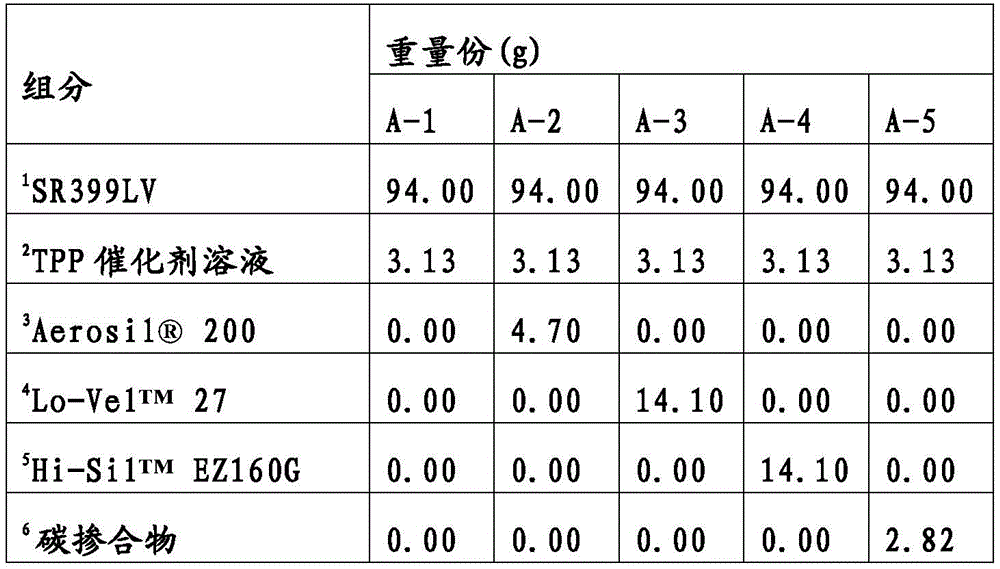
1 SR399LV, dipentaerythritol pentaacrylate, CAS number 60506-81-2, available from Arkema.
2 TPP catalyst solution, 15% by weight solution of triphenylphosphine in acetone, CAS number 603-35-0 for crystalline triphenylphosphine, available from Fisher Scientific. 200, hydrophilic fumed silica, CAS No. 7631-86-9, available from Evonik.
4 Lo-Vel TM 27, silica leveler, CAS number 63231-67-4, available from PPGIndsuities.
5 Hi-Sil TM EZ160G, precipitated silica, CAS No. 112926-00-8, available from PPG
6 A carbon blend which is a mixture of carbon and, 1,
1, graphene is available from XGSciences, graphene nanoplatelets are available from raymor nono integras as PureWave Graphene (GNP).
To prepare the acrylate components in table 5, SR399LV resin was weighed into a linerless 1/2 pin dealuminated paint can and the additives were weighed into a paper cup. The additives were slowly incorporated into the resin using a high lift Cowles blade at low RPM. After the additive combination, the RPM of the Cowles blade was slightly increased and the mixture was allowed to stir for 30min. After 30min, the catalyst solution was added to the jar via a laboratory balance using a syringe. The mixture was then stirred manually until homogeneous and then again for one minute with a Cowles blade. This procedure was carried out with each of the four different additives to produce four different formulations A1 to A4 of the acrylate component.
The composition of the thiol component is shown in table 6.
TABLE 6 thiol component.
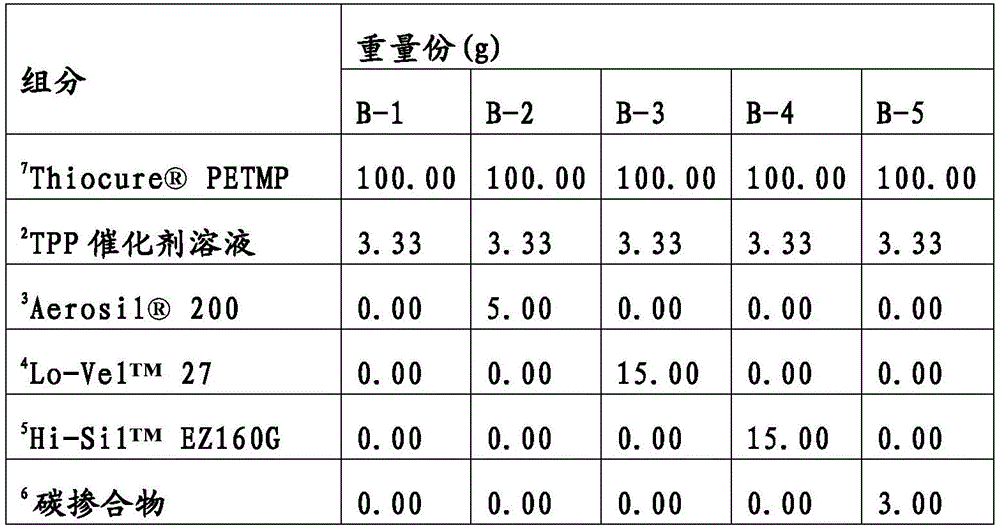
The thiol component was generated using the same procedure as described for the acrylate component, using the amounts from table 6. The procedure was performed with each of the four different additives to produce four different formulations B1 to B5 of the thiol component.
All formulations were transferred from 1/2 pint aluminum cans to 50mL two-component cartridges from Nordson EFD for two-component hand pumping. The formulations were paired A-1 with B-1, A-2 with B-2, etc., until a total of four sleeves were filled. One at a time, a bayonet static mixer (bayonet static mixer) from Nordson EFD was attached to the end of the sleeve and the components were combined and the co-reactive thiol-ene composition was extruded onto polyethylene terephthalate (PET) sheets at a 1. The extruded material was then drawn down with a 50mil bar and allowed to fully cure. All formulations were successfully extruded and knife coated, which indicates a high probability of success for 3D printing applications.
The formulation gel times for the thiol-ene compositions are provided in table 7.
TABLE 7 gel time of thiol-ene compositions

Example 6
Thiol-ene coreactive compositions
The michael donor component (multifunctional acetylacetonate, synthesized by PPG Industries, inc.) was first weighed into a Max 300L DAC cup from Flacktek. Will contain 40wt% of 1,5, 7-triazabicyclo [ 4.4.0%]A catalyst solution of dec-5-ene in solvent was added to the Michael donor solution to give a final catalyst concentration of 4wt%. Catalyst and Michael donor resin in Flacktek Speedmixer TM At 2000rpm, mix for 2min under vacuum pressure of 5 psi.
The Michael acceptor component is prepared by mixing 5wt% TS720 was prepared by adding to a proprietary multifunctional acrylate (synthesized by PPG Industries, inc.) into a Max 300L DAC cup. The mixture was then used with a Flacktek Speedmixer TM Dispersion was carried out at 2000rpm under a vacuum pressure of 5psi for 2min.
The components were transferred from DAC cups to an Optimum sleeve via a Flacktek SpeedDisc and were suitable for printing by reactive extrusion using a ViscoTec 2k extruder.
Although specific embodiments of the invention have been described above for purposes of illustration, it will be evident to those skilled in the art that numerous variations of the details of the present invention may be made without departing from the invention as defined in the appended claims.
Claims (26)
1. A reactive additive manufacturing method, comprising:
providing a first component comprising a first compound to a first pump;
providing a second component comprising a second compound into a second pump, wherein the first compound is reactive with the second compound;
pumping the first component from the first pump and the second component from the second pump through a mixer to provide a coreactive composition; and
allowing the co-reactive composition to deposit,
wherein,
the first component comprises a first viscosity;
the second component comprises a second viscosity that is,
the first viscosity is within ± 20% of the second viscosity; and
viscosity the tray temperature at 25 ℃ and 100sec was measured using an Anton Paar MCR302 rheometer with a gap of 1mm -1 Is measured at a shear rate of (c).
2. The method of claim 1, wherein the first pump and the second pump each comprise a progressive cavity pump.
3. The method according to claim 1, wherein,
the first component comprises two or more first compounds; and
the second component comprises two or more second compounds.
4. The method according to claim 3, wherein,
the two or more first compounds comprise an average functionality of the first functional group of 2 to 6; and
the two or more second compounds comprise an average functionality of the second functional groups of 2 to 6,
wherein the first functional group is reactive with the second functional group.
5. The method according to claim 1, wherein the first component and/or the second component independently comprise a viscosity of 200 centipoise to 20,000,000 centipoise using an Anton Paar MCR302 rheometer with a gap of 1mm at 25 ℃ and 100sec -1 Is measured at a shear rate of (c).
6. The method according to claim 1, wherein,
the first compound comprises a first monomer, a first prepolymer, or a combination thereof;
the second compound comprises a second monomer, a second prepolymer, or a combination thereof; and
the first monomer and the first prepolymer are reactive with the second monomer and the second prepolymer.
7. The method according to claim 1, wherein,
the first compound comprises at least one first prepolymer;
the second compound comprises at least one second prepolymer; and
the at least one first prepolymer is reactive with the at least one second prepolymer.
8. The method according to claim 1, wherein the first compound comprises a polyamine and the second compound comprises a polyisocyanate.
9. The method of claim 1, wherein the first compound comprises a polyalkenyl compound and the second compound comprises a polythiol.
10. The method according to claim 1, wherein the first compound comprises a michael acceptor and the second compound comprises a michael donor.
11. The method of claim 1, wherein the first compound comprises a polyepoxide and the second compound comprises a polythiol.
12. The method according to claim 1, wherein the first compound comprises a polyepoxide and the second compound comprises a polyamine.
13. The process of claim 1 wherein said co-reactive composition comprises a dynamic viscosity of 200 centipoise to 20,000,000 centipoise, wherein said dynamic viscosity is measured using an Anton Paar MCR302 rheometer with a 25mm diameter parallel disk rotor, an oscillation frequency of 1Hz, and an amplitude of 0.3%, and with a rheometer disk temperature of 25 ℃.
14. The process of claim 1 wherein said coreactive composition is characterized by a gel time of less than 5 minutes at 25 ℃.
15. The method according to claim 1, wherein the first component and/or the second component independently comprise a filler; and the coreactive composition comprises a filler.
16. The method according to claim 1, wherein the first component and/or the second component independently comprise 0.1wt% to 95wt% of a filler, wherein wt% is based on the total weight of the first component or the second component.
17. The method according to claim 1, wherein the first component and/or the second component independently comprise 0.1vol% to 95vol% filler, wherein vol% is based on the total volume of the first component or the second component.
18. The process according to claim 1, wherein the coreactive composition comprises 0.1wt% to 95wt% filler, where wt% is based on the total weight of the coreactive composition.
19. The process according to claim 1, wherein the coreactive composition comprises 0.1vol% to 95vol% filler, where vol% is based on the total volume of the coreactive composition.
20. The method of claim 1, wherein depositing comprises extruding.
21. The method of claim 1, wherein depositing comprises covalently bonding the contiguous layer.
22. The method of claim 1, wherein the co-reactive composition comprises a third compound, wherein the third compound is reactive with the first compound or the second compound.
23. The method of claim 22, wherein a rate of reaction between the third compound and the first compound or the second compound is faster than a rate of reaction between the first compound and the second compound.
24. A method of forming an object, characterized in that a method according to claim 1 is used.
25. The method of claim 24, wherein the object provides at least 10dB of attenuation in the frequency range between 1MHz and 18 GHz.
26. The method according to claim 24, wherein the object is characterized by a specific gravity of less than 0.9.
Applications Claiming Priority (4)
| Application Number | Priority Date | Filing Date | Title |
|---|---|---|---|
| US15/680,846 US10434704B2 (en) | 2017-08-18 | 2017-08-18 | Additive manufacturing using polyurea materials |
| US15/680,846 | 2017-08-18 | ||
| CN201880063885.6A CN111148631B (en) | 2017-08-18 | 2018-08-17 | Additive layer manufacturing using reactive compositions |
| PCT/IB2018/056254 WO2019035099A1 (en) | 2017-08-18 | 2018-08-17 | Additive manufacturing using reactive compositions |
Related Parent Applications (1)
| Application Number | Title | Priority Date | Filing Date |
|---|---|---|---|
| CN201880063885.6A Division CN111148631B (en) | 2017-08-18 | 2018-08-17 | Additive layer manufacturing using reactive compositions |
Publications (1)
| Publication Number | Publication Date |
|---|---|
| CN115558068A true CN115558068A (en) | 2023-01-03 |
Family
ID=63579551
Family Applications (2)
| Application Number | Title | Priority Date | Filing Date |
|---|---|---|---|
| CN202211352651.8A Pending CN115558068A (en) | 2017-08-18 | 2018-08-17 | Additive manufacturing using reactive compositions |
| CN201880063885.6A Active CN111148631B (en) | 2017-08-18 | 2018-08-17 | Additive layer manufacturing using reactive compositions |
Family Applications After (1)
| Application Number | Title | Priority Date | Filing Date |
|---|---|---|---|
| CN201880063885.6A Active CN111148631B (en) | 2017-08-18 | 2018-08-17 | Additive layer manufacturing using reactive compositions |
Country Status (13)
| Country | Link |
|---|---|
| US (4) | US10434704B2 (en) |
| EP (1) | EP3668717A1 (en) |
| JP (2) | JP7153063B2 (en) |
| KR (3) | KR102431170B1 (en) |
| CN (2) | CN115558068A (en) |
| AU (1) | AU2018316836B2 (en) |
| BR (1) | BR112020003284A2 (en) |
| CA (1) | CA3073014C (en) |
| MX (1) | MX2020001860A (en) |
| RU (1) | RU2740061C1 (en) |
| SG (1) | SG11202001344PA (en) |
| TW (1) | TWI711530B (en) |
| WO (1) | WO2019035099A1 (en) |
Families Citing this family (20)
| Publication number | Priority date | Publication date | Assignee | Title |
|---|---|---|---|---|
| WO2018229095A1 (en) * | 2017-06-14 | 2018-12-20 | Covestro Deutschland Ag | Additive manufacturing process using amines for the post-hardening |
| GB201900978D0 (en) * | 2019-01-24 | 2019-03-13 | Balmoral Comtec Ltd | Additive manufacturing method and article produced therefrom |
| WO2020202153A1 (en) * | 2019-04-01 | 2020-10-08 | Stratasys Ltd. | Additive manufacturing of an object made of a polyurea material |
| CN111138833A (en) * | 2019-12-20 | 2020-05-12 | 东莞深圳清华大学研究院创新中心 | 3D printing magnetic thermoplastic polyurethane elastomer material and preparation method and application thereof |
| EP3909748A1 (en) | 2020-05-12 | 2021-11-17 | TIGER Coatings GmbH & Co. KG | Thermosetting material for use in additive manufacturing |
| TW202146590A (en) | 2020-06-05 | 2021-12-16 | 美商片片堅俄亥俄州工業公司 | Additive manufacturing compositions and methods including resin stabilized pigments |
| US20210387403A1 (en) | 2020-06-15 | 2021-12-16 | Carbon, Inc. | Additive manufacturing with dual precusor resins |
| US11879023B2 (en) * | 2020-08-21 | 2024-01-23 | United States Of America As Represented By The Secretary Of The Air Force | Articles comprising crosslinked polymer network comprising thioether crosslinks and process of making and using same |
| WO2022139620A1 (en) * | 2020-12-25 | 2022-06-30 | Общество с ограниченной ответственностью "АРКОДИМ" | Printing head and printing method |
| KR102583626B1 (en) * | 2021-02-05 | 2023-10-04 | 주식회사 엘지화학 | Compositon |
| WO2022217221A1 (en) | 2021-04-06 | 2022-10-13 | Ppg Industries Ohio, Inc. | Structural modules produced by additive manufacturing |
| CN117460591A (en) * | 2021-04-27 | 2024-01-26 | Ppg工业俄亥俄公司 | Co-reactive additive manufacturing compositions and articles for investment casting |
| US20220380549A1 (en) * | 2021-05-12 | 2022-12-01 | Elkem Silicones USA Corp. | Method for producing a three-dimensional printed article |
| KR20240045296A (en) * | 2021-08-13 | 2024-04-05 | 피피지 인더스트리즈 오하이오 인코포레이티드 | Coating compositions, methods of using the same, and systems comprising the same |
| KR20230052763A (en) | 2021-10-13 | 2023-04-20 | 주식회사 엘지에너지솔루션 | Battery diagnosis apparatus, battery pack, electric vehicle, and battery diagnosis method |
| CA3235497A1 (en) * | 2021-10-18 | 2023-04-27 | Polynt Composites USA, Inc. | Thermosetting compositions for additive manufacturing |
| CN113929869B (en) * | 2021-11-29 | 2022-08-16 | 四川大学 | Two-component polyurea material for 3D printing and method for 3D printing of polyurea product |
| WO2023244740A1 (en) * | 2022-06-15 | 2023-12-21 | Cmc Materials Llc | Uv-curable resins for chemical mechanical polishing pads |
| ES2966932B2 (en) * | 2022-09-29 | 2024-11-28 | Univ Madrid Carlos Iii | PROCEDURE AND DEVICE FOR CALCULATING 3D PRINTING PARAMETERS BY INJECTION OF POLYMERIC MATERIALS WITH RHEOLOGICAL PROPERTIES VARIABLE OVER TIME |
| CN115819711B (en) * | 2022-11-24 | 2024-04-05 | 四川大学 | Reaction extrusion 3D printing silicone rubber-polyurea materials and their applications |
Citations (7)
| Publication number | Priority date | Publication date | Assignee | Title |
|---|---|---|---|---|
| US20020122928A1 (en) * | 2000-03-24 | 2002-09-05 | Chemque, Incorporation | Co-dispensed compositions for gaskets and other objects |
| CN101010397A (en) * | 2004-09-02 | 2007-08-01 | Ppg工业俄亥俄公司 | Multi-component coatings including polyurea coatings |
| CN102046681A (en) * | 2008-04-21 | 2011-05-04 | Ppg工业俄亥俄公司 | Low temperature application coating composition comprising polyurea and a phosphorus-containing polyol and footwear comprising polyurea |
| CN103261253A (en) * | 2010-12-07 | 2013-08-21 | 陶氏环球技术有限责任公司 | Polyurethane elastomers made using mixtures of aliphatic diol chain extender and secondary amine |
| WO2016085992A1 (en) * | 2014-11-24 | 2016-06-02 | Ppg Industries Ohio, Inc. | Methods for reactive three-dimensional printing by extrusion |
| US20160297104A1 (en) * | 2013-11-19 | 2016-10-13 | Guill Tool & Engineering | Coextruded, multilayer and multicomponent 3d printing inputs field |
| CA3006723A1 (en) * | 2015-12-02 | 2017-06-08 | Dow Global Technologies Llc | Additive manufactured carbon michael addition articles and method to make them |
Family Cites Families (264)
| Publication number | Priority date | Publication date | Assignee | Title |
|---|---|---|---|---|
| US3517082A (en) | 1967-06-26 | 1970-06-23 | Commercial Solvents Corp | Phenolic resin coating and process of coating |
| US3563957A (en) | 1968-10-03 | 1971-02-16 | Minnesota Mining & Mfg | Ethyleneurea-terminated polyurethane prepolymers and cured products thereof |
| US3799854A (en) | 1970-06-19 | 1974-03-26 | Ppg Industries Inc | Method of electrodepositing cationic compositions |
| US3919351A (en) | 1973-08-29 | 1975-11-11 | Ppg Industries Inc | Composition useful in making extensible films |
| US4046729A (en) | 1975-06-02 | 1977-09-06 | Ppg Industries, Inc. | Water-reduced urethane coating compositions |
| US4147769A (en) | 1976-06-28 | 1979-04-03 | Nelson Research & Development Company | Microbicidal composition |
| AU515845B2 (en) | 1977-04-25 | 1981-05-07 | Ici Ltd. | Multiple layer coating process |
| JPS56127478A (en) | 1980-03-13 | 1981-10-06 | Tokyo Electric Co Ltd | Serial printer |
| EP0038127B1 (en) | 1980-04-14 | 1984-10-17 | Imperial Chemical Industries Plc | Multi-layer coating process involving use of aqueous basecoat composition containing crosslinked polymer microparticles and having a pseudoplastic or thixotropic character |
| US4366307A (en) | 1980-12-04 | 1982-12-28 | Products Research & Chemical Corp. | Liquid polythioethers |
| US4609762A (en) | 1984-01-30 | 1986-09-02 | Products Research & Chemical Corp. | Thioethers having a high sulfur content and method therefor |
| JPH0626637B2 (en) | 1984-07-26 | 1994-04-13 | 横浜ゴム株式会社 | Iron golf club set |
| US4546045A (en) | 1984-12-27 | 1985-10-08 | Ppg Industries, Inc. | Method for reducing temperature rise of heat sensitive substrates |
| US4681811A (en) | 1985-08-19 | 1987-07-21 | Ppg Industries, Inc. | Color plus clear coatings employing polyepoxides and polyacid curing agents in the clear coat |
| US4623711A (en) | 1985-08-21 | 1986-11-18 | Products Research & Chemical Corp. | Modified disulfide polymer composition and method for making same from mercaptan terminated disulfide polymer and diethyl formal mercaptan terminated polysulfide |
| US4732790A (en) | 1986-08-21 | 1988-03-22 | Ppg Industries, Inc. | Color plus clear application of thermosetting high solids coating composition of hydroxy-functional epoxies and anhydrides |
| US4798746A (en) | 1987-08-24 | 1989-01-17 | Ppg Industries, Inc. | Basecoat/clearcoat method of coating utilizing an anhydride additive in the thermoplastic polymer-containing basecoat for improved repairability |
| US5071904A (en) | 1989-05-30 | 1991-12-10 | Ppg Industries, Inc. | Waterborne coating compositions for automotive applications |
| US5262259A (en) | 1990-01-03 | 1993-11-16 | Minnesota Mining And Manufacturing Company | Toner developed electrostatic imaging process for outdoor signs |
| JP3083307B2 (en) | 1990-01-12 | 2000-09-04 | 旭電化工業株式会社 | Optical molding resin composition |
| US5114989A (en) | 1990-11-13 | 1992-05-19 | The Dow Chemical Company | Isocyanate-terminated prepolymer and polyurethane foam prepared therefrom |
| JPH04366617A (en) | 1991-06-13 | 1992-12-18 | Mitsui Eng & Shipbuild Co Ltd | Optical shaping method |
| US5225472A (en) | 1992-05-19 | 1993-07-06 | Courtaulds Aerospace, Inc. | Low viscosity polythiol and method therefor |
| US5468802A (en) | 1994-07-18 | 1995-11-21 | Ppg Industries, Inc. | Low volatile organic content automotive refinish coating composition |
| JPH09111135A (en) | 1995-10-23 | 1997-04-28 | Mitsubishi Materials Corp | Conductive polymer composition |
| US5777061A (en) | 1996-02-14 | 1998-07-07 | Bayer Corporation | Blocked polyisocyanate crosslinkers for providing improved flow properties to coating compositions |
| AUPO251096A0 (en) | 1996-09-23 | 1996-10-17 | Cardiac Crc Nominees Pty Limited | Polysiloxane-containing polyurethane elastomeric compositions |
| US5912319A (en) | 1997-02-19 | 1999-06-15 | Courtaulds Aerospace, Inc. | Compositions and method for producing fuel resistant liquid polythioether polymers with good low temperature flexibility |
| US6509418B1 (en) | 1997-02-19 | 2003-01-21 | Prc-Desoto International, Inc. | Sealants and potting formulations including mercapto-terminated polymers produced by the reaction of a polythiol and polyvinyl ether monomer |
| US6858260B2 (en) | 1997-05-21 | 2005-02-22 | Denovus Llc | Curable sealant composition |
| US6284360B1 (en) | 1997-09-30 | 2001-09-04 | 3M Innovative Properties Company | Sealant composition, article including same, and method of using same |
| US6259962B1 (en) | 1999-03-01 | 2001-07-10 | Objet Geometries Ltd. | Apparatus and method for three dimensional model printing |
| DE19937770C2 (en) | 1999-08-10 | 2002-01-03 | Bayer Ag | Process for the production of three-dimensional or flat structures |
| US6454972B1 (en) | 1999-11-24 | 2002-09-24 | Sandia Corporation | Solid freeform fabrication using chemically reactive suspensions |
| DE19963948A1 (en) | 1999-12-31 | 2001-07-26 | Zsolt Herbak | Model making process |
| US7300619B2 (en) | 2000-03-13 | 2007-11-27 | Objet Geometries Ltd. | Compositions and methods for use in three dimensional model printing |
| US8481241B2 (en) | 2000-03-13 | 2013-07-09 | Stratasys Ltd. | Compositions and methods for use in three dimensional model printing |
| SG106041A1 (en) | 2000-03-21 | 2004-09-30 | Nanyang Polytechnic | Plastic components with improved surface appearance and method of making the same |
| US6558753B1 (en) | 2000-11-09 | 2003-05-06 | 3M Innovative Properties Company | Inks and other compositions incorporating limited quantities of solvent advantageously used in ink jetting applications |
| JP2002166460A (en) | 2000-11-30 | 2002-06-11 | Sumitomo Chem Co Ltd | Method for producing polyolefin resin foam sheet |
| GB0103754D0 (en) | 2001-02-15 | 2001-04-04 | Vantico Ltd | Three-dimensional structured printing |
| GB0112675D0 (en) | 2001-05-24 | 2001-07-18 | Vantico Ltd | Three-dimensional structured printing |
| US6875800B2 (en) | 2001-06-18 | 2005-04-05 | Ppg Industries Ohio, Inc. | Use of nanoparticulate organic pigments in paints and coatings |
| US6894086B2 (en) | 2001-12-27 | 2005-05-17 | Ppg Industries Ohio, Inc. | Color effect compositions |
| US6639025B2 (en) | 2002-02-01 | 2003-10-28 | Ameron International Corporation | Elastomer-modified epoxy siloxane compositions |
| GB0212062D0 (en) | 2002-05-24 | 2002-07-03 | Vantico Ag | Jetable compositions |
| DE10224981B4 (en) | 2002-06-05 | 2004-08-19 | Generis Gmbh | Process for building models in layers |
| US7009032B2 (en) | 2002-12-20 | 2006-03-07 | Ppg Industries Ohio, Inc. | Sulfide-containing polythiols |
| RU2247087C2 (en) | 2002-12-24 | 2005-02-27 | Закрытое акционерное общество "ЛАД-КОН" | Resin composition |
| CA2772050C (en) | 2002-12-26 | 2016-09-06 | Meso Scale Technologies, Llc. | Assay cartridges and methods of using the same |
| KR101056491B1 (en) | 2003-02-06 | 2011-08-11 | 아크조노벨코팅스인터내셔널비.브이. | Spray gun and method for applying actinic radiation-curable coating |
| CN1867770A (en) | 2003-02-28 | 2006-11-22 | 维斯塔斯风力系统有限公司 | Method of manufacturing a wind turbine blade, wind turbine blade, front cover and application of the front cover |
| MXPA05011558A (en) | 2003-04-30 | 2005-12-14 | Prc Desoto Int Inc | Preformed emi/rfi shielding compositions in shaped form. |
| WO2006001787A1 (en) | 2003-06-09 | 2006-01-05 | Dow Global Technologies Inc. | Stabilized organoborane polymerization initiators and polymerizable compositions |
| US7605194B2 (en) | 2003-06-24 | 2009-10-20 | Ppg Industries Ohio, Inc. | Aqueous dispersions of polymer-enclosed particles, related coating compositions and coated substrates |
| JP2007523248A (en) | 2004-02-23 | 2007-08-16 | ダウ グローバル テクノロジーズ インコーポレイティド | Aqueous adhesive for bonding low surface energy substrates |
| WO2005118721A1 (en) | 2004-04-16 | 2005-12-15 | University Of Washington | Method for rapid crosslinking of silicone compounds by in situ water generation |
| DE102004025374A1 (en) | 2004-05-24 | 2006-02-09 | Technische Universität Berlin | Method and device for producing a three-dimensional article |
| US7981505B2 (en) | 2004-06-24 | 2011-07-19 | Ppg Industries Ohio, Inc. | Coated articles and multi-layer coatings |
| US7459515B2 (en) | 2004-09-15 | 2008-12-02 | Ppg Industries Ohio, Inc. | Fast-curing modified siloxane compositions |
| US7928174B2 (en) | 2005-01-04 | 2011-04-19 | Dow Corning Corporation | Organosilicon functional boron amine catalyst complexes and curable compositions made therefrom |
| US7390859B2 (en) | 2005-02-08 | 2008-06-24 | Ppg Industries Ohio, Inc. | Compositions and methods of making compositions exhibiting fuel resistance |
| KR20080053348A (en) | 2005-10-07 | 2008-06-12 | 다우 글로벌 테크놀로지스 인크. | Amido-organoborate initiator system |
| US8623989B1 (en) | 2006-05-05 | 2014-01-07 | PRC De Soto International, Inc. | Polyurea/polythiourea coatings |
| US7787979B2 (en) | 2007-03-14 | 2010-08-31 | The Boeing Company | Splicing fuselage sections without shims |
| US7879955B2 (en) | 2007-05-01 | 2011-02-01 | Rao Chandra B | Compositions including a polythioether |
| WO2009050115A1 (en) | 2007-10-17 | 2009-04-23 | Basf Se | Photolatent catalysts based on organometallic compounds |
| US9572402B2 (en) | 2007-10-23 | 2017-02-21 | Nike, Inc. | Articles and methods of manufacturing articles |
| DE102008000140A1 (en) | 2008-01-23 | 2009-07-30 | Wacker Chemie Ag | Process for the preparation of isocyanate-terminated siloxanes |
| US7875666B2 (en) | 2008-04-24 | 2011-01-25 | Prc-De Soto International, Inc. | Thioethers, methods for their preparation, and compositions including such thioethers |
| US8466220B2 (en) | 2008-04-24 | 2013-06-18 | PRC DeSoto International, Inc | Thioethers, methods for their preparation, and compositions including such thioethers |
| US8876513B2 (en) | 2008-04-25 | 2014-11-04 | 3D Systems, Inc. | Selective deposition modeling using CW UV LED curing |
| US8816023B2 (en) | 2008-08-13 | 2014-08-26 | Ppg Industries Ohio, Inc | Lightweight particles and compositions containing them |
| US8192008B2 (en) | 2008-08-28 | 2012-06-05 | Eastman Kodak Company | Inkjet printing system and ink |
| JP2012509806A (en) | 2008-11-26 | 2012-04-26 | ダウ グローバル テクノロジーズ エルエルシー | Sound absorbing baffle member and method for applying sound absorbing baffle in cavity |
| CN102333805B (en) * | 2009-02-26 | 2014-01-01 | 宇部兴产株式会社 | Aqueous polyurethane resin dispersion and its production method |
| KR101759180B1 (en) | 2009-04-03 | 2017-07-18 | 보르벡크 머터리얼스 코포레이션 | Polymer compositions containing graphene sheets and graphite |
| WO2010117262A1 (en) | 2009-04-10 | 2010-10-14 | Xemc Darwind B.V. | A protected wind turbine blade, a method of manufacturing it and a wind turbine |
| US10435780B2 (en) | 2009-06-11 | 2019-10-08 | Genius Solutions Engineering Company | Low CTE slush molds with textured surface, and method of making and using the same |
| BR112012008312A2 (en) | 2009-09-04 | 2019-09-24 | Bayer Materialscience Llc | automatic processes for the production of polyurethane wind turbine blades. |
| EP2502239A4 (en) | 2009-11-20 | 2015-01-28 | 3M Innovative Properties Co | Compositions comprising conductive particles with surface-modified nanoparticles covalently attached thereto, and methods of making |
| JP2011105906A (en) | 2009-11-20 | 2011-06-02 | Dic Corp | Composite resin composition and coating agent containing the same |
| EP2552983A1 (en) | 2010-03-31 | 2013-02-06 | Lubrizol Advanced Materials, Inc. | Aqueous ink jet ink composition |
| US9115241B2 (en) | 2010-04-01 | 2015-08-25 | Ppg Industries Ohio, Inc. | Branched polyester polymers and soft touch coatings comprising the same |
| WO2012004088A1 (en) | 2010-07-05 | 2012-01-12 | Huntsman International Llc | Cross-linkable thermoplastic polyurethanes |
| US9533798B2 (en) | 2010-08-13 | 2017-01-03 | Prc-Desoto International, Inc. | Uses of UV-curable polythioether sealants for sealing fasteners and for smoothing surfaces |
| US8668859B2 (en) | 2010-08-18 | 2014-03-11 | Makerbot Industries, Llc | Automated 3D build processes |
| ES2536576T3 (en) | 2010-12-23 | 2015-05-26 | Sicpa Holding Sa | Two-component reactive inkjet inkjet printing |
| DE102010056346A1 (en) | 2010-12-29 | 2012-07-05 | Technische Universität München | Method for the layered construction of models |
| DE102011003619A1 (en) | 2011-02-03 | 2012-08-09 | Bayer Materialscience Aktiengesellschaft | Multi-layer lacquer system, useful for preventing fouling by fouling organisms, comprises optionally third lacquer composition of diamine components, isocyanate components and defoamer in organic solvent |
| US9157007B2 (en) | 2011-03-09 | 2015-10-13 | 3D Systems, Incorporated | Build material and applications thereof |
| US8729216B2 (en) | 2011-03-18 | 2014-05-20 | Prc Desoto International, Inc. | Multifunctional sulfur-containing polymers, compositions thereof and methods of use |
| US8541513B2 (en) | 2011-03-18 | 2013-09-24 | Prc-Desoto International, Inc. | Terminal-modified difunctional sulfur-containing polymers, compositions thereof and methods of use |
| US20120244337A1 (en) | 2011-03-23 | 2012-09-27 | Owens Corning Intellectual Capital, Llc | Fiberized thermoset binder and method of using |
| WO2012139984A1 (en) | 2011-04-12 | 2012-10-18 | Shanghai Ici Research & Development & Management Co. Ltd. | Process for the preparation of a polysulfide |
| CN102896923B (en) | 2011-07-26 | 2016-03-09 | 珠海格力电器股份有限公司 | Three-dimensional printing method and three-dimensional display panel |
| CN103857719B (en) | 2011-08-05 | 2016-08-17 | 巴斯夫欧洲公司 | Associative thickeners based on dissaving polymer |
| JP5940426B2 (en) | 2011-11-28 | 2016-06-29 | 三洋化成工業株式会社 | Antistatic agent and antistatic resin composition |
| JP5250097B2 (en) | 2011-12-12 | 2013-07-31 | 信越石英株式会社 | Silica container for pulling single crystal silicon and manufacturing method thereof |
| US20130237661A1 (en) | 2011-12-22 | 2013-09-12 | Thomas B. Brust | Inkjet ink composition |
| AU2012357646B2 (en) | 2011-12-24 | 2016-11-10 | Zydex Pty Ltd | Method and apparatus for making an object |
| CA2861457A1 (en) | 2012-01-20 | 2013-07-25 | Genia Technologies, Inc. | Nanopore based molecular detection and sequencing |
| JP5085800B1 (en) | 2012-04-03 | 2012-11-28 | 株式会社Ihi | Bolt nut cap |
| US20150099087A1 (en) | 2012-04-10 | 2015-04-09 | A. Raymond Et Cie | Printed encapsulation |
| US20130295290A1 (en) | 2012-05-03 | 2013-11-07 | Ppg Industries Ohio, Inc. | Compositions with a sulfur-containing polymer and graphenic carbon particles |
| US9389304B2 (en) | 2012-05-21 | 2016-07-12 | Zte Corporation | Using multiple access channels for wireless device positioning |
| US8952124B2 (en) | 2013-06-21 | 2015-02-10 | Prc-Desoto International, Inc. | Bis(sulfonyl)alkanol-containing polythioethers, methods of synthesis, and compositions thereof |
| US20140012406A1 (en) | 2012-07-05 | 2014-01-09 | Nike, Inc. | Rapid Manufacturing Customization Of Footwear Components |
| KR101743098B1 (en) | 2012-08-01 | 2017-06-02 | 도오레 화인케미칼 가부시키가이샤 | Thiol group-containing polymer and curable composition thereof |
| US9511543B2 (en) | 2012-08-29 | 2016-12-06 | Cc3D Llc | Method and apparatus for continuous composite three-dimensional printing |
| EP2703149B1 (en) | 2012-09-04 | 2015-06-17 | Airbus Operations GmbH | Method for producing an aircraft structure component having an outer skin provided with a smooth outer surface |
| EP2719484B1 (en) | 2012-10-12 | 2020-02-26 | MTU Aero Engines AG | Component for turbomachine |
| US9122819B2 (en) | 2012-10-22 | 2015-09-01 | Converse Inc. | Customized shoe textures and shoe portions |
| US9062139B2 (en) | 2013-03-15 | 2015-06-23 | Prc-Desoto International, Inc. | Sulfone-containing polythioethers, compositions thereof, and methods of synthesis |
| CA2909377A1 (en) | 2013-04-15 | 2014-10-23 | 3M Innovative Properties Company | Light weight seal cap |
| US20140319734A1 (en) | 2013-04-24 | 2014-10-30 | The Board Of Regents Of The University Of Texas System | Real time manufacturing of softening polymers |
| WO2014207472A2 (en) * | 2013-06-28 | 2014-12-31 | Colormatrix Holdings, Inc. | Polymeric materials |
| BR112016000897B1 (en) | 2013-07-31 | 2022-04-26 | Essilor International | Additive production method for clear ophthalmic lens |
| CN105408396B (en) | 2013-08-02 | 2017-06-23 | 阿克佐诺贝尔化学国际公司 | Method for preparing polythioether sulfides |
| US9370132B2 (en) | 2013-08-27 | 2016-06-14 | Parker-Hannifin Corporation | Homogeneous EMI vent panel and method for preparation thereof |
| US20150371279A1 (en) | 2014-06-23 | 2015-12-24 | Mastercard International Incorporated | Method and system for targeted advertising on product packaging |
| EP3044270B1 (en) * | 2013-09-12 | 2018-08-29 | 3D Systems, Inc. | Build material and applications thereof |
| TWI618640B (en) | 2013-09-13 | 2018-03-21 | Silicon Touch Technology Inc. | Three dimensional printing system, and method for three dimensional printing |
| EP2851208A1 (en) | 2013-09-24 | 2015-03-25 | Sika Technology AG | Floor with inlay pattern prepared by additive manufacturing techniques |
| JP6253354B2 (en) | 2013-11-06 | 2017-12-27 | 株式会社東芝 | Form reading device, program, and form reading system |
| US20150183159A1 (en) | 2013-12-30 | 2015-07-02 | Chad E. Duty | Large scale room temperature polymer advanced manufacturing |
| EP3094477A1 (en) | 2014-01-14 | 2016-11-23 | King's College London | 3d printing of facial prostheses |
| HUE069958T2 (en) | 2014-01-17 | 2025-04-28 | Lubrizol Advanced Mat Inc | Methods of using thermoplastic polyurethanes in fused deposition modeling and systems and articles thereof |
| EP3094684B1 (en) * | 2014-01-17 | 2021-03-31 | Lubrizol Advanced Materials, Inc. | Methods of using thermoplastic polyurethanes in selective laser sintering and systems and articles thereof |
| US9518197B2 (en) | 2014-03-07 | 2016-12-13 | Prc-Desoto International, Inc. | Cure-on-demand moisture-curable urethane-containing fuel resistant prepolymers and compositions thereof |
| US9992917B2 (en) | 2014-03-10 | 2018-06-05 | Vulcan GMS | 3-D printing method for producing tungsten-based shielding parts |
| US9650537B2 (en) | 2014-04-14 | 2017-05-16 | Ut-Battelle, Llc | Reactive polymer fused deposition manufacturing |
| US9523021B2 (en) | 2014-04-25 | 2016-12-20 | Ppg Industries Ohio, Inc. | Waterborne coating compositions for soft touch coatings |
| FR3020365B1 (en) * | 2014-04-29 | 2017-10-27 | Michelin & Cie | PROCESS FOR THE MICROCOLLED MANUFACTURE OF A POLYURETHANE FOAM |
| CN104031383B (en) | 2014-04-30 | 2015-10-21 | 中国科学院化学研究所 | A kind of 3D prints modification polyamino acid material and preparation method thereof |
| US9676159B2 (en) | 2014-05-09 | 2017-06-13 | Nike, Inc. | Method for forming three-dimensional structures with different material portions |
| US10016941B1 (en) | 2014-05-15 | 2018-07-10 | Feetz, Inc. | Systems and methods for measuring body parts for designing customized outerwear |
| CN105313332B (en) | 2014-06-09 | 2020-05-05 | 联合工艺公司 | Two-part thermosetting resin additive manufacturing system |
| CN114734628A (en) | 2014-06-23 | 2022-07-12 | 卡本有限公司 | Method for producing three-dimensional objects from materials with multiple hardening mechanisms |
| ES2690840T3 (en) * | 2014-06-23 | 2018-11-22 | Covestro Deutschland Ag | Use of thermoplastic polyurethane powders |
| US20160009029A1 (en) | 2014-07-11 | 2016-01-14 | Southern Methodist University | Methods and apparatus for multiple material spatially modulated extrusion-based additive manufacturing |
| US20160243586A1 (en) | 2014-08-01 | 2016-08-25 | The Boeing Company | Drag reduction riblets integrated in a paint layer |
| US20160039145A1 (en) | 2014-08-08 | 2016-02-11 | Timothy Wayne Steiner | Three-dimensional printing apparatus |
| DE102014217858A1 (en) | 2014-09-08 | 2016-03-31 | MTU Aero Engines AG | Surface smoothing of generatively manufactured components and correspondingly manufactured components of a turbomachine |
| US10059595B1 (en) | 2014-09-17 | 2018-08-28 | Neil Farbstein | Ultra high strength nanomaterials and methods of manufacture |
| CN107000311A (en) | 2014-10-16 | 2017-08-01 | 陶氏环球技术有限责任公司 | Increasing material manufacturing method |
| US20160107391A1 (en) | 2014-10-21 | 2016-04-21 | Saerome Bae Parish | System and method for custom-sizing bespoke shoes |
| KR20170091650A (en) | 2014-11-27 | 2017-08-09 | 조지아-퍼시픽 케미칼즈 엘엘씨 | Thixotropic, thermosetting resins for use in a material extrusion process in additive manufacturing |
| EP3237972B1 (en) | 2014-12-23 | 2024-11-20 | Bridgestone Americas Tire Operations, LLC | Process for producing a cured polymeric product, kit for use with the process and tire |
| BR112017013742A2 (en) | 2014-12-23 | 2018-03-13 | 3M Innovative Properties Co | double cure polyether |
| US9422451B2 (en) | 2015-01-09 | 2016-08-23 | Prc-Desoto International, Inc. | Low density fuel resistant sulfur-containing polymer compositions and uses thereof |
| EP3626788A1 (en) | 2015-02-05 | 2020-03-25 | Stratasys Ltd. | Digitally-controlled three-dimensional printing of polymerizable materials |
| GB2535519A (en) | 2015-02-20 | 2016-08-24 | Airbus Operations Ltd | Two part cap |
| US9676952B2 (en) * | 2015-02-24 | 2017-06-13 | Xerox Corporation | 3D printing system comprising solid build ink comprising colorant |
| US10688770B2 (en) | 2015-03-03 | 2020-06-23 | Ricoh Co., Ltd. | Methods for solid freeform fabrication |
| DE102015203873B4 (en) | 2015-03-04 | 2025-12-18 | Airbus Operation GmbH | 3D printing process |
| SI3268415T1 (en) | 2015-03-12 | 2019-02-28 | Total Research & Technology Feluy | Process for the preparation of composite articles having enhanced electrical properties |
| US9464203B2 (en) | 2015-03-12 | 2016-10-11 | Ppg Industries Ohio, Inc. | Thiolene-based compositions with extended pot life |
| WO2016149032A1 (en) | 2015-03-13 | 2016-09-22 | President And Fellows Of Harvard College | Printhead and method for 3d printing of multiple materials |
| JP6745288B2 (en) | 2015-03-17 | 2020-08-26 | ナイアガラ・ボトリング・リミテツド・ライアビリテイー・カンパニー | Graphene reinforced polyethylene terephthalate |
| US10507638B2 (en) | 2015-03-17 | 2019-12-17 | Elementum 3D, Inc. | Reactive additive manufacturing |
| EP3274155B1 (en) * | 2015-03-23 | 2021-06-02 | Dow Global Technologies LLC | Photocurable compositions for three-dimensional printing |
| WO2016164562A1 (en) | 2015-04-07 | 2016-10-13 | President And Fellows Of Harvard College | Microfluidic active mixing nozzle for three-dimensional printing of viscoelastic inks |
| BR112017022227B1 (en) | 2015-04-16 | 2022-09-20 | Schlumberger Technology B.V. | APPLIANCE AND METHOD FOR AN ELECTRICAL CONNECTOR ASSEMBLY |
| CN107531875B (en) | 2015-04-21 | 2020-09-22 | 科思创德国股份有限公司 | Process for the production of polyisocyanurate plastics with functionalized surfaces |
| CN104774312B (en) * | 2015-04-28 | 2017-09-19 | 烟台德邦科技有限公司 | One kind can mix solidified resin and its synthetic method |
| EP3291970B1 (en) | 2015-05-06 | 2019-12-18 | SABIC Global Technologies B.V. | System and method for reactive inkjet printing of polycarbonate |
| US10400119B2 (en) | 2015-05-07 | 2019-09-03 | Ehsan Toyserkani | Method and apparatus for aerosol-based three-dimensional (3D) printing of flexible graphene electronic devices |
| WO2016182805A1 (en) | 2015-05-08 | 2016-11-17 | Laird Technologies, Inc. | Electromagnetic interference (emi) shields including form-in-place and/or 3d printed walls |
| DE112016002201T5 (en) | 2015-05-15 | 2018-01-25 | Sony Corporation | OPTICALLY SHAPED OBJECT, PRODUCT AND METHOD FOR MANUFACTURING A PRODUCT |
| CN104961881B (en) * | 2015-06-03 | 2017-08-11 | 四川大学 | For 3D printing, the polyurethane material of the keys of Alder containing Diels and its production and use |
| NZ738442A (en) | 2015-06-09 | 2018-09-28 | Ppg Ind Ohio Inc | Stain resistant, soft touch coating compositions and coatings formed therefrom |
| US9708440B2 (en) | 2015-06-18 | 2017-07-18 | Novoset, Llc | High temperature three dimensional printing compositions |
| DE102015212099B4 (en) | 2015-06-29 | 2022-01-27 | Adidas Ag | soles for sports shoes |
| FR3039553A1 (en) | 2015-07-31 | 2017-02-03 | Michelin & Cie | METHOD AND DEVICE FOR THE PREPARATION OF LIQUID PHASE RUBBER MIXTURE |
| DE102015220699A1 (en) | 2015-08-28 | 2017-03-02 | Siemens Aktiengesellschaft | Printed component and apparatus for 3-D printing in the gelling layer method |
| US20170066196A1 (en) | 2015-09-04 | 2017-03-09 | Feetz, Inc. | Systems and methods for wave function based additive manufacturing |
| US10232549B2 (en) | 2015-09-10 | 2019-03-19 | The Boeing Company | Geometric sound absorption via additive manufacturing |
| EP3341793B1 (en) | 2015-10-01 | 2021-05-26 | DSM IP Assets B.V. | Liquid, hybrid uv/vis radiation curable resin compositions for additive fabrication |
| US20170145202A1 (en) | 2015-10-16 | 2017-05-25 | Miami University | Method, apparatus and formulation for an interpenetrating network polymer |
| US9777139B2 (en) | 2015-10-26 | 2017-10-03 | Prc-Desoto International, Inc. | Reactive antioxidants, antioxidant-containing prepolymers, and compositions thereof |
| WO2017079502A1 (en) | 2015-11-05 | 2017-05-11 | Carbon, Inc. | Silicone dual cure resins for additive manufacturing |
| CN108350119B (en) | 2015-11-19 | 2021-04-20 | Ppg工业俄亥俄公司 | Catalytic compositions and thiol alkenyl compositions with extended pot life |
| US11125206B2 (en) | 2015-11-30 | 2021-09-21 | Vestas Wind Systems A/S | Method of manufacturing a wind turbine blade and wind turbine blade |
| US10538031B2 (en) | 2015-12-22 | 2020-01-21 | Carbon, Inc. | Dual cure additive manufacturing of rigid intermediates that generate semi-rigid, flexible, or elastic final products |
| WO2017112653A1 (en) | 2015-12-22 | 2017-06-29 | Carbon, Inc. | Dual precursor resin systems for additive manufacturing with dual cure resins |
| WO2017112682A1 (en) | 2015-12-22 | 2017-06-29 | Carbon, Inc. | Fabrication of compound products from multiple intermediates by additive manufacturing with dual cure resins |
| WO2017117683A1 (en) | 2016-01-06 | 2017-07-13 | Group Nanoxplore Inc. | Method of compounding graphene with non-conductive particles and applications thereof |
| US9944826B2 (en) | 2016-01-19 | 2018-04-17 | International Business Machines Corporation | Dynamic polymer material for 3D printing |
| CN108699198B (en) | 2016-01-21 | 2021-06-08 | 3M创新有限公司 | Additive Processing of Fluoropolymers |
| JP6220477B1 (en) | 2016-01-28 | 2017-10-25 | バンドー化学株式会社 | Manufacturing method of three-dimensional structure |
| GB201603107D0 (en) | 2016-02-23 | 2016-04-06 | Dow Corning | Low temperature cure silicone elastomer |
| EP3426737B1 (en) * | 2016-03-08 | 2021-11-24 | 3D Systems, Incorporated | Non-isocyanate polyurethane inks for 3d printing |
| EP3440138B1 (en) | 2016-04-07 | 2024-02-21 | 3D Systems, Inc. | Thiol-ene inks for 3d printing |
| US9897130B2 (en) | 2016-04-15 | 2018-02-20 | The Boeing Company | Telescoping cap assembly for encapsulating a fastener disposed within a confined space |
| US20170347460A1 (en) | 2016-05-27 | 2017-11-30 | Duke University | Stretchable Electrically Conductive Layer Formation By Aerosol Jet Printing On Flexible Substrate |
| US10074449B2 (en) | 2016-06-21 | 2018-09-11 | Raytheon Company | Additively manufactured concrete-bearing radiation attenuation structure |
| US9920006B2 (en) | 2016-06-28 | 2018-03-20 | Prc-Desoto International, Inc. | Prepolymers exhibiting rapid development of physical properties |
| US10370561B2 (en) | 2016-06-28 | 2019-08-06 | Prc-Desoto International, Inc. | Urethane/urea-containing bis(alkenyl) ethers, prepolymers prepared using urethane/urea-containing bis(alkenyl) ethers, and uses thereof |
| CN109562615B (en) | 2016-06-28 | 2021-09-24 | 陶氏环球技术有限责任公司 | Thermoset additively manufactured articles incorporating phase change materials and methods of making the same |
| JP6980989B2 (en) | 2016-07-04 | 2021-12-15 | 東洋インキScホールディングス株式会社 | Urethane-modified polyolefin resin and its manufacturing method. |
| US11192293B2 (en) | 2016-07-08 | 2021-12-07 | Covestro Deutschland Ag | Process for producing 3D structures from rubber material |
| WO2018026829A1 (en) | 2016-08-01 | 2018-02-08 | Cornell University | Polymer compositions for 3-d printing and 3-d printers |
| US10883016B2 (en) | 2016-08-08 | 2021-01-05 | Prc-Desoto International, Inc. | Actinic radiation-curable urethane/urea-containing aerospace coatings and sealants |
| KR101891560B1 (en) | 2016-08-22 | 2018-08-27 | 신일화학공업(주) | 3D Printing filament with electromagnetic absorbing and shielding ability and high thermal conductivity and manufacturing method of the same |
| US11097464B2 (en) | 2016-08-26 | 2021-08-24 | Massachusetts Institute Of Technology | Systems, devices, and methods for inkjet-based three-dimensional printing |
| US10732502B2 (en) | 2016-08-31 | 2020-08-04 | Lawrence Livermore National Security, Llc | Click-chemistry compatible structures, click-chemistry functionalized structures, and materials and methods for making the same |
| US10046494B2 (en) | 2016-09-07 | 2018-08-14 | BetaJet, LLC | Small format reaction injection molding machines and components for use therein |
| US10139808B2 (en) | 2016-09-07 | 2018-11-27 | The Boeing Company | Predictive shimming of joints |
| US10625470B2 (en) | 2016-09-28 | 2020-04-21 | Ada Foundation | 3D printing of composition-controlled copolymers |
| US10259956B2 (en) | 2016-10-11 | 2019-04-16 | Xerox Corporation | Curable ink composition |
| PT3526267T (en) | 2016-10-17 | 2023-07-12 | Basf Se | 3d spacer fabric reinforced pu composite and its use |
| EP3529059A4 (en) | 2016-10-21 | 2020-06-03 | Mosaic Manufacturing Ltd. | Joiners, methods of joining, and related systems for additive manufacturing |
| WO2018085650A1 (en) | 2016-11-04 | 2018-05-11 | Prc-Desoto International, Inc. | Sulfur-containing poly(alkenyl) ethers, prepolymers incorporating sulfur-containing poly(alkenyl) ethers, and uses thereof |
| US10240064B2 (en) | 2016-11-09 | 2019-03-26 | Ppg Industries Ohio, Inc. | Curable compositions and their use as coatings and footwear components |
| WO2018087395A1 (en) | 2016-11-14 | 2018-05-17 | Covestro Deutschland Ag | Composite materials based on dual-curing isocyanurate polymers |
| PL3551426T3 (en) | 2016-12-06 | 2022-07-11 | Chromatic 3D Materials Inc. | Manufacture of three dimensional objects from thermosetting resins |
| US10639842B2 (en) | 2017-12-06 | 2020-05-05 | Chromatic 3D Materials, Inc. | Three-dimensional printing control |
| US11118573B2 (en) | 2016-12-20 | 2021-09-14 | Vestas Wind Systems A/S | Methods and systems for repairing wind turbine blades |
| US20180207863A1 (en) | 2017-01-20 | 2018-07-26 | Southern Methodist University | Methods and apparatus for additive manufacturing using extrusion and curing and spatially-modulated multiple materials |
| US10968340B1 (en) | 2017-01-31 | 2021-04-06 | Eaton Intelligent Power Limited | Electrically conductive, high strength, high temperature polymer composite for additive manufacturing |
| US20180215854A1 (en) | 2017-02-02 | 2018-08-02 | Ut-Battelle, Llc | Bonded permanent magnets produced by additive manufacturing |
| US10830206B2 (en) | 2017-02-03 | 2020-11-10 | General Electric Company | Methods for manufacturing wind turbine rotor blades and components thereof |
| EP3585620B1 (en) | 2017-02-27 | 2024-05-15 | Kornit Digital Technologies Ltd. | 3d printing devices including mixing nozzles |
| US10005294B1 (en) | 2017-03-13 | 2018-06-26 | Xerox Corporation | Two component ink jettable primer and incorporation of adhesion promoter to the ink for printing onto 3D objects |
| US11135766B2 (en) | 2017-06-29 | 2021-10-05 | Carbon, Inc. | Products containing nylon 6 produced by stereolithography and methods of making the same |
| WO2019006266A1 (en) | 2017-06-30 | 2019-01-03 | 3M Innovative Properties Company | Three-dimensional article and method of making a three-dimensional article |
| US10597565B2 (en) | 2017-07-07 | 2020-03-24 | Prc-Desoto International, Inc. | Hydraulic fluid and fuel resistant sealants |
| JP6865886B2 (en) | 2017-07-19 | 2021-04-28 | スリーエム イノベイティブ プロパティズ カンパニー | Method for producing polymer article and polymer composite by laminating process and polymer and composite article |
| WO2019016739A2 (en) | 2017-07-19 | 2019-01-24 | 3M Innovative Properties Company | Additive processing of fluoropolymers |
| EP3655636B1 (en) | 2017-07-21 | 2021-11-24 | Dresser Rand Company | Acoustic attenuator for a turbomachine and methodology for additively manufacturing said acoustic attenuator |
| CN107471629B (en) | 2017-08-21 | 2019-05-21 | 西安交通大学 | A kind of continuous fiber reinforced composite electromagnetic shielding structure 3D printing manufacturing method |
| WO2019066997A1 (en) | 2017-09-30 | 2019-04-04 | Intel Corporation | Electromagnetic interference shield created on package using high throughput additive manufacturing |
| EP3697593A4 (en) | 2017-10-16 | 2021-07-07 | Voxel8, Inc. | 3d-printing using reactive precursors |
| FR3072602B1 (en) | 2017-10-23 | 2019-10-11 | Airbus | METHOD FOR FILLING SURFACE IMPERFECTIONS OF AN AIRCRAFT WING |
| SI3704172T1 (en) | 2017-10-31 | 2024-03-29 | Basf Se | Methods and compositions for forming elastomeric polyurethane articles and associated elastomeric polyurethane articles formed thereof |
| US11034460B2 (en) | 2017-12-08 | 2021-06-15 | The Boeing Company | Additively manufactured septa for acoustic panels |
| US11230131B2 (en) | 2017-12-18 | 2022-01-25 | Kornit Digital Technologies Ltd. | Printed polymeric articles, systems and methods |
| EP3732023B1 (en) | 2017-12-28 | 2024-06-26 | Stratasys Ltd. | Additive manufacturing employing polyimide-containing formulations |
| EP3513947B1 (en) | 2018-01-17 | 2022-11-02 | Airbus Operations S.L.U. | Method for manufacturing an aeronautical structure |
| US11427719B2 (en) | 2018-03-06 | 2022-08-30 | Kornit Digital Ltd. | Methods for the printing of materials using hybrid ink formulations |
| CN112513736A (en) | 2018-03-28 | 2021-03-16 | 本杰明·伦德 | Thiol-acrylate polymers, methods of synthesis thereof, and use in additive manufacturing techniques |
| EP3550142B1 (en) | 2018-04-05 | 2020-08-12 | Siemens Gamesa Renewable Energy A/S | Method for on-site repairing of a wind turbine component |
| RU2677143C1 (en) | 2018-04-12 | 2019-01-15 | Федеральное государственное автономное образовательное учреждение высшего образования "Национальный исследовательский технологический университет "МИСиС" | Method for producing three-dimensional products of a complex shape of high viscosity polymers |
| US11697706B2 (en) | 2018-04-20 | 2023-07-11 | Adaptive 3D Technologies | Sealed isocyanates |
| US20210129443A1 (en) | 2018-05-10 | 2021-05-06 | Dow Silicones Corporation | Method of forming a three-dimensional (3d) article |
| CN112154171B (en) | 2018-05-22 | 2023-06-13 | 3M创新有限公司 | Method for processing radiation-curable thiol-based compositions with additive manufacturing techniques |
| US10948082B2 (en) | 2018-07-09 | 2021-03-16 | Hamilton Sunstrand Corporation | Additively manufactured seal plate |
| CN109247005B (en) | 2018-09-03 | 2020-05-05 | 青岛理工大学 | Method for manufacturing electromagnetic shielding optical window by utilizing electric field to drive injection 3D printing |
| CN109041563B (en) | 2018-09-03 | 2020-05-05 | 青岛理工大学 | Method of manufacturing flexible transparent electromagnetic shielding film by 3D printing |
| EP3626442A1 (en) | 2018-09-20 | 2020-03-25 | BAE SYSTEMS plc | Method and apparatus for producing a seal |
| EP3626443A1 (en) | 2018-09-20 | 2020-03-25 | BAE SYSTEMS plc | Sealing method and apparatus for sealing |
| US11192632B2 (en) | 2018-10-15 | 2021-12-07 | The Boeing Company | Slat end seal and method for manufacturing the same |
| US10772246B2 (en) | 2018-11-13 | 2020-09-08 | Southwest Research Institute | Additive manufacturing for shielding neutron and photon radiation |
| WO2020107365A1 (en) | 2018-11-30 | 2020-06-04 | Henkel Ag & Co. Kgaa | Noise source and method of noise reduction for noise source |
| CN109575673B (en) | 2019-01-14 | 2020-11-17 | 四川大学 | Functional ink suitable for 3D printing and preparation method thereof |
| EP3703479B1 (en) | 2019-02-28 | 2022-11-30 | NanoEMI sp.z o.o. | Composite material for shielding electromagnetic radiation, raw material for additive manufacturing methods and a product comprising the composite material as well as a method of manufacturing the product |
| US11209084B2 (en) | 2019-05-30 | 2021-12-28 | The Boeing Company | Seal, aircraft including the seal, and methods therefor |
| WO2020251661A1 (en) | 2019-06-10 | 2020-12-17 | Hewlett-Packard Development Company, L.P. | Three-dimensional printing |
| CN110628192A (en) | 2019-09-30 | 2019-12-31 | 苏州戴文勒斯新材料科技有限公司 | Electromagnetic shielding material based on 3D printing and preparation method thereof |
| US10932399B1 (en) | 2019-12-20 | 2021-02-23 | The Boeing Company | Electromagnetic shielding material and methods of formation |
| CN111087792B (en) | 2019-12-23 | 2023-09-12 | 江苏集萃先进高分子材料研究所有限公司 | Electromagnetic shielding silicone rubber material for selective laser sintering 3D printing and preparation method thereof |
| CN111391305B (en) | 2020-02-26 | 2021-06-11 | 四川大学 | Preparation method of polymer-based 3D printing electromagnetic shielding product |
| CN111774561B (en) | 2020-06-08 | 2021-10-15 | 北京科技大学 | A method for preparing copper-iron alloy mesh for electromagnetic shielding by 3D cold printing |
-
2017
- 2017-08-18 US US15/680,846 patent/US10434704B2/en active Active
-
2018
- 2018-08-17 WO PCT/IB2018/056254 patent/WO2019035099A1/en not_active Ceased
- 2018-08-17 BR BR112020003284-0A patent/BR112020003284A2/en not_active Application Discontinuation
- 2018-08-17 CN CN202211352651.8A patent/CN115558068A/en active Pending
- 2018-08-17 MX MX2020001860A patent/MX2020001860A/en unknown
- 2018-08-17 CA CA3073014A patent/CA3073014C/en active Active
- 2018-08-17 SG SG11202001344PA patent/SG11202001344PA/en unknown
- 2018-08-17 KR KR1020217035994A patent/KR102431170B1/en active Active
- 2018-08-17 EP EP18769498.9A patent/EP3668717A1/en active Pending
- 2018-08-17 KR KR1020227026946A patent/KR102604031B1/en active Active
- 2018-08-17 KR KR1020207007434A patent/KR102324492B1/en active Active
- 2018-08-17 TW TW107128731A patent/TWI711530B/en not_active IP Right Cessation
- 2018-08-17 CN CN201880063885.6A patent/CN111148631B/en active Active
- 2018-08-17 AU AU2018316836A patent/AU2018316836B2/en active Active
- 2018-08-17 RU RU2020111043A patent/RU2740061C1/en active
- 2018-08-17 JP JP2020508989A patent/JP7153063B2/en active Active
-
2019
- 2019-05-28 US US16/423,474 patent/US10864673B2/en active Active
-
2020
- 2020-11-10 US US17/093,886 patent/US12138850B2/en active Active
-
2021
- 2021-07-13 JP JP2021115696A patent/JP7197641B2/en active Active
-
2024
- 2024-10-07 US US18/907,637 patent/US20250026076A1/en active Pending
Patent Citations (7)
| Publication number | Priority date | Publication date | Assignee | Title |
|---|---|---|---|---|
| US20020122928A1 (en) * | 2000-03-24 | 2002-09-05 | Chemque, Incorporation | Co-dispensed compositions for gaskets and other objects |
| CN101010397A (en) * | 2004-09-02 | 2007-08-01 | Ppg工业俄亥俄公司 | Multi-component coatings including polyurea coatings |
| CN102046681A (en) * | 2008-04-21 | 2011-05-04 | Ppg工业俄亥俄公司 | Low temperature application coating composition comprising polyurea and a phosphorus-containing polyol and footwear comprising polyurea |
| CN103261253A (en) * | 2010-12-07 | 2013-08-21 | 陶氏环球技术有限责任公司 | Polyurethane elastomers made using mixtures of aliphatic diol chain extender and secondary amine |
| US20160297104A1 (en) * | 2013-11-19 | 2016-10-13 | Guill Tool & Engineering | Coextruded, multilayer and multicomponent 3d printing inputs field |
| WO2016085992A1 (en) * | 2014-11-24 | 2016-06-02 | Ppg Industries Ohio, Inc. | Methods for reactive three-dimensional printing by extrusion |
| CA3006723A1 (en) * | 2015-12-02 | 2017-06-08 | Dow Global Technologies Llc | Additive manufactured carbon michael addition articles and method to make them |
Also Published As
| Publication number | Publication date |
|---|---|
| CA3073014C (en) | 2022-05-17 |
| TWI711530B (en) | 2020-12-01 |
| JP7153063B2 (en) | 2022-10-13 |
| KR20210136165A (en) | 2021-11-16 |
| US20210206049A1 (en) | 2021-07-08 |
| KR102431170B1 (en) | 2022-08-09 |
| US10434704B2 (en) | 2019-10-08 |
| US20190283313A1 (en) | 2019-09-19 |
| BR112020003284A2 (en) | 2020-09-01 |
| CN111148631B (en) | 2022-11-08 |
| WO2019035099A1 (en) | 2019-02-21 |
| RU2740061C1 (en) | 2020-12-31 |
| US20250026076A1 (en) | 2025-01-23 |
| JP2020531626A (en) | 2020-11-05 |
| CA3073014A1 (en) | 2019-02-21 |
| KR102324492B1 (en) | 2021-11-10 |
| TW201918365A (en) | 2019-05-16 |
| JP2021167426A (en) | 2021-10-21 |
| KR20220113846A (en) | 2022-08-16 |
| US10864673B2 (en) | 2020-12-15 |
| KR102604031B1 (en) | 2023-11-20 |
| KR20200042496A (en) | 2020-04-23 |
| MX2020001860A (en) | 2020-08-20 |
| AU2018316836B2 (en) | 2021-04-29 |
| JP7197641B2 (en) | 2022-12-27 |
| AU2018316836A1 (en) | 2020-03-19 |
| US12138850B2 (en) | 2024-11-12 |
| SG11202001344PA (en) | 2020-03-30 |
| US20190054681A1 (en) | 2019-02-21 |
| EP3668717A1 (en) | 2020-06-24 |
| CN111148631A (en) | 2020-05-12 |
Similar Documents
| Publication | Publication Date | Title |
|---|---|---|
| CN111148631B (en) | Additive layer manufacturing using reactive compositions | |
| US12384097B2 (en) | Additive manufacturing using reactive compositions | |
| CN117222692A (en) | Mixed dual cure composition | |
| US20240239960A1 (en) | Multiple cure coreactive compositions for additive manufacturing and uses thereof | |
| US20260008226A1 (en) | Additive manufacturing using reactive compositions | |
| CN112673039B (en) | Sprayable polythioether coatings and sealants | |
| US10843180B2 (en) | Delayed cure micro-encapsulated catalysts | |
| AU2020221556B2 (en) | Elastomeric compositions and methods of use |
Legal Events
| Date | Code | Title | Description |
|---|---|---|---|
| PB01 | Publication | ||
| PB01 | Publication | ||
| SE01 | Entry into force of request for substantive examination | ||
| SE01 | Entry into force of request for substantive examination |