CN115003656A - [ (1,4, 5-trisubstituted-1H-pyrazol-3-yl) sulfanyl ] acetic acid derivatives and salts thereof, and their use as active herbicidal agents - Google Patents
[ (1,4, 5-trisubstituted-1H-pyrazol-3-yl) sulfanyl ] acetic acid derivatives and salts thereof, and their use as active herbicidal agents Download PDFInfo
- Publication number
- CN115003656A CN115003656A CN202180011950.2A CN202180011950A CN115003656A CN 115003656 A CN115003656 A CN 115003656A CN 202180011950 A CN202180011950 A CN 202180011950A CN 115003656 A CN115003656 A CN 115003656A
- Authority
- CN
- China
- Prior art keywords
- alkyl
- hydrogen
- haloalkyl
- cycloalkyl
- alkenyl
- Prior art date
- Legal status (The legal status is an assumption and is not a legal conclusion. Google has not performed a legal analysis and makes no representation as to the accuracy of the status listed.)
- Granted
Links
Classifications
-
- C—CHEMISTRY; METALLURGY
- C07—ORGANIC CHEMISTRY
- C07D—HETEROCYCLIC COMPOUNDS
- C07D231/00—Heterocyclic compounds containing 1,2-diazole or hydrogenated 1,2-diazole rings
- C07D231/02—Heterocyclic compounds containing 1,2-diazole or hydrogenated 1,2-diazole rings not condensed with other rings
- C07D231/10—Heterocyclic compounds containing 1,2-diazole or hydrogenated 1,2-diazole rings not condensed with other rings having two or three double bonds between ring members or between ring members and non-ring members
- C07D231/14—Heterocyclic compounds containing 1,2-diazole or hydrogenated 1,2-diazole rings not condensed with other rings having two or three double bonds between ring members or between ring members and non-ring members with hetero atoms or with carbon atoms having three bonds to hetero atoms with at the most one bond to halogen, e.g. ester or nitrile radicals, directly attached to ring carbon atoms
- C07D231/18—One oxygen or sulfur atom
-
- A—HUMAN NECESSITIES
- A01—AGRICULTURE; FORESTRY; ANIMAL HUSBANDRY; HUNTING; TRAPPING; FISHING
- A01N—PRESERVATION OF BODIES OF HUMANS OR ANIMALS OR PLANTS OR PARTS THEREOF; BIOCIDES, e.g. AS DISINFECTANTS, AS PESTICIDES OR AS HERBICIDES; PEST REPELLANTS OR ATTRACTANTS; PLANT GROWTH REGULATORS
- A01N43/00—Biocides, pest repellants or attractants, or plant growth regulators containing heterocyclic compounds
- A01N43/48—Biocides, pest repellants or attractants, or plant growth regulators containing heterocyclic compounds having rings with two nitrogen atoms as the only ring hetero atoms
- A01N43/56—1,2-Diazoles; Hydrogenated 1,2-diazoles
-
- A—HUMAN NECESSITIES
- A01—AGRICULTURE; FORESTRY; ANIMAL HUSBANDRY; HUNTING; TRAPPING; FISHING
- A01N—PRESERVATION OF BODIES OF HUMANS OR ANIMALS OR PLANTS OR PARTS THEREOF; BIOCIDES, e.g. AS DISINFECTANTS, AS PESTICIDES OR AS HERBICIDES; PEST REPELLANTS OR ATTRACTANTS; PLANT GROWTH REGULATORS
- A01N43/00—Biocides, pest repellants or attractants, or plant growth regulators containing heterocyclic compounds
- A01N43/48—Biocides, pest repellants or attractants, or plant growth regulators containing heterocyclic compounds having rings with two nitrogen atoms as the only ring hetero atoms
- A01N43/60—1,4-Diazines; Hydrogenated 1,4-diazines
-
- A—HUMAN NECESSITIES
- A01—AGRICULTURE; FORESTRY; ANIMAL HUSBANDRY; HUNTING; TRAPPING; FISHING
- A01N—PRESERVATION OF BODIES OF HUMANS OR ANIMALS OR PLANTS OR PARTS THEREOF; BIOCIDES, e.g. AS DISINFECTANTS, AS PESTICIDES OR AS HERBICIDES; PEST REPELLANTS OR ATTRACTANTS; PLANT GROWTH REGULATORS
- A01N43/00—Biocides, pest repellants or attractants, or plant growth regulators containing heterocyclic compounds
- A01N43/72—Biocides, pest repellants or attractants, or plant growth regulators containing heterocyclic compounds having rings with nitrogen atoms and oxygen or sulfur atoms as ring hetero atoms
- A01N43/74—Biocides, pest repellants or attractants, or plant growth regulators containing heterocyclic compounds having rings with nitrogen atoms and oxygen or sulfur atoms as ring hetero atoms five-membered rings with one nitrogen atom and either one oxygen atom or one sulfur atom in positions 1,3
- A01N43/78—1,3-Thiazoles; Hydrogenated 1,3-thiazoles
-
- A—HUMAN NECESSITIES
- A01—AGRICULTURE; FORESTRY; ANIMAL HUSBANDRY; HUNTING; TRAPPING; FISHING
- A01N—PRESERVATION OF BODIES OF HUMANS OR ANIMALS OR PLANTS OR PARTS THEREOF; BIOCIDES, e.g. AS DISINFECTANTS, AS PESTICIDES OR AS HERBICIDES; PEST REPELLANTS OR ATTRACTANTS; PLANT GROWTH REGULATORS
- A01N43/00—Biocides, pest repellants or attractants, or plant growth regulators containing heterocyclic compounds
- A01N43/72—Biocides, pest repellants or attractants, or plant growth regulators containing heterocyclic compounds having rings with nitrogen atoms and oxygen or sulfur atoms as ring hetero atoms
- A01N43/80—Biocides, pest repellants or attractants, or plant growth regulators containing heterocyclic compounds having rings with nitrogen atoms and oxygen or sulfur atoms as ring hetero atoms five-membered rings with one nitrogen atom and either one oxygen atom or one sulfur atom in positions 1,2
-
- C—CHEMISTRY; METALLURGY
- C07—ORGANIC CHEMISTRY
- C07D—HETEROCYCLIC COMPOUNDS
- C07D401/00—Heterocyclic compounds containing two or more hetero rings, having nitrogen atoms as the only ring hetero atoms, at least one ring being a six-membered ring with only one nitrogen atom
- C07D401/02—Heterocyclic compounds containing two or more hetero rings, having nitrogen atoms as the only ring hetero atoms, at least one ring being a six-membered ring with only one nitrogen atom containing two hetero rings
- C07D401/04—Heterocyclic compounds containing two or more hetero rings, having nitrogen atoms as the only ring hetero atoms, at least one ring being a six-membered ring with only one nitrogen atom containing two hetero rings directly linked by a ring-member-to-ring-member bond
-
- C—CHEMISTRY; METALLURGY
- C07—ORGANIC CHEMISTRY
- C07D—HETEROCYCLIC COMPOUNDS
- C07D403/00—Heterocyclic compounds containing two or more hetero rings, having nitrogen atoms as the only ring hetero atoms, not provided for by group C07D401/00
- C07D403/02—Heterocyclic compounds containing two or more hetero rings, having nitrogen atoms as the only ring hetero atoms, not provided for by group C07D401/00 containing two hetero rings
- C07D403/04—Heterocyclic compounds containing two or more hetero rings, having nitrogen atoms as the only ring hetero atoms, not provided for by group C07D401/00 containing two hetero rings directly linked by a ring-member-to-ring-member bond
-
- C—CHEMISTRY; METALLURGY
- C07—ORGANIC CHEMISTRY
- C07D—HETEROCYCLIC COMPOUNDS
- C07D409/00—Heterocyclic compounds containing two or more hetero rings, at least one ring having sulfur atoms as the only ring hetero atoms
- C07D409/02—Heterocyclic compounds containing two or more hetero rings, at least one ring having sulfur atoms as the only ring hetero atoms containing two hetero rings
- C07D409/04—Heterocyclic compounds containing two or more hetero rings, at least one ring having sulfur atoms as the only ring hetero atoms containing two hetero rings directly linked by a ring-member-to-ring-member bond
-
- C—CHEMISTRY; METALLURGY
- C07—ORGANIC CHEMISTRY
- C07D—HETEROCYCLIC COMPOUNDS
- C07D417/00—Heterocyclic compounds containing two or more hetero rings, at least one ring having nitrogen and sulfur atoms as the only ring hetero atoms, not provided for by group C07D415/00
- C07D417/02—Heterocyclic compounds containing two or more hetero rings, at least one ring having nitrogen and sulfur atoms as the only ring hetero atoms, not provided for by group C07D415/00 containing two hetero rings
- C07D417/04—Heterocyclic compounds containing two or more hetero rings, at least one ring having nitrogen and sulfur atoms as the only ring hetero atoms, not provided for by group C07D415/00 containing two hetero rings directly linked by a ring-member-to-ring-member bond
Landscapes
- Chemical & Material Sciences (AREA)
- Organic Chemistry (AREA)
- Life Sciences & Earth Sciences (AREA)
- Agronomy & Crop Science (AREA)
- Pest Control & Pesticides (AREA)
- Plant Pathology (AREA)
- Health & Medical Sciences (AREA)
- Engineering & Computer Science (AREA)
- Dentistry (AREA)
- General Health & Medical Sciences (AREA)
- Wood Science & Technology (AREA)
- Zoology (AREA)
- Environmental Sciences (AREA)
- Plural Heterocyclic Compounds (AREA)
- Agricultural Chemicals And Associated Chemicals (AREA)
- Pharmaceuticals Containing Other Organic And Inorganic Compounds (AREA)
Abstract
Description
本发明涉及作物保护产品的技术领域,尤其是用于防治有用植物作物中的阔叶杂草(broad-leaved weeds)和禾本科杂草(weed grasses)的除草剂的技术领域。The present invention relates to the technical field of crop protection products, in particular to the technical field of herbicides for controlling broad-leaved weeds and weed grasses in crops of useful plants.
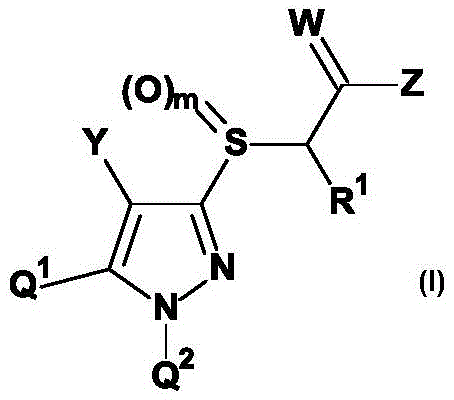
具体而言,本发明涉及式(I)的新型取代的[(1,4,5-三取代1H-吡唑-3-基)硫烷基]乙酸衍生物或其农用化学上可接受的盐、其制备方法及其作为除草剂的用途。In particular, the present invention relates to novel substituted [(1,4,5-trisubstituted 1H-pyrazol-3-yl)sulfanyl]acetic acid derivatives of formula (I) or agrochemically acceptable salts thereof , its preparation method and its use as a herbicide.
迄今已知的用于防治有用植物作物中的有害植物的作物保护产品或用于防治不需要的植被的活性成分有时在应用时存在缺点:即(a)对特定的有害植物没有除草活性或除草活性不足,(b)可用活性成分防治的有害植物的范围不够广,(c)在有用植物作物中的选择性太低和/或(d)具有毒理学上不利的特征。此外,一些可用作许多有用植物的植物生长调节剂的活性成分会导致其他有用植物的收获产量不期望地降低,或者仅在窄的施用率范围内与作物植物相容(如果有的话)。由于难以获得的前体和试剂,或者仅仅是它们的化学稳定性不足,故一些已知的活性成分不能在工业规模上经济地生产。在其他活性成分的情况下,活性过于依赖环境条件,如天气和土壤条件。The hitherto known crop protection products for controlling harmful plants in crops of useful plants or active ingredients for controlling unwanted vegetation are sometimes applied with disadvantages: namely (a) no herbicidal activity or herbicidal activity against specific harmful plants Insufficient activity, (b) the range of harmful plants that can be controlled by the active ingredient is not wide enough, (c) the selectivity in crops of useful plants is too low and/or (d) toxicologically unfavorable characteristics. In addition, some active ingredients that are useful as plant growth regulators for many useful plants can lead to undesirably reduced harvest yields of other useful plants, or are compatible with crop plants only within a narrow range of application rates (if any) . Some known active ingredients cannot be produced economically on an industrial scale due to difficult to obtain precursors and reagents, or simply their insufficient chemical stability. In the case of other active ingredients, activity is too dependent on environmental conditions such as weather and soil conditions.
这些已知化合物的除草活性,特别是在低施用率下的除草活性,和/或它们与作物植物的相容性仍需要改进。The herbicidal activity of these known compounds, especially at low application rates, and/or their compatibility with crop plants still needs to be improved.
EP1122244描述了2-({4-[5-(4-叔丁基-3-甲基-2,6-二氧代-3,6-二氢嘧啶-1(2H)-基)-2-氯-4-氟苯氧基]-1,5-二甲基-1H-吡唑-3-基}硫烷基)丙酸衍生物作为除草剂。WO2018/080859描述了具有杀真菌性质的[(1,5-二取代1H-吡唑-3-基)硫烷基]乙酸衍生物。Russian Chemical Bulletin 2010,59(9),1786-1790和Yakugaku Zasshi 1971,91(3),311-323公开了[(1,5-二甲基-4-硝基-1H-吡唑-3-基)硫烷基]乙酸衍生物和1,2,3,4-四取代3-吡唑啉-5-硫酮衍生物的合成。
相比之下,迄今还没有关于使用[(1,4,5-三取代1H-吡唑-3-基)硫烷基]乙酸衍生物或其盐(其在吡唑上带有具有限定取代的苯基或杂芳基基团中之一)作为活性除草成分的描述。现已惊奇地发现,作为活性除草成分的在吡唑上带有具有限定取代的苯基或杂芳基基团中之一的取代的[(1,4,5-三取代1H-吡唑-3-基)硫烷基]乙酸衍生物或其盐特别适合作为除草剂。In contrast, to date there has been no information on the use of [(1,4,5-trisubstituted 1H-pyrazol-3-yl)sulfanyl]acetic acid derivatives or salts thereof with defined substitutions on pyrazoles one of the phenyl or heteroaryl groups) as an active herbicidal ingredient. Surprisingly it has now been found that, as active herbicidal ingredients, substituted [(1,4,5-trisubstituted 1H-pyrazole- 3-yl)sulfanyl]acetic acid derivatives or salts thereof are particularly suitable as herbicides.
本发明因此提供了式(I)的取代的[(1,4,5-三取代1H-吡唑-3-基)硫烷基]乙酸衍生物或其农用化学上可接受的盐,The present invention thus provides a substituted [(1,4,5-trisubstituted 1H-pyrazol-3-yl)sulfanyl]acetic acid derivative of formula (I) or an agrochemically acceptable salt thereof,

其中:in:
Q1为苯基或杂芳基,Q 1 is phenyl or heteroaryl,
其中所述苯基和杂芳基未被取代或各自独立地被m个选自以下的基团所取代:氢、卤素、氰基、异氰基、硝基、羟基、(C1-C6)-烷基、(C1-C6)-卤代烷基、(C3-C6)-环烷基、(C3-C6)-卤代环烷基、(C1-C6)-卤代烷氧基、(C2-C3)-烯基、(C2-C3)-卤代烯基、(C1-C6)-烷氧基、(C2-C3)-炔基、(C2-C3)-卤代炔基、(C1-C4)-烷基-S(O)n、(C1-C4)-卤代烷基-S(O)n、CHO、(C1-C4)-烷氧基羰基和NH2(氨基),wherein the phenyl and heteroaryl groups are unsubstituted or each independently substituted with m groups selected from the group consisting of hydrogen, halogen, cyano, isocyano, nitro, hydroxy, (C 1 -C 6 ) )-alkyl, (C 1 -C 6 )-haloalkyl, (C 3 -C 6 )-cycloalkyl, (C 3 -C 6 )-halocycloalkyl, (C 1 -C 6 )- Haloalkoxy, (C 2 -C 3 )-alkenyl, (C 2 -C 3 )-haloalkenyl, (C 1 -C 6 )-alkoxy, (C 2 -C 3 )-alkynyl , (C 2 -C 3 )-haloalkynyl, (C 1 -C 4 )-alkyl-S(O) n , (C 1 -C 4 )-haloalkyl-S(O) n , CHO, (C 1 -C 4 )-alkoxycarbonyl and NH 2 (amino),
Q2为苯基,Q 2 is phenyl,
其未被取代或在每种情况下独立地被m个选自以下的基团所取代:氢、卤素、氰基、异氰基、NO2、(C1-C6)-烷基、(C1-C6)-卤代烷基、(C1-C6)-卤代烷氧基、(C3-C6)-环烷基、(C3-C6)-卤代环烷基、(C2-C3)-烯基、(C2-C3)-卤代烯基、(C1-C6)-烷氧基、(C2-C3)-炔基、(C2-C3)-卤代炔基、(C1-C4)-烷基-S(O)n、(C1-C4)-卤代烷基-S(O)n、CHO、(C1-C4)-烷氧基羰基和NH2(氨基),It is unsubstituted or substituted in each case independently by m groups selected from the group consisting of hydrogen, halogen, cyano, isocyano, NO 2 , (C 1 -C 6 )-alkyl, ( C 1 -C 6 )-haloalkyl, (C 1 -C 6 )-haloalkoxy, (C 3 -C 6 )-cycloalkyl, (C 3 -C 6 )-halocycloalkyl, (C 3 -C 6 )-halocycloalkyl 2 - C3)-alkenyl, (C2 - C3)-haloalkenyl, ( C1 - C6 )-alkoxy, (C2 - C3)-alkynyl, ( C2 - C 3 )-haloalkynyl, (C 1 -C 4 )-alkyl-S(O) n , (C 1 -C 4 )-haloalkyl-S(O) n , CHO, (C 1 -C 4 ) )-alkoxycarbonyl and NH 2 (amino),
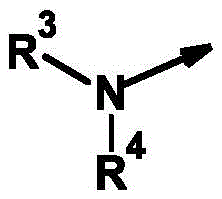
Z为基团Z is the group

和and

Y为卤素、氰基、异氰基、NO2、NH2(氨基)、(C1-C6)-烷基、(C1-C6)-卤代烷基、(C1-C6)-氰基烷基、(C1-C6)-羟烷基、(C1-C6)-烷氧基-(C1-C6)-烷基、(C3-C6)-环烷基、(C1-C4)-烷氧基羰基、(C1-C6)-烷基羰基、CHO、(C3-C6)-卤代环烷基、(C1-C6)-烷氧基、(C1-C6)-卤代烷氧基、(C1-C4)-烷基-S(O)n、(C1-C4)-卤代烷基-S(O)n、(C2-C6)-炔基、(C2-C6)-卤代炔基、(C2-C6)-烯基和(C2-C6)-卤代烯基,Y is halogen, cyano, isocyano, NO 2 , NH 2 (amino), (C 1 -C 6 )-alkyl, (C 1 -C 6 )-haloalkyl, (C 1 -C 6 )- Cyanoalkyl, (C 1 -C 6 )-hydroxyalkyl, (C 1 -C 6 )-alkoxy-(C 1 -C 6 )-alkyl, (C 3 -C 6 )-cycloalkane base, (C 1 -C 4 )-alkoxycarbonyl, (C 1 -C 6 )-alkylcarbonyl, CHO, (C 3 -C 6 )-halocycloalkyl, (C 1 -C 6 ) -Alkoxy, (C 1 -C 6 )-haloalkoxy, (C 1 -C 4 )-alkyl-S(O) n , (C 1 -C 4 )-haloalkyl-S(O) n , (C 2 -C 6 )-alkynyl, (C 2 -C 6 )-haloalkynyl, (C 2 -C 6 )-alkenyl and (C 2 -C 6 )-haloalkenyl,
W为氧或硫,W is oxygen or sulfur,
R1为氢、氰基、(C1-C6)-烷基、(C1-C6)-卤代烷基、(C1-C6)-烷氧基、(C1-C6)-烷氧基-(C1-C6)-烷基、(C3-C6)-环烷基、(C3-C6)-卤代环烷基、(C2-C6)-炔基、(C2-C6)-卤代炔基、(C2-C6)-烯基和(C2-C6)-卤代烯基,R 1 is hydrogen, cyano, (C 1 -C 6 )-alkyl, (C 1 -C 6 )-haloalkyl, (C 1 -C 6 )-alkoxy, (C 1 -C 6 )- Alkoxy-(C 1 -C 6 )-alkyl, (C 3 -C 6 )-cycloalkyl, (C 3 -C 6 )-halocycloalkyl, (C 2 -C 6 )-alkyne (C 2 -C 6 )-haloalkynyl, (C 2 -C 6 )-alkenyl and (C 2 -C 6 )-haloalkenyl,
R2为氢、(C1-C10)-烷基和(C3-C10)-环烷基,R 2 is hydrogen, (C 1 -C 10 )-alkyl and (C 3 -C 10 )-cycloalkyl,
其中所述烷基和环烷基未被取代或各自独立地被m个选自以下的基团所取代:卤素、氰基、异氰基、硝基、NH2(氨基)、(C1-C6)-烷基、(C1-C6)-卤代烷基、(C1-C6)-卤代烷氧基、(C2-C3)-烯基、(C2-C3)-卤代烯基、(C1-C6)-烷氧基、(C2-C3)-炔基、(C2-C3)-卤代炔基、(C1-C4)-烷基-S(O)n、CHO、(C1-C4)-烷氧基羰基、杂环基-(C1-C4)-烷基、杂芳基-(C1-C4)-烷基和芳基-(C1-C4)-烷基,其中所述芳基、杂环基和杂芳基未被取代或各自独立地被m个选自卤素、(C1-C6)-烷基和(C1-C6)-卤代烷基的基团所取代,wherein the alkyl and cycloalkyl groups are unsubstituted or each independently substituted with m groups selected from the group consisting of halogen, cyano, isocyano, nitro, NH2 (amino), ( C1- C 6 )-Alkyl, (C 1 -C 6 )-haloalkyl, (C 1 -C 6 )-haloalkoxy, (C 2 -C 3 )-alkenyl, (C 2 -C 3 )-halo Alkenyl, (C 1 -C 6 )-alkoxy, (C 2 -C 3 )-alkynyl, (C 2 -C 3 )-haloalkynyl, (C 1 -C 4 )-alkyl -S(O) n , CHO, (C 1 -C 4 )-alkoxycarbonyl, heterocyclyl-(C 1 -C 4 )-alkyl, heteroaryl-(C 1 -C 4 )-alkane and aryl-(C 1 -C 4 )-alkyl, wherein the aryl, heterocyclyl and heteroaryl groups are unsubstituted or each independently m selected from halogen, (C 1 -C 6 ) - alkyl and (C 1 -C 6 )-haloalkyl groups substituted,
R3为氢和(C1-C12)-烷基,R 3 is hydrogen and (C 1 -C 12 )-alkyl,
R4为氢、氰基、硝基、(C1-C12)-烷基、(C1-C10)-卤代烷基、(C2-C10)-烯基、(C3-C10)-炔基、(C1-C10)-烷氧基-(C1-C10)-烷基、(C1-C10)-卤代烷氧基-(C1-C10)-烷基、(C1-C4)-烷基-S(O)n-(C1-C4)-烷基、(C1-C4)-卤代烷基-S(O)n-(C1-C4)-烷基、(C3-C10)-环烷基、(C3-C10)-卤代环烷基、羟基-(C1-C10)-烷基羰基、氨基-(C1-C10)-烷基、(C1-C10)-烷氧基羰基-(C1-C10)-烷基、(C1-C10)-氰基烷基、S(O)nR5、OR5、SO2NR6R7、CO2R8、COR8、NR6R8、NR6COR8、NR6CO2R8、NR6SO2R8、芳基、杂芳基和杂环基,R 4 is hydrogen, cyano, nitro, (C 1 -C 12 )-alkyl, (C 1 -C 10 )-haloalkyl, (C 2 -C 10 )-alkenyl, (C 3 -C 10 ) )-alkynyl, (C 1 -C 10 )-alkoxy-(C 1 -C 10 )-alkyl, (C 1 -C 10 )-haloalkoxy-(C 1 -C 10 )-alkyl , (C 1 -C 4 )-alkyl-S(O) n -(C 1 -C 4 )-alkyl, (C 1 -C 4 )-haloalkyl-S(O) n -(C 1 - C 4 )-alkyl, (C 3 -C 10 )-cycloalkyl, (C 3 -C 10 )-halocycloalkyl, hydroxy-(C 1 -C 10 )-alkylcarbonyl, amino-( C 1 -C 10 )-Alkyl, (C 1 -C 10 )-alkoxycarbonyl-(C 1 -C 10 )-alkyl, (C 1 -C 10 )-cyanoalkyl, S(O ) n R 5 , OR 5 , SO 2 NR 6 R 7 , CO 2 R 8 , COR 8 , NR 6 R 8 , NR 6 COR 8 , NR 6 CO 2 R 8 , NR 6 SO 2 R 8 , aryl, Heteroaryl and Heterocyclyl,
其未被取代或各自独立地被m个选自以下的基团所取代:氢、卤素、氰基、硝基、OR5、S(O)nR5、SO2NR6R7、CO2R8、CONR6R8、COR6、NR6R8、NR6COR8、NR6CONR8R8、NR6CO2R8、NR6SO2R8、NR6SO2NR6R8、C(R6)=NOR8;which are unsubstituted or each independently substituted with m groups selected from the group consisting of hydrogen, halogen, cyano, nitro, OR 5 , S(O) n R 5 , SO 2 NR 6 R 7 , CO 2 R 8 , CONR 6 R 8 , COR 6 , NR 6 R 8 , NR 6 COR 8 , NR 6 CONR 8 R 8 , NR 6 CO 2 R 8 , NR 6 SO 2 R 8 , NR 6 SO 2 NR 6 R 8 , C(R 6 )=NOR 8 ;
或or
R3和R4与它们所键合的氮原子一起形成完全饱和或部分饱和的3-至10-元单环或双环的环,其任选被杂原子中断并任选具有进一步的取代, R3 and R4 together with the nitrogen atom to which they are bound form a fully saturated or partially saturated 3- to 10 -membered monocyclic or bicyclic ring, optionally interrupted by heteroatoms and optionally further substituted,
R5为氢、(C1-C8)-烷基、(C3-C6)-环烷基、(C1-C8)-卤代烷基和芳基,R6为氢和R5,R 5 is hydrogen, (C 1 -C 8 )-alkyl, (C 3 -C 6 )-cycloalkyl, (C 1 -C 8 )-haloalkyl and aryl, R 6 is hydrogen and R 5 ,
R7为氢、(C1-C6)-烷基、(C3-C6)-环烷基、(C3-C4)-烯基、(C3-C4)-炔基和(C1-C10)-烷基羰基-(C1-C6)-烷基,R 7 is hydrogen, (C 1 -C 6 )-alkyl, (C 3 -C 6 )-cycloalkyl, (C 3 -C 4 )-alkenyl, (C 3 -C 4 )-alkynyl and (C 1 -C 10 )-Alkylcarbonyl-(C 1 -C 6 )-alkyl,
R8为氢、(C1-C6)-烷基、(C3-C6)-环烷基、(C3-C4)-烯基和(C3-C4)-炔基,R 8 is hydrogen, (C 1 -C 6 )-alkyl, (C 3 -C 6 )-cycloalkyl, (C 3 -C 4 )-alkenyl and (C 3 -C 4 )-alkynyl,
m为0、1或2,m is 0, 1 or 2,
和and
n为0、1或2,n is 0, 1 or 2,
不包括化合物{[4-硝基-1-苯基-5-(1H-四唑-5-基)-1H-吡唑-3-基]硫烷基}乙酸乙酯CAS[1360702-86-8]和{[5-(5-甲基-1,3,4-噁二唑-2-基)-4-硝基-1-苯基-1H-吡唑-3-基]硫烷基}乙酸甲酯CAS[1360690-60-3]。Excluding the compound {[4-nitro-1-phenyl-5-(1H-tetrazol-5-yl)-1H-pyrazol-3-yl]sulfanyl}ethyl acetate CAS[1360702-86- 8] and {[5-(5-methyl-1,3,4-oxadiazol-2-yl)-4-nitro-1-phenyl-1H-pyrazol-3-yl]sulfanyl } Methyl acetate CAS [1360690-60-3].
通式(I)的化合物可通过向碱性基团例如氨基、烷基氨基、二烷基氨基、哌啶基、吗啉代或吡啶基上加合合适的无机或有机酸(例如无机酸(例如HCl、HBr、H2SO4、H3PO4或HNO3),或有机酸(例如羧酸如甲酸、乙酸、丙酸、草酸、乳酸或水杨酸或磺酸,例如对-甲苯磺酸))来形成盐。在这样的情况下,这些盐包含作为阴离子的酸的共轭碱。磺酸(特别是磺酰胺)或羧酸等呈去质子化形式的合适取代基能够与本身可质子化的基团如氨基基团形成内盐。也可通过通式(I)的化合物上的碱的作用形成盐。合适的碱是例如有机胺(如三烷基胺、吗啉、哌啶和吡啶),以及铵、碱金属或碱土金属的氢氧化物、碳酸盐和碳酸氢盐,尤其是氢氧化钠、氢氧化钾、碳酸钠、碳酸钾、碳酸氢钠和碳酸氢钾。这些盐是其中酸性氢被农业上合适的阳离子替换的化合物,例如金属盐,尤其是碱金属盐或碱土金属盐,特别是钠盐和钾盐,抑或是铵盐、具有有机胺的盐或季铵盐,例如具有式[NRaRbRcRd]+的阳离子的盐,其中Ra至Rd各自独立地为有机基团,尤其是烷基、芳基、芳基烷基或烷基芳基。同样合适的是烷基锍和烷基氧化锍盐,如(C1-C4)-三烷基锍和(C1-C4)-三烷基氧化锍盐。Compounds of general formula (I) can be prepared by adding a suitable inorganic or organic acid (such as an inorganic acid ( such as HCl, HBr, H 2 SO 4 , H 3 PO 4 or HNO 3 ), or organic acids such as carboxylic acids such as formic acid, acetic acid, propionic acid, oxalic acid, lactic acid or salicylic acid or sulfonic acids such as p-toluenesulfonic acid acid)) to form salts. In such cases, these salts contain the conjugate base of the acid as an anion. Suitable substituents in deprotonated form, such as sulfonic acids (especially sulfonamides) or carboxylic acids, are capable of forming internal salts with groups that are themselves protonable, such as amino groups. Salts can also be formed by the action of bases on the compounds of general formula (I). Suitable bases are, for example, organic amines such as trialkylamines, morpholine, piperidine and pyridine, and also ammonium, alkali metal or alkaline earth metal hydroxides, carbonates and bicarbonates, especially sodium hydroxide, Potassium hydroxide, sodium carbonate, potassium carbonate, sodium bicarbonate and potassium bicarbonate. These salts are compounds in which the acidic hydrogen is replaced by an agriculturally suitable cation, such as metal salts, especially alkali metal or alkaline earth metal salts, especially sodium and potassium salts, or ammonium salts, salts with organic amines or quaternary Ammonium salts, for example salts with cations of the formula [NR a R b R c R d ] + where R a to R d are each independently an organic group, especially an alkyl, aryl, arylalkyl or alkane group base aryl. Also suitable are alkylsulfonium and alkylsulfoxonium salts, such as (C 1 -C 4 )-trialkylsulfonium and (C 1 -C 4 )-trialkylsulfoxonium salts.
取决于外部条件如pH、溶剂和温度,本发明的通式(I)的取代的[(1,4,5-三取代1H-吡唑-3-基)硫烷基]乙酸衍生物可以各种互变异构结构存在,所有这些都为通式(I)所涵盖。Depending on external conditions such as pH, solvent, and temperature, the substituted [(1,4,5-trisubstituted 1H-pyrazol-3-yl)sulfanyl]acetic acid derivatives of the general formula (I) of the present invention may each A variety of tautomeric structures exist, all of which are encompassed by general formula (I).
根据本发明使用的式(I)的化合物及其盐在下文中被称为“通式(I)的化合物”。The compounds of formula (I) and their salts used according to the invention are hereinafter referred to as "compounds of general formula (I)".
本发明优选提供通式(I)的化合物,其中The present invention preferably provides compounds of general formula (I), wherein
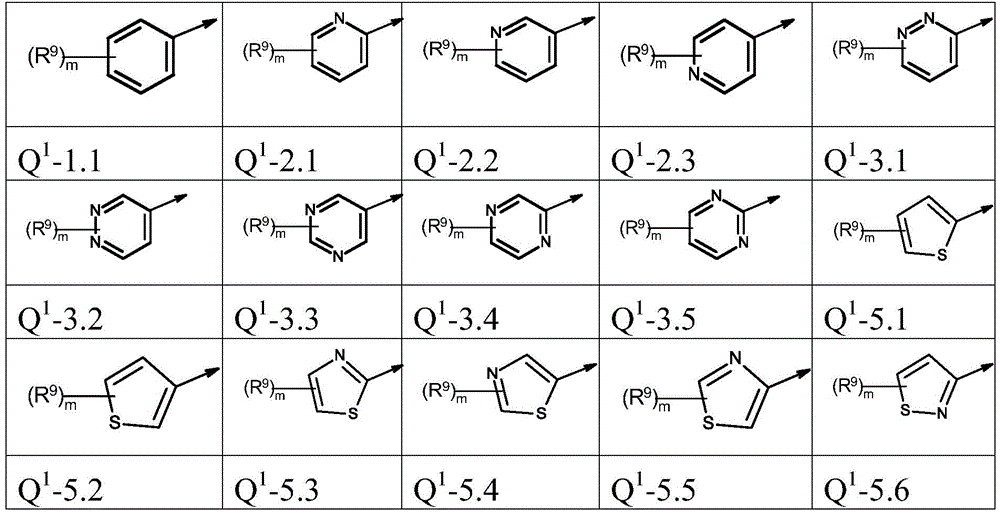
Q1为基团Q1-1.1至Q1-6.5Q 1 is the group Q 1 -1.1 to Q 1 -6.5


Q2为苯基,Q 2 is phenyl,
其未被取代或在每种情况下独立地被m个选自以下的基团所取代:氢、卤素、氰基、异氰基、NO2、(C1-C6)-烷基、(C1-C6)-卤代烷基、(C1-C6)-卤代烷氧基、(C3-C6)-环烷基、(C3-C6)-卤代环烷基、(C2-C3)-烯基、(C2-C3)-卤代烯基、(C1-C6)-烷氧基、(C2-C3)-炔基、(C2-C3)-卤代炔基、(C1-C4)-烷基-S(O)n、(C1-C4)-卤代烷基-S(O)n、CHO、(C1-C4)-烷氧基羰基和NH2(氨基),It is unsubstituted or substituted in each case independently by m groups selected from the group consisting of hydrogen, halogen, cyano, isocyano, NO 2 , (C 1 -C 6 )-alkyl, ( C 1 -C 6 )-haloalkyl, (C 1 -C 6 )-haloalkoxy, (C 3 -C 6 )-cycloalkyl, (C 3 -C 6 )-halocycloalkyl, (C 3 -C 6 )-halocycloalkyl 2 - C3)-alkenyl, (C2 - C3)-haloalkenyl, ( C1 - C6 )-alkoxy, (C2 - C3)-alkynyl, ( C2 - C 3 )-haloalkynyl, (C 1 -C 4 )-alkyl-S(O) n , (C 1 -C 4 )-haloalkyl-S(O) n , CHO, (C 1 -C 4 ) )-alkoxycarbonyl and NH 2 (amino),
Z为基团Z is the group

和and
Y为卤素、氰基、异氰基、NO2、NH2(氨基)、(C1-C6)-烷基、(C1-C6)-卤代烷基、(C1-C6)-氰基烷基、(C1-C6)-羟烷基、(C1-C6)-烷氧基-(C1-C6)-烷基、(C3-C6)-环烷基、(C1-C4)-烷氧基羰基、(C1-C6)-烷基羰基、CHO、(C3-C6)-卤代环烷基、(C1-C6)-烷氧基、(C1-C6)-卤代烷氧基、(C1-C4)-烷基-S(O)n、(C1-C4)-卤代烷基-S(O)n、(C2-C6)-炔基、(C2-C6)-卤代炔基、(C2-C6)-烯基和(C2-C6)-卤代烯基,Y is halogen, cyano, isocyano, NO 2 , NH 2 (amino), (C 1 -C 6 )-alkyl, (C 1 -C 6 )-haloalkyl, (C 1 -C 6 )- Cyanoalkyl, (C 1 -C 6 )-hydroxyalkyl, (C 1 -C 6 )-alkoxy-(C 1 -C 6 )-alkyl, (C 3 -C 6 )-cycloalkane base, (C 1 -C 4 )-alkoxycarbonyl, (C 1 -C 6 )-alkylcarbonyl, CHO, (C 3 -C 6 )-halocycloalkyl, (C 1 -C 6 ) -Alkoxy, (C 1 -C 6 )-haloalkoxy, (C 1 -C 4 )-alkyl-S(O) n , (C 1 -C 4 )-haloalkyl-S(O) n , (C 2 -C 6 )-alkynyl, (C 2 -C 6 )-haloalkynyl, (C 2 -C 6 )-alkenyl and (C 2 -C 6 )-haloalkenyl,
W为氧或硫,W is oxygen or sulfur,
R1为氢、氰基、(C1-C6)-烷基、(C1-C6)-卤代烷基、(C1-C6)-烷氧基、(C1-C6)-烷氧基-(C1-C6)-烷基、(C3-C6)-环烷基、(C3-C6)-卤代环烷基、(C2-C6)-炔基、(C2-C6)-卤代炔基、(C2-C6)-烯基和(C2-C6)-卤代烯基,R 1 is hydrogen, cyano, (C 1 -C 6 )-alkyl, (C 1 -C 6 )-haloalkyl, (C 1 -C 6 )-alkoxy, (C 1 -C 6 )- Alkoxy-(C 1 -C 6 )-alkyl, (C 3 -C 6 )-cycloalkyl, (C 3 -C 6 )-halocycloalkyl, (C 2 -C 6 )-alkyne (C 2 -C 6 )-haloalkynyl, (C 2 -C 6 )-alkenyl and (C 2 -C 6 )-haloalkenyl,
R2为氢、(C1-C10)-烷基和(C3-C10)-环烷基,R 2 is hydrogen, (C 1 -C 10 )-alkyl and (C 3 -C 10 )-cycloalkyl,
其中所述烷基和环烷基未被取代或各自独立地被m个选自以下的基团所取代:卤素、氰基、异氰基、硝基、NH2(氨基)、(C1-C6)-烷基、(C1-C6)-卤代烷基、(C1-C6)-卤代烷氧基、(C2-C3)-烯基、(C2-C3)-卤代烯基、(C1-C6)-烷氧基、(C2-C3)-炔基、(C2-C3)-卤代炔基、(C1-C4)-烷基-S(O)n、CHO、(C1-C4)-烷氧基羰基、杂环基-(C1-C6)-烷基、杂芳基-(C1-C4)-烷基和芳基-(C1-C4)-烷基,其中所述芳基、杂环基和杂芳基未被取代或各自独立地被m个选自卤素、(C1-C6)-烷基和(C1-C6)-卤代烷基的基团所取代,wherein the alkyl and cycloalkyl groups are unsubstituted or each independently substituted with m groups selected from the group consisting of halogen, cyano, isocyano, nitro, NH2 (amino), ( C1- C 6 )-Alkyl, (C 1 -C 6 )-haloalkyl, (C 1 -C 6 )-haloalkoxy, (C 2 -C 3 )-alkenyl, (C 2 -C 3 )-halo Alkenyl, (C 1 -C 6 )-alkoxy, (C 2 -C 3 )-alkynyl, (C 2 -C 3 )-haloalkynyl, (C 1 -C 4 )-alkyl -S(O) n , CHO, (C 1 -C 4 )-alkoxycarbonyl, heterocyclyl-(C 1 -C 6 )-alkyl, heteroaryl-(C 1 -C 4 )-alkane and aryl-(C 1 -C 4 )-alkyl, wherein the aryl, heterocyclyl and heteroaryl groups are unsubstituted or each independently m selected from halogen, (C 1 -C 6 ) - alkyl and (C 1 -C 6 )-haloalkyl groups substituted,
R3为氢和(C1-C10)-烷基,R 3 is hydrogen and (C 1 -C 10 )-alkyl,
R4为氢、氰基、硝基、(C1-C10)-烷基、(C1-C10)-卤代烷基、(C2-C10)-烯基、(C3-C10)-炔基、(C1-C10)-烷氧基-(C1-C10)-烷基、(C1-C10)-卤代烷氧基-(C1-C10)-烷基、(C1-C4)-烷基-S(O)n-(C1-C4)-烷基、(C1-C4)-卤代烷基-S(O)n-(C1-C4)-烷基、(C3-C10)-环烷基、(C3-C10)-卤代环烷基、羟基-(C1-C10)-烷基羰基、氨基-(C1-C10)-烷基、(C1-C10)-烷氧基羰基-(C1-C10)-烷基、(C1-C10)-氰基烷基、S(O)nR5、OR5、SO2NR6R7、CO2R8、COR8、NR6R8、NR6COR8、NR6CO2R8、NR6SO2R8、芳基、杂芳基和杂环基,R 4 is hydrogen, cyano, nitro, (C 1 -C 10 )-alkyl, (C 1 -C 10 )-haloalkyl, (C 2 -C 10 )-alkenyl, (C 3 -C 10 ) )-alkynyl, (C 1 -C 10 )-alkoxy-(C 1 -C 10 )-alkyl, (C 1 -C 10 )-haloalkoxy-(C 1 -C 10 )-alkyl , (C 1 -C 4 )-alkyl-S(O) n -(C 1 -C 4 )-alkyl, (C 1 -C 4 )-haloalkyl-S(O) n -(C 1 - C 4 )-alkyl, (C 3 -C 10 )-cycloalkyl, (C 3 -C 10 )-halocycloalkyl, hydroxy-(C 1 -C 10 )-alkylcarbonyl, amino-( C 1 -C 10 )-Alkyl, (C 1 -C 10 )-alkoxycarbonyl-(C 1 -C 10 )-alkyl, (C 1 -C 10 )-cyanoalkyl, S(O ) n R 5 , OR 5 , SO 2 NR 6 R 7 , CO 2 R 8 , COR 8 , NR 6 R 8 , NR 6 COR 8 , NR 6 CO 2 R 8 , NR 6 SO 2 R 8 , aryl, Heteroaryl and Heterocyclyl,
其未被取代或各自独立地被m个选自以下的基团所取代:氢、卤素、氰基、硝基、OR5、S(O)nR5、SO2NR6R7、CO2R8、CONR6R8、COR6、NR6R8、NR6COR8、NR6CONR8R8、NR6CO2R8、NR6SO2R8、NR6SO2NR6R8、C(R6)=NOR8;which are unsubstituted or each independently substituted with m groups selected from the group consisting of hydrogen, halogen, cyano, nitro, OR 5 , S(O) n R 5 , SO 2 NR 6 R 7 , CO 2 R 8 , CONR 6 R 8 , COR 6 , NR 6 R 8 , NR 6 COR 8 , NR 6 CONR 8 R 8 , NR 6 CO 2 R 8 , NR 6 SO 2 R 8 , NR 6 SO 2 NR 6 R 8 , C(R 6 )=NOR 8 ;
或者R3和R4与它们所键合至的氮原子一起形成完全饱和或部分饱和的3-至10-元单环或双环的环,其任选被杂原子中断并任选具有进一步的取代,Alternatively R3 and R4 together with the nitrogen atom to which they are bonded form a fully saturated or partially saturated 3- to 10 -membered monocyclic or bicyclic ring, optionally interrupted by heteroatoms and optionally further substituted ,
R5为氢、(C1-C8)-烷基、(C3-C6)-环烷基、(C1-C8)-卤代烷基和芳基,R 5 is hydrogen, (C 1 -C 8 )-alkyl, (C 3 -C 6 )-cycloalkyl, (C 1 -C 8 )-haloalkyl and aryl,
R6为氢和R5,R 6 is hydrogen and R 5 ,
R7为氢、(C1-C6)-烷基、(C3-C6)-环烷基、(C3-C4)-烯基、(C3-C4)-炔基和(C1-C6)-烷基羰基-(C1-C4)-烷基,R 7 is hydrogen, (C 1 -C 6 )-alkyl, (C 3 -C 6 )-cycloalkyl, (C 3 -C 4 )-alkenyl, (C 3 -C 4 )-alkynyl and (C 1 -C 6 )-Alkylcarbonyl-(C 1 -C 4 )-alkyl,
R8为氢、(C1-C6)-烷基、(C3-C6)-环烷基、(C3-C4)-烯基和(C3-C4)-炔基,R 8 is hydrogen, (C 1 -C 6 )-alkyl, (C 3 -C 6 )-cycloalkyl, (C 3 -C 4 )-alkenyl and (C 3 -C 4 )-alkynyl,
R9为氢、卤素、氰基、异氰基、硝基、羟基、(C1-C6)-烷基、(C1-C6)-卤代烷基、(C1-C6)-卤代烷氧基、(C2-C3)-烯基、(C2-C3)-卤代烯基、(C1-C6)-烷氧基、(C2-C3)-炔基、(C2-C3)-卤代炔基、(C1-C4)-烷基-S(O)n、CHO、(C1-C4)-烷氧基羰基和NH2(氨基),R 9 is hydrogen, halogen, cyano, isocyano, nitro, hydroxy, (C 1 -C 6 )-alkyl, (C 1 -C 6 )-haloalkyl, (C 1 -C 6 )-haloalkane oxy, (C 2 -C 3 )-alkenyl, (C 2 -C 3 )-haloalkenyl, (C 1 -C 6 )-alkoxy, (C 2 -C 3 )-alkynyl, (C 2 -C 3 )-haloalkynyl, (C 1 -C 4 )-alkyl-S(O) n , CHO, (C 1 -C 4 )-alkoxycarbonyl and NH 2 (amino) ,
m为0、1和2,m is 0, 1 and 2,
n为0、1和2。n is 0, 1 and 2.
本发明更优选提供通式(I)的化合物,其中 More preferably the present invention provides compounds of general formula (I) wherein
Q1为基团Q1-1.1至Q1-6.3,Q 1 is the group Q 1 -1.1 to Q 1 -6.3,

Q2为苯基,Q 2 is phenyl,
其未被取代或在每种情况下独立地被m个选自以下的基团所取代:氢、卤素、氰基、(C1-C6)-烷基、(C1-C6)-卤代烷基、(C1-C6)-卤代烷氧基、(C3-C6)-环烷基、(C1-C6)-烷氧基、(C1-C4)-烷基-S(O)n和(C1-C4)-卤代烷基-S(O)n,It is unsubstituted or substituted in each case independently by m groups selected from the group consisting of hydrogen, halogen, cyano, (C 1 -C 6 )-alkyl, (C 1 -C 6 )- Haloalkyl, (C 1 -C 6 )-haloalkoxy, (C 3 -C 6 )-cycloalkyl, (C 1 -C 6 )-alkoxy, (C 1 -C 4 )-alkyl- S(O) n and (C 1 -C 4 )-haloalkyl-S(O) n ,
Z为基团Z is the group
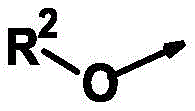
和and
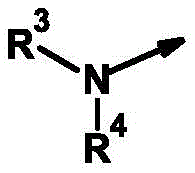
Y为卤素、氰基、异氰基、NO2、(C1-C6)-烷基、(C1-C6)-卤代烷基、(C1-C6)-烷氧基-(C1-C6)-烷基、(C1-C4)-烷氧基羰基、(C1-C6)-烷基羰基、(C1-C6)-烷氧基、(C1-C6)-卤代烷氧基、(C1-C4)-烷基-S(O)n、(C1-C4)-卤代烷基-S(O)n、(C2-C6)-炔基、(C2-C6)-卤代炔基、(C2-C6)-烯基和(C2-C6)-卤代烯基,Y is halogen, cyano, isocyano, NO 2 , (C 1 -C 6 )-alkyl, (C 1 -C 6 )-haloalkyl, (C 1 -C 6 )-alkoxy-(C 1 -C 6 )-Alkyl, (C 1 -C 4 )-alkoxycarbonyl, (C 1 -C 6 )-alkylcarbonyl, (C 1 -C 6 )-alkoxy, (C 1 - C 6 )-haloalkoxy, (C 1 -C 4 )-alkyl-S(O) n , (C 1 -C 4 )-haloalkyl-S(O) n , (C 2 -C 6 )- alkynyl, (C 2 -C 6 )-haloalkynyl, (C 2 -C 6 )-alkenyl and (C 2 -C 6 )-haloalkenyl,
W为氧,W is oxygen,
R1为氢、氰基、(C1-C6)-烷基、(C1-C6)-卤代烷基、(C1-C6)-烷氧基、(C1-C4)-烷氧基-(C1-C4)-烷基、(C3-C6)-环烷基、(C2-C6)-炔基、(C2-C6)-卤代炔基、(C2-C6)-烯基和(C2-C6)-卤代烯基,R 1 is hydrogen, cyano, (C 1 -C 6 )-alkyl, (C 1 -C 6 )-haloalkyl, (C 1 -C 6 )-alkoxy, (C 1 -C 4 )- Alkoxy-(C 1 -C 4 )-alkyl, (C 3 -C 6 )-cycloalkyl, (C 2 -C 6 )-alkynyl, (C 2 -C 6 )-haloalkynyl , (C 2 -C 6 )-alkenyl and (C 2 -C 6 )-haloalkenyl,
R2为氢、(C1-C6)-烷基和(C3-C6)-环烷基,R 2 is hydrogen, (C 1 -C 6 )-alkyl and (C 3 -C 6 )-cycloalkyl,
其中所述烷基和环烷基未被取代或各自独立地被m个选自以下的基团所取代:卤素、氰基、硝基、NH2(氨基)、(C1-C6)-烷基、(C1-C6)-卤代烷基、(C1-C6)-卤代烷氧基、(C2-C3)-烯基、(C2-C3)-卤代烯基、(C1-C6)-烷氧基、(C2-C3)-炔基、(C2-C3)-卤代炔基、(C1-C4)-烷基-S(O)n、CHO、(C1-C4)-烷氧基羰基、杂环基-(C1-C4)-烷基、杂芳基-(C1-C4)-烷基和芳基-(C1-C4)-烷基,其中所述芳基、杂环基和杂芳基未被取代或各自独立地被m个选自卤素、(C1-C6)-烷基和(C1-C6)-卤代烷基的基团所取代,wherein the alkyl and cycloalkyl groups are unsubstituted or each independently substituted with m groups selected from the group consisting of halogen, cyano, nitro, NH2 (amino), ( C1 - C6 )- Alkyl, (C 1 -C 6 )-haloalkyl, (C 1 -C 6 )-haloalkoxy, (C 2 -C 3 )-alkenyl, (C 2 -C 3 )-haloalkenyl, (C 1 -C 6 )-alkoxy, (C 2 -C 3 )-alkynyl, (C 2 -C 3 )-haloalkynyl, (C 1 -C 4 )-alkyl-S(O ) n , CHO, (C 1 -C 4 )-alkoxycarbonyl, heterocyclyl-(C 1 -C 4 )-alkyl, heteroaryl-(C 1 -C 4 )-alkyl and aryl -(C 1 -C 4 )-alkyl, wherein the aryl, heterocyclyl and heteroaryl groups are unsubstituted or each independently m selected from halogen, (C 1 -C 6 )-alkyl and (C 1 -C 6 )-haloalkyl group substituted,
R3为氢和(C1-C6)-烷基,R 3 is hydrogen and (C 1 -C 6 )-alkyl,
R4为氢、氰基、硝基、(C1-C6)-烷基、(C1-C6)-卤代烷基、(C2-C6)-烯基、(C3-C6)-炔基、(C1-C6)-烷氧基-(C1-C6)-烷基、(C1-C6)-卤代烷氧基-(C1-C6)-烷基、(C1-C4)-烷基-S(O)n-(C1-C4)-烷基和(C1-C4)-卤代烷基-S(O)n-(C1-C4)-烷基、(C3-C6)-环烷基、(C3-C6)-卤代环烷基、羟基-(C1-C6)-烷基羰基、氨基-(C1-C6)-烷基、(C1-C6)-烷氧基羰基-(C1-C6)-烷基、S(O)nR5、OR5、SO2NR6R7、CO2R8、COR8、NR6R8、NR6COR8、NR6CO2R8、NR6SO2R8;芳基、杂芳基和杂环基,R 4 is hydrogen, cyano, nitro, (C 1 -C 6 )-alkyl, (C 1 -C 6 )-haloalkyl, (C 2 -C 6 )-alkenyl, (C 3 -C 6 ) )-alkynyl, (C 1 -C 6 )-alkoxy-(C 1 -C 6 )-alkyl, (C 1 -C 6 )-haloalkoxy-(C 1 -C 6 )-alkyl , (C 1 -C 4 )-alkyl-S(O) n -(C 1 -C 4 )-alkyl and (C 1 -C 4 )-haloalkyl-S(O) n -(C 1 - C 4 )-Alkyl, (C 3 -C 6 )-cycloalkyl, (C 3 -C 6 )-halocycloalkyl, hydroxy-(C 1 -C 6 )-alkylcarbonyl, amino-( C 1 -C 6 )-alkyl, (C 1 -C 6 )-alkoxycarbonyl-(C 1 -C 6 )-alkyl, S(O) n R 5 , OR 5 , SO 2 NR 6 R 7 , CO 2 R 8 , COR 8 , NR 6 R 8 , NR 6 COR 8 , NR 6 CO 2 R 8 , NR 6 SO 2 R 8 ; aryl, heteroaryl and heterocyclyl,
其未被取代或各自独立地被m个选自以下的基团所取代:氢、卤素、氰基、硝基、OR5、S(O)nR5、SO2NR6R7、CO2R8、CONR6R8、COR6、NR6R8、NR6COR8、NR6CONR8R8、NR6CO2R8、NR6SO2R8、NR6SO2NR6R8、C(R6)=NOR8;which are unsubstituted or each independently substituted with m groups selected from the group consisting of hydrogen, halogen, cyano, nitro, OR 5 , S(O) n R 5 , SO 2 NR 6 R 7 , CO 2 R 8 , CONR 6 R 8 , COR 6 , NR 6 R 8 , NR 6 COR 8 , NR 6 CONR 8 R 8 , NR 6 CO 2 R 8 , NR 6 SO 2 R 8 , NR 6 SO 2 NR 6 R 8 , C(R 6 )=NOR 8 ;
或者R3和R4与它们所键合的氮原子一起形成完全饱和或部分饱和的3-至10-元单环或双环的环,其任选被杂原子中断并任选具有进一步的取代,or R3 and R4 together with the nitrogen atom to which they are bound form a fully saturated or partially saturated 3- to 10 -membered monocyclic or bicyclic ring, optionally interrupted by heteroatoms and optionally further substituted,
R5为氢、(C1-C8)-烷基、(C3-C6)-环烷基、(C1-C8)-卤代烷基和芳基,R 5 is hydrogen, (C 1 -C 8 )-alkyl, (C 3 -C 6 )-cycloalkyl, (C 1 -C 8 )-haloalkyl and aryl,
R6为氢和R5,R 6 is hydrogen and R 5 ,
R7为氢、(C1-C6)-烷基、(C3-C6)-环烷基、(C3-C4)-烯基和(C3-C4)-炔基,R 7 is hydrogen, (C 1 -C 6 )-alkyl, (C 3 -C 6 )-cycloalkyl, (C 3 -C 4 )-alkenyl and (C 3 -C 4 )-alkynyl,
R8为氢、(C1-C6)-烷基、(C3-C6)-环烷基、(C3-C4)-烯基、(C3-C4)-炔基和(C1-C10)-烷基羰基-(C1-C6)-烷基,R 8 is hydrogen, (C 1 -C 6 )-alkyl, (C 3 -C 6 )-cycloalkyl, (C 3 -C 4 )-alkenyl, (C 3 -C 4 )-alkynyl and (C 1 -C 10 )-Alkylcarbonyl-(C 1 -C 6 )-alkyl,
R9为氢、卤素、氰基、异氰基、硝基、羟基、(C1-C6)-烷基、(C1-C6)-卤代烷基、(C1-C6)-卤代烷氧基、(C2-C3)-烯基、(C2-C3)-卤代烯基、(C1-C6)-烷氧基、(C2-C3)-炔基、(C2-C3)-卤代炔基、(C1-C4)-烷基-S(O)n、CHO、(C1-C4)-烷氧基羰基和NH2(氨基),R 9 is hydrogen, halogen, cyano, isocyano, nitro, hydroxy, (C 1 -C 6 )-alkyl, (C 1 -C 6 )-haloalkyl, (C 1 -C 6 )-haloalkane oxy, (C 2 -C 3 )-alkenyl, (C 2 -C 3 )-haloalkenyl, (C 1 -C 6 )-alkoxy, (C 2 -C 3 )-alkynyl, (C 2 -C 3 )-haloalkynyl, (C 1 -C 4 )-alkyl-S(O) n , CHO, (C 1 -C 4 )-alkoxycarbonyl and NH 2 (amino) ,
m为0、1和2,m is 0, 1 and 2,
n为0、1和2。n is 0, 1 and 2.
本发明甚至更优选提供通式(I)的化合物,其中 Even more preferably the present invention provides compounds of general formula (I), wherein
Q1为基团Q1-1.1至Q1-6.3,Q 1 is the group Q 1 -1.1 to Q 1 -6.3,

Q2为苯基,Q 2 is phenyl,
其未被取代或在每种情况下独立地被m个选自氢、氟、氯和溴的基团所取代,it is unsubstituted or in each case independently substituted by m groups selected from hydrogen, fluorine, chlorine and bromine,
Z为基团Z is the group
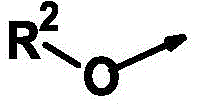
和and
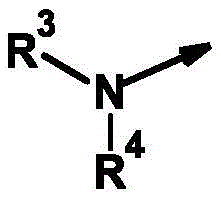
Y为氟、氯、溴、氰基、NO2、(C1-C2)-烷基、(C1-C2)-卤代烷基、(C1-C2)-烷基羰基、(C1-C2)-烷氧基、(C1-C2)-卤代烷氧基、(C1-C2)-烷基-S(O)n和(C1-C2)-卤代烷基-S(O)n,Y is fluorine, chlorine, bromine, cyano, NO 2 , (C 1 -C 2 )-alkyl, (C 1 -C 2 )-haloalkyl, (C 1 -C 2 )-alkylcarbonyl, (C 1 -C 2 )-alkylcarbonyl 1 -C 2 )-alkoxy, (C 1 -C 2 )-haloalkoxy, (C 1 -C 2 )-alkyl-S(O) n and (C 1 -C 2 )-haloalkyl- S(O) n ,
W为氧,W is oxygen,
R1为氢、(C1-C4)-烷基、(C1-C4)-卤代烷基和(C1-C6)-烷氧基,R 1 is hydrogen, (C 1 -C 4 )-alkyl, (C 1 -C 4 )-haloalkyl and (C 1 -C 6 )-alkoxy,
R2为氢、(C1-C6)-烷基和(C3-C6)-环烷基,R 2 is hydrogen, (C 1 -C 6 )-alkyl and (C 3 -C 6 )-cycloalkyl,
其中所述烷基和环烷基未被取代或各自独立地被m个选自以下的基团所取代:卤素、氰基、硝基、NH2(氨基)、(C1-C6)-烷基、(C1-C6)-卤代烷基、(C1-C6)-卤代烷氧基、(C2-C3)-烯基、(C2-C3)-卤代烯基、(C1-C6)-烷氧基、(C2-C3)-炔基、(C2-C3)-卤代炔基、(C1-C4)-烷基-S(O)n、CHO、(C1-C4)-烷氧基羰基、杂环基-(C1-C4)-烷基、杂芳基-(C1-C4)-烷基和芳基-(C1-C4)-烷基,其中所述芳基、杂环基和杂芳基未被取代或各自独立地被m个选自卤素、(C1-C6)-烷基和(C1-C6)-卤代烷基的基团所取代,wherein the alkyl and cycloalkyl groups are unsubstituted or each independently substituted with m groups selected from the group consisting of halogen, cyano, nitro, NH2 (amino), ( C1 - C6 )- Alkyl, (C 1 -C 6 )-haloalkyl, (C 1 -C 6 )-haloalkoxy, (C 2 -C 3 )-alkenyl, (C 2 -C 3 )-haloalkenyl, (C 1 -C 6 )-alkoxy, (C 2 -C 3 )-alkynyl, (C 2 -C 3 )-haloalkynyl, (C 1 -C 4 )-alkyl-S(O ) n , CHO, (C 1 -C 4 )-alkoxycarbonyl, heterocyclyl-(C 1 -C 4 )-alkyl, heteroaryl-(C 1 -C 4 )-alkyl and aryl -(C 1 -C 4 )-alkyl, wherein the aryl, heterocyclyl and heteroaryl groups are unsubstituted or each independently m selected from halogen, (C 1 -C 6 )-alkyl and (C 1 -C 6 )-haloalkyl group substituted,
R3为氢和(C1-C6)-烷基,R 3 is hydrogen and (C 1 -C 6 )-alkyl,
R4为氢、氰基、硝基、(C1-C6)-烷基、(C1-C6)-卤代烷基、(C2-C6)-烯基、(C3-C6)-炔基、(C1-C6)-烷氧基-(C1-C6)-烷基、(C1-C6)-卤代烷氧基-(C1-C6)-烷基、(C1-C4)-烷基-S(O)n-(C1-C4)-烷基和(C1-C4)-卤代烷基-S(O)n-(C1-C4)-烷基、(C3-C6)-环烷基、(C3-C6)-卤代环烷基、羟基-(C1-C6)-烷基羰基、氨基-(C1-C6)-烷基、(C1-C6)-烷氧基羰基-(C1-C6)-烷基、S(O)nR5、OR5、SO2NR6R7、CO2R8、COR8、NR6R8、NR6COR8、NR6CO2R8、NR6SO2R8;芳基、杂芳基和杂环基,R 4 is hydrogen, cyano, nitro, (C 1 -C 6 )-alkyl, (C 1 -C 6 )-haloalkyl, (C 2 -C 6 )-alkenyl, (C 3 -C 6 ) )-alkynyl, (C 1 -C 6 )-alkoxy-(C 1 -C 6 )-alkyl, (C 1 -C 6 )-haloalkoxy-(C 1 -C 6 )-alkyl , (C 1 -C 4 )-alkyl-S(O) n -(C 1 -C 4 )-alkyl and (C 1 -C 4 )-haloalkyl-S(O) n -(C 1 - C 4 )-Alkyl, (C 3 -C 6 )-cycloalkyl, (C 3 -C 6 )-halocycloalkyl, hydroxy-(C 1 -C 6 )-alkylcarbonyl, amino-( C 1 -C 6 )-alkyl, (C 1 -C 6 )-alkoxycarbonyl-(C 1 -C 6 )-alkyl, S(O) n R 5 , OR 5 , SO 2 NR 6 R 7 , CO 2 R 8 , COR 8 , NR 6 R 8 , NR 6 COR 8 , NR 6 CO 2 R 8 , NR 6 SO 2 R 8 ; aryl, heteroaryl and heterocyclyl,
其未被取代或各自独立地被m个选自以下的基团所取代:氢、卤素、氰基、硝基、OR5、S(O)nR5、SO2NR6R7、CO2R8、CONR6R8、COR6、NR6R8、NR6COR8、NR6CONR8R8、NR6CO2R8、NR6SO2R8、NR6SO2NR6R8、C(R6)=NOR8;which are unsubstituted or each independently substituted with m groups selected from the group consisting of hydrogen, halogen, cyano, nitro, OR 5 , S(O) n R 5 , SO 2 NR 6 R 7 , CO 2 R 8 , CONR 6 R 8 , COR 6 , NR 6 R 8 , NR 6 COR 8 , NR 6 CONR 8 R 8 , NR 6 CO 2 R 8 , NR 6 SO 2 R 8 , NR 6 SO 2 NR 6 R 8 , C(R 6 )=NOR 8 ;
或者R3和R4与它们所键合的氮原子一起形成完全饱和或部分饱和的3-至10-元单环或双环的环,其任选被杂原子中断并任选具有进一步的取代,or R3 and R4 together with the nitrogen atom to which they are bound form a fully saturated or partially saturated 3- to 10 -membered monocyclic or bicyclic ring, optionally interrupted by heteroatoms and optionally further substituted,
R5为氢、(C1-C8)-烷基、(C3-C6)-环烷基、(C1-C8)-卤代烷基和芳基,R 5 is hydrogen, (C 1 -C 8 )-alkyl, (C 3 -C 6 )-cycloalkyl, (C 1 -C 8 )-haloalkyl and aryl,
R6为氢和R5,R 6 is hydrogen and R 5 ,
R7为氢、(C1-C6)-烷基、(C3-C6)-环烷基、(C3-C4)-烯基、(C3-C4)-炔基和(C1-C10)-烷基羰基-(C1-C6)-烷基,R 7 is hydrogen, (C 1 -C 6 )-alkyl, (C 3 -C 6 )-cycloalkyl, (C 3 -C 4 )-alkenyl, (C 3 -C 4 )-alkynyl and (C 1 -C 10 )-Alkylcarbonyl-(C 1 -C 6 )-alkyl,
R8为氢、(C1-C6)-烷基、(C3-C6)-环烷基、(C3-C4)-烯基和(C3-C4)-炔基,R 8 is hydrogen, (C 1 -C 6 )-alkyl, (C 3 -C 6 )-cycloalkyl, (C 3 -C 4 )-alkenyl and (C 3 -C 4 )-alkynyl,
R9为氢、卤素、氰基、异氰基、硝基、羟基、(C1-C6)-烷基、(C1-C6)-卤代烷基、(C1-C6)-卤代烷氧基、(C2-C3)-烯基、(C2-C3)-卤代烯基、(C1-C6)-烷氧基、(C2-C3)-炔基、(C2-C3)-卤代炔基、(C1-C4)-烷基-S(O)n、CHO、(C1-C4)-烷氧基羰基和NH2(氨基),R 9 is hydrogen, halogen, cyano, isocyano, nitro, hydroxy, (C 1 -C 6 )-alkyl, (C 1 -C 6 )-haloalkyl, (C 1 -C 6 )-haloalkane oxy, (C 2 -C 3 )-alkenyl, (C 2 -C 3 )-haloalkenyl, (C 1 -C 6 )-alkoxy, (C 2 -C 3 )-alkynyl, (C 2 -C 3 )-haloalkynyl, (C 1 -C 4 )-alkyl-S(O) n , CHO, (C 1 -C 4 )-alkoxycarbonyl and NH 2 (amino) ,
m为0、1和2,m is 0, 1 and 2,
n为0、1和2。n is 0, 1 and 2.
本发明尤其优选提供通式(I)的化合物,其中The present invention particularly preferably provides compounds of general formula (I), wherein
Q1为基团Q1-1.1至Q1-5.7Q 1 is a group Q 1 -1.1 to Q 1 -5.7
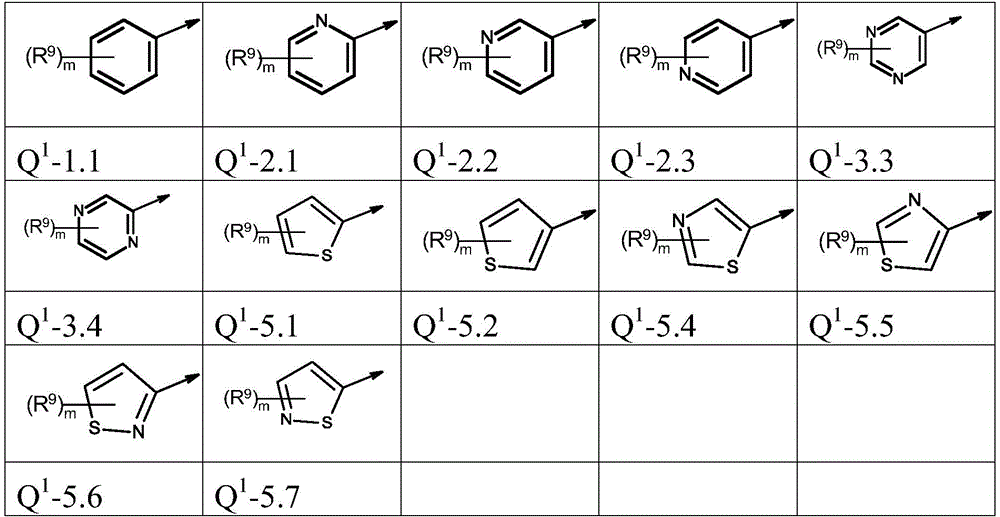
Q2为苯基,Q 2 is phenyl,
其未被取代或在每种情况下独立地被m个选自氢、氟、氯和溴的基团所取代,it is unsubstituted or in each case independently substituted by m groups selected from hydrogen, fluorine, chlorine and bromine,
Z为基团Z is the group

和and
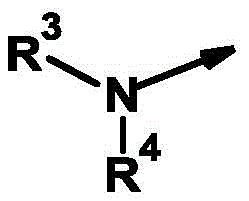
Y为氟、氯、溴、氰基、NO2、甲基、CF3和OCF3,Y is fluorine, chlorine, bromine, cyano, NO 2 , methyl, CF 3 and OCF 3 ,
W为氧,W is oxygen,
R1为氢、甲基和乙基,R 1 is hydrogen, methyl and ethyl,
R2为氢、甲基、乙基、烯丙基、炔丙基和PhCH2,R 2 is hydrogen, methyl, ethyl, allyl, propargyl and PhCH 2 ,
R3为氢,R 3 is hydrogen,
R4为(C1-C6)-烷基、S(O)nR5、OR5、SO2NR6R7、CO2R8、COR8,R 4 is (C 1 -C 6 )-alkyl, S(O) n R 5 , OR 5 , SO 2 NR 6 R 7 , CO 2 R 8 , COR 8 ,
其未被取代或在每种情况下彼此独立地被m个选自氢、OR5、S(O)nR5、SO2NR6R7、CO2R8、COR6、NR6CO2R8的基团所取代,which are unsubstituted or in each case independently of one another by m selected from hydrogen, OR 5 , S(O) n R 5 , SO 2 NR 6 R 7 , CO 2 R 8 , COR 6 , NR 6 CO 2 R 8 group is substituted,
R5为甲基、乙基、CF3、CH2CF3,R 5 is methyl, ethyl, CF 3 , CH 2 CF 3 ,
R6为氢和R5,R 6 is hydrogen and R 5 ,
R7为氢、甲基、乙基和乙基-2-乙酰基,R 7 is hydrogen, methyl, ethyl and ethyl-2-acetyl,
R8为甲基和乙基,R 8 is methyl and ethyl,
R9为氢、氟、氯、溴、氰基、羟基、甲基、乙基、OCH3、CF3和OCF3,R 9 is hydrogen, fluorine, chlorine, bromine, cyano, hydroxyl, methyl, ethyl, OCH 3 , CF 3 and OCF 3 ,
m为0、1和2,m is 0, 1 and 2,
n为0、1和2。n is 0, 1 and 2.
上述一般或优选的基团定义既适用于通式(I)的终产物,也适用于相应地在每种情况下制备所需的起始材料或中间体。这些基团定义可根据需要彼此组合,即包括给定的优选范围之间的组合。The general or preferred radical definitions given above apply both to the end products of the general formula (I) and to the corresponding preparation of the starting materials or intermediates required in each case. These radical definitions can be combined with each other as desired, ie including combinations between the given preferred ranges.
主要出于更高的除草活性、更好的选择性和/或更好的可制备性的原因,特别感兴趣的是所给出的本发明的通式(I)的化合物或其盐或其本发明用途,其中单个基团具有已经指定或下文指定的优选含义中之一,或特别是其中已经指定或下文指定的优选含义中的一者或多者组合出现的那些。Mainly for reasons of higher herbicidal activity, better selectivity and/or better manufacturability, of particular interest are the compounds of the general formula (I) or their salts thereof according to the invention given. Use according to the invention in which individual groups have one of the preferred meanings already specified or hereinafter specified, or in particular those in which one or more of the preferred meanings specified or hereinafter specified occur in combination.
关于本发明的化合物,将阐明上文使用和下文进一步使用的术语。这些对本领域技术人员来说是熟悉的并尤其具有下文阐明的定义:With regard to the compounds of the present invention, the terms used above and further below will be clarified. These are familiar to those skilled in the art and have in particular the definitions set forth below:
除非有不同的定义,否则化学基团的名称通常应理解为与分子的骨架或其余部分的连接经由最后提及的相关化学基团的结构元素,即例如在(C2-C8)-烯氧基的情况下经由氧原子,而在杂环基-(C1-C8)-烷基或R12O(O)C-(C1-C8)-烷基的情况下,在每种情况下经由烷基基团的碳原子。Unless defined differently, the name of a chemical group is generally understood to mean a structural element whose connection to the backbone or the rest of the molecule is via the last-mentioned chemical group in question in question, ie for example in (C 2 -C 8 )-ene In the case of oxy via an oxygen atom, in the case of heterocyclyl-(C 1 -C 8 )-alkyl or R 12 O(O)C-(C 1 -C 8 )-alkyl, each In this case via a carbon atom of an alkyl group.
根据本发明,“烷基磺酰基”——单独地或作为化学基团的一部分——是指直链或支链烷基磺酰基,优选具有1至8个或1至6个碳原子,如(但不限于)(C1-C6)-烷基磺酰基如甲基磺酰基、乙基磺酰基、丙基磺酰基、1-甲基乙基磺酰基、丁基磺酰基、1-甲基丙基磺酰基、2-甲基丙基磺酰基、1,1-二甲基乙基磺酰基、戊基磺酰基、1-甲基丁基磺酰基、2-甲基丁基磺酰基、3-甲基丁基磺酰基、1,1-二甲基丙基磺酰基、1,2-二甲基丙基磺酰基、2,2-二甲基丙基磺酰基、1-乙基丙基磺酰基、己基磺酰基、1-甲基戊基磺酰基、2-甲基戊基磺酰基、3-甲基戊基磺酰基、4-甲基戊基磺酰基、1,1-二甲基丁基磺酰基、1,2-二甲基丁基磺酰基、1,3-二甲基丁基磺酰基、2,2-二甲基丁基磺酰基、2,3-二甲基丁基磺酰基、3,3-二甲基丁基磺酰基、1-乙基丁基磺酰基、2-乙基丁基磺酰基、1,1,2-三甲基丙基磺酰基、1,2,2-三甲基丙基磺酰基、1-乙基-1-甲基丙基磺酰基和1-乙基-2-甲基丙基磺酰基。According to the present invention, "alkylsulfonyl" - alone or as part of a chemical group - refers to a straight or branched chain alkylsulfonyl group, preferably having 1 to 8 or 1 to 6 carbon atoms, such as (but not limited to) (C 1 -C 6 )-Alkylsulfonyl such as methylsulfonyl, ethylsulfonyl, propylsulfonyl, 1-methylethylsulfonyl, butylsulfonyl, 1-methylsulfonyl propylpropylsulfonyl, 2-methylpropylsulfonyl, 1,1-dimethylethylsulfonyl, pentylsulfonyl, 1-methylbutylsulfonyl, 2-methylbutylsulfonyl, 3-Methylbutylsulfonyl, 1,1-dimethylpropylsulfonyl, 1,2-dimethylpropylsulfonyl, 2,2-dimethylpropylsulfonyl, 1-ethylpropane sulfonyl, hexylsulfonyl, 1-methylpentylsulfonyl, 2-methylpentylsulfonyl, 3-methylpentylsulfonyl, 4-methylpentylsulfonyl, 1,1-dimethyl butylsulfonyl, 1,2-dimethylbutylsulfonyl, 1,3-dimethylbutylsulfonyl, 2,2-dimethylbutylsulfonyl, 2,3-dimethylbutylsulfonyl sulfonyl, 3,3-dimethylbutylsulfonyl, 1-ethylbutylsulfonyl, 2-ethylbutylsulfonyl, 1,1,2-trimethylpropylsulfonyl, 1, 2,2-trimethylpropylsulfonyl, 1-ethyl-1-methylpropylsulfonyl and 1-ethyl-2-methylpropylsulfonyl.
根据本发明,“杂芳基磺酰基”是指任选被取代的吡啶基磺酰基、嘧啶基磺酰基、吡嗪基磺酰基或任选被取代的多环杂芳基磺酰基,这里特别是任选被取代的喹啉基磺酰基,例如被氟、氯、溴、碘、氰基、硝基、烷基、卤代烷基、卤代烷氧基、氨基、烷基氨基、烷基羰基氨基、二烷基氨基或烷氧基基团所取代。According to the present invention, "heteroarylsulfonyl" refers to optionally substituted pyridylsulfonyl, pyrimidinylsulfonyl, pyrazinylsulfonyl or optionally substituted polycyclic heteroarylsulfonyl, here in particular Optionally substituted quinolinylsulfonyl, for example by fluorine, chlorine, bromine, iodine, cyano, nitro, alkyl, haloalkyl, haloalkoxy, amino, alkylamino, alkylcarbonylamino, dioxane substituted with amino or alkoxy groups.
根据本发明,“烷硫基”——单独地或作为化学基团的一部分——是指直链或支链S-烷基,优选具有1至8个或1至6个碳原子,如(C1-C10)-、(C1-C6)-或(C1-C4)-烷硫基,例如(但不限于)(C1-C6)-烷硫基如甲硫基、乙硫基、丙硫基、1-甲基乙硫基、丁硫基、1-甲基丙硫基、2-甲基丙硫基、1,1-二甲基乙硫基、戊硫基、1-甲基丁硫基、2-甲基丁硫基、3-甲基丁硫基、1,1-二甲基丙硫基、1,2-二甲基丙硫基、2,2-二甲基丙硫基、1-乙基丙硫基、己硫基、1-甲基戊硫基、2-甲基戊硫基、3-甲基戊硫基、4-甲基戊硫基、1,1-二甲基丁硫基、1,2-二甲基丁硫基、1,3-二甲基丁硫基、2,2-二甲基丁硫基、2,3-二甲基丁硫基、3,3-二甲基丁硫基、1-乙基丁硫基、2-乙基丁硫基、1,1,2-三甲基丙硫基、1,2,2-三甲基丙硫基、1-乙基-1-甲基丙硫基和1-乙基-2-甲基丙硫基。According to the present invention, "alkylthio" - alone or as part of a chemical group - refers to a straight or branched chain S-alkyl group, preferably having 1 to 8 or 1 to 6 carbon atoms, such as ( C 1 -C 10 )-, (C 1 -C 6 )- or (C 1 -C 4 )-alkylthio, such as (but not limited to) (C 1 -C 6 )-alkylthio such as methylthio , ethylthio, propylthio, 1-methylethylthio, butylthio, 1-methylpropylthio, 2-methylpropylthio, 1,1-dimethylethylthio, pentylthio , 1-methylbutylthio, 2-methylbutylthio, 3-methylbutylthio, 1,1-dimethylpropylthio, 1,2-dimethylpropylthio, 2, 2-dimethylpropylthio, 1-ethylpropylthio, hexylthio, 1-methylpentylthio, 2-methylpentylthio, 3-methylpentylthio, 4-methylpentylthio Thio, 1,1-dimethylbutylthio, 1,2-dimethylbutylthio, 1,3-dimethylbutylthio, 2,2-dimethylbutylthio, 2,3 -Dimethylbutylthio, 3,3-dimethylbutylthio, 1-ethylbutylthio, 2-ethylbutylthio, 1,1,2-trimethylpropylthio, 1, 2,2-trimethylpropylthio, 1-ethyl-1-methylpropylthio and 1-ethyl-2-methylpropylthio.
根据本发明,“环烷硫基”表示经由硫原子连接的环烷基基团。According to the present invention, "cycloalkylthio" denotes a cycloalkyl group attached via a sulfur atom.
根据本发明,“烷基亚磺酰基(烷基-S(=O)-)”,除非在别处有不同的定义,否则表示经由-S(=O)-键合至骨架的烷基基团,如(C1-C10)-、(C1-C6)-或(C1-C4)-烷基亚磺酰基,例如(但不限于)(C1-C6)-烷基亚磺酰基如甲基亚磺酰基、乙基亚磺酰基、丙基亚磺酰基、1-甲基乙基亚磺酰基、丁基亚磺酰基、1-甲基丙基亚磺酰基、2-甲基丙基亚磺酰基、1,1-二甲基乙基亚磺酰基、戊基亚磺酰基、1-甲基丁基亚磺酰基、2-甲基丁基亚磺酰基、3-甲基丁基亚磺酰基、1,1-二甲基丙基亚磺酰基、1,2-二甲基丙基亚磺酰基、2,2-二甲基丙基亚磺酰基、1-乙基丙基亚磺酰基、己基亚磺酰基、1-甲基戊基亚磺酰基、2-甲基戊基亚磺酰基、3-甲基戊基亚磺酰基、4-甲基戊基亚磺酰基、1,1-二甲基丁基亚磺酰基、1,2-二甲基丁基亚磺酰基、1,3-二甲基丁基亚磺酰基、2,2-二甲基丁基亚磺酰基、2,3-二甲基丁基亚磺酰基、3,3-二甲基丁基亚磺酰基、1-乙基丁基亚磺酰基、2-乙基丁基亚磺酰基、1,1,2-三甲基丙基亚磺酰基、1,2,2-三甲基丙基亚磺酰基、1-乙基-1-甲基丙基亚磺酰基和1-乙基-2-甲基丙基亚磺酰基。According to the present invention, "alkylsulfinyl (alkyl-S(=O)-)", unless otherwise defined elsewhere, means an alkyl group bonded to the backbone via -S(=O)- , such as (C 1 -C 10 )-, (C 1 -C 6 )- or (C 1 -C 4 )-alkylsulfinyl, such as (but not limited to) (C 1 -C 6 )-alkyl Sulfinyl such as methylsulfinyl, ethylsulfinyl, propylsulfinyl, 1-methylethylsulfinyl, butylsulfinyl, 1-methylpropylsulfinyl, 2- Methylpropylsulfinyl, 1,1-dimethylethylsulfinyl, pentylsulfinyl, 1-methylbutylsulfinyl, 2-methylbutylsulfinyl, 3-methane butylsulfinyl, 1,1-dimethylpropylsulfinyl, 1,2-dimethylpropylsulfinyl, 2,2-dimethylpropylsulfinyl, 1-ethyl Propylsulfinyl, hexylsulfinyl, 1-methylpentylsulfinyl, 2-methylpentylsulfinyl, 3-methylpentylsulfinyl, 4-methylpentylsulfinyl , 1,1-dimethylbutylsulfinyl, 1,2-dimethylbutylsulfinyl, 1,3-dimethylbutylsulfinyl, 2,2-dimethylbutylsulfinyl Sulfonyl, 2,3-dimethylbutylsulfinyl, 3,3-dimethylbutylsulfinyl, 1-ethylbutylsulfinyl, 2-ethylbutylsulfinyl, 1 , 1,2-trimethylpropylsulfinyl, 1,2,2-trimethylpropylsulfinyl, 1-ethyl-1-methylpropylsulfinyl and 1-ethyl-2 - Methylpropylsulfinyl.
“烷氧基”表示经由氧原子连接的烷基基团,例如(但不限于)(C1-C6)-烷氧基如甲氧基、乙氧基、丙氧基、1-甲基乙氧基、丁氧基、1-甲基丙氧基、2-甲基丙氧基、1,1-二甲基乙氧基、戊氧基、1-甲基丁氧基、2-甲基丁氧基、3-甲基丁氧基、1,1-二甲基丙氧基、1,2-二甲基丙氧基、2,2-二甲基丙氧基、1-乙基丙氧基、己氧基、1-甲基戊氧基、2-甲基戊氧基、3-甲基戊氧基、4-甲基戊氧基、1,1-二甲基丁氧基、1,2-二甲基丁氧基、1,3-二甲基丁氧基、2,2-二甲基丁氧基、2,3-二甲基丁氧基、3,3-二甲基丁氧基、1-乙基丁氧基、2-乙基丁氧基、1,1,2-三甲基丙氧基、1,2,2-三甲基丙氧基、1-乙基-1-甲基丙氧基和1-乙基-2-甲基丙氧基。烯氧基表示经由氧原子连接的烯基基团,并且炔氧基表示经由氧原子连接的炔基基团,如(C2-C10)-、(C2-C6)-或(C2-C4)-烯氧基和(C3-C10)-、(C3-C6)-或(C3-C4)-炔氧基。"Alkoxy" means an alkyl group attached via an oxygen atom, such as (but not limited to) (C 1 -C 6 )-alkoxy such as methoxy, ethoxy, propoxy, 1-methyl Ethoxy, butoxy, 1-methylpropoxy, 2-methylpropoxy, 1,1-dimethylethoxy, pentoxy, 1-methylbutoxy, 2-methyl butoxy, 3-methylbutoxy, 1,1-dimethylpropoxy, 1,2-dimethylpropoxy, 2,2-dimethylpropoxy, 1-ethyl Propoxy, hexyloxy, 1-methylpentyloxy, 2-methylpentyloxy, 3-methylpentyloxy, 4-methylpentyloxy, 1,1-dimethylbutoxy , 1,2-dimethylbutoxy, 1,3-dimethylbutoxy, 2,2-dimethylbutoxy, 2,3-dimethylbutoxy, 3,3-dimethylbutoxy Methylbutoxy, 1-ethylbutoxy, 2-ethylbutoxy, 1,1,2-trimethylpropoxy, 1,2,2-trimethylpropoxy, 1- Ethyl-1-methylpropoxy and 1-ethyl-2-methylpropoxy. Alkenyloxy represents an alkenyl group attached via an oxygen atom, and alkynyloxy represents an alkynyl group attached via an oxygen atom, such as (C 2 -C 10 )-, (C 2 -C 6 )- or (C 2 -C 6 )- or (C ) 2 - C4 )-alkenyloxy and (C3 - C10 )-, (C3 - C6 )- or (C3 - C4 )-alkynyloxy.
“环烷氧基”表示经由氧原子连接的环烷基基团。"Cycloalkoxy" means a cycloalkyl group attached via an oxygen atom.
根据本发明,“烷基羰基”(烷基-C(=O)-),除非在别处有不同的定义,否则代表经由-C(=O)-键合至骨架的烷基基团,如(C1-C10)-、(C1-C6)-或(C1-C4)-烷基羰基。这里的碳原子数涉及烷基羰基基团中的烷基基团。According to the present invention, "alkylcarbonyl" (alkyl-C(=O)-), unless otherwise defined elsewhere, represents an alkyl group bonded to the backbone via -C(=O)-, as in (C 1 -C 10 )-, (C 1 -C 6 )- or (C 1 -C 4 )-alkylcarbonyl. The number of carbon atoms here refers to the alkyl group in the alkylcarbonyl group.
“烷氧基羰基(烷基-O-C(=O)-)”,除非在别处有不同的定义,否则为:经由-O-C(=O)-键合至骨架的烷基基团,如(C1-C10)-、(C1-C6)-或(C1-C4)-烷氧基羰基。这里的碳原子数涉及烷氧基羰基基团中的烷基基团。类似地,根据本发明,“烯氧基羰基”和“炔氧基羰基”,除非在别处有不同的定义,否则分别代表经由-O-C(=O)-键合至骨架的烯基和炔基基团,如(C2-C10)-、(C2-C6)-或(C2-C4)-烯氧基羰基和(C3-C10)-、(C3-C6)-或(C3-C4)-炔氧基羰基。这里的碳原子数是指烯氧基羰基或炔氧基羰基基团中的烯基或炔基基团。"Alkoxycarbonyl (alkyl-OC(=O)-)", unless otherwise defined elsewhere: an alkyl group bonded to the backbone via -OC(=O)-, such as (C 1 -C 10 )-, (C 1 -C 6 )- or (C 1 -C 4 )-alkoxycarbonyl. The number of carbon atoms here refers to the alkyl group in the alkoxycarbonyl group. Similarly, according to the present invention, "alkenyloxycarbonyl" and "alkynyloxycarbonyl", unless otherwise defined elsewhere, represent alkenyl and alkynyl, respectively, bonded to the backbone via -OC(=O)- Groups such as (C 2 -C 10 )-, (C 2 -C 6 )- or (C 2 -C 4 )-alkenyloxycarbonyl and (C 3 -C 10 )-, (C 3 -C 6 )- )- or (C 3 -C 4 )-alkynyloxycarbonyl. The number of carbon atoms here refers to an alkenyl or alkynyl group in an alkenyloxycarbonyl or alkynyloxycarbonyl group.
根据本发明,术语“烷基羰氧基”(烷基-C(=O)-O-),除非在别处有不同的定义,否则代表经由羰氧基基团(-C(=O)-O-)的氧键合至骨架的烷基基团,如(C1-C10)-、(C1-C6)-或(C1-C4)-烷基羰氧基。这里的碳原子数涉及烷基羰氧基基团中的烷基基团。According to the present invention, the term "alkylcarbonyloxy" (alkyl-C(=O)-O-), unless otherwise defined elsewhere, represents a group via carbonyloxy (-C(=O)- The oxygen of O-) is bonded to an alkyl group of the backbone, such as (C 1 -C 10 )-, (C 1 -C 6 )- or (C 1 -C 4 )-alkylcarbonyloxy. The number of carbon atoms here refers to the alkyl group in the alkylcarbonyloxy group.
术语“芳基”表示具有优选6至14个、尤其是6至10个环碳原子的任选被取代的单环、双环或多环芳族体系,例如苯基、萘基、蒽基、菲基等,优选苯基。The term "aryl" denotes an optionally substituted monocyclic, bicyclic or polycyclic aromatic system having preferably 6 to 14, especially 6 to 10 ring carbon atoms, such as phenyl, naphthyl, anthracenyl, phenanthrene group, etc., preferably phenyl.
术语“任选被取代的芳基”还包括多环体系,如四氢萘基、茚基、茚满基、芴基、联苯基,其中键合位点在芳族体系上。在系统术语中,术语“任选被取代的苯基”通常也涵盖“芳基”。这里优选的芳基取代基有例如氢、卤素、烷基、环烷基、环烷基烷基、环烯基、卤代环烷基、烯基、炔基、芳基、芳基烷基、杂芳基、杂芳基烷基、杂环基、杂环基烷基、烷氧基烷基、烷硫基、卤代烷硫基、卤代烷基、烷氧基、卤代烷氧基、环烷氧基、环烷基烷氧基、芳氧基、杂芳氧基、烷氧基烷氧基、炔基烷氧基、烯氧基、双烷基氨基烷氧基、三[烷基]甲硅烷基、双[烷基]芳基甲硅烷基、双[烷基]烷基甲硅烷基、三[烷基]甲硅烷基炔基、烷基炔基、环烷基炔基、卤代烷基炔基、杂环基-N-烷氧基、硝基、氰基、氨基、烷基氨基、双烷基氨基、烷基羰基氨基、环烷基羰基氨基、芳基羰基氨基、烷氧基羰基氨基、烷氧基羰基烷基氨基、芳基烷氧基羰基烷基氨基、羟基羰基、烷氧基羰基、氨基羰基、烷基氨基羰基、环烷基氨基羰基、双烷基氨基羰基、杂芳基烷氧基、芳基烷氧基。The term "optionally substituted aryl" also includes polycyclic ring systems, such as tetrahydronaphthyl, indenyl, indanyl, fluorenyl, biphenyl, wherein the point of bonding is on the aromatic system. In system nomenclature, the term "optionally substituted phenyl" generally also encompasses "aryl". Preferred aryl substituents herein are, for example, hydrogen, halogen, alkyl, cycloalkyl, cycloalkylalkyl, cycloalkenyl, halocycloalkyl, alkenyl, alkynyl, aryl, arylalkyl, Heteroaryl, heteroarylalkyl, heterocyclyl, heterocyclylalkyl, alkoxyalkyl, alkylthio, haloalkylthio, haloalkyl, alkoxy, haloalkoxy, cycloalkoxy, Cycloalkylalkoxy, aryloxy, heteroaryloxy, alkoxyalkoxy, alkynylalkoxy, alkenyloxy, bisalkylaminoalkoxy, tri[alkyl]silyl, bis[alkyl]arylsilyl, bis[alkyl]alkylsilyl, tris[alkyl]silylalkynyl, alkylalkynyl, cycloalkylalkynyl, haloalkylalkynyl, hetero Cyclo-N-alkoxy, nitro, cyano, amino, alkylamino, dialkylamino, alkylcarbonylamino, cycloalkylcarbonylamino, arylcarbonylamino, alkoxycarbonylamino, alkoxy Alkylcarbonylalkylamino, arylalkoxycarbonylalkylamino, hydroxycarbonyl, alkoxycarbonyl, aminocarbonyl, alkylaminocarbonyl, cycloalkylaminocarbonyl, bisalkylaminocarbonyl, heteroarylalkoxy , Arylalkoxy.
杂环基团(杂环基)含有至少一个饱和、不饱和、部分饱和或杂芳族的杂环环(=其中至少一个碳原子已被替换为杂原子、优选替换为选自N、O、S、P的杂原子的碳环环)并且可以是未被取代的或被取代的,在取代的情况下,键合位点位于环原子上。如果杂环基基团或杂环环是任选被取代的,则其可与其他碳环或杂环环稠合。在任选被取代的杂环基的情况下,还包括多环体系,例如8-氮杂双环[3.2.1]辛基、8-氮杂双环[2.2.2]辛基或1-氮杂双环[2.2.1]庚基。任选被取代的杂环基还包括螺环体系,例如1-氧杂-5-氮杂螺[2.3]己基。除非有不同的定义,否则杂环环优选含有3至9个环原子、尤其是3至6个环原子,并且在杂环环中一个或多个、优选地1至4个、尤其是1、2或3个优选选自N、O和S的杂原子,但不应有两个氧原子直接相邻,例如与来自N、O和S的一个杂原子:1-或2-或3-吡咯烷基、3,4-二氢-2H-吡咯-2-或-3-基、2,3-二氢-1H-吡咯-1-或-2-或-3-或-4-或-5-基;2,5-二氢-1H-吡咯-1-或-2-或-3-基、1-或2-或3-或4-哌啶基;2,3,4,5-四氢吡啶-2-或-3-或-4-或-5-基或-6-基;1,2,3,6-四氢吡啶-1-或-2-或-3-或-4-或-5-或-6-基;1,2,3,4-四氢吡啶-1-或-2-或-3-或-4-或-5-或-6-基;1,4-二氢吡啶-1-或-2-或-3-或-4-基;2,3-二氢吡啶-2-或-3-或-4-或-5-或-6-基;2,5-二氢吡啶-2-或-3-或-4-或-5-或-6-基、1-或2-或3-或4-氮杂环庚烷基;2,3,4,5-四氢-1H-氮杂


上面列出的杂环优选例如被氢、卤素、烷基、卤代烷基、羟基、烷氧基、环烷氧基、芳氧基、烷氧基烷基、烷氧基烷氧基、环烷基、卤代环烷基、芳基、芳基烷基、杂芳基、杂环基、烯基、烷基羰基、环烷基羰基、芳基羰基、杂芳基羰基、烷氧基羰基、羟基羰基、环烷氧基羰基、环烷基烷氧基羰基、烷氧基羰基烷基、芳基烷氧基羰基、芳基烷氧基羰基烷基、炔基、炔基烷基、烷基炔基、三烷基甲硅烷基炔基、硝基、氨基、氰基、卤代烷氧基、卤代烷硫基、烷硫基、氢硫基、羟烷基、氧代、杂芳基烷氧基、芳基烷氧基、杂环基烷氧基、杂环基烷硫基、杂环氧基、杂环硫基、杂芳氧基、双烷基氨基、烷基氨基、环烷基氨基、羟基羰基烷基氨基、烷氧基羰基烷基氨基、芳基烷氧基羰基烷基氨基、烷氧基羰基烷基(烷基)氨基、氨基羰基、烷基氨基羰基、双烷基氨基羰基、环烷基氨基羰基、羟基羰基烷基氨基羰基、烷氧基羰基烷基氨基羰基、芳基烷氧基羰基烷基氨基羰基所取代。The heterocycles listed above are preferably, for example, hydrogen, halogen, alkyl, haloalkyl, hydroxy, alkoxy, cycloalkoxy, aryloxy, alkoxyalkyl, alkoxyalkoxy, cycloalkyl , halocycloalkyl, aryl, arylalkyl, heteroaryl, heterocyclyl, alkenyl, alkylcarbonyl, cycloalkylcarbonyl, arylcarbonyl, heteroarylcarbonyl, alkoxycarbonyl, hydroxyl carbonyl, cycloalkoxycarbonyl, cycloalkylalkoxycarbonyl, alkoxycarbonylalkyl, arylalkoxycarbonyl, arylalkoxycarbonylalkyl, alkynyl, alkynylalkyl, alkylalkyne alkynyl, trialkylsilylalkynyl, nitro, amino, cyano, haloalkoxy, haloalkylthio, alkylthio, thiol, hydroxyalkyl, oxo, heteroarylalkoxy, aryl alkoxy, heterocyclylalkoxy, heterocyclylalkylthio, heterocyclyloxy, heterocyclylthio, heteroaryloxy, bisalkylamino, alkylamino, cycloalkylamino, hydroxycarbonyl Alkylamino, alkoxycarbonylalkylamino, arylalkoxycarbonylalkylamino, alkoxycarbonylalkyl(alkyl)amino, aminocarbonyl, alkylaminocarbonyl, dialkylaminocarbonyl, cycloalkane Alkylaminocarbonyl, hydroxycarbonylalkylaminocarbonyl, alkoxycarbonylalkylaminocarbonyl, arylalkoxycarbonylalkylaminocarbonyl substituted.
当基础结构被选自基团(=基)列表或广义定义的基团组的“一个或多个基团”所取代时,这在每种情况下包括同时被多个相同和/或结构上不同的基团取代。When a base structure is substituted by "one or more groups" selected from a list of radicals (=radicals) or a broadly defined group of radicals, this includes in each case simultaneous substitution by multiple identical and/or structural groups different group substitutions.
在部分或完全饱和的氮杂环的情况下,这可经由碳或经由氮与分子的其余部分连接。In the case of a partially or fully saturated nitrogen heterocycle, this can be attached to the rest of the molecule via carbon or via nitrogen.
被取代的杂环基团的合适取代基是下面进一步指定的取代基,以及另外氧代和硫代。作为环碳原子上的取代基的氧代基团则为例如杂环环中的羰基基团。因此,优选还包括内酯和内酰胺。氧代基团也可出现在环杂原子上,其可以不同的氧化态存在,例如在N和S的情况下,并且在该情况下形成例如杂环环中的二价-N(O)-、-S(O)-(也简称为SO)和-S(O)2-(也简称为SO2)基团。在-N(O)-和-S(O)-基团的情况下,每种情况下的两种对映异构体都包括在内。Suitable substituents for substituted heterocyclic groups are the substituents specified further below, as well as additionally oxo and thio. An oxo group as a substituent on a ring carbon atom is then, for example, a carbonyl group in a heterocyclic ring. Therefore, lactones and lactams are preferably also included. Oxo groups can also occur on ring heteroatoms, which can exist in different oxidation states, such as in the case of N and S, and in this case form, for example, a divalent -N(O)- in a heterocyclic ring , -S(O)- (also abbreviated as SO) and -S(O) 2- (also abbreviated as SO2 ) groups. In the case of -N(O)- and -S(O)- groups, both enantiomers in each case are included.
根据本发明,表达“杂芳基”代表杂芳族化合物,即完全不饱和的芳族杂环化合物,优选地具有1至4个、优选1或2个相同或不同的杂原子(优选地,O、S或N)的5-至7-元环。本发明的杂芳基是例如1H-吡咯-1-基;1H-吡咯-2-基;1H-吡咯-3-基;呋喃-2-基;呋喃-3-基;噻吩-2-基;噻吩-3-基;1H-咪唑-1-基;1H-咪唑-2-基;1H-咪唑-4-基;1H-咪唑-5-基;1H-吡唑-1-基;1H-吡唑-3-基;1H-吡唑-4-基;1H-吡唑-5-基、1H-1,2,3-三唑-1-基、1H-1,2,3-三唑-4-基、1H-1,2,3-三唑-5-基、2H-1,2,3-三唑-2-基、2H-1,2,3-三唑-4-基、1H-1,2,4-三唑-1-基、1H-1,2,4-三唑-3-基、4H-1,2,4-三唑-4-基、1,2,4-噁二唑-3-基、1,2,4-噁二唑-5-基、1,3,4-噁二唑-2-基、1,2,3-噁二唑-4-基、1,2,3-噁二唑-5-基、1,2,5-噁二唑-3-基、氮杂

术语“卤素”表示例如氟、氯、溴或碘。如果该术语用于基团,则“卤素”表示例如氟、氯、溴或碘原子。The term "halogen" means, for example, fluorine, chlorine, bromine or iodine. If the term is applied to a group, "halogen" means, for example, a fluorine, chlorine, bromine or iodine atom.
根据本发明,“烷基”指的是直链或支链开链饱和烃基团,其任选被单取代或多取代,并在后一情况下称为“取代烷基”。优选的取代基是卤素原子、烷氧基、卤代烷氧基、氰基、烷硫基、卤代烷硫基、氨基或硝基基团,特别优选甲氧基、甲基、氟代烷基、氰基、硝基、氟、氯、溴或碘。前缀“双”还包括不同烷基基团的组合,例如甲基(乙基)或乙基(甲基)。According to the present invention, "alkyl" refers to a straight or branched open chain saturated hydrocarbon group, optionally mono- or polysubstituted, and in the latter case referred to as "substituted alkyl". Preferred substituents are halogen atoms, alkoxy groups, haloalkoxy groups, cyano groups, alkylthio groups, haloalkylthio groups, amino groups or nitro groups, particularly preferably methoxy groups, methyl groups, fluoroalkyl groups, cyano groups , nitro, fluorine, chlorine, bromine or iodine. The prefix "bis" also includes combinations of different alkyl groups, such as methyl (ethyl) or ethyl (methyl).
“卤代烷基"、"卤代烯基"和"卤代炔基"分别表示部分或完全被相同或不同的卤素原子所取代的烷基、烯基和炔基,例如单卤代烷基如CH2CH2Cl、CH2CH2Br、CHClCH3、CH2Cl、CH2F;全卤代烷基如CCl3、CClF2、CFCl2、CF2CClF2、CF2CClFCF3;多卤代烷基如CH2CHFCl、CF2CClFH、CF2CBrFH、CH2CF3;术语全卤代烷基还涵盖术语全氟烷基。"Haloalkyl", "haloalkenyl" and "haloalkynyl" respectively represent alkyl, alkenyl and alkynyl groups which are partially or fully substituted with the same or different halogen atoms, eg monohaloalkyl groups such as CH2CH 2Cl, CH2CH2Br , CHClCH3 , CH2Cl , CH2F ; perhaloalkyl such as CCl3 , CClF2 , CFCl2 , CF2CClF2 , CF2CClFCF3 ; polyhalogenated alkyl such as CH2CHFCl , CF2CClFH , CF2CBrFH , CH2CF3 ; the term perhaloalkyl also encompasses the term perfluoroalkyl.
“部分氟化烷基”表示被氟单取代或多取代的直链或支链饱和烃,其中所讨论的氟原子可作为直链或支链烃链的一个或多个不同碳原子上的取代基存在,例如CHFCH3、CH2CH2F、CH2CH2CF3、CHF2、CH2F、CHFCF2CF3。"Partially fluorinated alkyl" means a straight or branched saturated hydrocarbon mono- or polysubstituted with fluorine, wherein the fluorine atom in question may serve as a substitution on one or more different carbon atoms of the straight or branched hydrocarbon chain Radicals exist, eg CHFCH 3 , CH 2 CH 2 F, CH 2 CH 2 CF 3 , CHF 2 , CH 2 F, CHFCF 2 CF 3 .
“部分氟化的卤代烷基”表示被不同的卤素原子(有至少一个氟原子)所取代的直链或支链饱和烃,其中任选存在的任何其他卤素原子选自氟、氯或溴、碘。相应的卤素原子可作为直链或支链烃链的一个或多个不同碳原子上的取代基存在。部分氟化的卤代烷基还包括直链或支链被包括至少一个氟原子的卤素完全取代。"Partially fluorinated haloalkyl" means a straight or branched chain saturated hydrocarbon substituted with various halogen atoms (having at least one fluorine atom), wherein any other halogen atoms optionally present are selected from fluorine, chlorine or bromine, iodine . The corresponding halogen atoms may be present as substituents on one or more different carbon atoms of the straight or branched hydrocarbon chain. Partially fluorinated haloalkyl also includes straight or branched chains that are fully substituted with halogens including at least one fluorine atom.
“卤代烷氧基”为例如OCF3、OCHF2、OCH2F、OCF2CF3、OCH2CF3和OCH2CH2Cl;这相应地适用于卤代烯基和其他卤素取代的基团。" Haloalkoxy " is, for example, OCF3 , OCHF2 , OCH2F , OCF2CF3 , OCH2CF3 and OCH2CH2Cl ; this applies accordingly to haloalkenyl and other halogen substituted groups.
这里以举例的方式提及的表达"(C1-C4)-烷基"为根据对碳原子述及的范围具有1至4个碳原子的直链或支链烷基的简写,即涵盖甲基、乙基、1-丙基、2-丙基、1-丁基、2-丁基、2-甲基丙基或叔丁基基团。具有较大指定碳原子范围的一般烷基基团,例如“(C1-C6)-烷基”,相应地还涵盖具有更多碳原子数的直链或支链烷基基团,即根据该实例还涵盖具有5和6个碳原子的烷基基团。The expression "(C 1 -C 4 )-alkyl" referred to here by way of example is shorthand for straight or branched chain alkyl groups having 1 to 4 carbon atoms according to the range stated for the carbon atoms, ie covering A methyl, ethyl, 1-propyl, 2-propyl, 1-butyl, 2-butyl, 2-methylpropyl or tert-butyl group. Typical alkyl groups with a larger specified range of carbon atoms, such as "(C 1 -C 6 )-alkyl", correspondingly also encompass straight or branched chain alkyl groups with a higher number of carbon atoms, i.e. Alkyl groups having 5 and 6 carbon atoms are also encompassed according to this example.
除非特别说明,否则优选低级碳骨架,例如具有1至6个碳原子,或在不饱和基团的情况下,具有2至6个碳原子,在烃基团如烷基、烯基和炔基基团的情况下,包括在复合基团中。包括在复合基团如烷氧基、卤代烷基等中的烷基基团为例如甲基、乙基、正丙基或异丙基、正-、异-、叔-或2-丁基、戊基、己基如正己基、异己基和1,3-二甲基丁基、庚基如正庚基、1-甲基己基和1,4-二甲基戊基;烯基和炔基基团定义为对应于烷基基团的可能的不饱和基团,其中存在至少一个双键或三键。优选具有一个双键或三键的基团。Unless otherwise specified, lower carbon skeletons are preferred, for example having 1 to 6 carbon atoms, or in the case of unsaturated groups, 2 to 6 carbon atoms, in the case of hydrocarbon groups such as alkyl, alkenyl and alkynyl groups In the case of a group, it is included in a composite group. Alkyl groups included in complex groups such as alkoxy, haloalkyl, etc. are, for example, methyl, ethyl, n- or isopropyl, n-, iso-, tert- or 2-butyl, pentyl alkenyl, hexyl groups such as n-hexyl, isohexyl and 1,3-dimethylbutyl, heptyl groups such as n-heptyl, 1-methylhexyl and 1,4-dimethylpentyl; alkenyl and alkynyl groups Defined as a possible unsaturated group corresponding to an alkyl group in which at least one double or triple bond is present. Groups having one double or triple bond are preferred.
特别地,术语“烯基”还包括具有多于一个双键的直链或支链开链烃基团,如1,3-丁二烯基和1,4-戊二烯基,而且包括具有一个或多个累积双键的累积二烯基(allenyl)或累积多烯基(cumulenyl)基团,例如累积二烯基(1,2-丙二烯基)、1,2-丁二烯基和1,2,3-戊三烯基。烯基表示例如可任选被进一步的烷基基团所取代的乙烯基,例如(但不限于此)(C2-C6)-烯基如乙烯基、1-丙烯基、2-丙烯基、1-甲基乙烯基、1-丁烯基、2-丁烯基、3-丁烯基、1-甲基-1-丙烯基、2-甲基-1-丙烯基、1-甲基-2-丙烯基、2-甲基-2-丙烯基、1-戊烯基、2-戊烯基、3-戊烯基、4-戊烯基、1-甲基-1-丁烯基、2-甲基-1-丁烯基、3-甲基-1-丁烯基、1-甲基-2-丁烯基、2-甲基-2-丁烯基、3-甲基-2-丁烯基、1-甲基-3-丁烯基、2-甲基-3-丁烯基、3-甲基-3-丁烯基、1,1-二甲基-2-丙烯基、1,2-二甲基-1-丙烯基、1,2-二甲基-2-丙烯基、1-乙基-1-丙烯基、1-乙基-2-丙烯基、1-己烯基、2-己烯基、3-己烯基、4-己烯基、5-己烯基、1-甲基-1-戊烯基、2-甲基-1-戊烯基、3-甲基-1-戊烯基、4-甲基-1-戊烯基、1-甲基-2-戊烯基、2-甲基-2-戊烯基、3-甲基-2-戊烯基、4-甲基-2-戊烯基、1-甲基-3-戊烯基、2-甲基-3-戊烯基、3-甲基-3-戊烯基、4-甲基-3-戊烯基、1-甲基-4-戊烯基、2-甲基-4-戊烯基、3-甲基-4-戊烯基、4-甲基-4-戊烯基、1,1-二甲基-2-丁烯基、1,1-二甲基-3-丁烯基、1,2-二甲基-1-丁烯基、1,2-二甲基-2-丁烯基、1,2-二甲基-3-丁烯基、1,3-二甲基-1-丁烯基、1,3-二甲基-2-丁烯基、1,3-二甲基-3-丁烯基、2,2-二甲基-3-丁烯基、2,3-二甲基-1-丁烯基、2,3-二甲基-2-丁烯基、2,3-二甲基-3-丁烯基、3,3-二甲基-1-丁烯基、3,3-二甲基-2-丁烯基、1-乙基-1-丁烯基、1-乙基-2-丁烯基、1-乙基-3-丁烯基、2-乙基-1-丁烯基、2-乙基-2-丁烯基、2-乙基-3-丁烯基、1,1,2-三甲基-2-丙烯基、1-乙基-1-甲基-2-丙烯基、1-乙基-2-甲基-1-丙烯基和1-乙基-2-甲基-2-丙烯基。In particular, the term "alkenyl" also includes straight or branched open chain hydrocarbon groups having more than one double bond, such as 1,3-butadienyl and 1,4-pentadienyl, and includes those having one or cumulative double bond cumulative allenyl (allenyl) or cumulative polyalkenyl (cumulenyl) groups, such as cumulative dienyl (1,2-propadienyl), 1,2-butadienyl and 1,2,3-pentatrienyl. Alkenyl means eg vinyl which may be optionally substituted by further alkyl groups, eg but not limited to (C 2 -C 6 )-alkenyl eg vinyl, 1-propenyl, 2-propenyl , 1-methylvinyl, 1-butenyl, 2-butenyl, 3-butenyl, 1-methyl-1-propenyl, 2-methyl-1-propenyl, 1-methyl -2-propenyl, 2-methyl-2-propenyl, 1-pentenyl, 2-pentenyl, 3-pentenyl, 4-pentenyl, 1-methyl-1-butenyl , 2-methyl-1-butenyl, 3-methyl-1-butenyl, 1-methyl-2-butenyl, 2-methyl-2-butenyl, 3-methyl- 2-butenyl, 1-methyl-3-butenyl, 2-methyl-3-butenyl, 3-methyl-3-butenyl, 1,1-dimethyl-2-propene base, 1,2-dimethyl-1-propenyl, 1,2-dimethyl-2-propenyl, 1-ethyl-1-propenyl, 1-ethyl-2-propenyl, 1- Hexenyl, 2-hexenyl, 3-hexenyl, 4-hexenyl, 5-hexenyl, 1-methyl-1-pentenyl, 2-methyl-1-pentenyl, 3-Methyl-1-pentenyl, 4-methyl-1-pentenyl, 1-methyl-2-pentenyl, 2-methyl-2-pentenyl, 3-methyl-2 -Pentenyl, 4-methyl-2-pentenyl, 1-methyl-3-pentenyl, 2-methyl-3-pentenyl, 3-methyl-3-pentenyl, 4 -Methyl-3-pentenyl, 1-methyl-4-pentenyl, 2-methyl-4-pentenyl, 3-methyl-4-pentenyl, 4-methyl-4- Pentenyl, 1,1-dimethyl-2-butenyl, 1,1-dimethyl-3-butenyl, 1,2-dimethyl-1-butenyl, 1,2- Dimethyl-2-butenyl, 1,2-dimethyl-3-butenyl, 1,3-dimethyl-1-butenyl, 1,3-dimethyl-2-butene base, 1,3-dimethyl-3-butenyl, 2,2-dimethyl-3-butenyl, 2,3-dimethyl-1-butenyl, 2,3-dimethyl yl-2-butenyl, 2,3-dimethyl-3-butenyl, 3,3-dimethyl-1-butenyl, 3,3-dimethyl-2-butenyl, 1-Ethyl-1-butenyl, 1-ethyl-2-butenyl, 1-ethyl-3-butenyl, 2-ethyl-1-butenyl, 2-ethyl-2 -Butenyl, 2-ethyl-3-butenyl, 1,1,2-trimethyl-2-propenyl, 1-ethyl-1-methyl-2-propenyl, 1-ethyl -2-methyl-1-propenyl and 1-ethyl-2-methyl-2-propenyl.
特别地,术语“炔基”还包括具有多于一个三键、或具有一个或多个三键和一个或多个双键的直链或支链开链烃基团,例如1,3-丁三烯基或3-戊烯-1-炔-1-基。(C2-C6)-炔基表示例如乙炔基、1-丙炔基、2-丙炔基、1-丁炔基、2-丁炔基、3-丁炔基、1-甲基-2-丙炔基、1-戊炔基、2-戊炔基、3-戊炔基、4-戊炔基、1-甲基-2-丁炔基、1-甲基-3-丁炔基、2-甲基-3-丁炔基、3-甲基-1-丁炔基、1,1-二甲基-2-丙炔基、1-乙基-2-丙炔基、1-己炔基、2-己炔基、3-己炔基、4-己炔基、5-己炔基、1-甲基-2-戊炔基、1-甲基-3-戊炔基、1-甲基-4-戊炔基、2-甲基-3-戊炔基、2-甲基-4-戊炔基、3-甲基-1-戊炔基、3-甲基-4-戊炔基、4-甲基-1-戊炔基、4-甲基-2-戊炔基、1,1-二甲基-2-丁炔基、1,1-二甲基-3-丁炔基、1,2-二甲基-3-丁炔基、2,2-二甲基-3-丁炔基、3,3-二甲基-1-丁炔基、1-乙基-2-丁炔基、1-乙基-3-丁炔基、2-乙基-3-丁炔基和1-乙基-1-甲基-2-丙炔基。In particular, the term "alkynyl" also includes straight or branched open chain hydrocarbon groups having more than one triple bond, or having one or more triple bonds and one or more double bonds, such as 1,3-butanetri alkenyl or 3-penten-1-yn-1-yl. (C 2 -C 6 )-alkynyl represents, for example, ethynyl, 1-propynyl, 2-propynyl, 1-butynyl, 2-butynyl, 3-butynyl, 1-methyl- 2-Propynyl, 1-pentynyl, 2-pentynyl, 3-pentynyl, 4-pentynyl, 1-methyl-2-butynyl, 1-methyl-3-butynyl base, 2-methyl-3-butynyl, 3-methyl-1-butynyl, 1,1-dimethyl-2-propynyl, 1-ethyl-2-propynyl, 1 -hexynyl, 2-hexynyl, 3-hexynyl, 4-hexynyl, 5-hexynyl, 1-methyl-2-pentynyl, 1-methyl-3-pentynyl , 1-methyl-4-pentynyl, 2-methyl-3-pentynyl, 2-methyl-4-pentynyl, 3-methyl-1-pentynyl, 3-methyl- 4-pentynyl, 4-methyl-1-pentynyl, 4-methyl-2-pentynyl, 1,1-dimethyl-2-butynyl, 1,1-dimethyl- 3-butynyl, 1,2-dimethyl-3-butynyl, 2,2-dimethyl-3-butynyl, 3,3-dimethyl-1-butynyl, 1- Ethyl-2-butynyl, 1-ethyl-3-butynyl, 2-ethyl-3-butynyl and 1-ethyl-1-methyl-2-propynyl.
术语“环烷基”是指优选具有3-8个环碳原子的碳环饱和环系统,例如环丙基、环丁基、环戊基或环己基,其任选具有进一步的取代,优选被氢、烷基、烷氧基、氰基、硝基、烷硫基、卤代烷硫基、卤素、烯基、炔基、卤代烷基、氨基、烷基氨基、双烷基氨基、烷氧基羰基、羟基羰基、芳基烷氧基羰基、氨基羰基、烷基氨基羰基、环烷基氨基羰基所取代。在任选被取代的环烷基的情况下,包括具有取代基的环状系统,还包括在环烷基基团上具有双键的取代基,例如亚烷基基团如亚甲基。在任选被取代的环烷基的情况下,还包括多环脂族系统,例如双环[1.1.0]丁烷-1-基、双环[1.1.0]丁烷-2-基、双环[2.1.0]戊烷-1-基、双环[1.1.1]戊烷-1-基、双环[2.1.0]戊烷-2-基、双环[2.1.0]戊烷-5-基、双环[2.1.1]己基、双环[2.2.1]庚-2-基、双环[2.2.2]辛烷-2-基、双环[3.2.1]辛烷-2-基、双环[3.2.2]壬烷-2-基、金刚烷-1-基和金刚烷-2-基,而且包括例如系统如1,1'-二(环丙基)-1-基、1,1'-二(环丙基)-2-基。术语“(C3-C7)-环烷基”为具有3至7个碳原子的环烷基的简写,对应于碳原子的指定范围。The term "cycloalkyl" refers to a carbocyclic saturated ring system preferably having 3 to 8 ring carbon atoms, such as cyclopropyl, cyclobutyl, cyclopentyl or cyclohexyl, optionally with further substitution, preferably by Hydrogen, alkyl, alkoxy, cyano, nitro, alkylthio, haloalkylthio, halogen, alkenyl, alkynyl, haloalkyl, amino, alkylamino, dialkylamino, alkoxycarbonyl, Substituted with hydroxycarbonyl, arylalkoxycarbonyl, aminocarbonyl, alkylaminocarbonyl, and cycloalkylaminocarbonyl. In the case of an optionally substituted cycloalkyl group, cyclic systems having substituents are included, as well as substituents having a double bond on the cycloalkyl group, eg, an alkylene group such as a methylene group. In the case of optionally substituted cycloalkyl, also included are polycyclic aliphatic systems such as bicyclo[1.1.0]butan-1-yl, bicyclo[1.1.0]butan-2-yl, bicyclo[1.1.0]butan-1-yl, bicyclo[1.1.0]butan-2-yl 2.1.0]pentan-1-yl, bicyclo[1.1.1]pentan-1-yl, bicyclo[2.1.0]pentan-2-yl, bicyclo[2.1.0]pentan-5-yl, Bicyclo[2.1.1]hexyl, bicyclo[2.2.1]heptan-2-yl, bicyclo[2.2.2]octan-2-yl, bicyclo[3.2.1]octan-2-yl, bicyclo[3.2. 2] Nonan-2-yl, adamantan-1-yl and adamantan-2-yl, and include, for example, systems such as 1,1'-bis(cyclopropyl)-1-yl, 1,1'-bis (Cyclopropyl)-2-yl. The term "(C3 - C7)-cycloalkyl" is shorthand for cycloalkyl having 3 to 7 carbon atoms, corresponding to the specified range of carbon atoms.
在取代的环烷基的情况下,还包括螺环脂族系统,例如螺[2.2]戊-1-基、螺[2.3]己-1-基、螺[2.3]己-4-基、3-螺[2.3]己-5-基、螺[3.3]庚-1-基、螺[3.3]庚-2-基。In the case of substituted cycloalkyls, also includes spirocycloaliphatic systems such as spiro[2.2]pent-1-yl, spiro[2.3]hex-1-yl, spiro[2.3]hex-4-yl, 3 - spiro[2.3]hex-5-yl, spiro[3.3]hept-1-yl, spiro[3.3]hept-2-yl.
“环烯基”表示具有优选4-8个碳原子的碳环、非芳族、部分不饱和的环系统,例如1-环丁烯基、2-环丁烯基、1-环戊烯基、2-环戊烯基、3-环戊烯基或1-环己烯基、2-环己烯基、3-环己烯基、1,3-环己二烯基或1,4-环己二烯基,还包括在环烯基基团上具有双键的取代基,例如亚烷基基团如亚甲基。在任选被取代的环烯基的情况下,对取代的环烷基的说明相应地适用。"Cycloalkenyl" means a carbocyclic, non-aromatic, partially unsaturated ring system having preferably 4-8 carbon atoms, such as 1-cyclobutenyl, 2-cyclobutenyl, 1-cyclopentenyl , 2-cyclopentenyl, 3-cyclopentenyl or 1-cyclohexenyl, 2-cyclohexenyl, 3-cyclohexenyl, 1,3-cyclohexadienyl or 1,4-cyclohexenyl Cyclohexadienyl, also includes substituents having a double bond on the cycloalkenyl group, such as alkylene groups such as methylene. In the case of optionally substituted cycloalkenyl, the remarks for substituted cycloalkyl apply accordingly.
术语“亚烷基”,例如也呈(C1-C10)-亚烷基形式,表示经由双键连接的直链或支链开链烃基的基团。亚烷基可能的键合位点自然仅是基础结构上两个氢原子可被替换为双键的位置;基团为例如=CH2、=CH-CH3、=C(CH3)-CH3、=C(CH3)-C2H5或=C(C2H5)-C2H5。环亚烷基表示经由双键键合的碳环基团。The term "alkylene", eg also in the form (C 1 -C 10 )-alkylene, denotes a group of straight-chain or branched open-chain hydrocarbon radicals linked via double bonds. Possible bonding sites for alkylene groups are naturally only positions on the base structure where two hydrogen atoms can be replaced by double bonds; groups are eg =CH 2 , =CH-CH 3 , =C(CH 3 )-CH 3. =C( CH3 ) -C2H5 or =C ( C2H5 ) -C2H5 . Cycloalkylene represents a carbocyclic group bonded via a double bond.
“烷氧基烷基”代表经由烷基基团键合的烷氧基基团,而“烷氧基烷氧基”表示经由氧原子键合的烷氧基烷基基团,例如(但不限于)甲氧基甲氧基、甲氧基乙氧基、乙氧基乙氧基、甲氧基-正丙氧基。"Alkoxyalkyl" represents an alkoxy group bonded via an alkyl group, and "alkoxyalkoxy" represents an alkoxyalkyl group bonded via an oxygen atom, such as (but not Limited to) methoxymethoxy, methoxyethoxy, ethoxyethoxy, methoxy-n-propoxy.
“烷硫基烷基”代表经由烷基基团键合的烷硫基基团,而“烷硫基烷硫基”表示经由氧原子键合的烷硫基烷基基团。"Alkylthioalkyl" represents an alkylthio group bonded via an alkyl group, while "alkylthioalkylthio" represents an alkylthioalkyl group bonded via an oxygen atom.
“芳基烷氧基烷基”代表经由烷基基团键合的芳氧基基团,而“杂芳氧基烷基”表示经由烷基基团键合的杂芳氧基基团。"Arylalkoxyalkyl" represents an aryloxy group bonded via an alkyl group, while "heteroaryloxyalkyl" represents a heteroaryloxy group bonded via an alkyl group.
“卤代烷氧基烷基”代表经由烷基基团键合的卤代烷氧基基团,而“卤代烷硫基烷基”表示经由烷基基团键合的卤代烷硫基基团。"Haloalkoxyalkyl" represents a haloalkoxy group bonded via an alkyl group, and "haloalkylthioalkyl" represents a haloalkylthio group bonded via an alkyl group.
“芳基烷基”代表经由烷基基团键合的芳基基团,“杂芳基烷基”表示经由烷基基团键合的杂芳基基团,而“杂环基烷基”表示经由烷基基团键合的杂环基基团。"Arylalkyl" represents an aryl group bonded via an alkyl group, "heteroarylalkyl" represents a heteroaryl group bonded via an alkyl group, and "heterocyclylalkyl" Represents a heterocyclyl group bonded via an alkyl group.
“环烷基烷基”代表经由烷基基团键合的环烷基基团,例如(但不限于此)环丙基甲基、环丁基甲基、环戊基甲基、环己基甲基、1-环丙基乙-1-基、2-环丙基乙-1-基、1-环丙基丙-1-基、3-环丙基丙-1-基。"Cycloalkylalkyl" represents a cycloalkyl group bonded through an alkyl group such as, but not limited to, cyclopropylmethyl, cyclobutylmethyl, cyclopentylmethyl, cyclohexylmethyl, 1-Cyclopropylethan-1-yl, 2-cyclopropylethan-1-yl, 1-cyclopropylpropan-1-yl, 3-cyclopropylpropan-1-yl.
根据本发明,“卤代烷硫基”——本身或作为化学基团的组成部分——代表直链或支链的S-卤代烷基,优选具有1至8个或具有1至6个碳原子,如(C1-C8)-、(C1-C6)-或(C1-C4)-卤代烷硫基,例如(但不限于此)三氟甲硫基、五氟乙硫基、二氟甲基、2,2-二氟乙-1-基硫基、2,2,2-二氟乙-1-基硫基、3,3,3-丙-1-基硫基。According to the invention, "haloalkylthio" - by itself or as part of a chemical group - represents a straight-chain or branched S-haloalkyl, preferably having 1 to 8 or 1 to 6 carbon atoms, such as (C 1 -C 8 )-, (C 1 -C 6 )- or (C 1 -C 4 )-haloalkylthio, such as (but not limited to) trifluoromethylthio, pentafluoroethylthio, difluoromethylthio Fluoromethyl, 2,2-difluoroethan-1-ylsulfanyl, 2,2,2-difluoroethan-1-ylsulfanyl, 3,3,3-propan-1-ylsulfanyl.
“卤代环烷基”和“卤代环烯基”分别表示环烷基或环烯基,它们部分或完全被相同或不同的卤素原子如F、Cl和Br或被卤代烷基如三氟甲基或二氟甲基所取代,例如1-氟环丙-1-基、2-氟环丙-1-基、2,2-二氟环丙-1-基、1-氟环丁-1-基、1-三氟甲基环丙-1-基、2-三氟甲基环丙-1-基、1-氯环丙-1-基、2-氯环丙-1-基、2,2-二氯环丙-1-基、3,3-二氟环丁基。"Halocycloalkyl" and "halocycloalkenyl" represent cycloalkyl or cycloalkenyl, respectively, which are partially or completely replaced by the same or different halogen atoms such as F, Cl and Br or by halogenated alkyl such as trifluoromethane substituted with fluoromethyl or difluoromethyl, such as 1-fluorocyclopropan-1-yl, 2-fluorocyclopropan-1-yl, 2,2-difluorocyclopropan-1-yl, 1-fluorocyclobutan-1 -yl, 1-trifluoromethylcyclopropan-1-yl, 2-trifluoromethylcyclopropan-1-yl, 1-chlorocyclopropan-1-yl, 2-chlorocyclopropan-1-yl, 2 , 2-dichlorocyclopropan-1-yl, 3,3-difluorocyclobutyl.
根据本发明,“三烷基甲硅烷基”——本身或作为化学基团的组成部分——代表直链或支链Si-烷基,优选具有1至8个或具有1至6个碳原子,如三[(C1-C8)-、(C1-C6)-或(C1-C4)-烷基]甲硅烷基,例如(但不限于此)三甲基甲硅烷基、三乙基甲硅烷基、三(正-丙基)甲硅烷基、三(异丙基)甲硅烷基、三(正-丁基)甲硅烷基、三(1-甲基丙-1-基)甲硅烷基、三(2-甲基丙-1-基)甲硅烷基、三(1,1-二甲基乙-1-基)甲硅烷基、三(2,2-二甲基乙-1-基)甲硅烷基。According to the invention, "trialkylsilyl" - by itself or as part of a chemical group - represents a straight-chain or branched Si-alkyl group, preferably having 1 to 8 or having 1 to 6 carbon atoms , such as tri[(C 1 -C 8 )-, (C 1 -C 6 )- or (C 1 -C 4 )-alkyl]silyl, such as (but not limited to) trimethylsilyl , triethylsilyl, tris(n-propyl)silyl, tris(isopropyl)silyl, tris(n-butyl)silyl, tris(1-methylpropan-1- yl)silyl, tris(2-methylpropan-1-yl)silyl, tris(1,1-dimethyleth-1-yl)silyl, tris(2,2-dimethyl Ethan-1-yl)silyl.
如果化合物可通过氢位移形成其结构在形式上不被通式(I)覆盖的互变异构体,则这些互变异构体仍然为本发明的通式(I)的化合物的定义所涵盖,除非在考虑中的是某个特定的互变异构体。例如,许多羰基化合物可以酮形式和烯醇形式两者存在,这两种形式均为通式(I)的化合物的定义所涵盖。If compounds can form tautomers whose structures are formally not covered by general formula (I) by hydrogen shift, these tautomers are still covered by the definition of compounds of general formula (I) of the present invention , unless a particular tautomer is under consideration. For example, many carbonyl compounds can exist in both the ketone and enol forms, both of which are encompassed by the definition of compounds of general formula (I).
根据取代基的性质和它们连接的方式,通式(I)的化合物可呈立体异构体的形式。由其特定的三维形式所定义的可能的立体异构体,如对映异构体、非对映异构体、Z和E异构体,都为通式(I)所涵盖。例如,如果存在一个或多个烯基基团,则可能出现非对映异构体(Z和E异构体)。例如,如果存在一个或多个不对称碳原子,则可能出现对映异构体和非对映异构体。立体异构体可从制备中获得的混合物通过惯用分离方法获得。色谱分离可在分析规模上进行以发现对映体过量或非对映体过量,或者在制备规模上进行以产生用于生物测试的试样。同样可以通过使用采用光学活性原料和/或助剂的立体选择性反应选择性地制备立体异构体。本发明因此还涉及通式(I)包括但未以其具体立体异构形式示出的所有立体异构体,以及它们的混合物。Depending on the nature of the substituents and the manner in which they are attached, the compounds of general formula (I) may take the form of stereoisomers. The possible stereoisomers as defined by their specific three-dimensional forms, such as enantiomers, diastereomers, Z and E isomers, are encompassed by general formula (I). For example, if one or more alkenyl groups are present, diastereomers (Z and E isomers) may occur. For example, if one or more asymmetric carbon atoms are present, enantiomers and diastereomers may occur. Stereoisomers can be obtained from the mixture obtained in the preparation by customary separation methods. Chromatographic separations can be performed on an analytical scale to find enantiomeric or diastereomeric excess, or on a preparative scale to generate samples for biological testing. Stereoisomers can also be selectively prepared by using stereoselective reactions employing optically active starting materials and/or auxiliaries. The present invention therefore also relates to all stereoisomers of the general formula (I) including but not shown in their specific stereoisomeric forms, and to mixtures thereof.
如果化合物以固体获得,则也可通过重结晶或消解进行纯化。如果不能通过下述途径以令人满意的方式获得单独的化合物(I),则可通过其他化合物(I)的衍生化来制备它们。If the compound is obtained as a solid, it can also be purified by recrystallization or digestion. If individual compounds (I) cannot be obtained in a satisfactory manner by the routes described below, they can be prepared by derivatization of other compounds (I).
合适的分离方法、纯化方法和用于分离通式(I)的化合物的立体异构体的方法是本领域技术人员从类似情况中通常已知的方法,例如通过物理方法如结晶、色谱方法,特别是柱色谱法和HPLC(高压液相色谱)、蒸馏(任选地在减压下)、萃取和其他方法,通常可通过色谱分离例如在手性固相上分离剩余的任何混合物。适合于制备量或工业规模上的是如结晶,例如非对映体盐的结晶的方法,其可使用旋光活性酸和视需要使用旋光活性碱(如果存在酸性基团的话)从非对映异构体混合物获得。Suitable separation methods, purification methods and methods for separating stereoisomers of the compounds of general formula (I) are those generally known to those skilled in the art from analogous situations, for example by physical methods such as crystallization, chromatography, In particular column chromatography and HPLC (High Pressure Liquid Chromatography), distillation (optionally under reduced pressure), extraction and other methods, generally any mixture that remains can be separated by chromatography, eg on a chiral solid phase. Suitable for preparative quantities or on an industrial scale are methods such as crystallization, for example crystallization of diastereomeric salts, which can be converted from diastereomers using optically active acids and optionally optically active bases (if acidic groups are present). A mixture of structures is obtained.
通式(I)的取代吡唑的合成。Synthesis of substituted pyrazoles of general formula (I).
本发明的通式(I)的取代吡唑可由已知方法制备。采用和研究的合成路线从市售或易于制备的胺、适当取代的醛及市售化学品如丙二酸衍生物和硝基甲烷开始。在以下方案中,通式(I)的部分Q1、Q2、Y、W、R1、R2、R3、R4、R5、R6、R7、R8、R9、m、n和o具有上文给出的定义,给出示意性但非限制性定义除外。The substituted pyrazoles of general formula (I) of the present invention can be prepared by known methods. The synthetic routes employed and investigated start from commercially available or readily prepared amines, appropriately substituted aldehydes, and commercially available chemicals such as malonic acid derivatives and nitromethane. In the scheme below, moieties Q 1 , Q 2 , Y, W, R 1 , R 2 , R 3 , R 4 , R 5 , R 6 , R 7 , R 8 , R 9 , m of general formula (I) , n, and o have the definitions given above, except that illustrative but non-limiting definitions are given.
本发明的通式(Ia)的化合物经由通式(II)的酸与通式(III)的胺在酰胺偶联试剂(例如T3P、二环己基碳二亚胺、N-(3-二甲基氨基丙基)-N′-乙基碳二亚胺、N,N′-羰基二咪唑、2-氯-1,3-二甲基咪唑氯化物或2-氯-1-甲基碘化吡啶)的存在下的酰胺偶联来合成(参见Chemistry of Peptide Synthesis,Ed.N.Leo Benoiton,Taylor&Francis,2006,ISBN-10:1-57444-454-9)。聚合物负载的试剂,例如聚合物负载的二环己基碳二亚胺,也适合于这种偶联反应。该反应优选在0℃至80℃的温度范围内在适宜的溶剂(例如二氯甲烷、乙腈、N,N-二甲基甲酰胺或乙酸乙酯)中并在碱(例如三乙胺、N,N-二异丙基乙胺或1,8-二氮杂双环[5.4.0]十一碳-7-烯)的存在下进行(参见方案1)。对于T3P肽偶联条件,参见OrganicProcess Research&Development 2009,13,900-906。Compounds of general formula (Ia) of the present invention are coupled via acids of general formula (II) to amines of general formula (III) in amide coupling reagents (eg T3P, dicyclohexylcarbodiimide, N-(3-dimethylene) aminopropyl)-N'-ethylcarbodiimide, N,N'-carbonyldiimidazole, 2-chloro-1,3-dimethylimidazole chloride or 2-chloro-1-methyl iodide pyridine) in the presence of amide coupling (see Chemistry of Peptide Synthesis, Ed. N. Leo Benoiton, Taylor & Francis, 2006, ISBN-10:1-57444-454-9). Polymer-supported reagents, such as polymer-supported dicyclohexylcarbodiimide, are also suitable for this coupling reaction. The reaction is preferably carried out in a suitable solvent (eg dichloromethane, acetonitrile, N,N-dimethylformamide or ethyl acetate) in a base (eg triethylamine, N,N, ethyl acetate) at a temperature ranging from 0°C to 80°C N-diisopropylethylamine or 1,8-diazabicyclo[5.4.0]undec-7-ene) (see Scheme 1). For T3P peptide coupling conditions, see Organic Process Research & Development 2009, 13, 900-906.
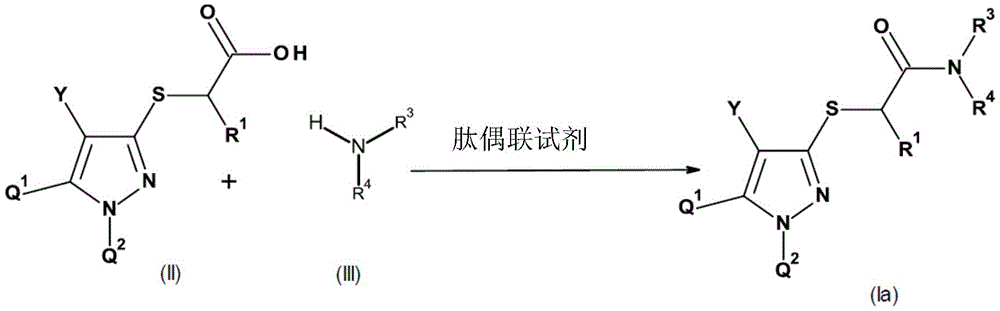
方案1plan 1
可通过本领域技术人员已知的方法或类似于本领域技术人员已知的方法通过通式(IV)的化合物的水解来合成通式(II)的酸(方案2)。水解可在碱或路易斯酸的存在下进行。碱可为碱金属(例如,锂、钠或钾)的氢氧化物盐,并且水解反应优选在室温至120℃的温度范围内进行。Acids of general formula (II) can be synthesized by hydrolysis of compounds of general formula (IV) by or analogously to methods known to those skilled in the art (Scheme 2). The hydrolysis can be carried out in the presence of a base or a Lewis acid. The base may be an alkali metal (eg, lithium, sodium or potassium) hydroxide salt, and the hydrolysis reaction is preferably carried out at a temperature ranging from room temperature to 120°C.

其中R′=(C1-C4)-烷基。wherein R'=(C 1 -C 4 )-alkyl.
方案2Scenario 2
可通过本领域技术人员已知的方法或类似于本领域技术人员已知的方法,在碱的存在下使用通式(VI)的卤化物来烷基化通式(V)的化合物合成通式(IV)的化合物(参见方案3)。碱可为碱金属(例如,锂、钠、钾或铯)的碳酸盐,并且水解反应优选在室温至150℃的温度范围内在适宜的溶剂(例如二氯甲烷、乙腈、N,N-二甲基甲酰胺或乙酸乙酯)中进行。参见J.Med.Chem.2011,54(16),5820-5835和WO2010/010154。Compounds of general formula (V) can be synthesized by alkylating compounds of general formula (V) using halides of general formula (VI) in the presence of a base by or analogously to methods known to those skilled in the art Compounds of (IV) (see Scheme 3). The base may be a carbonate of an alkali metal (eg, lithium, sodium, potassium, or cesium), and the hydrolysis reaction is preferably performed at a temperature ranging from room temperature to 150° C. in a suitable solvent (eg, dichloromethane, acetonitrile, N,N-dichloromethane) methylformamide or ethyl acetate). See J. Med. Chem. 2011, 54(16), 5820-5835 and WO2010/010154.

其中R′=(C1-C4)-烷基。wherein R'=(C 1 -C 4 )-alkyl.
其中X=卤素。where X = halogen.
方案3Scenario 3
方案4描述了通过通式(VII)的吡唑啉酮在硫化试剂(例如五硫化二磷或劳森试剂)的存在下在适宜的溶剂(例如甲苯)中反应来合成通式(V)的化合物。Scheme 4 describes the synthesis of compounds of general formula (V) by reacting pyrazolones of general formula (VII) in the presence of a sulfurizing reagent such as phosphorus pentasulfide or Lawson's reagent in a suitable solvent such as toluene.

方案4Scenario 4
方案5描述了通过通式(VIII)的吡唑与通式(IX)的卤代琥珀酰亚胺在适宜的溶剂(例如DMF)中反应来合成通式(VII)的化合物。Scheme 5 describes the synthesis of compounds of general formula (VII) by reacting pyrazoles of general formula (VIII) with halosuccinimides of general formula (IX) in a suitable solvent such as DMF.

其中X=卤素。where X = halogen.
方案5Scenario 5
可类似于从文献已知的方法由取代的3-吖嗪基丙炔酸衍生物和苯肼(方案8;例如:Adv.Synth.Catal.2014,356,3135-3147)或由取代的吖嗪基丙烯酸衍生物和苯肼(方案8;例如:J.Heterocyclic Chem.,49,130(2012))制备3-羟基吡唑(VIII)。Substituted 3-azinylpropynoic acid derivatives and phenylhydrazine (Scheme 8; eg: Adv. Synth. Catal. 2014, 356, 3135-3147) can be prepared analogously to methods known from the literature or by substituted azine 3-Hydroxypyrazoles (VIII) were prepared from oxazinyl acrylic acid derivatives and phenylhydrazine (Scheme 8; eg: J. Heterocyclic Chem., 49, 130 (2012)).
通式(X)的化合物经由通式(XII)的酸与通式(XI)的芳基肼或杂芳基肼在酰胺偶联试剂(例如T3P、二环己基碳二亚胺、N-(3-二甲基氨基丙基)-N′-乙基碳二亚胺、N,N′-羰基二咪唑、2-氯-1,3-二甲基咪唑氯化物或2-氯-1-甲基碘化吡啶)的存在下的酰胺偶联来合成(参见Chemistry of Peptide Synthesis,Ed.N.Leo Benoiton,Taylor&Francis,2006,ISBN-10:1-57444-454-9)。聚合物结合的试剂,例如聚合物结合的二环己基碳二亚胺,也适合于这种偶联反应。该反应优选在0℃至80℃的温度范围内在适宜的溶剂(例如二氯甲烷、四氢呋喃、乙腈、N,N-二甲基甲酰胺或乙酸乙酯)中并在碱(例如三乙胺、N,N-二异丙基乙胺或1,8-二氮杂双环[5.4.0]十一碳-7-烯)的存在下进行(参见方案8)。对于T3P肽偶联条件,参见Organic Process Research&Development 2009,13,900-906。Compounds of general formula (X) are coupled via an acid of general formula (XII) to an aryl or heteroaryl hydrazine of general formula (XI) in an amide coupling reagent such as T3P, dicyclohexylcarbodiimide, N-( 3-Dimethylaminopropyl)-N'-ethylcarbodiimide, N,N'-carbonyldiimidazole, 2-chloro-1,3-dimethylimidazole chloride or 2-chloro-1- synthesized by amide coupling in the presence of methylpyridine iodide (see Chemistry of Peptide Synthesis, Ed. N. Leo Benoiton, Taylor & Francis, 2006, ISBN-10:1-57444-454-9). Polymer-bound reagents, such as polymer-bound dicyclohexylcarbodiimide, are also suitable for this coupling reaction. The reaction is preferably carried out in a suitable solvent such as dichloromethane, tetrahydrofuran, acetonitrile, N,N-dimethylformamide or ethyl acetate and in a base such as triethylamine, N,N-diisopropylethylamine or 1,8-diazabicyclo[5.4.0]undec-7-ene) (see Scheme 8). For T3P peptide coupling conditions, see Organic Process Research & Development 2009, 13, 900-906.
通式(VIII)的3-羟基吡唑的合成通过通式(X)的化合物在卤化铜如碘化铜(I)、溴化铜(I)或酸如甲磺酸的存在下反应来进行。该反应优选在0℃至120℃的温度范围内在适宜的溶剂(例如1,2-二氯乙烷、乙腈、N,N-二甲基甲酰胺、正丙醇或乙酸乙酯)中进行。优选地,该反应在N,N-二甲基甲酰胺中进行。The synthesis of 3-hydroxypyrazoles of general formula (VIII) is carried out by reacting compounds of general formula (X) in the presence of copper halides such as copper(I) iodide, copper(I) bromide or acids such as methanesulfonic acid . The reaction is preferably carried out in a suitable solvent such as 1,2-dichloroethane, acetonitrile, N,N-dimethylformamide, n-propanol or ethyl acetate at a temperature ranging from 0°C to 120°C. Preferably, the reaction is carried out in N,N-dimethylformamide.

方案6Option 6
或者,通式(VIII)的化合物可经由通式(XIV)的酸与通式(XI)的芳基肼或杂芳基肼在酰胺偶联试剂(例如T3P、二环己基碳二亚胺、N-(3-二甲基氨基丙基)-N′-乙基碳二亚胺、N,N′-羰基二咪唑、2-氯-1,3-二甲基咪唑氯化物或2-氯-1-甲基碘化吡啶)的存在下的酰胺偶联来合成。该反应优选在0℃至80℃的温度范围内在适宜的溶剂(例如二氯甲烷、乙腈、N,N-二甲基甲酰胺或乙酸乙酯)中并在碱(例如三乙胺、N,N-二异丙基乙胺或1,8-二氮杂双环[5.4.0]十一碳-7-烯)的存在下进行(参见方案7)。Alternatively, compounds of general formula (VIII) can be coupled via acids of general formula (XIV) to aryl or heteroaryl hydrazines of general formula (XI) in amide coupling reagents such as T3P, dicyclohexylcarbodiimide, N-(3-Dimethylaminopropyl)-N'-ethylcarbodiimide, N,N'-carbonyldiimidazole, 2-chloro-1,3-dimethylimidazole chloride or 2-chloro -1-methylpyridine iodide) was synthesized by amide coupling. The reaction is preferably carried out in a suitable solvent (eg dichloromethane, acetonitrile, N,N-dimethylformamide or ethyl acetate) in a base (eg triethylamine, N,N, ethyl acetate) at a temperature ranging from 0°C to 80°C N-diisopropylethylamine or 1,8-diazabicyclo[5.4.0]undec-7-ene) (see Scheme 7).
通式(VIII)的3-羟基吡唑通过通式(XIII)的化合物在卤化铁例如氯化铁(III)的存在下的反应合成。该反应优选在0℃至120℃的温度范围内在适宜的溶剂(如1,2-二氯乙烷、乙腈、N,N-二甲基甲酰胺或乙酸乙酯)中进行。3-Hydroxypyrazoles of general formula (VIII) are synthesized by reaction of compounds of general formula (XIII) in the presence of an iron halide such as iron (III) chloride. The reaction is preferably carried out in a suitable solvent such as 1,2-dichloroethane, acetonitrile, N,N-dimethylformamide or ethyl acetate at a temperature ranging from 0°C to 120°C.

方案7Option 7
通式(XVI)的化合物可通过通式(XVIII)的3-羟基吡唑与通式(XVII)的芳基卤在卤化铜例如碘化铜(I)的存在下的N-芳基化来合成。该反应优选在0℃至120℃的温度范围内在适宜的溶剂(例如乙腈或N,N-二甲基甲酰胺)中并在碱(例如三乙胺或碳酸铯)的存在下进行(参见方案8)。通式(XVIII)的化合物可按本领域技术人员已知的类似方法制备(Chem.Med.Chem.2015,10,1184-1199)。Compounds of general formula (XVI) can be obtained by N-arylation of 3-hydroxypyrazoles of general formula (XVIII) with aryl halides of general formula (XVII) in the presence of copper halides such as copper(I) iodide synthesis. The reaction is preferably carried out at a temperature ranging from 0°C to 120°C in a suitable solvent (eg acetonitrile or N,N-dimethylformamide) in the presence of a base (eg triethylamine or cesium carbonate) (see Schemes 8). Compounds of general formula (XVIII) can be prepared by analogous methods known to those skilled in the art (Chem. Med. Chem. 2015, 10, 1184-1199).
通式(XV)的5-碘吡唑通过通式(XVI)的化合物在碱(如二异丙基氨基锂)和碘的存在下的反应合成。该反应(方案8)优选在-78℃至-60℃的温度范围内在适宜的溶剂如乙醚和四氢呋喃中进行。5-iodopyrazoles of general formula (XV) are synthesized by the reaction of compounds of general formula (XVI) in the presence of a base such as lithium diisopropylamide and iodine. The reaction (Scheme 8) is preferably carried out in a suitable solvent such as diethyl ether and tetrahydrofuran at a temperature ranging from -78°C to -60°C.

其中X=氯、溴和碘。where X = chlorine, bromine and iodine.
其中R=Bn(苄基)。where R=Bn (benzyl).
方案8Scenario 8
通式(XIX)的化合物可通过在合适溶剂中的式(XV)的化合物与Q1-M(XX)、加入适宜的量的过渡金属催化剂特别是钯催化剂(例如二乙酸钯或双(三苯基膦)二氯化钯(II))或镍催化剂(例如乙酰丙酮镍(II)或双(三苯基膦)氯化镍(II)),优选在升高的温度下在有机溶剂如1,2-二甲氧基乙烷中的反应制备(方案9)。“M”基团代表例如Mg-X、Zn-X、Sn((C1-C4)-烷基)3、锂、铜或B(ORb)(ORc),其中Rb和Rc基团独立地为例如氢、(C1-C4)-烷基,或者,如果基团Rb和Rc彼此键合,则它们一起为亚乙基(ethylene)或亚丙基(propylene)。通常合适的是R.D.Larsen,Organometallics in Process Chemistry 2004Springer Verlag;I.Tsuji,Palladium Reagents and Catalysts 2004Wiley;和M.Beller,C.Bolm,Transition Metals for Organic Synthesis 2004 VCH-Wiley中描述的交叉偶联方法。其他合适的合成方法描述于Chem.Rev.2006,106,2651;Platinum Metals Review,2009,53,183;Platinum Metals Review 2008,52,172;和Acc.Chem.Res.2008,41,1486中。Compounds of general formula (XIX) can be prepared by mixing a compound of formula (XV) with Q 1 -M(XX) in a suitable solvent, adding a suitable amount of a transition metal catalyst, especially a palladium catalyst such as palladium diacetate or bis(tris) phenylphosphine) palladium(II) dichloride or a nickel catalyst (eg nickel(II) acetylacetonate or bis(triphenylphosphine)nickel(II) chloride), preferably at elevated temperature in an organic solvent such as Reaction preparation in 1,2-dimethoxyethane (Scheme 9). The "M" group represents, for example, Mg-X, Zn-X, Sn((C 1 -C 4 )-alkyl) 3 , lithium, copper or B(OR b )(OR c ), where R b and R c The groups are independently eg hydrogen, (C 1 -C 4 )-alkyl, or, if the groups R b and R c are bonded to each other, together they are ethylene or propylene . Generally suitable are the cross-coupling methods described in RD Larsen, Organometallics in Process Chemistry 2004 Springer Verlag; I. Tsuji, Palladium Reagents and Catalysts 2004 Wiley; and M. Beller, C. Bolm, Transition Metals for Organic Synthesis 2004 VCH-Wiley. Other suitable synthetic methods are described in Chem. Rev. 2006, 106, 2651; Platinum Metals Review, 2009, 53, 183; Platinum Metals Review 2008, 52, 172; and Acc. Chem. Res. 2008, 41, 1486.
通式(VIII)的3-羟基吡唑可通过通式(XIX)的化合物在布朗斯特酸例如三氟甲磺酸的存在下的反应来合成。该反应优选在0℃至120℃的温度范围内在适宜的溶剂例如二氯甲烷中进行(方案9)。3-Hydroxypyrazoles of general formula (VIII) can be synthesized by the reaction of compounds of general formula (XIX) in the presence of a Bronsted acid such as trifluoromethanesulfonic acid. The reaction is preferably carried out in a suitable solvent such as dichloromethane at a temperature ranging from 0°C to 120°C (Scheme 9).
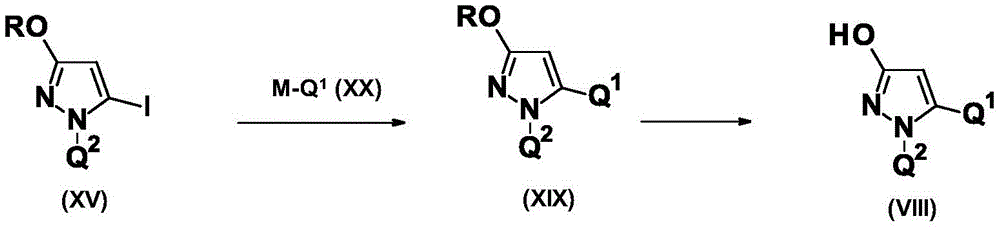
其中R=Bn(苄基)。where R=Bn (benzyl).
方案9Scenario 9
通式(XXII)的化合物可通过通式(XXIII)的化合物与通式(VI)的卤化物在碱的存在下通过本领域技术人员已知的方法或类似于本领域技术人员已知的方法烷基化来制备(参见方案10)。碱可为碱金属(例如,锂、钠、钾或铯)的碳酸盐,并且反应优选在室温至150℃的温度范围内在适宜的溶剂(例如二氯甲烷、乙腈、N,N-二甲基甲酰胺或乙酸乙酯)中进行。Compounds of general formula (XXII) can be obtained by combining compounds of general formula (XXIII) with halides of general formula (VI) in the presence of a base by methods known to those skilled in the art or analogous to those known to those skilled in the art prepared by alkylation (see Scheme 10). The base may be a carbonate of an alkali metal (eg, lithium, sodium, potassium, or cesium), and the reaction is preferably carried out at a temperature ranging from room temperature to 150° C. in a suitable solvent (eg, dichloromethane, acetonitrile, N,N-dimethylform) formamide or ethyl acetate).
通式(XXI)的化合物可通过重氮化或Sandmeyer反应与通式(XXII)的化合物使用惯用的有机和无机亚硝酸酯(如亚硝酸1,1-二甲基乙酯、亚硝酸叔丁酯或亚硝酸异戊酯)在可用试剂(如溴化/氯化铜(I)和铜(II)的混合物或碘)的存在下制备(方案10)。该反应优选在室温和0℃至120℃的温度范围内在适宜的溶剂如二氯甲烷、乙腈、N,N-二甲基甲酰胺或二碘甲烷中进行。方案10描述了通过通式(XXII)的吡唑与通式(IX)的卤代琥珀酰亚胺在适宜的溶剂例如DMF中的反应来合成通式(XXI)的化合物。Compounds of general formula (XXI) can be reacted with compounds of general formula (XXII) by diazotization or Sandmeyer reaction using conventional organic and inorganic nitrites (such as 1,1-dimethylethyl nitrite, tert-butyl nitrite). ester or isoamyl nitrite) in the presence of available reagents such as bromide/a mixture of copper(I) and copper(II) chloride or iodine (Scheme 10). The reaction is preferably carried out in a suitable solvent such as dichloromethane, acetonitrile, N,N-dimethylformamide or diiodomethane at room temperature and at a temperature ranging from 0°C to 120°C. Scheme 10 describes the synthesis of compounds of general formula (XXI) by the reaction of pyrazoles of general formula (XXII) with halosuccinimides of general formula (IX) in a suitable solvent such as DMF.
通式(IV)的化合物可通过在合适溶剂中的式(XXI)的化合物与Q1-M(XX)、加入适宜的量的过渡金属催化剂特别是钯催化剂(例如二乙酸钯或双(三苯基膦)二氯化钯(II))或镍催化剂(例如乙酰丙酮镍(II)或双(三苯基膦)氯化镍(II)),优选在升高的温度下在有机溶剂如1,2-二甲氧基乙烷中的反应制备(方案9)。“M”基团代表例如Mg-X、Zn-X、Sn((C1-C4)-烷基)3、锂、铜或B(ORb)(ORc),其中Rb和Rc基团独立地为例如氢、(C1-C4)-烷基,或者,如果基团Rb和Rc彼此键合,则它们一起为亚乙基或亚丙基。通常合适的是R.D.Larsen,Organometallics in Process Chemistry 2004Springer Verlag;I.Tsuji,PalladiumReagents and Catalysts 2004Wiley;和M.Beller,C.Bolm,Transition Metals forOrganic Synthesis 2004VCH-Wiley中描述的交叉偶联方法。其他合适的合成方法描述于Chem.Rev.2006,106,2651;Platinum Metals Review,2009,53,183;Platinum MetalsReview 2008,52,172;和Acc.Chem.Res.2008,41,1486中。Compounds of general formula (IV) can be prepared by mixing a compound of formula (XXI) with Q 1 -M(XX) in a suitable solvent, adding a suitable amount of a transition metal catalyst, especially a palladium catalyst such as palladium diacetate or bis(tris(triacetate)]. phenylphosphine) palladium(II) dichloride or a nickel catalyst (eg nickel(II) acetylacetonate or bis(triphenylphosphine)nickel(II) chloride), preferably at elevated temperature in an organic solvent such as Reaction preparation in 1,2-dimethoxyethane (Scheme 9). The "M" group represents, for example, Mg-X, Zn-X, Sn((C 1 -C 4 )-alkyl) 3 , lithium, copper or B(OR b )(OR c ), where R b and R c The groups are independently, for example, hydrogen, (C 1 -C 4 )-alkyl, or, if the groups R b and R c are bonded to each other, together they are ethylene or propylene. Generally suitable are the cross-coupling methods described in RD Larsen, Organometallics in Process Chemistry 2004 Springer Verlag; I. Tsuji, Palladium Reagents and Catalysts 2004 Wiley; and M. Beller, C. Bolm, Transition Metals for Organic Synthesis 2004 VCH-Wiley. Other suitable synthetic methods are described in Chem. Rev. 2006, 106, 2651; Platinum Metals Review, 2009, 53, 183; Platinum Metals Review 2008, 52, 172; and Acc. Chem. Res. 2008, 41, 1486.

其中R′=(C1-C4)-烷基。wherein R'=(C 1 -C 4 )-alkyl.
其中X=卤素。where X = halogen.
方案10Scenario 10
方案11描述了通过通式(XXIV)的吡唑啉酮在硫化试剂(例如五硫化二磷或劳森试剂)的存在下在适宜的溶剂例如甲苯中的反应来合成通式(XXIII)的化合物。通式(XXIV)的化合物是可市购的或可以类似于本领域技术人员已知的方法制备。Scheme 11 describes the synthesis of compounds of general formula (XXIII) by the reaction of pyrazolones of general formula (XXIV) in the presence of a sulfurizing reagent such as phosphorus pentasulfide or Lawson's reagent in a suitable solvent such as toluene. Compounds of general formula (XXIV) are commercially available or can be prepared analogously to methods known to those skilled in the art.

方案11Scenario 11
通式(IV)的化合物可通过通式(XXVI)的3-氨基吡唑与通式(XXV)的二硫化物在有机亚硝酸酯(例如亚硝酸1,1-二甲基乙酯、亚硝酸叔丁酯或亚硝酸异戊酯)的存在下在金属例如铜的存在下的反应来制备(参见方案12)。该反应优选在室温至120℃的温度范围内在适宜的溶剂例如二氯甲烷、乙腈、N,N-二甲基甲酰胺或1,2-二氯乙烷中进行。Compounds of general formula (IV) can be reacted with 3-aminopyrazoles of general formula (XXVI) and disulfides of general formula (XXV) in organic nitrites such as 1,1-dimethylethyl nitrite, sulfite prepared by reaction in the presence of tert-butyl nitrate or isoamyl nitrite) in the presence of a metal such as copper (see Scheme 12). The reaction is preferably carried out in a suitable solvent such as dichloromethane, acetonitrile, N,N-dimethylformamide or 1,2-dichloroethane at a temperature ranging from room temperature to 120°C.
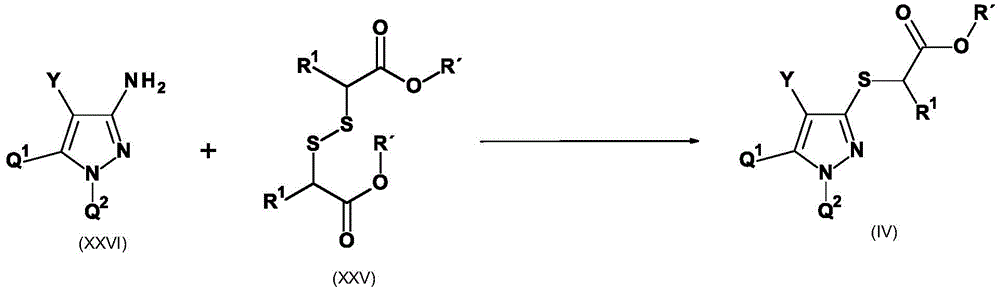
其中R′=(C1-C4)-烷基。wherein R'=(C 1 -C 4 )-alkyl.
其中X=卤素。where X = halogen.
方案12Scenario 12
可通过本领域技术人员已知的方法或类似于本领域技术人员已知的方法通过通式(XXVII)的化合物在路易斯酸例如三氟乙酸的存在下的反应来合成通式(XXVI)的酸(方案13)。该反应优选在室温至140℃的温度范围内进行。Acids of general formula (XXVI) can be synthesized by the reaction of compounds of general formula (XXVII) in the presence of a Lewis acid such as trifluoroacetic acid by methods known to those skilled in the art or analogously to methods known to those skilled in the art (Option 13). The reaction is preferably carried out at a temperature ranging from room temperature to 140°C.

其中R′=(C1-C4)-烷基。wherein R'=(C 1 -C 4 )-alkyl.
方案13Scenario 13
通式(XXVII)的化合物经由通式(XXIX)的酸与通式(XXVIII)的叠氮化物的Curtius反应来合成。该反应优选在0℃至100℃的温度范围内在适宜的溶剂(例如叔丁醇)中并在碱(例如三乙胺、N,N-二异丙基乙胺或1,8-二氮杂双环[5.4.0]十一碳-7-烯)的存在下进行(参见方案14)。Compounds of general formula (XXVII) are synthesized via the Curtius reaction of acids of general formula (XXIX) with azides of general formula (XXVIII). The reaction is preferably carried out at a temperature ranging from 0°C to 100°C in a suitable solvent such as tert-butanol and in a base such as triethylamine, N,N-diisopropylethylamine or 1,8-diazepine Bicyclo[5.4.0]undec-7-ene) (see Scheme 14).

方案14Scenario 14
可通过本领域技术人员已知的方法或类似于本领域技术人员已知的方法通过通式(XXX)的化合物的水解来合成通式(XXIX)的酸(方案15)。水解可在碱或路易斯酸的存在下进行。碱可为碱金属(例如,锂、钠或钾)的氢氧化物盐,并且水解反应优选在室温至120℃的温度范围内进行。Acids of general formula (XXIX) can be synthesized by hydrolysis of compounds of general formula (XXX) by or analogously to methods known to those skilled in the art (Scheme 15). The hydrolysis can be carried out in the presence of a base or a Lewis acid. The base may be an alkali metal (eg, lithium, sodium or potassium) hydroxide salt, and the hydrolysis reaction is preferably carried out at a temperature ranging from room temperature to 120°C.
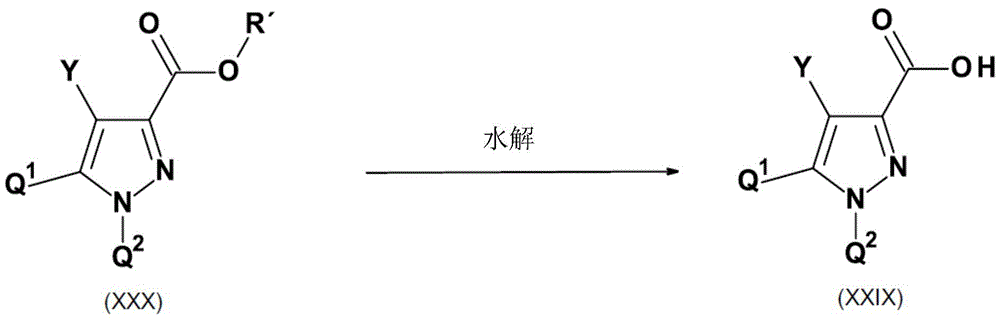
其中R′=(C1-C4)-烷基。wherein R'=(C 1 -C 4 )-alkyl.
方案15Scenario 15
方案16描述了通过通式(XXXI)的吡唑与通式(IX)的卤代琥珀酰亚胺在适宜的溶剂例如DMF中的反应来合成通式(XXX)的化合物。Scheme 16 describes the synthesis of compounds of general formula (XXX) by the reaction of pyrazoles of general formula (XXXI) with halosuccinimides of general formula (IX) in a suitable solvent such as DMF.
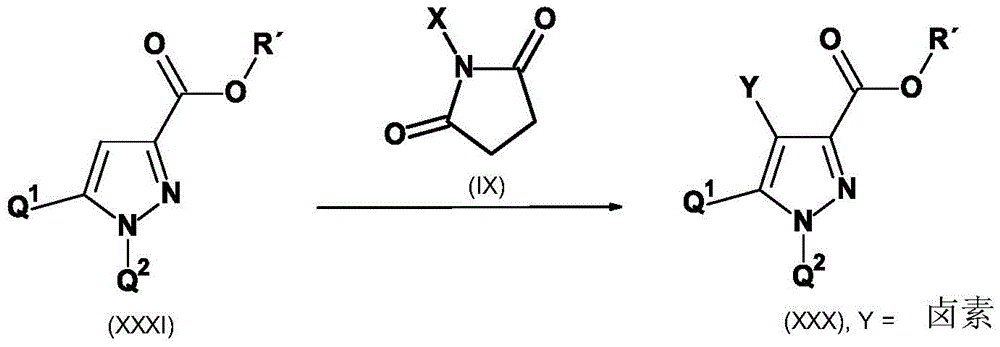
其中X=卤素。where X = halogen.
方案16Scenario 16
通式(XXXI)的化合物经由通式(XXXIII)的二酮酯与通式(XI)的芳基肼或杂芳基肼在布朗斯特酸(例如乙酸或氯化氢)的存在下在适宜的溶剂(例如甲醇、乙醇、异丙醇、正丁醇、四氢呋喃、二噁烷、甲苯或氯苯)中的缩合来合成(方案17)。该反应优选在0℃至150℃的温度范围内进行。通式(XI)和(XXXIII)的化合物是可市购的或可类似于本领域技术人员已知的方法制备。Compounds of general formula (XXXI) via diketoesters of general formula (XXXIII) with aryl or heteroaryl hydrazines of general formula (XI) in the presence of a Bronsted acid such as acetic acid or hydrogen chloride in a suitable solvent (eg methanol, ethanol, isopropanol, n-butanol, tetrahydrofuran, dioxane, toluene or chlorobenzene) to synthesize (Scheme 17). The reaction is preferably carried out at a temperature ranging from 0°C to 150°C. Compounds of general formula (XI) and (XXXIII) are commercially available or can be prepared analogously to methods known to those skilled in the art.

其中R′=(C1-C4)-烷基。wherein R'=(C 1 -C 4 )-alkyl.
方案17Option 17
通式(XXXIV)的化合物可例如通过在合适溶剂中的式(VII)的化合物与金属氰化物M-CN(XXXV)、加入适宜的量的过渡金属催化剂特别是钯催化剂(例如四(三苯基膦)钯(0)或二乙酸钯或双(三苯基膦)二氯化钯(II))或镍催化剂(例如乙酰丙酮镍(II)或双(三苯基膦)氯化镍(II)),优选在升高的温度下在有机溶剂(例如1,2-二甲氧基乙烷或N,N-二甲基甲酰胺)中的反应制备(方案18)。“M”基团代表例如镁、锌、锂或钠。通常合适的交叉偶联方法是R.D.Larsen,Organometallics in Process Chemistry 2004Springer Verlag;I.Tsuji,Palladium Reagents and Catalysts 2004Wiley;和M.Beller,C.Bolm,Transition Metals for Organic Synthesis 2004VCH-Wiley中描述的那些。其他合适的合成方法描述于Chem.Rev.2006,106,2651;Platinum Metals Review,2009,53,183;Platinum Metals Review 2008,52,172;和Acc.Chem.Res.2008,41,1486中。Compounds of general formula (XXXIV) can be prepared, for example, by combining a compound of formula (VII) with a metal cyanide M-CN(XXXV) in a suitable solvent, adding a suitable amount of a transition metal catalyst, especially a palladium catalyst such as tetrakis(triphenylene) ( II)), preferably by reaction at elevated temperature in organic solvents such as 1,2-dimethoxyethane or N,N-dimethylformamide (Scheme 18). The "M" group represents, for example, magnesium, zinc, lithium or sodium. Generally suitable cross-coupling methods are those described in R. D. Larsen, Organometallics in Process Chemistry 2004 Springer Verlag; I. Tsuji, Palladium Reagents and Catalysts 2004 Wiley; and M. Beller, C. Bolm, Transition Metals for Organic Synthesis 2004 VCH-Wiley. Other suitable synthetic methods are described in Chem. Rev. 2006, 106, 2651; Platinum Metals Review, 2009, 53, 183; Platinum Metals Review 2008, 52, 172; and Acc. Chem. Res. 2008, 41, 1486.

方案18Scheme 18
通式(XXXVI)和(XXXVII)的化合物可通过式(IV)的化合物在氧化剂例如mCPBA(3-氯过氧苯甲酸)的存在下在适宜的溶剂例如二氯甲烷或1,2-二氯乙烷中的反应来制备(方案19)。该反应优选在-30℃至100℃的温度范围内进行。Compounds of general formula (XXXVI) and (XXXVII) can be processed by compounds of formula (IV) in the presence of an oxidizing agent such as mCPBA (3-chloroperoxybenzoic acid) in a suitable solvent such as dichloromethane or 1,2-dichloromethane prepared by reaction in ethane (Scheme 19). The reaction is preferably carried out in a temperature range of -30°C to 100°C.

其中R′=(C1-C4)-烷基。wherein R'=(C 1 -C 4 )-alkyl.
方案19Scenario 19
方案20描述了通过通式(XXXVIII)的吡唑与通式(IX)的卤代琥珀酰亚胺在适宜的溶剂例如DMF中的反应来合成通式(IV)的化合物。Scheme 20 describes the synthesis of compounds of general formula (IV) by the reaction of pyrazoles of general formula (XXXVIII) with halosuccinimides of general formula (IX) in a suitable solvent such as DMF.
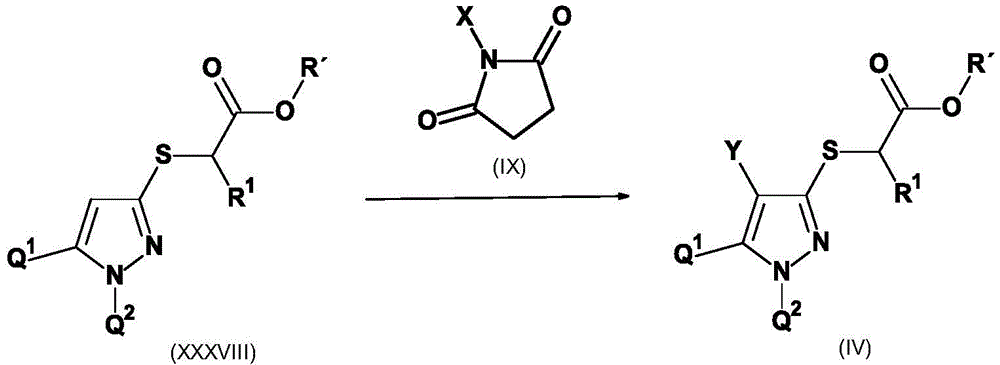
其中R′=(C1-C4)-烷基。wherein R'=(C 1 -C 4 )-alkyl.
方案20Scenario 20
下面举出了本发明的通式(I)的化合物的所选定详细合成实施例。提及的实施例编号对应于下表I.1至I.49中的编号方案。报告了接下来的部分中描述的化学实施例的1HNMR、13C-NMR和19F-NMR谱数据(1H NMR为400MHz,且13C-NMR为150MHz,且19F-NMR为375MHz,溶剂CDCl3、CD3OD或d6-DMSO,内标:四甲基硅烷δ=0.00ppm)在Bruker仪器上获得,并且列出的信号具有下面给出的含义:br=宽峰;s=单峰,d=双重峰,t=三重峰,dd=双二重峰,ddd=双重双二重峰,m=多重峰,q=四重峰,quint=五重峰,sext=六重峰,sept=七重峰,dq=双四重峰,dt=双三重峰。在非对映异构体混合物的情况下,报告两种非对映异构体中的每一种的显著信号或报告主要非对映异构体的特征信号。用于化学基团的缩写具有例如以下含义:Me=CH3,Et=CH2CH3,t-Hex=C(CH3)2CH(CH3)2,t-Bu=C(CH3)3,n-Bu=无分支丁基,n-Pr=无分支丙基,i-Pr=分支丙基,c-Pr=环丙基,c-Hex=环己基。Selected detailed synthesis examples of compounds of general formula (I) of the present invention are set forth below. The mentioned example numbers correspond to the numbering schemes in Tables I.1 to I.49 below. 1 HNMR, 13 C-NMR and 19 F-NMR spectral data are reported for the chemical examples described in the next sections ( 1 H NMR is 400 MHz, and 13 C-NMR is 150 MHz, and 19 F-NMR is 375 MHz, Solvents CDCl3 , CD3OD or d6- DMSO , internal standard: tetramethylsilane δ=0.00 ppm) were obtained on a Bruker instrument and the listed signals have the meanings given below: br=broad; s= singlet, d=doublet, t=triplet, dd=doublet doublet, ddd=double doublet, m=multiplet, q=quartet, quint=quintet, sext=sext , sept=septlet, dq=double quartet, dt=double triplet. In the case of a mixture of diastereomers, either a significant signal for each of the two diastereomers or a characteristic signal for the predominant diastereomer is reported. Abbreviations for chemical groups have, for example, the following meanings: Me=CH 3 , Et=CH 2 CH 3 , t-Hex=C(CH 3 ) 2 CH(CH 3 ) 2 , t-Bu=C(CH 3 ) 3 , n-Bu=unbranched butyl, n-Pr=unbranched propyl, i-Pr=branched propyl, c-Pr=cyclopropyl, c-Hex=cyclohexyl.
合成实施例:Synthesis Example:
合成实施例编号I-005:Synthesis Example No. 1-005:
合成阶段1:(3Z)-4-(3,4-二氟苯基)-4-羟基-2-氧代丁-3-烯酸乙酯Synthesis stage 1: (3Z)-4-(3,4-difluorophenyl)-4-hydroxy-2-oxobut-3-enoic acid ethyl ester

在氮气氛下将在THF中的1M三甲基-N-(三甲基甲硅烷基)硅烷氨基(silanaminide)锂溶液(33.63ml,33.63mmol,1.05当量)溶解在乙醚(80ml)中并用干冰浴冷却至-78℃。在10分钟内向该溶液中逐滴加入1-(3,4-二氟苯基)乙酮(5.0g,35.02mmol,1.0当量)在乙醚(20ml)中的溶液。所得反应混合物于-78℃搅拌3小时并然后于室温搅拌过夜。随后,用冰浴将悬浮液冷却到0至4℃,向其中加入1M盐酸并将混合物于室温搅拌30分钟。将反应混合物用乙酸乙酯萃取三次,每次100ml。用硫酸镁干燥有机相并减压除去溶剂。分离呈白色固体形式的所需(3Z)-4-(3,4-二氟苯基)-4-羟基-2-氧代丁-3-烯酸乙酯产物(8.00g,理论值的97%)。1H-NMR(400MHz,CDCl3δ,ppm)15.05(bs,1H),7.87-7.77(m,2H),7.33-7.29(m,1H),7.00(s,1H),4.41(q,2H),1.42(t,3H)。A 1M solution of lithium trimethyl-N-(trimethylsilyl)silanaminide (33.63 ml, 33.63 mmol, 1.05 equiv) in THF was dissolved in diethyl ether (80 ml) under nitrogen atmosphere and washed with dry ice The bath was cooled to -78°C. To this solution was added dropwise a solution of 1-(3,4-difluorophenyl)ethanone (5.0 g, 35.02 mmol, 1.0 equiv) in diethyl ether (20 ml) over 10 minutes. The resulting reaction mixture was stirred at -78°C for 3 hours and then at room temperature overnight. Subsequently, the suspension was cooled to 0 to 4°C with an ice bath, 1M hydrochloric acid was added thereto and the mixture was stirred at room temperature for 30 minutes. The reaction mixture was extracted three times with 100 ml each of ethyl acetate. The organic phase was dried over magnesium sulfate and the solvent was removed under reduced pressure. The desired (3Z)-4-(3,4-difluorophenyl)-4-hydroxy-2-oxobut-3-enoic acid ethyl ester product was isolated as a white solid (8.00 g, 97 of theory) %). 1 H-NMR (400MHz, CDCl 3 δ, ppm) 15.05 (bs, 1H), 7.87-7.77 (m, 2H), 7.33-7.29 (m, 1H), 7.00 (s, 1H), 4.41 (q, 2H) ), 1.42(t, 3H).
合成阶段2:5-(3,4-二氟苯基)-1-(2-氟苯基)-1H-吡唑-3-甲酸乙酯Synthesis stage 2: 5-(3,4-Difluorophenyl)-1-(2-fluorophenyl)-1H-pyrazole-3-carboxylic acid ethyl ester
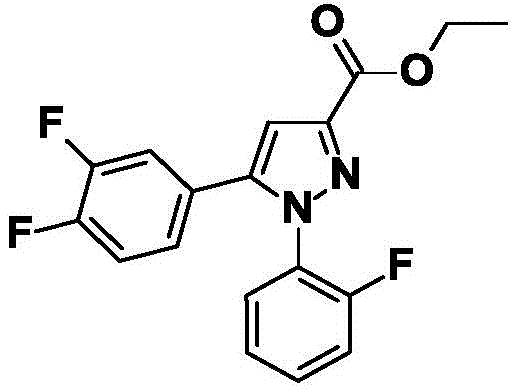
将(3Z)-4-(3,4-二氟苯基)-4-羟基-2-氧代丁-3-烯酸乙酯(2.0g,7.81mmol,1.0当量)和(2-氟苯基)肼盐酸盐(1:1)(1.90g,11.71mmol,1.5当量)悬浮在1.25M的氯化氢/乙醇(30ml)中并加热至沸腾4小时。用饱和碳酸氢钠溶液中和该反应混合物,并且接着用二氯甲烷萃取三次,每次50ml。用硫酸镁干燥有机相并减压除去溶剂。通过柱色谱法(乙酸乙酯/庚烷梯度)对所得粗产物的最终纯化,分离出呈黄色油形式的5-(3,4-二氟苯基)-1-(2-氟苯基)-1H-吡唑-3-甲酸乙酯(3.02g,理论值的98%)。1H-NMR(400MHz,CDCl3δ,ppm)7.57-7.53(m,1H),7.47-7.41(m,1H),7.29-7.25(m,1H),7.13-7.01(m,4H),6.97-6.93(m,1H),4.46(q,2H),1.43(t,3H)。Combine (3Z)-4-(3,4-difluorophenyl)-4-hydroxy-2-oxobut-3-enoic acid ethyl ester (2.0 g, 7.81 mmol, 1.0 equiv) and (2-fluorobenzene) (base) hydrazine hydrochloride (1:1) (1.90 g, 11.71 mmol, 1.5 equiv) was suspended in 1.25 M hydrogen chloride/ethanol (30 ml) and heated to boiling for 4 hours. The reaction mixture was neutralized with saturated sodium bicarbonate solution and then extracted with three 50 ml portions of dichloromethane. The organic phase was dried over magnesium sulfate and the solvent was removed under reduced pressure. Final purification of the resulting crude product by column chromatography (ethyl acetate/heptane gradient) isolated 5-(3,4-difluorophenyl)-1-(2-fluorophenyl) as a yellow oil -1H-Pyrazole-3-carboxylic acid ethyl ester (3.02 g, 98% of theory). 1 H-NMR (400MHz, CDCl 3 δ, ppm) 7.57-7.53 (m, 1H), 7.47-7.41 (m, 1H), 7.29-7.25 (m, 1H), 7.13-7.01 (m, 4H), 6.97 -6.93 (m, 1H), 4.46 (q, 2H), 1.43 (t, 3H).
合成阶段3:4-溴-5-(3,4-二氟苯基)-1-(2-氟苯基)-1H-吡唑-3-甲酸乙酯Synthesis stage 3: 4-Bromo-5-(3,4-difluorophenyl)-1-(2-fluorophenyl)-1H-pyrazole-3-carboxylic acid ethyl ester
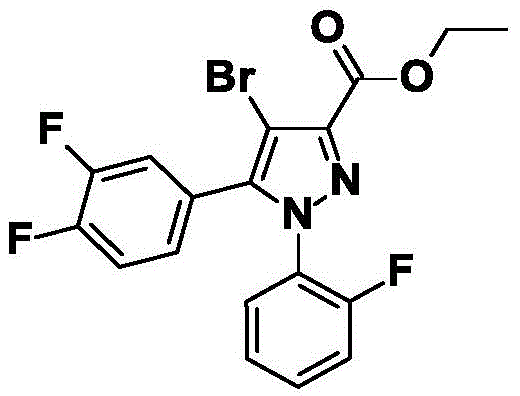
将5-(3,4-二氟苯基)-1-(2-氟苯基)-1H-吡唑-3-甲酸乙酯(2.38g,6.87mmol,1.0当量)溶解在乙酸(20ml)中,并于室温下加入溴(1.10g,6.87mmol,1.0当量)。所得反应混合物于室温搅拌2小时,并且接着加入更多的溴(0.55g,3.43mmol,0.5当量)。将反应于室温下搅拌过夜,并且接着加入冰水(150ml),产生沉淀。将沉淀溶解在二氯甲烷(100ml)中并用饱和硫代硫酸钠溶液萃取。用硫酸镁干燥有机相并减压除去溶剂。通过柱色谱法(乙酸乙酯/庚烷梯度)对所得粗产物的最终纯化,分离出呈白色固体形式的4-溴-5-(3,4-二氟苯基)-1-(2-氟苯基)-1H-吡唑-3-甲酸乙酯(2.4g,理论值的78%)。1H-NMR(400MHz,CDCl3δ,ppm)7.51-7.45(m,1H),7.44-7.39(m,1H),7.27-7.22(m,1H),7.17-6.98(m,4H),4.49(q,2H),1.44(t,3H)。5-(3,4-Difluorophenyl)-1-(2-fluorophenyl)-1H-pyrazole-3-carboxylic acid ethyl ester (2.38 g, 6.87 mmol, 1.0 equiv) was dissolved in acetic acid (20 ml) and bromine (1.10 g, 6.87 mmol, 1.0 equiv) was added at room temperature. The resulting reaction mixture was stirred at room temperature for 2 hours, and then more bromine (0.55 g, 3.43 mmol, 0.5 equiv) was added. The reaction was stirred at room temperature overnight, and then ice water (150 ml) was added, resulting in a precipitate. The precipitate was dissolved in dichloromethane (100 ml) and extracted with saturated sodium thiosulfate solution. The organic phase was dried over magnesium sulfate and the solvent was removed under reduced pressure. Final purification of the resulting crude product by column chromatography (ethyl acetate/heptane gradient) isolated 4-bromo-5-(3,4-difluorophenyl)-1-(2- Fluorophenyl)-1H-pyrazole-3-carboxylic acid ethyl ester (2.4 g, 78% of theory). 1 H-NMR (400MHz, CDCl 3 δ, ppm) 7.51-7.45 (m, 1H), 7.44-7.39 (m, 1H), 7.27-7.22 (m, 1H), 7.17-6.98 (m, 4H), 4.49 (q, 2H), 1.44 (t, 3H).
合成阶段4:4-溴-5-(3,4-二氟苯基)-1-(2-氟苯基)-1H-吡唑-3-甲酸Synthesis Stage 4: 4-Bromo-5-(3,4-difluorophenyl)-1-(2-fluorophenyl)-1H-pyrazole-3-carboxylic acid

将4-溴-5-(3,4-二氟苯基)-1-(2-氟苯基)-1H-吡唑-3-甲酸乙酯(2.08g,4.88mmol,1.0当量)和氢氧化锂(350.6mg,14.64mmol,3.0当量)溶解在THF和水的混合物(18ml,THF:水=7:2)中并加热至沸腾6小时。冷却后,用2M盐酸酸化该溶液并用乙酸乙酯(50ml)萃取两次。用硫酸镁干燥有机相并减压除去溶剂。分离出呈白色固体形式的4-溴-5-(3,4-二氟苯基)-1-(2-氟苯基)-1H-吡唑-3-甲酸(1.51g,理论值的77%)。1H-NMR(400MHz,CDCl3δ,ppm)7.52-7.42(m,1H),7.29-7.26(m,1H),7.48(m,1H),7.19-7.08(m,3H),7.03-7.00(m,1H)。4-Bromo-5-(3,4-difluorophenyl)-1-(2-fluorophenyl)-1H-pyrazole-3-carboxylic acid ethyl ester (2.08 g, 4.88 mmol, 1.0 equiv) and hydrogen Lithium oxide (350.6 mg, 14.64 mmol, 3.0 equiv) was dissolved in a mixture of THF and water (18 ml, THF:water=7:2) and heated to boiling for 6 hours. After cooling, the solution was acidified with 2M hydrochloric acid and extracted twice with ethyl acetate (50 ml). The organic phase was dried over magnesium sulfate and the solvent was removed under reduced pressure. 4-Bromo-5-(3,4-difluorophenyl)-1-(2-fluorophenyl)-1H-pyrazole-3-carboxylic acid (1.51 g, 77 theoretical) was isolated as a white solid %). 1 H-NMR (400MHz, CDCl 3 δ, ppm) 7.52-7.42 (m, 1H), 7.29-7.26 (m, 1H), 7.48 (m, 1H), 7.19-7.08 (m, 3H), 7.03-7.00 (m, 1H).
合成阶段5:[4-溴-5-(3,4-二氟苯基)-1-(2-氟苯基)-1H-吡唑-3-基]氨基甲酸叔丁酯Synthetic stage 5: tert-butyl [4-bromo-5-(3,4-difluorophenyl)-1-(2-fluorophenyl)-1H-pyrazol-3-yl]carbamate
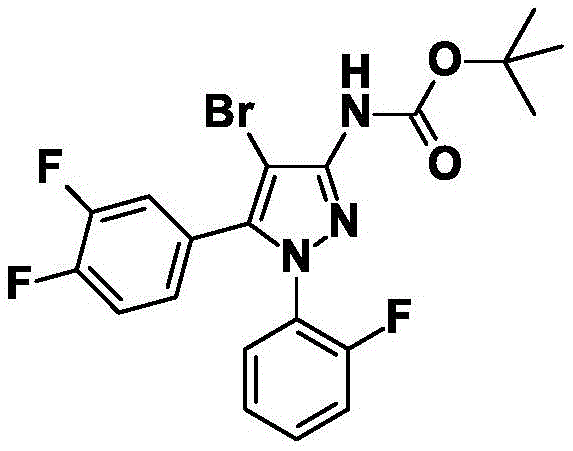
将4-溴-5-(3,4-二氟苯基)-1-(2-氟苯基)-1H-吡唑-3-甲酸(1.02g,2.57mmol,1.0当量)和三乙胺(0.90ml,6.42mmol,2.5当量)溶解在叔丁醇(15ml)中,并于室温加入二苯基磷叠氮化物(0.55ml,2.57mmol,1.0当量)。反应于60℃搅拌4小时,在此过程中发生气体逸出。冷却至室温后,向反应溶液中加入饱和碳酸氢钠溶液(10ml),并将混合物用乙酸乙酯(50ml)萃取两次。用硫酸镁干燥有机相并减压除去溶剂。通过柱色谱法(乙酸乙酯/庚烷梯度)对所得粗产物的最终纯化,分离出呈白色固体形式的[4-溴-5-(3,4-二氟苯基)-1-(2-氟苯基)-1H-吡唑-3-基]氨基甲酸叔丁酯(625mg,理论值的51%)。1H-NMR(400MHz,CDCl3δ,ppm)7.52-7.48(m,1H),7.38-7.32(m,1H),7.21(dt,1H),7.15-7.09(m,2H),7.05-6.97(m,2H),6.48(bs,1H),1.56(s,9H)。4-Bromo-5-(3,4-difluorophenyl)-1-(2-fluorophenyl)-1H-pyrazole-3-carboxylic acid (1.02 g, 2.57 mmol, 1.0 equiv) and triethylamine (0.90 mL, 6.42 mmol, 2.5 equiv) was dissolved in tert-butanol (15 mL) and diphenylphosphonium azide (0.55 mL, 2.57 mmol, 1.0 equiv) was added at room temperature. The reaction was stirred at 60°C for 4 hours, during which time gas evolution occurred. After cooling to room temperature, saturated sodium bicarbonate solution (10 ml) was added to the reaction solution, and the mixture was extracted twice with ethyl acetate (50 ml). The organic phase was dried over magnesium sulfate and the solvent was removed under reduced pressure. Final purification of the resulting crude product by column chromatography (ethyl acetate/heptane gradient) isolated [4-bromo-5-(3,4-difluorophenyl)-1-(2) as a white solid -Fluorophenyl)-1H-pyrazol-3-yl]carbamate tert-butyl ester (625 mg, 51% of theory). 1 H-NMR (400MHz, CDCl 3 δ, ppm) 7.52-7.48 (m, 1H), 7.38-7.32 (m, 1H), 7.21 (dt, 1H), 7.15-7.09 (m, 2H), 7.05-6.97 (m, 2H), 6.48 (bs, 1H), 1.56 (s, 9H).
合成阶段6:4-溴-5-(3,4-二氟苯基)-1-(2-氟苯基)-1H-吡唑-3-胺Synthesis Stage 6: 4-Bromo-5-(3,4-difluorophenyl)-1-(2-fluorophenyl)-1H-pyrazol-3-amine

将[4-溴-5-(3,4-二氟苯基)-1-(2-氟苯基)-1H-吡唑-3-基]氨基甲酸叔丁酯(625mg,1.34mmol,1.0当量)和三氟乙酸(0.21ml,2.67mmol,2.0当量)溶解在二氯甲烷(20ml)中并加热至沸腾2小时。冷却后,用饱和碳酸氢钠溶液(10ml)稀释反应混合物,并且接着用DCM(50ml)萃取两次。分离出呈白色固体形式的4-溴-5-(3,4-二氟苯基)-1-(2-氟苯基)-1H-吡唑-3-胺(480mg,理论值的99%)。1H-NMR(400MHz,CDCl3δ,ppm)7.96(bs,2H),7.46-7.36(m,2H),7.26-7.23(m,1H),7.18-7.10(m,3H),7.08-7.00(m,1H)。[4-Bromo-5-(3,4-difluorophenyl)-1-(2-fluorophenyl)-1H-pyrazol-3-yl]carbamic acid tert-butyl ester (625 mg, 1.34 mmol, 1.0 equiv) and trifluoroacetic acid (0.21 ml, 2.67 mmol, 2.0 equiv) were dissolved in dichloromethane (20 ml) and heated to boiling for 2 hours. After cooling, the reaction mixture was diluted with saturated sodium bicarbonate solution (10ml) and then extracted twice with DCM (50ml). 4-Bromo-5-(3,4-difluorophenyl)-1-(2-fluorophenyl)-1H-pyrazol-3-amine (480 mg, 99% of theory) was isolated as a white solid ). 1 H-NMR (400MHz, CDCl 3 δ, ppm) 7.96 (bs, 2H), 7.46-7.36 (m, 2H), 7.26-7.23 (m, 1H), 7.18-7.10 (m, 3H), 7.08-7.00 (m, 1H).
合成阶段7:{[4-溴-5-(3,4-二氟苯基)-1-(2-氟苯基)-1H-吡唑-3-基]硫烷基}乙酸乙酯(实施例编号I-002)Synthetic stage 7: ethyl {[4-bromo-5-(3,4-difluorophenyl)-1-(2-fluorophenyl)-1H-pyrazol-3-yl]sulfanyl}acetate ( Example number I-002)
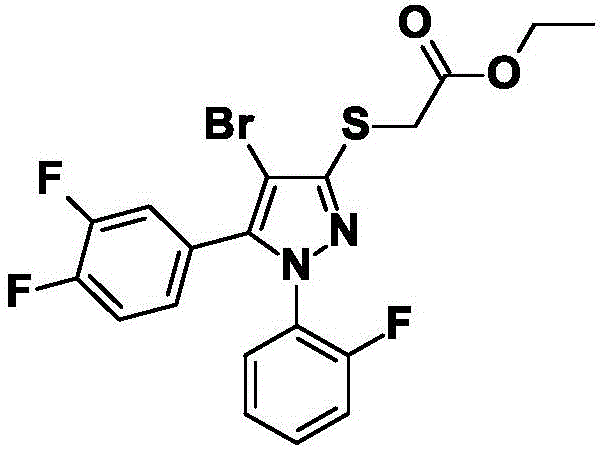
将4-溴-5-(3,4-二氟苯基)-1-(2-氟苯基)-1H-吡唑-3-胺(223mg,0.61mmol,1.0当量)、2,2'-二硫烷二基二乙酸二乙酯(0.22ml,1.21mmol,2当量)和铜粉(7.70mg,0.12mmol,0.2当量)悬浮在1,2-二氯乙烷(10ml)中并加热至60℃保持15分钟。随后,逐滴加入亚硝酸叔丁酯(0.22ml,1.21mmol,2.0当量)并将反应混合物加热至80℃保持4小时。冷却后,用水(10ml)和二氯甲烷(30ml)稀释反应混合物,并且接着用DCM(50ml)萃取两次。用相分离器分离相。通过柱色谱法(乙酸乙酯/庚烷梯度)对所得粗产物的最终纯化,分离出呈白色固体形式的{[4-溴-5-(3,4-二氟苯基)-1-(2-氟苯基)-1H-吡唑-3-基]硫烷基}乙酸乙酯(129mg,理论值的44%)。1H-NMR(400MHz,CDCl3δ,ppm)7.44-7.34(m,2H),7.26-7.20(m,1H),7.13-7.02(m,3H),6.99-6.96(m,1H),4.22(q,2H),3.89(s,2H),1.24(t,3H)。4-Bromo-5-(3,4-difluorophenyl)-1-(2-fluorophenyl)-1H-pyrazol-3-amine (223 mg, 0.61 mmol, 1.0 equiv), 2,2' - Diethyl disulfanediyldiacetate (0.22ml, 1.21mmol, 2eq) and copper powder (7.70mg, 0.12mmol, 0.2eq) were suspended in 1,2-dichloroethane (10ml) and heated to 60°C for 15 minutes. Subsequently, tert-butyl nitrite (0.22 ml, 1.21 mmol, 2.0 equiv) was added dropwise and the reaction mixture was heated to 80°C for 4 hours. After cooling, the reaction mixture was diluted with water (10ml) and dichloromethane (30ml) and then extracted twice with DCM (50ml). The phases were separated with a phase separator. Final purification of the resulting crude product by column chromatography (ethyl acetate/heptane gradient) isolated {[4-bromo-5-(3,4-difluorophenyl)-1-() as a white solid 2-Fluorophenyl)-1H-pyrazol-3-yl]sulfanyl}ethyl acetate (129 mg, 44% of theory). 1 H-NMR (400MHz, CDCl 3 δ, ppm) 7.44-7.34 (m, 2H), 7.26-7.20 (m, 1H), 7.13-7.02 (m, 3H), 6.99-6.96 (m, 1H), 4.22 (q, 2H), 3.89 (s, 2H), 1.24 (t, 3H).
合成阶段8:{[4-溴-5-(3,4-二氟苯基)-1-(2-氟苯基)-1H-吡唑-3-基]硫烷基}乙酸(实施例编号I-005)Synthetic stage 8: {[4-Bromo-5-(3,4-difluorophenyl)-1-(2-fluorophenyl)-1H-pyrazol-3-yl]sulfanyl}acetic acid (Example No. I-005)
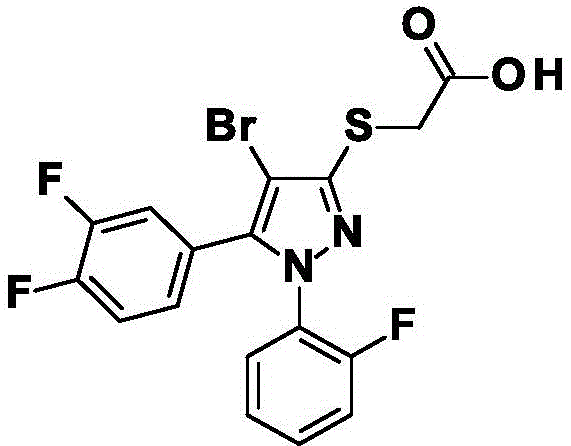
将{[4-溴-5-(3,4-二氟苯基)-1-(2-氟苯基)-1H-吡唑-3-基]硫烷基}乙酸乙酯(83mg,0.18mmol,1.0当量)和氢氧化锂(12.6mg,0.53mmol,3.0当量)溶解在THF和水的混合物(9ml,THF:水=7:2)中并加热至沸腾6小时。冷却后,用2M盐酸酸化该溶液并用乙酸乙酯(50ml)萃取两次。用硫酸镁干燥有机相并减压除去溶剂。分离出呈白色固体形式的{[4-溴-5-(3,4-二氟苯基)-1-(2-氟苯基)-1H-吡唑-3-基]硫烷基}乙酸(56mg,理论值的68%)。1H-NMR(400MHz,CDCl3δ,ppm)7.45-7.35(m,2H),7.27-7.22(m,1H),7.18-7.09(m,3H),7.01-6.97(m,3H),3.86(s,2H)。Ethyl {[4-bromo-5-(3,4-difluorophenyl)-1-(2-fluorophenyl)-1H-pyrazol-3-yl]sulfanyl}acetate (83 mg, 0.18 mmol, 1.0 equiv) and lithium hydroxide (12.6 mg, 0.53 mmol, 3.0 equiv) were dissolved in a mixture of THF and water (9 ml, THF:water=7:2) and heated to boiling for 6 hours. After cooling, the solution was acidified with 2M hydrochloric acid and extracted twice with ethyl acetate (50 ml). The organic phase was dried over magnesium sulfate and the solvent was removed under reduced pressure. {[4-Bromo-5-(3,4-difluorophenyl)-1-(2-fluorophenyl)-1H-pyrazol-3-yl]sulfanyl}acetic acid was isolated as a white solid (56 mg, 68% of theory). 1 H-NMR (400MHz, CDCl 3 δ, ppm) 7.45-7.35 (m, 2H), 7.27-7.22 (m, 1H), 7.18-7.09 (m, 3H), 7.01-6.97 (m, 3H), 3.86 (s, 2H).
合成实施例编号I-008:Synthesis Example No. 1-008:
合成阶段1:{[4-溴-1-(2,3-二氟苯基)-5-苯基-1H-吡唑-3-基]磺酰基}乙酸乙酯Synthetic stage 1: ethyl {[4-bromo-1-(2,3-difluorophenyl)-5-phenyl-1H-pyrazol-3-yl]sulfonyl}acetate

将{[4-溴-1-(2,3-二氟苯基)-5-苯基-1H-吡唑-3-基]硫烷基}乙酸乙酯(115mg,0.25mmol,1.0当量)溶解在二氯甲烷(5ml)中。向该溶液中加入3-氯过氧苯甲酸(114mg,0.51mmol,2.0当量,纯度77%)。所得反应混合物于室温搅拌过夜。用二氯甲烷(30ml)稀释该反应混合物并用饱和碳酸氢钠溶液萃取。用硫酸镁干燥有机相并减压除去溶剂。通过柱色谱法(乙酸乙酯/庚烷梯度)对所得粗产物的最终纯化,分离出呈无色固体形式的{[4-溴-1-(2,3-二氟苯基)-5-苯基-1H-吡唑-3-基]磺酰基}乙酸乙酯(90mg,理论值的55%,纯度80%)。1H-NMR(400MHz,CDCl3δ,ppm)7.71-7.63(m,2H),7.58-7.32(m,6H),4.76(s,2H),4.12(q,2H),1.13(t,3H)。Ethyl {[4-bromo-1-(2,3-difluorophenyl)-5-phenyl-1H-pyrazol-3-yl]sulfanyl}acetate (115 mg, 0.25 mmol, 1.0 equiv) Dissolve in dichloromethane (5ml). To this solution was added 3-chloroperoxybenzoic acid (114 mg, 0.51 mmol, 2.0 equiv, 77% purity). The resulting reaction mixture was stirred at room temperature overnight. The reaction mixture was diluted with dichloromethane (30 ml) and extracted with saturated sodium bicarbonate solution. The organic phase was dried over magnesium sulfate and the solvent was removed under reduced pressure. Final purification of the resulting crude product by column chromatography (ethyl acetate/heptane gradient) isolated {[4-bromo-1-(2,3-difluorophenyl)-5- as a colorless solid Ethyl phenyl-1H-pyrazol-3-yl]sulfonyl}acetate (90 mg, 55% of theory, 80% pure). 1 H-NMR (400MHz, CDCl 3 δ, ppm) 7.71-7.63 (m, 2H), 7.58-7.32 (m, 6H), 4.76 (s, 2H), 4.12 (q, 2H), 1.13 (t, 3H) ).
合成实施例编号II-001:Synthesis Example No. II-001:
合成阶段1:1H-吡唑-3-醇Synthesis stage 1: 1H-pyrazol-3-ol

将(2E)-3-甲氧基丙烯酸甲酯(20.00g,172.24mmol,1.0当量)溶解在甲醇(15ml)中,并逐滴加入水合肼(1:1)(8.38ml,172.24mmol,1当量),在此过程中将反应混合物加热直至沸腾。随后,将反应混合物加热至沸腾2小时,并且接着减压浓缩。该粗产物不经进一步纯化即用于下一合成阶段中。分离出呈黄色油形式的1H-吡唑-3-醇(15.30g,理论值的95%)。1H-NMR(400MHz,CDCl3δ,ppm)9.85(bs,1H),7.35(d,1H),5.43(d,1H)。Methyl (2E)-3-methoxyacrylate (20.00 g, 172.24 mmol, 1.0 equiv) was dissolved in methanol (15 ml) and hydrazine hydrate (1:1) (8.38 ml, 172.24 mmol, 1 ) was added dropwise equiv.), during which time the reaction mixture was heated to boiling. Subsequently, the reaction mixture was heated to boiling for 2 hours and then concentrated under reduced pressure. The crude product was used in the next synthesis stage without further purification. 1H-pyrazol-3-ol (15.30 g, 95% of theory) was isolated as a yellow oil. 1 H-NMR (400 MHz, CDCl 3 δ, ppm) 9.85 (bs, 1H), 7.35 (d, 1H), 5.43 (d, 1H).
合成阶段2:1-(3-羟基-1H-吡唑-1-基)乙酮Synthesis Stage 2: 1-(3-Hydroxy-1H-pyrazol-1-yl)ethanone

将1H-吡唑-3-醇(15.30g,181.97mmol,1.0当量)溶解在吡啶(100ml)中。于30分钟内向该溶液中逐滴加入乙酸酐(19.00ml,201.37mmol)和吡啶(10ml)的混合物。将所得反应混合物加热至100℃的温度保持2小时。冷却至室温后,减压除去溶剂。残余物与乙醚(50ml)一起搅拌,在此过程中其结晶。分离出呈浅黄色固体形式的1-(3-羟基-1H-吡唑-1-基)乙酮(18.00g,理论值的78%)。1H-NMR(400MHz,CDCl3δ,ppm)10.98(bs,1H),8.12(d,1H),6.01(d,2H),2.47(s,3H)。lH-pyrazol-3-ol (15.30 g, 181.97 mmol, 1.0 equiv) was dissolved in pyridine (100 ml). To this solution was added a mixture of acetic anhydride (19.00 ml, 201.37 mmol) and pyridine (10 ml) dropwise over 30 minutes. The resulting reaction mixture was heated to a temperature of 100°C for 2 hours. After cooling to room temperature, the solvent was removed under reduced pressure. The residue was stirred with diethyl ether (50 ml), during which time it crystallized. 1-(3-Hydroxy-1H-pyrazol-1-yl)ethanone (18.00 g, 78% of theory) was isolated as a pale yellow solid. 1 H-NMR (400 MHz, CDCl 3 δ, ppm) 10.98 (bs, 1H), 8.12 (d, 1H), 6.01 (d, 2H), 2.47 (s, 3H).
合成阶段3:3-(苄氧基)-1H-吡唑Synthetic stage 3: 3-(benzyloxy)-1H-pyrazole

将1-(3-羟基-1H-吡唑-1-基)乙酮(18.00g,142.73mmol,1.0当量)、(溴甲基)苯(16.98ml,142.73mmol,1.0当量)和碳酸钾(19.73g,142.73mmol,1.0当量)悬浮在丁烷-2-酮(200ml)中并加热至沸腾3小时。冷却后,过滤反应混合物并减压浓缩滤液。将残余物溶解在THF(150ml)和甲醇(150ml)中,并加入6M的氢氧化钠溶液(24ml)。反应混合物于室温搅拌1小时,并且接着减压浓缩溶剂。将残余物溶解在二氯甲烷(150ml)中并用水(50ml)洗涤两次。用硫酸镁干燥有机相并减压除去溶剂。该粗产物不经进一步纯化即用于下一合成阶段中。分离出呈黄色油形式的3-(苄氧基)-1H-吡唑(19.82g,理论值的75%)。1H-NMR(400MHz,CDCl3δ,ppm)10.55(bs,1H),7.43-7.23(m,6H),5.74(d,1H),5.20(s,2H)。Combine 1-(3-hydroxy-1H-pyrazol-1-yl)ethanone (18.00 g, 142.73 mmol, 1.0 equiv), (bromomethyl)benzene (16.98 ml, 142.73 mmol, 1.0 equiv) and potassium carbonate ( 19.73 g, 142.73 mmol, 1.0 equiv) was suspended in butan-2-one (200 ml) and heated to boiling for 3 hours. After cooling, the reaction mixture was filtered and the filtrate was concentrated under reduced pressure. The residue was dissolved in THF (150ml) and methanol (150ml) and 6M sodium hydroxide solution (24ml) was added. The reaction mixture was stirred at room temperature for 1 hour, and then the solvent was concentrated under reduced pressure. The residue was dissolved in dichloromethane (150ml) and washed twice with water (50ml). The organic phase was dried over magnesium sulfate and the solvent was removed under reduced pressure. The crude product was used in the next synthesis stage without further purification. 3-(Benzyloxy)-1H-pyrazole (19.82 g, 75% of theory) was isolated as a yellow oil. 1 H-NMR (400 MHz, CDCl 3 δ, ppm) 10.55 (bs, 1H), 7.43-7.23 (m, 6H), 5.74 (d, 1H), 5.20 (s, 2H).
合成阶段4:3-(苄氧基)-1-(2-氟苯基)-1H-吡唑Synthetic stage 4: 3-(benzyloxy)-1-(2-fluorophenyl)-1H-pyrazole

将3-(苄氧基)-1H-吡唑(2.74g,15.73mmol,1.0当量)、1-氟-2-碘苯(1.83ml,15.73mmol,1当量)、碘化铜(I)(299mg,1.57mmol,0.10当量)、碳酸钾(5.43g,39.31mmol,2.50当量)和N,N'-二甲基乙烷-1,2-二胺(0.87ml,7.88mmol,0.10当量)悬浮在甲苯(25ml)中并加热至115℃保持5小时。减压除去溶剂,并用二氯甲烷(50ml)和水(20ml)萃取残余物。用硫酸镁干燥有机相并减压除去溶剂。通过柱色谱法(乙酸乙酯/庚烷梯度)对所得粗产物的最终纯化,分离出呈黄色固体形式的3-(苄氧基)-1-(2-氟苯基)-1H-吡唑(2.09g,理论值的49%,纯度80%)。1H-NMR(400MHz,CDCl3δ,ppm)7.91-7.85(m,2H),7.51-7.49(m,2H),7.42-7.32(m,3H),7.25-7.16(m,3H),5.95(d,1H),5.32(s,2H)。Combine 3-(benzyloxy)-1H-pyrazole (2.74 g, 15.73 mmol, 1.0 equiv), 1-fluoro-2-iodobenzene (1.83 ml, 15.73 mmol, 1 equiv), copper(I) iodide ( 299 mg, 1.57 mmol, 0.10 equiv), potassium carbonate (5.43 g, 39.31 mmol, 2.50 equiv) and N,N'-dimethylethane-1,2-diamine (0.87 ml, 7.88 mmol, 0.10 equiv) were suspended in toluene (25ml) and heated to 115°C for 5 hours. The solvent was removed under reduced pressure and the residue was extracted with dichloromethane (50ml) and water (20ml). The organic phase was dried over magnesium sulfate and the solvent was removed under reduced pressure. Final purification of the resulting crude product by column chromatography (ethyl acetate/heptane gradient) isolated 3-(benzyloxy)-1-(2-fluorophenyl)-1H-pyrazole as a yellow solid (2.09 g, 49% of theory, 80% pure). 1 H-NMR (400MHz, CDCl 3 δ, ppm) 7.91-7.85 (m, 2H), 7.51-7.49 (m, 2H), 7.42-7.32 (m, 3H), 7.25-7.16 (m, 3H), 5.95 (d, 1H), 5.32 (s, 2H).
合成阶段5:3-(苄氧基)-1-(2-氟苯基)-5-碘-1H-吡唑Synthetic stage 5: 3-(benzyloxy)-1-(2-fluorophenyl)-5-iodo-1H-pyrazole

将3-(苄氧基)-1-(2-氟苯基)-1H-吡唑(4.81g,17.92mmol,1.0当量)溶解在THF(140ml)中并用冰浴(干冰/丙酮)冷却至-78℃。于10分钟内向此经冷却的溶液中逐滴加入在THF中的2M二异丙基氨基锂溶液,并将混合物于此温度再搅拌30分钟。随后于10分钟内逐滴加入溶解在THF(10ml)中的碘(4.55g,17.92mmol,1当量)。其后,将反应混合物温热至室温过夜并用水(300ml)和乙酸乙酯(250ml)萃取。用饱和硫代硫酸钠溶液(75ml)洗涤有机相。随后,用硫酸镁干燥有机相,并减压除去溶剂。通过柱色谱法(乙酸乙酯/庚烷梯度)对所得粗产物的最终纯化,分离出呈棕色油形式的3-(苄氧基)-1-(2-氟苯基)-5-碘-1H-吡唑(5.20g,理论值的73%)。1H-NMR(400MHz,CDCl3δ,ppm)7.90-7.84(m,2H),7.52-7.47(m,2H),7.41-7.31(m,2H),7.25-7.15(m,3H),5.94(s,1H),5.31(s,2H)。3-(Benzyloxy)-1-(2-fluorophenyl)-1H-pyrazole (4.81 g, 17.92 mmol, 1.0 equiv) was dissolved in THF (140 ml) and cooled with an ice bath (dry ice/acetone) to -78°C. To this cooled solution was added a 2M solution of lithium diisopropylamide in THF dropwise over 10 minutes and the mixture was stirred at this temperature for a further 30 minutes. Iodine (4.55 g, 17.92 mmol, 1 equiv) dissolved in THF (10 ml) was then added dropwise over 10 minutes. After this time, the reaction mixture was warmed to room temperature overnight and extracted with water (300 ml) and ethyl acetate (250 ml). The organic phase was washed with saturated sodium thiosulfate solution (75 ml). Subsequently, the organic phase was dried over magnesium sulfate, and the solvent was removed under reduced pressure. Final purification of the resulting crude product by column chromatography (ethyl acetate/heptane gradient) isolated 3-(benzyloxy)-1-(2-fluorophenyl)-5-iodo- 1H-pyrazole (5.20 g, 73% of theory). 1 H-NMR (400MHz, CDCl 3 δ, ppm) 7.90-7.84 (m, 2H), 7.52-7.47 (m, 2H), 7.41-7.31 (m, 2H), 7.25-7.15 (m, 3H), 5.94 (s, 1H), 5.31 (s, 2H).
合成阶段6:5-[3-(苄氧基)-1-(2-氟苯基)-1H-吡唑-5-基]-2-氟吡啶Synthesis Stage 6: 5-[3-(Benzyloxy)-1-(2-fluorophenyl)-1H-pyrazol-5-yl]-2-fluoropyridine

将3-(苄氧基)-1-(2-氟苯基)-5-碘-1H-吡唑(2.20g,5.58mmol,1.0当量)、(6-氟吡啶-3-基)硼酸(1.18mg,8.37mmol,1.5当量)和碳酸铯(7.27mg,22.32mmol,4当量)悬浮在由甲苯(56ml)、乙醇(16ml)和水(8ml)组成的溶剂混合物中,并脱气以及用氩气接连充气三次。向该悬浮液中加入双(二-叔丁基(4-二甲基氨基苯基)膦基)氯化钯(II)。然后将反应混合物加热至沸腾2小时。减压除去溶剂,并用二氯甲烷(750ml)和水(30ml)萃取残余物。用硫酸镁干燥有机相并减压除去溶剂。通过柱色谱法(乙酸乙酯/庚烷梯度)对所得粗产物的最终纯化,分离出呈黄色固体形式的5-[3-(苄氧基)-1-(2-氟苯基)-1H-吡唑-5-基]-2-氟吡啶(1.01g,理论值的45%)。1H-NMR(400MHz,DMSO-d6δ,ppm)8.15(d,1H),7.81-7.77(m,1H),7.63-7.59(m,1H),7.54-7.48(m,3H),7.43-7.30(m,5H),7.22-7.19(m,1H),6.44(s,1H),5.24(s,2H)。Combine 3-(benzyloxy)-1-(2-fluorophenyl)-5-iodo-1H-pyrazole (2.20 g, 5.58 mmol, 1.0 equiv), (6-fluoropyridin-3-yl)boronic acid ( 1.18 mg, 8.37 mmol, 1.5 equiv) and cesium carbonate (7.27 mg, 22.32 mmol, 4 equiv) were suspended in a solvent mixture consisting of toluene (56 ml), ethanol (16 ml) and water (8 ml), degassed and used Argon was gassed three times in succession. To this suspension was added bis(di-tert-butyl(4-dimethylaminophenyl)phosphino)palladium(II) chloride. The reaction mixture was then heated to boiling for 2 hours. The solvent was removed under reduced pressure and the residue was extracted with dichloromethane (750ml) and water (30ml). The organic phase was dried over magnesium sulfate and the solvent was removed under reduced pressure. Final purification of the resulting crude product by column chromatography (ethyl acetate/heptane gradient) isolated 5-[3-(benzyloxy)-1-(2-fluorophenyl)-1H as a yellow solid -pyrazol-5-yl]-2-fluoropyridine (1.01 g, 45% of theory). 1 H-NMR (400MHz, DMSO-d 6 δ, ppm) 8.15 (d, 1H), 7.81-7.77 (m, 1H), 7.63-7.59 (m, 1H), 7.54-7.48 (m, 3H), 7.43 -7.30(m, 5H), 7.22-7.19(m, 1H), 6.44(s, 1H), 5.24(s, 2H).
合成阶段7:5-[3-(苄氧基)-4-溴-1-(2-氟苯基)-1H-吡唑-5-基]-2-氟吡啶Synthesis Stage 7: 5-[3-(Benzyloxy)-4-bromo-1-(2-fluorophenyl)-1H-pyrazol-5-yl]-2-fluoropyridine

将5-[3-(苄氧基)-1-(2-氟苯基)-1H-吡唑-5-基]-2-氟吡啶(870mg,1.92mmol,1.0当量,纯度80%)溶解在DMF(10ml)中,并于室温加入1-溴吡咯烷-2,5-二酮(0.51g,2.87mmol,1.5当量)。所得反应混合物于室温搅拌过夜,并且接着与冰水(50ml)混合,产生沉淀。将沉淀溶解在二氯甲烷(100ml)中并用饱和硫代硫酸钠溶液萃取。用硫酸镁干燥有机相并减压除去溶剂。通过柱色谱法(乙酸乙酯/庚烷梯度)对所得粗产物的最终纯化,分离出呈白色固体形式的5-[3-(苄氧基)-4-溴-1-(2-氟苯基)-1H-吡唑-5-基]-2-氟吡啶(847mg,理论值的99%)。1H-NMR(400MHz,DMSO-d6δ,ppm)8.20(d,1H),7.96-7.91(m,1H),7.61(dt,1H),7.52-7.27(m,9H),5.33(s,2H)。5-[3-(Benzyloxy)-1-(2-fluorophenyl)-1H-pyrazol-5-yl]-2-fluoropyridine (870 mg, 1.92 mmol, 1.0 equiv, 80% purity) was dissolved In DMF (10 ml) and at room temperature was added 1-bromopyrrolidine-2,5-dione (0.51 g, 2.87 mmol, 1.5 equiv). The resulting reaction mixture was stirred at room temperature overnight, and then mixed with ice water (50 ml), resulting in a precipitate. The precipitate was dissolved in dichloromethane (100 ml) and extracted with saturated sodium thiosulfate solution. The organic phase was dried over magnesium sulfate and the solvent was removed under reduced pressure. Final purification of the resulting crude product by column chromatography (ethyl acetate/heptane gradient) isolated 5-[3-(benzyloxy)-4-bromo-1-(2-fluorobenzene) as a white solid yl)-1H-pyrazol-5-yl]-2-fluoropyridine (847 mg, 99% of theory). 1 H-NMR (400MHz, DMSO-d 6 δ, ppm) 8.20 (d, 1H), 7.96-7.91 (m, 1H), 7.61 (dt, 1H), 7.52-7.27 (m, 9H), 5.33 (s) , 2H).
合成阶段8:4-溴-1-(2-氟苯基)-5-(6-氟吡啶-3-基)-1H-吡唑-3-醇Synthesis Stage 8: 4-Bromo-1-(2-fluorophenyl)-5-(6-fluoropyridin-3-yl)-1H-pyrazol-3-ol
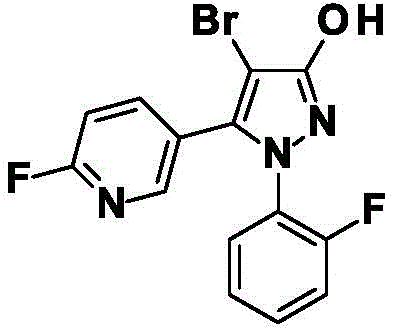
将5-[3-(苄氧基)-4-溴-1-(2-氟苯基)-1H-吡唑-5-基]-2-氟吡啶(811mg,1.83mmol,1.0当量)溶解在二氯甲烷(25ml)中,并于室温加入三氟甲磺酸(0.33ml,3.67mmol,2.0当量)。所得反应混合物于室温搅拌2小时并然后用饱和碳酸氢钠溶液(20ml)萃取。用二氯甲烷(25ml)萃取水相两次。合并有机相,用硫酸镁干燥并减压除去溶剂。该粗产物不经进一步纯化即用于下一合成阶段中。分离出呈白色固体形式的4-溴-1-(2-氟苯基)-5-(6-氟吡啶-3-基)-1H-吡唑-3-醇(700mg,理论值的92%,纯度90%)。1H-NMR(400MHz,CDCl3δ,ppm)9.51(bs,1H),8.12(d,1H),7.76(dt,1H),7.48-7.43(m,1H),7.41-7.38(m,1H),7.27-7.24(m,1H),7.08-7.06(m,1H),6.96-6.94(m,1H)。5-[3-(Benzyloxy)-4-bromo-1-(2-fluorophenyl)-1H-pyrazol-5-yl]-2-fluoropyridine (811 mg, 1.83 mmol, 1.0 equiv) was dissolved In dichloromethane (25 ml) and at room temperature was added trifluoromethanesulfonic acid (0.33 ml, 3.67 mmol, 2.0 equiv). The resulting reaction mixture was stirred at room temperature for 2 hours and then extracted with saturated sodium bicarbonate solution (20 ml). The aqueous phase was extracted twice with dichloromethane (25 ml). The organic phases were combined, dried over magnesium sulfate and the solvent was removed under reduced pressure. The crude product was used in the next synthesis stage without further purification. 4-Bromo-1-(2-fluorophenyl)-5-(6-fluoropyridin-3-yl)-1H-pyrazol-3-ol (700 mg, 92% of theory) was isolated as a white solid , purity 90%). 1 H-NMR (400MHz, CDCl 3 δ, ppm) 9.51 (bs, 1H), 8.12 (d, 1H), 7.76 (dt, 1H), 7.48-7.43 (m, 1H), 7.41-7.38 (m, 1H) ), 7.27-7.24(m, 1H), 7.08-7.06(m, 1H), 6.96-6.94(m, 1H).
合成阶段8:4-溴-1-(2-氟苯基)-5-(6-氟吡啶-3-基)-1H-吡唑-3-硫醇Synthesis Stage 8: 4-Bromo-1-(2-fluorophenyl)-5-(6-fluoropyridin-3-yl)-1H-pyrazole-3-thiol
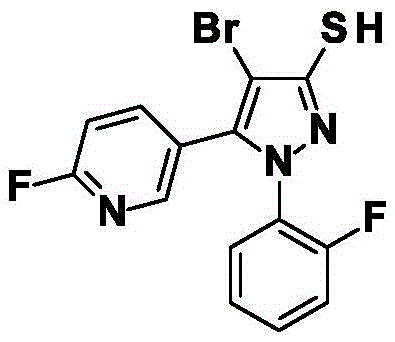
将4-溴-1-(2-氟苯基)-5-(6-氟吡啶-3-基)-1H-吡唑-3-醇(930mg,2.64mmol,1.0当量)悬浮在甲苯(20ml)中,并于室温加入五硫化二磷(2.35g,5.28mmol,2.0当量)。将所得反应混合物加热至沸腾6小时(逸出气体)。冷却至室温后,滤出沉淀,并用甲苯(50ml)搅拌萃取。合并甲苯相,并减压除去溶剂。该粗产物不经进一步纯化即用于下一合成阶段中。分离出呈黄色固体形式的4-溴-1-(2-氟苯基)-5-(6-氟吡啶-3-基)-1H-吡唑-3-硫醇(515mg,理论值的52%)。1H-NMR(400MHz,CDCl3δ,ppm)4-Bromo-1-(2-fluorophenyl)-5-(6-fluoropyridin-3-yl)-1H-pyrazol-3-ol (930 mg, 2.64 mmol, 1.0 equiv) was suspended in toluene (20 ml) ) and phosphorus pentasulfide (2.35 g, 5.28 mmol, 2.0 equiv) was added at room temperature. The resulting reaction mixture was heated to boiling for 6 hours (evolution of gas). After cooling to room temperature, the precipitate was filtered off and extracted with stirring with toluene (50 ml). The toluene phases were combined and the solvent was removed under reduced pressure. The crude product was used in the next synthesis stage without further purification. 4-Bromo-1-(2-fluorophenyl)-5-(6-fluoropyridin-3-yl)-1H-pyrazol-3-thiol (515 mg, th. 52) was isolated as a yellow solid %). 1 H-NMR (400MHz, CDCl 3 δ, ppm)
合成阶段9:{[4-溴-1-(2-氟苯基)-5-(6-氟吡啶-3-基)-1H-吡唑-3-基]硫烷基}乙酸乙酯(实施例编号II-001)Synthetic stage 9: ethyl {[4-bromo-1-(2-fluorophenyl)-5-(6-fluoropyridin-3-yl)-1H-pyrazol-3-yl]sulfanyl}acetate ( Example number II-001)

将4-溴-1-(2-氟苯基)-5-(6-氟吡啶-3-基)-1H-吡唑-3-硫醇(515mg,1.40mmol,1.0当量)和乙酸钠(172mg,2.10mmol,1.5当量)悬浮在乙醇(10ml)中,并且接着加入溴乙酸乙酯(0.17ml,1.54mmol,1.1当量)。将所得反应混合物加热至沸腾3小时。冷却至室温后,减压除去溶剂,并用二氯甲烷(50ml)和水(10ml)萃取残余物,然后与甲苯(50ml)一起搅拌。用硫酸镁干燥有机相并减压除去溶剂。通过柱色谱法(乙酸乙酯/庚烷梯度)对所得粗产物的最终纯化,分离出呈白色固体形式的{[4-溴-1-(2-氟苯基)-5-(6-氟吡啶-3-基)-1H-吡唑-3-基]硫烷基}乙酸乙酯(21mg,理论值的3%)。1H-NMR(400MHz,CDCl3,δ,ppm)8.10(d,1H),7.72(dt,1H),7.48-7.42(m,1H),7.41-7.37(m,1H),7.27-7.23(m,1H),7.07-7.03(m,1H),6.97-6.92(m,1H),4.22(q,2H),3.90(s,2H),1.25(t,3H)。4-Bromo-1-(2-fluorophenyl)-5-(6-fluoropyridin-3-yl)-1H-pyrazol-3-thiol (515 mg, 1.40 mmol, 1.0 equiv) and sodium acetate ( 172 mg, 2.10 mmol, 1.5 equiv) was suspended in ethanol (10 ml) and then ethyl bromoacetate (0.17 ml, 1.54 mmol, 1.1 equiv) was added. The resulting reaction mixture was heated to boiling for 3 hours. After cooling to room temperature, the solvent was removed under reduced pressure and the residue was extracted with dichloromethane (50ml) and water (10ml), then stirred with toluene (50ml). The organic phase was dried over magnesium sulfate and the solvent was removed under reduced pressure. Final purification of the resulting crude product by column chromatography (ethyl acetate/heptane gradient) isolated {[4-bromo-1-(2-fluorophenyl)-5-(6-fluoro) as a white solid Pyridin-3-yl)-1H-pyrazol-3-yl]sulfanyl}ethyl acetate (21 mg, 3% of theory). 1 H-NMR (400MHz, CDCl 3 , δ, ppm) 8.10 (d, 1H), 7.72 (dt, 1H), 7.48-7.42 (m, 1H), 7.41-7.37 (m, 1H), 7.27-7.23 ( m, 1H), 7.07-7.03 (m, 1H), 6.97-6.92 (m, 1H), 4.22 (q, 2H), 3.90 (s, 2H), 1.25 (t, 3H).
类似于上文所列举并在适当的点记述的制备实施例,并考虑到与取代吡唑的制备有关的一般细节,获得了下文所列举的化合物:Analogously to the preparation examples listed above and described at appropriate points, and taking into account the general details relating to the preparation of substituted pyrazoles, the compounds listed below were obtained:
表I:Table I:


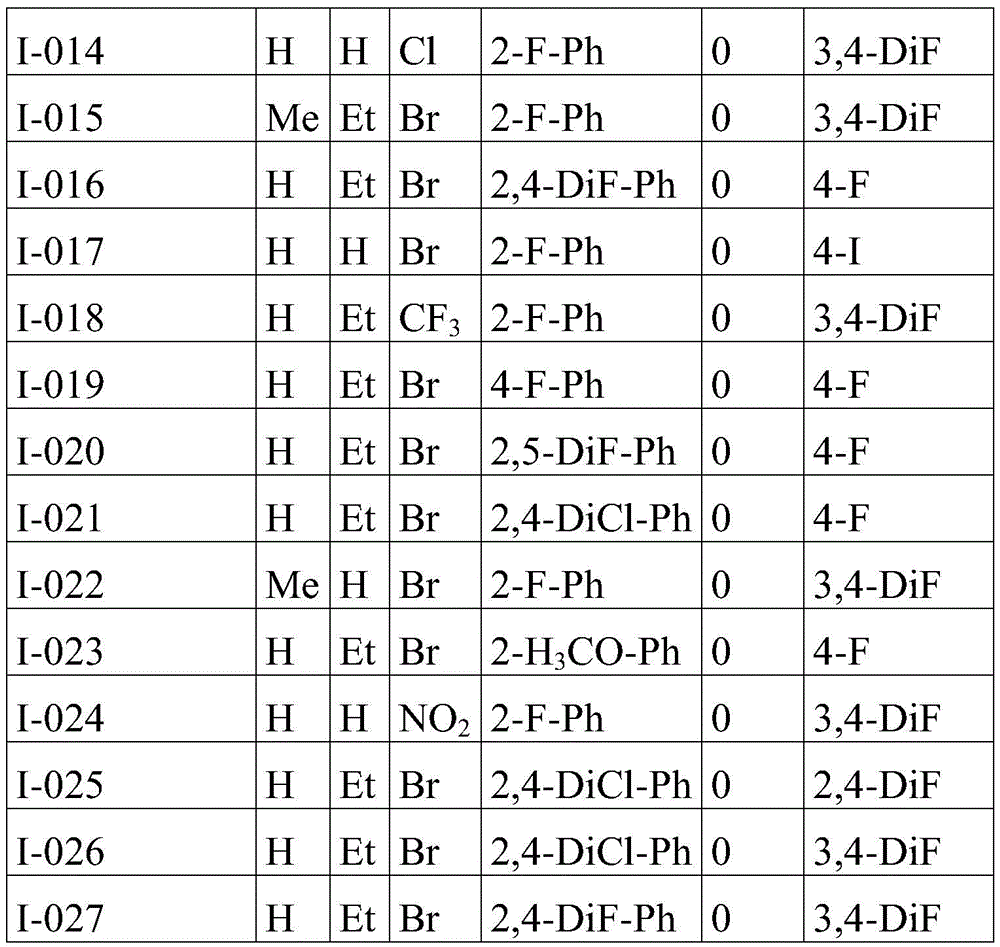
表II:Table II:


表III:Table III:

表IV:Table IV:
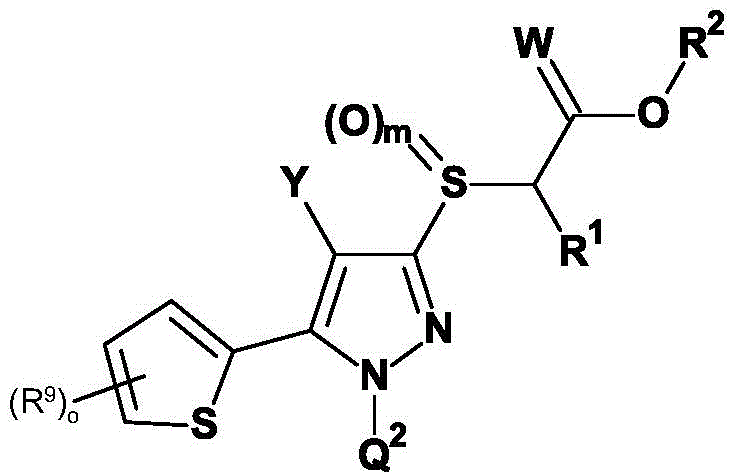
表V:Table V:

表VI:Table VI:

表VII:Table VII:

表VIII:Table VIII:

所选表格实施例的谱数据:Spectral data for selected table examples:
下面例举了本发明的通式(I)的化合物的选定详细合成实施例。对于接下来的部分中描述的化学实施例报告的1H NMR、13C-NMR和19F-NMR谱数据(1H NMR为400MHz,且13C-NMR为150MHz,且19F-NMR为375MHz,溶剂CDCl3、CD3OD或d6-DMSO,内标:四甲基硅烷δ=0.00ppm)在Bruker仪器上获得,并且列出的信号具有下面给出的含义:br=宽峰;s=单峰,d=双重峰,t=三重峰,dd=双二重峰,ddd=双重双二重峰,m=多重峰,q=四重峰,quint=五重峰,sext=六重峰,sept=七重峰,dq=双四重峰,dt=双三重峰。在非对映异构体混合物的情况下,报告两种非对映异构体中的每一种的显著信号或报告主要非对映异构体的特征信号。用于化学基团的缩写具有例如以下含义:Me=CH3,Et=CH2CH3,t-Hex=C(CH3)2CH(CH3)2,t-Bu=C(CH3)3,n-Bu=无分支丁基,n-Pr=无分支丙基,i-Pr=分支丙基,c-Pr=环丙基,c-Hex=环己基。Selected detailed synthesis examples of the compounds of general formula (I) of the present invention are exemplified below. 1 H NMR, 13 C-NMR and 19 F-NMR spectral data reported for the chemical examples described in the next sections ( 1 H NMR is 400 MHz, 13 C-NMR is 150 MHz, and 19 F-NMR is 375 MHz , solvents CDCl3 , CD3OD or d6- DMSO , internal standard: tetramethylsilane δ=0.00 ppm) were obtained on a Bruker instrument and the listed signals have the meaning given below: br=broad; s = singlet, d = doublet, t = triplet, dd = double doublet, ddd = double double doublet, m = multiplet, q = quartet, quint = quintet, sext = sext Peaks, sept = septet, dq = double quartet, dt = double triplet. In the case of a mixture of diastereomers, either a significant signal for each of the two diastereomers or a characteristic signal for the predominant diastereomer is reported. Abbreviations for chemical groups have, for example, the following meanings: Me=CH 3 , Et=CH 2 CH 3 , t-Hex=C(CH 3 ) 2 CH(CH 3 ) 2 , t-Bu=C(CH 3 ) 3 , n-Bu=unbranched butyl, n-Pr=unbranched propyl, i-Pr=branched propyl, c-Pr=cyclopropyl, c-Hex=cyclohexyl.
经由常规1H NMR诠释或经由NMR峰列表法评价下文对所选表格实施例列出的谱数据。The spectral data listed below for selected tabular examples were evaluated via conventional1H NMR interpretation or via NMR peak listing methods.
常规1H NMR诠释Conventional 1 H NMR interpretation
合成实施例编号I-001Synthesis Example No. I-001
1H-NMR(400MHz,CDCl3,δ,ppm)7.42(m,2H),7.25(m,1H),7.12(m,2H),7.07(m,1H),4.20(q,2H),3.87(s,2H),1.24(t,3H)。 1 H-NMR (400MHz, CDCl 3 , δ, ppm) 7.42 (m, 2H), 7.25 (m, 1H), 7.12 (m, 2H), 7.07 (m, 1H), 4.20 (q, 2H), 3.87 (s, 2H), 1.24 (t, 3H).
合成实施例编号I-003Synthesis Example No. 1-003
1H-NMR(400MHz,CDCl3,δ,ppm)8.46(d,1H),8.27(d,1H),7.47(m,1H),7.39(m,2H),7.26(m,1H),7.05(m,1H),4.22(q,2H),3.90(s,2H),1.26(t,3H)。 1 H-NMR (400MHz, CDCl 3 , δ, ppm) 8.46(d, 1H), 8.27(d, 1H), 7.47(m, 1H), 7.39(m, 2H), 7.26(m, 1H), 7.05 (m, 1H), 4.22 (q, 2H), 3.90 (s, 2H), 1.26 (t, 3H).
合成实施例编号I-004Synthesis Example No. 1-004
1H-NMR(400MHz,CDCl3,δ,ppm)7.35(m,3H),7.26(m,2H),7.12(m,3H),4.22(q,2H),3.90(s,2H),1.26(t,3H)。 1 H-NMR (400MHz, CDCl 3 , δ, ppm) 7.35(m, 3H), 7.26(m, 2H), 7.12(m, 3H), 4.22(q, 2H), 3.90(s, 2H), 1.26 (t, 3H).
合成实施例编号I-006Synthesis Example No. 1-006
1H-NMR(400MHz,DMSO-d6,δ,ppm)7.57(m,1H),7.45-7.28(m,7H),3.96(s,2H)。 1 H-NMR (400 MHz, DMSO-d 6 , δ, ppm) 7.57 (m, 1H), 7.45-7.28 (m, 7H), 3.96 (s, 2H).
合成实施例编号I-007Synthesis Example No. 1-007
1H-NMR(400MHz,CDCl3,δ,ppm)7.44(m,2H),7.26(m,1H),7.12(m,3H),6.99(m,1H),4.40(s,2H),4.26(q,2H),1.27(t,3H)。 1 H-NMR (400MHz, CDCl 3 , δ, ppm) 7.44 (m, 2H), 7.26 (m, 1H), 7.12 (m, 3H), 6.99 (m, 1H), 4.40 (s, 2H), 4.26 (q, 2H), 1.27 (t, 3H).
合成实施例编号I-009Synthesis Example No. 1-009
1H-NMR(400MHz,CDCl3,δ,ppm)10.80(br s,1H),7.42(m,2H),7.25(m,1H),7.11(m,3H),3.87(s,2H)。 1 H-NMR (400 MHz, CDCl 3 , δ, ppm) 10.80 (br s, 1H), 7.42 (m, 2H), 7.25 (m, 1H), 7.11 (m, 3H), 3.87 (s, 2H).
合成实施例编号I-010Synthesis Example No. I-010
1H-NMR(400MHz,CDCl3,δ,ppm)7.64(m,1H),7.47(m,4H),7.33(m,3H),4.55(q,2H),4.15(m,2H),1.16(t,3H)。 1 H-NMR (400MHz, CDCl 3 , δ, ppm) 7.64 (m, 1H), 7.47 (m, 4H), 7.33 (m, 3H), 4.55 (q, 2H), 4.15 (m, 2H), 1.16 (t, 3H).
合成实施例编号II-002Synthesis Example No. II-002
1H-NMR(400MHz,CDCl3,δ,ppm)8.45(d,1H),8.27(d,1H),7.46(m,1H),7.42-7.36(m,2H),7.27(m,1H),7.05(m,1H),4.22(q,2H),3.90(s,2H),1.25(t,3H)。 1 H-NMR (400MHz, CDCl 3 , δ, ppm) 8.45(d, 1H), 8.27(d, 1H), 7.46(m, 1H), 7.42-7.36(m, 2H), 7.27(m, 1H) , 7.05 (m, 1H), 4.22 (q, 2H), 3.90 (s, 2H), 1.25 (t, 3H).
合成实施例编号III-002Synthesis Example No. III-002
1H-NMR(400MHz,CDCl3,δ,ppm)9.23(s,1H),8.67(s,2H),7.40(m,3H),7.18(m,2H),3.90(s,2H)。 1 H-NMR (400 MHz, CDCl 3 , δ, ppm) 9.23 (s, 1H), 8.67 (s, 2H), 7.40 (m, 3H), 7.18 (m, 2H), 3.90 (s, 2H).
合成实施例编号III-003Synthesis Example No. III-003
1H-NMR(400MHz,DMSO-d6,δ,ppm)9.23(s,1H),8.77(s,2H),7.43(m,3H),7.29(m,2H),4.13(q,2H),4.09(s,2H),1.16(t,3H)。 1 H-NMR (400MHz, DMSO-d 6 , δ, ppm) 9.23(s, 1H), 8.77(s, 2H), 7.43(m, 3H), 7.29(m, 2H), 4.13(q, 2H) , 4.09(s, 2H), 1.16(t, 3H).
合成实施例编号IV-001Synthesis Example No. IV-001
1H-NMR(400MHz,CDCl3,δ,ppm)7.44(m,2H),7.26(m,1H),7.16(m,1H),6.86(d,1H),6.81(d,1H),4.19(q,2H),3.86(s,2H),1.23(t,3H)。 1 H-NMR (400MHz, CDCl 3 , δ, ppm) 7.44(m, 2H), 7.26(m, 1H), 7.16(m, 1H), 6.86(d, 1H), 6.81(d, 1H), 4.19 (q, 2H), 3.86 (s, 2H), 1.23 (t, 3H).
合成实施例编号V-001Synthesis Example No. V-001
1H-NMR(400MHz,CDCl3,δ,ppm)7.43(m,1H),7.31(m,1H),7.29(m,1H),7.18(m,1H),7.10(s,1H),4.20(q,2H),3.87(s,2H),2.25(s,3H),1.24(t,3H)。 1 H-NMR (400MHz, CDCl 3 , δ, ppm) 7.43 (m, 1H), 7.31 (m, 1H), 7.29 (m, 1H), 7.18 (m, 1H), 7.10 (s, 1H), 4.20 (q, 2H), 3.87 (s, 2H), 2.25 (s, 3H), 1.24 (t, 3H).
合成实施例编号V-002Synthesis Example No. V-002
1H-NMR(400MHz,CDCl3,δ,ppm)7.53(m,1H),7.43(m,1H),7.32(m,1H),7.21(m,1H),7.13(s,1H),3.86(s,2H),2.46(s,3H)。 1 H-NMR (400MHz, CDCl 3 , δ, ppm) 7.53 (m, 1H), 7.43 (m, 1H), 7.32 (m, 1H), 7.21 (m, 1H), 7.13 (s, 1H), 3.86 (s, 2H), 2.46 (s, 3H).
合成实施例编号II-003Synthesis Example No. II-003
1H-NMR(400MHz,CDCl3,δ,ppm)8.50(d,1H),8.28(s,1H),7.53-7.39(m,3H),7.28(m,1H),7.09(m,1H),4.41(s,2H),4.24(m,2H),1.27(t,3H)。 1 H-NMR (400MHz, CDCl 3 , δ, ppm) 8.50(d, 1H), 8.28(s, 1H), 7.53-7.39(m, 3H), 7.28(m, 1H), 7.09(m, 1H) , 4.41(s, 2H), 4.24(m, 2H), 1.27(t, 3H).
合成实施例编号II-004Synthesis Example No. II-004
1H-NMR(400MHz,CDCl3,δ,ppm)11.09(br s,1H),8.25(s,1H),7.57-7.51(m,2H),7.46-7.42(m,1H),7.38(dd,1H),7.31-7.25(m,2H),4.07(q,2H),4.01(s,2H),1.10(t,3H)。 1 H-NMR (400MHz, CDCl 3 , δ, ppm) 11.09 (br s, 1H), 8.25 (s, 1H), 7.57-7.51 (m, 2H), 7.46-7.42 (m, 1H), 7.38 (dd , 1H), 7.31-7.25 (m, 2H), 4.07 (q, 2H), 4.01 (s, 2H), 1.10 (t, 3H).
合成实施例编号I-011Synthesis Example No. I-011
1H-NMR(400MHz,CDCl3,δ,ppm)7.80(d,2H),7.57-7.48(m,2H),7.34-7.28(m,2H),7.05(d,2H),4.09(q,2H),3.97(s,2H),1.11(t,3H)。 1 H-NMR (400MHz, CDCl 3 , δ, ppm) 7.80(d, 2H), 7.57-7.48(m, 2H), 7.34-7.28(m, 2H), 7.05(d, 2H), 4.09(q, 2H), 3.97 (s, 2H), 1.11 (t, 3H).
合成实施例编号II-005Synthesis Example No. II-005
1H-NMR(400MHz,CDCl3,δ,ppm)8.50(d,1H),8.29(d,1H),7.47-7.39(m,3H),7.27(m,1H),7.10-7.05(m,1H),3.91(s,2H)。 1 H-NMR (400MHz, CDCl 3 , δ, ppm) 8.50(d, 1H), 8.29(d, 1H), 7.47-7.39(m, 3H), 7.27(m, 1H), 7.10-7.05(m, 1H), 3.91(s, 2H).
合成实施例编号II-006Synthesis Example No. II-006
1H-NMR(400MHz,CDCl3,δ,ppm)11.09(br s,1H),8.29(d,1H),7.56-7.53(m,2H),7.50-7.44(m,2H),7.36-7.27(m,2H),3.96(s,2H)。 1 H-NMR (400MHz, CDCl 3 , δ, ppm) 11.09 (br s, 1H), 8.29 (d, 1H), 7.56-7.53 (m, 2H), 7.50-7.44 (m, 2H), 7.36-7.27 (m, 2H), 3.96 (s, 2H).
合成实施例编号II-007Synthesis Example No. II-007
1H-NMR(400MHz,CDCl3,δ,ppm)8.54(s,1H),8.31(s,1H),7.66(s,1H),7.49-7.36(m,2H),7.27-7.23(m,1H),7.08-7.03(m,1H),4.21(q,2H),3.90(s,2H),1.26(t,3H)。 1 H-NMR (400MHz, CDCl 3 , δ, ppm) 8.54(s, 1H), 8.31(s, 1H), 7.66(s, 1H), 7.49-7.36(m, 2H), 7.27-7.23(m, 1H), 7.08-7.03 (m, 1H), 4.21 (q, 2H), 3.90 (s, 2H), 1.26 (t, 3H).
合成实施例编号I-012Synthesis Example No. 1-012
1H-NMR(400MHz,CDCl3,δ,ppm)7.48-7.43(m,2H),7.27-7.26(m,1H),7.20-7.07(m,4H),4.21(q,2H),3.93(s,2H),1.26(t,3H)。 1 H-NMR (400MHz, CDCl 3 , δ, ppm) 7.48-7.43 (m, 2H), 7.27-7.26 (m, 1H), 7.20-7.07 (m, 4H), 4.21 (q, 2H), 3.93 ( s, 2H), 1.26(t, 3H).
合成实施例编号II-008Synthesis Example No. II-008
1H-NMR(400MHz,CDCl3,δ,ppm)8.54(s,1H),8.31(s,1H),7.66(s,1H),7.49-7.36(m,2H),7.27-7.23(m,1H),7.08-7.03(m,1H),3.92(s,2H)。 1 H-NMR (400MHz, CDCl 3 , δ, ppm) 8.54(s, 1H), 8.31(s, 1H), 7.66(s, 1H), 7.49-7.36(m, 2H), 7.27-7.23(m, 1H), 7.08-7.03 (m, 1H), 3.92 (s, 2H).
合成实施例编号II-009Synthesis Example No. II-009
1H-NMR(400MHz,CDCl3,δ,ppm)11.26(s,1H),8.71(m,2H),8.09(s,1H),7.66-7.59(m,1H),7.50-7.43(m,1H),7.37-7.24(m,2H),7.08-7.03(m,1H),4.77(s,2H),3.95(q,2H),0.95(t,3H)。 1 H-NMR (400MHz, CDCl 3 , δ, ppm) 11.26(s, 1H), 8.71(m, 2H), 8.09(s, 1H), 7.66-7.59(m, 1H), 7.50-7.43(m, 1H), 7.37-7.24(m, 2H), 7.08-7.03(m, 1H), 4.77(s, 2H), 3.95(q, 2H), 0.95(t, 3H).
合成实施例编号II-010Synthesis Example No. II-010
1H-NMR(400MHz,CDCl3,δ,ppm)11.26(s,1H),8.59(d,1H),8.01(d,1H),7.91(d,1H),7.61-7.56(m,1H),7.48-7.43(m,1H),7.32-7.24(m,2H),4.25-4.22(d,1H),4.03-3.96(m,3H),1.04(t,3H)。 1 H-NMR (400MHz, CDCl 3 , δ, ppm) 11.26(s, 1H), 8.59(d, 1H), 8.01(d, 1H), 7.91(d, 1H), 7.61-7.56(m, 1H) , 7.48-7.43(m, 1H), 7.32-7.24(m, 2H), 4.25-4.22(d, 1H), 4.03-3.96(m, 3H), 1.04(t, 3H).
合成实施例编号I-013Synthesis Example No. 1-013
1H-NMR(400MHz,CDCl3,δ,ppm)7.46-7.35(m,2H),7.27-7.18(m,1H),7.17-7.02(m,2H),6.97-6.92(m,1H),4.22(q,2H),3.89(s,2H),1.24(t,3H)。 1 H-NMR (400MHz, CDCl 3 , δ, ppm) 7.46-7.35 (m, 2H), 7.27-7.18 (m, 1H), 7.17-7.02 (m, 2H), 6.97-6.92 (m, 1H), 4.22(q, 2H), 3.89(s, 2H), 1.24(t, 3H).
合成实施例编号II-011Synthesis Example No. II-011
1H-NMR(400MHz,CDCl3,δ,ppm)8.51(s,1H),8.28(s,1H),7.53-7.38(m,3H),7.32-7.26(m,1H),7.12-7.07(m,1H),4.40(d,2H),4.25(q,2H),1.27(t,3H)。 1 H-NMR (400MHz, CDCl 3 , δ, ppm) 8.51(s, 1H), 8.28(s, 1H), 7.53-7.38(m, 3H), 7.32-7.26(m, 1H), 7.12-7.07( m, 1H), 4.40 (d, 2H), 4.25 (q, 2H), 1.27 (t, 3H).
合成实施例编号II-014Synthesis Example No. II-014
1H-NMR(400MHz,CDCl3,δ,ppm)7.80(d,2H),7.57-7.48(m,2H),7.34-7.28(m,2H),7.05(d,2H),3.97(s,2H)。 1 H-NMR (400MHz, CDCl 3 , δ, ppm) 7.80(d, 2H), 7.57-7.48(m, 2H), 7.34-7.28(m, 2H), 7.05(d, 2H), 3.97(s, 2H).
合成实施例编号III-004Synthesis Example No. III-004
1H-NMR(400MHz,CDCl3,δ,ppm)9.22(s,1H),8.67(s,2H),7.25-7.22(m,3H),4.22(q,2H),3.91(s,2H),1.26(t,3H)。 1 H-NMR (400MHz, CDCl 3 , δ, ppm) 9.22(s, 1H), 8.67(s, 2H), 7.25-7.22(m, 3H), 4.22(q, 2H), 3.91(s, 2H) , 1.26(t, 3H).
合成实施例编号I-015Synthesis Example No. 1-015
1H-NMR(400MHz,CDCl3,δ,ppm)7.42-7.36(m,2H),7.22(m,1H),7.16-6.95(m,4H),4.21-4.13(m,3H),1.62(d,3H),1.22(t,3H)。 1 H-NMR (400MHz, CDCl 3 , δ, ppm) 7.42-7.36 (m, 2H), 7.22 (m, 1H), 7.16-6.95 (m, 4H), 4.21-4.13 (m, 3H), 1.62 ( d, 3H), 1.22(t, 3H).
合成实施例编号VI-001Synthesis Example No. VI-001
1H-NMR(400MHz,CDCl3,δ,ppm)8.94(s,1H),8.68(m,1H),8.59(m,1H),7.55-7.46(m,2H),7.34-7.27(m,2H),4.10(q,2H),4.01(s,2H),1.12(t,3H)。 1 H-NMR (400MHz, CDCl 3 , δ, ppm) 8.94(s, 1H), 8.68(m, 1H), 8.59(m, 1H), 7.55-7.46(m, 2H), 7.34-7.27(m, 2H), 4.10 (q, 2H), 4.01 (s, 2H), 1.12 (t, 3H).
合成实施例编号II-012Synthesis Example No. II-012
1H-NMR(400MHz,CDCl3,δ,ppm)8.24(m,1H),7.60(dd,1H),7.46(dt,1H),7.37(m,1H),7.33(m,1H),7.23(m,1H),7.05(dt,1H),4.21(q,2H),3.89(s,2H),1.25(t,3H)。 1 H-NMR (400MHz, CDCl 3 , δ, ppm) 8.24 (m, 1H), 7.60 (dd, 1H), 7.46 (dt, 1H), 7.37 (m, 1H), 7.33 (m, 1H), 7.23 (m, 1H), 7.05 (dt, 1H), 4.21 (q, 2H), 3.89 (s, 2H), 1.25 (t, 3H).
合成实施例编号I-016Synthesis Example No. 1-016
1H-NMR(400MHz,CDCl3,δ,ppm)7.43(m,1H),7.25-6.95(m,3H),6.84(m,1H),4.38(s,2H),4.25(q,2H),1.27(t,3H)。 1 H-NMR (400MHz, CDCl 3 , δ, ppm) 7.43(m, 1H), 7.25-6.95(m, 3H), 6.84(m, 1H), 4.38(s, 2H), 4.25(q, 2H) , 1.27(t, 3H).
合成实施例编号II-013Synthesis Example No. II-013
1H-NMR(400MHz,CDCl3,δ,ppm)8.59(m,1H),8.32(m,1H),7.66(m,1H),7.53-7.44(m,2H),7.30(m,1H),7.10(m,1H),4.40(s,2H),4.25(q,2H),1.27(t,3H)。 1 H-NMR (400MHz, CDCl 3 , δ, ppm) 8.59 (m, 1H), 8.32 (m, 1H), 7.66 (m, 1H), 7.53-7.44 (m, 2H), 7.30 (m, 1H) , 7.10(m, 1H), 4.40(s, 2H), 4.25(q, 2H), 1.27(t, 3H).
合成实施例编号I-019Synthesis Example No. 1-019
1H-NMR(400MHz,CDCl3,δ,ppm)7.25-7.22(m,2H),7.17-7.13(m,2H),7.10-7.05(m,2H),7.01-6.97(m,2H),4.22(q,2H),3.89(s,2H),1.26(t,3H)。 1 H-NMR (400MHz, CDCl 3 , δ, ppm) 7.25-7.22 (m, 2H), 7.17-7.13 (m, 2H), 7.10-7.05 (m, 2H), 7.01-6.97 (m, 2H), 4.22(q, 2H), 3.89(s, 2H), 1.26(t, 3H).
合成实施例编号I-017Synthesis Example No. 1-017
1H-NMR(400MHz,CDCl3,δ,ppm)12.81(bs,1H),7.78(d,2H),7.59-7.48(m,2H),7.33-7.29(m,2H),7.07(d,2H),3.92(s,2H)。 1 H-NMR (400MHz, CDCl 3 , δ, ppm) 12.81(bs, 1H), 7.78(d, 2H), 7.59-7.48(m, 2H), 7.33-7.29(m, 2H), 7.07(d, 2H), 3.92 (s, 2H).
合成实施例编号I-020Synthesis Example No. I-020
1H-NMR(400MHz,CDCl3,δ,ppm)7.25-7.23(m,2H),7.20-7.16(m,1H),7.07-6.95(m,4H),4.22(q,2H),3.89(s,2H),1.26(t,3H)。 1 H-NMR (400MHz, CDCl 3 , δ, ppm) 7.25-7.23 (m, 2H), 7.20-7.16 (m, 1H), 7.07-6.95 (m, 4H), 4.22 (q, 2H), 3.89 ( s, 2H), 1.26(t, 3H).
合成实施例编号I-021Synthesis Example No. I-021
1H-NMR(400MHz,CDCl3,δ,ppm)7.41(m,1H),7.27(m,1H),7.24-7.20(m,2H),7.04-7.00(m,2H),4.20(q,2H),3.88(s,2H),1.25(t,3H)。 1 H-NMR (400MHz, CDCl 3 , δ, ppm) 7.41 (m, 1H), 7.27 (m, 1H), 7.24-7.20 (m, 2H), 7.04-7.00 (m, 2H), 4.20 (q, 2H), 3.88 (s, 2H), 1.25 (t, 3H).
合成实施例编号I-022Synthesis Example No. 1-022
1H-NMR(400MHz,d6-DMSO,δ,ppm)7.71-7.12(m,7H),4.15(m,1H),1.52(d,3H)。 1 H-NMR (400 MHz, d 6 -DMSO, δ, ppm) 7.71-7.12 (m, 7H), 4.15 (m, 1H), 1.52 (d, 3H).
合成实施例编号I-023Synthesis Example No. 1-023
1H-NMR(400MHz,CDCl3,δ,ppm)7.39-7.30(m,2H),7.24-7.20(m,2H),7.02-6.95(m,3H),6.79(d,1H),4.20(q,2H),3.87(s,2H),3.43(s,3H),1.25(t,3H)。 1 H-NMR (400MHz, CDCl 3 , δ, ppm) 7.39-7.30 (m, 2H), 7.24-7.20 (m, 2H), 7.02-6.95 (m, 3H), 6.79 (d, 1H), 4.20 ( q, 2H), 3.87 (s, 2H), 3.43 (s, 3H), 1.25 (t, 3H).
合成实施例编号I-024Synthesis Example No. 1-024
1H-NMR(400MHz,d6-DMSO,δ,ppm)12.85(bs,1H),7.75(m,1H),7.64(m,1H),7.58-7.45(m,2H),7.37-7.28(m,3H),4.02(s,2H)。 1 H-NMR (400MHz, d 6 -DMSO, δ, ppm) 12.85(bs, 1H), 7.75(m, 1H), 7.64(m, 1H), 7.58-7.45(m, 2H), 7.37-7.28( m, 3H), 4.02 (s, 2H).
合成实施例编号II-015Synthesis Example No. II-015
1H-NMR(400MHz,CDCl3,δ,ppm)8.22(m,1H),7.49-7.38(m,4H),7.26(m,1H,7.05(dt,1H),4.20(q,2H),3.89(s,2H),1.24(t,3H)。 1 H-NMR (400MHz, CDCl 3 , δ, ppm) 8.22 (m, 1H), 7.49-7.38 (m, 4H), 7.26 (m, 1H, 7.05 (dt, 1H), 4.20 (q, 2H), 3.89(s, 2H), 1.24(t, 3H).
合成实施例编号I-016Synthesis Example No. 1-016
1H-NMR(400MHz,CDCl3,δ,ppm)8.26(m,1H),7.60(dd,1H),7.45-7.40(m,2H),7.35(d,1H),7.26(m,1H),7.10(m,1H),3.89(s,2H)。 1 H-NMR (400MHz, CDCl 3 , δ, ppm) 8.26 (m, 1H), 7.60 (dd, 1H), 7.45-7.40 (m, 2H), 7.35 (d, 1H), 7.26 (m, 1H) , 7.10 (m, 1H), 3.89 (s, 2H).
合成实施例编号I-025Synthesis Example No. 1-025
1H-NMR(400MHz,CDCl3,δ,ppm)7.38(m,1H),7.31-7.21(m,3H),6.90(m,1H),6.80(m,1H),4.20(q,2H),3.88(s,2H),1.24(t,3H)。 1 H-NMR (400MHz, CDCl 3 , δ, ppm) 7.38 (m, 1H), 7.31-7.21 (m, 3H), 6.90 (m, 1H), 6.80 (m, 1H), 4.20 (q, 2H) , 3.88(s, 2H), 1.24(t, 3H).
合成实施例编号I-026Synthesis Example No. 1-026
1H-NMR(400MHz,CDCl3,δ,ppm)7.42(m,1H),7.32-7.26(m,2H),7.15-7.08(m,2H9,6.96-6.93(m,1H),4.19(q,2H),3.87(s,2H),1.24(t,3H)。 1 H-NMR (400MHz, CDCl 3 , δ, ppm) 7.42 (m, 1H), 7.32-7.26 (m, 2H), 7.15-7.08 (m, 2H9, 6.96-6.93 (m, 1H), 4.19 (q , 2H), 3.87(s, 2H), 1.24(t, 3H).
合成实施例编号I-027Synthesis Example No. 1-027
1H-NMR(400MHz,CDCl3,δ,ppm)7.39(m,1H),7.17-7.08(m,2H),6.98-6.93(m,2H),6.81(m,1H),4.20(q,2H),3.88(s,2H),1.25(t,3H)。 1 H-NMR (400MHz, CDCl 3 , δ, ppm) 7.39 (m, 1H), 7.17-7.08 (m, 2H), 6.98-6.93 (m, 2H), 6.81 (m, 1H), 4.20 (q, 2H), 3.88 (s, 2H), 1.25 (t, 3H).
合成实施例编号VII-001Synthesis Example No. VII-001
1H-NMR(400MHz,CDCl3,δ,ppm)7.55(bs,1H),7.47-7.39(m,2H),7.25(m,1H),7.17-7.06(m,3H),6.99(m,1H),4.05(d,2H),3.81(s,2H),3.71(s,3H)。 1 H-NMR (400MHz, CDCl 3 , δ, ppm) 7.55 (bs, 1H), 7.47-7.39 (m, 2H), 7.25 (m, 1H), 7.17-7.06 (m, 3H), 6.99 (m, 1H), 4.05(d, 2H), 3.81(s, 2H), 3.71(s, 3H).
合成实施例编号I-014Synthesis Example No. 1-014
1H-NMR(400MHz,CDCl3,δ,ppm)7.46-7.39(m,2H),7.25(m,1H),7.14-7.10(m,3H),6.97(m,1H),3.86(s,2H)。 1 H-NMR (400MHz, CDCl 3 , δ, ppm) 7.46-7.39(m, 2H), 7.25(m, 1H), 7.14-7.10(m, 3H), 6.97(m, 1H), 3.86(s, 2H).
合成实施例编号VII-002Synthesis Example No. VII-002
1H-NMR(400MHz,CDCl3,δ,ppm)7.47-7.36(m,2H),7.25(m,1H),7.15-7.04(m,3H),6.97(m,1H),4.16(s,2H),4,10(s,2H),3.73(s,3H),3.18(s,3H)。 1 H-NMR (400MHz, CDCl 3 , δ, ppm) 7.47-7.36(m, 2H), 7.25(m, 1H), 7.15-7.04(m, 3H), 6.97(m, 1H), 4.16(s, 2H), 4, 10(s, 2H), 3.73(s, 3H), 3.18(s, 3H).
合成实施例编号VIII-001Synthesis Example No. VIII-001
1H-NMR(400MHz,CDCl3,δ,ppm)7.53-7.42(m,2H),7.28(m,1H),6.85(d,1H),4.20(q,2H),3.80(s,2H),1.25(t,3H)。 1 H-NMR (400MHz, CDCl 3 , δ, ppm) 7.53-7.42(m, 2H), 7.28(m, 1H), 6.85(d, 1H), 4.20(q, 2H), 3.80(s, 2H) , 1.25(t, 3H).
合成实施例编号VII-003Synthesis Example No. VII-003
1H-NMR(400MHz,CDCl3,δ,ppm)7.52(bt,1H),7.47-7.36(m,2H),7.23(m,1H),7.18-7.04(m,3H),7.00(m,1H),4.17(q,2H),4.03(d,2H),3.82(s,2H),1.25(t,3H)。 1 H-NMR (400MHz, CDCl 3 , δ, ppm) 7.52 (bt, 1H), 7.47-7.36 (m, 2H), 7.23 (m, 1H), 7.18-7.04 (m, 3H), 7.00 (m, 1H), 4.17 (q, 2H), 4.03 (d, 2H), 3.82 (s, 2H), 1.25 (t, 3H).
合成实施例编号VII-004Synthesis Example No. VII-004
1H-NMR(400MHz,CDCl3,δ,ppm)7.47-7.41(m,2H),7.25-7.02(m,6H),4.05(d,2H),3.89(s,2H),3.72(s,3H)。 1 H-NMR (400MHz, CDCl 3 , δ, ppm) 7.47-7.41(m, 2H), 7.25-7.02(m, 6H), 4.05(d, 2H), 3.89(s, 2H), 3.72(s, 3H).
NMR峰列表法NMR peak list method
所选实施例的1H NMR数据以1H NMR峰列表的形式记录。对于每个信号峰,首先列出以ppm计的δ值,并且接着在圆括号中列出信号强度。不同信号峰的δ值/信号强度数对用分号彼此隔开列出。1H NMR data for selected examples are reported as a list of 1H NMR peaks. For each signal peak, the delta value in ppm is listed first, and then the signal intensity is listed in parentheses. The delta value/signal intensity number pairs for different signal peaks are listed with a semicolon separated from each other.
因此,实施例的峰列表采取以下形式:Thus, the peak lists of the examples take the following form:
δ1(强度1);δ2(强度2);……;δi(强度i);……;δn(强度n)δ 1 (intensity 1 ); δ 2 (intensity 2 ); …; δ i (intensity i ); …; δ n (intensity n )
尖峰信号的强度与NMR谱的打印实例中以cm计的信号高度相关,并示出了信号强度的真实比率。在宽峰信号的情况下,可示出信号的几个峰或中间部分及其与谱图中最强信号相比的相对强度。The intensity of the spike signal is highly correlated with the signal in cm in the printed example of the NMR spectrum and shows the true ratio of signal intensities. In the case of a broad peak signal, several peaks or middle parts of the signal and their relative intensities compared to the strongest signal in the spectrum can be shown.
为了校准1H NMR谱的化学位移,我们使用四甲基硅烷和/或溶剂的化学位移,特别是在DMSO中测量的谱图的情况下。因此,在NMR峰列表中,四甲基硅烷峰可能出现但不一定出现。To calibrate the chemical shifts of the 1H NMR spectra, we used the chemical shifts of tetramethylsilane and/or the solvent, especially in the case of spectra measured in DMSO. Therefore, in the NMR peak list, the tetramethylsilane peak may but not necessarily appear.
1H NMR峰的列表与常规的1H NMR打印输出类似并因此通常包括在常规NMR诠释中列出的所有峰。The listing of 1H NMR peaks is similar to a conventional 1H NMR printout and therefore generally includes all peaks listed in conventional NMR interpretations.
另外,与常规的1H NMR打印输出一样,它们可能显示溶剂信号、目标化合物的立体异构体信号(其同样构成本发明主题的一部分)和/或杂质峰。In addition, like conventional 1H NMR printouts, they may show solvent signals, stereoisomer signals of the target compound (which also form part of the subject matter of the present invention) and/or impurity peaks.
在报告溶剂和/或水的δ范围内的化合物信号时,我们的1H NMR峰列表显示了常见的溶剂峰,例如DMSO-D6中的DMSO峰和水的峰,平均来看它们通常具有高强度。When reporting compound signals in the delta range for solvent and/or water, our 1H NMR peak list shows common solvent peaks, such as the DMSO peak in DMSO-D 6 and the water peak, which on average typically have high strength.
与目标化合物(例如具有>90%的纯度)的峰相比,目标化合物的立体异构体的峰和/或杂质的峰通常平均具有较低的强度。Stereoisomeric peaks and/or impurity peaks of the target compound typically have lower intensity on average than peaks of the target compound (eg, with >90% purity).
这样的立体异构体和/或杂质可能是特定的制备方法所特有的。因此,它们的峰可有助于参考“副产物指纹”来识别我们的制备方法的重现性。Such stereoisomers and/or impurities may be specific to a particular method of preparation. Therefore, their peaks can help to identify the reproducibility of our preparative method with reference to a "by-product fingerprint".
如果需要,通过已知方法(MestreC、ACD模拟以及用经验评估的预计值)计算目标化合物的峰的专业人员可任选地使用额外的强度过滤器来分离目标化合物的峰。该分离与在常规的1H NMR诠释中挑选相关峰类似。If desired, the skilled person who calculates the peaks of the target compound by known methods (MestreC, ACD simulations and empirically estimated values) can optionally use an additional intensity filter to separate the peaks of the target compound. This separation is analogous to picking out the relevant peaks in conventional 1H NMR interpretation.
1H NMR峰列表的更多详情可见于Research Disclosure Database第564025号中。Further details of the 1H NMR peak list can be found in Research Disclosure Database No. 564025.


本发明还提供了一种或多种如上文所定义(优选在被确定为优选或特别优选的实施方案之一中)的通式(I)的化合物和/或其盐,特别是式(I.001)至(VII.002)的一种或多种化合物和/或其盐,在每种情况下如上文所定义,用作除草剂和/或植物生长调节剂的用途,优选在有用植物和/或观赏植物的作物中。The present invention also provides one or more compounds of general formula (I) and/or salts thereof as defined above (preferably in one of the embodiments identified as preferred or particularly preferred), in particular of formula (I) .001) to (VII.002) and/or their salts, in each case as defined above, as herbicides and/or plant growth regulators, preferably in useful plants and/or ornamental crops.
本发明还提供了一种防治有害植物和/或调节植物生长的方法,其特征在于向(有害)植物、(有害)植物的种子、(有害)植物在其中或其上生长的土壤或耕种区域施用有效量的The present invention also provides a method for controlling harmful plants and/or regulating plant growth, characterized by directing (harmful) plants, seeds of (harmful) plants, soil or cultivated areas in or on which (harmful) plants grow administered an effective amount of
-一种或多种如上文所定义(优选在被确定为优选或特别优选的实施方案之一中)的通式(I)的化合物和/或其盐,特别是式(I.001)至(VII.002)的一种或多种化合物和/或其盐,在每种情况下如上文所定义,或- one or more compounds of general formula (I) and/or salts thereof as defined above (preferably in one of the embodiments identified as preferred or particularly preferred), in particular formulae (I.001) to One or more compounds of (VII.002) and/or their salts, in each case as defined above, or
-本发明的组合物,如下文所定义。- a composition of the invention, as defined below.
本发明还提供了一种防治不需要的植物(优选在有用植物的作物中)的方法,其特征在于向不需要的植物(例如有害植物如单子叶或双子叶杂草或不需要的作物植物)、不需要的植物的种子(即植物种子,例如谷粒、种子或营养繁殖器官如块茎或带芽的枝条部分)、不需要的植物在其中或其上生长的土壤(例如作物土地或非作物土地的土壤)或耕种区域(即其上将生长不需要的植物的区域)施用有效量的-一种或多种如上文所定义(优选在被确定为优选或特别优选的实施方案之一中)的通式(I)的化合物和/或其盐,特别是式(I.001)至(VII.002)的一种或多种化合物和/或其盐,在每种情况下如上文所定义,或The present invention also provides a method for controlling unwanted plants, preferably in crops of useful plants, characterized in that unwanted plants (for example harmful plants such as monocotyledonous or dicotyledonous weeds or unwanted crop plants) are controlled ), seeds of unwanted plants (i.e. plant seeds such as grains, seeds or vegetative reproductive organs such as tubers or shoot parts with buds), soil in or on which unwanted plants grow (eg crop land or non- soil of crop land) or cultivated areas (i.e. areas on which unwanted plants will grow) an effective amount of -one or more as defined above (preferably in one of the embodiments identified as preferred or particularly preferred) in) compounds of the general formula (I) and/or their salts, in particular one or more compounds of the formulae (I.001) to (VII.002) and/or their salts, in each case as above as defined, or
-本发明的组合物,如下文所定义。- a composition of the invention, as defined below.
本发明还进一步提供了用于调节植物、优选有用植物的生长的方法,其特征在于向植物、植物的种子(即植物种子,例如谷粒、种子或营养繁殖器官如块茎或带芽的枝条部分)、植物在其中或其上生长的土壤(例如作物土地或非作物土地的土壤)或耕种区域(即其上将生长植物的区域)施用有效量的The present invention still further provides a method for regulating the growth of plants, preferably useful plants, characterized in that plant, seeds of plants (ie plant seeds, such as grains, seeds or vegetative reproductive organs such as tubers or shoot parts with buds) ), the soil in or on which the plants grow (such as the soil of crop land or non-crop land), or the cultivated area (i.e. the area on which the plants will grow) an effective amount of
-一种或多种如上文所定义(优选在被确定为优选或特别优选的实施方案之一中)的通式(I)的化合物和/或其盐,特别是通式(I.001)至(VII.002)的一种或多种化合物和/或其盐,在每种情况下如上文所定义,或- one or more compounds of general formula (I) and/or their salts, in particular general formula (I.001) as defined above (preferably in one of the embodiments identified as preferred or particularly preferred) to (VII.002) one or more compounds and/or their salts, in each case as defined above, or
-本发明的组合物,如下文所定义。- a composition of the invention, as defined below.
在此上下文中,本发明的化合物或本发明的组合物可例如通过播种前(视需要也通过掺入土壤中)、出苗前和/或出苗后方法来应用。可由本发明的化合物防治的一些代表性单子叶和双子叶杂草植物群的具体实例有如下,但并不旨在限制列举于特定的物种。In this context, the compounds of the invention or the compositions of the invention can be applied, for example, by pre-sowing (and optionally also by incorporation into the soil), pre-emergence and/or post-emergence methods. Specific examples of some representative monocotyledonous and dicotyledonous weed flora controllable by the compounds of the present invention are listed below, but are not intended to limit the enumeration to a particular species.
在本发明的防治有害植物或调节植物生长的方法中,优选使用一种或多种通式(I)的化合物和/或其盐来防治有害植物或来调节有用植物或观赏植物的作物的生长,其中优选配置的有用植物或观赏植物为转基因植物。In the method of the present invention for controlling harmful plants or regulating plant growth, preferably one or more compounds of the general formula (I) and/or their salts are used to control harmful plants or to regulate the growth of crops of useful plants or ornamental plants , wherein the preferably configured useful plants or ornamental plants are transgenic plants.
本发明的通式(I)的化合物和/或其盐适合于防治以下属的单子叶和双子叶有害植物:The compounds of the general formula (I) according to the invention and/or their salts are suitable for controlling monocotyledonous and dicotyledonous harmful plants of the following genera:
以下属的单子叶有害植物:山羊草属、冰草属、剪股颖属、看麦娘属、假剪股颖属、燕麦属、臂形草属、雀麦属、蒺藜草属、鸭跖草属、狗牙根属、莎草属、龙爪茅属、马唐属、稗属、荸荠属、穇属、画眉草属、野黍属、羊茅属、飘拂草属、异蕊花属、白茅属、鸭嘴草属、千金子属、黑麦草属、雨久花属、黍属、雀稗属、虉草属、梯牧草属、早熟禾属、筒轴茅属、慈姑属、藨草属、狗尾草属、高粱属。Monocotyledonous harmful plants of the following genera: Capergrass, Iceweed, Pseudomonas, Pseudomonas, Pseudomonas, Avena, Brachiaria, Brome, Tribulus, Drosophila Grass, bermudagrass, sedge, dragon's claw, crabgrass, barnyardgrass, water chestnut, teff, teff, wild millet, fescue, fluttering grass, isopiliaceae, Imperata, Phyllostachys, Lapinia, Ryegrass, Plumeria, Paspalum, Paspalum, Timothy, Bluegrass, Cylindrocystis, Citrus, Thorngrass Genus, Setaria, Sorghum.
以下属的双子叶有害植物:苘麻属、苋属、豚草属、单花葵属(Anoda)、春黄菊属、霓裳草属(Aphanes)、蒿属、滨藜属、雏菊属、鬼针草属、荠属、飞廉属、决明属、矢车菊属、黎属、蓟属、旋花属、曼陀罗属、山蚂蝗属、角刺酸模属、糖芥属、大戟属、鼬瓣花属、牛膝菊属、拉拉藤属、木槿属、番薯属、沙冰藜属、野芝麻属、独荇菜属、母草属、母菊属、薄荷属、山靛属、粟米草属、勿忘草属、罂粟属、牵牛属、车前属、蓼属、马齿苋属、毛茛属、萝卜属、蔊菜属、节节菜属、酸模属、猪毛菜属、千里光属、田菁属、黄花稔属、百芥属、茄属、苦苣菜属、楔瓣花属、繁缕属、蒲公英属、菥蓂属、车轴草属、荨麻属、婆婆纳属、堇菜属、苍耳属。Dicotyledonous noxious plants of the following genera: Amaranth, Amaranth, Ragweed, Anoda, Chamomile, Aphanes, Artemisia, Amaranthus, Daisy, Ghost Needle Grass, Camelina, Fenugreek, Cassia, Centaurea, Lepidoptera, Thistle, Convolvulus, Datura, Mountain Lemur, Sorrel, Saccharomyces, Euphorbia Genus, Weasel, Hyssop, Lala, Hibiscus, Ipomoea, Sandbergia, Sesame, Solewort, Motherwort, Motherwort, Menthol, Mountain indigo Genus, Centella, Forget-me-not, Poppy, Morning glory, Plantain, Polygonum, Purslane, Ranunculus, Radish, Astragalus, Arthropoda, Sorrel, Sorrel , Sennida, Acerola, Phyllostachys, Heliotrope, Solanum, Chicory, Cuneiflora, Chickweed, Taraxacum, Aspergum, Trifolium, Nettle, Mother-in-law Satsuma, Viola, Xanthium.
当本发明的化合物在有害植物(禾本科杂草和/或阔叶杂草)萌芽前施用于土壤表面时(出苗前方法),要么完全阻止禾本科杂草或阔叶杂草的幼苗出苗,要么它们一直生长直至达到子叶阶段,但随后停止生长并最终在过去三至四个星期后完全死亡。When the compounds of the present invention are applied to the soil surface before the emergence of harmful plants (grass and/or broadleaf weeds) (pre-emergence method), the emergence of young grasses or broadleaf weeds is either completely prevented, Either they grow until they reach the cotyledon stage, but then stop growing and eventually die completely over the past three to four weeks.
如果在出苗后施用活性成分至植物的绿色部分,则生长在处理后停止,并且有害植物将停留在施用时的生长阶段,或在一定时间后完全死亡,因此,以这种方式,对作物植物有害的杂草的竞争很早并以持续的方式被消除。If the active ingredient is applied to the green parts of the plant after emergence, the growth stops after the treatment and the harmful plants will remain in the growth stage at the time of application, or die completely after a certain time, therefore, in this way, the crop plants Noxious weed competition is eliminated early and in a sustained manner.
尽管本发明的化合物对单子叶和双子叶杂草表现出优异的除草活性,但经济上重要作物的作物植物例如花生属、甜菜属、芸苔属、黄瓜属、南瓜属、向日葵属、胡萝卜属、大豆属、棉属、番薯属、莴苣属、亚麻属、番茄属、芒属、烟草属、菜豆属、豌豆属、茄属、蚕豆属的双子叶作物或者葱属、凤梨属、天门冬属、燕麦属、大麦属、稻属、黍属、甘蔗属、黑麦属、高粱属、黑小麦属、小麦属、玉米黍属的单子叶作物,取决于本发明的相应化合物的结构及其施用量,受损的程度微不足道或根本不受损。出于这些原因,本发明化合物非常适合于选择性防治植物作物如农业有用植物或观赏植物中不需要的植物的生长。Although the compounds of the present invention exhibit excellent herbicidal activity against monocotyledonous and dicotyledonous weeds, economically important crop plants such as peanut, beet, brassica, cucumber, squash, sunflower, carotid , Soybean, Cotton, Ipomoea, Lettuce, Flax, Tomato, Miscanthus, Nicotiana, Bean, Pea, Solanum, Vicia dicotyledonous crops or Allium, Bromeliad, Asparagus , Avena, Hordeum, Oryza, Millet, Sugarcane, Rye, Sorghum, Triticale, Triticum, Corn Millet monocotyledonous crops, depending on the structure of the corresponding compounds of the present invention and their application The amount of damage is negligible or not at all. For these reasons, the compounds of the present invention are very suitable for selectively controlling the growth of unwanted plants in plant crops such as agriculturally useful plants or ornamental plants.
另外,本发明的化合物(取决于它们的特定结构和应用的施用量)在作物植物中具有突出的生长调节性质。它们通过调节作用干预植物自身的新陈代谢,并因此可用于受控地影响植物成分和促进收成,例如通过引发干旱和矮化生长。此外,它们还适合于不需要的营养生长的一般控制和抑制而不在此过程中杀死植物。营养生长的抑制对许多单子叶和双子叶作物起着重要作用,因为例如这可减少或完全防止倒伏。In addition, the compounds of the present invention (depending on their specific structure and applied application rates) have outstanding growth regulating properties in crop plants. They intervene in the plant's own metabolism through a regulatory action and can thus be used to control plant components and promote harvesting, for example by inducing drought and dwarfing growth. In addition, they are suitable for general control and inhibition of unwanted vegetative growth without killing the plant in the process. Inhibition of vegetative growth plays an important role in many monocotyledonous and dicotyledonous crops, since for example this reduces or completely prevents lodging.
由于它们的除草和植物生长调节性质,故也可使用活性成分来防治经遗传修饰植物或通过常规诱变修饰的植物的作物中的有害植物。通常,转基因植物以特定的有利性质为特征,例如对某些农药特别是某些除草剂的抗性,对植物病害或植物病害的病原体如某些昆虫或微生物如真菌、细菌或病毒的抗性。其他具体特征涉及例如收成物的数量、质量、可储存性、组成和特定成分方面。例如,已知淀粉含量升高或淀粉质量改变的转基因植物,或者收成物中脂肪酸组成不同的那些。Due to their herbicidal and plant growth regulating properties, active ingredients can also be used to control harmful plants in crops of genetically modified plants or plants modified by conventional mutagenesis. Generally, transgenic plants are characterized by specific advantageous properties, such as resistance to certain pesticides, especially certain herbicides, resistance to plant diseases or pathogens of plant diseases such as certain insects or microorganisms such as fungi, bacteria or viruses . Other specific characteristics relate to aspects such as quantity, quality, storability, composition and specific ingredients of the harvest. For example, transgenic plants with increased starch content or altered starch quality, or those with different fatty acid composition in the harvest are known.
关于转基因作物,优选在有用植物和观赏植物的经济上重要的转基因作物中使用本发明的化合物和/或其盐,例如谷类植物如小麦、大麦、黑麦、燕麦、小米、稻和玉米抑或甜菜、棉花、大豆、油菜、马铃薯、番茄、豌豆和其他蔬菜的作物。With regard to transgenic crops, the compounds according to the invention and/or their salts are preferably used in economically important transgenic crops of useful and ornamental plants, for example cereals such as wheat, barley, rye, oats, millet, rice and maize or sugar beets , cotton, soybean, canola, potato, tomato, pea and other vegetable crops.
还优选采用本发明的化合物作为有用植物的作物中的除草剂,所述作物对除草剂的植物毒性作用具有抗性或已通过重组手段使得其对除草剂的植物毒性作用具有抗性。Preference is also given to employing the compounds according to the invention as herbicides in crops of useful plants which are resistant to the phytotoxic effects of herbicides or which have been rendered resistant to the phytotoxic effects of herbicides by recombinant means.
由于它们的除草和植物生长调节性质,也可使用活性成分来防治已知或仍有待开发的遗传修饰植物的作物中的有害植物。通常,转基因植物以特定的有利性质为特征,例如对某些农药特别是某些除草剂的抗性,对植物病害或植物病害的病原体如某些昆虫或微生物如真菌、细菌或病毒的抗性。其他具体特征涉及例如收成物的数量、质量、可储存性、组成和特定成分方面。例如,已知淀粉含量升高或淀粉质量改变的转基因植物,或者收成物中脂肪酸组成不同的那些。其他特殊性质可能为对非生物应激源的耐受性或抗性,例如热、冷、干旱、盐度和紫外辐射。Due to their herbicidal and plant growth regulating properties, active ingredients can also be used to control harmful plants in crops of genetically modified plants known or yet to be developed. Generally, transgenic plants are characterized by specific advantageous properties, such as resistance to certain pesticides, especially certain herbicides, resistance to plant diseases or pathogens of plant diseases such as certain insects or microorganisms such as fungi, bacteria or viruses . Other specific characteristics relate to aspects such as quantity, quality, storability, composition and specific ingredients of the harvest. For example, transgenic plants with increased starch content or altered starch quality, or those with different fatty acid composition in the harvest are known. Other specific properties may be tolerance or resistance to abiotic stressors such as heat, cold, drought, salinity and UV radiation.
优选在有用植物和观赏植物的经济上重要的转基因作物中使用本发明的通式(I)的化合物或其盐,例如谷类植物如小麦、大麦、黑麦、燕麦、黑小麦、小米、稻、木薯和玉米,抑或甜菜、棉花、大豆、油菜、马铃薯、番茄、豌豆和其他蔬菜的作物。The compounds of the general formula (I) according to the invention or their salts are preferably used in economically important transgenic crops of useful and ornamental plants, for example cereals such as wheat, barley, rye, oats, triticale, millet, rice, Cassava and corn, or crops of sugar beet, cotton, soybean, canola, potato, tomato, pea and other vegetables.
优选采用通式(I)的化合物作为有用植物的作物中的除草剂,所述作物对除草剂的植物毒性作用具有抗性或已通过重组手段使得其对除草剂的植物毒性作用具有抗性。The compounds of the general formula (I) are preferably employed as herbicides in crops of useful plants which are resistant to the phytotoxic effects of the herbicides or which have been rendered resistant to the phytotoxic effects of the herbicides by recombinant means.
产生与现有植物相比具有改良性质的新植物的常规方法包括例如传统栽培方法和突变体的产生。或者,可借助于重组方法来产生具有改良性质的新植物。Conventional methods of producing new plants with improved properties compared to existing plants include, for example, traditional cultivation methods and the generation of mutants. Alternatively, new plants with improved properties can be produced by means of recombinant methods.
本领域技术人员已知大量的分子生物学技术,通过这些技术可以产生具有改良性质的新型转基因植物。对于这样的遗传操作,可将允许通过DNA序列的重组进行诱变或序列改变的核酸分子引入到质粒中。借助标准方法,可以例如进行碱基交换、去除部分序列或添加天然或合成序列。为了将DNA片段彼此连接起来,可向片段添加接头或连接子。Numerous molecular biology techniques are known to those skilled in the art by which novel transgenic plants with improved properties can be generated. For such genetic manipulation, nucleic acid molecules that permit mutagenesis or sequence changes by recombination of DNA sequences can be introduced into plasmids. By means of standard methods, it is possible, for example, to perform base exchanges, to remove partial sequences or to add natural or synthetic sequences. To join DNA fragments to each other, linkers or linkers can be added to the fragments.
例如,可通过表达至少一种相应的反义RNA、用于实现共抑制作用的正义RNA,或通过表达至少一种特异性切割基因产物的转录物的适当构建的核酶,来产生基因产物活性降低的植物细胞。For example, gene product activity can be produced by expressing at least one corresponding antisense RNA, sense RNA for co-suppression, or by expressing at least one appropriately constructed ribozyme that specifically cleaves transcripts of the gene product Reduced plant cells.
为此,首先可以使用涵盖基因产物的整个编码序列(包括可能存在的任何侧翼序列)的DNA分子,以及仅涵盖部分编码序列的DNA分子(其中这些部分必须足够长以在细胞中具有反义效应)。也可以使用与基因产物的编码序列具有高度同源性但不与其完全相同的DNA序列。For this purpose, DNA molecules that encompass the entire coding sequence of the gene product (including any flanking sequences that may be present) can be used first, as well as DNA molecules that encompass only parts of the coding sequence (where these parts must be long enough to have an antisense effect in the cell) ). DNA sequences that are highly homologous to, but not identical to, the coding sequence of the gene product can also be used.
当在植物中表达核酸分子时,合成的蛋白质可位于植物细胞的任何期望的区室中。然而,为了实现在特定区室中的定位,可以例如将编码区与将确保在特定区室中定位的DNA序列连接。这种序列是本领域技术人员已知的(参见例如Braun等人,EMBO J.11(1992),3219-3227)。核酸分子也可在植物细胞的细胞器中表达。When expressing a nucleic acid molecule in a plant, the synthesized protein can be located in any desired compartment of the plant cell. However, in order to achieve localization in a specific compartment, it is possible, for example, to link the coding region with a DNA sequence that will ensure localization in the specific compartment. Such sequences are known to those skilled in the art (see, eg, Braun et al., EMBO J. 11 (1992), 3219-3227). Nucleic acid molecules can also be expressed in organelles of plant cells.
转基因植物细胞可通过已知的技术再生以产生完整的植物。原则上,转基因植物可以是任何期望的植物物种的植物,即不仅可以是单子叶植物,而且可以是双子叶植物。Transgenic plant cells can be regenerated by known techniques to produce intact plants. In principle, transgenic plants can be plants of any desired plant species, ie not only monocotyledonous but also dicotyledonous plants.
以这种方式可获得性质通过同源(=天然)基因或基因序列的过表达、压制或抑制或者异源(=外源)基因或基因序列的表达而改变的转基因植物。Transgenic plants whose properties have been altered by overexpression, suppression or suppression of homologous (=natural) genes or gene sequences or expression of heterologous (=foreign) genes or gene sequences can be obtained in this way.
优选在对生长调节剂除草剂(例如麦草畏)或者对抑制必需植物酶(例如乙酰乳酸合酶(ALS)、EPSP合酶、谷氨酰胺合酶(GS)或羟基苯基丙酮酸双加氧酶(HPPD))的除草剂或者对来自磺酰脲类、草甘膦类、草铵膦类或苯甲酰异噁唑类及类似活性成分的除草剂具有抗性的转基因作物中采用本发明的化合物(I)。It is preferably used in the dioxygenation of growth regulator herbicides such as dicamba or inhibition of essential plant enzymes such as acetolactate synthase (ALS), EPSP synthase, glutamine synthase (GS) or hydroxyphenylpyruvate. Enzyme (HPPD)) or transgenic crops resistant to herbicides derived from sulfonylureas, glyphosate, glufosinate or benzoylisoxazole and similar active ingredients of compound (I).
当在转基因作物中使用本发明的活性成分时,不仅会发生在其他作物中观察到的对有害植物的效应,而且还经常在特定的转基因作物中发生应用特异性的效应,例如改变或明确地拓宽可防治的杂草的范围,改变应用可使用的施用量,优选与转基因作物抵抗的除草剂良好地结合,以及影响转基因作物植物的生长和产量。When the active ingredients of the present invention are used in transgenic crops, not only the effects on harmful plants observed in other crops occur, but also often application-specific effects in specific transgenic crops, such as changing or explicitly Broadening the range of controllable weeds, changing the application rates that can be used, preferably in good combination with the herbicides to which the transgenic crop is resistant, and affecting the growth and yield of the transgenic crop plants.
本发明因此还涉及本发明的通式(I)的化合物和/或其盐作为除草剂在有用植物或观赏植物的作物中、任选地在转基因作物植物中防治有害植物的用途。The invention therefore also relates to the use of the compounds of the general formula (I) according to the invention and/or their salts as herbicides for controlling harmful plants in crops of useful or ornamental plants, optionally in transgenic crop plants.
优选通过出苗前或出苗后方法在谷类植物中使用,这里优选玉米、小麦、大麦、黑麦、燕麦、小米或稻。It is preferably used in cereal plants by pre- or post-emergence methods, here preferably maize, wheat, barley, rye, oats, millet or rice.
还优选通过出苗前或出苗后方法在大豆中使用。It is also preferably used in soybean by pre-emergence or post-emergence methods.
用于防治有害植物或用于调节植物生长的本发明用途还包括其中通式(I)的活性成分或其盐直到施用于植物上、植物中或土壤中之后才由前体物质(“前药”)形成的情况。The use according to the invention for controlling harmful plants or for regulating plant growth also includes wherein the active ingredient of the general formula (I) or its salt is not released from the precursor substance ("prodrug" until after application on, in the plant or in the soil). ”) is formed.
本发明还提供了一种或多种通式(I)的化合物或其盐或本发明的组合物(如下文所定义)(在方法中)用于防治有害植物或用于调节植物生长的用途,其包括向植物(有害植物,视需要连同有用植物一起)、植物种子、植物在其中或其上生长的土壤或耕种区域上施用有效量的一种或多种通式(I)的化合物或其盐。The present invention also provides the use (in a method) of one or more compounds of general formula (I) or salts thereof or a composition of the invention (as defined below) for controlling harmful plants or for regulating plant growth , which comprises applying an effective amount of one or more compounds of general formula (I) to plants (harmful plants, optionally together with useful plants), plant seeds, the soil or cultivated area in which or on which the plants grow its salt.
本发明还提供了一种除草和/或植物生长调节组合物,其特征在于所述组合物包含The present invention also provides a herbicidal and/or plant growth regulating composition, characterized in that the composition comprises
(a)一种或多种如上文所定义(优选在被确定为优选或特别优选的实施方案之一中)的通式(I)的化合物和/或其盐,特别是式(I.001)至(VII.002)的一种或多种化合物和/或其盐,在每种情况下如上文所定义,(a) one or more compounds of general formula (I) and/or salts thereof as defined above (preferably in one of the embodiments identified as preferred or particularly preferred), in particular of formula (I.001 ) to (VII.002) one or more compounds and/or their salts, in each case as defined above,
和and
(b)一种或多种选自组(i)和/或(ii)的其他物质:(b) one or more other substances selected from groups (i) and/or (ii):
(i)一种或多种其他农用化学活性物质,优选选自杀昆虫剂、杀螨剂、杀线虫剂、其他除草剂(即不符合上文通式(I)定义的那些)、杀真菌剂、安全剂、肥料和/或其他生长调节剂,(i) one or more other agrochemically active substances, preferably selected from the group consisting of insecticides, acaricides, nematicides, other herbicides (ie those which do not meet the definition of general formula (I) above), fungicides, Safeners, fertilizers and/or other growth regulators,
(ii)一种或多种作物保护中惯用的配制助剂。(ii) one or more formulation auxiliaries customary in crop protection.
本发明的组合物的组分(i)的其他农用化学活性物质优选选自"The PesticideManual",16th edition,The British Crop Protection Council and the Royal Soc.ofChemistry,2012中提及的物质组。The other agrochemically active substances of component (i) of the composition of the invention are preferably selected from the group of substances mentioned in "The Pesticide Manual", 16th edition, The British Crop Protection Council and the Royal Soc. of Chemistry, 2012.
本发明的除草或植物生长调节组合物优选包含一种、两种、三种或更多种在作物保护中惯用的配制助剂(ii),其选自表面活性剂、乳化剂、分散剂、成膜剂、增稠剂、无机盐、喷粉剂、在25℃和1013毫巴下为固体的载体(优选吸附性粒状惰性材料)、润湿剂、抗氧化剂、稳定剂、缓冲物质、消泡剂、水、有机溶剂(优选在25℃和1013毫巴下与水以任何比率混溶的有机溶剂)。The herbicidal or plant growth regulating compositions of the invention preferably comprise one, two, three or more formulation auxiliaries (ii) customary in crop protection, selected from the group consisting of surfactants, emulsifiers, dispersants, Film formers, thickeners, inorganic salts, dusting agents, carriers that are solid at 25° C. and 1013 mbar (preferably adsorbent particulate inert materials), wetting agents, antioxidants, stabilizers, buffer substances, antifoaming agents agent, water, organic solvent (preferably organic solvent miscible with water in any ratio at 25°C and 1013 mbar).
本发明的通式(I)的化合物可以可湿性粉剂、可乳化浓缩物、可喷雾溶液、喷粉产品或颗粒的形式在惯用制剂中使用。本发明因此还提供了包含通式(I)的化合物和/或其盐的除草和植物生长调节组合物。The compounds of the general formula (I) according to the invention can be used in the customary formulations in the form of wettable powders, emulsifiable concentrates, sprayable solutions, dusting products or granules. The present invention therefore also provides herbicidal and plant growth regulating compositions comprising a compound of general formula (I) and/or a salt thereof.
通式(I)的化合物和/或其盐可根据需要的生物学和/或物理化学参数以各种方式配制。可能的制剂包括例如:可湿性粉剂(WP)、水溶性粉剂(SP)、水溶性浓缩物、可乳化浓缩物(EC)、乳液(EW)如水包油和油包水乳液、可喷雾溶液、悬浮浓缩物(SC)、基于油或水的分散体、油混溶溶液、胶囊悬浮液(CS)、喷粉产品(DP)、敷料、用于撒播和土壤施用的颗粒、微粒形式的颗粒(GR)、喷雾颗粒、吸收和吸附颗粒、水分散性颗粒(WG)、水溶性颗粒(SG)、ULV制剂、微胶囊和蜡。The compounds of general formula (I) and/or their salts can be formulated in various ways depending on the desired biological and/or physicochemical parameters. Possible formulations include, for example, wettable powders (WP), water-soluble powders (SP), water-soluble concentrates, emulsifiable concentrates (EC), emulsions (EW) such as oil-in-water and water-in-oil emulsions, sprayable solutions, Suspension concentrates (SC), oil- or water-based dispersions, oil-miscible solutions, capsule suspensions (CS), dusting products (DP), dressings, granules for broadcasting and soil application, granules in particulate form ( GR), spray granules, absorption and adsorption granules, water-dispersible granules (WG), water-soluble granules (SG), ULV formulations, microcapsules and waxes.
这些单独的制剂类型和配制助剂,如惰性材料、表面活性剂、溶剂和其他添加剂,是本领域技术人员已知的并描述于例如:Watkins,"Handbook of Insecticide DustDiluents and Carriers",第二版,Darland Books,Caldwell N.J.,H.v.Olphen,"Introduction to Clay Colloid Chemistry",第二版,J.Wiley&Sons,N.Y.,C.Marsden,"Solvents Guide",第二版,Interscience,N.Y.1963,McCutcheon's"Detergents andEmulsifiers Annual",MC Publ.Corp.,Ridgewood N.J.,Sisley and Wood,"Encyclopedia of Surface Active Agents",Chem.Publ.Co.Inc.,N.Y.1964,

可湿性粉剂为可均匀分散在水中的制剂,并且除了活性成分,在稀释剂或惰性物质之外,还包含离子型和/或非离子型的表面活性剂(润湿剂、分散剂),例如聚氧乙基化烷基酚、聚氧乙基化脂肪醇、聚氧乙基化脂肪胺、脂肪醇聚乙二醇醚硫酸盐、链烷磺酸盐、烷基苯磺酸盐、木质素磺酸钠、2,2'-二萘基甲烷-6,6'-二磺酸钠、二丁基萘磺酸钠抑或油酰甲基牛磺酸钠。为了产生可湿性粉剂,将活性除草成分磨细,例如在惯用装置如锤磨机、鼓风磨机和喷气磨机中,并同时或随后与配制助剂混合。Wettable powders are preparations that are homogeneously dispersible in water and contain, in addition to active ingredients, ionic and/or nonionic surfactants (wetting agents, dispersing agents), in addition to diluents or inert substances, such as Polyoxyethylated alkylphenol, polyoxyethylated fatty alcohol, polyoxyethylated fatty amine, fatty alcohol polyglycol ether sulfate, alkanesulfonate, alkylbenzenesulfonate, lignin Sodium sulfonate, sodium 2,2'-dinaphthylmethane-6,6'-disulfonate, sodium dibutylnaphthalene sulfonate or sodium oleoylmethyl taurate. To produce wettable powders, the active herbicidal ingredient is ground finely, for example in customary apparatuses such as hammer mills, blast mills and jet mills, and is simultaneously or subsequently mixed with formulation aids.
可乳化浓缩物通过将活性成分溶解在有机溶剂(例如丁醇、环己酮、二甲基甲酰胺、二甲苯抑或相对高沸点的芳烃或烃或有机溶剂的混合物)中并添加一种或多种离子和/或非离子表面活性剂(乳化剂)来制备。可使用的乳化剂的实例有:烷基芳基磺酸钙盐(例如十二烷基苯磺酸钙),或非离子乳化剂如脂肪酸聚乙二醇酯、烷基芳基聚乙二醇醚、脂肪醇聚乙二醇醚、环氧丙烷-环氧乙烷缩合产物、烷基聚醚、失水山梨醇酯例如失水山梨醇脂肪酸酯、或聚氧乙烯失水山梨醇酯例如聚氧乙烯失水山梨醇脂肪酸酯。Emulsifiable concentrates are prepared by dissolving the active ingredient in an organic solvent such as butanol, cyclohexanone, dimethylformamide, xylene or a relatively high boiling aromatic hydrocarbon or mixture of hydrocarbons or organic solvents and adding one or more ionic and/or nonionic surfactants (emulsifiers). Examples of emulsifiers that can be used are: calcium salts of alkylarylsulfonates (eg calcium dodecylbenzenesulfonate), or nonionic emulsifiers such as fatty acid polyethylene glycol esters, alkylaryl polyethylene glycols ethers, fatty alcohol polyglycol ethers, propylene oxide-ethylene oxide condensation products, alkyl polyethers, sorbitan esters such as sorbitan fatty acid esters, or polyoxyethylene sorbitan esters such as Polyoxyethylene sorbitan fatty acid ester.
喷粉产品通过将活性成分与精细分布的固体例如滑石、天然粘土(如高岭土、膨润土和叶蜡石)或硅藻土一起研磨获得。Dusting products are obtained by grinding the active ingredient with finely divided solids such as talc, natural clays such as kaolin, bentonite and pyrophyllite, or diatomaceous earth.
悬浮浓缩物可以是基于水的或基于油的。它们可例如通过借助于商业珠磨机湿磨并任选地添加如已在上文例如针对其他制剂类型列出的表面活性剂来产生。Suspension concentrates can be water-based or oil-based. They can be produced, for example, by wet milling with the aid of a commercial bead mill and optionally adding surfactants as already listed above, eg for other formulation types.
乳液,例如水包油乳液(EW),可例如借助于搅拌器、胶体磨和/或静态混合器使用水性有机溶剂和任选地如已在上文例如针对其他制剂类型列出的表面活性剂来产生。Emulsions, such as oil-in-water emulsions (EW), can be used, for example, by means of agitators, colloid mills and/or static mixers using aqueous organic solvents and optionally surfactants as already listed above, for example for other formulation types to produce.
颗粒剂可通过将活性成分喷洒到能够吸附的颗粒状惰性材料上或通过借助于粘合剂(例如聚乙烯醇、聚丙烯酸钠抑或矿物油)向载体物质(如砂、高岭土或颗粒状惰性材料)的表面施加活性成分浓缩物来制备。合适的活性成分也可以用于生产肥料颗粒的惯用方式造粒——如果需要作为与肥料的混合物的话。Granules can be prepared by spraying the active ingredient onto a particulate inert material capable of adsorption or by adding a binder such as polyvinyl alcohol, sodium polyacrylate or mineral oil to a carrier material such as sand, kaolin or particulate inert material. ) are prepared by applying active ingredient concentrates to the surface. Suitable active ingredients can also be granulated in the customary manner for the production of fertilizer granules - if desired as a mixture with fertilizers.
水分散性颗粒通常通过惯用方法如喷雾干燥、流化床造粒、盘式造粒、用高速混合器混合和挤出而不用固体惰性材料来生产。Water dispersible granules are generally produced by conventional methods such as spray drying, fluid bed granulation, pan granulation, mixing with high speed mixers and extrusion without solid inert materials.
关于盘式颗粒、流化床颗粒、挤出机颗粒和喷雾颗粒的生产,参见例如"Spray-Drying Handbook"第三版,1979,G.Goodwin Ltd.,London;J.E.Browning,"Agglomeration",Chemical and Engineering 1967,第147页ff.;"Perry's ChemicalEngineer's Handbook",第五版,McGraw-Hill,New York 1973,pp.8-57中的过程。For the production of disc granules, fluidized bed granules, extruder granules and spray granules see, for example, "Spray-Drying Handbook" 3rd edition, 1979, G. Goodwin Ltd., London; J. E. Browning, "Agglomeration", Chemical and Engineering 1967, pp. 147ff.; "Perry's Chemical Engineer's Handbook", Fifth Edition, McGraw-Hill, New York 1973, pp. 8-57.
关于作物保护组合物的配制的更多细节,参见例如G.C.Klingman,"Weed Controlas a Science",John Wiley and Sons,Inc.,New York,1961,第81-96页和J.D.Freyer,S.A.Evans,"Weed Control Handbook",第五版,Blackwell Scientific Publications,Oxford,1968,第101-103页。For more details on the formulation of crop protection compositions see, eg, G.C. Klingman, "Weed Control as a Science", John Wiley and Sons, Inc., New York, 1961, pp. 81-96 and J.D. Freyer, S.A. Evans, " Weed Control Handbook", Fifth Edition, Blackwell Scientific Publications, Oxford, 1968, pp. 101-103.
本发明的农用化学制剂,优选除草或植物生长调节组合物,优选包含总量为0.1至99重量%、优选0.5至95重量%、更优选1至90重量%、尤其优选2至80重量%的通式(I)的活性成分及其盐。The agrochemical formulations of the present invention, preferably the herbicidal or plant growth regulating compositions, preferably comprise a total amount of 0.1 to 99% by weight, preferably 0.5 to 95% by weight, more preferably 1 to 90% by weight, especially preferably 2 to 80% by weight Active ingredients of general formula (I) and salts thereof.
在可湿性粉剂中,活性成分浓度为例如约10重量%至90重量%,达到100重量%的其余部分由惯用的配制成分组成。在可乳化浓缩物中,活性成分浓度可为约1重量%至90重量%、并且优选5重量%至80重量%。呈粉剂形式的制剂包含1重量%至30重量%的活性成分、优选通常5重量%至20重量%的活性成分;可喷雾溶液含有约0.05重量%至80重量%、优选2重量%至50重量%的活性成分。在水分散性颗粒的情况下,活性成分含量部分取决于活性化合物是以液体还是固体形式存在以及所使用的造粒助剂、填料等。在水分散性颗粒中,活性成分的含量例如在1重量%至95重量%之间、优选在10重量%至80重量%之间。In wettable powders, the active ingredient concentration is, for example, about 10% by weight to 90% by weight, the remainder up to 100% by weight consisting of customary formulating ingredients. In emulsifiable concentrates, the active ingredient concentration may be from about 1% to 90% by weight, and preferably from 5% to 80% by weight. Formulations in powder form contain from 1% to 30% by weight of active ingredient, preferably generally from 5% to 20% by weight; sprayable solutions contain from about 0.05% to 80% by weight, preferably from 2% to 50% by weight % of active ingredients. In the case of water-dispersible granules, the active ingredient content depends partly on whether the active compound is present in liquid or solid form and on the granulation aids, fillers, etc. used. In the water-dispersible granules, the content of active ingredient is, for example, between 1% and 95% by weight, preferably between 10% and 80% by weight.
另外,所提及的活性成分制剂任选地包含相应的惯用粘结剂(sticker)、润湿剂、分散剂、乳化剂、渗透剂、防腐剂、防冻剂和溶剂、填料、载体和染料、消泡剂、蒸发抑制剂和影响pH和粘度的试剂。配制助剂的实例尤其描述于"Chemistry and Technology ofAgrochemical Formulations",ed.D.A.Knowles,Kluwer Academic Publishers(1998)中。In addition, the active ingredient formulations mentioned optionally contain the corresponding customary stickers, wetting agents, dispersing agents, emulsifiers, penetrants, preservatives, antifreeze agents and solvents, fillers, carriers and dyes, Antifoams, evaporation inhibitors and agents that affect pH and viscosity. Examples of formulation aids are described inter alia in "Chemistry and Technology of Agrochemical Formulations", ed. D.A. Knowles, Kluwer Academic Publishers (1998).
通式(I)的化合物或其盐可原样使用或以其制剂(配制物)的形式与其他农药活性物质例如杀昆虫剂、杀螨剂、杀线虫剂、除草剂、杀真菌剂、安全剂、肥料和/或生长调节剂组合使用,例如以成品制剂或桶混物的形式。可考虑待组合的活性成分的物理性质和稳定性而在上述制剂的基础上产生组合制剂。The compounds of the general formula (I) or their salts can be used as such or in the form of their formulations (formulations) with other pesticidal active substances such as insecticides, acaricides, nematicides, herbicides, fungicides, safeners , fertilizers and/or growth regulators are used in combination, for example in the form of finished formulations or tank mixes. Combination formulations can be created on the basis of the above formulations in consideration of the physical properties and stability of the active ingredients to be combined.
可在混合制剂中或桶混物中用于本发明的通式(I)的化合物的组合伴体是例如基于抑制例如乙酰乳酸合酶、乙酰辅酶A羧化酶、纤维素合酶、烯醇丙酮莽草酸-3-磷酸合酶、谷氨酰胺合成酶、对羟基苯基丙酮酸双加氧酶、八氢番茄红素去饱和酶、光合系统I、光合系统II、原卟啉原氧化酶的已知活性成分,如例如Weed Research 26(1986)441-445或“ThePesticide Manual”,第16版,The British Crop Protection Council and the RoyalSoc.of Chemistry,2012及其中引用的文献中所述。Combination partners of compounds of general formula (I) that can be used in the present invention in mixed formulations or tank mixes are for example based on inhibition of e.g. acetolactate synthase, acetyl-CoA carboxylase, cellulose synthase, enol Pyruvate shikimate-3-phosphate synthase, glutamine synthase, p-hydroxyphenylpyruvate dioxygenase, phytoene desaturase, photosystem I, photosystem II, protoporphyrinogen oxidase Known active ingredients of , as described, for example, in Weed Research 26 (1986) 441-445 or "The Pesticide Manual", 16th edition, The British Crop Protection Council and the Royal Soc. of Chemistry, 2012 and references cited therein.
特别感兴趣的是对有用植物和观赏植物的作物中有害植物的选择性防治。尽管本发明的通式(I)的化合物已经在很多作物中展示了非常良好到充分的选择性,但原则上,在一些作物中,且特别是在与其他选择性较低的除草剂的混合物的情况下,可能发生对作物植物的植物毒性。就此而论,特别感兴趣的本发明的化合物(I)的组合为包含通式(I)的化合物或其与其他除草剂或农药和安全剂的组合的那些。以解毒有效量使用的安全剂降低所采用的除草剂/农药的植物毒性副作用,例如在经济上重要的作物中,如谷类植物(小麦、大麦、黑麦、玉米、稻、小米)、甜菜、甘蔗、油菜、棉花和大豆,优选谷类植物。Of particular interest is the selective control of harmful plants in crops of useful and ornamental plants. Although the compounds of the general formula (I) according to the invention have shown very good to sufficient selectivities in many crops, in principle, in some crops, and especially in mixtures with other less selective herbicides In case of phytotoxicity to crop plants may occur. In this connection, combinations of compounds (I) according to the invention of particular interest are those comprising a compound of general formula (I) or in combination with other herbicides or pesticides and safeners. Safeners used in detoxifying effective amounts reduce phytotoxic side effects of herbicides/pesticides employed, e.g. in economically important crops such as cereals (wheat, barley, rye, corn, rice, millet), sugar beets, Sugar cane, rape, cotton and soybean, preferably cereals.
除草剂(混合物)与安全剂的重量比通常取决于除草剂施用量和所考虑的安全剂的功效并可在宽限度内变化,例如在200:1至1:200、优选100:1至1:100、特别是20:1至1:20的范围内。类似于通式(I)的化合物或其混合物,安全剂可与其他除草剂/农药一起配制并作为成品制剂或桶混物与除草剂一起使用。The weight ratio of herbicide (mixture) to safener generally depends on the herbicide application rate and the efficacy of the safener under consideration and may vary within wide limits, for example from 200:1 to 1:200, preferably 100:1 to 1 :100, especially in the range of 20:1 to 1:20. Similar to compounds of formula (I) or mixtures thereof, safeners can be formulated with other herbicides/pesticides and used with herbicides as finished formulations or tank mixes.
对于施用,视需要以惯用的方式稀释市售形式的除草剂制剂或除草剂-安全剂制剂,例如在可湿性粉剂、可乳化浓缩物、分散体和水分散性颗粒的情况下用水稀释。粉末形式的制剂、用于土壤施用的颗粒剂或用于散播的颗粒剂和可喷雾溶液在施用前通常不用其他惰性物质进一步稀释。For application, commercially available forms of herbicide formulations or herbicide-safener formulations are optionally diluted in the customary manner, eg with water in the case of wettable powders, emulsifiable concentrates, dispersions and water-dispersible granules. Formulations in powder form, granules for soil application or granules for spreading and sprayable solutions are generally not further diluted with other inert substances before application.
通式(I)的化合物和/或其盐的施用量在一定程度上受外部条件如温度、湿度等的影响。施用量可在宽限度内变化。对于作为防治有害植物的除草剂的应用,通式(I)的化合物及其盐的总量优选在0.001至10.0kg/ha的范围内,优选在0.005至5kg/ha的范围内,更优选在0.01至1.5kg/ha的范围内,特别优选在0.05至1kg/ha的范围内。这既适用于出苗前的施用也适用于出苗后的施用。The application amount of the compound of general formula (I) and/or its salt is influenced to some extent by external conditions such as temperature, humidity and the like. Application rates can vary within wide limits. For use as herbicides for controlling harmful plants, the total amount of the compounds of the general formula (I) and their salts is preferably in the range of 0.001 to 10.0 kg/ha, preferably in the range of 0.005 to 5 kg/ha, more preferably in the range of 0.001 to 10.0 kg/ha. In the range of 0.01 to 1.5 kg/ha, particularly preferably in the range of 0.05 to 1 kg/ha. This applies to both pre-emergence and post-emergence applications.
当通式(I)的化合物和/或其盐被用作植物生长调节剂时,例如用作作物植物(如上文提到的那些、优选谷类植物如小麦、大麦、黑麦、黑小麦、小米、稻或玉米)的茎秆稳定剂时,总施用量优选在0.001至2kg/ha的范围内,优选在0.005至1kg/ha的范围内,特别是在10至500g/ha的范围内,非常特别优选在20至250g/ha的范围内。这既适用于出苗前的施用也适用于出苗后的施用。When the compounds of general formula (I) and/or their salts are used as plant growth regulators, for example as crop plants (such as those mentioned above, preferably cereals such as wheat, barley, rye, triticale, millet , rice or corn), the total application rate is preferably in the range of 0.001 to 2 kg/ha, preferably in the range of 0.005 to 1 kg/ha, especially in the range of 10 to 500 g/ha, very Particularly preferred are in the range from 20 to 250 g/ha. This applies to both pre-emergence and post-emergence applications.
作为茎秆稳定剂的施用可在植物生长的各个不同阶段进行。例如,优选的是在分蘖期后、纵向生长开始时施用。Application as a stem stabilizer can be carried out at various stages of plant growth. For example, it is preferred to apply after the tillering stage, at the beginning of longitudinal growth.
作为替代方案,也可以通过处理种子来作为植物生长调节剂施用,这包括拌种和种子包衣的各种技术。施用量取决于特定的技术并可在初步试验中确定。Alternatively, application as a plant growth regulator can also be achieved by treating the seed, including various techniques of seed dressing and seed coating. The application rate depends on the specific technique and can be determined in preliminary trials.
可用作本发明的组合物(例如,混合制剂或桶混物)中本发明的通式(I)的化合物的组合伴体为例如基于抑制例如乙酰乳酸合酶、乙酰辅酶A羧化酶、纤维素合酶、烯醇丙酮莽草酸-3-磷酸合酶、谷氨酰胺合成酶、对羟基苯基丙酮酸双加氧酶、八氢番茄红素去饱和酶、光合系统I、光合系统II或原卟啉原氧化酶的已知活性成分,如例如Weed Research 26(1986)441-445或“The Pesticide Manual”,第16版,The British Crop ProtectionCouncil and the Royal Soc.of Chemistry,2012及其中引用的文献所述。可与本发明的化合物组合的已知除草剂或植物生长调节剂为例如以下的,其中所述活性成分根据国际标准化组织(ISO)以其“通用名称”或以化学名称或以代码编号提及。它们总是涵盖所有使用形式,例如酸、盐、酯以及所有异构形式如立体异构体和旋光异构体,即使它们没有被明确提及。Combination partners that can be used as compounds of general formula (I) of the invention in the compositions of the invention (eg, mix formulations or tank mixes) are, for example, based on inhibition of, for example, acetolactate synthase, acetyl-CoA carboxylase, Cellulose synthase, enolpyruvate shikimate-3-phosphate synthase, glutamine synthase, p-hydroxyphenylpyruvate dioxygenase, phytoene desaturase, photosystem I, photosystem II or known active ingredients of protoporphyrinogen oxidase, as for example Weed Research 26 (1986) 441-445 or "The Pesticide Manual", 16th edition, The British Crop Protection Council and the Royal Soc. of Chemistry, 2012 and therein cited in the literature. Known herbicides or plant growth regulators that can be combined with the compounds of the invention are, for example, the following, wherein the active ingredient is referred to by its "common name" or by chemical name or by code number according to the International Organization for Standardization (ISO) . They always cover all use forms such as acids, salts, esters and all isomeric forms such as stereoisomers and optical isomers, even if they are not explicitly mentioned.
这样的除草混合伴体的实例有:Examples of such herbicidal blends are:
乙草胺(acetochlor)、三氟羧草醚(acifluorfen)、三氟羧草醚钠盐(acifluorfen-sodium)、苯草醚(aclonifen)、甲草胺(alachlor)、二丙烯草胺(allidochlor)、禾草灭(alloxydim)、丙烯草丁钠(alloxydim-sodium)、莠灭净(ametryn)、氨唑草酮(amicarbazone)、酰胺氯(amidochlor)、酰嘧磺隆(amidosulfuron)、4-氨基-3-氯-6-(4-氯-2-氟-3-甲基苯基)-5-氟吡啶-2-甲酸、环丙嘧啶酸(aminocyclopyrachlor)、环丙嘧啶酸钾(aminocyclopyrachlor-potassium)、环丙嘧啶酸甲酯(aminocyclopyrachlor-methyl)、氯氨吡啶酸(aminopyralid)、杀草强(amitrole)、氨基磺酸铵、莎稗磷(anilofos)、磺草灵(asulam)、莠去津(atrazine)、唑啶草酮(azafenidin)、四唑嘧磺隆(azimsulfuron)、氟丁酰草胺(beflubutamid)、草除灵(benazolin)、草除灵乙酯(benazolin-ethyl)、乙丁氟灵(benfluralin)、呋草黄(benfuresate)、苄嘧磺隆(bensulfuron)、(甲酯苄嘧磺隆bensulfuron-methyl)、地散磷(bensulide)、灭草松(bentazone)、双环磺草酮(benzobicyclon)、吡草酮(benzofenap)、bicyclopyron、甲羧除草醚(bifenox)、双丙氨膦(bilanafos)、双丙氨膦钠(bilanafos-sodium)、双草醚(bispyribac)、双草醚钠(bispyribac-sodium)、除草定(bromacil)、溴丁酰草胺(bromobutide)、溴酚肟(bromofenoxim)、溴苯腈(bromoxynil)、溴苯腈丁酸酯(bromoxynil-butyrate)、溴苯腈钾(bromoxynil-potassium)、溴苯腈庚酸酯(bromoxynil-heptanoate)和溴苯腈辛酸酯(bromoxynil-octanoate)、羟草酮(busoxinone)、丁草胺(butachlor)、氟丙嘧草酯(butafenacil)、抑草磷(butamifos)、丁烯草胺(butenachlor)、仲丁灵(butralin)、丁氧环酮(butroxydim)、丁草敌(butylate)、唑草胺(cafenstrole)、双酰草胺(carbetamide)、氟唑草酮(carfentrazone)、氟酮唑草(carfentrazone-ethyl)、草灭畏(chloramben)、氯溴隆(chlorbromuron)、伐草克(chlorfenac)、伐草克钠(chlorfenac-sodium)、燕麦酯(chlorfenprop)、氯甲丹(chlorflurenol)、整形素(chlorflurenol-methyl)、氯草敏(chloridazon)、氯嘧磺隆酸(chlorimuron)、氯嘧磺隆(chlorimuron-ethyl)、chlorophthalim、绿麦隆(chlorotoluron)、氯酞酸甲酯(chlorthal-dimethyl)、氯磺隆(chlorsulfuron)、吲哚酮草酸(cinidon)、吲哚酮草酯(cinidon-ethyl)、环庚草醚(cinmethylin)、醚磺隆(cinosulfuron)、氯酰草膦(clacyfos)、烯草酮(clethodim)、炔草酸(clodinafop)、炔草酯(clodinafop-propargyl)、异恶草松(clomazone)、氯甲酰草胺(clomeprop)、二氯吡啶酸(clopyralid)、氯酯磺草胺酸(cloransulam)、氯酯磺草胺(cloransulam-methyl)、苄草隆(cumyluron)、氨基氰(cyanamide)、氰草津(cyanazine)、环草敌(cycloate)、cyclopyrimorate、环丙嘧磺隆(cyclosulfamuron)、噻草酮(cycloxydim)、氰氟草酸(cyhalofop)、氰氟草酯(cyhalofop-butyl)、环丙津(cyprazine)、2,4-D、2,4-D-丁氧基乙基酯(2,4-D-butotyl)、2,4-D-丁基酯、2,4-d-二甲基铵、2,4-D-二醇胺、2,4-D-乙基酯、2,4-D-2-乙基己基酯、2,4-D-异丁基酯、2,4-D-异辛基酯、2,4-D-异丙基铵、2,4-D-钾、2,4-D-三异丙醇铵和2,4-D-三乙醇胺(2,4-d-trolamine)、2,4-DB、2,4-DB-丁基酯、2,4-DB-二甲基铵、2,4-DB-异辛基酯、2,4-DB-钾和2,4-DB-钠、杀草隆(daimuron(汰草龙))、茅草枯(dalapon)、棉隆(dazomet)、正癸醇、甜菜安(desmedipham)、detosyl-pyrazolate(DTP)、麦草畏(dicamba)、敌草腈(dichlobenil)、2-(2,4-二氯苄基)-4,4-二甲基-1,2-噁唑烷-3-酮、2-(2,5-二氯苄基)-4,4-二甲基-1,2-噁唑烷-3-酮、2,4-滴丙酸(dichlorprop)、精2,4-滴丙酸(dichlorprop-P)、禾草灵(diclofop)、二氯硫醚磷(diclofop-methyl)、精禾草灵(diclofop-P-methyl)、双氯磺草胺(diclosulam)、乙酰野燕枯(difenzoquat)、吡氟酰草胺(diflufenican)、二氟吡隆(diflufenzopyr)、氟吡草腙钠(diflufenzopyr-sodium)、噁唑隆(dimefuron)、哌草丹(dimepiperate)、二甲草胺(dimethachlor)、异戊乙净(dimethametryn)、二甲吩草胺(dimethenamid)、精二甲吩草胺(dimethenamid-P)、dimetrasulfuron、氨氟灵(dinitramine)、特乐酚(dinoterb)、双苯酰草胺(diphenamid)、敌草快(diquat)、二溴杀草快(diquat-dibromide)、氟硫草定(dithiopyr)、敌草隆(diuron)、DNOC、茵多酸(endothal)、EPTC、戊草丹(esprocarb)、乙丁烯氟灵(ethalfluralin)、胺苯磺隆(ethametsulfuron)、甲基胺苯磺隆(ethametsulfuron-methyl)、乙嗪草酮(ethiozin)、乙氧呋草黄(ethofumesate)、氟乳醚(ethoxyfen)、氟乳醚乙酯(ethoxyfen-ethyl)、乙氧嘧磺隆(ethoxysulfuron)、乙氧苯草胺(etobenzanid)、F-9600、F-5231即N-[2-氯-4-氟-5-[4-(3-氟丙基)-4,5-二氢-5-氧代-1H-四唑-1-基]-苯基]乙磺酰胺、F-7967即3-[7-氯-5-氟-2-(三氟甲基)-1H-苯并咪唑-4-基]-1-甲基-6-(三氟甲基)嘧啶-2,4(1H,3H)-二酮、噁唑禾草灵(fenoxaprop)、精噁唑禾草灵(fenoxaprop-P)、噁唑禾草灵(fenoxaprop-ethyl)、高噁唑禾草灵(fenoxaprop-P-ethyl)、芬诺杀磺隆(fenoxasulfone)、fenquinotrione、四唑酰草胺(fentrazamide)、氟燕灵(flamprop)、强氟燕灵(flamprop-M-isopropyl)、甲氟燕灵(flamprop-M-methyl)、啶嘧磺隆(flazasulfuron)、双氟磺草胺(florasulam)、吡氟禾草灵(fluazifop)、精吡氟禾草灵(fluazifop-p)、吡氟禾草灵丁酯(fluazifop-butyl)、精吡氟禾草灵丁酯(fluazifop-P-butyl)、氟酮磺隆(flucarbazone)、氟酮磺隆钠(flucarbazone-sodium)、氟吡磺隆(flucetosulfuron)、氯乙氟灵(fluchloralin)、氟噻草胺(flufenacet)、氟哒嗪草酸(flufenpyr)、氟哒嗪草酯(flufenpyr-ethyl)、唑嘧磺草胺(flumetsulam)、氟烯草酸(flumiclorac)、氟烯草酸酯(flumiclorac-pentyl)、丙炔氟草胺(flumioxazin)、氟草隆(fluometuron)、9-羟基笏甲酸(flurenol)、芴丁酯(flurenol-butyl)、芴二甲基铵(flurenol-dimethylammonium)和芴甲酯(flurenol-methyl)、乙羧氟草醚(fluoroglycofen,fluoroglycofen-ethyl)、flupropanate、氟啶嘧磺隆(flupyrsulfuron,flupyrsulfuron-methyl-sodium)、氟啶草酮(fluridone)、氟咯草酮(flurochloridone)、氯氟吡氧乙酸(fluroxypyr)、氯氟吡氧乙酸异辛酯(fluroxypyr-meptyl)、呋草酮(flurtamone)、嗪草酸(fluthiacet)、嗪草酸甲酯(fluthiacet-methyl)、氟磺胺草醚(fomesafen)、氟磺胺草醚钠(fomesafen-sodium)、甲酰氨磺隆(foramsulfuron)、杀木膦(fosamine)、草铵膦(glufosinate)、草铵膦(glufosinate-ammonium)、glufosinate-P-sodium、精草铵膦(glufosinate-P-ammonium)、glufosinate-P-sodium、草甘膦(glyphosate)、草甘膦铵(glyphosate-ammonium)、草甘膦异丙基铵(glyphosate-isopropylammonium)、草甘膦二胺(glyphosate-diammonium)、草甘膦二甲基铵(glyphosate-dimethylammonium)、草甘膦钾(glyphosate-potassium)、草甘膦钠(glyphosate-sodium)和草甘膦三甲基硫盐(glyphosate-trimesium)、H-9201即O-(2,4-二甲基-6-硝基苯基)-O-乙基异丙基硫代磷酰胺(O-2,4-dimethyl-6-nitrophenyl)O-ethylisopropylphosphoramidothioate)、氟氯吡啶酯(halauxifen、halauxifen-methyl)、氟硝磺酰胺(halosafen)、氯吡嘧磺隆(halosulfuron,halosulfuron-methyl)、氟吡禾灵(haloxyfop)、精氟吡禾灵(haloxyfop-P)、氟吡禾灵乙氧基乙酯(haloxyfop-ethoxyethyl)、精氟吡禾灵乙氧基乙酯(haloxyfop-P-ethoxyethyl)、氟吡禾灵甲酯(haloxyfop-methyl)、精氟吡禾灵甲酯(haloxyfop-P-methyl)、环嗪酮(hexazinone)、HW-02即1-(二甲氧基磷酰基)乙基(2,4-二氯苯氧基)乙酸酯、咪草酸(imazamethabenz)、咪草酯(imazamethabenz-methyl)、甲氧咪草烟(imazamox)、甲氧咪草烟酸铵(imazamox-ammonium)、甲咪唑烟酸(imazapic)、甲咪唑烟酸铵盐(imazapic-ammonium)、咪唑烟酸(imazapyr)、咪唑烟酸异丙铵(imazapyr-isopropylammonium)、咪唑喹啉酸(imazaquin)、咪唑喹啉酸铵(imazaquin-ammonium)、咪唑乙烟酸(imazethapyr)、咪唑乙烟酸铵(imazethapyr-immonium)、唑吡嘧磺隆(imazosulfuron)、茚草酮(indanofan)、茚嗪氟草胺(indaziflam)、碘甲磺隆(iodosulfuron)、甲基碘磺隆钠盐(iodosulfuron-methyl-sodium)、碘苯腈辛酸(ioxynil)、碘苯腈辛酸(ioxynil-octanoate)、碘苯腈钾(ioxynil-potassium)和碘苯腈钠(ioxynil-sodium)、三唑酰草胺(ipfencarbazone)、异丙隆(isoproturon)、异恶隆(isouron)、异恶酰草胺(isoxaben)、异噁唑草酮(isoxaflutole)、特胺灵(karbutilate)、KUH-043即3-({[5-(二氟甲基)-1-甲基-3-(三氟甲基)-1H-吡唑-4-基]甲基}磺酰基)-5,5-二甲基-4,5-二氢-1,2-噁唑、ketospiradox、乳氟禾草灵(lactofen)、环草定(lenacil)、利谷隆(linuron)、MCPA、MCPA-丁氧基乙基酯(MCPA-butotyl)、MCPA-二甲基铵、MCPA-2-乙基己酯、MCPA-异丙基铵、MCPA-钾和MCPA-钠、MCPB、MCPB-甲酯、MCPB-乙酯、MCPB-钠、2-甲-4-氯丙酸(mecoprop)、2-甲-4-氯丙酸钠(mecoprop-sodium)和2-甲-4-氯丙酸丁氧基乙基酯(mecoprop-butotyl)、精2-甲-4-氯丙酸(mecoprop-P)、精2-甲-4-氯丙酸丁氧基乙基酯(mecoprop-P-butotyl)、精-2-甲-4-氯丙酸二甲基铵(mecoprop-P-dimethylammonium)、精-2-甲-4-氯丙酸-2-乙基己酯(mecoprop-P-2-ethylhexyl)和精-2-甲-4-氯丙酸钾(mecoprop-P-potassium)、苯噻酰草胺(mefenacet)、氯磺酰草胺(mefluidide)、甲磺胺磺隆(mesosulfuron)、甲基二磺隆(mesosulfuron-methyl)、甲基磺草酮(mesotrione)、甲基苯噻隆(methabenzthiazuron)、威百亩(metam)、噁唑酰草胺(metamifop)、苯嗪草酮(metamitron)、吡唑草胺(metazachlor)、metazosulfuron、甲基苯噻隆(methabenzthiazuron)、methiopyrsulfuron、methiozolin、异硫氰酸甲酯、溴谷隆(metobromuron)、异丙甲草胺(metolachlor)、精异丙甲草胺(S-metolachlor)、磺草唑胺(metosulam)、甲氧隆(metoxuron)、嗪草酮(metribuzin)、甲磺隆(metsulfuron,metsulfuron-methyl)、草达灭(molinat)、绿谷隆(monolinuron)、单嘧磺隆(monosulfuron)、单嘧磺隆酯(monosulfuron-ester)、MT-5950即N-[3-氯-4-(1-甲基乙基)苯基]-2-甲基戊酰胺、NGGC-011、敌草胺(napropamide)、NC-310即4-(2,4-二氯苯甲酰基)-1-甲基-5-苄基氧基吡唑、草不隆(neburon)、烟嘧磺隆(nicosulfuron)、壬酸、天竺葵酸(pelargonic acid)、氟草敏(norflurazon)、油酸(脂肪酸)、坪草丹(orbencarb)、嘧苯胺磺隆(orthosulfamuron)、氨磺乐灵(oryzalin)、丙炔恶草酮(oxadiargyl)、恶草酮(oxadiazon)、环氧嘧磺隆(oxasulfuron)、噁嗪草酮(oxaziclomefon)、乙氧氟草醚(oxyfluorfen)、百草枯(paraquat)、对草快(paraquat dichloride)、克草猛(pebulate)、二甲戊灵(pendimethalin)、五氟磺草胺(penoxsulam)、五氯苯酚、环戊恶草酮(pentoxazone)、烯草胺(pethoxamid)、矿物油、苯敌草(phenmedipham)、氨氯吡啶酸(picloram)、氟吡酰草胺(picolinafen)、唑啉草酯(pinoxaden)、哌草磷(piperophos)、丙草胺(pretilachlor)、氟嘧磺隆(primisulfuron)、甲基氟嘧磺隆(primisulfuron-methyl)、氨氟乐灵(prodiamine)、环苯草酮(profoxydim)、扑灭通(prometon)、扑草净(prometryn)、毒草胺(propachlor)、敌稗(propanil)、恶草酸(propaquizafop)、扑灭津(propazine)、苯胺灵(propham)、异丙草胺(propisochlor)、丙苯磺隆(propoxycarbazone)、丙苯磺隆钠(propoxycarbazone-sodium)、丙嗪嘧磺隆(propyrisulfuron)、炔苯酰草胺(propyzamide)、苄草丹(prosulfocarb)、氟磺隆(prosulfuron)、双唑草腈(pyraclonil)、吡草醚(pyraflufen)、氟唑草酯(pyraflufen-ethyl)、磺酰草吡唑(pyrasulfotole)、吡唑特(pyrazolynate)(pyrazolate)、吡嘧磺隆(pyrazosulfuron)、百速隆(pyrazosulfuron-ethyl)、苄草唑(pyrazoxyfen)、丙酯草醚(pyribambenz)、异丙酯草醚(pyribambenz-isopropyl)、丙酯草醚(pyribambenz-propyl)、嘧啶肟草醚(pyribenzoxim)、稗草丹(pyributicarb)、3-苯基-4-羟基-6-氯哒嗪(pyridafol)、哒草特(pyridate)、环酯草醚(pyriftalid)、嘧草醚(pyriminobac)、甲基嘧草醚(pyriminobac-methyl)、吡丙醚(pyrimisulfan)、嘧草硫醚(pyrithiobac)、嘧硫草醚(pyrithiobac-sodium)、砜吡草唑(pyroxasulfone)、甲氧磺草胺(pyroxsulam)、二氯喹啉酸(quinclorac)、氯甲喹啉酸(quinmerac)、灭藻醌(quinoclamine)、喹禾灵(quizalofop)、喹禾灵乙酯(quizalofop-ethyl)、精喹禾灵(quizalofop-P)、精喹禾灵乙酯(quizalofop-P-ethyl)、喹禾糠酯(quizalofop-P-tefuryl)、砜嘧磺隆(rimsulfuron)、苯嘧磺草胺(saflufenacil)、烯禾啶(sethoxydim)、环草隆(siduron)、西玛津(simazine)、西草净(simetryn)、SL-261、磺草酮(sulcotrion)、甲磺草胺(sulfentrazone)、嘧磺隆酸(sulfometuron)、甲嘧磺隆(sulfometuron-methyl)、磺酰磺隆(sulfosulfuron)、SYN-523、SYP-249即1-乙氧基-3-甲基-1-氧代丁-3-烯-2-基5-[2-氯-4-(三氟甲基)苯氧基]-2-硝基苯甲酸酯、SYP-300即1-[7-氟-3-氧代-4-(丙-2-炔-1-基)-3,4-二氢-2H-1,4-苯并噁嗪-6-基]-3-丙基-2-硫代咪唑烷-4,5-二酮、2,3,6-TBA、TCA(三氯乙酸)、TCA-钠、丁噻隆(tebuthiuron)、呋喃磺草酮(tefuryltrione)、环磺酮(tembotrione)、吡喃草酮(tepraloxydim)、特草定(terbacil)、特草灵(terbucarb)、甲氧去草净(terbumeton)、特丁津(terbuthylazin)、特丁净(terbutryn)、噻吩草胺(thenylchlor)、噻唑烟酸(thiazopyr)、噻吩卡巴腙(thiencarbazone)、噻吩卡巴腙-甲基(thiencarbazone-methyl)、噻吩磺隆(thifensulfuron)、噻磺隆(thifensulfuron-methyl)、禾草丹(thiobencarb)、tiafenacil、tolpyralate、噻磺隆(topramezone)、三甲苯草酮(tralkoxydim)、氟酮磺草胺(triafamone)、野燕畏(tri-allate)、醚苯磺隆(triasulfuron)、三嗪氟草胺(triaziflam)、苯磺隆(tribenuron)、甲磺隆(tribenuron-methyl)、三氯吡氧乙酸(triclopyr)、草达津(trietazine)、三氟啶磺隆(trifloxysulfuron)、三氟啶磺隆钠(trifloxysulfuron-sodium)、trifludimoxazin、氟乐灵(trifluralin)、氟胺磺隆(triflusulfuron)、氟胺磺隆甲酯(triflusulfuron-methyl)、三甲隆三氟甲磺隆(tritosulfuron)、硫酸脲(ureasulfate)、灭草敌(vernolate)、XDE-848、ZJ-0862即3,4-二氯-N-{2-[(4,6-二甲氧基嘧啶-2-基)氧基]苄基}苯胺,及以下化合物:Acetochlor, acifluorfen, acifluorfen-sodium, aclonifen, alachlor, allidochlor , alloxydim, alloxydim-sodium, ametryn, amicarbazone, amidochlor, amidosulfuron, 4-amino -3-chloro-6-(4-chloro-2-fluoro-3-methylphenyl)-5-fluoropyridine-2-carboxylic acid, aminocyclopyrachlor, aminocyclopyrachlor-potassium ), aminocyclopyrachlor-methyl, aminopyralid, amitrole, ammonium sulfamate, anilofos, asulam, atrazine Atrazine, azafenidin, azimsulfuron, beflubutamid, benazolin, benazolin-ethyl, ethyl acetate benfluralin, benfuresate, bensulfuron, bensulfuron-methyl, bensulide, bentazone, bicyclosulfone benzobicyclon, benzofenap, bicyclopyron, bifenox, bilanafos, bilanafos-sodium, bispyribac, bispyribac bispyribac-sodium, bromacil, bromobutide, bromofenoxim, bromoxynil, bromoxynil-butyrate, Bromoxynil-potassium, bromoxynil-heptanoate and bromoxynil-octanoate, busoxinone, butachlor, Butafenacil, butamifos, butenachlor, butralin, butroxydim, butylate, carzachlor ( cafenstrole, carbetamide, carfentrazone, carfentrazone-ethyl, chloramben, chlorbromuron, chlorfenac, Chlorfenac-sodium, chlorfenprop, chlorflurenol, chlorflurenol-methyl, chloridazon, chlorimuron, chlorimuron Chlorimuron-ethyl, chlorophthalim, chlorotoluron, chlorthal-dimethyl, chlorsulfuron, cinidon, cinidon- ethyl), cinmethylin, cinosulfuron, clacyfos, clethodim, clodinafop, clodinafop-propargyl, isoxa Clomazone, clomeprop, clopyralid, cloransulam, cloransulam-methyl, cumyluron , cyanamide, cyanazine, cycloate, cyclopyrimorate, cyclosulfamuron, cycloxydim, cyhalofop, cyhalofop cyhalofop-butyl), cyprazine, 2,4-D, 2,4-D-butoxyethyl ester (2,4-D-butotyl), 2,4-D-butyl ester, 2,4-d-dimethylammonium, 2,4-D-diolamine, 2,4-D-ethyl ester, 2,4-D-2-ethylhexyl ester, 2,4-D- Isobutyl ester, 2,4-D-isooctyl ester, 2,4-D-isopropylammonium, 2,4-D-potassium, 2,4-D-tris Ammonium isopropoxide and 2,4-D-triethanolamine (2,4-d-trolamine), 2,4-DB, 2,4-DB-butyl ester, 2,4-DB-dimethylammonium, 2,4-DB-isooctyl ester, 2,4-DB-potassium and 2,4-DB-sodium, daimuron (daimuron), dalapon, dazomet , n-decanol, desmedipham, detosyl-pyrazolate (DTP), dicamba, dichlobenil, 2-(2,4-dichlorobenzyl)-4,4-dimethyl Alkyl-1,2-oxazolidin-3-one, 2-(2,5-dichlorobenzyl)-4,4-dimethyl-1,2-oxazolidin-3-one, 2,4 - dichlorprop, dichlorprop-P, diclofop, dichlorofop-methyl, diclofop-P-methyl ), diclosulam, difenzoquat, diflufenican, diflufenzopyr, diflufenzopyr-sodium, oxazolone (dimefuron), Dimepiperate, Dimethachlor, Dimethametryn, Dimethenamid, Dimethenamid-P, Dimetrasulfuron, Dinitramine, dinoterb, diphenamid, diquat, diquat-dibromide, dithiopyr, diquat Diuron, DNOC, endothal, EPTC, esprocarb, ethalfluralin, ethametsulfuron, ethametsulfuron- methyl), ethiozin, ethofumesate, ethoxyfen, ethoxyfen-ethyl, ethoxysulfuron, ethoxybenzene Etobenzanid, F-9600, F-5231 are N-[2-chloro-4-fluoro-5-[4-(3-fluoropropyl)-4, 5-Dihydro-5-oxo-1H-tetrazol-1-yl]-phenyl]ethanesulfonamide, F-7967 i.e. 3-[7-chloro-5-fluoro-2-(trifluoromethyl) -1H-benzimidazol-4-yl]-1-methyl-6-(trifluoromethyl)pyrimidine-2,4(1H,3H)-dione, fenoxaprop, fenoxaprop fenoxaprop-P, fenoxaprop-ethyl, fenoxaprop-P-ethyl, fenoxasulfone, fenquinotrione, tetrazolium Fentrazamide, flamprop, flamprop-M-isopropyl, flamprop-M-methyl, flazasulfuron, dioxsulam ( florasulam), fluazifop, fluazifop-p, fluazifop-butyl, fluazifop-P- butyl), flucarbazone, flucarbazone-sodium, flucetosulfuron, fluchloralin, flufenacet, flupyridazine oxalic acid (flufenpyr), flufenpyr-ethyl, flumetsulam, flumiclorac, flumiclorac-pentyl, flumioxazin , Fluometuron, 9-Hydroxyflurenol, Flurenol-butyl, Flurenol-dimethylammonium and Flurenol-methyl Ether (fluoroglycofen, fluoroglycofen-ethyl), flupropanate, flupyrsulfuron (flupyrsulfuron, flupyrsulfuron-methyl-sodium), fluridone, flurochloridone, fluroxypyr , fluroxypyr-meptyl, flurtamone, fluthiacet, fluthiacet Fluthiacet-methyl, fomesafen, fomesafen-sodium, foramsulfuron, fosamine, glufosinate , glufosinate-ammonium, glufosinate-P-sodium, glufosinate-P-ammonium, glufosinate-P-sodium, glyphosate, glyphosate-ammonium , glyphosate isopropylammonium (glyphosate-isopropylammonium), glyphosate diamine (glyphosate-diammonium), glyphosate dimethylammonium (glyphosate-dimethylammonium), glyphosate potassium (glyphosate-potassium), glyphosate Phosphine sodium (glyphosate-sodium) and glyphosate trimethyl sulfide (glyphosate-trimesium), H-9201 is O-(2,4-dimethyl-6-nitrophenyl)-O-ethyliso O-2,4-dimethyl-6-nitrophenyl O-ethylisopropylphosphoramidothioate, halauxifen, halauxifen-methyl, halauxifen, chlorpyrifosulfuron (halauxifen, halauxifen-methyl) halosulfuron, halosulfuron-methyl), haloxyfop, haloxyfop-P, haloxyfop-ethoxyethyl, haloxyfop-ethoxyethyl Esters (haloxyfop-P-ethoxyethyl), haloxyfop-methyl, haloxyfop-P-methyl, hexazinone, HW-02 is 1-( Dimethoxyphosphoryl)ethyl(2,4-dichlorophenoxy)acetate, imazamethabenz, imazamethabenz-methyl, imazamox, methoxy Imazamox-ammonium, imazapic, imazapic-ammonium, imazapyr, imazapic Isopropylammonium (imazapyr-isopropylammonium), imazaquin, imazaquin-ammonium, imazethapyr, imazethapyr-immonium, imazosulfuron, Indanofan, indaziflam, iodosulfuron, iodosulfuron-methyl-sodium, ioxynil, iodosulfuron Caprylic acid (ioxynil-octanoate), ioxynil-potassium and ioxynil-sodium, ipfencarbazone, isoproturon, isouron, Isoxaben, isoxaflutole, karbutilate, KUH-043 is 3-({[5-(difluoromethyl)-1-methyl-3- (Trifluoromethyl)-1H-pyrazol-4-yl]methyl}sulfonyl)-5,5-dimethyl-4,5-dihydro-1,2-oxazole, ketospiradox, lactoferrin Lactofen, lenacil, linuron, MCPA, MCPA-butotyl, MCPA-dimethylammonium, MCPA-2-ethylhexyl Ester, MCPA-isopropylammonium, MCPA-potassium and MCPA-sodium, MCPB, MCPB-methyl ester, MCPB-ethyl ester, MCPB-sodium, 2-methyl-4-chloropropionic acid (mecoprop), 2-methyl- Sodium 4-chloropropionate (mecoprop-sodium) and 2-methyl-4-chloropropionic acid butoxyethyl ester (mecoprop-butotyl), refined 2-methyl-4-chloropropionic acid (mecoprop-P), refined 2-Methyl-4-chloropropionic acid butoxyethyl ester (mecoprop-P-butotyl), refined-2-methyl-4-chloropropionate dimethylammonium (mecoprop-P-dimethylammonium), refined-2- Methyl-4-chloropropionic acid-2-ethylhexyl ester (mecoprop-P-2-ethylhexyl) and refined potassium-2-methyl-4-chloropropionate (mecoprop-P-potassium), fenthiacamide ( mefenacet), mefluidide, mesosulfuron, mesosulfuron-m ethyl), Mesotrione, Methabenzthiazuron, Metam, Metamifop, Metamitron, Methafen (Metamifop) metazachlor), metazosulfuron, methabenzthiazuron, methiopyrsulfuron, methiozolin, methyl isothiocyanate, metobromuron, metolachlor, S-metolachlor metolachlor), sulfentrazone (metosulam), metoxuron, metribuzin, metsulfuron (metsulfuron, metsulfuron-methyl), molinat, monolinuron, Monosulfuron (monosulfuron), monosulfuron-ester (monosulfuron-ester), MT-5950 is N-[3-chloro-4-(1-methylethyl)phenyl]-2-methylpentanamide , NGGC-011, napropamide, NC-310, 4-(2,4-dichlorobenzoyl)-1-methyl-5-benzyloxypyrazole, neburon , nicosulfuron, pelargonic acid, pelargonic acid, norflurazon, oleic acid (fatty acid), orbencarb, orthosulfamuron, amisulfuron oryzalin, oxadiargyl, oxadiazon, oxasulfuron, oxaziclomefon, oxyfluorfen, paraquat ( paraquat), paraquat dichloride, pebulate, pendimethalin, penoxsulam, pentachlorophenol, pentoxazone, clethoxym pethoxamid, mineral oil, phenmedipham, picloram, picolinafen, pinoxaden, piperophos, pretilachlor (pretilachlor), primisulfuron (primisulfuron), methylflusulfuron (p rimisulfuron-methyl), prodiamine, profoxydim, prometon, prometryn, propachlor, propanil, propaquizafop ), propazine, propham, propisochlor, propoxycarbazone, propoxycarbazone-sodium, propyrisulfuron, propyzamide, prosulfocarb, prosulfuron, pyraclonil, pyraflufen, pyraflufen-ethyl, sulfonyl pyrasulfotole, pyrazolynate (pyrazolate), pyrazosulfuron, pyrazosulfuron-ethyl, pyrazoxyfen, pyribambenz, iso pyribambenz-isopropyl, pyribambenz-propyl, pyribenzoxim, pyributicarb, 3-phenyl-4-hydroxy-6-chloropyridazine ( pyridafol), pyridate, pyriftalid, pyriminobac, pyriminobac-methyl, pyrimisulfan, pyrithiobac , pyrithiobac-sodium, pyroxasulfone, pyroxsulam, quinclorac, quinmerac, quinoclamine ), quizalofop, quizalofop-ethyl, quizalofop-P, quizalofop-P-ethyl, quizalofop -P-tefuryl), rimsulfuron, saflufenacil, sethoxydim (s ethoxydim), siduron, simazine, simetryn, SL-261, sulcotrion, sulfentrazone, sulfometuron , sulfometuron-methyl, sulfosulfuron, SYN-523, SYP-249, namely 1-ethoxy-3-methyl-1-oxobut-3-ene-2- 5-[2-Chloro-4-(trifluoromethyl)phenoxy]-2-nitrobenzoate, SYP-300 i.e. 1-[7-fluoro-3-oxo-4-(propane) -2-yn-1-yl)-3,4-dihydro-2H-1,4-benzoxazin-6-yl]-3-propyl-2-thioimidazolidine-4,5-di ketone, 2,3,6-TBA, TCA (trichloroacetic acid), TCA-sodium, tebuthiuron, tefuryltrione, tembotrione, tepraloxydim, special terbacil, terbucarb, terbumeton, terbuthylazin, terbutryn, thenylchlor, thiazopyr, Thiencarbazone, thiencarbazone-methyl, thifensulfuron, thifensulfuron-methyl, thiobencarb, tiafenacil, tolpyralate, thifensulfuron ( topramezone), tralkoxydim, triafamone, tri-allate, triasulfuron, triaziflam, trisulfuron ( tribenuron), tribenuron-methyl, triclopyr, trietazine, trifloxysulfuron, trifloxysulfuron-sodium, trifludimoxazin , Trifluralin, Triflusulfuron, Triflusulfuron-methyl, Tritosulfuron lfuron), ureasulfate, vernolate, XDE-848, ZJ-0862, namely 3,4-dichloro-N-{2-[(4,6-dimethoxypyrimidine-2- yl)oxy]benzyl}aniline, and the following compounds:
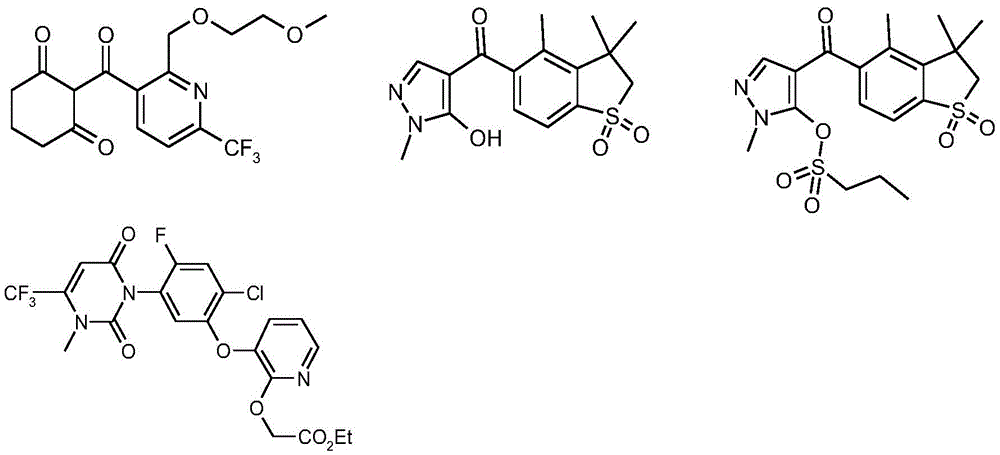
作为可能的混合伴体的植物生长调节剂的实例有:Examples of plant growth regulators as possible mixed partners are:
阿拉酸式苯(acibenzolar)、阿拉酸式苯-S-甲基(acibenzolar-S-methyl)、5-氨基乙酰丙酸(5-aminolevulinic acid)、醇草啶(ancymidol)、6-苄基氨基嘌呤(6-benzylaminopurine)、芸苔素内酯(brassinolide)、儿茶酚(catechol)、矮壮素(chlormequat chloride)、调果酸(cloprop)、环丙酰草胺(cyclanilide)、3-(环丙-1-烯基)丙酸、丁酰肼(daminozide)、棉隆(dazomet)、正癸醇、敌草克(dikegulac)、调呋酸(dikegulac-sodium)、茵多酸(endothal)、茵多酸二钾(endothal-dipotassium)、茵多酸二钠(endothal-disodium)和单(N,N-二甲基烷基铵)、乙烯利(ethephon)、氟节胺(flumetralin)、抑草丁(flurenol)、芴丁酸(flurenol-butyl)、呋嘧醇(flurprimidol)、氯吡脲(forchlorfenuron)、赤霉素(gibberellic acid)、抗倒胺(inabenfide)、吲哚-3-乙酸(IAA)、4-吲哚-3-基丁酸、稻瘟灵(isoprothiolane)、噻菌灵(probenazole)、茉莉酸(jasmonicacid)、茉莉酸甲酯、马来酰肼、缩节胺(mepiquat chloride)、1-甲基环丙烯、2-(1-萘基)乙酰胺、1-萘基乙酸、2-萘氧基乙酸、硝基苯酚盐混合物、4-氧代-4[(2-苯乙基)氨基]丁酸、多效唑(paclobutrazole)、N-苯基酞氨酸、调环酸(prohexadione)、调环酸钙(prohexadione-calcium)、茉莉酸丙酯(prohydrojasmone)、水杨酸、独脚金内酯(strigolactone)、四氯硝基苯(tecnazene)、噻苯隆(thidiazuron)、三十烷醇(triacontanol)、抗倒酯(trinexapac,trinexapac-ethyl)、tsitodef、烯效唑(uniconazole)、烯效唑-P(uniconazole-P)。Acibenzolar, acibenzolar-S-methyl, 5-aminolevulinic acid, ancymidol, 6-benzylamino 6-benzylaminopurine, brassinolide, catechol, chlormequat chloride, cloprop, cyclanilide, 3-( Cycloprop-1-enyl) propionic acid, daminozide, dazomet, n-decanol, dikegulac, dikegulac-sodium, endothal , Endothal-dipotassium, endothal-disodium and mono(N,N-dimethylalkylammonium), ethephon, flumetralin, Flurenol, flurenol-butyl, flurprimidol, forchlorfenuron, gibberellic acid, inabenfide, indole-3- Acetic acid (IAA), 4-indol-3-ylbutyric acid, isoprothiolane, probenazole, jasmonic acid, methyl jasmonate, maleic hydrazide, benzylamine ( mepiquat chloride), 1-methylcyclopropene, 2-(1-naphthyl)acetamide, 1-naphthylacetic acid, 2-naphthyloxyacetic acid, nitrophenate mixture, 4-oxo-4[(2 -Phenylethyl)amino]butyric acid, paclobutrazole, N-phenylphthalic acid, prohexadione, prohexadione-calcium, propyl jasmonate (prohydrojasmone), salicylate Acid, strigolactone, tecnazene, thidiazuron, triacontanol, trinexapac (trinexapac-ethyl), tsitodef, ene effect azole (uniconazole), uniconazole-P (uniconazole-P).
对于本发明的通式(I)的化合物可用的组合伴体还包括例如以下安全剂:Useful combination partners for the compounds of general formula (I) according to the invention also include, for example, the following safeners:
S1)来自杂环羧酸衍生物组的化合物:S1) Compounds from the group of heterocyclic carboxylic acid derivatives:
S1a)二氯苯基吡唑啉-3-甲酸类型(S1a)的化合物,优选化合物如1-(2,4-二氯苯基)-5-(乙氧基羰基)-5-甲基-2-吡唑啉-3-甲酸、1-(2,4-二氯苯基)-5-(乙氧基羰基)-5-甲基-2-吡唑啉-3-甲酸乙酯(S1-1)("吡唑解草酯")和如WO-A-91/07874中所描述的相关化合物;S1 a ) Compounds of the dichlorophenylpyrazoline-3-carboxylic acid type (S1 a ), preferably compounds such as 1-(2,4-dichlorophenyl)-5-(ethoxycarbonyl)-5-methyl Ethyl-2-pyrazoline-3-carboxylic acid, 1-(2,4-dichlorophenyl)-5-(ethoxycarbonyl)-5-methyl-2-pyrazoline-3-carboxylic acid ethyl ester (S1-1) ("Mezafenapyr") and related compounds as described in WO-A-91/07874;
S1b)二氯苯基吡唑甲酸的衍生物(S1b),优选化合物如1-(2,4-二氯苯基)-5-甲基吡唑-3-甲酸乙酯(S1-2)、1-(2,4-二氯苯基)-5-异丙基吡唑-3-甲酸乙酯(S1-3)、1-(2,4-二氯苯基)-5-(1,1-二甲基乙基)吡唑-3-甲酸乙酯(S1-4)和如EP-A-333131和EP-A-269806中所描述的相关化合物;S1 b ) Derivatives of dichlorophenylpyrazolecarboxylic acid (S1 b ), preferably compounds such as 1-(2,4-dichlorophenyl)-5-methylpyrazole-3-carboxylic acid ethyl ester (S1-2 ), 1-(2,4-dichlorophenyl)-5-isopropylpyrazole-3-carboxylic acid ethyl ester (S1-3), 1-(2,4-dichlorophenyl)-5-( 1,1-Dimethylethyl)pyrazole-3-carboxylic acid ethyl ester (S1-4) and related compounds as described in EP-A-333131 and EP-A-269806;
S1c)1,5-二苯基吡唑-3-甲酸的衍生物(S1c),优选化合物如1-(2,4-二氯苯基)-5-苯基吡唑-3-甲酸乙酯(S1-5)、1-(2-氯苯基)-5-苯基吡唑-3-甲酸甲酯(S1-6)和如例如EP-A-268554中所描述的相关化合物;S1 c ) derivatives of 1,5-diphenylpyrazole-3-carboxylic acid (S1 c ), preferably compounds such as 1-(2,4-dichlorophenyl)-5-phenylpyrazole-3-carboxylic acid ethyl ester (S1-5), methyl 1-(2-chlorophenyl)-5-phenylpyrazole-3-carboxylate (S1-6) and related compounds as described for example in EP-A-268554;
S1d)三唑甲酸类型的化合物(S1d),优选化合物如解草唑(-乙酯),即1-(2,4-二氯苯基)-5-三氯甲基-(1H)-1,2,4-三唑-3-甲酸乙酯(S1-7)和如EP-A-174562和EP-A-346620中所描述的相关化合物;S1 d ) Compounds of the triazolecarboxylic acid type (S1 d ), preferably compounds such as fenpyrazole (-ethyl ester), ie 1-(2,4-dichlorophenyl)-5-trichloromethyl-(1H) -1,2,4-Triazole-3-carboxylic acid ethyl ester (S1-7) and related compounds as described in EP-A-174562 and EP-A-346620;
S1e)5-苄基-或5-苯基-2-异噁唑啉-3-甲酸或5,5-二苯基-2-异噁唑啉-3-甲酸类型的化合物(S1e),优选化合物如5-(2,4-二氯苄基)-2-异噁唑啉-3-甲酸乙酯(S1-8)或5-苯基-2-异噁唑啉-3-甲酸乙酯(S1-9)和如WO-A-91/08202中所描述的相关化合物,或5,5-二苯基-2-异噁唑啉甲酸(S1-10)或5,5-二苯基-2-异噁唑啉-3-甲酸乙酯(S1-11)("双苯噁唑酸")或5,5-二苯基-2-异噁唑啉-3-甲酸正丙酯(S1-12)或5-(4-氟苯基)-5-苯基-2-异噁唑啉-3-甲酸乙酯(S1-13),如专利申请WO-A-95/07897中所描述。S1 e ) Compounds of the type 5-benzyl- or 5-phenyl-2-isoxazoline-3-carboxylic acid or 5,5-diphenyl-2-isoxazoline-3-carboxylic acid (S1 e ) , preferably compounds such as 5-(2,4-dichlorobenzyl)-2-isoxazoline-3-carboxylic acid ethyl ester (S1-8) or 5-phenyl-2-isoxazoline-3-carboxylic acid Ethyl ester (S1-9) and related compounds as described in WO-A-91/08202, or 5,5-diphenyl-2-isoxazolinecarboxylic acid (S1-10) or 5,5-diphenyl Ethyl phenyl-2-isoxazoline-3-carboxylate (S1-11) ("bisoxazoline") or n-propyl 5,5-diphenyl-2-isoxazoline-3-carboxylate Ester (S1-12) or ethyl 5-(4-fluorophenyl)-5-phenyl-2-isoxazoline-3-carboxylate (S1-13), as in patent application WO-A-95/07897 described in.
S2)来自8-喹啉氧基衍生物组(S2)的化合物:S2) Compounds from the group of 8-quinolinyloxy derivatives (S2):
S2a)8-喹啉氧基乙酸类型的化合物(S2a),优选(5-氯-8-喹啉氧基)乙酸1-甲基己酯("解毒喹")(S2-1)、(1,3-二甲基丁-1-基)(5-氯-8-喹啉氧基)乙酸酯(S2-2)、(5-氯-8-喹啉氧基)乙酸4-烯丙氧基丁酯(S2-3)、1-烯丙氧基丙-2-基(5-氯-8-喹啉氧基)乙酸酯(S2-4)、(5-氯-8-喹啉氧基)乙酸乙酯(S2-5)、(5-氯-8-喹啉氧基)乙酸甲酯(S2-6)、(5-氯-8-喹啉氧基)乙酸烯丙酯(S2-7)、(5-氯-8-喹啉氧基)乙酸2-(2-亚丙基亚胺氧基)-1-乙酯(S2-8)、2-氧代丙-1-基(5-氯-8-喹啉氧基)乙酸酯(S2-9)和如EP-A-86750、EP-A-94349和EP-A-191736或EP-A-0 492 366中所描述的相关化合物,及(5-氯-8-喹啉氧基)乙酸(S2-10)、其水合物和盐,例如其锂盐、钠盐、钾盐、钙盐、镁盐、铝盐、铁盐、铵盐、季铵盐、锍盐或鏻盐,如WO-A-2002/34048中所描述; S2a ) 8-quinolineoxyacetic acid type compound ( S2a ), preferably (5-chloro-8-quinolineoxy)acetic acid 1-methylhexyl ester ("quinoline") (S2-1), (1,3-Dimethylbutan-1-yl)(5-chloro-8-quinolinyloxy)acetate (S2-2), (5-chloro-8-quinolinyloxy)acetic acid 4- Allyloxybutyl ester (S2-3), 1-allyloxyprop-2-yl (5-chloro-8-quinolinoxy) acetate (S2-4), (5-chloro-8 -quinolinyloxy) ethyl acetate (S2-5), (5-chloro-8-quinolinyloxy) methyl acetate (S2-6), (5-chloro-8-quinolinyloxy) ethyl acetate Propyl ester (S2-7), (5-chloro-8-quinolinyloxy)acetic acid 2-(2-propyleneiminooxy)-1-ethyl ester (S2-8), 2-oxopropane -1-yl(5-chloro-8-quinolinyloxy)acetate (S2-9) and e.g. EP-A-86750, EP-A-94349 and EP-A-191736 or EP-A-0 492 Related compounds described in 366, and (5-chloro-8-quinolinoxy)acetic acid (S2-10), its hydrates and salts, such as its lithium, sodium, potassium, calcium, magnesium salts , aluminium, iron, ammonium, quaternary ammonium, sulfonium or phosphonium salts, as described in WO-A-2002/34048;
S2b)(5-氯-8-喹啉氧基)丙二酸类型的化合物(S2b),优选化合物如(5-氯-8-喹啉氧基)丙二酸二乙酯、(5-氯-8-喹啉氧基)丙二酸二烯丙酯、(5-氯-8-喹啉氧基)丙二酸甲基乙基酯和如EP-A-0 582 198中所描述的相关化合物。S2 b ) (5-chloro-8-quinolinyloxy) malonic acid type compound (S2 b ), preferably compounds such as (5-chloro-8-quinolinyloxy) diethyl malonate, (5 - Diallyl chloro-8-quinolinyloxy)malonate, methylethyl (5-chloro-8-quinolinyloxy)malonate and as described in EP-A-0 582 198 related compounds.
S3)二氯乙酰胺类型的活性成分(S3),其通常用作出苗前安全剂(作用于土壤的安全剂),例如“二氯丙烯胺”(N,N-二烯丙基-2,2-二氯乙酰胺)(S3-1)、来自Stauffer的"R-29148"(3-二氯乙酰基-2,2,5-三甲基-1,3-噁唑烷)(S3-2)、来自Stauffer的"R-28725"(3-二氯乙酰基-2,2-二甲基-1,3-噁唑烷)(S3-3)、"解草酮(benoxacor)"(4-二氯乙酰基-3,4-二氢-3-甲基-2H-1,4-苯并噁嗪)(S3-4)、来自PPG Industries的"PPG-1292"(N-烯丙基-N-[(1,3-二氧杂环戊烷-2-基)甲基]二氯乙酰胺)(S3-5)、来自Sagro-Chem的"DKA-24"(N-烯丙基-N-[(烯丙基氨基羰基)甲基]二氯乙酰胺)(S3-6)、来自Nitrokemia或Monsanto的"AD-67"或"MON 4660"(3-二氯乙酰基-1-氧杂-3-氮杂螺[4.5]癸烷)(S3-7)、来自TRI-ChemicalRT的"TI-35"(1-二氯乙酰基氮杂环庚烷)(S3-8)、"diclonon"(dicyclonon)或"BAS145138"或"LAB145138"(S3-9)、来自BASF的((RS)-1-二氯乙酰基-3,3,8a-三甲基全氢吡咯并[1,2-a]嘧啶-6-酮)、"解草恶唑(furilazole)"或"MON 13900"((RS)-3-二氯乙酰基-5-(2-呋喃基)-2,2-二甲基噁唑烷)(S3-10)、及其(R)异构体(S3-11)。S3) Active ingredients of the dichloroacetamide type (S3), which are commonly used as pre-emergence safeners (soil-acting safeners), such as "dichloropropenamine" (N,N-diallyl-2, 2-dichloroacetamide) (S3-1), "R-29148" from Stauffer (3-dichloroacetyl-2,2,5-trimethyl-1,3-oxazolidine) (S3- 2), "R-28725" from Stauffer (3-dichloroacetyl-2,2-dimethyl-1,3-oxazolidine) (S3-3), "benoxacor" ( 4-Dichloroacetyl-3,4-dihydro-3-methyl-2H-1,4-benzoxazine) (S3-4), "PPG-1292" from PPG Industries (N-allyl yl-N-[(1,3-dioxolane-2-yl)methyl]dichloroacetamide) (S3-5), "DKA-24" from Sagro-Chem (N-allyl yl-N-[(allylaminocarbonyl)methyl]dichloroacetamide) (S3-6), "AD-67" or "MON 4660" (3-dichloroacetyl-1 from Nitrokemia or Monsanto) -oxa-3-azaspiro[4.5]decane) (S3-7), "TI-35" (1-dichloroacetylazepane) (S3-8) from TRI-ChemicalRT, "diclonon" (dicyclonon) or "BAS145138" or "LAB145138" (S3-9), ((RS)-1-dichloroacetyl-3,3,8a-trimethylperhydropyrrolo[1] from BASF ,2-a]pyrimidin-6-one), "furilazole" or "MON 13900" ((RS)-3-dichloroacetyl-5-(2-furyl)-2,2 - dimethyloxazolidine) (S3-10), and its (R) isomer (S3-11).
S4)来自酰基磺酰胺类的化合物(S4):S4) Compounds (S4) from acylsulfonamides:
S4a)式(S4a)的N-酰基磺酰胺及其盐,如WO-A-97/45016中所描述, S4a ) N-acylsulfonamides of formula (S4a) and salts thereof, as described in WO- A -97/45016,

其中:in:
RA 1为(C1-C6)-烷基、(C3-C6)-环烷基,其中后2个基团被选自卤素、(C1-C4)-烷氧基、(C1-C6)-卤代烷氧基和(C1-C4)-烷硫基及在环状基团的情况下也被选自(C1-C4)-烷基和(C1-C4)-卤代烷基的vA取代基所取代;R A 1 is (C 1 -C 6 )-alkyl, (C 3 -C 6 )-cycloalkyl, wherein the latter two groups are selected from halogen, (C 1 -C 4 )-alkoxy, (C 1 -C 6 )-haloalkoxy and (C 1 -C 4 )-alkylthio and in the case of cyclic groups are also selected from (C 1 -C 4 )-alkyl and (C 1 ) -C 4 )-haloalkyl substituted with v A substituent;
RA 2为卤素、(C1-C4)-烷基、(C1-C4)-烷氧基、CF3;R A 2 is halogen, (C 1 -C 4 )-alkyl, (C 1 -C 4 )-alkoxy, CF 3 ;
mA为1或2;mA is 1 or 2;
vA为0、1、2或3;v A is 0, 1, 2 or 3;
S4b)式(S4b)的4-(苯甲酰基氨磺酰基)苯甲酰胺类型的化合物及其盐,如WO-A-99/16744中所描述, S4b ) Compounds of the 4-( benzoylsulfamoyl )benzamide type of formula (S4b) and salts thereof, as described in WO-A-99/16744,

其中:in:
RB 1、RB 2独立地为氢、(C1-C6)-烷基、(C3-C6)-环烷基、(C3-C6)-烯基、(C3-C6)-炔基,R B 1 , R B 2 are independently hydrogen, (C 1 -C 6 )-alkyl, (C 3 -C 6 )-cycloalkyl, (C 3 -C 6 )-alkenyl, (C 3 - C 6 )-alkynyl,
RB 3为卤素、(C1-C4)-烷基、(C1-C4)-卤代烷基或(C1-C4)-烷氧基和R B 3 is halogen, (C 1 -C 4 )-alkyl, (C 1 -C 4 )-haloalkyl or (C 1 -C 4 )-alkoxy and
mB为1或2,m B is 1 or 2,
例如其中for example where
RB 1=环丙基、RB 2=氢、并且(RB 3)=2-OMe("环丙磺酰胺",S4-1),R B 1 =cyclopropyl, R B 2 =hydrogen, and (R B 3 )=2-OMe ("cyclopropanesulfonamide", S4-1),
RB 1=环丙基、RB 2=氢、并且(RB 3)=5-Cl-2-OMe(S4-2),R B 1 =cyclopropyl, R B 2 =hydrogen, and (R B 3 )=5-Cl-2-OMe (S4-2),
RB 1=乙基、RB 2=氢、并且(RB 3)=2-OMe(S4-3),R B 1 =ethyl, R B 2 =hydrogen, and (R B 3 )=2-OMe (S4-3),
RB 1=异丙基、RB 2=氢、并且(RB 3)=5-Cl-2-OMe(S4-4)和R B 1 =isopropyl, R B 2 =hydrogen, and (R B 3 )=5-Cl-2-OMe (S4-4) and
RB 1=异丙基、RB 2=氢、并且(RB 3)=2-OMe(S4-5)的那些;Those where R B 1 =isopropyl, R B 2 =hydrogen, and (R B 3 )=2-OMe (S4-5);
S4c)来自式(S4c)的苯甲酰基氨磺酰基苯基脲类的化合物,如EP-A-365484中所描述, S4c ) compounds from the benzoylsulfamoylphenylureas of formula ( S4c ) as described in EP-A-365484,

其中:in:
RC 1、RC 2独立地为氢、(C1-C8)-烷基、(C3-C8)-环烷基、(C3-C6)-烯基、(C3-C6)-炔基,R C 1 , R C 2 are independently hydrogen, (C 1 -C 8 )-alkyl, (C 3 -C 8 )-cycloalkyl, (C 3 -C 6 )-alkenyl, (C 3 - C 6 )-alkynyl,
RC 3为卤素、(C1-C4)-烷基、(C1-C4)-烷氧基、CF3和R C 3 is halogen, (C 1 -C 4 )-alkyl, (C 1 -C 4 )-alkoxy, CF 3 and
mC为1或2;m C is 1 or 2;
例如:E.g:
1-[4-(N-2-甲氧基苯甲酰基氨磺酰基)苯基]-3-甲基脲,1-[4-(N-2-Methoxybenzoylsulfamoyl)phenyl]-3-methylurea,
1-[4-(N-2-甲氧基苯甲酰基氨磺酰基)苯基]-3,3-二甲基脲,1-[4-(N-2-Methoxybenzoylsulfamoyl)phenyl]-3,3-dimethylurea,
1-[4-(N-4,5-二甲基苯甲酰基氨磺酰基)苯基]-3-甲基脲;1-[4-(N-4,5-dimethylbenzoylsulfamoyl)phenyl]-3-methylurea;
S4d)式(S4d)的N-苯基磺酰基对苯二甲酰胺类型的化合物,其例如从CN 101838227已知, S4d ) compounds of the N-phenylsulfonylterephthalamide type of formula ( S4d ), which are known, for example, from CN 101838227,

其中:in:
RD 4为卤素、(C1-C4)-烷基、(C1-C4)-烷氧基、CF3;R D 4 is halogen, (C 1 -C 4 )-alkyl, (C 1 -C 4 )-alkoxy, CF 3 ;
mD为1或2;m D is 1 or 2;
RD 5为氢、(C1-C6)-烷基、(C3-C6)-环烷基、(C2-C6)-烯基、(C2-C6)-炔基、(C5-C6)-环烯基。R D 5 is hydrogen, (C 1 -C 6 )-alkyl, (C 3 -C 6 )-cycloalkyl, (C 2 -C 6 )-alkenyl, (C 2 -C 6 )-alkynyl , (C 5 -C 6 )-cycloalkenyl.
S5)来自羟基芳族化合物和芳族-脂族羧酸衍生物类的活性成分(S5),例如3,4,5-三乙酰氧基苯甲酸乙酯、3,5-二甲氧基-4-羟基苯甲酸、3,5-二羟基苯甲酸、4-羟基水杨酸、4-氟水杨酸、2-羟基肉桂酸、2,4-二氯肉桂酸,如WO-A-2004/084631、WO-A-2005/015994、WO-A-2005/016001中所描述。S5) Active ingredients (S5) from the class of hydroxyaromatic compounds and aromatic-aliphatic carboxylic acid derivatives, such as ethyl 3,4,5-triacetoxybenzoate, 3,5-dimethoxy- 4-Hydroxybenzoic acid, 3,5-dihydroxybenzoic acid, 4-hydroxysalicylic acid, 4-fluorosalicylic acid, 2-hydroxycinnamic acid, 2,4-dichlorocinnamic acid, as in WO-A-2004 /084631, WO-A-2005/015994, WO-A-2005/016001.
S6)来自1,2-二氢喹喔啉-2-酮类的活性成分(S6),例如1-甲基-3-(2-噻吩基)-1,2-二氢喹喔啉-2-酮、1-甲基-3-(2-噻吩基)-1,2-二氢喹喔啉-2-硫酮、1-(2-氨基乙基)-3-(2-噻吩基)-1,2-二氢喹喔啉-2-酮盐酸盐、1-(2-甲基磺酰基氨基乙基)-3-(2-噻吩基)-1,2-二氢喹喔啉-2-酮,如WO-A-2005/112630中所描述。S6) Active ingredients (S6) from 1,2-dihydroquinoxalin-2-ones, such as 1-methyl-3-(2-thienyl)-1,2-dihydroquinoxaline-2 - Ketone, 1-methyl-3-(2-thienyl)-1,2-dihydroquinoxaline-2-thione, 1-(2-aminoethyl)-3-(2-thienyl) -1,2-Dihydroquinoxalin-2-one hydrochloride, 1-(2-methylsulfonylaminoethyl)-3-(2-thienyl)-1,2-dihydroquinoxaline -2-keto, as described in WO-A-2005/112630.
S7)来自二苯基甲氧基乙酸衍生物类的化合物(S7),例如,二苯基甲氧基乙酸甲酯(CAS登录号41858-19-9)(S7-1)、二苯基甲氧基乙酸乙酯或二苯基甲氧基乙酸,如WO-A-98/38856中所描述。S7) Compounds (S7) from diphenylmethoxyacetic acid derivatives, for example, methyl diphenylmethoxyacetate (CAS Reg. No. 41858-19-9) (S7-1), diphenylmethane Ethyl oxyacetate or diphenylmethoxyacetic acid, as described in WO-A-98/38856.
S8)式(S8)的化合物,如WO-A-98/27049中所描述,S8) compounds of formula (S8), as described in WO-A-98/27049,

其中符号和指数如下定义:where the sign and exponent are defined as follows:
RD 1为卤素、(C1-C4)-烷基、(C1-C4)-卤代烷基、(C1-C4)-烷氧基、(C1-C4)-卤代烷氧基,R D 1 is halogen, (C 1 -C 4 )-alkyl, (C 1 -C 4 )-haloalkyl, (C 1 -C 4 )-alkoxy, (C 1 -C 4 )-haloalkoxy base,
RD 2为氢或(C1-C4)-烷基,R D 2 is hydrogen or (C 1 -C 4 )-alkyl,
RD 3为氢、(C1-C8)-烷基、(C2-C4)-烯基、(C2-C4)-炔基或芳基,其中前述含碳基团中的每一个未被取代或者被一个或多个、优选至多三个选自卤素和烷氧基的相同或不同基团所取代;或其盐,R D 3 is hydrogen, (C 1 -C 8 )-alkyl, (C 2 -C 4 )-alkenyl, (C 2 -C 4 )-alkynyl or aryl, wherein in the aforementioned carbon-containing groups each is unsubstituted or substituted with one or more, preferably up to three, the same or different groups selected from halogen and alkoxy; or a salt thereof,
nD为0至2的整数。n D is an integer from 0 to 2.
S9)来自3-(5-四唑基羰基)-2-喹诺酮类的活性成分(S9),例如1,2-二氢-4-羟基-1-乙基-3-(5-四唑基羰基)-2-喹诺酮(CAS登录号:219479-18-2)、1,2-二氢-4-羟基-1-甲基-3-(5-四唑基羰基)-2-喹诺酮(CAS登录号95855-00-8),如WO-A-1999/000020中所描述。S9) Active ingredients (S9) from 3-(5-tetrazolylcarbonyl)-2-quinolones, such as 1,2-dihydro-4-hydroxy-1-ethyl-3-(5-tetrazolyl carbonyl)-2-quinolone (CAS No. 219479-18-2), 1,2-dihydro-4-hydroxy-1-methyl-3-(5-tetrazolylcarbonyl)-2-quinolone (CAS Accession No. 95855-00-8), as described in WO-A-1999/000020.
S10)式(S10a)或(S10b)的化合物S10) Compounds of formula (S10 a ) or (S10 b )
如WO-A-2007/023719和WO-A-2007/023764中所描述As described in WO-A-2007/023719 and WO-A-2007/023764

其中:in:
RE 1为卤素、(C1-C4)-烷基、甲氧基、硝基、氰基、CF3、OCF3,R E 1 is halogen, (C 1 -C 4 )-alkyl, methoxy, nitro, cyano, CF 3 , OCF 3 ,
YE、ZE独立地为O或S,Y E and Z E are independently O or S,
nE为0至4的整数,n E is an integer from 0 to 4,
RE 2为(C1-C16)-烷基、(C2-C6)-烯基、(C3-C6)-环烷基、芳基;苄基、卤代苄基,R E 2 is (C 1 -C 16 )-alkyl, (C 2 -C 6 )-alkenyl, (C 3 -C 6 )-cycloalkyl, aryl; benzyl, halobenzyl,
RE 3为氢或(C1-C6)-烷基。R E 3 is hydrogen or (C 1 -C 6 )-alkyl.
S11)已知作为拌种剂的氧基亚氨基化合物类型的活性成分(S11),例如S11) Active ingredients (S11) of the type of oxyimino compounds known as seed dressings, for example
"解草腈(oxabetrinil)"((Z)-1,3-二氧杂环戊烷-2-基甲氧基亚氨基(苯基)乙腈)(S11-1),其已知作为拌种安全剂用于小米/高粱来抵抗异丙甲草胺的损害,"oxabetrinil" ((Z)-1,3-dioxolane-2-ylmethoxyimino(phenyl)acetonitrile) (S11-1), which is known as seed dressing Safener for millet/sorghum to resist the damage of metolachlor,
"氟草肟(fluxofenim)"(1-(4-氯苯基)-2,2,2-三氟-1-乙酮-O-(1,3-二氧杂环戊烷-2-基甲基)肟)(S11-2),其已知作为拌种安全剂用于小米/高粱来抵抗异丙甲草胺的损害,和"fluxofenim" (1-(4-chlorophenyl)-2,2,2-trifluoro-1-ethanone-O-(1,3-dioxolane-2-yl) Methyl)oxime) (S11-2), which is known as a seed dressing safener for millet/sorghum against damage from metolachlor, and
"解草胺腈(cyometrinil)"或"CGA-43089"((Z)-氰基甲氧基亚氨基(苯基)乙腈)(S11-3),其已知作为拌种安全剂用于小米/高粱来抵抗异丙甲草胺的损害。"Cyometrinil" or "CGA-43089" ((Z)-cyanomethoxyimino(phenyl)acetonitrile) (S11-3), which is known as a seed dressing safener for millet / sorghum to resist the damage of metolachlor.
S12)来自异硫代苯并二氢吡喃酮类的活性成分(S12),例如[(3-氧代-1H-2-苯并噻喃-4(3H)-亚基)甲氧基]乙酸甲酯(CAS登录号205121-04-6)(S12-1)和来自WO-A-1998/13361的相关化合物。S12) Active ingredients (S12) from isothiochromones, such as [(3-oxo-1H-2-benzothiopyran-4(3H)-ylidene)methoxy] Methyl acetate (CAS Reg. No. 205121-04-6) (S12-1) and related compounds from WO-A-1998/13361.
S13)来自组的一种或多种化合物(S13):S13) one or more compounds from the group (S13):
"萘二甲酸酐(naphthalic anhydride)"(1,8-萘二甲酸酐)(S13-1),其已知作为拌种安全剂用于玉米来抵抗硫代氨基甲酸酯除草剂的损害,"Naphthalic anhydride" (1,8-naphthalic anhydride) (S13-1), which is known as a seed dressing safener for corn to resist damage from thiocarbamate herbicides,
"解草啶(fenclorim)"(4,6-二氯-2-苯基嘧啶)(S13-2),其已知作为安全剂用于播种稻(sown rice)来抵抗丙草胺(pretilachlor),"fenclorim" (4,6-dichloro-2-phenylpyrimidine) (S13-2), which is known as a safener for sown rice against pretilachlor ,
"解草胺(flurazole)"(2-氯-4-三氟甲基-1,3-噻唑-5-甲酸苄酯)(S13-3),其已知作为拌种安全剂用于小米/高粱来抵抗甲草胺(alachlor)和异丙甲草胺(metolachlor)的损害,"flurazole" (2-chloro-4-trifluoromethyl-1,3-thiazole-5-carboxylic acid benzyl ester) (S13-3), which is known as a seed dressing safener for millet/ Sorghum to resist damage from alachlor and metolachlor,
来自American Cyanamid的"CL 304415"(CAS登录号31541-57-8)(4-羧基-3,4-二氢-2H-1-苯并吡喃-4-乙酸)(S13-4),其已知作为安全剂用于玉米来抵抗咪唑啉酮类(imidazolinones)的损害,"CL 304415" (CAS Registry No. 31541-57-8) (4-carboxy-3,4-dihydro-2H-1-benzopyran-4-acetic acid) (S13-4) from American Cyanamid, which Known for use in corn as a safener against damage from imidazolinones,
来自Nitrokemia的"MG 191"(CAS登录号96420-72-3)(2-二氯甲基-2-甲基-1,3-二氧杂环戊烷)(S13-5),其已知作为安全剂用于玉米,"MG 191" (CAS Accession No. 96420-72-3) (2-dichloromethyl-2-methyl-1,3-dioxolane) (S13-5) from Nitrokemia, which is known as a safener for corn,
来自Nitrokemia的"MG 838"(CAS登录号133993-74-5)"MG 838" from Nitrokemia (CAS Accession No. 133993-74-5)
(1-氧杂-4-氮杂螺[4.5]癸烷-4-二硫代甲酸2-丙烯基酯)(S13-6),(2-propenyl 1-oxa-4-azaspiro[4.5]decane-4-dithiocarboxylate) (S13-6),
"乙拌磷(disulfoton)"(O,O-二乙基S-2-乙基硫基乙基二硫代磷酸酯)(S13-7),"disulfoton" (O,O-diethyl S-2-ethylthioethyl dithiophosphate) (S13-7),
"增效磷(dietholate)"(O,O-二乙基O-苯基硫代磷酸酯)(S13-8),"dietholate" (O,O-diethyl O-phenyl phosphorothioate) (S13-8),
"mephenate"(4-氯苯基甲基氨基甲酸酯)(S13-9)。"mephenate" (4-chlorophenylmethylcarbamate) (S13-9).
S14)除了对有害植物的除草作用外还对作物植物如稻具有安全剂作用的活性成分,例如S14) Active ingredients which, in addition to their herbicidal action against harmful plants, have a safener action on crop plants such as rice, for example
"哌草丹(dimepiperate)"或"MY-93"(S-1-甲基-1-苯基乙基哌啶-1-硫代甲酸酯),其已知作为安全剂用于稻来抵抗除草剂禾草敌(molinate)的损害,"dimepiperate" or "MY-93" (S-1-methyl-1-phenylethylpiperidine-1-thiocarboxylate), which is known as a safener for rice Resists damage from the herbicide molinate,
"杀草隆(daimuron)"或"SK 23"(1-(1-甲基-1-苯基乙基)-3-对-甲苯基脲),其已知作为安全剂用于稻来抵抗除草剂吡嘧磺隆(imazosulfuron)的损害,"daimuron" or "SK 23" (1-(1-methyl-1-phenylethyl)-3-p-tolylurea), which is known as a safener for rice against damage from the herbicide imazosulfuron,
"苄草隆(cumyluron)"="JC-940"(3-(2-氯苯基甲基)-1-(1-甲基-1-苯基乙基)脲,参见JP-A-60087270),其已知作为安全剂用于稻来抵抗一些除草剂的损害,"cumyluron" = "JC-940" (3-(2-chlorophenylmethyl)-1-(1-methyl-1-phenylethyl)urea, see JP-A-60087270 ), which is known to be used in rice as a safener against damage from some herbicides,
"苯草酮(methoxyphenone)"或"NK 049"(3,3'-二甲基-4-甲氧基二苯甲酮),其已知作为安全剂用于稻来抵抗一些除草剂的损害,"methoxyphenone" or "NK 049" (3,3'-dimethyl-4-methoxybenzophenone), which is known to be used in rice as a safener to resist damage from some herbicides ,
来自Kumiai的“CSB"(1-溴-4-(氯甲基磺酰)苯)(CAS登录号54091-06-4),其已知在稻中作为安全剂来抵抗一些除草剂的损害。"CSB" (1-bromo-4-(chloromethylsulfonyl)benzene) from Kumiai (CAS Accession No. 54091-06-4), which is known to act as a safener in rice against damage from some herbicides.
S15)式(S15)的化合物或其互变异构体S15) The compound of formula (S15) or its tautomer

如WO-A-2008/131861和WO-A-2008/131860中所描述As described in WO-A-2008/131861 and WO-A-2008/131860
其中:in:
RH 1为(C1-C6)-卤代烷基基团,以及R H 1 is a (C 1 -C 6 )-haloalkyl group, and
RH 2为氢或卤素,以及R H is hydrogen or halogen, and
RH 3、RH 4独立地为氢、(C1-C16)-烷基、(C2-C16)-烯基或(C2-C16)-炔基, RH 3 , RH 4 are independently hydrogen, (C 1 -C 16 )-alkyl, (C 2 -C 16 )-alkenyl or (C 2 -C 16 )-alkynyl,
其中后3个基团中的每一个未被取代或者被一个或多个选自卤素、羟基、氰基、(C1-C4)-烷氧基、(C1-C4)-卤代烷氧基、(C1-C4)-烷硫基、(C1-C4)-烷基氨基、二[(C1-C4)-烷基]氨基、[(C1-C4)-烷氧基]羰基、[(C1-C4)-卤代烷氧基]羰基、未取代或被取代的(C3-C6)-环烷基、未取代或被取代的苯基和未取代或被取代的杂环基的基团所取代,wherein each of the last 3 groups is unsubstituted or replaced by one or more groups selected from halogen, hydroxy, cyano, (C 1 -C 4 )-alkoxy, (C 1 -C 4 )-haloalkoxy base, (C 1 -C 4 )-alkylthio, (C 1 -C 4 )-alkylamino, bis[(C 1 -C 4 )-alkyl]amino, [(C 1 -C 4 )- Alkoxy]carbonyl, [( C1 - C4 )-haloalkoxy]carbonyl, unsubstituted or substituted (C3 - C6 )-cycloalkyl, unsubstituted or substituted phenyl and unsubstituted or substituted by a substituted heterocyclyl group,
或(C3-C6)-环烷基、(C4-C6)-环烯基、环的一侧稠合到4至6-元饱和或不饱和碳环的(C3-C6)-环烷基或环的一侧稠合到4至6-元饱和或不饱和碳环的(C4-C6)-环烯基,or (C 3 -C 6 )-cycloalkyl, (C 4 -C 6 )-cycloalkenyl, one side of the ring fused to a 4- to 6-membered saturated or unsaturated carbocyclic (C 3 -C 6 )-cycloalkyl or one side of the ring is fused to a 4- to 6-membered saturated or unsaturated carbocyclic (C 4 -C 6 )-cycloalkenyl,
其中后4个基团中的每一个未被取代或者被一个或多个选自卤素、羟基、氰基、(C1-C4)-烷基、(C1-C4)-卤代烷基、(C1-C4)-烷氧基、(C1-C4)-卤代烷氧基、(C1-C4)-烷硫基、(C1-C4)-烷基氨基、二[(C1-C4)-烷基]氨基、[(C1-C4)-烷氧基]羰基、[(C1-C4)-卤代烷氧基]羰基、未取代或被取代的(C3-C6)-环烷基、未取代或被取代的苯基和未取代或被取代的杂环基的基团所取代,wherein each of the last 4 groups is unsubstituted or is replaced by one or more groups selected from halogen, hydroxy, cyano, (C 1 -C 4 )-alkyl, (C 1 -C 4 )-haloalkyl, (C 1 -C 4 )-alkoxy, (C 1 -C 4 )-haloalkoxy, (C 1 -C 4 )-alkylthio, (C 1 -C 4 )-alkylamino, bis[ (C 1 -C 4 )-Alkyl]amino, [(C 1 -C 4 )-alkoxy]carbonyl, [(C 1 -C 4 )-haloalkoxy]carbonyl, unsubstituted or substituted ( C 3 -C 6 )-cycloalkyl, unsubstituted or substituted phenyl and unsubstituted or substituted heterocyclyl groups,
或or
RH 3为(C1-C4)-烷氧基、(C2-C4)-烯氧基、(C2-C6)-炔氧基或(C2-C4)-卤代烷氧基,和R H 3 is (C 1 -C 4 )-alkoxy, (C 2 -C 4 )-alkenyloxy, (C 2 -C 6 )-alkynyloxy or (C 2 -C 4 )-haloalkoxy base, and
RH 4为氢或(C1-C4)-烷基,或 RH 4 is hydrogen or (C 1 -C 4 )-alkyl, or
RH 3和RH 4与直接连接的氮原子一起代表四至八元杂环,除氮原子外,其也可含有进一步的环杂原子,优选地至多两个选自N、O和S的进一步的环杂原子,并且其未被取代或者被一个或多个选自卤素、氰基、硝基、(C1-C4)-烷基、(C1-C4)-卤代烷基、(C1-C4)-烷氧基、(C1-C4)-卤代烷氧基和(C1-C4)-烷硫基的基团所取代。 RH3 and RH4 together with the directly attached nitrogen atom represent a four- to eight-membered heterocycle, which may also contain further ring heteroatoms in addition to the nitrogen atom, preferably at most two further selected from N, O and S ring heteroatom, and it is unsubstituted or is replaced by one or more selected from halogen, cyano, nitro, (C 1 -C 4 )-alkyl, (C 1 -C 4 )-haloalkyl, (C 1 -C 4 )-haloalkyl 1 -C 4 )-alkoxy, (C 1 -C 4 )-haloalkoxy and (C 1 -C 4 )-alkylthio groups.
S16)主要用作除草剂但也对作物植物具有安全剂作用的活性成分,例如(2,4-二氯苯氧基)乙酸(2,4-D)、(4-氯苯氧基)乙酸、(R,S)-2-(4-氯-邻-甲苯氧基)丙酸(mecoprop)、4-(2,4-二氯苯氧基)丁酸(2,4-DB)、(4-氯-邻-甲苯氧基)乙酸(MCPA)、4-(4-氯-邻-甲苯氧基)丁酸、4-(4-氯苯氧基)丁酸、3,6-二氯-2-甲氧基苯甲酸(麦草畏(dicamba))、3,6-二氯-2-甲氧基苯甲酸1-(乙氧基羰基)乙酯(lactidichlor-ethyl)。S16) Active ingredients that are mainly used as herbicides but also have safener action on crop plants, eg (2,4-dichlorophenoxy)acetic acid (2,4-D), (4-chlorophenoxy)acetic acid , (R,S)-2-(4-chloro-o-tolyloxy)propionic acid (mecoprop), 4-(2,4-dichlorophenoxy)butyric acid (2,4-DB), ( 4-Chloro-o-tolyloxy)acetic acid (MCPA), 4-(4-Chloro-o-tolyloxy)butyric acid, 4-(4-chlorophenoxy)butyric acid, 3,6-dichloro -2-Methoxybenzoic acid (dicamba), 3,6-dichloro-2-methoxybenzoic acid 1-(ethoxycarbonyl)ethyl ester (lactidichlor-ethyl).
与根据本发明的式(I)的化合物和/或其盐、特别是与式(I.1)至(I.182)的化合物和/或其盐组合的优选安全剂为:解毒喹(cloquintocet-mexyl)、环丙磺酰胺(cyprosulfamide)、解草唑乙酯(fenchlorazole ethyl ester)、双苯噁唑酸(isoxadifen-ethyl)、吡唑解草酯(mefenpyr-diethyl)、解草啶(fenclorim)、苄草隆(cumyluron)、S4-1和S4-5,并且特别优选的安全剂为:解毒喹、环丙磺酰胺、双苯噁唑酸和吡唑解草酯。Preferred safeners in combination with compounds of formula (I) and/or their salts according to the invention, in particular with compounds of formulae (I.1) to (I.182) and/or their salts, are: cloquintocet -mexyl), cyprosulfamide, fenchlorazole ethyl ester, isoxadifen-ethyl, mefenpyr-diethyl, fenclorim ), cumyluron, S4-1 and S4-5, and particularly preferred safeners are: quintox, cyclopropanesulfonamide, fenoxapyr and mefenox.
C.生物学实施例C. Biological Examples
1.出苗前除草效果和作物植物相容性1. Pre-emergence herbicidal effect and crop plant compatibility
将单子叶和双子叶杂草植物和作物植物的种子摆放在木纤维盆中的砂壤土中并用土壤覆盖。然后将以可湿性粉剂(WP)的形式或作为乳液浓缩物(EC)配制的本发明化合物添加0.2%的润湿剂以水性悬浮液或乳液以等于600至800L/ha的水施用量施用到覆盖土壤的表面。Seeds of monocotyledonous and dicotyledonous weed plants and crop plants were placed in sandy loam soil in wood fiber pots and covered with soil. The compounds of the invention, formulated in the form of wettable powders (WP) or as emulsion concentrates (EC) plus 0.2% of wetting agent, are then applied as an aqueous suspension or emulsion at an application rate of water equal to 600 to 800 L/ha. Cover the surface of the soil.
处理后,将盆放在温室中并保持在良好的试验植物生长条件下。在3周的试验期后,通过与未经处理的对照比较来对试验植物的损害进行目测评分(除草活性百分数(%):100%活性=植物已死亡,0%活性=与对照植物一样)。After treatment, the pots were placed in the greenhouse and maintained under good test plant growth conditions. After the 3-week test period, the test plants were visually scored for damage by comparison with untreated controls (percent (%) herbicidal activity: 100% activity = plants died, 0% activity = same as control plants) .
不需要的植物/杂草:Unwanted Plants/Weeds:
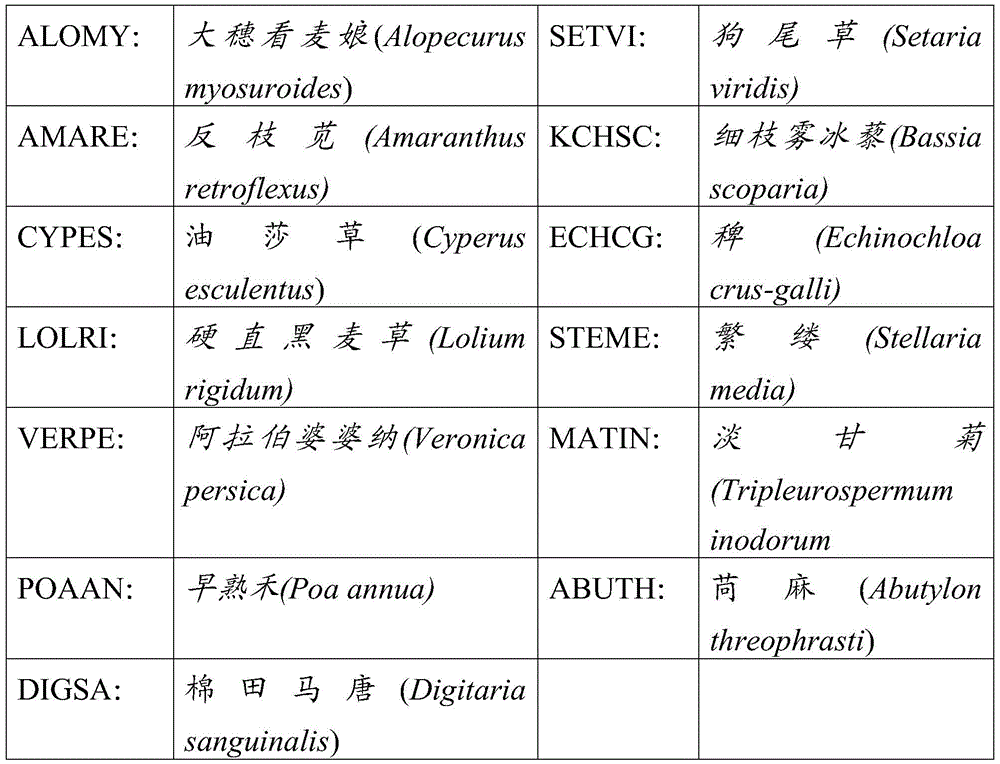
1.出苗前有效性1. Pre-emergence effectiveness
如表1.1至1.10的结果所示,本发明的化合物对广谱的禾本科杂草和阔叶杂草具有良好的出苗前除草功效。As shown in the results in Tables 1.1 to 1.10, the compounds of the present invention have good pre-emergence herbicidal efficacy against a broad spectrum of grass and broadleaf weeds.
表1.对ALOMY的出苗前作用Table 1. Pre-emergence effects on ALOMY


表2.对DIGSA的出苗前作用Table 2. Pre-emergence effects on DIGSA


表3.对ECHCG的出苗前作用Table 3. Pre-emergence effects on ECHCG

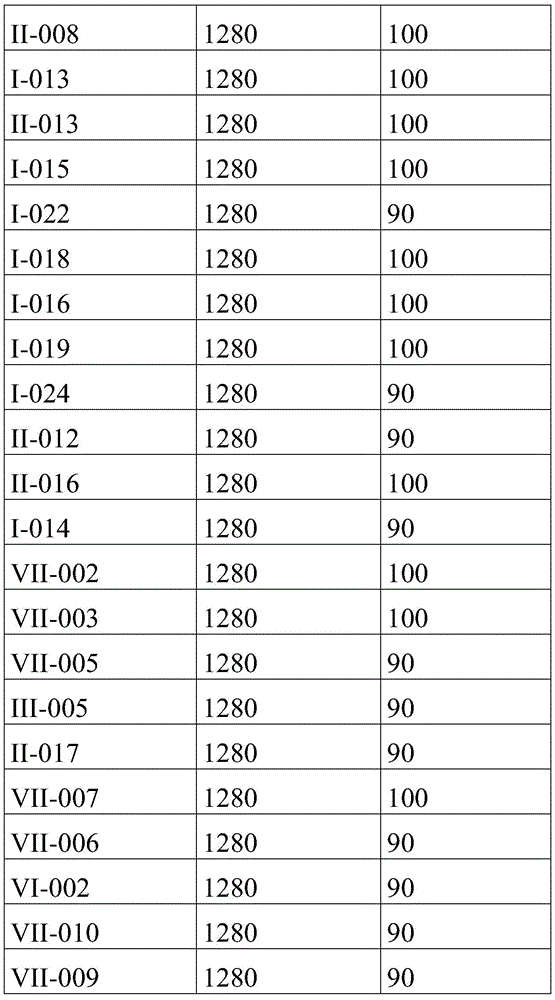
表4.对LOLRI的出苗前作用Table 4. Pre-emergence effects on LOLRI


表5.对POAAN的出苗前作用Table 5. Pre-emergence effects on POAAN


表6.对SETVI的出苗前作用Table 6. Pre-emergence effects on SETVI
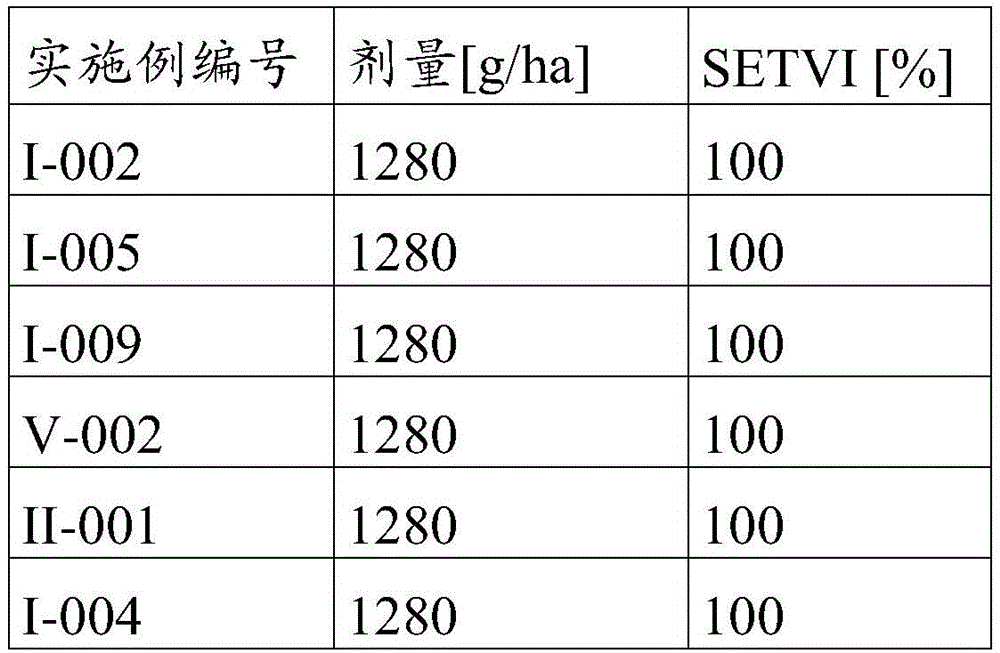


表7.对ABUTH的出苗前作用Table 7. Pre-emergence effects on ABUTH
表8.对AMARE的出苗前作用Table 8. Pre-emergence effects on AMARE

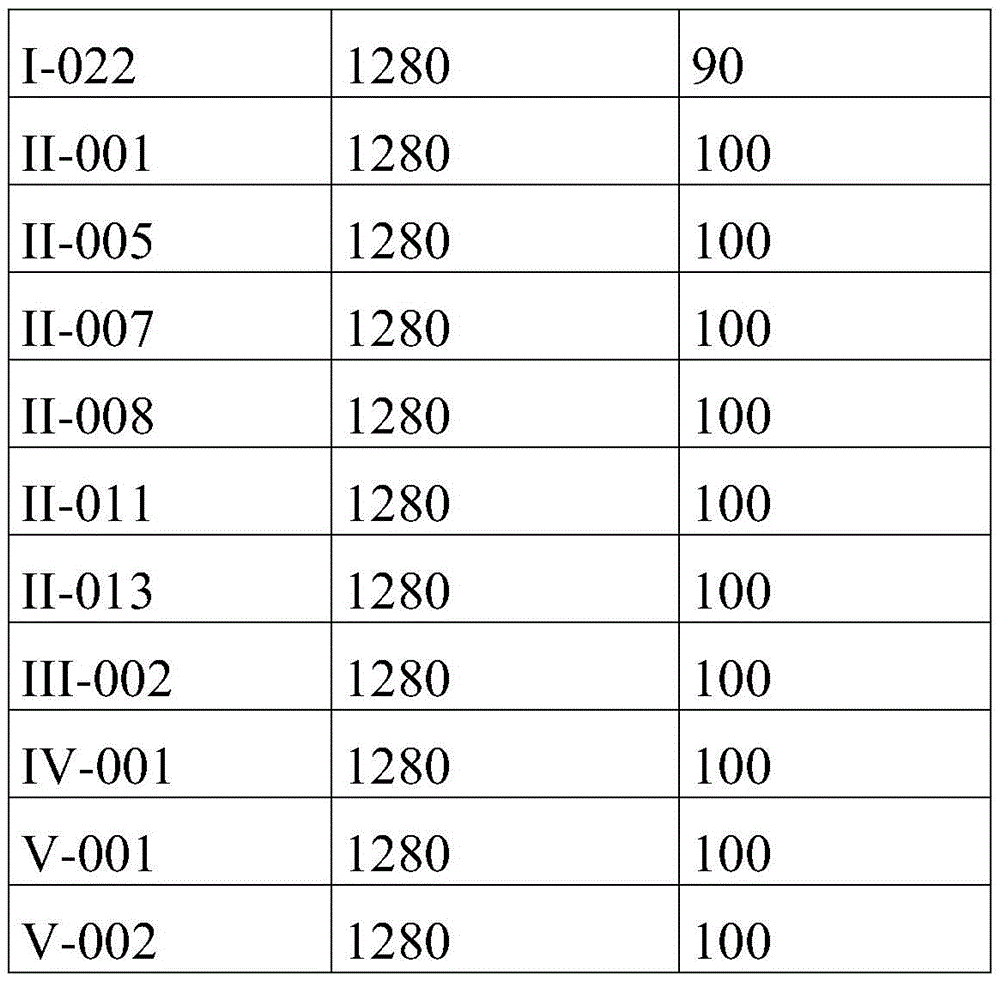
表9.对KCHSC的出苗前作用Table 9. Pre-emergence effects on KCHSC
表10.对MATIN的出苗前作用Table 10. Pre-emergence effects on MATIN
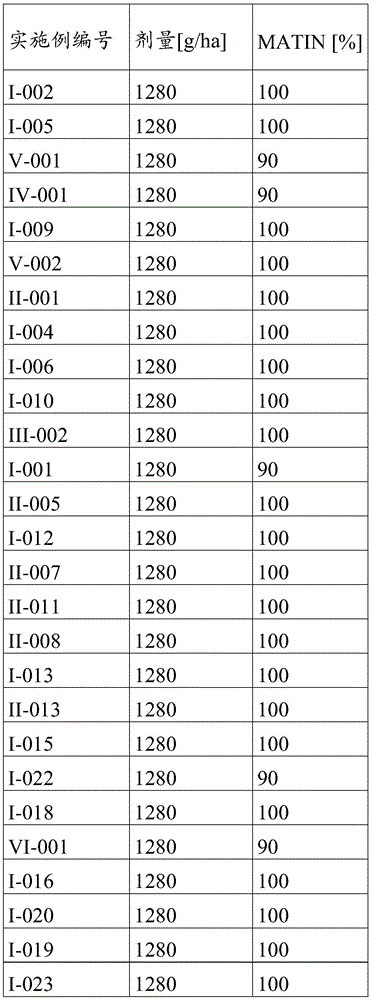

表11.对STEME的出苗前作用Table 11. Pre-emergence effects on STEME


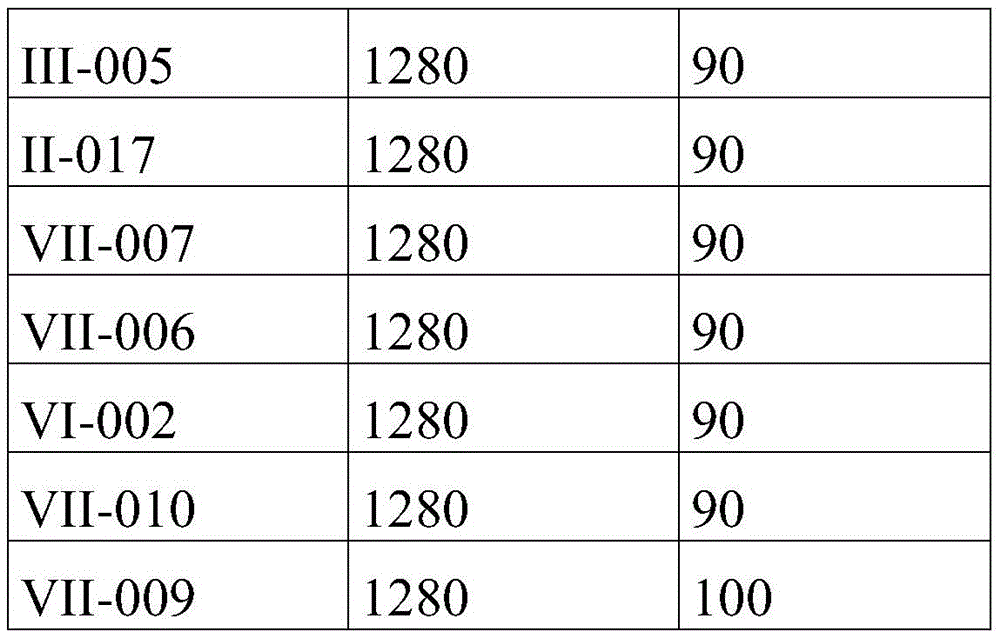
表12对VERPE的出苗前作用Table 12 Pre-emergence effect on VERPE

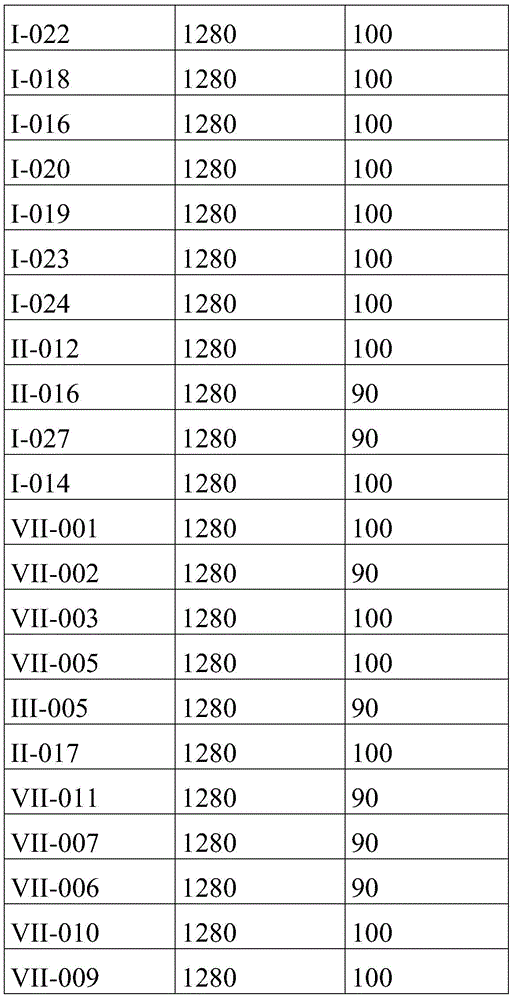
例如,表1至12中化合物编号II-005、II-007、II-011和II-013在1280g/ha的施用量下各自对大穗看麦娘、棉田马唐、稗、硬直黑麦草和狗尾草显示出90-100%的功效。For example, compound Nos. II-005, II-007, II-011 and II-013 in Tables 1 to 12 were each at an application rate of 1280 g/ha, against A. Setaria has shown 90-100% efficacy.
因此,本发明的化合物适合于通过出苗前方法控制不需要的植物生长。Thus, the compounds of the present invention are suitable for controlling unwanted plant growth by pre-emergence methods.
2.出苗后除草效果和作物植物相容性2. Post-emergence herbicidal effect and crop plant compatibility
将单子叶和双子叶杂草和作物植物的种子摆放在木纤维盆中的砂壤土中,用土壤覆盖并在温室中于良好的生长条件下培育。播种后2至3周,在单叶期处理试验植物。然后将以可湿性粉剂(WP)的形式或作为乳液浓缩物(EC)配制的本发明化合物添加0.2%的润湿剂以水悬浮液或乳液以等于600至800l/ha的水施用量喷洒到植物的绿色部分上。在试验植物在温室中于最佳生长条件下留置约3周后,以目测方式与未经处理的对照相比较来评估制剂的作用(除草作用百分数(%):100%活性=植物已死亡,0%活性=与对照植物一样)。Seeds of monocotyledonous and dicotyledonous weeds and crop plants were placed in sandy loam soil in wood fiber pots, covered with soil and grown in a greenhouse under good growing conditions. Two to three weeks after sowing, test plants were treated at the single-leaf stage. The compounds of the invention, formulated in the form of wettable powders (WP) or as emulsion concentrates (EC) plus 0.2% of wetting agent, are then sprayed as an aqueous suspension or emulsion at an application rate of water equal to 600 to 800 l/ha. on the green part of the plant. After the test plants have been left in the greenhouse under optimal growth conditions for about 3 weeks, the effect of the formulations is assessed visually compared to untreated controls (percent (%) herbicidal action: 100% activity = plants have died, 0% activity = same as control plants).
如表13至24的结果所示,本发明的化合物对广谱的禾本科杂草和阔叶杂草具有良好的出苗后除草功效。As shown in the results in Tables 13 to 24, the compounds of the present invention have good post-emergence herbicidal efficacy against a broad spectrum of grass and broadleaf weeds.
表13.对ALOMY的出苗后作用Table 13. Post-emergence effects on ALOMY
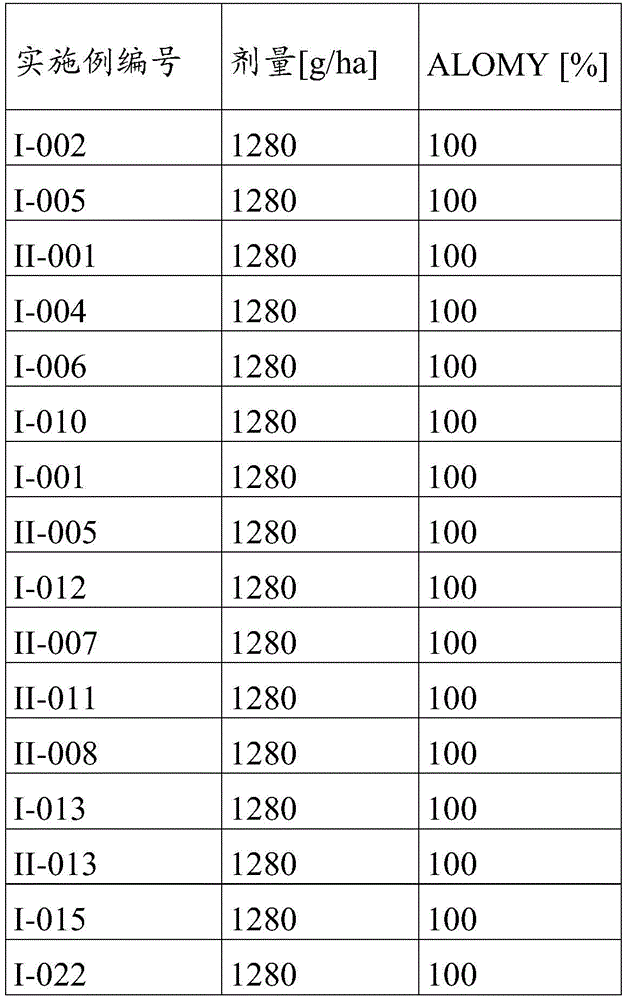
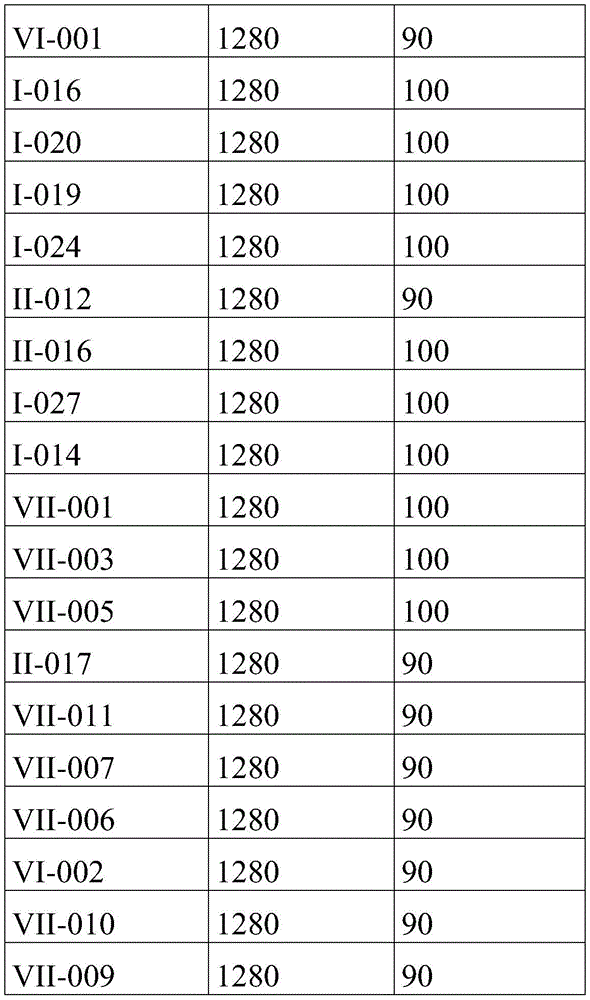
表14.对DIGSA的出苗后作用Table 14. Post-emergence effects on DIGSA
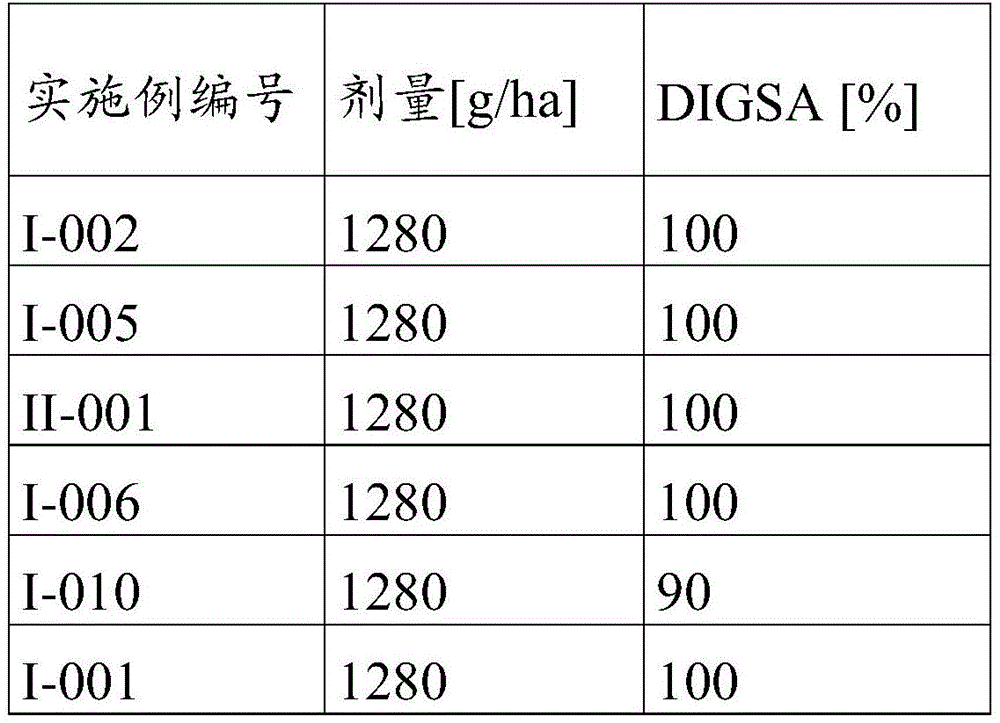

表15.对ECHCG的出苗后作用Table 15. Post-emergence effects on ECHCG

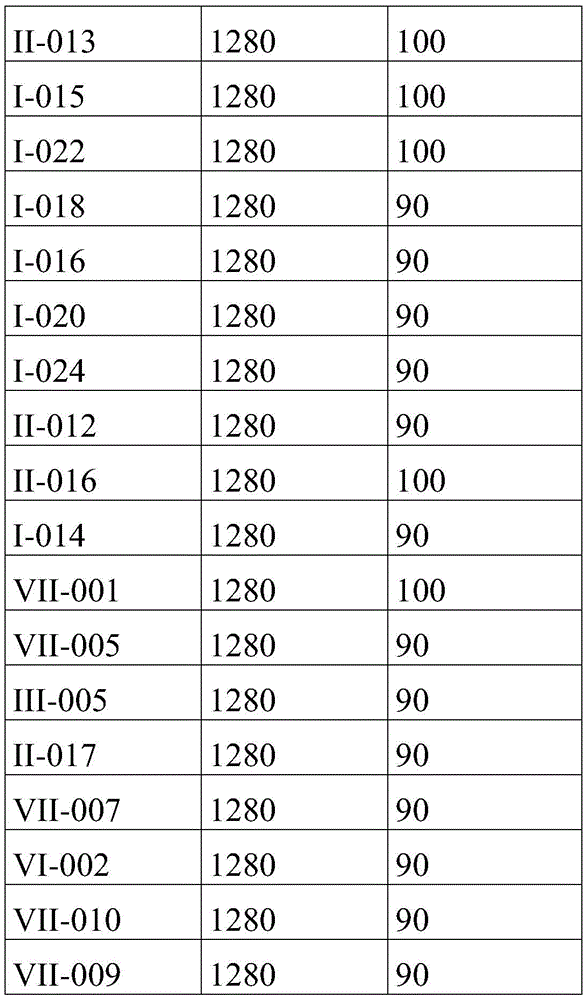
表16.对LOLRI的出苗后作用Table 16. Post-emergence effects on LOLRI
表17.对POAAN的出苗后作用Table 17. Post-emergence effects on POAAN

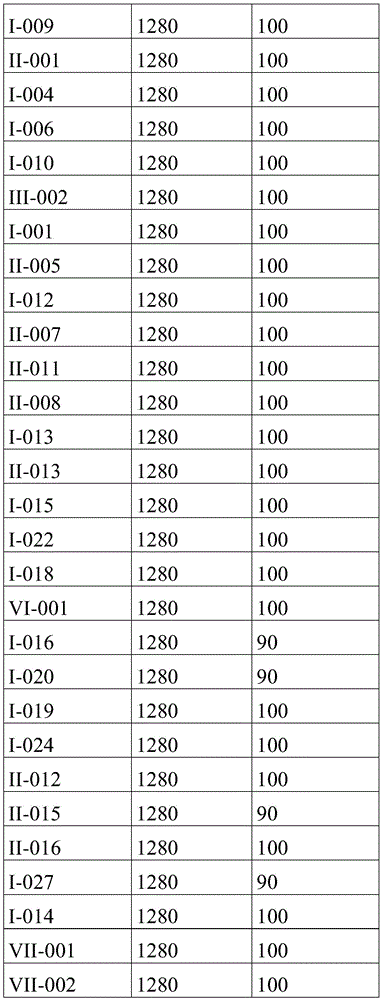

表18.对SETVI的出苗后作用Table 18. Post-emergence effects on SETVI

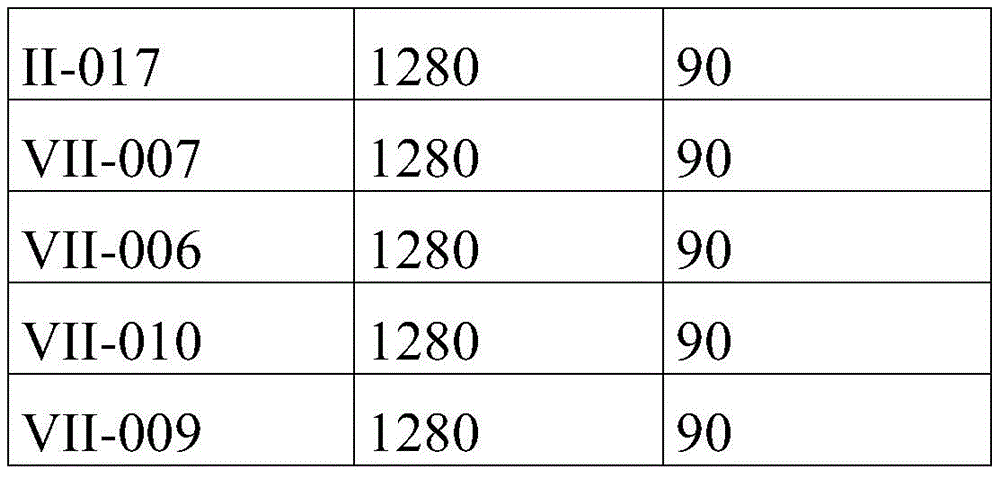
表19.对ABUTH的出苗后作用Table 19. Post-emergence effects on ABUTH
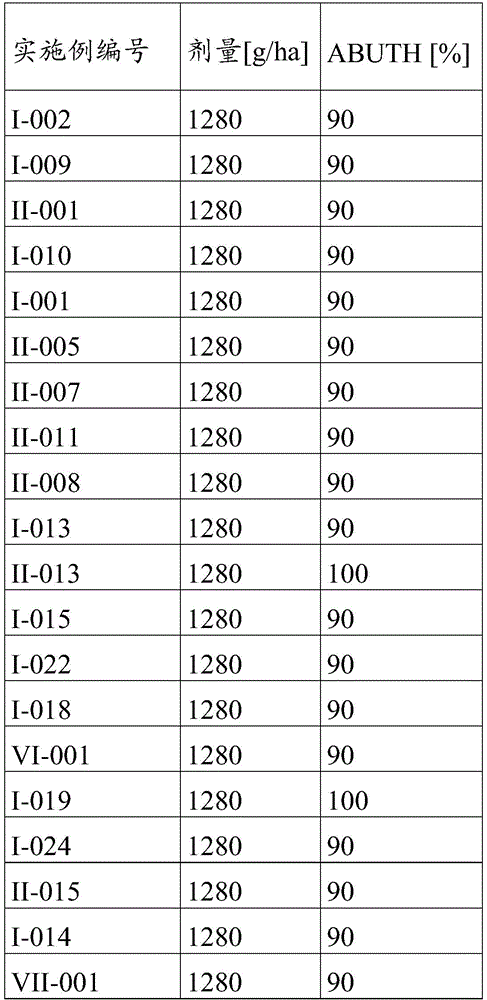

表20.对AMARE的出苗后作用Table 20. Post-emergence effects on AMARE
表21.对KCHSC的出苗后作用Table 21. Post-emergence effects on KCHSC
表22.对MATIN的出苗后作用Table 22. Post-emergence effects on MATIN

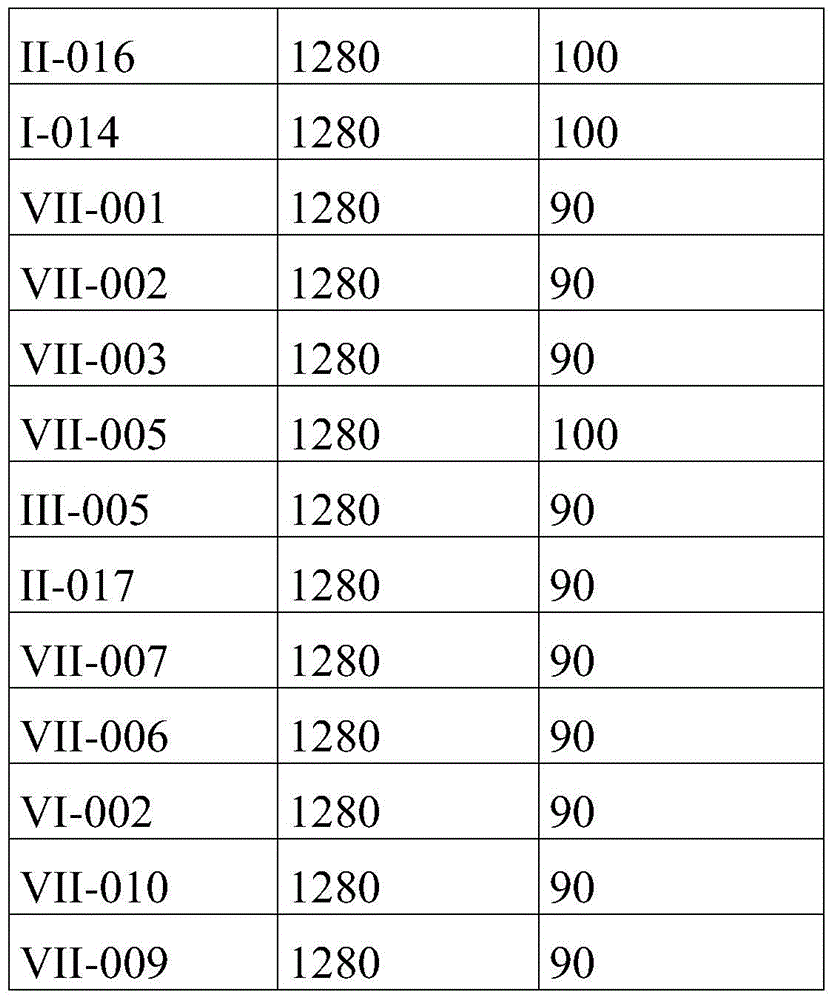
表23.对STEME的出苗后作用Table 23. Post-emergence effects on STEME


表24.对VERPE的出苗后作用Table 24. Post-emergence effects on VERPE
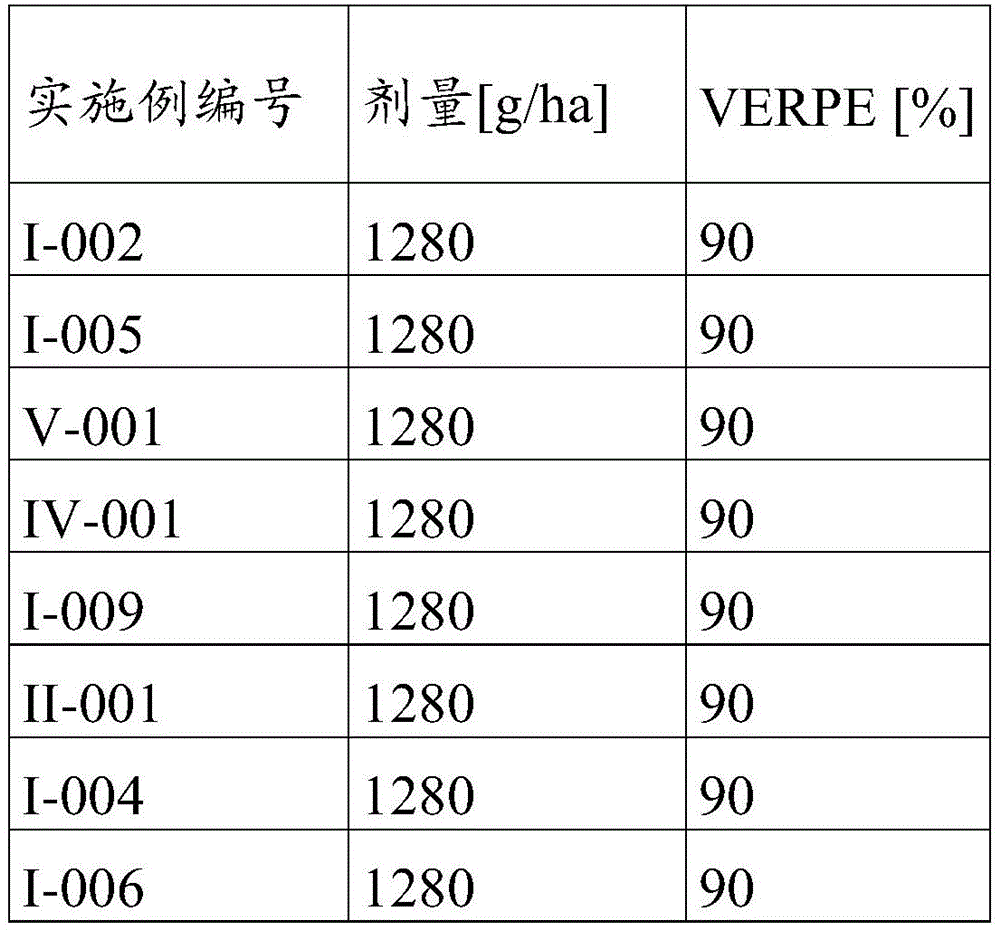
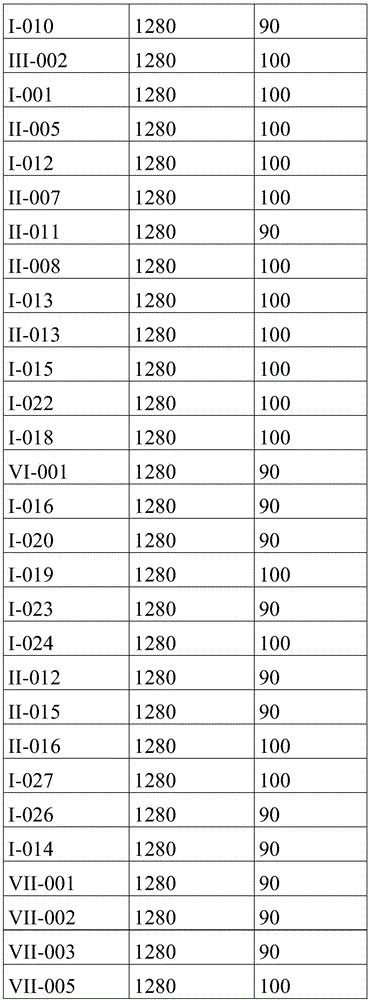

例如,表13和24中的所有本发明化合物II-001、II-005、II-007和II-013在1280g/ha的施用量下各自对大穗看麦娘、棉田马唐、狗尾草和稗显示出90-100%的功效,并因此适合于通过出苗后方法控制不需要的植物生长。For example, all of the compounds of the invention II-001, II-005, II-007 and II-013 in Tables 13 and 24 at an application rate of 1280 g/ha, respectively, were effective against A. Shows 90-100% efficacy and is therefore suitable for controlling unwanted plant growth by post-emergence methods.
Claims (12)

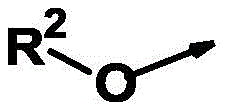
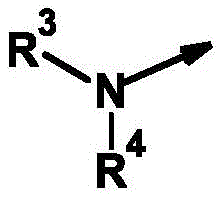



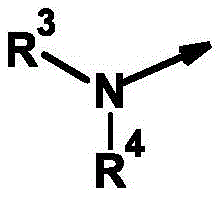
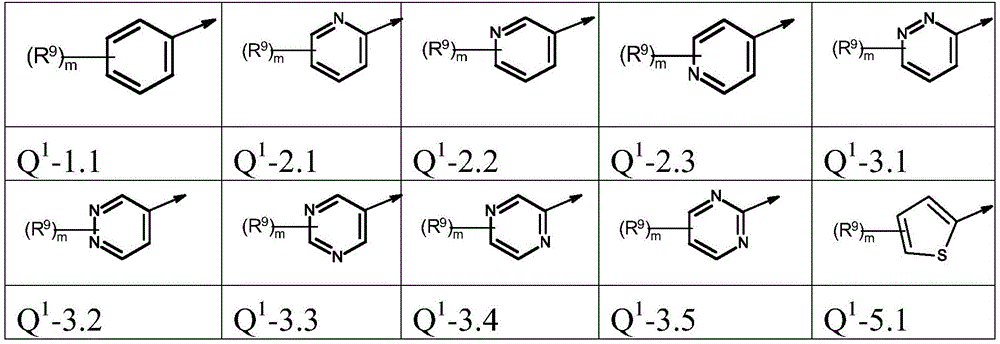
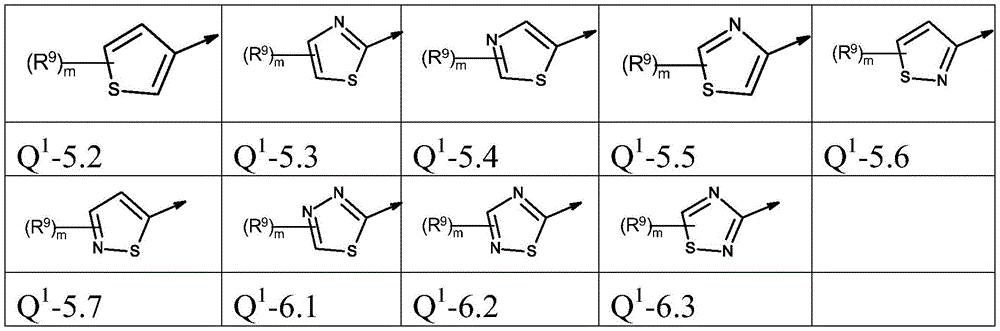


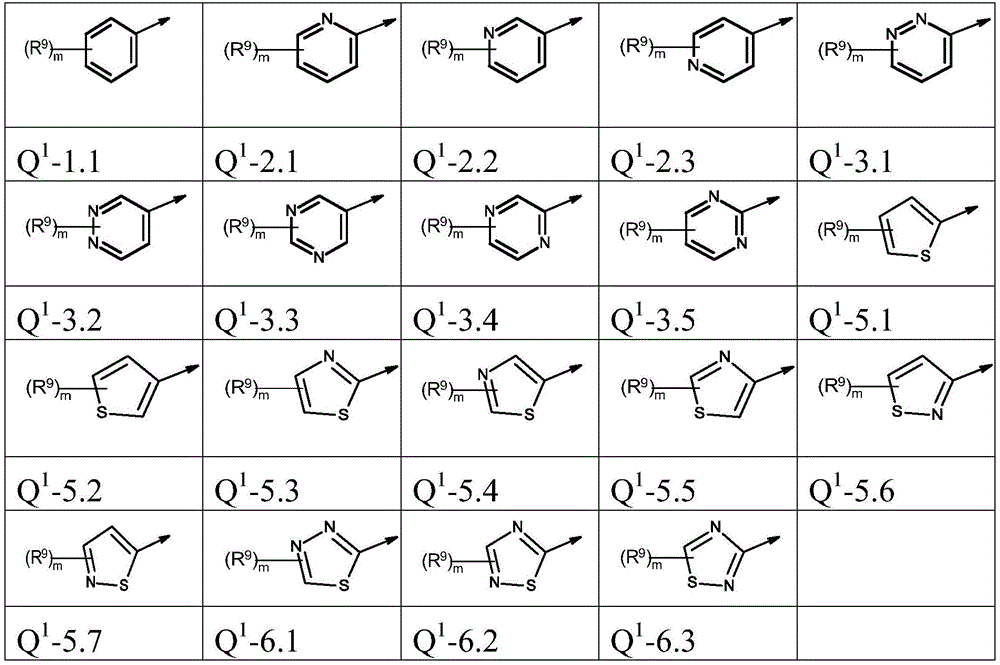

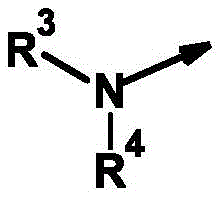
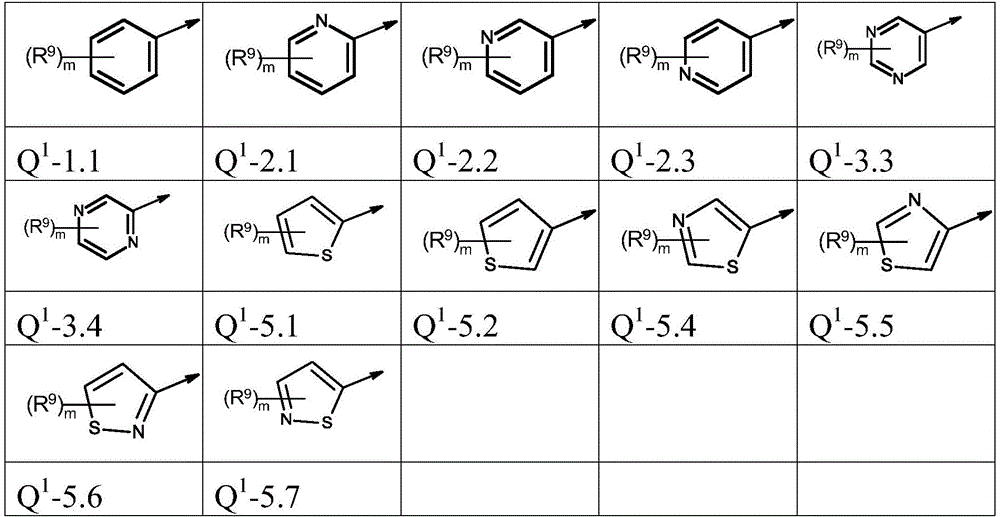
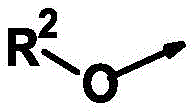

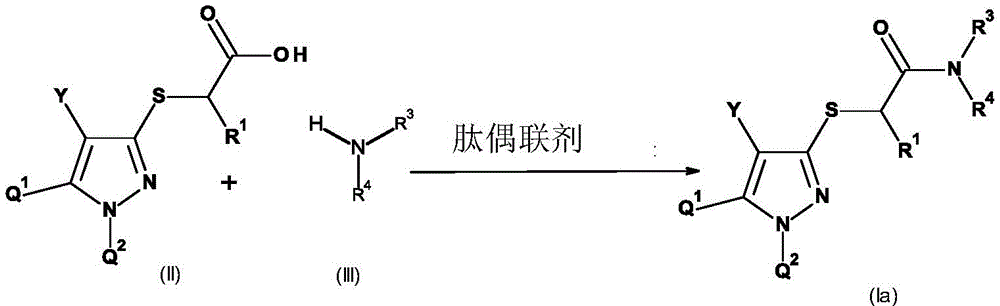
Applications Claiming Priority (3)
| Application Number | Priority Date | Filing Date | Title |
|---|---|---|---|
| EP20154965 | 2020-01-31 | ||
| EP20154965.6 | 2020-01-31 | ||
| PCT/EP2021/051920 WO2021151976A1 (en) | 2020-01-31 | 2021-01-28 | [(1,4,5-trisubstituted-1h-pyrazol-3-yl)sulfanyl]acetic acid derivatives, salts thereof, and use thereof as herbicidal ingredients |
Publications (2)
| Publication Number | Publication Date |
|---|---|
| CN115003656A true CN115003656A (en) | 2022-09-02 |
| CN115003656B CN115003656B (en) | 2025-03-04 |
Family
ID=69423222
Family Applications (1)
| Application Number | Title | Priority Date | Filing Date |
|---|---|---|---|
| CN202180011950.2A Active CN115003656B (en) | 2020-01-31 | 2021-01-28 | [(1,4,5-trisubstituted 1H-pyrazol-3-yl)sulfanyl]acetic acid derivatives and salts thereof and use thereof as active herbicidal ingredients |
Country Status (7)
| Country | Link |
|---|---|
| US (1) | US20230126893A1 (en) |
| EP (1) | EP4097087B1 (en) |
| CN (1) | CN115003656B (en) |
| AR (1) | AR121229A1 (en) |
| BR (1) | BR112022012674A2 (en) |
| ES (1) | ES2991524T3 (en) |
| WO (1) | WO2021151976A1 (en) |
Families Citing this family (1)
| Publication number | Priority date | Publication date | Assignee | Title |
|---|---|---|---|---|
| WO2024078871A1 (en) * | 2022-10-14 | 2024-04-18 | Bayer Aktiengesellschaft | 1-pyridyl-5-phenylpyrazolyl-3-oxy- and -3-thioalkyl acids and derivatives and their use for controlling undesired plant growth |
Citations (8)
| Publication number | Priority date | Publication date | Assignee | Title |
|---|---|---|---|---|
| US20020045758A1 (en) * | 1996-12-24 | 2002-04-18 | Rhone-Poulenc Inc. | Pesticidal 1-arylpyrazoles |
| DE102004030753A1 (en) * | 2004-06-25 | 2006-01-19 | Bayer Cropscience Ag | 3'-alkoxy spirocyclic tetramic and tri-acids |
| CN1761393A (en) * | 2003-03-13 | 2006-04-19 | 巴斯福股份公司 | Herbicidal mixtures comprising a safener |
| CN101511795A (en) * | 2006-07-05 | 2009-08-19 | 安万特农业公司 | 1-aryl-5-alkylpyrazole derivative compounds, methods of making and methods of use thereof |
| CN101611138A (en) * | 2006-12-29 | 2009-12-23 | 陶氏益农公司 | In vitro method for the induction and maintenance of plant cell lines as suspended single cells with intact cell walls and their transformation |
| US20110257014A1 (en) * | 2009-12-15 | 2011-10-20 | Bayer Cropscience Ag | 1-(Heteroaryl)pyrazol-4-ylacetic acids, processes for their preparation and their use as herbicides and plant growth regulators |
| CN103153961A (en) * | 2010-07-12 | 2013-06-12 | 塞尔休斯物业公司埃尔维塔植物保护分公司 | Fipronil production process |
| CN103476251A (en) * | 2011-03-18 | 2013-12-25 | 拜耳知识产权有限责任公司 | Substituted (3r,4r)-4-cyan-3,4-diphenylbutanoates, method for the production thereof and use thereof as herbicides and plant growth regulators |
Family Cites Families (39)
| Publication number | Priority date | Publication date | Assignee | Title |
|---|---|---|---|---|
| MA19709A1 (en) | 1982-02-17 | 1983-10-01 | Ciba Geigy Ag | APPLICATION OF QUINOLEIN DERIVATIVES TO THE PROTECTION OF CULTIVATED PLANTS. |
| EP0094349B1 (en) | 1982-05-07 | 1994-04-06 | Ciba-Geigy Ag | Use of quinoline derivatives for the protection of cultivated plants |
| DE3334799A1 (en) | 1983-09-26 | 1985-04-04 | Bayer Ag, 5090 Leverkusen | 1,3-DIARYL-5-METHYLENE PERHYDROPYRIMIDINE-2-ONE |
| DE3525205A1 (en) | 1984-09-11 | 1986-03-20 | Hoechst Ag, 6230 Frankfurt | PLANT PROTECTIVE AGENTS BASED ON 1,2,4-TRIAZOLE DERIVATIVES AND NEW DERIVATIVES OF 1,2,4-TRIAZOLE |
| DE3680212D1 (en) | 1985-02-14 | 1991-08-22 | Ciba Geigy Ag | USE OF CHINOLINE DERIVATIVES FOR PROTECTING CROPS. |
| DE3633840A1 (en) | 1986-10-04 | 1988-04-14 | Hoechst Ag | PHENYLPYRAZOLIC CARBONIC ACID DERIVATIVES, THEIR PRODUCTION AND USE AS PLANT GROWTH REGULATORS AND SAFENERS |
| EP0268554B1 (en) | 1986-10-22 | 1991-12-27 | Ciba-Geigy Ag | 1,5-diphenyl pyrazole-3-carbonic-acid derivatives for the protection of cultured plants |
| DE3808896A1 (en) | 1988-03-17 | 1989-09-28 | Hoechst Ag | PLANT PROTECTION AGENTS BASED ON PYRAZOL CARBON SEA DERIVATIVES |
| DE3817192A1 (en) | 1988-05-20 | 1989-11-30 | Hoechst Ag | PLANT-PROTECTIVE AGENTS CONTAINING 1,2,4-TRIAZOLE DERIVATIVES AND NEW DERIVATIVES OF 1,2,4-TRIAZOLE |
| ES2054088T3 (en) | 1988-10-20 | 1994-08-01 | Ciba Geigy Ag | SULFAMOILFENILUREAS. |
| DE3939010A1 (en) | 1989-11-25 | 1991-05-29 | Hoechst Ag | ISOXAZOLINE, METHOD FOR THE PRODUCTION THEREOF AND THEIR USE AS A PLANT PROTECTIVE AGENT |
| DE3939503A1 (en) | 1989-11-30 | 1991-06-06 | Hoechst Ag | NEW PYRAZOLINE FOR THE PROTECTION OF CULTURAL PLANTS AGAINST HERBICIDES |
| EP0492366B1 (en) | 1990-12-21 | 1997-03-26 | Hoechst Schering AgrEvo GmbH | New 5-chloroquinolin-8-oxyalkanecarbonic acid derivatives, process for their preparation and their use as antidotes for herbicides |
| TW259690B (en) | 1992-08-01 | 1995-10-11 | Hoechst Ag | |
| DE4331448A1 (en) | 1993-09-16 | 1995-03-23 | Hoechst Schering Agrevo Gmbh | Substituted isoxazolines, processes for their preparation, compositions containing them and their use as safeners |
| DE19621522A1 (en) | 1996-05-29 | 1997-12-04 | Hoechst Schering Agrevo Gmbh | New N-acylsulfonamides, new mixtures of herbicides and antidots and their use |
| EP0929543B1 (en) | 1996-09-26 | 2001-10-31 | Syngenta Participations AG | Herbicidal composition |
| DE19652961A1 (en) | 1996-12-19 | 1998-06-25 | Hoechst Schering Agrevo Gmbh | New 2-fluoroacrylic acid derivatives, new mixtures of herbicides and antidots and their use |
| US6071856A (en) | 1997-03-04 | 2000-06-06 | Zeneca Limited | Herbicidal compositions for acetochlor in rice |
| DE19727410A1 (en) | 1997-06-27 | 1999-01-07 | Hoechst Schering Agrevo Gmbh | 3- (5-tetrazolylcarbonyl) -2-quinolones and crop protection agents containing them |
| DE19742951A1 (en) | 1997-09-29 | 1999-04-15 | Hoechst Schering Agrevo Gmbh | Acylsulfamoylbenzoic acid amides, crop protection agents containing them and process for their preparation |
| IL167957A (en) | 2000-02-04 | 2009-07-20 | Sumitomo Chemical Co | Hydroxypyridine compound |
| AR031027A1 (en) | 2000-10-23 | 2003-09-03 | Syngenta Participations Ag | AGROCHEMICAL COMPOSITIONS |
| MXPA05010296A (en) | 2003-03-26 | 2005-11-17 | Bayer Cropscience Gmbh | Use of aromatic hydroxy compounds as safeners. |
| DE10335725A1 (en) | 2003-08-05 | 2005-03-03 | Bayer Cropscience Gmbh | Safener based on aromatic-aliphatic carboxylic acid derivatives |
| DE10335726A1 (en) | 2003-08-05 | 2005-03-03 | Bayer Cropscience Gmbh | Use of hydroxyaromatics as safener |
| DE102004023332A1 (en) | 2004-05-12 | 2006-01-19 | Bayer Cropscience Gmbh | Quinoxaline-2-one derivatives, crop protection agents containing them, and processes for their preparation and their use |
| JPWO2007023719A1 (en) | 2005-08-22 | 2009-02-26 | クミアイ化学工業株式会社 | Pesticide mitigation agent and herbicide composition with reduced phytotoxicity |
| WO2007023764A1 (en) | 2005-08-26 | 2007-03-01 | Kumiai Chemical Industry Co., Ltd. | Agent for reduction of harmful effect of herbicide and herbicide composition having reduced harmful effect |
| JP2007284387A (en) * | 2006-04-18 | 2007-11-01 | Kumiai Chem Ind Co Ltd | 3-Pyrazolylphenyl sulfide derivative and insecticide, acaricide, nematicide containing it as an active ingredient |
| EP1987717A1 (en) | 2007-04-30 | 2008-11-05 | Bayer CropScience AG | Pyridon carboxamides, agents containing these but not impacting useful plants and method for their manufacture and application |
| EP1987718A1 (en) | 2007-04-30 | 2008-11-05 | Bayer CropScience AG | Utilisation of pyridine-2-oxy-3-carbon amides as safener |
| WO2009156090A2 (en) * | 2008-06-26 | 2009-12-30 | Bayer Cropscience Aktiengesellschaft | Insecticidal sulfur-derivatized 1-azinylpyrazoles |
| BRPI0916356B1 (en) | 2008-07-24 | 2022-08-23 | Nerviano Medical Sciences S.R.L | 3,4-DIARYL PYRAZOLS AS PROTEIN KINASE INHIBITORS |
| CN101838227A (en) | 2010-04-30 | 2010-09-22 | 孙德群 | Safener of benzamide herbicide |
| BR112019006490B1 (en) | 2016-10-24 | 2023-11-28 | Fmc Corporation | COMPOUND, FUNGICIDAL COMPOSITIONS AND METHODS FOR CONTROLLING VEGETABLE DISEASES |
| CA3142286A1 (en) * | 2019-06-03 | 2020-12-10 | Bayer Aktiengesellschaft | 1-phenyl-5-azinyl pyrazolyl-3-oxyalkyl acids and their use for controlling undesired plant growth |
| JP7631346B2 (en) * | 2019-12-19 | 2025-02-18 | バイエル・アクチエンゲゼルシヤフト | 1,5-diphenylpyrazolyl-3-oxyalkyl acids and 1-phenyl-5-thienylpyrazolyl-3-oxyalkyl acids and their use for controlling undesirable plant growth - Patents.com |
| WO2022084278A1 (en) * | 2020-10-23 | 2022-04-28 | Bayer Aktiengesellschaft | 1-(pyridyl)-5-azinylpyrazole derivatives, and their use for control of undesired plant growth |
-
2021
- 2021-01-28 US US17/795,676 patent/US20230126893A1/en not_active Abandoned
- 2021-01-28 CN CN202180011950.2A patent/CN115003656B/en active Active
- 2021-01-28 ES ES21702910T patent/ES2991524T3/en active Active
- 2021-01-28 BR BR112022012674A patent/BR112022012674A2/en unknown
- 2021-01-28 EP EP21702910.7A patent/EP4097087B1/en active Active
- 2021-01-28 WO PCT/EP2021/051920 patent/WO2021151976A1/en not_active Ceased
- 2021-01-29 AR ARP210100249A patent/AR121229A1/en unknown
Patent Citations (8)
| Publication number | Priority date | Publication date | Assignee | Title |
|---|---|---|---|---|
| US20020045758A1 (en) * | 1996-12-24 | 2002-04-18 | Rhone-Poulenc Inc. | Pesticidal 1-arylpyrazoles |
| CN1761393A (en) * | 2003-03-13 | 2006-04-19 | 巴斯福股份公司 | Herbicidal mixtures comprising a safener |
| DE102004030753A1 (en) * | 2004-06-25 | 2006-01-19 | Bayer Cropscience Ag | 3'-alkoxy spirocyclic tetramic and tri-acids |
| CN101511795A (en) * | 2006-07-05 | 2009-08-19 | 安万特农业公司 | 1-aryl-5-alkylpyrazole derivative compounds, methods of making and methods of use thereof |
| CN101611138A (en) * | 2006-12-29 | 2009-12-23 | 陶氏益农公司 | In vitro method for the induction and maintenance of plant cell lines as suspended single cells with intact cell walls and their transformation |
| US20110257014A1 (en) * | 2009-12-15 | 2011-10-20 | Bayer Cropscience Ag | 1-(Heteroaryl)pyrazol-4-ylacetic acids, processes for their preparation and their use as herbicides and plant growth regulators |
| CN103153961A (en) * | 2010-07-12 | 2013-06-12 | 塞尔休斯物业公司埃尔维塔植物保护分公司 | Fipronil production process |
| CN103476251A (en) * | 2011-03-18 | 2013-12-25 | 拜耳知识产权有限责任公司 | Substituted (3r,4r)-4-cyan-3,4-diphenylbutanoates, method for the production thereof and use thereof as herbicides and plant growth regulators |
Non-Patent Citations (1)
| Title |
|---|
| 张玉聚主编: "《常见除草剂的合理应用》", vol. 2014, 金盾出版社, pages: 8 - 9 * |
Also Published As
| Publication number | Publication date |
|---|---|
| EP4097087A1 (en) | 2022-12-07 |
| EP4097087B1 (en) | 2024-07-31 |
| US20230126893A1 (en) | 2023-04-27 |
| WO2021151976A1 (en) | 2021-08-05 |
| AR121229A1 (en) | 2022-04-27 |
| ES2991524T3 (en) | 2024-12-03 |
| BR112022012674A2 (en) | 2022-09-06 |
| CN115003656B (en) | 2025-03-04 |
Similar Documents
| Publication | Publication Date | Title |
|---|---|---|
| CN112469712B (en) | Substituted 2-heteroaryloxypyridines and their salts, and their use as herbicides | |
| JP7275162B2 (en) | Substituted thiophenyluracils, their salts and their use as herbicides | |
| CN110392680A (en) | Substituted azolylpyrrolidones and azolylhydantoins and their salts and their use as herbicidally active substances | |
| JP7785754B2 (en) | Substituted N-phenyluracils and their salts, and their use as herbicidal active substances - Patents.com | |
| CN113677665B (en) | Substituted 2-heteroarylaminobenzenes and their salts, and their use as herbicides | |
| WO2023161172A1 (en) | Substituted n-benzoic acid uracils and salts thereof, and use thereof as herbicidal active substances | |
| CN111132973A (en) | Substituted 3-heteroaryloxy-1H-pyrazoles and their salts and their use as herbicidal active substances | |
| US20200172491A1 (en) | Substituted 5-(het-)arylpyrazolamides and salts thereof and their use as herbicidal active substances | |
| WO2018184890A1 (en) | 4-substituted n-amino and n-hydroxy 2-oxo-pyrrolidie-3-carboxamide derivatives, salts thereof and use thereof as herbicidal agents | |
| WO2019025156A1 (en) | SUBSTITUTED PYRROLIDINONE AND THEIR SALTS AND THEIR USE AS HERBICIDAL ACTIVE SUBSTANCES | |
| CN115003656B (en) | [(1,4,5-trisubstituted 1H-pyrazol-3-yl)sulfanyl]acetic acid derivatives and salts thereof and use thereof as active herbicidal ingredients | |
| WO2018177836A1 (en) | N-cyclopropyl-2-oxopyrrolidine-3-carboxamide derivatives and related compounds as herbicidal plant protection agents | |
| EP4132938A1 (en) | Substituted thiazolopyridines, salts thereof and their use as herbicidally active substances | |
| CN120035584A (en) | Substituted N-phenyluracil and its salt and its use as herbicidal active substance | |
| CN110267950A (en) | Substituted heteroarylpyrrolones and their salts and their use as herbicidal active substances | |
| CN110337436A (en) | Substituted 1,2,4- thiadiazolyl group pyrrolones and 1,2,4- thiadiazolyl group hydantoins and its salt and its purposes as herbicide | |
| AU2022341507A1 (en) | Substituted 2,3-dihydro[1,3]thiazolo[4,5-b]pyridines, salts thereof and their use as herbicidally active substances | |
| CN111727185A (en) | Substituted N-heterocyclyl- and N-heteroaryltetrahydropyrimidinones and their salts, and their use as herbicidal active substances | |
| CN112384507A (en) | Substituted 4-heteroaryloxypyridines and their salts and their use as herbicides | |
| WO2020002087A1 (en) | Substituted 3-heteroaryloxypyridines and salts thereof and their use as herbicidal agents | |
| WO2019081485A1 (en) | SUBSTITUTED PYRAZOLE AND THEIR SALTS AND THEIR USE AS HERBICIDAL ACTIVE SUBSTANCES | |
| TW202328150A (en) | Substituted thiazolopyridines, salts thereof and their use as herbicidally active substances | |
| US20240239755A1 (en) | Substituted pyridazinones, salts or n-oxides thereof and their use as herbicidally active substances | |
| CN118974025A (en) | Substituted 2-aminoazines and their salts, and their use as herbicidal active substances | |
| CN111433214A (en) | New isothiazol-aza-keto bicyclic ring, method for the production thereof and use thereof as herbicide and/or plant growth regulator |
Legal Events
| Date | Code | Title | Description |
|---|---|---|---|
| PB01 | Publication | ||
| PB01 | Publication | ||
| SE01 | Entry into force of request for substantive examination | ||
| SE01 | Entry into force of request for substantive examination | ||
| GR01 | Patent grant | ||
| GR01 | Patent grant |