CN114269733A - Material for organic electroluminescent device - Google Patents
Material for organic electroluminescent device Download PDFInfo
- Publication number
- CN114269733A CN114269733A CN202080059028.6A CN202080059028A CN114269733A CN 114269733 A CN114269733 A CN 114269733A CN 202080059028 A CN202080059028 A CN 202080059028A CN 114269733 A CN114269733 A CN 114269733A
- Authority
- CN
- China
- Prior art keywords
- groups
- group
- hetar
- aromatic
- case
- Prior art date
- Legal status (The legal status is an assumption and is not a legal conclusion. Google has not performed a legal analysis and makes no representation as to the accuracy of the status listed.)
- Pending
Links
Classifications
-
- C—CHEMISTRY; METALLURGY
- C07—ORGANIC CHEMISTRY
- C07D—HETEROCYCLIC COMPOUNDS
- C07D403/00—Heterocyclic compounds containing two or more hetero rings, having nitrogen atoms as the only ring hetero atoms, not provided for by group C07D401/00
- C07D403/02—Heterocyclic compounds containing two or more hetero rings, having nitrogen atoms as the only ring hetero atoms, not provided for by group C07D401/00 containing two hetero rings
- C07D403/10—Heterocyclic compounds containing two or more hetero rings, having nitrogen atoms as the only ring hetero atoms, not provided for by group C07D401/00 containing two hetero rings linked by a carbon chain containing aromatic rings
-
- C—CHEMISTRY; METALLURGY
- C07—ORGANIC CHEMISTRY
- C07C—ACYCLIC OR CARBOCYCLIC COMPOUNDS
- C07C211/00—Compounds containing amino groups bound to a carbon skeleton
- C07C211/43—Compounds containing amino groups bound to a carbon skeleton having amino groups bound to carbon atoms of six-membered aromatic rings of the carbon skeleton
- C07C211/54—Compounds containing amino groups bound to a carbon skeleton having amino groups bound to carbon atoms of six-membered aromatic rings of the carbon skeleton having amino groups bound to two or three six-membered aromatic rings
-
- C—CHEMISTRY; METALLURGY
- C07—ORGANIC CHEMISTRY
- C07C—ACYCLIC OR CARBOCYCLIC COMPOUNDS
- C07C251/00—Compounds containing nitrogen atoms doubly-bound to a carbon skeleton
- C07C251/02—Compounds containing nitrogen atoms doubly-bound to a carbon skeleton containing imino groups
- C07C251/24—Compounds containing nitrogen atoms doubly-bound to a carbon skeleton containing imino groups having carbon atoms of imino groups bound to carbon atoms of six-membered aromatic rings
-
- C—CHEMISTRY; METALLURGY
- C07—ORGANIC CHEMISTRY
- C07D—HETEROCYCLIC COMPOUNDS
- C07D209/00—Heterocyclic compounds containing five-membered rings, condensed with other rings, with one nitrogen atom as the only ring hetero atom
- C07D209/56—Ring systems containing three or more rings
- C07D209/80—[b, c]- or [b, d]-condensed
- C07D209/82—Carbazoles; Hydrogenated carbazoles
-
- C—CHEMISTRY; METALLURGY
- C07—ORGANIC CHEMISTRY
- C07D—HETEROCYCLIC COMPOUNDS
- C07D401/00—Heterocyclic compounds containing two or more hetero rings, having nitrogen atoms as the only ring hetero atoms, at least one ring being a six-membered ring with only one nitrogen atom
- C07D401/02—Heterocyclic compounds containing two or more hetero rings, having nitrogen atoms as the only ring hetero atoms, at least one ring being a six-membered ring with only one nitrogen atom containing two hetero rings
- C07D401/04—Heterocyclic compounds containing two or more hetero rings, having nitrogen atoms as the only ring hetero atoms, at least one ring being a six-membered ring with only one nitrogen atom containing two hetero rings directly linked by a ring-member-to-ring-member bond
-
- C—CHEMISTRY; METALLURGY
- C07—ORGANIC CHEMISTRY
- C07D—HETEROCYCLIC COMPOUNDS
- C07D403/00—Heterocyclic compounds containing two or more hetero rings, having nitrogen atoms as the only ring hetero atoms, not provided for by group C07D401/00
- C07D403/14—Heterocyclic compounds containing two or more hetero rings, having nitrogen atoms as the only ring hetero atoms, not provided for by group C07D401/00 containing three or more hetero rings
-
- C—CHEMISTRY; METALLURGY
- C07—ORGANIC CHEMISTRY
- C07D—HETEROCYCLIC COMPOUNDS
- C07D405/00—Heterocyclic compounds containing both one or more hetero rings having oxygen atoms as the only ring hetero atoms, and one or more rings having nitrogen as the only ring hetero atom
- C07D405/02—Heterocyclic compounds containing both one or more hetero rings having oxygen atoms as the only ring hetero atoms, and one or more rings having nitrogen as the only ring hetero atom containing two hetero rings
- C07D405/04—Heterocyclic compounds containing both one or more hetero rings having oxygen atoms as the only ring hetero atoms, and one or more rings having nitrogen as the only ring hetero atom containing two hetero rings directly linked by a ring-member-to-ring-member bond
-
- C—CHEMISTRY; METALLURGY
- C07—ORGANIC CHEMISTRY
- C07D—HETEROCYCLIC COMPOUNDS
- C07D405/00—Heterocyclic compounds containing both one or more hetero rings having oxygen atoms as the only ring hetero atoms, and one or more rings having nitrogen as the only ring hetero atom
- C07D405/14—Heterocyclic compounds containing both one or more hetero rings having oxygen atoms as the only ring hetero atoms, and one or more rings having nitrogen as the only ring hetero atom containing three or more hetero rings
-
- C—CHEMISTRY; METALLURGY
- C07—ORGANIC CHEMISTRY
- C07D—HETEROCYCLIC COMPOUNDS
- C07D407/00—Heterocyclic compounds containing two or more hetero rings, at least one ring having oxygen atoms as the only ring hetero atoms, not provided for by group C07D405/00
- C07D407/14—Heterocyclic compounds containing two or more hetero rings, at least one ring having oxygen atoms as the only ring hetero atoms, not provided for by group C07D405/00 containing three or more hetero rings
-
- C—CHEMISTRY; METALLURGY
- C07—ORGANIC CHEMISTRY
- C07D—HETEROCYCLIC COMPOUNDS
- C07D409/00—Heterocyclic compounds containing two or more hetero rings, at least one ring having sulfur atoms as the only ring hetero atoms
- C07D409/02—Heterocyclic compounds containing two or more hetero rings, at least one ring having sulfur atoms as the only ring hetero atoms containing two hetero rings
- C07D409/04—Heterocyclic compounds containing two or more hetero rings, at least one ring having sulfur atoms as the only ring hetero atoms containing two hetero rings directly linked by a ring-member-to-ring-member bond
-
- C—CHEMISTRY; METALLURGY
- C07—ORGANIC CHEMISTRY
- C07D—HETEROCYCLIC COMPOUNDS
- C07D409/00—Heterocyclic compounds containing two or more hetero rings, at least one ring having sulfur atoms as the only ring hetero atoms
- C07D409/14—Heterocyclic compounds containing two or more hetero rings, at least one ring having sulfur atoms as the only ring hetero atoms containing three or more hetero rings
-
- C—CHEMISTRY; METALLURGY
- C07—ORGANIC CHEMISTRY
- C07D—HETEROCYCLIC COMPOUNDS
- C07D495/00—Heterocyclic compounds containing in the condensed system at least one hetero ring having sulfur atoms as the only ring hetero atoms
- C07D495/02—Heterocyclic compounds containing in the condensed system at least one hetero ring having sulfur atoms as the only ring hetero atoms in which the condensed system contains two hetero rings
- C07D495/04—Ortho-condensed systems
-
- C—CHEMISTRY; METALLURGY
- C07—ORGANIC CHEMISTRY
- C07D—HETEROCYCLIC COMPOUNDS
- C07D517/00—Heterocyclic compounds containing in the condensed system at least one hetero ring having selenium, tellurium, or halogen atoms as ring hetero atoms
- C07D517/02—Heterocyclic compounds containing in the condensed system at least one hetero ring having selenium, tellurium, or halogen atoms as ring hetero atoms in which the condensed system contains two hetero rings
- C07D517/04—Ortho-condensed systems
-
- C—CHEMISTRY; METALLURGY
- C07—ORGANIC CHEMISTRY
- C07F—ACYCLIC, CARBOCYCLIC OR HETEROCYCLIC COMPOUNDS CONTAINING ELEMENTS OTHER THAN CARBON, HYDROGEN, HALOGEN, OXYGEN, NITROGEN, SULFUR, SELENIUM OR TELLURIUM
- C07F15/00—Compounds containing elements of Groups 8, 9, 10 or 18 of the Periodic Table
- C07F15/0006—Compounds containing elements of Groups 8, 9, 10 or 18 of the Periodic Table compounds of the platinum group
- C07F15/0033—Iridium compounds
-
- C—CHEMISTRY; METALLURGY
- C07—ORGANIC CHEMISTRY
- C07F—ACYCLIC, CARBOCYCLIC OR HETEROCYCLIC COMPOUNDS CONTAINING ELEMENTS OTHER THAN CARBON, HYDROGEN, HALOGEN, OXYGEN, NITROGEN, SULFUR, SELENIUM OR TELLURIUM
- C07F15/00—Compounds containing elements of Groups 8, 9, 10 or 18 of the Periodic Table
- C07F15/0006—Compounds containing elements of Groups 8, 9, 10 or 18 of the Periodic Table compounds of the platinum group
- C07F15/0086—Platinum compounds
-
- H—ELECTRICITY
- H10—SEMICONDUCTOR DEVICES; ELECTRIC SOLID-STATE DEVICES NOT OTHERWISE PROVIDED FOR
- H10K—ORGANIC ELECTRIC SOLID-STATE DEVICES
- H10K50/00—Organic light-emitting devices
- H10K50/10—OLEDs or polymer light-emitting diodes [PLED]
- H10K50/11—OLEDs or polymer light-emitting diodes [PLED] characterised by the electroluminescent [EL] layers
-
- H—ELECTRICITY
- H10—SEMICONDUCTOR DEVICES; ELECTRIC SOLID-STATE DEVICES NOT OTHERWISE PROVIDED FOR
- H10K—ORGANIC ELECTRIC SOLID-STATE DEVICES
- H10K50/00—Organic light-emitting devices
- H10K50/10—OLEDs or polymer light-emitting diodes [PLED]
- H10K50/14—Carrier transporting layers
- H10K50/16—Electron transporting layers
-
- H—ELECTRICITY
- H10—SEMICONDUCTOR DEVICES; ELECTRIC SOLID-STATE DEVICES NOT OTHERWISE PROVIDED FOR
- H10K—ORGANIC ELECTRIC SOLID-STATE DEVICES
- H10K85/00—Organic materials used in the body or electrodes of devices covered by this subclass
- H10K85/30—Coordination compounds
- H10K85/341—Transition metal complexes, e.g. Ru(II)polypyridine complexes
- H10K85/342—Transition metal complexes, e.g. Ru(II)polypyridine complexes comprising iridium
-
- H—ELECTRICITY
- H10—SEMICONDUCTOR DEVICES; ELECTRIC SOLID-STATE DEVICES NOT OTHERWISE PROVIDED FOR
- H10K—ORGANIC ELECTRIC SOLID-STATE DEVICES
- H10K85/00—Organic materials used in the body or electrodes of devices covered by this subclass
- H10K85/30—Coordination compounds
- H10K85/341—Transition metal complexes, e.g. Ru(II)polypyridine complexes
- H10K85/346—Transition metal complexes, e.g. Ru(II)polypyridine complexes comprising platinum
-
- H—ELECTRICITY
- H10—SEMICONDUCTOR DEVICES; ELECTRIC SOLID-STATE DEVICES NOT OTHERWISE PROVIDED FOR
- H10K—ORGANIC ELECTRIC SOLID-STATE DEVICES
- H10K85/00—Organic materials used in the body or electrodes of devices covered by this subclass
- H10K85/60—Organic compounds having low molecular weight
- H10K85/615—Polycyclic condensed aromatic hydrocarbons, e.g. anthracene
-
- H—ELECTRICITY
- H10—SEMICONDUCTOR DEVICES; ELECTRIC SOLID-STATE DEVICES NOT OTHERWISE PROVIDED FOR
- H10K—ORGANIC ELECTRIC SOLID-STATE DEVICES
- H10K85/00—Organic materials used in the body or electrodes of devices covered by this subclass
- H10K85/60—Organic compounds having low molecular weight
- H10K85/631—Amine compounds having at least two aryl rest on at least one amine-nitrogen atom, e.g. triphenylamine
-
- H—ELECTRICITY
- H10—SEMICONDUCTOR DEVICES; ELECTRIC SOLID-STATE DEVICES NOT OTHERWISE PROVIDED FOR
- H10K—ORGANIC ELECTRIC SOLID-STATE DEVICES
- H10K85/00—Organic materials used in the body or electrodes of devices covered by this subclass
- H10K85/60—Organic compounds having low molecular weight
- H10K85/649—Aromatic compounds comprising a hetero atom
- H10K85/654—Aromatic compounds comprising a hetero atom comprising only nitrogen as heteroatom
-
- H—ELECTRICITY
- H10—SEMICONDUCTOR DEVICES; ELECTRIC SOLID-STATE DEVICES NOT OTHERWISE PROVIDED FOR
- H10K—ORGANIC ELECTRIC SOLID-STATE DEVICES
- H10K85/00—Organic materials used in the body or electrodes of devices covered by this subclass
- H10K85/60—Organic compounds having low molecular weight
- H10K85/649—Aromatic compounds comprising a hetero atom
- H10K85/657—Polycyclic condensed heteroaromatic hydrocarbons
-
- H—ELECTRICITY
- H10—SEMICONDUCTOR DEVICES; ELECTRIC SOLID-STATE DEVICES NOT OTHERWISE PROVIDED FOR
- H10K—ORGANIC ELECTRIC SOLID-STATE DEVICES
- H10K85/00—Organic materials used in the body or electrodes of devices covered by this subclass
- H10K85/60—Organic compounds having low molecular weight
- H10K85/649—Aromatic compounds comprising a hetero atom
- H10K85/657—Polycyclic condensed heteroaromatic hydrocarbons
- H10K85/6572—Polycyclic condensed heteroaromatic hydrocarbons comprising only nitrogen in the heteroaromatic polycondensed ring system, e.g. phenanthroline or carbazole
-
- H—ELECTRICITY
- H10—SEMICONDUCTOR DEVICES; ELECTRIC SOLID-STATE DEVICES NOT OTHERWISE PROVIDED FOR
- H10K—ORGANIC ELECTRIC SOLID-STATE DEVICES
- H10K85/00—Organic materials used in the body or electrodes of devices covered by this subclass
- H10K85/60—Organic compounds having low molecular weight
- H10K85/649—Aromatic compounds comprising a hetero atom
- H10K85/657—Polycyclic condensed heteroaromatic hydrocarbons
- H10K85/6574—Polycyclic condensed heteroaromatic hydrocarbons comprising only oxygen in the heteroaromatic polycondensed ring system, e.g. cumarine dyes
-
- H—ELECTRICITY
- H10—SEMICONDUCTOR DEVICES; ELECTRIC SOLID-STATE DEVICES NOT OTHERWISE PROVIDED FOR
- H10K—ORGANIC ELECTRIC SOLID-STATE DEVICES
- H10K85/00—Organic materials used in the body or electrodes of devices covered by this subclass
- H10K85/60—Organic compounds having low molecular weight
- H10K85/649—Aromatic compounds comprising a hetero atom
- H10K85/657—Polycyclic condensed heteroaromatic hydrocarbons
- H10K85/6576—Polycyclic condensed heteroaromatic hydrocarbons comprising only sulfur in the heteroaromatic polycondensed ring system, e.g. benzothiophene
-
- H—ELECTRICITY
- H10—SEMICONDUCTOR DEVICES; ELECTRIC SOLID-STATE DEVICES NOT OTHERWISE PROVIDED FOR
- H10K—ORGANIC ELECTRIC SOLID-STATE DEVICES
- H10K2101/00—Properties of the organic materials covered by group H10K85/00
- H10K2101/10—Triplet emission
-
- H—ELECTRICITY
- H10—SEMICONDUCTOR DEVICES; ELECTRIC SOLID-STATE DEVICES NOT OTHERWISE PROVIDED FOR
- H10K—ORGANIC ELECTRIC SOLID-STATE DEVICES
- H10K2101/00—Properties of the organic materials covered by group H10K85/00
- H10K2101/90—Multiple hosts in the emissive layer
-
- H—ELECTRICITY
- H10—SEMICONDUCTOR DEVICES; ELECTRIC SOLID-STATE DEVICES NOT OTHERWISE PROVIDED FOR
- H10K—ORGANIC ELECTRIC SOLID-STATE DEVICES
- H10K50/00—Organic light-emitting devices
- H10K50/10—OLEDs or polymer light-emitting diodes [PLED]
- H10K50/18—Carrier blocking layers
Landscapes
- Chemical & Material Sciences (AREA)
- Organic Chemistry (AREA)
- Physics & Mathematics (AREA)
- Engineering & Computer Science (AREA)
- Materials Engineering (AREA)
- Spectroscopy & Molecular Physics (AREA)
- Optics & Photonics (AREA)
- Crystallography & Structural Chemistry (AREA)
- Inorganic Chemistry (AREA)
- Nitrogen Condensed Heterocyclic Rings (AREA)
- Plural Heterocyclic Compounds (AREA)
- Electroluminescent Light Sources (AREA)
Abstract
本发明涉及适合用于电子器件的化合物,并且涉及包含所述化合物的电子器件、特别是有机电致发光器件。The present invention relates to compounds suitable for use in electronic devices, and to electronic devices, in particular organic electroluminescent devices, comprising said compounds.
Description
The present invention relates to materials for electronic devices, in particular organic electroluminescent devices, and to electronic devices, in particular organic electroluminescent devices, comprising said materials.
The light-emitting materials used in organic electroluminescent devices are often phosphorescent organometallic complexes. For quantum mechanical reasons, up to four times the energy and power efficiency can be achieved using organometallic compounds as phosphorescent emitters. There is still a general need for improvement in electroluminescent devices, especially also in electroluminescent devices exhibiting triplet emission (phosphorescence). The properties of phosphorescent electroluminescent devices are not solely determined by the triplet emitters used. More particularly, other materials used, such as matrix materials, are also of particular interest here. Thus, improvements in these materials can also lead to significant improvements in the properties of electroluminescent devices.
WO 2010/136109 discloses indenocarbazole derivatives as host materials for phosphorescent emitters. The compounds of the present invention are not disclosed.
In general, in the case of these materials, for example, for use as matrix materials, there is still a need for improvement, in particular in terms of the lifetime of the devices, and in terms of efficiency and operating voltage.
The problem addressed by the present invention was therefore to provide compounds which are suitable for use in organic electronic devices, in particular organic electroluminescent devices, and which lead to good device properties when used in such devices, and to provide corresponding electronic devices.
More particularly, the problem addressed by the present invention is to provide compounds that result in long life, good efficiency and low operating voltage. In particular the properties of the matrix material also have a significant influence on the lifetime and efficiency of the organic electroluminescent device.
Another problem solved by the present invention may be considered to be to provide compounds suitable for use in phosphorescent or fluorescent electroluminescent devices, especially as matrix materials. A particular problem solved by the present invention is to provide matrix materials suitable for electroluminescent devices emitting red and yellow phosphorescence, in particular electroluminescent devices emitting red phosphorescence, and, if appropriate, also electroluminescent devices emitting blue phosphorescence.
In addition, the compounds result in devices with excellent color purity, especially when they are used as matrix materials, as hole blocking materials or as electron transport materials in organic electroluminescent devices.
Another object may be considered to provide electronic devices with excellent performance at the lowest cost and constant quality.
Furthermore, the electronic device should be usable or employable in various applications. More particularly, the performance of the electronic device should be maintained over a wide temperature range.
It has surprisingly been found that the specific compounds described in detail below solve this problem and are well suited for use in electroluminescent devices and lead to improvements in organic electroluminescent devices, in particular with respect to lifetime, color purity, efficiency and operating voltage. The invention therefore provides said compounds and electronic devices, in particular organic electroluminescent devices, comprising such compounds.
The present invention provides a compound of formula (1)

The symbols and indices used therein are as follows:
x is N or CR, with the proviso that no more than two X groups in a ring are N; preferably, X is CR;
y two adjacent Y's are a group of the following formula (2) and the other two Y's are X,
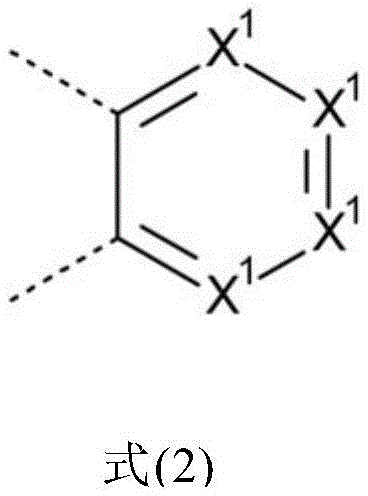
wherein the two dotted bonds represent the linking of the groups;
X1is N or CR, with the proviso that no more than two X's are present in the ring1The group is N; preferably, X1Is CR;
HetAr is a substituted or unsubstituted aromatic ring having 6 to 18 aromatic ring atoms and optionally substituted by one or more R3A group-substituted electron-deficient heteroaryl group; at the same time, the HetAr group together with the naphthylene group to which it is bonded may form an aromatic, heteroaromatic, aliphatic or heteroaliphatic ring system; preferably, the HetAr group does not form any such ring system with the naphthalenylidene group to which the HetAr group is bound;
r is identical or different on each occurrence and is: h, D, F, Cl, Br, I, N (R)4)2,N(Ar’)2,CN,NO2,OR4,SR4,COOR4,C(=O)N(R4)2,Si(R4)3,B(OR4)2,C(=O)R4,P(=O)(R4)2,S(=O)R4,S(=O)2R4,OSO2R4A linear alkyl group having from 1 to 20 carbon atoms or an alkenyl or alkynyl group having from 2 to 20 carbon atoms or a branched or cyclic alkyl group having from 3 to 20 carbon atoms, wherein the alkyl, alkenyl or alkynyl group may be substituted in each case by one or more R4Radicals substituted and in which one or more non-adjacent CH2The radical may be substituted by Si (R)4)2、C=O、NR4O, S or CONR4Instead of, or with 5 to 60 aromatic ring atoms, preferably 5 to 40 aromatic ring atoms and may in each case be substituted by one or more R4A group-substituted aromatic or heteroaromatic ring system;
R1identical or different on each occurrence and is a straight-chain alkyl group having from 1 to 20 carbon atoms or a branched or cyclic alkyl group having from 3 to 20 carbon atoms, where the straight-chain, branched or cyclic alkyl group may in each case be substituted by one or more R4Radicals substituted and in which one or more non-adjacent CH2The radicals may be replaced by O, or have 5 to 40 aromatic ring atoms and may be substituted in each case by one or more R4A group-substituted aromatic or heteroaromatic ring system; at the same time, two R1The radicals together may also form an aromatic, heteroaromatic, aliphatic or heteroaliphatic ring system; preferably, said R is1The radicals do not form any such ring system;
R2identical or different in each case and is: h, D, F, Cl, Br, I, N (R)4)2,N(Ar’)2,CN,NO2,OR4,SR4,COOR4,C(=O)N(R4)2,Si(R4)3,B(OR4)2,C(=O)R4,P(=O)(R4)2,S(=O)R4,S(=O)2R4,OSO2R4A linear alkyl group having from 1 to 20 carbon atoms or an alkenyl or alkynyl group having from 2 to 20 carbon atoms or a branched or cyclic alkyl group having from 3 to 20 carbon atoms, wherein the alkyl, alkenyl or alkynyl group may be substituted in each case by one or more R4Radicals substituted and in which one or more non-adjacent CH2The radical may be substituted by Si (R)4)2、C=O、NR4O, S or CONR4Instead of, or with 5 to 60 aromatic ring atoms, preferably 5 to 40 aromatic ring atoms and may in each case be substituted by one or more R4Radical-substituted aromatic or heteroaromatic compoundsA ring system; at the same time, two R2The radicals together or an R2Radical with an R3The radicals together may also form an aromatic, heteroaromatic, aliphatic or heteroaliphatic ring system; preferably, said R is2The radicals do not form any such ring system;
R3identical or different in each case and is: h, D, F, Cl, Br, I, N (R)4)2,N(Ar’)2,CN,NO2,OR4,SR4,COOR4,C(=O)N(R4)2,Si(R4)3,B(OR4)2,C(=O)R4,P(=O)(R4)2,S(=O)R4,S(=O)2R4,OSO2R4A linear alkyl group having from 1 to 20 carbon atoms or an alkenyl or alkynyl group having from 2 to 20 carbon atoms or a branched or cyclic alkyl group having from 3 to 20 carbon atoms, wherein the alkyl, alkenyl or alkynyl group may be substituted in each case by one or more R4Radicals substituted and in which one or more non-adjacent CH2The radical may be substituted by Si (R)4)2、C=O、NR4O, S or CONR4Instead of, or with 5 to 60 aromatic ring atoms, preferably 5 to 40 aromatic ring atoms and may in each case be substituted by one or more R4A group-substituted aromatic or heteroaromatic ring system; at the same time, two R3The radicals together or an R3Radical with an R2The radicals together may also form an aromatic, heteroaromatic, aliphatic or heteroaliphatic ring system; preferably, said R is3The radicals do not form any such ring system;
ar' is identical or different on each occurrence and is an aromatic ring having 5 to 40 aromatic ring atoms and may be substituted by one or more R4A group-substituted aromatic or heteroaromatic ring system;
R4identical or different in each case and is: h, D, F, Cl, Br, I, N (R)5)2,CN,NO2,OR5,SR5,Si(R5)3,B(OR5)2,C(=O)R5,P(=O)(R5)2,S(=O)R5,S(=O)2R5,OSO2R5A linear alkyl group having from 1 to 20 carbon atoms or an alkenyl or alkynyl group having from 2 to 20 carbon atoms or a branched or cyclic alkyl group having from 3 to 20 carbon atoms, wherein the alkyl, alkenyl or alkynyl group may be substituted in each case by one or more R5Radical substitution of one or more non-adjacent CH2The radical may be substituted by Si (R)5)2、C=O、NR5O, S or CONR5Instead of, or with 5 to 40 aromatic ring atoms and may in each case be substituted by one or more R5A group-substituted aromatic or heteroaromatic ring system; simultaneously, two or more R4The radicals together may form an aromatic, heteroaromatic, aliphatic or heteroaliphatic ring system; preferably, said R is4The radicals do not form any such ring system;
R5identical or different in each case and is: h, D, F, or an aliphatic, aromatic or heteroaromatic organic radical having from 1 to 20 carbon atoms, in particular a hydrocarbon radical, in which one or more hydrogen atoms may also be replaced by F;
o is identical or different in each case and is 0, 1,2,3,4, 5 or 6, preferably 0 or 1, very preferably 0.
An aryl group in the context of the present invention contains from 6 to 40 carbon atoms; heteroaryl groups in the context of the present invention contain from 2 to 40 carbon atoms and at least one heteroatom, with the proviso that the sum of carbon atoms and heteroatoms is at least 5. The heteroatom is preferably selected from N, O and/or S. Aryl or heteroaryl groups are understood here to mean simple aromatic rings, i.e. benzene, or simple heteroaromatic rings, such as pyridine, pyrimidine, thiophene, etc., or condensed (fused) aryl or heteroaryl groups, such as naphthalene, anthracene, phenanthrene, quinoline, isoquinoline, etc. In contrast, aromatic systems, such as biphenyl, which are connected to one another by single bonds, are not referred to as aryl or heteroaryl groups, but rather as aromatic ring systems.
An electron-deficient heteroaryl group in the context of the present invention is a heteroaryl group having at least one heteroaromatic six-membered ring containing at least one nitrogen atom. Further aromatic or heteroaromatic five-or six-membered rings may be fused to the six-membered ring. Examples of electron deficient heteroaryl groups are pyridine, pyrimidine, pyrazine, pyridazine, triazine, quinoline, quinazoline or quinoxaline.
The aromatic ring system in the context of the present invention contains from 6 to 60 carbon atoms in said ring system. A heteroaromatic ring system in the context of the present invention contains from 2 to 60 carbon atoms and at least one heteroatom in the ring system, with the proviso that the sum of carbon atoms and heteroatoms is at least 5. The heteroatom is preferably selected from N, O and/or S. An aromatic or heteroaromatic ring system in the context of the present invention is understood to mean the following systems: it need not contain only aryl or heteroaryl groups, but wherein two or more aryl or heteroaryl groups may also be linked by a non-aromatic unit, such as a carbon, nitrogen or oxygen atom. For example, systems such as fluorene, 9' -spirobifluorene, 9-diarylfluorene, triarylamine, diaryl ether, stilbene, etc., should also be considered as aromatic ring systems in the context of the present invention, and so too should systems in which two or more aryl groups are connected by, for example, a short alkyl group. Preferably, the aromatic ring system is selected from fluorene, 9' -spirobifluorene, 9-diarylamine, or a group in which two or more aryl and/or heteroaryl groups are connected to each other by a single bond.
In the context of the present invention, may contain 1 to 20 carbon atoms and wherein individual hydrogen atoms or CH2An aliphatic hydrocarbon radical or alkyl radical or alkenyl or alkynyl radical which may also be substituted by the abovementioned radicals is preferably understood as meaning methyl, ethyl, n-propyl, isopropyl, n-butyl, isobutyl, sec-butyl, tert-butyl, 2-methylbutyl, n-pentyl, sec-pentyl, neopentyl, cyclopentyl, n-hexyl, neohexyl, cyclohexyl, n-heptyl, cycloheptyl, n-octyl, cyclooctyl, 2-ethylhexyl, trifluoromethyl, pentafluoroethyl, 2,2, 2-trifluoroethyl, vinyl, propenyl, butenyl, pentenyl, cyclopentenyl, hexenyl, cyclohexenyl, heptenyl, cycloheptenyl, octenyl, cyclooctenyl, ethynyl, propynyl, butynyl, pentynyl, hexynyl, heptynyl or heptynyl radicalAn octynyl group. Alkoxy radicals having from 1 to 40 carbon atoms are preferably understood as meaning methoxy, trifluoromethoxy, ethoxy, n-propoxy, isopropoxy, n-butoxy, isobutoxy, sec-butoxy, tert-butoxy, n-pentoxy, sec-pentoxy, 2-methylbutoxy, n-hexoxy, cyclohexyloxy, n-heptoxy, cycloheptoxy, n-octoxy, cyclooctoxy, 2-ethylhexoxy, pentafluoroethoxy and 2,2, 2-trifluoroethoxy. Thioalkyl having 1 to 40 carbon atoms is understood as meaning in particular methylthio, ethylthio, n-propylthio, isopropylthio, n-butylthio, isobutylthio, sec-butylthio, tert-butylthio, n-pentylthio, sec-pentylthio, n-hexylthio, cyclohexylthio, n-heptylthio, cycloheptylthio, n-octylthio, cyclooctylthio, 2-ethylhexylthio, trifluoromethylthio, pentafluoroethylthio, 2,2, 2-trifluoroethylthio, vinylthio, propenylthio, butenylthio, pentenylthio, cyclopentenylthio, hexenylthio, cyclohexenylthio, heptenylthio, cycloheptenylthio, octenylthio, cyclooctenylthio, ethynylthio, propynylthio, butynylthio, pentynylthio, hexynylthio, heptynylthio or octynylthio. In general, the alkyl, alkoxy or thioalkyl groups according to the invention may be straight-chain, branched or cyclic, in which one or more non-adjacent CH' s2The groups may be replaced by the above groups; in addition, one or more hydrogen atoms may also be replaced by D, F, Cl, Br, I, CN or NO2Instead, it is preferably replaced by F, Cl or CN, more preferably by F or CN, especially preferably by CN.
Aromatic or heteroaromatic ring systems which have from 5 to 60 or from 5 to 40 aromatic ring atoms and can in each case also be substituted by the abovementioned radicals and can be attached to the aromatic or heteroaromatic system via any desired position are to be understood as meaning, in particular, radicals derived from: benzene, naphthalene, anthracene, benzanthracene, phenanthrene, pyrene, chicory, perylene, fluoranthene, tetracene, pentacene, benzopyrene, biphenyl, dibenzylidene, terphenyl, bistriphenylidene, fluorene, spirobifluorene, dihydrophenanthrene, dihydropyrene, tetrahydropyrene, cis-or trans-indenofluorene, cis-or trans-benzocarbazole, cis-or trans-indolocarbazole, terphthalene, isotridecylindene, spirotritetracenePolyindene, spiroisotriandene, furan, benzofuran, isobenzofuran, dibenzofuran, thiophene, benzothiophene, isobenzothiophene, dibenzothiophene, pyrrole, indole, isoindole, carbazole, pyridine, quinoline, isoquinoline, acridine, phenanthridine, benzo-5, 6-quinoline, benzo-6, 7-quinoline, benzo-7, 8-quinoline, phenothiazine, thiophene Oxazines, pyrazoles, indazoles, imidazoles, benzimidazoles, naphthoimidazoles, phenanthroimidazoles, pyridoimidazoles, pyrazinoimidazoles, quinoxaloimidazoles,
 Azole, benzo
 Azoles, naphtho
 Azoles, anthracenes
 Azole, phenanthro
 Oxazole, iso
 Oxazole, 1, 2-thiazole, 1, 3-thiazole, benzothiazole, pyridazine, hexaazaterphenyl, benzopyridazine, pyrimidine, benzopyrimidine, quinoxaline, 1, 5-diaza-anthracene, 2, 7-diaza-pyrene, 2, 3-diaza-pyrene, 1, 6-diaza-pyrene, 1, 8-diaza-pyrene, 4,5,9, 10-tetraazaperylene, pyrazine, phenazine, phenoxazine
 Oxazines, phenothiazines, fluoranthenes, naphthyridines, azacarbazoles, benzocarbazoles, phenanthrolines, 1,2, 3-triazoles, 1,2, 4-triazoles, benzotriazoles, 1,2,3-
 Oxadiazole, 1,2,4-
 Oxadiazole, 1,2,5-
 Oxadiazole, 1,3,4-
 Oxadiazole, 1,2, 3-thiadiazole, 1,2, 4-thiadiazole, 1,2, 5-thiadiazole, 1,3, 4-thiadiazole, 1,3, 5-triazine, 1,2, 4-triazine, 1,2, 3-triazine, tetrazole, 1,2,4, 5-tetrazine, 1,2,3, 4-tetrazine, 1,2,3, 5-tetrazine, purine, pteridine, indolizine and benzothiadiazole, or groups derived from combinations of said systems.
In the context of the present specification, the expression that two or more groups together may form a ring is understood to mean, in particular, that the two groups are linked to one another by a chemical bond and formally eliminate two hydrogen atoms. This is illustrated by the following scheme:
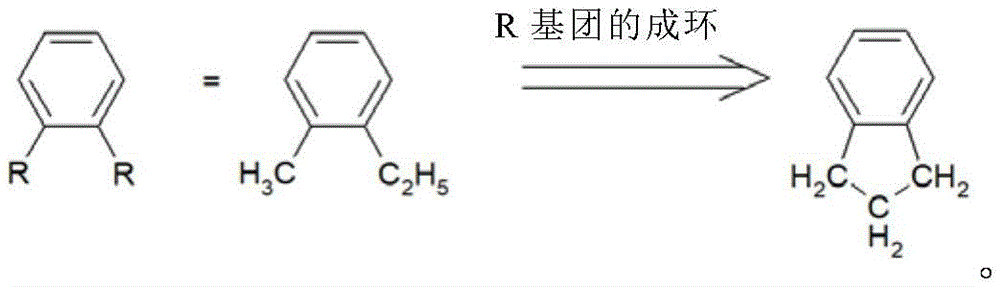
however, in addition, the above wording is also understood to mean that if one of the two groups is hydrogen, the second group is bonded to the bonding position of the hydrogen atom, thereby forming a ring. This will be illustrated by the following scheme:

in a preferred configuration, the compounds of the invention may be selected from compounds of formulae (1a), (1b), (1c), (1d), (1e), (1f), (1g), (1h), (1i), (1j), (1k), (1l) and (1m)


Wherein o, Y, X, HetAr, R1And R2Having the definitions given above, in particular for formula (1). Preference is given here to compounds of the formulae (1a), (1b), (1c), particular preference to compounds of the formula (1 c).
The following may be preferred: in the compounds of formulae (1), (1a), (1b), (1c), (1d), (1e), (1f), (1g), (1h), (1i), (1j), (1k), (1l) and (1m), not more than four, preferably not more than two, X groups are N; more preferably, all X groups are CR, wherein preferably not more than 4, more preferably not more than 3 and especially preferably not more than 2 of the CR groups represented by X are not CH groups.
The following may also be the case: in the compounds of formulae (1), (1a), (1b), (1c), (1d), (1e), (1f), (1g), (1h), (1i), (1j), (1k), (1l) and (1m), not more than one X is present1The group is N; more preferably, all X' s1The radicals are all CR, wherein X1Preferably no more than 3 and more preferably no more than 2 of the CR groups represented are not CH groups.
According to the position at which the group of formula (2) is fused, the invention covers the compounds of formulae (3), (4) and (5) below:

wherein o, HetAr, R1And R2Have the definitions given above, in particular for formula (1), and the indices r are in each case identical or different and are 0, 1,2,3,4, 5 or 6, preferably 0 or 1 and very preferably 0, the index n is 0, 1,2,3 or 4, preferably 0 or 1 and very preferably 0, the index m is 0, 1 or 2, preferably 0 or 1 and very preferably 0Or 1 and very preferably 0. Preference is given here to compounds of the formula (3).
The sum of the indices m, n, o and r in the compounds of the formulae (3), (4) and (5) is preferably not more than 6, particularly preferably not more than 4, more preferably not more than 2.
In a preferred embodiment of the present invention, the compounds of formulae (3), (4) and (5) are selected from the compounds of formulae (3a-1), (3a-2), (4a-1), (4a-2), (5a-1) and (5a-2) below:

wherein o, HetAr, R and R1Having the definitions given above, in particular for formula (1). Preference is given here to compounds of the formulae (3a-1) and (3 a-2).
More preferably, the compounds of formulae (3), (4) and (5) are selected from compounds of formulae (3b), (4b) and (5b) below:

wherein o, HetAr, R and R1Having the definitions given above, in particular for formula (1). Preference is given here to compounds of the formula (3 b).
The following may also be the case: substituent R, R in the above formula1、R2And R3Do not form a fused aromatic or heteroaromatic ring system with the ring atoms of the ring system, preferably any fused ring system. This includes the key R, R1、R2、R3Possible substituents R of the radicals4、R5Forming a fused ring system.
When two are especially selected from R1、R2、R3、R4、R5、R6And/or R7When the radicals form a ring system with one another, the ring system may be a monocyclic or polycyclic aliphatic, heteroaliphatic, aromatic or heteroaromatic ring. In this case, the radicals mentioned together forming a ring system may be adjacent, meaning that the radicals are either to the same carbon atom or to one anotherThe directly bonded carbon atoms are bonded, or they may be further remote from each other. Further, having a substituent R1、R2、R3、R4、R5、R6And/or R7May also be linked to each other by a bond, thereby forming a closed ring. In this case, each corresponding bonding site preferably has a substituent R1、R2、R3、R4、R5、R6And/or R7。
In addition, preferred compounds of the invention are characterized in that they are sublimable. The molar mass of these compounds is generally less than about 1200 g/mol.
As mentioned above, HetAr is a compound having 6 to 18 aromatic ring atoms and may be substituted by one or more R3Group-substituted electron-deficient heteroaryl groups. In a preferred embodiment of the invention, HetAr has 6 to 14 aromatic ring atoms, more preferably 6 to 10 aromatic ring atoms, wherein HetAr may in each case be substituted by one or more R3And (4) substituting the group. In a preferred embodiment of the invention, R on the HetAr group3The radicals do not form a ring system with one another. In another preferred embodiment of the invention, R3The groups together with the naphthylene group to which HetAr is bound form a ring system, more preferably a ring system having from 16 to 21, preferably 16 or 17, ring atoms, wherein the number of ring atoms includes the naphthylene group and the HetAr group.
In one embodiment, the HetAr group together with the naphthalene subunit to which it is attached forms an aromatic, heteroaromatic, aliphatic or heteroaliphatic ring system. If a HetAr group forms together with the naphthylene group to which said HetAr is bound an aromatic, heteroaromatic, aliphatic or heteroaliphatic ring system, this is a ring system having from 16 to 21, preferably 16 or 17, ring atoms, wherein the number of ring atoms includes the naphthylene group and the HetAr group.
Preferably, the HetAr group is selected from the structures of formulae (HetAr-1) to (HetAr-8):

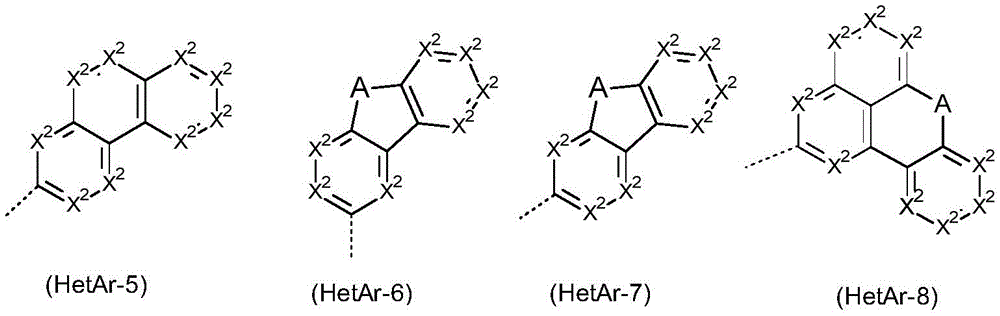
wherein the dotted bond represents the bond to the naphthylene group and the other symbols are as follows:
X2in each case identical or different and is CR3Or N, provided that at least one symbol X is present2Is N, preferably at least two symbols X2Is N, and no more than three symbols X2Is N, wherein R3Having the definitions given above, in particular for formula (1);
a is C (R)4)2、NR4O or S, preferably O or S.
At the same time, preferably not more than two nitrogen atoms are directly bonded to each other. More preferably, no nitrogen atoms are directly bonded to each other.
The following may also be the case: the HetAr group is selected from the structures of the following formulae (HetAr-9):

wherein X2With the definitions given above, in particular for the (HetAr-1) group, the dotted bonds denote the bonds to the naphthylene group, Ar is identical or different on each occurrence and is a group having from 5 to 40 aromatic ring atoms and which may be substituted by one or more R4A radical-substituted aromatic or heteroaromatic ring system, and R4Having the definitions given above, in particular for formula (1).
In a preferred embodiment of the invention, HetAr has two or three nitrogen atoms. Here, the formula (HetAr-1) preferably represents a pyrimidine group or a1, 3, 5-triazine group. For the formulae (HetAr-2), (HetAr-3) and (HetAr-4), they preferably have two nitrogen atoms. More preferably, formulae (HetAr-2) and (HetAr-4) represent a quinazolinyl group.
Preference is given to radicals of the formulae (HetAr-1), (HetAr-2) and (HetAr-3), particular preference to radicals of the formulae (HetAr-1) and (HetAr-2).
Preferred embodiments of the (HetAr-1) group are groups of the formulae (HetAr-1a) to (HetAr-1d), (preferred embodiments of the (HetAr-2) group are groups of the formulae (HetAr-2a) and (HetAr-2b), (preferred embodiments of the (HetAr-3) group are groups of the formula (HetAr-3a), (preferred embodiments of the (HetAr-4) group are groups of the formula (HetAr-4a), (preferred embodiments of the (HetAr-5) group are groups of the formula (HetAr-5a), (preferred embodiments of the (HetAr-6) group are groups of the formulae (HetAr-6a) to (HetAr-6c), (preferred embodiments of the (HetAr-7) group are groups of the formulae (HetAr-7a) to (HetAr-7c), and preferred embodiments of the (HetAr-8) group are groups of the formulae (HetAr-8a) to (HetAr-8c),


wherein Ar is identical or different on each occurrence and is an aromatic ring having 5 to 40 aromatic ring atoms and may be substituted by one or more R4The radicals substituted aromatic or heteroaromatic ring systems, the other symbols having the definitions given above.
In a preferred embodiment of the invention, the compound is selected from the group consisting of sub-formulae (4), (4a-1), (4a-2) or (4b), wherein HetAr is selected from the group consisting of sub-formulae (HetAr-1) and (HetAr-2), preferably from the group consisting of sub-formulae (HetAr-1a) to (HetAr-2b), very preferably from the group consisting of sub-formulae (HetAr-1a) to (HetAr-1d), most preferably from the group consisting of sub-formulae (HetAr-1d), and also preferably the Ar in the given sub-formulae (HetAr-1) to (HetAr-2) and (HetAr-1a) to (HetAr-1d) represents an Ar having from 6 to 40 ring atoms and which may be substituted by one or more R4Radical-substituted aromatic ring systems, very preferably Ar is phenyl, biphenyl, terphenyl or quaterphenyl, where the Ar groups mentioned may be substituted by one or more R4Is substituted by radicals and R4With the definitions given above.
In another preferred embodiment of the invention, the compound is selected from the group consisting of formula (5), (5a-1), (5 a)-2) or (5b), wherein HetAr is selected from the group consisting of formulae (HetAr-1) and (HetAr-2), preferably from the group consisting of formulae (HetAr-1a) to (HetAr-2b), very preferably from the group consisting of formulae (HetAr-1a) to (HetAr-1d), most preferably from formula (HetAr-1d), and further preferably the Ar in the given formulae (HetAr-1) to (HetAr-2) and (HetAr-1a) to (HetAr-1d) represents an Ar having 6 to 40 ring atoms and which may be substituted by one or more R4Radical-substituted aromatic ring systems, very preferably Ar is phenyl, biphenyl, terphenyl or quaterphenyl, where the Ar groups mentioned may be substituted by one or more R4Is substituted by radicals and R4With the definitions given above.
In a very preferred embodiment of the invention, the compound is selected from the group consisting of (3), (3a-1), (3a-2) or (3b), wherein HetAr is selected from the group consisting of (HetAr-1) and (HetAr-2), preferably from the group consisting of (HetAr-1a) to (HetAr-2b), very preferably from the group consisting of (HetAr-1a) to (HetAr-1d), most preferably from the group consisting of (HetAr-1d), and also preferably Ar in the given formulae (HetAr-1) to (HetAr-2) and (HetAr-1a) to (HetAr-1d) represents Ar having 6 to 40 ring atoms and may be substituted by one or more R4Radical-substituted aromatic ring systems, very preferably Ar is phenyl, biphenyl, terphenyl or quaterphenyl, where the Ar groups mentioned may be substituted by one or more R4Is substituted by radicals and R4With the definitions given above.
Preferred aromatic or heteroaromatic ring systems Ar are selected from: phenyl, biphenyl, in particular ortho-, meta-or para-biphenyl, terphenyl, in particular ortho-, meta-or para-terphenyl or branched terphenyl, quaterphenyl, in particular ortho-, meta-or para-quaterphenyl or branched quaterphenyl, fluorene which can be connected via the 1-, 2-, 3-or 4-position, spirobifluorene which can be connected via the 1-, 2-, 3-or 4-position, naphthalene, in particular naphthalene which is bonded via the 1-or 2-position, indole, benzofuran, benzothiophene, carbazole which can be connected via the 1-, 2-, 3-or 4-position, dibenzofuran which can be connected via the 1-, 2-, 3-or 4-position, dibenzothiophene, indenocarbazole, indolocarbazole, pyridine, pyrimidine, pyrazine, pyridazine, triazine, quinoline, isoquinoline, quinazoline, quinoxaline, phenanthrene, or terphenylene which can be connected via the 1-, 2-, 3-or 4-position, each of said radicals may be substituted by oneA plurality of R4And (4) substituting the group.
The Ar groups herein are more preferably independently selected from the group of formulae Ar-1 to Ar-75:
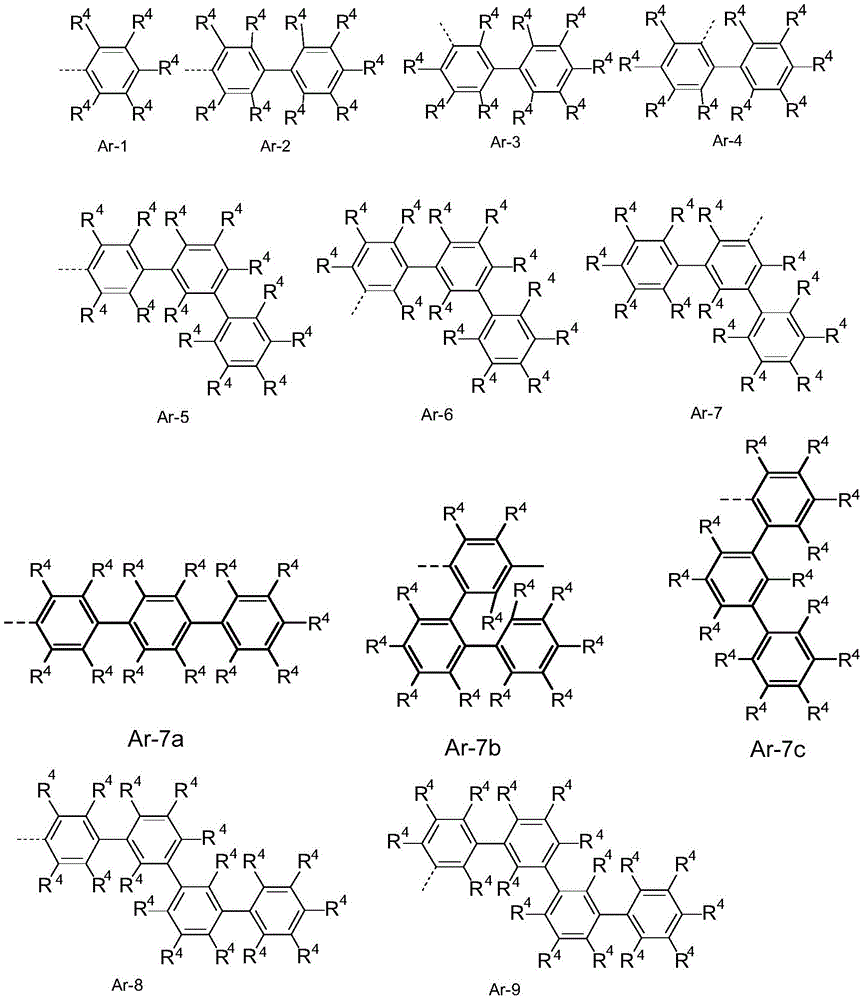


wherein R is4As defined above, the dashed bond represents the bond to HetAr, in addition:
Ar1are identical or different on each occurrence and are of 6 to 18 aromatic ring atoms and may be substituted in each case by one or more R4A divalent aromatic or heteroaromatic ring system substituted with a group;
a is identical or different on each occurrence and is C (R)4)2、NR4O or S;
p is 0 or 1, wherein p ═ 0 means Ar1The groups are absent and the corresponding aromatic or heteroaromatic groups are directly bonded to HetAr;
q is 0 or 1, wherein q ═ 0 means that no A groups are bonded at the stated positions, andand then R4The groups are bonded to the corresponding carbon atoms.
The structures of formulae (Ar-1), (Ar-2), (Ar-3), (Ar-12), (Ar-13), (Ar-14), (Ar-15), (Ar-16), (Ar-69), (Ar-70) and (Ar-75) are preferable, and the structures of formulae (Ar-1), (Ar-2), (Ar-3), (Ar-12), (Ar-13), (Ar-14), (Ar-15) and (Ar-16) are particularly preferable.
When the above groups of Ar have two or more a groups, possible options for the groups include all combinations from the definition of a. A preferred embodiment in this case is where one A group is NR4And the other A group is C (R)4)2Or in which both A groups are NR4Or those in which both A groups are O.
When A is NR4When it is bonded to said nitrogen atom, a substituent R4Preferably having 5 to 24 aromatic ring atoms and which may also be substituted by one or more R5A group-substituted aromatic or heteroaromatic ring system. In a particularly preferred embodiment, said R4The substituents are identical or different on each occurrence and are aromatic or heteroaromatic ring systems having from 6 to 24 aromatic ring atoms, in particular from 6 to 18 aromatic ring atoms, and which do not have a fused aryl group and any fused heteroaryl group in which two or more aromatic or heteroaromatic 6-membered ring groups are directly fused to one another and which may also be fused in each case by one or more R5And (4) substituting the group. Preference is given to phenyl, biphenyl, terphenyl and quaterphenyl having the bonding patterns as listed above for Ar-1 to Ar-11, wherein the structures may be substituted by one or more R5Substituted by radicals other than R4Substituted, but preferably unsubstituted. Also preferred are triazines, pyrimidines and quinazolines as set forth above for Ar-47 through Ar-50, Ar-57 and Ar-58, wherein the structure may be substituted with one or more R5Substituted by radicals other than R4And (4) substitution.
When A is C (R)4)2When it is bonded to said carbon atom, a substituent R4Preferably identical or different on each occurrence and are straight-chain alkyl radicals having from 1 to 10 carbon atoms orBranched or cyclic alkyl radicals having 3 to 10 carbon atoms or aromatic or heteroaromatic ring systems having 5 to 24 aromatic ring atoms, which may also be substituted by one or more R5And (4) substituting the group. Most preferably, R4Is a methyl group or a phenyl group. In this case, R4The groups together may also form a ring system, thereby giving rise to a spiro ring system.
The following are preferred substituents R, R1、R2And R3The description of (1).
In a preferred embodiment of the present invention, R, R2And R3In each case identical or different and selected from: h, D, F, CN, NO2,Si(R4)3,B(OR4)2Straight-chain alkyl radicals having from 1 to 20 carbon atoms or branched or cyclic alkyl radicals having from 3 to 20 carbon atoms, where the alkyl radicals may in each case be substituted by one or more R4Substituted by radicals, or having 5 to 60 aromatic ring atoms, preferably 5 to 40 aromatic ring atoms and in each case being able to be substituted by one or more R4A group-substituted aromatic or heteroaromatic ring system.
In another preferred embodiment of the present invention, R, R2And R3In each case identical or different and selected from: h, D, F, a straight-chain alkyl group having from 1 to 20 carbon atoms or a branched or cyclic alkyl group having from 3 to 20 carbon atoms, wherein the alkyl group may in each case be substituted by one or more R4Substituted by radicals, or having 5 to 60 aromatic ring atoms, preferably 5 to 40 aromatic ring atoms and in each case being able to be substituted by one or more R4A group-substituted aromatic or heteroaromatic ring system.
In another preferred embodiment of the present invention, R, R2And R3In each case identical or different and selected from: h, D, having 6 to 30 aromatic ring atoms and optionally substituted by one or more R4A radical-substituted aromatic or heteroaromatic ring system, and N (Ar')2A group. More preferably R, R2And R3In each case identical or different and selected from: h, or isHaving 6 to 24 aromatic ring atoms, preferably 6 to 18 aromatic ring atoms, more preferably 6 to 13 aromatic ring atoms and may in each case be substituted by one or more R4A group-substituted aromatic or heteroaromatic ring system.
Preferred aromatic or heteroaromatic ring systems R, R2、R3Or Ar' is selected from: phenyl, biphenyl, in particular ortho-, meta-or para-biphenyl, terphenyl, in particular ortho-, meta-or para-terphenyl or branched terphenyl, quaterphenyl, in particular ortho-, meta-or para-quaterphenyl or branched quaterphenyl, fluorenes which may be linked via the 1-, 2-, 3-or 4-position, spirobifluorenes which may be linked via the 1-, 2-, 3-or 4-position, naphthalenes, in particular 1-or 2-bonded naphthalenes, indoles, benzofurans, benzothiophenes, carbazole which may be linked via the 1-, 2-, 3-or 4-position, dibenzofuran which may be linked via the 1-, 2-, 3-or 4-position, dibenzothiophene, indenocarbazole, indolocarbazole, pyridine, pyrimidine, pyrazine, pyridazine, triazine, quinoline, isoquinoline, quinazoline, quinoxaline, phenanthrene, or terphenyl that may be attached via the 1-, 2-, 3-or 4-position; each of said radicals may be substituted by one or more R4And (4) substituting the group. The structures Ar-1 to Ar-75 listed above are particularly preferred, with the structures of formulae (Ar-1), (Ar-2), (Ar-3), (Ar-12), (Ar-13), (Ar-14), (Ar-15), (Ar-16), (Ar-69), (Ar-70), (Ar-75) being preferred, and the structures of formulae (Ar-1), (Ar-2), (Ar-3), (Ar-12), (Ar-13), (Ar-14), (Ar-15), (Ar-16) being particularly preferred.
Other suitable R, R2And R3The radical being of the formula-Ar4-N(Ar2)(Ar3) Group of (1), wherein Ar2、Ar3And Ar4Are identical or different on each occurrence and are of 5 to 24 aromatic ring atoms and may be substituted in each case by one or more R4A group-substituted aromatic or heteroaromatic ring system. Ar (Ar)2、Ar3And Ar4The total number of medium aromatic ring atoms is not more than 60, preferably not more than 40.
Here, by selecting from C (R)4)2、NR4Radicals of O and S, Ar4And Ar2May also be bonded to each other and/or Ar2And Ar3Are bonded to each other. Preferably, Ar is ortho to the bond with the nitrogen atom4And Ar2Are bonded to each other and Ar2And Ar3Are bonded to each other. In another embodiment of the present invention, Ar2、Ar3And Ar4None of the groups are bonded to each other.
Preferably, Ar4Are of 6 to 24 aromatic ring atoms, preferably of 6 to 12 aromatic ring atoms and may in each case be substituted by one or more R4A group-substituted aromatic or heteroaromatic ring system. More preferably, Ar4Selected from ortho-, meta-or para-phenylene radicals or ortho-, meta-or para-biphenyls, each of which may be substituted by one or more R4The radicals are substituted, but preferably unsubstituted. Most preferably, Ar4Is an unsubstituted phenylene group.
Preferably, Ar2And Ar3Are identical or different on each occurrence and are of 6 to 24 aromatic ring atoms and may be substituted in each case by one or more R4A group-substituted aromatic or heteroaromatic ring system. Particularly preferred Ar2And Ar3The radicals are identical or different on each occurrence and are selected from: phenyl, ortho-, meta-or para-biphenyl, ortho-, meta-or para-terphenyl or branched terphenyl, ortho-, meta-or para-quaterphenyl or branched quaterphenyl, 1-fluorenyl, 2-fluorenyl, 3-fluorenyl or 4-fluorenyl, 1-spirobifluorenyl, 2-spirobifluorenyl, 3-spirobifluorenyl or 4-spirobifluorenyl, 1-naphthyl or 2-naphthyl, indole, benzofuran, benzothiophene, 1-carbazole, 2-carbazole, 3-carbazole or 4-carbazole, 1-dibenzofuran, 2-dibenzofuran, 3-dibenzofuran or 4-dibenzofuran, 1-dibenzothiophene, 2-dibenzothiophene, 3-dibenzothiophene or 4-dibenzothiophene, indenocarbazole, indolocarbazoles, 2-pyridines, 3-pyridines or 4-pyridines, 2-pyrimidines, 4-pyrimidines or 5-pyrimidines, pyrazines, pyridazines, triazines, phenanthrenes, or terphenyls, each of which may be substituted by one or more R1And (4) substituting the group. Most preferably, Ar2And Ar3In each case the same or differentAnd is selected from: phenyl, biphenyl, in particular ortho-, meta-or para-biphenyl, terphenyl, in particular ortho-, meta-or para-terphenyl or branched terphenyl, quaterphenyl, in particular ortho-, meta-or para-quaterphenyl or branched quaterphenyl, fluorenyl, in particular 1-fluorenyl, 2-fluorenyl, 3-fluorenyl or 4-fluorenyl, or spirobifluorenyl, in particular 1-spirobifluorenyl, 2-spirobifluorenyl, 3-spirobifluorenyl or 4-spirobifluorenyl.
In a preferred embodiment of the invention, R1Identical or different on each occurrence and selected from straight-chain alkyl radicals having from 1 to 6 carbon atoms or cyclic alkyl radicals having from 3 to 6 carbon atoms, where the alkyl radicals may in each case be substituted by one or more R4Substituted by radicals, or having 6 to 24 aromatic ring atoms and may in each case be substituted by one or more R4A group-substituted aromatic or heteroaromatic ring system; at the same time, two R1The radicals may also together form a ring system. More preferably, R1In each case identical or different and selected from: a straight-chain alkyl radical having 1,2,3 or 4 carbon atoms, or a branched or cyclic alkyl radical having 3 to 6 carbon atoms, where the alkyl radical may in each case be substituted by one or more R4Substituted, but preferably unsubstituted, or an aromatic ring system having from 6 to 12 aromatic ring atoms, in particular 6 aromatic ring atoms, which may in each case be substituted by one or more, preferably nonaromatic, R4The radicals are substituted, but preferably unsubstituted; at the same time, two R1The radicals may also together form a ring system. Most preferably, R1In each case identical or different and selected from straight-chain alkyl groups having 1,2,3 or 4 carbon atoms or branched alkyl groups having 3 to 6 carbon atoms. Most preferably, R1Is a methyl group or a phenyl group, wherein two phenyl groups together may form a ring system, a methyl group being preferred over a phenyl group.
In another preferred embodiment of the invention, R4In each case identical or different and selected from: h, D, F, CN, a linear alkyl radical having from 1 to 10 carbon atoms orBranched or cyclic alkyl radicals having 3 to 10 carbon atoms, where the alkyl radical may in each case be substituted by one or more R2Substituted by radicals, or having 6 to 24 aromatic ring atoms and may in each case be substituted by one or more R5A group-substituted aromatic or heteroaromatic ring system. In a particularly preferred embodiment of the invention, R4In each case identical or different and selected from: h, a straight-chain alkyl radical having from 1 to 6 carbon atoms, in particular having from 1,2,3 or 4 carbon atoms, or a branched or cyclic alkyl radical having from 3 to 6 carbon atoms, where the alkyl radical may in each case be substituted by one or more R5Substituted, but preferably unsubstituted, or have 6 to 13 aromatic ring atoms and may in each case be substituted by one or more R5The radicals substituted, but preferably unsubstituted, aromatic or heteroaromatic ring systems.
In another preferred embodiment of the invention, R5Identical or different in each case and is: H. an alkyl group having 1 to 4 carbon atoms or an aryl group having 6 to 10 carbon atoms, which may be substituted, but is preferably unsubstituted, with an alkyl group having 1 to 4 carbon atoms.
Meanwhile, in the compound of the present invention treated by vacuum evaporation, the alkyl group preferably has not more than five carbon atoms, more preferably not more than 4 carbon atoms, and most preferably not more than 1 carbon atom. For compounds processed from solution, suitable compounds are also those substituted by alkyl groups having up to 10 carbon atoms, in particular branched alkyl groups, or by oligomeric arylidene groups, for example ortho-, meta-or para-terphenyl or branched terphenyl or quaterphenyl groups.
When the compounds of the formula (1) or of the preferred embodiments are used as matrix materials for phosphorescent emitters or in layers directly adjoining the phosphorescent layer, it is also preferred that the compounds do not contain any fused aryl or heteroaryl groups in which more than two six-membered rings are directly fused to one another. Phenanthrene and terphenyl forks constitute an exception to this case, since their triplet energies are high, and so may be preferred despite the presence of a fused aromatic six-membered ring.
The above-described preferred embodiments can be freely combined with each other within the limits defined in claim 1. In a particularly preferred embodiment of the invention, the above preferences occur simultaneously.
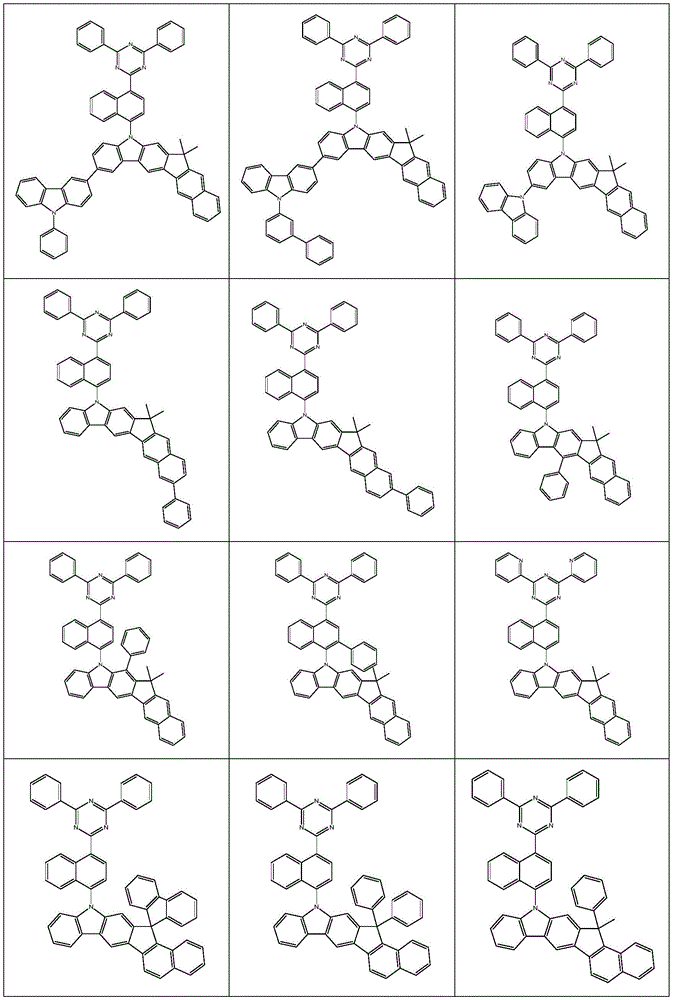
Examples of preferred compounds according to the above detailed embodiments are detailed in the following table of compounds:




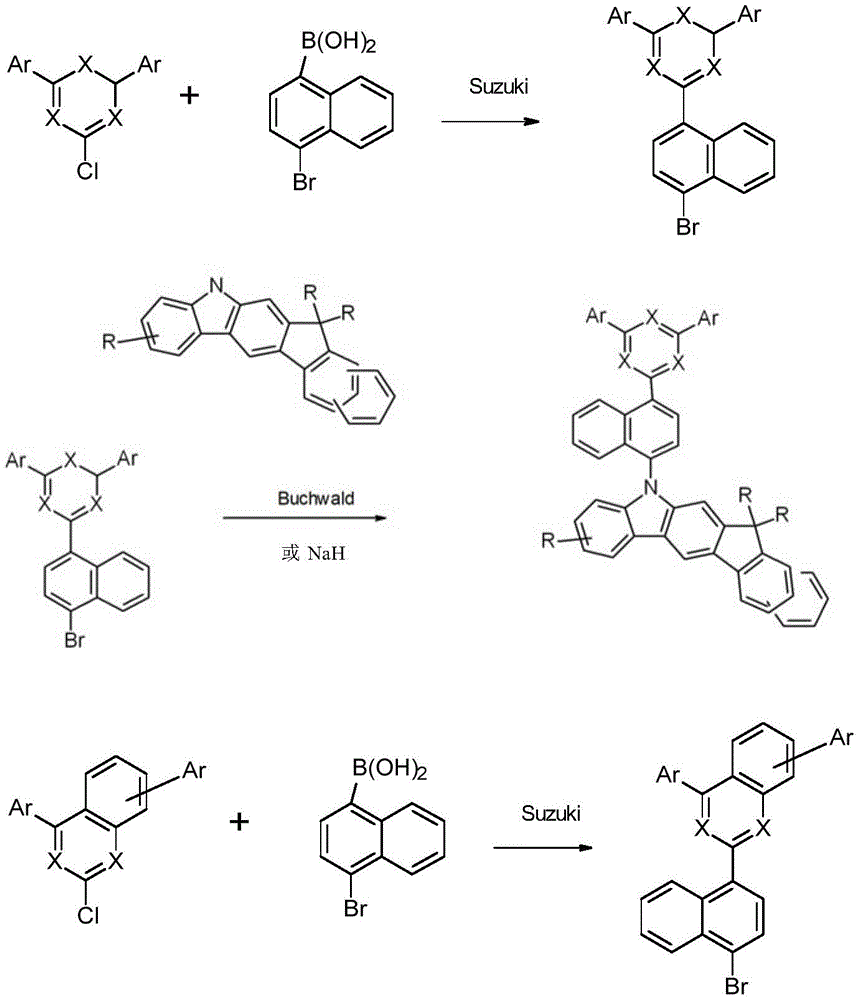
the basic structures of the compounds of the present invention can be prepared by the routes outlined in the schemes below. The individual synthetic steps, for example C-C coupling reactions according to Suzuki, C-N coupling reactions according to Hartwig-Buchwald, or cyclization reactions, are known in principle to the person skilled in the art. More information can be found in the synthesis examples on the synthesis of the compounds of the invention. The synthesis of the basic structure is shown in scheme 1. The synthesis of the basic structure can be achieved by coupling a benzofluorene substituted with a reactive leaving group (e.g. bromine) with an optionally substituted 2-nitrophenylboronic acid, followed by a ring closure reaction. Alternatively, coupling with the amino group of an optionally substituted 2-aminochlorobenzene may be effected followed by ring closure. Schemes 2 and 3 show various options for introducing a naphthalenylidene-HetAr group at a nitrogen atom in the basic backbone. The naphthalenylidene-HetAr group substituted with a suitable leaving group (e.g., bromo) can be introduced here in an aromatic nucleophilic substitution reaction or a palladium catalyzed coupling reaction, as shown in scheme 2. Alternatively, first, in an aromatic nucleophilic substitution reaction, the naphthalenylidene group, still carrying a suitable leaving group (e.g. bromo), is introduced into the basic backbone, and in a further coupling reaction, optionally after conversion to a boronic acid derivative, the HetAr group may be introduced, as shown in scheme 3.
Scheme 1

Scheme 2

Scheme 3
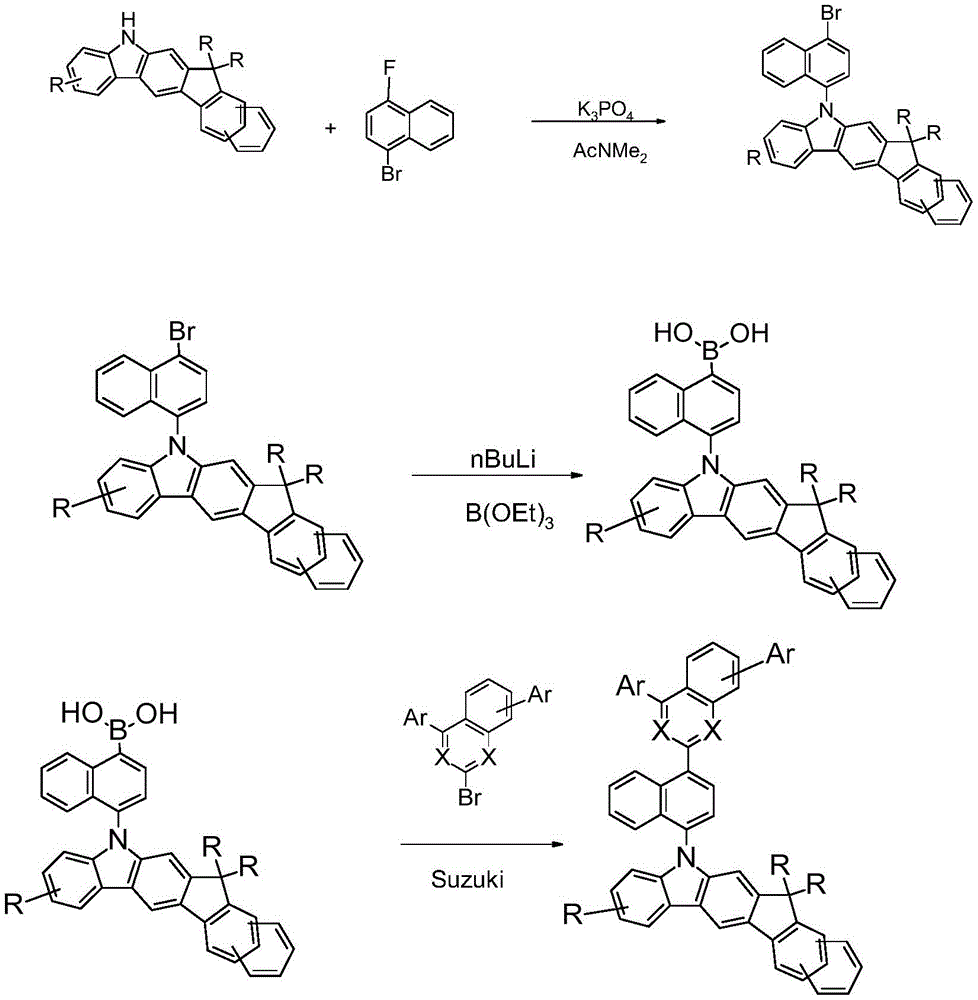
The symbol definitions used in schemes 1 to 3 substantially correspond to the definitions specified in equation (1), and the numbering and full representation of all symbols has been omitted for clarity.
The present invention therefore also provides a process for preparing the compounds of the invention, in which a basic skeleton which is not yet free of a naphthylene-HetAr group is first synthesized and in which the naphthylene-HetAr group is introduced by an aromatic nucleophilic substitution reaction or a coupling reaction.
In order to process the compounds according to the invention from the liquid phase, for example by spin coating or by printing methods, a formulation of the compounds according to the invention is necessary. These formulations may be, for example, solutions, dispersions or emulsions. For this purpose, mixtures of two or more solvents can preferably be used. Suitable and preferred solvents are, for example, toluene, anisole, o-, m-or p-xylene, methyl benzoate, mesitylene, tetralin, veratrole, THF, methyl-THF, THP, chlorobenzene, diclorobenzene Alkanes, phenoxytoluenes, especially 3-phenoxytoluene, (-) -fenchone, 1,2,3, 5-tetramethylbenzene, 1,2,4, 5-tetramethylbenzene, 1-methylnaphthalene, 2-methylbenzothiazole, 2-phenoxyethanol, 2-pyrrolidone, 3-methylanisole, 4-methylanisole, 3, 4-dimethylanisole, 3, 5-dimethylanisoleAcetophenone, α -terpineol, benzothiazole, butyl benzoate, cumene, cyclohexanol, cyclohexanone, cyclohexylbenzene, decahydronaphthalene, dodecylbenzene, ethyl benzoate, indane, NMP, p-cymene, phenetole, 1, 4-diisopropylbenzene, dibenzyl ether, diethylene glycol butyl methyl ether, triethylene glycol butyl methyl ether, diethylene glycol dibutyl ether, triethylene glycol dimethyl ether, diethylene glycol monobutyl ether, tripropylene glycol dimethyl ether, tetraethylene glycol dimethyl ether, 2-isopropylnaphthalene, pentylbenzene, hexylbenzene, heptylbenzene, octylbenzene, 1, 1-bis (3, 4-dimethylphenyl) ethane, 2-methylbiphenyl, 3-methylbiphenyl, 1-methylnaphthalene, 1-ethylnaphthalene, ethyl octanoate, diethyl sebacate, octyl octanoate, heptylbenzene, menthyl isovalerate, cyclohexyl hexanoate, or mixtures of these solvents.
Accordingly, the present invention also provides formulations comprising at least one compound of the invention and at least one other compound. The further compound may be, for example, a solvent, especially one of the above-mentioned solvents or a mixture of these solvents. If the other compound comprises a solvent, the mixture is referred to herein as a formulation. The further compound may alternatively be at least one further organic or inorganic compound, such as a light-emitting compound and/or a further matrix material, which is also used in the electronic device. Suitable light-emitting compounds and other matrix materials are listed below in connection with the organic electroluminescent device. The other compounds may also be polymeric.
The invention also provides the use of the compounds of the invention in electronic devices, in particular organic electroluminescent devices.
The present invention still further provides electronic devices comprising at least one compound of the present invention. An electronic device in the context of the present invention is a device comprising at least one layer containing at least one organic compound. The element may also comprise an inorganic material or a layer formed entirely of an inorganic material.
The electronic device is preferably selected from: organic electroluminescent devices (OLED, sOLED, PLED, LEC, etc.), preferably organic light-emitting diodes (OLED), small molecule-based organic light-emitting diodes (sOLED), polymer-based organic light-emitting diodes (PLED), light-emitting electrochemical cells (LEC), organic laser diodes (O-lasers), organic plasma light-emitting devices (D.M. Koller et al, Nature Photonics 2008, 1-4), organic integrated circuits (O-IC), organic field effect transistors (O-FET), organic thin film transistors (O-TFT), organic light-emitting transistors (O-LET), organic solar cells (O-SC), organic optical detectors, organic photoreceptors, organic field-quenching devices (O-FQD) and organic electrical sensors, preferably organic electroluminescent devices (OLED, sOLED, PLED, LEC, etc.), more preferably organic light-emitting diodes (OLED), small molecule based organic light emitting diodes (sOLED), polymer based organic light emitting diodes (PLED), especially phosphorescent OLEDs.
The organic electroluminescent device comprises a cathode, an anode and at least one light-emitting layer. In addition to these layers, it may also comprise further layers, for example in each case one or more hole-injecting layers, hole-transporting layers, hole-blocking layers, electron-transporting layers, electron-injecting layers, exciton-blocking layers, electron-blocking layers and/or charge-generating layers. It is likewise possible to introduce an intermediate layer having, for example, an exciton blocking function between the two light-emitting layers. However, it should be noted that each of these layers need not necessarily be present. In this case, the organic electroluminescent device may have one light-emitting layer, or it may have a plurality of light-emitting layers. If a plurality of light-emitting layers are present, these preferably have a plurality of emission maxima in total between 380nm and 750nm, so that white emission results overall; in other words, various light-emitting compounds that can emit fluorescence or phosphorescence are used in the light-emitting layer. Particularly preferred are systems with three light-emitting layers, wherein the three layers exhibit blue, green and orange or red light emission. The organic electroluminescent device of the present invention may also be a tandem type electroluminescent device, particularly a white light emitting type OLED.
It is not at all difficult for the person skilled in the art to select suitable materials for use in said further layers of the organic electroluminescent device in view of the various materials known in the prior art. The person skilled in the art will here take into account the chemical and physical properties of the materials in a customary manner, since the materials are known to interact with one another in organic electroluminescent devices. This is related, for example, to the energy levels of the orbitals (HOMO, LUMO) or the triplet and singlet energy levels, but also to other material properties.
Selected electron transport materials particularly suitable for use in the electron blocking layer or electron transport layer are listed below by way of example as electron transport or electron blocking materials in the electron blocking layer or electron transport layer either in combination with the compounds of the present invention or without the compounds of the present invention. These are preferably triazines, very preferably 1,3, 5-triazines, which most preferably may have aromatic and/or heteroaromatic substitution. Specific examples of preferred electron transport materials having a1, 3, 5-triazine structure and their synthesis are disclosed in, for example, WO2010/072300 a1, WO2014/023388 a1 and the color Art Journal 2017#03, 188-. Some selected compounds are shown below.


The compounds of the invention can be used in different layers depending on the exact structure. Preferably, the organic electroluminescent device comprises the compound of the formula (1) or of the preferred embodiments described above as a host material for phosphorescent emitters or for emitters which exhibit TADF (thermally excited delayed fluorescence), in particular for phosphorescent emitters, in the light-emitting layer. In addition, the compounds according to the invention can also be used in electron-transport layers and/or hole-transport layers and/or exciton-blocking layers and/or hole-blocking layers. The compounds according to the invention are particularly preferably used as matrix materials for red, orange or yellow phosphorescent emitters, in particular red phosphorescent emitters, in the light-emitting layer or as electron transport materials or hole blocking materials in the electron transport layer or hole blocking layer.
When the compounds of the invention are used as matrix materials for phosphorescent compounds in the light-emitting layer, they are preferably used in combination with one or more phosphorescent materials (triplet emitters). Phosphorescence in the context of the present invention is understood to mean light emission from an excited state with a high degree of spin multiplexing, i.e. a spin state >1, in particular from an excited triplet state. In the context of the present application, all luminescent complexes with transition metals or lanthanides, in particular all iridium, platinum and copper complexes, are to be regarded as phosphorescent compounds.
The mixture of the compounds according to the invention and of the luminescent compounds contains between 99% and 1% by volume, preferably between 98% and 10% by volume, more preferably between 97% and 60% by volume and in particular between 95% and 80% by volume of the compounds according to the invention, based on the total mixture of emitter and matrix material. Accordingly, the mixture contains between 1% and 99% by volume, preferably between 2% and 90% by volume, more preferably between 3% and 40% by volume, and especially between 5% and 20% by volume of luminophores, based on the total mixture of luminophores and matrix material.
In one embodiment of the present invention, the compounds of the invention are used here as the sole matrix material ("single host") for phosphorescent emitters.
Another embodiment of the present invention is the use of the compounds according to the invention in combination with other matrix materials as matrix materials for phosphorescent emitters. Suitable matrix materials which can be used in combination with the compounds of the invention are, for example, aromatic ketones, aromatic phosphine oxides, or aromatic sulfoxides or sulfones according to WO 2004/013080, WO 2004/093207, WO 2006/005627 or WO 2010/006680; triarylamines, carbazole derivatives, such as CBP (N, N-biscarbazolylbiphenyl), or carbazole derivatives disclosed in WO 2005/039246, US 2005/0069729, JP 2004/288381, EP 1205527, WO 2008/086851, or WO 2013/041176; indolocarbazole derivatives, for example according to WO 2007/063754 or WO 2008/056746; indenocarbazole derivatives, for example according to WO 2010/136109, WO 2011/000455, WO 2013/041176 or WO 2013/056776; azacarbazole derivatives, for example according to EP 1617710, EP 1617711, EP 1731584, JP 2005/347160; bipolar matrix materials, for example according to WO 2007/137725; for example silanes according to WO 2005/111172; for example boron nitrogen heterocyclic nuclei or borates according to WO 2006/117052; triazine derivatives, for example according to WO 2007/063754, WO 2008/056746, WO 2010/015306, WO 2011/057706, WO 2011/060859 or WO 2011/060877; zinc complexes, for example according to EP 652273 or WO 2009/062578; for example a silicon-diazacyclo-slow or silicon-tetraazazepine-slow derivative according to WO 2010/054729; for example a phosphorus diazacyclo-slow derivative according to WO 2010/054730; bridged carbazole derivatives, for example according to WO 2011/042107, WO 2011/060867, WO 2011/088877 and WO 2012/143080; for example a terphenyl fork derivative according to WO 2012/048781; dibenzofuran derivatives, for example according to WO 2015/169412, WO 2016/015810, WO 2016/023608, WO 2017/148564 or WO 2017/148565; or bis-carbazoles, for example according to JP 3139321B 2.
Likewise, a further phosphorescent emitter having an emission wavelength shorter than the actual emitter may also be present as a co-host in the mixture. Particularly good results are achieved when the emitter used is a red phosphorescent emitter and the co-host used in combination with the compounds of the invention is a yellow phosphorescent emitter.
In addition, the co-host used may be a compound which does not participate to a significant extent, if at all, in charge transport, for example as described in WO 2010/108579. Compounds which have a large energy gap and which themselves do not participate, at least to a significant extent if at all, in the charge transport of the light-emitting layer are particularly suitable as co-matrix materials in combination with the compounds of the invention. Such materials are preferably pure hydrocarbons. Examples of such materials can be found in, for example, WO 2009/124627 or WO 2010/006680.
Particularly preferred co-host materials which can be used in combination with the compounds of the invention are compounds of one of the formulae (6), (7), (8), (9) and (10), preferably biscarbazole derivatives of one of the formulae (6), (7), (8), (9) and (10),

the symbols and indices used therein are as follows:
R6identical or different in each case and is: h, D, F, Cl, Br, I, N (R)7)2,N(Ar”)2,CN,NO2,OR7,SR7,COOR7,C(=O)N(R7)2,Si(R7)3,B(OR7)2,C(=O)R7,P(=O)(R7)2,S(=O)R7,S(=O)2R7,OSO2R7A linear alkyl group having from 1 to 20 carbon atoms or an alkenyl or alkynyl group having from 2 to 20 carbon atoms or a branched or cyclic alkyl group having from 3 to 20 carbon atoms, wherein the alkyl, alkenyl or alkynyl group may be substituted in each case by one or more R7Radicals substituted and in which one or more non-adjacent CH2The radical may be substituted by Si (R)7)2、C=O、NR7O, S or CONR7Instead of, or with 5 to 60 aromatic ring atoms, preferably 5 to 40 aromatic ring atoms and may in each case be substituted by one or more R7A group-substituted aromatic or heteroaromatic ring system; at the same time, two R6The radicals together may also form an aromatic, heteroaromatic, aliphatic or heteroaliphatic ring system; preferably, said R is6The radicals do not form any such ring system;
ar' is identical or different on each occurrence and isHaving 5 to 40 aromatic ring atoms and may be substituted by one or more R7A group-substituted aromatic or heteroaromatic ring system;
A1is C (R)7)2、NR7O or S;
Ar5are identical or different on each occurrence and are of 5 to 40 aromatic ring atoms and may be substituted by one or more R7A group-substituted aromatic or heteroaromatic ring system;
R7identical or different in each case and is: h, D, F, Cl, Br, I, N (R)8)2,CN,NO2,OR8,SR8,Si(R8)3,B(OR8)2,C(=O)R8,P(=O)(R8)2,S(=O)R8,S(=O)2R8,OSO2R8A linear alkyl group having from 1 to 20 carbon atoms or an alkenyl or alkynyl group having from 2 to 20 carbon atoms or a branched or cyclic alkyl group having from 3 to 20 carbon atoms, wherein the alkyl, alkenyl or alkynyl group may be substituted in each case by one or more R8Radical substitution of one or more non-adjacent CH2The radical may be substituted by Si (R)8)2、C=O、NR8O, S or CONR8Instead of, or with 5 to 40 aromatic ring atoms and may in each case be substituted by one or more R8A group-substituted aromatic or heteroaromatic ring system; simultaneously, two or more R7The radicals together may form an aromatic, heteroaromatic, aliphatic or heteroaliphatic ring system; preferably, said R is7The radicals do not form any such ring system;
R8identical or different in each case and is: h, D, F, or an aliphatic, aromatic or heteroaromatic organic radical having from 1 to 20 carbon atoms, in particular a hydrocarbon radical, wherein one or more hydrogen atoms of the organic radical may also be replaced by F;
s is identical or different on each occurrence and is 0, 1,2,3 or 4, preferably 0 or 1, and very preferably 0;
t is identical or different on each occurrence and is 0, 1,2 or 3, preferably 0 or 1, and very preferably 0;
u is identical or different on each occurrence and is 0, 1 or 2, preferably 0 or 1, and very preferably 0.
The sum of the indices s, t and u in the compounds of the formulae (6), (7), (8), (9) and (10) is preferably not more than 6, particularly preferably not more than 4 and more preferably not more than 2.
In a preferred embodiment of the invention, R6The same or different in each case and: h, D, F, CN, NO2,Si(R7)3,B(OR7)2Straight-chain alkyl radicals having from 1 to 20 carbon atoms or branched or cyclic alkyl radicals having from 3 to 20 carbon atoms, where the alkyl radicals may in each case be substituted by one or more R7Substituted by radicals, or having 5 to 60 aromatic ring atoms, preferably 5 to 40 aromatic ring atoms and in each case being able to be substituted by one or more R7A group-substituted aromatic or heteroaromatic ring system.
In another preferred embodiment of the invention, R6In each case identical or different and selected from: h, D, F, a straight-chain alkyl group having from 1 to 20 carbon atoms or a branched or cyclic alkyl group having from 3 to 20 carbon atoms, wherein the alkyl group may in each case be substituted by one or more R7Substituted by radicals, or having 5 to 60 aromatic ring atoms, preferably 5 to 40 aromatic ring atoms and in each case being able to be substituted by one or more R7A group-substituted aromatic or heteroaromatic ring system.
In another preferred embodiment of the invention, R6In each case identical or different and selected from: h, D, having 6 to 30 aromatic ring atoms and optionally substituted by one or more R7A radical-substituted aromatic or heteroaromatic ring system, and N (Ar')2A group. More preferably, R6In each case identical or different and selected from: h, or have 6 to 24 aromatic ring atoms, preferably 6 to 18 aromatic ring atoms, more preferably 6 to 13 aromatic ring atoms and may in each case be substituted by one or more R7Radical-substituted aromatic orA heteroaromatic ring system.
Preferred aromatic or heteroaromatic ring systems R6Or Ar' is selected from: phenyl, biphenyl, in particular ortho-, meta-or para-biphenyl, terphenyl, in particular ortho-, meta-or para-terphenyl or branched terphenyl, quaterphenyl, in particular ortho-, meta-or para-quaterphenyl or branched quaterphenyl, fluorenes which may be linked via the 1-, 2-, 3-or 4-position, spirobifluorenes which may be linked via the 1-, 2-, 3-or 4-position, naphthalenes, in particular 1-or 2-bonded naphthalenes, indoles, benzofurans, benzothiophenes, carbazole which may be linked via the 1-, 2-, 3-or 4-position, dibenzofuran which may be linked via the 1-, 2-, 3-or 4-position, dibenzothiophene, indenocarbazole, indolocarbazole, pyridine, pyrimidine, pyrazine, pyridazine, triazine, quinoline, isoquinoline, quinazoline, quinoxaline, phenanthrene, or terphenyl that may be attached via the 1-, 2-, 3-or 4-position; each of said radicals may be substituted by one or more R7And (4) substituting the group. The structures Ar-1 to Ar-75 listed above are particularly preferred, with the structures of formulae (Ar-1), (Ar-2), (Ar-3), (Ar-12), (Ar-13), (Ar-14), (Ar-15), (Ar-16), (Ar-69), (Ar-70), (Ar-75) being preferred, and the structures of formulae (Ar-1), (Ar-2), (Ar-3), (Ar-12), (Ar-13), (Ar-14), (Ar-15), (Ar-16) being particularly preferred. In the above structures Ar-1 to Ar-75, with respect to R6And Ar' group, substituent R4Should be substituted by the corresponding R7The groups are replaced. As mentioned above for R2And R3Preference of the radicals applies correspondingly to R6A group.
Other suitable R6The radical being of the formula-Ar4-N(Ar2)(Ar3) Group of (1), wherein Ar2、Ar3And Ar4Are identical or different on each occurrence and are of 5 to 24 aromatic ring atoms and may be substituted in each case by one or more R4A group-substituted aromatic or heteroaromatic ring system. Ar (Ar)2、Ar3And Ar4The total number of aromatic ring atoms in (a) is here not more than 60 and preferably not more than 40. For Ar2、Ar3And Ar4Other preferences for the groups have been set out above and apply accordingly.
The following may also be the case: substituent R in the above formula6Do not form a fused aromatic or heteroaromatic ring system with the ring atoms of the ring system, preferably any fused ring system. This includes bonding to R6Possible substituents R of the radicals7、R8Forming a fused ring system.
When A is1Is NR7When it is bonded to said nitrogen atom, a substituent R7Preferably having 5 to 24 aromatic ring atoms and which may also be substituted by one or more R8A group-substituted aromatic or heteroaromatic ring system. In a particularly preferred embodiment, said R7The substituents are identical or different on each occurrence and are an aromatic or heteroaromatic ring system which is an aromatic or heteroaromatic ring system having from 6 to 24 aromatic ring atoms, in particular from 6 to 18 aromatic ring atoms, and which does not have any fused aryl or heteroaryl groups in which two or more aromatic or heteroaromatic 6-membered ring groups are directly fused to one another, and which may also be fused in each case by one or more R8And (4) substituting the group. Preference is given to phenyl, biphenyl, terphenyl and quaterphenyl groups having the bonding patterns as listed above for Ar-1 to Ar-11, where these structures may be substituted by one or more R8Radicals other than by R4Substituted, but preferably unsubstituted. Also preferred are triazines, pyrimidines and quinazolines as set forth above for Ar-47 through Ar-50, Ar-57 and Ar-58, wherein these structures may be substituted with one or more R8Substituted by radicals other than R4And (4) substitution.
When A is1Is C (R)7)2When it is bonded to said carbon atom, a substituent R7Preferably identical or different on each occurrence and is a straight-chain alkyl radical having from 1 to 10 carbon atoms or a branched or cyclic alkyl radical having from 3 to 10 carbon atoms or an aromatic or heteroaromatic ring system having from 5 to 24 aromatic ring atoms, which may also be substituted by one or more R8And (4) substituting the group. Most preferably, R7Is a methyl group or a phenyl group. In this case, R7The groups together may also form a ring system, thereby giving rise to a spiro ring system.
Preferred aryl radicalsOf a group or heteroaromatic ring system Ar5Selected from: phenyl, biphenyl, in particular ortho-, meta-or para-biphenyl, terphenyl, in particular ortho-, meta-or para-terphenyl or branched terphenyl, quaterphenyl, in particular ortho-, meta-or para-quaterphenyl or branched quaterphenyl, fluorenes which may be linked via the 1-, 2-, 3-or 4-position, spirobifluorenes which may be linked via the 1-, 2-, 3-or 4-position, naphthalenes, in particular 1-or 2-bonded naphthalenes, indoles, benzofurans, benzothiophenes, carbazole which may be linked via the 1-, 2-, 3-or 4-position, dibenzofuran which may be linked via the 1-, 2-, 3-or 4-position, dibenzothiophene, indenocarbazole, indolocarbazole, pyridine, pyrimidine, pyrazine, pyridazine, triazine, quinoline, isoquinoline, quinazoline, quinoxaline, phenanthrene, or terphenyl that may be attached via the 1-, 2-, 3-or 4-position; each of said radicals may be substituted by one or more R7And (4) substituting the group.
Ar5The radicals are more preferably independently selected from the abovementioned formulae Ar-1 to Ar-75, preferably from the structures of the formulae (Ar-1), (Ar-2), (Ar-3), (Ar-12), (Ar-13), (Ar-14), (Ar-15), (Ar-16), (Ar-69), (Ar-70), (Ar-75) and particularly preferably from the structures of the formulae (Ar-1), (Ar-2), (Ar-3), (Ar-12), (Ar-13), (Ar-14), (Ar-15) and (Ar-16). In the above structures Ar-1 to Ar-75, with respect to Ar5Radical, substituent R4Should be substituted by the corresponding R7The groups are replaced.
In another preferred embodiment of the invention, R7In each case identical or different and selected from: h, D, F, CN, a straight-chain alkyl group having from 1 to 10 carbon atoms or a branched or cyclic alkyl group having from 3 to 10 carbon atoms, wherein the alkyl group may in each case be substituted by one or more R2Substituted by radicals, or having 6 to 24 aromatic ring atoms and may in each case be substituted by one or more R8A group-substituted aromatic or heteroaromatic ring system. In a particularly preferred embodiment of the invention, R7In each case identical or different and selected from: h, a straight-chain alkyl radical having from 1 to 6 carbon atoms, in particular having from 1,2,3 or 4 carbon atoms, or having from 3 to 6 carbonsBranched or cyclic alkyl groups of atoms, wherein the alkyl group may in each case be substituted by one or more R5Substituted, but preferably unsubstituted, or have 6 to 13 aromatic ring atoms and may in each case be substituted by one or more R8The radicals substituted, but preferably unsubstituted, aromatic or heteroaromatic ring systems.
In another preferred embodiment of the invention, R8Identical or different in each case and is: H. an alkyl group having 1 to 4 carbon atoms or an aryl group having 6 to 10 carbon atoms, which may be substituted, but is preferably unsubstituted, with an alkyl group having 1 to 4 carbon atoms.
Preferred embodiments of the compounds of formulae (6) and (7) are compounds of formulae (6a) and (7a) below:

wherein R is6、Ar5And A1Having the definitions given above, in particular for formula (6) or (7). In a preferred embodiment of the present invention, A in the formula (7a)1Is C (R)7)2。
Preferred embodiments of the compounds of formulae (6) and (7) are compounds of formulae (6b) and (7b) below:

wherein R is6、Ar5And A1Having the definitions given above, in particular for formula (6) or (7). In a preferred embodiment of the present invention, A in the formula (7b)1Is C (R)7)2。
Examples of suitable compounds of formulae (6), (7), (8), (9) and (10) are the compounds depicted below:
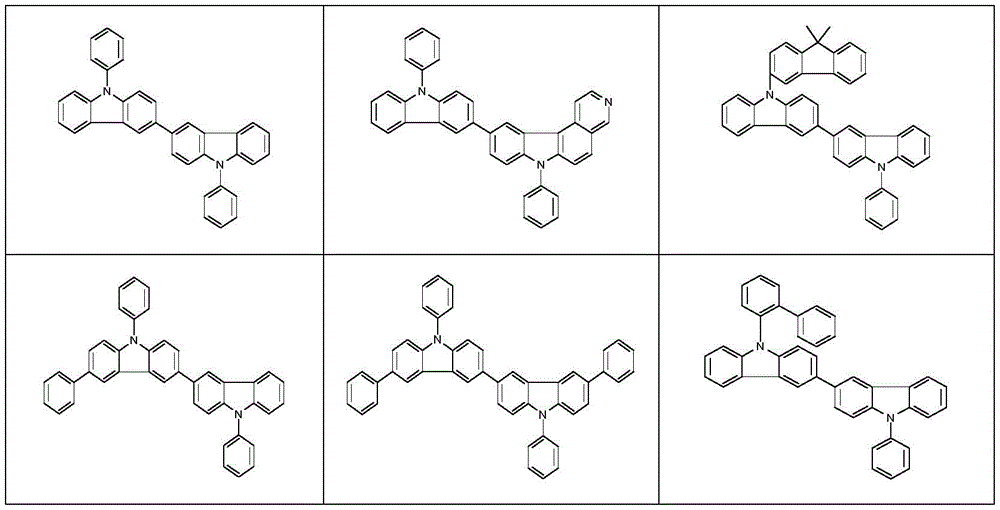


the combination of at least one compound of formula (1) or of the preferred embodiments thereof described above with a compound of one of formulae (6), (7), (8), (9) and (10) can achieve surprising advantages. Accordingly, the present invention also provides a composition comprising at least one compound of formula (1) or a preferred embodiment thereof as described above and at least one further matrix material, wherein the further matrix material is selected from compounds of one of formulae (6), (7), (8), (9) and (10).
The following may be preferred: the composition consists of at least one compound of formula (1) or the preferred embodiments thereof described above and at least one compound of one of formulae (6), (7), (8), (9) and (10). These compositions are particularly suitable as so-called premixes which can be evaporated together.
The proportion by mass of the compound of formula (1) or the preferred embodiments thereof described above in the composition is preferably in the range from 10 to 95% by weight, more preferably in the range from 15 to 90% by weight, and very preferably in the range from 40 to 70% by weight, based on the total mass of the composition.
The following may also be the case: the mass proportion of the compound of one of the formulae (6), (7), (8), (9) and (10) in the composition is in the range from 5 to 90% by weight, preferably in the range from 10 to 85% by weight, more preferably in the range from 20 to 85% by weight, even more preferably in the range from 30 to 80% by weight, very particularly preferably in the range from 20 to 60% by weight, most preferably in the range from 30 to 50% by weight, based on the total composition.
The following may also be the case: the other matrix material is a hole-transporting matrix material of at least one of formulae (6), (7), (8), (9), and (10), and the mass proportion of the hole-transporting matrix material is in the range of 10 to 95 wt%, preferably in the range of 15 to 90 wt%, more preferably in the range of 15 to 80 wt%, still more preferably in the range of 20 to 70 wt%, very particularly preferably in the range of 40 to 80 wt%, most preferably in the range of 50 to 70 wt%, based on the entire composition.
The following may also be the case: the composition consists only of the said formula (1) or the preferred embodiments thereof described above and one of the other matrix materials mentioned, preferably of at least one compound of the formulae (6), (7), (8), (9) and (10).
Suitable phosphorescent compounds (═ triplet emitters) are in particular those in which: which when suitably excited emits light preferably in the visible region and which also contains at least one atom having an atomic number greater than 20, preferably greater than 38 and less than 84, more preferably greater than 56 and less than 80, especially a metal having said atomic number. Phosphorescent emitters which are preferably used are compounds containing copper, molybdenum, tungsten, rhenium, ruthenium, osmium, rhodium, iridium, palladium, platinum, silver, gold or europium, in particular iridium-or platinum-containing compounds.
Examples of such emitters can be found in the applications: WO 00/70655, WO 2001/41512, WO 2002/02714, WO 2002/15645, EP 1191613, EP 1191612, EP 1191614, WO 05/033244, WO 05/019373, US 2005/0258742, WO 2009/146770, WO 2010/015307, WO 2010/031485, WO 2010/054731, WO 2010/054728, WO 2010/086089, WO 2010/099852, WO 2010/102709, WO 2011/032626, WO 2011/066898, WO 2011/157339, WO 2012/007086, WO 2014/008982, WO 2014/023377, WO 2014/094961, WO 2014/094960, WO 2015/036074, WO 2015/104045, WO 2015/117718, WO 2016/015815, WO 2016/124304, WO 2017/032439, and WO 2018/011186. In general, all phosphorescent complexes which are used in accordance with the prior art for phosphorescent electroluminescent devices and are known to the person skilled in the art in the field of organic electroluminescence are suitable, and the person skilled in the art is able to use other phosphorescent complexes without inventive effort.
Examples of phosphorescent dopants are listed in the following table:
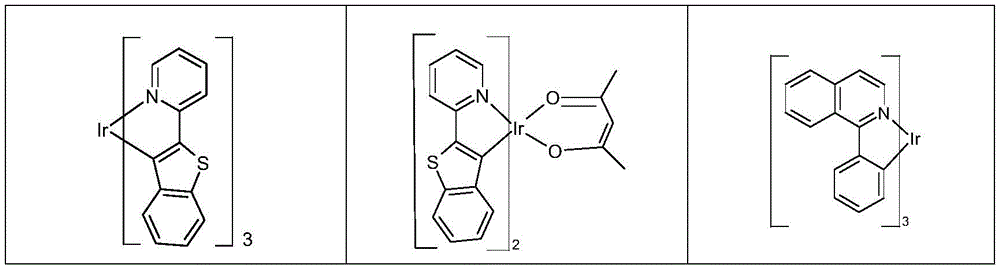


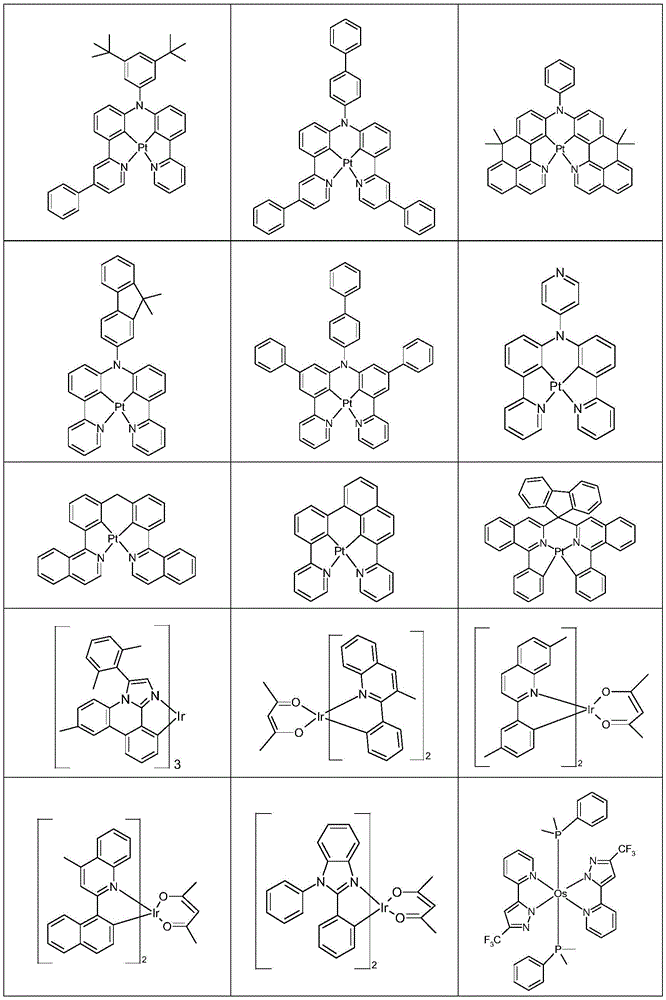

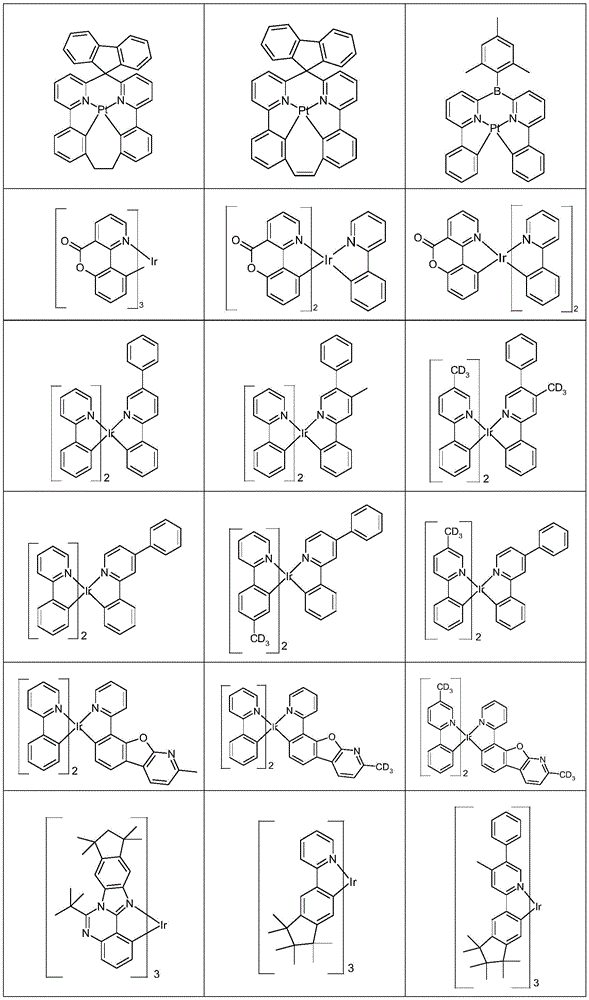

the compounds according to the invention are also particularly suitable as matrix materials for phosphorescent emitters in organic electroluminescent devices, as described, for example, in WO 98/24271, US 2011/0248247 and US 2012/0223633. In these multicolor display elements, an additional blue light-emitting layer is applied to all pixels, including pixels having colors other than blue, by vapor deposition over the entire area.
In another embodiment of the present invention, the organic electroluminescent device of the present invention does not contain any separate hole injection layer and/or hole transport layer and/or hole blocking layer and/or electron transport layer, which means that the light-emitting layer directly adjoins the hole injection layer or the anode and/or the light-emitting layer directly adjoins the electron transport layer or the electron injection layer or the cathode, as described in, for example, WO 2005/053051. It is additionally possible to use the same or similar metal complexes as the metal complexes in the light-emitting layer as the hole-transporting or hole-injecting material directly adjacent to the light-emitting layer, as described, for example, in WO 2009/030981.
In the other layers of the organic electroluminescent device of the present invention, any material generally used according to the prior art may be used. The person skilled in the art is therefore able to use any material known for use in organic electroluminescent devices in combination with the compounds according to the invention of the formula (1) or the preferred embodiments described above without inventive work.
Also preferred is an organic electroluminescent device characterized in that one or more layers are applied by a sublimation process. In this case, less than 10 in a vacuum sublimation system-5Mbar, preferably less than 10-6The material was applied by vapor deposition at an initial pressure of mbar. However, the initial pressure may also be even lower, e.g. less than 10-7Millibar.
Also preferred is an organic electroluminescent device, characterized in that one or more layers are applied by the OVPD (organic vapor deposition) method or sublimation with the aid of a carrier gas. In this case, 10-5The material is applied at a pressure between mbar and 1 bar. A special case of said method is the OVJP (organic vapour jet printing) method,wherein the material is applied directly through the nozzle and is structured thereby.
Also preferred is an organic electroluminescent device, characterized in that one or more layers are produced from solution, for example by spin coating, or by any printing method, for example screen printing, flexographic printing, offset printing, LITI (photo induced thermal imaging, thermal transfer printing), ink jet printing or nozzle printing. For this purpose, soluble compounds are required, which are obtained, for example, by appropriate substitution.
Formulations employing compounds of formula (1) or the preferred embodiments thereof described above are novel. The present invention therefore also provides a formulation comprising at least one solvent and a compound of formula (1) or the preferred embodiments thereof described above. Also provided is a formulation comprising at least one solvent and a compound of formula (1) or a preferred embodiment thereof above, and at least one compound of formulae (6), (7), (8), (9), and (10).
Also, a hybrid process is possible, for example, where one or more layers are applied from solution and one or more other layers are applied by vapor deposition.
These methods are generally known to the person skilled in the art and can be applied without inventive effort to organic electroluminescent devices comprising the compounds according to the invention.
The compounds according to the invention and the organic electroluminescent devices according to the invention have the particular feature of improved lifetime compared with the prior art. This is particularly true in comparison to similar compounds having an indenocarbazolyl backbone instead of a benzindenocarbazolyl backbone. At the same time, other electronic properties of the electroluminescent device, such as efficiency or operating voltage, remain at least as good. In a further variant, the compounds according to the invention and the organic electroluminescent devices according to the invention are distinguished in particular by improved efficiency and/or operating voltage and a higher lifetime than in the prior art. This is particularly true in comparison to similar compounds having an indenocarbazolyl backbone instead of a benzindenocarbazolyl backbone.
The electronic devices of the invention, in particular organic electroluminescent devices, are notable for one or more of the following advantages which surprisingly exceed the prior art:
1. electronic devices, in particular organic electroluminescent devices, comprising compounds of the formula (1) or of the preferred embodiments listed above and below, in particular as matrix materials or as electron-conducting materials, have very good lifetimes. In this case, these compounds give, in particular, a low roll-off, i.e. the power efficiency of the device decreases less at high luminance.
2. Electronic devices, in particular organic electroluminescent devices, comprising as electron-conducting material and/or matrix material compounds of formula (1) or of preferred embodiments listed above and below, have excellent efficiency. In this case, low operating voltages result when the compounds according to the invention of the formula (1) or of the preferred embodiments listed above and below are used in electronic devices.
3. The compounds according to the invention of the formula (1) or of the preferred embodiments listed above and below exhibit very high stability and longevity.
4. With the compounds of formula (1) or the preferred embodiments listed above and below, the formation of light loss channels in electronic devices, especially organic electroluminescent devices, can be avoided. As a result, the device is characterized by high PL efficiency and hence high EL efficiency of the emitter, as well as excellent host-to-dopant energy transfer.
5. The use of the compounds of formula (1) or the preferred embodiments listed above and below in the layers of electronic devices, in particular organic electroluminescent devices, leads to a high mobility of the electron-conducting structures.
6. The compounds of formula (1) or preferred embodiments listed above and below have excellent glass film formability.
7. The compounds of formula (1) or the preferred embodiments listed above and below form very good films from solution.
8. The compounds of the formula (1) or of the preferred embodiments listed above and below have a low triplet energy level T which can be in the range, for example, from 2.22eV to 2.42eV1。
These above-mentioned advantages are not accompanied by an exceptionally high deterioration of other electronic properties.
It should be noted that the scope of the present invention covers variations of the embodiments described in the present invention. Any feature disclosed in this specification may be replaced by an alternative feature serving the same purpose, or an equivalent or similar purpose, unless expressly excluded. Thus, unless otherwise indicated, any feature disclosed in this specification should be considered as an example of a generic series or as an equivalent or similar feature.
All features of the invention may be combined with each other in any manner, unless the specific features and/or steps are mutually exclusive. This is particularly true for the preferred features of the present invention. Also, features that are not necessarily combined may be used separately (rather than in combination).
It should also be noted that many of the features, especially those of the preferred embodiments of the invention, are to be considered inventive in their own right and not just as some embodiments of the invention. Independent protection may be sought for these features, in addition to or as an alternative to any presently claimed invention.
The technical teaching of the present disclosure can be extracted and combined with other examples.
The following examples illustrate the invention in more detail, but are not intended to limit the invention thereby. Those skilled in the art will be able to utilize the information given to practice the invention and prepare other compounds of the invention within the full scope of the disclosure without the exercise of inventive faculty.
Example (b):
unless otherwise stated, the following syntheses were carried out in dry solvents under a protective gas atmosphere. Solvents and reagents may be purchased from ALDRICH or ABCR. The numbers given to the reactants are the corresponding CAS numbers.
a) (2-chlorophenyl) (11, 11-dimethyl-11H-benzo [ a ] fluoren-9-yl) amine

Will 47g (145mmol) of 9-bromo-11, 11-dimethyl-11H-benzo [ a ]]Fluorene, 16.8g (159mmol) of 2-chloroaniline, 41.9g (436.2mmol) of sodium tert-butoxide, 1.06g (1.45mmol) of Pd (dppf) Cl2Dissolved in 500ml of toluene and stirred under reflux for 5 hours. The reaction mixture was cooled to room temperature, expanded with toluene and filtered through celite. The filtrate was concentrated under reduced pressure and the residue was crystallized from toluene/n-heptane. The product was isolated as a colorless solid. Yield: 33g (89 mmol); 70% of theory.
In a similar manner, the following compounds can be prepared:

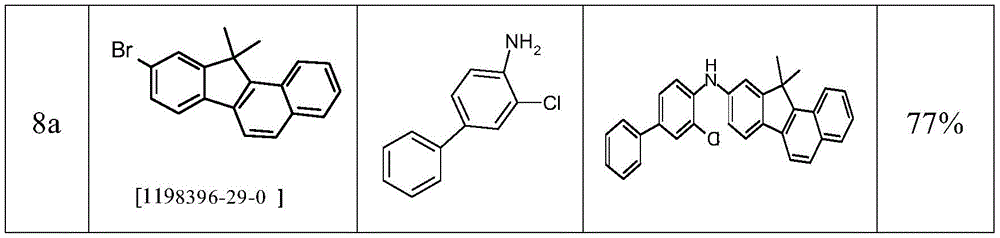
b) cyclization of

48g (129mmol) of (2-chlorophenyl) (11, 11-dimethyl-11H-benzo [ a ]]Fluoren-9-yl) amine, 53g (389mmol) of potassium carbonate, 4.5g (12mmol) of tricyclohexylphosphine tetrafluoroborate, 1.38g (6mmol) of palladium (II) acetate and 3.3g (32mmol) of pivalic acid are suspended in 500ml of dimethylacetamide and stirred under reflux for 6 hours. After cooling, the reaction mixture was mixed with 300ml of water and 400ml of CH2Cl2And (4) mixing. The mixture was stirred for a further 30 minutes, the organic phase was separated off and filtered through a short bed of celite, and the solvent was then removed under reduced pressure. The crude product was thermally extracted with toluene and recrystallized from toluene. The product was isolated as a beige solid. Yield: 34g (102 mmol); 78% of theory.
In a similar manner, the following compounds can be prepared:


c)11, 11-dimethyl-3- (2-nitrophenyl) -11H-benzo [ b ] fluorene
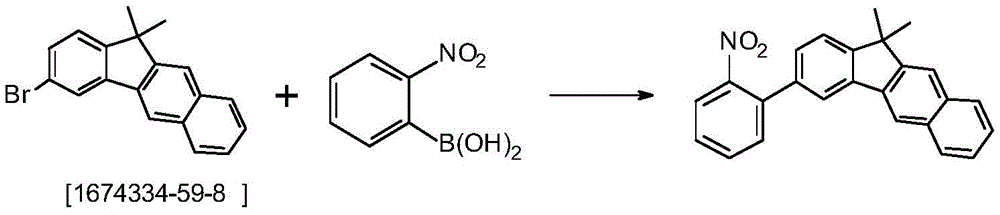
To 59g (183.8mmol) of 2-nitrophenylboronic acid, 54g (184mmol) of 3-bromo-11, 11-dimethyl-11H-benzo [ b ]]To a well stirred degassed suspension of fluorene and 66.5g (212.7mmol) potassium carbonate in a mixture of 250ml water and 250ml THF was added 1.7g (1.49mmol) of Pd (PPh)3)4And the mixture was heated at reflux for 17 hours. After cooling, the organic phase is separated off, washed 3 times with 200ml of water each time, 1 time with 200ml of saturated aqueous sodium chloride solution, dried over magnesium sulfate and concentrated to dryness by rotary evaporation. The grey residue was recrystallized from hexane. The precipitated crystals were filtered off with suction, washed with a small amount of MeOH and dried under reduced pressure. Yield: 53g (146 mmol); 80% of theory.
In a similar manner, the following compounds can be prepared:

d) carbazole synthesis

A mixture of 87g (240mmol) of 11, 11-dimethyl-3- (2-nitrophenyl) -11H-benzo [ b ] fluorene and 290.3ml (1669mmol) of triethyl phosphite is heated at reflux for 12 hours. Subsequently, the remaining triethyl phosphite (72 ℃ to 76 ℃ C./9 mm Hg) was distilled off. To the residue was added water/MeOH (1:1), the solid was filtered off and recrystallized. Yield: 58g (176 mmol); 74% of theory.
In a similar manner, the following compounds can be prepared:


e) nucleophilic substitution

4.2g of NaH (106mmol) at 60% in mineral oil were dissolved in 300ml of dimethylformamide under a protective atmosphere. 34g (106mmol) of 7, 9-dihydro-7, 7-dimethylbenzo [6,7] indeno [2,1-b ] carbazole are dissolved in 250ml of DMF and added dropwise to the reaction mixture. After 1 hour at room temperature, a solution of 2- (4-bromo-1-naphthyl) -4, 6-diphenyl [1,3,5] triazine (48g, 122mmol) in 200ml THF is added dropwise. The reaction mixture was stirred at room temperature for 12 hours. After this time, the reaction mixture was poured onto ice. After warming to room temperature, the precipitated solid was filtered and washed with ethanol and heptane. The residue is thermally extracted with toluene and recrystallized from toluene/n-heptane and finally sublimed under high vacuum; the purity was 99.9%. The yield was 50g (72 mmol); 68% of theory.
In a similar manner, the following compounds can be prepared:


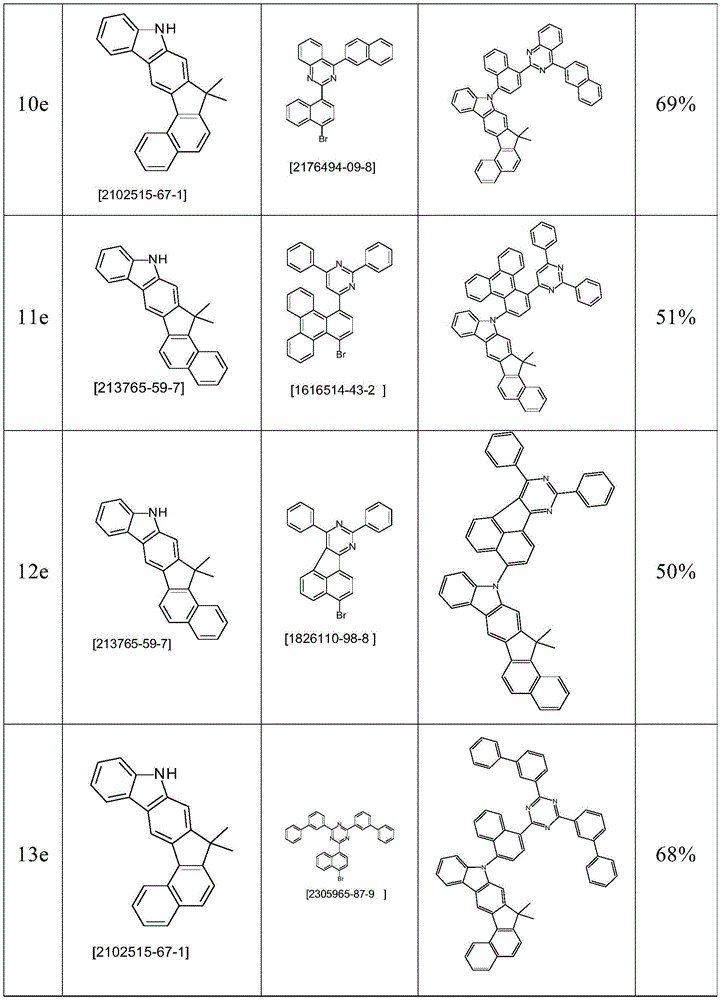


f) bromination of

158g (230mmol) of compound e are initially charged in 1000ml of THF. Subsequently, a solution of 41.7g (234.6mmol) of NBS in 500ml of THF is added dropwise at-15 ℃ in the absence of light, the mixture is brought to room temperature and stirring is continued at said temperature for 4 hours. Subsequently, 150ml of water was added to the mixture, and CH was used2Cl2And (4) extracting. The organic phase is passed over MgSO4Dried and the solvent removed under reduced pressure. The product was extractably stirred with hot hexane and filtered off with suction. Yield: 104g (135mmol), 59% of theory, are obtained by1H NMR gave a purity of about 98%.
In a similar manner, the following compounds can be prepared:


g) suzuki reaction

33.5g (44mmol) of the product from example f, 13.4g (47mmol) of 9-phenylcarbazole-3-boronic acid and 29.2g of Rb2CO3Suspended in 250ml of p-xylene. To the suspension was added 0.95g (4.2mmol) of Pd (OAc)2And 12.6ml of a 1M solution of tri-tert-butylphosphine. The reaction mixture was heated at reflux for 16 hours. After cooling, the organic phase is separated, washed 3 times with 200ml of water and then concentrated to dryness. The residue is subjected to thermal extraction with toluene, recrystallization from toluene and finally sublimation under high vacuum; the purity was 99.9%. Yield: 28g (30mmol), 70% of theory.
In a similar manner, the following compounds can be prepared:


manufacture of electroluminescent devices
The following examples V1 to E9 (see Table 1) describe the use of the materials of the invention in electroluminescent devices.
Pretreatment of examples V1-E9: a glass plate coated with structured ITO (indium tin oxide) with a thickness of 50nm was first treated with oxygen plasma and then with argon plasma before coating. These plasma treated glass plates form the substrate to which the electroluminescent device is applied.
The electroluminescent device has essentially the following layer structure: substrate/Hole Injection Layer (HIL)/Hole Transport Layer (HTL)/Electron Blocking Layer (EBL)/emissive layer (EML)/optional Hole Blocking Layer (HBL)/Electron Transport Layer (ETL)/optional Electron Injection Layer (EIL) and finally a cathode. The cathode is formed from a layer of aluminium having a thickness of 100 nm. The exact structure of the OLED can be found in table 1. The materials required for the fabrication of the electroluminescent device are shown in table 2. The data for the electroluminescent devices are listed in table 3.
All materials were applied by thermal vapor deposition in a vacuum chamber. In this case, the light-emitting layer always consists of at least one host material (host material) and a light-emitting dopant (emitter) which is added to the host material in a specific volume proportion by co-evaporation. The detailed information given in the form 1e: IC2: TER5 (57%: 40%: 3%) here means that the material 1e is present in the layer in a proportion of 57% by volume, IC2 in a proportion of 40% and TER5 in a proportion of 3%. Similarly, the electron transport layer may also be composed of a mixture of two materials.
The OLEDs are characterized in a standard manner. For this purpose, the electroluminescence spectra were determined, the current efficiency (SE, measured in cd/A) and the external quantum efficiency (EQE, measured in%) as a function of the luminescence density, and the lifetime were calculated from the current-voltage-luminescence density characteristic lines which exhibit Lambertian luminescence characteristics. Electroluminescent spectrum is 1000cd/m2And calculating CIE1931x and y color coordinates therefrom. The parameter U1000 in Table 3 means 1000cd/m2The required voltage of the luminous density. SE1000 and EQE1000 are respectively expressed at 1000cd/m2The current efficiency and external quantum efficiency achieved.
The lifetime LD is defined at a constant current density j0In the course of operation, the light emission density decreased from the initial light emission density to a time after a specific ratio L1. The number L1 ═ 95% in table 3 means that the lifetime reported in the LD column corresponds to the time after the luminous density had dropped to 95% of its initial value.
Use of the mixtures according to the invention in the light-emitting layer of phosphorescent electroluminescent devices
The materials according to the invention are used in examples E1 to E9 as matrix materials in the light-emitting layer of electroluminescent devices emitting red phosphorescence. Compared with the prior art (V1 to V5), a significant improvement in lifetime can be achieved with comparable other parameters.
Table 1: structure of electroluminescent device
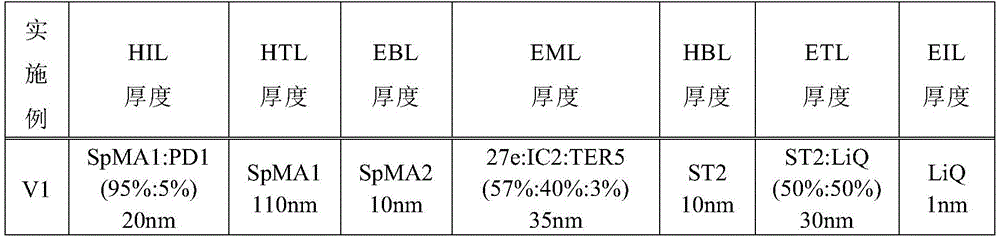

Table 2: structural formula of OLED material

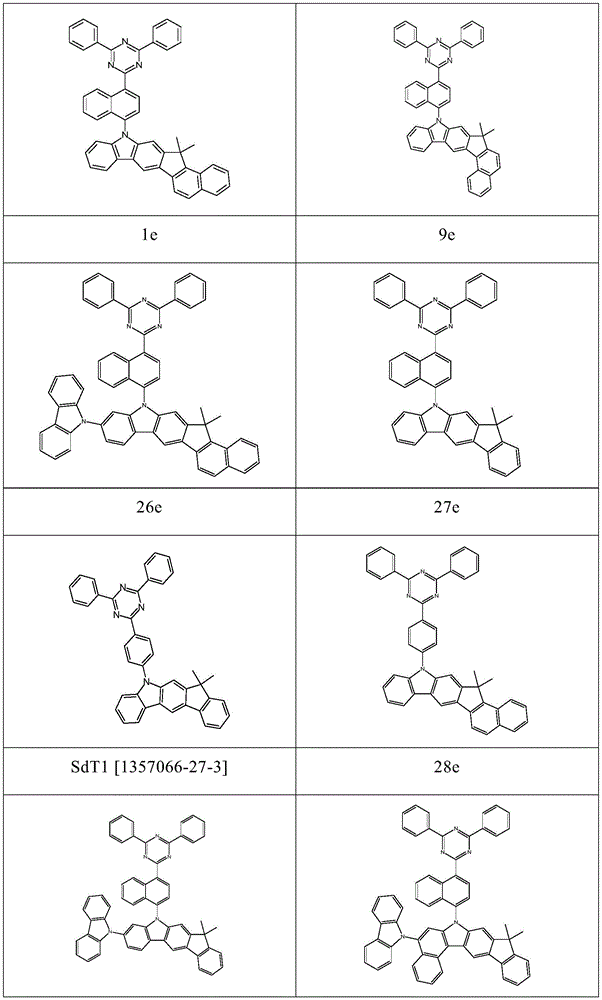


Table 3: performance data of OLEDs

The above data show that the compounds having all the features of claim 1 lead to unexpected improvements. Compared to compounds having the same electron-deficient heteroaryl group but no naphthyl group but a phenyl group as linking group (see comparative experiments V2 and V3 and experiments E1, E2 and E5 of the invention), or compared to compounds having the same electron-deficient heteroaryl group in which the benzo group is not fused to an indene group but is fused to a carbazole group, or does not have a benzo group fused to an indeno group (see comparative experiments V1, V4 and V5 and experiments E1, E2, E3 and E5 of the invention), compounds having a naphthyl group serving as linking group between the nitrogen atom of the benzindolocarbazole group and the electron-deficient heteroaryl group have surprisingly longer lifetimes.
In addition, the data show that compounds in which the group of formula (2) is fused to the compound of formula (3) have surprising advantages. Therefore, the compound of formula (3) is preferred.
In addition, compounds in which the HetAr group forms a closed ring with the naphthalenylidene group exhibit high performance, as shown in example E3.
Claims (24)


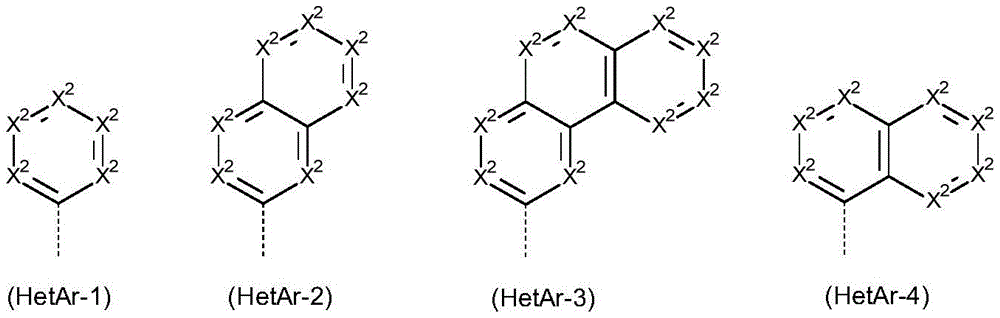


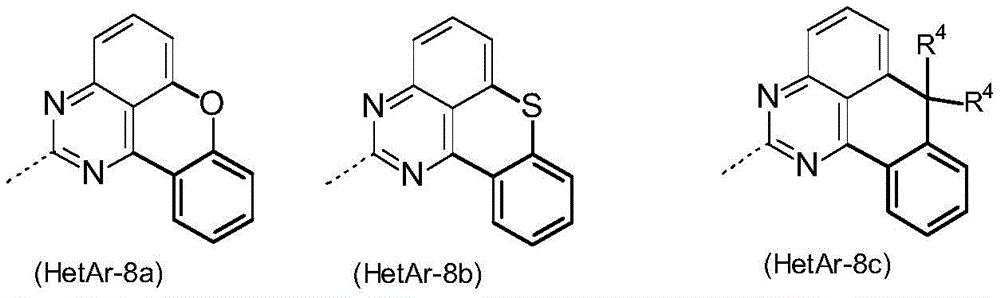


Applications Claiming Priority (3)
| Application Number | Priority Date | Filing Date | Title |
|---|---|---|---|
| EP19195144 | 2019-09-03 | ||
| EP19195144.1 | 2019-09-03 | ||
| PCT/EP2020/074320 WO2021043755A1 (en) | 2019-09-03 | 2020-09-01 | Materials for organic electroluminescent devices |
Publications (1)
| Publication Number | Publication Date |
|---|---|
| CN114269733A true CN114269733A (en) | 2022-04-01 |
Family
ID=67847659
Family Applications (1)
| Application Number | Title | Priority Date | Filing Date |
|---|---|---|---|
| CN202080059028.6A Pending CN114269733A (en) | 2019-09-03 | 2020-09-01 | Material for organic electroluminescent device |
Country Status (6)
| Country | Link |
|---|---|
| US (1) | US20220289718A1 (en) |
| EP (1) | EP4025571A1 (en) |
| KR (1) | KR20220056217A (en) |
| CN (1) | CN114269733A (en) |
| TW (1) | TW202122558A (en) |
| WO (1) | WO2021043755A1 (en) |
Families Citing this family (1)
| Publication number | Priority date | Publication date | Assignee | Title |
|---|---|---|---|---|
| KR20230158657A (en) | 2021-03-18 | 2023-11-21 | 메르크 파텐트 게엠베하 | Heteroaromatic compounds for organic electroluminescent devices |
Citations (6)
| Publication number | Priority date | Publication date | Assignee | Title |
|---|---|---|---|---|
| CN103468243A (en) * | 2012-06-06 | 2013-12-25 | 广东阿格蕾雅光电材料有限公司 | Organic electronic materials and organic electroluminescent device |
| CN105849107A (en) * | 2013-12-27 | 2016-08-10 | 罗门哈斯电子材料韩国有限公司 | Novel organic electroluminescent compounds and organic electroluminescent device comprising the same |
| CN106604923A (en) * | 2014-08-08 | 2017-04-26 | 罗门哈斯电子材料韩国有限公司 | Organic electroluminescent compounds and organic electroluminescent devices comprising the same |
| US20170186965A1 (en) * | 2014-05-05 | 2017-06-29 | Merck Patent Gmbh | Materials for organic light emitting devices |
| US20190067576A1 (en) * | 2016-02-23 | 2019-02-28 | Merck Patent Gmbh | Materials for organic electroluminescent devices |
| US20190135814A1 (en) * | 2016-04-29 | 2019-05-09 | Merck Patent Gmbh | Materials for organic electroluminescent devices |
Family Cites Families (81)
| Publication number | Priority date | Publication date | Assignee | Title |
|---|---|---|---|---|
| JPH07133483A (en) | 1993-11-09 | 1995-05-23 | Shinko Electric Ind Co Ltd | Organic light emitting material for EL device and EL device |
| JP3139321B2 (en) | 1994-03-31 | 2001-02-26 | 東レ株式会社 | Light emitting element |
| JP3899566B2 (en) | 1996-11-25 | 2007-03-28 | セイコーエプソン株式会社 | Manufacturing method of organic EL display device |
| WO2000070655A2 (en) | 1999-05-13 | 2000-11-23 | The Trustees Of Princeton University | Very high efficiency organic light emitting devices based on electrophosphorescence |
| KR100946314B1 (en) | 1999-12-01 | 2010-03-09 | 더 트러스티즈 오브 프린스턴 유니버시티 | Organic light emitting device comprising a phosphorescent organo metallic compound |
| US6660410B2 (en) | 2000-03-27 | 2003-12-09 | Idemitsu Kosan Co., Ltd. | Organic electroluminescence element |
| US20020121638A1 (en) | 2000-06-30 | 2002-09-05 | Vladimir Grushin | Electroluminescent iridium compounds with fluorinated phenylpyridines, phenylpyrimidines, and phenylquinolines and devices made with such compounds |
| CN101924190B (en) | 2000-08-11 | 2012-07-04 | 普林斯顿大学理事会 | Organometallic compounds and emission-shifting organic electrophosphorescence |
| JP4154140B2 (en) | 2000-09-26 | 2008-09-24 | キヤノン株式会社 | Metal coordination compounds |
| JP4154139B2 (en) | 2000-09-26 | 2008-09-24 | キヤノン株式会社 | Light emitting element |
| JP4154138B2 (en) | 2000-09-26 | 2008-09-24 | キヤノン株式会社 | Light emitting element, display device and metal coordination compound |
| ITRM20020411A1 (en) | 2002-08-01 | 2004-02-02 | Univ Roma La Sapienza | SPIROBIFLUORENE DERIVATIVES, THEIR PREPARATION AND USE. |
| JP4411851B2 (en) | 2003-03-19 | 2010-02-10 | コニカミノルタホールディングス株式会社 | Organic electroluminescence device |
| JP5318347B2 (en) | 2003-04-15 | 2013-10-16 | メルク パテント ゲーエムベーハー | Mixture of matrix material and organic semiconductor capable of emitting light, use thereof, and electronic component comprising said mixture |
| EP2236579B1 (en) | 2003-04-23 | 2014-04-09 | Konica Minolta Holdings, Inc. | Organic electroluminescent element and display |
| DE10338550A1 (en) | 2003-08-19 | 2005-03-31 | Basf Ag | Transition metal complexes with carbene ligands as emitters for organic light-emitting diodes (OLEDs) |
| DE10345572A1 (en) | 2003-09-29 | 2005-05-19 | Covion Organic Semiconductors Gmbh | metal complexes |
| US7795801B2 (en) | 2003-09-30 | 2010-09-14 | Konica Minolta Holdings, Inc. | Organic electroluminescent element, illuminator, display and compound |
| JP2007512692A (en) | 2003-11-25 | 2007-05-17 | メルク パテント ゲーエムベーハー | Organic electroluminescence device |
| US7790890B2 (en) | 2004-03-31 | 2010-09-07 | Konica Minolta Holdings, Inc. | Organic electroluminescence element material, organic electroluminescence element, display device and illumination device |
| DE102004023277A1 (en) | 2004-05-11 | 2005-12-01 | Covion Organic Semiconductors Gmbh | New material mixtures for electroluminescence |
| US7598388B2 (en) | 2004-05-18 | 2009-10-06 | The University Of Southern California | Carbene containing metal complexes as OLEDs |
| JP4862248B2 (en) | 2004-06-04 | 2012-01-25 | コニカミノルタホールディングス株式会社 | Organic electroluminescence element, lighting device and display device |
| ITRM20040352A1 (en) | 2004-07-15 | 2004-10-15 | Univ Roma La Sapienza | OLIGOMERIC DERIVATIVES OF SPIROBIFLUORENE, THEIR PREPARATION AND THEIR USE. |
| CN101171320B (en) | 2005-05-03 | 2013-04-10 | 默克专利有限公司 | Organic electroluminescent device |
| EP1956022B1 (en) | 2005-12-01 | 2012-07-25 | Nippon Steel Chemical Co., Ltd. | Compound for organic electroluminescent element and organic electroluminescent element |
| DE102006025777A1 (en) | 2006-05-31 | 2007-12-06 | Merck Patent Gmbh | New materials for organic electroluminescent devices |
| US8062769B2 (en) | 2006-11-09 | 2011-11-22 | Nippon Steel Chemical Co., Ltd. | Indolocarbazole compound for use in organic electroluminescent device and organic electroluminescent device |
| WO2009030981A2 (en) | 2006-12-28 | 2009-03-12 | Universal Display Corporation | Long lifetime phosphorescent organic light emitting device (oled) structures |
| DE102007002714A1 (en) | 2007-01-18 | 2008-07-31 | Merck Patent Gmbh | New materials for organic electroluminescent devices |
| DE102007053771A1 (en) | 2007-11-12 | 2009-05-14 | Merck Patent Gmbh | Organic electroluminescent devices |
| DE102008017591A1 (en) | 2008-04-07 | 2009-10-08 | Merck Patent Gmbh | New materials for organic electroluminescent devices |
| DE102008027005A1 (en) | 2008-06-05 | 2009-12-10 | Merck Patent Gmbh | Organic electronic device containing metal complexes |
| DE102008033943A1 (en) | 2008-07-18 | 2010-01-21 | Merck Patent Gmbh | New materials for organic electroluminescent devices |
| DE102008036247A1 (en) | 2008-08-04 | 2010-02-11 | Merck Patent Gmbh | Electronic devices containing metal complexes |
| DE102008036982A1 (en) | 2008-08-08 | 2010-02-11 | Merck Patent Gmbh | Organic electroluminescent device |
| DE102008048336A1 (en) | 2008-09-22 | 2010-03-25 | Merck Patent Gmbh | Mononuclear neutral copper (I) complexes and their use for the production of optoelectronic devices |
| KR20110097612A (en) | 2008-11-11 | 2011-08-31 | 메르크 파텐트 게엠베하 | Organic electroluminescent devices |
| DE102008056688A1 (en) | 2008-11-11 | 2010-05-12 | Merck Patent Gmbh | Materials for organic electroluminescent devices |
| DE102008057051B4 (en) | 2008-11-13 | 2021-06-17 | Merck Patent Gmbh | Materials for organic electroluminescent devices |
| DE102008057050B4 (en) | 2008-11-13 | 2021-06-02 | Merck Patent Gmbh | Materials for organic electroluminescent devices |
| DE102008064200A1 (en) | 2008-12-22 | 2010-07-01 | Merck Patent Gmbh | Organic electroluminescent device |
| DE102009007038A1 (en) | 2009-02-02 | 2010-08-05 | Merck Patent Gmbh | metal complexes |
| DE102009011223A1 (en) | 2009-03-02 | 2010-09-23 | Merck Patent Gmbh | metal complexes |
| DE102009013041A1 (en) | 2009-03-13 | 2010-09-16 | Merck Patent Gmbh | Materials for organic electroluminescent devices |
| DE102009014513A1 (en) | 2009-03-23 | 2010-09-30 | Merck Patent Gmbh | Organic electroluminescent device |
| DE102009023155A1 (en) | 2009-05-29 | 2010-12-02 | Merck Patent Gmbh | Materials for organic electroluminescent devices |
| DE102009031021A1 (en) | 2009-06-30 | 2011-01-05 | Merck Patent Gmbh | Materials for organic electroluminescent devices |
| DE102009053644B4 (en) | 2009-11-17 | 2019-07-04 | Merck Patent Gmbh | Materials for organic electroluminescent devices |
| DE102009041414A1 (en) | 2009-09-16 | 2011-03-17 | Merck Patent Gmbh | metal complexes |
| DE102009053645A1 (en) | 2009-11-17 | 2011-05-19 | Merck Patent Gmbh | Materials for organic electroluminescent device |
| DE102009048791A1 (en) | 2009-10-08 | 2011-04-14 | Merck Patent Gmbh | Materials for organic electroluminescent devices |
| DE102009053382A1 (en) | 2009-11-14 | 2011-05-19 | Merck Patent Gmbh | Materials for electronic devices |
| DE102009053836A1 (en) | 2009-11-18 | 2011-05-26 | Merck Patent Gmbh | Materials for organic electroluminescent devices |
| DE102009057167A1 (en) | 2009-12-05 | 2011-06-09 | Merck Patent Gmbh | Electronic device containing metal complexes |
| DE102010005697A1 (en) | 2010-01-25 | 2011-07-28 | Merck Patent GmbH, 64293 | Connections for electronic devices |
| JP5678487B2 (en) | 2010-04-09 | 2015-03-04 | ソニー株式会社 | Organic EL display device |
| DE112011102008B4 (en) | 2010-06-15 | 2022-04-21 | Merck Patent Gmbh | metal complexes |
| DE102010027317A1 (en) | 2010-07-16 | 2012-01-19 | Merck Patent Gmbh | metal complexes |
| DE102010048608A1 (en) | 2010-10-15 | 2012-04-19 | Merck Patent Gmbh | Materials for organic electroluminescent devices |
| JP5778950B2 (en) | 2011-03-04 | 2015-09-16 | 株式会社Joled | Organic EL display device and manufacturing method thereof |
| KR101979469B1 (en) | 2011-04-18 | 2019-05-16 | 메르크 파텐트 게엠베하 | Materials for organic electroluminescent devices |
| CA2849087A1 (en) | 2011-09-21 | 2013-03-28 | Merck Patent Gmbh | Carbazole derivatives for organic electroluminescent devices |
| EP2768808B1 (en) | 2011-10-20 | 2017-11-15 | Merck Patent GmbH | Materials for organic electroluminescent devices |
| EP2872590B1 (en) | 2012-07-13 | 2018-11-14 | Merck Patent GmbH | Metal complexes |
| JP6363075B2 (en) | 2012-08-07 | 2018-07-25 | メルク パテント ゲーエムベーハー | Metal complex |
| WO2014023388A1 (en) | 2012-08-10 | 2014-02-13 | Merck Patent Gmbh | Materials for organic electroluminescence devices |
| WO2014094960A1 (en) | 2012-12-21 | 2014-06-26 | Merck Patent Gmbh | Metal complexes |
| EP2935292B1 (en) | 2012-12-21 | 2019-04-10 | Merck Patent GmbH | Metal complexes |
| EP3044284B1 (en) | 2013-09-11 | 2019-11-13 | Merck Patent GmbH | Metal complexes |
| US11005050B2 (en) | 2014-01-13 | 2021-05-11 | Merck Patent Gmbh | Metal complexes |
| CN105980519B (en) | 2014-02-05 | 2019-06-14 | 默克专利有限公司 | metal complex |
| WO2016015815A1 (en) | 2014-07-28 | 2016-02-04 | Merck Patent Gmbh | Metal complexes |
| CN106661006B (en) | 2014-07-29 | 2019-11-08 | 默克专利有限公司 | Materials for Organic Electroluminescent Devices |
| WO2016021989A1 (en) * | 2014-08-08 | 2016-02-11 | Rohm And Haas Electronic Materials Korea Ltd. | Organic electroluminescent compounds and organic electroluminescent devices comprising the same |
| EP3180411B1 (en) | 2014-08-13 | 2018-08-29 | Merck Patent GmbH | Materials for organic electroluminescent devices |
| JP6772188B2 (en) | 2015-02-03 | 2020-10-21 | メルク、パテント、ゲゼルシャフト、ミット、ベシュレンクテル、ハフツングMerck Patent GmbH | Metal complex |
| US11031562B2 (en) | 2015-08-25 | 2021-06-08 | Merck Patent Gmbh | Metal complexes |
| KR102851400B1 (en) | 2016-03-03 | 2025-08-29 | 메르크 파텐트 게엠베하 | Materials for organic electroluminescent devices |
| JP7039549B2 (en) | 2016-07-14 | 2022-03-22 | メルク パテント ゲゼルシャフト ミット ベシュレンクテル ハフツング | Metal complex |
| CN111978241B (en) * | 2020-03-27 | 2022-06-14 | 陕西莱特光电材料股份有限公司 | Organic compound, electronic element, and electronic device |
-
2020
- 2020-08-31 TW TW109129721A patent/TW202122558A/en unknown
- 2020-09-01 CN CN202080059028.6A patent/CN114269733A/en active Pending
- 2020-09-01 WO PCT/EP2020/074320 patent/WO2021043755A1/en not_active Ceased
- 2020-09-01 KR KR1020227010545A patent/KR20220056217A/en active Pending
- 2020-09-01 US US17/639,432 patent/US20220289718A1/en active Pending
- 2020-09-01 EP EP20771220.9A patent/EP4025571A1/en active Pending
Patent Citations (6)
| Publication number | Priority date | Publication date | Assignee | Title |
|---|---|---|---|---|
| CN103468243A (en) * | 2012-06-06 | 2013-12-25 | 广东阿格蕾雅光电材料有限公司 | Organic electronic materials and organic electroluminescent device |
| CN105849107A (en) * | 2013-12-27 | 2016-08-10 | 罗门哈斯电子材料韩国有限公司 | Novel organic electroluminescent compounds and organic electroluminescent device comprising the same |
| US20170186965A1 (en) * | 2014-05-05 | 2017-06-29 | Merck Patent Gmbh | Materials for organic light emitting devices |
| CN106604923A (en) * | 2014-08-08 | 2017-04-26 | 罗门哈斯电子材料韩国有限公司 | Organic electroluminescent compounds and organic electroluminescent devices comprising the same |
| US20190067576A1 (en) * | 2016-02-23 | 2019-02-28 | Merck Patent Gmbh | Materials for organic electroluminescent devices |
| US20190135814A1 (en) * | 2016-04-29 | 2019-05-09 | Merck Patent Gmbh | Materials for organic electroluminescent devices |
Also Published As
| Publication number | Publication date |
|---|---|
| EP4025571A1 (en) | 2022-07-13 |
| TW202122558A (en) | 2021-06-16 |
| US20220289718A1 (en) | 2022-09-15 |
| KR20220056217A (en) | 2022-05-04 |
| WO2021043755A1 (en) | 2021-03-11 |
Similar Documents
| Publication | Publication Date | Title |
|---|---|---|
| CN111557122B (en) | Materials for organic electroluminescent devices | |
| TWI680969B (en) | Materials for organic electroluminescent devices | |
| JP6891109B2 (en) | Materials for OLED devices | |
| CN106459018B (en) | Material for organic light emitting device | |
| KR102045198B1 (en) | Spirobifluorene compounds for organic electroluminescent devices | |
| JP7543273B2 (en) | Materials for Electronic Devices | |
| KR102543777B1 (en) | Materials for organic electroluminescent devices | |
| TW202115044A (en) | Materials for organic electroluminescent devices | |
| CN110167940A (en) | Material for organic electroluminescence device | |
| CN118103376A (en) | Materials for organic electroluminescent devices | |
| CN110431136A (en) | Materials for organic electroluminescent devices | |
| CN115298847B (en) | Heterocyclic compounds for organic electroluminescent devices | |
| CN112219292A (en) | Organic electroluminescent device | |
| CN113195500B (en) | Material for organic electroluminescent device | |
| CN119156435A (en) | Cyclic compounds for organic electroluminescent devices | |
| CN116710454A (en) | Nitrogen-containing compounds for organic electroluminescent devices | |
| CN113166643B (en) | Material for organic electroluminescent device | |
| CN115916794A (en) | Heterocyclic Compounds for Organic Electroluminescent Devices | |
| CN115298187A (en) | Heteroaromatic compounds for organic electroluminescent devices | |
| CN112384595B (en) | Materials for organic electroluminescent devices | |
| CN117043302A (en) | Heteroaromatic compounds for organic electroluminescent devices | |
| JP2023520710A (en) | Polycyclic compounds for organic electroluminescent devices | |
| CN114269733A (en) | Material for organic electroluminescent device | |
| CN113614082B (en) | Materials for organic electroluminescent devices | |
| CN115052865A (en) | Benzimidazole Derivatives |
Legal Events
| Date | Code | Title | Description |
|---|---|---|---|
| PB01 | Publication | ||
| PB01 | Publication | ||
| SE01 | Entry into force of request for substantive examination | ||
| SE01 | Entry into force of request for substantive examination |