The application is based on the application date of 19/12/2017, the priority date of 20/2016/12/2016, the application number of 201780073931.6, and the invention name is as follows: a divisional application of the patent application "absorbent article chassis including beam elastics".
Detailed Description
The present disclosure details improved elastomeric laminates (also referred to as "beam laminates" which include "beam elastics") that include a greater number of elastic strands having greater fineness (i.e., lower dtex) and closer spacing than previously disclosed or practiced in disposable absorbent articles. These improved elastomeric laminates can be used as disposable absorbent article (e.g., taped diapers, pants, liners, and liners) components for fitting and lining the waist, legs, crotch, and sides of the wearer, generally providing maximum extensibility, most comfortable wearing conditions, improved leakage protection, and better fit.
The following explanations of terms may aid in understanding the present disclosure:
with respect to absorbent articles, "disposable" means absorbent articles that generally are not intended to be laundered or otherwise restored or reused as an absorbent article (i.e., they are intended to be discarded after a single use and, preferably, to be recycled, composted or otherwise discarded in an environmentally compatible manner). Disposable absorbent articles typically include adhesive between layers and/or elements to hold the article together (e.g., the ears, side panels, and belts are joined to the chassis by the adhesive, and the ears, side panels, belts, and layers of the chassis are joined together using the adhesive). Alternatively, thermal bonding and/or pressure bonding is used with or in place of the adhesive. In this case, portions of the material layer may become partially melted and pressed together such that, upon cooling, they physically bond together. Nonwoven (including, for example, polypropylene, polyethylene, etc.) binders (including, for example, styrene block copolymers (e.g., SIS, SBS)) and absorbent gelling materials (AGM 51-see fig. 7 and 7B) constitute more than 50%, more than 75%, and often more than 90% by weight of the disposable absorbent article. Also, the core including the AGM 51 is typically held within the chassis in a manner that encapsulates and houses the AGM 51 under normal conditions. Such disposable absorbent articles typically have an absorbent capacity of greater than about 100mL of fluid, and may have a capacity of up to about 500mL of fluid or more. Stitching (including the use of threads) and/or woven materials are not typically used in the manufacture of disposable absorbent articles. If sewn or woven materials are used, they constitute a very small percentage of disposable absorbent articles. Some landing zones for fasteners of disposable absorbent articles may include woven materials, but other portions of disposable absorbent articles typically do not include woven materials.
"absorbent article" refers to devices that absorb and contain body exudates and, more specifically, refers to devices that are placed against or in proximity to the body of the wearer to absorb and contain the various exudates discharged from the body. Exemplary absorbent articles include diapers, training pants, pull-on pant-type diapers (i.e., a diaper having a preformed waist opening and leg openings such as shown in U.S. patent No. 6,120,487), refastenable diapers or pant-type diapers, incontinence briefs and undergarments, diaper holders and liners, feminine hygiene garments such as panty liners, feminine pads, absorbent inserts, and the like.
"proximal" and "distal" refer to the location of an element relatively near to or far from the longitudinal or lateral centerline of a structure, respectively (e.g., the proximal edge of a longitudinally extending element is located closer to the longitudinal axis than the distal edge of the same element is located to the longitudinal axis, relative to the same longitudinal axis).
"body-facing" and "garment-facing" refer to the relative position of elements or surfaces of an element or group of elements, respectively. "body-facing" means that an element or surface is closer to the wearer during wear than some other element or surface. "garment-facing" means that an element or surface is farther from the wearer during wear than some other element or surface (i.e., the element or surface is closer to the garment of the wearer, which may be worn over a disposable absorbent article).
"longitudinal" refers to a direction extending substantially perpendicular from a waist edge to an opposing waist edge of the article and generally parallel to the maximum linear dimension of the article. Directions within 45 degrees of the longitudinal direction are considered to be "longitudinal".
"lateral" refers to a direction running from a longitudinally extending side edge to an opposing longitudinally extending side edge of the article and generally at right angles to the longitudinal direction. Directions within 45 degrees of lateral are considered "lateral".
"disposed" means that the element is located in a particular place or position.
"joined" includes configurations whereby an element may be directly secured to another element by affixing the element directly to the other element; configurations are also included whereby an element may be indirectly secured to another element by attaching one element to an intermediate member, which in turn is attached to the other element.
"Water-permeable" and "water-impermeable" refer to the permeability of materials in the context of the intended use of disposable absorbent articles. In particular, the term "water-permeable" refers to a layer or a layered structure having pores, openings, and/or interconnected void spaces that allow liquid water, urine, or synthetic urine to pass through its thickness in the absence of a forcing pressure. Conversely, the term "water-impermeable" refers to a layer or a layered structure through the thickness of which liquid water, urine, or synthetic urine cannot pass in the absence of a forcing pressure (other than natural forces such as gravity). A layer or a layered structure that is water-impermeable according to this definition may be water vapor-permeable, i.e., may be "vapor-permeable".
"elastic," "elastomeric" or "elastomeric" means that a material exhibits elastic properties, and includes any material that is capable of being stretched or elongated to an elongated length that is more than 10% greater than its original length upon application of a force to its relaxed, original length, and that will substantially recover to about its original length upon release of the applied force. Elastomeric materials may include elastomeric films, scrims, nonwovens, ribbons, strands, and other sheet-like structures.
"prestrained" refers to a strain imposed on an elastic or elastomeric material prior to combining the elastic or elastomeric material with another element of an elastomeric laminate or absorbent article. The prestrain is determined by the following equation: prestrain = ((extended length of elastic member-relaxed length of elastic member)/relaxed length of elastic member) = 100.
"dtex", also known as titer, is a metric used in the textile industry for measuring yarns or filaments. 1 dtex =1 gram per 10,000 meters. In other words, if a 10,000 linear meter yarn or filament weighs 500 grams, the yarn or filament has a dtex of 500.
"substrate" is used herein to describe a material that is predominantly two-dimensional (i.e., in the XY plane), and whose thickness (in the Z direction) is relatively small (i.e., 1/10 or less) compared to its length (in the X direction) and width (in the Y direction). Non-limiting examples of substrates include fibrous webs, one or more layers of fibrous materials, nonwovens, films, and foils such as polymeric films or metallic foils. These materials may be used alone or may include two or more layers laminated together. Thus, the web is the substrate.
"nonwoven" refers herein to a material made from continuous (long) filaments (fibers) and/or discontinuous (short) filaments (fibers) by processes such as spunbonding, meltblowing, carding, and the like. The nonwoven does not have a woven filament or woven filament pattern.
"machine direction" (MD) is used herein to refer to the direction of material flow through the process. In addition, the relative placement and movement of materials may also be described as flowing through the process in the machine direction from upstream of the process to downstream of the process.
"cross direction" (CD) is used herein to refer to a direction generally perpendicular to the machine direction.
"taped diaper" (also referred to as "open diaper") refers to a disposable absorbent article having an initial front waist region and an initial back waist region that are unfastened, unfastened or not connected to each other when packaged prior to application to a wearer. The taped diaper may be folded about a lateral centerline with an interior portion of one waist region contacting an interior portion of an opposing waist region in a surface-to-surface manner without fastening or joining the waist regions together. Exemplary taped diapers are disclosed in various suitable configurations in the following U.S. patents: 5,167,897, 5,360,420, 5,599,335, 5,643,588, 5,674,216, 5,702,551, 5,968,025, 6,107,537, 6,118,041, 6,153,209, 6,410,129, 6,426,444, 6,586,652, 6,627,787, 6,617,016, 6,825,393, and 6,861,571; and U.S. patent publication 2013/0072887A1;2013/0211356A1; and 2013/0306226A 1.
"pant" (also referred to as "training pant", "pre-closed diaper", "diaper pant", "pant diaper" and "pull-on diaper") refers herein to disposable absorbent articles designed for infant or adult wearers having a continuous peripheral waist opening and a continuous peripheral leg opening. A pant may be configured to have a continuous or closed waist opening and at least one continuous closed leg opening prior to applying the article to a wearer. A pant may be preformed or pre-fastened using a variety of techniques including, but not limited to, joining together portions of the article using any refastenable and/or permanent closure member (e.g., seams, heat bonds, pressure welds, adhesives, cohesive bonds, mechanical fasteners, etc.). A pant may be preformed anywhere along the circumference of the article in the waist region (e.g., side fastened or seamed, front waist fastened or seamed, rear waist fastened or seamed). Exemplary diaper pants in various configurations are disclosed in the following patents: U.S. Pat. nos. 4,940,464;5,092,861;5,246,433;5,569,234;5,897,545;5,957,908;6,120,487;6,120,489;7,569,039 and U.S. patent publication 2003/0233082 A1;2005/0107764 A1, 2012/0061016 A1, 2012/0061015 A1;2013/0255861 A1;2013/0255862 A1;2013/0255863 A1;2013/0255864 A1; and 2013/0255865 A1, all of which are incorporated herein by reference.
By "closed" is meant that the opposing waist regions are permanently or refastenably joined upon encapsulation to form a continuous waist opening and leg openings.
By "open-type" is meant that the opposing waist regions are not initially joined to form continuous waist and leg openings, but rather include closure devices such as fastening systems to join the waist regions to form waist and leg openings, prior to or during application to the wearer of the article.
As used herein, "channel" refers to a region or zone in an absorbent material layer having a significantly lower basis weight (e.g., less than 50%, less than 70%, less than 90%) than the surrounding material in the material layer. The channels can be regions of the material layer that are substantially free of absorbent material (e.g., 90% free of absorbent material, 95% free of absorbent material, or 99% free of absorbent material, or completely free of absorbent material). The channels may extend through one or more layers of absorbent material. The channel typically has a lower flexural modulus than the surrounding area of the absorbent material layer, enabling the material layer to bend more easily and/or to distribute more body exudates within the channel quickly than in the surrounding area of the absorbent material layer. Thus, the channel is not merely an indentation in the material layer that does not form a reduced basis weight in the material layer in the channel region.
By "manufacturing prestrain" is meant the amount specified by the manufacturer of the article or stretch laminate component thereof, by which the plurality of elastic strands are stretched together from their relaxed lengths as they unwind from a single beam as they are joined to one or more web materials in a process to form a stretch laminate. The manufacturing prestrain may be specified directly, or may be specified indirectly, for example, by the tension at which the strands are placed when engaged with the web material. Without direct specification, the manufacturing pre-strain may be calculated and/or determined based on, for example, the manufacturing dtex, the material modulus, the number of strands, and the applied tension specified by the manufacturer for manufacturing the laminate. In combination with relatively close spacing and relatively low dtex, it may be desirable to impart a manufacturing pre-strain of no greater than 400%,300%,200%,150%,100%, or even no greater than 50% to the strands of the plurality of elastics during bonding of the strands of the plurality of elastics to one or more absorbent article components (including belts, side panels, topsheets, backsheets, ears, waistbands, waist caps, inner and outer leg cuffs, and transverse barriers). Note that: "manufacturing pre-strain" is a separate term that is different from "average pre-strain".
"manufactured dtex" or "manufactured denier" refers to the average dtex specified by the manufacturer of an article or stretch laminate component thereof for a plurality of elastic strands provided by and unwound from a single beam and joined to one or more web materials to form a stretch laminate. In combination with relatively close spacing and relatively low pre-strain, it may be desirable to impart a manufacturing dtex of no greater than 500, 400, 300, 200, 150, or even no greater than 10 to the plurality of strands of elastics during bonding of the plurality of strands to one or more absorbent article components (including belts, side panels, topsheets, backsheets, ears, waistbands, waist caps, inner and outer leg cuffs, and transverse barriers). Note that: "manufactured dtex" and "manufactured denier" are independent terms that are distinct from "average denier".
"manufacturing strand spacing" refers to the average center-to-center spacing between a plurality of elastic strands as specified by the manufacturer of an article or stretch laminate component thereof, which are unwound from a single beam and joined to one or more web materials to form a stretch laminate when they are first joined to one or more materials. In combination with a relatively low dtex and a relatively low pre-strain, it may be desirable to impart a manufactured strand pitch of no greater than 4mm,3mm,2mm,1mm,0.5mm, or even no greater than 0.25mm to the strands of the plurality of elastics during bonding of the strands of the plurality of elastics to one or more absorbent article components, including belts, side panels, topsheets, backsheets, ears, waistbands, waist caps, inner and outer leg cuffs, and transverse barriers. Note that: "manufacturing strand spacing" is a separate term that is different from "average strand spacing".
Foundation structure
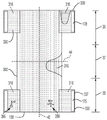
Infrastructure 200 is generally referred to above. It should also be understood that the chassis 200 may be elasticized such that the chassis 200 includes a first substrate layer 306 and a second substrate layer 308, and may further include an elastic material, such as elastic strands 316, disposed between the first substrate layer 306 and the second substrate layer 308. For example, as shown in figure 1 and figure 15-24, a plurality of elastics 316 may be disposed longitudinally and/or laterally on the chassis 200 outboard of the backsheet film 126, for example, between the backsheet film 126 and the backsheet nonwoven 127. The first and second substrate layers 306, 308 may be separate and discrete layers, or the first and second substrate layers 306, 308 may be formed from a single web that is folded to form the first and second substrate layers 306, 308. In some configurations of chassis 200, the elastic material disposed in the chassis may include a plurality of elastics 316. More specifically, the chassis 200 may include elastics 316 that do not overlap the ears 530, side panels 330, or elastics 316 of the belt 430 (see fig. 17, fig. 21, fig. 23, and fig. 24). Alternatively, the chassis elastics 316 may overlap the belt elastics 316, as shown in fig. 19. The elastics 316 of the chassis 200 may be formed from a plurality of elastics beams, for example one beam may form at least a portion of the chassis elastics 316 and a second beam may form at least another portion of the chassis elastics 316, wherein individual beams may comprise different elastic compositions, different numbers of elastics, beams may have elastics with different average deniers, the elastics of both beams may be arranged at different average strand spacings and/or individual beams may deliver elastics with different average pre-strains. The resulting portions of the chassis elastics produced by such a multi-beam process may have different textures, garment-like appearance, section modulus, and/or different forces. For example, the chassis elastics may be longitudinally (316') oriented on each end of the laterally oriented elastics (316 ") shown in fig. 19, and may be formed from different beams.
The laterally oriented chassis elastics (316 ") shown in figure 18, figure 18A, figure 19, and figure 20, figure 21 may be formed between additional nonwovens 800 (see figure 17A and figure 20A) adhered to the garment facing side of the backsheet nonwoven 127. It may be desirable to minimize the overlap of the additional nonwoven 800 with the belt nonwoven such that the overlap is no greater than 10mm,15mm, or 20mm at each end edge of the additional nonwoven 800. Alternatively, the laterally oriented chassis elastics (316 ") shown in fig. 18, fig. 18A may be disposed between the backsheet film 126 and the backsheet nonwoven 127.
The chassis may be shaped or non-rectangular in one waist region and substantially rectangular in the opposite waist region. Alternatively, the chassis may be substantially rectangular in one or both waist regions and may be non-rectangular in the crotch region.
As shown in figure 2, the absorbent article of the present disclosure may comprise a plurality of laterally extending elastics, wherein the elastics are present in the first waist region, the crotch region, and the opposing second waist region, and wherein the maximum displacement between any adjacently disposed pair of laterally extending elastics, measured parallel to the longitudinal axis, may be less than 75mm, less than 50mm, less than 25mm, less than 10mm, less than 5mm, less than 4mm, and less than 3mm.
The wearable articles of the present disclosure may comprise one or more elastomeric laminates 302 having a plurality of laterally extending elastics, wherein the one or more elastomeric laminates 302 may be present in a first waist region, a crotch region 37, and/or an opposing second waist region, and wherein the elastomeric laminate 302 disposed in one or both of the first and second waist regions may comprise a first plurality of elastics 316, the first plurality of elastics 316 having one or more of a higher average denier, a higher average pre-strain, and a smaller average strand spacing than the second plurality of elastics 316 of the elastomeric laminate 302 disposed in the crotch region 37. Such wearable articles may comprise one or more elastomeric laminates 302 having a first plurality of elastics 316 and a first substrate 306 and/or a second substrate 308, the first plurality of elastics 316 of the elastomeric laminate 302 comprising from about 100 to about 1500 elastic strands, wherein the average strand spacing is from about 0.25mm to about 4mm, the average denier is from about 10 to about 500, the average pre-strain is from about 50% to about 400%, wherein one or both of the first and second substrates have a basis weight from about 6 grams per square meter to about 30 grams per square meter.
In an alternative embodiment, the absorbent article 100 comprising the chassis 200 has a topsheet 124, a backsheet 125, and an absorbent core 128 disposed between the topsheet 124 and the backsheet 125, wherein the backsheet 125 comprises a backsheet film 126 and a backsheet nonwoven 127. The backsheet is at least partially formed from an elastomeric laminate 302, the elastomeric laminate 302 including a first plurality of elastics 316 disposed between a first substrate layer 306 and a second substrate layer 308. The first plurality of elastics 316 comprises greater than about 10 elastic strands having an average strand pitch of about 0.5mm to about 5mm, an average denier of about 10 to about 500, and an average pre-strain of 75% to about 350% and disposed substantially parallel to the longitudinal axis 42. The backsheet film 126 and backsheet nonwoven 127 may form one or both of the first substrate layer 306 and the second substrate layer 308. In other words, the first plurality of elastics 316a may be disposed between the backsheet film 126 and the backsheet nonwoven 127. The absorbent article 100 further comprises at least one of the group consisting of a belt 430, an ear 530, a side panel 330, a waistband 122, an inner leg cuff 150 and an outer leg cuff 140 joined to the chassis 200. The belt 430, ear 530, side panel 330, and waistband 122 (if present) may comprise an elastomeric laminate 302 comprising a second plurality of elastics 316b disposed between the first and second substrate layers 306, 308 and disposed substantially parallel to the lateral axis 44. The second plurality of elastics 316b may comprise greater than 40 elastics having an average strand spacing of less than 4mm and an average pre-strain of 75% to about 300%. In embodiments wherein the chassis comprises laterally opposing inner leg cuffs 150 and/or outer leg cuffs 140, each cuff may comprise at least 6 elastic strands disposed substantially parallel to the first plurality of elastics 316a and having an average strand spacing of less than about 3mm and an average pre-strain of between about 75% and 300%. In certain embodiments, a portion of the first plurality of elastic members 316a may overlap a portion of the second plurality of elastic members 316 b. The first plurality of resilient members 316a may have one or more of the following: a) greater than an average strand spacing of the second plurality of elastics 316b, b) less than an average denier of the second plurality of elastics 316b, c) less than an average pre-strain of the second plurality of elastics 316b, and d) less than the plurality of elastics of the second plurality of elastics 316 b. A portion of first plurality of resilient members 316a may be disposed in an arcuate shape or may be disposed at an angle with respect to one or both of longitudinal axis 42 and lateral axis 44. A portion of second plurality of resilient members 316b may be disposed in an arcuate shape or may be disposed at an angle with respect to one or both of longitudinal axis 42 and lateral axis 44.
In another embodiment, the extensible article may comprise an elastomeric laminate 302 formed from a first substrate layer 306 and a second substrate layer 308 and a first plurality of elastics 316a, a second plurality of elastics 316b, and a third plurality of elastics 316c, the first plurality of elastics 316a, the second plurality of elastics 316b, and the third plurality of elastics 316c disposed between the first substrate layer 306 and the second substrate layer 308. A first plurality of elastics 316a may be disposed in the first waist region, a second plurality of elastics 316b may be disposed in the second waist region, and a third plurality of elastics 316c may be disposed in the crotch region. The first plurality of elastics 316a may comprise greater than about 40 elastic strands, the second plurality of elastics 316b may comprise greater than about 40 elastic strands, and the third plurality of elastics 316c may comprise greater than about 10 elastic strands. One or more of the first, second, and third pluralities of elastics 316a, 316b, and 316c may have an average strand pitch of from about 0.25mm to about 5 mm. One or more of the first, second, and third plurality of elastics 316a, 316b, and 316c has an average denier of about 10 to about 500. One or more of the first, second, and third pluralities of elastic components 316a, 316b, and 316c have an average pre-strain of about 75% to about 300%. The elastic strands of each of the first, second, and third pluralities of elastics 316a, 316b, and 316c are disposed substantially parallel to the lateral axis 44. The average pressure under the strands of one or more of the first, second, and third plurality of elastics 316a, 316b, and 316c is from about 0.1psi to about 1.0psi. One or both of the first and second substrate layers 306, 308 may have a basis weight between about 6 grams per square meter and about 30 grams per square meter. The third plurality of resilient members 316c may have one or more of the following: a) An average strand spacing that is greater than an average strand spacing of one or both of the first and second pluralities of elastics 316a, 316 b; b) An average denier that is lower than an average denier of one or both of the first plurality of elastics 316a and the second plurality of elastics 316 b; c) An average pre-strain that is lower than an average pre-strain of one or both of the first and second pluralities of elastics 316a, 316 b; and d) a number of elastic members that is lower than the number of elastic members of one or both of the first and second pluralities of elastic members 316a, 316 b.
In an alternative embodiment, the extensible article may comprise an elastomeric laminate 302 formed from first and second substrate layers 306, 308 and first, second, and third pluralities of elastics 316a, 316b, and 316c disposed between the first and second substrate layers 306, 308. A first plurality of elastics 316a may be disposed in the first waist region, a second plurality of elastics 316b may be disposed in the second waist region, and a third plurality of elastics 316c may be disposed in the crotch region. The first plurality of elastics 316a may comprise from about 100 to about 600 elastic strands, the second plurality of elastics 316b may comprise from about 100 to about 600 elastic strands, and the third plurality of elastics 316c may comprise from about 20 to about 200 elastic strands. One or more of the first, second, and third pluralities of elastics 316a, 316b, and 316c may have an average strand pitch of from about 0.5mm to about 2.5 mm. One or more of the first, second, and third plurality of elastics 316a, 316b, and 316c has an average denier of about 30 to about 250. One or more of the first, second, and third pluralities of elastic components 316a, 316b, 316c have an average pre-strain of about 75% to about 300%. The elastic strands of each of the first, second, and third pluralities of elastics 316a, 316b, and 316c are disposed substantially parallel to the lateral axis 44. In alternative embodiments, the third plurality of elastics 316c may be disposed substantially parallel to the longitudinal axis 42. The average pressure under the strands of one or more of the first, second, and third plurality of elastics 316a, 316b, and 316c is from about 0.2psi to about 0.8psi. One or both of the first and second substrate layers 306, 308 may have a basis weight of about 6 to about 25 grams per square meter. The third plurality of resilient members 316c may have one or more of the following: a) An average strand pitch that is greater than an average strand pitch of one or both of the first plurality of elastics 316a and the second plurality of elastics 316 b; b) An average denier that is lower than an average denier of one or both of the first plurality of elastics 316a and the second plurality of elastics 316 b; c) An average pre-strain that is lower than an average pre-strain of one or both of the first and second pluralities of elastic components 316a, 316 b; and d) a number of elastic members that is lower than the number of elastic members of one or both of the first and second pluralities of elastic members 316a, 316 b.
In another embodiment, the extensible article may comprise one or more elastomeric laminates 302 formed from a first substrate layer 306 and a second substrate layer 308 and a first plurality of elastics 316a, a second plurality of elastics 316b, and a third plurality of elastics 316c, the first plurality of elastics 316a, the second plurality of elastics 316b, and the third plurality of elastics 316c disposed between the first substrate layer 306 and the second substrate layer 308. A first plurality of elastics 316a may be disposed in the first waist region, a second plurality of elastics 316b may be disposed in the second waist region, and a third plurality of elastics 316c may be disposed in the crotch region. The first plurality of elastic members 316a forms the back belt 430B, the second plurality of elastic members 316B forms the front belt 430F, and the third plurality of elastic members 316c forms an extensible crotch portion. The first plurality of elastics 316a may comprise greater than about 40 elastic strands, the second plurality of elastics 316b may comprise greater than about 40 elastic strands, and the third plurality of elastics 316c may comprise greater than about 10 elastic strands. One or more of the first, second, and third pluralities of elastics 316a, 316b, and 316c may have an average strand pitch of from about 0.25mm to about 5 mm. One or more of the first, second, and third plurality of elastics 316a, 316b, and 316c has an average denier of about 10 to about 500. One or more of the first, second, and third pluralities of elastic components 316a, 316b, and 316c have an average pre-strain of about 75% to about 300%. The elastic strands of one or more of the first, second, and third pluralities of elastics 316a, 316b, 316c are disposed substantially parallel to the lateral axis 44. The average pressure under the strands of one or more of the first, second, and third plurality of elastics 316a, 316b, and 316c is from about 0.1psi to about 1.0psi. One or both of the first and second substrate layers 306, 308 may have a basis weight between about 6 grams per square meter and about 30 grams per square meter. The third plurality of resilient members 316c may have one or more of the following: a) An average strand pitch that is greater than an average strand pitch of one or both of the first plurality of elastics 316a and the second plurality of elastics 316 b; b) An average denier that is lower than an average denier of one or both of the first plurality of elastics 316a and the second plurality of elastics 316 b; c) An average pre-strain that is lower than an average pre-strain of one or both of the first and second pluralities of elastics 316a, 316 b; and d) a number of elastic members that is lower than the number of elastic members of one or both of the first and second pluralities of elastic members 316a, 316 b.
Absorbent articles of the present disclosure
Products including the elastomeric laminates of the present disclosure may include absorbent articles 100 of different structures and/or forms, the absorbent articles 100 generally being designed and configured to manage bodily exudates such as urine, menses, and/or feces, e.g., disposable stickers and pants, including infant and adult disposable absorbent articles.
As shown, the absorbent article 100 of the present disclosure may comprise a chassis 200 comprising a topsheet 124, a backsheet 125, and an absorbent core 128 disposed at least partially between the topsheet 124 and the backsheet 125. The chassis 200 may further comprise an inner leg cuff 150 and an outer leg cuff 140 (cuffs commonly referred to as 52).
One end of the absorbent article 100 may be configured as the front waist region 36 and the longitudinally opposing end may be configured as the back waist region 38. An intermediate portion of the absorbent article 100 extending longitudinally between the front waist region 36 and the back waist region 38 may be configured as the crotch region 37. The length of each of the front waist region 36, the back waist region 38, and the crotch region 37 may be, for example, about 1/3 of the length of the absorbent article 100 (see, e.g., figure 9 and figure 10). Alternatively, the length of each of the front waist region 36, the back waist region 38, and the crotch region 37 may have other dimensions (e.g., defined by belt or ear or side panel dimensions — see, e.g., fig. 3B, fig. 4, and fig. 7). The absorbent article 100 may have a laterally extending front waist end edge 136 in the front waist region 36 and a longitudinally opposing and laterally extending back waist end edge 138 in the back waist region 38.
The chassis 200 of the absorbent article 100 may comprise a first longitudinally extending side edge 237a and a laterally opposing second longitudinally extending side edge 237b. Both side edges 237 may extend longitudinally between the front waist end edge 136 and the back waist end edge 138. The chassis 200 may form a portion of the laterally extending front waist end edge 136 in the front waist region 36 and a portion of the longitudinally opposing and laterally extending back waist end edge 138 in the back waist region 38. In addition, the chassis 200 may comprise a chassis interior surface 202 (forming at least a portion of the wearer-facing surface 4), a chassis exterior surface 204 (forming at least a portion of the garment-facing surface 2), a longitudinal axis 42, and a lateral axis 44. The longitudinal axis 42 may extend through the midpoint of the front waist end edge 136 and through the midpoint of the back waist end edge 138, while the lateral axis 44 may extend through the midpoint of the first side edge 237a and through the midpoint of the second side edge 237b.
Referring to fig. 7, as is typical for belted absorbent articles, the chassis 200 may have a length measured along the longitudinal axis 42 that is less than the length of the absorbent article 100. The two side edges 237 of the chassis 200 may not extend longitudinally to one or both of the front waist end edge 136 and the back waist end edge 138. The chassis 200 may not form a portion of one or both of the laterally extending front waist end edge 136 in the front waist region 36 and the longitudinally opposing and laterally extending back waist end edge 138 in the back waist region 38.
Referring to fig. 7B, the chassis 200 may include elastics 316, the elastics 316 being oriented parallel to the longitudinal axis 42 between the backsheet nonwoven 127 and the backsheet film 126. Fig. 7C shows an alternative embodiment in addition to the embodiment of fig. 7B, wherein the chassis 200 has elastics 316, which elastics 316 are oriented parallel to the longitudinal axis 42 between the core wrap 74 and the backsheet 125. Further, fig. 7D shows another alternative embodiment wherein the chassis 200 includes elastics 316 oriented parallel to the lateral axis 44 between the backsheet film 126 and the backsheet nonwoven 127. Fig. 7B also shows elastics 316 oriented parallel to the longitudinal axis 42 between the first and second topsheet layers 124a, 124B, while fig. 7C shows an alternative embodiment in which the elastics 316 are located between the topsheet 124 and the core wrap 74. Further, fig. 7D shows elastics 316 oriented parallel to the lateral axis 44 between the topsheet 124 and the core wrap 74.
Still with respect to the elasticized chassis 200, fig. 12A, 12B, and 12C illustrate an elasticized chassis 200 wherein elastics 316 are disposed between layers of wings 120. Fig. 12 shows the resilient member 316 oriented at about 45 degrees relative to the longitudinal axis 42 and the lateral axis 44. Fig. 12A is an alternative embodiment of fig. 12 showing the wing elastics 316 oriented parallel to the longitudinal axis 42. Figure 12B shows two layers of elastics 316 in the flap 120, both oriented parallel to the longitudinal axis 42, with lower layers of elastics 316 spaced apart with gaps between the groups and separated by a nonwoven flap layer 121. Figure 12C is an alternative embodiment of figure 12B in which only one layer of elastics is present without the nonwoven flap layer 121. Figure 12C also shows elastics 316 oriented parallel to the longitudinal axis 42 between the topsheet 124 and the secondary topsheet 124' (alternatively, they are oriented parallel to the lateral axis 44-not shown) and shows elastics 316 oriented parallel to the longitudinal axis 42 between the backsheet film 126 and the backsheet nonwoven 127 (alternatively, they are oriented parallel to the lateral axis 44-not shown).
A portion or the entirety of the absorbent article 100 may be made laterally elastically extensible. The extensibility of the absorbent article 100 may be desirable in order to allow the absorbent article 100 to conform to the body of a wearer during movement by the wearer. The extensibility may also be desirable, for example, to allow a caregiver to extend the front waist region 36, the back waist region 38, the crotch region 37 and/or the chassis 200 to provide additional body coverage for differently sized wearers, i.e., to tailor the fit of the absorbent article 100 to an individual wearer and to help provide ease of wear. Such extension may provide the absorbent article 100 with a generally hourglass shape, so long as the crotch region 37 is extended to a relatively lesser extent than in the waist regions 36 and/or 38. Such extension may also impart a tailored appearance to the absorbent article 100 during use.
The chassis 200 may be substantially rectangular and may have discrete side panels 330 (fig. 3B), extensible ears 530 (fig. 9), and/or non-extensible ears 540 (fig. 9) joined to the chassis 200 at or near the chassis side edges 237 in one or both of the front waist region 36 and the back waist region 38. As shown in fig. 10, fig. 11A, fig. 12, and fig. 12A, portions of one or more of the chassis side edges 237, chassis front end edge 236, and chassis back end edge 238 may be arcuate or curved in shape, convex or concave. The chassis 200 may include integral side panels 330 (see fig. 4), integral extensible ears (see fig. 10), integral belts 430 (see fig. 8), or integral non-extensible ears 540 (fig. 9) formed from one or more of an outer cover nonwoven, backsheet film, outer leg cuff material, topsheet, or core wrap 74 disposed in one or both of the front and back waist regions. Alternatively, the chassis 200 may include discrete side panels 330 (see fig. 3B), discrete extensible ears 530 (see fig. 9, 9A, and 10), or discrete belts 430 (fig. 5-7D). The chassis may be shaped or non-rectangular in one waist region and substantially rectangular in the opposite waist region. Alternatively, the chassis may be substantially rectangular in one or both waist regions and may be non-rectangular in the crotch region.
Absorbent articles of the present disclosure may comprise a plurality of laterally extending elastics, wherein the elastics are present in a first waist region, a crotch region, and an opposing second waist region.
Closed pants-type article
Closed pant-type absorbent articles are generally disclosed in fig. 3-8 and are designed to be packaged in a closed configuration having a waist opening 190 and two leg openings 192 and are designed to be worn on a wearer like a pair of durable undergarments. A pant may include discrete elastomeric side panels 330 (fig. 3B) and/or discrete belts 430 (fig. 7) in one or both of the front waist region 36 and the back waist region 38. Alternatively, the side panels 330 and/or the belt 430 may be integrally formed with other elements of the article, such as the chassis 200 (fig. 4 and 8).
When the absorbent article includes a front belt 430 and a back belt 430, the side portions of the front belt 430 and the back belt 430 on one side of the article may be permanently or refastenably engaged with each other, and the front side panels and the back side panels on the opposite side of the article may be permanently or refastenably engaged with each other to form a waist opening 190 and a pair of leg openings 192 (fig. 5, 5A, and 6). The belt 430 provides an elastically extensible feature that provides a more comfortable and snug fit by initially conformably fitting the article 100 to the wearer and maintaining this fit well throughout the time of wear when the pant has been loaded with exudates because the elastomeric belt 430 allows both sides of the pant to stretch and contract. Further, the belt 430 provides ease of donning and creates and maintains donning forces and tensions to hold the article 100 on the wearer and enhance fit, particularly when the warp beam elastomeric laminate 302 is used to form the belt 430. The elastomeric side panels provide ease of donning allowing the pant to be pulled conformably over the hips of the wearer and positioned at the waist, wherein the side panels conform to the body and provide sufficient tension to maintain the position of the article on the wearer. The tension created by the belt 430 is transferred from the elastic belt 430 along the waist opening 190 and along at least a portion of the leg openings 192. Generally, and particularly with respect to the discrete side panels 330, the chassis 200 is disposed between the side panels 330 and extends to form a portion of the waist edge 136 and/or 138 of the pant including the side panels 330. In other words, a portion of the waist edge 136 and/or 138 in one or both of the front waist region 36 and the back waist region 38 may be formed in part by the side panel 330 and in part by the chassis 200.
A pant including side panels 330 may also include a pair of laterally opposing refastenable seams 174, as shown in fig. 3 and 3A. The refastenable side seams 174 can be formed by refastenably joining an inner surface of one portion of the article (e.g., side panel 330) to an outer surface of another portion of the article 100 (e.g., longitudinally opposing side panel 330 or chassis 200) to form a refastenable side seam 174. Fig. 3A shows the front side panel 330f including a fastener 175, the fastener 175 including a hook facing away from the wearer (the fastener 175 being disposed on an outer surface of the front side panel 330 f) refastenably attached to a mating fastener 178 (a loop or suitable nonwoven in fig. 3A), the mating fastener 178 being disposed on an inner surface of the back side panel 330 b. Note that fig. 3A is an alternative embodiment to fig. 3 and 3B, as the pants of fig. 3 and 3B do not include mating fasteners 178 — instead, the fasteners 175 in fig. 3 and 3B are refastenably joined directly to the back side panels 330.
A pant including the belt 430 may also include a first permanent side seam 172 and a laterally opposite second permanent side seam 172, for example, as shown in fig. 5, 5A, and 6. The permanent side seam 172 may be formed by joining an interior surface of one portion of the article 100, such as the belt 430, to another portion of the article 100, such as the longitudinally opposing belt 430 or an exterior surface of the chassis 200, to form the permanent side seam 172. Alternatively, the permanent side seam 172 can be formed by joining one portion of the article 100, such as the inner surface of a belt 430, to another portion of the article 100, such as the inner surface of a longitudinally opposing belt 430, to form the permanent side seam 172. Any pant comprising the above-described side panel 330 configuration may comprise a waistband 122, wherein at least a portion of the waistband 122 (as shown in figure 3B) is disposed at or adjacent to the waist edge 136 and/or 138 and overlaps a portion of the central chassis 200. The waistband 122 may extend laterally to overlap portions of the inner leg cuff 150 and/or portions of the elastomeric side panels 330. The waistband 122 may be disposed on the interior surface 202 of the chassis 200 or between the topsheet 124 and the backsheet 125.
In particular with respect to the belt 430, as shown in fig. 7E, the inner belt layer 432 and/or the outer belt layer 434 of the first and second elastomeric belts 430 may be formed from a common belt layer, as shown in fig. 7E. When the first and second elastomeric belts 430 have a common belt layer, the common belt layer may extend from a first waist edge in the first waist region to a longitudinally opposing second waist edge in the second waist region, i.e., from the front waist edge 136 to the back waist edge 138. Referring to fig. 7F and 7G, a plurality of elastics 316 oriented parallel to the lateral axis 44 may extend continuously from a first waist edge in the first waist region to a longitudinally opposing second waist edge in the second waist region, i.e., from the front waist edge 136 to the back waist edge 138. Fig. 7G illustrates an auxiliary or wearable article that may be used in conjunction with an absorbent insert, liner, or liner, which does not include a chassis 200, nor the absorbent core 128. It is contemplated that the article shown in fig. 7G may be washed and/or dried several times before being discarded.
Also, particularly with respect to belt pants 400, as shown in fig. 7 and 7A, belt pants 400 may have a first elastomeric belt 430 disposed in a first waist region having a first longitudinal length and a second elastomeric belt 430 disposed in a second waist region having a second longitudinal length, wherein the longitudinal length of the first belt is greater than the longitudinal length of the second belt along the side edges of the belts at or near the side seams. This difference in length helps provide hip coverage in the rear of the pant, providing a more underwear-like appearance. Also, while the present disclosure discloses such advantages with regard to belt pants, it is also advantageous to have longitudinally longer side panels 330 in the back waist region 38.
Opening type adhesive product
An open-adhesive absorbent article is generally disclosed in fig. 9-10. As shown in the taped diaper 500 in fig. 9 and 10, the open article may comprise elastomeric ears 530 in one or both of the front waist region 36 and the back waist region 38. The elastomeric ears 530 may be structurally integrally formed with other elements of the article 100, or as separate elements joined to another element of the article 100. The elastomeric ears 530 provide an elastically extensible feature that provides a more comfortable and snug fit by initially conformably fitting the article 100 to the wearer and maintaining this fit well throughout the time of wear when the taped diaper 500 has been loaded with exudates because the elastomeric ears 530 allow the diaper to expand and contract to fit the wearer. In addition, the elastomeric ears 530 may create and maintain a wearing force (tension) and enhance the tension created and maintained by the fastening system 179, including the fastener 175 (e.g., hook), which fastener 175 may releasably engage with the mating fastener 178 (e.g., loop), to retain the article 100 on the wearer and enhance fit. The elastomeric ears 530 are particularly helpful in maintaining the initial line of tension formed by the fastening system 179 and the initially pre-tensioned waist opening 190 and leg openings 192 that allow the diaper to conformably fit over the hips of a wearer having dynamic motion, because when the taped diaper 500 is applied to a wearer, the diaper typically stretches the elastomeric ears 530 such that when the elastomeric ears 530 contract, tension is transferred from the elastomeric ears 530 along the waist opening 190 and along at least a portion of the leg openings 192. Although the open article of the present disclosure may have elastomeric ears 530 disposed in the back waist region 38, alternatively, the taped diaper 500 may be provided with elastomeric ears 530, the elastomeric ears 530 being disposed in the front waist region 36 or in both the front waist region 36 and the back waist region 38. The open article may also have elastomeric ears 530 disposed in the first waist region and elastomeric ears 530 or non-elastomeric ears 540 disposed in the second waist region.
In an alternative embodiment, the open-adhesive absorbent article may include an elastomeric belt 430 disposed in one of the waist regions. The elastomeric strip 430 may be engaged and/or positioned in a particular place or position and may be structurally integrated with other elements of the article 100 or as a separate element engaged with another element of the article 100. The taped diaper elastomer tape 430 may be disposed in the back waist region 38. The elastomeric band 430 may have fasteners disposed at or near laterally opposite ends of the band. The fastener 175 can be disposed on the inner surface of the belt 430 to engage with a discrete mating fastening component 178 or with the outer surface 204 of the article (e.g., backsheet nonwoven 127) to secure the article on the wearer.
Outer cover material
The backsheet 125 may include a backsheet film 126 and a backsheet nonwoven 127. The backsheet nonwoven 127 may also be referred to as an outer cover material. The outer cover material forms at least a portion of the garment-facing surface of the absorbent article 100 and effectively "covers" the backsheet film 126 such that the film is not present on the garment-facing surface. The outer cover material may include bond patterns, apertures, and/or three-dimensional features.
Absorbent core
As used herein, the term "absorbent core" 128 refers to the component of the absorbent article 100 that has the greatest absorbent capacity and includes absorbent material. Referring to fig. 7, 7B, and 7C, in some cases, absorbent materials (e.g., 51 and 53) may be positioned within a core bag or core wrap 74. The absorbent material may be profiled or not, depending on the particular absorbent article. The absorbent core 128 may comprise, consist essentially of, or consist of: a core wrap, an absorbent material, and a glue enclosed within the core wrap. The absorbent material may comprise superabsorbent polymer, a mixture of superabsorbent polymer and airfelt, airfelt only and/or foam. In some cases, the absorbent material can include at least 80%, at least 85%, at least 90%, at least 95%, at least 99%, or at most 100% superabsorbent polymers by weight of the absorbent material. In this case, the absorbent material may be free of airfelt, or at least mostly free of airfelt — in this case, the AGM 51 may be held in place by an adhesive 54 (e.g., a thermoplastic adhesive). Also, for swim diapers, the article may be free of superabsorbent polymer. The absorbent core perimeter (which may be the perimeter of the core wrap) may define any suitable shape, such as, for example, a rectangular, "T", "Y", "hourglass" or "dog bone" shape. The absorbent core perimeter having a generally "dog bone" or "hourglass" shape may taper along its width toward the crotch region 37 of the absorbent article 100.
Referring to fig. 7, 7B, and 7C, the absorbent core 128 may have an area with little or no absorbent material, wherein the wearer-facing surface of the core pocket 74 may be joined to the garment-facing surface of the core pocket 74. These areas with little or no absorbent material may be referred to as "channels" 129. The channels may be implemented in any suitable shape and any suitable number of channels may be provided. In other cases, the absorbent core may be embossed to create indentations of the channels. The absorbent cores in fig. 7, fig. 7B, and fig. 7C are merely exemplary absorbent cores. Many other absorbent cores, with or without channels, are also within the scope of the present disclosure.
As used herein, a loaded absorbent core is an absorbent core that holds (or is capable of holding) a load of at least 50 milliliters, 100 milliliters, or 200 milliliters (ml) of diapers, pants, and adult incontinence products. The disposable absorbent articles of the present disclosure, including absorbent cores, are designed to fit a wearer with an empty absorbent core (i.e., an unloaded core) and are capable of fitting the wearer for a considerable period of time (2 or more hours), even when the core is loaded.
Collection material
One or more acquisition materials (e.g., 130) may be positioned at least partially intermediate the topsheet 124 and the absorbent core 128. The acquisition material is typically a hydrophilic material that provides significant wicking of body exudates. These materials may dehydrate the topsheet 124 and rapidly move body exudates into the absorbent core 128. For example, the acquisition material 130 may comprise one or more nonwovens, foams, cellulosic materials, crosslinked cellulosic materials, airlaid cellulosic nonwovens, spunlaced materials, or combinations thereof. In some cases, portions of the acquisition material may extend through portions of the topsheet 124, portions of the topsheet 124 may extend through portions of the acquisition material, and/or the topsheet 124 may be nested with the acquisition material. In general, the width and length of the acquisition material or layer may be less than the width and length of the topsheet 124. The acquisition material may be a secondary topsheet in the case of a feminine pad. The acquisition material may have one or more channels as described in portions of the absorbent core 128 (including the embossing pattern). The channels in the acquisition material may or may not be aligned with the channels in the absorbent core 128. In one example, the first acquisition material may comprise a nonwoven material and the second acquisition material may comprise a cross-linked cellulosic material.
Landing zone
Referring to fig. 9A, the absorbent article 100 may have a landing zone area 45, the landing zone area 45 being formed in a portion of the garment facing surface 2 of the outer cover material. The landing zone area 45 may be in the back waist region 38 if the absorbent article 100 is fastened from front to back, or the landing zone area 45 may be in the front waist region 36 if the absorbent article 100 is fastened from back to front. In some cases, the landing zone 45 may be or include one or more discrete nonwoven materials attached to a portion of the outer cover material in the front waist region 36 or the back waist region 38 depending on whether the absorbent article is fastened in the front or back waist region. In essence, the landing zone 45 is configured to receive the fastener 175 and may include, for example, a plurality of loops configured to engage a plurality of hooks on the fastener 175, or vice versa.
Wetness indicator/graphic
The absorbent article 100 of the present disclosure may comprise graphics (e.g., chassis graphics 299, side panel graphics 399, belt graphics 499, or ear graphics 599) and/or wetness indicators 80 visible from the garment-facing surface 2. Graphics may be printed on the landing zone 45, backsheet 125, topsheet 124, belt 430, side panels 330, ear panels 530, and/or elsewhere. The wetness indicators are typically applied to the absorbent core-facing side of the backsheet film 126 such that they may be contacted by the bodily exudates within the absorbent core 128. In some cases, the wetness indicator may form part of a graphic, such as 299. For example, the wetness indicator may appear or disappear and create/remove characters within some graphics. In other cases, the wetness indicator 80 may or may not be coordinated with a graphic (e.g., same design, same pattern, same color). Alternatively, the graphic and/or wetness indicator 80 may be disposed on the wearer-facing surface 204 and/or visible from the wearer-facing surface 204.
One or more of the side panels 330/ear 530 may include graphics disposed thereon. One or more of the elastomeric side panels 330/ears 530 comprise a graphic (e.g., 399, 599) that substantially aligns with the chassis graphic 299 to form a composite graphic element. Further, the front belt 430f and the back belt 430b may include graphics. The graphic may extend substantially around the entire circumference of the absorbent article 100 and may be disposed across the side seams 172 and/or across the proximal front and back belt edges 15 (see fig. 5); or, alternatively, adjacent to the seam in the manner described in U.S. patent No. 9,498,389 to form a more underwear-like article. The pattern may also be discontinuous.
Topsheet
The absorbent article 100 of the present disclosure may comprise a topsheet 124. The topsheet 124 is the portion of the absorbent article 100 that contacts the wearer's skin. The topsheet 124 may be joined to portions of the backsheet 125, the absorbent core 128, the leg cuffs 52, and/or any other layers, as known to those of ordinary skill in the art. The topsheet 124 may be compliant, soft feeling, and non-irritating to the wearer's skin. Further, at least a portion or all of the topsheet can be liquid pervious, permitting liquid bodily exudates to readily penetrate through its thickness. Suitable topsheets can be made from a wide range of materials, such as porous foams, reticulated foams, open-cell plastic films, woven materials, nonwoven materials, woven or nonwoven materials of natural fibers (e.g., wood or cotton fibers), synthetic fibers or filaments (e.g., polyester or polypropylene fibers or PE/PP bicomponent fibers or mixtures thereof), or a combination of natural and synthetic fibers. The topsheet may have one or more layers. The topsheet may be apertured, may have any suitable three-dimensional features, and/or may have a plurality of embossments (e.g., bond patterns). The topsheet can be apertured by overbonding the material and then rupturing the overbonds by ring rolling, as disclosed, for example, in U.S. patent 5,628,097 to Benson et al, 5-13, 1997, and in U.S. patent application publication US 2016/0136014 to Arora et al. Any portion of the topsheet may be coated with a skin care composition, an antimicrobial agent, a surfactant, and/or other benefit agents. The topsheet may be hydrophilic or hydrophobic, or may have hydrophilic and/or hydrophobic portions or layers. If the topsheet is hydrophobic, there will typically be apertures such that body exudates can pass through the topsheet.
Negative film
The absorbent article 100 of the present disclosure may include a backsheet 125. The backsheet 125 is generally the portion of the absorbent article 100 positioned adjacent the garment-facing surface of the absorbent core 128. The backsheet 125 may be joined to the topsheet 124, backsheet nonwoven 127, absorbent core 128, and/or portions of any other layers of the absorbent article by any attachment method known to those skilled in the art. The backsheet film 126 prevents or at least inhibits body exudates absorbed and contained in the absorbent core 128 from soiling articles such as bed sheets, undergarments, and/or clothing. The backsheet is generally liquid impervious, or at least substantially liquid impervious. The backsheet may be or include, for example, a thin plastic film, such as a thermoplastic film, having a thickness of about 0.012mm to about 0.051 mm. Other suitable backsheet materials may include breathable materials that permit vapors to escape from the absorbent article while still preventing, or at least inhibiting, body exudates from passing through the backsheet.
Leg hoop
The absorbent article 100 of the present disclosure may comprise a leg cuff 52 comprising an inner leg cuff 150 and an outer leg cuff 140. The inner leg cuff 150 may be positioned laterally inboard of the outer leg cuff 140. Each leg cuff 52 may be formed from a piece of material that is bonded to the absorbent article 100 such that it may extend upwardly from the wearer-facing surface of the absorbent article 100 and provide improved containment of body exudates adjacent the juncture of the torso and legs of the wearer. The inner leg cuff 150 is defined by an edge joined directly or indirectly to (or formed by) the topsheet and/or backsheet and a free end edge which is intended to contact and form a seal with the wearer's skin. The inner leg cuff 150 may extend longitudinally at least partially (or completely) between the front end edge 136 and the back end edge 138 of the absorbent article 100 on opposite sides of the chassis and may be present at least in the crotch region 37. The inner leg cuffs 150 may each comprise one or more elastics 316 (e.g., elastic strands or strips) near or at the free end edge. These elastics 316 cause the inner leg cuff 150 to help form a seal around the leg and torso of the wearer. The outer leg cuff 140 extends at least partially between the front end edge 136 and the back end edge 138. The outer leg cuff 140 substantially contributes to the portion of the absorbent article 100 adjacent to the chassis side edges 237a and 237b to form a seal around the leg of the wearer. The outer leg cuff 140 may extend at least in the crotch region 37.
Girdle/waist cap
The absorbent article 100 of the present disclosure may include one or more elastic waistbands 122. The elastic waistband 122 can be positioned on the garment facing surface or the wearer facing surface, or can be formed therebetween. For example, the first elastic waistband 122 may be present in the front waist region 36 adjacent to the front waist edge 136 and the second elastic waistband 122 may be present in the back waist region 38 adjacent to the back waist edge 138. The elastic waistband 122 can help seal the absorbent article 100 around the waist of the wearer and at least inhibit body exudates from escaping from the absorbent article 100 through the waist opening periphery. In some cases, the elastic waistband may completely surround the waist opening 190 of the absorbent article 100. The waist cap 123 may be formed by an extension of the waist belt 122 and may remain unattached to an underlying structure in a central portion of the waist cap 123 to allow bodily exudates flowing along the topsheet 124 to be trapped between the topsheet 124 and the underside of the waist cap 123. In other words, the waist cap 123 may be joined to an underlying structure, such as the central chassis 200 of the absorbent article 100, in the longitudinal direction.
Belt
In addition to the tapes disclosed in the above sections with respect to the open-style taped and closed-style pant articles, the front and back tapes 430f, 430b may comprise front and back inner tape layers 432 and front and back outer tape layers 434 having an elastomeric material (e.g., strands 316 or film (which may be apertured)) at least partially disposed therebetween. The elastic strands 316 or film may relax (including being cut) to reduce the elastic strain on the absorbent core 128, or may alternatively extend continuously throughout the absorbent core 128. The elastic strands 316 may have uniform or variable spacing between them in any portion of the belt. The elastic strands 316 may also be prestrained by the same amount or by different amounts. The front and/or back belts 430f and 430b may have one or more inelastic zones in which the chassis 200 overlaps the belts 430f and 430 b. In other cases, at least some of the elastic strands 316 may extend continuously over the chassis 200.
The front and back inner belt layers 432 and the front and back outer belt layers 434 may be joined using adhesives, thermal bonding, pressure bonding, ultrasonic welding, or thermoplastic bonding. Various suitable belt layer configurations can be found in U.S. patent application publication 2013/0211363.
The front belt end edge 438f and the back belt end edge 438b may extend longitudinally beyond the front chassis end edge 236 and the back chassis end edge 238, or they may be coterminous. The front and back belt side edges 437 may extend laterally beyond the chassis side edges 237a and 237b. The front and back bands 430f, 430b can be continuous (i.e., having at least one continuous layer from the band end edge 438f to the opposite band end edge 438b (see 434 in fig. 7E)). Alternatively, the front and back bands 430f, 430b may be discontinuous from the band end edge 438f to the opposite band end edge 438b (see 432 and 434 in fig. 7D) such that they are discrete.
As disclosed in U.S. patent No. 7,901,393, the longitudinal length of the back belt 430b (along the central longitudinal axis 42) may be greater than the longitudinal length of the front belt 430f, and this may be particularly useful for increased hip coverage when the back belt 430b has a greater longitudinal length relative to the front belt 430f adjacent or immediately adjacent to the side seams 172. Alternatively, the bottom corner of the longer rear belt may be adjusted with a diagonal or curved line.
The front and back bands 430f, 430b may include slits, apertures, and/or perforations to provide increased breathability, softness, and a garment-like texture. The undergarment-like appearance may be enhanced by substantially aligning the waist and leg edges at the side seams 172.
Absorbent article packaging and package marking
The absorbent articles 100 of the present disclosure can be placed into a package 610 (shown in phantom in fig. 28 so that the absorbent articles 100 can be seen). The package may comprise a polymer film and/or other materials. Graphics and/or indicia 1000 relating to the characteristics of the absorbent articles may be formed on, printed on, positioned on, and/or placed on the exterior portion of the package. Each package may include a plurality of absorbent articles 100. The absorbent articles 100 can be stacked under compression to reduce the size of the packages while still providing a sufficient amount of absorbent articles per package. By enclosing the absorbent articles under compression, the caregiver can easily handle and store the package 610 while also providing dispensing savings to the manufacturer due to the size of the package. Thus, the package 610 of the ABSORBENT article 100 of the present disclosure may have an in-bag stack height as disclosed in U.S. patent publication 2014/0052088 to Weisman entitled ABSORBENT process HAVING IMPROVED PACKAGING effect.
Advantageously, package 610 has parallel sides and a package top parallel to the package bottom, such that the packages are suitable for stacking on a shelf for storage or display in a store for purchase by a consumer. Typically, the package 610 of the absorbent article 100 is labeled with a recommended wearer weight range (typically for infants, toddlers, and toddlers) and/or waist circumference (typically for adult absorbent article products) to which the packaged article is intended to fit. Thus, weight and/or waist circumference information is most often placed on the package 610 as part of the indicia 1000 to identify the appropriate size of article desired by the consumer.
Further, the indicia 1000 may show the wearer wearing the article and/or the separate indicia may show the article components or features. With respect to infant absorbent ARTICLEs, a description of a suitable method of marking and displaying a package including absorbent ARTICLEs at a developmental stage can be found in U.S. Pat. No. 7,222,732 to Ronn under the name MERCHANDISE DISPLAY SYSTEM FOR IDENTIFYING DISPOSABLEABLEABSORBENT ARTICLE CONFILRATIONS FOR WEARERS.
Series of
"array" refers to the display of packages of disposable absorbent articles comprising different article configurations (e.g., different elastomeric materials in terms of side panels, side flaps and/or belt flaps, different graphic elements, different product structures, fasteners or absence, size, core capacity, etc. [ compositionally and/or structurally ]). The packages may have the same brand and/or sub-brand and/or same brand registration and/or be manufactured by or have a common manufacturer, and the packages may be available at a common point of sale (e.g., oriented adjacent to one another in a given area of a retail store). The array is sold as an array of products, often with similar packaging elements (e.g., packaging material type, film, paper, primary color, design theme, etc.), which conveys information to the consumer that different individual packages are part of a larger array. The series often have the same brand, e.g., "Huggies," and the same sub-brand, e.g., "Pull-Ups. Different products in the family may have the same brand "Huggies" and sub-brand "Little Movers". The differences between the "Pull-Ups" product family and the "Little computers" product family may include product form, application, different fastening designs, or other structural elements intended to account for differences in physiological or psychological development. In addition, the packaging is significantly different in that "Pull-Ups" is packaged in a predominantly blue or pink film pouch, and "Little Movers" is packaged in a predominantly red film pouch.
Further with respect to "series," as another example, a series may be formed of different products having different product forms, which are manufactured by the same manufacturer, e.g., "Kimberly-Clark," and have a common trademark registration, e.g., one product may have the brand name "Huggies," and a sub-brand name, e.g., "Pull-Ups. Different products in The family may have The brand/sub-brand "Good Nites" and both are registered trademarks of The Kimberly-Clark Corporation and/or manufactured by Kimberly-Clark. The array also typically has the same brand, including brands, sub-branded brands, and/or features and/or benefits of the entire array. "in-line series" refers to a "series" distributed by commonly used in-line sources.
Transverse barrier
As shown in fig. 13, the transverse barrier 16 may extend parallel to the lateral axis 44 and may be joined to the cuff 150 via bond 13 and to the topsheet 124 by bond 14 such that the transverse barrier extends in the Z-direction away from the topsheet when the article (e.g., 500) is opened and worn. More specifically, the transverse barrier 16 may extend in the Z-direction, in part due to the cuff standing up in the Z-direction when the article is opened for wear. The lateral barriers 16 prevent the migration of feces into the front waist region 36. Thus, the lateral barrier 16 may be oriented proximate to where the front waist region 36 and the crotch region 37 meet, or may be disposed between the lateral axis 44 and the region of juncture where the front waist region 36 and the crotch region 37 meet. Offsetting the bond locations 13 and 14 will affect the angle of the transverse barriers 16 relative to the topsheet 124. The bond locations 13 and 14 may be oriented such that the lateral barriers extend in the Z-direction at about 90 degrees to the surface of the topsheet 124.
Feminine hygiene article
Referring to fig. 11-12C, the absorbent article of the present disclosure may be a feminine hygiene article 801, also known as a sanitary napkin, and includes a feminine pad and liner. The sanitary napkin 801 may comprise a liquid pervious topsheet 124, a liquid impervious or substantially liquid impervious backsheet 125, and an absorbent core 128. The liquid impervious backsheet 125 may or may not be vapor pervious. The absorbent core 128 may have any or all of the features described herein with respect to the absorbent core 128, and in some forms, may have a secondary topsheet 124' (STS) in place of the acquisition materials disclosed above. STS124' may include one or more channels (including embossed patterns) as described above. In some forms, the channels in STS124' may be aligned with the channels in the absorbent core 128. The sanitary napkin 801 may also include flaps 120 that extend outwardly relative to the longitudinal axis 42 of the sanitary napkin 801. The sanitary napkin 801 may also include a lateral axis 44. The wings 120 can be integral with the TS, BS, which are joined to the topsheet 124, backsheet 125, and/or absorbent core 128.
Method
Referring to fig. 14 and 14A, a plurality of elastic members 316 (having about 10 strands to about 1500 strands of about 10 to about 500 decitex) are unwound from a first warp beam 314 (which is the first metering device 310) in a machine direction MD about a first rotation axis 346, and the plurality of elastic strands 316 are transferred from the first warp beam 314 (e.g., the warp beam) to a second metering device 312 (which includes a first roller 324 having a second rotation axis 328 and a second roller 331 having a third rotation axis 334, the first roller 324 and the second roller 331 forming a nip 336). The plurality of elastic strands 316 may be stretched in the machine direction MD between the first metering device 310 and the second metering device 312 to prestrain (about 50% to about 400%) the plurality of elastic members 316. The stretched elastic strands 316 may be joined by adhesive 350 from an adhesive applicator 349 (or the plurality of elastics 316 may be joined by other suitable means) with the first substrate layer 306 and the second substrate layer 308 at the second metering device 312 to create the elastomeric laminate 302 such that each strand is spaced (in the CD) about 0.25mm to about 4mm apart in the elastomeric laminate. It is this approach that forms the elastomeric laminate 302 of the present disclosure and may be further incorporated into various absorbent article components, such as belts, ears, side panels, cross barriers, topsheets, backsheets, cuffs, waistbands, waist caps, and/or chassis, to provide the benefits described in this patent application. Further details of the method of forming a warp beam ELASTOMERIC laminate FOR use in a disposable absorbent article are disclosed in U.S. serial No. 62/43658 entitled METHODS AND apparatus FOR MAKING a nonwoven fabric WITH ELASTIC strips UNWOUND fabric filed by Schneider on 20/12/2016. The elastomeric laminate 302 may be produced as part of an absorbent article production line, or may be produced off-line and unwound as the elastomeric laminate fed into the absorbent article production line.
Elastomeric laminates of the present disclosure
The "elastomeric laminate 302" of the present disclosure may comprise a plurality of elastics 316 between a first substrate 306 and a second substrate layer 308, wherein the plurality of elastics 316 (commonly referred to as "first plurality of elastics," "second plurality of elastics," etc.) have an average strand spacing of about 0.25mm to about 4mm, an average denier of about 10 to about 500, and a pressure under the strand of about 0.1psi to about 1 psi. The elastomeric laminate 302 may be used to form at least a portion of various absorbent article components. The plurality of elastics 316 of the elastomeric laminate 302 may comprise from about 40 to about 1000 elastic strands when the elastomeric laminate 302 forms at least a portion of at least one of the group consisting of belts, chassis, side panels, topsheets, backsheets, and ears, and combinations thereof. Also, the first plurality of elastics 316 of the elastomeric laminate 302 may comprise from about 10 to about 400 elastic strands when the elastomeric laminate 302 forms at least a portion of at least one of the group consisting of a waistband, a waist cap, an inner leg cuff, an outer leg cuff, and a lateral barrier, and combinations thereof. Finally, "plurality of elastics" is a contextual term in which certain "plurality of elastics" are defined with reference to certain characteristics of the elastics (e.g., average denier, average strand spacing, pressure under strand, etc.), arrangement, attributes, features, settings, etc.
Further, the elastomeric laminate 302 may form at least a portion of one or more of the group of article components comprising the belts 430, the side panels 330, the chassis 200, the topsheet 124, the backsheet 125, and the ears 530, the elastomeric laminate 302 may comprise a plurality of elastics 316, the plurality of elastics 316 having from about 40 to about 1000 elastic strands with an average strand spacing of from about 0.25mm to about 4mm, an average denier of from about 10 to about 500, an average pre-strain of from about 50% to about 400%; and a first substrate 306 and a second substrate 308, each of the first substrate 306 and the second substrate 308 having a basis weight of about 6 grams per square meter to about 30 grams per square meter.
When the elastomeric laminate 302 may form at least a portion of one or more of the group of article components comprising the belts 430, the side panels 330, the chassis 200, the topsheet 124, the backsheet 125, and the ears 530, the elastomeric laminate 302 may comprise a plurality of elastics 316, the plurality of elastics 316 having from about 50 to about 825 elastic strands. Further, the plurality of elastics 316 may comprise from about 100 to about 650 elastic strands. Further, the plurality of elastic members 316 may comprise about 150 to about 475 elastic strands.
When the elastomeric laminate 302 may form at least a portion of one or more of the group of article components comprising the belts 430, the side panels 330, the chassis 200, the topsheet 124, the backsheet 125, and the ears 530, the elastomeric laminate 302 may comprise a plurality of elastics 316, the plurality of elastics 316 having an average strand spacing of from about 0.5mm to about 3.5 mm. Further, the plurality of elastics 316 has an average strand spacing of about 1.0mm to about 2.5 mm.
When the elastomeric laminate 302 may form at least a portion of one or more of the group of article components comprising the belts 430, the side panels 330, the chassis 200, the topsheet 124, the backsheet 125, and the ears 530, the elastomeric laminate 302 may comprise a plurality of elastics having an average denier of from about 30 to about 400. Additionally, the elastomeric laminate 302 may have an average denier of the plurality of elastics 316 of about 50 to about 250.
When the elastomeric laminate 302 may form at least a portion of one or more of the group of article components comprising the belt 430, the side panels 330, the chassis 200, the topsheet 124, the backsheet 125, and the ears 530, the elastomeric laminate 302 may comprise a plurality of elastics 316, the plurality of elastics 316 having an average pre-strain that may be from about 75% to about 300%. Further, the elastomeric laminate may include a plurality of elastics 316 having an average pre-strain of about 100% to about 250%.
The elastomeric laminate 302 may form at least a portion of one or more of the group of article components comprising the waistband 122, the waist cap 123, the inner leg cuff 150, the outer leg cuff 140, and the transverse barriers 16, and the elastomeric laminate 302 may comprise a plurality of elastics 316, the plurality of elastics 316 having from about 10 to about 400 elastic strands with an average strand spacing of from about 0.25mm to about 4mm, an average denier of from about 10 to about 500, an average pre-strain of from about 50% to about 400%; and a first substrate 306 and/or a second substrate 308, the first substrate 306 and/or the second substrate 308 each having a basis weight of about 6 grams per square meter to about 30 grams per square meter.
The elastomeric laminate 302 may form at least a portion of one or more of the group of article components comprising the waist belt 122, the waist cap 123, the inner leg cuff 150, the outer leg cuff 140, and the transverse barrier 16, and the elastomeric laminate 302 may comprise a plurality of elastics 316, the plurality of elastics 316 having from about 15 to about 300 elastic strands. Further, the plurality of elastics 316 may include from about 20 to about 225 elastic strands. Further, the plurality of elastics 316 may comprise from about 25 to about 150 elastic strands.
The elastomeric laminate 302 may form at least a portion of one or more of the group of article components comprising the waist band 122, the waist cap 123, the inner leg cuffs 150, the outer leg cuffs 140, and the lateral barriers 16, and the elastomeric laminate 302 may comprise a plurality of elastics 316, the plurality of elastics 316 having an average strand spacing of from about 0.5mm to about 3.0 mm. Further, the plurality of elastics 316 may have an average strand spacing of about 0.75mm to about 2.5 mm.
The elastomeric laminate 302 may form at least a portion of one or more of the group of article components comprising the waist band 122, the waist cap 123, the inner leg cuff 150, the outer leg cuff 140, and the lateral barrier 16, and the elastomeric laminate 302 may comprise a plurality of elastics 316, the plurality of elastics 316 having an average denier of from about 30 to about 400. Alternatively, the plurality of elastics 316 of the elastomeric laminate 302 may have an average denier of about 50 to about 250.
The elastomeric laminate 302 may form at least a portion of one or more of the group of article components comprising the waist belt 122, the waist cap 123, the inner leg cuff 150, the outer leg cuff 140, and the lateral barrier 16, and the elastomeric laminate 302 may comprise a plurality of elastics 316, the plurality of elastics 316 having an average pre-strain of from about 75% to about 300%. Alternatively, the elastomeric laminate may include elastics having an average pre-strain of about 100% to about 250%.
Any of the belt 430, side panel 330, ear 530, chassis 200, topsheet 124, backsheet 125, waistband 122, waist cap 123, inner leg cuff 150, outer leg cuff 140, or lateral barrier may comprise an elastomeric laminate 302, the elastomeric laminate 302 comprising a plurality of elastics 316, the plurality of elastics 316 having an average pressure under strand of from about 0.1psi to about 1psi, or from about 0.2psi to about 0.8psi.
The absorbent articles of the present disclosure may have an elastomeric laminate 302 forming a portion of one or more of the belt 430, the side panels 330, the ears 530, the waistband 122, the chassis 200, the topsheet 124, and the backsheet 125. The elastomeric laminate 302 may comprise a plurality of elastics 316 having a particular elastic decitex, nonwoven type, nonwoven basis weight, average strand spacing, and average prestrain. Also, the article may include two or more absorbent article components (including belt 430, side panel 330, ear 530, waistband 122, chassis 200, topsheet 124, and backsheet 125) including an elastomeric laminate 302, the elastomeric laminate 302 having one or more of the same or substantially the same laminate elements (including elastic dtex, nonwoven type, nonwoven basis weight, elastomer spacing, and elastic strain).
In addition to the warp beam elastic strands that may be used in each absorbent article component, other elastic components such as elastic nonwovens, elastomeric films, elastomeric foams, elastomeric scrims, and elastomeric belts, or combinations thereof, may be used with the warp beam elastic components.
The elastomeric laminate 302 may include a plurality of elastics 316, which plurality of elastics 316 may be the same color as one or both of the first and second substrate layers 306, 308 such that the elastic material may be more concealed, i.e., covered, or may be a different color such that the elastic material is visible in the elastomeric laminate 302. Further, the elastic member 316 may be transparent or translucent so that it is practically invisible. The transparency or translucency in combination with the very low dtex of the elastics 316 may make the elastics 316 less noticeable visually and tactilely to a user of an absorbent article comprising an elastomeric laminate 302 having such elastics 316.
In one embodiment, the absorbent article 100 may comprise a chassis 200, the chassis 200 having a topsheet 124, a backsheet 125, and an absorbent core 128 disposed between the topsheet 124 and the backsheet 125, wherein the backsheet 125 comprises a backsheet film 126 and a backsheet nonwoven 127. The backsheet may be at least partially formed from the elastomeric laminate 302, the elastomeric laminate 302 including a first plurality of elastics 316 disposed between the first substrate layer 306 and the second substrate layer 308. The first plurality of elastics 316 comprises greater than about 15 elastic strands having an average strand spacing of less than about 4mm and disposed substantially parallel to the longitudinal axis 42. The backsheet film 126 and backsheet nonwoven 127 may form one or both of the first substrate layer 306 and the second substrate layer 308. In other words, the first plurality of elastics 316 may be disposed between the backsheet film 126 and the backsheet nonwoven 127. The absorbent article 100 further comprises at least one of the group consisting of a belt 430, an ear 530, a side panel 330, a waistband 122, an inner leg cuff 150 and an outer leg cuff 140 joined to the chassis 200. The belt 430, ear 530, side panel 330, and waistband 122 (if present) may comprise an elastomeric laminate 302 comprising a second plurality of elastics 316 disposed between the first substrate layer 306 and the second substrate layer 308 and disposed substantially parallel to the lateral axis 44. The second plurality of elastics may comprise greater than 40 elastics having an average strand spacing of less than 4mm and an average pre-strain of 75% to about 300%. In embodiments wherein the chassis comprises laterally opposing inner leg cuffs 150 and/or outer leg cuffs 140, each cuff may comprise at least 6 elastic strands disposed substantially parallel to the first plurality of elastics 316 and having an average strand spacing of less than about 3mm and an average pre-strain of between about 75% and 300%. In certain embodiments, a portion of the first plurality of elastic members 316a may overlap a portion of the second plurality of elastic members 316 b. The first plurality of resilient members 316a may have one or more of the following: a) greater than an average strand pitch of the second plurality of elastics 316b, b) less than an average denier of the second plurality of elastics 316b, c) less than an average pre-strain of the second plurality of elastics 316b, and d) a number of elastics less than the second plurality of elastics 316 b. A portion of first plurality of resilient members 316a may be disposed in an arcuate shape or may be disposed at an angle with respect to one or both of longitudinal axis 42 and lateral axis 44. A portion of second plurality of resilient members 316b may be disposed in an arcuate shape or may be disposed at an angle with respect to one or both of longitudinal axis 42 and lateral axis 44.
In another embodiment, the extensible article may comprise an elastomeric laminate 302, the elastomeric laminate 302 being formed from a first substrate layer 306 and a second substrate layer 308 and a first plurality of elastics 316a, a second plurality of elastics 316b, and a third plurality of elastics 316c, the first plurality of elastics 316a, the second plurality of elastics 316b, and the third plurality of elastics 316c being disposed between the first substrate layer 306 and the second substrate layer 308. A first plurality of elastics 316a may be disposed in the first waist region, a second plurality of elastics 316b may be disposed in the second waist region, and a third plurality of elastics 316c may be disposed in the crotch region. The first plurality of elastics 316a may include greater than about 40 elastic strands, the second plurality of elastics 316b may include greater than about 40 elastic strands, and the third plurality of elastics 316c may include greater than about 10 elastic strands. Each of the first, second, and third pluralities of elastics 316a, 316b, and 316c may have an average strand pitch of about 0.25mm to about 5 mm. Each of the first, second, and third plurality of elastics 316a, 316b, and 316c has an average denier of about 10 to about 500. The average pre-strain of each of the first, second, and third pluralities of elastics 316a, 316b, and 316c is about 75% to about 300%. The elastic strands of each of the first, second, and third pluralities of elastics 316a, 316b, and 316c are disposed substantially parallel to the lateral axis 44. The average pressure under the strands of one or more of the first plurality of elastics 316a, the second plurality of elastics 316b, and the third plurality of elastics 316c is from about 0.1psi to about 1.0psi. One or both of the first and second substrate layers 306, 308 may have a basis weight of about 6 to about 30 grams per square meter. The third plurality of resilient members 316c may have one or more of the following: a) An average strand spacing that is greater than an average strand spacing of one or both of the first and second pluralities of elastics 316a, 316 b; b) An average denier that is lower than an average denier of one or both of the first plurality of elastics 316a and the second plurality of elastics 316 b; c) An average pre-strain that is lower than an average pre-strain of one or both of the first and second pluralities of elastic components 316a, 316 b; and d) a number of elastic members that is lower than the number of elastic members of one or both of the first plurality of elastic members 316a and the second plurality of elastic members 316 b.
In another embodiment, the extensible article may comprise an elastomeric laminate 302 formed from a first substrate layer 306 and a second substrate layer 308 and a first plurality of elastics 316a, a second plurality of elastics 316b, and a third plurality of elastics 316c, the first plurality of elastics 316a, the second plurality of elastics 316b, and the third plurality of elastics 316c disposed between the first substrate layer 306 and the second substrate layer 308. The first plurality of elastics 316a may be disposed in the first waist region, the second plurality of elastics 316b may be disposed in the second waist region, and the third plurality of elastics 316c may be disposed in the crotch region. The first plurality of elastics 316a may include from about 100 to about 600 elastic strands, the second plurality of elastics 316b may include from about 100 to about 600 elastic strands, and the third plurality of elastics 316c may include from about 20 to about 200 elastic strands. Each of the first, second, and third pluralities of elastics 316a, 316b, and 316c may have an average strand pitch of about 0.5mm to about 2.5 mm. Each of the first, second, and third plurality of elastics 316a, 316b, and 316c has an average denier of about 30 to about 250. The average pre-strain of each of the first, second, and third pluralities of elastic members 316a, 316b, 316c is about 75% to about 300%. The elastic strands of each of the first, second, and third pluralities of elastics 316a, 316b, and 316c are disposed substantially parallel to the lateral axis 44. The average pressure under the strands of one or more of the first plurality of elastics 316a, the second plurality of elastics 316b, and the third plurality of elastics 316c is from about 0.2psi to about 0.8psi. One or both of the first and second substrate layers 306, 308 may have a basis weight of about 6 grams per square meter to about 25 grams per square meter. The third plurality of resilient members 316c may have one or more of the following: a) An average strand spacing that is greater than an average strand spacing of one or both of the first and second pluralities of elastics 316a, 316 b; b) An average denier that is lower than an average denier of one or both of the first plurality of elastics 316a and the second plurality of elastics 316 b; c) An average pre-strain that is lower than an average pre-strain of one or both of the first and second pluralities of elastics 316a, 316 b; and d) a number of elastic members that is lower than the number of elastic members of one or both of the first and second pluralities of elastic members 316a, 316 b.
In another embodiment, the extensible article may comprise an elastomeric laminate 302 formed from a first substrate layer 306 and a second substrate layer 308 and a first plurality of elastics 316a, a second plurality of elastics 316b, and a third plurality of elastics 316c, the first plurality of elastics 316a, the second plurality of elastics 316b, and the third plurality of elastics 316c disposed between the first substrate layer 306 and the second substrate layer 308. The first plurality of elastics 316a may be disposed in the first waist region, the second plurality of elastics 316b may be disposed in the second waist region, and the third plurality of elastics 316c may be disposed in the crotch region. The first plurality of elastic members 316a forms the back belt 430B, the second plurality of elastic members 316B forms the front belt 430F, and the third plurality of elastic members 316c forms an extensible crotch portion. The first plurality of elastics 316a may include greater than about 40 elastic strands, the second plurality of elastics 316b may include greater than about 40 elastic strands, and the third plurality of elastics 316c may include greater than about 10 elastic strands. Each of the first, second, and third pluralities of elastics 316a, 316b, and 316c may have an average strand pitch of about 0.25mm to about 5 mm. Each of the first, second, and third plurality of elastics 316a, 316b, and 316c has an average denier of about 10 to about 500. The average pre-strain of each of the first, second, and third pluralities of elastics 316a, 316b, and 316c is about 75% to about 300%. The elastic strands of each of the first, second, and third pluralities of elastics 316a, 316b, and 316c are disposed substantially parallel to the lateral axis 44. The average pressure under the strands of one or more of the first plurality of elastics 316a, the second plurality of elastics 316b, and the third plurality of elastics 316c is from about 0.1psi to about 1.0psi. One or both of the first and second substrate layers 306, 308 may have a basis weight of about 6 grams per square meter to about 30 grams per square meter. The third plurality of resilient members 316c may have one or more of the following: a) An average strand spacing that is greater than an average strand spacing of one or both of the first and second pluralities of elastics 316a, 316 b; b) An average denier that is lower than an average denier of one or both of the first plurality of elastics 316a and the second plurality of elastics 316 b; c) An average pre-strain that is lower than an average pre-strain of one or both of the first and second pluralities of elastics 316a, 316 b; and d) a number of elastic members that is lower than the number of elastic members of one or both of the first plurality of elastic members 316a and the second plurality of elastic members 316 b.
Multiple warp beams
It is to be understood that one or more of the waist band 122, waist cap 123, inner leg cuff 150, outer leg cuff 140 and/or transverse barrier may be formed from a plurality of elastics. For example, one warp beam may form a first portion of one or more of the waistband 122, waist cap 123, inner leg cuff 150, outer leg cuff 140 and/or transverse barrier and a second warp beam may form a second portion of one or more of the waistband 122, waist cap 123, inner leg cuff 150, outer leg cuff 140 and/or transverse barrier, wherein the individual warp beams may comprise a different number of elastics and/or the warp beams may have elastics with different average deniers and/or the elastics of the two warp beams may be disposed at different average strand spacings and/or the individual warp beams may deliver elastics with different average pre-strains and/or the different warp beams may deliver elastics with different orientations, such as arcuate, angled, etc., in a product, such as a liner. The resulting portions of the waistband 122, the waistband cap 123, the inner leg cuff 150, the outer leg cuff 140, and/or the transverse barriers produced by such a multi-beam process may have different textures, garment-like appearances, section moduli, and/or different forces.
It is also understood that one or more of the absorbent article components, including the belt 430, side panels 330, ears 530, waistband 122, chassis 200, topsheet 124, and backsheet 125, may comprise an elastomeric laminate 302 formed from a plurality of elastic components, warp beams. For example, one warp beam may form a first portion of one or more absorbent article components including belt 430, side panel 330, ear 530, waistband 122, chassis 200, topsheet 124, and backsheet 125, and a second warp beam may form a second portion of an absorbent article component including belt 430, side panel 330, ear 530, waistband 122, chassis 200, topsheet 124, and backsheet 125. The individual beams may include different numbers of elastics and the beams may have elastics 316 with different average deniers. The elastics of the two beams may be disposed at different average strand spacings, and/or separate beams may deliver elastics having different average pre-strains, and/or different beams may deliver elastics having different orientations, e.g., arcuate, angled, etc., in a product, e.g., a liner. The resulting portion of the absorbent article component, including the belt 430, side panel 330, ear 530, waistband 122, chassis 200, topsheet 124, and/or backsheet 125, resulting from such a multi-beam process may have a different texture, a garment-like appearance, a section modulus, and/or a different force.
Laterally extending resilient member 316
Wearable articles of the present disclosure may include one or more elastomeric laminates 302 having a plurality of laterally extending elastics, wherein the one or more elastomeric laminates may be present in a first waist region, a crotch region, and/or an opposing second waist region, and wherein the elastics 316 that may be disposed in one or both of the first and second waist regions may have one or more of a higher average denier, a higher average pre-strain, and a smaller average strand spacing than some or all of the laterally extending elastics disposed in the crotch region. Such wearable articles may comprise one or more elastomeric laminates 302, the one or more elastomeric laminates 302 having a plurality of elastics 316 and first and/or second substrates 306, 308, the plurality of elastics 316 having from about 100 to about 1500 elastic strands, wherein the average strand spacing is from about 0.25mm to about 4mm, the average denier is from about 10 to about 500, the average pre-strain is from about 50% to about 400%, and the first and/or second substrates 306, 308 each have a basis weight from about 6 grams per square meter to about 30 grams per square meter.
Chemical Properties (Spandex yarn and extruded yarn) and Structure
The warp beam elastic component uses spandex fiber. One type of spandex fiber is a "polyurethane urea" elastomer or a "high hard segment grade polyurethane" elastomer that must be formed into a fiber using a solution (solvent) spinning process (as opposed to being processable in the molten state). The urea linkages in polyurethane urea provide strong chemical interactions which are critical to providing "anchoring" that is capable of achieving good stress relaxation performance at near body temperature temperatures on a time scale corresponding to diaper wear, including overnight. This type of anchoring enables better force relaxation (i.e., little force decay over time when held in a stretched state at body temperature) on many thermoplastic polyurethanes (polyurethanes with hard segment melting points below 200 ℃) or thermoplastic styrene block copolymers.
In contrast, extruded strands and scrims are typically made from styrenic block copolymers or thermoplastic elastomers, which can be formed in the melt state by conventional extrusion processes. Thermoplastic elastomers include compositions such as polyolefins, polyurethane (polyurethane with hard segment melting point below 200 ℃) elastomers, and the like. This is a major negative factor because these thermoplastic elastomers such as polyurethanes (polyurethanes with hard segment melting points below 200 ℃) can melt/reflow and extrude it to make them susceptible to higher stress relaxation in use. The styrenic block copolymers used in the extruded strands include relatively long rubbery mid-blocks located between relatively short end-blocks. The end blocks are short enough to achieve good flow conventional extrusion processes typically have a greater tendency to stress relax and undergo force relaxation over time, see fig. 27.
The presence of urea linkages in spandex requires that it be prepared by a spinning process. Spandex cannot be melted/remelted or extruded like styrene block copolymers. The spandex prepolymer is mixed with a solvent and additives, and the solution is spun into a solid spandex fiber. Multiple fibers are then formed together to make one spandex strand. The spandex strands may have a surface finish to avoid blocking and winding onto a spool. A spandex fiber may have a dtex of about 15, so a 500 dtex strand may have a nominal 33 fibers wound together to make one strand. We can have 15 fibers (or filaments), 8 fibers, 5 fibers, 3 fibers, or even as low as 2 fibers, depending on our dtex for the beam method. Spandex fibers can be monocomponent or bicomponent (as disclosed in WO201045637 A2).
Also in connection with the chemistry of the beam elastics, it may be desirable to coat the beam elastics with an oil, such as a silicone oil, including about 10%, about 7%, about 5%, about 3%, or about 1% silicone oil. Treating the warp beam elastics with silicone oil helps prevent blocking (cross-linking) when the strands are wound onto a reel or warp beam and also reduces the COF of the strands in textile machinery (used in knitting, knitting and warping processes).
Commercially available spandex strands may also be referred to as Lycra, creora, roica or Dorlastan. Spandex is commonly referred to as Elastan fiber or polyurethane fiber.
LYCRA HYFIT strands, which are products of Invista, wichita, kansas, are suitable for making strands that comprise a plurality of elastics 316, which plurality of elastics 316 comprise the elastomeric laminate 302. Some strands, such as the aforementioned LYCRA HYFIT, may include a plurality of individual fibers that are wrapped together to form a strand. With respect to elastic strands formed from multiple individual fibers, it has been found that the individual fibers can move relative to each other, changing the cross-sectional shape of the strand, and becoming loose, which can result in poor control of the strand and poor bonding/adhesion/engagement of the elastic strand with one or both of the first and second substrate layers 306, 308 of the elastomeric laminate 302. In order to minimize the negative impact on a strand comprising multiple fibers, it would be advantageous to minimize the number of fibers in a given strand. Thus, it is desirable to have less than about 40 fibers per strand, less than about 30 fibers per strand, less than about 20 fibers per strand, less than about 10 fibers per strand, less than about 5 fibers per strand and 1 fiber forming a strand. For the single fibers that form the strands that can deliver properties comparable to prior art multi-fiber strands, it is desirable that the fibers have a fiber dtex of about 22 to about 300 and a fiber diameter of about 50 microns to about 185 microns.
Warp beam elastomeric laminate embodiments
Consumer interaction and research has shown that there is a long-felt unmet consumer need to provide absorbent articles with a suitable balance of modulus for ease of wear and ease of removal, as well as freedom of movement, while providing articles with low elastic pressure (relative to today's twisted products) to provide a comfortable wearing experience without skin marking. It has been found that elastomeric laminate structures having a section modulus of about 2gf/mm to 15gf/mm or 3gf/mm to 12gf/mm or 4gf/mm to 10gf/mm are most desirable for easy donnability, easy removal, conformable fit, and freedom of movement. Depending on the configuration of the elastics in these structures, they may exhibit very high pressure at each elastic (e.g., elastic strand), resulting in increased skin marking and reduced comfort. One way to reduce the stress on the elastic members on the skin is to increase the number of elastic members in a given area. Increasing only the number of elastics in a given area may reduce the pressure under each elastic, however, if this is the only change, it may also significantly increase the overall modulus of the elastomeric laminate structure. In order to achieve a proper balance of modulus and pressure on the skin, it is necessary to reduce the elastic dtex and/or elastic strain as the spacing between the elastics is reduced, thereby increasing the number of elastics to balance the modulus and pressure on the skin and keep these parameters within the consumer preferred ranges. This breakthrough has been achieved by delivering very low dtex elastics at very low strain levels and very tight elastic spacing never seen in disposable absorbent articles. The delivery of such low dtex elastics at low strain and tight pitch is achieved by a novel absorbent article technology created by textile warp beam technology methods. The following examples are some embodiments of such elastomeric structures.
Table 1: belt elastic feature of the invention
Table 2: ear/side panel elastic feature of the invention
Table 3: elastic characteristics of the inventive waistband
Table 4: cuff elastic feature of the present invention
Table 5: comparison of the elastomer laminates of the present invention with the prior art
Table 6: comparison of the elastomer laminates of the present invention with the prior art
Table 7: comparison of the elastomer laminates of the present invention with the prior art
Table 8: comparison of the elastomer laminates of the present invention with the prior art
Tables 5-8 show combinations of structural parameters that can be achieved by the inventive elastomeric laminates of the present disclosure that cannot be achieved by the elastic structure of the prior art or currently marketed products. For example, while the inventive elastomeric laminate in the tables had a section modulus of 7.9gf/mm, which is higher than any prior art reference, the inventive elastomeric laminate also had a lowest sub-strand pressure of 0.35 psi. The elastomeric laminate of the present invention also has a very smooth surface that delivers a higher percent contact area and highest roughness frequency than any of the other prior art products in the table above, while delivering a unique combination of low thickness (thinness) and high thickness retention. All of these inventive elastomeric laminate benefits result from lower average denier than any prior art reference, and lower average strand spacing than any prior art reference.
Absorbent article part
The components of the absorbent article including the elastomeric laminate 302 may be segmented to enable measurement and detailed characterization of the structure. The waistband 122 (see fig. 3B, 4 and 10), the waist cap 123 (see fig. 9), the inner leg cuff 150, the outer leg cuff 140 and the transverse barrier 165 all comprise a1 portion. With respect to the waist band 122, waist cap 123, inner leg cuff 150, outer leg cuff 140 and transverse barrier 165, this portion is defined as the area disposed between and including the distal-most elastic and the proximal-most elastic.
Other components such as the chassis 200, topsheet 124 (see fig. 7A and 7C), backsheet 125 (see fig. 7C and 7D), side panels 330 (see fig. 3B), ear panels 530 (see fig. 9 and 10), and belt panels 430 (see fig. 7 and 7A) each include multiple portions as described herein. With respect to the side panels 330, ear panels 530, and belt panels 430, the portion of the component to be segmented is defined as the area disposed between and including the distal-most elastic and the proximal-most elastic of the elastomeric laminate 302. The region is defined by a first line extending parallel to the lateral axis 44 and passing through a distal-most point of the distal-most elastic member and a second line extending parallel to the lateral axis and passing through a proximal-most point of the proximal-most elastic member. For each of these elements, the area is then divided into 4 equal portions, defined by three lines disposed parallel to the lateral axis 44 and at 25%,50% and 75% of the distance between the first and second lines. The region includes a first portion including the most distal elastic member, a fourth portion including the most proximal elastic member, a second portion disposed adjacent to the first portion, and a third portion disposed between the second portion and the fourth portion.
With respect to the chassis 200, the topsheet 124 (see fig. 7A and 7C) and the backsheet 125 (see fig. 7C), wherein the elastics 316 of the elastomeric laminate 302 extend in a substantially longitudinal orientation, the portions of the components to be segmented being defined as the regions disposed between and including the most distal elastics of the elastomeric laminate 302 on a first side of the longitudinal axis 42 and the most distal elastics of the elastomeric laminate 302 on a second side of the longitudinal axis 42. The area is defined by a first line extending parallel to the longitudinal axis 42 and passing through a distal-most point of the distal-most elastic member on a first side of the longitudinal axis 42 and a second line extending parallel to the longitudinal axis 42 and passing through a distal-most point of the distal-most elastic member on a second side of the longitudinal axis 42. For each of these elements, the area is then divided into 4 equal portions, defined by three lines disposed parallel to the longitudinal axis 42 and at 25%,50% and 75% of the distance between the first and second lines. The region includes a first portion including a distal-most elastic member on a first side of the longitudinal axis, a fourth portion including a distal-most elastic member on a second side of the longitudinal axis, a second portion disposed adjacent to the first portion, and a third portion disposed between the second portion and the fourth portion.
With respect to the chassis 200, the topsheet 124 and the backsheet 125 (see figure 7D), wherein the elastics 316 of the elastomeric laminate 302 extend in a substantially lateral orientation, the portions of the assembly to be segmented being defined as the area disposed between and including the most distal elastics of the elastomeric laminate 302 on the first side of the lateral axis 44 and the most distal elastics of the elastomeric laminate 302 on the second side of the lateral axis 44. The region is defined by a first line extending parallel to the lateral axis 44 and passing through a distal-most point of the distal-most elastic member on a first side of the lateral axis 44 and a second line extending parallel to the lateral axis 44 and passing through a distal-most point of the distal-most elastic member on a second side of the lateral axis 44. For each of these elements, the area is then divided into 4 equal portions, defined by three lines disposed parallel to the lateral axis 44 and at 25%,50% and 75% of the distance between the first and second lines. The region includes a first portion including a distal-most elastic member on a first side of the lateral axis, a fourth portion including a distal-most elastic member on a second side of the lateral axis, a second portion disposed adjacent to the first portion, and a third portion disposed between the second portion and the fourth portion.
Example 1-belted pant-type article (see, e.g., figure 5A, figure 6, figure 7A and figure 8)
Example 1 is a belted pant-type absorbent article. A pant includes a belt laminate disposed in both waist regions and the following materials and constructions.
Example 2 adhesive article (see, e.g., FIG. 9A and FIG. 10)
Example 2 is a side panel taped absorbent article. The adhesive article includes a pair of side panels disposed in the first waist region and the following materials and constructions.
Example 3-side Panel type pant article (see, e.g., FIGS. 3 and 3B)
Example 3 is a side panel pant-type absorbent article. Pant-type articles have a pair of side panels disposed in each waist region and comprise the following materials and constructions.
Example combinations
Example series 1:
1. An absorbent article comprising:
a chassis comprising a topsheet, a backsheet, and an absorbent core disposed between the topsheet and the backsheet, wherein the chassis comprises a front end edge and a back end edge;
wherein the backsheet comprises a film and a backsheet nonwoven;
wherein the first plurality of elastics is disposed between the film and the backsheet nonwoven;
a longitudinal axis and a lateral axis;
wherein the first plurality of elastic members comprises greater than about 15 elastic strands;
wherein the first plurality of elastics have an average strand pitch of less than 4 mm; and is provided with
Wherein the first plurality of resilient members are disposed parallel to the longitudinal axis.
2. The absorbent article of embodiment 1, wherein at least one of the group consisting of belts, ears, side panels, waistbands, leg cuffs, and combinations thereof is joined to the chassis.
3. The absorbent article according to any of the preceding embodiments, wherein the first plurality of elastic members comprises greater than about 30 elastic strands.
4. The absorbent article according to any of the preceding embodiments, wherein a belt comprising a second plurality of elastics is joined to the chassis, and wherein the second plurality of elastics is substantially parallel to the lateral axis.
5. The absorbent article of embodiment 4, wherein at least a portion of the first plurality of elastics overlaps at least a portion of the second plurality of elastics.
6. The absorbent article according to any one of the preceding embodiments, wherein the absorbent core comprises at least one longitudinally extending channel.
7. The absorbent article according to any of embodiments 4 and 5, wherein the second plurality of elastics comprises greater than about 40 elastic strands, and wherein the second plurality of elastics has an average strand spacing of less than 4mm.
8. The absorbent article according to any one of the preceding embodiments, wherein the topsheet comprises an apertured film, and wherein the chassis comprises wings.
9. The absorbent article of any of the preceding embodiments, wherein additional nonwoven layers comprise a third plurality of elastics joined to the garment-facing surface of the backsheet, wherein the third plurality of elastics are substantially parallel to the lateral axis.
10. The absorbent article according to any of the preceding embodiments, wherein the chassis comprises laterally opposing leg cuffs, wherein each of the leg cuffs comprises an inner cuff and an outer cuff, wherein each of the inner cuff comprises at least 6 elastic strands disposed substantially parallel to the first plurality of elastics, and wherein each of the outer cuff comprises at least 6 elastic strands disposed substantially parallel to the first plurality of elastics, and wherein each of the inner leg cuff elastics and the outer leg cuff elastics has an average strand spacing of less than about 4mm.
11. The absorbent article of any of the preceding embodiments, wherein the first plurality of elastics comprises polyurethane urea.
12. The absorbent article according to any of the preceding embodiments, wherein the first plurality of elastics comprises a silicone oil coating.
13. The absorbent article of any of embodiments 4,5, and 7, wherein the belt comprises a first substrate layer and a second substrate layer, and the second plurality of elastics are disposed between and joined to the first and second substrate layers by an adhesive.
14. The absorbent article of embodiment 13, wherein the adhesive is selected from the group consisting of: styrene block copolymers, polyolefins, ethylene-vinyl acetate, polyurethanes, ethylene-propylene copolymers, propylene-ethylene copolymers, polyolefin block polymers, polyolefin homopolymers, polyesters, polyamides, silicones, cyanoacrylics, acrylics, butyl rubbers, and combinations thereof.
15. The absorbent article according to any of the preceding embodiments, wherein the first plurality of elastics consists essentially of polyurethane urea.
16. The absorbent article of any of the preceding embodiments, wherein the first plurality of elastics consists of polyurethane urea.
17. The absorbent article of any of the preceding embodiments, wherein the first plurality of elastics are joined to the film and backsheet nonwoven via the adhesive.
18. The absorbent article of embodiment 17, wherein the adhesive is selected from the group consisting of: thermoplastic adhesives, thermosetting adhesives, hot melt adhesives, pressure sensitive adhesives, solvent based adhesives, and reactive thermosetting adhesives.
19. A method for producing the disposable absorbent article according to any of the preceding embodiments, comprising an unwinding step of unwinding the first plurality of elastics from a single warp beam to form an elastomeric laminate.
Example series 2:
1. An absorbent article comprising:
a chassis comprising a topsheet, a backsheet, and an absorbent core disposed between the topsheet and the backsheet, wherein the chassis comprises a front end edge and a back end edge;
wherein the backsheet comprises a film and a backsheet nonwoven;
wherein the first plurality of elastics are disposed between a backsheet nonwoven and an additional nonwoven layer, wherein the additional nonwoven layer is joined to the garment-facing surface of the backsheet nonwoven;
a longitudinal axis and a lateral axis;
wherein the first plurality of elastic members comprises greater than about 15 elastic strands;
wherein the first plurality of elastics have an average strand pitch of less than 4 mm; and is
Wherein the first plurality of resilient members are oriented parallel to the lateral axis.
2. The absorbent article of embodiment 1, wherein at least one of the group consisting of belts, ears, side panels, waistbands, and leg cuffs, and combinations thereof, is joined to the chassis.
3. The absorbent article of any of the preceding embodiments, wherein the first plurality of elastic members comprises greater than about 30 elastic strands.
4. The absorbent article according to any of the preceding embodiments, wherein a belt comprising a second plurality of elastics is joined to the chassis, and wherein the second plurality of elastics is substantially parallel to the lateral axis.
5. The absorbent article according to any of the preceding embodiments, wherein the absorbent core comprises at least one longitudinally extending channel.
6. The absorbent article of embodiment 4, wherein the second plurality of elastics comprises greater than about 40 elastic strands, and wherein the second plurality of elastics has an average strand spacing of less than 4mm.
7. The absorbent article according to any one of the preceding embodiments, wherein the topsheet comprises an apertured film, and wherein the chassis comprises wings.
8. The absorbent article of any of the preceding embodiments, wherein a third plurality of elastics is disposed between the film and the nonwoven backsheet, and wherein the third plurality of elastics is substantially parallel to the longitudinal axis, and wherein the first and third plurality of elastics overlap each other.
9. The absorbent article of any of the preceding embodiments, wherein the first plurality of elastics comprises polyurethane urea.
10. The absorbent article according to any of the preceding embodiments, wherein the first plurality of elastics comprises a silicone oil coating.
11. The absorbent article of any of embodiments 4 and 6, wherein the belt comprises a first substrate layer and a second substrate layer, and the second plurality of elastics are disposed between and joined to the first and second substrate layers by an adhesive.
12. The absorbent article of any of the preceding embodiments, wherein the first plurality of elastics are joined to the additional nonwoven layer and the backsheet nonwoven by an adhesive.
13. The absorbent article according to any one of embodiments 11 and 12, wherein the adhesive is selected from the group consisting of: styrene block copolymers, polyolefins, ethylene-vinyl acetate, polyurethanes, ethylene-propylene copolymers, propylene-ethylene copolymers, polyolefin block polymers, polyolefin homopolymers, polyesters, polyamides, silicones, cyanoacrylics, acrylics, butyl rubbers, and combinations thereof.
14. The absorbent article according to any of the preceding embodiments, wherein the first plurality of elastics consists essentially of polyurethane urea.
15. The absorbent article according to any of the preceding embodiments, wherein the first plurality of elastics consists of polyurethane urea.
16. The absorbent article according to any one of embodiments 11 and 12, wherein the adhesive is selected from the group consisting of: thermoplastic adhesives, thermosetting adhesives, hot melt adhesives, pressure sensitive adhesives, solvent based adhesives, and reactive thermosetting adhesives.
17. A method for producing the disposable absorbent article according to any of the preceding embodiments, comprising an unwinding step of unwinding the first plurality of elastics from a single warp beam to form an elastomeric laminate.
Example series 3:
1. an absorbent article comprising:
a chassis comprising a topsheet, a backsheet, and an absorbent core disposed between the topsheet and the backsheet, wherein the chassis comprises a front end edge and a back end edge;
wherein the backsheet comprises a film and a backsheet nonwoven; and is
Wherein the first plurality of elastics are disposed between the topsheet and the backsheet at an angle of about 20 to about 70 degrees relative to the transverse centerline.
2. The absorbent article of embodiment 1, wherein the topsheet comprises an apertured film.
3. The absorbent article according to any of the preceding embodiments, wherein the chassis comprises laterally opposing wings.
4. The absorbent article of embodiment 3, wherein at least a portion of the first plurality of elastics is disposed in at least one of the laterally opposing wings.
5. The absorbent article of any of embodiments 3 and 4, wherein the wings further comprise a second plurality of elastics, a third plurality of elastics, and a fourth plurality of elastics, each of the elastics disposed between the topsheet and backsheet at an angle of about 20 degrees to about 70 degrees relative to the lateral centerline.
6. The absorbent article of embodiment 5, wherein each of the first, second, third, and fourth pluralities of elastics are spaced apart from each other laterally and longitudinally.
7. The absorbent article according to embodiment 6, wherein each of the first plurality of elastics, the second plurality of elastics, the third plurality of elastics, and the fourth plurality of elastics is disposed at a longitudinal end edge of the wing portion.
8. The absorbent article of any one of embodiments 5-8, each of the first, second, third, and fourth pluralities of elastics comprising at least 10 elastic strands.
9. The absorbent article of any of the preceding embodiments, wherein the first plurality of elastics comprises polyurethane urea.
10. The absorbent article according to any of the preceding embodiments, wherein the first plurality of elastics comprises a silicone oil coating.
11. The absorbent article of any of the preceding embodiments, wherein the first plurality of elastics are joined to the topsheet and the backsheet by an adhesive.
12. The absorbent article according to any one of embodiments 11, wherein the adhesive is selected from the group consisting of: styrene block copolymers, polyolefins, ethylene-vinyl acetate, polyurethanes, ethylene-propylene copolymers, propylene-ethylene copolymers, polyolefin block polymers, polyolefin homopolymers, polyesters, polyamides, silicones, cyanoacrylics, acrylics, butyl rubbers, and combinations thereof.
13. The absorbent article according to any of the preceding embodiments, wherein the first plurality of elastics consists essentially of polyurethane urea.
14. The absorbent article according to any of the preceding embodiments, wherein the first plurality of elastics consists of polyurethane urea.
15. The absorbent article according to any one of embodiments 11, wherein the adhesive is selected from the group consisting of: thermoplastic adhesives, thermosetting adhesives, hot melt adhesives, pressure sensitive adhesives, solvent based adhesives, and reactive thermosetting adhesives.
16. A method for producing the disposable absorbent article according to any of the preceding embodiments, comprising an unwinding step of unwinding the first plurality of elastics from a single warp beam to form an elastomeric laminate.
Example series 4:
1. An extensible absorbent article comprising:
a front waist edge;
a back waist edge;
a longitudinal axis extending from a midpoint of the front waist edge to a midpoint of the back waist edge;
a lateral axis extending perpendicular to the longitudinal axis through a midpoint of the longitudinal axis;
an elastomeric laminate formed from an outer nonwoven layer and an inner nonwoven layer and a first, second, and third plurality of elastics disposed between the outer nonwoven layer and the inner nonwoven layer;
wherein the outer nonwoven layer extends from the front waist edge to the back waist edge, and wherein the inner nonwoven layer extends from the front waist edge to the back waist edge;
wherein the first plurality of elastics is disposed in a first waist region, the second plurality of elastics is disposed in a second waist region, and the third plurality of elastics is disposed in a crotch region;
wherein the first plurality of elastics comprises greater than about 40 elastic strands, the second plurality of elastics comprises greater than about 40 elastic strands, and the third plurality of elastics comprises greater than about 10 elastic strands;
wherein each of the first, second, and third plurality of elastics has an average strand pitch of about 0.25mm to about 4 mm;
wherein each of the first plurality of elastics, the second plurality of elastics, and the third plurality of elastics has an average denier of from about 10 to about 500; and is
Wherein the elastic strands of each of the first, second, and third pluralities of elastics are disposed substantially parallel to the lateral axis.
2. The extensible article of embodiment 1, wherein one or both of the first plurality of elastic members and the second plurality of elastic members comprise from about 50 to about 1000 elastic strands.
3. The extensible article of any of the preceding embodiments, wherein one or both of the first plurality of elastic members and the second plurality of elastic members comprise from about 100 to about 750 elastic strands.
4. The extensible article of any of the preceding embodiments, wherein one or both of the first plurality of elastic members and the second plurality of elastic members comprise from about 150 to about 500 elastic strands.
5. The extensible article of any of the preceding embodiments, wherein one or more of the first plurality of elastic components, the second plurality of elastic components, and the third plurality of elastic components has an average strand spacing of from about 0.25mm to about 3.5 mm.
6. The extensible article of any of the preceding embodiments, wherein one or more of the first plurality of elastic components, the second plurality of elastic components, and the third plurality of elastic components has an average strand spacing of from about 0.5mm to about 2.0 mm.
7. The extensible article of any of the preceding embodiments, wherein one or more of the first, second, and third plurality of elastic components has an average denier of about 10 to about 350.
8. The extensible article of any of the preceding embodiments, wherein one or more of the first, second, and third plurality of elastic components has an average denier of about 30 to about 200.
9. The extensible article of any of the preceding embodiments, wherein the third plurality of elastic members comprises from about 10 to about 750 elastic strands.
10. The extensible article of any of the preceding embodiments, wherein the third plurality of elastic members comprises from about 20 to about 500 elastic strands.
11. The extensible article of any of the preceding embodiments, wherein the third plurality of elastic members comprises from about 30 to about 250 elastic strands.
12. The extensible article of any of the preceding embodiments, wherein the average pressure under the strands of one or more of the first plurality of elastic components, the second plurality of elastic components, and the third plurality of elastic components is from about 0.1psi to about 1.0psi.
13. The extensible article of any of the preceding embodiments, wherein the average under-strand pressure of one or more of the first plurality of elastics, the second plurality of elastics, and the third plurality of elastics is from about 0.2psi to about 0.8psi.
14. The extensible article of any of the preceding embodiments, wherein one or both of the inner nonwoven and the outer nonwoven have a basis weight of from about 6 grams per square meter to about 25 grams per square meter.
15. The extensible article of any of the preceding embodiments, wherein the first, second, and third plurality of elastic components each comprise polyurethane urea.
16. The extensible article of any of the preceding embodiments, wherein the first, second, and third plurality of elastic components each comprise a silicone oil coating.
17. The extensible article according to any of the preceding embodiments, wherein the first, second, and third plurality of elastic components are each joined to the inner and outer nonwoven layers by an adhesive.
18. The extensible article according to any of the embodiments 17, wherein the adhesive is selected from the group consisting of: styrene block copolymers, polyolefins, ethylene-vinyl acetate, polyurethanes, ethylene-propylene copolymers, propylene-ethylene copolymers, polyolefin block polymers, polyolefin homopolymers, polyesters, polyamides, silicones, cyanoacrylics, acrylics, butyl rubbers, and combinations thereof.
19. The extensible article of any of the preceding embodiments, wherein the first, second, and third plurality of elastic components each consist essentially of polyurethane urea.
20. The extensible article according to any of the preceding embodiments, wherein the first, second, and third plurality of elastic components each consist of polyurethane urea.
21. The extensible article according to any of the embodiments 17, wherein the adhesive is selected from the group consisting of: thermoplastic adhesives, thermosetting adhesives, hot melt adhesives, pressure sensitive adhesives, solvent based adhesives, and reactive thermosetting adhesives.
22. A method for producing an extensible article according to any of the preceding embodiments, the method comprising the step of unwinding the first plurality of elastics from a single beam to form an elastomeric laminate.
23. A method for producing an extensible article according to any of the preceding embodiments, the method comprising the step of unwinding the first and second plurality of elastics from a single beam to form an elastomeric laminate.
24. A method for producing an extensible article according to any of the preceding embodiments, the method comprising the step of unwinding the first, second, and third plurality of elastics from a single warp beam to form an elastomeric laminate.
25. A method for producing an extensible article according to any of embodiments 1-21, the method comprising a first step of unwinding the first plurality of elastics from a first warp beam, and comprising a second step of unwinding the second plurality of elastics from a second warp beam, the second warp beam being separated from the first warp beam to form the elastomeric laminate.
26. A method for producing an extensible article according to any of embodiments 1 to 21, the method comprising a first step of unwinding the first plurality of elastic components from a first warp beam, and comprising a second step of unwinding the second plurality of elastic components from a second warp beam, and comprising a third step of unwinding the third plurality of elastic components from a third warp beam, the first warp beam, the second warp beam, and the third warp beam being separated from one another to form the elastomeric laminate.
EXAMPLE series 5:
1. An extensible absorbent article comprising:
front waist edge
Back waist edge
A longitudinal axis extending from a midpoint of the front waist edge to a midpoint of the back waist edge;
a lateral axis extending perpendicular to the longitudinal axis through a midpoint of the longitudinal axis;
an elastomeric laminate formed from an outer nonwoven layer and an inner nonwoven layer and a first, second, and third plurality of elastics disposed between the outer nonwoven layer and the inner nonwoven layer;
wherein the first plurality of elastics is disposed in a first waist region, the second plurality of elastics is disposed in a second waist region, and the third plurality of elastics is disposed in a crotch region;
wherein the first plurality of elastics comprises greater than about 40 elastic strands, the second plurality of elastics comprises greater than about 40 elastic strands, and the third plurality of elastics comprises greater than about 10 elastic strands;
wherein each of the first, second, and third pluralities of elastics has an average strand pitch of about 0.25mm to about 5 mm;
wherein each of the first plurality of elastics, the second plurality of elastics, and the third plurality of elastics has an average denier of about 10 to about 500;
wherein the elastic strands of each of the first, second, and third pluralities of elastics are disposed substantially parallel to the lateral axis;
wherein the first plurality of elastic members forms a back belt, the second plurality of elastic members forms a front belt, and a third plurality of elastic members forms an extensible crotch portion;
wherein the back belt is divided into 4 equal sections, wherein section 4 comprises the proximal edge of the back belt, section 1 comprises the distal edge of the back belt, section 2 is adjacent to section 1, and section 3 is adjacent to section 4;
wherein the front belt is divided into 4 equal portions, wherein portion 4 comprises the proximal edge of the front belt, portion 1 comprises the distal edge of the front belt, portion 2 is adjacent portion 1, and portion 3 is adjacent portion 4;
wherein the extensible crotch portion is divided into 4 equal parts, wherein part 4 comprises a distal front end edge, part 1 comprises a distal rear end edge, part 2 is adjacent to part 1, and part 3 is adjacent to part 4; and is
Wherein one or more of the portions forming the extensible crotch portion have a lower cross-sectional modulus than one or more of the portions forming the front or back belt.
2. The extensible article of embodiment 1, wherein one or both of the first plurality of elastic members and the second plurality of elastic members comprise from about 50 to about 1000 elastic strands.
3. The extensible article of any of the preceding embodiments, wherein one or both of the first plurality of elastic members and the second plurality of elastic members comprise from about 100 to about 750 elastic strands.
4. The extensible article of any of the preceding embodiments, wherein one or both of the first plurality of elastic members and the second plurality of elastic members comprise from about 150 to about 500 elastic strands.
5. The extensible article of any of the preceding embodiments, wherein the third plurality of elastic members comprises from about 10 to about 750 elastic strands.
6. The extensible article of any of the preceding embodiments, wherein the third plurality of elastic members comprises from about 30 to about 250 elastic strands.
7. The extensible article of any of the preceding embodiments, wherein the first, second, and third plurality of elastic components each comprise polyurethane urea.
8. The extensible article of any of the preceding embodiments, wherein the first, second, and third plurality of elastic components each comprise a silicone oil coating.
9. The extensible article of any of the preceding embodiments, wherein the first, second, and third pluralities of elastic components are each joined to the inner and outer nonwoven layers by an adhesive.
10. The extensible article according to any of embodiment 9, wherein the adhesive is selected from the group consisting of: styrene block copolymers, polyolefins, ethylene-vinyl acetate, polyurethanes, ethylene-propylene copolymers, propylene-ethylene copolymers, polyolefin block polymers, polyolefin homopolymers, polyesters, polyamides, silicones, cyanoacrylics, acrylics, butyl rubbers, and combinations thereof.
11. The extensible article of any of the preceding embodiments, wherein the first, second, and third plurality of elastic components each consist essentially of polyurethane urea.
12. The extensible article of any of the preceding embodiments, wherein the first, second, and third plurality of elastic components are each comprised of polyurethane urea.
13. The extensible article according to any of the embodiments 9, wherein the adhesive is selected from the group consisting of: thermoplastic adhesives, thermosetting adhesives, hot melt adhesives, pressure sensitive adhesives, solvent based adhesives, and reactive thermosetting adhesives.
14. A method for producing an extensible article according to any of the preceding embodiments, the method comprising an unwinding step of unwinding the first plurality of elastics from a single beam to form an elastomeric laminate.
15. A method for producing an extensible article according to any of the preceding embodiments, the method comprising the step of unwinding the first plurality of elastics from a single beam to form an elastomeric laminate.
16. A method for producing an extensible article according to any of the preceding embodiments, the method comprising the step of unwinding the first and second plurality of elastics from a single beam to form an elastomeric laminate.
17. A method for producing an extensible article according to any of the preceding embodiments, the method comprising the step of unwinding the first, second, and third plurality of elastics from a single warp beam to form an elastomeric laminate.
18. A method for producing an extensible article according to any of embodiments 1-14, the method comprising a first step of unwinding the first plurality of elastics from a first warp beam, and comprising a second step of unwinding the second plurality of elastics from a second warp beam, the second warp beam being separated from the first warp beam to form the elastomeric laminate.
19. A method for producing an extensible article according to any of embodiments 1-14, the method comprising a first step of unwinding the first plurality of elastic components from a first warp beam, and comprising a second step of unwinding the second plurality of elastic components from a second warp beam, and comprising a third step of unwinding the third plurality of elastic components from a third warp beam, the first warp beam, the second warp beam, and the third warp beam being separated from one another,
to form the elastomeric laminate.
Method
General sample preparation
General sample preparation is intended for methods that do not have specific sample preparation instructions in the method itself.
When collecting a test sample for testing, the test sample must contain a plurality of elastic strands and/or elastic materials; films, elastic scrims, elastic foams, elastic bands, elastic ribbons, and the like. In case the elastic material and/or elastic strands are not completely immobilized within the sample, the test specimen has to be obtained in such a way that the elastic material and/or elastic strands within the test area of the specimen is intended and not altered by the collection of the specimen. If the elastic material or any elastic strands are released, creep or become separated within or from the laminate, the test specimen is discarded and a new test specimen is prepared.
For pants, the side panels that they attach to the chassis are removed and the side panels are separated at the side seams. Identifying the elastic material across the entire width of the sheet. Identifying the longitudinally most distal edge of the elastic material or elastic strand (closest to the waist edge) and the longitudinally most proximal edge of the elastic material or elastic strand (closest to the leg edge) determines the midpoint between the most distal elastic strand or elastic material edge and the most proximal elastic strand or elastic material edge. A 40mm wide strip was cut laterally across the sheet centered at the midpoint. The above steps are repeated for each front and back side panel comprising elastic material and/or elastic strands.
For taped diapers, the ears attached to the chassis are removed. Identifying the elastic material across the entire width of the sheet. Identifying the most distal elastic material edge or elastic strand (closest to the waist edge) and the most proximal elastic material edge or elastic strand (closest to the leg edge) determines the midpoint between the most distal elastic strand or elastic material edge and the most proximal elastic strand or elastic material edge. A 40mm wide strip was cut laterally across the ear centered at the midpoint. The above steps are repeated for each front and back ear comprising an elastic material and/or elastic strands.
For a belted article, the product is marked on the front and back by extending the threads from one side of the core to the waist edge. The tape is removed from the article using a suitable device (e.g., a cryogenic spray) taking care not to delaminate the tape or release the elastic. The front and back belt are separated along any seams. Identifying the most distal elastic material edge or elastic strand (closest to the waist edge) and the most proximal elastic material edge or strand (closest to the leg edge) determines the midpoint between the most distal elastic strand or elastic material edge and the most proximal elastic strand or elastic material edge. A 40mm wide strip is cut parallel to the waist edges if linear or the entire belt portion is cut parallel to the elastic strands if linear and centered at the midpoint. If the strip has regions that do not contain elastic strands or elastic material (e.g., portions that overlap the core, etc.), then cuts are made along the ends of the elastic strands/elastic material to remove the inelastic regions and treat as two test samples.
For waistbands, they were tested as a single piece of material. The tape is removed from the article using a suitable device (e.g., a refrigerated spray) taking care not to delaminate the tape or release the elastic.
For the leg cuffs, each leg cuff is tested as a single piece of material. The inner leg cuff sample is considered to be the portion of the inner leg cuff extending from the proximal-most edge of the inner leg cuff to and including the distal-most elastic of the inner leg cuff and extending longitudinally to the front waist edge and the back waist edge of the chassis. The outer leg cuff sample is considered to be the portion of the outer leg cuff extending from the distal most edge of the outer leg cuff to and including the proximal most elastic of the outer leg cuff and extending longitudinally to the front waist edge and the back waist edge of the chassis.
For all test bars, the Span Correction Width (SCW) is calculated by:
wherein d is the distance (mm) between two distal strands, and when n >1, n is the number of strands. The strip was clamped at each end and the length between the clamps was measured to the nearest 1mm. A French code equal to 3g/mm SCW is applied. The final weight was measured to the nearest 1mm after 10 seconds. The elongation is calculated as (final length-initial length)/initial length.
Average strand spacing
Using a scale calibrated to certified NIST scale and accurate to 0.5mm, the distance between two distal strands within a cross-section was measured to 0.5mm and then divided by the number of strands in the cross-section-1
Average strand spacing = d/(n-1), wherein n >1
Reporting is accurate to 0.1mm.
Pressure under the strand (also called mean pressure under the strand)
Defined as the average pressure imparted by each individual elastic strand of a cross-section under specified conditions. These conditions are defined as (refer to fig. 26):
stress to pull the section to 7gf/mm (within experimentally determined customer preferred stress range)
The section is stretched over a cylinder, the circumference of which is defined as the representative circumference.
Wherein:
-pressure under strand (psi) =1.422 strand force/(2 representative radius average strand diameter)
-representative radius (mm) = representative perimeter/(2 x pi)
Representative circumference (mm) =460mm
-stress (gf/mm) = (sum of strand forces in cross section)/(cross section width)
-cross-sectional width (mm) = (number of elastomers in cross-section) × average strand pitch (mm)
-strand force (gf) = strand strain (%). 0.046875% average titer
-strand strain (%) = strain in each elastic strand in cross section
-average strand diameter (mm) =2 (strand cross-sectional area/pi) squared
-strand cross-sectional area (mm) 2 ) = average fineness/strand density/10,000
Strand density (g/cc) =1.15g/cc (industry standard for polyurethane urea based spandex elastic)
-denier (g/10,000m) = standard textile measurement units. Denier of 10,000m
-average pre-strain = amount of stretch in the elastic strand in cross-section before combination with the substrate layer.
-maximum strain = average pre-strain. This is the maximum amount of strain that each section can be pulled to. It cannot exceed the average pre-strain.
Maximum section force = the sum of each strand in the section pulled to maximum strain.
Modulus of section
Defined as the modulus of a given section. The section modulus (also referred to as modulus) is the linear slope of the stress-strain data between 3gf/mm and 7gf/mm in section (see FIG. 25). The section modulus was calculated as:
section modulus = [7gf/mm-3gf/mm ]/[ (section strain at 7 gf/mm) - (section strain at 3 gf/mm) ]
Wherein:
-cross-sectional strain at 7gf/mm =7gf/mm (mean strand spacing)/titre factor
-cross-sectional strain at 3gf/mm =3gf/mm (average strand spacing)/denier factor
-average strand spacing (mm) = d/(n-1)
D is the distance (mm) between the two distal strands of the section
N is the number of strands, when n >1
Titer factor =37.5 × average titer/800 (titer as measured, specified)
Section modulus reported in units of (gf/mm)
Average decitex (average denier)
The average decitex method is used to calculate the average titer on a length weighted basis of the elastic fibers present in the entire article or in a sample of interest extracted from the article. The decitex value is the mass (in grams) of the fibres present in the material in the relaxed state over 10,000 metres. The dtex value of an elastic fiber or elastic laminate comprising an elastic fiber is typically reported by the manufacturer as part of the specifications for the elastic fiber or elastic laminate comprising the elastic fiber. If applicable, the average denier will be calculated according to these specifications. Alternatively, if these specified values are unknown, the decitex value for a single elastic fiber is measured by: the cross-sectional area of the fiber in the relaxed state is determined by a suitable microscopy technique such as Scanning Electron Microscopy (SEM), the composition of the fiber is determined by fourier transform infrared (FT-IR) spectroscopy, and the density of the composition is then expressed using literature values to calculate the mass (in grams) of the fiber present in 10,000 meters of fiber. The manufacturer-supplied or experimentally measured decitex values for individual elastic fibers taken from the entire article or from a sample taken from the article are used in the following expression, where the length weighted average of the decitex values in the elastic fibers present is determined.
The length of the elastic fibers present in the article or in the sample extracted from the article, if known, is calculated from the overall dimensions and elastic fiber prestrain ratios associated with the parts of the article having these or samples, respectively. Alternatively, the dimensions and/or elastic fiber pre-strain ratio are unknown, the absorbent article or a sample taken from the absorbent article is disassembled, and all elastic fibers are removed. Such disassembly can be performed, for example, by gentle heating to soften the binder, using a cryogenic spray (e.g., quick freeze, miller Stephenson Company, danbury, CT), or using a suitable solvent that will remove the binder but not swell, alter, or destroy the elastic fibers. The length of each elastic fiber in its relaxed state is measured and recorded in millimeters (mm), to the nearest mm.
Calculation of average fineness
For a relaxed length L present in an absorbent article or a sample taken from an absorbent article i And a fiber decitex d i Each individual elastic fiber f (obtained from manufacturer's specifications or experimental measurements) i The average titer of the absorbent article or a sample taken from the absorbent article is defined as:
where n is the total number of elastic fibers present in the absorbent article or a sample taken from the absorbent article. The average denier is reported as the closest decitex integer value (grams/10 000m).
If the dtex value of any individual fiber is not known from the specification, it is determined experimentally as described below, and the resulting fiber dtex value is used in the above formula to determine the average denier.
Experimental determination of the decitex of the fibers
For each elastic fiber removed from the absorbent article or from a sample taken from the absorbent article according to the above procedure, each elastic fiber L in its relaxed state is measured k And is recorded in millimeters (mm) to the nearest mm. Each elastic fiber was analyzed via FT-IR spectroscopy to determine its composition, and its density ρ k Determined by available literature values. Finally, each fiber was analyzed by SEM. The fibers were cut perpendicularly using a sharp blade at three approximately equal positions along their length to produce a clean cross-section for SEM analysis. The three fiber segments with exposed cross sections were mounted in a relaxed state on an SEM sample holder, sputter coated with gold, introduced into the SEM for analysis, and imaged with sufficient resolution to clearly elucidate the fiber cross sections. The fiber cross-section is oriented as perpendicular as possible to the detector to minimize any oblique deformation in the measured cross-section. Fiber beamThe cross-section may vary in shape, and some fibers may be composed of multiple individual filaments. Regardless, the area of each of the three fiber cross-sections (e.g., using image analysis of the diameter of a round fiber, the major and minor axes of an elliptical fiber, and more complex shapes) and three regions a of elastic fiber are determined k In square microns (. Mu.m) 2 ) Is recorded as a unit to the nearest 0.1 μm 2 . Measured dtex d of kth elastic fiber k Calculated from the following formula:
d k =10000m×a k ×ρ k ×10 -6
wherein d is k Is in units of grams (10,000 meters length per calculation), a k In μm 2 Is a unit, and ρ k In grams per cubic centimeter (g/cm) 3 ) Is a unit. Experimentally determined L for any elastic fiber analyzed k And d k The values are then used in the above expression for the average titer.
Area of opening
Defined as the percentage of the unobstructed cross section of the elastic strand. The unopened film had an open area of 0%. Open pore film open area = (area occupied by pores)/(total film area). It is believed that none of the disposable absorbent articles commercially available today that include a film in one or more of the belt, side panel or ear, waistband, cuff, flap have an open area of greater than 50%.
The open area is defined as:
open area (%) = (average strand diameter)/average strand pitch
Average pre-strain
The average pre-strain of the test sample is measured on a constant extension rate tensile tester using a load cell (one suitable instrument is an MTS instrument using Testworks 4.0 software, as purchased from MTS Systems corp. (Eden Prairie, MN), the measured force is within 1% to 90% of the limit value of the load cell the article is conditioned at 23 ℃ ± 2 ℃ and 50% ± 2% relative humidity for 2 hours prior to analysis and then tested under the same environmental conditions.
The tensile tester is programmed to perform elongation to break after the initial gauge length adjustment. The chuck was first lifted at a rate of 10 mm/min with a force of up to 0.05N. The current gauge is set to the adjusted gauge length. The grips were raised at a rate of 100mm/min until the specimen broke (20% force drop after maximum peak force). The collet is returned to its initial position. Force and extension data were acquired at a rate of 100Hz throughout the experiment.
The nominal gauge length was set to 40mm using calibrated calipers and the collet was zeroed. The sample was inserted into the upper jaw such that the middle of the test strip was positioned 20mm below the jaw. The specimen can be folded perpendicular to the pull shaft and placed in a fixture to achieve this position. After the clamp is closed, excess material may be trimmed. The specimen is inserted into the lower clamp and the lower clamp is closed. Again, the strip can be folded and then trimmed after the clamp is closed. The load cell is zeroed. The specimen should have minimal relaxation, but less than 0.05N force on the load cell. A test procedure is initiated.
The force (N) and extension (mm) were obtained from the data construction. The average pre-strain is calculated from the curve corresponding to the bending of the extension to which the nonwoven in the elastic is joined. Two lines are drawn corresponding to the area of the curve before bending (mainly elastic) and the area after bending (mainly nonwoven). The extension where these two lines intersect is read and the% pre-strain from the extension and the corrected gauge length are calculated. The% pre-strain is recorded as 0.1%. The arithmetic mean and average pre-strain of three replicate samples of each elastomeric laminate were calculated to the nearest 0.1%.
Force relaxation over time
The force relaxation of the test specimens over time was measured on a constant extension rate tensile tester using a load cell (one suitable instrument is MTS Alliance using Testworks 4.0 software, as purchased from MTS Systems corp. (Eden Prairie, MN) with measured forces within 1% to 90% of the limit value of the load cell the article was conditioned at 23 ℃ ± 2 ℃ and 50% ± 2% relative humidity for 2 hours prior to analysis and then tested under the same environmental conditions the sample dimensions were prepared such that it achieved a gauge length of 25.4mm (parallel to elastic stretch) with a width of 12.7mm.
The tensile tester is programmed to extend to determine an engineering strain of 0.0294N/mm in tensile force.
A second sample was prepared and conditioned as described above for force relaxation testing over time. The tests were performed on the same equipment as described above. The test was carried out at a temperature of 37.8 ℃. The sample is extended to the strain as described above. The samples were held for 10 hours and the force recorded at a rate of 100Hz throughout the experiment, a graph showing data for extruded strand prior art products and the inventive elastomeric laminate including the beam elastics as described herein is shown in figure 17.
Conclusion
The dimensions and values disclosed herein are not to be understood as being strictly limited to the exact numerical values recited. Rather, unless otherwise specified, each such dimension is intended to mean both the recited value and a functionally equivalent range surrounding that value. For example, a dimension disclosed as "40mm" is intended to mean "about 40mm".
Each document cited herein, including any cross referenced or related patent or patent application and any patent application or patent to which this application claims priority or its benefits, is hereby incorporated by reference in its entirety unless expressly excluded or otherwise limited. The citation of any document is not an admission that it is prior art with any disclosure or claims herein or that it alone, or in combination with any one or more references, teaches, suggests or discloses any such invention. Further, to the extent that any meaning or definition of a term in this document conflicts with any meaning or definition of the same term in a document incorporated by reference, the meaning or definition assigned to that term in this document shall govern.
While particular embodiments of the present invention have been illustrated and described, it would be obvious to those skilled in the art that various other changes and modifications can be made without departing from the spirit and scope of the invention. It is therefore intended to cover in the appended claims all such changes and modifications that are within the scope of this invention.