CN113157125A - Vehicle interior system with curved cover glass and display or touch panel and method of forming same - Google Patents
Vehicle interior system with curved cover glass and display or touch panel and method of forming same Download PDFInfo
- Publication number
- CN113157125A CN113157125A CN202110101286.2A CN202110101286A CN113157125A CN 113157125 A CN113157125 A CN 113157125A CN 202110101286 A CN202110101286 A CN 202110101286A CN 113157125 A CN113157125 A CN 113157125A
- Authority
- CN
- China
- Prior art keywords
- glass substrate
- major surface
- curvature
- radius
- curved
- Prior art date
- Legal status (The legal status is an assumption and is not a legal conclusion. Google has not performed a legal analysis and makes no representation as to the accuracy of the status listed.)
- Pending
Links
Images


Classifications
-
- B—PERFORMING OPERATIONS; TRANSPORTING
- B32—LAYERED PRODUCTS
- B32B—LAYERED PRODUCTS, i.e. PRODUCTS BUILT-UP OF STRATA OF FLAT OR NON-FLAT, e.g. CELLULAR OR HONEYCOMB, FORM
- B32B17/00—Layered products essentially comprising sheet glass, or glass, slag, or like fibres
- B32B17/06—Layered products essentially comprising sheet glass, or glass, slag, or like fibres comprising glass as the main or only constituent of a layer, next to another layer of a specific material
- B32B17/10—Layered products essentially comprising sheet glass, or glass, slag, or like fibres comprising glass as the main or only constituent of a layer, next to another layer of a specific material of synthetic resin
- B32B17/10005—Layered products essentially comprising sheet glass, or glass, slag, or like fibres comprising glass as the main or only constituent of a layer, next to another layer of a specific material of synthetic resin laminated safety glass or glazing
- B32B17/10009—Layered products essentially comprising sheet glass, or glass, slag, or like fibres comprising glass as the main or only constituent of a layer, next to another layer of a specific material of synthetic resin laminated safety glass or glazing characterized by the number, the constitution or treatment of glass sheets
- B32B17/10036—Layered products essentially comprising sheet glass, or glass, slag, or like fibres comprising glass as the main or only constituent of a layer, next to another layer of a specific material of synthetic resin laminated safety glass or glazing characterized by the number, the constitution or treatment of glass sheets comprising two outer glass sheets
-
- B—PERFORMING OPERATIONS; TRANSPORTING
- B32—LAYERED PRODUCTS
- B32B—LAYERED PRODUCTS, i.e. PRODUCTS BUILT-UP OF STRATA OF FLAT OR NON-FLAT, e.g. CELLULAR OR HONEYCOMB, FORM
- B32B1/00—Layered products having a non-planar shape
-
- B—PERFORMING OPERATIONS; TRANSPORTING
- B32—LAYERED PRODUCTS
- B32B—LAYERED PRODUCTS, i.e. PRODUCTS BUILT-UP OF STRATA OF FLAT OR NON-FLAT, e.g. CELLULAR OR HONEYCOMB, FORM
- B32B17/00—Layered products essentially comprising sheet glass, or glass, slag, or like fibres
- B32B17/06—Layered products essentially comprising sheet glass, or glass, slag, or like fibres comprising glass as the main or only constituent of a layer, next to another layer of a specific material
-
- B—PERFORMING OPERATIONS; TRANSPORTING
- B32—LAYERED PRODUCTS
- B32B—LAYERED PRODUCTS, i.e. PRODUCTS BUILT-UP OF STRATA OF FLAT OR NON-FLAT, e.g. CELLULAR OR HONEYCOMB, FORM
- B32B17/00—Layered products essentially comprising sheet glass, or glass, slag, or like fibres
- B32B17/06—Layered products essentially comprising sheet glass, or glass, slag, or like fibres comprising glass as the main or only constituent of a layer, next to another layer of a specific material
- B32B17/10—Layered products essentially comprising sheet glass, or glass, slag, or like fibres comprising glass as the main or only constituent of a layer, next to another layer of a specific material of synthetic resin
- B32B17/10005—Layered products essentially comprising sheet glass, or glass, slag, or like fibres comprising glass as the main or only constituent of a layer, next to another layer of a specific material of synthetic resin laminated safety glass or glazing
- B32B17/10807—Making laminated safety glass or glazing; Apparatus therefor
- B32B17/10816—Making laminated safety glass or glazing; Apparatus therefor by pressing
- B32B17/10825—Isostatic pressing, i.e. using non rigid pressure-exerting members against rigid parts
- B32B17/10834—Isostatic pressing, i.e. using non rigid pressure-exerting members against rigid parts using a fluid
- B32B17/10844—Isostatic pressing, i.e. using non rigid pressure-exerting members against rigid parts using a fluid using a membrane between the layered product and the fluid
- B32B17/10853—Isostatic pressing, i.e. using non rigid pressure-exerting members against rigid parts using a fluid using a membrane between the layered product and the fluid the membrane being bag-shaped
-
- B—PERFORMING OPERATIONS; TRANSPORTING
- B32—LAYERED PRODUCTS
- B32B—LAYERED PRODUCTS, i.e. PRODUCTS BUILT-UP OF STRATA OF FLAT OR NON-FLAT, e.g. CELLULAR OR HONEYCOMB, FORM
- B32B17/00—Layered products essentially comprising sheet glass, or glass, slag, or like fibres
- B32B17/06—Layered products essentially comprising sheet glass, or glass, slag, or like fibres comprising glass as the main or only constituent of a layer, next to another layer of a specific material
- B32B17/10—Layered products essentially comprising sheet glass, or glass, slag, or like fibres comprising glass as the main or only constituent of a layer, next to another layer of a specific material of synthetic resin
- B32B17/10005—Layered products essentially comprising sheet glass, or glass, slag, or like fibres comprising glass as the main or only constituent of a layer, next to another layer of a specific material of synthetic resin laminated safety glass or glazing
- B32B17/10807—Making laminated safety glass or glazing; Apparatus therefor
- B32B17/10889—Making laminated safety glass or glazing; Apparatus therefor shaping the sheets, e.g. by using a mould
-
- B—PERFORMING OPERATIONS; TRANSPORTING
- B32—LAYERED PRODUCTS
- B32B—LAYERED PRODUCTS, i.e. PRODUCTS BUILT-UP OF STRATA OF FLAT OR NON-FLAT, e.g. CELLULAR OR HONEYCOMB, FORM
- B32B38/00—Ancillary operations in connection with laminating processes
- B32B38/0012—Mechanical treatment, e.g. roughening, deforming, stretching
-
- B—PERFORMING OPERATIONS; TRANSPORTING
- B32—LAYERED PRODUCTS
- B32B—LAYERED PRODUCTS, i.e. PRODUCTS BUILT-UP OF STRATA OF FLAT OR NON-FLAT, e.g. CELLULAR OR HONEYCOMB, FORM
- B32B7/00—Layered products characterised by the relation between layers; Layered products characterised by the relative orientation of features between layers, or by the relative values of a measurable parameter between layers, i.e. products comprising layers having different physical, chemical or physicochemical properties; Layered products characterised by the interconnection of layers
- B32B7/04—Interconnection of layers
- B32B7/12—Interconnection of layers using interposed adhesives or interposed materials with bonding properties
-
- B—PERFORMING OPERATIONS; TRANSPORTING
- B60—VEHICLES IN GENERAL
- B60K—ARRANGEMENT OR MOUNTING OF PROPULSION UNITS OR OF TRANSMISSIONS IN VEHICLES; ARRANGEMENT OR MOUNTING OF PLURAL DIVERSE PRIME-MOVERS IN VEHICLES; AUXILIARY DRIVES FOR VEHICLES; INSTRUMENTATION OR DASHBOARDS FOR VEHICLES; ARRANGEMENTS IN CONNECTION WITH COOLING, AIR INTAKE, GAS EXHAUST OR FUEL SUPPLY OF PROPULSION UNITS IN VEHICLES
- B60K35/00—Instruments specially adapted for vehicles; Arrangement of instruments in or on vehicles
- B60K35/10—Input arrangements, i.e. from user to vehicle, associated with vehicle functions or specially adapted therefor
-
- B—PERFORMING OPERATIONS; TRANSPORTING
- B60—VEHICLES IN GENERAL
- B60K—ARRANGEMENT OR MOUNTING OF PROPULSION UNITS OR OF TRANSMISSIONS IN VEHICLES; ARRANGEMENT OR MOUNTING OF PLURAL DIVERSE PRIME-MOVERS IN VEHICLES; AUXILIARY DRIVES FOR VEHICLES; INSTRUMENTATION OR DASHBOARDS FOR VEHICLES; ARRANGEMENTS IN CONNECTION WITH COOLING, AIR INTAKE, GAS EXHAUST OR FUEL SUPPLY OF PROPULSION UNITS IN VEHICLES
- B60K35/00—Instruments specially adapted for vehicles; Arrangement of instruments in or on vehicles
- B60K35/20—Output arrangements, i.e. from vehicle to user, associated with vehicle functions or specially adapted therefor
- B60K35/21—Output arrangements, i.e. from vehicle to user, associated with vehicle functions or specially adapted therefor using visual output, e.g. blinking lights or matrix displays
- B60K35/22—Display screens
-
- B—PERFORMING OPERATIONS; TRANSPORTING
- B60—VEHICLES IN GENERAL
- B60K—ARRANGEMENT OR MOUNTING OF PROPULSION UNITS OR OF TRANSMISSIONS IN VEHICLES; ARRANGEMENT OR MOUNTING OF PLURAL DIVERSE PRIME-MOVERS IN VEHICLES; AUXILIARY DRIVES FOR VEHICLES; INSTRUMENTATION OR DASHBOARDS FOR VEHICLES; ARRANGEMENTS IN CONNECTION WITH COOLING, AIR INTAKE, GAS EXHAUST OR FUEL SUPPLY OF PROPULSION UNITS IN VEHICLES
- B60K35/00—Instruments specially adapted for vehicles; Arrangement of instruments in or on vehicles
- B60K35/50—Instruments characterised by their means of attachment to or integration in the vehicle
-
- B—PERFORMING OPERATIONS; TRANSPORTING
- B60—VEHICLES IN GENERAL
- B60R—VEHICLES, VEHICLE FITTINGS, OR VEHICLE PARTS, NOT OTHERWISE PROVIDED FOR
- B60R1/00—Optical viewing arrangements; Real-time viewing arrangements for drivers or passengers using optical image capturing systems, e.g. cameras or video systems specially adapted for use in or on vehicles
-
- B—PERFORMING OPERATIONS; TRANSPORTING
- B60—VEHICLES IN GENERAL
- B60R—VEHICLES, VEHICLE FITTINGS, OR VEHICLE PARTS, NOT OTHERWISE PROVIDED FOR
- B60R11/00—Arrangements for holding or mounting articles, not otherwise provided for
- B60R11/02—Arrangements for holding or mounting articles, not otherwise provided for for radio sets, television sets, telephones, or the like; Arrangement of controls thereof
- B60R11/0229—Arrangements for holding or mounting articles, not otherwise provided for for radio sets, television sets, telephones, or the like; Arrangement of controls thereof for displays, e.g. cathodic tubes
-
- B—PERFORMING OPERATIONS; TRANSPORTING
- B60—VEHICLES IN GENERAL
- B60R—VEHICLES, VEHICLE FITTINGS, OR VEHICLE PARTS, NOT OTHERWISE PROVIDED FOR
- B60R11/00—Arrangements for holding or mounting articles, not otherwise provided for
- B60R11/02—Arrangements for holding or mounting articles, not otherwise provided for for radio sets, television sets, telephones, or the like; Arrangement of controls thereof
- B60R11/0229—Arrangements for holding or mounting articles, not otherwise provided for for radio sets, television sets, telephones, or the like; Arrangement of controls thereof for displays, e.g. cathodic tubes
- B60R11/0235—Arrangements for holding or mounting articles, not otherwise provided for for radio sets, television sets, telephones, or the like; Arrangement of controls thereof for displays, e.g. cathodic tubes of flat type, e.g. LCD
-
- C—CHEMISTRY; METALLURGY
- C03—GLASS; MINERAL OR SLAG WOOL
- C03B—MANUFACTURE, SHAPING, OR SUPPLEMENTARY PROCESSES
- C03B23/00—Re-forming shaped glass
- C03B23/02—Re-forming glass sheets
-
- C—CHEMISTRY; METALLURGY
- C03—GLASS; MINERAL OR SLAG WOOL
- C03B—MANUFACTURE, SHAPING, OR SUPPLEMENTARY PROCESSES
- C03B23/00—Re-forming shaped glass
- C03B23/02—Re-forming glass sheets
- C03B23/023—Re-forming glass sheets by bending
- C03B23/035—Re-forming glass sheets by bending using a gas cushion or by changing gas pressure, e.g. by applying vacuum or blowing for supporting the glass while bending
- C03B23/0352—Re-forming glass sheets by bending using a gas cushion or by changing gas pressure, e.g. by applying vacuum or blowing for supporting the glass while bending by suction or blowing out for providing the deformation force to bend the glass sheet
- C03B23/0357—Re-forming glass sheets by bending using a gas cushion or by changing gas pressure, e.g. by applying vacuum or blowing for supporting the glass while bending by suction or blowing out for providing the deformation force to bend the glass sheet by suction without blowing, e.g. with vacuum or by venturi effect
-
- G—PHYSICS
- G02—OPTICS
- G02F—OPTICAL DEVICES OR ARRANGEMENTS FOR THE CONTROL OF LIGHT BY MODIFICATION OF THE OPTICAL PROPERTIES OF THE MEDIA OF THE ELEMENTS INVOLVED THEREIN; NON-LINEAR OPTICS; FREQUENCY-CHANGING OF LIGHT; OPTICAL LOGIC ELEMENTS; OPTICAL ANALOGUE/DIGITAL CONVERTERS
- G02F1/00—Devices or arrangements for the control of the intensity, colour, phase, polarisation or direction of light arriving from an independent light source, e.g. switching, gating or modulating; Non-linear optics
- G02F1/01—Devices or arrangements for the control of the intensity, colour, phase, polarisation or direction of light arriving from an independent light source, e.g. switching, gating or modulating; Non-linear optics for the control of the intensity, phase, polarisation or colour
- G02F1/13—Devices or arrangements for the control of the intensity, colour, phase, polarisation or direction of light arriving from an independent light source, e.g. switching, gating or modulating; Non-linear optics for the control of the intensity, phase, polarisation or colour based on liquid crystals, e.g. single liquid crystal display cells
- G02F1/133—Constructional arrangements; Operation of liquid crystal cells; Circuit arrangements
- G02F1/1333—Constructional arrangements; Manufacturing methods
- G02F1/13338—Input devices, e.g. touch panels
-
- G—PHYSICS
- G06—COMPUTING OR CALCULATING; COUNTING
- G06F—ELECTRIC DIGITAL DATA PROCESSING
- G06F3/00—Input arrangements for transferring data to be processed into a form capable of being handled by the computer; Output arrangements for transferring data from processing unit to output unit, e.g. interface arrangements
- G06F3/01—Input arrangements or combined input and output arrangements for interaction between user and computer
- G06F3/03—Arrangements for converting the position or the displacement of a member into a coded form
- G06F3/041—Digitisers, e.g. for touch screens or touch pads, characterised by the transducing means
- G06F3/0412—Digitisers structurally integrated in a display
-
- B—PERFORMING OPERATIONS; TRANSPORTING
- B32—LAYERED PRODUCTS
- B32B—LAYERED PRODUCTS, i.e. PRODUCTS BUILT-UP OF STRATA OF FLAT OR NON-FLAT, e.g. CELLULAR OR HONEYCOMB, FORM
- B32B2457/00—Electrical equipment
- B32B2457/20—Displays, e.g. liquid crystal displays, plasma displays
-
- B—PERFORMING OPERATIONS; TRANSPORTING
- B32—LAYERED PRODUCTS
- B32B—LAYERED PRODUCTS, i.e. PRODUCTS BUILT-UP OF STRATA OF FLAT OR NON-FLAT, e.g. CELLULAR OR HONEYCOMB, FORM
- B32B2605/00—Vehicles
- B32B2605/003—Interior finishings
-
- B—PERFORMING OPERATIONS; TRANSPORTING
- B32—LAYERED PRODUCTS
- B32B—LAYERED PRODUCTS, i.e. PRODUCTS BUILT-UP OF STRATA OF FLAT OR NON-FLAT, e.g. CELLULAR OR HONEYCOMB, FORM
- B32B2605/00—Vehicles
- B32B2605/08—Cars
-
- B—PERFORMING OPERATIONS; TRANSPORTING
- B60—VEHICLES IN GENERAL
- B60K—ARRANGEMENT OR MOUNTING OF PROPULSION UNITS OR OF TRANSMISSIONS IN VEHICLES; ARRANGEMENT OR MOUNTING OF PLURAL DIVERSE PRIME-MOVERS IN VEHICLES; AUXILIARY DRIVES FOR VEHICLES; INSTRUMENTATION OR DASHBOARDS FOR VEHICLES; ARRANGEMENTS IN CONNECTION WITH COOLING, AIR INTAKE, GAS EXHAUST OR FUEL SUPPLY OF PROPULSION UNITS IN VEHICLES
- B60K2360/00—Indexing scheme associated with groups B60K35/00 or B60K37/00 relating to details of instruments or dashboards
- B60K2360/143—Touch sensitive instrument input devices
- B60K2360/1438—Touch screens
-
- B—PERFORMING OPERATIONS; TRANSPORTING
- B60—VEHICLES IN GENERAL
- B60K—ARRANGEMENT OR MOUNTING OF PROPULSION UNITS OR OF TRANSMISSIONS IN VEHICLES; ARRANGEMENT OR MOUNTING OF PLURAL DIVERSE PRIME-MOVERS IN VEHICLES; AUXILIARY DRIVES FOR VEHICLES; INSTRUMENTATION OR DASHBOARDS FOR VEHICLES; ARRANGEMENTS IN CONNECTION WITH COOLING, AIR INTAKE, GAS EXHAUST OR FUEL SUPPLY OF PROPULSION UNITS IN VEHICLES
- B60K2360/00—Indexing scheme associated with groups B60K35/00 or B60K37/00 relating to details of instruments or dashboards
- B60K2360/60—Structural details of dashboards or instruments
- B60K2360/68—Features of instruments
- B60K2360/693—Cover plate features
-
- B—PERFORMING OPERATIONS; TRANSPORTING
- B60—VEHICLES IN GENERAL
- B60K—ARRANGEMENT OR MOUNTING OF PROPULSION UNITS OR OF TRANSMISSIONS IN VEHICLES; ARRANGEMENT OR MOUNTING OF PLURAL DIVERSE PRIME-MOVERS IN VEHICLES; AUXILIARY DRIVES FOR VEHICLES; INSTRUMENTATION OR DASHBOARDS FOR VEHICLES; ARRANGEMENTS IN CONNECTION WITH COOLING, AIR INTAKE, GAS EXHAUST OR FUEL SUPPLY OF PROPULSION UNITS IN VEHICLES
- B60K2360/00—Indexing scheme associated with groups B60K35/00 or B60K37/00 relating to details of instruments or dashboards
- B60K2360/92—Manufacturing of instruments
-
- B—PERFORMING OPERATIONS; TRANSPORTING
- B60—VEHICLES IN GENERAL
- B60R—VEHICLES, VEHICLE FITTINGS, OR VEHICLE PARTS, NOT OTHERWISE PROVIDED FOR
- B60R13/00—Elements for body-finishing, identifying, or decorating; Arrangements or adaptations for advertising purposes
- B60R13/02—Internal Trim mouldings ; Internal Ledges; Wall liners for passenger compartments; Roof liners
Landscapes
- Engineering & Computer Science (AREA)
- Chemical & Material Sciences (AREA)
- Mechanical Engineering (AREA)
- Physics & Mathematics (AREA)
- Transportation (AREA)
- Combustion & Propulsion (AREA)
- Theoretical Computer Science (AREA)
- General Engineering & Computer Science (AREA)
- General Physics & Mathematics (AREA)
- Nonlinear Science (AREA)
- Materials Engineering (AREA)
- Organic Chemistry (AREA)
- Human Computer Interaction (AREA)
- Optics & Photonics (AREA)
- Crystallography & Structural Chemistry (AREA)
- Mathematical Physics (AREA)
- Multimedia (AREA)
- Surface Treatment Of Glass (AREA)
- Devices For Indicating Variable Information By Combining Individual Elements (AREA)
- Laminated Bodies (AREA)
- Instrument Panels (AREA)
- Joining Of Glass To Other Materials (AREA)
- Re-Forming, After-Treatment, Cutting And Transporting Of Glass Products (AREA)
Abstract
Embodiments of a vehicle interior system are disclosed. In one or more embodiments, a system includes a base having a curved surface and a display or touch panel disposed on the curved surface. The display includes a cold-bent glass substrate having a thickness of 1.5mm or less and having a first radius of curvature of 20mm or more, and a display module and/or touch panel attached to the glass substrate having a second radius of curvature within 10% of the first radius of curvature. Methods of forming such systems are also disclosed.
Description
The present application is a divisional application of an invention patent application having an application date of 2018, 1, 3, and an application number of 201880004298.X entitled "vehicle interior system having curved cover glass and display or touch panel and method of forming the same".
Technical Field
Priority of the present application for U.S. provisional patent application No. 62/599,928 filed 2017, 12, 18, 2017, U.S. provisional patent application No. 62/548,026 filed 2017, 8, 21, 2017, 7, 10, U.S. provisional patent application No. 62/530,579 filed 2017, 7, 2017, 62/529,782 filed 7, and U.S. provisional patent application No. 62/441,651 filed 2017, 1, 3, 2017, the contents of which are hereby attached and incorporated herein by reference in their entirety.
The present disclosure relates to vehicle interior systems including cover glass and methods of forming the same, and more particularly to vehicle interior systems including display and/or touch panels having curved cover glass and methods of forming the same.
Background
The vehicle interior includes a curved surface and may incorporate a display and/or touch panel. The materials used to form such curved surfaces are typically limited to polymers, which do not have the durability and optical properties of glass. Thus, curved glass substrates may be desirable, particularly when used in covers for display and/or touch panels. Existing methods of forming curved glass substrates (e.g., thermoforming) have disadvantages including high cost, optical distortion and/or surface markings that occur during bending. Accordingly, there is a need for a vehicle interior system that can join curved glass substrates in a cost-effective manner without the problems typically associated with glass thermoforming processes.
Disclosure of Invention
A first aspect of the present disclosure is directed to a vehicle interior system. In one or more embodiments, a vehicle interior system includes a base having a curved surface and a display disposed on the curved surface. As used herein, unless otherwise specified, where a display or display module is used throughout this disclosure, a touch panel may be used instead of or in addition to the display or display module. A display of one or more embodiments includes a cold-bent glass substrate having a first major surface, a second major surface opposite the first major surface, and a minor surface connecting the first major surface and the second major surface, a thickness defined as a distance between the first major surface and the second major surface, a width defined as a first dimension of one of the first or second major surfaces orthogonal to the thickness, and a length defined as a second dimension of one of the first or second major surfaces orthogonal to both the thickness and the width, and wherein the thickness is 1.5mm or less, and wherein the second major surface includes a first radius of curvature of 20mm or greater, 60mm or greater, or 250mm or greater. Unless otherwise specified, the curvatures described herein may be convex, concave, or may be a combination of convex and concave portions having the same or different radii from each other.
The display may include a display module attached to the second major surface of the curved glass substrate. In one or more embodiments, the display module is flat, curved, or flexible. In one or more particular embodiments, the display (or a portion thereof, such as the second glass substrate) includes a second radius of curvature that is within 10% of the first radius of curvature. In one or more particular embodiments, the first radius of curvature may be within 10% of the second radius of curvature or the radius of curvature of a curved substrate of a base of an assembled vehicle interior system. The display may further comprise an adhesive between the glass substrate and the display module. The display module of one or more embodiments includes a second glass substrate and an optional backlight unit, wherein the second glass substrate is disposed adjacent to the first major surface and between the optional backlight unit and the first major surface, and wherein one or both of the second glass substrate and the optional backlight unit are curved to exhibit a second radius of curvature. In one or more embodiments, only the second glass substrate is bent to the second radius of curvature while the rest of the display module is flat.
A second aspect of the present disclosure is directed to a method of forming a display. In one or more embodiments, the method comprises: cold-bending a glass substrate having a first major surface and a second major surface opposite the first major surface to a first radius of curvature measured on the second major surface, and laminating the display module to the first major surface while maintaining the first radius of curvature in the glass substrate to form a display. In one or more embodiments, the display module (or a portion thereof, e.g., the second glass substrate) has a second radius of curvature that is within 10% of the first radius of curvature. In one or more embodiments, cold bending the glass substrate can include: a vacuum is applied to the second major surface to create a first radius of curvature. The method can comprise the following steps: the adhesive is laminated to the glass substrate such that the adhesive is disposed between the glass substrate and the display module before the display module is laminated. In one or more embodiments, laminating the display modules may include: laminating a second glass substrate to the glass substrate; and attaching the backlight unit to the second glass substrate. In one or more embodiments, the method comprises: bending one or both of the second glass substrate and the backlight unit to a second radius of curvature. In one or more embodiments, only the second glass substrate is bent to the second radius of curvature while the rest of the display module is flat (e.g., backlight unit).
Another aspect of the present disclosure relates to a method of cold-bending a glass substrate. The method comprises the following steps: the glass substrate is supported on the frame. In one or more embodiments, the glass substrate has a first major surface and a second major surface opposite the first major surface, and the frame has a curved support surface. The first major surface of the glass substrate may face the curved support surface of the frame. In one or more embodiments, the method comprises: applying a pressure difference to the glass substrate while supported by the frame to cause the glass substrate to bend such that the glass substrate conforms to a curved shape of the curved support surface of the frame to form a curved glass substrate. The first major surface of the bent glass substrate includes a bent section, and the second major surface of the bent glass substrate includes a bent section. In one or more embodiments, the maximum temperature of the glass substrate during the application of the gas pressure differential is less than the glass softening point of the glass substrate.
Additional features and advantages will be set forth in the detailed description which follows, and in part will be readily apparent to those skilled in the art from that description or recognized by practicing the embodiments as described herein, including the detailed description which follows, the claims, as well as the appended drawings.
It is to be understood that both the foregoing general description and the following detailed description are exemplary and are intended to provide an overview or framework for understanding the nature and character of the claims. The accompanying drawings are included to provide a further understanding, and are incorporated in and constitute a part of this specification. The drawings illustrate one or more embodiments and, together with the description, explain the principles and operations of the various embodiments.
Drawings
Fig. 1 is a perspective view of a vehicle interior having a vehicle interior system in accordance with one or more embodiments.
FIG. 2 is a side view of a display including a curved glass substrate and a curved display module according to one or more embodiments.
Fig. 3 is a side view of a glass substrate used in the display of fig. 2.
Fig. 4 is a front perspective view of the glass substrate of fig. 3.
Fig. 5 is a detailed view of an embodiment of the display module of fig. 2.
Fig. 6 is a detailed view of an alternative embodiment of a display module.
Fig. 7 is a detailed view of the display of fig. 2.
FIG. 8 is a process flow diagram of a method for forming a display in accordance with one or more embodiments.
Fig. 9 is a diagram of the method described in fig. 8.
FIG. 10 is a flowchart of a process for forming a display according to another example embodiment.
FIG. 11 is a flowchart of a process for forming a display according to another example embodiment.
FIG. 12 is a detailed view of the process of FIG. 11 according to another example embodiment.
FIG. 13 is a flowchart of a process for forming a display according to another example embodiment.
FIG. 14 is a perspective view of a display according to an exemplary embodiment.
FIG. 15 is a side view of the display of FIG. 14 according to an example embodiment.
Fig. 16A-16I are side views of a kit according to one or more embodiments.
Fig. 17A-17I are side views of a kit according to one or more embodiments.
Fig. 18A-18B are side views of a kit according to one or more embodiments.
Fig. 19A-19E are side view schematic diagrams illustrating one or more embodiments of a method for forming a display.
Fig. 20A illustrates a perspective view of the snap feature of the frame.
Fig. 20B illustrates a front exploded view of the frame shown in fig. 20A prior to assembly with a vehicle interior system.
Fig. 20C illustrates a rear exploded view of the frame shown in fig. 20A prior to assembly with a vehicle interior system.
Fig. 20D illustrates the assembly frame and the vehicle interior system of fig. 20B and 20C.
Detailed Description
Reference will now be made in detail to the various embodiments and examples illustrated in the accompanying drawings. In general, vehicle interior systems may include a variety of different curved surfaces (e.g., display surfaces) designed to be transparent, while the present disclosure provides articles and methods for forming the curved surfaces from glass materials. Forming a curved vehicle surface from a glass material provides a number of advantages over the typical curved plastic panels that are typically found in vehicle interiors. For example, glass is generally considered to provide enhanced functionality and user experience for many curved cover material applications (e.g., display applications and touch screen applications) as compared to plastic cover materials.
Curved glass articles are typically formed using a thermoforming process. As discussed herein, various curved glass articles and manufacturing processes thereof are provided to avoid the drawbacks of typical glass thermoforming processes. For example, the hot forming process is energy intensive and increases the cost of forming the bent glass part relative to the cold-bending process discussed herein. Furthermore, the thermal forming process typically makes the application of coatings (e.g., anti-reflective coating coatings) significantly more difficult, as the coating materials are typically not viable at the high temperatures of the thermal forming process, and many coating materials cannot be applied to a flat sheet of glass material prior to the thermal forming process. Furthermore, applying a coating material that also meets performance requirements to the surface of a curved glass substrate after hot bending is substantially more difficult than on a flat glass substrate. Furthermore, by avoiding the additional high temperature heating step required for hot forming, glass articles produced via the cold-bending process and system discussed herein may have more improved optical properties and/or improved surface properties than similarly shaped glass articles produced via the hot-forming process.
In addition to the advantages described in connection with plastic cover sheets and thermoformed cover glasses, the systems and processes disclosed herein provide, among other things, for cold bending thin glass substrates with an economical and efficient process. In one or more embodiments, air pressure (e.g., vacuum or overpressure) is used to bend the glass substrate to quickly and accurately conform the glass substrate to the bending device frame. Moreover, in some embodiments, the systems and processes described herein provide for such bending and additional curing of the bonding adhesive within common equipment and/or common processing steps. Further, the processes and systems discussed herein may also allow for the attachment of display components to the glass cover substrate during bending with common equipment and/or common processing steps.
A first aspect of the present disclosure relates to a vehicle interior system. Various embodiments of the vehicle interior system may be incorporated into vehicles such as trains, motor vehicles (e.g., cars, trucks, buses, and the like), marine vessels (boats, ships, submarines, and the like), and aircraft (e.g., drones, airplanes, jet engines, helicopters, and the like).
Fig. 1 illustrates an exemplary vehicle interior 10 including three different embodiments of vehicle interior systems 100, 200, 300. The vehicle interior system 100 includes a center control panel base 110, the center control panel base 110 having a curved surface 120 that includes a display 130. The vehicle interior system 200 includes a dashboard base 210, the dashboard base 210 having a curved surface 220 that includes a display 230. The dashboard base 210 generally includes a dashboard panel 215, and the dashboard panel 215 may also include a display. Vehicle interior system 300 includes a dashboard steering wheel base 310, dashboard steering wheel base 310 having a curved surface 320 and a display 330. In one or more embodiments, a vehicle interior system may include a base that is an armrest, a pillar, a seat back, a floor, a headrest, a door panel, or any portion of a vehicle interior that includes a curved surface.
Embodiments of the displays described herein may be used interchangeably in each of the vehicle interior systems 100, 200, and 300. Further, the curved glass articles discussed herein may be used as the curved cover glass of any of the display embodiments discussed herein, and include use in vehicle interior systems 100, 200, and/or 300. As used herein, the term "glass substrate" is used in its broadest sense to include any object made entirely or partially of glass. Glass substrates include glass and non-glass material laminates, glass and crystalline material laminates, glass ceramics (including amorphous and crystalline phases). The glass substrate may be transparent or opaque. In one or more embodiments, the glass substrate may include a colorant that provides a particular color.
As shown in fig. 2, in one or more embodiments, the display 130 includes a cold-bent curved glass substrate 140 having a first radius of curvature and a display module 150 attached to the glass substrate, wherein at least a portion of the display module 150 has a second radius of curvature that approximates or matches the first radius of curvature to provide a display having the curved glass substrate as a cover glass that can be integrated into a curved surface of a vehicle interior system.
Referring to fig. 3 and 4, the glass substrate 140 includes a first major surface 142 and a second major surface 144 opposite the first major surface. The cold-bent glass substrate exhibits a first radius of curvature measured on the second major surface 144.
As used herein, the term "cold-bent" or "cold-bending" refers to bending a glass substrate at a cold-bending temperature that is less than the softening point of the glass (as described herein). The term "cold-bendable" represents the ability of a glass substrate to be cold-bent. The cold-bent glass substrate is characterized by an asymmetric surface compressive stress between first major surface 142 and second major surface 144. The minor surface 146 connects the first major surface 142 with the second major surface 144. In one or more embodiments, the respective compressive stresses in the first and second major surfaces 142, 144 of the glass substrate are substantially equal prior to or while the cold bending process is being performed. In one or more embodiments in which the glass substrate is not strengthened, the first major surface 142 and the second major surface 144 do not exhibit appreciable compressive stress prior to being subjected to the cold bending. In one or more embodiments in which the glass substrate has been strengthened (as described herein), prior to being subjected to cold bending, the first and second major surfaces 142, 144 exhibit substantially equal compressive stresses relative to one another. In one or more embodiments, after cold-bending (e.g., as shown in fig. 2 and 7), the compressive stress on the surface having the concave shape increases after bending (e.g., second major surface 144 in fig. 2 and 7). Stated differently, the compressive stress on the recessed surface (e.g., second major surface 144) is greater after cold bending than before cold bending. Without being bound by theory, the cold-bending process increases the compressive stress of the formed glass substrate to compensate for the tensile stress applied during the bending and/or forming operation. In one or more embodiments, the cold-bending process causes the concave surface (second major surface 144) to experience a compressive stress, while the surface that forms the convex shape after cold-bending (i.e., first major surface 142 in fig. 2 and 7) experiences a tensile stress. The tensile stress experienced by the bump (i.e., first major surface 142) after cold bending results in a net reduction in surface compressive stress such that when the glass substrate is flat, the compressive stress in the bump surface (i.e., first major surface 142) of the strengthened glass substrate after cold bending is less than the compressive stress on the same surface (i.e., first major surface 142).
When using a strengthened glass substrate, the first and second major surfaces (142, 144) contain compressive stresses that are substantially equal to each other prior to cold bending, and thus the first major surface may experience greater tensile stresses during cold bending without risk of cracking. This allows the strengthened glass substrate to conform more closely to a curved surface or shape.
In one or more embodiments, the thickness of the glass substrate is tailored to allow the glass substrate to be more flexible to achieve a desired radius of curvature. In addition, thinner glass substrates 140 may be more susceptible to deformation, which can potentially compensate for shape mismatches and gaps that may result from the shape of the display module 150 (when bent). In one or more embodiments, the thin and strengthened glass substrate 140 exhibits greater flexibility, particularly during cold bending. The greater flexibility of the glass substrates discussed herein may allow for a sufficient degree of bending to be produced via an air pressure-based bending process as described herein, and may also allow for consistent bend formation without heating. In one or more embodiments, the glass substrate 140 and at least a portion of the display module 150 have substantially similar radii of curvature to provide a substantially uniform distance (which may be filled with adhesive) between the first major surface 142 and the display module 150.
In one or more embodiments, the cold-bent glass substrate (and optionally the curved display module) may have a compound curve including a major radius and a cross-curvature. A complexly curved cold-bent glass substrate (and optionally a curved display module) according to one or more embodiments may have different radii of curvature in two independent directions. In accordance with one or more embodiments, a complexly curved cold-bent glass substrate (and optionally a curved display module) may thus be characterized as having a "cross-curvature" in which the cold-bent glass substrate (and optionally a curved display module) is curved along an axis parallel to a given dimension (i.e., a first axis) and curved along an axis perpendicular to the same dimension (i.e., a second axis). The curvature of the cold-bent glass substrate (and optionally the curved display module) may be even more complex when a significant minimum radius is combined with a significant cross-curvature and/or bending depth.
In the illustrated embodiment, the glass substrate has a substantially constant thickness (t) and is defined as the distance between the first major surface 142 and the second major surface 144. Thickness (t) as used herein represents the maximum thickness of the glass substrate. In the embodiment shown in fig. 3-4, the glass substrate includes a width (W) defined as a first maximum dimension of one of the first or second major surfaces orthogonal to the thickness (t), and a length (L) defined as a second maximum dimension of one of the first or second surfaces orthogonal to both the thickness and the width. In other embodiments, the dimensions discussed herein may be average dimensions.
In one or more embodiments, the glass substrate has a thickness (t) of about 1.5mm or less. For example, the thickness may range from about 0.01mm to about 1.5mm, from about 0.02mm to about 1.5mm, from 0.03mm to about 1.5mm, from 0.04mm to about 1.5mm, from 0.05mm to about 1.5mm, from 0.06mm to about 1.5mm, from 0.07mm to about 1.5mm, from 0.08mm to about 1.5mm, from 0.09mm to about 1.5mm, from 0.1mm to about 1.5mm, from about 0.15mm to about 1.5mm, from about 0.2mm to about 1.5mm, from about 0.25mm to about 1.5mm, from about 0.3mm to about 1.5mm, from about 0.35mm to about 1.5mm, from about 0.4mm to about 1.5mm, from about 0.45mm to about 1.5mm, from about 0.5mm to about 1.5mm, from about 0.01mm to about 0.5mm, from about 0.01mm to about 1.5mm, from about 0.01mm to about 0.0 mm, from about 0mm to about 1.5mm, from about 0.01mm, from about 0mm to about 0.5mm, from about 0.01mm to about 0mm to about 0.5mm, from about 0.01mm to about 0.5mm, from about 0.0 mm to about 0.01mm to about 0mm, from about 0mm to about 1.5mm, from about 0.5mm to about 0.01mm, from about 0.5mm to about 0.5mm, from about 0.01mm, from about 0.5mm to about 0.01mm, from about 0.0 mm to about 0.5mm to about 0.01mm, from about 0.1.5 mm, from about 0.01mm to about 0.5mm, from about 0mm to about 0mm, from about 0.01mm to about 0mm, from about 0mm to about 0.1.1.01 mm to about 0.5mm, from about 0mm to about 0mm, from about 0mm to about 0.5mm, from about 0.5mm to about 0.01mm, from about 0.5mm to about 0.5mm, from about 0.01mm to about 0mm to about 0.01mm to about 0.5mm, from about 0.01mm to about 0.5mm, from about 0.5mm to about 0.5mm, from about 0.5mm to about 0.01mm, from about 0.5mm, from about 0.01mm to about 0.5mm, about 0.01mm to about 0.5mm, about 0.5mm to about 0.5mm, about 0.5mm to about 0.1.01 mm to, About 0.01mm to about 0.8mm, about 0.01mm to about 0.75mm, about 0.01mm to about 0.7mm, about 0.01mm to about 0.65mm, about 0.01mm to about 0.6mm, about 0.01mm to about 0.55mm, about 0.01mm to about 0.5mm, about 0.01mm to about 0.4mm, about 0.01mm to about 0.3mm, about 0.01mm to about 0.2mm, about 0.01mm to about 0.1mm, about 0.04mm to about 0.07mm, about 0.1mm to about 1.4mm, about 0.1mm to about 1.3mm, about 0.1mm to about 1.2mm, about 0.1mm to about 1.1mm, about 0.1mm to about 1.05mm, about 0.1mm to about 1mm, about 0.1mm to about 0.1mm, about 0.95mm to about 0.1.0.0 mm, about 0.1mm to about 0.1mm, about 0.0.1 mm to about 0.0.0.1 mm, about 0mm to about 0.1mm, about 0.0.0.0.1 mm, about 0.0.0.0 mm, about 0mm to about 0.1mm, about 0.1mm to about 0.0.0 mm, about 0.1mm, about 0.0.0.0.0.0 mm to about 0.1mm to about 0.0.0.1 mm, about 0.0.1 mm, about 0.1mm to about 0.0.0.0.1 mm, about 0mm, about 0.0.0.0.1 mm, about 0.1mm to about 0.0.75 mm, about 0.0.0.1 mm, about 0.0.0.0.0 mm, about 0.0.0 mm, about 0.0 mm, about 0mm to about 0.0 mm, about 0.0.0 mm, about 0mm, about 0.1mm to about 0.1mm, about 0.0.0 mm to about 0.0 mm to about 0mm, about 0mm to about 0.1mm to about 0.0.1 mm to about 0.1mm to about 0.0.0.0.0.0.0.0.0.1 mm, about 0.5mm, about 0mm, about 0.0.0.0.0.0.0.0.0.0.0 mm, about 0.0.0.0.1 mm to about 0.0.0.1 mm, about 0mm, about 0.0.1 mm, about 0.1mm, about 0.0.1 mm, about 0.0.5 mm, about 0.0.0.5 mm, about 0.0.0.0.0.0.0.0.5 mm, about 0.0 mm, about 0.0.0.0.0.0.0 mm, about 0.0.0.0.0.0.0.0.1 mm, about 0.1mm, about 0.5mm, about 0.0.0.0.0.0.0.0.0.0.
In one or more embodiments, the width (W) of the glass substrate ranges from about 5cm to about 250cm, from about 10cm to about 250cm, from about 15cm to about 250cm, from about 20cm to about 250cm, from about 25cm to about 250cm, from about 30cm to about 250cm, from about 35cm to about 250cm, from about 40cm to about 250cm, from about 45cm to about 250cm, from about 50cm to about 250cm, from about 55cm to about 250cm, from about 60cm to about 250cm, from about 65cm to about 250cm, from about 70cm to about 250cm, from about 75cm to about 250cm, from about 80cm to about 250cm, from about 85cm to about 250cm, from about 90cm to about 250cm, from about 95cm to about 250cm, from about 100cm to about 250cm, from about 110cm to about 250cm, from about 120cm to about 250cm, from about 130cm to about 250cm, from about 140cm to about 250cm, from about 150cm to about 250cm, from about 5cm to about 240cm, from about 5cm to about 220cm, from about 5cm to about 250cm, from about 220cm, From about 5cm to about 210cm, from about 5cm to about 200cm, from about 5cm to about 190cm, from about 5cm to about 180cm, from about 5cm to about 170cm, from about 5cm to about 160cm, from about 5cm to about 150cm, from about 5cm to about 140cm, from about 5cm to about 130cm, from about 5cm to about 120cm, from about 5cm to about 110cm, from about 5cm to about 100cm, from about 5cm to about 90cm, from about 5cm to about 80cm, or from about 5cm to about 75 cm.
In one or more embodiments, the length (L) of the glass substrate ranges from about 5cm to about 250cm, from about 10cm to about 250cm, from about 15cm to about 250cm, from about 20cm to about 250cm, from about 25cm to about 250cm, from about 30cm to about 250cm, from about 35cm to about 250cm, from about 40cm to about 250cm, from about 45cm to about 250cm, from about 50cm to about 250cm, from about 55cm to about 250cm, from about 60cm to about 250cm, from about 65cm to about 250cm, from about 70cm to about 250cm, from about 75cm to about 250cm, from about 80cm to about 250cm, from about 85cm to about 250cm, from about 90cm to about 250cm, from about 95cm to about 250cm, from about 100cm to about 250cm, from about 110cm to about 250cm, from about 120cm to about 250cm, from about 130cm to about 250cm, from about 140cm to about 250cm, from about 150cm to about 250cm, from about 5cm to about 240cm, from about 5cm to about 220cm, from about 5cm to about 250cm, from about 220cm, From about 5cm to about 210cm, from about 5cm to about 200cm, from about 5cm to about 190cm, from about 5cm to about 180cm, from about 5cm to about 170cm, from about 5cm to about 160cm, from about 5cm to about 150cm, from about 5cm to about 140cm, from about 5cm to about 130cm, from about 5cm to about 120cm, from about 5cm to about 110cm, from about 5cm to about 100cm, from about 5cm to about 90cm, from about 5cm to about 80cm, or from about 5cm to about 75 cm.
In one or more embodiments, the glass substrate may be strengthened. In one or more embodiments, the glass substrate may be strengthened to include a compressive stress extending from the surface to a depth of compression (DOC). The compressive stress region is balanced by a central portion exhibiting tensile stress. At the DOC, the stress spans from compressive to tensile. The compressive and tensile stresses provided herein are absolute values.
In one or more embodiments, the glass substrate may be mechanically strengthened by taking advantage of the mismatch in thermal expansion coefficients between portions of the article to create a compressive stress region and a central region exhibiting tensile stress. In some embodiments, the glass substrate may be thermally strengthened by heating the glass to a temperature above the glass transition point followed by rapid quenching.
In one or more embodiments, the glass substrate may be chemically strengthened by ion exchange. In ion exchange treatment, ions at or near the surface of the glass substrate are replaced or exchanged by larger ions having the same valence or oxidation state. In those embodiments in which the glass substrate comprises an alkali aluminosilicate glass, the ion and the larger ion in the surface layer of the article are monovalent alkali cations (e.g., Li)+、Na+、K+、Rb+And Cs+). Alternatively, the monovalent cations in the surface layer may be replaced with monovalent cations other than alkali metal cations (e.g., Ag)+Or the like). In such embodiments, the monovalent ions (or cations) exchanged into the glass substrate create stress.
Ion exchange treatment is typically performed by immersing the glass substrate in a molten salt bath (or two or more molten salt baths) containing larger ions to exchange with the smaller ions in the glass substrate. It should be noted that the same may also be utilizedAn aqueous salt bath. In addition, the bath composition may include more than one type of larger ion (e.g., Na)+And K+) Or a single larger ion. It will be understood by those skilled in the art that parameters for the ion exchange treatment include, but are not limited to, the composition and temperature of the bath, the immersion time, the number of times the glass substrate is immersed in the salt bath (or baths), the use of multiple salt baths, additional steps such as annealing, cleaning, and the like, and are generally determined by the composition of the glass substrate, including the structure of the article and any crystalline phases present, and the DOC and CS of the desired glass substrate produced via strengthening. Exemplary molten bath compositions may include nitrates, sulfates, chlorides of larger alkali metal ions. Typical nitrates include KNO3、NaNO3、LiNO3、NaSO4And combinations thereof. Depending on the glass substrate thickness, the temperature of the bath, the glass (or monovalent ion) diffusivity, the temperature of the molten salt bath is typically in the range of about 380 ℃ to about 450 ℃, while the immersion time is in the range of about 15 minutes to about 100 hours. However, temperatures and immersion times different from those described above may also be used.
In one or more embodiments, the glass substrate may be immersed in 100% NaNO having a temperature of about 370 ℃ to about 480 ℃3100% KNO3Or NaNO3With KNO3The combined molten salt bath of (1). In some embodiments, the glass substrate may be dipped to include about 1% to about 99% KNO3And about 1% to about 99% NaNO3The molten mixed salt bath of (1). In one or more embodiments, after immersion in the first bath, the glass substrate may be immersed in a second bath. The first and second baths may have different compositions and/or temperatures from each other. The immersion times in the first and second baths may be different. For example, the immersion time in the first bath may be longer than the immersion time in the second bath.
In one or more embodiments, the glass substrate can be immersed in a solution comprising NaNO having a temperature less than about 420 ℃ (e.g., about 400 ℃ or about 380 ℃)3With KNO3(e.g., 49%/51%, 50%/50%, 51%/49%) of a molten mixed salt bath for less than about 5 hours,or even about 4 hours or less.
The ion exchange conditions can be tailored to provide a "spike" or increase the slope of the resulting stress profile at or near the surface of the glass substrate. Spikes may result in larger surface CS values. Due to the unique properties of the glass compositions used in the glass substrates described herein, this spike may be achieved by a single bath or multiple baths, wherein the baths have a single composition or a mixed composition.
In one or more embodiments, when more than one monovalent ion is exchanged to the glass substrate, different monovalent ions may be exchanged to different depths within the glass substrate (and create different amounts of stress at different depths within the glass substrate). The relative depths of the stress generating ions generated can be determined and result in different characteristics of the stress distribution.
CS is measured using methods known in the art, for example, by using a surface stress meter (FSM) using commercially available equipment, such as FSM-6000 manufactured by Orihara Industrial co. Surface stress measurements depend on the accurate measurement of the Stress Optical Coefficient (SOC) related to the birefringence of the glass. Next, SOC is measured by methods known in the art, such as fiber and four point bending methods (both described in ASTM Standard C770-98(2013) entitled "Standard Test Method for measuring of Glass Stress-Optical Coefficient", the contents of which are incorporated herein by reference in their entirety), and bulk cylinder Method. As used herein, CS may be the "maximum compressive stress" of the highest compressive stress value measured within the compressive stress layer. In some embodiments, the maximum compressive stress is at the surface of the glass substrate. In other embodiments, the maximum compressive stress may occur at a depth below the surface, and the given compression profile appears as a "buried peak".
Depending on the enhancement method and conditions, DOC can be measured by FSM or by a scattered light polarizer (scapp), such as the scapp-04 scattered light polarizer available from glass ltd of Tallinn of Estonia. When the glass substrate is chemically strengthened by ion exchange processing, FSM or SCALP may be used depending on which ions are exchanged into the glass substrate. The DOC is measured using FSM in the case of generating stress in the glass substrate by exchanging potassium ions to the glass substrate. In the case of stress generated by exchanging sodium ions to a glass substrate, the DOC is measured using the SCALP. When the stress in the glass substrate is generated by exchanging potassium and sodium ions into the glass, the DOC is measured by SCALP since it is believed that the exchange depth of sodium indicates the DOC, while the exchange depth of potassium ions indicates the change in magnitude of compressive stress (but not the change in stress from compressive to tensile); the exchange depth of potassium ions in the glass substrate is measured by FSM. The central tension or CT is the maximum tensile stress and is measured by SCALP.
In one or more embodiments, the glass substrate may be strengthened to exhibit a DOC described as a portion of the thickness t of the glass substrate (as described herein). For example, in one or more embodiments, the DOC can be equal to or greater than about 0.05t, equal to or greater than about 0.1t, equal to or greater than about 0.11t, equal to or greater than about 0.12t, equal to or greater than about 0.13t, equal to or greater than about 0.14t, equal to or greater than about 0.15t, equal to or greater than about 0.16t, equal to or greater than about 0.17t, equal to or greater than about 0.18t, equal to or greater than about 0.19t, equal to or greater than about 0.2t, equal to or greater than about 0.21 t. In some embodiments, the DOC may range from about 0.08t to about 0.25t, about 0.09t to about 0.25t, about 0.18t to about 0.25t, about 0.11t to about 0.25t, about 0.12 about 0.25t, about 0.13t to about 0.25t, about 0.14t to about 0.25t, about 0.15t to about 0.25t, about 0.08t to about 0.24t, about 0.08t to about 0.23t, about 0.08t to about 0.22t, about 0.08t to about 0.21t, about 0.08t to about 0.2t, about 0.08t to about 0.19t, about 0.08t to about 0.18t, about 0.08t to about 0.17t, about 0.08t to about 0.16t, or about 0.08t to about 0.08 t. In some cases, the DOC can be about 20 μm or less. In one or more embodiments, the DOC may be about 40 μm or greater (e.g., about 40 μm to about 300 μm, about 50 μm to about 300 μm, about 60 μm to about 300 μm, about 70 μm to about 300 μm, about 80 μm to about 300 μm, about 90 μm to about 300 μm, about 100 μm to about 300 μm, about 110 μm to about 300 μm, about 120 μm to about 300 μm, about 140 μm to about 300 μm, about 150 μm to about 300 μm, about 40 μm to about 290 μm, about 40 μm to about 280 μm, about 40 μm to about 260 μm, about 40 μm to about 250 μm, about 40 μm to about 240 μm, about 40 μm to about 230 μm, about 40 μm to about 220 μm, about 40 μm to about 210 μm, about 40 μm to about 200 μm, about 40 μm to about 150 μm to about 180 μm, about 40 μm to about 300 μm, About 40 μm to about 140 μm, about 40 μm to about 130 μm, about 40 μm to about 120 μm, about 40 μm to about 110 μm, or about 40 μm to about 100 μm.
In one or more embodiments, the CS (which may be found at a surface or a depth within the glass substrate) of the strengthened glass substrate may be about 200MPa or greater, 300MPa or greater, 400MPa or greater, about 500MPa or greater, about 600MPa or greater, about 700MPa or greater, about 800MPa or greater, about 900MPa or greater, about 930MPa or greater, about 1000MPa or greater, or about 1050MPa or greater. In one or more embodiments, the CS (which may be found at a surface or a depth within the glass substrate) of the strengthened glass substrate may be about 200MPa to about 1050MPa, about 250MPa to about 1050MPa, about 300MPa to about 1050MPa, about 350MPa to about 1050MPa, about 400MPa to about 1050MPa, about 450MPa to about 1050MPa, about 500MPa to about 1050MPa, about 550MPa to about 1050MPa, about 600MPa to about 1050MPa, about 200MPa to about 1000MPa, about 200MPa to about 950MPa, about 200MPa to about 900MPa, about 200MPa to about 850MPa, about 200MPa to about 800MPa, about 200MPa to about 750MPa, about 200MPa to about 700MPa, about 200MPa to about 650MPa, about 200MPa to about 600MPa, about 200MPa to about 550MPa, or about 200MPa to about 500 MPa.
In one or more embodiments, the maximum tensile stress or Central Tension (CT) of the strengthened glass substrate can be about 20MPa or greater, about 30MPa or greater, about 40MPa or greater, about 45MPa or greater, about 50MPa or greater, about 60MPa or greater, about 70MPa or greater, about 75MPa or greater, about 80MPa or greater, or about 85MPa or greater. In some embodiments, the maximum tensile stress or Central Tension (CT) may range from about 40MPa to about 100MPa, from about 50MPa to about 100MPa, from about 60MPa to about 100MPa, from about 70MPa to about 100MPa, from about 80MPa to about 100MPa, from about 40MPa to about 90MPa, from about 40MPa to about 80MPa, from about 40MPa to about 70MPa, or from about 40MPa to about 60 MPa.
In some embodiments, the strengthened glass substrate has a parabolic stress profile along its depth or thickness, as described in U.S. patent No. 9,593,042 entitled "glass and glass ceramic inclusion metal oxide concentration gradient," the contents of which are incorporated herein by reference in its entirety. "stress distribution" refers to the change in stress from the first major surface to the second major surface. The stress distribution can be described in MPa at a given micrometer thickness or depth from the first or second major surface. In one or more specific embodiments, the stress distribution is substantially free of portions of planar stress (i.e., compressive or tensile), or portions exhibiting substantially constant stress (i.e., compressive or tensile). In some embodiments, a region of the glass substrate exhibiting tensile stress has a stress profile that is substantially free of flat stress or substantially free of constant stress. In one or more embodiments, all points of the stress distribution having a thickness ranging between about 0t to about 0.2t and greater than 0.8-t (or about 0-t to about 0.3t and greater than 0.7-t) include a tangent that is less than-0.1 MPa/micron or greater than 0.1 MPa/micron. In some embodiments, the tangent line may be less than-0.2 MPa/micron or greater than 0.2 MPa/micron. In some more specific embodiments, the tangent line may be less than-0.3 MPa/micron or greater than 0.3 MPa/micron. In more specific embodiments, the tangent line may be less than-0.5 MPa/micron or greater than 0.5 MPa/micron. In other words, the stress distribution along one or more embodiments of these thickness ranges (i.e., 0-t to about 2-t and greater than 0.8t, or about 0-t to about 0.3-t and 0.7-t or greater) excludes tangent points, as described below. In contrast, a stress profile in the form of an error function or quasi-linear shape has points along these thickness ranges (i.e., 0-t to about 2t and greater than 0.8-t, or from about 0t to about 0.3t and 0.7-t or greater) with tangents of about-0.1 MPa/micron to 0.1 MPa/micron, about-0.2 MPa/micron to 0.2 MPa/micron, about-0.3 MPa/micron to 0.3 MPa/micron, or about-0.5 MPa/micron to 0.5 MPa/micron (indicating a flat or zero slope stress profile along the thickness range, as shown at 220 in FIG. 1). The stress profiles of one or more embodiments of the present invention do not exhibit stress profiles with flat or zero slope stress profiles along these thickness ranges.
In one or more embodiments, the stress distribution thickness of the strengthened glass substrate ranges from about 0.1-t to 0.3-t and from about 0.7-t to 0.9-t, the stress distribution including a maximum tangent and a minimum tangent. In some examples, the difference between the maximum tangent and the minimum tangent is about 3.5 MPa/micron or less, about 3 MPa/micron or less, about 2.5 MPa/micron or less, about 2 MPa/micron or less.
In one or more embodiments, the stress profile of the strengthened glass substrate may be substantially free of any linear section extending in the depth direction or along at least a portion of the thickness t of the glass substrate. In other words, the stress distribution continuously increases or decreases substantially along the thickness t. In some embodiments, the stress distribution is substantially free of any linear segment in the depth or thickness direction having a length of about 10 microns or more, about 50 microns or more, or about 100 microns or more, or about 200 microns or more. The term "linear" as used herein refers to a slope along a linear segment size of less than about 5 MPa/micron, or less than about 2 MPa/micron. In some embodiments, one or more portions of the stress distribution that are substantially free of any linear section along the depth direction are present at a depth of about 5 microns or greater (e.g., 10 microns or greater, or 15 microns or greater) from within one or both of the first major surface or the second major surface of the strengthened glass substrate. For example, the stress profile may include linear sections along a depth and thickness from 0 microns to less than 5 microns from the first surface, but if at a depth of about 5 microns or more from the first surface, the stress profile may be substantially free of linear sections.
In some embodiments, the stress profile may include a linear section having a depth between about 0t and about 0.1t, and may be substantially free of a linear section having a depth between about 0.1t and about 0.4 t. In some embodiments, the slope of the stress profile between 0t and 0.1t thick may be between about 20 MPa/micron and about 200 MPa/micron. As described herein, the embodiments can be formed using a single ion exchange process, wherein the bath includes two or more base salts, or is a mixed base salt bath or multiple (e.g., two or more) ion exchange processes.
In one or more embodiments, the strengthened glass substrate can be described in terms of a stress distribution shape along the CT region or the region of the glass substrate that exhibits tensile stress. For example, in some embodiments, the stress distribution along the CT region (where the stress is in tension) may be approximated with an equation. In some embodiments, the stress distribution along the CT region may be approximated using equation (1):
Stress(x) = MaxCT - (((MaxCT · (n+l))/0.5n) ·|(x/t)-0.5|n) (1)
in equation (1), stress (x) is the stress value at position x. The stress is here positive (tensile). MaxCT is the maximum central tension, positive in MPa. The value x is the position in microns along the thickness (t), ranging from 0 to t; x-0 is one surface (shown as 302 in fig. 3), x-0.5 t is the center of the glass substrate, stress (x) -MaxCT, and x-t is the opposite surface (i.e., the first major surface or the second major surface). The MaxCT used in equation (1) ranges from about 50MPa to about 350MPa (e.g., 60MPa to about 300MPa, or about 70MPa to about 270MPa), and n is a fitting parameter from 1.5 to 5 (e.g., 2 to 4, 2 to 3, or 1.8 to 2.2), whereby n-2 may provide a parabolic stress distribution, and an index deviating from n-2 provides a stress distribution with a near-parabolic stress distribution.
In one or more embodiments, a parabolic-like stress profile is generated as the non-zero concentration of the metal oxide varies along a portion of the thickness. The change in concentration may be referred to herein as a gradient. In some embodiments, the concentration of the metal oxide is non-zero and varies along a thickness range from about 0-t to about 0.3-t. In some embodiments, the concentration of the metal oxide is non-zero and varies along a thickness range from about 0-t to about 0.35-t, about 0-t to about 0.4-t, about 0-t to about 0.45-t, or about 0-t to about 0.48-t. The metal oxide can be described as creating stress in the strengthened glass substrate. The variation in concentration may be continuous within the above-referenced thickness range. The change in concentration may include a change in metal oxide concentration of about 0.2 mol% along a thickness section of about 100 microns. Such changes can be measured by methods known in the art, including microprobes. A metal oxide that is non-zero in concentration and varies along a portion of the thickness can be described as creating a stress in the strengthened glass substrate.
The variation in concentration may be continuous within the above-referenced thickness range. In some embodiments, the variation in concentration may be continuous along a thickness segment in the range of about 10 microns to about 30 microns. In some embodiments, the concentration of the metal oxide decreases from the first surface to a point between the first surface and the second surface, and increases from this point to the second surface.
The concentration of metal oxide may include more than one metal oxide (e.g., Na)2O and K2A combination of O). In some embodiments where two metal oxides are used and the radii of the ions are different from each other, at shallower depths the concentration of the larger radius ions is greater than the concentration of the smaller radius ions, and at deeper depths the concentration of the smaller radius ions is greater than the concentration of the larger radius ions. For example, where a single Na-and K-containing bath is used in the ion exchange process, the concentration of K + ions in the strengthened glass substrate is greater than the concentration of Na + ions at shallower depths, and the concentration of Na + ions is greater than the concentration of K + ions at deeper depths. This is due in part to the size of the ions. In such a strengthened glass substrate, since there are a large number of large ions on or near the surface, the region on or near the surface contains a large CS. Such a larger CS may be manifested as a stress distribution having a steeper slope at or near the surface (i.e., a peak in the stress distribution at the surface).
The concentration gradient or change in the one or more metal oxides is produced by chemically strengthening the glass substrate, for example, by the ion exchange process described above, wherein a plurality of first metal ions in the glass substrate are exchanged with a plurality of second metal ions. The first ions may be lithium ions, sodium ions, potassium ions, and rubidium ions. The second metal ion can be sodium ion, potassium ion, rubidium ionIons of one kind of ions, cesium ions, provided that the ionic radius of the second alkali metal ions is larger than the ionic radius of the first alkali metal ions. The second metal ion is present in the form of an oxide in the glass substrate (e.g., Na)2O、 K2O、Rb2O、CS2O or a combination thereof).
In one or more embodiments, the metal oxide concentration gradient extends through most or all of the thickness t of the strengthened glass substrate, including the CT region. In one or more embodiments, the concentration of metal oxide is about 0.5 mol% or more in the CT region. In some embodiments, the concentration of metal oxide may be about 0.5 mol% or more (e.g., about 1 mol% or more) along the entire thickness of the strengthened glass substrate, and may be highest at the first major surface and/or the second major surface and continuously decrease substantially to a point between the first major surface and the second major surface. At this time, the concentration of the metal oxide is minimum along the entire thickness t; but at that point the concentration is also not zero. In other words, the non-zero concentration of the particular metal oxide extends along a substantial portion of the thickness t (as described herein) or the entire thickness t. In some embodiments, the lowest concentration of a particular metal oxide is in the CT region. The total concentration of the particular metal oxide in the strengthened glass substrate can be from about 1 mol% to about 20 mol%.
In one or more embodiments, the strengthened glass substrate comprises a first metal oxide concentration and a second metal oxide concentration such that along a first thickness of about 0t to about 0.5t, the first metal oxide concentration is about 0 mol% to about 15 mol%, and along a second thickness of about 0 microns to about 25 microns (or about 0 microns to about 12 microns), the second metal oxide concentration is about 0 mol% to about 10 mol%. The strengthened glass substrate can include an optional third metal oxide concentration. The first metal oxide may include Na2O, the second metal oxide may include K2O。
The concentration of the metal oxide can be determined from a baseline amount of metal oxide in the glass substrate and then modified to include a concentration gradient of the metal oxide.
Suitable glass compositions for the glass substrate include soda lime glass, aluminosilicate glass, borosilicate glass, boroaluminosilicate glass, alkali-containing aluminosilicate glass, alkali-containing borosilicate glass, and alkali-containing boroaluminosilicate glass.
Unless otherwise indicated, the glass compositions disclosed herein are described in terms of mole percent (mol%) of oxide-based analysis.
In one or more embodiments, the glass composition may include SiO2Ranges in amount of (a) are from about 66 mol% to about 80 mol%, from about 67 mol% to about 80 mol%, from about 68 mol% to about 80 mol%, from about 69 mol% to about 80 mol%, from about 70 mol% to about 80 mol%, from about 72 mol% to about 80 mol%, from about 65 mol% to about 78 mol%, from about 65 mol% to about 76 mol%, from about 65 mol% to about 75 mol%, from about 65 mol% to about 74 mol%, from about 65 mol% to about 72 mol%, or from about 65 mol% to about 70 mol%, and all ranges and subranges therebetween.
In one or more embodiments, the glass composition includes Al2O3In an amount greater than about 4 mol% or greater than about 5 mol%. In one or more embodiments, the glass composition includes Al2O3Ranges of (a) are greater than about 7 mol% to about 15 mol%, greater than about 7 mol% to about 14 mol%, about 7 mol% to about 13 mol%, about 4 mol% to about 12 mol%, about 7 mol% to about 11 mol%, about 8 mol% to about 15 mol%, 9 mol% to about 15 mol%, about 10 mol% to about 15 mol%, about 11 mol% to about 15 mol%, or about 12 mol% to about 15 mol%, and all ranges and subranges therebetween. In one or more embodiments, Al2O3The upper limit of (c) may be about 14 mol%, 14.2 mol%, 14.4 mol%, 14.6 mol%, or 14.8 mol%.
In one or more embodiments, the glass article is described as an aluminosilicate glass article or includes an aluminosilicate glass composition. In such embodiments, the glass composition or article formed therefrom comprises SiO2With Al2O3Rather than soda-lime-silicate glasses. In this regard, the glass composition or article formed thereby comprises Al2O3In an amount of about 2 mol% or more, 2.25mol% or more, 2.5 mol% or more, about 2.75 mol% or more, about 3 mol% or more.
In one or more embodiments, the glass composition includes B2O3(e.g., about 0.01 mol% or more). In one or more embodiments, the glass composition includes B2O3Ranges of amounts of (a) are about 0 mol% to about 5 mol%, about 0 mol% to about 4 mol%, about 0 mol% to about 3 mol%, about 0 mol% to about 2 mol%, about 0 mol% to about 1 mol%, about 0 mol% to about 0.5 mol%, about 0.1 mol% to about 5 mol%, about 0.1 mol% to about 4 mol%, about 0.1 mol% to about 3 mol%, about 0.1 mol% to about 2 mol%, about 0.1 mol% to about 1 mol%, about 0.1 mol% to about 0.5 mol%, and all ranges and subranges therebetween. In one or more embodiments, the glass composition comprises substantially no B2O3。
As used herein, "substantially free" with respect to an ingredient of a composition means that the ingredient is not actively or intentionally added to the composition during initial compounding, but may be present as an impurity in an amount of less than about 0.001 mol%.
In one or more embodiments, the glass composition optionally includes P2O5(e.g., about 0.01 mol% or more). In one or more embodiments, the glass composition includes up to (and including) 2 mol%, 1.5 mol%, 1 mol%, or 0.5 mol% P2O5Is not zero. In one or more embodiments, the glass composition comprises substantially no P2O5。
In one or more embodiments, the glass composition can include R2The total amount of O (being an alkali metal oxide (e.g. Li)2O、Na2O、K2O、Rb2O, and Cs2Total amount of O)) greater than or equal to about 8 mol%, greater than or equal to about 10 mol%, or greater than or equal to about 12 mol%. In some embodiments, the glass composition includes R2The total amount of O ranges from about 8 mol% to about 20 mol%, from about 8 mol% to about 18 mol%, from about 8 mol% to about 16 mol%, from about 8 mol% to about 14 mol%, from about 8 mol% to about 12 mol%, about 9mFrom ol% to about 20 mol%, from about 10 mol% to about 20 mol%, from about 11 mol% to about 20 mol%, from about 12 mol% to about 20 mol%, from about 13 mol% to about 20 mol%, from about 10 mol% to about 14 mol%, or from 11 mol% to about 13 mol%, and all ranges and subranges therebetween. In one or more embodiments, the glass composition may contain substantially no Rb2O、Cs2O, or Rb2O and Cs2O, and both. In one or more embodiments, R2O may include only Li2O、Na2O and K2The total amount of O. In one or more embodiments, the glass composition may include Li2O、 Na2O and K2At least one of an alkali metal oxide of O, wherein the alkali metal oxide is present in an amount greater than about 8 mol% or more.
In one or more embodiments, the glass composition includes Na2The amount of O is greater than or equal to about 8 mol%, greater than or equal to about 10 mol%, or greater than or equal to about 12 mol%. In one or more embodiments, the composition comprises Na2The range of O is from about 8 mol% to about 20 mol%, from about 8 mol% to about 18 mol%, from about 8 mol% to about 16 mol%, from about 8 mol% to about 14 mol%, from about 8 mol% to about 12 mol%, from about 9 mol% to about 20 mol%, from about 10 mol% to about 20 mol%, from about 11 mol% to about 20 mol%, from about 12 mol% to about 20 mol%, from about 13 mol% to about 20 mol%, from about 10 mol% to about 14 mol%, or from 11 mol% to about 16 mol%, and all ranges and subranges therebetween.
In one or more embodiments, the glass composition includes less than about 4 mol% K2O, less than about 3 mol% K2O, or less than about 1 mol% of K2And O. In some cases, the glass composition may include K2The amount of O ranges from about 0 mol% to about 4 mol%, from about 0 mol% to about 3.5 mol%, from about 0 mol% to about 3 mol%, from about 0 mol% to about 2.5 mol%, from about 0 mol% to about 2 mol%, from about 0 mol% to about 1.5 mol%, from about 0 mol% to about 1 mol%, from about 0 mol% to about 0.5 mol%, from about 0 mol% to about 0.2 mol%, from about 0 mol% to about 0.1 mol%, from about 0.5 mol% to about 4 mol%, from about 0.5 mol% to about 3.5 mol%, from about 0.5 mol% to about 3 mol%, from about 0 mol% to about 3 mol%, and5 mol% to about 2.5 mol%, about 0.5 mol% to about 2 mol%, about 0.5 mol% to about 1.5 mol%, or about 0.5 mol% to about 1 mol%, and all ranges and subranges therebetween. In one or more embodiments, the glass composition may contain substantially no K2O。
In one or more embodiments, the glass composition contains substantially no Li2O。
In one or more embodiments, Na in the composition2The amount of O may be greater than Li2The amount of O. In some cases, Na2The amount of O may be greater than Li2O and K2The combined amount of O. In one or more alternative embodiments, Li in the composition2The amount of O may be greater than Na2Amount of O or Na2O and K2The combined amount of O.
In one or more embodiments, the glass composition may include a total amount of RO (which is a total amount of alkaline earth metal oxides (e.g., CaO, MgO, BaO, ZnO, and SrO)) in a range of about 0 mol% to about 2 mol%. In some embodiments, the glass composition includes a non-zero amount of up to about 2 mol% RO. In one or more embodiments, the glass composition comprises RO in an amount from about 0 mol% to about 1.8 mol%, from about 0 mol% to about 1.6 mol%, from about 0 mol% to about 1.5 mol%, from about 0 mol% to about 1.4 mol%, from about 0 mol% to about 1.2 mol%, from about 0 mol% to about 1 mol%, from about 0 mol% to about 0.8 mol%, from about 0 mol% to about 0.5 mol%, and all ranges and subranges therebetween.
In one or more embodiments, the glass composition includes an amount of CaO that is less than about 1 mol%, less than about 0.8 mol%, or less than about 0.5 mol%. In one or more embodiments, the glass composition includes substantially no CaO.
In some embodiments, the glass composition comprises MgO in an amount of about 0 mol% to about 7 mol%, about 0 mol% to about 6 mol%, about 0 mol% to about 5 mol%, about 0 mol% to about 4 mol%, about 0.1 mol% to about 7 mol%, about 0.1 mol% to about 6 mol%, about 0.1 mol% to about 5 mol%, about 0.1 mol% to about 4 mol%, about 1 mol% to about 7 mol%, about 2 mol% to about 6 mol%, or about 3 mol% to about 6 mol%, and all ranges and subranges therebetween.
In one or more embodiments, the glass composition includes ZrO2The amount is equal to or less than about 0.2 mol%, less than about 0.18 mol%, less than about 0.16 mol%, less than about 0.15 mol%, less than about 0.14 mol%, less than about 0.12 mol%. In one or more embodiments, the glass composition includes ZrO2Ranges of (a) are about 0.01 mol% to about 0.2 mol%, about 0.01 mol% to about 0.18 mol%, about 0.01 mol% to about 0.16 mol%, about 0.01 mol% to about 0.15 mol%, about 0.01 mol% to about 0.14 mol%, about 0.01 mol% to about 0.12 mol%, or about 0.01 mol% to about 0.10 mol%, and all ranges and subranges therebetween.
In one or more embodiments, the glass composition comprises SnO2The amount is equal to or less than about 0.2 mol%, less than about 0.18 mol%, less than about 0.16 mol%, less than about 0.15 mol%, less than about 0.14 mol%, less than about 0.12 mol%. In one or more embodiments, the glass composition comprises SnO2Ranges of (a) are about 0.01 mol% to about 0.2 mol%, about 0.01 mol% to about 0.18 mol%, about 0.01 mol% to about 0.16 mol%, about 0.01 mol% to about 0.15 mol%, about 0.01 mol% to about 0.14 mol%, about 0.01 mol% to about 0.12 mol%, or about 0.01 mol% to about 0.10 mol%, and all ranges and subranges therebetween.
In one or more embodiments, the glass composition may include an oxide that imparts a color or tint to the glass article. In some embodiments, the glass composition includes an oxide that prevents the glass article from changing color when the glass article is exposed to ultraviolet radiation. Examples of such oxides include, but are not limited to, the following oxides: ti, V, Cr, Mn, Fe, Co, Ni, Cu, Ce, W, and Mo.
In one or more embodiments, the glass composition includes Fe2O3Wherein Fe is present in an amount up to (and including) about 1 mol%. In some embodiments, the glass composition comprises substantially no Fe. In one or more embodiments, the glass composition includes Fe2O3In an amount equal to or less than about 0.2 mol%, less than about 0.18 mol%, less than about 0.16 mol%,Less than about 0.15 mol%, less than about 0.14 mol%, less than about 0.12 mol%. In one or more embodiments, the glass composition includes Fe2O3Ranges of (a) are about 0.01 mol% to about 0.2 mol%, about 0.01 mol% to about 0.18 mol%, about 0.01 mol% to about 0.16 mol%, about 0.01 mol% to about 0.15 mol%, about 0.01 mol% to about 0.14 mol%, about 0.01 mol% to about 0.12 mol%, or about 0.01 mol% to about 0.10 mol%, and all ranges and subranges therebetween.
When the glass composition comprises TiO2Of TiO 22The amount may be present in about 5 mol% or less, about 2.5 mol% or less, about 2 mol% or less, or about 1 mol% or less. In one or more embodiments, the glass composition may be substantially free of TiO2。
An exemplary glass composition includes SiO2In an amount ranging from about 65 mol% to about 75 mol%, Al2O3In an amount ranging from about 8 mol% to about 14 mol%, Na2The amount of O ranges from about 12 mol% to about 17 mol%, K2The amount of O ranges from about 0 mol% to about 0.2 mol%, and the amount of MgO ranges from about 1.5 mol% to about 6 mol%. Alternatively, SnO as otherwise disclosed herein may be included2The amount of (c).
In one or more embodiments, the cold-bent glass substrate 140 has a curvature (first radius of curvature) that matches the curvature (second radius of curvature) of at least a portion of the display module 150 (or matches the radius of curvature of a curved surface of a base of a vehicle interior system). In one or more embodiments, at least a portion of the display module 150 is curved to approximate or match the curvature of the cold-rolled glass substrate 140. In one or more embodiments, the display module 150 includes a second glass substrate, a backlight unit, and other components, any of which may be flexible or may permanently assume curvature. In some embodiments, the entire display module is curved to a second radius of curvature. In one or more embodiments, the curvature of the glass substrate 140 is cold-bent to approximate or match the curvature of at least a portion of the display module 150. In one or more embodiments, the curvature of at least a portion of the display module 150 is cold-bent to approximate or match the curvature of the cold-bent glass substrate 140.
In one or more embodiments, when the first radius of curvature of the glass substrate varies over its area, the first radius of curvature referred to herein is the minimum radius of curvature of the glass substrate. Similarly, in one or more embodiments, when the second radius of curvature of the display module varies over its area, the second radius of curvature referred to herein is the minimum radius of curvature of the display module. In one or more embodiments, the first radius of curvature can be a minimum radius of curvature adjacent to a display module (as described herein) or a touch panel. In one or more embodiments, the first radius of curvature is located at the same or close to the location of the second radius of curvature. In other words, the measurement location of the first radius of curvature of the bent glass substrate is the same as or close to the location on the curved surface of the second glass substrate or base where the second radius of curvature is measured in terms of width and length. In one or more embodiments, the term "proximate" when used with reference to the first and second radii of curvature means that the first radius of curvature and the second radius of curvature are measured at locations within 10cm, 5cm, or 2cm of each other.
In one or more embodiments, the glass substrate 140 has a first radius of curvature of about 20mm or greater, 40mm or greater, 50mm or greater, 60mm or greater, 100mm or greater, 250mm or greater, or 500mm or greater. For example, the first radius of curvature may range from about 20mm to about 1500mm, from about 30mm to about 1500mm, from about 40mm to about 1500mm, from about 50mm to about 1500mm, from 60mm to about 1500mm, from about 70mm to about 1500mm, from about 80mm to about 1500mm, from about 90mm to about 1500mm, from about 100mm to about 1500mm, from about 120mm to about 1500mm, from about 140mm to about 1500mm, from about 150mm to about 1500mm, from about 160mm to about 1500mm, from about 180mm to about 1500mm, from about 200mm to about 1500mm, from about 220mm to about 1500mm, from about 240mm to about 1500mm, from about 250mm to about 1500mm, from about 260mm to about 1500mm, from about 270mm to about 1500mm, from about 280mm to about 1500mm, from about 290mm to about 1500mm, from about 300mm to about 1500mm, from about 350mm to about 1500mm, from about 400mm to about 1500mm, from about 450mm to about 1500mm, from about 1500mm to about 500mm, from about 1500mm to about 600mm, from about 650mm to about 1500mm, from about 1500mm to about 1500mm, from about 1500mm, About 700mm to about 1500mm, about 750mm to about 1500mm, about 800mm to about 1500mm, about 900mm to about 1500mm, about 950mm to about 1500mm, about 1000mm to about 1500mm, about 1250mm to about 1500mm, about 20mm to about 1400mm, about 20mm to about 1300mm, about 20mm to about 1200mm, about 20mm to about 1100mm, about 20mm to about 1000mm, about 20mm to about 950mm, about 20mm to about 900mm, about 20mm to about 850mm, about 20mm to about 800mm, about 20mm to about 750mm, about 20mm to about 700mm, about 20mm to about 650mm, about 20mm to about 200mm, about 20mm to about 550mm, about 20mm to about 500mm, about 20mm to about 450mm, about 20mm to about 400mm, about 20mm to about 350mm, about 20mm to about 300mm, about 20mm to about 250mm, about 20mm to about 150mm, about 20mm to about 100mm, about 20mm to about 20mm, about 20mm to about 100mm, About 60mm to about 1400mm, about 60mm to about 1300mm, about 60mm to about 1200mm, about 60mm to about 1100mm, about 60mm to about 1000mm, about 60mm to about 950mm, about 60mm to about 900mm, about 60mm to about 850mm, about 60mm to about 800mm, about 60mm to about 750mm, about 60mm to about 700mm, about 60mm to about 650mm, about 60mm to about 600mm, about 60mm to about 550mm, about 60mm to about 500mm, about 60mm to about 450mm, about 60mm to about 400mm, about 60mm to about 350mm, about 60mm to about 300mm, or about 60mm to about 250 mm. In one or more embodiments, the radius of curvature of a glass substrate having a thickness of less than about 0.4mm may be less than about 100mm, or less than about 60 mm.
In one or more embodiments, the display module 150 (or the curved surface of the base of the vehicle interior system) has a second radius of curvature of about 20mm or greater, 40mm or greater, 50mm or greater, 60mm or greater, 100mm or greater, 250mm or greater, or 500mm or greater. For example, the second radius of curvature may range from about 20mm to about 1500mm, from about 30mm to about 1500mm, from about 40mm to about 1500mm, from about 50mm to about 1500mm, from 60mm to about 1500mm, from about 70mm to about 1500mm, from about 80mm to about 1500mm, from about 90mm to about 1500mm, from about 100mm to about 1500mm, from about 120mm to about 1500mm, from about 140mm to about 1500mm, from about 150mm to about 1500mm, from about 160mm to about 1500mm, from about 180mm to about 1500mm, from about 200mm to about 1500mm, from about 220mm to about 1500mm, from about 240mm to about 1500mm, from about 250mm to about 1500mm, from about 260mm to about 1500mm, from about 270mm to about 1500mm, from about 280mm to about 1500mm, from about 290mm to about 1500mm, from about 300mm to about 1500mm, from about 350mm to about 1500mm, from about 400mm to about 1500mm, from about 450mm to about 1500mm, from about 1500mm to about 500mm, from about 1500mm to about 600mm, from about 650mm to about 1500mm, from about 1500mm to about 1500mm, from about 1500mm, About 700mm to about 1500mm, about 750mm to about 1500mm, about 800mm to about 1500mm, about 900mm to about 1500mm, about 950mm to about 1500mm, about 1000mm to about 1500mm, about 1250mm to about 1500mm, about 20mm to about 1400mm, about 20mm to about 1300mm, about 20mm to about 1200mm, about 20mm to about 1100mm, about 20mm to about 1000mm, about 20mm to about 950mm, about 20mm to about 900mm, about 20mm to about 850mm, about 20mm to about 800mm, about 20mm to about 750mm, about 20mm to about 700mm, about 20mm to about 650mm, about 20mm to about 200mm, about 20mm to about 550mm, about 20mm to about 500mm, about 20mm to about 450mm, about 20mm to about 400mm, about 20mm to about 350mm, about 20mm to about 300mm, about 20mm to about 250mm, about 20mm to about 150mm, about 20mm to about 100mm, about 20mm to about 20mm, about 20mm to about 100mm, About 60mm to about 1400mm, about 60mm to about 1300mm, about 60mm to about 1200mm, about 60mm to about 1100mm, about 60mm to about 1000mm, about 60mm to about 950mm, about 60mm to about 900mm, about 60mm to about 850mm, about 60mm to about 800mm, about 60mm to about 750mm, about 60mm to about 700mm, about 60mm to about 650mm, about 60mm to about 600mm, about 60mm to about 550mm, about 60mm to about 500mm, about 60mm to about 450mm, about 60mm to about 400mm, about 60mm to about 350mm, about 60mm to about 300mm, or about 60mm to about 250 mm. In one or more embodiments, the radius of curvature of a glass substrate having a thickness of less than about 0.4mm may be less than about 100mm, or less than about 60 mm.
In one or more embodiments, the glass substrate is cold-bent to exhibit a first radius of curvature that is within 10% or less (e.g., about 10% or less, about 9% or less, about 8% or less, about 7% or less, about 6% or less, or about 5% or less) of a second radius of curvature of the display module 150 (or the curved surface of the base of the vehicle interior system). For example, if the display module 150 (or the curved surface of the base of the vehicle interior system) exhibits a radius of curvature of 1000mm, the glass substrate is cold-bent to have a radius of curvature ranging from about 900mm to about 1100 mm.
In one or more embodiments, the display module 150 as shown in fig. 5 includes a second glass substrate 152 and a backlight unit 154. As shown in fig. 6 and 7, the second glass substrate is disposed adjacent to the first major surface 142 of the glass substrate. Thus, the second glass substrate 152 is disposed between the backlight unit 154 and the first major surface 142. In the illustrated embodiment, the backlight unit 154 may be selectively curved to exhibit a second radius of curvature of the display module 150. In one or more embodiments, the backlight unit 154 may be flexible to bend to a second radius of curvature. In one or more embodiments, the second glass substrate 152 can be bent to a second radius of curvature. In one or more specific embodiments, the second glass substrate can be cold-bent to exhibit a second radius of curvature. In such an embodiment, the second radius of curvature is measured on a surface of the second glass substrate 152 adjacent to the glass substrate 140. In one or more embodiments, the display module 150 (including any one or more of the backlight unit, the second glass substrate, and the frame) is permanently bent to a second radius of curvature of the display module 150. In one or more embodiments, the second glass substrate may be cold-bent prior to or during lamination. The backlight unit may be attached to the curved glass substrate, the second glass substrate and/or the frame (as described herein) by adhesives (as described herein) or mechanical means known in the present invention (e.g., screws, clamps, clips, etc.).
In one or more embodiments, the second glass substrate may have a thickness greater than a thickness of the glass substrate. In one or more embodiments, the thickness is greater than 1mm, or about 1.5mm or greater. In one or more embodiments, the second glass substrate may have a thickness substantially the same as the glass substrate. In one or more embodiments, the thickness of the second glass substrate ranges from about 0.1mm to about 1.5mm, from about 0.15mm to about 1.5mm, from about 0.2mm to about 1.5mm, from about 0.25mm to about 1.5mm, from about 0.3mm to about 1.5mm, from about 0.35mm to about 1.5mm, from about 0.4mm to about 1.5mm, from about 0.45mm to about 1.5mm, from about 0.5mm to about 1.5mm, from about 0.55mm to about 1.5mm, from about 0.6mm to about 1.5mm, from about 0.65mm to about 1.5mm, from about 0.7mm to about 1.5mm, from about 0.1mm to about 1.4mm, from about 0.1mm to about 1.3mm, from about 0.1mm to about 1.2mm, from about 0.1mm to about 1.5mm, from about 0.1mm to about 0.0 mm, from about 0.1mm to about 0.1mm, from about 0.1mm to about 0.5mm, from about 0mm to about 0.1.0 mm, from about 0mm to about 0mm, from about 0.1.0 mm, from about 0mm to about 0.5mm, from about 0mm to about 0mm, from about 0.1.0 mm, from about 0mm to about 0mm, from about 0mm to about 0.1.5 mm, from about 0mm to about 0.5mm, about 0mm to about 0mm, from about 0.5mm, from about 0.0 mm, from about 0mm to about 0.1.1 mm, from about 0mm to about 0.0 mm to about 0.0.0 mm, from about 0.0 mm to about 0.5mm, from about 0.1mm, from about 0.5mm, from about 0mm, from about 0mm to about 0mm, from about 0mm to about 0mm, from about 0mm to about 0mm, from about 0mm to about 0.5mm, from about 0.0.1.1.1.5 mm to about 0mm, from about 0mm, about 0.5mm, about 0mm to about 0mm, about 0.5mm, about 0mm, from about 0.5mm, about 0.0.0.0 mm to about 0mm, about 0mm to about 0mm, about 0.0 mm, about 0mm to about 0.5mm, from about 0.5mm to about 0mm to about 0.1.0.5 mm, from about 0.1.0 mm to about 0mm, from about 0.5mm, about 0.0 mm to about 0.0.0 mm to about 0.0 mm to about 0.0.5 mm to about 0.0 mm, about 0.0 mm to about 0.0.5 mm, about 0.5mm, about 0., From about 0.1mm to about 0.5mm, from about 0.1mm to about 0.4mm, or from about 0.3mm to about 0.7 mm.
The second glass substrate may have the same glass composition as the glass substrate 140, or may be different from the glass composition used for the glass substrate 140. In one or more embodiments, the second glass substrate may have an alkali-free glass composition. Suitable glass compositions for the second glass substrate may include soda lime glass, alkali-free aluminosilicate glass, alkali-free borosilicate glass, alkali-free boroaluminosilicate glass, alkali-containing aluminosilicate glass, alkali-containing borosilicate glass, and alkali-containing boroaluminosilicate glass. In one or more embodiments, the second glass substrate (as disclosed herein with reference to glass substrate 140) may be strengthened. In some embodiments, the second glass substrate is not strengthened or strengthened only by mechanical and/or thermal strengthening (i.e., not strengthened by chemical strengthening). In some embodiments, the second glass substrate may be annealed.
In one or more embodiments, the display comprises an Organic Light Emitting Diode (OLED) display. In such an embodiment, the first radius of curvature of the glass substrate is within 10% of the second radius of curvature of the curved surface of the OLED display or assembly (e.g., submount) thereof.
In one or more embodiments, the display module 150 includes a frame 158. In the illustrated embodiment, the frame 158 is positioned between the backlight unit 154 and the second glass substrate 152. The frame may have an "L" shape with a flange 159 extending outwardly from the display module 150. In one or more embodiments, the frame 158 at least partially surrounds the backlight unit 154. In one or more embodiments as shown in fig. 6, the frame at least partially surrounds the second glass substrate 152. In one or more embodiments in which the display module includes an OLED display, the OLED structure is between the frame and the glass substrate.
In one or more embodiments, in the case of an OLED display, the frame 158 is associated with or assembled with the glass substrate 140, the second glass substrate 152, or another component of the display module. In one or more embodiments, the frame may at least partially surround the minor surface 146 of the glass substrate 140, or the minor surface of the glass substrate may not be surrounded by the frame. In other words, in the case of an OLED display, the frame may include a secondary flange 157 that extends to partially surround the second glass substrate 152, a secondary surface of the glass substrate 140, and/or another component of the display module.
In one or more embodiments, the frame 158 includes one or more snap features or other features to enable convenient and quick installation of the display module 150 within the vehicle interior. Specifically, a snap feature or other similar feature may be used to assemble the display module with center console base 110 having curved surface 120, dashboard base 210 having curved surface 220, or steering wheel base 310 having curved surface 320. In one or more embodiments, the snap features may be added to the frame separately or may be integral with the frame. The snap features may include various snap-fit joints such as cantilever arms, torsion members, ring members, and the like that engage the respective components after assembly. This snap-in joint may include a first component including a protruding fitting (e.g., hook, stud, etc.) that momentarily deflects during the process of engagement with the vehicle interior, and a second component including an opening or recess provided on the vehicle interior system. After the mounting process, the protruding member is restored to an unstressed state.
Fig. 20A illustrates an exemplary frame 158. In fig. 20A, the frame 158 includes a first part 156 in the form of a protruding fitting (in particular, a cantilevered snap-fit joint) and the center console base 110 having a curved surface 120, the center console base 110 including a second portion 122 in the form of an opening 123 that mates with the first part. In fig. 20B and 20C, the display module 150 prior to assembly includes a frame 158 having a first component 156 and a center console base 110 having a curved surface 120 and a second portion 122. Fig. 20D illustrates the display module 150 and the central control panel base 110 after assembly. This embodiment of the frame allows for easy assembly without the use of additional parts and reduces assembly time and associated processing costs. The frame may be manufactured using an injection molding process, wherein the first component (and snap features) are incorporated into a mold base. In one or more embodiments, a frame may be used to allow a sold display module to be assembled into various vehicle interiors.
In one or more embodiments, the display includes an adhesive or adhesive layer 160 between the glass substrate 140 and the display module 150. The adhesive may be optically clear. In some embodiments, the adhesive is disposed on a portion of the glass substrate 140 and/or the display module 150. For example, as shown in fig. 4, the glass substrate may include a perimeter 147 adjacent the minor surface 146 defining an interior portion 148, and the adhesive may be disposed on at least a portion of the perimeter. The thickness of the adhesive may be tailored to ensure lamination between the display module 150 (more specifically, the second glass substrate) and the glass substrate 140. For example, the adhesive may have a thickness of about 1mm or less. In some embodiments, the thickness of the adhesive ranges from about 200 μm to about 500 μm, from about 225 μm to about 500 μm, from about 250 μm to about 500 μm, from about 275 μm to about 500 μm, from about 300 μm to about 500 μm, from about 325 μm to about 500 μm, from about 350 μm to about 500 μm, from about 375 μm to about 500 μm, from about 400 μm to about 500 μm, from about 200 μm to about 475 μm, from about 200 μm to about 450 μm, from about 200 μm to about 425 μm, from about 200 μm to about 400 μm, from about 200 μm to about 375 μm, from about 200 μm to about 350 μm, from about 200 μm to about 325 μm, from about 200 μm to about 300 μm, or from about 225 μm to about 275 μm.
In one or more embodiments, one or both of the first and second major surfaces 142, 144 of the glass substrate includes a surface finish. The surface finish can cover at least a portion of the first major surface 142 and the second major surface 144. Exemplary surface finishes include easy-to-clean surfaces, anti-glare surfaces, anti-reflection surfaces, tactile surfaces, and decorative surfaces. In one or more embodiments, at least a portion of the first major surface 142 and/or the second major surface 144 can include any one, any two, or all three of an anti-glare surface, an anti-reflective surface, a tactile surface, and a decorative surface. For example, the first major surface 142 may include an anti-glare surface, while the second major surface 144 may include an anti-reflection surface. In another example, the first major surface 142 includes an anti-reflective surface and the second major surface 144 includes an anti-glare surface. In yet another example, the first major surface 142 includes one or both of an anti-glare surface and an anti-reflection surface, while the second major surface 144 includes a decorative surface.
The antireflective surface can be formed using an etching process and can have a transmission haze of 20% or less (e.g., about 15% or less, or about 10% or less) and a clarity of image (DOI) of about 80 or less. The terms "transmission haze" and "haze" as used herein refer to the percentage of transmitted light that is scattered outside a cone of about ± 2.5 ° according to ASTM procedure D1003. For optically smooth surfaces, transmission haze is generally close to zero. The term "clarity of Image" as used herein is defined by method A of ASTM program D5767(ASTM 5767) entitled "Standard Test Methods for Instrument Measurements of Distinguishing-of-Image glasses of Coating Surfaces", the contents of which are incorporated herein by reference in their entirety. Substrate reflectance factor measurements were made according to ASTM 5767, method a, on an antiglare surface at a specular angle and at angles slightly off the specular angle. The values obtained from these measurements are combined to provide a DOI value. In particular, DOI is calculated according to the following equation
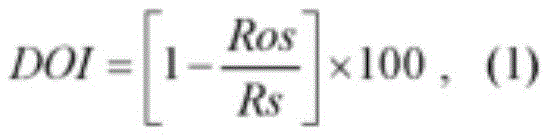
Where Ros is the average of the relative reflection intensities from 0.2 ° to 0.4 ° from the specular direction, and Rs is the average of the relative reflection intensities along the specular direction (with +0.05 ° to-0.05 ° deviation centered on the specular direction). If the input light source angle is +20 from the sample surface normal (as in the present disclosure), and the sample surface normal is 0, then the measured value of specular reflected light Rs is averaged over a range of about-19.95 to-20.05, and Ros is averaged over a range of about-20.2 to-20.4 (or from-19.6 to-19.8, or both). The DOI values used herein should be directly interpreted as specifying the target ratio of Ros/Rs as defined herein. In some embodiments, the antiglare surface has a reflective scattering profile such that > 95% of the reflected light power is contained within a cone of +/-10 °, the cone centered about the specular reflection direction at any input angle.
The resulting antiglare surface may include a textured surface having a plurality of recessed features with openings facing outward from the surface. The average cross-sectional dimension of the openings can be less than or equal to 30 micrometers. In one or more embodiments, the antiglare surface exhibits low flicker (in terms of a low pixel power deviation reference or PPDr), for example, about 6% PPDr or less. The terms "pixel power deviation baseline" and "PPDR" as used herein refer to a quantitative measure of the amount of flicker displayed. Unless otherwise noted, PPDR measurements used display devices including edge-lit liquid crystal displays (twisted-phase liquid crystal displays) with inherent subpixel spacings of 60 μm x 180 μm and subpixel opening window sizes of about 44 μm x to about 142 μm. The front surface of the liquid crystal display panel has a smooth linear polarizing film of antireflection type. To determine the PPDR of a display system or an anti-glare surface forming part of a display system, the screen is placed in the focal region of an "eye simulator" camera, which approximates the parameters of the human eye. Thus, the camera system includes an aperture (or "pupil aperture") that is inserted into the optical path to adjust the collection angle of the light to approximate the aperture of the pupil of the human eye. In the PPDr measurement described herein, the angle of the iris diaphragm is 18 milliradians.
The anti-reflective surface may be formed from a multi-layer coating stack of alternating layers of high and low refractive index materials. Such a coating stack may comprise 6 or more layers. In one or more embodiments, the anti-reflective surface may exhibit a single-sided average light reflectance in the range of from about 2% or less (e.g., about 1.5% or less, about 1% or less, about 0.75% or less, about 0.5% or less, about 0.25% or less) of light wavelengths in the range of from 400nm to 800 nm. The average reflectance is measured at incident light angles of greater than about 0 degrees to less than about 10 degrees.
The decorative surface may include any aesthetic design formed by pigments (e.g., inks, paints, and the like), and may include a wood grain design, a brushed metal design, a graphical design, a portrait, or a logo. In one or more embodiments, the decorative surface presents a clear-front effect, wherein the decorative surface hides or covers the underlying display when the display is closed, but allows viewing of the display when the display is open. The decorative surface may be printed onto the glass substrate. In one or more embodiments, the antiglare surface comprises an etched surface. In one or more embodiments, the anti-reflective surface comprises a multilayer coating. In one or more embodiments, the easy-to-clean surface includes an oil-resistant coating that imparts anti-fingerprint properties. In one or more embodiments, the tactile surface comprises a raised or recessed surface formed by depositing a polymer or glass material on the surface to provide tactile feedback to the user when touched.
In one or more embodiments, a surface finish (i.e., an easy-to-clean surface, an anti-glare surface, an anti-reflection surface, a tactile surface, and/or a decorative surface) is disposed on at least a portion of the perimeter 147 while the interior portion 148 is substantially free of the surface finish.
In one or more embodiments, the display module includes touch functionality, and such functionality can be accessed through the glass substrate 140. In one or more embodiments, the image or content displayed by the display module is visible through the glass substrate 140.
A second aspect of the present disclosure relates to various methods and systems for cold bending a glass substrate, such as substrate 140, and/or forming a display. In various embodiments, the methods and systems discussed herein utilize air pressure differentials to cause bending of a glass substrate. As described above, the system and method bend glass substrates without the use of high temperatures (e.g., temperatures greater than the softening point of the glass) typical of hot bending/thermoforming processes.
Referring to fig. 8 and 9, a method 1000 of forming a display according to an exemplary embodiment is illustrated. In one or more embodiments, the method includes step 1100, cold-bending a glass substrate (e.g., substrate 140) to a first radius of curvature (as described herein), and laminating display module 150 to a first one of major surfaces 142 or 144 (see fig. 2 and 3) while maintaining the first radius of curvature in the glass substrate to form a display. In one or more embodiments, the display module has a second radius of curvature (as described herein) that is within 10% of the first radius of curvature. As shown in fig. 9, in one or more embodiments, the step of cold-bending the glass substrate 140 includes: a vacuum is applied to the second major surface 144 of the glass substrate to create a first radius of curvature 1120. Thus, in the embodiment shown in FIG. 9, the step of applying a vacuum comprises: the glass substrate is placed on a vacuum fixture 1110 prior to applying a vacuum to the second major surface. In one or more embodiments, to maintain the first radius of curvature, assembly of the glass substrate and subsequently with the display module is performed (steps 1150, 1200), and a vacuum is applied to the glass substrate to cold form the glass substrate to the first radius of curvature. In other words, the glass substrate 140 is temporarily cold-bent by applying a vacuum, and then laminated with the display module 150 is permanently cold-formed into a glass substrate and a display. In such embodiments, the display module provides the rigidity required for permanent cold forming of the glass substrate. Other mechanisms for temporarily cold forming the glass substrate may be used. For example, the glass substrate may be temporarily fixed onto a mold having a desired curvature to cold-form the glass substrate. The glass substrate may be temporarily fixed by a pressure sensitive adhesive or other mechanism.
After cold bending the glass substrate, the method of one or more embodiments includes: prior to laminating the display module to the first major surface, an adhesive is laminated to the first major surface 142 of the glass substrate 140 such that the adhesive is disposed between the first major surface and the display module. In one or more embodiments, the step of laminating the adhesive may comprise: an adhesive layer is applied followed by application of a normal force using a roller or other mechanism. Illustrative examples include any suitable optically clear adhesive for bonding the glass substrate to the second glass substrate of the display module 150. In one example, the adhesive may comprise an optically clear adhesive available from 3M company under the trade name 8215. The thickness of the adhesive can range as otherwise described herein (e.g., from about 200 μm to about 500 μm).
In one or more embodiments, the step 1200 of laminating the display module comprises: the second glass substrate 152 is laminated to the glass substrate 140 (step 1210 in fig. 9), and then the backlight unit 154 is attached to the second glass substrate (step 1220 in fig. 9). In one or more embodiments, the method comprises: the second glass substrate is cold-bent during lamination to the glass substrate. In one or more embodiments, the second glass substrate is bent prior to lamination. For example, the second glass substrate may be temporarily bent or cold-bent prior to lamination to assume the second radius of curvature. In another example, the second glass substrate may be permanently bent (e.g., by thermoforming) to exhibit the second radius of curvature. In one or more embodiments, the backlight unit is curved to exhibit the second radius of curvature. In one or more embodiments, the backlight unit is flexible and bends to a second radius of curvature during lamination. In one or more embodiments, the backlight unit may be bent prior to lamination. For example, the backlight unit may be temporarily bent to assume the second radius of curvature before lamination. In another example, the backlight unit may be permanently bent to assume the second radius of curvature).
In one or more embodiments, step 1220 includes: attaching a frame to one of the backlight unit and the second glass substrate. In one or more embodiments, the method includes step 1230: the vacuum is removed from the second major surface of the glass substrate 140. For example, the step of removing the vacuum from the second major surface may comprise: the display is removed from the vacuum fixture.
In one or more embodiments, the method comprises: the display is provided or assembled in the vehicle interior system 100, 200, 300. Where a frame is used, the frame may be used to assemble the display to a vehicle interior system as otherwise described herein.
Referring to fig. 10-15, an attachment system and method for forming a curved glass substrate via cold bending is illustrated and described. In the illustrated and described embodiment, the curved glass substrate is used as a cover glass in the vehicle interior system 100, 200, 300. It should be understood that any of the glass substrate, frame, and display module embodiments described herein may be formed or utilized in the processes and systems discussed with respect to fig. 10-15.
Referring to fig. 10, a method 1300 for cold bending a glass substrate is illustrated. At step 1310, a glass substrate (e.g., glass substrate 140) is supported and/or placed on a curved frame. The frame may be a frame of a display, such as frame 158 (as described herein) that defines a perimeter and curved shape of a vehicle display. Generally, the curved frame includes a curved support surface, and one of the major surfaces 142 or 144 of the glass substrate 140 is placed in contact with the curved support surface of the frame.
At step 1320, while the glass substrate is supported by the frame, a pressure differential is applied to the glass substrate causing the glass substrate to bend to conform to the curved shape of the curved support surface of the frame. In this way, the curved glass substrate is formed of a substantially flat glass substrate (see fig. 3 and 4). In this arrangement, the flat sheet of glass material is bent to form a curved shape on the major surface facing the frame, while also forming a corresponding (but complementary) curve in the major surface of the glass substrate opposite the frame. Applicants have found that by bending the glass substrate directly on the bending frame, the need for a separate bending die set or mold (typically required in other glass bending processes) is eliminated. Furthermore, applicants have found that by shaping the glass substrate directly to the curved frame, a wide range of glass radii can be achieved in a low complexity manufacturing process.
In some embodiments, the air pressure differential may be generated by a vacuum fixture (e.g., fixture 1110). In some other embodiments, the air pressure differential is created by applying a vacuum to an airtight enclosure surrounding the frame and the glass substrate. In a particular embodiment, the airtight enclosure is a flexible polymeric shell, such as a plastic bag or pouch. In other embodiments, the air pressure differential is created by generating an increased air pressure around the glass substrate and frame using an overpressure device (e.g., an autoclave). Applicants have further found that air pressure provides a consistent and highly uniform bending force (compared to contact-based bending methods), which further results in a robust manufacturing process.
At step 1330, the temperature of the glass substrate is maintained below the glass softening point of the material of the glass substrate during bending. Thus, method 1300 is cold bending. In certain embodiments, the temperature of the glass substrate is maintained at less than 500 ℃, 400 ℃, 300 ℃, 200 ℃, or 100 ℃. In certain embodiments, the glass substrate is maintained at or below room temperature during bending. In certain embodiments, the glass substrate is not actively heated during bending via a heating assembly, furnace, oven, or the like (such as is the case when the glass is hot formed into a curved shape).
As noted above, in addition to providing processing advantages (e.g., elimination of expensive and/or slow heating steps), the cold-bending process discussed herein is believed to produce curved glass substrates having various properties superior to hot-formed glass substrates, particularly for display cover glass applications. For example, applicants believe that for at least some glass materials, heating during the hot forming process reduces the optical properties of the bent glass substrate, and thus the bent glass substrate system formed using the cold-bending process/system discussed herein provides a bent glass shape and improved optical quality that cannot be achieved using the hot-bending process.
In addition, many glass coating materials (e.g., anti-glare coatings, anti-reflection coatings, etc.) are applied via a deposition process (e.g., a sputtering process that is generally not suitable for coating curved glass articles). In addition, many coating materials also cannot withstand the high temperatures associated with the hot bending process. Thus, in particular embodiments discussed herein, prior to cold bending (when the glass substrate is flat), one or more coating materials are applied onto the major surface 142 and/or the major surface 144 of the glass substrate 140 and the coated glass substrate is bent into a curved shape as discussed herein. Accordingly, applicants believe that the processes and systems discussed herein allow for bending of glass after one or more coating materials are applied to the glass, as compared to typical thermal forming processes.
Referring to FIG. 11, a process 1400 for forming a display is illustrated. At step 1410, an adhesive material is applied between the curved support surface of the frame and the first major surface 142 of the glass substrate 140. In certain embodiments, the adhesive is first placed on the frame support surface, and then at step 1420, the glass substrate 140 is placed on the adhesive coated frame. In another embodiment, an adhesive may be placed on the first major surface 142 and then placed in contact with the support surface of the frame.
The adhesive material may be applied in various ways. In one embodiment, the adhesive is applied using a paint gun and mixing nozzle or pre-mix injector, and is uniformly applied using any of a roller, brush, scraper, or draw-down bar, for example. In various embodiments, the adhesives discussed herein are structural adhesives. In particular embodiments, the structural adhesive may include, but is not limited to, adhesives selected from one or more of the following categories: (a) toughened Epoxy resins (e.g., Masterbond EP21TDCHT-LO, 3M Scotch Weld Epoxy DP460 Off-white); (b) flexible Epoxy resins (e.g., Masterbond EP21TDC-2LO, 3M Scotch Weld Epoxy 2216); (c) Acrylic and/or toughened Acrylic (e.g., LORD Adhesive 403, 406, or 410Acrylic adhesives, LORD accumulator 19 or 19GB, LORD AP 134primer, LORD Adhesive 850 or 852/LORD accumulator 25GB, Loctite HF8000, Loctite AA 4800); (d) amino potassium acid esters (ureas) (e.g., 3M Scotch Weld urea DP640 Brown, Sikaflex 552 and Polyurethane (PUR) Hot Melt adhesives, e.g., technomer PUR 9622-02UVNA, Loctite HHD 3542, Loctite HHD 3580, 3M Hot adhesives 3764 and 3748); and (e) Silicone (Dow Corning 995, Dow Corning 3-0500Silicone Assembly adhesive, Dow Corning 7091, Sikasil-GP). In some cases, structural adhesives available as sheets or films may be used (such as, but not limited to, 3M structural adhesive films AF126-2, AF163-2M, SBT9263 and 9214, Masterbond FLM 36-LO). In addition, pressure sensitive structural adhesives (e.g., 3M VHB tape) may be used. In such embodiments, the use of a pressure sensitive adhesive allows the curved glass substrate to be bonded to the frame without the need for a curing step.
At step 1420, the glass substrate can be aligned with the frame using a variety of different techniques or mechanisms. For example, tabs, marks, and clamps may be used to align the glass substrate with the frame support surface.
At step 1430, a gas pressure differential is applied to cause the glass substrate 140 to bend to conform to the shape of the curved support surface of the curved frame, as discussed above with respect to step 1320. At step 1440, the now curved glass substrate is bonded to the curved frame support surface via an adhesive. Since the air pressure does not permanently deform the glass substrate, the bonding step occurs during the application of the air pressure differential. In various embodiments, the air pressure differential is between 0.5 and 1.5 atmospheres (atm), specifically between 0.7 and 1.1 atm, more specifically between 0.8 and 1 atm.
The performance of step 1440 depends on the type of adhesive used to create the bond between the glass substrate and the frame. For example, in embodiments where the temperature is increased to accelerate the curing of the adhesive, heat is applied to cure the adhesive. In one such embodiment, the heat-curable adhesive is cured by raising the temperature to the curing temperature of the adhesive but below the glass softening point of the glass substrate while the glass substrate remains bent via the pressure differential to conform to the shape of the curved support surface of the curved frame. In particular embodiments, an oven or furnace may be used to apply heat. In another embodiment, both heat and pressure may be applied via an over-pressure device (e.g., autoclave).
In embodiments where the adhesive is a UV curable adhesive, UV light is applied to cure the adhesive. In other embodiments, the adhesive is a pressure sensitive adhesive that applies pressure to bond the adhesive between the glass substrate and the frame. In various embodiments, the adhesive may be an optically clear adhesive, such as a liquid optically clear adhesive, regardless of the process that forms the bond between the glass substrate and the frame.
At step 1450, a display module (e.g., display module 150) is attached to the frame that supports the now bent and bonded glass substrate. In particular embodiments, the glass substrate and frame assembly may be removed from the device applying the pressure differential prior to attaching the display module to the frame. In particular embodiments, the display module is attached to the frame via an adhesive (e.g., an optically clear adhesive). In other embodiments, the display module may be attached to the frame by a variety of mechanical coupling devices (e.g., screws, snaps, or snap-fit components, etc.). In a specific embodiment, a Liquid Optically Clear Adhesive (LOCA) available from E3 displays is applied to a thickness of 125 μm to bond the display module to the frame, and the adhesive is subsequently UV cured to obtain an assembly.
FIG. 12 illustrates a graphical representation of a process 1400 including additional steps according to an exemplary embodiment. At step 1425, the glass substrate supported on the frame is positioned within a hermetic enclosure, as shown by plastic vacuum bag 1426. In one embodiment, a gas permeable fabric is placed over the frame 158/glass substrate 140 to provide connection of the fitting surfaces to the vacuum ports. In addition, the breathable cloth helps absorb excess glue that may seep out of the fitment during handling.
A vacuum is then drawn within the vacuum bag 1426 at step 1430. At step 1440, vacuum bag 1426 with the glass substrate and frame is positioned within autoclave 1442, and autoclave 1442 generates heat to cure the adhesive used to bond the glass substrate and frame. In a specific embodiment, vacuum bag 1426 is placed in an autoclave at 66 ℃/90psi for 1 hour to cure the adhesive. At step 1460, after the display module attachment at step 1450, the assembled display assembly 1470 including the glass substrate (e.g., cover glass), display frame, and display module is completed with all accessories attached together and ready to be installed inside the vehicle.
Referring to FIG. 13, a process 1500 for forming a display according to another embodiment is illustrated. Process 1500 is substantially the same as process 1400 except as discussed herein. At step 1510, process 1500 attaches the display module to the frame in advance rather than after bending and attaching the glass substrate to the frame. In some such embodiments, the display module is bonded to the frame via an adhesive that cures during the same curing step used to bond the glass substrate to the frame. In such an embodiment, the display module is coupled to the frame during application of the air pressure differential, causing the glass substrate to bend to the frame.
Referring to fig. 14 and 15, a display assembly 1470 is illustrated according to an example embodiment. In the illustrated embodiment, the display assembly includes a frame 158 that supports both the display module 150 and a cover glass substrate (e.g., glass substrate 140). As shown in fig. 14 and 15, the display module 150 and the glass substrate 140 are coupled to the frame 158, and the display module 150 is positioned to allow a user to view the display module 150 through the glass substrate 140. In various embodiments, the frame 158 may be formed from a variety of materials, including, but not limited to, plastics (e.g., Polycarbonate (PC), polypropylene (PP), Acrylonitrile Butadiene Styrene (ABS), PC/ABS blends, etc.), metals (aluminum alloys, magnesium alloys, iron alloys, etc.), glass-filled resins, fiber-reinforced plastics, and fiber-reinforced composites. Various processes (e.g., casting, machining, stamping, injection molding, extrusion, pultrusion, resin transfer molding, etc.) may be used to form the curved shape of the frame 158.
In another example, a toughened Epoxy adhesive (supplied by 3M under the trade name 3M Scotch Weld Epoxy DP460 Off-white) is applied to the major surface of the glass substrate or curved frame using a paint gun and mixing nozzle. The adhesive is uniformly applied using a roller or brush. The glass substrate and the frame are stacked or assembled such that the adhesive layer is between the glass substrate and the frame. Subsequently, a high temperature resistant tape is applied to temporarily maintain the stack alignment. The stack is then placed in a vacuum bag. In this embodiment, a release cloth (optional) is placed over the stack to prevent sticking to the vacuum bag, a breather is then placed over to provide connection of the fitment surface to the vacuum port, and finally the release cloth and breather assembly are placed in the vacuum bag. The vacuum bag was then sealed to withstand 760 mm hg. Subsequently, the vacuum bag is degassed by evacuating, and during the evacuating, the glass substrate is bent to conform to the curved shape of the frame support surface. The vacuum bag with the curved glass substrate and support frame was placed in a 66 deg.c/90 psi autoclave for a period of 1 hour to cure the adhesive. The glass substrate is bonded to the curved frame support surface via a cured adhesive. Subsequently, the autoclave was cooled to a temperature below 45 ℃ before releasing the pressure. The curved glass substrate/frame stack is removed from the vacuum bag. The resulting curved glass substrate maintained the curved shape of the frame with no visible delamination. The display modules may be assembled to a stack to provide a display assembly.
It is understood that the adhesive may be applied and UV may be used at room temperature or at elevated temperatures, or depending on the curing schedule of the particular adhesive, to assemble the coldbend stack with curing of the adhesive. In some embodiments, pressure may be applied with heat. In some cases, heat is applied to the stack separately. In one or more embodiments, heat may be applied such that the temperature of the stack ranges from greater than room temperature (i.e., 23 ℃) up to 300 ℃, from about 25 ℃ to about 300 ℃, from about 50 ℃ to about 300 ℃, from about 75 ℃ to about 300 ℃, from about 100 ℃ to about 300 ℃, from about 110 ℃ to about 300 ℃, from about 115 ℃ to about 300 ℃, from about 120 ℃ to about 300 ℃, from about 150 ℃ to about 300 ℃, from about 175 ℃ to about 300 ℃, from about 200 ℃ to about 300 ℃, from about 25 ℃ to about 250 ℃, from about 25 ℃ to about 200 ℃, from about 25 ℃ to about 150 ℃, from about 25 ℃ to about 125 ℃, from about 25 ℃ to about 115 ℃, from about 25 ℃ to about 110 ℃, or from about 25 ℃ to about 100 ℃. The stack can be heated to such a temperature for about 2 seconds to about 24 hours, 10 seconds to about 24 hours, about 30 seconds to about 24 hours, about 1 minute to about 24 hours, about 10 minutes to about 24 hours, about 15 minutes to about 24 hours, about 20 minutes to about 24 hours, about 30 minutes to about 24 hours, about 1 hour to about 24 hours, about 1.5 hours to about 24 hours, about 2 hours to about 24 hours, about 3 hours to about 24 hours, about 2 seconds to about 4.5 hours, about 2 seconds to about 4 hours, about 2 seconds to about 3 hours, about 2 seconds to about 2 hours, about 2 seconds to about 1.5 hours, about 2 seconds to about 1 hour, about 2 seconds to about 45 minutes, about 2 seconds to about 30 minutes, about 2 seconds to about 15 minutes, about 2 seconds to about 10 minutes, about 10 minutes to about 45 minutes, or about 15 minutes to about 45 minutes.
In various embodiments, the systems and methods described herein allow for the formation of glass substrates to conform to various curved shapes that the frame 158 may have. As shown in fig. 14, the frame 158 has a support surface 155, the support surface 155 having a curved shape that matches the shape of the glass substrate 140. In the embodiment shown in fig. 14 and 15, the support surface 155 includes a convex section 161 and a concave section 163, and the glass substrate 140 is shaped to conform to the curved shape of the sections 161 and 163.
As is commonly understood, as the glass substrate is bent to conform to the curved shape of the frame support surface 155, both the opposing first and second major surfaces of the glass substrate 140 form a curved shape. Referring to fig. 15, the first major surface 1471 of the glass substrate 140 is the surface in contact with the frame support surface 155 to form a complementary shape to the frame support surface 155 during bending, while the outer second major surface 1472 of the glass substrate 140 forms a curved shape that substantially matches the curved shape of the frame support surface 155. Thus, in this arrangement, the second major surface 1472 has a convex section at the location of the convex section 161 of the frame support surface 155 and a concave section at the location of the concave section 163 of the frame support surface 155. Conversely, first major surface 1471 has a recessed section at the location of raised section 161 of frame support surface 155 and a raised section at the location of recessed section 163 of frame support surface 155.
In a particular embodiment, the radius of curvature of the convex curve 161 is 250mm and the radius of the concave curve 163 is 60 mm. In some embodiments, the non-curved central section is located between two curved sections. Furthermore, in some embodiments, the glass substrate 14 is a chemically strengthened aluminosilicate glass having a thickness of 0.4 mm.
It should be understood that fig. 14 and 15 provide specific examples of forming glass substrates having more than one curved section, but in various embodiments, the processes and systems discussed herein may be used to form various curved substrates having more or fewer curved sections than shown in fig. 14 and 15. Further, it should be understood that although the exemplary embodiments discussed herein are primarily described with respect to bending a display cover glass, the glass substrate 140 may be formed for any non-display curved glass application (e.g., a cover glass for a vehicle instrument panel).
Referring to fig. 16A-16I, another aspect of the present disclosure relates to a kit and a method for assembling such a kit to provide a display. Fig. 16A-16I illustrate a cold-bent glass 2010 disposed between a viewer and a display, wherein the glass substrate has a concave curvature as viewed from the viewer's perspective. In one or more embodiments, the curvature may be convex, or may be a combination of convex and concave portions having the same or different radii from each other. Referring to fig. 16A-16C, a kit 2000 according to one or more embodiments includes a cold-bent glass substrate 2010 (according to one or more embodiments as described herein) and a frame 2020. In one or more embodiments, the cold-bent glass substrate includes a first major surface 2012, a second major surface 2014 opposite the first major surface, and a minor surface 2016 connecting the first major surface and the second major surface, a thickness defined as a distance between the first major surface and the second major surface, a width defined as a first dimension of one of the first or second major surfaces orthogonal to the thickness, and a length defined as a second dimension of one of the first or second major surfaces orthogonal to both the thickness and the width, wherein the second major surface 2014 includes a first radius of curvature. In the embodiment shown in fig. 16A to 16F, the second major surface forms a concave surface exhibiting a greater compressive stress than the same surface prior to cold bending. In some embodiments, the second major surface exhibits a greater compressive stress than the first major surface. The frame 2020 has a curved surface 2022, and the curved surface 2022 is coupled to the second major surface of the cold-bent glass substrate. The frame may be coupled to the glass substrate via an adhesive or a mechanical member. In one or more embodiments, the radius of curvature of the curved surface 2022 may be substantially the same as the first radius of curvature. In one or more embodiments, the radius of curvature of the curved surface 2022 is the same as the first radius of curvature. The cold-bent glass substrate has a thickness of about 1.5mm or less. In one or more embodiments, the width of the cold-bent glass substrate ranges from about 5cm to about 250cm, and the length of the cold-bent glass substrate ranges from about 5cm to about 250 cm. In one or more embodiments, the first radius of curvature is 500nm or greater. The glass substrate may be strengthened as described herein.
In one or more embodiments, the kit includes a display module. As shown in the embodiments of fig. 16B and 16C, the display module includes a display and an optional backlight unit 2040, and the display includes a second glass substrate 2030. In some embodiments, the display module includes only a display (without the backlight unit 2040), as shown in fig. 16E. In such an embodiment, the backlight unit may be provided separately and attached to the display, as shown in fig. 16F. In one or more embodiments, the display may be a liquid crystal display or an OLED display. In one or more embodiments, the kit can include a touch panel in place of, or in addition to, the display module (the touch panel is positioned to be disposed between the cold-bent glass substrate and the display module). In the embodiment shown in fig. 16B and 16C, the display or touch panel includes a curved second glass substrate 2030. In such embodiments, the second glass substrate comprises a display surface or a curved touch panel surface having a second radius of curvature within 10% of the first radius of curvature. In embodiments using an OLED display, the curved surface of the OLED display or chassis has a second radius of curvature that is within 10% of the first radius of curvature. In some embodiments, as shown in fig. 16C, 16E, 16F, 16H, and 16I, the kit includes an adhesive layer 2050 for attaching the second glass substrate 2030 to the cold-bent glass substrate or frame. An adhesive layer may be disposed on a surface of the cold-bent glass substrate to attach to the second glass substrate. In the embodiment shown in fig. 16A to 16I, an adhesive layer is disposed on the first major surface. In one or more embodiments, the adhesive layer may be disposed on the second glass substrate, or on both the cold-bent glass substrate and the second glass substrate. Adhesive 2050 can be an optically clear adhesive (e.g., as described herein). In one or more embodiments, after the cold-bent substrate 2010 and the curved second glass substrate 2030 are laminated, such lamination is considered to place a lower stress on any adhesive layers disposed therein. In one or more embodiments, the second radius of curvature may be within 5%, within 4%, within 3%, or within 2% of the first radius of curvature. In some embodiments, after lamination, the cold-bent glass substrate (and corresponding frame) is substantially aligned with the second glass substrate such that the cold-bent glass misaligned with the bent second glass substrate (i.e., exposed misaligned portions) has a width of less than 2%, a length of less than 2%, or both a width and a length of less than 2%. In one or more embodiments, the surface area of the first major surface 2012 that is misaligned or exposed with the second glass substrate after lamination is less than 5%. In some embodiments, the thickness of the adhesive may be increased to enhance alignment between the cold-bent glass substrate and the second glass substrate.
As shown in fig. 16C, 16E, 16F, 16H, or 16I, the kit can include a second glass substrate attached to the first major surface 2012. In one or more embodiments, the second glass substrate is attached to a frame 2020 (not shown). It should be understood that the frame 2020 may have the features of the frame 158 described herein. As shown in the embodiments of fig. 16D and 16G, the second glass substrate 2030 is substantially flat and may be cold-bent to a second radius of curvature within 10% of the first radius of curvature. As shown in fig. 16D-16F, the second glass substrate may be cold-bent to a second radius of curvature and attached to the cold-bent glass substrate, or alternatively attached to a frame (not shown). In such an embodiment, the second glass substrate 2030 or the cold-bent glass substrate 2010 may include an adhesive layer to attach the second glass substrate to the cold-bent glass substrate or the frame as appropriate. In one or more particular embodiments, first major surface 2012 includes an adhesive disposed thereon. In such embodiments, the adhesive may be an optically clear adhesive that is a composite or exhibits a different value of young's modulus on a surface in contact with or adjacent to the first major surface than an opposing surface in contact with or to be in contact with the second glass substrate. It is believed that the second glass substrate may exert a lower stress on the adhesive layer and therefore may require a lower bending force to cold bend the second glass substrate to the cold-bent glass substrate. In some such embodiments, after lamination, the cold-bent glass substrate is substantially aligned with the second glass substrate such that the cold-bent glass misaligned with the second glass substrate (i.e., the exposed misaligned portion) has a width of less than 2%, a length of less than 2%, or both a width and a length of less than 2%. In one or more embodiments, the surface area of the first major surface 2012 that is misaligned or exposed with the second glass substrate after lamination is less than 5%.
As shown in fig. 16B to 16C and 16F, the backlight unit may be bent. In some embodiments, the third radius of curvature of the backlight unit is within 10% of the first radius of curvature, within 10% of the second radius of curvature, or within 10% of the first and second radii of curvature.
In the embodiment shown in fig. 16H-16I, the display includes a second glass substrate that is substantially flat and attached to the first major surface. In such embodiments, the second glass substrate or the cold-bent glass substrate includes an adhesive layer 2050 that attaches the second glass substrate to the cold-bent glass substrate (i.e., directly connected to the first major surface or a portion of the frame). In such an embodiment, the adhesive attaches the cold-bent glass substrate to the flat second glass substrate. As shown, in one or more embodiments, the adhesive layer includes a first surface that is substantially flat and an opposing second surface having a second radius of curvature that is within 10% of the first radius of curvature. In such an embodiment, the adhesive may be a liquid optically clear adhesive. In some embodiments, the first radius of curvature ranges from about 500nm to about 1000 nm.
In one or more embodiments, in the kit shown in fig. 16A-16I, there may be an air gap between the second glass substrate and the cold-bent glass substrate (i.e., the first major surface). In one or more embodiments, the adhesive layer may be present only on the cold-bent glass substrate and/or a portion of the second glass substrate such that there is no attachment between the portion of the cold-bent glass substrate and the second glass substrate (as there is no adhesive to form such an attachment).
Fig. 17A-17I illustrate various embodiments of a kit 3000, the kit 3000 including a frame 3020 that is removable or temporarily attached to a cold-bent glass substrate 3010. Fig. 17A to 17I illustrate the convex curvature of the cold-bent glass 3010 disposed between the viewer and the display. In one or more embodiments, the curvature may be concave, or may be a combination of convex and concave portions having the same or different radii from each other. In one or more embodiments, the kit includes a cold-bent glass substrate 3010 and a removable frame 3020, the cold-bent glass substrate 3010 comprising a first major surface 3012, a second major surface 3014 opposite the first major surface and having a first radius of curvature, and a minor surface 2016 connecting the first major surface and the second major surface, a thickness defined as a distance between the first major surface and the second major surface, a width defined as a first dimension of one of the first or second major surfaces orthogonal to the thickness, and a length defined as a second dimension of one of the first or second major surfaces orthogonal to both the thickness and the width, wherein the second major surface comprises the first radius of curvature, and the removable frame 3020 removably coupled to the second major surface. It is understood that frame 3020 may have the features of frame 158 described herein. In one or more embodiments, the frame has a curved surface coupled to the second major surface. The curved surface of the frame may have a radius of curvature that is the same as the first radius of curvature. In the embodiment shown in fig. 17A to 17I, the second main surface forms a concave surface, exhibiting a greater compressive stress than the same surface before cold-bending. In some embodiments, the second major surface exhibits a greater compressive stress than the first major surface.
The cold-bent glass substrate has a thickness of about 1.5mm or less. In one or more embodiments, the width of the cold-bent glass substrate ranges from about 5cm to about 250cm, and the length of the cold-bent glass substrate ranges from about 5cm to about 250 cm. In one or more embodiments, the first radius of curvature is 500nm or greater. The glass substrate may be strengthened as described herein.
In one or more embodiments shown in fig. 17A-17I, the kit includes a display module. As shown in fig. 17B and 17C, the display module includes a display and an optional backlight unit 3040, and the display includes a second glass substrate 3030. In some embodiments, the display module includes only a display (without the backlight unit 3040), as shown in fig. 17E. In such an embodiment, a backlight unit or other mechanism or structure may be provided separately and attached as shown in fig. 17F to maintain the curved shape of the cold-bent glass substrate and the second glass substrate after removal of the removable frame. In one or more embodiments, the display may be a liquid crystal display or an OLED display. In one or more embodiments, the kit can include a touch panel in place of, or in addition to, the display module (the touch panel is positioned to be disposed between the cold-bent glass substrate and the display module). In the embodiment shown in fig. 17B and 17C, the display or touch panel includes a curved second glass substrate 3030. In such embodiments, the second glass substrate comprises a curved display surface or a curved touch panel surface having a second radius of curvature within 10% of the first radius of curvature. In one or more embodiments, the second glass substrate may be curved and have sufficient rigidity or structure to maintain the cold-bent shape of the cold-bent glass after removal of the removable frame. In embodiments using an OLED display, the curved surface of the OLED display or chassis has a second radius of curvature that is within 10% of the first radius of curvature. In some embodiments, as shown in fig. 17C, 17E, 17F, 17H, and 17I, the kit includes an adhesive layer 3050 for attaching a second glass substrate to the cold-bent glass substrate (more specifically, the first major surface 3012). The adhesive layer may be provided on the cold-bent glass substrate (i.e., the first major surface), on the second glass substrate, or on both the cold-bent glass substrate and the second glass substrate. Adhesive 3050 can be an optically clear adhesive (e.g., an optically clear adhesive as described herein). In one or more embodiments as shown in fig. 17B and 17C, after the curved cold-bent substrate 3010 and the curved second glass substrate 3030 are laminated, such lamination is considered to apply lower stress to any adhesive layer disposed therein. In one or more embodiments, the second radius of curvature may be within 5%, within 4%, within 3%, or within 2% of the first radius of curvature after the cold-bent substrate 3010 is laminated with the bent second glass substrate 3030. In some embodiments, after lamination, the cold-bent glass substrate is substantially aligned with the second glass substrate such that the cold-bent glass misaligned with the second glass substrate (i.e., exposed misaligned portions) has a width of less than 2%, a length of less than 2%, or both a width and a length of less than 2%. In one or more embodiments, the surface area of the first major surface 2012 that is misaligned or exposed with the second glass substrate after lamination is less than 5%. In some embodiments, the thickness of the adhesive may be increased to enhance alignment between the cold-bent glass substrate and the second glass substrate.
As shown in fig. 17C, 17E, 17F, 17H, or 17I, the kit can include a second glass substrate attached to the first major surface 3012. As shown in fig. 17D and 17G, the second glass substrate 3030 may be substantially flat and may be cold-bent to a second radius of curvature that is within 10% of the first radius of curvature. As shown in fig. 17D-17F, the second glass substrate can be cold-bent to a second radius of curvature and can be attached to the cold-bent glass substrate (i.e., the first major surface 3012). In such an embodiment, the second glass substrate 3030 or the cold-bent glass substrate 3010 may include an adhesive layer to attach the second glass substrate to the cold-bent glass substrate as appropriate. In one or more particular embodiments, an adhesive layer can be disposed on the first major surface. In such embodiments, the adhesive may be an optically clear adhesive that is a composite or exhibits a different value of young's modulus on a surface in contact with or adjacent to the first major surface than an opposing surface in contact with or to be in contact with the second glass substrate. It is believed that the second glass substrate may exert a lower stress on the adhesive layer and therefore require a lower bending force to cold bend the second glass substrate to the cold-bent glass substrate. In some such embodiments, after lamination, the cold-bent glass substrate is substantially aligned with the second glass substrate such that the cold-bent glass misaligned with the second glass substrate (i.e., the exposed misaligned portion) has a width of less than 2%, a length of less than 2%, or both a width and a length of less than 2%. In one or more embodiments, the surface area of the first major surface 2012 that is misaligned or exposed with the second glass substrate after lamination is less than 5%.
As shown in fig. 17B to 17C and 17F, a curved backlight unit 3040 may be attached to the second glass substrate 3030. In some embodiments, the third radius of curvature of the backlight unit 3040 is within 10% of the first radius of curvature, within 10% of the second radius of curvature, or within 10% of the first and second radii of curvature. In such an embodiment, as shown in fig. 17C and 17F, the backlight unit 3040 provides a structure that maintains the curved shapes of the cold-bent glass substrate and the second glass substrate after the removable frame is removed. In the case of including a touch panel, the respective structures are attached to a side of the second substrate opposite to the surface attached or to be attached to the cold-bent glass substrate.
In the embodiment shown in fig. 17H-17I, the display comprises a second glass substrate 3030, the second glass substrate 3030 being substantially flat and attached to the first major surface. In such an embodiment, the frame 3020 maintains the curved shape of the cold-bent glass substrate, while the second glass substrate 3030 or the cold-bent glass substrate 3010 includes an adhesive layer 3050 attaching the second glass substrate to the first major surface. In such an embodiment, the adhesive attaches the cold-bent glass substrate to the flat second glass substrate. As shown, in one or more embodiments, the adhesive layer comprises a first surface and an opposing second surface, the first surface being substantially flat, and the opposing second surface having a second radius of curvature that is within 10% of the first radius of curvature. In such an embodiment, the adhesive may be a liquid optically clear adhesive. In some embodiments, the first radius of curvature ranges from about 500nm to about 1000 nm. In such an embodiment, as shown in fig. 17I, the adhesive layer is a structural adhesive to provide a structure that maintains the curved shape of the cold-bent glass substrate after the frame is removed.
In one or more embodiments, an air gap may exist between the second glass substrate and the cold-bent glass substrate (i.e., the first major surface). In such an embodiment, the adhesive layer may be present only on the cold-bent glass substrate and/or a portion of the second glass substrate such that there is no attachment between the portion of the cold-bent glass substrate and the second glass substrate (as there is no adhesive to form such an attachment).
Fig. 18A-18B illustrate a kit including a flexible glass substrate 4010 and a curved display module 4020 or a curved touch panel, the flexible glass substrate 4010 comprising a first major surface, a second major surface opposite the first major surface, and a minor surface connecting the first major surface and the second major surface, a thickness defined as a distance between the first major surface and the second major surface, a width defined as a first dimension of one of the first or second major surfaces orthogonal to the thickness, and a length defined as a second dimension of one of the first or second major surfaces orthogonal to both the thickness and the width, while the curved display module 4020 or the curved touch panel has a first radius of curvature as shown in fig. 18A. Fig. 18A-18B illustrate the convex curvature of a flexible glass substrate 4010 disposed between a viewer and a display. In one or more embodiments, the curvature may be concave, or may be a combination of convex and concave portions having the same or different radii from each other.
The flexible glass substrate 4010 has a thickness of about 1.5mm or less. In one or more embodiments, the width of the flexible glass substrate ranges from about 5cm to about 250cm, and the length of the flexible glass substrate ranges from about 5cm to about 250 cm. In one or more embodiments, the first radius of curvature is 500nm or greater. In one or more embodiments, the flexible glass substrate may be strengthened as described herein.
As shown in fig. 18A and 18B, the display module includes a display including a second glass substrate 4030 and a backlight unit 4040 or other structure for maintaining the curved shape of the curved display module 4020. In some embodiments, the display module includes only a display (without the backlight unit 4040). In such embodiments, a backlight unit or other structure may be provided separately and attached to the display. In one or more embodiments, the display may be a liquid crystal display or an OLED display. In the embodiment shown in FIG. 18B, the display includes a second glass substrate 4030, and the second glass substrate 4030 is curved and exhibits a first radius of curvature. In one or more embodiments, the kit includes a curved touch panel instead of or in addition to the curved display module (the touch panel is positioned to be disposed between the cold-bent glass substrate and the curved display module). In such embodiments, the curved touch panel includes a curved second glass substrate, which may optionally provide structural rigidity to maintain its curved shape (even after attachment to a flexible glass substrate as shown in fig. 18B). In some embodiments, the kit includes an adhesive layer 4050 for attaching second glass substrate 4030 to flexible glass substrate 4010 (i.e., first major surface 4012). The adhesive layer may be provided on the flexible glass substrate (i.e., the first major surface), on the second glass substrate, or on both the flexible glass substrate and the second glass substrate. Adhesive 4050 can be an optically clear adhesive (e.g., an optically clear adhesive as described herein). In one or more embodiments, after the flexible glass substrate is cold-bent and laminated to a curved display module or touch panel, the second radius of curvature of the second major surface 4014 is present within 10%, within 5%, within 4%, within 3%, or within 2% of the first radius of curvature. In embodiments using an OLED display, the curved surface of the OLED display or chassis has a second radius of curvature that is within 10% of the first radius of curvature. In the embodiment shown in fig. 18B, the second major surface forms a concave surface exhibiting a greater compressive stress than the same surface prior to cold bending. In some embodiments, the second major surface exhibits a greater compressive stress than the first major surface.
In some embodiments, after lamination, the resulting cold-bent glass substrate (and corresponding frame) is substantially aligned with the second glass substrate such that the cold-bent glass misaligned with the second glass substrate (i.e., exposed misaligned portions) has a width of less than 2%, a length of less than 2%, or both a width and a length of less than 2%. In one or more embodiments, the surface area of the first major surface 2012 that is misaligned or exposed with the second glass substrate after lamination is less than 5%. In some embodiments, the thickness of the adhesive may be increased to enhance alignment between the cold-bent glass substrate and the second glass substrate.
In one or more embodiments, after cold bending and laminating flexible glass substrate 4010 to curved second glass substrate 4030, it is believed that the stress exerted on any adhesive layer disposed therein can be minimized by minimizing the thickness of the flexible glass substrate (i.e., to the extent described herein). In one or more embodiments, the kit includes a bezel formed on the flexible glass substrate to reduce stress on the flexible glass substrate when cold bent.
As shown in fig. 18B, a second glass substrate is attached to the first main surface 4012. As shown in fig. 18A, the flexible glass substrate 4010 is substantially flat and can be cold-bent to a second radius of curvature that is within 10% of the first radius of curvature. As shown in fig. 18B, the flexible glass substrate is cold-bent to a second radius of curvature and attached to a second glass substrate. As shown in fig. 18A to 18B, the backlight unit is curved, and provides a structure that maintains the cold-bent shape of the second glass substrate and the flexible glass substrate (after being cold-bent to the second glass substrate). In some embodiments, the third radius of curvature of the backlight unit is within 10% of the first radius of curvature, within 10% of the second radius of curvature, or within 10% of the first and second radii of curvature. In some embodiments, the second glass substrate is curved and may maintain the curved shape of a cold-bent glass substrate having a backlight unit or other structure.
In one or more embodiments, an air gap may exist between the second glass substrate and the cold-bent glass substrate (i.e., the first major surface). In such an embodiment, the adhesive layer may be present only on the cold-bent glass substrate and/or a portion of the second glass substrate such that there is no attachment between the portion of the cold-bent glass substrate and the second glass substrate (as there is no adhesive to form such an attachment).
Fig. 19A to 19E illustrate an embodiment of a method of forming a display. Fig. 19A to 19E illustrate convex curvature; however, the curvature may be concave, or may be a combination of convex and concave portions having the same or different radii from each other. In one or more embodiments, the method 5000 includes: the stack 5001 is cold-bent to a first radius of curvature measured on the first surface 5005 of the stack. The stack may be a display stack, a touch panel stack, or a stack comprising a touch panel and a display. In one or more embodiments, the display may be a liquid crystal display or an OLED display. The stack diagram is shown in fig. 19A and includes a first glass substrate 5010, the first glass substrate 5010 having a first major surface 5012 forming a first surface of the display stack and a second major surface 5014 opposite to the first major surface, the display and/or touch panel module being disposed on the second major surface 5014. In the illustrated embodiment, the display and/or touch panel includes a second glass substrate 5030. In the embodiment shown in fig. 19A, the stack is placed on the frame 5020 before and during cold bending to maintain the cold-bent shape of the stack. It should be understood that the frame 5020 may have the features of the frame 158 described herein. In one or more embodiments, the method comprises: the display and/or touch panel module is laminated to the second major surface such that the second glass substrate (or other portion of the display and/or touch panel) comprises a second radius of curvature that is within 10% of the first radius of curvature. In one or more embodiments, the first radius of curvature ranges from about 20mm to about 1500 mm. In the embodiment shown in fig. 19A-19E, after cold bending, the second major surface forms a concave surface that exhibits a greater compressive stress than the same surface prior to cold bending. In some embodiments, the second major surface exhibits a greater compressive stress than the first major surface. In one or more embodiments, the method comprises: the stack is cold-bent by applying a vacuum to the first surface to produce a first radius of curvature. In one or more embodiments, applying the vacuum comprises: the stack is placed on a vacuum fixture prior to applying a vacuum to the first surface. In the embodiment shown in fig. 19A, the method comprises: an adhesive layer 5050 is applied between the second glass substrate and the first glass substrate prior to cold-roll stacking. In some embodiments, the adhesive layer is disposed on the second glass substrate or a portion of the first glass substrate.
In the embodiment shown in fig. 19A, the display module may include a cold-bendable backlight unit 5040 disposed on a second glass substrate opposite the first glass substrate. In the embodiment shown in fig. 19C-19E, the module includes only a display or touch panel (without the backlight unit 5040). In such an embodiment, as shown in fig. 19E, a backlight unit or other mechanism or structure may be provided separately and attached to the display or touch panel to maintain the curved shape of the display stack. In some embodiments, the frame 5020 may be removed if the backlight unit, the second glass substrate, or other components provide sufficient structure to maintain the curved shape of the cold-bent glass substrate. In some embodiments, the frame cooperates with the backlight unit to maintain the cold-bent shape. Thus, in one or more embodiments, a cold-bend and/or laminated display stack includes: attaching a backlight unit to a second glass substrate opposite the first glass substrate, wherein the backlight unit is selectively bendable to exhibit a second radius of curvature.
In one or more embodiments, the method comprises: a frame is attached to the first glass substrate to maintain the first radius of curvature while cold bending and laminating the display stack.
In one or more embodiments, the first glass substrate is strengthened. In one or more embodiments, the second glass substrate is not strengthened. In one or more embodiments, the second glass substrate has a thickness greater than a thickness of the glass substrate. In one or more embodiments, the method comprises: the display is disposed in a vehicle interior system.
Example 1
Example 1 includes a display formed from a 0.55mm thick glass substrate that is chemically strengthened and has a first radius of curvature of about 1000 mm. The glass substrate was set flat, and one main surface (second main surface) was placed on a vacuum chuck having a radius of curvature of 1000 mm. A vacuum is applied to a major surface of the glass substrate to temporarily cold form the glass substrate to assume a first radius of curvature of about 1000mm matching a radius of curvature of the vacuum chuck. If the vacuum is removed, the glass substrate will return to flat and no longer be cold-bent. An adhesive layer having a thickness of 250 μ M, supplied by 3M company under the trade name 8215, was applied to the first major surface (i.e., the surface exposed and not in contact with the vacuum chuck) of the glass substrate while the glass substrate was set on the vacuum chuck and temporarily cold-bent. A normal force is applied to the roller to laminate the adhesive to the first major surface of the cold-bent glass substrate. The adhesive layer includes a carrier film that is removed after the adhesive layer is laminated to the cold-bent glass substrate.
A second glass substrate (which is a liquid crystal display glass substrate) is disposed on the adhesive layer. The second glass substrate was cold bent and laminated to the adhesive layer using rollers and applying a normal force. During lamination of the second glass substrate, the glass substrate continues to be temporarily cold-bent using vacuum. After lamination of the second glass substrate, the backlight and the frame are applied to the second glass substrate. In example 1, a double-sided tape was applied between the frame and the glass substrate. Double-sided adhesive tape is 3M company under the trademark VHBTMDouble-sided acrylic foam tape for tape supply. The frame has an L-shaped rim. The assembly of the frame with the backlight unit completes the formation of the display. Subsequently, the vacuum is removed from the glass substrate and the display is removed. The cold-bent glass substrate is permanently cold-bent and has a first radius of curvature. The display module (specifically the second glass substrate) exhibits a second radius of curvature that approximates or matches the first radius of curvature.
Aspect (1) relates to a method of cold-bending a glass substrate, comprising: supporting a glass substrate on a frame, wherein the glass substrate has a first major surface and a second major surface opposite the first major surface, wherein the frame has a curved support surface, wherein the first major surface of the glass substrate faces the curved support surface of the frame; and while being supported by the frame, applying a difference in air pressure to the glass substrate to cause the glass substrate to bend such that the glass substrate conforms to a curved shape of the curved support surface of the frame to form a curved glass substrate, wherein a first major surface of the curved glass substrate includes a curved section and a second major surface of the curved glass substrate includes a curved section; wherein the maximum temperature of the glass substrate during the application of the gas pressure differential is less than the glass softening point of the glass substrate.
Aspect (2) relates to the method of aspect (1), further comprising: applying an adhesive between the curved support surface of the frame and the first major surface of the glass substrate; and bonding the first main surface of the glass substrate with the support surface of the frame using an adhesive during application of the air pressure differential.
Aspect (3) relates to the method of aspect (2), wherein the adhesive is a heat-curable adhesive, wherein the bonding step comprises: the glass substrate is heated to a temperature equal to or higher than a curing temperature of the heat-curable adhesive and less than a glass softening point of the glass substrate while being supported by the frame.
Aspect (4) relates to the method of any one of aspects (1) to (3), wherein the step of applying a gas pressure difference comprises: a vacuum is created around the glass substrate and the frame.
Aspect (5) relates to the method of aspect (4), wherein the vacuum is generated by a vacuum fixture that supports the glass substrate on the frame.
Aspect (6) relates to the method of aspect (4), further comprising: the glass substrate and the frame are enclosed within an airtight enclosure, wherein a vacuum is applied to the airtight enclosure.
Aspect (7) relates to the method of aspect (6), wherein the airtight enclosure is a flexible polymer shell.
Aspect (8) relates to the method of any one of aspects (1) to (3), wherein the step of applying a gas pressure difference comprises: air pressure is increased around the glass substrate and the frame.
Aspect (9) relates to the method of aspect (8), comprising: the glass substrate and the frame are enclosed in an overpressure device in which the air pressure is increased.
Aspect (10) relates to the method of any one of aspects (1) to (9), wherein the curved support surface of the frame includes a concave curved section and/or a convex curved section, and wherein the glass substrate is bent such that the first major surface includes the concave curved section and/or the convex curved section.
Aspect (11) relates to the method of any one of aspects (1) to (10), wherein the glass substrate is glassA reinforcement of material such that the first main surface is under a compressive stress CS1Lower, while the second main surface is under a compressive stress CS2Wherein before bending, CS1Equal to CS2And after bending, CS1And CS2Different.
Aspect (12) relates to the method of aspect (11), wherein the curved section of the first major surface is a concave section and the curved section of the second major surface is a convex section, wherein after bending, CS1Greater than CS2。
Aspect (13) relates to the method of aspect (11) or aspect (12), wherein the glass substrate is at least one of chemically strengthened and thermally strengthened.
Aspect (14) relates to the method of any one of aspects (1) through (13), wherein a maximum thickness of the glass substrate measured between the first and second major surfaces is less than or equal to 1.5 mm.
Aspect (15) relates to the method of any one of aspects (1) to (13), wherein the maximum thickness of the glass substrate measured between the first and second major surfaces is 0.3mm to 0.7 mm.
Aspect (16) relates to the method of any one of aspects (1) to (15), wherein the curved section of the first major surface is a concave section and the curved section of the second major surface is a convex section, wherein the first major surface comprises a second curved section having a convex shape and the second major surface comprises a second curved section having a concave shape.
Aspect (17) relates to the method of any one of aspects (1) to (16), further comprising: a display module is attached to the frame.
Aspect (18) relates to the method of aspect (17), wherein the step of attaching the display module comprises: during the application of the air pressure differential, the display module is bonded to the frame with an adhesive.
Aspect (19) relates to the method of aspect (18), wherein the adhesive bonding the display module and the frame is an optically clear adhesive.
Aspect (20) relates to the method of any one of aspects (1) to (19), wherein the temperature of the glass substrate does not increase beyond the glass softening point during or after bending, wherein the optical properties of the bent glass substrate are superior to those of a glass substrate formed into a bent shape by heating to a temperature exceeding the glass softening point.
An aspect (21) relates to a vehicle interior system, including: a base having a curved surface; a display disposed on the curved surface, the display comprising a curved glass substrate, the curved glass substrate comprising a first major surface, a second major surface opposite the first major surface, and a minor surface connecting the first major surface and the second major surface, a thickness defined as a distance between the first major surface and the second major surface, a width defined as a first dimension of one of the first or second major surfaces orthogonal to the thickness, and a length defined as a second dimension of one of the first or second major surfaces orthogonal to both the thickness and the width, and wherein the thickness is 1.5mm or less, and wherein the second major surface comprises a first radius of curvature of 20mm or greater; and a display module attached to the second major surface and comprising a second radius of curvature, wherein the first radius of curvature is within 10% of one or both of the radius of curvature of the curved surface and the second radius of curvature.
Aspect (22) relates to the vehicle interior system of aspect (21), wherein the width ranges from about 5cm to about 250cm and the length ranges from about 5cm to about 250 cm.
Aspect (23) relates to the vehicle interior system of aspect (21) or (22), wherein the curved glass substrate is strengthened.
Aspect (24) relates to the vehicle interior system of any one of aspects (21) to (23), wherein the curved glass substrate is cold-bent.
Aspect (25) relates to the vehicle interior system of any of aspects (21) to (24), further comprising an adhesive between the glass substrate and the display module.
Aspect (26) relates to the vehicle interior system of aspect (25), wherein the glass substrate includes a perimeter adjacent the minor surface, and the adhesive is disposed between the perimeter of the second major surface and the display module.
Aspect (27) relates to the vehicle interior system of any of aspects (21) through (26), wherein the display module includes a second glass substrate and the backlight unit, wherein the second glass substrate is disposed adjacent to the first major surface and between the backlight unit and the first major surface, and wherein the backlight unit is selectively bendable to exhibit a second radius of curvature.
Aspect (28) relates to the vehicle interior system of aspect (27), wherein the second glass substrate comprises a second curved glass substrate that is selectively cold-bent.
Aspect (29) relates to the vehicle interior system of aspect (27) or (28), wherein the display module further includes a frame at least partially surrounding the backlight unit.
Aspect (30) relates to the vehicle interior system of aspect (29), wherein the frame at least partially surrounds the second glass substrate.
Aspect (31) relates to the vehicle interior system of aspect (29) or (30), wherein the frame at least partially surrounds the minor surface of the glass substrate.
Aspect (32) relates to the vehicle interior system of aspect (29) or (30), wherein the minor surface of the glass substrate is not surrounded by the frame.
Aspect (33) relates to the vehicle interior system of aspect (29), wherein the frame comprises an L-shape.
Aspect (34) relates to the vehicle interior system of any one of aspects (21) to (33), wherein one or both of the first major surface and the second major surface includes a surface finish.
Aspect (35) relates to the vehicle interior system of aspect (34), wherein the surface finish covers at least a portion of the first major surface and the second major surface.
Aspect (36) relates to the vehicle interior system of aspect (34) or (35), wherein the surface finish includes any one of an easy-to-clean surface, an anti-glare surface, an anti-reflection surface, a tactile surface, and a decorative surface.
Aspect (37) relates to the vehicle interior system of aspect (36), wherein the surfacing includes at least two of any of an easy-clean surface, an anti-glare surface, an anti-reflective surface, a tactile surface, and a decorative surface.
Aspect (38) relates to the vehicle interior system of aspect (37), wherein the first major surface comprises a glare-preventing surface and the second major surface comprises an anti-reflective surface.
Aspect (39) relates to the vehicle interior system of aspect (37), wherein the first major surface comprises an anti-reflection surface and the second major surface comprises an anti-glare surface.
Aspect (40) relates to the vehicle interior system of aspect (37), wherein the first major surface includes one or both of an anti-glare surface and an anti-reflection surface, and the second major surface includes a decorative surface.
Aspect (41) relates to the vehicle interior system of aspect (37), wherein the decorative surface is disposed on at least a portion of the perimeter, and the interior portion is substantially free of the decorative surface.
Aspect (42) relates to the vehicle interior system of any of aspects (36) through (41), wherein the trim surface includes any of a wood grain design, a brushed metal design, a graphic design, a portrait, and a logo.
Aspect (43) relates to the vehicle interior system of any of aspects (36) to (42), wherein the anti-glare surface comprises an etched surface, and wherein the anti-reflective surface comprises a multi-layer coating.
Aspect (44) relates to the vehicle interior system of any one of aspects (21) to (43), further comprising a touch function.
Aspect (45) relates to the vehicle interior system of any one of aspects (21) to (44), wherein the base includes any one of a center console, an instrument panel, an armrest, a pillar, a seat back, a floor, a headrest, a door panel, or a steering wheel.
Aspect (46) relates to the vehicle interior system of any one of aspects (21) to (45), wherein the vehicle is any one of a motor vehicle, a marine vessel, and an aircraft.
Aspect (47) relates to a method of forming a display, comprising: cold-bending a glass substrate having a first major surface and a second major surface opposite the first major surface to a first radius of curvature measured on the second major surface; and laminating the display module to the first major surface while maintaining the first radius of curvature in the glass substrate to form the display, wherein the display module has a second radius of curvature that is within 10% of the first radius of curvature.
Aspect (48) relates to the method of aspect (47), wherein the step of cold-bending the glass substrate comprises: a vacuum is applied to the second major surface to create a first radius of curvature.
Aspect (49) relates to the method of aspect (48), wherein the step of applying a vacuum comprises: the glass substrate is placed on a vacuum fixture prior to applying a vacuum to the second major surface.
Aspect (50) relates to the method of any one of aspects (47) to (49), further comprising: the adhesive is laminated to the first major surface prior to laminating the display module to the first major surface such that the adhesive is disposed between the first major surface and the display module.
Aspect (51) relates to the method of any one of aspects (47) to (50), wherein the step of laminating the display module comprises: laminating a second glass substrate to the glass substrate; and attaching the backlight unit to the second glass substrate, wherein the backlight unit is selectively bendable to exhibit a second radius of curvature.
Aspect (52) relates to the method of aspect (51), wherein the step of laminating the second glass substrate comprises: and cold-bending the second glass substrate.
Aspect (53) relates to the method of aspect (51) or aspect (52), further comprising: attaching a frame having a backlight unit to the second glass substrate.
Aspect (54) relates to the method of any one of aspects (51) to (53), wherein the adhesive is disposed between the second glass substrate and the glass substrate.
Aspect (55) relates to the method of any of aspects (48) to (54), further comprising: the vacuum is removed from the second major surface.
Aspect (56) relates to the method of aspect (55), wherein the step of removing the vacuum from the second major surface comprises: the display is removed from the vacuum fixture.
Aspect (57) relates to the method of any one of aspects (47) to (56), wherein the glass substrate has a thickness of about 1.5mm or less.
Aspect (58) relates to the method of any one of aspects (47) to (57), wherein the glass substrate is strengthened.
Aspect (59) relates to the method of any one of aspects (47) to (58), wherein the second glass substrate is not strengthened.
Aspect (60) relates to the method of any one of aspects (51) to (59), wherein the second glass substrate has a thickness greater than a thickness of the glass substrate.
Aspect (61) relates to the method of any one of aspects (47) to (60), wherein the first radius of curvature ranges from about 20mm to about 1500 mm.
Aspect (62) relates to the method of any one of aspects (50) to (61), wherein the adhesive has a thickness of about 1mm or less.
Aspect (63) relates to the method of any one of aspects (47) to (62), further comprising: the display is disposed in a vehicle interior system.
An aspect (64) relates to a kit comprising: a curved glass substrate comprising a first major surface, a second major surface opposite the first major surface, and a minor surface connecting the first major surface and the second major surface, a thickness defined as a distance between the first major surface and the second major surface, a width defined as a first dimension of one of the first or second major surfaces orthogonal to the thickness, and a length defined as a second dimension of one of the first or second major surfaces orthogonal to both the thickness and the width, and wherein the thickness is 1.5mm or less, and wherein the second major surface comprises a first radius of curvature; and a frame having a curved surface with a first radius of curvature, wherein the curved surface is coupled to the second major surface of the curved glass substrate.
Aspect (65) relates to the kit of aspect (64), wherein the first radius of curvature is 250nm or greater, and wherein the width ranges from about 5cm to about 250cm and the length ranges from about 5cm to about 250 cm.
Aspect (66) relates to the kit of aspect (64) or (65), wherein the curved glass substrate is cold-bent.
Aspect (67) relates to the kit of any one of aspects (64) to (66), further comprising: the display module, the touch panel, or the display module and the touch panel.
Aspect (68) relates to the kit of aspect (67), wherein the display module comprises a display and a backlight unit.
Aspect (69) relates to the kit of aspect (68), wherein the display is a liquid crystal display or an organic light emitting diode display.
Aspect (70) relates to the kit of aspect (68) or aspect (69), wherein the display comprises a curved second glass substrate.
Aspect (71) relates to the kit of aspect (65), wherein the touch panel comprises a curved second glass substrate.
Aspect (72) relates to the kit of aspect (70) or aspect (71), wherein the second glass substrate comprises a display surface having a second radius of curvature that is within 10% of the first radius of curvature.
Aspect (73) relates to the kit of any one of aspects (70) to (72), wherein the second glass substrate comprises an adhesive layer for attachment to the curved glass substrate or the frame.
Aspect (74) relates to the kit of any one of aspects (70) to (73), wherein the second glass substrate is attached to the first major surface or the frame.
Aspect (75) relates to the kit of any of aspects (68) to (69), wherein the display comprises a second glass substrate that is substantially flat and can be cold-bent to a second radius of curvature that is within 10% of the first radius of curvature.
Aspect (76) relates to the kit of aspect (67), wherein the touch panel comprises a second glass substrate that is substantially flat and can be cold-bent to a second radius of curvature that is within 10% of the first radius of curvature.
Aspect (77) relates to the kit of aspect (75) or (76), wherein the second glass substrate comprises an adhesive layer for attachment to a curved glass substrate or frame.
Aspect (78) relates to the kit of any of aspects (75) to (77), wherein the second glass substrate is cold-bent to a second radius of curvature and attached to the curved glass substrate or frame.
Aspect (79) relates to the kit of any one of aspects (68) to (69), aspects (71) to (75), and aspects (77) to (78), wherein the backlight unit is curved and exhibits a third radius of curvature that is within 10% of the first radius of curvature.
Aspect (80) relates to the kit of any of aspects (71) to (79), wherein the backlight unit is curved and exhibits a third radius of curvature that is within 10% of the second radius of curvature.
Aspect (81) relates to the kit of any of aspects (71) to (80), wherein the backlight unit is curved and exhibits a third radius of curvature within 10% of the first radius of curvature and the second radius of curvature.
Aspect (82) relates to the kit of aspect (68) or (69), wherein the display comprises a second glass substrate that is substantially flat and attached to the first major surface.
Aspect (83) relates to the kit of aspect (67), wherein the touch panel comprises a second glass substrate that is substantially flat and attached to the first major surface.
Aspect (84) relates to the kit of aspects (82) or (83), wherein the second glass substrate comprises an adhesive layer attaching the second glass substrate to the first major surface, wherein the adhesive layer comprises a first surface and an opposing second surface, the first surface being substantially flat, and the opposing second surface having a second radius of curvature that is within 10% of the first radius of curvature.
Aspect (85) relates to the kit of any one of aspects (74) and (78) to (84), further comprising an air gap disposed between the second glass substrate and the first major surface.
An aspect (86) relates to a kit comprising: a curved glass substrate comprising a first major surface, a second major surface opposite the first major surface, and a minor surface connecting the first major surface and the second major surface, a thickness defined as a distance between the first major surface and the second major surface, a width defined as a first dimension of one of the first or second major surfaces orthogonal to the thickness, and a length defined as a second dimension of one of the first or second major surfaces orthogonal to both the thickness and the width, and wherein the thickness is 1.5mm or less, and wherein the second major surface comprises a first radius of curvature; and a removable frame having a curved surface with a first radius of curvature, wherein the curved surface is removably coupled to the second major surface of the curved glass substrate.
Aspect (87) relates to the kit of aspect (86), wherein the first radius of curvature is 500nm or greater, and wherein the width ranges from about 5cm to about 250cm and the length ranges from about 5cm to about 250 cm.
Aspect (88) relates to the kit of aspects (86) or (87), wherein the curved glass substrate is cold-bent.
Aspect (89) relates to the kit of any one of aspects (86) to (88), further comprising: the display module, the touch panel, or the display module and the touch panel.
Aspect (90) relates to the kit of aspect (89), wherein the display module comprises a display and a backlight unit.
Aspect (91) relates to the kit of aspect (90), wherein the display is a liquid crystal display or an organic light emitting diode display.
Aspect (92) relates to the kit of aspect (90) or (91), wherein the display comprises a curved second glass substrate.
Aspect (93) relates to the kit of aspect (89), wherein the touch panel comprises a curved second glass substrate.
Aspect (94) relates to the kit of aspects (92) or (93), wherein the second glass substrate comprises a display surface having a second radius of curvature that is within 10% of the first radius of curvature.
Aspect (95) relates to the kit of any one of aspects (92) to (94), wherein the second glass substrate comprises an adhesive layer for attachment to the curved glass substrate.
Aspect (96) relates to the kit of any one of aspects (90) to (95), wherein the second glass substrate is attached to the first major surface.
Aspect (97) relates to the kit of aspect (90) or (91), wherein the display comprises a second glass substrate that is substantially flat and can be cold-bent to a second radius of curvature that is within 10% of the first radius of curvature.
Aspect (98) relates to the kit of aspect (89), wherein the touch panel comprises a second glass substrate that is substantially flat and can be cold-bent to a second radius of curvature that is within 10% of the first radius of curvature.
Aspect (99) relates to the kit of aspect (97) or (98), wherein the second glass substrate comprises an adhesive layer for attachment to the curved glass substrate.
Aspect (100) relates to the kit of any of aspects (97) to (99), wherein the second glass substrate is cold-bent to a second radius of curvature and attached to the bent glass substrate.
Aspect (101) relates to the kit of any one of aspects (90) to (92), aspects (94) to (97), and aspects (99) to (100), wherein the backlight unit is curved and exhibits a third radius of curvature that is within 10% of the first radius of curvature.
Aspect (102) relates to the kit of any of aspects (97) to (101), wherein the backlight unit is curved and exhibits a third radius of curvature that is within 10% of the second radius of curvature.
Aspect (103) relates to the kit of any of aspects (97) through (102), wherein the backlight unit is curved and exhibits a third radius of curvature that is within 10% of the first radius of curvature and the second radius of curvature.
Aspect (104) relates to the kit of aspect (90) or (91), wherein the display comprises a second glass substrate that is substantially flat and attached to the first major surface.
Aspect (105) relates to the kit of aspect (89), wherein the touch panel comprises a second glass substrate that is substantially flat and attached to the first major surface.
Aspect (106) relates to the kit of aspect (104) or (105), wherein the second glass substrate comprises an adhesive layer attaching the second glass substrate to the first major surface.
Aspect (107) relates to the kit of aspect (106), wherein the adhesive layer comprises a first surface and an opposing second surface, the first surface being substantially flat, and the opposing second surface having a second radius of curvature that is within 10% of the first radius of curvature.
Aspect (108) relates to the kit of any one of aspects (96) and (100) to (107), further comprising an air gap disposed between the second glass substrate and the first major surface.
An aspect (109) relates to a kit comprising: a flexible glass substrate comprising a first major surface, a second major surface opposite the first major surface, and a minor surface connecting the first major surface and the second major surface, a thickness defined as a distance between the first major surface and the second major surface, a width defined as a first dimension of one of the first or second major surfaces orthogonal to the thickness, and a length defined as a second dimension of one of the first or second major surfaces orthogonal to both the thickness and the width, and wherein the thickness is 1.5mm or less; and a curved display module or a curved touch panel, the curved display module or the curved touch panel having a first radius of curvature.
Aspect (110) relates to the kit of aspect (109), wherein the first radius of curvature is 500nm or greater.
Aspect (111) relates to the kit of aspect (109) or (110), wherein the width ranges from about 5cm to about 250cm and the length ranges from about 5cm to about 250 cm.
Aspect (112) relates to the kit of any of aspects (109) to (111), wherein the display module comprises a display and a backlight unit.
Aspect (113) relates to the kit of aspect (112), wherein the display is a liquid crystal display or an organic light emitting diode display.
Aspect (114) relates to the kit of any of aspects (112) to (113), wherein the display module comprises a second glass substrate having a second glass surface comprising the first radius of curvature.
Aspect (115) relates to the kit of any of aspects (109) to (111), wherein the touch panel comprises a second glass substrate having a second glass surface comprising a first radius of curvature.
Aspect (116) relates to the kit of aspect (114) or (115), wherein the flexible glass substrate is cold-bent and the second major surface of the flexible glass substrate comprises a second radius of curvature, the second radius of curvature being within 10% of the first radius of curvature.
Aspect (117) relates to the kit of any one of aspects (114) to (116), wherein one or both of the first major surface and the second glass surface comprises an adhesive layer for attachment to the flexible glass substrate and the second glass substrate.
Aspect (118) relates to the kit of any one of aspects (114) to (117), wherein the second glass substrate is attached to the first major surface.
Aspect (119) relates to the kit of any one of aspects (112) to (114) and aspects (116) to (118), wherein the backlight unit is curved and exhibits a third radius of curvature within 10% of the first radius of curvature.
Aspect (120) relates to the kit of any of aspects (116) to (119), wherein the backlight unit is curved and exhibits a third radius of curvature that is within 10% of the second radius of curvature.
Aspect (121) relates to the kit of any of aspects (116) to (120), wherein the backlight unit is curved and exhibits a third radius of curvature within 10% of the first and second radii of curvature.
Aspect (122) relates to the kit of any one of aspects (118) to (121), further comprising an air gap disposed between the second glass substrate and the first major surface.
Aspects (123) relate to a method of forming a display, comprising: cold-bending the stack to a first radius of curvature measured on the first surface, the stack comprising a first glass substrate and a display module or touch panel, the first glass substrate having a first major surface forming the first surface of the stack and a second major surface opposite the first major surface, the display module or touch panel comprising a second glass substrate disposed on the second major surface, wherein the second glass substrate is adjacent to the second major surface; and laminating the display module or touch panel to the second major surface such that the second glass substrate comprises a second radius of curvature that is within 10% of the first radius of curvature.
Aspect (124) relates to the method of aspect (123), wherein the step of cold bending the stack comprises: a vacuum is applied to the first surface to create a first radius of curvature.
Aspect (125) relates to the method of aspect (124), wherein the step of applying a vacuum comprises: the stack is placed on a vacuum fixture prior to applying a vacuum to the first surface.
Aspect (126) relates to the method of any of aspects (123) through (125), further comprising: an adhesive layer is applied between the second glass substrate and the first glass substrate before cold bending the stack.
Aspect (127) relates to the method of aspect (126), wherein the adhesive layer is disposed on the second glass substrate or a portion of the first glass substrate.
Aspect (128) relates to the method of any of aspects (123) to (127), wherein the display module comprises a cold-bendable backlight unit disposed on a second glass substrate opposite the first glass substrate.
Aspect (129) relates to the method of any one of aspects (123) through (127), wherein the step of laminating the display module comprises: attaching a backlight unit to a second glass substrate opposite the first glass substrate, wherein the backlight unit is selectively bendable to assume a second radius of curvature.
Aspect (130) relates to the method of any one of aspects (123) through (128), further comprising: a frame is attached to the first glass substrate to maintain the first radius of curvature.
Aspect (131) relates to the method of any one of aspects (123) through (130), wherein the first glass substrate has a thickness of about 1.5mm or less.
Aspect (132) relates to the method of any one of aspects (123) to (131), wherein the first glass substrate is strengthened.
Aspect (133) relates to the method of any one of aspects (123) through (132), wherein the second glass substrate is not strengthened.
Aspect (134) relates to the method of any one of aspects (123) to (133), wherein the second glass substrate has a thickness greater than a thickness of the glass substrate.
Aspect (135) relates to the method of any one of aspects (123) to (134), wherein the first radius of curvature ranges from about 20mm to about 1500 mm.
Aspect (136) relates to the method of any one of aspects (123) through (135), further comprising: the display is disposed in a vehicle interior system.
It will be understood by those skilled in the art that various modifications and changes may be made without departing from the spirit or scope of the invention.
Claims (30)
1. A vehicle interior system, comprising:
a base having a curved surface;
a display disposed on the curved surface, the display including
A curved glass substrate comprising a first major surface, a second major surface opposite the first major surface, and a minor surface connecting the first major surface and the second major surface, a thickness defined as a distance between the first major surface and the second major surface, a width defined as a first dimension of one of the first major surface or the second major surface orthogonal to the thickness, and a length defined as a second dimension of one of the first major surface or the second major surface orthogonal to both the thickness and the width, and wherein the thickness is 1.5mm or less, and wherein the second major surface comprises a first radius of curvature of 20mm or greater; and
a display module attached to the second major surface,
wherein the first radius of curvature is within 10% of the radius of curvature of the curved surface.
2. The vehicle interior system of claim 1, wherein the width ranges from about 5cm to about 250cm and the length ranges from about 5cm to about 250 cm.
3. The vehicle interior system of claim 1, wherein the curved glass substrate is reinforced.
4. The vehicle interior system of any of claims 1-3, further comprising an adhesive between the glass substrate and the display module.
5. The vehicle interior system of claim 4, wherein the glass substrate includes a perimeter adjacent the minor surface, and the adhesive is disposed between the perimeter of the second major surface and the display module.
6. The vehicle interior system of any one of claims 1-3, wherein the display module comprises a second glass substrate and a backlight unit, wherein the second glass substrate is disposed adjacent to the first major surface and between the backlight unit and the first major surface.
7. The vehicle interior system of claim 6, wherein the second glass substrate comprises a second curved glass substrate.
8. The vehicle interior system of claim 6, wherein the display module further comprises a frame at least partially surrounding the backlight unit, at least partially surrounding the second glass substrate, or at least partially surrounding the minor surface of the glass substrate.
9. The vehicle interior system of claim 8, wherein the minor surface of the glass substrate is not surrounded by the frame.
10. The vehicle interior system of claim 8, wherein the frame comprises an L-shape.
11. The vehicle interior system of any one of claims 1-3, wherein one or both of the first major surface and the second major surface includes a surface finish, wherein the surface finish includes any one of an easy-to-clean surface, an anti-glare surface, an anti-reflection surface, a tactile surface, and a decorative surface.
12. The vehicle interior system of any one of claims 1-3, further comprising a touch function.
13. The vehicle interior system of any one of claims 1-3, wherein the base includes any one of a center console, an instrument panel, an armrest, a pillar, a seat back, a floor, a headrest, a door panel, and a steering wheel.
14. The vehicle interior system of any one of claims 1-3, wherein the vehicle is any one of a motor vehicle, a marine vessel, and an aircraft.
15. A kit, comprising:
a curved glass substrate comprising a first major surface, a second major surface opposite the first major surface, and a minor surface connecting the first major surface and the second major surface, a thickness defined as a distance between the first major surface and the second major surface, a width defined as a first dimension of one of the first major surface or the second major surface orthogonal to the thickness, and a length defined as a second dimension of one of the first major surface or the second major surface orthogonal to both the thickness and the width, and wherein the thickness is 1.5mm or less, and wherein the second major surface comprises a first radius of curvature; and
a frame having a curved surface with the first radius of curvature, wherein the curved surface is coupled to the second major surface of the curved glass substrate.
16. The kit of claim 15, wherein the first radius of curvature is 250nm or greater, and wherein the width ranges from about 5cm to about 250cm and the length ranges from about 5cm to about 250 cm.
17. The kit of claim 15 or claim 16, further comprising a display module, a touch panel, or both.
18. The kit of claim 17, wherein the display module comprises a display and a backlight unit.
19. The kit of claim 18, wherein the display comprises a second glass substrate.
20. The kit of claim 19, wherein the second glass substrate comprises an adhesive layer for attaching to the curved glass substrate or the frame.
21. The kit of claim 19, wherein the second glass substrate is attached to the first major surface or the frame.
22. The kit of claim 18, wherein the display comprises a second glass substrate that is curved and comprises a display surface having a second radius of curvature that is within 10% of the first radius of curvature, or the second glass substrate is substantially flat and capable of being cold-bent to a second radius of curvature that is within 10% of the first radius of curvature.
23. The kit of claim 22, wherein the second glass substrate comprises an adhesive layer for attaching to the curved glass substrate or the frame.
24. The kit of claim 22, wherein the second glass substrate is bent to the second radius of curvature and attached to the bent glass substrate or the frame.
25. The kit of claim 18, wherein the backlight unit is curved and exhibits a third radius of curvature that is within 10% of the first radius of curvature.
26. The kit of claim 19, wherein the backlight unit is curved and exhibits a third radius of curvature that is within 10% of the second radius of curvature.
27. The kit of claim 19, wherein the backlight unit is curved and exhibits a third radius of curvature that is within 10% of the first radius of curvature and the second radius of curvature.
28. The kit of claim 18, wherein the display comprises a second glass substrate that is substantially flat and attached to the first major surface.
29. The kit of claim 28, wherein the second glass substrate comprises an adhesive layer attaching the second glass substrate to the first major surface, wherein the adhesive layer comprises a first surface and an opposing second surface, the first surface being substantially flat, the second surface having a second radius of curvature that is within 10% of the first radius of curvature.
30. A kit, comprising:
a curved glass substrate comprising a first major surface, a second major surface opposite the first major surface, and a minor surface connecting the first major surface and the second major surface, a thickness defined as a distance between the first major surface and the second major surface, a width defined as a first dimension of one of the first major surface or the second major surface orthogonal to the thickness, and a length defined as a second dimension of one of the first major surface or the second major surface orthogonal to both the thickness and the width, and wherein the thickness is 1.5mm or less, and wherein the second major surface comprises a first radius of curvature; and
a removable frame having a curved surface with the first radius of curvature, wherein the curved surface is removably coupled to the second major surface of the curved glass substrate.
Applications Claiming Priority (11)
| Application Number | Priority Date | Filing Date | Title |
|---|---|---|---|
| US201762441651P | 2017-01-03 | 2017-01-03 | |
| US62/441,651 | 2017-01-03 | ||
| US201762529782P | 2017-07-07 | 2017-07-07 | |
| US62/529,782 | 2017-07-07 | ||
| US201762530579P | 2017-07-10 | 2017-07-10 | |
| US62/530,579 | 2017-07-10 | ||
| US201762548026P | 2017-08-21 | 2017-08-21 | |
| US62/548,026 | 2017-08-21 | ||
| US201762599928P | 2017-12-18 | 2017-12-18 | |
| US62/599,928 | 2017-12-18 | ||
| CN201880004298.XA CN110520293B (en) | 2017-01-03 | 2018-01-03 | Vehicle interior system with curved cover glass and display or touch panel and method of forming same |
Related Parent Applications (1)
| Application Number | Title | Priority Date | Filing Date |
|---|---|---|---|
| CN201880004298.XA Division CN110520293B (en) | 2017-01-03 | 2018-01-03 | Vehicle interior system with curved cover glass and display or touch panel and method of forming same |
Publications (1)
| Publication Number | Publication Date |
|---|---|
| CN113157125A true CN113157125A (en) | 2021-07-23 |
Family
ID=61189508
Family Applications (4)
| Application Number | Title | Priority Date | Filing Date |
|---|---|---|---|
| CN202110101286.2A Pending CN113157125A (en) | 2017-01-03 | 2018-01-03 | Vehicle interior system with curved cover glass and display or touch panel and method of forming same |
| CN202110101438.9A Pending CN113157126A (en) | 2017-01-03 | 2018-01-03 | Vehicle interior system with curved cover glass and display or touch panel and method of forming same |
| CN201880004298.XA Active CN110520293B (en) | 2017-01-03 | 2018-01-03 | Vehicle interior system with curved cover glass and display or touch panel and method of forming same |
| CN202110101137.6A Pending CN112987966A (en) | 2017-01-03 | 2018-01-03 | Vehicle interior system with curved cover glass and display or touch panel and method of forming same |
Family Applications After (3)
| Application Number | Title | Priority Date | Filing Date |
|---|---|---|---|
| CN202110101438.9A Pending CN113157126A (en) | 2017-01-03 | 2018-01-03 | Vehicle interior system with curved cover glass and display or touch panel and method of forming same |
| CN201880004298.XA Active CN110520293B (en) | 2017-01-03 | 2018-01-03 | Vehicle interior system with curved cover glass and display or touch panel and method of forming same |
| CN202110101137.6A Pending CN112987966A (en) | 2017-01-03 | 2018-01-03 | Vehicle interior system with curved cover glass and display or touch panel and method of forming same |
Country Status (8)
| Country | Link |
|---|---|
| US (8) | US11768549B2 (en) |
| EP (6) | EP3981590A1 (en) |
| JP (1) | JP2020518495A (en) |
| KR (6) | KR102796337B1 (en) |
| CN (4) | CN113157125A (en) |
| MX (1) | MX2019004737A (en) |
| TW (2) | TWI771357B (en) |
| WO (1) | WO2018129065A2 (en) |
Families Citing this family (95)
| Publication number | Priority date | Publication date | Assignee | Title |
|---|---|---|---|---|
| FR3077895B1 (en) | 2018-02-09 | 2020-02-28 | Sas Woodoo | TACTILE DETECTION DEVICE WITH TACTILE INTERFACE IN COMPOSITE MATERIAL |
| KR20180121568A (en) | 2016-03-09 | 2018-11-07 | 코닝 인코포레이티드 | Cold Forming of Composite Curved Glass Products |
| KR102513536B1 (en) | 2016-06-28 | 2023-03-24 | 코닝 인코포레이티드 | Laminating thin strengthened glass to curved molded plastic surface for decorative and display cover application |
| EP3482253B1 (en) | 2016-07-05 | 2021-05-05 | Corning Incorporated | Cold-formed glass article and assembly process thereof |
| US10969681B2 (en) * | 2016-08-29 | 2021-04-06 | Canon Kabushiki Kaisha | Method for forming color filter array and method for manufacturing electronic device |
| JP2019532902A (en) | 2016-10-20 | 2019-11-14 | コーニング インコーポレイテッド | Cold-formed three-dimensional cover glass article and molding process for producing the same |
| JP7066704B2 (en) | 2016-10-25 | 2022-05-13 | コーニング インコーポレイテッド | Cold-formed glass lamination for displays |
| EP3562712A1 (en) | 2016-12-30 | 2019-11-06 | Corning Incorporated | Glass-covered vehicle interior system and method for forming the same |
| US10712850B2 (en) | 2017-01-03 | 2020-07-14 | Corning Incorporated | Vehicle interior systems having a curved cover glass and a display or touch panel and methods for forming the same |
| US11016590B2 (en) | 2017-01-03 | 2021-05-25 | Corning Incorporated | Vehicle interior systems having a curved cover glass and display or touch panel and methods for forming the same |
| CN113157125A (en) | 2017-01-03 | 2021-07-23 | 康宁公司 | Vehicle interior system with curved cover glass and display or touch panel and method of forming same |
| KR20190102983A (en) * | 2017-01-17 | 2019-09-04 | 세키스이가가쿠 고교가부시키가이샤 | Filling bonding materials, filling bonding materials with protective sheets, laminates, protective devices for optical devices and optical devices |
| US11685684B2 (en) | 2017-05-15 | 2023-06-27 | Corning Incorporated | Contoured glass articles and methods of making the same |
| FR3067275B1 (en) | 2017-06-07 | 2022-08-12 | Timothee Boitouzet | PROCESS FOR PARTIAL DELIGNIFICATION BY SUPERCRITICAL OR SUBCRITICAL ROUTE AND FILLING OF A LIGNO-CELLULOSIC MATERIAL |
| JP2020533217A (en) | 2017-07-18 | 2020-11-19 | コーニング インコーポレイテッド | Cold molding of intricately curved glass articles |
| KR102669222B1 (en) | 2017-09-12 | 2024-05-24 | 코닝 인코포레이티드 | Deadfront for displays including a touch panel on decorative glass and related methods |
| US11065960B2 (en) * | 2017-09-13 | 2021-07-20 | Corning Incorporated | Curved vehicle displays |
| TWI873668B (en) | 2017-09-13 | 2025-02-21 | 美商康寧公司 | Light guide-based deadfront for display, related methods and vehicle interior systems |
| TWI844520B (en) | 2017-10-10 | 2024-06-11 | 美商康寧公司 | Vehicle interior systems having a curved cover glass with improved reliability and methods for forming the same |
| KR102015035B1 (en) * | 2017-11-08 | 2019-08-27 | 엘지전자 주식회사 | Instrument Panel for vehicle |
| KR102553983B1 (en) * | 2017-11-20 | 2023-07-11 | 현대자동차주식회사 | Curved surface display device and manufacturing method thereof |
| KR102707453B1 (en) | 2017-11-21 | 2024-09-23 | 코닝 인코포레이티드 | Aspherical mirror for head-up display system and method for forming same |
| EP3717958A4 (en) | 2017-11-30 | 2021-08-04 | Corning Incorporated | SYSTEMS AND PROCESSES FOR THE VACUUM FORMING OF ASPHERICAL MIRRORS |
| EP3717415B1 (en) | 2017-11-30 | 2023-03-01 | 1/4 Corning Incorporated | Vacuum mold apparatus and methods for forming curved mirrors |
| CN111936891B (en) | 2018-03-02 | 2023-03-24 | 康宁公司 | Anti-reflective coating and article and method of forming the same |
| US11718071B2 (en) | 2018-03-13 | 2023-08-08 | Corning Incorporated | Vehicle interior systems having a crack resistant curved cover glass and methods for forming the same |
| WO2020007939A1 (en) * | 2018-07-06 | 2020-01-09 | Agc Glass Europe | Glazing with optically transparent sensor area |
| EP3820826A1 (en) | 2018-07-12 | 2021-05-19 | Corning Incorporated | Deadfront configured for color matching |
| CN112740312A (en) * | 2018-07-16 | 2021-04-30 | 康宁公司 | Display with local brightness adjustment and related method |
| EP3823825A1 (en) * | 2018-07-16 | 2021-05-26 | Corning Incorporated | Vehicle interior systems having a cold-bent glass substrate and methods for forming the same |
| CN115611528B (en) | 2018-07-23 | 2024-02-20 | 康宁公司 | Automotive interior and cover glass article with improved head impact performance and visibility after breakage |
| JP2020015223A (en) * | 2018-07-25 | 2020-01-30 | 株式会社デンソー | Antireflection film and display device for vehicle |
| WO2020023606A1 (en) | 2018-07-26 | 2020-01-30 | Corning Incorporated | Cold-formed curved glass articles and methods of making the same |
| EP4653991A1 (en) * | 2018-08-20 | 2025-11-26 | Corning Incorporated | Cover glass with reinforcement for display or touch panels and methods of making the same |
| EA202190849A1 (en) * | 2018-09-25 | 2021-07-05 | Агк Гласс Юроп | VEHICLE CONTROL DEVICE AND METHOD OF ITS MANUFACTURING |
| EP3867057A1 (en) * | 2018-10-18 | 2021-08-25 | Corning Incorporated | Method of adhesive selection for cold forming product and process |
| WO2020081932A2 (en) | 2018-10-18 | 2020-04-23 | Corning Incorporated | Strengthened glass articles exhibiting improved headform impact performance and automotive interior systems incorporating the same |
| CN113165512A (en) * | 2018-10-18 | 2021-07-23 | 康宁公司 | Frame for automobile interior display panel |
| EP4465126B1 (en) | 2018-11-01 | 2025-12-17 | Corning Incorporated | Methods for uniform adhesive bondline control for 3d coldformed curved laminate |
| US12338169B2 (en) | 2018-11-16 | 2025-06-24 | Corning Incorporated | Glass ceramic devices and methods with tunable infrared transmittance |
| JP2022507731A (en) * | 2018-11-20 | 2022-01-18 | コーニング インコーポレイテッド | Processes for cold-formed glass articles and cold-formed glass articles with a double adhesive system |
| CN113195421B (en) | 2018-11-21 | 2023-04-07 | 康宁公司 | Low storage tensile energy cut glass and preferential crack fracture |
| US12291480B2 (en) | 2018-11-29 | 2025-05-06 | Corning Incorporated | Adhering glass cover sheet to a frame |
| EP3888077B1 (en) * | 2018-11-29 | 2025-06-25 | Corning Incorporated | Dynamically adjustable display system and methods of dynamically adjusting a display |
| CN113226857B (en) * | 2018-11-30 | 2025-02-25 | 康宁公司 | Cold-formed glass article with thermal matching system and process for forming the same |
| CN120327244A (en) * | 2018-12-10 | 2025-07-18 | 康宁公司 | Dynamically bendable car interior display system |
| US12091357B2 (en) | 2021-08-05 | 2024-09-17 | Corning Incorporated | Dynamically bendable automotive interior display systems |
| USD922303S1 (en) * | 2018-12-19 | 2021-06-15 | Lg Electronics Inc. | Center console for automobile |
| KR102639878B1 (en) * | 2019-01-04 | 2024-02-26 | 삼성디스플레이 주식회사 | Vacuum thermoforming apparatus and manufacturing method of display device using the same |
| JP2022516315A (en) * | 2019-01-04 | 2022-02-25 | コーニング インコーポレイテッド | Three-dimensional cold-formed curved composite material |
| EP3911813B1 (en) * | 2019-01-14 | 2026-01-28 | VKR Holding A/S | A frame assembly comprising a vacuum insulated glass unit fixed to a frame by means of a structural adhesive |
| US12122124B2 (en) * | 2019-04-11 | 2024-10-22 | Corning Incorporated | Edge strength using CTE mismatch |
| EP3953172A1 (en) | 2019-04-11 | 2022-02-16 | Corning Incorporated | Improved edge stress using differential cooling |
| WO2020227043A1 (en) * | 2019-05-03 | 2020-11-12 | Corning Incorporated | Combined cold forming and hot forming processes for increased design flexibility |
| FR3095875B1 (en) * | 2019-05-07 | 2021-06-04 | Commissariat Energie Atomique | TOUCH INTERFACE OFFERING A VIBROTACTILE FEEDBACK WITH IMPROVED LOCATION |
| US11966253B2 (en) * | 2019-05-28 | 2024-04-23 | Behr-Hella Thermocontrol Gmbh | Display device for a vehicle |
| EP3980263A1 (en) * | 2019-06-07 | 2022-04-13 | Corning Incorporated | Frame on carrier for auto interior cover glass applications |
| CN114097016B (en) * | 2019-07-10 | 2023-10-20 | Agc株式会社 | Glass substrate, cover glass, assembly and method of manufacturing the assembly |
| EP3999944A4 (en) | 2019-07-15 | 2023-07-26 | Shanghai Yanfeng Jinqiao Automotive Trim Systems Co. Ltd | VEHICLE INTERIOR COMPONENT |
| EP3771695A1 (en) * | 2019-07-31 | 2021-02-03 | Corning Incorporated | Method and system for cold-forming glass |
| EP4010187A1 (en) * | 2019-08-09 | 2022-06-15 | Corning Incorporated | Lamination method for automotive interiors with decreased bend stress and improved hit performance |
| WO2021044877A1 (en) | 2019-09-03 | 2021-03-11 | Agc株式会社 | Glass substrate unit, cover glass assembly, and vehicle-mounted display device |
| CN110481045B (en) * | 2019-09-16 | 2024-11-22 | 江苏铁锚玻璃股份有限公司 | Weight-reduced transparent display touch screen bonding structure and manufacturing method thereof |
| US12466756B2 (en) | 2019-10-08 | 2025-11-11 | Corning Incorporated | Curved glass articles including a bumper piece configured to relocate bending moment from display region and method of manufacturing same |
| JP7588142B2 (en) * | 2019-10-17 | 2024-11-21 | コーニング インコーポレイテッド | Perimeter adhesive for improved reliability and reduced stress unevenness in curved displays with cover glass |
| US11866359B2 (en) | 2019-10-29 | 2024-01-09 | Corning Incorporated | Methods for forming curved glass articles |
| FR3107477B1 (en) * | 2020-02-26 | 2024-03-01 | Valeo Comfort & Driving Assistance | Method for obtaining a curved interface panel, curved interface panel and associated curved interface device |
| US11952304B2 (en) * | 2020-03-12 | 2024-04-09 | Corning Incorporated | Apparatuses, systems and methods for cold forming glass |
| EP3882221B1 (en) * | 2020-03-18 | 2025-04-16 | Corning Incorporated | Vacuum chuck having elongate grooves and method of cold-forming curved glass articles using same |
| CN111462627A (en) * | 2020-03-24 | 2020-07-28 | 精电(河源)显示技术有限公司 | Curved surface display screen manufacturing method and curved surface display screen |
| US11772361B2 (en) | 2020-04-02 | 2023-10-03 | Corning Incorporated | Curved glass constructions and methods for forming same |
| US11491735B2 (en) | 2020-04-02 | 2022-11-08 | Corning Incorporated | Apparatus and methods for cold-shaping glass sheets |
| CN111430377B (en) * | 2020-04-10 | 2022-12-06 | 武汉华星光电半导体显示技术有限公司 | A display panel, its display method, and display device |
| JP2023522991A (en) * | 2020-04-23 | 2023-06-01 | コーニング インコーポレイテッド | Glass articles with small bezel widths with frames designed to minimize shape deviations |
| CN113562962B (en) * | 2020-04-28 | 2023-09-22 | 广州汽车集团股份有限公司 | A display panel bonding method, device and glass display panel |
| CN111415592B (en) * | 2020-04-29 | 2022-04-15 | 京东方科技集团股份有限公司 | Method for attaching flexible display panel and cover glass and display device |
| WO2021231172A1 (en) * | 2020-05-15 | 2021-11-18 | Corning Incorporated | Oled display device for vehicle interior systems |
| WO2021247343A2 (en) * | 2020-06-04 | 2021-12-09 | Corning Incorporated | Bendable glass article for vehicle interior system |
| WO2022020124A1 (en) * | 2020-07-23 | 2022-01-27 | Corning Incorporated | Glass article including flexible mid-frame for joining a bent glass sheet to a rigid frame |
| US20220024798A1 (en) * | 2020-07-24 | 2022-01-27 | Corning Incorporated | Method, system, and chuck for forming tight bend radius glass shapes |
| JP2023540189A (en) * | 2020-08-19 | 2023-09-22 | コーニング インコーポレイテッド | Glass articles for in-vehicle systems with bendable displays |
| CN116348288B (en) * | 2020-09-01 | 2025-11-11 | 康宁公司 | Glass article for automotive interior having improved head impact test performance |
| KR20230108731A (en) * | 2020-11-20 | 2023-07-18 | 코닝 인코포레이티드 | Magnetic bending frame for cold-forming thin glass sheets |
| WO2022125349A1 (en) * | 2020-12-08 | 2022-06-16 | Corning Incorporated | Optimized shape for improved performance and reliability for glass articles made with cold form method |
| FR3117953B1 (en) * | 2020-12-17 | 2022-11-04 | Valeo Comfort & Driving Assistance | Curved display device |
| CN117120291A (en) * | 2021-03-26 | 2023-11-24 | 康宁公司 | Methods and systems for managing electrical connections during assembly of glass articles with displays |
| EP4413419A4 (en) * | 2021-10-08 | 2025-01-29 | Alphamicron, Inc. | Multicurved optical devices, and methods for making same |
| KR102645292B1 (en) | 2021-12-08 | 2024-03-12 | (주)코텍 | Panel for displaying apparatus, method for fabricating the same, and panel assembly with the panel for displaying apparatus |
| WO2023191547A1 (en) * | 2022-03-30 | 2023-10-05 | 주식회사 엘지화학 | Optical device |
| EP4507870A1 (en) * | 2022-04-12 | 2025-02-19 | Corning Incorporated | Cold-formed glass articles with overmolded carriers and methods of fabricating the same |
| US12181740B1 (en) | 2022-06-29 | 2024-12-31 | Apple Inc. | Curved devices |
| IT202200022662A1 (en) * | 2022-11-04 | 2024-05-04 | Ferrari Spa | ROAD VEHICLE EQUIPPED WITH A CONCAVE CONTENT DISPLAY DEVICE |
| CN219295323U (en) * | 2022-11-23 | 2023-07-04 | 精电(河源)显示技术有限公司 | A smart surface, a center console of a vehicle, and a vehicle |
| CN116580643B (en) * | 2023-05-16 | 2025-10-28 | 深圳秋田微电子股份有限公司 | Method for manufacturing curved display module, curved display module, and curved display screen |
| WO2025230931A1 (en) * | 2024-05-03 | 2025-11-06 | Corning Incorporated | Convex cover glass for cold bent displays and method of making same |
Citations (3)
| Publication number | Priority date | Publication date | Assignee | Title |
|---|---|---|---|---|
| CN105431767A (en) * | 2013-05-14 | 2016-03-23 | 微软技术许可有限责任公司 | Method for producing glass-based non-planar digital displays |
| CN105593185A (en) * | 2014-01-29 | 2016-05-18 | 康宁股份有限公司 | Bendable glass stack assembly, article and method of manufacture |
| WO2016196531A1 (en) * | 2015-06-02 | 2016-12-08 | Corning Incorporated | Light-responsive thin glass laminates |
Family Cites Families (702)
| Publication number | Priority date | Publication date | Assignee | Title |
|---|---|---|---|---|
| US2068030A (en) | 1934-10-02 | 1937-01-19 | Leo F Lieser | Spark plug |
| US2352957A (en) | 1942-03-06 | 1944-07-04 | Corning Glass Works | Method of forming glass articles |
| US2403060A (en) | 1943-04-23 | 1946-07-02 | Pittsburgh Plate Glass Co | Installation for laminated glass |
| BE538214A (en) | 1947-10-09 | 1955-06-15 | Libbey Owens Ford Glass Co | MOLD FOR BENDING GLASS PLATES |
| GB805770A (en) | 1955-06-13 | 1958-12-10 | Du Pont | Reinforced glass-containing articles based on polypyromellitimides |
| BE618737A (en) | 1961-06-12 | |||
| GB991867A (en) | 1962-06-21 | 1965-05-12 | Pirna Guss & Farbenglaswerke | Method of and apparatus for the continuous production of a bar of glass of predetermined profile |
| US3197903A (en) | 1963-05-28 | 1965-08-03 | Gerald A Walley | Dead front display |
| US3338696A (en) | 1964-05-06 | 1967-08-29 | Corning Glass Works | Sheet forming apparatus |
| US3674589A (en) | 1969-02-28 | 1972-07-04 | Ncr Co | Method of fabrication and reinforcing high solids-containing materials |
| US3582456A (en) | 1969-05-23 | 1971-06-01 | Monsanto Co | Cold-formable composites |
| BE757057A (en) | 1969-10-06 | 1971-04-05 | Corning Glass Works | METHOD AND APPARATUS FOR CHECKING THE THICKNESS OF A NEWLY STRETCHED SHEET OF GLASS |
| BE758410A (en) | 1969-11-06 | 1971-05-03 | Kalle Ag | COMPLEX, COMPOSED OF GLASS AND PLASTIC MATERIAL |
| GB1309333A (en) | 1970-01-19 | 1973-03-07 | Glaverbel | Process for bending glass |
| ZA71126B (en) | 1970-02-09 | 1971-10-27 | Ppg Industries Inc | Glass article |
| US3737212A (en) | 1970-12-14 | 1973-06-05 | Gen Electric | Diffraction optics head up display |
| GB1359165A (en) | 1971-05-21 | 1974-07-10 | Glaverbel | Panels incorporating a glass sheet and the manufacture thereof |
| US3881043A (en) | 1971-06-21 | 1975-04-29 | Ppg Industries Inc | Laminated safety windshields |
| US3778335A (en) | 1971-09-02 | 1973-12-11 | Corning Glass Works | Sodium aluminosilicate glass article strengthened by a surface compressive stress layer |
| US4052236A (en) | 1974-04-11 | 1977-10-04 | Pandel-Bradford, Inc. | Method of preparing imitation sheet material |
| US4147527A (en) | 1975-03-28 | 1979-04-03 | Bystrov Nikolai M | Glass sheet molding assembly |
| FR2338229A1 (en) | 1976-01-14 | 1977-08-12 | Bfg Glassgroup | PROCESS FOR BENDING GLASS SHEETS, DEVICE AND INSTALLATION FOR IMPLEMENTING THE PROCESS |
| JPS53147708A (en) | 1977-05-30 | 1978-12-22 | Central Glass Co Ltd | Apparatus for producing curved plate glass |
| DE2758581C2 (en) | 1977-12-29 | 1980-01-03 | Bfg Glassgroup, Paris | Windshields, in particular for motor vehicles, with an inner pane made of chemically toughened silicate glass |
| US4238265A (en) | 1978-10-27 | 1980-12-09 | The Boeing Company | Method of manufacturing a glass parabolic-cylindrical solar collector |
| JPS55154329A (en) | 1979-05-18 | 1980-12-01 | Nec Kagoshima Ltd | Manufacture of cover glass for display tube |
| US4289520A (en) | 1979-12-17 | 1981-09-15 | Advanced Glass Systems Corporation | Method and apparatus for bending glass sheets |
| DE3012007A1 (en) | 1980-03-28 | 1981-10-08 | Gebr. Happich Gmbh, 5600 Wuppertal | FOAM BODY, IN PARTICULAR DASHBOARD FOR MOTOR VEHICLES |
| JPS5748082A (en) | 1980-08-30 | 1982-03-19 | Yoshida Kanamono Kk | Criminal unlocking preventer |
| US4400419A (en) | 1980-11-14 | 1983-08-23 | Antoni Laczynski | Decal assembly for inside-outside application having a reflectorized surface |
| DE3140366C2 (en) | 1981-10-10 | 1985-02-14 | Metzeler Kautschuk GmbH, 8000 München | Method and device for producing a built-in part, consisting of a disk and a sealing and holding frame |
| US4445953A (en) | 1982-02-25 | 1984-05-01 | Ppg Industries, Inc. | Method of forming shaped laminates |
| JPS58194751A (en) | 1982-05-04 | 1983-11-12 | Asahi Glass Co Ltd | Device for bending glass plates |
| JPS5976561A (en) | 1982-10-25 | 1984-05-01 | Toshiba Corp | Centrifuge |
| US4470837A (en) | 1982-11-22 | 1984-09-11 | Ppg Industries, Inc. | Split ring-like support member of adjustable length for shaping glass sheets |
| US4506956A (en) | 1983-03-29 | 1985-03-26 | Xerox Corporation | Multicolor liquid crystal display with a dead front |
| DE3400428A1 (en) | 1984-01-09 | 1985-07-18 | VEGLA Vereinigte Glaswerke GmbH, 5100 Aachen | CAR GLASS PANEL FOR DIRECT GLAZING, AND METHOD FOR INSERTING A CAR GLASS PANEL IN THE WINDOW OPENING OF A VEHICLE BODY |
| US4508556A (en) | 1984-06-04 | 1985-04-02 | Ppg Industries, Inc. | Method and apparatus for bending glass sheets to complicated shapes including an S-shaped transverse bend |
| GB2171990B (en) | 1985-03-08 | 1988-12-07 | Central Glass Co Ltd | Method of strengthening glass article formed of float glass by ion exchange and strengthened glass article |
| FR2596751B1 (en) | 1986-04-08 | 1988-06-03 | Saint Gobain Vitrage | GLASS FORMING DEVICE |
| US4723386A (en) | 1986-09-12 | 1988-02-09 | Plasteco, Inc. | Vaulted skylight panel apparatus |
| US4802903A (en) | 1986-09-25 | 1989-02-07 | Saint-Gobain Vitrage | Method and apparatus for curving a glass sheet |
| JPS6389317A (en) | 1986-10-03 | 1988-04-20 | Nissan Motor Co Ltd | Molding of automotive window weather strip |
| US4746348A (en) | 1986-12-29 | 1988-05-24 | Ppg Industries, Inc. | Horizontal press bending apparatus and method |
| JPH0755841B2 (en) | 1987-02-03 | 1995-06-14 | 旭硝子株式会社 | Bending method of glass plate for laminated glass |
| CN1013957B (en) | 1987-02-20 | 1991-09-18 | 詹姆斯·阿瑟·艾伯特·希克曼 | Fire-resistant safety glass |
| BE1000350A5 (en) * | 1987-02-27 | 1988-11-08 | Saint Roch Glaceries | Hanger glass panel. |
| FR2623126B1 (en) | 1987-11-12 | 1990-02-16 | Saint Gobain Vitrage | DEVICE FOR ASSEMBLING SHEET WINDOWS |
| LU87241A1 (en) | 1988-06-15 | 1990-02-28 | Glaverbel | METHOD FOR INCREASING THE PENETRATION RESISTANCE THROUGH A GLAZED BAY AND GLAZING WITH STRENGTHENED BREAKING RESISTANCE |
| EP0347049A3 (en) | 1988-06-15 | 1990-06-13 | Dow Corning Corporation | Improved primer compositions |
| US4969966A (en) | 1989-06-26 | 1990-11-13 | Water Bonnet Manufacturing, Inc. | Method of producing curved laminated glass panels |
| US4979977A (en) | 1989-09-18 | 1990-12-25 | Ppg Industries, Inc. | Bending iron having member to effect reverse bend and method of using same |
| JPH0359337U (en) | 1989-10-12 | 1991-06-11 | ||
| JPH03131539A (en) | 1989-10-17 | 1991-06-05 | Asahi Glass Co Ltd | Press mold for bending molding, bending molding of plate glass and device therefor |
| FR2657046B1 (en) | 1990-01-16 | 1992-04-30 | Saint Gobain Vitrage Int | DEVICE FOR THE ASSEMBLY BY PRESSING OF SHEET GLASS. |
| JPH03228840A (en) | 1990-02-02 | 1991-10-09 | Nippon Sheet Glass Co Ltd | Molding method for glass vessel |
| FR2658808B1 (en) | 1990-02-21 | 1993-05-14 | Saint Gobain Vitrage Int | OVEN FOR BOMBING GLASS SHEETS BY COLLAPSE ON A BOMBING FRAME AND ITS APPLICATION TO THE PRODUCTION OF GLAZES OF COMPLEX FORM. |
| JPH04119931A (en) | 1990-09-06 | 1992-04-21 | Asahi Glass Co Ltd | Method for bending glass |
| US5250146A (en) | 1990-11-05 | 1993-10-05 | Horvath Steven J | Apparatus for applying anti-lacerative film to glass |
| US5106671A (en) | 1990-12-10 | 1992-04-21 | Ford Motor Company | Transparent anti-reflective coating |
| US5245468A (en) | 1990-12-14 | 1993-09-14 | Ford Motor Company | Anti-reflective transparent coating |
| DE4104106A1 (en) | 1991-02-11 | 1992-08-13 | Ver Glaswerke Gmbh | METHOD FOR PRODUCING CURVED INSULATED GLASS DISCS |
| JP2930147B2 (en) | 1991-06-24 | 1999-08-03 | 日本板硝子株式会社 | Press roll device |
| US5220442A (en) | 1991-09-06 | 1993-06-15 | Xerox Corporation | Method of making color liquid crystal display with dead front appearance |
| US5279635A (en) | 1992-01-08 | 1994-01-18 | Libbey-Owens-Ford Co. | Method and apparatus for controlling the temperature of glass sheets in press bending |
| US5264058A (en) | 1992-08-24 | 1993-11-23 | Monsanto | Forming a shaped prelaminate and bilayer glazing of glass and plastic |
| US5589248A (en) | 1992-09-18 | 1996-12-31 | Suntec Corporation | Shaped glass sheet and a process for the preparation thereof |
| DE69406574T2 (en) | 1993-01-16 | 1998-05-07 | Sekurit Saint Gobain Deutsch | Prefabricated color glazing and manufacturing process for gluing into a frame opening |
| GB9306444D0 (en) | 1993-03-27 | 1993-05-19 | Pilkington Aerospace Ltd | Glass component |
| KR960702384A (en) | 1993-05-03 | 1996-04-27 | 존 에이. 포웰 | DIMENSIONALLY STABLE REINFORCED THERMOPLASTIC PVC ARTICLES |
| JPH06340029A (en) | 1993-06-03 | 1994-12-13 | Asahi Chem Ind Co Ltd | Laminate consisting of glass film and resin |
| FR2707283B1 (en) | 1993-07-09 | 1995-09-22 | Saint Gobain Vitrage Int | Method and device for forming glass plates and application of this method to obtaining glazings of complex shapes. |
| DE4426344C2 (en) | 1993-09-07 | 1998-02-26 | Ford Motor Co | Display instrument |
| DE4337559C1 (en) | 1993-11-04 | 1995-03-23 | Ver Glaswerke Gmbh | Process for bending glass sheets in pairs |
| EP0686474B1 (en) | 1993-12-28 | 2000-09-20 | Nissha Printing Co., Ltd. | Apparatus and method for molding product with pattern |
| IT1267986B1 (en) | 1994-01-19 | 1997-02-20 | Fiat Auto Spa | PROCEDURE FOR THE FORMING OF AN ELEMENT OF COMPOSITE MATERIAL AND ELEMENT OF COMPOSITE MATERIAL THAT CAN BE USED IN THIS PROCEDURE. |
| JP3246828B2 (en) | 1994-03-18 | 2002-01-15 | 本田技研工業株式会社 | Glass holding structure for vehicles |
| DE4415787A1 (en) | 1994-05-05 | 1995-11-09 | Tadeusz Tumalski | LED or LCD dummy thermometer for baby, infant body temp. determn. |
| DE4415878C2 (en) | 1994-05-05 | 1996-08-14 | Bayerische Motoren Werke Ag | Laminated glass pane, in particular for vehicles |
| US5668663A (en) | 1994-05-05 | 1997-09-16 | Donnelly Corporation | Electrochromic mirrors and devices |
| JP2694920B2 (en) | 1994-07-28 | 1997-12-24 | 大日本印刷株式会社 | Injection molding simultaneous painting method and apparatus |
| US7489303B1 (en) | 2001-02-22 | 2009-02-10 | Pryor Timothy R | Reconfigurable instrument panels |
| DE19503314C1 (en) | 1995-02-02 | 1996-06-20 | Sekurit Saint Gobain Deutsch | Glass screen, esp. for use in motor vehicles |
| JP3364081B2 (en) | 1995-02-16 | 2003-01-08 | 株式会社半導体エネルギー研究所 | Method for manufacturing semiconductor device |
| GB9600247D0 (en) | 1996-01-06 | 1996-03-06 | Contra Vision Ltd | Panel with light permeable images |
| CA2243573A1 (en) | 1996-04-15 | 1997-10-23 | Lord Corporation | Free radical polymerizable compositions including para-halogenated aniline derivatives |
| FR2750075B1 (en) | 1996-06-25 | 1998-08-21 | Saint Gobain Vitrage | SHEET GLASS AND MANUFACTURING METHOD THEREOF, MOLD FOR MANUFACTURING SAME AND ASSEMBLY INCORPORATING SUCH GLAZING |
| EP0816064A1 (en) | 1996-06-25 | 1998-01-07 | Saint-Gobain Vitrage | Laminated glass from glass and plastic and process to determinate the optimal geometric parameters of this glass |
| NL1003537C2 (en) | 1996-07-08 | 1998-01-12 | Holland Railconsult B V | Method for manufacturing curved glazing. |
| JP3879152B2 (en) | 1996-08-12 | 2007-02-07 | 旭硝子株式会社 | Glass plate bending apparatus, bending mold and manufacturing method thereof |
| US5916600A (en) | 1996-09-06 | 1999-06-29 | Donnelly Corporation | Mold assembly for holding a sheet of glass during molding |
| JP3753526B2 (en) | 1996-12-18 | 2006-03-08 | サクラ精機株式会社 | Method and apparatus for attaching microscope cover glass |
| JPH10218630A (en) | 1997-02-04 | 1998-08-18 | A F C Ceramic:Kk | Mirror finished surface forming mold |
| SE508831C2 (en) | 1997-04-29 | 1998-11-09 | Ovako Steel Ab | nitriding |
| JP4010467B2 (en) | 1997-05-12 | 2007-11-21 | マツダ株式会社 | Convertible top assembly, and method and apparatus for manufacturing the same |
| DE29713779U1 (en) | 1997-08-02 | 1997-10-09 | SOMMER ALLIBERT-LIGNOTOCK GmbH, 76744 Wörth | Multi-layer molded part |
| JPH1160293A (en) | 1997-08-06 | 1999-03-02 | Nippon Sheet Glass Co Ltd | Laminated glass and window structure for car |
| JP3220058B2 (en) | 1997-08-11 | 2001-10-22 | 東海興業株式会社 | Wind panel with molding and method of manufacturing the same |
| JPH11126029A (en) | 1997-10-22 | 1999-05-11 | Yazaki Corp | display |
| US6287674B1 (en) | 1997-10-24 | 2001-09-11 | Agfa-Gevaert | Laminate comprising a thin borosilicate glass substrate as a constituting layer |
| US6514621B1 (en) | 1997-12-24 | 2003-02-04 | Ppg Industries Ohio, Inc. | Patterned coated articles and methods for producing the same |
| CA2228057C (en) | 1998-01-28 | 2001-07-31 | Craft Originators Inc. | Composite panelling materials for displaying back-lit graphics and colours |
| DE69922725T2 (en) | 1998-03-17 | 2005-12-15 | Chi Mei Optoelectronics Corp. | Material consisting of an anti-reflection coating on a flexible glass substrate |
| US6066218A (en) | 1998-04-23 | 2000-05-23 | 3M Innovative Properties Company | Method and apparatus for assembling an optical recording medium |
| JP2000068295A (en) | 1998-08-25 | 2000-03-03 | Tomoegawa Paper Co Ltd | Adhesive film for electronic parts |
| US6170956B1 (en) | 1998-10-14 | 2001-01-09 | Gentex Corporation | Rearview mirror with display |
| JP3059337U (en) | 1998-11-25 | 1999-07-09 | 太陽科学株式会社 | Simple pocket chief |
| FR2787440B1 (en) | 1998-12-21 | 2001-12-07 | Saint Gobain Vitrage | TRANSPARENT SUBSTRATE HAVING AN ANTI-REFLECTIVE COATING |
| EP1031409B1 (en) | 1999-01-27 | 2005-01-12 | Ford Global Technologies, LLC | Method of manufacturing lightweight glazing by multilayer glass/plastic sheets |
| DE19906989A1 (en) | 1999-02-19 | 2000-09-14 | Roehm Gmbh | Noise barrier segment |
| JP2000260330A (en) | 1999-03-08 | 2000-09-22 | Fujitsu Ltd | Plasma display panel and method for forming phosphor layer thereof |
| DE19917426A1 (en) | 1999-04-19 | 2000-10-26 | Weidemann Unternehmensgruppe G | Process for the production of curved laminated glass |
| US6263566B1 (en) | 1999-05-03 | 2001-07-24 | Micron Technology, Inc. | Flexible semiconductor interconnect fabricated by backslide thinning |
| US6582799B1 (en) | 1999-06-02 | 2003-06-24 | Ppg Industries Ohio, Inc. | Laminated transparency |
| JP3834479B2 (en) | 2000-02-01 | 2006-10-18 | 三井化学株式会社 | Filter for plasma display, display device and manufacturing method thereof |
| CN1234107C (en) | 2000-02-01 | 2005-12-28 | 三井化学株式会社 | Filter for displaying, display unit and production method therefor |
| WO2001073831A1 (en) | 2000-03-29 | 2001-10-04 | Shin-Etsu Handotai Co., Ltd. | Production method for silicon wafer and soi wafer, and soi wafer |
| US6420800B1 (en) | 2000-05-25 | 2002-07-16 | Gentex Corporation | Rearview mirror with buttons incorporating display |
| US6359737B1 (en) | 2000-07-28 | 2002-03-19 | Generals Motors Corporation | Combined head-up display |
| JP3733852B2 (en) | 2000-09-29 | 2006-01-11 | 日産自動車株式会社 | Display device |
| JP2002255574A (en) | 2001-02-23 | 2002-09-11 | Canon Inc | Press molding method for glass optical element |
| US20040154227A1 (en) | 2001-03-19 | 2004-08-12 | Tatsuo Yoshimura | Curved glass support structure and wind regulator |
| US6816225B2 (en) | 2001-06-26 | 2004-11-09 | International Business Machines Corporation | LCD cell construction by mechanical thinning of a color filter substrate |
| KR20030012506A (en) | 2001-08-01 | 2003-02-12 | 삼성코닝 주식회사 | Anti-reflective and anti-static multi-layer thin film for display device |
| DE10146687C1 (en) | 2001-09-21 | 2003-06-26 | Flabeg Solarglas Gmbh & Co Kg | Glass with a porous anti-reflective surface coating and method for producing the glass and use of such a glass |
| TWI264121B (en) | 2001-11-30 | 2006-10-11 | Semiconductor Energy Lab | A display device, a method of manufacturing a semiconductor device, and a method of manufacturing a display device |
| US6953735B2 (en) | 2001-12-28 | 2005-10-11 | Semiconductor Energy Laboratory Co., Ltd. | Method for fabricating a semiconductor device by transferring a layer to a support with curvature |
| US6903871B2 (en) | 2002-01-09 | 2005-06-07 | Derrick John Page | Reconfigurable surface |
| JP2003281959A (en) | 2002-03-25 | 2003-10-03 | Toyota Motor Corp | Input device |
| JP2003276571A (en) | 2002-03-25 | 2003-10-02 | Jidosha Denki Kogyo Co Ltd | Wiper device |
| JP4132949B2 (en) | 2002-05-02 | 2008-08-13 | ハイテックエンジニアリング株式会社 | Method and apparatus for producing bent glass |
| US20040026021A1 (en) | 2002-05-31 | 2004-02-12 | Groh A. Anthony | Method of manufacturing a metal-reinforced plastic panel |
| JP2004045529A (en) | 2002-07-09 | 2004-02-12 | Fuji Mark Kk | Illuminating display unit |
| US6791065B2 (en) | 2002-07-24 | 2004-09-14 | Ppg Industries Ohio, Inc. | Edge sealing of a laminated transparency |
| US6904771B2 (en) | 2002-07-25 | 2005-06-14 | Visteon Global Technologies, Inc. | Method of forming and transporting curved glass |
| DE10238607B4 (en) | 2002-08-16 | 2006-04-27 | Schott Ag | Method for shaping glass or glass ceramic and its use |
| JP4259829B2 (en) | 2002-09-06 | 2009-04-30 | スリーエム イノベイティブ プロパティズ カンパニー | Image display |
| JP4158471B2 (en) | 2002-09-30 | 2008-10-01 | 株式会社村田製作所 | Variable capacitor |
| US20040069770A1 (en) | 2002-10-11 | 2004-04-15 | Schott Corporation | Glass/metal laminate for appliances |
| JP4331475B2 (en) | 2002-12-27 | 2009-09-16 | ポリマテック株式会社 | Method for producing decorative resin molding |
| US7221363B2 (en) * | 2003-02-12 | 2007-05-22 | Gentex Corporation | Vehicle information displays |
| JP2004284839A (en) | 2003-03-19 | 2004-10-14 | Nippon Sheet Glass Co Ltd | Laminated glass |
| FR2852951B1 (en) | 2003-03-26 | 2007-02-16 | Saint Gobain | METHOD FOR BOMBING GLASS SHEETS BY PRESSING AND SUCTION |
| DE10314408A1 (en) | 2003-03-28 | 2004-10-07 | Pilkington Automotive Deutschland Gmbh | Device for generating a gas cushion |
| DE102004022008A1 (en) | 2003-05-01 | 2004-12-16 | Europtec Gmbh | Glass for a tachometer cover in a vehicle comprises a solid composite of laminated layers consisting of a layer with a first thin flat glass, a layer with a flexible film, and a layer with a second thin flat glass |
| JP4227459B2 (en) | 2003-05-28 | 2009-02-18 | キヤノン株式会社 | OPTICAL FILTER, OPTICAL FILTER MANUFACTURING METHOD, LIGHT CONTROL DEVICE, AND OPTICAL DEVICE |
| US7638011B2 (en) | 2003-06-12 | 2009-12-29 | Pilkington Italia S.P.A. | Process for the production of a curved laminated glass pane |
| FR2858816B1 (en) | 2003-08-13 | 2006-11-17 | Saint Gobain | TRANSPARENT SUBSTRATE HAVING ANTIREFLECTION COATING |
| US7237408B2 (en) | 2003-08-29 | 2007-07-03 | Ppg Industries, Ohio, Inc. | Flexible surface mold and method of use |
| DE10344444B4 (en) | 2003-09-25 | 2007-10-31 | Schott Ag | Process for the partial forming of glass plates, glass or glass ceramic plate with partially formed partial areas and use of this plate |
| US7297040B2 (en) | 2003-10-30 | 2007-11-20 | Industrial Technology Research Institute | Method for manufacturing a flexible panel for a flat panel display |
| US7065909B2 (en) | 2003-11-05 | 2006-06-27 | Highly Graphic, Inc. | Portable animated illuminated panel display device |
| US8294992B2 (en) | 2003-11-18 | 2012-10-23 | Merlin Technologies, Inc. | Projection-receiving surface |
| DE102004002208B4 (en) | 2004-01-15 | 2011-03-17 | Rudolf Gmbh & Co. Kg Chemische Fabrik | Preparations based on organopolysiloxane-polyammonium block copolymers and their use on textile substrates |
| KR20050077751A (en) | 2004-01-29 | 2005-08-03 | 아사히 가라스 가부시키가이샤 | Container for flat panel display, and flat panel display using the same |
| ATE352576T1 (en) | 2004-03-12 | 2007-02-15 | Dow Global Technologies Inc | EPOXY RESIN ADHESIVE COMPOSITION |
| GB0407951D0 (en) | 2004-04-08 | 2004-05-12 | Pilkington Plc | Vehicle glazing |
| US7437892B2 (en) | 2004-04-21 | 2008-10-21 | Ppg Industries Ohio, Inc. | Apparatus having vacuum applying facilities and method of using vacuum to bend and/or shape one or more sheets |
| US8288861B2 (en) | 2004-04-22 | 2012-10-16 | Osram Opto Semiconductors Gmbh | Encapsulation for an organic electronic component, its production process and its use |
| CN1305793C (en) | 2004-07-01 | 2007-03-21 | 赵雁 | Double curved toughened glass cooling forming device |
| ATE398224T1 (en) | 2004-10-13 | 2008-07-15 | Alfons Oberhofer | HOLDER FOR A PLATE-SHAPED ELEMENT |
| US7201965B2 (en) | 2004-12-13 | 2007-04-10 | Corning Incorporated | Glass laminate substrate having enhanced impact and static loading resistance |
| JP4590258B2 (en) | 2004-12-28 | 2010-12-01 | 共和成型 株式会社 | Glass shelf frame forming method |
| KR100761477B1 (en) | 2005-01-20 | 2007-09-27 | 삼성전자주식회사 | Liquid crystal panel scribing method and apparatus and liquid crystal panel manufacturing method |
| US20060191625A1 (en) | 2005-02-28 | 2006-08-31 | Ferro Corporation | Method of decorating laminated glass |
| BE1016540A3 (en) | 2005-03-10 | 2007-01-09 | Glaverbel | Automotive glass selective distribution. |
| JP4891554B2 (en) | 2005-03-11 | 2012-03-07 | セイコーエプソン株式会社 | Display panel, mobile display module using the same, and electronic device |
| US20060227125A1 (en) | 2005-03-29 | 2006-10-12 | Intel Corporation | Dynamic backlight control |
| JP4758139B2 (en) | 2005-05-19 | 2011-08-24 | 株式会社ブリヂストン | Particles for display medium and method for producing the same |
| US8521955B2 (en) | 2005-09-13 | 2013-08-27 | Lsi Corporation | Aligned data storage for network attached media streaming systems |
| JP2007094165A (en) | 2005-09-29 | 2007-04-12 | Tohoku Pioneer Corp | Display device |
| US7847877B2 (en) | 2005-11-08 | 2010-12-07 | Nissha Printing Co., Ltd. | Panel |
| KR20130020846A (en) | 2005-11-18 | 2013-02-28 | 호야 가부시키가이샤 | Process for production of molded articles, glass material, and method for determing the surface shapes of glass material and mold |
| GB0600022D0 (en) | 2006-01-03 | 2006-02-08 | Pilkington Plc | Glazings |
| US7478930B2 (en) | 2006-01-12 | 2009-01-20 | Samsung Corning Precision Glass Co., Ltd. | Backlight unit with an oxide compound-laminated optical layer |
| JP2007197288A (en) | 2006-01-30 | 2007-08-09 | Nippon Sheet Glass Co Ltd | Laminated glass and glass window structure using the same |
| EP1873126A1 (en) | 2006-02-22 | 2008-01-02 | Central Glass Co., Ltd. | Anti-Glare Glass Substrate |
| JP4797696B2 (en) | 2006-02-28 | 2011-10-19 | 日本精機株式会社 | Display device |
| US20070221313A1 (en) | 2006-03-23 | 2007-09-27 | Centre Luxembourgeois De Recherches Pour Le Verre Et La Ceramique S.A. (C.R.V.C.) | Method of making reflector for solar collector or the like and corresponding product |
| US8814372B2 (en) | 2006-03-23 | 2014-08-26 | Guardian Industries Corp. | Stiffening members for reflectors used in concentrating solar power apparatus, and method of making same |
| US20070223121A1 (en) * | 2006-03-23 | 2007-09-27 | Centre Luxembourgeois De Recherches Pour Le Verre Et La Ceramique S.A. (C.R.V.C.) | Method of making reflector for solar collector or the like and corresponding product |
| US7871664B2 (en) * | 2006-03-23 | 2011-01-18 | Guardian Industries Corp. | Parabolic trough or dish reflector for use in concentrating solar power apparatus and method of making same |
| US20070291384A1 (en) | 2006-06-14 | 2007-12-20 | Guardian Industries Corp. | Method of making reflector for solar collector or the like, and corresponding product, including reflective coating designed for improved adherence to laminating layer |
| US20070236798A1 (en) | 2006-04-05 | 2007-10-11 | Shelestak Larry J | Antireflective coating and substrates coated therewith |
| JPWO2008013013A1 (en) | 2006-07-27 | 2009-12-17 | シャープ株式会社 | Display device |
| WO2008013014A1 (en) | 2006-07-27 | 2008-01-31 | Sharp Kabushiki Kaisha | Display device |
| US20080031991A1 (en) | 2006-08-02 | 2008-02-07 | Moya International Co., Ltd. | Injection mold for glass encapsulation |
| CN201044013Y (en) | 2006-08-23 | 2008-04-02 | 浦比俊引特艾克堤夫科技公司 | Midair display system with low cost plastic rubber mirror |
| KR20080023888A (en) | 2006-09-12 | 2008-03-17 | 코리아 오토글라스 주식회사 | Anti-reflective functional coated glass |
| US8053079B2 (en) | 2006-09-14 | 2011-11-08 | Nippon Electric Glass Co., Ltd. | Sheet glass laminate structure and mulitiple glass laminate structure |
| JP4593545B2 (en) | 2006-09-26 | 2010-12-08 | 日本板硝子株式会社 | Method for manufacturing laminated glass for vehicle and laminated glass for vehicle |
| US8077142B2 (en) | 2006-09-27 | 2011-12-13 | Tred Displays Corporation | Reflective, bi-stable magneto optical display architectures |
| US20080085415A1 (en) | 2006-10-04 | 2008-04-10 | Chengtao Li | Decorated plastic glazing assembly via a film insert molding process |
| US20080093753A1 (en) | 2006-10-19 | 2008-04-24 | Schuetz Mark | Process for thermo-molding convex mirrors |
| US8058977B2 (en) | 2006-10-24 | 2011-11-15 | Donnelly Corporation | Exterior mirror having a display that can be viewed by a host driver or drivers of other vehicles |
| US7786559B2 (en) | 2006-11-08 | 2010-08-31 | Corning Incorporated | Bezel packaging of frit-sealed OLED devices |
| JP5349751B2 (en) | 2006-12-26 | 2013-11-20 | 日東電工株式会社 | Light shielding adhesive sheet and liquid crystal display device |
| JP5052143B2 (en) | 2007-01-16 | 2012-10-17 | 矢崎総業株式会社 | Display plate and display device including the display plate |
| JP5297390B2 (en) | 2007-01-30 | 2013-09-25 | コーニング インコーポレイテッド | Drawing and blow molding of ultra-thin glass |
| EP2118423A2 (en) * | 2007-02-06 | 2009-11-18 | Saint-Gobain Glass France | Insulating window element comprising a convex pane |
| US7750821B1 (en) | 2007-03-30 | 2010-07-06 | Yazaki North America, Inc. | System and method for instrument panel with color graphical display |
| CN101563643B (en) | 2007-03-30 | 2012-05-09 | 夏普株式会社 | Apparatus and method for manufacturing display panel, and display panel manufactured by the method |
| CN101754865B (en) | 2007-06-04 | 2013-06-19 | 反相有限公司 | Visual control panel components with contrasting color liners |
| JP2008304535A (en) * | 2007-06-05 | 2008-12-18 | Hitachi Displays Ltd | Display device |
| US20100164860A1 (en) | 2007-06-06 | 2010-07-01 | Sharp Kabushiki Kaisha | Liquid crystal display device |
| SE531427C2 (en) | 2007-06-15 | 2009-03-31 | Scania Cv Ab | Procedure for attaching a window pane |
| FR2918411B1 (en) | 2007-07-06 | 2013-10-18 | Faurecia Sys Echappement | THERMOEXPANSIBLE HOLDING TABLE. |
| JP5094250B2 (en) | 2007-07-10 | 2012-12-12 | 株式会社ジャパンディスプレイイースト | Display device |
| JP5179113B2 (en) | 2007-08-09 | 2013-04-10 | 株式会社ジャパンディスプレイイースト | Liquid crystal display |
| US8169587B2 (en) | 2007-08-16 | 2012-05-01 | Apple Inc. | Methods and systems for strengthening LCD modules |
| WO2009026223A2 (en) | 2007-08-16 | 2009-02-26 | Gentex Corporation | Vehicle rearview assembly including a display for displaying video captured by a camera and user instructions |
| JP4920530B2 (en) | 2007-09-10 | 2012-04-18 | 信越ポリマー株式会社 | Display member and pushbutton switch member using the same |
| JP2009086560A (en) | 2007-10-03 | 2009-04-23 | Hitachi Displays Ltd | Liquid crystal display |
| JP5213407B2 (en) | 2007-10-10 | 2013-06-19 | 株式会社ジャパンディスプレイイースト | Liquid crystal display device and organic EL display device |
| GB2455061A (en) | 2007-10-30 | 2009-06-03 | Sharp Kk | Liquid Crystal Device with three sets of electrodes for controlling tilt and azimuth angles |
| US20090117332A1 (en) | 2007-11-03 | 2009-05-07 | Solfocus, Inc. | Monolithic glass array |
| KR20100091228A (en) | 2007-11-29 | 2010-08-18 | 코닝 인코포레이티드 | Glasses having improved toughness and scratch resistance |
| CN101883739B (en) | 2007-12-04 | 2013-06-05 | 旭硝子株式会社 | Glass plate bending method and glass plate bending apparatus |
| KR101211450B1 (en) | 2008-01-25 | 2012-12-12 | 아사히 가라스 가부시키가이샤 | Process for producing glass/resin composite |
| US9637926B2 (en) | 2008-04-10 | 2017-05-02 | Velcro BVBA | Membrane roofing |
| FR2930917B1 (en) | 2008-05-06 | 2010-09-10 | Faurecia Interieur Ind | AUTOMOTIVE VEHICLE TRIM PANEL COMPRISING A NETWORK PICTOGRAM |
| DE102008025613A1 (en) | 2008-05-28 | 2009-12-03 | Bayer Materialscience Ag | Hydrophilic polyurethane coatings |
| US9010153B2 (en) | 2008-07-02 | 2015-04-21 | Corning Incorporated | Method of making shaped glass articles |
| US7542302B1 (en) | 2008-07-14 | 2009-06-02 | International Business Machines Corporation | Minimizing thickness of deadfronted display assemblies |
| TWI384434B (en) | 2008-08-28 | 2013-02-01 | Au Optronics Corp | Flexible display panel, manufacturing method thereof, photoelectric device and manufacturing method thereof |
| US20100065342A1 (en) * | 2008-09-15 | 2010-03-18 | Thin Film Devices, Inc. | Touch screen having reduced reflection |
| DE202008012502U1 (en) | 2008-09-19 | 2009-10-29 | Pauli + Sohn Gmbh Metallwaren | Point holder, in particular facade point holder, and additional element for this |
| CN101684032A (en) | 2008-09-27 | 2010-03-31 | 深圳市三鑫特种玻璃技术股份有限公司石岩生产中心 | Glass cold-bending method |
| TW201017499A (en) | 2008-10-27 | 2010-05-01 | Tpk Touch Solutions Inc | Manufacturing method and structure of curved-surface capacitive touch panel |
| CN102566841B (en) | 2008-10-31 | 2015-04-15 | 宸美(厦门)光电有限公司 | Structure of curved capacitive touch control panel |
| KR101511189B1 (en) | 2008-11-18 | 2015-04-13 | 삼성디스플레이 주식회사 | Method of driving a light source, light-source apparatus for performing the method and display apparatus having the light-source appatus |
| JP2010145731A (en) * | 2008-12-18 | 2010-07-01 | Sharp Corp | Display device |
| JP2010156784A (en) | 2008-12-26 | 2010-07-15 | Sharp Corp | Liquid crystal display apparatus |
| CN102317993A (en) | 2009-02-13 | 2012-01-11 | 夏普株式会社 | Display device |
| US8341976B2 (en) | 2009-02-19 | 2013-01-01 | Corning Incorporated | Method of separating strengthened glass |
| FR2942793B1 (en) | 2009-03-05 | 2012-03-23 | Saint Gobain | FORMING A GLAZING COMPRISING AN OPENING |
| KR20100108044A (en) | 2009-03-27 | 2010-10-06 | 삼성전자주식회사 | Keypad for electronic equipment and manufacturing method thereof |
| JP2010257562A (en) | 2009-03-30 | 2010-11-11 | Hoya Corp | Substrate for magnetic disk and method for manufacturing the same |
| JP2010256769A (en) | 2009-04-28 | 2010-11-11 | Nippon Seiki Co Ltd | Luminescent display device |
| WO2010125976A1 (en) | 2009-04-30 | 2010-11-04 | 三菱電機株式会社 | Display device and method for manufacturing same |
| ES2621182T3 (en) | 2009-05-07 | 2017-07-03 | Nisshin Steel Co., Ltd. | High strength stainless steel tube |
| DE102009021938A1 (en) | 2009-05-19 | 2010-11-25 | Nyssen, Siegfried, Dr. | Laminated glass pane useful as motor vehicle glass pane or wall cladding, comprises a plastic plate made of transparent plastic, and a glass layer that is tightly connected with the plastic plate |
| US9555516B2 (en) | 2009-07-24 | 2017-01-31 | Corning Incorporated | Method for processing an edge of a glass plate |
| CN102575874A (en) | 2009-09-08 | 2012-07-11 | 西门子聚集太阳能有限公司 | Method for manufacturing curved glass sheet, manufacturing system for performing the method, curved mirror assembly with curved mirror and use of curved mirror or assembly with curved mirror |
| WO2011042983A1 (en) | 2009-10-09 | 2011-04-14 | 株式会社ミクロ技術研究所 | Process for producing flexible glass substrate, and flexible glass substrate |
| KR20120099018A (en) | 2009-10-20 | 2012-09-06 | 아사히 가라스 가부시키가이샤 | Glass laminate, display device panel with supporting body, display device panel, display device, method for producing glass laminate, method for producing display device panel with supporting body, and method for producing display device panel |
| KR101320501B1 (en) | 2009-11-23 | 2013-10-23 | 엘지디스플레이 주식회사 | Flexible display device and manufacturing method thereof |
| US20110148267A1 (en) | 2009-12-18 | 2011-06-23 | Mcdaniel Aaron Matthew | Slumped glass spill proof shelf for an appliance and method of manufacturing a shelf |
| ES2834198T3 (en) | 2010-01-19 | 2021-06-16 | Guardian Glass Llc | Heat Treatable Coated Enhanced Secondary Reflector Panel (SRP) Fabrication Methods for Concentrated Solar Power Applications |
| DE102010007204A1 (en) | 2010-02-05 | 2011-08-11 | Daimler AG, 70327 | Gas cap for identifying level of fuel e.g. petrol in tank of hybrid vehicle e.g. motor car, has transparent window which is provided with signature that is more viewable during behind shining by source of light |
| US8673186B2 (en) | 2010-03-02 | 2014-03-18 | Microsoft Corporation | Fabrication of an optical wedge |
| KR101113289B1 (en) | 2010-03-04 | 2012-02-24 | 주식회사 토비스 | Method for forming display panel with curved shape, display panel with curved shape using the method, and multi-layer image display device using the display panel |
| CN102791509B (en) | 2010-03-11 | 2015-02-25 | 丰田自动车株式会社 | Image position adjustment device |
| KR20110103730A (en) | 2010-03-15 | 2011-09-21 | (주)탑나노시스 | Touch sensor assembly and manufacturing method |
| JP5370944B2 (en) | 2010-03-17 | 2013-12-18 | 株式会社ジャパンディスプレイ | Touch panel and manufacturing method thereof |
| JP5585147B2 (en) | 2010-03-23 | 2014-09-10 | 凸版印刷株式会社 | Bezel decoration |
| JP5418781B2 (en) | 2010-03-24 | 2014-02-19 | 日本精機株式会社 | Lighting device |
| BR112012024020A2 (en) | 2010-03-25 | 2016-08-30 | Asahi Glass Co Ltd | method for making vehicle glazing element |
| US9595960B2 (en) | 2010-05-04 | 2017-03-14 | Whirlpool Corporation | Dead-front user interface |
| DE102010020439A1 (en) | 2010-05-12 | 2011-11-17 | Schott Ag | Process for producing shaped glass articles and use of the glass articles produced according to the method |
| DE102010021161A1 (en) | 2010-05-21 | 2011-11-24 | Faurecia Innenraum Systeme Gmbh | Method for bending a marginal section of a preform |
| WO2011153369A2 (en) | 2010-06-02 | 2011-12-08 | University Of Washington Through Its Center For Commercialization | Porous glass articles formed using cold work process |
| WO2011152380A1 (en) | 2010-06-02 | 2011-12-08 | 日本電気硝子株式会社 | Glass film laminate |
| JPWO2011155403A1 (en) | 2010-06-10 | 2013-08-01 | 日本電気硝子株式会社 | Method for producing curved glass resin laminate |
| JP2013189320A (en) | 2010-07-06 | 2013-09-26 | Asahi Glass Co Ltd | Method for increasing strength of glass substrate |
| US8923693B2 (en) | 2010-07-30 | 2014-12-30 | Apple Inc. | Electronic device having selectively strengthened cover glass |
| CN201989544U (en) | 2010-08-02 | 2011-09-28 | 吕孟龙 | Glass composite decorative sheet |
| US8638549B2 (en) | 2010-08-24 | 2014-01-28 | Apple Inc. | Electronic device display module |
| TWI457880B (en) * | 2010-09-30 | 2014-10-21 | E Ink Holdings Inc | Curved display module and display device |
| TWI531811B (en) | 2010-10-28 | 2016-05-01 | 康寧公司 | Video screen cover glass illumination |
| US20120111056A1 (en) | 2010-11-04 | 2012-05-10 | Christopher Prest | Enhanced strengthening of glass |
| JP5622318B2 (en) | 2010-11-08 | 2014-11-12 | 矢崎総業株式会社 | Instrument dial structure |
| CN102464456B (en) | 2010-11-16 | 2015-12-09 | 信义汽车玻璃(东莞)有限公司 | Anti-reflection automobile glass and preparation method thereof |
| JP2012111661A (en) | 2010-11-24 | 2012-06-14 | Nippon Electric Glass Co Ltd | Glass substrate and method for production thereof |
| US9346703B2 (en) | 2010-11-30 | 2016-05-24 | Corning Incorporated | Ion exchangable glass with deep compressive layer and high damage threshold |
| US8778496B2 (en) | 2010-11-30 | 2014-07-15 | Corning Incorporated | Anti-glare glass sheet having compressive stress equipoise and methods thereof |
| DE102010053578A1 (en) * | 2010-12-06 | 2012-06-06 | Daimler Ag | Interior component and method for its production |
| CN102557402B (en) | 2010-12-11 | 2014-07-09 | 富泰华工业(深圳)有限公司 | Forming method of curved glass plate and adopted mould thereof |
| EP2463247A1 (en) | 2010-12-13 | 2012-06-13 | Saint-Gobain Glass France | Method and device for bending discs |
| JP5819436B2 (en) | 2010-12-13 | 2015-11-24 | サン−ゴバン グラス フランス | Curved window plate |
| TW201226347A (en) | 2010-12-21 | 2012-07-01 | Chunghwa Picture Tubes Ltd | Method of thinning glass substrate |
| JP5906572B2 (en) | 2010-12-27 | 2016-04-20 | 大日本印刷株式会社 | Manufacturing method of display front plate and manufacturing method of display device |
| US20120196110A1 (en) | 2011-01-19 | 2012-08-02 | Takashi Murata | Tempered glass and tempered glass sheet |
| EP2681163A1 (en) | 2011-02-28 | 2014-01-08 | Corning Incorporated | Glass having antiglare surface with low display sparkle |
| CN103443806A (en) | 2011-03-31 | 2013-12-11 | 株式会社新克 | Information display system and dot pattern printed matter |
| WO2012137742A1 (en) | 2011-04-01 | 2012-10-11 | 旭硝子株式会社 | Laminated glass and process for producing same |
| US20150175478A1 (en) | 2011-04-20 | 2015-06-25 | Corning Incorporated | Textured glass surface and methods of making |
| KR101636765B1 (en) | 2011-05-03 | 2016-07-20 | 삼성전자주식회사 | Apparatus and method for controlling brightness in potable terminal |
| US20120280368A1 (en) | 2011-05-06 | 2012-11-08 | Sean Matthew Garner | Laminated structure for semiconductor devices |
| US9140543B1 (en) | 2011-05-25 | 2015-09-22 | Corning Incorporated | Systems and methods for measuring the stress profile of ion-exchanged glass |
| TWI547369B (en) | 2011-05-27 | 2016-09-01 | 康寧公司 | Glass-plastic laminate device, processing line and methods therefor |
| DE202011110029U1 (en) | 2011-06-06 | 2012-10-08 | Schott Ag | display device |
| TWI591039B (en) | 2011-07-01 | 2017-07-11 | 康寧公司 | Ion exchangeable glass with high compressive stress |
| BE1020051A3 (en) | 2011-07-04 | 2013-04-02 | Agc Glass Europe | AUTOMOBILE GLAZING. |
| KR20130005776A (en) | 2011-07-07 | 2013-01-16 | 블루리버 주식회사 | Receiver terminal capable of playing cid contentstmt, server and method for providing cid contents service |
| WO2013011588A1 (en) | 2011-07-21 | 2013-01-24 | トヨタ自動車株式会社 | Vehicle information transmitting apparatus |
| US9169988B2 (en) | 2011-08-02 | 2015-10-27 | Lg Innotek Co., Ltd. | Light emitting module and head lamp including the same |
| US9278655B2 (en) | 2011-08-08 | 2016-03-08 | Faurecia Interior Systems, Inc. | Foldable substrates for motor vehicles and methods for making the same |
| JPWO2013031547A1 (en) | 2011-08-29 | 2015-03-23 | 旭硝子株式会社 | Glass plate and method for producing glass plate |
| KR102132175B1 (en) | 2011-08-29 | 2020-07-09 | 에이지씨 가부시키가이샤 | Glass plate |
| KR101300021B1 (en) | 2011-09-05 | 2013-08-29 | 주식회사 토비스 | Method for manufacturing display panel with curved shape |
| PH12014500662A1 (en) | 2011-09-27 | 2014-05-05 | Koninklijke Philips Nv | Apparatus and method for dynamic range transforming of images |
| CN103030262A (en) | 2011-09-30 | 2013-04-10 | 富泰华工业(深圳)有限公司 | Shaping method of curved-surface glass plate and shaping equipment adopted in shaping method |
| TWI467427B (en) * | 2011-10-07 | 2015-01-01 | Young Optics Inc | Touch display apparatus |
| KR102044359B1 (en) | 2011-10-10 | 2019-11-13 | 코닝 인코포레이티드 | Apparatus and method for tight bending thin glass sheets |
| JP6310393B2 (en) | 2011-10-10 | 2018-04-11 | コーニング インコーポレイテッド | Reforming thin glass sheets |
| US8833106B2 (en) | 2012-09-18 | 2014-09-16 | Corning Incorporated | Thermo-mechanical reforming method and system and mechanical reforming tool |
| US8912447B2 (en) | 2011-10-18 | 2014-12-16 | Fischer Technology Pte. Ltd. | Method of moulding |
| JP5831974B2 (en) | 2011-11-08 | 2015-12-16 | Mipox株式会社 | Sheet glass having edge polished by polishing tape, and method and apparatus for polishing sheet glass edge |
| BR112014011561A2 (en) | 2011-11-16 | 2017-05-09 | Corning Inc | cracking initiation high threshold ion exchange glass |
| US20130120850A1 (en) | 2011-11-16 | 2013-05-16 | Delphi Technologies, Inc. | Heads-up display system |
| FR2982855B1 (en) | 2011-11-17 | 2013-11-08 | Saint Gobain | COLD BOMBAGE OF LAMINATED GLAZING |
| US20130129947A1 (en) | 2011-11-18 | 2013-05-23 | Daniel Ralph Harvey | Glass article having high damage resistance |
| KR101879615B1 (en) | 2011-11-23 | 2018-07-19 | 삼성전자주식회사 | Display device and control method thereof |
| US8776550B2 (en) | 2011-11-23 | 2014-07-15 | Corning Incorporated | Method and system for making glass articles |
| US8549885B2 (en) | 2011-11-23 | 2013-10-08 | Corning Incorporated | Process and system for precision glass sheet bending |
| EP2785661B1 (en) | 2011-11-30 | 2020-05-06 | Corning Incorporated | Optical coating method and product |
| JP2013117665A (en) | 2011-12-05 | 2013-06-13 | Fujitsu Ltd | Flexible display element and manufacturing method thereof |
| US8528366B2 (en) | 2011-12-22 | 2013-09-10 | Sunpower Corporation | Heat-regulating glass bending apparatus and method |
| WO2013099620A1 (en) | 2011-12-26 | 2013-07-04 | 旭硝子株式会社 | Method for reducing warping of glass substrate caused by chemically toughening treatment, and method for producing chemically toughened glass substrate |
| EP2617690B1 (en) | 2012-01-19 | 2017-11-22 | Corning Incorporated | Method of decorating chemically strengthened glass |
| EP2620806B1 (en) | 2012-01-30 | 2018-08-01 | Samsung Electronics Co., Ltd. | Display apparatus with detachable glass panel |
| US20130209824A1 (en) | 2012-02-15 | 2013-08-15 | Rti International Metals, Inc. | Titanium alloys |
| JP5835038B2 (en) | 2012-03-15 | 2015-12-24 | 日本電気硝子株式会社 | Glass material-resin material laminate |
| KR20140138793A (en) | 2012-03-26 | 2014-12-04 | 아사히 가라스 가부시키가이샤 | Glass plate which can be reduced in warping during chemical toughening |
| WO2013146442A1 (en) | 2012-03-26 | 2013-10-03 | 旭硝子株式会社 | Glass sheet capable of being inhibited from warping through chemical strengthening |
| JP5883333B2 (en) | 2012-04-02 | 2016-03-15 | 日東電工株式会社 | Transparent sheet and method for producing the same |
| US9223162B2 (en) | 2012-04-11 | 2015-12-29 | Apple Inc. | Display having a flexured element |
| JP2015121567A (en) | 2012-04-11 | 2015-07-02 | シャープ株式会社 | Display controller and display device |
| US20130288010A1 (en) | 2012-04-27 | 2013-10-31 | Ravindra Kumar Akarapu | Strengthened glass article having shaped edge and method of making |
| FR2990651B1 (en) | 2012-05-21 | 2014-05-16 | Peugeot Citroen Automobiles Sa | WINDSHIELD COMPRISING A FENESTRON HAVING AN INTEGRATED COUPLING SOLE OF SHAPE CONJUGATED TO THAT OF THE BODY BODY. |
| US8967834B2 (en) | 2012-05-23 | 2015-03-03 | Iluminage Beauty, Ltd. | Curved dead front display |
| US20130314642A1 (en) | 2012-05-23 | 2013-11-28 | Conopco, Inc., D/B/A Unilever | Non-black dead front display |
| WO2013176150A1 (en) | 2012-05-25 | 2013-11-28 | 旭硝子株式会社 | Chemically strengthened glass plate, cover glass, chemically strengthened glass with touch sensor, and display device |
| US8962084B2 (en) | 2012-05-31 | 2015-02-24 | Corning Incorporated | Methods of applying a layer of material to a non-planar glass sheet |
| US9517967B2 (en) | 2012-05-31 | 2016-12-13 | Corning Incorporated | Ion exchangeable glass with high damage resistance |
| US9120187B2 (en) | 2012-06-08 | 2015-09-01 | Nokia Technologies Oy | Multilayer 3D glass window with embedded functions |
| US9611165B2 (en) | 2012-06-08 | 2017-04-04 | Corning Incorporated | Method and apparatus for bending a glass sheet and an electronic device casing |
| JP5435166B1 (en) | 2012-06-14 | 2014-03-05 | 日本電気硝子株式会社 | Manufacturing method of glass plate having bent portion and glass plate having bent portion |
| EP2679551A1 (en) | 2012-06-28 | 2014-01-01 | Corning Incorporated | Process and system for fine tuning precision glass sheet bending |
| WO2014002688A1 (en) | 2012-06-29 | 2014-01-03 | ソニー株式会社 | Display device |
| KR20140002470A (en) | 2012-06-29 | 2014-01-08 | 삼성디스플레이 주식회사 | Display device, manufacturing method of the same and manufacturing device of the same |
| US20140014260A1 (en) | 2012-07-12 | 2014-01-16 | Dipakbin Qasem Chowdhury | Laminated structures and methods of manufacturing laminated structures |
| CN202806307U (en) | 2012-07-23 | 2013-03-20 | 长春光景科技有限公司 | Automotive front windshield with flexible display screens |
| WO2014026917A1 (en) | 2012-08-13 | 2014-02-20 | Bayer Materialscience Ag | Illumination device for a liquid crystal display |
| US9028296B2 (en) | 2012-08-30 | 2015-05-12 | Corning Incorporated | Glass sheets and methods of shaping glass sheets |
| JPWO2014045809A1 (en) | 2012-09-20 | 2016-08-18 | 旭硝子株式会社 | Method for producing chemically strengthened glass |
| US10166744B2 (en) | 2012-10-05 | 2019-01-01 | Corning Incorporated | Glass/metal laminated structures and methods of manufacturing laminated structures |
| JP5999340B2 (en) | 2012-10-05 | 2016-09-28 | 日本電気硝子株式会社 | Glass film laminate for touch panel, touch panel, and method for producing glass film laminate for touch panel |
| JP5796561B2 (en) | 2012-10-23 | 2015-10-21 | 株式会社デンソー | In-vehicle electronic control unit |
| KR102050434B1 (en) | 2012-10-31 | 2019-11-29 | 엘지디스플레이 주식회사 | Flexible organic electroluminescent device and method for fabricating the same |
| JP2014139121A (en) | 2012-11-07 | 2014-07-31 | Nippon Electric Glass Co Ltd | Method and device for manufacturing cover glass for display |
| JP2014139122A (en) | 2012-11-07 | 2014-07-31 | Nippon Electric Glass Co Ltd | Method and device for manufacturing cover glass for display |
| TWI468789B (en) | 2012-11-09 | 2015-01-11 | Au Optronics Corp | Display device |
| KR102157750B1 (en) | 2012-11-29 | 2020-09-21 | 코닝 인코포레이티드 | Methods of fabricating glass articles by laser damage and etching |
| US20140168546A1 (en) | 2012-12-13 | 2014-06-19 | 3M Innovative Properties Company | Curved Automatic-Darkening Filter |
| US20140168153A1 (en) | 2012-12-17 | 2014-06-19 | Corning Incorporated | Touch screen systems and methods based on touch location and touch force |
| DE102012224352A1 (en) * | 2012-12-21 | 2014-06-26 | Continental Automotive Gmbh | Electro-optical display with a transparent cover |
| JP2014126564A (en) | 2012-12-25 | 2014-07-07 | Nippon Electric Glass Co Ltd | Cover glass for display device, display device and method for manufacturing cover glass for display device |
| WO2014107640A1 (en) | 2013-01-07 | 2014-07-10 | Corning Incorporated | Strengthened laminated glass structures |
| EP2754524B1 (en) | 2013-01-15 | 2015-11-25 | Corning Laser Technologies GmbH | Method of and apparatus for laser based processing of flat substrates being wafer or glass element using a laser beam line |
| US9701564B2 (en) | 2013-01-15 | 2017-07-11 | Corning Incorporated | Systems and methods of glass cutting by inducing pulsed laser perforations into glass articles |
| JP6136286B2 (en) | 2013-01-17 | 2017-05-31 | 大日本印刷株式会社 | Front protective plate for display device and display device |
| DE102013001785A1 (en) | 2013-01-31 | 2014-07-31 | erfis GmbH | parabolic mirror |
| JP5976561B2 (en) | 2013-02-04 | 2016-08-23 | 株式会社東海理化電機製作所 | Operating device |
| CN105793203B (en) | 2013-02-20 | 2022-03-01 | 康宁股份有限公司 | Method and apparatus for forming shaped glass articles |
| US9187365B2 (en) | 2013-02-25 | 2015-11-17 | Corning Incorporated | Methods for measuring the asymmetry of a glass-sheet manufacturing process |
| EP3838582A1 (en) | 2013-02-26 | 2021-06-23 | Corning Incorporated | Shape-retaining flexible glass-polymer laminates |
| US9308714B2 (en) | 2013-03-05 | 2016-04-12 | International Business Machines Corporation | Method for improving surface quality of spalled substrates |
| KR20140111403A (en) | 2013-03-11 | 2014-09-19 | 엘지전자 주식회사 | Apparatus and method for making shaped glass |
| US9690032B1 (en) | 2013-03-12 | 2017-06-27 | Flex Lighting Ii Llc | Lightguide including a film with one or more bends |
| JP2014189478A (en) | 2013-03-28 | 2014-10-06 | Hamamatsu Photonics Kk | Method for processing tempered glass plate |
| JP6281825B2 (en) | 2013-03-29 | 2018-02-21 | 株式会社クリエイティブテクノロジー | Chuck device |
| JP2014199336A (en) | 2013-03-29 | 2014-10-23 | 住友ベークライト株式会社 | Polarizing plate for liquid crystal display element |
| TWI631019B (en) * | 2013-04-19 | 2018-08-01 | 美商康寧公司 | Methods of forming laminated glass structures |
| JP5997655B2 (en) | 2013-04-26 | 2016-09-28 | 矢崎総業株式会社 | Vehicle display device |
| TWI503721B (en) | 2013-05-09 | 2015-10-11 | Henghao Technology Co Ltd | Touch electrode device |
| CN105121379A (en) | 2013-05-24 | 2015-12-02 | 日本电气硝子株式会社 | Method for producing toughened glass plate |
| KR102145229B1 (en) | 2013-05-24 | 2020-08-18 | 니폰 덴키 가라스 가부시키가이샤 | Method for manufacturing tempered glass sheet |
| KR101701247B1 (en) | 2013-05-27 | 2017-02-02 | 삼성디스플레이 주식회사 | Laminating device and Laminating method using the same |
| KR20140141400A (en) | 2013-05-29 | 2014-12-10 | 삼성전자주식회사 | Display apparatus |
| US9109881B2 (en) | 2013-06-17 | 2015-08-18 | Corning Incorporated | Prism coupling methods with improved mode spectrum contrast for double ion-exchanged glass |
| US9114625B2 (en) | 2013-06-26 | 2015-08-25 | Nike, Inc. | Additive color printing |
| JP6105412B2 (en) * | 2013-07-03 | 2017-03-29 | 早川ゴム株式会社 | Adhesive tape for flat panel display |
| JP6394110B2 (en) | 2013-07-08 | 2018-09-26 | 日本電気硝子株式会社 | Method for producing tempered glass |
| DE102013011690B4 (en) * | 2013-07-12 | 2022-04-21 | e.solutions GmbH | Glass surface composite for arrangement in front of an optical display, a control panel and/or for use as a decorative element, in particular in a motor vehicle |
| DE102013214108B4 (en) | 2013-07-18 | 2023-05-17 | Bayerische Motoren Werke Aktiengesellschaft | Three-dimensionally curved shaped glass body and method for its production |
| US20160152819A1 (en) | 2013-07-24 | 2016-06-02 | Blue Cube Ip Llc | Curable compositions |
| US9821509B2 (en) | 2013-07-29 | 2017-11-21 | Faurecia Innenraum Systeme Gmbh | Method and device for producing an interior covering part |
| US9573843B2 (en) | 2013-08-05 | 2017-02-21 | Corning Incorporated | Polymer edge-covered glass articles and methods for making and using same |
| US9522837B2 (en) | 2013-08-08 | 2016-12-20 | Corning Incorporated | Method of making glass articles |
| US10005246B2 (en) | 2013-08-22 | 2018-06-26 | Faurecia Interior Systems, Inc. | Methods for making interior panels for motor vehicles |
| US20160207290A1 (en) * | 2013-08-29 | 2016-07-21 | Corning Incorporated | Thin glass laminate structures |
| WO2015029803A1 (en) | 2013-08-29 | 2015-03-05 | 国立大学法人神戸大学 | Glass body for compression molding, method for manufacturing same, microfabricated glass body, and method for manufacturing same |
| DE102013109443B4 (en) | 2013-08-30 | 2017-06-22 | Schott Ag | Process for drawing glass ribbons |
| JP2015060174A (en) | 2013-09-20 | 2015-03-30 | 日本精機株式会社 | Display device |
| KR102079556B1 (en) | 2013-09-25 | 2020-02-20 | 엘지디스플레이 주식회사 | Curved display device and method for forming a curved surface the same |
| CN104516562B (en) | 2013-09-29 | 2017-10-27 | 宏碁股份有限公司 | Touch panel and its manufacturing method |
| TWI767206B (en) | 2013-10-14 | 2022-06-11 | 美商康寧公司 | Ion exchange processes and chemically strengthened glass substrates resulting therefrom |
| US9649792B2 (en) | 2013-10-15 | 2017-05-16 | Velcro BVBA | Forming longitudinally pleated products |
| FR3012073A1 (en) | 2013-10-23 | 2015-04-24 | Saint Gobain | ASYMMETRIC SHEET GLAZING |
| KR102108362B1 (en) | 2013-10-25 | 2020-05-11 | 삼성디스플레이 주식회사 | Flexible display device |
| US9446723B2 (en) | 2013-10-29 | 2016-09-20 | Faurecia Interior Systems, Inc. | Interior panels for motor vehicles and methods for making the interior panels |
| KR101499431B1 (en) | 2013-11-04 | 2015-03-06 | 코닝정밀소재 주식회사 | Apparatus for forming glass substrate |
| KR101550292B1 (en) | 2013-11-04 | 2015-09-04 | 코닝정밀소재 주식회사 | Apparatus for forming glass substrate |
| JP6127923B2 (en) | 2013-11-06 | 2017-05-17 | 株式会社デンソー | Head-up display device |
| CN103587161A (en) | 2013-11-06 | 2014-02-19 | 徐林波 | Glass-metal composite plate as well as manufacturing method and application thereof |
| EP2874024A1 (en) | 2013-11-15 | 2015-05-20 | The Swatch Group Research and Development Ltd. | Mother-of-pearl dial for concealed display |
| WO2015085283A1 (en) | 2013-12-06 | 2015-06-11 | General Plasma Inc. | Durable anti-reflective coated substrates for use in electronic-devices displays and other related technology |
| WO2015084902A1 (en) | 2013-12-06 | 2015-06-11 | Corning Incorporated | Methods for forming patterns in thin glass laminate structures |
| TWI485432B (en) | 2013-12-12 | 2015-05-21 | Au Optronics Corp | Display module and head up display |
| US9815730B2 (en) | 2013-12-17 | 2017-11-14 | Corning Incorporated | Processing 3D shaped transparent brittle substrate |
| US20150165560A1 (en) | 2013-12-17 | 2015-06-18 | Corning Incorporated | Laser processing of slots and holes |
| JP6586092B2 (en) | 2013-12-19 | 2019-10-02 | コーニング インコーポレイテッド | Relief surface for display applications |
| EP3083509B1 (en) | 2013-12-20 | 2019-01-16 | Corning Incorporated | Mold assembly with concentric tubes for leakproof supply of fluid and vacuum |
| KR102145191B1 (en) | 2014-01-24 | 2020-08-19 | 엘지전자 주식회사 | Mobile terminal |
| FR3017073B1 (en) | 2014-02-03 | 2016-03-04 | Holdham | INFORMATION SHEET, INTENDED TO BE INTRODUCED BETWEEN TWO PAGES OF A STATIONERY PRODUCT, SUCH AS A NOTEBOOK |
| US9452948B2 (en) | 2014-02-06 | 2016-09-27 | Glasstech, Inc. | Three stage forming station and method for forming a hot glass sheet with transverse curvature |
| US9724727B2 (en) | 2014-02-13 | 2017-08-08 | Corning Incorporated | Methods for printing on glass |
| JP6348302B2 (en) | 2014-02-28 | 2018-06-27 | 株式会社デンソーテン | Image display device |
| JP6474596B2 (en) | 2014-12-08 | 2019-02-27 | 株式会社デンソーテン | Image display device and method of manufacturing image display device |
| US20150251377A1 (en) | 2014-03-07 | 2015-09-10 | Corning Incorporated | Glass laminate structures for head-up display system |
| KR101550833B1 (en) | 2014-03-10 | 2015-09-07 | 이지스코 주식회사 | Adhesive rubber type chucking device, substrates adhesion apparatus having the same and fabrication method thereof |
| KR102187473B1 (en) | 2014-03-17 | 2020-12-08 | 엘지이노텍 주식회사 | Touch device |
| US9240437B2 (en) | 2014-03-17 | 2016-01-19 | Cbrite Inc. | Flexible TFT backpanel by glass substrate removal |
| US20150274585A1 (en) | 2014-03-26 | 2015-10-01 | Apple Inc. | Asymmetric chemical strengthening |
| WO2015146169A1 (en) | 2014-03-27 | 2015-10-01 | 日本板硝子株式会社 | Method for reducing warpage developing in glass plate due to chemical strengthening treatment, method for producing glass plate for chemical strengthening, and method for producing chemically strengthened glass plate |
| KR101749728B1 (en) | 2014-04-01 | 2017-06-22 | 삼성디스플레이 주식회사 | Curved display device |
| CN203825589U (en) | 2014-04-10 | 2014-09-10 | 上海博泰悦臻电子设备制造有限公司 | Curved touch display screen |
| KR102353766B1 (en) | 2014-04-15 | 2022-01-20 | 삼성전자 주식회사 | Apparatus and method for controlling display |
| US9278500B2 (en) | 2014-05-06 | 2016-03-08 | Faurecia Interior Systems, Inc. | Vehicle interior panels with sealed stitching |
| TWI649277B (en) | 2014-05-07 | 2019-02-01 | 美商康寧公司 | Formed glass article and method of forming same |
| US11267973B2 (en) | 2014-05-12 | 2022-03-08 | Corning Incorporated | Durable anti-reflective articles |
| JP6760060B2 (en) | 2014-05-15 | 2020-09-23 | Agc株式会社 | Interior assembly for transport aircraft |
| KR102276108B1 (en) | 2014-05-26 | 2021-07-12 | 삼성전자 주식회사 | Foldable electronic device and operation method of thereof |
| JP6427954B2 (en) | 2014-05-26 | 2018-11-28 | 日立化成株式会社 | Flexible transparent substrate |
| KR102203104B1 (en) | 2014-06-05 | 2021-01-15 | 삼성디스플레이 주식회사 | Flexible display device |
| US20150360606A1 (en) | 2014-06-12 | 2015-12-17 | Nthdegree Technologies Worldwide Inc. | Thin flexible led light sheet applications |
| KR102331876B1 (en) | 2014-07-10 | 2021-11-29 | 코닝 인코포레이티드 | Cold formed glass applique |
| WO2016007843A1 (en) | 2014-07-11 | 2016-01-14 | Corning Incorporated | Systems and methods of glass cutting by inducing pulsed laser perforations into glass articles |
| US10611667B2 (en) | 2014-07-14 | 2020-04-07 | Corning Incorporated | Method and system for forming perforations |
| US9617180B2 (en) | 2014-07-14 | 2017-04-11 | Corning Incorporated | Methods and apparatuses for fabricating glass articles |
| US20160009066A1 (en) | 2014-07-14 | 2016-01-14 | Corning Incorporated | System and method for cutting laminated structures |
| JP6213737B2 (en) | 2014-07-30 | 2017-10-18 | 豊田合成株式会社 | Touch panel device and method for manufacturing touch panel device |
| JP2017524642A (en) | 2014-07-30 | 2017-08-31 | コーニング インコーポレイテッド | Method and apparatus for modifying ultra-thin glass sheets |
| DE102014110920C5 (en) | 2014-07-31 | 2023-08-03 | Schott Ag | Shaped glass article with predetermined geometry |
| US11097974B2 (en) | 2014-07-31 | 2021-08-24 | Corning Incorporated | Thermally strengthened consumer electronic glass and related systems and methods |
| CN106795036B (en) | 2014-07-31 | 2021-05-28 | 康宁股份有限公司 | Thermally tempered glass and method and apparatus for thermally tempering glass |
| WO2016020808A1 (en) | 2014-08-07 | 2016-02-11 | 株式会社半導体エネルギー研究所 | Display device and driving assistance system |
| JP6086954B2 (en) | 2014-08-08 | 2017-03-01 | Japan 3D Devices株式会社 | Optical bent glass plate and method for producing the same |
| CN204111583U (en) | 2014-08-15 | 2015-01-21 | 福耀集团(上海)汽车玻璃有限公司 | The outer press-moulding die of a kind of follow-on automobile sandwich-glass stove |
| US11752730B2 (en) | 2014-08-19 | 2023-09-12 | Corning Incorporated | Bendable glass stack assemblies and methods of making the same |
| JP2017532274A (en) | 2014-08-20 | 2017-11-02 | コーニング インコーポレイテッド | Method and apparatus for producing high edge strength in cutting flexible thin glass |
| CN106573448A (en) | 2014-08-20 | 2017-04-19 | 康宁股份有限公司 | Large thin glass/metal laminates |
| JP6418241B2 (en) | 2014-08-22 | 2018-11-07 | Agc株式会社 | In-vehicle display device |
| JP6442189B2 (en) | 2014-08-22 | 2018-12-19 | 綜研化学株式会社 | Laminated body for curved image display device and curved image display device |
| TWI553598B (en) | 2014-08-27 | 2016-10-11 | 群創光電股份有限公司 | Curved electronic device |
| KR20160031363A (en) | 2014-09-12 | 2016-03-22 | 삼성전자주식회사 | Electronic device including flexible display element |
| WO2016044360A1 (en) | 2014-09-17 | 2016-03-24 | Corning Incorporated | Curved liquid crystal display panel and process of manufacture |
| US20160091645A1 (en) | 2014-09-30 | 2016-03-31 | Continental Automotive Systems, Inc. | Dead-front lens for interior vehicle display |
| WO2016054427A1 (en) | 2014-10-03 | 2016-04-07 | 3M Innovative Properties Company | Methods for managing the scattering of incident light and articles created therefrom |
| CN112250301A (en) | 2014-10-08 | 2021-01-22 | 康宁股份有限公司 | Glasses and glass-ceramics comprising a concentration gradient of metal oxides |
| US9606625B2 (en) | 2014-10-13 | 2017-03-28 | Immersion Corporation | Haptically-enabled deformable device with rigid component |
| KR102247283B1 (en) * | 2014-10-20 | 2021-05-03 | 삼성전자주식회사 | Electronic device and fabrication method for exterior member of the same |
| CN107075337B (en) | 2014-10-23 | 2021-02-09 | Sika技术股份公司 | Adhesive system with highly reactive pretreatment |
| KR20170076779A (en) | 2014-10-31 | 2017-07-04 | 코닝 인코포레이티드 | Anti-Glare Substrates With A Uniform Textured Surface And Low Sparkle And Methods Of Making The Same |
| US9477334B2 (en) | 2014-10-31 | 2016-10-25 | Buwon Precision Sciences Co., Ltd. | Curved touch panel and method for fabricating the same |
| DE102014016323B4 (en) | 2014-11-03 | 2021-11-25 | Audi Ag | Display device for a motor vehicle, method for operating a display device and motor vehicle with a display device |
| DE102014016328B3 (en) | 2014-11-03 | 2016-03-17 | Audi Ag | Method for operating a display device, display device for a motor vehicle and motor vehicle with a display device |
| TWI733654B (en) | 2014-11-04 | 2021-07-21 | 美商康寧公司 | Bendable glass articles with alkali-free glass elements |
| US10483210B2 (en) | 2014-11-05 | 2019-11-19 | Corning Incorporated | Glass articles with non-planar features and alkali-free glass elements |
| TWI564766B (en) | 2014-11-09 | 2017-01-01 | 財團法人工業技術研究院 | Mesh electrode, sensing device, and electrode layer |
| KR20160056763A (en) | 2014-11-10 | 2016-05-20 | 주식회사 다이아벨 | Bending Hinge Apparatus and Electronic Device having it |
| DE102014116798A1 (en) | 2014-11-17 | 2016-05-19 | Schott Ag | Chemically toughened or toughened glass and process for its production |
| KR102288437B1 (en) | 2014-11-21 | 2021-08-10 | 삼성전자주식회사 | A foldable electronic device |
| WO2016093535A1 (en) | 2014-12-10 | 2016-06-16 | 엘지전자 주식회사 | Vehicle display device and vehicle comprising same |
| DE102014119064A1 (en) | 2014-12-18 | 2016-06-23 | Schott Ag | Glass film with specially formed edge, process for its production and its use |
| JP6511810B2 (en) | 2014-12-26 | 2019-05-15 | Agc株式会社 | Front glass for display device and device with display device |
| US20180005960A1 (en) | 2015-01-14 | 2018-01-04 | Corning Incorporated | Glass substrate and display device comprising the same |
| CN204439971U (en) | 2015-01-15 | 2015-07-01 | 合肥惠科金扬科技有限公司 | The super-thin frame module of curved surface liquid crystal display |
| JP2016130810A (en) * | 2015-01-15 | 2016-07-21 | 株式会社Nsc | Substrate for liquid crystal display panel |
| CN104656999B (en) | 2015-01-19 | 2017-10-24 | 欧浦登(顺昌)光学有限公司 | One kind bending touching display screen and its manufacturing process |
| CN204463066U (en) | 2015-01-19 | 2015-07-08 | 欧浦登(顺昌)光学有限公司 | A full-fit curved touch display |
| CN104503629A (en) | 2015-01-19 | 2015-04-08 | 欧浦登(顺昌)光学有限公司 | Fully-glued curved surface touch control display screen and manufacturing process thereof |
| JP6442294B2 (en) | 2015-01-19 | 2018-12-19 | 株式会社Screenホールディングス | Image data generation method, image recording method, image data generation device, and image recording device |
| KR102309386B1 (en) | 2015-01-20 | 2021-10-06 | 삼성디스플레이 주식회사 | Apparatus for processing glass window of display |
| JP6300738B2 (en) | 2015-01-20 | 2018-03-28 | カルソニックカンセイ株式会社 | Head-up display device |
| TW201627964A (en) | 2015-01-26 | 2016-08-01 | 廣達電腦股份有限公司 | Electronic device being able to show light pattern |
| JP6447193B2 (en) | 2015-01-30 | 2019-01-09 | ヤマハ株式会社 | Speaker unit |
| KR102291662B1 (en) * | 2015-02-02 | 2021-08-20 | 삼성디스플레이 주식회사 | Display device |
| CN107207314B (en) | 2015-02-05 | 2020-03-10 | Agc株式会社 | Curved protective glass, method for manufacturing the same, and display member for in-vehicle use |
| JP2015092422A (en) * | 2015-02-20 | 2015-05-14 | 株式会社ミクロ技術研究所 | Curved touch panel |
| CN107406291B (en) | 2015-02-25 | 2020-07-28 | Agc株式会社 | Curved cover glass, method for manufacturing the same, glass member, display device, and curved glass |
| DE102015102743A1 (en) | 2015-02-26 | 2016-09-01 | Schott Ag | Coated glass or glass ceramic article |
| US20160250982A1 (en) | 2015-02-26 | 2016-09-01 | Corning Incorporated | Thin laminate structures with enhanced acoustic performance |
| KR102309091B1 (en) | 2015-03-02 | 2021-10-07 | 삼성디스플레이 주식회사 | Automotive display device |
| JP2016169143A (en) | 2015-03-10 | 2016-09-23 | 旭硝子株式会社 | Chemically strengthened glass |
| JP2016173794A (en) | 2015-03-18 | 2016-09-29 | 小島プレス工業株式会社 | Vehicle-mounted touch sensor and manufacturing method thereof |
| CN106033283B (en) | 2015-03-20 | 2019-12-13 | 南昌欧菲光学技术有限公司 | Display screen, terminal and display screen manufacturing method |
| EP3274765A4 (en) | 2015-03-23 | 2018-10-17 | Intematix Corporation | Photoluminescence color display |
| JP2016194685A (en) | 2015-03-31 | 2016-11-17 | 大日本印刷株式会社 | Front plate for display device and composition for decorative layer |
| CN104843976B (en) | 2015-04-01 | 2018-02-27 | 桂林电子科技大学 | A kind of 3D curved surfaces ultra-thin glass bend molding apparatus and manufacture method |
| KR101738413B1 (en) | 2015-04-03 | 2017-05-23 | (주)대호테크 | The mold device for glass molding which doesn't make any adsorption molding marks during vacuum molding |
| US10109228B2 (en) | 2015-04-10 | 2018-10-23 | Samsung Display Co., Ltd. | Method and apparatus for HDR on-demand attenuation control |
| CN104851889A (en) | 2015-04-10 | 2015-08-19 | 京东方科技集团股份有限公司 | Foldable substrate, manufacturing method thereof, and flexible display device |
| JP2016207200A (en) | 2015-04-20 | 2016-12-08 | ホシデン株式会社 | Touch panel and manufacturing method thereof |
| KR20160124665A (en) | 2015-04-20 | 2016-10-28 | 호시덴 가부시기가이샤 | Touch panel and manufacturing method thereof |
| DE102015005365A1 (en) | 2015-04-25 | 2016-10-27 | Audi Ag | Display device for a motor vehicle, method for operating a display device and motor vehicle with a display device |
| KR102300081B1 (en) | 2015-04-27 | 2021-09-08 | 삼성디스플레이 주식회사 | Bonding appratus and method of manufacturing curved display device using the same |
| US20160318790A1 (en) | 2015-04-30 | 2016-11-03 | Rofin-Sinar Technologies Inc. | Method and system for scribing heat processed transparent materials |
| KR102414855B1 (en) | 2015-04-30 | 2022-07-01 | 삼성전자주식회사 | Flexible electronic device |
| JP6491532B2 (en) | 2015-05-11 | 2019-03-27 | 日本精機株式会社 | Vehicle display device |
| WO2016183059A1 (en) | 2015-05-11 | 2016-11-17 | Corning Incorporated | Surface display units with opaque screen |
| US9528696B2 (en) | 2015-05-12 | 2016-12-27 | Haier U.S. Appliance Solutions, Inc. | Appliance with dead front user interface |
| JP6536164B2 (en) | 2015-05-18 | 2019-07-03 | 日本精機株式会社 | Head-up display device |
| JP2018526663A (en) | 2015-06-02 | 2018-09-13 | コーニング インコーポレイテッド | Aesthetic surface and display device having such a surface |
| WO2016192969A1 (en) | 2015-06-02 | 2016-12-08 | Arcelik Anonim Sirketi | A refrigerator wherein ice is obtained quickly |
| TW201710113A (en) | 2015-06-02 | 2017-03-16 | 康寧公司 | Vehicle projection system |
| WO2016196532A1 (en) | 2015-06-02 | 2016-12-08 | Corning Incorporated | Multi-functional material system for surface display unit |
| JP6768009B2 (en) * | 2015-06-02 | 2020-10-14 | コーニング インコーポレイテッド | Glass laminate with panes having a glass-glass laminate structure |
| ITUA20164055A1 (en) * | 2015-06-03 | 2017-12-01 | Prec Glass Bending Corporation | Heat treated safety glass panels, veneered, folded, and manufacturing methods. |
| KR102098208B1 (en) | 2015-06-03 | 2020-04-07 | 삼성전자주식회사 | Display system for enhancing visibility and methods thereof |
| US9895975B2 (en) * | 2015-06-05 | 2018-02-20 | Lg Display Co., Ltd. | Bar type display apparatus and vehicle comprising the same |
| JP6332559B2 (en) | 2015-06-05 | 2018-05-30 | 旭硝子株式会社 | In-vehicle display device |
| KR102411046B1 (en) | 2015-06-05 | 2022-06-20 | 엘지디스플레이 주식회사 | Bar type display apparatus and vehicle comprising the same |
| CN107613809A (en) | 2015-06-16 | 2018-01-19 | 安玛思有限责任公司 | Telescopic display |
| WO2016202605A1 (en) | 2015-06-18 | 2016-12-22 | Agc Glass Europe | High luminous transmittance glass sheet with achromatic edges |
| JP5927637B1 (en) | 2015-06-19 | 2016-06-01 | Hoya株式会社 | Glass material for press molding, method for producing glass material for press molding, and method for producing optical element |
| KR20170000208A (en) | 2015-06-23 | 2017-01-02 | 코닝정밀소재 주식회사 | Mold and method for vacuum forming of substrate |
| US10308542B2 (en) | 2015-06-26 | 2019-06-04 | Corning Incorporated | Apparatus and method for reforming sheet material |
| FR3037890B1 (en) | 2015-06-29 | 2019-03-15 | Faurecia Sieges D'automobile | COMPRISING A CLOTHING ELEMENT FOR A MOTOR VEHICLE SEAT OR A MOTOR VEHICLE HABITACLE |
| MX2018000350A (en) | 2015-07-10 | 2018-11-12 | Corning Inc | Cold formed laminates. |
| US11286277B2 (en) | 2015-07-16 | 2022-03-29 | The Regents Of The University Of California | Method for fabricating two-dimensional protein crystals |
| EP3118175A1 (en) | 2015-07-17 | 2017-01-18 | AGC Glass Europe | Trim element for interior vehicle |
| JP2017026694A (en) | 2015-07-17 | 2017-02-02 | 三菱電機株式会社 | Display device housing |
| EP3118174A1 (en) | 2015-07-17 | 2017-01-18 | AGC Glass Europe | Center console for vehicle |
| WO2017015392A1 (en) | 2015-07-21 | 2017-01-26 | The Arizona Obard Of Regents On Behalf Of The University Of Arizona | Systems and methods for analyzing healthcare data |
| US10579106B2 (en) | 2015-07-21 | 2020-03-03 | Corning Incorporated | Glass articles exhibiting improved fracture performance |
| KR20180036746A (en) | 2015-07-30 | 2018-04-09 | 코닝 인코포레이티드 | Thermally enhanced automotive glass |
| MX2018001302A (en) | 2015-07-30 | 2018-11-12 | Corning Inc | Strengthened glass and related systems and methods. |
| US9573349B1 (en) | 2015-07-30 | 2017-02-21 | Eastman Kodak Company | Multilayered structure with water-impermeable substrate |
| KR20180034586A (en) | 2015-07-31 | 2018-04-04 | 코닝 인코포레이티드 | Reinforced asymmetric glass laminate |
| US20170057356A1 (en) | 2015-08-27 | 2017-03-02 | James Frederick Krier | Seamless instrument cluster |
| JP6729208B2 (en) | 2015-09-07 | 2020-07-22 | Agc株式会社 | Laminated glass |
| EP3770649A1 (en) | 2015-09-14 | 2021-01-27 | Corning Incorporated | High light transmission and scratch-resistant anti-reflective articles |
| US10343944B2 (en) | 2015-09-21 | 2019-07-09 | Apple Inc. | Glass structure having 3D shape and uniform thickness |
| US9947882B2 (en) | 2015-09-25 | 2018-04-17 | Apple Inc. | Electronic devices with robust flexible displays |
| US20170094039A1 (en) | 2015-09-26 | 2017-03-30 | Liwei Lu | Touch screen protector |
| US10712614B2 (en) | 2015-09-30 | 2020-07-14 | Samsung Display Co., Ltd. | Color conversion panel and display device including the same |
| CN105118391B (en) | 2015-10-12 | 2017-10-17 | 武汉华星光电技术有限公司 | Assembly method and device for display panel and cover plate |
| EP3156286A1 (en) | 2015-10-16 | 2017-04-19 | AGC Glass Europe | Method for fixing a glass interior trim element into a motor vehicle |
| KR102438886B1 (en) | 2015-10-22 | 2022-09-01 | 삼성디스플레이 주식회사 | Array substrate and display device including same |
| KR102423447B1 (en) | 2015-10-22 | 2022-07-21 | 삼성전자 주식회사 | Electronic device comprising bended display and method for controlling the same |
| CN108349230A (en) | 2015-10-27 | 2018-07-31 | 康宁股份有限公司 | Lamination method of ultra-thin glass and non-glass substrate |
| KR102396460B1 (en) | 2015-10-29 | 2022-05-11 | 엘지디스플레이 주식회사 | Curved display device and electronic device comprising the same |
| JP6106247B2 (en) | 2015-10-30 | 2017-03-29 | ミネベアミツミ株式会社 | Input device |
| US9927650B1 (en) | 2015-11-17 | 2018-03-27 | Amazon Technologies, Inc. | Display assembly with an opaque layer |
| TWI758263B (en) | 2015-11-19 | 2022-03-21 | 美商康寧公司 | Display screen protector |
| WO2017086316A1 (en) | 2015-11-20 | 2017-05-26 | 旭硝子株式会社 | Curved substrate provided with film, method for manufacturing same, and image display device |
| KR20170064360A (en) | 2015-12-01 | 2017-06-09 | 삼성전자주식회사 | Electronic device including curved display |
| JP6809482B2 (en) | 2015-12-02 | 2021-01-06 | Agc株式会社 | Glass manufacturing method |
| JP6839192B2 (en) | 2015-12-11 | 2021-03-03 | コーニング インコーポレイテッド | Fusion-moldable glass-based articles containing metal oxide concentration gradients |
| JP2019503963A (en) | 2015-12-16 | 2019-02-14 | コーニング インコーポレイテッド | Asymmetric glass laminate |
| WO2017110560A1 (en) | 2015-12-21 | 2017-06-29 | 旭硝子株式会社 | Laminate |
| CN205239166U (en) | 2015-12-24 | 2016-05-18 | 深圳市柔宇科技有限公司 | Accuse platform and control panel in car |
| KR102459831B1 (en) | 2015-12-28 | 2022-10-28 | 삼성전자주식회사 | Electronic device comprising flexible display and method for operating thereof |
| CN108475692B (en) | 2015-12-28 | 2022-07-22 | 3M创新有限公司 | Flexible electronics with fluid cavity design |
| KR102489592B1 (en) | 2015-12-31 | 2023-01-18 | 엘지디스플레이 주식회사 | Flexible display device |
| JP6787066B2 (en) | 2016-01-05 | 2020-11-18 | Agc株式会社 | Laminated board |
| EP3402762B1 (en) | 2016-01-12 | 2023-11-08 | Corning Incorporated | Thin thermally and chemically strengthened glass-based articles |
| CN105511127B (en) | 2016-01-26 | 2020-11-06 | 深圳市华星光电技术有限公司 | Curved Display Lamination Equipment |
| US10328865B2 (en) | 2016-01-27 | 2019-06-25 | Panasonic Automotive Systems Company Of America, Division Of Panasonic Corporation Of North America | Flexible display framework for cars |
| US20170213872A1 (en) | 2016-01-27 | 2017-07-27 | Semiconductor Energy Laboratory Co., Ltd. | Display device |
| CN108472933A (en) | 2016-01-29 | 2018-08-31 | 沙特基础工业全球技术有限公司 | Cover plate assembly, its manufacturing method and the equipment including cover plate assembly for electronic equipment |
| KR20180121568A (en) | 2016-03-09 | 2018-11-07 | 코닝 인코포레이티드 | Cold Forming of Composite Curved Glass Products |
| KR102509088B1 (en) | 2016-03-14 | 2023-03-10 | 삼성디스플레이 주식회사 | Display devcie |
| CN117864029A (en) | 2016-03-17 | 2024-04-12 | 旭硝子欧洲玻璃公司 | Exterior glass trim element for a vehicle |
| KR102454824B1 (en) | 2016-03-25 | 2022-10-18 | 삼성디스플레이 주식회사 | Flexible display device |
| US11097973B2 (en) | 2016-04-05 | 2021-08-24 | Corning Incorporated | Mold stack for forming 3D glass-based articles |
| JP6340029B2 (en) | 2016-04-06 | 2018-06-06 | 太平洋精工株式会社 | FUSE UNIT AND FUSE UNIT MANUFACTURING METHOD |
| FR3054217B1 (en) | 2016-07-25 | 2020-02-21 | Saint-Gobain Glass France | SUCTION GLASS SUPPORT |
| US11453612B2 (en) | 2016-04-20 | 2022-09-27 | Corning Incorporated | Glass-based articles including a metal oxide concentration gradient |
| US10401539B2 (en) | 2016-04-21 | 2019-09-03 | Corning Incorporated | Coated articles with light-altering features and methods for the production thereof |
| KR102625286B1 (en) | 2016-04-22 | 2024-01-17 | 삼성디스플레이 주식회사 | Flexible display device |
| US10303315B2 (en) | 2016-04-22 | 2019-05-28 | Samsung Display Co., Ltd. | Flexible display device |
| US20210179893A1 (en) | 2016-04-26 | 2021-06-17 | Nitto Denko Corporation | Shaping-stage adhesive sheet and lamination shaping device |
| CN107329301B (en) | 2016-04-29 | 2020-10-16 | 群创光电股份有限公司 | display device |
| US10209563B2 (en) | 2016-05-12 | 2019-02-19 | Google Llc | Non-black dead front display assembly |
| TWI655160B (en) | 2016-05-19 | 2019-04-01 | 美商蘋果公司 | Asymmetric chemical strengthening |
| CN109219842B (en) | 2016-05-31 | 2021-04-09 | Agc株式会社 | Cover glass and display device |
| JP2017222316A (en) | 2016-06-17 | 2017-12-21 | ヤマハ発動機株式会社 | Jet propulsion boat and jet propulsion assembly |
| KR102513536B1 (en) | 2016-06-28 | 2023-03-24 | 코닝 인코포레이티드 | Laminating thin strengthened glass to curved molded plastic surface for decorative and display cover application |
| EP3482253B1 (en) | 2016-07-05 | 2021-05-05 | Corning Incorporated | Cold-formed glass article and assembly process thereof |
| CN205905907U (en) | 2016-07-12 | 2017-01-25 | 同济大学 | Can be automatic or display screen mechanism of manual flexible upset |
| KR102038740B1 (en) | 2016-07-19 | 2019-10-31 | (주)화이트스톤 | Glass protective film for covering a curved surface of a portable display, device of adhering the glass protective films to the curved surface of the portable display, and method of adhering the glass protective film to the curved surface using the device |
| EP3272719A1 (en) | 2016-07-20 | 2018-01-24 | AGC Glass Europe | Glass sheet approaching neutrality irrespective of its thickness |
| KR102499448B1 (en) | 2016-07-21 | 2023-02-15 | 삼성전자주식회사 | electronic device including hinge structure |
| WO2018022413A1 (en) | 2016-07-29 | 2018-02-01 | Corning Incorporated | Single mode optical fiber with chlorine doped core and low bend loss |
| CN106132141A (en) | 2016-08-03 | 2016-11-16 | 南昌欧菲光学技术有限公司 | Electronic product, glass shell and manufacture equipment thereof and method |
| CN106293221B (en) | 2016-08-05 | 2018-07-06 | 歌尔股份有限公司 | Touch pressure control method and equipment |
| DE102016215546A1 (en) | 2016-08-18 | 2018-02-22 | Faurecia Innenraum Systeme Gmbh | Method for producing a vehicle interior trim part and vehicle interior trim part |
| KR102614333B1 (en) | 2016-09-08 | 2023-12-19 | 삼성디스플레이 주식회사 | Display device |
| KR102636648B1 (en) | 2016-09-13 | 2024-02-15 | 삼성전자주식회사 | Flexible Display Electronic device |
| US20180072022A1 (en) | 2016-09-14 | 2018-03-15 | Innolux Corporation | Curved stack structures, manufacturing methods thereof and curved electronic devices |
| JP6752667B2 (en) | 2016-09-27 | 2020-09-09 | キヤノン株式会社 | Image processing equipment and image processing methods and programs |
| CN206114956U (en) | 2016-09-27 | 2017-04-19 | 东莞市银特丰光学玻璃科技有限公司 | An improved curved surface display light guide plate |
| US11073715B2 (en) | 2016-09-27 | 2021-07-27 | AGC Inc. | Method for producing glass article, and glass article |
| CN206114596U (en) | 2016-09-28 | 2017-04-19 | 济南图科电子有限公司 | A small blind zone ultrasonic probe |
| DE102016218916A1 (en) | 2016-09-29 | 2018-03-29 | Faurecia Innenraum Systeme Gmbh | Covering part for a vehicle interior |
| KR102578589B1 (en) | 2016-09-30 | 2023-09-14 | 엘지디스플레이 주식회사 | Flexible display |
| KR20180039342A (en) | 2016-10-10 | 2018-04-18 | 삼성전자주식회사 | the Electronic Device including the Flexible Display |
| CN116395986B (en) | 2016-10-18 | 2025-09-12 | Agc株式会社 | Chemically strengthened glass, chemically strengthened glass, and method for producing chemically strengthened glass |
| JP2019532902A (en) | 2016-10-20 | 2019-11-14 | コーニング インコーポレイテッド | Cold-formed three-dimensional cover glass article and molding process for producing the same |
| JP7066704B2 (en) | 2016-10-25 | 2022-05-13 | コーニング インコーポレイテッド | Cold-formed glass lamination for displays |
| KR102329159B1 (en) | 2016-10-31 | 2021-11-23 | 엘지디스플레이 주식회사 | Thin Film Transistor Substrate Having Bi-Layer Oxide Semiconductor |
| KR102649729B1 (en) | 2016-11-02 | 2024-03-22 | 삼성디스플레이 주식회사 | Display device |
| US10858280B2 (en) | 2016-11-22 | 2020-12-08 | Corning Incorporated | Automotive and architectural glass articles and laminates |
| EP3548445A1 (en) | 2016-11-29 | 2019-10-09 | Corning Incorporated | Strengthened glass-based articles and methods for reducing warp in strengthened glass-based articles |
| FR3059318B1 (en) | 2016-11-30 | 2021-04-02 | Saint Gobain | THIN GLASS BOMBAGE |
| KR102653367B1 (en) | 2016-12-08 | 2024-04-02 | 삼성전자 주식회사 | Electronic device comprising bended display and method for controlling the same |
| JP6973410B2 (en) | 2016-12-12 | 2021-11-24 | コニカミノルタ株式会社 | Manufacturing method of display member, head-up display device and display member |
| KR102597750B1 (en) | 2016-12-28 | 2023-11-07 | 엘지디스플레이 주식회사 | Flexible display |
| US10211416B2 (en) | 2016-12-28 | 2019-02-19 | Shanghai Tianma AM-OLED Co., Ltd. | Flexible display panel, fabrication method, and flexible display apparatus |
| KR102516353B1 (en) | 2016-12-28 | 2023-04-03 | 엘지디스플레이 주식회사 | Flexible display device method for manufacturing the same |
| EP3562712A1 (en) | 2016-12-30 | 2019-11-06 | Corning Incorporated | Glass-covered vehicle interior system and method for forming the same |
| WO2018122767A1 (en) | 2016-12-30 | 2018-07-05 | Agp America S.A. | Method and apparatus for bending thin glass |
| US10712850B2 (en) | 2017-01-03 | 2020-07-14 | Corning Incorporated | Vehicle interior systems having a curved cover glass and a display or touch panel and methods for forming the same |
| CN113157125A (en) | 2017-01-03 | 2021-07-23 | 康宁公司 | Vehicle interior system with curved cover glass and display or touch panel and method of forming same |
| US11016590B2 (en) * | 2017-01-03 | 2021-05-25 | Corning Incorporated | Vehicle interior systems having a curved cover glass and display or touch panel and methods for forming the same |
| TWI755486B (en) | 2017-02-16 | 2022-02-21 | 美商康寧公司 | Backlight unit with one dimensional dimming |
| US10760110B2 (en) | 2017-02-24 | 2020-09-01 | KeMyth Biotech Co., Ltd. | Antibiotic testing and screening system |
| FR3063287B1 (en) | 2017-02-27 | 2021-09-24 | Saint Gobain | GLASS WITH REDUCED EXTENSION STRESS |
| CN119263650A (en) | 2017-03-02 | 2025-01-07 | 康宁股份有限公司 | Asymmetric stress distribution in low warpage and high damage resistance glass products |
| KR20180109292A (en) | 2017-03-27 | 2018-10-08 | (주)화이트스톤 | Display part protector for a smart device, device of adhering the display part protector to the surface of the display, and method of adhering the display part protector to the surface using the device |
| JP7155582B2 (en) | 2017-04-04 | 2022-10-19 | Agc株式会社 | Method for manufacturing opening member, method for manufacturing processed member, and plate-like member |
| KR102309412B1 (en) | 2017-04-19 | 2021-10-06 | 엘지전자 주식회사 | Vehicle control device mounted on vehicle and method for controlling the vehicle |
| WO2018200454A1 (en) | 2017-04-25 | 2018-11-01 | Corning Incorporated | 3d laser perforation thermal sagging process |
| TW201843115A (en) | 2017-04-26 | 2018-12-16 | 美商康寧公司 | Three dimensional glass article and methods of making |
| KR102426694B1 (en) | 2017-05-02 | 2022-07-29 | 삼성전자주식회사 | electronic device including flexible display |
| DE102017207452A1 (en) | 2017-05-03 | 2018-11-08 | Faurecia Innenraum Systeme Gmbh | Method and mold for producing a component for use in a vehicle interior |
| CN211367401U (en) | 2017-05-12 | 2020-08-28 | Agc株式会社 | Bending substrates and support members |
| US11685684B2 (en) | 2017-05-15 | 2023-06-27 | Corning Incorporated | Contoured glass articles and methods of making the same |
| KR102324508B1 (en) | 2017-06-28 | 2021-11-09 | 엘지디스플레이 주식회사 | Foldable display apparatus |
| CN107298528B (en) | 2017-06-30 | 2019-08-30 | 东旭科技集团有限公司 | Aluminoborosilicate glass and its preparation method and application |
| JP2020533217A (en) | 2017-07-18 | 2020-11-19 | コーニング インコーポレイテッド | Cold molding of intricately curved glass articles |
| US10649267B2 (en) | 2017-07-19 | 2020-05-12 | Innolux Corporation | Display device and manufacturing method thereof |
| US10943529B2 (en) | 2017-08-28 | 2021-03-09 | Apple Inc. | Electronic devices with flexible displays |
| KR101882939B1 (en) | 2017-09-08 | 2018-07-27 | 코닝정밀소재 주식회사 | Mold and method for vacuum forming of substrate |
| KR102669222B1 (en) | 2017-09-12 | 2024-05-24 | 코닝 인코포레이티드 | Deadfront for displays including a touch panel on decorative glass and related methods |
| US11065960B2 (en) | 2017-09-13 | 2021-07-20 | Corning Incorporated | Curved vehicle displays |
| CN111527053B (en) | 2017-10-06 | 2022-09-20 | 康宁股份有限公司 | Analysis of cold formability of glass laminate articles using stress prediction and related methods |
| WO2019074800A1 (en) | 2017-10-09 | 2019-04-18 | Corning Incorporated | Methods for fixturing and printing curved substrates |
| TWI844520B (en) | 2017-10-10 | 2024-06-11 | 美商康寧公司 | Vehicle interior systems having a curved cover glass with improved reliability and methods for forming the same |
| JP6992422B2 (en) | 2017-11-09 | 2022-01-13 | Agc株式会社 | Molding mold, molding equipment, and manufacturing method of molded body |
| KR102553983B1 (en) | 2017-11-20 | 2023-07-11 | 현대자동차주식회사 | Curved surface display device and manufacturing method thereof |
| KR102707453B1 (en) | 2017-11-21 | 2024-09-23 | 코닝 인코포레이티드 | Aspherical mirror for head-up display system and method for forming same |
| EP3717958A4 (en) | 2017-11-30 | 2021-08-04 | Corning Incorporated | SYSTEMS AND PROCESSES FOR THE VACUUM FORMING OF ASPHERICAL MIRRORS |
| EP3717415B1 (en) | 2017-11-30 | 2023-03-01 | 1/4 Corning Incorporated | Vacuum mold apparatus and methods for forming curved mirrors |
| CN112349762B (en) | 2017-12-15 | 2023-04-07 | 京东方科技集团股份有限公司 | Substrate, preparation method thereof and display panel |
| KR102489830B1 (en) | 2017-12-29 | 2023-01-18 | 엘지디스플레이 주식회사 | Display device |
| CN109996052B (en) | 2018-01-02 | 2021-10-22 | 京东方科技集团股份有限公司 | Vehicle-mounted display device, vehicle-mounted display method, storage medium and vehicle |
| KR102487389B1 (en) | 2018-01-30 | 2023-01-11 | 삼성전자주식회사 | Foldable electronic device and method for controlling screen using gesture |
| WO2019163368A1 (en) | 2018-02-21 | 2019-08-29 | ソニーセミコンダクタソリューションズ株式会社 | Distance measuring system and light receiving module |
| JP7268673B2 (en) | 2018-02-27 | 2023-05-08 | Agc株式会社 | Three-dimensional crystallized glass, three-dimensional chemically strengthened glass, and methods for producing the same |
| CN108519831B (en) | 2018-03-05 | 2022-01-14 | 努比亚技术有限公司 | Bending telescopic mechanism |
| KR102563802B1 (en) | 2018-03-07 | 2023-08-07 | 삼성전자주식회사 | Electronic device for compensating color of display |
| CN108399863B (en) | 2018-03-22 | 2020-08-21 | 京东方科技集团股份有限公司 | A flexible display device and its driving method |
| US11025892B1 (en) | 2018-04-04 | 2021-06-01 | James Andrew Aman | System and method for simultaneously providing public and private images |
| CN108550587B (en) | 2018-06-05 | 2020-08-11 | 京东方科技集团股份有限公司 | Flexible display substrate, manufacturing method thereof and flexible display device |
| WO2020023606A1 (en) | 2018-07-26 | 2020-01-30 | Corning Incorporated | Cold-formed curved glass articles and methods of making the same |
| CN109135605A (en) | 2018-08-09 | 2019-01-04 | 安徽天念材料科技有限公司 | A kind of automobile decoration anti-one's water breaks hot melt adhesive film and preparation method thereof |
| EP3867057A1 (en) | 2018-10-18 | 2021-08-25 | Corning Incorporated | Method of adhesive selection for cold forming product and process |
| WO2020081932A2 (en) * | 2018-10-18 | 2020-04-23 | Corning Incorporated | Strengthened glass articles exhibiting improved headform impact performance and automotive interior systems incorporating the same |
| KR102589499B1 (en) | 2018-10-31 | 2023-10-13 | 엘지디스플레이 주식회사 | Flexible display apparatus and electronic device comprising the same |
| JP2022507731A (en) | 2018-11-20 | 2022-01-18 | コーニング インコーポレイテッド | Processes for cold-formed glass articles and cold-formed glass articles with a double adhesive system |
| CN113195421B (en) | 2018-11-21 | 2023-04-07 | 康宁公司 | Low storage tensile energy cut glass and preferential crack fracture |
| TWI839412B (en) | 2018-11-27 | 2024-04-21 | 美商康寧公司 | Head-up display mirror with improved surface and edge quality and methods for forming the same |
| CN111352262A (en) | 2018-12-21 | 2020-06-30 | 群创光电股份有限公司 | Electronic device |
| DE112018007688T5 (en) | 2018-12-28 | 2021-06-17 | Sanko Seikosho Co., Ltd. | Thermoplastic sheet bending method, machining fixture and thermoplastic concave sheet |
| CN109743421B (en) | 2018-12-29 | 2021-04-23 | Oppo广东移动通信有限公司 | Electronic device |
| DE102019106505A1 (en) | 2019-03-14 | 2020-09-17 | Carl Zeiss Jena Gmbh | Method and device for applying a material to a carrier |
| KR102249690B1 (en) | 2019-03-14 | 2021-05-10 | 삼성전자 주식회사 | Electronic apparatus and controlling method thereof |
| CN111722426A (en) | 2019-03-20 | 2020-09-29 | 群创光电股份有限公司 | Flexible liquid crystal display device |
| FR3094364A1 (en) | 2019-03-29 | 2020-10-02 | Saint-Gobain Glass France | CONVEYING SHEETS OF GLASS BY BENT ROLLERS |
| FR3094363A1 (en) | 2019-03-29 | 2020-10-02 | Saint-Gobain Glass France | CONVEYING SHEETS OF GLASS BY CONFORMING ROLLERS |
| US20200325057A1 (en) | 2019-04-15 | 2020-10-15 | Corning Incorporated | Glass forming furnace |
| WO2020226939A1 (en) | 2019-05-03 | 2020-11-12 | Corning Incorporated | Glass article with a living hinge |
| WO2020227043A1 (en) | 2019-05-03 | 2020-11-12 | Corning Incorporated | Combined cold forming and hot forming processes for increased design flexibility |
| DE112020002426T5 (en) | 2019-05-17 | 2022-01-27 | Avx Corporation | solid electrolytic capacitor |
| CN113950461B (en) | 2019-06-11 | 2024-08-06 | 旭硝子欧洲玻璃公司 | Decorative glass element and method for producing the same |
| EP3771700A1 (en) | 2019-08-02 | 2021-02-03 | Corning Incorporated | Cold-formed glass assemblies and methods of making |
| CN117631355A (en) | 2019-08-21 | 2024-03-01 | 群创光电股份有限公司 | Display apparatus |
| KR102769167B1 (en) | 2019-09-09 | 2025-02-19 | 삼성전자주식회사 | Glass member and electronic device including the same |
| BR112022005485A2 (en) | 2019-09-24 | 2022-06-14 | Huawei Tech Co Ltd | Ols for scaling multiple views |
| US11491735B2 (en) | 2020-04-02 | 2022-11-08 | Corning Incorporated | Apparatus and methods for cold-shaping glass sheets |
| KR102187114B1 (en) | 2020-06-17 | 2020-12-04 | 주식회사 한화 | Apparatus of manufacturing shell for resonators by using a laser |
| WO2022020124A1 (en) | 2020-07-23 | 2022-01-27 | Corning Incorporated | Glass article including flexible mid-frame for joining a bent glass sheet to a rigid frame |
| US20220024798A1 (en) | 2020-07-24 | 2022-01-27 | Corning Incorporated | Method, system, and chuck for forming tight bend radius glass shapes |
| JP2025048082A (en) | 2023-09-22 | 2025-04-03 | ソフトバンクグループ株式会社 | system |
| JP2025073681A (en) | 2023-10-27 | 2025-05-13 | Juki株式会社 | Sewing System |
| JP2025076561A (en) | 2023-11-02 | 2025-05-16 | 株式会社東芝 | Vacuum valve |
| JP2025147708A (en) | 2024-03-25 | 2025-10-07 | キヤノン株式会社 | Image forming device |
-
2018
- 2018-01-03 CN CN202110101286.2A patent/CN113157125A/en active Pending
- 2018-01-03 KR KR1020237040126A patent/KR102796337B1/en active Active
- 2018-01-03 EP EP21204264.2A patent/EP3981590A1/en active Pending
- 2018-01-03 KR KR1020217008331A patent/KR20210034683A/en not_active Ceased
- 2018-01-03 EP EP21202900.3A patent/EP3978236A1/en active Pending
- 2018-01-03 EP EP18704324.5A patent/EP3507092B1/en active Active
- 2018-01-03 CN CN202110101438.9A patent/CN113157126A/en active Pending
- 2018-01-03 KR KR1020197013896A patent/KR102077696B1/en active Active
- 2018-01-03 TW TW107100170A patent/TWI771357B/en active
- 2018-01-03 MX MX2019004737A patent/MX2019004737A/en active IP Right Grant
- 2018-01-03 EP EP21203426.8A patent/EP3978237A1/en active Pending
- 2018-01-03 EP EP20156137.0A patent/EP3686004B1/en active Active
- 2018-01-03 TW TW111126596A patent/TWI839775B/en active
- 2018-01-03 KR KR1020227032006A patent/KR102606798B1/en active Active
- 2018-01-03 EP EP21204755.9A patent/EP4032699A1/en active Pending
- 2018-01-03 KR KR1020207003714A patent/KR20200017001A/en not_active Ceased
- 2018-01-03 CN CN201880004298.XA patent/CN110520293B/en active Active
- 2018-01-03 CN CN202110101137.6A patent/CN112987966A/en active Pending
- 2018-01-03 KR KR1020217038244A patent/KR102445875B1/en active Active
- 2018-01-03 JP JP2019518105A patent/JP2020518495A/en active Pending
- 2018-01-03 WO PCT/US2018/012215 patent/WO2018129065A2/en not_active Ceased
- 2018-01-03 US US15/860,850 patent/US11768549B2/en active Active
- 2018-01-23 US US15/877,724 patent/US10175802B2/en active Active
- 2018-10-03 US US16/150,701 patent/US10866665B2/en active Active
- 2018-10-03 US US16/150,619 patent/US11586306B2/en active Active
-
2019
- 2019-05-21 US US16/418,551 patent/US11009983B2/en active Active
- 2019-07-08 US US16/504,966 patent/US10606395B2/en active Active
-
2023
- 2023-02-01 US US18/104,521 patent/US12386446B2/en active Active
- 2023-09-05 US US18/242,257 patent/US12487691B2/en active Active
Patent Citations (3)
| Publication number | Priority date | Publication date | Assignee | Title |
|---|---|---|---|---|
| CN105431767A (en) * | 2013-05-14 | 2016-03-23 | 微软技术许可有限责任公司 | Method for producing glass-based non-planar digital displays |
| CN105593185A (en) * | 2014-01-29 | 2016-05-18 | 康宁股份有限公司 | Bendable glass stack assembly, article and method of manufacture |
| WO2016196531A1 (en) * | 2015-06-02 | 2016-12-08 | Corning Incorporated | Light-responsive thin glass laminates |
Also Published As
Similar Documents
| Publication | Publication Date | Title |
|---|---|---|
| CN110520293B (en) | Vehicle interior system with curved cover glass and display or touch panel and method of forming same | |
| TWI853430B (en) | Vehicle interior systems having a curved cover glass and display or touch panel and methods for forming the same | |
| HK40055404A (en) | Vehicle interior systems having a curved cover glass and a display or touch panel and methods for forming the same | |
| HK40011139B (en) | Vehicle interior systems having a curved cover glass and a display or touch panel and methods for forming the same | |
| HK40011139A (en) | Vehicle interior systems having a curved cover glass and a display or touch panel and methods for forming the same |
Legal Events
| Date | Code | Title | Description |
|---|---|---|---|
| PB01 | Publication | ||
| PB01 | Publication | ||
| SE01 | Entry into force of request for substantive examination | ||
| SE01 | Entry into force of request for substantive examination |