CN113015720A - Compounds useful in the manufacture of organic electronic devices - Google Patents
Compounds useful in the manufacture of organic electronic devices Download PDFInfo
- Publication number
- CN113015720A CN113015720A CN201980074458.2A CN201980074458A CN113015720A CN 113015720 A CN113015720 A CN 113015720A CN 201980074458 A CN201980074458 A CN 201980074458A CN 113015720 A CN113015720 A CN 113015720A
- Authority
- CN
- China
- Prior art keywords
- group
- groups
- formula
- aromatic
- substituted
- Prior art date
- Legal status (The legal status is an assumption and is not a legal conclusion. Google has not performed a legal analysis and makes no representation as to the accuracy of the status listed.)
- Pending
Links
Classifications
-
- C—CHEMISTRY; METALLURGY
- C07—ORGANIC CHEMISTRY
- C07D—HETEROCYCLIC COMPOUNDS
- C07D209/00—Heterocyclic compounds containing five-membered rings, condensed with other rings, with one nitrogen atom as the only ring hetero atom
- C07D209/56—Ring systems containing three or more rings
- C07D209/80—[b, c]- or [b, d]-condensed
- C07D209/82—Carbazoles; Hydrogenated carbazoles
-
- H—ELECTRICITY
- H10—SEMICONDUCTOR DEVICES; ELECTRIC SOLID-STATE DEVICES NOT OTHERWISE PROVIDED FOR
- H10K—ORGANIC ELECTRIC SOLID-STATE DEVICES
- H10K85/00—Organic materials used in the body or electrodes of devices covered by this subclass
- H10K85/60—Organic compounds having low molecular weight
- H10K85/615—Polycyclic condensed aromatic hydrocarbons, e.g. anthracene
- H10K85/622—Polycyclic condensed aromatic hydrocarbons, e.g. anthracene containing four rings, e.g. pyrene
-
- C—CHEMISTRY; METALLURGY
- C07—ORGANIC CHEMISTRY
- C07C—ACYCLIC OR CARBOCYCLIC COMPOUNDS
- C07C13/00—Cyclic hydrocarbons containing rings other than, or in addition to, six-membered aromatic rings
- C07C13/28—Polycyclic hydrocarbons or acyclic hydrocarbon derivatives thereof
- C07C13/32—Polycyclic hydrocarbons or acyclic hydrocarbon derivatives thereof with condensed rings
- C07C13/62—Polycyclic hydrocarbons or acyclic hydrocarbon derivatives thereof with condensed rings with more than three condensed rings
- C07C13/64—Polycyclic hydrocarbons or acyclic hydrocarbon derivatives thereof with condensed rings with more than three condensed rings with a bridged ring system
-
- C—CHEMISTRY; METALLURGY
- C07—ORGANIC CHEMISTRY
- C07C—ACYCLIC OR CARBOCYCLIC COMPOUNDS
- C07C211/00—Compounds containing amino groups bound to a carbon skeleton
- C07C211/43—Compounds containing amino groups bound to a carbon skeleton having amino groups bound to carbon atoms of six-membered aromatic rings of the carbon skeleton
- C07C211/54—Compounds containing amino groups bound to a carbon skeleton having amino groups bound to carbon atoms of six-membered aromatic rings of the carbon skeleton having amino groups bound to two or three six-membered aromatic rings
-
- C—CHEMISTRY; METALLURGY
- C07—ORGANIC CHEMISTRY
- C07C—ACYCLIC OR CARBOCYCLIC COMPOUNDS
- C07C211/00—Compounds containing amino groups bound to a carbon skeleton
- C07C211/43—Compounds containing amino groups bound to a carbon skeleton having amino groups bound to carbon atoms of six-membered aromatic rings of the carbon skeleton
- C07C211/57—Compounds containing amino groups bound to a carbon skeleton having amino groups bound to carbon atoms of six-membered aromatic rings of the carbon skeleton having amino groups bound to carbon atoms of six-membered aromatic rings being part of condensed ring systems of the carbon skeleton
- C07C211/61—Compounds containing amino groups bound to a carbon skeleton having amino groups bound to carbon atoms of six-membered aromatic rings of the carbon skeleton having amino groups bound to carbon atoms of six-membered aromatic rings being part of condensed ring systems of the carbon skeleton with at least one of the condensed ring systems formed by three or more rings
-
- C—CHEMISTRY; METALLURGY
- C07—ORGANIC CHEMISTRY
- C07D—HETEROCYCLIC COMPOUNDS
- C07D209/00—Heterocyclic compounds containing five-membered rings, condensed with other rings, with one nitrogen atom as the only ring hetero atom
- C07D209/56—Ring systems containing three or more rings
- C07D209/80—[b, c]- or [b, d]-condensed
- C07D209/94—[b, c]- or [b, d]-condensed containing carbocyclic rings other than six-membered
-
- C—CHEMISTRY; METALLURGY
- C07—ORGANIC CHEMISTRY
- C07D—HETEROCYCLIC COMPOUNDS
- C07D213/00—Heterocyclic compounds containing six-membered rings, not condensed with other rings, with one nitrogen atom as the only ring hetero atom and three or more double bonds between ring members or between ring members and non-ring members
- C07D213/02—Heterocyclic compounds containing six-membered rings, not condensed with other rings, with one nitrogen atom as the only ring hetero atom and three or more double bonds between ring members or between ring members and non-ring members having three double bonds between ring members or between ring members and non-ring members
- C07D213/04—Heterocyclic compounds containing six-membered rings, not condensed with other rings, with one nitrogen atom as the only ring hetero atom and three or more double bonds between ring members or between ring members and non-ring members having three double bonds between ring members or between ring members and non-ring members having no bond between the ring nitrogen atom and a non-ring member or having only hydrogen or carbon atoms directly attached to the ring nitrogen atom
- C07D213/06—Heterocyclic compounds containing six-membered rings, not condensed with other rings, with one nitrogen atom as the only ring hetero atom and three or more double bonds between ring members or between ring members and non-ring members having three double bonds between ring members or between ring members and non-ring members having no bond between the ring nitrogen atom and a non-ring member or having only hydrogen or carbon atoms directly attached to the ring nitrogen atom containing only hydrogen and carbon atoms in addition to the ring nitrogen atom
-
- C—CHEMISTRY; METALLURGY
- C07—ORGANIC CHEMISTRY
- C07D—HETEROCYCLIC COMPOUNDS
- C07D213/00—Heterocyclic compounds containing six-membered rings, not condensed with other rings, with one nitrogen atom as the only ring hetero atom and three or more double bonds between ring members or between ring members and non-ring members
- C07D213/02—Heterocyclic compounds containing six-membered rings, not condensed with other rings, with one nitrogen atom as the only ring hetero atom and three or more double bonds between ring members or between ring members and non-ring members having three double bonds between ring members or between ring members and non-ring members
- C07D213/04—Heterocyclic compounds containing six-membered rings, not condensed with other rings, with one nitrogen atom as the only ring hetero atom and three or more double bonds between ring members or between ring members and non-ring members having three double bonds between ring members or between ring members and non-ring members having no bond between the ring nitrogen atom and a non-ring member or having only hydrogen or carbon atoms directly attached to the ring nitrogen atom
- C07D213/06—Heterocyclic compounds containing six-membered rings, not condensed with other rings, with one nitrogen atom as the only ring hetero atom and three or more double bonds between ring members or between ring members and non-ring members having three double bonds between ring members or between ring members and non-ring members having no bond between the ring nitrogen atom and a non-ring member or having only hydrogen or carbon atoms directly attached to the ring nitrogen atom containing only hydrogen and carbon atoms in addition to the ring nitrogen atom
- C07D213/16—Heterocyclic compounds containing six-membered rings, not condensed with other rings, with one nitrogen atom as the only ring hetero atom and three or more double bonds between ring members or between ring members and non-ring members having three double bonds between ring members or between ring members and non-ring members having no bond between the ring nitrogen atom and a non-ring member or having only hydrogen or carbon atoms directly attached to the ring nitrogen atom containing only hydrogen and carbon atoms in addition to the ring nitrogen atom containing only one pyridine ring
-
- C—CHEMISTRY; METALLURGY
- C07—ORGANIC CHEMISTRY
- C07D—HETEROCYCLIC COMPOUNDS
- C07D213/00—Heterocyclic compounds containing six-membered rings, not condensed with other rings, with one nitrogen atom as the only ring hetero atom and three or more double bonds between ring members or between ring members and non-ring members
- C07D213/02—Heterocyclic compounds containing six-membered rings, not condensed with other rings, with one nitrogen atom as the only ring hetero atom and three or more double bonds between ring members or between ring members and non-ring members having three double bonds between ring members or between ring members and non-ring members
- C07D213/04—Heterocyclic compounds containing six-membered rings, not condensed with other rings, with one nitrogen atom as the only ring hetero atom and three or more double bonds between ring members or between ring members and non-ring members having three double bonds between ring members or between ring members and non-ring members having no bond between the ring nitrogen atom and a non-ring member or having only hydrogen or carbon atoms directly attached to the ring nitrogen atom
- C07D213/60—Heterocyclic compounds containing six-membered rings, not condensed with other rings, with one nitrogen atom as the only ring hetero atom and three or more double bonds between ring members or between ring members and non-ring members having three double bonds between ring members or between ring members and non-ring members having no bond between the ring nitrogen atom and a non-ring member or having only hydrogen or carbon atoms directly attached to the ring nitrogen atom with hetero atoms or with carbon atoms having three bonds to hetero atoms with at the most one bond to halogen, e.g. ester or nitrile radicals, directly attached to ring carbon atoms
- C07D213/72—Nitrogen atoms
- C07D213/74—Amino or imino radicals substituted by hydrocarbon or substituted hydrocarbon radicals
-
- C—CHEMISTRY; METALLURGY
- C07—ORGANIC CHEMISTRY
- C07D—HETEROCYCLIC COMPOUNDS
- C07D215/00—Heterocyclic compounds containing quinoline or hydrogenated quinoline ring systems
- C07D215/02—Heterocyclic compounds containing quinoline or hydrogenated quinoline ring systems having no bond between the ring nitrogen atom and a non-ring member or having only hydrogen atoms or carbon atoms directly attached to the ring nitrogen atom
- C07D215/04—Heterocyclic compounds containing quinoline or hydrogenated quinoline ring systems having no bond between the ring nitrogen atom and a non-ring member or having only hydrogen atoms or carbon atoms directly attached to the ring nitrogen atom with only hydrogen atoms or radicals containing only hydrogen and carbon atoms, directly attached to the ring carbon atoms
-
- C—CHEMISTRY; METALLURGY
- C07—ORGANIC CHEMISTRY
- C07D—HETEROCYCLIC COMPOUNDS
- C07D215/00—Heterocyclic compounds containing quinoline or hydrogenated quinoline ring systems
- C07D215/02—Heterocyclic compounds containing quinoline or hydrogenated quinoline ring systems having no bond between the ring nitrogen atom and a non-ring member or having only hydrogen atoms or carbon atoms directly attached to the ring nitrogen atom
- C07D215/04—Heterocyclic compounds containing quinoline or hydrogenated quinoline ring systems having no bond between the ring nitrogen atom and a non-ring member or having only hydrogen atoms or carbon atoms directly attached to the ring nitrogen atom with only hydrogen atoms or radicals containing only hydrogen and carbon atoms, directly attached to the ring carbon atoms
- C07D215/06—Heterocyclic compounds containing quinoline or hydrogenated quinoline ring systems having no bond between the ring nitrogen atom and a non-ring member or having only hydrogen atoms or carbon atoms directly attached to the ring nitrogen atom with only hydrogen atoms or radicals containing only hydrogen and carbon atoms, directly attached to the ring carbon atoms having only hydrogen atoms, hydrocarbon or substituted hydrocarbon radicals, attached to the ring nitrogen atom
-
- C—CHEMISTRY; METALLURGY
- C07—ORGANIC CHEMISTRY
- C07D—HETEROCYCLIC COMPOUNDS
- C07D217/00—Heterocyclic compounds containing isoquinoline or hydrogenated isoquinoline ring systems
- C07D217/02—Heterocyclic compounds containing isoquinoline or hydrogenated isoquinoline ring systems with only hydrogen atoms or radicals containing only carbon and hydrogen atoms, directly attached to carbon atoms of the nitrogen-containing ring; Alkylene-bis-isoquinolines
- C07D217/04—Heterocyclic compounds containing isoquinoline or hydrogenated isoquinoline ring systems with only hydrogen atoms or radicals containing only carbon and hydrogen atoms, directly attached to carbon atoms of the nitrogen-containing ring; Alkylene-bis-isoquinolines with hydrocarbon or substituted hydrocarbon radicals attached to the ring nitrogen atom
-
- C—CHEMISTRY; METALLURGY
- C07—ORGANIC CHEMISTRY
- C07D—HETEROCYCLIC COMPOUNDS
- C07D251/00—Heterocyclic compounds containing 1,3,5-triazine rings
- C07D251/02—Heterocyclic compounds containing 1,3,5-triazine rings not condensed with other rings
- C07D251/12—Heterocyclic compounds containing 1,3,5-triazine rings not condensed with other rings having three double bonds between ring members or between ring members and non-ring members
- C07D251/14—Heterocyclic compounds containing 1,3,5-triazine rings not condensed with other rings having three double bonds between ring members or between ring members and non-ring members with hydrogen or carbon atoms directly attached to at least one ring carbon atom
- C07D251/24—Heterocyclic compounds containing 1,3,5-triazine rings not condensed with other rings having three double bonds between ring members or between ring members and non-ring members with hydrogen or carbon atoms directly attached to at least one ring carbon atom to three ring carbon atoms
-
- C—CHEMISTRY; METALLURGY
- C07—ORGANIC CHEMISTRY
- C07D—HETEROCYCLIC COMPOUNDS
- C07D401/00—Heterocyclic compounds containing two or more hetero rings, having nitrogen atoms as the only ring hetero atoms, at least one ring being a six-membered ring with only one nitrogen atom
- C07D401/02—Heterocyclic compounds containing two or more hetero rings, having nitrogen atoms as the only ring hetero atoms, at least one ring being a six-membered ring with only one nitrogen atom containing two hetero rings
- C07D401/06—Heterocyclic compounds containing two or more hetero rings, having nitrogen atoms as the only ring hetero atoms, at least one ring being a six-membered ring with only one nitrogen atom containing two hetero rings linked by a carbon chain containing only aliphatic carbon atoms
-
- C—CHEMISTRY; METALLURGY
- C07—ORGANIC CHEMISTRY
- C07D—HETEROCYCLIC COMPOUNDS
- C07D401/00—Heterocyclic compounds containing two or more hetero rings, having nitrogen atoms as the only ring hetero atoms, at least one ring being a six-membered ring with only one nitrogen atom
- C07D401/02—Heterocyclic compounds containing two or more hetero rings, having nitrogen atoms as the only ring hetero atoms, at least one ring being a six-membered ring with only one nitrogen atom containing two hetero rings
- C07D401/12—Heterocyclic compounds containing two or more hetero rings, having nitrogen atoms as the only ring hetero atoms, at least one ring being a six-membered ring with only one nitrogen atom containing two hetero rings linked by a chain containing hetero atoms as chain links
-
- C—CHEMISTRY; METALLURGY
- C07—ORGANIC CHEMISTRY
- C07D—HETEROCYCLIC COMPOUNDS
- C07D401/00—Heterocyclic compounds containing two or more hetero rings, having nitrogen atoms as the only ring hetero atoms, at least one ring being a six-membered ring with only one nitrogen atom
- C07D401/14—Heterocyclic compounds containing two or more hetero rings, having nitrogen atoms as the only ring hetero atoms, at least one ring being a six-membered ring with only one nitrogen atom containing three or more hetero rings
-
- C—CHEMISTRY; METALLURGY
- C07—ORGANIC CHEMISTRY
- C07D—HETEROCYCLIC COMPOUNDS
- C07D403/00—Heterocyclic compounds containing two or more hetero rings, having nitrogen atoms as the only ring hetero atoms, not provided for by group C07D401/00
- C07D403/02—Heterocyclic compounds containing two or more hetero rings, having nitrogen atoms as the only ring hetero atoms, not provided for by group C07D401/00 containing two hetero rings
- C07D403/04—Heterocyclic compounds containing two or more hetero rings, having nitrogen atoms as the only ring hetero atoms, not provided for by group C07D401/00 containing two hetero rings directly linked by a ring-member-to-ring-member bond
-
- C—CHEMISTRY; METALLURGY
- C07—ORGANIC CHEMISTRY
- C07D—HETEROCYCLIC COMPOUNDS
- C07D403/00—Heterocyclic compounds containing two or more hetero rings, having nitrogen atoms as the only ring hetero atoms, not provided for by group C07D401/00
- C07D403/14—Heterocyclic compounds containing two or more hetero rings, having nitrogen atoms as the only ring hetero atoms, not provided for by group C07D401/00 containing three or more hetero rings
-
- C—CHEMISTRY; METALLURGY
- C07—ORGANIC CHEMISTRY
- C07D—HETEROCYCLIC COMPOUNDS
- C07D405/00—Heterocyclic compounds containing both one or more hetero rings having oxygen atoms as the only ring hetero atoms, and one or more rings having nitrogen as the only ring hetero atom
- C07D405/14—Heterocyclic compounds containing both one or more hetero rings having oxygen atoms as the only ring hetero atoms, and one or more rings having nitrogen as the only ring hetero atom containing three or more hetero rings
-
- C—CHEMISTRY; METALLURGY
- C07—ORGANIC CHEMISTRY
- C07F—ACYCLIC, CARBOCYCLIC OR HETEROCYCLIC COMPOUNDS CONTAINING ELEMENTS OTHER THAN CARBON, HYDROGEN, HALOGEN, OXYGEN, NITROGEN, SULFUR, SELENIUM OR TELLURIUM
- C07F15/00—Compounds containing elements of Groups 8, 9, 10 or 18 of the Periodic Table
- C07F15/0006—Compounds containing elements of Groups 8, 9, 10 or 18 of the Periodic Table compounds of the platinum group
- C07F15/0033—Iridium compounds
-
- C—CHEMISTRY; METALLURGY
- C07—ORGANIC CHEMISTRY
- C07F—ACYCLIC, CARBOCYCLIC OR HETEROCYCLIC COMPOUNDS CONTAINING ELEMENTS OTHER THAN CARBON, HYDROGEN, HALOGEN, OXYGEN, NITROGEN, SULFUR, SELENIUM OR TELLURIUM
- C07F15/00—Compounds containing elements of Groups 8, 9, 10 or 18 of the Periodic Table
- C07F15/0006—Compounds containing elements of Groups 8, 9, 10 or 18 of the Periodic Table compounds of the platinum group
- C07F15/0086—Platinum compounds
-
- C—CHEMISTRY; METALLURGY
- C09—DYES; PAINTS; POLISHES; NATURAL RESINS; ADHESIVES; COMPOSITIONS NOT OTHERWISE PROVIDED FOR; APPLICATIONS OF MATERIALS NOT OTHERWISE PROVIDED FOR
- C09K—MATERIALS FOR MISCELLANEOUS APPLICATIONS, NOT PROVIDED FOR ELSEWHERE
- C09K11/00—Luminescent, e.g. electroluminescent, chemiluminescent materials
- C09K11/06—Luminescent, e.g. electroluminescent, chemiluminescent materials containing organic luminescent materials
-
- H—ELECTRICITY
- H10—SEMICONDUCTOR DEVICES; ELECTRIC SOLID-STATE DEVICES NOT OTHERWISE PROVIDED FOR
- H10K—ORGANIC ELECTRIC SOLID-STATE DEVICES
- H10K85/00—Organic materials used in the body or electrodes of devices covered by this subclass
- H10K85/30—Coordination compounds
- H10K85/341—Transition metal complexes, e.g. Ru(II)polypyridine complexes
- H10K85/342—Transition metal complexes, e.g. Ru(II)polypyridine complexes comprising iridium
-
- H—ELECTRICITY
- H10—SEMICONDUCTOR DEVICES; ELECTRIC SOLID-STATE DEVICES NOT OTHERWISE PROVIDED FOR
- H10K—ORGANIC ELECTRIC SOLID-STATE DEVICES
- H10K85/00—Organic materials used in the body or electrodes of devices covered by this subclass
- H10K85/30—Coordination compounds
- H10K85/341—Transition metal complexes, e.g. Ru(II)polypyridine complexes
- H10K85/346—Transition metal complexes, e.g. Ru(II)polypyridine complexes comprising platinum
-
- H—ELECTRICITY
- H10—SEMICONDUCTOR DEVICES; ELECTRIC SOLID-STATE DEVICES NOT OTHERWISE PROVIDED FOR
- H10K—ORGANIC ELECTRIC SOLID-STATE DEVICES
- H10K85/00—Organic materials used in the body or electrodes of devices covered by this subclass
- H10K85/60—Organic compounds having low molecular weight
- H10K85/649—Aromatic compounds comprising a hetero atom
- H10K85/654—Aromatic compounds comprising a hetero atom comprising only nitrogen as heteroatom
-
- H—ELECTRICITY
- H10—SEMICONDUCTOR DEVICES; ELECTRIC SOLID-STATE DEVICES NOT OTHERWISE PROVIDED FOR
- H10K—ORGANIC ELECTRIC SOLID-STATE DEVICES
- H10K85/00—Organic materials used in the body or electrodes of devices covered by this subclass
- H10K85/60—Organic compounds having low molecular weight
- H10K85/649—Aromatic compounds comprising a hetero atom
- H10K85/657—Polycyclic condensed heteroaromatic hydrocarbons
- H10K85/6572—Polycyclic condensed heteroaromatic hydrocarbons comprising only nitrogen in the heteroaromatic polycondensed ring system, e.g. phenanthroline or carbazole
-
- H—ELECTRICITY
- H10—SEMICONDUCTOR DEVICES; ELECTRIC SOLID-STATE DEVICES NOT OTHERWISE PROVIDED FOR
- H10K—ORGANIC ELECTRIC SOLID-STATE DEVICES
- H10K85/00—Organic materials used in the body or electrodes of devices covered by this subclass
- H10K85/60—Organic compounds having low molecular weight
- H10K85/649—Aromatic compounds comprising a hetero atom
- H10K85/657—Polycyclic condensed heteroaromatic hydrocarbons
- H10K85/6574—Polycyclic condensed heteroaromatic hydrocarbons comprising only oxygen in the heteroaromatic polycondensed ring system, e.g. cumarine dyes
-
- C—CHEMISTRY; METALLURGY
- C07—ORGANIC CHEMISTRY
- C07C—ACYCLIC OR CARBOCYCLIC COMPOUNDS
- C07C2602/00—Systems containing two condensed rings
- C07C2602/02—Systems containing two condensed rings the rings having only two atoms in common
- C07C2602/04—One of the condensed rings being a six-membered aromatic ring
- C07C2602/08—One of the condensed rings being a six-membered aromatic ring the other ring being five-membered, e.g. indane
-
- C—CHEMISTRY; METALLURGY
- C07—ORGANIC CHEMISTRY
- C07C—ACYCLIC OR CARBOCYCLIC COMPOUNDS
- C07C2603/00—Systems containing at least three condensed rings
- C07C2603/02—Ortho- or ortho- and peri-condensed systems
- C07C2603/04—Ortho- or ortho- and peri-condensed systems containing three rings
- C07C2603/06—Ortho- or ortho- and peri-condensed systems containing three rings containing at least one ring with less than six ring members
- C07C2603/10—Ortho- or ortho- and peri-condensed systems containing three rings containing at least one ring with less than six ring members containing five-membered rings
- C07C2603/12—Ortho- or ortho- and peri-condensed systems containing three rings containing at least one ring with less than six ring members containing five-membered rings only one five-membered ring
- C07C2603/18—Fluorenes; Hydrogenated fluorenes
-
- C—CHEMISTRY; METALLURGY
- C07—ORGANIC CHEMISTRY
- C07C—ACYCLIC OR CARBOCYCLIC COMPOUNDS
- C07C2603/00—Systems containing at least three condensed rings
- C07C2603/02—Ortho- or ortho- and peri-condensed systems
- C07C2603/04—Ortho- or ortho- and peri-condensed systems containing three rings
- C07C2603/22—Ortho- or ortho- and peri-condensed systems containing three rings containing only six-membered rings
- C07C2603/24—Anthracenes; Hydrogenated anthracenes
-
- C—CHEMISTRY; METALLURGY
- C07—ORGANIC CHEMISTRY
- C07C—ACYCLIC OR CARBOCYCLIC COMPOUNDS
- C07C2603/00—Systems containing at least three condensed rings
- C07C2603/56—Ring systems containing bridged rings
- C07C2603/58—Ring systems containing bridged rings containing three rings
- C07C2603/76—Ring systems containing bridged rings containing three rings containing at least one ring with more than six ring members
-
- C—CHEMISTRY; METALLURGY
- C07—ORGANIC CHEMISTRY
- C07C—ACYCLIC OR CARBOCYCLIC COMPOUNDS
- C07C2603/00—Systems containing at least three condensed rings
- C07C2603/56—Ring systems containing bridged rings
- C07C2603/58—Ring systems containing bridged rings containing three rings
- C07C2603/76—Ring systems containing bridged rings containing three rings containing at least one ring with more than six ring members
- C07C2603/78—Ring systems containing bridged rings containing three rings containing at least one ring with more than six ring members containing seven-membered rings
-
- C—CHEMISTRY; METALLURGY
- C07—ORGANIC CHEMISTRY
- C07C—ACYCLIC OR CARBOCYCLIC COMPOUNDS
- C07C2603/00—Systems containing at least three condensed rings
- C07C2603/93—Spiro compounds
- C07C2603/94—Spiro compounds containing "free" spiro atoms
-
- H—ELECTRICITY
- H10—SEMICONDUCTOR DEVICES; ELECTRIC SOLID-STATE DEVICES NOT OTHERWISE PROVIDED FOR
- H10K—ORGANIC ELECTRIC SOLID-STATE DEVICES
- H10K2101/00—Properties of the organic materials covered by group H10K85/00
- H10K2101/10—Triplet emission
-
- H—ELECTRICITY
- H10—SEMICONDUCTOR DEVICES; ELECTRIC SOLID-STATE DEVICES NOT OTHERWISE PROVIDED FOR
- H10K—ORGANIC ELECTRIC SOLID-STATE DEVICES
- H10K50/00—Organic light-emitting devices
- H10K50/10—OLEDs or polymer light-emitting diodes [PLED]
- H10K50/11—OLEDs or polymer light-emitting diodes [PLED] characterised by the electroluminescent [EL] layers
-
- Y—GENERAL TAGGING OF NEW TECHNOLOGICAL DEVELOPMENTS; GENERAL TAGGING OF CROSS-SECTIONAL TECHNOLOGIES SPANNING OVER SEVERAL SECTIONS OF THE IPC; TECHNICAL SUBJECTS COVERED BY FORMER USPC CROSS-REFERENCE ART COLLECTIONS [XRACs] AND DIGESTS
- Y02—TECHNOLOGIES OR APPLICATIONS FOR MITIGATION OR ADAPTATION AGAINST CLIMATE CHANGE
- Y02E—REDUCTION OF GREENHOUSE GAS [GHG] EMISSIONS, RELATED TO ENERGY GENERATION, TRANSMISSION OR DISTRIBUTION
- Y02E10/00—Energy generation through renewable energy sources
- Y02E10/50—Photovoltaic [PV] energy
- Y02E10/549—Organic PV cells
Landscapes
- Chemical & Material Sciences (AREA)
- Organic Chemistry (AREA)
- Engineering & Computer Science (AREA)
- Materials Engineering (AREA)
- Physics & Mathematics (AREA)
- Spectroscopy & Molecular Physics (AREA)
- Crystallography & Structural Chemistry (AREA)
- Inorganic Chemistry (AREA)
- Electroluminescent Light Sources (AREA)
- Pyridine Compounds (AREA)
- Plural Heterocyclic Compounds (AREA)
- Photovoltaic Devices (AREA)
Abstract
本发明涉及可用于制造电子器件的功能层,尤其是用于电子器件的化合物。本发明还涉及一种制备根据本发明的化合物的方法以及包含其的电子器件。The present invention relates to functional layers useful in the manufacture of electronic devices, in particular compounds for use in electronic devices. The present invention also relates to a process for preparing the compounds according to the invention and to electronic devices comprising the same.
Description
Compounds, particularly compounds for use in electronic devices, are described. The invention also relates to a process for preparing the compounds of the invention and to electronic devices comprising these compounds.
The structure of organic electroluminescent devices (OLEDs) using organic semiconductors as functional materials is described, for example, in US 4539507, US 5151629, EP 0676461 and WO 98/27136. The light-emitting materials used are usually organometallic complexes which exhibit phosphorescence. For quantum mechanical reasons, up to four times the energy and power efficiency can be achieved using organometallic compounds as phosphorescent emitters. In general, there is still a need for improvement of OLEDs, in particular also OLEDs which exhibit phosphorescence, for example with respect to efficiency, operating voltage and lifetime. Also known are organic electroluminescent devices comprising phosphorescent emitters, fluorescent emitters or emitters exhibiting TADF (thermally activated delayed fluorescence).
The properties of the organic electroluminescent device are not solely determined by the luminophor used. Of particular importance here are also the other materials used, such as host/matrix materials, hole-blocking materials, electron-transport materials, hole-transport materials and electron-or exciton-blocking materials. Improvements in these materials can lead to significant improvements in electroluminescent devices.
In general, there is still a need for improvement in the case of these materials, for example for use as matrix materials, hole conductor materials or electron transport materials, in particular in terms of lifetime, and also in terms of efficiency and operating voltage of the devices. Furthermore, these compounds should have a high color purity.
It is a further object of the present invention to provide compounds which are suitable for use in organic electronic devices, in particular in organic electroluminescent devices, as emitters, preferably as phosphorescent emitters, fluorescent emitters or emitters exhibiting TADF (thermally activated delayed fluorescence) and which lead to good device properties when used in said devices, and to corresponding electronic devices.
It is therefore an object of the present invention to provide compounds which are suitable for use in organic electronic devices, in particular organic electroluminescent devices, and which lead to good device properties when used in said devices, and to corresponding electronic devices.
It is a particular object of the present invention to provide compounds which result in a high lifetime, good efficiency and low operating voltage. In particular, the properties of the host material, the hole conductor material or the electron transport material also have a fundamental influence on the lifetime and efficiency of the organic electroluminescent device.
It is considered to be a further problem solved by the present invention to provide compounds suitable for use in phosphorescent or fluorescent OLEDs, especially for use as matrix materials. More particularly, one problem solved by the present invention is to provide a host material suitable for red, yellow and green phosphorescent OLEDs.
In addition, the compounds, especially when used as matrix materials, hole conductor materials or electron transport materials in organic electroluminescent devices, should lead to devices having excellent color purity.
Furthermore, these compounds should be processable in a very simple manner and should in particular exhibit good solubility and film-forming properties. For example, these compounds should exhibit increased oxidative stability and improved glass transition temperatures.
It is considered that another problem solved is to provide an electronic device with excellent performance which is very cheap and of constant quality.
In addition, it should be possible to use or adapt the electronics for various purposes. More particularly, the performance of the electronic device should be maintained over a wide temperature range.
It has been unexpectedly found that certain compounds, described in detail below, solve these problems and eliminate the disadvantages of the prior art. The use of the compounds leads to very good performance of organic electronic devices, especially organic electroluminescent devices, especially very good properties with respect to lifetime, efficiency and operating voltage. The present invention therefore provides electronic devices, in particular organic electroluminescent devices, comprising such compounds, and corresponding preferred embodiments.
The present invention therefore provides an organic functional compound which can be used for the manufacture of a functional layer of an electronic device, characterized in that the compound comprises at least one structural unit of the formula (I) and/or (Ia), the compound preferably having the mentioned formula:

wherein the dashed bond represents the attachment of such a group to another part of the organic functional compound, and additionally:
x is identical or different on each occurrence and is CR or N, with the proviso that not more than three, preferably not more than two, symbols X are N;
r is identical or different on each occurrence and is H, D, OH, F, Cl, Br, I, CN, NO2,N(Ar)2,N(R1)2,C(=O)N(Ar)2,C(=O)N(R1)2,Si(Ar)3,Si(R1)3,Ge(Ar)3,Ge(R1)3,B(Ar)2,B(R1)2,C(=O)Ar,C(=O)R1,P(=O)(Ar)2,P(=O)(R1)2,P(Ar)2,P(R1)2,S(=O)Ar,S(=O)R1,S(=O)2Ar,S(=O)2R1,OSO2Ar,OSO2R1Straight-chain alkyl, alkoxy or thioalkoxy groups having from 1 to 40 carbon atoms or alkenyl or alkynyl groups having from 2 to 40 carbon atoms or branched or cyclic alkyl, alkoxy or thioalkoxy groups having from 3 to 20 carbon atoms, where the alkyl, alkoxy, thioalkoxy, alkenyl or alkynyl groups can in each case be substituted by one or more R1Radical substitution of one or more non-adjacent CH2The group can be represented by R1C=CR1、C≡C、Si(R1)2、Ge(R1)2、Sn(R1)2、C=O、C=S、C=Se、C=NR1、-C(=O)O-、-C(=O)NR1-、NR1、P(=O)(R1) -O-, -S-, SO or SO2Instead of, or with 5 to 60 aromatic ring atoms and may in each case be substituted by one or more R1Aromatic or heteroaromatic ring systems substituted by radicals, or having 5 to 60 aromatic ring atoms and which may be substituted by one or more R1A group-substituted aryloxy or heteroaryloxy group; also, two R substituents may together form a ring system;
ar is identical or different on each occurrence and is an aromatic ring having 5 to 60 aromatic ring atoms which may be substituted by one or more R1A group-substituted aromatic or heteroaromatic ring system; also, two Ar groups bonded to the same silicon, nitrogen, phosphorus or boron atom may be bridged by a single bond or selected from B (R)1)、C(R1)2、Si(R1)2、Ge(R1)2、C=O、C=NR1、C=C(R1)2、O、S、S=O、SO2、N(R1)、P(R1) And P (═ O) R1Are linked together;
R1in each case identical or different and are H, D, F, Cl, Br, I, CN, NO2,N(Ar1)2,N(R2)2,C(=O)Ar1,C(=O)R2,P(=O)(Ar1)2,P(Ar1)2,B(Ar1)2,B(R2)2,Si(Ar1)3,Si(R2)3,Ge(Ar1)3,Ge(R2)3Straight-chain alkyl, alkoxy or thioalkoxy groups having from 1 to 40 carbon atoms or branched or cyclic alkyl, alkoxy or thioalkoxy groups having from 3 to 40 carbon atoms or alkenyl groups having from 2 to 40 carbon atoms, each of which may be substituted by one or more R2Radical substitution of one or more non-adjacent CH2The group may be represented by-R2C=CR2-、-C≡C-、Si(R2)2、Ge(R2)2、Sn(R2)2、C=O、C=S、C=Se、C=NR2、-C(=O)O-、-C(=O)NR2-、NR2、P(=O)(R2) -O-, -S-, SO or SO2And wherein one or more hydrogen atoms may be replaced by D, F, Cl, Br, I, CN or NO2Instead of, or as aromatic or heteroaromatic ring systems having from 5 to 60 aromatic ring atoms, which may each be substituted by one or more R2Substituted by radicals, or having 5 to 60 aromatic ring atoms and possibly being substituted by one or more R2Aryloxy or heteroaryloxy radicals substituted by radicals, or having 5 to 60 aromatic ring atoms and which may be substituted by one or more R2A group-substituted aralkyl or heteroaralkyl group, or a combination of these systems; simultaneously, two or more preferably adjacent R1The groups may together form a ring system; at the same time, one or more R1The group and another part of the compound may form a ring system;
Ar1are identical or different on each occurrence and are R which have from 5 to 30 aromatic ring atoms and may be substituted by one or more, preferably nonaromatic radicals2A group-substituted aromatic or heteroaromatic ring system; simultaneously, two Ar's bonded to the same silicon, nitrogen, phosphorus or boron atom1The radicals may also be bridged by single bonds or selected from B (R)2)、C(R2)2、Si(R2)2、C=O、C=NR2、C=C(R2)2、O、S、S=O、SO2、N(R2)、P(R2) And P (═ O) R2The bridging groups of (a) are linked to each other;
R2in each case identical OR different and are H, D, F, Cl, Br, I, CN, B (OR)3)2,NO2,C(=O)R3,CR3=C(R3)2,C(=O)OR3,C(=O)N(R3)2,Si(R3)3,Ge(R3)3,P(R3)2,B(R3)2,N(R3)2,NO2,P(=O)(R3)2,OSO2R3,OR3,S(=O)R3,S(=O)2R3Straight-chain alkyl, alkoxy or thioalkoxy groups having from 1 to 40 carbon atoms or branched or cyclic alkyl, alkoxy or thioalkoxy groups having from 3 to 40 carbon atoms, each of which may be substituted by one or more R3Radical substitution of one or more non-adjacent CH2The group may be represented by-R3C=CR3-、-C≡C-、Si(R3)2、Ge(R3)2、Sn(R3)2、C=O、C=S、C=NR3、-C(=O)O-、-C(=O)NR3-、NR3、P(=O)(R3) -O-, -S-, SO or SO2And wherein one or more hydrogen atoms may be replaced by D, F, Cl, Br, I, CN or NO2Instead of, or with 5 to 40 aromatic ring atoms and may in each case be substituted by one or more R3Aromatic or heteroaromatic ring systems substituted by radicals, or having 5 to 40 aromatic ring atoms and which may be substituted by one or more R3A group-substituted aryloxy or heteroaryloxy group, or a combination of these systems; simultaneously, two or more preferably adjacent substituents R2Or may together form a ring system;
R3are identical or different on each occurrence and are selected from H, D, F, CN, aliphatic hydrocarbon radicals having from 1 to 20 carbon atoms, or aromatic hydrocarbon radicals having from 5 to 30 aromatic ring atoms in which one or more hydrogen atoms may be replaced by D, F, Cl, Br, I or CN and which may be substituted by one or more radicals each having 1An aromatic or heteroaromatic ring system substituted with an alkyl group of up to 4 carbon atoms; simultaneously, two or more preferably adjacent substituents R3May together form a ring system.
Compounds which can be used for the manufacture of functional layers of electronic devices are generally organic or inorganic materials, such as charge injection, charge transport or charge blocking materials, but especially light-emitting materials and matrix materials, which are introduced between the anode and the cathode, for example in organic electronic devices, especially in organic electroluminescent devices. Organic materials are preferred here.
In a preferred embodiment, the compounds useful for fabricating functional layers of electronic devices are purely organic compounds. A purely organic compound is a compound that is not associated with a metal atom, i.e., a compound that does not form a coordination compound or a covalent bond with a metal atom. The purely organic compounds here preferably do not contain any metal atoms for use in phosphorescent emitters. These metals, such as copper, molybdenum, etc., and in particular rhenium, ruthenium, osmium, rhodium, iridium, palladium, will be discussed in detail later.
The compounds which can be used for the production of the functional layers of the electronic device are preferably selected from fluorescent emitters, phosphorescent emitters, emitters which exhibit TADF (thermally activated delayed fluorescence), host materials, electron transport materials, exciton blocking materials, electron injection materials, hole conductor materials, hole injection materials, n-type dopants, p-type dopants, wide band gap materials, electron blocking materials and/or hole blocking materials.
In a preferred configuration, the compounds of the invention may comprise at least one structural unit of the formula (II) and/or (IIa), preferably having the specified formula:

wherein the dotted bond represents the attachment of said group to another part of the organic functional compound, R1The radicals have the definitions given above, in particular for formula (I) and/or (IIa), and the index v is 0, 1,2,3,4, 5,6, 7,8 or 9, preferablyIs 0, 1,2,3,4, 5 or 6, more preferably 0, 1,2,3 or 4, and especially preferably 0 or 1, and the index u is 0, 1,2,3,4, 5,6, 7 or 8, preferably 0, 1,2,3,4, 5 or 6, more preferably 0, 1,2,3 or 4, and especially preferably 0 or 1.
In the context of the present invention, adjacent carbon atoms are carbon atoms that are directly bonded to each other. In addition, "adjacent groups" in the definition of groups means that these groups are bonded to the same carbon atom or to adjacent carbon atoms. These definitions apply in particular correspondingly to the terms "adjacent group" and "adjacent substituent".
In the context of the present specification, the expression that two or more groups may together form a ring is understood to mean in particular that the two groups are linked to one another by a chemical bond formally eliminating two hydrogen atoms. This is illustrated by the following scheme:

in addition, however, the above wording should also be understood to mean that if one of the two groups is hydrogen, the second group is bonded to the position to which the hydrogen atom is bonded, thereby forming a ring. This will be illustrated by the following scheme:

in the context of the present invention, a fused aryl group, a fused aromatic ring system or a fused heteroaromatic ring system is a group in which two or more aromatic groups are fused to one another along a common edge, i.e. fused cyclic, so that, for example, two carbon atoms belong to at least two aromatic or heteroaromatic rings, as is the case, for example, in naphthalene. In contrast, for example, in the context of the present invention, fluorene is not a fused aryl group because the two aromatic groups in fluorene do not have a common edge. The corresponding definitions apply to heteroaryl groups and fused ring systems which may, but need not, contain heteroatoms.
If two or more are preferably adjacent R, R1、R2And/or R3The radicals together form a ring system, the result may then be a mono-or polycyclic aliphatic, aromatic or heteroaromatic ring system.
In the context of the present invention, an aryl group contains from 6 to 60 carbon atoms, preferably from 6 to 40 carbon atoms, more preferably from 6 to 30 carbon atoms; in the context of the present invention, a heteroaryl group contains from 2 to 60 carbon atoms, preferably from 2 to 40 carbon atoms, more preferably from 2 to 30 carbon atoms, and at least one heteroatom, with the proviso that the sum of carbon atoms and heteroatoms is at least 5. The heteroatom is preferably selected from N, O and/or S. Aryl or heteroaryl groups are understood here to mean simple aromatic rings, i.e. benzene, or simple heteroaromatic rings, such as pyridine, pyrimidine, thiophene, etc., or fused aryl or heteroaryl groups, such as naphthalene, anthracene, phenanthrene, quinoline, isoquinoline, etc.
In the context of the present invention, an aromatic ring system contains from 6 to 60 carbon atoms, preferably from 6 to 40 carbon atoms, more preferably from 6 to 30 carbon atoms in the ring system. In the context of the present invention, a heteroaromatic ring system contains from 1 to 60 carbon atoms, preferably from 1 to 40 carbon atoms, more preferably from 1 to 30 carbon atoms, and at least one heteroatom in the ring system, with the proviso that the sum of carbon atoms and heteroatoms is at least 5. The heteroatom is preferably selected from N, O and/or S. In the context of the present invention, aromatic or heteroaromatic ring systems are understood to mean systems which do not necessarily contain only aryl or heteroaryl groups, but in which a plurality of aryl or heteroaryl groups may also be interrupted by non-aromatic units (preferably less than 10% of atoms other than H), such as carbon, nitrogen or oxygen atoms or carbonyl groups. For example, in the context of the present invention, systems such as 9,9' -spirobifluorene, 9-diarylfluorene, triarylamine, diarylether, stilbene, etc., should therefore also be regarded as aromatic ring systems, and also systems in which two or more aryl groups are interrupted, for example by linear or cyclic alkyl groups or by silyl groups. In addition, systems in which two or more aryl or heteroaryl groups are bonded directly to one another, such as biphenyl, terphenyl, quaterphenyl or bipyridine, are likewise to be regarded as aromatic or heteroaromatic ring systems.
In the context of the present invention, cyclic alkyl, alkoxy or thioalkoxy groups are understood to mean monocyclic, bicyclic or polycyclic groups.
In the context of the present invention, wherein the individual hydrogen atoms or CH2C whose radicals may also be substituted by the above-mentioned radicals1-to C20An alkyl radical is understood as meaning, for example, methyl, ethyl, n-propyl, isopropyl, cyclopropyl, n-butyl, isobutyl, sec-butyl, tert-butyl, cyclobutyl, 2-methylbutyl, n-pentyl, sec-pentyl, tert-pentyl, 2-pentyl, neopentyl, cyclopentyl, n-hexyl, sec-hexyl, tert-hexyl, 2-hexyl, 3-hexyl, neohexyl, cyclohexyl, 1-methylcyclopentyl, 2-methylpentyl, n-heptyl, 2-heptyl, 3-heptyl, 4-heptyl, cycloheptyl, 1-methylcyclohexyl, n-octyl, 2-ethylhexyl, cyclooctyl, 1-bicyclo [ 2.2.2.2 ] cyclo]Octyl, 2-bicyclo [2.2.2]Octyl, 2- (2, 6-dimethyl) octyl, 3- (3, 7-dimethyl) octyl, adamantyl, trifluoromethyl, pentafluoroethyl, 2,2, 2-trifluoroethyl, 1-dimethyl-n-hexyl-1-yl, 1-dimethyl-n-hept-1-yl, 1-dimethyl-n-oct-1-yl, 1-dimethyl-n-decan-1-yl, 1-dimethyl-n-dodec-1-yl, 1-dimethyl-n-tetradec-1-yl, 1-dimethyl-n-hexadec-1-yl, 1-dimethyl-n-octadec-1-yl, n-tetradec-1-yl, n-hexadecyl-1-dimethyl-n-octadec-1-yl, n-hexadecyl-, 1, 1-diethyl-n-hexyl-1-yl, 1-diethyl-n-hept-1-yl, 1-diethyl-n-oct-1-yl, 1-diethyl-n-dec-1-yl, 1-diethyl-n-dodec-1-yl, 1-diethyl-n-tetradec-1-yl, 1-diethyl-n-hexadec-1-yl, 1-diethyl-n-octadec-1-yl, 1- (n-propyl) cyclohex-1-yl, 1- (n-butyl) cyclohex-1-yl, 1- (n-hexyl) cyclohex-1-yl, 1- (n-octyl) cyclohex-1-yl and 1- (n-decyl) cyclohex-1-yl A radical group. Alkenyl groups are understood as meaning, for example, ethenyl, propenyl, butenyl, pentenyl, cyclopentenyl, hexenyl, cyclohexenyl, heptenyl, cycloheptenyl, octenyl, cyclooctenyl or cyclooctadienyl. Alkynyl groups are understood as meaning, for example, ethynyl, propynyl, butynyl, pentynyl, hexynyl, heptynyl or octynyl. C1-to C40Alkoxy radicals are understood to mean, for exampleMethoxy, trifluoromethoxy, ethoxy, n-propoxy, isopropoxy, n-butoxy, isobutoxy, sec-butoxy, tert-butoxy or 2-methylbutoxy.
Aromatic or heteroaromatic ring systems having from 5 to 60, preferably from 5 to 40, more preferably from 5 to 30, aromatic ring atoms which may also be substituted in each case by the abovementioned radicals and may be attached to the aromatic or heteroaromatic system via any desired position are understood as meaning, for example, radicals derived from: benzene, naphthalene, anthracene, benzanthracene, phenanthrene, triphenylene, pyrene, chicory, perylene, fluoranthene, benzofluoranthene, tetracene, pentacene, benzopyrene, biphenyl, dibenzylidene, terphenyl, fluorene, spirobifluorene, dihydrophenanthrene, dihydropyrene, tetrahydropyrene, cis-or trans-indenofluorene, cis-or trans-monobenzindenofluorene, cis-or trans-dibenzoindenofluorene, triindene, isotridecyl, spirotriindene, spiroisotridecyl, furan, benzofuran, isobenzofuran, dibenzofuran, thiophene, benzothiophene, isobenzothiophene, dibenzothiophene, pyrrole, indole, isoindole, carbazole, indolocarbazole, pyridine, quinoline, isoquinoline, acridine, phenanthridine, benzo-5, 6-quinoline, benzo-6, 7-quinoline, benzo-7, 8-quinolines, phenothiazines, thiophenes Oxazines, pyrazoles, indazoles, imidazoles, benzimidazoles, naphthoimidazoles, phenanthroimidazoles, pyridoimidazoles, pyrazinoimidazoles, quinoxaloimidazoles,
 Azole, benzo
 Azoles, naphtho
 Azoles, anthracenes
 Azole, phenanthro
 Oxazole, iso
 Oxazole, 1, 2-thiazole, 1, 3-thiazole, benzothiazole, pyridazine, benzopyridazine, pyrimidine, benzopyrimidine, quinoxaline, 1, 5-diaza anthracene, 2, 7-diaza pyrene, 2, 3-diaza pyrene, 1, 6-diaza pyrene, 1, 8-diaza pyrene, 4,5,9, 10-tetraazaperylene, pyrazine, phenazine, thiophene
 Oxazines, phenothiazines, fluoranthenes, naphthyridines, azacarbazoles, benzocarbazoles, phenanthrolines, 1,2, 3-triazoles, 1,2, 4-triazoles, benzotriazoles, 1,2,3-
 Oxadiazole, 1,2,4-
 Oxadiazole, 1,2,5-
 Oxadiazole, 1,3,4-
 Oxadiazoles, 1,2, 3-thiadiazoles, 1,2, 4-thiadiazoles, 1,2, 5-thiadiazoles, 1,3, 4-thiadiazoles, 1,3, 5-triazines, 1,2, 4-triazines, 1,2, 3-triazines, tetrazoles, 1,2,4, 5-tetrazines, 1,2,3, 4-tetrazines, 1,2,3, 5-tetrazines, purines, pteridines, indolizines and benzothiadiazoles.
In a further configuration, preference is given to compounds in which the structural units of the formula (I), (Ia), (II) and/or (IIa) of the organic functional compound have a high symmetry and, based on the attachment site or sites of the radicals, preferably the structural units of the formula (I), (Ia), (II) and/or (IIa) are symmetrically substituted by another moiety of the organic functional compound.
It may further be the case that the organic functional compound is selected from the group consisting of fluorene, indenofluorene, and mixtures thereof,Spirobifluorene, carbazole, indenocarbazole, indolocarbazole, spirocarbazole, pyrimidine, triazine, lactam, triarylamine, dibenzofuran, Dibenzothiophene (Dibenzothiophene), imidazole, benzimidazole, benzo Oxazole, benzothiazole, 5-arylphenanthridin-6-one, 9, 10-dehydrophenanthrene, fluoranthene, anthracene, benzanthracene, indeno [1,2,3-jk]Fluorene.
It may further be the case that the organic functional compound comprises a group selected from: phenyl, o-, m-or p-biphenyl, terphenyl, especially branched terphenyl, quaterphenyl, especially branched quaterphenyl, 1-, 2-, 3-or 4-fluorenyl, 9,9' -diarylfluorenyl, 1-, 2-, 3-or 4-spirobifluorenyl, pyridyl, pyrimidyl, 1-, 2-, 3-or 4-dibenzofuranyl, 1-, 2-, 3-or 4-dibenzothienyl, pyrenyl, triazinyl, imidazolyl, benzimidazolyl, benzobenzimidazolyl Oxazolyl, benzothiazolyl, 1-, 2-, 3-or 4-carbazolyl, 1-or 2-naphthyl, anthracenyl, preferably 9-anthracenyl, trans-and cis-indenofluorenyl, indenocarbazolyl, indonocarbazolyl, spirocarbazolyl, 5-aryl-phenanthridin-6-one-yl, 9, 10-dehydrophenanthryl, fluoranthenyl, tolyl, mesitylyl, phenoxytolyl, anisoyl, triarylamino, bis (triarylamino), tris (triarylamino), hexamethylindanyl, tetrahydronaphthyl, monocycloalkyl, bicycloalkyl, tricycloalkyl, alkyl, such as tert-butyl, methyl, propyl, alkoxy, alkylthio, alkylaryl, triarylsilyl, trialkylsilyl, xanthenyl, 10-arylthiophene.
 Oxazinyl, phenanthryl and/or bistriyl, each of which may be substituted by one or more groups, but is preferably unsubstituted, particularly preferably phenyl, spirobifluorenyl, fluorenyl, dibenzofuranyl, dibenzothienyl, anthracenyl, phenanthryl, bistriylTrityl radicals, in which the functional structural unit AaPreferably containing or being representable by a corresponding group.
When the transiently alkenyl structure of the formula (I), (Ia), (II) and/or (IIa) is substituted by a substituent R and/or R1When substituted, these substituents R and/or R1Preferably selected from H, D, F, CN, N (Ar)2,N(Ar1)2,C(=O)Ar,C(=O)Ar1,P(=O)(Ar)2,P(=O)(Ar1)2A linear alkyl or alkoxy group having 1 to 10 carbon atoms or a branched or cyclic alkyl or alkoxy group having 3 to 10 carbon atoms or an alkenyl group having 2 to 10 carbon atoms, each of which may be substituted by one or more R1Or R2Radical substitution of one or more non-adjacent CH2The radicals may be replaced by O and in which one or more hydrogen atoms may be replaced by D or F, have 5 to 24 aromatic ring atoms and may in each case be replaced by one or more R1Or R2Substituted by radicals, but preferably unsubstituted aromatic or heteroaromatic ring systems, or having 5 to 25 aromatic ring atoms and which may be substituted by one or more R1Or R2A group-substituted aralkyl or heteroaralkyl group; at the same time, optionally two substituents R and/or R1Preferably may be bonded to adjacent carbon atoms to form groups which may be substituted by one or more R1Or R2A mono-or polycyclic, optionally substituted, aliphatic, aromatic or heteroaromatic ring system; wherein Ar or Ar1The radicals have the definitions given above, in particular for formula (I) or (Ia).
More preferably, these substituents R and/or R1Selected from H, D, F, CN, N (Ar)2,N(Ar1)2A straight-chain alkyl group having from 1 to 8 carbon atoms, preferably having 1,2,3 or 4 carbon atoms, or a branched or cyclic alkyl group having from 3 to 8 carbon atoms, preferably having 3 or 4 carbon atoms, or an alkenyl group having from 2 to 8 carbon atoms, preferably having 2,3 or 4 carbon atoms, each of which may be substituted by one or more R1Substituted, but preferably unsubstituted, radicals or aromatic or heteroaromatic ring systems having from 5 to 24 aromatic ring atomsPreferably from 6 to 18 aromatic ring atoms, more preferably from 6 to 13 aromatic ring atoms and may in each case be substituted by one or more nonaromatic R1Or R2The radicals are substituted, but preferably unsubstituted; at the same time, two substituents R bonded to adjacent carbon atoms are preferred1Or R2May optionally form a group which may be substituted by one or more R2Or R3The radicals substituted, but preferably unsubstituted, mono-or polycyclic aliphatic ring systems, in which Ar or Ar1May have the definitions described above.
More preferably, the substituents R are selected from H and aromatic or heteroaromatic ring systems having 6 to 18 aromatic ring atoms, preferably 6 to 13 aromatic ring atoms, each of which may be substituted by one or more non-aromatic R1The radicals are substituted, but preferably unsubstituted. Examples of suitable substituents R are selected from phenyl, o-, m-or p-biphenyl, terphenyl, especially branched terphenyl, quaterphenyl, especially branched quaterphenyl, 1-, 2-, 3-or 4-fluorenyl, 1-, 2-, 3-or 4-spirobifluorenyl, pyridyl, pyrimidyl, 1-, 2-, 3-or 4-dibenzofuranyl, 1-, 2-, 3-or 4-dibenzothienyl, 1-, 2-, 3-or 4-carbazolyl and indenocarbazolyl, each of which may be substituted by one or more R1The radicals are substituted, but preferably unsubstituted.
Most preferably, the substituent R1Selected from aromatic or heteroaromatic ring systems having from 6 to 18 aromatic ring atoms, preferably from 6 to 13 aromatic ring atoms, and in each case optionally substituted by one or more non-aromatic R2The radicals are substituted, but preferably unsubstituted. Suitable substituents R1Examples of (A) are selected from phenyl, o-, m-or p-biphenyl, terphenyl, especially branched terphenyl, quaterphenyl, especially branched quaterphenyl, 1-, 2-, 3-or 4-fluorenyl, 1-, 2-, 3-or 4-spirobifluorenyl, pyridyl, pyrimidyl, 1-, 2-, 3-or 4-dibenzofuranyl, 1-, 2-, 3-or 4-dibenzothienyl, 1-, 2-, 3-or 4-carbazolyl and indenocarbazolyl, each of which may be substituted by one or more R2The radicals are substituted, but preferably unsubstituted.
In another aspect, formula (I)) (Ia), (II) and/or (IIa) with an instant alkene structure1Do not form a fused aromatic or heteroaromatic ring system and preferably do not form any fused ring systems. This includes the linkage to R1Or R2Possible substituents R of the radicals1、R2、R3Forming a fused ring system.
It may further be the case that the organic functional compound comprises at least one group which corresponds to at least one of the formulae (IIIa), (IIIb), (IIIc), (IIId), (IIIe), (IIIf), (IIIg) and/or (IIIh),


the symbols used therein are as follows:
x is identical or different on each occurrence and is N or CR, preferably CR, or if A isaOr AbThe group is bonded to X, then this X atom is C, provided that no more than two X groups in a ring are N;
w is O, S, NR, NAa、NAb、BR、BAa、BAb、C(R)2、CRAa、C(Aa)2、CRAb、C(Ab)2、CAaAb、-RC=CR-、-RC=CAa-、-AaC=CAa-、-RC=CAb-、-AbC=CAb-、-AbC=CAa-、SO、SO2、Ge(R)2、Ge(Aa)2、Ge(Ab)2、GeAaAb、Si(R)2、Si(Aa)2、Si(Ab)2、SiAaAbOr C ═ O;
m is independently in each case 0, 1,2,3 or 4, preferably 0, 1 or 2, with the proviso that the sum of the indices m of each ring is not more than 4, preferably not more than 2;
o is independently in each case 0, 1 or 2, preferably 0 or 1, with the proviso that the sum of the indices o of each ring is not more than 2, preferably not more than 1;
Aais a functional structural unit, preferably an aromatic or heteroaromatic ring system which has in each case 5 to 40 ring atoms and can be substituted by one or more substituents R;
Abcomprising a structure of the formula (I) or (Ia) and/or a structure of the formula (II) or (IIa), preferably a structure of the formula (I) or (Ia) and/or a structure of the formula (II) or (IIa),
wherein the symbol R has the definitions given above, especially for formula (I) or (Ia), with the proviso that the structure of formula (IIIa) has at least one AbA group. N-N bonds are preferably excluded here.
In a further configuration, it may be the case that the organic functional compound comprises at least one group which corresponds to at least one of the formulae (IVa), (IVb), (IVc), (IVd), (IVe), (IVf), (IVg) and/or (IVh),


wherein the symbol Aa、AbW, m, o and R1Has the definitions given above, especially for formulae (I) or (Ia) or (IIIa) to (IIIh), and the index u is 0, 1,2,3,4, 5,6, 7 or 8, preferably 0, 1,2,3,4, 5 or 6, more preferably 0, 1,2,3 or 4, and especially preferably 0 or 1, with the proviso that the structure of formula (IVa) comprises at least one abA group.
AaAnd/or AbTotal number of radicalsPreferably 1 to 10, particularly preferably 1 to 5, and particularly preferably 1,2,3 or 4.
Preferably, in each of the structures of formulae (IIIa) to (IIIh) and (IVa) to (IVh), the sum of the indices m, o and u is not more than 6, preferably not more than 4 and more preferably not more than 2.
It may be preferred that the functional structural units A in the structures of the formulae (IIIa) to (IIIh) and (IVa) to (IVh)aHaving at least one aromatic or heteroaromatic ring system having in each case 5 to 40 ring atoms which may be substituted by one or more substituents R1And (4) substitution.
Preferably, the functional structural units A in the structures of the formulae (IIIa) to (IIIh) and (IVa) to (IVh)aSelected from the group consisting of fluorene, indenofluorene, spirobifluorene, carbazole, indenocarbazole, indolocarbazole, spirocarbazole, pyrimidine, triazine, lactam, triarylamine, dibenzofuran, dibenzothiophene, imidazole, benzimidazole, benzo Oxazole, benzothiazole, 5-arylphenanthridin-6-one, 9, 10-dehydrophenanthrene, fluoranthene, anthracene, benzanthracene, indeno [1,2,3-jk]Fluorene.
It may further be the case that the functional building block AaSelected from the group consisting of hole transporting groups, electron transporting groups, host material groups, and wide band gap groups. These groups are known per se and are described below.
In another embodiment, it may be the case that the compounds useful for making functional layers of electronic devices comprise hole transporting groups, the latter preferably being triarylamine or carbazole groups.
In a preferred embodiment, it may be the case that the hole transport group is linked to the at least one instant alkene structure by one or two linkages represented by dashed bonds in formula (I) or (Ia).
In addition, R and/or R in the structures of the formulae (I), (Ia), (II), (IIa), (IIIa) to (IIIh) and/or (IVa) to (IVh), (IVc), (V)1At least one of the radicals comprising a hole-transporting group, preferablyOptionally a hole transport group.
Hole transporting groups are known in the art and preferably include triarylamine or carbazole groups.
It may be preferred that the hole-transporting group comprises a group selected from the group consisting of formulas (H-1) to (H-3), and preferably a group selected from the group consisting of formulas (H-1) to (H-3),


wherein the dashed bonds mark the connection locations and the symbols are defined as follows:
Ar2、Ar3、Ar4independently at each occurrence, is an aromatic ring system having from 6 to 40 carbon atoms or a heteroaromatic ring system having from 3 to 40 carbon atoms, each of which may be substituted by one or more R1Substituted by groups;
p is 0 or 1;
z is a bond or C (R)1)2、Si(R1)2、Ge(R1)2、C=O、NR1、N-Ar1、BR1、PR1、PO(R1)、SO、SO2Se, O or S, preferably a bond or C (R)1)2、N-Ar1O or S;
wherein symbol Ar1And R1Have the definitions given above, especially for formulae (I) and (Ia). Also, the presence of N-N bonds is preferably excluded.
It may be further the case that the hole-transporting group comprises a group selected from the group consisting of the formulae (H-4) to (H-26), and preferably a group selected from the formulae (H-4) to (H-26),


wherein Y is1Is O, S, C (R)1)2、NR1Or NAr1The dashed bonds mark the connecting position, e is 0, 1 or 2, j is 0, 1,2 or 3, h is identical or different in each case and is 0, 1,2,3 or 4, p is 0 or 1, Ar1And R1Having the definitions given above, especially for formula (I) or (Ia), and Ar2Having the definitions given above, especially for formula (H-1), (H-2) or (H-3). Also, the presence of N-N bonds is preferably excluded.
The hole-transporting groups of the formulae (H-1) to (H-26) specified above constitute the preferred Rs of the formulae (II), (IIa) and (IVa) to (IVh) or preferred embodiments of these formulae1A group, wherein in this case R detailed in the formulae (H-1) to (H-26)1The group being represented by R2The groups are replaced.
As is clear from the above wording, if the marker p is 0, then there is no corresponding Ar present2Groups and forms a bond.
Preferably, Ar2The group may react with Ar of the formulae (H-1) to (H-26)2The aromatic or heteroaromatic group or nitrogen atom to which the group may be bonded forms a complete conjugation.
In another preferred embodiment of the present invention, Ar2Is an aromatic or heteroaromatic ring system having from 5 to 14 aromatic or heteroaromatic ring atoms, preferably an aromatic ring system having from 6 to 12 carbon atoms, and the ring system may be interrupted by one or more R1Substituted, but preferably unsubstituted, with R1May have the definitions given above, especially for formula (I). More preferably, Ar2Is an aromatic ring system having 6 to 10 aromatic ring atoms or a heteroaromatic ring system having 6 to 13 heteroaromatic ring atoms, each of which may be substituted by one or more R1Substituted, but preferably unsubstituted, with R1May have the definitions given above, especially for formula (I).
Further preferably, symbol Ar shown in formulae (H-1) to (H-26)2In particular aryl or heteroaryl groups having from 5 to 24 ring atoms, preferably from 6 to 13 ring atoms, more preferably from 6 to 10 ring atoms, such that an aromatic or heteroaromatic group of an aromatic or heteroaromatic ring system is bonded directly, i.e. via an atom of the aromatic or heteroaromatic group, to a corresponding atom of another group.
Further, Ar shown in the formulae (H-1) to (H-26) may be2The group comprises an aromatic ring system having no more than two fused aromatic and/or heteroaromatic 6-membered rings; preferably, it does not comprise any fused aromatic or heteroaromatic ring system with fused 6-membered rings. Thus, the naphthyl structure is preferred over the anthracene structure. In addition, fluorenyl, spirobifluorenyl, dibenzofuranyl, and/or dibenzothiophenyl structures are preferred over naphthyl structures. Particular preference is given to structures which are not fused, for example phenyl, biphenyl, terphenyl and/or quaterphenyl structures.
Further, Ar shown in the formulae (H-1) to (H-26) may be2The radicals have in particular not more than 1 nitrogen atom, preferably not more than 2 heteroatoms, particularly preferably not more than 1 heteroatom, and particularly preferably no heteroatoms.
In another preferred embodiment of the present invention, Ar3And/or Ar4Are identical or different on each occurrence and are aromatic or heteroaromatic ring systems having from 6 to 24 aromatic ring atoms, preferably from 6 to 18 aromatic ring atoms, and more preferably are aromatic ring systems having from 6 to 12 aromatic ring atoms or heteroaromatic ring systems having from 6 to 13 aromatic ring atoms, which may each be substituted by one or more R1Substituted, but preferably unsubstituted, with R1May have the definitions given above, especially for formula (I) or (Ia).
In another embodiment, it may be the case that the compounds useful for making functional layers of electronic devices comprise groups comprising electron transporting groups.
In a preferred embodiment, it may be the case that the electron transport group-containing group is linked to the at least one instant alkene structure by one or two linkages represented by dashed bonds in formula (I) or (Ia).
In addition, R and/or R in the structures of the formulae (I), (Ia), (II), (IIa), (IIIa) to (IIIh) and/or (IVa) to (IVh)1At least one of the groups comprises, preferably represents, an electron transport group-containing group.
Electron transport groups are well known in the art and enhance the ability of a compound to transport and/or conduct electrons.
In addition, compounds which can be used for the production of functional layers of electronic devices, which compounds comprise at least one structure selected from the group consisting of pyridine, pyrimidine, pyrazine, pyridazine, triazine, quinazoline, quinoxaline, quinoline, isoquinoline, imidazole and/or benzimidazole, pyrimidine, triazine and quinazoline being particularly preferred, exhibit surprising advantages. These structures generally improve the ability of the compound to transport and/or conduct electrons.
In a preferred configuration of the present invention, it may be the case that the group containing an electron-transporting group is a group which can be represented by the formula (QL),

wherein L is1Represents a bond or has 5 to 40, preferably 5 to 30, aromatic ring atoms and may be substituted by one or more R1A group-substituted aromatic or heteroaromatic ring system, Q is an electron-transporting group, wherein R is1Have the definitions given above, especially for formula (I), and the dashed bonds mark the connection positions.
Substituent R in the structure of formula (QL)1Should be substituted by a substituent R in the structures of the formulae (II), (IIa) and (IVa) to (IVh)2Instead.
Preferably, L1The group can be substituted with a Q group and L of formula (QL)1The atoms, preferably carbon or nitrogen atoms, to which the groups are bonded form a complete conjugation. Once between adjacent aromatic or heteroaromatic ringsFormation of a direct bond forms a complete conjugation of the aromatic or heteroaromatic system. Other single bonds between the aforementioned conjugated groups, for example through sulfur, nitrogen or oxygen atoms or carbonyl groups, are not detrimental to conjugation. In the case of fluorene systems, the two aromatic rings are directly bonded, with sp at the 9 position3Hybridization of the carbon atom does prevent the fusion of these rings, but due to the sp in position 93The hybrid carbon atom is not necessarily located between the electron transporting Q group and the atom through which the group of formula (QL) is bonded to the other structural units of the compound of the invention, so conjugation is possible. In contrast, in the case of the second spirobifluorene structure, if the Q group is bonded to L of formula (QL)1Complete conjugation can be formed if the bonds between the aromatic or heteroaromatic groups to which the groups are bonded are through the same phenyl group in the spirobifluorene structure or through phenyl groups in the spirobifluorene structure that are directly bonded to each other and lie in one plane. If the Q group is bonded to L of the formula (QL)1The bond between the aromatic or heteroaromatic groups to which the groups are bonded being via sp at the 9-position3The conjugation is interrupted if different phenyl groups in the second spirobifluorene structure to which the hybridized carbon atom is bonded are bonded.
In another preferred embodiment of the present invention, L1Is a bond or an aromatic or heteroaromatic ring system having 5 to 14 aromatic or heteroaromatic ring atoms, preferably an aromatic ring system having 6 to 12 carbon atoms, and which may be substituted by one or more R1Substituted, but preferably unsubstituted, with R1May have the definitions given above, especially for formula (I). More preferably, L1Is an aromatic ring system having 6 to 10 aromatic ring atoms or a heteroaromatic ring system having 6 to 13 heteroaromatic ring atoms, each of which may be substituted by one or more R2Substituted, but preferably unsubstituted, with R2May have the definitions given above, especially for formula (I).
Further preferably, symbol L shown in formula (QL)1In particular identical or different on each occurrence and is a bond or an aryl or heteroaryl radical having from 5 to 24 ring atoms, preferably from 6 to 13 ring atoms, more preferably from 6 to 10 ring atoms, such that aromatic or heteroaromatic radicals are obtainedAn aromatic or heteroaromatic group of an aromatic ring system is bonded directly, i.e. via an atom of the aromatic or heteroaromatic group, to a corresponding atom of another group.
Alternatively, L shown in the formula (QL)1The group comprises aromatic ring systems having no more than two fused aromatic and/or heteroaromatic 6-membered rings, preferably not comprising any fused aromatic or heteroaromatic ring systems. Thus, the naphthyl structure is preferred over the anthracene structure. In addition, fluorenyl, spirobifluorenyl, dibenzofuranyl, and/or dibenzothiophenyl structures are preferred over naphthyl structures.
Particular preference is given to structures which are not fused, for example phenyl, biphenyl, terphenyl and/or quaterphenyl structures.
Suitable aromatic or heteroaromatic ring systems L1Examples of (A) are selected from ortho-, meta-or para-phenylene, ortho-, meta-or para-biphenylene, terphenylene, especially branched terphenylene, quaterphenylene, especially branched quaterphenylene, fluorenylene, spirobifluorenylene, dibenzofuranene, dibenzothiophenylene and carbazolylene, each of which may be substituted by one or more R1The radicals are substituted, but preferably unsubstituted.
Further, L shown in the formula (QL) may be1The radicals have in particular not more than 1 nitrogen atom, preferably not more than 2 heteroatoms, particularly preferably not more than 1 heteroatom, and more preferably no heteroatoms.
Preferably, the Q group (in particular) or the electron-transporting group shown in formula (QL) may be selected from structures of formulae (Q-1), (Q-2), (Q-4), (Q-5), (Q-6), (Q-7), (Q-8), (Q-9) and/or (Q-10),

wherein the dashed key marks the location of the connection,
q' is identical or different in each case and is CR1Or N, and
q' is NR1O or S;
wherein at least one Q' is N, and
R1as defined above, especially for formula (I) or (Ia).
The substituent R in the structures of the formulae (Q-1) to (Q-10)1Should be substituted by a substituent R in the structures of the formulae (II), (IIa) and (IVa) to (IVh)2Instead.
In addition, the Q group or the electron-transporting group shown in formula (QL) in particular may be preferably selected from the structures of formula (Q-11), (Q-12), (Q-13), (Q-14) and/or (Q-15),

wherein the symbol R1Having the definitions given above, especially for formula (I), X' is N or CR1And the dashed bond marks the attachment position, wherein X' is preferably a nitrogen atom.
In another embodiment, especially the Q group or electron transport group shown in formula (QL) may be selected from structures of formula (Q-16), (Q-17), (Q-18), (Q-19), (Q-20), (Q-21) and/or (Q-22),

wherein the symbol R1With the definitions detailed above, especially for formula (I) or (Ia), the dashed bond marks the attachment position and m is 0, 1,2,3 or 4, preferably 0, 1 or 2, n is 0, 1,2 or 3, preferably 0, 1 or 2, and o is 0, 1 or 2, preferably 1 or 2. Preferred herein are structures of the formulae (Q-16), (Q-17), (Q-18) and (Q-19).
In another embodiment, the Q group or electron transport group, particularly shown in formula (QL), can be selected from structures of formula (Q-23), (Q-24), and/or (Q-25),

wherein the symbol R1Having the formula (I) or (Ia) described aboveDefine, and the dashed key marks the connection location.
In another embodiment, the Q group or electron transport group shown in formula (QL), in particular, can be selected from structures of formula (Q-26), (Q-27), (Q-28), (Q-29), and/or (Q-30),


wherein symbol Ar1And R1Having the definitions given above, especially for formula (I) or (Ia), X' is N or CR1And the dotted bond marks the connection position. Preferably, in the structures of formulae (Q-26), (Q-27) and (Q-28), exactly one X' is a nitrogen atom.
Preferably, the Q group or electron-transporting group shown in formula (QL) in particular can be selected from structures of formula (Q-31), (Q-32), (Q-33), (Q-34), (Q-35), (Q-36), (Q-37), (Q-38), (Q-39), (Q-40), (Q-41), (Q-42), (Q-43) and/or (Q-44),


wherein symbol Ar1And R1Having the definitions mentioned above, in particular for formula (I) or (Ia), the dotted bonds mark the position of the attachment and m is 0, 1,2,3 or 4, preferably 0, 1 or 2, n is 0, 1,2 or 3, preferably 0 or 1, n is 0, 1,2 or 3, preferably 0, 1 or 2, and l is 1,2,3,4 or 5, preferably0.1 or 2.
The substituent R in the structures of the formulae (Q-11) to (Q-44)1Should be substituted by a substituent R in the structures of the formulae (II), (IIa) and (IVa) to (IVh)2Instead.
In another preferred embodiment of the present invention, Ar1Are identical or different on each occurrence and are aromatic or heteroaromatic ring systems, preferably aryl or heteroaryl groups having from 5 to 24 aromatic ring atoms, preferably having from 6 to 18 aromatic ring atoms, and more preferably aromatic ring systems, preferably aryl groups having from 6 to 12 aromatic ring atoms, or heteroaromatic ring systems, preferably heteroaryl groups having from 5 to 13 aromatic ring atoms, which groups may each be substituted by one or more R2Substituted, but preferably unsubstituted, with R2May have the definitions detailed above, especially in formula (I).
Preferably, the symbol Ar1Is an aryl or heteroaryl group such that an aromatic or heteroaromatic group of an aromatic or heteroaromatic ring system is bonded directly, i.e. through an atom of the aromatic or heteroaromatic group, to a corresponding atom of another group, for example a carbon or nitrogen atom of the (H-1) to (H-26) or (Q-26) to (Q-44) groups shown above.
Advantageously, Ar in formulae (H-1) to (H-26) or (Q-26) to (Q-44)1Is an aromatic ring system having from 6 to 12 aromatic ring atoms and which may be substituted by one or more R2Substituted, but preferably unsubstituted, with R2May have the definitions detailed above, especially for formula (I).
Preferably, R in the formulae (H-1) to (H-26) or (Q-1) to (Q-44)1Or R2The radicals not being identical to R1Or R2Aryl or heteroaryl groups Ar to which the groups are bonded1、Ar2、Ar3And/or Ar4Form a fused ring system. This includes the linkage to R1Or R2Possible substituents R of the radicals2、R3Forming a fused ring system.
In the case of Ar, Ar1、Ar2、Ar3And/or Ar4The radicals being selected from phenyl, o-, m-or p-biphenyl, terphenyl, especially branched terphenyl, quaterphenyl, especially branched quaterphenyl, 1-, 2-, 3-or 4-fluorenyl, 1-, 2-, 3-or 4-spirobifluorenyl, pyridyl, pyrimidyl, 1-, 2-, 3-or 4-dibenzofuranyl, 1-, 2-, 3-or 4-dibenzothienyl, pyrenyl, triazinyl, imidazolyl, benzimidazolyl, benzobenzothienyl, pyrenyl, triazinyl, imidazolyl, etc Azolyl, benzothiazolyl, 1-, 2-, 3-or 4-carbazolyl, indenocarbazolyl, 1-or 2-naphthyl, anthracenyl, preferably 9-anthracenyl, phenanthrenyl and/or terphenylidene, each of which may be substituted by one or more R1And/or R2Substituted, but preferably unsubstituted, phenyl, spirobifluorene, fluorene, dibenzofuran, dibenzothiophene, anthracene, phenanthrene, terphenylene radicals are particularly preferred.
In another configuration, it may be the case that the organic functional compound comprises at least one group which leads to a wide bandgap material. The expression "group leading to a wide bandgap material" indicates that the compound can be used as a wide bandgap material and that the compound thus has a corresponding group. Wide bandgap materials will be discussed in detail later.
It may further be the case that the organic functional compound comprises at least one group leading to a material that is used as a host material. The expression "group which results in a material used as host material" indicates that the compound can be used as host material and that the compound thus has a corresponding group. The host material will be discussed in detail later.
In another configuration, it may be the case that the compounds useful for manufacturing functional layers of electronic devices comprise a fused aromatic or heteroaromatic ring system having at least 2, preferably 3, optionally substituted fused rings.
In another embodiment, it may be the case that the compounds useful for manufacturing functional layers of electronic devices comprise at least one aromatic or heteroaromatic ring system having at least two, preferably three, fused aromatic or heteroaromatic rings.
In a preferred embodiment, it may be the case that the aromatic or heteroaromatic ring system is linked to at least one of the winkle structures by at least two, preferably three, fused aromatic or heteroaromatic rings via one or two of the linkages, for example represented as dotted bonds in formula (I) or (Ia).
In addition, R and/or R in the structures of the formulae (I), (Ia), (II), (IIa), (IIIa) to (IIIh) and/or (IVa) to (IVh)1At least one of the radicals contains, preferably denotes, at least one aromatic or heteroaromatic ring system having at least two, preferably three, fused aromatic or heteroaromatic rings.
It may be preferred that the aromatic or heteroaromatic ring system having two, preferably three, fused aromatic or heteroaromatic rings is selected from the group of formulae (Ar-1) to (Ar-11),


wherein X' is N or CR1Preferably CR1,L1Represents a bond or has 5 to 40, preferably 5 to 30, aromatic ring atoms and may be substituted by one or more R1A radical-substituted aromatic or heteroaromatic ring system, in which R1Have the definitions described above, especially for formula (I) or (Ia), and the dashed bond marks the position of the connection. The substructures of the formulae (Ar-1) to (Ar-11) preferably form bonds with structural units of the formulae (I) or (II).
It may further be the case that structural units of the formula (Ia) or (IIa) are fused to aromatic or heteroaromatic ring systems having from 5 to 60 carbon atoms and selected from the group consisting of the formulae (Ar-12) to (Ar-58),


wherein X' is N or CR1Preferably CR1Y' is selected from O, S, C (R)1)2、Si(R1)2、Ge(R1)2、NR1And NAr1Preferably O, S, NAr1More preferably NAr1U is selected from O, S, C (R)1)2、N(R1)、B(R1)、Si(R1)2、C=O、S=O、SO2、P(R1) And P (═ O) R1Wherein R is1The nonaromatic or nonaromatic polycyclic rings having the definitions stated above, in particular for formula (I) or (Ia), and having at least 3 rings are in each case bonded to the structural units of the formula (Ia) and/or (IIa) at the positions determined by o to form a ring. The structures of the formulae (Ar-2) to (Ar-54) are preferred here, and the structures of the formulae (Ar-4) to (Ar-15) and (Ar-23) to (Ar-44) are particularly preferred.
The double bonds marked by dashed bonds shown in the structures of the formulae (Ia) or (IIa) can be regarded here as part of an aromatic or heteroaromatic ring system having 5 to 60 carbon atoms to which the structural units of the formulae (Ia) or (IIa) are fused.
Also preferred are compounds having a substructure of formulas (Ar-1) to (Ar-58) wherein no more than two X 'groups in each ring are N, preferably all X' groups in each ring are CR1And preferably at least one, more preferably at least two X' groups per ring are selected from C-H and C-D.
In addition, preferred are compounds having a substructure of the formulae (Ar-1) to (Ar-58), wherein no more than four, preferably no more than two X 'groups are N, and more preferably all X' groups are CR1Of these, preferably not more than four, more preferably not more than three and particularly preferablyNot more than two CR's represented by X1The group is not a CH group.
Most preferably, the aromatic or heteroaromatic ring systems having two, preferably three, fused aromatic or heteroaromatic rings are selected from the group of the formulae (Ar '-1) to (Ar' -11),

wherein L is1Represents a bond or has 5 to 40, preferably 5 to 30, aromatic ring atoms and may be substituted by one or more R1A radical-substituted aromatic or heteroaromatic ring system, in which R1Having the definitions described above, in particular for formula (I) or (Ia), the dashed bonds mark the connection positions and are marked as follows:
p is 0 or 1;
e is 0, 1 or 2, preferably 0 or 1;
j is independently in each case 0, 1,2 or 3, preferably 0, 1 or 2, more preferably 0 or 1;
h is independently in each case 0, 1,2,3 or 4, preferably 0, 1 or 2, more preferably 0 or 1;
i is independently in each case 0, 1 or 2;
m is an integer in the range from 0 to 7, preferably 0, 1,2,3,4, 5 or 6, particularly preferably 0, 1,2,3 or 4, and especially preferably 0, 1 or 2.
It is preferable that the sum of the symbols p, e, i, j, h and m in the structures of the formulae (Ar '-1) to (Ar' -11) is not more than 3, preferably not more than 2, and more preferably not more than 1 in each case.
It may further be the case that structural units of the formula (Ia) or (IIa) are fused to aromatic or heteroaromatic ring systems having from 5 to 60 carbon atoms and selected from the group consisting of the formulae (Ar '-12) to (Ar' -57),


wherein R is1Having the definitions given above, in particular for formula (I) or (Ia), and the symbols Y' and U have the definitions given above, in particular for formulae (Ar-12) to (Ar-58), the index o is 0, 1 or 2, preferably 0 or 1, the index n is 0, 1,2 or 3, preferably 0, 1 or 2, and the index m is 0, 1,2,3 or 4, preferably 0, 1 or 2, and the index l is 0, 1,2,3,4, 5 or 6, preferably 0, 1 or 2, and the structural units of formula (Ia) or (IIa) are bonded at the respective positions determined by o to an aromatic or heteroaromatic ring system having from 5 to 60 carbon atoms to form a ring. The structures of the formulae (Ar '-2) to (Ar' -53) are preferred here, and the structures of the formulae (Ar '-4) to (Ar' -15) and (Ar '-22) to (Ar' -43) are particularly preferred.
In addition, in the substructures of the formulae (Ar '-12) to (Ar' -57), it may be the case that the sum of the indices o, n, m and l is not more than 6, preferably not more than 4, and more preferably not more than 2.
In addition, the structures of formulae (Ar-1) to (Ar-158) and/or (Ar '-1) to (Ar' -57) may comprise a group comprising a hole transporting group, preferably a hole transporting group of formulae (H-1) to (H-26) and/or an electron transporting group, preferably an electron transporting group-containing group of formula (QL), wherein the electron transporting group may preferably be represented by formulae (Q-1) to (Q-44). The substituent R in the structures of the formulae (H-1) to (H-26) and/or (Q-1) to (Q-44)1Should be substituted here by a substituent R2Instead.
It may further be the case that the organic functional compound comprises at least one solubilising group.
Preferably, the solubilizing group or solubilizing building block may comprise, preferably constitute, a relatively long alkyl group (about 4 to 20 carbon atoms), especially a branched alkyl group, or an optionally substituted aryl group. Preferred aryl groups include xylyl, mesityl, terphenyl or quaterphenyl groups, particularly preferably branched terphenyl or quaterphenyl groups.
It may further be the case that the compound contains at least one solubilising building block or solubilising group and at least one functional building block or functional group selected from a hole transporting group, an electron transporting group, a building block or group that results in a host material, or a building block or group with wide band gap properties.
When X or X1Is CR1When the aromatic and/or heteroaromatic radical is substituted by a substituent R1When substituted, these substituents R1Preferably selected from H, D, F, CN, N (Ar)1)2,C(=O)Ar1,P(=O)(Ar1)2A linear alkyl or alkoxy group having 1 to 10 carbon atoms or a branched or cyclic alkyl or alkoxy group having 3 to 10 carbon atoms or an alkenyl group having 2 to 10 carbon atoms, each of which may be substituted by one or more R2Radical substitution of one or more non-adjacent CH2The radicals may be replaced by O and in which one or more hydrogen atoms may be replaced by D or F, have 5 to 24 aromatic ring atoms and may in each case be replaced by one or more R2Substituted by radicals, but preferably unsubstituted aromatic or heteroaromatic ring systems, or having 5 to 25 aromatic ring atoms and which may be substituted by one or more R2A group-substituted aralkyl or heteroaralkyl group; at the same time, optionally, two substituents R bonded to adjacent carbon atoms are preferred1May be formed by one or more R1A mono-or polycyclic, aliphatic, aromatic or heteroaromatic ring system substituted by radicals in which Ar1The radicals have the definitions given above, in particular for formula (I).
More preferably, these substituents R1Selected from H, D, F, CN, N (Ar)1)2A straight-chain alkyl radical having from 1 to 8 carbon atoms, preferably having 1,2,3 or 4 carbon atoms, orA branched or cyclic alkyl group of 3 to 8 carbon atoms, preferably 3 or 4 carbon atoms, or an alkenyl group of 2 to 8 carbon atoms, preferably 2,3 or 4 carbon atoms, each of which may be substituted by one or more R2Substituted, but preferably unsubstituted, or have from 5 to 24 aromatic ring atoms, preferably from 6 to 18 aromatic ring atoms, more preferably from 6 to 13 aromatic ring atoms and may in each case be substituted by one or more nonaromatic R1An aromatic or heteroaromatic ring system which is substituted, but preferably unsubstituted; at the same time, two substituents R bonded to adjacent carbon atoms are preferred1May optionally form a group which may be substituted by one or more R2The radicals substituted, but preferably unsubstituted, mono-or polycyclic aliphatic ring systems in which Ar is1May have the definitions described above.
Most preferably, the substituent R1Selected from H and aromatic or heteroaromatic ring systems having from 6 to 18 aromatic ring atoms, preferably from 6 to 13 aromatic ring atoms, and which may in each case be substituted by one or more non-aromatic R2The radicals are substituted, but preferably unsubstituted. Suitable substituents R1Examples of (A) are selected from phenyl, o-, m-or p-biphenyl, terphenyl, especially branched terphenyl, quaterphenyl, especially branched quaterphenyl, 1-, 2-, 3-or 4-fluorenyl, 1-, 2-, 3-or 4-spirobifluorenyl, pyridyl, pyrimidyl, 1-, 2-, 3-or 4-dibenzofuranyl, 1-, 2-, 3-or 4-dibenzothienyl, 1-, 2-, 3-or 4-carbazolyl and indenocarbazolyl, each of which may be substituted by one or more R2The radicals are substituted, but preferably unsubstituted.
Further aspects may be the substituents R of aromatic or heteroaromatic ring systems1Do not form a fused aromatic or heteroaromatic ring system with the other ring atoms of the aromatic or heteroaromatic ring system, preferably any fused ring system. This includes the linkage to R1Possible substituents R of the radicals2、R3Forming a fused ring system.
It may further be the case that the organic functional compound comprises at least one group, preferably at least one structural unit in the structures of formulae (IIIa) to (IIIh) and/or (IVa) to (IVh)AaOr at least one Ar1、Ar2、Ar3、Ar4And/or R1The group comprises a compound selected from the formula (R)1-1) to (R)1-92), preferably selected from the group of formula (R)1-1) to (R)1A group of-92),


the symbols used therein are as follows:
Y1is O, S or NR2Preferably O or S;
k is independently in each occurrence 0 or 1;
i is independently in each case 0, 1 or 2;
j is independently in each occurrence 0, 1,2 or 3;
h is independently in each occurrence 0, 1,2,3 or 4;
g is independently in each occurrence 0, 1,2,3,4 or 5;
R2may have the definitions given above, especially for formula (I) or (Ia); and is
The dashed bonds mark the connection locations.
Preference is given here to the formula R1-1 to R1A group of-54, particularly preferably R1-1、R1-3、R1-5、R1-6、R1-15、R1-29、R1-30、R1-31、R1-32、R1-33、R1-38、R1-39、R1-40、R1-41、R1-42、R1-43、R1-44 and/or R1-45 groups.
Preferably, the compound of formula (R)1-1) to (R)1The sum of the indices k, i, j, h and g in the structure of-92) is in each case not more than 3, preferably not more than 2, and more preferably not more than 1.
Preferably, formula (R)1-1) to (R)1R in-92)2The radicals not being identical to R2The ring atoms of the aryl or heteroaryl group to which the group is bonded form a fused aromatic or heteroaromatic ring system, and preferably do not form any fused ring system with said ring atoms. This includes the linkage to R2Possible substituents R of the radicals3Forming a fused ring system.
Formula (R) as detailed above1-1) to (R)1The radical of-92) is preferably an Ar radical of the formula (I) or of the formulae (H-1) to (H-3)3、Ar4Preferred embodiments of the radicals or of these formulae, where, in this case, the formula (R)1-1) to (R)1R shown in-92)2The group will be represented by R1The groups are replaced. Hereinbefore with respect to formula (R)1-1) to (R)1-92) the preferences detailed are applicable accordingly.
Preferably, the compound may comprise at least one compound selected from the formula (L)1-1) to (L)1-108) of a linker group; preferably, in the structures of formulae (H-1) to (H-26), Ar2The group is selected from the formula (L)1-1) to (L)1-108), or an electron-conducting group via a group selected from formula (L)1-1) to (L)1-108) to other structural units, or L in formulae (QL), (Ar-1) to (Ar-11) and/or (Ar '-1) to (Ar' -11)1The group is selected from the formula (L)1-1) to (L)1-108) of a group of (a) or (b),


wherein the dashed bonds in each case mark the connecting position, mark k is 0 or 1, mark l is 0, 1 or 2, mark j is independently in each case 0, 1,2 or 3; the index h is in each case independently 0, 1,2,3 or 4, the index g is 0, 1,2,3,4 or 5; symbol Y2Is O, S or NR1Preferably O or S; and the symbol R1The method has the advantages that as the above,in particular the definitions given for formula (I) or (Ia).
Preferably, formula (L)1-1) to (L)1The sum of the indices k, l, g, h and j in the structure of-108) is in each case at most 3, preferably at most 2, and more preferably at most 1.
Preferred compounds of the invention having a group of the formulae (H-1) to (H-26) comprise a compound selected from the group consisting of the formula (L)1-1) to (L)1-78) and/or (L)1-92) to (L)1One of-108), preferably of the formula (L)1-1) to (L)1-54) and/or (L)1-92) to (L)1One of the formulae (L) to (108), particularly preferably of the formula (L)1-1) to (L)1-29) and/or (L)1-92) to (L)1Ar of one of-103)2A group. Advantageously, in the formula (L)1-1) to (L)1-78) and/or (L)1-92) to (L)1-108), preferably of formula (L)1-1) to (L)1-54) and/or (L)1-92) to (L)1-108), particularly preferably of formula (L)1-1) to (L)1-29) and/or (L)1-92) to (L)1The sum of the indices k, l, g, h and j in the structure of-103) may in each case be not more than 3, preferably not more than 2 and more preferably not more than 1.
Preferred compounds of the invention having a group of formula (QL) comprise L1Group, said L1The group represents a bond or is selected from the formula (L)1-1) to (L)1-78) and/or (L)1-92) to (L)1One of-108), preferably of the formula (L)1-1) to (L)1-54) and/or (L)1-92) to (L)1One of the formulae (L) to (108), particularly preferably of the formula (L)1-1) to (L)1-29) and/or (L)1-92) to (L)1-103). Advantageously, in the formula (L)1-1) to (L)1-78) and/or (L)1-92) to (L)1-108), preferably of formula (L)1-1) to (L)1-54) and/or (L)1-92) to (L)1-108), particularly preferably of formula (L)1-1) to (L)1-29) and/or (L)1-92) to (L)1The sum of the indices k, l, g, h and j in the structure of-103) may in each case be not more than 3, preferably not more than 2 and more particularly not more thanPreferably not greater than 1.
Preferred compounds of the invention having groups of the formulae (Ar-1) to (Ar-11) and/or (Ar '-1) to (Ar' -11) comprise L1Group, said L1The group is a bond or is selected from the formula (L)1-1) to (L)1-78) and/or (L)1-92) to (L)1One of-108), preferably of the formula (L)1-1) to (L)1-54) and/or (L)1-92) to (L)1One of the formulae (L) to (108), particularly preferably of the formula (L)1-1) to (L)1-29) and/or (L)1-92) to (L)1-103). Advantageously, in the formula (L)1-1) to (L)1-78) and/or (L)1-92) to (L)1-108), preferably of formula (L)1-1) to (L)1-54) and/or (L)1-92) to (L)1-108), particularly preferably of formula (L)1-1) to (L)1-29) and/or (L)1-92) to (L)1The sum of the indices k, l, g, h and j in the structure of-103) may in each case be not more than 3, preferably not more than 2 and more preferably not more than 1.
Preferably, formula (L)1-1) to (L)1R in-108)2The radicals not being identical to R2The ring atoms of the aryl or heteroaryl group to which the group is bonded form a fused aromatic or heteroaromatic ring system and preferably do not form any fused ring system with said ring atoms. This includes the linkage to R2Possible substituents R of the radicals3Forming a fused ring system.
In a preferred configuration, the compounds of the invention which can be used for the production of functional layers of electronic devices are selected from the group consisting of phenyl, fluorene, indenofluorene, spirobifluorene, carbazole, indenocarbazole, indolocarbazole, spirocarbazole, pyrimidine, triazine, lactam, triarylamine, dibenzofuran, dibenzothiophene, imidazole, benzimidazole, benzo-b-enzazole Oxazole, benzothiazole, 5-arylphenanthridin-6-one, 9, 10-dehydrophenanthrene, fluoranthene, anthracene, benzanthracene, indeno [1,2,3-jk]Fluorene.
Preferably, the compounds which can be used for producing functional layers of electronic devices, preferably the compounds comprising structures of the formulae (I), (Ia), (II), (IIa), (IIIa) to (IIIh) and/or (IVa) to (IVh), have a molecular weight of not more than 5000g/mol, preferably not more than 4000g/mol, particularly preferably not more than 3000g/mol, particularly preferably not more than 2000g/mol and very particularly preferably not more than 1200 g/mol. In a preferred configuration, the compounds of the invention are defined by the structures of formulae (IIIa) to (IIIh) and/or (IVa) to (IVh).
In addition, preferred compounds of the invention are characterized in that they are sublimable. These compounds generally have a molar mass of less than about 1200 g/mol.
When the compounds of the invention are substituted by aromatic or heteroaromatic R1Or R2When substituted, it is preferred that these compounds do not have any aryl or heteroaryl groups having more than two aromatic six-membered rings directly fused to each other. More preferably, the substituent does not have any aryl or heteroaryl groups at all with six-membered rings directly fused to each other. The reason for this preferred characteristic is the low triplet energy of this type of structure. Fused aryl radicals which have more than two aromatic six-membered rings directly fused to one another but which are still suitable according to the invention are phenanthrene and terphenylene since they also have a high triplet energy level.
In the case of the configuration of the compounds of the invention which can be used as active compounds in organic electronic devices for use as fluorescent emitters or blue OLED materials, preferred compounds can contain corresponding groups, for example fluorene, anthracene and/or pyrene groups, which groups can be substituted by R1Or R2Substituted by a group, or by (R)1-1) to (R)1-92) group, preferably (R)1-33) to (R)1-57) and (R)1-76) to (R)1-86), or (L)1-1) to (L)1-109), preferably (L)1-30) to (L)1-60) and (L)1-71) to (L)1-91) substituted R2Formed by corresponding substitution.
In another preferred embodiment of the invention, R2For example in the structures of the formula (I) and the preferred embodiments of the structures or of the structures referring to these formulae, identical or different in each case and selected fromFrom H, D, an aliphatic hydrocarbon radical having from 1 to 10 carbon atoms, preferably having from 1,2,3 or 4 carbon atoms, or having from 5 to 30 aromatic ring atoms, preferably from 5 to 24 aromatic ring atoms, more preferably from 5 to 13 aromatic ring atoms, which may be substituted by one or more alkyl radicals each having from 1 to 4 carbon atoms, but unsubstituted aromatic or heteroaromatic ring systems are preferred.
Preferably, R2The radicals not being identical to R2The ring atoms of the aryl or heteroaryl group to which the group is bonded form a fused aromatic or heteroaromatic ring system and preferably do not form any fused ring system with said ring atoms. This includes the linkage to R2Possible substituents R of the radicals3Forming a fused ring system.
In another preferred embodiment of the invention, R3For example in the structures of the formulae (I), (Ia), (II), (IIa), (III) to (IIIh), (IVa) to (IVh) and preferred embodiments of the structures and of the structures mentioned or referring to these formulae, in each case identical or different, and are selected from H, D, F, CN, aliphatic hydrocarbon radicals having from 1 to 10 carbon atoms, preferably having from 1,2,3 or 4 carbon atoms, or aromatic ring radicals having from 5 to 30 aromatic ring atoms, preferably from 5 to 24 aromatic ring atoms, more preferably from 5 to 13 aromatic ring atoms, which may be substituted by one or more alkyl radicals each having from 1 to 4 carbon atoms, but are preferably unsubstituted aromatic or heteroaromatic ring systems.
In a preferred embodiment, particular preference is given to combinations of structural units of the formula II with aromatic or heteroaromatic ring systems which have the following properties:

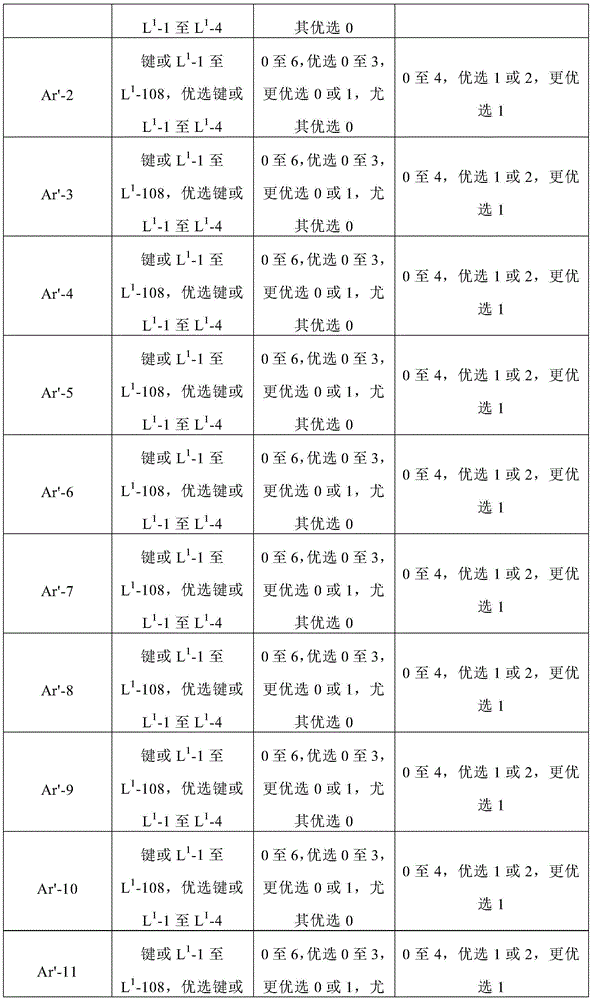

in a preferred embodiment, particular preference is given to the combination of structural units of the formula IIa with aromatic or heteroaromatic ring systems which have the following properties:


in a preferred embodiment, particular preference is given to the combination of a substructure of the formula II with a group containing an electron-transporting group, as shown in the following table:


in a preferred embodiment, particular preference is given to combinations of the substructures of the formula II having hole-transporting groups according to the following table:


further preferred are compounds of the invention having the structures of formulae (IIIa) to (IIIh) and (IVa) to (IVh) wherein the W group is more preferably O, S or NR, more preferably NR:

further preferred are compounds of the invention having the structures of formulae (IIIa) to (IIIh) and (IVa) to (IVh) wherein the W group is more preferably O, S or NR, more preferably NR:


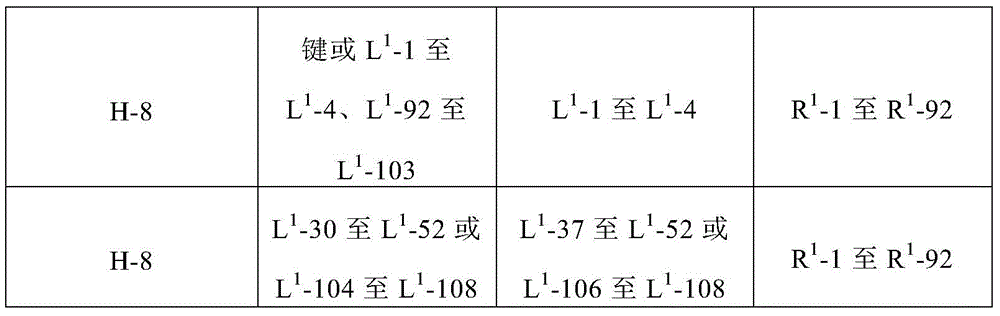
further preferred are compounds of the invention having the structures of formulae (IIIa) to (IIIh) and (IVa) to (IVh) wherein the W group is more preferably O, S or NR, more preferably NR:
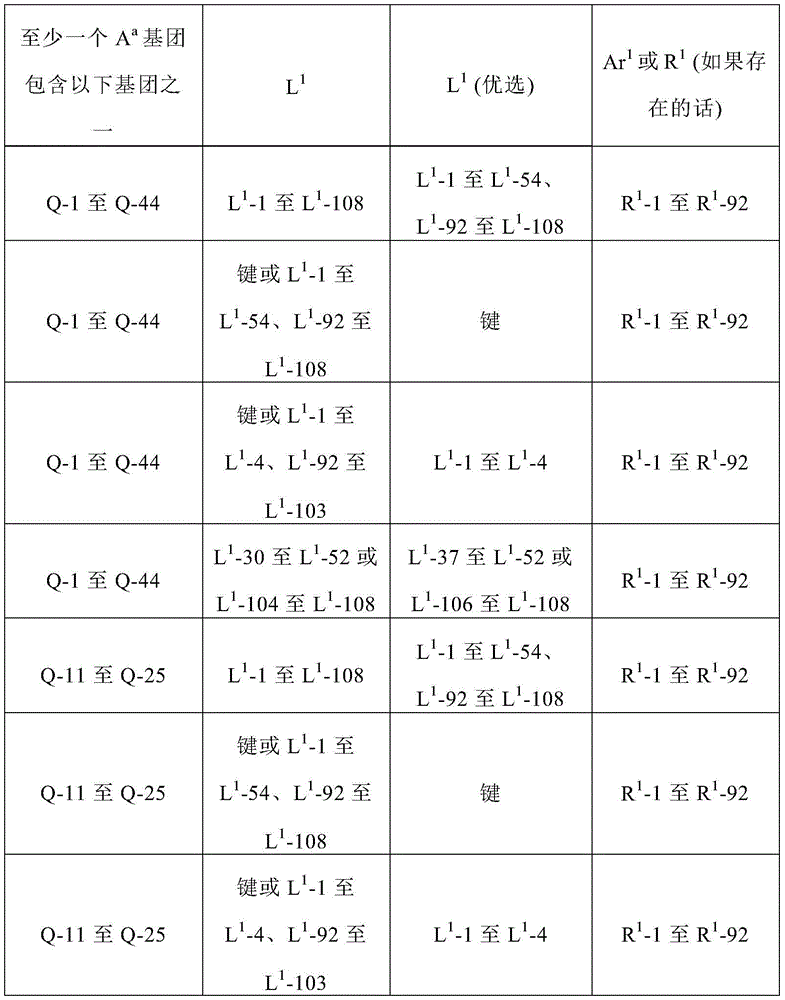


it may further be the case that the compound useful for manufacturing the functional layer of the electronic device is a ligand in a metal complex.
These metal complexes are novel and have unexpected technical advantages over known metal complexes. The present invention therefore also provides a metal complex comprising one or more structural units of the formulae (I) and/or (Ia) or preferred embodiments of these structural units.
Accordingly, the present invention also provides a metal complex comprising at least one structure of the general formula (1):
M(L)n(L')mformula (1)
The symbols and indices used therein are as follows:
m is a transition metal, preferably copper, molybdenum, tungsten, rhenium, ruthenium, osmium, rhodium, iridium, palladium, platinum, silver, gold or europium, more preferably iridium or platinum.
L is identical or different on each occurrence and is a bidentate ligand;
l' is identical or different on each occurrence and is a ligand;
n is 1,2 or 3, preferably 2 or 3, more preferably 2;
m is 0, 1,2,3 or 4, preferably 0, 1 or 2, more preferably 0 or 1, and especially preferably 0;
at the same time, two or more ligands L may also be linked to each other by a single bond or a divalent or trivalent bridging group, or L may also be linked to L' by a single bond or a divalent or trivalent bridging group, thereby forming a tridentate, tetradentate, pentadentate or hexadentate ligand system, characterized in that the metal complex contains at least one substructure of the formulae (2) and/or (2 a):


wherein the dashed bond represents the attachment of the group to another part of the metal complex of formula (1) and the symbol X has the definition described above especially for formula (I) or (Ia).
It may also be the case that the metal complex contains at least one substructure of the formulae (2-1) and/or (2 a-1):

wherein the dotted bond represents the attachment of the group to another part of the metal complex of formula (1), and the symbols u, v and R1Have the definitions stated above, in particular for formula (I), (Ia), (II) or (IIa).
In a preferred embodiment, the connection of the substructure of formula (2), (2a), (2-1) or (2a-1) represented by the dotted bond in formula (2), (2a), (2-1) or (2a-1) is bonded to an aromatic or heteroaromatic ring system, preferably to an aryl or heteroaryl group preferably having 5 to 40 ring atoms. Here, an aromatic or heteroaromatic ring system, preferably an aryl or heteroaryl group having from 5 to 40 ring atoms, preferably from 5 to 24 ring atoms and particularly preferably from 6 to 12 ring atoms, may be substituted by one or more R groups as defined above for formula (2); however, the groups are preferably unsubstituted. At the same time, the aromatic or heteroaromatic ring system or the aryl or heteroaryl group is preferably part of the ligand L and is directly coordinated to the metal M.
It may also be the case that the substructures of the formulae (2), (2a), (2-1) and/or (2a-1) are bonded directly to the metal atom M. This is preferably achieved by R or R1One of the groups is carried out.
The metal complexes of formula (1) according to the invention may contain one, two, three or more substructures of formula (2), (2a) as further detailed above or preferred embodiments thereof. In a particular embodiment, the metal complex of formula (1) of the present invention may comprise exactly one substructure of formula (2) or (2 a). Preferably, the metal complex of formula (1) may contain two, more preferably three or more substructures of formula (2) and/or (2a) as further detailed above or preferred embodiments thereof. Particularly preferably, the metal complexes of the formula (1) according to the invention comprise one, two, three or six substructures of the formulae (2) and/or (2a) or preferred embodiments thereof.
The bidentate ligand which is determined by the symbol L in formula (1) and is bonded to M is described below. The metal complex preferably may have one, two or three bidentate ligands. The coordinating atoms of the bidentate ligands here may be identical or different in each case and may be selected from C, N, P, O, S and/or B, more preferably C, N and/or O, and most preferably C and/or N. The bidentate ligand preferably has one carbon atom and one nitrogen atom or two carbon atoms or two nitrogen atoms or two oxygen atoms or one oxygen atom and one nitrogen atom as coordinating atoms. In this case, the coordinating atoms of each ligand may be the same, or they may be different. Preferably, at least one, more preferably all, of the bidentate ligands has one carbon atom and one nitrogen atom or two carbon atoms, especially one carbon atom and one nitrogen atom, as coordinating atoms. More preferably, at least two of the bidentate ligands, and most preferably all three bidentate ligands when M ═ Ir, have one carbon atom and one nitrogen atom or two carbon atoms, especially one carbon atom and one nitrogen atom, as coordinating atoms. Thus, iridium complexes in which all three bidentate ligands are ortho-metallated, i.e. form a metallocycle with iridium, in which at least one iridium-carbon bond is present, are particularly preferred.
More preferably, the metal complex does not comprise any monodentate ligands, and all bidentate ligands, which are identical or different in each case, have at least one carbon atom as coordinating atom. It should be emphasized again that bidentate ligands may be linked to each other and may have other coordination sites, and thus the term "bidentate ligand" refers to a ligand having at least two coordination sites. This is explicitly stated in the case of a bidentate ligand having exactly two coordination sites. In this connection, it should also be noted that the index n in formula (1) can be 1 and the index m can simultaneously be 0, wherein, in this case, for example, the bidentate ligands L are linked to one another and form a hexadentate ligand system. In this case, three ligands bonded to each other may also be considered to be sub-ligands.
The labeling in formula (1) or the preferred embodiments of said formula detailed above depends on the type of metal and the possible attachment of the ligand. For non-bridged iridium complexes (M ═ Ir), n is more preferably 3, and M is 0. Since platinum in preferred complexes is only tetra-coordinated, for non-bridged platinum complexes (M ═ Pt), n is more preferably 2, and M ═ 0. In the case of bridged complexes, bidentate ligands may be considered to be sub-ligands, and therefore, when considered in this manner, the details given above apply. In addition, depending on the degree of bridging, in a particularly preferred embodiment as described above and below, n is in each case 1, with particular preference being given to the formation of metal complexes containing iridium and hexadentate tripodal ligands or metal complexes containing platinum and tetradentate ligands.
Preferably, the metal complex of formula (1) comprises three bidentate ligands L, which may also optionally be linked. The three bidentate ligands may be the same or different. When the bidentate ligands are the same, they preferably also have the same substitution. When all three bidentate ligands selected are in phaseAt the same time, the result in the case of the polypod complex is C3-a symmetric iridium complex. It may also be advantageous to select the three bidentate ligands differently or to select two identical ligands and one different third ligand to generate C1Symmetric metal complexes because this allows for a greater possible variation of the ligands, so that the desired properties of the complex, such as HOMO and LUMO position or emission color, can be more easily changed. Furthermore, the solubility of the complex can thus also be improved without having to attach long aliphatic or aromatic solubility-imparting groups.
In a preferred embodiment of the invention, the three bidentate ligands are selected identically or the two bidentate ligands are selected identically and the third bidentate ligand is different from the first two bidentate ligands.
It may further be the case that the metal complex has three bidentate ligands, wherein all three ligands selected are the same, or two of the bidentate ligands selected are the same and the third bidentate ligand is different from the first two bidentate ligands.
It may further be the case that the metal is ir (iii) and the metal complex has three bidentate ligands, wherein two of the bidentate ligands are coordinated to the iridium by one carbon atom and one nitrogen atom respectively and the third of the bidentate ligands is coordinated to the iridium by one carbon atom and one nitrogen atom or by two carbon atoms or by two nitrogen atoms, wherein preferably the third of the bidentate ligands is coordinated to the iridium by one carbon atom and one nitrogen atom or by two carbon atoms.
In another configuration, it may be the case that the metal is Pt coordinated to two bidentate ligands.
It is further preferred that the metallocycle formed by the metal and the bidentate ligand is a five-membered ring, and it is particularly preferred that the coordinating atoms are C and N, C and C, N and N, or N and O. When the coordinating atom is O, a six-membered metallocycle may also be preferred. This is schematically shown below:

wherein N is a coordinating nitrogen atom, C is a coordinating carbon atom, and O represents a coordinating oxygen atom, and the carbon atom shown is an atom of a bidentate ligand.
In a preferred embodiment of the present invention, at least one of the bidentate ligands of the metal complex shown in formula (1), more preferably at least two of the bidentate ligands, most preferably all three bidentate ligands are identical or different in each case when M ═ Ir, and are selected from the structures of the following formulae (L-1), (L-2), (L-3), (L-4) and/or (L-5):

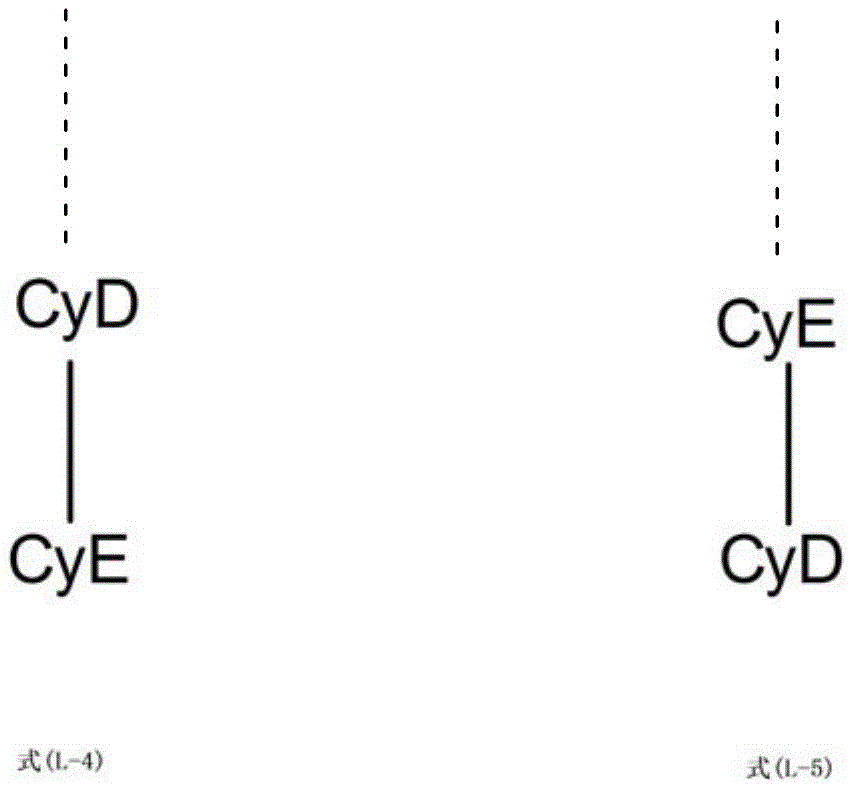
the symbols and indices used therein are as follows:
CyC is identical or different on each occurrence and is a substituted or unsubstituted aryl or heteroaryl group which has from 5 to 14 aromatic ring atoms and is coordinated to the metal in each case by a carbon atom and is bonded to CyD in each case by a covalent bond;
CyD is identical or different on each occurrence and is a substituted or unsubstituted heteroaryl group which has 5 to 14 aromatic ring atoms and is coordinated to the metal by a nitrogen atom or by a carbene carbon atom and is bonded to CyC by a covalent bond;
CyE are identical or different on each occurrence and are substructures of the formulae (2) and/or (2a), which are coordinated to the metal in each case via a carbon atom and are bonded to the CyD in each case via a covalent bond;
at the same time, two or more ligands L may also be connected to each other by a single bond or a divalent or trivalent bridging group, or L may be connected to L' by a single bond or a divalent or trivalent bridging group, thereby forming a tridentate, tetradentate, pentadentate or hexadentate ligand system; wherein these optional bonds to the bridging group are indicated by dashed bonds; meanwhile, two or more optional substituents together may form a ring system; at the same time, substituents may additionally coordinate to M; in addition, the optional groups are preferably selected from the above-mentioned R groups and/or substructures of formula (2) and/or (2 a).
Meanwhile, CyD in the ligands of the formulae (L-1) and (L-2) is preferably coordinated through an uncharged nitrogen atom or through a carbene carbon atom. Further preferably, one of the two CyD groups in the ligand of formula (L-3) is coordinated through an uncharged nitrogen atom and the other of the two CyD groups is coordinated through an anionic nitrogen atom. Further preferably, CyC in the ligands of formula (L-1) and (L-2) is coordinated through an anionic carbon atom.
When two or more substituents, especially two or more R groups, together form a ring system, the ring system may be formed from substituents bonded to directly adjacent carbon atoms. In addition, the substituents on CyC and CyD in the formulae (L-1) and (L-2) or on both CyD groups in the formula (L-3) can also together form a ring, with the result that CyC and CyD or both CyD groups or both CyC groups can also together form a single fused aryl or heteroaryl group as bidentate ligand.
In a preferred embodiment of the invention, CyC is an aryl or heteroaryl group having 6 to 13 aromatic ring atoms, more preferably 6 to 10 aromatic ring atoms, most preferably 6 aromatic ring atoms, which is coordinated to the metal through a carbon atom, which may be substituted by one or more R groups, and which is bonded to CyD through a covalent bond.
Preferred embodiments of CyC groups are of the formulae (CyC-1) to (CyC-20):


wherein CyC is bonded to CyD in each case at the position indicated by # and is coordinated to the metal at the position indicated by x, R has the definition given above, in particular for formula (I) or (Ia), and the other symbols used are as follows:
x is identical or different on each occurrence and is CR or N, wherein preferably no more than two X symbols in each ring are N;
w is NR, O or S;
wherein the ligand may optionally be bonded via a CyC group through a bridging group, wherein the bond to the bridging group may preferably be effected through the position marked "o", wherein if the position marked "o" constitutes the bridgehead site, it represents a carbon atom. When a CyC group is bonded to a bridging group, the bond is preferably achieved through the position of the label "o" in the formula depicted above, and thus the symbol X labeled "o" in this case is preferably C. The structure depicted above without any symbol X labeled "o" is preferably not directly bonded to the bridging group, since such bonding to the bridging group is disadvantageous for steric reasons.
Preferably, no more than two symbols X in total in CyC are N, more preferably no more than one symbol X in CyC is N, and especially preferably all symbols X are CR, provided that when CyC is bonded to a bridging group, one symbol X is C, and the bridging group is bonded to the carbon atom.
Particularly preferred CyC groups are those of the formulae (CyC-1a) to (CyC-20 a):
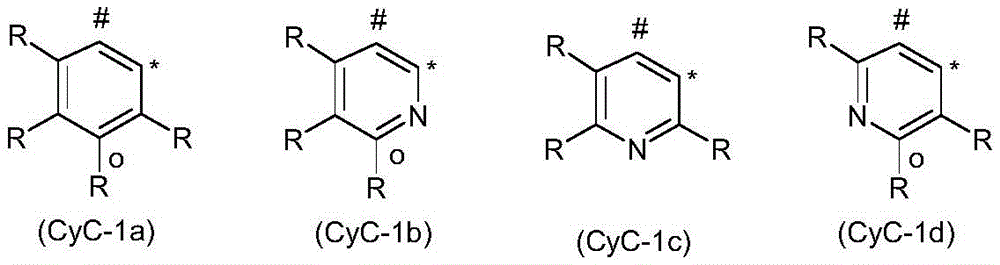

wherein the symbols have the definitions given above and when a bridging group is bonded to CyC, one R group is absent and said bridging group is bonded to the corresponding carbon atom. When a CyC group is bonded to a bridging group, the bond is preferably achieved through the position marked "o" in the formula depicted above, and thus the R group at that position is preferably absent in this case. The structure depicted above, which does not contain any carbon atom labeled "o", is preferably not directly bonded to a bridging group.
The position of the bonds via which the (sub) ligands can be bonded to one another via the bridging group can be different in the case of different metals, with preference being given to iridium, for example as shown in the structures of the formulae (CyC-1) to (CyC-20) and (CyC-1a) to (CyC-20 a). With regard to the position for platinum and similar metals, the examples give valuable indications, wherein bridging is preferably achieved by a position adjacent to the coordination or bonding site of the metal atom.
Preferred groups among the (CyC-1) to (CyC-19) groups are the (CyC-1), (CyC-3), (CyC-8), (CyC-10), (CyC-12), (CyC-13) and (CyC-16) groups, and particularly preferred are the (CyC-1a), (CyC-3a), (CyC-8a), (CyC-10a), (CyC-12a), (CyC-13a) and (CyC-16a) groups.
It may further be the case that CyC comprises a substructure of the formula (2), (2a), (2-1) and/or (2a-1) or a preferred embodiment of said substructure, or is formed by suitable substitution by an R group, where in this case the X group in the formula (2) or (2a) is CR1. More preferably, one R group in the above detailed embodiments of the CyC group represents a substructure of formula (2) or (2a) such that the bonding site shown by the dashed bond in formula (2) is directly bonded to the aromatic or heteroaromatic ring system shown in the CyC group. In the case of the configuration shown in formula (2a) or of a preferred embodiment thereof, the CyC group is bonded directly to the aromatic or heteroaromatic ring system shown in the CyC group via two bonding sites, so that the double bond shown in the structure of formula (2a), which is marked by a dashed bond, constitutes part of the aromatic or heteroaromatic ring system.
In another preferred embodiment of the invention, CyD is a heteroaryl group having 5 to 13 aromatic ring atoms, more preferably 6 to 10 aromatic ring atoms, which is coordinated to the metal by an uncharged nitrogen atom or by a carbene carbon atom and which may be substituted by one or more R groups and which is bonded to CyC by a covalent bond.
Preferred embodiments of the CyD group are of the following formulae (CyD-1) to (CyD-14):

wherein the CyD group is bonded to CyC in each case at the position indicated by # and coordinated to the metal at the position indicated by x, and the symbols used are as follows:
x is identical or different on each occurrence and is CR or N, with the proviso that at most two symbols X in each ring are N;
w is identical or different on each occurrence and is NR, O or S;
r has the definitions given above, especially for formula (I) or (Ia);
wherein X, W and R have the definitions given above, and wherein the ligand via the CyD group may optionally be bonded through a bridging group, wherein bonding to the bridging group may preferably be achieved by the position of the label "o", wherein if the position of the label "o" constitutes the bridgehead site, it represents a carbon atom. When a CyD group is bonded to the bridging group, the bond is preferably achieved through the position of the label "o" in the formula depicted above, and thus the symbol X labeled "o" in this case is preferably C. The structure depicted above without any symbol X labeled "o" is preferably not directly bonded to the bridging group, since such bonding to the bridging group is disadvantageous for steric reasons.
In this case, the (CyD-1) to (CyD-4), (CyD-7) to (CyD-10), (CyD-13) and (CyD-14) groups coordinate to the metal through an uncharged nitrogen atom, the (CyD-5) and (CyD-6) groups coordinate to the metal through a carbene carbon atom, and the (CyD-11) and (CyD-12) groups coordinate to the metal through an anionic nitrogen atom.
Preferably, no more than two symbols X in total in CyD are N, more preferably no more than one symbol X in CyD is N, and especially preferably all symbols X are CR, provided that when CyD is bonded to a bridging group, one symbol X is C, and the bridging group is bonded to the carbon atom.
Particularly preferred CyD groups are those of the formulae (CyD-1a) to (CyD-14 b):

wherein the symbols used have the definitions given above and when a bridging group is bonded to CyD, one R group is absent and the bridging group is bonded to the corresponding carbon atom. When a CyD group is bonded to the bridging group, said bonding is preferably effected through the position marked "o" in the formula depicted above, and therefore the R group in said position is preferably absent in this case. The structure depicted above, which does not contain any carbon atom labeled "o", is preferably not directly bonded to a bridging group.
The position of the bonds via which the (sub) ligands can be bonded to one another via the bridging group may differ in the case of different metals, with preference being given to iridium, for example as shown in the structures of formulae (CyD-1) to (CyD-14) and (CyD-1a) to (CyD-14 b). With regard to the position for platinum and similar metals, the examples give valuable indications, wherein bridging is preferably achieved by a position adjacent to the coordination or bonding site of the metal atom.
Preferred groups among the (CyD-1) to (CyD-10) groups are the (CyD-1), (CyD-2), (CyD-3), (CyD-4), (CyD-5) and (CyD-6) groups, especially the (CyD-1), (CyD-2) and (CyD-3), and particularly preferably the (CyD-1a), (CyD-2a), (CyD-3a), (CyD-4a), (CyD-5a) and (CyD-6a) groups, especially the (CyD-1a), (CyD-2a) and (CyD-3 a).
In a preferred embodiment of the invention, CyC is an aryl or heteroaryl group having 6 to 13 aromatic ring atoms and CyD is a heteroaryl group having 5 to 13 aromatic ring atoms at the same time. More preferably, CyC is an aryl or heteroaryl group having 6 to 10 aromatic ring atoms, and CyD is a heteroaryl group having 5 to 10 aromatic ring atoms at the same time. Most preferably, CyC is an aryl or heteroaryl group having 6 aromatic ring atoms and CyD is a heteroaryl group having 6 to 10 aromatic ring atoms. Also, CyC and CyD may be substituted with one or more R groups.
Further aspects may be that CyD comprises a substructure of formula (2), (2a), (2-1) and/or (2a-1) or a preferred embodiment of said substructure, or by suitable substitution by the R groupWherein in this case the X group in the formula (2) or (2a) is CR1. More preferably, one R group in the above detailed embodiments of the CyD group represents a substructure of formula (2) or (2a) such that the bonding site shown by the dashed bond in formula (2) is directly bonded to the aromatic or heteroaromatic ring system shown in the CyD group. In the case of the configuration shown in formula (2a) or a preferred embodiment thereof, the CyD group is directly bonded to the aromatic or heteroaromatic ring system shown in the CyD group via two bonding sites, so that the double bond shown in the structure of formula (2a), which is marked by a dashed bond, constitutes part of the aromatic or heteroaromatic ring system.
The above-mentioned preferred groups (CyC-1) to (CyC-20) and (CyD-1) to (CyD-14) may be combined with each other as desired in the ligands of the formulae (L-1) and (L-2). In this case, at least one of the CyC or CyD groups may have a suitable attachment site to the bridging group, where the suitable attachment site in the above formula is identified by an "o". Especially preferred are the CyC and CyD groups mentioned as particularly preferred above, i.e.the groups of the formulae (CyC-1a) to (CyC-20a) and the groups of the formulae (CyD-1a) to (CyD-14b), in combination with one another. Therefore, a combination in which neither CyC nor CyD has such a suitable attachment site to the bridging group is not preferred.
Very particular preference is given to combining one of the (CyC-1), (CyC-3), (CyC-8), (CyC-10), (CyC-12), (CyC-13) and (CyC-16) radicals and especially one of the (CyC-1a), (CyC-3a), (CyC-8a), (CyC-10a), (CyC-12a), (CyC-13a) and (CyC-16a) radicals with one of the (CyD-1), (CyD-2) and (CyD-3) radicals and especially with one of the (CyD-1a), (CyD-2a) and (CyD-3a) radicals.
The above-mentioned preferred (CyD-1) to (CyD-14) groups may be combined as desired with the groups of the formulae (2), (2a), (2-1) and (2a-1) in the ligands of the formulae (L-4) and (L-5). In this case, at least one of the CyD group or the substructure of formulas (2), (2a), (2-1) and (2a-1) may have a suitable attachment site to the bridging group, where the suitable attachment site in the above formulas is identified by "o". Particularly preferred are the CyD groups mentioned above as particularly preferred, i.e.the groups of the formulae (CyD-1a) to (CyD-14b), in combination with the substructures of the formulae (2), (2a), (2-1) and (2 a-1).
Preferred ligands (L-1) are structures of the following formulae (L-1-1) and (L-1-2), and preferred ligands (L-2) are structures of the following formulae (L-2-1) to (L-2-3):

wherein the symbols used have the definitions given above and the ligand may optionally be bonded via a bridging group, wherein the bonding to the bridging group may preferably be achieved by the position marked "o", wherein if the position marked "o" constitutes a bridgehead site, it represents a carbon atom.
Particularly preferred ligands (L-1) are the structures of the following formulae (L-1-1a) and (L-1-2b), and particularly preferred ligands (L-2) are the structures of the following formulae (L-2-1a) to (L-2-3 a):

wherein the symbols used have the definitions given above and the ligand may optionally be bonded via a bridging group, wherein the bonding to the bridging group may preferably be achieved by the position marked "o", wherein if the position marked "o" constitutes a bridgehead site, it represents a carbon atom. If the ligand is not bridged, the position marked "o" may also be substituted by an R group.
It is likewise possible that the above-mentioned preferred CyD groups in the ligands of the formula (L-3) are combined with one another, as desired, preferably with uncharged CyD groups (i.e., (CyD-1) to (CyD-10), (CyD-13) or (CyD-14) groups) and anionic CyD groups (i.e., (CyD-11) or (CyD-12) groups), wherein the ligands can optionally be bonded via bridging groups, wherein the bonding to the bridging groups can preferably be effected via positions marked "o", wherein suitable attachment sites in the above-mentioned formula are defined by "o".
The position of the bonds via which the (sub) ligands can be bonded to one another via the bridging group can be different in the case of different metals, where, for example, the structures of the formulae (L-1-1) to (L-2-3) and (L-1-1a) to (L-2-3a) or the preferences shown in the preferred embodiments of these structures described below are suitable for iridium. With regard to the position for platinum and similar metals, the examples give valuable indications, wherein bridging is preferably achieved by a position adjacent to the coordination or bonding site of the metal atom.
When two R groups, wherein in the formulae (L-1) and (L-2) one of them is bonded to CyC and the other is bonded to CyD, or wherein in the formula (L-3) one of them is bonded to one CyD group and the other is bonded to the other CyD group, or one of them is bonded to one CyD group and the other is bonded to the substructure of the formulae (2) or (2-1), form an aromatic ring system with one another, it is possible to produce bridged ligands and, for example, also ligands which overall form a single larger heteroaryl group, such as, for example, benzo [ h ] h]Quinoline, and the like. The cyclization between CyC and the substituents on CyD in the formulae (L-1) and (L-2) or between the substituents on two CyD groups in the formula (L-3) or between CyD in the formulae (L-4) or (L-5) and the substituents on the substructure of the formulae (2) or (2-1) is preferably effected by a group according to one of the following formulae (RB-1) to (RB-10):
wherein R is1Have the definitions given above, and the dashed bonds indicate bonding to CyC or CyD. Meanwhile, asymmetric groups among those mentioned above may be incorporated in each of two options; for example, in the group of formula (RB-10), an oxygen atom may be bonded to a CyC group and a carbonyl group may be bonded to a CyD group, or an oxygen atom may be bonded to a CyD group and a carbonyl group may be bonded to a CyC group.
Meanwhile, when this causes cyclization to give a six-membered ring as shown below, for example, by the formulae (L-23) and (L-24), the group of the formula (RB-7) is particularly preferred.
Preferred ligands produced by ring formation between two R groups on different rings are structures of formulae (L-5) to (L-32) shown below:
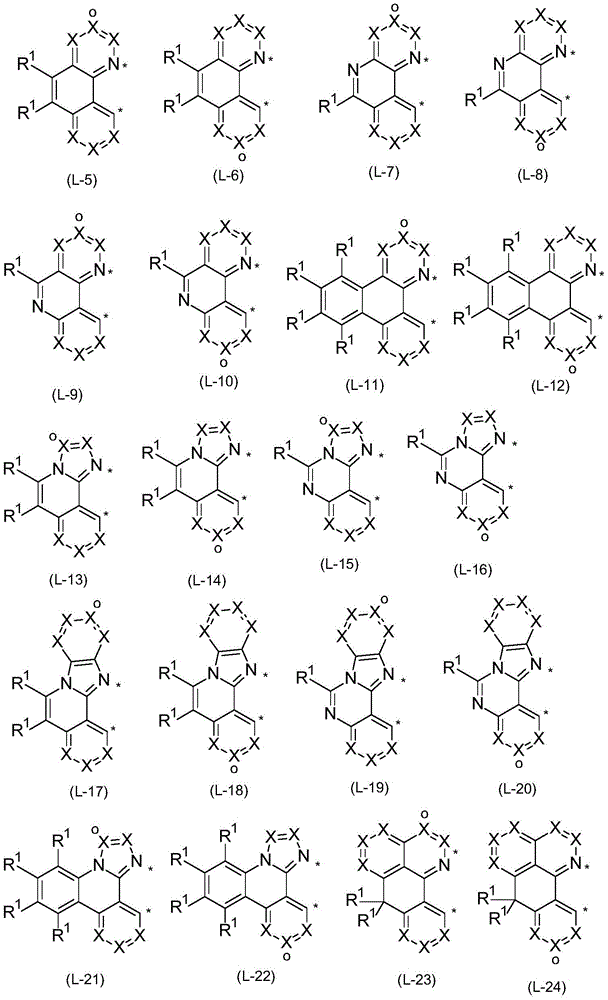

wherein the symbols used have the definitions given above, wherein the ligands may optionally be bonded via a bridging group, wherein the bonding to the bridging group may preferably be achieved by the position marked "o", wherein if the position marked "o" constitutes a bridgehead site, it represents a carbon atom.
In a preferred embodiment of the ligands of formulae (L-5) to (L-32), in general one symbol X is N and the other symbols X are CR, or all symbols X are CR, with the proviso that when the ligands are bonded via a bridging group, one symbol X is C and the bridging group is bonded to the carbon atom.
In another embodiment of the invention, it is preferred that in the groups (CyC-1) to (CyC-20) or (CyD-1) to (CyD-14) or in the ligands (L-5) to (L-3), when the R group bonded as a substituent adjacent to the nitrogen atom is other than hydrogen or deuterium, one of the atoms X is N. This applies analogously to the preferred structures (CyC-1a) to (CyC-20a) or (CyD-1a) to (CyD-14b), wherein the substituent bonded adjacent to the non-coordinating nitrogen atom is preferably an R group, which is not hydrogen or deuterium. The substituents R are preferably groups selected from: CF (compact flash)3,OCF3Alkyl or alkoxy groups having 1 to 10 carbon atoms, in particular branched or cyclic alkyl or alkoxy groups having 3 to 10 carbon atoms, dialkylamino groups having 2 to 10 carbon atoms, aromatic or heteroaromatic ring systems or aralkyl or heteroaralkyl groups. These groups are sterically demanding groups. Further preferably, the R group may also form a ring with an adjacent R group.
Further suitable bidentate ligands are ligands of the formula (L-33) or (L-34)

Wherein R has the definition given above, denotes a position coordinated to the metal, wherein the ligand may optionally be bonded via a bridging group, wherein the bonding to the bridging group may preferably be achieved by the position marked "o", and the other symbols used are as follows:
x is identical or different on each occurrence and is CR or N, with the proviso that not more than one symbol X in each ring is N, wherein X at that position is C if the ligand is bonded to a bridging group at that position.
When two R groups bonded to adjacent carbon atoms in the ligands (L-33) and (L-34) form an aromatic ring with each other, the ring together with these two adjacent carbon atoms is preferably of the formula (BR-11):

wherein the dashed bonds symbolize the attachment of the groups within the ligand, and Y is identical or different in each case and is CR1Or N, and preferably no more than one symbol Y is N.
In a preferred embodiment of the ligands (L-33) or (L-34), there is no more than one radical of the formula (BR-11). Thus, the ligand is preferably a ligand of the following formulae (L-35) to (L-40):

wherein R has the definition given above, denotes a position coordinated to the metal, wherein the ligand may optionally be bonded via a bridging group, wherein the bonding to the bridging group may preferably be achieved by the position marked "o", and the other symbols used are as follows:
x is the same or different at each occurrence and is CR or N, provided that no more than one X symbol in each ring is N, wherein X at that position is C if the ligand is bonded to a bridging group at that position;
y is identical or different on each occurrence and is CR1Or N, and preferably no more than one symbol Y is N, wherein R is1With the definitions given above.
In a preferred embodiment of the invention, in the ligands of the formulae (L-33) to (L-40), a total of 0, 1 or 2 symbols X and, if Y is present, Y is N. More preferably, a total of 0 or 1 symbols X and (if Y is present) Y is N.
In a preferred embodiment of the invention, the X group in the ortho position coordinated to the metal is CR. In said groups, R bonded in the ortho position coordinated to the metal is preferably selected from H, D, F and methyl.
In another embodiment of the present invention, if one atom X or (if Y is present) Y is N, then preferably the substituent bonded adjacent to said nitrogen atom is an R group, said R group being other than hydrogen or deuterium. The substituents R are preferably groups selected from: CF (compact flash)3,OCF3Alkyl or alkoxy groups having 1 to 10 carbon atoms, in particular branched or cyclic alkyl or alkoxy groups having 3 to 10 carbon atoms, dialkylamino groups having 2 to 10 carbon atoms, aromatic or heteroaromatic ring systems or aralkyl or heteroaralkyl groups. These groups are sterically demanding groups. Further preferably, the R group may also form a ring with an adjacent R group.
Other suitable bidentate ligands are structures of the formulae (L-41) to (L-45), where preferably no more than one of the three bidentate ligands is one of these structures,

wherein the ligands (L-41) to (L-43) are each coordinated to the metal via the explicitly shown nitrogen atom and the negatively charged oxygen atom, and the ligands (L-44) and (L-45) are coordinated to the metal via two oxygen atoms, R and X have the definitions given above, in particular for formula (I) or (Ia), wherein the ligands may optionally be bound via a bridging group, wherein the binding to the bridging group may preferably be effected via a position marked "o", wherein X at this position is C if the ligand is bound to the bridging group at this position, or, in formula (L-44) or (L-45), the carbon atom at this position may have a substituent R if the ligand is not bound to the bridging group at this position.
The preferred embodiments listed above for X are also preferred for the ligands of formulae (L-41) to (L-43).
Thus, preferred ligands of formulae (L-41) to (L-43) are ligands of formulae (L-41a) to (L-43 a):

wherein the symbols used have the definitions given above and one R group is absent, wherein the ligand may optionally be bound by a bridging group, wherein the binding to the bridging group may preferably be achieved by the position marked "o", or in formula (L-41a), (L-42a) or (L-43a) the carbon atom at this position may have a substituent R if the ligand is not bound to the bridging group at this position.
More preferably, in these formulae, R is hydrogen, wherein the ligand may optionally be bonded through a bridging group, wherein the bonding to the bridging group may preferably be achieved by the position of the label "o", and thus the structures are those of the following formulae (L-41b) to (L-43 b):

wherein the symbols used have the definitions given above.
Further preferred bidentate ligands are of the formula (L-46):

wherein X and R have the definitions given above, represent a position coordinated to the metal, wherein the ligand may optionally be bonded via a bridging group. In this case, the group R bonded to N is preferably not H, but an alkyl, heteroalkyl, aryl or heteroaryl group as detailed above for R. Preferably, no more than two X's in each ring are N; more preferably, all X are CR, wherein the ligand may be bonded through the R group.
Thus, preferred ligands of formula (L-46) are ligands of formula (L-46 a):

wherein the symbols used have the definitions given above.
The ligands of the formulae (L-1) to (L-46) or preferred configurations thereof preferably comprise at least one substructure of the formulae (2) and/or (2a), where the substructure is preferably bound by R or R1Suitable substitution of the group, in which case the X group in formula (2) or (2a) is CR1. More preferably, one of the R groups in the above detailed embodiments of the ligands of formulae (L-1) to (L-46) represents a substructure of formula (2) or (2a) such that the bonding site indicated by the dashed bond in formula (2) is directly bonded to an aromatic or heteroaromatic ring system. In the case of the configuration shown in formula (2a) or of a preferred embodiment thereof, the ligands of formulae (L-1) to (L-46) are bonded directly to the aromatic or heteroaromatic ring system via two bonding sites, so that the double bond marked by a dashed bond shown in the structure of formula (2a) forms part of the aromatic or heteroaromatic ring system.
In a preferred embodiment, the metal complex corresponds to the general formula
M(L)n(L')mFormula (1a)
Wherein the symbol M and the ligands L and/or L' have the definitions given above, especially for formula (1), and at least some of the ligands are linked by a bridging group to form a tridentate, tetradentate, pentadentate or hexadentate ligand system, and preferably to form a metal complex comprising iridium and hexadentate tripodal ligands, with the proviso that the metal complex contains at least one substructure of formula (2) or (2a)

Wherein the symbols have the definitions given above, in particular for formulae (1) and (2), wherein the preferences mentioned above also apply to these symbols. In this case, the ligands L and L' can be considered as three bidentate sub-ligands coordinated to the metal. Preferably, the bridging group may be an aryl or heteroaryl group having from 5 to 36 aromatic ring atoms and which may be substituted by one or more R groups. The metal complex of the general formula (1a) may preferably contain the structure of the formula (2-1) and/or (2a-1) as described in detail above.
In the case of Pt, in the structure of formula (1a), a tetradentate ligand system is preferably formed.
Preferred iridium and platinum complexes are described below. The same applies to the other metal atoms listed for M in formula (1). As mentioned above, these are organometallic complexes. In the context of the present invention, an organometallic complex is a complex having at least one metal-carbon bond with a ligand.
In a preferred embodiment of the invention, the iridium or platinum complex is uncharged, i.e. electrically neutral. Thus, the iridium complex preferably contains three bidentate monoanionic ligands or one tridentate ligand, and the platinum complex contains two bidentate monoanionic ligands or one tetradentate dianionic ligand.
The bond of the ligand to the iridium or platinum may be a coordination bond or a covalent bond, or the covalent portion of the bond may vary depending on the ligand. When in the present application it is said that the ligand is coordinated or bonded to iridium or platinum, in the context of the present application this means that the ligand is bonded to any kind of iridium or platinum, irrespective of the covalent component of the bond.
In another preferred embodiment of the invention, M is platinum and thus the organometallic platinum complex comprises a substructure of formula (2) or (2 a). When M is platinum, the complex preferably comprises two bidentate ligands which may be linked to each other. In this case, these ligands are identical or different and are preferably selected from the ligands of the formulae (L-1), (L-2) and (L-3) depicted above, with the preferences mentioned above also applying to these ligands.
When M is platinum and the platinum complex comprises a tetradentate ligand, this can be schematically illustrated by the following formula (Lig'):

wherein V' is selected from CR2NR, O, S and BR, preferably CR2And NR, wherein R has the definition given above, and L1 and L2 are identical or different in each case and are each a bidentate ligand, preferably a monoanionic bidentate ligand. Since the ligand has two bidentate ligands, the overall result is a tetradentate ligand, i.e., a ligand that coordinates or bonds to platinum through four coordination sites.
Thus, the platinum complex formed with the ligand of formula (Lig') can be schematically represented by the following formula:

wherein the symbols used have the definitions given above.
The (sub) ligands can differ in the case of different metals by the position of their bonds to one another via a bridging group, wherein, for example, the preferences indicated apply to iridium. With regard to the position for platinum and similar metals, the examples give valuable indications, wherein bridging is preferably achieved by a position adjacent to the coordination or bonding site of the metal atom.
In a preferred embodiment of the invention, M is iridium. It may be the case here that the metal is ir (iii) and the metal complex has three bidentate ligands, wherein in each case two of the bidentate ligands are coordinated to the iridium by one carbon atom and one nitrogen atom or by two carbon atoms and the third of the bidentate ligands is coordinated to the iridium by one carbon atom and one nitrogen atom or by two carbon atoms or by two nitrogen atoms, wherein preferably the third of the bidentate ligands is coordinated to the iridium by one carbon atom and one nitrogen atom or by two carbon atoms.
Particularly preferred are iridium complexes having a tripodal hexadentate ligand as described below. The tripodal hexadentate ligand contains three bidentate sub-ligands, which may be the same or different, coordinated to the iridium atom, wherein the three bidentate sub-ligands are linked by a bridging group of formula (3) or formula (4):

wherein the dotted bond constitutes the bond of the bidentate ligand to the structure, R, R1And R2Having the definitions given above and, in addition:
X1in each case identical or different and is CR or N;
A1in each case identical or different and is C (R)2Or O;
A2in each case identical or different and is CR, P (═ O), B or SiR, with the proviso that when A is2When P (═ O), B or SiR, the symbol a1Is O and is in contact with said A2The bonded symbol a is not-C (═ O) -NR' -or-C (═ O) -O-;
a is identical or different on each occurrence and is-CR-, -C (═ O) -NR' -, -C (═ O) -O-, or a radical of the formula (5):

wherein the dotted bond represents the position at which a bidentate ligand is bonded to the structure, and*represents the position at which the unit of formula (5) is attached to the central cyclic group;
X2in each case identical or different and is CR or N, or two adjacent X2The radicals together being NR, O or S, thus forming a five-membered ring, and the remainder X2In each case identical or different and is CR or N; or when one X in the ring is3When the radicals are N, two adjacent X2The groups together are CR or N, thereby forming a five-membered ring; provided that no more than two adjacent X' s2The group is N;
X3in each case C, or an X3The radical being NAnd other X's in the same ring3The group is C; provided that when one X in said ring is3When the radicals are N, two adjacent X2The groups together are CR or N;
r' is identical or different on each occurrence and is H, D, a straight-chain alkyl radical having from 1 to 20 carbon atoms or a branched or cyclic alkyl radical having from 3 to 20 carbon atoms, where the alkyl radical may in each case be substituted by one or more R1Substituted by radicals, and in which one or more non-adjacent CH2The radical may be substituted by Si (R)1)2Instead of, or with 5 to 40 aromatic ring atoms and may in each case be substituted by one or more R1A group-substituted aromatic or heteroaromatic ring system;
also, in addition to being separated by bridging groups of formula (3) or (4), the three bidentate sub-ligands may be closed by other bridging groups to form cryptates.
When two R or R1Or R2When the groups together form a ring system, they may be monocyclic or polycyclic and aliphatic, heteroaliphatic, aromatic or heteroaromatic. In this case, the groups which together form a ring system may be adjacent, which means that these groups are bonded to the same carbon atom or to carbon atoms which are directly bonded to one another, or they may be further apart from one another.
The structure of the hexadentate tripodal ligand can be shown in schematic form by the following formula (Lig):

wherein V represents a bridging group of formula (3) or (4), and L1, L2 and L3 are in each case identical or different and are each a bidentate, preferably monoanionic, bidentate, sub-ligand. By "bidentate" is meant that a particular ligand in complex M coordinates or bonds to iridium via two coordination sites. By "tripodal" is meant a ligand having three sub-ligands bonded to bridging group V or a bridging group of formula (3) or (4). Since the ligand has three bidentate sub-ligands, the overall result is a hexadentate ligand, i.e., a ligand that coordinates or bonds to iridium through six coordination sites. In the context of the present application, the expression "bidentate sub-ligand" means that the unit will be a bidentate ligand if no bridging group of formula (3) or (4) is present. However, since the form of the hydrogen atom in the bidentate ligand is removed and linked to the bridging group of formula (3) or (4), it is not a separate ligand but part of the hexadentate ligand resulting therefrom, and the term "sub-ligand" is therefore used.
Thus, the iridium complex formed with the ligand of formula (Lig) can be schematically represented by the following formula:
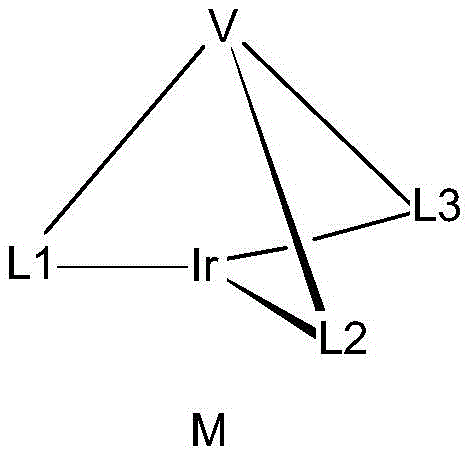
wherein V represents a bridging group of formula (3) or (4), and L1, L2 and L3 are in each case identical or different and are each a bidentate sub-ligand.
Preferred embodiments of the bridging group of formula (3) or (4) are detailed below. Suitable embodiments of the group of formula (3) are structures of the following formulae (6) to (9), and suitable embodiments of the group of formula (4) are structures of the following formulae (10) to (14):

wherein the symbols have the definitions given above.
For the preferred R groups on the trivalent central benzene ring of formula (6), on the pyrimidine ring of formula (8), on the pyridine ring of formula (9) and on the central (hetero) aliphatic ring of formulae (10) to (14), the following applies:
r is identical or different on each occurrence and is H, D, F, CN, a linear alkyl or alkoxy radical having from 1 to 10 carbon atoms or an alkenyl radical having from 2 to 10 carbon atoms or a branched or cyclic alkyl or alkoxy radical having from 3 to 10 carbon atoms, each of which may be substituted by one or more R1Substituted by radicals, or having 5 to 24 aromatic ring atoms and in each case being able to be substituted by one or more R1A group-substituted aromatic or heteroaromatic ring system;
R1are identical or different on each occurrence and are H, D, F, CN, a linear alkyl or alkoxy radical having from 1 to 10 carbon atoms or an alkenyl radical having from 2 to 10 carbon atoms or a branched or cyclic alkyl or alkoxy radical having from 3 to 10 carbon atoms, each of which may be substituted by one or more R2Substituted by radicals, or having 5 to 24 aromatic ring atoms and in each case being able to be substituted by one or more R2A group-substituted aromatic or heteroaromatic ring system; simultaneously, two or more adjacent R1The groups may together form a ring system;
R2in each case identical or different and are H, D, F or aliphatic, aromatic and/or heteroaromatic organic radicals having from 1 to 20 carbon atoms, in which one or more hydrogen atoms may also be replaced by F.
For particularly preferred R groups on the trivalent central benzene ring of formula (6), on the pyrimidine ring of formula (8), on the pyridine ring of formula (9) and on the central (hetero) aliphatic ring of formulae (10) to (14), the following applies:
r is identical or different on each occurrence and is H, D, F, CN, a straight-chain alkyl radical having from 1 to 4 carbon atoms or a branched or cyclic alkyl radical having from 3 to 6 carbon atoms, which may each be substituted by one or more R1Substituted by radicals, or having 6 to 12 aromatic ring atoms and in each case being able to be substituted by one or more R1A group-substituted aromatic or heteroaromatic ring system;
R1are identical or different on each occurrence and are H, D, F, CN, a straight-chain alkyl radical having from 1 to 4 carbon atoms or a branched or cyclic alkyl radical having from 3 to 6 carbon atoms, each of which may be substituted by one or more R2Substituted by radicals, or having 6 to 12 aromatic ring atoms and in each case being able to be substituted by one or more R2A group-substituted aromatic or heteroaromatic ring system; simultaneously, two or more adjacent R1The groups may together form a ring system;
R2in each case identical or different and are H, D, F or an aliphatic or aromatic hydrocarbon radical having from 1 to 12 carbon atoms.
In a preferred embodiment of the invention, all X's in the radical of formula (3)1The groups are all CR and thus the central trivalent ring of formula (3) is benzene. More preferably, all X' s1The radicals are all CH. In another preferred embodiment of the present invention, all xs1The groups are all nitrogen atoms and thus the central trivalent ring of formula (3) is a triazine. Accordingly, a preferred embodiment of formula (3) is the structure of formulae (6) and (7). More preferably, the structure of formula (6) is a structure of the following formula (6'):

wherein the symbols have the definitions given above.
In another preferred embodiment of the present invention, all A's in the radical of formula (4)2The radicals are all CR. More preferably, all A2The radicals are all CH. Accordingly, a preferred embodiment of formula (4) is the structure of formula (10). More preferably, the structure of formula (10) is a structure of the following formula (10') or (10 "):

wherein the symbols have the definitions given above and R is preferably H.
Preferred embodiments of the group of formula (5) are described below. The group of formula (5) may represent a heteroaromatic five-membered ring or an aromatic or heteroaromatic six-membered ring. In a preferred embodiment of the invention, the radical of formula (5) contains not more than two heteroatoms, more preferably not more than one heteroatom, in the aromatic or heteroaromatic unit. This does not mean that any substituent bonded to the group also cannot contain a heteroatom. In addition, the definition does not imply that the ring formed by the substituents does not result in fused aromatic or heteroaromatic structures, such as naphthalene, benzimidazole, and the like.
When two X in the formula (5)3When the groups are all carbon atoms, a preferred embodiment of the group of formula (5) is as followsStructures of formulae (15) to (31), and when an X3The radical being a carbon atom and another X in the same ring3When the group is a nitrogen atom, a preferred embodiment of the group of formula (5) is a structure of the following formulae (32) to (39):
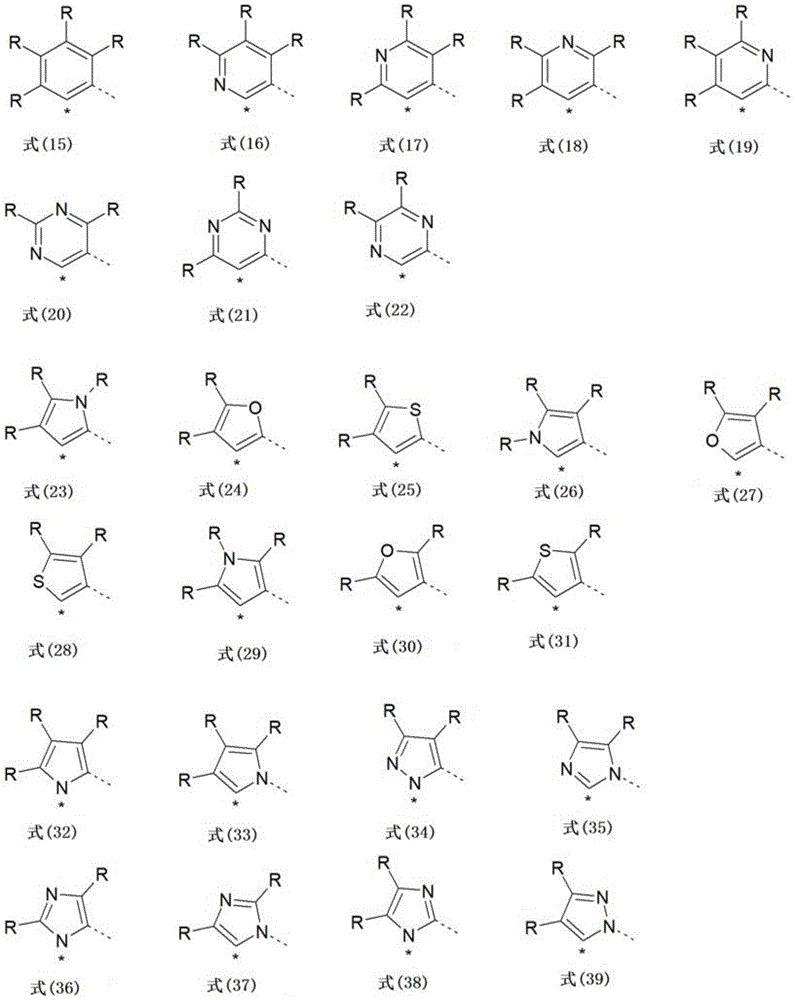
wherein the symbols have the definitions given above.
The six-membered aromatic and heteroaromatic rings of the formulae (15) to (19) depicted above are particularly preferred. Very particular preference is given to the o-phenylene radical, i.e.the radical of the formula (15) described above.
Also, adjacent R substituents may together form a ring system, such that fused structures may be formed, including fused aryl and heteroaryl groups, such as naphthalene, quinoline, benzimidazole, carbazole, dibenzofuran, or dibenzothiophene. Such ring formation is schematically shown below with the group of formula (15) above, which results in groups of the following formulae (15a) to (15 j):

wherein the symbols have the definitions given above.
In general, the fused group may be fused to any position in the unit of formula (5) as shown by the fused benzo groups in formulas (15a) to (15 c). Thus, the groups fused to the unit of formula (5) in formulae (15d) to (15j) may also be fused to other positions in the unit of formula (5).
The group of formula (3) may be more preferably represented by the following formulae (3a) to (3m), and the group of formula (4) may be more preferably represented by the following formulae (4a) to (4 m):


wherein the symbols have the definitions given above. Preferably, X2In each case identical or different and is CR.
In a preferred embodiment of the invention, the groups of formulae (3a) to (3m) are selected from the groups of formulae (6a ') to (6m'), and the groups of formulae (4a) to (4m) are selected from the groups of formulae (10a ') to (10 m'):


wherein the symbols have the definitions given above. Preferably, X2In each case identical or different and is CR.
A particularly preferred embodiment of the radical of formula (3) is a radical of formula (6 a'):

wherein the symbols have the definitions given above.
More preferably, the R groups in the above formula are the same or different and are H, D or an alkyl group having 1 to 4 carbon atoms. Most preferably, R ═ H. Very particular preference is therefore given to a structure of the formula (6 a'):

wherein the symbols have the definitions given above.
Preferred substituents, as may be present on the above-described sub-ligands and ligands, but also on the divalent aromatic or heteroaromatic moieties in the structure of formula (5), are described below.
In a preferred embodiment of the invention, the metal complexes of the invention contain two R substituents or two R1Substituents bonded to adjacent carbon atoms and together forming an aliphatic ring according to one of the formulae described below. In this case, the two R substituents forming the aliphatic ring may be present on the bridging group of formula (3) or (4) or preferred embodiments and/or on one or more bidentate ligands. By two R substituents together or by two R1The aliphatic ring formed by the substituents forming a ring together is preferably described by one of the following formulae (40) to (46):

wherein R is1And R2With the definitions given above, the dashed bond indicates the connection of two carbon atoms in the ligand, and in addition:
Z1、Z3in each case identical or different and is C (R)3)2、O、S、NR3Or C (═ O);
Z2is C (R)1)2、O、S、NR3Or C (═ O);
g is a radical having 1,2 or 3 carbon atoms and may be substituted by one or more R2A group-substituted alkylidene group, -CR2=CR2Or having 5 to 14 aromatic ring atoms and which may be substituted by one or more R2Group-substituted ortho-bonded arylidene or heteroarylidene groups;
R3are identical or different on each occurrence and are H, F, a linear alkyl or alkoxy radical having from 1 to 10 carbon atoms, a branched or cyclic alkyl or alkoxy radical having from 3 to 10 carbon atoms, where the alkyl or alkoxy radical may in each case be substituted by one or more R2Is substituted by one or more radicalsNon-adjacent CH2The group can be represented by R2C=CR2、C≡C、Si(R2)2、C=O、NR2O, S or CONR2Instead of, or with 5 to 24 aromatic ring atoms and may in each case be substituted by one or more R2Aromatic or heteroaromatic ring systems substituted by radicals, or having 5 to 24 aromatic ring atoms and which may be substituted by one or more R2A group-substituted aryloxy or heteroaryloxy group; simultaneously, two R's bound to the same carbon atom3The groups may together form an aliphatic or aromatic ring system, thereby forming a spiro ring system; in addition, R3To adjacent R or R1The groups may form an aliphatic ring system;
provided that no two heteroatoms in these groups are directly bonded to each other, and no two C ═ O groups are directly bonded to each other.
In a preferred embodiment of the invention, R3Is not H.
In the structures of formulae (40) to (46) depicted above and other embodiments of these structures designated as preferred, the double bond is depicted formally between these two carbon atoms. This is a simplification of the chemical structure, the two carbon atoms being incorporated into an aromatic or heteroaromatic system, and the bond between the two carbon atoms is therefore formally between the bonding level of a single bond and the bonding level of a double bond. Thus, the depiction of formal double bonds should not be construed as limiting the structure; instead, it will be clear to the person skilled in the art that this is an aromatic bond.
When adjacent groups in the structures of the present invention form an aliphatic ring system, it is preferred that the latter does not have any acidic benzylic protons. A benzylic proton is understood to mean a proton bonded to a carbon atom which is directly bonded to the ligand. This can be achieved by means of a carbon atom in the aliphatic ring system which is directly bonded to an aryl or heteroaryl group which is fully substituted and does not contain any bonded hydrogen atoms. Thus, the absence of an acidic benzylic proton in formulae (40) to (42) is aided by Z1And Z3When they are C (R)3)2Is defined such that R3Is not hydrogen. This can furthermore be achieved by means of carbon atoms in the aliphatic ring system,the carbon atom is directly bonded to an aryl or heteroaryl group as a bridgehead in a bicyclic or polycyclic structure. Due to the spatial structure of the bicyclic or polycyclic ring, the proton bonded to the bridgehead carbon atom is significantly less acidic than a benzylic proton on a carbon atom not bonded within the bicyclic or polycyclic ring structure and is considered as an non-acidic proton in the context of the present invention. Thus, the absence of the acidic benzylic proton in formulae (43) to (46) is achieved by virtue of it being a bicyclic structure, thus, when R is1In the case of H, it is much less acidic than the benzyl proton, since the corresponding anion of the bicyclic structure is not meso-stable. Namely R in the formulae (43) to (46)1Is H, and thus in the context of this application this is also a non-acidic proton.
In a preferred embodiment of the structures of formulae (40) to (46), Z1、Z2And Z3Not more than one of the radicals being a hetero atom, especially O or NR3And the other group is C (R)3)2Or C (R)1)2Or Z is1And Z3In each case identical or different and is O or NR3And Z is2Is C (R)1)2. In a particularly preferred embodiment of the invention, Z1And Z3In each case identical or different, and is C (R)3)2And Z is2Is C (R)1)2And more preferably is C (R)3)2Or CH2。
Thus, a preferred embodiment of formula (40) is the structure of formulae (40-A), (40-B), (40-C) and (40-D), and a particularly preferred embodiment of formula (40-A) is the structure of formulae (40-E) and (40-F):

wherein R is1And R3Has the definition given above, and Z1、Z2And Z3In each case identical or different and is O or NR3。
Preferred embodiments of formula (41) are structures of the following formulae (41-A) to (41-F):

wherein R is1And R3Has the definition given above, and Z1、Z2And Z3In each case identical or different and is O or NR3。
Preferred embodiments of formula (42) are structures of the following formulae (42-A) to (42-E):

wherein R is1And R3Has the definition given above, and Z1、Z2And Z3In each case identical or different and is O or NR3。
In a preferred embodiment of the structure of formula (43), R is bonded to the bridgehead1The radical being H, D, F or CH3. Further preferably, Z2Is C (R)1)2Or O, and more preferably C (R)3)2. Thus, a preferred embodiment of formula (43) is the structure of formulae (43-A) and (43-B), and a particularly preferred embodiment of formula (43-A) is the structure of formula (43-C):

wherein the symbols used have the definitions given above.
In a preferred embodiment of the structures of formulae (44), (45), and (46), R is bonded to the bridgehead1The radical being H, D, F or CH3. Further preferably, Z2Is C (R)1)2. Thus, preferred embodiments of formulae (44), (45), and (46) are structures of formulae (44-A), (45-A), and (46-A):

wherein the symbols used have the definitions given above.
Further preferably, the G group in formulae (43), (43-A), (43-B), (43-C), (44-A), (45-A), (46) and (46-A) is a 1, 2-ethylidene group, which may be substituted with one or more R2Is substituted by radicals in which R2In each case preferably identical or different and is H, or an alkyl radical having from 1 to 4 carbon atoms, or having from 6 to 10 carbon atoms and which may be substituted by one or more R2Substituted, but preferably unsubstituted, ortho-arylidene radicals, especially optionally substituted by one or more R2The groups are substituted, but unsubstituted o-phenylene groups are preferred.
In another preferred embodiment of the invention, the radicals of formulae (40) to (46) and R in a preferred embodiment3In each case identical or different and is F, a straight-chain alkyl radical having from 1 to 10 carbon atoms or a branched or cyclic alkyl radical having from 3 to 20 carbon atoms, in which one or more non-adjacent CH' s2The radicals may in each case be substituted by R2C=CR2And one or more hydrogen atoms may be replaced by D or F, or have 5 to 14 aromatic ring atoms and may in each case be replaced by one or more R2A group-substituted aromatic or heteroaromatic ring system; simultaneously, two R's bound to the same carbon atom3The groups may together form an aliphatic or aromatic ring system and thus form a spiro ring system; in addition, R3May be adjacent to R or R1The radicals form an aliphatic ring system.
In a particularly preferred embodiment of the invention, the radicals of the formulae (40) to (46) and R in a preferred embodiment3Identical or different on each occurrence and is F, a straight-chain alkyl radical having from 1 to 3 carbon atoms, in particular methyl, or having from 5 to 12 aromatic ring atoms which may in each case be substituted by one or more R2An aromatic or heteroaromatic ring system which is substituted, but preferably unsubstituted; at the same time, with the same carbonTwo R atoms bonded3The groups may together form an aliphatic or aromatic ring system and thus form a spiro ring system; in addition, R3May be adjacent to R or R1The radicals form an aliphatic ring system.
Examples of particularly suitable radicals of the formula (40) are the radicals depicted below:


examples of particularly suitable radicals of the formula (41) are the radicals depicted below:

examples of particularly suitable radicals of the formulae (42), (45) and (46) are the radicals depicted below:

examples of particularly suitable radicals of the formula (43) are the radicals depicted below:

examples of particularly suitable radicals of the formula (44) are the radicals depicted below:

when the R group is bonded within a substructure of formula (2), (2a), (2-1) and/or (2a-1), or within a bidentate sub-ligand or ligand, or within a group bonded to formula (3) or (4) or a preferred embodimentIn the divalent arylidene or heteroarylidene radicals of the formula (5), these R radicals are in each case identical or different and are preferably selected from the group consisting of H, D, F, Br, I, N (R)1)2,CN,Si(R1)3,B(OR1)2,C(=O)R1A linear alkyl radical having from 1 to 10 carbon atoms or an alkenyl radical having from 2 to 10 carbon atoms or a branched or cyclic alkyl radical having from 3 to 10 carbon atoms, where the alkyl or alkenyl radical may in each case be substituted by one or more R1Substituted by radicals, or having 5 to 30 aromatic ring atoms and in each case being able to be substituted by one or more R1A group-substituted aromatic or heteroaromatic ring system; simultaneously, two adjacent R groups taken together or R and R1Together they may also form a ring system. More preferably, these R groups are identical or different on each occurrence and are selected from H, D, F, N (R)1)2Straight-chain alkyl radicals having from 1 to 6 carbon atoms or branched or cyclic alkyl radicals having from 3 to 10 carbon atoms in which one or more hydrogen atoms may be replaced by D or F, or having from 5 to 24 aromatic ring atoms and in each case by one or more R1A group-substituted aromatic or heteroaromatic ring system; simultaneously, two adjacent R groups taken together or R and R1Together they may also form a monocyclic or polycyclic ring system.
Examples of suitable compounds of the present invention are the structures of the following formulae (I-1) to (I-14) shown below:


preferred embodiments of the compounds of the present invention are detailed in the examples, and these compounds may be used alone or in combination with other compounds for all purposes of the present invention.
The above-described preferred embodiments may be combined with each other as needed, as long as the conditions specified in claim 1 are met. In a particularly preferred embodiment of the invention, the above-described preferred embodiments apply simultaneously.
The compounds of the invention can in principle be prepared by various methods. However, the method described below has been found to be particularly suitable.
The present invention therefore also provides a process for preparing the compounds of the invention, preferably compounds comprising at least one structure of the formulae (I), (Ia), (II), (IIa), (IIIa) to (IIIh), (IVa) to (IVh), and/or metal complexes comprising at least one substructure of the formulae (2), (2a), (2-1), (2a-1), in which compounds comprising a structure of the formulae (I), (Ia), (II) and/or (IIa) are bonded to compounds comprising at least one aromatic or heteroaromatic group in a coupling reaction.
Suitable compounds comprising at least one structure of the formulae (I), (Ia), (II) and/or (IIa) are in many cases commercially available, wherein the starting compounds detailed in the examples can be obtained by known methods and are therefore referred to.
These compounds can be reacted with other compounds containing at least one aromatic or heteroaromatic group by known coupling reactions, the requirements for which are known to those skilled in the art and the detailed description in the examples helping those skilled in the art to carry out these reactions.
All particularly suitable and preferred coupling reactions leading to C-C bond formation and/or C-N bond formation are those according to BUCHWALD, SUZUKI, YAMAMOTO, STILLE, HECK, NEGISHI, SONOGASHIRA and HIYAYAMA. These reactions are widely known and these examples will provide further indications to those skilled in the art.
In all of the synthetic schemes below, the compounds are shown to have a small number of substituents to simplify the structure. This does not exclude the presence of any other substituents required in the process.
The principles of the preparation methods detailed above are known in principle from the literature for analogous compounds and the preparation of the compounds for use in the invention can be readily adapted by the person skilled in the art. More information may be found in embodiments.
By these methods, if desired, followed by purification such as recrystallization or sublimation, high purity, preferably greater than 99%, can be achieved (by1H NMR and/or HPLC) to obtain a compound of the invention comprising the structure of formula (I).
The compounds of the invention may also have suitable substituents, for example relatively long alkyl groups (about 4 to 20 carbon atoms), in particular branched alkyl groups, or optionally substituted aryl groups, for example xylyl, trimethylphenyl or branched terphenyl or tetrabiphenyl groups, which bring about solubility in standard organic solvents, so that the compounds are soluble at room temperature in toluene or xylene, for example in concentrations sufficient to enable the compounds to be processed from solution. These soluble compounds are particularly suitable for processing from solution, for example by printing methods. It should also be emphasized that the compounds according to the invention comprising at least one structural unit of the formula (I), (Ia), (II), (IIa), the structures of the formulae (IIIa) to (IIIh), (IVa) to (IVh) and/or the metal complexes according to the invention comprising at least one substructure of the formulae (2), (2a), (2-1) and/or (2a-1) already have increased solubility in these solvents.
In addition, the compounds of the present invention may contain one or more crosslinkable groups. "crosslinkable group" means a functional group capable of reacting irreversibly. This forms an insoluble cross-linked material. Crosslinking can generally be promoted by heating or by UV radiation, microwave radiation, x-radiation or electron beams. In this case, almost no by-products are formed in the crosslinking. In addition, the crosslinkable groups which may be present in the functional compounds crosslink very readily, so that relatively small amounts of energy are required for crosslinking (for example < 200 ℃ in the case of thermal crosslinking).
Examples of crosslinkable groups are units containing double bonds, triple bonds, precursors capable of forming double or triple bonds in situ, or heterocyclic addition polymerizable groups. The crosslinkable groups include vinyl, alkenyl, preferably vinyl and propenyl, C4-20Cycloalkenyl, azide, oxirane, oxetane, di (hydrocarbyl) amino, cyanate, hydroxy, glycidyl ether, acrylic acid C1-10Alkyl esters, methacrylic acid C1-10-alkyl ester, alkenyloxy, preferably vinyloxy, perfluoroalkenyloxy, preferably perfluorovinyloxy, alkynyl, preferably ethynyl, maleimide, cyclobutylphenyl, tris (C)1-4) -alkylsiloxy and tri (C)1-4) -alkylsilyl groups. Cyclobutanes are particularly preferredPhenyl, vinyl and alkenyl.
The compounds of the invention may also be mixed with polymers. These compounds can likewise be incorporated covalently into polymers. This is particularly true for compounds substituted with a reactive leaving group such as bromine, iodine, chlorine, boronic acid or boronic ester, or with a reactive polymerizable group such as an alkene or oxetane. These can be used as monomers for the manufacture of corresponding oligomers, dendrimers or polymers. The oligomerization or polymerization is preferably effected via halogen functions or boronic acid functions or via polymerizable groups. In addition, the polymers can be crosslinked by groups of this type. The compounds and polymers of the invention may be used in the form of crosslinked or uncrosslinked layers.
Accordingly, the present invention also provides oligomers, polymers or dendrimers containing the structure of formulae (I), (Ia), (II), (IIa), (IIIa) to (IIIh), (IVa) to (IVh) or one or more of the compounds or metal complexes of the invention as detailed above, wherein one or more bonds are present from the compounds or metal complexes of the invention or the structures of formulae (I), (Ia), (II), (IIa), (IIIa) to (IIIh), (IVa) to (IVh) to the polymers, oligomers or dendrimers. These thus form side chains or linkages of the oligomer or polymer in the main chain, according to the structures of the formulae (I), (Ia), (II), (IIa), (IIIa) to (IIIh), (IVa) to (IVh) or the linkage of the compounds or metal complexes. The polymer, oligomer or dendrimer may be conjugated, partially conjugated or non-conjugated. The oligomer or polymer may be linear, branched or dendritic. The preferences as described above apply equally to the repeating units of the compounds of the invention in oligomers, dendrimers and polymers.
To prepare oligomers or polymers, the monomers of the invention are homopolymerized or copolymerized with other monomers. Preference is given to copolymers in which the units having structural units of the formula (I), (Ia), (II), (IIa) or the units of the formulae (IIIa) to (IIIh), (IVa) to (IVh) or the preferred embodiments listed above and below are present in the range from 0.01 mol% to 99.9 mol%, preferably from 5 mol% to 90 mol%, more preferably from 20 mol% to 80 mol%. Suitable and preferred comonomers forming the basic skeleton of the polymer are selected from fluorene (e.g. according to EP 842208 or WO 2000/022026), spirobifluorene (e.g. according to EP 707020, EP 894107 or WO 2006/061181), p-phenylene (e.g. according to WO 92/18552), carbazole (e.g. according to WO 2004/070772 or WO 2004/113468), thiophene (e.g. according to EP 1028136), dihydrophenanthrene (e.g. according to WO 2005/014689), cis-and trans-indenofluorene (e.g. according to WO 2004/041901 or WO 2004/113412), ketone (e.g. according to WO 2005/040302), phenanthrene (e.g. according to WO 2005/104264 or WO 2007/017066) or a plurality of these units. The polymers, oligomers and dendrimers may also contain other units, such as hole transport units, especially those based on triarylamines, and/or electron transport units.
Of particular interest are also the compounds of the present invention which are characterized by a high glass transition temperature. In this respect, particular preference is given to the compounds of the invention which can be used for the production of functional layers of electronic devices, preferably comprising at least one structural unit of the formulae (I), (Ia), (II), (IIa), a compound of the formulae (IIIa) to (IIIh), (IVa) to (IVh), and/or a metal complex comprising at least one substructure of the formulae (2), (2a), (2-1) and (2-1a), or the preferred embodiments listed above and below, having a glass transition temperature of at least 70 ℃, more preferably at least 110 ℃, even more preferably at least 125 ℃ and especially preferably at least 150 ℃ as determined by DIN 51005 (version 2005-08).
In order to process the compounds of the invention from the liquid phase, for example by spin coating or printing methods, a formulation of the compounds of the invention is required. These formulations may be, for example, solutions, dispersions or emulsions. For this purpose, mixtures of two or more solvents can preferably be used. Suitable and preferred solvents are, for example, toluene, anisole, o-, m-or p-xylene, methyl benzoate, mesitylene, tetralin, veratrole, THF, methyl-THF, THP, chlorobenzene, bis-xylene Alkanes, phenoxytoluenes, especially 3-phenoxytoluene, (-) -fenchone, 1,2,3, 5-tetramethylbenzene, 1,2,4, 5-tetramethylbenzene, 1-methylnaphthalene, 2-methylbenzothiazole, 2-phenoxyethanol, 2-pyrrolidone, 3-methylanisole, 4-methylanisole, 3, 4-dimethylanisole, 3, 5-dimethylanisole, acetophenone, α -terpineol, benzothiazole, butyl benzoate, cumene, cyclohexanol, cyclohexanone, cyclohexylbenzene, decalin, dodecylbenzene, ethyl benzoate, indane, methyl benzoate, NMP, p-cymene, phenetole, 1, 4-diisopropylbenzene, dibenzyl ether, diethylene glycol butyl methyl ether, triethylene glycol butyl methyl ether, diethylene glycol dibutyl ether, triethylene glycol dimethyl ether, diethylene glycol monobutyl ether, tripropylene glycol dimethyl ether, tetraethylene glycol dimethyl ether, 2-isopropylnaphthalene, pentylbenzene, hexylbenzene, heptylbenzene, octylbenzene, 1, 1-bis (3, 4-dimethylphenyl) ethane, hexamethylindane, or a mixture of these solvents.
Accordingly, the present invention also provides a formulation comprising a compound of the invention and at least one other compound. The further compound may be, for example, a solvent, especially one of the above solvents or a mixture of these solvents. Alternatively, the further compound may be at least one further organic or inorganic compound, such as a luminescent compound, for example a fluorescent dopant, a phosphorescent dopant or a compound exhibiting TADF (thermally activated delayed fluorescence), in particular a phosphorescent dopant and/or a further host material, which is also used in the electronic device. The other compounds may also be polymeric. With regard to the metal complexes of the invention, it should be emphasized that these are of course also compounds of the invention.
Accordingly, the present invention also provides a composition comprising a compound of the present invention and at least one other organic functional material. The functional material is typically an organic or inorganic material introduced between the anode and the cathode. Preferably, the organic functional material is selected from fluorescent emitters, phosphorescent emitters, emitters exhibiting TADF (thermally activated delayed fluorescence), host materials, electron transport materials, electron injection materials, hole conductor materials, hole injection materials, electron blocking materials, hole blocking materials, wide band gap materials and n-type dopants.
The present invention therefore also relates to a composition comprising at least one compound according to the invention, preferably at least one structural unit of the formulae (I), (Ia), (II), (IIa), compounds of the formulae (IIIa) to (IIIh), (IVa) to (IVh), and/or a metal complex comprising at least one substructure of the formulae (2), (2a), (2-1) and (2a-1) or the preferred embodiments listed above and below, and at least one further matrix material. According to a particular aspect of the invention, the further host material has hole transporting properties.
The present invention also provides a composition comprising at least one compound of the invention, preferably at least one structural unit of the formulae (I), (Ia), (II), (IIa), a compound of the structures of the formulae (IIIa) to (IIIh), (IVa) to (IVh), and/or a metal complex comprising at least one substructure of the formulae (2), (2a), (2-1) and (2a-1) or the preferred embodiments listed above and below, and at least one wide bandgap material, which is to be understood as meaning the material in the sense of the disclosure of US 7,294,849. These systems exhibit exceptionally favorable performance data in electroluminescent devices.
Preferably, the further compound may have a band gap of 2.5eV or more, preferably 3.0eV or more, very preferably 3.5eV or more. One way to calculate the bandgap is through the energy levels of the Highest Occupied Molecular Orbital (HOMO) and the Lowest Unoccupied Molecular Orbital (LUMO).
The molecular orbitals of the materials, in particular the Highest Occupied Molecular Orbital (HOMO) and the Lowest Unoccupied Molecular Orbital (LUMO), their energy levels and the lowest triplet state T1Energy of and lowest excited singlet state S1Is determined by quantum-chemical calculations. For the calculation of organic materials without metals, the optimization of the geometry was first performed by the "ground state/semi-empirical/default spin/AM 1/charge 0/spin singlet" method. Subsequently, an energy calculation is performed on the basis of the optimized geometry. This was done using the "TD-SCF/DFT/default spin/B3 PW 91" method and the "6-31G (d)" basis set (charge 0, spin singlet). For metal-containing compounds, the geometry was optimized by the "ground state/hartley-fock/default spin/LanL 2 MB/charge 0/spin singlet" method. Similar to as toThe energy calculation was carried out by the above method for organic substances, except that the "LanL 2 DZ" group was used for the metal atom, and the "6-31G (d)" group was used for the ligand. The HOMO energy level HEh or the LUMO energy level LEh is obtained from energy calculations in hartley. This was used to determine the HOMO and LUMO energy levels in electron volts, calibrated by cyclic voltammetry measurements, as follows:
HOMO(eV)=((HEh*27.212)-0.9899)/1.1206
LUMO(eV)=((LEh*27.212)-2.0041)/1.385
in the context of the present application, these values will be considered as the HOMO and LUMO energy levels of the material.
Lowest triplet state T1The energy defined as the triplet state with the lowest energy resulting from said quantum-stoichiometry.
Lowest excited singlet S1Is defined as the energy of the excited singlet state with the lowest energy resulting from said quantum-chemical calculation.
The methods described herein are independent of the software package used and give the same results throughout. Examples of programs commonly used for this purpose are "Gaussian 09W" (Gaussian Inc.) and Q-Chem 4.1(Q-Chem Inc.).
The invention also relates to a composition comprising at least one compound comprising at least one structural unit of the formula (I), (Ia), (II), (IIa) or a structure of the formulae (IIIa) to (IIIh), (IVa) to (IVh), and/or a metal complex comprising at least one substructure of the formulae (2), (2a), (2-1) and (2a-1) or the preferred embodiments listed above and below, and at least one phosphorescent emitter, the term "phosphorescent emitter" also being understood as meaning phosphorescent dopants.
The dopant in a system comprising a host material and a dopant is understood to mean the component of the mixture in a smaller proportion. Accordingly, the host material in a system comprising a host material and a dopant is understood to mean the component of the mixture that is in greater proportion.
Preferred phosphorescent dopants for use in the matrix system, preferably the mixed matrix system, are the preferred phosphorescent dopants specified below.
The term "phosphorescent dopant" generally encompasses compounds in which light emission is achieved by spin-forbidden transitions, for example from an excited triplet state or a state with a higher spin quantum number, such as a quintet state transition.
Suitable phosphorescent compounds (═ triplet emitters) are, in particular, compounds which, when excited appropriately, emit light, preferably in the visible region, and also contain at least one atom having an atomic number of greater than 20, preferably greater than 38 and less than 84, more preferably greater than 56 and less than 80, in particular metals having the stated atomic number. Preferred phosphorescent emitters used are compounds containing copper, molybdenum, tungsten, rhenium, ruthenium, osmium, rhodium, iridium, palladium, platinum, silver, gold or europium, in particular iridium-or platinum-containing compounds. In the context of the present invention, all luminescent compounds comprising the above-mentioned metals are considered as phosphorescent compounds.
Examples of such luminophores are described in applications WO 00/70655, WO 2001/41512, WO 2002/02714, WO 2002/15645, EP 1191613, EP 1191612, EP 1191614, WO 05/033244, WO 05/019373, US 2005/0258742, WO 2009/146770, WO 2010/015307, WO 2010/031485, WO 2010/054731, WO 2010/054728, WO 2010/086089, WO 2010/099852, WO 2010/102709, WO 2011/032626, WO 2011/066898, WO 2011/157339, WO 2012/007086, WO 2014/008982, WO 2014/023377, WO 2014/094961, WO 2014/094960, WO 2015/036074, WO 2015/104045, WO 2015/117718, WO 2016/015815, WO 2016/124304, WO 2016124304, WO 2017032439, WO 2018019687, WO 3970, WO 2018019688, WO 2018041769, WO 2018054798, WO 2018069196, WO 2018069197, WO 2018069273. In general, all phosphorescent complexes as used for phosphorescent OLEDs according to the prior art and as known to the person skilled in the art of organic electroluminescence are suitable, and the person skilled in the art is able to use other phosphorescent complexes without inventive effort.
The following table lists specific examples of phosphorescent dopants:
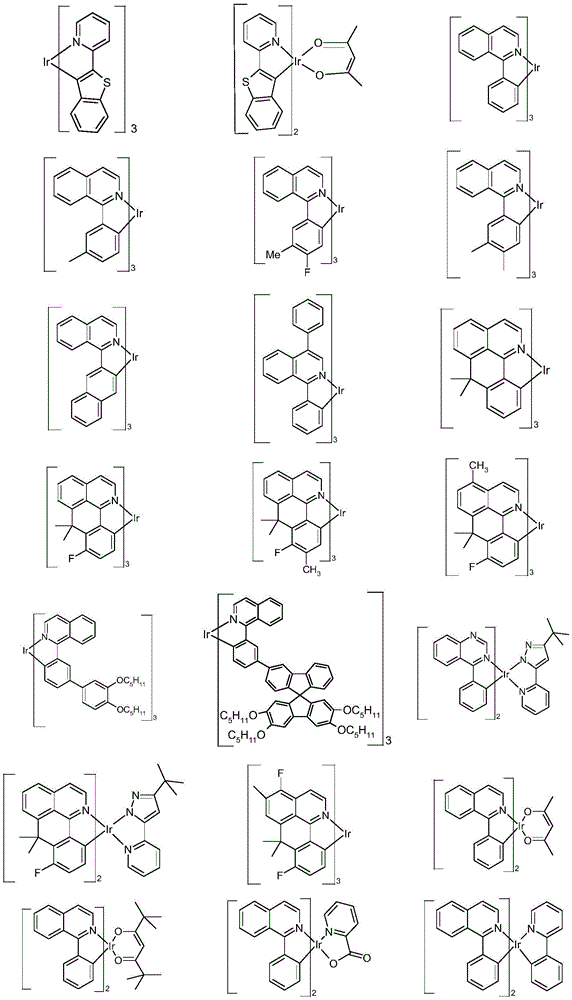


the above-described compounds comprising at least one structural unit of the formulae (I), (Ia), (II), (IIa), the structures of the formulae (IIIa) to (IIIh), (IVa) to (IVh) and/or the metal complexes comprising at least one substructure of the formulae (2), (2a), (2-1) and (2a-1) or the above-described preferred embodiments can preferably be used as active components in electronic devices. An electronic device is understood to mean any device comprising an anode, a cathode and, between the anode and the cathode, at least one layer comprising at least one organic or organometallic compound. Accordingly, the electronic device of the present invention comprises an anode, a cathode and at least one intermediate layer comprising at least one compound comprising the structure of formula (I). Preferred electronic devices are selected here from organic electroluminescent devices (OLED, PLED), organic integrated circuits (O-IC), organic field effect transistors (O-FET), organic thin film transistors (O-TFT), organic light emitting transistors (O-LET), organic solar cells (O-SC), organic optical detectors, organic photoreceptors, organic field quenching devices (O-FQD), organic electrical sensors, light emitting electrochemical cells (LEC), organic laser diodes (O-laser) and organic plasma light emitting devices (d.m. koller et al, Nature Photonics 2008,1-4), preferably organic electroluminescent devices (OLED, PLED), especially phosphorescent OLEDs, which contain at least one compound comprising a structure of formula (I) and/or (Ia) in at least one layer. Organic electroluminescent devices are particularly preferred. The active component is typically an organic or inorganic material introduced between the anode and the cathode, such as charge injection, charge transport or charge blocking materials, but especially luminophores and matrix materials.
One preferred embodiment of the present invention is an organic electroluminescent device. The organic electroluminescent device includes a cathode, an anode, and at least one light emitting layer. In addition to these layers, they may also comprise further layers, for example in each case one or more hole injection layers, hole transport layers, hole blocking layers, electron transport layers, electron injection layers, exciton blocking layers, electron blocking layers, charge generation layers and/or organic or inorganic p/n junctions. Also, one or more of the hole transport layers may be p-type doped, for example with a metal oxide such as MoO3Or WO3Or p-type doped with a (per) fluorinated electron deficient aromatic system, and/or one or more of the electron transport layers is n-type doped. Also intermediate layers can be introduced between the two light-emitting layers, which intermediate layers have, for example, an exciton blocking function and/or control of the charge balance in the electroluminescent device. However, it should be noted that each of these layers need not be present.
In this case, the organic electroluminescent device may include one light emitting layer, or include a plurality of light emitting layers. If there are a plurality of light-emitting layers, these preferably have a total of a plurality of emission maxima of 380nm to 750nm, so that the overall result is white emission; in other words, a plurality of light-emitting compounds which can emit fluorescence or phosphorescence are used in the light-emitting layer. Especially preferred are three-layer systems in which the three layers exhibit blue, green and orange or red luminescence (for the basic construction, see for example WO 2005/011013), or systems with more than three luminescent layers. Also further preferred are tandem OLEDs. The system may also be a mixed system in which one or more layers fluoresce and one or more other layers phosphoresce.
In a preferred embodiment of the present invention, the organic electroluminescent device contains the compounds according to the invention, preferably in combination with further matrix materials, preferably hole-conducting matrix materials, preferably compounds comprising at least one structural unit of the formula (I), (Ia), (II), (IIa) and/or a structure of the formulae (IIIa) to (IIIh), (IVa) to (IVh) or the preferred embodiments detailed above, as matrix material, preferably as electron-conducting matrix material, in the light-emitting layer or layers. In another preferred embodiment of the present invention, the further matrix material is an electron transport compound. In a further preferred embodiment, the further matrix material is a compound with a large band gap which, if involved, does not participate to a significant extent in the hole and electron transport in the layer. The light-emitting layer comprises at least one light-emitting compound.
In a further particularly preferred embodiment of the present invention, the organic electroluminescent device according to the invention comprises a compound according to the invention, preferably a compound comprising at least one structural unit of the formulae (I), (Ia), (II), (IIa) and/or structures of the formulae (IIIa) to (IIIh), (IVa) to (IVh), or the preferred embodiments detailed above, in the hole conductor layer or the electron conductor layer.
Suitable matrix materials which can be used in combination with a compound comprising at least one structural unit of the formula (I), (Ia), (II), (IIa) and/or structures of the formulae (IIIa) to (IIIh), (IVa) to (IVh), or according to a preferred embodiment, are aromatic ketones, aromatic phosphine oxides or aromatic sulfoxides or sulfones, for example according to WO 2004/013080, WO 2004/093207, WO 2006/005627 or WO 2010/006680, triarylamines, in particular monoamines, for example according to WO 2014/015935, carbazole derivatives, for example CBP (N, N-biscarbazolylbiphenyl) or carbazole derivatives disclosed in WO 2005/039246, US 2005/0069729, JP 2004/288381, EP 1205527 or WO 2008/086851, indolocarbazole derivatives, for example according to WO 2007/063754 or WO 2008/056746, indenocarbazole derivatives, for example according to WO 2010/136109 and WO 2011/000455, azacarbazole derivatives, for example according to EP 1617710, EP 1617711, EP 1731584, JP 2005/347160, bipolar matrix materials, for example according to WO 2007/137725, silanes, for example according to WO 2005/111172, borazazepins or borate esters, for example according to WO 2006/117052, triazine derivatives, for example according to WO 2010/015306, WO 2007/063754 or WO 2008/056746, zinc complexes, for example according to EP 652273 or WO 2009/062578, siladiazacyclozine or silatetraazazepine derivatives, according to WO 2010/054729, phosphorodiazazepine derivatives, for example according to WO 2010/054730, bridged carbazole derivatives, for example according to US 2009/0136779, WO 2010/050778, WO 2005/347160, WO 2011/042107, WO 2011/088877 or WO 2012/143080, triphenylidene derivatives, for example according to WO 2012/048781, lactams, for example according to WO 2011/116865, WO 2011/137951 or WO 2013/064206, 4-spirocarbazole derivatives, for example according to WO 2014/094963 or WO 2015/192939, or dibenzofuran derivatives, for example according to WO 2015/169412, WO 2016/015810, WO 2016/023608, or the applications EP16158460.2 and EP16159829.7 which have not yet been published. Other phosphorescent emitters which emit at shorter wavelengths than the actual emitter may likewise be present as co-hosts in the mixture.
Preferred co-host materials are triarylamine derivatives, especially monoamines, indenocarbazole derivatives, 4-spirocarbazole derivatives, lactams and carbazole derivatives.
It may also be preferred to use a plurality of different matrix materials, in particular at least one electron-conducting matrix material and at least one hole-conducting matrix material, as a mixture. It is also preferred to use a mixture of a charge transport matrix material and an electrically inert matrix material which, if involved, does not participate significantly in charge transport, as described in, for example, WO 2010/108579.
It is further preferred to use mixtures of two or more triplet emitters and a matrix. In this case, the triplet emitter having a shorter-wave emission spectrum functions as a co-host of the triplet emitter having a longer-wave emission spectrum.
More preferably, in a preferred embodiment, the compounds of the invention comprising at least one structural unit of the formula (I), (Ia), (II), (IIa) and/or a structure of the formulae (IIIa) to (IIIh), (IVa) to (IVh) are useful as matrix materials in the light-emitting layer of an organic electronic device, in particular in an organic electroluminescent device, for example in an OLED or OLEC. In this case, compounds containing at least one structural unit of the formula (I), (Ia), (II), (IIa) and/or a structure of the formulae (IIIa) to (IIIh), (IVa) to (IVh) or the host materials of the preferred embodiments listed above and below are present in the electronic device in combination with one or more dopants, preferably phosphorescent dopants.
In this case, the proportion of the host material in the light-emitting layer is 50.0 vol% to 99.9 vol%, preferably 80.0 vol% to 99.5 vol% and more preferably 92.0 vol% to 99.5 vol% for the fluorescent light-emitting layer, and 85.0 vol% to 97.0 vol% for the phosphorescent light-emitting layer.
Accordingly, the proportion of the dopant is 0.1 to 50.0 vol%, preferably 0.5 to 20.0 vol% and more preferably 0.5 to 8.0 vol% for the fluorescent light-emitting layer, and 3.0 to 15.0 vol% for the phosphorescent light-emitting layer.
The light-emitting layer of the organic electroluminescent device may also comprise systems comprising a plurality of host materials (mixed host systems) and/or a plurality of dopants. Also in this case, the dopants are generally those materials which are in a smaller proportion in the system, and the host materials are those materials which are in a larger proportion in the system. However, in individual cases, the proportion of a single matrix material in the system may be less than the proportion of a single dopant.
In a further preferred embodiment of the present invention, compounds comprising at least one structural unit of the formula (I), (Ia), (II), (IIa) and/or a structure of the formulae (IIIa) to (IIIh), (IVa) to (IVh), or the preferred embodiments listed above and below, are used as components of the mixed-matrix system. The mixed matrix system preferably comprises two or three different matrix materials, more preferably two different matrix materials. Preferably, in this case, one of the two materials is a material having a hole transporting property, and the other material is a material having an electron transporting property. However, the desired electron transporting and hole transporting properties of the mixed matrix component may also be combined predominantly or completely in a single mixed matrix component, in which case one or more other mixed matrix components perform other functions. Here, the two different matrix materials may be present in a ratio of 1:50 to 1:1, preferably 1:20 to 1:1, more preferably 1:10 to 1:1, and most preferably 1:4 to 1: 1. Preferably, mixed matrix systems are used in phosphorescent organic electroluminescent devices. One source of more detailed information on mixed matrix systems is application WO 2010/108579.
The invention also provides an electronic device, preferably an organic electroluminescent device, comprising one or more compounds according to the invention and/or at least one oligomer, polymer or dendrimer according to the invention as electron-conducting compound in one or more electron-conducting layers.
Preferred cathodes are metals with a low work function, metal alloys composed of various metals, such as alkaline earth metals, alkali metals, main group metals or lanthanides (e.g. Ca, Ba, Mg, Al, In, Mg, Yb, Sm, etc.) or multilayer structures. Also suitable are alloys composed of alkali metals or alkaline earth metals and silver, for example alloys composed of magnesium and silver. In the case of a multilayer structure, in addition to the metals, other metals having a relatively high work function may be used, such as Ag, in which case, for example, combinations of metals, such as Mg/Ag, Ca/Ag or Ba/Ag, are generally used. It may also be preferred to introduce a thin intermediate layer of a material with a high dielectric constant between the metal cathode and the organic semiconductor. Examples of useful materials for this purpose are alkali or alkaline earth metal fluorides, and the corresponding oxides or carbonates (e.g. LiF, Li)2O、BaF2、MgO、NaF、CsF、Cs2CO3Etc.). Also useful for this purpose are organic alkali metal complexes, for example, Liq (lithium quinolate). The layer thickness of the layer is preferably between 0.5nm and 5 nm.
The preferred anode is a material with a high work function. Preferably, the anode has a work function greater than 4.5eV relative to vacuum. First of all, the first step is to,metals with a high redox potential are suitable for this purpose, such as Ag, Pt or Au. Second, metal/metal oxide electrodes (e.g., Al/Ni/NiO)x、Al/PtOx) May also be preferred. For some applications, at least one electrode must be transparent or partially transparent in order to be able to irradiate the organic material (O-SC) or to emit light (OLED/PLED, O-LASER). The preferred anode material is here a conductive mixed metal oxide. Indium Tin Oxide (ITO) or Indium Zinc Oxide (IZO) is particularly preferable. Also preferred are conductively doped organic materials, especially conductively doped polymers, such as PEDOT, PANI or derivatives of these polymers. It is also preferred to apply the p-type doped hole transport material as a hole injection layer onto the anode, in which case a suitable p-type dopant is a metal oxide, e.g. MoO3Or WO3Or (per) fluorinated electron deficient aromatic systems. Other suitable p-type dopants are HAT-CN (hexacyanohexanazaterphenyl) or the compound NPD9 from Noval. Such a layer simplifies hole injection into materials with a low HOMO (i.e. a large HOMO in terms of size).
In other layers, generally any material as used for layers according to the prior art can be used, and the person skilled in the art will be able to combine any of these materials with the material of the invention in an electronic device without inventive effort.
The device is accordingly (depending on the application) constructed, provided with contact connections and finally hermetically sealed, since the lifetime of such a device is severely shortened in the presence of water and/or air.
Further preferred is an electronic device, in particular an organic electroluminescent device, characterized in that one or more layers are applied by a sublimation process. In this case, the material is typically less than 10% in a vacuum sublimation system-5Mbar, preferably less than 10-6Applied by vapor deposition at an initial pressure of mbar. The initial pressure may also be even lower or even higher, e.g. less than 10-7Millibar.
Preference is likewise given to an electronic device, in particular an organic electroluminescent device, characterized in that one or more layers are formed by OVPD (organic vapor deposition) method or sublimation coating with the aid of a carrier gas. In this case, the material is at 10-5Applied at a pressure between mbar and 1 bar. A particular example of such a process is the OVJP (organic vapour jet printing) process, in which the material is applied directly through a nozzle and is thus structured (e.g. m.s. arnold et al, appl.phys.lett. (applied physical bulletin) 2008,92,053301).
Further preferred is an electronic device, especially an organic electroluminescent device, characterized in that the layer or layers are manufactured from solution, for example by spin coating, or by any printing method such as screen printing, flexography, offset printing or nozzle printing, but more preferably LITI (photo induced thermal imaging, thermal transfer printing) or inkjet printing. For this purpose, soluble compounds are required, which are obtained, for example, by suitable substitution.
Electronic devices, in particular organic electroluminescent devices, can also be produced as mixed systems by applying one or more layers from solution and one or more further layers by vapor deposition. For example, a light-emitting layer comprising a compound of the invention comprising at least one structural unit of the formula (I), (Ia), (II), (IIa) and/or a structure of the formulae (IIIa) to (IIIh), (IVa) to (IVh) or a metal complex comprising a structure of the formulae (2), (2a), (2-1) and/or (2a-1) and a matrix material, and a hole-blocking layer and/or an electron-transporting layer can be applied to the light-emitting layer by vapor deposition under reduced pressure, can be applied from a solution.
The person skilled in the art is generally aware of these methods and can apply them without difficulty to electronic devices, in particular organic electroluminescent devices, which comprise compounds of the invention comprising at least one structural unit of the formula (I), (Ia), (II), (IIa) and/or a structure of the formulae (IIIa) to (IIIh), (IVa) to (IVh) or metal complexes comprising structures of the formulae (2), (2a), (2-1) and/or (2a-1) or the preferred embodiments detailed above.
Compared to the prior art, the electronic device, in particular the organic electroluminescent device, according to the invention has one or more of the following surprising advantages:
1. electronic devices, in particular organic electroluminescent devices, which comprise the compounds, oligomers, polymers or dendrimers according to the invention as active compounds in organic electronic devices or the preferred embodiments listed above and below, in particular as emitters, electron-conducting materials and/or hole-conductor materials or as matrix materials, have very good lifetimes.
2. Electronic devices, in particular organic electroluminescent devices, comprising the compounds, oligomers, polymers or dendrimers according to the invention or the preferred embodiments listed above and below, in particular as emitters, electron transport materials, hole conductor materials and/or as host materials, which can be used as active compounds in organic electronic devices, have excellent efficiency. More particularly, the efficiency is much higher compared to similar compounds that do not contain an ephemeral structure. In this case, the effect of the compounds, oligomers, polymers or dendrimers of the invention or of the preferred embodiments listed above and below, which can be used as active compounds in organic electronic devices, is a low operating voltage when used in electronic devices. In this case, these compounds cause, inter alia, a low roll-off, i.e. a small drop in the power efficiency of the device at high luminance.
3. Electronic devices, in particular organic electroluminescent devices, which comprise compounds, oligomers, polymers or dendrimers or the preferred embodiments listed above and below as emitters, electron transport materials, hole conductor materials and/or as host materials, which can be used as active compounds in organic electronic devices, have excellent color purity.
4. The compounds, oligomers, polymers or dendrimers of the invention or the preferred embodiments listed above and below, which can be used as active compounds in organic electronic devices, exhibit very high thermal and photochemical stability and lead to compounds having a very long lifetime.
5. The formation of light loss channels in electronic devices, in particular organic electroluminescent devices, can be avoided using compounds, oligomers, polymers or dendrimers or the preferred embodiments listed above and below as active compounds in organic electronic devices. As a result, these devices are characterized by high PL efficiency, and hence high EL efficiency, of the emitter, as well as excellent energy transport from the host to the dopant.
6. Compounds, oligomers, polymers or dendrimers that can be used as active compounds in organic electronic devices or the preferred embodiments listed above and below have excellent glass film formation.
7. The compounds, oligomers, polymers or dendrimers which can be used as active compounds in organic electronic devices, or the preferred embodiments listed above and below, form very good films from solutions.
These above-mentioned advantages are not accompanied by impairment of other electronic properties.
The compounds or mixtures of the invention are suitable for use in electronic devices. An electronic device is understood here to mean a device which comprises at least one layer which contains at least one organic compound. However, the component may also comprise inorganic materials or layers formed entirely of inorganic materials.
The present invention therefore also provides for the use of the compounds or mixtures according to the invention in electronic devices, in particular in organic electroluminescent devices.
The present invention also provides the use of a compound of the invention and/or an oligomer, polymer or dendrimer of the invention as phosphorescent emitter, fluorescent emitter, emitter exhibiting TADF (thermally activated delayed fluorescence), host material, electron transport material, electron injection material, hole conductor material, hole injection material, electron blocking material, hole blocking material and/or wide band gap material, preferably as emitter, host material, hole conductor material and/or electron transport material, in an electronic device.
The present invention still further provides an electronic device comprising at least one of the above-detailed compounds or mixtures of the present invention. In this case, the preferences detailed above for the compounds also apply to the electronic devices. More preferably, the electronic device is selected from the group consisting of organic electroluminescent devices (OLED, PLED), organic integrated circuits (O-IC), organic field effect transistors (O-FET), organic thin film transistors (O-TFT), organic light emitting transistors (O-LET), organic solar cells (O-SC), organic optical detectors, organic photoreceptors, organic field quenching devices (O-FQD), organic electrical sensors, light emitting electrochemical cells (LEC), organic laser diodes (O-lasers) and organic plasma light emitting devices (D.M.Koller et al, Nature Photonics 2008,1-4), preferably organic electroluminescent devices (OLED, PLED), especially phosphorescent OLEDs.
In another embodiment of the present invention, the organic electroluminescent device of the present invention does not comprise any separate hole injection layer and/or hole transport layer and/or hole blocking layer and/or electron transport layer, meaning that the light-emitting layer is directly adjacent to the hole injection layer or anode and/or the light-emitting layer is directly adjacent to the electron transport layer or electron injection layer or cathode, as described in e.g. WO 2005/053051. In addition, a metal complex which is the same as or similar to the metal complex in the light-emitting layer may be used as a hole-transporting or hole-injecting material directly adjacent to the light-emitting layer, as described in, for example, WO 2009/030981.
In the other layers of the organic electroluminescent device of the invention, all materials as are commonly used according to the prior art can be used. The person skilled in the art will therefore be able, without inventive effort, to combine all known materials of organic electroluminescent devices with the compounds of the invention which can be used for producing functional layers of electronic devices, preferably compounds comprising at least one structural unit of the formula (I), (Ia), (II), (IIa), the structures of the formulae (IIIa) to (IIIh), (IVa) to (IVh), and/or metal complexes comprising the structures of the formulae (2), (2a), (2-1) and/or (2a-1), or according to a preferred embodiment.
The compounds according to the invention generally have very good properties when used in organic electroluminescent devices. Especially in the case of the use of the compounds according to the invention in organic electroluminescent devices, the lifetime is significantly longer than in the case of similar compounds according to the prior art. At the same time, other properties of the organic electroluminescent device, in particular efficiency and voltage, are likewise better or at least comparable.
It should be noted that variations of the embodiments described in the present invention are covered by the scope of the invention. Each feature disclosed in this specification may be replaced by an alternative feature serving the same, equivalent, or similar purpose, unless expressly excluded. Thus, unless expressly stated otherwise, any feature disclosed in this specification is to be considered as a generic series of examples, or equivalent or similar features.
All features of the invention may be combined with each other in any manner, unless the specific features and/or steps are mutually exclusive. This applies in particular to the preferred features of the invention. Likewise, features that are not necessarily combined may be used separately (rather than in combination).
It should also be noted that many of the features, and especially those of the preferred embodiments of the present invention, should be considered inventive in their own right and not as merely some of the embodiments of the present invention. Independent protection may be sought for these features in addition to or instead of any presently claimed invention.
The technical teachings disclosed with respect to the present invention may be extracted and combined with other embodiments.
The present invention is illustrated in more detail by the following examples, but is not intended to be limited thereto.
Those skilled in the art will be able to make other electronic devices of the invention using the details given without inventive step to practice the invention within the full scope of the claims.
Examples
Unless otherwise stated, the following syntheses are carried out in dry solvents under a protective atmosphere. The metal complexes are additionally treated with the exclusion of light or under yellow light. Solvents and reagents are available, for example, from Sigma-Aldrich (Sigma-Aldrich) or ABCR. The corresponding numbers in brackets or the reference numbers of individual compounds relate to the CAS numbers of the compounds known in the literature. In the case of a compound that may exhibit multiple valence isomeric or tautomeric forms, one valence isomeric or tautomeric form is typically exhibited.
1) Synthesis of synthon S:
example S1:

to 100ml of n-heptane was added 330mg (0.5mmol) of bis [ (1,2,5, 6-. eta.) -1, 5-cyclooctadiene]Di-mu-methoxydiiridium (I) [12148-71-9 ]]Then 268mg (1mmol) of 4,4 '-di-tert-butyl- [2,2']Bipyridine [72914-19-3]Then 508mg (2mmol) of bis (pinacol) diborane was added and the mixture was stirred at room temperature for 15 min. Subsequently, 5.08g (20mmol) of bis (pinacol) diborane [73183-34-3 ] were added]Then 3.61g (20mmol) of 1,1a,4,8 b-tetrahydro-1, 4-ethenylbenzo-a]-cyclopropane [ c ]]Cycloheptene [50653-71-9]And the mixture was heated to 80 ℃ for 12 hours. After cooling, 50ml of ethyl acetate were added to the reaction mixture, which was filtered through a silica gel bed, and the filtrate was completely concentrated under reduced pressure. The crude product was subjected to Flash chromatography (Combi-Flash Torrent, from a.semru). Yield: 2.2g (7mmol), 35%; purity: according to1H NMR, about 95%.
The following compounds can be prepared analogously:

example S2:

while stirring, 2.37g (100mmol) of 2, 5-dibromopyridine [624-28-2 ]]A mixture of 3.06g (10mmol) of S1, 2.76g (20mmol) of potassium carbonate, 10g of glass beads (diameter 3mm), 52.6mg (0.2mmol) of triphenylphosphine, 22.5mg (0.1mmol) of palladium (II) acetate, 30ml of acetonitrile and 15ml of methanol is heated to 60 ℃ and held for 16 hours. After cooling, the solvent was largely removed under reduced pressure, and the residue was removedThe retentate is dissolved in 100ml of ethyl acetate, washed three times with 30ml each time of 3% by weight aqueous acetylcysteine, three times with 30ml each time of water and once with 30ml of saturated sodium chloride solution and dried over magnesium sulfate. The drying agent was filtered off, the filtrate was concentrated to dryness, and the solid was recrystallized from acetonitrile. Yield: 2.12g (6.3mmol), 63%; purity: according to1H NMR, about 95%.
Example S3:

to a mixture of 3.36g (10mmol) of S2, 2.80g (11mmol) of bis (pinacol) diborane, 2.94g (30mmol) of potassium acetate (anhydrous), 10g of glass beads (diameter 3mm) and 50ml of THF was added 56.1mg (0.2mmol) of tricyclohexylphosphine with thorough stirring, then 22.5mg (0.11mmol) of palladium (II) acetate and the mixture was heated at gentle reflux for 16 h. After cooling, the salts and glass beads were removed by suction filtration through a celite bed as a slurry, which was washed with a small amount of THF, and the filtrate was concentrated to dryness. The residue is dissolved in 50ml of ethyl acetate, washed three times with 30ml each of a 3% by weight aqueous solution of acetylcysteine, three times with 30ml each of water and once with 30ml of saturated sodium chloride solution and dried over magnesium sulfate. The drying agent is filtered off, the filtrate is concentrated to dryness, the solid is stirred with 20ml of warm methanol, and the crystalline product is filtered off with suction, washed twice with 5ml of methanol each time and dried under reduced pressure. Yield: 2.49g (6.5mmol), 65%; purity: according to1H NMR, about 95%.
Example S4:

to a mixture of 3.83g (10mmol) of S3 and 2.83g (10mmol) of 1-bromo-2-iodobenzene [583-55-1 ] under sufficient stirring]To a mixture of 3.18g (30mmol) of sodium carbonate, 25ml of toluene, 10ml of ethanol and 25ml of water were added 78.8mg (0.3mmol) of triphenylphosphine, and then 22.5mg of (C.) (R.) (0.1mmol) palladium (II) acetate and the mixture is heated to 75 ℃ for 48 hours. After cooling, the organic phase is separated off, washed three times with 30ml each of a 3% by weight aqueous acetylcysteine solution, three times with 30ml each of water and once with 30ml of saturated sodium chloride solution and dried over magnesium sulfate. The drying agent was filtered off and the filtrate was concentrated well under reduced pressure. The residue was subjected to Flash chromatography (Combi-Flash Torrent from a.semrau). Yield: 1.65g (4mmol), 40%; purity: according to1H NMR, about 97%.
Example S5:

2.83g (10mmol) of (2-bromo-4-chlorophenyl) aniline [2149611-39-0]3.06g (10mmol) of S1, 6.37g (30mmol) of tripotassium phosphate, 183mg (0.6mmol) of tri-o-tolylphosphine, 22.5mg (0.1mmol) of palladium (II) acetate, 40ml of toluene, 10ml of dipotassium phosphate A well stirred mixture of alkane and 40ml water was heated at reflux for 16 hours. After cooling, the aqueous phase is separated off, washed three times with 30ml each time of 3% by weight aqueous acetylcysteine solution, three times with 30ml each time of water and once with 30ml of saturated sodium chloride solution and dried over magnesium sulfate. The drying agent was filtered off as a toluene slurry using a silica gel bed, and the filtrate was concentrated to dryness. The residue was recrystallized from acetonitrile by the addition of a small amount of acetone. The secondary amine thus obtained was dissolved in 50ml of DMAc (dimethylacetamide), and 4.54g (25mmol) of copper (II) acetate and 22.5mg (0.1mmol) of palladium (II) acetate were added, and the mixture was stirred at 140 ℃ for 4 hours. The DMAc was largely removed under reduced pressure, the residue was dissolved in 100ml of DCM, 30ml of concentrated aqueous ammonia solution were added, the mixture was stirred at room temperature for 1 hour, and the organic phase was separated off and washed three times with 30ml of concentrated aqueous ammonia solution, three times with 30ml of 3% by weight aqueous acetylcysteine solution each time, three times with 30ml of water each time and once with 30ml of saturated sodium chloride solution, and dried over magnesium sulfate. Use ofThe magnesium sulfate was filtered off as DCM slurry over a silica gel bed and the filtrate was concentrated to dryness and the residue was subjected to flash chromatography (CombiFlash Torrent from a.semrau). Yield: 1.25g (3.3mmol), 33%. According to1H NMR, purity about 95%.
2) Synthesis of ligand L:
the following compounds can be prepared analogously to example S2.


Example L5:

to a solution of 8.15g (10mmol) of 3,3' - [5' - (4,4,5, 5-tetramethyl-1, 3, 2-dioxaborolan-2-yl) [1,1':3', 1' -terphenyl ] was added with thorough stirring]-2,2 "-diyl]Bis [4, 6-diphenylpyridine [1989597-74-1]4.12g (10mmol) of S4, 6.37g (30mmol) of tripotassium phosphate, 30ml of toluene and 15ml of dipotassium phosphate A mixture of an alkane and 30ml of water, 164mg (0.4mmol) of SPhos and then 44.9mg (0.2mmol) of palladium (II) acetate were added, and the mixture was heated under reflux for 24 hours. After cooling, the organic phase is separated off, washed three times with 30ml each of a 3% by weight aqueous acetylcysteine solution, three times with 30ml each of water and once with 30ml of saturated sodium chloride solution and dried over magnesium sulfate. The drying agent was filtered off, the filtrate was concentrated to dryness under reduced pressure, and the glassy crude product was recrystallized from acetonitrile (about 10ml) to which ethyl acetate (about 2ml) was added at boiling. Yield: 4.77g (4.6mmol), 46%; purity: according to1H NMR, about 95%.
The following compounds can be prepared analogously:

example L8:

preparation was analogous to L1, except that 2.03g (5mmol) of 6-bromo-N- (6-bromo-2-pyridinyl) -N-phenyl-2-pyridineamine [894405-86-8]Instead of 10mmol of 2-bromopyridine [109-04-6 ]]. Yield: 1.75g (2.8mmol), 56%; purity: according to1H NMR, about 95%.
The following compounds can be prepared analogously:


3) synthesis of carbazole, amine and triazine
Example C1:

3.80g (10mmol) of S5, 3.69g (10mmol) of 9-phenyl-3- (4,4,5, 5-tetramethyl-1, 3, 2-dioxaborolan-2-yl) -9H-carbazole [1126522-69-7]6.37g (30mmol) of tripotassium phosphate, 183mg (0.6mmol) of tri-o-tolylphosphine, 22.5mg (0.1mmol) of palladium (II) acetate, 40ml of toluene, 10ml of dipotassium phosphate A well stirred mixture of alkane and 40ml water was heated at reflux for 16 hours. After cooling, the aqueous phase was separated and the organic phase was concentrated to dryness. The residue was dissolved in 50ml of DCM,washed three times with 30ml each time of 3% by weight aqueous acetylcysteine, three times with 30ml each time of water, and once with 30ml of saturated sodium chloride solution, and dried over magnesium sulfate. The drying agent was filtered off as DCM slurry using a silica gel bed and the filtrate was concentrated to dryness. The residue was extracted by stirring with hot butyl acetate/isopropanol, then three times with hot toluene and by heating under reduced pressure (p is about 10)-5Mbar, T about 280 ℃ C.). Yield: 3.40g (4.5mmol) 45%. According to HPLC, the purity is > 99.9%.
The following compounds can be prepared analogously:


4) synthesis of C3-symmetric iridium complex of bidentate ligand L:
example Ir (L1)3:

According to WO 2015/104045, Ir (LB74)3See page 179 for preparation. Yield: 41 percent; purity: according to HPLC, > 99.9%.
The following compounds can be prepared analogously:


5) synthesis of C2-symmetric N, N-trans-iridium complex of bidentate ligand L:
practice ofExample Ir (L4)2(acac):
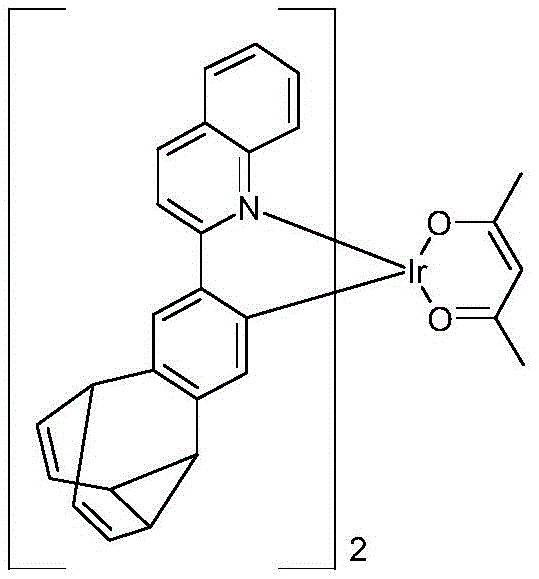
Prepared according to WO 2015/104045. First, similar to [ Ir (L42)2Cl)2The Cl dimer was prepared, see page 193. Similar to Ir538, it is reacted with acetylacetone; see page 218. Yield in two stages: 39 percent; purity: according to HPLC, > 99.9%.
6) Synthesis of tripodal iridium complex:
example IrL 5:

prepared according to WO 2016/124304, Ir (L1) variant a, see page 218. Ligand L5 was used. Purification by silica gel chromatography as described therein, heat extracted three times with DCM/MeOH (1:1, vv) and three times with DCM/acetonitrile (2:1, vv), and at a T of about 200 ℃ and a p of about 10-6Heating in mbar. Yield: 38 percent; purity: according to HPLC, > 99.9%.
The following compounds can be prepared analogously:


7) synthesis of platinum complex:
example PtL 8:

1.86g (3.0mmol) of L5 and 1.14g (3.5mmol) of dimethyl-bis-DMSO-platinum (II) [7042 ]3-98-2]The mixture in 30ml of DMSO is heated to 70 ℃ for 24 hours. The reaction mixture was cooled, DMSO was largely removed under reduced pressure, and the black residue was dissolved in 50ml DCM and chromatographed on silica gel with DCM. The red core fraction was extracted, 50ml methanol was added and DCM was distilled off at 50 ℃. The crystalline product is filtered off with suction and washed twice with 20ml each time of MeOH. Further purification was performed by hot extraction, once with DCM/MeOH (1:1, vv) and three times with DCM/acetonitrile (2:1, vv), and at T of about 250 ℃ and p of about 10-6Heating in mbar. Yield: 782g mg (0.96), 32%; purity: according to HPLC, > 99.9%.
The following compounds can be prepared analogously:

solution processed devices:
processing from low molecular weight soluble functional materials
The compounds according to the invention can also be processed from solution and here give OLEDs which are considerably simpler in terms of processing technology than vacuum-processed OLEDs but nevertheless have good properties. The manufacture of these components is based on the manufacture of Polymer Light Emitting Diodes (PLEDs), which have been described many times in the literature (for example, in WO 2004/037887). The structure consists of a substrate/ITO/hole injection layer (60 nm)/intermediate layer (20 nm)/light-emitting layer (60 nm)/hole blocking layer (10 nm)/electron transport layer (40 nm)/cathode. For this purpose, a substrate from Technoprint (soda lime glass) is used, on which an ITO structure (indium tin oxide, transparent conductive anode) is applied. The substrates were cleaned with deionized water and detergent (Deconex 15PF) in a clean room and then activated by UV/ozone plasma treatment. Thereafter, a 20nm hole injection layer (PEDOT: PSS, from Clevios. TM.) was applied by spin coating, also in a clean room. The desired spin rate depends on the degree of dilution and the geometry of the particular spin coater. To remove residual water from the layer, the substrate was baked on a hot plate at 200 ℃ for 30 minutes. The interlayer used is for hole transport; in this situationIn the case, HL-X from Merck is used. The intermediate layer may alternatively be replaced by one or more layers that need only meet the conditions that are not re-leached by a subsequent processing step of EML deposition from solution. For the production of the light-emitting layer, the triplet emitters according to the invention are dissolved together with the matrix material in toluene or chlorobenzene. Typical solids contents of such solutions are 16g/l to 25g/l, so that a layer thickness of 60nm, which is characteristic for devices, is achieved by spin coating. Solution processed devices contain a light emitting layer consisting of host 1: host 2: ir (l) with specified percentages. The luminescent layer was spin-coated in an inert atmosphere, in this case argon, and baked at 160 ℃ for 10 minutes. A hole blocking layer (10nm RETM1) and an electron transport layer (40nm RETM1 (50%)/RETM 2 (50%)) (from the vapor deposition system of Lesker et al, a typical vapor deposition pressure is 5X 10⁻⁶Millibar). Finally, an aluminum cathode (100nm) (high purity metal from Aldrich) was applied by vapor deposition. To protect the device from air and air humidity, the device is finally packaged and then characterized. The OLED embodiments mentioned have not been optimized; table 1 summarizes the data obtained. Lifetime LD50 is defined as the luminance at the beginning of 1000cd/m2The time after the operating brightness decreased to 50% of the initial brightness in the case of (1). Table 2 shows the materials used.
Table 1: results obtained with materials processed from solution


Table 2: structural formula of material used

Claims (19)


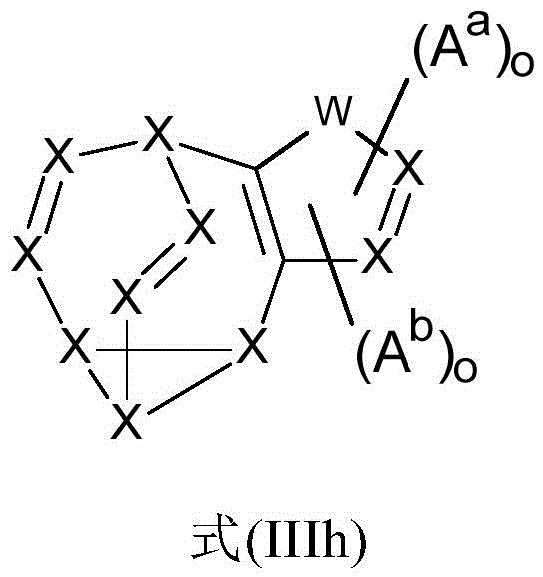


Applications Claiming Priority (3)
| Application Number | Priority Date | Filing Date | Title |
|---|---|---|---|
| EP18206254.7 | 2018-11-14 | ||
| EP18206254 | 2018-11-14 | ||
| PCT/EP2019/080916 WO2020099349A1 (en) | 2018-11-14 | 2019-11-12 | Compounds that can be used for producing an organic electronic device |
Publications (1)
| Publication Number | Publication Date |
|---|---|
| CN113015720A true CN113015720A (en) | 2021-06-22 |
Family
ID=64316403
Family Applications (1)
| Application Number | Title | Priority Date | Filing Date |
|---|---|---|---|
| CN201980074458.2A Pending CN113015720A (en) | 2018-11-14 | 2019-11-12 | Compounds useful in the manufacture of organic electronic devices |
Country Status (6)
| Country | Link |
|---|---|
| US (1) | US20220006018A1 (en) |
| EP (1) | EP3880657A1 (en) |
| JP (1) | JP2022509064A (en) |
| KR (1) | KR20210091769A (en) |
| CN (1) | CN113015720A (en) |
| WO (1) | WO2020099349A1 (en) |
Families Citing this family (1)
| Publication number | Priority date | Publication date | Assignee | Title |
|---|---|---|---|---|
| CN115960033B (en) * | 2023-02-08 | 2024-05-07 | 东南大学 | A thermally activated delayed fluorescence dendrimer material based on carbazole-benzonitrile and a preparation method thereof |
Citations (3)
| Publication number | Priority date | Publication date | Assignee | Title |
|---|---|---|---|---|
| DE102010046412A1 (en) * | 2010-09-23 | 2012-03-29 | Merck Patent Gmbh | Metal ligand coordination compounds |
| CN105916868A (en) * | 2014-01-13 | 2016-08-31 | 默克专利有限公司 | Metal complexes |
| CN105980519A (en) * | 2014-02-05 | 2016-09-28 | 默克专利有限公司 | Metal complexes |
Family Cites Families (100)
| Publication number | Priority date | Publication date | Assignee | Title |
|---|---|---|---|---|
| US4539507A (en) | 1983-03-25 | 1985-09-03 | Eastman Kodak Company | Organic electroluminescent devices having improved power conversion efficiencies |
| DE4111878A1 (en) | 1991-04-11 | 1992-10-15 | Wacker Chemie Gmbh | LADDER POLYMERS WITH CONJUGATED DOUBLE BINDINGS |
| US5151629A (en) | 1991-08-01 | 1992-09-29 | Eastman Kodak Company | Blue emitting internal junction organic electroluminescent device (I) |
| JPH07133483A (en) | 1993-11-09 | 1995-05-23 | Shinko Electric Ind Co Ltd | Organic light emitting material for EL device and EL device |
| EP0676461B1 (en) | 1994-04-07 | 2002-08-14 | Covion Organic Semiconductors GmbH | Spiro compounds and their application as electroluminescence materials |
| DE4436773A1 (en) | 1994-10-14 | 1996-04-18 | Hoechst Ag | Conjugated polymers with spirocenters and their use as electroluminescent materials |
| WO1997005184A1 (en) | 1995-07-28 | 1997-02-13 | The Dow Chemical Company | 2,7-aryl-9-substituted fluorenes and 9-substituted fluorene oligomers and polymers |
| DE19614971A1 (en) | 1996-04-17 | 1997-10-23 | Hoechst Ag | Polymers with spiro atoms and their use as electroluminescent materials |
| DE19652261A1 (en) | 1996-12-16 | 1998-06-18 | Hoechst Ag | Aryl-substituted poly (p-arylenevinylenes), process for their preparation and their use in electroluminescent devices |
| DE19846766A1 (en) | 1998-10-10 | 2000-04-20 | Aventis Res & Tech Gmbh & Co | A conjugated fluorene-based polymer useful as an organic semiconductor, electroluminescence material, and for display elements |
| US6166172A (en) | 1999-02-10 | 2000-12-26 | Carnegie Mellon University | Method of forming poly-(3-substituted) thiophenes |
| WO2000070655A2 (en) | 1999-05-13 | 2000-11-23 | The Trustees Of Princeton University | Very high efficiency organic light emitting devices based on electrophosphorescence |
| KR100946314B1 (en) | 1999-12-01 | 2010-03-09 | 더 트러스티즈 오브 프린스턴 유니버시티 | Organic light emitting device comprising a phosphorescent organo metallic compound |
| US6660410B2 (en) | 2000-03-27 | 2003-12-09 | Idemitsu Kosan Co., Ltd. | Organic electroluminescence element |
| US20020121638A1 (en) | 2000-06-30 | 2002-09-05 | Vladimir Grushin | Electroluminescent iridium compounds with fluorinated phenylpyridines, phenylpyrimidines, and phenylquinolines and devices made with such compounds |
| CN101924190B (en) | 2000-08-11 | 2012-07-04 | 普林斯顿大学理事会 | Organometallic compounds and emission-shifting organic electrophosphorescence |
| JP4154139B2 (en) | 2000-09-26 | 2008-09-24 | キヤノン株式会社 | Light emitting element |
| JP4154138B2 (en) | 2000-09-26 | 2008-09-24 | キヤノン株式会社 | Light emitting element, display device and metal coordination compound |
| JP4154140B2 (en) | 2000-09-26 | 2008-09-24 | キヤノン株式会社 | Metal coordination compounds |
| CN100379049C (en) | 2001-03-14 | 2008-04-02 | 普林斯顿大学理事会 | Materials and Devices for Blue Phosphorescent-Based Organic Light-Emitting Diodes |
| ITRM20020411A1 (en) | 2002-08-01 | 2004-02-02 | Univ Roma La Sapienza | SPIROBIFLUORENE DERIVATIVES, THEIR PREPARATION AND USE. |
| DE10249723A1 (en) | 2002-10-25 | 2004-05-06 | Covion Organic Semiconductors Gmbh | Conjugated polymers containing arylamine units, their preparation and use |
| GB0226010D0 (en) | 2002-11-08 | 2002-12-18 | Cambridge Display Tech Ltd | Polymers for use in organic electroluminescent devices |
| DE10304819A1 (en) | 2003-02-06 | 2004-08-19 | Covion Organic Semiconductors Gmbh | Carbazole-containing conjugated polymers and blends, their preparation and use |
| JP4411851B2 (en) | 2003-03-19 | 2010-02-10 | コニカミノルタホールディングス株式会社 | Organic electroluminescence device |
| JP5318347B2 (en) | 2003-04-15 | 2013-10-16 | メルク パテント ゲーエムベーハー | Mixture of matrix material and organic semiconductor capable of emitting light, use thereof, and electronic component comprising said mixture |
| EP2236579B1 (en) | 2003-04-23 | 2014-04-09 | Konica Minolta Holdings, Inc. | Organic electroluminescent element and display |
| EP1491568A1 (en) | 2003-06-23 | 2004-12-29 | Covion Organic Semiconductors GmbH | Semiconductive Polymers |
| DE10328627A1 (en) | 2003-06-26 | 2005-02-17 | Covion Organic Semiconductors Gmbh | New materials for electroluminescence |
| DE10333232A1 (en) | 2003-07-21 | 2007-10-11 | Merck Patent Gmbh | Organic electroluminescent element |
| DE10337346A1 (en) | 2003-08-12 | 2005-03-31 | Covion Organic Semiconductors Gmbh | Conjugated polymers containing dihydrophenanthrene units and their use |
| DE10338550A1 (en) | 2003-08-19 | 2005-03-31 | Basf Ag | Transition metal complexes with carbene ligands as emitters for organic light-emitting diodes (OLEDs) |
| DE10345572A1 (en) | 2003-09-29 | 2005-05-19 | Covion Organic Semiconductors Gmbh | metal complexes |
| US7795801B2 (en) | 2003-09-30 | 2010-09-14 | Konica Minolta Holdings, Inc. | Organic electroluminescent element, illuminator, display and compound |
| US7659540B2 (en) | 2003-10-22 | 2010-02-09 | Merck Patent Gmbh | Materials for electroluminescence and the utilization thereof |
| JP2007512692A (en) | 2003-11-25 | 2007-05-17 | メルク パテント ゲーエムベーハー | Organic electroluminescence device |
| US7790890B2 (en) | 2004-03-31 | 2010-09-07 | Konica Minolta Holdings, Inc. | Organic electroluminescence element material, organic electroluminescence element, display device and illumination device |
| DE102004020298A1 (en) | 2004-04-26 | 2005-11-10 | Covion Organic Semiconductors Gmbh | Electroluminescent polymers and their use |
| DE102004023277A1 (en) | 2004-05-11 | 2005-12-01 | Covion Organic Semiconductors Gmbh | New material mixtures for electroluminescence |
| US7598388B2 (en) | 2004-05-18 | 2009-10-06 | The University Of Southern California | Carbene containing metal complexes as OLEDs |
| JP4862248B2 (en) | 2004-06-04 | 2012-01-25 | コニカミノルタホールディングス株式会社 | Organic electroluminescence element, lighting device and display device |
| ITRM20040352A1 (en) | 2004-07-15 | 2004-10-15 | Univ Roma La Sapienza | OLIGOMERIC DERIVATIVES OF SPIROBIFLUORENE, THEIR PREPARATION AND THEIR USE. |
| EP1669386A1 (en) | 2004-12-06 | 2006-06-14 | Covion Organic Semiconductors GmbH | Conjugated polymers, representation thereof, and use |
| CN101171320B (en) | 2005-05-03 | 2013-04-10 | 默克专利有限公司 | Organic electroluminescent device |
| DE102005037734B4 (en) | 2005-08-10 | 2018-02-08 | Merck Patent Gmbh | Electroluminescent polymers, their use and bifunctional monomeric compounds |
| EP1956022B1 (en) | 2005-12-01 | 2012-07-25 | Nippon Steel Chemical Co., Ltd. | Compound for organic electroluminescent element and organic electroluminescent element |
| DE102006025777A1 (en) | 2006-05-31 | 2007-12-06 | Merck Patent Gmbh | New materials for organic electroluminescent devices |
| US8062769B2 (en) | 2006-11-09 | 2011-11-22 | Nippon Steel Chemical Co., Ltd. | Indolocarbazole compound for use in organic electroluminescent device and organic electroluminescent device |
| WO2009030981A2 (en) | 2006-12-28 | 2009-03-12 | Universal Display Corporation | Long lifetime phosphorescent organic light emitting device (oled) structures |
| DE102007002714A1 (en) | 2007-01-18 | 2008-07-31 | Merck Patent Gmbh | New materials for organic electroluminescent devices |
| DE102007053771A1 (en) | 2007-11-12 | 2009-05-14 | Merck Patent Gmbh | Organic electroluminescent devices |
| US7862908B2 (en) | 2007-11-26 | 2011-01-04 | National Tsing Hua University | Conjugated compounds containing hydroindoloacridine structural elements, and their use |
| DE102008027005A1 (en) | 2008-06-05 | 2009-12-10 | Merck Patent Gmbh | Organic electronic device containing metal complexes |
| DE102008033943A1 (en) | 2008-07-18 | 2010-01-21 | Merck Patent Gmbh | New materials for organic electroluminescent devices |
| DE102008036247A1 (en) | 2008-08-04 | 2010-02-11 | Merck Patent Gmbh | Electronic devices containing metal complexes |
| DE102008036982A1 (en) | 2008-08-08 | 2010-02-11 | Merck Patent Gmbh | Organic electroluminescent device |
| DE102008048336A1 (en) | 2008-09-22 | 2010-03-25 | Merck Patent Gmbh | Mononuclear neutral copper (I) complexes and their use for the production of optoelectronic devices |
| KR101506919B1 (en) | 2008-10-31 | 2015-03-30 | 롬엔드하스전자재료코리아유한회사 | Novel compounds for organic electronic material and organic electronic device using the same |
| DE102008056688A1 (en) | 2008-11-11 | 2010-05-12 | Merck Patent Gmbh | Materials for organic electroluminescent devices |
| KR20110097612A (en) | 2008-11-11 | 2011-08-31 | 메르크 파텐트 게엠베하 | Organic electroluminescent devices |
| DE102008057050B4 (en) | 2008-11-13 | 2021-06-02 | Merck Patent Gmbh | Materials for organic electroluminescent devices |
| DE102008057051B4 (en) | 2008-11-13 | 2021-06-17 | Merck Patent Gmbh | Materials for organic electroluminescent devices |
| DE102009007038A1 (en) | 2009-02-02 | 2010-08-05 | Merck Patent Gmbh | metal complexes |
| DE102009011223A1 (en) | 2009-03-02 | 2010-09-23 | Merck Patent Gmbh | metal complexes |
| DE102009013041A1 (en) | 2009-03-13 | 2010-09-16 | Merck Patent Gmbh | Materials for organic electroluminescent devices |
| DE102009014513A1 (en) | 2009-03-23 | 2010-09-30 | Merck Patent Gmbh | Organic electroluminescent device |
| DE102009023155A1 (en) | 2009-05-29 | 2010-12-02 | Merck Patent Gmbh | Materials for organic electroluminescent devices |
| DE102009031021A1 (en) | 2009-06-30 | 2011-01-05 | Merck Patent Gmbh | Materials for organic electroluminescent devices |
| DE102009041414A1 (en) | 2009-09-16 | 2011-03-17 | Merck Patent Gmbh | metal complexes |
| DE102009048791A1 (en) | 2009-10-08 | 2011-04-14 | Merck Patent Gmbh | Materials for organic electroluminescent devices |
| DE102009057167A1 (en) | 2009-12-05 | 2011-06-09 | Merck Patent Gmbh | Electronic device containing metal complexes |
| DE102010005697A1 (en) | 2010-01-25 | 2011-07-28 | Merck Patent GmbH, 64293 | Connections for electronic devices |
| DE102010012738A1 (en) | 2010-03-25 | 2011-09-29 | Merck Patent Gmbh | Materials for organic electroluminescent devices |
| DE102010019306B4 (en) | 2010-05-04 | 2021-05-20 | Merck Patent Gmbh | Organic electroluminescent devices |
| DE112011102008B4 (en) | 2010-06-15 | 2022-04-21 | Merck Patent Gmbh | metal complexes |
| DE102010027317A1 (en) | 2010-07-16 | 2012-01-19 | Merck Patent Gmbh | metal complexes |
| DE102010048608A1 (en) | 2010-10-15 | 2012-04-19 | Merck Patent Gmbh | Materials for organic electroluminescent devices |
| KR101979469B1 (en) | 2011-04-18 | 2019-05-16 | 메르크 파텐트 게엠베하 | Materials for organic electroluminescent devices |
| EP2773721B1 (en) | 2011-11-01 | 2015-11-25 | Merck Patent GmbH | Organic electroluminescent device |
| EP2872590B1 (en) | 2012-07-13 | 2018-11-14 | Merck Patent GmbH | Metal complexes |
| KR20210076207A (en) | 2012-07-23 | 2021-06-23 | 메르크 파텐트 게엠베하 | Fluorenes and electronic devices containing them |
| JP6363075B2 (en) | 2012-08-07 | 2018-07-25 | メルク パテント ゲーエムベーハー | Metal complex |
| EP2935292B1 (en) | 2012-12-21 | 2019-04-10 | Merck Patent GmbH | Metal complexes |
| WO2014094960A1 (en) | 2012-12-21 | 2014-06-26 | Merck Patent Gmbh | Metal complexes |
| CN104903328B (en) | 2012-12-21 | 2018-03-30 | 默克专利有限公司 | Materials for Organic Electroluminescent Devices |
| EP3044284B1 (en) | 2013-09-11 | 2019-11-13 | Merck Patent GmbH | Metal complexes |
| EP3140302B1 (en) | 2014-05-05 | 2019-08-21 | Merck Patent GmbH | Materials for organic light emitting devices |
| EP3158597B1 (en) | 2014-06-18 | 2020-09-23 | Merck Patent GmbH | Materials for organic electroluminescent devices |
| WO2016015815A1 (en) | 2014-07-28 | 2016-02-04 | Merck Patent Gmbh | Metal complexes |
| CN106661006B (en) | 2014-07-29 | 2019-11-08 | 默克专利有限公司 | Materials for Organic Electroluminescent Devices |
| EP3180411B1 (en) | 2014-08-13 | 2018-08-29 | Merck Patent GmbH | Materials for organic electroluminescent devices |
| JP6772188B2 (en) | 2015-02-03 | 2020-10-21 | メルク、パテント、ゲゼルシャフト、ミット、ベシュレンクテル、ハフツングMerck Patent GmbH | Metal complex |
| US11031562B2 (en) | 2015-08-25 | 2021-06-08 | Merck Patent Gmbh | Metal complexes |
| CN116987124A (en) | 2016-07-25 | 2023-11-03 | 默克专利有限公司 | Metal complexes as luminophores in organic electroluminescent devices |
| TW201817738A (en) | 2016-07-25 | 2018-05-16 | 德商麥克專利有限公司 | Metal complexes |
| WO2018041769A1 (en) | 2016-08-30 | 2018-03-08 | Merck Patent Gmbh | Binuclear and trinuclear metal complexes composed of two inter-linked tripodal hexadentate ligands for use in electroluminescent devices |
| CN109715642A (en) | 2016-09-21 | 2019-05-03 | 默克专利有限公司 | PROCESS FOR PRODUCTION OF BINUCLEAR as the illuminator in organic electroluminescence device |
| WO2018069197A1 (en) | 2016-10-12 | 2018-04-19 | Merck Patent Gmbh | Metal complexes |
| WO2018069196A1 (en) | 2016-10-12 | 2018-04-19 | Merck Patent Gmbh | Binuclear metal complexes and electronic devices, in particular organic electroluminescent devices containing said metal complexes |
| JP7023946B2 (en) | 2016-10-13 | 2022-02-22 | メルク パテント ゲゼルシャフト ミット ベシュレンクテル ハフツング | Metal complex |
-
2019
- 2019-11-12 WO PCT/EP2019/080916 patent/WO2020099349A1/en not_active Ceased
- 2019-11-12 EP EP19805570.9A patent/EP3880657A1/en not_active Withdrawn
- 2019-11-12 KR KR1020217017924A patent/KR20210091769A/en active Pending
- 2019-11-12 US US17/293,515 patent/US20220006018A1/en not_active Abandoned
- 2019-11-12 CN CN201980074458.2A patent/CN113015720A/en active Pending
- 2019-11-12 JP JP2021526656A patent/JP2022509064A/en not_active Withdrawn
Patent Citations (3)
| Publication number | Priority date | Publication date | Assignee | Title |
|---|---|---|---|---|
| DE102010046412A1 (en) * | 2010-09-23 | 2012-03-29 | Merck Patent Gmbh | Metal ligand coordination compounds |
| CN105916868A (en) * | 2014-01-13 | 2016-08-31 | 默克专利有限公司 | Metal complexes |
| CN105980519A (en) * | 2014-02-05 | 2016-09-28 | 默克专利有限公司 | Metal complexes |
Non-Patent Citations (4)
| Title |
|---|
| CHRISTOPHER B. CHAPLEO ET AL.: "Synthesis of 3,7-Diacetoxy-benzo- bullvalen", HELVETICA CHIMICA ACTA, vol. 59, pages 765 - 772 * |
| KESHAB SARMA ET AL.: "Synthesen und Substitutionsverhalten einiger anellierter Bullvalene", CHEMISCHE BERICHTE, vol. 117, no. 2, pages 633 - 641, XP055653059, DOI: 10.1002/cber.19841170216 * |
| OUSSAMA YAHIAOUI ET AL.: "Synthesis and Analysis of Substituted Bullvalenes", ANGEWANDTE CHEMIE, vol. 130, no. 10, pages 2600 - 2604, XP071372950, DOI: 10.1002/ange.201712157 * |
| R. O. CARLSEN ET AL.: "Dynamic Carbon- 13 Nuclear Magnetic Resonance Spectra of Benzobullvalene and o-Toluobullvalene", J. ORG. CHEM., vol. 42, no. 12, pages 2183 - 2185 * |
Also Published As
| Publication number | Publication date |
|---|---|
| KR20210091769A (en) | 2021-07-22 |
| WO2020099349A1 (en) | 2020-05-22 |
| EP3880657A1 (en) | 2021-09-22 |
| US20220006018A1 (en) | 2022-01-06 |
| JP2022509064A (en) | 2022-01-20 |
Similar Documents
| Publication | Publication Date | Title |
|---|---|---|
| CN111479811B (en) | Heterocyclic compounds for electronic devices | |
| CN109689658B (en) | Compounds having a structure of diaza-dibenzofuran or diaza-dibenzothiophene | |
| TWI805547B (en) | Heterocyclic compounds having dibenzofuran and/or dibenzothiophene structures | |
| CN109790173B (en) | Carbazoles having diaza-dibenzofuran or diaza-dibenzothiophene structure | |
| TWI776260B (en) | Heterocyclic spiro compounds | |
| CN107108589B (en) | Carbazoles with two dibenzofuran or dibenzothiophene substituents | |
| CN108779103B (en) | Compounds with a spirobifluorene structure | |
| CN110198936B (en) | carbazole derivatives | |
| CN107849016B (en) | Compound having fluorene structure | |
| CN107207550A (en) | metal complex | |
| CN112739795B (en) | Compounds useful as active compounds in organic electronic devices | |
| KR102799882B1 (en) | Method for producing sterically hindered nitrogen heteroaromatic compounds | |
| CN110418788A (en) | Compound with arylamine structure | |
| TW201827425A (en) | Compound having a carbazole structure | |
| CN112955437A (en) | Compounds useful in organic electronic devices | |
| KR102468446B1 (en) | A compound having a spirobifluorene-structure | |
| CN115244728B (en) | Use of sulfone compounds in organic electronic devices | |
| CN113015720A (en) | Compounds useful in the manufacture of organic electronic devices | |
| KR102596593B1 (en) | Hexacyclic heteroaromatic compounds for electronic devices | |
| CN114630831A (en) | Compounds useful in organic electronic devices | |
| CN115135741A (en) | Use of heterocyclic compounds in organic electronic devices |
Legal Events
| Date | Code | Title | Description |
|---|---|---|---|
| PB01 | Publication | ||
| PB01 | Publication | ||
| SE01 | Entry into force of request for substantive examination | ||
| SE01 | Entry into force of request for substantive examination | ||
| RJ01 | Rejection of invention patent application after publication | ||
| RJ01 | Rejection of invention patent application after publication |
Application publication date: 20210622 |