CN112239473A - Tricyclic compounds as HPK1 inhibitors - Google Patents
Tricyclic compounds as HPK1 inhibitors Download PDFInfo
- Publication number
- CN112239473A CN112239473A CN202010695693.6A CN202010695693A CN112239473A CN 112239473 A CN112239473 A CN 112239473A CN 202010695693 A CN202010695693 A CN 202010695693A CN 112239473 A CN112239473 A CN 112239473A
- Authority
- CN
- China
- Prior art keywords
- alkyl
- heterocyclyl
- aryl
- cycloalkyl
- membered
- Prior art date
- Legal status (The legal status is an assumption and is not a legal conclusion. Google has not performed a legal analysis and makes no representation as to the accuracy of the status listed.)
- Granted
Links
Classifications
-
- C—CHEMISTRY; METALLURGY
- C07—ORGANIC CHEMISTRY
- C07D—HETEROCYCLIC COMPOUNDS
- C07D519/00—Heterocyclic compounds containing more than one system of two or more relevant hetero rings condensed among themselves or condensed with a common carbocyclic ring system not provided for in groups C07D453/00 or C07D455/00
-
- A—HUMAN NECESSITIES
- A61—MEDICAL OR VETERINARY SCIENCE; HYGIENE
- A61P—SPECIFIC THERAPEUTIC ACTIVITY OF CHEMICAL COMPOUNDS OR MEDICINAL PREPARATIONS
- A61P35/00—Antineoplastic agents
Landscapes
- Chemical & Material Sciences (AREA)
- Organic Chemistry (AREA)
- Health & Medical Sciences (AREA)
- Chemical Kinetics & Catalysis (AREA)
- General Chemical & Material Sciences (AREA)
- Medicinal Chemistry (AREA)
- Nuclear Medicine, Radiotherapy & Molecular Imaging (AREA)
- Pharmacology & Pharmacy (AREA)
- Life Sciences & Earth Sciences (AREA)
- Animal Behavior & Ethology (AREA)
- General Health & Medical Sciences (AREA)
- Public Health (AREA)
- Veterinary Medicine (AREA)
- Pharmaceuticals Containing Other Organic And Inorganic Compounds (AREA)
Abstract
本文披露了作为HPK1抑制剂的式(I)的三环化合物的制备方法。还披露了通过使用本文披露的化合物治疗HPK1相关障碍或疾病的方法。 This article discloses a method for preparing a tricyclic compound of formula (I) as an HPK1 inhibitor. It also discloses a method for treating HPK1-related disorders or diseases using the compound disclosed herein. 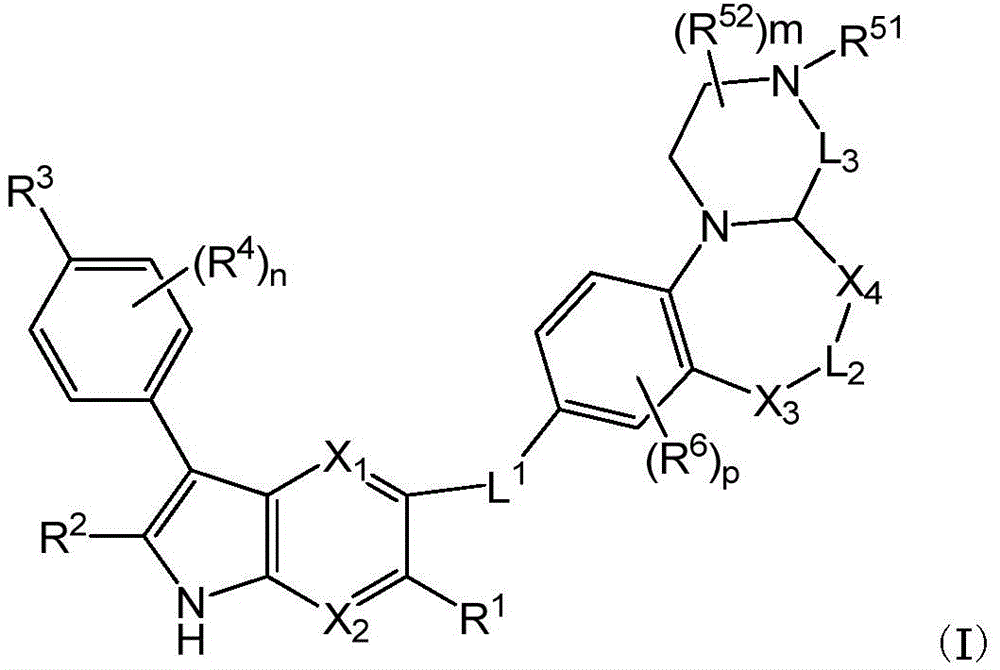
Description
Technical Field
The present disclosure provides methods for preparing tricyclic compounds. The compounds disclosed herein modulate (e.g., inhibit) hematopoietic progenitor kinase 1(HPK1) activity and are useful for the treatment of a variety of diseases, including cancer.
Background
HPK1 regulates various functions of a variety of immune cells and has been shown to have kinase activity in the T Cell Receptor (TCR) [ Liou J. et al, Immunity [ Immunity ],2000.12(4): pp.399-408], B Cell Receptor (BCR) [ Liou J. et al, Immunity [ Immunity ],2000.12(4): pp.399-408), transforming growth factor receptor (TGF-. beta.R) [ Wang, W. et al, J Biol Chem [ J. biochem ],1997.272(36): pp.22771-5; zhou, G.et al, J Biol Chem [ J.Biol.Chem., 1999.274(19): pp.13133-8] and Gs-coupled PGE2 receptors (EP2 and EP4) [ Ikegami, R.et al, J Immunol [ J.Immunol ],2001.166(7): pp.4689-96] were induced upon activation. Overexpression of HPK1 inhibited TCR-induced activation of AP-1-dependent gene transcription in a kinase-dependent manner, indicating that HPK1 is required for inhibition of the Erk MAPK pathway [ Liou J. et al, Immunity [ Immunity ],2000.12(4): pp.399-408], and that this blockade is thought to be an inhibitory mechanism that negatively regulates TCR-induced IL-2 gene transcription [ S.Sawasdikosol et al, Immunol Res [ immunologic study ],2012.54: 262-265 ].
HPK1-/-T cells have a lower TCR activation threshold in vitro and can proliferate robustly, producing increased amounts of Th1 cytokines, HPK 1-/-mice experience more severe autoimmune symptoms [ s.sawasdikosol et al, Immunol Res [ immune studies ],2012.54: pp.262-265 ]. In humans, HPK1 was down-regulated in peripheral blood mononuclear cells from psoriatic arthritis patients or T cells from Systemic Lupus Erythematosus (SLE) patients [ baltiwalla f.m. et al, Mol Med [ molecular medicine ],2005.11(1-12): pp.21-9], indicating that a reduction in HPK1 activity may contribute to autoimmunity in patients. In addition, HPK1 may also modulate anti-tumor immunity via T cell dependent mechanisms. In the Lewis (Lewis) lung cancer tumor model that generated PGE2, tumors developed more slowly in HPK1 knockout mice compared to wild type mice [ us patent application No. 2007/0087988 ]. HPK 1-deficient T cells are more effective at controlling tumor growth and metastasis than wild-type T cells [ Alzabin, s. et al, Cancer Immunol immunotherapy [ Cancer immunology and immunotherapy ],2010.59(3): pp.419-29 ]. Similarly, BMDCs from HPK1 knockout mice were more potent in enhancing T cell responses than wild-type BMDCs to eradicate Lewis lung carcinoma [ Alzabin, S. et al, J Immunol [ J. Immunol ],2009.182(10): pp.6187-94 ]. In conclusion, HPK1 may be a good target for enhancing anti-tumor immunity.
As HPK1 modulators, WO 2016205942 discloses benzimidazole compounds, WO 2018049152 a1 discloses pyrazolopyrimidine compounds, WO 2018049191 a1 discloses pyrazolopyridinone compounds, and WO 2008124849, WO 2018049200 a1 and WO 2018049214 a1 disclose pyrazolopyridine compounds.
However, there is a need to provide new HPK1 kinase inhibitors that are useful for the treatment of cancer.
Disclosure of Invention
In a first aspect, disclosed herein is a process for the preparation of a tricyclic compound of formula (I). The first embodiment includes the following aspects:
aspect 1: preparation method of compound of formula (I)

Comprises the following steps:
step 1:
using transition metal catalysis, will Reaction to form
Step 2: using transition metal catalysis, will Reaction to form
Step 3, mixing In situ deprotection or step-wise deprotection to obtain a compound of formula (I); wherein,
each R is independently Boc or sulfonyl;
each R' is independently hydrogen or alkyl;
X1and X2Each independently is CH or N;
R1and R2Each independently isHydrogen, halogen, -C1-8Alkyl, -C2-8Alkenyl, -C2-8Alkynyl, cycloalkyl, heterocyclyl, aryl, heteroaryl, oxo, -CN, -NO2、-ORa、-SO2Ra、-CORa、-CO2Ra、-CONRaRb、-C(=NRa)NRbRc、-NRaRb、-NRaCORb、-NRaCONRbRc、-NRaCO2Rb、-NRaSONRbRc、-NRaSO2NRbRcor-NRaSO2Rbsaid-C1-8Alkyl, -C2-8Alkenyl, -C2-8Each of alkynyl, cycloalkyl, heterocyclyl, aryl or heteroaryl is optionally substituted with halogen, hydroxy, -C1-8Alkoxy, cycloalkyl, heterocyclyl, aryl or heteroaryl substituted;
Ra、Rband RcEach independently is hydrogen, -C1-8Alkyl, -C2-8Alkenyl, -C2-8Alkynyl, cycloalkyl, heterocyclyl, aryl, or heteroaryl;
n is 0, 1,2, 3 or 4;
at each occurrence, R3And R4Independently of one another is halogen, -C1-8Alkyl, -C2-8Alkenyl, -C2-8Alkynyl, cycloalkyl, heterocyclyl, aryl, heteroaryl, oxo, -CN, -NO2、-OR3a、-SO2R3a、-SO2NR3aR3b、-COR3a、-CO2R3a、-CONR3aR3b、-C(=NR3a)NR3bR3c、-NR3aR3b、-NR3aCOR3b、-NR3aCONR3bR3c、-NR3aCO2R3b、-NR3aSONR3bR3c、-NR3aSO2NR3bR3cor-NR3aSO2R3bsaid-C1-8Alkyl, aryl, heteroaryl, and heteroaryl,-C2-8Alkenyl, -C2-8Alkynyl, cycloalkyl, heterocyclyl-C1-8Each of the alkyl-heterocyclyl, aryl or heteroaryl groups being optionally substituted by at least one substituent R3dSubstitution; or R when attached to adjacent carbon atoms of the phenyl ring3And R4Together with the two carbon atoms to which they are attached form a 5-to 8-membered ring comprising 0, 1 or 2 heteroatoms independently selected from nitrogen, oxygen or optionally oxidised sulfur as one or more ring members, said ring being optionally substituted with at least one substituent R3eSubstitution;
or two R when attached to adjacent carbon atoms of the phenyl ring4Together with the two carbon atoms to which they are attached form a 5-to 8-membered ring comprising 0, 1 or 2 heteroatoms as one or more ring members, said heteroatoms being independently selected from nitrogen, oxygen or optionally oxidised sulfur;
R3a、R3band R3cEach independently is hydrogen, -C1-8Alkyl, -C2-8Alkenyl, -C2-8Alkynyl, cycloalkyl, heterocyclyl, aryl, or heteroaryl, said-C1-8Alkyl, -C2-8Alkenyl, -C2-8Each of the alkynyl, cycloalkyl, heterocyclyl, aryl, or heteroaryl groups is optionally substituted with at least one substituent R3eSubstitution; or
(R3aAnd R3b)、(R3bAnd R3c) Or (R)3cAnd R3a) Together with the atom or atoms to which they are attached form a 3-to 12-membered ring, which ring comprises 0, 1 or 2 further heteroatoms as one or more ring members, which heteroatoms are independently selected from nitrogen, oxygen or optionally oxidised sulfur, which ring is optionally substituted with at least one substituent R3eSubstitution;
R3dand R3eEach independently is halogen, -C1-8Alkyl, -C2-8Alkenyl, -C2-8Alkynyl, cycloalkyl, heterocyclyl, aryl, heteroaryl, oxo, -CN, -NO2、-OR3f、-SO2R3f、-SO2NR3fR3g、-COR3f、-CO2R3f、-CONR3fR3g、-C(=NR3f)NR3gR3h、-NR3fR3g、-NR3fCOR3g、-NR3fCONR3gR3h、-NR3fCO2R3f、-NR3fSONR3fR3g、-NR3fSO2NR3gR3hor-NR3fSO2R3gsaid-C1-8Alkyl, -C2-8Alkenyl, -C2-8Each of alkynyl, cycloalkyl, heterocyclyl, aryl, or heteroaryl is optionally substituted with at least one substituent selected from halogen, -C1-8Alkyl, -OR3i、-NR3iR3jCycloalkyl, heterocyclyl, aryl, or heteroaryl;
R3f、R3g、R3h、R3iand R3jEach independently is hydrogen, -C1-8Alkyl radical, C1-8alkoxy-C1-8Alkyl-, -C2-8Alkenyl, -C2-8Alkynyl, cycloalkyl, heterocyclyl, aryl, or heteroaryl;
L1selected from the group consisting of single bonds, alkylene, -O-, -NR7-, -cycloalkylene radical1-O-alkylene-a1、*1-alkylene-O-)1、*1-NH-alkylene-a1、*1-alkylene-NH-x1、*1-NHC(O)-**1、*1-C(O)NH-**1Alkenylene or alkynylene; wherein1Refers to attachment to Position of the moiety, and1refers to attachment to
 The position of (a);
at each occurrence, R6Independently of one another is halogen, -C1-8Alkyl, -C2-8Alkenyl, -C2-8Alkynyl, cycloalkyl, heterocyclyl, aryl, heteroAryl, oxo, -CN, -NO2、-OR6a、-SO2R6a、-SO2NR6aR6b、-COR6a、-CO2R6a、-CONR6aR6b、-C(=NR6a)NR6bR6c、-CH2CONR6aR6b、-CH2CH2CONR6aR6b、-CH2CH2CH2CONR6aR6b、-NR6aR6b、-CH2NR6aR6b、-CH2CH2NR6aR6b、-CH2CH2CH2NR6aR6b、-NR6aCOR6b、-NR6aCONR6bR6c、-NR6aCO2R6b、-NR6aSONR6bR6c、-NR6aSO2NR6bR6cor-NR6aSO2R6bsaid-C1-8Alkyl, -C2-8Alkenyl, -C2-8Each of the alkynyl, cycloalkyl, heterocyclyl, aryl or heteroaryl groups is optionally substituted with at least one substituent R6dSubstitution; or two R when attached to adjacent carbon atoms of the phenyl ring6Together with the atoms to which they are attached form a 4-, 5-, 6-, 7-or 8-membered ring, which ring comprises 0, 1 or 2 heteroatoms independently selected from nitrogen, oxygen or optionally oxidised sulfur as one or more ring members, which ring is optionally substituted with at least one substituent R6eSubstitution;
R6a、R6band R6cEach independently is hydrogen, -C1-8Alkyl, -C2-8Alkenyl, -C2-8Alkynyl, C1-8alkoxy-C1-8Alkyl-, cycloalkyl-, heterocyclyl-, aryl-or heteroaryl, said-C1-8Alkyl, -C2-8Alkenyl, -C2-8Each of the alkynyl, cycloalkyl, heterocyclyl, aryl or heteroaryl groups is optionally substituted with at least one substituent R6eSubstitution; or
(R6aAnd R6b)、(R6bAnd R6c) Or (R)6cAnd R6a) Together with the atom or atoms to which they are attached form a 3-to 12-membered ring, which ring comprises 0, 1 or 2 further heteroatoms as one or more ring members, which heteroatoms are independently selected from nitrogen, oxygen or optionally oxidised sulfur, which ring is optionally substituted with at least one substituent R6eSubstitution;
R6dand R6eEach independently is hydrogen, halogen, -C1-8Alkyl, -C2-8Alkenyl, -C2-8Alkynyl, cycloalkyl, heterocyclyl, aryl, heteroaryl, oxo, -CN, -NO2、-OR6f、-SO2R6f、-SO2NR6fR6g、-COR6f、-CO2R6f、-CONR6fR6g、-C(=NR6h)NR6fR6g、-NR6fR6g、-NR6fCOR6g、-NR6hCONR6fR6g、-NR6fCO2R6h、-NR6hSONR6fR6g、-NR6hSO2NR6fR6gor-NR6fSO2R6gsaid-C1-8Alkyl, -C2-8Alkenyl, -C2-8Each of alkynyl, cycloalkyl, heterocyclyl, aryl or heteroaryl is optionally substituted with at least one substituent selected from halogen, -C1-8Alkyl, -OR6i、-NR6iR6jCycloalkyl, heterocyclyl, aryl or heteroaryl;
R6f、R6g、R6h、R6iand R6jEach independently is hydrogen, -C1-8Alkyl radical, C1-8alkoxy-C1-8Alkyl-, -C2-8Alkenyl, -C2-8Alkynyl, cycloalkyl, heterocyclyl, aryl or heteroaryl;
p is 0, 1,2, 3 or 4;
X3、X4and L2Each independently a single bond, -O-, -CO-, -SO2-、-NR7-、-S-、-CR7R8-or-CR7R8-CR9R10Provided that no two heteroatoms in the main chain are adjacent;
L3is a single bond, -CO-, -CR7R8-or-CR7R8-CR9R10-;
R51Is hydrogen, -C1-8Alkyl, -C2-8Alkenyl, -C2-8Alkynyl, cycloalkyl, heterocyclyl, aryl or heteroaryl;
at each occurrence, R52、R7、R8、R9And R10Independently hydrogen, halogen, -C1-8Alkyl, -C2-8Alkenyl, -C2-8Alkynyl, cycloalkyl, heterocyclyl, aryl, heteroaryl, oxo, -CN, -NO2、-OR5a、-SO2R5a、-SO2NR5aR5b、-POR5aR5b、-COR5a、-CO2R5a、-CONR5aR5b、-C(=NR5a)NR5bR5c、-CH2CONR5aR5b、-CH2CH2CONR5aR5b、-CH2CH2CH2CONR5aR5b、-NR5aR5b、-NR5aCOR5b、-NR5aCONR5bR5c、-NR5aCO2R5b、-NR5aSONR5bR5c、-NR5aSO2NR5bR5cor-NR5aSO2R5bsaid-C1-8Alkyl, -C2-8Alkenyl, -C2-8Alkynyl, cycloalkyl, -C1-8Each of the alkyl-cycloalkyl, heterocyclyl, aryl or heteroaryl groups being optionally substituted by at least one substituent R5dSubstitution; or R when attached to adjacent carbon atoms of the ring51And one R52Or two R52Together with the atoms to which they are attached form a 4-, 5-, 6-, 7-or 8-membered ring, which ring contains 0, 1 or 2 heteroatoms as a single atomOne or more ring members, the heteroatoms being independently selected from nitrogen, oxygen or optionally oxidised sulphur, the ring being optionally substituted with at least one substituent R5eSubstitution;
R5a、R5band R5cEach independently is hydrogen, -C1-8Alkyl, -C2-8Alkenyl, -C2-8Alkynyl, -C1-8alkyl-C1-8Alkoxy, cycloalkyl, -C1-8alkyl-heterocyclyl-C1-8Alkyl-aryl, heterocyclyl, aryl or heteroaryl, said-C1-8Alkyl, -C2-8Alkenyl, -C2-8Alkynyl, -C1-8alkyl-C1-8Alkoxy, cycloalkyl, -C1-8alkyl-heterocyclyl-C1-8Each of the alkyl-aryl, heterocyclyl, aryl or heteroaryl groups being optionally substituted by at least one substituent R5eSubstitution; or
(R5aAnd R5b)、(R5bAnd R5c) Or (R)5cAnd R5a) Together with the atom or atoms to which they are attached form a 3-to 12-membered ring, which ring comprises 0, 1 or 2 further heteroatoms as one or more ring members, which heteroatoms are independently selected from nitrogen, oxygen or optionally oxidised sulfur, which ring is optionally substituted with at least one substituent R5eSubstitution;
R5dand R5eEach independently is hydrogen, halogen, -C1-8Alkyl, -C2-8Alkenyl, -C2-8Alkynyl, cycloalkyl, heterocyclyl, aryl, heteroaryl, oxo, -CN, -NO2、-CF3、-OR5f、-SO2R5f、-SO2NR5fR5g、-POR5fR5g、-COR5f、-CO2R5f、-CONR5fR5g、-C(=NR5h)NR5fR5g、-NR5fR5g、-NR5fCOR5g、-NR5hCONR5fR5g、-NR5fCO2R5h、-NR5hSONR5fR5g、-NR5hSO2NR5fR5gor-NR5fSO2R5gsaid-C1-8Alkyl, -C2-8Alkenyl, -C2-8Each of alkynyl, cycloalkyl, heterocyclyl, aryl or heteroaryl is optionally substituted with at least one substituent selected from halogen, -C1-8Alkyl, -OR5i、-NR5iR5jCycloalkyl, heterocyclyl, aryl or heteroaryl;
R5f、R5g、R5h、R5iand R5jEach independently is hydrogen, -C1-8Alkyl, -C1-8Alkoxy, hydroxy, C1-8alkoxy-C1-8Alkyl-, -C2-8Alkenyl, -C2-8Alkynyl, cycloalkyl, heterocyclyl, aryl or heteroaryl;
m is 0, 1,2, 3 or 4.
Aspect 2: the process for preparing a compound according to aspect 1, wherein X1Is CH and X2Is N; or X1Is N and X2Is N.
Aspect 3: the process for preparing a compound according to aspect 1 or 2, wherein R1And R2Each is hydrogen or-C1-8Alkyl (preferably hydrogen or methyl).
Aspect 4: a process for the preparation of a compound according to any one of aspects 1 to 3, wherein R3is-CONR3aR3b;R3aAnd R3bEach independently is hydrogen or-C1-8Alkyl (preferably methyl, ethyl, propyl, 2-methylpropyl, butyl, pentyl or hexyl); said-C1-8Alkyl optionally substituted by at least one substituent R3eIs substituted in which R3eIs as defined for formula (I). Preferably, R3eSelected from halogen, -OR3fCN or a heterocyclic group; r3fSelected from hydrogen or-C1-8Alkyl (e.g., methyl, ethyl, propyl, butyl, pentyl, or hexyl). Preferably, R3eIs a 3-to 7-membered heterocyclyl group containing 1 or 2 heteroatoms selected from nitrogen, oxygen or optionally oxidised sulphur, for example piperazinyl, piperidinyl, tetrahydrofuranyl, tetrahydropyranyl or pyrrolidinyl.
Aspect 5: a process for preparing a compound according to aspect 4, wherein R3is-CONR3aR3b;R3aAnd R3bEach independently is hydrogen or-C1-8Alkyl (preferably methyl, ethyl, propyl, 2-methylpropyl, butyl, pentyl or hexyl); said-C1-8Alkyl optionally substituted by at least one substituent R3eIs substituted in which R3eIs selected from-OR3fOr a heterocyclic group; r3fSelected from hydrogen or-C1-8Alkyl (e.g. methyl, ethyl, propyl, butyl, pentyl or hexyl) and heterocyclyl is a 5-, 6-or 7-membered heterocyclyl comprising 1 or more heteroatoms selected from nitrogen or oxygen, e.g. piperidinyl, tetrahydrofuranyl, tetrahydropyranyl or pyrrolidinyl.
Aspect 6: the method of making a compound according to any one of aspects 1-5, wherein R3is-CONR3aR3b;R3ais-C1-8Alkyl (preferably methyl, ethyl, propyl, 2-methylpropyl, butyl, pentyl or hexyl), and R3bIs optionally substituted by at least one substituent R3esubstituted-C1-8Alkyl (preferably methyl, ethyl, propyl, 2-methylpropyl, butyl, pentyl or hexyl), wherein R3eIs selected from-OR3fOr a heterocyclic group; r3fSelected from hydrogen or-C1-8Alkyl (e.g. methyl, ethyl, propyl, butyl, pentyl or hexyl) and heterocyclyl is a 5-, 6-or 7-membered heterocyclyl comprising 1 or more heteroatoms selected from nitrogen or oxygen, e.g. piperidinyl, tetrahydrofuranyl, tetrahydropyranyl or pyrrolidinyl.
Aspect 7: a process for the preparation of a compound according to any one of aspects 1 to 3, wherein R3is-CONR3aR3bor-NR3aR3bWherein R is3aAnd R3bTogether with the nitrogen atom to which they are attached form a 4-to 12-membered ring, which ring comprises 1 or 2 additional nitrogen or oxygen heteroatoms as one or more ring members (e.g. a monocyclic 3-to 8-membered ring or a bicyclic spiro 7-to 12-membered ring), which ring is optionally substituted with at least one substituent R3eSubstitution; r3eEach independently selected from oxo、-C1-8Alkyl, -OR3f、-NR3fR3gOr a heterocyclic group, said-C1-8Alkyl or heterocyclyl is optionally substituted by at least one halogen, wherein R3fAnd R3gEach independently is hydrogen or-C1-8An alkyl group.
Aspect 8: a process for preparing a compound according to aspect 7, wherein R3is-CONR3aR3bor-NR3aR3bWherein R is3aAnd R3bTogether with the nitrogen atom to which they are attached form a monocyclic 3-to 8-membered ring which comprises 1 or 2 further nitrogen or oxygen heteroatoms as one or more ring members, which ring is optionally substituted by at least one substituent R3eSubstitution; r3eEach independently selected from oxo, -C1-8Alkyl, -OR3f、-NR3fR3gOr a heterocyclic group, said-C1-8Alkyl or heterocyclyl is optionally substituted by at least one halogen, wherein R3fAnd R3gEach independently is hydrogen or-C1-8An alkyl group. Preferably, the monocyclic 3-to 8-membered ring containing 1 or 2 additional nitrogen or oxygen heteroatoms as one or more ring members is azetidinyl, pyrrolidinyl, piperidinyl or piperazinyl, each of which is further substituted with a heterocyclyl group (e.g., a monocyclic 4-to 9-membered heterocyclyl group as defined herein).
Aspect 9: a process for preparing a compound according to aspect 7, wherein R3is-CONR3aR3bor-NR3aR3bWherein R is3aAnd R3bTogether with the nitrogen atom to which they are attached form a bicyclic spiro 7-to 12-membered ring, which ring comprises 1 or 2 further nitrogen or oxygen heteroatoms as one or more ring members, which ring is optionally substituted by at least one substituent R3eSubstitution; r3eEach independently selected from oxo, -C1-8Alkyl, -OR3f、-NR3fR3gOr a heterocyclic group, said-C1-8Alkyl or heterocyclyl is optionally substituted by at least one halogen, wherein R3fAnd R3gEach independently is hydrogen or-C1-8An alkyl group. Preferably, comprisesThe bicyclic spiro 7-to 12-membered ring with 1 or 2 additional nitrogen or oxygen heteroatoms as one or more ring members is a 4-membered/3-membered, 4-membered/4-membered, 3-membered/5-membered, 4-membered/6-membered, 5-membered/5-membered or 5-membered/6-membered single spiroheterocyclyl. More preferably, the bicyclic spiro 7-to 12-membered ring containing 1 or 2 additional nitrogen or oxygen heteroatoms as one or more ring members is 2, 3-dihydrospiro [ indene-1, 2' -pyrrolidine](e.g., 2, 3-dihydrospiro [ indene-1, 2' -pyrrolidine)]-1 '-yl), 1, 3-dihydrospiro [ indene-2, 2' -pyrrolidine](e.g., 1, 3-dihydrospiro [ indene-2, 2' -pyrrolidine)]-1' -yl), azaspiro [2.4]Heptane (e.g. 5-azaspiro [2.4 ]]Heptan-5-yl), 2-oxa-6-azaspiro [3.3]Heptane (e.g. 2-oxa-6-azaspiro [3.3]]Heptane-6-yl), azaspiro [3.4]Octane (e.g. 6-azaspiro [3.4 ]]Octane-6-yl), 2-oxa-6-azaspiro [3.4]Octane (e.g. 2-oxa-6-azaspiro [3.4 ]]Octane-6-yl), azaspiro [3.4]Octane (e.g. 6-azaspiro [3.4 ]]Octane-6-yl), azaspiro [3.4]Octane (e.g. 6-azaspiro [3.4 ]]Octane-6-yl), 1, 7-dioxaspiro [4.5 ]]Decane, 2-oxa-7-aza-spiro [4.4]Nonanes (e.g. 2-oxa-7-aza-spiro [4.4 ]]Non-7-yl), 7-oxa-spiro [3.5]Nonyl or 5-oxa-spiro [2.4 ]]A heptyl group.
Aspect 10: a process for the preparation of a compound according to any one of aspects 1 to 9, wherein R3Is selected from

 Preferably, R3Is selected from

Aspect 11: the method of making a compound according to any one of aspects 1-10, wherein n is 0 or 1; r4Selected from halogen, -C1-8Alkyl radical(preferably methyl), halogen, CN, -OR3aor-NR3aCONR3bR3c(ii) a said-C1-8Alkyl optionally substituted by at least one substituent R3dSubstitution; r3a、R3bAnd R3cEach independently is hydrogen, -C1-8Alkyl (preferably methyl); r3dEach independently is halogen or-C1-8An alkyl group.
Aspect 12: the method of preparing a compound according to aspect 11, wherein n is 0.
Aspect 13: the process for preparing a compound according to aspect 11, wherein n is 1, R4is-C1-8Alkyl (e.g., methyl).
Aspect 14: a process for the preparation of a compound according to any one of aspects 1 to 13, wherein L1Is a single bond.
Aspect 15: the method of making a compound according to any one of aspects 1-14, wherein m is 0.
Aspect 16: a process for the preparation of a compound according to any one of aspects 1 to 15, wherein R51Is hydrogen or-C1-8Alkyl (e.g., methyl, ethyl, propyl, butyl, pentyl, or hexyl).
Aspect 17: a process for the preparation of a compound according to any one of aspects 1 to 16, wherein said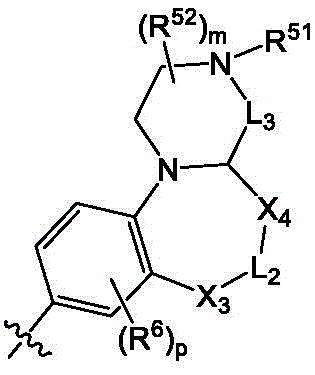 Is partially
 Wherein R is51、R52M and R6Is as defined above.
Aspect 18: the method of preparing a compound according to aspect 17, wherein L3is-CR7R8-, wherein R7And R8Is defined in formula (I). Preferably, R7And R8Is hydrogen, halogen or-C1-8An alkyl group.
Aspect 19: a process for the preparation of a compound according to any one of aspects 1 to 18, wherein X3、X4And L2One of them is-O-, -SO2-、-NR7-or-S-, and the remaining two are each independently a single bond-CO-, -CR7R8-or-CR7R8-CR9R10-, wherein R7、R8、R9And R10Are defined in formula (I), preferably are each hydrogen or-C1-8An alkyl group. Preferably, X3、X4And L2is-O-or-NR7-, and the remaining two are each independently-CR7R8-, wherein R7And R8Each is hydrogen or-C1-8Alkyl, preferably both are hydrogen.
Aspect 20: the method of preparing a compound according to aspect 17, wherein Selected from the following:


Aspect 21: a process for the preparation of a compound selected from:


Detailed Description
General Synthesis
The compounds disclosed herein (including salts thereof) can be prepared using known organic synthesis techniques and can be synthesized according to any of a number of possible synthetic routes.
The reactions used to prepare the compounds disclosed herein can be carried out in a suitable solvent that can be readily selected by those skilled in the art of organic synthesis. Suitable solvents may be substantially non-reactive with the starting materials, intermediates, or products at the temperatures at which the reaction is carried out (e.g., temperatures ranging from the boiling temperature of the solvent). A given reaction may be carried out in one solvent or a mixture of more than one solvent.
The selection of an appropriate protecting group can be readily determined by one skilled in the art.
The reaction may be monitored according to any suitable method known in the art (e.g., NMR, UV, HPLC, LC-MS, and TLC). The compounds can be purified by a variety of methods, including HPLC and normal phase silica gel chromatography.
Chiral analytical HPLC was used for retention time analysis of different chiral examples, and the conditions were divided into the following methods according to the column, mobile phase and solvent ratio used.
Scheme I

For example, compounds of formula (I) may be formed as shown in scheme I. Compound (i) may be reacted with a boronic acid or boronic ester using a transition metal catalysed reaction to give compound (ii); compound (ii) may be reacted with a boronic acid or boronic ester using a transition metal catalysed reaction to give compound (iii); compound (iii) may be deprotected in situ or stepwise to give compound (iv) [ i.e. formula (I) ].
Scheme II
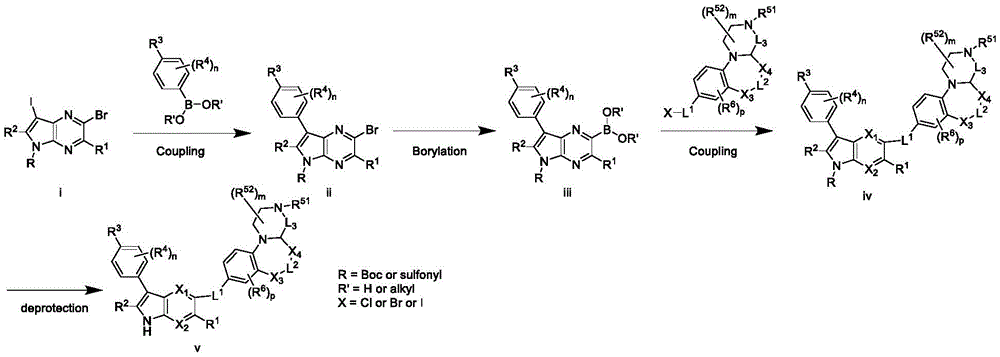
For example, compounds of formula (I) may be formed as shown in scheme II. Compound (i) may be reacted with a boronic acid or boronic ester using a transition metal catalysed reaction to give compound (ii); compound (ii) may be borated to give compound (iii); compound (iii) may be reacted with a boronic acid or boronic ester using a transition metal catalysed reaction to give compound (iv); compound (iv) may be deprotected in situ or stepwise to give compound (v) [ i.e. formula (I) ].
Shorthand writing
Ts p-toluenesulfonyl (tosyl)
THF tetrahydrofuran
Lithium LDA diisopropylamide
DMF N, N-dimethylformamide
Et Ethyl group
Ac acetyl group
PE Petroleum Ether
NMR nuclear magnetic resonance
LC-MS liquid chromatography-mass spectrometry
TFA trifluoroacetic acid
Me methyl group
DCM dichloromethane
dppf 1,1' -bis (diphenylphosphino) ferrocene
Xphos 2-dicyclohexylphosphino-2 ',4', 6 ' -triisopropylbiphenyl
TLC thin layer chromatography
HATU 2- (7-azabenzotriazol-1-yl) -N, N, N ', N' -tetramethyluronium hexafluorophosphate
DIPEA N, N-diisopropylethylamine
TBS tert-butyldimethylsilyl group
UV ultraviolet ray
TBAF tetra-n-butylammonium fluoride
HPLC high performance liquid chromatography
DMSO dimethyl sulfoxide
DEA diethylamine
MtBE methyl tertiary butyl ether
Boc tert-butyloxycarbonyl
Example 1
4- (5- (3, 10-dimethyl-2, 3,4,4a,5, 6-hexahydro-1H-pyrazino [1,2-a ] quinolin-8-yl) -1H-pyrrolo [2,3-b ] pyridin-3-yl) -N, N-dimethylbenzamide

1H NMR(400 MHz,CDCl3)δ9.97(s,1H),8.54(s,1H),8.32(s,1H),7.77-7.64(m,2H),7.62-7.48(m,3H),7.26(s,1H),7.19(s,1H),3.54-3.27(m,2H),3.26-2.77(m,14H),2.78-2.47(m,4H),2.36(s,3H)。LC-MS(M+H)+=479.9。
Example 2A/2B
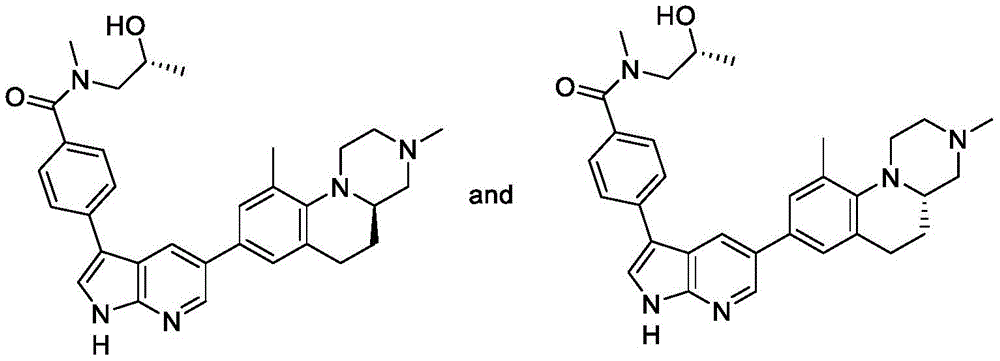
4- (5- ((R) -3, 10-dimethyl-2, 3,4,4a,5, 6-hexahydro-1H-pyrazino [1,2-a ] quinolin-8-yl) -1H-pyrrolo [2,3-b ] pyridin-3-yl) -N- ((S) -2-hydroxypropyl) -N-methylbenzamide and 4- (5- ((S) -3, 10-dimethyl-2, 3,4,4a,5, 6-hexahydro-1H-pyrazino [1,2-a ] quinolin-8-yl) -1H-pyrrolo [2,3-b ] pyridin-3-yl) -N- ((S) -2-hydroxypropyl) -N-methylbenzamide.

Step 1: 4-bromo-N- [ (2S) -2-hydroxypropyl ] benzamide

To a solution of 4-bromobenzoic acid (11.80g, 55.8mmol) in DMF (120mL) were added DIPEA (10.50g, 104mmol), HATU (22.40g, 58.9mmol) and (2S) -1-aminopropan-2-ol (4.00g, 53.3 mmol). The resulting mixture was stirred at room temperature for 6 h. The reaction was quenched by the addition of water. The resulting mixture was extracted with EtOAc (600mL x 3). The combined organic layers were washed with brine (100mL) and dried over anhydrous Na2SO4And (5) drying. After filtration, the filtrate was concentrated under reduced pressure. The residue was purified by silica gel column chromatography (eluting with PE/EtOAc (30: 70)) to give the title compound (12.0g, 88%). LC-MS (M + H)+=258.1
Step 2: 4-bromo-N- [ (2S) -2- [ (tert-butyldimethylsilyl) oxy ] propyl ] benzamide

To 4-bromo-N- [ (2S) -2-hydroxypropyl at 0 deg.C]A stirred mixture of benzamide (12.0g, 46.7mmol) and TBSCl (15.0g, 59.0mmol) in DCM (150mL) was added dropwise Et3N (15.0g, 149 mmol). The resulting mixture was stirred at room temperature for 15 h. The reaction was quenched by the addition of water. The resulting mixture was extracted with DCM (500mL × 3). The combined organic layers were washed with brine (100mL) and dried over anhydrous Na2SO4And (5) drying. After filtration, the filtrate was concentrated under reduced pressure to give the title compound (19.0g, crude). The crude product was used directly in step 3 without further purification. LC-MS (M + H)+=372.2。
And step 3: 4-bromo-N- [ (2S) -2- [ (tert-butyldimethylsilyl) oxy ] propyl ] -N-methylbenzamide

To 4-bromo-N- [ (2S) -2- [ (tert-butyldimethylsilyl) oxy) at 0 ℃ under a nitrogen atmosphere]Propyl radical]Benzamide (19.0g, crude from step 2) in DMF (1)20mL) was added portionwise NaH (5.10g, 60% in mineral oil, 127 mmol). The resulting mixture was stirred for 30min, then CH was added dropwise at 0 deg.C3I (9.50g, 63.6 mmol). The resulting mixture was stirred at room temperature under nitrogen atmosphere for 3 h. The reaction was quenched with ice water at 0 ℃. The resulting mixture was extracted with EtOAc (700mL x 3). The combined organic layers were washed with brine (150mL) and dried over anhydrous Na2SO4And (5) drying. After filtration, the filtrate was concentrated under reduced pressure to give the title compound (18.0g, crude). The crude product was used directly in step 4 without further purification. LC-MS (M + H)+=386.3。
And 4, step 4: 4-bromo-N- [ (2S) -2-hydroxypropyl ] -N-methylbenzamide

To 4-bromo-N- [ (2S) -2- [ (tert-butyldimethylsilyl) oxy group]Propyl radical]To a solution of-N-methylbenzamide (18.0g, crude from step 3) in THF (200mL) was added TBAF (1.0M in THF, 70mL, 70 mmol). The resulting mixture was stirred at room temperature for 15 h. The reaction mixture was concentrated in vacuo and the residue was purified by silica gel column chromatography (eluting with EtOAc) to give the title compound (8.3g, 65% over 3 steps). LC-MS (M + H)+=272.0。
And 5: n- [ (2S) -2-hydroxypropyl ] -N-methyl-4- (4,4,5, 5-tetramethyl-1, 3, 2-dioxaborolan-2-yl) benzamide

To 4-bromo-N- [ (2S) -2-hydroxypropyl group](iii) -N-methylbenzamide (8.3g, 30.5mmol) and 4,4,4',4',5,5,5',5' -octamethyl-2, 2' -bis (1,3, 2-dioxaborolan) (12.0g, 44.9mmol) in dioxane (200mL) to which was added Pd (dppf) Cl2DCM (2.60g, 3.02mmol) and KOAc (9.30g, 90.0 mmol). The reaction mixture was stirred at 100 ℃ under nitrogen atmosphere for 3 h. The mixture was cooled to room temperature and then filtered. The filter cake was rinsed with dioxane (10mL x 3). The filtrate was concentrated under reduced pressure. The residue was purified by silica gel column chromatography (eluted with EtOAc) to give the title compound (7.8g, 80%). LC-MS (M + H)+=320.2。
Step 6: 5-bromo-3-iodo-1- (benzenesulfonyl) -1H-pyrrolo [2,3-b ] pyridine

To 5-bromo-3-iodo-1H-pyrrolo [2,3-b ] at 0 deg.C]Pyridine (43.3g, 134.1mmol) in DMF (300mL) was added NaH (60%, 7.0g, 175mmol) in portions. The mixture was stirred at 0 ℃ for 30 minutes. To the mixture was added dropwise benzenesulfonyl chloride (35.5g, 201mmol) at 0 ℃ and the mixture was stirred at room temperature for 3 h. The reaction was quenched with water (300 mL). The precipitate was collected by filtration, washed with water (50mL x 5) and dried in vacuo to give the title compound (65.0g, 100%). LC-MS (M + H)+=462.6,464.5。
And 7: (S) -4- (5-bromo-1H-pyrrolo [2,3-b ] pyridin-3-yl) -N- (2-hydroxypropyl) -N-methylbenzamide

To 5-bromo-3-iodo-1- (benzenesulfonyl) -1H-pyrrolo [2,3-b ]]Pyridine (1.0g, 2.16mmol), N- [ (2S) -2-hydroxypropyl [ ]]-N-methyl-4- (4,4,5, 5-tetramethyl-1, 3, 2-dioxaborolan-2-yl) benzamide (689mg, 2.16mmol) and K2CO3(596mg, 4.32mmol) to a mixture of 1, 4-dioxane (20mL) and water (20mL) was added Pd (dppf) Cl2DCM (176mg, 0.216 mmol). The reaction mixture was heated at 80 ℃ under N2Stirring was continued overnight. Water (20mL) was added, and the mixture was extracted with EtOAc (20mL x 3). The combined organic layers were washed with brine, over Na2SO4Dried, filtered and concentrated. The crude product was purified by silica gel chromatography (DCM: MeOH ═ 30:1 to 20:1) to give the title compound (330mg, 45%). LC-MS (M + H)+=387.8,389.8。
And 8: 3, 10-dimethyl-8- (4,4,5, 5-tetramethyl-1, 3, 2-dioxaborolan-2-yl) -2,3,4,4a,5, 6-hexahydro-1H-pyrazino [1,2-a ] quinoline

To 8-bromo-3, 10-dimethyl-2, 3,4,4a,5, 6-hexahydro-1H-pyrazino [1,2-a ]]To a solution of quinoline (2.0g, 6.78mmol) in 1, 4-dioxane (100mL) were added 4,4,4',4',5,5,5',5' -octamethyl-2, 2' -bis (1,3, 2-dioxaborolan) (2.58g, 10.2mmol) and pd (dppf) Cl2DCM (277mg, 0.339mmol) and KOAc (1.33g, 13.56 mmol). The solution was heated at 90 ℃ under N2Stirring was continued overnight. Water (100mL) was added, and the mixture was extracted with EtOAc (100mL x 3). The combined organic layers were washed with brine, over Na2SO4Dried, filtered and concentrated. The residue was purified by silica gel chromatography (DCM: MeOH ═ 20:1) to give the title compound (1.93g, 83%). LC-MS (M + H)+=343.1。
And step 9: 4- (5- ((R) -3, 10-dimethyl-2, 3,4,4a,5, 6-hexahydro-1H-pyrazino [1,2-a ] quinolin-8-yl) -1H-pyrrolo [2,3-b ] pyridin-3-yl) -N- ((S) -2-hydroxypropyl) -N-methylbenzamide and 4- (5- ((S) -3, 10-dimethyl-2, 3,4,4a,5, 6-hexahydro-1H-pyrazino [1,2-a ] quinolin-8-yl) -1H-pyrrolo [2,3-b ] pyridin-3-yl) -N- ((S) -2-hydroxypropyl) -N-methylbenzamide.

To (S) -4- (5-bromo-1H-pyrrolo [2, 3-b)]Pyridin-3-yl) -N- (2-hydroxypropyl) -N-methylbenzamide (330mg, 0.853mmol) and 3, 10-dimethyl-8- (4,4,5, 5-tetramethyl-1, 3, 2-dioxaborolan-2-yl) -2,3,4,4a,5, 6-hexahydro-1H-pyrazino [1,2-a ] amide]To a solution of quinoline (292mg, 0.853mmol) in 1, 4-dioxane (10mL) and water (10mL) were added XPhos Pd G2(67mg, 0.085mmol) and K3PO4(362mg, 1.71 mmol). The reaction mixture was heated at 80 ℃ under N2Stirring was continued overnight.Water (10mL) was added and the mixture was extracted with EtOAc (10mL x 3). The combined organic layers were washed with brine, over Na2SO4Dried, filtered and concentrated. The crude product was purified by silica gel chromatography (DCM: MeOH ═ 10:1) to give an isomer mixture (160mg), which was then separated by chiral HPLC to give example 2A/2B.
Example 2A: (55mg, 12%)1H NMR(400MHz,DMSO-d6)δ12.01(s,1H),8.49(d,J=1.7Hz,1H),8.37(d,J=1.7Hz,1H),7.97(d,J=2.6Hz,1H),7.87-7.78(m,2H),7.52-7.46(m,2H),7.34(s,1H),7.27(s,1H),4.92-4.76(m,1H),4.05-3.80(m,1H),3.55-3.42(m,0.5H),3.37-3.27(m,1H),3.22-3.12(m,0.5H),3.09-2.81(m,8H),2.65-2.56(m,2H),2.48-2.42(m,1H),2.34-2.24(m,4H),2.24-2.12(m,4H),1.65-1.52(m,1H),1.17-0.88(m,3H)。LC-MS(M+H)+524.0. tR in chiral HPLC: 2.83 min.
Example 2B: (50mg, 11%)1H NMR(400MHz,DMSO-d6)δ12.02(s,1H),8.49(s,1H),8.37(s,1H),7.98(d,J=2.4Hz,1H),7.88-7.77(m,2H),7.53-7.45(m,2H),7.34(s,1H),7.27(s,1H),4.93-4.77(m,1H),4.08-3.81(d,J=39.0Hz,1H),3.55-3.43(m,0.5H),3.37-3.27(m,1H),3.22-3.12(m,1H),3.11-2.81(m,8H),2.66-2.55(m,2H),2.48-2.41(m,1H),2.35-2.25(m,4H),2.23-2.12(m,4H),1.65-1.50(d,J=12.9Hz,1H),1.17-0.88(m,3H)。LC-MS(M+H)+524.0. tR in chiral HPLC: 3.41 min.
Preparative HPLC conditions

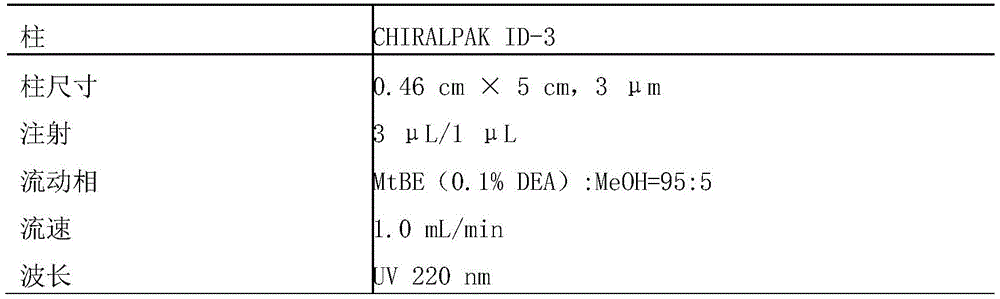
Chiral analytical HPLC conditions

Example 3A/3B
4- (5- ((R) -3, 10-dimethyl-2, 3,4,4a,5, 6-hexahydro-1H-pyrazino [1,2-a ] quinolin-8-yl) -1H-pyrrolo [2,3-b ] pyridin-3-yl) -N- ((R) -2-hydroxypropyl) -N-methylbenzamide and 4- (5- ((S) -3, 10-dimethyl-2, 3,4,4a,5, 6-hexahydro-1H-pyrazino [1,2-a ] quinolin-8-yl) -1H-pyrrolo [2,3-b ] pyridin-3-yl) -N- ((R) -2-hydroxypropyl) -N-methylbenzamide.

Step 1:4-bromo-N- [ (2R) -2-hydroxypropyl]Benzamide derivatives

The title compound (4.63g, 67%) was prepared from 4-bromobenzoic acid and (2R) -1-aminopropan-2-ol in analogy to example 2A/2B, step 1. LC-MS (M + H)+=258.1。
Step 2:4-bromo-N- [ (2R) -2- [ (tert-butyldimethylsilyl) oxy ] carbonyl]Propyl radical]Benzamide derivatives

From 4-bromo-N- [ (2R) -2-hydroxypropyl in a similar manner as in example 2A/2B, step 2]Benzamide and TBSCl the title compound (12.1g, 60%) was prepared. LC-MS (M + H)+=372.3。
And step 3: 4-bromo-N- [ (2R) -2- [ (tert-butyldimethylsilyl) oxy ] propyl ] -N-methylbenzamide

From 4-bromo-N- [ (2R) -2- [ (tert-butyldimethylsilyl) oxy, in a similar manner as in example 2A/2B, step 3]Propyl radical]Benzamide and MeI prepare the title compound (9.79g, 53%). LC-MS (M + H)+=386.1。
And 4, step 4: 4-bromo-N- [ (2R) -2-hydroxypropyl ] -N-methylbenzamide

From 4-bromo-N- [ (2R) -2- [ (tert-butyldimethylsilyl) oxy, in a similar manner as in example 2A/2B, step 4]Propyl radical]-N-methylbenzamide the title compound (5.48g, 70%) was prepared. LC-MS (M + H)+=272.0。
And 5: (R) -N- (2-hydroxypropyl) -N-methyl-4- (4,4,5, 5-tetramethyl-1, 3, 2-dioxaborolan-2-yl) benzamide

From 4-bromo-N- [ (2R) -2-hydroxypropyl in a similar manner as in example 2A/2B, step 5]-N-methylbenzamide the title compound (3.75g, 47%) was prepared. LC-MS (M + H)+=320.1。
Step 6: (R) -4- (5-bromo-1- (benzenesulfonyl) -1H-pyrrolo [2,3-b ] pyridin-3-yl) -N- (2-hydroxypropyl) -N-methylbenzamide

To 5-bromo-3-iodo-1- (benzenesulfonyl) -1H-pyrrolo [2,3-b ]]Pyridine (1.0g, 2.16mmol) and (R) -N- (2-hydroxypropyl) -N-methyl-4- (4,4,5, 5-tetramethyl-1, 3, 2-dioxaborolan-2-yl) benzamide (689mg, 2.16mmol) and K2CO3(596mg, 4.32mmol) to a mixture of 1, 4-dioxane (20mL) and water (20mL) was added XPhos Pd G2(165mg, 0.216 mmol). The reaction mixture was heated at 50 ℃ under N2Stirring was continued overnight. Water (20mL) was added, and the mixture was extracted with EtOAc (20mL x 3). The combined organic layers were washed with brine, over Na2SO4Dried, filtered and concentrated. The residue was purified by silica gel chromatography (DCM: MeOH ═ 30:1 to 20:1) to give the title compound (582mg, 51%). LC-MS (M + H)+=527.7,529.7
And 7: 4- (5- (3, 10-dimethyl-2, 3,4,4a,5, 6-hexahydro-1H-pyrazino [1,2-a ] quinolin-8-yl) -1- (benzenesulfonyl) -1H-pyrrolo [2,3-b ] pyridin-3-yl) -N- ((R) -2-hydroxypropyl) -N-methylbenzamide

To (R) -4- (5-bromo-1- (benzenesulfonyl) -1H-pyrrolo [2, 3-b)]Pyridin-3-yl) -N- (2-hydroxypropyl) -N-methylbenzamide (582mg, 1.10mmol) and 3, 10-dimethyl-8- (4,4,5, 5-tetramethyl-1, 3, 2-dioxaborolan-2-yl) -2,3,4,4a,5, 6-hexahydro-1H-pyrazino [1,2-a ] pyrazine]Solution of quinoline (378mg, 1.10mmol) in 1, 4-dioxane (20mL) and water (20mL) was added XPhos Pd G2(87mg, 0.11mmol) and K3PO4(468mg, 2.21 mmol). The reaction mixture was heated at 80 ℃ under N2Stirring was continued overnight. Water (20mL) was added, and the mixture was extracted with EtOAc (20mL x 3). The combined organic layers were washed with brine, over Na2SO4Dried, filtered and concentrated. The residue was purified by silica gel chromatography (DCM: MeOH ═ 20:1) to give the title compound (437mg, 60%). LC-MS (M + H)+=663.9
And 8: 4- (5- ((R) -3, 10-dimethyl-2, 3,4,4a,5, 6-hexahydro-1H-pyrazino [1,2-a ] quinolin-8-yl) -1H-pyrrolo [2,3-b ] pyridin-3-yl) -N- ((R) -2-hydroxypropyl) -N-methylbenzamide and 4- (5- ((S) -3, 10-dimethyl-2, 3,4,4a,5, 6-hexahydro-1H-pyrazino [1,2-a ] quinolin-8-yl) -1H-pyrrolo [2,3-b ] pyridin-3-yl) -N- ((R) -2-hydroxypropyl) -N-methylbenzamide.
To 4- (5- (3, 10-dimethyl-2, 3,4,4a,5, 6-hexahydro-1H-pyrazino [1,2-a ]]Quinolin-8-yl) -1- (phenylsulfonyl) -1H-pyrrolo [2,3-b]Pyridin-3-yl) -N- ((R) -2-hydroxypropyl) -N-methylbenzamide (437mg, 0.69mmol) to a solution in MeOH (10mL) was added K2CO3(286mg, 2.07 mmol). The resulting mixture was stirred at room temperature for 3 h. Additive for foodWater (10mL) was added and the mixture was extracted with EtOAc (10mL x 3). The combined organic layers were washed with brine, over Na2SO4Dried, filtered and concentrated. The residue was purified by silica gel chromatography (DCM: MeOH ═ 15:1) to give an isomer mixture (230mg), which was then separated by chiral HPLC to give example 3A/3B.
Example 3A: (79mg, 22%)1H NMR(400MHz,DMSO-d6)δ12.02(s,1H),8.50(d,J=1.7Hz,1H),8.37(d,J=1.8Hz,1H),7.98(d,J=2.6Hz,1H),7.87-7.78(m,2H),7.52-7.46(m,2H),7.34(s,1H),7.27(s,1H),4.91-4.78(m,1H),4.07-3.80(m,1H),3.53-3.44(m,0.5H),3.36-3.28(m,1H),3.23-3.11(m,0.5H),3.08-2.81(m,8H),2.65-2.57(m,2H),2.49-2.40(m,1H),2.34-2.25(m,4H),2.24-2.13(m,4H),1.65-1.52(m,1H),1.17-0.88(m,3H)。LC-MS(M+H)+524.0. tR in chiral HPLC: 4.50 min.
Example 3B: (88mg, 24%)1H NMR(400MHz,DMSO-d6)δ12.02(s,1H),8.49(s,1H),8.37(d,J=1.6Hz,1H),7.98(d,J=2.6Hz,1H),7.87-7.78(m,2H),7.52-7.46(m,2H),7.34(s,1H),7.26(s,1H),4.98-4.72(m,1H),4.04-3.79(m,1H),3.54-3.43(m,0.5H),3.35-3.25(m,1H),3.24-3.11(m,0.5H),3.07-2.79(m,8H),2.66-2.54(m,2H),2.49-2.41(m,1H),2.34-2.24(m,4H),2.23-2.09(m,4H),1.66-1.51(m,1H),1.19-0.81(m,3H)。LC-MS(M+H)+524.0. tR in chiral HPLC: 5.65 min.
Preparative HPLC conditions

Chiral analytical HPLC conditions
Example 4A/4B
4- (5- ((R) -3, 10-dimethyl-2, 3,4,4a,5, 6-hexahydro-1H-pyrazino [1,2-a ] quinolin-8-yl) -1H-pyrrolo [2,3-b ] pyridin-3-yl) -N-methyl-N- (((S) -tetrahydrofuran-3-yl) methyl) benzamide and 4- (5- ((S) -3, 10-dimethyl-2, 3,4,4a,5, 6-hexahydro-1H-pyrazino [1,2-a ] quinolin-8-yl) -1H-pyrrolo [2,3-b ] pyridin-3-yl) -N-methyl-N- (((S) -tetrahydrofuran- 3-yl) methyl) benzamides

Step 1: (S) -4-bromo-N- ((tetrahydrofuran-3-yl) methyl) benzamide

To a solution of 4-bromobenzoic acid (2.0g, 9.9mmol) and (S) - (tetrahydrofuran-3-yl) methylamine (1.0g, 9.9mmol) in DMF (20mL) was added HATU (5.64g, 14.9mmol) and DIPEA (2.55g, 19.8 mmol). The resulting solution was stirred at room temperature overnight. Water (20mL) was added and the solution was extracted with EtOAc (20mL x 3). The combined organic layers were washed with brine, over Na2SO4Dried, filtered and concentrated. The residue was purified by silica gel chromatography using CH2Cl2MeOH (100:1) to give the title compound (4.6g, containing DMF). The material was used in step 2 without further purification. LC-MS (M + H)+=283.8,285.8。
Step 2: (S) -4-bromo-N-methyl-N- ((tetrahydrofuran-3-yl) methyl) benzamide

At 0 ℃ in N2Next, NaH (1.3g, 32.4mmol, 60%) was added to a solution of (S) -4-bromo-N- ((tetrahydrofuran-3-yl) methyl) benzamide (4.6g, from step 1) in DMF (30 mL). The resulting solution was stirred at 0 ℃ for 1h, and MeI (3.45g,24.3mmol) was added dropwise. The solution was warmed to room temperature and stirred for 1 h. Water (30mL) was added and the solution was extracted with EtOAc (30mL x 3). The combined organic layers were washed with brine, over Na2SO4Dried, filtered and concentrated.The residue was purified by silica gel chromatography (eluting with DCM/MeOH (100: 1)) to give the title compound (2.42g, 82% for 2 steps). LC-MS (M + H)+=297.8,299.8。
And step 3: (S) -N-methyl-N- ((tetrahydrofuran-3-yl) methyl) -4- (4,4,5, 5-tetramethyl-1, 3, 2-dioxaborolan-2-yl) benzamide

In N2Next, to a solution of (S) -4-bromo-N-methyl-N- ((tetrahydrofuran-3-yl) methyl) benzamide (2.42g, 8.12mmol) in 1, 4-dioxane (50mL) was added 4,4,4',4',5,5,5',5' -octamethyl-2, 2' -bis (1,3, 2-dioxaborolane) (3.09g, 12.2mmol), pd (dppf) Cl2DCM (332mg, 0.406mmol) and KOAc (1.59g, 16.2 mmol). The resulting solution was stirred at 90 ℃ overnight. Water (50mL) was added, and the mixture was extracted with EtOAc (50mL x 3). The combined organic layers were washed with brine, over Na2SO4Dried, filtered and concentrated. The residue was purified by silica gel chromatography (eluting with EtOAc/PE (1: 3)) to give the title compound (2.53g, 90%).1H NMR(400MHz,CDCl3)δ7.83(d,J=7.8Hz,2H),7.36(d,J=7.1Hz,2H),4.02-3.19(m,6H),3.16-2.89(m,3H),2.79-2.45(m,1H),2.15-1.66(m,2H),1.35(s,12H)。LC-MS(M+H)+=346.0。
And 4, step 4: (S) -4- (5-bromo-1- (benzenesulfonyl) -1H-pyrrolo [2,3-b ] pyridin-3-yl) -N-methyl-N- ((tetrahydrofuran-3-yl) methyl) benzamide

To 5-bromo-3-iodo-1- (benzenesulfonyl) -1H-pyrrolo [2,3-b ]]Pyridine (2g, 4.3mmol), (S) -N-methyl-N- ((tetrahydrofuran-3-yl) methyl) -4- (4,4,5, 5-tetramethyl-1, 3, 2-dioxaborolan-2-yl) benzamide (1.49g, 4.3mmol) and K2CO3(1.19g, 8.6mmol) to a mixture of 1, 4-dioxane (30mL) and water (20mL) P was addedd(dppf)Cl2DCM (351mg, 0.43 mmol). The reaction mixture was heated at 80 ℃ under N2Stirring was continued overnight. Water (20mL) was added and the mixture was extracted with EtOAc (30mL x 3). The combined organic layers were washed with brine, over Na2SO4Dried, filtered and concentrated. The residue was purified by silica gel chromatography (EtOAc: PE ═ 1:1) to give the title compound (1.8g, 75%). LC-MS (M + H)+=553.7,555.7
And 5: (S) -4- (5-bromo-1H-pyrrolo [2,3-b ] pyridin-3-yl) -N-methyl-N- ((tetrahydrofuran-3-yl) methyl) benzamide

To (S) -4- (5-bromo-1- (benzenesulfonyl) -1H-pyrrolo [2, 3-b)]Pyridin-3-yl) -N-methyl-N- ((tetrahydrofuran-3-yl) methyl) benzamide (1.8g, 3.25mmol) to a solution in MeOH (50mL) was added K2CO3(1.35g, 9.74 mmol). The reaction solution was stirred at room temperature overnight. Water (50mL) was added and the mixture was extracted with EtOAc (50mL x 3). The combined organic layers were washed with brine, over Na2SO4Dried, filtered and concentrated. The residue was purified by silica gel chromatography (DCM: MeOH ═ 100:1) to give the title compound (1.15g, 85%). LC-MS (M + H)+=413.8,415.8
Step 6: 4- (5- ((R) -3, 10-dimethyl-2, 3,4,4a,5, 6-hexahydro-1H-pyrazino [1,2-a ] quinolin-8-yl) -1H-pyrrolo [2,3-b ] pyridin-3-yl) -N-methyl-N- (((S) -tetrahydrofuran-3-yl) methyl) benzamide and 4- (5- ((S) -3, 10-dimethyl-2, 3,4,4a,5, 6-hexahydro-1H-pyrazino [1,2-a ] quinolin-8-yl) -1H-pyrrolo [2,3-b ] pyridin-3-yl) -N-methyl-N- (((S) -tetrahydrofuran- 3-yl) methyl) benzamides

To (S) -4- (5-bromo-1H-pyrrolo [2, 3-b)]Pyridin-3-yl) -N-methyl-N- ((tetrahydrofuran-3-yl) methyl) benzamide (403.5mg, 0.947mmol) and 3, 10-bisMethyl-8- (4,4,5, 5-tetramethyl-1, 3, 2-dioxaborolan-2-yl) -2,3,4,4a,5, 6-hexahydro-1H-pyrazino [1,2-a ]]To a solution of quinoline (333mg, 0.947mmol) in 1, 4-dioxane (20mL) and water (10mL) were added XPhos Pd G2(77mg, 0.097mmol) and K3PO4(413mg, 1.948 mmol). The resulting mixture was heated to 80 ℃ under N2Stirring was continued overnight. Water (20mL) was added, and the mixture was extracted with EtOAc (20mL x 3). The combined organics were washed with brine, over Na2SO4Dried, filtered and concentrated. The crude product was purified by silica gel chromatography (DCM: MeOH ═ 10:1) to give an isomer mixture (310mg), which was separated by chiral HPLC to give example 4A/4B.
Example 4A: (127mg, 24%)1H NMR(400MHz,DMSO-d6)δ12.03(s,1H),8.50(d,J=2.0Hz,1H),8.37(d,J=1.9Hz,1H),7.99(d,J=2.5Hz,1H),7.89-7.81(m,2H),7.53-7.41(m,2H),7.34(s,1H),7.27(s,1H),3.86-3.38(m,6H),3.05-2.98(m,4H),2.96-2.84(m,4H),2.74-2.53(m,4H),2.49-2.42(m,1H),2.36-2.26(m,4H),2.25-2.13(m,4H),2.08-1.53(m,2H)。LC-MS(M+H)+549.9. tR in chiral HPLC: 3.38 min.
Example 4B: (101mg, 19%)1H NMR(400MHz,DMSO-d6)δ12.03(s,1H),8.50(d,J=1.8Hz,1H),8.37(d,J=1.9Hz,1H),7.99(d,J=2.4Hz,1H),7.89-7.81(m,2H),7.53-7.41(m,2H),7.34(s,1H),7.26(s,1H),3.86-3.36(m,6H),3.05-2.95(m,4H),2.95-2.81(m,4H),2.70-2.54(m,3H),2.48-2.42(m,1H),2.33-2.24(m,4H),2.24-2.12(m,4H),2.08-1.51(m,3H)。LC-MS(M+H)+549.9. tR in chiral HPLC: 4.07 min.
Preparative HPLC conditions

Chiral analytical HPLC conditions

Example 5A/5B
4- (5- ((R) -3, 10-dimethyl-2, 3,4,4a,5, 6-hexahydro-1H-pyrazino [1,2-a ] quinolin-8-yl) -1H-pyrrolo [2,3-b ] pyridin-3-yl) -N-methyl-N- (((R) -tetrahydrofuran-3-yl) methyl) benzamide and 4- (5- ((S) -3, 10-dimethyl-2, 3,4,4a,5, 6-hexahydro-1H-pyrazino [1,2-a ] quinolin-8-yl) -1H-pyrrolo [2,3-b ] pyridin-3-yl) -N-methyl-N- (((R) -tetrahydrofuran- 3-yl) methyl) benzamides

Step 1: (R) -4-bromo-N- ((tetrahydrofuran-3-yl) methyl) benzamide
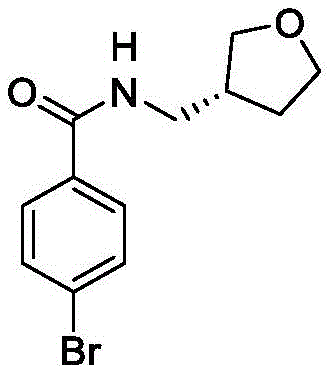
To a solution of 4-bromobenzoic acid (2.0g, 9.9mmol) and (R) - (tetrahydrofuran-3-yl) methylamine (1.0g, 9.9mmol) in DMF (20mL) was added HATU (5.64g, 14.85mmol) and DIPEA (2.55g, 19.8 mmol). The resulting solution was stirred at room temperature overnight. Water (20mL) was added, and the mixture was extracted with EtOAc (20mL x 3). The combined organic layers were washed with brine, over Na2SO4Dried, filtered and concentrated. The residue was purified by silica gel chromatography (DCM: MeOH ═ 100:1) to give the title compound (7.18g, containing DMF). This material was used in step 2 without further purification. LC-MS (M + H)+=283.8,285.8。
Step 2: (R) -4-bromo-N-methyl-N- ((tetrahydrofuran-3-yl) methyl) benzamide
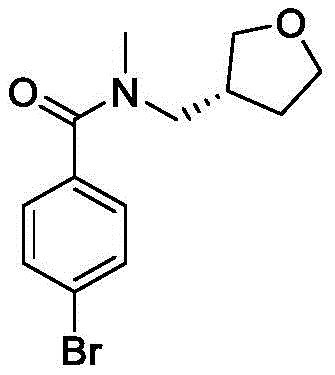
In N2Next, NaH (2.02g, 50.4mmol, 60%) was added to a 0 deg.C solution of (R) -4-bromo-N- ((tetrahydrofuran-3-yl) methyl) benzamide (7.18g, containing DMF, 9.9mmol) in DMF (40 mL). The resulting mixture was stirred at 0 ℃ for 1h, then MeI (5.37g, 37.8mmol) was added dropwise. The reaction mixture was warmed to room temperature and stirred for 1 h. Addition of Water (4)0mL) and the mixture was extracted with EtOAc (40mL x 3). The combined organic layers were washed with brine, over Na2SO4Dried, filtered and concentrated. The residue was purified by silica gel chromatography (DCM: MeOH ═ 100:1) to give the title compound (3.5g, containing DMF). This material was used in step 3 without further purification. LC-MS (M + H)+=297.8,299.8。
And step 3: (R) -N-methyl-N- ((tetrahydrofuran-3-yl) methyl) -4- (4,4,5, 5-tetramethyl-1, 3, 2-dioxaborolan-2-yl) benzamide

To a solution of (R) -4-bromo-N-methyl-N- ((tetrahydrofuran-3-yl) methyl) benzamide (3.5g, containing DMF, 9.9mmol) in 1, 4-dioxane (50mL) was added 4,4,4',4',5,5,5',5' -octamethyl-2, 2' -bis (1,3, 2-dioxaborolan) (3.09g, 12.18mmol), pd (dppf) Cl2DCM (332mg, 0.406mmol) and KOAc (1.59g, 16.24 mmol). The resulting mixture was heated at 90 ℃ under N2Stirring was continued overnight. Water (50mL) was added and the mixture was extracted with EtOAc (50mL x 3). The combined organic layers were washed with brine, over Na2SO4Dried, filtered and concentrated. The residue was purified by silica gel chromatography (EtOAc: PE ═ 1:3) to give the title compound (1.76g, 52% over 3 steps).1H NMR(400MHz,CDCl3)δ7.83(d,J=7.8Hz,2H),7.36(d,J=7.1Hz,2H),4.03-3.19(m,6H),3.16-2.90(m,3H),2.79-2.45(m,1H),2.15-1.68(m,2H),1.35(s,12H)。LC-MS(M+H)+=346.0。
And 4, step 4: (R) -4- (5-bromo-1- (benzenesulfonyl) -1H-pyrrolo [2,3-b ] pyridin-3-yl) -N-methyl-N- ((tetrahydrofuran-3-yl) methyl) benzamide

To 5-bromo-3-iodo-1- (benzenesulfonyl) -1H-pyrrolo [2,3-b ]]Pyridine (2.0g, 4.3mmol), (R) -N-methyl-N- ((tetrahydrofuran-3-yl) methyl) -4- (4,4,5, 5-tetramethyl-1, 3, 2-dioxaborolan-2-yl) benzamide (1.49g, 4.3mmol) and K2CO3(1.19g, 8.6mmol) to a mixture of 1, 4-dioxane (30mL) and water (20mL) was added Pd (dppf) Cl2DCM (351mg, 0.43 mmol). The resulting mixture was heated to 80 ℃ under N2Stirring was continued overnight. Water (20mL) was added and the mixture was extracted with EtOAc (30mL x 3). The combined organic layers were washed with brine, over Na2SO4Dried, filtered and concentrated. The residue was purified by silica gel chromatography (EtOAc: PE ═ 1:1) to give the title compound (1.8g, 75%). LC-MS (M + H)+=553.7,555.7。
And 5: (R) -4- (5-bromo-1H-pyrrolo [2,3-b ] pyridin-3-yl) -N-methyl-N- ((tetrahydrofuran-3-yl) methyl) benzamide

To (R) -4- (5-bromo-1- (benzenesulfonyl) -1H-pyrrolo [2, 3-b)]Pyridin-3-yl) -N-methyl-N- ((tetrahydrofuran-3-yl) methyl) benzamide (1.8g, 3.25mmol) to a solution in MeOH (50mL) was added K2CO3(1.35g, 9.74 mmol). The resulting mixture was stirred at room temperature overnight. Water (50mL) was added and the mixture was extracted with EtOAc (50mL x 3). The combined organic layers were washed with brine, over Na2SO4Dried, filtered and concentrated. The residue was purified by silica gel chromatography (EtOAc: PE ═ 1:1) to give the title compound (908mg, 67%). LC-MS (M + H)+=413.8,415.8。
Step 6: 4- (5- ((R) -3, 10-dimethyl-2, 3,4,4a,5, 6-hexahydro-1H-pyrazino [1,2-a ] quinolin-8-yl) -1H-pyrrolo [2,3-b ] pyridin-3-yl) -N-methyl-N- (((R) -tetrahydrofuran-3-yl) methyl) benzamide and 4- (5- ((S) -3, 10-dimethyl-2, 3,4,4a,5, 6-hexahydro-1H-pyrazino [1,2-a ] quinolin-8-yl) -1H-pyrrolo [2,3-b ] pyridin-3-yl) -N-methyl-N- (((R) -tetrahydrofuran- 3-yl) methyl) benzamides

To (R) -4- (5-bromo-1H-pyrrolo [2, 3-b)]Pyridin-3-yl) -N-methyl-N- ((tetrahydrofuran-3-yl) methyl) benzamide (404mg, 0.947mmol) and 3, 10-dimethyl-8- (4,4,5, 5-tetramethyl-1, 3, 2-dioxaborolan-2-yl) -2,3,4,4a,5, 6-hexahydro-1H-pyrazino [1,2-a ] was]To a solution of quinoline (333mg, 0.947mmol) in 1, 4-dioxane (20mL) and water (10mL) were added XPhos Pd G2(77mg, 0.097mmol) and K3PO4(413mg, 1.95 mmol). The resulting mixture was heated to 80 ℃ under N2Stirring was continued overnight. Water (20mL) was added, and the mixture was extracted with EtOAc (20mL x 3). The combined organic layers were washed with brine, over Na2SO4Dried, filtered and concentrated. The residue was purified by silica gel chromatography (DCM: MeOH ═ 10:1) to give an isomer mixture (240mg), which was separated by chiral HPLC to give example 5A/5B.
Example 5A: (101mg, 19%)1H NMR(400MHz,DMSO-d6)δ12.03(s,1H),8.50(d,J=1.9Hz,1H),8.37(d,J=1.7Hz,1H),7.99(d,J=2.5Hz,1H),7.87-7.81(m,2H),7.51-7.41(m,2H),7.34(s,1H),7.27(s,1H),3.88-3.35(m,6H),3.05-2.96(m,4H),2.95-2.82(m,4H),2.70-2.53(m,3H),2.48-2.42(m,1H),2.36-2.24(m,4H),2.24-2.12(m,4H),2.08-1.52(m,3H)。LC-MS(M+H)+549.9. tR in chiral HPLC: 2.93 min.
Example 5B: (82mg, 16%)1H NMR(400MHz,DMSO-d6)δ12.03(s,1H),8.50(d,J=1.9Hz,1H),8.37(d,J=1.7Hz,1H),7.99(d,J=2.5Hz,1H),7.87-7.81(m,2H),7.51-7.41(m,2H),7.34(s,1H),7.27(s,1H),3.89-3.34(m,6H),3.05-2.96(m,4H),2.95-2.79m,4H),2.71-2.53(m,3H),2.46-2.39(m,1H),2.35-2.24(m,4H),2.24-2.12(m,4H),2.09-1.52(m,3H)。LC-MS(M+H)+549.9. tR in chiral HPLC: 2.80 min.
Preparative HPLC conditions


Chiral analytical HPLC conditions

Example 6A/6B
(R) -4- (2- (3, 10-dimethyl-2, 3,4,4a,5, 6-hexahydro-1H-pyrazino [1,2-a ] quinolin-8-yl) -5H-pyrrolo
[2,3-b ] pyrazin-7-yl) -N, N, 2-trimethylbenzamide and (S) -4- (2- (3, 10-dimethyl-2, 3,4,4a,5, 6-hexahydro-1H-pyrazino [1,2-a ] quinolin-8-yl) -5H-pyrrolo [2,3-b ] pyrazin-7-yl) -N, N, 2-trimethylbenzamide

Step 1: 4-bromo-N, N, 2-trimethylbenzamide

4-bromo-2-methylbenzoic acid (25.0g, 116mmol) in SOCl2The mixture in (200mL) was stirred at 60 ℃ for 3 h. The solvent was removed in vacuo. The residue was re-dissolved in anhydrous DCM (200 mL). Dimethylamine hydrochloride (14.0g, 174.4mmol) and TEA (80mL, 581mmol) were added at 0 ℃. The mixture was stirred at room temperature for 2 h. Water (200mL) was added and the mixture was extracted with DCM (200mL × 3). The combined organic layers were washed with brine (150mL) and Na2SO4Dried and concentrated under reduced pressure to give the title compound (28.0g, 99%). LC-MS (M + H)+=242.0,244.0。
Step 2: n, N, 2-trimethyl-4- (4,4,5, 5-tetramethyl-1, 3, 2-dioxaborolan-2-yl) benzamide

4-bromo-N, N, 2-trimethylbenzamide (28.0g, 115mmol), 4,4,4',4',5,5,5',5' -octamethyl-2, 2' -bis (1,3, 2-dioxaborolan) (44.0g, 174mmol), Pd (dppf) Cl2(5.1g, 6.94mmol) and AcOK (22.7g, 231mmol) were added to dioxane (400 mL). The reaction mixture was heated to reflux overnight and then cooled to room temperature. EtOAc (400mL) was added and the mixture was washed with brine (300mL x 2). The aqueous layer was extracted with EtOAc (400 mL). The combined organic layers were passed over Na2SO4Dried and then concentrated under reduced pressure. The residue was purified by silica gel column chromatography eluting with EtOAc/PE (1:5 to 2:1) to give the title compound (26.0g, 73%). LC-MS (M + H)+=290.1。
And step 3: 2-bromo-7-iodo-5-tosyl-5H-pyrrolo [2,3-b ] pyrazine

To 2-bromo-7-iodo-5H-pyrrolo [2,3-b ] at 0 deg.C]To a solution of pyrazine (162g, 500mmol) in anhydrous DMF (1500mL) was added sodium hydride (30.0g, 750mmol) in portions. The resulting mixture was stirred at 0 ℃ for 15min, and then TsCl (124g, 650mmol) was added portionwise. While stirring, the mixture was warmed to room temperature. After 3h, the reaction mixture was poured into ice water (2L) and the precipitate was collected by filtration. The solid was rinsed with water (200mL x 5) and then dried under vacuum to give the title compound (239g, 99%). LCMS (M + H)+=479.9。
And 4, step 4: 4- (2-bromo-5-tosyl-5H-pyrrolo [2,3-b ] pyrazin-7-yl) -N, N, 2-trimethylbenzamide

To 2-bromo-7-iodo-5-tosyl-5H-pyrrolo [2,3-b ] under a nitrogen atmosphere]Pyrazine (16.5g, 34.6mmol) and N, N, 2-trimethyl-4- (4,4,5, 5-tetramethyl-1, 3, 2-dioxaborolan-2-yl) benzamide (10.0g, 34.5mmol) in dioxane (150mL) and water (50mL) was added K2CO3(9.55g, 69.2mmol) and Pd (dppf) Cl2(1.54g, 2.07 mmol). After stirring at 50 ℃ for 5h, the reaction mixture was cooled to room temperature and concentrated under reduced pressure. The residue was purified by silica gel column chromatography eluting with EtOAc/PE (1:2 to 2:1) to give the title compound (11.0g, 62%).1H NMR(400MHz,DMSO-d6)δ8.88(s,1H),8.68(s,1H),8.09-8.01(m,4H),7.49-7.44(m,2H),7.29(d,J=7.8Hz,1H),3.02(s,3H),2.79(s,3H),2.36(s,3H),2.27(s,3H)。LCMS(M+H)+=513.0。
And 5: 4- (2- (3, 10-dimethyl-2, 3,4,4a,5, 6-hexahydro-1H-pyrazino [1,2-a ] quinolin-8-yl) -5-tosyl-5H-pyrrolo [2,3-b ] pyrazin-7-yl) -N, N, 2-trimethylbenzamide

To 4- (2-bromo-5-tosyl-5H-pyrrolo [2, 3-b)]Pyrazin-7-yl) -N, N, 2-trimethylbenzamide (375mg, 0.731mmol) and 3, 10-dimethyl-8- (4,4,5, 5-tetramethyl-1, 3, 2-dioxaborolan-2-yl) -2,3,4,4a,5, 6-hexahydro-1H-pyrazino [1,2-a ] pyrazin-7-yl]To a solution of quinoline (250mg, 0.731mmol) in 1, 4-dioxane (20mL) and water (10mL) were added XPhos Pd G2(57mg, 0.073mmol) and K3PO4(310mg, 1.46 mmol). The reaction mixture was heated at 80 ℃ under N2Stirring was continued overnight. Water (20mL) was added, and the mixture was extracted with EtOAc (20mL x 3). The combined organic layers were washed with brine, over Na2SO4Dried, filtered and concentrated. The residue was purified by silica gel chromatography (DCM: MeOH ═ 20:1) to give the title compound (400mg, 84%). LC-MS (M + H)+=649.1。
Step 6: (R) -4- (2- (3, 10-dimethyl-2, 3,4,4a,5, 6-hexahydro-1H-pyrazino [1,2-a ] quinolin-8-yl) -5H-pyrrolo [2,3-b ] pyrazin-7-yl) -N, N, 2-trimethylbenzamide and (S) -4- (2- (3, 10-dimethyl-2, 3,4,4a,5, 6-hexahydro-1H-pyrazino [1,2-a ] quinolin-8-yl) -5H-pyrrolo [2,3-b ] pyrazin-7-yl) -N, N, 2-trimethylbenzamide

To 4- (2- (3, 10-dimethyl-2, 3,4,4a,5, 6-hexahydro-1H-pyrazino [1,2-a ]]Quinolin-8-yl) -5-tosyl-5H-pyrrolo [2,3-b]Pyrazin-7-yl) -N, N, 2-trimethylbenzamide (400mg, 0.617mmol) in MeOH (20mL) was added K2CO3(340mg, 2.48 mmol). The resulting mixture was stirred at room temperature for 2 h. Water (50mL) was added and the mixture was extracted with EtOAc (50mL x 3). The combined organic layers were washed with brine, over Na2SO4Dried, filtered and concentrated. The residue was purified by silica gel chromatography (DCM: MeOH ═ 30:1) to give an isomer mixture (162mg), which was separated by chiral HPLC to give example 6A/6B.
Example 6A: (69mg, 23%)1H NMR(400MHz,DMSO-d6)δ12.28(s,1H),8.82(s,1H),8.43(d,J=2.7Hz,1H),8.26(s,1H),8.18(d,J=8.0Hz,1H),7.80(s,1H),7.73(s,1H),7.23(d,J=7.9Hz,1H),3.09-2.97(m,5H),2.96-2.86(m,3H),2.83(s,3H),2.63-2.53(m,3H),2.38-2.31(m,4H),2.29(s,3H),2.21(s,3H),2.19-2.08(m,1H),1.69-1.59(m,1H)。
LC-MS(M+H)+495.0. tR in chiral HPLC: 4.97 min.
Example 6B: (69mg, 23%)1H NMR(400MHz,DMSO-d6)δ12.28(s,1H),8.81(s,1H),8.43(d,J=2.7Hz,1H),8.26(s,1H),8.18(d,J=7.8Hz,1H),7.80(s,1H),7.73(s,1H),7.23(d,J=8.0Hz,1H),3.09-2.98(m,5H),2.96-2.87(m,3H),2.83(s,3H),2.63-2.51(m,3H),2.38-2.31(m,4H),2.29(s,3H),2.21(s,3H),2.19-2.10(m,1H),1.69-1.59(m,1H)。
LC-MS(M+H)+495.0. tR in chiral HPLC: 6.56 min.
Preparative HPLC conditions
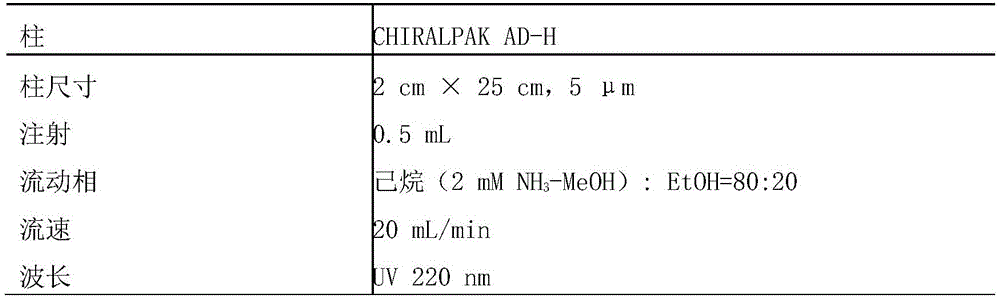
Chiral analytical HPLC conditions

Example 7A/7B
(R) -4- (2- (3, 10-dimethyl-2, 3,4,4a,5, 6-hexahydro-1H-pyrazino [1,2-a ] quinolin-8-yl) -5H-pyrrolo [2,3-b ] pyrazin-7-yl) -N, N-dimethylbenzamide and (S) -4- (2- (3, 10-dimethyl-2, 3,4,4a,5, 6-hexahydro-1H-pyrazino [1,2-a ] quinolin-8-yl) -5H-pyrrolo [2,3-b ] pyrazin-7-yl) -N, N-dimethylbenzamide

Step 1: 4- (2-bromo-5-tosyl-5H-pyrrolo [2,3-b ] pyrazin-7-yl) -N, N-dimethylbenzamide

To 2-bromo-7-iodo-5-tosyl-5H-pyrrolo [2,3-b ]]Pyrazine (240mg, 0.50mmol) and [4- (dimethylcarbamoyl) phenyl]To a solution of boric acid (106mg, 0.52mmol) in 1, 4-dioxane (6mL) and water (1mL) was added K2CO3(207mg, 1.42mmol) and Pd (dppf) Cl2.CH2Cl2(41mg, 0.048 mmol). After stirring at 70 ℃ under nitrogen for 3h, the reaction mixture was concentrated under reduced pressure. The residue was chromatographed on silica gel (using CHCl)3MeOH (9:1) elution) to give the title compound (200mg, 75%). LCMS (M + H)+=499.2。
Step 2: 4- (2- (3, 10-dimethyl-2, 3,4,4a,5, 6-hexahydro-1H-pyrazino [1,2-a ] quinolin-8-yl) -5-tosyl-5H-pyrrolo [2,3-b ] pyrazin-7-yl) -N, N-dimethylbenzamide

To 4- (2-bromo-5-tosyl-5H)-pyrrolo [2,3-b]Pyrazin-7-yl) -N, N-dimethylbenzamide (384mg, 0.769mmol) and 3, 10-dimethyl-8- (4,4,5, 5-tetramethyl-1, 3, 2-dioxaborolan-2-yl) -2,3,4,4a,5, 6-hexahydro-1H-pyrazino [1,2-a]To a solution of quinoline (263mg, 0.769mmol) in 1, 4-dioxane (20mL) and water (10mL) were added XPhos Pd G2(61mg, 0.077mmol) and K3PO4(326mg, 1.54 mmol). The resulting mixture was heated to 80 ℃ under N2Stirring was continued overnight. Water (20mL) was added, and the mixture was extracted with EtOAc (20mL x 3). The combined organic layers were washed with brine, over Na2SO4Dried, filtered and concentrated. The residue was purified by silica gel chromatography (DCM: MeOH ═ 30:1) to give the title compound (370mg, 76%). LC-MS (M + H)+=635.1。
And step 3: (R) -4- (2- (3, 10-dimethyl-2, 3,4,4a,5, 6-hexahydro-1H-pyrazino [1,2-a ] quinolin-8-yl) -5H-pyrrolo [2,3-b ] pyrazin-7-yl) -N, N-dimethylbenzamide and (S) -4- (2- (3, 10-dimethyl-2, 3,4,4a,5, 6-hexahydro-1H-pyrazino [1,2-a ] quinolin-8-yl) -5H-pyrrolo [2,3-b ] pyrazin-7-yl) -N, N-dimethylbenzamide

To 4- (2- (3, 10-dimethyl-2, 3,4,4a,5, 6-hexahydro-1H-pyrazino [1,2-a ]]Quinolin-8-yl) -5-tosyl-5H-pyrrolo [2,3-b]Pyrazin-7-yl) -N, N-dimethylbenzamide (370mg, 0.584mmol) in MeOH (20mL) was added K2CO3(242mg, 1.75 mmol). The reaction mixture was stirred at rt for 2 h. Water (50mL) was added and the mixture was extracted with EtOAc (50mL x 3). The combined organic layers were washed with brine, over Na2SO4Dried, filtered and concentrated. The residue was purified by silica gel chromatography (DCM: MeOH ═ 30:1) to give an isomer mixture (160mg), which was separated by chiral HPLC to give example 7A/7B.
Example 7A: (72mg, 26%)1H NMR(400MHz,DMSO-d6)δ10.06(s,1H),8.76(s,1H),8.46(s,1H),8.39-8.33(m,2H),7.77(s,1H),7.70(s,1H),7.52-7.45(m,2H),3.09-2.97(m,8H),2.96-2.86(m,3H),2.64-2.51(m,3H),2.39-2.28(m,4H),2.21(s,3H),2.19-2.08(m,1H),1.68-1.59(m,1H)。LC-MS(M+H)+480.9. tR in chiral HPLC: 4.47 min.
Example 7B: (73mg, 26%)1H NMR(400MHz,DMSO-d6)δ。9.52(s,1H),8.75(s,1H),8.46(s,1H),8.40-8.33(m,2H),7.77(s,1H),7.70(s,1H),7.51-7.45(m,2H),3.09-2.96(m,8H),2.95-2.86(m,3H),2.63-2.51(m,3H),2.39-2.29(m,4H),2.21(s,3H),2.18-2.08(m,1H),1.69-1.57(m,1H)。LC-MS(M+H)+481.0. tR in chiral HPLC: 5.87 min.
Preparative HPLC conditions

Chiral analytical HPLC conditions
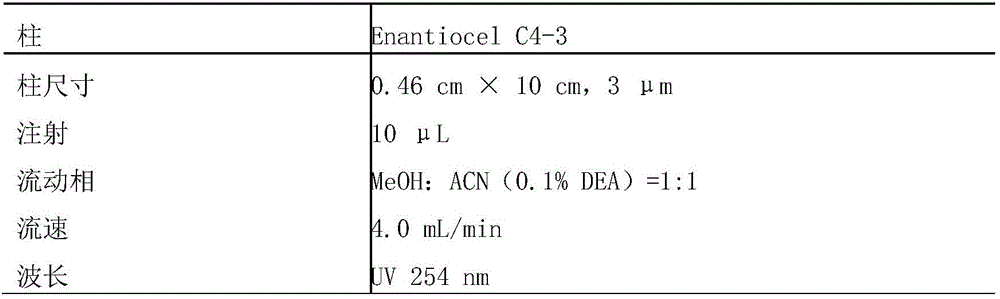
Example 8A/8B
(R) - (4- (2- (3, 10-dimethyl-2, 3,4,4a,5, 6-hexahydro-1H-pyrazino [1,2-a ] quinolin-8-yl) -5H-pyrrolo [2,3-b ] pyrazin-7-yl) -2-methylphenyl) (2-oxa-6-azaspiro [3.3] heptan-6-yl) methanone and (S) - (4- (2- (3, 10-dimethyl-2, 3,4,4a,5, 6-hexahydro-1H-pyrazino [1,2-a ] quinolin-8-yl) -5H-pyrrolo [2,3-b ] pyrazin-7-yl) -2-methylphenyl) (2-oxa-6-aza-nitrogen Hetero spiro [3.3] heptane-6-yl) methanones
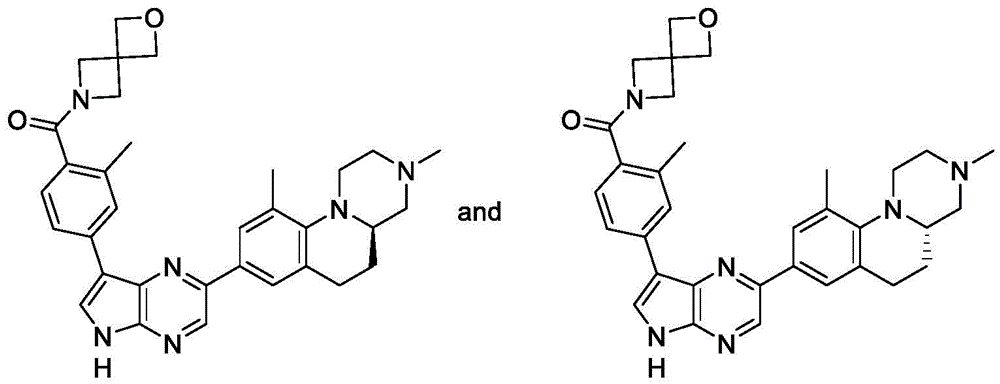
Step 1: 6- (4-bromo-2-methylbenzoyl) -2-oxa-6-azaspiro [3.3] heptane

From 4-bromo-2-methylbenzoic acid and 2-oxo in a similar manner to example 2A/2B, step 1Hetero-6-azaspiro [3.3]Heptane the title compound was prepared (250mg, 78%). LCMS (M + H)+=296.0。
Step 2: (2-methyl-4- (4,4,5, 5-tetramethyl-1, 3, 2-dioxaborolan-2-yl) phenyl) (2-oxa-6-azaspiro [3.3] heptan-6-yl) methanone

From 6- (4-bromo-2-methylbenzoyl) -2-oxa-6-azaspiro [3.3] in a similar manner to example 2A/2B, step 5]Heptane and 4,4,4',4',5,5,5',5' -octamethyl-2, 2' -bis (1,3, 2-dioxaborolan) the title compound (200mg, 67%) was prepared. LCMS (M + H)+=344.2。
And step 3: (4- (2-bromo-5-tosyl-5H-pyrrolo [2,3-b ] pyrazin-7-yl) -2-methylphenyl) (2-oxa-6-azaspiro [3.3] heptan-6-yl) methanone
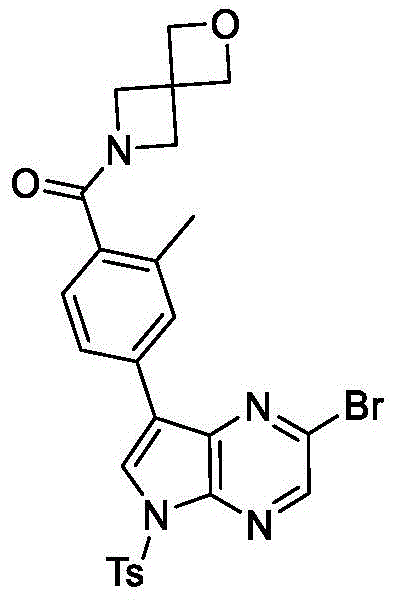
From (2-methyl-4- (4,4,5, 5-tetramethyl-1, 3, 2-dioxaborolan-2-yl) phenyl) (2-oxa-6-azaspiro [3.3] in a similar manner as in example 6A/6B, step 4]Heptane-6-yl) methanone and 2-bromo-7-iodo-5-tosyl-5H-pyrrolo [2,3-b]Pyrazine prepared the title compound (185mg, 67%). LC-MS (M + H)+=567.1。
And 4, step 4: (4- (2- (3, 10-dimethyl-2, 3,4,4a,5, 6-hexahydro-1H-pyrazino [1,2-a ] quinolin-8-yl) -5-tosyl-5H-pyrrolo [2,3-b ] pyrazin-7-yl) -2-methylphenyl) (2-oxa-6-azaspiro [3.3] heptan-6-yl) methanone

To (4- (2-bromo-5-tosyl-5H-pyrrolo [2, 3-b))]Pyrazin-7-yl) -2-methylphenyl) (2-oxa-6-azaspiro [3.3]Heptane-6-yl) methanone (340mg, 0.60mmol) and 3, 10-dimethyl-8- (4,4,5, 5-tetramethyl-1, 3, 2-dioxaborolan-2-yl) -2,3,4,4a,5, 6-hexahydro-1H-pyrazino [1,2-a ]]To a solution of quinoline (205mg, 0.60mmol) in 1, 4-dioxane (20mL) and water (10mL) were added XPhos Pd G2(47mg, 0.06mmol) and K3PO4(254mg, 1.2 mmol). The reaction mixture was heated at 80 ℃ under N2Stirring was continued overnight. Water (20mL) was added, and the mixture was extracted with EtOAc (20mL x 3). The combined organic layers were washed with brine, over Na2SO4Dried, filtered and concentrated. The crude product was purified by silica gel chromatography (DCM: MeOH ═ 20:1) to give the title compound (300mg, 71%). LC-MS (M + H)+=703.0。
And 5: (R) - (4- (2- (3, 10-dimethyl-2, 3,4,4a,5, 6-hexahydro-1H-pyrazino [1,2-a ] quinolin-8-yl) -5H-pyrrolo [2,3-b ] pyrazin-7-yl) -2-methylphenyl) (2-oxa-6-azaspiro [3.3] heptan-6-yl) methanone and (S) - (4- (2- (3, 10-dimethyl-2, 3,4,4a,5, 6-hexahydro-1H-pyrazino [1,2-a ] quinolin-8-yl) -5H-pyrrolo [2,3-b ] pyrazin-7-yl) -2-methylphenyl) (2-oxa-6-aza-nitrogen Hetero spiro [3.3] heptane-6-yl) methanones

To (4- (2- (3, 10-dimethyl-2, 3,4,4a,5, 6-hexahydro-1H-pyrazino [1,2-a ])]Quinolin-8-yl) -5-tosyl-5H-pyrrolo [2,3-b]Pyrazin-7-yl) -2-methylphenyl) (2-oxa-6-azaspiro [3.3]To a solution of heptan-6-yl) methanone (300mg, 0.427mmol) in MeOH (20mL) was added K2CO3(177mg, 1.28 mmol). The reaction mixture was stirred at rt for 2 h. Water (30mL) was added and the mixture was extracted with EtOAc (30mL x 3). The combined organic layers were washed with brine, over Na2SO4Dried, filtered and concentrated. The residue was purified by silica gel chromatography (DCM: MeOH ═ 20:1) to give an isomeric mixture (108mg), which was separated by chiral HPLC to give example 8A/8B.
Example 8A: (39mg, 17%)1H NMR(400MHz,DMSO-d6)δ12.32(s,1H),8.82(s,1H),8.45(s,1H),8.27(s,1H),8.17(d,J=8.1Hz,1H),7.80(s,1H),7.74(s,1H),7.36(d,J=7.9Hz,1H),4.76-4.58(m,4H),4.26-4.12(m,4H),3.10-2.98(m,2H),2.97-2.84(m,3H),2.63-2.51(m,3H),2.39(s,3H),2.37-2.29(m,4H),2.21(s,3H),2.19-2.11(m,1H),1.70-1.59(m,1H)。LC-MS(M+H)+548.9. tR in chiral HPLC: 3.74 min.
Example 8B: (46mg, 20%)1H NMR(400MHz,DMSO-d6)δ12.32(s,1H),8.82(s,1H),8.45(s,1H),8.27(s,1H),8.17(d,J=7.8Hz,1H),7.80(s,1H),7.73(s,1H),7.36(d,J=8.0Hz,1H),4.75-4.61(m,4H),4.30-4.08(m,4H),3.11-2.98(m,2H),2.97-2.84(m,3H),2.64-2.52(m,3H),2.39(s,3H),2.37-2.29(m,4H),2.21(s,3H),2.19-2.08(m,1H),1.70-1.59(m,1H)。LC-MS(M+H)+549.0. tR in chiral HPLC: 5.23 min.
Preparative HPLC conditions
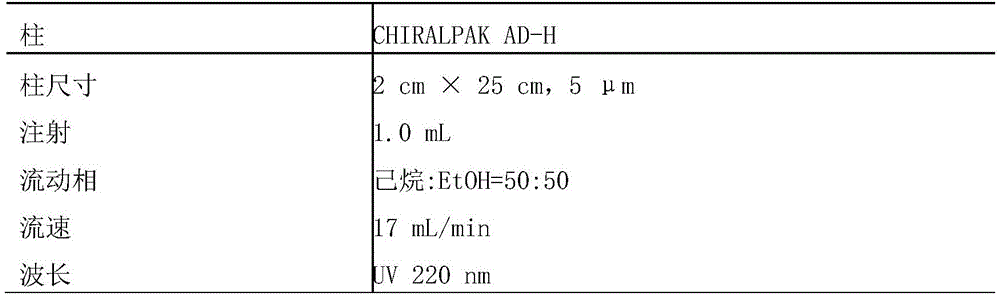
Chiral analytical HPLC conditions

Example 9A/9B
(R) - (4- (2- (3, 10-dimethyl-2, 3,4,4a,5, 6-hexahydro-1H-pyrazino [1,2-a ] quinolin-8-yl) -5H-pyrrolo [2,3-b ] pyrazin-7-yl) phenyl) (2-oxa-6-azaspiro [3.3] heptan-6-yl) methanone and (S) - (4- (2- (3, 10-dimethyl-2, 3,4,4a,5, 6-hexahydro-1H-pyrazino [1,2-a ] quinolin-8-yl) -5H-pyrrolo [2,3-b ] pyrazin-7-yl) phenyl) (2-oxa-6-azaspiro [3.3] heptan-6-yl) methanone

Step 1: (4- (2-oxa-6-azaspiro [3.3] heptane-6-carbonyl) phenyl) boronic acid

To a solution of 4-aminobenzoic acid (3.32g, 19.0mmol) in DMF (20mL) at 0 deg.C were added HATU (10.8g, 28.5mmol), DIPEA (7.37g, 57.0mmol) and 2-oxa-6-azaspiro [3.3 ℃]Heptane (1.98g, 19.0 mmol). The resulting mixture was warmed to room temperature. After 16h, the mixture was concentrated in vacuo and then diluted with water (50 mL). The precipitate was collected by filtration and the solid was washed with water (30mL x 2) to give the title compound (4.7g, 97%). LC-MS (M + H)+=248.1。
Step 2: (4- (2-bromo-5-tosyl-5H-pyrrolo [2, 3-b)]Pyrazin-7-yl) phenyl) (2-oxa-6-
Azaspiro [3.3]Heptane-6-yl) methanones

From 2-bromo-7-iodo-5-tosyl-5H-pyrrolo [2,3-B ] in a similar manner as in example 6A/6B, step 4]Pyrazine and (4- (2-oxa-6-azaspiro [3.3]]Heptane-6-carbonyl) phenyl) boronic acid the title compound (350mg, 76%) was prepared. LCMS (M + H)+=553.1。
And step 3: (4- (2- (3, 10-dimethyl-2, 3,4,4a,5, 6-hexahydro-1H-pyrazino [1,2-a ] quinolin-8-yl) -5-toluenesulfonyl-5H-pyrrolo [2,3-b ] pyrazin-7-yl) phenyl) (2-oxa-6-azaspiro [3.3] heptan-6-yl) methanone

To (4- (2-bromo-5-tosyl-5H-pyrrolo [2, 3-b))]Pyrazin-7-yl) phenyl) (2-oxa-6-azaspiro [3.3]Heptane-6-yl) methanone (320mg, 0.578mmol), 3, 10-dimethyl-8- (4,4,5, 5-tetramethyl-1, 3, 2-dioxaborolan-2-yl) -2,3,4,4a,5, 6-hexahydro-1H-pyrazino [1,2-a ] o]Quinoline (198mg, 0.578mmol) in 1, 4-dioxane (20mL) and water (10mL) was added XPhos Pd G2(47mg, 0.06mmol) and K3PO4(254mg, 1.2 mmol). The reaction mixture was heated at 50 ℃ under N2Stirring was continued overnight. Adding water(20mL) and the mixture was extracted with EtOAc (20mL x 3). The combined organic layers were washed with brine, over Na2SO4Dried, filtered and concentrated to give the title compound (398mg, crude). This material was used in step 4 without further purification. LC-MS (M + H)+=689.0。
And 4, step 4: (R) - (4- (2- (3, 10-dimethyl-2, 3,4,4a,5, 6-hexahydro-1H-pyrazino [1,2-a ] quinolin-8-yl) -5H-pyrrolo [2,3-b ] pyrazin-7-yl) phenyl) (2-oxa-6-azaspiro [3.3] heptan-6-yl) methanone and (S) - (4- (2- (3, 10-dimethyl-2, 3,4,4a,5, 6-hexahydro-1H-pyrazino [1,2-a ] quinolin-8-yl) -5H-pyrrolo [2,3-b ] pyrazin-7-yl) phenyl) (2-oxa-6-azaspiro [3.3] heptan-6-yl) methanone

To (4- (2- (3, 10-dimethyl-2, 3,4,4a,5, 6-hexahydro-1H-pyrazino [1,2-a ])]Quinolin-8-yl) -5-tosyl-5H-pyrrolo [2,3-b]Pyrazin-7-yl) phenyl) (2-oxa-6-azaspiro [3.3]Heptane-6-yl) methanone (398mg, 0.578mmol) in 1, 4-dioxane (25mL) and H2To a solution in O (25mL) was added K2CO3(319mg, 2.31 mmol). The resulting mixture was stirred at 80 ℃ for 6 h. Water (30mL) was added and the mixture was extracted with EtOAc (30mL x 3). The combined organic layers were washed with brine, over Na2SO4Dried, filtered and concentrated. The residue was purified by silica gel chromatography (DCM: MeOH ═ 20:1) to give an isomeric mixture (165mg), which was separated by chiral HPLC to give example 9A/9B.
Example 9A: (73mg, 24%, over 2 steps)1H NMR(400MHz,DMSO-d6)δ12.39(s,1H),8.82(s,1H),8.51(s,1H),8.43-8.37(m,2H),7.78(s,1H),7.75-7.67(m,3H),4.70(s,4H),4.57(s,2H),4.23(s,2H),3.10-2.99(m,2H),2.97-2.86(m,3H),2.64-2.52(m,3H),2.40-2.29(m,4H),2.21(s,3H),2.19-2.09(m,1H),1.70-1.60(m,1H)。LC-MS(M+H)+535.5. tR in chiral HPLC: 8.42 min.
Example 9A: (55mg, 18%, over 2 steps)1H NMR(400MHz,DMSO-d6)δ12.38(s,1H),8.82(s,1H),8.51(s,1H),8.44-8.36(m,2H),7.78(s,1H),7.75-7.68(m,3H),4.70(s,4H),4.57(s,2H),4.23(s,2H),3.11-2.99(m,2H),2.98-2.86(m,3H),2.64-2.52(m,3H),2.42-2.31(m,4H),2.24(s,3H),2.19-2.06(m,1H),1.70-1.59(m,1H)。LC-MS(M+H)+535.5. tR in chiral HPLC: 10.02 min.
Preparative HPLC conditions

Chiral analytical HPLC conditions

Examples 10A/10B
4- (2- ((R) -3, 10-dimethyl-2, 3,4,4a,5, 6-hexahydro-1H-pyrazino [1,2-a ] quinolin-8-yl) -5H-pyrrolo
[2,3-b ] pyrazin-7-yl) -N-methyl-N- (((S) -tetrahydrofuran-3-yl) methyl) benzamide and 4- (2- ((S) -3, 10-dimethyl-2, 3,4,4a,5, 6-hexahydro-1H-pyrazino [1,2-a ] quinolin-8-yl) -5H-pyrrolo [2,3-b ] pyrazin-7-yl) -N-methyl-N- (((S) -tetrahydrofuran-3-yl) methyl) benzamide

Step 1: (S) -4- (2-bromo-5-tosyl-5H-pyrrolo [2,3-b ] pyrazin-7-yl) -N-methyl-N- ((tetrahydrofuran-3-yl) methyl) benzamide

In N2Next, (S) -N-methyl-N- ((tetrahydrofuran-3-yl) methyl) -4- (4,4,5, 5-tetramethyl-1, 3, 2-dioxaborolan-2-yl) benzamide (400mg, 1.16mmol) and 2-bromo-7-iodo-5-tosyl-5H-pyrrolo [2,3-b ] are added]Pyrazine (665mg, 1.39mmol) in dioxane (40)mL) and H2Pd (dppf) Cl was added to a solution in O (8mL)2(85mg, 0.116mmol) and K2CO3(320mg, 2.32 mmol). The mixture was refluxed for 5h under a condenser. The mixture was cooled to room temperature and diluted with EtOAc (50mL) then washed with brine (50mL) and Na2SO4Dried and concentrated under reduced pressure. The residue was purified by silica gel chromatography (eluting with EtOAc/PE (1: 3)) to give the title compound (350mg, 58%). LC-MS (M + H)+=568.9,570.9。
Step 2: 4- (2- (3, 10-dimethyl-2, 3,4,4a,5, 6-hexahydro-1H-pyrazino [1,2-a ] quinolin-8-yl) -5-tosyl-5H-pyrrolo [2,3-b ] pyrazin-7-yl) -N-methyl-N- (((S) -tetrahydrofuran-3-yl) methyl) benzamide

To (S) -4- (2-bromo-5-tosyl-5H-pyrrolo [2, 3-b)]Pyrazin-7-yl) -N-methyl-N- ((tetrahydrofuran-3-yl) methyl) benzamide (200mg, 0.349mmol), 3, 10-dimethyl-8- (4,4,5, 5-tetramethyl-1, 3, 2-dioxaborolan-2-yl) -2,3,4,4a,5, 6-hexahydro-1H-pyrazino [1,2-a ] is]Quinoline (119mg, 0.349mmol) in 1, 4-dioxane (20mL) and water (10mL) was added XPhos Pd G2(28mg, 0.035mmol) and K3PO4(148mg, 0.698 mmol). The reaction mixture was heated at 80 ℃ under N2Stirring was continued overnight. Water (20mL) was added, and the mixture was extracted with EtOAc (20mL x 3). The combined organic layers were washed with brine, over Na2SO4Dried, filtered and concentrated to give the title compound (246mg, crude). This material was used in step 4 without further purification. LC-MS (M + H)+=705.1。
And step 3: 4- (2- ((R) -3, 10-dimethyl-2, 3,4,4a,5, 6-hexahydro-1H-pyrazino [1,2-a ] quinolin-8-yl) -5H-pyrrolo [2,3-b ] pyrazin-7-yl) -N-methyl-N- (((S) -tetrahydrofuran-3-yl) methyl) benzamide and 4- (2- ((S) -3, 10-dimethyl-2, 3,4,4a,5, 6-hexahydro-1H-pyrazino [1,2-a ] quinolin-8-yl) -5H-pyrrolo [2,3-b ] pyrazin-7-yl) -N-methyl-N- (((S) -tetrahydrofuran- 3-yl) methyl) benzamides

To 4- (2- (3, 10-dimethyl-2, 3,4,4a,5, 6-hexahydro-1H-pyrazino [1,2-a ]]Quinolin-8-yl) -5-tosyl-5H-pyrrolo [2,3-b]Pyrazin-7-yl) -N-methyl-N- (((S) -tetrahydrofuran-3-yl) methyl) benzamide (246mg, 0.349mmol) in 1, 4-dioxane (25mL) and H2To a solution in O (25mL) was added K2CO3(193mg, 1.40 mmol). The resulting mixture was stirred at 80 ℃ for 6 h. Water (30mL) was added and the mixture was extracted with EtOAc (30mL x 3). The combined organic layers were washed with brine, over Na2SO4Dried, filtered and concentrated. The residue was purified by silica gel chromatography (DCM: MeOH ═ 20:1) to give an isomer mixture (108mg), which was separated by chiral HPLC to give example 10A/10B.
Example 10A: (45mg, 23%, over 2 steps)1H NMR(400MHz,DMSO-d6)δ12.34(s,1H),8.81(s,1H),8.48(s,1H),8.42-8.34(m,2H),7.78(s,1H),7.72(s,1H),7.53-7.42(m,2H),3.87-3.37(m,6H),3.09-2.98(m,5H),2.95-2.87(m,3H),2.72-2.52(m,5H),2.41-2.29(m,4H),2.21(s,3H),2.18-1.84(m,2H),1.69-1.57(m,1H)。LC-MS(M+H)+551.0. tR in chiral HPLC: 2.67 min.
Example 10B: (41mg, 21%, over 2 steps)1H NMR(400MHz,DMSO-d6)δ12.34(s,1H),8.81(s,1H),8.48(s,1H),8.41-8.35(m,2H),7.78(s,1H),7.71(s,1H),7.52-7.43(m,2H),3.88-3.37(m,6H),3.08-2.96(m,5H),2.96-2.86(m,3H),2.70-2.51(m,5H),2.40-2.27(m,4H),2.21(s,3H),2.18-1.84(m,2H),1.67-1.60(m,1H)。LC-MS(M+H)+551.0. tR in chiral HPLC: 3.83 min.
Preparative HPLC conditions

Chiral analytical HPLC conditions


Example 11A/11B
4- (2- ((R) -3, 10-dimethyl-2, 3,4,4a,5, 6-hexahydro-1H-pyrazino [1,2-a ] quinolin-8-yl) -5H-pyrrolo [2,3-b ] pyrazin-7-yl) -N, 2-dimethyl-N- (((S) -tetrahydrofuran-3-yl) methyl) benzamide and 4- (2- ((S) -3, 10-dimethyl-2, 3,4,4a,5, 6-hexahydro-1H-pyrazino [1,2-a ] quinolin-8-yl) -5H-pyrrolo [2,3-b ] pyrazin-7-yl) -N, 2-dimethyl-N- (((S) -tetrahydrofuran-3-yl) methyl) benzamide

Step 1: (S) -4-bromo-2-methyl-N- ((tetrahydrofuran-3-yl) methyl) benzamide

The title compound (1.10g, 81%) was prepared from 4-bromo-2-methylbenzoic acid and (S) - (tetrahydrofuran-3-yl) methylamine in a similar manner as in example 4A/4B, step 1. LC-MS (M + H)+=298.0,300.0。
Step 2: (S) -4-bromo-N, 2-dimethyl-N- ((tetrahydrofuran-3-yl) methyl) benzamide

The title compound (1.07g, 93%) was prepared from (S) -4-bromo-2-methyl-N- ((tetrahydrofuran-3-yl) methyl) benzamide and iodomethane in a similar manner as in example 4A/4B, step 2. LC-MS (M + H)+=311.9,313.9。
And step 3: (S) -N, 2-dimethyl-N- ((tetrahydrofuran-3-yl) methyl) -4- (4,4,5, 5-tetramethyl-1, 3, 2-dioxaborolan-2-yl) benzamide
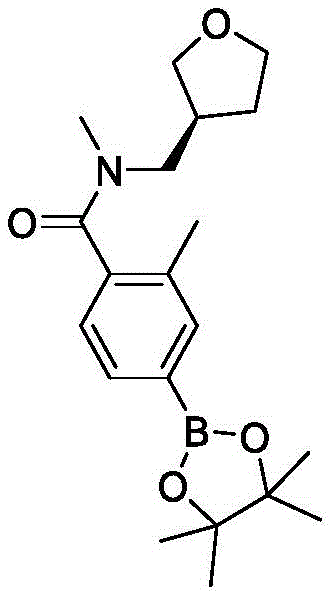
The title compound (1.20g, 99%) was prepared from (S) -4-bromo-N, 2-dimethyl-N- ((tetrahydrofuran-3-yl) methyl) benzamide and 4,4,4',4',5,5,5',5' -octamethyl-2, 2' -bis (1,3, 2-dioxaborolan) in a similar manner as in example 4A/4B, step 3. LC-MS (M + H)+=359.9。
And 4, step 4: (S) -4- (2-bromo-5-tosyl-5H-pyrrolo [2,3-b ] pyrazin-7-yl) -N, 2-dimethyl-N- ((tetrahydrofuran-3-yl) methyl) benzamide

From 2-bromo-7-iodo-5-tosyl-5H-pyrrolo [2,3-B ] in a similar manner as in example 4A/4B, step 4]Pyrazine and (S) -N, 2-dimethyl-N- ((tetrahydrofuran-3-yl) methyl) -4- (4,4,5, 5-tetramethyl-1, 3, 2-dioxaborolan-2-yl) benzamide the title product was prepared (400mg, 41%). LC-MS (M + H)+=582.9,584.9。
And 5: 4- (2- ((R) -3, 10-dimethyl-2, 3,4,4a,5, 6-hexahydro-1H-pyrazino [1,2-a ] quinolin-8-yl) -5H-pyrrolo [2,3-b ] pyrazin-7-yl) -N, 2-dimethyl-N- (((S) -tetrahydrofuran-3-yl) methyl) benzamide and 4- (2- ((S) -3, 10-dimethyl-2, 3,4,4a,5, 6-hexahydro-1H-pyrazino [1,2-a ] quinolin-8-yl) -5H-pyrrolo [2,3-b ] pyrazin-7-yl) -N, 2-dimethyl-N- (((S) -tetrahydrofuran-3-yl) methyl) benzamide

To (S) -4- (2-bromo-5-tosyl-5H-pyrrolo [2, 3-b)]Pyrazin-7-yl) -N, 2-dimethyl-N- ((tetrahydrofuran-3-yl)) Methyl) benzamide (100mg, 0.171mmol) and 3, 10-dimethyl-8- (4,4,5, 5-tetramethyl-1, 3, 2-dioxaborolan-2-yl) -2,3,4,4a,5, 6-hexahydro-1H-pyrazino [1,2-a ] o]Quinoline (59mg, 0.171mmol) in 1, 4-dioxane (15mL) and H2To a solution in O (15mL) were added XPhos Pd G2(14mg, 0.017mmol) and K2CO3(71mg, 0.513 mmol). The resulting solution was heated at 90 ℃ under N2Stir overnight and at 100 ℃ for another 3 h. Water (15mL) was added, and the mixture was extracted with EtOAc (15mL x 3). The combined organic layers were washed with brine, over Na2SO4Dried, filtered and concentrated. The residue was purified by silica gel chromatography (DCM: MeOH ═ 20:1) to give an isomeric mixture (53mg), which was separated by chiral HPLC to give example 11A/11B.
Example 11A: (20mg, 21%)1H NMR(400MHz,DMSO-d6)δ12.28(s,1H),8.80(s,1H),8.47-8.40(m,1H),8.30-8.24(m,1H),8.22-8.15(m,1H),7.80(s,1H),7.74(s,1H),7.26-7.19(m,1H),3.86-3.42(m,5H),3.25-3.14(m,1H),3.09-2.98(m,3H),2.97-2.87(m,3H),2.83(s,2H),2.71-2.53(m,4H),2.41-2.26(m,7H),2.21(s,3H),2.18-2.10(m,1H),2.07-1.94(m,1H),1.93-1.57(m,2H)。LC-MS(M+H)+565.0. tR in chiral HPLC: 10.55 min.
Example 11B: (25mg, 26%)1H NMR(400MHz,DMSO-d6)δ12.30(s,1H),8.80(s,1H),8.47-8.40(m,1H),8.30-8.24(m,1H),8.22-8.15(m,1H),7.80(s,1H),7.73(s,1H),7.26-7.19(m,1H),3.87-3.40(m,5H),3.25-3.14(m,1H),3.09-2.98(m,3H),2.97-2.88(m,3H),2.83(s,2H),2.71-2.51(m,4H),2.41-2.26(m,7H),2.21(s,3H),2.18-2.10(m,1H),2.07-1.94(m,1H),1.93-1.58(m,2H)。LC-MS(M+H)+565.0. tR in chiral HPLC: 12.82 min.
Preparative HPLC conditions

Chiral analytical HPLC conditions

Examples 12A/12B
(R) -4- (2- (3, 10-dimethyl-2, 3,4,4a,5, 6-hexahydro-1H-pyrazino [1,2-a ] quinolin-8-yl) -5H-pyrrolo [2,3-b ] pyrazin-7-yl) -N- (2-hydroxy-2-methylpropyl) -N-methylbenzamide and (S) -4- (2- (3, 10-dimethyl-2, 3,4,4a,5, 6-hexahydro-1H-pyrazino [1,2-a ] quinolin-8-yl) -5H-pyrrolo [2,3-b ] pyrazin-7-yl) -N- (2-hydroxy-2-methylpropyl) -N-methyl-benzamide Benzamide derivatives

Step 1: 4- ((2-hydroxy-2-methylpropyl) (methyl) carbamoyl) phenylboronic acid
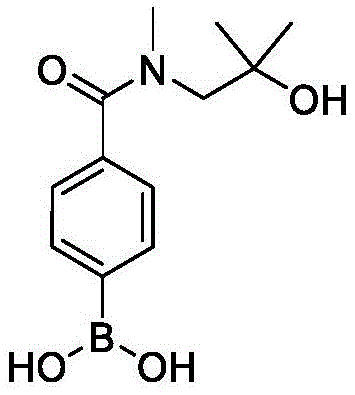
The title compound (415mg, 45%) was prepared from 2-methyl-1- (methylamino) propan-2-ol and 4-aminobenzoic acid in a similar manner as in example 9A/9B, step 1. LC-MS (M + H)+=252.2。
Step 2: 4- (2-bromo-5-tosyl-5H-pyrrolo [2,3-b ] pyrazin-7-yl) -N- (2-hydroxy-2-methylpropyl) -N-methylbenzamide

From 4- ((2-hydroxy-2-methylpropyl) (methyl) carbamoyl) phenylboronic acid and 2-bromo-7-iodo-5-toluenesulfonyl-5H-pyrrolo [2,3-B ] in a similar manner as in example 6A/6B, step 4]Pyrazine the title compound was prepared (241mg, 32%). LC-MS (M + H)+=557.2。
And step 3: (R) -4- (2- (3, 10-dimethyl-2, 3,4,4a,5, 6-hexahydro-1H-pyrazino [1,2-a ] quinolin-8-yl) -5H-pyrrolo [2,3-b ] pyrazin-7-yl) -N- (2-hydroxy-2-methylpropyl) -N-methylbenzamide and (S) -4- (2- (3, 10-dimethyl-2, 3,4,4a,5, 6-hexahydro-1H-pyrazino [1,2-a ] quinolin-8-yl) -5H-pyrrolo [2,3-b ] pyrazin-7-yl) -N- (2-hydroxy-2-methylpropyl) -N-methyl-benzamide Benzamide derivatives

To 4- (2-bromo-5-tosyl-5H-pyrrolo [2, 3-b)]Pyrazin-7-yl) -N- (2-hydroxy-2-methylpropyl) -N-methylbenzamide (295mg, 0.530mmol) and 3, 10-dimethyl-8- (4,4,5, 5-tetramethyl-1, 3, 2-dioxaborolan-2-yl) -2,3,4,4a,5, 6-hexahydro-1H-pyrazino [1,2-a ] is]Quinoline (181mg, 0.530mmol) in 1, 4-dioxane (20mL) and H2To a solution in O (20mL) were added XPhos Pd G2(42mg, 0.053mmol) and K2CO3(219mg, 1.59 mmol). The resulting mixture was heated at 90 ℃ under N2Stirring was continued overnight. Water (20mL) was added, and the mixture was extracted with EtOAc (20mL x 3). The combined organics were washed with brine, over Na2SO4Dried, filtered and concentrated. The residue was purified by silica gel chromatography (DCM: MeOH ═ 20:1) to give an isomer mixture (145mg), which was separated by chiral HPLC to give example 12A/12B.
Example 12A: (52mg, 18%)1H NMR(400MHz,DMSO-d6)δ12.33(s,1H),8.81(s,1H),8.51-8.45(m,1H),8.41-8.34(m,2H),7.79(s,1H),7.72(s,1H),7.56-7.38(m,2H),4.67-4.50(m,1H),3.49(s,1H),3.40-3.28(m,1H),3.10(s,3H),3.08-2.99(m,2H),2.98-2.86(m,3H),2.57(s,3H),2.43-2.31(m,4H),2.25(s,3H),2.19-2.06(m,1H),1.71-1.59(m,1H),1.30-1.10(m,5H),1.00-0.90(m,1H)。LC-MS(M+H)+539.5. tR in chiral HPLC: 14.93 min.
Example 12B: (52mg, 16%)1H NMR(400MHz,DMSO-d6)δ12.33(s,1H),8.81(s,1H),8.50-8.44(m,1H),8.42-8.35(m,2H),7.79(s,1H),7.72(s,1H),7.56-7.38(m,2H),4.68-4.51(m,1H),3.49(s,1H),3.38-3.28(m,1H),3.10(s,3H),3.08-2.99(m,2H),2.99-2.87(m,3H),2.57(s,3H),2.43-2.31(m,4H),2.23(s,3H),2.19-2.06(m,1H),1.70-1.60(m,1H),1.30-1.10(m,5H),1.00-0.90(m,1H)。LC-MS(M+H)+539.6. tR in chiral HPLC: 16.98 min.
Preparative HPLC conditions

Chiral analytical HPLC conditions

Examples 13A/13B
(R) -4- (2- (3, 10-dimethyl-2, 3,4,4a,5, 6-hexahydro-1H-pyrazino [1,2-a ] quinolin-8-yl) -5H-pyrrolo
[2,3-b ] pyrazin-7-yl) -N- (2-hydroxy-2-methylpropyl) -N, 2-dimethylbenzamide and (S) -4- (2- (3, 10-dimethyl-2, 3,4,4a,5, 6-hexahydro-1H-pyrazino [1,2-a ] quinolin-8-yl) -5H-pyrrolo [2,3-b ] pyrazin-7-yl) -N- (2-hydroxy-2-methylpropyl) -N, 2-dimethylbenzamide

Step 1: 4-bromo-N- (2-hydroxy-2-methylpropyl) -N, 2-dimethylbenzamide

The title compound (2.5mg, 86%) was prepared from 4-bromo-2-methylbenzoic acid and 2-methyl-1- (methylamino) propan-2-ol in a similar manner as in example 2A/2B, step 1. LCMS (M + H)+=300.0,302.0。
Step 2: n- (2-hydroxy-2-methylpropyl) -N, 2-dimethyl-4- (4,4,5, 5-tetramethyl-1, 3, 2-dioxaborolan-2-yl) benzamide
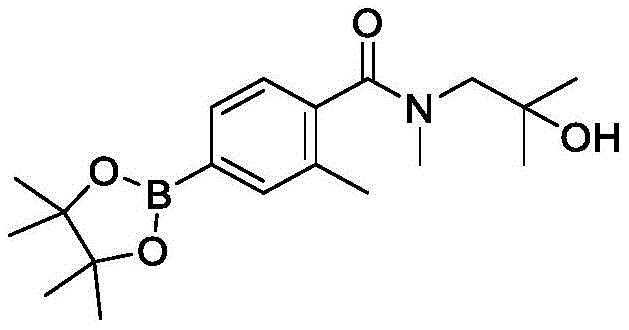
From 4-bromo-N in a similar manner as in example 2A/2B, step 5- (2-hydroxy-2-methylpropyl) -N, 2-dimethylbenzamide and 4,4,4',4',5,5,5',5' -octamethyl-2, 2' -bis (1,3, 2-dioxaborolan) the title compound was prepared (2.5mg, 87%). LC-MS (M + H)+=348.0。
And step 3: 4- (2-bromo-5-tosyl-5H-pyrrolo [2,3-b ] pyrazin-7-yl) -N- (2-hydroxy-2-methylpropyl) -N, 2-dimethylbenzamide

From 2-bromo-7-iodo-5-tosyl-5H-pyrrolo [2,3-B ] in a similar manner as in example 6A/6B, step 4]Pyrazine and N- (2-hydroxy-2-methylpropyl) -N, 2-dimethyl-4- (4,4,5, 5-tetramethyl-1, 3, 2-dioxaborolan-2-yl) benzamide the title compound was prepared (2.5mg, 87%). LC-MS (M + H)+=571.0。
And 4, step 4: (R) -4- (2- (3, 10-dimethyl-2, 3,4,4a,5, 6-hexahydro-1H-pyrazino [1,2-a ] quinolin-8-yl) -5H-pyrrolo [2,3-b ] pyrazin-7-yl) -N- (2-hydroxy-2-methylpropyl) -N, 2-dimethylbenzamide and (S) -4- (2- (3, 10-dimethyl-2, 3,4,4a,5, 6-hexahydro-1H-pyrazino [1,2-a ] quinolin-8-yl) -5H-pyrrolo [2,3-b ] pyrazin-7-yl) -N- (2-hydroxy-2-methylpropyl) -N, 2-dimethyl benzamide

To 4- (2-bromo-5-tosyl-5H-pyrrolo [2, 3-b)]Pyrazin-7-yl) -N- (2-hydroxy-2-methylpropyl) -N, 2-dimethylbenzamide (327mg, 0.573mmol) and 3, 10-dimethyl-8- (4,4,5, 5-tetramethyl-1, 3, 2-dioxaborolan-2-yl) -2,3,4,4a,5, 6-hexahydro-1H-pyrazino [1,2-a ] o]Quinoline (196mg, 0.573mmol) in 1, 4-dioxane (20mL) and H2To a solution in O (20mL) were added XPhos Pd G2(45mg, 0.057mmol) and K2CO3(237mg, 1.719 mmol). The resulting solution was heated at 90 ℃ under N2Stirring was continued overnight. Water (20mL) was added, and the mixture was extracted with EtOAc (20mL x 3). The combined organic layers were washed with brine,through Na2SO4Dried, filtered and concentrated. The crude product was purified by silica gel chromatography (DCM: MeOH ═ 20:1) to give an isomeric mixture (84mg), which was separated by chiral to give example 13A/13B.
Example 13A: (28mg, 9%)1H NMR(400MHz,DMSO-d6)δ12.28(s,1H),8.82(s,1H),8.46-8.40(m,1H),8.29-8.24(s,1H),8.23-8.12(m,1H),7.80(s,1H),7.74(s,1H),7.77-7.70(m,1H),4.67-4.48(m,1H),3.49(s,1H),3.31-3.11(m,2H),3.10-2.98(m,2H),2.96-2.87(m,5H),2.69-2.52(m,3H),2.40-2.30(m,6H),2.29-2.07(m,5H),1.69-1.59(m,1H),1.26-1.14(m,5H),0.99-0.91(m,1H)。LC-MS(M+H)+553.6. tR in chiral HPLC: 13.36 min.
Example 13B: (24mg, 8%)1H NMR(400MHz,DMSO-d6)δ12.27(s,1H),8.82(s,1H),8.46-8.40(m,1H),8.29-8.24(s,1H),8.23-8.12(m,1H),7.80(s,1H),7.74(s,1H),7.77-7.70(m,1H),4.64-4.50(m,1H),3.49(s,1H),3.31-3.11(m,2H),3.10-2.98(m,2H),2.96-2.87(m,5H),2.69-2.52(m,3H),2.40-2.30(m,6H),2.29-2.08(m,5H),1.69-1.60(m,1H),1.27-1.13(m,5H),0.98-0.90(m,1H)。LC-MS(M+H)+553.6. tR in chiral HPLC: 16.57 min.
Preparative HPLC conditions

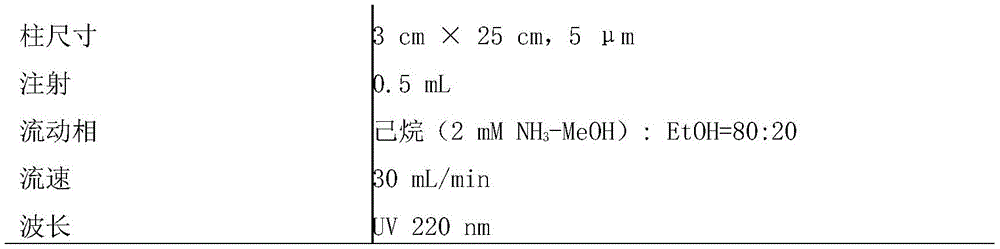
Chiral analytical HPLC conditions

Biological activity
Assay of HPK kinase Activity at 1mM ATP
Testing of compounds disclosed herein for HPK1 in assays based on time-resolved fluorescence resonance energy transfer (TR-FRET) methodsInhibition of kinase (aa1-346, Life Technologies). The assay was performed in 384 well small volume black plates in a reaction mixture containing HPK1 kinase (40nM), 1mM ATP, 0.5. mu.M STK1 substrate and 0-10. mu.M compound in a buffer containing 50mM HEPES, 0.01% BSA, 0.1mM orthovanadate, 10mM MgCl21mM DTT (pH 7.0), 0.005% Tween-20. The kinase was incubated with the compound disclosed herein or DMSO for 60 minutes at room temperature and the reaction was initiated by the addition of ATP and STK1 substrate. After 120 minutes reaction at room temperature, an equal volume of stop/detection solution was added according to the manufacturer's instructions (CisBio Inc.). The stop/detection solution contained STK antibody-cryptate and XL 665-conjugated streptavidin in detection buffer. The TR-FRET signal (ratio of fluorescence emission at 665nm to 620nm after excitation with a wavelength of 337 nm) was recorded on a PHERAStar FS microplate reader (BMG Labtech Co.). Phosphorylation of the STK1 substrate results in binding of the STK antibody-cryptate to the biotinylated STK1 substrate, which results in a fluorescent donor (Eu)3+ cryptate) is in close proximity to the receptor (streptavidin-XL 665), resulting in a high degree of fluorescence resonance energy transfer. The inhibition of HPK1 by compounds at increasing concentrations was calculated based on the ratio of fluorescence at 665nm to 620 nm. The IC for each compound was derived by fitting the data to a four parameter logistic equation using Graphpad Prism software50. The compounds disclosed herein showed the enzyme activity values shown in table 1.
TABLE 1 enzymatic Activity IC of Compounds disclosed herein50(nM)


It is to be understood that if any prior art publication is referred to herein; such reference does not constitute an admission that the publication forms part of the common general knowledge in the art in any country.
The disclosures of all publications, patents, patent applications, and published patent applications referred to herein by an identifying citation (identification citation) are hereby incorporated by reference in their entirety.
Although the foregoing invention has been described in some detail by way of illustration and example for purposes of clarity of understanding, it will be apparent to those of ordinary skill in the art that certain minor modifications or adaptations may be practiced. Therefore, the description and examples should not be construed as limiting the scope of the invention.
Claims (21)


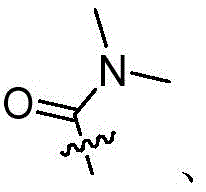

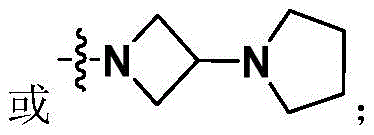


Applications Claiming Priority (2)
| Application Number | Priority Date | Filing Date | Title |
|---|---|---|---|
| CNPCT/CN2019/096850 | 2019-07-17 | ||
| CN2019096850 | 2019-07-17 |
Publications (2)
| Publication Number | Publication Date |
|---|---|
| CN112239473A true CN112239473A (en) | 2021-01-19 |
| CN112239473B CN112239473B (en) | 2023-12-08 |
Family
ID=74170525
Family Applications (2)
| Application Number | Title | Priority Date | Filing Date |
|---|---|---|---|
| CN202010695693.6A Active CN112239473B (en) | 2019-07-17 | 2020-07-17 | Preparation method of tricyclic compounds as HPK1 inhibitors |
| CN202080051400.9A Active CN114127067B (en) | 2019-07-17 | 2020-07-17 | Tricyclic compounds as HPK1 inhibitors and their uses |
Family Applications After (1)
| Application Number | Title | Priority Date | Filing Date |
|---|---|---|---|
| CN202080051400.9A Active CN114127067B (en) | 2019-07-17 | 2020-07-17 | Tricyclic compounds as HPK1 inhibitors and their uses |
Country Status (4)
| Country | Link |
|---|---|
| US (1) | US12459958B2 (en) |
| CN (2) | CN112239473B (en) |
| TW (1) | TW202116771A (en) |
| WO (1) | WO2021013083A1 (en) |
Cited By (7)
| Publication number | Priority date | Publication date | Assignee | Title |
|---|---|---|---|---|
| US11071730B2 (en) | 2018-10-31 | 2021-07-27 | Gilead Sciences, Inc. | Substituted 6-azabenzimidazole compounds |
| US11203591B2 (en) | 2018-10-31 | 2021-12-21 | Gilead Sciences, Inc. | Substituted 6-azabenzimidazole compounds |
| US11453681B2 (en) | 2019-05-23 | 2022-09-27 | Gilead Sciences, Inc. | Substituted eneoxindoles and uses thereof |
| WO2022199676A1 (en) * | 2021-03-26 | 2022-09-29 | 江苏恒瑞医药股份有限公司 | Fused tetracyclic compound, preparation method therefor and application thereof in medicine |
| US11767321B2 (en) | 2020-10-05 | 2023-09-26 | Enliven Inc. | 5- and 6-azaindole compounds for inhibition of BCR-ABL tyrosine kinases |
| CN116848119A (en) * | 2021-02-08 | 2023-10-03 | 杭州中美华东制药有限公司 | A kind of pyrrolopyridazine compound and its preparation method and use |
| CN117865993A (en) * | 2023-01-10 | 2024-04-12 | 杭州师范大学 | AAK1 inhibitor and its preparation and application |
Families Citing this family (10)
| Publication number | Priority date | Publication date | Assignee | Title |
|---|---|---|---|---|
| TWI848141B (en) | 2019-07-04 | 2024-07-11 | 英屬開曼群島商百濟神州有限公司 | PYRROLO[2,3-b]PYRAZINES AS HPK1 INHIBITOR AND THE USE THEREOF |
| TW202116771A (en) | 2019-07-17 | 2021-05-01 | 英屬開曼群島商百濟神州有限公司 | Tricyclic compounds as hpk1 inhibitor and the use thereof |
| WO2021213317A1 (en) * | 2020-04-20 | 2021-10-28 | 微境生物医药科技(上海)有限公司 | Hpk1 inhibitor, preparation method therefor and use thereof |
| ES3036245T3 (en) | 2021-07-20 | 2025-09-18 | Astrazeneca Ab | Substituted pyrazine-2-carboxamides as hpk1 inhibitors for the treatment of cancer |
| WO2023083299A1 (en) * | 2021-11-12 | 2023-05-19 | 微境生物医药科技(上海)有限公司 | Fused ring compound as hpk1 inhibitor |
| WO2023083282A1 (en) * | 2021-11-12 | 2023-05-19 | 微境生物医药科技(上海)有限公司 | Fused ring compound as hpk1 inhibitor |
| CN118451073A (en) * | 2021-12-29 | 2024-08-06 | 百济神州有限公司 | Heterocyclic compounds |
| AR129722A1 (en) * | 2022-06-28 | 2024-09-18 | Arcus Biosciences Inc | AXL INHIBITORY COMPOUNDS |
| WO2024061345A1 (en) * | 2022-09-22 | 2024-03-28 | 北京望实智慧科技有限公司 | Hpk1 inhibitor, preparation method therefor, and use thereof |
| WO2024131777A1 (en) * | 2022-12-19 | 2024-06-27 | 杭州中美华东制药有限公司 | Kras-protac chimeric compound, preparation method therefor and use thereof |
Citations (6)
| Publication number | Priority date | Publication date | Assignee | Title |
|---|---|---|---|---|
| US5942532A (en) * | 1997-09-05 | 1999-08-24 | Ortho Pharmaceutical Corporation | 2-substituted phenyl-benzimidazole antibacterial agents |
| WO2014093383A1 (en) * | 2012-12-14 | 2014-06-19 | Arrien Pharmaceuticals Llc | Substituted 1h-pyrrolo [2,3-b] pyridine and 1h-pyrazolo [3, 4-b] pyridine derivatives as salt inducible kinase 2 (sik2) inhibitors |
| CN104513253A (en) * | 2013-10-01 | 2015-04-15 | 南京波尔泰药业科技有限公司 | Macrocyclic compounds for the treatment of proliferative diseases |
| US20180072720A1 (en) * | 2016-09-09 | 2018-03-15 | Incyte Corporation | Pyrazolopyridine compounds and uses thereof |
| CN108440532A (en) * | 2018-03-27 | 2018-08-24 | 上海道亦化工科技有限公司 | A kind of benzopyrazines compound and application thereof and luminescent device |
| US20180298009A1 (en) * | 2015-09-30 | 2018-10-18 | Ucb Biopharma Sprl | Fused Pyrazole Derivatives As Kinase Inhibitors |
Family Cites Families (35)
| Publication number | Priority date | Publication date | Assignee | Title |
|---|---|---|---|---|
| TWI339206B (en) | 2003-09-04 | 2011-03-21 | Vertex Pharma | Compositions useful as inhibitors of protein kinases |
| EP1778687A2 (en) | 2004-07-27 | 2007-05-02 | SGX Pharmaceuticals, Inc. | Fused ring heterocycle kinase modulators |
| US7709645B2 (en) | 2004-07-27 | 2010-05-04 | Sgx Pharmaceuticals, Inc. | Pyrrolo-pyridine kinase modulators |
| CA2573362A1 (en) | 2004-07-27 | 2006-02-09 | Sgx Pharmaceuticals, Inc. | Pyrrolo-pyridine kinase modulators |
| EP1814883A1 (en) | 2004-11-22 | 2007-08-08 | Vertex Pharmaceuticals Incorporated | Bicyclic inhibitors or rho kinase |
| WO2007041511A2 (en) | 2005-09-30 | 2007-04-12 | New York University | Hematopoietic progenitor kinase 1 for modulation of an immune response |
| WO2010049173A1 (en) | 2008-10-31 | 2010-05-06 | Cenix Bioscience Gmbh | Use of inhibitors of host kinases for the treatment of infectious diseases |
| CN103153994B (en) | 2010-05-24 | 2016-02-10 | 罗切斯特大学 | Bicyclic heteroaryl kinase inhibitor and using method |
| CN101851237B (en) | 2010-06-18 | 2012-10-17 | 南方医科大学 | A kind of spiro compound and its preparation method and application |
| JP2012012332A (en) | 2010-06-30 | 2012-01-19 | Dainippon Sumitomo Pharma Co Ltd | New azaindole derivative |
| WO2014006554A1 (en) | 2012-07-03 | 2014-01-09 | Aurigene Discovery Technologies Limited | 3-(PYRAZOLYL)-1H-PYRROLO[2,3-b]PYRIDINE DERIVATIVES AS KINASE INHIBITORS |
| WO2014085795A1 (en) | 2012-11-30 | 2014-06-05 | University Of Rochester | Mixed lineage kinase inhibitors for hiv/aids therapies |
| CN105777756B (en) | 2014-07-02 | 2019-03-01 | 广东东阳光药业有限公司 | Heteroaromatic compounds and their application in medicine |
| KR101660863B1 (en) | 2015-04-03 | 2016-09-28 | 주식회사 녹십자 | 7-AZAINDOLE OR 4,7-DIAZAINDOLE DERIVATIVES AS IKKε AND TBK1 INHIBITOR AND PHARMACEUTICAL COMPOSITION COMPRISING SAME |
| WO2016164641A1 (en) * | 2015-04-08 | 2016-10-13 | Plexxikon Inc. | Compounds and methods for kinase modulation, and indications therefor |
| MX386480B (en) | 2015-06-25 | 2025-03-18 | Univ Health Network | HPK1 INHIBITORS AND METHODS OF USING THEM. |
| CN106336413B (en) | 2015-07-09 | 2021-04-20 | 广东东阳光药业有限公司 | Compounds as JAK inhibitors and their uses |
| CN106432246B (en) | 2015-08-05 | 2020-07-07 | 广东东阳光药业有限公司 | Heteroaromatic compounds and their application in medicine |
| US20180072741A1 (en) | 2016-09-09 | 2018-03-15 | Incyte Corporation | Pyrazolopyrimidine compounds and uses thereof |
| US20180072718A1 (en) | 2016-09-09 | 2018-03-15 | Incyte Corporation | Pyrazolopyridine compounds and uses thereof |
| US10280164B2 (en) | 2016-09-09 | 2019-05-07 | Incyte Corporation | Pyrazolopyridone compounds and uses thereof |
| EP3596075B1 (en) | 2017-03-15 | 2023-10-11 | F. Hoffmann-La Roche AG | Azaindoles as inhibitors of hpk1 |
| CA3054161A1 (en) | 2017-03-30 | 2018-10-04 | F. Hoffmann-La Roche Ag | Isoquinolines as inhibitors of hpk1 |
| BR112019018093A2 (en) | 2017-03-30 | 2020-06-16 | F. Hoffmann-La Roche Ag | COMPOUNDS, COMPOSITION, HPK1 INHIBITION METHOD, METHODS TO IMPROVE AN IMMUNE RESPONSE AND TO TREAT A DISORDER AND COMPOUND USES |
| US10654825B2 (en) | 2017-03-30 | 2020-05-19 | Corvus Pharmaceuticals, Inc. | Processes for making triazolo[4,5D] pyramidine derivatives and intermediates thereof |
| CN109111464B (en) * | 2017-06-23 | 2021-02-26 | 爱科诺生物医药股份有限公司 | Heterocyclic compound with cell necrosis inhibition activity |
| US11466016B2 (en) | 2018-03-02 | 2022-10-11 | Otsuka Pharmaceutical Co., Ltd. | Pharmaceutical compounds |
| JP2021525799A (en) | 2018-05-25 | 2021-09-27 | シルバーバック セラピューティックス インコーポレイテッド | Amino-pyrazine carboxamide compounds, conjugates, and their use |
| WO2019238067A1 (en) | 2018-06-13 | 2019-12-19 | Beigene, Ltd. | Pyrrolo [2, 3-b] pyridines or pyrrolo [2, 3-b] pyrazines as hpk1 inhibitor and the use thereof |
| TW202039483A (en) | 2018-11-22 | 2020-11-01 | 英屬開曼群島商百濟神州有限公司 | Pyrrolo[2,3-b]pyridines as hpk1 inhibitor and the use thereof |
| CN114423463B (en) | 2019-05-06 | 2025-09-26 | 西奈山伊坎医学院 | Heterobifunctional compounds as degraders of HPK1 |
| TWI848141B (en) | 2019-07-04 | 2024-07-11 | 英屬開曼群島商百濟神州有限公司 | PYRROLO[2,3-b]PYRAZINES AS HPK1 INHIBITOR AND THE USE THEREOF |
| TW202116771A (en) | 2019-07-17 | 2021-05-01 | 英屬開曼群島商百濟神州有限公司 | Tricyclic compounds as hpk1 inhibitor and the use thereof |
| US20220289712A1 (en) | 2019-08-21 | 2022-09-15 | Beigene, Ltd. | Aminopyrazine compounds as hpk1 inhibitor and the use thereof |
| CN112552293A (en) | 2019-09-25 | 2021-03-26 | 珠海宇繁生物科技有限责任公司 | PROTAC small molecular compound and application thereof |
-
2020
- 2020-07-17 TW TW109124289A patent/TW202116771A/en unknown
- 2020-07-17 US US17/627,885 patent/US12459958B2/en active Active
- 2020-07-17 CN CN202010695693.6A patent/CN112239473B/en active Active
- 2020-07-17 CN CN202080051400.9A patent/CN114127067B/en active Active
- 2020-07-17 WO PCT/CN2020/102647 patent/WO2021013083A1/en not_active Ceased
Patent Citations (6)
| Publication number | Priority date | Publication date | Assignee | Title |
|---|---|---|---|---|
| US5942532A (en) * | 1997-09-05 | 1999-08-24 | Ortho Pharmaceutical Corporation | 2-substituted phenyl-benzimidazole antibacterial agents |
| WO2014093383A1 (en) * | 2012-12-14 | 2014-06-19 | Arrien Pharmaceuticals Llc | Substituted 1h-pyrrolo [2,3-b] pyridine and 1h-pyrazolo [3, 4-b] pyridine derivatives as salt inducible kinase 2 (sik2) inhibitors |
| CN104513253A (en) * | 2013-10-01 | 2015-04-15 | 南京波尔泰药业科技有限公司 | Macrocyclic compounds for the treatment of proliferative diseases |
| US20180298009A1 (en) * | 2015-09-30 | 2018-10-18 | Ucb Biopharma Sprl | Fused Pyrazole Derivatives As Kinase Inhibitors |
| US20180072720A1 (en) * | 2016-09-09 | 2018-03-15 | Incyte Corporation | Pyrazolopyridine compounds and uses thereof |
| CN108440532A (en) * | 2018-03-27 | 2018-08-24 | 上海道亦化工科技有限公司 | A kind of benzopyrazines compound and application thereof and luminescent device |
Non-Patent Citations (1)
| Title |
|---|
| 曹高等: "苯胺-β-亚胺/PdCl2催化下的Suzuki偶联反应" * |
Cited By (14)
| Publication number | Priority date | Publication date | Assignee | Title |
|---|---|---|---|---|
| US11203591B2 (en) | 2018-10-31 | 2021-12-21 | Gilead Sciences, Inc. | Substituted 6-azabenzimidazole compounds |
| US11071730B2 (en) | 2018-10-31 | 2021-07-27 | Gilead Sciences, Inc. | Substituted 6-azabenzimidazole compounds |
| US11897878B2 (en) | 2018-10-31 | 2024-02-13 | Gilead Sciences, Inc. | Substituted 6-azabenzimidazole compounds |
| US11925631B2 (en) | 2018-10-31 | 2024-03-12 | Gilead Sciences, Inc. | Substituted 6-azabenzimidazole compounds |
| US12258346B2 (en) | 2018-10-31 | 2025-03-25 | Gilead Sciences, Inc. | Substituted 6-azabenzimidazole compounds |
| US11453681B2 (en) | 2019-05-23 | 2022-09-27 | Gilead Sciences, Inc. | Substituted eneoxindoles and uses thereof |
| US12037342B2 (en) | 2019-05-23 | 2024-07-16 | Gilead Sciences, Inc. | Substituted eneoxindoles and uses thereof |
| US12240846B2 (en) | 2020-10-05 | 2025-03-04 | Enliven Inc. | 5- and 6-azaindole compounds for inhibition of Bcr-Abl tyrosine kinases |
| US11767321B2 (en) | 2020-10-05 | 2023-09-26 | Enliven Inc. | 5- and 6-azaindole compounds for inhibition of BCR-ABL tyrosine kinases |
| US11807638B2 (en) | 2020-10-05 | 2023-11-07 | Enliven Inc. | 5- and 6-azaindole compounds for inhibition of Bcr-Abl tyrosine kinases |
| CN116848119A (en) * | 2021-02-08 | 2023-10-03 | 杭州中美华东制药有限公司 | A kind of pyrrolopyridazine compound and its preparation method and use |
| WO2022199676A1 (en) * | 2021-03-26 | 2022-09-29 | 江苏恒瑞医药股份有限公司 | Fused tetracyclic compound, preparation method therefor and application thereof in medicine |
| CN117865993B (en) * | 2023-01-10 | 2024-09-27 | 杭州师范大学 | AAK1 inhibitor and its preparation and application |
| CN117865993A (en) * | 2023-01-10 | 2024-04-12 | 杭州师范大学 | AAK1 inhibitor and its preparation and application |
Also Published As
| Publication number | Publication date |
|---|---|
| WO2021013083A1 (en) | 2021-01-28 |
| CN114127067B (en) | 2024-08-23 |
| US12459958B2 (en) | 2025-11-04 |
| US20220267354A1 (en) | 2022-08-25 |
| CN114127067A (en) | 2022-03-01 |
| TW202116771A (en) | 2021-05-01 |
| CN112239473B (en) | 2023-12-08 |
Similar Documents
| Publication | Publication Date | Title |
|---|---|---|
| CN112239473A (en) | Tricyclic compounds as HPK1 inhibitors | |
| KR102727832B1 (en) | SHP2 phosphatase allosteric inhibitor | |
| KR102614939B1 (en) | Pyrimidine-fused ring compounds and their production methods and uses | |
| TWI848141B (en) | PYRROLO[2,3-b]PYRAZINES AS HPK1 INHIBITOR AND THE USE THEREOF | |
| TWI902789B (en) | Degradation of bruton''s tyrosine kinase (btk) by conjugation of btk inhibitors with e3 ligase ligand and methods of use | |
| JP2021521138A (en) | Bcl-2 inhibitor | |
| EP4351558A1 (en) | Compounds having 5-(2-fluoro-6-hydroxyphenyl)-1,2,5-thiadiazolidin-3-one 1,1-dioxide as inhibitors of protein kinase phosphatase enzymes | |
| KR20210068010A (en) | Carboxamide as a ubiquitin-specific protease inhibitor | |
| CN109384803A (en) | ATX inhibitor and its preparation method and application | |
| CN117642157A (en) | Compounds with ((3-nitrophenyl)sulfonyl)acetamide as BCL-2 inhibitors | |
| WO2022234298A1 (en) | Pkc-theta modulators | |
| JP7546780B2 (en) | Azaheteroaryl compounds, methods for their preparation and uses | |
| JP7406008B2 (en) | Polycyclic amide derivatives as CDK9 inhibitors, their preparation methods and uses | |
| KR20230157419A (en) | Compounds with tetrahydroindolizine-1-carboxamide as BCL-2 inhibitors | |
| EP4213843A2 (en) | Modified imidazopyridines as glucosylceramide synthase inhibitors | |
| CN108137532A (en) | Pyridin-3-ylacetic acid derivatives as inhibitors of human immunodeficiency virus replication | |
| CN115232109A (en) | PD-1/PD-L1 small molecule inhibitors and their application in medicine | |
| CN119053596A (en) | Heterocyclic compounds as kinase inhibitors, compositions and methods of use | |
| KR20250100670A (en) | Fused bicyclic compounds and their use as Mer and Axl inhibitors | |
| HK40073633A (en) | Pyrrolo [2, 3-b] pyrazines as hpk1 inhibitor and the use thereof | |
| HK40061243A (en) | Pyrrolo [2, 3-b] pyrazines as hpk1 inhibitor and the use thereof | |
| HK40063823A (en) | Heterocyclic compounds as kinase inhibitors, compositions comprising the heterocyclic compound, and methods of use thereof | |
| EA046667B1 (en) | PYRROLO[2,3-b]PYRAZINES AS HPK1 INHIBITORS AND THEIR APPLICATION | |
| CN107922426A (en) | tetrahydrooxepin pyridine compound |
Legal Events
| Date | Code | Title | Description |
|---|---|---|---|
| PB01 | Publication | ||
| PB01 | Publication | ||
| SE01 | Entry into force of request for substantive examination | ||
| SE01 | Entry into force of request for substantive examination | ||
| GR01 | Patent grant | ||
| GR01 | Patent grant |