CN108290939B - Compositions and methods for inhibiting lineage specific antigens - Google Patents
Compositions and methods for inhibiting lineage specific antigens Download PDFInfo
- Publication number
- CN108290939B CN108290939B CN201680067189.3A CN201680067189A CN108290939B CN 108290939 B CN108290939 B CN 108290939B CN 201680067189 A CN201680067189 A CN 201680067189A CN 108290939 B CN108290939 B CN 108290939B
- Authority
- CN
- China
- Prior art keywords
- cells
- ser
- gly
- leu
- lineage
- Prior art date
- Legal status (The legal status is an assumption and is not a legal conclusion. Google has not performed a legal analysis and makes no representation as to the accuracy of the status listed.)
- Active
Links
Images




Classifications
-
- A—HUMAN NECESSITIES
- A61—MEDICAL OR VETERINARY SCIENCE; HYGIENE
- A61K—PREPARATIONS FOR MEDICAL, DENTAL OR TOILETRY PURPOSES
- A61K35/00—Medicinal preparations containing materials or reaction products thereof with undetermined constitution
- A61K35/12—Materials from mammals; Compositions comprising non-specified tissues or cells; Compositions comprising non-embryonic stem cells; Genetically modified cells
- A61K35/28—Bone marrow; Haematopoietic stem cells; Mesenchymal stem cells of any origin, e.g. adipose-derived stem cells
-
- A—HUMAN NECESSITIES
- A61—MEDICAL OR VETERINARY SCIENCE; HYGIENE
- A61K—PREPARATIONS FOR MEDICAL, DENTAL OR TOILETRY PURPOSES
- A61K35/00—Medicinal preparations containing materials or reaction products thereof with undetermined constitution
- A61K35/12—Materials from mammals; Compositions comprising non-specified tissues or cells; Compositions comprising non-embryonic stem cells; Genetically modified cells
- A61K35/14—Blood; Artificial blood
- A61K35/15—Cells of the myeloid line, e.g. granulocytes, basophils, eosinophils, neutrophils, leucocytes, monocytes, macrophages or mast cells; Myeloid precursor cells; Antigen-presenting cells, e.g. dendritic cells
-
- A—HUMAN NECESSITIES
- A61—MEDICAL OR VETERINARY SCIENCE; HYGIENE
- A61K—PREPARATIONS FOR MEDICAL, DENTAL OR TOILETRY PURPOSES
- A61K35/00—Medicinal preparations containing materials or reaction products thereof with undetermined constitution
- A61K35/12—Materials from mammals; Compositions comprising non-specified tissues or cells; Compositions comprising non-embryonic stem cells; Genetically modified cells
- A61K35/14—Blood; Artificial blood
- A61K35/17—Lymphocytes; B-cells; T-cells; Natural killer cells; Interferon-activated or cytokine-activated lymphocytes
-
- A—HUMAN NECESSITIES
- A61—MEDICAL OR VETERINARY SCIENCE; HYGIENE
- A61K—PREPARATIONS FOR MEDICAL, DENTAL OR TOILETRY PURPOSES
- A61K39/00—Medicinal preparations containing antigens or antibodies
- A61K39/0005—Vertebrate antigens
- A61K39/0011—Cancer antigens
- A61K39/001102—Receptors, cell surface antigens or cell surface determinants
- A61K39/001111—Immunoglobulin superfamily
-
- A—HUMAN NECESSITIES
- A61—MEDICAL OR VETERINARY SCIENCE; HYGIENE
- A61K—PREPARATIONS FOR MEDICAL, DENTAL OR TOILETRY PURPOSES
- A61K39/00—Medicinal preparations containing antigens or antibodies
- A61K39/0005—Vertebrate antigens
- A61K39/0011—Cancer antigens
- A61K39/001102—Receptors, cell surface antigens or cell surface determinants
- A61K39/001111—Immunoglobulin superfamily
- A61K39/001112—CD19 or B4
-
- A—HUMAN NECESSITIES
- A61—MEDICAL OR VETERINARY SCIENCE; HYGIENE
- A61K—PREPARATIONS FOR MEDICAL, DENTAL OR TOILETRY PURPOSES
- A61K40/00—Cellular immunotherapy
- A61K40/10—Cellular immunotherapy characterised by the cell type used
- A61K40/11—T-cells, e.g. tumour infiltrating lymphocytes [TIL] or regulatory T [Treg] cells; Lymphokine-activated killer [LAK] cells
-
- A—HUMAN NECESSITIES
- A61—MEDICAL OR VETERINARY SCIENCE; HYGIENE
- A61K—PREPARATIONS FOR MEDICAL, DENTAL OR TOILETRY PURPOSES
- A61K40/00—Cellular immunotherapy
- A61K40/10—Cellular immunotherapy characterised by the cell type used
- A61K40/15—Natural-killer [NK] cells; Natural-killer T [NKT] cells
-
- A—HUMAN NECESSITIES
- A61—MEDICAL OR VETERINARY SCIENCE; HYGIENE
- A61K—PREPARATIONS FOR MEDICAL, DENTAL OR TOILETRY PURPOSES
- A61K40/00—Cellular immunotherapy
- A61K40/30—Cellular immunotherapy characterised by the recombinant expression of specific molecules in the cells of the immune system
- A61K40/31—Chimeric antigen receptors [CAR]
-
- A—HUMAN NECESSITIES
- A61—MEDICAL OR VETERINARY SCIENCE; HYGIENE
- A61K—PREPARATIONS FOR MEDICAL, DENTAL OR TOILETRY PURPOSES
- A61K40/00—Cellular immunotherapy
- A61K40/40—Cellular immunotherapy characterised by antigens that are targeted or presented by cells of the immune system
- A61K40/41—Vertebrate antigens
- A61K40/42—Cancer antigens
- A61K40/4202—Receptors, cell surface antigens or cell surface determinants
- A61K40/421—Immunoglobulin superfamily
-
- A—HUMAN NECESSITIES
- A61—MEDICAL OR VETERINARY SCIENCE; HYGIENE
- A61K—PREPARATIONS FOR MEDICAL, DENTAL OR TOILETRY PURPOSES
- A61K40/00—Cellular immunotherapy
- A61K40/40—Cellular immunotherapy characterised by antigens that are targeted or presented by cells of the immune system
- A61K40/41—Vertebrate antigens
- A61K40/42—Cancer antigens
- A61K40/4244—Enzymes
- A61K40/4252—Phosphatases
-
- A—HUMAN NECESSITIES
- A61—MEDICAL OR VETERINARY SCIENCE; HYGIENE
- A61P—SPECIFIC THERAPEUTIC ACTIVITY OF CHEMICAL COMPOUNDS OR MEDICINAL PREPARATIONS
- A61P35/00—Antineoplastic agents
-
- A—HUMAN NECESSITIES
- A61—MEDICAL OR VETERINARY SCIENCE; HYGIENE
- A61P—SPECIFIC THERAPEUTIC ACTIVITY OF CHEMICAL COMPOUNDS OR MEDICINAL PREPARATIONS
- A61P35/00—Antineoplastic agents
- A61P35/02—Antineoplastic agents specific for leukemia
-
- A—HUMAN NECESSITIES
- A61—MEDICAL OR VETERINARY SCIENCE; HYGIENE
- A61P—SPECIFIC THERAPEUTIC ACTIVITY OF CHEMICAL COMPOUNDS OR MEDICINAL PREPARATIONS
- A61P43/00—Drugs for specific purposes, not provided for in groups A61P1/00-A61P41/00
-
- C—CHEMISTRY; METALLURGY
- C07—ORGANIC CHEMISTRY
- C07K—PEPTIDES
- C07K14/00—Peptides having more than 20 amino acids; Gastrins; Somatostatins; Melanotropins; Derivatives thereof
- C07K14/435—Peptides having more than 20 amino acids; Gastrins; Somatostatins; Melanotropins; Derivatives thereof from animals; from humans
- C07K14/705—Receptors; Cell surface antigens; Cell surface determinants
- C07K14/70503—Immunoglobulin superfamily
- C07K14/7051—T-cell receptor (TcR)-CD3 complex
-
- C—CHEMISTRY; METALLURGY
- C07—ORGANIC CHEMISTRY
- C07K—PEPTIDES
- C07K14/00—Peptides having more than 20 amino acids; Gastrins; Somatostatins; Melanotropins; Derivatives thereof
- C07K14/435—Peptides having more than 20 amino acids; Gastrins; Somatostatins; Melanotropins; Derivatives thereof from animals; from humans
- C07K14/705—Receptors; Cell surface antigens; Cell surface determinants
- C07K14/70503—Immunoglobulin superfamily
- C07K14/70517—CD8
-
- C—CHEMISTRY; METALLURGY
- C07—ORGANIC CHEMISTRY
- C07K—PEPTIDES
- C07K14/00—Peptides having more than 20 amino acids; Gastrins; Somatostatins; Melanotropins; Derivatives thereof
- C07K14/435—Peptides having more than 20 amino acids; Gastrins; Somatostatins; Melanotropins; Derivatives thereof from animals; from humans
- C07K14/705—Receptors; Cell surface antigens; Cell surface determinants
- C07K14/70503—Immunoglobulin superfamily
- C07K14/70521—CD28, CD152
-
- C—CHEMISTRY; METALLURGY
- C07—ORGANIC CHEMISTRY
- C07K—PEPTIDES
- C07K16/00—Immunoglobulins [IGs], e.g. monoclonal or polyclonal antibodies
- C07K16/18—Immunoglobulins [IGs], e.g. monoclonal or polyclonal antibodies against material from animals or humans
- C07K16/28—Immunoglobulins [IGs], e.g. monoclonal or polyclonal antibodies against material from animals or humans against receptors, cell surface antigens or cell surface determinants
- C07K16/2803—Immunoglobulins [IGs], e.g. monoclonal or polyclonal antibodies against material from animals or humans against receptors, cell surface antigens or cell surface determinants against the immunoglobulin superfamily
-
- C—CHEMISTRY; METALLURGY
- C07—ORGANIC CHEMISTRY
- C07K—PEPTIDES
- C07K16/00—Immunoglobulins [IGs], e.g. monoclonal or polyclonal antibodies
- C07K16/18—Immunoglobulins [IGs], e.g. monoclonal or polyclonal antibodies against material from animals or humans
- C07K16/28—Immunoglobulins [IGs], e.g. monoclonal or polyclonal antibodies against material from animals or humans against receptors, cell surface antigens or cell surface determinants
- C07K16/30—Immunoglobulins [IGs], e.g. monoclonal or polyclonal antibodies against material from animals or humans against receptors, cell surface antigens or cell surface determinants from tumour cells
-
- C—CHEMISTRY; METALLURGY
- C07—ORGANIC CHEMISTRY
- C07K—PEPTIDES
- C07K16/00—Immunoglobulins [IGs], e.g. monoclonal or polyclonal antibodies
- C07K16/18—Immunoglobulins [IGs], e.g. monoclonal or polyclonal antibodies against material from animals or humans
- C07K16/28—Immunoglobulins [IGs], e.g. monoclonal or polyclonal antibodies against material from animals or humans against receptors, cell surface antigens or cell surface determinants
- C07K16/30—Immunoglobulins [IGs], e.g. monoclonal or polyclonal antibodies against material from animals or humans against receptors, cell surface antigens or cell surface determinants from tumour cells
- C07K16/3061—Blood cells
-
- C—CHEMISTRY; METALLURGY
- C12—BIOCHEMISTRY; BEER; SPIRITS; WINE; VINEGAR; MICROBIOLOGY; ENZYMOLOGY; MUTATION OR GENETIC ENGINEERING
- C12N—MICROORGANISMS OR ENZYMES; COMPOSITIONS THEREOF; PROPAGATING, PRESERVING, OR MAINTAINING MICROORGANISMS; MUTATION OR GENETIC ENGINEERING; CULTURE MEDIA
- C12N5/00—Undifferentiated human, animal or plant cells, e.g. cell lines; Tissues; Cultivation or maintenance thereof; Culture media therefor
- C12N5/06—Animal cells or tissues; Human cells or tissues
- C12N5/0602—Vertebrate cells
- C12N5/0634—Cells from the blood or the immune system
- C12N5/0636—T lymphocytes
-
- C—CHEMISTRY; METALLURGY
- C12—BIOCHEMISTRY; BEER; SPIRITS; WINE; VINEGAR; MICROBIOLOGY; ENZYMOLOGY; MUTATION OR GENETIC ENGINEERING
- C12N—MICROORGANISMS OR ENZYMES; COMPOSITIONS THEREOF; PROPAGATING, PRESERVING, OR MAINTAINING MICROORGANISMS; MUTATION OR GENETIC ENGINEERING; CULTURE MEDIA
- C12N5/00—Undifferentiated human, animal or plant cells, e.g. cell lines; Tissues; Cultivation or maintenance thereof; Culture media therefor
- C12N5/06—Animal cells or tissues; Human cells or tissues
- C12N5/0602—Vertebrate cells
- C12N5/0634—Cells from the blood or the immune system
- C12N5/0647—Haematopoietic stem cells; Uncommitted or multipotent progenitors
-
- A—HUMAN NECESSITIES
- A61—MEDICAL OR VETERINARY SCIENCE; HYGIENE
- A61K—PREPARATIONS FOR MEDICAL, DENTAL OR TOILETRY PURPOSES
- A61K35/00—Medicinal preparations containing materials or reaction products thereof with undetermined constitution
- A61K35/12—Materials from mammals; Compositions comprising non-specified tissues or cells; Compositions comprising non-embryonic stem cells; Genetically modified cells
- A61K2035/124—Materials from mammals; Compositions comprising non-specified tissues or cells; Compositions comprising non-embryonic stem cells; Genetically modified cells the cells being hematopoietic, bone marrow derived or blood cells
-
- A—HUMAN NECESSITIES
- A61—MEDICAL OR VETERINARY SCIENCE; HYGIENE
- A61K—PREPARATIONS FOR MEDICAL, DENTAL OR TOILETRY PURPOSES
- A61K39/00—Medicinal preparations containing antigens or antibodies
- A61K2039/505—Medicinal preparations containing antigens or antibodies comprising antibodies
-
- A—HUMAN NECESSITIES
- A61—MEDICAL OR VETERINARY SCIENCE; HYGIENE
- A61K—PREPARATIONS FOR MEDICAL, DENTAL OR TOILETRY PURPOSES
- A61K2239/00—Indexing codes associated with cellular immunotherapy of group A61K40/00
- A61K2239/31—Indexing codes associated with cellular immunotherapy of group A61K40/00 characterized by the route of administration
-
- A—HUMAN NECESSITIES
- A61—MEDICAL OR VETERINARY SCIENCE; HYGIENE
- A61K—PREPARATIONS FOR MEDICAL, DENTAL OR TOILETRY PURPOSES
- A61K2239/00—Indexing codes associated with cellular immunotherapy of group A61K40/00
- A61K2239/38—Indexing codes associated with cellular immunotherapy of group A61K40/00 characterised by the dose, timing or administration schedule
-
- A—HUMAN NECESSITIES
- A61—MEDICAL OR VETERINARY SCIENCE; HYGIENE
- A61K—PREPARATIONS FOR MEDICAL, DENTAL OR TOILETRY PURPOSES
- A61K2239/00—Indexing codes associated with cellular immunotherapy of group A61K40/00
- A61K2239/46—Indexing codes associated with cellular immunotherapy of group A61K40/00 characterised by the cancer treated
- A61K2239/48—Blood cells, e.g. leukemia or lymphoma
-
- C—CHEMISTRY; METALLURGY
- C07—ORGANIC CHEMISTRY
- C07K—PEPTIDES
- C07K2317/00—Immunoglobulins specific features
- C07K2317/20—Immunoglobulins specific features characterized by taxonomic origin
- C07K2317/24—Immunoglobulins specific features characterized by taxonomic origin containing regions, domains or residues from different species, e.g. chimeric, humanized or veneered
-
- C—CHEMISTRY; METALLURGY
- C07—ORGANIC CHEMISTRY
- C07K—PEPTIDES
- C07K2317/00—Immunoglobulins specific features
- C07K2317/50—Immunoglobulins specific features characterized by immunoglobulin fragments
- C07K2317/56—Immunoglobulins specific features characterized by immunoglobulin fragments variable (Fv) region, i.e. VH and/or VL
- C07K2317/565—Complementarity determining region [CDR]
-
- C—CHEMISTRY; METALLURGY
- C07—ORGANIC CHEMISTRY
- C07K—PEPTIDES
- C07K2317/00—Immunoglobulins specific features
- C07K2317/60—Immunoglobulins specific features characterized by non-natural combinations of immunoglobulin fragments
- C07K2317/62—Immunoglobulins specific features characterized by non-natural combinations of immunoglobulin fragments comprising only variable region components
- C07K2317/622—Single chain antibody (scFv)
-
- C—CHEMISTRY; METALLURGY
- C07—ORGANIC CHEMISTRY
- C07K—PEPTIDES
- C07K2319/00—Fusion polypeptide
- C07K2319/01—Fusion polypeptide containing a localisation/targetting motif
- C07K2319/02—Fusion polypeptide containing a localisation/targetting motif containing a signal sequence
-
- C—CHEMISTRY; METALLURGY
- C07—ORGANIC CHEMISTRY
- C07K—PEPTIDES
- C07K2319/00—Fusion polypeptide
- C07K2319/01—Fusion polypeptide containing a localisation/targetting motif
- C07K2319/03—Fusion polypeptide containing a localisation/targetting motif containing a transmembrane segment
-
- C—CHEMISTRY; METALLURGY
- C07—ORGANIC CHEMISTRY
- C07K—PEPTIDES
- C07K2319/00—Fusion polypeptide
- C07K2319/33—Fusion polypeptide fusions for targeting to specific cell types, e.g. tissue specific targeting, targeting of a bacterial subspecies
-
- C—CHEMISTRY; METALLURGY
- C07—ORGANIC CHEMISTRY
- C07K—PEPTIDES
- C07K2319/00—Fusion polypeptide
- C07K2319/70—Fusion polypeptide containing domain for protein-protein interaction
- C07K2319/74—Fusion polypeptide containing domain for protein-protein interaction containing a fusion for binding to a cell surface receptor
-
- C—CHEMISTRY; METALLURGY
- C12—BIOCHEMISTRY; BEER; SPIRITS; WINE; VINEGAR; MICROBIOLOGY; ENZYMOLOGY; MUTATION OR GENETIC ENGINEERING
- C12N—MICROORGANISMS OR ENZYMES; COMPOSITIONS THEREOF; PROPAGATING, PRESERVING, OR MAINTAINING MICROORGANISMS; MUTATION OR GENETIC ENGINEERING; CULTURE MEDIA
- C12N2510/00—Genetically modified cells
Landscapes
- Health & Medical Sciences (AREA)
- Life Sciences & Earth Sciences (AREA)
- Chemical & Material Sciences (AREA)
- Immunology (AREA)
- Organic Chemistry (AREA)
- General Health & Medical Sciences (AREA)
- Medicinal Chemistry (AREA)
- Cell Biology (AREA)
- Animal Behavior & Ethology (AREA)
- Public Health (AREA)
- Veterinary Medicine (AREA)
- Genetics & Genomics (AREA)
- Engineering & Computer Science (AREA)
- Biochemistry (AREA)
- Zoology (AREA)
- Hematology (AREA)
- Biophysics (AREA)
- Molecular Biology (AREA)
- Proteomics, Peptides & Aminoacids (AREA)
- Epidemiology (AREA)
- Biomedical Technology (AREA)
- Pharmacology & Pharmacy (AREA)
- Biotechnology (AREA)
- Bioinformatics & Cheminformatics (AREA)
- Developmental Biology & Embryology (AREA)
- Nuclear Medicine, Radiotherapy & Molecular Imaging (AREA)
- Chemical Kinetics & Catalysis (AREA)
- General Chemical & Material Sciences (AREA)
- Toxicology (AREA)
- Gastroenterology & Hepatology (AREA)
- Wood Science & Technology (AREA)
- Microbiology (AREA)
- Oncology (AREA)
- Virology (AREA)
- General Engineering & Computer Science (AREA)
- Mycology (AREA)
- Micro-Organisms Or Cultivation Processes Thereof (AREA)
- Medicines Containing Material From Animals Or Micro-Organisms (AREA)
- Peptides Or Proteins (AREA)
- Medicines Containing Antibodies Or Antigens For Use As Internal Diagnostic Agents (AREA)
Abstract
本文公开了施用靶向谱系特异性细胞表面抗原的药剂和缺乏所述谱系特异性细胞表面抗原的造血细胞群用于血液恶性肿瘤的免疫治疗的方法。
Disclosed herein are methods of administering agents targeting lineage-specific cell surface antigens and populations of hematopoietic cells lacking the lineage-specific cell surface antigens for immunotherapy of hematological malignancies.
Description
相关申请的交叉引用Cross References to Related Applications
本申请依据美国法典第119条(U.S.C.§119)要求于2015年10月16日提交的美国临时申请号62/242,685的权益,其全部内容通过引用并入本文。This application claims the benefit of U.S. Provisional Application No. 62/242,685, filed October 16, 2015, under Title 119 of the United States Code (U.S.C. § 119), the entire contents of which are incorporated herein by reference.
背景技术Background technique
尽管经过数十年的努力,但以通过抗体或通过T细胞(经由T细胞受体)的抗原识别能力为基本依据,对抗癌症的治愈性免疫疗法已经非常难以实现(Cousin-Frankel,Science(2013)342:1432)。基于抗体的免疫疗法已广泛用于在下述情况中对抗癌症:与正常细胞相比肿瘤细胞中靶抗原上调的情况(例如,在Her-2扩增的乳腺癌中的Her-2),或肿瘤细胞表达可以被抗体或抗体-毒素缀合物(例如,抗CD20的利妥昔单抗(Rituximab))识别的抗原的情况(Baselga等,Annals Oncology(2001)12:S35)。虽然使用基于抗体的免疫疗法的临床试验已显示在有限数量的癌症类型中(通常与标准化疗联合使用时)患者存活率提高,但这些效果常常伴随着显著的安全性和疗效问题(Cousin-Frankel Cancer,Science(2013)342:1432)。Despite decades of effort, curative immunotherapy against cancer based on antigen recognition either by antibodies or by T cells (via the T cell receptor) has been very elusive (Cousin-Frankel, Science (2013 )342:1432). Antibody-based immunotherapy has been widely used against cancer in situations where target antigens are upregulated in tumor cells compared to normal cells (for example, Her-2 in Her-2 amplified breast cancer), or where tumor Where cells express an antigen that can be recognized by an antibody or antibody-toxin conjugate (eg, Rituximab against CD20) (Baselga et al., Annals Oncology (2001) 12:S35). While clinical trials using antibody-based immunotherapy have shown improved patient survival in a limited number of cancer types (often when combined with standard chemotherapy), these effects are often accompanied by significant safety and efficacy concerns (Cousin-Frankel Cancer, Science (2013) 342:1432).
针对癌症的有效T细胞疗法在临床上更难实现(Schmitt等,Hum.Gene Ther.(2009)20(11):1240)。针对癌症的有效T细胞疗法依赖于针对癌细胞上的抗原具有高亲和力结合的T细胞。嵌合抗原受体T细胞(CAR T细胞)广泛用于以高亲和力和特异性识别细胞上的抗原并且不需要辅助识别分子,例如“呈递”肽的HLA抗原。CAR T细胞的T细胞受体与抗原结合重链和轻链“交换”,从而避免了对HLA辅助分子的需要。重组CAR T受体与信号传导结构域融合,导致CAR T受体与靶抗原结合后T细胞活化。Effective T cell therapy against cancer is more difficult to achieve clinically (Schmitt et al., Hum. Gene Ther. (2009) 20(11):1240). Effective T cell therapy against cancer relies on T cells that bind with high affinity to antigens on cancer cells. Chimeric antigen receptor T cells (CAR T cells) are widely used to recognize antigens on cells with high affinity and specificity and do not require helper recognition molecules such as HLA antigens that "present" peptides. The T-cell receptors of CAR T cells are "swapped" with antigen-binding heavy and light chains, thus avoiding the need for HLA helper molecules. The recombinant CAR T receptor is fused to the signaling domain, resulting in T cell activation after the CAR T receptor binds to the target antigen.
CAR T细胞的临床应用已被限于靶向窄范围的细胞表面抗原,进一步支持了癌症治疗中对改进的新方法的需要。具体而言,对于诸如急性骨髓性白血病(AML)等疾病而言需要新的方法,其中无法接受高强度化疗(现行护理标准)的老年患者的预后仍然很差,中位存活期仅为5至10个月(Dohner等,NEJM(2015)373:1136)。The clinical application of CAR T cells has been limited to targeting a narrow range of cell surface antigens, further supporting the need for improved new approaches in cancer therapy. Specifically, new approaches are needed for diseases such as acute myeloid leukemia (AML), in which elderly patients who cannot receive intensive chemotherapy (the current standard of care) continue to have a poor prognosis, with a median survival of only 5 to 5 years. 10 months (Dohner et al., NEJM (2015) 373:1136).
本文描述了靶向肿瘤细胞上某些类别的谱系特异性细胞表面抗原的癌症免疫治疗的新方法。然后将CAR T细胞治疗与通过输注或再输注缺乏谱系特异性细胞表面抗原的修饰细胞群替换非肿瘤细胞相结合。通过保持对体内具有CAR T细胞的患者的监护来预防或减少肿瘤的复发。This article describes a new approach to cancer immunotherapy targeting certain classes of lineage-specific cell surface antigens on tumor cells. CAR T cell therapy is then combined with the replacement of non-tumor cells by infusion or reinfusion of a modified cell population lacking lineage-specific cell surface antigens. Prevent or reduce tumor recurrence by maintaining surveillance of patients with CAR T cells in vivo.
发明概述Summary of the invention
本公开至少部分基于以下发现:包含结合谱系特异性细胞表面抗原的抗原结合片段的药剂(例如免疫细胞表达靶向CD33的嵌合受体)选择性引起表达谱系特异性细胞表面抗原的细胞的细胞死亡,而缺乏所述抗原的细胞(例如,经基因工程改造的造血细胞)避开了引起细胞死亡的治疗。基于这样的发现,预计涉及靶向谱系特异性细胞表面抗原的药剂(例如靶向CD33的CAR-T细胞)和缺乏谱系特异性细胞表面抗原的造血细胞(例如,CD33)的组合的免疫疗法将为造血系统恶性肿瘤提供有效的治疗方法。The present disclosure is based at least in part on the discovery that agents comprising antigen-binding fragments that bind lineage-specific cell surface antigens (e.g., immune cells expressing chimeric receptors targeting CD33) selectively elicit cell expression of cells expressing lineage-specific cell surface antigens. Cells lacking the antigen (eg, genetically engineered hematopoietic cells) evade treatments that cause cell death. Based on such findings, it is expected that immunotherapies involving combinations of agents targeting lineage-specific cell surface antigens (e.g., CAR-T cells targeting CD33) and hematopoietic cells lacking lineage-specific cell surface antigens (e.g., CD33) will Provide effective treatment for hematopoietic malignancies.
本公开的一个方面提供了用于治疗造血系统恶性肿瘤的方法,所述方法包括向有需要的受试者施用:(i)有效量的靶向谱系特异性细胞表面抗原的药剂,其中所述药剂包含结合谱系特异性细胞表面抗原的抗原结合片段;和(ii)缺乏谱系特异性细胞表面抗原的造血细胞群。在一些实施方案中,所述药剂可以是表达嵌合受体的免疫细胞(例如T细胞),所述嵌合受体包含结合谱系特异性细胞表面抗原的抗原结合片段。在一些实施方案中,免疫细胞、造血细胞或两者是同种异体或自体的。在一些实施方案中,造血细胞是造血干细胞(例如,CD34+/CD33-HSC)。在一些实施方案中,造血干细胞可以从骨髓细胞或外周血单核细胞(PBMC)获得。One aspect of the present disclosure provides a method for treating a hematopoietic malignancy, the method comprising administering to a subject in need: (i) an effective amount of an agent targeting a lineage-specific cell surface antigen, wherein the The agent comprises an antigen-binding fragment that binds a lineage-specific cell surface antigen; and (ii) a population of hematopoietic cells lacking the lineage-specific cell surface antigen. In some embodiments, the agent may be an immune cell (eg, a T cell) expressing a chimeric receptor comprising an antigen-binding fragment that binds a lineage-specific cell surface antigen. In some embodiments, the immune cells, hematopoietic cells, or both are allogeneic or autologous. In some embodiments, the hematopoietic cells are hematopoietic stem cells (eg, CD34 + /CD33 - HSCs). In some embodiments, hematopoietic stem cells can be obtained from bone marrow cells or peripheral blood mononuclear cells (PBMC).
在一些实施方案中,抗原结合片段结合为2型谱系特异性细胞表面抗原的谱系特异性细胞表面抗原(例如,CD33)。在一些实施方案中,抗原结合片段结合为1型谱系特异性细胞表面抗原的谱系特异性细胞表面抗原(例如,CD19)。In some embodiments, the antigen-binding fragment binds a lineage-specific cell surface antigen (eg, CD33) that is a
在一些实施方案中,嵌合受体中的抗原结合片段是特异性结合谱系特异性细胞表面抗原的单链抗体片段(scFv),所述抗原可以是人蛋白,例如人CD33或CD19。在一些实施方案中,scFv结合人CD33并且包含重链可变区和轻链可变区,所述重链可变区具有与SEQ IDNO:12中的那些相同的互补决定区(CDR),所述轻链可变区具有与SEQ ID NO:13中的那些相同的CDR。在一个实例中,scFv包含具有SEQ ID NO:12的氨基酸序列的重链可变结构域和具有SEQ ID NO:13的氨基酸序列的轻链可变结构域。In some embodiments, the antigen-binding fragment in the chimeric receptor is a single-chain antibody fragment (scFv) that specifically binds a lineage-specific cell surface antigen, which may be a human protein, such as human CD33 or CD19. In some embodiments, the scFv binds human CD33 and comprises a heavy chain variable region and a light chain variable region, the heavy chain variable region having the same complementarity determining regions (CDRs) as those in SEQ ID NO: 12, so The light chain variable region has the same CDRs as those in SEQ ID NO:13. In one example, the scFv comprises a heavy chain variable domain having the amino acid sequence of SEQ ID NO:12 and a light chain variable domain having the amino acid sequence of SEQ ID NO:13.
嵌合受体还可包含(a)铰链结构域,(b)跨膜结构域,(c)至少一个共刺激结构域,(d)细胞质信号传导结构域,或(e)其组合。在一些实施方案中,所述嵌合受体包含至少一个共刺激信号传导结构域,其可以源自CD27、CD28、4-1BB、OX40、CD30、CD40、PD-1、ICOS、淋巴细胞功能相关抗原-1(LFA-1)、CD2、CD7、LIGHT、NKG2C、B7-H3、GITR、HVEM或其组合的共刺激受体。在一些实施方案中,所述至少一个共刺激信号传导结构域是包含CD28的信号传导结构域和ICOS的信号传导结构域的混合共刺激结构域。在一个实例中,所述至少一个共刺激信号传导结构域来自CD28并且所述嵌合受体还包含来自4-1BB或ICOS的第二共刺激信号传导结构域。A chimeric receptor can also comprise (a) a hinge domain, (b) a transmembrane domain, (c) at least one co-stimulatory domain, (d) a cytoplasmic signaling domain, or (e) a combination thereof. In some embodiments, the chimeric receptor comprises at least one co-stimulatory signaling domain, which may be derived from CD27, CD28, 4-1BB, OX40, CD30, CD40, PD-1, ICOS, lymphocyte function-related Costimulatory receptors for antigen-1 (LFA-1), CD2, CD7, LIGHT, NKG2C, B7-H3, GITR, HVEM, or combinations thereof. In some embodiments, the at least one co-stimulatory signaling domain is a hybrid co-stimulatory domain comprising the signaling domain of CD28 and the signaling domain of ICOS. In one example, the at least one costimulatory signaling domain is from CD28 and the chimeric receptor further comprises a second costimulatory signaling domain from 4-1BB or ICOS.
在一些实施方案中,嵌合受体包含来自CD3ζ的细胞质信号传导结构域。在一些实施方案中,嵌合受体包含来自CD8α或CD28α的铰链结构域。在一些实施方案中,嵌合受体包含来自CD8、CD28或ICOS的跨膜结构域。In some embodiments, the chimeric receptor comprises a cytoplasmic signaling domain from CD3ζ. In some embodiments, the chimeric receptor comprises a hinge domain from CD8α or CD28α. In some embodiments, the chimeric receptor comprises a transmembrane domain from CD8, CD28, or ICOS.
在一些实施方案中,嵌合受体从N端至C端包含(i)与谱系特异性细胞表面抗原(例如,CD33或CD19)结合的scFv,来自CD8α的铰链结构域,来自CD8的跨膜结构域,来自4-1BB的共刺激结构域和来自CD3ζ的细胞质信号传导结构域;(ii)与谱系特异性细胞表面抗原(例如,CD33或CD19)结合的scFv,来自CD8α的铰链结构域,来自CD28的跨膜结构域,来自CD28的共刺激结构域和来自CD3ζ的细胞质信号传导结构域;或(iii)与谱系特异性细胞表面抗原(例如,CD33或CD19)结合的scFv,来自CD8α的铰链结构域,来自CD28的跨膜结构域,来自CD28的第一共刺激结构域,来自4-1BB的第二共刺激结构域和来自CD3ζ的细胞质信号传导结构域。In some embodiments, the chimeric receptor comprises from N-terminus to C-terminus (i) a scFv that binds to a lineage-specific cell surface antigen (e.g., CD33 or CD19), hinge domain from CD8α, transmembrane domain from CD8 domains, costimulatory domain from 4-1BB and cytoplasmic signaling domain from CD3ζ; (ii) scFv that binds to lineage-specific cell surface antigens (eg, CD33 or CD19), hinge domain from CD8α, Transmembrane domain from CD28, co-stimulatory domain from CD28 and cytoplasmic signaling domain from CD3ζ; or (iii) scFv that binds to a lineage-specific cell surface antigen (e.g., CD33 or CD19), from CD8α Hinge domain, transmembrane domain from CD28, first costimulatory domain from CD28, second costimulatory domain from 4-1BB and cytoplasmic signaling domain from CD3ζ.
在本文描述的任何方法中,受试者可能患有霍奇金淋巴瘤(Hodgkin’slymphoma)、非霍奇金淋巴瘤、白血病或多发性骨髓瘤。在一些实例中,所述受试者患有白血病,所述白血病为急性骨髓性白血病、慢性髓细胞性白血病、急性淋巴母细胞性白血病或慢性淋巴母细胞性白血病。In any of the methods described herein, the subject may have Hodgkin's lymphoma, non-Hodgkin's lymphoma, leukemia or multiple myeloma. In some examples, the subject has leukemia that is acute myelogenous leukemia, chronic myelogenous leukemia, acute lymphoblastic leukemia, or chronic lymphoblastic leukemia.
另一方面,本公开提供了包含编码如本文所描述的任何嵌合受体的核苷酸序列的核酸。嵌合受体可以包含结合CD33的抗原结合片段、跨膜结构域和细胞质信号传导结构域,例如来自CD3ζ的细胞质信号传导结构域。抗原结合片段(例如,scFv片段)包含重链可变区和轻链可变区,所述重链可变区具有与SEQ ID NO:12中的那些相同的CDR,所述轻链可变区具有与SEQ ID NO:13中的那些相同的CDR。在一些实施方案中,scFv包含具有SEQ ID NO:12的氨基酸序列的重链可变结构域和具有SEQ ID NO:13的氨基酸序列的轻链可变结构域。In another aspect, the disclosure provides a nucleic acid comprising a nucleotide sequence encoding any chimeric receptor as described herein. A chimeric receptor can comprise an antigen-binding fragment that binds CD33, a transmembrane domain, and a cytoplasmic signaling domain, eg, from CD3ζ. An antigen-binding fragment (e.g., a scFv fragment) comprises a heavy chain variable region having the same CDRs as those in SEQ ID NO: 12, and a light chain variable region. Has the same CDRs as those in SEQ ID NO:13. In some embodiments, the scFv comprises a heavy chain variable domain having the amino acid sequence of SEQ ID NO:12 and a light chain variable domain having the amino acid sequence of SEQ ID NO:13.
本公开的其它方面提供了包含本文提供的任何核酸的载体。同样在本公开的范围内的是由本文描述的核酸编码的嵌合受体和表达此类嵌合受体的免疫细胞(例如,T细胞)。在一些实施方案中,免疫细胞可以从患有造血系统恶性肿瘤的患者获得。Other aspects of the disclosure provide vectors comprising any of the nucleic acids provided herein. Also within the scope of the present disclosure are chimeric receptors encoded by the nucleic acids described herein and immune cells (eg, T cells) expressing such chimeric receptors. In some embodiments, immune cells can be obtained from a patient with a hematopoietic malignancy.
本公开的另一方面提供了经基因工程改造的造血细胞(例如,HSC),其缺乏在基因工程改造之前在造血细胞上呈递的谱系特异性细胞表面抗原(例如,CD33、CD19)。在一些实施方案中,编码谱系特异性细胞表面抗原的内源基因全部或一部分缺失,例如通过基因组编辑(例如涉及锌指核酸酶(ZFN)、基于转录活化因子样效应因子的核酸酶(TALEN)或CRISPR-Cas系统)。在一些实施方案中,所述谱系特异性细胞表面抗原为CD33并且CD33的免疫球蛋白恒定(IgC)结构域的一部分缺失。在一些实施方案中,造血细胞是造血干细胞(例如,CD34+/CD33-细胞)。Another aspect of the disclosure provides genetically engineered hematopoietic cells (eg, HSCs) that lack lineage-specific cell surface antigens (eg, CD33, CD19) presented on hematopoietic cells prior to genetic engineering. In some embodiments, all or part of an endogenous gene encoding a lineage-specific cell surface antigen is deleted, e.g., by genome editing (e.g. involving zinc finger nucleases (ZFNs), transcription activator-like effector-based nucleases (TALENs) or CRISPR-Cas system). In some embodiments, the lineage-specific cell surface antigen is CD33 and a portion of the immunoglobulin constant (IgC) domain of CD33 is deleted. In some embodiments, the hematopoietic cells are hematopoietic stem cells (eg, CD34 + / CD33- cells).
在一些实施方案中,造血干细胞可以从骨髓细胞或外周血单核细胞(PBMC)获得。In some embodiments, hematopoietic stem cells can be obtained from bone marrow cells or peripheral blood mononuclear cells (PBMC).
本文还提供了产生如本文所描述的缺乏谱系特异性细胞表面抗原的细胞的方法。所述方法包括提供细胞并向细胞内引入(i)包含与编码所述谱系特异性细胞表面抗原(例如,CD33、CD19)的核苷酸序列的一部分杂交的CRISPR-Cas系统向导RNA(gRNA)的核苷酸序列的核酸,以及(ii)Cas内切核酸酶(例如,Cas9或Cpf1)。包含CRISPR-Cas系统gRNA的核苷酸序列的核酸和Cas核酸酶可以例如在相同的核酸上或在不同的核酸上编码,或作为预先形成的核糖核蛋白复合物引入细胞内。在一些实施方案中,与gRNA杂交的核苷酸序列的部分由18-22个核苷酸组成。在一些实例中,该gRNA包含SEQ ID NO:11或28-31的核苷酸序列。Also provided herein are methods of producing cells lacking lineage-specific cell surface antigens as described herein. The method comprises providing a cell and introducing into the cell (i) a guide RNA (gRNA) comprising a CRISPR-Cas system that hybridizes to a portion of a nucleotide sequence encoding the lineage-specific cell surface antigen (e.g., CD33, CD19) The nucleic acid of the nucleotide sequence, and (ii) Cas endonuclease (for example, Cas9 or Cpf1). The nucleic acid comprising the nucleotide sequence of the CRISPR-Cas system gRNA and the Cas nuclease can be encoded, for example, on the same nucleic acid or on different nucleic acids, or introduced into the cell as a preformed ribonucleoprotein complex. In some embodiments, the portion of the nucleotide sequence that hybridizes to the gRNA consists of 18-22 nucleotides. In some examples, the gRNA comprises the nucleotide sequence of SEQ ID NO: 11 or 28-31.
在一些实施方案中,细胞是造血细胞,如造血干细胞(例如,CD34+)。In some embodiments, the cells are hematopoietic cells, such as hematopoietic stem cells (eg, CD34 + ).
同样在本公开范围内的是试剂盒,其包含(i)权利要求B13的免疫细胞,靶向谱系特异性细胞表面抗原的药剂,其包含结合谱系特异性细胞表面抗原的抗原结合片段;和(ii)缺乏谱系特异性细胞表面抗原的造血细胞群(例如,造血干细胞)。在一些实施方案中,靶向谱系特异性细胞表面抗原的药剂可以是表达嵌合受体的免疫细胞,所述嵌合受体包含结合谱系特异性细胞表面抗原的抗原结合片段。Also within the scope of the present disclosure is a kit comprising (i) the immune cell of claim B13, an agent targeting a lineage-specific cell surface antigen comprising an antigen-binding fragment that binds a lineage-specific cell surface antigen; and ( ii) A population of hematopoietic cells (eg, hematopoietic stem cells) lacking lineage-specific cell surface antigens. In some embodiments, an agent targeting a lineage-specific cell surface antigen may be an immune cell expressing a chimeric receptor comprising an antigen-binding fragment that binds a lineage-specific cell surface antigen.
进一步地,本公开提供了用于治疗造血系统恶性肿瘤的药物组合物,其包含靶向谱系特异性细胞表面抗原的任何免疫细胞和/或缺乏谱系特异性细胞表面抗原的任何造血细胞;以及免疫细胞和造血细胞用于生产用于治疗造血系统恶性肿瘤的药物的用途。Further, the present disclosure provides a pharmaceutical composition for treating hematopoietic malignancies, comprising any immune cell targeting a lineage-specific cell surface antigen and/or any hematopoietic cell lacking a lineage-specific cell surface antigen; and immune Use of cells and hematopoietic cells for the manufacture of a medicament for the treatment of hematopoietic malignancies.
在下面的描述中阐述了本公开一个或多个实施方案的详情。从几个实施方案的详细描述以及所附权利要求看,本公开的其它特征或优点将显而易见。The details of one or more embodiments of the disclosure are set forth in the description below. Other features or advantages of the present disclosure will be apparent from the detailed description of several embodiments and from the appended claims.
附图简述Brief description of the drawings
以下附图形成本说明书的一部分并且被包括在内以进一步论证本公开的某些方面,其通过参考这些附图中的一个或多个,结合本文呈现的具体实施方案的详细描述可以更好地理解。The following drawings form a part of this specification and are included to further demonstrate certain aspects of the present disclosure, which may be better understood by reference to one or more of these drawings in conjunction with the detailed description of specific embodiments presented herein. .
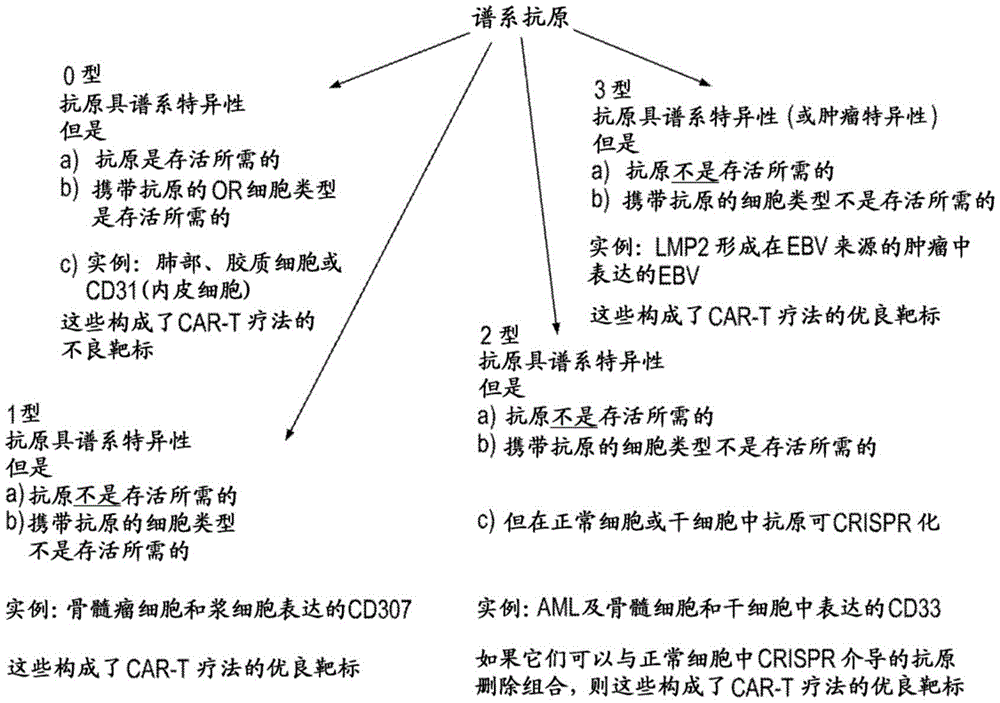
图1呈现了0型、1型、2型和3型谱系特异性抗原的示例性说明。Figure 1 presents an exemplary illustration of
图2是显示表达靶向0型谱系特异性细胞表面抗原CD307的嵌合受体的免疫细胞的示意图。表达CD307的多发性骨髓瘤(MM)细胞以及表达CD307的其它细胞,如浆细胞,被表达抗CD307嵌合受体的免疫细胞靶向。Figure 2 is a schematic diagram showing immune cells expressing chimeric receptors targeting the type O lineage-specific cell surface antigen CD307. Multiple myeloma (MM) cells expressing CD307, as well as other cells expressing CD307, such as plasma cells, are targeted by immune cells expressing an anti-CD307 chimeric receptor.
图3是显示表达靶向2型谱系特异性细胞表面抗原CD33的嵌合受体的免疫细胞的示意图。急性骨髓性白血病(AML)细胞表达CD33。人造血干细胞(HSC)经基因工程改造为缺乏CD33,因此不被表达抗CD33嵌合受体的免疫细胞识别。HSC能够产生髓细胞。Figure 3 is a schematic diagram showing immune cells expressing chimeric receptors targeting the
图4是显示使用CRISPR/Cas系统进行基因组编辑的示意图。sgRNA与谱系特异性细胞表面抗原的外显子的一部分杂交,并且Cas9核酸内切酶在前间区序列邻近基序(PAM)序列(5'-NGG-3')的上游裂解。从上到下的序列对应SEQ ID NO:45和46。Figure 4 is a schematic diagram showing genome editing using the CRISPR/Cas system. The sgRNA hybridizes to a portion of the exon of the lineage-specific cell surface antigen and is cleaved upstream of the prospacer adjacent motif (PAM) sequence (5'-NGG-3') by the Cas9 endonuclease. The sequences from top to bottom correspond to SEQ ID NO:45 and 46.
图5是显示使用CRISPR/Cas9系统破坏CD33的基因组编辑策略的示意图。编码Cas9蛋白的PX458载体和靶向CD33的向导RNA经核转染至人白血病细胞系K-562细胞中。在Cas9和向导RNA递送至细胞之前(上图)和之后(下图),使用抗CD33抗体对细胞群进行流式细胞术。基因组编辑导致基因编码区的缺失和细胞表面CD33的显著减少。Figure 5 is a schematic diagram showing a genome editing strategy for CD33 disruption using the CRISPR/Cas9 system. The PX458 vector encoding Cas9 protein and guide RNA targeting CD33 were nucleoffected into the human leukemia cell line K-562 cells. Cell populations were subjected to flow cytometry using an anti-CD33 antibody before (upper panel) and after (lower panel) Cas9 and guide RNA delivery to the cells. Genome editing resulted in the deletion of gene coding regions and a marked reduction of CD33 on the cell surface.
图6是显示使用CRISPR/Cas9系统破坏CD45RA的基因组编辑策略的示意图。编码Cas9蛋白的PX458载体和靶向CD45RA的向导RNA经核转染至TIB-67网状细胞,肉瘤小鼠巨噬细胞样细胞中。在Cas9和向导RNA递送至细胞之前(上图)和之后(下图),使用抗CD45RA抗体对细胞群进行流式细胞术。基因组编辑导致基因编码区的缺失和细胞表面CD45RA的显著减少。Figure 6 is a schematic diagram showing a genome editing strategy for disrupting CD45RA using the CRISPR/Cas9 system. The PX458 vector encoding Cas9 protein and guide RNA targeting CD45RA were nucleoffected into TIB-67 reticulocytes, sarcoma mouse macrophage-like cells. Cell populations were subjected to flow cytometry using an anti-CD45RA antibody before (upper panel) and after (lower panel) Cas9 and guide RNA delivery to the cells. Genome editing resulted in the deletion of gene coding regions and a marked reduction of CD45RA on the cell surface.
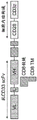
图7显示了包含靶向CD33的抗原结合片段的示例嵌合受体的示意图。A:靶向CD33的通用嵌合受体,其包含抗CD33scFv、铰链结构域、跨膜结构域、共刺激结构域和信号传导结构域。B:靶向CD33的嵌合受体,其包含抗CD33scFv、来自CD8的铰链结构域、来自CD8的跨膜结构域和来自CD28和CD3ζ的胞内结构域。C:靶向CD33的嵌合受体,其包含抗CD33scFv、来自CD8的铰链结构域、来自CD8的跨膜结构域和来自ICOS(或CD27、4-1BB或OX-40)和CD3ζ的胞内结构域。D:靶向CD33的嵌合受体,其包含抗CD33scFv、来自CD8的铰链结构域、来自CD8的跨膜结构域和来自OX40、CD28和CD3ζ的胞内结构域。Figure 7 shows a schematic diagram of an exemplary chimeric receptor comprising an antigen-binding fragment targeting CD33. A: Universal chimeric receptor targeting CD33 comprising anti-CD33 scFv, hinge domain, transmembrane domain, co-stimulatory domain and signaling domain. B: Chimeric receptor targeting CD33 comprising anti-CD33 scFv, hinge domain from CD8, transmembrane domain from CD8 and intracellular domains from CD28 and CD3ζ. C: A chimeric receptor targeting CD33 comprising an anti-CD33 scFv, a hinge domain from CD8, a transmembrane domain from CD8 and an intracellular domain from ICOS (or CD27, 4-1BB or OX-40) and CD3ζ domain. D: Chimeric receptor targeting CD33 comprising anti-CD33 scFv, hinge domain from CD8, transmembrane domain from CD8 and intracellular domains from OX40, CD28 and CD3ζ.
图8是免疫毒素的示意图。Figure 8 is a schematic diagram of an immunotoxin.
图9显示了在用空载体或编码抗CD33嵌合受体的载体转导的K562细胞中表达的抗CD33嵌合受体的表达。A:使用识别CD3ζ的一抗的蛋白质印迹。该表提供了试验的每种嵌合受体的估计分子量。B:流式细胞术分析,显示抗CD33嵌合受体染色阳性的细胞群的增加。Figure 9 shows the expression of anti-CD33 chimeric receptor expressed in K562 cells transduced with empty vector or vector encoding anti-CD33 chimeric receptor. A: Western blot using a primary antibody recognizing CD3ζ. The table provides the estimated molecular weight for each chimeric receptor tested. B: Flow cytometry analysis showing an increase in the population of cells staining positive for the anti-CD33 chimeric receptor.
图10显示抗CD33嵌合受体与CD33结合。A:丽春红(Ponceau)染色的蛋白质凝胶。泳道1、3、5:CD33分子。泳道2、4、6:CD33分子+APC缀合物。B:使用识别CD3ζ的一抗的蛋白质印迹。泳道1、3和5含有与CD33分子共孵育的嵌合受体,而泳道2、4和6含有与CD33-APC缀合物共孵育的嵌合受体。C:流式细胞术分析,显示表达抗CD33嵌合受体并结合CD33的细胞群的增加。Figure 10 shows that the anti-CD33 chimeric receptor binds to CD33. A: Ponceau stained protein gel.
图11显示表达所示嵌合受体的NK92细胞对K562细胞的细胞毒性。A:与空HIVzsG载体相比的CART1和CART2。B:与空HIVzsG载体相比的CART3。Figure 11 shows the cytotoxicity of NK92 cells expressing the indicated chimeric receptors against K562 cells. A: CART1 and CART2 compared to empty HIVzsG vector. B: CART3 compared to empty HIVzsG vector.
图12显示表达所示嵌合受体的NK92细胞对缺乏CD33的K562细胞的细胞毒性(在y轴上表示为细胞毒性百分比)。A:用靶向CD33的CRISPR/Cas试剂预处理的未分类的K562细胞群。B:缺乏CD33的K562细胞的单克隆物。从左到右的圆柱对应于空HIVzsG载体、CART1、CART2和CART3。Figure 12 shows the cytotoxicity of NK92 cells expressing the indicated chimeric receptors against CD33-deficient K562 cells (expressed as percent cytotoxicity on the y-axis). A: Unsorted K562 cell population pretreated with CRISPR/Cas reagents targeting CD33. B: Monoclonal of K562 cells lacking CD33. Columns from left to right correspond to empty HIVzsG vector, CART1, CART2 and CART3.
图13显示了原代T细胞群的流式细胞术分析。A:基于T细胞标志物C4+、CD8+或CD4+CD8+两者的表达的细胞分类。B:所示原代T细胞群上CD33的相对表达。Figure 13 shows flow cytometric analysis of primary T cell populations. A: Cell classification based on expression of T cell markers C4 + , CD8 + , or both CD4 + CD8 + . B: Relative expression of CD33 on the indicated primary T cell populations.
图14显示表达所示嵌合受体的原代T细胞对K562细胞的细胞毒性。A:CD4+ T细胞。B:CD4+/CD8+(CD 4/8)和CD8+(CD8)。Figure 14 shows the cytotoxicity of primary T cells expressing the indicated chimeric receptors against K562 cells. A: CD4 + T cells. B: CD4 + /CD8 + (
图15显示使用CRISPR/Cas9系统和两种不同的gRNA(Crispr3,右上图和Crispr5,右下图)在K562细胞中进行CD33编辑的流式细胞术分析。Figure 15 shows flow cytometric analysis of CD33 editing in K562 cells using the CRISPR/Cas9 system and two different gRNAs (Crispr3, upper right panel and Crispr5, lower right panel).
图16显示缺乏CD33的K562细胞呈现正常的细胞增殖和红细胞生成分化。A:对第1天的所示细胞群+50μM氯高铁血红素的流式细胞术分析。B:对第9天的所示细胞群的流式细胞术分析。C:MTT细胞增殖测定。Figure 16 shows that K562 cells lacking CD33 exhibit normal cell proliferation and erythropoietic differentiation. A: Flow cytometric analysis of the indicated cell populations + 50 [mu]M hemin at
图17显示使用CRISPR/Cas9系统和两种不同的gRNA(crispr3,左下图和crispr5,右下图)在人CD34+细胞中进行CD33编辑的流式细胞术分析。A:使用CRISPR/Cas9系统在人类CD34+细胞中进行CD33编辑的流式细胞术分析。B:crispr3。C:crispr5。Figure 17 shows flow cytometric analysis of CD33 editing in human CD34 + cells using the CRISPR/Cas9 system and two different gRNAs (crispr3, lower left panel and crispr5, lower right panel). A: Flow cytometric analysis of CD33 editing in human CD34 + cells using the CRISPR/Cas9 system. B: CRISPR3. C:crispr5.
图18显示人CD34+/CD33-细胞与人CD34+/CD33+细胞相比的集落形成。从左到右的圆柱对应于无慢病毒感染、空载体对照、crispr1、crispr3和crispr5。Figure 18 shows colony formation of human CD34 +/CD33- cells compared to human CD34+ / CD33 + cells. Columns from left to right correspond to no lentivirus infection, empty vector control, CRISPR1, CRISPR3 and CRISPR5.
发明详述Detailed description of the invention
当靶抗原也存在于受试者发育和/或存活所需或关键性涉及的正常、非癌细胞的细胞表面上时,靶向癌细胞的细胞表面存在的抗原的癌症免疫疗法特别具有挑战性。靶向这些抗原可能在受试者中产生有害作用,这是由于免疫疗法对癌细胞以外的此类细胞的细胞毒性作用。Cancer immunotherapy targeting antigens present on the cell surface of cancer cells is particularly challenging when the target antigen is also present on the surface of normal, non-cancer cell cells that are required or critically involved in the development and/or survival of the subject . Targeting these antigens may have deleterious effects in subjects due to the cytotoxic effects of immunotherapy on such cells other than cancer cells.
本文描述的方法、核酸和细胞允许靶向不仅存在于癌细胞上,而且存在于对受试者发育和/或存活至关重要的细胞上的抗原(例如,1型或2型抗原)。该方法包括:(1)使用靶向此类抗原的药剂减少携带靶标谱系特异性细胞表面抗原的细胞数量;并且(2)用缺乏谱系特异性细胞表面抗原的造血细胞替换呈递抗原并且由于所述药剂的施用而可以被杀伤的正常细胞(例如,非癌细胞)。本文描述的方法可以保持对表达目标谱系特异性细胞表面抗原的靶细胞(包括癌细胞)的监护并且还可以保持表达谱系特异性抗原,对于受试者发育和/或存活可能至关重要的非癌细胞群。The methods, nucleic acids, and cells described herein allow targeting of antigens (eg,
因此,本文描述了共同使用表达包含靶向谱系特异性细胞表面抗原如CD33或CD19的抗原结合片段的嵌合受体的免疫细胞和缺乏谱系特异性细胞表面抗原的造血细胞如造血干细胞(HSC)用于治疗造血系统恶性肿瘤。本文还提供了嵌合受体、编码此类嵌合受体的核酸、包含此类核酸的载体和表达此类嵌合受体的免疫细胞(例如,T细胞)。本公开还提供了缺乏谱系特异性抗原的经基因工程改造的造血细胞,如本文描述的那些,以及制备此类造血细胞的方法(例如,基因组编辑方法)。Thus, described herein is the co-use of immune cells expressing chimeric receptors comprising antigen-binding fragments targeting lineage-specific cell surface antigens, such as CD33 or CD19, and hematopoietic cells lacking lineage-specific cell surface antigens, such as hematopoietic stem cells (HSCs). For the treatment of hematopoietic malignancies. Also provided herein are chimeric receptors, nucleic acids encoding such chimeric receptors, vectors comprising such nucleic acids, and immune cells (eg, T cells) expressing such chimeric receptors. The present disclosure also provides genetically engineered hematopoietic cells lacking lineage-specific antigens, such as those described herein, and methods of making such hematopoietic cells (eg, genome editing methods).
定义definition
术语“受试者”、“个体”和“患者”可互换使用,并且是指脊椎动物,优选哺乳动物例如人。哺乳动物包括但不限于人类灵长类动物、非人灵长类动物或鼠、牛、马、犬或猫科动物物种。在本公开的上下文中,术语“受试者”还涵盖可体外或离体培养或体内操作的组织和细胞。术语“受试者”可以与术语“生物体”互换使用。The terms "subject", "individual" and "patient" are used interchangeably and refer to a vertebrate, preferably a mammal such as a human. Mammals include, but are not limited to, human primates, non-human primates, or murine, bovine, equine, canine, or feline species. In the context of the present disclosure, the term "subject" also encompasses tissues and cells that can be cultured in vitro or ex vivo or manipulated in vivo. The term "subject" is used interchangeably with the term "organism".
术语“多核苷酸”、“核苷酸”、“核苷酸序列”、“核酸”和“寡核苷酸”可互换使用。它们是指任何长度的核苷酸(脱氧核糖核苷酸或核糖核苷酸)或其类似物的聚合形式。多核苷酸的实例包括但不限于基因或基因片段的编码区或非编码区、外显子、内含子、信使RNA(mRNA)、转运RNA、核糖体RNA、短干扰RNA(siRNA)、短发夹RNA(shRNA)、微型RNA(miRNA)、核酶、cDNA、重组多核苷酸、支链多核苷酸、质粒、载体、任何序列的分离的DNA、任何序列的分离的RNA、核酸探针和引物。多核苷酸中的一个或多个核苷酸可以经进一步修饰。核苷酸的序列可以被非核苷酸组分中断。多核苷酸也可以在聚合之后修饰,例如通过与标记剂偶联。The terms "polynucleotide", "nucleotide", "nucleotide sequence", "nucleic acid" and "oligonucleotide" are used interchangeably. They refer to polymeric forms of nucleotides of any length (deoxyribonucleotides or ribonucleotides) or analogs thereof. Examples of polynucleotides include, but are not limited to, coding or noncoding regions of genes or gene segments, exons, introns, messenger RNA (mRNA), transfer RNA, ribosomal RNA, short interfering RNA (siRNA), short Hairpin RNA (shRNA), micro RNA (miRNA), ribozymes, cDNA, recombinant polynucleotides, branched polynucleotides, plasmids, vectors, isolated DNA of any sequence, isolated RNA of any sequence, nucleic acid probes and primers. One or more nucleotides in a polynucleotide may be further modified. The sequence of nucleotides may be interrupted by non-nucleotide components. Polynucleotides can also be modified after polymerization, for example by conjugation with labeling agents.
术语“杂交”是指其中一个或多个多核苷酸反应形成经由核苷酸残基的碱基之间的氢键结合而稳定的复合物的反应。氢键结合可以通过沃森-克里克碱基配对(WatsonCrick base pairing)、Hoogstein结合或以任何其它序列特异性方式发生。该复合物可以包含形成双链体结构的两条链、形成多链复合物的三条或更多条链、单一自我杂交链或这些的任何组合。杂交反应可以构成更广泛过程中的步骤,例如PCR的引发或酶对多核苷酸的裂解。能够与给定序列杂交的序列称为给定序列的“补体”。The term "hybridization" refers to a reaction in which one or more polynucleotides react to form a complex that is stabilized via hydrogen bonding between the bases of the nucleotide residues. Hydrogen bonding can occur by Watson-Crick base pairing, Hoogstein bonding, or in any other sequence-specific manner. The complex may comprise two strands forming a duplex structure, three or more strands forming a multi-strand complex, a single self-hybridizing strand, or any combination of these. A hybridization reaction can constitute a step in a wider process, such as the initiation of PCR or the enzymatic cleavage of a polynucleotide. A sequence that is capable of hybridizing to a given sequence is called the "complement" of the given sequence.
术语“重组表达载体”意指当构建体包含编码mRNA、蛋白质、多肽或肽的核苷酸序列,并且使载体在足以使mRNA、蛋白质、多肽或肽在细胞内表达的条件下与细胞接触时,容许宿主细胞表达mRNA、蛋白质、多肽或肽的经遗传修饰的寡核苷酸或多核苷酸构建体。本公开的载体不是作为整体天然存在的。部分载体可以是天然存在的。本公开的非天然存在的重组表达载体可以包含任何类型的核苷酸,包括但不限于DNA和RNA,其可为单链或双链、合成的或部分获自天然来源,并且可以含有天然的、非天然的或改变的核苷酸。The term "recombinant expression vector" means when the construct comprises a nucleotide sequence encoding an mRNA, protein, polypeptide or peptide, and the vector is contacted with a cell under conditions sufficient to allow intracellular expression of the mRNA, protein, polypeptide or peptide , a genetically modified oligonucleotide or polynucleotide construct that allows a host cell to express mRNA, protein, polypeptide or peptide. The vectors of the present disclosure do not occur in nature as a whole. Part of the vector may be naturally occurring. The non-naturally occurring recombinant expression vectors of the present disclosure may comprise any type of nucleotide, including but not limited to DNA and RNA, which may be single- or double-stranded, synthetic or partially obtained from natural sources, and may contain natural , unnatural or altered nucleotides.
如本文中所用,“转染”、“转化”或“转导”是指通过使用物理或化学方法将一种或多种外源多核苷酸引入宿主细胞中。As used herein, "transfection", "transformation" or "transduction" refers to the introduction of one or more exogenous polynucleotides into a host cell by using physical or chemical methods.
“抗体”、“抗体的片段”、“抗体片段”、“抗体的功能片段”或“抗原结合部分”可互换用于指抗体的一个或多个片段或部分,其保留了特异性结合特定抗原的能力(Holliger等,Nat.Biotech.(2005)23(9):1126)。本发明的抗体可以是抗体和/或其片段。抗体片段包括Fab、F(ab')2、scFv、二硫键连接的Fv、Fc或变体和/或混合物。抗体可以是嵌合的、人源化的、单链的或双特异性的。本公开涵盖所有抗体同种型,包括IgA、IgD、IgE、IgG和IgM。合适的IgG亚型包括IgG1、IgG2、IgG3和IgG4。抗体轻链或重链可变区由被三个称为互补决定区(CDR)的高变区中断的骨架区组成。本发明抗体或抗原结合部分的CDR可以来自非人或人类来源。本发明抗体或抗原结合部分的骨架可以是人、人源化、非人(例如经修饰以降低在人类中的抗原性的鼠类骨架)或合成骨架(例如,共有序列)。"Antibody," "fragment of an antibody," "antibody fragment," "functional fragment of an antibody," or "antigen-binding portion" are used interchangeably to refer to one or more fragments or portions of an antibody that retain specific binding properties. Antigen capacity (Holliger et al., Nat. Biotech. (2005) 23(9):1126). Antibodies of the invention may be antibodies and/or fragments thereof. Antibody fragments include Fab, F(ab')2, scFv, disulfide-linked Fv, Fc or variants and/or mixtures. Antibodies can be chimeric, humanized, single chain or bispecific. The present disclosure encompasses all antibody isotypes, including IgA, IgD, IgE, IgG, and IgM. Suitable IgG subtypes include IgGl, IgG2, IgG3 and IgG4. Antibody light or heavy chain variable regions consist of framework regions interrupted by three hypervariable regions called complementarity determining regions (CDRs). The CDRs of an antibody or antigen binding portion of the invention may be from non-human or human sources. The backbone of an antibody or antigen-binding portion of the invention can be human, humanized, non-human (eg, a murine backbone modified to reduce antigenicity in humans), or a synthetic backbone (eg, a consensus sequence).
本发明的抗体或抗原结合部分可以以解离常数(KD)小于约10-7M、小于约10-8M、小于约10-9M、小于约10-10M、小于约10-11M或小于约10-12M特异性结合。根据本公开的抗体的亲和力可以使用常规技术容易地测定(参见,例如,Scatchard等,Ann.N.Y.Acad.Sci.(1949)51:660;和美国专利第5,283,173、5,468,614号或等同案)。The antibodies or antigen binding portions of the invention can have a dissociation constant ( KD ) of less than about 10 −7 M, less than about 10 −8 M, less than about 10 −9 M, less than about 10 −10 M, less than about 10 −11 M or less than about 10 −12 M specifically binds. The affinity of antibodies according to the present disclosure can be readily determined using conventional techniques (see, e.g., Scatchard et al., Ann. NY Acad. Sci. (1949) 51:660; and U.S. Patent Nos. 5,283,173, 5,468,614, or equivalents).
术语“嵌合受体”、“嵌合抗原受体”或可选地“CAR”可通篇互换使用并且是指包含至少一个细胞外抗原结合结构域、跨膜结构域和细胞质信号传导结构域(本文也称为“细胞内信号传导结构域”)的重组多肽构建体,所述信号传导结构域包含源自如下定义的刺激分子的功能性信号传导结构域。Lee等,Clin.Cancer Res.(2012)18(10):2780;Jen sen等,Immunol Rev.(2014)257(1):127;www.cancer.gov/about-cancer/treatment/research/car-t-cells。在一个实施方案中,刺激分子是与T细胞受体复合物缔合的ζ链。一方面,细胞质信号传导结构域还包含一个或多个源自如下定义的至少一种共刺激分子的功能性信号传导结构域。共刺激分子也可以是4-1BB(即,CD137)、CD27和/或CD28或那些分子的片段。另一方面,CAR包含嵌合融合蛋白,所述嵌合融合蛋白包含细胞外抗原识别结构域、跨膜结构域和包含源自刺激分子的功能性信号传导结构域的细胞内信号传导结构域。CAR包含嵌合融合蛋白,所述嵌合融合蛋白包含细胞外抗原识别结构域、跨膜结构域和包含源自共刺激分子的功能性信号传导结构域和源自刺激分子的功能性信号传导结构域的细胞内信号传导结构域。可选地,CAR包含嵌合融合蛋白,所述嵌合融合蛋白包含细胞外抗原识别结构域、跨膜结构域和包含源自一个或多个共刺激分子的两个功能性信号传导结构域和源自刺激分子的功能性信号传导结构域的细胞内信号传导结构域。CAR还可包含嵌合融合蛋白,所述嵌合融合蛋白包含细胞外抗原识别结构域、跨膜结构域和包含源自一个或多个共刺激分子的至少两个功能性信号传导结构域和源自刺激分子的功能性信号传导结构域的细胞内信号传导结构域。由核酸序列编码的CAR的抗原识别部分可以含有任何谱系特异性、抗原结合抗体片段。所述抗体片段可以包含一个或多个CDR、可变区(或其部分)、恒定区(或其部分)或前述任何区域的组合。The terms "chimeric receptor", "chimeric antigen receptor" or alternatively "CAR" are used interchangeably throughout and refer to a protein comprising at least one extracellular antigen binding domain, a transmembrane domain and a cytoplasmic signaling structure domain (also referred to herein as "intracellular signaling domain") comprising a functional signaling domain derived from a stimulatory molecule as defined below. Lee et al., Clin. Cancer Res. (2012) 18(10):2780; Jen sen et al., Immunol Rev. (2014) 257(1):127; www.cancer.gov/about-cancer/treatment/research/car -t-cells. In one embodiment, the stimulatory molecule is the zeta chain associated with the T cell receptor complex. In one aspect, the cytoplasmic signaling domain further comprises one or more functional signaling domains derived from at least one co-stimulatory molecule as defined below. The co-stimulatory molecule can also be 4-1BB (ie, CD137), CD27 and/or CD28 or fragments of those molecules. In another aspect, the CAR comprises a chimeric fusion protein comprising an extracellular antigen recognition domain, a transmembrane domain, and an intracellular signaling domain comprising a functional signaling domain derived from a stimulatory molecule. The CAR comprises a chimeric fusion protein comprising an extracellular antigen recognition domain, a transmembrane domain and a functional signaling domain comprising a co-stimulatory molecule and a functional signaling structure derived from a stimulatory molecule The intracellular signaling domain of the domain. Alternatively, the CAR comprises a chimeric fusion protein comprising an extracellular antigen recognition domain, a transmembrane domain, and two functional signaling domains derived from one or more co-stimulatory molecules and Intracellular signaling domains derived from functional signaling domains of stimulatory molecules. A CAR may also comprise a chimeric fusion protein comprising an extracellular antigen recognition domain, a transmembrane domain and comprising at least two functional signaling domains and a source derived from one or more co-stimulatory molecules. Intracellular signaling domain of the functional signaling domain of a self-stimulatory molecule. The antigen-recognizing portion of the CAR encoded by the nucleic acid sequence can contain any lineage-specific, antigen-binding antibody fragment. The antibody fragment may comprise one or more CDRs, a variable region (or portion thereof), a constant region (or portion thereof), or a combination of any of the foregoing.
术语“信号传导结构域”是指蛋白质的功能部分,其通过在细胞内传递信息起作用,以通过产生第二信使或通过响应此类信使而起到效应子的作用,经由限定的信号传导途径来调节细胞活性。The term "signaling domain" refers to the functional portion of a protein that functions by transmitting information within a cell to function as an effector via a defined signaling pathway by producing a second messenger or by responding to such a messenger to regulate cell activity.
术语“ζ”或可选地“ζ链”、“CD3-ζ”或“TCR-ζ”定义为以GenBank登录号NP_932170、NP_000725或XP_011508447提供的蛋白质;或来自非人类物种例如小鼠、啮齿类动物、猴、猿等的等效残基和“ζ刺激结构域”或可选地“CD3-ζ刺激结构域”或“TCR-ζ刺激结构域”定义为来自ζ链的细胞质结构域,足以功能性地传递T细胞活化所必需的初始信号的氨基酸残基。The term "ζ" or alternatively "ζ chain", "CD3-ζ" or "TCR-ζ" is defined as a protein provided under GenBank Accession No. NP_932170, NP_000725 or XP_011508447; or from a non-human species such as mouse, rodent Animal, monkey, ape, etc. equivalent residues and "ζ stimulating domain" or alternatively "CD3-ζ stimulating domain" or "TCR-ζ stimulating domain" are defined as cytoplasmic domains from the ζ chain, sufficient Amino acid residues that functionally transmit the initial signal necessary for T cell activation.
术语“经基因工程改造的”或“经遗传修饰的”是指通过基因工程,例如通过基因组编辑操作的细胞。即,细胞含有在所述细胞中并非天然存在的异源序列。通常,异源序列经由载体系统或用于将核酸分子引入包括脂质体的细胞的其它手段引入。异源核酸分子可以整合到细胞基因组中或可以存在于染色体外,例如呈质粒的形式。该术语还包括将经基因工程改造的、分离的CAR多肽引入细胞内的实施方案。The terms "genetically engineered" or "genetically modified" refer to cells that have been manipulated by genetic engineering, eg, by genome editing. That is, the cell contains a heterologous sequence that does not naturally occur in the cell. Typically, heterologous sequences are introduced via vector systems or other means for introducing nucleic acid molecules into cells, including liposomes. The heterologous nucleic acid molecule can be integrated into the genome of the cell or can exist extrachromosomally, for example in the form of a plasmid. The term also includes embodiments in which a genetically engineered, isolated CAR polypeptide is introduced into a cell.
术语“自体”是指源自相同个体的任何物质,随后将其重新引入相同个体中。The term "self" refers to any substance that originates from the same individual and is subsequently reintroduced into the same individual.
术语“同种异体”是指源自与引入物质的个体相同的物种的不同动物的任何物质。当一个或多个基因座处的基因不相同时,称两个或更多个个体是彼此同种异体的。The term "allogeneic" refers to any substance derived from a different animal of the same species as the individual into whom the substance is introduced. Two or more individuals are said to be allogeneic to each other when the genes at one or more loci are not identical.
术语“细胞谱系”是指具有共同祖先并从相同类型的可鉴定细胞发育成特定的可鉴定/功能细胞的细胞。本文使用的细胞谱系包括但不限于呼吸、前列腺、胰腺、乳腺、肾、肠、神经、骨骼、血管、肝、造血、肌肉或心肌细胞谱系。The term "cell lineage" refers to cells that have a common ancestor and have developed from identifiable cells of the same type to specific identifiable/functional cells. Cell lineages as used herein include, but are not limited to, respiratory, prostate, pancreatic, breast, renal, intestinal, neural, skeletal, vascular, hepatic, hematopoietic, muscle or cardiomyocyte lineages.
当提到谱系特异性抗原的基因表达或功能时使用的术语“抑制”是指谱系特异性抗原的基因表达或功能水平的降低,其中抑制是干扰基因表达或功能的结果。抑制可以是完全的,在这种情况下,没有可检测到的表达或功能,或者可以是部分的。部分抑制的范围可以从几乎完全抑制到几乎不存在抑制。通过消除特定靶细胞,CAR T细胞可以有效地抑制特定细胞谱系的总体表达。The term "inhibition" as used in reference to gene expression or function of a lineage-specific antigen refers to a reduction in the level of gene expression or function of a lineage-specific antigen, wherein the inhibition is the result of interference with gene expression or function. Inhibition can be complete, in which case there is no detectable expression or function, or it can be partial. Partial inhibition can range from almost complete inhibition to almost no inhibition. By eliminating specific target cells, CAR T cells can effectively suppress the overall expression of specific cell lineages.
“缺乏谱系特异性抗原的”细胞如造血细胞是指与其天然存在的对应物相比,谱系特异性抗原的表达水平显著降低的细胞,例如,相同类型的内源性造血细胞或不表达谱系特异性抗原,即不能通过常规测定如FACS检测的细胞。在一些情况下,“缺乏抗原”的细胞的谱系特异性抗原的表达水平可以低于天然存在的对应物的相同谱系特异性抗原的表达水平的约40%(例如30%、20%、15%、10%、5%或更低)。如本文中所用,术语“约”是指特定值+/-5%。例如,约40%的表达水平可以包括介于35%-45%之间的任何表达量。A cell "lacking a lineage-specific antigen" such as a hematopoietic cell is one that expresses a significantly reduced level of a lineage-specific antigen compared to its naturally occurring counterpart, e.g., the same type of endogenous hematopoietic cell or does not express a lineage-specific Antigens, ie cells that cannot be detected by conventional assays such as FACS. In some instances, cells that are "antigen deficient" may express a lineage-specific antigen at a level that is less than about 40% (e.g., 30%, 20%, 15% of the expression level of the same lineage-specific antigen of their naturally occurring counterparts). , 10%, 5% or less). As used herein, the term "about" means +/- 5% of a specified value. For example, an expression level of about 40% can include any amount of expression between 35%-45%.
靶向谱系特异性细胞表面抗原的药剂Agents targeting lineage-specific cell surface antigens
本公开的方面提供了靶向例如靶癌细胞上的谱系特异性细胞表面抗原的药剂。此类药剂可以包含结合并靶向谱系特异性细胞表面抗原的抗原结合片段。在一些情况下,抗原结合片段可以是特异性结合谱系特异性抗原的单链抗体(scFv)。Aspects of the disclosure provide agents that target, for example, lineage-specific cell surface antigens on target cancer cells. Such agents may comprise antigen-binding fragments that bind to and target lineage-specific cell surface antigens. In some instances, the antigen-binding fragment can be a single chain antibody (scFv) that specifically binds a lineage-specific antigen.
A.谱系特异性细胞表面抗原A. Lineage-specific cell surface antigens
如本文中所用,术语“谱系特异性细胞表面抗原”和“细胞表面谱系特异性抗原”可以互换使用并且是指充分存在于细胞表面并与一个或多个细胞谱系群相关的任何抗原。例如,抗原可以存在于一个或多个细胞谱系群上而在其它细胞群的细胞表面上不存在(或水平降低)。As used herein, the terms "lineage-specific cell surface antigen" and "cell surface lineage-specific antigen" are used interchangeably and refer to any antigen that is substantially present on the surface of a cell and associated with one or more cell lineage populations. For example, an antigen may be present on one or more cell lineage populations while absent (or at reduced levels) on the cell surface of other cell populations.
通常,谱系特异性细胞表面抗原可以基于许多因素分类,例如抗原和/或呈递抗原的细胞群是否是宿主生物体存活和/或发育所需的。下面表1中提供了示例类型的谱系特异性抗原的汇总。还参见图1。In general, lineage-specific cell surface antigens can be classified based on a number of factors, such as whether the antigen and/or the cell population presenting the antigen is required for the survival and/or development of the host organism. A summary of example types of lineage-specific antigens is provided in Table 1 below. See also Figure 1.
表1.谱系特异性抗原的分类Table 1. Classification of lineage-specific antigens

如表1和图1所示,0型谱系特异性细胞表面抗原对于组织稳态和存活是必需的,携带0型谱系特异性细胞表面抗原的细胞类型也可能是受试者存活所必需的。因此,鉴于0型谱系特异性细胞表面抗原或携带0型谱系特异性细胞表面抗原的细胞在稳态和存活中的重要性,使用常规CAR T细胞免疫疗法靶向这些类别的抗原可能是具有挑战性的,因为抑制或去除此类抗原和携带此类抗原的细胞可能对受试者的存活有害。因此,存活可能需要谱系特异性细胞表面抗原(例如0型谱系特异性抗原)和/或携带此类抗原的细胞类型,例如因为它在受试者中执行重要的非冗余性功能,那么这种类型的谱系特异性抗原可能是基于CART细胞的免疫疗法的不良靶标。As shown in Table 1 and Figure 1,
与0型抗原相反,1型细胞表面谱系特异性抗原和携带1型细胞表面谱系特异性抗原的细胞不是组织稳态或受试者存活所需的。靶向1型细胞表面谱系特异性抗原不大可能在受试者中产生有害后果。例如,工程改造成靶向CD307(一种在正常浆细胞和多发性骨髓瘤(MM)细胞上唯一表达的1型抗原)的CAR T细胞将导致两种细胞类型的消除(图2)(Elkins等,Mol Cancer Ther.10:2222(2012))。然而,因为浆细胞谱系对于生物体的存活是可消耗的,所以CD307和其它1型谱系特异性抗原是适合基于CAR T细胞的免疫疗法的抗原。1型类别的谱系特异性抗原可以在各种不同的组织中表达,包括卵巢、睾丸、前列腺、乳房、子宫内膜和胰腺。在一些实施方案中,所述药剂靶向为1型抗原的细胞表面谱系特异性抗原。In contrast to type 0 antigens,
与1型抗原相比,靶向2型抗原呈现出明显困难。2型抗原的特征在于:(1)该抗原对于生物体的存活不是必要的(即不是存活所需的),及(2)携带该抗原的细胞谱系对于生物体的存活是必不可少的(即特定细胞谱系是存活所需的)。例如,CD33是在正常骨髓细胞以及急性骨髓性白血病(AML)细胞两者中表达的2型抗原(Dohner等,NEJM373:1136(2015))。因此,工程改造成靶向CD33抗原的CAR T细胞可导致杀伤正常以及AML细胞,这可能与受试者的存活不相容(图3)。在一些实施方案中,所述药剂靶向为2型抗原的细胞表面谱系特异性抗原。Targeting
可通过本公开的方法和组合物靶向多种抗原。针对这些抗原的单克隆抗体可以商业购买或使用标准技术产生,包括为动物免疫接种目标抗原,接着通过常规的单克隆抗体方法,例如以上所讨论的Kohler和Milstein的标准体细胞杂交技术,Nature(1975)256:495。抗体或编码抗体的核酸可以使用任何标准的DNA或蛋白质测序技术进行测序。A variety of antigens can be targeted by the methods and compositions of the present disclosure. Monoclonal antibodies directed against these antigens can be purchased commercially or generated using standard techniques involving immunization of animals with the antigen of interest followed by conventional monoclonal antibody methods such as the standard somatic cell hybridization technique of Kohler and Milstein discussed above, Nature( 1975) 256:495. Antibodies or nucleic acid encoding antibodies can be sequenced using any standard DNA or protein sequencing technique.
在一些实施方案中,使用本文描述的方法和细胞靶向的细胞表面谱系特异性抗原是白细胞或白细胞亚群的细胞表面谱系特异性抗原。在一些实施方案中,细胞表面谱系特异性抗原是与骨髓细胞相关的抗原。在一些实施方案中,细胞表面谱系特异性抗原是分化抗原(CD)簇。CD抗原的实例包括但不限于CD1a、CD1b、CD1c、CD1d、CD1e、CD2、CD3、CD3d、CD3e、CD3g、CD4、CD5、CD6、CD7、CD8a、CD8b、CD9、CD10、CD11a、CD11b、CD11c、CD11d、CDw12、CD13、CD14、CD15、CD16、CD16b、CD17、CD18、CD19、CD20、CD21、CD22、CD23、CD24、CD25、CD26、CD27、CD28、CD29、CD30、CD31、CD32a、CD32b、CD32c、CD33、CD34、CD35、CD36、CD37、CD38、CD39、CD40、CD41、CD42a、CD42b、CD42c、CD42d、CD43、CD44、CD45、CD45RA、CD45RB、CD45RC、CD45RO、CD46、CD47、CD48、CD49a、CD49b、CD49c、CD49d、CD49e、CD49f、CD50、CD51、CD52、CD53、CD54、CD55、CD56、CD57、CD58、CD59、CD60a、CD61、CD62E、CD62L、CD62P、CD63、CD64a、CD65、CD65s、CD66a、CD66b、CD66c、CD66F、CD68、CD69、CD70、CD71、CD72、CD73、CD74、CD75、CD75S、CD77、CD79a、CD79b、CD80、CD81、CD82、CD83、CD84、CD85A、CD85C、CD85D、CD85E、CD85F、CD85G、CD85H、CD85I、CD85J、CD85K、CD86、CD87、CD88、CD89、CD90、CD91、CD92、CD93、CD94、CD95、CD96、CD97、CD98、CD99、CD99R、CD100、CD101、CD102、CD103、CD104、CD105、CD106、CD107a、CD107b、CD108、CD109、CD110、CD111、CD112、CD113、CD114、CD115、CD116、CD117、CD118、CD119、CD120a、CD120b、CD121a、CD121b、CD121a、CD121b、CD122、CD123、CD124、CD125、CD126、CD127、CD129、CD130、CD131、CD132、CD133、CD134、CD135、CD136、CD137、CD138、CD139、CD140a、CD140b、CD141、CD142、CD143、CD144、CDw145、CD146、CD147、CD148、CD150、CD152、CD152、CD153、CD154、CD155、CD156a、CD156b、CD156c、CD157、CD158b1、CD158b2、CD158d、CD158e1/e2、CD158f、CD158g、CD158h、CD158i、CD158j、CD158k、CD159a、CD159c、CD160、CD161、CD163、CD164、CD165、CD166、CD167a、CD168、CD169、CD170、CD171、CD172a、CD172b、CD172g、CD173、CD174、CD175、CD175s、CD176、CD177、CD178、CD179a、CD179b、CD180、CD181、CD182、CD183、CD184、CD185、CD186、CD191、CD192、CD193、CD194、CD195、CD196、CD197、CDw198、CDw199、CD200、CD201、CD202b、CD203c、CD204、CD205、CD206、CD207、CD208、CD209、CD210a、CDw210b、CD212、CD213a1、CD213a2、CD215、CD217、CD218a、CD218b、CD220、CD221、CD222、CD223、CD224、CD225、CD226、CD227、CD228、CD229、CD230、CD231、CD232、CD233、CD234、CD235a、CD235b、CD236、CD236R、CD238、CD239、CD240、CD241、CD242、CD243、CD244、CD245、CD246、CD247、CD248、CD249、CD252、CD253、CD254、CD256、CD257、CD258、CD261、CD262、CD263、CD264、CD265、CD266、CD267、CD268、CD269、CD270、CD271、CD272、CD273、CD274、CD275、CD276、CD277、CD278、CD279、CD280、CD281、CD282、CD283、CD284、CD286、CD288、CD289、CD290、CD292、CDw293、CD294、CD295、CD296、CD297、CD298、CD299、CD300a、CD300c、CD300e、CD301、CD302、CD303、CD304、CD305、306、CD307a、CD307b、CD307c、D307d、CD307e、CD309、CD312、CD314、CD315、CD316、CD317、CD318、CD319、CD320、CD321、CD322、CD324、CD325、CD326、CD327、CD328、CD329、CD331、CD332、CD333、CD334、CD335、CD336、CD337、CD338、CD339、CD340、CD344、CD349、CD350、CD351、CD352、CD353、CD354、CD355、CD357、CD358、CD359、CD360、CD361、CD362和CD363。参见www.bdbiosciences.com/documents/BD_Reagents_CDMarkerHuman_Poster.pdf。In some embodiments, the cell surface lineage specific antigen targeted using the methods and cells described herein is a cell surface lineage specific antigen of a leukocyte or a subpopulation of leukocytes. In some embodiments, the cell surface lineage specific antigen is an antigen associated with myeloid cells. In some embodiments, the cell surface lineage specific antigen is a cluster of differentiation (CD). Examples of CD antigens include, but are not limited to, CD1a, CD1b, CD1c, CD1d, CD1e, CD2, CD3, CD3d, CD3e, CD3g, CD4, CD5, CD6, CD7, CD8a, CD8b, CD9, CD10, CD11a, CD11b, CD11c, CD11d, CDw12, CD13, CD14, CD15, CD16, CD16b, CD17, CD18, CD19, CD20, CD21, CD22, CD23, CD24, CD25, CD26, CD27, CD28, CD29, CD30, CD31, CD32a, CD32b, CD32c, CD33, CD34, CD35, CD36, CD37, CD38, CD39, CD40, CD41, CD42a, CD42b, CD42c, CD42d, CD43, CD44, CD45, CD45RA, CD45RB, CD45RC, CD45RO, CD46, CD47, CD48, CD49a, CD49b, CD49c, CD49d, CD49e, CD49f, CD50, CD51, CD52, CD53, CD54, CD55, CD56, CD57, CD58, CD59, CD60a, CD61, CD62E, CD62L, CD62P, CD63, CD64a, CD65, CD65s, CD66a, CD66b, CD66c, CD66F, CD68, CD69, CD70, CD71, CD72, CD73, CD74, CD75, CD75S, CD77, CD79a, CD79b, CD80, CD81, CD82, CD83, CD84, CD85A, CD85C, CD85D, CD85E, CD85F, CD85G, CD85H, CD85I, CD85J, CD85K, CD86, CD87, CD88, CD89, CD90, CD91, CD92, CD93, CD94, CD95, CD96, CD97, CD98, CD99, CD99R, CD100, CD101, CD102, CD103, CD104, CD105, CD106, CD107a, CD107b, CD108, CD109, CD110, CD111, CD112, CD113, CD114, CD115, CD116, CD117, CD118, CD119, CD120a, CD120b, CD121a, CD121b, CD121a, CD121b, CD122, CD423, CD122 CD126, CD127, CD129, CD130, CD131, CD132, CD133, CD134, C D135, CD136, CD137, CD138, CD139, CD140a, CD140b, CD141, CD142, CD143, CD144, CDw145, CD146, CD147, CD148, CD150, CD152, CD152, CD153, CD154, CD155, CD156a, CD156b, CD1576c, CD CD158b1, CD158b2, CD158d, CD158e1/e2, CD158f, CD158g, CD158h, CD158i, CD158j, CD158k, CD159a, CD159c, CD160, CD161, CD163, CD164, CD165, CD166, CD167a, CD168, CD169, CD167, CD168, CD169, CD17 CD172b, CD172g, CD173, CD174, CD175, CD175s, CD176, CD177, CD178, CD179a, CD179b, CD180, CD181, CD182, CD183, CD184, CD185, CD186, CD191, CD192, CD193, CD194, CD195, CD9, 96, CD CDw198, CDw199, CD200, CD201, CD202b, CD203c, CD204, CD205, CD206, CD207, CD208, CD209, CD210a, CDw210b, CD212, CD213a1, CD213a2, CD215, CD217, CD218a, CD218b, CD220, CD222 CD224, CD225, CD226, CD227, CD228, CD229, CD230, CD231, CD232, CD233, CD234, CD235a, CD235b, CD236, CD236R, CD238, CD239, CD240, CD241, CD242, CD243, CD244, CD245, CD27, CD246, CD24 CD248, CD249, CD252, CD253, CD254, CD256, CD257, CD258, CD261, CD262, CD263, CD264, CD265, CD266, CD267, CD268, CD269, CD270, CD271, CD272, CD273, CD274, CD275, CD276, CD277, CD278, CD279, CD280, CD281, CD282, CD283, CD284, CD286, CD288, CD289, CD290, CD292, CDw293, CD294, CD295, CD296, CD297, CD298, CD299, CD300a, CD300c, CD300e, CD301, CD302, CD303, CD304, CD305, 306, CD307a, CD307b, CD307c, D307d, CD307e, CD307d, CD307e, CD307 CD314, CD315, CD316, CD317, CD318, CD319, CD320, CD321, CD322, CD324, CD325, CD326, CD327, CD328, CD329, CD331, CD332, CD333, CD334, CD335, CD336, CD337, CD338, CD339, CD340, CD344, CD349, CD350, CD351, CD352, CD353, CD354, CD355, CD357, CD358, CD359, CD360, CD361, CD362, and CD363. See www.bdbiosciences.com/documents/BD_Reagents_CDMarkerHuman_Poster.pdf.
在一些实施方案中,细胞表面谱系特异性抗原为CD19、CD20、CD11、CD123、CD56、CD34、CD14、CD33、CD66b、CD41、CD61、CD62、CD235a、CD146、CD326、LMP2、CD22、CD52、CD10、CD3/TCR、CD79/BCR和CD26。在一些实施方案中,细胞表面谱系特异性抗原为CD33或CD19。In some embodiments, the cell surface lineage specific antigen is CD19, CD20, CD11, CD123, CD56, CD34, CD14, CD33, CD66b, CD41, CD61, CD62, CD235a, CD146, CD326, LMP2, CD22, CD52, CD10 , CD3/TCR, CD79/BCR and CD26. In some embodiments, the cell surface lineage specific antigen is CD33 or CD19.
可选地或另外,细胞表面谱系特异性抗原可以是癌症抗原,例如差异性地存在于癌细胞上的细胞表面谱系特异性抗原。在一些实施方案中,癌症抗原是对组织或细胞谱系有特异性的抗原。与特定类型的癌症相关的细胞表面谱系特异性抗原的实例包括但不限于CD20、CD22(非霍奇金淋巴瘤、B细胞淋巴瘤、慢性淋巴细胞性白血病(CLL))、CD52(B细胞CLL)、CD33(急性骨髓性白血病(AML))、CD10(gp100)(常见(前-B)急性淋巴细胞性白血病和恶性黑素瘤)、CD3/T细胞受体(TCR)(T细胞淋巴瘤和白血病)、CD79/B细胞受体(BCR)(B细胞淋巴瘤和白血病)、CD26(上皮和淋巴恶性肿瘤)、人白细胞抗原(HLA)-DR、HLA-DP和HLA-DQ(淋巴恶性肿瘤)、RCAS1(妇科癌、胆管腺癌和胰腺导管腺癌)以及前列腺特异性膜抗原。在一些实施方案中,细胞表面抗原CD33与AML细胞相关。Alternatively or additionally, the cell surface lineage specific antigen may be a cancer antigen, eg a cell surface lineage specific antigen that is differentially present on cancer cells. In some embodiments, the cancer antigen is an antigen specific for a tissue or cell lineage. Examples of cell surface lineage-specific antigens associated with particular types of cancer include, but are not limited to, CD20, CD22 (non-Hodgkin's lymphoma, B-cell lymphoma, chronic lymphocytic leukemia (CLL)), CD52 (B-cell CLL ), CD33 (acute myeloid leukemia (AML)), CD10 (gp100) (common (pre-B) acute lymphoblastic leukemia and malignant melanoma), CD3/T cell receptor (TCR) (T cell lymphoma and leukemias), CD79/B cell receptor (BCR) (B-cell lymphomas and leukemias), CD26 (epithelial and lymphoid malignancies), human leukocyte antigen (HLA)-DR, HLA-DP, and HLA-DQ (lymphoid malignancies tumors), RCAS1 (gynecologic, cholangiocarcinoma, and pancreatic ductal adenocarcinoma), and prostate-specific membrane antigen. In some embodiments, the cell surface antigen CD33 is associated with AML cells.
B.抗原结合片段B. Antigen-binding fragments
如本文所述,任何抗体或其抗原结合片段均可用于构建靶向谱系特异性细胞表面抗原的药剂。此类抗体或抗原结合片段可以通过常规方法制备,例如杂交瘤技术或重组技术。As described herein, any antibody or antigen-binding fragment thereof can be used to construct agents targeting lineage-specific cell surface antigens. Such antibodies or antigen-binding fragments can be prepared by conventional methods, such as hybridoma technology or recombinant technology.
例如,可以通过常规杂交瘤技术制备对目标谱系特异性抗原有特异性的抗体。可与载体蛋白如KLH偶联的谱系特异性抗原可用于为宿主动物免疫接种以产生与该复合物结合的抗体。宿主动物免疫接种的途径和方案通常与本文进一步描述的用于抗体刺激和生产的确定常规技术一致。用于产生小鼠、人源化和人抗体的一般技术是本领域已知的并且在本文中有描述。考虑到包括人在内的任何哺乳动物受试者或来自其中的抗体生成细胞均可操作以用作产生哺乳动物(包括人)杂交瘤细胞系的基础。通常,给宿主动物腹膜内、肌肉内、口服、皮下、足底和/或皮内接种一定量的免疫原,包括本文描述的免疫原。For example, antibodies specific for a lineage-specific antigen of interest can be produced by conventional hybridoma technology. Lineage-specific antigens, which can be coupled to a carrier protein such as KLH, can be used to immunize host animals to produce antibodies that bind to the complex. Routes and protocols for immunization of host animals are generally consistent with established routine techniques for antibody stimulation and production as further described herein. General techniques for producing mouse, humanized, and human antibodies are known in the art and described herein. It is contemplated that any mammalian subject, including humans, or antibody-producing cells derived therefrom, can be manipulated as a basis for the generation of mammalian (including human) hybridoma cell lines. Typically, a host animal is inoculated intraperitoneally, intramuscularly, orally, subcutaneously, plantarly and/or intradermally with an amount of an immunogen, including those described herein.
杂交瘤可使用Kohler,B.和Milstein,C.(1975)Nature 256:495-497描述的或Buck,D.W.等,In Vitro,18:377-381(1982)修改的一般体细胞杂交技术从淋巴细胞和永生化骨髓瘤细胞制备。可用的骨髓瘤细胞系,包括但不限于X63-Ag8.653和来自SalkInstitute,Cell Distribution Center,San Diego,Calif.,USA的那些,均可用于杂交。通常,所述技术涉及使用融合剂如聚乙二醇或通过本领域技术人员公知的电气装置使骨髓瘤细胞和淋巴样细胞融合。融合后,将细胞从融合培养基中分离并使其在选择性生长培养基,例如次黄嘌呤-氨基蝶呤-胸腺嘧啶(HAT)培养基中生长以消除未杂交的母细胞。本文所描述的补充有或未补充血清的任何培养基均可用于培养分泌单克隆抗体的杂交瘤。作为细胞融合技术的另一种替代方法,可以使用EBV永生化B细胞来产生本文所描述的TCR样单克隆抗体。扩增杂交瘤并亚克隆(如果需要),并通过常规免疫测定程序(例如,放射性免疫测定、酶免疫测定或荧光免疫测定)测定上清液的抗免疫原活性。Hybridomas can be derived from lymphocytes using the general somatic cell hybridization technique described by Kohler, B. and Milstein, C. (1975) Nature 256:495-497 or modified by Buck, D.W. et al., In Vitro, 18:377-381 (1982). Cells and Immortalized Myeloma Cell Preparation. Available myeloma cell lines, including but not limited to X63-Ag8.653 and those from the Salk Institute, Cell Distribution Center, San Diego, Calif., USA, can be used for hybridization. Typically, the technique involves fusing myeloma and lymphoid cells using a fusogenic agent such as polyethylene glycol or by electrical means well known to those skilled in the art. Following fusion, cells are detached from the fusion medium and grown in a selective growth medium, such as hypoxanthine-aminopterin-thymidine (HAT) medium, to eliminate unhybridized mother cells. Any of the media described herein, supplemented or not supplemented with serum, can be used to grow monoclonal antibody-secreting hybridomas. As an alternative to cell fusion techniques, EBV immortalized B cells can be used to generate the TCR-like monoclonal antibodies described herein. Hybridomas are expanded and subcloned if necessary, and supernatants are assayed for anti-immunogen activity by conventional immunoassay procedures (eg, radioimmunoassay, enzyme immunoassay, or fluorescent immunoassay).
可用作抗体源的杂交瘤涵盖产生能够与谱系特异性抗原结合的单克隆抗体的亲本杂交瘤的所有衍生物、后代细胞。产生此类抗体的杂交瘤可使用已知程序在体外或体内生长。单克隆抗体可通过常规免疫球蛋白纯化程序,诸如硫酸铵沉淀、凝胶电泳、透析、色谱以及如果需要超滤从培养基或体液分离。不需要的活性(若存在),可以例如通过在吸附剂上进行制备(该吸附剂由附着于固相的免疫原制成)并且使所需抗体从免疫原上洗脱或释放来去除。为宿主动物免疫接种靶抗原或含有靶氨基酸序列的片段可以产生抗体群(例如,单克隆抗体),使用双功能或衍化剂,例如马来酰亚胺苯甲酰磺酸琥珀酰亚胺酯(通过半胱氨酸残基缀合)、N-羟基琥珀酰亚胺(通过赖氨酸残基)、戊二醛、琥珀酸酐、SOCl或R1N=C=NR(其中R和R1是不同的烷基),使所述靶氨基酸序列与在待免疫物种中有免疫原性的蛋白质,例如钥孔血蓝素、血清白蛋白、牛甲状腺球蛋白或大豆胰蛋白酶抑制剂缀合。Hybridomas useful as a source of antibodies encompass all derivatives, progeny cells of a parental hybridoma that produces a monoclonal antibody capable of binding a lineage-specific antigen. Hybridomas producing such antibodies can be grown in vitro or in vivo using known procedures. Monoclonal antibodies can be isolated from culture medium or body fluids by conventional immunoglobulin purification procedures, such as ammonium sulfate precipitation, gel electrophoresis, dialysis, chromatography and, if desired, ultrafiltration. Undesirable activity, if present, can be removed, for example, by preparation on an adsorbent made of the immunogen attached to a solid phase and allowing the desired antibody to be eluted or released from the immunogen. Immunization of host animals with target antigens or fragments containing target amino acid sequences can generate antibody populations (e.g., monoclonal antibodies) using bifunctional or derivatizing agents such as succinimidyl maleimide benzoylsulfonate ( Conjugation via cysteine residues), N-hydroxysuccinimide (via lysine residues), glutaraldehyde, succinic anhydride, SOCl or R1N=C=NR (where R and R1 are different alkyl base), the target amino acid sequence is conjugated to a protein that is immunogenic in the species to be immunized, such as keyhole limpet hemocyanin, serum albumin, bovine thyroglobulin, or soybean trypsin inhibitor.
若需要,可以为目标抗体(例如,由杂交瘤产生)测序并且可以将多核苷酸序列克隆到用于表达或繁殖的载体中。编码目标抗体的序列可维持在宿主细胞的载体中,然后可扩增宿主细胞并冷冻以便将来使用。在替代方案中,多核苷酸序列可用于基因操作以“人源化”抗体或改善抗体的亲和力(亲和力成熟)或其它特征。例如,可将恒定区工程改造为更类似于人恒定区,以在抗体用于临床试验和人类治疗时避免免疫反应。可能期望对抗体序列进行基因操作以获得对谱系特异性抗原的更大亲和力。本领域技术人员将显而易见的是,可对抗体产生一个或多个多核苷酸变化并仍然保持其对靶抗原的结合特异性。If desired, the antibody of interest (eg, produced by a hybridoma) can be sequenced and the polynucleotide sequence can be cloned into a vector for expression or propagation. Sequences encoding antibodies of interest can be maintained in vectors in host cells, which can then be expanded and frozen for future use. In the alternative, the polynucleotide sequences can be used for genetic manipulation to "humanize" the antibody or to improve the affinity (affinity maturation) or other characteristics of the antibody. For example, constant regions can be engineered to more closely resemble human constant regions to avoid immune responses when antibodies are used in clinical trials and human therapy. It may be desirable to genetically manipulate antibody sequences to obtain greater affinity for lineage-specific antigens. It will be apparent to those skilled in the art that one or more polynucleotide changes can be made to an antibody and still retain its binding specificity for the target antigen.
在其它实施方案中,通过使用已经工程改造为表达特异性人免疫球蛋白的商购小鼠,可以获得全人抗体。设计成产生更需要(例如,全人抗体)或更强的免疫反应的转基因动物也可用于生成人源化或人抗体。此类技术的实例是来自Amgen,Inc.的XenomouseRTM(Fremont,Calif.)和来自Medarex,Inc.的HuMAb-MouseRTM和TC MouseTM(Princeton,N.J.)。在另一种替代方案中,可以通过噬菌体展示或酵母技术重组制备抗体。参见,例如美国专利第5,565,332、5,580,717、5,733,743和6,265,150号;及Winter等(1994)Annu.Rev.Immunol.12:433-455。可选地,噬菌体展示技术(McCafferty等(1990)Nature348:552-553)可用于由来自未免疫供者的免疫球蛋白可变(V)结构域基因库在体外产生人抗体和抗体片段。In other embodiments, fully human antibodies can be obtained through the use of commercially available mice that have been engineered to express specific human immunoglobulins. Transgenic animals designed to produce a more desirable (eg, fully human antibody) or stronger immune response can also be used to generate humanized or human antibodies. Examples of such technologies are XenomouseRTM from Amgen, Inc. (Fremont, Calif.) and HuMAb-MouseRTM and TC MouseTM from Medarex, Inc. (Princeton, N.J.). In another alternative, antibodies can be produced recombinantly by phage display or yeast techniques. See, eg, US Patent Nos. 5,565,332, 5,580,717, 5,733,743, and 6,265,150; and Winter et al. (1994) Annu. Rev. Immunol. 12:433-455. Alternatively, phage display technology (McCafferty et al. (1990) Nature 348:552-553) can be used to generate human antibodies and antibody fragments in vitro from immunoglobulin variable (V) domain gene repertoires from naive donors.
可以通过常规方法制备完整抗体(全长抗体)的抗原结合片段。例如,可以通过胃蛋白酶消化抗体分子产生F(ab')2片段,并且可以通过还原F(ab')2片段的二硫桥产生Fab片段。Antigen-binding fragments of intact antibodies (full-length antibodies) can be prepared by conventional methods. For example, F(ab')2 fragments can be produced by pepsin digestion of antibody molecules, and Fab fragments can be produced by reducing the disulfide bridges of F(ab')2 fragments.
经基因工程改造的抗体,例如人源化抗体、嵌合抗体、单链抗体和双特异性抗体可以通过例如常规重组技术产生。在一个实例中,使用常规程序(例如,通过使用能够与编码单克隆抗体的重链和轻链的基因特异性结合的寡核苷酸探针)可以容易地分离编码对靶抗原有特异性的单克隆抗体的DNA并测序。杂交瘤细胞作为此类DNA的优选来源。一经分离,DNA就可置于一个或多个表达载体中,然后将表达载体转染至不会另外产生免疫球蛋白的宿主细胞例如大肠杆菌(E.coli)细胞、猿COS细胞、中国仓鼠卵巢(CHO)细胞或骨髓瘤细胞中,以获得重组宿主细胞中单克隆抗体的合成。参见,例如PCT公布第WO 87/04462号。然后可对DNA进行修饰,例如通过取代人重链和轻链恒定结构域的编码序列代替同源鼠类序列,Morrison等,(1984)Proc.Nat.Acad.Sci.81:6851,或通过使非免疫球蛋白多肽的整个或部分编码序列与免疫球蛋白编码序列共价连接。以这种方式,经基因工程改造的抗体,例如“嵌合”或“杂交”抗体,可以制备成具有靶抗原的结合特异性。Genetically engineered antibodies, such as humanized antibodies, chimeric antibodies, single-chain antibodies, and bispecific antibodies can be produced, for example, by conventional recombinant techniques. In one example, a gene encoding a gene specific for a target antigen can be readily isolated using routine procedures (e.g., by using oligonucleotide probes capable of binding specifically to genes encoding the heavy and light chains of a monoclonal antibody). The DNA of the monoclonal antibody was sequenced. Hybridoma cells serve as a preferred source of such DNA. Once isolated, the DNA can be placed into one or more expression vectors, which are then transfected into host cells that do not otherwise produce immunoglobulins such as E. coli cells, simian COS cells, Chinese hamster ovary (CHO) cells or myeloma cells to obtain monoclonal antibody synthesis in recombinant host cells. See, eg, PCT Publication No. WO 87/04462. The DNA can then be modified, for example by substituting the coding sequences for the human heavy and light chain constant domains in place of the homologous murine sequences, Morrison et al. (1984) Proc. Nat. Acad. Sci. 81:6851, or by using All or part of the coding sequence for the non-immunoglobulin polypeptide is covalently linked to the immunoglobulin coding sequence. In this manner, genetically engineered antibodies, such as "chimeric" or "hybrid" antibodies, can be prepared to have the binding specificity of a target antigen.
为生产“嵌合抗体”而开发的技术在本领域中是公知的。参见,例如Morrison等(1984)Proc.Natl.Acad.Sci.USA 81,6851;Neuberger等(1984)Nature 312,604;和Takeda等(1984)Nature 314:452。The techniques developed for the production of "chimeric antibodies" are well known in the art. See, eg, Morrison et al. (1984) Proc. Natl. Acad. Sci. USA 81, 6851; Neuberger et al. (1984) Nature 312, 604; and Takeda et al.
构建人源化抗体的方法也是本领域公知的。参见,例如Queen等,Proc.Natl.Acad.Sci.USA,86:10029-10033(1989)。在一个实例中,按照本领域已知的方法对亲本非人抗体的VH和VL的可变区进行三维分子建模分析。接下来,使用相同的分子建模分析鉴定预计对于形成正确的CDR结构重要的骨架氨基酸残基。同时,使用亲本VH和VL序列作为搜索查询,从任何抗体基因数据库鉴定具有与亲本非人抗体的氨基酸序列同源的氨基酸序列的人VH和VL链。然后选择人VH和VL受体基因。Methods for constructing humanized antibodies are also well known in the art. See, eg, Queen et al., Proc. Natl. Acad. Sci. USA, 86:10029-10033 (1989). In one example, three-dimensional molecular modeling analysis of the VH and VL variable regions of the parent non-human antibody is performed according to methods known in the art. Next, the same molecular modeling analysis was used to identify backbone amino acid residues predicted to be important for forming the correct CDR structure. Simultaneously, human VH and VL chains having amino acid sequences homologous to those of the parental non-human antibody are identified from any antibody gene database using the parental VH and VL sequences as search queries. Human VH and VL receptor genes were then selected.
所选人受体基因内的CDR区可以用来自亲本非人抗体或其功能变体的CDR区置换。必要时,预计在与CDR区相互作用中重要的母链骨架区内的残基(参见上面的描述)可用于取代人受体基因中的相应残基。CDR regions within selected human receptor genes can be replaced with CDR regions from a parental non-human antibody or functional variant thereof. If necessary, residues within the parent chain framework regions (see description above) that are expected to be important in the interaction with the CDR regions can be substituted for the corresponding residues in the human acceptor gene.
单链抗体可以经由重组技术通过连接编码重链可变区的核苷酸序列和编码轻链可变区的核苷酸序列来制备。优选地,柔性接头并入两个可变区之间。可选地,描述用于生产单链抗体的技术(美国专利第4,946,778和4,704,692号)可以适于产生噬菌体或酵母scFv文库,并且可以按照常规方法从文库中鉴定对谱系特异性抗原有特异性的scFv克隆。可以进一步筛选阳性克隆以鉴定结合谱系特异性抗原的那些克隆。Single chain antibodies can be produced by joining a nucleotide sequence encoding the variable region of the heavy chain with a nucleotide sequence encoding the variable region of the light chain via recombinant techniques. Preferably, a flexible linker is incorporated between two variable regions. Alternatively, techniques described for the production of single chain antibodies (U.S. Pat. Nos. 4,946,778 and 4,704,692) can be adapted to generate phage or yeast scFv libraries, and antibodies specific for lineage-specific antigens can be routinely identified from the libraries. scFv clones. Positive clones can be further screened to identify those that bind lineage-specific antigens.
在一些情况下,目标谱系特异性抗原为CD33并且抗原结合片段特异性结合CD33,例如人CD33。下面提供了抗人CD33抗体的示例性重链可变区和轻链可变区的氨基酸和核酸序列。CDR序列以粗体显示并在氨基酸序列中加下划线。In some instances, the lineage-specific antigen of interest is CD33 and the antigen-binding fragment specifically binds CD33, eg, human CD33. The amino acid and nucleic acid sequences of exemplary heavy and light chain variable regions of anti-human CD33 antibodies are provided below. CDR sequences are shown in bold and the amino acid sequences are underlined.
抗CD33重链可变区的氨基酸序列(SEQ ID NO:12)Amino acid sequence of anti-CD33 heavy chain variable region (SEQ ID NO: 12)

抗CD33重链可变区的核酸序列(SEQ ID NO:2)Nucleic acid sequence of anti-CD33 heavy chain variable region (SEQ ID NO: 2)

抗CD33轻链可变区的氨基酸序列(SEQ ID NO:13)Amino acid sequence of anti-CD33 light chain variable region (SEQ ID NO: 13)

抗CD33重链可变区的核酸序列(SEQ ID NO:1)Nucleic acid sequence of anti-CD33 heavy chain variable region (SEQ ID NO: 1)
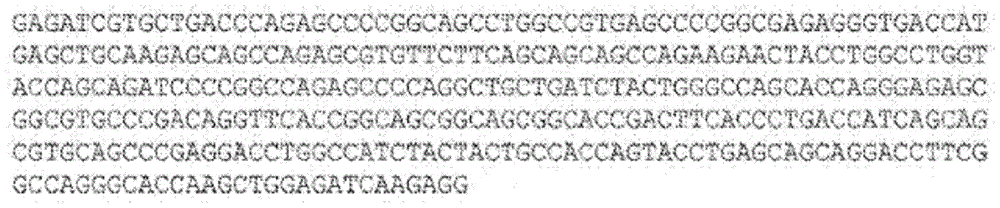
如本文所述用于构建靶向CD33的药剂的抗CD33抗体结合片段可以包含与SEQ IDNO:12和SEQ ID NO:13中的那些相同的重链和/或轻链CDR区。此类抗体可以在一个或多个骨架区中包含氨基酸残基变型。在一些情况下,抗CD33抗体片段可以包含与SEQ ID NO:12共享至少70%序列同一性(例如,75%、80%、85%、90%、95%或更高)的重链可变区和/或可以包含与SEQ ID NO:13共享至少70%序列同一性(例如,75%、80%、85%、90%、95%或更高)的轻链可变区。Anti-CD33 antibody binding fragments used in the construction of CD33-targeting agents as described herein may comprise the same heavy and/or light chain CDR regions as those in SEQ ID NO:12 and SEQ ID NO:13. Such antibodies may contain amino acid residue variations in one or more framework regions. In some instances, the anti-CD33 antibody fragment can comprise a heavy chain variable that shares at least 70% sequence identity (e.g., 75%, 80%, 85%, 90%, 95% or more) with SEQ ID NO: 12 region and/or may comprise a light chain variable region sharing at least 70% sequence identity (eg, 75%, 80%, 85%, 90%, 95% or more) with SEQ ID NO: 13.
两个氨基酸序列的“百分比同一性”使用Karlin和AltschulProc.Natl.Acad.Sci.USA 87:2264-68,1990,如同在Karlin和AltschulProc.Natl.Acad.Sci.USA 90:5873-77,1993中修改的算法来测定。此类算法并入Altschul等J.Mol.Biol.215:403-10,1990的NBLAST和XBLAST程序(2.0版本)中。BLAST蛋白质搜索可以用XBLAST程序进行,得分=50,字长=3以获得与本公开的蛋白质分子同源的氨基酸序列。当两个序列之间存在空位时,可以利用空位BLAST,如Altschul等,Nucleic AcidsRes.25(17):3389-3402,1997所述。利用BLAST和空位BLAST程序时,可以使用各程序(例如,XBLAST和NBLAST)的默认参数。The "percent identity" of two amino acid sequences uses Karlin and AltschulProc. The algorithm modified in is used to determine. Such algorithms are incorporated into the NBLAST and XBLAST programs (version 2.0) of Altschul et al. J. Mol. Biol. 215:403-10, 1990. BLAST protein searches can be performed with the XBLAST program, score = 50, wordlength = 3 to obtain amino acid sequences homologous to protein molecules of the disclosure. Gapped BLAST can be utilized when a gap exists between two sequences, as described in Altschul et al., Nucleic Acids Res. 25(17):3389-3402, 1997. When utilizing BLAST and Gapped BLAST programs, the default parameters of the respective programs (eg, XBLAST and NBLAST) can be used.
C.表达嵌合受体的免疫细胞C. Immune cells expressing chimeric receptors
在一些实施方案中,如本文所述靶向谱系特异性细胞表面抗原的药剂是表达嵌合受体的免疫细胞,嵌合受体包含能够结合谱系特异性抗原(例如,CD33或CD19)的抗原结合片段(例如,单链抗体)。嵌合受体的抗原结合片段识别在其细胞表面具有谱系特异性抗原的靶细胞(例如,癌细胞),将活化信号转导至嵌合受体的一个或多个信号传导结构域(例如,共刺激信号传导结构域和/或细胞质信号传导结构域),这样可以激活表达嵌合受体的免疫细胞中的效应子功能。In some embodiments, an agent targeting a lineage-specific cell surface antigen as described herein is an immune cell expressing a chimeric receptor comprising an antigen capable of binding a lineage-specific antigen (e.g., CD33 or CD19) Binding fragments (eg, single chain antibodies). The antigen-binding fragment of the chimeric receptor recognizes target cells (e.g., cancer cells) with lineage-specific antigens on their cell surface, transducing an activating signal to one or more signaling domains of the chimeric receptor (e.g., co-stimulatory signaling domain and/or cytoplasmic signaling domain), which can activate effector functions in immune cells expressing chimeric receptors.
如本文中所用,嵌合受体是指可以在宿主细胞表面表达的非天然存在的分子,并且包含结合细胞表面谱系特异性抗原的抗原结合片段。通常,嵌合受体包含至少两个源自不同分子的结构域。除了本文描述的抗原结合片段之外,嵌合受体还可包含铰链结构域、跨膜结构域、至少一个共刺激结构域和细胞质信号传导结构域中的一个或多个。在一些实施方案中,嵌合受体从N端至C端包含结合细胞表面谱系特异性抗原的抗原结合片段、铰链结构域、跨膜结构域和细胞质信号传导结构域。在一些实施方案中,嵌合受体还包含至少一个共刺激结构域。As used herein, a chimeric receptor refers to a non-naturally occurring molecule that can be expressed on the surface of a host cell and comprises an antigen-binding fragment that binds a cell surface lineage-specific antigen. Typically, chimeric receptors comprise at least two domains derived from different molecules. In addition to the antigen-binding fragments described herein, chimeric receptors may comprise one or more of a hinge domain, a transmembrane domain, at least one co-stimulatory domain, and a cytoplasmic signaling domain. In some embodiments, the chimeric receptor comprises, from N-terminus to C-terminus, an antigen-binding fragment that binds a cell surface lineage-specific antigen, a hinge domain, a transmembrane domain, and a cytoplasmic signaling domain. In some embodiments, the chimeric receptor further comprises at least one co-stimulatory domain.
在一些实施方案中,本文描述的嵌合受体包含铰链结构域,其可位于抗原结合片段和跨膜结构域之间。铰链结构域是通常在蛋白质的两个结构域之间发现的氨基酸区段,并且可以允许蛋白质的灵活性和一个或两个结构域相对于彼此的运动。可以使用提供此类灵活性和抗原结合片段相对于嵌合受体的另一个结构域的运动的任何氨基酸序列。In some embodiments, the chimeric receptors described herein comprise a hinge domain, which may be positioned between the antigen-binding fragment and the transmembrane domain. A hinge domain is a stretch of amino acids usually found between two domains of a protein and can allow for the flexibility of a protein and the movement of one or both domains relative to each other. Any amino acid sequence that provides such flexibility and movement of the antigen-binding fragment relative to another domain of the chimeric receptor can be used.
铰链结构域可含约10-200个氨基酸,例如15-150个氨基酸、20-100个氨基酸或30-60个氨基酸。在一些实施方案中,铰链结构域长度可为约10、11、12、13、14、15、16、17、18、19、20、21、22、23、24、25、26、27、28、29、30、35、40、45、50、55、60、65、70、75、80、85、90、95、100、110、120、130、140、150、160、170、180、190或200个氨基酸。The hinge domain may contain about 10-200 amino acids, eg, 15-150 amino acids, 20-100 amino acids, or 30-60 amino acids. In some embodiments, the hinge domain length may be about 10, 11, 12, 13, 14, 15, 16, 17, 18, 19, 20, 21, 22, 23, 24, 25, 26, 27, 28 ,29,30,35,40,45,50,55,60,65,70,75,80,85,90,95,100,110,120,130,140,150,160,170,180,190 or 200 amino acids.
在一些实施方案中,铰链结构域是天然存在的蛋白质的铰链结构域。本领域已知包含铰链结构域的任何蛋白质的铰链结构域对于在本文描述的嵌合受体中的使用相容。在一些实施方案中,铰链结构域是天然存在的蛋白质的铰链结构域的至少一部分并赋予嵌合受体灵活性。在一些实施方案中,铰链结构域是CD8α或CD28α的。在一些实施方案中,铰链结构域是CD8α铰链结构域的一部分,例如含CD8α或CD28α铰链结构域的至少15个(例如,20、25、30、35或40个)连续氨基酸的片段。In some embodiments, the hinge domain is a hinge domain of a naturally occurring protein. The hinge domain of any protein comprising a hinge domain is known in the art to be compatible for use in the chimeric receptors described herein. In some embodiments, the hinge domain is at least a portion of the hinge domain of a naturally occurring protein and confers flexibility to the chimeric receptor. In some embodiments, the hinge domain is of CD8α or CD28α. In some embodiments, the hinge domain is a portion of a CD8α hinge domain, eg, a fragment comprising at least 15 (eg, 20, 25, 30, 35, or 40) contiguous amino acids of a CD8α or CD28α hinge domain.
抗体,例如IgG、IgA、IgM、IgE或IgD抗体的铰链结构域对于在本文描述的嵌合受体中的使用也相容。在一些实施方案中,铰链结构域是连接抗体的恒定结构域CH1和CH2的铰链结构域。在一些实施方案中,铰链结构域是抗体的并且包含抗体的铰链结构域和抗体的一个或多个恒定区。在一些实施方案中,铰链结构域包含抗体的铰链结构域和抗体的CH3恒定区。在一些实施方案中,铰链结构域包含抗体的铰链结构域和抗体的CH2和CH3恒定区。在一些实施方案中,抗体为IgG、IgA、IgM、IgE或IgD抗体。在一些实施方案中,抗体为IgG抗体。在一些实施方案中,抗体为IgG1、IgG2、IgG3或IgG4抗体。在一些实施方案中,铰链区包含IgG1抗体的铰链区及CH2和CH3恒定区。在一些实施方案中,铰链区包含IgG1抗体的铰链区及CH3恒定区。The hinge domains of antibodies, eg IgG, IgA, IgM, IgE or IgD antibodies are also compatible for use in the chimeric receptors described herein. In some embodiments, the hinge domain is the hinge domain connecting the constant domains CH1 and CH2 of the antibody. In some embodiments, the hinge domain is of an antibody and comprises the hinge domain of the antibody and one or more constant regions of the antibody. In some embodiments, the hinge domain comprises an antibody hinge domain and an antibody CH3 constant region. In some embodiments, the hinge domain comprises the hinge domain of an antibody and the CH2 and CH3 constant regions of the antibody. In some embodiments, the antibody is an IgG, IgA, IgM, IgE, or IgD antibody. In some embodiments, the antibody is an IgG antibody. In some embodiments, the antibody is an IgGl, IgG2, IgG3 or IgG4 antibody. In some embodiments, the hinge region comprises the hinge region of an IgGl antibody and the CH2 and CH3 constant regions. In some embodiments, the hinge region comprises an IgG1 antibody hinge region and a CH3 constant region.
同样在本公开范围内的是包含为非天然存在的肽的铰链结构域的嵌合受体。在一些实施方案中,Fc受体的细胞外配体结合结构域C端与跨膜结构域N端之间的铰链结构域是肽接头,例如(GlyxSer)n接头,其中x和n可以独立地为3-12之间的整数,包括3、4、5、6、7、8、9、10、11、12或更大。Also within the scope of the present disclosure are chimeric receptors comprising a hinge domain that is a non-naturally occurring peptide. In some embodiments, the hinge domain between the C-terminus of the extracellular ligand-binding domain of the Fc receptor and the N-terminus of the transmembrane domain is a peptide linker, such as a (GlyxSer)n linker, where x and n can be independently It is an integer between 3-12, including 3, 4, 5, 6, 7, 8, 9, 10, 11, 12 or more.
可用于本文描述的嵌合受体的铰链结构域中的其它肽接头是本领域已知的。参见,例如Wriggers等Current Trends in Peptide Science(2005)80(6):736-746和PCT公布WO 2012/088461。Other peptide linkers useful in the hinge domains of the chimeric receptors described herein are known in the art. See, eg, Wriggers et al. Current Trends in Peptide Science (2005) 80(6):736-746 and PCT Publication WO 2012/088461.
在一些实施方案中,本文描述的嵌合受体可以包含跨膜结构域。用于嵌合受体中的跨膜结构域可以是本领域已知的任何形式。如本文中所用,“跨膜结构域”是指在细胞膜,优选真核细胞膜中热力学稳定的任何蛋白质结构。对于在本文所用嵌合受体中的使用相容的跨膜结构域可从天然存在的蛋白质获得。可选地,跨膜结构域可以是合成的非天然存在的蛋白质区段,例如一种在细胞膜中热力学稳定的疏水性蛋白质区段。In some embodiments, the chimeric receptors described herein can comprise a transmembrane domain. Transmembrane domains used in chimeric receptors can be of any form known in the art. As used herein, "transmembrane domain" refers to any protein structure that is thermodynamically stable in a cell membrane, preferably a eukaryotic cell membrane. Compatible transmembrane domains for use in the chimeric receptors used herein can be obtained from naturally occurring proteins. Alternatively, the transmembrane domain may be a synthetic non-naturally occurring protein segment, such as a hydrophobic protein segment that is thermodynamically stable in the cell membrane.
跨膜结构域基于跨膜结构域拓扑结构进行分类,包括跨膜结构域穿过膜的通过次数和蛋白质的取向。例如,单次通过的膜蛋白穿过细胞膜一次,而多次通过的膜蛋白穿过细胞膜至少两次(例如,2、3、4、5、6、7次或更多次)。在一些实施方案中,跨膜结构域是单次通过的跨膜结构域。在一些实施方案中,跨膜结构域是单次通过的跨膜结构域,其将嵌合受体的N端定向至细胞的胞外侧并将嵌合受体的C端定向至细胞的胞内侧。在一些实施方案中,跨膜结构域从单次通过的跨膜蛋白获得。在一些实施方案中,跨膜结构域是CD8α的。在一些实施方案中,跨膜结构域是CD28的。在一些实施方案中,跨膜结构域是ICOS的。Transmembrane domains are classified based on the transmembrane domain topology, including the number of passages of the transmembrane domain across the membrane and the orientation of the protein. For example, a single-pass membrane protein crosses the cell membrane once, while a multi-pass membrane protein crosses the cell membrane at least twice (eg, 2, 3, 4, 5, 6, 7 or more times). In some embodiments, the transmembrane domain is a single-pass transmembrane domain. In some embodiments, the transmembrane domain is a single-pass transmembrane domain that orients the N-terminus of the chimeric receptor to the extracellular side of the cell and the C-terminus of the chimeric receptor to the inner side of the cell . In some embodiments, the transmembrane domain is obtained from a single-pass transmembrane protein. In some embodiments, the transmembrane domain is of CD8α. In some embodiments, the transmembrane domain is of CD28. In some embodiments, the transmembrane domain is of ICOS.
在一些实施方案中,本文描述的嵌合受体包含一个或多个共刺激信号传导结构域。如本文中所用,术语“共刺激信号传导结构域”是指介导细胞内信号转导以诱导免疫反应如效应子功能的蛋白质的至少一部分。本文描述的嵌合受体的共刺激信号传导结构域可以是来自共刺激蛋白质的细胞质信号传导结构域,其转导信号并调节由免疫细胞如T细胞、NK细胞、巨噬细胞、嗜中性粒细胞或嗜酸性粒细胞介导的反应。In some embodiments, the chimeric receptors described herein comprise one or more co-stimulatory signaling domains. As used herein, the term "co-stimulatory signaling domain" refers to at least a portion of a protein that mediates intracellular signal transduction to induce an immune response such as effector function. The co-stimulatory signaling domain of the chimeric receptors described herein may be a cytoplasmic signaling domain from a co-stimulatory protein that transduces signals and regulates signaling by immune cells such as T cells, NK cells, macrophages, neutrophils, Granulocyte or eosinophil mediated response.
在一些实施方案中,嵌合受体包含一个以上(至少2、3、4个或更多个)共刺激信号传导结构域。在一些实施方案中,嵌合受体包含一个以上从不同共刺激蛋白质获得的共刺激信号传导结构域。在一些实施方案中,嵌合受体不含共刺激信号传导结构域。In some embodiments, a chimeric receptor comprises more than one (at least 2, 3, 4 or more) costimulatory signaling domains. In some embodiments, a chimeric receptor comprises more than one costimulatory signaling domain derived from different costimulatory proteins. In some embodiments, the chimeric receptor does not contain a co-stimulatory signaling domain.
通常,除刺激抗原特异性信号外,许多免疫细胞还需要共刺激,以促进细胞增殖、分化和存活,并激活细胞的效应子功能。宿主细胞中共刺激信号传导结构域的激活(例如,免疫细胞)可诱导细胞增加或减少细胞因子的产生和分泌、噬菌特性、增殖、分化、存活和/或细胞毒性。任何共刺激蛋白的共刺激信号传导结构域对于在本文描述的嵌合受体中的使用相容。基于诸如嵌合受体将会在其中表达的免疫细胞的类型(例如,原代T细胞、T细胞系、NK细胞系)和所需免疫效应子功能(例如,细胞毒性)等因素来选择共刺激信号传导结构域的类型。用于嵌合受体的共刺激信号传导结构域的实例可以是共刺激蛋白质的细胞质信号传导结构域,包括但不限于CD27、CD28、4-1BB、OX40、CD30、Cd40、PD-1、ICOS、淋巴细胞功能相关抗原-1(LFA-1)、CD2、CD7、LIGHT、NKG2C、B7-H3。在一些实施方案中,共刺激结构域源自4-1BB、CD28或ICOS。在一些实施方案中,共刺激结构域源自CD28并且嵌合受体包含来自4-1BB或ICOS的第二共刺激结构域。Often, in addition to stimulating antigen-specific signals, many immune cells require costimulation to promote cell proliferation, differentiation, and survival, and to activate cell effector functions. Activation of co-stimulatory signaling domains in host cells (eg, immune cells) can induce the cells to increase or decrease cytokine production and secretion, phagocytic properties, proliferation, differentiation, survival and/or cytotoxicity. The costimulatory signaling domain of any costimulatory protein is compatible for use in the chimeric receptors described herein. Selection of co-expressing immune cells is based on factors such as the type of immune cell in which the chimeric receptor will be expressed (e.g., primary T cells, T cell lines, NK cell lines) and the desired immune effector function (e.g., cytotoxicity). Stimulates the type of signaling domain. Examples of co-stimulatory signaling domains for chimeric receptors can be cytoplasmic signaling domains of co-stimulatory proteins, including but not limited to CD27, CD28, 4-1BB, OX40, CD30, Cd40, PD-1, ICOS , Lymphocyte function-associated antigen-1 (LFA-1), CD2, CD7, LIGHT, NKG2C, B7-H3. In some embodiments, the co-stimulatory domain is derived from 4-1BB, CD28, or ICOS. In some embodiments, the costimulatory domain is derived from CD28 and the chimeric receptor comprises a second costimulatory domain from 4-1BB or ICOS.
在一些实施方案中,共刺激结构域是包含一个以上共刺激结构域或一个以上共刺激结构域的部分的融合结构域。在一些实施方案中,共刺激结构域是来自CD28和ICOS的共刺激结构域的融合物。In some embodiments, the costimulatory domain is a fusion domain comprising more than one costimulatory domain or a portion of more than one costimulatory domain. In some embodiments, the costimulatory domain is a fusion of costimulatory domains from CD28 and ICOS.
在一些实施方案中,本文描述的嵌合受体包含细胞质信号传导结构域。任何细胞质信号传导结构域均可用于本文描述的嵌合受体中。通常,细胞质信号传导结构域传递信号,例如细胞外配体结合结构域与其配体的相互作用,以刺激细胞反应,例如诱导细胞的效应子功能(例如,细胞毒性)。In some embodiments, the chimeric receptors described herein comprise a cytoplasmic signaling domain. Any cytoplasmic signaling domain can be used in the chimeric receptors described herein. Typically, the cytoplasmic signaling domain transmits a signal, eg, the interaction of an extracellular ligand binding domain with its ligand, to stimulate a cellular response, eg, induce effector functions of the cell (eg, cytotoxicity).
如将对本领域普通技术人员明显的,涉及T细胞活化的因子是细胞质信号传导结构域的基于免疫受体酪氨酸的活化基序(ITAM)的磷酸化。本领域已知的任何含ITAM的结构域均可用于构建本文描述的嵌合受体。通常,ITAM基序可以包含由6-8个氨基酸间隔的氨基酸序列YxxL/I的两个重复,其中每个x独立地为任何氨基酸,产生保守基序YxxL/Ix(6-8)YxxL/I。在一些实施方案中,细胞质信号传导域来自CD3ζ。As will be apparent to those of ordinary skill in the art, a factor involved in T cell activation is phosphorylation of the immunoreceptor tyrosine-based activation motif (ITAM) of the cytoplasmic signaling domain. Any ITAM-containing domain known in the art can be used to construct the chimeric receptors described herein. Typically, an ITAM motif may comprise two repeats of the amino acid sequence YxxL/I separated by 6-8 amino acids, where each x is independently any amino acid, resulting in the conserved motif YxxL/Ix(6-8)YxxL/I . In some embodiments, the cytoplasmic signaling domain is from CD3ζ.
下面表2和3中提供了示例性嵌合受体。Exemplary chimeric receptors are provided in Tables 2 and 3 below.
表2:嵌合受体的示例性组分Table 2: Exemplary components of chimeric receptors

下面提供了用于构建嵌合受体的示例性组分的核酸序列。Nucleic acid sequences of exemplary components used to construct chimeric receptors are provided below.
CD28细胞内信号传导结构域-DNA-人(SEQ ID NO:3)CD28 intracellular signaling domain-DNA-human (SEQ ID NO:3)

ICOS细胞内信号传导结构域-DNA-人(SEQ ID NO:4)ICOS intracellular signaling domain-DNA-human (SEQ ID NO: 4)
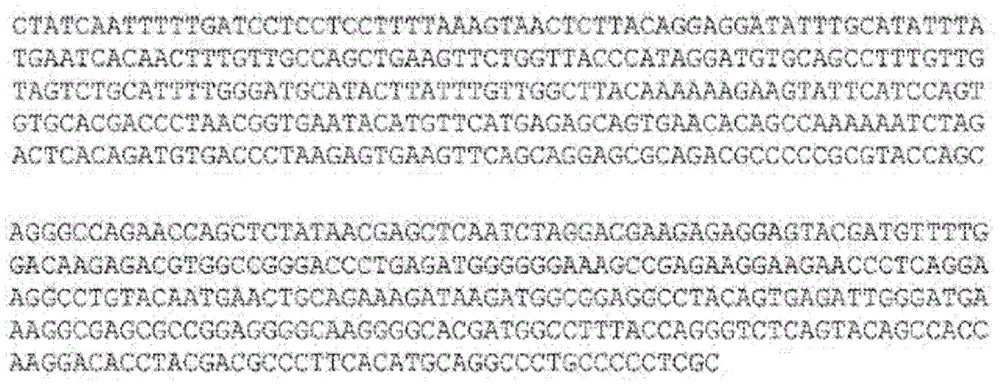
CD28/ICOS供刺激信号传导区-DNA-人(SEQ ID NO:5)CD28/ICOS for stimulation signal transduction region-DNA-human (SEQ ID NO:5)

在一些实施方案中,所述核酸序列编码结合CD33并且包含重链可变区和轻链可变区的抗原结合片段,所述重链可变区具有与SEQ ID NO:12中的CDR相同的CDR,所述轻链可变区具有与SEQ ID NO:13中的CDR相同的CDR。在一些实施方案中,所述抗原结合片段包含如SEQ ID NO:12所提供的重链可变区和如SEQ ID NO:13所提供的轻链可变区。在一些实施方案中,嵌合受体还包含至少一个跨膜结构域和一个细胞质信号传导结构域。在一些实施方案中,嵌合受体还包含铰链结构域和共刺激信号传导结构域。In some embodiments, the nucleic acid sequence encodes an antigen-binding fragment that binds to CD33 and comprises a heavy chain variable region and a light chain variable region, and the heavy chain variable region has the same CDR as in SEQ ID NO: 12 CDRs, the light chain variable region has the same CDRs as those in SEQ ID NO:13. In some embodiments, the antigen-binding fragment comprises a heavy chain variable region as provided in SEQ ID NO:12 and a light chain variable region as provided in SEQ ID NO:13. In some embodiments, the chimeric receptor further comprises at least one transmembrane domain and a cytoplasmic signaling domain. In some embodiments, the chimeric receptor further comprises a hinge domain and a co-stimulatory signaling domain.
表3提供了本文描述的示例性嵌合受体。示例性构建体从N端至C端具有抗原结合片段、跨膜结构域和细胞质信号传导结构域。在一些实例中,嵌合受体还包含位于抗原结合片段和跨膜结构域之间的铰链结构域。在一些实例中,嵌合受体还包含一个或多个共刺激结构域,其可以位于跨膜结构域和细胞质信号传导结构域之间。Table 3 provides exemplary chimeric receptors described herein. Exemplary constructs have, from N-terminus to C-terminus, an antigen-binding fragment, a transmembrane domain, and a cytoplasmic signaling domain. In some examples, the chimeric receptor further comprises a hinge domain located between the antigen-binding fragment and the transmembrane domain. In some examples, the chimeric receptor also comprises one or more co-stimulatory domains, which may be located between the transmembrane domain and the cytoplasmic signaling domain.
表3:示例性嵌合受体Table 3: Exemplary Chimeric Receptors
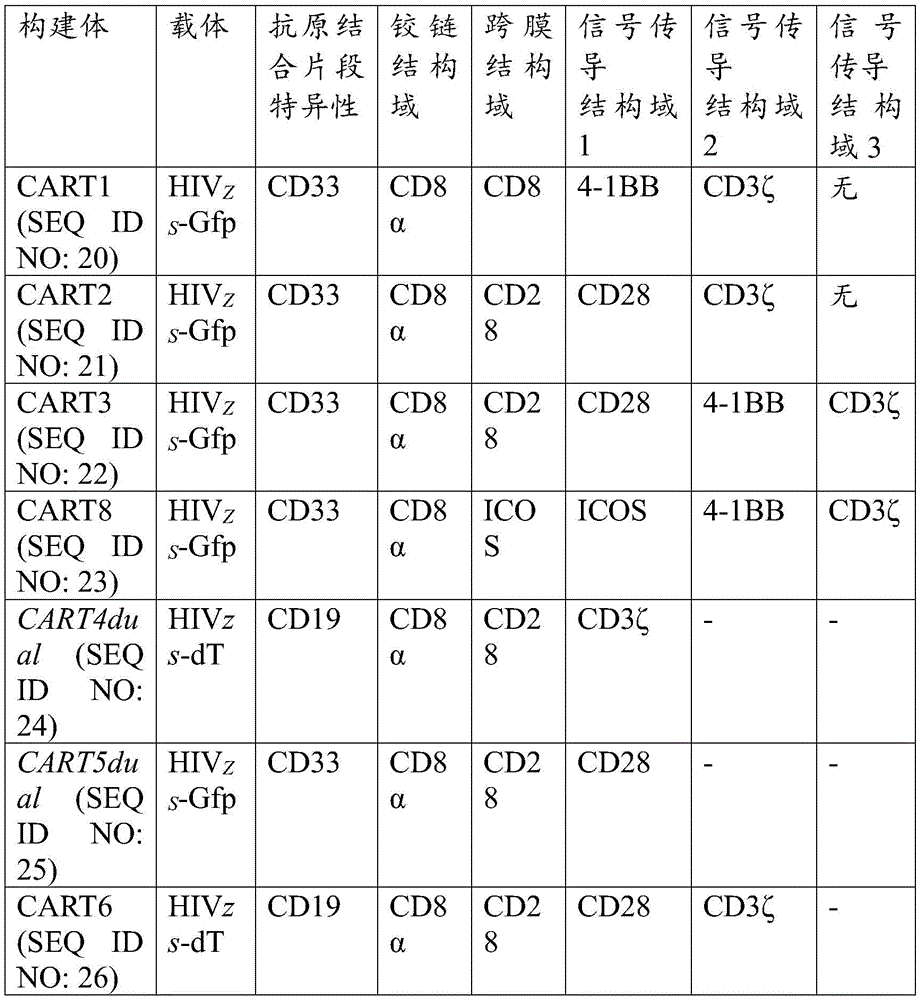

下面提供了以上表3中列出的示例嵌合受体的氨基酸序列:The amino acid sequences of the exemplary chimeric receptors listed in Table 3 above are provided below:
CART1氨基酸序列(SEQ ID NO:20)CART1 amino acid sequence (SEQ ID NO: 20)
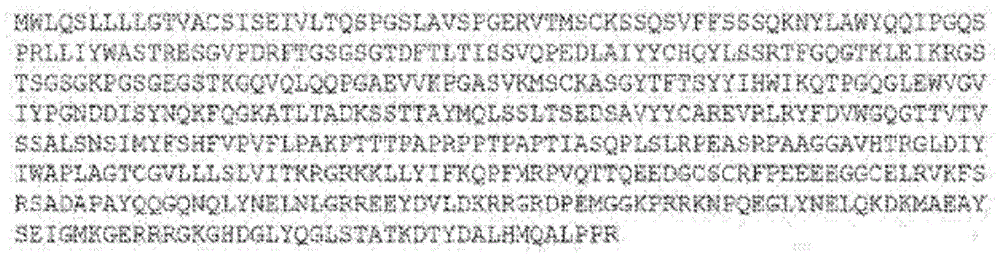
CART2氨基酸序列(SEQ ID NO:21)CART2 amino acid sequence (SEQ ID NO: 21)
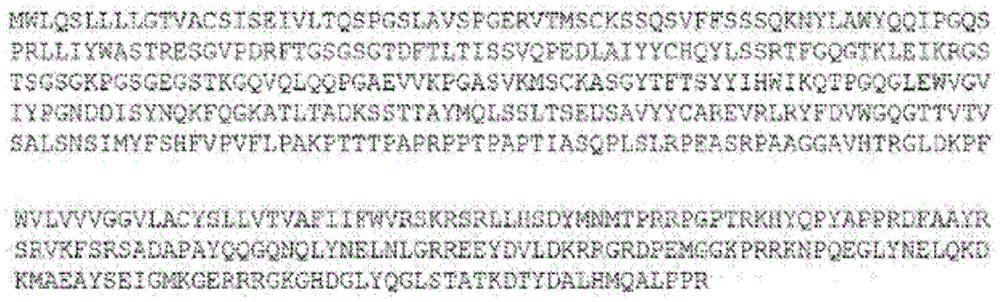
CART3氨基酸序列(SEQ ID NO:22)CART3 amino acid sequence (SEQ ID NO: 22)

CART8氨基酸序列(SEQ ID NO:23)CART8 amino acid sequence (SEQ ID NO: 23)

CART4dual氨基酸序列(SEQ ID NO:24)CART4dual amino acid sequence (SEQ ID NO: 24)
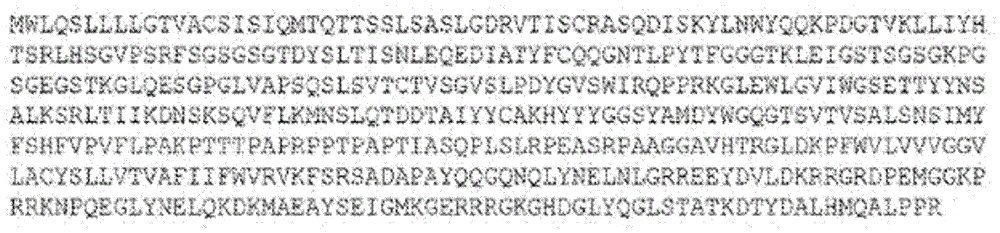
CART5dual氨基酸序列(SEQ ID NO:25)CART5dual amino acid sequence (SEQ ID NO: 25)
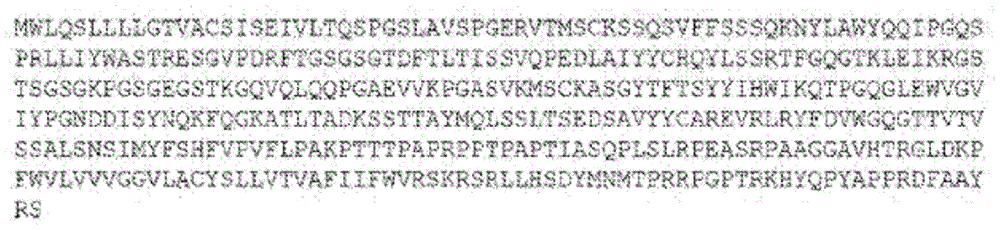
CART6氨基酸序列(SEQ ID NO:26)CART6 amino acid sequence (SEQ ID NO: 26)
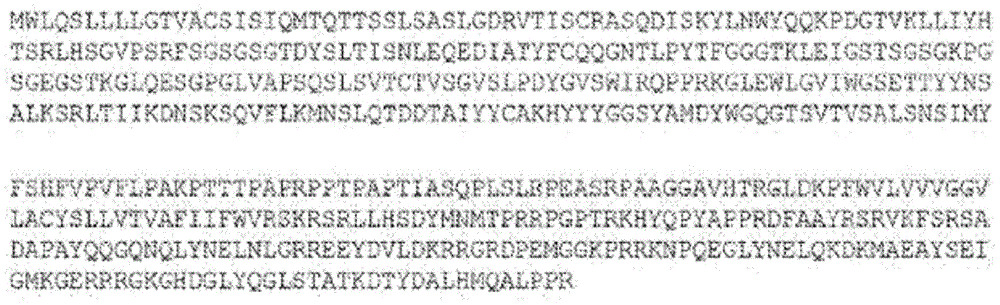
CART7氨基酸序列(SEQ ID NO:27)CART7 amino acid sequence (SEQ ID NO: 27)

下面提供了以上表3中列出的示例嵌合受体的核酸序列:The nucleic acid sequences of the exemplary chimeric receptors listed in Table 3 above are provided below:
CART1核酸序列(SEQ ID NO:38)CART1 nucleic acid sequence (SEQ ID NO: 38)

CART2核酸序列(SEQ ID NO:39)CART2 nucleic acid sequence (SEQ ID NO: 39)

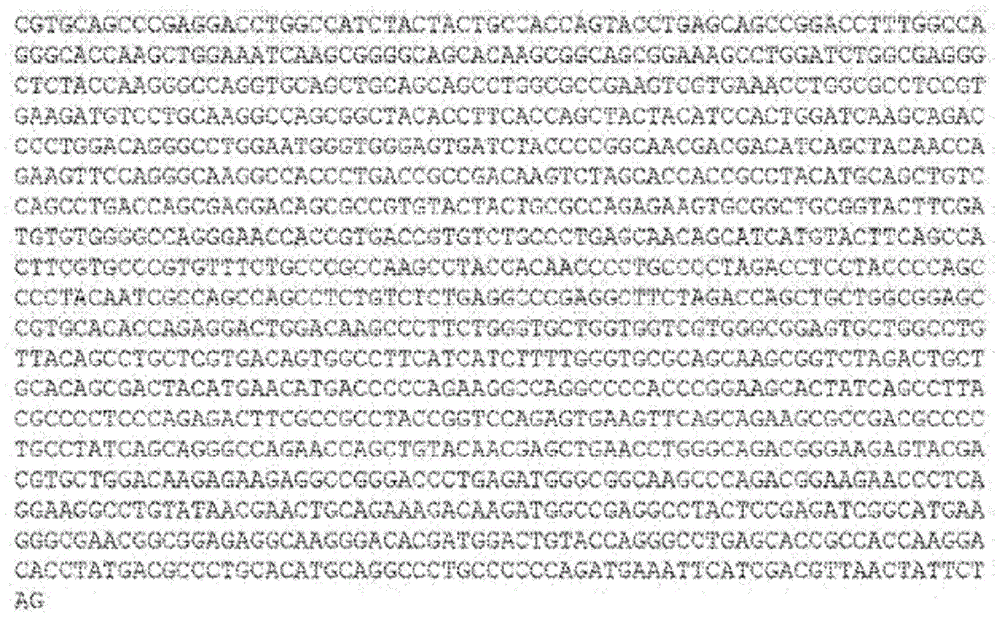
CART3核酸序列(SEQ ID NO:40)CART3 nucleic acid sequence (SEQ ID NO: 40)
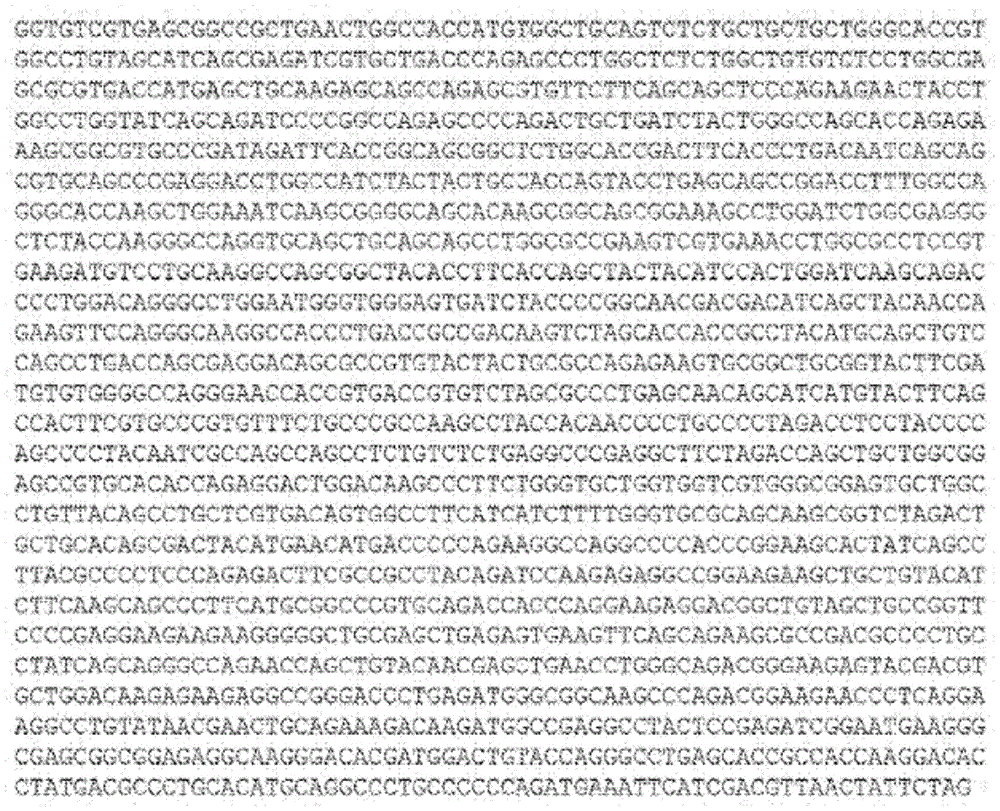
CART4dual核酸序列(SEQ ID NO:41)CART4dual nucleic acid sequence (SEQ ID NO: 41)

CART5dual核酸序列(SEQ ID NO:42)CART5dual nucleic acid sequence (SEQ ID NO: 42)
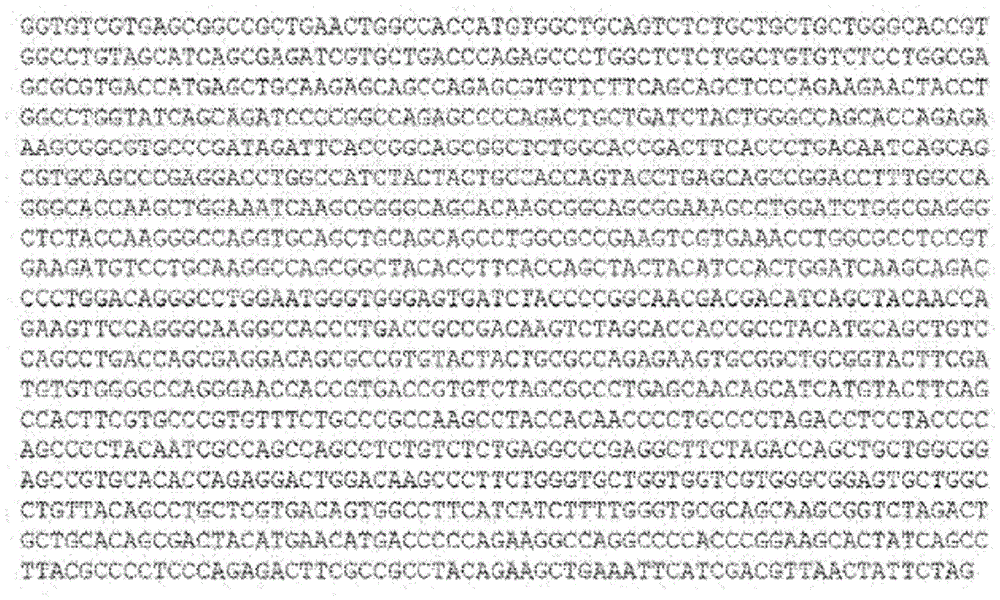
CART6核酸序列(SEQ ID NO:43)CART6 nucleic acid sequence (SEQ ID NO: 43)

CART7核酸序列(SEQ ID NO:44)CART7 nucleic acid sequence (SEQ ID NO: 44)
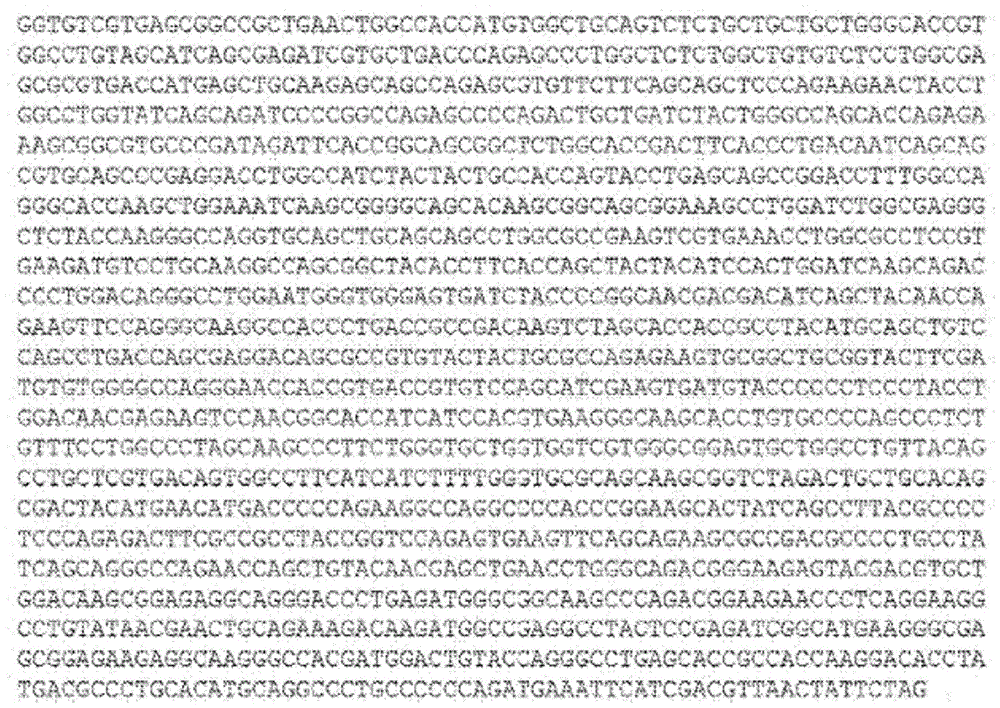
本文描述的任何嵌合受体均可通过常规方法如重组技术来制备。本文用于制备嵌合受体的方法涉及产生编码包含嵌合受体的每个结构域的多肽的核酸,所述嵌合受体包括抗原结合片段和任选地,铰链结构域、跨膜结构域、至少一个共刺激信号传导结构域和细胞质信号传导结构域。在一些实施方案中,编码嵌合受体的每个组分的核酸使用重组技术连接在一起。Any of the chimeric receptors described herein can be prepared by conventional methods, such as recombinant techniques. The methods herein for making chimeric receptors involve the generation of nucleic acids encoding polypeptides comprising each domain of a chimeric receptor, including an antigen-binding fragment and, optionally, a hinge domain, transmembrane structure domain, at least one co-stimulatory signaling domain and a cytoplasmic signaling domain. In some embodiments, the nucleic acids encoding each component of the chimeric receptor are linked together using recombinant techniques.
嵌合受体的每个组分的序列可以通过常规技术获得,例如来自本领域已知的多种来源中的任何一种的PCR扩增。在一些实施方案中,嵌合受体的一个或多个组分的序列从人类细胞获得。可选地,可以合成嵌合受体的一个或多个组分的序列。可以使用诸如PCR扩增或连接的方法,将每个组分的序列(例如,结构域)直接或间接连接(例如,使用编码肽接头的核酸序列)以形成编码嵌合受体的核酸序列。可选地,可以合成编码嵌合受体的核酸。在一些实施方案中,核酸为DNA。在其它实施方案中,核酸为RNA。The sequence of each component of the chimeric receptor can be obtained by conventional techniques, such as PCR amplification from any of a variety of sources known in the art. In some embodiments, the sequence of one or more components of the chimeric receptor is obtained from a human cell. Alternatively, the sequence of one or more components of the chimeric receptor can be synthesized. The sequences of each component (eg, domains) can be joined directly or indirectly (eg, using a nucleic acid sequence encoding a peptide linker) using methods such as PCR amplification or ligation to form a nucleic acid sequence encoding a chimeric receptor. Alternatively, nucleic acids encoding chimeric receptors can be synthesized. In some embodiments, the nucleic acid is DNA. In other embodiments, the nucleic acid is RNA.
嵌合受体的一个或多个组分(例如,抗原结合片段等)内的一个或多个残基的突变,在每个组分的序列连接之前或之后。在一些实施方案中,可以在嵌合受体组分中产生一个或多个突变以调节(增加或减少)组分对靶标(例如,靶抗原的抗原结合片段)的亲和力和/或调节组分的活性。Mutation of one or more residues within one or more components of a chimeric receptor (eg, antigen-binding fragment, etc.), either before or after linkage of the sequences of each component. In some embodiments, one or more mutations can be made in a chimeric receptor component to modulate (increase or decrease) the affinity of the component for a target (e.g., an antigen-binding fragment of a target antigen) and/or to modulate the component activity.
可以通过常规技术将本文描述的任何嵌合受体引入合适的免疫细胞中用于表达。在一些实施方案中,免疫细胞为T细胞,例如原代T细胞或T细胞系。可选地,免疫细胞可以是NK细胞,例如建立的NK细胞系(例如,NK-92细胞)。在一些实施方案中,免疫细胞是表达CD8(CD8+)或CD8和CD4(CD8+/CD4+)的T细胞。在一些实施方案中,T细胞是建立的T细胞系的T细胞,例如293T细胞或Jurkat细胞。Any of the chimeric receptors described herein can be introduced into suitable immune cells for expression by conventional techniques. In some embodiments, the immune cells are T cells, such as primary T cells or T cell lines. Alternatively, the immune cells may be NK cells, such as established NK cell lines (eg, NK-92 cells). In some embodiments, the immune cells are T cells expressing CD8 (CD8 + ) or CD8 and CD4 (CD8 + /CD4 + ). In some embodiments, the T cells are T cells of an established T cell line, such as 293T cells or Jurkat cells.
原代T细胞可以从任何来源获得,例如外周血单核细胞(PBMC)、骨髓、组织诸如脾、淋巴结、胸腺或肿瘤组织。适于获得所需免疫细胞类型的来源对于本领域技术人员而言将是显而易见的。在一些实施方案中,免疫细胞群源自患有造血系统恶性肿瘤的人类患者,例如源自骨髓或源自从患者获得的PBMC。在一些实施方案中,免疫细胞群源自健康供体。在一些实施方案中,免疫细胞获自随后将施用表达嵌合受体的免疫细胞的受试者。施用于从中获得所述细胞的相同受试者的免疫细胞被称为自体细胞,而从并非施用所述细胞的受试者的受试者获得的免疫细胞被称为同种异体细胞。Primary T cells can be obtained from any source, eg peripheral blood mononuclear cells (PBMC), bone marrow, tissues such as spleen, lymph nodes, thymus or tumor tissue. Sources suitable for obtaining the desired immune cell types will be apparent to those skilled in the art. In some embodiments, the population of immune cells is derived from a human patient with a hematopoietic malignancy, eg, from bone marrow or from PBMCs obtained from the patient. In some embodiments, the immune cell population is derived from a healthy donor. In some embodiments, the immune cells are obtained from a subject who will subsequently be administered the immune cells expressing the chimeric receptor. Immune cells administered to the same subject from which the cells were obtained are referred to as autologous cells, while immune cells obtained from a subject other than the subject from which the cells were administered are referred to as allogeneic cells.
所需类型的宿主细胞可以在通过将细胞与刺激分子共孵育而获得的细胞群内扩增,例如抗CD3和抗CD28抗体可用于扩增T细胞。Host cells of the desired type can be expanded within cell populations obtained by co-incubating the cells with stimulatory molecules, for example anti-CD3 and anti-CD28 antibodies can be used to expand T cells.
为了构建表达本文描述的任何嵌合受体构建体的免疫细胞,可以通过如本文描述的常规方法构建用于稳定或瞬时表达嵌合受体构建体的表达载体并将其引入免疫宿主细胞内。例如,可以将编码嵌合受体的核酸克隆到合适的表达载体,例如与合适的启动子可操作连接的病毒载体中。可以在合适的条件下使核酸和载体与限制酶接触以在每个分子上产生可以彼此配对并用连接酶连接的互补末端。可选地,合成的核酸接头可以连接到编码嵌合受体的核酸末端。合成接头可含对应于载体中的特定限制位点的核酸序列。表达载体/质粒/病毒载体的选择将取决于用于表达嵌合受体的宿主细胞的类型,但是应该适于在真核细胞中整合和复制。To construct immune cells expressing any of the chimeric receptor constructs described herein, expression vectors for stable or transient expression of the chimeric receptor constructs can be constructed and introduced into immunized host cells by conventional methods as described herein. For example, a nucleic acid encoding a chimeric receptor can be cloned into a suitable expression vector, such as a viral vector operably linked to a suitable promoter. Nucleic acids and vectors can be contacted with restriction enzymes under appropriate conditions to create complementary ends on each molecule that can pair with each other and be ligated with a ligase. Alternatively, synthetic nucleic acid linkers can be ligated to the termini of nucleic acids encoding chimeric receptors. Synthetic linkers may contain nucleic acid sequences corresponding to specific restriction sites in the vector. The choice of expression vector/plasmid/viral vector will depend on the type of host cell used to express the chimeric receptor, but should be suitable for integration and replication in eukaryotic cells.
多种启动子可用于表达本文描述的嵌合受体,包括但不限于巨细胞病毒(CMV)中间体早期启动子、病毒LTR如劳斯肉瘤(Rous sarcoma)病毒LTR、HIV-LTR、HTLV-1LTR、莫洛尼小鼠(Maloney murine)白血病病毒(MMLV)LTR、骨髓增生性肉瘤病毒(MPSV)LTR、脾脏病灶形成病毒(SFFV)LTR、猿病毒40(SV40)早期启动子、单纯疱疹tk病毒启动子、延伸因子1-α(EF1-α)启动子(有或无EF1-α内含子)。另外的用于表达嵌合受体的启动子包括免疫细胞中的任何组成型活性启动子。可选地,可以使用任何可调控启动子,使其表达可以在免疫细胞内被调节。A variety of promoters can be used to express the chimeric receptors described herein, including but not limited to cytomegalovirus (CMV) intermediate early promoter, viral LTR such as Rous sarcoma virus LTR, HIV-LTR, HTLV- 1LTR, Maloney murine leukemia virus (MMLV) LTR, myeloproliferative sarcoma virus (MPSV) LTR, spleen focus forming virus (SFFV) LTR, simian virus 40 (SV40) early promoter, herpes simplex tk Viral promoter, elongation factor 1-alpha (EF1-alpha) promoter (with or without EF1-alpha intron). Additional promoters for expression of chimeric receptors include any constitutively active promoters in immune cells. Alternatively, any regulatable promoter whose expression can be regulated in immune cells can be used.
另外,载体可含有例如以下的一些或全部:选择标记基因,例如用于选择宿主细胞中的稳定或瞬时转染子的新霉素基因;来自人CMV的立即早期基因的用于高水平转录的增强子/启动子序列;来自SV40的用于mRNA稳定性的转录终止和RNA加工信号;来自高表达基因如α-珠蛋白或β-珠蛋白的用于mRNA稳定性和翻译效率的5'-和3'-非翻译区;SV40多瘤复制起点和用于正确附加型复制的ColE1;内部核糖体结合位点(IRESes)、通用多克隆位点;用于有义和反义RNA体外转录的T7和SP6RNA启动子;被触发时会导致携带载体的细胞死亡(例如,HSV胸苷激酶、诱导型半胱天冬酶如iCasp9)的“自杀开关”或“自杀基因”,及用于评估嵌合受体表达的报告基因。见下面部分VI。用于产生含有转基因的载体的合适载体和方法是本领域公知并且可用的。制备用于表达嵌合受体的载体的实例可以例如在US2014/0106449中找到,其通过引用整体并入本文。Additionally, the vector may contain, for example, some or all of the following: a selectable marker gene, such as the neomycin gene for selection of stable or transient transfectants in host cells; an immediate early gene from human CMV for high-level transcription; Enhancer/promoter sequences; transcription termination and RNA processing signals from SV40 for mRNA stability; 5'- and 3'-untranslated region; SV40 polyoma origin of replication and ColE1 for correct episomal replication; internal ribosome binding sites (IRESes), universal multiple cloning site; for in vitro transcription of sense and antisense RNA T7 and SP6 RNA promoters; "suicide switches" or "suicide genes" that, when triggered, lead to the death of cells carrying vectors (e.g., HSV thymidine kinase, inducible caspases such as iCasp9) reporter gene expressed by receptors. See Section VI below. Suitable vectors and methods for producing transgene-containing vectors are well known and available in the art. Examples of preparation of vectors for expressing chimeric receptors can be found eg in US2014/0106449, which is hereby incorporated by reference in its entirety.
在一些实施方案中,嵌合受体构建体或编码所述嵌合受体的核酸为DNA分子。在一些实施方案中,嵌合受体构建体或编码所述嵌合受体的核酸为DNA载体并且可以电穿孔至免疫细胞(参见,例如Till等,Blood(2012)119(17):3940-3950)。在一些实施方案中,编码嵌合受体的核酸是可以电穿孔至免疫细胞的RNA分子。In some embodiments, the chimeric receptor construct or nucleic acid encoding the chimeric receptor is a DNA molecule. In some embodiments, the chimeric receptor construct or nucleic acid encoding the chimeric receptor is a DNA vector and can be electroporated into immune cells (see, e.g., Till et al., Blood (2012) 119(17):3940- 3950). In some embodiments, the nucleic acid encoding the chimeric receptor is an RNA molecule that can be electroporated to immune cells.
包含编码本文描述的嵌合受体构建体的核酸序列的任何载体也在本公开的范围内。此类载体可以通过合适的方法递送到宿主细胞如宿主免疫细胞中。将载体递送至免疫细胞的方法在本领域中是公知的并且可以包括DNA、RNA或转座子电穿孔、转染试剂如脂质体或纳米颗粒以递送DNA、RNA或转座子;通过机械变形递送DNA、RNA或转座子或蛋白质(参见例如,Sharei等Proc.Natl.Acad.Sci.USA(2013)110(6):2082-2087);或病毒转导。在一些实施方案中,用于表达嵌合受体的载体通过病毒转导递送至宿主细胞。用于递送的示例性病毒方法包括但不限于重组逆转录病毒(参见例如,PCT公布号WO90/07936、WO 94/03622、WO 93/25698、WO 93/25234、WO 93/11230、WO 93/10218、WO 91/02805;美国专利第5,219,740和4,777,127号;GB专利第2,200,651号;和EP专利第0 345 242号)、基于α病毒的载体和腺相关病毒(AAV)载体(参见例如,PCT公布号WO 94/12649、WO 93/03769、WO 93/19191、WO 94/28938、WO 95/11984和WO 95/00655)。在一些实施方案中,用于表达嵌合受体的载体为逆转录病毒。在一些实施方案中,用于表达嵌合受体的载体为慢病毒。在一些实施方案中,用于表达嵌合受体的载体为腺相关病毒。Any vector comprising a nucleic acid sequence encoding a chimeric receptor construct described herein is also within the scope of the present disclosure. Such vectors can be delivered into host cells such as host immune cells by appropriate methods. Methods of delivering vectors to immune cells are well known in the art and may include electroporation of DNA, RNA or transposons, transfection reagents such as liposomes or nanoparticles to deliver DNA, RNA or transposons; Deformative delivery of DNA, RNA or transposons or proteins (see eg, Sharei et al. Proc. Natl. Acad. Sci. USA (2013) 110(6):2082-2087); or viral transduction. In some embodiments, vectors for expression of chimeric receptors are delivered to host cells by viral transduction. Exemplary viral methods for delivery include, but are not limited to, recombinant retroviruses (see, eg, PCT Publication Nos. WO 90/07936, WO 94/03622, WO 93/25698, WO 93/25234, WO 93/11230, WO 93/ 10218, WO 91/02805; U.S. Patent Nos. 5,219,740 and 4,777,127; GB Patent No. 2,200,651; and EP Patent No. 0 345 242), alphavirus-based vectors, and adeno-associated virus (AAV) vectors (see, e.g., PCT Publication Nos. WO 94/12649, WO 93/03769, WO 93/19191, WO 94/28938, WO 95/11984 and WO 95/00655). In some embodiments, the vector used to express the chimeric receptor is a retrovirus. In some embodiments, the vector used to express the chimeric receptor is a lentivirus. In some embodiments, the vector used to express the chimeric receptor is an adeno-associated virus.
在使用病毒载体将编码嵌合受体的载体引入宿主细胞的实例中,能够感染免疫细胞并携带载体的病毒颗粒可以通过本领域已知的任何方法产生,并且可以例如在PCT申请第WO 1991/002805A2、WO1998/009271A1号和美国专利6,194,191中找到。从细胞培养物上清液中收获病毒颗粒,并且可以在使病毒颗粒与免疫细胞接触之前分离和/或纯化病毒颗粒。In instances where viral vectors are used to introduce vectors encoding chimeric receptors into host cells, viral particles capable of infecting immune cells and carrying the vectors can be produced by any method known in the art, and can be described, for example, in PCT Application No. WO 1991/ 002805A2, WO1998/009271A1 and US Patent 6,194,191. Viral particles are harvested from the cell culture supernatant, and the viral particles can be isolated and/or purified prior to contacting the viral particles with the immune cells.
制备表达本文描述的任何嵌合受体的宿主细胞的方法可包括离体活化和/或扩增免疫细胞。活化宿主细胞意味着刺激宿主细胞进入活化状态,其中所述细胞可能能够执行效应子功能(例如,细胞毒性)。活化宿主细胞的方法将取决于用于表达嵌合受体的宿主细胞的类型。扩增宿主细胞可涉及任何导致表达嵌合受体的细胞数量增加的方法,例如,使宿主细胞增殖或刺激宿主细胞增殖。用于刺激宿主细胞扩增的方法将取决于用于表达嵌合受体的宿主细胞的类型,并且将对于本领域技术人员显而易见。在一些实施方案中,表达本文描述的任何嵌合受体的宿主细胞在施用给受试者之前离体活化和/或扩增。Methods of making host cells expressing any of the chimeric receptors described herein can include ex vivo activation and/or expansion of immune cells. Activating a host cell means stimulating the host cell into an activated state in which the cell may be capable of performing effector functions (eg, cytotoxicity). The method of activating the host cell will depend on the type of host cell used to express the chimeric receptor. Expansion of host cells may involve any method that results in an increase in the number of cells expressing the chimeric receptor, eg, proliferating the host cells or stimulating the proliferation of the host cells. Methods for stimulating host cell expansion will depend on the type of host cell used to express the chimeric receptor and will be apparent to those skilled in the art. In some embodiments, host cells expressing any of the chimeric receptors described herein are activated and/or expanded ex vivo prior to administration to a subject.
在一些实施方案中,靶向细胞表面谱系特异性抗原的药剂是抗体-药物缀合物(ADC)。正如将对本领域普通技术人员显而易见的,术语“抗体-药物缀合物”可以与“免疫毒素”互换使用并且是指包含与毒素或药物分子偶联的抗体(或其抗原结合片段)的融合分子。抗体与相应抗原的结合允许将毒素或药物分子递送至在其细胞表面呈递抗原的细胞(例如,靶细胞),从而导致靶细胞死亡。In some embodiments, the agent targeting a cell surface lineage-specific antigen is an antibody-drug conjugate (ADC). As will be apparent to those of ordinary skill in the art, the term "antibody-drug conjugate" is used interchangeably with "immunotoxin" and refers to a fusion comprising an antibody (or antigen-binding fragment thereof) conjugated to a toxin or drug molecule. molecular. Binding of the antibody to the corresponding antigen allows delivery of the toxin or drug molecule to a cell presenting the antigen on its cell surface (eg, a target cell), resulting in the death of the target cell.
在一些实施方案中,所述药剂为抗体-药物缀合物。在一些实施方案中,抗体-药物缀合物包含抗原结合片段和在靶细胞中诱导细胞毒性的毒素或药物。在一些实施方案中,抗体-药物缀合物靶向2型抗原。在一些实施方案中,抗体-药物缀合物靶向CD33或CD19。In some embodiments, the agent is an antibody-drug conjugate. In some embodiments, the antibody-drug conjugate comprises an antigen-binding fragment and a toxin or drug that induces cytotoxicity in target cells. In some embodiments, the antibody-drug conjugate targets a
在一些实施方案中,抗体-药物缀合物的抗原结合片段具有与SEQ ID NO:12所提供的重链可变区相同的重链CDR和与SEQ ID NO:13所提供的轻链可变区相同的轻链CDR。在一些实施方案中,抗体-药物缀合物的抗原结合片段具有SEQ ID NO:12所提供的重链可变区和SEQ ID NO:13所提供的轻链可变区。In some embodiments, the antigen-binding fragment of the antibody-drug conjugate has the same heavy chain CDRs as the heavy chain variable region provided in SEQ ID NO: 12 and the same heavy chain variable region as provided in SEQ ID NO: 13. Regions identical to the light chain CDRs. In some embodiments, the antigen-binding fragment of the antibody-drug conjugate has a heavy chain variable region provided by SEQ ID NO:12 and a light chain variable region provided by SEQ ID NO:13.
适用于抗体-药物缀合物的毒素或药物是本领域公知的并且将对本领域普通技术人员显而易见。参见例如,Peters等Biosci.Rep.(2015)35(4):e00225。在一些实施方案中,抗体-药物缀合物还可包含连接抗体和药物分子的接头(例如,肽接头,例如可裂解接头)。Toxins or drugs suitable for use in antibody-drug conjugates are well known in the art and will be apparent to those of ordinary skill in the art. See, eg, Peters et al. Biosci. Rep. (2015) 35(4): e00225. In some embodiments, the antibody-drug conjugate may also comprise a linker (eg, a peptide linker, eg, a cleavable linker) linking the antibody and the drug molecule.
本文描述的ADC可以用作对已经接受如本文所描述的组合疗法的受试者的后续治疗。The ADCs described herein can be used as subsequent therapy for subjects already receiving combination therapy as described herein.
缺乏谱系特异性细胞表面抗原的造血细胞Hematopoietic cells lacking lineage-specific cell surface antigens
本公开还提供了造血细胞如HSC,其已经遗传修饰为缺乏谱系特异性细胞表面抗原。在一些实施方案中,造血细胞是造血干细胞。造血干细胞(HSC)能够产生骨髓和淋巴祖细胞,其进一步产生骨髓细胞(例如,单核细胞、巨噬细胞、嗜中性粒细胞、嗜碱性粒细胞、树突细胞、红细胞、血小板等)和淋巴样细胞(例如,T细胞、B细胞、NK细胞)。HSC的特征在于表达可用于HSC的鉴定和/或分离的细胞表面标记CD34(例如,CD34+),并且不存在与约束细胞谱系相关的细胞表面标记。The present disclosure also provides hematopoietic cells, such as HSCs, that have been genetically modified to lack lineage-specific cell surface antigens. In some embodiments, the hematopoietic cells are hematopoietic stem cells. Hematopoietic stem cells (HSCs) are capable of giving rise to myeloid and lymphoid progenitor cells, which in turn give rise to myeloid cells (eg, monocytes, macrophages, neutrophils, basophils, dendritic cells, red blood cells, platelets, etc.) and lymphoid cells (eg, T cells, B cells, NK cells). HSCs are characterized by the expression of the cell surface marker CD34 (eg, CD34 + ), useful for identification and/or isolation of HSCs, and the absence of cell surface markers associated with constrained cell lineages.
在一些实施方案中,HSC从受试者,例如哺乳动物受试者获得。在一些实施方案中,哺乳动物受试者是非人灵长类动物、啮齿动物(例如,小鼠或大鼠)、牛、猪、马或家畜。在一些实施方案中,HSC获自人类患者,例如患有造血系统恶性肿瘤的人类患者。在一些实施方案中,HSC获自健康供体。在一些实施方案中,HSC获自随后将施用表达嵌合受体的免疫细胞的受试者。施用于从中获得所述细胞的相同受试者的HSC被称为自体细胞,而从并非施用所述细胞的受试者的受试者获得的HSC被称为同种异体细胞。In some embodiments, HSCs are obtained from a subject, eg, a mammalian subject. In some embodiments, the mammalian subject is a non-human primate, rodent (eg, mouse or rat), cow, pig, horse, or livestock. In some embodiments, the HSCs are obtained from a human patient, eg, a human patient with a hematopoietic malignancy. In some embodiments, HSCs are obtained from healthy donors. In some embodiments, the HSCs are obtained from a subject who will subsequently be administered immune cells expressing the chimeric receptor. HSCs administered to the same subject from which the cells were obtained are referred to as autologous cells, while HSCs obtained from a subject other than the subject to which the cells were administered are referred to as allogeneic cells.
可以使用本领域已知的常规手段从任何合适的来源获得HSC。在一些实施方案中,HSC从来自受试者的样品,例如骨髓样品或血液样品获得。可选地或另外,HSC可以从脐带获得。在一些实施方案中,HSC来自骨髓或外周血单核细胞(PBMC)。通常,骨髓细胞可以从受试者的髂嵴、股骨、胫骨、脊柱、肋骨或其它髓腔获得。骨髓可从患者体内取出并通过本领域已知的各种分离和洗涤程序分离。用于分离骨髓细胞的示例性程序包括以下步骤:a)提取骨髓样品;b)将骨髓悬浮液离心分离成三个部分并收集中间部分或血沉棕黄层;c)将来自步骤(b)的血沉棕黄层部分在分离液(通常为Ficoll TM)中再次离心,并收集含有骨髓细胞的中间部分;和d)洗涤从步骤(c)收集的部分以回收可再输注的骨髓细胞。HSCs can be obtained from any suitable source using conventional means known in the art. In some embodiments, HSCs are obtained from a sample from a subject, such as a bone marrow sample or a blood sample. Alternatively or additionally, HSCs can be obtained from the umbilical cord. In some embodiments, the HSCs are derived from bone marrow or peripheral blood mononuclear cells (PBMCs). Typically, bone marrow cells can be obtained from the iliac crest, femur, tibia, spine, ribs, or other medullary cavity of a subject. Bone marrow can be removed from the patient and isolated by various isolation and washing procedures known in the art. An exemplary procedure for isolating bone marrow cells includes the steps of: a) extracting a bone marrow sample; b) centrifuging the bone marrow suspension into three fractions and collecting the middle fraction or buffy coat; c) extracting the bone marrow from step (b). The buffy coat fraction is centrifuged again in a separating medium (usually Ficoll™) and the middle fraction containing bone marrow cells is collected; and d) washing the fraction collected from step (c) to recover reinfused bone marrow cells.
HSC通常存在于骨髓中,但可以通过施用动员剂使其动员到循环血液中以便从外周血中收集HSC。在一些实施方案中,向获得HSC的受试者施用动员剂,例如粒细胞集落刺激因子(G-CSF)。使用动员剂动员后收集的HSC数量通常大于不使用动员剂获得的细胞数量。HSCs are normally found in the bone marrow, but can be mobilized into circulating blood by administering a mobilizing agent to collect HSCs from peripheral blood. In some embodiments, a mobilizing agent, such as granulocyte colony stimulating factor (G-CSF), is administered to the subject from which the HSC was obtained. The number of HSCs collected after mobilization with a mobilizing agent is generally greater than the number of cells obtained without the use of a mobilizing agent.
在一些实施方案中,从受试者获得样品,然后富集所需细胞类型(例如CD34+/CD33-细胞)。例如,如本文所述,可以从血液中分离PBMC和/或CD34+造血细胞。细胞也可以从其它细胞中分离,例如通过用与所需细胞类型的细胞表面上的表位结合的抗体分离和/或活化。可以使用的另一种方法包括使用针对细胞表面标记的抗体进行阴性选择以选择性富集特定细胞类型而不通过受体接合来活化细胞。In some embodiments, a sample is obtained from a subject and then enriched for a desired cell type (eg, CD34 + / CD33- cells). For example, PBMCs and/or CD34 + hematopoietic cells can be isolated from blood as described herein. Cells can also be isolated from other cells, eg, by isolation and/or activation with antibodies that bind epitopes on the cell surface of the desired cell type. Another approach that can be used involves negative selection using antibodies against cell surface markers to selectively enrich for specific cell types without activating cells through receptor engagement.
在可以将HSC基因工程改造成缺乏谱系特异性细胞表面抗原之前或之后扩增HSC群。细胞可以在包含扩增培养基的条件下培养,扩增培养基包含一种或多种细胞因子,如干细胞因子(SCF)、Flt-3配体(Flt3L)、血小板生成素(TPO)、白细胞介素3(IL-3)或白细胞介素6(IL-6)。细胞可以扩增约1、2、3、4、5、6、7、8、9、10、11、12、13、14、15、16、17、18、19、20、21、22、23、24、25天或任何必需的范围。在一些实施方案中,在从获自受试者的样品中分离所需细胞群(例如,CD34+/CD33-)后并且在基因工程改造之前扩增HSC。在一些实施方案中,在基因工程改造后扩增HSC,从而选择性地扩增已经经历了遗传修饰并且缺乏谱系特异性细胞表面抗原的细胞。在一些实施方案中,可以选择遗传修饰后具有所需特征(例如,表型或基因型)的一种细胞(“克隆”)或几种细胞并独立扩增。Populations of HSCs can be expanded before or after HSCs can be genetically engineered to lack lineage-specific cell surface antigens. Cells can be cultured in conditions containing expansion medium containing one or more cytokines such as stem cell factor (SCF), Flt-3 ligand (Flt3L), thrombopoietin (TPO), leukocyte Interleukin 3 (IL-3) or Interleukin 6 (IL-6). Cells can expand about 1, 2, 3, 4, 5, 6, 7, 8, 9, 10, 11, 12, 13, 14, 15, 16, 17, 18, 19, 20, 21, 22, 23 , 24, 25 days or whatever range is required. In some embodiments, HSCs are expanded after isolation of a desired cell population (eg, CD34 + /CD33 − ) from a sample obtained from a subject and prior to genetic engineering. In some embodiments, HSCs are expanded following genetic engineering to selectively expand cells that have undergone genetic modification and lack lineage-specific cell surface antigens. In some embodiments, one cell ("clone") or several cells genetically modified to have a desired characteristic (eg, phenotype or genotype) can be selected and expanded independently.
在一些实施方案中,造血细胞经基因工程改造成缺乏细胞表面谱系特异性抗原。在一些实施方案中,造血细胞经基因工程改造成缺乏所述药剂所靶向的相同细胞表面谱系特异性抗原。如本文中所用,如果造血细胞和与经基因工程改造的造血细胞相同类型的天然存在的造血细胞(例如,其特征在于存在相同的细胞表面标记,例如CD34)相比,细胞表面谱系特异性抗原的表达显著降低,则认为造血细胞缺乏细胞表面谱系特异性抗原。在一些实施方案中,造血细胞没有可检测到的细胞表面谱系特异性抗原表达。细胞表面谱系特异性抗原的表达水平可以通过本领域已知的任何方式评估。例如,可以通过用抗原特异性抗体检测抗原(例如,流式细胞术方法、蛋白质印迹法)来评估细胞表面谱系特异性抗原的表达水平。In some embodiments, hematopoietic cells are genetically engineered to lack cell surface lineage-specific antigens. In some embodiments, the hematopoietic cells are genetically engineered to lack the same cell surface lineage-specific antigens targeted by the agent. As used herein, a cell surface lineage-specific antigen is present if a hematopoietic cell is compared to a naturally occurring hematopoietic cell of the same type as the genetically engineered hematopoietic cell (e.g., characterized by the presence of the same cell surface marker, e.g., CD34). If the expression of β is significantly reduced, hematopoietic cells are considered to lack cell surface lineage-specific antigens. In some embodiments, the hematopoietic cells have no detectable cell surface lineage-specific antigen expression. Expression levels of cell surface lineage-specific antigens can be assessed by any means known in the art. For example, expression levels of cell surface lineage-specific antigens can be assessed by detecting the antigen with an antigen-specific antibody (eg, flow cytometry methods, Western blotting).
在一些实施方案中,将经基因工程改造的造血细胞上的细胞表面谱系特异性抗原的表达与天然存在的造血细胞上的细胞表面谱系特异性抗原的表达进行比较。在一些实施方案中,基因工程改造导致细胞表面谱系特异性抗原的表达水平与天然存在的造血细胞上的细胞表面谱系特异性抗原的表达相比降低至少约50%、60%、70%、80%、90%、91%、92%、93%、94%、95%、96%、97%、98%或99%。In some embodiments, the expression of a cell surface lineage specific antigen on a genetically engineered hematopoietic cell is compared to the expression of a cell surface lineage specific antigen on a naturally occurring hematopoietic cell. In some embodiments, the genetic engineering results in at least about 50%, 60%, 70%, 80% reduction in the expression level of the cell surface lineage specific antigen compared to the expression of the cell surface lineage specific antigen on naturally occurring hematopoietic cells %, 90%, 91%, 92%, 93%, 94%, 95%, 96%, 97%, 98%, or 99%.
在一些实施方案中,造血细胞缺乏编码细胞表面谱系特异性抗原的完整内源性基因。在一些实施方案中,编码细胞表面谱系特异性抗原的完整内源性基因已经缺失。在一些实施方案中,造血细胞包含编码细胞表面谱系特异性抗原的内源性基因的一部分。在一些实施方案中,造血细胞表达细胞表面谱系特异性抗原的一部分(例如截短蛋白)。在其它实施方案中,编码细胞表面谱系特异性抗原的内源性基因的一部分已经缺失。在一些实施方案中,编码细胞表面谱系特异性抗原的基因的至少10%、20%、30%、40%、50%、60%、70%或更多已经缺失。In some embodiments, hematopoietic cells lack intact endogenous genes encoding cell surface lineage-specific antigens. In some embodiments, entire endogenous genes encoding cell surface lineage-specific antigens have been deleted. In some embodiments, the hematopoietic cell comprises a portion of an endogenous gene encoding a cell surface lineage-specific antigen. In some embodiments, hematopoietic cells express a portion of a cell surface lineage-specific antigen (eg, a truncated protein). In other embodiments, a portion of an endogenous gene encoding a cell surface lineage-specific antigen has been deleted. In some embodiments, at least 10%, 20%, 30%, 40%, 50%, 60%, 70%, or more of the genes encoding cell surface lineage-specific antigens have been deleted.
如本领域普通技术人员将认识到的,编码细胞表面谱系特异性抗原的核苷酸序列的一部分可缺失或一个或多个非编码序列,使得造血细胞缺乏抗原(例如,具有显著降低的抗原表达)。As will be recognized by those of ordinary skill in the art, a portion of the nucleotide sequence encoding a cell surface lineage-specific antigen may be deleted or one or more non-coding sequences such that hematopoietic cells lack the antigen (e.g., have significantly reduced antigen expression ).
在一些实施方案中,细胞表面谱系特异性抗原为CD33。预测的CD33结构包括两个免疫球蛋白结构域、一个IgV结构域和一个IgC2结构域。在一些实施方案中,CD33的免疫球蛋白C结构域的一部分缺失。In some embodiments, the cell surface lineage specific antigen is CD33. The predicted CD33 structure includes two immunoglobulin domains, an IgV domain and an IgC2 domain. In some embodiments, a portion of the immunoglobulin C domain of CD33 is deleted.
可以通过常规方法或本文描述的方法制备任何经基因工程改造的缺乏细胞表面谱系特异性抗原的造血细胞,如HSC。在一些实施方案中,使用基因组编辑进行基因工程改造。如本文中所用,“基因组编辑”是指修饰生物体的基因组(包括任何蛋白质编码或非编码核苷酸序列)以敲除靶基因的表达的方法。通常,基因组编辑方法涉及使用能够裂解基因组核酸(例如在靶向核苷酸序列处)的核酸内切酶。可以修复基因组中的双链断裂,引入突变和/或可以将外源核酸插入靶向位点。Any genetically engineered hematopoietic cell, such as HSC, lacking cell surface lineage-specific antigens can be prepared by conventional methods or methods described herein. In some embodiments, genetic engineering is performed using genome editing. As used herein, "genome editing" refers to a method of modifying the genome of an organism, including any protein-coding or non-coding nucleotide sequences, to knock out the expression of a target gene. Typically, genome editing methods involve the use of endonucleases capable of cleaving genomic nucleic acids, eg, at targeted nucleotide sequences. Double-strand breaks in the genome can be repaired, mutations introduced and/or foreign nucleic acids can be inserted into targeted sites.
通常基于参与在靶核酸中产生双链断裂的核酸内切酶的类型对基因组编辑方法进行分类。这些方法包括使用锌指核酸酶(ZFN)、基于转录活化因子样效应因子的核酸酶(TALEN)、大范围核酸酶和CRISPR/Cas系统。Genome editing methods are often categorized based on the type of endonuclease involved in creating double-strand breaks in the target nucleic acid. These approaches include the use of zinc finger nucleases (ZFNs), transcription activator-like effector-based nucleases (TALENs), meganucleases, and CRISPR/Cas systems.
在本公开的一个方面中,使用其中谱系特异性抗原经修饰的正常细胞,进行经修饰的正常细胞群对肿瘤细胞的置换。此类修饰可以包括使用CRISPR-Cas9系统消耗或抑制任何谱系特异性抗原,其中成簇规律间隔的短回文重复序列(CRISPR)-Cas9系统是经工程改造的、非天然存在的CRISPR-Cas9系统(图4)。In one aspect of the disclosure, replacement of tumor cells by a population of modified normal cells is performed using normal cells in which lineage-specific antigens have been modified. Such modifications may include depletion or inhibition of any lineage-specific antigens using a CRISPR-Cas9 system, where the Clustered Regularly Interspaced Short Palindromic Repeat (CRISPR)-Cas9 system is an engineered, non-naturally occurring CRISPR-Cas9 system (Figure 4).
CRISPR-Cas系统已成功用于编辑各种生物体的基因组,包括但不限于细菌、人、果蝇、斑马鱼和植物。参见例如,Jiang等,Nature Biotechnology(2013)31(3):233;Qi等,Cell(2013)5:1173;DiCarlo等,Nucleic Acids Res.(2013)7:4336;Hwang等,Nat.Biotechnol(2013),3:227);Gratz等,Genetics(2013)194:1029;Cong等,Science(2013)6121:819;Mali等,Science(2013)6121:823;Cho等Nat.Biotechnol(2013)3:230;及Jiang等,Nucleic Acids Research(2013)41(20):el88。CRISPR-Cas systems have been successfully used to edit the genomes of various organisms, including but not limited to bacteria, humans, Drosophila, zebrafish, and plants. See, eg, Jiang et al., Nature Biotechnology (2013) 31(3):233; Qi et al., Cell (2013) 5:1173; DiCarlo et al., Nucleic Acids Res. (2013) 7:4336; Hwang et al., Nat.Biotechnol( 2013), 3:227); Gratz et al., Genetics (2013) 194:1029; Cong et al., Science (2013) 6121:819; Mali et al., Science (2013) 6121:823; Cho et al. Nat.Biotechnol (2013) 3 :230; and Jiang et al., Nucleic Acids Research (2013) 41(20):el88.
本公开利用与谱系特异性抗原多核苷酸中的靶序列杂交的CRISPR/Cas9系统,其中CRISPR/Cas9系统包含Cas9核酸酶和经工程改造的crRNA/tracrRNA(或单个向导RNA)。CRISPR/Cas9复合物可结合谱系特异性抗原多核苷酸并允许抗原多核苷酸的裂解,从而修饰该多核苷酸。The present disclosure utilizes a CRISPR/Cas9 system that hybridizes to a target sequence in a lineage-specific antigen polynucleotide, wherein the CRISPR/Cas9 system comprises a Cas9 nuclease and an engineered crRNA/tracrRNA (or a single guide RNA). The CRISPR/Cas9 complex can bind to a lineage-specific antigenic polynucleotide and allow cleavage of the antigenic polynucleotide, thereby modifying the polynucleotide.
本公开的CRISPR/Cas系统可以结合和/或裂解基因内或其附近的编码或非编码区,诸如例如前导序列、尾随序列或内含子内,或编码区上游或下游的非转录区内细胞表面谱系特异性抗原的目标区域。可以设计本公开中使用的向导RNA(gRNA),使得gRNA指导Cas9-gRNA复合物与基因组中的预定裂解位点(靶位点)的结合。可选择裂解位点以便释放含有未知序列区域或含有SNP、核苷酸插入、核苷酸缺失、重排等的区域的片段。The CRISPR/Cas system of the present disclosure can bind and/or lyse coding or non-coding regions within or near a gene, such as, for example, within a leader sequence, trailer sequence, or intron, or within a non-transcribed region upstream or downstream of a coding region of a cell Target regions for surface lineage-specific antigens. The guide RNA (gRNA) used in the present disclosure can be designed such that the gRNA directs the binding of the Cas9-gRNA complex to a predetermined cleavage site (target site) in the genome. The cleavage site can be selected so as to release fragments containing regions of unknown sequence or regions containing SNPs, nucleotide insertions, nucleotide deletions, rearrangements, and the like.
基因区域的裂解可以包括通过Cas酶裂解靶序列位置处的一条或两条链。在一个实施方案中,这样,裂解可导致靶基因的转录减少。在另一个实施方案中,裂解可以进一步包括通过与外源性模板多核苷酸的同源重组来修复裂解的靶多核苷酸,其中修复导致靶多核苷酸的一个或多个核苷酸的插入、缺失或取代。Cleavage of the gene region may involve cleavage of one or both strands at the position of the target sequence by the Cas enzyme. In one embodiment, such cleavage results in reduced transcription of the target gene. In another embodiment, cleavage may further comprise repairing the cleaved target polynucleotide by homologous recombination with an exogenous template polynucleotide, wherein the repair results in the insertion of one or more nucleotides of the target polynucleotide , missing or replaced.
术语“gRNA”、“向导RNA”和“CRISPR向导序列”可通篇互换使用并且是指包含决定CRISPR/Cas系统Cas DNA结合蛋白的特异性的序列的核酸。gRNA与宿主细胞基因组中的靶核酸序列杂交(部分或完全互补)。与靶核酸杂交的gRNA或其部分的长度可介于15-25个核苷酸、18-22个核苷酸或19-21个核苷酸之间。在一些实施方案中,与靶核酸杂交的gRNA序列的长度可为15、16、17、18、19、20、21、22、23、24或25个核苷酸。在一些实施方案中,与靶核酸杂交的gRNA序列的长度介于10-30或15-25个核苷酸之间。The terms "gRNA", "guide RNA" and "CRISPR guide sequence" are used interchangeably throughout and refer to a nucleic acid comprising the sequence that determines the specificity of the Cas DNA binding protein of the CRISPR/Cas system. The gRNA hybridizes (partially or fully complementary) to the target nucleic acid sequence in the genome of the host cell. The gRNA or portion thereof that hybridizes to the target nucleic acid can be between 15-25 nucleotides, 18-22 nucleotides, or 19-21 nucleotides in length. In some embodiments, the gRNA sequence that hybridizes to the target nucleic acid can be 15, 16, 17, 18, 19, 20, 21, 22, 23, 24, or 25 nucleotides in length. In some embodiments, the gRNA sequence that hybridizes to the target nucleic acid is between 10-30 or 15-25 nucleotides in length.
除了结合靶核酸的序列之外,在一些实施方案中,gRNA还包含支架序列。编码与靶核酸和支架序列互补的序列的gRNA的表达具有与靶核酸结合(杂交)和将核酸内切酶募集至靶核酸的双重功能,这样可以产生位点特异性CRISPR活性。在一些实施方案中,此类嵌合gRNA可以称为单向导RNA(sgRNA)。In addition to the sequence that binds the target nucleic acid, in some embodiments, the gRNA comprises a scaffold sequence. Expression of a gRNA encoding a sequence complementary to the target nucleic acid and scaffold sequence has the dual function of binding (hybridizing) and recruiting the endonuclease to the target nucleic acid, which can result in site-specific CRISPR activity. In some embodiments, such chimeric gRNAs can be referred to as single guide RNAs (sgRNAs).
如本文中所用,“支架序列”(也称为tracrRNA)是指将Cas核酸内切酶募集至与互补gRNA序列结合(杂交)的靶核酸的核酸序列。包含至少一个茎环结构并募集核酸内切酶的任何支架序列均可用于本文描述的遗传元件和载体中。示例性的支架序列对于本领域技术人员而言显而易见并且可以在例如Jinek等,Science(2012)337(6096):816-821,Ran等,Nature Protocols(2013)8:2281-2308,PCT申请号WO2014/093694和PCT申请号WO2013/176772中找到。As used herein, "scaffold sequence" (also referred to as tracrRNA) refers to a nucleic acid sequence that recruits a Cas endonuclease to a target nucleic acid that binds (hybridizes) to a complementary gRNA sequence. Any scaffold sequence comprising at least one stem-loop structure and recruiting endonucleases can be used in the genetic elements and vectors described herein. Exemplary scaffold sequences will be apparent to those skilled in the art and can be found, for example, in Jinek et al., Science (2012) 337(6096):816-821, Ran et al., Nature Protocols (2013) 8:2281-2308, PCT Application No. Found in WO2014/093694 and PCT Application No. WO2013/176772.
在一些实施方案中,gRNA序列不包含支架序列并且支架序列表达为单独的转录产物。在此类实施方案中,gRNA序列还包含与支架序列的一部分互补并且起到结合(杂交)支架序列并将核酸内切酶募集至靶核酸的作用的附加序列。In some embodiments, the gRNA sequence does not comprise a scaffold sequence and the scaffold sequence is expressed as a separate transcript. In such embodiments, the gRNA sequence further comprises additional sequences that are complementary to a portion of the scaffold sequence and that function to bind (hybridize) the scaffold sequence and recruit the endonuclease to the target nucleic acid.
在一些实施方案中,gRNA序列与靶核酸至少50%、55%、60%、65%、70%、75%、80%、85%、90%、95%、96%、97%、98%、99%或至少100%互补(对于gRNA序列与靶多核苷酸序列的互补性的教导,也参见美国专利8,697,359,其通过引用并入)。已经证明,靶核酸3'末端附近CRISPR向导序列与靶核酸之间的错配可能会消除核酸酶裂解活性(Upadhyay等,Genes Genome Genetics(2013)3(12):2233-2238)。在一些实施方案中,gRNA序列与靶核酸3'末端(例如,靶核酸3'末端的最后5、6、7、8、9或10个核苷酸)至少50%、55%、60%、65%、70%、75%、80%、85%、90%、95%、96%、97%、98%、99%或至少100%互补。In some embodiments, the gRNA sequence is at least 50%, 55%, 60%, 65%, 70%, 75%, 80%, 85%, 90%, 95%, 96%, 97%, 98% identical to the target nucleic acid , 99% or at least 100% complementary (see also US Patent 8,697,359, which is incorporated by reference, for the teaching of complementarity of gRNA sequences to target polynucleotide sequences). It has been demonstrated that a mismatch between the CRISPR guide sequence near the 3' end of the target nucleic acid and the target nucleic acid may abolish nuclease cleavage activity (Upadhyay et al., Genes Genome Genetics (2013) 3(12):2233-2238). In some embodiments, the gRNA sequence is at least 50%, 55%, 60%, 65%, 70%, 75%, 80%, 85%, 90%, 95%, 96%, 97%, 98%, 99% or at least 100% complementary.
靶核酸在3'侧侧接可能与核酸内切酶相互作用并且进一步参与使核酸内切酶活性靶向靶核酸的前间区序列邻近基序(PAM)。通常认为侧接靶核酸的PAM序列取决于核酸内切酶和核酸内切酶的来源。例如,对于源自酿脓链球菌(Streptococcus pyogenes)的Cas9核酸内切酶,PAM序列为NGG。对于源自金黄色葡萄球菌(Staphylococcus aureus)的Cas9核酸内切酶,PAM序列为NNGRRT。对于源自脑膜炎奈瑟球菌(Neisseria meningitidis)的Cas9核酸内切酶,PAM序列为NNNNGATT。对于源自嗜热链球菌(Streptococcus thermophilus)的Cas9核酸内切酶,PAM序列为NNAGAA。对于源自齿垢密螺旋体(Treponema denticola)的Cas9核酸内切酶,PAM序列为NAAAAC。对于Cpf1核酸酶,PAM序列为TTN。The target nucleic acid is flanked on the 3' side by a prospacer adjacent motif (PAM) that may interact with the endonuclease and further participate in targeting the endonuclease activity to the target nucleic acid. It is generally believed that the PAM sequence flanking the target nucleic acid depends on the endonuclease and the source of the endonuclease. For example, for the Cas9 endonuclease from Streptococcus pyogenes, the PAM sequence is NGG. For the Cas9 endonuclease derived from Staphylococcus aureus, the PAM sequence is NNGRRT. For the Cas9 endonuclease from Neisseria meningitidis, the PAM sequence is NNNNGATT. For the Cas9 endonuclease from Streptococcus thermophilus, the PAM sequence is NNAGAA. For the Cas9 endonuclease derived from Treponema denticola, the PAM sequence is NAAAAC. For Cpf1 nuclease, the PAM sequence is TTN.
在一些实施方案中,基因工程改造细胞还包括将Cas核酸内切酶引入细胞。在一些实施方案中,Cas核酸内切酶和编码gRNA的核酸在相同核酸(例如,载体)上提供。在一些实施方案中,Cas核酸内切酶和编码gRNA的核酸在不同核酸(例如,不同载体)上提供。可选地或另外,Cas核酸内切酶可以以蛋白质形式提供或引入细胞内。In some embodiments, genetically engineering the cell further comprises introducing a Cas endonuclease into the cell. In some embodiments, the Cas endonuclease and the nucleic acid encoding the gRNA are provided on the same nucleic acid (eg, vector). In some embodiments, the Cas endonuclease and the nucleic acid encoding the gRNA are provided on different nucleic acids (eg, different vectors). Alternatively or additionally, the Cas endonuclease may be provided in protein form or introduced into the cell.
在一些实施方案中,Cas核酸内切酶是Cas9酶或其变体。在一些实施方案中,Cas9核酸内切酶源自酿脓链球菌、金黄色葡萄球菌、脑膜炎奈瑟球菌、嗜热链球菌或齿垢密螺旋体。在一些实施方案中,编码Cas核酸内切酶的核苷酸序列可经密码子优化用于在宿主细胞中表达。在一些实施方案中,核酸内切酶是Cas9同源物或直系同源物。In some embodiments, the Cas endonuclease is a Cas9 enzyme or a variant thereof. In some embodiments, the Cas9 endonuclease is derived from Streptococcus pyogenes, Staphylococcus aureus, Neisseria meningitidis, Streptococcus thermophilus, or Treponema denticola. In some embodiments, the nucleotide sequence encoding the Cas endonuclease can be codon optimized for expression in the host cell. In some embodiments, the endonuclease is a Cas9 homolog or ortholog.
在一些实施方案中,编码Cas9核酸内切酶的核苷酸序列被进一步修饰以改变蛋白质的活性。在一些实施方案中,Cas9核酸内切酶是无催化活性的Cas9。例如,dCas9含有催化活性残基(D10和H840)的突变并且不具有核酸酶活性。可选地或另外,Cas9核酸内切酶可以与另一种蛋白质或其部分融合。在一些实施方案中,dCas9与阻遏因子结构域,例如KRAB结构域融合。在一些实施方案中,此类dCas9融合蛋白与本文描述的构建体一起用于多重基因抑制(例如CRISPR干扰(CRISPRi))。在一些实施方案中,dCas9与活化因子结构域,例如VP64或VPR融合。在一些实施方案中,此类dCas9融合蛋白与本文描述的构建体一起用于基因活化(例如,CRISPR活化(CRISPRa))。在一些实施方案中,dCas9与表观遗传调节结构域,例如组蛋白脱甲基酶结构域或组蛋白乙酰转移酶结构域融合。在一些实施方案中,dCas9与LSD1或p300或其部分融合。在一些实施方案中,dCas9融合物用于基于CRISPR的表观遗传调节。在一些实施方案中,dCas9或Cas9与Fok1核酸酶结构域融合。在一些实施方案中,与Fok1核酸酶结构域融合的Cas9或dCas9用于基因组编辑。在一些实施方案中,Cas9或dCas9与荧光蛋白(例如,GFP、RFP、mCherry等)融合。在一些实施方案中,与荧光蛋白融合的Cas9/dCas9蛋白用于基因组基因座的标记和/或可视化或用于鉴定表达Cas核酸内切酶的细胞。In some embodiments, the nucleotide sequence encoding the Cas9 endonuclease is further modified to alter the activity of the protein. In some embodiments, the Cas9 endonuclease is catalytically inactive Cas9. For example, dCas9 contains mutations in catalytically active residues (D10 and H840) and is not nuclease active. Alternatively or additionally, the Cas9 endonuclease can be fused to another protein or part thereof. In some embodiments, dCas9 is fused to a repressor domain, such as a KRAB domain. In some embodiments, such dCas9 fusion proteins are used with the constructs described herein for multiple gene suppression (eg, CRISPR interference (CRISPRi)). In some embodiments, dCas9 is fused to an activator domain, such as VP64 or VPR. In some embodiments, such dCas9 fusion proteins are used with the constructs described herein for gene activation (eg, CRISPR Activation (CRISPRa)). In some embodiments, dCas9 is fused to an epigenetic regulatory domain, such as a histone demethylase domain or a histone acetyltransferase domain. In some embodiments, dCas9 is fused to LSD1 or p300 or a portion thereof. In some embodiments, dCas9 fusions are used for CRISPR-based epigenetic regulation. In some embodiments, dCas9 or Cas9 is fused to a Fok1 nuclease domain. In some embodiments, Cas9 or dCas9 fused to the Fok1 nuclease domain is used for genome editing. In some embodiments, Cas9 or dCas9 is fused to a fluorescent protein (eg, GFP, RFP, mCherry, etc.). In some embodiments, Cas9/dCas9 proteins fused to fluorescent proteins are used for labeling and/or visualization of genomic loci or for identifying cells expressing the Cas endonuclease.
可选地或另外,Cas核酸内切酶为Cpf1核酸酶。在一些实施方案中,宿主细胞表达源自普雷沃氏菌属(Provetella spp.)或弗朗西斯氏菌属(Francisella spp.)的Cpf1核酸酶。在一些实施方案中,编码Cpf1核酸酶的核苷酸序列可经密码子优化用于在宿主细胞中表达。Alternatively or additionally, the Cas endonuclease is Cpf1 nuclease. In some embodiments, the host cell expresses a Cpf1 nuclease derived from Provetella spp. or Francisella spp. In some embodiments, the nucleotide sequence encoding the Cpf1 nuclease can be codon optimized for expression in the host cell.
在一些实施方案中,本公开提供了使用CRISPR/Cas9系统抑制造血细胞中的细胞表面谱系特异性抗原的组合物和方法,其中向导RNA序列与编码细胞表面谱系特异性抗原的核苷酸序列杂交。在一些实施方案中,细胞表面谱系特异性抗原是CD33并且gRNA与编码CD33的核苷酸序列的一部分杂交(图5)。表4中提供了靶向CD33的gRNA的实例,尽管可开发与CD33杂交并且可用于本文描述的方法中的另外的gRNA。In some embodiments, the present disclosure provides compositions and methods for inhibiting cell surface lineage-specific antigens in hematopoietic cells using the CRISPR/Cas9 system, wherein a guide RNA sequence hybridizes to a nucleotide sequence encoding a cell surface lineage-specific antigen . In some embodiments, the cell surface lineage-specific antigen is CD33 and the gRNA hybridizes to a portion of the nucleotide sequence encoding CD33 (Figure 5). Examples of gRNAs targeting CD33 are provided in Table 4, although additional gRNAs can be developed that hybridize to CD33 and can be used in the methods described herein.
表4提供了与CD33的一部分杂交或预测会与之杂交的示例性向导RNA序列。Table 4 provides exemplary guide RNA sequences that hybridize or are predicted to hybridize to a portion of CD33.
表4:靶向CD33的向导RNA序列Table 4: Guide RNA sequences targeting CD33

在一些实施方案中,可能需要进一步基因工程改造HSC,特别是同种异体HSC,以降低移植物抗宿主效应。例如,复发性AML的标准疗法是造血干细胞移植(HSCT)。然而,HSCT成功的至少一个限制因素是移植物抗宿主病(GVHD),其涉及细胞表面分子CD45的表达。参见例如,Van Besie,Hematology Am.Soc.Hematol Educ Program(2013)56;MawadCurr.Hematol.Malig.Rep.(2013)8(2):132。CD45RA和CD45RO是CD45的同种型(在除红细胞以外的所有造血细胞中均可找到)。在T淋巴细胞中,CD45RA在稚细胞上表达,而CD45RO在记忆细胞上表达。CD45RAT细胞在HSCT后对受者特异性抗原具有高反应性潜力,导致GVHD。因此,仍然需要也会降低移植排斥或GVHD可能性的有效且安全的AML治疗。CD45是1型谱系抗原,因为携带CD45的细胞是存活所必需的,但是可以使用CRISPR从干细胞中删除抗原。In some embodiments, it may be desirable to further genetically engineer HSCs, particularly allogeneic HSCs, to reduce the graft-versus-host effect. For example, the standard therapy for relapsed AML is hematopoietic stem cell transplantation (HSCT). However, at least one limiting factor for the success of HSCT is graft-versus-host disease (GVHD), which involves the expression of the cell surface molecule CD45. See, eg, Van Besie, Hematology Am. Soc. Hematol Educ Program (2013) 56; Mawad Curr. Hematol. Malig. Rep. (2013) 8(2):132. CD45RA and CD45RO are isoforms of CD45 (found on all hematopoietic cells except erythrocytes). In T lymphocytes, CD45RA is expressed on naive cells, while CD45RO is expressed on memory cells. CD45RAT cells have hyperreactive potential to recipient-specific antigens after HSCT, leading to GVHD. Thus, there remains a need for effective and safe AML treatments that also reduce the likelihood of transplant rejection or GVHD. CD45 is a
考虑到由于HSCT后GvHD的发展而引起的并发症,本公开还提供了用于靶向CD45RA的组合物和方法。此类组合物和方法旨在预防和/或降低GvHD的发病率或程度。In view of the complications due to the development of GvHD after HSCT, the present disclosure also provides compositions and methods for targeting CD45RA. Such compositions and methods aim to prevent and/or reduce the incidence or extent of GvHD.
因此,就GVHD而言,患者的治疗可涉及以下步骤:(1)向患者施用治疗有效量的T细胞,其中T细胞包含编码靶向CD45RA谱系特异性抗原的嵌合抗原受体(CAR)的核酸序列;及(2)为患者输注造血干细胞,其中造血细胞的CD45RA谱系特异性抗原的表达减少。Thus, in the case of GVHD, treatment of a patient may involve the following steps: (1) administering to the patient a therapeutically effective amount of T cells comprising T cells encoding chimeric antigen receptors (CARs) targeting CD45RA lineage-specific antigens; a nucleic acid sequence; and (2) infusion of hematopoietic stem cells into a patient in which the expression of the CD45RA lineage-specific antigen of the hematopoietic cells is reduced.
另外,本公开提供了用于联合抑制CD33和CD45RA谱系特异性抗原的组合物和方法。此类治疗方案可涉及以下步骤:(1)向患者施用治疗有效量的T细胞,其中T细胞包含编码靶向CD33和CD45RA谱系特异性抗原的嵌合抗原受体(CAR)的核酸序列;及(2)为患者输注或再输注自体或同种异体造血干细胞,其中造血细胞的CD33和CD45RA谱系特异性抗原的表达减少。Additionally, the present disclosure provides compositions and methods for combined inhibition of CD33 and CD45RA lineage-specific antigens. Such a treatment regimen may involve the steps of: (1) administering to the patient a therapeutically effective amount of T cells, wherein the T cells comprise nucleic acid sequences encoding chimeric antigen receptors (CARs) targeting CD33 and CD45RA lineage-specific antigens; and (2) Infusion or re-infusion of autologous or allogeneic hematopoietic stem cells to patients in which the expression of CD33 and CD45RA lineage-specific antigens of hematopoietic cells is reduced.
在一些实施方案中,也使用CRISPR/Cas9系统在造血细胞中删除或抑制细胞表面谱系特异性抗原CD45RA。在一些实施方案中,gRNA序列与编码CD45RA的核苷酸序列的一部分杂交(图6)。表5中提供了靶向CD45RA的gRNA的实例,尽管可开发与CD45RA杂交并且可用于本文描述的方法中的另外的gRNA。In some embodiments, the cell surface lineage-specific antigen CD45RA is also deleted or inhibited in hematopoietic cells using the CRISPR/Cas9 system. In some embodiments, the gRNA sequence hybridizes to a portion of the nucleotide sequence encoding CD45RA (Figure 6). Examples of gRNAs targeting CD45RA are provided in Table 5, although additional gRNAs can be developed that hybridize to CD45RA and can be used in the methods described herein.
表5提供了与人CD45的外显子4或外显子5杂交或预测会与之杂交的示例性向导RNA序列。Table 5 provides exemplary guide RNA sequences that hybridize or are predicted to hybridize to
表5:靶向CD45的向导RNA序列Table 5: Guide RNA sequences targeting CD45
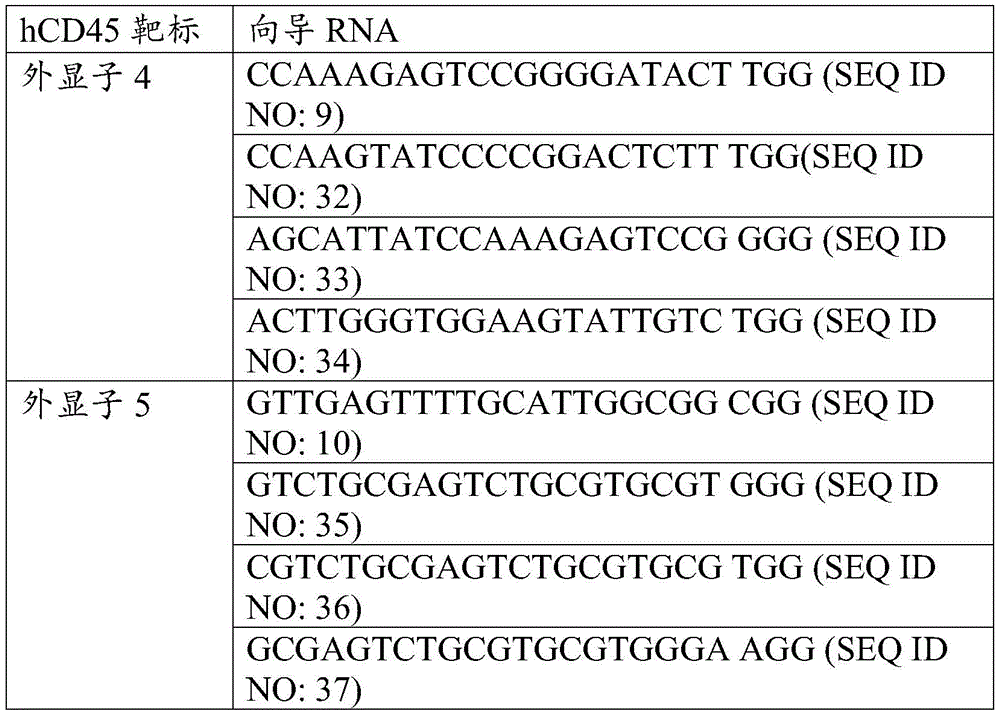
本文还提供了产生缺乏细胞表面谱系特异性抗原的细胞的方法,其涉及提供细胞并将用于基因组编辑的CRISPR Cas系统的组分引入细胞内。在一些实施方案中,将包含与编码谱系特异性细胞表面抗原的核苷酸序列的一部分杂交或预测会与之杂交的CRISPR-Cas向导RNA(gRNA)的核酸引入细胞内。在一些实施方案中,将gRNA在载体上引入细胞内。在一些实施方案中,将Cas核酸内切酶引入细胞内。在一些实施方案中,将Cas核酸内切酶作为编码Cas核酸内切酶的核酸引入细胞内。在一些实施方案中,将gRNA和编码Cas核酸内切酶的核苷酸序列在相同核酸(例如,相同载体)上引入细胞内。在一些实施方案中,将Cas核酸内切酶呈蛋白质的形式引入细胞内。在一些实施方案中,Cas核酸内切酶和gRNA在体外预先形成并作为复合物引入细胞内。Also provided herein are methods of producing cells lacking cell surface lineage-specific antigens that involve providing a cell and introducing into the cell components of a CRISPR Cas system for genome editing. In some embodiments, a nucleic acid comprising a CRISPR-Cas guide RNA (gRNA) that hybridizes or is predicted to hybridize to a portion of a nucleotide sequence encoding a lineage-specific cell surface antigen is introduced into the cell. In some embodiments, the gRNA is introduced into the cell on a vector. In some embodiments, a Cas endonuclease is introduced into the cell. In some embodiments, the Cas endonuclease is introduced into the cell as a nucleic acid encoding the Cas endonuclease. In some embodiments, the gRNA and the nucleotide sequence encoding the Cas endonuclease are introduced into the cell on the same nucleic acid (eg, the same vector). In some embodiments, the Cas endonuclease is introduced into the cell as a protein. In some embodiments, the Cas endonuclease and gRNA are preformed in vitro and introduced into the cell as a complex.
本公开还提供了经工程改造的、非天然存在的载体和载体系统,其可以编码CRISPR/Cas9复合物的一种或多种组分,其中载体包含编码以下的多核苷酸(i)与谱系特异性抗原序列杂交的(CRISPR)-Cas系统向导RNA和(ii)Cas9核酸内切酶。The present disclosure also provides engineered, non-naturally occurring vectors and vector systems that can encode one or more components of a CRISPR/Cas9 complex, wherein the vector comprises a polynucleotide encoding (i) and a repertoire of Specific antigen sequence hybridization (CRISPR)-Cas system guide RNA and (ii) Cas9 endonuclease.
本公开的载体可以使用哺乳动物表达载体驱动哺乳动物细胞中一个或多个序列的表达。哺乳动物表达载体的实例包括pCDM8(Seed,Nature(1987)329:840)和pMT2PC(Kaufman等,EMBO J.(1987)6:187)。用于哺乳动物细胞中时,表达载体的控制功能通常由一个或多个调控元件提供。例如,常用启动子源自多瘤、腺病毒2、巨细胞病毒、猿猴病毒40以及本文公开的和本领域已知的其它病毒。对于原核和真核细胞的其它合适的表达系统,参见例如,Sambrook等,MOLECULAR CLONING:A LABORATORY MANUAL第2版的第16和17章,Cold Spring Harbor Laboratory,Cold Spring Harbor Laboratory Press,Cold SpringHarbor,N.Y.,1989。Vectors of the present disclosure may use mammalian expression vectors to drive expression of one or more sequences in mammalian cells. Examples of mammalian expression vectors include pCDM8 (Seed, Nature (1987) 329:840) and pMT2PC (Kaufman et al., EMBO J. (1987) 6:187). When used in mammalian cells, the control functions of the expression vector are typically provided by one or more regulatory elements. For example, commonly used promoters are derived from polyoma,
本公开的载体能够指导核酸优先在特定细胞类型中表达(例如,组织特异性调控元件用于表达核酸)。此类调控元件包括可以是组织特异性或细胞特异性的启动子。当适用于启动子时,术语“组织特异性”是指在不同类型的组织中相同目标核苷酸序列相对不表达时,能够指导目标核苷酸序列在特定类型的组织(例如,种子)中选择性表达的启动子。当适用于启动子时,术语“细胞类型特异性”是指在相同组织内的不同类型的细胞中相同目标核苷酸序列相对不表达时,能够指导目标核苷酸序列在特定类型的细胞中选择性表达的启动子。当适用于启动子时,术语“细胞类型特异性”还意指能够促进目标核苷酸序列在单个组织内的区域中选择性表达的启动子。启动子的细胞类型特异性可以使用本领域公知的方法,例如免疫组织化学染色来评估。Vectors of the present disclosure are capable of directing the expression of nucleic acids preferentially in specific cell types (eg, tissue-specific regulatory elements for expression of nucleic acids). Such regulatory elements include promoters which may be tissue-specific or cell-specific. When applied to a promoter, the term "tissue-specific" refers to the ability to direct a target nucleotide sequence in a particular type of tissue (e.g., seeds) when the same target nucleotide sequence is relatively unexpressed in different types of tissues Promoter for selective expression. The term "cell type specific" when applied to a promoter refers to the ability to direct a target nucleotide sequence in a particular type of cell when the same target nucleotide sequence is relatively unexpressed in different types of cells within the same tissue Promoter for selective expression. The term "cell type specific" when applied to a promoter also means a promoter capable of promoting selective expression of a nucleotide sequence of interest in a region within a single tissue. Cell type specificity of a promoter can be assessed using methods well known in the art, such as immunohistochemical staining.
常规的基于病毒或非病毒的基因转移法可用于在哺乳动物细胞或靶组织内引入编码CRISPR/Cas9的核酸。此类方法可用于将编码CRISPR-Cas系统组分的核酸施用于培养物或宿主生物体内的细胞中。非病毒载体递送系统包括DNA质粒、RNA(例如,本文描述的载体的转录产物)、裸核酸和与递送媒介物复合的核酸。病毒载体递送系统包括DNA和RNA病毒,其在递送至细胞后具有附加型或整合基因组。有关基因治疗程序的综述。Conventional viral or non-viral based gene transfer methods can be used to introduce CRISPR/Cas9-encoding nucleic acids into mammalian cells or target tissues. Such methods can be used to administer nucleic acids encoding components of a CRISPR-Cas system to cells in culture or in a host organism. Non-viral vector delivery systems include DNA plasmids, RNA (eg, transcripts of the vectors described herein), naked nucleic acid, and nucleic acid complexed with a delivery vehicle. Viral vector delivery systems include DNA and RNA viruses, which have episomal or integrated genomes after delivery to cells. A review of gene therapy procedures.
病毒载体可直接施用给患者(体内)或者可将其用于操纵体外或离体细胞,其中可向患者施用经修饰的细胞。在一个实施方案中,本公开利用基于病毒的系统,包括但不限于逆转录病毒、慢病毒、腺病毒、腺相关病毒和单纯疱疹病毒进行基因转移。此外,本公开提供了能够整合到宿主基因组中的载体,例如逆转录病毒或慢病毒。优选地,用于表达本公开的CRISPR-Cas系统的载体是慢病毒载体。Viral vectors can be administered directly to a patient (in vivo) or they can be used to manipulate cells in vitro or ex vivo, where modified cells can be administered to a patient. In one embodiment, the present disclosure utilizes viral-based systems, including but not limited to retroviruses, lentiviruses, adenoviruses, adeno-associated viruses, and herpes simplex viruses, for gene transfer. In addition, the present disclosure provides vectors, such as retroviruses or lentiviruses, capable of integrating into the host genome. Preferably, the vector used to express the CRISPR-Cas system of the present disclosure is a lentiviral vector.
在一个实施方案中,本公开提供将编码CRISPR-Cas的一种或多种载体引入真核细胞内。所述细胞可为癌细胞。可选地,所述细胞是造血细胞,如造血干细胞。干细胞的实例包括亚全能干细胞(pluripotent)、多能干细胞(multipotent)和单能干细胞(unipotent)。亚全能干细胞的实例包括胚胎干细胞、胚胎生殖细胞、胚胎癌细胞和诱导型亚全能干细胞(iPSC)。在一个优选的实施方案中,本公开提供了将CRISPR-Cas9引入造血干细胞内。In one embodiment, the present disclosure provides for the introduction of one or more vectors encoding CRISPR-Cas into eukaryotic cells. The cells may be cancer cells. Optionally, the cells are hematopoietic cells, such as hematopoietic stem cells. Examples of stem cells include pluripotent, multipotent and unipotent. Examples of sub-totipotent stem cells include embryonic stem cells, embryonic germ cells, embryonic carcinoma cells, and induced sub-totipotent stem cells (iPSCs). In a preferred embodiment, the present disclosure provides for the introduction of CRISPR-Cas9 into hematopoietic stem cells.
将本公开的载体递送至受试者的真核细胞。通过CRISPR/Cas9系统修饰真核细胞可以发生在细胞培养物中,其中该方法包括在修饰之前从受试者分离真核细胞。在一些实施方案中,所述方法还包括将所述真核细胞和/或由其衍生的细胞返回至受试者。The vectors of the present disclosure are delivered to eukaryotic cells of a subject. Modification of eukaryotic cells by the CRISPR/Cas9 system can occur in cell culture, wherein the method comprises isolating the eukaryotic cells from the subject prior to modification. In some embodiments, the method further comprises returning the eukaryotic cells and/or cells derived therefrom to the subject.
组合疗法combination therapy
如本文所述,包含结合细胞表面谱系特异性抗原的抗原结合片段的药剂可以与缺乏细胞表面谱系特异性抗原的造血细胞组合施用给受试者。如本文中所用,“受试者”、“个体”和“患者”可互换使用,并且是指脊椎动物,优选哺乳动物例如人。哺乳动物包括但不限于人类灵长类动物、非人灵长类动物或鼠、牛、马、犬或猫科动物物种。在一些实施方案中,受试者是患有造血系统恶性肿瘤的人类患者。As described herein, an agent comprising an antigen-binding fragment that binds a cell surface lineage-specific antigen can be administered to a subject in combination with hematopoietic cells lacking a cell surface lineage-specific antigen. As used herein, "subject", "individual" and "patient" are used interchangeably and refer to a vertebrate, preferably a mammal such as a human. Mammals include, but are not limited to, human primates, non-human primates, or murine, bovine, equine, canine, or feline species. In some embodiments, the subject is a human patient with a hematopoietic malignancy.
在一些实施方案中,可将药剂和/或造血细胞与药学上可接受的载体混合形成药物组合物,其也在本公开的范围内。In some embodiments, agents and/or hematopoietic cells may be mixed with a pharmaceutically acceptable carrier to form a pharmaceutical composition, which is also within the scope of the present disclosure.
为了执行本文描述的方法,可以将有效量的包含结合细胞表面谱系特异性抗原的抗原结合片段和有效量的造血细胞的药剂共同施用给需要治疗的受试者。如本文中所用,术语“有效量”可以与术语“治疗有效量”互换使用,并且是指药剂、细胞群或药物组合物(例如,包含药剂和/或造血细胞的组合物)足以在施用给有需要的受试者后产生预期活性的量。在本公开的上下文中,术语“有效量”是指化合物、细胞群或药物组合物足以延迟通过本公开的方法治疗的病症的表现,阻止其进展,缓解或减轻其至少一种症状的量。注意,当施用活性成分的组合时,组合的有效量可以包括或不包括如果单独施用将会有效的每种成分的量。To perform the methods described herein, an effective amount of an agent comprising an antigen-binding fragment that binds a cell surface lineage-specific antigen and an effective amount of hematopoietic cells can be co-administered to a subject in need of treatment. As used herein, the term "effective amount" is used interchangeably with the term "therapeutically effective amount" and refers to an agent, cell population, or pharmaceutical composition (e.g., a composition comprising an agent and/or hematopoietic cells) sufficient to An amount that produces the desired activity when administered to a subject in need thereof. In the context of the present disclosure, the term "effective amount" refers to an amount of a compound, cell population or pharmaceutical composition sufficient to delay the manifestation, arrest the progression, alleviate or alleviate at least one symptom of a condition treated by the methods of the present disclosure. Note that when a combination of active ingredients is administered, the effective amount of the combination may or may not include the amount of each ingredient that would be effective if administered alone.
如本领域技术人员所认识的,有效量根据所治疗的特定病状、病状的严重程度、个体患者参数(包括年龄、身体状况、大小、性别和体重)、治疗持续时间、同时疗法的性质(若有)、特定施用途径和在保健医生的知识和专业技能范围内的类似因素变化。在一些实施方案中,有效量减轻、缓解、改善、改良、减少症状,或延迟受试者中任何疾病或病症的进展。在一些实施方案中,受试者为人。在一些实施方案中,受试者是患有造血系统恶性肿瘤的人类患者。As recognized by those skilled in the art, an effective amount will depend on the particular condition being treated, the severity of the condition, individual patient parameters (including age, physical condition, size, sex and weight), duration of treatment, nature of concomitant therapy (if available), the particular route of administration, and similar factors that are within the knowledge and expertise of the healthcare practitioner. In some embodiments, an effective amount alleviates, alleviates, ameliorates, ameliorates, reduces symptoms, or delays the progression of any disease or condition in a subject. In some embodiments, the subject is a human. In some embodiments, the subject is a human patient with a hematopoietic malignancy.
如本文所述,表达嵌合受体的造血细胞和/或免疫细胞是受试者自体的,即细胞从需要治疗的受试者获得,经基因工程改造为缺乏细胞表面谱系特异性抗原的表达或嵌合受体构建体的表达,然后施用给同一受试者。与施用非自体细胞相比,向受试者施用自体细胞可以导致宿主细胞的排斥减少。可选地,宿主细胞是同种异体细胞,即细胞从第一个受试者获得,经基因工程改造为缺乏细胞表面谱系特异性抗原的表达或嵌合受体构建体的表达,并施用给不同于第一受试者,但是物种相同的第二受试者。例如,同种异体免疫细胞可源自人类供者并施用给不同于供者的人类受者。As described herein, the hematopoietic and/or immune cells expressing the chimeric receptor are autologous to the subject, i.e., the cells are obtained from a subject in need thereof and genetically engineered to lack expression of cell surface lineage-specific antigens or expression of a chimeric receptor construct and then administered to the same subject. Administration of autologous cells to a subject can result in reduced rejection of the host cells compared to administration of non-autologous cells. Alternatively, the host cell is an allogeneic cell, i.e., a cell obtained from a first subject, genetically engineered to lack expression of a cell surface lineage-specific antigen or expression of a chimeric receptor construct, and administered to A second subject that is different from the first subject, but of the same species. For example, allogeneic immune cells can be derived from a human donor and administered to a human recipient different from the donor.
在一些实施方案中,免疫细胞和/或造血细胞是同种异体细胞并且已经进一步基因工程改造以减轻移植物抗宿主病。例如,如本文所述,造血干细胞可以经基因工程改造(例如,使用基因组编辑)以减少CD45RA的表达。In some embodiments, the immune cells and/or hematopoietic cells are allogeneic cells and have been further genetically engineered to reduce graft versus host disease. For example, hematopoietic stem cells can be genetically engineered (eg, using genome editing) to reduce expression of CD45RA, as described herein.
在一些实施方案中,表达本文描述的任何嵌合受体的免疫细胞以有效减少靶细胞(例如,癌细胞)数量的量施用给受试者,靶细胞数量减少至少20%,例如50%、80%、100%、2倍、5倍、10倍、20倍、50倍、100倍或更多。In some embodiments, immune cells expressing any of the chimeric receptors described herein are administered to the subject in an amount effective to reduce the number of target cells (e.g., cancer cells) by at least 20%, such as by 50%, 80%, 100%, 2x, 5x, 10x, 20x, 50x, 100x or more.
向哺乳动物(例如,人)施用的细胞(即,免疫细胞或造血细胞)典型的量可以例如在一百万至一千亿个细胞的范围内;然而,低于或高于该示例性范围的量也在本公开的范围内。例如,细胞的日剂量可为约100万至约500亿个细胞(例如,约500万个细胞、约2500万个细胞、约5亿个细胞、约10亿个细胞、约50亿个细胞、约200亿个细胞、约300亿个细胞、约400亿个细胞或由上述任两个值限定的范围),优选约1千万至约1000亿个细胞(例如,约2千万个细胞、约3千万个细胞、约4千万个细胞、约6千万个细胞、约7千万个细胞、约8千万个细胞、约9千万个细胞、约100亿个细胞、约250亿个细胞、约500亿个细胞、约750亿个细胞、约900亿个细胞或由上述任两个值限定的范围),更优选约1亿个细胞至约500亿个细胞(例如,约1.2亿个细胞、约2.5亿个细胞、约3.5亿个细胞、约4.5亿个细胞、约6.5亿个细胞、约8亿个细胞、约9亿个细胞、约30亿个细胞、约300亿个细胞、约450亿个细胞或由上述任两个值限定的范围)。Typical amounts of cells (i.e., immune cells or hematopoietic cells) administered to a mammal (e.g., a human) can be, for example, in the range of one million to one hundred billion cells; however, below or above this exemplary range The amount is also within the scope of the present disclosure. For example, the daily dose of cells can be from about 1 million to about 50 billion cells (e.g., about 5 million cells, about 25 million cells, about 500 million cells, about 1 billion cells, about 5 billion cells, about 20 billion cells, about 30 billion cells, about 40 billion cells, or a range defined by any two of the above values), preferably about 10 million to about 100 billion cells (e.g., about 20 million cells, About 30 million cells, about 40 million cells, about 60 million cells, about 70 million cells, about 80 million cells, about 90 million cells, about 10 billion cells, about 250 100 million cells, about 50 billion cells, about 75 billion cells, about 90 billion cells, or a range defined by any two of the above values), more preferably from about 100 million cells to about 50 billion cells (e.g., about 120 million cells, about 250 million cells, about 350 million cells, about 450 million cells, about 650 million cells, about 800 million cells, about 900 million cells, about 3 billion cells, about 30 billion cells cells, approximately 45 billion cells, or a range bounded by any two of the above values).
在一个实施方案中,将嵌合受体(例如,编码嵌合受体的核酸)引入免疫细胞中,并且受试者(例如,人类患者)接受初次施用或剂量的表达嵌合受体的免疫细胞。药剂的一次或多次后续施用(例如,表达嵌合受体的免疫细胞)可以在前一次施用后间隔15天、14天、13天、12天、11天、10天、9天、8天、7天、6天、5天、4天、3天或2天提供给患者。每周可向受试者施用多于一个剂量的药剂,例如施用药剂2、3、4次或更多次。受试者每周可以接受多于一个剂量的药剂(例如,表达嵌合受体的免疫细胞),随后一周不施用药剂,最后接着是一个或多个附加剂量的药剂(例如,每周施用一次以上的表达嵌合受体的免疫细胞)。表达嵌合受体的免疫细胞可以每隔一天施用,每周施用3次,持续2、3、4、5、6、7、8周或更多周。In one embodiment, a chimeric receptor (e.g., a nucleic acid encoding a chimeric receptor) is introduced into immune cells, and a subject (e.g., a human patient) receives an initial administration or dose of an immunization agent expressing the chimeric receptor. cell. One or more subsequent administrations of the agent (e.g., immune cells expressing a chimeric receptor) can be separated by 15 days, 14 days, 13 days, 12 days, 11 days, 10 days, 9 days, 8 days after the previous administration , 7 days, 6 days, 5 days, 4 days, 3 days or 2 days to patients. More than one dose of the agent may be administered to the subject per week, eg, the agent is administered 2, 3, 4 or more times per week. The subject can receive more than one dose of the agent (e.g., immune cells expressing a chimeric receptor) per week, followed by no administration of the agent for one week, and finally followed by one or more additional doses of the agent (e.g., administered once a week above immune cells expressing chimeric receptors). Immune cells expressing chimeric receptors can be administered every other day, 3 times a week, for 2, 3, 4, 5, 6, 7, 8 or more weeks.
在本公开的上下文中,就其涉及本文叙述的任何疾病病状而言,术语“治疗”等意指减轻或缓解与此类病状相关的至少一种症状,或者减缓或逆转此类病状的进展。在本公开的含义内,术语“治疗”还表示阻止、延迟发作(即疾病临床表现之前的时期)和/或降低疾病发展或恶化的风险。例如,关于癌症,术语“治疗”可能意指消除或减少患者的肿瘤负担,或预防、延迟或抑制转移等。In the context of this disclosure, the term "treat" and the like, as it relates to any disease condition described herein, means to alleviate or relieve at least one symptom associated with such condition, or to slow or reverse the progression of such condition. Within the meaning of the present disclosure, the term "treating" also means arresting, delaying the onset (ie the period preceding the clinical manifestation of the disease) and/or reducing the risk of the development or progression of the disease. For example, with respect to cancer, the term "treating" may mean eliminating or reducing a patient's tumor burden, or preventing, delaying or inhibiting metastasis, and the like.
在一些实施方案中,药剂包含结合细胞表面谱系特异性抗原的抗原结合片段和缺乏细胞表面谱系特异性抗原的造血细胞群。因此,在此类治疗方法中,药剂识别(结合)表达细胞表面谱系特异性抗原的靶细胞以靶向杀伤。缺乏抗原的造血细胞允许再生药剂所靶向的细胞类型。在一些实施方案中,所述患者的治疗可涉及以下步骤:(1)向患者施用治疗有效量的靶向细胞表面谱系特异性抗原的药剂,和(2)为患者输注或再输注自体或同种异体造血干细胞,其中造血细胞的谱系特异性疾病相关抗原的表达减少。在一些实施方案中,所述患者的治疗可涉及以下步骤:(1)向患者施用治疗有效量的表达嵌合受体的免疫细胞,其中所述免疫细胞包含编码结合细胞表面谱系特异性、疾病相关抗原的嵌合受体的核酸;及(2)为患者输注或再输注自体或同种异体造血干细胞(例如,造血干细胞),其中造血细胞的谱系特异性疾病相关抗原的表达减少。In some embodiments, the agent comprises an antigen-binding fragment that binds a cell surface lineage-specific antigen and a population of hematopoietic cells lacking the cell surface lineage-specific antigen. Thus, in such therapeutic methods, the agent recognizes (binds) target cells expressing cell surface lineage-specific antigens for targeted killing. The lack of antigen in hematopoietic cells allows regeneration of the cell types targeted by agents. In some embodiments, treatment of the patient may involve the steps of: (1) administering to the patient a therapeutically effective amount of an agent targeting a cell surface lineage-specific antigen, and (2) infusing or re-infusing the patient with an autologous or allogeneic hematopoietic stem cells in which hematopoietic cells have reduced expression of lineage-specific disease-associated antigens. In some embodiments, treatment of the patient may involve the steps of: (1) administering to the patient a therapeutically effective amount of an immune cell expressing a chimeric receptor, wherein the immune cell contains nucleic acids of chimeric receptors for relevant antigens; and (2) infusing or reinfusing autologous or allogeneic hematopoietic stem cells (eg, hematopoietic stem cells) into a patient in which expression of a lineage-specific disease-associated antigen of the hematopoietic cells is reduced.
使用包含结合细胞表面谱系特异性抗原的抗原结合片段和缺乏细胞表面谱系特异性抗原的造血细胞群的药剂的治疗方法的疗效可以通过本领域已知的任何方法来评估,并且对于熟练的医学专业人员来说将是显而易见的。例如,可以通过受试者的存活率或受试者或其组织或样品中的癌症负荷来评估所述疗法的疗效。在一些实施方案中,通过量化属于特定细胞群或谱系的细胞的数量来评估所述疗法的疗效。在一些实施方案中,通过量化呈递细胞表面谱系特异性抗原的细胞的数量来评估所述疗法的疗效。The efficacy of a method of treatment using an agent comprising an antigen-binding fragment that binds a cell-surface lineage-specific antigen and a population of hematopoietic cells that lacks a cell-surface lineage-specific antigen can be assessed by any method known in the art and available to a skilled medical professional It will be obvious to the personnel. For example, the efficacy of the therapy can be assessed by the survival rate of the subject or the cancer burden in the subject or its tissues or samples. In some embodiments, the efficacy of the therapy is assessed by quantifying the number of cells belonging to a particular cell population or lineage. In some embodiments, the efficacy of the therapy is assessed by quantifying the number of cells presenting cell surface lineage-specific antigens.
在一些实施方案中,药剂包含结合细胞表面谱系特异性抗原的抗原结合片段和附随施用的造血细胞IS群。In some embodiments, the medicament comprises an antigen-binding fragment that binds a cell surface lineage-specific antigen and is administered concomitantly with an IS population of hematopoietic cells.
在一些实施方案中,包含结合细胞表面谱系特异性抗原的抗原结合片段的药剂(例如表达如本文所描述的嵌合受体的免疫细胞)在施用造血细胞之前施用。在一些实施方案中,包含结合细胞表面谱系特异性抗原的抗原结合片段的药剂(例如,表达如本文所描述的嵌合受体的免疫细胞)在施用造血细胞之前至少约1天、2天、3天、4天、5天、6天、1周、2周、3周、4周、5周、6周、7周、8周、9周、10周、11周、12周、3个月、4个月、5个月、6个月或更长时间施用。In some embodiments, an agent comprising an antigen-binding fragment that binds a cell surface lineage-specific antigen (eg, an immune cell expressing a chimeric receptor as described herein) is administered prior to administration of the hematopoietic cells. In some embodiments, the agent comprising an antigen-binding fragment that binds a cell surface lineage-specific antigen (e.g., an immune cell expressing a chimeric receptor as described herein) is administered at least about 1 day, 2 days, 3 days, 4 days, 5 days, 6 days, 1 week, 2 weeks, 3 weeks, 4 weeks, 5 weeks, 6 weeks, 7 weeks, 8 weeks, 9 weeks, 10 weeks, 11 weeks, 12 weeks, 3 weeks Months, 4 months, 5 months, 6 months or more.
在一些实施方案中,造血细胞在包含结合细胞表面谱系特异性抗原的抗原结合片段的药剂(例如表达如本文所描述的嵌合受体的免疫细胞)之前施用。在一些实施方案中,在施用包含结合细胞表面谱系特异性抗原的抗原结合片段的药剂之前至少约1天、2天、3天、4天、5天、6天、1周、2周、3周、4周、5周、6周、7周、8周、9周、10周、11周、12周、3个月、4个月、5个月、6个月或更长时间施用造血细胞群。In some embodiments, hematopoietic cells are administered prior to an agent comprising an antigen-binding fragment that binds a cell surface lineage-specific antigen (eg, an immune cell expressing a chimeric receptor as described herein). In some embodiments, at least about 1 day, 2 days, 3 days, 4 days, 5 days, 6 days, 1 week, 2 weeks, 3 days prior to administering the agent comprising an antigen-binding fragment that binds a cell surface lineage-specific antigen Hematopoietic administration for weeks, 4 weeks, 5 weeks, 6 weeks, 7 weeks, 8 weeks, 9 weeks, 10 weeks, 11 weeks, 12 weeks, 3 months, 4 months, 5 months, 6 months or more cell population.
在一些实施方案中,基本上同时施用靶向细胞表面谱系特异性抗原的药剂和造血细胞群。在一些实施方案中,施用靶向细胞表面谱系特异性抗原的药剂并评估患者一段时间,之后施用造血细胞群。在一些实施方案中,施用造血细胞群并评估患者一段时间,之后施用靶向细胞表面谱系特异性抗原的药剂。In some embodiments, the agent targeting a cell surface lineage-specific antigen and the population of hematopoietic cells are administered substantially simultaneously. In some embodiments, the population of hematopoietic cells is administered after administering an agent targeting a cell surface lineage-specific antigen and evaluating the patient for a period of time. In some embodiments, a population of hematopoietic cells is administered and the patient is assessed for a period of time, followed by administration of an agent targeting a lineage-specific antigen on the cell surface.
同样在本公开的范围内的是多次施用(例如,多个剂量)造血细胞和/或造血细胞群。在一些实施方案中,药剂和/或造血细胞群向受试者施用一次。在一些实施方案中,药剂和/或造血细胞群向受试者施用一次以上(例如,至少2、3、4、5次或更多次)。在一些实施方案中,药剂和/或造血细胞群向受试者定期施用,例如,每6个月一次。Also within the scope of the present disclosure is multiple administrations (eg, multiple doses) of hematopoietic cells and/or populations of hematopoietic cells. In some embodiments, the agent and/or population of hematopoietic cells is administered once to the subject. In some embodiments, the agent and/or population of hematopoietic cells is administered to the subject more than once (eg, at least 2, 3, 4, 5 or more times). In some embodiments, the agent and/or hematopoietic cell population is administered to the subject on a regular basis, eg, every 6 months.
在一些实施方案中,受试者是患有造血系统恶性肿瘤的人类受试者。如本文中所用,造血系统恶性肿瘤是指涉及造血细胞(例如,血细胞,包括祖细胞和干细胞)的恶性异常。造血系统恶性肿瘤的实例包括但不限于霍奇金淋巴瘤、非霍奇金淋巴瘤、白血病或多发性骨髓瘤。白血病包括急性骨髓性白血病、急性淋巴细胞性白血病、慢性髓细胞性白血病、急性淋巴母细胞性白血病或慢性淋巴母细胞性白血病和慢性淋巴性白血病。In some embodiments, the subject is a human subject with a hematopoietic malignancy. As used herein, a hematopoietic malignancy refers to a malignant abnormality involving hematopoietic cells (eg, blood cells, including progenitor cells and stem cells). Examples of hematopoietic malignancies include, but are not limited to, Hodgkin's lymphoma, non-Hodgkin's lymphoma, leukemia, or multiple myeloma. Leukemia includes acute myeloid leukemia, acute lymphoblastic leukemia, chronic myelogenous leukemia, acute lymphoblastic leukemia or chronic lymphoblastic leukemia and chronic lymphocytic leukemia.
在一些实施方案中,白血病是急性骨髓性白血病(AML)。AML的特征是异源性、克隆性、肿瘤性疾病,该疾病起源于逐渐获得破坏关键分化和生长调节途径的关键基因变化的转化细胞。(Dohner等,NEJM,(2015)373:1136)。CD33糖蛋白在大多数骨髓性白血病细胞以及正常骨髓和单核细胞前体上表达,并且已被认为是有吸引力的AML治疗的靶标(Laszlo等,Blood Rev.(2014)28(4):143-53)。虽然使用基于抗CD33单克隆抗体的疗法的临床试验已经显示与标准化学疗法组合时AML患者亚类中的存活率提高,但这些效果还伴有安全性和疗效问题。In some embodiments, the leukemia is acute myelogenous leukemia (AML). AML is characterized as a heterogeneous, clonal, neoplastic disease that arises from transformed cells that progressively acquire key genetic changes that disrupt key differentiation and growth regulatory pathways. (Dohner et al., NEJM, (2015) 373:1136). The CD33 glycoprotein is expressed on most myeloid leukemia cells as well as normal myeloid and monocyte precursors and has been considered an attractive target for AML therapy (Laszlo et al., Blood Rev. (2014) 28(4): 143-53). Although clinical trials using anti-CD33 monoclonal antibody-based therapies have shown improved survival in subclasses of AML patients when combined with standard chemotherapy, these effects have been accompanied by safety and efficacy concerns.
旨在靶向AML细胞的其它努力涉及产生表达选择性靶向AML中的CD33的嵌合抗原受体(CAR)的T细胞。Buckley等,Curr.Hematol.Malig.Rep.(2):65(2015)。然而,数据有限并且这种方法可能在治疗患者方面多么有效(不管是否消除所有靶向细胞)都存在不确定性。另外,因为髓系细胞对于生命是必不可少的,所以消耗受试者的髓系细胞可能对患者的存活具有不利影响。本公开至少部分旨在解决此类与AML治疗相关的问题。Other efforts aimed at targeting AML cells have involved generating T cells expressing chimeric antigen receptors (CARs) that selectively target CD33 in AML. Buckley et al., Curr. Hematol. Malig. Rep. (2): 65 (2015). However, data are limited and there is uncertainty about how effective this approach might be in treating patients, regardless of whether all targeted cells are eliminated. Additionally, because myeloid cells are essential to life, depleting a subject's myeloid cells may have an adverse effect on the patient's survival. The present disclosure aims, at least in part, to address such issues related to AML treatment.
可选地或另外,本文描述的方法可用于治疗非造血系统癌症,包括但不限于肺癌、耳鼻咽喉癌、结肠癌、黑素瘤、胰腺癌、乳腺癌、前列腺癌、乳房癌、卵巢癌、基底细胞癌、胆道癌;膀胱癌;骨癌;乳房癌;宫颈癌;绒毛膜癌;结直肠癌;结缔组织癌;消化系统癌;子宫内膜癌;食道癌;眼癌;头颈癌;胃癌;上皮内肿瘤;肾癌;喉癌;肝癌;纤维瘤、神经母细胞瘤;口腔癌(例如唇、舌、口和咽);卵巢癌;胰腺癌;前列腺癌;视网膜母细胞瘤;横纹肌肉瘤;直肠癌;肾癌;呼吸系统癌;肉瘤;皮肤癌;胃部癌;睾丸癌;甲状腺癌;子宫癌;泌尿系统癌以及其它癌和肉瘤。Alternatively or additionally, the methods described herein may be used to treat non-hematopoietic cancers including, but not limited to, lung cancer, ear, nose and throat cancer, colon cancer, melanoma, pancreatic cancer, breast cancer, prostate cancer, breast cancer, ovarian cancer, Basal cell carcinoma, biliary tract cancer; bladder cancer; bone cancer; breast cancer; cervical cancer; choriocarcinoma; colorectal cancer; connective tissue cancer; digestive system cancer; endometrial cancer; esophageal cancer; eye cancer; head and neck cancer; gastric cancer ; intraepithelial neoplasms; renal cancer; laryngeal cancer; liver cancer; fibroma, neuroblastoma; ; rectal cancer; kidney cancer; respiratory system cancer; sarcoma; skin cancer; stomach cancer; testicular cancer; thyroid cancer; uterine cancer; urinary system cancer and other cancers and sarcomas
癌症是上皮来源的癌症。旨在用本公开的方法治疗的癌症包括但不限于腺泡癌、腺泡状癌、肺泡腺癌(也称为囊性腺样癌、腺肌上皮瘤、筛状癌和圆柱瘤)、腺癌、腺癌、肾上腺皮质癌、肺泡癌、肺泡细胞癌(也称为细支气管癌、肺泡细胞瘤和肺腺瘤病)、基底细胞癌、基底样细胞癌(也称为基底细胞瘤(basaloma)或基底细胞癌(basiloma)和毛母质癌)、基底样癌、基底鳞状细胞癌、乳房癌、细支气管肺泡癌、细支气管癌、支气管癌、髓样癌、胆管细胞癌(也称为胆管瘤和胆管癌)、绒毛膜癌、胶样癌、粉刺癌、子宫体癌、筛状癌、胸廓癌、皮肤癌、柱状癌、柱状细胞癌、导管癌、硬癌、胚胎性癌、髓样癌、眼球上癌、表皮样癌、腺样上皮细胞癌、溃疡原癌、纤维癌、胶样癌、胶状癌、巨细胞癌、巨细胞癌、腺癌、粒层细胞癌、毛母质癌、血样癌、肝细胞癌(也称为肝细胞瘤、恶性肝细胞瘤和肝癌)、何氏细胞癌(Huirthlecell carcinoma)、透明癌、肾上腺样癌、幼稚型胚胎性癌、原位癌、表皮内癌、上皮内癌、Krompecher癌、Kulchitzky细胞癌、豆状癌、豆状癌、脂肪瘤癌、淋巴上皮癌、乳腺炎性癌、软癌、髓样癌、黑色素癌(carcinoma melanodes)、黑色素癌(melanotic carcinoma)、粘液癌(mucinous carcinoma)、粘液癌(carcinoma muciparum)、粘液细胞癌、粘液表皮样癌、粘液癌(carcinoma mucosum)、粘液癌(mucous carcinoma)、粘液瘤样癌、鼻咽癌、黑色素癌(carcinoma nigrum)、燕麦细胞癌、骨化癌、骨样癌、卵巢癌、乳头状癌、门静脉周癌、浸润前癌、前列腺癌、肾细胞癌(也称为肾腺癌和hypemephoroid carcinoma)、储备细胞癌、肉瘤样癌、施奈德氏癌(scheinderian carcinoma)、硬癌、阴囊癌、印戒细胞癌、单纯癌、小细胞癌、马铃薯状癌、球状细胞癌、梭形细胞癌、髓样癌(carcinoma spongiosum)、鳞状癌、鳞状细胞癌、绳捆癌、血管扩张性癌(carcinoma telangiectaticum)、血管扩张性癌(carcinomatelangiectodes)、移行细胞癌、结节性皮癌(carcinoma tuberosum)、结节性皮癌(tuberous carcinoma)、疣状癌(verrucous carcinoma)、绒毛状癌。在优选的实施方案中,本公开的方法用于治疗患有乳房癌、宫颈癌、卵巢癌、前列腺癌、肺癌、结直肠癌、胰腺癌、胃癌或肾癌的受试者。The cancer is a cancer of epithelial origin. Cancers intended to be treated by the methods of the present disclosure include, but are not limited to, acinar carcinoma, acinar carcinoma, alveolar adenocarcinoma (also known as cystic adenoid carcinoma, adenomyoepithelioma, cribriform carcinoma, and cylindroma), adenocarcinoma , adenocarcinoma, adrenocortical carcinoma, alveolar carcinoma, alveolar cell carcinoma (also known as bronchiolar carcinoma, alveolar cell tumor, and pulmonary adenomatosis), basal cell carcinoma, basaloid cell carcinoma (also known as basaloma) or basiloma and hair matrix carcinoma), basaloid carcinoma, basal squamous cell carcinoma, breast carcinoma, bronchioloalveolar carcinoma, bronchiolar carcinoma, bronchial carcinoma, medullary carcinoma, cholangiocarcinoma (also known as cholangiocarcinoma tumor and cholangiocarcinoma), choriocarcinoma, colloid carcinoma, acne carcinoma, uterine body carcinoma, cribriform carcinoma, thoracic carcinoma, skin cancer, columnar carcinoma, columnar cell carcinoma, ductal carcinoma, scirrhous carcinoma, embryonal carcinoma, medullary carcinoma Carcinoma, supraocular carcinoma, epidermoid carcinoma, adenoid epithelial carcinoma, ulcerative carcinoma, fibrocarcinoma, colloid carcinoma, colloid carcinoma, giant cell carcinoma, giant cell carcinoma, adenocarcinoma, granulosa cell carcinoma, hair matrix carcinoma , hematologic carcinoma, hepatocellular carcinoma (also known as hepatoma, malignant hepatoma, and liver carcinoma), Huirthlecell carcinoma, clear carcinoma, adrenoid carcinoma, juvenile embryonal carcinoma, carcinoma in situ, epidermal Internal carcinoma, intraepithelial carcinoma, Krompecher carcinoma, Kulchitzky cell carcinoma, lentiform carcinoma, lentiform carcinoma, lipomatous carcinoma, lymphoepithelial carcinoma, inflammatory carcinoma of the mammary gland, soft carcinoma, medullary carcinoma, carcinoma melanodes, melanoma Carcinoma (melanotic carcinoma), mucinous carcinoma (mucinous carcinoma), mucinous carcinoma (carcinoma muciparum), mucinous cell carcinoma, mucoepidermoid carcinoma, mucinoma mucosum, mucous carcinoma, myxomatoid carcinoma, nasopharynx carcinoma, melanoma (carcinoma nigrum), oat cell carcinoma, ossification carcinoma, osteoid carcinoma, ovarian carcinoma, papillary carcinoma, periportal carcinoma, preinvasive carcinoma, prostate carcinoma, renal cell carcinoma (also known as renal adenocarcinoma and hypomephoroid carcinoma), reserve cell carcinoma, sarcomatoid carcinoma, scheinderian carcinoma, cirrhous carcinoma, scrotal carcinoma, signet ring cell carcinoma, simplex carcinoma, small cell carcinoma, potato-shaped carcinoma, spherical cell carcinoma, spindle-shaped carcinoma Cell carcinoma, medullary carcinoma (carcinoma spongiosum), squamous carcinoma, squamous cell carcinoma, cord carcinoma, vasodilatory carcinoma (carcinoma telangiectaticum), vasodilatory carcinoma (carcinomatelangiectodes), transitional cell carcinoma, nodular skin carcinoma (carcinoma tuberosum), nodular skin carcinoma (tuberous carcinoma), verrucous carcinoma (verr ucous carcinoma), villous carcinoma. In preferred embodiments, the methods of the present disclosure are used to treat a subject with breast cancer, cervical cancer, ovarian cancer, prostate cancer, lung cancer, colorectal cancer, pancreatic cancer, gastric cancer, or kidney cancer.
肉瘤是骨和软组织中产生的间质瘤。识别不同类型的肉瘤并且这些包括:脂肪肉瘤(包括粘液样脂肪肉瘤和多形性脂肪肉瘤)、平滑肌肉瘤、横纹肌肉瘤、恶性外周神经鞘瘤(也称为恶性神经鞘瘤、神经纤维肉瘤或神经原性肉瘤)、尤因氏瘤(Ewing's tumor)(包括尤因氏骨肉瘤、骨外(即非骨)尤因氏肉瘤和原始神经外胚层肿瘤[PNET])、滑膜肉瘤、血管肉瘤(angiosarcoma)、血管肉瘤(hemangiosarcoma)、淋巴管肉瘤、卡波西肉瘤(Kaposi'ssarcoma)、血管内皮瘤、纤维肉瘤、硬纤维瘤(也称为侵袭性纤维瘤病)、隆凸性皮肤纤维肉瘤(DFSP)、恶性纤维组织细胞瘤(MFH)、血管外皮细胞瘤、恶性间叶瘤、肺泡软组织肉瘤、上皮样肉瘤、透明细胞肉瘤、促结缔组织增生小细胞瘤、胃肠道基质肿瘤(GIST)(也称为GI基质肉瘤)、骨骼和骨外骨肉瘤(也称为骨源性肉瘤)及软骨肉瘤。Sarcomas are stromal tumors that arise in bone and soft tissue. Different types of sarcomas are recognized and these include: liposarcoma (including myxoid liposarcoma and pleomorphic liposarcoma), leiomyosarcoma, rhabdomyosarcoma, malignant peripheral nerve sheath tumor (also known as malignant schwannoma, neurofibrosarcoma, or nerve primary sarcoma), Ewing's tumor (including Ewing's osteosarcoma, extraskeletal (i.e., non-bone) Ewing's sarcoma, and primitive neuroectodermal tumor [PNET]), synovial sarcoma, angiosarcoma ( angiosarcoma, hemangiosarcoma, lymphangiosarcoma, Kaposi's sarcoma, hemangioendothelioma, fibrosarcoma, desmoid tumor (also called aggressive fibromatosis), dermatofibrosarcoma protuberans (DFSP), malignant fibrous histiocytoma (MFH), hemangiopericytoma, malignant mesenchymal tumor, alveolar soft tissue sarcoma, epithelioid sarcoma, clear cell sarcoma, desmoplastic small cell tumor, gastrointestinal stromal tumor (GIST) ) (also known as GI stromal sarcoma), bone and extraskeletal osteosarcoma (also known as osteogenic sarcoma), and chondrosarcoma.
在一些实施方案中,待治疗的癌症可以是难治性癌症。如本文中所用,“难治性癌症”是对所规定的护理标准具有抗性的癌症。这些癌症可能最初对治疗有反应(然后复发),或者它们可能对治疗完全没有反应。普通护理标准将根据癌症类型和受试者的进展程度而变化。可以是化疗或手术或放疗或其组合。本领域的普通技术人员知道此类护理标准。根据本公开治疗难治性癌症的受试者因此可能已经接触到针对其癌症的另一种治疗。可选地,如果癌症可能是难治性的(例如,鉴于对受试者癌细胞或病史的分析),那么受试者可能尚未接触过其它治疗。难治性癌症的实例包括但不限于白血病、黑素瘤、肾细胞癌、结肠癌、肝脏(肝)癌、胰腺癌、非霍奇金淋巴瘤和肺癌。In some embodiments, the cancer to be treated can be a refractory cancer. As used herein, a "refractory cancer" is a cancer that is resistant to the prescribed standard of care. These cancers may initially respond to treatment (and then recur), or they may not respond to treatment at all. Usual standard of care will vary depending on the type of cancer and how advanced the subject is. It can be chemotherapy or surgery or radiation therapy or a combination thereof. Such standards of care are known to those of ordinary skill in the art. A subject whose cancer is refractory to treatment according to the present disclosure may thus have been exposed to another treatment for their cancer. Alternatively, if the cancer is likely to be refractory (eg, in light of analysis of the subject's cancer cells or medical history), the subject may not have been exposed to other treatments. Examples of refractory cancers include, but are not limited to, leukemia, melanoma, renal cell carcinoma, colon cancer, liver (liver) cancer, pancreatic cancer, non-Hodgkin's lymphoma, and lung cancer.
表达本文描述的嵌合受体的任何免疫细胞均可在药学上可接受的载体或赋形剂中作为药物组合物施用。Any immune cell expressing a chimeric receptor described herein can be administered as a pharmaceutical composition in a pharmaceutically acceptable carrier or excipient.
结合本公开的组合物和/或细胞使用的短语“药学上可接受的”是指此类组合物的分子实体和其它成分,其在生理上可耐受并且施用给哺乳动物(例如,人)时通常不产生不良反应。优选地,如本文中所用,术语“药学上可接受的”意指经联邦或州政府监管机构批准或列入美国药典或其它公认药典中用于哺乳动物且更特别是用于人类中。“可接受的”意指载体与组合物的活性成分(例如,核酸、载体、细胞或治疗性抗体)相容,并且不会对施用组合物的受试者产生不利影响。用于本发明方法中的任何药物组合物和/或细胞可以包含呈冻干制剂或水溶液形式的药学上可接受的载体、赋形剂或稳定剂。The phrase "pharmaceutically acceptable" as used in connection with compositions and/or cells of the present disclosure refers to the molecular entities and other components of such compositions that are physiologically tolerable and administered to a mammal (e.g., a human) Usually no adverse reactions occur. Preferably, as used herein, the term "pharmaceutically acceptable" means approved by a regulatory agency of the federal or state government or listed in the US Pharmacopoeia or other generally recognized pharmacopoeia for use in mammals and more particularly in humans. "Acceptable" means that the carrier is compatible with the active ingredients of the composition (eg, nucleic acid, vector, cell, or therapeutic antibody) and will not adversely affect the subject to whom the composition is administered. Any pharmaceutical composition and/or cells used in the methods of the invention may comprise a pharmaceutically acceptable carrier, excipient or stabilizer in the form of a lyophilized formulation or an aqueous solution.
药学上可接受的载体,包括缓冲剂,是本领域公知的,并且可以包含磷酸盐、柠檬酸盐和其它有机酸;抗氧化剂包括抗坏血酸和甲硫氨酸;防腐剂;低分子量多肽;蛋白质,如血清白蛋白、明胶或免疫球蛋白;氨基酸;疏水性聚合物;单糖;双糖;和其它碳水化合物;金属络合物;和/或非离子表面活性剂。参见例如,Remington:The Science and Practice ofPharmacy第20版(2000)Lippincott Williams和Wilkins编辑,K.E.Hoover。Pharmaceutically acceptable carriers, including buffers, are well known in the art and may include phosphates, citrates, and other organic acids; antioxidants including ascorbic acid and methionine; preservatives; low molecular weight polypeptides; proteins, Such as serum albumin, gelatin or immunoglobulin; amino acids; hydrophobic polymers; monosaccharides; disaccharides; and other carbohydrates; metal complexes; and/or nonionic surfactants. See, eg, Remington: The Science and Practice of Pharmacy 20th Edition (2000) Lippincott Williams and Wilkins eds., K.E. Hoover.
用于治疗用途的试剂盒kits for therapeutic use
同样在本公开范围内的是用于靶向细胞表面谱系特异性抗原的药剂与缺乏细胞表面谱系特异性抗原的造血细胞群组合使用的试剂盒。此类试剂盒可包括一个或多个容器,其包含第一药物组合物和第二药物组合物,第一药物组合物包含含有结合细胞表面谱系特异性抗原的抗原结合片段的任何药剂(例如,表达本文描述的嵌合受体的免疫细胞)和药学上可接受的载体,所述第二药物组合物包含缺乏细胞表面谱系特异性抗原的造血细胞群(例如,造血干细胞)和药学上可接受的载体。Also within the scope of the present disclosure are kits for use of an agent targeting a cell surface lineage-specific antigen in combination with a population of hematopoietic cells lacking the cell surface lineage-specific antigen. Such kits can include one or more containers comprising a first pharmaceutical composition comprising any agent comprising an antigen-binding fragment that binds a cell surface lineage-specific antigen (e.g., a second pharmaceutical composition) and a second pharmaceutical composition. expressing chimeric receptors described herein) and a pharmaceutically acceptable carrier, the second pharmaceutical composition comprises a population of hematopoietic cells (eg, hematopoietic stem cells) lacking cell surface lineage-specific antigens and a pharmaceutically acceptable Carrier.
在一些实施方案中,试剂盒可以包含在本文描述的任何方法中使用的说明书。所包括的说明书可以包含对第一和第二药物组合物向受试者施用以在受试者中实现预期活性的说明。试剂盒还可包含基于鉴定受试者是否需要治疗来选择适于治疗的受试者的说明。在一些实施方案中,说明书包含向需要治疗的受试者施用第一和第二药物组合物的说明。In some embodiments, a kit can comprise instructions for use in any of the methods described herein. The included instructions can comprise instructions for administering the first and second pharmaceutical compositions to the subject to achieve the desired activity in the subject. The kit may also comprise instructions for selecting a subject suitable for treatment based on identifying whether the subject is in need of treatment. In some embodiments, the instructions comprise instructions for administering the first and second pharmaceutical compositions to a subject in need of treatment.
关于使用靶向细胞表面谱系特异性抗原的药剂和本文描述的第一和第二药物组合物的说明书通常包括关于预期治疗的剂量、给药方案和施用途径的信息。容器可以是单位剂量、散装(例如,多剂量包装)或亚单位剂量。本公开试剂盒中提供的说明书通常是在标签或包装插页上的书面说明书。标签或包装插页指示药物组合物用于治疗、延迟受试者中疾病或病状的发作和/或缓解受试者中疾病或病状。Instructions for using the agent targeting a cell surface lineage-specific antigen and the first and second pharmaceutical compositions described herein generally include information on the dosage, dosing regimen, and route of administration for the intended treatment. The container can be unit-dose, bulk (eg, multi-dose packaging), or subunit-dose. The instructions provided in kits of the present disclosure will typically be written instructions on a label or package insert. The label or package insert indicates that the pharmaceutical composition is used to treat, delay the onset of, and/or ameliorate a disease or condition in a subject.
本文提供的试剂盒呈合适的包装。合适的包装包括但不限于小瓶、瓶、罐、软包装等。还考虑了与特定装置如吸入器、鼻部施用装置或输注装置组合使用的包装。试剂盒可具有无菌接入孔(例如,容器可以是静脉溶液包或具有皮下注射针可刺穿的塞子的小瓶)。容器也可以具有无菌接入孔。药物组合物中的至少一种活性剂是本文描述的嵌合受体变体。The kits provided herein are in suitable packaging. Suitable packaging includes, but is not limited to, vials, bottles, jars, flexible packaging, and the like. Packaging for use in combination with specific devices such as inhalers, nasal applicators or infusion sets are also contemplated. The kit can have a sterile access port (eg, the container can be an intravenous solution pack or a vial with a hypodermic needle-punctureable stopper). The container may also have a sterile access port. At least one active agent in the pharmaceutical composition is a chimeric receptor variant described herein.
试剂盒可任选地提供附加组分如缓冲剂和说明信息。通常,该试剂盒包含容器以及容器上或与容器相关的标签或包装插页。在一些实施方案中,本公开提供了包含上述试剂盒的内容物的制品。Kits may optionally provide additional components such as buffers and instructional information. Typically, the kit will comprise a container and a label or package insert on or associated with the container. In some embodiments, the present disclosure provides an article of manufacture comprising the contents of the kit described above.
一般技术general technique
除非另有说明,本公开的实践将采用在本领域技术范围内的分子生物学(包括重组技术)、微生物学、细胞生物学、生物化学和免疫学的常规技术。此类技术在文献中有全面解释,例如Molecular Cloning:A Laboratory Manual,第2版(Sambrook等,1989)ColdSpring Harbor Press;Oligonucleotide Synthesis(M.J.Gait编辑,1984);Methods inMolecular Biology,Humana Press;Cell Biology:A Laboratory Notebook(J.E.Cellis编辑,1989)Academic Press;Animal Cell Culture(R.I.Freshney编辑,1987);Introuction to Cell and Tissue Culture(J.P.Mather和P.E.Roberts,1998)PlenumPress;Cell and Tissue Culture:Laboratory Procedures(A.Doyle,J.B.Griffiths和D.G.Newell编辑1993-8)J.Wiley and Sons;Methods in Enzymology(Academic Press,Inc.);Handbook of Experimental Immunology(D.M.Weir和C.C.Blackwell编辑):GeneTransfer Vectors for Mammalian Cells(J.M.Miller和M.P.Calos编辑,1987);CurrentProtocols in Molecular Biology(F.M.Ausubel等编辑,1987);PCR:The PolymeraseChain Reaction,(Mullis等编辑,1994);Current Protocols in Immunology(J.E.Coligan等编辑,1991);Short Protocols in Molecular Biology(Wiley和Sons,1999);Immunobiology(C.A.Janeway和P.Travers,1997);Antibodies(P.Finch,1997);Antibodies:a practice approach(D.Catty.编辑,IRL Press,1988-1989);Monoclonalantibodies:a practical approach(P.Shepherd和C.Dean编辑,Oxford UniversityPress,2000);Using antibodies:a laboratory manual(E.Harlow和D.Lane(Cold SpringHarbor Laboratory Press,1999);The Antibodies(M.Zanetti和J.D.Capra编辑,HarwoodAcademic Publishers,1995);DNA Cloning:A practical Approach,第I和II卷(D.N.Glover编辑,1985);Nucleic Acid Hybridization(B.D.Hames和S.J.Higgins编辑(1985》;Transcription and Translation(B.D.Hames和S.J.Higgins编辑(1984》;AnimalCell Culture(R.I.Freshney编辑(1986》;Immobilized Cells and Enzymes(lRL Press,(1986》;及B.Perbal,A practical Guide To Molecular Cloning(1984);F.M.Ausubel等(编辑)。The practice of the present disclosure will employ, unless otherwise indicated, conventional techniques of molecular biology (including recombinant techniques), microbiology, cell biology, biochemistry and immunology, which are within the skill of the art. Such techniques are fully explained in the literature, for example, Molecular Cloning: A Laboratory Manual, 2nd Edition (Sambrook et al., 1989) Cold Spring Harbor Press; Oligonucleotide Synthesis (ed. M.J. Gait, 1984); Methods in Molecular Biology, Humana Press; Cell Biology : A Laboratory Notebook (Edited by J.E. Cellis, 1989) Academic Press; Animal Cell Culture (Edited by R.I. Freshney, 1987); Introduction to Cell and Tissue Culture (J.P. Mather and P.E.Roberts, 1998) Plenum Press; Cell and Tissue Culture: Laboratory Procedures ( A. Doyle, J.B. Griffiths and D.G. Newell eds. 1993-8) J. Wiley and Sons; Methods in Enzymology (Academic Press, Inc.); Handbook of Experimental Immunology (D.M. Weir and C.C. Blackwell eds): GeneTransfer Vectors for Mammalian Cells ( J.M.Miller and M.P.Calos, ed., 1987); Current Protocols in Molecular Biology (F.M. Ausubel et al., 1987); PCR: The Polymerase Chain Reaction, (Mullis et al., 1994); Current Protocols in Immunology (J.E. Coligan, et al., 1991); Short Protocols in Molecular Biology (Wiley and Sons, 1999); Immunobiology (C.A. Janeway and P. Travers, 1997); Antibodies (P. Finch, 1997); Antibodies: a practice approach (ed. D. Catty., IRL Press, 1988 -1989); Monocl Onal antibodies: a practical approach (edited by P. Shepherd and C. Dean, Oxford University Press, 2000); Using antibodies: a laboratory manual (E. Harlow and D. Lane (Cold Spring Harbor Laboratory Press, 1999); The Antibodies (M. Zanetti and J.D. Capra, eds., Harwood Academic Publishers, 1995); DNA Cloning: A practical Approach, Volumes I and II (D.N. Glover, eds., 1985); Nucleic Acid Hybridization (B.D.Hames and S.J. Higgins, eds. (1985); Transcription and Translation (B.D. Hames and S.J. Higgins, ed. (1984); Animal Cell Culture (R.I. Freshney, ed. (1986); Immobilized Cells and Enzymes (lRL Press, (1986); and B. Perbal, A practical Guide To Molecular Cloning (1984); F.M. Ausubel et al. ( edit).
无需进一步详细描述,据信本领域的技术人员可以根据以上描述最大限度地利用本公开。因此以下具体实施方案应解释为仅仅是说明性的,而非以任何方式限制本公开的其余部分。出于本文引用的目的或主题,本文引用的所有出版物通过引用并入。Without further elaboration, it is believed that one skilled in the art can, based on the preceding description, utilize the present disclosure to its fullest extent. The following specific embodiments are therefore to be construed as merely illustrative and not restrictive of the remainder of the disclosure in any way. All publications cited herein are incorporated by reference for the purpose or subject matter cited herein.
实施例1:人白血病细胞系中CD33的体外删除Example 1: In vitro deletion of CD33 in human leukemia cell lines
为了测试CRSPR-Cas9系统靶向体外CD33的能力,使用NeonTM(Thermo FisherScientific)和Cas9-GFP(PX458,酿脓链球菌)及含有NGG PAM序列的向导RNA(图4)共转染人白血病细胞K-562,其中向导RNA被设计为靶向hCD33基因组序列。转染48小时后,对GFP使用FACS分选来鉴定和分离表达Cas9的细胞。然后将细胞孵育96小时并通过流式细胞术测试CD33表达(图5)。使用抗CD33抗体的流式细胞术图显示了递送Cas9载体和向导RNA之前(上图)和之后(下图)K-562细胞的CD33表达。如图5所示,转染后98%的细胞没有CD33表达。To test the ability of the CRSPR-Cas9 system to target CD33 in vitro, human leukemia cells were co-transfected with Neon TM (Thermo FisherScientific) and Cas9-GFP (PX458, Streptococcus pyogenes) and a guide RNA containing the NGG PAM sequence (Figure 4) K-562, in which the guide RNA is designed to target the hCD33 genomic sequence. 48 hours after transfection, cells expressing Cas9 were identified and isolated using FACS sorting for GFP. Cells were then incubated for 96 hours and tested for CD33 expression by flow cytometry (Figure 5). Flow cytometry plots using anti-CD33 antibody showing CD33 expression in K-562 cells before (upper panel) and after (lower panel) delivery of Cas9 vector and guide RNA. As shown in Figure 5, 98% of the cells had no CD33 expression after transfection.
该实施例证明了在人白血病细胞中使用CRISPR-Cas9系统有效地删除了CD33。This example demonstrates the efficient deletion of CD33 using the CRISPR-Cas9 system in human leukemia cells.
实施例2:人白血病细胞系中CD45的体外删除Example 2: In vitro deletion of CD45 in human leukemia cell lines
CRISPR-Cas9系统用于靶向体外CD45RA。简言之,使用NeonTM试剂(Thermo FisherScientific)和Cas9-GFP(PX458,酿脓链球菌)及靶向hCD45RA基因组序列的CRISPRs gRNA(含有“NGG”PAM序列)共转染TIB-67网状细胞肉瘤小鼠巨噬细胞样细胞。转染48小时后,使用针对GFP的FACS分选来鉴定和分离表达CRISPR-Cas9系统的细胞。然后将细胞孵育96小时并测试CD45RA表达(图6)。使用CD45RA抗体的流式细胞术图显示了递送Cas9载体和向导RNA之前(上图)和之后(下图)的CD45RA表达。The CRISPR-Cas9 system was used to target CD45RA in vitro. Briefly, TIB-67 reticulocytes were co-transfected with Neon TM reagent (Thermo Fisher Scientific) and Cas9-GFP (PX458, Streptococcus pyogenes) and CRISPRs gRNA targeting hCD45RA genomic sequence (containing "NGG" PAM sequence) Sarcoma mouse macrophage-like cells. 48 hours after transfection, cells expressing the CRISPR-Cas9 system were identified and isolated using FACS sorting for GFP. Cells were then incubated for 96 hours and tested for CD45RA expression (Figure 6). Flow cytometry plots using CD45RA antibody showing CD45RA expression before (upper panel) and after (lower panel) delivery of Cas9 vector and guide RNA.
类似于实施例1,其中在白血病细胞中成功地减少了CD33表达,本实施例中的发现表明使用CRISPR-Cas9系统有效靶向CD45RA。Similar to Example 1, where CD33 expression was successfully reduced in leukemia cells, the findings in this example demonstrate the effective targeting of CD45RA using the CRISPR-Cas9 system.
实施例3:靶向急性骨髓性白血病(AML)中的细胞表面谱系特异性CD33Example 3: Targeting cell surface lineage-specific CD33 in acute myelogenous leukemia (AML)
本实施例涵盖靶向AML中的CD33抗原。表6列出了该实施例的具体步骤。This example encompasses targeting the CD33 antigen in AML. Table 6 lists the specific steps of this embodiment.
表6.实验设计大纲Table 6. Outline of Experimental Design

I.靶向CD33的嵌合抗原受体(CAR)T细胞疗法I. Chimeric Antigen Receptor (CAR) T Cell Therapy Targeting CD33
A.产生抗CD33 CAR构建体A. Generation of anti-CD33 CAR constructs
本文描述的靶向CD33的嵌合抗原受体按5'至3'的顺序可以由以下组分组成:pHIV-Zsgreen慢病毒主链(www.addgene.org/18121/)、肽信号序列、CD33scFv、铰链、CD28分子的跨膜区域、CD28的细胞内结构域和TCR-ζ分子的信号传导结构域。The chimeric antigen receptors targeting CD33 described herein can be composed of the following components in 5' to 3' order: pHIV-Zsgreen lentiviral backbone (www.addgene.org/18121/), peptide signal sequence, CD33scFv , hinge, transmembrane region of CD28 molecule, intracellular domain of CD28 and signaling domain of TCR-ζ molecule.
首先,将肽信号序列、抗CD33轻链(SEQ ID NO:1)、柔性接头和抗CD33重链(SEQID.NO.2)克隆到pHIV-Zsgreen的具有最佳Kozak序列的EcoRI位点。First, the peptide signal sequence, anti-CD33 light chain (SEQ ID NO: 1), flexible linker and anti-CD33 heavy chain (SEQ ID. NO. 2) were cloned into the EcoRI site of pHIV-Zsgreen with the optimal Kozak sequence.
下面提供了结合CD33的具有轻链-接头-重链-铰链-CD28/ICOS-CD3ζ的基本结构的示例性嵌合受体的核酸序列。The nucleic acid sequence of an exemplary chimeric receptor binding CD33 having the basic structure of light chain-linker-heavy chain-hinge-CD28/ICOS-CD3ζ is provided below.
第1部分:轻链-接头-重链(SEQ ID NO:16):Kozak起始位点以黑体显示。肽信号序列L1以斜体显示。抗CD33轻链和重链以粗体和斜体显示,由接头间隔开。Part 1: Light Chain-Linker-Heavy Chain (SEQ ID NO: 16): Kozak initiation site is shown in bold. The peptide signal sequence L1 is shown in italics. Anti-CD33 light and heavy chains are shown in bold and italics, separated by a linker.
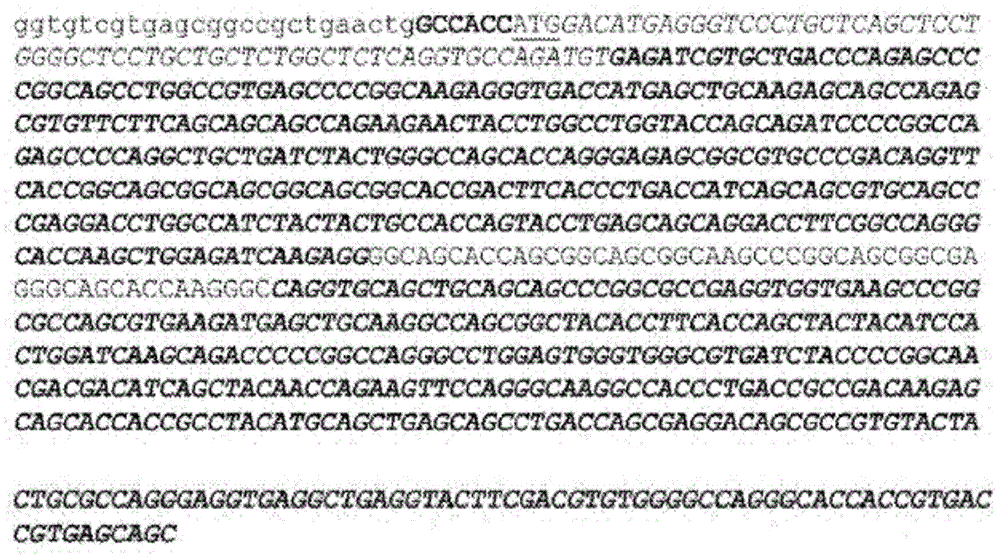
第2部分:铰链-CD28/ICOS-CD3ζNotI限制酶识别位点以大写字母显示。翻译终止位点以黑体显示。BamHI限制性裂解位点以下划线显示。Part 2: Hinge-CD28/ICOS-CD3ζNotI restriction enzyme recognition sites are shown in capital letters. Translation termination sites are shown in bold. The BamHI restriction cleavage site is underlined.
CD28共刺激结构域(SEQ ID NO:17)CD28 co-stimulatory domain (SEQ ID NO: 17)
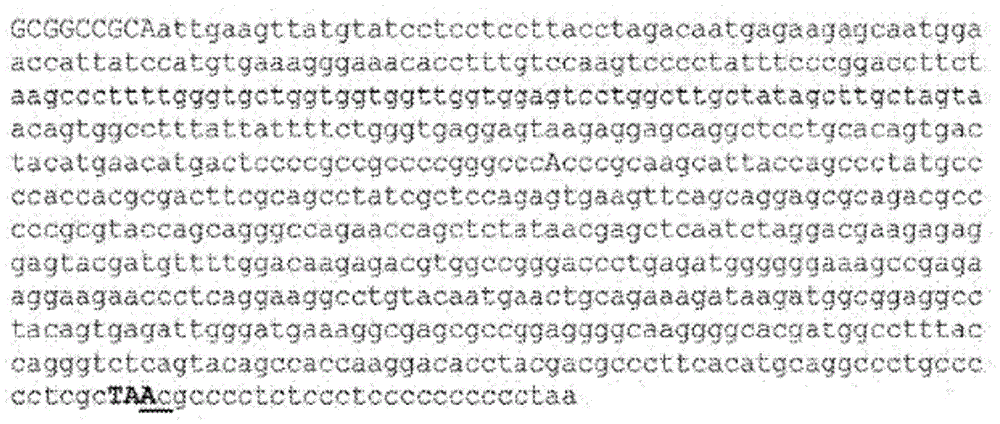
ICOS共刺激结构域(SEQ ID NO:18)ICOS co-stimulatory domain (SEQ ID NO: 18)
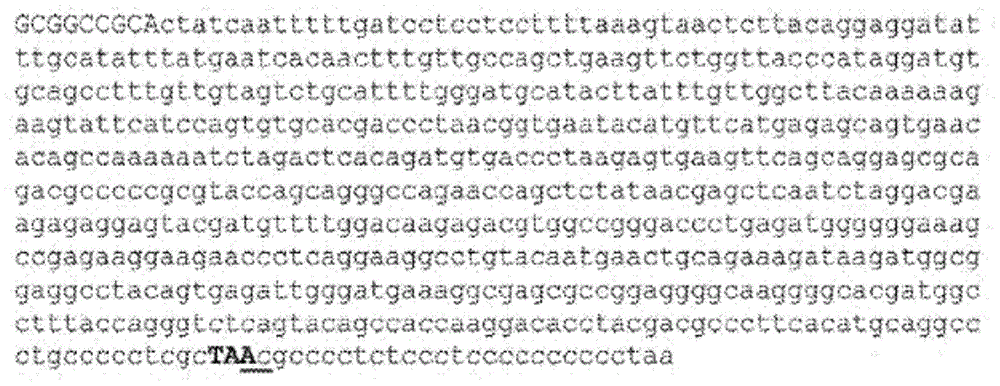
融合(杂交)CD28和ICOS共刺激结构域(SEQ ID NO:19)Fusion (hybrid) CD28 and ICOS co-stimulatory domain (SEQ ID NO: 19)
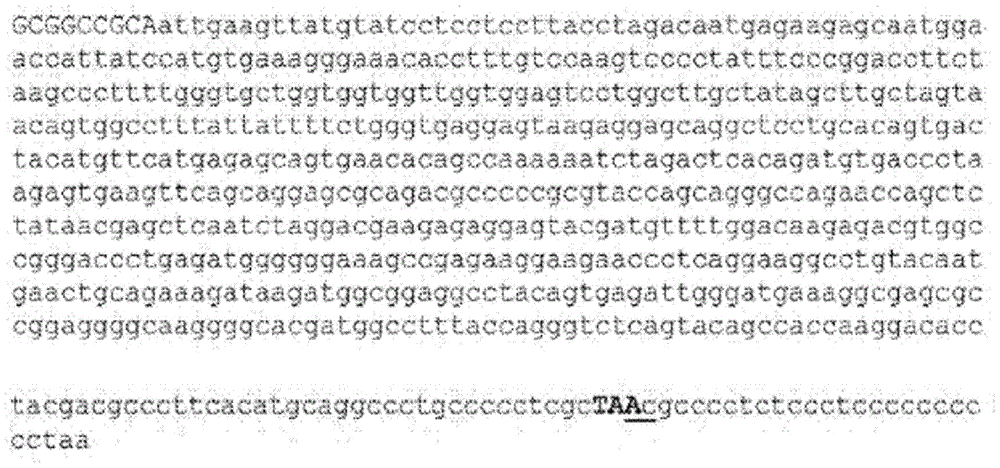
在下一步中,将铰链区、CD28结构域(SEQ ID NO:3)和TCR-ζ的细胞质组分克隆到pHIV-Zsgreen的NotI和BamHI位点(已经含有肽信号序列和CD33scFv)。可选地,CD28结构域可被ICOS结构域(SEQ ID NO:4)取代。In the next step, the hinge region, CD28 domain (SEQ ID NO:3) and the cytoplasmic component of TCR-ζ were cloned into the NotI and BamHI sites of pHIV-Zsgreen (which already contained the peptide signal sequence and CD33 scFv). Alternatively, the CD28 domain can be replaced by an ICOS domain (SEQ ID NO: 4).
除CD28和ICOS结构域之外,包含CD28和ICOS细胞内信号传导结构域片段的融合结构域将被工程改造(SEQ ID NO:5)并用于产生另外的嵌合受体。此类构型,其中嵌合受体包含抗原结合片段、抗CD33轻链可变区、接头、抗CD33重链可变区、CD28/ICOS杂合区(包括CD28的TM区)和TCR-ζ分子的信号传导结构域。In addition to the CD28 and ICOS domains, fusion domains comprising fragments of the CD28 and ICOS intracellular signaling domains will be engineered (SEQ ID NO:5) and used to generate additional chimeric receptors. Such a configuration in which the chimeric receptor comprises an antigen-binding fragment, an anti-CD33 light chain variable region, a linker, an anti-CD33 heavy chain variable region, a CD28/ICOS hybrid region (including the TM region of CD28), and TCR-zeta The signaling domain of the molecule.
本文提供了可用于产生嵌合受体的组分的示例氨基酸序列,例如本文提供了CD28结构域(SEQ ID NO:6)、ICOS结构域(SEQ ID NO:7)、CD28/ICOS杂合结构域(SEQ ID NO:8)和TCR-ζ。可选地,也可以产生嵌合受体(部分B)Exemplary amino acid sequences of components that can be used to generate chimeric receptors are provided herein, for example CD28 domain (SEQ ID NO:6), ICOS domain (SEQ ID NO:7), CD28/ICOS hybrid structure are provided herein domain (SEQ ID NO:8) and TCR-ζ. Optionally, chimeric receptors can also be generated (Part B)
B.产生抗CD33 CAR构建体的替代方法B. Alternative methods for generating anti-CD33 CAR constructs
在图7的图A-D中呈现了示例嵌合受体的示意图。使用识别CD33抗原,与细胞外CD8铰链区、跨膜和细胞质信号传导结构域以及CD3ζ信号传导链连接的细胞外人源化scFv产生嵌合受体(图7,图B)。编码抗CD33嵌合受体的DNA将通过使用人源化scFv产生(Essand等,JIntern Med._(2013)273(2):166)。替代物包括含有代替CD28的OX-1或41-BB或CD28/OX1或CD28/4-1-B-B杂合物的CAR T细胞(图7,图C和D)。Schematic representations of exemplary chimeric receptors are presented in Figure 7, panels A-D. A chimeric receptor was generated using an extracellular humanized scFv recognizing the CD33 antigen, linked to the extracellular CD8 hinge region, transmembrane and cytoplasmic signaling domains, and the CD3ζ signaling chain (Figure 7, panel B). DNA encoding the anti-CD33 chimeric receptor will be generated by using a humanized scFv (Essand et al., JIntern Med._(2013) 273(2):166). Surrogates included CAR T cells containing OX-1 or 41-BB or CD28/OX1 or CD28/4-1-B-B hybrids instead of CD28 (Figure 7, panels C and D).
为了产生抗CD33scFV序列,将用特异性引物扩增上述抗CD33抗体(SEQ ID NO:1和2)可变区的重链和轻链的编码区并将其克隆到用于在细胞中表达的pHIV-Zsgreen载体中。为了评价scFv(单链可变片段)与靶抗原的结合强度,将使scFv在Hek293T细胞中表达。为此,将载体(含编码区域的pHIV-Zsgreen)转化到大肠杆菌Top10F细菌中并制备质粒。获得的编码scFv抗体的表达载体将通过转染引入到Hek293T细胞中。培养转染细胞5天后,将去除上清液并纯化抗体。To generate anti-CD33 scFv sequences, the coding regions of the heavy and light chains of the variable regions of the above anti-CD33 antibodies (SEQ ID NO: 1 and 2) will be amplified with specific primers and cloned into pHIV-Zsgreen vector. To evaluate the binding strength of scFv (single chain variable fragment) to target antigen, scFv will be expressed in Hek293T cells. For this, the vector (pHIV-Zsgreen containing the coding region) was transformed into E. coli Top10F bacteria and a plasmid was prepared. The obtained expression vector encoding the scFv antibody will be introduced into Hek293T cells by transfection. After culturing the transfected cells for 5 days, the supernatant was removed and the antibody was purified.
所得抗体可以通过本领域已知的方案使用骨架取代进行人源化。参见例如BioAtla(San Diego)提供的一种此类方案,其中源自模板抗体的合成CDR编码片段文库连接到来自人骨架库的人骨架区编码片段,人骨架库限于来自功能性表达抗体的种系序列(bioatla.com/applications/express-humanization/)。The resulting antibody can be humanized using backbone substitutions by protocols known in the art. See, e.g., BioAtla (San Diego) for one such protocol in which a library of synthetic CDR-encoding fragments derived from a template antibody is ligated to human framework-encoding fragments from a library of human frameworks restricted to those from species that functionally express the antibody. Lineage Series (bioatla.com/applications/express-humanization/).
可以进行亲和力成熟以提高抗原结合亲和力。这可以使用本领域已知的一般技术完成,如噬菌体展示(Schier R.,J.Mol.Biol(1996),263:551)。可以使用例如Biacore分析筛选变体的生物活性(例如,结合亲和力)。为了鉴定将会是修饰的良好候选物的高变区残基,可以进行丙氨酸扫描诱变以鉴定对抗原结合有显著贡献的高变区残基。另外,所描述的组合文库也可以用于提高抗体的亲和力(Rajpal等,PNAS(2005)102(24):8466)。另外,BioAtla已经开发了用于抗体的快速高效亲和力成熟的平台,该平台也可用于抗体优化的目的(bioatla.com/applications/functional-maturation/)。Affinity maturation can be performed to increase antigen binding affinity. This can be accomplished using general techniques known in the art, such as phage display (Schier R., J. Mol. Biol (1996), 263:551). Variants can be screened for biological activity (eg, binding affinity) using, for example, Biacore analysis. To identify hypervariable region residues that would be good candidates for modification, alanine scanning mutagenesis can be performed to identify hypervariable region residues that contribute significantly to antigen binding. In addition, the described combinatorial libraries can also be used to increase the affinity of antibodies (Rajpal et al., PNAS (2005) 102(24):8466). Additionally, BioAtla has developed a platform for rapid and efficient affinity maturation of antibodies, which can also be used for antibody optimization purposes (bioatla.com/applications/functional-maturation/).
(C)CAR构建体的组装(C) Assembly of CAR constructs
接下来,抗CD33scFv将与细胞外CD8铰链区、跨膜和细胞质CD28信号传导结构域及CD3ζ信号传导链连接。简言之,将使用对抗CD33scFv序列有特异性的引物来扩增如上所述的scFv。质粒(pUN1-CD8)。(www.invivogen.com/puno-cd8a),其携带完整的人CD8编码序列,将用于扩增CD8铰链和跨膜结构域(氨基酸135-205)。将由携带完整的人CD3ζ编码序列的Invivogen质粒pORF9-hCD247a(http://www.invivogen.com/PDF/pORF9-hCD247a_10E26v06.pdf)扩增CD3ζ片段。最后,将由通过Trizol方法使用从活化T细胞收集的RNA产生的cDNA扩增CD28(氨基酸153-220,对应于CD28的TM和信号传导结构域)。将使用剪接重叠延伸(SOE)PCR组装含有抗CD33-scFv-CD8-铰链+TM-CD28-CD3ζ的片段。然后将所得PCR片段克隆到pELPS慢病毒载体中。pELPS是第三代慢病毒载体pRRL-SIN-CMV-eGFP-WPRE的衍生物,其中CMV启动子被EF-1α启动子置换并且HIV的中央多嘌呤束插入启动子的5'(Milone等,Mol Ther.(2009)(8):1453,Porter等,NEJM(2011)(8):725)。所有构建体将通过测序进行验证。Next, the anti-CD33 scFv will be linked to the extracellular CD8 hinge region, the transmembrane and cytoplasmic CD28 signaling domains, and the CD3ζ signaling chain. Briefly, primers specific to the anti-CD33 scFv sequence will be used to amplify scFv as described above. Plasmid (pUN1-CD8). (www.invivogen.com/puno-cd8a), which carries the complete human CD8 coding sequence, will be used to amplify the CD8 hinge and transmembrane domain (amino acids 135-205). The CD3ζ fragment will be amplified from the Invivogen plasmid pORF9-hCD247a (http://www.invivogen.com/PDF/pORF9-hCD247a_10E26v06.pdf) carrying the complete human CD3ζ coding sequence. Finally, CD28 (amino acids 153-220, corresponding to the TM and signaling domains of CD28) will be amplified from cDNA generated by the Trizol method using RNA collected from activated T cells. Fragments containing anti-CD33-scFv-CD8-hinge+TM-CD28-CD3ζ will be assembled using splicing overlap extension (SOE) PCR. The resulting PCR fragment was then cloned into the pELPS lentiviral vector. pELPS is a derivative of the third-generation lentiviral vector pRRL-SIN-CMV-eGFP-WPRE, in which the CMV promoter was replaced by the EF-1α promoter and the central polypurine tract of HIV was inserted 5' of the promoter (Milone et al., Mol Ther. (2009)(8):1453, Porter et al., NEJM (2011)(8):725). All constructs will be verified by sequencing.
可选地,将产生含有ICOS、CD27、41BB或OX-40信号传导结构域而不是CD28结构域的CAR,将其引入T细胞内并测试清除CD33阳性细胞的能力(图7,图C)。还考虑了产生“第三代”嵌合受体(图7,图D),其组合了多个信号传导结构域,例如CD3z-CD28-41BB或CD3z-CD28-OX40,以进一步增强效力(Sadelain等,Cancer Discov.(2013)4:388)。Alternatively, CARs containing ICOS, CD27, 41BB or OX-40 signaling domains instead of CD28 domains will be generated, introduced into T cells and tested for their ability to clear CD33 positive cells (Figure 7, panel C). The creation of "third-generation" chimeric receptors (Fig. 7, panel D) that combine multiple signaling domains, such as CD3z-CD28-41BB or CD3z-CD28-OX40, has also been considered to further enhance potency (Sadelain et al., Cancer Discov. (2013) 4:388).
(D)抗CD33 CAR T细胞制备(D) Preparation of anti-CD33 CAR T cells
将通过免疫磁性分离(Miltenyi Biotec)从患者的外周血中分离原代人CD8+ T细胞。将在完全培养基(补充有10%热灭活的FBS、100U/mL青霉素、100μg/mL硫酸链霉素、10mMHEPES的RPMI 1640)中培养T细胞并且如先前所述用涂有抗CD3和抗CD28mAb的珠粒(Invitrogen)刺激(Levine等,J.Immunol.(1997)159(12):5921)。Primary human CD8 + T cells will be isolated from peripheral blood of patients by immunomagnetic separation (Miltenyi Biotec). T cells will be cultured in complete medium (RPMI 1640 supplemented with 10% heat-inactivated FBS, 100 U/mL penicillin, 100 μg/mL streptomycin sulfate, 10 mM HEPES) and treated with anti-CD3 and anti- Bead (Invitrogen) stimulation of CD28 mAb (Levine et al., J. Immunol. (1997) 159(12):5921).
包装细胞系将用于产生能够转导靶细胞并含有抗CD33嵌合受体的病毒载体。为了产生慢病毒颗粒,将该实施例部分(1)中产生的CAR转染到永生化的正常胎肾293T包装细胞中,连同一起将用包括10%FBS、100U/ml青霉素和100μg/ml链霉素的高葡萄糖DMEM培养细胞。转染48-72小时后,将收集上清液并将重组慢病毒浓缩在不含FBS的DMEM中。接下来将在聚凝胺的存在下以约5-10的感染复数(MOI)转导原代CD8+ T细胞。人重组IL-2(R&DSystems)将每隔一天添加一次(50IU/mL)。刺激后将培养T细胞约14天。将通过ZsGreen报告基因的表达来评估人原代T细胞的转导效率(Clontech,Mountain View,CA)。Packaging cell lines will be used to generate viral vectors capable of transducing target cells and containing the anti-CD33 chimeric receptor. In order to produce lentiviral particles, the CAR produced in this example section (1) was transfected into immortalized normal
E.将CAR T细胞输注到患者体内E. Infusion of CAR T cells into patients
在将抗CD33 CAR T细胞静脉输注到患者体内之前,将用磷酸盐缓冲盐水洗涤细胞并浓缩。提供闭合无菌体系的细胞处理器如Haemonetics CellSaver(HaemoneticsCorporation,Braintree,MA)将用于配制前的洗涤和浓缩步骤。表达抗CD33嵌合受体的最终T细胞将配制到100ml补充有人血清白蛋白的无菌生理盐水中。最后,将在1-3天内为患者输注1-10X107个T细胞/kg(Maude等,NEJM(2014)371(16):1507)。输注的表达抗CD33嵌合受体的T细胞的数量将取决于许多因素,例如癌症患者的状态、患者的年龄、先前的治疗等。Before the anti-CD33 CAR T cells are infused intravenously into the patient, the cells will be washed with phosphate-buffered saline and concentrated. A cell processor that provides a closed sterile system such as the Haemonetics CellSaver (Haemonetics Corporation, Braintree, MA) will be used for the washing and concentration steps prior to formulation. Final T cells expressing the anti-CD33 chimeric receptor will be formulated into 100 ml sterile saline supplemented with human serum albumin. Finally, patients will be infused with 1-10× 10 7 T cells/kg over 1-3 days (Maude et al., NEJM (2014) 371(16):1507). The number of anti-CD33 chimeric receptor-expressing T cells infused will depend on many factors, such as the status of the cancer patient, age of the patient, previous treatments, etc.
此外,除了在AML患者中靶向CD33的嵌合受体之外,本文还考虑了表达靶向CD45RA的嵌合受体的免疫细胞。这可以通过两种不同的方法实现:1)单独产生表达抗CD33嵌合受体的免疫细胞和表达抗CD47RA嵌合受体的免疫细胞,并为患者单独输注两种类型的免疫细胞,或2)产生同时靶向CD33和CD45RA两者的免疫细胞(Kakarla等,Cancer(2):151(2014))。Furthermore, in addition to chimeric receptors targeting CD33 in AML patients, immune cells expressing chimeric receptors targeting CD45RA are also considered here. This can be achieved in two different ways: 1) generating immune cells expressing the chimeric receptor against CD33 and immune cells expressing the chimeric receptor against CD47RA separately and infusing the patient with both types of immune cells separately, or 2) Generation of immune cells that simultaneously target both CD33 and CD45RA (Kakarla et al., Cancer (2): 151 (2014)).
II.使用CD34+CD33-细胞的自体造血干细胞移植(HSCT)II. Autologous hematopoietic stem cell transplantation (HSCT) using CD34 + CD33 - cells
可以理解的是,根据患者的年龄、状况、治疗史和进行治疗的机构,关于从患者中分离干细胞,预处理方案以及为患者输注干细胞的方案差异很大。因此,下面描述的方案仅为实例并受到本领域普通技术人员的常规优化。Understandably, protocols for isolating stem cells from patients, conditioning them, and infusing them vary widely depending on the patient's age, condition, history of treatment, and the institution where treatment is administered. Accordingly, the protocols described below are examples only and are subject to routine optimization by one of ordinary skill in the art.
A.过继转移抗CD33 CAR T细胞后使用外周血干细胞(PBSC)动员分离造血干细胞A. Mobilization and isolation of hematopoietic stem cells using peripheral blood stem cells (PBSC) after adoptive transfer of anti-CD33 CAR T cells
将通过每天静脉内施用10mg/kg的粒细胞集落刺激因子(G-CSF)来刺激AML患者。CD34+细胞阳性选择将使用免疫磁珠和免疫磁性富集装置进行。预计使用Fenwall CS 3000+细胞分离器收集至少2x10⁶个CD34+细胞/kg体重(Park等,Bone Marrow Transplantation(2003)32:889)。AML patients will be stimulated by daily intravenous administration of 10 mg/kg of granulocyte colony stimulating factor (G-CSF). Positive selection of CD34 + cells will be performed using immunomagnetic beads and immunomagnetic enrichment devices. It is expected to collect at least 2x10⁶ CD34 + cells/kg body weight using a Fenwall CS 3000+ cell separator (Park et al., Bone Marrow Transplantation (2003) 32:889).
B.患者预处理方案B. Patient Conditioning Protocol
自体外周血干细胞移植(PBSCT)的预处理方案将使用依托泊苷(etoposide)(VP-16)+环磷酰胺(CY)+全身照射(TBI)进行。简言之,该方案将由以下组成:经26小时作为单剂量的1.8g/m2依托泊苷(VP-16)静脉恒量输注(c.i.v.),接着是每天经2小时静脉输注60mg/kg的环磷酰胺(CY)持续3天,然后接下来3天是每天按300cGy全身照射(TBI)。The conditioning regimen for autologous peripheral blood stem cell transplantation (PBSCT) will be performed with etoposide (VP-16) + cyclophosphamide (CY) + total body irradiation (TBI). Briefly, the regimen will consist of a constant intravenous infusion (civ) of 1.8 g/ m2 etoposide (VP-16) as a single dose over 26 hours, followed by daily intravenous infusions of 60 mg/kg over 2 hours Cyclophosphamide (CY) lasted for 3 days, followed by total body irradiation (TBI) at 300cGy per day for the next 3 days.
要计算剂量,将使用理想体重或实际体重,以较小者为准。如先前所提到的,在确定精确的预处理方案时,将考虑诸如癌症患者的状况、患者的年龄、先前的治疗以及进行手术的机构类型等因素。To calculate the dose, ideal body weight or actual body weight will be used, whichever is less. As previously mentioned, factors such as the condition of the cancer patient, the patient's age, previous treatments, and the type of institution performing the surgery will be considered when determining the precise conditioning regimen.
C.靶向CD33的CRISPR-Cas9系统的质粒构建C. Plasmid construction of CD33-targeting CRISPR-Cas9 system
含有插入片段Cas9和嘌呤霉素抗性的lentiCRISPR v2将从Addgene获得(质粒#52961)(Sanjana等,Nat Methods(2014)(8):783)。为了克隆单一向导RNA(sgRNA)CD33向导序列,将在37℃下裂解lentiCRISPR v2并用FastDigest BsmBI和FastAP(Fermentas)去磷酸化2小时。将使用crispr.mit.edu的在线优化设计工具设计靶向CD33的gRNA。可选地,gRNA将具有图12中描绘的序列(SEQ ID NO:11)。将从Integrated DNA Technologies(IDT)获得CD33gRNA寡核苷酸,使用多核苷酸激酶(Fermentas)在37℃下保持30分钟进行磷酸化,并且通过加热至95℃保持5分钟并以1.5℃/分钟冷却至25℃进行退火。将使用T7连接酶使寡核苷酸退火,然后将退火的寡核苷酸在25℃下保持5分钟连接到凝胶纯化载体(Qiagen)中。然后可以使用不含内毒素的midi-prep试剂盒(Qiagen)扩增所得质粒(Sanjana等,NatMethods(2014)(8):783)。lentiCRISPR v2 containing insert Cas9 and puromycin resistance will be obtained from Addgene (plasmid #52961) (Sanjana et al., Nat Methods (2014)(8):783). To clone the single guide RNA (sgRNA) CD33 guide sequence, lentiCRISPR v2 was cleaved and dephosphorylated with FastDigest BsmBI and FastAP (Fermentas) for 2 hours at 37°C. CD33-targeting gRNAs will be designed using the online optimal design tool at crispr.mit.edu. Optionally, the gRNA will have the sequence depicted in Figure 12 (SEQ ID NO: 11). CD33 gRNA oligonucleotides obtained from Integrated DNA Technologies (IDT) were phosphorylated using polynucleotide kinase (Fermentas) at 37°C for 30 minutes and heated to 95°C for 5 minutes with cooling at 1.5°C/min Anneal to 25°C. Oligonucleotides will be annealed using T7 ligase and then ligated into gel purification vector (Qiagen) at 25°C for 5 minutes. The resulting plasmid can then be amplified using an endotoxin-free midi-prep kit (Qiagen) (Sanjana et al., NatMethods (2014)(8):783).
可选地,可以使用双载体系统(其中gRNA和Cas由单独的载体表达),前面描述的方案(Mandal等,Cell Stem Cell(2014)15(5):643)。此处,Mandal等使用由非病毒载体表达的CRISPR-Cas系统实现人造血干细胞中基因的有效消融。Alternatively, a two-vector system (where gRNA and Cas are expressed from separate vectors) can be used, a protocol described earlier (Mandal et al., Cell Stem Cell (2014) 15(5):643). Here, Mandal et al. used a CRISPR-Cas system expressed from a nonviral vector to achieve efficient gene ablation in human hematopoietic stem cells.
简言之,含有C端SV40核定位信号序列的人密码子优化的Cas9基因将克隆到具有2A-GFP的CAG表达质粒中。为了指导Cas9裂解目标CD33序列,向导RNA(gRNA(SEQID.NO.11))将从含有人U6聚合酶III启动子的质粒中单独表达。将从Integrated DNATechnologies(IDT)获得gRNA序列寡核苷酸,退火并使用BbsI限制性位点引入质粒中。由于对人U6启动子的‘G’碱基的转录起始需求以及对PAM(前间区序列邻近基序)序列的需求,基因组靶标将包含GN20GG核苷酸序列。Briefly, the human codon-optimized Cas9 gene containing the C-terminal SV40 nuclear localization signal sequence will be cloned into a CAG expression plasmid with 2A-GFP. To guide Cas9 to cleave the target CD33 sequence, a guide RNA (gRNA (SEQID.NO.11)) will be expressed separately from a plasmid containing a human U6 polymerase III promoter. The gRNA sequence oligonucleotides were obtained from Integrated DNA Technologies (IDT), annealed and introduced into the plasmid using the BbsI restriction site. Due to the transcription initiation requirement of the 'G' base of the human U6 promoter and the requirement for a PAM (prospacer adjacent motif) sequence, the genomic target will comprise the GN 20 GG nucleotide sequence.
除了为患者输注CD33耗尽的造血干细胞HSC外,还将开发随后为患者输注CD45RA耗尽的HSC的方案。可选地,发明人将使用CRISPR-Cas9系统同时减少CD33和CD45RA基因,产生CD34+CD33-CD45RA-细胞。表4和5中显示了CD45RA和CD33的实例向导RNA序列)。In addition to infusing patients with CD33-depleted HSCs, a protocol for the subsequent infusion of CD45RA-depleted HSCs will also be developed. Alternatively, the inventors will use the CRISPR-Cas9 system to simultaneously reduce the CD33 and CD45RA genes, generating CD34 + CD33 − CD45RA − cells. Example guide RNA sequences for CD45RA and CD33 are shown in Tables 4 and 5).
D.转染CD34+细胞HSC以产生CD34+CD33-细胞D. Transfection of CD34 + HSCs to generate CD34 + CD33- cells
新分离的外周血来源的CD34+细胞(来自步骤4)将按1×10⁶个细胞/ml接种在存在细胞培养等级干细胞因子(SCF)300ng/ml、FLT3-L300ng/ml、血小板生成素(TPO)100ng/ml和IL-3 60ng/ml的无血清CellGro SCGM培养基中。在预刺激24小时后,将使用Amaxa人CD34细胞Nucleofector试剂盒(U-008)(#VPA-1003),用含有Cas9和CD33 gRNA的LentiCRISPRv2转染CD34+HSC(Mandal等,Cell Stem Cell(2014)15(5):643)。转染24-48小时后,用1.2μg/ml嘌呤霉素选择CD34+CD33-细胞。在嘌呤霉素选择后,CD34+CD33-细胞将保持在无嘌呤霉素的培养基中几天。Freshly isolated peripheral blood-derived CD34 + cells (from step 4) will be seeded at 1 x 10⁶ cells/ml in the presence of cell culture grade stem cell factor (SCF) 300 ng/ml, FLT3-
E.将CD34+CD33-细胞再输注到患者体内E. Reinfusion of CD34 + CD33 - cells into the patient
使用无过滤器的标准血液施用装置,通过希克文导管(Hickman catheter)立即再输注用CRISPR-Cas9-CD33离体转染的CD34+细胞(CD34+CD33-细胞)(Hacein-Bey Abina等JAMA(2015)313(15):1550.CD34 + cells ex vivo transfected with CRISPR-Cas9-CD33 (CD34 + CD33- cells) were immediately reinfused through a Hickman catheter using a standard blood administration set without a filter (Hacein-Bey Abina et al. JAMA (2015)313(15):1550.
通常,将监测已经接受以上所列治疗方案的患者循环胚细胞和血细胞减少症的再现。另外,根据特定患者的AML潜在机制,将通过检测信息分子或细胞遗传学标记的再现或信息流式细胞术模式来监测治疗的成功。例如,将使用与BCR(在22号染色体上)和ABL(在9号染色体上)探针的荧光原位杂交(FISH)来检测费城染色体阳性AML中BCR-ABL信号的重新出现。Typically, patients already receiving the regimens listed above will be monitored for recurrence of circulating blasts and cytopenias. Additionally, treatment success will be monitored by detecting the reappearance of informative molecular or cytogenetic markers or informative flow cytometry patterns, depending on the underlying mechanism of AML in a particular patient. For example, fluorescence in situ hybridization (FISH) with BCR (on chromosome 22) and ABL (on chromosome 9) probes will be used to detect the re-emergence of the BCR-ABL signal in Philadelphia chromosome-positive AML.
为了通过CRISPR-Cas9系统评价CD33删除的成功,将从患者中分离外周血CD34+细胞(移植后)并评估CD33表达,例如使用流式细胞术、蛋白质印迹法或免疫组织化学法。To systematically evaluate the success of CD33 deletion by CRISPR-Cas9, peripheral blood CD34 + cells (post-transplantation) will be isolated from patients and assessed for CD33 expression, for example using flow cytometry, western blot, or immunohistochemistry.
如本文所述,该实施例中描述的HSCT可以是自体的或同种异体的,并且两种方法都适合并且可以并入本公开所描述的方法中。As noted herein, the HSCT described in this example can be autologous or allogeneic, and both approaches are suitable and can be incorporated into the methods described in this disclosure.
III.任选步骤:用附着于毒素的CD33抗体继续治疗患者III. Optional Step: Continue Treatment of Patient with CD33 Antibody Attached to Toxin
A.用CD33免疫毒素吉妥珠单抗奥唑米星(GemtuzumabOzogamicin,GO)治疗患者A. Patients treated with the CD33 immunotoxin Gemtuzumab Ozogamicin (GO)
将用9mg/m2的抗CD33抗体吉妥珠单抗奥唑米星(GO)作为2小时静脉输注,分2个剂量间隔2周治疗患者(Larson等,Cancer(2005),104(7):1442-52)。GO由与细胞抑制剂加利车霉素(calicheamicin)缀合的抗CD33的人源化单克隆抗体组成(图8)。Patients will be treated with 9 mg/m of the anti-CD33 antibody gemtuzumab ozogamicin (GO) as a 2 -hour intravenous infusion in 2
可选地,抗CD33抗体可以与不同的毒素缀合,例如可以产生白喉毒素、假单胞菌外毒素A(PE)或蓖麻毒素A链(RTA)(Wayne等,Blood(2014)123(16):2470)。类似地,抗CD45RA抗体可以附着于毒素并包括在治疗方案中。Alternatively, anti-CD33 antibodies can be conjugated to different toxins, for example diphtheria toxin, Pseudomonas exotoxin A (PE) or ricin A chain (RTA) can be produced (Wayne et al., Blood (2014) 123( 16):2470). Similarly, anti-CD45RA antibodies can be attached to the toxin and included in the treatment regimen.
实施例4:表达抗CD33嵌合受体的T细胞和NK细胞系诱导表达CD33的靶细胞的细胞死亡Example 4: T cell and NK cell lines expressing anti-CD33 chimeric receptors induce cell death of CD33 expressing target cells
嵌合受体与CD33的结合Binding of chimeric receptors to CD33
使用常规重组DNA技术产生结合CD33的嵌合受体(例如,CART1、CART2、CART3)并插入pHIV-Zsgreen载体(Addgene;Cambridge,MA)中。使用含有嵌合受体的载体产生慢病毒颗粒,其用于转导不同细胞类型,例如T细胞系(例如,293T细胞)和NK细胞系(例如,NK92细胞)。通过蛋白质印迹法(图9,图A)和流式细胞术(图9,图B)检测嵌合受体的表达。CD33-binding chimeric receptors (eg, CART1, CART2, CART3) were generated using conventional recombinant DNA techniques and inserted into the pHIV-Zsgreen vector (Addgene; Cambridge, MA). Vectors containing chimeric receptors are used to generate lentiviral particles that are used to transduce different cell types, such as T cell lines (eg, 293T cells) and NK cell lines (eg, NK92 cells). Expression of chimeric receptors was detected by Western blotting (Figure 9, panel A) and flow cytometry (Figure 9, panel B).
通过荧光激活细胞分选术(FACS)选择表达嵌合受体的细胞并评估其结合CD33的能力。简言之,将表达嵌合受体的293T细胞的裂解物与CD33或CD33-别藻蓝蛋白(APC)缀合物共同孵育。将样品进行蛋白质电泳并用丽春红蛋白染剂(图10,图A)染色或转移到膜上并用抗CD3ζ一抗探测(图10,图B)。在这两种情况下,嵌合受体与其靶标CD33之间的结合。Cells expressing the chimeric receptor were selected by fluorescence activated cell sorting (FACS) and assessed for their ability to bind CD33. Briefly, lysates of 293T cells expressing chimeric receptors were incubated with CD33 or CD33-allophycocyanin (APC) conjugates. Samples were subjected to protein electrophoresis and stained with Poncein stain (Figure 10, panel A) or transferred to membranes and probed with anti-CD3ζ primary antibody (Figure 10, panel B). In both cases, the binding between the chimeric receptor and its target CD33.
还使用CD33作为探针通过流式细胞术评估表达嵌合受体的K562细胞与CD33的结合(图10,图C)。与含空载体对照的细胞相比,嵌合受体(CART1、CART2或CART3)表达和CD33结合为阳性的细胞数量增加,表明嵌合受体结合CD33。Binding of K562 cells expressing the chimeric receptor to CD33 was also assessed by flow cytometry using CD33 as a probe (Figure 10, panel C). The number of cells positive for chimeric receptor (CART1, CART2, or CART3) expression and CD33 binding was increased compared to cells containing an empty vector control, indicating that the chimeric receptor binds CD33.
表达嵌合受体的细胞诱导的细胞毒性。Cells expressing chimeric receptors induce cytotoxicity.
在功能上表征了表达嵌合受体的NK-92细胞诱导细胞表面呈递CD33的靶细胞的细胞毒性的能力(例如,K562是为CD33+的人慢性髓细胞性白血病细胞系)。为了进行细胞毒性测定,将用编码嵌合受体的慢病毒颗粒感染效应细胞(免疫细胞,如NK-92细胞)并扩增。感染7天后,通过FACS分析选择也由嵌合受体编码载体(例如,GFP+或Red+)编码的荧光标记来选择表达嵌合受体的细胞。选择的表达嵌合受体的细胞扩增一周。感染14天后,进行细胞毒性测定,包括用羧基荧光素琥珀酰亚胺酯(CFSE)对靶细胞(表达靶细胞表面谱系特异性抗原CD33的细胞)进行染色,并对靶细胞和表达嵌合受体的细胞计数。将不同比率的靶细胞和表达嵌合受体的细胞在圆底96孔板中共同孵育4.5小时,之后添加7-氨基放线菌素D(7-AAD)以对非活性细胞进行染色。进行流式细胞术以对活性和非活性靶细胞群计数。如图11,图A和B所示,在评估的每种细胞比率下,表达嵌合受体CART1、CART2或CART3的NK92细胞诱导靶K562细胞的大量细胞死亡。The ability of NK-92 cells expressing the chimeric receptor to induce cytotoxicity of target cells presenting CD33 on the cell surface was functionally characterized (eg, K562 is a human chronic myelogenous leukemia cell line that is CD33+). For cytotoxicity assays, effector cells (immune cells such as NK-92 cells) will be infected with lentiviral particles encoding chimeric receptors and expanded. Seven days after infection, cells expressing the chimeric receptor were selected by FACS analysis for a fluorescent marker also encoded by the chimeric receptor encoding vector (eg, GFP+ or Red+). Selected cells expressing chimeric receptors were expanded for one week. Fourteen days after infection, cytotoxicity assays were performed, including staining of target cells (cells expressing the target cell surface lineage-specific antigen CD33) with carboxyfluorescein succinimidyl ester (CFSE) and staining of target cells and cells expressing chimeric receptor Body cell count. Different ratios of target cells and cells expressing chimeric receptors were co-incubated in round-bottom 96-well plates for 4.5 hours, after which 7-aminoactinomycin D (7-AAD) was added to stain inactive cells. Flow cytometry was performed to enumerate viable and inactive target cell populations. As shown in Figure 11, panels A and B, NK92 cells expressing chimeric receptors CART1, CART2 or CART3 induced substantial cell death of target K562 cells at each cell ratio evaluated.
为了确定K562细胞的细胞死亡取决于嵌合受体对CD33的特异性靶向,使用CRISPR/Cas系统将K562基因工程改造为缺乏CD33。简言之,在K562细胞中表达人密码子优化的Cas9核酸内切酶和靶向CD33的IgC结构域的一部分的gRNA,产生缺乏CD33的K562细胞群。扩增细胞并与表达嵌合受体的NK92细胞共同孵育,并如上所述进行细胞毒性测定。如图12的图A所示,汇集的缺乏CD33的K562细胞与表达嵌合受体的NK92细胞共同孵育显示细胞死亡适度减少。然而,当分离缺乏CD33的K562细胞的单一克隆物,扩增并用于进行细胞毒性测定时,观察到细胞毒性更显著的降低(图12,图B)。To determine that cell death of K562 cells depends on specific targeting of CD33 by chimeric receptors, K562 were genetically engineered to lack CD33 using a CRISPR/Cas system. Briefly, expression of a human codon-optimized Cas9 endonuclease and a gRNA targeting part of the IgC domain of CD33 in K562 cells generated a CD33-deficient K562 cell population. Cells were expanded and co-incubated with NK92 cells expressing chimeric receptors, and cytotoxicity assays were performed as described above. As shown in Figure 12, panel A, co-incubation of pooled CD33-deficient K562 cells with NK92 cells expressing the chimeric receptor showed a modest reduction in cell death. However, when single clones of CD33-deficient K562 cells were isolated, expanded and used for cytotoxicity assays, a more pronounced reduction in cytotoxicity was observed (Figure 12, panel B).
嵌合受体在原代T细胞中的表达Expression of chimeric receptors in primary T cells
通过FACS积极选择CD4+、CD8+或CD4+/CD8+细胞,从自供体获得的PMBC分离原代T细胞群,得到高纯度群体(图13,图A和B)。用含有嵌合受体(例如,CART1和CART8)的慢病毒载体转导每个原代T细胞群(CD4+、CD8+或CD4+/CD8+细胞)并且如上所述,使用所得的表达嵌合受体的原代T细胞进行细胞毒性测定。表达嵌合受体的CD4+ T细胞群与K562(1000个靶K562细胞)共同孵育未导致K562细胞的细胞毒性(图14,图A)。相反,在使用表达嵌合受体的CD8+或CD4+/CD8+细胞和1000个靶K562细胞的细胞毒性测定中,CD8+或CD4+/CD8+细胞能够以低细胞比率诱导K562细胞的细胞死亡(图14,图B)。Primary T cell populations were isolated from PMBC obtained from donors by positive selection of CD4+, CD8+ or CD4+/CD8+ cells by FACS, resulting in highly pure populations (Figure 13, panels A and B). Each primary T cell population (CD4+, CD8+, or CD4+/CD8+ cells) was transduced with lentiviral vectors containing chimeric receptors (e.g., CART1 and CART8) and the resulting chimeric receptor-expressing cells were used as described above. Primary T cells were subjected to cytotoxicity assays. Co-incubation of CD4+ T cell populations expressing chimeric receptors with K562 (1000 target K562 cells) did not result in cytotoxicity of K562 cells (Figure 14, panel A). In contrast, in a cytotoxicity assay using CD8+ or CD4+/CD8+ cells expressing chimeric receptors and 1000 target K562 cells, CD8+ or CD4+/CD8+ cells were able to induce cell death of K562 cells at a low cell ratio (Figure 14, Fig. B).
基因工程改造人造血干细胞Genetically engineered human hematopoietic stem cells
设计几种gRNA以与CD33的IgC结构域杂交(参见例如,表4,SEQ ID NO:11或28-31)。每种gRNA与Cas9核酸内切酶一起在K562细胞中表达。通过流式细胞术评估CD33的表达(图15)。正如对于Crispr 3(SEQ ID NO:28)和Crispr5(SEQ ID NO:29)显示的,与表达CD33的对照细胞相比,在表达靶向CD33的CRISPR/Cas系统的细胞中发现CD33显著减少。Several gRNAs were designed to hybridize to the IgC domain of CD33 (see eg, Table 4, SEQ ID NO: 11 or 28-31). Each gRNA was expressed in K562 cells together with Cas9 endonuclease. CD33 expression was assessed by flow cytometry (Figure 15). As shown for Crispr 3 (SEQ ID NO: 28) and Crispr 5 (SEQ ID NO: 29), a significant reduction in CD33 was found in cells expressing the CRISPR/Cas system targeting CD33 compared to control cells expressing CD33.
还评估了缺乏CD33的造血干细胞的各种特征,包括增殖、红细胞分化和集落形成。简言之,通过将细胞暴露于氯高铁血红素而诱导缺乏CD33的造血干细胞分化,并在不同时间点通过流式细胞术评估CD71(红细胞前体的标记)(图16,图A和B)。缺乏CD33的造血干细胞经历红细胞分化,并且流式细胞图似乎与对照细胞(CD33+)相似。细胞还进行了MTT测定以测量缺乏CD33的造血干细胞的代谢活性。如图16的图C所示,缺乏CD33的造血干细胞与对照细胞表现相当。最后,使用显微集落形成测定法观察细胞增殖并形成细胞集落的能力。同样,缺乏CD33的造血干细胞也能够形成与对照细胞类似程度的集落(图18)。这些结果表明CRISPR/Cas删除CD33的一部分不会显著影响细胞增殖、分化或形成集落的能力。Various characteristics of hematopoietic stem cells lacking CD33 were also assessed, including proliferation, erythroid differentiation, and colony formation. Briefly, hematopoietic stem cells lacking CD33 were induced to differentiate by exposing cells to hemin and CD71, a marker of erythroid precursors, was assessed by flow cytometry at various time points (Figure 16, panels A and B) . Hematopoietic stem cells lacking CD33 undergo erythroid differentiation and appear to flow cytometrically similar to control cells (CD33+). Cells were also subjected to an MTT assay to measure the metabolic activity of CD33-deficient hematopoietic stem cells. As shown in Figure 16, panel C, hematopoietic stem cells lacking CD33 performed comparable to control cells. Finally, the ability of the cells to proliferate and form cell colonies was observed using a microscopic colony formation assay. Likewise, hematopoietic stem cells lacking CD33 were also able to form colonies to a similar extent as control cells (Figure 18). These results suggest that deletion of a portion of CD33 by CRISPR/Cas does not significantly affect the ability of cells to proliferate, differentiate, or form colonies.
其它实施方案Other implementations
本说明书中公开的所有特征可以组合成任何组合。本说明书中公开的每个特征可以由作用相同、等同或用于类似目的的替代特征代替。因此,除非另有明确说明,否则所公开的每个特征仅仅是一系列等同或类似特征的实例。All features disclosed in this specification can be combined in any combination. Each feature disclosed in this specification may be replaced by an alternative feature serving the same, equivalent or similar purpose. Thus, unless expressly stated otherwise, each feature disclosed is only an example of a series of equivalent or similar features.
从以上描述中,本领域技术人员可以容易地确定本公开的基本特征,并且在不脱离其精神和范围的情况下,可以做本公开的各种变化和修改以使其适应各种用法和条件。因此,其它实施方案也在权利要求范围内。From the above description, one skilled in the art can easily ascertain the essential characteristics of this disclosure, and without departing from the spirit and scope thereof, can make various changes and modifications of this disclosure to adapt it to various usages and conditions . Accordingly, other implementations are within the scope of the following claims.
等同形式equivalent form
虽然本文已经描述和说明了若干发明性实施方案,但本领域的普通技术人员将容易想到用于执行功能和/或获得结果和/或本文描述的一个或多个优点的各种其它手段和/或结构,并且每个这样的变型和/或修改都被认为是在本文描述的发明实施方案的范围内。更一般地,本领域的技术人员将容易认识到,本文描述的所有参数、尺寸、材料和构型都意为示例性的,并且实际参数、尺寸、材料和/或构型将取决于特定应用或为其使用本发明教导的应用。本领域的技术人员将认识到,或仅仅使用常规实验就能够确定本文描述的具体发明实施方案的许多等同形式。因此,应该理解的是前述实施方案仅以举例的方式呈现,并且在所附权利要求及其等同形式的范围内,可以以除了具体描述和要求保护的方式以外的方式来实践发明实施方案。本公开的发明实施方案涉及本文描述的每个单独的特征、系统、制品、材料、试剂盒和/或方法。另外,如果此类特征、系统、制品、材料、试剂盒和/或方法并无相互不一致,则两个或更多个此类特征、系统、制品、材料、试剂盒和/或方法的任何组合都包括在本公开的发明范围内。While several inventive embodiments have been described and illustrated herein, those of ordinary skill in the art will readily envision various other means for performing a function and/or obtaining a result and/or one or more advantages described herein and/or or structure, and each such variation and/or modification is considered to be within the scope of the inventive embodiments described herein. More generally, those skilled in the art will readily recognize that all parameters, dimensions, materials and configurations described herein are meant to be exemplary and that actual parameters, dimensions, materials and/or configurations will depend on the particular application or applications for which the teachings of the present invention are used. Those skilled in the art will recognize, or be able to ascertain using no more than routine experimentation, many equivalents to the specific inventive embodiments described herein. It is therefore to be understood that the foregoing embodiments are presented by way of example only, and that, within the scope of the appended claims and their equivalents, the inventive embodiments may be practiced otherwise than as specifically described and claimed. Inventive embodiments of the present disclosure are directed to each individual feature, system, article of manufacture, material, kit and/or method described herein. Additionally, any combination of two or more such features, systems, articles of manufacture, materials, kits and/or methods, provided that such features, systems, articles of manufacture, materials, kits and/or methods are not mutually inconsistent, All are included in the scope of the invention of the present disclosure.
如本文所定义和使用的所有定义都应理解为控制字典定义,通过引用并入的文献中的定义和/或所定义术语的普通含义。All definitions, as defined and used herein, should be understood to control over dictionary definitions, definitions in documents incorporated by reference, and/or ordinary meanings of the defined terms.
本文公开的所有参考文献、专利和专利申请通过关于所引用的每一个的主题的引用并入,在一些情况下可以涵盖整个文档。All references, patents, and patent applications disclosed herein are incorporated by reference for each subject matter cited, and in some cases the entire document may be encompassed.
除非明确指出相反,否则本文在说明书和权利要求书中使用的不定冠词“一”和“一个(种)”应理解为意指“至少一个”。As used herein in the specification and claims, the indefinite articles "a" and "an" are understood to mean "at least one" unless expressly stated to the contrary.
如本文在说明书和权利要求书中使用的短语“和/或”应理解为意指这样连接的要素中的“任一个或两个”,即要素在一些情况下联合存在而在其它情况下分离存在。随“和/或”列出的多个要素应该以相同方式解释,即要素中的“一个或多个”这样连接。除了用“和/或”分句明确标识的要素之外,不管与明确标识的那些要素相关还是无关,其它要素可以任选存在。因此,作为非限制性实例,连同开放式语言如“包含”使用时,提到“A和/或B”在一个实施方案中可以仅指A(任选包括除B以外的要素);在另一个实施方案中,仅指B(任选包括除A以外的要素);再一个实施方案中,指A和B(任选包括其它要素);等等。As used herein in the specification and claims, the phrase "and/or" should be understood to mean "either or both" of such linked elements that the elements exist in combination in some instances and separately in other instances. exist. Multiple elements listed with "and/or" should be construed in the same fashion, ie, "one or more" of the elements are so conjoined. Other elements may optionally be present other than the elements specifically identified by the "and/or" clause, whether related or unrelated to those elements specifically identified. Thus, as a non-limiting example, reference to "A and/or B" when used in conjunction with open language such as "comprises" may in one embodiment refer to only A (optionally including elements other than B); In one embodiment, only B (optionally including elements other than A); in another embodiment, both A and B (optionally including other elements); and so on.
如本文在说明书和权利要求中所用,“或”应当理解为具有与以上定义的“和/或”相同的含义。例如,当间隔列表中的项时,“或”或“和/或”应解释为包括性的,即包括至少一个,但也包括许多或一系列要素,以及任选地,其它未列出项中的一个以上。只有明确指出相反的术语,例如“仅一个”或“恰好一个”,或者在权利要求中使用时,“由...组成”将指包括许多或一系列要素中的恰好一个要素。一般而言,如本文中所用的术语“或”在前面有排他性术语例如“任一”、“一个”、“仅一个”或“恰好一个”时应当仅解释为指示排他性替代物(即“一个或另一个,但不是两个”)。当用于权利要求中时,“基本上由...组成”应具有其在专利法领域中使用的普通含义。As used herein in the specification and claims, "or" should be understood as having the same meaning as "and/or" defined above. For example, "or" or "and/or" when separating items in a list should be construed as inclusive, i.e. including at least one, but also many or a series of elements, and optionally, other unlisted items more than one of them. Terms such as "only one" or "exactly one" or "consisting of" when used in a claim will mean including exactly one element of a number or series of elements, only if the contrary is expressly stated. In general, the term "or" as used herein when preceded by an exclusive term such as "either", "an", "only one" or "exactly one" should only be construed as indicating an exclusive alternative (i.e. "one or the other, but not both"). When used in a claim, "consisting essentially of" shall have its ordinary meaning as used in the field of patent law.
如本文在说明书和权利要求书中所用,关于一个或多个要素的列表的短语“至少一个”应该理解为意指选自该要素列表中的任何一个或多个要素的至少一个要素,但不一定包括要素列表内具体列出的每个要素中的至少一个并且不排除要素列表中的要素的任何组合。该定义还允许除了短语“至少一个”所指的要素列表内具体标识的要素以外,可任选存在不管与具体标识的那些要素相关还是无关的要素。因此,作为非限制性实例,“A和B中的至少一个”(或等同地,“A或B中的至少一个”,或等同地“A和/或B中的至少一个”)在一个实施方案中可以指至少一个(任选包括多于一个)A,不存在B(并且任选包括除了B以外的要素);在另一个实施方案中指至少一个(任选包括多于一个)B,不存在A(并且任选包括除了A以外的要素);再一个实施方案中指至少一个(任选包括多于一个)A和至少一个(任选包括多于一个)B(并且任选包括其它要素);等等。As used herein in the specification and claims, the phrase "at least one" in reference to a list of one or more elements should be understood to mean at least one element selected from any one or more elements in the list of elements, but not At least one of each element specifically listed in the list of elements must be included and any combination of elements in the list of elements is not excluded. This definition also allows that elements may optionally be present other than the elements specifically identified within the list of elements to which the phrase "at least one" refers, whether related or unrelated to those elements specifically identified. Thus, as a non-limiting example, "at least one of A and B" (or equivalently, "at least one of A or B", or equivalently "at least one of A and/or B") in an implementation A scheme may refer to at least one (optionally including more than one) A and the absence of B (and optionally include elements other than B); in another embodiment it refers to at least one (optionally including more than one) B without A (and optionally including elements other than A) is present; in yet another embodiment refers to at least one (optionally including more than one) A and at least one (optionally including more than one) B (and optionally including other elements) ;etc.
还应该理解的是,除非明确指出相反,否则在本文要求保护的包括多于一个步骤或操作的任何方法中,该方法的步骤或操作的顺序不一定限于叙述该方法的步骤或操作的顺序。It should also be understood that in any method claimed herein comprising more than one step or operation, the order of the method steps or operations is not necessarily limited to the order in which the method steps or operations are recited, unless expressly stated to the contrary.
序列表sequence listing
<110> The Trustees of Columbia University in the City of New York<110> The Trustees of Columbia University in the City of New York
<120> 用于抑制谱系特异性抗原的组合物和方法<120> Compositions and methods for inhibiting lineage-specific antigens
<130> 01001/004965-WO0<130> 01001/004965-WO0
<140> 尚未转让<140> not yet assigned
<141> 同时随函附上<141> Also enclosed
<150> US 62/242,685<150> US 62/242,685
<151> 2015-10-16<151> 2015-10-16
<160> 47<160> 47
<170> PatentIn 3.5版<170> PatentIn Version 3.5
<210> 1<210> 1
<211> 339<211> 339
<212> DNA<212>DNA
<213> 智人<213> Homo sapiens
<400> 1<400> 1
gagatcgtgc tgacccagag ccccggcagc ctggccgtga gccccggcga gagggtgacc 60gagatcgtgc tgacccagag ccccggcagc ctggccgtga gccccggcga gagggtgacc 60
atgagctgca agagcagcca gagcgtgttc ttcagcagca gccagaagaa ctacctggcc 120atgagctgca agagcagcca gagcgtgttc ttcagcagca gccagaagaa ctacctggcc 120
tggtaccagc agatccccgg ccagagcccc aggctgctga tctactgggc cagcaccagg 180tggtaccagc agatccccgg ccagagcccc aggctgctga tctactgggc cagcaccagg 180
gagagcggcg tgcccgacag gttcaccggc agcggcagcg gcaccgactt caccctgacc 240gagagcggcg tgcccgacag gttcaccggc agcggcagcg gcaccgactt caccctgacc 240
atcagcagcg tgcagcccga ggacctggcc atctactact gccaccagta cctgagcagc 300atcagcagcg tgcagcccga ggacctggcc atctactact gccaccagta cctgagcagc 300
aggaccttcg gccagggcac caagctggag atcaagagg 339aggaccttcg gccagggcac caagctggag atcaagagg 339
<210> 2<210> 2
<211> 354<211> 354
<212> DNA<212>DNA
<213> 智人<213> Homo sapiens
<400> 2<400> 2
caggtgcagc tgcagcagcc cggcgccgag gtggtgaagc ccggcgccag cgtgaagatg 60caggtgcagc tgcagcagcc cggcgccgag gtggtgaagc ccggcgccag cgtgaagatg 60
agctgcaagg ccagcggcta caccttcacc agctactaca tccactggat caagcagacc 120agctgcaagg ccagcggcta caccttcacc agctactaca tccactggat caagcagacc 120
cccggccagg gcctggagtg ggtgggcgtg atctaccccg gcaacgacga catcagctac 180cccggccagg gcctggagtg ggtgggcgtg atctaccccg gcaacgacga catcagctac 180
aaccagaagt tccagggcaa ggccaccctg accgccgaca agagcagcac caccgcctac 240aaccagaagt tccagggcaa ggccaccctg accgccgaca agagcagcac caccgcctac 240
atgcagctga gcagcctgac cagcgaggac agcgccgtgt actactgcgc cagggaggtg 300atgcagctga gcagcctgac cagcgaggac agcgccgtgt actactgcgc cagggaggtg 300
aggctgaggt acttcgacgt gtggggccag ggcaccaccg tgaccgtgag cagc 354aggctgaggt acttcgacgt gtggggccag ggcaccaccg tgaccgtgag cagc 354
<210> 3<210> 3
<211> 657<211> 657
<212> DNA<212>DNA
<213> 智人<213> Homo sapiens
<400> 3<400> 3
attgaagtta tgtatcctcc tccttaccta gacaatgaga agagcaatgg aaccattatc 60attgaagtta tgtatcctcc tccttaccta gacaatgaga agagcaatgg aaccattatc 60
catgtgaaag ggaaacacct ttgtccaagt cccctatttc ccggaccttc taagcccttt 120catgtgaaag ggaaacacct ttgtccaagt cccctatttc ccggaccttc taagcccttt 120
tgggtgctgg tggtggttgg tggagtcctg gcttgctata gcttgctagt aacagtggcc 180tgggtgctgg tggtggttgg tggagtcctg gcttgctata gcttgctagt aacagtggcc 180
tttattattt tctgggtgag gagtaagagg agcaggctcc tgcacagtga ctacatgaac 240tttattattt tctgggtgag gagtaagagg agcaggctcc tgcacagtga ctacatgaac 240
atgactcccc gccgccccgg gcccacccgc aagcattacc agccctatgc cccaccacgc 300atgactcccc gccgccccgg gcccacccgc aagcattacc agccctatgc cccaccacgc 300
gacttcgcag cctatcgctc cagagtgaag ttcagcagga gcgcagacgc ccccgcgtac 360gacttcgcag cctatcgctc cagagtgaag ttcagcagga gcgcagacgc ccccgcgtac 360
cagcagggcc agaaccagct ctataacgag ctcaatctag gacgaagaga ggagtacgat 420cagcagggcc agaaccagct ctataacgag ctcaatctag gacgaagaga ggagtacgat 420
gttttggaca agagacgtgg ccgggaccct gagatggggg gaaagccgag aaggaagaac 480gttttggaca agagacgtgg ccgggaccct gagatgggggg gaaagccgag aaggaagaac 480
cctcaggaag gcctgtacaa tgaactgcag aaagataaga tggcggaggc ctacagtgag 540cctcaggaag gcctgtacaa tgaactgcag aaagataaga tggcggaggc cctacagtgag 540
attgggatga aaggcgagcg ccggaggggc aaggggcacg atggccttta ccagggtctc 600atgggatga aaggcgagcg ccggaggggc aaggggcacg atggccttta ccagggtctc 600
agtacagcca ccaaggacac ctacgacgcc cttcacatgc aggccctgcc ccctcgc 657agtacagcca ccaaggacac ctacgacgcc cttcacatgc aggccctgcc ccctcgc 657
<210> 4<210> 4
<211> 603<211> 603
<212> DNA<212>DNA
<213> 智人<213> Homo sapiens
<400> 4<400> 4
ctatcaattt ttgatcctcc tccttttaaa gtaactctta caggaggata tttgcatatt 60ctatcaattt ttgatcctcc tccttttaaa gtaactctta caggaggata tttgcatatt 60
tatgaatcac aactttgttg ccagctgaag ttctggttac ccataggatg tgcagccttt 120tatgaatcac aactttgttg ccagctgaag ttctggttac ccataggatg tgcagccttt 120
gttgtagtct gcattttggg atgcatactt atttgttggc ttacaaaaaa gaagtattca 180gttgtagtct gcattttggg atgcatactt atttgttggc ttacaaaaaa gaagtattca 180
tccagtgtgc acgaccctaa cggtgaatac atgttcatga gagcagtgaa cacagccaaa 240tccagtgtgc acgaccctaa cggtgaatac atgttcatga gagcagtgaa cacagccaaa 240
aaatctagac tcacagatgt gaccctaaga gtgaagttca gcaggagcgc agacgccccc 300aaatctagac tcacagatgt gaccctaaga gtgaagttca gcaggagcgc agacgccccc 300
gcgtaccagc agggccagaa ccagctctat aacgagctca atctaggacg aagagaggag 360gcgtaccagc agggccagaa ccagctctat aacgagctca atctaggacg aagagaggag 360
tacgatgttt tggacaagag acgtggccgg gaccctgaga tggggggaaa gccgagaagg 420tacgatgttt tggacaagag acgtggccgg gaccctgaga tggggggaaa gccgagaagg 420
aagaaccctc aggaaggcct gtacaatgaa ctgcagaaag ataagatggc ggaggcctac 480aagaaccctc aggaaggcct gtacaatgaa ctgcagaaag ataagatggc ggaggcctac 480
agtgagattg ggatgaaagg cgagcgccgg aggggcaagg ggcacgatgg cctttaccag 540agtgagattg ggatgaaagg cgagcgccgg aggggcaagg ggcacgatgg cctttaccag 540
ggtctcagta cagccaccaa ggacacctac gacgcccttc acatgcaggc cctgccccct 600ggtctcagta cagccaccaa ggacacctac gacgcccttc acatgcaggc cctgccccct 600
cgc 603cgc 603
<210> 5<210> 5
<211> 627<211> 627
<212> DNA<212>DNA
<213> 智人<213> Homo sapiens
<400> 5<400> 5
attgaagtta tgtatcctcc tccttaccta gacaatgaga agagcaatgg aaccattatc 60attgaagtta tgtatcctcc tccttaccta gacaatgaga agagcaatgg aaccattatc 60
catgtgaaag ggaaacacct ttgtccaagt cccctatttc ccggaccttc taagcccttt 120catgtgaaag ggaaacacct ttgtccaagt cccctatttc ccggaccttc taagcccttt 120
tgggtgctgg tggtggttgg tggagtcctg gcttgctata gcttgctagt aacagtggcc 180tgggtgctgg tggtggttgg tggagtcctg gcttgctata gcttgctagt aacagtggcc 180
tttattattt tctgggtgag gagtaagagg agcaggctcc tgcacagtga ctacatgttc 240tttattattt tctgggtgag gagtaagagg agcaggctcc tgcacagtga ctacatgttc 240
atgagagcag tgaacacagc caaaaaatct agactcacag atgtgaccct aagagtgaag 300atgagagcag tgaacacagc caaaaaatct agactcacag atgtgaccct aagagtgaag 300
ttcagcagga gcgcagacgc ccccgcgtac cagcagggcc agaaccagct ctataacgag 360ttcagcagga gcgcagacgc ccccgcgtac cagcagggcc agaaccagct ctataacgag 360
ctcaatctag gacgaagaga ggagtacgat gttttggaca agagacgtgg ccgggaccct 420ctcaatctag gacgaagaga ggagtacgat gttttggaca agagacgtgg ccgggaccct 420
gagatggggg gaaagccgag aaggaagaac cctcaggaag gcctgtacaa tgaactgcag 480gagatggggg gaaagccgag aaggaagaac cctcaggaag gcctgtacaa tgaactgcag 480
aaagataaga tggcggaggc ctacagtgag attgggatga aaggcgagcg ccggaggggc 540aaagataaga tggcggaggc ctacagtgag attgggatga aaggcgagcg ccggaggggc 540
aaggggcacg atggccttta ccagggtctc agtacagcca ccaaggacac ctacgacgcc 600aaggggcacg atggccttta ccagggtctc agtacagcca ccaaggacac ctacgacgcc 600
cttcacatgc aggccctgcc ccctcgc 627cttcacatgc aggccctgcc ccctcgc 627
<210> 6<210> 6
<211> 107<211> 107
<212> PRT<212> PRT
<213> 人工序列<213> Artificial sequence
<220><220>
<223> 合成多肽<223> Synthetic peptides
<400> 6<400> 6
Ile Glu Val Met Tyr Pro Pro Pro Tyr Leu Asp Asn Glu Lys Ser AsnIle Glu Val Met Tyr Pro Pro Pro Tyr Leu Asp Asn Glu Lys Ser Asn
1 5 10 151 5 10 15
Gly Thr Ile Ile His Val Lys Gly Lys His Leu Cys Pro Ser Pro LeuGly Thr Ile Ile His Val Lys Gly Lys His Leu Cys Pro Ser Pro Leu
20 25 30 20 25 30
Phe Pro Gly Pro Ser Lys Pro Phe Trp Val Leu Val Val Val Gly GlyPhe Pro Gly Pro Ser Lys Pro Phe Trp Val Leu Val Val Val Gly Gly
35 40 45 35 40 45
Val Leu Ala Cys Tyr Ser Leu Leu Val Thr Val Ala Phe Ile Ile PheVal Leu Ala Cys Tyr Ser Leu Leu Val Thr Val Ala Phe Ile Ile Phe
50 55 60 50 55 60
Trp Val Arg Ser Lys Arg Ser Arg Leu Leu His Ser Asp Tyr Met AsnTrp Val Arg Ser Lys Arg Ser Arg Leu Leu His Ser Asp Tyr Met Asn
65 70 75 8065 70 75 80
Met Thr Pro Arg Arg Pro Gly Pro Thr Arg Lys His Tyr Gln Pro TyrMet Thr Pro Arg Arg Pro Gly Pro Thr Arg Lys His Tyr Gln Pro Tyr
85 90 95 85 90 95
Ala Pro Pro Arg Asp Phe Ala Ala Tyr Arg SerAla Pro Pro Arg Asp Phe Ala Ala Tyr Arg Ser
100 105 100 105
<210> 7<210> 7
<211> 89<211> 89
<212> PRT<212> PRT
<213> 人工序列<213> Artificial sequence
<220><220>
<223> 合成多肽<223> Synthetic peptides
<400> 7<400> 7
Leu Ser Ile Phe Asp Pro Pro Pro Phe Lys Val Thr Leu Thr Gly GlyLeu Ser Ile Phe Asp Pro Pro Pro Phe Lys Val Thr Leu Thr Gly Gly
1 5 10 151 5 10 15
Tyr Leu His Ile Tyr Glu Ser Gln Leu Cys Cys Gln Leu Lys Phe TrpTyr Leu His Ile Tyr Glu Ser Gln Leu Cys Cys Gln Leu Lys Phe Trp
20 25 30 20 25 30
Leu Pro Ile Gly Cys Ala Ala Phe Val Val Val Cys Ile Leu Gly CysLeu Pro Ile Gly Cys Ala Ala Phe Val Val Val Cys Ile Leu Gly Cys
35 40 45 35 40 45
Ile Leu Ile Cys Trp Leu Thr Lys Lys Lys Tyr Ser Ser Ser Val HisIle Leu Ile Cys Trp Leu Thr Lys Lys Lys Tyr Ser Ser Ser Ser Val His
50 55 60 50 55 60
Asp Pro Asn Gly Glu Tyr Met Phe Met Arg Ala Val Asn Thr Ala LysAsp Pro Asn Gly Glu Tyr Met Phe Met Arg Ala Val Asn Thr Ala Lys
65 70 75 8065 70 75 80
Lys Ser Arg Leu Thr Asp Val Thr LeuLys Ser Arg Leu Thr Asp Val Thr Leu
85 85
<210> 8<210> 8
<211> 97<211> 97
<212> PRT<212> PRT
<213> 人工序列<213> Artificial sequence
<220><220>
<223> 合成多肽<223> Synthetic peptides
<400> 8<400> 8
Ile Glu Val Met Tyr Pro Pro Pro Tyr Leu Asp Asn Glu Lys Ser AsnIle Glu Val Met Tyr Pro Pro Pro Tyr Leu Asp Asn Glu Lys Ser Asn
1 5 10 151 5 10 15
Gly Thr Ile Ile His Val Lys Gly Lys His Leu Cys Pro Ser Pro LeuGly Thr Ile Ile His Val Lys Gly Lys His Leu Cys Pro Ser Pro Leu
20 25 30 20 25 30
Phe Pro Gly Pro Ser Lys Pro Phe Trp Val Leu Val Val Val Gly GlyPhe Pro Gly Pro Ser Lys Pro Phe Trp Val Leu Val Val Val Gly Gly
35 40 45 35 40 45
Val Leu Ala Cys Tyr Ser Leu Leu Val Thr Val Ala Phe Ile Ile PheVal Leu Ala Cys Tyr Ser Leu Leu Val Thr Val Ala Phe Ile Ile Phe
50 55 60 50 55 60
Trp Val Arg Ser Lys Arg Ser Arg Leu Leu His Ser Asp Tyr Met PheTrp Val Arg Ser Lys Arg Ser Arg Leu Leu His Ser Asp Tyr Met Phe
65 70 75 8065 70 75 80
Met Arg Ala Val Asn Thr Ala Lys Lys Ser Arg Leu Thr Asp Val ThrMet Arg Ala Val Asn Thr Ala Lys Lys Ser Arg Leu Thr Asp Val Thr
85 90 95 85 90 95
LeuLeu
<210> 9<210> 9
<211> 23<211> 23
<212> DNA<212>DNA
<213> 人工序列<213> Artificial sequence
<220><220>
<223> 合成多核苷酸<223> Synthetic polynucleotides
<400> 9<400> 9
ccaaagagtc cggggatact tgg 23ccaaagagtc cggggatact tgg 23
<210> 10<210> 10
<211> 23<211> 23
<212> DNA<212>DNA
<213> 人工序列<213> Artificial sequence
<220><220>
<223> 合成多核苷酸<223> Synthetic polynucleotides
<400> 10<400> 10
gttgagtttt gcattggcgg cgg 23gttgagtttt gcattggcgg cgg 23
<210> 11<210> 11
<211> 23<211> 23
<212> DNA<212>DNA
<213> 人工序列<213> Artificial sequence
<220><220>
<223> 合成多核苷酸<223> Synthetic polynucleotides
<400> 11<400> 11
acctgtcagg tgaagttcgc tgg 23acctgtcagg tgaagttcgc tgg 23
<210> 12<210> 12
<211> 118<211> 118
<212> PRT<212> PRT
<213> 智人<213> Homo sapiens
<400> 12<400> 12
Gln Val Gln Leu Gln Gln Pro Gly Ala Glu Val Val Lys Pro Gly AlaGln Val Gln Leu Gln Gln Pro Gly Ala Glu Val Val Lys Pro Gly Ala
1 5 10 151 5 10 15
Ser Val Lys Met Ser Cys Lys Ala Ser Gly Tyr Thr Phe Thr Ser TyrSer Val Lys Met Ser Cys Lys Ala Ser Gly Tyr Thr Phe Thr Ser Tyr
20 25 30 20 25 30
Tyr Ile His Trp Ile Lys Gln Thr Pro Gly Gln Gly Leu Glu Trp ValTyr Ile His Trp Ile Lys Gln Thr Pro Gly Gln Gly Leu Glu Trp Val
35 40 45 35 40 45
Gly Val Ile Tyr Pro Gly Asn Asp Asp Ile Ser Tyr Asn Gln Lys PheGly Val Ile Tyr Pro Gly Asn Asp Asp Ile Ser Tyr Asn Gln Lys Phe
50 55 60 50 55 60
Gln Gly Lys Ala Thr Leu Thr Ala Asp Lys Ser Ser Thr Thr Ala TyrGln Gly Lys Ala Thr Leu Thr Ala Asp Lys Ser Ser Thr Thr Ala Tyr
65 70 75 8065 70 75 80
Met Gln Leu Ser Ser Leu Thr Ser Glu Asp Ser Ala Val Tyr Tyr CysMet Gln Leu Ser Ser Leu Thr Ser Glu Asp Ser Ala Val Tyr Tyr Cys
85 90 95 85 90 95
Ala Arg Glu Val Arg Leu Arg Tyr Phe Asp Val Trp Gly Gln Gly ThrAla Arg Glu Val Arg Leu Arg Tyr Phe Asp Val Trp Gly Gln Gly Thr
100 105 110 100 105 110
Thr Val Thr Val Ser SerThr Val Thr Val Ser Ser
115 115
<210> 13<210> 13
<211> 113<211> 113
<212> PRT<212> PRT
<213> 智人<213> Homo sapiens
<400> 13<400> 13
Glu Ile Val Leu Thr Gln Ser Pro Gly Ser Leu Ala Val Ser Pro GlyGlu Ile Val Leu Thr Gln Ser Pro Gly Ser Leu Ala Val Ser Pro Gly
1 5 10 151 5 10 15
Glu Arg Val Thr Met Ser Cys Lys Ser Ser Gln Ser Val Phe Phe SerGlu Arg Val Thr Met Ser Cys Lys Ser Ser Gln Ser Val Phe Phe Ser
20 25 30 20 25 30
Ser Ser Gln Lys Asn Tyr Leu Ala Trp Tyr Gln Gln Ile Pro Gly GlnSer Ser Gln Lys Asn Tyr Leu Ala Trp Tyr Gln Gln Ile Pro Gly Gln
35 40 45 35 40 45
Ser Pro Arg Leu Leu Ile Tyr Trp Ala Ser Thr Arg Glu Ser Gly ValSer Pro Arg Leu Leu Ile Tyr Trp Ala Ser Thr Arg Glu Ser Gly Val
50 55 60 50 55 60
Pro Asp Arg Phe Thr Gly Ser Gly Ser Gly Thr Asp Phe Thr Leu ThrPro Asp Arg Phe Thr Gly Ser Gly Ser Gly Thr Asp Phe Thr Leu Thr
65 70 75 8065 70 75 80
Ile Ser Ser Val Gln Pro Glu Asp Leu Ala Ile Tyr Tyr Cys His GlnIle Ser Ser Val Gln Pro Glu Asp Leu Ala Ile Tyr Tyr Cys His Gln
85 90 95 85 90 95
Tyr Leu Ser Ser Arg Thr Phe Gly Gln Gly Thr Lys Leu Glu Ile LysTyr Leu Ser Ser Arg Thr Phe Gly Gln Gly Thr Lys Leu Glu Ile Lys
100 105 110 100 105 110
ArgArg
<210> 14<210> 14
<211> 19<211> 19
<212> PRT<212> PRT
<213> 人工序列<213> Artificial sequence
<220><220>
<223> 合成多肽<223> Synthetic peptides
<400> 14<400> 14
Gly Ser Thr Ser Ser Gly Ser Gly Lys Pro Gly Ser Gly Glu Gly SerGly Ser Thr Ser Ser Gly Ser Gly Lys Pro Gly Ser Gly Glu Gly Ser
1 5 10 151 5 10 15
Thr Lys GlyThr Lys Gly
<210> 15<210> 15
<211> 113<211> 113
<212> PRT<212> PRT
<213> 人工序列<213> Artificial sequence
<220><220>
<223> 合成多肽<223> Synthetic peptides
<400> 15<400> 15
Arg Val Lys Phe Ser Arg Ser Ala Asp Ala Pro Ala Tyr Gln Gln GlyArg Val Lys Phe Ser Arg Ser Ala Asp Ala Pro Ala Tyr Gln Gln Gly
1 5 10 151 5 10 15
Gln Asn Gln Leu Tyr Asn Glu Leu Asn Leu Gly Arg Arg Glu Glu TyrGln Asn Gln Leu Tyr Asn Glu Leu Asn Leu Gly Arg Arg Glu Glu Tyr
20 25 30 20 25 30
Asp Val Leu Asp Lys Arg Arg Gly Arg Asp Pro Glu Met Gly Gly LysAsp Val Leu Asp Lys Arg Arg Gly Arg Asp Pro Glu Met Gly Gly Lys
35 40 45 35 40 45
Pro Gln Arg Arg Lys Asn Pro Gln Glu Gly Leu Tyr Asn Glu Leu GlnPro Gln Arg Arg Lys Asn Pro Gln Glu Gly Leu Tyr Asn Glu Leu Gln
50 55 60 50 55 60
Lys Asp Lys Met Ala Glu Ala Tyr Ser Glu Ile Gly Met Lys Gly GluLys Asp Lys Met Ala Glu Ala Tyr Ser Glu Ile Gly Met Lys Gly Glu
65 70 75 8065 70 75 80
Arg Arg Arg Gly Lys Gly His Asp Gly Leu Tyr Gln Gly Leu Ser ThrArg Arg Arg Gly Lys Gly His Asp Gly Leu Tyr Gln Gly Leu Ser Thr
85 90 95 85 90 95
Ala Thr Lys Asp Thr Tyr Asp Ala Leu His Met Gln Ala Leu Pro ProAla Thr Lys Asp Thr Tyr Asp Ala Leu His Met Gln Ala Leu Pro Pro
100 105 110 100 105 110
ArgArg
<210> 16<210> 16
<211> 850<211> 850
<212> DNA<212>DNA
<213> 人工序列<213> Artificial sequence
<220><220>
<223> 合成多核苷酸<223> Synthetic polynucleotides
<400> 16<400> 16
ggtgtcgtga gcggccgctg aactggccac catggacatg agggtccctg ctcagctcct 60ggtgtcgtga gcggccgctg aactggccac catggacatg agggtccctg ctcagctcct 60
ggggctcctg ctgctctggc tctcaggtgc cagatgtgag atcgtgctga cccagagccc 120ggggctcctg ctgctctggc tctcaggtgc cagatgtgag atcgtgctga cccagagccc 120
cggcagcctg gccgtgagcc ccggcaagag ggtgaccatg agctgcaaga gcagccagag 180cggcagcctg gccgtgagcc ccggcaagag ggtgaccatg agctgcaaga gcagccagag 180
cgtgttcttc agcagcagcc agaagaacta cctggcctgg taccagcaga tccccggcca 240cgtgttcttc agcagcagcc agaagaacta cctggcctgg taccagcaga tccccggcca 240
gagccccagg ctgctgatct actgggccag caccagggag agcggcgtgc ccgacaggtt 300gagccccagg ctgctgatct actgggccag caccaggggag agcggcgtgc ccgacaggtt 300
caccggcagc ggcagcggca gcggcaccga cttcaccctg accatcagca gcgtgcagcc 360caccggcagc ggcagcggca gcggcaccga cttcaccctg accatcagca gcgtgcagcc 360
cgaggacctg gccatctact actgccacca gtacctgagc agcaggacct tcggccaggg 420cgaggacctg gccatctact actgccacca gtacctgagc agcaggacct tcggccaggg 420
caccaagctg gagatcaaga ggggcagcac cagcggcagc ggcaagcccg gcagcggcga 480caccaagctg gagatcaaga ggggcagcac cagcggcagc ggcaagcccg gcagcggcga 480
gggcagcacc aagggccagg tgcagctgca gcagcccggc gccgaggtgg tgaagcccgg 540gggcagcacc aagggccagg tgcagctgca gcagcccggc gccgaggtgg tgaagcccgg 540
cgccagcgtg aagatgagct gcaaggccag cggctacacc ttcaccagct actacatcca 600cgccagcgtg aagatgagct gcaaggccag cggctacacc ttcaccagct actacatcca 600
ctggatcaag cagacccccg gccagggcct ggagtgggtg ggcgtgatct accccggcaa 660ctggatcaag cagacccccg gccagggcct ggagtgggtg ggcgtgatct accccggcaa 660
cgacgacatc agctacaacc agaagttcca gggcaaggcc accctgaccg ccgacaagag 720cgacgacatc agctacaacc agaagttcca gggcaaggcc accctgaccg ccgacaagag 720
cagcaccacc gcctacatgc agctgagcag cctgaccagc gaggacagcg ccgtgtacta 780cagcaccacc gcctacatgc agctgagcag cctgaccagc gaggacagcg ccgtgtacta 780
ctgcgccagg gaggtgaggc tgaggtactt cgacgtgtgg ggccagggca ccaccgtgac 840ctgcgccagg gaggtgaggc tgaggtactt cgacgtgtgg ggccagggca ccaccgtgac 840
cgtgagcagc 850cgtgagcagc 850
<210> 17<210> 17
<211> 695<211> 695
<212> DNA<212>DNA
<213> 人工序列<213> Artificial sequence
<220><220>
<223> 合成多核苷酸<223> Synthetic polynucleotides
<400> 17<400> 17
gcggccgcaa ttgaagttat gtatcctcct ccttacctag acaatgagaa gagcaatgga 60gcggccgcaa ttgaagttat gtatcctcct ccttacctag acaatgagaa gagcaatgga 60
accattatcc atgtgaaagg gaaacacctt tgtccaagtc ccctatttcc cggaccttct 120accattatcc atgtgaaagg gaaacacctt tgtccaagtc ccctatttcc cggaccttct 120
aagccctttt gggtgctggt ggtggttggt ggagtcctgg cttgctatag cttgctagta 180aagccctttt gggtgctggt ggtggttggt gagtcctgg cttgctatag cttgctagta 180
acagtggcct ttattatttt ctgggtgagg agtaagagga gcaggctcct gcacagtgac 240acagtggcct ttaattatttt ctgggtgagg agtaagagga gcaggctcct gcacagtgac 240
tacatgaaca tgactccccg ccgccccggg cccacccgca agcattacca gccctatgcc 300tacatgaaca tgactccccg ccgccccggg cccacccgca agcattacca gccctatgcc 300
ccaccacgcg acttcgcagc ctatcgctcc agagtgaagt tcagcaggag cgcagacgcc 360ccaccacgcg acttcgcagc ctatcgctcc agagtgaagt tcagcaggag cgcagacgcc 360
cccgcgtacc agcagggcca gaaccagctc tataacgagc tcaatctagg acgaagagag 420cccgcgtacc agcagggcca gaaccagctc tataacgagc tcaatctagg acgaagagag 420
gagtacgatg ttttggacaa gagacgtggc cgggaccctg agatgggggg aaagccgaga 480gagtacgatg ttttggacaa gagacgtggc cgggaccctg agatgggggg aaagccgaga 480
aggaagaacc ctcaggaagg cctgtacaat gaactgcaga aagataagat ggcggaggcc 540aggaagaacc ctcaggaagg cctgtacaat gaactgcaga aagataagat ggcggaggcc 540
tacagtgaga ttgggatgaa aggcgagcgc cggaggggca aggggcacga tggcctttac 600tacagtgaga ttgggatgaa aggcgagcgc cggaggggca aggggcacga tggcctttac 600
cagggtctca gtacagccac caaggacacc tacgacgccc ttcacatgca ggccctgccc 660cagggtctca gtacagccac caaggacacc tacgacgccc ttcacatgca ggccctgccc 660
cctcgctaac gcccctctcc ctcccccccc cctaa 695cctcgctaac gcccctctcc ctcccccccccctaa 695
<210> 18<210> 18
<211> 641<211> 641
<212> DNA<212>DNA
<213> 人工序列<213> Artificial sequence
<220><220>
<223> 合成多核苷酸<223> Synthetic polynucleotides
<400> 18<400> 18
gcggccgcac tatcaatttt tgatcctcct ccttttaaag taactcttac aggaggatat 60gcggccgcac tatcaatttt tgatcctcct ccttttaaag taactcttac aggaggatat 60
ttgcatattt atgaatcaca actttgttgc cagctgaagt tctggttacc cataggatgt 120ttgcatattt atgaatcaca actttgttgc cagctgaagt tctggttacc cataggatgt 120
gcagcctttg ttgtagtctg cattttggga tgcatactta tttgttggct tacaaaaaag 180gcagcctttg ttgtagtctg cattttggga tgcatactta tttgttggct tacaaaaaag 180
aagtattcat ccagtgtgca cgaccctaac ggtgaataca tgttcatgag agcagtgaac 240aagtattcat ccagtgtgca cgaccctaac ggtgaataca tgttcatgag agcagtgaac 240
acagccaaaa aatctagact cacagatgtg accctaagag tgaagttcag caggagcgca 300acagccaaaa aatctagact cacagatgtg accctaagag tgaagttcag caggagcgca 300
gacgcccccg cgtaccagca gggccagaac cagctctata acgagctcaa tctaggacga 360gacgcccccg cgtaccagca gggccagaac cagctctata acgagctcaa tctaggacga 360
agagaggagt acgatgtttt ggacaagaga cgtggccggg accctgagat ggggggaaag 420agagagggagt acgatgtttt ggacaagaga cgtggccggg accctgagat ggggggaaag 420
ccgagaagga agaaccctca ggaaggcctg tacaatgaac tgcagaaaga taagatggcg 480ccgagaagga agaaccctca ggaaggcctg tacaatgaac tgcagaaaga taagatggcg 480
gaggcctaca gtgagattgg gatgaaaggc gagcgccgga ggggcaaggg gcacgatggc 540gaggcctaca gtgagattgg gatgaaaggc gagcgccgga ggggcaaggg gcacgatggc 540
ctttaccagg gtctcagtac agccaccaag gacacctacg acgcccttca catgcaggcc 600ctttaccagg gtctcagtac agccaccaag gacacctacg acgcccttca catgcaggcc 600
ctgccccctc gctaacgccc ctctccctcc ccccccccta a 641ctgccccctc gctaacgccc ctctccctcc ccccccccta a 641
<210> 19<210> 19
<211> 665<211> 665
<212> DNA<212>DNA
<213> 人工序列<213> Artificial sequence
<220><220>
<223> 合成多核苷酸<223> Synthetic polynucleotides
<400> 19<400> 19
gcggccgcaa ttgaagttat gtatcctcct ccttacctag acaatgagaa gagcaatgga 60gcggccgcaa ttgaagttat gtatcctcct ccttacctag acaatgagaa gagcaatgga 60
accattatcc atgtgaaagg gaaacacctt tgtccaagtc ccctatttcc cggaccttct 120accattatcc atgtgaaagg gaaacacctt tgtccaagtc ccctatttcc cggaccttct 120
aagccctttt gggtgctggt ggtggttggt ggagtcctgg cttgctatag cttgctagta 180aagccctttt gggtgctggt ggtggttggt gagtcctgg cttgctatag cttgctagta 180
acagtggcct ttattatttt ctgggtgagg agtaagagga gcaggctcct gcacagtgac 240acagtggcct ttaattatttt ctgggtgagg agtaagagga gcaggctcct gcacagtgac 240
tacatgttca tgagagcagt gaacacagcc aaaaaatcta gactcacaga tgtgacccta 300tacatgttca tgagagcagt gaacacagcc aaaaaatcta gactcacaga tgtgacccta 300
agagtgaagt tcagcaggag cgcagacgcc cccgcgtacc agcagggcca gaaccagctc 360agagtgaagt tcagcaggag cgcagacgcc cccgcgtacc agcagggcca gaaccagctc 360
tataacgagc tcaatctagg acgaagagag gagtacgatg ttttggacaa gagacgtggc 420tataacgagc tcaatctagg acgaagagag gagtacgatg ttttggacaa gagacgtggc 420
cgggaccctg agatgggggg aaagccgaga aggaagaacc ctcaggaagg cctgtacaat 480cgggaccctg agatgggggg aaagccgaga aggaagaacc ctcaggaagg cctgtacaat 480
gaactgcaga aagataagat ggcggaggcc tacagtgaga ttgggatgaa aggcgagcgc 540gaactgcaga aagataagat ggcggaggcc tacagtgaga ttgggatgaa aggcgagcgc 540
cggaggggca aggggcacga tggcctttac cagggtctca gtacagccac caaggacacc 600cggaggggca aggggcacga tggcctttac cagggtctca gtacagccac caaggacacc 600
tacgacgccc ttcacatgca ggccctgccc cctcgctaac gcccctctcc ctcccccccc 660tacgacgccc ttcacatgca ggccctgccc cctcgctaac gcccctctcc ctcccccccc 660
cctaa 665cctaa 665
<210> 20<210> 20
<211> 503<211> 503
<212> PRT<212> PRT
<213> 智人<213> Homo sapiens
<400> 20<400> 20
Met Trp Leu Gln Ser Leu Leu Leu Leu Gly Thr Val Ala Cys Ser IleMet Trp Leu Gln Ser Leu Leu Leu Leu Gly Thr Val Ala Cys Ser Ile
1 5 10 151 5 10 15
Ser Glu Ile Val Leu Thr Gln Ser Pro Gly Ser Leu Ala Val Ser ProSer Glu Ile Val Leu Thr Gln Ser Pro Gly Ser Leu Ala Val Ser Pro
20 25 30 20 25 30
Gly Glu Arg Val Thr Met Ser Cys Lys Ser Ser Gln Ser Val Phe PheGly Glu Arg Val Thr Met Ser Cys Lys Ser Ser Gln Ser Val Phe Phe
35 40 45 35 40 45
Ser Ser Ser Gln Lys Asn Tyr Leu Ala Trp Tyr Gln Gln Ile Pro GlySer Ser Ser Gln Lys Asn Tyr Leu Ala Trp Tyr Gln Gln Ile Pro Gly
50 55 60 50 55 60
Gln Ser Pro Arg Leu Leu Ile Tyr Trp Ala Ser Thr Arg Glu Ser GlyGln Ser Pro Arg Leu Leu Ile Tyr Trp Ala Ser Thr Arg Glu Ser Gly
65 70 75 8065 70 75 80
Val Pro Asp Arg Phe Thr Gly Ser Gly Ser Gly Thr Asp Phe Thr LeuVal Pro Asp Arg Phe Thr Gly Ser Gly Ser Gly Thr Asp Phe Thr Leu
85 90 95 85 90 95
Thr Ile Ser Ser Val Gln Pro Glu Asp Leu Ala Ile Tyr Tyr Cys HisThr Ile Ser Ser Val Gln Pro Glu Asp Leu Ala Ile Tyr Tyr Cys His
100 105 110 100 105 110
Gln Tyr Leu Ser Ser Arg Thr Phe Gly Gln Gly Thr Lys Leu Glu IleGln Tyr Leu Ser Ser Arg Thr Phe Gly Gln Gly Thr Lys Leu Glu Ile
115 120 125 115 120 125
Lys Arg Gly Ser Thr Ser Gly Ser Gly Lys Pro Gly Ser Gly Glu GlyLys Arg Gly Ser Thr Ser Gly Ser Gly Lys Pro Gly Ser Gly Glu Gly
130 135 140 130 135 140
Ser Thr Lys Gly Gln Val Gln Leu Gln Gln Pro Gly Ala Glu Val ValSer Thr Lys Gly Gln Val Gln Leu Gln Gln Pro Gly Ala Glu Val Val
145 150 155 160145 150 155 160
Lys Pro Gly Ala Ser Val Lys Met Ser Cys Lys Ala Ser Gly Tyr ThrLys Pro Gly Ala Ser Val Lys Met Ser Cys Lys Ala Ser Gly Tyr Thr
165 170 175 165 170 175
Phe Thr Ser Tyr Tyr Ile His Trp Ile Lys Gln Thr Pro Gly Gln GlyPhe Thr Ser Tyr Tyr Ile His Trp Ile Lys Gln Thr Pro Gly Gln Gly
180 185 190 180 185 190
Leu Glu Trp Val Gly Val Ile Tyr Pro Gly Asn Asp Asp Ile Ser TyrLeu Glu Trp Val Gly Val Ile Tyr Pro Gly Asn Asp Asp Ile Ser Tyr
195 200 205 195 200 205
Asn Gln Lys Phe Gln Gly Lys Ala Thr Leu Thr Ala Asp Lys Ser SerAsn Gln Lys Phe Gln Gly Lys Ala Thr Leu Thr Ala Asp Lys Ser Ser
210 215 220 210 215 220
Thr Thr Ala Tyr Met Gln Leu Ser Ser Leu Thr Ser Glu Asp Ser AlaThr Thr Ala Tyr Met Gln Leu Ser Ser Leu Thr Ser Glu Asp Ser Ala
225 230 235 240225 230 235 240
Val Tyr Tyr Cys Ala Arg Glu Val Arg Leu Arg Tyr Phe Asp Val TrpVal Tyr Tyr Cys Ala Arg Glu Val Arg Leu Arg Tyr Phe Asp Val Trp
245 250 255 245 250 255
Gly Gln Gly Thr Thr Val Thr Val Ser Ser Ala Leu Ser Asn Ser IleGly Gln Gly Thr Thr Val Thr Val Ser Ser Ala Leu Ser Asn Ser Ile
260 265 270 260 265 270
Met Tyr Phe Ser His Phe Val Pro Val Phe Leu Pro Ala Lys Pro ThrMet Tyr Phe Ser His Phe Val Pro Val Phe Leu Pro Ala Lys Pro Thr
275 280 285 275 280 285
Thr Thr Pro Ala Pro Arg Pro Pro Thr Pro Ala Pro Thr Ile Ala SerThr Thr Pro Ala Pro Arg Pro Pro Thr Pro Ala Pro Thr Ile Ala Ser
290 295 300 290 295 300
Gln Pro Leu Ser Leu Arg Pro Glu Ala Ser Arg Pro Ala Ala Gly GlyGln Pro Leu Ser Leu Arg Pro Glu Ala Ser Arg Pro Ala Ala Gly Gly
305 310 315 320305 310 315 320
Ala Val His Thr Arg Gly Leu Asp Ile Tyr Ile Trp Ala Pro Leu AlaAla Val His Thr Arg Gly Leu Asp Ile Tyr Ile Trp Ala Pro Leu Ala
325 330 335 325 330 335
Gly Thr Cys Gly Val Leu Leu Leu Ser Leu Val Ile Thr Lys Arg GlyGly Thr Cys Gly Val Leu Leu Leu Ser Leu Val Ile Thr Lys Arg Gly
340 345 350 340 345 350
Arg Lys Lys Leu Leu Tyr Ile Phe Lys Gln Pro Phe Met Arg Pro ValArg Lys Lys Leu Leu Tyr Ile Phe Lys Gln Pro Phe Met Arg Pro Val
355 360 365 355 360 365
Gln Thr Thr Gln Glu Glu Asp Gly Cys Ser Cys Arg Phe Pro Glu GluGln Thr Thr Gln Glu Glu Asp Gly Cys Ser Cys Arg Phe Pro Glu Glu
370 375 380 370 375 380
Glu Glu Gly Gly Cys Glu Leu Arg Val Lys Phe Ser Arg Ser Ala AspGlu Glu Gly Gly Cys Glu Leu Arg Val Lys Phe Ser Arg Ser Ala Asp
385 390 395 400385 390 395 400
Ala Pro Ala Tyr Gln Gln Gly Gln Asn Gln Leu Tyr Asn Glu Leu AsnAla Pro Ala Tyr Gln Gln Gly Gln Asn Gln Leu Tyr Asn Glu Leu Asn
405 410 415 405 410 415
Leu Gly Arg Arg Glu Glu Tyr Asp Val Leu Asp Lys Arg Arg Gly ArgLeu Gly Arg Arg Glu Glu Tyr Asp Val Leu Asp Lys Arg Arg Gly Arg
420 425 430 420 425 430
Asp Pro Glu Met Gly Gly Lys Pro Arg Arg Lys Asn Pro Gln Glu GlyAsp Pro Glu Met Gly Gly Lys Pro Arg Arg Lys Asn Pro Gln Glu Gly
435 440 445 435 440 445
Leu Tyr Asn Glu Leu Gln Lys Asp Lys Met Ala Glu Ala Tyr Ser GluLeu Tyr Asn Glu Leu Gln Lys Asp Lys Met Ala Glu Ala Tyr Ser Glu
450 455 460 450 455 460
Ile Gly Met Lys Gly Glu Arg Arg Arg Gly Lys Gly His Asp Gly LeuIle Gly Met Lys Gly Glu Arg Arg Arg Gly Lys Gly His Asp Gly Leu
465 470 475 480465 470 475 480
Tyr Gln Gly Leu Ser Thr Ala Thr Lys Asp Thr Tyr Asp Ala Leu HisTyr Gln Gly Leu Ser Thr Ala Thr Lys Asp Thr Tyr Asp Ala Leu His
485 490 495 485 490 495
Met Gln Ala Leu Pro Pro ArgMet Gln Ala Leu Pro Pro Arg
500 500
<210> 21<210> 21
<211> 509<211> 509
<212> PRT<212> PRT
<213> 智人<213> Homo sapiens
<400> 21<400> 21
Met Trp Leu Gln Ser Leu Leu Leu Leu Gly Thr Val Ala Cys Ser IleMet Trp Leu Gln Ser Leu Leu Leu Leu Gly Thr Val Ala Cys Ser Ile
1 5 10 151 5 10 15
Ser Glu Ile Val Leu Thr Gln Ser Pro Gly Ser Leu Ala Val Ser ProSer Glu Ile Val Leu Thr Gln Ser Pro Gly Ser Leu Ala Val Ser Pro
20 25 30 20 25 30
Gly Glu Arg Val Thr Met Ser Cys Lys Ser Ser Gln Ser Val Phe PheGly Glu Arg Val Thr Met Ser Cys Lys Ser Ser Gln Ser Val Phe Phe
35 40 45 35 40 45
Ser Ser Ser Gln Lys Asn Tyr Leu Ala Trp Tyr Gln Gln Ile Pro GlySer Ser Ser Gln Lys Asn Tyr Leu Ala Trp Tyr Gln Gln Ile Pro Gly
50 55 60 50 55 60
Gln Ser Pro Arg Leu Leu Ile Tyr Trp Ala Ser Thr Arg Glu Ser GlyGln Ser Pro Arg Leu Leu Ile Tyr Trp Ala Ser Thr Arg Glu Ser Gly
65 70 75 8065 70 75 80
Val Pro Asp Arg Phe Thr Gly Ser Gly Ser Gly Thr Asp Phe Thr LeuVal Pro Asp Arg Phe Thr Gly Ser Gly Ser Gly Thr Asp Phe Thr Leu
85 90 95 85 90 95
Thr Ile Ser Ser Val Gln Pro Glu Asp Leu Ala Ile Tyr Tyr Cys HisThr Ile Ser Ser Val Gln Pro Glu Asp Leu Ala Ile Tyr Tyr Cys His
100 105 110 100 105 110
Gln Tyr Leu Ser Ser Arg Thr Phe Gly Gln Gly Thr Lys Leu Glu IleGln Tyr Leu Ser Ser Arg Thr Phe Gly Gln Gly Thr Lys Leu Glu Ile
115 120 125 115 120 125
Lys Arg Gly Ser Thr Ser Gly Ser Gly Lys Pro Gly Ser Gly Glu GlyLys Arg Gly Ser Thr Ser Gly Ser Gly Lys Pro Gly Ser Gly Glu Gly
130 135 140 130 135 140
Ser Thr Lys Gly Gln Val Gln Leu Gln Gln Pro Gly Ala Glu Val ValSer Thr Lys Gly Gln Val Gln Leu Gln Gln Pro Gly Ala Glu Val Val
145 150 155 160145 150 155 160
Lys Pro Gly Ala Ser Val Lys Met Ser Cys Lys Ala Ser Gly Tyr ThrLys Pro Gly Ala Ser Val Lys Met Ser Cys Lys Ala Ser Gly Tyr Thr
165 170 175 165 170 175
Phe Thr Ser Tyr Tyr Ile His Trp Ile Lys Gln Thr Pro Gly Gln GlyPhe Thr Ser Tyr Tyr Ile His Trp Ile Lys Gln Thr Pro Gly Gln Gly
180 185 190 180 185 190
Leu Glu Trp Val Gly Val Ile Tyr Pro Gly Asn Asp Asp Ile Ser TyrLeu Glu Trp Val Gly Val Ile Tyr Pro Gly Asn Asp Asp Ile Ser Tyr
195 200 205 195 200 205
Asn Gln Lys Phe Gln Gly Lys Ala Thr Leu Thr Ala Asp Lys Ser SerAsn Gln Lys Phe Gln Gly Lys Ala Thr Leu Thr Ala Asp Lys Ser Ser
210 215 220 210 215 220
Thr Thr Ala Tyr Met Gln Leu Ser Ser Leu Thr Ser Glu Asp Ser AlaThr Thr Ala Tyr Met Gln Leu Ser Ser Leu Thr Ser Glu Asp Ser Ala
225 230 235 240225 230 235 240
Val Tyr Tyr Cys Ala Arg Glu Val Arg Leu Arg Tyr Phe Asp Val TrpVal Tyr Tyr Cys Ala Arg Glu Val Arg Leu Arg Tyr Phe Asp Val Trp
245 250 255 245 250 255
Gly Gln Gly Thr Thr Val Thr Val Ser Ala Leu Ser Asn Ser Ile MetGly Gln Gly Thr Thr Val Thr Val Ser Ala Leu Ser Asn Ser Ile Met
260 265 270 260 265 270
Tyr Phe Ser His Phe Val Pro Val Phe Leu Pro Ala Lys Pro Thr ThrTyr Phe Ser His Phe Val Pro Val Phe Leu Pro Ala Lys Pro Thr Thr
275 280 285 275 280 285
Thr Pro Ala Pro Arg Pro Pro Thr Pro Ala Pro Thr Ile Ala Ser GlnThr Pro Ala Pro Arg Pro Pro Thr Pro Ala Pro Thr Ile Ala Ser Gln
290 295 300 290 295 300
Pro Leu Ser Leu Arg Pro Glu Ala Ser Arg Pro Ala Ala Gly Gly AlaPro Leu Ser Leu Arg Pro Glu Ala Ser Arg Pro Ala Ala Gly Gly Ala
305 310 315 320305 310 315 320
Val His Thr Arg Gly Leu Asp Lys Pro Phe Trp Val Leu Val Val ValVal His Thr Arg Gly Leu Asp Lys Pro Phe Trp Val Leu Val Val Val
325 330 335 325 330 335
Gly Gly Val Leu Ala Cys Tyr Ser Leu Leu Val Thr Val Ala Phe IleGly Gly Val Leu Ala Cys Tyr Ser Leu Leu Val Thr Val Ala Phe Ile
340 345 350 340 345 350
Ile Phe Trp Val Arg Ser Lys Arg Ser Arg Leu Leu His Ser Asp TyrIle Phe Trp Val Arg Ser Lys Arg Ser Arg Leu Leu His Ser Asp Tyr
355 360 365 355 360 365
Met Asn Met Thr Pro Arg Arg Pro Gly Pro Thr Arg Lys His Tyr GlnMet Asn Met Thr Pro Arg Arg Pro Gly Pro Thr Arg Lys His Tyr Gln
370 375 380 370 375 380
Pro Tyr Ala Pro Pro Arg Asp Phe Ala Ala Tyr Arg Ser Arg Val LysPro Tyr Ala Pro Pro Arg Asp Phe Ala Ala Tyr Arg Ser Arg Val Lys
385 390 395 400385 390 395 400
Phe Ser Arg Ser Ala Asp Ala Pro Ala Tyr Gln Gln Gly Gln Asn GlnPhe Ser Arg Ser Ala Asp Ala Pro Ala Tyr Gln Gln Gly Gln Asn Gln
405 410 415 405 410 415
Leu Tyr Asn Glu Leu Asn Leu Gly Arg Arg Glu Glu Tyr Asp Val LeuLeu Tyr Asn Glu Leu Asn Leu Gly Arg Arg Glu Glu Tyr Asp Val Leu
420 425 430 420 425 430
Asp Lys Arg Arg Gly Arg Asp Pro Glu Met Gly Gly Lys Pro Arg ArgAsp Lys Arg Arg Gly Arg Asp Pro Glu Met Gly Gly Lys Pro Arg Arg
435 440 445 435 440 445
Lys Asn Pro Gln Glu Gly Leu Tyr Asn Glu Leu Gln Lys Asp Lys MetLys Asn Pro Gln Glu Gly Leu Tyr Asn Glu Leu Gln Lys Asp Lys Met
450 455 460 450 455 460
Ala Glu Ala Tyr Ser Glu Ile Gly Met Lys Gly Glu Arg Arg Arg GlyAla Glu Ala Tyr Ser Glu Ile Gly Met Lys Gly Glu Arg Arg Arg Gly
465 470 475 480465 470 475 480
Lys Gly His Asp Gly Leu Tyr Gln Gly Leu Ser Thr Ala Thr Lys AspLys Gly His Asp Gly Leu Tyr Gln Gly Leu Ser Thr Ala Thr Lys Asp
485 490 495 485 490 495
Thr Tyr Asp Ala Leu His Met Gln Ala Leu Pro Pro ArgThr Tyr Asp Ala Leu His Met Gln Ala Leu Pro Pro Arg
500 505 500 505
<210> 22<210> 22
<211> 552<211> 552
<212> PRT<212> PRT
<213> 智人<213> Homo sapiens
<400> 22<400> 22
Met Trp Leu Gln Ser Leu Leu Leu Leu Gly Thr Val Ala Cys Ser IleMet Trp Leu Gln Ser Leu Leu Leu Leu Gly Thr Val Ala Cys Ser Ile
1 5 10 151 5 10 15
Ser Glu Ile Val Leu Thr Gln Ser Pro Gly Ser Leu Ala Val Ser ProSer Glu Ile Val Leu Thr Gln Ser Pro Gly Ser Leu Ala Val Ser Pro
20 25 30 20 25 30
Gly Glu Arg Val Thr Met Ser Cys Lys Ser Ser Gln Ser Val Phe PheGly Glu Arg Val Thr Met Ser Cys Lys Ser Ser Gln Ser Val Phe Phe
35 40 45 35 40 45
Ser Ser Ser Gln Lys Asn Tyr Leu Ala Trp Tyr Gln Gln Ile Pro GlySer Ser Ser Gln Lys Asn Tyr Leu Ala Trp Tyr Gln Gln Ile Pro Gly
50 55 60 50 55 60
Gln Ser Pro Arg Leu Leu Ile Tyr Trp Ala Ser Thr Arg Glu Ser GlyGln Ser Pro Arg Leu Leu Ile Tyr Trp Ala Ser Thr Arg Glu Ser Gly
65 70 75 8065 70 75 80
Val Pro Asp Arg Phe Thr Gly Ser Gly Ser Gly Thr Asp Phe Thr LeuVal Pro Asp Arg Phe Thr Gly Ser Gly Ser Gly Thr Asp Phe Thr Leu
85 90 95 85 90 95
Thr Ile Ser Ser Val Gln Pro Glu Asp Leu Ala Ile Tyr Tyr Cys HisThr Ile Ser Ser Val Gln Pro Glu Asp Leu Ala Ile Tyr Tyr Cys His
100 105 110 100 105 110
Gln Tyr Leu Ser Ser Arg Thr Phe Gly Gln Gly Thr Lys Leu Glu IleGln Tyr Leu Ser Ser Arg Thr Phe Gly Gln Gly Thr Lys Leu Glu Ile
115 120 125 115 120 125
Lys Arg Gly Ser Thr Ser Gly Ser Gly Lys Pro Gly Ser Gly Glu GlyLys Arg Gly Ser Thr Ser Gly Ser Gly Lys Pro Gly Ser Gly Glu Gly
130 135 140 130 135 140
Ser Thr Lys Gly Gln Val Gln Leu Gln Gln Pro Gly Ala Glu Val ValSer Thr Lys Gly Gln Val Gln Leu Gln Gln Pro Gly Ala Glu Val Val
145 150 155 160145 150 155 160
Lys Pro Gly Ala Ser Val Lys Met Ser Cys Lys Ala Ser Gly Tyr ThrLys Pro Gly Ala Ser Val Lys Met Ser Cys Lys Ala Ser Gly Tyr Thr
165 170 175 165 170 175
Phe Thr Ser Tyr Tyr Ile His Trp Ile Lys Gln Thr Pro Gly Gln GlyPhe Thr Ser Tyr Tyr Ile His Trp Ile Lys Gln Thr Pro Gly Gln Gly
180 185 190 180 185 190
Leu Glu Trp Val Gly Val Ile Tyr Pro Gly Asn Asp Asp Ile Ser TyrLeu Glu Trp Val Gly Val Ile Tyr Pro Gly Asn Asp Asp Ile Ser Tyr
195 200 205 195 200 205
Asn Gln Lys Phe Gln Gly Lys Ala Thr Leu Thr Ala Asp Lys Ser SerAsn Gln Lys Phe Gln Gly Lys Ala Thr Leu Thr Ala Asp Lys Ser Ser
210 215 220 210 215 220
Thr Thr Ala Tyr Met Gln Leu Ser Ser Leu Thr Ser Glu Asp Ser AlaThr Thr Ala Tyr Met Gln Leu Ser Ser Leu Thr Ser Glu Asp Ser Ala
225 230 235 240225 230 235 240
Val Tyr Tyr Cys Ala Arg Glu Val Arg Leu Arg Tyr Phe Asp Val TrpVal Tyr Tyr Cys Ala Arg Glu Val Arg Leu Arg Tyr Phe Asp Val Trp
245 250 255 245 250 255
Gly Gln Gly Thr Thr Val Thr Val Ser Ser Ala Leu Ser Asn Ser IleGly Gln Gly Thr Thr Val Thr Val Ser Ser Ala Leu Ser Asn Ser Ile
260 265 270 260 265 270
Met Tyr Phe Ser His Phe Val Pro Val Phe Leu Pro Ala Lys Pro ThrMet Tyr Phe Ser His Phe Val Pro Val Phe Leu Pro Ala Lys Pro Thr
275 280 285 275 280 285
Thr Thr Pro Ala Pro Arg Pro Pro Thr Pro Ala Pro Thr Ile Ala SerThr Thr Pro Ala Pro Arg Pro Pro Thr Pro Ala Pro Thr Ile Ala Ser
290 295 300 290 295 300
Gln Pro Leu Ser Leu Arg Pro Glu Ala Ser Arg Pro Ala Ala Gly GlyGln Pro Leu Ser Leu Arg Pro Glu Ala Ser Arg Pro Ala Ala Gly Gly
305 310 315 320305 310 315 320
Ala Val His Thr Arg Gly Leu Asp Lys Pro Phe Trp Val Leu Val ValAla Val His Thr Arg Gly Leu Asp Lys Pro Phe Trp Val Leu Val Val
325 330 335 325 330 335
Val Gly Gly Val Leu Ala Cys Tyr Ser Leu Leu Val Thr Val Ala PheVal Gly Gly Val Leu Ala Cys Tyr Ser Leu Leu Val Thr Val Ala Phe
340 345 350 340 345 350
Ile Ile Phe Trp Val Arg Ser Lys Arg Ser Arg Leu Leu His Ser AspIle Ile Phe Trp Val Arg Ser Lys Arg Ser Arg Leu Leu His Ser Asp
355 360 365 355 360 365
Tyr Met Asn Met Thr Pro Arg Arg Pro Gly Pro Thr Arg Lys His TyrTyr Met Asn Met Thr Pro Arg Arg Pro Gly Pro Thr Arg Lys His Tyr
370 375 380 370 375 380
Gln Pro Tyr Ala Pro Pro Arg Asp Phe Ala Ala Tyr Arg Ser Lys ArgGln Pro Tyr Ala Pro Pro Arg Asp Phe Ala Ala Tyr Arg Ser Lys Arg
385 390 395 400385 390 395 400
Gly Arg Lys Lys Leu Leu Tyr Ile Phe Lys Gln Pro Phe Met Arg ProGly Arg Lys Lys Leu Leu Tyr Ile Phe Lys Gln Pro Phe Met Arg Pro
405 410 415 405 410 415
Val Gln Thr Thr Gln Glu Glu Asp Gly Cys Ser Cys Arg Phe Pro GluVal Gln Thr Thr Gln Glu Glu Asp Gly Cys Ser Cys Arg Phe Pro Glu
420 425 430 420 425 430
Glu Glu Glu Gly Gly Cys Glu Leu Arg Val Lys Phe Ser Arg Ser AlaGlu Glu Glu Gly Gly Cys Glu Leu Arg Val Lys Phe Ser Arg Ser Ala
435 440 445 435 440 445
Asp Ala Pro Ala Tyr Gln Gln Gly Gln Asn Gln Leu Tyr Asn Glu LeuAsp Ala Pro Ala Tyr Gln Gln Gly Gln Asn Gln Leu Tyr Asn Glu Leu
450 455 460 450 455 460
Asn Leu Gly Arg Arg Glu Glu Tyr Asp Val Leu Asp Lys Arg Arg GlyAsn Leu Gly Arg Arg Glu Glu Tyr Asp Val Leu Asp Lys Arg Arg Gly
465 470 475 480465 470 475 480
Arg Asp Pro Glu Met Gly Gly Lys Pro Arg Arg Lys Asn Pro Gln GluArg Asp Pro Glu Met Gly Gly Lys Pro Arg Arg Lys Asn Pro Gln Glu
485 490 495 485 490 495
Gly Leu Tyr Asn Glu Leu Gln Lys Asp Lys Met Ala Glu Ala Tyr SerGly Leu Tyr Asn Glu Leu Gln Lys Asp Lys Met Ala Glu Ala Tyr Ser
500 505 510 500 505 510
Glu Ile Gly Met Lys Gly Glu Arg Arg Arg Gly Lys Gly His Asp GlyGlu Ile Gly Met Lys Gly Glu Arg Arg Arg Gly Lys Gly His Asp Gly
515 520 525 515 520 525
Leu Tyr Gln Gly Leu Ser Thr Ala Thr Lys Asp Thr Tyr Asp Ala LeuLeu Tyr Gln Gly Leu Ser Thr Ala Thr Lys Asp Thr Tyr Asp Ala Leu
530 535 540 530 535 540
His Met Gln Ala Leu Pro Pro ArgHis Met Gln Ala Leu Pro Pro Arg
545 550545 550
<210> 23<210> 23
<211> 542<211> 542
<212> PRT<212> PRT
<213> 智人<213> Homo sapiens
<400> 23<400> 23
Met Trp Leu Gln Ser Leu Leu Leu Leu Gly Thr Val Ala Cys Ser IleMet Trp Leu Gln Ser Leu Leu Leu Leu Gly Thr Val Ala Cys Ser Ile
1 5 10 151 5 10 15
Ser Glu Ile Val Leu Thr Gln Ser Pro Gly Ser Leu Ala Val Ser ProSer Glu Ile Val Leu Thr Gln Ser Pro Gly Ser Leu Ala Val Ser Pro
20 25 30 20 25 30
Gly Glu Arg Val Thr Met Ser Cys Lys Ser Ser Gln Ser Val Phe PheGly Glu Arg Val Thr Met Ser Cys Lys Ser Ser Gln Ser Val Phe Phe
35 40 45 35 40 45
Ser Ser Ser Gln Lys Asn Tyr Leu Ala Trp Tyr Gln Gln Ile Pro GlySer Ser Ser Gln Lys Asn Tyr Leu Ala Trp Tyr Gln Gln Ile Pro Gly
50 55 60 50 55 60
Gln Ser Pro Arg Leu Leu Ile Tyr Trp Ala Ser Thr Arg Glu Ser GlyGln Ser Pro Arg Leu Leu Ile Tyr Trp Ala Ser Thr Arg Glu Ser Gly
65 70 75 8065 70 75 80
Val Pro Asp Arg Phe Thr Gly Ser Gly Ser Gly Thr Asp Phe Thr LeuVal Pro Asp Arg Phe Thr Gly Ser Gly Ser Gly Thr Asp Phe Thr Leu
85 90 95 85 90 95
Thr Ile Ser Ser Val Gln Pro Glu Asp Leu Ala Ile Tyr Tyr Cys HisThr Ile Ser Ser Val Gln Pro Glu Asp Leu Ala Ile Tyr Tyr Cys His
100 105 110 100 105 110
Gln Tyr Leu Ser Ser Arg Thr Phe Gly Gln Gly Thr Lys Leu Glu IleGln Tyr Leu Ser Ser Arg Thr Phe Gly Gln Gly Thr Lys Leu Glu Ile
115 120 125 115 120 125
Lys Arg Gly Ser Thr Ser Gly Ser Gly Lys Pro Gly Ser Gly Glu GlyLys Arg Gly Ser Thr Ser Gly Ser Gly Lys Pro Gly Ser Gly Glu Gly
130 135 140 130 135 140
Ser Thr Lys Gly Gln Val Gln Leu Gln Gln Pro Gly Ala Glu Val ValSer Thr Lys Gly Gln Val Gln Leu Gln Gln Pro Gly Ala Glu Val Val
145 150 155 160145 150 155 160
Lys Pro Gly Ala Ser Val Lys Met Ser Cys Lys Ala Ser Gly Tyr ThrLys Pro Gly Ala Ser Val Lys Met Ser Cys Lys Ala Ser Gly Tyr Thr
165 170 175 165 170 175
Phe Thr Ser Tyr Tyr Ile His Trp Ile Lys Gln Thr Pro Gly Gln GlyPhe Thr Ser Tyr Tyr Ile His Trp Ile Lys Gln Thr Pro Gly Gln Gly
180 185 190 180 185 190
Leu Glu Trp Val Gly Val Ile Tyr Pro Gly Asn Asp Asp Ile Ser TyrLeu Glu Trp Val Gly Val Ile Tyr Pro Gly Asn Asp Asp Ile Ser Tyr
195 200 205 195 200 205
Asn Gln Lys Phe Gln Gly Lys Ala Thr Leu Thr Ala Asp Lys Ser SerAsn Gln Lys Phe Gln Gly Lys Ala Thr Leu Thr Ala Asp Lys Ser Ser
210 215 220 210 215 220
Thr Thr Ala Tyr Met Gln Leu Ser Ser Leu Thr Ser Glu Asp Ser AlaThr Thr Ala Tyr Met Gln Leu Ser Ser Leu Thr Ser Glu Asp Ser Ala
225 230 235 240225 230 235 240
Val Tyr Tyr Cys Ala Arg Glu Val Arg Leu Arg Tyr Phe Asp Val TrpVal Tyr Tyr Cys Ala Arg Glu Val Arg Leu Arg Tyr Phe Asp Val Trp
245 250 255 245 250 255
Gly Gln Gly Thr Thr Val Thr Val Ser Ser Ala Leu Ser Asn Ser IleGly Gln Gly Thr Thr Val Thr Val Ser Ser Ala Leu Ser Asn Ser Ile
260 265 270 260 265 270
Met Tyr Phe Ser His Phe Val Pro Val Phe Leu Pro Ala Lys Pro ThrMet Tyr Phe Ser His Phe Val Pro Val Phe Leu Pro Ala Lys Pro Thr
275 280 285 275 280 285
Thr Thr Pro Ala Pro Arg Pro Pro Thr Pro Ala Pro Thr Ile Ala SerThr Thr Pro Ala Pro Arg Pro Pro Thr Pro Ala Pro Thr Ile Ala Ser
290 295 300 290 295 300
Gln Pro Leu Ser Leu Arg Pro Glu Ala Ser Arg Pro Ala Ala Gly GlyGln Pro Leu Ser Leu Arg Pro Glu Ala Ser Arg Pro Ala Ala Gly Gly
305 310 315 320305 310 315 320
Ala Val His Thr Arg Gly Leu Asp Phe Trp Leu Pro Ile Gly Cys AlaAla Val His Thr Arg Gly Leu Asp Phe Trp Leu Pro Ile Gly Cys Ala
325 330 335 325 330 335
Ala Phe Val Val Val Cys Ile Leu Gly Cys Ile Leu Ile Cys Trp LeuAla Phe Val Val Val Cys Ile Leu Gly Cys Ile Leu Ile Cys Trp Leu
340 345 350 340 345 350
Thr Lys Lys Lys Tyr Ser Ser Ser Val His Asp Pro Asn Gly Glu TyrThr Lys Lys Lys Tyr Ser Ser Ser Val His Asp Pro Asn Gly Glu Tyr
355 360 365 355 360 365
Met Phe Met Arg Ala Val Asn Thr Ala Lys Lys Ser Arg Leu Thr AspMet Phe Met Arg Ala Val Asn Thr Ala Lys Lys Ser Arg Leu Thr Asp
370 375 380 370 375 380
Val Thr Leu Thr Lys Arg Gly Arg Lys Lys Leu Leu Tyr Ile Phe LysVal Thr Leu Thr Lys Arg Gly Arg Lys Lys Leu Leu Tyr Ile Phe Lys
385 390 395 400385 390 395 400
Gln Pro Phe Met Arg Pro Val Gln Thr Thr Gln Glu Glu Asp Gly CysGln Pro Phe Met Arg Pro Val Gln Thr Thr Gln Glu Glu Asp Gly Cys
405 410 415 405 410 415
Ser Cys Arg Phe Pro Glu Glu Glu Glu Gly Gly Cys Glu Leu Arg ValSer Cys Arg Phe Pro Glu Glu Glu Glu Gly Gly Cys Glu Leu Arg Val
420 425 430 420 425 430
Lys Phe Ser Arg Ser Ala Asp Ala Pro Ala Tyr Gln Gln Gly Gln AsnLys Phe Ser Arg Ser Ala Asp Ala Pro Ala Tyr Gln Gln Gly Gln Asn
435 440 445 435 440 445
Gln Leu Tyr Asn Glu Leu Asn Leu Gly Arg Arg Glu Glu Tyr Asp ValGln Leu Tyr Asn Glu Leu Asn Leu Gly Arg Arg Glu Glu Tyr Asp Val
450 455 460 450 455 460
Leu Asp Lys Arg Arg Gly Arg Asp Pro Glu Met Gly Gly Lys Pro ArgLeu Asp Lys Arg Arg Gly Arg Asp Pro Glu Met Gly Gly Lys Pro Arg
465 470 475 480465 470 475 480
Arg Lys Asn Pro Gln Glu Gly Leu Tyr Asn Glu Leu Gln Lys Asp LysArg Lys Asn Pro Gln Glu Gly Leu Tyr Asn Glu Leu Gln Lys Asp Lys
485 490 495 485 490 495
Met Ala Glu Ala Tyr Ser Glu Ile Gly Met Lys Gly Glu Arg Arg ArgMet Ala Glu Ala Tyr Ser Glu Ile Gly Met Lys Gly Glu Arg Arg Arg
500 505 510 500 505 510
Gly Lys Gly His Asp Gly Leu Tyr Gln Gly Leu Ser Thr Ala Thr LysGly Lys Gly His Asp Gly Leu Tyr Gln Gly Leu Ser Thr Ala Thr Lys
515 520 525 515 520 525
Asp Thr Tyr Asp Ala Leu His Met Gln Ala Leu Pro Pro ArgAsp Thr Tyr Asp Ala Leu His Met Gln Ala Leu Pro Pro Arg
530 535 540 530 535 540
<210> 24<210> 24
<211> 459<211> 459
<212> PRT<212> PRT
<213> 智人<213> Homo sapiens
<400> 24<400> 24
Met Trp Leu Gln Ser Leu Leu Leu Leu Gly Thr Val Ala Cys Ser IleMet Trp Leu Gln Ser Leu Leu Leu Leu Gly Thr Val Ala Cys Ser Ile
1 5 10 151 5 10 15
Ser Ile Gln Met Thr Gln Thr Thr Ser Ser Leu Ser Ala Ser Leu GlySer Ile Gln Met Thr Gln Thr Thr Ser Ser Ser Leu Ser Ala Ser Leu Gly
20 25 30 20 25 30
Asp Arg Val Thr Ile Ser Cys Arg Ala Ser Gln Asp Ile Ser Lys TyrAsp Arg Val Thr Ile Ser Cys Arg Ala Ser Gln Asp Ile Ser Lys Tyr
35 40 45 35 40 45
Leu Asn Trp Tyr Gln Gln Lys Pro Asp Gly Thr Val Lys Leu Leu IleLeu Asn Trp Tyr Gln Gln Lys Pro Asp Gly Thr Val Lys Leu Leu Ile
50 55 60 50 55 60
Tyr His Thr Ser Arg Leu His Ser Gly Val Pro Ser Arg Phe Ser GlyTyr His Thr Ser Arg Leu His Ser Gly Val Pro Ser Arg Phe Ser Gly
65 70 75 8065 70 75 80
Ser Gly Ser Gly Thr Asp Tyr Ser Leu Thr Ile Ser Asn Leu Glu GlnSer Gly Ser Gly Thr Asp Tyr Ser Leu Thr Ile Ser Asn Leu Glu Gln
85 90 95 85 90 95
Glu Asp Ile Ala Thr Tyr Phe Cys Gln Gln Gly Asn Thr Leu Pro TyrGlu Asp Ile Ala Thr Tyr Phe Cys Gln Gln Gly Asn Thr Leu Pro Tyr
100 105 110 100 105 110
Thr Phe Gly Gly Gly Thr Lys Leu Glu Ile Gly Ser Thr Ser Gly SerThr Phe Gly Gly Gly Thr Lys Leu Glu Ile Gly Ser Thr Ser Gly Ser
115 120 125 115 120 125
Gly Lys Pro Gly Ser Gly Glu Gly Ser Thr Lys Gly Leu Gln Glu SerGly Lys Pro Gly Ser Gly Glu Gly Ser Thr Lys Gly Leu Gln Glu Ser
130 135 140 130 135 140
Gly Pro Gly Leu Val Ala Pro Ser Gln Ser Leu Ser Val Thr Cys ThrGly Pro Gly Leu Val Ala Pro Ser Gln Ser Leu Ser Val Thr Cys Thr
145 150 155 160145 150 155 160
Val Ser Gly Val Ser Leu Pro Asp Tyr Gly Val Ser Trp Ile Arg GlnVal Ser Gly Val Ser Leu Pro Asp Tyr Gly Val Ser Trp Ile Arg Gln
165 170 175 165 170 175
Pro Pro Arg Lys Gly Leu Glu Trp Leu Gly Val Ile Trp Gly Ser GluPro Pro Arg Lys Gly Leu Glu Trp Leu Gly Val Ile Trp Gly Ser Glu
180 185 190 180 185 190
Thr Thr Tyr Tyr Asn Ser Ala Leu Lys Ser Arg Leu Thr Ile Ile LysThr Thr Tyr Tyr Asn Ser Ala Leu Lys Ser Arg Leu Thr Ile Ile Lys
195 200 205 195 200 205
Asp Asn Ser Lys Ser Gln Val Phe Leu Lys Met Asn Ser Leu Gln ThrAsp Asn Ser Lys Ser Gln Val Phe Leu Lys Met Asn Ser Leu Gln Thr
210 215 220 210 215 220
Asp Asp Thr Ala Ile Tyr Tyr Cys Ala Lys His Tyr Tyr Tyr Gly GlyAsp Asp Thr Ala Ile Tyr Tyr Cys Ala Lys His Tyr Tyr Tyr Tyr Gly Gly
225 230 235 240225 230 235 240
Ser Tyr Ala Met Asp Tyr Trp Gly Gln Gly Thr Ser Val Thr Val SerSer Tyr Ala Met Asp Tyr Trp Gly Gln Gly Thr Ser Val Thr Val Ser
245 250 255 245 250 255
Ala Leu Ser Asn Ser Ile Met Tyr Phe Ser His Phe Val Pro Val PheAla Leu Ser Asn Ser Ile Met Tyr Phe Ser His Phe Val Pro Val Phe
260 265 270 260 265 270
Leu Pro Ala Lys Pro Thr Thr Thr Pro Ala Pro Arg Pro Pro Thr ProLeu Pro Ala Lys Pro Thr Thr Thr Pro Ala Pro Arg Pro Pro Thr Pro
275 280 285 275 280 285
Ala Pro Thr Ile Ala Ser Gln Pro Leu Ser Leu Arg Pro Glu Ala SerAla Pro Thr Ile Ala Ser Gln Pro Leu Ser Leu Arg Pro Glu Ala Ser
290 295 300 290 295 300
Arg Pro Ala Ala Gly Gly Ala Val His Thr Arg Gly Leu Asp Lys ProArg Pro Ala Ala Gly Gly Ala Val His Thr Arg Gly Leu Asp Lys Pro
305 310 315 320305 310 315 320
Phe Trp Val Leu Val Val Val Gly Gly Val Leu Ala Cys Tyr Ser LeuPhe Trp Val Leu Val Val Val Gly Gly Val Leu Ala Cys Tyr Ser Leu
325 330 335 325 330 335
Leu Val Thr Val Ala Phe Ile Ile Phe Trp Val Arg Val Lys Phe SerLeu Val Thr Val Ala Phe Ile Ile Phe Trp Val Arg Val Lys Phe Ser
340 345 350 340 345 350
Arg Ser Ala Asp Ala Pro Ala Tyr Gln Gln Gly Gln Asn Gln Leu TyrArg Ser Ala Asp Ala Pro Ala Tyr Gln Gln Gly Gln Asn Gln Leu Tyr
355 360 365 355 360 365
Asn Glu Leu Asn Leu Gly Arg Arg Glu Glu Tyr Asp Val Leu Asp LysAsn Glu Leu Asn Leu Gly Arg Arg Glu Glu Tyr Asp Val Leu Asp Lys
370 375 380 370 375 380
Arg Arg Gly Arg Asp Pro Glu Met Gly Gly Lys Pro Arg Arg Lys AsnArg Arg Gly Arg Asp Pro Glu Met Gly Gly Lys Pro Arg Arg Lys Asn
385 390 395 400385 390 395 400
Pro Gln Glu Gly Leu Tyr Asn Glu Leu Gln Lys Asp Lys Met Ala GluPro Gln Glu Gly Leu Tyr Asn Glu Leu Gln Lys Asp Lys Met Ala Glu
405 410 415 405 410 415
Ala Tyr Ser Glu Ile Gly Met Lys Gly Glu Arg Arg Arg Gly Lys GlyAla Tyr Ser Glu Ile Gly Met Lys Gly Glu Arg Arg Arg Gly Lys Gly
420 425 430 420 425 430
His Asp Gly Leu Tyr Gln Gly Leu Ser Thr Ala Thr Lys Asp Thr TyrHis Asp Gly Leu Tyr Gln Gly Leu Ser Thr Ala Thr Lys Asp Thr Tyr
435 440 445 435 440 445
Asp Ala Leu His Met Gln Ala Leu Pro Pro ArgAsp Ala Leu His Met Gln Ala Leu Pro Pro Arg
450 455 450 455
<210> 25<210> 25
<211> 398<211> 398
<212> PRT<212> PRT
<213> 智人<213> Homo sapiens
<400> 25<400> 25
Met Trp Leu Gln Ser Leu Leu Leu Leu Gly Thr Val Ala Cys Ser IleMet Trp Leu Gln Ser Leu Leu Leu Leu Gly Thr Val Ala Cys Ser Ile
1 5 10 151 5 10 15
Ser Glu Ile Val Leu Thr Gln Ser Pro Gly Ser Leu Ala Val Ser ProSer Glu Ile Val Leu Thr Gln Ser Pro Gly Ser Leu Ala Val Ser Pro
20 25 30 20 25 30
Gly Glu Arg Val Thr Met Ser Cys Lys Ser Ser Gln Ser Val Phe PheGly Glu Arg Val Thr Met Ser Cys Lys Ser Ser Gln Ser Val Phe Phe
35 40 45 35 40 45
Ser Ser Ser Gln Lys Asn Tyr Leu Ala Trp Tyr Gln Gln Ile Pro GlySer Ser Ser Gln Lys Asn Tyr Leu Ala Trp Tyr Gln Gln Ile Pro Gly
50 55 60 50 55 60
Gln Ser Pro Arg Leu Leu Ile Tyr Trp Ala Ser Thr Arg Glu Ser GlyGln Ser Pro Arg Leu Leu Ile Tyr Trp Ala Ser Thr Arg Glu Ser Gly
65 70 75 8065 70 75 80
Val Pro Asp Arg Phe Thr Gly Ser Gly Ser Gly Thr Asp Phe Thr LeuVal Pro Asp Arg Phe Thr Gly Ser Gly Ser Gly Thr Asp Phe Thr Leu
85 90 95 85 90 95
Thr Ile Ser Ser Val Gln Pro Glu Asp Leu Ala Ile Tyr Tyr Cys HisThr Ile Ser Ser Val Gln Pro Glu Asp Leu Ala Ile Tyr Tyr Cys His
100 105 110 100 105 110
Gln Tyr Leu Ser Ser Arg Thr Phe Gly Gln Gly Thr Lys Leu Glu IleGln Tyr Leu Ser Ser Arg Thr Phe Gly Gln Gly Thr Lys Leu Glu Ile
115 120 125 115 120 125
Lys Arg Gly Ser Thr Ser Gly Ser Gly Lys Pro Gly Ser Gly Glu GlyLys Arg Gly Ser Thr Ser Gly Ser Gly Lys Pro Gly Ser Gly Glu Gly
130 135 140 130 135 140
Ser Thr Lys Gly Gln Val Gln Leu Gln Gln Pro Gly Ala Glu Val ValSer Thr Lys Gly Gln Val Gln Leu Gln Gln Pro Gly Ala Glu Val Val
145 150 155 160145 150 155 160
Lys Pro Gly Ala Ser Val Lys Met Ser Cys Lys Ala Ser Gly Tyr ThrLys Pro Gly Ala Ser Val Lys Met Ser Cys Lys Ala Ser Gly Tyr Thr
165 170 175 165 170 175
Phe Thr Ser Tyr Tyr Ile His Trp Ile Lys Gln Thr Pro Gly Gln GlyPhe Thr Ser Tyr Tyr Ile His Trp Ile Lys Gln Thr Pro Gly Gln Gly
180 185 190 180 185 190
Leu Glu Trp Val Gly Val Ile Tyr Pro Gly Asn Asp Asp Ile Ser TyrLeu Glu Trp Val Gly Val Ile Tyr Pro Gly Asn Asp Asp Ile Ser Tyr
195 200 205 195 200 205
Asn Gln Lys Phe Gln Gly Lys Ala Thr Leu Thr Ala Asp Lys Ser SerAsn Gln Lys Phe Gln Gly Lys Ala Thr Leu Thr Ala Asp Lys Ser Ser
210 215 220 210 215 220
Thr Thr Ala Tyr Met Gln Leu Ser Ser Leu Thr Ser Glu Asp Ser AlaThr Thr Ala Tyr Met Gln Leu Ser Ser Leu Thr Ser Glu Asp Ser Ala
225 230 235 240225 230 235 240
Val Tyr Tyr Cys Ala Arg Glu Val Arg Leu Arg Tyr Phe Asp Val TrpVal Tyr Tyr Cys Ala Arg Glu Val Arg Leu Arg Tyr Phe Asp Val Trp
245 250 255 245 250 255
Gly Gln Gly Thr Thr Val Thr Val Ser Ser Ala Leu Ser Asn Ser IleGly Gln Gly Thr Thr Val Thr Val Ser Ser Ala Leu Ser Asn Ser Ile
260 265 270 260 265 270
Met Tyr Phe Ser His Phe Val Pro Val Phe Leu Pro Ala Lys Pro ThrMet Tyr Phe Ser His Phe Val Pro Val Phe Leu Pro Ala Lys Pro Thr
275 280 285 275 280 285
Thr Thr Pro Ala Pro Arg Pro Pro Thr Pro Ala Pro Thr Ile Ala SerThr Thr Pro Ala Pro Arg Pro Pro Thr Pro Ala Pro Thr Ile Ala Ser
290 295 300 290 295 300
Gln Pro Leu Ser Leu Arg Pro Glu Ala Ser Arg Pro Ala Ala Gly GlyGln Pro Leu Ser Leu Arg Pro Glu Ala Ser Arg Pro Ala Ala Gly Gly
305 310 315 320305 310 315 320
Ala Val His Thr Arg Gly Leu Asp Lys Pro Phe Trp Val Leu Val ValAla Val His Thr Arg Gly Leu Asp Lys Pro Phe Trp Val Leu Val Val
325 330 335 325 330 335
Val Gly Gly Val Leu Ala Cys Tyr Ser Leu Leu Val Thr Val Ala PheVal Gly Gly Val Leu Ala Cys Tyr Ser Leu Leu Val Thr Val Ala Phe
340 345 350 340 345 350
Ile Ile Phe Trp Val Arg Ser Lys Arg Ser Arg Leu Leu His Ser AspIle Ile Phe Trp Val Arg Ser Lys Arg Ser Arg Leu Leu His Ser Asp
355 360 365 355 360 365
Tyr Met Asn Met Thr Pro Arg Arg Pro Gly Pro Thr Arg Lys His TyrTyr Met Asn Met Thr Pro Arg Arg Pro Gly Pro Thr Arg Lys His Tyr
370 375 380 370 375 380
Gln Pro Tyr Ala Pro Pro Arg Asp Phe Ala Ala Tyr Arg SerGln Pro Tyr Ala Pro Pro Arg Asp Phe Ala Ala Tyr Arg Ser
385 390 395385 390 395
<210> 26<210> 26
<211> 500<211> 500
<212> PRT<212> PRT
<213> 智人<213> Homo sapiens
<400> 26<400> 26
Met Trp Leu Gln Ser Leu Leu Leu Leu Gly Thr Val Ala Cys Ser IleMet Trp Leu Gln Ser Leu Leu Leu Leu Gly Thr Val Ala Cys Ser Ile
1 5 10 151 5 10 15
Ser Ile Gln Met Thr Gln Thr Thr Ser Ser Leu Ser Ala Ser Leu GlySer Ile Gln Met Thr Gln Thr Thr Ser Ser Ser Leu Ser Ala Ser Leu Gly
20 25 30 20 25 30
Asp Arg Val Thr Ile Ser Cys Arg Ala Ser Gln Asp Ile Ser Lys TyrAsp Arg Val Thr Ile Ser Cys Arg Ala Ser Gln Asp Ile Ser Lys Tyr
35 40 45 35 40 45
Leu Asn Trp Tyr Gln Gln Lys Pro Asp Gly Thr Val Lys Leu Leu IleLeu Asn Trp Tyr Gln Gln Lys Pro Asp Gly Thr Val Lys Leu Leu Ile
50 55 60 50 55 60
Tyr His Thr Ser Arg Leu His Ser Gly Val Pro Ser Arg Phe Ser GlyTyr His Thr Ser Arg Leu His Ser Gly Val Pro Ser Arg Phe Ser Gly
65 70 75 8065 70 75 80
Ser Gly Ser Gly Thr Asp Tyr Ser Leu Thr Ile Ser Asn Leu Glu GlnSer Gly Ser Gly Thr Asp Tyr Ser Leu Thr Ile Ser Asn Leu Glu Gln
85 90 95 85 90 95
Glu Asp Ile Ala Thr Tyr Phe Cys Gln Gln Gly Asn Thr Leu Pro TyrGlu Asp Ile Ala Thr Tyr Phe Cys Gln Gln Gly Asn Thr Leu Pro Tyr
100 105 110 100 105 110
Thr Phe Gly Gly Gly Thr Lys Leu Glu Ile Gly Ser Thr Ser Gly SerThr Phe Gly Gly Gly Thr Lys Leu Glu Ile Gly Ser Thr Ser Gly Ser
115 120 125 115 120 125
Gly Lys Pro Gly Ser Gly Glu Gly Ser Thr Lys Gly Leu Gln Glu SerGly Lys Pro Gly Ser Gly Glu Gly Ser Thr Lys Gly Leu Gln Glu Ser
130 135 140 130 135 140
Gly Pro Gly Leu Val Ala Pro Ser Gln Ser Leu Ser Val Thr Cys ThrGly Pro Gly Leu Val Ala Pro Ser Gln Ser Leu Ser Val Thr Cys Thr
145 150 155 160145 150 155 160
Val Ser Gly Val Ser Leu Pro Asp Tyr Gly Val Ser Trp Ile Arg GlnVal Ser Gly Val Ser Leu Pro Asp Tyr Gly Val Ser Trp Ile Arg Gln
165 170 175 165 170 175
Pro Pro Arg Lys Gly Leu Glu Trp Leu Gly Val Ile Trp Gly Ser GluPro Pro Arg Lys Gly Leu Glu Trp Leu Gly Val Ile Trp Gly Ser Glu
180 185 190 180 185 190
Thr Thr Tyr Tyr Asn Ser Ala Leu Lys Ser Arg Leu Thr Ile Ile LysThr Thr Tyr Tyr Asn Ser Ala Leu Lys Ser Arg Leu Thr Ile Ile Lys
195 200 205 195 200 205
Asp Asn Ser Lys Ser Gln Val Phe Leu Lys Met Asn Ser Leu Gln ThrAsp Asn Ser Lys Ser Gln Val Phe Leu Lys Met Asn Ser Leu Gln Thr
210 215 220 210 215 220
Asp Asp Thr Ala Ile Tyr Tyr Cys Ala Lys His Tyr Tyr Tyr Gly GlyAsp Asp Thr Ala Ile Tyr Tyr Cys Ala Lys His Tyr Tyr Tyr Tyr Gly Gly
225 230 235 240225 230 235 240
Ser Tyr Ala Met Asp Tyr Trp Gly Gln Gly Thr Ser Val Thr Val SerSer Tyr Ala Met Asp Tyr Trp Gly Gln Gly Thr Ser Val Thr Val Ser
245 250 255 245 250 255
Ala Leu Ser Asn Ser Ile Met Tyr Phe Ser His Phe Val Pro Val PheAla Leu Ser Asn Ser Ile Met Tyr Phe Ser His Phe Val Pro Val Phe
260 265 270 260 265 270
Leu Pro Ala Lys Pro Thr Thr Thr Pro Ala Pro Arg Pro Pro Thr ProLeu Pro Ala Lys Pro Thr Thr Thr Pro Ala Pro Arg Pro Pro Thr Pro
275 280 285 275 280 285
Ala Pro Thr Ile Ala Ser Gln Pro Leu Ser Leu Arg Pro Glu Ala SerAla Pro Thr Ile Ala Ser Gln Pro Leu Ser Leu Arg Pro Glu Ala Ser
290 295 300 290 295 300
Arg Pro Ala Ala Gly Gly Ala Val His Thr Arg Gly Leu Asp Lys ProArg Pro Ala Ala Gly Gly Ala Val His Thr Arg Gly Leu Asp Lys Pro
305 310 315 320305 310 315 320
Phe Trp Val Leu Val Val Val Gly Gly Val Leu Ala Cys Tyr Ser LeuPhe Trp Val Leu Val Val Val Gly Gly Val Leu Ala Cys Tyr Ser Leu
325 330 335 325 330 335
Leu Val Thr Val Ala Phe Ile Ile Phe Trp Val Arg Ser Lys Arg SerLeu Val Thr Val Ala Phe Ile Ile Phe Trp Val Arg Ser Lys Arg Ser
340 345 350 340 345 350
Arg Leu Leu His Ser Asp Tyr Met Asn Met Thr Pro Arg Arg Pro GlyArg Leu Leu His Ser Asp Tyr Met Asn Met Thr Pro Arg Arg Pro Gly
355 360 365 355 360 365
Pro Thr Arg Lys His Tyr Gln Pro Tyr Ala Pro Pro Arg Asp Phe AlaPro Thr Arg Lys His Tyr Gln Pro Tyr Ala Pro Pro Arg Asp Phe Ala
370 375 380 370 375 380
Ala Tyr Arg Ser Arg Val Lys Phe Ser Arg Ser Ala Asp Ala Pro AlaAla Tyr Arg Ser Arg Val Lys Phe Ser Arg Ser Ala Asp Ala Pro Ala
385 390 395 400385 390 395 400
Tyr Gln Gln Gly Gln Asn Gln Leu Tyr Asn Glu Leu Asn Leu Gly ArgTyr Gln Gln Gly Gln Asn Gln Leu Tyr Asn Glu Leu Asn Leu Gly Arg
405 410 415 405 410 415
Arg Glu Glu Tyr Asp Val Leu Asp Lys Arg Arg Gly Arg Asp Pro GluArg Glu Glu Tyr Asp Val Leu Asp Lys Arg Arg Gly Arg Asp Pro Glu
420 425 430 420 425 430
Met Gly Gly Lys Pro Arg Arg Lys Asn Pro Gln Glu Gly Leu Tyr AsnMet Gly Gly Lys Pro Arg Arg Lys Asn Pro Gln Glu Gly Leu Tyr Asn
435 440 445 435 440 445
Glu Leu Gln Lys Asp Lys Met Ala Glu Ala Tyr Ser Glu Ile Gly MetGlu Leu Gln Lys Asp Lys Met Ala Glu Ala Tyr Ser Glu Ile Gly Met
450 455 460 450 455 460
Lys Gly Glu Arg Arg Arg Gly Lys Gly His Asp Gly Leu Tyr Gln GlyLys Gly Glu Arg Arg Arg Gly Lys Gly His Asp Gly Leu Tyr Gln Gly
465 470 475 480465 470 475 480
Leu Ser Thr Ala Thr Lys Asp Thr Tyr Asp Ala Leu His Met Gln AlaLeu Ser Thr Ala Thr Lys Asp Thr Tyr Asp Ala Leu His Met Gln Ala
485 490 495 485 490 495
Leu Pro Pro ArgLeu Pro Pro Arg
500 500
<210> 27<210> 27
<211> 484<211> 484
<212> PRT<212> PRT
<213> 智人<213> Homo sapiens
<400> 27<400> 27
Met Trp Leu Gln Ser Leu Leu Leu Leu Gly Thr Val Ala Cys Ser IleMet Trp Leu Gln Ser Leu Leu Leu Leu Gly Thr Val Ala Cys Ser Ile
1 5 10 151 5 10 15
Ser Glu Ile Val Leu Thr Gln Ser Pro Gly Ser Leu Ala Val Ser ProSer Glu Ile Val Leu Thr Gln Ser Pro Gly Ser Leu Ala Val Ser Pro
20 25 30 20 25 30
Gly Glu Arg Val Thr Met Ser Cys Lys Ser Ser Gln Ser Val Phe PheGly Glu Arg Val Thr Met Ser Cys Lys Ser Ser Gln Ser Val Phe Phe
35 40 45 35 40 45
Ser Ser Ser Gln Lys Asn Tyr Leu Ala Trp Tyr Gln Gln Ile Pro GlySer Ser Ser Gln Lys Asn Tyr Leu Ala Trp Tyr Gln Gln Ile Pro Gly
50 55 60 50 55 60
Gln Ser Pro Arg Leu Leu Ile Tyr Trp Ala Ser Thr Arg Glu Ser GlyGln Ser Pro Arg Leu Leu Ile Tyr Trp Ala Ser Thr Arg Glu Ser Gly
65 70 75 8065 70 75 80
Val Pro Asp Arg Phe Thr Gly Ser Gly Ser Gly Thr Asp Phe Thr LeuVal Pro Asp Arg Phe Thr Gly Ser Gly Ser Gly Thr Asp Phe Thr Leu
85 90 95 85 90 95
Thr Ile Ser Ser Val Gln Pro Glu Asp Leu Ala Ile Tyr Tyr Cys HisThr Ile Ser Ser Val Gln Pro Glu Asp Leu Ala Ile Tyr Tyr Cys His
100 105 110 100 105 110
Gln Tyr Leu Ser Ser Arg Thr Phe Gly Gln Gly Thr Lys Leu Glu IleGln Tyr Leu Ser Ser Arg Thr Phe Gly Gln Gly Thr Lys Leu Glu Ile
115 120 125 115 120 125
Lys Arg Gly Ser Thr Ser Gly Ser Gly Lys Pro Gly Ser Gly Glu GlyLys Arg Gly Ser Thr Ser Gly Ser Gly Lys Pro Gly Ser Gly Glu Gly
130 135 140 130 135 140
Ser Thr Lys Gly Gln Val Gln Leu Gln Gln Pro Gly Ala Glu Val ValSer Thr Lys Gly Gln Val Gln Leu Gln Gln Pro Gly Ala Glu Val Val
145 150 155 160145 150 155 160
Lys Pro Gly Ala Ser Val Lys Met Ser Cys Lys Ala Ser Gly Tyr ThrLys Pro Gly Ala Ser Val Lys Met Ser Cys Lys Ala Ser Gly Tyr Thr
165 170 175 165 170 175
Phe Thr Ser Tyr Tyr Ile His Trp Ile Lys Gln Thr Pro Gly Gln GlyPhe Thr Ser Tyr Tyr Ile His Trp Ile Lys Gln Thr Pro Gly Gln Gly
180 185 190 180 185 190
Leu Glu Trp Val Gly Val Ile Tyr Pro Gly Asn Asp Asp Ile Ser TyrLeu Glu Trp Val Gly Val Ile Tyr Pro Gly Asn Asp Asp Ile Ser Tyr
195 200 205 195 200 205
Asn Gln Lys Phe Gln Gly Lys Ala Thr Leu Thr Ala Asp Lys Ser SerAsn Gln Lys Phe Gln Gly Lys Ala Thr Leu Thr Ala Asp Lys Ser Ser
210 215 220 210 215 220
Thr Thr Ala Tyr Met Gln Leu Ser Ser Leu Thr Ser Glu Asp Ser AlaThr Thr Ala Tyr Met Gln Leu Ser Ser Leu Thr Ser Glu Asp Ser Ala
225 230 235 240225 230 235 240
Val Tyr Tyr Cys Ala Arg Glu Val Arg Leu Arg Tyr Phe Asp Val TrpVal Tyr Tyr Cys Ala Arg Glu Val Arg Leu Arg Tyr Phe Asp Val Trp
245 250 255 245 250 255
Gly Gln Gly Thr Thr Val Thr Val Ser Ser Ile Glu Val Met Tyr ProGly Gln Gly Thr Thr Val Thr Val Ser Ser Ser Ile Glu Val Met Tyr Pro
260 265 270 260 265 270
Pro Pro Tyr Leu Asp Asn Glu Lys Ser Asn Gly Thr Ile Ile His ValPro Pro Tyr Leu Asp Asn Glu Lys Ser Asn Gly Thr Ile Ile His Val
275 280 285 275 280 285
Lys Gly Lys His Leu Cys Pro Ser Pro Leu Phe Pro Gly Pro Ser LysLys Gly Lys His Leu Cys Pro Ser Pro Leu Phe Pro Gly Pro Ser Lys
290 295 300 290 295 300
Pro Phe Trp Val Leu Val Val Val Gly Gly Val Leu Ala Cys Tyr SerPro Phe Trp Val Leu Val Val Val Gly Gly Val Leu Ala Cys Tyr Ser
305 310 315 320305 310 315 320
Leu Leu Val Thr Val Ala Phe Ile Ile Phe Trp Val Arg Ser Lys ArgLeu Leu Val Thr Val Ala Phe Ile Ile Phe Trp Val Arg Ser Lys Arg
325 330 335 325 330 335
Ser Arg Leu Leu His Ser Asp Tyr Met Asn Met Thr Pro Arg Arg ProSer Arg Leu Leu His Ser Asp Tyr Met Asn Met Thr Pro Arg Arg Pro
340 345 350 340 345 350
Gly Pro Thr Arg Lys His Tyr Gln Pro Tyr Ala Pro Pro Arg Asp PheGly Pro Thr Arg Lys His Tyr Gln Pro Tyr Ala Pro Pro Arg Asp Phe
355 360 365 355 360 365
Ala Ala Tyr Arg Ser Arg Val Lys Phe Ser Arg Ser Ala Asp Ala ProAla Ala Tyr Arg Ser Arg Val Lys Phe Ser Arg Ser Ala Asp Ala Pro
370 375 380 370 375 380
Ala Tyr Gln Gln Gly Gln Asn Gln Leu Tyr Asn Glu Leu Asn Leu GlyAla Tyr Gln Gln Gly Gln Asn Gln Leu Tyr Asn Glu Leu Asn Leu Gly
385 390 395 400385 390 395 400
Arg Arg Glu Glu Tyr Asp Val Leu Asp Lys Arg Arg Gly Arg Asp ProArg Arg Glu Glu Tyr Asp Val Leu Asp Lys Arg Arg Gly Arg Asp Pro
405 410 415 405 410 415
Glu Met Gly Gly Lys Pro Arg Arg Lys Asn Pro Gln Glu Gly Leu TyrGlu Met Gly Gly Lys Pro Arg Arg Lys Asn Pro Gln Glu Gly Leu Tyr
420 425 430 420 425 430
Asn Glu Leu Gln Lys Asp Lys Met Ala Glu Ala Tyr Ser Glu Ile GlyAsn Glu Leu Gln Lys Asp Lys Met Ala Glu Ala Tyr Ser Glu Ile Gly
435 440 445 435 440 445
Met Gly Glu Arg Arg Arg Gly Lys Gly His Asp Gly Leu Tyr Gln GlyMet Gly Glu Arg Arg Arg Gly Lys Gly His Asp Gly Leu Tyr Gln Gly
450 455 460 450 455 460
Leu Ser Thr Ala Thr Lys Asp Thr Tyr Asp Ala Leu His Met Gln AlaLeu Ser Thr Ala Thr Lys Asp Thr Tyr Asp Ala Leu His Met Gln Ala
465 470 475 480465 470 475 480
Leu Pro Pro ArgLeu Pro Pro Arg
<210> 28<210> 28
<211> 23<211> 23
<212> DNA<212>DNA
<213> 人工序列<213> Artificial sequence
<220><220>
<223> 合成多核苷酸<223> Synthetic polynucleotides
<400> 28<400> 28
tggccgggtt ctagagtgcc agg 23tggccgggtt ctagagtgcc agg 23
<210> 29<210> 29
<211> 23<211> 23
<212> DNA<212>DNA
<213> 人工序列<213> Artificial sequence
<220><220>
<223> 合成多核苷酸<223> Synthetic polynucleotides
<400> 29<400> 29
ggccgggttc tagagtgcca ggg 23ggccgggttc tagagtgcca ggg 23
<210> 30<210> 30
<211> 23<211> 23
<212> DNA<212>DNA
<213> 人工序列<213> Artificial sequence
<220><220>
<223> 合成多核苷酸<223> Synthetic polynucleotides
<400> 30<400> 30
caccgaggag tgagtagtcc tgg 23caccgaggag tgagtag tcc tgg 23
<210> 31<210> 31
<211> 23<211> 23
<212> DNA<212>DNA
<213> 人工序列<213> Artificial sequence
<220><220>
<223> 合成多核苷酸<223> Synthetic polynucleotides
<400> 31<400> 31
tccagcgaac ttcacctgac agg 23tccagcgaac ttcacctgac agg 23
<210> 32<210> 32
<211> 23<211> 23
<212> DNA<212>DNA
<213> 人工序列<213> Artificial sequence
<220><220>
<223> 合成多核苷酸<223> Synthetic polynucleotides
<400> 32<400> 32
ccaagtatcc ccggactctt tgg 23ccaagtatcc ccggactctt tgg 23
<210> 33<210> 33
<211> 23<211> 23
<212> DNA<212>DNA
<213> 人工序列<213> Artificial sequence
<220><220>
<223> 合成多核苷酸<223> Synthetic polynucleotides
<400> 33<400> 33
agcattatcc aaagagtccg ggg 23agcattatcc aaagagtccg ggg 23
<210> 34<210> 34
<211> 23<211> 23
<212> DNA<212>DNA
<213> 人工序列<213> Artificial sequence
<220><220>
<223> 合成多核苷酸<223> Synthetic polynucleotides
<400> 34<400> 34
acttgggtgg aagtattgtc tgg 23acttgggtgg aagtattgtc tgg 23
<210> 35<210> 35
<211> 23<211> 23
<212> DNA<212>DNA
<213> 人工序列<213> Artificial sequence
<220><220>
<223> 合成多核苷酸<223> Synthetic polynucleotides
<400> 35<400> 35
gtctgcgagt ctgcgtgcgt ggg 23gtctgcgagt ctgcgtgcgt ggg 23
<210> 36<210> 36
<211> 23<211> 23
<212> DNA<212>DNA
<213> 人工序列<213> Artificial sequence
<220><220>
<223> 合成多核苷酸<223> Synthetic polynucleotides
<400> 36<400> 36
cgtctgcgag tctgcgtgcg tgg 23cgtctgcgag tctgcgtgcg tgg 23
<210> 37<210> 37
<211> 23<211> 23
<212> DNA<212>DNA
<213> 人工序列<213> Artificial sequence
<220><220>
<223> 合成多核苷酸<223> Synthetic polynucleotides
<400> 37<400> 37
gcgagtctgc gtgcgtggga agg 23gcgagtctgc gtgcgtggga agg 23
<210> 38<210> 38
<211> 1568<211> 1568
<212> DNA<212>DNA
<213> 智人<213> Homo sapiens
<220><220>
<221> misc_feature<221> misc_feature
<222> (19)..(19)<222> (19)..(19)
<223> n为a、c、g或t<223> n is a, c, g or t
<400> 38<400> 38
ggtgtcgtga gcggccgctg aactggccac catgtggctg cagtctctgc tgctgctggg 60ggtgtcgtga gcggccgctg aactggccac catgtggctg cagtctctgc tgctgctggg 60
caccgtggcc tgtagcatca gcgagatcgt gctgacccag agccctggct ctctggctgt 120caccgtggcc tgtagcatca gcgagatcgt gctgacccag agccctggct ctctggctgt 120
gtctcctggc gagcgcgtga ccatgagctg caagagcagc cagagcgtgt tcttcagcag 180gtctcctggc gagcgcgtga ccatgagctg caagagcagc cagagcgtgt tcttcagcag 180
ctcccagaag aactacctgg cctggtatca gcagatcccc ggccagagcc ccagactgct 240ctccccagaag aactacctgg cctggtatca gcagatcccc ggccagagcc ccagactgct 240
gatctactgg gccagcacca gagaaagcgg cgtgcccgat agattcaccg gcagcggctc 300gatctactgg gccagcacca gagaaagcgg cgtgcccgat agattcaccg gcagcggctc 300
tggcaccgac ttcaccctga caatcagcag cgtgcagccc gaggacctgg ccatctacta 360tggcaccgac ttcaccctga caatcagcag cgtgcagccc gaggacctgg ccatctacta 360
ctgccaccag tacctgagca gccggacctt tggccagggc accaagctgg aaatcaagcg 420ctgccaccag tacctgagca gccggacctt tggccagggc accaagctgg aaatcaagcg 420
gggcagcaca agcggcagcg gaaagcctgg atctggcgag ggctctacca agggccaggt 480gggcagcaca agcggcagcg gaaagcctgg atctggcgag ggctctacca agggccaggt 480
gcagctgcag cagcctggcg ccgaagtcgt gaaacctggc gcctccgtga agatgtcctg 540gcagctgcag cagcctggcg ccgaagtcgt gaaacctggc gcctccgtga agatgtcctg 540
caaggccagc ggctacacct tcaccagcta ctacatccac tggatcaagc agacccctgg 600caaggccagc ggctacacct tcaccagcta ctacatccac tggatcaagc agacccctgg 600
acagggcctg gaatgggtgg gagtgatcta ccccggcaac gacgacatca gctacaacca 660acagggcctg gaatgggtgg gagtgatcta ccccggcaac gacgacatca gctacaacca 660
gaagttccag ggcaaggcca ccctgaccgc cgacaagtct agcaccaccg cctacatgca 720gaagttccag ggcaaggcca ccctgaccgc cgacaagtct agcaccaccg cctacatgca 720
gctgtccagc ctgaccagcg aggacagcgc cgtgtactac tgcgccagag aagtgcggct 780gctgtccagc ctgaccagcg aggacagcgc cgtgtactac tgcgccagag aagtgcggct 780
gcggtacttc gatgtgtggg gccagggaac caccgtgacc gtgtctagcg ccctgagcaa 840gcggtacttc gatgtgtggg gccagggaac caccgtgacc gtgtctagcg ccctgagcaa 840
cagcatcatg tacttcagcc acttcgtgcc cgtgtttctg cccgccaagc ctaccacaac 900cagcatcatg tacttcagcc acttcgtgcc cgtgtttctg cccgccaagc ctaccacaac 900
ccctgcccct agacctccta ccccagcccc tacaatcgcc agccagcctc tgtctctgag 960ccctgcccct agacctccta ccccagcccc tacaatcgcc agccagcctc tgtctctgag 960
gcccgaggct tctagaccag ctgctggcgg agccgtgcac accagaggcc tggatatcta 1020gcccgaggct tctagaccag ctgctggcgg agccgtgcac accagaggcc tggatatcta 1020
catctgggcc ccactggccg gcacctgtgg cgtgctgctg ctgtctctcg tgatcaccaa 1080catctgggcc ccactggccg gcacctgtgg cgtgctgctg ctgtctctcg tgatcaccaa 1080
gagaggccgg aagaagctgc tgtacatctt caagcagccc ttcatgcggc ccgtgcagac 1140gagaggccgg aagaagctgc tgtacatctt caagcagccc ttcatgcggc ccgtgcagac 1140
cacccaggaa gaggacggct gtagctgccg gttccccgag gaagaagaag ggggctgcga 1200cacccaggaa gaggacggct gtagctgccg gttccccgag gaagaagaag ggggctgcga 1200
gctgagagtg aagttcagca gaagcgccga cgcccctgcc tatcagcagg gccagaacca 1260gctgagagtg aagttcagca gaagcgccga cgcccctgcc tatcagcagg gccagaacca 1260
gctgtacaac gagctgaacc tgggcagacg ggaagagtac gacgtgctgg acaagcggag 1320gctgtacaac gagctgaacc tgggcagacg ggaagagtac gacgtgctgg acaagcggag 1320
aggcagggac cctgagatgg gcggcaagcc cagacggaag aaccctcagg aaggcctgta 1380aggcagggac cctgagatgg gcggcaagcc cagacggaag aaccctcagg aaggcctgta 1380
taacgaactg cagaaagaca agatggccga ggcctactcc gagatcggaa tgaagggcga 1440taacgaactg cagaaagaca agatggccga ggcctactcc gagatcggaa tgaagggcga 1440
gcggagaaga ggcaagggcc acgatggact gtaccagggc ctgagcaccg ccaccaagga 1500gcggagaaga ggcaagggcc acgatggact gtaccagggc ctgagcaccg ccaccaagga 1500
cacctatgac gccctgcaca tgcaggccct gccccccaga tgaaattcat cgacgttaac 1560cacctatgac gccctgcaca tgcaggccct gccccccaga tgaaattcat cgacgttaac 1560
tattctag 1568tattctag 1568
<210> 39<210> 39
<211> 1586<211> 1586
<212> DNA<212>DNA
<213> 智人<213> Homo sapiens
<220><220>
<221> misc_feature<221> misc_feature
<222> (20)..(20)<222> (20)..(20)
<223> n为a、c、g或t<223> n is a, c, g or t
<400> 39<400> 39
ggtgtcgtga gcggccgctg aactggccac catgtggctg cagtctctgc tgctgctggg 60ggtgtcgtga gcggccgctg aactggccac catgtggctg cagtctctgc tgctgctggg 60
caccgtggcc tgtagcatca gcgagatcgt gctgacccag agccctggct ctctggctgt 120caccgtggcc tgtagcatca gcgagatcgt gctgacccag agccctggct ctctggctgt 120
gtctcctggc gagcgcgtga ccatgagctg caagagcagc cagagcgtgt tcttcagcag 180gtctcctggc gagcgcgtga ccatgagctg caagagcagc cagagcgtgt tcttcagcag 180
ctcccagaag aactacctgg cctggtatca gcagatcccc ggccagagcc ccagactgct 240ctccccagaag aactacctgg cctggtatca gcagatcccc ggccagagcc ccagactgct 240
gatctactgg gccagcacca gagaaagcgg cgtgcccgat agattcaccg gcagcggctc 300gatctactgg gccagcacca gagaaagcgg cgtgcccgat agattcaccg gcagcggctc 300
tggcaccgac ttcaccctga caatcagcag cgtgcagccc gaggacctgg ccatctacta 360tggcaccgac ttcaccctga caatcagcag cgtgcagccc gaggacctgg ccatctacta 360
ctgccaccag tacctgagca gccggacctt tggccagggc accaagctgg aaatcaagcg 420ctgccaccag tacctgagca gccggacctt tggccagggc accaagctgg aaatcaagcg 420
gggcagcaca agcggcagcg gaaagcctgg atctggcgag ggctctacca agggccaggt 480gggcagcaca agcggcagcg gaaagcctgg atctggcgag ggctctacca agggccaggt 480
gcagctgcag cagcctggcg ccgaagtcgt gaaacctggc gcctccgtga agatgtcctg 540gcagctgcag cagcctggcg ccgaagtcgt gaaacctggc gcctccgtga agatgtcctg 540
caaggccagc ggctacacct tcaccagcta ctacatccac tggatcaagc agacccctgg 600caaggccagc ggctacacct tcaccagcta ctacatccac tggatcaagc agacccctgg 600
acagggcctg gaatgggtgg gagtgatcta ccccggcaac gacgacatca gctacaacca 660acagggcctg gaatgggtgg gagtgatcta ccccggcaac gacgacatca gctacaacca 660
gaagttccag ggcaaggcca ccctgaccgc cgacaagtct agcaccaccg cctacatgca 720gaagttccag ggcaaggcca ccctgaccgc cgacaagtct agcaccaccg cctacatgca 720
gctgtccagc ctgaccagcg aggacagcgc cgtgtactac tgcgccagag aagtgcggct 780gctgtccagc ctgaccagcg aggacagcgc cgtgtactac tgcgccagag aagtgcggct 780
gcggtacttc gatgtgtggg gccagggaac caccgtgacc gtgtctgccc tgagcaacag 840gcggtacttc gatgtgtggg gccagggaac caccgtgacc gtgtctgccc tgagcaacag 840
catcatgtac ttcagccact tcgtgcccgt gtttctgccc gccaagccta ccacaacccc 900catcatgtac ttcagccact tcgtgcccgt gtttctgccc gccaagccta ccacaacccc 900
tgcccctaga cctcctaccc cagcccctac aatcgccagc cagcctctgt ctctgaggcc 960tgcccctaga cctcctaccc cagcccctac aatcgccagc cagcctctgt ctctgaggcc 960
cgaggcttct agaccagctg ctggcggagc cgtgcacacc agaggactgg acaagccctt 1020cgaggcttct agaccagctg ctggcggagc cgtgcacacc agaggactgg acaagccctt 1020
ctgggtgctg gtggtcgtgg gcggagtgct ggcctgttac agcctgctcg tgacagtggc 1080ctgggtgctg gtggtcgtgg gcggagtgct ggcctgttac agcctgctcg tgacagtggc 1080
cttcatcatc ttttgggtgc gcagcaagcg gtctagactg ctgcacagcg actacatgaa 1140cttcatcatc ttttgggtgc gcagcaagcg gtctagactg ctgcacagcg actacatgaa 1140
catgaccccc agaaggccag gccccacccg gaagcactat cagccttacg cccctcccag 1200catgaccccc agaaggccag gccccacccg gaagcactat cagccttacg cccctcccag 1200
agacttcgcc gcctaccggt ccagagtgaa gttcagcaga agcgccgacg cccctgccta 1260agacttcgcc gcctaccggt ccagagtgaa gttcagcaga agcgccgacg cccctgccta 1260
tcagcagggc cagaaccagc tgtacaacga gctgaacctg ggcagacggg aagagtacga 1320tcagcagggc cagaaccagc tgtacaacga gctgaacctg ggcagacggg aagagtacga 1320
cgtgctggac aagagaagag gccgggaccc tgagatgggc ggcaagccca gacggaagaa 1380cgtgctggac aagagaagag gccgggaccc tgagatgggc ggcaagccca gacggaagaa 1380
ccctcaggaa ggcctgtata acgaactgca gaaagacaag atggccgagg cctactccga 1440ccctcaggaa ggcctgtata acgaactgca gaaagacaag atggccgagg cctactccga 1440
gatcggcatg aagggcgaac ggcggagagg caagggacac gatggactgt accagggcct 1500gatcggcatg aagggcgaac ggcggagagg caagggacac gatggactgt accagggcct 1500
gagcaccgcc accaaggaca cctatgacgc cctgcacatg caggccctgc cccccagatg 1560gagcaccgcc accaaggaca cctatgacgc cctgcacatg caggccctgc cccccagatg 1560
aaattcatcg acgttaacta ttctag 1586aaattcatcg acgttaacta ttctag 1586
<210> 40<210> 40
<211> 1715<211> 1715
<212> DNA<212>DNA
<213> 智人<213> Homo sapiens
<400> 40<400> 40
ggtgtcgtga gcggccgctg aactggccac catgtggctg cagtctctgc tgctgctggg 60ggtgtcgtga gcggccgctg aactggccac catgtggctg cagtctctgc tgctgctggg 60
caccgtggcc tgtagcatca gcgagatcgt gctgacccag agccctggct ctctggctgt 120caccgtggcc tgtagcatca gcgagatcgt gctgacccag agccctggct ctctggctgt 120
gtctcctggc gagcgcgtga ccatgagctg caagagcagc cagagcgtgt tcttcagcag 180gtctcctggc gagcgcgtga ccatgagctg caagagcagc cagagcgtgt tcttcagcag 180
ctcccagaag aactacctgg cctggtatca gcagatcccc ggccagagcc ccagactgct 240ctccccagaag aactacctgg cctggtatca gcagatcccc ggccagagcc ccagactgct 240
gatctactgg gccagcacca gagaaagcgg cgtgcccgat agattcaccg gcagcggctc 300gatctactgg gccagcacca gagaaagcgg cgtgcccgat agattcaccg gcagcggctc 300
tggcaccgac ttcaccctga caatcagcag cgtgcagccc gaggacctgg ccatctacta 360tggcaccgac ttcaccctga caatcagcag cgtgcagccc gaggacctgg ccatctacta 360
ctgccaccag tacctgagca gccggacctt tggccagggc accaagctgg aaatcaagcg 420ctgccaccag tacctgagca gccggacctt tggccagggc accaagctgg aaatcaagcg 420
gggcagcaca agcggcagcg gaaagcctgg atctggcgag ggctctacca agggccaggt 480gggcagcaca agcggcagcg gaaagcctgg atctggcgag ggctctacca agggccaggt 480
gcagctgcag cagcctggcg ccgaagtcgt gaaacctggc gcctccgtga agatgtcctg 540gcagctgcag cagcctggcg ccgaagtcgt gaaacctggc gcctccgtga agatgtcctg 540
caaggccagc ggctacacct tcaccagcta ctacatccac tggatcaagc agacccctgg 600caaggccagc ggctacacct tcaccagcta ctacatccac tggatcaagc agacccctgg 600
acagggcctg gaatgggtgg gagtgatcta ccccggcaac gacgacatca gctacaacca 660acagggcctg gaatgggtgg gagtgatcta ccccggcaac gacgacatca gctacaacca 660
gaagttccag ggcaaggcca ccctgaccgc cgacaagtct agcaccaccg cctacatgca 720gaagttccag ggcaaggcca ccctgaccgc cgacaagtct agcaccaccg cctacatgca 720
gctgtccagc ctgaccagcg aggacagcgc cgtgtactac tgcgccagag aagtgcggct 780gctgtccagc ctgaccagcg aggacagcgc cgtgtactac tgcgccagag aagtgcggct 780
gcggtacttc gatgtgtggg gccagggaac caccgtgacc gtgtctagcg ccctgagcaa 840gcggtacttc gatgtgtggg gccagggaac caccgtgacc gtgtctagcg ccctgagcaa 840
cagcatcatg tacttcagcc acttcgtgcc cgtgtttctg cccgccaagc ctaccacaac 900cagcatcatg tacttcagcc acttcgtgcc cgtgtttctg cccgccaagc ctaccacaac 900
ccctgcccct agacctccta ccccagcccc tacaatcgcc agccagcctc tgtctctgag 960ccctgcccct agacctccta ccccagcccc tacaatcgcc agccagcctc tgtctctgag 960
gcccgaggct tctagaccag ctgctggcgg agccgtgcac accagaggac tggacaagcc 1020gcccgaggct tctagaccag ctgctggcgg agccgtgcac accagaggac tggacaagcc 1020
cttctgggtg ctggtggtcg tgggcggagt gctggcctgt tacagcctgc tcgtgacagt 1080cttctgggtg ctggtggtcg tgggcggagt gctggcctgt tacagcctgc tcgtgacagt 1080
ggccttcatc atcttttggg tgcgcagcaa gcggtctaga ctgctgcaca gcgactacat 1140ggccttcatc atcttttggg tgcgcagcaa gcggtctaga ctgctgcaca gcgactacat 1140
gaacatgacc cccagaaggc caggccccac ccggaagcac tatcagcctt acgcccctcc 1200gaacatgacc cccagaaggc caggccccac ccggaagcac tatcagcctt acgcccctcc 1200
cagagacttc gccgcctaca gatccaagag aggccggaag aagctgctgt acatcttcaa 1260cagagacttc gccgcctaca gatccaagag aggccggaag aagctgctgt acatcttcaa 1260
gcagcccttc atgcggcccg tgcagaccac ccaggaagag gacggctgta gctgccggtt 1320gcagcccttc atgcggcccg tgcagaccac ccaggaagag gacggctgta gctgccggtt 1320
ccccgaggaa gaagaagggg gctgcgagct gagagtgaag ttcagcagaa gcgccgacgc 1380ccccgaggaa gaagaagggg gctgcgagct gagagtgaag ttcagcagaa gcgccgacgc 1380
ccctgcctat cagcagggcc agaaccagct gtacaacgag ctgaacctgg gcagacggga 1440ccctgcctat cagcagggcc agaaccagct gtacaacgag ctgaacctgg gcagacggga 1440
agagtacgac gtgctggaca agagaagagg ccgggaccct gagatgggcg gcaagcccag 1500agagtacgac gtgctggaca agagaagagg ccgggaccct gagatgggcg gcaagcccag 1500
acggaagaac cctcaggaag gcctgtataa cgaactgcag aaagacaaga tggccgaggc 1560acggaagaac cctcaggaag gcctgtataa cgaactgcag aaagacaaga tggccgaggc 1560
ctactccgag atcggaatga agggcgagcg gcggagaggc aagggacacg atggactgta 1620ctactccgag atcggaatga agggcgagcg gcggagaggc aagggacacg atggactgta 1620
ccagggcctg agcaccgcca ccaaggacac ctatgacgcc ctgcacatgc aggccctgcc 1680ccagggcctg agcaccgcca ccaaggacac ctatgacgcc ctgcacatgc aggccctgcc 1680
ccccagatga aattcatcga cgttaactat tctag 1715ccccagatga aattcatcga cgttaactat tctag 1715
<210> 41<210> 41
<211> 1436<211> 1436
<212> DNA<212>DNA
<213> 智人<213> Homo sapiens
<400> 41<400> 41
ggtgtcgtga gcggccgctg aactggccac catgtggctg cagtctctgc tgctgctggg 60ggtgtcgtga gcggccgctg aactggccac catgtggctg cagtctctgc tgctgctggg 60
caccgtggcc tgcagcatca gcatccagat gacccagacc accagcagcc tgagcgccag 120caccgtggcc tgcagcatca gcatccagat gacccagacc accagcagcc tgagcgccag 120
cctgggcgat agagtgacca tcagctgcag agccagccag gacatcagca agtacctgaa 180cctgggcgat agagtgacca tcagctgcag agccagccag gacatcagca agtacctgaa 180
ctggtatcag cagaaacccg acggcaccgt gaagctgctg atctaccaca ccagcagact 240ctggtatcag cagaaacccg acggcaccgt gaagctgctg atctaccaca ccagcagact 240
gcacagcggc gtgccctcta gattttccgg cagcggctcc ggcaccgact acagcctgac 300gcacagcggc gtgccctcta gattttccgg cagcggctcc ggcaccgact acagcctgac 300
catctccaac ctggaacagg aagatatcgc tacctacttc tgtcagcaag gcaacaccct 360catctccaac ctggaacagg aagatatcgc taccctacttc tgtcagcaag gcaacaccct 360
gccctacacc ttcggcggag gcaccaagct ggaaatcggc agcacaagcg gctctggcaa 420gccctaccc ttcggcggag gcaccaagct ggaaatcggc agcacaagcg gctctggcaa 420
gcctggatct ggcgagggct ctaccaaggg cctgcaggaa tctggccctg gactggtggc 480gcctggatct ggcgagggct ctaccaaggg cctgcaggaa tctggccctg gactggtggc 480
ccctagccag agcctgtctg tgacctgtac cgtgtccggc gtgtccctgc ctgactatgg 540ccctagccag agcctgtctg tgacctgtac cgtgtccggc gtgtccctgc ctgactatgg 540
cgtgtcctgg atcagacagc cccccagaaa gggcctggaa tggctgggag tgatctgggg 600cgtgtcctgg atcagacagc cccccagaaa gggcctggaa tggctgggag tgatctgggg 600
cagcgagaca acctactaca acagcgccct gaagtcccgg ctgaccatca tcaaggacaa 660cagcgagaca acctactaca acagcgccct gaagtcccgg ctgaccatca tcaaggacaa 660
ctccaagagc caggtgttcc tgaagatgaa cagcctgcag accgacgaca ccgccatcta 720ctccaagagc caggtgttcc tgaagatgaa cagcctgcag accgacgaca ccgccatcta 720
ctactgcgcc aagcactact actacggcgg cagctacgcc atggactact ggggccaggg 780ctactgcgcc aagcactact actacggcgg cagctacgcc atggactact ggggccaggg 780
cacaagcgtg accgtgtctg ccctgagcaa cagcatcatg tacttcagcc acttcgtgcc 840cacaagcgtg accgtgtctg ccctgagcaa cagcatcatg tacttcagcc acttcgtgcc 840
cgtgtttctg cccgccaagc ctaccacaac ccctgcccct agacctccta ccccagcccc 900cgtgtttctg cccgccaagc ctaccacaac ccctgcccct agacctccta ccccagcccc 900
tacaatcgcc agccagcctc tgtctctgag gcccgaggct tctagaccag ctgctggcgg 960tacaatcgcc agccagcctc tgtctctgag gcccgaggct tctagaccag ctgctggcgg 960
agccgtgcac accagaggac tggacaagcc cttctgggtg ctggtggtcg tgggcggagt 1020agccgtgcac accagaggac tggacaagcc cttctgggtg ctggtggtcg tgggcggagt 1020
gctggcctgt tatagcctgc tcgtgacagt ggccttcatc atcttttggg tgcgcgtgaa 1080gctggcctgt tatagcctgc tcgtgacagt ggccttcatc atcttttggg tgcgcgtgaa 1080
gttcagccgc agcgccgatg cccctgccta tcagcaggga cagaaccagc tgtacaacga 1140gttcagccgc agcgccgatg cccctgccta tcagcaggga cagaaccagc tgtacaacga 1140
gctgaacctg ggcagacggg aagagtacga cgtgctggac aagagaagag gccgggaccc 1200gctgaacctg ggcagacggg aagagtacga cgtgctggac aagagaagag gccgggaccc 1200
tgagatgggc ggcaagccca gaagaaagaa cccccaggaa ggcctgtata acgaactgca 1260tgagatgggc ggcaagccca gaagaaagaa cccccaggaa ggcctgtata acgaactgca 1260
gaaagacaag atggccgagg cctacagcga gatcggcatg aagggcgaac ggcggagagg 1320gaaagacaag atggccgagg cctacagcga gatcggcatg aagggcgaac ggcggagagg 1320
caagggccac gatggactgt atcagggcct gagcaccgcc accaaggaca cctatgacgc 1380caagggccac gatggactgt atcagggcct gagcaccgcc accaaggaca cctatgacgc 1380
cctgcacatg caggctctgc cccctcgctg aaattcatcg acgttaacta ttctag 1436cctgcacatg caggctctgc cccctcgctg aaattcatcg acgttaacta ttctag 1436
<210> 42<210> 42
<211> 1253<211> 1253
<212> DNA<212>DNA
<213> 智人<213> Homo sapiens
<400> 42<400> 42
ggtgtcgtga gcggccgctg aactggccac catgtggctg cagtctctgc tgctgctggg 60ggtgtcgtga gcggccgctg aactggccac catgtggctg cagtctctgc tgctgctggg 60
caccgtggcc tgtagcatca gcgagatcgt gctgacccag agccctggct ctctggctgt 120caccgtggcc tgtagcatca gcgagatcgt gctgacccag agccctggct ctctggctgt 120
gtctcctggc gagcgcgtga ccatgagctg caagagcagc cagagcgtgt tcttcagcag 180gtctcctggc gagcgcgtga ccatgagctg caagagcagc cagagcgtgt tcttcagcag 180
ctcccagaag aactacctgg cctggtatca gcagatcccc ggccagagcc ccagactgct 240ctccccagaag aactacctgg cctggtatca gcagatcccc ggccagagcc ccagactgct 240
gatctactgg gccagcacca gagaaagcgg cgtgcccgat agattcaccg gcagcggctc 300gatctactgg gccagcacca gagaaagcgg cgtgcccgat agattcaccg gcagcggctc 300
tggcaccgac ttcaccctga caatcagcag cgtgcagccc gaggacctgg ccatctacta 360tggcaccgac ttcaccctga caatcagcag cgtgcagccc gaggacctgg ccatctacta 360
ctgccaccag tacctgagca gccggacctt tggccagggc accaagctgg aaatcaagcg 420ctgccaccag tacctgagca gccggacctt tggccagggc accaagctgg aaatcaagcg 420
gggcagcaca agcggcagcg gaaagcctgg atctggcgag ggctctacca agggccaggt 480gggcagcaca agcggcagcg gaaagcctgg atctggcgag ggctctacca agggccaggt 480
gcagctgcag cagcctggcg ccgaagtcgt gaaacctggc gcctccgtga agatgtcctg 540gcagctgcag cagcctggcg ccgaagtcgt gaaacctggc gcctccgtga agatgtcctg 540
caaggccagc ggctacacct tcaccagcta ctacatccac tggatcaagc agacccctgg 600caaggccagc ggctacacct tcaccagcta ctacatccac tggatcaagc agacccctgg 600
acagggcctg gaatgggtgg gagtgatcta ccccggcaac gacgacatca gctacaacca 660acagggcctg gaatgggtgg gagtgatcta ccccggcaac gacgacatca gctacaacca 660
gaagttccag ggcaaggcca ccctgaccgc cgacaagtct agcaccaccg cctacatgca 720gaagttccag ggcaaggcca ccctgaccgc cgacaagtct agcaccaccg cctacatgca 720
gctgtccagc ctgaccagcg aggacagcgc cgtgtactac tgcgccagag aagtgcggct 780gctgtccagc ctgaccagcg aggacagcgc cgtgtactac tgcgccagag aagtgcggct 780
gcggtacttc gatgtgtggg gccagggaac caccgtgacc gtgtctagcg ccctgagcaa 840gcggtacttc gatgtgtggg gccagggaac caccgtgacc gtgtctagcg ccctgagcaa 840
cagcatcatg tacttcagcc acttcgtgcc cgtgtttctg cccgccaagc ctaccacaac 900cagcatcatg tacttcagcc acttcgtgcc cgtgtttctg cccgccaagc ctaccacaac 900
ccctgcccct agacctccta ccccagcccc tacaatcgcc agccagcctc tgtctctgag 960ccctgcccct agacctccta ccccagcccc tacaatcgcc agccagcctc tgtctctgag 960
gcccgaggct tctagaccag ctgctggcgg agccgtgcac accagaggac tggacaagcc 1020gcccgaggct tctagaccag ctgctggcgg agccgtgcac accagaggac tggacaagcc 1020
cttctgggtg ctggtggtcg tgggcggagt gctggcctgt tacagcctgc tcgtgacagt 1080cttctgggtg ctggtggtcg tgggcggagt gctggcctgt tacagcctgc tcgtgacagt 1080
ggccttcatc atcttttggg tgcgcagcaa gcggtctaga ctgctgcaca gcgactacat 1140ggccttcatc atcttttggg tgcgcagcaa gcggtctaga ctgctgcaca gcgactacat 1140
gaacatgacc cccagaaggc caggccccac ccggaagcac tatcagcctt acgcccctcc 1200gaacatgacc cccagaaggc caggccccac ccggaagcac tatcagcctt acgcccctcc 1200
cagagacttc gccgcctaca gaagctgaaa ttcatcgacg ttaactattc tag 1253cagagacttc gccgcctaca gaagctgaaa ttcatcgacg ttaactattc tag 1253
<210> 43<210> 43
<211> 1559<211> 1559
<212> DNA<212>DNA
<213> 智人<213> Homo sapiens
<400> 43<400> 43
ggtgtcgtga gcggccgctg aactggccac catgtggctg cagtctctgc tgctgctggg 60ggtgtcgtga gcggccgctg aactggccac catgtggctg cagtctctgc tgctgctggg 60
caccgtggcc tgcagcatca gcatccagat gacccagacc accagcagcc tgagcgccag 120caccgtggcc tgcagcatca gcatccagat gacccagacc accagcagcc tgagcgccag 120
cctgggcgat agagtgacca tcagctgcag agccagccag gacatcagca agtacctgaa 180cctgggcgat agagtgacca tcagctgcag agccagccag gacatcagca agtacctgaa 180
ctggtatcag cagaaacccg acggcaccgt gaagctgctg atctaccaca ccagcagact 240ctggtatcag cagaaacccg acggcaccgt gaagctgctg atctaccaca ccagcagact 240
gcacagcggc gtgccctcta gattttccgg cagcggctcc ggcaccgact acagcctgac 300gcacagcggc gtgccctcta gattttccgg cagcggctcc ggcaccgact acagcctgac 300
catctccaac ctggaacagg aagatatcgc tacctacttc tgtcagcaag gcaacaccct 360catctccaac ctggaacagg aagatatcgc taccctacttc tgtcagcaag gcaacaccct 360
gccctacacc ttcggcggag gcaccaagct ggaaatcggc agcacaagcg gctctggcaa 420gccctaccc ttcggcggag gcaccaagct ggaaatcggc agcacaagcg gctctggcaa 420
gcctggatct ggcgagggct ctaccaaggg cctgcaggaa tctggccctg gactggtggc 480gcctggatct ggcgagggct ctaccaaggg cctgcaggaa tctggccctg gactggtggc 480
ccctagccag agcctgtctg tgacctgtac cgtgtccggc gtgtccctgc ctgactatgg 540ccctagccag agcctgtctg tgacctgtac cgtgtccggc gtgtccctgc ctgactatgg 540
cgtgtcctgg atcagacagc cccccagaaa gggcctggaa tggctgggag tgatctgggg 600cgtgtcctgg atcagacagc cccccagaaa gggcctggaa tggctgggag tgatctgggg 600
cagcgagaca acctactaca acagcgccct gaagtcccgg ctgaccatca tcaaggacaa 660cagcgagaca acctactaca acagcgccct gaagtcccgg ctgaccatca tcaaggacaa 660
ctccaagagc caggtgttcc tgaagatgaa cagcctgcag accgacgaca ccgccatcta 720ctccaagagc caggtgttcc tgaagatgaa cagcctgcag accgacgaca ccgccatcta 720
ctactgcgcc aagcactact actacggcgg cagctacgcc atggactact ggggccaggg 780ctactgcgcc aagcactact actacggcgg cagctacgcc atggactact ggggccaggg 780
cacaagcgtg accgtgtctg ccctgagcaa cagcatcatg tacttcagcc acttcgtgcc 840cacaagcgtg accgtgtctg ccctgagcaa cagcatcatg tacttcagcc acttcgtgcc 840
cgtgtttctg cccgccaagc ctaccacaac ccctgcccct agacctccta ccccagcccc 900cgtgtttctg cccgccaagc ctaccacaac ccctgcccct agacctccta ccccagcccc 900
tacaatcgcc agccagcctc tgtctctgag gcccgaggct tctagaccag ctgctggcgg 960tacaatcgcc agccagcctc tgtctctgag gcccgaggct tctagaccag ctgctggcgg 960
agccgtgcac accagaggac tggacaagcc cttctgggtg ctggtggtcg tgggcggagt 1020agccgtgcac accagaggac tggacaagcc cttctgggtg ctggtggtcg tgggcggagt 1020
gctggcctgt tatagcctgc tcgtgacagt ggccttcatc atcttttggg tgcgcagcaa 1080gctggcctgt tatagcctgc tcgtgacagt ggccttcatc atcttttggg tgcgcagcaa 1080
gcggagccgg ctgctgcact ccgactacat gaacatgacc cccagacggc caggccccac 1140gcggagccgg ctgctgcact ccgactacat gaacatgacc cccagacggc caggccccac 1140
ccggaaacac tatcagcctt acgcccctcc cagagacttc gccgcctacc ggtccagagt 1200ccggaaacac tatcagcctt acgcccctcc cagagacttc gccgcctacc ggtccagagt 1200
gaagttcagc agatccgccg acgcccctgc ctatcagcag ggacagaacc agctgtacaa 1260gaagttcagc agatccgccg acgcccctgc ctatcagcag ggacagaacc agctgtacaa 1260
cgagctgaac ctgggcagac gggaagagta cgacgtgctg gacaagagaa gaggccggga 1320cgagctgaac ctgggcagac gggaagagta cgacgtgctg gacaagagaa gaggccggga 1320
ccctgagatg ggcggcaagc ccagaagaaa gaacccccag gaaggcctgt ataacgaact 1380ccctgagatg ggcggcaagc ccagaagaaa gaacccccag gaaggcctgt ataacgaact 1380
gcagaaagac aagatggccg aggcctacag cgagatcggc atgaagggcg aacggcggag 1440gcagaaagac aagatggccg aggcctacag cgagatcggc atgaagggcg aacggcggag 1440
aggcaagggc cacgatggac tgtatcaggg cctgagcacc gccaccaagg acacctatga 1500aggcaagggc cacgatggac tgtatcaggg cctgagcacc gccaccaagg acacctatga 1500
cgccctgcac atgcaggctc tgccccctcg ctgaaattca tcgacgttaa ctattctag 1559cgccctgcac atgcaggctc tgccccctcg ctgaaattca tcgacgttaa ctattctag 1559
<210> 44<210> 44
<211> 1514<211> 1514
<212> DNA<212>DNA
<213> 智人<213> Homo sapiens
<400> 44<400> 44
ggtgtcgtga gcggccgctg aactggccac catgtggctg cagtctctgc tgctgctggg 60ggtgtcgtga gcggccgctg aactggccac catgtggctg cagtctctgc tgctgctggg 60
caccgtggcc tgtagcatca gcgagatcgt gctgacccag agccctggct ctctggctgt 120caccgtggcc tgtagcatca gcgagatcgt gctgacccag agccctggct ctctggctgt 120
gtctcctggc gagcgcgtga ccatgagctg caagagcagc cagagcgtgt tcttcagcag 180gtctcctggc gagcgcgtga ccatgagctg caagagcagc cagagcgtgt tcttcagcag 180
ctcccagaag aactacctgg cctggtatca gcagatcccc ggccagagcc ccagactgct 240ctccccagaag aactacctgg cctggtatca gcagatcccc ggccagagcc ccagactgct 240
gatctactgg gccagcacca gagaaagcgg cgtgcccgat agattcaccg gcagcggctc 300gatctactgg gccagcacca gagaaagcgg cgtgcccgat agattcaccg gcagcggctc 300
tggcaccgac ttcaccctga caatcagcag cgtgcagccc gaggacctgg ccatctacta 360tggcaccgac ttcaccctga caatcagcag cgtgcagccc gaggacctgg ccatctacta 360
ctgccaccag tacctgagca gccggacctt tggccagggc accaagctgg aaatcaagcg 420ctgccaccag tacctgagca gccggacctt tggccagggc accaagctgg aaatcaagcg 420
gggcagcaca agcggcagcg gaaagcctgg atctggcgag ggctctacca agggccaggt 480gggcagcaca agcggcagcg gaaagcctgg atctggcgag ggctctacca agggccaggt 480
gcagctgcag cagcctggcg ccgaagtcgt gaaacctggc gcctccgtga agatgtcctg 540gcagctgcag cagcctggcg ccgaagtcgt gaaacctggc gcctccgtga agatgtcctg 540
caaggccagc ggctacacct tcaccagcta ctacatccac tggatcaagc agacccctgg 600caaggccagc ggctacacct tcaccagcta ctacatccac tggatcaagc agacccctgg 600
acagggcctg gaatgggtgg gagtgatcta ccccggcaac gacgacatca gctacaacca 660acagggcctg gaatgggtgg gagtgatcta ccccggcaac gacgacatca gctacaacca 660
gaagttccag ggcaaggcca ccctgaccgc cgacaagtct agcaccaccg cctacatgca 720gaagttccag ggcaaggcca ccctgaccgc cgacaagtct agcaccaccg cctacatgca 720
gctgtccagc ctgaccagcg aggacagcgc cgtgtactac tgcgccagag aagtgcggct 780gctgtccagc ctgaccagcg aggacagcgc cgtgtactac tgcgccagag aagtgcggct 780
gcggtacttc gatgtgtggg gccagggaac caccgtgacc gtgtccagca tcgaagtgat 840gcggtacttc gatgtgtggg gccagggaac caccgtgacc gtgtccagca tcgaagtgat 840
gtacccccct ccctacctgg acaacgagaa gtccaacggc accatcatcc acgtgaaggg 900gtaccccccct ccctacctgg acaacgagaa gtccaacggc accatcatcc acgtgaaggg 900
caagcacctg tgccccagcc ctctgtttcc tggccctagc aagcccttct gggtgctggt 960caagcacctg tgccccagcc ctctgtttcc tggccctagc aagcccttct gggtgctggt 960
ggtcgtgggc ggagtgctgg cctgttacag cctgctcgtg acagtggcct tcatcatctt 1020ggtcgtgggc ggagtgctgg cctgttacag cctgctcgtg acagtggcct tcatcatctt 1020
ttgggtgcgc agcaagcggt ctagactgct gcacagcgac tacatgaaca tgacccccag 1080ttgggtgcgc agcaagcggt ctagactgct gcacagcgac tacatgaaca tgacccccag 1080
aaggccaggc cccacccgga agcactatca gccttacgcc cctcccagag acttcgccgc 1140aaggccaggc cccacccgga agcactatca gccttacgcc cctcccagag acttcgccgc 1140
ctaccggtcc agagtgaagt tcagcagaag cgccgacgcc cctgcctatc agcagggcca 1200ctaccggtcc agagtgaagt tcagcagaag cgccgacgcc cctgcctatc agcagggcca 1200
gaaccagctg tacaacgagc tgaacctggg cagacgggaa gagtacgacg tgctggacaa 1260gaaccagctg tacaacgagc tgaacctggg cagacgggaa gagtacgacg tgctggacaa 1260
gcggagaggc agggaccctg agatgggcgg caagcccaga cggaagaacc ctcaggaagg 1320gcggagaggc agggaccctg agatgggcgg caagcccaga cggaagaacc ctcaggaagg 1320
cctgtataac gaactgcaga aagacaagat ggccgaggcc tactccgaga tcggcatgaa 1380cctgtataac gaactgcaga aagacaagat ggccgaggcc tactccgaga tcggcatgaa 1380
gggcgagcgg agaagaggca agggccacga tggactgtac cagggcctga gcaccgccac 1440gggcgagcgg agaagaggca agggccacga tggactgtac cagggcctga gcaccgccac 1440
caaggacacc tatgacgccc tgcacatgca ggccctgccc cccagatgaa attcatcgac 1500caaggacacc tatgacgccc tgcacatgca ggccctgccc cccagatgaa attcatcgac 1500
gttaactatt ctag 1514gttaactatt ctag 1514
<210> 45<210> 45
<211> 21<211> 21
<212> DNA<212>DNA
<213> 人工序列<213> Artificial sequence
<220><220>
<223> 合成多核苷酸<223> Synthetic polynucleotides
<220><220>
<221> misc_feature<221> misc_feature
<222> (19)..(19)<222> (19)..(19)
<223> n为a、c、g或t<223> n is a, c, g or t
<400> 45<400> 45
atcgatcgat cgtacgcgng g 21atcgatcgat cgtacgcgng g 21
<210> 46<210> 46
<211> 22<211> 22
<212> DNA<212>DNA
<213> 人工序列<213> Artificial sequence
<220><220>
<223> 合成多核苷酸<223> Synthetic polynucleotides
<220><220>
<221> misc_feature<221> misc_feature
<222> (20)..(20)<222> (20)..(20)
<223> n为a、c、g或t<223> n is a, c, g or t
<400> 46<400> 46
atgcatcgta catcgatcgn gg 22atgcatcgta catcgatcgn gg 22
<210> 47<210> 47
<211> 38<211> 38
<212> PRT<212> PRT
<213> 人工序列<213> Artificial sequence
<220><220>
<223> 合成多肽<223> Synthetic peptides
<400> 47<400> 47
Cys Trp Leu Thr Lys Lys Lys Tyr Ser Ser Ser Val His Asp Pro AsnCys Trp Leu Thr Lys Lys Lys Tyr Ser Ser Ser Val His Asp Pro Asn
1 5 10 151 5 10 15
Gly Glu Tyr Met Phe Met Arg Ala Val Asn Thr Ala Lys Lys Ser ArgGly Glu Tyr Met Phe Met Arg Ala Val Asn Thr Ala Lys Lys Ser Arg
20 25 30 20 25 30
Leu Thr Asp Val Thr LeuLeu Thr Asp Val Thr Leu
35 35
Claims (18)
Priority Applications (1)
| Application Number | Priority Date | Filing Date | Title |
|---|---|---|---|
| CN202211723888.2A CN116712535A (en) | 2015-10-16 | 2016-10-17 | Compositions and methods for inhibiting lineage specific antigens |
Applications Claiming Priority (3)
| Application Number | Priority Date | Filing Date | Title |
|---|---|---|---|
| US201562242685P | 2015-10-16 | 2015-10-16 | |
| US62/242,685 | 2015-10-16 | ||
| PCT/US2016/057339 WO2017066760A1 (en) | 2015-10-16 | 2016-10-17 | Compositions and methods for inhibition of lineage specific antigens |
Related Child Applications (1)
| Application Number | Title | Priority Date | Filing Date |
|---|---|---|---|
| CN202211723888.2A Division CN116712535A (en) | 2015-10-16 | 2016-10-17 | Compositions and methods for inhibiting lineage specific antigens |
Publications (2)
| Publication Number | Publication Date |
|---|---|
| CN108290939A CN108290939A (en) | 2018-07-17 |
| CN108290939B true CN108290939B (en) | 2023-01-13 |
Family
ID=58518249
Family Applications (2)
| Application Number | Title | Priority Date | Filing Date |
|---|---|---|---|
| CN201680067189.3A Active CN108290939B (en) | 2015-10-16 | 2016-10-17 | Compositions and methods for inhibiting lineage specific antigens |
| CN202211723888.2A Pending CN116712535A (en) | 2015-10-16 | 2016-10-17 | Compositions and methods for inhibiting lineage specific antigens |
Family Applications After (1)
| Application Number | Title | Priority Date | Filing Date |
|---|---|---|---|
| CN202211723888.2A Pending CN116712535A (en) | 2015-10-16 | 2016-10-17 | Compositions and methods for inhibiting lineage specific antigens |
Country Status (10)
| Country | Link |
|---|---|
| US (7) | US10137155B2 (en) |
| EP (2) | EP3362472B1 (en) |
| JP (3) | JP7017506B2 (en) |
| CN (2) | CN108290939B (en) |
| AU (2) | AU2016337525B2 (en) |
| CA (1) | CA3001859A1 (en) |
| ES (1) | ES2962651T3 (en) |
| IL (3) | IL300420B2 (en) |
| MX (2) | MX2018004546A (en) |
| WO (1) | WO2017066760A1 (en) |
Families Citing this family (55)
| Publication number | Priority date | Publication date | Assignee | Title |
|---|---|---|---|---|
| EP3025719B1 (en) | 2014-11-26 | 2018-09-26 | Miltenyi Biotec GmbH | Combination immunotherapy of antigen-recognizing receptors and hematopoietic cells for the treatment of diseases |
| CN108290939B (en) | 2015-10-16 | 2023-01-13 | 纽约市哥伦比亚大学理事会 | Compositions and methods for inhibiting lineage specific antigens |
| AU2016349280B2 (en) * | 2015-11-04 | 2023-10-05 | The Trustees Of The University Of Pennsylvania | Methods and compositions for gene editing in hematopoietic stem cells |
| US11299751B2 (en) | 2016-04-29 | 2022-04-12 | Voyager Therapeutics, Inc. | Compositions for the treatment of disease |
| EP3448874A4 (en) | 2016-04-29 | 2020-04-22 | Voyager Therapeutics, Inc. | Compositions for the treatment of disease |
| JP7386082B2 (en) * | 2017-02-28 | 2023-11-24 | ブイオーアール バイオファーマ インコーポレーテッド | Compositions and methods for inhibition of lineage-specific proteins |
| US11718659B2 (en) * | 2017-08-28 | 2023-08-08 | The Trustees Of Columbia University In The City Of New York | CD33 exon 2 deficient donor stem cells for use with CD33 targeting agents |
| KR102320280B1 (en) * | 2018-05-31 | 2021-11-29 | 주식회사 센트릭스바이오 | Pharmaceutical composition comprising inhibitors of CD300c's expression or activation for preventing or treating of cancer |
| CN113166753A (en) * | 2018-08-21 | 2021-07-23 | 西格马-奥尔德里奇有限责任公司 | Down-regulation of cytoplasmic DNA sensor pathway |
| WO2020051013A2 (en) * | 2018-08-24 | 2020-03-12 | The Trustees Of Columbia University In The City Of New York | Anti-cd33 and nkg2d ligand chimeras for treatment of myeloid malignancies |
| EP4512890A3 (en) * | 2018-08-28 | 2025-04-30 | Vor Biopharma, Inc. | Genetically engineered hermatopoietic stem cells and uses thereof |
| CN113194966A (en) * | 2018-10-03 | 2021-07-30 | 柰裴斯生命科学公司 | anti-CD 79 antibodies and uses thereof |
| US12331320B2 (en) | 2018-10-10 | 2025-06-17 | The Research Foundation For The State University Of New York | Genome edited cancer cell vaccines |
| ES3035857T3 (en) | 2018-11-01 | 2025-09-10 | Gracell Biotechnologies Shanghai Co Ltd | Compositions and methods for t cell engineering |
| WO2020095107A1 (en) * | 2018-11-07 | 2020-05-14 | Crispr Therapeutics Ag | Anti-cd33 immune cell cancer therapy |
| AU2020209218A1 (en) * | 2019-01-16 | 2021-07-29 | The Trustees Of Columbia University In The City Of New York | Compositions and methods for inhibition of lineage specific antigens |
| AU2020216780B2 (en) | 2019-01-28 | 2025-05-08 | Multitude Therapeutics Inc. | Antibodies specific to CD44 |
| CN109777784B (en) * | 2019-02-22 | 2021-12-31 | 上海尚泰生物技术有限公司 | Construction method and application of chimeric antigen receptor vector for enhancing migration to tumor part |
| EP3973057A1 (en) * | 2019-05-23 | 2022-03-30 | Vor Biopharma, Inc. | Compositions and methods for cd33 modification |
| EP3990022A4 (en) * | 2019-06-26 | 2023-06-28 | Memorial Sloan Kettering Cancer Center | Anti-cd33 antibodies for treating cancer |
| EP4022064A1 (en) | 2019-08-28 | 2022-07-06 | Vor Biopharma Inc. | Compositions and methods for cd123 modification |
| WO2021041971A1 (en) | 2019-08-28 | 2021-03-04 | Vor Biopharma, Inc. | Compositions and methods for cll1 modification |
| WO2021081244A1 (en) * | 2019-10-22 | 2021-04-29 | Fred Hutchinson Cancer Research Center | Base editor-mediated cd33 reduction to selectively protect therapeutic cells |
| WO2022250433A1 (en) * | 2021-05-24 | 2022-12-01 | 주식회사 센트릭스바이오 | Chimeric antigen receptor specifically binding to cd300c antigen or receptor thereof |
| WO2021247856A2 (en) * | 2020-06-03 | 2021-12-09 | The Trustees Of Columbia University In The City Of New York | Compositions and methods for inhibition of lineage specific antigens using crispr-based base editor systems |
| US20240238344A1 (en) | 2020-08-28 | 2024-07-18 | Vor Biopharma Inc. | Compositions and methods for cd123 modification |
| JP2023540276A (en) | 2020-08-28 | 2023-09-22 | ブイオーアール バイオファーマ インコーポレーテッド | Compositions and methods for CLL1 modification |
| US20230398219A1 (en) | 2020-09-14 | 2023-12-14 | Vor Biopharma Inc. | Compositions and methods for cd38 modification |
| WO2022056459A1 (en) | 2020-09-14 | 2022-03-17 | Vor Biopharma, Inc. | Compositions and methods for cd5 modification |
| WO2022056490A1 (en) | 2020-09-14 | 2022-03-17 | Vor Biopharma, Inc. | Chimeric antigen receptors for treatment of cancer |
| US20240033290A1 (en) | 2020-09-18 | 2024-02-01 | Vor Biopharma Inc. | Compositions and methods for cd7 modification |
| US20230364233A1 (en) | 2020-09-28 | 2023-11-16 | Vor Biopharma Inc. | Compositions and methods for cd6 modification |
| WO2022072643A1 (en) | 2020-09-30 | 2022-04-07 | Vor Biopharma Inc. | Compositions and methods for cd30 gene modification |
| WO2022094245A1 (en) | 2020-10-30 | 2022-05-05 | Vor Biopharma, Inc. | Compositions and methods for bcma modification |
| EP4243858A1 (en) * | 2020-11-13 | 2023-09-20 | Vor Biopharma Inc. | Methods and compositions relating to genetically engineered cells expressing chimeric antigen receptors |
| US11661459B2 (en) | 2020-12-03 | 2023-05-30 | Century Therapeutics, Inc. | Artificial cell death polypeptide for chimeric antigen receptor and uses thereof |
| MX2023006395A (en) | 2020-12-03 | 2023-06-15 | Century Therapeutics Inc | GENETICALLY DESIGNED CELLS AND USES OF THESE. |
| WO2022133169A1 (en) | 2020-12-18 | 2022-06-23 | Century Therapeutics, Inc. | Chimeric antigen receptor systems with adaptable receptor specificity |
| KR20230126707A (en) | 2020-12-31 | 2023-08-30 | 보르 바이오파마 인크. | Compositions and methods for altering the CD34 gene |
| CN120249215A (en) * | 2021-04-27 | 2025-07-04 | 上海驯鹿生物技术有限公司 | A gene-edited hematopoietic stem cell and its combined application with CAR-T cells |
| CN117651713A (en) * | 2021-05-24 | 2024-03-05 | 善萃科思生物科技公司 | Chimeric antigen receptor that specifically binds to CD300C antigen or its receptor |
| US20240384304A1 (en) | 2021-07-06 | 2024-11-21 | Vor Biopharma Inc. | Inhibitor oligonucleotides and methods of use thereof |
| EP4376877A2 (en) | 2021-07-29 | 2024-06-05 | Vor Biopharma Inc. | Chimeric antigen receptors for treatment of cancer |
| AU2022324093A1 (en) | 2021-08-02 | 2024-02-08 | Vor Biopharma Inc. | Compositions and methods for gene modification |
| JP2024534387A (en) * | 2021-09-14 | 2024-09-20 | ブイオーアール バイオファーマ インコーポレーテッド | Compositions and methods for multiplexed base editing in hematopoietic cells |
| EP4430186A1 (en) | 2021-11-09 | 2024-09-18 | Vor Biopharma Inc. | Compositions and methods for erm2 modification |
| AU2023251040A1 (en) | 2022-04-04 | 2024-10-17 | Vor Biopharma Inc. | Compositions and methods for mediating epitope engineering |
| AU2023254830A1 (en) | 2022-04-11 | 2024-10-17 | Vor Biopharma Inc. | Binding agents and methods of use thereof |
| CN114778857B (en) * | 2022-06-17 | 2022-08-23 | 信纳克(北京)生化标志物检测医学研究有限责任公司 | Reagent composition for detecting nonhematopoietic tumor and application thereof |
| EP4555091A2 (en) | 2022-07-13 | 2025-05-21 | Vor Biopharma Inc. | Compositions and methods for artificial protospacer adjacent motif (pam) generation |
| WO2024073751A1 (en) | 2022-09-29 | 2024-04-04 | Vor Biopharma Inc. | Methods and compositions for gene modification and enrichment |
| WO2024168312A1 (en) | 2023-02-09 | 2024-08-15 | Vor Biopharma Inc. | Methods for treating hematopoietic malignancy |
| WO2024238565A1 (en) | 2023-05-15 | 2024-11-21 | Vor Biopharma Inc. | Egf-like module containing mucin-like hormone-like 2 (erm2) binding agents and methods of use thereof |
| WO2025030010A1 (en) | 2023-08-01 | 2025-02-06 | Vor Biopharma Inc. | Compositions comprising genetically engineered hematopoietic stem cells and methods of use thereof |
| CN117946270B (en) * | 2023-12-26 | 2025-02-11 | 华润生物医药有限公司 | Anti-CD93 antibodies and uses thereof |
Family Cites Families (58)
| Publication number | Priority date | Publication date | Assignee | Title |
|---|---|---|---|---|
| US4777127A (en) | 1985-09-30 | 1988-10-11 | Labsystems Oy | Human retrovirus-related products and methods of diagnosing and treating conditions associated with said retrovirus |
| GB8601597D0 (en) | 1986-01-23 | 1986-02-26 | Wilson R H | Nucleotide sequences |
| US4946778A (en) | 1987-09-21 | 1990-08-07 | Genex Corporation | Single polypeptide chain binding molecules |
| US4704692A (en) | 1986-09-02 | 1987-11-03 | Ladner Robert C | Computer based system and method for determining and displaying possible chemical structures for converting double- or multiple-chain polypeptides to single-chain polypeptides |
| GB8702816D0 (en) | 1987-02-07 | 1987-03-11 | Al Sumidaie A M K | Obtaining retrovirus-containing fraction |
| US5219740A (en) | 1987-02-13 | 1993-06-15 | Fred Hutchinson Cancer Research Center | Retroviral gene transfer into diploid fibroblasts for gene therapy |
| AP129A (en) | 1988-06-03 | 1991-04-17 | Smithkline Biologicals S A | Expression of retrovirus gag protein eukaryotic cells |
| JP2752788B2 (en) | 1989-01-23 | 1998-05-18 | カイロン コーポレイション | Recombinant therapy for infection and hyperproliferative disorders |
| AU648261B2 (en) | 1989-08-18 | 1994-04-21 | Novartis Vaccines And Diagnostics, Inc. | Recombinant retroviruses delivering vector constructs to target cells |
| US5585362A (en) | 1989-08-22 | 1996-12-17 | The Regents Of The University Of Michigan | Adenovirus vectors for gene therapy |
| US5283173A (en) | 1990-01-24 | 1994-02-01 | The Research Foundation Of State University Of New York | System to detect protein-protein interactions |
| US5427908A (en) | 1990-05-01 | 1995-06-27 | Affymax Technologies N.V. | Recombinant library screening methods |
| AU663725B2 (en) | 1991-08-20 | 1995-10-19 | United States Of America, Represented By The Secretary, Department Of Health And Human Services, The | Adenovirus mediated transfer of genes to the gastrointestinal tract |
| ES2136092T3 (en) | 1991-09-23 | 1999-11-16 | Medical Res Council | PROCEDURES FOR THE PRODUCTION OF HUMANIZED ANTIBODIES. |
| WO1993010218A1 (en) | 1991-11-14 | 1993-05-27 | The United States Government As Represented By The Secretary Of The Department Of Health And Human Services | Vectors including foreign genes and negative selective markers |
| GB9125623D0 (en) | 1991-12-02 | 1992-01-29 | Dynal As | Cell modification |
| FR2688514A1 (en) | 1992-03-16 | 1993-09-17 | Centre Nat Rech Scient | Defective recombinant adenoviruses expressing cytokines and antitumour drugs containing them |
| US5733743A (en) | 1992-03-24 | 1998-03-31 | Cambridge Antibody Technology Limited | Methods for producing members of specific binding pairs |
| WO1993025216A1 (en) * | 1992-06-08 | 1993-12-23 | Becton, Dickinson And Company | Human primitive stem cells |
| WO1993025234A1 (en) | 1992-06-08 | 1993-12-23 | The Regents Of The University Of California | Methods and compositions for targeting specific tissue |
| JPH09507741A (en) | 1992-06-10 | 1997-08-12 | アメリカ合衆国 | Vector particles resistant to inactivation by human serum |
| GB2269175A (en) | 1992-07-31 | 1994-02-02 | Imperial College | Retroviral vectors |
| EP1024198A3 (en) | 1992-12-03 | 2002-05-29 | Genzyme Corporation | Pseudo-adenoviral vectors for the gene therapy of haemophiliae |
| DE69434486T2 (en) | 1993-06-24 | 2006-07-06 | Advec Inc. | ADENOVIRUS VECTORS FOR GENE THERAPY |
| ATE314482T1 (en) | 1993-10-25 | 2006-01-15 | Canji Inc | RECOMBINANT ADENOVIRUS VECTOR AND METHOD OF USE |
| US6265150B1 (en) | 1995-06-07 | 2001-07-24 | Becton Dickinson & Company | Phage antibodies |
| US5756910A (en) | 1996-08-28 | 1998-05-26 | Burgett, Inc. | Method and apparatus for actuating solenoids in a player piano |
| WO1998022588A2 (en) | 1996-11-20 | 1998-05-28 | Introgen Therapeutics, Inc. | An improved method for the production and purification of adenoviral vectors |
| JP2010515464A (en) | 2007-01-11 | 2010-05-13 | イエール・ユニバーシテイ | Compositions and methods for targeted inactivation of HIV cell surface receptors |
| PT2211904T (en) | 2007-10-19 | 2016-11-02 | Seattle Genetics Inc | Cd19 binding agents and uses thereof |
| CN102647989A (en) | 2009-10-19 | 2012-08-22 | 特里施泰姆贸易(塞浦路斯)有限公司 | Treatment using reprogrammed mature adult cells |
| EP2596011B1 (en) | 2010-07-21 | 2018-10-03 | Sangamo Therapeutics, Inc. | Methods and compositions for modification of a hla locus |
| PH12013501201A1 (en) | 2010-12-09 | 2013-07-29 | Univ Pennsylvania | Use of chimeric antigen receptor-modified t cells to treat cancer |
| EP2655624B1 (en) | 2010-12-23 | 2017-11-29 | Biogen MA Inc. | Linker peptides and polypeptides comprising same |
| PT3241902T (en) | 2012-05-25 | 2018-05-28 | Univ California | METHODS AND COMPOSITIONS FOR MODIFICATION OF TARGETED TARGET DNA BY RNA AND FOR MODULATION DIRECTED BY TRANSCRIPTION RNA |
| AU2013329186B2 (en) | 2012-10-10 | 2019-02-14 | Sangamo Therapeutics, Inc. | T cell modifying compounds and uses thereof |
| WO2014093694A1 (en) | 2012-12-12 | 2014-06-19 | The Broad Institute, Inc. | Crispr-cas nickase systems, methods and compositions for sequence manipulation in eukaryotes |
| US8697359B1 (en) | 2012-12-12 | 2014-04-15 | The Broad Institute, Inc. | CRISPR-Cas systems and methods for altering expression of gene products |
| EP2958942B1 (en) | 2013-02-20 | 2020-06-03 | Novartis AG | Effective targeting of primary human leukemia using anti-cd123 chimeric antigen receptor engineered t cells |
| US9446105B2 (en) | 2013-03-15 | 2016-09-20 | The Trustees Of The University Of Pennsylvania | Chimeric antigen receptor specific for folate receptor β |
| US9657105B2 (en) | 2013-03-15 | 2017-05-23 | City Of Hope | CD123-specific chimeric antigen receptor redirected T cells and methods of their use |
| EP3004337B1 (en) | 2013-05-29 | 2017-08-02 | Cellectis | Methods for engineering t cells for immunotherapy by using rna-guided cas nuclease system |
| WO2015090229A1 (en) * | 2013-12-20 | 2015-06-25 | Novartis Ag | Regulatable chimeric antigen receptor |
| PL3105317T3 (en) | 2014-02-14 | 2019-02-28 | Cellectis | IMMUNOTHERAPY CELLS DESIGNED FOR TARGETING PRESENT ANTIGENES BOTH ON IMMUNE CELLS AND PATHOLOGICAL CELLS |
| CN106795221B (en) | 2014-04-03 | 2022-06-07 | 塞勒克提斯公司 | CD 33-specific chimeric antigen receptor for cancer immunotherapy |
| SG10202109752XA (en) | 2014-04-07 | 2021-10-28 | Novartis Ag | Treatment of cancer using anti-cd19 chimeric antigen receptor |
| CA2945393C (en) | 2014-04-24 | 2021-03-23 | Board Of Regents, The University Of Texas System | Application of induced pluripotent stem cells to generate adoptive cell therapy products |
| BR112017001242A2 (en) | 2014-07-21 | 2017-12-05 | Novartis Ag | cancer treatment using a cd33 chimeric antigen receptor |
| EP3025719B1 (en) * | 2014-11-26 | 2018-09-26 | Miltenyi Biotec GmbH | Combination immunotherapy of antigen-recognizing receptors and hematopoietic cells for the treatment of diseases |
| EP3288569A4 (en) | 2015-04-29 | 2018-12-19 | Fred Hutchinson Cancer Research Center | Modified hematopoietic stem/progenitor and non-t effector cells, and uses thereof |
| US11390884B2 (en) * | 2015-05-11 | 2022-07-19 | Editas Medicine, Inc. | Optimized CRISPR/cas9 systems and methods for gene editing in stem cells |
| CN108290939B (en) * | 2015-10-16 | 2023-01-13 | 纽约市哥伦比亚大学理事会 | Compositions and methods for inhibiting lineage specific antigens |
| AU2016349280B2 (en) | 2015-11-04 | 2023-10-05 | The Trustees Of The University Of Pennsylvania | Methods and compositions for gene editing in hematopoietic stem cells |
| EP3436070A4 (en) | 2016-03-29 | 2019-11-27 | University of Southern California | CHIMERIC ANTIGENIC RECEPTORS TARGETING CANCER |
| CN109715803B (en) | 2016-04-25 | 2023-07-07 | 巴塞尔大学 | Allele editing and uses thereof |
| DK3535392T3 (en) | 2016-11-02 | 2024-04-22 | Univ Basel | IMMUNOLOGICALLY VISIBLE CELL SURFACE VARIANTS FOR USE IN CELL THERAPY |
| JP7386082B2 (en) | 2017-02-28 | 2023-11-24 | ブイオーアール バイオファーマ インコーポレーテッド | Compositions and methods for inhibition of lineage-specific proteins |
| US11718659B2 (en) | 2017-08-28 | 2023-08-08 | The Trustees Of Columbia University In The City Of New York | CD33 exon 2 deficient donor stem cells for use with CD33 targeting agents |
-
2016
- 2016-10-17 CN CN201680067189.3A patent/CN108290939B/en active Active
- 2016-10-17 AU AU2016337525A patent/AU2016337525B2/en active Active
- 2016-10-17 IL IL300420A patent/IL300420B2/en unknown
- 2016-10-17 EP EP16856410.2A patent/EP3362472B1/en active Active
- 2016-10-17 CN CN202211723888.2A patent/CN116712535A/en active Pending
- 2016-10-17 ES ES16856410T patent/ES2962651T3/en active Active
- 2016-10-17 EP EP23187118.7A patent/EP4265633A3/en active Pending
- 2016-10-17 IL IL258491A patent/IL258491B2/en unknown
- 2016-10-17 CA CA3001859A patent/CA3001859A1/en active Pending
- 2016-10-17 MX MX2018004546A patent/MX2018004546A/en unknown
- 2016-10-17 JP JP2018519382A patent/JP7017506B2/en active Active
- 2016-10-17 WO PCT/US2016/057339 patent/WO2017066760A1/en not_active Ceased
-
2017
- 2017-07-20 US US15/655,432 patent/US10137155B2/en active Active
-
2018
- 2018-04-12 MX MX2024000739A patent/MX2024000739A/en unknown
- 2018-10-29 US US16/174,005 patent/US10786535B2/en active Active
- 2018-10-29 US US16/174,089 patent/US10660919B2/en active Active
-
2019
- 2019-06-25 US US16/451,934 patent/US10668103B2/en active Active
- 2019-06-25 US US16/451,906 patent/US20190314418A1/en active Pending
-
2020
- 2020-05-19 US US16/877,932 patent/US10912799B2/en active Active
-
2021
- 2021-04-29 US US17/243,987 patent/US20210252073A1/en active Pending
- 2021-12-15 IL IL289046A patent/IL289046A/en unknown
- 2021-12-23 AU AU2021290320A patent/AU2021290320A1/en not_active Abandoned
-
2022
- 2022-01-27 JP JP2022010861A patent/JP7680384B2/en active Active
-
2024
- 2024-11-26 JP JP2024205201A patent/JP2025028963A/en not_active Ceased
Non-Patent Citations (1)
| Title |
|---|
| ‘CD33 Directed Chimeric Antigen Receptor T Cell Therapy As a Novel Preparative Regimen Prior to Allogeneic Stem Cell Transplantation in Acute Myeloid Leukemia;Kenderian S.S. et al.;《Biology of Blood and Marrow Transplantation》;20150228;第21卷(第2期);S25-S26 * |
Also Published As
Similar Documents
| Publication | Publication Date | Title |
|---|---|---|
| JP7680384B2 (en) | Compositions and methods for inhibition of lineage-specific antigens - Patents.com | |
| US20240166721A1 (en) | Cd33 exon 2 deficient donor stem cells for use with cd33 targeting agents | |
| JP7784707B2 (en) | Compositions and methods for inhibition of lineage-specific antigens | |
| JP2018531260A6 (en) | Compositions and methods for inhibition of strain-specific antigens | |
| CN116157135A (en) | Compositions and methods for suppressing lineage-specific antigens using a CRISPR-based base editor system | |
| HK1258310B (en) | Compositions and methods for inhibition of lineage specific antigens |
Legal Events
| Date | Code | Title | Description |
|---|---|---|---|
| PB01 | Publication | ||
| PB01 | Publication | ||
| SE01 | Entry into force of request for substantive examination | ||
| SE01 | Entry into force of request for substantive examination | ||
| REG | Reference to a national code |
Ref country code: HK Ref legal event code: DE Ref document number: 1258310 Country of ref document: HK |
|
| GR01 | Patent grant | ||
| GR01 | Patent grant | ||
| TG01 | Patent term adjustment | ||
| TG01 | Patent term adjustment |