CN109715803B - Allele editing and uses thereof - Google Patents
Allele editing and uses thereof Download PDFInfo
- Publication number
- CN109715803B CN109715803B CN201780037736.8A CN201780037736A CN109715803B CN 109715803 B CN109715803 B CN 109715803B CN 201780037736 A CN201780037736 A CN 201780037736A CN 109715803 B CN109715803 B CN 109715803B
- Authority
- CN
- China
- Prior art keywords
- cells
- cell
- hdr
- isoform
- epitope
- Prior art date
- Legal status (The legal status is an assumption and is not a legal conclusion. Google has not performed a legal analysis and makes no representation as to the accuracy of the status listed.)
- Active
Links
Images






Classifications
-
- A—HUMAN NECESSITIES
- A61—MEDICAL OR VETERINARY SCIENCE; HYGIENE
- A61K—PREPARATIONS FOR MEDICAL, DENTAL OR TOILETRY PURPOSES
- A61K35/00—Medicinal preparations containing materials or reaction products thereof with undetermined constitution
- A61K35/12—Materials from mammals; Compositions comprising non-specified tissues or cells; Compositions comprising non-embryonic stem cells; Genetically modified cells
- A61K35/14—Blood; Artificial blood
- A61K35/17—Lymphocytes; B-cells; T-cells; Natural killer cells; Interferon-activated or cytokine-activated lymphocytes
-
- A—HUMAN NECESSITIES
- A61—MEDICAL OR VETERINARY SCIENCE; HYGIENE
- A61K—PREPARATIONS FOR MEDICAL, DENTAL OR TOILETRY PURPOSES
- A61K35/00—Medicinal preparations containing materials or reaction products thereof with undetermined constitution
- A61K35/12—Materials from mammals; Compositions comprising non-specified tissues or cells; Compositions comprising non-embryonic stem cells; Genetically modified cells
- A61K35/28—Bone marrow; Haematopoietic stem cells; Mesenchymal stem cells of any origin, e.g. adipose-derived stem cells
-
- A—HUMAN NECESSITIES
- A61—MEDICAL OR VETERINARY SCIENCE; HYGIENE
- A61K—PREPARATIONS FOR MEDICAL, DENTAL OR TOILETRY PURPOSES
- A61K39/00—Medicinal preparations containing antigens or antibodies
- A61K39/0005—Vertebrate antigens
- A61K39/0011—Cancer antigens
- A61K39/001102—Receptors, cell surface antigens or cell surface determinants
-
- A—HUMAN NECESSITIES
- A61—MEDICAL OR VETERINARY SCIENCE; HYGIENE
- A61K—PREPARATIONS FOR MEDICAL, DENTAL OR TOILETRY PURPOSES
- A61K39/00—Medicinal preparations containing antigens or antibodies
- A61K39/0005—Vertebrate antigens
- A61K39/0011—Cancer antigens
- A61K39/001102—Receptors, cell surface antigens or cell surface determinants
- A61K39/001111—Immunoglobulin superfamily
- A61K39/001112—CD19 or B4
-
- A—HUMAN NECESSITIES
- A61—MEDICAL OR VETERINARY SCIENCE; HYGIENE
- A61K—PREPARATIONS FOR MEDICAL, DENTAL OR TOILETRY PURPOSES
- A61K48/00—Medicinal preparations containing genetic material which is inserted into cells of the living body to treat genetic diseases; Gene therapy
- A61K48/005—Medicinal preparations containing genetic material which is inserted into cells of the living body to treat genetic diseases; Gene therapy characterised by an aspect of the 'active' part of the composition delivered, i.e. the nucleic acid delivered
-
- A—HUMAN NECESSITIES
- A61—MEDICAL OR VETERINARY SCIENCE; HYGIENE
- A61P—SPECIFIC THERAPEUTIC ACTIVITY OF CHEMICAL COMPOUNDS OR MEDICINAL PREPARATIONS
- A61P35/00—Antineoplastic agents
-
- C—CHEMISTRY; METALLURGY
- C12—BIOCHEMISTRY; BEER; SPIRITS; WINE; VINEGAR; MICROBIOLOGY; ENZYMOLOGY; MUTATION OR GENETIC ENGINEERING
- C12N—MICROORGANISMS OR ENZYMES; COMPOSITIONS THEREOF; PROPAGATING, PRESERVING, OR MAINTAINING MICROORGANISMS; MUTATION OR GENETIC ENGINEERING; CULTURE MEDIA
- C12N15/00—Mutation or genetic engineering; DNA or RNA concerning genetic engineering, vectors, e.g. plasmids, or their isolation, preparation or purification; Use of hosts therefor
- C12N15/09—Recombinant DNA-technology
- C12N15/10—Processes for the isolation, preparation or purification of DNA or RNA
- C12N15/102—Mutagenizing nucleic acids
-
- C—CHEMISTRY; METALLURGY
- C12—BIOCHEMISTRY; BEER; SPIRITS; WINE; VINEGAR; MICROBIOLOGY; ENZYMOLOGY; MUTATION OR GENETIC ENGINEERING
- C12N—MICROORGANISMS OR ENZYMES; COMPOSITIONS THEREOF; PROPAGATING, PRESERVING, OR MAINTAINING MICROORGANISMS; MUTATION OR GENETIC ENGINEERING; CULTURE MEDIA
- C12N15/00—Mutation or genetic engineering; DNA or RNA concerning genetic engineering, vectors, e.g. plasmids, or their isolation, preparation or purification; Use of hosts therefor
- C12N15/09—Recombinant DNA-technology
- C12N15/87—Introduction of foreign genetic material using processes not otherwise provided for, e.g. co-transformation
- C12N15/90—Stable introduction of foreign DNA into chromosome
- C12N15/902—Stable introduction of foreign DNA into chromosome using homologous recombination
-
- C—CHEMISTRY; METALLURGY
- C12—BIOCHEMISTRY; BEER; SPIRITS; WINE; VINEGAR; MICROBIOLOGY; ENZYMOLOGY; MUTATION OR GENETIC ENGINEERING
- C12N—MICROORGANISMS OR ENZYMES; COMPOSITIONS THEREOF; PROPAGATING, PRESERVING, OR MAINTAINING MICROORGANISMS; MUTATION OR GENETIC ENGINEERING; CULTURE MEDIA
- C12N15/00—Mutation or genetic engineering; DNA or RNA concerning genetic engineering, vectors, e.g. plasmids, or their isolation, preparation or purification; Use of hosts therefor
- C12N15/09—Recombinant DNA-technology
- C12N15/87—Introduction of foreign genetic material using processes not otherwise provided for, e.g. co-transformation
- C12N15/90—Stable introduction of foreign DNA into chromosome
- C12N15/902—Stable introduction of foreign DNA into chromosome using homologous recombination
- C12N15/907—Stable introduction of foreign DNA into chromosome using homologous recombination in mammalian cells
-
- C—CHEMISTRY; METALLURGY
- C12—BIOCHEMISTRY; BEER; SPIRITS; WINE; VINEGAR; MICROBIOLOGY; ENZYMOLOGY; MUTATION OR GENETIC ENGINEERING
- C12N—MICROORGANISMS OR ENZYMES; COMPOSITIONS THEREOF; PROPAGATING, PRESERVING, OR MAINTAINING MICROORGANISMS; MUTATION OR GENETIC ENGINEERING; CULTURE MEDIA
- C12N5/00—Undifferentiated human, animal or plant cells, e.g. cell lines; Tissues; Cultivation or maintenance thereof; Culture media therefor
- C12N5/0081—Purging biological preparations of unwanted cells
- C12N5/0087—Purging against subsets of blood cells, e.g. purging alloreactive T cells
-
- C—CHEMISTRY; METALLURGY
- C12—BIOCHEMISTRY; BEER; SPIRITS; WINE; VINEGAR; MICROBIOLOGY; ENZYMOLOGY; MUTATION OR GENETIC ENGINEERING
- C12N—MICROORGANISMS OR ENZYMES; COMPOSITIONS THEREOF; PROPAGATING, PRESERVING, OR MAINTAINING MICROORGANISMS; MUTATION OR GENETIC ENGINEERING; CULTURE MEDIA
- C12N5/00—Undifferentiated human, animal or plant cells, e.g. cell lines; Tissues; Cultivation or maintenance thereof; Culture media therefor
- C12N5/06—Animal cells or tissues; Human cells or tissues
- C12N5/0602—Vertebrate cells
- C12N5/0634—Cells from the blood or the immune system
- C12N5/0636—T lymphocytes
-
- C—CHEMISTRY; METALLURGY
- C12—BIOCHEMISTRY; BEER; SPIRITS; WINE; VINEGAR; MICROBIOLOGY; ENZYMOLOGY; MUTATION OR GENETIC ENGINEERING
- C12N—MICROORGANISMS OR ENZYMES; COMPOSITIONS THEREOF; PROPAGATING, PRESERVING, OR MAINTAINING MICROORGANISMS; MUTATION OR GENETIC ENGINEERING; CULTURE MEDIA
- C12N5/00—Undifferentiated human, animal or plant cells, e.g. cell lines; Tissues; Cultivation or maintenance thereof; Culture media therefor
- C12N5/06—Animal cells or tissues; Human cells or tissues
- C12N5/0602—Vertebrate cells
- C12N5/0634—Cells from the blood or the immune system
- C12N5/0647—Haematopoietic stem cells; Uncommitted or multipotent progenitors
-
- A—HUMAN NECESSITIES
- A61—MEDICAL OR VETERINARY SCIENCE; HYGIENE
- A61K—PREPARATIONS FOR MEDICAL, DENTAL OR TOILETRY PURPOSES
- A61K39/00—Medicinal preparations containing antigens or antibodies
- A61K2039/51—Medicinal preparations containing antigens or antibodies comprising whole cells, viruses or DNA/RNA
- A61K2039/515—Animal cells
- A61K2039/5156—Animal cells expressing foreign proteins
-
- A—HUMAN NECESSITIES
- A61—MEDICAL OR VETERINARY SCIENCE; HYGIENE
- A61K—PREPARATIONS FOR MEDICAL, DENTAL OR TOILETRY PURPOSES
- A61K39/00—Medicinal preparations containing antigens or antibodies
- A61K2039/80—Vaccine for a specifically defined cancer
- A61K2039/804—Blood cells [leukemia, lymphoma]
-
- C—CHEMISTRY; METALLURGY
- C12—BIOCHEMISTRY; BEER; SPIRITS; WINE; VINEGAR; MICROBIOLOGY; ENZYMOLOGY; MUTATION OR GENETIC ENGINEERING
- C12N—MICROORGANISMS OR ENZYMES; COMPOSITIONS THEREOF; PROPAGATING, PRESERVING, OR MAINTAINING MICROORGANISMS; MUTATION OR GENETIC ENGINEERING; CULTURE MEDIA
- C12N2510/00—Genetically modified cells
Landscapes
- Health & Medical Sciences (AREA)
- Life Sciences & Earth Sciences (AREA)
- Engineering & Computer Science (AREA)
- Chemical & Material Sciences (AREA)
- Genetics & Genomics (AREA)
- Biomedical Technology (AREA)
- Biotechnology (AREA)
- Zoology (AREA)
- Organic Chemistry (AREA)
- Wood Science & Technology (AREA)
- Bioinformatics & Cheminformatics (AREA)
- General Health & Medical Sciences (AREA)
- Immunology (AREA)
- General Engineering & Computer Science (AREA)
- Cell Biology (AREA)
- Microbiology (AREA)
- Hematology (AREA)
- Biochemistry (AREA)
- Molecular Biology (AREA)
- Medicinal Chemistry (AREA)
- Pharmacology & Pharmacy (AREA)
- Animal Behavior & Ethology (AREA)
- Public Health (AREA)
- Veterinary Medicine (AREA)
- Developmental Biology & Embryology (AREA)
- Epidemiology (AREA)
- Physics & Mathematics (AREA)
- Biophysics (AREA)
- Plant Pathology (AREA)
- Mycology (AREA)
- Virology (AREA)
- General Chemical & Material Sciences (AREA)
- Chemical Kinetics & Catalysis (AREA)
- Nuclear Medicine, Radiotherapy & Molecular Imaging (AREA)
- Crystallography & Structural Chemistry (AREA)
- Oncology (AREA)
- Micro-Organisms Or Cultivation Processes Thereof (AREA)
- Peptides Or Proteins (AREA)
- Measuring Or Testing Involving Enzymes Or Micro-Organisms (AREA)
- Medicines Containing Material From Animals Or Micro-Organisms (AREA)
Abstract
Description
技术领域Technical Field
本发明涉及在基因编辑,特别是CRISPR/Cas基因编辑期间监测和优化DNA双链断裂的同源定向修复效率的方法。本发明进一步涉及基于多重HDR富集已经历HDR的细胞的细胞制剂的方法,以及用于体外或体内选择性耗尽编辑细胞的方法。The present invention relates to methods for monitoring and optimizing the efficiency of homology-directed repair of DNA double-strand breaks during gene editing, particularly CRISPR/Cas gene editing. The present invention further relates to methods for enriching cell preparations of cells that have undergone HDR based on multiple HDR, and methods for selectively depleting edited cells in vitro or in vivo.
背景技术Background Art
基于CRISPR的基因工程是在细胞中引入基因组突变的灵活方式。通过使用与核酸酶复合的“可编程的”用户定义的短向导RNA,可以在所需的基因组位点处诱导双链DNA(dsDNA)断裂。经常使用的核酸酶包括Cas蛋白,特别是Cas9,但可以是其变体。变体包括具有改变的DNA结合特异性的改变的核酸酶,或添加了不同特征(例如转录激活或抑制或酶活性)以直接编辑核苷酸的融合蛋白。还可以修饰Cas核酸酶以诱导基因组DNA的单链“切口”。细胞对这些诱导的DNA断裂的应答是DNA修复机制的激活,其主要由非同源末端连接(NHEJ)途径和同源定向修复(HDR)途径组成。NHEJ通常导致随机插入和缺失(indel),其可用于删除基因。这可用于实验目的,但是对于临床使用,固有的随机NHEJ修复途径具有显著的风险。靶向的精确基因编辑更安全,因此更令人满意。HDR途径通过基于DNA模板修复(ds)DNA断裂提供了引入精确突变的机会。然而,利用HDR途径进行生物技术目的的效率远低于利用NHEJ。NHEJ和HDR发生的比例为约9:1。克服低HDR效率的瓶颈是缺乏简单的系统来定量单个细胞中的NHEJ和HDR事件。用于评估基因编辑事件的许多测定是半定量的。对整个细胞群的测序不提供关于每个细胞的事件频率的信息,并且不允许区分纯合性与杂合性。尽管可以克隆细胞系以获得单个细胞信息,但是这种方法是繁琐的并且在原代细胞中是不可能的。替代性地,已经开发了基于流式细胞术的报告系统以定量基于单个细胞的基因编辑。然而,这样的系统依赖于对评估的细胞或生物体的遗传操作(大多数在其使用之前),因此限制了它们的使用。Genetic engineering based on CRISPR is a flexible way to introduce genomic mutations in cells. By using a "programmable" user-defined short guide RNA compounded with a nuclease, double-stranded DNA (dsDNA) breaks can be induced at the desired genomic site. Frequently used nucleases include Cas proteins, particularly Cas9, but can be variants thereof. Variants include nucleases with altered DNA binding specificity, or fusion proteins with different features (such as transcriptional activation or inhibition or enzymatic activity) added to directly edit nucleotides. Cas nucleases can also be modified to induce single-stranded "nicks" of genomic DNA. The response of cells to these induced DNA breaks is the activation of DNA repair mechanisms, which are mainly composed of non-homologous end joining (NHEJ) pathways and homology-directed repair (HDR) pathways. NHEJ usually causes random insertions and deletions (indels), which can be used to delete genes. This can be used for experimental purposes, but for clinical use, the inherent random NHEJ repair pathway has significant risks. Targeted precise gene editing is safer and therefore more satisfactory. The HDR pathway provides the opportunity to introduce precise mutations by repairing (ds) DNA breaks based on DNA templates. However, the efficiency of using the HDR approach for biotechnology purposes is much lower than that of using NHEJ. The ratio of NHEJ and HDR occurrence is about 9: 1. Overcoming the bottleneck of low HDR efficiency is the lack of a simple system to quantify NHEJ and HDR events in individual cells. Many assays for evaluating gene editing events are semi-quantitative. Sequencing of the entire cell population does not provide information about the event frequency of each cell, and does not allow for the distinction between homozygosity and heterozygosity. Although cell lines can be cloned to obtain single cell information, this method is cumbersome and impossible in primary cells. Alternatively, a flow cytometry-based reporter system has been developed to quantify gene editing based on individual cells. However, such a system relies on genetic manipulation of the cells or organisms being evaluated (mostly before their use), thus limiting their use.
本发明所要解决的问题是提供一种简单的成本经济的系统,该系统允许快速的基于单个细胞的定量基因编辑事件,而不需要转基因,也不需要事先操作细胞。本发明的另一个问题是提供一种系统,其用于永久地标记和追踪细胞,并允许在体外或体内选择性地耗尽标记或未标记的细胞。这些问题由独立权利要求的主题解决。The problem to be solved by the present invention is to provide a simple and cost-effective system that allows rapid single-cell based quantitative gene editing events without the need for transgenes and without the need for prior manipulation of the cells. Another problem of the present invention is to provide a system for permanently marking and tracking cells and allowing selective depletion of marked or unmarked cells in vitro or in vivo. These problems are solved by the subject matter of the independent claims.
发明内容Summary of the invention
根据本发明的第一个方面,提供了测定第一同源定向修复(HDR)事件的方法。HDR事件发生在真核细胞的第一基因组位置。细胞表达第一表面蛋白的第一同种型(等位基因),其与所述第一表面蛋白的第二同种型(等位基因)在氨基酸标志物方面不同,其中所述第一同种型包含由核酸序列A编码的氨基酸标志物A,所述第二同种型包含由核酸序列B编码的氨基酸标志物B。第一基因组位置包含核酸序列A。方法包括以下步骤:According to a first aspect of the present invention, a method for determining a first homology directed repair (HDR) event is provided. The HDR event occurs at a first genomic position of a eukaryotic cell. The cell expresses a first isoform (allele) of a first surface protein, which differs from a second isoform (allele) of the first surface protein in terms of amino acid markers, wherein the first isoform comprises an amino acid marker A encoded by a nucleic acid sequence A, and the second isoform comprises an amino acid marker B encoded by a nucleic acid sequence B. The first genomic position comprises the nucleic acid sequence A. The method comprises the following steps:
a.在所述第一基因组位置诱导第一DNA双链断裂;a. inducing a first DNA double-strand break at the first genomic position;
b.提供第一DNA修复构建体,其包含所述核酸序列B和第一对同源臂(与所述第一基因组位置的5’和3’DNA序列同源),特别是用所述第一DNA修复构建体转染所述细胞;b. providing a first DNA repair construct comprising the nucleic acid sequence B and a first pair of homology arms (homologous to the 5' and 3' DNA sequences of the first genomic position), in particular transfecting the cell with the first DNA repair construct;
c.测定所述细胞上所述第一表面蛋白的第一和/或第二同种型的表达,并任选地,基于所述表面蛋白的第一和/或第二同种型的表达纯化所述细胞;和c. determining the expression of the first and/or second isoform of the first surface protein on the cells, and optionally, purifying the cells based on the expression of the first and/or second isoform of the surface protein; and
d.测定所述第一HDR事件的发生,其中所述细胞上的所述第一表面蛋白的所述第二同种型的表达等于所述第一HDR事件的发生。d. determining the occurrence of the first HDR event, wherein expression of the second isoform of the first surface protein on the cell is equivalent to the occurrence of the first HDR event.
在本申请的上下文中,表述“细胞表面蛋白的第一和/或第二同种型”是指细胞表面蛋白的第一个和第二个等位基因。可以通过特异性结合各等位基因/同种型的配体来区分等位基因。在一些实施方案中,等位基因功能上相同。In the context of the present application, the expression "a first and/or a second isoform of a cell surface protein" refers to a first and a second allele of a cell surface protein. The alleles can be distinguished by a ligand that specifically binds to each allele/isoform. In some embodiments, the alleles are functionally identical.
在本申请的上下文中,表述“DNA修复构建体”是指用作模板以通过HDR在基因组DNA内修复DNA链损伤,尤其是双链断裂(DSB)的DNA构建体。DNA修复构建体包含同源臂和目标转基因序列。同源臂与DSB的5’和3’基因组DNA序列同源。目标转基因序列位于同源臂之间。在HDR修复基因组DNA期间,目标转基因序列插入基因组DNA。技术人员知晓,DNA修复构建体可以是线性(单链或双链)或环状(例如质粒、微环质粒)。In the context of the present application, the expression "DNA repair construct" refers to a DNA construct used as a template to repair DNA strand damage, especially double-strand breaks (DSBs) in genomic DNA by HDR. The DNA repair construct comprises homology arms and a target transgenic sequence. The homology arms are homologous to the 5' and 3' genomic DNA sequences of the DSB. The target transgenic sequence is located between the homology arms. During the HDR repair of the genomic DNA, the target transgenic sequence is inserted into the genomic DNA. Technicians know that the DNA repair construct can be linear (single-stranded or double-stranded) or circular (e.g., plasmid, minicircle plasmid).
理想地,第一基因组位置(发生DSB的位置)对应于核酸序列A。如果这是不可行的(由于向导RNA设计的需要),第一基因组位置也可以在核酸序列A的5’或3’方向的20bp内。如果这是不可行的(由于向导RNA设计的需要),第一基因组位置也可以在核酸序列A的5’或3’方向的50bp内。当距离大于20bp,HDR效率显著下降。Ideally, the first genomic position (where the DSB occurs) corresponds to nucleic acid sequence A. If this is not feasible (due to the requirements of guide RNA design), the first genomic position can also be within 20 bp in the 5' or 3' direction of nucleic acid sequence A. If this is not feasible (due to the requirements of guide RNA design), the first genomic position can also be within 50 bp in the 5' or 3' direction of nucleic acid sequence A. When the distance is greater than 20 bp, the HDR efficiency decreases significantly.
在一些实施方案中,在至少两种不同实验条件下测定所述第一HDR事件的发生,与第二种实验条件相比,第一种实验条件下所述第二同种型与所述第一同种型的表达比增加表明所述第一实验条件下的HDR效率增加。In some embodiments, the occurrence of the first HDR event is determined under at least two different experimental conditions, and an increase in the expression ratio of the second isoform to the first isoform under a first experimental condition compared to a second experimental condition indicates an increase in HDR efficiency under the first experimental condition.
该系统能够快速的基于单个细胞的定量基因编辑事件,而不需要转基因,也不需要事先操作。因此,与需要多次操作以首先引入标志物系统所需的细胞系或细胞克隆相比,该系统可用于原代细胞。The system enables rapid, single-cell-based quantitative gene editing events without the need for transgenes or prior manipulation, and can therefore be used with primary cells, as opposed to cell lines or cell clones that require multiple manipulations to first introduce marker systems.
在一些实施方案中,步骤a和b在包含香草醛和/或瑞卡帕布,尤其是浓度为50-500μM的香草醛和/或0.5-2.5μM的瑞卡帕布,更具体地约300μM的香草醛和/或约1μM的瑞卡帕布的细胞培养基中进行。In some embodiments, steps a and b are performed in a cell culture medium comprising vanillin and/or recaparib, particularly at a concentration of 50-500 μM vanillin and/or 0.5-2.5 μM recaparib, more particularly about 300 μM vanillin and/or about 1 μM recaparib.
在本申请上下文中,香草醛是指4-羟基-3-甲氧基苯甲醛,CAS No.121-33-5。In the context of this application, vanillin refers to 4-hydroxy-3-methoxybenzaldehyde, CAS No. 121-33-5.
在本申请上下文中,瑞卡帕布是指8-氟-2-{4-[(甲氨基)甲基]苯基}-1,3,4,5-四氢-6H-氮杂并[5,4,3-cd]吲哚-6-酮,CAS No.283173-50-2。In the context of the present application, Recaparib refers to 8-fluoro-2-{4-[(methylamino)methyl]phenyl}-1,3,4,5-tetrahydro-6H-aza[5,4,3-cd]indol-6-one, CAS No. 283173-50-2.
在一些实施方案中,可以通过分别特异性结合所述氨基酸标志物A和所述氨基酸标志物B的第一配体和第二配体区分第一表面蛋白的所述第一和第二同种型。In some embodiments, the first and second isoforms of the first surface protein can be distinguished by a first ligand and a second ligand that specifically bind to the amino acid marker A and the amino acid marker B, respectively.
在本申请的上下文中,表述“特异性结合的配体”是指抗体或抗体样分子。In the context of the present application, the expression "specifically binding ligand" refers to an antibody or an antibody-like molecule.
在本申请的上下文中,术语“抗体”以其在细胞生物学和免疫学领域中已知的含义使用,它是指完整抗体,包括但不限于免疫球蛋白G型(IgG)、A型(IgA)、D型(IgD)、E型(IgE)或M型(IgM),及其任何抗原结合片段或单链和相关的或衍生的构建体。完整抗体是包含由二硫键相互连接的至少两条重链(H)和两条轻链(L)的球蛋白。每条重链由重链可变区(VH)和重链恒定区(CH)组成。重链恒定区由三个结构域组成:CH1、CH2和CH3。每条轻链由轻链可变区(本文中简写为VL)和轻链恒定区(CL)组成。轻链恒定区由一个结构域CL组成。重链和轻链的可变区包含与抗原相互作用的结合结构域。抗体的恒定区可能介导免疫球蛋白与宿主组织或因子(包括免疫系统的各种细胞例如效应子细胞和经典补体系统的第一组分)的结合。In the context of the present application, the term "antibody" is used with its known meaning in the field of cell biology and immunology, and refers to complete antibodies, including but not limited to immunoglobulin G type (IgG), A type (IgA), D type (IgD), E type (IgE) or M type (IgM), and any antigen binding fragment or single chain and related or derived constructs thereof. A complete antibody is a globulin comprising at least two heavy chains (H) and two light chains (L) interconnected by disulfide bonds. Each heavy chain consists of a heavy chain variable region (VH) and a heavy chain constant region (CH). The heavy chain constant region consists of three domains: CH1, CH2 and CH3. Each light chain consists of a light chain variable region (abbreviated herein as VL) and a light chain constant region (CL). The light chain constant region consists of one domain, CL. The variable regions of the heavy and light chains contain binding domains that interact with the antigen. The constant regions of the antibodies may mediate the binding of the immunoglobulin to host tissues or factors, including various cells of the immune system such as effector cells and the first component of the classical complement system.
在本申请的上下文中,术语“抗体样分子”是指能够特异性结合另一个分子或以高亲和性(Kd≤10E-8mol/l)靶向的分子。抗体样分子与其靶标的结合类似于抗体的特异性结合。术语抗体样分子涵盖重复蛋白,例如设计的锚蛋白重复蛋白(Molecular Partners,Zurich)、源自犰狳重复蛋白的多肽、源自富含亮氨酸的重复蛋白的多肽、源自抗体的分子例如嵌合抗原受体(CAR)和源自三四肽重复蛋白的多肽。In the context of the present application, the term "antibody-like molecule" refers to a molecule that can specifically bind to another molecule or target with high affinity (Kd≤10E-8mol/l). The binding of an antibody-like molecule to its target is similar to the specific binding of an antibody. The term antibody-like molecule encompasses repeat proteins, such as designed ankyrin repeat proteins (Molecular Partners, Zurich), polypeptides derived from armadillo repeat proteins, polypeptides derived from leucine-rich repeat proteins, molecules derived from antibodies such as chimeric antigen receptors (CARs) and polypeptides derived from tritetramer repeat proteins.
术语抗体样分子还涵盖源自蛋白A结构域的多肽、源自纤维连接蛋白结构域FN3的多肽、源自共识纤维连接蛋白结构域的多肽、源自脂质运载蛋白的多肽、源自锌指的多肽、源自Src同源结构域2(SH2)的多肽、源自Src同源结构域3(SH3)的多肽、源自PDZ结构域的多肽、源自γ晶状体蛋白的多肽、源自泛素的多肽、源自半胱氨酸结多肽的多肽和源自打结素(knottin)的多肽。The term antibody-like molecule also encompasses polypeptides derived from protein A domains, polypeptides derived from the fibronectin domain FN3, polypeptides derived from the consensus fibronectin domain, polypeptides derived from lipocalin, polypeptides derived from zinc fingers, polypeptides derived from Src homology domain 2 (SH2), polypeptides derived from Src homology domain 3 (SH3), polypeptides derived from PDZ domains, polypeptides derived from gamma-crystallin, polypeptides derived from ubiquitin, polypeptides derived from cysteine knot polypeptides, and polypeptides derived from knottin.
配体可以是抗体、Fab(抗原结合片段)片段、嵌合抗原受体(CAR)或能够识别表面蛋白的特定同种型的任何其他配体。理想地,使用两种配体,其中一种配体能够特异性识别第一同种型,另一种配体能够特异性识别第二同种型。换言之,各配体能够特异性结合一种同种型,但不能特异性结合另一种同种型。在本申请的上下文中,表述“特异性结合”是指以KD≤10E-7的解离常数结合。换言之,配体(抗体)能够区分同种型,并仅结合一种同种型,但不结合另一种同种型。The ligand can be an antibody, a Fab (antigen binding fragment) fragment, a chimeric antigen receptor (CAR), or any other ligand capable of recognizing a specific isotype of a surface protein. Ideally, two ligands are used, one of which is capable of specifically recognizing a first isotype and the other is capable of specifically recognizing a second isotype. In other words, each ligand is capable of specifically binding to one isotype but not to another isotype. In the context of the present application, the expression "specific binding" refers to binding with a dissociation constant of KD ≤10E-7. In other words, the ligand (antibody) is capable of distinguishing isotypes and only binds to one isotype but not to another isotype.
在一些实施方案中,第一表面蛋白是天然蛋白。该天然蛋白可以各种形式存在或不以各种形式存在,即不同的同种型/等位基因变体。在本申请的上下文中,表述“天然蛋白”是指由细胞基因组内的核酸序列编码的蛋白,其中该核酸序列不是通过遗传操作插入。换言之,天然蛋白是非转基因蛋白的蛋白。等位基因变体可以通过特定核酸序列的单个或几个核苷酸变异在生物群体中发生。在一些实施方案中,在天然蛋白中引入人工表位。这种人工表位可以通过短核苷酸序列,尤其是1-10个核苷酸的遗传操作引入。如果在天然蛋白中引入人工表位,没有通过遗传操作插入编码完整蛋白的核酸序列,而仅是编码人工表位的短核酸序列。In some embodiments, the first surface protein is a natural protein. The natural protein may exist in various forms or may not exist in various forms, i.e. different isoforms/allelic variants. In the context of the present application, the expression "natural protein" refers to a protein encoded by a nucleic acid sequence in a cell genome, wherein the nucleic acid sequence is not inserted by genetic manipulation. In other words, a natural protein is a protein of a non-transgenic protein. Allelic variants can occur in a biological population by a single or several nucleotide variations of a specific nucleic acid sequence. In some embodiments, an artificial epitope is introduced into the natural protein. This artificial epitope can be introduced by a short nucleotide sequence, especially a genetic manipulation of 1-10 nucleotides. If an artificial epitope is introduced into the natural protein, the nucleic acid sequence encoding the complete protein is not inserted by genetic manipulation, but only a short nucleic acid sequence encoding the artificial epitope.
在一些实施方案中,第一表面蛋白是转基因蛋白。在本申请的上下文中,表述“转基因蛋白”是指由细胞基因组内的核酸序列编码的蛋白,其中所述核酸序列通过遗传操作插入。In some embodiments, the first surface protein is a transgenic protein.In the context of the present application, the expression "transgenic protein" refers to a protein encoded by a nucleic acid sequence within the genome of a cell, wherein the nucleic acid sequence is inserted by genetic manipulation.
在一些实施方案中,纯化通过流式细胞术进行。在一些实施方案中,纯化通过荧光激活的细胞分选(FACS)进行。In some embodiments, purification is performed by flow cytometry.In some embodiments, purification is performed by fluorescence activated cell sorting (FACS).
在一些实施方案中,纯化包括基于磁珠富集表达所述第一表面蛋白的所述第一或所述第二同种型的细胞。富集可以通过分离已经历HDR的细胞(因而表达表面蛋白的第二同种型)直接进行,或通过除去未经历HDR的细胞(因而仍然表达表面蛋白的第一同种型)间接进行。抗体与表面蛋白的结合潜在地会在细胞内引起不期望的生物作用。因此优选间接富集,因为它使得编辑细胞“未被接触”。In some embodiments, purification includes enriching cells expressing the first or second isoform of the first surface protein based on magnetic beads. Enrichment can be performed directly by isolating cells that have undergone HDR (thus expressing the second isoform of the surface protein), or indirectly by removing cells that have not undergone HDR (thus still expressing the first isoform of the surface protein). The binding of antibodies to surface proteins can potentially cause undesirable biological effects in cells. Therefore, indirect enrichment is preferred because it makes the edited cells "untouched".
在一些实施方案中,第一表面蛋白是Thy1或CD45。In some embodiments, the first surface protein is Thy1 or CD45.
在本申请的上下文中,“Thy1”是指“家鼠(mus musculus)胸腺细胞抗原1”,θ;别名:CD90;NCBI基因ID 21838;NCBI蛋白ID NP_033408.1。In the context of this application, "Thy1" refers to "Mus musculus thymocyte
在本申请的上下文中,“CD45”是指“家鼠蛋白酪氨酸磷酸酶,受体型,C(Ptprc)”;NCBI基因ID 19264;NCBI蛋白ID NP_001104786。In the context of this application, "CD45" refers to "Mus muris protein tyrosine phosphatase, receptor type, C (Ptprc)"; NCBI gene ID 19264; NCBI protein ID NP_001104786.
在一些实施方案中,第一表面蛋白是CD4。在一些实施方案中,第一表面蛋白是CD2。在一些实施方案中,第一表面蛋白是CD8。在一些实施方案中,第一表面蛋白是CD19。在一些实施方案中,第一表面蛋白是HLA。In some embodiments, the first surface protein is CD4. In some embodiments, the first surface protein is CD2. In some embodiments, the first surface protein is CD8. In some embodiments, the first surface protein is CD19. In some embodiments, the first surface protein is HLA.
在一些实施方案中,通过用编码CRISPR相关的核酸内切酶(Cas9)和向导RNA的DNA表达构建体转染细胞从而在第一基因组位置诱导双链断裂,其中所述向导RNA能够与所述第一基因组位置退火。In some embodiments, a double-stranded break is induced at a first genomic location by transfecting cells with a DNA expression construct encoding a CRISPR-associated endonuclease (Cas9) and a guide RNA, wherein the guide RNA is capable of annealing to the first genomic location.
技术人员知晓,表述“向导RNA能够与目标基因组位置退火”是指以下事实:一部分向导RNA(用户定义的“靶向序列”)能够在高严格条件下与目标基因组位置退火。向导RNA包含不能与目标基因组位置退火的其他部分。通过与目标基因组位置(部分)退火,向导RNA将CRISPR相关的核酸内切酶导向目标基因组位置,从而在目标基因组位置引起DSB。The skilled person is aware that the expression "the guide RNA is capable of annealing to the target genomic location" refers to the fact that a portion of the guide RNA (the user-defined "targeting sequence") is capable of annealing to the target genomic location under high stringency conditions. The guide RNA comprises other portions that are not capable of annealing to the target genomic location. By annealing to the target genomic location (portion), the guide RNA directs the CRISPR-associated nuclease to the target genomic location, thereby causing a DSB at the target genomic location.
在本申请的上下文中,“CRISPR相关的核酸内切酶”是指本领域已知的促进CRISPR样序列引导的DNA链切割的Cas9核酸内切酶。CRISPR相关核酸内切酶的非限制性实例有:化脓链球菌(Streptococcus pyogenes)的Cas9核酸内切酶(SpyCas9);弗朗西斯菌(FnCpf1)、酸性氨基球菌(AsCpf1)和毛螺菌科细菌(LbCpf1)的Cpf1核酸内切酶;SpyCas9、FnCpf1、AsCpf1或LbCpf1的任何直系同源物;SpyCas9、FnCpf1、AsCpf1或LbCpf1或其直系同源物的任何工程化蛋白变体。技术人员知晓,本发明还涵盖新发现或工程化的CRISPR/Cas变体。In the context of the present application, "CRISPR-associated nuclease" refers to a Cas9 nuclease known in the art that promotes CRISPR-like sequence-guided DNA strand cleavage. Non-limiting examples of CRISPR-associated nucleases are: Cas9 endonuclease (SpyCas9) of Streptococcus pyogenes; Cpf1 endonucleases of Francisella (FnCpf1), Acidaminococcus (AsCpf1), and Lachnospiraceae (LbCpf1); any orthologs of SpyCas9, FnCpf1, AsCpf1, or LbCpf1; any engineered protein variants of SpyCas9, FnCpf1, AsCpf1, or LbCpf1, or their orthologs. The skilled person is aware that the present invention also encompasses newly discovered or engineered CRISPR/Cas variants.
在本申请的上下文中,术语“直系同源物”是指由单个祖先基因的垂直传递进化而来的基因及其相应的多肽。换言之,直系同源的基因/多肽具有共同祖先,并且当一个物种分化为两个独立物种时分离。因此,在两个所得物种中单个基因的拷贝称为直系同源物。为确定两个基因是直系同源物,本领域技术人员可以通过比较基因或多肽的比对核苷酸或氨基酸序列进行基因谱系的系统发育分析。In the context of the present application, the term "ortholog" refers to a gene and its corresponding polypeptide that has evolved from the vertical transmission of a single ancestral gene. In other words, orthologous genes/polypeptides have a common ancestor and separate when a species diverges into two independent species. Therefore, the copies of a single gene in the two resulting species are called orthologs. To determine that two genes are orthologs, those skilled in the art can perform a phylogenetic analysis of the gene pedigree by comparing the aligned nucleotide or amino acid sequences of the genes or polypeptides.
在本申请的上下文中,术语“向导RNA”是指能够将CRISPR相关的核酸内切酶导向目标基因组位置的合成RNA(其中核酸内切酶将切割基因组DNA内的磷酸二酯键)。本领域技术人员知晓,如果使用Cas9核酸内切酶,表述“向导RNA”可以是指包含Cas9结合所需的序列和用户定义的“靶标序列”两者的单个向导RNA(sgRNA),或两个RNA分子的组合,其中一个包含Cas9结合所需的序列(tracrRNA),另一个包含用户定义的“靶标序列”(crRNA)。如果使用Cpf1核酸内切酶,表述“向导RNA”是指包含Cpf1结合所需的序列和用户定义的“靶标序列”两者的单个RNA分子或转录为单个crRNA阵列的几个向导RNA(Zetsche,Nat Biotech,2016)。“靶标序列”能够与目标基因组位置退火,从而定义待修饰的基因组靶标,通常包含约20个核苷酸。In the context of the present application, the term "guide RNA" refers to a synthetic RNA that can direct a CRISPR-related endonuclease to a target genomic location (wherein the endonuclease will cut the phosphodiester bond in the genomic DNA). It is known to those skilled in the art that if a Cas9 endonuclease is used, the expression "guide RNA" can refer to a single guide RNA (sgRNA) containing both the sequence required for Cas9 binding and a user-defined "target sequence", or a combination of two RNA molecules, one of which contains the sequence required for Cas9 binding (tracrRNA) and the other contains a user-defined "target sequence" (crRNA). If a Cpf1 endonuclease is used, the expression "guide RNA" refers to a single RNA molecule containing both the sequence required for Cpf1 binding and a user-defined "target sequence" or several guide RNAs transcribed into a single crRNA array (Zetsche, Nat Biotech, 2016). A "target sequence" can anneal to a target genomic location, thereby defining a genomic target to be modified, typically comprising about 20 nucleotides.
通过Cas9的DNA切割依赖于靶DNA中存在的短前间区序列邻近基序(PAM),限制了可靶向序列的选择。例如,化脓性链球菌的Cas9核酸内切酶(SpyCas9)对应于PAM序列5’-NGG-3’。在一些实施方案中,DNA修复构建体包含突变的PAM序列。突变使得PAM序列无功能,但不影响蛋白的表达、稳定性或功能。使用包含突变PAM序列的DNA修复构建体提高了HDR效率。DNA cleavage by Cas9 relies on a short protospacer sequence adjacent motif (PAM) present in the target DNA, limiting the choice of targetable sequences. For example, the Cas9 endonuclease (SpyCas9) of Streptococcus pyogenes corresponds to the PAM sequence 5'-NGG-3'. In some embodiments, the DNA repair construct comprises a mutated PAM sequence. The mutation renders the PAM sequence non-functional, but does not affect the expression, stability or function of the protein. The use of a DNA repair construct comprising a mutated PAM sequence improves HDR efficiency.
技术人员知晓,除了CRISPR系统,存在位点特异性DNA编辑的替代方法,即使用锌指核酸内切酶、类转录激活因子效应物核酸酶(TALEN)、大范围核酸酶或基于argonaute的系统(Nat Biotechnol.2016Jul;34(7):768-73)或碱基编辑器(Komor等,Nature 533,420-424,doi:10.1038/nature17946)。本发明还涵盖使用位点特异性DNA编辑的那些替代方法。Technicians know that in addition to the CRISPR system, there are alternative methods for site-specific DNA editing, namely using zinc finger endonucleases, transcription activator-like effector nucleases (TALENs), large-range nucleases or argonaute-based systems (Nat Biotechnol. 2016 Jul; 34 (7): 768-73) or base editors (Komor et al., Nature 533, 420-424, doi: 10.1038/nature17946). The present invention also encompasses those alternative methods using site-specific DNA editing.
在一些实施方案中,第一DNA修复构建体不是在方法的第一步(在基因组DNA中引入链断裂)中采用的CRISPR系统的底物,因为它不包含PAM序列。因此,在插入第二核酸内切酶事件后,插入的序列不再能被切割。In some embodiments, the first DNA repair construct is not a substrate for the CRISPR system employed in the first step of the method (introducing strand breaks in genomic DNA) because it does not contain a PAM sequence. Thus, after insertion of the second endonuclease event, the inserted sequence can no longer be cleaved.
在一些实施方案中,在步骤B中使用HDR增强剂。In some embodiments, an HDR enhancer is used in step B.
在本申请的上下文中,表述“HDR增强剂”是指能够削弱非同源末端连接(NHEJ)修复途径,从而间接促进HDR途径的试剂,或直接增强HDR途径的试剂。细胞对DNA双链断裂的应答是DNA修复机制的激活,其主要由NHEJ途径和HDR途径组成。NHEJ通常导致随机插入和缺失(indel),其可用于删除基因。这可用于实验目的,但是对于临床使用,固有的随机NHEJ修复途径具有显著的风险。DSB通过NHEJ途径修复的可能性远高于DSB通过HDR途径修复(约9:1)。阻断NHEJ途径导致细胞应答转向HDR途径。In the context of the present application, the expression "HDR enhancer" refers to an agent that can weaken the non-homologous end joining (NHEJ) repair pathway, thereby indirectly promoting the HDR pathway, or an agent that directly enhances the HDR pathway. The response of cells to double-strand breaks of DNA is the activation of DNA repair mechanisms, which are mainly composed of the NHEJ pathway and the HDR pathway. NHEJ usually causes random insertions and deletions (indels), which can be used to delete genes. This can be used for experimental purposes, but for clinical use, the inherent random NHEJ repair pathway has significant risks. The probability of DSB being repaired by the NHEJ pathway is much higher than that of DSB being repaired by the HDR pathway (about 9:1). Blocking the NHEJ pathway causes the cell response to turn to the HDR pathway.
在一些实施方案中,同源臂各包含约2000个碱基对(bp)。In some embodiments, the homology arms each comprise about 2000 base pairs (bp).
在一些实施方案中,在同一细胞的第二基因组位置测定第二HDR事件。细胞表达第二表面蛋白的第一同种型,其与所述第二表面蛋白的第二同种型在氨基酸标志物方面不同,其中所述第一同种型包含由核酸序列Y编码的氨基酸标志物Y,第二同种型包含由核酸序列Z编码的氨基酸标志物Z。第二基因组位置包含核酸序列Y。方法包含以下与步骤a-d平行进行的额外步骤e-h:In some embodiments, a second HDR event is determined at a second genomic location in the same cell. The cell expresses a first isoform of a second surface protein that differs from a second isoform of the second surface protein in an amino acid marker, wherein the first isoform comprises amino acid marker Y encoded by nucleic acid sequence Y and the second isoform comprises amino acid marker Z encoded by nucleic acid sequence Z. The second genomic location comprises nucleic acid sequence Y. The method comprises the following additional steps e-h performed in parallel with steps a-d:
e.在所述第二基因组位置诱导第二DNA双链断裂;e. inducing a second DNA double-strand break at the second genomic position;
f.提供第二DNA修复构建体,其包含所述核酸序列Z和第二对同源臂(与所述第二基因组位置的5’和3’DNA序列同源);f. providing a second DNA repair construct comprising the nucleic acid sequence Z and a second pair of homology arms (homologous to the 5' and 3' DNA sequences of the second genomic position);
g.测定所述细胞上所述第二表面蛋白的第一和/或第二同种型的表达,并任选地,基于所述第二表面蛋白的第一和/或第二同种型的表达分选所述细胞;和g. determining the expression of the first and/or second isoform of the second surface protein on the cells, and optionally, sorting the cells based on the expression of the first and/or second isoform of the second surface protein; and
h.测定所述第二HDR事件的发生,其中所述细胞上的所述第二表面蛋白的所述第二同种型的表达等于所述第二HDR事件的发生。h. determining the occurrence of said second HDR event, wherein expression of said second isoform of said second surface protein on said cell is equivalent to the occurrence of said second HDR event.
根据本发明的第二个方面,提供通过在目标基因组位置插入转基因核酸序列从而在真核细胞内编辑目标基因组位置的方法。该方法包括在根据本发明的第一个方面在第一基因组位置测定第一HDR事件,其中所述第一基因组位置作为替代基因组位置。该方法进一步包括与步骤a-d平行进行的以下步骤:According to a second aspect of the present invention, a method for editing a target genomic position in a eukaryotic cell by inserting a transgenic nucleic acid sequence at the target genomic position is provided. The method comprises determining a first HDR event at a first genomic position according to the first aspect of the present invention, wherein the first genomic position serves as an alternative genomic position. The method further comprises the following steps performed in parallel with steps a-d:
e.在目标基因组位置诱导DNA双链断裂;e. Inducing DNA double-strand breaks at the target genomic location;
f.提供DNA修复构建体,其包含所述转基因DNA序列和一对与所述目标基因组位置的5’和3’DNA序列同源的同源臂;f. providing a DNA repair construct comprising the transgenic DNA sequence and a pair of homology arms homologous to the 5' and 3' DNA sequences of the target genomic location;
g.分离其中在所述第一基因组位置发生所述第一HDR事件的细胞,从而富集其中所述转基因核酸序列成功插入第二基因组位置,即所述目标基因组位置的细胞。g. Isolating cells in which the first HDR event occurred at the first genomic location, thereby enriching for cells in which the transgenic nucleic acid sequence was successfully inserted into the second genomic location, ie, the target genomic location.
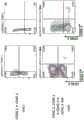
发明人已经证明,单个细胞中的多重HDR是可能的。出乎意料地,与在替代基因组位置未经历HDR的细胞相比,在另一个(替代)基因组位置已经历HDR的细胞中目标基因组位置的HDR几率增加(图3)。意外地,发明人还表明,可以通过分离在替代基因组位置经历杂合HDR的细胞富集在目标基因组位置具有杂合HDR的细胞,并可以通过分离在替代基因组位置经历纯合HDR的细胞富集在目标基因组位置具有纯合HDR的细胞(图3)。The inventors have demonstrated that multiple HDR in a single cell is possible. Unexpectedly, compared to cells that have not undergone HDR at an alternative genomic position, the HDR probability of the target genomic position in cells that have undergone HDR at another (alternative) genomic position increases (Fig. 3). Unexpectedly, the inventors also show that cells that can be enriched with heterozygous HDR at the target genomic position by separating cells that undergo heterozygous HDR at the alternative genomic position can be enriched with cells that have homozygous HDR at the target genomic position, and cells that can be enriched with homozygous HDR at the target genomic position can be enriched with cells that undergo homozygous HDR at the alternative genomic position (Fig. 3).
在本发明第二个方面的一些实施方案中,真核细胞是T细胞,目标基因组位置是Foxp3K276X突变,且DNA模板包含所述Foxp3突变的野生型等位基因,具体地,DNA模板是或包含SEQ ID NO 022或SEQ ID NO 023。In some embodiments of the second aspect of the present invention, the eukaryotic cell is a T cell, the target genomic position is the Foxp3 K276X mutation, and the DNA template comprises the wild-type allele of the Foxp3 mutation, specifically, the DNA template is or comprises SEQ ID NO 022 or SEQ ID NO 023.
发明人已经表明,可以使用根据本发明的方法校正鼠T细胞中的Foxp3K276X突变(图4)。The inventors have shown that the Foxp3 K276X mutation in murine T cells can be corrected using the method according to the invention ( FIG. 4 ).
在本发明的第一个方面的一些实施方案中,使用基于表面蛋白的第一和/或第二同种型表达的纯化来引起表达表面蛋白的第一和/或第二同种型的细胞选择性耗尽(图6)。In some embodiments of the first aspect of the invention, purification based on expression of the first and/or second isoform of the surface protein is used to cause selective depletion of cells expressing the first and/or second isoform of the surface protein ( FIG. 6 ).
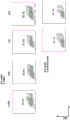
根据本发明的另一个方面,提供在编辑和未编辑细胞的组合物中选择性耗尽或富集编辑细胞的方法。未编辑细胞表达表面蛋白的第一同种型,通过根据本发明的第一个方面的方法编辑的编辑细胞表达表面蛋白的第二同种型,其与第一同种型在氨基酸标志物方面不同。第一同种型包含由核酸序列A编码的氨基酸标志物A,第二同种型包含由核酸序列B编码的氨基酸标志物B。基于表面蛋白的第一或第二同种型的表达选择性富集或耗尽编辑细胞(图6和25-29)。According to another aspect of the present invention, a method for selectively depleting or enriching edited cells in a composition of edited and unedited cells is provided. Unedited cells express a first isoform of a surface protein, and edited cells edited by the method according to the first aspect of the present invention express a second isoform of a surface protein, which is different from the first isoform in terms of amino acid markers. The first isoform comprises an amino acid marker A encoded by a nucleic acid sequence A, and the second isoform comprises an amino acid marker B encoded by a nucleic acid sequence B. Edited cells are selectively enriched or depleted based on the expression of the first or second isoform of a surface protein (Figures 6 and 25-29).
或者,本发明该方面可以是在未编辑和编辑细胞的组合物中选择性耗尽或富集细胞的方法。该方法包括以下步骤:Alternatively, this aspect of the invention may be a method of selectively depleting or enriching cells in a composition of unedited and edited cells. The method comprises the following steps:
a.提供细胞,其中所述细胞表达表面蛋白的第一同种型,其与所述表面蛋白的第二同种型在氨基酸标志物方面不同,其中所述第一同种型包含由核酸序列A编码的氨基酸标志物A,所述第二同种型包含由核酸序列B编码的氨基酸标志物B;a. providing a cell, wherein the cell expresses a first isoform of a surface protein that differs from a second isoform of the surface protein in terms of an amino acid marker, wherein the first isoform comprises an amino acid marker A encoded by a nucleic acid sequence A, and the second isoform comprises an amino acid marker B encoded by a nucleic acid sequence B;
b.在包含核酸序列A的基因组位置诱导DNA双链断裂;b. inducing a DNA double-strand break at a genomic location comprising nucleic acid sequence A;
c.提供DNA修复构建体,其包含核酸序列B和一对与所述基因组位置的5’和3’DNA序列同源的同源臂,尤其是用所述DNA修复构建体转染所述细胞;c. providing a DNA repair construct comprising a nucleic acid sequence B and a pair of homology arms homologous to the 5' and 3' DNA sequences of the genomic position, and in particular transfecting the cell with the DNA repair construct;
d.基于所述表面蛋白的所述第一或第二同种型的表达选择性富集/耗尽细胞。d. Selectively enriching/depleting cells based on expression of said first or second isoform of said surface protein.
在本申请的上下文中,术语“选择性耗尽细胞”涉及选择性降低表达某个标志物/等位基因的细胞的总数或浓度。In the context of the present application, the term "selectively deplete cells" relates to selectively reducing the total number or concentration of cells expressing a certain marker/allele.
作为非限制性实例,选择性耗尽可以通过以下实现:补体依赖性细胞毒性(CDC)、抗体依赖性细胞毒性(ADCC)、抗体药物偶联物(ADC)或携带天然抗原受体或嵌合抗原受体(CAR)的细胞。As non-limiting examples, selective depletion can be achieved by complement dependent cytotoxicity (CDC), antibody dependent cellular cytotoxicity (ADCC), antibody drug conjugates (ADC), or cells carrying native antigen receptors or chimeric antigen receptors (CARs).
发明人已经证明,分别使用针对CD45.2或CD45.1的抗体在体内选择性耗尽是可能的(图25-29)。The inventors have demonstrated that selective depletion in vivo is possible using antibodies directed against CD45.2 or CD45.1, respectively (Figures 25-29).
技术人员知晓,耗尽未编辑细胞对应于富集编辑细胞。The skilled person knows that depletion of unedited cells corresponds to enrichment of edited cells.
发明人证明,可以将单个氨基酸差异工程化入细胞,并且可以通过特异性结合两个同种型/等位基因(天然的vs.工程化的)的两个不同配体来区分。将特别设计的人工突变或稀有但天然存在的突变(例如单核苷酸多态性,SNP)工程化入内源性表面表达的基因以改变其抗原性。技术人员知晓,可以通过本领域已知的任何方法,包含HDR和碱基编辑器引入这种突变。随后利用该改变的表位,用特异性且选择性识别该人工表位的配体成功地选择性耗尽编辑细胞。或者,通过识别天然表位但不识别改变表位的配体使编辑细胞对耗尽有抗性(因而可以耗尽宿主细胞),从而保留转移的细胞。The inventors have demonstrated that a single amino acid difference can be engineered into cells and can be distinguished by two different ligands that specifically bind to two isoforms/alleles (natural vs. engineered). Specially designed artificial mutations or rare but naturally occurring mutations (such as single nucleotide polymorphisms, SNPs) are engineered into endogenous surface-expressed genes to change their antigenicity. The skilled person knows that such mutations can be introduced by any method known in the art, including HDR and base editors. The altered epitope is then used to successfully selectively deplete edited cells with a ligand that specifically and selectively recognizes the artificial epitope. Alternatively, edited cells are made resistant to depletion (and thus host cells can be depleted) by a ligand that recognizes the natural epitope but not the altered epitope, thereby retaining the transferred cells.
如果“编辑/工程化细胞”(其中细胞表面蛋白的第一同种型已经变为第二同种型的细胞)随后用于移植,尤其是用于过继转移,可以使用两种不同同种型来区分转移细胞和宿主细胞。这允许追踪转移细胞,因为它们被永久标记。可以在体内或离体使用标记的配体实现追踪,例如通过流式细胞术或细胞或组织上的组织化学。使用分别仅结合转移的工程化细胞或宿主细胞的抗体,在体内应用对转移细胞或宿主细胞具有特异性的配体能够选择性耗尽转移细胞或宿主细胞。或者,可以通过携带识别转移细胞或宿主细胞的天然或嵌合抗原受体(CAR)的细胞来实现选择性细胞耗尽。编码这种CAR的核苷酸序列可以源自产生识别特定同种型的配体的杂交瘤细胞。If "edited/engineered cells" (cells in which the first isotype of a cell surface protein has been changed to a second isotype) are subsequently used for transplantation, especially for adoptive transfer, two different isotypes can be used to distinguish between transferred cells and host cells. This allows tracking of transferred cells because they are permanently labeled. Tracking can be achieved in vivo or in vitro using labeled ligands, such as by flow cytometry or histochemistry on cells or tissues. Using antibodies that are only bound to the engineered cells or host cells that are transferred, respectively, a ligand specific to the transferred cells or host cells can be selectively depleted in vivo. Alternatively, selective cell depletion can be achieved by carrying cells that recognize natural or chimeric antigen receptors (CARs) for transferred cells or host cells. The nucleotide sequence encoding this CAR can be derived from a hybridoma cell that produces a ligand that recognizes a specific isotype.
选择性耗尽工程化细胞通过提供“安全开关”称为一个重要的安全性特征。安全开关和自杀基因的基本概念描述于Jones等,Front Pharmacol.;5:254.doi:10.3389。发明人的方法更简单、更安全且具有更多用途。原则上,可以将过继转移的任何细胞工程化以携带改变的等位基因/表位作为组合的体外或体内选择、追踪、安全性和/或选择性消融开关。非排他性的实例包括:仅携带工程化等位基因但不是基因工程化的细胞,或携带其他工程化特征的细胞,例如CAR细胞。例如,用于移植物抗白血病效应的转移的同种异体细胞可以引起移植物抗宿主病(GvHD)。如果在转移前整合工程化的等位基因,可以通过工程化等位基因消除它们,从而减少/治疗GvHD。类似地,如果由于脱靶效应或过于强烈的中靶效应发生不期望的副作用,可以将转移的自体肿瘤浸润淋巴细胞(TIL)或病原体特异性的淋巴细胞工程化以携带改变的等位基因,从而消除它们。在CAR细胞的情况下,改变的等位基因可以作为安全开关。此外,转移的工程化细胞也可以被消除,如果它们变成恶性或引起任何类型的不期望的中靶或脱靶损伤。或者,在选择性消除引起疾病的宿主细胞的同时,可以保留自体但工程化的细胞。与发明人的方法相反,现有技术限于消除转移细胞,但不轻易允许消除宿主细胞。改变的同种型允许在消除宿主细胞期间转移例如基因修复的或工程化的自体细胞。在没有通过本发明的方法引入同种型转换的情况下,转移健康细胞时需要停止消除宿主细胞。这种情况下,在新转移的修复细胞扩增的同时,宿主细胞也会扩增并且不再能被消除,风险是引起疾病的宿主细胞将竞争超过修复细胞。因此,使得工程化细胞通过本发明的方法抗耗尽与作为治疗用途高度相关。举例而言,可以在自体造血细胞中突变由抗CD19-CAR细胞识别的CD19表位,从而使正在耗尽的抗CD19mAb或抗CD19-CAR细胞不再能够结合并破坏工程化细胞,但CD19仍然具有功能。这将消除如今有效的抗CD19-CAR细胞的一个主要并发症。尽管抗CD19-CAR在消除表达CD19的造血系统恶性肿瘤方法具有非常高的成功率,它们同时导致消除表达CD19的健康宿主细胞。这引起低丙球蛋白血症,从而引起感染风险增加。突变的CD19将允许用健康的自体造血干细胞(HSC)重构宿主免疫系统,产生对抗CD19-CAR细胞有抗性的B细胞。因此,CAR19T细胞可以持续预防复发,而编辑的抗性细胞将提供天然保护免受感染。因此,患者不再依赖于IVIG输注。可以潜在地通过非基因毒性的预处理(例如,通过抗体)实现部分嵌合的HSC移植(Nat Biotech,2016)。或者,识别天然CD45表位(例如CD45.2)的抗CD45-CAR细胞可用于消除所有造血宿主细胞,包括恶性或其它引起疾病的造血细胞。如CD45.2至CD45.1转换实验所示,携带工程化CD45表位(例如CD45.1)的健康自体造血干细胞(HSC)或其他造血细胞的移植将允许用健康的造血系统重建宿主,其将不再被抗CD45-CAR细胞耗尽。一个主要优点是可以靶向所有表达CD45的恶性肿瘤(包括但不限于T细胞和骨髓恶性肿瘤),而不需要肿瘤或细胞类型特异性的抗原,即,本发明将提供一种普遍适用的治疗造血系统恶性肿瘤和其他非恶性造血系统疾病的系统。此外,可以在不需要同种异体细胞的情况下治疗造血系统肿瘤,从而消除作为主要并发症的GvHD。此外,重建可以在耗尽阶段开始,这将缩短恢复时间。重要的是,用于使转移的细胞抗耗尽的突变随后也可用于在必要时再次耗尽那些细胞。HSC的CAR细胞依赖性耗尽可潜在地用作实现温和的,即非基因毒性预处理的替代方式。针对抗原或抗原组合以将靶细胞特异性限制于HSC的CAR细胞可用于耗尽内源性HSC。这可以是例如抗CD45或抗CD34加上合成生物学方法中的第二抗原(例如具有AND门)以特异性且排他地引导CAR细胞对抗HSC。Selective depletion of engineered cells is called an important safety feature by providing a "safety switch". The basic concepts of safety switches and suicide genes are described in Jones et al., Front Pharmacol.; 5:254.doi:10.3389. The inventor's method is simpler, safer and has more uses. In principle, any cell of adoptive transfer can be engineered to carry a changed allele/epitope as a combined in vitro or in vivo selection, tracking, safety and/or selective ablation switch. Non-exclusive examples include: cells that only carry engineered alleles but are not genetically engineered, or cells that carry other engineered features, such as CAR cells. For example, allogeneic cells used for transfer of graft-versus-leukemia effects can cause graft-versus-host disease (GvHD). If the engineered alleles are integrated before transfer, they can be eliminated by the engineered alleles, thereby reducing/treating GvHD. Similarly, if undesirable side effects occur due to off-target effects or too strong on-target effects, the transferred autologous tumor infiltrating lymphocytes (TIL) or pathogen-specific lymphocytes can be engineered to carry altered alleles to eliminate them. In the case of CAR cells, the altered alleles can be used as a safety switch. In addition, the transferred engineered cells can also be eliminated if they become malignant or cause any type of undesirable on-target or off-target damage. Alternatively, while selectively eliminating the host cells that cause the disease, the autologous but engineered cells can be retained. In contrast to the inventor's method, the prior art is limited to eliminating transferred cells, but does not easily allow the elimination of host cells. The altered isotype allows the transfer of, for example, genetically repaired or engineered autologous cells during the elimination of host cells. In the absence of isotype conversion introduced by the method of the present invention, it is necessary to stop eliminating host cells when transferring healthy cells. In this case, while the newly transferred repair cells are amplified, the host cells will also amplify and can no longer be eliminated, and the risk is that the host cells that cause the disease will compete to exceed the repair cells. Therefore, making the engineered cells anti-depleted by the method of the present invention is highly relevant to therapeutic use. For example, the CD19 epitope recognized by the anti-CD19-CAR cell can be mutated in the autologous hematopoietic cell, so that the anti-CD19mAb or anti-CD19-CAR cell that is being exhausted can no longer bind to and destroy the engineered cell, but CD19 is still functional. This will eliminate a major complication of the anti-CD19-CAR cell that is effective today. Although anti-CD19-CAR has a very high success rate in eliminating hematopoietic malignancies expressing CD19, they also lead to the elimination of healthy host cells expressing CD19. This causes hypogammaglobulinemia, which increases the risk of infection. Mutated CD19 will allow the host immune system to be reconstructed with healthy autologous hematopoietic stem cells (HSC), producing B cells resistant to anti-CD19-CAR cells. Therefore, CAR19T cells can continuously prevent relapse, and the edited resistant cells will provide natural protection from infection. Therefore, patients are no longer dependent on IVIG infusions. Partially chimeric HSC transplantation can potentially be achieved through non-genotoxic pretreatment (e.g., by antibodies) (Nat Biotech, 2016). Alternatively, anti-CD45-CAR cells that recognize natural CD45 epitopes (such as CD45.2) can be used to eliminate all hematopoietic host cells, including malignant or other hematopoietic cells that cause disease. As shown in CD45.2 to CD45.1 conversion experiments, transplantation of healthy autologous hematopoietic stem cells (HSC) or other hematopoietic cells carrying engineered CD45 epitopes (such as CD45.1) will allow the host to be reconstructed with a healthy hematopoietic system, which will no longer be exhausted by anti-CD45-CAR cells. A major advantage is that all malignancies expressing CD45 (including but not limited to T cells and bone marrow malignancies) can be targeted without the need for tumor or cell type-specific antigens, that is, the present invention will provide a generally applicable system for treating hematopoietic malignancies and other non-malignant hematopoietic diseases. In addition, hematopoietic tumors can be treated without the need for allogeneic cells, thereby eliminating GvHD as a major complication. In addition, reconstruction can begin in the exhaustion phase, which will shorten the recovery time. Importantly, mutations used to make the transferred cells anti-exhausted can also be used to exhaust those cells again when necessary. CAR cell-dependent depletion of HSC can potentially be used as an alternative to achieve mild, i.e., non-genotoxic pretreatment. CAR cells directed against antigens or antigen combinations to specifically restrict target cells to HSC can be used to deplete endogenous HSC. This can be, for example, anti-CD45 or anti-CD34 plus a second antigen in a synthetic biology approach (e.g., with an AND gate) to specifically and exclusively direct CAR cells against HSC.
本发明的这个方面代表了替换细胞的通用策略。细胞可以是自体或同种异体的造血细胞。如果替换细胞是HSC,则所述方法可用于治疗任何造血系统恶性肿瘤或其他造血系统疾病。This aspect of the invention represents a general strategy for replacing cells. The cells can be autologous or allogeneic hematopoietic cells. If the replacement cells are HSCs, the method can be used to treat any hematopoietic malignancy or other hematopoietic disease.
与现有的“安全开关”方法相比,本发明人的方法的其他优点包括以下内容。发明人的方法使用内源蛋白。不必向细胞中引入转基因或标签。两个表位在功能上是相同的,但可以通过特异性结合的配体来区分。该方法能够耗尽转移细胞或宿主细胞,这取决于使用哪种配体。由于向基因组中引入设计的突变,安全特征永久地保留在细胞中并且不会被沉默,而这可能发生在病毒引入的转基因安全开关上。此外,工程化表位的抗原性低于人工大型安全开关/自杀基因构建体,因此不太可能被宿主细胞排斥。此外,工程化同种型的使用依赖于靶向突变,因此可能比通常通过病毒递送随机整合到基因组中从而可导致插入突变的其他安全开关/自杀基因更安全(Cornu,Nat Med,2017)。Compared with existing "safety switch" methods, other advantages of the inventor's method include the following. The inventor's method uses endogenous proteins. It is not necessary to introduce transgenes or tags into the cells. The two epitopes are functionally identical but can be distinguished by the ligands that specifically bind. The method is able to deplete either transfer cells or host cells, depending on which ligand is used. Due to the introduction of designed mutations into the genome, the safety feature remains permanently in the cell and is not silenced, which may happen to the transgenic safety switch introduced by the virus. In addition, the antigenicity of the engineered epitope is lower than that of artificial large safety switch/suicide gene constructs and is therefore less likely to be rejected by host cells. In addition, the use of engineered isoforms relies on targeted mutations and may therefore be safer than other safety switches/suicide genes that are typically randomly integrated into the genome by viral delivery, which can lead to insertion mutations (Cornu, Nat Med, 2017).
技术人员知晓,为了将细胞表面蛋白从第一同种型变为第二同种型,可以用HDR之外的替代方法。作为非限制性实例,同种型转换可以使用碱基编辑器实现,如以下出版物中的非限制性实例所述:Komor等,Nature 533,420-424,doi:10.1038/nature17946。通过允许编辑所需氨基酸而不需要dsDNA断裂,该方法可以进一步增加安全性。碱基编辑器或相关技术可以作为质粒或微环(dsDNA)、mRNA或RNP递送。The skilled person is aware that in order to change a cell surface protein from a first isoform to a second isoform, alternative methods other than HDR can be used. As a non-limiting example, isoform switching can be achieved using a base editor, as described in the non-limiting examples in the following publications: Komor et al., Nature 533, 420-424, doi: 10.1038/nature17946. This method can further increase safety by allowing editing of the desired amino acids without the need for dsDNA breaks. Base editors or related technologies can be delivered as plasmids or minicircles (dsDNA), mRNA or RNPs.
在通过本发明的方法将细胞表面蛋白的第一同种型转换为第二同种型与修复引起疾病的基因(例如Foxp3基因)相结合的情况下,可以通过耗尽表达第一同种型的细胞在体内(即,在转移到宿主中后)耗尽未修复的细胞。发明人已经证明,在已经发生同种型转换的细胞中成功修复基因的可能性增加。将第一基因的同种型转换与第二基因的遗传修饰组合允许在遗传工程化细胞中包括安全特征。In the case where the first isoform of a cell surface protein is converted to a second isoform by the method of the present invention in combination with repairing a disease-causing gene (e.g., Foxp3 gene), unrepaired cells can be depleted in vivo (i.e., after transfer into a host) by depleting cells expressing the first isoform. The inventors have demonstrated that the likelihood of successfully repairing a gene in cells where isoform conversion has occurred increases. Combining isoform conversion of a first gene with genetic modification of a second gene allows safety features to be included in genetically engineered cells.
同种型转换也可用作标志物以追踪宿主中编辑的转移细胞。Isotype switching can also be used as a marker to track edited metastatic cells in the host.
根据本发明该方面的替代方案,提供一种用于在未编辑和编辑细胞的组合物中选择性耗尽或富集细胞的方法,其中该方法包括以下步骤:According to an alternative embodiment of this aspect of the invention, there is provided a method for selectively depleting or enriching cells in a composition of unedited and edited cells, wherein the method comprises the following steps:
a.提供细胞,其中所述细胞表达表面蛋白的第一同种型,其与所述表面蛋白的第二同种型在氨基酸标志物方面不同,其中所述第一同种型包含由核酸序列A编码的氨基酸标志物A,所述第二同种型包含由核酸序列B编码的氨基酸标志物B;a. providing a cell, wherein the cell expresses a first isoform of a surface protein that differs from a second isoform of the surface protein in terms of an amino acid marker, wherein the first isoform comprises an amino acid marker A encoded by a nucleic acid sequence A, and the second isoform comprises an amino acid marker B encoded by a nucleic acid sequence B;
b.通过位点特异性遗传操作在所述细胞中诱导核酸序列A变为核酸序列B,从而将所述细胞中第一同种型的表达变为第二同种型的表达;b. inducing nucleic acid sequence A to become nucleic acid sequence B in the cell by site-specific genetic manipulation, thereby changing the expression of the first isoform in the cell to the expression of the second isoform;
c.基于所述表面蛋白的所述第一或第二同种型的表达选择性富集/耗尽细胞。c. Selectively enriching/depleting cells based on expression of said first or second isoform of said surface protein.
在该替代方面的一些实施方案中,通过提供,特别是用碱基编辑器(如Komor等,Nature 533,420-424,doi:10.1038/nature17946中所述)和向导RNA转染所述细胞来实现遗传操作,所述碱基编辑能够将编码氨基酸标志物A的核酸序列A变为编码氨基酸标志物B的核酸序列B,所述向导RNA能够将所述碱基编辑器导向编码氨基酸标志物A的核酸序列A。In some embodiments of this alternative aspect, genetic manipulation is achieved by providing, in particular transfecting the cell with a base editor (as described in Komor et al., Nature 533, 420-424, doi: 10.1038/nature17946) and a guide RNA, wherein the base editor is capable of changing a nucleic acid sequence A encoding an amino acid marker A into a nucleic acid sequence B encoding an amino acid marker B, and the guide RNA is capable of directing the base editor to a nucleic acid sequence A encoding an amino acid marker A.
根据本发明的另一个方面,提供包含以下组分的试剂盒:According to another aspect of the present invention, there is provided a kit comprising the following components:
a.靶向编码细胞表面蛋白的基因的基因组位置的向导RNA,其中所述基因存在核酸标志物序列不同的两种同种型,其中同种型1包含第一标志物序列,同种型2包含第二标志物序列。基因组位置包含PAM序列和所述第一或第二标志物序列。a. A guide RNA targeting a genomic location of a gene encoding a cell surface protein, wherein the gene exists in two isoforms with different nucleic acid marker sequences, wherein
b.包含所述第一标志物序列或所述第二标志物序列的DNA构建体、所述PAM序列(其中特别是所述PAM序列是突变的和非功能性的)和一对同源臂,所述同源臂与编码所述细胞表面蛋白的基因的所述基因组位置的5'和3'基因组DNA序列同源。b. A DNA construct comprising the first marker sequence or the second marker sequence, the PAM sequence (wherein in particular the PAM sequence is mutated and non-functional) and a pair of homology arms which are homologous to the 5' and 3' genomic DNA sequences of the genomic location of the gene encoding the cell surface protein.
c.任选地,分别特异性结合同种型1和同种型2的基因产物的第一和第二抗体。c. Optionally, first and second antibodies that specifically bind to the gene products of
该试剂盒能够将同种型1转化为同种型2或将同种型2转化为同种型1。表述“包含所述第一标志物序列或所述第二标志物序列的DNA构建体”是指包含第一标志物序列或第二标志物序列的构建体,其中试剂盒的用户知道它是哪种标志物序列。如果试剂盒包含两种构建体,则将这些构建体物理分离(例如在不同的管中)并相应地标记。The kit is capable of converting
在本发明该方面的一些实施方案中,试剂盒包含HDR增强剂,尤其是香草醛和/或瑞卡帕布。In some embodiments of this aspect of the invention, the kit comprises an HDR enhancer, particularly vanillin and/or Recaparib.
在本发明该方面的一些实施方案中,同源臂各自包含至少85个碱基对(bp),更具体地各自包含至少450bp,甚至更具体地各自包含约2000bp。在本发明该方面的一些实施方案中,同源臂各自包含至少2000bp。发明人已经表明,增加的同源臂长度增加了HDR效率(图4D)。如果使用更长的模板,则可以减少HDR增强剂的量。这是期望的,以使HDR增强剂在临床应用中可能的副作用最小化。在一些情况下,同源性长臂可能比HDR增强化合物更有效且更理想,而在其他情况下,使用较短的模板(例如ssDNA模板)与HDR增强分子的组合可能更理想。发明人还已经表明,在诱导的DNA断裂和突变位点之间的距离超过50bp的情况下(例如,在由于序列限制不可能在突变位点50bp内设计sgRNA的情况下),同源臂的长度增加使HDR成为可能(图4H)。这是一个重要且令人惊讶的发现,因为其他人已经描述,如果诱导的DNA断裂和突变位点之间的距离超过50bp,则不可能实现HDR(Paquet等,Nature.2016May5;533(7601):125-9)。在不可能进行沉默突变的情况下,较长的模板也可以克服突变PAM序列的需要。In some embodiments of this aspect of the invention, each homology arm comprises at least 85 base pairs (bp), more specifically at least 450bp, and even more specifically about 2000bp. In some embodiments of this aspect of the invention, each homology arm comprises at least 2000bp. The inventors have shown that the increased homology arm length increases the HDR efficiency (Fig. 4D). If a longer template is used, the amount of the HDR enhancer can be reduced. This is desirable to minimize the possible side effects of the HDR enhancer in clinical applications. In some cases, homology long arms may be more effective and more ideal than HDR enhancing compounds, while in other cases, the use of a shorter template (e.g., ssDNA template) in combination with an HDR enhancing molecule may be more ideal. The inventors have also shown that when the distance between the induced DNA break and the mutation site exceeds 50bp (e.g., when it is impossible to design sgRNA within 50bp of the mutation site due to sequence restrictions), the increase in the length of the homology arm makes HDR possible (Fig. 4H). This is an important and surprising finding, as others have described that HDR is not possible if the distance between the induced DNA break and the mutation site exceeds 50 bp (Paquet et al., Nature. 2016 May 5; 533(7601): 125-9). Longer templates can also overcome the need to mutate the PAM sequence when silent mutations are not possible.
在本发明该方面的一些实施方案中,细胞表面蛋白是人细胞表面蛋白。In some embodiments of this aspect of the invention, the cell surface protein is a human cell surface protein.
在本发明该方面的一些实施方案中,细胞表面蛋白是鼠Thy1或鼠CD45。In some embodiments of this aspect of the invention, the cell surface protein is murine Thy1 or murine CD45.
在本发明该方面的一些实施方案中,细胞表面蛋白是鼠Thy1,向导RNA是SEQ IDNO 001,并且所述DNA构建体选自SEQ ID NO013(no mut)、SEQ ID NO 014(mut)、SEQ ID NO015(4x mut)、SEQ ID NO 024(2kb)、SEQ ID NO 025(4kb)、SEQ ID NO 026(1kb)和SEQ IDNO 027(160bp)。In some embodiments of this aspect of the invention, the cell surface protein is mouse Thy1, the guide RNA is SEQ ID NO 001, and the DNA construct is selected from SEQ ID NO 013 (no mut), SEQ ID NO 014 (mut), SEQ ID NO 015 (4x mut), SEQ ID NO 024 (2kb), SEQ ID NO 025 (4kb), SEQ ID NO 026 (1kb) and SEQ ID NO 027 (160bp).
在本发明该方面的一些实施方案中,细胞表面蛋白是鼠Thy1,向导RNA是SEQ IDNO 008,并且所述DNA构建体选自SEQ ID NO017(120bp)和SEQ ID NO 018(180bp)。In some embodiments of this aspect of the invention, the cell surface protein is mouse Thy1, the guide RNA is SEQ ID NO 008, and the DNA construct is selected from SEQ ID NO 017 (120 bp) and SEQ ID NO 018 (180 bp).
在本发明该方面的一些实施方案中,细胞表面蛋白是鼠CD45,向导RNA是SEQ IDNO 003,并且所述DNA构建体选自SEQ ID NO009、SEQ ID NO 019(1kb)、SEQ ID NO 020(2kb)和SEQ ID NO 021(4kb)。In some embodiments of this aspect of the invention, the cell surface protein is mouse CD45, the guide RNA is SEQ ID NO 003, and the DNA construct is selected from SEQ ID NO 009, SEQ ID NO 019 (1 kb), SEQ ID NO 020 (2 kb) and SEQ ID NO 021 (4 kb).
在本发明该方面的一些实施方案中,试剂盒额外包含已经遗传工程化用于稳定Cas9表达的鼠T细胞系。本发明人已经建立了具有稳定Cas9表达的这种T细胞系(EL-4ATCCTIB-39)(图8)。使用具有稳定Cas9表达的细胞的优点是减少了需要转染的DNA的量,这增加了细胞存活并且可以增加HDR效率。在这些细胞中,只需转染向导RNA和DNA修复构建体。In some embodiments of this aspect of the invention, the kit additionally comprises a mouse T cell line genetically engineered for stabilizing Cas9 expression. The inventors have established this T cell line (EL-4ATCCTIB-39) (Fig. 8) with stable Cas9 expression. The advantage of using cells with stable Cas9 expression is that the amount of DNA that needs to be transfected is reduced, which increases cell survival and can increase HDR efficiency. In these cells, only guide RNA and DNA repair constructs need to be transfected.
根据另一方面,提供一种用于编辑造血细胞中的目标基因组位置的方法。该方法包括以下步骤:According to another aspect, a method for editing a target genomic location in a hematopoietic cell is provided. The method comprises the following steps:
a.提供造血细胞;a. Provide hematopoietic cells;
b.在第一培养步骤中,在能够激活所述造血细胞的因子存在下培养所述造血细胞;b. in a first culture step, culturing the hematopoietic cells in the presence of factors capable of activating the hematopoietic cells;
c.用以下转染造血细胞c. Transfect hematopoietic cells with
i.编码CRISPR相关的核酸内切酶、第一标志物基因和向导RNA的DNA表达构建体,其中向导RNA能够与目标基因组位置退火;和i. a DNA expression construct encoding a CRISPR-associated nuclease, a first marker gene, and a guide RNA, wherein the guide RNA is capable of annealing to a target genomic location; and
ii.DNA修复构建体,其中所述DNA修复构建体包含目标转基因DNA序列(待插入基因组DNA)和与目标基因组位置的5'和3'基因组DNA序列同源的同源臂;ii. a DNA repair construct, wherein the DNA repair construct comprises a target transgenic DNA sequence (to be inserted into genomic DNA) and homology arms homologous to the 5' and 3' genomic DNA sequences of the target genomic location;
d.在第一培养步骤中,在能够激活所述造血细胞的因子存在下培养所述造血细胞;d. in a first culture step, culturing the hematopoietic cells in the presence of factors capable of activating the hematopoietic cells;
e.在分离步骤中分离表达所述第一标志物基因的造血细胞;e. separating hematopoietic cells expressing the first marker gene in the separation step;
f.在第三培养步骤中培养所述分离的造血细胞,其中所述第三培养步骤包括用同源定向修复(HDR)增强剂处理所述造血细胞。f. culturing the isolated hematopoietic cells in a third culturing step, wherein the third culturing step comprises treating the hematopoietic cells with a homology directed repair (HDR) enhancer.
在本申请的上下文中,表述“DNA表达构建体”可以指包含CRISPR相关的核酸内切酶、标志物基因和向导RNA的单个DNA构建体,或包含所述组分的多个DNA构建体。在一个构建体上具有全部三个组分的优点是对于标志物基因呈阳性的所有细胞对其他组分也呈阳性。技术人员知晓,向导RNA可以替代地以体外转录的向导RNA的形式提供,并且核酸内切酶可以替代地作为mRNA或作为蛋白质提供。核酸内切酶和向导RNA也可以以核糖核蛋白颗粒(RNP)的形式组合提供。如果DNA表达构建体包含标志物基因,特别是编码荧光蛋白的基因,则它可用于鉴定已经摄取DNA表达构建体的细胞。In the context of the present application, the expression "DNA expression construct" may refer to a single DNA construct comprising a CRISPR-related endonuclease, a marker gene, and a guide RNA, or a plurality of DNA constructs comprising the components. The advantage of having all three components on one construct is that all cells that are positive for the marker gene are also positive for the other components. The technician knows that the guide RNA may alternatively be provided in the form of an in vitro transcribed guide RNA, and the endonuclease may alternatively be provided as mRNA or as a protein. The endonuclease and the guide RNA may also be provided in combination in the form of ribonucleoprotein particles (RNP). If the DNA expression construct comprises a marker gene, particularly a gene encoding a fluorescent protein, it can be used to identify cells that have taken up the DNA expression construct.
据报道,原代细胞中的基因编辑需要使用RNP(Schumann等,2015,PNAS)。通常还报道,在血液和免疫系统的细胞中,由于内在的细胞防御机制的激活,通过电穿孔转移裸DNA可导致大量细胞死亡(Cornu,Nat Med,2017)。出乎意料地,本发明人能够使用包含Cas9、向导RNA和GFP的DNA表达构建体在原代T细胞中实现电穿孔和基因编辑(包括HDR)。It is reported that gene editing in primary cells requires the use of RNPs (Schumann et al., 2015, PNAS). It is also generally reported that in cells of the blood and immune system, the transfer of naked DNA by electroporation can lead to massive cell death due to the activation of intrinsic cellular defense mechanisms (Cornu, Nat Med, 2017). Unexpectedly, the inventors were able to achieve electroporation and gene editing (including HDR) in primary T cells using a DNA expression construct comprising Cas9, guide RNA and GFP.
细胞对DNA双链断裂的应答是DNA修复机制的激活,其主要由NHEJ途径和HDR途径组成。NHEJ通常导致随机插入和缺失(indel),其可用于删除基因。这可以用于实验目的,但是对于临床使用,固有的随机NHEJ修复途径具有显著的风险。阻断NHEJ途径导致细胞应答转向HDR途径。The response of cells to double-strand breaks in DNA is the activation of DNA repair mechanisms, which are mainly composed of the NHEJ pathway and the HDR pathway. NHEJ usually causes random insertions and deletions (indels), which can be used to delete genes. This can be used for experimental purposes, but for clinical use, the inherent random NHEJ repair pathway has significant risks. Blocking the NHEJ pathway causes the cell response to turn to the HDR pathway.
在本发明该方面的一些实施方案中,DNA修复构建体的同源臂各自包含约2000个碱基对(bp)。在一些实施方案中,同源臂各自包含至少2000bp。发明人已经表明,增加的同源臂长度增加了HDR效率(图4D)。如果使用更长的模板,则可以减少HDR增强剂的量。这是期望的,以使HDR增强剂在临床应用中可能的副作用最小化。在一些情况下,同源性长臂可能比HDR增强化合物更有效且更理想,而在其他情况下,使用较短的模板(例如ssDNA模板)与HDR增强分子的组合可能更理想。发明人还表明,在诱导的DNA断裂和突变位点之间的距离超过50bp的情况下(例如,在由于序列限制不可能在突变位点50bp内设计sgRNA的情况下),同源臂的长度增加使HDR成为可能(图4H)。这是一个重要且令人惊讶的发现,因为其他人已经描述,如果诱导的DNA断裂和突变位点之间的距离超过50bp,则不可能实现HDR(Paquet等,Nature.2016May5;533(7601):125-9)。在不可能进行沉默突变的情况下,较长的模板也可以克服突变PAM序列的需要。In some embodiments of this aspect of the invention, the homology arms of the DNA repair construct each contain about 2000 base pairs (bp). In some embodiments, the homology arms each contain at least 2000bp. The inventors have shown that the increased homology arm length increases the HDR efficiency (Fig. 4D). If a longer template is used, the amount of the HDR enhancer can be reduced. This is desirable to minimize the possible side effects of the HDR enhancer in clinical applications. In some cases, the homology long arm may be more effective and more ideal than the HDR enhancing compound, while in other cases, the combination of a shorter template (e.g., ssDNA template) and an HDR enhancing molecule may be more ideal. The inventors also show that in the case where the distance between the induced DNA break and the mutation site exceeds 50bp (e.g., in the case where it is impossible to design sgRNA within 50bp of the mutation site due to sequence restrictions), the length of the homology arm increases to make HDR possible (Fig. 4H). This is an important and surprising finding, as others have described that HDR is not possible if the distance between the induced DNA break and the mutation site exceeds 50 bp (Paquet et al., Nature. 2016 May 5; 533(7601): 125-9). Longer templates can also overcome the need to mutate the PAM sequence when silent mutations are not possible.
通过Cas9的DNA切割依赖于靶DNA中存在的短前间区序列邻近基序(PAM),限制了可靶向序列的选择。例如,化脓性链球菌的CAS9(SpyCas9)对应于PAM序列5’-NGG-3’。在一些实施方案中,DNA修复构建体包含突变的PAM序列。突变使得PAM序列无功能,但不影响蛋白的表达、稳定性或功能。使用包含突变PAM序列的DNA修复构建体提高了HDR效率(图3D)。DNA cleavage by Cas9 depends on the presence of a short protospacer sequence adjacent to the motif (PAM) in the target DNA, which limits the choice of targetable sequences. For example, the CAS9 (SpyCas9) of Streptococcus pyogenes corresponds to the PAM sequence 5'-NGG-3'. In some embodiments, the DNA repair construct comprises a mutated PAM sequence. The mutation renders the PAM sequence non-functional, but does not affect the expression, stability or function of the protein. The use of a DNA repair construct comprising a mutated PAM sequence improves HDR efficiency (Figure 3D).
在没有提供DNA修复构建体的情况下,DNA双链断裂主要通过NHEJ途径修复。In the absence of DNA repair constructs, DNA double-strand breaks are repaired primarily via the NHEJ pathway.
可以使用HDR增强剂使细胞应答转向HDR途径。HDR enhancers can be used to divert cellular responses toward the HDR pathway.
常用的HDR增强剂是SCR7(连接酶IV抑制剂)(Singh等,2014,Genetics)和RS-1(Song等,2016,Nat Communications)。对于能够增加HDR效率的其他试剂,存在未满足的需求。已经预期了使用小分子来抑制NHEJ从而增强HDR的一般策略。然而,本领域从未预期或启示选择本说明书中提出的单个分子和最佳条件。Commonly used HDR enhancers are SCR7 (ligase IV inhibitor) (Singh et al., 2014, Genetics) and RS-1 (Song et al., 2016, Nat Communications). There is an unmet need for other agents that can increase HDR efficiency. A general strategy of using small molecules to inhibit NHEJ and thus enhance HDR has been contemplated. However, the art has never contemplated or inspired the selection of single molecules and optimal conditions proposed in this specification.
在本发明该方面的一些实施方案中,HDR增强剂选自香草醛和瑞卡帕布。之前已经表明,香草醛及其衍生物抑制NHEJ途径(Durant and Karan,2003,Nucleic AcidsResearch,Vol.31,No.19 5501-5512)。发明人已经系统地测试了香草醛和其他HDR增强剂对HDR效率的影响(图1C,图2F),并且令人惊讶地发现香草醛确实增加了HDR效率,而其衍生物没有增加。与其他HDR增强剂相比,香草醛的优点是它是水溶性的。其他HDR增强组分在水性介质中溶解需要DMSO。In some embodiments of this aspect of the invention, the HDR enhancer is selected from vanillin and Recaparib. It has been shown previously that vanillin and its derivatives inhibit the NHEJ pathway (Durant and Karan, 2003, Nucleic Acids Research, Vol. 31, No. 19 5501-5512). The inventors have systematically tested the effects of vanillin and other HDR enhancers on HDR efficiency (Figure 1C, Figure 2F), and surprisingly found that vanillin did increase HDR efficiency, while its derivatives did not. Compared with other HDR enhancers, the advantage of vanillin is that it is water-soluble. Other HDR enhancing components require DMSO to dissolve in aqueous media.
在本申请上下文中,香草醛是指4-羟基-3-甲氧基苯甲醛,CAS No.121-33-5。In the context of this application, vanillin refers to 4-hydroxy-3-methoxybenzaldehyde, CAS No. 121-33-5.
在本申请上下文中,瑞卡帕布是指8-氟-2-{4-[(甲氨基)甲基]苯基}-1,3,4,5-四氢-6H-氮杂并[5,4,3-cd]吲哚-6-酮,CAS No.283173-50-2。In the context of the present application, Recaparib refers to 8-fluoro-2-{4-[(methylamino)methyl]phenyl}-1,3,4,5-tetrahydro-6H-aza[5,4,3-cd]indol-6-one, CAS No. 283173-50-2.
在本发明该方面的一些实施方案中,HDR增强剂是香草醛和/或瑞卡帕布。在一些实施方案中,HDR增强剂是浓度为50-500μM的香草醛和/或浓度为0.5-2.5μM的瑞卡帕布。在一些实施方案中,HDR增强剂是浓度为约300μM的香草醛和/或浓度为约1μM的瑞卡帕布。In some embodiments of this aspect of the invention, the HDR enhancer is vanillin and/or Recaparib. In some embodiments, the HDR enhancer is vanillin at a concentration of 50-500 μM and/or Recaparib at a concentration of 0.5-2.5 μM. In some embodiments, the HDR enhancer is vanillin at a concentration of about 300 μM and/or Recaparib at a concentration of about 1 μM.
在本发明该方面的一些实施方案中,造血细胞选自造血干细胞(血胚细胞)、CD4+T细胞、CD8+T细胞、记忆T细胞、调节性T细胞(T reg)、天然杀伤细胞(NK)、先天性淋巴细胞(ILC)、树突细胞(DC)、B淋巴细胞、粘膜相关不变T细胞(MAIT)和γδT细胞(γδT)。In some embodiments of this aspect of the invention, the hematopoietic cells are selected from hematopoietic stem cells (hematoblasts), CD4+T cells, CD8+T cells, memory T cells, regulatory T cells (T reg), natural killer cells (NK), innate lymphocytes (ILC), dendritic cells (DC), B lymphocytes, mucosal-associated invariant T cells (MAIT) and γδT cells (γδT).
在本发明该方面的一些实施方案中,第一和第二培养步骤包括使所述造血细胞与活化的单克隆抗体抗CD3和抗CD28接触。抗体可以是可溶的或固定在特别是培养皿、珠子或人工抗原呈递细胞(APC)上。In some embodiments of this aspect of the invention, the first and second culturing steps comprise contacting the hematopoietic cells with activating monoclonal antibodies anti-CD3 and anti-CD28. The antibodies may be soluble or immobilized, in particular on a culture dish, beads or artificial antigen presenting cells (APC).
在本发明该方面的一些实施方案中,根据上述权利要求中任一项的方法,其中所述转染可以通过以下实现:电穿孔、使用脂质体和/或外来体转染、弹道转移、使用纳米线转染、细胞挤压技术、渗透休克、病毒递送或声孔效应。In some embodiments of this aspect of the invention, according to the method of any of the above claims, the transfection can be achieved by: electroporation, transfection using liposomes and/or exosomes, ballistic transfer, transfection using nanowires, cell squeezing technology, osmotic shock, viral delivery or sonoporation.
在本发明该方面的一些实施方案中,分离步骤包括通过流式细胞术或磁珠分离来分离细胞。In some embodiments of this aspect of the invention, the isolating step comprises separating the cells by flow cytometry or magnetic bead separation.
在本发明该方面的一些实施方案中,用HDR增强剂的处理持续22-26小时,特别是24小时。处理后,洗涤细胞以除去HDR增强剂。In some embodiments of this aspect of the invention, the treatment with the HDR enhancer lasts for 22-26 hours, in particular 24 hours.After treatment, the cells are washed to remove the HDR enhancer.
在本发明该方面的一些实施方案中,DNA表达构建体是微环质粒。在本申请上下文中,术语“微环质粒”是指不含所有原核载体部分的小的环状质粒衍生物。In some embodiments of this aspect of the invention, the DNA expression construct is a minicircle plasmid.In the context of this application, the term "minicircle plasmid" refers to a small circular plasmid derivative that does not contain all the prokaryotic vector parts.
在本发明该方面的一些实施方案中,第一和第二培养步骤持续18-36小时,特别是22-26小时,更特别是24小时。In some embodiments of this aspect of the invention, the first and second culturing steps last for 18-36 hours, particularly 22-26 hours, more particularly 24 hours.
在本发明该方面的一些实施方案中,第三培养步骤持续5-10天,特别是6-8天,更特别是7天。In some embodiments of this aspect of the invention, the third culturing step lasts 5-10 days, particularly 6-8 days, more particularly 7 days.
在本发明该方面的一些实施方案中,第一标志物基因编码荧光蛋白,特别是绿色荧光蛋白(GFP)。In some embodiments of this aspect of the invention, the first marker gene encodes a fluorescent protein, particularly green fluorescent protein (GFP).
在本发明该方面的一些实施方案中,第一标志物基因编码在细胞表面表达的蛋白,其中可以使用特异性结合所述蛋白的配体检测所述在细胞表面表达的蛋白。In some embodiments of this aspect of the invention, the first marker gene encodes a protein expressed on the cell surface, wherein the protein expressed on the cell surface can be detected using a ligand that specifically binds to the protein.
根据上述权利要求任一项所述的方法,其中所述DNA修复构建体与编码第二标志物基因的表达盒连接,并且在所述分离步骤中分离表达所述第一和所述第二标志物基因的造血细胞。所述第二标志物基因可以编码荧光蛋白或在细胞表面表达的蛋白,其中可以使用特异性结合所述蛋白的配体检测所述在细胞表面表达的蛋白。由所述第一标志物基因编码的蛋白与由所述第二标志物基因编码的蛋白不同。技术人员知晓,提供“与编码第二标志物基因的表达盒连接的DNA修复构建体”可以通过提供包含DNA修复构建体和编码第二标志物基因的表达盒两者的DNA质粒来实现。The method according to any one of the above claims, wherein the DNA repair construct is connected to an expression cassette encoding a second marker gene, and the hematopoietic cells expressing the first and second marker genes are separated in the separation step. The second marker gene can encode a fluorescent protein or a protein expressed on the cell surface, wherein the protein expressed on the cell surface can be detected using a ligand that specifically binds to the protein. The protein encoded by the first marker gene is different from the protein encoded by the second marker gene. The technician knows that providing a "DNA repair construct connected to an expression cassette encoding a second marker gene" can be achieved by providing a DNA plasmid containing both a DNA repair construct and an expression cassette encoding a second marker gene.
在本发明该方面的一些实施方案中,造血细胞是T细胞。In some embodiments of this aspect of the invention, the hematopoietic cells are T cells.
在本发明该方面的一些实施方案中,分离步骤包括在爆破阶段分离所述T细胞。发明人已经表明,处于爆破阶段的细胞中的HDR效率高于不处于爆破阶段的细胞(图2E和图3E)。因此,在爆破阶段中分离细胞可以增加HDR效率。In some embodiments of this aspect of the invention, the separation step includes separating the T cells in the bursting stage. The inventors have shown that the HDR efficiency in cells in the bursting stage is higher than that in cells not in the bursting stage (Figure 2E and Figure 3E). Therefore, separating cells in the bursting stage can increase the HDR efficiency.
在本发明该方面的一些实施方案中,T细胞是初始鼠T细胞,特别是初始鼠CD4+T细胞。技术人员知晓,该实施方案涉及的T细胞在进行根据本发明的方法之前是初始的。之后,它不再被认为是初始的。In some embodiments of this aspect of the invention, the T cell is a naive mouse T cell, in particular a naive mouse CD4+ T cell. The skilled person will appreciate that the T cell to which this embodiment relates is naive before the method according to the invention is performed. Afterwards, it is no longer considered naive.
在本发明该方面的一些实施方案中,T细胞是初始人T细胞。技术人员知晓,该实施方案涉及的T细胞在进行根据本发明的方法之前是初始的。之后,它不再被认为是初始的。In some embodiments of this aspect of the invention, the T cell is a naive human T cell. The skilled person will appreciate that the T cell to which this embodiment relates is naive before the method according to the invention is performed. Afterwards, it is no longer considered naive.
根据本发明的另一个方面,提供使用根据上述权利要求任一项的方法编辑了目标基因组位置的造血细胞在治疗或预防疾病的方法中的用途。According to another aspect of the present invention, there is provided use of a hematopoietic cell edited at a target genomic location using a method according to any one of the above claims in a method for treating or preventing a disease.
在本发明该方面的一些实施方案中,造血细胞是T细胞。In some embodiments of this aspect of the invention, the hematopoietic cells are T cells.
在本发明该方面的一些实施方案中,疾病是X连锁多内分泌腺病肠病伴免疫失调综合征(IPEX;OMIM http://www.omim.org/entry/304790)或IPEX样综合征,并且所述基因组位置是选自以下基因中包含的突变:Foxp3基因、CD25基因、Stat5b基因、Stat1基因和Itch基因(Verbsky and Chatila,Curr Opin Pediatr.2013Dec;25(6):708-14)。所述基因中的突变阻止基因产物的表达或正常功能。根据本发明的方法编辑这些基因组位置消除了突变,从而恢复基因和蛋白的表达。In some embodiments of this aspect of the invention, the disease is X-linked polyendocrine enteropathy with immune dysregulation syndrome (IPEX; OMIM http://www.omim.org/entry/304790) or IPEX-like syndrome, and the genomic location is selected from mutations contained in the following genes: Foxp3 gene, CD25 gene, Stat5b gene, Stat1 gene and Itch gene (Verbsky and Chatila, Curr Opin Pediatr. 2013 Dec; 25 (6): 708-14). The mutation in the gene prevents the expression or normal function of the gene product. Editing these genomic locations according to the methods of the invention eliminates the mutations, thereby restoring the expression of the gene and protein.
在本发明该方面的一些实施方案中,基因组位置是Foxp3基因中包含的突变,且所述疾病是X连锁多内分泌腺病肠病伴免疫失调综合征。在本发明该方面的一些实施方案中,基因组位置是Foxp3K276X突变。Foxp3基因中的突变阻止基因产物的正常功能。根据本发明的方法编辑该基因组位置消除了突变,从而恢复Foxp3基因和Foxp3蛋白的表达。In some embodiments of this aspect of the invention, the genomic location is a mutation contained in the Foxp3 gene, and the disease is X-linked polyendocrine enteropathy with immune dysregulation syndrome. In some embodiments of this aspect of the invention, the genomic location is a Foxp3 K276X mutation. Mutations in the Foxp3 gene prevent the normal function of the gene product. Editing the genomic location according to the methods of the invention eliminates the mutation, thereby restoring expression of the Foxp3 gene and Foxp3 protein.
在本发明该方面的一些实施方案中,造血细胞是鼠T细胞,且基因组位置是Foxp3K276X突变。该突变概括了临床相关的人Foxp3突变(Ramsdell等,Naturereviews.Immunology 14,343-349(2014);Lin等,The Journal of allergy and clinicalimmunology 116,1106-1115(2005))。In some embodiments of this aspect of the invention, the hematopoietic cell is a murine T cell and the genomic location is a Foxp3 K276X mutation. This mutation recapitulates clinically relevant human Foxp3 mutations (Ramsdell et al., Nature reviews.
在本申请的上下文中,术语“Foxp3基因”涉及人叉头框P3,NCBI GENE ID:50943或鼠叉头框P3,NCBI GENE ID:20371。In the context of the present application, the term "Foxp3 gene" relates to human forkhead box P3, NCBI GENE ID: 50943 or mouse forkhead box P3, NCBI GENE ID: 20371.
发明人已经表明,可以使用根据本发明的方法校正鼠T细胞中的Foxp3K276X突变(图4)。The inventors have shown that the Foxp3 K276X mutation in murine T cells can be corrected using the method according to the invention ( FIG. 4 ).
在本发明该方面的一些实施方案中,基因组位置是CTLA-4基因中包含的突变,并且该疾病是与CTLA-4突变相关的人免疫失调综合征(Schubert等,Science TranslationalMedicine 5,215ra174-215ra174(2013);Kuehn等,Science(New York,N.Y.)345,1623-1627(2014))。In some embodiments of this aspect of the invention, the genomic location is a mutation contained in the CTLA-4 gene, and the disease is a human immune dysregulation syndrome associated with CTLA-4 mutations (Schubert et al.,
在本发明该方面的一些实施方案中,疾病的治疗或预防通过过继转移已经通过根据本发明的方法编辑的细胞,特别是过继转移其中遗传缺陷已经通过根据本发明的方法校正的细胞来实现。In some embodiments of this aspect of the invention, treatment or prevention of a disease is achieved by adoptive transfer of cells that have been edited by a method according to the invention, in particular adoptive transfer of cells in which a genetic defect has been corrected by a method according to the invention.
过继性细胞疗法长期以来已成功用于血小板和红细胞输血以及造血干细胞移植。最近,过继性淋巴细胞转移在各种疾病环境中显示出临床功效,因此作为感染、炎症和自身免疫疾病、器官移植以及癌症的治疗构成有希望的扩展应用。已经提出基于细胞的疗法构成医学的下一个“支柱”。通过根据本发明的方法实现的靶向修饰允许定制转移细胞产物以修复遗传缺陷,增加转移细胞的效率或为细胞配备额外的所需特征,例如引导分子或安全开关。本发明提供了一种用于造血细胞中的精确基因编辑的有效、可靠且廉价的方法。Adoptive cell therapy has long been successfully used for platelet and red blood cell transfusions and hematopoietic stem cell transplantation. Recently, adoptive lymphocyte transfer has shown clinical efficacy in various disease settings and therefore constitutes a promising expanded application as a treatment for infections, inflammatory and autoimmune diseases, organ transplantation, and cancer. It has been proposed that cell-based therapies constitute the next "pillar" of medicine. Targeted modifications achieved by the methods according to the present invention allow the customization of transferred cell products to repair genetic defects, increase the efficiency of transferred cells, or equip cells with additional desired features, such as guide molecules or safety switches. The present invention provides an effective, reliable and inexpensive method for precise gene editing in hematopoietic cells.
根据本发明的另一个方面,提供瑞卡帕布作为HDR增强剂。在本发明该方面的一些实施方案中,瑞卡帕布以0.5-2.5μM,特别是约1μM的浓度施用。在本发明该方面的一些实施方案中,瑞卡帕布与香草醛一起施用,特别是与50-500μM的香草醛一起施用。According to another aspect of the present invention, Recaparib is provided as an HDR enhancer. In some embodiments of this aspect of the present invention, Recaparib is administered at a concentration of 0.5-2.5 μM, particularly about 1 μM. In some embodiments of this aspect of the present invention, Recaparib is administered with vanillin, particularly with 50-500 μM vanillin.
根据本发明的另一个方面,提供高分辨率表位定位的方法。所述方法包括以下步骤:According to another aspect of the present invention, a method for high-resolution epitope mapping is provided. The method comprises the following steps:
a.提供表达能够结合配体的基因产物的细胞。所述基因产物中包含的一种或几种标志物确定与所述配体的结合,并且组合包含表位。一个或多个标志物可以是线性或非线性序列。基因产物由细胞基因组DNA中包含的核苷酸序列编码,表位由核苷酸序列中包含的一个或几个原始表位的编码序列编码;a. Providing a cell expressing a gene product capable of binding to a ligand. One or more markers contained in the gene product determine binding to the ligand, and the combination comprises an epitope. One or more markers can be a linear or non-linear sequence. The gene product is encoded by a nucleotide sequence contained in the cell's genomic DNA, and the epitope is encoded by a coding sequence of one or more original epitopes contained in the nucleotide sequence;
b.通过用编码CRISPR相关的核酸内切酶(Cas9)的DNA表达构建体和靶向原始表位编码序列的向导RNA转染细胞从而在编码序列位置诱导双链断裂;b. inducing double-strand breaks at the coding sequence location by transfecting cells with a DNA expression construct encoding a CRISPR-associated nuclease (Cas9) and a guide RNA targeting the original epitope coding sequence;
c.在细胞内提供DNA修复构建体。所述DNA修复构建体包含与所述原始表位编码序列不同的转基因表位编码序列和一对与原始表位编码序列的5'和3'基因组DNA序列同源的同源臂。c. Providing a DNA repair construct in the cell. The DNA repair construct comprises a transgenic epitope encoding sequence different from the original epitope encoding sequence and a pair of homology arms homologous to the 5' and 3' genomic DNA sequences of the original epitope encoding sequence.
通过进行上述步骤,在细胞中诱导同源定向修复(HDR)事件,在细胞中表达基因产物的突变体。By performing the above steps, a homology-directed repair (HDR) event is induced in the cell, and a mutant of the gene product is expressed in the cell.
d.随后,评估所述突变是否能够结合所述配体。d. Subsequently, assessing whether the mutation is able to bind the ligand.
所述(一个或几个)标志物可以是氨基酸(在基因产物是多肽的情况下)或核酸。所述(一个或几个)标志物可以包含与所述标志物氨基酸或标志物核酸连接的碳水化合物、脂质或蛋白和糖、脂质和其他分子的组合,如在翻译后修饰或非经典抗原中所观察到的。The marker(s) may be an amino acid (when the gene product is a polypeptide) or a nucleic acid. The marker(s) may comprise a combination of carbohydrates, lipids or proteins and sugars, lipids and other molecules connected to the marker amino acid or marker nucleic acid, as observed in post-translational modifications or non-classical antigens.
在本申请的上下文中,术语“表位定位”是指实验鉴定并表征基因产物上存在的配体的结合位点(表位)的过程。该方法包括系统地产生包含几种不同表位变体的基因产物的几种变体,以及系统地测试配体与基因产物的结合。根据本发明的方法允许通过突变单个氨基酸来精确表征表位。该方法还允许通过缺失或突变单个氨基酸来消除已知或可疑的表位。这样,可以分析某些氨基酸对于配体结合是否是必需的和/或足够的。In the context of the present application, the term "epitope mapping" refers to the process of experimentally identifying and characterizing the binding site (epitope) of the ligand present on the gene product. The method comprises systematically producing several variants of the gene product comprising several different epitope variants, and systematically testing the combination of the ligand and the gene product. The method according to the present invention allows the accurate characterization of the epitope by mutating a single amino acid. The method also allows the elimination of known or suspicious epitopes by deletion or mutation of a single amino acid. In this way, it is possible to analyze whether certain amino acids are necessary and/or sufficient for ligand binding.
由于各种理由,了解给定配体的精确表位可能是重要的:a)现有配体的优化,例如,治疗性抗体或嵌合抗原受体(CAR);b)知识产权的保护,例如,治疗性抗体;c)确定操作自由。理想情况下,已经定位表位的蛋白质应包含所有内源性翻译后修饰。这可以通过基于细胞测定的本发明的方法实现。用于表位定位的现有测定具有主要限制:使用的细胞很可能不是目标靶细胞,候选表位可能表达为肽或转基因,因此它们的拷贝数和表达水平很可能不是生理学的,翻译后修饰可能不同。本发明提供了用于在目标细胞(例如靶肿瘤细胞)中生理表达的且包括所有翻译后修饰的抗原的表位定位的方法。Knowing the precise epitope of a given ligand may be important for various reasons: a) optimization of existing ligands, e.g., therapeutic antibodies or chimeric antigen receptors (CARs); b) protection of intellectual property, e.g., therapeutic antibodies; c) determining freedom of operation. Ideally, the protein for which the epitope has been mapped should contain all endogenous post-translational modifications. This can be achieved by the methods of the present invention based on cell-based assays. Existing assays for epitope mapping have major limitations: the cells used are likely not the target cells of interest, the candidate epitopes may be expressed as peptides or transgenes, so their copy number and expression levels are likely not physiological, and post-translational modifications may be different. The present invention provides methods for epitope mapping of antigens that are physiologically expressed in target cells (e.g., target tumor cells) and include all post-translational modifications.
在本申请的上下文中,表述“配体”是指能够特异性结合(解离常数≤10E-7)基因产物的任何分子。在本发明的上下文中,通过本发明的方法编辑“基因产物”,并测试分子(配体)与该基因产物的结合。分子(配体)可选自蛋白质、RNA或甚至DNA。因此,根据本发明的方法允许绘制蛋白质-蛋白质相互作用、蛋白质-RNA相互作用和蛋白质-DNA相互作用的图谱。In the context of the present application, the expression "ligand" refers to any molecule that can specifically bind (dissociation constant ≤ 10E-7) a gene product. In the context of the present invention, the "gene product" is edited by the method of the present invention, and the combination of the molecule (ligand) and the gene product is tested. The molecule (ligand) can be selected from protein, RNA or even DNA. Therefore, the method according to the present invention allows the drawing of a spectrum of protein-protein interactions, protein-RNA interactions and protein-DNA interactions.
技术人员知晓,表述“靶向原始表位编码序列的向导RNA”是指在表位编码序列上、在表位编码序列的5'或3'方向上的20bp内,或甚至在表位编码序列的5'或3'方向上的50bp内直接引起DSB的向导RNA。The skilled person is aware that the expression "a guide RNA targeting the original epitope encoding sequence" refers to a guide RNA that directly causes a DSB on the epitope encoding sequence, within 20 bp in the 5' or 3' direction of the epitope encoding sequence, or even within 50 bp in the 5' or 3' direction of the epitope encoding sequence.
如果设计直接靶向表位编码序列的向导RNA是不可行的(由于向导RNA设计的需要),可以使用靶向表位编码序列5'或3'方向上20bp内(50bp内)的序列的向导RNA。距离超过20bp,HDR效率显著下降。If designing a guide RNA that directly targets the epitope encoding sequence is not feasible (due to the requirements of guide RNA design), a guide RNA that targets a sequence within 20 bp (within 50 bp) in the 5' or 3' direction of the epitope encoding sequence can be used. Beyond a distance of 20 bp, HDR efficiency decreases significantly.
在本发明该方面的一些实施方案中,DNA修复构建体的同源臂各自包含约2000个碱基对(bp)。在一些实施方案中,同源臂各自包含至少2000bp。发明人已经表明,增加的同源臂长度增加了HDR效率(图4D)。如果使用更长的模板,则可以减少HDR增强剂的量。这是期望的,以使HDR增强剂在临床应用中可能的副作用最小化。在一些情况下,同源性长臂可能比HDR增强化合物更有效且更理想,而在其他情况下,使用较短的模板(例如ssDNA模板)与HDR增强分子的组合可能更理想。发明人还已经表明,在诱导的DNA断裂和突变位点之间的距离超过50bp的情况下(例如,在由于序列限制不可能在突变位点50bp内设计sgRNA的情况下),同源臂的长度增加使HDR成为可能(图4H)。这是一个重要且令人惊讶的发现,因为其他人已经描述,如果诱导的DNA断裂和突变位点之间的距离超过50bp,则不可能实现HDR(Paquet等,Nature.2016May5;533(7601):125-9)。在不可能进行沉默突变的情况下,较长的模板也可以克服突变PAM序列的需要。In some embodiments of this aspect of the invention, the homology arms of the DNA repair construct each contain about 2000 base pairs (bp). In some embodiments, the homology arms each contain at least 2000bp. The inventors have shown that the increased homology arm length increases the HDR efficiency (Fig. 4D). If a longer template is used, the amount of the HDR enhancer can be reduced. This is desirable to minimize the possible side effects of the HDR enhancer in clinical applications. In some cases, the homology long arm may be more effective and more ideal than the HDR enhancing compound, while in other cases, the combination of a shorter template (e.g., ssDNA template) and an HDR enhancing molecule may be more ideal. The inventors have also shown that in the case where the distance between the induced DNA break and the mutation site exceeds 50bp (e.g., in the case where it is impossible to design sgRNA within 50bp of the mutation site due to sequence restrictions), the length of the homology arm increases to make HDR possible (Fig. 4H). This is an important and surprising finding, as others have described that HDR is not possible if the distance between the induced DNA break and the mutation site exceeds 50 bp (Paquet et al., Nature. 2016 May 5; 533(7601): 125-9). Longer templates can also overcome the need to mutate the PAM sequence when silent mutations are not possible.
重要的是,根据本发明的方法允许在内源性表达目标基因产物的细胞中进行表位定位,而不需要过表达。这使得能够在包含所有翻译后修饰的全长蛋白质中表征表位。Importantly, the method according to the invention allows epitope mapping in cells that endogenously express the gene product of interest, without the need for overexpression. This enables the characterization of epitopes in the full-length protein including all post-translational modifications.
在本申请的上下文中,术语“抗原”是指由配体特异性识别并结合的分子。抗原可以是蛋白质、翻译后修饰的蛋白质、脂质或蛋白质中存在的糖。在由抗体或抗体衍生的配体(例如Fab片段或嵌合抗原受体)识别的表位的情况下,抗原决定簇可以是配体特异性识别的任何结构。In the context of the present application, the term "antigen" refers to a molecule that is specifically recognized and bound by a ligand. An antigen can be a protein, a post-translationally modified protein, a lipid, or a sugar present in a protein. In the case of an epitope recognized by an antibody or an antibody-derived ligand (e.g., a Fab fragment or a chimeric antigen receptor), an antigenic determinant can be any structure that is specifically recognized by a ligand.
CRISPR相关的核酸内切酶可以作为DNA或mRNA(编码核酸内切酶)或作为蛋白质提供。向导RNA可以作为DNA(编码向导RNA)或作为体外合成的RNA提供。核酸内切酶和向导RNA也可以以核糖核蛋白颗粒(RNP)的形式组合提供。CRISPR-associated endonucleases can be provided as DNA or mRNA (encoding the endonuclease) or as a protein. Guide RNA can be provided as DNA (encoding the guide RNA) or as an in vitro synthesized RNA. Endonucleases and guide RNAs can also be provided in combination in the form of ribonucleoprotein particles (RNPs).
细胞对DNA双链断裂的应答是DNA修复机制的激活,其主要由非同源末端连接(NHEJ)途径和HDR途径组成。在通过HDR修复基因组DNA期间,将转基因表位编码序列复制并插入基因组DNA中。技术人员知晓,DNA修复构建体可以是线性的(单链或双链)或环状(例如质粒、微环质粒)。The response of cells to double-strand breaks of DNA is the activation of DNA repair mechanisms, which are mainly composed of non-homologous end joining (NHEJ) pathway and HDR pathway. During the repair of genomic DNA by HDR, the transgenic epitope encoding sequence is copied and inserted into the genomic DNA. Technicians know that DNA repair constructs can be linear (single-stranded or double-stranded) or circular (e.g., plasmids, minicircle plasmids).
在本发明该方面的一些实施方案中,不提供DNA修复构建体,并且通过NHEJ途径实现DNA修复。在某些情况下,这不会消除基因产物的表达,但会导致突变基因产物的表达。在这些情况下,可以评估突变体是否能够结合配体。In some embodiments of this aspect of the invention, a DNA repair construct is not provided, and DNA repair is achieved by the NHEJ approach. In some cases, this will not eliminate the expression of the gene product, but will result in the expression of the mutant gene product. In these cases, it can be assessed whether the mutant is able to bind to the ligand.
在本发明该方面的一些实施方案中,细胞是真核细胞。In some embodiments of this aspect of the invention, the cell is a eukaryotic cell.
在本发明该方面的一些实施方案中,基因产物是多肽。在基因产物是多肽的情况下,配体可以是(非限制性实例)免疫细胞的可溶性或膜结合的抗原受体、抗原受体的天然或人工衍生物、B细胞抗原受体(免疫球蛋白)或T细胞受体。配体还可以是携带任何类型的天然或人工抗原受体的细胞。In some embodiments of this aspect of the invention, the gene product is a polypeptide. In the case where the gene product is a polypeptide, the ligand can be (non-limiting examples) a soluble or membrane-bound antigen receptor of an immune cell, a natural or artificial derivative of an antigen receptor, a B cell antigen receptor (immunoglobulin), or a T cell receptor. The ligand can also be a cell carrying any type of natural or artificial antigen receptor.
在本发明该方面的一些实施方案中,携带目标表位的细胞是生理上存在的细胞,换言之,是健康细胞。在一些实施方案中,携带目标表位的细胞可以处于疾病状态(例如肿瘤细胞),或携带抗原的细胞可以是携带设计抗原或其任何组合的合成细胞。基因产物可以是天然存在的抗原,改变的抗原包括肿瘤抗原或人工改变或合成的抗原。在这些情况下,可能的应用是配体与改变的肿瘤抗原的精确结合位点的高分辨率定位。In some embodiments of this aspect of the invention, the cell carrying the target epitope is a physiologically present cell, in other words, a healthy cell. In some embodiments, the cell carrying the target epitope can be in a disease state (e.g., a tumor cell), or the cell carrying the antigen can be a synthetic cell carrying a designed antigen or any combination thereof. The gene product can be a naturally occurring antigen, and the altered antigen includes a tumor antigen or an artificially altered or synthesized antigen. In these cases, a possible application is the high-resolution localization of the precise binding site of the ligand to the altered tumor antigen.
在个性化肿瘤治疗中,患者的肿瘤细胞可用于表征肿瘤抗原并鉴定与可用治疗性抗体最佳结合的表位。可以分离来自患者的肿瘤细胞,然后将其永生化以用于表位定位。通过定向诱变或通过使用类似于本文公开的方法诱变配体的抗原结合区,该信息又可以用于优化配体本身。不是改变表位,而是可以改变配体本身以增加抗原和配体之间的亲和力。可以使用相同的程序来表征通过修饰其抗原逃脱肿瘤治疗的肿瘤细胞的表位。然后,该信息可用于设计能够识别治疗抗性肿瘤细胞的配体。In personalized tumor therapy, a patient's tumor cells can be used to characterize tumor antigens and identify epitopes that best bind to available therapeutic antibodies. Tumor cells from patients can be isolated and then immortalized for epitope mapping. This information can in turn be used to optimize the ligand itself by directed mutagenesis or by mutagenizing the antigen binding region of the ligand using methods similar to those disclosed herein. Instead of changing the epitope, the ligand itself can be changed to increase the affinity between the antigen and the ligand. The same procedure can be used to characterize the epitopes of tumor cells that escape tumor therapy by modifying their antigens. This information can then be used to design ligands that can recognize treatment-resistant tumor cells.
在本发明该方面的一些实施方案中,基因产物是嵌合抗原受体(CAR)。在本说明书的上下文中,术语“嵌合抗原受体”是指包含T细胞受体和B细胞受体的结构域的工程化受体。CAR识别多种抗原,包括蛋白质、脂质和糖。在基因产物是CAR的情况下,配体是相应的抗原。In some embodiments of this aspect of the invention, the gene product is a chimeric antigen receptor (CAR). In the context of this specification, the term "chimeric antigen receptor" refers to an engineered receptor comprising a domain of a T cell receptor and a B cell receptor. CAR recognizes a variety of antigens, including proteins, lipids and sugars. In the case where the gene product is a CAR, the ligand is the corresponding antigen.
在本发明该方面的一些实施方案中,基因产物是抗体(B细胞受体、免疫球蛋白)。这样,可以测定结合给定抗原所必需的B细胞受体的确切区域。使用该信息,可以设计受体的结合特性,例如,可以增加抗体的结合亲和力。In some embodiments of this aspect of the invention, the gene product is an antibody (B cell receptor, immunoglobulin). In this way, the exact region of the B cell receptor necessary for binding to a given antigen can be determined. Using this information, the binding properties of the receptor can be designed, for example, the binding affinity of the antibody can be increased.
在本发明该方面的一些实施方案中,基因产物是T细胞受体。In some embodiments of this aspect of the invention, the gene product is a T cell receptor.
在本发明该方面的一些实施方案中,配体是多肽。In some embodiments of this aspect of the invention, the ligand is a polypeptide.
在本发明该方面的一些实施方案中,配体是抗原受体。为了评估突变基因产物与特定抗原受体(抗体)的结合,可以使用识别基因产物的超过一个表位的多克隆抗体作为阳性对照。In some embodiments of this aspect of the invention, the ligand is an antigen receptor.To assess binding of a mutant gene product to a specific antigen receptor (antibody), a polyclonal antibody that recognizes more than one epitope of the gene product can be used as a positive control.
在本发明该方面的一些实施方案中,配体是T细胞受体(TCR)。这种情况下,可以使用完整T细胞或携带T细胞受体的其他细胞来检测TCR/抗原相互作用。In some embodiments of this aspect of the invention, the ligand is a T cell receptor (TCR). In this case, intact T cells or other cells carrying T cell receptors can be used to detect TCR/antigen interactions.
在本发明该方面的一些实施方案中,配体是嵌合抗原受体(CAR)。In some embodiments of this aspect of the invention, the ligand is a chimeric antigen receptor (CAR).
在本发明该方面的一些实施方案中,同源臂各自包含至少85个碱基对(bp)。在一些实施方案中,同源臂各自包含至少450bp。在一些实施方案中,同源臂各自包含约2000bp。在一些实施方案中,同源臂各自包含至少2000bp。发明人已经表明,增加的同源臂长度增加了HDR效率(图4D)。如果使用更长的模板,则可以减少HDR增强剂的量。这是期望的,以使HDR增强剂在临床应用中可能的副作用最小化。在一些情况下,同源性长臂可能比HDR增强化合物更有效且更理想,而在其他情况下,使用较短的模板(例如ssDNA模板)与HDR增强分子的组合可能更理想。发明人还已经表明,在诱导的DNA断裂和突变位点之间的距离超过50bp的情况下(例如,在由于序列限制不可能在突变位点50bp内设计sgRNA的情况下),同源臂的长度增加使HDR成为可能(图4H)。这是一个重要且令人惊讶的发现,因为其他人已经描述,如果诱导的DNA断裂和突变位点之间的距离超过50bp,则不可能实现HDR(Paquet等,Nature.2016May5;533(7601):125-9)。在不可能进行沉默突变的情况下,较长的模板也可以克服突变PAM序列的需要。In some embodiments of this aspect of the invention, each homology arm comprises at least 85 base pairs (bp). In some embodiments, each homology arm comprises at least 450bp. In some embodiments, each homology arm comprises about 2000bp. In some embodiments, each homology arm comprises at least 2000bp. The inventors have shown that the increased homology arm length increases the HDR efficiency (Fig. 4D). If a longer template is used, the amount of the HDR enhancer can be reduced. This is desirable to minimize the possible side effects of the HDR enhancer in clinical applications. In some cases, the homology long arm may be more effective and more ideal than the HDR enhancing compound, while in other cases, the combination of a shorter template (e.g., ssDNA template) and an HDR enhancing molecule may be more ideal. The inventors have also shown that in the case where the distance between the induced DNA break and the mutation site exceeds 50bp (e.g., in the case where it is impossible to design sgRNA within 50bp of the mutation site due to sequence restrictions), the length of the homology arm increases to make HDR possible (Fig. 4H). This is an important and surprising finding, as others have described that HDR is not possible if the distance between the induced DNA break and the mutation site exceeds 50 bp (Paquet et al., Nature. 2016 May 5; 533(7601): 125-9). Longer templates can also overcome the need to mutate the PAM sequence when silent mutations are not possible.
在本发明该方面的一些实施方案中,在第一个筛选步骤中,根据本发明的方法使用短同源臂(至少85bp)和HDR增强剂进行。在第二个验证步骤中,根据本发明的方法使用长同源臂(约2000bp或更长)并且不用HDR增强剂进行。In some embodiments of this aspect of the invention, in a first screening step, the method according to the invention is performed using short homology arms (at least 85 bp) and an HDR enhancer. In a second validation step, the method according to the invention is performed using long homology arms (about 2000 bp or longer) and without an HDR enhancer.
在本发明该方面的一些实施方案中,在步骤c之后,将细胞保持在包含HDR增强剂的细胞培养基中22-26小时,特别是约24小时。In some embodiments of this aspect of the invention, after step c, the cells are maintained in the cell culture medium comprising the HDR enhancer for 22-26 hours, in particular about 24 hours.
可以应用优化的方法,包括优化用于体内HDR介导的表位定位的各种参数(图3)。An optimization approach can be applied, involving optimization of various parameters for HDR-mediated epitope mapping in vivo ( FIG. 3 ).
在本发明该方面的一些实施方案中,HDR增强剂选自香草醛、瑞卡帕布、velaparib、luminespib、L75507、SCR7和RS-1。In some embodiments of this aspect of the invention, the HDR enhancer is selected from the group consisting of vanillin, ricapapab, velaparib, luminespib, L75507, SCR7, and RS-1.
在本发明该方面的一些实施方案中,HDR增强剂是香草醛和/或瑞卡帕布。在一些实施方案中,HDR增强剂是浓度为50-500μM的香草醛和/或浓度为0.5-2.5μM的瑞卡帕布。在一些实施方案中,HDR增强剂是浓度为约300μM的香草醛和/或浓度为约1μM的瑞卡帕布。In some embodiments of this aspect of the invention, the HDR enhancer is vanillin and/or Recaparib. In some embodiments, the HDR enhancer is vanillin at a concentration of 50-500 μM and/or Recaparib at a concentration of 0.5-2.5 μM. In some embodiments, the HDR enhancer is vanillin at a concentration of about 300 μM and/or Recaparib at a concentration of about 1 μM.
无论本文在何处将单个可分离特征的替代物作为“实施方案”列出,应理解这些替代物可以自由组合以形成本文公开的本发明的离散实施方案。Wherever herein alternatives of individually separable features are listed as "embodiments," it should be understood that these alternatives can be freely combined to form discrete embodiments of the invention disclosed herein.
通过以下实施例和附图进一步说明本发明,从中可以得出进一步的实施方案和优点。这些实施例旨在说明本发明,但不限制其范围。The invention is further illustrated by the following examples and figures, from which further embodiments and advantages can be derived. These examples are intended to illustrate the invention but not to limit its scope.
附图说明BRIEF DESCRIPTION OF THE DRAWINGS
图1示出了原代T细胞中有效的基于质粒的基因消除。FIG. 1 shows efficient plasmid-based gene ablation in primary T cells.
A)EL-4细胞中基于质粒的基因编辑的方案。用编码靶向基因X的sgRNA、Cas9和GFP的质粒电穿孔(步骤1)。24h后,基于GFP表达通过流式细胞术纯化成功转染的细胞(步骤2)。随后细胞体外扩增9天用于基因编辑(步骤3)。B)原代CD4+T细胞中基于质粒的基因编辑的方案。电穿孔之前,用抗CD3和抗CD28mAb活化细胞。24h后,将编码靶向基因X的sgRNA、Cas9和GFP的质粒电穿孔(步骤1)。24h后,基于GFP表达纯化成功转染的细胞(步骤2),并如所示在体外扩增9天(步骤3)。C)如a中转染的EL-4细胞的流式细胞图,其中质粒编码靶向CD90.2的sgRNA(sgRNA 90.2,SEQ ID NO 001)或空载体px458(对照)。流式细胞术直方图(左图)和多次实验的定量(n=3);误差条代表标准偏差(SD)(右图)。D)如b中转染的原代T细胞,其中质粒编码靶向CD90.2的sgRNA(sgRNA 90.2,SEQ ID NO 001)或空载体(对照)。流式细胞术直方图(左图)和2次实验的定量;误差条代表SD(右图)。E)与c相同的条件,但用靶向CD45.2的sgRNA(sgRNA 45.2,SEQ ID NO003)或空载体(对照)。代表性数据来自3次实验;误差条代表SD。F)与d相同的条件,但用靶向CD45.2的sgRNA(sgRNA 45.2,SEQ ID NO 003)或空载体(对照)。代表性数据来自3次实验;误差条代表SD。G)如a转染EL-4细胞,但同时用编码靶向CD90.2和CD45.2的2个sgRNA的2个质粒(sgRNA 90.2和sgRNA 45.2,SEQ ID NO001和SEQ IDNO 003)。用空px458载体转染的细胞(左图)或用编码靶向CD90.2和CD45.2(SEQ ID NO 001和SEQ ID NO 003)的sgRNA的质粒转染的细胞(右图)的流式细胞图。代表性数据来自2次实验;误差条代表SD。H)如b转染原代CD4+T细胞,用靶向CD90.2的sgRNA(sgRNA 90.2,SEQ IDNO 001)或空载体(对照)。纯化GFP+细胞后(步骤2),立即将2x10⁵个纯化细胞静脉注射到RAG KO接受者中。10天后,从SP和LN收获细胞。LN和SP中活CD4+T细胞上CD90.2的流式细胞术直方图(左图)和多个接受者的定量(右图)。两次实验,总计6个接受者(右图)。A) Plasmid-based gene editing scheme in EL-4 cells. Electroporation with plasmids encoding sgRNA, Cas9 and GFP targeting gene X (step 1). After 24h, the successfully transfected cells were purified by flow cytometry based on GFP expression (step 2). The cells were then expanded in vitro for 9 days for gene editing (
图2示出了在原代T细胞中靶向引入点突变。FIG. 2 shows the targeted introduction of point mutations in primary T cells.
A)将来自Balb/c小鼠的珠富集的初始CD4+T细胞活化24小时,随后分别用以下进行电穿孔:空px458质粒(对照)、单独编码靶向CD90.1的sgRNA的质粒(sgRNA CD90.1,SEQID NO 008)或sgRNA CD90.1以及3种不同大小的ssDNA CD90.2模板(90bp:SEQ ID NO016,120bp:SEQ ID NO 017和180bp:SEQ ID NO 018)(步骤1,补充图1a)。电穿孔24小时后,纯化GFP+细胞,然后体外培养纯化细胞。9天后,收获细胞,并用流式细胞术检测CD90.1和CD90.2。代表性数据来自1次实验。B)如(a)所述将来自C57BI6/N小鼠的珠富集的初始CD4+T细胞活化和电穿孔,但是用编码靶向CD90.2的sgRNA的质粒(sgRNA CD90.2,SEQ ID NO001)和180bp的CD90.1ssDNA模板(SEQ ID NO 013)。在体外培养细胞下一个24小时以允许GFP表达。纯化GFP+细胞后,立即加入DMSO(左图)或NHEJ抑制剂SCR7-X(购自XcessBio,参见Greco等,DNA Repair(Amst).2016Jul;43:18-23),24小时(右图)。9天后,收获细胞,并用流式细胞术检测CD90.1和CD90.2。代表性数据来自1次实验。C)用编码靶向CD90.2的sgRNA的质粒(sgRNA CD90.2,SEQ ID NO 001)和180bp的CD90.1ssDNA模板(SEQ ID NO 013)电穿孔的EL-4细胞。在体外培养细胞接下来的24小时以允许GFP表达。纯化GFP+细胞后,立即加入NHEJ抑制剂SCR7-X、香草醛或瑞卡帕布24小时。体外扩增9天,然后收获细胞,并用流式细胞术检测未处理(左图)和处理样品(右图)中的CD90.2和CD90.1表达。代表性数据来自3次实验。D)用编码靶向CD90.2的sgRNA(sgRNA CD90.2,SEQ ID NO 001)的质粒和包含各种长度的CD90.1dsDNA模板的环状质粒(160bp:SEQ ID NO 027,1kb:SEQ ID NO 026,2kb:SEQ IDNO 024,4kb:SEQ ID NO 025)电穿孔的EL-4细胞。在体外培养细胞接下来的24小时以允许GFP表达。纯化GFP+细胞后,立即加入香草醛(NHEJ抑制剂)24小时。体外扩增9天,然后收获细胞,并用流式细胞术检测CD90.2和CD90.1。代表性的流式细胞图(左图)和经历HDR(杂合和纯合)的细胞的平均频率的多次实验的定量(右图)。(代表性数据来自n=3次实验的;误差条代表SD)。E)将来自C57BI6/N小鼠的珠富集的初始CD4+T细胞活化,并用以下进行电穿孔:空px458质粒或编码靶向CD90.2的sgRNA的质粒(sgRNA CD90.2,SEQ ID NO 001)和包含1kb的CD90.1dsDNA模板(SEQ ID NO 026)的质粒。在体外培养细胞接下来的24小时以允许GFP表达。纯化GFP+细胞后,立即加入香草醛(NHEJ抑制剂)24小时。体外扩增9天,然后收获细胞,并用流式细胞术检测CD90.2和CD90.1。流式细胞图显示了对总活细胞(左图)和爆破细胞(右图)的门控。代表性数据来自2次实验。F)香草醛对HDR频率相对富集(倍数变化)的影响随dsDNA模板长度而变化的定量。如D进行实验。对于每个模板,用香草醛处理的细胞的HDR频率相对于没有香草醛的倍数增加。(代表性数据来自n=3次实验;误差条代表SD)。G)没有NHEJ抑制剂的长模板比使用NHEJ抑制剂的短模板导致更高的HDR频率。定量使用短模板(160bp、1kb)加NHEJ抑制剂(香草醛)和长模板(2kb、4kb)不加NHEJ抑制剂获得的HDR频率。如在D进行实验。(代表性数据来自n=3次实验;误差条代表SD)。H)切割到突变的距离对HDR效率的影响。使用覆盖预期突变(sgRNA CD90.2,SEQ ID NO 001)(上图)或位于距离50bp处(sgRNA CD90.2-A,SEQ ID NO 002)(下图)的两个靶向CD90.2的sgRNA将CD90.2细胞编辑为CD90.1细胞。如D进行实验。50bp的切割到突变的距离消除了用短模板(160bp、1kb)的HDR。更长的模板(2kb、4kb)克服了这一限制。(代表性数据来自n=3次实验;误差条代表SD)。A) Bead-enriched naive CD4+ T cells from Balb/c mice were activated for 24 hours and then electroporated with the following: empty px458 plasmid (control), a plasmid encoding sgRNA targeting CD90.1 alone (sgRNA CD90.1, SEQID NO 008), or sgRNA CD90.1 and 3 different sizes of ssDNA CD90.2 templates (90bp: SEQ ID NO016, 120bp: SEQ ID NO 017 and 180bp: SEQ ID NO 018) (
图3示出了通过监测替代细胞表面标志物的同种型转换来富集HDR编辑的细胞。FIG3 shows the enrichment of HDR-edited cells by monitoring isotype switching of surrogate cell surface markers.
A)基因组家鼠(C57BL6)CD45.1和CD45.2基因同种型的比对。CD45.1和CD45.2的细胞外结构域在3个不同区域(称为R1、R2和R3)中相差6个核苷酸(以红色表示)。CD45.2区域R1是SEQ ID NO032,CD45.1区域R1是SEQ ID NO 033,CD45.2区域R2是SEQ ID NO 034,CD45.1区域R2是SEQ ID NO 035,CD45.2区域R3是SEQ ID NO 036,CD45.1区域R3是SEQ IDNO 037。sgRNA结合位点(绿线)和PAM序列(黑线)。B)基于高分辨率基因编辑的天然CD45.1表位的定位。实验设置如图5A所示。使用尽可能接近目标SNP(sgRNACD45.2_R1、sgRNACD45.2_R2和sgRNACD45.2_R3)的靶向CD45.2基因的三种不同sgRNA切割原代CD4+T细胞中的三个候选区域,并用3种不同的180bp ssDNA CD45.1模板(R1、R2、R3)修复。纯化GFP+细胞后,立即加入香草醛(NHEJ抑制剂)24小时。9天后,收获细胞,并用流式细胞术测定CD45.2和CD45.1。用EL-4细胞进行一次实验,并用原代CD4+T细胞进行一次实验。C)使用较长(1kb CD45.1dsDNA)模板验证在B中获得的结果。Lys277Glu突变是必要的,且足以将CD45.2反应性转换为CD45.1反应性。数据显示为代表性流式细胞图(左图)和多次实验的定量(右图)。(代表性数据来自n=3次实验;误差条代表SD)。D)使用替代细胞表面标志物的同种型转换富集HDR编辑的细胞。用编码2个sgRNA(sgRNACD90.2和sgRNACD45.2R1)的质粒和2kb dsDNA模板(CD90.1和CD45.1)电穿孔EL-4细胞,用于多重HDR。在体外培养细胞接下来的24小时以允许GFP表达。纯化GFP+细胞后,立即加入香草醛(NHEJ抑制剂)24小时。将细胞在体外扩增9天,然后收获并通过流式细胞术检查CD90.2、CD90.1、CD45.2和CD45.1表达。上图:CD90.1-(绿色)和CD90.1+(红色)上的预门控,即,同种型转换的细胞表明第二基因座(Ptprc)上的HDR事件在同一细胞内连锁。CD45同种型转换的细胞(下图)在也转换CD90同种型的细胞中更常见。代表性数据来自两次实验,一次用长模板,一次用180bp ssDNA模板。E)选择HDR编辑的细胞的合子型。实验数据如d。上图:杂合CD90.17+/CD90.2+细胞的预门控(红色实线)富集CD45.1+/CD45.2+杂合细胞(左下图)。纯合CD90.1+/CD90.1+细胞的预门控(上图,红色虚线)富集纯合CD45.1+/CD45.1+细胞(下图)。A) Alignment of the CD45.1 and CD45.2 gene isoforms of the genomic house mouse (C57BL6). The extracellular domains of CD45.1 and CD45.2 differ by 6 nucleotides (in red) in 3 different regions (called R1, R2, and R3). CD45.2 region R1 is SEQ ID NO 032, CD45.1 region R1 is SEQ ID NO 033, CD45.2 region R2 is SEQ ID NO 034, CD45.1 region R2 is SEQ ID NO 035, CD45.2 region R3 is SEQ ID NO 036, and CD45.1 region R3 is SEQ ID NO 037. sgRNA binding site (green line) and PAM sequence (black line). B) Localization of the natural CD45.1 epitope based on high-resolution gene editing. The experimental setup is shown in Figure 5A. Three candidate regions in primary CD4 + T cells were cut using three different sgRNAs targeting the CD45.2 gene as close as possible to the target SNP (sgRNACD45.2_R1, sgRNACD45.2_R2, and sgRNACD45.2_R3) and repaired with 3 different 180bp ssDNA CD45.1 templates (R1, R2, R3). After purification of GFP + cells, vanillin (NHEJ inhibitor) was added immediately for 24 hours. After 9 days, the cells were harvested and CD45.2 and CD45.1 were measured by flow cytometry. One experiment was performed with EL-4 cells and one experiment was performed with primary CD4 + T cells. C) The results obtained in B were verified using a longer (1kb CD45.1dsDNA) template. The Lys277Glu mutation is necessary and sufficient to convert CD45.2 reactivity to CD45.1 reactivity. Data are shown as representative flow cytometric graphs (left) and quantification of multiple experiments (right). (Representative data from n = 3 experiments; error bars represent SD). D) Enrichment of HDR-edited cells using isotype switching of alternative cell surface markers. EL-4 cells were electroporated with plasmids encoding 2 sgRNAs (sgRNACD90.2 and sgRNACD45.2R1) and 2kb dsDNA templates (CD90.1 and CD45.1) for multiple HDR. The cells were cultured in vitro for the next 24 hours to allow GFP expression. After purifying GFP + cells, vanillin (NHEJ inhibitor) was added immediately for 24 hours. The cells were expanded in vitro for 9 days, then harvested and examined for CD90.2, CD90.1, CD45.2 and CD45.1 expression by flow cytometry. Upper figure: Pre-gating on CD90.1 - (green) and CD90.1 + (red), that is, cells with isotype switching indicate that HDR events on the second locus (Ptprc) are linked within the same cell. Cells that switched the CD45 isotype (bottom) were more common in cells that also switched the CD90 isotype. Representative data are from two experiments, one with a long template and one with a 180bp ssDNA template. E) Selection of zygosity for HDR-edited cells. Experimental data as in d. Top: Pre-gating of heterozygous CD90.17 + /CD90.2 + cells (solid red line) enriched for CD45.1 + /CD45.2 + heterozygous cells (bottom left). Pre-gating of homozygous CD90.1 + /CD90.1 + cells (top, dotted red line) enriched for homozygous CD45.1 + /CD45.1 + cells (bottom).
图4示出了scurfy细胞和携带人Foxp3K276X突变的细胞的基因校正,以及当在同种型转换的替代表面标志物上进行门控时基因修复细胞的相对频率的富集。Figure 4 shows gene correction of scurfy cells and cells carrying the human Foxp3K276X mutation, and enrichment for the relative frequency of gene repaired cells when gating on alternative surface markers of isotype switching.
A)野生型foxp3的基因组DNA序列(C57BL/6)(SEQ ID NO038)、具有引入过早终止密码子的靶向突变Foxp3K276X(SEQ ID NO039)的Foxp3基因座,和具有导致移码的自发2bp插入的scurfy小鼠(B6.Cg-Foxp3sf/J)的Foxp3基因座(SEQ ID NO 040)的比对。sgRNA结合位点(绿线)和PAM序列(黑线)。B)基因编辑来自Foxp3K276X C57BL/6小鼠的总CD4+T细胞的方案。进行体外活化,并用编码靶向Foxp3K276X突变的sgRNA的质粒和含有1kb野生型(wt)Foxp3修复模板的环状质粒进行电穿孔(步骤1)。基于GFP表达分离成功转染的细胞(步骤2)。在rhlL-2、TGF-β单独或与视黄酸(RA)和细胞因子中和抗体(抗-IL-4和抗-IFNγ)组合存在下,体外扩增细胞7天用于基因编辑(步骤3)。C)实验装置如B,其中总CD4+T细胞来自对照小鼠(WT)或Foxp3K276X小鼠。CD25和Foxp3表达的流式细胞术(活CD4+T细胞上的门控)。用空px458质粒电穿孔的野生型细胞分化成CD4+Foxp3+CD25+T细胞(左图),单独用sgRNAFoxp3K276X电穿孔的Foxp3K276X细胞中没有Foxp3分化(中图),以及用sgRNA Foxp3K276X和1kb Foxp3dsDNA修复模板电穿孔的Foxp3K276X细胞中Foxp3蛋白表达恢复(右图)。顶行:仅用TGF-β诱导Foxp3,底行:用TGF-β与RA的组合诱导Foxp3。与单独的TGF-β相比,TGF-β和RA的组合在具有完整Foxp3基因座的那些细胞(即野生型和修复细胞)中导致Foxp3表达细胞的频率更高。代表性数据来自使用Foxp3K276X细胞的2次实验和使用Foxp3sf/J细胞的一次实验。D)使用多重CD45同种型转换作为替代标志物富集基因修复的表达Foxp3的细胞。实验设置如b,但同时用编码2个sgRNA(sgRNA Foxp3K276X和sgRNACD45.2_R1)的质粒和两个1kbdsDNA模板(Foxp3野生型和CD45.1)进行电穿孔。7天后,用流式细胞术检测CD45.2、CD45.1、CD25和Foxp3(活CD4+细胞上的门控)。上图:CD45.1-细胞(绿色)和CD45.1+细胞(红色)上的预门控。下图:在同种型转换的CD45.1+细胞中富集CD25+Foxp3+细胞。代表性数据来自使用Foxp3K276X细胞的2次实验和使用Foxp3sf/J细胞的一次实验。A) Alignment of the genomic DNA sequence of wild-type foxp3 (C57BL/6) (SEQ ID NO 038), the Foxp3 locus with the targeted mutation Foxp3K276X (SEQ ID NO 039) that introduces a premature stop codon, and the Foxp3 locus of scurfy mice (B6.Cg-Foxp3sf/J) with a spontaneous 2 bp insertion that results in a frameshift (SEQ ID NO 040). sgRNA binding sites (green lines) and PAM sequences (black lines). B) Scheme for gene editing of total CD4+ T cells from Foxp3K276X C57BL/6 mice. In vitro activation was performed and electroporation was performed with a plasmid encoding a sgRNA targeting the Foxp3K276X mutation and a circular plasmid containing a 1 kb wild-type (wt) Foxp3 repair template (step 1). Successfully transfected cells were isolated based on GFP expression (step 2). Cells were expanded in vitro for 7 days for gene editing in the presence of rhlL-2, TGF-β alone or in combination with retinoic acid (RA) and cytokine neutralizing antibodies (anti-IL-4 and anti-IFNγ) (step 3). C) Experimental setup as in B, where total CD4+ T cells were from control mice (WT) or Foxp3K276X mice. Flow cytometry of CD25 and Foxp3 expression (gating on live CD4+ T cells). Wild-type cells electroporated with an empty px458 plasmid differentiated into CD4+Foxp3+CD25+ T cells (left), no Foxp3 differentiation in Foxp3K276X cells electroporated with sgRNAFoxp3K276X alone (middle), and restoration of Foxp3 protein expression in Foxp3K276X cells electroporated with sgRNAFoxp3K276X and 1kb Foxp3 dsDNA repair template (right). Top row: Foxp3 was induced with TGF-β alone, bottom row: Foxp3 was induced with a combination of TGF-β and RA. The combination of TGF-β and RA resulted in a higher frequency of Foxp3-expressing cells in those cells with an intact Foxp3 locus (i.e., wild-type and repaired cells) compared to TGF-β alone. Representative data are from 2 experiments using Foxp3 K276X cells and one experiment using Foxp3 sf /J cells. D) Gene-repaired Foxp3-expressing cells were enriched using multiple CD45 isotype conversions as an alternative marker. The experimental setup was as in b, but electroporation was performed simultaneously with a
图5示出了与图2相关的补充数据。FIG5 shows supplementary data related to FIG2 .
A)CD4T细胞中基于质粒的HDR的方案。将珠富集的初始CD4+T细胞在体外活化24小时,随后用编码靶向基因X的sgRNA、Cas9和GFP的质粒进行电穿孔。另外,共转染ssDNA HDR模板或含有在pUC57载体中克隆的HDR模板的环状dsDNA质粒(此处显示为模板Y)(步骤1)。24小时后,基于GFP表达通过流式细胞术纯化成功转染的细胞(步骤2)。细胞分选后,立即与NHEJ抑制剂一起孵育24小时。随后体外扩增细胞6-9天用于基因编辑,其中在分选后4天再激活(步骤3)。以相同的方式转染EL-4细胞,除了它们在电穿孔之前或在分选后第4天不需要TCR活化,并且电穿孔参数不同(参见材料和方法)。B)基因组CD90.1和CD90.2nt和aa序列。CD90.1nt:SEQ ID NO 041,CD90.2nt:SEQ ID NO 042。导致R108Q的CGA(CD90.1)CAA(CD90.2)SNP以红色突出显示。C)实验读数的图示:Q1:未编辑细胞或具有不消除蛋白质表达的突变(例如框内突变)的细胞,Q2:NHEJ后的细胞,Q3:编辑的CD90.2/CD90.1杂合细胞,Q4:编辑的纯合CD90.1细胞或具有一个KO等位基因和一个HDR编辑的等位基因的细胞。D)以sgRNA90.1切割位点为中心的3种不同大小的ssDNA CD90.2模板(90bp:SEQ ID NO 016,120bp:SEQ ID NO 017和180bp:SEQ ID NO 018)的示意图。E)模板中不同突变对同种型转换的影响。没有突变的180bp ssDNA CD90.1模板(无mt,SEQ ID NO 013)、突变PAM(mt PAM(1nt),SEQ ID NO 014)或突变PAM(2nt)加3个额外突变(mt PAM(2nt+3个其他nt,SEQ IDNO 014)。如a转染EL-4细胞,用编码靶向CD90.2的sgRNA(sgRNA CD90.2,SEQ ID NO 001)的质粒和不同的180bp ssDNA CD90.1模板。9天后,用流式细胞仪检测。F)与图2D中进行相同的实验,但使用不同的门控策略分析数据。代表性的流式细胞图绘制了爆破细胞上的门控和在多个实验中HDR效率的定量(n=3;误差条代表SD)。与所有淋巴细胞的门控相比,爆破细胞中杂合(het)和纯合(homo)细胞的频率更高。G)测定切割到突变距离对HDR效率的影响的实验设计。靶向CD90.2的2个不同sgRNA相对于目标突变的结合位点:sgRNACD90.2(SEQID NO 001)结合在突变位点上,而sgRNACD90.2-A(SEQ ID NO 002)结合在相对于突变位点50nt处。顶栏代表不同长度的修复模板。A) Scheme of plasmid-based HDR in CD4T cells. The initial CD4+T cells enriched with beads were activated in vitro for 24 hours, followed by electroporation with plasmids encoding sgRNA, Cas9 and GFP targeting gene X. In addition, co-transfection of ssDNA HDR templates or circular dsDNA plasmids (shown here as template Y) containing HDR templates cloned in pUC57 vectors (step 1). After 24 hours, the cells successfully transfected were purified by flow cytometry based on GFP expression (step 2). After cell sorting, they were immediately incubated with NHEJ inhibitors for 24 hours. Subsequently, in vitro amplification cells were used for gene editing for 6-9 days, wherein they were reactivated 4 days after sorting (step 3). EL-4 cells were transfected in the same manner, except that they did not need TCR activation before electroporation or on the 4th day after sorting, and the electroporation parameters were different (see Materials and Methods). B) Genomic CD90.1 and CD90.2nt and aa sequences. CD90.1nt: SEQ ID NO 041, CD90.2nt: SEQ ID NO 042. The CGA(CD90.1)CAA(CD90.2) SNP that results in R108Q is highlighted in red. C) Schematic representation of the experimental readout: Q1: unedited cells or cells with mutations that do not abrogate protein expression (e.g., in-frame mutations), Q2: cells after NHEJ, Q3: edited CD90.2/CD90.1 heterozygous cells, Q4: edited homozygous CD90.1 cells or cells with one KO allele and one HDR-edited allele. D) Schematic representation of 3 different sized ssDNA CD90.2 templates (90 bp: SEQ ID NO 016, 120 bp:
图6示出了与图3相关的补充数据:通过Sanger测序验证正确的CD45.2至CD45.1的同种型转换。如图5A所述,用编码靶向CD45.2的sgRNA的质粒(sgRNACD45.2)和CD45.1的环状dsDNA 2kb质粒模板电穿孔EL-4细胞。在体外培养细胞9天,然后收集并基于CD45.2和CD45.1表达通过流式细胞术分选,以分离四个确定的群体:CD45.2+/CD45.1-(Q1)、CD45.27-/CD45.1-(Q2)、CD45.2+/CD45+(Q3)和CD45.2-/CD45.1+(Q4)。提取DNA并克隆PGR扩增子用于Sanger测序。在每个象限中显示测序结果,其中描述了基因组序列右侧的突变。每个象限右下角的数字描述了wt序列或NHEJ相对于HDR修复的频率。箭头上方带圆圈的数字1表示在CD45.1模板中引入的PAM突变930G至A。箭头上方带圆圈的数字2表示目标突变(Lys277Glu)。对于群体Q3和Q4,在模板两端未发现插入缺失(数据未显示)。分选后纯度数据如图6B所示。左图:定义4个不同细胞群的4个象限标记的卡通图。右图:显示了四个纯化群体的电子覆盖图。纯化以下四个确定的群体:CD45.2+/CD45.1-(Q1;红色)、CD45.2-/CD45.1-(Q2;绿色)、CD45.2+/CD45.1+(Q3;蓝色)和CD45.2-/CD45.1+(Q4;橙色)。这表明,同种型/等位基因转换允许基于原始和编辑的等位基因的表达从基因型/表型的混合群体中分离高纯度的不同细胞群。Figure 6 shows supplementary data related to Figure 3: Verification of correct CD45.2 to CD45.1 isotype conversion by Sanger sequencing. As described in Figure 5A, EL-4 cells were electroporated with a plasmid encoding a sgRNA targeting CD45.2 (sgRNACD45.2) and a circular dsDNA 2kb plasmid template of CD45.1. Cells were cultured in vitro for 9 days and then collected and sorted by flow cytometry based on CD45.2 and CD45.1 expression to separate four defined populations: CD45.2 + /CD45.1 - (Q1), CD45.27 - /CD45.1 - (Q2), CD45.2 + /CD45 + (Q3) and CD45.2 - /CD45.1 + (Q4). DNA was extracted and PGR amplicons were cloned for Sanger sequencing. Sequencing results are shown in each quadrant, where mutations on the right side of the genomic sequence are described. The numbers in the lower right corner of each quadrant describe the frequency of wt sequences or NHEJ repair relative to HDR. The circled
图7示出了两种单克隆抗体可以在Thy1.2纯合(A)、Thy1.2和Thy1.1杂合(B)或Thy1.1纯合(C)的近交系同类小鼠中区分同种型Thy1.1(克隆OX-7)与同种型Thy1.2(克隆53.2-1)。该图还显示可以在单个细胞水平上测定两种同种型的合子型。同种型Thy1.1和同种型Thy1.2之间的基因组差异是单个核苷酸的差异(SEQ ID NO041和SEQ ID NO 042中的核苷酸14)。Fig. 7 shows that two monoclonal antibodies can distinguish isotype Thy1.1 (clone OX-7) from isotype Thy1.2 (clone 53.2-1) in inbred congenic mice that are homozygous for Thy1.2 (A), heterozygous for Thy1.2 and Thy1.1 (B), or homozygous for Thy1.1 (C). The figure also shows that the zygosity of the two isotypes can be determined at the single cell level. The genomic difference between isotype Thy1.1 and isotype Thy1.2 is the difference of a single nucleotide (
图8示出了稳定的Cas9表达鼠细胞系的产生。A)通过PCR验证这些细胞中基因组Cas9DNA的存在,扩增Cas9基因座(正向引物:AACAGCCGCGAGAGAATGAA,SEQ ID NO 030和反向引物TCGGCCTTGGTCAGATTGTC,SEQ ID NO 031),并与Cas9转基因(Cas9Tg小鼠)或野生型小鼠(WT小鼠)中的Cas9序列进行比较。B)从编码T7启动子和随后的sgRNA的dsDNA模板通过体外转录产生Thy1.2和CD45.2的sgRNA,并转染入Cas9表达细胞系。在所有测试的细胞系中,电穿孔体外转录的sgRNA足以导致Thy1和CD45的高纯合多重基因缺失(Q2)。显示了6个不同的Cas9表达EL-4细胞系的FACS图。Fig. 8 shows the generation of stable Cas9 expression mouse cell lines.A) The presence of genomic Cas9DNA in these cells was verified by PCR, the Cas9 locus (forward primer: AACAGCCGCGAGAGAATGAA, SEQ ID NO 030 and reverse primer TCGGCCTTGGTCAGATTGTC, SEQ ID NO 031) was amplified, and compared with the Cas9 sequence in Cas9 transgenic (Cas9Tg mice) or wild-type mice (WT mice).B) sgRNAs of Thy1.2 and CD45.2 were produced by in vitro transcription from dsDNA templates encoding T7 promoters and subsequent sgRNAs, and transfected into Cas9 expression cell lines. In all tested cell lines, the sgRNA transcribed in vitro by electroporation was sufficient to cause high homozygous multiple gene deletions (Q2) of Thy1 and CD45.6. FACS graphs of 6 different Cas9 expression EL-4 cell lines are shown.
图9示出了来自外周血或来自人脐带血的原代人T细胞的转染。实验条件与用于小鼠细胞的条件相同。对于详细方案,参见方法部分。简言之,从人血液中分离PBMC或初始T细胞,使用抗CD3和抗CD28抗体在体外活化,然后用表达向导RNA、Cas9(或其他)核酸酶和选择标志物如GFP(用作成功电穿孔的标志物)的质粒进行电穿孔。GFP可以被其他标志物替代,例如批准用于GMP生产的tNGFR 20(截短的神经生长因子受体)。具体条件在材料和方法部分中描述。Fig. 9 shows the transfection of primary human T cells from peripheral blood or from human umbilical cord blood. The experimental conditions are the same as those for mouse cells. For detailed scheme, see the method section. In short, PBMC or naive T cells are isolated from human blood, activated in vitro using anti-CD3 and anti-CD28 antibodies, and then electroporated with plasmids expressing guide RNA, Cas9 (or other) nucleases and selection markers such as GFP (used as a marker for successful electroporation). GFP can be replaced by other markers, such as tNGFR 20 (truncated nerve growth factor receptor) approved for GMP production. The specific conditions are described in the materials and methods section.
图10示出了在EL4细胞中使用Cas9核糖核蛋白颗粒(RNP)的基因编辑。除了电穿孔条件(在方法部分中描述)之外,以与基于质粒的方法相同的方式,用crRNA:tracrRNA/Cas9复合物和+/-HDR 2kb模板转染EL4细胞。Figure 10 shows gene editing using Cas9 ribonucleoprotein particles (RNPs) in EL4 cells. EL4 cells were transfected with crRNA:tracrRNA/Cas9 complexes and +/-HDR 2kb templates in the same manner as the plasmid-based method, except for the electroporation conditions (described in the methods section).
图11示出了在原代小鼠T细胞中使用Cas9核糖核蛋白颗粒(RNP)的基因编辑。以与基于质粒的方法相同的方式,用crRNA:tracrRNA/Cas9复合物和+/-HDR 2kb模板转染原代鼠T细胞。Figure 11 shows gene editing using Cas9 ribonucleoprotein particles (RNPs) in primary mouse T cells. Primary mouse T cells were transfected with crRNA:tracrRNA/Cas9 complexes and +/-HDR 2kb templates in the same manner as plasmid-based methods.
图12示出了使用基于质粒的方法和基于RNP的方法修复Foxp3基因。A:用单独的sgRNA质粒或与Foxp3野生型HDR模板一起转染来自Foxp3KO小鼠的CD4T细胞。转染(质粒转染)24小时后,分选GFP+和GFP-细胞,并在细胞分选后在Foxp3分化鸡尾酒存在下立即扩增,直至实验结束。B:用单独的crRNA:tracrRNA/Cas9RNP复合物或+/-HDR模板(180bp ssDNA或2kb质粒)转染来自Foxp3KO小鼠的CD4T细胞。在Foxp3分化鸡尾酒存在下,将RNP转染细胞的总库扩增至实验结束。Figure 12 shows the repair of Foxp3 gene using plasmid-based method and RNP-based method. A: CD4T cells from Foxp3KO mice were transfected with a single sgRNA plasmid or with Foxp3 wild-type HDR template. After 24 hours of transfection (plasmid transfection), GFP+ and GFP- cells were sorted and amplified immediately in the presence of Foxp3 differentiation cocktail after cell sorting until the end of the experiment. B: CD4T cells from Foxp3KO mice were transfected with a single crRNA:tracrRNA/Cas9RNP complex or +/-HDR template (180bp ssDNA or 2kb plasmid). In the presence of Foxp3 differentiation cocktail, the total pool of RNP transfected cells was amplified to the end of the experiment.
图13示出了淋巴细胞脉络丛脑膜炎病毒(LCMV)转染期间编辑的细胞。A:证明编辑的/CD45.1+细胞(sgRNA ICOS、sgRNA Bcl6或对照(空质粒))可以在过继T细胞转移和LCMV感染后的外周淋巴结(LN)、肠系膜LN(mesLN)和脾(SP)中恢复。B:显示ICOS靶向(相对于对照和另一种TFH标志物Bcl6的sgRNA,不同器官中ICOS MFI降低)。C:显示相对于ICOS(高)群体,ICOS低(缺失)群体中T滤泡辅助细胞分化(由CXCR5和PD1定义)受损。Figure 13 shows cells edited during lymphocytic choriomeningitis virus (LCMV) transfection. A: Demonstration that edited/CD45.1+ cells (sgRNA ICOS, sgRNA Bcl6 or control (empty plasmid)) can be recovered in peripheral lymph nodes (LN), mesenteric LN (mesLN) and spleen (SP) after adoptive T cell transfer and LCMV infection. B: Shows ICOS targeting (ICOS MFI decreased in different organs relative to sgRNA of control and another TFH marker Bcl6). C: Shows that T follicular helper cell differentiation (defined by CXCR5 and PD1) is impaired in ICOS low (missing) populations relative to ICOS (high) populations.
图14示出了人CD4+T细胞克隆的电穿孔条件的优化。用同源肽活化人抗原特异性CD4+T细胞克隆,然后用Neon电穿孔仪进行电穿孔以比较所示的不同的缓冲液(缓冲液T、缓冲液R,均来自Thermo Fisher/Invitrogen提供的Neon试剂盒)和不同的电穿孔条件(电压、宽度、脉冲)。用于转染的质粒是p-EGFP-N1(称为“小(GFP)质粒”)。4.7kb质粒pEGFP-N1来自Takara/Clontech。基于FSC/SSC和活淋巴细胞门控的GFP表达分析活淋巴细胞。示出作为参考的是Schuma等,PNAS 2015,doi:10.1073/pnas发表的方案。多数条件杀死了大多数细胞。在所有条件下,活细胞中的转染效率(通过GFP表达读出)都很低。选择这种质粒:我们成功地使用该质粒来优化小鼠T细胞的电穿孔条件。Figure 14 shows the optimization of electroporation conditions for human CD4+T cell clones. Human antigen-specific CD4+T cell clones were activated with homologous peptides, and then electroporated with Neon electroporators to compare the different buffers (buffer T, buffer R, all from the Neon kit provided by Thermo Fisher/Invitrogen) and different electroporation conditions (voltage, width, pulse) shown. The plasmid used for transfection was p-EGFP-N1 (referred to as "small (GFP) plasmid"). The 4.7kb plasmid pEGFP-N1 is from Takara/Clontech. Live lymphocytes were analyzed based on GFP expression of FSC/SSC and live lymphocyte gating. Shown as a reference is the scheme published by Schuma et al., PNAS 2015, doi:10.1073/pnas. Most conditions killed most cells. Under all conditions, the transfection efficiency (read out by GFP expression) in live cells was very low. Select this plasmid: We successfully used this plasmid to optimize the electroporation conditions of mouse T cells.
图15示出了人CD4+T细胞克隆的电穿孔条件的优化。条件与图14相同,除了使用大的Cas9-GFP表达质粒px458(Addgene pSpCas9(BB)-2A-GFP(PX458)No 48138)。与较小的质粒相似,多数电穿孔条件杀死了大多数细胞。对于较大的质粒,甚至最佳条件(Schumann等人)也没有导致GFP表达。Figure 15 shows the optimization of electroporation conditions for human CD4+T cell clones. The conditions are the same as Figure 14, except that a large Cas9-GFP expression plasmid px458 (Addgene pSpCas9 (BB) -2A-GFP (PX458) No 48138) is used. Similar to smaller plasmids, most electroporation conditions kill most cells. For larger plasmids, even the best conditions (Schumann et al.) did not result in GFP expression.
图16示出了来自成年健康供体的外周血的人初始CD4+T细胞的纯化的质量控制(纯度检查)。如材料和方法中所述分离细胞。在富集初始T细胞之前和之后进行纯度检查。富集前,33.5%的细胞是CD45RO-CD45RA+初始T细胞,富集后,94.7%是CD45RA+CD45RO-初始T细胞。Figure 16 shows the quality control (purity check) of the purification of human naive CD4+ T cells from peripheral blood of adult healthy donors. Cells were isolated as described in Materials and Methods. Purity checks were performed before and after enrichment of naive T cells. Before enrichment, 33.5% of the cells were CD45RO-CD45RA+ naive T cells, and after enrichment, 94.7% were CD45RA+CD45RO- naive T cells.
图17示出了原代人CD4+T细胞的电穿孔条件的优化。如材料和方法中所述分离并活化原代人CD4+T细胞。比较没有T细胞活化或具有低度、中度或高度刺激的转染效率(%GFP+)。活化条件如材料和方法中所述。比较小质粒p-EGFP-N1(上图)与大质粒px458(下图)。电穿孔设置如Schuman等,PNAS 2015,doi:10.1073/pnas所述。Figure 17 shows the optimization of electroporation conditions for primary human CD4+T cells. Primary human CD4+T cells were isolated and activated as described in Materials and Methods. Transfection efficiencies (% GFP+) without T cell activation or with low, moderate or high stimulation were compared. Activation conditions are as described in Materials and Methods. Compare small plasmid p-EGFP-N1 (upper figure) with large plasmid px458 (lower figure). Electroporation settings are as described in Schuman et al., PNAS 2015, doi:10.1073/pnas.
图18示出了原代人CD4+T细胞的电穿孔条件的优化。质量控制。监测活化状态并比较记忆(CD45RO+)与初始(CD45RA+)T细胞的相对分布。活化条件如材料和方法中所述。Figure 18 shows the optimization of electroporation conditions for primary human CD4+ T cells. Quality Control. The activation state was monitored and the relative distribution of memory (CD45RO+) and naive (CD45RA+) T cells was compared. The activation conditions were as described in Materials and Methods.
图19示出了原代人CD4+T细胞的电穿孔条件的优化。如材料和方法中所述分离并活化原代人CD4+T细胞。使用大的px458质粒。比较没有T细胞活化或具有低度、中度或高度刺激的转染效率(%GFP+)(总PBMC,上图)。与中度或高度活化后的初始T细胞的富集进行比较(下图)。使用Amaxa Transfection System(Lonza),用程序X-001进行电穿孔。这些条件产生低转染效率或没有转染效率。Figure 19 shows the optimization of electroporation conditions for primary human CD4+T cells. Primary human CD4+T cells were isolated and activated as described in Materials and Methods. Large px458 plasmid was used. Transfection efficiency (% GFP+) without T cell activation or with low, moderate or high stimulation was compared (total PBMC, upper figure). Enrichment with the initial T cells after moderate or high activation was compared (lower figure). Amaxa Transfection System (Lonza) was used to perform electroporation with program X-001. These conditions produced low transfection efficiency or no transfection efficiency.
图20示出了原代人CD4+T细胞的电穿孔条件的优化。如材料和方法中所述分离并活化原代人CD4+T细胞。使用大的px458质粒。在转染质粒后,比较没有T细胞活化或具有低度、中度或高度刺激的活力(门控细胞是活的)(总PBMC,上图)。与中度或高度活化后的初始T细胞的富集进行比较(下图)。使用Amaxa Transfection System(Lonza),用程序T-020进行电穿孔。使用这些条件产生高活力。Figure 20 shows the optimization of electroporation conditions of primary human CD4+T cells.Separate and activate primary human CD4+T cells as described in Materials and Methods.Use large px458 plasmid.After transfection plasmid, compare without T cell activation or with low, moderate or high stimulation of vitality (gated cells are alive) (total PBMC, upper figure).Compare with the enrichment of naive T cells after moderate or high activation (lower figure).Use Amaxa Transfection System (Lonza), electroporate with program T-020.Use these conditions to produce high vitality.
图21示出了原代人CD4+T细胞的电穿孔条件的优化。如材料和方法中所述分离并活化原代人CD4+T细胞。使用大的px458质粒。在转染质粒后,比较没有T细胞活化或具有低度、中度或高度刺激的转染效率(%GFP+)(总PBMC,上图)。与中度或高度活化后的初始T细胞的富集进行比较(下图)。使用Amaxa Transfection System(Lonza),用程序T-020进行电穿孔。使用这些条件产生高转移效率(8-20%)。活化之前富集初始T细胞增加了与总PBMC相比的%GFP+细胞。Figure 21 shows the optimization of electroporation conditions of primary human CD4+T cells.Separate and activate primary human CD4+T cells as described in Materials and Methods.Use large px458 plasmid.After transfection plasmid, compare transfection efficiency (% GFP+) without T cell activation or with low, moderate or high stimulation (total PBMC, upper figure).Compare with the enrichment of naive T cells after moderate or high activation (lower figure).Use Amaxa Transfection System (Lonza), perform electroporation with program T-020.Use these conditions to produce high transfer efficiency (8-20%).Enrichment of naive T cells before activation increases % GFP+ cells compared with total PBMC.
图22示出了人脐带血淋巴细胞,特别是T细胞的流式细胞术表征。绝大多数是初始T细胞(CD45RA+CD45RO-)。Figure 22 shows flow cytometric characterization of human umbilical cord blood lymphocytes, particularly T cells. The vast majority are naive T cells (CD45RA+CD45RO-).
图23示出了质粒转染相对于Cas9RNP转染后的细胞活力的比较。起始材料:没有预先富集初始CD4+T细胞的人脐带血。如材料和方法中所述用培养基活化强度活化细胞。如材料和方法和Schuman等,PNAS 2015,doi:10.1073/pnas中所述,比较用质粒px458和Amaxa程序T-020电穿孔(左图)和用Neon电穿孔仪进行Cas9RNP电穿孔(右图)后的活力。这些电穿孔条件产生的活力相当。Figure 23 shows a comparison of cell viability after plasmid transfection relative to Cas9RNP transfection. Starting material: human umbilical cord blood without pre-enrichment of naive CD4+T cells. Cells were activated with medium activation intensity as described in Materials and Methods. As described in Materials and Methods and Schuman et al., PNAS 2015, doi:10.1073/pnas, the viability after electroporation with plasmid px458 and Amaxa program T-020 (left figure) and electroporation with Cas9RNP using Neon electroporator (right figure) was compared. The viability produced by these electroporation conditions is comparable.
图24示出了使用质粒转染相对于Cas9RNP转染的转染效率的比较。起始材料:没有预先富集初始CD4+T细胞的人脐带血。如材料和方法中所述用培养基活化强度活化细胞。如材料和方法和Schuman等,PNAS 2015,doi:10.1073/pnas中所述,比较用质粒px458和Amaxa程序T-020电穿孔(左图)和用Neon电穿孔仪进行标志物的crRNA:tracrRNA-Atto 550/Cas9RNP电穿孔(右图)后的转染效率。Figure 24 shows a comparison of transfection efficiency using plasmid transfection relative to Cas9RNP transfection. Starting material: Human umbilical cord blood without pre-enrichment of naive CD4+T cells. Cells were activated with medium activation intensity as described in Materials and Methods. As described in Materials and Methods and Schuman et al., PNAS 2015, doi:10.1073/pnas, the transfection efficiency after electroporation with plasmid px458 and Amaxa program T-020 (left figure) and electroporation with crRNA:tracrRNA-Atto 550/Cas9RNP of markers (right figure) was compared.
图25示出了体内CD45.2+细胞的选择性耗尽:外周血。如材料和方法中所述,用以1:1比例混合的来自纯合CD45.1+/CD45.1+的T细胞和纯合CD45.2+/CD45.2+同类小鼠品系重建淋巴细胞减少的RAG KO小鼠。比较未处理宿主(“无处理”)、注射了CD4耗尽mAb(克隆GK1.5)(“a-CD4AB”)或抗CD45.2mAb(克隆104)的宿主中的细胞耗尽。如材料和方法中所述,抗CD45.2mAb是生物素化的但不与毒素偶联(称为“a-CD45.2AB”),或是生物素化的并与链霉亲和素-SAP毒素偶联物偶联(称为“a-CD45.2-ZAP”)。耗尽一周后分析外周血。上图:左:门控策略:淋巴细胞/CD4+CD3+T细胞。条形图(右上图):CD45.2+/CD45.1+细胞比例的定量。下图:代表性的FACS图。无处理:CD45.2+和CD45.1+细胞的比例保持1:1。使用抗CD4mAb非选择性耗尽:CD45.1和CD45.2细胞均无差别地消除。使用抗CD45.2mAb耗尽:CD45.2+细胞的选择性耗尽导致CD45.1+细胞相对增加。将毒素与抗CD45.2mAb偶联更有效,但未偶联的mAb也耗尽CD45.2+细胞。这表明在体内可能选择性耗尽具有非常密切相关的等位基因的细胞。FIG. 25 shows selective depletion of CD45.2+ cells in vivo: peripheral blood. Lymphopenic RAG KO mice were reconstituted with T cells from homozygous CD45.1+/CD45.1+ and homozygous CD45.2+/CD45.2+ congenic mouse strains mixed in a 1:1 ratio as described in Materials and Methods. Cell depletion was compared in untreated hosts (“no treatment”), hosts injected with CD4 depleting mAb (clone GK1.5) (“a-CD4AB”) or anti-CD45.2 mAb (clone 104). As described in Materials and Methods, the anti-CD45.2 mAb was either biotinylated but not conjugated to toxin (referred to as “a-CD45.2AB”), or biotinylated and conjugated to streptavidin-SAP toxin conjugate (referred to as “a-CD45.2-ZAP”). Peripheral blood was analyzed one week after depletion. Top: Left: Gating strategy: lymphocytes/CD4+CD3+T cells. Bar graph (upper right): quantification of the CD45.2+/CD45.1+ cell ratio. Bottom: representative FACS plots. No treatment: the ratio of CD45.2+ and CD45.1+ cells remains 1:1. Non-selective depletion with anti-CD4 mAb: both CD45.1 and CD45.2 cells are indiscriminately eliminated. Depletion with anti-CD45.2 mAb: selective depletion of CD45.2+ cells results in a relative increase in CD45.1+ cells. Coupling the toxin to the anti-CD45.2 mAb was more effective, but the unconjugated mAb also depleted CD45.2+ cells. This suggests that it is possible to selectively deplete cells with very closely related alleles in vivo.
图26示出了体内CD45.2+细胞的选择性耗尽:淋巴器官。设置与图25相同,但分析淋巴结和脾脏。门控策略用于分析细胞耗尽。淋巴细胞门、活力染料、CD3+CD4+T细胞。用耗尽抗CD4的mAb处理的宿主小鼠显示淋巴细胞门中可见的淋巴细胞强烈减少,但也具有CD3CD4染色。Figure 26 shows selective depletion of CD45.2+ cells in vivo: lymphoid organs. Same setup as Figure 25, but lymph nodes and spleen were analyzed. Gating strategy used to analyze cell depletion. Lymphocyte gate, viability dye, CD3+CD4+ T cells. Host mice treated with anti-CD4 depleting mAb show a strong reduction in lymphocytes visible in the lymphocyte gate, but also with CD3CD4 staining.
图27示出了体内CD45.2+细胞的选择性耗尽:淋巴器官。与图xy相同,但分析淋巴结和脾脏。如材料和方法中所述,分析淋巴结(LN)、肠系膜淋巴结(mesLN)和脾(SP)中CD45.1+和CD45.2+T细胞的存在。如对外周血所观察到的,在所分析的所有3个器官中,CD45.1+/CD45.2+细胞的比例维持在1:1(未处理)。使用抗CD4mAb的非选择性耗尽耗尽了所有器官中的CD45.1+和CD45.2+T细胞。相反,施用抗CD45.2mAb(有或没有毒素)选择性地耗尽CD45.2+细胞,导致CD45.1+细胞的相对富集。示出了显示相对数字的代表性的流式细胞图。将毒素与CD45.2mAb偶联导致更有效的耗尽。这表明在体内可能选择性耗尽具有非常密切相关的等位基因的细胞。Figure 27 shows the selective depletion of CD45.2+ cells in vivo: lymphoid organs. Same as Figure xy, but lymph nodes and spleen are analyzed. As described in Materials and Methods, the presence of CD45.1+ and CD45.2+T cells in lymph nodes (LN), mesenteric lymph nodes (mesLN) and spleen (SP) is analyzed. As observed for peripheral blood, in all 3 organs analyzed, the ratio of CD45.1+/CD45.2+ cells is maintained at 1:1 (untreated). Non-selective depletion using anti-CD4mAb depletes CD45.1+ and CD45.2+T cells in all organs. In contrast, the administration of anti-CD45.2mAb (with or without toxins) selectively depletes CD45.2+ cells, resulting in the relative enrichment of CD45.1+ cells. A representative flow cytometric diagram showing relative numbers is shown. Coupling of toxins to CD45.2mAb results in more effective depletion. This suggests that cells with very closely related alleles may be selectively depleted in vivo.
图28示出了体内CD45.2+细胞的选择性耗尽:淋巴器官中T细胞绝对数量的定量。与图25中的设置相同,但分析淋巴结(LN)和肠系膜淋巴结(mesLN)。Figure 28 shows selective depletion of CD45.2+ cells in vivo: quantification of absolute numbers of T cells in lymphoid organs. Same setup as in Figure 25, but lymph nodes (LN) and mesenteric lymph nodes (mesLN) were analyzed.
图29示出了体内CD45.2+细胞的选择性耗尽:淋巴器官中T细胞绝对数量的定量。与图25中的设置相同,但分析脾脏(SP)。Figure 29 shows selective depletion of CD45.2+ cells in vivo: quantification of absolute numbers of T cells in lymphoid organs. Same setup as in Figure 25, but spleen (SP) was analyzed.
图30示出了体内CD45.2+细胞的选择性耗尽:淋巴器官中T细胞相对数量的定量。与图25中的设置相同,但分析淋巴结(LN)和肠系膜淋巴结(mesLN)。Figure 30 shows selective depletion of CD45.2+ cells in vivo: quantification of relative numbers of T cells in lymphoid organs. Same setup as in Figure 25, but lymph nodes (LN) and mesenteric lymph nodes (mesLN) were analyzed.
图31示出了体内CD45.2+细胞的选择性耗尽:淋巴器官中T细胞相对数量的定量。与图25中的设置相同,但分析脾脏(SP)。Figure 31 shows selective depletion of CD45.2+ cells in vivo: quantification of relative numbers of T cells in lymphoid organs. Same setup as in Figure 25, but spleen (SP) was analyzed.
具体实施方式DETAILED DESCRIPTION
原代T细胞中有效的基于质粒的基因消除Efficient plasmid-based gene ablation in primary T cells
以前的报道成功地将化学修饰的向导RNA(Hendel等,Nat Biotech 33,30 985-989,2015)或Cas9/sgRNA核糖核蛋白(RNP)复合物用于人T细胞中的CRISPR/Cas9介导的基因组编辑(Schumann,PNAS112 10437-10442,2015)。据报道,基于DNA的方法效果根本不佳。然而,如果可获得有效的方案,许多质粒等待使用(Addgene.org/crispr)。相反,只有极少数基因组编辑核酸酶可用作重组蛋白。因此,本发明人旨在在原代T细胞中开发基于质粒的基因组编辑方法。基于成功的T细胞电穿孔方案(Steiner等,Immunity35,169-181,2011),本发明人使用GFP表达质粒优化了EL-4和原代鼠CD4+T细胞的实验条件(图1A和1B)。本发明人使用流式细胞术量化了对于编码细胞表面蛋白的基因,单细胞中基因编辑的效率。在EL-4细胞和原代小鼠CD4+T细胞中,与对照条件相比,它们实现了非常高的CD90.2缺失效率,所述Ptprc的基因产物CD45在绝大多数细胞中丧失(图1C-F)。使用上述用于多重基因编辑的方案,几乎一半的细胞同时丧失CD90.2和CD45.2表达,表明两种基因的纯合缺失(图1G)。接下来,发明人想知道编辑是否也可以在体内发生。为此,他们在GFP分选后立即将电穿孔细胞过继转移(AT)到淋巴缺陷的RAG KO小鼠中。在AT后10天,他们观察到,从淋巴结(LN)和脾脏(SP)中回收的T细胞上的CD90.2缺失与体外基因编辑相当(图1H)。回收的细胞是活的,并且基本上扩增了。因此,这种基于质粒的方法在体外和体内允许T细胞中的有效基因消除。Previous reports have successfully used chemically modified guide RNAs (Hendel et al.,
在原代T细胞中靶向引入点突变Targeted introduction of point mutations in primary T cells
基因编辑诱导的DNA双链断裂(DSB)主要通过非同源末端连接(NHEJ)修复,这导致随机的indel。相反,通过HDR修复DSB允许受控的基因组编辑,因此对于临床应用是期望的,但是更少发生(Wang等,Annual review of biochemistry 85,227-264,2016)。然而,易于定量HDR事件的合适测定法的缺乏阻碍了一般细胞,特别是在原代细胞中HDR效率的提高。为了能够快速评估原代CD4+T细胞中的HDR效率,发明人设计了一种新的测定法(图5A)。鼠CD90的两种同种型(CD90.1和CD90.2)差异在于单个核苷酸(nt),导致可以通过两种单克隆抗体(mAb)区分的单个氨基酸(aa)差异(CD90.1:精氨酸(Arg);CD90.2谷氨酰胺(Gln))(图5B)(Williams等,Science(New York,NY)216,696-703,1982)。发明人假设,可以使用两种同种型特异性的mAb定量从一种同种型到另一种同种型的成功DNA编辑。为了建立同种型转换测定(ISA),他们通过提供3种不同大小的HDR模板,测试了来自Balb/c小鼠的T细胞(CD90.1/CD90.1)是否可转化为表达CD90.2同种型(图5C)。单独的靶向CD90.1的sgRNA在约20%的成功转染细胞中导致基因缺失(图2A)。提供编码CD90.2的单链DNA(ssDNA)模板导致检测到少量CD90.1/CD90.2杂合细胞和CD90.2纯合细胞(图2A)。本发明人仅检测到使用最长ssDNA的同种型转换(180bp,即突变5'和3'两侧的90bp),但用较短的模板没有检测到(图2A和图5C)。因此,内源基因的同种型转换可用于定量单个细胞中的HDR以及NHEJ。鉴于HDR效率相对较低,发明人决定进一步优化该系统,并通过将CD90.2逆转为CD90.1同种型测试了该测定法是否更普遍地起作用。使用来自C57BL/6N小鼠的CD4+T细胞(CD90.2/CD90.2),他们通过流式细胞术证实了监测点突变引入的可行性(图2B)。然而,杂合或纯合编辑的T细胞的频率仍然很低。因此,他们将细胞瞬时暴露于抑制NHEJ的DNA连接酶IV抑制剂SCR7。如之前所报道,SCR7-X的存在将HDR效率提高了>10倍(图2B)。接下来,突变的HDR模板证明了具有突变PAM序列的HDR模板将HDR效率提高约2倍,而额外的突变未能进一步提高HDR效率(图5D)。因此,本发明人使用PAM突变序列进行大多数后续实验。由于通过SCR7-X抑制NHEJ显著增强了HDR(图2B),发明人比较了几种干扰NHEJ途径或直接增强HDR的小分子,以发现T细胞的最佳HDR增强策略。与SCR7-X一起,DNA PK抑制剂香草醛和PARP1抑制剂瑞卡帕布产生了最强的HDR频率增加(图2C)。其他化合物(维利帕尼、L75507(Ref Yu等/Qi,Cell StemCell 2015)、luminespib、RS-1(Ref Song,Nat Comm,2016)和香草醛衍生物A14415、A1359和L17452(Ref Durant,Karran,Nucl Acid Research 2003))增加HDR较少或有毒。由于香草醛导致HDR的最强增加并且是唯一的水溶性化合物,因此发明人在随后的实验中聚焦于香草醛。The DNA double-strand breaks (DSBs) induced by gene editing are mainly repaired by non-homologous end joining (NHEJ), which leads to random indels. On the contrary, repairing DSBs by HDR allows controlled genome editing, so it is desirable for clinical applications, but it occurs less (Wang et al., Annual review of biochemistry 85,227-264,2016). However, the lack of suitable assays for easy quantitative HDR events hinders general cells, particularly the improvement of HDR efficiency in primary cells. In order to be able to quickly evaluate the HDR efficiency in primary CD4 + T cells, the inventors designed a new assay (Fig. 5A). The two isoforms of murine CD90 (CD90.1 and CD90.2) differ by a single nucleotide (nt), resulting in a single amino acid (aa) difference that can be distinguished by two monoclonal antibodies (mAbs) (CD90.1: arginine (Arg); CD90.2 glutamine (Gln)) (Figure 5B) (Williams et al., Science (New York, NY) 216, 696-703, 1982). The inventors hypothesized that two isoform-specific mAbs could be used to quantify successful DNA editing from one isoform to another. To establish an isotype switching assay (ISA), they tested whether T cells (CD90.1/CD90.1) from Balb/c mice could be converted to express the CD90.2 isoform by providing 3 different sized HDR templates (Figure 5C). The sgRNA targeting CD90.1 alone resulted in gene deletion in approximately 20% of successfully transfected cells (Figure 2A). Providing a single-stranded DNA (ssDNA) template encoding CD90.2 resulted in the detection of a small amount of CD90.1/CD90.2 heterozygous cells and CD90.2 homozygous cells (Fig. 2A). The inventors only detected isotype conversion using the longest ssDNA (180bp, i.e., 90bp on both sides of the 5' and 3' mutations), but did not detect it with a shorter template (Fig. 2A and Fig. 5C). Therefore, isotype conversion of endogenous genes can be used to quantify HDR and NHEJ in individual cells. In view of the relatively low efficiency of HDR, the inventors decided to further optimize the system and tested whether the assay works more generally by reversing CD90.2 to the CD90.1 isotype. Using CD4 + T cells (CD90.2/CD90.2) from C57BL/6N mice, they confirmed the feasibility of monitoring the introduction of point mutations by flow cytometry (Fig. 2B). However, the frequency of heterozygous or homozygous edited T cells is still very low. Therefore, they transiently exposed the cells to SCR7, a DNA ligase IV inhibitor that inhibits NHEJ. As previously reported, the presence of SCR7-X increased HDR efficiency by >10 times (Figure 2B). Next, the mutant HDR template demonstrated that the HDR template with a mutant PAM sequence increased HDR efficiency by about 2 times, while additional mutations failed to further improve HDR efficiency (Figure 5D). Therefore, the inventors used PAM mutant sequences for most subsequent experiments. Since HDR was significantly enhanced by inhibiting NHEJ by SCR7-X (Figure 2B), the inventors compared several small molecules that interfered with the NHEJ pathway or directly enhanced HDR to find the best HDR enhancement strategy for T cells. Together with SCR7-X, the DNA PK inhibitor vanillin and the PARP1 inhibitor ricaparb produced the strongest increase in HDR frequency (Figure 2C). Other compounds (veliparib, L75507 (Ref Yu et al./Qi, Cell Stem Cell 2015), luminespib, RS-1 (Ref Song, Nat Comm, 2016), and vanillin derivatives A14415, A1359, and L17452 (Ref Durant, Karran, Nucl Acid Research 2003)) increased HDR less or were toxic. Since vanillin caused the strongest increase in HDR and was the only water-soluble compound, the inventors focused on vanillin in subsequent experiments.
发明人评估的下一个参数是修复模板的长度。虽然最近的基因编辑报告经常使用相对较短的ssDNA模板(通常<200bp),但发明人的结果(图2A)表明较长的模板可能导致较高的HDR效率。此外,胚胎干(ES)细胞中用于基因靶向的同源性臂通常长得多(几kb)。实际上,增加环状dsDNA(质粒)CD90.1HDR模板的同源性臂与HDR效率正相关(图2D)。发现最大的增加在1kb和2kb同源性之间(图2D)。此外,发明人注意到,使用4kb同源性的大爆破细胞(其中超过30%经历了HDR)中的HDR频率最高(图5F)。重要的是,优化条件在原代小鼠CD4+T细胞中产生类似的HDR频率。高达四分之一的爆破原代T细胞纯合表达CD90.1(图2E)。值得注意的是,香草醛的HDR增强效果对于较短的模板(160bp,1kb)比对于长(2kb,4kb)模板更明显(图2F)。因此,发明人想知道,没有NHEJ抑制的长模板是否可以产生与具有NHEJ抑制剂的较短模板相当的HDR频率。直接比较表明,没有香草醛的2kb和4kb模板导致比香草醛存在下的160bp和1kb模板高得多的HDR频率(图2G)。因此,对于临床应用,长dsDNA模板可能是可能具有不期望的副作用的NHEJ抑制剂的有效替代物。The next parameter evaluated by the inventors was the length of the repair template. Although recent gene editing reports often use relatively short ssDNA templates (usually <200bp), the inventors' results (Figure 2A) suggest that longer templates may lead to higher HDR efficiency. In addition, the homology arms used for gene targeting in embryonic stem (ES) cells are often much longer (several kb). In fact, increasing the homology arms of the circular dsDNA (plasmid) CD90.1 HDR template was positively correlated with HDR efficiency (Figure 2D). The largest increase was found to be between 1kb and 2kb homology (Figure 2D). In addition, the inventors noted that the HDR frequency was highest in large blast cells (more than 30% of which underwent HDR) using 4kb homology (Figure 5F). Importantly, the optimized conditions produced similar HDR frequencies in primary mouse CD4 + T cells. Up to a quarter of the blasted primary T cells homozygous for CD90.1 (Figure 2E). It is noteworthy that the HDR enhancement effect of vanillin is more obvious for shorter templates (160bp, 1kb) than for long (2kb, 4kb) templates (Fig. 2F). Therefore, the inventors want to know whether long templates without NHEJ inhibition can produce HDR frequencies comparable to shorter templates with NHEJ inhibitors. Direct comparison shows that 2kb and 4kb templates without vanillin lead to much higher HDR frequencies than 160bp and 1kb templates in the presence of vanillin (Fig. 2G). Therefore, for clinical applications, long dsDNA templates may be effective alternatives to NHEJ inhibitors that may have undesirable side effects.
最后,发明人检查了切割位点相对于突变对HDR效率的影响(图2H)。为此,他们比较了直接与突变位点结合的sgRNACD90.2和与突变距离50bp处结合的第二sgRNA(sgRNACD90.2-A)(图5G)。两种sgRNA在大多数细胞中有效诱导DSB和CD90.2缺失(图2H)。与先前的研究一致(Paquet等,Nature 533,125-129,2016),使用远距离sgRNA(sgRNACD90.2-A)完全消除了使用短(160bp和1kb)模板的HDR修复(图2G)。相反,长模板(2kb,4kb)部分恢复了HDR。因此,ISA是一种用于定量HDR效率的简单、快速且成本经济的系统。长dsDNA模板值得考虑,以提高HDR效率,减少对NHEJ抑制剂的需求并克服切割到突变的限制。Finally, the inventors examined the effect of the cleavage site on HDR efficiency relative to the mutation (Fig. 2H). To this end, they compared the sgRNACD90.2 directly bound to the mutation site and the second sgRNA (sgRNACD90.2-A) bound to the mutation distance 50bp (Fig. 5G). Both sgRNAs effectively induced DSB and CD90.2 deletion in most cells (Fig. 2H). Consistent with previous studies (Paquet et al., Nature 533, 125-129, 2016), HDR repair using short (160bp and 1kb) templates was completely eliminated using long-distance sgRNA (sgRNACD90.2-A) (Fig. 2G). On the contrary, long templates (2kb, 4kb) partially restored HDR. Therefore, ISA is a simple, fast and cost-effective system for quantitative HDR efficiency. Long dsDNA templates are worth considering to improve HDR efficiency, reduce the need for NHEJ inhibitors and overcome the limitation of cutting to mutations.
通过监测替代细胞表面标志物的同种型转换富集HDR编辑的细胞Enrichment of HDR-edited cells by monitoring isotype switching of alternative cell surface markers
为了测试用CD90ISA发现的优化条件是否更普遍适用,发明人转向Ptprc,一种表达多种CD45剪接形式的基因。可以通过两种mAb区分两种同种型CD45.1和CD45.2。然而,与CD90.1和CD90.2相反,由mAb抗CD45.1(克隆A20)和mAb抗CD45.2(克隆104)识别的精确表位是未知的。CD45.1和CD45.2的细胞外结构域相差6nt,但不知道哪个表位被识别为等位基因差异。一个nt替换是沉默的,而另外五个改变aa序列(图3A)。因此,发明人假设,直接在原代T细胞中编辑单独或组合的五个候选nt取代可用于精细定位由两个已知mAb识别的表位。他们将五个候选nt分成由三个ssDNA模板(SEQ ID NO 033、SEQ ID NO 035、SEQ ID NO 037)覆盖的三个基因组区域,每个模板编码部分CD45.1序列,并设计了与SNP的结合尽可能接近的3个sgRNA(SEQ ID NO 003、SEQ ID NO 004、SEQ ID NO005)(图3A)。使用T细胞HDR方案,他们发现全部三个sgRNA导致有效切割(图3B)。在区域R1内交换单个nt使得能够结合mAbCD45.1并阻止一些细胞中mAb CD45.2的结合。相反,编辑R2和R3不会导致抗CD45.1结合(图3B)。较长的修复模板增加了HDR效率并证实了这一结果(图3C)。所有4个纯化群体的Sanger测序证实了正确的编辑(图6)。因此,Lys277Glu取代是必要的,并且足以解释CD45.1表位与mAb CD45.1克隆A20的反应性。这些结果证明了在原代细胞中,即在内源性抗原的天然环境中表位定位的可行性。To test whether the optimized conditions found with the CD90 ISA are more generally applicable, the inventors turned to Ptprc, a gene expressing multiple CD45 splice forms. The two isoforms CD45.1 and CD45.2 can be distinguished by two mAbs. However, in contrast to CD90.1 and CD90.2, the precise epitopes recognized by mAb anti-CD45.1 (clone A20) and mAb anti-CD45.2 (clone 104) are unknown. The extracellular domains of CD45.1 and CD45.2 differ by 6nt, but it is not known which epitope is recognized as an allelic difference. One nt substitution is silent, while the other five change the aa sequence (Figure 3A). Therefore, the inventors hypothesized that editing five candidate nt substitutions, either alone or in combination, directly in primary T cells could be used to fine-tune the epitopes recognized by the two known mAbs. They divided the five candidate nts into three genomic regions covered by three ssDNA templates (SEQ ID NO 033, SEQ ID NO 035, SEQ ID NO 037), each template encoding a partial CD45.1 sequence, and designed three sgRNAs (SEQ ID NO 003, SEQ ID NO 004, SEQ ID NO 005) (Fig. 3A) that were as close as possible to the binding of SNP. Using the T cell HDR scheme, they found that all three sgRNAs resulted in effective cutting (Fig. 3B). Exchanging a single nt in region R1 enables binding to mAbCD45.1 and prevents the binding of mAb CD45.2 in some cells. In contrast, editing R2 and R3 does not result in anti-CD45.1 binding (Fig. 3B). Longer repair templates increase HDR efficiency and confirm this result (Fig. 3C). Sanger sequencing of all 4 purified populations confirmed the correct editing (Fig. 6). Therefore, Lys277Glu substitution is necessary and sufficient to explain the reactivity of the CD45.1 epitope with mAb CD45.1 clone A20. These results demonstrate the feasibility of epitope mapping in primary cells, i.e., in the native context of endogenous antigens.
接下来,发明人想知道,是否可以组合CD90ISA和CD45ISA以定量单个细胞中的多重HDR。为此,他们将编码靶向CD90.2和CD45.2的sgRNA的质粒与CD90.1和CD45.1的修复模板一起进行电穿孔。在这些条件下的切割效率略低于质粒较少的切割效率,但CD90和CD45单个等位基因的HDR非常有效。然后,发明人试图确定,同一细胞中的两个HDR事件是否彼此独立或连锁。他们发现,与维持CD90.1的细胞相比,将CD90.2转换为CD90.1的细胞中将CD45.2转换为CD45.1的细胞富集2倍(图3D)。重要的是,三分之一的CD90.2+/CD90.1+杂合细胞也是CD45.2+/CD45.1+杂合的(图3E)。类似地,在CD90.1+也是纯合的细胞中发现纯合CD45.1+细胞的最高相对频率(图3E)。因此,一个基因座处的同种型转换与另一个基因座处的同种型转换是连锁的。出乎意料的是,这种连锁对于HDR的合子型是定量的,即经历单等位基因HDR的细胞更可能在第二基因座处经历单等位基因HDR,并且进行双等位基因HDR的细胞更可能使用双等位基因HDR以修复第二基因座。因此,发明人提出,可以利用对替代标志物HDR基因编辑事件的评估来富集和/或选择在没有标志物可用的目标第二基因位点处的HDR基因编辑的合子型。Next, the inventors wondered if CD90ISA and CD45ISA could be combined to quantify multiple HDR in single cells. To this end, they electroporated plasmids encoding sgRNAs targeting CD90.2 and CD45.2 together with repair templates for CD90.1 and CD45.1. The cutting efficiency under these conditions was slightly lower than that with fewer plasmids, but HDR of single alleles of CD90 and CD45 was very efficient. The inventors then tried to determine whether the two HDR events in the same cell were independent or linked to each other. They found that cells that converted CD45.2 to CD45.1 in cells that converted CD90.2 to CD90.1 were enriched 2 times compared to cells that maintained CD90.1 (Figure 3D). Importantly, one-third of CD90.2 + /CD90.1 + heterozygous cells were also CD45.2 + /CD45.1 + heterozygous (Figure 3E). Similarly, the highest relative frequency of homozygous CD45.1 + cells was found in cells that were also homozygous for CD90.1 + (Fig. 3E). Therefore, the isotype conversion at one locus is linked to the isotype conversion at another locus. Unexpectedly, this linkage is quantitative for the zygotic type of HDR, that is, cells undergoing monoallelic HDR are more likely to undergo monoallelic HDR at the second locus, and cells undergoing biallelic HDR are more likely to use biallelic HDR to repair the second locus. Therefore, the inventors propose that the evaluation of alternative marker HDR gene editing events can be used to enrich and/or select the zygotic type of HDR gene editing at the target second gene site where no marker is available.
Scurfy细胞的基因校正Gene Correction in Scurfy Cells
最后,发明人试图应用新开发的T细胞编辑方案来校正单基因疾病。导致人类X连锁多内分泌腺病肠病伴免疫失调(IPEX)综合征的原型突变是Foxp3基因的突变,Foxp3基因编码对T调节性细胞(Treg)的功能和免疫调节的维持至关重要的转录因子(Josefowicz,等,Annual review of immunology 30,531-564,2012)。鼠Foxp3的突变导致称为scurfy的非常相似的综合征(Ramsdell等,Nature reviews.Immunology 14,343-349,2014)。Foxp3外显子8中的2bp插入产生移码,导致scurfy表型。由于免疫耐受性完全崩溃导致的多器官衰竭,进而导致不受控的免疫系统激活、组织浸润和免疫介导的多器官破坏,受影响的小鼠在出生后数周内死亡。具有遗传标记的Foxp3基因座的Foxp3缺陷小鼠含有“未来的”Treg,表明scurfy小鼠中存在活跃地转录Foxp3基因座的注定成为Foxp3+Treg的细胞,但由于缺乏Foxp3,它们不能被鉴定为Treg且他们缺乏抑制功能。因此,发明人假设,scurfy T细胞的基因校正应该导致Foxp3蛋白表达的恢复。Finally, the inventors attempted to apply the newly developed T cell editing scheme to correct monogenic diseases. The prototype mutation that causes human X-linked polyendocrine enteropathy with immune dysregulation (IPEX) syndrome is a mutation of the Foxp3 gene, which encodes a transcription factor that is crucial to the function of T regulatory cells (Treg) and the maintenance of immunoregulation (Josefowicz, et al., Annual review of immunology 30,531-564,2012). The mutation of mouse Foxp3 leads to a very similar syndrome called scurfy (Ramsdell et al., Nature reviews.Immunology 14,343-349,2014). The 2bp insertion in
为了验证他们的假设,他们使用来自scurfy小鼠的T细胞和带有Foxp3K276X突变(“Foxp3KO”)的基因靶向小鼠,所述Foxp3K276X突变概括了已知的引起人IPEX疾病的Foxp3突变(Ramsdell,Nature reviews.Immunology 14,343-349,2014)。因此,修复这种突变在临床上是相关的。两种突变都消除了Foxp3蛋白的表达。他们将基于HDR的基因修复方法调整至来自患病小鼠的T细胞,并通过提供Foxp3诱导信号单独的TGFβ或组合的维甲酸(RA)和TGFβ,检查了基因校正的Foxp3KO细胞的体外Treg分化潜能(Chen等,The Journal ofExperimental Medicine 198,1875-1886,2003)(图4B)。在基因修复和用单独的TGFβ刺激后,10%的野生型T细胞变为CD25+Foxp3+,而在仅用sgRNAFoxp3K276X转染的Foxp3K276X CD4+T细胞中未检测到Foxp3+细胞。相反,Foxp3野生型修复模板在3.5%的细胞中恢复了Foxp3表达(图4C,上图)。将电穿孔的T细胞暴露于TGFβ+RA导致野生型T细胞中80.2%的Foxp3表达,没有HDR修复模板的Foxp3K276X CD4+T细胞中没有可检测的Foxp3表达,并且用野生型Foxp3HDR模板修复的Foxp3K276X CD4+T细胞中检测到22.1%的Foxp3+T细胞(图4c,下图)。用scurfy细胞获得的结果相当(数据未显示)。最后,发明人试图使用多重HDR来富集正确修复的细胞,如图3D所述。他们使用CD45作为替代细胞表面标志物来监测同种型转换。实际上,与CD45.1-细胞相比,CD25+Foxp3+细胞在CD45.1+细胞中相当多地富集(图4D)。总之,本发明人建立了修复原代T细胞中Foxp3的条件,并证明了多重HDR富集基因校正的细胞的适用性。To verify their hypothesis, they used T cells from scurfy mice and gene-targeted mice with Foxp3 K276X mutation ("Foxp3KO"), which recapitulates the known Foxp3 mutation that causes human IPEX disease (Ramsdell, Nature reviews.
方法method
原代鼠CD4+T细胞中的基因编辑Gene Editing in Primary Murine CD4 + T Cells
使用EasySepTM小鼠初始CD4+T细胞分离试剂盒(STEMCELL Technologies Inc)从C57BL6N或Balb/c小鼠的脾脏(SP)和淋巴结(LN)纯化初始CD4+T细胞(纯度>96%)。通过向RPMI(Sigma)补充10%热灭活的FCS(Atlanta biologicals)、2mM Glutamax(Gibco)、50μMβ-巯基乙醇(Gibco)、10mM HEPES(Sigma)和非必需氨基酸(Gibco)来制备完整RPMI培养基(CM RPMI)。对于T细胞活化,将2x10⁶个初始CD4+T细胞铺板在涂有单克隆抗体(mAb)抗CD3(杂交瘤克隆2C11,1μg/ml)和抗CD28(杂交瘤克隆PV-1,0.5μg/ml)(BioXcell)的24孔板(Corning)中,并在50IU/ml重组人白细胞介素-2(rhIL-2)(RD systems)存在下和在板结合单克隆抗体(mAb)抗CD3(杂交瘤克隆2C11,1μg/ml)和抗CD28(杂交瘤克隆PV-1,0.5μg/ml)(BioXcell)存在下,于37℃,5%CO2下培养24h。24小时后收获T细胞并用PBS洗涤。在以下条件下用Invitrogen
EL-4细胞中的基因编辑Gene editing in EL-4 cells
EL-4细胞购自ATCC(ATCC TIB-39TM)并在补充有10%热灭活的胎牛血清(Atlantabiologicals)、2mM Glutamax(Gibco)和50μMβ-巯基乙醇(Gibco)的RPMI(Sigma)中生长。FACS分析证实EL4细胞的纯合CD90.2和CD45.2表达与原代T细胞的表达相当。在以下条件下用Invitrogen
Foxp3修复方案Foxp3 repair solution
尽管来自Foxp3K276X C57BL/6小鼠的大多数T细胞是表型高度活化的,但是必须在体外再活化T细胞用于电穿孔。没有体外再活化的情况下,我们在电穿孔后未获得表达GFP的T细胞(数据未显示)。我们通过减少TCR刺激来调整用于电穿孔来自健康小鼠的原代T细胞的方案,以在细胞活力和转染率之间获得良好平衡。此外,由于初始T细胞数量较少,我们使用总CD4+T细胞作为起始群体(数据未显示)。使用EasySepTMCD4+T细胞分离试剂盒从合并的SP和LN中纯化来自Foxp3K276X(C57BL/6)或B6.Cg-Foxp3sf/J(C57BL/6;数据未显示)的总CD4+T细胞(纯度>96%)(STEMCELL Technologies Inc)。对于T细胞活化,将2x10⁶个CD4+T细胞铺板在涂有抗CD3(克隆2C11;0.5μg/ml)和抗CD28(克隆PV-1;0.25μg/ml)(BioXcell)的24孔板中,并在37℃、5%CO2和50IU rhIL-2/ml(RD systems)存在下培养24小时。24小时后,收获T细胞并用PBS洗涤。在以下条件下用Invitrogen
小鼠Mouse
C57BL/6N(Charles River库存号:027)购自Charles River实验室。Balb/c(杰克逊实验室库存号:000651)小鼠是Werner Krenger(巴塞尔大学医院)的慷慨礼物。Foxp3K276XC57BL/6(Jackson实验室库存号:019933)小鼠是Ed Palmer(巴塞尔大学医院)的慷慨礼物。B6.Cg-Foxp3sf/J小鼠购自Jackson实验室(库存号:004088)。B6.129S7-Rag1tm1Mom/J(Jackson实验室库存号:002216)小鼠获自Swiss Immunological Mouse Repository(SwImMR)。所有动物工作均根据瑞士的联邦和州法律进行。瑞士巴塞尔城市动物研究委员会批准了动物研究方案。C57BL/6N (Charles River stock number: 027) were purchased from Charles River Laboratories. Balb/c (Jackson Laboratory stock number: 000651) mice were a generous gift from Werner Krenger (University Hospital of Basel). Foxp3 K276X C57BL/6 (Jackson Laboratory stock number: 019933) mice were a generous gift from Ed Palmer (University Hospital of Basel). B6.Cg-Foxp3 sf /J mice were purchased from Jackson Laboratory (stock number: 004088). B6.129S7-Rag1 tm1Mom /J (Jackson Laboratory stock number: 002216) mice were obtained from the Swiss Immunological Mouse Repository (SwImMR). All animal work was performed in accordance with federal and cantonal laws of Switzerland. The animal study protocol was approved by the Animal Research Committee of the City of Basel, Switzerland.
流式细胞术和抗体Flow cytometry and antibodies
将细胞染色,然后在BD Fortessa(BD Biosciences)上获取,并用FlowJo软件(Tree Star)分析。用以下荧光染料偶联的mAb进行表面表型染色:抗CD90.2(克隆53-2.1)、抗CD90.1(克隆OX7)、抗CD45.2(克隆104)、抗CD45.1(克隆A20)(所有eBioscience),抗CD4(克隆RM4-5)、抗CD25(克隆PC61)(均为Biolegend)。通过根据制造商的方案进行的细胞内染色来测定Foxp3(克隆FJK-16s)(eBioscience)的表达。在表面抗体染色之前,用ZombieUV染料(Biolegend)染色细胞以区分活的/死的。The cells were stained and then acquired on a BD Fortessa (BD Biosciences) and analyzed with FlowJo software (Tree Star). Surface phenotypic staining was performed with the following fluorochrome-coupled mAbs: anti-CD90.2 (clone 53-2.1), anti-CD90.1 (clone OX7), anti-CD45.2 (clone 104), anti-CD45.1 (clone A20) (all eBioscience), anti-CD4 (clone RM4-5), anti-CD25 (clone PC61) (all Biolegend). The expression of Foxp3 (clone FJK-16s) (eBioscience) was determined by intracellular staining according to the manufacturer's protocol. Before surface antibody staining, cells were stained with ZombieUV dye (Biolegend) to distinguish live/dead.
设计sgRNADesigning sgRNA
补充信息中列出了本文使用的所有sgRNA、引物和HDR模板的DNA序列的5'-3'序列。使用CRISPRtool(http://crispr.mit.edu)和sgRNA Scorer 1.0sg(https://crispr.med.harvard.edu)设计sgRNA。补充表1列出了具有各自得分的sgRNA序列。对于CD45表位定位,每个候选区域设计两个sgRNA,并且主要图中示出了用最接近目标SNP的sgRNA获得的结果。然而,所有6个测试的sgRNA有效切割,用两个sgRNA转换了区域R1的表位(数据未显示)。切割到突变的差异没有起作用。The 5'-3' sequences of the DNA sequences of all sgRNAs, primers, and HDR templates used in this article are listed in the supplementary information. sgRNAs were designed using CRISPRtool (http://crispr.mit.edu) and sgRNA Scorer 1.0sg (https://crispr.med.harvard.edu). Supplementary Table 1 lists the sgRNA sequences with their respective scores. For CD45 epitope mapping, two sgRNAs were designed for each candidate region, and the results obtained with the sgRNA closest to the target SNP are shown in the main figure. However, all 6 tested sgRNAs effectively cut, converting the epitope of region R1 with two sgRNAs (data not shown). Differences in cutting to mutations did not work.
将sgRNA克隆入px458质粒Cloning of sgRNA into px458 plasmid
pSpCas9(BB)-2A-GFP(PX458)是来自Feng Zhang的礼物(Addgene质粒#48138)。改良Schumann等,PNAS112 10437-10442(2015)克隆到px458中。用BbsI在37℃消化px458质粒1.5小时,然后在65℃下热灭活20分钟。根据制造商的推荐(Macherey-Nagel),使用Nucleospin凝胶和PCR净化纯化试剂盒对消化的质粒进行凝胶纯化。将每种sgRNA的正向和反向寡核苷酸(oligo)在H2O中稀释为100μM。为了使寡核苷酸磷酸化和退火,将2μl每种寡核苷酸与T4连接缓冲液和T4PNK混合至终体积20μl,并在37℃孵育30'(磷酸化),然后在95℃孵育5',然后以-1℃/min将温度逐渐降低至20℃(退火)。在H2O中以1:200稀释退火且磷酸化的寡核苷酸。将100ng消化且纯化的px458质粒与2μl稀释的磷酸化且退火的寡核苷酸、T4连接缓冲液和T4连接酶混合至终体积20μl,进行每个sgRNA的连接反应。在22℃下连接1小时。将5μl连接反应与50μl冰冷的化学感受态JM109细菌混合进行细菌转化。将混合物在冰上孵育30分钟,然后在42℃热激30″,随后在冰上孵育2'。然后,加入200μl SOC培养基(Sigma),并在37℃生长细菌1小时。将所有转化反应物接种在含有50μg/ml氨苄青霉素的LB平板上。将平板在37℃孵育过夜。通过PCR菌落筛选然后测序检查菌落中sgRNA的正确插入。质粒可从Addgene.org获得(Addgene质粒编号82670-82677)。pSpCas9(BB)-2A-GFP (PX458) was a gift from Feng Zhang (Addgene plasmid #48138). Modifications from Schumann et al., PNAS 112 10437-10442 (2015) were cloned into px458. The px458 plasmid was digested with BbsI at 37°C for 1.5 hours and then heat inactivated at 65°C for 20 minutes. The digested plasmid was gel purified using the Nucleospin gel and PCR clean-up purification kit according to the manufacturer's recommendations (Macherey-Nagel). The forward and reverse oligonucleotides (oligo) for each sgRNA were diluted to 100 μM in H 2 O. To phosphorylate and anneal the oligonucleotides, 2 μl of each oligonucleotide was mixed with T4 ligation buffer and T4PNK to a final volume of 20 μl and incubated at 37°C for 30' (phosphorylation), then at 95°C for 5', and then the temperature was gradually reduced to 20°C at -1°C/min (annealing). The annealed and phosphorylated oligonucleotides were diluted 1:200 in H 2 O. 100 ng of digested and purified px458 plasmid was mixed with 2 μl of diluted phosphorylated and annealed oligonucleotides, T4 ligation buffer and T4 ligase to a final volume of 20 μl for each sgRNA ligation reaction. Ligation was performed at 22°C for 1 hour. 5 μl of the ligation reaction was mixed with 50 μl of ice-cold chemically competent JM109 bacteria for bacterial transformation. The mixture was incubated on ice for 30 min and then heat shocked at 42°C for 30″ followed by incubation on ice for 2′. Then, 200 μl of SOC medium (Sigma) was added and the bacteria were grown at 37°C for 1 h. All transformation reactions were plated on LB plates containing 50 μg/ml ampicillin. The plates were incubated at 37°C overnight. The colonies were checked for correct insertion of the sgRNA by PCR colony screening followed by sequencing. Plasmids are available from Addgene.org (Addgene plasmid numbers 82670-82677).
用于克隆入Addgene质粒px458中的PCR菌落筛选PCR colony screening for cloning into Addgene plasmid px458
用移液管尖端从每个平板挑取2个菌落的细菌,并在PCR管中与H2O、
质粒测序Plasmid sequencing
用移液管尖端从每个LB平板中挑取两个菌落,并接种到5ml补充有50μg/ml氨苄青霉素的LB培养基中。将培养物在37℃下生长过夜。按照制造商的建议,用GenElute PlasmidMiniprep试剂盒(Sigma)从培养物分离质粒DNA。通过使用U6-正向引物(ACTATCATATGCTTACCGTAAC,SEQ ID NO 0043)对质粒DNA进行测序来验证sgRNA的正确插入。Two colonies were picked from each LB plate with a pipette tip and inoculated into 5 ml LB medium supplemented with 50 μg/ml ampicillin. The culture was grown overnight at 37 ° C. Plasmid DNA was isolated from the culture using the GenElute Plasmid Miniprep kit (Sigma) as recommended by the manufacturer. The correct insertion of sgRNA was verified by sequencing the plasmid DNA using the U6-forward primer (ACTATCATATGCTTACCGTAAC, SEQ ID NO 0043).
HDR修复模板HDR Restoration Template
将DNA修复模板设计为sgRNA结合位点两侧的同源基因组DNA序列。除非另有说明,sgRNA相对于修复模板尽可能地居中,从而产生对称的同源臂。除非另有说明,将沉默突变(即,不改变氨基酸序列)引入PAM序列。短ssDNA模板购自IDT。将冻干的ssDNA寡核苷酸在ddH2O中重构为10μM。有关具体序列,参见补充表2。CD90.1、CD45.1和Foxp3的dsDNA模板(160bp、1kb、2kb和/或4kb)作为克隆至pUC57的合成DNA(对于特定序列,参见补充表3)购自Genscript。在用于实验之前,为每种质粒制备Maxi prep(Sigma)。对于所有HDR实验,使用环状HDR模板质粒,因为与使用线性化质粒相比我们获得了更好的结果(数据未显示)。含有HDR模板的质粒可从Addgene.org获得(Addgene质粒编号82661-82669)。The DNA repair template was designed as a homologous genomic DNA sequence on both sides of the sgRNA binding site. Unless otherwise stated, the sgRNA was centered as much as possible relative to the repair template, thereby generating symmetrical homology arms. Unless otherwise stated, silent mutations (i.e., without changing the amino acid sequence) were introduced into the PAM sequence. Short ssDNA templates were purchased from IDT. Lyophilized ssDNA oligonucleotides were reconstituted to 10 μM in ddH 2 O. For specific sequences, see Supplementary Table 2. dsDNA templates (160 bp, 1 kb, 2 kb, and/or 4 kb) for CD90.1, CD45.1, and Foxp3 were purchased from Genscript as synthetic DNA cloned into pUC57 (for specific sequences, see Supplementary Table 3). Maxi prep (Sigma) was prepared for each plasmid before use in the experiment. For all HDR experiments, circular HDR template plasmids were used because we obtained better results than using linearized plasmids (data not shown). Plasmids containing HDR templates are available from Addgene.org (Addgene plasmid numbers 82661-82669).
小分子Small molecules
用以下NHEJ抑制剂来增强HDR:在ddH2O中重构的香草醛(Durant,Nucl Acid Res,2003),终浓度为300μM(Sigma cat#V1104);DMSO中的SCR7-X,终浓度为1μM(XcessBiosciences cat#M60082)。自从我们从Xcess Biosciences购买SCR7-X以来,我们将该化合物称为最近建议的“SCR7-X”(Greco等,DNA Repair2016)。DMSO中的瑞卡帕布/AG-014699/PF-01367338,终浓度为1μM(Selleckchem cat#S1098);DMSO中的维利帕尼/ABT-888,终浓度为5μM(Selleckchem cat#S1004);DMSO中的RS-1(Song等,Nat Comm 2016),终浓度为7.5μM(MerckMillipore cat#553510);DMSO中的RS-1,终浓度为7.5μM(Sigma cat#R9782);DMSO中的Luminespib/AUY-922/NVP-AUY922,终浓度为1μM(Selleckchem cat#S1069);DMSO中的L-755,507,终浓度为5μM(Tocris cat#2197);DMSO中的香草醛衍生物(Durant,Nucl Acid Res,2003)6-硝基去甲醛,终浓度为3μM(Maybridge cat#11427047);DMSO中的4,5-二甲氧基-3-碘苯甲醛,终浓度为3μM(Maybridge cat#11328426);DMSO中的6-溴鞘醛,终浓度为3μM(Maybridge cat#11480124)。The following NHEJ inhibitors were used to enhance HDR: vanillin (Durant, Nucl Acid Res, 2003) reconstituted in ddH2O at a final concentration of 300 μM (Sigma cat#V1104); SCR7-X in DMSO at a final concentration of 1 μM (Xcess Biosciences cat#M60082). Since we purchased SCR7-X from Xcess Biosciences, we refer to this compound as “SCR7-X” as recently suggested (Greco et al., DNA Repair 2016). Recaparib/AG-014699/PF-01367338 in DMSO at a final concentration of 1 μM (Selleckchem cat#S1098); Veliparib/ABT-888 in DMSO at a final concentration of 5 μM (Selleckchem cat#S1004); RS-1 (Song et al., Nat Comm 2016) in DMSO at a final concentration of 7.5 μM (MerckMillipore cat#553510); RS-1 in DMSO at a final concentration of 7.5 μM (Sigma cat#R9782); Luminespib/AUY-922/NVP-AUY922 in DMSO at a final concentration of 1 μM (Selleckchem cat#S1069); L-755,507 in DMSO at a final concentration of 5 μM (Tocris cat#2197); vanillin derivatives (Durant, Nucl Acid) in DMSO. Res, 2003) 6-nitrodeoxyformaldehyde,
基因组DNA测序Genomic DNA sequencing
通过将细胞与提取缓冲液(100mM Tris pH 8.5、5mM Na-EDTA、0.2%SDS、200mMNaCl和100μg/ml蛋白酶K;均来自Sigma)在56℃孵育1小时来提取不同的分选细胞群的基因组DNA(例如CD45.2+/CD45.1-、CD45.2+/CD45.1+、CD45.2-/CD45.1+和CD45.2-/CD45.1-)。在95℃下将蛋白酶K热灭活15'后,将样品与等体积的异丙醇混合并倒置数次以促进DNA沉淀。离心2'后,除去上清液,用70%乙醇洗涤沉淀。离心沉淀DNA,空气干燥,重悬于milliQ水中,用NanoDrop装置(Witec)测量浓度。购买(Microsynth)包括BamHI(正向TAAGCAGGATCCATTCCTTAGGACCACCACCTG,SEQ ID NO 044)和SalI(反向TGCTTAGTCGACACACCGCGATATAAGATTTCTGC,SEQ ID NO045)悬端的PCR引物以扩增HDR实验中的2kb区域,其中sgRNA位置在PCR产物内居中。使用Phusion聚合酶(Thermo Scientific)对2-6ng的不同基因组DNA样品进行PCR。对于2kb片段,使用的最佳退火温度为68.1℃。将PCR产物上样到1.5%琼脂糖凝胶上,并根据制造商的建议(Macherey-Nagel),使用Nucleospin凝胶和PCR净化纯化试剂盒纯化条带。用BamHI和SalI,并用BamHI缓冲液在37℃消化纯化的PCR产物(160ng)1.5小时。将消化的PCR产物上样到1.5%琼脂糖凝胶上,并根据制造商的建议使用Nucleospin凝胶和PCR净化纯化试剂盒纯化条带。将90ng消化且纯化的2kb PCR扩增子与50或100ng已经分别用BamHI/SalI消化且纯化(Promega)的pGEM3Z质粒在22℃下连接1小时。将10μl连接反应与50μl冰冷的化学感受态JM109细菌(购自Promega或使用RbCl方案http://openwetware.org/wiki/RbCl_competent_cell制备)混合进行转化。将混合物在冰上孵育30',然后在42℃热激30″,随后在冰上孵育2'。然后,加入200μl SOC培养基(Sigma),并在37℃生长细菌1小时。将所有转化反应物铺板在含有50μg/ml氨苄青霉素、0.1mM IPTG(Promega)和35μg/ml x-Gal(Promega)的LB平板上。将平板在37℃孵育过夜。用移液管尖端从每个平板挑取12个菌落,并接种到5ml补充有50μg/ml氨苄青霉素的LB培养基中。将培养物在37℃下生长过夜。按照制造商的建议,用GenElute Plasmid Miniprep试剂盒(Sigma)从培养物分离质粒DNA。使用T7、SP6和内部引物(GAGAAAGCAACCTCCGGTGT,SEQ ID NO 0046)对DNA的2kb片段进行测序。使用Lasergene(DNASTAR Inc.)分析序列。Genomic DNA of different sorted cell populations (e.g., CD45.2 + /CD45.1 − , CD45.2 + /CD45.1 + , CD45.2 − /CD45.1 + , and CD45.2 − /CD45.1 − ) was extracted by incubating cells with extraction buffer (100 mM Tris pH 8.5, 5 mM Na-EDTA , 0.2% SDS, 200 mM NaCl , and 100 μg/ml proteinase K; all from Sigma) at 56°C for 1 hour. After heat inactivation of proteinase K at 95°C for 15′, the samples were mixed with an equal volume of isopropanol and inverted several times to promote DNA precipitation. After centrifugation for 2 ′ , the supernatant was removed and the pellet was washed with 70% ethanol. DNA was precipitated by centrifugation, air dried, resuspended in milliQ water, and the concentration was measured using a NanoDrop device (Witec). PCR primers including BamHI (forward TAAGCAGGATCCATTCCTTAGGACCACCACCTG, SEQ ID NO 044) and SalI (reverse TGCTTAGTCGACACACCGCGATATAAGATTTCTGC, SEQ ID NO045) overhangs were purchased (Microsynth) to amplify the 2kb region in the HDR experiment, where the sgRNA position was centered within the PCR product. PCR was performed on 2-6ng of different genomic DNA samples using Phusion polymerase (Thermo Scientific). For 2kb fragments, the optimal annealing temperature used was 68.1°C. The PCR product was loaded onto a 1.5% agarose gel and the band was purified using a Nucleospin gel and PCR cleanup purification kit according to the manufacturer's recommendations (Macherey-Nagel). The purified PCR product (160ng) was digested with BamHI and SalI and BamHI buffer at 37°C for 1.5 hours. The digested PCR product was loaded onto a 1.5% agarose gel and the bands were purified using a Nucleospin gel and PCR clean-up kit according to the manufacturer's recommendations. 90 ng of the digested and purified 2 kb PCR amplicon was connected to 50 or 100 ng of the pGEM3Z plasmid that had been digested and purified (Promega) with BamHI/SalI, respectively, at 22°C for 1 hour. 10 μl of the ligation reaction was mixed with 50 μl of ice-cold chemically competent JM109 bacteria (purchased from Promega or prepared using the RbCl protocol http://openwetware.org/wiki/RbCl_competent_cell) for transformation. The mixture was incubated on ice for 30' and then heat shocked at 42°C for 30", followed by incubation on ice for 2'. Then, 200 μl of SOC medium (Sigma) was added and the bacteria were grown at 37°C for 1 hour. All transformation reactions were plated on LB plates containing 50 μg/ml ampicillin, 0.1 mM IPTG (Promega) and 35 μg/ml x-Gal (Promega). The plates were incubated overnight at 37°C. 12 colonies were picked from each plate with a pipette tip and inoculated into 5 ml of LB medium supplemented with 50 μg/ml ampicillin. The cultures were grown overnight at 37°C. Plasmid DNA was isolated from the cultures using the GenElute Plasmid Miniprep kit (Sigma) as recommended by the manufacturer. A 2 kb fragment of DNA was sequenced using T7, SP6 and internal primers (GAGAAAGCAACCTCCGGTGT, SEQ ID NO 0046). The DNA was sequenced using Lasergene (DNASTAR Inc.) to analyze the sequences.
人T细胞分离和抗体Human T cell isolation and antibodies
使用LymphoprepTM(Stemcell Technologies)密度梯度从健康供体的血沉棕黄层(Blutspendezentrum,Basel)分离人原代T细胞。根据制造商的方案,用Easysep Human初始CD4+T细胞富集试剂盒(Stemcell Technologies)预富集初始CD4+T细胞。或者,鉴于初始T细胞的高频率,用脐带血作为PBMC来源,而不使用初始T细胞分离步骤。初始CD4+T细胞富集之前和之后的样品用以下抗体染色以评估纯度:αCD4-FITC(OKT-4)、αCD25-APC(BC96)、αCD45RA-BV711(HI100)、αCD45RO-BV450(UCHL1)、αCD62L-BV605(DREG-56)、αCD3-PerCP(HIT3a)和Zombie-UV活力染料,均购自Biolegend。Human primary T cells were isolated from buffy coats (Blutspendezentrum, Basel) of healthy donors using Lymphoprep TM (Stemcell Technologies) density gradient. According to the manufacturer's protocol, the initial CD4 + T cells were pre-enriched with the Easysep Human initial CD4 + T cell enrichment kit (Stemcell Technologies). Alternatively, in view of the high frequency of initial T cells, umbilical cord blood was used as a PBMC source without the initial T cell separation step. Samples before and after the initial CD4 + T cell enrichment were stained with the following antibodies to assess purity: αCD4-FITC (OKT-4), αCD25-APC (BC96), αCD45RA-BV711 (HI100), αCD45RO-BV450 (UCHL1), αCD62L-BV605 (DREG-56), αCD3-PerCP (HIT3a) and Zombie-UV viability dyes, all purchased from Biolegend.
简言之,对于1个50ml的血沉棕黄层:准备具有过滤器的2×50ml Falcon管,并向每个管中加入16ml Lympoprep,以300g旋转1分钟。将血液均匀地分配到50ml过滤管中,并用PBS加至50ml。以2000rpm(acc 4,decc1)旋转15分钟。取出一些血清并弃掉。小心地将白色血沉棕黄层合并到新的50ml Falcon管中。向富集的PBMC级分中加入无菌PBS至约50ml,并以300g旋转5分钟。弃去上清液,用10ml PBS重悬沉淀,加至50ml,并以300g旋转5分钟。在纯化步骤之前,如果需要,用红细胞裂解缓冲液裂解红细胞。In brief, for 1 50ml buffy coat: prepare 2×50ml Falcon tubes with filters and add 16ml Lympoprep to each tube and spin at 300g for 1 minute. Evenly distribute blood to 50ml filter tubes and add to 50ml with PBS. Spin at 2000rpm (
人T细胞转染方案Human T cell transfection protocol
用来自血液或脐带血的初始CD4+T细胞或总PBMC进行转染。对于T细胞活化,将2x10⁶个细胞铺板在涂有单克隆抗体(mAb)a-CD3(杂交瘤克隆OKT3,5(高)、2.5(中)、1(低)μg/ml)和a-CD28(杂交瘤克隆CD28,2.5(高)、1(中)、0.5(低)μg/ml,均来自Biolegend)的24孔板(Corning)中,并在50IU/ml重组人白细胞介素-2(rhIL-2)(RD systems)存在下,在37℃,5%CO2下培养24小时。24小时后,收获T细胞并用PBS洗涤。在以下条件下用Amaxa转染系统、T-020程序(用于质粒)或使用
Cas9 RNP组装Cas9 RNP assembly
使用
在以下条件下用
在以下条件下用
CD45.2耗尽实验CD45.2 depletion experiments
使用EasySep小鼠CD4+T细胞分离试剂盒(Stemm cell Technologies)从C57BL6(CD45.2)小鼠和C57BL6同类(CD45.1)小鼠分离CD4+T细胞。用1:1比例的10×106个CD45.2和CD45.1供体CD4+T细胞重建RAG KO小鼠。在T细胞转移的同一天,小鼠也连续3天接受腹膜内注射PBS(未处理组)或耗尽a-CD4Ab(克隆GK1.5,250μg)。与初始出版物中描述的相同:(https://www.ncbi.nlm.nih.gov/pmc/articles/PMC5179034/),如下制备CD45.2-ZAP免疫毒素:将CD45.2生物素化抗体(160kDa MW,Biolegend)与链霉亲和素-SAP偶联物(每个链霉亲和素2.8个皂草素分子,135kDa MW,Advanced Targeting Systems)以1:1摩尔比组合,随后在使用前立即用PBS稀释。通过静脉内注射在体内施用免疫毒素或具有非偶联CD45.2抗体的对照。一周后,收集血液、外周淋巴结(LN)、肠系膜LN(mesLN)和脾脏(SP),并用下列荧光染料偶联的mAb染色细胞:抗CD45.2(104)、抗CD45.1(A20)、抗CD4(RM4-5)、抗CD3(145-2C11),均来自Biolegend。在BD Fortessa(BD Biosciences)上获取样品并用FlowJo软件(Tree Star)分析。CD4 + T cells were isolated from C57BL6 (CD45.2) mice and C57BL6 congenic (CD45.1) mice using the EasySep Mouse CD4 + T Cell Isolation Kit (Stemm cell Technologies). RAG KO mice were reconstituted with 10 × 10 6 CD45.2 and CD45.1 donor CD4 + T cells in a 1:1 ratio. On the same day of T cell transfer, mice also received intraperitoneal injections of PBS (untreated group) or depleted a-CD4 Ab (clone GK1.5, 250 μg) for 3 consecutive days. The CD45.2-ZAP immunotoxin was prepared as described in the initial publication: (https://www.ncbi.nlm.nih.gov/pmc/articles/PMC5179034/) as follows: CD45.2 biotinylated antibody (160 kDa MW, Biolegend) was combined with streptavidin-SAP conjugate (2.8 saporin molecules per streptavidin, 135 kDa MW, Advanced Targeting Systems) at a 1:1 molar ratio and then diluted with PBS immediately before use. Immunotoxin or controls with non-conjugated CD45.2 antibody were administered in vivo by intravenous injection. One week later, blood, peripheral lymph nodes (LN), mesenteric LN (mesLN) and spleen (SP) were collected and cells were stained with the following fluorochrome-conjugated mAbs: anti-CD45.2 (104), anti-CD45.1 (A20), anti-CD4 (RM4-5), anti-CD3 (145-2C11), all from Biolegend. Samples were acquired on a BD Fortessa (BD Biosciences) and analyzed with FlowJo software (Tree Star).
图7的实验条件。抽取来自C57BL6/N Thy1.2+(a)、C57BL6Thy1.1+/Thy1.2+(b)或C57BL6Thy1.1+(c)小鼠的血液,并通过FACS检查Thy1.2(使用mAb克隆53-2.1)和Thy1.1(使用mAb克隆OX-7)的表达。FACS图表示总裂解血细胞上的门控。在BD Fortessa上获取细胞并用FlowJo软件(Tree Star)分析。d)示出了Thy1.2和Thy1.1同种型的家鼠(C57BL6)基因组序列的比对。两种同种型相差一个核苷酸,如方形所示。Experimental conditions of Fig. 7. Blood from C57BL6/N Thy1.2+(a), C57BL6Thy1.1+/Thy1.2+(b) or C57BL6Thy1.1+(c) mice was extracted and the expression of Thy1.2 (using mAb clone 53-2.1) and Thy1.1 (using mAb clone OX-7) was examined by FACS. The FACS graphs represent the gating on total lysed blood cells. Cells were obtained on BD Fortessa and analyzed with FlowJo software (Tree Star). D) shows the alignment of the genomic sequence of the house mouse (C57BL6) of Thy1.2 and Thy1.1 isoforms. The two isoforms differ by one nucleotide, as shown in the square.
图8的实验条件。用编码Cas9的哺乳动物表达盒和抗生素选择标志物(嘌呤霉素)但不含sgRNA的质粒(px459)电穿孔EL-4细胞。抗生素选择后,将细胞进行单细胞分选以建立亚克隆。通过从每个亚克隆提取的基因组DNA进行PCR验证Cas9的存在。使用来自Cas9转基因小鼠的基因组DNA作为阳性对照(A)。通过转染靶向CD45.2和CD90.2的体外转录的sgRNA来测试Cas9的功能性。在所有6个测试的克隆中,两种sgRNA的共转染导致48.3-61%的细胞中两个基因的双等位基因缺失(B)。Experimental conditions of Figure 8. EL-4 cells were electroporated with a mammalian expression cassette encoding Cas9 and an antibiotic selection marker (puromycin) but without a plasmid (px459) containing sgRNA. After antibiotic selection, the cells were single-cell sorted to establish subclones. The presence of Cas9 was verified by PCR using genomic DNA extracted from each subclone. Genomic DNA from Cas9 transgenic mice was used as a positive control (A). The functionality of Cas9 was tested by transfection of in vitro transcribed sgRNAs targeting CD45.2 and CD90.2. In all 6 clones tested, co-transfection of the two sgRNAs resulted in biallelic deletion of the two genes in 48.3-61% of the cells (B).
图13的实验条件。用空px458质粒或含有ICOS和BCl6的sgRNA的质粒转染来自SM+Ly5.1的CD4细胞。在初始活化步骤后48小时分选GFP+细胞。在C57BL6Ly5.2受体中IV注射50K细胞。T细胞转移后5天,用2×10⁵PFU的Armstrong LCMV病毒IP注射C57BL6受体。施用LCMV后7天,将小鼠安乐死,分离LN、mesLN、SP并通过FACS检查TFH标志物。Experimental conditions of Figure 13. CD4 cells from SM+Ly5.1 were transfected with empty px458 plasmid or plasmid containing sgRNA for ICOS and BCl6. GFP+ cells were sorted 48 hours after the initial activation step. 50K cells were injected IV in C57BL6Ly5.2 recipients. 5 days after T cell transfer, C57BL6 recipients were injected IP with 2×10⁵ PFU of Armstrong LCMV virus. 7 days after LCMV administration, mice were euthanized, LN, mesLN, SP were isolated and TFH markers were examined by FACS.
补充表1Supplementary Table 1

补充表2Supplementary Table 2

补充表3Supplementary Table 3


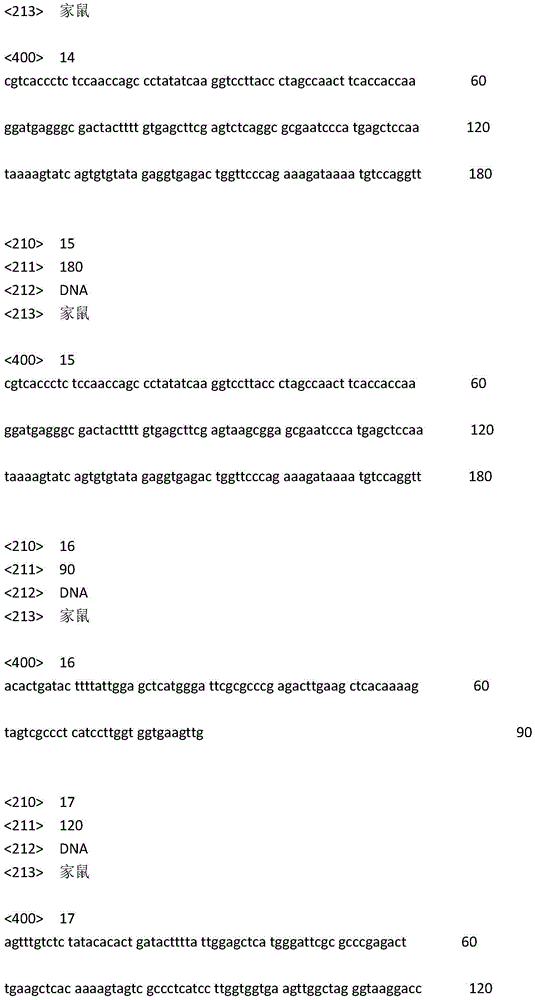


Claims (12)
Priority Applications (1)
| Application Number | Priority Date | Filing Date | Title |
|---|---|---|---|
| CN202211562175.2A CN116254231A (en) | 2016-04-25 | 2017-04-25 | Allelic editing and its applications |
Applications Claiming Priority (13)
| Application Number | Priority Date | Filing Date | Title |
|---|---|---|---|
| EP16166854.6 | 2016-04-25 | ||
| EP16166857.9 | 2016-04-25 | ||
| EP16166856.1 | 2016-04-25 | ||
| EP16166857 | 2016-04-25 | ||
| EP16166856 | 2016-04-25 | ||
| EP16166854 | 2016-04-25 | ||
| EP16196860.7 | 2016-11-02 | ||
| EP16196858.1 | 2016-11-02 | ||
| EP16196856.5 | 2016-11-02 | ||
| EP16196858 | 2016-11-02 | ||
| EP16196860 | 2016-11-02 | ||
| EP16196856 | 2016-11-02 | ||
| PCT/EP2017/059799 WO2017186718A1 (en) | 2016-04-25 | 2017-04-25 | Allele editing and applications thereof |
Related Child Applications (1)
| Application Number | Title | Priority Date | Filing Date |
|---|---|---|---|
| CN202211562175.2A Division CN116254231A (en) | 2016-04-25 | 2017-04-25 | Allelic editing and its applications |
Publications (2)
| Publication Number | Publication Date |
|---|---|
| CN109715803A CN109715803A (en) | 2019-05-03 |
| CN109715803B true CN109715803B (en) | 2023-07-07 |
Family
ID=58672572
Family Applications (2)
| Application Number | Title | Priority Date | Filing Date |
|---|---|---|---|
| CN201780037736.8A Active CN109715803B (en) | 2016-04-25 | 2017-04-25 | Allele editing and uses thereof |
| CN202211562175.2A Pending CN116254231A (en) | 2016-04-25 | 2017-04-25 | Allelic editing and its applications |
Family Applications After (1)
| Application Number | Title | Priority Date | Filing Date |
|---|---|---|---|
| CN202211562175.2A Pending CN116254231A (en) | 2016-04-25 | 2017-04-25 | Allelic editing and its applications |
Country Status (7)
| Country | Link |
|---|---|
| US (2) | US11499168B2 (en) |
| EP (1) | EP3448995A1 (en) |
| JP (2) | JP7148494B2 (en) |
| CN (2) | CN109715803B (en) |
| AU (1) | AU2017257225B2 (en) |
| CA (1) | CA3022266A1 (en) |
| WO (1) | WO2017186718A1 (en) |
Families Citing this family (68)
| Publication number | Priority date | Publication date | Assignee | Title |
|---|---|---|---|---|
| US10704021B2 (en) | 2012-03-15 | 2020-07-07 | Flodesign Sonics, Inc. | Acoustic perfusion devices |
| CN105939767B (en) | 2014-01-08 | 2018-04-06 | 弗洛设计声能学公司 | Sound electrophoretic apparatus with alliteration electrophoresis chamber |
| EP3204496A1 (en) | 2014-10-10 | 2017-08-16 | Editas Medicine, Inc. | Compositions and methods for promoting homology directed repair |
| WO2016073990A2 (en) | 2014-11-07 | 2016-05-12 | Editas Medicine, Inc. | Methods for improving crispr/cas-mediated genome-editing |
| US11377651B2 (en) | 2016-10-19 | 2022-07-05 | Flodesign Sonics, Inc. | Cell therapy processes utilizing acoustophoresis |
| US11708572B2 (en) | 2015-04-29 | 2023-07-25 | Flodesign Sonics, Inc. | Acoustic cell separation techniques and processes |
| US11667911B2 (en) | 2015-09-24 | 2023-06-06 | Editas Medicine, Inc. | Use of exonucleases to improve CRISPR/CAS-mediated genome editing |
| CN108290939B (en) | 2015-10-16 | 2023-01-13 | 纽约市哥伦比亚大学理事会 | Compositions and methods for inhibiting lineage specific antigens |
| EP3433363A1 (en) | 2016-03-25 | 2019-01-30 | Editas Medicine, Inc. | Genome editing systems comprising repair-modulating enzyme molecules and methods of their use |
| WO2017180694A1 (en) | 2016-04-13 | 2017-10-19 | Editas Medicine, Inc. | Cas9 fusion molecules gene editing systems, and methods of use thereof |
| CN109715803B (en) * | 2016-04-25 | 2023-07-07 | 巴塞尔大学 | Allele editing and uses thereof |
| US11214789B2 (en) | 2016-05-03 | 2022-01-04 | Flodesign Sonics, Inc. | Concentration and washing of particles with acoustics |
| US11293021B1 (en) | 2016-06-23 | 2022-04-05 | Inscripta, Inc. | Automated cell processing methods, modules, instruments, and systems |
| US20180004537A1 (en) | 2016-07-01 | 2018-01-04 | Microsoft Technology Licensing, Llc | Molecular State Machines |
| US11359234B2 (en) | 2016-07-01 | 2022-06-14 | Microsoft Technology Licensing, Llc | Barcoding sequences for identification of gene expression |
| US10892034B2 (en) * | 2016-07-01 | 2021-01-12 | Microsoft Technology Licensing, Llc | Use of homology direct repair to record timing of a molecular event |
| US10669558B2 (en) | 2016-07-01 | 2020-06-02 | Microsoft Technology Licensing, Llc | Storage through iterative DNA editing |
| WO2018080541A1 (en) | 2016-10-31 | 2018-05-03 | Seattle Children's Hospital (dba Seattle Children's Research Institute) | Method for treating autoimmune disease using cd4 t-cells with engineered stabilization of expression of endogennous foxp3 gene |
| DK3535392T3 (en) * | 2016-11-02 | 2024-04-22 | Univ Basel | IMMUNOLOGICALLY VISIBLE CELL SURFACE VARIANTS FOR USE IN CELL THERAPY |
| JP7386082B2 (en) | 2017-02-28 | 2023-11-24 | ブイオーアール バイオファーマ インコーポレーテッド | Compositions and methods for inhibition of lineage-specific proteins |
| BR112019026625A2 (en) * | 2017-06-15 | 2020-06-30 | The Regents Of The University Of California | targeted non-viral DNA inserts |
| US10011849B1 (en) | 2017-06-23 | 2018-07-03 | Inscripta, Inc. | Nucleic acid-guided nucleases |
| US9982279B1 (en) | 2017-06-23 | 2018-05-29 | Inscripta, Inc. | Nucleic acid-guided nucleases |
| US20190002874A1 (en) | 2017-06-30 | 2019-01-03 | Inscripta, Inc. | Cell libraries created using rationally designed nucleic acids |
| US11866726B2 (en) | 2017-07-14 | 2024-01-09 | Editas Medicine, Inc. | Systems and methods for targeted integration and genome editing and detection thereof using integrated priming sites |
| KR20200033259A (en) | 2017-07-31 | 2020-03-27 | 리제너론 파마슈티칼스 인코포레이티드 | Methods and compositions for evaluating CRISPR / Cas-mediated destruction or deletion in vivo and CRISPR / Cas-induced recombination with exogenous donor nucleic acids |
| CN114900773A (en) | 2017-12-14 | 2022-08-12 | 弗洛设计声能学公司 | Acoustophoretic system, method for operating acoustophoretic system, and method for controlling acoustic transducer and acoustic system |
| WO2019200004A1 (en) | 2018-04-13 | 2019-10-17 | Inscripta, Inc. | Automated cell processing instruments comprising reagent cartridges |
| US10858761B2 (en) | 2018-04-24 | 2020-12-08 | Inscripta, Inc. | Nucleic acid-guided editing of exogenous polynucleotides in heterologous cells |
| US10557216B2 (en) | 2018-04-24 | 2020-02-11 | Inscripta, Inc. | Automated instrumentation for production of T-cell receptor peptide libraries |
| WO2019209926A1 (en) | 2018-04-24 | 2019-10-31 | Inscripta, Inc. | Automated instrumentation for production of peptide libraries |
| CN112218882A (en) | 2018-04-27 | 2021-01-12 | 西雅图儿童医院(Dba西雅图儿童研究所) | FOXP3 in edited CD34+Expression in cells |
| AU2019292919A1 (en) | 2018-06-30 | 2021-03-11 | Inscripta, Inc. | Instruments, modules, and methods for improved detection of edited sequences in live cells |
| CA3105890A1 (en) * | 2018-07-09 | 2020-01-16 | Genovie Ab | A cell surface tag exchange (cste) system for tracing and manipulation of cells during recombinase mediated cassette exchange integration of nucleic acid sequences to engineered receiver cells |
| US11142740B2 (en) | 2018-08-14 | 2021-10-12 | Inscripta, Inc. | Detection of nuclease edited sequences in automated modules and instruments |
| CN112888444A (en) * | 2018-08-14 | 2021-06-01 | 因思科瑞普特公司 | Improved detection of nuclease edited sequences in automated modules and instruments via batch cell culture |
| EP4512890A3 (en) | 2018-08-28 | 2025-04-30 | Vor Biopharma, Inc. | Genetically engineered hermatopoietic stem cells and uses thereof |
| US11214781B2 (en) | 2018-10-22 | 2022-01-04 | Inscripta, Inc. | Engineered enzyme |
| WO2020086475A1 (en) | 2018-10-22 | 2020-04-30 | Inscripta, Inc. | Engineered enzymes |
| US10815467B2 (en) | 2019-03-25 | 2020-10-27 | Inscripta, Inc. | Simultaneous multiplex genome editing in yeast |
| US11001831B2 (en) | 2019-03-25 | 2021-05-11 | Inscripta, Inc. | Simultaneous multiplex genome editing in yeast |
| EP3953477A4 (en) | 2019-06-06 | 2022-06-22 | Inscripta, Inc. | Curing for recursive nucleic acid-guided cell editing |
| EP3986909A4 (en) | 2019-06-21 | 2023-08-02 | Inscripta, Inc. | GENOME-WIDE RATIONAL DESIGNED MUTATIONS LEADING TO INCREASED LYSINE PRODUCTION IN E. COLI |
| US10927385B2 (en) | 2019-06-25 | 2021-02-23 | Inscripta, Inc. | Increased nucleic-acid guided cell editing in yeast |
| WO2021102059A1 (en) | 2019-11-19 | 2021-05-27 | Inscripta, Inc. | Methods for increasing observed editing in bacteria |
| KR20250033331A (en) | 2019-12-10 | 2025-03-07 | 인스크립타 인코포레이티드 | Novel mad nucleases |
| US10704033B1 (en) | 2019-12-13 | 2020-07-07 | Inscripta, Inc. | Nucleic acid-guided nucleases |
| KR20220118498A (en) | 2019-12-18 | 2022-08-25 | 인스크립타 인코포레이티드 | Cascade/DCAS3 Complementary Assay for In Vivo Detection of Nucleic Acid-Guided Nuclease Edited Cells |
| US10689669B1 (en) | 2020-01-11 | 2020-06-23 | Inscripta, Inc. | Automated multi-module cell processing methods, instruments, and systems |
| KR20220133257A (en) | 2020-01-27 | 2022-10-04 | 인스크립타 인코포레이티드 | Electroporation modules and instruments |
| US20210332388A1 (en) | 2020-04-24 | 2021-10-28 | Inscripta, Inc. | Compositions, methods, modules and instruments for automated nucleic acid-guided nuclease editing in mammalian cells |
| US11787841B2 (en) | 2020-05-19 | 2023-10-17 | Inscripta, Inc. | Rationally-designed mutations to the thrA gene for enhanced lysine production in E. coli |
| EP4214314A4 (en) | 2020-09-15 | 2024-10-16 | Inscripta, Inc. | CRISPR EDITING TO INCORPORATE NUCLEIC ACID DOCKING PLATES INTO LIVING CELL GENOMES |
| US11512297B2 (en) | 2020-11-09 | 2022-11-29 | Inscripta, Inc. | Affinity tag for recombination protein recruitment |
| WO2022146497A1 (en) | 2021-01-04 | 2022-07-07 | Inscripta, Inc. | Mad nucleases |
| US20240376451A1 (en) | 2021-01-07 | 2024-11-14 | Inscripta, Inc. | Mad nucleases |
| US11884924B2 (en) | 2021-02-16 | 2024-01-30 | Inscripta, Inc. | Dual strand nucleic acid-guided nickase editing |
| US20240384304A1 (en) | 2021-07-06 | 2024-11-21 | Vor Biopharma Inc. | Inhibitor oligonucleotides and methods of use thereof |
| AU2022324093A1 (en) | 2021-08-02 | 2024-02-08 | Vor Biopharma Inc. | Compositions and methods for gene modification |
| JP2024530465A (en) | 2021-08-06 | 2024-08-21 | ウニバズィテート バーゼル | Identifiable cell surface protein variants for use in cell therapy - Patents.com |
| PE20241173A1 (en) | 2021-10-14 | 2024-05-28 | Arsenal Biosciences Inc | IMMUNE CELLS THAT HAVE CO-EXPRESSED HCRNA AND LOGIC GATE SYSTEMS |
| WO2023091954A2 (en) * | 2021-11-19 | 2023-05-25 | The Trustees Of The University Of Pennsylvania | Engineered pan-leukocyte antigen cd45 to facilitate car t cell therapy |
| IL313568A (en) | 2021-12-16 | 2024-08-01 | Universit?T Basel | Discernible cell surface protein variants of cd117 for use in cell therapy |
| AU2022422572A1 (en) | 2021-12-23 | 2024-06-06 | Cimeio Therapeutics Ag | Discernible cell surface protein variants of cd45 for use in cell therapy |
| WO2024073751A1 (en) | 2022-09-29 | 2024-04-04 | Vor Biopharma Inc. | Methods and compositions for gene modification and enrichment |
| AU2024243735A1 (en) | 2023-04-03 | 2025-10-02 | Cimeio Therapeutics Ag | Discernible cell surface protein variants of cd33 for use in cell therapy |
| WO2025031965A1 (en) | 2023-08-04 | 2025-02-13 | Cimeio Therapeutics Ag | Discernible cell surface protein variants of cd52 for use in cell therapy |
| WO2025132801A1 (en) | 2023-12-19 | 2025-06-26 | Cimeio Therapeutics Ag | Discernible protein variants of bcl-2 for use in cell therapy |
Citations (3)
| Publication number | Priority date | Publication date | Assignee | Title |
|---|---|---|---|---|
| EP1674479A1 (en) * | 2004-12-22 | 2006-06-28 | Memorial Sloan-Kettering Cancer Center | Modulation of Fc Gamma receptors for optimizing immunotherapy |
| CN103002913A (en) * | 2010-02-17 | 2013-03-27 | Csl有限公司 | Compositions and methods for targeting type I interferon producing cells |
| CN104203982A (en) * | 2011-10-28 | 2014-12-10 | 特瓦制药澳大利亚私人有限公司 | Polypeptide constructs and uses thereof |
Family Cites Families (14)
| Publication number | Priority date | Publication date | Assignee | Title |
|---|---|---|---|---|
| JP2005085497A (en) | 2003-09-04 | 2005-03-31 | Furukawa Electric Co Ltd:The | Multilayer connector |
| JP2005082497A (en) * | 2003-09-05 | 2005-03-31 | Asahi Breweries Ltd | An immunomodulator comprising a plant-derived polyphenol component as an active ingredient |
| DK3056515T4 (en) | 2008-01-15 | 2025-10-20 | Univ Leland Stanford Junior | METHOD FOR MANIPULATING PHAGOCYTOSIS MEDIATED BY CD47 |
| BRPI0923422A2 (en) | 2008-12-12 | 2016-06-21 | Univ Tokyo | immune reconstitution promoter or prophylactic agent for infections each of which maintains the graft-versus-tumor effect " |
| JP5900865B2 (en) | 2012-04-26 | 2016-04-06 | 国立大学法人京都大学 | T cell differentiation induction method, T cell production method, T cell, pharmaceutical composition, and screening method |
| AU2013329186B2 (en) * | 2012-10-10 | 2019-02-14 | Sangamo Therapeutics, Inc. | T cell modifying compounds and uses thereof |
| CN108715602A (en) * | 2012-12-06 | 2018-10-30 | 西格马-奥尔德里奇有限责任公司 | Genomic modification based on CRISPR and regulation and control |
| WO2014191518A1 (en) * | 2013-05-29 | 2014-12-04 | Cellectis | A method for producing precise dna cleavage using cas9 nickase activity |
| EP3569253A1 (en) | 2013-06-05 | 2019-11-20 | Bellicum Pharmaceuticals, Inc. | Methods for inducing partial apoptosis using caspase polypeptides |
| CA2945393C (en) | 2014-04-24 | 2021-03-23 | Board Of Regents, The University Of Texas System | Application of induced pluripotent stem cells to generate adoptive cell therapy products |
| AU2015301921A1 (en) * | 2014-08-12 | 2017-03-02 | Celgene Corporation | Car-T lymphocytes engineered to home to lymph node B cell zone, skin, or gastrointestinal tract |
| EP3025719B1 (en) * | 2014-11-26 | 2018-09-26 | Miltenyi Biotec GmbH | Combination immunotherapy of antigen-recognizing receptors and hematopoietic cells for the treatment of diseases |
| CN109715803B (en) * | 2016-04-25 | 2023-07-07 | 巴塞尔大学 | Allele editing and uses thereof |
| DK3535392T3 (en) * | 2016-11-02 | 2024-04-22 | Univ Basel | IMMUNOLOGICALLY VISIBLE CELL SURFACE VARIANTS FOR USE IN CELL THERAPY |
-
2017
- 2017-04-25 CN CN201780037736.8A patent/CN109715803B/en active Active
- 2017-04-25 US US16/096,074 patent/US11499168B2/en active Active
- 2017-04-25 AU AU2017257225A patent/AU2017257225B2/en active Active
- 2017-04-25 CA CA3022266A patent/CA3022266A1/en active Pending
- 2017-04-25 WO PCT/EP2017/059799 patent/WO2017186718A1/en not_active Ceased
- 2017-04-25 JP JP2019506545A patent/JP7148494B2/en active Active
- 2017-04-25 CN CN202211562175.2A patent/CN116254231A/en active Pending
- 2017-04-25 EP EP17721983.9A patent/EP3448995A1/en active Pending
-
2022
- 2022-09-20 US US17/948,313 patent/US12365922B2/en active Active
- 2022-09-22 JP JP2022151343A patent/JP7504957B2/en active Active
Patent Citations (3)
| Publication number | Priority date | Publication date | Assignee | Title |
|---|---|---|---|---|
| EP1674479A1 (en) * | 2004-12-22 | 2006-06-28 | Memorial Sloan-Kettering Cancer Center | Modulation of Fc Gamma receptors for optimizing immunotherapy |
| CN103002913A (en) * | 2010-02-17 | 2013-03-27 | Csl有限公司 | Compositions and methods for targeting type I interferon producing cells |
| CN104203982A (en) * | 2011-10-28 | 2014-12-10 | 特瓦制药澳大利亚私人有限公司 | Polypeptide constructs and uses thereof |
Non-Patent Citations (5)
| Title |
|---|
| ADAR1同工型基因在小鼠急性T淋巴细胞白血病模型中的表达;马翠花等;《中国实验血液学杂志》;20110620(第03期);第566-569页 * |
| Donor Hematopoietic Stem Cells Confer Long-Term Marrow Reconstitution by Self-Renewal Divisions Exceeding to That of Host Cells;Roy, S等;《PLOS ONE》;20121205;第7卷(第12期);摘要和第4页 * |
| Modification of Hematopoietic Stem/Progenitor Cells with CD19-Specific Chimeric Antigen Receptors as a Novel Approach for Cancer Immunotherapy;De Oliveira, SN等;《HUMAN GENE THERAPY》;20131001;第24卷(第10期);第824-839页 * |
| SOMATIC GENE-THERAPY FOR DIABETES WITH AN IMMUNOLOGICAL SAFETY SYSTEM FOR COMPLETE REMOVAL OF TRANSPLANTED CELLS;KAWAKAMI,Y等;《DIABETES》;19920131;第41卷(第8期);摘要、第959页右栏第3段和第960页右栏第2段 * |
| 植物基因组编辑及衍生技术最新研究进展;单奇伟等;《遗传》(第10期);第953-973页 * |
Also Published As
| Publication number | Publication date |
|---|---|
| AU2017257225B2 (en) | 2024-04-18 |
| JP7148494B2 (en) | 2022-10-05 |
| US12365922B2 (en) | 2025-07-22 |
| US20230193320A1 (en) | 2023-06-22 |
| JP2022191266A (en) | 2022-12-27 |
| AU2017257225A1 (en) | 2018-11-22 |
| US11499168B2 (en) | 2022-11-15 |
| CN116254231A (en) | 2023-06-13 |
| JP7504957B2 (en) | 2024-06-24 |
| JP2019516399A (en) | 2019-06-20 |
| CN109715803A (en) | 2019-05-03 |
| CA3022266A1 (en) | 2017-11-02 |
| US20190136263A1 (en) | 2019-05-09 |
| EP3448995A1 (en) | 2019-03-06 |
| WO2017186718A1 (en) | 2017-11-02 |
Similar Documents
| Publication | Publication Date | Title |
|---|---|---|
| CN109715803B (en) | Allele editing and uses thereof | |
| US11331346B2 (en) | Targeted replacement of endogenous T cell receptors | |
| KR102276371B1 (en) | Engineered-immune regulatory factor and Immunity Activation thereby | |
| CA3036926C (en) | Modified stem cell memory t cells, methods of making and methods of using same | |
| JP2024009805A (en) | Gene editing of primary cells | |
| KR102338993B1 (en) | artificially engineered immune cells | |
| JPWO2019160077A1 (en) | Method for producing low antigenic cells | |
| CN108026545A (en) | CRISPR/Cas9 complexes for the introduction of functional peptides into cells of the blood cell lineage | |
| IL297881A (en) | Selection by knock-in of essential genes | |
| KR20240043810A (en) | Immunologically discernible cell surface variants for use in cell therapy | |
| JP2020532291A5 (en) | ||
| WO2025049903A2 (en) | Novel regulators of t cells | |
| JP2020528046A (en) | Compositions and Methods for Enhancing the Efficacy of T Cell-Based Immunotherapy | |
| Lynch et al. | A Dapl1+ subpopulation of naïve CD8 T cells contains committed precursors of memory lineage | |
| TW202540411A (en) | Method of generating natural killer cells resistant to plasmid toxicity, natural killer cells and uses thereof | |
| HK40115874A (en) | Targeted replacement of endogenous t cell receptors | |
| HK40119727A (en) | Cells comprising a suppressor of gene expression and/or a synthetic pathway activator and/or an inducible payload |
Legal Events
| Date | Code | Title | Description |
|---|---|---|---|
| PB01 | Publication | ||
| PB01 | Publication | ||
| SE01 | Entry into force of request for substantive examination | ||
| SE01 | Entry into force of request for substantive examination | ||
| GR01 | Patent grant | ||
| GR01 | Patent grant | ||
| TG01 | Patent term adjustment | ||
| TG01 | Patent term adjustment |