CN103889481A - Hemodialysis system with flow path with controlled compliance volume - Google Patents
Hemodialysis system with flow path with controlled compliance volume Download PDFInfo
- Publication number
- CN103889481A CN103889481A CN201280047921.2A CN201280047921A CN103889481A CN 103889481 A CN103889481 A CN 103889481A CN 201280047921 A CN201280047921 A CN 201280047921A CN 103889481 A CN103889481 A CN 103889481A
- Authority
- CN
- China
- Prior art keywords
- dialysis
- liquid
- pump
- circuit
- blood
- Prior art date
- Legal status (The legal status is an assumption and is not a legal conclusion. Google has not performed a legal analysis and makes no representation as to the accuracy of the status listed.)
- Granted
Links
Images


Classifications
-
- A—HUMAN NECESSITIES
- A61—MEDICAL OR VETERINARY SCIENCE; HYGIENE
- A61M—DEVICES FOR INTRODUCING MEDIA INTO, OR ONTO, THE BODY; DEVICES FOR TRANSDUCING BODY MEDIA OR FOR TAKING MEDIA FROM THE BODY; DEVICES FOR PRODUCING OR ENDING SLEEP OR STUPOR
- A61M1/00—Suction or pumping devices for medical purposes; Devices for carrying-off, for treatment of, or for carrying-over, body-liquids; Drainage systems
- A61M1/34—Filtering material out of the blood by passing it through a membrane, i.e. hemofiltration or diafiltration
- A61M1/3472—Filtering material out of the blood by passing it through a membrane, i.e. hemofiltration or diafiltration with treatment of the filtrate
- A61M1/3482—Filtering material out of the blood by passing it through a membrane, i.e. hemofiltration or diafiltration with treatment of the filtrate by filtrating the filtrate using another cross-flow filter, e.g. a membrane filter
-
- A—HUMAN NECESSITIES
- A61—MEDICAL OR VETERINARY SCIENCE; HYGIENE
- A61M—DEVICES FOR INTRODUCING MEDIA INTO, OR ONTO, THE BODY; DEVICES FOR TRANSDUCING BODY MEDIA OR FOR TAKING MEDIA FROM THE BODY; DEVICES FOR PRODUCING OR ENDING SLEEP OR STUPOR
- A61M1/00—Suction or pumping devices for medical purposes; Devices for carrying-off, for treatment of, or for carrying-over, body-liquids; Drainage systems
- A61M1/14—Dialysis systems; Artificial kidneys; Blood oxygenators ; Reciprocating systems for treatment of body fluids, e.g. single needle systems for hemofiltration or pheresis
- A61M1/16—Dialysis systems; Artificial kidneys; Blood oxygenators ; Reciprocating systems for treatment of body fluids, e.g. single needle systems for hemofiltration or pheresis with membranes
- A61M1/1694—Dialysis systems; Artificial kidneys; Blood oxygenators ; Reciprocating systems for treatment of body fluids, e.g. single needle systems for hemofiltration or pheresis with membranes with recirculating dialysing liquid
- A61M1/1696—Dialysis systems; Artificial kidneys; Blood oxygenators ; Reciprocating systems for treatment of body fluids, e.g. single needle systems for hemofiltration or pheresis with membranes with recirculating dialysing liquid with dialysate regeneration
-
- A—HUMAN NECESSITIES
- A61—MEDICAL OR VETERINARY SCIENCE; HYGIENE
- A61M—DEVICES FOR INTRODUCING MEDIA INTO, OR ONTO, THE BODY; DEVICES FOR TRANSDUCING BODY MEDIA OR FOR TAKING MEDIA FROM THE BODY; DEVICES FOR PRODUCING OR ENDING SLEEP OR STUPOR
- A61M2202/00—Special media to be introduced, removed or treated
- A61M2202/0021—Special media to be introduced, removed or treated removed from and reintroduced into the body, e.g. after treatment
-
- A—HUMAN NECESSITIES
- A61—MEDICAL OR VETERINARY SCIENCE; HYGIENE
- A61M—DEVICES FOR INTRODUCING MEDIA INTO, OR ONTO, THE BODY; DEVICES FOR TRANSDUCING BODY MEDIA OR FOR TAKING MEDIA FROM THE BODY; DEVICES FOR PRODUCING OR ENDING SLEEP OR STUPOR
- A61M2202/00—Special media to be introduced, removed or treated
- A61M2202/04—Liquids
- A61M2202/0413—Blood
Landscapes
- Health & Medical Sciences (AREA)
- Heart & Thoracic Surgery (AREA)
- Urology & Nephrology (AREA)
- Anesthesiology (AREA)
- Vascular Medicine (AREA)
- Engineering & Computer Science (AREA)
- Biomedical Technology (AREA)
- Hematology (AREA)
- Life Sciences & Earth Sciences (AREA)
- Animal Behavior & Ethology (AREA)
- General Health & Medical Sciences (AREA)
- Public Health (AREA)
- Veterinary Medicine (AREA)
- Emergency Medicine (AREA)
- External Artificial Organs (AREA)
Abstract
Description
相关申请的交叉引用Cross References to Related Applications
本申请要求申请日为2011年8月2日,申请号为61/514,469的美国临时申请的优先权权益,该美国临时申请通过引用纳入本申请中。This application claims the benefit of priority to US Provisional Application No. 61/514,469, filed August 2, 2011, which is incorporated herein by reference.
技术领域technical field
本公开文本涉及用于血液透析和血液过滤的装置,血液透析和血液过滤用于对诸如终末期肾病(End Stage Renal Disease,ESRD)的病理状况进行频繁地或持续地治疗。该系统和方法包括一系统,该系统具有一透析器,控制部件,透析液再生盒和液体容器,该系统构造为其重量和尺寸能够由需要治疗的个体穿戴或携带。本公开文本进一步涉及了慢性肾病(Chronic KidneyDisease,CKD)的治疗,该治疗通过在治疗期间仍然允许个体走动的方法和装置进行。本说明书还涉及了通过方法和小巧、轻便且可携带的装置对ESRD进行的治疗。This disclosure relates to devices for hemodialysis and hemofiltration for frequent or continuous treatment of pathological conditions such as End Stage Renal Disease (ESRD). The systems and methods include a system having a dialyzer, control components, dialysate regeneration cassette and fluid container configured to be of a weight and size capable of being worn or carried by an individual in need of treatment. The disclosure further relates to the treatment of Chronic Kidney Disease (CKD) by methods and devices that still allow the individual to ambulate during treatment. The specification also relates to the treatment of ESRD by the method and the device which is small, light and portable.
背景技术Background technique
慢性肾病(CKD)是一种在数月或数年时间内肾功能逐渐丧失的疾病,其也被称之为慢性肾脏疾病。随着疾病的发展,严重肾衰竭患者会出现许多症状,这些症状如果不进行治疗,可能最终导致死亡。终末期肾病(ESRD)是CKD最严重的阶段,其发生在当肾小球滤过率(Glomerular Filtration Rate,GFR)低于约15ml/min/1.73m2时。ESRD也被称为肾衰竭或肾脏衰竭,其是一种病状,在该病状下,患者的肾脏不能充分地排出毒素、废产物和过量液体,并且不能维持适当的电解质水平。在美国,引起CKD的两个主要原因是糖尿病和高血压,其引发了2/3以上的慢性肾病。心脏病是导致所有患有CKD患者死亡的主要原因。Chronic kidney disease (CKD), also known as chronic kidney disease, is a progressive loss of kidney function over months or years. As the disease progresses, patients with severe kidney failure experience many symptoms that, if left untreated, may eventually lead to death. End-stage renal disease (ESRD) is the most severe stage of CKD, which occurs when the glomerular filtration rate (Glomerular Filtration Rate, GFR) is lower than about 15ml/min/1.73m2. ESRD, also known as kidney failure or kidney failure, is a condition in which a patient's kidneys cannot adequately flush out toxins, waste products, and excess fluid, and cannot maintain proper electrolyte levels. The two leading causes of CKD in the United States are diabetes and hypertension, which account for more than two-thirds of chronic kidney disease. Heart disease is the leading cause of death in all patients with CKD.
CKD的当前治疗方法是对疾病进行管理,并且若可能的话,减缓疾病的发展。然而,随着疾病的发展,肾脏功能还是会减弱,并最终会采取肾脏替代疗法来补偿丧失的肾功能。通常,肾脏替代疗法需要新肾的移植或进行透析。肾透析是一种医疗过程,其通过进行肾透析在严重的肾脏衰竭时来帮助或替代某些肾功能。血液透析、血液过滤、血液透析滤过和腹膜透析是已经丧失大部分或全部肾功能的患者的所有替代疗法。透析能够清除许多本该由正常肾脏清除的毒素和废物。另外,这些疗法还被用于平衡电解质或血液中盐的水平,并用于清除在肾衰竭患者体内积聚的过量液体。The current treatment approach for CKD is to manage the disease and, if possible, slow its progression. However, as the disease progresses, kidney function decreases, and renal replacement therapy is eventually used to compensate for lost kidney function. Usually, renal replacement therapy requires the transplantation of a new kidney or dialysis. Kidney dialysis is a medical procedure performed to help or replace some kidney functions in severe kidney failure. Hemodialysis, hemofiltration, hemodiafiltration, and peritoneal dialysis are all replacement therapies for patients who have lost most or all of their kidney function. Dialysis removes many toxins and waste products that the normal kidneys should remove. In addition, these therapies are used to balance electrolyte, or blood salt, levels, and to remove excess fluid that builds up in people with kidney failure.
可以通过血液透析治疗从血液中清除不能被肾脏有效清除的废产物,例如尿素、肌酸酐和磷酸盐。虽然患有CKD的患者人数每年增长,但是却没有治愈方法。在患有肾脏衰竭的患者体内积聚的过量液体通常经由直接超滤或一透析过程中的超滤动作被清除。Waste products that cannot be removed effectively by the kidneys, such as urea, creatinine, and phosphate, can be removed from the blood through hemodialysis treatment. Although the number of patients with CKD increases every year, there is no cure. Excess fluid that accumulates in patients with kidney failure is usually removed via direct ultrafiltration or an ultrafiltration action during dialysis.
血液透析过程通常以3-5小时的阶段每周进行三次。透析通过从一患者的血液中清除废物溶质、过量电解质和过量的液体来模拟肾功能。在透析过程中,含有高浓度废物溶质的患者血液通过一半渗透膜与一低浓度透析溶液(透析液)接触。当液体清除由压力驱动的超滤完成时,溶质的清除和电解质的平衡由穿过膜的扩散完成。一旦血液被净化,其就被返回至患者体内。尽管对于从血液中清除废物是有效的,但是透析治疗是间歇地给予的,因此其不能模拟一正常肾脏的持续功能。此外,还存在与透析相关的诸多不便,例如,投入费时的、每周三次治疗的必要性。Hemodialysis sessions are usually performed three times a week in 3-5 hour sessions. Dialysis mimics kidney function by removing waste solutes, excess electrolytes, and excess fluid from a patient's blood. During dialysis, a patient's blood, which contains a high concentration of waste solutes, is passed through a half-permeable membrane into contact with a low concentration dialysis solution (dialysate). While liquid removal is accomplished by pressure-driven ultrafiltration, solute removal and electrolyte equilibration is accomplished by diffusion across the membrane. Once the blood is purified, it is returned to the patient. Although effective in removing waste products from the blood, dialysis treatment is given intermittently, so it cannot mimic the continuous function of a normal kidney. In addition, there are many inconveniences associated with dialysis, such as the necessity to commit to time-consuming, three times a week treatments.
接受传统血液透析疗法的ESRD患者的死亡率是每年23%,在糖尿病患者中死亡率更高。过量的液体会在ESRD患者体内积聚。因为肾脏不能有效地从体内清除水和其他化合物,所以液体在ESRD患者体内积聚。液体首先在血液中积聚,然后在全身积聚,这导致四肢和其他组织由于水肿而肿大。液体的积聚导致心脏压力增加,反过来引起会导致心力衰竭的血压的显著增加或高血压。The mortality rate among ESRD patients receiving conventional hemodialysis was 23% per year, and it was even higher among patients with diabetes. Excess fluid can build up in ESRD patients. Fluid builds up in ESRD patients because the kidneys cannot effectively remove water and other compounds from the body. Fluid builds up first in the blood and then throughout the body, which causes extremities and other tissues to swell due to edema. The buildup of fluid causes increased pressure on the heart, which in turn causes a significant increase in blood pressure, or hypertension, that can lead to heart failure.
虽然血液透析清除了过量的液体,但是每周三次的血液透析计划还是会在患者的废物清除、杂质清除、液体清除和电解质平衡中产生变化。这些变化导致了患者的并发症以及患者的高发病率和高死亡率。自90年代中期起,许多医生就已经给出了增加透析频次和增加治疗时间的治疗方案,以试图解决与每周三次血液透析计划有关的问题。最近两项随机受控的临床研究已经示出了一更频繁的透析方案在统计上有显著的益处。Culleton等人(作者为Culleton,BF等人,名称为《频繁的夜间血液透析与常规血液透析对左心室重量和生活质量的的影响比较》,刊登于《美国医学会杂志》,2007年298(11))[Culleton,BF et al.Effect of Frequent Nocturnal Hemodialysis vs.Conventional Hemodialysis on Left Ventricular Mass and Quality of Life.2007Journal of the American Medical Association298(11)]的报告指出:当与常规血液透析(每周三次)比较时,日常夜间血液透析改善了左心室重量(死亡率的代名词),减少了血压药物治疗的需要,并改善了矿物新陈代谢的一些措施(measures)。FHN试验(FHN试验组,《在透析中心每周六次与每周三次血液透析的比较》,《新英格兰医学杂志》2010)[The FHN trial(The FHN TrialGroup.In-Center Hemodialysis Six Times per Week versus Three Times per Week,New England Journal of Medicine,2010)]是一项比较,其将治疗频次增加至每周5.2次的血液透析治疗与传统的每周3次的治疗方案进行比较:“与常规的血液透析相比较,频繁的血液透析与良好的结果相关联,该结果是关于死亡的综合结果或左心室重量的变化以及死亡或一生理健康综合分数的变化的。”根据该数据,希望具有一血液透析系统使得肾脏患者如果不进行持续透析,其也每周透析5-7天。Although hemodialysis removes excess fluid, a thrice-weekly hemodialysis schedule produces changes in the patient's waste removal, impurity removal, fluid removal, and electrolyte balance. These changes lead to patient complications as well as high morbidity and mortality among patients. Since the mid-1990s, many physicians have prescribed increased dialysis frequency and increased treatment time in an attempt to address the problems associated with thrice-weekly hemodialysis schedules. Two recent randomized controlled clinical studies have shown a statistically significant benefit of a more frequent dialysis regimen. Culleton et al. (Culleton, BF et al., "The Effect of Frequent Nocturnal Hemodialysis Versus Conventional Hemodialysis on Left Ventricular Weight and Quality of Life," JAMA, 2007 298( 11))[Culleton, BF et al.Effect of Frequent Nocturnal Hemodialysis vs.Conventional Hemodialysis on Left Ventricular Mass and Quality of Life.2007Journal of the American Medical Association298(11)] pointed out: when compared with conventional hemodialysis (every Wednesday Daily nocturnal hemodialysis improved left ventricular weight (a proxy for mortality), reduced the need for blood pressure medication, and improved some measures of mineral metabolism when compared with the second. The FHN trial (The FHN Trial Group. In-Center Hemodialysis Six Times per Week, New England Journal of Medicine 2010) [The FHN Trial (The FHN Trial Group. In-Center Hemodialysis Six Times per Week versus Three Times per Week, New England Journal of Medicine, 2010)] is a comparison of hemodialysis treatment with an increased frequency of treatment up to 5.2 times per week versus a traditional 3 times per week regimen: "Compared with conventional Frequent hemodialysis was associated with better outcomes with respect to composite outcomes of death or change in left ventricular weight and death or a composite score of physiological health compared with hemodialysis in 2009. A hemodialysis system allows renal patients to be dialyzed 5-7 days a week if not on continuous dialysis.
尽管有来自于Culleton和FHN研究的临床结果,然而目前几乎没有患者接受一更高频次的透析治疗。由于更频繁的疗法的负担和费用,更频繁的血液透析仅使用在一小部分患者人群上。即使是每周三次的治疗方案,对于ESRD患者来说也是一个巨大的负担,并且由于现有装置的缺陷和附加治疗的费用,增加治疗的频次通常是困难的。由于多数透析在一透析中心进行,因此,需要更频繁的血液透析的实际实施,其采用一简单的、可穿戴的/可携带的且安全的技术,该技术能够被驻家患者使用。Despite the clinical results from the Culleton and FHN studies, few patients are currently receiving a higher frequency of dialysis. Due to the burden and expense of more frequent therapy, more frequent hemodialysis is used on only a small proportion of the patient population. Even a thrice-weekly treatment regimen is a significant burden for ESRD patients, and increasing the frequency of treatment is often difficult due to the shortcomings of existing devices and the cost of additional treatments. Since most dialysis is performed in a dialysis center, there is a need for more frequent practical implementation of hemodialysis with a simple, wearable/portable and safe technology that can be used by patients at home.
虽然家用的透析设备是可以获得的,但是由于此种透析设备的非便携的特性,患者必须在治疗过程中仍维持相对静止。典型的家用透析设备采用一超过20升的透析液体量,典型地达到120-200升,其需要一专用的水系统。由于所需透析液体的体积和重量的要求,即使是在家进行的透析治疗,患者在治疗过程中也是不可以走动的,这可能会影响进行治疗的频次。While home-use dialysis equipment is available, due to the non-portable nature of such dialysis equipment, the patient must remain relatively still during treatment. Typical home dialysis equipment uses a volume of dialysis fluid in excess of 20 liters, typically reaching 120-200 liters, which requires a dedicated water system. Due to the volume and weight of the required dialysis fluid, even in home dialysis treatments, the patient cannot be ambulatory during the treatment, which may affect the frequency of treatment.
透析需要大量透析液的部分原因是清除的废产物的扩散和来自于一透析患者的血液中的、透析液中的电解质的平衡需要大量的溶液。对已用过的透析液进行再生是一种通过避免储存大量新鲜透析液以减少透析系统总体积的方法。为了再次使用已用过的透析液,积累的废产物和杂质必须从已用过的透析液中清除出,并且再生透析液的组成和pH值必须为了生理相容性而进行调整。用于对已用过的透析液体进行再生的装置通过各种吸附剂主要对尿素、铵离子、尿酸、肌酸酐和磷酸盐进行清除。例如,于1970年代引入的再循环透析液系统(Recirculating Dialysate System,REDY)采用了一吸附剂盒,已用过的透析液通过吸附剂盒进行再循环和再生。然而,由REDY系统生成的再生透析液却受制于pH值的变化和不利于生理标准的钠浓度。此外,REDY系统清除硫酸盐的能力受到限制或没有能力清除硫酸盐,并且不是便携式的。Dialysis requires large volumes of dialysate in part because the diffusion of cleared waste products and the equilibration of electrolytes in the dialysate from a dialysis patient's blood require large volumes of solution. Regeneration of spent dialysate is a way to reduce the overall volume of the dialysis system by avoiding the need to store large amounts of fresh dialysate. In order to reuse the spent dialysate, accumulated waste products and impurities must be removed from the spent dialysate, and the composition and pH of the regenerated dialysate must be adjusted for physiological compatibility. The device for regenerating spent dialysis fluid primarily removes urea, ammonium ions, uric acid, creatinine and phosphate by means of various sorbents. For example, the Recirculating Dialysate System (REDY), introduced in the 1970s, uses a sorbent cartridge through which spent dialysate is recirculated and regenerated. However, the regenerated dialysate generated by the REDY system suffers from pH changes and sodium concentrations that are not conducive to physiological standards. Additionally, the REDY system has limited or no ability to remove sulfate and is not portable.
此外,采用吸附剂技术的传统透析系统(例如REDY系统)通常采用低通量透析器并调节透析液的压力以实现患者液体净清除(net patient fluidremoval)。一透析器的UF系数说明了通过透析器的过滤速率,该过滤速率是由于穿过透析器膜的压差(通常被称为跨膜压力)而产生的。该跨膜压力通过公式TMP算得,TMP=((血液入口压力+血液出口压力)/2)-((透析液入口压力+透析液出口压力)/2)。该公式通常被缩短为TMP=静脉回流压力-透析液压力。低通量血液透析器具有一小于8ml水通量/hr/mmHg跨膜压力的UF系数。为了采用传统的吸附剂系统来阐明液体清除,一典型的低通量透析器可以具有一4ml/hr/mmHg的UF系数。为了计算实现液体清除速率所必需的压力,期望的每小时液体清除量要除以透析器的UF系数。例如,若UF系数为4mL/hr/mmHg,0.5L/hr的每小时速率会产生一125mmHg的所需跨膜压力(TMP)。125mmHg是以每小时0.5L的速率清除液体所需的跨膜压力。静脉压力是血液流动速率和血液回流限制(针和通道)的函数。由于不能设定静脉回流压力,因此为了控制液体清除速率,必须计算所需的透析液压力。操作人员通过公式来计算透析液压力:透析液压力=静脉压力-TMP,当静脉回流压力为75mmHg时,透析液压力(DP)=75-125=-50mmHg。在该例子中,使用者必须将透析液压力调节至-50mmHg以获得125mmHg的TMP。由于静脉压力会在治疗过程中波动,因此操作人员必须经常调节透析液压力,这并不适应于一非医学专业人士或一驻家患者。采用高通量透析器,仅通过压力是不足以准确控制超滤的,因为液体会更自由地流动穿过透析器膜。为了在使用高通量透析器的传统血液透析中控制超滤,可以采用平衡腔(balancingchambers)、流量传感器或其他方法来平衡出入透析器的流量。在CRRT(continuous blood purification machine,连续血液净化机)设备中,要求以精确度量控制的泵非常准确地控制出入透析器的流量。In addition, traditional dialysis systems using sorbent technology (such as the REDY system) typically employ low-flux dialyzers and regulate dialysate pressure to achieve net patient fluid removal. The UF coefficient of a dialyzer describes the rate of filtration through the dialyzer due to the pressure difference across the dialyzer membrane (often referred to as the transmembrane pressure). The transmembrane pressure is calculated by the formula TMP, TMP=((blood inlet pressure+blood outlet pressure)/2)-((dialysis fluid inlet pressure+dialysis fluid outlet pressure)/2). This formula is often shortened to TMP = venous return pressure - dialysate pressure. Low flux hemodialyzers have a UF coefficient of less than 8 ml water flux/hr/mmHg transmembrane pressure. To account for fluid removal using conventional sorbent systems, a typical low flux dialyzer may have a UF coefficient of 4ml/hr/mmHg. To calculate the pressure necessary to achieve the fluid removal rate, the desired hourly fluid removal is divided by the UF factor of the dialyzer. For example, if the UF coefficient is 4 mL/hr/mmHg, an hourly rate of 0.5 L/hr would produce a required transmembrane pressure (TMP) of 125 mmHg. 125mmHg is the transmembrane pressure required to clear fluid at a rate of 0.5L per hour. Venous pressure is a function of blood flow rate and blood return restriction (needle and channel). Since the venous return pressure cannot be set, the required dialysate pressure must be calculated in order to control the rate of fluid removal. The operator calculates the dialysate pressure through the formula: dialysate pressure=venous pressure-TMP, when the venous return pressure is 75mmHg, dialysate pressure (DP)=75-125=-50mmHg. In this example, the user must adjust the dialysate pressure to -50mmHg to obtain a TMP of 125mmHg. Since venous pressure fluctuates during treatment, the operator must frequently adjust the dialysate pressure, which is not suitable for a non-medical professional or a patient at home. With high-flux dialyzers, pressure alone is not sufficient to accurately control UF, as fluid will flow more freely across the dialyzer membrane. To control ultrafiltration in conventional hemodialysis using high-flux dialyzers, balancing chambers, flow sensors, or other methods can be used to balance the flow into and out of the dialyzer. In CRRT (continuous blood purification machine, continuous blood purification machine) equipment, it is required that the pump controlled by precise measurements control the flow into and out of the dialyzer very accurately.
透析液再循环技术的发展产生了采用各种吸附剂介质的系统,这些吸附剂介质包括活性炭、脲酶,以及锆基、铝基和镁基材料。然而,与已用过的透析液的吸附剂再生相关的一个问题是释放的钠离子的积聚,其是吸附过程中的一个副产品,因此,需要一高程度的钠浓度控制,其通过当前可穿戴或携带的透析系统实现。去离子树脂已经被开发用来对抗钠离子的积聚,其效果参差不齐。进一步地,诸如钙,镁,钾的电解质通过吸附剂和去离子介质被从已用过的透析液中清除,并且必须在再使用之前回加至透析液中。此外,二氧化碳气体在吸附过程中(特别在采用脲酶的系统中)生成,并积聚在透析液中。因此,以吸附剂为基础的透析再生系统通常必须一直采用电解溶液大容器(reservoirs),以调节钠浓度并维持电解质浓度,并且还必须包括一用于移除积聚的二氧化碳气体的装置,因此就无法实现总系统的体积和尺寸的减少。The development of dialysate recirculation technology has resulted in systems employing various sorbent media, including activated carbon, urease, and zirconium-, aluminum-, and magnesium-based materials. However, a problem associated with sorbent regeneration of spent dialysate is the accumulation of released sodium ions, which is a by-product of the sorption process, thus requiring a high degree of sodium concentration control, which is achieved through the current wearable Or carry the dialysis system to achieve. Deionization resins have been developed to combat the buildup of sodium ions, with mixed results. Further, electrolytes such as calcium, magnesium, potassium are removed from spent dialysate by sorbents and deionized media, and must be added back to the dialysate before reuse. In addition, carbon dioxide gas is generated during adsorption (especially in systems with urease) and accumulates in the dialysate. Therefore, sorbent-based dialysis regeneration systems must generally always employ electrolytic solution reservoirs to regulate sodium concentration and maintain electrolyte concentration, and must also include a device for removing accumulated carbon dioxide gas, thus requiring A reduction in volume and size of the total system cannot be achieved.
一些系统已经尝试通过考虑外部连接一非蒸馏水源以补充系统所需的容积来解决体积和重量的问题。然而,向一透析系统引入非蒸馏水需要额外的净化手段,因此会增加系统的复杂性和尺寸。因而,这样的系统可能是不能移动的或不能携带使用的。Some systems have attempted to address the volume and weight issues by allowing for an external connection to a source of non-distilled water to supplement the volume required by the system. However, introducing non-distilled water to a dialysis system requires additional purification means, thus increasing the complexity and size of the system. Thus, such systems may not be mobile or portable.
专利号为3,669,878,发明人为Marantz等人的美国专利文献公开了以吸附剂为基础的透析液再生系统,该专利文献描述了吸附剂通过脲酶,碳酸铵和磷酸锆从已用过的透析液中清除尿素和铵离子。专利号为3,669,880,发明人为Marantz等人的美国专利文献描述了引导一可控量的透析液通过磷酸锆、活性炭和水合氧化锆队列。专利号为3,850,835,发明人为Marantz等人的美国专利文献描述了水合氧化锆离子交换介质的生产。专利号为3,989,622,发明人为Marantz等人的美国专利文献描述了通过氧化铝和镁的硅酸盐介质吸附脲酶,将液体尿素转化为碳酸铵。Patent No. 3,669,878, the inventor of which is the US patent literature of Marantz et al. discloses a sorbent-based dialysate regeneration system. Removes urea and ammonium ions. US Patent No. 3,669,880 to Marantz et al. describes directing a controlled volume of dialysate through a train of zirconium phosphate, activated carbon, and hydrous zirconia. US Patent No. 3,850,835 to Marantz et al. describes the production of hydrous zirconia ion exchange media. US Patent No. 3,989,622, the inventor of which is Marantz et al., describes the conversion of liquid urea to ammonium carbonate by adsorption of urease on a silicate medium of alumina and magnesium.
专利号为4,581,141,发明人为Ash的美国专利文献描述了通过钙基阳离子交换剂、脲酶以及脂肪族羧酸树脂从透析液中将尿毒症物质清除。专利号为4,826,663,发明人为Alberti等人的美国专利文献描述了一种制备磷酸锆离子交换剂的方法。在专利号为6,627,164的美国专利文献中,Wong介绍了用于肾脏透析中的离子交换的碳酸锆钠(sodium zirconium carbonate)的生产。在专利号为7,566,432的美国专利文献中,Wong介绍了用于在再生透析中的离子交换的磷酸锆颗粒的生产。专利号为6,818,196和7,736,507的美国专利文献,公开号为2002/0112609,2010/0078387和2010/00784330的美国专利文献,其发明人都为Wong,其描述了采用碳酸锆钠净化透析溶液的吸附剂盒。US Patent No. 4,581,141 to Ash describes the removal of uremic substances from dialysate by calcium-based cation exchangers, urease, and aliphatic carboxylic acid resins. US Patent No. 4,826,663 to Alberti et al. describes a method for preparing zirconium phosphate ion exchangers. In US Patent No. 6,627,164, Wong describes the production of sodium zirconium carbonate for ion exchange in kidney dialysis. In US Patent No. 7,566,432, Wong describes the production of zirconium phosphate particles for ion exchange in regenerative dialysis. U.S. Patent Nos. 6,818,196 and 7,736,507, and U.S. Patent Publication Nos. 2002/0112609, 2010/0078387, and 2010/00784330, all to Wong, describe adsorbents for the purification of dialysis solutions using sodium zirconium carbonate box.
专利号为6,878,283,发明人为Thompson的美国专利文献,专利号为7,776,210,发明人为Rosenbaum等人的美国专利文献,公开号为2010/0326911,发明人为Rosenbaum等人的美国专利文献,公开号为2010/0078381,发明人为Merchant的美国专利文献,公开号为2009/0127193,发明人为Updyke等人的美国专利文献,以及公开号为2011/0017665,发明人为Updyke等人的美国专利文献描述了具有多种类型过滤介质的过滤盒,过滤介质包括锆化合物,脲酶及用于透析系统的氧化铝。申请号为WO2009/157877A1的国际专利文献描述了一脲酶材料,其具有固定于一基质上的脲酶,该基质与阳离子交换材料或磷酸锆材料混合,以改善减少堵塞的可使用性,并提高由脲酶产生的铵离子的吸附。The patent number is 6,878,283, the inventor is the U.S. patent literature of Thompson, the patent number is 7,776,210, the inventor is the U.S. patent literature of Rosenbaum et al., the publication number is 2010/0326911, the inventor is the U.S. patent literature of Rosenbaum et al., the publication number is 2010/ 0078381, the inventor is Merchant's U.S. patent document, the publication number is 2009/0127193, the inventor is the U.S. patent document of Updyke et al., and the publication number is 2011/0017665, the inventor is the U.S. patent document of Updyke et al. Filter cartridges for filter media including zirconium compounds, urease and alumina for dialysis systems. International Patent Document WO2009/157877A1 describes a urease material having urease immobilized on a matrix mixed with a cation exchange material or a zirconium phosphate material to improve workability in reducing clogging and increase Adsorption of ammonium ions generated by urease.
专利号为4,460,555,发明人为Thompson的美国专利文献和专利号为4,650,587,发明人为Polak等人的美国专利文献公开了再生的透析液中的杂质控制,其描述了用于从水溶液中清除氨的磷酸镁介质。公开号为2009/0282980,发明人为Gura等人的美国专利文献描述了在透析液系统中使用的脱气装置,该透析液系统具有脲酶介质。U.S. Patent No. 4,460,555 to Thompson and U.S. Patent No. 4,650,587 to Polak et al. disclose impurity control in regenerated dialysate and describe phosphoric acid for removal of ammonia from aqueous solutions Magnesium medium. US Patent Publication No. 2009/0282980 to Gura et al. describes a degassing device for use in a dialysate system having a urease medium.
然而,现有技术中没有一个商品化的透析系统是可移动的,使得系统的重量和体积足够适合在患者走动时使用。因此,需要一种装置,其能够便于经常使用,也有利于患者在没有医学专业人士的帮助下进行操作。因此,仍需要一种对于患者友好的、可穿戴的和/或便携的透析系统,该透析系统能够基于一较小的透析液量进行操作,并且适用于日常持续透析或短期透析。However, none of the commercial dialysis systems in the prior art are mobile such that the weight and volume of the system is sufficient for use while the patient is ambulatory. Therefore, there is a need for a device that is convenient for frequent use and also facilitates the operation of the patient without the assistance of a medical professional. Therefore, there remains a need for a patient-friendly, wearable and/or portable dialysis system that can operate on a small volume of dialysate and is suitable for daily continuous dialysis or short-term dialysis.
发明内容Contents of the invention
本发明涉及一血液透析系统,其具有适合患者在透析治疗过程中携带或穿戴的尺寸和重量。本领域的技术人员可以理解的是,血液透析可以包括血液透析、血液过滤和血液透析滤过。在某些实施例中,用于肾脏替代疗法的一系统具有一用于再生一透析液或置换液的吸附剂盒和一用于进行血液透析和/或血液过滤的透析器或滤血器,其中水、尿素、NaCl、电解质和废物被从血液中清除,水也能够在治疗过程中从血液中被清除。透析器设置于一外壳内,该外壳具有一血液入口和一血液出口,以及与吸附剂盒液体连通的外壳的一透析液入口和一透析液出口。滤血器容纳于一外壳内,该外壳具有一血液入口和一血液出口,以及一用于超滤液流出滤血器的出口。The present invention relates to a hemodialysis system having a size and weight suitable for carrying or wearing by a patient during dialysis treatment. Those skilled in the art can understand that hemodialysis may include hemodialysis, hemofiltration and hemodiafiltration. In certain embodiments, a system for renal replacement therapy has a sorbent cartridge for regenerating a dialysate or replacement fluid and a dialyzer or hemofilter for performing hemodialysis and/or hemofiltration, Where water, urea, NaCl, electrolytes and waste products are removed from the blood, water can also be removed from the blood during the treatment. The dialyzer is disposed within a housing having a blood inlet and a blood outlet, and a dialysate inlet and a dialysate outlet of the housing in fluid communication with the sorbent cartridge. The hemofilter is contained within a housing having a blood inlet and a blood outlet, and an outlet for ultrafiltrate to flow out of the hemofilter.
在任一实施例中,一用于进行肾脏替代疗法的系统具有一透析系统,该透析系统具有一可控的顺应性透析回路,一透析器,该透析器具有一透析膜,一用于接收血液的血液入口端,一允许血液流出透析器的血液出口端,一用于接收透析液的透析液入口端和一允许透析液流出透析器的透析液出口端,其中血液和透析液与透析膜的不同侧相接触。血液通过透析器在一体外回路上循环,该体外回路具有一用于从一客体接收血液的导管和一用于将血液返回至客体的导管,一用于将血液从客体输送经过体外回路和透析器的血液泵;其中,血液被从客体输送到透析器,再返回客体。透析液通过透析器在一透析回路上被输送,该透析回路具有一用于从透析液中清除杂质的吸附剂盒,用于在吸附剂盒与透析器之间输送透析液的一个或多个导管,以及一透析液泵,其用于将透析液从吸附剂盒输送至透析器,再返回至吸附剂盒,所述吸附剂盒具有一透析液入口端和一透析液出口端。一控制泵控制液体流入和流出透析回路的双向流动,其中流动于体外回路和透析回路之间的液体流量通过控制泵运转的速率而改变,一第一控制容器存储控制泵从所述透析回路中移出的液体或存储通过控制泵能够被加入到透析回路的液体。系统设置有一个或多个控制器,其用于控制动态控制泵、血液泵和透析液泵的速率。可选择地,当所述第一控制容器仅用于存储通过控制泵抽取的来自透析回路的液体时,一第二控制容器可以存储通过控制泵能够被加入至透析回路的液体(诸如非蒸馏水)。In either embodiment, a system for performing renal replacement therapy has a dialysis system having a controllable compliance dialysis circuit, a dialyzer having a dialysis membrane, a dialysis system for receiving blood A blood inlet port, a blood outlet port that allows blood to flow out of the dialyzer, a dialysate inlet port for receiving dialysate, and a dialysate outlet port that allows dialysate to flow out of the dialyzer, where the blood and dialysate are different from the dialyser side contact. Blood is circulated through a dialyzer over an extracorporeal circuit having a conduit for receiving blood from a subject and a conduit for returning blood to the subject, a conduit for transporting blood from the subject through the extracorporeal circuit and dialysis A blood pump for a dialyzer; in which blood is transported from the subject to the dialyzer and back to the subject. The dialysate is conveyed through the dialyzer on a dialysis circuit having a sorbent cartridge for removing impurities from the dialysate, one or more conduit, and a dialysate pump for delivering dialysate from the sorbent cassette to the dialyzer and back to the sorbent cassette, the sorbent cassette having a dialysate inlet port and a dialysate outlet port. A control pump controls the bidirectional flow of fluid into and out of the dialysis circuit, wherein the flow rate of fluid flowing between the extracorporeal circuit and the dialysis circuit is varied by the rate at which the control pump is operated, and a first control reservoir stores control pump flow from the dialysis circuit The removed fluid or stored fluid can be added to the dialysis circuit by controlling the pump. The system is provided with one or more controllers for controlling the rates of the dynamic control pump, the blood pump and the dialysate pump. Optionally, a second control container may store liquid (such as non-distilled water) that can be added to the dialysis circuit via the control pump, when the first control container is only used to store fluid from the dialysis circuit drawn by the control pump .
在任一实施例中,所述系统具有盛有注入液的注入液容器,该注入液包括选自钾离子、钙离子和镁离子中的一种或多种的电解质。在一控制器的控制下,所述注入液被加入至透析液中,以将钾离子、钙离子和/或镁离子的浓度维持在预定范围内。In either embodiment, the system has an infusate container containing an infusate comprising an electrolyte selected from one or more of potassium ions, calcium ions, and magnesium ions. Under the control of a controller, the infusate is added to the dialysate to maintain the concentration of potassium ions, calcium ions and/or magnesium ions within a predetermined range.
在任一实施例中,所述透析液由一透析液泵输送通过透析系统,其中透析液泵的速率由一控制器控制。In either embodiment, the dialysate is delivered through the dialysis system by a dialysate pump, wherein the rate of the dialysate pump is controlled by a controller.
在任一实施例中,血液由一血液泵从一患者体内输送通过透析系统,其中所述血液泵由一控制器控制。In either embodiment, blood is transported from a patient through the dialysis system by a blood pump, wherein the blood pump is controlled by a controller.
在任一实施例中,进入构成透析系统一部分的透析器的血液压力在进入透析器时由一压力计检测和/或流出透析器的血液压力由一压力计检测。In either embodiment, the pressure of blood entering a dialyzer forming part of the dialysis system is sensed by a manometer upon entering the dialyzer and/or the pressure of blood exiting the dialyzer is sensed by a manometer.
在任一实施例中,进入构成透析系统一部分的透析器的透析液压力在进入透析器时由一压力计检测和/或流出透析器的透析液压力由一压力计检测。In either embodiment, the pressure of the dialysate entering a dialyzer forming part of the dialysis system is sensed by a pressure gauge upon entering the dialyzer and/or the pressure of the dialysate exiting the dialyzer is sensed by a pressure gauge.
在任一实施例中,所述透析回路包括一第一路径,其用于在吸附剂盒、透析液泵和透析器之间输送透析液,以及一第二支路路径,其用于在吸附剂盒的透析出口端和吸附剂盒的透析入口端之间输送透析液,而不使透析液流过透析器。一控制器至少部分地根据透析液的电导率,控制透析液输送通过第一路径或第二支路路径。In either embodiment, the dialysis circuit includes a first path for transporting dialysate between the sorbent cartridge, dialysate pump, and dialyzer, and a second bypass path for transporting dialysate between the sorbent Dialysate is delivered between the dialysis outlet port of the cartridge and the dialysis inlet port of the sorbent cartridge without flowing the dialysate through the dialyzer. A controller controls delivery of dialysate through the first path or the second bypass path based at least in part on the conductivity of the dialysate.
在任一实施例中,所述血液透析系统具有一盛有碳酸氢盐溶液的碳酸氢盐容器,以及一用于向透析回路加入碳酸氢盐溶液的碳酸氢盐泵。该碳酸氢盐在一控制器的控制下加入至透析液,以将碳酸氢盐离子的浓度维持在预定的范围内。In either embodiment, the hemodialysis system has a bicarbonate container containing bicarbonate solution, and a bicarbonate pump for adding bicarbonate solution to the dialysis circuit. The bicarbonate is added to the dialysate under the control of a controller to maintain the concentration of bicarbonate ions within a predetermined range.
在任一实施例中,一系统通过向系统中进行填注(priming)而为运行做准备。包含一注入液的一容器与系统连接,该系统具有一外部回路,该外部回路具有一将注入液从容器中抽出的第一端和一允许注入液流出外部回路的第二端;以及一透析回路,该外部回路和透析回路通过一透析膜液体连通。一第一泵将注入液从容器中输送经过外部回路,从而用注入液填充外部回路。外部回路的第一端和第二端连接以将一生物液体抽出,透析液泵将注入液从外部回路抽出穿过透析膜进入透析回路,并将生物液体抽至体外回路,以使生物液体到达一容纳有透析膜的透析器的一入口;在生物液体到达入口后,第一泵、超滤液泵和透析液泵运行,其中超滤液泵以一足够使外部回路中的注入液穿过透析膜转移到透析回路的速率运转。当外部回路充满了生物液体时,超滤液泵以一足够将液体从外部回路抽出而加入至透析回路中的速率运转,以完成液体向透析回路的注入。In either embodiment, a system is prepared for operation by priming the system. a container containing an infusate connected to the system having an external circuit having a first end for withdrawing infusate from the container and a second end for allowing infusate to flow out of the external circuit; and a dialysis The external circuit is in fluid communication with the dialysis circuit through a dialysis membrane. A first pump delivers infusate from the container through the external circuit, thereby filling the external circuit with infusate. The first end and the second end of the external circuit are connected to draw out a biological fluid, and the dialysate pump draws the infusate from the external circuit through the dialysis membrane into the dialysis circuit, and pumps the biological fluid to the extracorporeal circuit so that the biological fluid reaches An inlet of a dialyzer containing a dialysis membrane; after the biological fluid reaches the inlet, the first pump, the ultrafiltrate pump and the dialysate pump operate, wherein the ultrafiltrate pump operates with a sufficient volume to pass the infusate in the external circuit through The rate at which the dialysis membrane is transferred to the dialysis circuit operates. When the external circuit is full of biological fluid, the ultrafiltrate pump is operated at a rate sufficient to draw fluid from the external circuit into the dialysis circuit to complete the infusion of fluid into the dialysis circuit.
在任一实施例中,一吸附剂的一使用设有一系统,该系统具有一可控的顺应性回路,其用于控制来自一外部液体的液体量的流动。该使用包括输送外部液体通过一外部回路和一透析器,其中所述外部回路与一可控的顺应性透析回路通过设于透析器内的一透析膜液体连通。一透析液被输送通过透析回路,以使透析液从一吸附剂盒流动至透析器,再返回至吸附剂盒,其中至少一种物质通过透析膜从外部液体扩散至透析液,吸附剂盒从透析液中基本清除该物质。一控制泵,其通过一导管以一流入方向将液体从一控制容器添加至透析回路或通过导管以一流出方向将液体从透析回路移出至控制容器,控制泵以在流出方向和流入方向之间间歇地转换而运行,在流出方向上液体穿过透析膜从外部回路流向透析回路,在流入方向上液体穿过透析膜从透析回路流向外部回路。控制泵的间歇转换实现了至少一种物质的对流清除。可选择地,所述至少一种物质的分子质量小于白蛋白,约为66000g/mol。In either embodiment, a use of a sorbent is provided with a system having a controllable compliance loop for controlling the flow of a liquid volume from an external liquid. The use involves delivering external fluid through an external circuit and a dialyzer, wherein the external circuit is in fluid communication with a controllable compliance dialysis circuit through a dialysis membrane disposed within the dialyzer. A dialysate is delivered through the dialysis circuit so that the dialysate flows from a sorbent cartridge to the dialyzer and back to the sorbent cartridge, where at least one substance diffuses from the external fluid to the dialysate through the dialysis membrane, the sorbent cartridge from The substance is largely removed from the dialysate. A control pump that adds fluid from a control vessel to the dialysis circuit through a conduit in an inflow direction or removes fluid from the dialysis circuit to the control vessel through a conduit in an outflow direction, controlling the pump to be between an outflow direction and an inflow direction Operated intermittently, the liquid flows through the dialysis membrane from the external circuit to the dialysis circuit in the outflow direction and from the dialysis circuit to the external circuit in the inflow direction. Intermittent switching of the controlled pump achieves convective removal of at least one substance. Optionally, said at least one substance has a molecular mass less than albumin, about 66000 g/mol.
在任一实施例中,一吸附剂的一使用设有一系统,该系统具有一可控的顺应性回路,其用于控制来自一外部液体的液体量的流动。该使用包括输送外部液体通过一外部回路和一透析器,其中所述外部回路与一可控的顺应性透析回路通过设于透析器内的一透析膜液体连通。一透析液被输送通过透析回路,以使透析液从一吸附剂盒流至透析器,再返回吸附剂盒,其中至少一种废物通过透析膜从外部液体扩散至透析液,吸附剂盒从透析液中基本清除至少一种杂质或废物。一控制泵,其通过一导管以一流入方向将液体从一控制容器添加至透析回路或通过导管以一流出方向将液体从透析回路移出至控制容器,控制泵以在流出方向和流入方向之间间歇地转换而运行,在流出方向上液体穿过透析膜从外部回路流向透析回路,在流入方向上液体穿过透析膜从透析回路流向外部回路。由控制泵添加至透析回路的液体量导致了基本相同量的液体转移至外部回路,由控制泵从透析回路移出的液体量导致了基本相同量的液体从外部回路中移出。In either embodiment, a use of a sorbent is provided with a system having a controllable compliance loop for controlling the flow of a liquid volume from an external liquid. The use involves delivering external fluid through an external circuit and a dialyzer, wherein the external circuit is in fluid communication with a controllable compliance dialysis circuit through a dialysis membrane disposed within the dialyzer. A dialysate is sent through the dialysis circuit so that the dialysate flows from a sorbent cartridge to the dialyzer and back to the sorbent cartridge, where at least one waste product diffuses from the external fluid to the dialysate through the dialysis membrane, and the sorbent cartridge is transferred from the dialysis At least one impurity or waste is substantially removed from the liquid. A control pump that adds fluid from a control vessel to the dialysis circuit through a conduit in an inflow direction or removes fluid from the dialysis circuit to the control vessel through a conduit in an outflow direction, controlling the pump to be between an outflow direction and an inflow direction Operated intermittently, the liquid flows through the dialysis membrane from the external circuit to the dialysis circuit in the outflow direction and from the dialysis circuit to the external circuit in the inflow direction. Controlling the amount of fluid added to the dialysis circuit by the pump results in substantially the same amount of fluid being transferred to the external circuit, and controlling the amount of fluid removed from the dialysis circuit by the pump results in substantially the same amount of fluid being removed from the external circuit.
在任一实施例中,一吸附剂的一使用设有一系统,该系统具有一可控的顺应性回路,并且该使用对从一外部液体清除一废物进行监测。该使用包括输送外部液体通过一外部回路和一透析器,其中体外回路与一可控的顺应性透析回路通过设于透析器内的一透析膜液体连通。透析液被输送通过透析回路,以使透析液从一吸附剂盒流动至透析器,再返回至吸附剂盒,其中尿素通过透析膜从外部液体扩散至透析液。在吸附剂盒的一入口端和在吸附剂盒的一出口端监测透析液的电导率。由吸附剂盒吸附的尿素量至少部分地根据在吸附剂盒的入口端及吸附剂盒的出口端测得的电导率而计算。In either embodiment, a use of a sorbent is provided with a system having a controllable compliance loop and the use is monitored for removal of a waste from an external liquid. The use involves delivering external fluid through an external circuit and a dialyzer, wherein the extracorporeal circuit is in fluid communication with a controllable compliance dialysis circuit through a dialysis membrane disposed within the dialyzer. Dialysate is delivered through the dialysis circuit such that the dialysate flows from a sorbent cartridge to the dialyzer and back to the sorbent cartridge, where urea diffuses from the external fluid to the dialysate through the dialysis membrane. The conductivity of the dialysate is monitored at an inlet port of the sorbent cartridge and at an outlet port of the sorbent cartridge. The amount of urea adsorbed by the sorbent cartridge is calculated based at least in part on the conductivity measured at the inlet end of the sorbent cartridge and the outlet end of the sorbent cartridge.
在任一实施例中,用于对尿素清除进行量化的肾脏替代疗法的一系统具有一透析器,该透析器具有一透析膜,一用于接收血液的血液入口端,一允许血液流出透析器的血液出口端,一用于接收透析液的透析液入口端和一允许透析液流出透析器的透析液出口端,其中血液和透析液与透析膜的不同侧相接触。一体外回路,其具有一用于从一客体接收血液的导管,一用于将血液返回至客体的导管,以及一血液泵,其用于将血液从客体输送到透析器,并将血液返回至客体。一透析回路,其具有一用于从透析液中清除尿素的吸附剂盒,一个或多个用于在吸附剂盒与透析器之间输送透析液的导管,以及一透析液泵,其用于将透析液从吸附剂盒输送到透析器,并将透析液送回吸附剂盒,该吸附剂盒具有一透析液入口端和一透析液出口端。设置一第一电导仪来测量在吸附剂盒的透析液入口端的透析液的电导率。设置一第二电导仪来测量在吸附剂盒的透析液出口端的透析液的电导率。一个或多个控制器将第一电导仪和第二电导仪测得的电导率进行比较,并计算吸附剂盒吸附的尿素量。In either embodiment, a system for renal replacement therapy for quantifying urea clearance has a dialyzer having a dialysis membrane, a blood inlet port for receiving blood, a blood vessel that allows blood to flow out of the dialyzer Outlet ports, a dialysate inlet port for receiving dialysate and a dialysate outlet port for allowing dialysate to flow out of the dialyzer, wherein blood and dialysate contact different sides of the dialysate membrane. An extracorporeal circuit having a conduit for receiving blood from a subject, a conduit for returning blood to the subject, and a blood pump for delivering blood from the subject to the dialyzer and returning blood to the object. A dialysis circuit having a sorbent cartridge for removing urea from the dialysate, one or more conduits for transporting the dialysate between the sorbent cartridge and the dialyzer, and a dialysate pump for Dialysate is delivered from the sorbent cartridge to the dialyzer and returned to the sorbent cartridge, the sorbent cartridge having a dialysate inlet port and a dialysate outlet port. A first conductivity meter is provided to measure the conductivity of the dialysate at the dialysate inlet port of the sorbent cartridge. A second conductivity meter is provided to measure the conductivity of the dialysate at the dialysate outlet end of the sorbent cartridge. One or more controllers compare the conductivities measured by the first conductivity meter and the second conductivity meter and calculate the amount of urea adsorbed by the sorbent cartridge.
在任一实施例中,所述系统具有一相对血容量监测器,用于监测整个治疗过程中客体血液的相对血容量水合状态的变化。In either embodiment, the system has a relative blood volume monitor for monitoring changes in the relative blood volume hydration state of the subject's blood throughout the course of treatment.
在任一实施例中,用于进行肾脏替代疗法的一系统具有一透析系统,该透析系统具有一可控的顺应性透析回路,一透析器,该透析器具有一透析膜,一用于接收血液的血液入口端,一允许血液流出透析器的血液出口端,一用于接收透析液的透析液入口端和一允许透析液流出透析器的透析液出口端,其中血液和透析液与透析膜的不同侧相接触。血液通过透析器在一体外回路上循环,该体外回路具有一用于从一客体接收血液的导管和一用于将血液返回至客体的导管,一用于从客体输送血液经过体外回路和透析器的一血液泵;其中,血液被从客体输送到透析器,再返回至客体。透析液在一透析回路上被输送通过透析器,该透析回路具有一用于从透析液中清除杂质的吸附剂盒,一个或多个用于在吸附剂盒与透析器之间输送透析液的导管,以及一透析液泵,其用于将透析液从吸附剂盒输送到透析器,再将透析液返回至吸附剂盒,所述吸附剂盒具有一透析液入口端和一透析液出口端。一控制泵通过从透析回路中移出液体而在透析回路和体外回路之间移动液体,其中在透析回路和体外回路之间移动的液体量随着控制泵运转的速率变化,一第一控制容器存储控制泵从所述透析回路中移出的液体。设置一第二容器和一第二容器泵用以将水添加到透析回路中,其中添加到透析回路中的液体导致了液体从透析回路向体外回路的流动。在任一实施例中,该第二容器可以存储水、非蒸馏水或纯净水。系统设置有一个或多个控制器,用于控制控制泵、血液泵、第二容器泵和透析液泵的速率。该第二容器可以设置在透析液泵前或透析液泵后,或者吸附剂盒前。In either embodiment, a system for performing renal replacement therapy has a dialysis system having a controllable compliance dialysis circuit, a dialyzer having a dialysis membrane, a dialysis system for receiving blood A blood inlet port, a blood outlet port that allows blood to flow out of the dialyzer, a dialysate inlet port for receiving dialysate, and a dialysate outlet port that allows dialysate to flow out of the dialyzer, where the blood and dialysate are different from the dialyser side contact. Blood circulates through the dialyzer over an extracorporeal circuit having a conduit for receiving blood from a subject and a conduit for returning blood to the subject, a conduit for delivering blood from the subject through the extracorporeal circuit and the dialyzer A blood pump in which blood is transported from the subject to the dialyzer and back to the subject. The dialysate is conveyed through the dialyzer on a dialysis circuit having a sorbent cartridge for removing impurities from the dialysate, one or more sorbent cartridges for conveying the dialysate between the sorbent cartridge and the dialyzer. conduit, and a dialysate pump for delivering dialysate from the sorbent cartridge to the dialyzer and returning the dialysate to the sorbent cartridge, the sorbent cartridge having a dialysate inlet port and a dialysate outlet port . A control pump moves fluid between the dialysis circuit and the extracorporeal circuit by removing fluid from the dialysis circuit, wherein the amount of fluid moved between the dialysis circuit and the extracorporeal circuit varies with the rate at which the control pump operates, a first control container stores Controls the fluid that the pump removes from the dialysis circuit. A second container and a second container pump are provided for adding water to the dialysis circuit, wherein the addition of liquid to the dialysis circuit results in a flow of liquid from the dialysis circuit to the extracorporeal circuit. In either embodiment, the second container may store water, non-distilled water or purified water. The system is provided with one or more controllers for controlling the rates of the control pump, the blood pump, the second container pump and the dialysate pump. The second container can be arranged upstream of the dialysate pump or downstream of the dialysate pump, or upstream of the sorbent cassette.
在本公开文本所述的一系统、装置或使用的任一实施例中,一透析腔是一选择性扩散腔。In any embodiment of a system, device, or use described in this disclosure, a dialysis chamber is a selective diffusion chamber.
在本公开文本所述的一系统、装置或使用的任一实施例中,一透析膜是一选择性渗透膜。In any embodiment of a system, device, or use described in this disclosure, a dialysis membrane is a permselective membrane.
在本公开文本所述的一系统、装置或使用的任一实施例中,外部液体不是一来源于人体的液体。In any embodiment of a system, device, or use described in this disclosure, the external fluid is not a fluid of human origin.
在本公开文本所述的一装置或使用的任一实施例中,采用控制泵对通过控制泵向可控的顺应性回路加入液体或从可控的顺应性回路中移出液体来维持对可控的顺应性回路和体外回路之间的液体净流动的控制。In any embodiment of a device or use described in this disclosure, the controlled pump pair is used to maintain the controllable compliance loop by controlling the pump to add fluid to or remove fluid from the controllable compliance loop. Control of the net flow of fluid between the compliance circuit and the extracorporeal circuit.
在本公开文本所述的一系统、装置或使用的任一实施例中,外部液体是一生物分子的悬浮液或溶液,但附加条件是该悬浮液或溶液不是体液。In any embodiment of a system, device or use described in this disclosure, the external fluid is a suspension or solution of a biomolecule, with the proviso that the suspension or solution is not a bodily fluid.
在本公开文本所述的一系统、装置或使用的任一实施例中,吸附剂的一使用被用于制造一设备,该设备用于从可控的顺应性回路中的液体中清除废物或杂质。In any embodiment of a system, device, or use described in this disclosure, a use of sorbent is used to create a device for removing waste or Impurities.
在本公开文本所述的一系统、装置或使用的任一实施例中,吸附剂的一使用被用于采用一设备来吸附来自于外部回路的杂质或废物,该设备具有一可控的顺应性回路,其中该设备具有一控制泵,以通过控制泵向可控的顺应性回路加入液体或从可控的顺应性回路中移出液体来维持对可控的顺应性回路和体外回路之间的液体净流动的控制。In any embodiment of a system, device, or use described in this disclosure, a use of adsorbent is used to adsorb impurities or waste from an external circuit using a device having a controlled compliance compliance circuit, wherein the apparatus has a control pump to maintain the controllable compliance circuit and the extracorporeal circuit by controlling the pump to add fluid to or remove fluid from the controllable compliance circuit Control of liquid net flow.
在本公开文本所述的一系统、装置或使用的任一实施例中,具有一透析器的一装置的使用被用于通过控制泵向一可控的顺应性回路加入液体或从一可控的顺应性回路中移出液体来控制在可控的顺应性回路和体外回路之间的穿过透析器的液体净流动。In any embodiment of a system, device, or use described in this disclosure, the use of a device with a dialyzer is used to add fluid to or from a controllable compliance circuit by controlling a pump. The net flow of fluid through the dialyzer is controlled between the controllable compliance circuit and the extracorporeal circuit by removing fluid from the compliance circuit.
通过以下详细描述,本发明的其他的目的、特征和优点对于本领域的技术人员是显而易见的。然而,应当理解的是,在说明本发明的一些实施方式时,详细的描述和具体实施例是为了对本发明进行解释,而不构成对本发明的限制。在本发明范围内的许多变化和修改均可以在不脱离本发明精神的情况下做出,并且本发明包括了所有这样的修改。Other objects, features and advantages of the present invention will be apparent to those skilled in the art from the following detailed description. However, it should be understood that the detailed description and specific examples, while illustrating some embodiments of the present invention, are for the purpose of explanation of the present invention and not to limit the present invention. Many changes and modifications within the scope of the invention can be made without departing from the spirit of the invention, and the invention includes all such modifications.
附图说明Description of drawings
图1A示出了根据某些实施例运行的一血液透析装置,其具有一可控的顺应的透析回路。Figure 1A illustrates a hemodialysis device with a controllably compliant dialysis circuit operating in accordance with certain embodiments.
图1B示出了根据某些实施例运行的一血液过滤装置,其具有一可控的顺应的过滤回路。Figure 1B illustrates a blood filtration device with a controllably compliant filtration circuit operating in accordance with certain embodiments.
图2示出了根据某些实施例中运行的一血液透析装置,其具有一可控的顺应的透析回路和一混合床去离子队列。Figure 2 illustrates a hemodialysis device with a controllable compliance dialysis circuit and a mixed bed deionization train operating in accordance with certain embodiments.
图3A至图3E示出了某些实施例中的吸附剂盒。图3A示出了一吸附剂盒,其在一单一外壳内有多种吸附剂材料。图3B显示了一吸附剂盒的一示意图,其具有容纳于若干外壳内的吸附剂材料。图3C示出了图3B中所示的吸附剂盒的一单个外壳的一侧视图。图3D示出了图3B中所示的吸附剂盒的一单个外壳的一俯视图和一垫片熔块的一俯视图。图3E示出了图3B中所示的吸附剂盒的一单一外壳的一仰视图和一垫片熔块的一仰视图。3A-3E illustrate sorbent cartridges in certain embodiments. Figure 3A shows a sorbent cartridge with multiple sorbent materials within a single housing. Figure 3B shows a schematic diagram of a sorbent cartridge with sorbent material contained within housings. Figure 3C shows a side view of a single housing of the sorbent cartridge shown in Figure 3B. Figure 3D shows a top view of a single shell and a top view of a gasket frit of the sorbent cartridge shown in Figure 3B. Figure 3E shows a bottom view of a single housing and a bottom view of a gasket frit of the sorbent cartridge shown in Figure 3B.
图4A,4B和4C显示了具有一承载架的一吸附剂盒。图4A示出了用于吸附剂外壳的一承载架的俯视图。图4B示出了图4A所示的承载架的俯视图,其上具有若干吸附剂外壳。图4C示出了具有五个独立吸附剂外壳的一吸附剂盒的一侧视图。Figures 4A, 4B and 4C show a sorbent cartridge with a carrier. Figure 4A shows a top view of a carrier for a sorbent housing. Figure 4B shows a top view of the carrier shown in Figure 4A with several sorbent shells thereon. Figure 4C shows a side view of a sorbent cartridge with five separate sorbent shells.
图5示出了根据某些实施例运行的一血液透析装置,其具有一可控的顺应的透析回路和一碳酸氢盐盒。Figure 5 illustrates a hemodialysis device with a controllably compliant dialysis circuit and a bicarbonate cartridge operating in accordance with certain embodiments.
图6示出了根据某些实施例运行的一血液透析装置,其具有一可控的顺应的透析回路和一碳酸氢盐输液泵(infusion pump)。Figure 6 illustrates a hemodialysis device with a controllable compliance dialysis circuit and a bicarbonate infusion pump operating in accordance with certain embodiments.
图7示出了根据某些实施例运行的一血液透析装置,其具有一可控的顺应的透析回路和一碳酸氢盐输液泵(infusion pump)。Figure 7 illustrates a hemodialysis device with a controllably compliant dialysis circuit and a bicarbonate infusion pump operating in accordance with certain embodiments.
图8示出了具有一可控的顺应的透析回路的一血液透析装置正在进行一注入操作,从而将空气从体外回路中抽出。Figure 8 shows a hemodialysis device with a controlled compliance dialysis circuit undergoing an infusion operation, whereby air is drawn from the extracorporeal circuit.
图9示出了具有一可控的顺应的透析回路的一血液透析装置正在进行一注入操作,从而将空气从透析回路的一部分中抽出。Figure 9 shows a hemodialysis device with a controlled compliance dialysis circuit undergoing an infusion operation whereby air is drawn from a portion of the dialysis circuit.
图10示出了具有一可控的顺应的透析回路的一血液透析装置正在进行一注入操作,从而将空气从透析回路中抽出。Figure 10 shows a hemodialysis device with a controllable compliance dialysis circuit undergoing an infusion operation whereby air is drawn from the dialysis circuit.
图11示出了具有一可控的顺应的透析回路的一血液透析装置正在进行在一注入操作,从而将空气从透析回路中抽出,并对注入盐进行重新组成。Figure 11 shows a hemodialysis device with a controlled compliance dialysis circuit undergoing an infusion operation whereby air is withdrawn from the dialysis circuit and reconstitution of infused salts is performed.
图12示出了具有一可控的顺应的透析回路的一血液透析装置正在进行一注入操作,从而将空气从透析回路中抽出并调节透析液的成分。Figure 12 shows a hemodialysis device with a controllable compliant dialysis circuit undergoing an infusion operation to draw air out of the dialysis circuit and adjust the composition of the dialysate.
图13示出了具有一可控的顺应的透析回路的一血液透析装置正在进行一注入操作,从而将从一体外回路到透析回路的一注入液置换为来自患者的血液。Figure 13 shows a hemodialysis device with a controlled compliance dialysis circuit undergoing an infusion operation whereby an infusion fluid from an extracorporeal circuit to the dialysis circuit is replaced by blood from the patient.
图14示出了具有一可控的顺应的透析回路的一血液透析装置正在进行一注入操作,从而将从一体外回路到透析回路的一注入液置换为来自患者的血液。Figure 14 shows a hemodialysis device with a controlled compliance dialysis circuit undergoing an infusion operation whereby an infusion fluid from an extracorporeal circuit to the dialysis circuit is replaced by blood from the patient.
图15示出了具有一可控的顺应的透析回路和一体外回路的一血液透析装置正在进行一注入操作,从而用源于一患者血液的液体填满透析回路的空隙容积。Figure 15 shows a hemodialysis device with a controlled compliance dialysis circuit and an extracorporeal circuit undergoing an infusion operation to fill the void volume of the dialysis circuit with fluid originating from a patient's blood.
图16示出了具有一可控的顺应的透析回路和一体外回路的一血液透析装置,其正在进行一注入操作。Figure 16 shows a hemodialysis device with a controllable compliance dialysis circuit and an extracorporeal circuit, undergoing an infusion operation.
图17示出了具有一可控的顺应的透析回路和一体外回路的一血液透析装置正在进行一注入操作,从而对一注入溶液和一碳酸氢盐溶液进行重新组成。Figure 17 shows a hemodialysis device with a controlled compliance dialysis circuit and an extracorporeal circuit undergoing an infusion operation to reconstitute an infusion solution and a bicarbonate solution.
图18示出了具有一可控的顺应的透析回路和一体外回路的一血液透析装置正在进行一注入操作,并且调节一透析液的组成。Figure 18 shows a hemodialysis device with a controlled compliance dialysis circuit and an extracorporeal circuit performing an infusion operation and adjusting a dialysate composition.
图19示出了一准备运行的已经被注入的血液透析装置。Figure 19 shows a primed hemodialysis machine ready for operation.
图20示出了具有一可控的顺应的透析回路、一体外回路和一去离子队列的一血液透析装置,其正在进行一注入操作。Figure 20 shows a hemodialysis device with a controllable compliance dialysis circuit, an extracorporeal circuit and a deionization train, undergoing an infusion operation.
图21示出了具有一可控的顺应的透析回路和一去离子队列的一血液透析装置,其中来自去离子队列的流出物被用于重新组成一碳酸氢盐溶液。Figure 21 shows a hemodialysis device with a controllable compliance dialysis circuit and a deionization train, wherein the effluent from the deionization train is used to reconstitute a bicarbonate solution.
图22示出了具有一可控的顺应的透析回路、一体外回路和一去离子队列的一血液透析装置,其通过从一透析器清除空气而进行一注入操作。Figure 22 shows a hemodialysis device with a controllable compliant dialysis circuit, an extracorporeal circuit and a deionization train performing an infusion operation by purging air from a dialyzer.
图23示出了具有一可控的顺应的透析回路、一体外回路和一碳酸氢盐队列的一血液透析装置,其正在进行一注入操作。Figure 23 shows a hemodialysis device with a controlled compliance dialysis circuit, an extracorporeal circuit and a bicarbonate train, undergoing an infusion operation.
图24示出了具有一可控的顺应的透析回路、一体外回路和一碳酸氢盐队列的一血液透析装置,其通过从一透析器清除空气而进行一注入操作。Figure 24 shows a hemodialysis device with a controlled compliant dialysis circuit, an extracorporeal circuit and a bicarbonate train performing an infusion operation by purging air from a dialyzer.
图25示出了具有一可控的顺应的透析回路和一体外回路的一血液透析装置正在进行一注入操作,从而将体外回路中的血液送回患者。Figure 25 shows a hemodialysis device with a controllably compliant dialysis circuit and an extracorporeal circuit undergoing a priming operation to return blood from the extracorporeal circuit to the patient.
图26示出了一血液透析装置,其具有一可控的顺应的透析回路和一体外回路,以及至少两个用于确定由一吸附剂盒吸附的尿素量的电导仪。Figure 26 shows a hemodialysis device with a controllable compliance dialysis circuit and an extracorporeal circuit, and at least two conductivity meters for determining the amount of urea adsorbed by a sorbent cartridge.
图27示出了一红细胞比容检测器的一示意图。Figure 27 shows a schematic diagram of a hematocrit detector.
图28示出了一阻抗检测器的一示意图。Figure 28 shows a schematic diagram of an impedance detector.
图29示出了一血液透析装置,其显示了含有一液体(诸如水)的第二控制容器。Figure 29 shows a hemodialysis apparatus showing a second control container containing a liquid such as water.
图30示出了一控制器的示意图,其与多种系统部件通信连接。Figure 30 shows a schematic diagram of a controller that communicates with various system components.
具体实施方式Detailed ways
透析是处理尿素和其他毒素的积聚,平衡电解质并清除肾衰竭患者体内过量液体的最常应用的生理原理。作为肾脏或肾替代疗法的透析可以包括用于从一患者血液清除毒素和杂质的血液透析、血液透析滤过或血液过滤。应用于透析治疗的透析膜通常仅根据分子质量进行选择,而不根据诸如电荷的其他属性进行选择。照此,尿素、离子和其他小分子物质能够畅通无阻地穿过透析膜而通过扩散从一较高的浓度朝一较低的浓度移动,从而通过血液透析过程降低患者血液中此类物质的浓度。Dialysis is the most commonly applied physiological principle to deal with the buildup of urea and other toxins, balance electrolytes, and remove excess fluid from the body in patients with kidney failure. Dialysis as a kidney or renal replacement therapy may include hemodialysis, hemodiafiltration or hemofiltration for removing toxins and impurities from a patient's blood. Dialysis membranes used in dialysis therapy are usually selected based on molecular mass alone and not on other properties such as charge. As such, urea, ions, and other small molecular species are able to move unhindered across the dialysis membrane from a higher concentration to a lower concentration by diffusion, thereby reducing the concentration of such substances in the patient's blood through the hemodialysis process.
血液过滤和血液透析滤过采用通过将体相液体(bulk fluid)抽取穿过透析膜而将液体从患者体内移出,从而用溶质牵引效应将废产物拉出的技术。进一步地,血液过滤和血液透析滤过都能够被用于超滤,以实现从一客体清除积聚的液体。血液过滤和血液透析滤过对于清除中等重量物质和具有低扩散系数的、并且不能被血液透析有效清除的其他杂质更有效。Hemofiltration and hemodiafiltration employ techniques that remove fluid from a patient by drawing bulk fluid through a dialysis membrane, thereby pulling waste products out using the solute pull effect. Further, both hemofiltration and hemodiafiltration can be used in ultrafiltration to remove accumulated fluid from a subject. Hemofiltration and hemodiafiltration are more effective at removing medium weight substances and other impurities that have low diffusion coefficients and cannot be effectively removed by hemodialysis.
在进行血液透析滤过的典型透析机的运行过程中,血液流经一透析膜一侧的一透析室,透析液流经透析膜的另一侧。除了溶质穿过透析膜的扩散之外,透析膜的血液侧和透析液侧之间的一压力差驱动水从较高的压力向较低的压力大量流动。这一流量超过了患者净液体清除的需求,因此血液必须采用一无菌的置换液或替换溶液再次补充水分。在透析膜某一特定侧产生的压力取决于几方面因素,包括流速、液体粘度、透析器的几何形状和患者的生理状况。压力和随后穿过透析膜的水的净流动需要大量且昂贵的设备以一高精准度来进行控制。During operation of a typical dialysis machine for hemodiafiltration, blood flows through a dialysis chamber on one side of a dialysis membrane, and dialysate flows through the other side of the dialysis membrane. In addition to the diffusion of solutes across the dialysis membrane, a pressure differential between the blood side and the dialysate side of the dialysis membrane drives a bulk flow of water from a higher pressure to a lower pressure. This flow exceeds the patient's need for net fluid removal, so the blood must be rehydrated with a sterile replacement fluid or replacement solution. The pressure developed on a particular side of the dialysis membrane depends on several factors, including flow rate, fluid viscosity, dialyzer geometry, and patient physiology. The pressure and subsequent net flow of water across the dialysis membrane requires extensive and expensive equipment to be controlled with a high degree of precision.
用于肾替代疗法的一系统或装置可以被构造为进行血液过滤。血液流经具有一血液过滤膜的一滤血器,以与血液过滤膜的一侧相接触。在血液过滤膜不与血液接触的一侧施加一负压,从而使水分穿过血液过滤膜而被从血液中抽出。穿过血液过滤膜的水的量或体积也取决于几方面因素,包括血液流速、粘度、滤血器的几何形状和患者的生理状况。在血液过滤过程中通过对流从血液中清除杂质通常仅通过从血液中移出大量液体来实现。置换液或替换液需要被引入客体内。通常需要昂贵的设备采用替换液或置换液来平衡液体的移出。A system or device for renal replacement therapy may be configured to perform blood filtration. Blood flows through a hemofilter having a blood filter membrane to be in contact with one side of the blood filter membrane. A negative pressure is applied on the side of the blood filter membrane that is not in contact with the blood, so that water is drawn from the blood through the blood filter membrane. The amount or volume of water that passes through the hemofiltration membrane also depends on several factors, including blood flow rate, viscosity, hemofilter geometry, and patient physiology. Removal of impurities from the blood by convection during blood filtration is usually achieved only by removing large volumes of fluid from the blood. A replacement or replacement fluid needs to be introduced into the subject. Expensive equipment is often required to balance the fluid removal with replacement or replacement fluid.
本文所预期的一便携式透析系统具有一可控的顺应性透析回路。通常,便携式透析系统依赖于已用过的透析液(即其中具有尿素和/或其他废物的透析液)的再生,从而形成能够被重新使用以进行透析的再生的透析液,或者利用一较小的透析液量来对患者进行透析。透析液的再生使得需要提供给进行一透析治疗阶段的液体量受到限制,从而使一便携式系统成为可能。本发明的系统可以采用一工作透析液溶液容器,该容器的容积根据穿过透析膜的水和/或为了稀释钠离子浓度和降低电导率而添加的水的整体流动而变化。进一步地,用于肾替代疗法的一系统采用血液过滤是可以预期的,其中超滤液用来生成一再次被引入至客体的替换溶液。采用超滤液生成一替换溶液简化了以替换溶液进行液体清除的平衡;具体地,不要求采用称重或测定重量法以液体替换来平衡液体清除。系统中的工作透析液和/或超滤液在治疗过程中是变化的,该系统使得通过技术(诸如超滤和血液透析滤过)从一患者清除液体的精准控制复杂化。在本申请中,设置一可控的顺应性透析回路用于在一透析器和一吸附剂盒之间输送并再循环一透析液,在透析器中透析液带走杂质(诸如尿素),在吸附剂盒中废物被从透析液中清除以在加入阳离子电解质后形成再生的透析液。本文所描述的透析液流动路径具有液体以一方式流入和流出流动路径的主动控制,该方式使超滤精准运行,尿素清除被量化,并能够在没有过度血凝风险的情况下进行中等重量尿毒症杂质的对流清除。A portable dialysis system contemplated herein has a controllable compliance dialysis circuit. Typically, portable dialysis systems rely on the regeneration of spent dialysate (i.e., dialysate with urea and/or other waste products in it) to create regenerated dialysate that can be reused for dialysis, or using a smaller The amount of dialysate used to dialyze the patient. The regeneration of the dialysate limits the amount of fluid that needs to be supplied to carry out a dialysis session, thus enabling a portable system. The system of the present invention may employ a working dialysate solution container whose volume varies according to the bulk flow of water across the dialysis membrane and/or water added to dilute the sodium ion concentration and reduce conductivity. Further, it is contemplated that a system for renal replacement therapy employs hemofiltration, wherein ultrafiltrate is used to generate a replacement solution that is reintroduced to the subject. The use of ultrafiltrate to generate a replacement solution simplifies the balancing of fluid removal with replacement solution; in particular, weighing or gravimetric methods are not required to balance fluid removal with fluid replacement. The working dialysate and/or ultrafiltrate in the system is varied during treatment, complicating the precise control of fluid removal from a patient by techniques such as ultrafiltration and hemodiafiltration. In the present application, a controllable compliance dialysis circuit is set up for delivering and recirculating a dialysate between a dialyzer and a sorbent cartridge, where the dialysate carries away impurities such as urea, in Waste from the sorbent cartridge is removed from the dialysate to form regenerated dialysate after addition of cationic electrolyte. The dialysate flow path described here has active control of fluid flow into and out of the flow path in a manner that allows ultrafiltration to operate precisely, urea clearance is quantified, and enables moderate weight urea without the risk of excessive coagulation. Convective removal of diseased impurities.
可替换地,设置一可控的顺应性透析回路用于从一滤血器向一吸附剂盒输送一超滤液,在吸附剂盒中废物被从超滤液中清除。被清除了杂质的超滤液然后可以作为一替换液被再次被引入至客体。该可控的顺应性血液过滤回路设置为对液体清除和将替换液引入客体进行精准控制,而不使用称重或测定重量法。本文所述的可控的顺应性透析回路通过采用具有基本刚性容积的一流动路径来控制液体输入和输出透析回路,其中与重量控制相关的所有复杂性均被排除。液体平衡很精确地实现。在任一本文所述的实施例中,一操作人员或使用者仅需要设定液体清除速率,该装置就能够精准地控制液体清除,而无需采用称重或平衡室来控制流量。Alternatively, a controllable compliance dialysis circuit is provided for delivering an ultrafiltrate from a hemofilter to a sorbent cartridge where waste is removed from the ultrafiltrate. The ultrafiltrate, which has been cleaned of impurities, can then be reintroduced to the guest as a replacement fluid. This controllable compliance hemofiltration circuit is set up for precise control of fluid removal and introduction of replacement fluid into the subject without the use of weighing or gravimetric methods. The controllable compliance dialysis circuit described herein controls fluid input and output from the dialysis circuit by employing a flow path with a substantially rigid volume, wherein all complexities associated with weight control are excluded. Fluid balance is achieved with great precision. In any of the embodiments described herein, an operator or user only needs to set the rate of fluid removal, and the device can precisely control fluid removal without the need for weighing or balancing chambers to control flow.
释义paraphrase
除非另有其他含义,本文所使用的所有技术术语和科学术语具有与相关领域的普通技术人员所通常理解的含义相同的含义。Unless otherwise defined, all technical and scientific terms used herein have the same meaning as commonly understood by one of ordinary skill in the relevant art.
在本文中使用的冠词“一”指一个或多于一个(即至少一个)的该冠词的语法对象。例如,“一元件”表示一个元件或多于一个元件。The article "a" as used herein refers to one or more than one (ie at least one) of the grammatical object of the article. For example, "an element" means one element or more than one element.
术语“活性炭”是指表面积大于500m2/g的一多孔碳材料。活性炭能够吸附多种物质,包括:诸如铅、汞、砷、镉、铬和铊等其他重金属,诸如氯和氯胺的氧化剂,氟离子,诸如磷酸盐的废物,以及诸如肌酐和尿酸的某些含氮废物。The term "activated carbon" refers to a porous carbon material having a surface area greater than 500 m2/g. Activated carbon is capable of adsorbing a wide variety of substances, including: other heavy metals such as lead, mercury, arsenic, cadmium, chromium, and thallium, oxidizing agents such as chlorine and chloramines, fluoride ions, waste products such as phosphate, and certain pollutants such as creatinine and uric acid. Nitrogenous waste.
术语“给予着”(administering),“给予”(administer),“输送着”(delivering),“输送着”(deliver),“引入着”(introducing),“推注”(bolus)和“引入”(introduce)可以互换使用,以表示水或一药剂被引入一需要的患者体内,包括将其给予需要的患者的电解质和碱和/或碱土离子,其可以进一步地表示将水、任何药剂或碱和/或碱土离子引入一透析液或透析回路中,在其中这些水、药剂或碱和/或碱土离子将通过扩散穿过一透析膜或其他手段而进入患者血液。The terms "administering", "administer", "delivering", "delivering", "introducing", "bolus" and "introducing "(introduce) may be used interchangeably to mean that water or a medicament is introduced into a patient in need, including electrolytes and alkali and/or alkaline earth ions which are given to a patient in need, which may further mean the introduction of water, any medicament Either the base and/or alkaline earth ions are introduced into a dialysate or dialysis circuit where the water, drug or base and/or alkaline earth ions will enter the patient's blood by diffusion through a dialysis membrane or other means.
术语“防气阀”(air trap)是指一用于将气体从气液混合物中分离出来的结构或本领域内已知的其他任何分离装置。一防气阀可以包括一允许气体通过但防止液体通过的疏水膜。The term "air trap" refers to a structure for separating gas from a gas-liquid mixture or any other separation device known in the art. A gas trap may include a hydrophobic membrane that allows the passage of gases but prevents the passage of liquids.
术语“抗凝剂”是一防止或延迟血液凝结的物质,例如肝素、法安明(fragmin)和柠檬酸钠。The term "anticoagulant" is a substance that prevents or delays blood clotting, eg heparin, fragmin and sodium citrate.
一“生物相容性材料”是一材料,其具有在本文所预期的任意特定的医疗系统、治疗方法或输送方法中以一可接受的宿主反应与活体生物组织配合的能力。生物相容性材料可以由合成的、天然的或改性天然聚合物组成,意在与本文包含的任意一项发明申请中的生物系统相接触或相互作用。A "biocompatible material" is a material that has the ability to cooperate with living biological tissue with an acceptable host response in any particular medical system, method of treatment, or method of delivery contemplated herein. Biocompatible materials may be composed of synthetic, natural or modified natural polymers and are intended to contact or interact with the biological systems of any of the invention applications contained herein.
术语“导管”是指具有使一液体可以流经或移动的空隙容积的一管子或通道。导管可以具有平行于液体流动方向的一维度(dimension),该维度明显长于正交于液体流动方向的维度。The term "conduit" refers to a tube or channel having a void volume through which a liquid can flow or move. The conduit may have a dimension parallel to the direction of fluid flow that is significantly longer than a dimension orthogonal to the direction of fluid flow.
“慢性肾病”(CKD)是一状况,其以一段时间内慢慢丧失肾脏功能为特征。CKD最常见的原因是高血压、糖尿病、心脏病和引起肾炎的肾病。CKD也可由感染或尿道阻塞引起。若CKD发展下去,它能够导致终末期肾病(ESRD),肾脏在终末期肾病阶段无法适当发挥其功能。"Chronic kidney disease" (CKD) is a condition characterized by a slow loss of kidney function over a period of time. The most common causes of CKD are high blood pressure, diabetes, heart disease, and kidney disease causing nephritis. CKD can also be caused by infection or blockage of the urethra. If CKD progresses, it can lead to end-stage renal disease (ESRD), a stage in which the kidneys cannot function properly.
术语“通信”包括但不限于系统电气元件的连接,该连接直接地或远程地在元件中或元件之间传输数据。该术语还包括但不限于系统液体元件的连接,以使液体在该元件中或元件之间交互。The term "communication" includes, but is not limited to, the connection of electrical components of a system that transfers data within or between components, either directly or remotely. The term also includes, but is not limited to, the connection of fluid components of a system to allow fluid to interact within or between components.
术语“包括”包括但不限于跟随于术语“包括”后的内容。因此,使用该术语表示所列元件是必需的或强制性的,但其他元件是可选的,其可能存在或不存在。The term "comprises" includes, but is not limited to, what follows the term "comprises". Thus, the term is used to indicate that the listed elements are required or mandatory, but that other elements are optional, which may or may not be present.
术语“电导仪”或“电导率传感器”是指一用于测量一溶液的电导率的装置。The term "conductivity meter" or "conductivity sensor" refers to a device for measuring the conductivity of a solution.
术语“由……组成”包括并限制跟随于术语“由……组成”后的内容。因此,该术语表示所列元件是必需的或强制性的,并且没有其他元件存在。The term "consisting of includes and limits what follows the term "consisting of". Thus, the term indicates that the listed elements are required or mandatory and that no other elements are present.
术语“基本由……组成”包括跟随于术语“基本由……组成”后的内容,以及不影响本文所描述的装置、结构或方法的基本操作的附加元件、结构、动作或特征。The term "consisting essentially of" includes what follows the term "consisting essentially of" as well as additional elements, structures, acts or features that do not affect the basic operation of the device, structure or method described herein.
术语“控制泵”是指双向地泵送液体以主动控制液体进出一腔室或回路的转移量的可操作泵。The term "control pump" refers to an operable pump that pumps fluid bi-directionally to actively control the amount of fluid transferred into and out of a chamber or circuit.
术语“控制容器”是指一基本刚性的或刚性的管子或容器,其可通过接入控制泵而盛有一可变化量的液体。The term "control vessel" means a substantially rigid or rigid tube or vessel which can hold a variable amount of fluid by accessing a control pump.
一“控制系统”由部件的组合而构成,这些部件共同作用以将一系统维持在期望的一系列运行要求上。该控制系统可以使用处理器、存储器和构造为交互运行以维持期望的运行要求的计算机部件。该控制系统还可以包括液体控制部件和本领域已知的为了维持运行要求的溶质控制部件。A "control system" consists of an assembly of components that act together to maintain a system at a desired set of operating requirements. The control system may employ processors, memory, and computer components configured to interoperate to maintain desired operating requirements. The control system may also include fluid control components and solute control components known in the art to maintain operational requirements.
一“控制器”,“控制单元”,“处理器”或“微处理器”是一监测和影响一给定系统的运行状况的装置。该运行状况通常是指系统的输出变量,这些输出变量能够通过调节某些输入变量而被影响。A "controller", "control unit", "processor" or "microprocessor" is a device that monitors and affects the operating conditions of a given system. The operating conditions generally refer to output variables of the system that can be affected by adjusting certain input variables.
术语“可控的顺应性”(controlled compliance)和“可控的顺应的”(controlled compliant)描述了主动控制转入或转出一腔室或一回路的液体量的能力。在某些实施例中,在一透析回路中的液体的可变量通过一个或多个泵的控制被增加和减少。系统中的液体量减去系统处于运行状态下附加的容器,通常是恒定的。该附加的容器使得系统能够通过抽出液体并将期望的液体量存储于附加控制容器中,和/或通过向患者提供再平衡液体并清除废产物来调节患者的液体量。可替换地,存储于与透析回路连接的一控制容器中的液体可以被用于超滤(UF)和/或输送一注入液。术语“可控的顺应性”和“可控的顺应的”不与术语“非顺应的容积”(non-compliant volume)混淆,“非顺应的容积”仅仅是指一管子、导管、容器、通道或盒子,其在空气被从一限定空间(例如管子、导管、容器、通道或盒子)中抽出后阻止一液体量的引入。The terms "controlled compliance" and "controlled compliant" describe the ability to actively control the amount of fluid transferred into or out of a chamber or circuit. In certain embodiments, variable volumes of fluid in a dialysis circuit are increased and decreased through the control of one or more pumps. The amount of fluid in the system minus the additional vessel while the system is in operation, usually constant. This additional reservoir enables the system to adjust the patient's fluid volume by withdrawing fluid and storing the desired fluid volume in the additional control reservoir, and/or by providing rebalancing fluid to the patient and removing waste products. Alternatively, liquid stored in a control container connected to the dialysis circuit can be used for ultrafiltration (UF) and/or to deliver an infusate. The terms "controllable compliance" and "controllable compliant" are not to be confused with the term "non-compliant volume", which simply refers to a tube, conduit, container, channel or box that prevents the introduction of a volume of liquid after air has been drawn from a defined space such as a tube, conduit, container, channel, or box.
术语“对流清除率”是指溶剂分子穿过半渗透屏障而产生的力所导致的溶质分子或离子穿过一半渗透屏障的移动。The term "convective clearance" refers to the movement of solute molecules or ions across a semi-permeable barrier caused by the force exerted by solvent molecules across the semi-permeable barrier.
术语“透析液”描述了一液体,来自于一液体的溶质通过一膜透析扩散到其中。一透析液通常包含电解质,电解质的浓度接近于血液中电解质的生理浓度。The term "dialysate" describes a fluid into which solutes from a fluid diffuse through a membrane dialysis. A dialysate typically contains electrolytes in concentrations close to the physiological concentrations of electrolytes in blood.
“透析”是过滤的一种类型,或者是通过一膜选择性扩散的一过程。通过扩散穿过一膜,透析使具有一特定范围分子量的溶质从一待透析的液体中清除到一透析液中。在透析过程中,待透析的液体穿过一过滤膜,同时透析液穿过该膜的另一侧。溶解的溶质通过液体间的扩散而被输送穿过过滤膜。透析液用于将溶质从待透析的液体中清除。透析液还可以向其他液体提供富集(enrichment)。"Dialysis" is a type of filtration, or a process of selective diffusion through a membrane. Dialysis removes solutes having a specific range of molecular weights from a fluid to be dialyzed into a dialysate by diffusion across a membrane. During dialysis, the fluid to be dialyzed passes through a filter membrane while dialysate passes through the other side of the membrane. Dissolved solutes are transported across the filter membrane by diffusion between the liquids. Dialysate is used to remove solutes from the fluid to be dialyzed. Dialysate can also provide enrichment to other fluids.
术语“透析膜”或“血液过滤膜”可以指一选择性的半渗透屏障,其允许一特定范围分子量的溶质穿过屏障的扩散,或可选地指一高渗透性膜,其是半渗透膜的一种类型,它比一常规血液透析系统的半渗透膜更透水,常规血液透析系统具有一透水性很低的半渗透膜,这样就不需要超滤控制器来防止患者血液中水的过量流失。在高渗透性血液透析过程中,系统利用对流原理(通过一高的超滤速率)和/或扩散原理(通过透析液的浓度梯度)从患者血液中清除毒素或过量液体。在某些非限制性实施例中,高渗透性血液透析或血液过滤中的半渗透膜具有一大于8毫升每小时每常规毫米汞柱的体外超滤系数(Kuf),其是采用牛科动物或过期人血测得的。The terms "dialysis membrane" or "hemofiltration membrane" may refer to a selectively semi-permeable barrier that permits the diffusion of solutes of a specific range of molecular weights across the barrier, or alternatively to a hyperpermeable membrane that is semi-permeable A type of membrane that is more permeable than the semi-permeable membrane of a conventional hemodialysis system, which has a semi-permeable membrane that is so impermeable to water that it does not require an ultrafiltration controller to prevent the loss of water in the patient's blood Excessive drain. During hyperosmolar hemodialysis, the system removes toxins or excess fluid from the patient's blood using the principle of convection (through a high ultrafiltration rate) and/or diffusion (through a concentration gradient of the dialysate). In certain non-limiting embodiments, semipermeable membranes in hyperosmolar hemodialysis or hemofiltration have an in vitro ultrafiltration coefficient (Kuf) of greater than 8 mL per hour per conventional mmHg, which is obtained using bovine Or measured by expired human blood.
术语“稀释液”是指一液体,其电导率小于其加入的一液体的电导率。The term "diluent" means a liquid whose conductivity is less than that of a liquid to which it is added.
术语“电解质”是指溶解于一水性介质中的一碱或一碱土阳离子。The term "electrolyte" refers to a base or an alkaline earth cation dissolved in an aqueous medium.
术语“过滤”是指通过使液体穿过一某些溶质或悬浮物无法通过的一过滤介质,而从一液体中分离溶质的一过程。过滤是由穿过膜的压力差而驱动的。The term "filtration" refers to the process of separating solutes from a liquid by passing the liquid through a filter medium through which certain solutes or suspended matter cannot pass. Filtration is driven by a pressure differential across the membrane.
术语“基本刚性容积”是指在一管子或容器内能够容纳不可压缩液体的最大量并阻止任何超过该最大量的液体量加入的一三维空间。少于该最大量的一液体量将不能完全装满管子或容器。本领域的技术人员可以知晓管子或容器扩张或收缩的一最小量可以发生在一基本刚性容积内;然而,超过一最大量或最小量的一显著的液体量的加入或减少将会被阻止。The term "substantially rigid volume" refers to a three-dimensional space within a tube or container capable of holding the maximum amount of incompressible liquid and preventing the addition of any amount of liquid exceeding this maximum amount. An amount of liquid less than this maximum amount will not completely fill the tube or container. Those skilled in the art will appreciate that a minimum amount of tube or container expansion or contraction can occur within a substantially rigid volume; however, the addition or reduction of a significant amount of liquid beyond a maximum or minimum amount will be prevented.
术语“液体连通”是指在分开的腔室内的至少两相液体能够通过一半渗透屏障来交换物质,该物质是溶剂或溶质分子或离子。The term "liquid communication" means that at least two phases of liquid within separate chambers are able to exchange species, be they solvent or solute molecules or ions, through half the permeable barrier.
术语“熔块”(frit)和“垫片熔块”(spacer frit)是指一生物相容的材料,该材料具有约1μm至300μm的孔隙率。该材料可以是一个或多个生物相容的、可压缩的一开孔聚合物或泡沫或类似材料。The terms "frit" and "spacer frit" refer to a biocompatible material having a porosity of about 1 μm to 300 μm. The material may be one or more biocompatible, compressible, open cell polymers or foams or similar materials.
“血液过滤”是指血液穿过一半渗透膜而被过滤的一种疗法。水和溶质通过压力驱动的对流穿过膜而被从血液中清除。在血液过滤中,那些小到能够穿过与血浆浓度(plasma concentration)相称的膜的溶质被清除。驱动力是一压力梯度,而非一浓度梯度。一正向静水压力(hydrostatic pressure)驱动水和溶质穿过过滤膜从血液腔室到滤液腔室,而从中被排出。小的和大的溶质通过由静水压力驱动的水的流动以一相似的速率被拖动穿过膜。因此,对流克服了出现于血液透析中的较大溶质的清除速率降低的问题(由于其扩散速率慢)。溶质清除速率与从血液回路中清除的液体量是成比例的,可以对从血液回路中清除的液体量进行调节以满足一临床情况的需要。通常,从患者体内清除大量的等离子体水(plasma water)需要大量的替代物。置换液(通常为一与患者所需的等离子体水组成接近的一缓冲溶液)可以在过滤前或过滤后被给予(预稀释模式,后稀释模式)。"Hemofiltration" refers to a therapy in which blood is filtered through a half-permeable membrane. Water and solutes are removed from the blood by pressure-driven convection across the membrane. In hemofiltration, solutes that are small enough to pass through a membrane commensurate with their plasma concentration are removed. The driving force is a pressure gradient, not a concentration gradient. A positive hydrostatic pressure drives water and solutes across the filter membrane from the blood chamber to the filtrate chamber, from which they are expelled. Small and large solutes are dragged across the membrane at a similar rate by the flow of water driven by hydrostatic pressure. Convection thus overcomes the reduced clearance of larger solutes (due to their slow diffusion rates) that occurs in hemodialysis. The rate of solute clearance is proportional to the amount of fluid removed from the blood circuit, which can be adjusted to meet the needs of a clinical situation. Typically, removing large amounts of plasma water from a patient requires a large amount of replacement. The replacement fluid (usually a buffered solution close to the plasma water composition required by the patient) can be administered before or after filtration (pre-dilution mode, post-dilution mode).
“血液透析”是血液和一称为透析液的“清洗液体”通过一半渗透膜隔开但相互接触的一技术。当沿着既有的浓度梯度扩散时,在膜的渗透性范围内的溶质通过膜。血液透析使用的透析液具有可溶性离子(例如钠离子、钙离子和钾离子),其并非纯水。膜的筛分性能阻止了超过某一阈值的所有溶质穿过膜。一个常见的筛分性能为“白蛋白筛分”。在多数情况下,不希望在肾脏替代疗法中清除白蛋白,因为较低的血清白蛋白与死亡率的上升相关。"Hemodialysis" is a technique in which blood and a "cleaning fluid" called dialysate are separated by a half-permeable membrane but in contact with each other. Solutes within the membrane's permeability range pass through the membrane when diffusing along an existing concentration gradient. The dialysate used in hemodialysis has soluble ions (such as sodium, calcium, and potassium) and is not pure water. The sieving properties of the membrane prevent all solutes above a certain threshold from passing through the membrane. A common sieving property is "albumin sieving". In most cases, albumin clearance during renal replacement therapy is undesirable because lower serum albumin is associated with increased mortality.
术语“白蛋白筛分系数”可以用来描述穿过一膜的白蛋白的量。The term "albumin sieving coefficient" may be used to describe the amount of albumin that passes through a membrane.
术语“红细胞比容”是指红细胞在血容量中所占的比例。The term "hematocrit" refers to the proportion of red blood cells in the blood volume.
“血液透析滤过”是一将血液过滤和血液透析结合的疗法。"Hemodiafiltration" is a combination of blood filtration and hemodialysis.
术语“阻抗计”是指用于测量一物体或结构对一交流电的抵抗的一装置。The term "impedance meter" refers to a device for measuring the resistance of an object or structure to an alternating current.
术语“杂质物质”是指来源于非蒸馏水、一吸附剂盒或除了一患者或客体血液以外的来源的一分子或离子物质,其包括氯、氟离子和含铝物质。The term "impurity species" refers to a molecular or ionic species derived from non-distilled water, a sorbent cartridge, or a source other than a patient or subject's blood, which includes chlorine, fluoride ions, and aluminum-containing species.
术语“注入液容器”是指一基本刚性的或刚性的容器,其用于容纳一种或多种盐的溶液以调节一透析液的组成。The term "infusate container" refers to a substantially rigid or rigid container for containing a solution of one or more salts to adjust the composition of a dialysate.
术语“注入液”是指一种或多种用于调节一透析液组成的盐的溶液,例如钙盐、镁盐和钾盐。The term "infusion solution" refers to a solution of one or more salts used to adjust the composition of a dialysate, such as calcium, magnesium and potassium salts.
术语“废物”或“废产物”是指任何来自患者或客体的分子或离子物质,其包括代谢废物,包括氮或硫原子的分子或离子物质,中等重量的尿毒症废物和含氮废物。废物被具有一健康肾脏系统的个体保持在一特定的体内平衡范围内。例如,对于具有一健康肾脏系统的个体来说,血液中的含氮废产物通常低于30ml/dL,无机磷酸盐通常在2.5-4.5ml/dL的范围内,但不必定限定于这一范围内。对肾脏功能受损的个体来说,血液中的废产物会升高。The term "waste" or "waste product" refers to any molecular or ionic material from a patient or subject that includes metabolic waste, molecular or ionic material including nitrogen or sulfur atoms, midweight uremic waste, and nitrogenous waste. Waste products are kept within a specific range of homeostasis by individuals with a healthy renal system. For example, for an individual with a healthy renal system, nitrogenous waste products in the blood are usually below 30ml/dL and inorganic phosphates are usually in the range of 2.5-4.5ml/dL, but not necessarily limited to this range Inside. In individuals with impaired kidney function, waste products in the blood are elevated.
术语“含氮废物”是指来自一患者血液中的任何非聚合含氮有机化合物。含氮废物包括尿素和肌酐。The term "nitrogenous waste" refers to any non-polymeric nitrogen-containing organic compound from a patient's blood. Nitrogenous wastes include urea and creatinine.
术语“血氧计”是指一用于测量一血容量所携带的氧气量的装置。The term "oximeter" refers to a device for measuring the amount of oxygen carried by a volume of blood.
术语“鲁尔连接器”(luer connector)或“鲁尔适配器”(luer adapter)是指符合国际标准化组织(ISO)594-2标准的适配器或连接器。The term "luer connector" or "luer adapter" refers to an adapter or connector that conforms to the International Organization for Standardization (ISO) 594-2 standard.
术语“存储器”是指一记录数字信息的装置,其能够被一微处理器(例如RAM,动态RAM,微处理器存储器,FLASH存储器或存储卡)访问。The term "memory" refers to a device for recording digital information that can be accessed by a microprocessor (such as RAM, dynamic RAM, microprocessor memory, FLASH memory or memory card).
术语“中等重量尿毒症废物”是指可以穿过一透析膜的物质,其具有大于约1000g/mol且小于约66000g/mol的分子重量。The term "medium weight uremic waste" refers to material that can pass through a dialysis membrane and has a molecular weight greater than about 1000 g/mol and less than about 66000 g/mol.
术语“双向地移动液体”是指使一液体在一屏障的任一方向上移动穿过屏障(例如一半渗透膜)的能力。The term "move a liquid bidirectionally" refers to the ability to move a liquid across a barrier (eg, a semi-permeable membrane) in either direction.
“渗透压”(Osmolarity)被定义为每升溶液中的溶质的渗摩(osmoles)数量。因此,“高渗透溶液”(hyperosmolar solution)表示相较于生理溶液,一渗透压较高的溶液。某些化合物,例如甘露糖醇,可能对本文所描述的溶液的渗透性能有影响。"Osmolarity" is defined as the number of osmoles of solute per liter of solution. Thus, "hyperosmolar solution" means a solution with a higher osmotic pressure than a physiological solution. Certain compounds, such as mannitol, may have an effect on the osmotic properties of the solutions described herein.
“患者”或“客体”是任何一种动物物种,优选地是哺乳类,可选地为人类。客体可以是看似健康的个体,患病的个体,或正在接受疾病治疗的个体。A "patient" or "subject" is any animal species, preferably a mammal, optionally a human. A subject can be an apparently healthy individual, an individual who is diseased, or an individual who is being treated for a disease.
术语“通道”和“输送通道”是指一液体(如透析液或血液)流过的路径。The terms "channel" and "transport channel" refer to the path through which a fluid such as dialysate or blood flows.
术语“蠕动泵”是指通过压缩一弹性导管或管子而运行的泵,液体被泵送通过该导管或管子。The term "peristaltic pump" refers to a pump that operates by compressing an elastic conduit or tube through which fluid is pumped.
术语“便携式系统”或“可穿戴系统”是指一系统的整体或部分具有允许由一单一个体通过携带系统或将系统穿戴于个体身上而运送的质量和尺寸。该术语被广义地而不做限制地解释为尺寸、重量、佩戴时间长短、舒适度、易用性和任何人(无论男、女或儿童)的特定使用。该术语在通常意义上被使用,其中本领域的普通技术人员知晓,本申请可预期的便携性包括重量、几何形状、构造和尺寸的一宽泛范围。The terms "portable system" or "wearable system" refer to a system in whole or in part of a mass and size that allow transport by a single individual by carrying the system or wearing the system on the individual. The term is to be interpreted broadly and without limitation to refer to size, weight, length of wear, comfort, ease of use and specific use by any person, whether male, female or child. The term is used in a general sense, where those of ordinary skill in the art appreciate that the contemplated portability of the present application encompasses a wide range of weights, geometries, configurations and sizes.
术语“压力差”和“压降”是指一液体压力测量值在两个测量点之间的差。The terms "pressure differential" and "pressure drop" refer to the difference in the pressure measurement of a liquid between two measurement points.
术语“压力计”是指测量一管子或容器中的气体或液体压力的装置。The term "manometer" means a device for measuring the pressure of a gas or liquid in a pipe or vessel.
本文所使用的术语“处理器”、“计算机处理器”和“微处理器”是广义的术语,其具有本领域的普通技术人员所知的普通含义和通常含义。该术语是指但不限于一计算机系统、状态机、处理器或类似用来实现算法或逻辑运算的设计,算法或逻辑运算采用了对驱动一计算机的基本指令进行响应和处理的逻辑电路。在某些实施例中,该术语可以包括ROM(只读存储器)和/或与其相关的RAM(随机存取存储器)。As used herein, the terms "processor," "computer processor," and "microprocessor" are broad terms with their ordinary and usual meanings known to those of ordinary skill in the art. The term refers to, but is not limited to, a computer system, state machine, processor, or similar design designed to implement algorithms or logic operations using logic circuits that respond to and process the basic instructions that drive a computer. In some embodiments, the term may include ROM (Read Only Memory) and/or its associated RAM (Random Access Memory).
如本文使用的术语“可编程的”是指采用了具有一存储程序的计算机硬件结构的一装置,该装置能够执行一系列能够被自动改变或替换的指令。As used herein, the term "programmable" refers to a device employing computer hardware architecture with a stored program capable of executing a series of instructions that can be changed or replaced automatically.
术语“搏动泵”是指一模仿哺乳动物心脏动作的泵,其中被泵送液体经历速率的周期性变化。The term "pulsatile pump" refers to a pump that mimics the action of a mammalian heart in which the fluid being pumped undergoes periodic changes in rate.
术语“泵”是指任何通过施加抽吸或压力使液体或气体移动的装置。The term "pump" refers to any device that moves liquids or gases by applying suction or pressure.
术语“快速连接器”是指由一个体通过手或手指在没有额外工具辅助的情况下可操作地完成一连接的任何结构。快速连接器可以具有一阀,在该连接器断开时,该阀切断流动。The term "quick connector" refers to any structure by which a person can operatively make a connection by hand or fingers without the aid of additional tools. A quick connector may have a valve that shuts off flow when the connector is disconnected.
术语“相对血容量监测器”(relative blood volume monitor)是指测量血液中的任何溶质或固体物质浓度的任何装置。相对血容量监测器的非限制性实施例包括测量氧合血红蛋白、脱氧血红蛋白的浓度、红细胞比容或红细胞计数、渗透压或血液中的总蛋白浓度的装置。The term "relative blood volume monitor" refers to any device that measures the concentration of any solute or solid substance in the blood. Non-limiting examples of relative blood volume monitors include devices that measure the concentration of oxyhemoglobin, deoxygenated hemoglobin, hematocrit or red blood cell count, osmolarity, or total protein concentration in the blood.
术语“相对血容量水合状态”(relative blood volume hydration status)是指在一段时间内血液中的任何目标溶质或固体物质水平的相对变化。目标溶质或固体物质的非限制性实施例包括氧合血红蛋白、脱氧血红蛋白、红细胞比容或红细胞计数,渗透压或血液中的总蛋白浓度。相对血容量水合状态可以通过观察一信号的变化进行监测,而无需确定目标溶质或固体物质的绝对浓度,该信号对血液中的任何目标溶质或固体物质的水平作出响应。The term "relative blood volume hydration status" refers to the relative change in the level of any target solute or solid substance in the blood over a period of time. Non-limiting examples of solutes or solid substances of interest include oxyhemoglobin, deoxyhemoglobin, hematocrit or red blood cell count, osmolarity, or total protein concentration in blood. Relative blood volume hydration status can be monitored by observing changes in a signal responsive to the level of any target solute or solid material in the blood without determining the absolute concentration of the target solute or solid material.
术语“已用过的透析液”是指通过一透析膜已与血液接触过的一透析液,该透析液含有一种或多种杂质或废物或废物物质,如尿素。The term "spent dialysate" refers to a dialysate that has been contacted with blood through a dialysis membrane, the dialysate containing one or more impurities or waste or waste substances, such as urea.
术语“吸附剂盒”是指一盒体,其含有一种或多种从溶液中清除特定溶质(如尿素)的吸附剂材料。The term "sorbent cartridge" refers to a cartridge containing one or more adsorbent materials for removing a particular solute, such as urea, from solution.
术语“进行治疗”和“治疗”是指通过给予一种或多种由本发明可预期的疗法而对具有一病状或病症的一患者进行管理和看护。进行治疗也包括给予本发明的一种或多种方法,或者在对患者的治疗中采用本发明的系统、装置或组成。如本文所用的,“治疗”或“疗法”既指治疗性治疗,也指预防性或防止性措施。“进行治疗”或“治疗”不要求完全缓解体征或症状,不要求治愈,其包括对患者仅具有临界的或不完整的疗效的治疗方案。The terms "treating" and "treating" refer to the management and care of a patient with a condition or disorder by administering one or more therapies contemplated by the present invention. Performing therapy also includes administering one or more methods of the invention, or employing a system, device or composition of the invention in the treatment of a patient. As used herein, "treatment" or "therapy" refers to both therapeutic treatment and prophylactic or preventive measures. "Treating" or "treating" does not require complete relief of signs or symptoms, does not require a cure, and includes treatment regimens that have only marginal or incomplete efficacy for the patient.
术语“超滤”是指使一液体经过过滤,其中被过滤物质是非常小的;通常该液体包括胶质的溶解溶质或很细小的固体物质,过滤器是一微孔的、纳米孔的或半渗透的介质。常见介质是膜。在超滤中,穿过过滤介质的一“过滤液”或“超滤液”被从一进料液体中分离出来。通常,当穿过一膜的输送过程主要是由一浓度驱动力而导致的扩散时,该过程在本文中被称为透析。当输送过程主要是由一压力驱动力引导的穿过膜的整体流动(bulk flow)而导致的对流时,该过程是超滤还是血液过滤取决于需要的替代溶液,因为该膜让小溶质通过但拒绝大分子。术语“超滤”也可以是指在一透析或血液过滤过程中从血液中清除液体。也就是说,超滤是指在任何透析、血液透析滤过或过滤过程中,使液体通过一选择性膜(例如一透析膜或血液过滤膜)的过程。The term "ultrafiltration" refers to filtering a liquid through which the material to be filtered is very small; usually the liquid consists of colloidal dissolved solutes or very fine solid matter, and the filter is a microporous, nanoporous or semi-porous Penetrating medium. A common medium is a membrane. In ultrafiltration, a "filtrate" or "ultrafiltrate" passing through a filter medium is separated from a feed liquid. Generally, when the process of transport across a membrane is primarily diffusion due to a concentration-driven force, the process is referred to herein as dialysis. When the transport process is primarily convection due to bulk flow through the membrane directed by a pressure-driven force, the process is ultrafiltration or hemofiltration depending on the replacement solution required because the membrane lets small solutes through But reject large molecules. The term "ultrafiltration" may also refer to the removal of fluid from the blood during a dialysis or hemofiltration process. That is, ultrafiltration refers to the process of passing fluid through a selective membrane, such as a dialysis membrane or hemofiltration membrane, in any dialysis, hemodiafiltration or filtration process.
术语“空隙容积(void volume)”是指能够被一限定空间(例如本发明所述的包括其中全部部件的一透析回路)内的液体占据的一特定容积。The term "void volume" refers to a specific volume capable of being occupied by fluid within a defined space, such as a dialysis circuit including all components of the present invention.
“扩散渗透性”是一膜的性质,其描述了由扩散而导致的渗透。扩散是溶质从一高浓度区域移动到一低浓度区域的过程。"Diffusion permeability" is a property of a membrane that describes permeation by diffusion. Diffusion is the process by which a solute moves from an area of high concentration to an area of low concentration.
如本文所用的术语“孔隙率”,其描述了一膜的开放孔隙量所占的比例。The term "porosity", as used herein, describes the proportion of open pores in a membrane.
如本文所用的术语“分流器”,其描述了在通道(例如血管)之间的一通路,分流器能够使流量从一路径或区域转移到另一路径或区域。The term "shunt" as used herein describes a passage between channels (eg, blood vessels), the shunt is capable of diverting flow from one path or area to another.
如本文所用的术语“管件”(plumbing),其通常描述了用于供给本发明中使用的任何液体的阀、导管、通道和管线的系统。The term "plumbing", as used herein, generally describes the system of valves, conduits, channels and lines used to supply any of the liquids used in the present invention.
如本文所用的,术语“体外”是指位于或发生于体外。As used herein, the term "in vitro" means located or occurring outside the body.
如本文所用的术语“流出的透析液”,其描述了透析液在已经被用于透析后的排出或流出。The term "outflow dialysate" as used herein describes the discharge or outflow of dialysate after it has been used for dialysis.
如本文所用的术语“代谢废物”,其描述了由一患者产生的有机和无机成分。它们可以是诸如尿素、尿酸、肌酐、氯化物、无机硫酸盐和磷酸盐的代谢产物,或诸如钠、钾等的过量的电解质。可以理解的是,具体的“代谢废物”会根据饮食和环境因素在个体之间有所变化。因此,该术语意在包括通常由一肾脏或透析清除的任何废物成分,而不对废物物质的特定类型做出限制。The term "metabolic waste", as used herein, describes organic and inorganic components produced by a patient. They may be metabolites such as urea, uric acid, creatinine, chloride, inorganic sulfates and phosphates, or excess electrolytes such as sodium, potassium, etc. Understandably, the specific "metabolic waste products" vary between individuals based on dietary and environmental factors. Thus, the term is intended to include any waste component normally cleared by a kidney or dialysis, without limitation to a particular type of waste material.
术语“工作透析溶液”是指通过一包括导管、路径、透析器和盒子的系统进行主动循环或流动的一透析溶液。The term "working dialysis solution" refers to a dialysis solution that is actively circulated or flowed through a system comprising catheters, pathways, dialyzers and cassettes.
可控的顺应性透析回路和便携式透析系统Controllable compliance dialysis circuits and portable dialysis systems
在本文所公开的可控的顺应性透析回路中,由操作压力变化引起的穿过透析膜的液体被动流动被消除了。本发明具有精准控制患者净液体状态,和/或通过对流与增加的清除率结合的扩散,和/或主动向一患者提供额外液体的能力。当患者低血压或血容量减少时,本发明能够主动地向患者提供液体,当系统被从患者上取下时,本发明以一生理溶液替换一血液回路中的液体。本发明还包括调节对流清除。上述特征的任何组合可以由本发明预想到。该系统使得来自系统的血液返回至患者体内,而无需提供额外的液体。该系统可以可选择地考虑一注入液量,提供额外的对流清除,和/或对整个过程进行控制。与此相反,不可扩张容积的系统不能进行超滤(UF),不具有向患者供给液体的能力,不能进行对流清除,或者不能在没有额外液体的情况下将血液返回至患者。取代了已知系统所使用的一固定的或非顺应的容积,本发明可以有目的地改变一容积以推动液体流向或流出患者体内,其中该系统对容积和顺应性(两者都是动态的和变化的)进行控制以达到一疗法的预期目标。该可控的顺应性透析回路也简化了整个系统。具体地,不需要采用称重或测定重量法以液体替换来平衡液体清除。In the controllable compliance dialysis circuit disclosed herein, the passive flow of fluid across the dialysis membrane caused by changes in operating pressure is eliminated. The present invention has the ability to precisely control a patient's net fluid state, and/or diffusion through convection combined with increased clearance, and/or actively provide additional fluid to a patient. The present invention can actively provide fluid to the patient when the patient is hypotensive or hypovolemic, and replaces the fluid in a blood circuit with a physiological solution when the system is removed from the patient. The invention also includes regulating convective clearance. Any combination of the features described above is envisioned by the invention. The system allows blood from the system to be returned to the patient without providing additional fluids. The system can optionally allow for an infusion volume, provide additional convective removal, and/or provide overall process control. In contrast, non-expandable volume systems cannot perform ultrafiltration (UF), have no ability to supply fluid to the patient, cannot perform convective removal, or cannot return blood to the patient without additional fluid. Instead of a fixed or non-compliant volume used by known systems, the present invention can purposefully vary a volume to propel fluid to or from the patient, wherein the system is dynamic with respect to volume and compliance (both of which are dynamic) and changes) to control to achieve the desired goal of a therapy. This controllable compliance dialysis circuit also simplifies the overall system. In particular, there is no need to balance fluid removal with fluid replacement using weighing or gravimetry.
在某些实施例中,可控的顺应性透析回路具有两个能够使液体进入透析液流动路径点:1)注入液泵和2)一控制液体流动穿过透析膜的控制泵。该可控的顺应性透析回路通过采用两个主要部件而运行:1)一体外回路,其与一患者的血管系统和循环系统连接;以及2)一透析回路,其具有一有限的空隙容积,该空隙容积用于一透析液的循环。该体外回路是患者循环系统向患者体外的延伸。任何添加入透析回路的液体均可以进入患者的身体;同样,任何从体外回路中抽出的液体均源于患者的身体。由于体外回路和血管系统之间的连接,液体可以自由地流入和流出体外回路,因为患者身体相对较大的容积可以容纳液体的流入或作为液体的容器。In certain embodiments, the controllable compliance dialysis circuit has two points that enable fluid to enter the dialysate flow path: 1) an infusion pump and 2) a control pump that controls fluid flow across the dialysis membrane. The controllable compliance dialysis circuit operates by employing two main components: 1) an extracorporeal circuit, which interfaces with a patient's vasculature and circulatory system; and 2) a dialysis circuit, which has a finite void volume, This void volume is used for the circulation of a dialysate. The extracorporeal circuit is an extension of the patient's circulatory system outside the patient's body. Any fluid added to the dialysis circuit can enter the patient's body; likewise, any fluid withdrawn from the extracorporeal circuit originates in the patient's body. Due to the connection between the extracorporeal circuit and the vascular system, fluid can flow freely into and out of the extracorporeal circuit because the relatively large volume of the patient's body can accommodate the inflow of fluid or act as a container for fluid.
维持体外回路使得流出或流入体外回路以及患者身体的一大量液体可以流动穿过透析膜,以使得溶质在患者血液和透析回路中的透析液之间扩散。小量的肝素或其他抗凝剂可以被加入至体外回路中以防止凝血。该透析回路的部件具有一可控的顺应的容积。由于透析回路的可控的顺应的容积,液体被阻止从体外回路被动流动至透析回路。液体被阻止从体外回路被动流动至透析回路,是因为这样的液体流动会在透析回路中形成真空。由于透析器可以是一高通量型的,所以会有一些液体由于膜的血液侧和透析液侧的压差而来回穿过透析器的膜。这是由移动溶液穿过膜所需的低压导致的局部现象,其被称为反渗透(backfiltration),然而其却不会导致患者的净液体盈亏。The extracorporeal circuit is maintained such that a large volume of fluid flowing out of or into the extracorporeal circuit and the patient's body can flow across the dialysis membrane to allow diffusion of solutes between the patient's blood and the dialysate in the dialysis circuit. Small amounts of heparin or other anticoagulants may be added to the extracorporeal circuit to prevent clotting. The components of the dialysis circuit have a controllable compliant volume. Due to the controllable compliant volume of the dialysis circuit, fluid is prevented from passively flowing from the extracorporeal circuit to the dialysis circuit. Fluid is prevented from passively flowing from the extracorporeal circuit to the dialysis circuit because such fluid flow creates a vacuum in the dialysis circuit. Since the dialyzer can be of a high flux type, some fluid will pass back and forth across the membrane of the dialyzer due to the pressure differential between the blood side and the dialysate side of the membrane. This is a localized phenomenon caused by the low pressure required to move the solution across the membrane, known as backfiltration, however it does not result in a net fluid gain or loss for the patient.
当构成透析回路的部件具有一可控的顺应的容积时,该透析回路还包括一控制泵,其能够运转以选择性地调节透析回路的容积。具体地,典型的泵的动作是通过扩张或收缩一空间而发挥作用。当控制泵设置于透析回路上时,透析回路的容积可以以一可控的方式被扩张或收缩,以使液体流动穿过透析膜是由使用者或一程序化的控制器主动控制的。控制泵使得液体从透析回路流动至体外回路,而不产生一真空,其中控制泵的运转是受到控制的。同样地,控制泵使得液体通过控制泵选择性地扩张透析回路容积的动作而从体外回路以及由此从患者身体中流出。在体外回路与透析回路间流动的液体可以被精准地控制并测量。When the components making up the dialysis circuit have a controllably compliant volume, the dialysis circuit also includes a control pump operable to selectively adjust the volume of the dialysis circuit. Specifically, typical pump action works by expanding or contracting a space. When the control pump is placed on the dialysis circuit, the volume of the dialysis circuit can be expanded or contracted in a controlled manner so that fluid flow across the dialysis membrane is actively controlled by the user or a programmed controller. The control pump allows fluid to flow from the dialysis circuit to the extracorporeal circuit without creating a vacuum, wherein the operation of the control pump is controlled. Likewise, the pump is controlled such that fluid flows from the extracorporeal circuit and thus the body of the patient by the action of the controlled pump selectively expanding the volume of the dialysis circuit. Fluid flow between the extracorporeal circuit and the dialysis circuit can be precisely controlled and measured.
在某些实施例中,本发明采用的一控制泵可以是一蠕动泵、容积计量泵、隔膜泵,或一注射型泵。在运行过程中,即使当系统不将液体推送返回至患者体内时,在治疗过程中的透析回路的容积也会频繁地变化。该容积是以一可控的方式变化的。一典型的透析血液泵的蠕动部件为8mm,其中在泵的一次运转过程中,两个滚轮(roller)能够输送14mL左右。取决于具有该部件的滚轮的位置,使用该泵的部件的透析液流动路径体积会存在0-7mL的差异。对于该泵的描述是为了对本案进行阐明解释,而不对本案构成限制。冲程容积(stroke volum)量将会取决于特定的泵的部件和血液泵种类(blood pumprace)的长度。一注射泵也可以具有一变化的容积,作为一简单的测量装置(例如一隔膜流量计)。由于流动路径容积的变化,基于泵的冲击的容积会扩张和收缩。这一变化是可以控制的。因此,除了由控制泵调节的容积的可控变化,透析回路基本具有一基本刚性的容积,注入液泵和一可选地第二控制容器泵根据蠕动滚轮、注射器柱塞或隔膜仪的位置以及泵的正反转来反应着容积的变化。在另一实施例中,血液泵和透析液泵可以同相运行,或不以180°异相运行。与此相反,已知系统将血液泵和透析液泵180°异相运行,也就是说,当血液泵起泵时,透析液泵停止,反之也亦然。然而,因为在透析液泵冲击过程中进入血液的水的量必须在血液泵的冲击过程中被清除,所以存在血液发生浓缩并背离血液过滤分数的趋势。超滤速率不能超过可接受的过滤分数。过滤分数(FF)被定义为FF(%)=(超滤速率*100)/血浆流速。血浆流速(Qp)被定义为Qp=血液流速*(1-红细胞比容)。超滤速率最大不能超过血浆流速的30%左右。本发明也可以进行编程使其具有一专业医务工作者开具的最大超滤速率,该最大超滤速率低于源于最大超滤速率的过滤分数。在本发明中,流入和流出回路的液体是受到控制的,为的是在液体被清除时血液泵运转,以避免背离过滤分数,并避免血浓缩,减少血凝结。In certain embodiments, a control pump employed in the present invention may be a peristaltic pump, volumetric metering pump, diaphragm pump, or a syringe-type pump. During operation, the volume of the dialysis circuit changes frequently during therapy, even when the system is not pushing fluid back into the patient. The volume is varied in a controlled manner. The peristaltic part of a typical dialysis blood pump is 8mm, and two rollers (rollers) can deliver about 14mL during one operation of the pump. Depending on the position of the roller with this part, there will be a 0-7 mL difference in dialysate flow path volume for the part using this pump. The description of the pump is for the purpose of illustration and not limitation of the case. The amount of stroke volume will depend on the specific pump components and the length of the blood pump race. A syringe pump can also have a varying volume, as a simple measuring device (eg a diaphragm flow meter). Due to the change in volume of the flow path, the volume based on the impulse of the pump expands and contracts. This change is manageable. Thus, the dialysis circuit basically has a substantially rigid volume, except for the controlled variation of the volume regulated by the control pump, the insufflation pump and an optional second control reservoir pump according to the position of the peristaltic rollers, syringe plunger or diaphragm gauge and The positive and negative rotation of the pump responds to the volume change. In another embodiment, the blood pump and dialysate pump may operate in phase, or not 180° out of phase. In contrast to this, known systems operate the blood pump and the dialysate pump 180° out of phase, that is to say the dialysate pump stops when the blood pump starts and vice versa. However, because the amount of water that enters the blood during a dialysate pump stroke must be removed during a blood pump stroke, there is a tendency for the blood to concentrate and diverge from the blood filtration fraction. The ultrafiltration rate cannot exceed the acceptable filtration fraction. Filtration fraction (FF) was defined as FF (%) = (ultrafiltration rate * 100)/plasma flow rate. Plasma flow rate (Qp) was defined as Qp = blood flow rate * (1 - hematocrit). The maximum ultrafiltration rate cannot exceed about 30% of the plasma flow rate. The invention can also be programmed to have a maximum ultrafiltration rate prescribed by a medical professional that is lower than the filtration fraction derived from the maximum ultrafiltration rate. In the present invention, fluid flow into and out of the circuit is controlled so that the blood pump operates when fluid is removed to avoid deviations from filtration fraction and to avoid hemoconcentration and reduce blood clotting.
在某些实施例中,本发明实现了一少于1L左右的透析液在任一时间被输送通过透析回路。在其他实施例中,少于0.5L是可以预见的。图1A示出了循环血液和一透析液经过一透析器130的系统。一诸如针或导管的分流器与患者的血管连接以将血液抽出并使患者血液通过一体外回路140进行循环。包含从患者体内抽出的血液的体外回路140的部分可以被称为动脉管路610,动脉管路通常被理解为输送来自患者体内的血液的一管路,而不管血液是从患者的动脉抽出的还是从静脉抽出的。同样地,将血液送回至患者的部分可以被称为静脉管路620。在某些实施例中,动脉管路610和静脉管路620与患者的一根或多根静脉连接。一血液泵125为血液流动通过体外回路140提供动力,血液泵125通常沿着动脉管路610设置。通常血液以50-600ml/min的速率被输送通过体外回路140,并且可以由一控制器调节至由本发明实施的一流程所需的任何适宜的速率。血液泵125可以是一蠕动泵,然而本领域内的技术人员应当知晓其他类型的泵也是可以使用的,包括隔膜泵、离心泵和梭心泵(shuttle pump)。在某些实施例中,血液泵125输送血液通过透析器130,在透析器130中,血液与一高渗透性透析膜135的一血液侧接触。血液经由一血液进口161进入透析器130,并经由一血液出口162流出。在血液泵125之前的血液压力由一压力计133检测,在透析器130之后的血液压力由一压力计134检测。压力计133的压力为血液流入回路的充足性提供了表征,其中增加的真空度是一接入流量不足的表征。压力计134的压力读数能够用来检测静脉管路内的阻碍物。一防气阀500沿着体外回路140设置,以防止空气进入患者的循环系统。防气阀500并不限于一特定的设计。常规的防气阀采用一疏水膜,其通过允许空气通过膜并保留水基液体而将空气从一气液混合物中分离出来。可替换地,防气阀500可以全部运行,其中一压力计可以采用一弹性防渗透膜以向一压力传感器发送压力脉冲,这样就没有直接的空气血液界面。设置气液检测器201和202是为了确保在体外回路140中不存在空气。空气-液体检测器201和202可以是超声波传感器,其可以检测到由于空气或气泡的存在而导致的溶液密度或是分散(scattering)的变化。In certain embodiments, the present invention enables less than about 1 L of dialysate to be delivered through the dialysis circuit at any one time. In other embodiments, less than 0.5 L is contemplated. FIG. 1A shows a system that circulates blood and a dialysate through a
在血液沿着体外回路140输送的过程中,肝素或其他抗凝剂被添加到血液中,以防止血液在透析器130或血液输送路径/体外回路140中凝结。采用一抗凝剂泵186将来自一抗凝剂容器185的肝素或其他抗凝剂以一被计量的速率添加。抗凝剂泵186可以是任何能够精确计量肝素的泵。During blood transport along
系统中的透析液被输送通过透析回路中的一第一透析液路径108或一显示为虚线的第二支路路径136的其中之一,第一透析液路径108将透析液输送至透析器130,第二支路路径136用于绕开透析器130。第一和第二路径108和136具有一个或多个输送透析液的导管。进入第二支路路径136由阀150控制。本领域内的技术人员可以理解,三通阀150可以由一两通阀代替,其具有控制液体流经透析器130或支路路径136的同样效果。第一透析液路径108、第二支路路径136以及包括输送透析液的导管的透析器130的剩余容积共同形成了一透析回路141,该透析回路141容置着系统中的透析液的循环部分的量。本领域内的技术人员可以理解,三通阀150可以由两通阀代替,其具有控制液体流经透析器或支路回路的同样效果。Dialysate in the system is delivered through one of a
透析液在透析膜135的透析液侧被输送经过透析器130,透析液通过扩散、血液过滤或血液透析滤过带走血液中的废物(包括尿素)。透析液在一透析液入口端194进入透析器,并从一出口端196流出。流出透析器130的透析液流经一血液渗漏检测器560,血液渗漏检测器560可以确定透析液中存在的血液,从而指示透析膜135的损坏。可以通过操作阀158来停止或控制来自透析器130的透析液的流动,同时可以防止透析液向透析器130的回流。透析液被输送经过吸附剂盒102,以在再次被输送经过透析器130之前将废产物清除。透析液在一透析液入口端197进入吸附剂盒102,并从一出口端195流出。一防气阀501可以设置在出口端195之前或之后,以通过吸附剂盒102清除引入透析液中的气体。主动循环透析液的量由形成透析回路141的导管和吸附剂盒102的总空隙容积确定。形成透析回路141的导管和吸附剂盒102的空隙容积具有一不可扩张的或一基本刚性的容积。The dialysate is transported through the
具有一基本刚性容积的导管的总空隙容积阻止了由于治疗过程中可能发生的压力变化而导致的液体量的被动流入和流出。这是有益的,因为并不是治疗中的所有压力变化都在一使用者或操作者的精确控制之下。一可控的顺应性透析回路通过主动控制液体流入和流出透析回路141和体外回路140来实现。按此方式,穿过透析膜135的液体量是被直接控制的,并且可以被精确地确定。在某些实施例中,透析回路141具有一约为0.15-0.5L的空隙容积。在其他一些实施例中,透析回路141具有一约为0.2-0.4L或0.2-0.35L的空隙容积。本领域内的普通技术人员根据诸如患者体重、体型和健康状况的参数可以预期得到其他容积。该系统可以被设计为一便携式系统、一桌面系统或一适用于在临床环境中大量使用的大型系统。因此,比约0.5-5L更大的容积以及与约0.1-0.5L同样小的微量容积(例如0.1-0.2L,0.1-0.3L,0.1-0.4L,0.2-0.3L,0.3-0.4L或0.3-0.5L)根据本发明都是可行的。The overall void volume of the catheter having a substantially rigid volume prevents passive inflow and outflow of fluid volumes due to pressure changes that may occur during treatment. This is beneficial because not all pressure changes during therapy are under the precise control of a user or operator. A controllable compliance of the dialysis circuit is achieved by actively controlling the flow of fluid into and out of the
该可控的顺应性透析回路可以被精确控制,以将液体精确地从透析回路中清除或将液体精确地添加至透析回路中。由于导管、吸附剂盒102和透析回路141的其他部件的基本刚性的空隙容积,液体在任意时间段穿过透析膜的净流动可以通过创建一将液体精确地引入或移出患者体内的方法来被精确控制。这一能力用于在控制从患者体内移出净液体时提高系统的对流清除率。The controllable compliance dialysis circuit can be precisely controlled to precisely remove fluid from or add fluid to the dialysis circuit. Due to the substantially rigid void volume of the catheter,
如图1所示,透析液通过一透析液泵138沿着透析回路141流动。当控制泵190不运转时,液体沿着透析回路141的长度以透析液泵138确定的一速率流动。当控制泵190运转时,液体流出透析器130并以一速率向着导管191流动,该速率是控制泵190和透析液泵138的速率的组合。然而,液体以透析液泵138的速率从导管191的入口点进入透析回路141到达透析器130。如此,液体流向透析器130的速率就不受到控制泵190运转的影响。透析液泵可以以10-400ml/min左右的速率运转,以实现杂质从血液向透析液的扩散,具体的速率取决于在与透析膜135理想接触时间时的血液泵125的速率。透析液泵138和血液泵125的速率可以由一控制器801控制(如图30所示)。As shown in FIG. 1 , dialysate flows along a
从吸附剂盒102的出口端流出的再生透析液可以由一电导仪104监测。本文所描述的实施例中所采用的任何电导仪的设计不作特别限制。然而,一常规的电导仪具有两个电极,其中两个电极之间的电流被监测。电导仪104测得的电导率的主要影响因素是透析液中存在的钠离子。电导率被连续监测并被报告给控制器,从而用来评价透析液的质量和安全性。当透析液的电导率下降到一预定的范围内时,阀150就将透析液引向透析器130的透析液入口端194。阀150设于吸附剂盒102的出口端195和透析器130的透析液入口端194之间。在某些实施例中,阀150是一三通阀。可选地,透析液可以被一微生物过滤器512过滤。进入透析器130的透析液入口端194的透析液的压力由一压力计137检测。在某些实施例中,透析液电导率的预定范围约为12.6-15.4mS/cm。The flow of regenerated dialysate from the outlet port of the
当电导仪104测得的电导率超出了预定的范围时,阀150将透析液引导输送通过如虚线所示的第二透析流动路径136。进一步地,可以将阀158关闭以防止透析液回流至透析器130。如此,透析液在绕过透析器130并根据需要不与患者血液接触时,可以循环地通过吸附剂盒102。由于在阀158关闭时,透析回路141与体外回路140是分隔开的,因此当阀158处于常规运行中的一关闭位置时,控制泵190是不运转的。当系统开始启动时,如下文所述的,控制泵190运转以将空气从透析回路141中排出。When the conductivity measured by the
由于导管和吸附剂盒102的基本刚性的空隙容积,体相液体(bulk fluid)或水被阻止从透析器130的体外回路140穿过膜135到透析器130的透析回路141。具体地,由于透析回路141的空隙容积的可控的顺应的特征,水不会被动地穿过透析膜从体外侧流动到透析液侧。如果出现了透析膜体外侧的压力趋于增加的因素(例如血液流速增加或血液粘度增加),那么穿过膜的压力会由于透析回路141的有限容积和透析液的不可压缩特性而自动平衡。如果出现了透析膜135的透析液侧压力趋于增加的因素(例如透析液流速增加),那么从透析回路141到体外回路140的水的净流动就会被一真空阻止,如果出现该净流动,真空就会形成于透析回路141中。由于透析器可以是高通量型的,因此一些液体会基于膜的血液侧和透析液侧的压差而来回穿过透析器的膜。这是由移动溶液穿过膜所需的低压导致的局部现象,其被称为反渗透,然而其却不会导致患者的净液体盈亏。Due to the substantially rigid void volume of the catheter and
采用本文所描述的可控的顺应性透析回路,水穿过透析膜的净流动是在主动控制下发生的,而不是由于常规操作中在透析膜两侧所产生的压差而被动发生的。一控制泵190通过一导管191接入可控的顺应性透析回路141。在某些实施例中,导管191于透析器130下游的一点与可控的顺应性透析回路141连接。控制泵190可以在一流入方向上或一流出方向上运转,在流入方向上,其将来自于控制容器192的液体加入可控的顺应性透析回路141中,在流出方向上,其将液体从可控的顺应性透析回路141送入控制容器192。由于透析回路141的基本刚性的容积,当控制泵190在流入方向上运转时加入到可控的顺应性透析回路中的量,导致了从透析膜135的透析液侧到透析膜135的体外侧的液体净流动。当控制泵190在流出方向上运转时,液体从透析膜的体外侧被抽出到可控的顺应性透析回路中。在某些实施例中,控制泵190可以以约为0-500mL/min的速率在任意方向上运转。在某些实施例中,控制泵190可以以约为0-200mL/min的速率在任意方向上运转。在另外一些实施例中,控制泵190可以以约为0-100mL/min或约为0-50mL/min的速率在任意方向上运转。约为0-200mL/min中的任何范围均可以由本发明实现,例如约15-185mL/min,约25-175mL/min,约5-75mL/min,约61-183mL/min,约156-193mL/min,约32-63mL/min,约145-199mL/min,约16-93mL/min,或者约29-124mL/min。With the controllable compliance dialysis circuit described herein, the net flow of water across the dialysis membrane occurs under active control, rather than passively due to the pressure differential developed across the dialysis membrane in conventional operation. A
在控制泵190以流入方向运转的实施例中,透析液泵138以高于控制泵190的一速率运转,以防止使用过的透析液回流至透析器130。透析液泵138用于将透析液从导管191接入透析回路141的点输送至吸附剂盒102。透析液泵138的运转速率比控制泵190在流入方向上的运转速率快,保证了控制容器192中的物质被输送至吸附剂盒102,而不会不先经过吸附剂盒就到达透析器130。在某些实施例中,当控制泵190在流入方向上运转时,透析液泵138以高于控制泵190的速率约100mL/min以上的速率运转。例如,如果控制泵190的速率是10mL/min,那么透析液泵138可以以高于110mL/min左右的速率运转,例如130mL/min,175mL/min,210mL/min,510mL/min,760mL/min,1L/min以及1.6L/min。如果控制泵190的速率是25mL/min,那么透析液泵138可以以高于125mL/min左右的速率运转,例如130mL/min,175mL/min,210mL/min,510mL/min,760mL/min,1L/min以及1.6L/min。在一个实施例中,当控制泵190在流入方向上运转时,透析液泵138以高于控制泵190的速率约20mL/min以上的速率运转。在其他实施例中,当控制泵190在流入方向上运转时,透析液泵138以高于控制泵190的速率约两倍以上的速率运转。在某些实施例中,当控制泵190在流入方向上运转时,透析液泵138以高于控制泵190的速率约5%以上的速率运转。例如,透析液泵138可以以6%,7%,8%,10%,15%,45%,63%,75%,100%,200%,500%,2000%或任何更高的高于控制泵190的速率的百分比运转。本文所述的泵的速率也适用于可控的顺应性血液过滤回路142,该可控的顺应性血液过滤回路被构造为在如图1B所示的一血液过滤系统中使用。In embodiments where the
控制容器192不限于任何特定的结构。在某些实施例中,控制容器192可以由一弹性的或可收缩的材料制成,其可以根据承装的量而扩张。在某些实施例中,控制容器192可以是基本刚性的。控制容器192可以包括一疏水的、0.2微米的(μm)、无菌的、无热原的且无毒的空气过滤器300,以防止细菌或内毒素进入控制容器192和透析回路141。空气过滤器300也对从控制容器192排出和进入系统的空气进行消毒。进一步地,空气过滤器300可以释放控制容器192中的空气压力。空气过滤器300的材料可以是MilliporeDualeTM过滤器或是本领域普通技术人员知晓的一等同物。在某些实施例中,控制容器192可以具有一阀,该阀能够使患者或者客体无需中断治疗就排空控制容器192中的体积。
如图1A所示,可以采用若干传感器和监测器来判断透析系统的状态。穿过透析膜135的渗漏血液可以由一血液渗漏检测器560检测到。血液渗漏检测器560可以是一光学检测器,其具有一光源和一能够观察到透析液中的红色的光检器。体外回路140和透析回路141中的空气或液体可以由空气-液体检测器201,202和203检出,其可以是超声波传感器,超声波传感器能够检测出由于空气或气泡的存在而导致的溶液密度或分散的变化。可以设置电导仪101,104和160来监测透析回路中透析液的组成。可以设置压力计133,134和137来判断一不安全的运行压力和/或从系统中渗漏的液体。该压力计可以是一传感器装置,其基于电容或压电原理运行,以将施加在表面的力值转换为一电子信号。As shown in Figure 1A, several sensors and monitors may be employed to determine the status of the dialysis system. Blood leaking through the
用于血液过滤系统的可控的顺应性血液过滤回路Controllable compliance hemofiltration circuit for hemofiltration systems
如上所述的,可控的顺应性透析回路141被构造为对流经一透析膜135的液体进行控制。一可控的顺应性血液过滤回路142同样地被构造为在一血液过滤系统中使用,如图1B所示。可控的顺应性血液过滤回路142包括一具有基本刚性的容积的流动路径,该流动路径在一滤血器199的超滤液出口198和将替换液155引入体外回路140的点之间。导管、吸附剂盒102和在超滤液出口198与将替换液155引入体外回路140的点之间输送液体的其他部件具有一基本刚性的容积。控制泵190和过滤液泵139能够根据血液过滤回路142的可控的顺应性能而精确控制液体的清除和替换液的引入。Controllable
在传统的血液过滤系统中,通过向一滤血器施加一负压以将一超滤液抽出而将液体从一客体的血液中清除。血液过滤通过对流或溶质拖动而将废物从血液中清除,相较于透析方法,其对中等重量及更重的废物具有更好的清除效果。然而,人类体内平均含有约5L的血液量。如此,需要将一定量的替换液加入到体外回路140来平衡从体外回路140中清除的液体,以防止发生血液浓缩和血容量减少的情况。在传统的系统中,替换液是单独制备的并被注入至体外回路140,已过滤的量和已注入的/已替换的量由测定重量法、测定体积法或流式细胞术(flow cell techniques)来平衡,以避免在进行血液过滤时血容量的快速变化和血液浓缩。In conventional blood filtration systems, fluid is removed from a subject's blood by applying a negative pressure to a hemofilter to draw an ultrafiltrate. Hemofiltration removes waste products from the blood by convection or solute drag, and it removes intermediate and heavier waste products better than dialysis. However, the average human body contains about 5L of blood volume. As such, a certain amount of replacement fluid needs to be added to the
如图1B所示,可控的顺应性过滤回路142避免了采用复杂的测定重量设备(例如称重)和测定体积设备,其通过注入到体外回路中的替换液的速率和量来平衡过滤清除的速率和量。在图1B中,所设置的体外回路140具有与图1A中的体外回路140类似的结构,除了将透析器130替换为滤血器199,该滤血器199具有一血液过滤膜200。血液在血液入口163流入滤血器199,与血液过滤膜200的一侧进行接触,并从血液出口164流出。As shown in FIG. 1B , the controlled
过滤液泵的运转在滤血器199的超滤液出口198处产生了一负压。体外回路142可以在运行前填装或装满液体,且血液过滤膜200可以是一高通量型的膜,这样施加于超滤液出口198的负压就不会形成真空。过滤液泵139以一特定的速率运转将会使得超滤液以一基本相同的速率从体外回路140抽取至血液过滤回路142中。由于血液过滤回路142的基本刚性的容积,超滤速率或穿过血液过滤膜200的液体流量可以被精确地控制。超滤液通过过滤液泵139被输送到吸附剂盒102,该吸附剂盒102从超滤液中清除废物(例如尿素),其将在下文详细介绍。吸附剂盒102也清除超滤液中的电解质(例如,Ca2+,Mg2+,K+)。一注入液泵181用来将阳离子注入液180加入到血液过滤回路142中,以产生具有一合适的生理成分的一液体,以作为用于引入至体外回路140的一替换液。在容器504中的碳酸氢盐溶液可以进一步地通过泵505加入,以在如下所述的在被引入体外回路140之前维持液体中的一生理pH值。阀150、支路路径136、电导仪102和160、防气阀501以及其他类似的与图1A中的那些元件共享一个元件附图标记的元件具有本文所描述的类似的结构和元件特征。Operation of the filtrate pump creates a negative pressure at the
如本文所述的,过滤液泵139控制在血液过滤治疗过程中的超滤的速率和量,并且进一步控制注入到体外回路140中的生成替换液的速率。因为替换液由过滤液生成,所以液体清除速率和替换注入液的注入是基本平衡的,而无需采用称重和/或测定体积的装置。然而,应该注意的是,泵181和505的运转会向用于注入的替换液中加入一少量的液体。As described herein,
还有可能的是,通过采用控制泵190以从患者体内清除净液体来进行超滤。在过滤液泵139和控制泵190同时使用的情况下,过滤液泵139和控制泵180的联合速率控制过滤的速率或从体外回路清除液体的速率。例如,若过滤液泵139以50mL/min的速率运转且控制泵190以12mL/min的速率运转,那么超滤液出口198的液体清除速率就为62mL/min。控制泵190将全部超滤液中的一部分排出到控制容器192中,该部分之后被丢弃。控制泵190的速率控制了治疗过程中从患者体内清除的净液体量,这是因为这部分被清除的液体不会作为替换液被注入到体外回路140中。It is also possible to perform ultrafiltration by using a
在过滤液泵139和控制泵190同时使用的情况下,液体向用于治疗的吸附剂盒102输送以产生一替换液的速率将会是过滤液泵139的速率。应该注意的是,控制泵190的速率可以由一控制器801来调节,以对由泵181和505添加的任何量进行补偿。在上述过滤液泵139以50mL/min的速率运转且控制泵190以12mL/min的速率运转的例子中,过滤液以62mL/min的速率被从客体中清除,替换液以52mL/min的速率被添加到体外回路140中(假设泵181和505以1mL/min的速率运转),其中从客体清除的净液体为10mL/min或每一小时治疗时间内600mL。本领域的技术人员可以确定并了解超滤液生成的速率、液体替换的速率以及净液体清除量的综合影响,其中净液体清除量是由以任意特定的速率运行泵505,181,190和139而引起的。Where the
如上文所述的用于血液透析回路141的过滤分数的相同规则可应用于血液过滤回路142。希望对过滤速率或从超滤端口198清除出的液体速率进行限制,从而避免血液浓缩或血液凝结的问题。超滤速率不应该超过一可接受的过滤分数。过滤分数(FF)被定义为FF(%)=(超滤速率×100)/血浆流速。血浆流速(Qp)被定义为:Qp=血液流速×(1-红细胞比容)。最大的超滤速率不能超过血浆流速的30%。The same rules as described above for the filtration fraction of the
例如,图1B示出了一系统,其中血液过滤发生在添加替换液之前的点,替换液在点155处被添加。若血液的红细胞比容为30%且流经滤血器190的血液流速为300mL/min,那么Qp=300mL/min×(1-0.3)=210mL/min。超滤的最大速率则能够被设定为Qp的30%或63mL/min。如此,控制泵190和过滤液泵139不能以超过63mL/min的联合速率运转。For example, FIG. 1B shows a system in which hemofiltration occurs at a point prior to the addition of replacement fluid, which is added at
在一可替换的实施例中,替换液可以在滤血器199前被加入至体外回路140中。替换液可以被添加至体外回路140的动脉管路610。在红细胞比容为30%且血液流速为300mL/min的情况下,当替换液以50mL/min的速率被加入到血液中时,红细胞比容会由于替换液的加入而减少到25.7%。在由于替换液的加入而使得通过滤血器199的总流速为350mL/min的情况下,Qp将等于350mL/min×(1-0.257)或Qp为260mL/min,在这种情况下,允许最大超滤速率为78mL/min。提供这些实施例是为了对本发明进行解释,而不构成对本发明的限制。本领域的技术人员能够容易地计算血液流速和红细胞比容的任何组合得到的Qp,并由此设定一最大的超滤速率。In an alternative embodiment, replacement fluid may be added to the
超滤和提高对流清除率Ultrafiltration and enhanced convective clearance
关于如图1A和图1B构造的系统,顺应性控制泵190由一控制器801操作,控制器801精确考量从患者的循环系统移出和/或输入患者的循环系统的液体量。如上文所述,控制泵190基于透析回路141的可控的顺应的容积或连同用于血液过滤回路142的过滤液泵139而控制液体穿过透析膜135的流动。在图1A和图1B所示的结构中,控制泵190的运转控制了在治疗过程中从客体中清除的净液体的量和速率。很多肾衰竭患者体内具有积聚的液体,其可以通过超滤来处理,在此体相液体(bulk fluid)通过循环系统被移出。控制泵190可以精确地用于确定从患者体内移出液体的准确量。除了对移出的净液体和患者的对流清除率进行精确控制,控制泵190还精确控制液体的流出或流入,以确定在一治疗过程中清除的钠离子量(mEq Na+),在这种情况下该结果可以被计算并存储在控制器801的存储器中和/或显示于一控制面板上(图中未示出)。With respect to systems configured as in FIGS. 1A and 1B , the compliance-controlled
在图1A的透析系统中,对穿过透析膜的体相液体进行精确控制可以进一步用于提高由对流清除清除的中等重量杂质的清除率,对流清除对于中等重量杂质的清除(例如通过血液透析不能被很好地清除的β2-微球蛋白),以及与较高的患者死亡率相关的较高的血清血液水平尤其有利。为了能够控制患者液体净移除量,任何超过了理想患者液体损失量的被移除液体都必须被重新注入血液中。在一个实施例中,其是通过在治疗过程中反向运行控制泵190,然后采用超滤进行补偿实现的:控制泵控制=净患者UF+对流UF。控制泵反渗透(backfiltration)受到对流UF量的约束。例如,一理想的每小时200ml的患者净液体损失量和每小时1000ml的对流,需要一控制泵以1000ml/hr的一UF速率(流出速率)和800ml/hr的一反渗透速率(流入速率)运行,以实现净液体损失量和理想的对流清除率。这些相同的机制使得系统可以在必要时精确地向患者提供液体,将血液返回患者以及控制液体移除。In the dialysis system of Figure 1A, precise control of bulk fluid across the dialysis membrane can further be used to increase the removal rate of midweight impurities removed by convective removal for midweight impurities (e.g. by hemodialysis β2-microglobulin, which is not well cleared), and higher serum blood levels associated with higher patient mortality are particularly beneficial. In order to be able to control net patient fluid removal, any removed fluid in excess of the ideal patient fluid loss must be reinfused into the bloodstream. In one embodiment, this is accomplished by running the
一溶质的扩散速度取决于该溶质的分子质量。小分子物质(例如尿素)在缺乏液体净流动时可以有效地从透析膜的体外侧扩散到透析膜的透析液侧。然而,具有较低扩散速率的大型的“中等重量的尿毒症杂质”就不能被有效地清除。如本文所用,术语“中等重量的尿毒症杂质”是指具有大于约1000g/mol且小于约66000g/mol的分子质量的杂质,其包括尿毒症毒素、B12、C反应蛋白以及β2-微球蛋白。The rate of diffusion of a solute depends on the molecular mass of the solute. Small molecules such as urea can diffuse efficiently from the extracorporeal side of the dialysis membrane to the dialysate side of the dialysis membrane in the absence of net fluid flow. However, large "medium-weight uremic impurities" with lower diffusion rates cannot be effectively removed. As used herein, the term "medium weight uremic impurities" refers to impurities having a molecular mass greater than about 1000 g/mol and less than about 66000 g/mol, including uremic toxins, B12, C-reactive protein, and beta2-microglobulin .
在液体从透析膜135的体外侧到其透析液侧的净流动过程中,溶质可以随着液体的净流动被拖着穿过透析膜135。这一被称作对流清除的过程将中等重量杂质从患者血液中清除,并由吸附剂盒102吸附。一些对流清除发生在上文所述的超滤过程中。然而,对流清除量受限于由超滤清除出的液体量。例如,如果在4小时的治疗过程中从患者体内清除出1L液体,那么基于穿过透析膜135的1L液体所产生的对流清除量就是发生在治疗疗程中最大的对流清除量。若不向患者体内注入额外的液体,考虑到一个人平均有约5L血液,那么可以被清除的液体量就应当是受限的。进一步地,期望的是不从患者体内移出大量液体就可以实现对流清除。During the net flow of fluid from the extracorporeal side of the
根据某些实施例实现的对流清除,控制泵190在流出方向上运转而将液体穿过透析膜135从体外回路140进而从患者体内抽出。在液体穿过透析膜135净流出的过程中,中等质量的溶质和杂质被输送到循环着的透析液中,在此它们可以被吸附剂盒102吸附。控制泵190周期性地反转到流入方向上,以促使控制容器192中的液体进入到可控的顺应性透析回路中,由此促使一相应的液体量进入到体外回路140并进入到患者体内。在流入的过程中,来自控制容器192的液体不返回到透析器130,并且必须先通过吸附剂盒102。如本文所述的,调整压力、速率及控制元件以保证已用过的透析液不会从透析回路141返回至透析器130中。According to the convective clearance achieved by some embodiments, the
在控制泵190在流出和流入方向上以相同的泵速运转并运转大致相同时间的机制下,对流清除量大致等于流出速率,而不会向患者体内添加或从患者体内移出任何净液体量。例如,如果控制泵190以10ml/min的速率运转一小时,并在流出和流入方向之间周期性地转换,那么300ml的液体被从体外回路移到可控的顺应性透析回路141中,以影响对流清除,其中相同量的液体被送回到患者体内,其在治疗结束时不会产生净液体移除量。可替换地,控制泵190在流出和流入方向上运转的时间可以不相等,以影响在治疗过程中的一净超滤量。例如,如果控制泵190以10ml/min的速率,在流出方向上以18秒的周期运转并间歇地在流入方向上以12秒的周期运转,那么会在流出方向上流出360ml/h的液体以影响对流清除,且120ml/h的净液体被从患者体内移出。本领域内的技术人员应当知晓,可以改变控制泵190在流出和流入方向之间的运转间隔来进一步影响发生于治疗过程中的对流清除量和净超滤量。With the mechanism that controls
血液泵125和透析液泵138分别为输送血液通过体外回路140和输送透析液通过可控的顺应性透析回路141提供大部分动力。在某些实施例中,血液泵和透析液泵可以以约为50-300ml/min内的任意速率独立地运转,其包括约为60-295ml/min。其他速率也是可以想到的,例如约76-185ml/min,约85-287ml/min,约25-115ml/min,约45-273ml/min,约156-293ml/min,约32-163ml/min,约145-199ml/min,约167-193ml/min,约29-224ml/min。在某些实施例中,血液泵和/或透析液泵提供一恒定的负载压力以使在至少较短时间周期内的输送速率是恒定的。可以提供一恒定负载压力的泵包括蠕动泵。过滤液泵139也可以以这些速率中的任何一速率运转。
建议采用模拟人体心脏搏动的搏动泵进行对流清除。如本文所述的,在已知的装置中,血液和透析液由搏动泵输送,搏动泵被设置为具有180度的相位差以实现穿过透析膜的周期性过滤。当血液泵进行一搏动动作时,透析液泵静止,对流清除会因穿过透析膜的压力差的增长而发生。相反地,当透析液泵进行搏动且血液泵静止时,液体穿过透析膜被反过滤。然而,这种系统会受制于增加的凝血。期望的是,在透析结束前的30-60分钟停止给与肝素或其他抗凝剂,从而到治疗结束时恢复正常的凝血。但是血液在低速流动时会明显变得更粘。此外,蛋白质包裹了膜表面,开始了凝血连锁反应(clotting cascade)。由搏动泵的动作产生的血液循环的周期性放缓有助于在体外回路中发生凝血。血液凝结妨碍了治疗的完成。A pulsatile pump simulating the beating of a human heart is recommended for convective clearance. As described herein, in known arrangements, blood and dialysate are delivered by pulsatile pumps arranged 180 degrees out of phase to achieve periodic filtration across the dialysis membrane. While the blood pump is performing a pulsatile action, the dialysate pump is at rest and convective clearance occurs due to the increased pressure differential across the dialysis membrane. Conversely, when the dialysate pump is pulsating and the blood pump is at rest, the fluid is back-filtered through the dialysis membrane. However, such systems suffer from increased coagulation. Desirably, heparin or other anticoagulants are discontinued 30-60 minutes before the end of dialysis so that normal coagulation is restored by the end of treatment. But blood becomes significantly more viscous at low speeds. In addition, proteins coat the membrane surface, starting the clotting cascade. Periodic slowing of the blood circulation produced by the action of the pulsatile pump facilitates coagulation in the extracorporeal circuit. Blood clotting prevents treatment from being completed.
在本发明中,采用搏动泵进行对流清除的方法要求通过透析器的血液流速和透析液流速类似,以保证正常的运行。产生于透析器内的透析膜任意一侧的压力取决于流速,透析液和血液的流速应当是接近的,以在穿过透析膜的两个方向上实现相等的液体流动。具体地,当采用搏动泵增加对流清除率时,血液流速与透析液流速的比率最好是从3:4到4:3。采用搏动泵进行对流清除也会增加血液浓缩,而血液浓缩会提高血液凝结的风险。当通过透析器的血液流速要相对低于通过透析器的透析液流速时,在一单位时间内从体外回路中抽出任何特定的液体量都会导致较多的血液浓缩量。也就是说,由于血液流速降低了,从体外回路中清除出的液体量也会从一更少的血液量中清除出来。如上文所述,当采用搏动泵进行对流清除时,血液流速与透析液流速的比率最好是从3:4到4:3。采用如本文所述的可控的顺应性透析回路,穿过透析膜135的液体的净流量是由控制泵190控制的,而不是由血液和透析液之间的流速比率控制的。因此,血液流速与透析液流速的比率可以被设定为减少血液浓缩的一值,血液浓缩是将液体从体外回路中抽出导致的。在某些实施例中,通过透析器130的血液流速和透析液流速的比率是约从1:1.5到3:1,以及处于其间的任何比率范围。在其他一些实施例中,通过透析器130的血液流速比通过透析器130的透析液流速至少高出50%左右。In the present invention, the method of convective clearance using a pulsatile pump requires that the flow rate of blood through the dialyzer be similar to the flow rate of dialysate for proper operation. The pressure developed on either side of the dialysis membrane within the dialyzer depends on the flow rate, and the flow velocities of dialysate and blood should be close to achieve equal fluid flow in both directions across the dialysis membrane. Specifically, when using a pulsatile pump to increase convective clearance, the ratio of blood flow rate to dialysate flow rate is preferably from 3:4 to 4:3. Convective removal with a pulsatile pump also increases hemoconcentration, which increases the risk of blood clotting. When the flow rate of blood through the dialyzer is relatively lower than the flow rate of dialysate through the dialyzer, any given volume of fluid withdrawn from the extracorporeal circuit per unit of time results in a higher volume of blood concentration. That is, the volume of fluid removed from the extracorporeal circuit is also removed from a smaller volume of blood due to the reduced blood flow rate. As mentioned above, when using a pulsatile pump for convective clearance, the ratio of blood flow rate to dialysate flow rate is preferably from 3:4 to 4:3. With a controllable compliance dialysis circuit as described herein, the net flow of fluid across the
钠和阳离子的控制Sodium and cation control
将在下文进行更详细描述的吸附剂盒作为一阳离子交换器吸附铵离子和其他阳离子(例如K+,Ca2+,和Mg2+),并以化学计量的方式释放钠离子和氢离子。在某些实施例中,透析液从吸附剂盒的一入口端197进入通过一具有一含脲酶材料的流动路径流过透析液盒。含脲酶材料中的脲酶将尿素转换为铵离子和二氧化碳。通过脲酶的作用而生成的铵离子通过与钠离子交换而被一磷酸锆材料吸附。在某些其他实施例中,吸附剂盒包含一替换的流动路径,其允许至少一部分来自于透析器的已用过的透析液在进入吸附剂盒前穿过一混合床阴离子/阳离子交换(混合床去离子)树脂,以控制循环着的透析液中的钠离子浓度。在任一实施例中,磷酸锆可以替换为磷酸镁。The sorbent cartridge, described in more detail below, acts as a cation exchanger to adsorb ammonium ions and other cations (such as K + , Ca 2+ , and Mg 2+ ) and release sodium and hydrogen ions in a stoichiometric manner. In certain embodiments, dialysate flows through the dialysate cartridge from an
不经过调节,在治疗过程中的钠离子浓度将增加至不安全水平,这主要归因于磷酸锆材料的作用。透析液的常规成分是:Na+:137-142mEq/L,K+:1-4mEq/L,Ca2+:2-3mEq/L,Mg2+:0.5-1mEq/L,以及HCO3 -:32-40mEq/L。通常在溶液中也有少量的醋酸、柠檬酸和葡萄糖。在标准透析液组成中,钠离子(Na+)是具有标准成分的透析溶液中的主要离子。吸附剂盒102释放钠是由于吸附剂盒102中的磷酸锆材料交换了铵、碳酸盐、钙、镁和钾。为了获得在一典型治疗过程中添加到透析液的钠离子量级的估计值,一日常治疗中清除的10克尿素得到的铵会交换得到相当于约为180mEq的钠。Ca2+,Mg2+和K+的进一步交换产生约240mEq的钠。吸附剂盒102通过将中性的尿素分子转换为铵离子而将尿素清除,铵离子可通过阳离子交换被清除。随着尿素被从透析液中清除,铵离子的生成和清除造成了Na+离子的增加。Without regulation, the sodium ion concentration will increase to unsafe levels during treatment, mainly due to the action of the zirconium phosphate material. The usual components of the dialysate are: Na + : 137-142mEq/L, K + : 1-4mEq/L, Ca2 + : 2-3mEq/L, Mg2 + : 0.5-1mEq/L, and HCO3- : 32-40mEq/L. Usually small amounts of acetic acid, citric acid and glucose are also in solution. In standard dialysate composition, sodium ion (Na + ) is the main ion in a dialysate solution with standard composition. The release of sodium from the
吸附剂盒102用于从流经盒体的透析液中基本清除所有的铵离子、Ca2+、Mg2+和K+阳离子,将其交换为Na+和氢离子。阳离子Ca2+、Mg2+和K+的浓度被维持在接近透析液中的生理浓度的水平;因此,透析治疗对于由穿过透析膜138的透析所形成的这些离子的浓度不具有显著的影响。然而,Ca2+、Mg2+和K+离子必须在透析液流出吸附剂盒102前被重新添加至其中,这是由于吸附剂盒102清除了这些阳离子。因此,一浓缩的阳离子溶液通过泵181被从注入液容器180加入到透析液中。在某些实施例中,泵181以一恒定的速率运转,以维持稳定的Ca2+、Mg2+和K+的量。在某些实施例中,向透析液中加入注入液(例如阳离子)的位置可以在吸附剂盒102和阀150之间。应该注意的是,由于在治疗过程中Ca2+、Mg2+和K+的量维持稳定,因而在治疗过程中透析液的电导率的浮动主要归因于钠离子浓度的变化。The
一些由吸附剂盒102产生的钠离子被控制泵190移除,控制泵190的运转通过体外回路140将一净液体量从患者体内清除出来。由于透析液的电导率由电导仪104监测,操作控制泵190的控制器108可以计算随着一液体净清除量而被清除的钠离子量,因为由其他阳离子(例如Ca2+、Mg2+和K+)贡献的电导率在治疗过程中是相对恒定的。例如,若透析液中的钠离子浓度处于一正常生理水平,那么由控制泵190移除的每一净升液体就清除了140mEq的钠离子。对于一典型的日常血液透析治疗,每一治疗阶段的平均超滤量为1-1.5升。在如图1B所示的可控的顺应性血液过滤回路中,替换液被直接注入到体外回路140和客体中,该替换液由吸附剂盒102将超滤液中的废物和杂质清除而产生。电解质需要在替换液被引入体外回路140之前被注入到替换液中。注入液可以通过如上所述的泵181被添加而产生一生理相容的注入液,和/或通过阀150被添加,若检测到一不安全的电导率,操作阀150可以根据需要通过支路路径136绕开替换液。Some of the sodium ions produced by the
根据需要,透析液的成分(content)和电导率是可以被调节的。这样的调节无需向透析回路141中加入任何液体量就能够实现。图2显示了与图1A所示的装置共享特征的一装置。此外,吸附剂盒102作为通过阳离子交换产生的钠离子的来源,一可选的去离子盒210可以设置在透析液流动路径上。在某些实施例中,可以设置去离子盒210以帮助从透析液中清除钠离子。在不设置去离子盒的实施例中,透析液中的钠离子浓度可以通过运行泵190而降低,在此情况下从血液引入到透析回路的液体可以作为一稀释液。去离子盒210具有一混合阴离子和阳离子去离子(混合床去离子)树脂,其与吸附剂盒102串联。由于混合阴离子/阳离子树脂的作用,循环通过去离子盒210的透析液输出时是具有低电导率的、基本去离子的纯净水。因此,从去离子盒210流出的液体可以作为稀释透析液中的钠离子浓度的稀释液。The content and conductivity of the dialysate can be adjusted as needed. Such adjustments can be achieved without adding any volume of fluid to the
为了控制阀212的设定,可以在去离子盒210附近设置电导仪101,该阀212用于将透析液流量中的至少一部分转移通过去离子盒210。可选地,电导仪104和/或160可以用来确定阀212的设定。当电导仪101,104和/或160测得的电导率超出了一预定范围时,阀212被设定为在流经吸附剂盒102之前先使透析液的至少一部分通过去离子队列。阀212的操作由监测电导率的控制器801控制,电导率由电导仪101,104和/或160测得。如有必要,可以操作阀150将透析液转移到第二流动路径136,以保护患者免于受到透析液电导率增加的影响。对流过去离子盒210的流量进行控制,以对流出吸附剂盒102和透析器130的透析液的电导率进行响应。当透析液的电导率过高时,阀212至少暂时开启,以使透析液流量的至少一部分转移通过去离子盒210。混合床去离子树脂清除包括钠离子的电解质,并释放基本去离子化的水,该基本去离子化的水作为系统中的稀释液来控制钠离子浓度。
应该注意的是,在控制泵190在流出方向上运转以从透析回路141清除一净液体量的治疗方案下,Na+的等同物被从系统中清除。控制泵在流出方向上运转以清除一净液体量也减少了透析液中钠的水平。具体地,穿过透析膜135从血液流动进入透析回路的液体作为了稀释Na+浓度和电导率的稀释液。如上所述,控制器801可以计算并监测从系统清除的Na+。因此,去离子盒210并不是降低透析液的Na+的浓度和电导率的唯一方法。It should be noted that under a regimen in which the
透析液的再生和替换液的生成Regeneration of dialysate and generation of replacement fluid
对于图1A中的透析系统和图1B中的血液过滤系统,吸附剂盒102以类似的方式清除了废物和杂质。为了简便,可以理解的是当自一过滤液生成的替换液采用了同样的原理时,将对透析液的再生进行描述。在作为再生的透析液而被再次使用之前,吸附剂盒102将转移到透析器130中的透析液内的杂质或废物清除掉。可以清除废产物并对用于可控的顺应性透析回路141的透析液进行再生的吸附剂材料是已知的。有用的吸附剂材料的实例包括REDY吸附剂系统和专利号为3,669,880;3,989,622;4,581,141;4,460,555;4,650,587;3,850,835;6,627,164;6,818,196;7,566,432的美国专利文献,以及公开号为2010/007838;2010/0084330和2010/0078381的美国专利文献,以及公开号为WO2009/157877A1的国际专利文献,其通过引用而被纳入本文。通常地,吸附剂盒102至少包含如下四种不同类型的材料:1)一含脲酶材料,其中脲酶是催化尿素转化成铵离子和二氧化碳的酶;2)一磷酸锆(ZrP)材料,其具有充当一阳离子交换剂的能力,其吸附大量的铵离子将其交换为钠离子和氢离子;3)一氧化锆材料(ZrO),其充当一阴离子交换剂,将磷酸盐交换为醋酸盐;以及4)一活性炭材料,其具有吸附广泛杂质的一表面积,杂质包括金属离子和尿毒症毒素,例如尿酸、肌酐和β2-微球蛋白。在某些实施例中,磷酸锆材料可以由一磷酸镁材料代替。
在某些实施例中,含脲酶材料、磷酸锆材料、氧化锆材料和活性炭材料设置于吸附剂盒102中的独立层内。将会在下文进行更详细地描述的,可以将各种吸附剂材料设置于独立的外壳内或如某些实施例中的这些外壳中的独立层内。在某些实施例中,含脲酶材料和磷酸锆材料在吸附剂盒102的同一独立层内混合。含脲酶材料可以被固定在一基材上或与该基材以共价键连接。该基材没有特别地限定,其中适当的基材包括有机聚合物、碳水化合物为基础的聚合物、聚酰胺、聚酯、无机聚合物材料、壳聚糖和硅胶。在同一独立层内包括含脲酶材料和磷酸锆材料可以改善吸附剂材料的使用性,以防止吸附剂盒102的堵塞或通过磷酸锆材料提高铵离子的吸附。In certain embodiments, the urease-containing material, the zirconium phosphate material, the zirconium oxide material, and the activated carbon material are provided in separate layers in the
一典型的吸附剂盒102使进入盒体102的透析液依次通过含脲酶材料、ZrP材料、ZrO材料和活性炭材料。一些吸附剂盒102可以具有一附加的活性炭材料,该附加的活性炭材料在含脲酶材料之前就与已用过的透析液接触,以清除可能损坏含脲酶材料的金属离子或氟离子。其他吸附剂盒102也可以含有一个以上活性炭层,其包括位于吸附剂盒入口和出口的活性炭层。A
图3和图4示出了吸附剂盒102的实例。本文所公开的系统和可控的顺应的透析回路141并不特别地限制于任一特定吸附剂盒的使用。图3A示出了某些实施例具有的一圆锥形盒体235的一吸附剂盒。该圆锥形盒体235是期望的,其使得已用过的透析液230能够平滑地流入吸附剂盒102,再生的透析液250能够平滑地流出。如图所示,含脲酶材料240、ZrP材料242、ZrO材料244和活性炭材料246设置于盒体235内。本领域内的技术人员可以了解可以设置各种熔块(frit)、挡板(baffle)及其他内部元件来支撑吸附剂材料,从而压缩吸附剂材料并防止细小粉末漏出。Examples of
图3B示出了吸附剂盒102的另一实施例。如图3B所示,吸附剂材料可以被分在五个独立的壳体210,256,257,258和259中。壳体210可以作为去离子盒并含有一混合床去离子树脂255。然而,去离子盒的使用是可选的,并且在某些实施例中是可以省略的。在这样的实施例中,壳体210和阀212和214可以从如图3B所示的吸附剂盒102中省略。壳体256,257,258和259分别含有含脲酶材料240、ZrP材料242、ZrO材料244及活性炭材料246。如图3B所示,每一壳体210,256,257,258和259仅含有一种类型的吸附剂材料。然而,本领域的技术人员很容易知晓可以在任一特定的壳体中设置一种以上的吸附剂材料,并知晓壳体的数量是可以减少或增加的,包括完全省略混合床去离子树脂。可选地,如图3B所示的吸附剂盒210可以具有一机构,该机构用于将进入吸附剂盒的已用过的透析液230划分为去往壳体256和去往去离子盒210的。如上所述的,电导仪101,104和/或160可以控制引导透析液流动的阀212的动作。进一步地,除了阀212,可以设置阀214来帮助控制透析液的流动。在图2中,离开去离子盒的210的流出液被引导流向吸附剂盒102,在其中流出液与设于吸附剂盒102内的所有吸附剂材料接触。如图3B所示,来自去离子盒210的流出液可以被引导绕过一个或多个吸附剂壳体256,257,258和259。因此,吸附剂盒102可以被设计为具有两条不同的流动路径,该流动路径用于输送透析液通过吸附剂盒102。Another embodiment of a
图3C示出了壳体256,257,258和259中的其中一个的侧视图。每一壳体均具有一圆锥形的壳体本体280。但是壳体本体也可以具有任何适宜的形状,该形状具有一可变的或不变的横截面,横截面基本上是圆形的、矩形的或三角形的。吸附剂材料设于壳体本体280内,并通过顶部熔块272和底部熔块273被设于适当位置和/或被压缩。壳体本体280的顶部由顶片270密封,顶片270具有一用于使透析液流出壳体本体280的输出口278。壳体本体280的底部由底片276密封,底片276具有一用于使透析液流入壳体本体280的输入口279。壳体本体、底片276和顶片270上可以具有凹口275,从而便于壳体本体280在患者穿戴时与患者身体平齐。FIG. 3C shows a side view of one of the
图3D示出了顶片270和顶部熔块272的俯视图。图3C示出了底片276和底部熔块273的仰视图。顶部熔块272和底部熔块276可以由烧结玻璃或惰性塑料材料(诸如聚丙烯)制成。顶部熔块272和底部熔块276用于压缩壳体本体280内的物质并防止细小粉末(fine)漏出。FIG. 3D shows a top view of
图4A示出了用于组织单个吸附剂壳体210,256,257,258和259的一支架290。支架290具有若干通过压缩臂来支承壳体的臂292。本领域的技术人员应当了解,本领域内用于支承壳体的其他任何可释放的固定元件均包含于本发明内。图4B示出了支架290的俯视图,该支架290具有设置于其中的吸附剂壳体210,256,257,258和259。FIG. 4A shows a
图4C还示出了设置有连接管295的壳体255,256,257,258和259。可以设置键控的连接器(keyed connector)298和299来保证吸附剂盒102仅在一个方向上纳入透析回路141中。如图所示,进入吸附剂盒的液体经过具有含脲酶材料的壳体256或具有混合床去离子树脂255的壳体/去离子盒210。离开壳体210的液体可以通过连接管295或通过流动管道流经具有活性炭材料246的壳体259,该流动管道是以将形成液体路径的两个模塑件连接的模式形成的。离开壳体256的液体流经剩余的壳体。FIG. 4C also shows
氧化锆和磷酸锆材料,以及可选的混合床去离子树脂基本移除了从吸附剂盒流出的透析液中的所有Mg2+、Ca2+和K+阳离子。因此,如图5所示,来自注入液容器180的具有相关阳离子的一浓缩注入液通过注入液泵181被加入。由于希望透析液中的Mg2+、Ca2+和K+的浓度接近于生理水平,所以在肾脏替代疗法中这些阳离子的浓度不会受到显著的影响。在某些实施例中,在治疗过程中注入液可以以一恒定的或接近恒定的速率被加入到透析液中。注入液泵181的添加处于控制器801的控制之下,注入液泵的速率在治疗过程中是可以被改变的。Zirconia and zirconium phosphate materials, and optional mixed bed deionization resins remove substantially all of the Mg 2+ , Ca 2+ , and K + cations from the dialysate exiting the sorbent cartridge. Thus, as shown in FIG. 5 , a concentrated infusate with associated cations from
由于可控的顺应性透析回路的特性,通过注入液泵181加入的注入液的流量驱动着相同流量的液体从透析回路流入体外回路140。控制器801控制控制泵190以一速率运转,以对由注入液泵加入的液体量进行补偿。例如,如果注入液泵181以0.5mL/min的速率加入注入液,那么控制泵190将以0.5mL/min的一流出速率运转,以将透析回路和体外回路140之间的净液体流量维持在零。然而,若系统运行从体外回路中清除2mL/min的液体,那么该控制器将会向控制泵190发送指令,使其以2.5mL/min的流出速率运转,从而补偿注入液泵以0.5mL/min的速率加入的液体量。可以改变控制泵190的运转以调节由注入液泵181添加的任何液体量,从而实现透析回路和体外回路之间的液体流量是可控的。Due to the nature of the controlled compliance dialysis circuit, the flow of infusate added by the
pH值的控制pH control
碳酸氢盐维持着血液中恒定的pH值,其通过碳酸酐酶的作用与CO2保持平衡。采用吸附剂盒102的系统易于引起轻微酸中毒,尤其地,由于吸附剂盒102吸附了碳酸氢盐,在治疗的初期易于引起轻微酸中毒,其中碳酸氢盐自由地扩散穿过透析膜。在吸附剂盒初期吸附了碳酸氢盐后,由于氢离子被加入到透析液中与碳酸铵进行交换,吸附剂盒将会向透析液中加入碳酸氢盐。Bicarbonate maintains a constant pH in the blood, which is balanced with CO2 by the action of carbonic anhydrase. Systems employing the
在某些实施例中,可以在系统内设置一含有碳酸氢钠或其他含碳酸氢根的盐的碳酸氢盐盒,其中透析液可以根据需要通过碳酸氢盐盒被转移。如图5所示的,碳酸氢盐盒302设于与三通阀150连接的第二支路路径136中,其中透析液流量中的一部分可以绕过透析器130并经过碳酸氢盐盒302。如下所述的,碳酸氢盐盒302可以含有一定量的固体碳酸氢钠或其他含碳酸氢根的盐,其被重新组成以在一填注循环(priming cycle)中形成一饱和溶液。改变三通阀150的状态将会引导液体流向碳酸氢盐盒302以释放碳酸氢盐进入系统。透析液流量可以根据需要被转移通过碳酸氢盐盒302,以调节透析液的pH值。进一步地,在治疗开始时碳酸氢盐盒302在可以被用来预装吸附剂盒102,从而使碳酸氢盐水平不会在治疗开始时由于吸附剂盒102对碳酸氢盐离子的吸附而显著降低。在其他一些实施例中,吸附剂盒302内的物质在注入过程中完全溶解,而不是形成一饱和溶液。溶解的碳酸氢盐则可以在治疗开始时预装在吸附剂盒102内,以防止在治疗开始时pH值的过度下降。In certain embodiments, a bicarbonate cartridge containing sodium bicarbonate or other bicarbonate-containing salts may be provided within the system, wherein dialysate may be diverted through the bicarbonate cartridge as needed. As shown in FIG. 5 , a
在其他一些实施例中,如图1A所示,一含碳酸氢盐的溶液可以通过一碳酸氢盐泵505被添加。在图1A中,含有碳酸氢钠的袋状物或容器504通过泵505与系统连接。袋状物或容器504可以含有一预测的固体量的碳酸氢钠,碳酸氢钠通过泵505的反向运行在注入过程中被重新组成。可替换地,可以提供一预制的碳酸氢盐溶液。碳酸氢盐的注入由泵505控制,以在系统中维持一恒定的且符合生理的pH值。采用泵505调节pH值也显示于图1B的血液过滤系统中。In other embodiments, a bicarbonate-containing solution may be added via a
图6和图7示出了碳酸氢盐泵505设置位置的替换实施例。如图6所示,泵505可以被用于将碳酸氢盐引入吸附剂盒102的一侧口。优选地,碳酸氢盐溶液在磷酸锆和氧化锆材料之后的一位置点被引入。碳酸氢盐离子能够在Mg2+和Ca2+离子存在的情况下形成不溶性盐。因此,当碳酸氢盐溶液在阳离子已经通过磷酸锆材料的作用而被清除且Mg2+和Ca2+离子尚未被注入透析液的位置被加入时,pH值可以被更适当地控制。如图7所示,在某些实施例中,泵505可以被设置为:在透析液进入吸附剂盒102前,向已用过的透析液输送碳酸氢盐离子。Figures 6 and 7 illustrate alternative embodiments of where the
根据某些实施例,在治疗过程中,可以以一恒定速率向透析回路141加入碳酸氢盐离子。在某些实施例中,一酸度计可以设于系统内,以测量透析回路141中透析液的pH值,其中监测酸度计的控制器801可以对向透析回路141中添加碳酸氢盐的速率进行适当的调整。由于碳酸氢盐溶液是导电的,因此酸度计可以由一电导率传感器代替。将会在下文描述的是,某些实施例使得由吸附剂盒102吸附的尿素的量可以通过控制器801来量化。在某些实施例中,控制器801可以根据算得的由吸附剂盒102吸附的尿素量,来调节碳酸氢盐加入到透析回路141的速率,而对直接测量的透析液的pH值没有要求。According to certain embodiments, bicarbonate ions may be added to
便携式肾脏替代系统的填注Filling the Portable Renal Replacement System
本文所述的系统和方法是为家用而设计的,其在具备经培训的医务人员的诊所设定之外。进一步地,许多肾脏替代疗法使用者的健康状态不佳,由于疾病或年龄,他们的视力不佳且不能灵活地使用操作手册。由于透析系统需要在使用前进行准备,对于某些患者来说设定系统可能是困难的。另外,系统必须在使用前正确地排除空气(例如被填注,primed),以便各种泵正常地运转,并防止患者遭遇气体栓塞。在某些实施例中,本文所述的系统可以通过供给设于一单一容器中的一种液体而被填注并为运行作准备。可控的顺应性透析回路141的性质和归因于透析回路141的可控的顺应性性质的精确控制体外回路140和透析回路141之间的液体流动的能力实现了该“一种液体”的填注。The systems and methods described herein are designed for home use, outside of a clinic setting with trained medical personnel. Further, many renal replacement therapy users are in poor health, have poor eyesight due to disease or age, and cannot use the operation manual flexibly. Since the dialysis system needs to be prepared prior to use, it may be difficult for some patients to set up the system. Additionally, the system must be properly deaerated (eg, primed) prior to use in order for the various pumps to function properly and to prevent the patient from experiencing a gas embolism. In certain embodiments, the systems described herein can be primed and ready for operation by supplying a liquid in a single container. The properties of the controllable
在某些实施例中,本文所述的系统具有快速连接器(例如鲁尔连接器),其是大型的,毫不费力就可以操作或灵巧的。参阅图8至图12,本文所公开的填注血液透析系统的方法将会被描述。图8至图12中的附图标记与图1A中的类似元件相同。体外回路140或透析回路141中的实线区域是指含有液体(例如血液、盐水、水等)、在填注血液透析系统的一阶段以箭头指示的流动方向进行主动流动或传输的区域。虚线区域表示了在填注的一阶段过程中含有空气或非流动液体的体外回路140或透析回路141内的区域。阀显示为“蝴蝶结”标识,其中关闭的阀有灰度,开启的阀无灰度。In certain embodiments, the systems described herein have a quick connector (eg, a luer connector) that is large, effortlessly maneuverable, or dexterous. Referring to FIGS. 8-12 , the method of priming a hemodialysis system disclosed herein will be described. Reference numerals in FIGS. 8-12 are the same as for similar elements in FIG. 1A . Solid-line areas in
参阅图8,盐水400的一单一来源可以与体外回路140连接,以为对系统进行填注而提供液体。盐水400与体外回路140的连接方式没有特别限制。在某些实施例中,设于体外回路140上的快速连接器可以包括针,该针可以用来刺穿盐水容器400,或者快速连接器与其他鲁尔适配器和引导至盐水容器400的管子连接。相同的快速连接器可以用来与接入患者血管系统的分流器连接。Referring to Figure 8, a single source of
在某些实施例中,体外回路140和透析器130设置为无菌的。在盐水容器400与体外回路140连接后,对系统进行填注的第一步是冲洗体外回路140,包括用盐水冲洗透析器130的体外侧。如图8所示,这通过运行血液泵125直到所有空气被排出体外回路140为止来实现。盐水容器400可以容纳约250-1000mL的盐水溶液,然而所提供的盐水量并不限制为任何特定的量。盐水和其他填注液体在体外回路140内循环直到体外回路140中没有空气,其由空气-液体检测器201和202表示。阀158和150被保持在一关闭位置,以防止盐水进入透析回路141中。可以将盐水容器400设置地高于体外回路140流动路径,以便提供液体静压力作为血液泵125的补充,并促进空气的排出。In certain embodiments,
参阅图9,在体外回路140内没有空气后,透析回路141被填注。阀158设置在一开启的位置,以允许来自透析器的液体进入透析回路141,阀150保持在一关闭的位置。控制泵190在流出方向上运转,以使盐水溶液穿过透析膜135被抽入显示为实线的透析回路141的部分。来自透析回路141的空气被排放至控制容器192。空气-液体检测器203设置在透析回路141和控制泵导管191的连接处附近。控制泵190在流出方向上运转直到空气-液体检测器203表示空气和气泡都被清除了。Referring to Figure 9, after the
参阅图10,阀158和150均设置在一开启的位置,以在空气-液体检测器203表示空气被清除之后允许液体进入透析回路141。运行透析液泵138以使盐水循环通过透析回路141,其中多余的盐水溶液穿过透析膜135而被抽出。在如图10所示的透析回路141的填注过程中,控制泵190间或地进行运转,以从透析回路141中清除或排出空气,采用盐水溶液替代。在某些实施例中,每当空气-液体检测器203检测到空气时,控制泵190就在流出方向上运转。间或地操作三通阀150以引导盐水通过第二支路路径136,从而实现第二支路路径136的填注。同样地,若设置了一串联的去离子盒210(未在图10中显示),那么阀212可以间歇地开启以对去离子盒210和与其连接的管子进行填注。Referring to Figure 10,
在空气被排出透析回路141后,盐水溶液可以用来重新组成一以固态形式被供给的碳酸氢盐和/或含有Ca2+、Mg2+和K+离子的注入盐。如图11所示,碳酸氢盐泵505和注入液泵181可以以一“反向”方向运转,以将盐水溶液从透析回路141中抽出,分别送入碳酸氢盐容器504和注入液容器180中。泵505和181可以用来计量分别进入碳酸氢盐容器504和注入液容器180的盐水溶液的预定量,以使形成的碳酸氢盐和注入液溶液具有一已知的浓度。After the air has been expelled from the
在用于血液透析的系统的准备好之前,将对当前已经填注的系统中的盐水溶液进行改变,以使其具有作为一透析液的恰当的组分。如图12所示,当对透析回路141中的溶液进行循环以调节阳离子(例如Ca2+、Mg2+和K+等)的浓度和pH值以形成一功能性透析液时,注入液泵505和碳酸氢盐泵181以其正常的运转方向运行。在填注过程完成后,体外回路140可以与患者的血管连接,然后治疗开始。若患者在简短的预定的时间内不与体外回路140连接,那么可以停止透析液泵138以防止由于从透析液中吸附阳离子而造成的吸附剂盒102内磷酸锆的消耗。在某些实施例中,透析回路141可以包括一绕过吸附剂盒的支路,以在填注过程中维持吸附剂盒内的磷酸锆。Prior to the preparation of the system for hemodialysis, the saline solution in the currently filled system will be changed to have the proper composition as a dialysate. As shown in Figure 12, when the solution in the
图8至图12所描述的对系统进行填注的过程需要填注体外回路140的盐水溶液或其他填注液体在治疗开始时被引入至患者体内。参阅图13至图15,将会描述一填注方法,该方法具有仅需要一种填注溶液和避免填注溶液被引入患者的优点。The process of priming the system described in FIGS. 8-12 requires that the saline solution or other priming fluid that fills the
体外回路140与盐水容器400连接,并如如图8所示的采用盐水溶液冲洗。可选择地,控制泵190可以在流出方向上运转,以将盐水溶液抽入如图9所示的体外回路中的一部分。如图13所示,在以盐水溶液冲洗体外回路140后,盐水容器400被移除,体外回路140与患者的血管系统连接。通常,系统内的所有泵在客体与体外回路140连接的期间内停止,且阀515置于关闭位置,以防止系统未被填注(unpriming)。
在进行肾脏替换疗法的系统的正常运行中,血液和透析液以相反的方向通过透析器130。体外回路在客体和透析器130之间的那部分可以被称为动脉管路610,其在正常运行过程中将血液从患者输送到透析器130。体外回路在透析器130和客体之间的那部分可以被称为静脉管路620,其将血液返回至患者。一旦患者与体外回路140连接且体外回路140以盐水冲洗,透析液泵138和血液泵125就在阀158开启的状态下以相同的速率运转。因此,如图13所示,血液被抽入静脉管路620到达透析器130,静脉管路620中的盐水溶液被转移到透析回路141。阀151被保持在引导液体流过第二支路路径136的位置,以避免将空气推入透析器130。During normal operation of the system performing kidney replacement therapy, blood and dialysate pass through
当血液填满动脉管路610时,血液泵125关闭,透析液泵138和控制泵190运转以将血液抽入静脉管路620。控制泵在流出方向上运转,以为系统中的空气提供一出口。在某些实施例中,控制泵190可以在空气-液体检测器203检测到气体时运行。如图14所示,动脉管路中已停止血液泵125的设置起到了阀的作用,其防止血液从另一方向上流过。阀515置于开启的位置,以使得血液通过透析液泵138和控制泵190的作用而被抽入静脉管路620。同时,静脉管路620中的盐水溶液被转移至透析回路141。阀150保持在引导液体流过支路闭环136的位置,从而防止盐水与透析器130接触或盐水被再次引入透析器130,直到电导率被调节至一安全水平。运行碳酸氢盐泵505和注入液泵181来调节透析回路141中的液体的组成。当透析液的组成在一可接受的范围内时,可以调节阀150以采用透析液冲洗阀150和透析器130之间的透析回路141。When blood fills
当体外回路140内充满血液时,全部盐水都被从体外回路140转移至透析回路141。通常透析回路141的容积大于体外回路140的容积。在某些实施例中,透析回路141的容积可以比体外回路140的容积大100mL-200mL左右。如图15所示,为了填满透析回路141的剩余容积并完成填注过程,血液通过血液泵125的运转循环流经体外回路140,且抗凝剂通过抗凝剂泵186从容器185被加入到血液中。在透析回路141没有被完全填注的情况下,透析液泵138的动作会通过穿过透析膜135的超滤将液体从血浆中抽出送入透析回路141。在某些实施例中,透析泵138降至比血液泵125小的速率运转。在某些实施例中,透析泵以不超过血液泵125速率的66%运转。以较低速率运行时,透析液泵138将一定量的液体从体外回路140中抽出,这些来源于患者血液的液体量填满了透析回路141的剩余容积。从体外回路140清除的液体量可以通过控制器801来计算并将其用于量化整个治疗过程中从患者体内清除的总的液体量。当系统被完全注满时,控制泵190则可以用来控制体外回路140和透析回路141之间的液体流动。When
如上文所表示的,上述填注操作具有几点有益之处。除了盐水容器400之外,患者无需连接或断开一填注液体来源。进一步地,最初的盐水填注不被施加于患者。控制器801能够计量从患者体内(例如从体外回路140)清除的、需要完成透析回路填注的液体量,并能够将这一液体量纳入液体清除或额外计算中。As indicated above, the priming operation described above has several benefits. Other than the
图16至图19显示了系统的第三种可选择的填注实施例。该透析回路可以包括一对快速连接器550,其在正常运行时连接以形成一闭环的透析回路141。如图16所示的方法需要提供盐水溶液400和水或其他在容器630中的水基液体(例如含有NaHCO3的水和稀释的NaCl溶液)以分别填注体外回路140和透析回路141。如图16所示,运行血液泵125以用盐水来填充包括透析器130的体外侧的体外回路140,运行透析液泵138以用来自于容器630的液体填充透析回路141。阀150被设定为将透析回路141中的液体转移通过第二支路路径136。Figures 16 to 19 show a third alternative filling embodiment of the system. The dialysis circuit may include a pair of
除了透析器130,在体外回路140和透析回路141均用液体冲洗后,碳酸氢盐泵505和注入液泵181以相反方向运行,以分别在容器504和180中重新组成一固体的碳酸氢盐和固体的注入盐。图17显示了泵505和181的运行。如图18所示,当固体碳酸氢盐和注入盐被正确地重新组成时,碳酸氢盐泵505和注入盐泵181以其正常运转方向运行,以调节透析回路141中填注液体的组成。在透析液的组成被调节后,就可以通过操作阀150来用透析液冲洗透析器130的透析回路侧了。With the exception of
在体外回路140和透析回路141被具有正确组成的液体冲洗后,所有泵停止,体外回路被连接到患者,系统准备运行。可选地,非蒸馏水可以用来填注透析回路141,其中吸附剂盒可以从非蒸馏水中清除杂质,透析系统可以将非蒸馏水的组成调节至适合于作为透析液使用的组成。所描述的透析系统调节透析液的pH值和电解质浓度的能力可以被用来采用填注透析回路141的非蒸馏水制备透析液。After the
通常向患者/使用者提供无菌的体外回路和透析器,然而透析回路141和吸附剂盒102通常不需要提供无菌的。通常,在现有技术的吸附剂系统中,吸附剂盒的输出满足医疗仪器促进协会(Association for the Advancement ofMedical Instrumentation,AAMI)的用于血液透析的水的标准,但是不满足AAMI对于微生物的超纯透析液的标准。在医学文献中已经表明的是,超纯的透析液有利于降低ESRD患者的炎症反应。超纯透析液的理想质量是少于约0.1菌落形成单位(cfu)/mL,其中cfu是指每单位体积的活细胞数量,且可检测到的内毒素少于约0.03ELISA单位(EU/mL)。在某些实施例中,流经透析器130的透析液具有低水平的活细胞和内毒素。在一个实施例中,可以在透析回路141中设置一微生物过滤器512,以防止细菌和内毒素到达患者。适合的过滤器包括由Minntech、Medica、Nikkiso、Pall Corporation or
图20至图22显示了第四种可选的填注实施例。如图20所示,透析回路141具有一含有一混合床去离子树脂210的去离子盒,其中通过去离盒210的液体流动由阀212控制。透析回路可以包括一对快速连接器550,其在正常运行时连接以形成一闭环的透析回路141。如图20所示的方法需要提供盐水溶液400和水或在容器630中的其他水基液体(例如含有NaHCO3的水和稀释的NaCl溶液)以分别对体外回路140和透析回路141进行填注。为了某些吸附剂可以设于吸附剂盒内102内,希望在容器630中有维持吸附剂效率的弱盐水溶液。如果容器630中是非蒸馏水,那么应该在吸附剂盒102的入口设置一活性炭层作为第一层,以吸附非蒸馏水中的任何金属和氟离子。金属和氟离子可以使脲酶失效。如图20所示,运行血液泵125以用来自于容器400的盐水填充包括透析器130的体外侧的体外回路140,运行透析液泵138以用来自于容器630的液体填充透析回路141。阀150被设定为在填注阶段将透析回路141中的液体转移到支路回路136。Figures 20-22 show a fourth alternative filling embodiment. As shown in FIG. 20 , the
如图21所示,调节阀212以使得来自容器630的填注液体填充并注入混合床去离子盒210和与之连接的管子。由于混合床去离子树脂的作用,从盒体210流出的液体基本是被去离子化的。如果来自容器630的液体不含有任何实质的非离子杂质,则从混合床去离子盒210流出的液体基本为纯净水。在系统填注的这一阶段中,如之前所述的,反向运行碳酸盐泵181和注入液泵505来重新组成碳酸盐容器180和注入液容器504中的物质是可行的。在该阶段,碳酸氢盐和注入液盐可以用纯净水或从去离子盒210流出的去离子水进行重新组成。As shown in FIG. 21 ,
在图22中,调节阀150使来自于容器630的液体转移通过透析器130。通过透析液泵136液体被泵送通过透析器130,直到所有的空气如空气-液体检测器203指示的从透析回路141中被清除。当空气显示为被从系统中清除时,泵125和138将停止,系统将向患者或其他个人发出报警。可以再次连接快速连接器550,并将体外回路140在治疗开始时与患者的血管连接。In FIG. 22 ,
图23和图24显示了对系统的填注,其中碳酸氢盐盒302设置于透析器支路回路136内。透析回路141可以包括一对快速连接器550,其在正常运行时连接以形成一闭环的透析回路141。如图23所示的方法需要提供盐水溶液400和水或在容器630中的其他水基液体(例如含有NaHCO3的水和稀释的NaCl溶液)以分别填注体外回路140和透析回路141。为了某些吸附剂可以设于吸附剂盒内102内,容器630内具有弱盐水溶液以维持吸附剂的效率。如果容器630中的液体是非蒸馏水,那么应该在吸附剂盒102的入口设置一活性炭层作为第一层,以吸附非蒸馏水中的任何金属和氟离子。金属和氟离子可以使脲酶失效。如图23所示,运行血液泵125以用来自于容器400的盐水填充包括透析器130的体外侧的体外回路140,运行透析液泵138以用来自于容器630的液体填充透析回路141。阀150被设定为在该填注阶段使透析回路141中的液体转移通过支路回路136。固体或粉末状的碳酸氢盐则将溶解于来自于容器630的液体中。当采用如图23所示的填注实施例时,流经碳酸氢盐盒302的液体可以形成一饱和的碳酸氢盐溶液,该碳酸氢盐溶液可以在血液透析治疗开始之后使用。若在盒内302中的碳酸氢盐低于饱和量,那么该碳酸氢盐可以完全溶解或可以无需浪费额外的粉末。23 and 24 show the priming of the system with the
如图24所示,快速连接器550可以在碳酸氢盐盒302被填满后重新连接。进行这一动作是为了防止浪费碳酸氢盐盒的内含物。设定阀150转移在透析回路141中的流量通过透析回路141,通过透析器130,并从其中排出空气。控制泵190可以在一流出方向上运转,根据需要或根据气液传感器203的检测从系统中排出残留的空气。当空气如气液传感器201,202和203所指示的从体外回路140和透析回路141中被清除之后,可以运转注入液泵505和碳酸氢盐泵181,以调节在透析回路141中液体的组成。As shown in FIG. 24, the
血液返回blood return
在如上所述的系统注入之后,正常运行系统,完成从血液中清除杂质。然而,在体外回路从患者断开之前,体外回路中的血液优选地返回到患者体内。参阅图25,将会描述在治疗结束时血液返回至患者体内。Following system infusion as described above, the system is run normally to complete removal of impurities from the blood. However, the blood in the extracorporeal circuit is preferably returned to the patient before the extracorporeal circuit is disconnected from the patient. Referring to Figure 25, the return of blood to the patient at the end of the treatment will be described.
控制泵190在流入方向上运行,血液泵125以与控制泵190相同的速率反向运行。通过该操作,液体被向下压到动脉管路610,从而将血液返回至患者,在此情况下透析液流动穿过透析膜135,以填充动脉管路610。可以设置一光学传感器202来判断动脉管路610中是否存在血液。这一光学传感器202可以通过将一束光穿过管路以确定吸收量,由此确定是否存在血液而发挥作用。The control pump 190 runs in the inflow direction and the
动脉管路610中的血液被清除了之后,血液泵125停止而控制泵190继续在流入方向上运行。因为液体不能穿过停止的沿动脉管路610设置的血液泵125,因此进入体外回路140的透析液推动体外回路140的静脉回路620中的血液,以将其返回至患者体内。在某些实施例中,与设置于动脉管路610上的光学传感器202类似的一光学传感器201可以确定血液是否已经通过静脉管路620返回至患者体内。在其他一些实施例中,控制泵190运行一适当的时间,以将静脉管路中的血液量返回至患者体内,而无需依赖于由光学传感器201和/或202提供的信息。After the
尿素清除的量化Quantification of urea clearance
接受肾脏替代疗法方案的患者的血液通常每月一次地由实验室试验来进行血液化学测定,以判断治疗的效果。这种试验由经过培训的专业医疗人员在肾脏替代疗法中的单独个体基础上进行。各种治疗度量可以根据实验室结果进行调整。对于一个采用本文所述的可穿戴吸附剂系统的患者,该患者在没有专业医疗人员帮助的情况下,希望可以有一种设备用来在疗法过程中确定治疗的准确性。The blood of patients receiving renal replacement therapy programs is usually measured monthly by laboratory tests to determine the effectiveness of the treatment. This trial is performed on an individual basis in renal replacement therapy by trained medical professionals. Various treatment metrics can be adjusted based on lab results. A patient utilizing the wearable sorbent system described herein wishes to have a device that can be used to determine the accuracy of treatment during therapy without the assistance of a medical professional.
在治疗过程中,吸附剂盒作为一阳离子交换器,其释放钠离子。吸附剂盒释放钠离子有两个主要来源:During treatment, the sorbent cartridge acts as a cation exchanger, which releases sodium ions. There are two main sources of sodium ion release from the sorbent cartridge:
1)吸附剂盒中的脲酶层将尿素转化为碳酸铵。碳酸铵在吸附剂盒的磷酸锆层被交换为钠离子和氢离子。在此交换中释放出的钠元素量的化学计量比(stoichiometry)取决于磷酸锆层的进程,然而,各进程提供了统一的结果。一旦铵/氢/钠交换的化学计量比是已知的,从吸附剂盒中释放出的钠元素量就可以用来量化被吸附的铵离子的量。举例来说,在一个典型例子中,磷酸锆材料可以将1mEq的铵交换为0.15mEq的钠和0.85mEq的氢。在该例子中,如果盒体在一治疗过程中清除了20克尿素,那么磷酸锆材料需要清除1400mEq的铵,这会产生210mEq左右的钠。本领域内的技术人员应当很容易地知晓,其他具有不同的铵/氢/钠交换化学计量比的磷酸锆材料也可以被用于计算转化为铵离子且被吸附的尿素的量。1) The urease layer in the sorbent cartridge converts urea to ammonium carbonate. Ammonium carbonate is exchanged for sodium and hydrogen ions in the zirconium phosphate layer of the sorbent cartridge. The stoichiometry of the amount of sodium released in this exchange depends on the progression of the zirconium phosphate layer, however, each progression provides uniform results. Once the stoichiometric ratio of ammonium/hydrogen/sodium exchange is known, the amount of sodium released from the sorbent cartridge can be used to quantify the amount of ammonium ion adsorbed. For example, in a typical example, a zirconium phosphate material can exchange 1 mEq of ammonium for 0.15 mEq of sodium and 0.85 mEq of hydrogen. In this example, if the cartridge removes 20 grams of urea in one treatment, the zirconium phosphate material would need to remove 1400 mEq of ammonium, which would produce around 210 mEq of sodium. Those skilled in the art should readily understand that other zirconium phosphate materials with different ammonium/hydrogen/sodium exchange stoichiometric ratios can also be used to calculate the amount of urea converted to ammonium ions and adsorbed.
2)透析溶液具有诸如钙离子(Ca2+)、镁离子(Mg2+)和钾离子(K+)的电解质。在治疗过程中,这些电解质维持在一稳定的范围,并且在透析液中是基本恒定的。吸附剂盒将这些电解质全部从用过的透析液中清除。为了使得再生的透析液在到达透析器前具有稳定的和恰当的电解质浓度,磷酸锆将这些电解质与钠进行交换。然后,这些电解质通过一注入液泵被重新注入至恰当的浓度。磷酸锆层在该交换中产生的钠元素量取决于透析溶液流速、治疗时间和这些阳离子在透析溶液中的浓度值。例如,如果Ca2+是3mEq,Mg2+是1mEq,K+是1mEq,总量为48升的液体以20ml/min的流速通过吸附剂盒,吸附剂盒会产生大约240mEq的钠。2) The dialysis solution has electrolytes such as calcium ions (Ca 2+ ), magnesium ions (Mg 2+ ), and potassium ions (K+). During treatment, these electrolytes are maintained in a stable range and are essentially constant in the dialysate. The sorbent cartridge removes all of these electrolytes from the spent dialysate. In order for the regenerated dialysate to have a stable and correct concentration of electrolytes before reaching the dialyzer, zirconium phosphate exchanges these electrolytes with sodium. These electrolytes are then reinfused to the correct concentration via an infusion pump. The amount of sodium produced by the zirconium phosphate layer in this exchange depends on the dialysis solution flow rate, the treatment time and the concentration of these cations in the dialysis solution. For example, if Ca2 + is 3mEq, Mg2 + is 1mEq, K + is 1mEq, and a total of 48 liters of liquid is passed through the sorbent cartridge at a flow rate of 20ml/min, the sorbent cartridge will produce approximately 240mEq of sodium.
由于吸附剂盒交换近乎恒定量的钙离子(Ca2+)、镁离子(Mg2+)和钾离子(K+),因此进入吸附剂盒的含有尿素的透析液与从吸附剂盒流出的经过再生的透析液之间的电导率差异就可以被用来量化被转化为铵离子以及被吸附剂盒吸附的尿素的量。如果一电解质溶液的温度和组成是恒定的,那么溶液的电导率也将是恒定的。在常规透析溶液的范围内,钠浓度的任何变化都将会导致透析液电导率的线性增加或减少。下列表格显示了一常规透析溶液在25℃的浓度和电导率。虽然钠不是影响透析溶液电导率的唯一因素,但是NaCl和NaHCO3还是构成了一常规透析溶液的电导率的94%左右。Because the sorbent cartridge exchanges nearly constant amounts of calcium ions (Ca 2+ ), magnesium ions (Mg 2+ ), and potassium ions (K+ ), the urea-containing dialysate entering the sorbent The difference in conductivity between the regenerated dialysates can then be used to quantify the amount of urea that is converted to ammonium ions and adsorbed by the sorbent cartridge. If the temperature and composition of an electrolyte solution are constant, then the conductivity of the solution will also be constant. Within the range of conventional dialysis solutions, any change in sodium concentration will result in a linear increase or decrease in the conductivity of the dialysate. The following table shows the concentration and conductivity of a typical dialysis solution at 25°C. Although sodium is not the only factor affecting the conductivity of dialysis solutions, NaCl and NaHCO 3 still constitute about 94% of the conductivity of a conventional dialysis solution.
表1:常规透析溶液的组成以及各物质对电导率的影响Table 1: Composition of conventional dialysis solutions and the effect of each substance on conductivity
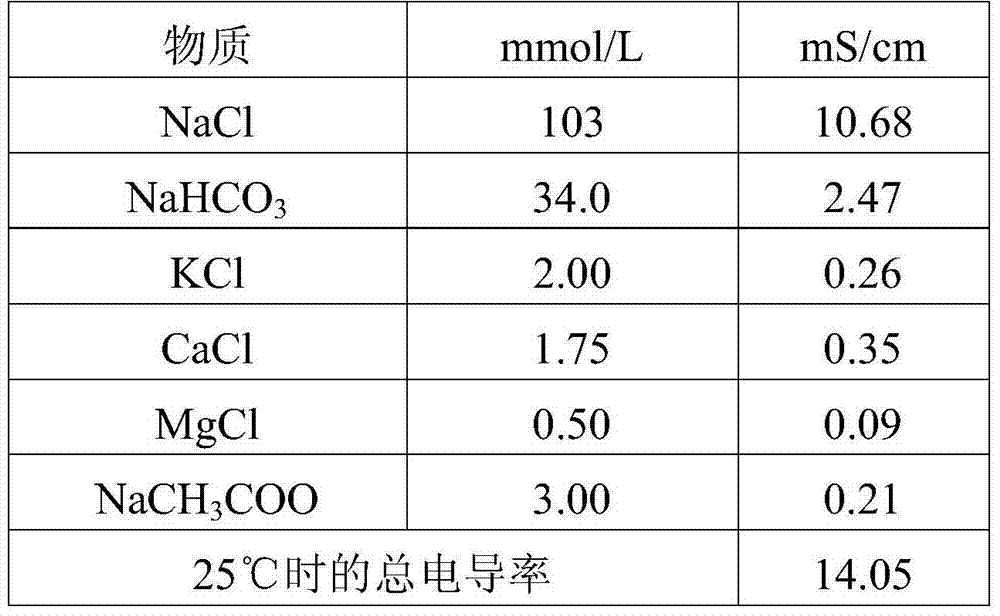
由于铵被交换为钠,因此透析液中钠的浓度会增加,其可以被用来验证在治疗过程中尿素是否被清除。如图26所示,可以在系统中加入电导仪101、104和160,其设置在吸附剂盒的入口和出口。在某些实施例中,可以在吸附剂盒内的磷酸锆层的出口处设置一电导仪。在透析器130的透析液出口196和吸附剂盒102之间的位置测量吸附剂盒102入口处的电导率。在吸附剂盒102和透析器130的透析液入口194之间的位置测量吸附剂盒102出口处的电导率。一微处理器或控制器可以监测由电导仪检测到的电导率,以分析下述情况引起的电导率变化:As ammonium is exchanged for sodium, the concentration of sodium in the dialysate increases, which can be used to verify that urea is removed during treatment. As shown in Figure 26,
1)尿素转化为碳酸铵以及随之的碳酸铵交换为钠;以及1) conversion of urea to ammonium carbonate and subsequent exchange of ammonium carbonate to sodium; and
2)由Ca2+、Mg2+和K+交换为钠引起的电导率的净变化,其可以被看作一恒定值。由清除Ca2+、Mg2+和K+引起的变化是已知的,由钠引起的电导率增加也是已知的。在表1所示的透析溶液示例中,Ca2+、Mg2+和K+贡献了0.7mS/cm的电导率。2) The net change in conductivity caused by the exchange of Ca 2+ , Mg 2+ and K + for sodium, which can be regarded as a constant value. The changes caused by the scavenging of Ca 2+ , Mg 2+ and K + are known, as is the increase in conductivity caused by sodium. In the example dialysis solution shown in Table 1, Ca 2+ , Mg 2+ and K+ contributed 0.7 mS/cm to the conductivity.
治疗过程中,由于Ca2+、Mg2+和K+的损失而引起的电导率变化和由于该交换引起的钠离子的增加将是相对恒定的。从该信息中可知,一控制器可以通过下述来源来计算由于尿素的清除而增加的电导率的量:The change in conductivity due to the loss of Ca 2+ , Mg 2+ and K + and the increase in sodium ions due to this exchange will be relatively constant during the course of treatment. From this information, a controller can calculate the amount of increased conductivity due to urea removal from the following sources:
入口电导率-Ca2+、Mg2+和K+所贡献的电导率=起始电导率Inlet conductivity - conductivity contributed by Ca 2+ , Mg 2+ and K + = initial conductivity
出口电导率-由于Ca2+,、Mg2+和K+交换为Na+而增加的电导率=修正的出口电导率Outlet Conductivity - Increased conductivity due to exchange of Ca 2+ , Mg 2+ and K + to Na + = Corrected Outlet Conductivity
修正的出口电导率-起始电导率=由于NH4 +转换为Na+而增加的电导率Corrected outlet conductivity - starting conductivity = increased conductivity due to conversion of NH4 + to Na +
下面的量化例子是基于在治疗过程中采用的48升再生透析溶液的,该再生透析溶液具有标准浓度的Ca2+、Mg2+和K+:The quantitative example below is based on 48 liters of regenerated dialysis solution with standard concentrations of Ca 2+ , Mg 2+ and K + used during treatment:
入口电导率=14.04mS/cm出口电导率=14.32mS/cmInlet conductivity = 14.04mS/cm Outlet conductivity = 14.32mS/cm
1.14.05mS/cm-0.7mS/cm=13.35mS/cm起始电导率1.14.05mS/cm-0.7mS/cm=13.35mS/cm initial conductivity
2.14.32mS/cm-0.5mS/cm=13.8mS/cm修正的出口电导率2.14.32mS/cm-0.5mS/cm=13.8mS/cm corrected outlet conductivity
3.13.8mS/cm-13.35mS/cm=0.45mS/cm由于NH4 +转换为Na+而增加的电导率3.13.8mS/cm-13.35mS/cm=0.45mS/cm Increased conductivity due to conversion of NH 4 + to Na +
4.0.45mS/cm/0.1037mS·L/mEq·cm=4.34mEq/L由于尿素清除而产生的Na+ 4.0.45mS/cm/0.1037mS·L/mEq·cm=4.34mEq/L Na + due to urea removal
5.每升0.4g尿素5. 0.4g urea per liter
在血液透析过程中,尿素的清除取决于穿过透析器的膜的扩散梯度。该梯度在治疗开始阶段比在治疗结束阶段要高得多,在治疗结束阶段通常50-60%的尿素已经被清除。在某些实施例中,可以将电导率值平均,这样尿素清除曲线是可以被了解的,并且可以不必进行持续计算。例如,为了量化尿素清除量,可以在每个治疗阶段进行四次或五次电导率抽样。在一治疗阶段的早期,进行尿素清除的量化可以验证尿素正在被清除,并且验证Na+的增加相对是高的。随后,进行量化测量可以计算一尿素清除的曲线,并根据该曲线预测尿素的预期总清除量。由此,治疗过程中的尿素清除量就可以被精确测得或是以一较高的确定性被估算得到。During hemodialysis, the removal of urea depends on the diffusion gradient across the membranes of the dialyzer. This gradient is much higher at the beginning of treatment than at the end of treatment, where typically 50-60% of the urea has been removed. In some embodiments, the conductivity values may be averaged so that the urea clearance profile is understood and continuous calculations may not be necessary. For example, to quantify urea clearance, four or five conductivity samples can be taken during each treatment period. Early in a treatment period, quantification of urea clearance can verify that urea is being cleared and that the increase in Na + is relatively high. Quantitative measurements can then be performed to calculate a urea clearance curve and predict the expected total urea clearance from this curve. Thus, the urea clearance during the treatment can be accurately measured or estimated with a high degree of certainty.
重大清除问题的检测Detection of major cleanup issues
上文描述的尿素清除监测设备可以被用来指示系统的正常运行,并就可能妨碍废物清除过程的重大问题向患者进行报警。该问题可以通过WiFiTM、因特网或其他通信方式自动传输给医生或专业医疗服务人员。例如,一血液接入流程受损的患者,就几乎不会有尿素被清除。在治疗的开始阶段监测到尿素清除量低的情况下,可以发送表示潜在故障的一警报。The urea removal monitoring device described above can be used to indicate the proper functioning of the system and to alert the patient of significant problems that may hinder the waste removal process. The question can be automatically transmitted to the physician or healthcare professional via WiFi (TM) , Internet or other means of communication. For example, in a patient with compromised blood access flow, very little urea is removed. In the event that low urea removal is monitored during the initial phase of therapy, an alert may be sent indicating a potential malfunction.
血小板在接入支架的堆积可以导致无法接入患者血管。血小板在吻合术(anastomosis)的末端产生一狭窄处,支架或移植物(graft)在此处被缝合至患者的血管系统。当该现象发生时,血液易于在接入区域内进行再循环,进入体外回路的新鲜血液流量不足,这会导致相同的血液被反复透析。因为几乎没有血液从系统循环进入透析器,所以血液中的尿素就会少,由此吸附剂盒因尿素/铵交换为钠而产生的钠就会减少。电导率没有适当增加可以被系统检测到,并且可以发出一表示接入患者血管系统的潜在故障或问题的警报。该警报可以表示一降低的废物清除率,但是该警报并不需要详细指出降低的清除率是由于血管接入问题还是由于透析流动问题等。一熟练的医疗专业人员可以通过分析记录来确定在某些实施例中引起警报的原因。Accumulation of platelets on access stents can result in inaccessibility of the patient's vessel. Platelets create a narrowing at the end of an anastomosis where a stent or graft is sewn to the patient's vascular system. When this occurs, blood tends to recirculate within the access area, and the flow of fresh blood into the extracorporeal circuit is insufficient, which can lead to repeated dialysis of the same blood. Since little blood enters the dialyzer from the systemic circulation, there will be less urea in the blood and thus less sodium produced by the sorbent cartridge due to the exchange of urea/ammonium to sodium. An inappropriate increase in conductivity can be detected by the system and an alert can be issued indicating a potential failure or problem with access to the patient's vasculature. The alert may indicate a reduced waste removal rate, but the alert need not specify whether the reduced removal rate is due to vascular access problems, dialysis flow problems, etc. A skilled medical professional can analyze the records to determine the cause of the alarm in some embodiments.
锆耗尽的检测Detection of zirconium depletion
持续使用一段时间后,磷酸锆吸附尿素的能力会被耗尽。磷酸锆的耗尽会导致铵释放进入透析液,这会导致患者铵中毒。如上文所述的,尿素/铵交换为钠影响着吸附剂盒的出口电导率。监测吸附剂盒入口和出口的电导率由此提供了一种检测铵从吸附剂盒中漏出的方法。吸附剂盒入口电导率和出口电导率在一较短时间内是相等的,表示着吸附剂盒内的磷酸锆层被耗尽。在某些实施例中,吸附剂盒前、后的电导率是被监测的。若控制器没有检测到钠浓度的增加,那么系统将会发出一警报,并阻止透析液达到透析器,由此防止患者铵中毒。After a period of continuous use, the ability of zirconium phosphate to adsorb urea will be exhausted. Depletion of zirconium phosphate can lead to the release of ammonium into the dialysate, which can lead to ammonium toxicity in the patient. As noted above, the exchange of urea/ammonium to sodium affects the outlet conductivity of the sorbent cartridge. Monitoring the conductivity of the inlet and outlet of the sorbent cartridge thus provides a means of detecting ammonium leakage from the sorbent cartridge. The sorbent cartridge inlet and outlet conductivities were equal for a short period of time, indicating that the zirconium phosphate layer in the sorbent cartridge was depleted. In certain embodiments, conductivity is monitored before and after the sorbent cartridge. If the controller does not detect an increase in sodium concentration, the system will sound an alarm and prevent dialysate from reaching the dialyzer, thereby preventing ammonium poisoning of the patient.
患者水合状态的检测Monitoring of patient hydration status
本文所述的便携式透析可以用于对一患者进行超滤。在超滤过程中,如图1A所示,液体通过控制泵190穿过透析膜135被从体外回路的血液的血清中抽出。由控制泵190清除的液体被清除至控制容器192中。超滤可以单独进行或者与上文所述的对流清除协同进行。The portable dialysis described herein can be used to perform ultrafiltration on a patient. During ultrafiltration, as shown in FIG. 1A , fluid is drawn from the blood serum of the extracorporeal circuit through the
肾衰竭患者可能在身体组织内具有一不期望的液体积聚,其称为水肿。随着液体(例如水)被从患者的血浆中清除出,患者血浆量被来自患者组织的液体的注入而替代。也就是说,通常该便携式透析系统并未直接接入存储于患者体内的液体,而是仅直接接入了患者的血管系统。通常,人体在任何时候都具有5-6L的血浆量,其中一大部分时间要求血浆通过从周围组织中转换为液体而被替换。Patients with kidney failure may have an unwanted buildup of fluid in body tissues called edema. As fluid, such as water, is removed from the patient's plasma, the patient's plasma volume is replaced by infusion of fluid from the patient's tissues. That is, usually the portable dialysis system does not directly access the fluid stored in the patient's body, but only directly accesses the patient's vascular system. Typically, the human body has a plasma volume of 5-6 L at any one time, with a large portion of the time requiring plasma to be replaced by conversion from surrounding tissues to fluid.
在超滤过程中,液体被清除得过快会导致患者血容量减少,这会导致各种严重后果,包括低血压、痉挛、恶心和呕吐。为了防止由于液体过度清除引起的血液浓缩,超滤的速率被限制为通过体外回路140的血液流速的一百分比。在某些实施例中,超滤的速率被限制为不超过通过体外回路140的血浆流速的30%左右。血浆流速(Qp)被定义为:Qp=血液流速×(1-红细胞比容),其中血液流速用单位时间内的量的单位表示(例如ml/min),红细胞比容是没有单位的,其表示血细胞占血液量的分数。例如,如果血液流速是60ml/min,红细胞比容是40%,那么超滤的最大速率被设定为10.8ml/min左右或更低。During ultrafiltration, fluid is removed too quickly and the patient becomes hypovolemic, which can lead to a variety of serious consequences, including hypotension, cramping, nausea and vomiting. To prevent blood concentration due to excessive clearance of fluid, the rate of ultrafiltration is limited to a percentage of the blood flow rate through the
便携式透析系统可以具有一红细胞比容检测器,以确定在图1A中的体外回路140中的血液的红细胞比容。在某些实施例中,红细胞比容检测器是一光源和一光电检测器,其中,光从光源发射出,穿过体外回路140中的血液,并被光电检测器检测到。光的一个或多个波长的吸收可以表示进入透析器130的血液在动脉管路610中的红细胞比容水平。在某些实施例中,红细胞比容检测器给出一红细胞比容的趋势是否是不安全的指征,而不是给出一精确的数值定量。在另外一些实施例中,红细胞比容检测器也可以确定体外回路140内是否有血液,这在如上所述的对系统进行注入(priming)或将血液返回到患者的过程中是有用的。具有光源和光电检测器的简单光学检测器也可以被用于检测系统中是否有血液存在。The portable dialysis system may have a hematocrit detector to determine the hematocrit of blood in
在大多数肾病中,肾脏不能产生促红细胞生成素,其是一种刺激红血球生成的激素。多数ESRD患者通过摄入一促红细胞生成素刺激药物来帮助生成红血球。这些药物用以将一预处理血清红细胞比容维持在32%。在透析治疗的过程中,红细胞比容会因从血液中清除液体而改变。红细胞比容水平随着治疗过程的变化是相对血容量随着治疗过程而变化的一个指征。通过超滤进行的液体清除将液体从血浆中清除,而将红血球留在了循环系统中。根据血管液体从组织再填充的速率,红细胞比容将会增加或减少。即使在治疗结束时,一平的红细胞比容也表明了该患者很有可能是液体超负荷的。在液体清除过程中的红细胞比容斜率的急剧增加可以预示着血容量减少的状况,该状况发生于一低血压情况之前。在治疗过程中,红细胞比容逐渐增加很可能是一良好透析患者的指征。In most kidney diseases, the kidneys fail to produce erythropoietin, a hormone that stimulates red blood cell production. Most people with ESRD take an erythropoietin-stimulating drug to help make red blood cells. These drugs were used to maintain a preconditioning serum hematocrit at 32%. During dialysis treatment, the hematocrit changes as fluid is removed from the blood. Changes in hematocrit levels over the course of treatment are an indication of changes in relative blood volume over the course of treatment. Fluid removal by ultrafiltration removes fluid from plasma, leaving red blood cells in the circulation. Depending on the rate at which blood vessels refill with fluid from the tissues, the hematocrit will increase or decrease. Even at the end of treatment, a flat hematocrit indicates that the patient is likely to be fluid overloaded. A sharp increase in the hematocrit slope during fluid removal can herald a hypovolemic condition that precedes a hypotensive condition. A gradual increase in hematocrit during treatment is likely to be an indication of a well-dialysis patient.
红细胞比容水平与血红蛋白浓度是成比例的。因此,任何合适的传感器可用于测量血红蛋白浓度,例如用于脉搏血氧计中的传感器,其通过测量被吸收的红光和红外光来分别确定氧合血红蛋白和脱氧血红蛋白的浓度。可以将包括有相关光源的红细胞比容/血红蛋白传感器放置于任何合适的位置。沿着体外回路140的动脉管路610设置红细胞比容/血红蛋白传感器可以表征在患者体内循环中的血容量状态。沿着体外回路140的静脉管路620设置红细胞比容/血红蛋白传感器可以表征发生于透析器130内的血液浓缩的程度。测量动脉管路610内的红细胞比容可以用来计算上文所述的Qp。其他可以确定治疗过程中相对血容量变化的光学技术也可以用来确定患者的水合状态以及适量的液体是否已被清除。The hematocrit level is proportional to the hemoglobin concentration. Thus, any suitable sensor may be used to measure hemoglobin concentration, such as sensors used in pulse oximeters, which measure the absorbed red and infrared light to determine the concentration of oxyhemoglobin and deoxygenated hemoglobin, respectively. The hematocrit/hemoglobin sensor including the associated light source may be placed in any suitable location. Positioning a hematocrit/hemoglobin sensor along the
图27示出了一红细胞比容/血红蛋白/相对血容量传感器的示意图。具有适宜波长(红色或红外线)的一光源713置于体外回路140的管子的一侧,使得光穿过管子到达检测器715。若体外回路140中的血红蛋白浓度较高,则较多的光被吸收(同时到达检测器715的光较少)。在适当情况下,导线712将电力和其他电信号从传感器装置主体711传送到光源713,传感器装置主体711可以包括电源和其他控制电子器件或检测电子器件。导线717将电信号从检测器715传送到设于传感器装置主体711内的部件。合适的红细胞比容传感器是已知的,例如,HEMA METRICS公司的CRIF-LINE监测器(参阅HEMA METRICS公司,CRIT-LINE红细胞比容的准确性,2003年2月24日,技术指南第11号(修订版D)卷1)[HEMAMETRICS,CRIT-LINEhematocrit accuracy,Vol.1,Techn Note No.11(Rev.D)February24,2003]。Figure 27 shows a schematic diagram of a hematocrit/hemoglobin/relative blood volume sensor. A
在其他实施例中,血液浓缩和血液水合作用能够通过一相对血容量监测器被检测和监测。相对血容量监测器能够检测血液中的那些大得无法穿过透析135或血液过滤200的被测溶质、固体物质或溶质和固体物质的组合的浓度变化,其表示着血容量的变化。通常,血液量不通过相对血容量监测器测得。因为受到溶质浓度变化的影响,相对血容量监测器测量治疗过程中血液中水含量的变化,而不需要对血液中的任何特定溶质进行绝对量化。相对血容量监测器通过测量一种或多种血液溶质或固体物质在接近治疗开始时的水平来确定客体的相对血容量水合状态(RBVHS),其可以被赋值为C0。一种或多种血液溶质的水平并不需要绝对量化,而是将一种或多种血液溶质的水平作为相对血容量监测器所产生的信号幅度而进行报告。该一种或多种溶质水平在一第二后续时间内被定期地测量,其被赋值为Ct。相对血容量水合状态就能够通过公式RBVHS=C0/Ct来确定。In other embodiments, blood concentration and blood hydration can be detected and monitored by a relative blood volume monitor. Relative blood volume monitors are capable of detecting changes in the concentration of measured solutes, solid substances, or combinations of solutes and solid substances in blood that are too large to pass through
在某些实施例中,相对血容量监测器是一红细胞比容传感器,并且由相对血容量监测器测量的一种或多种溶质是氧合血红蛋白或脱氧血红蛋白。在其他一些实施例中,相对血容量监测器是测量血液中的超声波速率的装置。超声波被定义为具有高于20,000Hz的频率的声波。血液中的超声波速率是血液中的总蛋白浓度的一指征。In certain embodiments, the relative blood volume monitor is a hematocrit sensor, and the one or more solutes measured by the relative blood volume monitor are oxyhemoglobin or deoxyhemoglobin. In some other embodiments, the relative blood volume monitor is a device that measures the velocity of ultrasound in the blood. Ultrasound is defined as sound waves having a frequency above 20,000 Hz. The velocity of ultrasound in blood is an indication of the total protein concentration in blood.
相对血容量水合状态可以以与红细胞比容相同的方式进行使用,如上文所述,来确定超滤的有效性。需要注意的是,当使用相对血容量时,其趋势斜率与使用一红细胞比容传感器时的趋势斜率是相反的,例如,当红细胞比容增加时,相对血容量则减少。即使是在治疗结束时,一平的相对血容量水合状态也表明了患者很有可能是液体超负荷的。在液体清除过程中的相对血容量水合状态斜率的急剧下降可以预示着一血容量减少的状况,该状况发生于一低血压情况之前。在治疗过程中,相对血容量水合状态逐渐减少很可能是一良好透析患者的指征。在某些进一步的实施例中,由相对血容量监测器确定的相对血容量水合状态可以与一血液的液体量相关联。Relative blood volume hydration status can be used in the same manner as hematocrit, as described above, to determine ultrafiltration effectiveness. It should be noted that when relative blood volume is used, the trend slope is opposite to the trend slope when using a hematocrit sensor, eg, when the hematocrit increases, the relative blood volume decreases. Even at the end of treatment, a flat relative volume hydration status indicates that the patient is likely to be fluid overloaded. A sharp drop in the slope of relative blood volume hydration status during fluid removal may indicate a hypovolemic condition that precedes a hypotensive condition. A gradual decrease in relative volume hydration status during treatment is likely to be an indication of a well-dialysis patient. In certain further embodiments, the relative blood volume hydration status determined by the relative blood volume monitor may be correlated to the fluid volume of a blood.
如果红细胞比容水平或相对水合状态指示了水合状态的一不安全的水平,那么与系统连接的控制器801可以停止液体清除并警示患者。控制器801可以被编写为通过相对血容量逐渐下降来清除液体,或在监测红细胞比容时,通过红细胞比容逐渐上升来清除液体。另外,透析回路的可控的顺应的性质可以被用来向患者输送推注液体。如上所述,控制泵190在流入方向上的运转将引起液体量从控制容器191向体外回路140的输送。可以将该系统预编程,从而一旦检测到红细胞比容或相对血容量水合状态具有一不安全的趋势时,就向患者输送一定的推注量。If the hematocrit level or relative hydration status indicates an unsafe level of hydration status, then the
在某些实施例中,控制容器191在治疗阶段开始时是空的,其中液体量在治疗过程(包括超滤)中进入控制容器。照此,响应红细胞比容或相对血容量水合状态趋势的一推注注入(bolus infusion)是将治疗中从患者体内清除出的液体量返回至患者。任何从控制容器191返回至患者的液体量都会在被引入体外回路140前通过吸附剂盒102进行净化。然而,在其他实施例中,控制容器191可以在治疗阶段开始时就盛有一定量的液体,其能够用作在治疗过程中向患者净注入的液体。In some embodiments, the
可以进一步通过同时监测接受血液透析治疗的患者的体液水平来防止血容量减少。存储于身体组织中的、在血液外的液体量与能够从患者身体测得的阻抗是成比例的。如图28所示,阻抗可以在两个电极703和705之间被测得,两个电极703和705与人类患者的身体10连接。电极703和705通过导线可操作地与控制和处理电子器件701耦合。电子器件701构造为在电极703和705之间产生一电压差,这样电流就能够被测得,阻抗就能够被计算出。测量能够在直流或交流模式下进行。阻抗或相位角能够与组织液体量相关联。合适的外部阻抗监测器700和能够根据本文的教示而采用的部件是已知的。在其他一些实施例中,电极703和705可以被植入患者体内。Hypovolemia can further be prevented by concurrent monitoring of fluid levels in patients undergoing hemodialysis treatment. The amount of fluid stored in body tissue, outside the blood, is proportional to the impedance that can be measured from the patient's body. As shown in Figure 28, impedance can be measured between two
一熟知的系统的实例是美敦力公司(Medtronic,Inc.)的
与血液透析系统相关联的一个或多个控制器801能够监测红细胞比容/相对血容量水合状态和接受血液透析治疗患者的阻抗/体液水平。一透析患者的一典型的红细胞比容水平约为32%。在一治疗阶段前,一肾病患者的血液的液体量可以被提高,由此红细胞比容水平可以是低于期望的。监测红细胞比容水平的一个或多个控制器801能够在红细胞比容水平达到期望的、预定的范围时,调节液体清除速率或结束超滤治疗。One or
一个人身体内的液体能够从人体组织移动到血液中,反之亦然。因此,一患者的合适的液体水平可以以组织液体量与血液量(根据由红细胞比容水平测得的)的比值来表示。如上所述,体液水平的红细胞比容水平能够被独立地监测到。通常,血液约是体重的7%,组织液体的总量约是体重的60%(包括血液,细胞外和细胞内的液体)。因此,一健康个体的一典型的组织液体量与血液量的比值约在6:1-9:1的范围内,或者可以在5:1-9:1的范围内。考虑到患者血液和组织之间的液体需要适当平衡,测得的比值超过该范围表示血液被抽出得太快。液体清除可以被改变、停止或酌情给予一液体推注,并且可以被预先编写入血液透析系统的一个或多个控制器801中。Fluids in a person's body are able to move from body tissues into the blood and vice versa. Thus, an appropriate fluid level for a patient can be expressed as the ratio of tissue fluid volume to blood volume (measured from hematocrit levels). As noted above, hematocrit levels at the bodily fluid level can be independently monitored. Usually, blood is about 7% of body weight, and the total amount of tissue fluid is about 60% of body weight (including blood, extracellular and intracellular fluid). Thus, a typical ratio of tissue fluid volume to blood volume in a healthy individual is approximately in the range of 6:1-9:1, or may be in the range of 5:1-9:1. Given the need for a proper balance of fluid between the patient's blood and tissue, a measured ratio above this range indicates that blood is being pumped too quickly. Fluid removal may be varied, stopped, or administered as a fluid bolus as appropriate, and may be pre-programmed into one or
针或导管未连接的检测Detection of needle or catheter not connected
在本领域内公知的是,在检测返回的静脉血液与患者入口发生分离时,压力并非总是可靠的手段。如果此情况发生,就会存在危及生命的血液流失和可能放血的风险。一导电垫(conductive mat)或保持架可以用于检测泄漏到控制器的血液。然后,控制器能够通过采取停止血液泵和警示患者的合适手段来保护患者。其他检测针或导管未连接的手段也可以被纳入系统中,例如通过两个针来监测阻抗或使用压力脉冲。It is well known in the art that pressure is not always a reliable means of detecting separation of returning venous blood from the patient inlet. If this happens, there is a risk of life-threatening blood loss and possible exsanguination. A conductive mat or holder can be used to detect blood leaking to the controller. The controller can then protect the patient by taking appropriate measures to stop the blood pump and alert the patient. Other means of detecting needle or catheter disconnection could also be incorporated into the system, such as monitoring impedance or using pressure pulses through both needles.
注入液的控制Injection control
如上所述,一碳酸氢盐缓冲液可以加入至透析回路141中,以维持生理pH值,且一注入液容器可以加入阳离子来替代由吸附剂盒102清除的必要电解质。在一些实施例中,如图29所示,第二容器是一水容器173且第二容器泵是一水泵174,该水泵174也可以用来在必要时向透析回路141(或血液过滤回路142)添加水、非蒸馏水或纯净水。例如,如果其他降低钠离子浓度的方法不令人满意时,水在必要时可以作为一稀释液被加入,以稀释电导率和钠离子浓度。当由于电导率超出一可接受的范围而需要将透析液和/或过滤液通过支路路径136进行转移时,将水作为稀释液加入尤为适合。可替换地,容器173可以盛装一具有生理相容性组分的溶液,该溶液可以根据需要作为一透析液或替换液而被加入到透析回路141和/或血液过滤回路174。本领域的技术人员可以知晓水容器173和泵174的设置是可选的,且容器173和泵174可以被包含在本文所述的血液透析或血液过滤系统的任意实施例中。血液过滤回路142中的超滤液和替换液的电导率可以由所述的电导仪104和160监测到。如图29所示,水可以通过泵174在吸附剂盒102后的一位置被添加,然而本领域的技术人员可以知晓,水可以在任一合适的位置被添加到透析回路141和/或血液过滤回路174中,更具体地,在吸附剂盒之前,这样一个位置可以更安全,从而避开可能导致溶血现象可能性风险的风险添加点。用于对流清除控制的水容器As described above, a bicarbonate buffer can be added to the
如上所述,在本文所述的系统的任何实施例中(包括图1A和图1B中的系统)均可以设置水容器173和泵174。如上文所述,控制泵190可以双向运转以帮助对流清除的进行。具体地,控制泵可以在流出方向上运转,以使液体从体外回路140流入透析回路141,控制泵可以在流入方向上运转,以使液体从透析回路141流入体外回路140。As noted above, a
在某些实施例中,控制泵190在流入方向上的运转可以被泵174的运转替代,从而将液体从容器173中送入透析回路141,并随之使液体从透析回路141穿过透析膜135流入体外回路。控制泵190可以被用于使液体在相反的方向上流动穿过透析膜135。在透析回路的总空隙容积和工作透析液少于约0.5L的本发明的实施例中,或者在透析回路的总空隙容积和工作透析液少于约1L的实施例中,采用泵174和容器173进行对流清除。In some embodiments, the operation of
在某些实施例中,容器173盛装的液体量约为1L或更少,或者约为0.5L或更少。在某些实施例中,容器盛装的液体量约为0.1-1L,0.2-0.8L,0.5-1L,0.6-1L,0.5-0.8L或0.2-0.8L。In some embodiments,
更多的应用和使用More applications and uses
本领域的技术人员很容易地知晓本文公开的创新点并不限于任一特定的应用,该应用包括但不限于从血液或任何其他的生物液体或体液中清除杂质或废物。具有一可控的顺应性透析回路141和一另外的不要求具有特别地可控的顺应性的回路的系统可以被用于任何进行以膜为基础的扩散或净化的应用中。也就是说,通过一选择性渗透膜的透析或选择性扩散被用于许多应用中,在这些应用中至少有两种液体穿过一选择性渗透膜而接触,以使得物质在这两种液体之间进行交换。本文所公开的创新点在允许一选择性扩散过程发生时,也允许对穿过选择性渗透膜的净液体流动进行精确控制。Those skilled in the art will readily appreciate that the innovations disclosed herein are not limited to any particular application, including but not limited to the removal of impurities or waste from blood or any other biological or bodily fluid. A system having a controlled
本领域的技术人员可以了解用于输送血液的体外回路140可以由其他用于循环任一合适液体的回路140替代,其中在外部液体和透析回路中的液体之间的液体转移量是可以控制的。例如,所述系统可以被用于药物组成物的缓冲液交换,例如生物分子(包括寡核苷酸,蛋白质和/或多肽类等)的水性悬浮液。具体地,回路140可以适应为一外部回路140,该外部回路140构造为循环一药物组成物,该药物组成物含有一溶液或生物分子悬浮液。对一溶液和含有生物分子的悬浮液进行浓缩通常是存在问题的,然而通常要求药物组成物以一非常特定的浓度被供给。对这种溶液和悬浮液进行浓缩的常见过程就是超滤,在超滤过程中,一溶液或生物分子悬浮液在用于驱动水通过超滤膜的离心力的作用下与一超滤膜接触,以产生一更加浓缩的溶液或悬浮液。然而,超滤是昂贵的,并且在昂贵的生物分子流失的过程中,经常出现溶解度问题。如此,一旦溶液或生物分子悬浮液以一预期的浓度被制备,则有利于避免浓度进一步的变化。Those skilled in the art will appreciate that the
用来实现药物的或其他水溶液或生物分子悬浮液的缓冲液交换的若干技术是已知的。然而,公知技术(诸如排阻色谱法(size exclusionchromatography))常常导致体积和浓度不可控制的变化。本文所述的系统可以用来在没有另外的浓度变化或在浓度可控变化的前提下影响缓冲液交换。Several techniques are known for effecting buffer exchange of pharmaceutical or other aqueous solutions or suspensions of biomolecules. However, well-known techniques such as size exclusion chromatography often result in uncontrollable changes in volume and concentration. The systems described herein can be used to effect buffer exchange without additional concentration changes or with controlled changes in concentration.
可以通过外部回路140供给或输送一外部液体,其可以是在一第一缓冲液中的溶液或生物分子悬浮液。可以通过透析回路141供给或输送一第二缓冲液。可以阻止穿过透析器130的液体流动,以在缓冲液交换过程中维持溶液或生物分子悬浮液的浓度。可替换地,溶液或生物分子悬浮液可以通过控制泵190的运转而被选择性地稀释至一预期的浓度,从而使得第二缓冲液的一定量可以可控地流过透析器130中的膜。透析回路141中的第二缓冲液可以通过任何适当的技术在运行过程中被再生。例如,可以在吸附剂盒102内设置一混合的阴离子/阳离子去离子树脂以清除所有的缓冲液盐,然后如上所述地采用注入液泵180注入一浓缩的缓冲液来对第二缓冲液进行再生。An external liquid, which may be a solution or a suspension of biomolecules in a first buffer, may be supplied or delivered through the
系统控制system control
如上所述,本文所述的系统具有若干动态部件,其包括泵和阀,及用于确定系统状态的检测器。作为整个该公开文本的应用,在控制器的控制下的系统操作可能涉及具有单独功能或叠加功能的单一控制器或多个控制器。控制器是指一具有可编程的微处理器和相关的存储器的装置。As noted above, the systems described herein have several dynamic components, including pumps and valves, and detectors for determining the state of the system. As applied throughout this disclosure, operation of a system under the control of a controller may involve a single controller or multiple controllers with separate or overlapping functions. A controller refers to a device having a programmable microprocessor and associated memory.
图30示出了一个或多个能够发送和接收来自多个系统部件的数据或指令的控制器801。一个或多个控制器801可以是一个以上的微处理器单元。具体地,一个或多个控制器801能够控制泵的速率,并且能够控制血液泵125、透析液泵138、过滤液泵139和控制泵190随着阀150、阀158、阀212和阀515的操作的泵送方向。肝素泵181、碳酸氢盐泵505和注入液泵181的运转也在一个或多个控制器801的控制下。在两个控制器系统中,一个控制器可以被用来控制过程,另一个控制器可以被用来监测系统,并在控制不正确时保护系统。在可替代的一个控制器系统中,控制或保护的过程可以是在同一控制器中的分别独立的过程。Figure 30 shows one or
一个或多个控制器801还接收来自于系统内的各种仪器和检测器的数据,包括压力计134,135,137,光学和/或空气-液体检测器201,202,203,电导率检测器101,104,160和血液渗漏检测器560。可选地,可以设置一检测器(如一压力切换型检测器),一磁力开关或一光学检测器来确定快速连接器550的连接状态。一个或多个控制器801能够停止或改变系统的运行以防止患者具有一不安全的压力读数、一不安全的电导率水平或检测到透析器130内有血液渗漏,该不安全的压力读数表示着故障或体外回路140中有空气存在。该一个或多个控制器能够停止系统中的任一泵或对阀150进行操作以绕过透析器130。进一步地,该一个或多个控制器801可以根据来自电导仪101,104的电导率读数以及由吸附剂盒102吸附的尿素的量和/或通过控制泵190进入或离开系统的钠元素的计算来改变或停止系统的运行。在两个控制器系统中,一个控制器可以被用来控制过程,另一个控制器可以被用来监测系统,并在控制不正确时保护系统。The one or
在某些实施例中,一个或多个控制器801设于远离透析回路和体外回路处。控制器801中的一个可以是能够通过与便携式透析系统有线或无线连接而发送和接收数据和指令的装置。如果系统发生故障,该数据可以被自动发送至一用于自动记录患者数据的电子医疗记录或者被自动发送至一诊断装置。例如,某些控制器的功能可以通过在一多功能计算装置(例如手机、平板电脑、个人电脑或个人数字助理)上运行的应用程序实现。在某些实施例中,远离于便携式透析系统的控制器801能够通过与便携式透析系统的有线连接而运行,以使得其在无线技术受到限制的医院环境中或飞机环境中可以运行。In certain embodiments, one or
通过将一个或多个控制器801设置为远离于便携式透析系统,患者不需要携带大部分处理电源,因而降低了装置的重量。通过无线技术来控制一装置的装置和方法在本领域内是已知的。无线信号可以采用信号确认、数字编码算法、校验和其他验证方法,以减少干扰,并允许类似的系统在同一区域内运行。如果无线控制信号被中断或受到影响,该系统可以具有一安全特征来停止装置。By locating one or
可以根据运行的特定需求对便携式透析系统进行各种组合和/或修改以及变化,这对于本领域的技术人员而言是显而易见的。此外,作为一个实施例的一部分,被示出或描述的特征可以用于另一个实施例以获得更进一步的实施例。It will be apparent to those skilled in the art that various combinations and/or modifications and variations can be made to the portable dialysis system according to the particular needs of the operation. Furthermore, features shown or described as part of one embodiment can be used with another embodiment to yield a still further embodiment.
Claims (182)
Priority Applications (1)
| Application Number | Priority Date | Filing Date | Title |
|---|---|---|---|
| CN201510713880.1A CN105288763B (en) | 2011-08-02 | 2012-08-02 | Hemodialysis system with the flow path with controllable compliance volume |
Applications Claiming Priority (3)
| Application Number | Priority Date | Filing Date | Title |
|---|---|---|---|
| US201161514469P | 2011-08-02 | 2011-08-02 | |
| US61/514,469 | 2011-08-02 | ||
| PCT/US2012/049398 WO2013019994A2 (en) | 2011-08-02 | 2012-08-02 | Hemodialysis system having a flow path with a controlled compliant volume |
Related Child Applications (1)
| Application Number | Title | Priority Date | Filing Date |
|---|---|---|---|
| CN201510713880.1A Division CN105288763B (en) | 2011-08-02 | 2012-08-02 | Hemodialysis system with the flow path with controllable compliance volume |
Publications (2)
| Publication Number | Publication Date |
|---|---|
| CN103889481A true CN103889481A (en) | 2014-06-25 |
| CN103889481B CN103889481B (en) | 2016-03-09 |
Family
ID=47629924
Family Applications (2)
| Application Number | Title | Priority Date | Filing Date |
|---|---|---|---|
| CN201510713880.1A Active CN105288763B (en) | 2011-08-02 | 2012-08-02 | Hemodialysis system with the flow path with controllable compliance volume |
| CN201280047921.2A Active CN103889481B (en) | 2011-08-02 | 2012-08-02 | Hemodialysis system with flow path with controlled compliance volume |
Family Applications Before (1)
| Application Number | Title | Priority Date | Filing Date |
|---|---|---|---|
| CN201510713880.1A Active CN105288763B (en) | 2011-08-02 | 2012-08-02 | Hemodialysis system with the flow path with controllable compliance volume |
Country Status (6)
| Country | Link |
|---|---|
| US (4) | US10695481B2 (en) |
| EP (2) | EP2739325B1 (en) |
| JP (1) | JP6001660B2 (en) |
| CN (2) | CN105288763B (en) |
| ES (1) | ES2647775T3 (en) |
| WO (1) | WO2013019994A2 (en) |
Cited By (41)
| Publication number | Priority date | Publication date | Assignee | Title |
|---|---|---|---|---|
| CN104968376A (en) * | 2013-02-01 | 2015-10-07 | 美敦力公司 | Fluid Circuit for Delivery of Renal Replacement Therapy |
| CN105025951A (en) * | 2013-02-01 | 2015-11-04 | 美敦力公司 | Systems and methods for multifunctional volumetric fluid control |
| CN105214624A (en) * | 2015-11-02 | 2016-01-06 | 李建中 | A kind of dislysate adsorption stuffing, its preparation method and application |
| CN106823031A (en) * | 2017-01-18 | 2017-06-13 | 北京迈淩医疗技术发展有限公司 | The filtering device for blood dialysis of patient vessel's channel status can be evaluated |
| CN106918573A (en) * | 2017-04-26 | 2017-07-04 | 上海健康医学院 | Creatinine content on-line monitoring method and system in a kind of hemodialysis dialyzate |
| CN106975115A (en) * | 2017-03-09 | 2017-07-25 | 李建中 | Dialysate regeneration device, blood purification system |
| US9713665B2 (en) | 2014-12-10 | 2017-07-25 | Medtronic, Inc. | Degassing system for dialysis |
| CN106990068A (en) * | 2017-04-26 | 2017-07-28 | 上海健康医学院 | Urea nitrogen creatinine content on-line monitoring method and system in a kind of hemodialysis dialyzate |
| CN106999644A (en) * | 2014-12-08 | 2017-08-01 | 弗雷森纽斯医疗护理德国有限责任公司 | Dialysis machine for monitoring temporal changes in hematocrit and/or hemoglobin values |
| CN107614030A (en) * | 2015-05-26 | 2018-01-19 | 美敦力公司 | Nonexpondable adsorbent core box |
| CN107645959A (en) * | 2015-05-26 | 2018-01-30 | 美敦力公司 | Refillers for refilling zirconium phosphate and zirconia modules |
| CN107708764A (en) * | 2015-05-12 | 2018-02-16 | 日机装株式会社 | Apparatus for purifying blood and method for filling |
| US9895479B2 (en) | 2014-12-10 | 2018-02-20 | Medtronic, Inc. | Water management system for use in dialysis |
| CN107810019A (en) * | 2015-07-02 | 2018-03-16 | 甘布罗伦迪亚股份公司 | Humanoid graphic element for medical user interface |
| US10098993B2 (en) | 2014-12-10 | 2018-10-16 | Medtronic, Inc. | Sensing and storage system for fluid balance |
| CN108778360A (en) * | 2015-12-02 | 2018-11-09 | 费森尤斯医疗护理德国有限责任公司 | The method for testing the hardness of disposable product |
| CN109745589A (en) * | 2017-11-08 | 2019-05-14 | 美敦力公司 | Sodium and Bicarbonate Control System |
| CN110402131A (en) * | 2017-03-02 | 2019-11-01 | 费森尤斯医疗保健控股公司 | Split-reservoir bag and method of improving dialysate heating and production using a split-reservoir bag |
| CN110709116A (en) * | 2017-04-07 | 2020-01-17 | 费森尤斯医疗保健控股公司 | Method and system for measuring and heating dialysate |
| US10543052B2 (en) | 2013-02-01 | 2020-01-28 | Medtronic, Inc. | Portable dialysis cabinet |
| CN111182929A (en) * | 2017-09-17 | 2020-05-19 | S·P·凯勒 | System, device and method for extracorporeal removal of carbon dioxide |
| CN111195375A (en) * | 2020-02-21 | 2020-05-26 | 中国人民解放军陆军军医大学第一附属医院 | Blood perfusion equipment for removing radionuclides from the human body |
| US10695481B2 (en) | 2011-08-02 | 2020-06-30 | Medtronic, Inc. | Hemodialysis system having a flow path with a controlled compliant volume |
| US10850016B2 (en) | 2013-02-01 | 2020-12-01 | Medtronic, Inc. | Modular fluid therapy system having jumpered flow paths and systems and methods for cleaning and disinfection |
| US10874787B2 (en) | 2014-12-10 | 2020-12-29 | Medtronic, Inc. | Degassing system for dialysis |
| US10905816B2 (en) | 2012-12-10 | 2021-02-02 | Medtronic, Inc. | Sodium management system for hemodialysis |
| CN112351801A (en) * | 2018-07-03 | 2021-02-09 | 巴克斯特国际公司 | Disposable cartridge conditioning system and method |
| CN112807502A (en) * | 2021-02-10 | 2021-05-18 | 健帆生物科技集团股份有限公司 | Control system applied to blood purification equipment |
| US11033667B2 (en) | 2018-02-02 | 2021-06-15 | Medtronic, Inc. | Sorbent manifold for a dialysis system |
| US11110215B2 (en) | 2018-02-23 | 2021-09-07 | Medtronic, Inc. | Degasser and vent manifolds for dialysis |
| CN113769887A (en) * | 2015-09-14 | 2021-12-10 | 医疗过滤有限公司 | Magnetic filtration equipment and method |
| CN114076744A (en) * | 2021-10-19 | 2022-02-22 | 重庆永仁心医疗器械有限公司 | Blood pump blood chamber characteristic test method |
| US11278654B2 (en) | 2017-12-07 | 2022-03-22 | Medtronic, Inc. | Pneumatic manifold for a dialysis system |
| CN114269406A (en) * | 2019-04-05 | 2022-04-01 | 奇德尼实验室公司 | Sorbents for renal therapy |
| CN114618036A (en) * | 2022-03-02 | 2022-06-14 | 佛山复星禅诚医院有限公司 | Hemodialysis A liquid quality monitoring system |
| CN115361979A (en) * | 2020-03-31 | 2022-11-18 | 量子透析技术有限公司 | Optimizing dialyzer performance |
| CN117157115A (en) * | 2020-07-08 | 2023-12-01 | 费森尤斯医疗保健控股公司 | Symbiosis Dialysis Systems and Technologies |
| CN118159312A (en) * | 2022-12-09 | 2024-06-07 | 上海心光生物医药有限责任公司 | Dialysis fluid regeneration circulation system and dialysis equipment |
| WO2024120144A1 (en) * | 2022-12-09 | 2024-06-13 | 上海心光生物医药有限责任公司 | Dialysate regeneration circulation system and dialysis device |
| RU2824079C1 (en) * | 2024-04-11 | 2024-08-01 | Общество с ограниченной ответственностью "ТЕНВИН" | Haemodialysis device |
| US12128165B2 (en) | 2020-04-27 | 2024-10-29 | Mozarc Medical Us Llc | Dual stage degasser |
Families Citing this family (157)
| Publication number | Priority date | Publication date | Assignee | Title |
|---|---|---|---|---|
| US8202248B2 (en) | 2004-08-18 | 2012-06-19 | Sequana Medical Ag | Dialysis implant and methods of use |
| US20060217771A1 (en) | 2005-02-07 | 2006-09-28 | Medtronic, Inc. | Potassium monitoring |
| US9199022B2 (en) | 2008-09-12 | 2015-12-01 | Fresenius Medical Care Holdings, Inc. | Modular reservoir assembly for a hemodialysis and hemofiltration system |
| US8105487B2 (en) | 2007-09-25 | 2012-01-31 | Fresenius Medical Care Holdings, Inc. | Manifolds for use in conducting dialysis |
| US8597505B2 (en) | 2007-09-13 | 2013-12-03 | Fresenius Medical Care Holdings, Inc. | Portable dialysis machine |
| US8240636B2 (en) | 2009-01-12 | 2012-08-14 | Fresenius Medical Care Holdings, Inc. | Valve system |
| US9358331B2 (en) | 2007-09-13 | 2016-06-07 | Fresenius Medical Care Holdings, Inc. | Portable dialysis machine with improved reservoir heating system |
| US9308307B2 (en) | 2007-09-13 | 2016-04-12 | Fresenius Medical Care Holdings, Inc. | Manifold diaphragms |
| CA3057806C (en) | 2007-11-29 | 2021-11-23 | Fresenius Medical Care Holdings, Inc. | System and method for conducting hemodialysis and hemofiltration |
| MX343532B (en) | 2008-10-07 | 2016-11-09 | Fresenius Medical Care Holdings Inc | Priming system and method for dialysis systems. |
| KR101508483B1 (en) | 2008-10-30 | 2015-04-06 | 프레제니우스 메디칼 케어 홀딩스 인코퍼레이티드 | Modular, portable dialysis system |
| US9399091B2 (en) | 2009-09-30 | 2016-07-26 | Medtronic, Inc. | System and method to regulate ultrafiltration |
| KR101787130B1 (en) * | 2009-12-28 | 2017-10-18 | 감브로 룬디아 아베 | Controlling an apparatus for fluid transfer to and/or from a subject |
| WO2012112664A1 (en) | 2011-02-16 | 2012-08-23 | Sequana Medical Ag | Apparatus and methods for treating intracorporeal fluid accumulation |
| CN103619372A (en) | 2011-03-23 | 2014-03-05 | 纳科斯达格医药股份有限公司 | Peritoneal dialysis system, device and method |
| US9848778B2 (en) | 2011-04-29 | 2017-12-26 | Medtronic, Inc. | Method and device to monitor patients with kidney disease |
| US9456755B2 (en) | 2011-04-29 | 2016-10-04 | Medtronic, Inc. | Method and device to monitor patients with kidney disease |
| US8926542B2 (en) | 2011-04-29 | 2015-01-06 | Medtronic, Inc. | Monitoring fluid volume for patients with renal disease |
| WO2013025844A2 (en) * | 2011-08-16 | 2013-02-21 | Medtronic, Inc. | Modular hemodialysis system |
| WO2013028809A2 (en) | 2011-08-22 | 2013-02-28 | Medtronic, Inc. | Dual flow sorbent cartridge |
| FR2980712B1 (en) * | 2011-10-03 | 2013-10-04 | Physidia | DIALYSIS MACHINE COMPRISING MEANS FOR ULTRAFILTRATION AND RETROFILTRATION |
| WO2013103906A1 (en) | 2012-01-04 | 2013-07-11 | Medtronic, Inc. | Multi-staged filtration system for blood fluid removal |
| US8585635B2 (en) | 2012-02-15 | 2013-11-19 | Sequana Medical Ag | Systems and methods for treating chronic liver failure based on peritoneal dialysis |
| US9399090B2 (en) | 2012-12-10 | 2016-07-26 | Medtronic, Inc. | Potassium loaded ion-exchange material for use in a dialysate regeneration system |
| US9201036B2 (en) | 2012-12-21 | 2015-12-01 | Fresenius Medical Care Holdings, Inc. | Method and system of monitoring electrolyte levels and composition using capacitance or induction |
| US9157786B2 (en) | 2012-12-24 | 2015-10-13 | Fresenius Medical Care Holdings, Inc. | Load suspension and weighing system for a dialysis machine reservoir |
| US11565029B2 (en) | 2013-01-09 | 2023-01-31 | Medtronic, Inc. | Sorbent cartridge with electrodes |
| US11154648B2 (en) | 2013-01-09 | 2021-10-26 | Medtronic, Inc. | Fluid circuits for sorbent cartridge with sensors |
| US9707328B2 (en) | 2013-01-09 | 2017-07-18 | Medtronic, Inc. | Sorbent cartridge to measure solute concentrations |
| US9713666B2 (en) | 2013-01-09 | 2017-07-25 | Medtronic, Inc. | Recirculating dialysate fluid circuit for blood measurement |
| WO2014113740A1 (en) * | 2013-01-18 | 2014-07-24 | University Of Pittsburgh - Of The Commonwealth System Of Higher Education | Removal of carbon dioxide via dialysis |
| US9526822B2 (en) * | 2013-02-01 | 2016-12-27 | Medtronic, Inc. | Sodium and buffer source cartridges for use in a modular controlled compliant flow path |
| US9144640B2 (en) | 2013-02-02 | 2015-09-29 | Medtronic, Inc. | Sorbent cartridge configurations for improved dialysate regeneration |
| US9827361B2 (en) | 2013-02-02 | 2017-11-28 | Medtronic, Inc. | pH buffer measurement system for hemodialysis systems |
| US20140263062A1 (en) | 2013-03-14 | 2014-09-18 | Fresenius Medical Care Holdings, Inc. | Universal portable machine for online hemodiafiltration using regenerated dialysate |
| US9433720B2 (en) | 2013-03-14 | 2016-09-06 | Fresenius Medical Care Holdings, Inc. | Universal portable artificial kidney for hemodialysis and peritoneal dialysis |
| GB201305757D0 (en) * | 2013-03-28 | 2013-05-15 | Quanta Fluid Solutions Ltd | Disposable Cartridge System for use with Sorbent |
| GB201305755D0 (en) | 2013-03-28 | 2013-05-15 | Quanta Fluid Solutions Ltd | Re-Use of a Hemodialysis Cartridge |
| EP2823834B1 (en) * | 2013-07-10 | 2016-06-22 | Gambro Lundia | Apparatus for extracorporeal blood treatment |
| WO2015007595A1 (en) | 2013-07-15 | 2015-01-22 | Gambro Lundia Ab | Individual pump calibration for ultrafiltration control in a dialysis apparatus |
| WO2015007596A1 (en) | 2013-07-15 | 2015-01-22 | Gambro Lundia Ab | Relative pump calibration for ultrafiltration control in a dialysis apparatus |
| GB201314512D0 (en) | 2013-08-14 | 2013-09-25 | Quanta Fluid Solutions Ltd | Dual Haemodialysis and Haemodiafiltration blood treatment device |
| WO2015066731A2 (en) | 2013-11-04 | 2015-05-07 | Medtronic, Inc. | Method and device to manage fluid volumes in the body |
| US9354640B2 (en) | 2013-11-11 | 2016-05-31 | Fresenius Medical Care Holdings, Inc. | Smart actuator for valve |
| US10099215B2 (en) | 2013-11-26 | 2018-10-16 | Medtronic, Inc. | Management of recharger effluent pH |
| US9981245B2 (en) | 2013-11-26 | 2018-05-29 | Medtronic, Inc. | Method and apparatus for zirconium oxide recharging |
| US10052624B2 (en) | 2013-11-26 | 2018-08-21 | Medtronic, Inc. | Zirconium phosphate and zirconium oxide recharging flow paths |
| US10537875B2 (en) | 2013-11-26 | 2020-01-21 | Medtronic, Inc. | Precision recharging of sorbent materials using patient and session data |
| US10004839B2 (en) | 2013-11-26 | 2018-06-26 | Medtronic, Inc. | Multi-use sorbent cartridge |
| US9884145B2 (en) | 2013-11-26 | 2018-02-06 | Medtronic, Inc. | Parallel modules for in-line recharging of sorbents using alternate duty cycles |
| US10064986B2 (en) | 2013-11-26 | 2018-09-04 | Medtronic, Inc. | Recharger for recharging zirconium phosphate and zirconium oxide modules |
| US10099214B2 (en) | 2013-11-26 | 2018-10-16 | Medtronic, Inc. | Zirconium phosphate and zirconium oxide recharger control logic and operational process algorithms |
| US9943780B2 (en) | 2013-11-26 | 2018-04-17 | Medtronic, Inc. | Module for in-line recharging of sorbent materials with optional bypass |
| US10052612B2 (en) | 2013-11-26 | 2018-08-21 | Medtronic, Inc. | Zirconium phosphate recharging method and apparatus |
| US10159957B2 (en) | 2013-11-26 | 2018-12-25 | Medtronic, Inc. | Zirconium phosphate recharging customization |
| US9974896B2 (en) | 2014-06-24 | 2018-05-22 | Medtronic, Inc. | Method of zirconium phosphate recharging |
| US9895477B2 (en) | 2013-11-26 | 2018-02-20 | Medtronic, Inc. | Detachable module for recharging sorbent materials with optional bypass |
| US10617349B2 (en) | 2013-11-27 | 2020-04-14 | Medtronic, Inc. | Precision dialysis monitoring and synchronization system |
| CN106232156B (en) * | 2014-02-19 | 2019-03-15 | 美敦力公司 | Parallel modules for in-line sorbent recharging with alternative duty cycles |
| CN106029119B (en) * | 2014-02-19 | 2018-10-09 | 美敦力公司 | Module for on-line recharging of sorbent material with optional bypass |
| GB201409796D0 (en) | 2014-06-02 | 2014-07-16 | Quanta Fluid Solutions Ltd | Method of heat sanitization of a haemodialysis water circuit using a calculated dose |
| EP3160536A4 (en) * | 2014-06-24 | 2018-03-07 | Medtronic Inc. | Reserve zirconium phosphate module for use in sorbent dialysis |
| US10172991B2 (en) | 2014-06-24 | 2019-01-08 | Medtronic, Inc. | Modular dialysate regeneration assembly |
| EP3160533B1 (en) | 2014-06-24 | 2020-08-12 | Medtronic Inc. | Sorbent pouch |
| CN106659827B (en) | 2014-06-24 | 2019-07-09 | 美敦力公司 | Use the urase in urase bag supplement dialysis system |
| WO2015199768A1 (en) | 2014-06-24 | 2015-12-30 | Medtronic, Inc. | Stacked sorbent assembly |
| US10272363B2 (en) | 2014-06-24 | 2019-04-30 | Medtronic, Inc. | Urease introduction system for replenishing urease in a sorbent cartridge |
| CN106659828B (en) | 2014-06-24 | 2019-05-03 | 美敦力公司 | Using a Urease Introducer to Supplement Urease in Dialysis Systems |
| US10016550B2 (en) * | 2014-09-12 | 2018-07-10 | Easydial, Inc. | Portable hemodialysis assembly with ammonia sensor |
| DE102014014535A1 (en) * | 2014-09-30 | 2016-03-31 | Fresenius Medical Care Deutschland Gmbh | Method for rinsing a dialyzer |
| US10179213B2 (en) | 2015-05-27 | 2019-01-15 | Vital Signs, Inc. | Apparatus and methods for intravenous gas elimination |
| US10926062B2 (en) | 2015-07-20 | 2021-02-23 | Strataca Systems Limited | Ureteral and bladder catheters and methods of inducing negative pressure to increase renal perfusion |
| US10512713B2 (en) | 2015-07-20 | 2019-12-24 | Strataca Systems Limited | Method of removing excess fluid from a patient with hemodilution |
| US11040172B2 (en) | 2015-07-20 | 2021-06-22 | Strataca Systems Limited | Ureteral and bladder catheters and methods of inducing negative pressure to increase renal perfusion |
| US12064567B2 (en) | 2015-07-20 | 2024-08-20 | Roivios Limited | Percutaneous urinary catheter |
| US10765834B2 (en) | 2015-07-20 | 2020-09-08 | Strataca Systems Limited | Ureteral and bladder catheters and methods of inducing negative pressure to increase renal perfusion |
| US11040180B2 (en) | 2015-07-20 | 2021-06-22 | Strataca Systems Limited | Systems, kits and methods for inducing negative pressure to increase renal function |
| US11229771B2 (en) | 2015-07-20 | 2022-01-25 | Roivios Limited | Percutaneous ureteral catheter |
| US10918827B2 (en) | 2015-07-20 | 2021-02-16 | Strataca Systems Limited | Catheter device and method for inducing negative pressure in a patient's bladder |
| US10493232B2 (en) | 2015-07-20 | 2019-12-03 | Strataca Systems Limited | Ureteral catheters, bladder catheters, systems, kits and methods for inducing negative pressure to increase renal function |
| US11541205B2 (en) | 2015-07-20 | 2023-01-03 | Roivios Limited | Coated urinary catheter or ureteral stent and method |
| RU2720403C2 (en) | 2015-07-20 | 2020-04-29 | Стратака Системз Лимитед, Мт | Ureteral catheter and urinary bladder and methods of creating negative pressure to increase renal perfusion |
| WO2017019635A1 (en) * | 2015-07-24 | 2017-02-02 | Medtronic, Inc. | Dialysis priming steps using an infusate caddy |
| US10603421B2 (en) | 2015-09-16 | 2020-03-31 | Fresenius Medical Care Holdings, Inc. | Cartridges useful in cleaning dialysis solutions |
| US10569007B2 (en) * | 2015-10-14 | 2020-02-25 | Gambro Lundia Ab | Dialysis system and method including a flow path insulator |
| US10335534B2 (en) | 2015-11-06 | 2019-07-02 | Medtronic, Inc. | Dialysis prescription optimization for decreased arrhythmias |
| AU2016363021A1 (en) * | 2015-12-04 | 2018-05-31 | Qidni Labs, Inc. | An implantable renal replacement therapy |
| GB201523104D0 (en) | 2015-12-30 | 2016-02-10 | Quanta Fluid Solutions Ltd | Dialysis machine |
| US9962477B2 (en) * | 2015-12-30 | 2018-05-08 | Fresenius Medical Care Holdings, Inc. | Cartridge systems useful in cleaning dialysis solutions |
| GB2547214A (en) | 2016-02-10 | 2017-08-16 | Quanta Fluid Solutions Ltd | Membrane pump usage condition detection |
| US10994064B2 (en) | 2016-08-10 | 2021-05-04 | Medtronic, Inc. | Peritoneal dialysate flow path sensing |
| US12329892B2 (en) | 2016-04-04 | 2025-06-17 | Mozarc Medical Us Llc | Dextrose concentration sensor for a peritoneal dialysis system |
| US10874790B2 (en) | 2016-08-10 | 2020-12-29 | Medtronic, Inc. | Peritoneal dialysis intracycle osmotic agent adjustment |
| CN110249389A (en) | 2016-08-26 | 2019-09-17 | 塞奎阿纳医疗股份公司 | System and method for managing and analyzing data generated by implantable devices |
| US10716922B2 (en) | 2016-08-26 | 2020-07-21 | Sequana Medical Nv | Implantable fluid management system having clog resistant catheters, and methods of using same |
| DE102016010722A1 (en) * | 2016-09-05 | 2018-03-08 | Fresenius Medical Care Deutschland Gmbh | Method and device for determining the body temperature of a patient |
| US11013843B2 (en) | 2016-09-09 | 2021-05-25 | Medtronic, Inc. | Peritoneal dialysis fluid testing system |
| US10981148B2 (en) | 2016-11-29 | 2021-04-20 | Medtronic, Inc. | Zirconium oxide module conditioning |
| CN110049793B (en) * | 2016-12-05 | 2022-04-05 | 淡马锡理工学院 | Sorbents for Dialysis Devices and Dialysis Systems |
| DE102017210134A1 (en) * | 2016-12-15 | 2018-06-21 | Fresenius Medical Care Deutschland Gmbh | Extracorporeal blood treatment system, treatment device, kit and method for operating an extracorporeal blood treatment system |
| GB201622119D0 (en) | 2016-12-23 | 2017-02-08 | Quanta Dialysis Tech Ltd | Improved valve leak detection system |
| US11167070B2 (en) | 2017-01-30 | 2021-11-09 | Medtronic, Inc. | Ganged modular recharging system |
| GB201701740D0 (en) | 2017-02-02 | 2017-03-22 | Quanta Dialysis Tech Ltd | Phased convective operation |
| GB201703048D0 (en) | 2017-02-24 | 2017-04-12 | Quanta Dialysis Tech Ltd | Testing rotor engagement of a rotary peristaltic pump |
| GB201705273D0 (en) | 2017-03-31 | 2017-05-17 | Quanta Dialysis Tech Ltd | Data storage amd exchange by medical device components |
| US10960119B2 (en) | 2017-05-03 | 2021-03-30 | Fresenius Medical Care Deutschland Gmbh | Method for operating a blood treatment apparatus, control unit and treatment apparatus for executing the method |
| US11559618B2 (en) | 2017-05-24 | 2023-01-24 | Sequana Medical Nv | Formulations and methods for direct sodium removal in patients having severe renal dysfunction |
| US10898631B2 (en) * | 2017-05-24 | 2021-01-26 | Sequana Medical Nv | Direct sodium removal method, solution and apparatus to reduce fluid overload in heart failure patients |
| US10960381B2 (en) | 2017-06-15 | 2021-03-30 | Medtronic, Inc. | Zirconium phosphate disinfection recharging and conditioning |
| EP3641850B1 (en) | 2017-06-24 | 2024-10-09 | NxStage Medical Inc. | Peritoneal dialysis fluid preparation systems |
| GB201710546D0 (en) * | 2017-06-30 | 2017-08-16 | Quanta Dialysis Tech Ltd | Dialysis systems, devices and methods |
| EP3431119B1 (en) * | 2017-07-19 | 2022-11-16 | Gambro Lundia AB | Apparatus for extracorporeal treatment of blood |
| CN111263653B (en) | 2017-08-25 | 2022-06-03 | 罗维奥斯有限公司 | Urinary pump for promoting removal of urine from urethra |
| USD907211S1 (en) | 2017-09-28 | 2021-01-05 | Quanta Dialysis Technologies Ltd. | Dialysis machine |
| US10869961B2 (en) | 2017-11-06 | 2020-12-22 | Sorrel Medical Ltd. | Local disinfection for drug delivery system |
| US10391220B2 (en) | 2018-01-12 | 2019-08-27 | Fresnius Medical Care Holdings, Inc. | Virtual kidney donation |
| CN108144147A (en) * | 2018-02-09 | 2018-06-12 | 司马靓杰 | A portable hemodialysis device |
| JP2021516089A (en) | 2018-02-28 | 2021-07-01 | ネクステージ メディカル インコーポレイテッド | Fluid preparation and treatment equipment, methods, and systems |
| EP3542707A1 (en) * | 2018-03-20 | 2019-09-25 | Gambro Lundia AB | Sensor and apparatus for determining at least one parameter of blood circulating in an extracorporeal blood circuit |
| CN111712450A (en) | 2018-03-22 | 2020-09-25 | 莱特拉姆有限责任公司 | Position limiter for conveyor belts with flaps |
| SE1850662A1 (en) | 2018-05-17 | 2019-11-18 | Gambro Lundia Ab | Patient fluid removal makeup |
| JP7183585B2 (en) * | 2018-06-27 | 2022-12-06 | 株式会社ジェイ・エム・エス | dialysis machine |
| US12285552B2 (en) | 2018-08-14 | 2025-04-29 | Mozarc Medical Us Llc | Precision dialysis therapy based on sorbent effluent analysis |
| US10894118B2 (en) | 2018-08-17 | 2021-01-19 | University Of Washington | Apparatus and method for urea photo-oxidation |
| PT3749385T (en) * | 2018-08-17 | 2022-07-04 | Univ Washington | APPARATUS AND METHOD FOR PHOTO-OXIDATION OF UREA |
| US11213616B2 (en) | 2018-08-24 | 2022-01-04 | Medtronic, Inc. | Recharge solution for zirconium phosphate |
| WO2020061166A2 (en) | 2018-09-18 | 2020-03-26 | Baxter International Inc. | Peritoneal dialysis patient line with sterilizing filter and drain bypass |
| EP3632487B1 (en) | 2018-10-05 | 2024-06-12 | LTS Device Technologies Ltd | Triggering sequence |
| SE1950039A1 (en) * | 2018-10-10 | 2020-04-11 | Gambro Lundia Ab | Flow rate dependent blood leak detection systems and methods |
| US11806457B2 (en) | 2018-11-16 | 2023-11-07 | Mozarc Medical Us Llc | Peritoneal dialysis adequacy meaurements |
| US11253849B2 (en) * | 2018-11-28 | 2022-02-22 | Baxter International Inc. | Systems and methods for onsite sorbent material reuse |
| US11806456B2 (en) | 2018-12-10 | 2023-11-07 | Mozarc Medical Us Llc | Precision peritoneal dialysis therapy based on dialysis adequacy measurements |
| US20220054724A1 (en) * | 2018-12-21 | 2022-02-24 | The Uab Research Foundation | System for continuous renal replacement therapy |
| US12433976B2 (en) | 2019-01-08 | 2025-10-07 | Mozarc Medical Us Llc | Bicarbonate sensor for dialysis |
| US11439333B2 (en) * | 2019-01-18 | 2022-09-13 | Becton, Dickinson And Company | Blood collection system including a baffle |
| GB2584335A (en) | 2019-05-31 | 2020-12-02 | Quanta Dialysis Technologies Ltd | Source container connector |
| DE102019122704A1 (en) * | 2019-08-23 | 2021-02-25 | B.Braun Avitum Ag | Device and method for extracorporeal blood treatment and method for regulating the balance of a dialysis fluid in an extracorporeal blood treatment |
| DE102019125355A1 (en) * | 2019-09-20 | 2021-03-25 | B.Braun Avitum Ag | Method and device for controlling anticoagulation in extracorporeal blood treatment |
| US12533453B2 (en) | 2019-12-20 | 2026-01-27 | University Of Florida Research Foundation, Incorporated | Renal replacement therapy machine |
| AU2021255746A1 (en) | 2020-04-13 | 2022-11-24 | Temasek Polytechnic | Dialysate regenerator comprising reversible retainer |
| CN115989424A (en) * | 2020-07-02 | 2023-04-18 | 费森尤斯医疗保健控股公司 | Systems and methods for detecting venous needle dislocation |
| DE102020125291A1 (en) * | 2020-09-28 | 2022-03-31 | B.Braun Avitum Ag | Automated priming of an extracorporeal blood treatment device using a push-pull method |
| CN112089425B (en) * | 2020-10-14 | 2024-10-01 | 南京医科大学第二附属医院 | Special nutrition analysis device for chronic renal failure secondary hyperparathyroidism |
| US12329889B2 (en) | 2021-05-03 | 2025-06-17 | Mozarc Medical Us Llc | Reducing sorbent cartridge recharging requirements |
| US12397093B2 (en) | 2021-05-18 | 2025-08-26 | Mozarc Medical Us Llc | Sorbent cartridge designs |
| US12154673B2 (en) | 2021-08-02 | 2024-11-26 | Mozarc Medical Us Llc | Artificial intelligence assisted home therapy settings for dialysis |
| US11850344B2 (en) | 2021-08-11 | 2023-12-26 | Mozarc Medical Us Llc | Gas bubble sensor |
| US12472301B2 (en) | 2021-08-13 | 2025-11-18 | 3Ive Labs, Llc | Negative pressure therapy system and methods |
| US11965763B2 (en) | 2021-11-12 | 2024-04-23 | Mozarc Medical Us Llc | Determining fluid flow across rotary pump |
| US11944733B2 (en) | 2021-11-18 | 2024-04-02 | Mozarc Medical Us Llc | Sodium and bicarbonate control |
| JP7422928B1 (en) | 2022-05-10 | 2024-01-26 | 日機装株式会社 | blood purification device |
| WO2024043193A1 (en) * | 2022-08-23 | 2024-02-29 | フィジオロガス・テクノロジーズ株式会社 | Target liquid treatment apparatus |
| CN115252053B (en) * | 2022-09-30 | 2023-02-17 | 乐普(北京)医疗器械股份有限公司 | Method for realizing closed-loop control of catheter constant-volume flow and thrombus removal system |
| CN120187467A (en) * | 2022-11-02 | 2025-06-20 | 耐斯特基尼公司 | Adsorber device for dialysate regeneration |
| US11813390B1 (en) | 2023-02-20 | 2023-11-14 | Nuwellis, Inc. | Extracorporeal blood filtering machine and methods |
| WO2025207852A1 (en) * | 2024-03-28 | 2025-10-02 | Virginia Commonwealth University | Compositions and methods for priming a heart-lung bypass machine |
| WO2025250997A1 (en) * | 2024-05-31 | 2025-12-04 | Mozarc Medical Us Llc | Dialysis purification system |
Citations (7)
| Publication number | Priority date | Publication date | Assignee | Title |
|---|---|---|---|---|
| US3939069A (en) * | 1971-12-06 | 1976-02-17 | Rhone-Poulenc-Textile | Artificial kidney and a method of ultrafiltering a liquid |
| US5744031A (en) * | 1991-09-10 | 1998-04-28 | Hospal Industrie | Artificial kidney provided with means for determining characteristics of blood |
| WO2004105589A2 (en) * | 2003-05-28 | 2004-12-09 | Hemocleanse Technologies, Llc | Sorbent reactor for extracorporeal blood treatment systems, peritoneal dialysis systems, and other body fluid treatment systems |
| WO2007101064A2 (en) * | 2006-02-22 | 2007-09-07 | Henry Ford Health System | System and method for delivery of regional citrate anticoagulation to extracorporeal blood circuits |
| WO2010042666A2 (en) * | 2008-10-07 | 2010-04-15 | Xcorporeal, Inc. | Priming system and method for dialysis systems |
| US20100217181A1 (en) * | 2006-01-30 | 2010-08-26 | The Regents Of The University Of California | Peritoneal Dialysis Methods and Apparatus |
| US20110009798A1 (en) * | 2003-11-05 | 2011-01-13 | Baxter International Inc. | Renal therapy system having pump reversing fluid control |
Family Cites Families (380)
| Publication number | Priority date | Publication date | Assignee | Title |
|---|---|---|---|---|
| US3091098A (en) | 1961-05-04 | 1963-05-28 | Pfaudler Permutit Inc | Vacuum deaerator |
| US3370710A (en) | 1966-05-11 | 1968-02-27 | Research Corp | Compact blood dialyzer with a pleated membrane therein |
| GB1189458A (en) | 1967-09-27 | 1970-04-29 | Nat Res Dev | Improvements in or relating to dialysers |
| US3506126A (en) | 1968-05-03 | 1970-04-14 | Milton Roy Co | Closed recirculating hemodialysis system |
| US3669878A (en) | 1968-12-02 | 1972-06-13 | Health Education And Welfare U | Treatment of dialysate solution for removal of urea |
| US3669880A (en) | 1969-06-30 | 1972-06-13 | Cci Aerospace Corp | Recirculation dialysate system for use with an artificial kidney machine |
| US3776819A (en) | 1969-12-22 | 1973-12-04 | Monsanto Co | Urea determination and electrode therefor |
| US3692648A (en) | 1970-03-24 | 1972-09-19 | Meditech Energy And Environmen | Process for oxygenating blood and apparatus for carrying out same |
| DE2239254C2 (en) | 1970-12-30 | 1983-08-04 | Organon Teknika Corp., Oklahoma City, Okla. | "Column for regenerating a circulating dialysate solution and using this column". |
| US3850835A (en) | 1971-11-08 | 1974-11-26 | Cci Life Systems Inc | Method of making granular zirconium hydrous oxide ion exchangers, such as zirconium phosphate and hydrous zirconium oxide, particularly for column use |
| US3809241A (en) | 1973-02-23 | 1974-05-07 | Electro Sys Eng Inc | Self-container kidney dialysis apparatus |
| US3884808A (en) | 1973-06-20 | 1975-05-20 | Res Dev Systems Inc | Wearable, self-regenerating dialysis appliance |
| FR2237639A1 (en) | 1973-07-20 | 1975-02-14 | Gensollen Yves | Degasser for artificial kidney dialysis liquid - senses growing gas vol. in degasser to actuate connection with vacuum system |
| US3976574A (en) * | 1974-11-04 | 1976-08-24 | Cobe Laboratories, Inc. | Negative pressure control system |
| US4060485A (en) | 1975-06-09 | 1977-11-29 | I T L Technology, Inc. | Dialysis apparatus |
| US4142845A (en) | 1976-02-20 | 1979-03-06 | Lepp William A | Dialysis pump system having over-center cam tracks to lock rollers against tubing |
| US4430098A (en) | 1976-03-24 | 1984-02-07 | Bowman Donald B | Apparatus for degassing hemodialysis liquid and the like |
| US4201555A (en) | 1976-12-30 | 1980-05-06 | Joseph Tkach | Method and apparatus for degasification of liquid by induced vortexing |
| US4094775A (en) | 1977-02-28 | 1978-06-13 | California Institute Of Technology | Dialysis system |
| US4581141A (en) | 1978-02-27 | 1986-04-08 | Purdue Research Foundation | Dialysis material and method for removing uremic substances |
| IT1174707B (en) | 1978-05-03 | 1987-07-01 | Bonomini Vittorio | PORTABLE ARTIFICIAL KIDNEY FOR DIALYSIS |
| US4209392A (en) | 1978-05-15 | 1980-06-24 | Wallace Richard A | Portable hepatic-assist method and apparatus for same |
| US4278092A (en) | 1979-07-05 | 1981-07-14 | American Hospital Supply Corporation | Peritoneal catheter |
| NO148701C (en) | 1979-10-16 | 1983-11-30 | Akers Mek Verksted As | PROCEDURE FOR DEGRADING LIQUID, AND DEVICE FOR CARRYING OUT THE PROCEDURE |
| US4556063A (en) | 1980-10-07 | 1985-12-03 | Medtronic, Inc. | Telemetry system for a medical device |
| US4374382A (en) | 1981-01-16 | 1983-02-15 | Medtronic, Inc. | Marker channel telemetry system for a medical device |
| US4381999A (en) | 1981-04-28 | 1983-05-03 | Cobe Laboratories, Inc. | Automatic ultrafiltration control system |
| US4371385A (en) | 1981-04-28 | 1983-02-01 | Cobe Laboratories, Inc. | Deaerating liquid |
| US4750494A (en) | 1981-05-12 | 1988-06-14 | Medtronic, Inc. | Automatic implantable fibrillation preventer |
| DE3215003C2 (en) | 1982-04-22 | 1985-04-04 | Fresenius AG, 6380 Bad Homburg | Process for separating air from a dialysis fluid and dialysis machine |
| US4650587A (en) | 1982-09-09 | 1987-03-17 | Akzona Incorporated | Ammonia scavenger |
| US4460555A (en) | 1983-08-25 | 1984-07-17 | Organon Teknika Corporation | Ammonia scavenger |
| US4490135A (en) | 1982-09-24 | 1984-12-25 | Extracorporeal Medical Specialties, Inc. | Single needle alternating blood flow system |
| US4562751A (en) | 1984-01-06 | 1986-01-07 | Nason Clyde K | Solenoid drive apparatus for an external infusion pump |
| US4685903A (en) | 1984-01-06 | 1987-08-11 | Pacesetter Infusion, Ltd. | External infusion pump apparatus |
| US4678408A (en) | 1984-01-06 | 1987-07-07 | Pacesetter Infusion, Ltd. | Solenoid drive apparatus for an external infusion pump |
| US4765907A (en) | 1984-03-28 | 1988-08-23 | Research Development Systems, Inc. | Wearable, continuously internally operable and externally regenerable dialysis device |
| JPS6125564A (en) * | 1984-07-17 | 1986-02-04 | 日機装株式会社 | Artificial kidney apparatus |
| FR2574664B1 (en) | 1984-12-14 | 1987-03-06 | Issautier Gerald | HEMODIALYSIS DEVICE FOR AUTOMATICALLY CONTROLLING WEIGHT LOSS |
| US4695385A (en) | 1985-04-29 | 1987-09-22 | Colorado Medical, Inc. | Dialyzer reuse system |
| IT1191613B (en) | 1985-05-15 | 1988-03-23 | Eniricerche Spa | ZIRCONIUM PHOSPHATE AND ITS PREPARATION METHOD |
| EP0265741B1 (en) | 1986-10-24 | 1992-03-11 | Siemens Aktiengesellschaft | Fluid circuit for an apparatus for the disintegration of calculi in a living being |
| US4715398A (en) | 1986-10-30 | 1987-12-29 | Cobe Laboratories, Inc. | Liquid level control |
| EP0266795B2 (en) | 1986-11-07 | 1996-03-27 | Asahi Kasei Kogyo Kabushiki Kaisha | Improved regenerated cellulose membrane and process for preparation thereof |
| US4827430A (en) | 1987-05-11 | 1989-05-02 | Baxter International Inc. | Flow measurement system |
| US4900308A (en) | 1987-05-27 | 1990-02-13 | Level 1 Technologies, Inc. | Gas elimination device |
| US4828693A (en) | 1987-09-22 | 1989-05-09 | Baxter Travenol Laboratories, Inc. | Water pressure regulator for hemodialysis apparatus |
| GB8722854D0 (en) | 1987-09-29 | 1987-11-04 | Hardy S M | Implantable artificial kidney |
| US4885001A (en) | 1988-06-03 | 1989-12-05 | Cobe Laboratories, Inc. | Pump with plural flow lines |
| CA1327838C (en) | 1988-06-13 | 1994-03-15 | Fred Zacouto | Implantable device to prevent blood clotting disorders |
| US4915713A (en) | 1989-03-13 | 1990-04-10 | Beckman Instruments, Inc. | Liquid degassing system and method |
| DE3912405C1 (en) | 1989-04-15 | 1990-10-31 | B. Braun Melsungen Ag, 3508 Melsungen, De | |
| US5114580A (en) | 1989-06-20 | 1992-05-19 | The Board Of Regents Of The University Of Washington | Combined hemofiltration and hemodialysis system |
| US5032615A (en) | 1989-10-31 | 1991-07-16 | The Regents Of The University Of California | Continuous hemodialysis using citrate |
| US5477864A (en) | 1989-12-21 | 1995-12-26 | Smith & Nephew Richards, Inc. | Cardiovascular guidewire of enhanced biocompatibility |
| US5127404A (en) | 1990-01-22 | 1992-07-07 | Medtronic, Inc. | Telemetry format for implanted medical device |
| US5097122A (en) | 1990-04-16 | 1992-03-17 | Pacesetter Infusion, Ltd. | Medication infusion system having optical motion sensor to detect drive mechanism malfunction |
| US5080653A (en) | 1990-04-16 | 1992-01-14 | Pacesetter Infusion, Ltd. | Infusion pump with dual position syringe locator |
| JPH0673603B2 (en) | 1990-11-26 | 1994-09-21 | 野村マイクロ・サイエンス株式会社 | Method for removing dissolved oxygen in pure water or ultrapure water |
| FR2687307B1 (en) | 1992-02-14 | 1999-06-04 | Lascombes Jean Jacques | DEVICE FOR THE PREPARATION OF A SOLUTION FOR MEDICAL USE. |
| US5605627A (en) * | 1992-10-07 | 1997-02-25 | Minntech Corporation | Dialysate filter including an asymmetric microporous, hollow fiber membrane incorporating a polyimide |
| AU674177B2 (en) | 1992-10-13 | 1996-12-12 | Baxter International Inc. | Hemodialysis monitoring system for hemodialysis machines |
| US5849179A (en) | 1992-10-13 | 1998-12-15 | Baxter International Inc. | Automatic apparatus for obtaining equilibration samples of dialysate |
| US5284470A (en) | 1992-11-02 | 1994-02-08 | Beltz Alex D | Wearable, portable, light-weight artificial kidney |
| US5419347A (en) | 1992-11-16 | 1995-05-30 | Ssi Medical Services, Inc. | Automated flushing module |
| US5445610A (en) | 1993-01-15 | 1995-08-29 | University Of Cincinnati | Portable peritoneal dialysis cycler |
| IT1260614B (en) | 1993-03-01 | 1996-04-22 | Sorin Biomedica Spa | PROCEDURE FOR MEASURING THE CONCENTRATION OF A SUBSTANCE IN A FLUID, ITS SYSTEM AND USE |
| US5302288A (en) | 1993-03-19 | 1994-04-12 | Zimpro Environmental, Inc. | Treatment of highly colored wastewaters |
| SE9900043D0 (en) * | 1999-01-11 | 1999-01-11 | Astra Ab | New use |
| DE4321927C2 (en) | 1993-07-01 | 1998-07-09 | Sartorius Gmbh | Filter unit with degassing device |
| US5308315A (en) | 1993-07-27 | 1994-05-03 | Raja N. Khuri | Method for determining the adequacy of dialysis |
| WO1996004401A1 (en) | 1994-07-29 | 1996-02-15 | Gambro Ab | Method and device for measuring the concentration of a substance in a solution |
| US5591344A (en) * | 1995-02-13 | 1997-01-07 | Aksys, Ltd. | Hot water disinfection of dialysis machines, including the extracorporeal circuit thereof |
| US5634893A (en) | 1995-04-24 | 1997-06-03 | Haemonetics Corporation | Autotransfusion apparatus |
| US5685835A (en) | 1995-06-07 | 1997-11-11 | Cobe Laboratories, Inc. | Technique for using a dialysis machine to disinfect a blood tubing set |
| IT1276468B1 (en) * | 1995-07-04 | 1997-10-31 | Hospal Dasco Spa | AUTOMATIC DIALYSIS METHOD AND EQUIPMENT |
| US5944684A (en) | 1995-08-31 | 1999-08-31 | The Regents Of The University Of California | Wearable peritoneum-based system for continuous renal function replacement and other biomedical applications |
| US5938634A (en) | 1995-09-08 | 1999-08-17 | Baxter International Inc. | Peritoneal dialysis system with variable pressure drive |
| US6363279B1 (en) | 1996-01-08 | 2002-03-26 | Impulse Dynamics N.V. | Electrical muscle controller |
| US5683432A (en) | 1996-01-11 | 1997-11-04 | Medtronic, Inc. | Adaptive, performance-optimizing communication system for communicating with an implanted medical device |
| US6048732A (en) | 1996-10-16 | 2000-04-11 | Board Of Regents, The University Of Texas System | Receptor and method for citrate determination |
| IT1288767B1 (en) | 1996-10-18 | 1998-09-24 | Hospal Dasco Spa | METHOD OF DETERMINING THE VALUE OF THE RECIRCULATION OF A SUSPENSION SUBJECT TO TREATMENT. |
| US5858186A (en) | 1996-12-20 | 1999-01-12 | The Regents Of The University Of California | Urea biosensor for hemodialysis monitoring |
| US5931801A (en) | 1997-01-21 | 1999-08-03 | Vasca, Inc. | Valve port assembly with interlock |
| US6852090B2 (en) | 1997-02-14 | 2005-02-08 | Nxstage Medical, Inc. | Fluid processing systems and methods using extracorporeal fluid flow panels oriented within a cartridge |
| SE9703600D0 (en) | 1997-10-02 | 1997-10-02 | Pacesetter Ab | Heart stimulator |
| US6390969B1 (en) | 1997-10-09 | 2002-05-21 | Orqis Medical Corporation | Implantable heart assist system and method of applying same |
| US6088608A (en) | 1997-10-20 | 2000-07-11 | Alfred E. Mann Foundation | Electrochemical sensor and integrity tests therefor |
| SE9703958D0 (en) | 1997-10-29 | 1997-10-29 | Pacesetter Ab | Method and device for determination of concentration |
| SE520638C2 (en) | 1998-01-21 | 2003-08-05 | Gambro Lundia Ab | Safety device for dialysis machine |
| AU756054B2 (en) | 1998-01-23 | 2003-01-02 | Viacirq, Inc. | Apparatuses and processes for whole-body hyperthermia |
| SE9800407D0 (en) | 1998-02-12 | 1998-02-12 | Pacesetter Ab | Heart stimulator |
| US6197197B1 (en) | 1998-04-23 | 2001-03-06 | Dialysis Systems, Inc. | Method for fluid delivery in a dialysis clinic |
| US6058331A (en) | 1998-04-27 | 2000-05-02 | Medtronic, Inc. | Apparatus and method for treating peripheral vascular disease and organ ischemia by electrical stimulation with closed loop feedback control |
| SE525639C2 (en) | 1998-06-04 | 2005-03-22 | Thore Falkvall | Determination of slag products in dialysis fluid by means of optical sensor |
| US6177049B1 (en) | 1998-06-10 | 2001-01-23 | Dsu Medical Corporation | Reversing flow blood processing system |
| US6554798B1 (en) | 1998-08-18 | 2003-04-29 | Medtronic Minimed, Inc. | External infusion device with remote programming, bolus estimator and/or vibration alarm capabilities |
| US6726647B1 (en) | 1998-10-23 | 2004-04-27 | Gambro Ab | Method and device for measuring access flow |
| NZ510869A (en) | 1998-10-23 | 2003-08-29 | Gambro Ab | Method and device for measuring access flow |
| EP1124600B1 (en) | 1998-10-29 | 2005-02-23 | Medtronic MiniMed, Inc. | Compact pump drive system |
| US6248093B1 (en) | 1998-10-29 | 2001-06-19 | Minimed Inc. | Compact pump drive system |
| JP4509387B2 (en) | 1998-12-24 | 2010-07-21 | フレセニウス・メディカル・ケア・ドイッチュラント・ゲゼルシャフト・ミット・ベシュレンクテル・ハフツング | Method for calculating the distribution of blood components during extracorporeal blood treatment and apparatus for carrying out this method |
| GB9828696D0 (en) | 1998-12-29 | 1999-02-17 | Houston J G | Blood-flow tubing |
| US6254567B1 (en) | 1999-02-26 | 2001-07-03 | Nxstage Medical, Inc. | Flow-through peritoneal dialysis systems and methods with on-line dialysis solution regeneration |
| AU2568800A (en) | 1999-03-02 | 2000-09-21 | Infomed S.A. | Tubing for extracorporal purification of the blood and use thereof |
| US6274103B1 (en) | 1999-03-26 | 2001-08-14 | Prismedical Corporation | Apparatus and method for preparation of a peritoneal dialysis solution |
| US6230059B1 (en) | 1999-03-17 | 2001-05-08 | Medtronic, Inc. | Implantable monitor |
| SE9901165D0 (en) | 1999-03-30 | 1999-03-30 | Gambro Lundia Ab | Method, apparatus and components of dialysis systems |
| EP1175238B1 (en) | 1999-04-30 | 2006-01-25 | Children's Hospital Medical Center | Hemofiltration system |
| US7247138B2 (en) | 1999-07-01 | 2007-07-24 | Medtronic Minimed, Inc. | Reusable analyte sensor site and method of using the same |
| EP1072282A1 (en) | 1999-07-19 | 2001-01-31 | EndoArt S.A. | Flow control device |
| US6251167B1 (en) | 1999-10-21 | 2001-06-26 | Berson Research Corp. | Machine and process for removing dissolved gasses from liquids |
| US6602399B1 (en) | 2000-03-22 | 2003-08-05 | Max-Planck-Gesellschaft Zur Forderung Der Wissenchaften E.V. | Signal recording of a receptor-effector-system by an extracellular planar potential-sensitive electrode |
| US20010041869A1 (en) | 2000-03-23 | 2001-11-15 | Causey James D. | Control tabs for infusion devices and methods of using the same |
| IL136079A0 (en) | 2000-04-19 | 2001-05-20 | Cheetah Medical Inc C O Pepper | Method and apparatus for monitoring the cardiovascular condition, particularly the degree of arteriosclerosis in individuals |
| AU2001259469A1 (en) | 2000-05-05 | 2001-11-20 | Hemocleanse, Inc. | Use of magnetic particles or other particles having relatively high density in afluid for mixing and/or leak detection |
| US6890315B1 (en) | 2000-05-23 | 2005-05-10 | Chf Solutions, Inc. | Method and apparatus for vein fluid removal in heart failure |
| US6589229B1 (en) | 2000-07-31 | 2003-07-08 | Becton, Dickinson And Company | Wearable, self-contained drug infusion device |
| EP1258260A3 (en) | 2000-10-04 | 2003-11-26 | Terumo Kabushiki Kaisha | Peritoneal dialysis apparatus |
| US6585675B1 (en) | 2000-11-02 | 2003-07-01 | Chf Solutions, Inc. | Method and apparatus for blood withdrawal and infusion using a pressure controller |
| US7033498B2 (en) * | 2000-11-28 | 2006-04-25 | Renal Solutions, Inc. | Cartridges useful in cleaning dialysis solutions |
| US6627164B1 (en) | 2000-11-28 | 2003-09-30 | Renal Solutions, Inc. | Sodium zirconium carbonate and zirconium basic carbonate and methods of making the same |
| CA2470339C (en) | 2000-12-12 | 2007-07-17 | Jurag Separation A/S | A method and apparatus for isolation of ionic species by electrodialysis |
| AU2002235257A1 (en) | 2000-12-20 | 2002-07-01 | Nephros, Inc. | Multistage hemodiafiltration/hemofiltration method and apparatus |
| US7788038B2 (en) | 2000-12-27 | 2010-08-31 | Koninklijke Philips Electronics N.V. | Biological information and blood treating device information control system, biological information and blood treating device information control device, and biological information and blood treating device information control method |
| RU2298428C2 (en) | 2001-02-07 | 2007-05-10 | Нефрос, Инк. | Method and the device for operation with the hemmodiafiltering receiving-withdrawing module |
| JP2002306904A (en) | 2001-04-13 | 2002-10-22 | Fujisaki Denki Kk | Deaeration device and method for removing gaseous component dissolved in liquid |
| US6773412B2 (en) | 2001-04-13 | 2004-08-10 | Chf Solutions, Inc. | User interface for blood treatment device |
| US20030010717A1 (en) | 2001-07-13 | 2003-01-16 | Nx Stage Medical, Inc. | Systems and methods for handling air and/or flushing fluids in a fluid circuit |
| US7241272B2 (en) | 2001-11-13 | 2007-07-10 | Baxter International Inc. | Method and composition for removing uremic toxins in dialysis processes |
| US7597677B2 (en) | 2001-11-16 | 2009-10-06 | National Quality Care, Inc. | Wearable ultrafiltration device |
| US6960179B2 (en) | 2001-11-16 | 2005-11-01 | National Quality Care, Inc | Wearable continuous renal replacement therapy device |
| US7871390B2 (en) * | 2001-11-16 | 2011-01-18 | Fresenius Medical Care Holdings, Inc. | Enhanced clearance in an artificial kidney incorporating a pulsatile pump |
| SE525132C2 (en) | 2001-11-23 | 2004-12-07 | Gambro Lundia Ab | Method of operation of dialysis device |
| TWI239859B (en) * | 2001-11-28 | 2005-09-21 | Renal Solutions Inc | Cartridges useful in cleaning dialysis solutions |
| US6878283B2 (en) | 2001-11-28 | 2005-04-12 | Renal Solutions, Inc. | Filter cartridge assemblies and methods for filtering fluids |
| US20030114787A1 (en) | 2001-12-13 | 2003-06-19 | Victor Gura | Wearable peritoneal dialysis system |
| US6695807B2 (en) | 2002-01-18 | 2004-02-24 | Dsu Medical, Inc. | Blood flow reversing system |
| US6711439B1 (en) | 2002-02-14 | 2004-03-23 | Pacesetter, Inc. | Evoked response variability as an indicator of autonomic tone and surrogate for patient condition |
| US7023359B2 (en) | 2002-03-15 | 2006-04-04 | Medtronic, Inc. | Telemetry module with configurable physical layer for use with an implantable medical device |
| SE522692C2 (en) | 2002-03-27 | 2004-03-02 | Gambro Lundia Ab | Method and apparatus for removing partially protein bound substances |
| US7153286B2 (en) | 2002-05-24 | 2006-12-26 | Baxter International Inc. | Automated dialysis system |
| ES2427174T3 (en) | 2002-07-19 | 2013-10-29 | Baxter International Inc. | Systems to develop peritoneal dialysis |
| AU2003249296A1 (en) | 2002-07-19 | 2004-02-09 | Baxter Healthcare S.A. | Systems and methods for performing peritoneal dialysis |
| EP1523351B1 (en) | 2002-07-19 | 2010-01-06 | Baxter International Inc. | System for peritoneal dialysis |
| US7238164B2 (en) | 2002-07-19 | 2007-07-03 | Baxter International Inc. | Systems, methods and apparatuses for pumping cassette-based therapies |
| ATE298595T1 (en) * | 2002-09-05 | 2005-07-15 | Gambro Lundia Ab | CONTROL FOR A BLOOD TREATMENT DEVICE |
| CA2497207C (en) | 2002-09-10 | 2009-06-30 | Wisconsin Alumni Research Foundation | Plasma treatment within dielectric fluids |
| US20060157335A1 (en) | 2002-09-20 | 2006-07-20 | Levine Michael R | Low energy vacuum distillation method and apparatus |
| US7144384B2 (en) | 2002-09-30 | 2006-12-05 | Insulet Corporation | Dispenser components and methods for patient infusion device |
| US7128727B2 (en) | 2002-09-30 | 2006-10-31 | Flaherty J Christopher | Components and methods for patient infusion device |
| US20040099593A1 (en) | 2002-11-25 | 2004-05-27 | Potito De Paolis | Concurrent dialysate purification cartridge |
| DE602004021672D1 (en) | 2003-01-07 | 2009-08-06 | Nxstage Medical Inc | CHARGE FILTRATION SYSTEM FOR PRODUCING A STERILE SPARELIFE FLUID FOR NURSING TREATMENTS |
| US7686778B2 (en) | 2003-01-15 | 2010-03-30 | Nxstage Medical, Inc. | Waste balancing for extracorporeal blood treatment systems |
| US7276042B2 (en) | 2003-01-23 | 2007-10-02 | National Quality Care, Inc. | Low hydraulic resistance cartridge |
| US20060076295A1 (en) | 2004-03-15 | 2006-04-13 | The Trustees Of Columbia University In The City Of New York | Systems and methods of blood-based therapies having a microfluidic membraneless exchange device |
| US7326576B2 (en) | 2003-04-09 | 2008-02-05 | Prescient Medical, Inc. | Raman spectroscopic monitoring of hemodialysis |
| US7330750B2 (en) | 2003-04-25 | 2008-02-12 | Instrumentarium Corp. | Estimation of cardiac death risk |
| US7169599B2 (en) | 2003-06-20 | 2007-01-30 | Groton Biosystems, Llc | Fluid interface for bioprocessor systems |
| US7920906B2 (en) | 2005-03-10 | 2011-04-05 | Dexcom, Inc. | System and methods for processing analyte sensor data for sensor calibration |
| US8026729B2 (en) | 2003-09-16 | 2011-09-27 | Cardiomems, Inc. | System and apparatus for in-vivo assessment of relative position of an implant |
| US20050065760A1 (en) | 2003-09-23 | 2005-03-24 | Robert Murtfeldt | Method for advising patients concerning doses of insulin |
| SE0302698A0 (en) | 2003-10-13 | 2005-04-14 | Gambro Lundia Ab | Device for performing a peritoneal dialysis treatment |
| KR101112117B1 (en) | 2003-10-13 | 2012-02-22 | 프레제니우스 메디칼 케어 도이칠란드 게엠베하 | A device for carrying out a peritoneal dialysis treatment |
| US7029456B2 (en) | 2003-10-15 | 2006-04-18 | Baxter International Inc. | Medical fluid therapy flow balancing and synchronization system |
| EP1680155B2 (en) | 2003-10-28 | 2015-11-04 | Baxter International Inc. | Dialysis machine with improved integrity test |
| EP1689466B1 (en) | 2003-10-31 | 2011-01-05 | Gambro Lundia AB | A circuit for extracorporeal blood treatment and flow-inverting device utilized therein |
| US7776006B2 (en) | 2003-11-05 | 2010-08-17 | Baxter International Inc. | Medical fluid pumping system having real time volume determination |
| US7279031B1 (en) | 2003-11-25 | 2007-10-09 | Wright David W | Emboli elimination apparatus |
| US7744553B2 (en) | 2003-12-16 | 2010-06-29 | Baxter International Inc. | Medical fluid therapy flow control systems and methods |
| CA2575731C (en) | 2003-12-24 | 2014-07-15 | Chemica Technologies, Inc. | Dialysate regeneration system for portable human dialysis |
| DE102004013814A1 (en) | 2004-03-20 | 2005-10-13 | B. Braun Medizintechnologie Gmbh | A method of allowing operator input on a medical device |
| US7303540B2 (en) | 2004-04-26 | 2007-12-04 | Chf Solutions, Inc. | User interface for blood treatment device |
| EP1784248B1 (en) | 2004-06-09 | 2014-07-30 | Renal Solutions, Inc. | Dialysis system |
| JP4500617B2 (en) | 2004-07-22 | 2010-07-14 | テルモ株式会社 | Bubble removal device |
| ITMO20040191A1 (en) | 2004-07-23 | 2004-10-23 | Gambro Lundia Ab | MACHINE AND METHOD FOR EXTRA-BODY BLOOD TREATMENT. |
| US7356366B2 (en) | 2004-08-02 | 2008-04-08 | Cardiac Pacemakers, Inc. | Device for monitoring fluid status |
| US8202248B2 (en) | 2004-08-18 | 2012-06-19 | Sequana Medical Ag | Dialysis implant and methods of use |
| US7615028B2 (en) | 2004-12-03 | 2009-11-10 | Chf Solutions Inc. | Extracorporeal blood treatment and system having reversible blood pumps |
| US7566432B2 (en) | 2004-12-28 | 2009-07-28 | Renal Solutions, Inc. | Method of synthesizing zirconium phosphate particles |
| US7756572B1 (en) | 2005-01-25 | 2010-07-13 | Pacesetter, Inc. | System and method for efficiently distinguishing among cardiac ischemia, hypoglycemia and hyperglycemia using an implantable medical device and an external system |
| US20060217771A1 (en) | 2005-02-07 | 2006-09-28 | Medtronic, Inc. | Potassium monitoring |
| US20060189926A1 (en) | 2005-02-14 | 2006-08-24 | Hall W D | Apparatus and methods for analyzing body fluid samples |
| US20060195064A1 (en) | 2005-02-28 | 2006-08-31 | Fresenius Medical Care Holdings, Inc. | Portable apparatus for peritoneal dialysis therapy |
| JP4726045B2 (en) | 2005-04-08 | 2011-07-20 | 日機装株式会社 | Hemodialysis machine |
| US7569050B2 (en) | 2005-05-06 | 2009-08-04 | Medtronic Minimed, Inc. | Infusion device and method with drive device in infusion device and method with drive device in separable durable housing portion |
| JP5181394B2 (en) | 2005-05-06 | 2013-04-10 | クアンタ フルーイド ソリューションズ リミテッド | Dialysis machine |
| EP1911476A4 (en) | 2005-05-23 | 2010-04-21 | Asahi Kasei Kuraray Medical Co | Body fluid treating filter device |
| FR2888672B1 (en) | 2005-07-18 | 2011-05-27 | Mat Equipement | ANTENNA WITH INCLINATION ANGLE AND CONFORMATION OF THE ADJUSTABLE RADIATION LOBE |
| US7674231B2 (en) | 2005-08-22 | 2010-03-09 | Massachusetts Institute Of Technology | Wearable pulse wave velocity blood pressure sensor and methods of calibration thereof |
| US8372025B2 (en) | 2005-09-22 | 2013-02-12 | Baxter International Inc. | Automation and optimization of CRRT treatment using regional citrate anticoagulation |
| US20100137693A1 (en) | 2005-11-01 | 2010-06-03 | Fresenius Medical Care Holdings, Inc. | Methods and systems for patient care |
| KR100694295B1 (en) | 2005-11-04 | 2007-03-14 | 한국전자통신연구원 | Sensing Information Management Device and Method for Sensor-based Home Network System |
| DE102005060866B4 (en) | 2005-12-20 | 2009-01-15 | Bruker Biospin Gmbh | Combined titration and pH electrode for the preparation of liquid samples, especially for NMR spectroscopy |
| US8246563B2 (en) | 2006-02-02 | 2012-08-21 | Cardiac Pacemakers, Inc. | Cardiac rhythm management device and sensor-suite for the optimal control of ultrafiltration and renal replacement therapies |
| US8715221B2 (en) | 2006-03-08 | 2014-05-06 | Fresenius Medical Care Holdings, Inc. | Wearable kidney |
| US7785463B2 (en) | 2006-03-17 | 2010-08-31 | Children's Hospital Medical Center | Extracorporeal renal replacement modeling system |
| EP2012906B1 (en) | 2006-04-07 | 2010-08-11 | NxStage Medical, Inc. | Tubing clamp for medical applications |
| US7967022B2 (en) | 2007-02-27 | 2011-06-28 | Deka Products Limited Partnership | Cassette system integrated apparatus |
| EP2724736B1 (en) | 2006-04-14 | 2022-06-08 | DEKA Products Limited Partnership | Pod pump cassette |
| US8366316B2 (en) | 2006-04-14 | 2013-02-05 | Deka Products Limited Partnership | Sensor apparatus systems, devices and methods |
| US20070255125A1 (en) | 2006-04-28 | 2007-11-01 | Moberg Sheldon B | Monitor devices for networked fluid infusion systems |
| US8226595B2 (en) | 2006-05-26 | 2012-07-24 | Baxter International Inc. | Automated dialysis system driven by gravity and vacuum |
| US8496809B2 (en) | 2006-06-05 | 2013-07-30 | Baxter International Inc. | Dynamic weight balancing of flow in kidney failure treatment systems |
| WO2007146162A2 (en) | 2006-06-08 | 2007-12-21 | University Of Pittsburgh - Of The Commonwealth System Of Higher Education | Devices, systems and methods for reducing the concentration of a chemical entity in fluids |
| US7572232B2 (en) | 2006-07-24 | 2009-08-11 | Cardiac Pacemakers, Inc. | Cardiac signal display and event detection using multiresolution Z-score transform |
| SE532971C2 (en) | 2006-08-16 | 2010-05-25 | Triomed Ab | Liquid regeneration system |
| US7887502B2 (en) | 2006-09-15 | 2011-02-15 | University Of Florida Research Foundation, Inc. | Method for using photoplethysmography to optimize fluid removal during renal replacement therapy by hemodialysis or hemofiltration |
| WO2008036011A1 (en) | 2006-09-19 | 2008-03-27 | Gambro Lundia Ab | Estimation of propensity to symptomatic hypotension |
| DE102006045437A1 (en) | 2006-09-26 | 2008-04-03 | Fresenius Medical Care Deutschland Gmbh | Apparatus and method for prescribing a dialysis fluid rate or blood flow rate for extracorporeal blood treatment |
| DE102006050272B4 (en) | 2006-10-23 | 2008-07-24 | Fresenius Medical Care Deutschland Gmbh | Hemodialysis machine, hemodiafiltration device, method of sampling such devices, and sampling set for use with such devices and methods |
| ES2370985T3 (en) | 2006-12-01 | 2011-12-26 | Gambro Lundia Ab | BLOOD TREATMENT DEVICE. |
| US9033908B2 (en) | 2006-12-21 | 2015-05-19 | Nederlandse Organisatie Voor Toegepast—Natuurwetenschappelijk Onderzoek Tno | Device for the removal of toxic substances from blood |
| US8449839B2 (en) | 2006-12-22 | 2013-05-28 | Abbott Laboratories | Liquid waste management system |
| US20080161751A1 (en) | 2006-12-29 | 2008-07-03 | Plahey Kulwinder S | Peritoneal dialysis therapy validation |
| WO2008086477A1 (en) | 2007-01-10 | 2008-07-17 | The Regents Of The University Of Michigan | Ultrafiltration membrane, device, bioartificial organ, and related methods |
| US8183046B2 (en) | 2007-01-11 | 2012-05-22 | The Board Of Trustees Of The University Of Illinois | Temperature resistant pH buffers for use at low temperatures |
| KR101111010B1 (en) | 2007-02-15 | 2012-02-16 | 아사히 카세이 쿠라레 메디칼 가부시키가이샤 | Blood purification system |
| US9028691B2 (en) | 2007-02-27 | 2015-05-12 | Deka Products Limited Partnership | Blood circuit assembly for a hemodialysis system |
| US8409441B2 (en) | 2007-02-27 | 2013-04-02 | Deka Products Limited Partnership | Blood treatment systems and methods |
| US8357298B2 (en) | 2007-02-27 | 2013-01-22 | Deka Products Limited Partnership | Hemodialysis systems and methods |
| MX337294B (en) | 2007-02-27 | 2016-02-23 | Deka Products Lp | Hemodialysis systems and methods. |
| US8562834B2 (en) | 2007-02-27 | 2013-10-22 | Deka Products Limited Partnership | Modular assembly for a portable hemodialysis system |
| US8491184B2 (en) | 2007-02-27 | 2013-07-23 | Deka Products Limited Partnership | Sensor apparatus systems, devices and methods |
| US8042563B2 (en) | 2007-02-27 | 2011-10-25 | Deka Products Limited Partnership | Cassette system integrated apparatus |
| US7621407B2 (en) | 2007-03-23 | 2009-11-24 | Daniel Patrick Herbst | Extracorporeal blood filter system |
| WO2008125893A1 (en) | 2007-04-12 | 2008-10-23 | Gambro Lundia Ab | Method and apparatus for priming an extracorporeal blood circuit. |
| EP2142235B1 (en) | 2007-04-12 | 2012-03-21 | Gambro Lundia AB | Apparatus for extracorporeal blood treatment |
| US7790103B2 (en) | 2007-07-05 | 2010-09-07 | Baxter International Inc. | Extended use dialysis system |
| US7901376B2 (en) | 2007-07-05 | 2011-03-08 | Baxter International Inc. | Dialysis cassette having multiple outlet valve |
| KR101581476B1 (en) | 2007-07-20 | 2015-12-30 | 메이오 파운데이션 포 메디칼 에쥬케이션 앤드 리써치 | Natriuretic polypeptides |
| US7981082B2 (en) | 2007-08-21 | 2011-07-19 | Hospira, Inc. | System and method for reducing air bubbles in a fluid delivery line |
| DE102007039939B4 (en) | 2007-08-23 | 2013-03-14 | Albutec Gmbh | Device for saving diafiltrate |
| AT505690B1 (en) | 2007-08-31 | 2012-09-15 | Zentrum Fuer Biomedizinische Technologie Der Donau Uni Krems | METHOD OF DETERMINING ION CONCENTRATION IN CITRATE ANTICOAGULATED EXTRACORPORAL BLOOD CLEANING |
| US8105487B2 (en) * | 2007-09-25 | 2012-01-31 | Fresenius Medical Care Holdings, Inc. | Manifolds for use in conducting dialysis |
| US8597505B2 (en) | 2007-09-13 | 2013-12-03 | Fresenius Medical Care Holdings, Inc. | Portable dialysis machine |
| US20090101577A1 (en) | 2007-09-28 | 2009-04-23 | Fulkerson Barry N | Methods and Systems for Controlling Ultrafiltration Using Central Venous Pressure Measurements |
| US7871462B2 (en) | 2007-10-01 | 2011-01-18 | Baxter International Inc. | Dialysis systems having air separation chambers with internal structures to enhance air removal |
| US7892331B2 (en) | 2007-10-01 | 2011-02-22 | Baxter International Inc. | Dialysis systems having air separation chambers with internal structures to enhance air removal |
| US8771508B2 (en) | 2008-08-27 | 2014-07-08 | Deka Products Limited Partnership | Dialyzer cartridge mounting arrangement for a hemodialysis system |
| US8691097B2 (en) | 2007-10-14 | 2014-04-08 | 1612017 Alberta Ltd. | Solids removal system and method |
| US7905853B2 (en) | 2007-10-30 | 2011-03-15 | Baxter International Inc. | Dialysis system having integrated pneumatic manifold |
| US20100152529A1 (en) | 2007-11-08 | 2010-06-17 | Svip 3 Llc | Fecal incontinence device, system and method |
| US9415150B2 (en) | 2007-11-09 | 2016-08-16 | Baxter Healthcare S.A. | Balanced flow dialysis machine |
| US8889004B2 (en) | 2007-11-16 | 2014-11-18 | Fresenius Medical Care Holdings, Inc. | Dialysis systems and methods |
| AU2008322546B2 (en) | 2007-11-16 | 2013-10-03 | Fresenius Medical Care Holdings, Inc. | Dialysis systems and methods |
| AU2007362210B2 (en) | 2007-12-03 | 2012-12-20 | Hepa Wash Gmbh | Dialysate regeneration unit |
| AU2007362189B2 (en) | 2007-12-04 | 2012-04-19 | Gambro Lundia Ab | An extracorporeal blood circuit |
| US8545425B2 (en) | 2008-01-18 | 2013-10-01 | Baxter International | Reusable effluent drain container for dialysis and other medical fluid therapies |
| CN104307210B (en) | 2008-01-18 | 2017-09-29 | 弗雷塞尼斯医疗保健控股公司 | Carbon dioxide is removed from the fluid circuit of dialysis apparatus |
| CN101977642B (en) | 2008-01-23 | 2015-05-13 | 德卡产品有限公司 | pump box |
| US7687041B2 (en) | 2008-02-27 | 2010-03-30 | Kellogg Brown & Root Llc | Apparatus and methods for urea production |
| US8241432B2 (en) | 2008-03-07 | 2012-08-14 | Mei, Llc | Solar wafer cleaning systems, apparatus and methods |
| US8019406B2 (en) | 2008-03-10 | 2011-09-13 | Biotronik Crm Patent Ag | Apparatus and method to assess the risk of R-on-T event |
| EP2274083A1 (en) | 2008-04-30 | 2011-01-19 | Gambro Lundia AB | Hydrophobic deaeration membrane |
| US8233973B2 (en) | 2008-05-02 | 2012-07-31 | Spacelabs Healthcare, Llc | Methods for detection of cardiac arrhythmias |
| US8882700B2 (en) | 2008-05-02 | 2014-11-11 | Baxter International Inc. | Smart patient transfer set for peritoneal dialysis |
| US8220643B2 (en) | 2008-06-06 | 2012-07-17 | Fresenius Medical Care Holdings, Inc. | Urea sorbent |
| ES2823159T3 (en) | 2008-06-23 | 2021-05-06 | Temasek Polytechnic | A flow system of a dialysis device and a portable dialysis device |
| US9821105B2 (en) | 2008-07-01 | 2017-11-21 | Baxter International Inc. | Nanoclay sorbents for dialysis |
| JP5172508B2 (en) | 2008-07-09 | 2013-03-27 | 株式会社ジャパンディスプレイセントラル | Liquid crystal display |
| US8057679B2 (en) | 2008-07-09 | 2011-11-15 | Baxter International Inc. | Dialysis system having trending and alert generation |
| US10265454B2 (en) | 2008-07-25 | 2019-04-23 | Baxter International Inc. | Dialysis system with flow regulation device |
| US8696626B2 (en) | 2008-07-30 | 2014-04-15 | Claudia F. E. Kirsch | Debubbler |
| EP2163272B1 (en) | 2008-09-15 | 2014-06-25 | B. Braun Avitum AG | Device to early predict the Kt/V parameter in kidney substitution treatments |
| US8409444B2 (en) | 2008-09-30 | 2013-04-02 | Fresenius Medical Care Holdings, Inc. | Acid zirconium phosphate and alkaline hydrous zirconium oxide materials for sorbent dialysis |
| JP5848128B2 (en) | 2008-09-30 | 2016-01-27 | フレセニウス メディカル ケア ホールディングス インコーポレーテッド | Covalently immobilized enzyme and method for producing the same |
| JP5712131B2 (en) | 2008-10-03 | 2015-05-07 | フレセニウス メディカル ケア ホールディングス インコーポレーテッド | Zirconium phosphate particles with improved adsorption capacity and method for synthesizing the zirconium phosphate particles |
| WO2010045474A2 (en) | 2008-10-16 | 2010-04-22 | Fresenius Medical Care Holdings, Inc. | Method of removing protein-bound deleterious substances during extracorporeal renal replacement treatment |
| KR101508483B1 (en) | 2008-10-30 | 2015-04-06 | 프레제니우스 메디칼 케어 홀딩스 인코퍼레이티드 | Modular, portable dialysis system |
| US8777892B2 (en) | 2008-11-03 | 2014-07-15 | Fresenius Medical Care Holdings, Inc. | Portable peritoneal dialysis system |
| AU2009312342B2 (en) | 2008-11-06 | 2014-01-23 | Xerem Medical Ltd. | Blood filtering device and method |
| US8182673B2 (en) | 2009-01-29 | 2012-05-22 | Baxter International Inc. | Drain and fill logic for automated peritoneal dialysis |
| WO2010088512A1 (en) | 2009-01-30 | 2010-08-05 | Baxter International Inc. | Transfer sets for therapy optimization |
| US20100199670A1 (en) | 2009-02-06 | 2010-08-12 | Siemens Energy, Inc. | Power Generation Plant Having Inert Gas Deaerator and Associated Methods |
| US8521482B2 (en) | 2009-02-20 | 2013-08-27 | Baxter International Inc. | Simulation of patient drain phase in peritoneal dialysis |
| AU2010221201B2 (en) | 2009-03-06 | 2014-06-12 | Baxter Healthcare Sa | Hemodialysis and peritoneal dialysis systems having electrodeionization capabilities |
| DE102009018806A1 (en) | 2009-04-24 | 2010-11-25 | Fresenius Medical Care Deutschland Gmbh | A computer system and method for generating at least one machine-readable file for a medical treatment device |
| US20100312174A1 (en) | 2009-06-06 | 2010-12-09 | Hoffman Josef C A | Peritoneal Dialysis System |
| US8080161B2 (en) | 2009-06-11 | 2011-12-20 | Baxter International Inc. | Dialysis treatment devices for removing urea |
| JP5823389B2 (en) | 2009-07-01 | 2015-11-25 | ボード・オブ・リージエンツ,ザ・ユニバーシテイ・オブ・テキサス・システム | Method for determining the presence and / or concentration of an analyte in a sample |
| KR101642171B1 (en) * | 2009-08-04 | 2016-07-22 | 프레제니우스 메디칼 케어 홀딩스 인코퍼레이티드 | Dialysis systems, components, and methods |
| US8404091B2 (en) | 2009-08-27 | 2013-03-26 | Baxter International Inc. | Dialysis treatment devices for removing urea |
| US20110066043A1 (en) | 2009-09-14 | 2011-03-17 | Matt Banet | System for measuring vital signs during hemodialysis |
| US9399091B2 (en) | 2009-09-30 | 2016-07-26 | Medtronic, Inc. | System and method to regulate ultrafiltration |
| US8518260B2 (en) | 2009-10-01 | 2013-08-27 | Fresenius Medical Care Holdings, Inc. | Method of controlling diffusive sodium transport in dialysis |
| US8409445B2 (en) | 2009-11-25 | 2013-04-02 | Fresenius Medical Care Holdings, Inc. | Method for removing gases from a container having a powdered concentrate for use in hemodialysis |
| US20110130666A1 (en) | 2009-11-30 | 2011-06-02 | Yanting Dong | Enhanced reporting of pathological episodes |
| US20110189048A1 (en) | 2009-12-05 | 2011-08-04 | Curtis James R | Modular dialysis system |
| US8753515B2 (en) | 2009-12-05 | 2014-06-17 | Home Dialysis Plus, Ltd. | Dialysis system with ultrafiltration control |
| ES2646821T3 (en) | 2009-12-28 | 2017-12-18 | Gambro Lundia Ab | Apparatus and method for predicting rapid symptomatic decrease in blood pressure |
| US8529491B2 (en) | 2009-12-31 | 2013-09-10 | Fresenius Medical Care Holdings, Inc. | Detecting blood flow degradation |
| US8500994B2 (en) | 2010-01-07 | 2013-08-06 | Fresenius Medical Care Holdings, Inc. | Dialysis systems and methods |
| US9220832B2 (en) | 2010-01-07 | 2015-12-29 | Fresenius Medical Care Holdings, Inc. | Dialysis systems and methods |
| JP5442483B2 (en) | 2010-02-10 | 2014-03-12 | 日機装株式会社 | Blood purification equipment |
| US8425780B2 (en) | 2010-03-11 | 2013-04-23 | Fresenius Medical Care Holdings, Inc. | Dialysis system venting devices and related systems and methods |
| DE102010003642A1 (en) | 2010-03-15 | 2011-09-15 | Fresenius Medical Care Deutschland Gmbh | Cassette with a sensor for determining the difference between a first and a second liquid flow |
| JP5548001B2 (en) | 2010-03-25 | 2014-07-16 | 日機装株式会社 | Blood purification equipment |
| DE102010014785A1 (en) | 2010-04-13 | 2011-10-13 | Fresenius Medical Care Deutschland Gmbh | Multilayer film, use of a multilayer film and method for producing a multilayer film |
| US9132219B2 (en) | 2010-04-16 | 2015-09-15 | Baxter International Inc. | Therapy prediction and optimization of serum potassium for renal failure blood therapy, especially home hemodialysis |
| US20110272337A1 (en) | 2010-05-04 | 2011-11-10 | C-Tech Biomedical, Inc. | Dual mode hemodialysis machine |
| DE102010020838A1 (en) | 2010-05-18 | 2011-11-24 | Fresenius Medical Care Deutschland Gmbh | Valve assembly for use in extracorporeal blood circulation and method |
| EP2388030B2 (en) | 2010-05-20 | 2022-03-16 | B. Braun Avitum AG | Kidney substitution device to automate blood sampling procedure in a kidney substitution treatment machine |
| EP2576453B1 (en) | 2010-05-24 | 2018-08-22 | Baxter International Inc. | Systems and methods for removing hydrogen peroxide from water purification systems |
| US20100327586A1 (en) | 2010-05-28 | 2010-12-30 | Technology Patents, Llc | Drainage, filtration, and electricity generating systems and methods |
| DE102010023635A1 (en) | 2010-06-14 | 2011-12-15 | Fresenius Medical Care Deutschland Gmbh | Device and method for conveying liquids into the treatment unit of a medical treatment device, in particular into the dialyzer of a dialysis machine |
| WO2012004103A1 (en) * | 2010-07-05 | 2012-01-12 | Gambro Lundia Ab | An ambulatory ultrafiltration device, related methods and a computer program product |
| EP3492574A3 (en) | 2010-08-25 | 2019-09-04 | Refine Technology, LLC | Fluid filtration systems |
| ES2498744T3 (en) | 2010-09-27 | 2014-09-25 | Gambro Lundia Ab | Device for extracorporeal blood treatment |
| US8784668B2 (en) | 2010-10-12 | 2014-07-22 | Fresenius Medical Care Holdings, Inc. | Systems and methods for compensation of compliant behavior in regenerative dialysis systems |
| DE102010048771A1 (en) | 2010-10-14 | 2012-05-16 | B. Braun Avitum Ag | Method and device for measuring and correcting system changes in a device for treating blood |
| GB201019228D0 (en) | 2010-11-15 | 2010-12-29 | Corp | Dialysis device and method of dialysis |
| US9694125B2 (en) | 2010-12-20 | 2017-07-04 | Fresenius Medical Care Holdings, Inc. | Medical fluid cassettes and related systems and methods |
| WO2012115771A2 (en) | 2011-02-25 | 2012-08-30 | Medtronic, Inc. | Systems and methods for therapy of kidney disease and/or heart failure using chimeric natriuretic peptides |
| ITMI20110441A1 (en) | 2011-03-21 | 2012-09-22 | Gambro Lundia Ab | EQUIPMENT FOR EXTRACORPROUS TREATMENT OF BLOOD. |
| US8945936B2 (en) | 2011-04-06 | 2015-02-03 | Fresenius Medical Care Holdings, Inc. | Measuring chemical properties of a sample fluid in dialysis systems |
| US20120258546A1 (en) | 2011-04-08 | 2012-10-11 | Life Technologies Corporation | Automated On-Instrument pH Adjustment |
| US9848778B2 (en) | 2011-04-29 | 2017-12-26 | Medtronic, Inc. | Method and device to monitor patients with kidney disease |
| WO2012148781A1 (en) | 2011-04-29 | 2012-11-01 | Medtronic, Inc. | Multimodal dialysis system |
| US9456755B2 (en) | 2011-04-29 | 2016-10-04 | Medtronic, Inc. | Method and device to monitor patients with kidney disease |
| US8926542B2 (en) | 2011-04-29 | 2015-01-06 | Medtronic, Inc. | Monitoring fluid volume for patients with renal disease |
| US9132217B2 (en) | 2011-04-29 | 2015-09-15 | Medtronic, Inc. | Multimodal dialysis system |
| US9320842B2 (en) | 2011-04-29 | 2016-04-26 | Medtronic, Inc. | Multimodal dialysis system |
| EP3838307A1 (en) | 2011-04-29 | 2021-06-23 | Medtronic, Inc. | Device to monitor patients with kidney disease |
| EP4464325A3 (en) | 2011-05-24 | 2025-01-29 | DEKA Products Limited Partnership | Blood treatment systems and methods |
| SG10201604142SA (en) | 2011-05-24 | 2016-07-28 | Deka Products Lp | Hemodialysis System |
| DE102011105824B3 (en) | 2011-05-27 | 2012-05-31 | Fresenius Medical Care Deutschland Gmbh | Method for determination of air in e.g. blood, involves detecting operational parameters of pump, and determining gas concentration from operational parameters under consideration of system compressibility in pump |
| CH705330A2 (en) | 2011-07-20 | 2013-01-31 | Ras Technology Sarl | The portable rapid inflation of a bag. |
| DE102011052188A1 (en) | 2011-07-27 | 2013-01-31 | Maquet Vertrieb Und Service Deutschland Gmbh | Arrangement for removing carbon dioxide from blood flow or for enriching blood flow with oxygen, has filter, which has membrane, where membrane separates blood region, through which blood flow is guided |
| DE102011108787A1 (en) | 2011-07-29 | 2013-01-31 | Fresenius Medical Care Deutschland Gmbh | Medical port, blood tube for use in extracorporeal blood treatment and medical treatment device |
| WO2013019179A1 (en) | 2011-07-29 | 2013-02-07 | Baxter International Inc. | Sodium management for dialysis systems |
| DE102011108786A1 (en) | 2011-07-29 | 2013-01-31 | Fresenius Medical Care Deutschland Gmbh | Method for determining at least one parameter of extracorporeal blood circulation and devices |
| ES2647775T3 (en) | 2011-08-02 | 2017-12-26 | Medtronic, Inc. | Hemodialysis system that has a flow path with a controlled distensible volume |
| US20130037142A1 (en) | 2011-08-08 | 2013-02-14 | Fresenius Medical Care Holdings, Inc. | Dialysis system having peristaltic pump arrangement |
| WO2013022024A1 (en) | 2011-08-09 | 2013-02-14 | 川澄化学工業株式会社 | Blood purifying system |
| WO2013025844A2 (en) | 2011-08-16 | 2013-02-21 | Medtronic, Inc. | Modular hemodialysis system |
| WO2013028809A2 (en) * | 2011-08-22 | 2013-02-28 | Medtronic, Inc. | Dual flow sorbent cartridge |
| WO2013027214A2 (en) | 2011-08-22 | 2013-02-28 | Bar-Ilan University | Nanop article dialysis |
| IN2014CN01294A (en) | 2011-08-23 | 2015-04-24 | Basf Se | |
| US8906240B2 (en) | 2011-08-29 | 2014-12-09 | Fresenius Medical Care Holdings, Inc. | Early detection of low bicarbonate level |
| EP3187212B1 (en) | 2011-08-30 | 2021-07-21 | Gambro Lundia AB | Apparatus for extracorporeal treatment of blood |
| EP2564884B1 (en) | 2011-08-30 | 2014-06-18 | Gambro Lundia AB | Medical apparatus for extracorporeal treatment of fluid and a process of calculating set flow rates in a medical apparatus for delivery or collection of fluids |
| DE102011053200A1 (en) | 2011-09-01 | 2013-03-07 | Fresenius Medical Care Deutschland Gmbh | Dialysate flow control |
| US20130256227A1 (en) | 2011-09-12 | 2013-10-03 | Medtronic, Inc. | Polystyrene sulfonate resin for use with a hemodialysis system having a controlled compliance dialysis circuit |
| JP5099464B1 (en) | 2011-12-29 | 2012-12-19 | 富田製薬株式会社 | Bicarbonate ion concentration-variable dialysate preparation device and preparation method, bicarbonate ion concentration-variable dialysate, and bicarbonate ion concentration-variable dialyzing system |
| WO2013103906A1 (en) | 2012-01-04 | 2013-07-11 | Medtronic, Inc. | Multi-staged filtration system for blood fluid removal |
| WO2013103607A1 (en) | 2012-01-04 | 2013-07-11 | Fresenius Medical Care Holdings, Inc. | Method and system of enhancing removal of toxic anions and organic solutes in sorbent dialysis |
| GB201201330D0 (en) | 2012-01-26 | 2012-03-14 | Quanta Fluid Solutions Ltd | Dialysis machine |
| US10076597B2 (en) | 2012-02-02 | 2018-09-18 | Quanta Fluid Systems Ltd. | Dialysis machine |
| WO2013121162A1 (en) | 2012-02-14 | 2013-08-22 | Quanta Fluid Solutions Ltd | Dialysis machine |
| EP2641624B1 (en) | 2012-03-21 | 2016-03-02 | Gambro Lundia AB | Treatment solution delivery in an extracorporeal blood treatment apparatus |
| EP3222306B1 (en) | 2012-03-23 | 2018-11-14 | NxStage Medical, Inc. | Peritoneal dialysis systems and devices |
| US9610392B2 (en) | 2012-06-08 | 2017-04-04 | Fresenius Medical Care Holdings, Inc. | Medical fluid cassettes and related systems and methods |
| US9500188B2 (en) | 2012-06-11 | 2016-11-22 | Fresenius Medical Care Holdings, Inc. | Medical fluid cassettes and related systems and methods |
| US9814821B2 (en) | 2012-06-15 | 2017-11-14 | University of Pittsburgh—of the Commonwealth System of Higher Education | Devices, systems and methods for reducing the concentration of carbon dioxide in blood |
| US9231692B2 (en) | 2012-09-04 | 2016-01-05 | Viasat Inc. | Paired-beam transponder satellite communication |
| US9138520B2 (en) | 2012-10-22 | 2015-09-22 | Baxter International Inc. | Total chlorine water detection system and method for medical fluid treatments |
| US9162021B2 (en) | 2012-10-22 | 2015-10-20 | Baxter International Inc. | Integrated water testing system and method for ultra-low total chlorine detection |
| JP2014097224A (en) | 2012-11-15 | 2014-05-29 | Tatsunori Kato | Dialysis unit and method for measuring access recirculation rate |
| US9399090B2 (en) | 2012-12-10 | 2016-07-26 | Medtronic, Inc. | Potassium loaded ion-exchange material for use in a dialysate regeneration system |
| US20140158588A1 (en) | 2012-12-10 | 2014-06-12 | Medtronic, Inc. | pH AND BUFFER MANAGEMENT SYSTEM FOR HEMODIALYSIS SYSTEMS |
| US10905816B2 (en) | 2012-12-10 | 2021-02-02 | Medtronic, Inc. | Sodium management system for hemodialysis |
| US9707328B2 (en) | 2013-01-09 | 2017-07-18 | Medtronic, Inc. | Sorbent cartridge to measure solute concentrations |
| WO2014117000A2 (en) | 2013-01-24 | 2014-07-31 | Nxstage Medical, Inc. | Water treatment systems, devices, and methods for fluid preparation |
| US10010663B2 (en) | 2013-02-01 | 2018-07-03 | Medtronic, Inc. | Fluid circuit for delivery of renal replacement therapies |
| US9526822B2 (en) | 2013-02-01 | 2016-12-27 | Medtronic, Inc. | Sodium and buffer source cartridges for use in a modular controlled compliant flow path |
| WO2014121162A1 (en) | 2013-02-01 | 2014-08-07 | Medtronic, Inc. | Sorbent cartridge to measure solute concentrations |
| US10850016B2 (en) | 2013-02-01 | 2020-12-01 | Medtronic, Inc. | Modular fluid therapy system having jumpered flow paths and systems and methods for cleaning and disinfection |
| US9173987B2 (en) | 2013-02-01 | 2015-11-03 | Medtronic, Inc. | Degassing module for a controlled compliant flow path |
| US9623164B2 (en) | 2013-02-01 | 2017-04-18 | Medtronic, Inc. | Systems and methods for multifunctional volumetric fluid control |
| US10543052B2 (en) | 2013-02-01 | 2020-01-28 | Medtronic, Inc. | Portable dialysis cabinet |
| US9827361B2 (en) | 2013-02-02 | 2017-11-28 | Medtronic, Inc. | pH buffer measurement system for hemodialysis systems |
| US9144640B2 (en) | 2013-02-02 | 2015-09-29 | Medtronic, Inc. | Sorbent cartridge configurations for improved dialysate regeneration |
| DE102013002395A1 (en) | 2013-02-13 | 2014-08-14 | Fresenius Medical Care Deutschland Gmbh | Device and method for controlling a treatment device |
| WO2015031310A1 (en) | 2013-08-26 | 2015-03-05 | Mason Roger Alan | Improved system and method for administering peritoneal dialysis |
| US9884145B2 (en) | 2013-11-26 | 2018-02-06 | Medtronic, Inc. | Parallel modules for in-line recharging of sorbents using alternate duty cycles |
| US9713665B2 (en) | 2014-12-10 | 2017-07-25 | Medtronic, Inc. | Degassing system for dialysis |
| US9452251B2 (en) | 2014-12-10 | 2016-09-27 | Medtronic, Inc. | Degassing membrane for dialysis |
| US10098993B2 (en) | 2014-12-10 | 2018-10-16 | Medtronic, Inc. | Sensing and storage system for fluid balance |
| US9895479B2 (en) | 2014-12-10 | 2018-02-20 | Medtronic, Inc. | Water management system for use in dialysis |
-
2012
- 2012-08-02 ES ES12819714.2T patent/ES2647775T3/en active Active
- 2012-08-02 WO PCT/US2012/049398 patent/WO2013019994A2/en not_active Ceased
- 2012-08-02 CN CN201510713880.1A patent/CN105288763B/en active Active
- 2012-08-02 EP EP12819714.2A patent/EP2739325B1/en active Active
- 2012-08-02 EP EP16204175.0A patent/EP3165245B1/en active Active
- 2012-08-02 CN CN201280047921.2A patent/CN103889481B/en active Active
- 2012-08-02 US US13/565,733 patent/US10695481B2/en active Active
- 2012-08-02 JP JP2014524089A patent/JP6001660B2/en not_active Expired - Fee Related
-
2015
- 2015-10-19 US US14/887,216 patent/US10722636B2/en active Active
-
2020
- 2020-05-19 US US16/877,758 patent/US20200306439A1/en not_active Abandoned
- 2020-06-22 US US16/907,408 patent/US20200330674A1/en not_active Abandoned
Patent Citations (7)
| Publication number | Priority date | Publication date | Assignee | Title |
|---|---|---|---|---|
| US3939069A (en) * | 1971-12-06 | 1976-02-17 | Rhone-Poulenc-Textile | Artificial kidney and a method of ultrafiltering a liquid |
| US5744031A (en) * | 1991-09-10 | 1998-04-28 | Hospal Industrie | Artificial kidney provided with means for determining characteristics of blood |
| WO2004105589A2 (en) * | 2003-05-28 | 2004-12-09 | Hemocleanse Technologies, Llc | Sorbent reactor for extracorporeal blood treatment systems, peritoneal dialysis systems, and other body fluid treatment systems |
| US20110009798A1 (en) * | 2003-11-05 | 2011-01-13 | Baxter International Inc. | Renal therapy system having pump reversing fluid control |
| US20100217181A1 (en) * | 2006-01-30 | 2010-08-26 | The Regents Of The University Of California | Peritoneal Dialysis Methods and Apparatus |
| WO2007101064A2 (en) * | 2006-02-22 | 2007-09-07 | Henry Ford Health System | System and method for delivery of regional citrate anticoagulation to extracorporeal blood circuits |
| WO2010042666A2 (en) * | 2008-10-07 | 2010-04-15 | Xcorporeal, Inc. | Priming system and method for dialysis systems |
Cited By (60)
| Publication number | Priority date | Publication date | Assignee | Title |
|---|---|---|---|---|
| US10722636B2 (en) | 2011-08-02 | 2020-07-28 | Medtronic, Inc. | Hemodialysis system having a flow path with a controlled compliant volume |
| US10695481B2 (en) | 2011-08-02 | 2020-06-30 | Medtronic, Inc. | Hemodialysis system having a flow path with a controlled compliant volume |
| US10905816B2 (en) | 2012-12-10 | 2021-02-02 | Medtronic, Inc. | Sodium management system for hemodialysis |
| US10010663B2 (en) | 2013-02-01 | 2018-07-03 | Medtronic, Inc. | Fluid circuit for delivery of renal replacement therapies |
| US10850016B2 (en) | 2013-02-01 | 2020-12-01 | Medtronic, Inc. | Modular fluid therapy system having jumpered flow paths and systems and methods for cleaning and disinfection |
| US11786645B2 (en) | 2013-02-01 | 2023-10-17 | Mozarc Medical Us Llc | Fluid circuit for delivery of renal replacement therapies |
| CN105025951A (en) * | 2013-02-01 | 2015-11-04 | 美敦力公司 | Systems and methods for multifunctional volumetric fluid control |
| US10561776B2 (en) | 2013-02-01 | 2020-02-18 | Medtronic, Inc. | Fluid circuit for delivery of renal replacement therapies |
| US10543052B2 (en) | 2013-02-01 | 2020-01-28 | Medtronic, Inc. | Portable dialysis cabinet |
| US9872949B2 (en) | 2013-02-01 | 2018-01-23 | Medtronic, Inc. | Systems and methods for multifunctional volumetric fluid control |
| US10532141B2 (en) | 2013-02-01 | 2020-01-14 | Medtronic, Inc. | Systems and methods for multifunctional volumetric fluid control |
| CN104968376B (en) * | 2013-02-01 | 2019-03-15 | 美敦力公司 | Fluid circuits for the delivery of renal replacement therapy |
| CN104968376A (en) * | 2013-02-01 | 2015-10-07 | 美敦力公司 | Fluid Circuit for Delivery of Renal Replacement Therapy |
| CN106999644A (en) * | 2014-12-08 | 2017-08-01 | 弗雷森纽斯医疗护理德国有限责任公司 | Dialysis machine for monitoring temporal changes in hematocrit and/or hemoglobin values |
| US10098993B2 (en) | 2014-12-10 | 2018-10-16 | Medtronic, Inc. | Sensing and storage system for fluid balance |
| US9713665B2 (en) | 2014-12-10 | 2017-07-25 | Medtronic, Inc. | Degassing system for dialysis |
| US9895479B2 (en) | 2014-12-10 | 2018-02-20 | Medtronic, Inc. | Water management system for use in dialysis |
| US10874787B2 (en) | 2014-12-10 | 2020-12-29 | Medtronic, Inc. | Degassing system for dialysis |
| US10420872B2 (en) | 2014-12-10 | 2019-09-24 | Medtronic, Inc. | Degassing system for dialysis |
| CN107708764A (en) * | 2015-05-12 | 2018-02-16 | 日机装株式会社 | Apparatus for purifying blood and method for filling |
| US10576197B2 (en) | 2015-05-12 | 2020-03-03 | Nikkiso Co., Ltd. | Blood purification device and priming method |
| CN107614030A (en) * | 2015-05-26 | 2018-01-19 | 美敦力公司 | Nonexpondable adsorbent core box |
| CN107645959B (en) * | 2015-05-26 | 2020-05-12 | 美敦力公司 | Refiller for refilling zirconium phosphate and zirconia modules |
| CN107645959A (en) * | 2015-05-26 | 2018-01-30 | 美敦力公司 | Refillers for refilling zirconium phosphate and zirconia modules |
| CN107810019A (en) * | 2015-07-02 | 2018-03-16 | 甘布罗伦迪亚股份公司 | Humanoid graphic element for medical user interface |
| CN107810019B (en) * | 2015-07-02 | 2021-02-23 | 甘布罗伦迪亚股份公司 | Human figure graphic elements for medical user interface |
| CN113769887A (en) * | 2015-09-14 | 2021-12-10 | 医疗过滤有限公司 | Magnetic filtration equipment and method |
| CN105214624A (en) * | 2015-11-02 | 2016-01-06 | 李建中 | A kind of dislysate adsorption stuffing, its preparation method and application |
| CN108778360A (en) * | 2015-12-02 | 2018-11-09 | 费森尤斯医疗护理德国有限责任公司 | The method for testing the hardness of disposable product |
| CN108778360B (en) * | 2015-12-02 | 2022-02-22 | 费森尤斯医疗护理德国有限责任公司 | Method for testing hardness of disposable product |
| CN106823031A (en) * | 2017-01-18 | 2017-06-13 | 北京迈淩医疗技术发展有限公司 | The filtering device for blood dialysis of patient vessel's channel status can be evaluated |
| CN110402131A (en) * | 2017-03-02 | 2019-11-01 | 费森尤斯医疗保健控股公司 | Split-reservoir bag and method of improving dialysate heating and production using a split-reservoir bag |
| CN110402131B (en) * | 2017-03-02 | 2022-09-09 | 费森尤斯医疗保健控股公司 | Split-reservoir bag and method of improving dialysate heating and production using the split-reservoir bag |
| CN106975115A (en) * | 2017-03-09 | 2017-07-25 | 李建中 | Dialysate regeneration device, blood purification system |
| CN110709116A (en) * | 2017-04-07 | 2020-01-17 | 费森尤斯医疗保健控股公司 | Method and system for measuring and heating dialysate |
| CN106918573B (en) * | 2017-04-26 | 2023-06-13 | 上海健康医学院 | Online monitoring method and system for creatinine content in hemodialysis dialysate |
| CN106990068A (en) * | 2017-04-26 | 2017-07-28 | 上海健康医学院 | Urea nitrogen creatinine content on-line monitoring method and system in a kind of hemodialysis dialyzate |
| CN106918573A (en) * | 2017-04-26 | 2017-07-04 | 上海健康医学院 | Creatinine content on-line monitoring method and system in a kind of hemodialysis dialyzate |
| CN111182929A (en) * | 2017-09-17 | 2020-05-19 | S·P·凯勒 | System, device and method for extracorporeal removal of carbon dioxide |
| CN111182929B (en) * | 2017-09-17 | 2023-08-15 | S·P·凯勒 | Systems, devices and methods for extracorporeal removal of carbon dioxide |
| CN109745589A (en) * | 2017-11-08 | 2019-05-14 | 美敦力公司 | Sodium and Bicarbonate Control System |
| US11278654B2 (en) | 2017-12-07 | 2022-03-22 | Medtronic, Inc. | Pneumatic manifold for a dialysis system |
| US12472292B2 (en) | 2018-02-02 | 2025-11-18 | Mozarc Medical Us Llc | Sorbent manifold for a dialysis system |
| US11033667B2 (en) | 2018-02-02 | 2021-06-15 | Medtronic, Inc. | Sorbent manifold for a dialysis system |
| US11110215B2 (en) | 2018-02-23 | 2021-09-07 | Medtronic, Inc. | Degasser and vent manifolds for dialysis |
| CN112351801B (en) * | 2018-07-03 | 2024-07-19 | 巴克斯特国际公司 | Disposable cartridge conditioning system and method |
| CN112351801A (en) * | 2018-07-03 | 2021-02-09 | 巴克斯特国际公司 | Disposable cartridge conditioning system and method |
| CN114269406A (en) * | 2019-04-05 | 2022-04-01 | 奇德尼实验室公司 | Sorbents for renal therapy |
| CN111195375A (en) * | 2020-02-21 | 2020-05-26 | 中国人民解放军陆军军医大学第一附属医院 | Blood perfusion equipment for removing radionuclides from the human body |
| CN115361979A (en) * | 2020-03-31 | 2022-11-18 | 量子透析技术有限公司 | Optimizing dialyzer performance |
| US12128165B2 (en) | 2020-04-27 | 2024-10-29 | Mozarc Medical Us Llc | Dual stage degasser |
| CN117157115A (en) * | 2020-07-08 | 2023-12-01 | 费森尤斯医疗保健控股公司 | Symbiosis Dialysis Systems and Technologies |
| CN112807502A (en) * | 2021-02-10 | 2021-05-18 | 健帆生物科技集团股份有限公司 | Control system applied to blood purification equipment |
| CN114076744B (en) * | 2021-10-19 | 2024-02-23 | 重庆永仁心医疗器械有限公司 | Blood pump blood chamber characteristic test method |
| CN114076744A (en) * | 2021-10-19 | 2022-02-22 | 重庆永仁心医疗器械有限公司 | Blood pump blood chamber characteristic test method |
| CN114618036A (en) * | 2022-03-02 | 2022-06-14 | 佛山复星禅诚医院有限公司 | Hemodialysis A liquid quality monitoring system |
| CN118159312A (en) * | 2022-12-09 | 2024-06-07 | 上海心光生物医药有限责任公司 | Dialysis fluid regeneration circulation system and dialysis equipment |
| WO2024120144A1 (en) * | 2022-12-09 | 2024-06-13 | 上海心光生物医药有限责任公司 | Dialysate regeneration circulation system and dialysis device |
| CN118159312B (en) * | 2022-12-09 | 2024-10-22 | 上海心光生物医药有限责任公司 | Dialysate regeneration circulation system and dialysis equipment |
| RU2824079C1 (en) * | 2024-04-11 | 2024-08-01 | Общество с ограниченной ответственностью "ТЕНВИН" | Haemodialysis device |
Also Published As
| Publication number | Publication date |
|---|---|
| US20130199998A1 (en) | 2013-08-08 |
| JP6001660B2 (en) | 2016-10-05 |
| CN105288763A (en) | 2016-02-03 |
| EP2739325B1 (en) | 2017-10-04 |
| US10695481B2 (en) | 2020-06-30 |
| EP3165245A1 (en) | 2017-05-10 |
| WO2013019994A2 (en) | 2013-02-07 |
| CN105288763B (en) | 2018-01-02 |
| US20160038666A1 (en) | 2016-02-11 |
| US20200306439A1 (en) | 2020-10-01 |
| CN103889481B (en) | 2016-03-09 |
| WO2013019994A3 (en) | 2013-04-25 |
| EP2739325A4 (en) | 2015-07-15 |
| US20200330674A1 (en) | 2020-10-22 |
| EP2739325A2 (en) | 2014-06-11 |
| ES2647775T3 (en) | 2017-12-26 |
| US10722636B2 (en) | 2020-07-28 |
| EP3165245B1 (en) | 2019-02-20 |
| JP2014525804A (en) | 2014-10-02 |
Similar Documents
| Publication | Publication Date | Title |
|---|---|---|
| CN103889481B (en) | Hemodialysis system with flow path with controlled compliance volume | |
| US20250161543A1 (en) | Modular hemodialysis system | |
| CN103842004B (en) | Double fluid adsorbent box | |
| US12440612B2 (en) | PH and buffer management system for hemodialysis systems | |
| JP5969522B2 (en) | Adsorbent cartridge configuration for improved dialysate regeneration | |
| AU2014212141B2 (en) | pH buffer measurement system for hemodialysis systems | |
| US20130256227A1 (en) | Polystyrene sulfonate resin for use with a hemodialysis system having a controlled compliance dialysis circuit | |
| EP2950842B1 (en) | Systems and methods for multifunctional volumetric fluid control | |
| EP2740502A1 (en) | Potassium loaded ion-exchange material for use in a dialysate regeneration system |
Legal Events
| Date | Code | Title | Description |
|---|---|---|---|
| C06 | Publication | ||
| PB01 | Publication | ||
| C10 | Entry into substantive examination | ||
| SE01 | Entry into force of request for substantive examination | ||
| C14 | Grant of patent or utility model | ||
| GR01 | Patent grant | ||
| EE01 | Entry into force of recordation of patent licensing contract | ||
| EE01 | Entry into force of recordation of patent licensing contract |
Application publication date: 20140625 Assignee: Medtronic medical devices (Chengdu) Co., Ltd. Assignor: MEDTRONIC, Inc. Contract record no.: 2017990000044 Denomination of invention: Hemodialysis system having a flow path with a controlled compliant volume Granted publication date: 20160309 License type: Common License Record date: 20170203 |
|
| TR01 | Transfer of patent right | ||
| TR01 | Transfer of patent right |
Effective date of registration: 20240905 Address after: American Minnesota Patentee after: Muzhuoke Medical USA Co.,Ltd. Country or region after: U.S.A. Address before: Minneapolis, Minnesota, USA Patentee before: MEDTRONIC, Inc. Country or region before: U.S.A. |