CN103476943A - Combination of local and systemic immunomodulative therapies for enhanced treatment of cancer - Google Patents
Combination of local and systemic immunomodulative therapies for enhanced treatment of cancer Download PDFInfo
- Publication number
- CN103476943A CN103476943A CN2012800182901A CN201280018290A CN103476943A CN 103476943 A CN103476943 A CN 103476943A CN 2012800182901 A CN2012800182901 A CN 2012800182901A CN 201280018290 A CN201280018290 A CN 201280018290A CN 103476943 A CN103476943 A CN 103476943A
- Authority
- CN
- China
- Prior art keywords
- pharmaceutical composition
- xanthene
- halo
- triiodo
- fluorescein
- Prior art date
- Legal status (The legal status is an assumption and is not a legal conclusion. Google has not performed a legal analysis and makes no representation as to the accuracy of the status listed.)
- Pending
Links
Classifications
-
- A—HUMAN NECESSITIES
- A61—MEDICAL OR VETERINARY SCIENCE; HYGIENE
- A61K—PREPARATIONS FOR MEDICAL, DENTAL OR TOILETRY PURPOSES
- A61K39/00—Medicinal preparations containing antigens or antibodies
- A61K39/395—Antibodies; Immunoglobulins; Immune serum, e.g. antilymphocytic serum
- A61K39/39533—Antibodies; Immunoglobulins; Immune serum, e.g. antilymphocytic serum against materials from animals
- A61K39/3955—Antibodies; Immunoglobulins; Immune serum, e.g. antilymphocytic serum against materials from animals against proteinaceous materials, e.g. enzymes, hormones, lymphokines
-
- A—HUMAN NECESSITIES
- A61—MEDICAL OR VETERINARY SCIENCE; HYGIENE
- A61K—PREPARATIONS FOR MEDICAL, DENTAL OR TOILETRY PURPOSES
- A61K31/00—Medicinal preparations containing organic active ingredients
- A61K31/33—Heterocyclic compounds
- A61K31/335—Heterocyclic compounds having oxygen as the only ring hetero atom, e.g. fungichromin
- A61K31/35—Heterocyclic compounds having oxygen as the only ring hetero atom, e.g. fungichromin having six-membered rings with one oxygen as the only ring hetero atom
- A61K31/352—Heterocyclic compounds having oxygen as the only ring hetero atom, e.g. fungichromin having six-membered rings with one oxygen as the only ring hetero atom condensed with carbocyclic rings, e.g. methantheline
-
- A—HUMAN NECESSITIES
- A61—MEDICAL OR VETERINARY SCIENCE; HYGIENE
- A61K—PREPARATIONS FOR MEDICAL, DENTAL OR TOILETRY PURPOSES
- A61K31/00—Medicinal preparations containing organic active ingredients
- A61K31/33—Heterocyclic compounds
- A61K31/335—Heterocyclic compounds having oxygen as the only ring hetero atom, e.g. fungichromin
- A61K31/365—Lactones
-
- A—HUMAN NECESSITIES
- A61—MEDICAL OR VETERINARY SCIENCE; HYGIENE
- A61K—PREPARATIONS FOR MEDICAL, DENTAL OR TOILETRY PURPOSES
- A61K38/00—Medicinal preparations containing peptides
- A61K38/16—Peptides having more than 20 amino acids; Gastrins; Somatostatins; Melanotropins; Derivatives thereof
- A61K38/17—Peptides having more than 20 amino acids; Gastrins; Somatostatins; Melanotropins; Derivatives thereof from animals; from humans
- A61K38/19—Cytokines; Lymphokines; Interferons
- A61K38/193—Colony stimulating factors [CSF]
-
- A—HUMAN NECESSITIES
- A61—MEDICAL OR VETERINARY SCIENCE; HYGIENE
- A61K—PREPARATIONS FOR MEDICAL, DENTAL OR TOILETRY PURPOSES
- A61K38/00—Medicinal preparations containing peptides
- A61K38/16—Peptides having more than 20 amino acids; Gastrins; Somatostatins; Melanotropins; Derivatives thereof
- A61K38/17—Peptides having more than 20 amino acids; Gastrins; Somatostatins; Melanotropins; Derivatives thereof from animals; from humans
- A61K38/19—Cytokines; Lymphokines; Interferons
- A61K38/20—Interleukins [IL]
-
- A—HUMAN NECESSITIES
- A61—MEDICAL OR VETERINARY SCIENCE; HYGIENE
- A61K—PREPARATIONS FOR MEDICAL, DENTAL OR TOILETRY PURPOSES
- A61K38/00—Medicinal preparations containing peptides
- A61K38/16—Peptides having more than 20 amino acids; Gastrins; Somatostatins; Melanotropins; Derivatives thereof
- A61K38/17—Peptides having more than 20 amino acids; Gastrins; Somatostatins; Melanotropins; Derivatives thereof from animals; from humans
- A61K38/19—Cytokines; Lymphokines; Interferons
- A61K38/20—Interleukins [IL]
- A61K38/2006—IL-1
-
- A—HUMAN NECESSITIES
- A61—MEDICAL OR VETERINARY SCIENCE; HYGIENE
- A61K—PREPARATIONS FOR MEDICAL, DENTAL OR TOILETRY PURPOSES
- A61K38/00—Medicinal preparations containing peptides
- A61K38/16—Peptides having more than 20 amino acids; Gastrins; Somatostatins; Melanotropins; Derivatives thereof
- A61K38/17—Peptides having more than 20 amino acids; Gastrins; Somatostatins; Melanotropins; Derivatives thereof from animals; from humans
- A61K38/19—Cytokines; Lymphokines; Interferons
- A61K38/20—Interleukins [IL]
- A61K38/2013—IL-2
-
- A—HUMAN NECESSITIES
- A61—MEDICAL OR VETERINARY SCIENCE; HYGIENE
- A61K—PREPARATIONS FOR MEDICAL, DENTAL OR TOILETRY PURPOSES
- A61K38/00—Medicinal preparations containing peptides
- A61K38/16—Peptides having more than 20 amino acids; Gastrins; Somatostatins; Melanotropins; Derivatives thereof
- A61K38/17—Peptides having more than 20 amino acids; Gastrins; Somatostatins; Melanotropins; Derivatives thereof from animals; from humans
- A61K38/19—Cytokines; Lymphokines; Interferons
- A61K38/20—Interleukins [IL]
- A61K38/204—IL-6
-
- A—HUMAN NECESSITIES
- A61—MEDICAL OR VETERINARY SCIENCE; HYGIENE
- A61K—PREPARATIONS FOR MEDICAL, DENTAL OR TOILETRY PURPOSES
- A61K38/00—Medicinal preparations containing peptides
- A61K38/16—Peptides having more than 20 amino acids; Gastrins; Somatostatins; Melanotropins; Derivatives thereof
- A61K38/17—Peptides having more than 20 amino acids; Gastrins; Somatostatins; Melanotropins; Derivatives thereof from animals; from humans
- A61K38/19—Cytokines; Lymphokines; Interferons
- A61K38/21—Interferons [IFN]
-
- A—HUMAN NECESSITIES
- A61—MEDICAL OR VETERINARY SCIENCE; HYGIENE
- A61K—PREPARATIONS FOR MEDICAL, DENTAL OR TOILETRY PURPOSES
- A61K38/00—Medicinal preparations containing peptides
- A61K38/16—Peptides having more than 20 amino acids; Gastrins; Somatostatins; Melanotropins; Derivatives thereof
- A61K38/17—Peptides having more than 20 amino acids; Gastrins; Somatostatins; Melanotropins; Derivatives thereof from animals; from humans
- A61K38/19—Cytokines; Lymphokines; Interferons
- A61K38/21—Interferons [IFN]
- A61K38/212—IFN-alpha
-
- A—HUMAN NECESSITIES
- A61—MEDICAL OR VETERINARY SCIENCE; HYGIENE
- A61K—PREPARATIONS FOR MEDICAL, DENTAL OR TOILETRY PURPOSES
- A61K38/00—Medicinal preparations containing peptides
- A61K38/16—Peptides having more than 20 amino acids; Gastrins; Somatostatins; Melanotropins; Derivatives thereof
- A61K38/17—Peptides having more than 20 amino acids; Gastrins; Somatostatins; Melanotropins; Derivatives thereof from animals; from humans
- A61K38/19—Cytokines; Lymphokines; Interferons
- A61K38/21—Interferons [IFN]
- A61K38/217—IFN-gamma
-
- A—HUMAN NECESSITIES
- A61—MEDICAL OR VETERINARY SCIENCE; HYGIENE
- A61K—PREPARATIONS FOR MEDICAL, DENTAL OR TOILETRY PURPOSES
- A61K39/00—Medicinal preparations containing antigens or antibodies
- A61K39/0005—Vertebrate antigens
-
- A—HUMAN NECESSITIES
- A61—MEDICAL OR VETERINARY SCIENCE; HYGIENE
- A61K—PREPARATIONS FOR MEDICAL, DENTAL OR TOILETRY PURPOSES
- A61K39/00—Medicinal preparations containing antigens or antibodies
- A61K39/0005—Vertebrate antigens
- A61K39/0011—Cancer antigens
-
- A—HUMAN NECESSITIES
- A61—MEDICAL OR VETERINARY SCIENCE; HYGIENE
- A61K—PREPARATIONS FOR MEDICAL, DENTAL OR TOILETRY PURPOSES
- A61K39/00—Medicinal preparations containing antigens or antibodies
- A61K39/12—Viral antigens
- A61K39/245—Herpetoviridae, e.g. herpes simplex virus
-
- A—HUMAN NECESSITIES
- A61—MEDICAL OR VETERINARY SCIENCE; HYGIENE
- A61K—PREPARATIONS FOR MEDICAL, DENTAL OR TOILETRY PURPOSES
- A61K39/00—Medicinal preparations containing antigens or antibodies
- A61K39/395—Antibodies; Immunoglobulins; Immune serum, e.g. antilymphocytic serum
- A61K39/39533—Antibodies; Immunoglobulins; Immune serum, e.g. antilymphocytic serum against materials from animals
- A61K39/39558—Antibodies; Immunoglobulins; Immune serum, e.g. antilymphocytic serum against materials from animals against tumor tissues, cells, antigens
-
- A—HUMAN NECESSITIES
- A61—MEDICAL OR VETERINARY SCIENCE; HYGIENE
- A61K—PREPARATIONS FOR MEDICAL, DENTAL OR TOILETRY PURPOSES
- A61K45/00—Medicinal preparations containing active ingredients not provided for in groups A61K31/00 - A61K41/00
- A61K45/06—Mixtures of active ingredients without chemical characterisation, e.g. antiphlogistics and cardiaca
-
- A—HUMAN NECESSITIES
- A61—MEDICAL OR VETERINARY SCIENCE; HYGIENE
- A61K—PREPARATIONS FOR MEDICAL, DENTAL OR TOILETRY PURPOSES
- A61K47/00—Medicinal preparations characterised by the non-active ingredients used, e.g. carriers or inert additives; Targeting or modifying agents chemically bound to the active ingredient
- A61K47/02—Inorganic compounds
-
- A—HUMAN NECESSITIES
- A61—MEDICAL OR VETERINARY SCIENCE; HYGIENE
- A61K—PREPARATIONS FOR MEDICAL, DENTAL OR TOILETRY PURPOSES
- A61K47/00—Medicinal preparations characterised by the non-active ingredients used, e.g. carriers or inert additives; Targeting or modifying agents chemically bound to the active ingredient
- A61K47/50—Medicinal preparations characterised by the non-active ingredients used, e.g. carriers or inert additives; Targeting or modifying agents chemically bound to the active ingredient the non-active ingredient being chemically bound to the active ingredient, e.g. polymer-drug conjugates
- A61K47/51—Medicinal preparations characterised by the non-active ingredients used, e.g. carriers or inert additives; Targeting or modifying agents chemically bound to the active ingredient the non-active ingredient being chemically bound to the active ingredient, e.g. polymer-drug conjugates the non-active ingredient being a modifying agent
- A61K47/56—Medicinal preparations characterised by the non-active ingredients used, e.g. carriers or inert additives; Targeting or modifying agents chemically bound to the active ingredient the non-active ingredient being chemically bound to the active ingredient, e.g. polymer-drug conjugates the non-active ingredient being a modifying agent the modifying agent being an organic macromolecular compound, e.g. an oligomeric, polymeric or dendrimeric molecule
- A61K47/59—Medicinal preparations characterised by the non-active ingredients used, e.g. carriers or inert additives; Targeting or modifying agents chemically bound to the active ingredient the non-active ingredient being chemically bound to the active ingredient, e.g. polymer-drug conjugates the non-active ingredient being a modifying agent the modifying agent being an organic macromolecular compound, e.g. an oligomeric, polymeric or dendrimeric molecule obtained otherwise than by reactions only involving carbon-to-carbon unsaturated bonds, e.g. polyureas or polyurethanes
- A61K47/60—Medicinal preparations characterised by the non-active ingredients used, e.g. carriers or inert additives; Targeting or modifying agents chemically bound to the active ingredient the non-active ingredient being chemically bound to the active ingredient, e.g. polymer-drug conjugates the non-active ingredient being a modifying agent the modifying agent being an organic macromolecular compound, e.g. an oligomeric, polymeric or dendrimeric molecule obtained otherwise than by reactions only involving carbon-to-carbon unsaturated bonds, e.g. polyureas or polyurethanes the organic macromolecular compound being a polyoxyalkylene oligomer, polymer or dendrimer, e.g. PEG, PPG, PEO or polyglycerol
-
- A—HUMAN NECESSITIES
- A61—MEDICAL OR VETERINARY SCIENCE; HYGIENE
- A61P—SPECIFIC THERAPEUTIC ACTIVITY OF CHEMICAL COMPOUNDS OR MEDICINAL PREPARATIONS
- A61P1/00—Drugs for disorders of the alimentary tract or the digestive system
- A61P1/16—Drugs for disorders of the alimentary tract or the digestive system for liver or gallbladder disorders, e.g. hepatoprotective agents, cholagogues, litholytics
-
- A—HUMAN NECESSITIES
- A61—MEDICAL OR VETERINARY SCIENCE; HYGIENE
- A61P—SPECIFIC THERAPEUTIC ACTIVITY OF CHEMICAL COMPOUNDS OR MEDICINAL PREPARATIONS
- A61P17/00—Drugs for dermatological disorders
-
- A—HUMAN NECESSITIES
- A61—MEDICAL OR VETERINARY SCIENCE; HYGIENE
- A61P—SPECIFIC THERAPEUTIC ACTIVITY OF CHEMICAL COMPOUNDS OR MEDICINAL PREPARATIONS
- A61P35/00—Antineoplastic agents
-
- A—HUMAN NECESSITIES
- A61—MEDICAL OR VETERINARY SCIENCE; HYGIENE
- A61P—SPECIFIC THERAPEUTIC ACTIVITY OF CHEMICAL COMPOUNDS OR MEDICINAL PREPARATIONS
- A61P35/00—Antineoplastic agents
- A61P35/04—Antineoplastic agents specific for metastasis
-
- A—HUMAN NECESSITIES
- A61—MEDICAL OR VETERINARY SCIENCE; HYGIENE
- A61P—SPECIFIC THERAPEUTIC ACTIVITY OF CHEMICAL COMPOUNDS OR MEDICINAL PREPARATIONS
- A61P37/00—Drugs for immunological or allergic disorders
- A61P37/02—Immunomodulators
-
- A—HUMAN NECESSITIES
- A61—MEDICAL OR VETERINARY SCIENCE; HYGIENE
- A61P—SPECIFIC THERAPEUTIC ACTIVITY OF CHEMICAL COMPOUNDS OR MEDICINAL PREPARATIONS
- A61P37/00—Drugs for immunological or allergic disorders
- A61P37/02—Immunomodulators
- A61P37/04—Immunostimulants
-
- A—HUMAN NECESSITIES
- A61—MEDICAL OR VETERINARY SCIENCE; HYGIENE
- A61P—SPECIFIC THERAPEUTIC ACTIVITY OF CHEMICAL COMPOUNDS OR MEDICINAL PREPARATIONS
- A61P43/00—Drugs for specific purposes, not provided for in groups A61P1/00-A61P41/00
-
- C—CHEMISTRY; METALLURGY
- C07—ORGANIC CHEMISTRY
- C07K—PEPTIDES
- C07K16/00—Immunoglobulins [IGs], e.g. monoclonal or polyclonal antibodies
- C07K16/18—Immunoglobulins [IGs], e.g. monoclonal or polyclonal antibodies against material from animals or humans
- C07K16/28—Immunoglobulins [IGs], e.g. monoclonal or polyclonal antibodies against material from animals or humans against receptors, cell surface antigens or cell surface determinants
- C07K16/30—Immunoglobulins [IGs], e.g. monoclonal or polyclonal antibodies against material from animals or humans against receptors, cell surface antigens or cell surface determinants from tumour cells
-
- C—CHEMISTRY; METALLURGY
- C12—BIOCHEMISTRY; BEER; SPIRITS; WINE; VINEGAR; MICROBIOLOGY; ENZYMOLOGY; MUTATION OR GENETIC ENGINEERING
- C12N—MICROORGANISMS OR ENZYMES; COMPOSITIONS THEREOF; PROPAGATING, PRESERVING, OR MAINTAINING MICROORGANISMS; MUTATION OR GENETIC ENGINEERING; CULTURE MEDIA
- C12N7/00—Viruses; Bacteriophages; Compositions thereof; Preparation or purification thereof
-
- A—HUMAN NECESSITIES
- A61—MEDICAL OR VETERINARY SCIENCE; HYGIENE
- A61K—PREPARATIONS FOR MEDICAL, DENTAL OR TOILETRY PURPOSES
- A61K39/00—Medicinal preparations containing antigens or antibodies
- A61K2039/505—Medicinal preparations containing antigens or antibodies comprising antibodies
-
- C—CHEMISTRY; METALLURGY
- C12—BIOCHEMISTRY; BEER; SPIRITS; WINE; VINEGAR; MICROBIOLOGY; ENZYMOLOGY; MUTATION OR GENETIC ENGINEERING
- C12N—MICROORGANISMS OR ENZYMES; COMPOSITIONS THEREOF; PROPAGATING, PRESERVING, OR MAINTAINING MICROORGANISMS; MUTATION OR GENETIC ENGINEERING; CULTURE MEDIA
- C12N2710/00—MICROORGANISMS OR ENZYMES; COMPOSITIONS THEREOF; PROPAGATING, PRESERVING, OR MAINTAINING MICROORGANISMS; MUTATION OR GENETIC ENGINEERING; CULTURE MEDIA dsDNA viruses
- C12N2710/00011—Details
- C12N2710/16011—Herpesviridae
- C12N2710/16021—Viruses as such, e.g. new isolates, mutants or their genomic sequences
-
- C—CHEMISTRY; METALLURGY
- C12—BIOCHEMISTRY; BEER; SPIRITS; WINE; VINEGAR; MICROBIOLOGY; ENZYMOLOGY; MUTATION OR GENETIC ENGINEERING
- C12N—MICROORGANISMS OR ENZYMES; COMPOSITIONS THEREOF; PROPAGATING, PRESERVING, OR MAINTAINING MICROORGANISMS; MUTATION OR GENETIC ENGINEERING; CULTURE MEDIA
- C12N2710/00—MICROORGANISMS OR ENZYMES; COMPOSITIONS THEREOF; PROPAGATING, PRESERVING, OR MAINTAINING MICROORGANISMS; MUTATION OR GENETIC ENGINEERING; CULTURE MEDIA dsDNA viruses
- C12N2710/00011—Details
- C12N2710/16011—Herpesviridae
- C12N2710/16034—Use of virus or viral component as vaccine, e.g. live-attenuated or inactivated virus, VLP, viral protein
Landscapes
- Health & Medical Sciences (AREA)
- Life Sciences & Earth Sciences (AREA)
- Chemical & Material Sciences (AREA)
- Medicinal Chemistry (AREA)
- General Health & Medical Sciences (AREA)
- Veterinary Medicine (AREA)
- Public Health (AREA)
- Pharmacology & Pharmacy (AREA)
- Animal Behavior & Ethology (AREA)
- Immunology (AREA)
- Epidemiology (AREA)
- Engineering & Computer Science (AREA)
- Bioinformatics & Cheminformatics (AREA)
- Zoology (AREA)
- Proteomics, Peptides & Aminoacids (AREA)
- Gastroenterology & Hepatology (AREA)
- Organic Chemistry (AREA)
- Microbiology (AREA)
- Mycology (AREA)
- Nuclear Medicine, Radiotherapy & Molecular Imaging (AREA)
- General Chemical & Material Sciences (AREA)
- Chemical Kinetics & Catalysis (AREA)
- Genetics & Genomics (AREA)
- Oncology (AREA)
- Virology (AREA)
- Biochemistry (AREA)
- Biomedical Technology (AREA)
- Wood Science & Technology (AREA)
- Molecular Biology (AREA)
- Cell Biology (AREA)
- Biophysics (AREA)
- Endocrinology (AREA)
- Biotechnology (AREA)
- General Engineering & Computer Science (AREA)
- Inorganic Chemistry (AREA)
- Dermatology (AREA)
- Medicines That Contain Protein Lipid Enzymes And Other Medicines (AREA)
- Pharmaceuticals Containing Other Organic And Inorganic Compounds (AREA)
- Medicines Containing Antibodies Or Antigens For Use As Internal Diagnostic Agents (AREA)
- Medicinal Preparation (AREA)
Abstract
本发明提供一种用于治疗癌症的方法,包括施用与治疗有效量的全身性免疫调节抗癌药组合的治疗有效量的病灶内化学消融性药物组合物或所述组合物的变体。本发明提供又一种用于治疗癌症的方法,包括施用与治疗有效量的全身性靶向性抗癌药组合的治疗有效量的病灶内化学消融性药物组合物或所述组合物的变体。本发明还涉及用于治疗癌症的药物组合物。所述病灶内化学消融性药物组合物可以包含IL化学消融药,所述IL化学消融药主要包含卤代呫吨。The present invention provides a method for treating cancer comprising administering a therapeutically effective amount of an intralesional chemoablative pharmaceutical composition or a variant of said composition in combination with a therapeutically effective amount of a systemic immunomodulatory anticancer drug. The present invention provides yet another method for treating cancer comprising administering a therapeutically effective amount of an intralesional chemoablative pharmaceutical composition or a variant of said composition in combination with a therapeutically effective amount of a systemic targeted anticancer drug . The invention also relates to pharmaceutical compositions for the treatment of cancer. The intralesional chemoablative pharmaceutical composition may include IL chemoablative drugs, and the IL chemoablative drugs mainly include halogenated xanthenes.
Description
发明领域field of invention
本发明涉及肿瘤学及其改进的治疗方案领域。The present invention relates to the field of oncology and its improved treatment regimens.
发明背景Background of the invention
用于治疗癌症的药理学方案传统上依赖于使用各种单一药物全身性疗法(单药疗法)。一个原型例子是化疗,其广泛地利用靶向正在快速分裂的细胞的细胞毒药物,包括烷基化剂如达卡巴嗪(DTIC)或替莫唑胺(TMZ),或有丝分裂抑制剂如紫杉醇,来抑制或杀死癌症常见的快速生长的细胞。肿瘤可能并不完全响应于这类单药疗法,这归因于有必要降低的其高度的附属全身毒性、甚至次治疗性剂量或形成规避单药治疗药活性的肿瘤抗性。已经形成更先进的化疗策略,它们基于在联合疗法中使用沿多条生物化学途径同时攻击肿瘤的多种药物。已经通过经验测试形成这些方案中的多者,如针对霍奇金淋巴瘤的多柔比星、博来霉素、长春碱和DTIC组合。因为它们各自药理学组分的内在局限性,这类方案仍是相对非特异的,伴随高发病率,就功效和安全性而言允许巨大的改进余地。Pharmacological regimens for the treatment of cancer have traditionally relied on the use of various single-drug systemic therapies (monotherapy). A prototypical example is chemotherapy, which makes extensive use of cytotoxic drugs targeting rapidly dividing cells, including alkylating agents such as dacarbazine (DTIC) or temozolomide (TMZ), or mitotic inhibitors such as paclitaxel, to inhibit or Kills fast-growing cells that are common in cancer. Tumors may not fully respond to such monotherapies due to their high degree of collateral systemic toxicity that must be reduced, even subtherapeutic doses or the development of tumor resistance circumventing monotherapeutic drug activity. More advanced chemotherapy strategies have been developed based on the use in combination therapy of multiple drugs attacking tumors simultaneously along multiple biochemical pathways. Many of these regimens have been developed through empirical testing, such as the combination of doxorubicin, bleomycin, vinblastine and DTIC for Hodgkin's lymphoma. Because of the inherent limitations of their respective pharmacological components, such regimens remain relatively nonspecific, with high morbidity rates, allowing enormous room for improvement in terms of efficacy and safety.
基于其选择性过量表达某些细胞表面受体或依赖特定信号传导途径或代谢途径,尤其某些癌症中存在的异常途径对癌症打靶提供了另一个攻击点。例如,已经发现一些癌在某些蛋白激酶(如由丝氨酸/苏氨酸-蛋白激酶B-Raf基因(BRAF)编码、参与细胞信号传导和过度增殖性生长因而发挥癌基因作用的那些)中携带突变。已经证明通过使用抑制剂而靶向这些途径在通过破坏溶瘤性信号传导控制癌症方面具有吸引力,至少起初如此。一种基于靶向某些受体,如表皮生长因子受体(EGFR)或血管内皮生长因子(VEGF)过量表达的相似方案为阻抑这些受体的溶瘤性活性提供基础,例如通过使用针对被靶向受体的抗体(或通过使用抑制受这些受体刺激的信号传导的药剂)。不过,如同常规化疗的情况,这些受体和途径可能在肿瘤周围发挥重要生理作用,当它们靶向时导致毒性,同时被靶向的细胞也可能通过以下方式形成抗性:利用替代性生物化学过程或借助选择肿瘤细胞的抗性克隆亚群而增殖。因此,由这些类型靶向疗法带来的难题基本上类似于常规化疗带来的那些难题。Abnormal pathways, especially present in some cancers, provide another attack point for cancer targeting based on their selective overexpression of certain cell surface receptors or reliance on specific signaling or metabolic pathways. For example, some cancers have been found to harbor certain protein kinases, such as those encoded by the serine/threonine-protein kinase B-Raf gene (BRAF), involved in cell signaling and hyperproliferative growth, thereby functioning as oncogenes mutation. Targeting these pathways through the use of inhibitors has proven attractive, at least initially, in controlling cancer by disrupting oncolytic signaling. A similar approach based on targeting the overexpression of certain receptors, such as epidermal growth factor receptor (EGFR) or vascular endothelial growth factor (VEGF), provides the basis for suppressing the oncolytic activity of these receptors, for example by using targeting Antibodies targeted to receptors (or through the use of agents that inhibit signaling stimulated by these receptors). However, as is the case with conventional chemotherapy, these receptors and pathways may play important physiological roles around tumors, causing toxicity when they are targeted, while targeted cells may also develop resistance by utilizing alternative biochemical Proliferation through the process or by selection of resistant clonal subpopulations of tumor cells. Thus, the challenges posed by these types of targeted therapies are substantially similar to those posed by conventional chemotherapy.
在数目日益增加的肿瘤学适应症中,现在确定癌肿瘤利用各种方法逃避被检测为异常组织并且削弱免疫系统能力,因而避免由患者的免疫系统可能识别和破坏。因此,已经开发众多方案增强患者免疫系统检测并摧毁癌症的能力。例如,将CTLA-4(细胞毒T淋巴细胞相关抗原4)抗体伊匹木单抗和曲美木单抗设计成通过阻断CTLA-4活性并因此增进针对癌症的T-细胞反应,对抗免疫系统的下调。替代性方案可以利用刺激(即,上调)免疫系统的某些组分的药物,包括施用非特异性细胞因子(如白介素1、2或6、“IL-1”、“IL-2”或“IL-6”;干扰素-α或γ,“IFN-α”和“IFN-γ”;和粒细胞巨噬细胞集落刺激因子,“GM-CSF”),或利用试图诱发针对某些肿瘤抗原的肿瘤特异性免疫反应,如树突细胞疫苗和针对特定肿瘤抗原的抗体和甚至过继T-细胞疗法的药物。额外的方案已经在用某些免疫刺激剂(如病灶内疫苗)反复接种肿瘤后试图激发全身反应,所述病灶内疫苗含有编码GM-CSF的溶瘤性疱疹病毒或被设计成表达同种异型主要组织相容性复合物(MHC)I类抗原的编码人白细胞抗原-B7和β-2微球蛋白药的质粒。出于各种原因,包括但不限于这些免疫调节剂的潜在全身性毒性、被靶向部分的差异性表达或克隆性亚群的反应性、在疗法诱导期间肿瘤负荷增加和针对选择的攻击模式形成抗性,现有方法可能不产生如所要求那样稳健的免疫反应,就功效和安全性而言,这再次允许巨大的改进余地。In an increasing number of oncological indications, it is now established that cancerous tumors utilize various methods to evade detection as abnormal tissue and to impair the immune system's ability, thus avoiding possible recognition and destruction by the patient's immune system. Accordingly, numerous strategies have been developed to enhance the ability of a patient's immune system to detect and destroy cancer. For example, the CTLA-4 (cytotoxic T-lymphocyte-associated antigen 4) antibodies ipilimumab and tremelimumab were designed to counteract immune system down. Alternative approaches may utilize drugs that stimulate (ie, upregulate) certain components of the immune system, including administration of nonspecific cytokines (such as interleukin 1, 2, or 6, "IL-1," "IL-2," or "IL -6"; interferon-alpha or gamma, "IFN-alpha" and "IFN-gamma"; and granulocyte-macrophage colony-stimulating factor, "GM-CSF"), or by using the Tumor-specific immune responses, such as dendritic cell vaccines and antibodies against specific tumor antigens and even drugs for adoptive T-cell therapy. Additional regimens have attempted to elicit a systemic response following repeated inoculation of tumors with certain immunostimulants, such as intralesional vaccines containing oncolytic herpesviruses encoding GM-CSF or engineered to express allotypes Plasmid encoding human leukocyte antigen-B7 and beta-2 microglobulin drug for major histocompatibility complex (MHC) class I antigens. For a variety of reasons including, but not limited to, potential systemic toxicity of these immunomodulators, differential expression of targeted moieties or responsiveness of clonal subpopulations, increased tumor burden during therapy induction and targeting selected modes of attack To develop resistance, existing methods may not generate as robust an immune response as is required, again allowing enormous room for improvement in terms of efficacy and safety.
已经提出全身性免疫调节剂与全身性化疗药或激酶抑制剂的组合,例如由Jure-Kunkel和Lee(WO2010/014784)提出,然而确定这种方案是否将在临床上有意义的数据有限。原则上,这种方案将靶向疗法的特征(使用化疗药或代谢抑制剂)与联合疗法中的免疫调节结合,并且如同采用标准化疗联合疗法的情况那样,它提供了通过几条不同路径同时攻击癌症的手段,因而增加效力,同时降低抗性的可能性。由于化疗的免疫学后果可以至少部分地对抗免疫调节剂的活性,并且它们相应的全身性副作用可以是加性或协同性的,多种治疗方法的这种组合有显著的潜在缺点。尽管不是Jure-Kunkel和Lee的主题,但是与免疫调节剂组合时,靶向疗法也可能具有这些不利的效果。可能最重要的是,就免疫益处而言,这些潜在组合似乎并不提供加性或协同性杀肿瘤效力,因为可以预期化疗或代谢或异常基因打靶均不明显激活抗肿瘤免疫反应,同时所提出的CTLA-4靶向作用类似地不太可能增加肿瘤细胞对联合化疗或肿瘤特异性方案的灵敏度。在诱导免疫调节疗法期间肿瘤负荷增加的可能性使局面进一步复杂化,这增加以下可能性:疾病可能在方案的早期阶段期间进展至不可接受地晚期状态。Combinations of systemic immunomodulators with systemic chemotherapeutics or kinase inhibitors have been proposed, eg by Jure-Kunkel and Lee (WO2010/014784), however there are limited data to determine whether such an approach would be clinically meaningful. In principle, this approach combines features of targeted therapy (using chemotherapeutics or metabolic inhibitors) with immunomodulation in combination therapy and, as is the case with standard chemotherapy-combination therapy, it provides simultaneous A means of attacking cancer, thus increasing potency while reducing the likelihood of resistance. Since the immunological consequences of chemotherapy can at least partially counteract the activity of immunomodulators, and their corresponding systemic side effects can be additive or synergistic, this combination of multiple therapeutic approaches has significant potential disadvantages. Although not the subject of Jure-Kunkel and Lee, targeted therapies may also have these adverse effects when combined with immunomodulators. Perhaps most importantly, these potential combinations do not appear to provide additive or synergistic tumoricidal efficacy in terms of immune benefit, since neither chemotherapy nor metabolic or aberrant gene targeting would be expected to significantly activate antitumor immune responses, while the proposed CTLA-4 targeting is similarly less likely to increase the sensitivity of tumor cells to combination chemotherapy or tumor-specific regimens. The situation is further complicated by the possibility of increased tumor burden during induction of immunomodulatory therapy, which increases the likelihood that the disease may progress to an unacceptably advanced state during the early stages of the regimen.
使治疗性难题进一步复杂化,在长时间范围内逐渐收缩并且应答于这些全身性常规疗法中任一者而缓慢释放免疫反应性肿瘤物质的肿瘤可能不触发强力保护性反应并且可能反而促进降低的抗肿瘤免疫力。这种现象与以下现象相似:针对变态反应实施低剂量疗法,因而宿主在延长的时间范围内反复暴露于低剂量抗原性物质,激发耐受性通过迫使免疫系统识别这些持续性“背景”抗原为“自身”(即,宿主的正常部分)。以相似的方式,肿瘤抗原应答于多种全身性疗法而向免疫系统的缓慢、低剂量释放可能欺骗免疫系统针对肿瘤抗原耐受,因而减少或消除可能的抗肿瘤应答,可能延长肿瘤存活并允许持续的转移性扩散。Further complicating the therapeutic conundrum, tumors that gradually shrink over long periods of time and slowly release immunoreactive tumor material in response to any of these systemic conventional therapies may not trigger a robust protective response and may instead contribute to reduced Anti-tumor immunity. This phenomenon is similar to that in which low-dose therapy for allergies, whereby the host is repeatedly exposed to low doses of antigenic material over a prolonged period of time, induces tolerance by forcing the immune system to recognize these persistent "background" antigens as "Self" (ie, a normal part of the host). In a similar manner, slow, low-dose release of tumor antigens to the immune system in response to various systemic therapies may trick the immune system into tolerance against tumor antigens, thereby reducing or eliminating potential antitumor responses, potentially prolonging tumor survival and allowing Ongoing metastatic spread.
一类替代性疗法基于物理性限制递送治疗方式至患病组织。这些局部疗法试图使疗法在肿瘤组织内部的效力最大化,同时减少全身暴露量。方案包括使用病灶内方法物理或化学地破坏肿瘤,如透皮乙醇注射疗法(PEIT)和射频(RF)消融,和用美法仑(烷基化剂)或相似药物局部区域递送强力细胞毒药物,如隔离肢体灌流(ILP)、隔离肢体输注(ILI)或透皮肝部灌注(PHP)。尽管这些方案经常在最大化针对所治疗肿瘤的药理学活性方面相当有效,但是它们总体上已经显示出与全身性疗法相同的许多局限性,这归因于基础性治疗方法的内在缺点,包括针对所靶向癌的有限特异性伴随显著的局部区域毒性,和对全身性疾病影响最小,尤其就针对所治疗的肿瘤不具有免疫刺激机制的那些方案而言是这样。One class of alternative therapies is based on physically limiting the delivery of therapeutic modalities to diseased tissue. These local therapies attempt to maximize the efficacy of the therapy within the tumor tissue while minimizing systemic exposure. Protocols include physical or chemical destruction of tumors using intralesional methods such as transdermal ethanol injection therapy (PEIT) and radiofrequency (RF) ablation, and local area delivery of potent cytotoxic drugs with melphalan (an alkylating agent) or similar agents , such as isolated limb perfusion (ILP), isolated limb infusion (ILI) or percutaneous hepatic perfusion (PHP). Although these regimens are often quite effective in maximizing pharmacological activity against the tumor being treated, they have generally exhibited many of the same limitations as systemic therapies due to inherent shortcomings of the underlying treatment approach, including targeting The limited specificity of targeted cancers is accompanied by significant locoregional toxicity and minimal impact on systemic disease, especially for those regimens targeting tumors that do not have immunostimulatory mechanisms.
使用经病灶内(IL)途径(即,IL化学消融)递送的癌特异性细胞毒药物是一种新型混合方案,该方案已经由描述一位或多位本发明人(例如在US7,648,695、USSN11/951,800和USSN12/315,781中描述,所述专利通过引用的方式完整并入)。这种方案使针对所注射肿瘤的局部功效最大化,同时使患者对所注射药物的全身暴露和所致的全身性副作用可能性最小化。一位或多位本发明人已经显示,IL使用某个特定类型的药物(例如某些卤代呫吨的某些制剂,由盐水中10%(w/v)溶液玫瑰红二钠例举,其称作“PV-10”并就治疗转移性黑色素瘤、乳腺癌和肝细胞癌而正在接受临床测试)不仅可以激发所注射病灶的高度特异性消融,还激发可以在所注射肿瘤内增进局部功效并且导致未注射的肿瘤自发消退的抗肿瘤免疫反应(“旁观者效应”)。非临床证据显示,高水平的粒细胞(如嗜碱性粒细胞,嗜酸性粒细胞和肥大细胞)可以在包围肿瘤的组织中出现,这表明宿主正试图对肿瘤组织发起非特异性免疫反应。用PV-10治疗肿瘤可以导致将这种反应调节成更有特异性和有效的一种反应(例如,通过将单核肿瘤浸润淋巴细胞、TIL或巨噬细胞召集至肿瘤中及其周边)。可能是因采用PV-10进行IL化学消融所致的急骤肿瘤破裂释放经隐匿的完整肿瘤抗原至局部抗原呈递细胞(APC),从而促进免疫反应的调节和适宜抗原靶呈递给T细胞和B细胞。肿瘤周边的粒细胞的继发破坏可以使趋化因子释放和局部炎症突然发生,并且可以在促进特异性抗肿瘤反应方面发挥辅助作用。原位破坏注射的肿瘤确保将肿瘤抗原在它们的天然环境下呈递,因而使免疫系统针对处理的肿瘤和针对携带相同免疫标签的肿瘤的可能反应最大化。由于免疫反应与针对宿主侵入的强度和持续时间成正比,故借助IL化学消融所实现的急性暴露相对于全身性疗法产生的较弱程度的侵入是免疫上有利的,所述全身性疗法在长时间范围内展开,并且这种急性暴露针对治疗的肿瘤潜在地接种患者。The use of cancer-specific cytotoxic drugs delivered via the intralesional (IL) route (i.e., IL chemical ablation) is a novel hybrid approach that has been described by one or more of the present inventors (e.g. in US7,648,695, described in USSN 11/951,800 and USSN 12/315,781, which are incorporated by reference in their entirety). This approach maximizes local efficacy against the injected tumor while minimizing the patient's systemic exposure to the injected drug and the resulting potential for systemic side effects. One or more of the present inventors have shown that IL uses a certain type of drug (such as certain formulations of certain halogenated xanthenes, exemplified by a 10% (w/v) solution of rose bengal disodium in saline, It is called "PV-10" and is being clinically tested for the treatment of metastatic melanoma, breast cancer and hepatocellular carcinoma) not only stimulates highly specific ablation of the injected lesion, but also stimulates local enhancement within the injected tumor Efficacy and anti-tumor immune response leading to spontaneous regression of uninjected tumors ("bystander effect"). Nonclinical evidence shows that high levels of granulocytes (eg, basophils, eosinophils, and mast cells) can be present in tissues surrounding tumors, suggesting that the host is attempting to mount a nonspecific immune response against the tumor tissue. Treatment of tumors with PV-10 can lead to modulation of this response to a more specific and efficient one (eg, by recruiting mononuclear tumor infiltrating lymphocytes, TILs or macrophages into and around the tumor). Abrupt tumor rupture, likely due to IL chemical ablation with PV-10, releases occulted intact tumor antigens to local antigen-presenting cells (APCs), thereby facilitating modulation of the immune response and presentation of appropriate antigen targets to T and B cells . The secondary destruction of granulocytes in the tumor periphery can enable the burst of chemokine release and local inflammation and can play a secondary role in promoting specific antitumor responses. In situ destruction of injected tumors ensures presentation of tumor antigens in their natural environment, thus maximizing the potential response of the immune system against the treated tumor and against tumors bearing the same immune signature. Since the immune response is directly proportional to the intensity and duration of host invasion, acute exposure achieved by IL chemical ablation is immunologically favorable relative to the lesser degree of invasion produced by systemic therapy, which in the long run This unfolds over time, and this acute exposure potentially inoculates the patient against the treated tumor.
急性消融注射的肿瘤也迅速降低肿瘤负荷,这可以在单次治疗时期或相隔数日或数周时间的一系列治疗中通过注射全部或大部分患者的肿瘤来启动。这可以降低由患者的肿瘤块引起的免疫抑制水平,导致患者的免疫系统针对剩余肿瘤组织发动成功攻击的能力改进。IL化学消融用于对抗大或多发癌病灶(当存在时)的内在适应性还可以通过促进针对不同肿瘤中(或甚至在单个肿瘤内部)不同的克隆性亚群原位接种而增强转归,其中所述克隆性亚群可能在肿瘤生长和转移期间出现。Acute ablation of injected tumors also rapidly reduces tumor burden, which can be initiated by injecting all or most of the patient's tumor in a single treatment session or in a series of treatments days or weeks apart. This can reduce the level of immunosuppression caused by the patient's tumor mass, resulting in an improved ability of the patient's immune system to mount a successful attack against the remaining tumor tissue. The intrinsic adaptability of IL chemical ablation to combat large or multiple cancer foci (when present) may also enhance outcome by facilitating orthotopic seeding against distinct clonal subpopulations in different tumors (or even within a single tumor), Wherein said clonal subpopulation may arise during tumor growth and metastasis.
尽管IL化学消融克服了现有治疗方法的许多缺点(例如实现肿瘤负荷快速缩减,最大化在适宜环境下急性暴露于完整肿瘤抗原,并且产生最小全身性副作用可能性),但是一位或多位本发明人已经发现它可能对全部癌症病例不是理想的,尤其具有快速增殖性肿瘤的某些晚期病例、具有广泛弥散型疾病的那些和以难以用IL药充分浸润的形式存在的那些。因此,因此肿瘤学和改进的治疗方案领域中需要额外的进展。Although chemical ablation of IL overcomes many of the shortcomings of existing therapies (such as achieving rapid tumor burden reduction, maximizing acute exposure to intact tumor antigens under favorable circumstances, and producing minimal potential for systemic side effects), one or more The inventors have found that it may not be ideal for all cancer cases, especially some advanced cases with rapidly proliferating tumors, those with widely diffuse disease and those in a form that is difficult to infiltrate sufficiently with IL drugs. Therefore, additional advances are therefore needed in the field of oncology and improved treatment regimens.
发明简述Brief description of the invention
本发明涉及一种用于治疗癌症的方法,所述方法包括施用与治疗有效量的全身性免疫调节抗癌药组合的治疗有效量的病灶内化学消融性药物组合物或所述组合物的变体。The present invention relates to a method for treating cancer, said method comprising administering a therapeutically effective amount of an intralesional chemoablative pharmaceutical composition or a variant of said composition in combination with a therapeutically effective amount of a systemic immunomodulatory anticancer drug. body.
本发明也涉及一种用于治疗癌症的药物组合物,所述药物组合物包含:治疗有效量的病灶内化学消融性药物组合物;和治疗有效量的全身性免疫调节抗癌药。The present invention also relates to a pharmaceutical composition for treating cancer, the pharmaceutical composition comprising: a therapeutically effective dose of an intralesional chemical ablative pharmaceutical composition; and a therapeutically effective dose of a systemic immunomodulatory anticancer drug.
在以上方法和药物组合物的一个实施方案中,全身性免疫调节抗癌药包含抗CTLA-4抗体,其包括伊匹木单抗和曲美木单抗。In one embodiment of the above methods and pharmaceutical compositions, the systemic immunomodulatory anticancer drug comprises an anti-CTLA-4 antibody, which includes ipilimumab and tremelimumab.
在以上方法和药物组合物的一个实施方案中,全身性免疫调节抗癌药选自非特异性细胞因子,如白介素-1、白介素-2或白介素-6(IL-1、IL-2或IL-6)和阿地白介素;干扰素-α或干扰素-γ(IFN-α和IFN-γ)、干扰素α-2b和PEG化干扰素(包括PEG化干扰素α-2a和PEG化干扰素α-2b);粒细胞巨噬细胞集落刺激因子(GM-CSF、莫拉司亭或沙格司亭);树突细胞疫苗和其他同种异型或自体治疗性癌疫苗,包括病灶内疫苗,其含有编码GM-CSF的溶瘤性疱疹病毒
本发明还涉及一种用于治疗癌症的方法,所述方法包括施用与治疗有效量的全身性靶向抗癌药组合的治疗有效量的病灶内化学消融性药物组合物或所述组合物的变体。The present invention also relates to a method for treating cancer, said method comprising administering a therapeutically effective amount of an intralesional chemoablative pharmaceutical composition combined with a therapeutically effective amount of a systemic targeted anticancer drug or a combination of said composition Variants.
本发明也涉及一种用于治疗癌症的药物组合物,所述药物组合物包含:治疗有效量的病灶内化学消融性药物组合物;和治疗有效量的全身性靶向抗癌药。The present invention also relates to a pharmaceutical composition for treating cancer, the pharmaceutical composition comprising: a therapeutically effective dose of an intralesional chemical ablative pharmaceutical composition; and a therapeutically effective dose of a systemic targeted anticancer drug.
在以上方法和药物组合物的一个实施方案中,全身性靶向性抗癌药选自靶向蛋白激酶和激活这些蛋白激酶的受体的药物,包括阿法替尼(BIBW2992)、贝伐珠单抗、西妥昔单抗、达沙替尼、E7080、厄洛替尼、吉非替尼、伊马替尼、拉帕替尼、尼洛替尼、帕尼单抗、帕唑帕尼、哌加他尼、雷珠单抗、索拉替尼、舒尼替尼、曲妥珠单抗和凡德他尼;丝氨酸/苏氨酸选择性蛋白激酶抑制剂,包括靶向B-Raf/MEK/ERK途径的那些,如威罗菲尼(也称作PLX4032、RG7204或RO5185426)、GSK2118436和GSK1120212;芳香酶抑制剂,包括氨鲁米特、阿那曲唑、依西美坦、法倔唑、福美坦、来曲唑、睾内酯和伏氯唑;雌激素受体拮抗药,包括拉索昔芬、雷洛昔芬、他莫昔芬和托瑞米芬;COX-2抑制剂,包括塞来昔布、伐地考昔和罗非昔布;血管生成阻断剂,包括IFN-α、IL-12、苏拉明和血小板反应蛋白(包括血小板反应蛋白1、ABT-510和ABT-898);和免疫细胞疗法,包括过继T-细胞转移和自体免疫细胞疗法。In one embodiment of the above method and pharmaceutical composition, the systemic targeted anticancer drug is selected from drugs that target protein kinases and receptors that activate these protein kinases, including afatinib (BIBW2992), bevacizumab Monoclonal antibody, cetuximab, dasatinib, E7080, erlotinib, gefitinib, imatinib, lapatinib, nilotinib, panitumumab, pazopanib , pegatinib, ranibizumab, solatinib, sunitinib, trastuzumab, and vandetanib; serine/threonine-selective protein kinase inhibitors, including targeting B-Raf Those of the /MEK/ERK pathway, such as vemurafenib (also known as PLX4032, RG7204, or RO5185426), GSK2118436, and GSK1120212; aromatase inhibitors, including aminoglutethimide, anastrozole, exemestane, fadure azoles, formestane, letrozole, testolactone, and vorozole; estrogen receptor antagonists, including lasofoxifene, raloxifene, tamoxifen, and toremifene; COX-2 inhibitors , including celecoxib, valdecoxib, and rofecoxib; angiogenesis blockers, including IFN-α, IL-12, suramin, and thrombospondin (including thrombospondin 1, ABT-510, and ABT-898) and immune cell therapy, including adoptive T-cell transfer and autologous immune cell therapy.
在全部以上方法和药物组合物的又一个实施方案中,所述病灶内化学消融性药物组合物包括IL化学消融药,其在适宜的药物组合物中主要包含卤代呫吨,包括卤代呫吨或其混合物或所述卤代呫吨的生理学上可接受的盐的0.1%(w/v)或更高浓度水溶液。In yet another embodiment of all the above methods and pharmaceutical compositions, the intralesional chemoablative pharmaceutical composition comprises an IL chemoablative drug comprising essentially haloxanthenes in suitable pharmaceutical compositions, including haloxanthenes An aqueous solution of 0.1% (w/v) or higher concentration of xanthenes or their mixtures or physiologically acceptable salts of said halogenated xanthenes.
在全部以上方法和药物组合物的又一个实施方案中,卤代呫吨是玫瑰红(4,5,6,7-四氯-2',4',5',7'-四碘荧光素)。In yet another embodiment of all of the above methods and pharmaceutical compositions, the haloxanthene is rose bengal (4,5,6,7-tetrachloro-2',4',5',7'-tetraiodofluorescein ).
在全部以上方法和药物组合物的又一个实施方案中,卤代呫吨是玫瑰红二钠。In yet another embodiment of all of the above methods and pharmaceutical compositions, the xanthene halide is rose bengal disodium.
在全部以上方法和药物组合物的又一个实施方案中,卤代呫吨选自赤藓红B、根皮红B、4,5,6,7-四溴-2',4',5',7'-四碘荧光素、2',4,5,6,7-五氯-4',5',7'-三碘荧光素、4,4',5,6,7-五氯-2',5',7'-三碘荧光素、2',4,5,6,7,7'-六氯-4',5'-二碘荧光素、4,4',5,5',6,7-六氯-2',7'-二碘荧光素、2',4,5,5',6,7-六氯-4',7'-二碘荧光素、4,5,6,7-四氯-2',4',5'-三碘荧光素、4,5,6,7-四氯-2',4',7'-三碘荧光素、4,5,6,7-四溴-2',4',5'-三碘荧光素和4,5,6,7-四溴-2',4',7'-三碘荧光素。In yet another embodiment of all of the above methods and pharmaceutical compositions, the halogenated xanthenes are selected from the group consisting of erythrosin B, radicin B, 4,5,6,7-tetrabromo-2',4',5' ,7'-tetraiodofluorescein, 2',4,5,6,7-pentachloro-4',5',7'-triiodofluorescein, 4,4',5,6,7-pentachloro -2',5',7'-triiodofluorescein, 2',4,5,6,7,7'-hexachloro-4',5'-diiodofluorescein, 4,4',5, 5',6,7-Hexachloro-2',7'-Diiodofluorescein, 2',4,5,5',6,7-Hexachloro-4',7'-Diiodofluorescein, 4 ,5,6,7-tetrachloro-2',4',5'-triiodofluorescein, 4,5,6,7-tetrachloro-2',4',7'-triiodofluorescein, 4 ,5,6,7-tetrabromo-2',4',5'-triiodofluorescein and 4,5,6,7-tetrabromo-2',4',7'-triiodofluorescein.
在全部以上方法和药物组合物的又一个实施方案中,卤代呫吨具有约0.1%(w/v)至多到约20%(w/v)的浓度,并且所述药物组合物包含电解质,所述电解质包含至少一种选自钠、钾、钙和镁的阳离子和至少一种选自氯离子、磷酸根和硝酸根的阴离子,其中所述电解质处于约0.1%(w/v)和约2%(w/v)之间的浓度。In yet another embodiment of all of the above methods and pharmaceutical compositions, the haloxanthenes have a concentration of about 0.1% (w/v) up to about 20% (w/v), and the pharmaceutical compositions comprise electrolytes, The electrolyte comprises at least one cation selected from sodium, potassium, calcium, and magnesium and at least one anion selected from chloride, phosphate, and nitrate, wherein the electrolyte is between about 0.1% (w/v) and about 2 Concentration between % (w/v).
在全部以上方法和药物组合物的又一个实施方案中,所述电解质在IL化学消融性药物组合物中的浓度在0.5%至1.5%(w/v)之间。In yet another embodiment of all the above methods and pharmaceutical compositions, the concentration of the electrolyte in the IL chemoablative pharmaceutical composition is between 0.5% and 1.5% (w/v).
在全部以上方法和药物组合物的又一个实施方案中,化学消融性药物组合物具有该组合物的大于约100mOsm/kg的重量摩尔渗透压浓度。In yet another embodiment of all of the above methods and pharmaceutical compositions, the chemoablative pharmaceutical composition has an osmolality of the composition greater than about 100 mOsm/kg.
在全部以上方法和药物组合物的又一个实施方案中,电解质是氯化钠。In yet another embodiment of all the above methods and pharmaceutical compositions, the electrolyte is sodium chloride.
在全部以上方法和药物组合物的又一个实施方案中,药物组合物包含亲水性载体。In yet another embodiment of all the above methods and pharmaceutical compositions, the pharmaceutical composition comprises a hydrophilic carrier.
在全部以上方法和药物组合物的又一个实施方案中,药物组合物具有范围在约4至约10之间的pH。In yet another embodiment of all the above methods and pharmaceutical compositions, the pharmaceutical composition has a pH ranging from about 4 to about 10.
在全部以上方法和药物组合物的又一个实施方案中,药物组合物具有范围在约5至约7之间的pH。In yet another embodiment of all the above methods and pharmaceutical compositions, the pharmaceutical composition has a pH in the range of about 5 to about 7.
在全部以上方法和药物组合物的又一个实施方案中,所述方法和药物组合物用于治疗选自黑色素瘤、乳腺癌、原发性和转移性肝癌、前列腺癌和小细胞和非小细胞肺癌的癌症。In yet another embodiment of all the above methods and pharmaceutical compositions, said methods and pharmaceutical compositions are used for the treatment of melanoma, breast cancer, primary and metastatic liver cancer, prostate cancer, and small cell and non-small cell Lung cancer.
目前优选实施方案的具体实施方式Detailed Description of Presently Preferred Embodiments
本发明的一个方面是当某些局部治疗方法组合并且尤其某些局部免疫调节疗法例如IL化学消融与PV-10或另一种卤代呫吨剂、与某些全身性治疗方法组合时产生的出乎意料协同的结果。这种组合可以促进两种治疗方式的治疗活性,同时发病率相对于分别使用组分疗法通常达到的发病率没有显著增加或甚至总体下降。An aspect of the invention arises when certain local therapeutic approaches are combined, and especially certain local immunomodulatory therapies, such as IL chemical ablation with PV-10 or another halogenated xanthene agent, are combined with certain systemic therapeutic approaches The result of an unexpected synergy. Such a combination may boost the therapeutic activity of both treatment modalities without a significant increase or even an overall decrease in morbidity relative to that typically achieved with the component therapies separately.
一位或多位本发明人已经显示,IL化学消融可以导致患者的肿瘤负荷快速缩减,从而降低肿瘤免疫抑制的潜力、疾病的程度和严重性和患者的免疫功能和其他生理功能的迟滞。所产生的患者免疫系统在适宜生物环境下对完整肿瘤抗原的急性暴露明显不同于使用全身性化疗法、靶向全身疗法或其他局部治疗方法所实现的急性暴露,前述方法每一者通常最多导致免疫系统经常在不适宜的环境下低水平慢性暴露于肿瘤抗原。化学消融完整肿瘤或基本上整个肿瘤,并且尤其化学消融多个肿瘤,增强患者免疫系统对可能存在的肿瘤细胞的任何不同克隆性亚群的暴露,从而使针对原位抗肿瘤接种的总体反应最大化。因此,所实现的免疫调节作用可以在宽度和强度方面优于使用现有治疗方案所实现的那些。One or more of the present inventors have shown that chemical ablation of IL can result in a rapid reduction in a patient's tumor burden, thereby reducing the potential for tumor immunosuppression, the extent and severity of the disease, and the retardation of the patient's immune and other physiological functions. The resulting acute exposure of the patient's immune system to intact tumor antigens in a biologically appropriate environment is distinctly different from that achieved using systemic chemotherapy, targeted systemic therapy, or other local treatment approaches, each of which typically results in at most The immune system is chronically exposed to tumor antigens at low levels, often under inhospitable circumstances. Chemical ablation of intact tumors or substantially entire tumors, and especially chemical ablation of multiple tumors, enhances the exposure of the patient's immune system to any distinct clonal subpopulations of tumor cells that may be present, thereby maximizing the overall response to in situ antitumor vaccination change. Thus, the immunomodulatory effects achieved may be superior in breadth and intensity to those achieved using existing treatment regimens.
然而,对于其中疾病正在快速增殖或广泛弥散或以难以用IL化学消融药充分浸润的形式存在的病例,采用互补性治疗方法提供了加性或协同益处,尤其当它们提供下述免疫刺激(即,免疫调节)时,所述免疫刺激弥补通过IL化学消融所提供的免疫刺激。就允许一种或两种疗法以降低的剂量(相对于作为单药疗法独立使用时所需要的剂量)使用的加性或协同免疫相互作用而言,这类互补性免疫调节疗法的使用可以具有进一步的优点,同时保留高功效,因而减少不想要的副作用。However, for cases where the disease is rapidly proliferating or widely disseminated, or present in a form that is difficult to adequately infiltrate with IL chemoablative agents, complementary therapeutic approaches offer additive or synergistic benefits, especially if they provide the following immune stimulation (i.e. , immunomodulation), the immune stimulation complements that provided by chemical ablation of IL. The use of such complementary immunomodulatory therapies may have the potential to have additive or synergistic immune interactions that allow one or both therapies to be used at reduced doses relative to that required when used independently as monotherapy. A further advantage, while retaining high efficacy, thus reducing unwanted side effects.
具体而言,与一种或多种全身性免疫调节疗法(尤其激发免疫系统上调或对抗肿瘤诱导的免疫系统下调的那些)结合下使用强力局部免疫调节疗法,如IL化学消融连同例如PV-10或另一种卤代呫吨剂是高度地有吸引力的,因为这种组合产生独特有益健康的组合:当IL化学消融时,激动的患者免疫系统暴露于产生的强烈抗原性“入侵者”。这类组合的作用可以通过化学消融时或化学消融后激发免疫系统来提高。由于IL化学消融完全适合重复治疗,所以一个优选的实施方案是持续激发患者的免疫系统(例如通过持续施用全身性免疫调节疗法),同时施用IL化学消融一次或多次。作为替代实施例,需要减少局部炎症或其他非特异性免疫作用时,可以在IL化学消融后启动全身性免疫调节疗法,例如在延迟几周或更长时间后。Specifically, potent local immunomodulatory therapies, such as IL chemical ablation together with, for example, PV-10 or another halogenated xanthene is highly attractive because this combination results in a uniquely beneficial combination: when IL is chemically ablated, the agitated patient immune system is exposed to the strongly antigenic "invader" produced . The effect of such combinations can be enhanced by stimulating the immune system during or after chemical ablation. Since IL chemical ablation is well suited for repeat therapy, a preferred embodiment is to continuously challenge the patient's immune system (eg by continuing administration of systemic immunomodulatory therapy) while administering IL chemical ablation one or more times. As an alternative example, where reduction of local inflammation or other nonspecific immune effects is desired, systemic immunomodulatory therapy may be initiated after chemical ablation of IL, for example after a delay of several weeks or more.
将局部免疫调节疗法与全身性免疫调节疗法方案组合的潜在益处可以使否则不受欢迎的全身性免疫调节疗法可用:归因于联合疗法的全身性组分的所得效力增进,降低的全身性给药方案可以是可行的,伴以来自全身性疗法的副作用的对应减少。另外,由于局部免疫调节疗法(即,IL化学消融)的副作用谱不重叠于绝大部分全身性免疫调节疗法的副作用谱,因此与可能产生不想要的加性或协同副作用的先前组合比较,组合的局部和全身性免疫调节疗法内在地更安全并且更有吸引力。Potential benefits of combining local and systemic immunomodulatory regimens could make otherwise undesirable systemic immunomodulatory therapies available: reduced systemic administration due to resulting enhanced potency of systemic components of combination therapy A drug regimen may be feasible with a corresponding reduction in side effects from systemic therapy. In addition, because the side effect profile of local immunomodulatory therapy (i.e., IL chemical ablation) does not overlap with that of most systemic immunomodulatory therapies, the combined Local and systemic immunomodulatory therapies are inherently safer and more attractive.
在这种环境下,大规模暴露于肿瘤抗原偶联因IL化学消融导致的肿瘤负荷减低的组合是特别有吸引力,因为它使得潜在免疫激活作用最大化,同时减弱潜在的免疫下调和来自肿瘤块的生理需要。与进一步增强免疫上调或减少下调的全身性疗法组合时,对抗肿瘤免疫力的影响,在消融的病灶处和在未注射的部位(包括靠近或远离注射部位的那些)处,将是加性或协同的。In this setting, the combination of large-scale exposure to tumor antigens coupled with reduced tumor burden due to chemical ablation of IL is particularly attractive because it maximizes potential immune activation while attenuating potential immune downregulation and immune response from tumors. block physiological needs. When combined with systemic therapies that further enhance immune upregulation or reduce downregulation, the effect on antitumor immunity will be additive or Synergistic.
当局部免疫调节疗法与全身性免疫调节疗法组合时所获得的许多优点可以通过局部免疫调节疗法与全身性靶向疗法的相似组合(如IL化学消融与靶向激酶抑制剂组合)来实现。由于IL化学消融对肿瘤组织具有单一破坏作用,这种治疗方式与经不重叠途径靶向肿瘤生存力的方案(如靶向异常生长信号传导或参与肿瘤过度增生的受体过量表达的那些)组合可以在治疗的肿瘤中导致增强的功效。例如,通过IL化学消融后使用全身性靶向疗法增加对肿瘤的胁迫或减少肿瘤生存力,可以在IL治疗时增强IL治疗的细胞毒性;也可以增加任何剩余肿瘤组织针对因IL治疗产生的免疫活化的反应,因为全身性疗法将对抗残余肿瘤组织的增生,而不干扰来自化学消融的免疫反应的形成。通过减少免疫抑制和来自肿瘤组织的生理需要,因IL化学消融产生的肿瘤负荷快速减低进一步增进这些优点。由于在这种环境下不要求全身性靶向疗法实现完全控制或根除大部分肿瘤块,而是起到增进局部免疫调节疗法的活性作用,因此可以按降低的剂量施用这种全身性疗法,因而最小化潜在的副作用并且与先前全身性组合相比,使得组合的疗法更安全和更有吸引力。增加因局部免疫调节疗法组分产生的免疫反应提供了对抗已破坏许多靶向性全身疗法(如BRAF抑制剂)的抗性问题的手段,尤其当需要连续全身性疗法维持长期控制病情时,因为长期控制将因免疫反应而非依赖于靶向性全身疗法产生。Many of the advantages obtained when local immunomodulatory therapy is combined with systemic immunomodulatory therapy can be achieved by a similar combination of local immunomodulatory therapy with systemic targeted therapy (such as IL chemical ablation combined with targeted kinase inhibitors). Because chemical ablation of IL has a monodestructive effect on tumor tissue, this treatment modality is combined with regimens that target tumor viability via non-overlapping pathways, such as those targeting aberrant growth signaling or overexpression of receptors involved in tumor hyperproliferation Can result in enhanced efficacy in treated tumors. For example, increasing tumor stress or reducing tumor viability with systemic targeted therapy following IL chemical ablation can enhance the cytotoxicity of IL therapy upon IL therapy; it can also increase the immunity of any remaining tumor tissue against IL therapy. Activation of the response, as systemic therapy will counter the proliferation of residual tumor tissue without interfering with the development of an immune response from chemical ablation. These advantages are further enhanced by the rapid reduction in tumor burden resulting from chemical ablation of IL by reducing immunosuppression and physiological demands from tumor tissue. Since systemic targeted therapy in this setting is not required to achieve complete control or eradication of the majority of the tumor mass, but instead acts to augment the activity of local immunomodulatory therapy, such systemic therapy can be administered at reduced doses, thus Minimizing potential side effects and making combination therapy safer and more attractive than previous systemic combinations. Increasing the immune response to components of local immunomodulatory therapy provides a means of combating the problem of resistance that has undermined many targeted systemic therapies such as BRAF inhibitors, especially when continuous systemic therapy is required to maintain long-term disease control because Long-term control will result from an immune response rather than relying on targeted systemic therapy.
在一些情况下,可能需要在局部免疫调节疗法之前启动全身性靶向疗法,例如当疾病负荷十分高或广泛扩散时,或当疾病正快速增生,可能造成有效施用局部免疫调节疗法困难或较不有效时。以这种方式,全身性靶向疗法可以用来在施用局部免疫调节疗法之前控制或减少肿瘤负荷以便增强疾病对所述局部免疫调节疗法的反应性。这种方案等同于在启动局部免疫调节疗法之前使疾病状态“降期”。例如,某些BRAF抑制药物已经证明在晚期转移性黑色素瘤中暂时减低疾病负荷方面有效,但是抗性经常在数月时间内形成,从而使长期转归无效。用局部免疫调节疗法,如IL化疗治疗残余疾病,同时它仍处于靶向疗法的控制下,提供了这样的手段:消除残余肿瘤负荷,同时刺激针对复发的长期免疫力,因而改善最终转归。In some cases, it may be desirable to initiate systemic targeted therapy before local immunomodulatory therapy, such as when the disease burden is very high or widespread, or when the disease is proliferating rapidly, which may make effective administration of local immunomodulatory therapy difficult or less effective. when valid. In this way, systemic targeted therapy can be used to control or reduce tumor burden prior to administration of local immunomodulatory therapy in order to enhance disease responsiveness to said local immunomodulatory therapy. This regimen is equivalent to "downstaging" the disease state before initiating topical immunomodulatory therapy. For example, certain BRAF-inhibiting drugs have proven effective in temporarily reducing disease burden in advanced metastatic melanoma, but resistance often develops over a period of months, rendering long-term outcome ineffective. Treatment of residual disease with local immunomodulatory therapies, such as IL chemotherapy, while it remains under the control of targeted therapy, provides a means of eliminating residual tumor burden while stimulating long-term immunity against relapse, thus improving ultimate outcome.
通过治疗性癌疫苗与局部免疫调节疗法组合,也可以类似地舒缓或解决影响开发和利用这类疫苗的问题。特别地,在晚期癌症中的一些这类疫苗(如用于III期或IV黑色素瘤的Canvaxin)的临床试验内观察不到生存期益处似乎部分归咎于接种时克服患者中存在的现有肿瘤负荷的免疫失败和在从接种中形成免疫反应必需的诱导间隔时间期间它们的病情水平持续增加。如同采用全身性靶向疗法的情况,因IL化学消融产生的肿瘤负荷快速减小可以缓和患者的疾病负荷对免疫系统的抑制,同时为启动来自接种的免疫反应提供关键时间,因而通过局部免疫调节疗法和全身性接种的联合作用,使潜在的局部和全身性抗肿瘤作用最大化。Problems affecting the development and utilization of such vaccines could similarly be alleviated or resolved by therapeutic cancer vaccines in combination with local immunomodulatory therapies. In particular, the lack of survival benefit observed in clinical trials of some of these vaccines in advanced cancers (such as Canvaxin for stage III or IV melanoma) appears to be due in part to vaccination overcoming an existing tumor burden present in the patient immune failure and their disease levels continued to increase during the induction interval necessary to develop an immune response from vaccination. As is the case with systemic targeted therapy, the rapid reduction in tumor burden due to IL chemical ablation can moderate the suppression of the immune system by the patient's disease burden, while providing critical time for the initiation of the immune response from vaccination, thus through local immune modulation The combination of therapy and systemic vaccination maximizes potential local and systemic antitumor effects.
本发明内部的组合疗法和治疗方法的例子包括但不限于以下:Examples of combination therapies and methods of treatment within the invention include, but are not limited to, the following:
与免疫系统下调的一种或多种全身性抑制剂(如抗CTLA-4抗体,其包括但不限于伊匹木单抗和曲美木单抗)组合的局部免疫调节疗法。Local immunomodulatory therapy in combination with one or more systemic inhibitors of immune system downregulation, such as anti-CTLA-4 antibodies, including but not limited to ipilimumab and tremelimumab.
与一种或多种全身性免疫上调剂组合的局部免疫调节疗法,所述全身性免疫上调剂包括:白介素-1、-2或-6(IL-1、IL-2或IL-6)和阿地白介素;干扰素-α或-γ(IFN-α和IFN-γ)、干扰素α-2b和PEG化干扰素(包括PEG化干扰素α-2a和PEG化干扰素α-2b);粒细胞巨噬细胞集落刺激因子(GM-CSF、莫拉司亭或沙格司亭);树突细胞疫苗和其他同种异型或自体治疗性癌疫苗,包括病灶内疫苗,其含有编码GM-CSF的溶瘤性疱疹病毒
与一种或多种全身性靶向治疗剂组合的局部免疫调节疗法,所述全身性靶向治疗剂包括:靶向蛋白激酶和激活这些蛋白激酶的受体的药物,包括但不限于阿法替尼(BIBW2992)、贝伐珠单抗、西妥昔单抗、达沙替尼、E7080、厄洛替尼、吉非替尼、伊马替尼、拉帕替尼、尼洛替尼、帕尼单抗、帕唑帕尼、哌加他尼、雷珠单抗、索拉替尼、舒尼替尼、曲妥珠单抗和凡德他尼;丝氨酸/苏氨酸选择性蛋白激酶抑制剂,包括但不限于靶向B-Raf/MEK/ERK途径的那些,如威罗菲尼(也称作PLX4032、RG7204或RO5185426)、GSK2118436和GSK1120212;芳香酶抑制剂,包括但不限于氨鲁米特、阿那曲唑、依西美坦、法倔唑、福美坦、来曲唑、睾内酯和伏氯唑;雌激素受体拮抗药,包括但不限于拉索昔芬、雷洛昔芬、他莫昔芬和托瑞米芬;COX-2抑制剂,包括但不限于塞来昔布、伐地考昔和罗非昔布;血管生成阻断剂,包括IFN-α、IL-12、苏拉明和血小板反应蛋白(包括血小板反应蛋白1、ABT-510和ABT-898);和免疫细胞疗法,包括但不限于过继T-细胞转移和自体免疫细胞疗法。Local immunomodulatory therapy in combination with one or more systemic targeted therapeutic agents including: drugs that target protein kinases and receptors that activate these protein kinases, including but not limited to alfa Bevacizumab (BIBW2992), Bevacizumab, Cetuximab, Dasatinib, E7080, Erlotinib, Gefitinib, Imatinib, Lapatinib, Nilotinib, panitumumab, pazopanib, pegatanib, ranibizumab, solatinib, sunitinib, trastuzumab, and vandetanib; serine/threonine-selective protein kinase Inhibitors, including but not limited to those targeting the B-Raf/MEK/ERK pathway such as vemurafenib (also known as PLX4032, RG7204 or RO5185426), GSK2118436 and GSK1120212; aromatase inhibitors including but not limited to ammonia Luthimide, Anastrozole, Exemestane, Fadrozole, Formestane, Letrozole, Testolactone, and Volozole; Estrogen Receptor Antagonists, including but not limited to Lasofoxifene, Rallor Oxifen, tamoxifen, and toremifene; COX-2 inhibitors, including but not limited to celecoxib, valdecoxib, and rofecoxib; angiogenesis blockers, including IFN-α, IL-12, suramin and thrombospondin (including thrombospondin 1, ABT-510, and ABT-898); and immune cell therapy, including but not limited to adoptive T-cell transfer and autologous immune cell therapy.
一般,通过在早期临床试验中确定最大耐受剂量(MTD)设定单药治疗给药方案。随后将MTD(或其密切变异值)颁布给晚期临床试验以评估功效和更详细地评估安全性。当临床试验结束时,这些MTD经常成为建立的治疗剂量。表1中提供在本发明中与局部免疫调节疗法组合的众多全身性药物的给药方案的例子。Typically, monotherapy dosing regimens are set by determining the maximum tolerated dose (MTD) in early clinical trials. The MTD (or its close variant value) is subsequently issued to late-stage clinical trials to assess efficacy and assess safety in more detail. These MTDs often become the established therapeutic doses when clinical trials conclude. Examples of dosing regimens for a number of systemic drugs in combination with local immunomodulatory therapy in the present invention are provided in Table 1 .
表1示例性全身免疫调节药或靶向性抗癌药Table 1 Exemplary Systemic Immunomodulatory Drugs or Targeted Anticancer Drugs
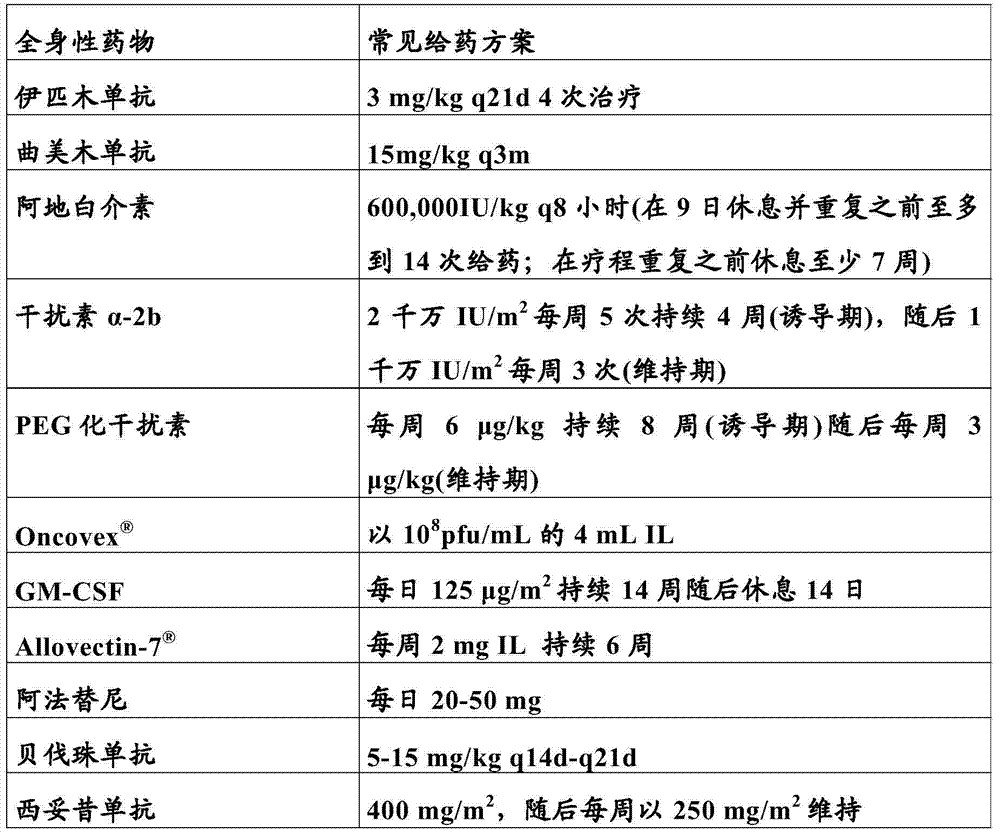

a无专利名称可用的处于开发的药物的专利代码名称。aProprietary code names of drugs in development for which no proprietary title is available.
因为加性或协同的效应,随局部免疫调节疗法(如下文所述的那种)一起使用时,组合疗法和本发明的治疗方法通常将允许以全身性药物的常见给药方案的水平或低于所述水平使用这些全身性药物,如表1中描述的那些。Because of additive or synergistic effects, combination therapy and the treatment methods of the present invention will generally allow for administration at levels or lower than the usual dosing regimens of systemic drugs when used together with topical immunomodulatory therapies such as those described below. These systemic drugs, such as those described in Table 1, were used at the levels indicated.
局部免疫调节疗法包括但不限于使用在适宜的药物组合物中主要由玫瑰红(4,5,6,7-四氯-2',4',5',7'-四碘荧光素)或另一种卤代呫吨组成的IL化学消融药的病灶内化学消融法、所述IL化学消融药包括赤藓红B、根皮红B、4,5,6,7-四溴-2',4',5',7'-四碘荧光素、2',4,5,6,7-五氯-4',5',7'-三碘荧光素、4,4',5,6,7-五氯-2',5',7'-三碘荧光素、2',4,5,6,7,7'-六氯-4',5'-二碘荧光素、4,4',5,5',6,7-六氯-2',7'-二碘荧光素、2',4,5,5',6,7-六氯-4',7'-二碘荧光素、4,5,6,7-四氯-2',4',5'-三碘荧光素、4,5,6,7-四氯-2',4',7'-三碘荧光素、4,5,6,7-四溴-2',4',5'-三碘荧光素和4,5,6,7-四溴-2',4',7'-三碘荧光素,所述药物组合物包含0.1%(w/v)或更高浓度的玫瑰红(即、PV-10)水溶液或另一种卤代呫吨或其混合物的等同溶液。卤代呫吨的生理学上可接受的盐可以在这种组合物中使用。Topical immunomodulatory therapies include, but are not limited to, the use of rose bengal (4,5,6,7-tetrachloro-2',4',5',7'-tetraiodofluorescein) or Another intralesional chemical ablation method of IL chemical ablation drug composed of halogenated xanthenes, the IL chemical ablation drug includes erythrosin B, radicin B, 4,5,6,7-tetrabromo-2' ,4',5',7'-tetraiodofluorescein, 2',4,5,6,7-pentachloro-4',5',7'-triiodofluorescein, 4,4',5, 6,7-Pentachloro-2',5',7'-triiodofluorescein, 2',4,5,6,7,7'-hexachloro-4',5'-diiodofluorescein, 4 ,4',5,5',6,7-Hexachloro-2',7'-Diiodofluorescein, 2',4,5,5',6,7-Hexachloro-4',7'- Diiodofluorescein, 4,5,6,7-tetrachloro-2',4',5'-triiodofluorescein, 4,5,6,7-tetrachloro-2',4',7'- Triiodofluorescein, 4,5,6,7-tetrabromo-2',4',5'-triiodofluorescein and 4,5,6,7-tetrabromo-2',4',7'- Triiodofluorescein, said pharmaceutical composition comprising a 0.1% (w/v) or higher concentration of rose bengal (ie, PV-10) in water or an equivalent solution of another halogenated xanthene or a mixture thereof. Physiologically acceptable salts of the halogenated xanthenes may be used in such compositions.
本发明包括免疫治疗程序,其中大量肿瘤抗原暴露于患者的免疫系统,例如当病灶内递送与一种或多种全身性免疫调节剂组合的免疫调节剂(包括但不限于病灶内递送玫瑰红)以增强免疫介导的抗肿瘤反应。The present invention includes immunotherapy procedures in which a large number of tumor antigens are exposed to the patient's immune system, such as when intralesional delivery of an immunomodulator in combination with one or more systemic immunomodulators (including but not limited to intralesional delivery of rose bengal) To enhance the immune-mediated anti-tumor response.
关于优选的IL化学消融药:Regarding preferred IL chemoablatives:
作为优选实施方案,局部免疫调节疗法包括使用玫瑰红或另一种卤代呫吨的病灶内化学消融。一种优选的形式(玫瑰红二钠)具有以下式:As a preferred embodiment, local immunomodulatory therapy includes intralesional chemical ablation using rose bengal or another xanthene halide. A preferred form (rose bengal disodium) has the formula:

局部免疫调节组合物的这种优选实施方案的某些细节在申请人的共待决申请USSN12/315,781中描述,所述文献完整并入本文。在此针对黑色素瘤的特别意义描述本发明的这个优选实施方案。然而,本发明也可以用于治疗其他增生性疾病,包括但不限于癌症,如例如乳腺癌、原发性和转移性肝癌,前列腺癌和小细胞和非小细胞肺癌,并且不意图受限于此。Certain details of this preferred embodiment of a topical immunomodulatory composition are described in Applicant's co-pending application USSN 12/315,781, which is incorporated herein in its entirety. This preferred embodiment of the invention is described herein with respect to melanoma in particular. However, the present invention can also be used to treat other proliferative diseases, including but not limited to cancers such as, for example, breast cancer, primary and metastatic liver cancer, prostate cancer, and small cell and non-small cell lung cancer, and is not intended to be limited to this.
恶性黑色素瘤是最严重形式的皮肤癌并且占80%的皮肤癌死亡。Malignant melanoma is the most serious form of skin cancer and accounts for 80% of skin cancer deaths.
疾病的扩散程度由分期描述。0期黑色素瘤是一种极早期的疾病,称作原位黑色素瘤。将原位黑色素瘤患者分类为Tis(原位肿瘤)。肿瘤限于表皮,不侵入周围组织、淋巴结或远离部位。认为原位黑色素瘤具有非常低的疾病复发或扩散至淋巴结或远离部位的风险。治疗是连同健康皮肤余量进行手术切除。The extent of disease spread is described by stages. Stage 0 melanoma is a very early stage disease called melanoma in situ. Patients with melanoma in situ were classified as Tis (tumor in situ). The tumor is confined to the epidermis and does not invade surrounding tissues, lymph nodes, or distant sites. Melanoma in situ is considered to have a very low risk of disease recurrence or spread to lymph nodes or distant sites. Treatment is surgical excision along with a healthy margin of skin.
在I期黑色素瘤,肿瘤已经渗透进入皮肤小于1mm但是尚未扩散。治疗是大范围局部切除并且5年内无疾病存活的概率在90%至95%之间。In stage I melanoma, the tumor has penetrated less than 1 mm into the skin but has not spread. Treatment is extensive local excision with a 90% to 95% chance of being disease-free at 5 years.
II期黑色素瘤描述一种已经渗透进入皮肤大于1mm但是尚未扩散的肿瘤。大范围局部切除是优选的疗法。然而,在这个分期的切除存在高得多的风险以及与切除I期肿瘤相比更不有利的预后。Stage II melanoma describes a tumor that has penetrated more than 1 mm into the skin but has not spread. Large local excision is the preferred therapy. However, resection at this stage carries much higher risks and a less favorable prognosis than resection of stage I tumors.
III期黑色素瘤以存在一个或多个结节状、过渡态或卫星转移灶为特征,但是尚未扩散至远离部位或内脏部位。过渡态转移灶远离原发性肿瘤但是未抵达引流淋巴结流域(draining nodal basin)。卫星转移灶是原发性肿瘤的淋巴内延伸物并且与过渡态转移灶相比一般更靠近原发性肿瘤存在。III期患者的5年存活率范围从大约24%(严重淋巴结疾病)至80%(细微淋巴结疾病)。Stage III melanoma is characterized by the presence of one or more nodular, transitional, or satellite metastases that have not spread to distant or visceral sites. Transition metastases are distant from the primary tumor but do not reach the draining nodal basin. Satellite metastases are intralymphatic extensions of the primary tumor and generally reside closer to the primary tumor than transitional metastases. Five-year survival rates for stage III patients range from approximately 24% (severe nodal disease) to 80% (subtle nodal disease).
IV期黑色素瘤是当病情已经扩散至远离部位时的疾病。IV期黑色素瘤的存活率降低至大约10%。Stage IV melanoma is when the disease has spread to distant sites. The survival rate for stage IV melanoma drops to about 10%.
存在针对全部主要癌症的相似分期体系,并且它们总体上基于疾病的临床表现和组织病理学细节以及这些因素已经证实如何影响存活。Similar staging systems exist for all major cancers, and they are generally based on the clinical presentation and histopathological details of the disease and how these factors have been shown to affect survival.
用于轻易可摘除的III期肿瘤的标准治疗是大面积切除,连同摘除淋巴结。也可以给予辅助治疗如用于局部肢体转移早灶的放疗法和化疗、局部输注美法仑或其他化疗药。然而,在一些病例中,手术因肿瘤数目和/或位置而忌用并且必需考虑其他治疗选项。不幸地,针对这些其他选项的应答水平不高。例如,黑色素瘤很大程度上抵抗放射疗法。全身性化疗也对黑色素瘤具有轻微的应答率。迄今最有效的化疗方案是单一药物达卡巴嗪,其仅在10-15%的病例中成功。治疗晚期黑色素瘤患者时常用的两种联合化疗方案是顺铂、长春碱和DTIC(CVD)方案和达特茅斯(Dartmouth)方案,它是顺铂、DTIC、卡莫司汀和他莫昔芬的组合。The standard treatment for easily removable stage III tumors is extensive excision with removal of lymph nodes. Adjuvant therapy such as radiotherapy and chemotherapy for early local extremity metastases, local infusion of melphalan or other chemotherapeutic agents may also be given. However, in some cases surgery is contraindicated due to tumor number and/or location and other treatment options must be considered. Unfortunately, the level of response to these other options was low. For example, melanoma is largely resistant to radiation therapy. Systemic chemotherapy also has a modest response rate in melanoma. The most effective chemotherapy regimen to date is the single agent dacarbazine, which is only successful in 10-15% of cases. Two combination chemotherapy regimens commonly used in the treatment of patients with advanced melanoma are the cisplatin, vinblastine, and DTIC (CVD) regimen and the Dartmouth regimen, which is cisplatin, DTIC, carmustine, and tamoxi Fern's combination.
当黑色素瘤在肢端出现时,化疗药可以隔离肢体热灌流法(ILP)递送。采用这种技术,以手术方式接近血管,使用止血带阻止进出肢体的血流,并将加温的化疗药物溶液直接施用至肢体的血液中,从而允许比全身性治疗更高剂量的药物分配。侵入性较小的局部疗法是隔离肢体输注(ILI),因为通过腹股沟中的透皮途径获得血管通路。Chemotherapy drugs can be delivered by isolated limb perfusion (ILP) when melanomas are present in the extremities. With this technique, blood vessels are surgically accessed, blood flow into and out of the limb is stopped using a tourniquet, and a warmed solution of chemotherapy drugs is administered directly into the bloodstream of the limb, allowing higher doses of drug to be dispensed than systemic treatments. A less invasive local therapy is isolated limb infusion (ILI), since vascular access is obtained through a transcutaneous route in the groin.
另一种治疗选项是病灶内疗法,其中将化疗药直接注射至肿瘤中。卡介苗(BCG)是用于IL疗法的最早药物之一。评审来自15项试验的数据发现在13%的III期患者中19%完全应答(CR)和26%部分应答(PR),伴以延长的存活。Another treatment option is intralesional therapy, in which chemotherapy drugs are injected directly into the tumor. Bacillus Calmette-Guerin (BCG) was one of the first drugs used in IL therapy. A review of data from 15 trials found 19% complete responses (CR) and 26% partial responses (PR) in 13% of stage III patients, with prolonged survival.
IL干扰素(IFN)已经产生混合结果,范围从针对IFN-α报道45%目标应答率(ORR,31%CR+14%PR)至针对IFN-γ报道无结果或短暂应答。两种方案均产生显著的毒性和副作用。IL interferon (IFN) has produced mixed results ranging from a reported 45% objective response rate (ORR, 31% CR + 14% PR) for IFN-α to no results or transient responses reported for IFN-γ. Both regimens produce significant toxicity and side effects.
IL白介素-2似乎是迄今最有前景的IL疗法,在83%每周接受2-3次IL治疗的患者中具有ORR(62%CR+21%PR)。一些患者报告了流感样症状并且一些作者指出,虽然新病灶在治疗过程期间出现,但是一些患者体验到明显延缓新皮肤病灶的出现。IL interleukin-2 appears to be the most promising IL therapy so far, with ORR (62% CR + 21% PR) in 83% of patients receiving IL 2-3 times per week. Some patients reported flu-like symptoms and some authors noted that although new lesions appeared during the course of treatment, some patients experienced a marked delay in the appearance of new skin lesions.
采用顺铂的IL疗法或IL顺铂伴随电穿孔法已经产生范围从38%ORR(19%CR+19%PR)至53%ORR(47%CR+7%PR)的结果。然而,对具有中位数直径0.6cm的病灶所报道的53%ORR下降至有中位数直径3.0cm的病灶的44%。IL therapy with cisplatin or IL cisplatin with electroporation has produced results ranging from 38% ORR (19% CR + 19% PR) to 53% ORR (47% CR + 7% PR). However, the 53% ORR reported for lesions with a median diameter of 0.6 cm decreased to 44% for lesions with a median diameter of 3.0 cm.
当采用IL博来霉素的单一电化学疗法治疗时,已经报告了明显的功效。然而,与顺铂一样,在较大的肿瘤中应答率总体上降低。Significant efficacy has been reported when treated with monoelectrochemotherapy with IL bleomycin. However, as with cisplatin, response rates were generally lower in larger tumors.
可以理解,需要用于治疗过度增殖性疾病和尤其III期和IV期黑色素瘤的另外方法。It will be appreciated that additional approaches for the treatment of hyperproliferative diseases and especially stage III and IV melanoma are needed.
根据本发明的一个优选实施方案,提供一种用于治疗患者中癌症(如转移性黑色素瘤)的方法,所述方法包括采用与一种或多种全身性免疫调节疗法或全身性靶向疗法组合的局部免疫调节疗法治疗癌症患者,其中所述局部免疫调节疗法包括病灶内施用包含亲水性载体的化学消融性药物组合物,所述亲水性载体含有4,5,6,7-四氯-2',4',5',7'-四碘荧光素(即玫瑰红),或某些其他卤代呫吨,或其生理学上可接受的盐。优选的是卤代呫吨以约0.1%(w/v)至多到约20%(w/v)的浓度存在于这种药物组合物中,并且该药物组合物包含电解质,所述电解质包含至少一种选自钠、钾、钙和镁的阳离子和至少一种选自氯离子、磷酸根和硝酸根的阴离子,其中所述电解质处于约0.1%(w/v)和约2%(w/v)之间的浓度。还优选该药物组合物的pH在约4至约10之间。According to a preferred embodiment of the present invention, there is provided a method for treating cancer (such as metastatic melanoma) in a patient, said method comprising the use of one or more systemic immunomodulatory therapies or systemic targeted therapy Combined local immunomodulatory therapy for treating cancer patients, wherein the local immunomodulatory therapy comprises intralesional administration of a chemoablative pharmaceutical composition comprising a hydrophilic carrier containing 4,5,6,7-tetrafluoroethylene Chloro-2',4',5',7'-tetraiodofluorescein (ie rose bengal), or certain other halogenated xanthenes, or their physiologically acceptable salts. It is preferred that the halogenated xanthenes are present in such pharmaceutical compositions at a concentration of from about 0.1% (w/v) up to about 20% (w/v), and that the pharmaceutical compositions comprise electrolytes comprising at least A cation selected from sodium, potassium, calcium and magnesium and at least one anion selected from chloride, phosphate and nitrate, wherein the electrolyte is at about 0.1% (w/v) and about 2% (w/v ) concentration between. It is also preferred that the pH of the pharmaceutical composition is between about 4 and about 10.
术语“生理学上可接受的盐”指制药业中常见使用的任何无毒碱金属盐、碱土金属盐和铵盐,包括钠盐、钾盐、锂盐、钙盐、镁盐、钡盐、铵盐和鱼精蛋白锌盐,它们可以由本领域已知的方法制备。优选地,盐是一碱价盐或二碱价盐形式的钠、钾、钙和铵。The term "physiologically acceptable salt" refers to any non-toxic alkali metal, alkaline earth metal and ammonium salt commonly used in the pharmaceutical industry, including sodium, potassium, lithium, calcium, magnesium, barium, ammonium salt and protamine zinc salt, which can be prepared by methods known in the art. Preferably, the salts are sodium, potassium, calcium and ammonium in the form of monobasic or dibasic salts.
在这种IL化学消融性药物组合物中尤其优选的是玫瑰红的二钠盐。一位或多位本发明人的先前工作(WO02/05812)报道,他们发现玫瑰红显示出偏好性摄入癌细胞中但是基本上从正常细胞排除。Especially preferred in such IL chemoablative pharmaceutical compositions is the disodium salt of rose bengal. Previous work (WO02/05812) by one or more of the present inventors reported that they found that rose bengal showed a preferential uptake into cancer cells but a substantial exclusion from normal cells.
一位或多位本发明人也已经报道他们的发现:卤代呫吨或其生理学上可接受的盐在其中使用的载体的性质可以显著地影响分配入肿瘤细胞中的程度。具体而言,一位或多位本发明人已经令人惊讶地发现在约0.1%(w/v)和约2.0%(w/v)之间的电解质浓度,进入肿瘤细胞的分配可以快速地增加。One or more of the present inventors have also reported their discovery that the nature of the carrier in which the halogenated xanthenes or their physiologically acceptable salts are used can significantly affect the extent of partitioning into tumor cells. Specifically, one or more of the present inventors have surprisingly discovered that at electrolyte concentrations between about 0.1% (w/v) and about 2.0% (w/v), partition into tumor cells can be rapidly increased .
可以基于分配系数Kp估计药物的组织积累可能性的近似值。这种体外参数意味具有涉及在细胞水平体外递送的预示值。具体而言,大于统一性的值视为指示能够定位于组织中并因而能够在这类组织中显示增强的化疗功效的药物。一位或多位本发明人推测,远大于大约50-100的值可以指示可能损害在所需含水(即,亲水)制剂中递送药物的过度亲脂性(在有机环境中积累的倾向性)。通过测量亲脂性相(正辛醇)中与水相接触的药物的平衡浓度的比率确定Kp。An approximation of the tissue accumulation potential of the drug can be estimated based on the partition coefficient Kp . Such in vitro parameters are meant to be of predictive value concerning in vitro delivery at the cellular level. In particular, a value greater than unity is considered indicative of a drug capable of localizing in tissues and thus capable of exhibiting enhanced chemotherapeutic efficacy in such tissues. One or more of the present inventors speculate that values much greater than about 50-100 may indicate excessive lipophilicity (propensity to accumulate in organic environments) that may impair drug delivery in desired aqueous (i.e., hydrophilic) formulations . Kp was determined by measuring the ratio of the equilibrium concentration of drug in the lipophilic phase (n-octanol) in contact with the aqueous phase.
一位或多位本发明人也已经报道他们的发现:IL化学消融性药物组合物的pH优选处于约4至约10之间和更优选地在约5至约9之间的范围内,以产生卤代呫吨在水质载体中的最大溶解度并且确保与生物组织的相容性。特别优选pH在约4至约7之间,优选地在约5至约7之间,更优选地在约6至约7之间。在这些pH值,卤代呫吨通常仍处于二碱价形式,而不是在低pH形成的水不可溶性内酯。One or more of the present inventors have also reported their discovery that the pH of the IL chemoablative pharmaceutical composition is preferably in the range between about 4 to about 10 and more preferably between about 5 to about 9, to Produces maximum solubility of halogenated xanthenes in aqueous carriers and ensures compatibility with biological tissues. Particularly preferred is a pH between about 4 and about 7, preferably between about 5 and about 7, more preferably between about 6 and about 7. At these pH values, the haloxanthenes are usually still in the dibasic form rather than the water-insoluble lactones formed at lower pH.
可以通过本领域技术人员已知的任何适合手段调节或调整IL化学消融性药物组合物的pH。可以通过添加酸或碱等缓冲该组合物或调节其pH。由于取决于卤代呫吨浓度和/或电解质浓度,卤代呫吨或其生理学上可接受的盐是弱酸,该组合物的pH可能不需要使用缓冲剂和/或pH调节剂。然而,尤其优选该组合物不含任何缓冲剂,允许它一旦施用则符合生物环境。The pH of the IL chemoablative pharmaceutical composition may be adjusted or adjusted by any suitable means known to those skilled in the art. The composition can be buffered or its pH adjusted by adding acid or base or the like. Since the haloxanthene or a physiologically acceptable salt thereof is a weak acid depending on the haloxanthene concentration and/or electrolyte concentration, the pH of the composition may not require the use of buffers and/or pH adjusters. However, it is especially preferred that the composition does not contain any buffers, allowing it to conform to the biological environment once administered.
一位或多位本发明人也已经报道他们的发现:Kp还取决于电解质浓度,Kp值随电解质浓度增加而增加。电解质在IL化学消融性药物组合物中的特别优选浓度在0.5至1.5%(w/v)之间,并且甚至更优选地处于约0.8至1.2%(w/v)浓度和最优选地处于约0.9%(w/v)的浓度,该后者浓度是尤其优选的,因为它对应于大约等渗的溶液。One or more of the present inventors have also reported their findings that Kp also depends on electrolyte concentration, with Kp values increasing as electrolyte concentration increases. A particularly preferred concentration of electrolytes in the IL chemoablative pharmaceutical composition is between 0.5 to 1.5% (w/v), and even more preferably at a concentration of about 0.8 to 1.2% (w/v) and most preferably at a concentration of about A concentration of 0.9% (w/v), the latter concentration being especially preferred since it corresponds to an approximately isotonic solution.
在本发明的又一个优选的实施方案中,IL化学消融性药物组合物中的电解质是氯化钠。In yet another preferred embodiment of the present invention, the electrolyte in the IL chemoablative pharmaceutical composition is sodium chloride.
在这类水平的电解质增加IL化学消融性药物组合物的重量摩尔渗透压浓度。因此,作为规定电解质浓度范围的替代手段,重量摩尔渗透压浓度可以用来部分地表征组合物的电解质水平。优选的是组合物的重量摩尔渗透压浓度大于约100mOsm/kg,并更优选地组合物的重量摩尔渗透压浓度大于约250mOsm/kg并且最优选地它是约300-500mOsm/kg。Electrolytes at such levels increase the osmolality of the IL chemoablative pharmaceutical composition. Thus, as an alternative to specifying an electrolyte concentration range, osmolality can be used to characterize, in part, the electrolyte level of a composition. It is preferred that the composition has an osmolality of greater than about 100 mOsm/kg, and more preferably the composition has an osmolality of greater than about 250 mOsm/kg and most preferably it is about 300-500 mOsm/kg.
一位或多位本发明人已经发现,卤代呫吨的优选浓度和/或IL化学消融性药物组合物的剂量将取决于多种因素,包括但不限于肿瘤尺寸、数目和位置。对于内脏或其他内部病灶,如肝癌,病灶内施用可以是透皮或术中施用。One or more of the present inventors have discovered that the preferred concentration of the haloxanthenes and/or dosage of the IL chemoablative pharmaceutical composition will depend on a variety of factors including, but not limited to, tumor size, number and location. For visceral or other internal lesions, such as liver cancer, intralesional administration can be transdermal or intraoperative.
一位或多位本发明人也已经发现,IL化学消融性药物组合物中高于约1%(w/v)至3%(w/v)的卤代呫吨浓度特别可用于化学消融用途,因为较低浓度通常不足以直接激发靶组织的破坏。因此,在优选实施方案中,卤代呫吨的浓度处于约3%(w/v)至约20%(w/v)的范围内。在另一个实施方案中,卤代呫吨的浓度是从约3%(w/v)至约10%(w/v)。在另一个实施方案中,卤代呫吨的浓度是从约10%(w/v)至约20%(w/v)。在又一个实施方案中,卤代呫吨的浓度是约10%(w/v)。一位或多位本发明人令人惊讶地发现,在这些浓度,不仅可以获得高效的治疗反应,而且溶液也是高度地稳定的并且可以在制造和使用时轻易地操作。这些优选的浓度可以按重量对体积(w/v)表述,然而,以重量对重量(w/w)为单位的浓度是基本上等价的。One or more of the present inventors have also found that concentrations of halogenated xanthenes of greater than about 1% (w/v) to 3% (w/v) in IL chemoablative pharmaceutical compositions are particularly useful for chemoablative applications, Because lower concentrations are usually not sufficient to directly stimulate the destruction of target tissues. Thus, in a preferred embodiment, the concentration of the halogenated xanthenes is in the range of about 3% (w/v) to about 20% (w/v). In another embodiment, the concentration of the halogenated xanthenes is from about 3% (w/v) to about 10% (w/v). In another embodiment, the concentration of the halogenated xanthenes is from about 10% (w/v) to about 20% (w/v). In yet another embodiment, the concentration of the halogenated xanthenes is about 10% (w/v). One or more of the present inventors have surprisingly found that at these concentrations not only are highly effective therapeutic responses obtained, but the solutions are also highly stable and can be easily handled during manufacture and use. These preferred concentrations may be expressed on a weight-to-volume (w/v) basis, however, concentrations in weight-to-weight (w/w) units are substantially equivalent.
通过IL施用而施用的IL化学消融性药物组合物的常见剂量范围在0.1mL/cc病灶体积至约2mL/cc病灶体积之间,最优选地在约0.25mL/cc至约0.75mL/cc病灶体积之间。这类剂量一般对应于约10mg至约1500mg卤代呫吨之间的患者剂量(它们显著地高于用于诊断性肝脏试验的那些剂量)。Typical doses of IL chemoablative pharmaceutical compositions administered by IL administration range between 0.1 mL/cc lesion volume to about 2 mL/cc lesion volume, most preferably about 0.25 mL/cc to about 0.75 mL/cc lesion volume between volumes. Such doses generally correspond to patient doses of between about 10 mg and about 1500 mg haloxanthenes (which are significantly higher than those used for diagnostic liver tests).
由于该药物组合物用于IL施用,其是体内途径,进一步优选的是该药物组合物是无菌的,如符合美国药典(USP)试验<71>所要求,并且进一步优选的是它含有可忽略水平的致热物质,从而它符合USP<85>(鲎阿米巴样细胞裂解物测定法)或符合USP<151>(兔热原试验),或基本上符合等同规定,处于等同于不高于这种(NMT)10内毒素单位(EU)/mL的热原或内毒素水平。另外,药物组合物应当符合颗粒状物质的限制含量要求如USP<788>中所限定(即每个容器,尺寸大于10微米的NMT3000个颗粒物,和尺寸大于25微米的NMT300个颗粒物)或基本上等同的要求。来自USP的这些参考文献的每一份通过引用方式并入本文。Since the pharmaceutical composition is for IL administration, which is an in vivo route, it is further preferred that the pharmaceutical composition is sterile as required by United States Pharmacopeia (USP) test <71>, and it is further preferred that it contains the Negligible levels of pyrogenic substances such that it complies with USP<85> (Limulus amoeba-like cell lysate assay) or with USP<151> (rabbit pyrogen test), or substantially equivalent, in an equivalent Pyrogen or endotoxin levels above this (NMT) 10 endotoxin units (EU)/mL. In addition, the pharmaceutical composition should meet the limit content requirements for particulate matter as defined in USP <788> (i.e., 3000 particles per container for NMT with a size greater than 10 microns, and 300 particles for NMT with a size greater than 25 microns) or substantially equivalent requirements. Each of these references from USP is incorporated herein by reference.
另外,一位或多位本发明人已经发现,亲水性载体对于该药物组合物是优选的,以便使卤代呫吨分配至癌组织中的偏好性最大化。因此,优选的是药物组合物含有最少量的可能干扰这类分配的非亲水组分。优选的是该亲水性载体是水,并且最优选的是这种药物组合物基本上由水组成。Additionally, one or more of the present inventors have discovered that a hydrophilic carrier is preferred for the pharmaceutical composition in order to maximize the preferential distribution of the haloxanthenes into cancerous tissue. Accordingly, it is preferred that the pharmaceutical composition contains a minimum of non-hydrophilic components that might interfere with such partitioning. It is preferred that the hydrophilic carrier is water, and most preferred that the pharmaceutical composition consists essentially of water.
一位或多位本发明人已经发现,如本文所述的这类药物组合物最佳地包装在具有大约1至10mL并且更优选地大约5mL容量的玻璃小瓶中。这类能力充分适合作为单一剂量形式(即,一次使用包装)用于IL治疗。One or more of the present inventors have discovered that such pharmaceutical compositions as described herein are optimally packaged in glass vials having a capacity of about 1 to 10 mL, and more preferably about 5 mL. Such capabilities are well suited for use in IL therapy as a single dosage form (ie, a single-use package).
在一个优选实施方案中,药物组合物的制剂不进行缓冲。在这种情况下,优选的是包装容器由I型USP(低溶出性或化学抵抗性硼硅酸盐)或II型USP(低溶出碱石灰)玻璃制成并且这类玻璃容器的内侧面经表面处理以降低可能不利影响pH或长期稳定的容器表面碱度。适用于这类容器的常见表面处理剂在USP<661>中描述。表面处理过的这类玻璃容器的内部应当在填充之前用适宜溶剂如蒸馏水淋洗一次或多次,以便除去这类表面处理剂的任何残留物。容器还应当在填充之前去热原,例如,通过加热至250℃或更高温度持续几小时或更长时间,并且应当在填充之前使用本领域中常见的方法灭菌或消毒。进一步优选这类容器具有最小颈部尺寸,例如,小于10mm和更优选地5mm或更小,以减少容器密封件的表面积(和因此药品对这类密封件的暴露)。In a preferred embodiment, the formulation of the pharmaceutical composition is unbuffered. In this case, it is preferred that the packaging container is made of Type I USP (low extractable or chemically resistant borosilicate) or Type II USP (low extractable soda lime) glass and that the inner sides of such glass containers are Surface treatment to reduce container surface alkalinity that may adversely affect pH or long-term stability. Common surface treatments suitable for these types of containers are described in USP <661>. The interior of such surface-treated glass containers should be rinsed one or more times with a suitable solvent, such as distilled water, before filling to remove any residue of such surface-treating agents. The container should also be depyrogenated prior to filling, eg, by heating to 250°C or higher for several hours or longer, and should be sterilized or sterilized prior to filling using methods common in the art. It is further preferred that such containers have a minimum neck size, eg, less than 10 mm and more preferably 5 mm or less, to reduce the surface area of the container closure (and thus the exposure of the drug product to such closures).
一位或多位本发明人应进一步发现,优选地由药用级弹性体材料连同特富龙或相似内涂层组成的隔膜型封闭特别合适随IL化学消融性药物组合物一起使用,因为它促进针头插入该容器中用于抽取某个剂量的药品,同时显示最小的与容器内容物相互作用的潜力。It should be further discovered by one or more of the present inventors that a septum-type closure, preferably composed of a pharmaceutical grade elastomeric material together with a Teflon or similar inner coating, is particularly suitable for use with IL chemoablative pharmaceutical compositions because it Insertion of a needle into the container for withdrawing a dose of drug product is facilitated while exhibiting minimal potential for interaction with the container contents.
还优选的是该药物组合物不包含任何防腐剂。一位或多位本发明人已经发现,总体上优选避免使用防腐剂,它们中许多可以有害地干扰药物组合物或其配制,或可能使递送卤代呫吨活性组分复杂化或否则与之相互作用或干扰之。至可以使用防腐剂的程度,一位或多位本发明人已经发现如果咪脲在药物组合物中或施用时不与卤代呫吨相互作用,则咪脲是优选的。It is also preferred that the pharmaceutical composition does not contain any preservatives. One or more of the present inventors have discovered that it is generally preferable to avoid the use of preservatives, many of which may deleteriously interfere with a pharmaceutical composition or its formulation, or may complicate or otherwise interfere with the delivery of the haloxanthene active ingredient. interact or interfere with it. To the extent that preservatives may be used, one or more of the present inventors have found that mimidurea is preferred if it does not interact with the haloxanthenes in a pharmaceutical composition or when administered.
已经仅出于说明目的提供本说明书并且它不意在限制本申请的发明。This specification has been provided for illustrative purposes only and it is not intended to limit the invention of the present application.
所附权利要求书中描述了因新颖而要求保护并需要受专利证书保护的内容。What is claimed by virtue of novelty and which requires protection by Letters Patent is described in the appended claims.
Claims (58)


Applications Claiming Priority (3)
| Application Number | Priority Date | Filing Date | Title |
|---|---|---|---|
| US201161451395P | 2011-03-10 | 2011-03-10 | |
| US61/451,395 | 2011-03-10 | ||
| PCT/US2012/028412 WO2012122444A1 (en) | 2011-03-10 | 2012-03-09 | Combination of local and systemic immunomodulative therapies for enhanced treatment of cancer |
Publications (1)
| Publication Number | Publication Date |
|---|---|
| CN103476943A true CN103476943A (en) | 2013-12-25 |
Family
ID=46798564
Family Applications (1)
| Application Number | Title | Priority Date | Filing Date |
|---|---|---|---|
| CN2012800182901A Pending CN103476943A (en) | 2011-03-10 | 2012-03-09 | Combination of local and systemic immunomodulative therapies for enhanced treatment of cancer |
Country Status (9)
| Country | Link |
|---|---|
| US (7) | US9107887B2 (en) |
| EP (1) | EP2710137B1 (en) |
| JP (2) | JP6322413B2 (en) |
| KR (1) | KR20140038382A (en) |
| CN (1) | CN103476943A (en) |
| CA (1) | CA2828940C (en) |
| ES (1) | ES2699965T3 (en) |
| MX (1) | MX360254B (en) |
| WO (1) | WO2012122444A1 (en) |
Cited By (6)
| Publication number | Priority date | Publication date | Assignee | Title |
|---|---|---|---|---|
| CN104459129A (en) * | 2015-01-05 | 2015-03-25 | 复旦大学附属华山医院 | Diagnostic kit for distinguishing active and latent mycobacterium tuberculosis infection |
| CN106132438A (en) * | 2014-02-21 | 2016-11-16 | 尼克塔治疗印度私人有限公司 | IL 2R beta selective agonists with anti-CTLA 4 antibody or anti-PD 1 Antibody Combination |
| CN108495648A (en) * | 2015-12-18 | 2018-09-04 | 普罗维克图斯药品技术公司 | Method for Cancer Immunotherapy Using Small Molecule Ablation Compounds to Enhance Immune Cell Activity Ex vivo |
| CN111787918A (en) * | 2017-11-29 | 2020-10-16 | 洛克菲勒大学 | Combination of topical and systemic therapy for enhanced treatment of dermatological conditions |
| CN112996502A (en) * | 2018-05-16 | 2021-06-18 | 普罗维克图斯药品技术公司 | In vitro and xenograft antitumor Activity of halogenated xanthenes against refractory pediatric solid tumors |
| CN115666646A (en) * | 2020-03-26 | 2023-01-31 | 普罗维克图斯药品技术公司 | Treatment of Solid Cancerous Tumors by Oral Administration of Haloxanthenes |
Families Citing this family (124)
| Publication number | Priority date | Publication date | Assignee | Title |
|---|---|---|---|---|
| ES2322175T3 (en) | 2004-09-17 | 2009-06-17 | EISAI R&D MANAGEMENT CO., LTD. | MEDICINAL COMPOSITION WITH IMPROVED STABILITY AND REDUCED GELIFICATION. |
| US9006240B2 (en) | 2005-08-02 | 2015-04-14 | Eisai R&D Management Co., Ltd. | Method for assay on the effect of vascularization inhibitor |
| US20090053236A1 (en) | 2005-11-07 | 2009-02-26 | Eisai R & D Management Co., Ltd. | USE OF COMBINATION OF ANTI-ANGIOGENIC SUBSTANCE AND c-kit KINASE INHIBITOR |
| CA2652442C (en) * | 2006-05-18 | 2014-12-09 | Eisai R & D Management Co., Ltd. | Antitumor agent for thyroid cancer |
| JP5319306B2 (en) * | 2007-01-29 | 2013-10-16 | エーザイ・アール・アンド・ディー・マネジメント株式会社 | Composition for treatment of undifferentiated gastric cancer |
| CN101848895B (en) * | 2007-11-09 | 2013-10-23 | 卫材R&D管理有限公司 | Combined use of angiogenesis inhibitory substance and antitumor platinum complex |
| AU2010285740C1 (en) | 2009-08-19 | 2016-03-17 | Eisai R&D Management Co., Ltd. | Quinoline derivative-containing pharmaceutical composition |
| ES2573515T3 (en) | 2010-06-25 | 2016-06-08 | Eisai R&D Management Co., Ltd. | Anti-tumor agent that uses compounds with combined kinase inhibitory effect |
| CN103476943A (en) | 2011-03-10 | 2013-12-25 | 普罗维克图斯药品公司 | Combination of local and systemic immunomodulative therapies for enhanced treatment of cancer |
| JP6021805B2 (en) * | 2011-04-18 | 2016-11-09 | エーザイ・アール・アンド・ディー・マネジメント株式会社 | Tumor treatment |
| EP3444363B1 (en) | 2011-06-03 | 2020-11-25 | Eisai R&D Management Co., Ltd. | Biomarkers for prediciting and assessing responsiveness of thyroid and kidney cancer subjects to lenvatinib compounds |
| KR102125658B1 (en) | 2012-05-04 | 2020-06-22 | 화이자 인코포레이티드 | Prostate-associated antigens and vaccine-based immunotherapy regimens |
| WO2014036412A2 (en) * | 2012-08-30 | 2014-03-06 | Amgen Inc. | A method for treating melanoma using a herpes simplex virus and an immune checkpoint inhibitor |
| BR112015009004A8 (en) | 2012-12-21 | 2021-07-20 | Eisai R&D Man Co Ltd | amorphous form of quinoline derivative and method of production thereof |
| TWI718086B (en) * | 2013-01-07 | 2021-02-11 | 英屬維爾京群島商遠東超級實驗室有限公司 | Methods and compositions for treatment of bone, skin, subcutaneous, mucosal and/or submucosal cancer by percutaneous and/or transmucosal administration of interferon |
| US12421502B2 (en) | 2013-04-18 | 2025-09-23 | Tilt Biotherapeutics Oy | Enhanced adoptive cell therapy |
| RU2703438C2 (en) | 2013-04-18 | 2019-10-16 | Тилт Байотерапьютикс Ой | Extended adoptive cell therapy |
| US10517861B2 (en) | 2013-05-14 | 2019-12-31 | Eisai R&D Management Co., Ltd. | Biomarkers for predicting and assessing responsiveness of endometrial cancer subjects to lenvatinib compounds |
| BR112016018891A2 (en) * | 2014-02-21 | 2017-10-10 | Abbvie Stemcentrx Llc | anti-dll3 antibodies and drug conjugates for use in melanoma |
| EP3572430A3 (en) | 2014-03-05 | 2020-02-12 | Bristol-Myers Squibb Company | Treatment of renal cancer using a combination of an anti-pd-1 antibody and another anti-cancer agent |
| RU2695332C2 (en) | 2014-05-15 | 2019-07-23 | Бристол-Маерс Сквибб Компани | Treating lung cancer by combination of anti-pd-1 and other anti-cancer agents |
| JP6659554B2 (en) | 2014-08-28 | 2020-03-04 | エーザイ・アール・アンド・ディー・マネジメント株式会社 | High purity quinoline derivative and method for producing the same |
| CA2971216A1 (en) | 2014-12-23 | 2016-06-30 | The Regents Of The University Of California | Methods for immunomodulation of cancer and infectious disease therapy |
| LT3263106T (en) | 2015-02-25 | 2024-01-10 | Eisai R&D Management Co., Ltd. | METHOD OF REDUCING BITTERNESS OF QUINOLINE DERIVATIVES |
| AU2015384801B2 (en) | 2015-03-04 | 2022-01-06 | Eisai R&D Management Co., Ltd. | Combination of a PD-1 antagonist and a VEGFR/FGFR/RET tyrosine kinase inhibitor for treating cancer |
| DK3283107T3 (en) | 2015-04-17 | 2020-08-31 | Bristol Myers Squibb Co | COMPOSITIONS INCLUDING A COMBINATION OF IPILIMUMAB AND NIVOLUMAB |
| EP3288980B1 (en) | 2015-04-28 | 2021-03-10 | Bristol-Myers Squibb Company | Treatment of pd-l1-positive melanoma using an anti-pd-1 antibody |
| EP3988571A1 (en) | 2015-04-28 | 2022-04-27 | Bristol-Myers Squibb Company | Treatment of pd-l1-negative melanoma using an anti-pd-1 antibody and an anti-ctla-4 antibody |
| BR112017024899A2 (en) | 2015-05-21 | 2018-11-13 | Harpoon Therapeutics, Inc. | trispecific binding proteins and methods of use. |
| US20180155429A1 (en) | 2015-05-28 | 2018-06-07 | Bristol-Myers Squibb Company | Treatment of pd-l1 positive lung cancer using an anti-pd-1 antibody |
| WO2016196389A1 (en) | 2015-05-29 | 2016-12-08 | Bristol-Myers Squibb Company | Treatment of renal cell carcinoma |
| AU2016279474B2 (en) | 2015-06-16 | 2021-09-09 | Eisai R&D Management Co., Ltd. | Anticancer agent |
| FI3858859T3 (en) | 2015-07-14 | 2025-12-04 | Bristol Myers Squibb Co | Method of treating cancer using immune checkpoint inhibitor; antibody that binds to programmed death-1 receptor (pd-1) or programmed death ligand 1 (pd-l1) |
| SG11201801083UA (en) | 2015-08-20 | 2018-03-28 | Eisai R&D Man Co Ltd | Tumor therapeutic agent |
| RU2719486C2 (en) | 2015-11-11 | 2020-04-17 | Агалиммьюн Лимитед | Glycolipid compounds and use thereof in treating tumours |
| US11072657B2 (en) | 2015-11-18 | 2021-07-27 | Bristol-Myers Squibb Company | Treatment of lung cancer using a combination of an anti-PD-1 antibody and an anti-CTLA-4 antibody |
| SI3394093T1 (en) | 2015-12-23 | 2022-05-31 | Modernatx, Inc. | Methods of using ox40 ligand encoding polynucleotides |
| WO2017176925A1 (en) | 2016-04-05 | 2017-10-12 | Bristol-Myers Squibb Company | Cytokine profiling analysis for predicting prognosis of a patient in need of an anti-cancer treatment |
| WO2017180841A1 (en) * | 2016-04-13 | 2017-10-19 | The Regents Of The University Of California | Treatment of cerebral cavernous malformations |
| SG11201809381XA (en) | 2016-05-18 | 2018-12-28 | Modernatx Inc | Polynucleotides encoding interleukin-12 (il12) and uses thereof |
| EP4137509A1 (en) | 2016-05-18 | 2023-02-22 | ModernaTX, Inc. | Combinations of mrnas encoding immune modulating polypeptides and uses thereof |
| MA45037A (en) | 2016-05-18 | 2019-03-27 | Modernatx Inc | RNAM-BASED POLYTHERAPY FOR CANCER TREATMENT |
| US11623958B2 (en) | 2016-05-20 | 2023-04-11 | Harpoon Therapeutics, Inc. | Single chain variable fragment CD3 binding proteins |
| JP7101621B2 (en) | 2016-05-20 | 2022-07-15 | ハープーン セラピューティクス,インク. | Single domain serum albumin binding protein |
| CA3025019A1 (en) | 2016-05-20 | 2017-11-23 | Biohaven Pharmaceutical Holding Company Ltd. | Use of glutamate modulating agents with immunotherapies to treat cancer |
| RS64388B1 (en) | 2016-06-02 | 2023-08-31 | Bristol Myers Squibb Co | Pd-1 blockade with nivolumab in refractory hodgkin's lymphoma |
| KR102515509B1 (en) | 2016-06-03 | 2023-03-28 | 브리스톨-마이어스 스큅 컴퍼니 | Use of Anti-PD-1 Antibodies in the Treatment of Patients with Colorectal Cancer |
| CN109475634A (en) | 2016-06-03 | 2019-03-15 | 百时美施贵宝公司 | Anti-PD-1 Antibodies for Methods of Treating Recurrent Small Cell Lung Cancer |
| KR20240019398A (en) | 2016-10-28 | 2024-02-14 | 브리스톨-마이어스 스큅 컴퍼니 | Methods of treating urothelial carcinoma using an anti-pd-1 antibody |
| MX393780B (en) | 2017-01-17 | 2025-03-24 | Heparegenix Gmbh | Protein kinase inhibitors for promoting liver regeneration or reducing or preventing hepatocyte death |
| CN110072528B (en) | 2017-02-08 | 2022-04-26 | 卫材R&D管理有限公司 | Pharmaceutical composition for treating tumor |
| CA3058175A1 (en) | 2017-03-31 | 2018-10-04 | Bristol-Myers Squibb Company | Methods of treating tumor |
| TWI788340B (en) | 2017-04-07 | 2023-01-01 | 美商必治妥美雅史谷比公司 | Anti-icos agonist antibodies and uses thereof |
| TW201900193A (en) | 2017-04-28 | 2019-01-01 | 美商默沙東藥廠 | Biomarkers for cancer treatment |
| CA3063359A1 (en) | 2017-05-12 | 2018-11-15 | Harpoon Therapeutics, Inc. | Mesothelin binding proteins |
| KR20200013644A (en) | 2017-05-16 | 2020-02-07 | 에자이 알앤드디 매니지먼트 가부시키가이샤 | Treatment of Hepatocellular Carcinoma |
| US11421011B2 (en) | 2017-05-18 | 2022-08-23 | Modernatx, Inc. | Polynucleotides encoding tethered interleukin-12 (IL12) polypeptides and uses thereof |
| MX2019012038A (en) | 2017-05-30 | 2019-11-18 | Bristol Myers Squibb Co | Compositions comprising a combination of an anti-lag-3 antibody, a pd-1 pathway inhibitor, and an immunotherapeutic agent. |
| GB201710097D0 (en) * | 2017-06-23 | 2017-08-09 | Univ Ulster | A sensitizer - peptide conjugate |
| KR102760684B1 (en) | 2017-09-29 | 2025-01-24 | 브리스톨-마이어스 스큅 컴퍼니 | Compositions and methods for treating cancer |
| IL315737A (en) | 2017-10-13 | 2024-11-01 | Harpoon Therapeutics Inc | B cell maturation antigen binding proteins |
| KR102425983B1 (en) | 2017-10-13 | 2022-07-29 | 하푼 테라퓨틱스, 인크. | Trispecific Proteins and Methods of Use |
| CN111247169A (en) | 2017-10-15 | 2020-06-05 | 百时美施贵宝公司 | Method for treating tumors |
| US20210363242A1 (en) | 2018-01-16 | 2021-11-25 | Bristol-Myers Squibb Company | Methods of treating cancer with antibodies against tim3 |
| KR20200112904A (en) | 2018-01-22 | 2020-10-05 | 브리스톨-마이어스 스큅 컴퍼니 | Compositions and methods for treating cancer |
| US11242393B2 (en) | 2018-03-23 | 2022-02-08 | Bristol-Myers Squibb Company | Antibodies against MICA and/or MICB and uses thereof |
| WO2019191676A1 (en) | 2018-03-30 | 2019-10-03 | Bristol-Myers Squibb Company | Methods of treating tumor |
| CN112384242A (en) | 2018-05-27 | 2021-02-19 | 百欧林纳克斯有限公司 | Lipid AGI-134 in combination with checkpoint inhibitors for the treatment of solid tumors |
| WO2020014583A1 (en) | 2018-07-13 | 2020-01-16 | Bristol-Myers Squibb Company | Ox-40 agonist, pd-1 pathway inhibitor and ctla-4 inhibitor combination for use in a mehtod of treating a cancer or a solid tumor |
| US12195544B2 (en) | 2018-09-21 | 2025-01-14 | Harpoon Therapeutics, Inc. | EGFR binding proteins and methods of use |
| EP3856771A4 (en) | 2018-09-25 | 2022-06-29 | Harpoon Therapeutics, Inc. | Dll3 binding proteins and methods of use |
| JP2022505647A (en) | 2018-10-23 | 2022-01-14 | ブリストル-マイヤーズ スクイブ カンパニー | How to treat a tumor |
| US20220001026A1 (en) | 2018-11-08 | 2022-01-06 | Modernatx, Inc. | Use of mrna encoding ox40l to treat cancer in human patients |
| JP2022507606A (en) | 2018-11-16 | 2022-01-18 | ネオイミューンテック, インコーポレイテッド | How to Treat Tumors with a Combination of IL-7 Protein and Immune Checkpoint Inhibitors |
| JP7520003B2 (en) | 2018-11-16 | 2024-07-22 | ブリストル-マイヤーズ スクイブ カンパニー | Anti-NKG2A Antibodies and Uses Thereof |
| EP3886842A1 (en) | 2018-11-26 | 2021-10-06 | Debiopharm International SA | Combination treatment of hiv infections |
| GB201819853D0 (en) * | 2018-12-05 | 2019-01-23 | Innovation Ulster Ltd | Therapy |
| CA3124773A1 (en) | 2018-12-28 | 2020-07-02 | Transgene | M2-defective poxvirus |
| US20220195046A1 (en) | 2019-03-28 | 2022-06-23 | Bristol-Myers Squibb Company | Methods of treating tumor |
| CN113677402A (en) | 2019-03-28 | 2021-11-19 | 百时美施贵宝公司 | Method for treating tumors |
| JP2022534967A (en) | 2019-05-30 | 2022-08-04 | ブリストル-マイヤーズ スクイブ カンパニー | Multiple tumor gene signatures and their uses |
| EP3976832A1 (en) | 2019-05-30 | 2022-04-06 | Bristol-Myers Squibb Company | Methods of identifying a subject suitable for an immuno-oncology (i-o) therapy |
| KR20220016157A (en) | 2019-05-30 | 2022-02-08 | 브리스톨-마이어스 스큅 컴퍼니 | Cell localization signatures and combination therapies |
| GB201912107D0 (en) | 2019-08-22 | 2019-10-09 | Amazentis Sa | Combination |
| CN114450028A (en) | 2019-09-22 | 2022-05-06 | 百时美施贵宝公司 | Quantitative spatial profiling for LAG-3antagonist therapy |
| WO2021092220A1 (en) | 2019-11-06 | 2021-05-14 | Bristol-Myers Squibb Company | Methods of identifying a subject with a tumor suitable for a checkpoint inhibitor therapy |
| WO2021092221A1 (en) | 2019-11-06 | 2021-05-14 | Bristol-Myers Squibb Company | Methods of identifying a subject with a tumor suitable for a checkpoint inhibitor therapy |
| JP2022553851A (en) | 2019-11-08 | 2022-12-26 | ブリストル-マイヤーズ スクイブ カンパニー | LAG-3 antagonists for the treatment of melanoma |
| JP7528242B2 (en) * | 2019-11-19 | 2024-08-05 | プロヴェクタス ファーマテック,インク. | Compositions and methods for treating hematological cancers |
| US12064507B2 (en) | 2019-11-19 | 2024-08-20 | Provectus Pharmatech, Inc. | Composition and method for oral treatment of leukemia |
| US11419844B2 (en) | 2019-11-19 | 2022-08-23 | Provectus Pharmatech, Inc. | Halogenated xanthene composition and method for treating hematologic cancers |
| KR20220118481A (en) | 2019-12-19 | 2022-08-25 | 브리스톨-마이어스 스큅 컴퍼니 | Combinations of DGK inhibitors and checkpoint antagonists |
| JP2023514152A (en) | 2020-02-06 | 2023-04-05 | ブリストル-マイヤーズ スクイブ カンパニー | IL-10 and its uses |
| US11938182B2 (en) | 2020-03-26 | 2024-03-26 | Provectus Pharmatech, Inc. | Halogenated xanthenes as vaccine adjuvants |
| EP4157319A1 (en) | 2020-05-28 | 2023-04-05 | Modernatx, Inc. | Use of mrnas encoding ox40l, il-23 and il-36gamma for treating cancer |
| AU2021331476A1 (en) | 2020-08-28 | 2023-05-04 | Bristol-Myers Squibb Company | Lag-3 antagonist therapy for hepatocellular carcinoma |
| US20230303700A1 (en) | 2020-08-31 | 2023-09-28 | Bristol-Myers Squibb Company | Cell localization signature and immunotherapy |
| MX2023004493A (en) | 2020-10-23 | 2023-05-10 | Bristol Myers Squibb Co | Lag-3 antagonist therapy for lung cancer. |
| WO2022120179A1 (en) | 2020-12-03 | 2022-06-09 | Bristol-Myers Squibb Company | Multi-tumor gene signatures and uses thereof |
| MX2023007734A (en) | 2020-12-28 | 2023-08-21 | Bristol Myers Squibb Co | Antibody compositions and methods of use thereof. |
| MX2023007650A (en) | 2020-12-28 | 2023-09-11 | Bristol Myers Squibb Co | Subcutaneous administration of pd1/pd-l1 antibodies. |
| JP2024514530A (en) | 2021-04-02 | 2024-04-02 | ザ リージェンツ オブ ザ ユニバーシティ オブ カリフォルニア | Antibodies against truncated CDCP1 and uses thereof |
| AU2022375806A1 (en) | 2021-10-29 | 2023-12-14 | Bristol-Myers Squibb Company | Lag-3 antagonist therapy for hematological cancer |
| JP2025503962A (en) | 2022-01-26 | 2025-02-06 | ブリストル-マイヤーズ スクイブ カンパニー | Combination Therapy for Hepatocellular Carcinoma |
| US20230277669A1 (en) | 2022-02-24 | 2023-09-07 | Amazentis Sa | Uses of urolithins |
| AU2023226078A1 (en) | 2022-02-25 | 2024-08-22 | Bristol-Myers Squibb Company | Combination therapy for colorectal carcinoma. |
| WO2023168404A1 (en) | 2022-03-04 | 2023-09-07 | Bristol-Myers Squibb Company | Methods of treating a tumor |
| JP2025508076A (en) | 2022-03-08 | 2025-03-21 | アレンティス・セラピューティクス・アクチェンゲゼルシャフト | Use of anti-claudin-1 antibodies to improve T cell availability |
| WO2023178329A1 (en) | 2022-03-18 | 2023-09-21 | Bristol-Myers Squibb Company | Methods of isolating polypeptides |
| WO2023196988A1 (en) | 2022-04-07 | 2023-10-12 | Modernatx, Inc. | Methods of use of mrnas encoding il-12 |
| WO2023196987A1 (en) | 2022-04-07 | 2023-10-12 | Bristol-Myers Squibb Company | Methods of treating tumor |
| WO2023213764A1 (en) | 2022-05-02 | 2023-11-09 | Transgene | Fusion polypeptide comprising an anti-pd-l1 sdab and a member of the tnfsf |
| WO2023213763A1 (en) | 2022-05-02 | 2023-11-09 | Transgene | Poxvirus encoding a binding agent comprising an anti- pd-l1 sdab |
| CA3258064A1 (en) | 2022-06-02 | 2023-12-07 | Bristol-Myers Squibb Company | Antibody compositions and methods of use thereof |
| CA3260559A1 (en) | 2022-07-01 | 2024-01-04 | Transgene | Fusion protein comprising a surfactant-protein-d and a member of the tnfsf |
| WO2024040175A1 (en) | 2022-08-18 | 2024-02-22 | Pulmatrix Operating Company, Inc. | Methods for treating cancer using inhaled angiogenesis inhibitor |
| KR20250123912A (en) | 2022-12-21 | 2025-08-18 | 브리스톨-마이어스 스큅 컴퍼니 | Combination therapy for lung cancer |
| WO2024196952A1 (en) | 2023-03-20 | 2024-09-26 | Bristol-Myers Squibb Company | Tumor subtype assessment for cancer therapy |
| WO2025038763A1 (en) | 2023-08-15 | 2025-02-20 | Bristol-Myers Squibb Company | Ceramic hydroxyapatite chromatography flow through method |
| WO2025145207A1 (en) | 2023-12-29 | 2025-07-03 | Bristol-Myers Squibb Company | Combination therapy of kras inhibitor and treg-depleting agent |
| WO2025184208A1 (en) | 2024-02-27 | 2025-09-04 | Bristol-Myers Squibb Company | Anti-ceacam5 antibodies and uses thereof |
| US12521446B2 (en) | 2024-02-27 | 2026-01-13 | Bristol-Myers Squibb Company | Anti-CEACAM5 antibody drug conjugates |
| WO2025202222A1 (en) | 2024-03-25 | 2025-10-02 | Institut National de la Santé et de la Recherche Médicale | Therapeutic use of sting and tlrs agonists to induce p16 expression in immune cells |
| WO2025245489A1 (en) | 2024-05-24 | 2025-11-27 | Bristol-Myers Squibb Company | Treatment of tumors in subjects having fgl-1 positive samples |
Citations (7)
| Publication number | Priority date | Publication date | Assignee | Title |
|---|---|---|---|---|
| WO2007067959A2 (en) * | 2005-12-07 | 2007-06-14 | Medarex, Inc. | Ctla-4 antibody dosage escalation regimens |
| CN101083980A (en) * | 2004-05-10 | 2007-12-05 | 罗伯特·F·霍夫曼 | Use of targeted oxidative therapeutic agents in cancer treatment |
| US20080118567A1 (en) * | 1998-08-06 | 2008-05-22 | Provectus Pharmatech. Inc, | Medicaments for Chemotherapeutic Treatment of Disease |
| US20090117199A1 (en) * | 1998-08-06 | 2009-05-07 | Scott Timothy C | Method of treatment of cancer |
| WO2010014784A2 (en) * | 2008-08-01 | 2010-02-04 | Bristol-Myers Squibb Company | Combination of anti-ctla4 antibody with diverse therapeutic regimens for the synergistic treatment of proliferative diseases |
| US20100189651A1 (en) * | 2009-01-12 | 2010-07-29 | Cytomx Therapeutics, Llc | Modified antibody compositions, methods of making and using thereof |
| CN101926789A (en) * | 1999-08-13 | 2010-12-29 | 福托金公司 | The photodynamic therapy method of improved topical drug and disease |
Family Cites Families (24)
| Publication number | Priority date | Publication date | Assignee | Title |
|---|---|---|---|---|
| FR2553131B1 (en) * | 1983-10-11 | 1986-02-21 | Ydais Pierre | ASSEMBLY OF MODULAR ELEMENTS ALLOWING THE REALIZATION OF STORAGE VOLUMES AND MORE PARTICULARLY OF CELLARS, GARDEN SHELTERS |
| US5725855A (en) * | 1991-04-05 | 1998-03-10 | The United States Of America As Represented By The Department Of Health And Human Services | Method of treating tumors with CD8+ -depleted or CD4+ T cell subpopulations |
| US6689757B1 (en) * | 1996-02-12 | 2004-02-10 | M.L. Laboratories Plc | Methods for vaccination and vaccines therefor |
| US7648695B2 (en) * | 1998-08-06 | 2010-01-19 | Provectus Pharmatech, Inc. | Medicaments for chemotherapeutic treatment of disease |
| US20020001567A1 (en) * | 1998-12-21 | 2002-01-03 | Photogen, Inc. | Intracorporeal medicaments for high energy phototherapeutic treatment of disease |
| PT1043026E (en) | 1999-04-08 | 2005-09-30 | Schering Corp | MELANOMA THERAPEUTICS |
| CA2497597A1 (en) | 2002-09-11 | 2004-03-11 | Sequenom, Inc. | Methods for identifying subjects at risk of melanoma and treatments |
| US7378233B2 (en) | 2003-04-12 | 2008-05-27 | The Johns Hopkins University | BRAF mutation T1796A in thyroid cancers |
| US20050019918A1 (en) | 2003-06-03 | 2005-01-27 | Hidetoshi Sumimoto | Treatment of cancer by inhibiting BRAF expression |
| EP1541695A1 (en) | 2003-12-09 | 2005-06-15 | Nanogen Recognomics GmbH | Use of a mutation in the BRAF gene for the determination of the malignancy of melanoma cells |
| GB0423554D0 (en) | 2004-10-22 | 2004-11-24 | Cancer Rec Tech Ltd | Therapeutic compounds |
| CA2586844A1 (en) | 2004-11-04 | 2006-05-11 | Pfizer Products Inc. | Ctla-4 antibody and aromatase inhibitor or combination treatment for breast cancer |
| GB0428082D0 (en) | 2004-12-22 | 2005-01-26 | Welcome Trust The Ltd | Therapeutic compounds |
| US7442507B2 (en) | 2005-01-24 | 2008-10-28 | New York University School Of Medicine | Methods for detecting circulating mutant BRAF DNA |
| WO2006101692A1 (en) | 2005-03-23 | 2006-09-28 | Pfizer Products Inc. | Anti-ctla4 antibody and indolinone combination therapy for treatment of cancer |
| EP2007423A2 (en) | 2006-04-05 | 2008-12-31 | Pfizer Products Incorporated | Ctla4 antibody combination therapy |
| CA2649994A1 (en) | 2006-04-26 | 2007-11-08 | Cancer Research Technology Limited | Imidazo[4,5-b]pyridin-2-one and oxazolo[4,5-b]pyridin-2-one compounds and analogs thereof as cancer therapeutic compounds |
| US7897762B2 (en) | 2006-09-14 | 2011-03-01 | Deciphera Pharmaceuticals, Llc | Kinase inhibitors useful for the treatment of proliferative diseases |
| CA2639416C (en) * | 2007-09-11 | 2019-12-31 | F. Hoffmann-La Roche Ag | Diagnostic test for susceptibility to b-raf kinase inhibitors |
| BRPI0821227A2 (en) | 2007-12-19 | 2015-06-16 | Cancer Rec Tech Ltd | Compound, pharmaceutical composition, method for preparing same, use of a compound, method for treating a disease or disorder, for inhibiting raf function and for inhibiting cell proliferation, inhibiting cell cycle progression, promoting apoptosis, or a combination of one or more more of them |
| TW201041888A (en) | 2009-05-06 | 2010-12-01 | Plexxikon Inc | Compounds and methods for kinase modulation, and indications therefor |
| SMT201700293T1 (en) * | 2009-07-20 | 2017-07-18 | Bristol Myers Squibb Co | Combination of an anti-ctla4 antibody with etoposide for the synergistic treatment of proliferative diseases |
| KR101494055B1 (en) * | 2009-09-18 | 2015-02-16 | 프로벡투스 파마슈티컬스 인코포레이티드 | Process for the synthesis of 4,5,6,7-tetrachloro-3',6'-dihydroxy-2',4',5',7'-tetraiodo-3h-spiro[isobenzofuran-1,9'-xanthen-3-one (rose bengal) and related xanthenes |
| CN103476943A (en) | 2011-03-10 | 2013-12-25 | 普罗维克图斯药品公司 | Combination of local and systemic immunomodulative therapies for enhanced treatment of cancer |
-
2012
- 2012-03-09 CN CN2012800182901A patent/CN103476943A/en active Pending
- 2012-03-09 WO PCT/US2012/028412 patent/WO2012122444A1/en not_active Ceased
- 2012-03-09 ES ES12755115T patent/ES2699965T3/en active Active
- 2012-03-09 JP JP2013557888A patent/JP6322413B2/en active Active
- 2012-03-09 CA CA2828940A patent/CA2828940C/en active Active
- 2012-03-09 KR KR1020137026664A patent/KR20140038382A/en not_active Ceased
- 2012-03-09 MX MX2013010340A patent/MX360254B/en active IP Right Grant
- 2012-03-09 US US13/416,494 patent/US9107887B2/en active Active
- 2012-03-09 EP EP12755115.8A patent/EP2710137B1/en active Active
-
2015
- 2015-06-24 US US14/748,634 patent/US9808524B2/en active Active
- 2015-06-24 US US14/748,608 patent/US9839688B2/en active Active
- 2015-06-24 US US14/748,579 patent/US20150290309A1/en not_active Abandoned
-
2017
- 2017-11-06 US US15/804,357 patent/US10471144B2/en active Active
-
2018
- 2018-02-19 JP JP2018026788A patent/JP2018109036A/en active Pending
-
2019
- 2019-11-08 US US16/678,133 patent/US11071781B2/en active Active
-
2021
- 2021-07-22 US US17/382,943 patent/US20220008534A1/en not_active Abandoned
Patent Citations (7)
| Publication number | Priority date | Publication date | Assignee | Title |
|---|---|---|---|---|
| US20080118567A1 (en) * | 1998-08-06 | 2008-05-22 | Provectus Pharmatech. Inc, | Medicaments for Chemotherapeutic Treatment of Disease |
| US20090117199A1 (en) * | 1998-08-06 | 2009-05-07 | Scott Timothy C | Method of treatment of cancer |
| CN101926789A (en) * | 1999-08-13 | 2010-12-29 | 福托金公司 | The photodynamic therapy method of improved topical drug and disease |
| CN101083980A (en) * | 2004-05-10 | 2007-12-05 | 罗伯特·F·霍夫曼 | Use of targeted oxidative therapeutic agents in cancer treatment |
| WO2007067959A2 (en) * | 2005-12-07 | 2007-06-14 | Medarex, Inc. | Ctla-4 antibody dosage escalation regimens |
| WO2010014784A2 (en) * | 2008-08-01 | 2010-02-04 | Bristol-Myers Squibb Company | Combination of anti-ctla4 antibody with diverse therapeutic regimens for the synergistic treatment of proliferative diseases |
| US20100189651A1 (en) * | 2009-01-12 | 2010-07-29 | Cytomx Therapeutics, Llc | Modified antibody compositions, methods of making and using thereof |
Cited By (10)
| Publication number | Priority date | Publication date | Assignee | Title |
|---|---|---|---|---|
| CN106132438A (en) * | 2014-02-21 | 2016-11-16 | 尼克塔治疗印度私人有限公司 | IL 2R beta selective agonists with anti-CTLA 4 antibody or anti-PD 1 Antibody Combination |
| CN106132438B (en) * | 2014-02-21 | 2020-03-03 | 尼克塔治疗印度私人有限公司 | IL-2Rβ selective agonist in combination with anti-CTLA-4 antibody or anti-PD-1 antibody |
| CN104459129A (en) * | 2015-01-05 | 2015-03-25 | 复旦大学附属华山医院 | Diagnostic kit for distinguishing active and latent mycobacterium tuberculosis infection |
| CN108495648A (en) * | 2015-12-18 | 2018-09-04 | 普罗维克图斯药品技术公司 | Method for Cancer Immunotherapy Using Small Molecule Ablation Compounds to Enhance Immune Cell Activity Ex vivo |
| CN111787918A (en) * | 2017-11-29 | 2020-10-16 | 洛克菲勒大学 | Combination of topical and systemic therapy for enhanced treatment of dermatological conditions |
| CN112996502A (en) * | 2018-05-16 | 2021-06-18 | 普罗维克图斯药品技术公司 | In vitro and xenograft antitumor Activity of halogenated xanthenes against refractory pediatric solid tumors |
| CN112996502B (en) * | 2018-05-16 | 2023-10-31 | 普罗维克图斯药品技术公司 | In vitro and xenograft antitumor activity of halogenated xanthenes against refractory pediatric solid tumors |
| US11974980B2 (en) | 2018-05-16 | 2024-05-07 | Provectus Pharmatech, Inc. | In vitro and xenograft anti-tumor activity of a halogenated-xanthene against refractory pediatric solid tumors |
| US12377068B2 (en) | 2018-05-16 | 2025-08-05 | Provectus Pharmatech, Inc. | In vitro and xenograft anti-tumor activity of a halogenated-xanthene against refractory pediatric solid tumors |
| CN115666646A (en) * | 2020-03-26 | 2023-01-31 | 普罗维克图斯药品技术公司 | Treatment of Solid Cancerous Tumors by Oral Administration of Haloxanthenes |
Also Published As
| Publication number | Publication date |
|---|---|
| US20200138942A1 (en) | 2020-05-07 |
| JP6322413B2 (en) | 2018-05-09 |
| US20150290309A1 (en) | 2015-10-15 |
| EP2710137A4 (en) | 2014-12-31 |
| CA2828940C (en) | 2024-04-16 |
| US9808524B2 (en) | 2017-11-07 |
| JP2014510728A (en) | 2014-05-01 |
| MX2013010340A (en) | 2013-11-01 |
| US11071781B2 (en) | 2021-07-27 |
| CA2828940A1 (en) | 2012-09-13 |
| KR20140038382A (en) | 2014-03-28 |
| ES2699965T3 (en) | 2019-02-13 |
| WO2012122444A1 (en) | 2012-09-13 |
| MX360254B (en) | 2018-10-26 |
| US9107887B2 (en) | 2015-08-18 |
| EP2710137B1 (en) | 2018-09-19 |
| US20220008534A1 (en) | 2022-01-13 |
| US10471144B2 (en) | 2019-11-12 |
| US20180055926A1 (en) | 2018-03-01 |
| US20120263677A1 (en) | 2012-10-18 |
| US9839688B2 (en) | 2017-12-12 |
| EP2710137A1 (en) | 2014-03-26 |
| US20150290318A1 (en) | 2015-10-15 |
| US20150290165A1 (en) | 2015-10-15 |
| JP2018109036A (en) | 2018-07-12 |
Similar Documents
| Publication | Publication Date | Title |
|---|---|---|
| US11071781B2 (en) | Combination of local and systemic immunomodulative therapies for enhanced treatment of cancer | |
| Carvalho et al. | Radiotherapy and immune response: the systemic effects of a local treatment | |
| Hughes et al. | T‐cell modulation by cyclophosphamide for tumour therapy | |
| Le Naour et al. | Trial watch: Toll-like receptor ligands in cancer therapy | |
| Seo et al. | Chitosan hydrogel containing GMCSF and a cancer drug exerts synergistic anti-tumor effects via the induction of CD8+ T cell-mediated anti-tumor immunity | |
| US20150344577A1 (en) | Agents for treating tumors, use and method thereof | |
| Atukorale et al. | Dual agonist immunostimulatory nanoparticles combine with PD1 blockade for curative neoadjuvant immunotherapy of aggressive cancers | |
| Younes et al. | Addition of TLR9 agonist immunotherapy to radiation improves systemic antitumor activity | |
| WO2018071837A1 (en) | Radiofrequency field hyperthermia and solid tumor immunomodulation | |
| EP3675891B1 (en) | Combination cancer therapy | |
| Zhang et al. | Development of cancer immunotherapy based on PD-1/PD-L1 pathway blockade | |
| Dogheim et al. | Nanomedicines as enhancers of tumor immunogenicity to augment cancer immunotherapy | |
| Qin et al. | CD19-targeted HSP90 inhibitor nanoparticle combined with TKIs reduces tumor burden and enhances T-cell immunity in murine B-cell malignancies | |
| WO2012061015A2 (en) | L-citrulline supplementation during arginine depletion therapy with arginase | |
| Zhao et al. | Polymersome-enabled brain codelivery of STAT3 siRNA and CpG oligonucleotide boosts chemo-immunotherapy of malignant glioma | |
| Song et al. | A sequential scheme including PTT and 2′ 3′-cGAMP/CQ-LP reveals the antitumor immune function of PTT through the type I interferon pathway | |
| Li et al. | Nanodelivery of arsenic trioxide induces macrophage-governed cGAS-STING signaling to remodel immune microenvironment in hepatocellular carcinoma | |
| US20220211663A1 (en) | Nano co-delivery of quercetin and alantolactone promotes anti-tumor response through synergistic immunogenic cell death for microsatellite-stable colorectal cancer | |
| CN102935228B (en) | Reagent for tumor treatment, its use and method | |
| HK1192589A (en) | Combination of local and systemic immunomodulative therapies for enhanced treatment of cancer | |
| Kota et al. | Prophylactic and therapeutic cancer vaccine with continuous localized immunomodulation | |
| Tayebi-Khorrami et al. | Immune checkpoint blocking in cancer therapy using thermosensitive hydrogels: a review | |
| WO2020160409A1 (en) | Methods of treating cancer using a combination of tumor membrane vesicles and metformin | |
| Xia et al. | Nanoengineering of STING-IDO1 feedback machinery potentiates antitumor immunity | |
| WO2024238486A2 (en) | Combinations of nanoparticle-loaded immune agonists and ras targeted therapies for treatment of cancer |
Legal Events
| Date | Code | Title | Description |
|---|---|---|---|
| C06 | Publication | ||
| PB01 | Publication | ||
| C10 | Entry into substantive examination | ||
| SE01 | Entry into force of request for substantive examination | ||
| REG | Reference to a national code |
Ref country code: HK Ref legal event code: DE Ref document number: 1192589 Country of ref document: HK |
|
| C41 | Transfer of patent application or patent right or utility model | ||
| TA01 | Transfer of patent application right |
Effective date of registration: 20170110 Address after: American Tennessee Applicant after: General vectus pharmaceutical technology company Applicant after: Pfizer Inc. Address before: American Tennessee Applicant before: Provectus Pharmaceuticals, Inc. Applicant before: Pfizer Inc. |
|
| RJ01 | Rejection of invention patent application after publication | ||
| RJ01 | Rejection of invention patent application after publication |
Application publication date: 20131225 |
|
| REG | Reference to a national code |
Ref country code: HK Ref legal event code: WD Ref document number: 1192589 Country of ref document: HK |