CN103122007A - Host materials for phosphorescent oleds - Google Patents
Host materials for phosphorescent oleds Download PDFInfo
- Publication number
- CN103122007A CN103122007A CN2012105439035A CN201210543903A CN103122007A CN 103122007 A CN103122007 A CN 103122007A CN 2012105439035 A CN2012105439035 A CN 2012105439035A CN 201210543903 A CN201210543903 A CN 201210543903A CN 103122007 A CN103122007 A CN 103122007A
- Authority
- CN
- China
- Prior art keywords
- group
- compound
- combinations
- aryl
- formula
- Prior art date
- Legal status (The legal status is an assumption and is not a legal conclusion. Google has not performed a legal analysis and makes no representation as to the accuracy of the status listed.)
- Granted
Links
- 0 C[n]1c(ccc(-c(cc2)cc3c2[n](*)c2c3cccc2)c2)c2c2ccccc12 Chemical compound C[n]1c(ccc(-c(cc2)cc3c2[n](*)c2c3cccc2)c2)c2c2ccccc12 0.000 description 11
- GCAKEPSAQWLDQT-UHFFFAOYSA-N CC(C)c(c(F)c(c(C(C)C)c1F)F)c1F Chemical compound CC(C)c(c(F)c(c(C(C)C)c1F)F)c1F GCAKEPSAQWLDQT-UHFFFAOYSA-N 0.000 description 1
- JMNQSVFAJKOOLD-UHFFFAOYSA-N C[n](c(c(c1c2)c3)ccc3-[n]3c4ccccc4c4ccccc34)c1ccc2-[n]1c2ccccc2c2c1cccc2 Chemical compound C[n](c(c(c1c2)c3)ccc3-[n]3c4ccccc4c4ccccc34)c1ccc2-[n]1c2ccccc2c2c1cccc2 JMNQSVFAJKOOLD-UHFFFAOYSA-N 0.000 description 1
- NQBGHRINRYQPSL-UHFFFAOYSA-N C[n](c(cccc1)c1c1c2)c1ccc2-c1cccc(-[n]2c3ccccc3c3c2cccc3)c1 Chemical compound C[n](c(cccc1)c1c1c2)c1ccc2-c1cccc(-[n]2c3ccccc3c3c2cccc3)c1 NQBGHRINRYQPSL-UHFFFAOYSA-N 0.000 description 1
- YLSBUOBHNHGRNJ-UHFFFAOYSA-N C[n](c1ccccc1c1c2)c1ccc2-[n]1c2ccccc2c2ccccc12 Chemical compound C[n](c1ccccc1c1c2)c1ccc2-[n]1c2ccccc2c2ccccc12 YLSBUOBHNHGRNJ-UHFFFAOYSA-N 0.000 description 1
- SDFLTYHTFPTIGX-UHFFFAOYSA-N C[n]1c(cccc2)c2c2c1cccc2 Chemical compound C[n]1c(cccc2)c2c2c1cccc2 SDFLTYHTFPTIGX-UHFFFAOYSA-N 0.000 description 1
- XEIVFUWZYMWLEP-UHFFFAOYSA-N O=S1(c2ccccc2Cc2c1cccc2)=O Chemical compound O=S1(c2ccccc2Cc2c1cccc2)=O XEIVFUWZYMWLEP-UHFFFAOYSA-N 0.000 description 1
- DGEZNRSVGBDHLK-UHFFFAOYSA-N c1cc(ccc2c3nccc2)c3nc1 Chemical compound c1cc(ccc2c3nccc2)c3nc1 DGEZNRSVGBDHLK-UHFFFAOYSA-N 0.000 description 1
- SLGBZMMZGDRARJ-UHFFFAOYSA-N c1ccc2c3ccccc3c3ccccc3c2c1 Chemical compound c1ccc2c3ccccc3c3ccccc3c2c1 SLGBZMMZGDRARJ-UHFFFAOYSA-N 0.000 description 1
- XNCMQRWVMWLODV-UHFFFAOYSA-N c1nc(cccc2)c2[n]1-c1ccccc1 Chemical compound c1nc(cccc2)c2[n]1-c1ccccc1 XNCMQRWVMWLODV-UHFFFAOYSA-N 0.000 description 1
- JIHQDMXYYFUGFV-UHFFFAOYSA-N c1ncncn1 Chemical compound c1ncncn1 JIHQDMXYYFUGFV-UHFFFAOYSA-N 0.000 description 1
- YAHHNSBXSDGEFB-UHFFFAOYSA-N c1nnc[n]1-c1ccccc1 Chemical compound c1nnc[n]1-c1ccccc1 YAHHNSBXSDGEFB-UHFFFAOYSA-N 0.000 description 1
- UMVXZKHBYJVGNR-UHFFFAOYSA-N c1sc(cccc2)c2[nH]1 Chemical compound c1sc(cccc2)c2[nH]1 UMVXZKHBYJVGNR-UHFFFAOYSA-N 0.000 description 1
Images


Classifications
-
- H—ELECTRICITY
- H10—SEMICONDUCTOR DEVICES; ELECTRIC SOLID-STATE DEVICES NOT OTHERWISE PROVIDED FOR
- H10K—ORGANIC ELECTRIC SOLID-STATE DEVICES
- H10K85/00—Organic materials used in the body or electrodes of devices covered by this subclass
- H10K85/60—Organic compounds having low molecular weight
- H10K85/649—Aromatic compounds comprising a hetero atom
- H10K85/657—Polycyclic condensed heteroaromatic hydrocarbons
- H10K85/6572—Polycyclic condensed heteroaromatic hydrocarbons comprising only nitrogen in the heteroaromatic polycondensed ring system, e.g. phenanthroline or carbazole
-
- C—CHEMISTRY; METALLURGY
- C07—ORGANIC CHEMISTRY
- C07F—ACYCLIC, CARBOCYCLIC OR HETEROCYCLIC COMPOUNDS CONTAINING ELEMENTS OTHER THAN CARBON, HYDROGEN, HALOGEN, OXYGEN, NITROGEN, SULFUR, SELENIUM OR TELLURIUM
- C07F7/00—Compounds containing elements of Groups 4 or 14 of the Periodic Table
- C07F7/02—Silicon compounds
- C07F7/08—Compounds having one or more C—Si linkages
- C07F7/0803—Compounds with Si-C or Si-Si linkages
- C07F7/081—Compounds with Si-C or Si-Si linkages comprising at least one atom selected from the elements N, O, halogen, S, Se or Te
- C07F7/0812—Compounds with Si-C or Si-Si linkages comprising at least one atom selected from the elements N, O, halogen, S, Se or Te comprising a heterocyclic ring
-
- C—CHEMISTRY; METALLURGY
- C07—ORGANIC CHEMISTRY
- C07F—ACYCLIC, CARBOCYCLIC OR HETEROCYCLIC COMPOUNDS CONTAINING ELEMENTS OTHER THAN CARBON, HYDROGEN, HALOGEN, OXYGEN, NITROGEN, SULFUR, SELENIUM OR TELLURIUM
- C07F7/00—Compounds containing elements of Groups 4 or 14 of the Periodic Table
- C07F7/02—Silicon compounds
- C07F7/08—Compounds having one or more C—Si linkages
- C07F7/0803—Compounds with Si-C or Si-Si linkages
- C07F7/081—Compounds with Si-C or Si-Si linkages comprising at least one atom selected from the elements N, O, halogen, S, Se or Te
- C07F7/0812—Compounds with Si-C or Si-Si linkages comprising at least one atom selected from the elements N, O, halogen, S, Se or Te comprising a heterocyclic ring
- C07F7/0814—Compounds with Si-C or Si-Si linkages comprising at least one atom selected from the elements N, O, halogen, S, Se or Te comprising a heterocyclic ring said ring is substituted at a C ring atom by Si
-
- H—ELECTRICITY
- H10—SEMICONDUCTOR DEVICES; ELECTRIC SOLID-STATE DEVICES NOT OTHERWISE PROVIDED FOR
- H10K—ORGANIC ELECTRIC SOLID-STATE DEVICES
- H10K50/00—Organic light-emitting devices
- H10K50/10—OLEDs or polymer light-emitting diodes [PLED]
- H10K50/11—OLEDs or polymer light-emitting diodes [PLED] characterised by the electroluminescent [EL] layers
-
- H—ELECTRICITY
- H10—SEMICONDUCTOR DEVICES; ELECTRIC SOLID-STATE DEVICES NOT OTHERWISE PROVIDED FOR
- H10K—ORGANIC ELECTRIC SOLID-STATE DEVICES
- H10K50/00—Organic light-emitting devices
- H10K50/10—OLEDs or polymer light-emitting diodes [PLED]
- H10K50/11—OLEDs or polymer light-emitting diodes [PLED] characterised by the electroluminescent [EL] layers
- H10K50/12—OLEDs or polymer light-emitting diodes [PLED] characterised by the electroluminescent [EL] layers comprising dopants
-
- H—ELECTRICITY
- H10—SEMICONDUCTOR DEVICES; ELECTRIC SOLID-STATE DEVICES NOT OTHERWISE PROVIDED FOR
- H10K—ORGANIC ELECTRIC SOLID-STATE DEVICES
- H10K85/00—Organic materials used in the body or electrodes of devices covered by this subclass
- H10K85/40—Organosilicon compounds, e.g. TIPS pentacene
-
- H—ELECTRICITY
- H10—SEMICONDUCTOR DEVICES; ELECTRIC SOLID-STATE DEVICES NOT OTHERWISE PROVIDED FOR
- H10K—ORGANIC ELECTRIC SOLID-STATE DEVICES
- H10K85/00—Organic materials used in the body or electrodes of devices covered by this subclass
- H10K85/60—Organic compounds having low molecular weight
- H10K85/631—Amine compounds having at least two aryl rest on at least one amine-nitrogen atom, e.g. triphenylamine
-
- H—ELECTRICITY
- H10—SEMICONDUCTOR DEVICES; ELECTRIC SOLID-STATE DEVICES NOT OTHERWISE PROVIDED FOR
- H10K—ORGANIC ELECTRIC SOLID-STATE DEVICES
- H10K85/00—Organic materials used in the body or electrodes of devices covered by this subclass
- H10K85/60—Organic compounds having low molecular weight
- H10K85/649—Aromatic compounds comprising a hetero atom
- H10K85/657—Polycyclic condensed heteroaromatic hydrocarbons
- H10K85/6574—Polycyclic condensed heteroaromatic hydrocarbons comprising only oxygen in the heteroaromatic polycondensed ring system, e.g. cumarine dyes
-
- H—ELECTRICITY
- H10—SEMICONDUCTOR DEVICES; ELECTRIC SOLID-STATE DEVICES NOT OTHERWISE PROVIDED FOR
- H10K—ORGANIC ELECTRIC SOLID-STATE DEVICES
- H10K85/00—Organic materials used in the body or electrodes of devices covered by this subclass
- H10K85/60—Organic compounds having low molecular weight
- H10K85/649—Aromatic compounds comprising a hetero atom
- H10K85/657—Polycyclic condensed heteroaromatic hydrocarbons
- H10K85/6576—Polycyclic condensed heteroaromatic hydrocarbons comprising only sulfur in the heteroaromatic polycondensed ring system, e.g. benzothiophene
-
- H—ELECTRICITY
- H10—SEMICONDUCTOR DEVICES; ELECTRIC SOLID-STATE DEVICES NOT OTHERWISE PROVIDED FOR
- H10K—ORGANIC ELECTRIC SOLID-STATE DEVICES
- H10K2101/00—Properties of the organic materials covered by group H10K85/00
- H10K2101/10—Triplet emission
-
- H—ELECTRICITY
- H10—SEMICONDUCTOR DEVICES; ELECTRIC SOLID-STATE DEVICES NOT OTHERWISE PROVIDED FOR
- H10K—ORGANIC ELECTRIC SOLID-STATE DEVICES
- H10K50/00—Organic light-emitting devices
- H10K50/10—OLEDs or polymer light-emitting diodes [PLED]
- H10K50/14—Carrier transporting layers
- H10K50/16—Electron transporting layers
-
- H—ELECTRICITY
- H10—SEMICONDUCTOR DEVICES; ELECTRIC SOLID-STATE DEVICES NOT OTHERWISE PROVIDED FOR
- H10K—ORGANIC ELECTRIC SOLID-STATE DEVICES
- H10K50/00—Organic light-emitting devices
- H10K50/10—OLEDs or polymer light-emitting diodes [PLED]
- H10K50/18—Carrier blocking layers
-
- H—ELECTRICITY
- H10—SEMICONDUCTOR DEVICES; ELECTRIC SOLID-STATE DEVICES NOT OTHERWISE PROVIDED FOR
- H10K—ORGANIC ELECTRIC SOLID-STATE DEVICES
- H10K85/00—Organic materials used in the body or electrodes of devices covered by this subclass
- H10K85/30—Coordination compounds
- H10K85/321—Metal complexes comprising a group IIIA element, e.g. Tris (8-hydroxyquinoline) gallium [Gaq3]
- H10K85/324—Metal complexes comprising a group IIIA element, e.g. Tris (8-hydroxyquinoline) gallium [Gaq3] comprising aluminium, e.g. Alq3
-
- H—ELECTRICITY
- H10—SEMICONDUCTOR DEVICES; ELECTRIC SOLID-STATE DEVICES NOT OTHERWISE PROVIDED FOR
- H10K—ORGANIC ELECTRIC SOLID-STATE DEVICES
- H10K85/00—Organic materials used in the body or electrodes of devices covered by this subclass
- H10K85/30—Coordination compounds
- H10K85/341—Transition metal complexes, e.g. Ru(II)polypyridine complexes
- H10K85/342—Transition metal complexes, e.g. Ru(II)polypyridine complexes comprising iridium
Landscapes
- Chemical & Material Sciences (AREA)
- Engineering & Computer Science (AREA)
- Materials Engineering (AREA)
- Physics & Mathematics (AREA)
- Spectroscopy & Molecular Physics (AREA)
- Organic Chemistry (AREA)
- Optics & Photonics (AREA)
- Electroluminescent Light Sources (AREA)
- Indole Compounds (AREA)
Abstract
本发明是用作磷光材料的主体材料。记载了新的芳基硅和芳基锗主体材料。这些化合物当用作OLED的发射层中的主体时改进OLED器件性能。
The present invention is used as a host material for phosphorescent materials. New aryl silicon and aryl germanium host materials are described. These compounds improve OLED device performance when used as hosts in the emissive layer of OLEDs.
Description
要求保护的发明由联合的大学-公司研究协议的一个或多个下列参与方做出,代表其做出,和/或与其相关地做出:密歇根大学董事会、普林斯顿大学、南加利福尼亚大学和通用显示公司。该协议在要求保护的发明的做出之日和其之前有效,并且要求保护的发明作为在该协议范围内进行的活动的结果而做出。The claimed invention was made by, on behalf of, and/or in connection with one or more of the following parties to a joint university-corporate research agreement: Regents of the University of Michigan, Princeton University, University of Southern California, and Universal Display company. The agreement was in effect on and before the date the claimed invention was made, and the claimed invention was made as a result of activities undertaken within the scope of the agreement.
技术领域technical field
本发明涉及适合用作OLED中的主体材料的化合物,特别地涉及包含芳基锗烷和芳基硅烷基团的化合物。The present invention relates to compounds suitable for use as host materials in OLEDs, in particular to compounds comprising arylgermane and arylsilane groups.
背景技术Background technique
由于很多原因,利用有机材料的光电器件变得越来越受欢迎。用于制备这样的器件的很多材料比较廉价,因此有机光电器件在相对于无机器件的成本优势方面具有潜力。此外,有机材料的固有特性,例如它们的柔性,可以使得它们良好地适用于特定应用,例如在柔性基片上制造。有机光电器件的实例包括有机发光器件(OLEDs)、有机光电晶体管、有机光伏电池和有机光电探测器。对于OLEDs,有机材料可以具有优于常规材料的性能。例如,有机发光层发射的波长通常可以容易地用合适的掺杂剂进行调整。Optoelectronic devices utilizing organic materials are becoming increasingly popular for a number of reasons. Many of the materials used to make such devices are relatively inexpensive, so organic optoelectronic devices have the potential for cost advantages over inorganic devices. Furthermore, the intrinsic properties of organic materials, such as their flexibility, may make them well suited for specific applications, such as fabrication on flexible substrates. Examples of organic optoelectronic devices include organic light emitting devices (OLEDs), organic phototransistors, organic photovoltaic cells, and organic photodetectors. For OLEDs, organic materials can have properties that are superior to conventional materials. For example, the wavelength emitted by an organic light-emitting layer can often be easily tuned with suitable dopants.
OLEDs利用当跨器件施加电压时发光的有机薄膜。OLEDs正在成为在诸如平板显示、照明和背光的应用中越来越有利的技术。多种OLED材料和构造记载于美国专利No.5,844,363、6,303,238和5,707,745中,它们全部通过引用纳入本文。OLEDs utilize thin organic films that emit light when a voltage is applied across the device. OLEDs are becoming an increasingly advantageous technology in applications such as flat panel displays, lighting and backlighting. Various OLED materials and configurations are described in US Patent Nos. 5,844,363, 6,303,238, and 5,707,745, all of which are incorporated herein by reference.
发磷光分子的一种应用是金色显示器。这样的显示器的工业标准要求适于发射称为“饱和”色彩的特定色彩的像素。特别是,这些标准要求饱和的红、绿和蓝色像素。色彩可以使用CIE坐标度量,它是现有技术中公知的。One application of phosphorescent molecules is gold-colored displays. The industry standard for such displays requires pixels adapted to emit a particular color called a "saturated" color. In particular, these standards require saturated red, green and blue pixels. Color can be measured using CIE coordinates, which are well known in the art.
发绿光分子的一个实例是三(2-苯基吡啶)铱,它记为Ir(ppy)3,具有式I的结构:An example of a green-emitting molecule is tris(2-phenylpyridine)iridium, denoted Ir(ppy) 3 , having the structure of formula I:

在本文的该图以及后面的图中,我们将从氮到金属(此处为Ir)的配位键表示为直线。In this figure and subsequent figures in this paper, we represent the coordination bond from nitrogen to the metal (here Ir) as a straight line.
本文中使用的术语“有机”包括可以用于制备有机光电器件的聚合物材料和小分子有机材料。“小分子”指的是非聚合物的任何有机材料,并且“小分子”实际上可以相当大。在某些情况下小分子可以包含重复单元。例如,使用长链烷基作为取代基并不会将该分子排除在“小分子”类别之外。小分子也可以纳入聚合物中,例如作为聚合物主链的侧挂基团或者作为主链的一部分。小分子也可以充当树枝状化合物的核心结构部分,该化合物包括一系列构建在核心结构部分上的化学壳。树枝状化合物的核心结构部分可以是荧光或磷光小分子发光体。树枝状化合物可以是“小分子”,并且据信目前在OLEDs领域使用的所有树枝状化合物都是小分子。The term "organic" as used herein includes polymer materials and small molecule organic materials that can be used to prepare organic optoelectronic devices. "Small molecule" refers to any organic material that is not a polymer, and "small molecules" can actually be quite large. In some cases small molecules may contain repeating units. For example, the use of a long chain alkyl group as a substituent does not exclude the molecule from the "small molecule" category. Small molecules can also be incorporated into polymers, for example as pendant groups or as part of the polymer backbone. Small molecules can also serve as the core moiety of dendrimers, which consist of a series of chemical shells built on top of the core moiety. The core moiety of the dendrimer can be a fluorescent or phosphorescent small molecule emitter. Dendrimers can be "small molecules" and it is believed that all dendrimers currently used in the field of OLEDs are small molecules.
本文中使用的“顶部”指的是离基片最远,而“底部”指的是离基片最近。在将第一层描述为“位于第二层上”的情况下,第一层距离基片更远。在第一层和第二层之间可以存在其它层,除非明确指出第一层与第二层“接触”。例如,可以将阴极描述为“位于阳极上”,即使其间存在多种有机层。As used herein, "top" means furthest from the substrate, and "bottom" means closest to the substrate. Where a first layer is described as being "on" a second layer, the first layer is further from the substrate. There may be other layers between the first layer and the second layer, unless it is explicitly stated that the first layer is "in contact with" the second layer. For example, a cathode can be described as being "on" an anode even though there are various organic layers in between.
本文中使用的“可溶液处理”指的是能够以溶液或悬浮液形式在液体介质中溶解、分散或输送和/或从液体介质中沉积。As used herein, "solution processable" means capable of being dissolved, dispersed or transported in and/or deposited from a liquid medium in the form of a solution or suspension.
当认为配体直接有助于发光材料的光活性性质时,可以将该配体称为“光活性”的。当认为配体不有助于发光材料的光活性性质时,可以将该配体称为“辅助”的,尽管辅助配体可以改变光活性配体的性质。A ligand may be referred to as "photoactive" when it is believed that the ligand directly contributes to the photoactive properties of the emissive material. A ligand may be referred to as "auxiliary" when it is believed that the ligand does not contribute to the photoactive properties of the emissive material, although ancillary ligands may alter the properties of the photoactive ligand.
如本文中所使用,并且如本领域技术人员通常所理解,第一“最高已占分子轨道”(HOMO)或“最低未占分子轨道”(LUMO)能级“大于”或“高于”第二HOMO或LUMO能级,如果该第一能级更接近于真空能级。由于电离势(IP)作为相对于真空能级的负能量进行测量,因此更高的HOMO能级对应于具有更小的绝对值的IP(负性较低的IP)。类似地,更高的LUMO能级对应于具有更小的绝对值的电子亲和性(EA)(负性较低的EA)。在常规的能级图上,真空能级位于顶部,材料的LUMO能级高于相同材料的HOMO能级。与“较低”的HOMO或LUMO能级相比,“较高”的HOMO或LUMO能级显得更接近该图的顶部。As used herein, and as generally understood by those skilled in the art, a first "highest occupied molecular orbital" (HOMO) or "lowest unoccupied molecular orbital" (LUMO) energy level is "greater than" or "higher than" the first Two HOMO or LUMO energy levels, if the first energy level is closer to the vacuum level. Since the ionization potential (IP) is measured as a negative energy relative to the vacuum level, higher HOMO levels correspond to IPs with smaller absolute values (less negative IPs). Similarly, a higher LUMO energy level corresponds to an electron affinity (EA) with a smaller absolute value (a less negative EA). On a conventional energy level diagram, with the vacuum level at the top, the LUMO energy level of a material is higher than the HOMO energy level of the same material. A "higher" HOMO or LUMO energy level appears closer to the top of the graph than a "lower" HOMO or LUMO energy level.
如本文中所使用,并且如本领域技术人员通常所理解,第一功函数“大于”或“高于”第二功函数,如果该第一功函数具有更高的绝对值。因为功函数通常作为相对于真空能级的负数进行测量,这意味着“更高”的功函数更负。在常规的能级图上,真空能级位于顶部,“较高”的功函数表示为沿向下的方向更远离真空能级。因而,HOMO和LUMO能级的定义采用与功函数不同的惯例。As used herein, and as generally understood by those skilled in the art, a first work function is "greater than" or "higher" than a second work function if the first work function has a higher absolute value. Because the work function is usually measured as a negative number relative to the vacuum level, this means that "higher" work functions are more negative. On a conventional energy level diagram, with the vacuum level at the top, "higher" work functions are indicated as being farther from the vacuum level in a downward direction. Thus, the definitions of HOMO and LUMO energy levels follow a different convention than work functions.
关于OLEDs以及上述定义的更多细节,可以见美国专利No.7,279,704,其全部公开内容通过引用纳入序文。More details on OLEDs and the above definitions can be found in US Patent No. 7,279,704, the entire disclosure of which is incorporated by reference herein.
发明概要Summary of the invention
提供式I的化合物。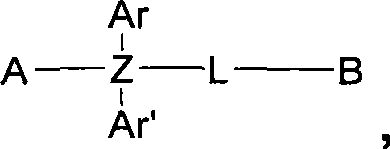
Ar和Ar′独立地选自由苯基、联苯基、萘基、二苯并噻吩、以及二苯并呋喃组成的组,其任选进一步被取代。Z选自Si和Ge。L为单键或包含芳基、氨基、或其组合,并且L任选进一步被取代。Ar and Ar' are independently selected from the group consisting of phenyl, biphenyl, naphthyl, dibenzothiophene, and dibenzofuran, which are optionally further substituted. Z is selected from Si and Ge. L is a single bond or comprises aryl, amino, or a combination thereof, and L is optionally further substituted.
A为直接连接于Z的基团,并选自由二苯并呋喃、二苯并噻吩、氮杂二苯并呋喃、氮杂二苯并噻吩、二苯并硒吩、氮杂二苯并硒吩及其组合组成的组,其任选被选自下述的至少一个基团进一步取代:氢、氘、卤素、烷基、环烷基、杂烷基、芳烷基、芳基、芳氧基、芳硫基、芳硒基、吡啶、三嗪、咪唑、苯并咪唑、腈、异腈及其组合,且其中该取代基任选稠合于直接连接至Z的基团。A is a group directly attached to Z and is selected from the group consisting of dibenzofuran, dibenzothiophene, azadibenzofuran, azadibenzothiophene, dibenzoselenophene, azadibenzoselenophene The group consisting of and combinations thereof, which are optionally further substituted with at least one group selected from the group consisting of hydrogen, deuterium, halogen, alkyl, cycloalkyl, heteroalkyl, aralkyl, aryl, aryloxy , arylthio, arylselenyl, pyridine, triazine, imidazole, benzimidazole, nitrile, isonitrile, and combinations thereof, and wherein the substituent is optionally fused to a group directly attached to Z.
B包括选自以下的基团:咔唑、氮杂咔唑及其组合,其任选进一步被选自以下的至少一个基团所取代:氢、氘、卤素、烷基、环烷基、杂烷基、芳烷基、烷氧基、芳氧基、氨基、甲硅烷基、烯基、环烯基、杂烯基、炔基、芳基、杂芳基、酰基、羰基、羧酸、酯、腈、异腈、硫基、亚磺酰基、磺酰基、膦基及其组合,且其中该取代基任选稠合于咔唑基或氮杂咔唑基。B includes groups selected from the group consisting of carbazole, azacarbazole, and combinations thereof, optionally further substituted by at least one group selected from the group consisting of hydrogen, deuterium, halogen, alkyl, cycloalkyl, hetero Alkyl, aralkyl, alkoxy, aryloxy, amino, silyl, alkenyl, cycloalkenyl, heteroalkenyl, alkynyl, aryl, heteroaryl, acyl, carbonyl, carboxylic acid, ester , nitrile, isonitrile, thio, sulfinyl, sulfonyl, phosphino, and combinations thereof, and wherein the substituent is optionally fused to carbazolyl or azacarbazolyl.
在一方面,A选自:In one aspect, A is selected from:

在一方面,B选自:In one aspect, B is selected from:
Y1和Y2独立地选自由O、S和Se组成的组,X1至X10独立选自由CR′和N组成的组,而且其中每个苯并环包含至多一个N。R′选自由氢、氘、卤素、烷基、环烷基、杂烷基、芳烷基、芳基、芳氧基、芳硫基、芳硒基、吡啶、三嗪、咪唑、苯并咪唑、腈、异腈及其组合。R选自由氢、氘、卤素、烷基、环烷基、杂烷基、芳烷基、烷氧基、芳基、杂芳基、芳氧基、氨基及其组合组成的组。 Y1 and Y2 are independently selected from the group consisting of O, S and Se, X1 to X10 are independently selected from the group consisting of CR' and N, and wherein each benzo ring contains at most one N. R' is selected from the group consisting of hydrogen, deuterium, halogen, alkyl, cycloalkyl, heteroalkyl, aralkyl, aryl, aryloxy, arylthio, arylselenyl, pyridine, triazine, imidazole, benzimidazole , nitriles, isonitriles, and combinations thereof. R is selected from the group consisting of hydrogen, deuterium, halogen, alkyl, cycloalkyl, heteroalkyl, aralkyl, alkoxy, aryl, heteroaryl, aryloxy, amino, and combinations thereof.
在一方面,L选自:In one aspect, L is selected from:

在一方面,L为单键。在另一方面,L包含直接连接至Z的至少一个苯基。In one aspect, L is a single bond. In another aspect, L comprises at least one phenyl group directly attached to Z.
在一方面,Ar和Ar′是苯基。在另一方面,Ar、Ar′独立地被选自下述的至少一个基团所取代:氢、氘、卤素、烷基、环烷基、杂烷基、芳烷基、烷氧基、芳氧基、氨基、甲硅烷基、烯基、环烯基、杂烯基、炔基、芳基、杂芳基、酰基、羰基、羧酸、酯、腈、异腈、硫基、亚磺酰基、磺酰基、膦基及其组合。In one aspect, Ar and Ar' are phenyl. In another aspect, Ar, Ar' are independently substituted with at least one group selected from hydrogen, deuterium, halogen, alkyl, cycloalkyl, heteroalkyl, aralkyl, alkoxy, aryl Oxy, amino, silyl, alkenyl, cycloalkenyl, heteroalkenyl, alkynyl, aryl, heteroaryl, acyl, carbonyl, carboxylic acid, ester, nitrile, isonitrile, thio, sulfinyl , sulfonyl, phosphino and combinations thereof.
在一方面,该化合物选自由化合物1-化合物11组成的组。In one aspect, the compound is selected from the group consisting of Compound 1-Compound 11.
提供第一器件。在一方面,该第一器件包含有机发光器件,该有机发光器件进一步包含阳极、阴极以及置于阳极和阴极之间的有机层,该有机层包含具有下式的化合物:式I。A first device is provided. In one aspect, the first device comprises an organic light emitting device further comprising an anode, a cathode, and an organic layer disposed between the anode and the cathode, the organic layer comprising a compound having the formula: Formula I.
Ar和Ar’独立地选自由苯基、联苯基、萘基、二苯并噻吩和二苯并呋喃组成的组,其任选进一步被取代。Z选自Si和Ge。L为单键或包含芳基、氨基或其组合,并且L任选进一步被取代。Ar and Ar' are independently selected from the group consisting of phenyl, biphenyl, naphthyl, dibenzothiophene and dibenzofuran, which are optionally further substituted. Z is selected from Si and Ge. L is a single bond or comprises aryl, amino, or a combination thereof, and L is optionally further substituted.
A为直接连接于Z的基团,并且选自由二苯并呋喃、二苯并噻吩、氮杂二苯并呋喃、氮杂二苯并噻吩、二苯并硒吩、氮杂二苯并硒吩及其组合组成的组,其任选被选自下述的至少一个基团进一步取代:氢、氘、卤素、烷基、环烷基、杂烷基、芳烷基、芳基、芳氧基、芳硫基、芳硒基、吡啶、三嗪、咪唑、苯并咪唑、腈、异腈及其组合,并且其中取代基任选稠合至直接连接至Z的基团。A is a group directly attached to Z and is selected from the group consisting of dibenzofuran, dibenzothiophene, azadibenzofuran, azadibenzothiophene, dibenzoselenophene, azadibenzoselenophene The group consisting of and combinations thereof, which are optionally further substituted with at least one group selected from the group consisting of hydrogen, deuterium, halogen, alkyl, cycloalkyl, heteroalkyl, aralkyl, aryl, aryloxy , arylthio, arylselenyl, pyridine, triazine, imidazole, benzimidazole, nitrile, isonitrile, and combinations thereof, and wherein the substituent is optionally fused to a group directly attached to Z.
B包括选自下述的基团:咔唑、氮杂咔唑及其组合,其任选被选自下述的至少一个基团进一步取代:氢、氘、卤素、烷基、环烷基、杂烷基、芳烷基、烷氧基、芳氧基、氨基、甲硅烷基、烯基、环烯基、杂烯基、炔基、芳基、杂芳基、酰基、羰基、羧酸、酯、腈、异腈、硫基、亚磺酰基、磺酰基、膦基及其组合,其中取代基任选稠合于咔唑基或氮杂咔唑基。B includes groups selected from the group consisting of carbazole, azacarbazole, and combinations thereof, optionally further substituted by at least one group selected from the group consisting of hydrogen, deuterium, halogen, alkyl, cycloalkyl, Heteroalkyl, aralkyl, alkoxy, aryloxy, amino, silyl, alkenyl, cycloalkenyl, heteroalkenyl, alkynyl, aryl, heteroaryl, acyl, carbonyl, carboxylic acid, Esters, nitriles, isonitriles, thio, sulfinyl, sulfonyl, phosphino, and combinations thereof, where the substituent is optionally fused to a carbazolyl or azacarbazolyl.
在一方面,有机层是发射层并且该式I化合物是主体。在另一方面,有机层进一步包含发射掺杂剂。在一方面,发射掺杂剂是具有至少一种选自下述的配体的过渡金属络合物:In one aspect, the organic layer is the emissive layer and the compound of formula I is the host. In another aspect, the organic layer further includes an emissive dopant. In one aspect, the emissive dopant is a transition metal complex having at least one ligand selected from:

其中Ra、Rb和Rc可代表单、二、三或四取代。Wherein R a , R b and R c may represent mono, di, tri or tetra substitution.
Ra、Rb和Rc独立地选自:氢、氘、卤素、烷基、环烷基、杂烷基、芳烷基、烷氧基、芳氧基、氨基、甲硅烷基、烯基、环烯基、杂烯基、炔基、芳基、杂芳基、酰基、羰基、羧酸、酯、腈、异腈、硫基、亚磺酰基、磺酰基、膦基及其组合,且其中Ra、Rb和Rc中的两个相邻取代基任选连接形成稠合环。R a , R b and R c are independently selected from: hydrogen, deuterium, halogen, alkyl, cycloalkyl, heteroalkyl, aralkyl, alkoxy, aryloxy, amino, silyl, alkenyl , cycloalkenyl, heteroalkenyl, alkynyl, aryl, heteroaryl, acyl, carbonyl, carboxylic acid, ester, nitrile, isonitrile, thio, sulfinyl, sulfonyl, phosphino, and combinations thereof, and Wherein two adjacent substituents in R a , R b and R c are optionally connected to form a fused ring.
在一方面,发射掺杂剂具有式In one aspect, the emissive dopant has the formula

D是5或6元碳环或杂环,并且R1、R2和R3独立地代表单、二、三或四取代。每个R1、R2和R3独立地选自:氢、氘、卤素、烷基、环烷基、杂烷基、芳烷基、烷氧基、芳氧基、氨基、甲硅烷基、烯基、环烯基、杂烯基、炔基、芳基、杂芳基、酰基、羰基、羧酸、酯、腈、异腈、硫基、亚磺酰基、磺酰基、膦基及其组合。X-Y代表另一个配体,并且n是1、2或3。R1可任选连接至环D。D is a 5- or 6-membered carbocyclic or heterocyclic ring, and R 1 , R 2 and R 3 independently represent mono-, di-, tri- or tetrasubstitution. Each R 1 , R 2 and R 3 is independently selected from the group consisting of hydrogen, deuterium, halogen, alkyl, cycloalkyl, heteroalkyl, aralkyl, alkoxy, aryloxy, amino, silyl, Alkenyl, cycloalkenyl, heteroalkenyl, alkynyl, aryl, heteroaryl, acyl, carbonyl, carboxylic acid, ester, nitrile, isonitrile, thio, sulfinyl, sulfonyl, phosphino, and combinations thereof . XY represents another ligand, and n is 1, 2 or 3. R 1 can optionally be attached to ring D.
在另一方面,器件进一步包含第二有机层,其是非发射层,且式I的化合物为第二有机层中的材料。In another aspect, the device further comprises a second organic layer, which is a non-emissive layer, and the compound of formula I is a material in the second organic layer.
在一方面,第二有机层是阻挡层,且式I化合物为第二有机层中的阻挡材料。In one aspect, the second organic layer is a barrier layer, and the compound of formula I is the barrier material in the second organic layer.
在一方面,第二有机层是电子传输层,且式I化合物为第二有机层中的电子传输材料。In one aspect, the second organic layer is an electron transport layer, and the compound of formula I is the electron transport material in the second organic layer.
在一方面,第一器件是消费产品。在另一方面,第一器件是有机发光器件。In one aspect, the first device is a consumer product. In another aspect, the first device is an organic light emitting device.
附图说明Description of drawings
图1显示一种有机发光器件。Fig. 1 shows an organic light emitting device.
图2显示一种倒置有机发光器件,其不具有独立的电子传输层。Figure 2 shows an inverted organic light emitting device without a separate electron transport layer.
图3显示式I的化合物。Figure 3 shows compounds of formula I.
图4显示一种包含式I化合物的示例的OLED器件结构。Figure 4 shows an exemplary OLED device structure comprising a compound of formula I.
发明详述Detailed description of the invention
通常,OLED包括位于阳极和阴极之间并且与阳极和阴极电连接的至少一个有机层。当施加电流时,阳极向有机层中注入空穴,阴极向有机层中注入电子。注入的空穴和电子各自向带相反电荷的电极迁移。当电子和空穴局限于同一分子中时,形成“激子”,它是具有激发能态的局域化的电子-空穴对。当激子通过发光机理弛豫时,发射出光。在一些情况下,激子可以局域化在激发体或激发复合体上。也可以发生非辐射机理,例如热弛豫,但是通常将其视为不合需要的。Typically, an OLED includes at least one organic layer positioned between and electrically connected to an anode and a cathode. When an electric current is applied, the anode injects holes into the organic layer and the cathode injects electrons into the organic layer. The injected holes and electrons each migrate toward oppositely charged electrodes. When electrons and holes are confined in the same molecule, "excitons" are formed, which are localized electron-hole pairs with excited energy states. Light is emitted when the excitons relax through a luminescence mechanism. In some cases, excitons can be localized on an excimer or exciplex. Non-radiative mechanisms can also occur, such as thermal relaxation, but are generally considered undesirable.
最初的OLEDs使用从其单线态发光(“荧光”)的发光分子,例如美国专利No.4,769,292中所公开,其全部内容通过引用纳入本文中。荧光发射通常发生在小于10纳秒的时间范围内。Initial OLEDs used light-emitting molecules that emitted light ("fluorescent") from their singlet states, such as disclosed in US Patent No. 4,769,292, the entire contents of which are incorporated herein by reference. Fluorescent emission typically occurs on a time scale of less than 10 nanoseconds.
最近,已展示了具有从三线态发光(“磷光”)的发光材料的OLEDs。见Baldo等人的“Highly Efficient Phosphorescent Emiss ion From OrganicElectroluminescent Devices”(有机电致发光器件的高效磷光发射),Nature,第395卷,151-154,1998;(“Baldo-I”)和Baldo等人的“Very high-efficiencygreen organic light-emitting devices based on electrophosphorescence”(基于电磷光的极高效绿色有机发光器件),Appl.Phys.Let t,第75卷,第3期,4-6(1999)(“Baldo-II”),它们全部通过引用纳入本文。磷光更详细地记载于美国专利No.7,279,704的第5-6栏,其通过引用纳入本文。More recently, OLEDs with emissive materials that emit light from the triplet state ("phosphorescence") have been demonstrated. See "Highly Efficient Phosphorescent Emission From Organic Electroluminescent Devices" by Baldo et al., Nature, Vol. 395, 151-154, 1998; ("Baldo-I") and Baldo et al. "Very high-efficiency green organic light-emitting devices based on electrophosphorescence", Appl.Phys.Let t, Vol. 75, No. 3, 4-6 (1999) ( "Baldo-II"), all of which are incorporated herein by reference. Phosphorescence is described in more detail at columns 5-6 of US Patent No. 7,279,704, which is incorporated herein by reference.
图1显示了有机发光器件100。这些图不一定按比例绘制。器件100可以包括基片110、阳极115、空穴注入层120、空穴传输层125、电子阻挡层130、发光层135、空穴阻挡层140、电子传输层145、电子注入层150、保护层155和阴极160。阴极160是具有第一导电层162和第二导电层164的复合阴极。器件100可以通过将上述层按顺序沉积而制备。这些不同的层的性质和功能以及材料实例更具体地记载于US 7,279,704的第6-10栏中,其通过引用纳入本文。FIG. 1 shows an organic
可以获得这些层中的每种的更多实例。例如,柔性且透明的基片-阳极组合公开于美国专利No.5,844,363中,其全部内容通过引用纳入本文。p型掺杂的空穴传输层的一个实例是以50∶1的摩尔比用F4-TCNQ掺杂的m-MTDATA,公开于美国专利申请公布No.2003/0230980中,其全部内容通过引用纳入本文。发光材料和主体材料的实例公开于Thompson 等人的美国专利No.6,303,238中,其全部内容通过引用纳入本文。n型掺杂的电子传输层的一个实例是以1∶1的摩尔比用Li掺杂的BPhen,公开于美国专利申请公布No.2003/0230980中,其全部内容通过引用纳入本文。美国专利No.5,703,436和5,707,745(其全部内容通过引用纳入本文)公开了包括复合阴极的阴极的实例,其具有金属如Mg:Ag的薄层,具有覆盖的透明导电溅射沉积ITO层。阻挡层的理论和用途更详细地记载于美国专利No.6,097,147和美国专利申请公布No.2003/0230980中,其全部内容通过引用纳入本文中。注入层的实例提供于美国专利申请公布No.2004/0174116中,其全部内容通过引用纳入本文。关于保护层的说明可以见于美国专利申请公布No.2004/0174116中,其全部内容通过引用纳入本文。More instances of each of these layers can be obtained. For example, flexible and transparent substrate-anode combinations are disclosed in US Patent No. 5,844,363, the entire contents of which are incorporated herein by reference. An example of a p-type doped hole transport layer is m-MTDATA doped with F4-TCNQ at a molar ratio of 50:1, disclosed in U.S. Patent Application Publication No. 2003/0230980, the entire contents of which are incorporated by reference This article. Examples of emissive and host materials are disclosed in U.S. Patent No. 6,303,238 to Thompson et al., the entire contents of which are incorporated herein by reference. An example of an n-type doped electron transport layer is BPhen doped with Li at a molar ratio of 1:1, disclosed in US Patent Application Publication No. 2003/0230980, the entire contents of which are incorporated herein by reference. US Patent Nos. 5,703,436 and 5,707,745, the entire contents of which are incorporated herein by reference, disclose examples of cathodes comprising composite cathodes having a thin layer of a metal such as Mg:Ag with an overlying transparent conductive sputter-deposited ITO layer. The theory and use of barrier layers is described in more detail in US Patent No. 6,097,147 and US Patent Application Publication No. 2003/0230980, the entire contents of which are incorporated herein by reference. Examples of injection layers are provided in US Patent Application Publication No. 2004/0174116, the entire contents of which are incorporated herein by reference. A description of protective layers can be found in US Patent Application Publication No. 2004/0174116, the entire contents of which are incorporated herein by reference.
图2显示了倒置OLED 200。该器件包括基片210、阴极215、发光层220、空穴传输层225和阳极230。器件200可以通过按顺序沉积所述层而制备。因为大多数常规OLED构造具有位于阳极上的阴极,而器件200具有位于阳极230下的阴极215,因此可以将器件200称为“倒置”OLED。与针对器件100所说明的类似的材料可以用于器件200的相应的层中。图2提供了可以如何将某些层从器件100的结构中省略的实例。FIG. 2 shows an
图1和2所示的简单分层结构以非限制性实例的方式提供,并且应当理解,本发明的实施方案可以与很多种其它结构结合使用。所述的具体材料和结构是示例性的,并且可以使用其它材料和结构。基于设计、性能和成本因素,可以通过以不同方式将上述多种层相结合或者将层完全省略而获得功能性OLEDs。也可以包括未明确说明的其它层。可以使用明确说明的材料以外的材料。尽管本文中提供的很多实例将很多层描述成包含单一的材料,但是应当理解,可以使用材料的组合,例如主体与掺杂剂的混合物或者更一般的混合物。另外,层可以具有多个亚层。本文中给予各种层的名称并不打算具有严格的限制性。例如在器件200中,空穴传输层225传输空穴并向发光层220中注入空穴,并且可以描述为空穴传输层或空穴注入层。在一种实施方案中,OLED可以被描述为具有位于阴极和阳极之间的“有机层”。该有机层可以包含单一的层,或者可以进一步包含如针对图1和2中所述的不同有机材料的多个层。The simple layered architecture shown in Figures 1 and 2 is provided by way of non-limiting example, and it should be understood that embodiments of the present invention may be used in conjunction with a wide variety of other architectures. The specific materials and structures described are exemplary, and other materials and structures may be used. Based on design, performance, and cost factors, functional OLEDs can be obtained by combining the various layers described above in different ways or by omitting layers entirely. Other layers not explicitly stated may also be included. Materials other than those explicitly stated may be used. Although many of the examples provided herein describe layers as comprising a single material, it should be understood that combinations of materials may be used, such as mixtures or more general mixtures of hosts and dopants. Additionally, a layer may have multiple sub-layers. The names given to the various layers herein are not intended to be strictly limiting. For example, in
也可以使用未明确说明的结构和材料,例如包括聚合物材料的OLEDs(PLEDs),例如Friend等人的美国专利No.5,247,190中所公开的,其全部内容通过引用纳入本文中。作为进一步的实例,可以使用具有单个有机层的OLEDs。OLEDs可以叠置,例如如Forrest等人的美国专利No.5,707,745中所述,其全部内容通过引用纳入本文中。OLED结构可以偏离图1和2中所示的简单的层状结构。例如,基片可以包括成角的反射表面以改善外耦合(out-coupl ing),例如Forrest等人的美国专利No.6,091,195中所记载的平台(mesa)结构和/或Bulovic等人的美国专利No.5,834,893中所记载的陷阱(pit)结构,其全部内容通过引用纳入本文中。Structures and materials not specifically described may also be used, such as OLEDs (PLEDs) comprising polymeric materials, such as disclosed in US Patent No. 5,247,190 to Friend et al., the entire contents of which are incorporated herein by reference. As a further example, OLEDs with a single organic layer can be used. OLEDs can be stacked, for example, as described in US Patent No. 5,707,745 to Forrest et al., the entire contents of which are incorporated herein by reference. OLED structures can deviate from the simple layered structures shown in FIGS. 1 and 2 . For example, the substrate may include angled reflective surfaces to improve out-coupling, such as the mesa structures described in U.S. Patent No. 6,091,195 to Forrest et al. and/or U.S. Patent No. 6,091,195 to Bulovic et al. The pit structure described in No. 5,834,893, the entire content of which is incorporated herein by reference.
除非另外说明,各种实施方案的任何层可以通过任何合适的方法沉积。对于有机层,优选方法包括热蒸发、喷墨,例如如美国专利No.6,013,982和6,087,196中所记载,其全部内容通过引用纳入本文中;有机气相沉积(OVPD),例如如Forrest等人的美国专利No.6,337,102中所记载,其全部内容通过引用纳入本文中;以及通过有机气相喷涂(OVJP)的沉积,例如如美国专利申请No.10/233,470中所记载,其全部内容通过引用纳入本文中。其它合适的沉积方法包括旋涂和其它基于溶液的方法。基于溶液的方法优选在氮气或惰性气氛中进行。对于其它层,优选方法包括热蒸发。优选的成图案方法包括通过掩模沉积、冷焊,例如如美国专利No.6,294,398和6,468,819中所记载,其全部内容通过引用纳入本文中;以及与某些沉积方法如喷墨和OVJD相关的成图案方法。也可以使用其它方法。可以对待沉积的材料进行改性以使它们与具体的沉积方法相容。例如,可以在小分子中使用取代基例如支化或非支化的并优选含有至少3个碳的烷基和芳基,以增强它们进行溶液处理的能力。可以使用具有20个或更多个碳的取代基,3至20个碳是优选范围。具有非对称结构的材料可以比具有对称结构的材料具有更好的可溶液处理性,因为非对称材料可以具有较低的重结晶倾向。树枝状化合物取代基可以用于提高小分子进行溶液处理的能力。Unless otherwise stated, any layer of the various embodiments may be deposited by any suitable method. For organic layers, preferred methods include thermal evaporation, inkjet, e.g., as described in U.S. Patent Nos. 6,013,982 and 6,087,196, the entire contents of which are incorporated herein by reference; organic vapor phase deposition (OVPD), e.g., as described in Forrest et al. No. 6,337,102, which is incorporated herein by reference in its entirety; and deposition by organic vapor phase spraying (OVJP), eg, as described in US Patent Application No. 10/233,470, which is incorporated herein by reference in its entirety. Other suitable deposition methods include spin coating and other solution based methods. Solution-based methods are preferably performed under nitrogen or an inert atmosphere. For other layers, preferred methods include thermal evaporation. Preferred patterning methods include deposition through a mask, cold welding, such as described in U.S. Patent Nos. 6,294,398 and 6,468,819, the entire contents of which are incorporated herein by reference; pattern method. Other methods can also be used. The materials to be deposited can be modified to render them compatible with a particular deposition method. For example, substituents such as alkyl and aryl groups, branched or unbranched and preferably containing at least 3 carbons, may be used on small molecules to enhance their ability to be solution processed. Substituents having 20 or more carbons may be used, with 3 to 20 carbons being the preferred range. Materials with asymmetric structures may have better solution processability than materials with symmetric structures because asymmetric materials may have a lower tendency to recrystallize. Dendrimer substituents can be used to enhance the ability of small molecules to be solution processed.
根据本发明的实施方案制备的器件可以纳入很多种消费产品中,包括平板显示器、计算机监视器、电视、广告牌、室内或室外照明灯和/或信号灯、危险警告显示器、全透明显示器、柔性显示器、激光打印机、电话、移动电话、个人数字助理(PDAs)、笔记本电脑、数码相机、可携式摄像机、取景器、微型显示器、交通工具、大面积墙、剧场或体育场屏幕或标志。多种控制机制可以用于控制根据本发明制备的器件,包括无源矩阵和有源矩阵。很多器件拟用于对人体而言舒适的温度范围内,例如18℃至30℃,更优选室温(20至25℃)。Devices made according to embodiments of the present invention can be incorporated into a wide variety of consumer products including flat panel displays, computer monitors, televisions, billboards, indoor or outdoor lighting and/or signal lights, hazard warning displays, fully transparent displays, flexible displays , laser printers, telephones, mobile phones, personal digital assistants (PDAs), laptop computers, digital cameras, camcorders, viewfinders, microdisplays, vehicles, large walls, theater or stadium screens or signs. A variety of control mechanisms can be used to control devices fabricated in accordance with the present invention, including passive matrix and active matrix. Many devices are intended for use in a temperature range that is comfortable for the human body, eg 18°C to 30°C, more preferably room temperature (20 to 25°C).
本文中记载的材料和结构可以应用于除OLEDs以外的器件中。例如,其它光电器件如有机太阳能电池和有机光电探测器可以使用这些材料和结构。更一般地说,有机器件例如有机晶体管可以使用这些材料和结构。The materials and structures described herein can be applied in devices other than OLEDs. For example, other optoelectronic devices such as organic solar cells and organic photodetectors can use these materials and structures. More generally, organic devices such as organic transistors can use these materials and structures.
术语卤、卤素、烷基、环烷基、烯基、炔基、芳烷基(arylkyl)、杂环基团、芳基、芳香基团和杂芳基是本领域已知的,并且定义于US 7,279,704的第31-32栏中,该专利通过引用纳入本文中。The terms halo, halogen, alkyl, cycloalkyl, alkenyl, alkynyl, arylkyl, heterocyclic group, aryl, aryl and heteroaryl are known in the art and are defined in Columns 31-32 of US 7,279,704, which is incorporated herein by reference.
提供式I的化合物。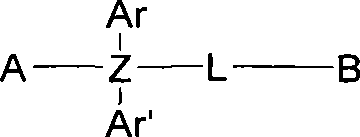
Ar和Ar’独立地选自由苯基、联苯基、萘基、二苯并噻吩和二苯并呋喃组成的组,其任选进一步被取代。Z选自Si和Ge。L为单键或包含芳基、氨基或其组合,并且L任选进一步被取代。Ar and Ar' are independently selected from the group consisting of phenyl, biphenyl, naphthyl, dibenzothiophene and dibenzofuran, which are optionally further substituted. Z is selected from Si and Ge. L is a single bond or comprises aryl, amino, or a combination thereof, and L is optionally further substituted.
A为直接连接于Z的基团,并选自由二苯并呋喃、二苯并噻吩、氮杂二苯并呋喃、氮杂二苯并噻吩、二苯并硒吩、氮杂二苯并硒吩及其组合组成的组,其任选被选自下述的至少一个基团进一步取代:氢、氘、卤素、烷基、环烷基、杂烷基、芳烷基、芳基、芳氧基、芳硫基、芳硒基、吡啶、三嗪、咪唑、苯并咪唑、腈、异腈及其组合,且其中取代基任选稠合于直接连接至Z的基团。A is a group directly attached to Z and is selected from the group consisting of dibenzofuran, dibenzothiophene, azadibenzofuran, azadibenzothiophene, dibenzoselenophene, azadibenzoselenophene The group consisting of and combinations thereof, which are optionally further substituted with at least one group selected from the group consisting of hydrogen, deuterium, halogen, alkyl, cycloalkyl, heteroalkyl, aralkyl, aryl, aryloxy , arylthio, arylselenyl, pyridine, triazine, imidazole, benzimidazole, nitrile, isonitrile, and combinations thereof, and wherein the substituent is optionally fused to a group directly attached to Z.
B包括选自咔唑、氮杂咔唑及其组合的基团,其任选被选自下述的至少一个基团进一步取代:氢、氘、卤素、烷基、环烷基、杂烷基、芳烷基、烷氧基、芳氧基、氨基、甲硅烷基、烯基、环烯基、杂烯基、炔基、芳基、杂芳基、酰基、羰基、羧酸、酯、腈、异腈、硫基、亚磺酰基、磺酰基、膦基及其组合,其中取代基任选稠合于咔唑或氮杂咔唑基。B includes groups selected from carbazole, azacarbazole, and combinations thereof, optionally further substituted with at least one group selected from hydrogen, deuterium, halogen, alkyl, cycloalkyl, heteroalkyl , aralkyl, alkoxy, aryloxy, amino, silyl, alkenyl, cycloalkenyl, heteroalkenyl, alkynyl, aryl, heteroaryl, acyl, carbonyl, carboxylic acid, ester, nitrile , isonitrile, thio, sulfinyl, sulfonyl, phosphino, and combinations thereof, wherein the substituent is optionally fused to carbazole or azacarbazolyl.
″芳基″基团是一种芳香全碳基团,其可包含一个或多个稠合环于其中。仅通过例子,且无任何限制,示例的芳基基团可是苯基、萘、菲、心环烯等。″杂芳基″基团是包含至少一个杂原子的″芳基″基团。仅通过例子,且无任何限制,示例的杂芳基基团可是吡啶、喹啉、菲络啉、氮杂心环烯等。″芳基″和″杂芳基″基团可具有多个连接位点将它们连接至其它片段。An "aryl" group is an aromatic all-carbon group that may contain one or more fused rings therein. By way of example only, and without limitation, exemplary aryl groups may be phenyl, naphthalene, phenanthrene, cardiocyclene, and the like. A "heteroaryl" group is an "aryl" group that contains at least one heteroatom. By way of example only, and without limitation, exemplary heteroaryl groups are pyridine, quinoline, phenanthroline, azacardocene, and the like. "Aryl" and "heteroaryl" groups can have multiple points of attachment to attach them to other moieties.
在一个实施方式中,A选自:In one embodiment, A is selected from:

在一个实施方式中,B选自:In one embodiment, B is selected from:

Y1和Y2独立地选自由O、S和Se组成的组,X1至X10独立地选自CR′和N,且其中每个杂芳环包含至多一个N。R′选自:氢、氘、卤素、烷基、环烷基、杂烷基、芳烷基、芳基、芳氧基、芳硫基、芳硒基、吡啶、三嗪、咪唑、苯并咪唑、腈、异腈及其组合。R选自:氢、氘、卤素、烷基、环烷基、杂烷基、芳烷基、烷氧基、芳基、杂芳基、芳氧基、氨基及其组合。本文公开的化学结构中的虚线代表通过该基团上的任意位置的键,其能够与另一原子形成单键。 Y1 and Y2 are independently selected from the group consisting of O, S and Se, X1 to X10 are independently selected from CR' and N, and wherein each heteroaryl ring contains at most one N. R' is selected from the group consisting of hydrogen, deuterium, halogen, alkyl, cycloalkyl, heteroalkyl, aralkyl, aryl, aryloxy, arylthio, arylselenyl, pyridine, triazine, imidazole, benzo Imidazoles, nitriles, isonitriles and combinations thereof. R is selected from the group consisting of hydrogen, deuterium, halogen, alkyl, cycloalkyl, heteroalkyl, aralkyl, alkoxy, aryl, heteroaryl, aryloxy, amino, and combinations thereof. A dashed line in the chemical structures disclosed herein represents a bond through any position on the group that is capable of forming a single bond with another atom.
在某些实施方式中,A基团充当电子传输者,并且连接单元(L)和B基团充当空穴传输者。In certain embodiments, the A group acts as an electron transporter, and the linking unit (L) and the B group act as hole transporters.
应理解,当将分子片段描述为取代基或连接至其它部分,其名称可以看上去为片段(例如萘基、二苯并呋喃基)或为整个分子(例如萘、二苯并呋喃)。本文中,这些指称取代基或连接的片段的不同方式被认为是等价的。It will be understood that when a fragment of a molecule is described as a substituent or attached to another moiety, the name may appear to be the fragment (eg naphthyl, dibenzofuranyl) or the entire molecule (eg naphthalene, dibenzofuran). These different ways of referring to substituents or linked moieties are considered equivalent herein.
在本文中,包含以下结构的片段In this article, a fragment containing the following structure
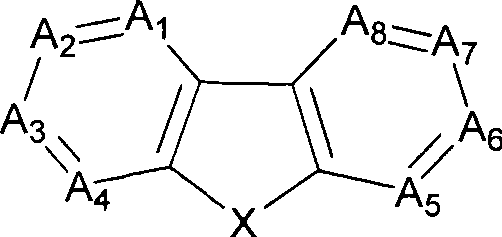
被称为DBX基团,即二苯并X,其中X是描述于本文中的任一原子或基团。在DBX基团中,A1-A8可包含碳或氮。Known as the DBX group, ie dibenzoX, where X is any atom or group described herein. In a DBX group, A 1 -A 8 may contain carbon or nitrogen.
在一个实施方式中,L选自:In one embodiment, L is selected from:

在一个实施方式中,L为单键。在另一个实施方式中,L包含至少一个直接连接至Z的苯基。In one embodiment, L is a single bond. In another embodiment, L comprises at least one phenyl group directly attached to Z.
在一个实施方式中,Ar和Ar’是苯基。在另一个实施方式中,Ar、Ar′独立地被选自下述的至少一个基团取代:氢、氘、卤素、烷基、环烷基、杂烷基、芳烷基、烷氧基、芳氧基、氨基、甲硅烷基、烯基、环烯基、杂烯基、炔基、芳基、杂芳基、酰基、羰基、羧酸、酯、腈、异腈、硫基、亚磺酰基、磺酰基、膦基及其组合。In one embodiment, Ar and Ar' are phenyl. In another embodiment, Ar, Ar' are independently substituted by at least one group selected from hydrogen, deuterium, halogen, alkyl, cycloalkyl, heteroalkyl, aralkyl, alkoxy, Aryloxy, amino, silyl, alkenyl, cycloalkenyl, heteroalkenyl, alkynyl, aryl, heteroaryl, acyl, carbonyl, carboxylic acid, ester, nitrile, isonitrile, thio, sulfinyl Acyl, sulfonyl, phosphino, and combinations thereof.
本文公开的新的式I化合物包含两个不同的结构部分,基团A和B,它们通过芳基硅烷或芳基锗烷间隔基连接,得到非对称结构。″非对称″意味着如上所述基团A和B具有不同的结构。式I化合物当用于OLED器件时具有许多有利性质。首先,包含两个不同的结构部分允许精调得到的化合物的能级,其可促进电荷从相邻的层注入以及通过发射掺杂剂调节电荷俘获。其次,两个不同的结构部分可独立地选择以具有电子和/或空穴传输性质,得到具有双极性电荷传输特性的化合物。这些特性不仅可抑制操作电压而且可平衡电子和空穴流以得到扩展的电荷复合区域。第三,芳基硅烷和芳基锗烷间隔基打破了基团A和B间的共轭,保留了整个分子的高三线态能量,因此有效减少了猝灭。The novel compounds of formula I disclosed herein comprise two distinct moieties, groups A and B, which are linked by an arylsilane or arylgermane spacer, resulting in an asymmetric structure. "Asymmetric" means that groups A and B have different structures as described above. Compounds of formula I have a number of advantageous properties when used in OLED devices. First, the inclusion of two distinct moieties allows fine-tuning of the energy levels of the resulting compound, which can facilitate charge injection from adjacent layers and modulate charge trapping by emissive dopants. Second, two different moieties can be independently selected to have electron and/or hole transport properties, resulting in compounds with ambipolar charge transport properties. These properties not only suppress the operating voltage but also balance the electron and hole flows for an extended charge recombination region. Third, the arylsilane and arylgermane spacers break the conjugation between groups A and B, retaining the high triplet energy of the entire molecule, thus effectively reducing quenching.
式I化合物具有相对于已知的对称类似物额外的优点,这是因为式I化合物具有较小的结晶倾向。因此,式I化合物具有改进的膜一致性,不受理论局限,其被认为是由于OLED中的发射体和主体材料之间的相分离的降低。式I的新化合物可用于改进OLED器件性能参数,例如发射光谱线形、效率和寿命。Compounds of formula I have an additional advantage over known symmetrical analogues, since compounds of formula I have a lower tendency to crystallize. Thus, compounds of formula I have improved film consistency, which, without being bound by theory, is believed to be due to a reduction in phase separation between the emitter and host materials in OLEDs. The novel compounds of formula I can be used to improve OLED device performance parameters such as emission profile, efficiency and lifetime.
此外,式I化合物也倾向于溶于有机溶剂,例如甲苯、二甲苯和3-苯氧基甲苯,而且适合于对于低成本照明应用非常需要的溶液处理。Furthermore, compounds of formula I also tend to be soluble in organic solvents, such as toluene, xylene and 3-phenoxytoluene, and are suitable for solution processing which is highly desirable for low cost lighting applications.
在一个实施方式中,该化合物选自:In one embodiment, the compound is selected from:

表1列举了选择的式I化合物和比较化合物的三线态能级。三线态能量由磷光光谱的最高能量0-0振动波段的最大值测量,该光谱在77K下在相应化合物的10-4M 2-甲基四氢呋喃溶液中采集。虽然CC-4包含硅烷单元,但是CC-4具有实际上与CC-1相同的分子三线态能量,分别是2.76和2.78eV。作为比较,化合物1,其具有直接连接至硅烷单元的二苯并噻吩结构部分,具有2.99eV的较高的三线态能量,意味着该直接连接能够保持二苯并噻吩结构部分的高的三线态能量。这进一步通过化合物2-4、CC-2和CC-3支持,其都具有约3.0eV的三线态能量。需要指出的是化合物5具有比化合物1-4低的三线态能量(2.81eV),不受理论限制,这被认为是受到含有亚联苯基桥的二咔唑基团的存在的限制。Table 1 lists the triplet energy levels of selected compounds of formula I and comparative compounds. Triplet energies are measured from the maxima of the highest energy 0-0 vibrational bands of phosphorescence spectra collected at 77K in 10 −4 M 2-methyltetrahydrofuran solutions of the corresponding compounds. Although CC-4 contains silane units, CC-4 has practically the same molecular triplet energy as CC-1, which are 2.76 and 2.78 eV, respectively. As a comparison, compound 1, which has a dibenzothiophene moiety directly attached to a silane unit, has a higher triplet energy of 2.99 eV, implying that the direct attachment is able to maintain the high triplet state of the dibenzothiophene moiety energy. This is further supported by compounds 2-4, CC-2 and CC-3, all of which have triplet energies of about 3.0 eV. It should be noted that compound 5 has a lower triplet energy (2.81 eV) than compounds 1-4, without being bound by theory, this is believed to be limited by the presence of a dicarbazole group containing a biphenylene bridge.
表1Table 1


提供了第一器件。在一个实施方式中,该第一器件包含有机发光器件,该有机发光器件进一步包含阳极、阴极和置于阳极和阴极之间的有机层,该有机层包含具有下式的化合物:式I。A first device is provided. In one embodiment, the first device comprises an organic light emitting device further comprising an anode, a cathode and an organic layer disposed between the anode and the cathode, the organic layer comprising a compound having the formula: Formula I.
Ar和Ar’独立地选自苯基、联苯基、萘基、二苯并噻吩和二苯并呋喃,其任选进一步被取代。Z选自Si和Ge。L为单键或包含芳基、氨基或其组合,并且L任选被进一步取代。Ar and Ar' are independently selected from phenyl, biphenyl, naphthyl, dibenzothiophene and dibenzofuran, which are optionally further substituted. Z is selected from Si and Ge. L is a single bond or comprises aryl, amino, or a combination thereof, and L is optionally further substituted.
A为直接连接于Z的基团且选自:二苯并呋喃、二苯并噻吩、氮杂二苯并呋喃、氮杂二苯并噻吩、二苯并硒吩、氮杂二苯并硒吩及其组合,其任选被选自下述的基团进一步取代:氢、氘、卤素、烷基、环烷基、杂烷基、芳烷基、芳基、芳氧基、芳硫基、芳硒基、吡啶、三嗪、咪唑、苯并咪唑、腈、异腈及其组合,其中取代基任选稠合至至少一个直接连接至Z的苯并环。A is a group directly attached to Z and is selected from the group consisting of: dibenzofuran, dibenzothiophene, azadibenzofuran, azadibenzothiophene, dibenzoselenophene, azadibenzoselenophene and combinations thereof, which are optionally further substituted with groups selected from the group consisting of hydrogen, deuterium, halogen, alkyl, cycloalkyl, heteroalkyl, aralkyl, aryl, aryloxy, arylthio, Arylselenyl, pyridine, triazine, imidazole, benzimidazole, nitrile, isonitrile, and combinations thereof, wherein the substituent is optionally fused to at least one benzo ring directly attached to Z.
B包括选自下述的基团:咔唑、氮杂咔唑及其组合,其任选被选自下述的基团进一步取代:氢、氘、卤素、烷基、环烷基、杂烷基、芳烷基、烷氧基、芳氧基、氨基、甲硅烷基、烯基、环烯基、杂烯基、炔基、芳基、杂芳基、酰基、羰基、羧酸、酯、腈、异腈、硫基、亚磺酰基、磺酰基、膦基及其组合,其中取代基任选稠合于咔唑或氮杂咔唑基。B includes groups selected from carbazole, azacarbazole, and combinations thereof, optionally further substituted with groups selected from hydrogen, deuterium, halogen, alkyl, cycloalkyl, heteroalkane radical, aralkyl, alkoxy, aryloxy, amino, silyl, alkenyl, cycloalkenyl, heteroalkenyl, alkynyl, aryl, heteroaryl, acyl, carbonyl, carboxylic acid, ester, Nitrile, isonitrile, thio, sulfinyl, sulfonyl, phosphino, and combinations thereof, where the substituent is optionally fused to carbazole or azacarbazolyl.
在一个实施方式中,有机层是发射层且该式I化合物是主体。在另一个实施方式中,有机层进一步包含发射掺杂剂。在一个实施方式中,发射掺杂剂是具有至少一个选自下述的配体的过渡金属络合物:In one embodiment, the organic layer is an emissive layer and the compound of formula I is the host. In another embodiment, the organic layer further comprises an emissive dopant. In one embodiment, the emissive dopant is a transition metal complex having at least one ligand selected from:

其中Ra、Rb和Rc可代表单、二、三或四取代。Wherein R a , R b and R c may represent mono, di, tri or tetra substitution.
Ra、Rb和Rc独立地选自:氢、氘、卤素、烷基、环烷基、杂烷基、芳烷基、烷氧基、芳氧基、氨基、甲硅烷基、烯基、环烯基、杂烯基、炔基、芳基、杂芳基、酰基、羰基、羧酸、酯、腈、异腈、硫基、亚磺酰基、磺酰基、膦基及其组合,且其中Ra、Rb和Rc中的两个相邻取代基任选连接以形成稠合环。R a , R b and R c are independently selected from: hydrogen, deuterium, halogen, alkyl, cycloalkyl, heteroalkyl, aralkyl, alkoxy, aryloxy, amino, silyl, alkenyl , cycloalkenyl, heteroalkenyl, alkynyl, aryl, heteroaryl, acyl, carbonyl, carboxylic acid, ester, nitrile, isonitrile, thio, sulfinyl, sulfonyl, phosphino, and combinations thereof, and wherein two adjacent substituents in R a , R b and R c are optionally linked to form a fused ring.
在一个实施方式中,发射掺杂剂具有式In one embodiment, the emissive dopant has the formula
D是5或6元碳环或杂环,并且R1、R2和R3独立地代表单、二、三或四取代。每个R1、R2和R3独立地选自:氢、氘、卤素、烷基、环烷基、杂烷基、芳烷基、烷氧基、芳氧基、氨基、甲硅烷基、烯基、环烯基、杂烯基、炔基、芳基、杂芳基、酰基、羰基、羧酸、酯、腈、异腈、硫基、亚磺酰基、磺酰基、膦基及其组合。X-Y代表另一个配体,且n是1、2或3。R1可任选连接至环D。D is a 5- or 6-membered carbocyclic or heterocyclic ring, and R 1 , R 2 and R 3 independently represent mono-, di-, tri- or tetrasubstitution. Each R 1 , R 2 and R 3 is independently selected from the group consisting of hydrogen, deuterium, halogen, alkyl, cycloalkyl, heteroalkyl, aralkyl, alkoxy, aryloxy, amino, silyl, Alkenyl, cycloalkenyl, heteroalkenyl, alkynyl, aryl, heteroaryl, acyl, carbonyl, carboxylic acid, ester, nitrile, isonitrile, thio, sulfinyl, sulfonyl, phosphino, and combinations thereof . XY represents another ligand, and n is 1, 2 or 3. R 1 can optionally be attached to ring D.
在另一个实施方式中,器件进一步包含第二有机层,其是非发射层,且式I化合物是第二有机层中的材料。In another embodiment, the device further comprises a second organic layer, which is a non-emissive layer, and the compound of formula I is a material in the second organic layer.
在一个实施方式中,第二有机层是阻挡层,且式I的化合物是第二有机层中的阻挡材料。In one embodiment, the second organic layer is a barrier layer, and the compound of formula I is the barrier material in the second organic layer.
在一个实施方式中,第二个有机层是电子传输层,且该式I化合物是第二有机层中的电子传输材料。In one embodiment, the second organic layer is an electron transport layer, and the compound of formula I is the electron transport material in the second organic layer.
在一个实施方式中,第一器件是消费产品。在另一个实施方式中,第一器件是有机发光器件。In one embodiment, the first device is a consumer product. In another embodiment, the first device is an organic light emitting device.
器件实施例Device embodiment
用于器件实施例中的材料结构如下所示:The material structures used in the device examples are as follows:
描述于本文中的比较化合物的结构如下所示:The structures of the comparative compounds described herein are shown below:

所有实施例器件通过高真空(<10-7Torr)热蒸发(VTE)制备。阳极电极是


在实施例和比较器件实施例中使用的OLED器件的有机叠层具有如下结构:从ITO表面起,


表2Table 2

表2是器件数据的汇总。其中掺杂剂D1是发射体,发光效率(LE)、外量子效率(EQE)和功率效率(PE)在1000nits测定,而寿命(LT80%)定义为在20mA/cm2的恒定电流密度为下,器件衰减至其初始亮度的80%所需的时间。在一些实施方式中,包含硅烷桥的化合物表现出较高的效率,例如器件实施例1-5和比较器件实施例2和3相较于比较器件实施例1。不受理论限制,这些结果部分是由于通过硅烷桥打破共轭以及保持单个分子的高三线态能量。另外,通过四苯基硅烷单元引入的位阻也可阻止不利的分子间堆叠,该堆叠可降低固态中的三线态能量。主体的高三线态能量有效地将激子限定了发射体上,从而导致了高的效率。Table 2 is a summary of device data. Where dopant D1 is an emitter, luminous efficiency (LE), external quantum efficiency (EQE) and power efficiency (PE) are measured at 1000nits, and lifetime (LT 80% ) is defined as a constant current density of 20mA/cm 2 , the time it takes for the device to decay to 80% of its initial brightness. In some embodiments, compounds containing silane bridges exhibit higher efficiencies, eg, Device Examples 1-5 and Comparative Device Examples 2 and 3 compared to Comparative Device Example 1 . Without being limited by theory, these results are due in part to the breaking of conjugation through the silane bridge and the high triplet energy of the individual molecules. In addition, the steric hindrance introduced by the tetraphenylsilane unit can also prevent unfavorable intermolecular stacking, which can reduce the triplet energy in the solid state. The high triplet energy of the host effectively confines the excitons to the emitter, resulting in high efficiency.
另外,具有包含DBX和咔唑结构部分两者的非对称硅烷主体(即式I化合物,其中Z=Si)的器件具有相对于对称硅烷主体的器件改进的寿命(器件实施例1-5与比较器件实施例2和3相比)。器件实施例1、2和4具有两倍于比较器件实施例2的寿命。寿命的提高是由于式I化合物的双极性性质,其有助于平衡电荷流动。不受理论限制,认为平衡的电子/空穴流动扩展了电荷复合区域,这通过抑制或减少激子猝灭在高亮度下保持高效率。扩展的电荷复合区域也通过使得大量分子具有电荷传输、激子形成和光发射作用而提高了器件寿命。此外,式I化合物也可用于空穴阻挡层,如器件实施例6-10所示。由于式I化合物可在空穴阻挡层中作为主体和空穴阻挡材料,将这些材料纳入光学器件预计将降低器件制造成本。Additionally, devices with asymmetric silane hosts comprising both DBX and carbazole moieties (i.e., compounds of formula I, where Z=Si) had improved lifetimes relative to devices with symmetric silane hosts (device Examples 1-5 vs. Device embodiment 2 and 3 are compared). Device Examples 1, 2, and 4 had twice the lifetime of Comparative Device Example 2. The increase in lifetime is due to the bipolar nature of the compound of formula I, which helps to balance the charge flow. Without being bound by theory, it is believed that the balanced electron/hole flow expands the charge recombination region, which maintains high efficiency at high brightness by suppressing or reducing exciton quenching. The extended charge recombination region also improves device lifetime by enabling a large number of molecules to function in charge transport, exciton formation, and light emission. In addition, compounds of Formula I can also be used in hole blocking layers, as shown in Device Examples 6-10. Since the compounds of formula I can act as hosts and hole blocking materials in the hole blocking layer, the incorporation of these materials into optical devices is expected to reduce the cost of device fabrication.
表3table 3


需要指出的是化合物1-4具有高三线态能量并适于作为用于深蓝发射体的主体。作为说明,表3是器件数据的汇总,其中发射层包含掺杂了15重量%的掺杂剂D2的式I化合物。发光效率(LE)、外量子效率(EQE)和功率效率(PE)在1000nit s测定,而寿命(LT80%)定义为在恒定电流密度下器件衰减至其初始亮度2000nits的80%所需的时间。It should be noted that compounds 1-4 have high triplet energies and are suitable as hosts for deep blue emitters. As an illustration, Table 3 is a summary of data for devices in which the emissive layer comprises a compound of formula I doped with 15% by weight of dopant D2. Luminous efficiency (LE), external quantum efficiency (EQE) and power efficiency (PE) were measured at 1000 nits, while lifetime (LT 80% ) was defined as the time required for the device to decay to 80% of its initial brightness of 2000 nits at a constant current density time.
器件实施例11-14也显示了良好效率,表明主体的三线态能量足够高以致于不会淬灭深蓝掺杂剂的发射。Device Examples 11-14 also show good efficiencies, indicating that the triplet energy of the host is high enough not to quench the emission of the deep blue dopant.
与其它材料的组合Combination with other materials
本文中所述的可以用于有机发光器件中的特定层的材料可以与器件中存在的多种其它材料组合使用。例如,本文中公开的发光掺杂剂可以与多种主体、传输层、阻挡层、注入层、电极和可以存在的其它层组合使用。所述的或下述的材料是可以与本文中公开的化合物组合使用的材料的非限制性实例,本领域技术人员可以容易地查阅文献来确定可以组合使用的其它材料。The materials described herein that can be used for a particular layer in an organic light emitting device can be used in combination with various other materials present in the device. For example, the emissive dopants disclosed herein can be used in combination with various hosts, transport layers, barrier layers, injection layers, electrodes, and other layers that may be present. The materials described or described below are non-limiting examples of materials that can be used in combination with the compounds disclosed herein, and one skilled in the art can readily consult the literature to determine other materials that can be used in combination.
HIL/HTL:HIL/HTL:
用于本发明中的空穴注入/传输材料不受特别的限制,并且可以使用任何化合物,只要该化合物通常用作空穴注入/传输材料。该材料的实例包括但不限于:酞氰或卟啉衍生物;芳族胺衍生物;吲哚并咔唑衍生物;含有氟代烃的聚合物;具有导电性掺杂剂的聚合物;导电聚合物,例如PEDOT/PSS;衍生自诸如膦酸和硅烷衍生物的化合物的自组装单体;金属氧化物衍生物,例如MoOx;p型半导体有机化合物,例如1,4,5,8,9,12-六氮杂三亚苯六腈;金属配合物,以及可交联化合物。The hole injection/transport material used in the present invention is not particularly limited, and any compound may be used as long as the compound is generally used as a hole injection/transport material. Examples of such materials include, but are not limited to: phthalocyanine or porphyrin derivatives; aromatic amine derivatives; indolocarbazole derivatives; polymers containing fluorinated hydrocarbons; Polymers such as PEDOT/PSS; self-assembled monomers derived from compounds such as phosphonic acid and silane derivatives; metal oxide derivatives such as MoO x ; p-type semiconducting organic compounds such as 1,4,5,8, 9,12-Hexaazatribenzenehexanitrile; metal complexes, and crosslinkable compounds.
用于HIL或HTL中的芳族胺衍生物的实例包括但不限于下列一般结构:Examples of aromatic amine derivatives for use in HIL or HTL include, but are not limited to, the following general structures:

Ar1至Ar9各自选自芳族烃环化合物,例如苯、联苯、三联苯、三亚苯、萘、蒽、非那烯、菲、芴、芘、
在一个实施方案中,Ar1至Ar9独立地选自:In one embodiment, Ar to Ar are independently selected from:

k为1至20的整数;X1至X8为C(包括CH)或N;Ar1为以上定义的相同的基团。k is an integer from 1 to 20; X 1 to X 8 are C (including CH) or N; Ar 1 is the same group as defined above.
用于HIL或HTL中的金属配合物的实例包括但不限于以下通式:Examples of metal complexes for use in HIL or HTL include, but are not limited to, the following general formulas:

M为金属,具有大于40的原子量;(Y1-Y2)为双齿配体,Y1和Y2独立地选自C、N、O、P和S;L为辅助配体;m为从1至可附着于金属的最大配体数目的整数值;并且m+n为可以附着于金属的最大配体数目。M is a metal with an atomic weight greater than 40; (Y 1 -Y 2 ) is a bidentate ligand, and Y 1 and Y 2 are independently selected from C, N, O, P and S; L is an auxiliary ligand; m is Integer values from 1 to the maximum number of ligands that can attach to the metal; and m+n is the maximum number of ligands that can attach to the metal.
一方面,(Y1-Y2)为2-苯基吡啶衍生物。In one aspect, (Y 1 -Y 2 ) is a 2-phenylpyridine derivative.
另一方面,(Y1-Y2)为卡宾配体。On the other hand, (Y 1 -Y 2 ) is a carbene ligand.
另一方面,M选自Ir、Pt、Os和Zn。In another aspect, M is selected from Ir, Pt, Os and Zn.
再一方面,该金属配合物具有相对于Fc+/Fc对小于约0.6 V的在溶液中的最小氧化电位。In yet another aspect, the metal complex has a minimum oxidation potential in solution of less than about 0.6 V versus the Fc + /Fc pair.
主体:main body:
本发明的有机EL器件的发光层优选地含有至少一种金属配合物作为发光材料,并可以含有主体材料,其使用金属配合物作为掺杂剂材料。主体材料的实例不受特别的限制,并且可以使用任何金属配合物或有机化合物,只要该主体的三线态能量大于掺杂剂的。The light-emitting layer of the organic EL device of the present invention preferably contains at least one metal complex as a light-emitting material, and may contain a host material that uses a metal complex as a dopant material. Examples of the host material are not particularly limited, and any metal complex or organic compound may be used as long as the triplet energy of the host is greater than that of the dopant.
用作主体的金属配合物的实例优选具有以下通式:Examples of metal complexes used as hosts preferably have the general formula:
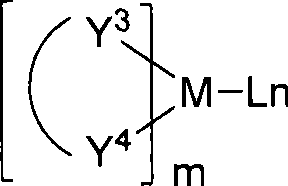
M为金属;(Y3-Y4)为双齿配体,Y3和Y4独立地选自C、N、O、P和S;L为辅助配体;m为从1至可附着于金属的最大配体数目的整数值;并且m+n为可以附着于金属的最大配体数目。M is a metal; (Y 3 -Y 4 ) is a bidentate ligand, Y 3 and Y 4 are independently selected from C, N, O, P and S; L is an auxiliary ligand; m is from 1 to Integer value of the maximum number of ligands for the metal; and m+n is the maximum number of ligands that can attach to the metal.
一方面,该金属配合物为:In one aspect, the metal complex is:

(O-N)为双齿配体,金属配合于原子O和N。(O-N) is a bidentate ligand, and the metal is coordinated to the atoms O and N.
另一方面,M选自Ir和Pt。In another aspect, M is selected from Ir and Pt.
再一方面,(Y3-Y4)为卡宾配体。In yet another aspect, ( Y3 - Y4 ) is a carbene ligand.
用作主体的有机化合物的实例选自芳族烃环化合物,例如苯、联苯、三联苯、三亚苯、萘、蒽、非那烯、菲、芴、芘、二萘嵌苯、薁;芳族杂环化合物,例如二苯并噻吩、二苯并呋喃、二苯并硒吩、呋喃、噻吩、苯并呋喃、苯并噻吩、苯并硒分、咔唑、吲哚并咔唑、吡啶基吲哚、吡咯并二吡啶、吡唑、咪唑、三唑、噁唑、噻唑、噁二唑、噁三唑、二噁唑、噻二唑、吡啶、哒嗪、嘧啶、吡嗪、三嗪、噁嗪、噁噻嗪、噁二嗪、吲哚、苯并咪唑、吲唑、吲噁嗪、苯并噁唑、苯并异噁唑、苯并噻唑、喹啉、异喹啉、噌啉、喹唑啉、喹喔啉、萘啶、酞嗪、蝶啶、呫吨、吖啶、吩嗪、吩噻嗪、吩噁嗪、苯并呋喃并吡啶、呋喃并二吡啶、苯并噻吩并吡啶、噻吩并二吡啶、苯并硒分并吡啶和硒吩并二吡啶;并选自2至10个环状结构单元,其为选自芳族烃环基团和芳族杂环基团的相同类型或不同类型的基团,并彼此直接结合或通过氧原子、氮原子、硫原子、硅原子、磷原子、硼原子、链结构单元和脂族环基团的至少之一结合。其中各个基团被选自氢、氘、卤素、烷基、环烷基、杂烷基、芳烷基、烷氧基、芳氧基、氨基、甲硅烷基、烯基、环烯基、杂烯基、炔基、芳基、杂芳基、酰基、羰基、羧酸、酯、腈、异腈、硫基、亚磺酰基、磺酰基、膦基及其组合的取代基进一步取代。Examples of the organic compound used as a host are selected from aromatic hydrocarbon ring compounds such as benzene, biphenyl, terphenyl, triphenylene, naphthalene, anthracene, phenene, phenanthrene, fluorene, pyrene, Perylene, azulene; aromatic heterocyclic compounds such as dibenzothiophene, dibenzofuran, dibenzoselenophene, furan, thiophene, benzofuran, benzothiophene, benzoselenium, carbazole, Indolocarbazole, pyridyl indole, pyrrolobipyridine, pyrazole, imidazole, triazole, oxazole, thiazole, oxadiazole, oxatriazole, bisoxazole, thiadiazole, pyridine, pyridazine, Pyrimidine, pyrazine, triazine, oxazine, oxathiazine, oxadiazine, indole, benzimidazole, indazole, indoxazine, benzoxazole, benzisoxazole, benzothiazole, quinoline , isoquinoline, cinnoline, quinazoline, quinoxaline, naphthyridine, phthalazine, pteridine, xanthene, acridine, phenazine, phenothiazine, phenoxazine, benzofuropyridine, furo Dipyridine, benzothienopyridine, thienobipyridine, benzoselenopyridine and selenenobipyridine; and selected from 2 to 10 cyclic structural units selected from aromatic hydrocarbon ring groups and Groups of the same type or different types of aromatic heterocyclic groups, bonded directly to each other or through oxygen atoms, nitrogen atoms, sulfur atoms, silicon atoms, phosphorus atoms, boron atoms, chain structural units and aliphatic ring groups At least one of them is combined. wherein each group is selected from hydrogen, deuterium, halogen, alkyl, cycloalkyl, heteroalkyl, aralkyl, alkoxy, aryloxy, amino, silyl, alkenyl, cycloalkenyl, hetero Substituents of alkenyl, alkynyl, aryl, heteroaryl, acyl, carbonyl, carboxylic acid, ester, nitrile, isonitrile, thio, sulfinyl, sulfonyl, phosphino, and combinations thereof are further substituted.
一方面,主体化合物在分子中含有至少一个下列基团:In one aspect, the host compound contains in the molecule at least one of the following groups:

R1至R7独立地选自氢、氘、卤素、烷基、环烷基、杂烷基、芳烷基、烷氧基、芳氧基、氨基、甲硅烷基、烯基、环烯基、杂烯基、炔基、芳基、杂芳基、酰基、羰基、羧酸、酯、腈、异腈、硫基、亚磺酰基、磺酰基、膦基及其组合,当它为芳基或杂芳基时,它具有与上述Ar类似的定义。R to R are independently selected from hydrogen, deuterium, halogen, alkyl, cycloalkyl, heteroalkyl, aralkyl, alkoxy, aryloxy, amino, silyl, alkenyl, cycloalkenyl , heteroalkenyl, alkynyl, aryl, heteroaryl, acyl, carbonyl, carboxylic acid, ester, nitrile, isonitrile, thio, sulfinyl, sulfonyl, phosphino and combinations thereof, when it is aryl or heteroaryl, it has a similar definition to Ar above.
k为0至20的整数;k is an integer from 0 to 20;
X1至X8选自C(包括CH)或N。 X1 to X8 are selected from C (including CH) or N.
HBL:HBL:
可以使用空穴阻挡层(HBL)以降低离开发光层的空穴和/或激子的数目。这样的阻挡层在器件中的存在可导致与缺乏阻挡层的类似器件相比显著更高的效率。另外,可使用阻挡层将发光局限在OLED的期望区域中。A hole blocking layer (HBL) may be used to reduce the number of holes and/or excitons leaving the emissive layer. The presence of such barrier layers in devices can lead to significantly higher efficiencies compared to similar devices lacking barrier layers. In addition, blocking layers can be used to confine light emission to desired regions of the OLED.
一方面,用于HBL中的化合物含有与上述用作主体的相同的分子。In one aspect, compounds for use in HBL contain the same molecules as described above for use as hosts.
另一方面,用于HBL中的化合物在分子中含有至少一个下列基团:In another aspect, compounds for use in HBL contain at least one of the following groups in the molecule:

k为0至20的整数;L为辅助配体,m为1至3的整数。k is an integer from 0 to 20; L is an auxiliary ligand, and m is an integer from 1 to 3.
ETL:ETL:
电子传输层(ETL)可以包括能够传输电子的材料。电子传输层可以为本征的(未掺杂的)或掺杂的。掺杂可以用于增强导电性。ETL材料的实例不受特别的限制,并且可以使用任何金属配合物或有机化合物,只要它们通常用于传输电子。The electron transport layer (ETL) may include a material capable of transporting electrons. Electron transport layers can be intrinsic (undoped) or doped. Doping can be used to enhance conductivity. Examples of ETL materials are not particularly limited, and any metal complexes or organic compounds can be used as long as they are generally used to transport electrons.
一方面,用于ETL中的化合物在分子中含有至少一个下列基团:In one aspect, compounds for use in ETL contain at least one of the following groups in the molecule:

R1选自氢、氘、卤素、烷基、环烷基、杂烷基、芳烷基、烷氧基、芳氧基、氨基、甲硅烷基、烯基、环烯基、杂烯基、炔基、芳基、杂芳基、酰基、羰基、羧酸、酯、腈、异腈、硫基、亚磺酰基、磺酰基、膦基及其组合,当它为芳基或杂芳基时,它具有与上述Ar类似的定义。 R is selected from hydrogen, deuterium, halogen, alkyl, cycloalkyl, heteroalkyl, aralkyl, alkoxy, aryloxy, amino, silyl, alkenyl, cycloalkenyl, heteroalkenyl, Alkynyl, aryl, heteroaryl, acyl, carbonyl, carboxylic acid, ester, nitrile, isonitrile, thio, sulfinyl, sulfonyl, phosphino, and combinations thereof, when it is aryl or heteroaryl , which has a similar definition to Ar above.
Ar1至Ar3具有与上述Ar类似的定义。Ar 1 to Ar 3 have similar definitions to Ar above.
k为0至20的整数。k is an integer of 0 to 20.
X1至X8选自C(包括CH)或N。 X1 to X8 are selected from C (including CH) or N.
另一方面,用于ETL中的金属配合物含有但不限于下列通式:On the other hand, metal complexes for use in ETL include but are not limited to the following general formulas:

(O-N)或(N-N)为双齿配体,金属配合于原子O、N或者N、N;L为辅助配体;m为从1至可附着于金属的最大配体数目的整数值。(O-N) or (N-N) is a bidentate ligand, the metal is coordinated to atoms O, N or N, N; L is an auxiliary ligand; m is an integer value from 1 to the maximum number of ligands that can be attached to the metal.
在用于OLED器件的各层中的上述化合物的任意之一中,结合到共轭环上的氢原子可以部分或完全氘化。In any of the above-mentioned compounds used in each layer of an OLED device, hydrogen atoms bonded to a conjugated ring may be partially or completely deuterated.
除了本文中公开的材料,和/或与本文中公开的材料相组合,可以在OLED中使用很多空穴注入材料、空穴传输材料、主体材料、掺杂剂材料、激子/空穴阻挡层材料、电子传输和电子注入材料。可以在OLED中与本文中公开的材料组合使用的材料的非限制性实例列于下表4中。表4列举了非限制性的材料类别、每一类化合物的非限制性实例和公开这些材料的文献。In addition to, and/or in combination with, the materials disclosed herein, many hole injection materials, hole transport materials, host materials, dopant materials, exciton/hole blocking layers can be used in OLEDs Materials, electron transport and electron injection materials. Non-limiting examples of materials that can be used in OLEDs in combination with the materials disclosed herein are listed in Table 4 below. Table 4 lists non-limiting classes of materials, non-limiting examples of compounds in each class, and literature disclosing these materials.
表4Table 4

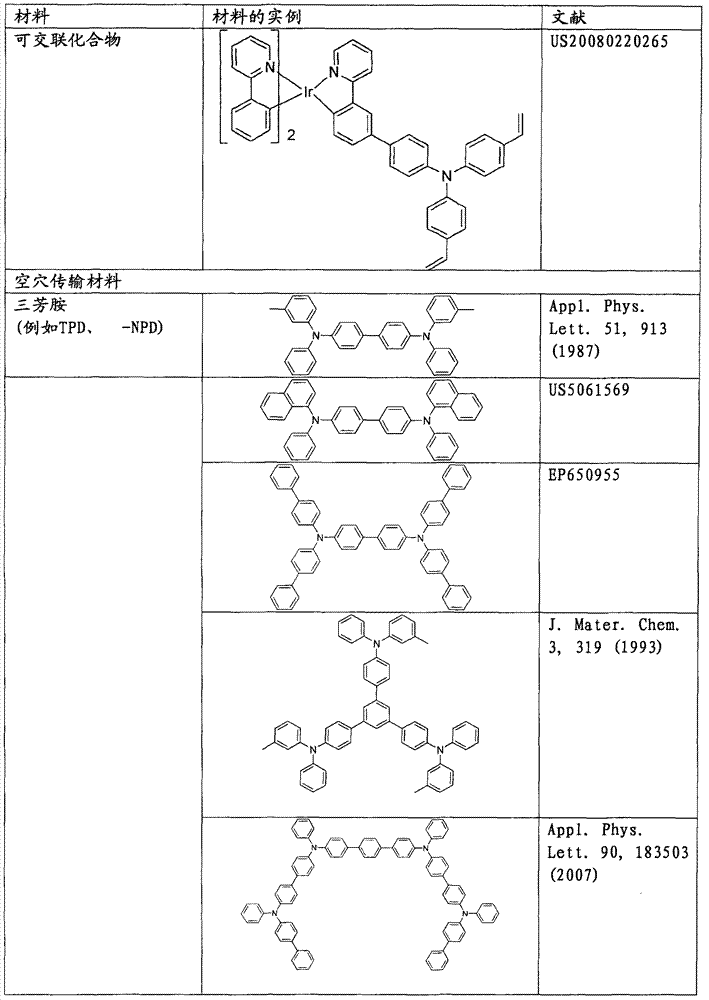

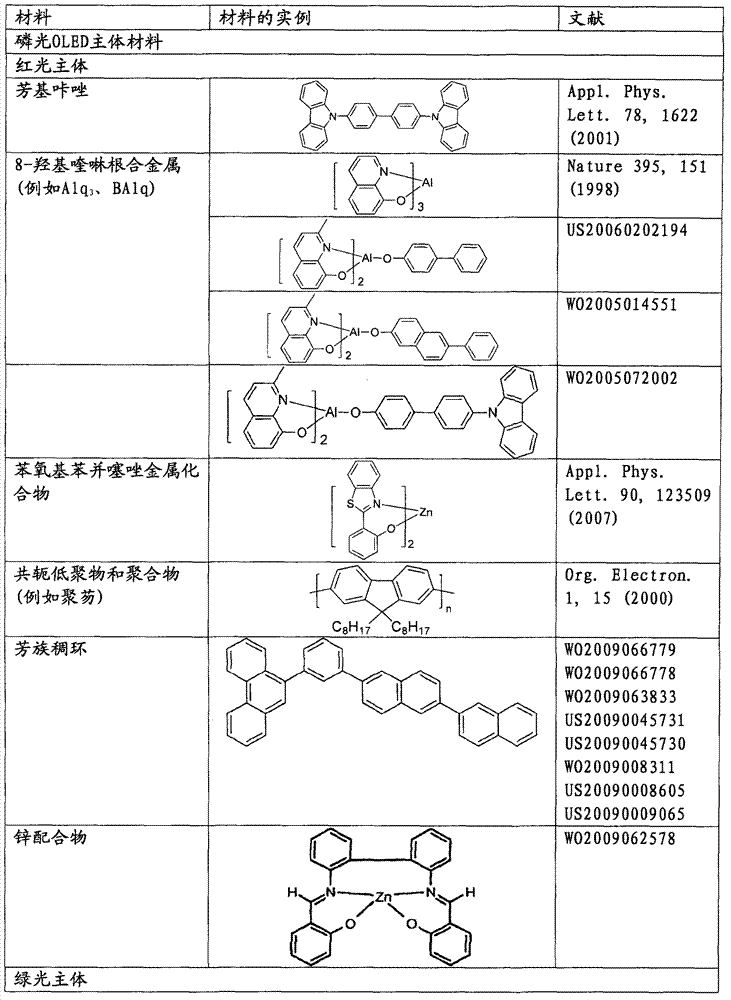


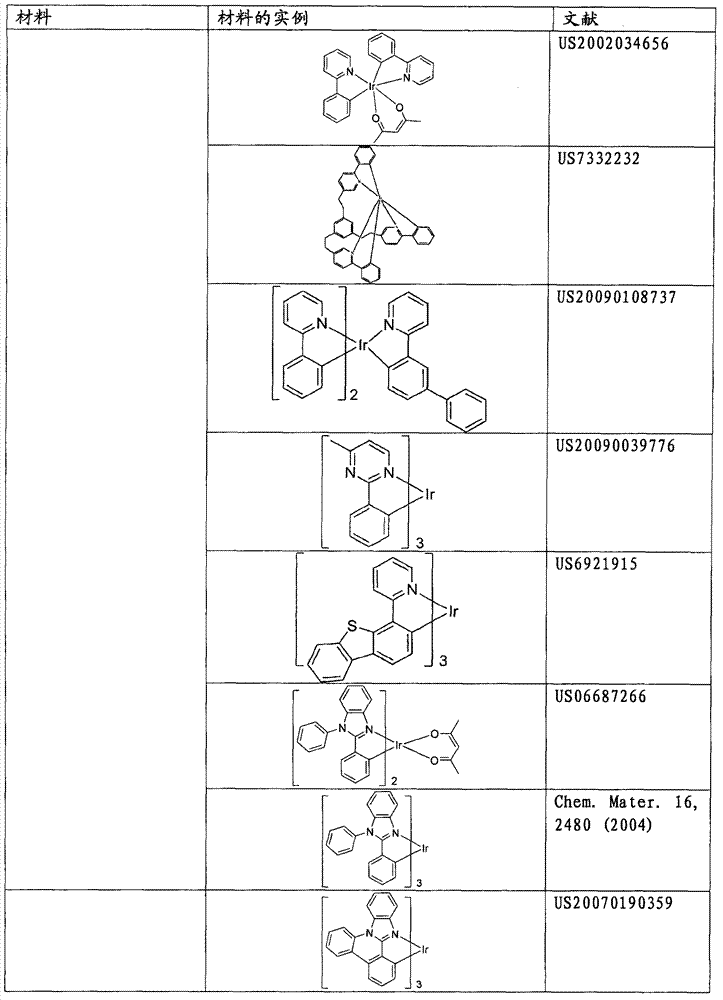
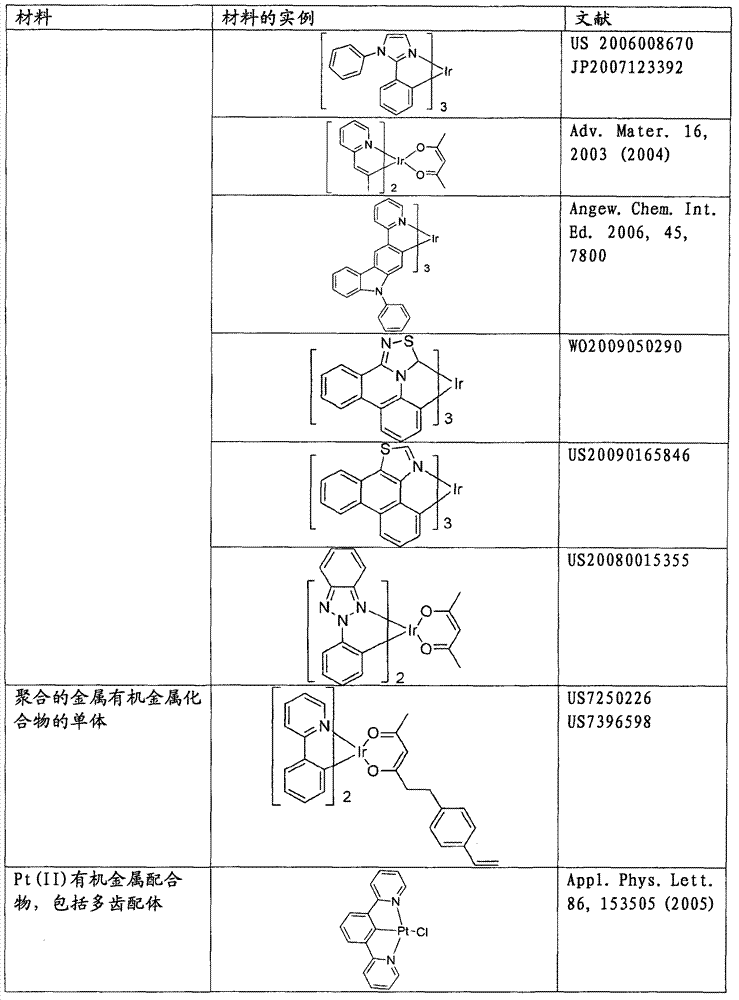
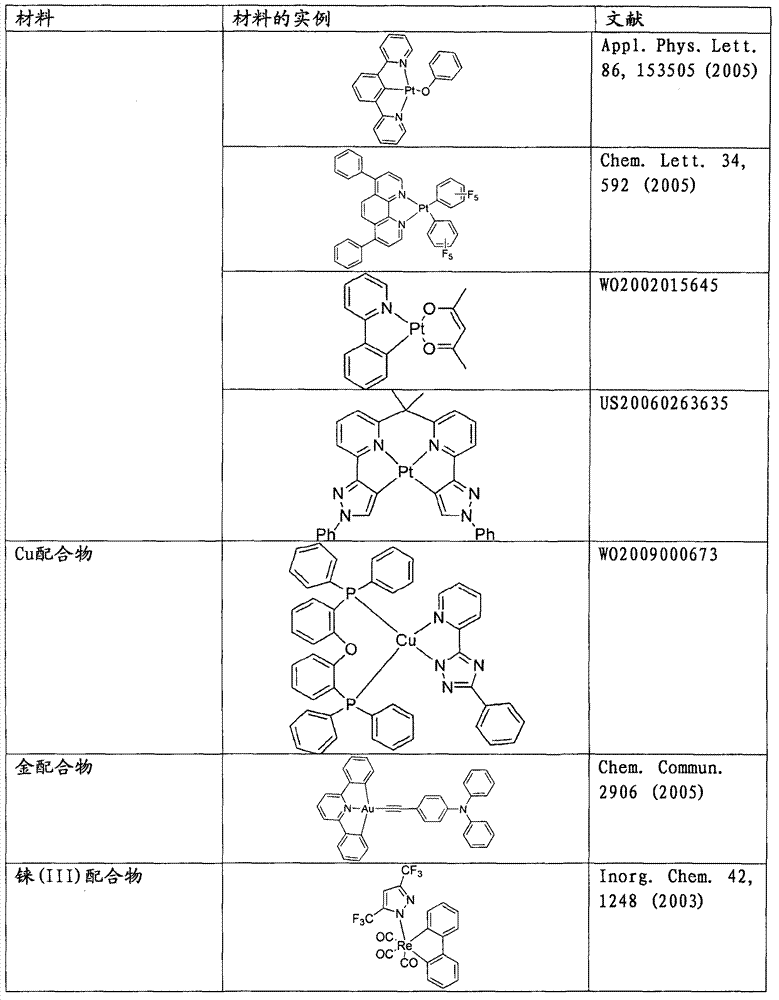


实验experiment
在整个本文中使用的化学缩写如下所示:dba是二亚苄基丙酮,EtOAc是乙酸乙酯,dppf是1,1′-双(二苯基膦基)二茂铁,DCM是二氯甲烷,SPhos是二环己基(2′,6′-二甲氧基-[1,1′-联苯]-3-基)膦,THF是四氢呋喃。The chemical abbreviations used throughout this text are as follows: dba is dibenzylideneacetone, EtOAc is ethyl acetate, dppf is 1,1′-bis(diphenylphosphino)ferrocene, DCM is dichloromethane , SPhos is dicyclohexyl(2',6'-dimethoxy-[1,1'-biphenyl]-3-yl)phosphine, THF is tetrahydrofuran.
化合物1的合成Synthesis of compound 1

向9-(3-溴苯基)-9H-咔唑(5g,15.52mmol)和4-溴二苯并[b,d]噻吩(4.08g,15.52mmol)在100mL THF中的溶液中在-78℃下逐滴加入n-丁基锂的己烷溶液(2.5M,21.34mL,34.1mmol)并搅拌1h。将二苯基二氯硅烷(3.19mL,15.52mmol)溶解于THF(10mL)并逐滴加入至锂化(lithiated)混合物。使混合物升温至室温,过夜,用水和NH4Cl溶液淬灭,用EtOAc萃取,用Na2SO4干燥并过滤。在蒸发掉溶剂后,固体从DCM重结晶,得到白色固体的化合物1(3.4g,36%)。To a solution of 9-(3-bromophenyl)-9H-carbazole (5g, 15.52mmol) and 4-bromodibenzo[b,d]thiophene (4.08g, 15.52mmol) in 100mL THF in- A solution of n-butyllithium in hexane (2.5M, 21.34 mL, 34.1 mmol) was added dropwise at 78°C and stirred for 1 h. Diphenyldichlorosilane (3.19 mL, 15.52 mmol) was dissolved in THF (10 mL) and added dropwise to the lithiated mixture. The mixture was allowed to warm to room temperature overnight, quenched with water and NH4Cl solution, extracted with EtOAc, dried over Na2SO4 and filtered. After evaporation of the solvent, the solid was recrystallized from DCM to afford compound 1 as a white solid (3.4 g, 36%).
化合物2的合成Synthesis of Compound 2
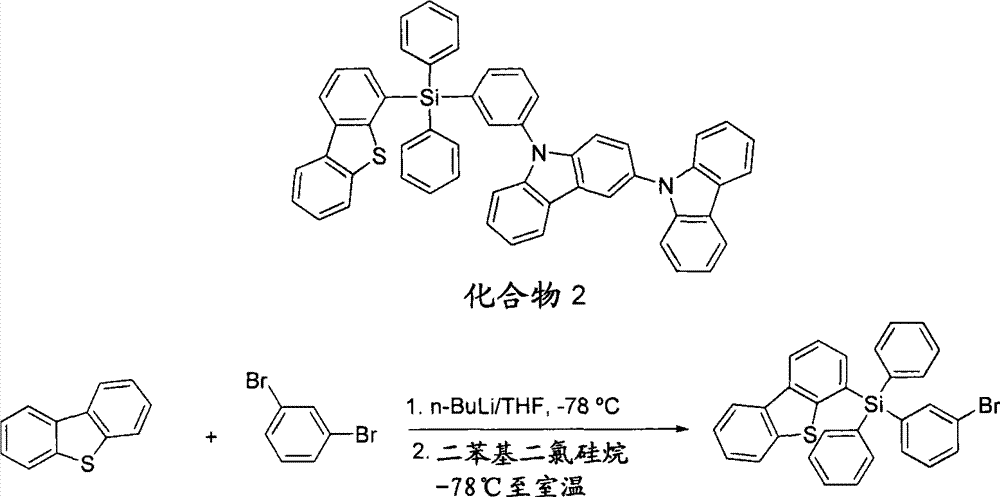
向二苯并[b,d]噻吩(4.80g,26.1mmol)的醚(70mL)溶液中在-78℃下逐滴加入n-丁基锂的己烷溶液(2.5M,9.48mL,23.70mmol),使溶液升温至室温并在油浴中在35℃加热2h,得到二苯并[b,d]噻吩-4-基锂的红色溶液。To a solution of dibenzo[b,d]thiophene (4.80 g, 26.1 mmol) in ether (70 mL) was added dropwise a solution of n-butyllithium in hexane (2.5 M, 9.48 mL, 23.70 mmol ), the solution was allowed to warm to room temperature and heated in an oil bath at 35 °C for 2 h to obtain a red solution of dibenzo[b,d]thiophen-4-yllithium.
在另一个烧瓶中,通过在-78℃下将n-丁基锂的己烷溶液(2.5M,9.48mL,23.70mmol)加入1,3-二溴苯(2.56mL,21.20mmol)的醚溶液(70mL)中然后在此温度下搅拌3.5h而制得m-溴苯基锂的溶液,。将该m-溴苯基锂溶液在-78℃下滴加至二氯二苯基硅烷(4.88mL,23.70mmol)的醚(70mL)溶液中。将得到的反应溶液在此温度下搅拌2h,然后将以上制备的二苯并[b,d]噻吩-4-基锂溶液逐滴加入。使得到的溶液缓慢升温至室温,过夜。将其用水淬灭,用醚萃取,并用Na2SO4干燥。在蒸发掉溶剂后,将残余物用硅胶柱色谱纯化,使用己烷/DCM(9/1,v/v)作为洗脱剂,得到白色粉末状的(3-溴苯基)(二苯并[b,d]噻吩-4-基)二苯基硅烷(3.84g,31%)。In another flask, add 1,3-dibromobenzene (2.56 mL, 21.20 mmol) in ether by adding n-butyllithium in hexane (2.5M, 9.48 mL, 23.70 mmol) at -78 °C (70 mL) and then stirred at this temperature for 3.5 h to obtain a solution of m-bromophenyl lithium. The m-bromophenyllithium solution was added dropwise to a solution of dichlorodiphenylsilane (4.88 mL, 23.70 mmol) in ether (70 mL) at -78°C. The resulting reaction solution was stirred at this temperature for 2 h, then the dibenzo[b,d]thiophen-4-yllithium solution prepared above was added dropwise. The resulting solution was allowed to warm slowly to room temperature overnight. It was quenched with water, extracted with ether, and dried over Na2SO4 . After evaporation of the solvent, the residue was purified by column chromatography on silica gel using hexane/DCM (9/1, v/v) as eluent to give (3-bromophenyl)(dibenzo [b,d]thiophen-4-yl)diphenylsilane (3.84 g, 31%).

将(3-溴苯基)(二苯并[b,d]噻吩-4-基)二苯基硅烷(3.4g,6.52mmo1)、9H-3,9′-二咔唑(2.4g,7.17mmol)、Pd2(dba)3(0.119g,0.130mmol)、SPhos(0.107g,0.261mmol)和叔丁醇钠(1.253g,13.04mmol)在m-二甲苯(50mL)中的混合物在N2环境下在140℃加热过夜。冷却至室温后,使其通过
化合物3的合成Synthesis of Compound 3


向二苯并[b,d]呋喃(4.98g,29.6mmol)的醚(70mL)溶液中在-78℃下滴加n-丁基锂的己烷溶液(2.5M,9.48mL,23.70mmol),并使溶液升温至室温并搅拌20h,得到二苯并[b,d]呋喃-4-基锂溶液。向1,3-二溴苯(2.56mL,21.20mmol)的醚(50mL)溶液中在-78℃下加入n-丁基锂的己烷溶液(2.5M,9.48mL,23.70mmol)。将反应溶液在此温度下搅拌3.5h,然后在-78℃下滴加至二氯二苯基硅烷(4.88mL,23.70mmol)的醚(50.0mL)溶液中。将得到的反应溶液在此温度下搅拌2h,然后将以上制备的二苯并[b,d]呋喃-4-基锂溶液逐滴加入。使反应混合物缓慢升温至室温,过夜,在此时将其用水淬灭,用醚萃取,并用Na2SO4干燥。在过滤并蒸发溶剂后,将残余物用硅胶柱色谱纯化,使用己烷/DCM(9/1,v/v)作为洗脱剂,得到白色粉末状的(3-溴苯基)(二苯并[b,d]呋喃-4-基)二苯基硅烷(6.2g,52%)。To a solution of dibenzo[b,d]furan (4.98g, 29.6mmol) in ether (70mL) was added dropwise a solution of n-butyllithium in hexane (2.5M, 9.48mL, 23.70mmol) at -78°C , and the solution was warmed to room temperature and stirred for 20 h to obtain dibenzo[b,d]furan-4-yllithium solution. To a solution of 1,3-dibromobenzene (2.56 mL, 21.20 mmol) in ether (50 mL) was added n-butyllithium in hexane (2.5M, 9.48 mL, 23.70 mmol) at -78°C. The reaction solution was stirred at this temperature for 3.5 h, then added dropwise to a solution of dichlorodiphenylsilane (4.88 mL, 23.70 mmol) in ether (50.0 mL) at -78 °C. The resulting reaction solution was stirred at this temperature for 2 h, then the dibenzo[b,d]furan-4-yllithium solution prepared above was added dropwise. The reaction mixture was allowed to warm slowly to room temperature overnight, at which time it was quenched with water, extracted with ether, and dried over Na2SO4 . After filtration and evaporation of the solvent, the residue was purified by column chromatography on silica gel using hexane/DCM (9/1, v/v) as eluent to give (3-bromophenyl)(diphenyl ([b,d]furan-4-yl)diphenylsilane (6.2 g, 52%).

将(3-溴苯基)(二苯并[b,d]呋喃-4-基)二苯基硅烷(3g,5.93mmol)、9H-咔唑(0.992g,5.93mmol)、Pd2(dba)3(0.109g,0.119mmol)、SPhos(0.097g,0.237mmol)和叔丁醇钠(1.1g,11.87mmol)在m-二甲苯(50mL)中的悬浮液在140℃下在氮气下回流过夜。冷却至室温后,使其通过
化合物4的合成Synthesis of Compound 4

将(3-溴苯基)(二苯并[b,d]呋喃-4基)二苯基硅烷(2.75g,5.44mmol)、9H-3,9′-二咔唑(1.81g,5.44mmol)、Pd2(dba)3(0.10g,0.10mmol)、SPhos(0.089g,0.22mmol)和叔丁醇钠(1.05g,10.88mmol)在m-二甲苯(50mL)中的悬浮液在140℃下加热过夜。冷却至室温后,使其通过短柱,并用甲苯和DCM洗涤。蒸发合并的溶液,并将残余物用硅胶柱色谱纯化,使用己烷/DCM(8/2,v/v)作为洗脱剂,得到白色粉末状的化合物4(3.5g,85%)。(3-Bromophenyl)(dibenzo[b,d]furan-4yl)diphenylsilane (2.75g, 5.44mmol), 9H-3,9'-dicarbazole (1.81g, 5.44mmol ), Pd 2 (dba) 3 (0.10g, 0.10mmol), SPhos (0.089g, 0.22mmol) and sodium tert-butoxide (1.05g, 10.88mmol) in m-xylene (50mL) at 140 °C overnight. After cooling to room temperature, pass through Short column and wash with toluene and DCM. The combined solution was evaporated and the residue was purified by silica gel column chromatography using hexane/DCM (8/2, v/v) as eluent to give compound 4 (3.5 g, 85%) as a white powder.
化合物5的合成Synthesis of compound 5

将1-(3-溴-9H-咔唑-9-基)乙酮(13.80g,47.9mmol)、4,4,4′,4′,5,5,5′,5′-八甲基-2,2′-二(1,3,2-二氧硼戊烷)(14.59g,57.5mmol)、乙酸钾(9.40g,96mmol)、dppf(0.585g,0.958mmol)和Pd2(dba)3(0.877g,0.958mmol)在二噁烷(300mL)中的混合物溶液在N2下回流过夜。冷却至室温后,将其用水(250mL)稀释并用EtOAc(3x 70mL)萃取。分离有机相并用Na2SO4干燥。蒸发掉溶剂后,将残余物用硅胶柱色谱纯化,使用己烷/EtOAc(9/1,v/v)作为洗脱剂,并从相同溶剂中重结晶,得到1-(3-(4,4,5,5-四甲基-1,3,2-二氧硼戊烷-2-基)-9H-咔唑-9-基)乙酮(10.5g,65%)白色晶体。1-(3-Bromo-9H-carbazol-9-yl)ethanone (13.80g, 47.9mmol), 4,4,4',4',5,5,5',5'-octamethyl -2,2'-bis(1,3,2-dioxaborolane) (14.59g, 57.5mmol), potassium acetate (9.40g, 96mmol), dppf (0.585g, 0.958mmol) and Pd 2 (dba ) 3 (0.877 g, 0.958 mmol) in dioxane (300 mL) was refluxed overnight under N 2 . After cooling to room temperature, it was diluted with water (250 mL) and extracted with EtOAc (3 x 70 mL). The organic phase was separated and dried over Na2SO4 . After evaporation of the solvent, the residue was purified by column chromatography on silica gel using hexane/EtOAc (9/1, v/v) as eluent and recrystallized from the same solvent to give 1-(3-(4, 4,5,5-Tetramethyl-1,3,2-dioxaborolan-2-yl)-9H-carbazol-9-yl)ethanone (10.5 g, 65%) as white crystals.

将1-(3-(4,4,5,5-四甲基-1,3,2-二氧硼戊烷-2-基)-9H-咔唑-9-基)乙酮(10.00g,29.8mmol)、1,3-二溴苯(17.59g,74.6mmol)、Pd(PPh3)4(0.689g,0.597mmol)和K2CO3(12.37g,89mmol)在甲苯(100mL)和水(20mL)中的混合物溶液在N2下回流过夜。冷却至室温后,分离有机相并蒸发溶剂。将残余物用硅胶柱色谱纯化,使用己烷/DCM(1/1,v/v)作为洗脱剂,得到白色固体状的1-(3-(3-溴苯基)-9H-咔唑-9-基)乙酮(2.5g,23%)。1-(3-(4,4,5,5-tetramethyl-1,3,2-dioxaborolan-2-yl)-9H-carbazol-9-yl)ethanone (10.00g , 29.8mmol), 1,3-dibromobenzene (17.59g, 74.6mmol), Pd(PPh 3 ) 4 (0.689g, 0.597mmol) and K 2 CO 3 (12.37g, 89mmol) in toluene (100mL) and A solution of the mixture in water (20 mL) was refluxed overnight under N2 . After cooling to room temperature, the organic phase was separated and the solvent was evaporated. The residue was purified by column chromatography on silica gel using hexane/DCM (1/1, v/v) as eluent to give 1-(3-(3-bromophenyl)-9H-carbazole as a white solid -9-yl)ethanone (2.5 g, 23%).

将1-(3-(3-溴苯基)-9H-咔唑-9-基)乙酮(2.50g,6.86mmol)、9-(3-(4,4,5,5-四甲基-1,3,2-二氧硼戊烷-2-基)苯基)-9H-咔唑(2.53g,6.86mmol)、Pd2(dba)3(0.063g,0.069mmol)、(SPhos)(0.056g,0.137mmol)和K3PO4(4.74g,20.59mmol)在甲苯(180mL)和水(5mL)中的混合物溶液在N2下回流过夜。冷却至室温后,分离有机相。在蒸发溶剂后,将残余物用硅胶柱色谱纯化,使用己烷/DCM(1/1至1/4,v/v)作为洗脱剂,得到白色固体状的1-(3-(3′-(9H-咔唑-9-基)-[1,1′-联苯]-3-基)-9H-咔唑-9-基)乙酮(3.2g,89%)。1-(3-(3-bromophenyl)-9H-carbazol-9-yl)ethanone (2.50g, 6.86mmol), 9-(3-(4,4,5,5-tetramethyl -1,3,2-dioxaborolan-2-yl)phenyl)-9H-carbazole (2.53g, 6.86mmol), Pd2 (dba) 3 (0.063g, 0.069mmol), (SPhos) (0.056 g, 0.137 mmol) and K 3 PO 4 (4.74 g, 20.59 mmol) in toluene (180 mL) and water (5 mL) were refluxed overnight under N 2 . After cooling to room temperature, the organic phase was separated. After evaporation of the solvent, the residue was purified by column chromatography on silica gel using hexane/DCM (1/1 to 1/4, v/v) as eluent to give 1-(3-(3'-(9H-carbazol-9-yl)-[1,1'-biphenyl]-3-yl)-9H-carbazol-9-yl)ethanone (3.2 g, 89%).
将1-(3-(3′-(9H-咔唑-9-基)-[1,1′-联苯]-3-基)-9H-咔唑-9-基)乙酮(3.30g,6.27mmol)和KOH(3.5g,62.7mmol)在THF(50mL)、水(50mL)和乙醇(50mL)中的混合物溶液回流1h。冷却至室温后,将其用水稀释并用EtOAc(4x 50mL)萃取。合并有机级份,用Na2SO4干燥并浓缩,以引起白色固体状的3-(3′-(9H-咔唑-9-基)-[1,1′-联苯]-3-基)-9H-咔唑(2.6g,86%)的沉淀。1-(3-(3'-(9H-carbazol-9-yl)-[1,1'-biphenyl]-3-yl)-9H-carbazol-9-yl)ethanone (3.30g , 6.27 mmol) and KOH (3.5 g, 62.7 mmol) in THF (50 mL), water (50 mL) and ethanol (50 mL) were refluxed for 1 h. After cooling to room temperature, it was diluted with water and extracted with EtOAc (4 x 50 mL). The organic fractions were combined, dried over Na2SO4 and concentrated to give 3-(3'-(9H-carbazol-9-yl)-[1,1'-biphenyl]-3 - yl as a white solid )-9H-carbazole (2.6 g, 86%) precipitated.

将3-(3′-(9H-咔唑-9-基)-[1,1′-联苯]-3-基)-9H-咔唑(2.70g,5.57mmol)、(3-溴苯基)(二苯并[b,d]呋喃-4-基)二苯基硅烷(2.82g,5.57mmol)、叔丁醇钠(1.071g,11.14mmol)、Pd2(dba)3(0.102g,0.111mmol)和SPhos(0.091g,0.223mmol)在二甲苯(150mL)中的混合物溶液在N2下回流18h。冷却至室温后,加入10%NaHSO3水溶液(100mL)并搅拌1h。分离有机相并用Na2SO4干燥。蒸发掉溶剂后,将残余物用硅胶柱色谱纯化,使用己烷/DCM(7/3,v/v)作为洗脱剂,得到白色粉末状的化合物5(3.3g,65%)。3-(3'-(9H-carbazol-9-yl)-[1,1'-biphenyl]-3-yl)-9H-carbazole (2.70g, 5.57mmol), (3-bromobenzene yl)(dibenzo[b,d]furan-4-yl)diphenylsilane (2.82g, 5.57mmol), sodium tert-butoxide (1.071g, 11.14mmol), Pd 2 (dba) 3 (0.102g , 0.111 mmol) and SPhos (0.091 g, 0.223 mmol) in xylene (150 mL) was refluxed under N 2 for 18 h. After cooling to room temperature, 10% aqueous NaHSO 3 (100 mL) was added and stirred for 1 h. The organic phase was separated and dried over Na2SO4 . After evaporation of the solvent, the residue was purified by silica gel column chromatography using hexane/DCM (7/3, v/v) as eluent to give compound 5 (3.3 g, 65%) as a white powder.
化合物6的合成Synthesis of compound 6

将(3-溴苯基)(二苯并[b,d]噻吩-4-基)二苯基硅烷(3.50g,6.71mmol)、9-苯基-3-(4,4,5,5-四甲基-1,3,2-二氧硼戊烷-2-基)-9H-咔唑(2.478g,6.71mmol)、K2CO3(1.9g,13.42mmol)和Pd(PPh3)4(0.155g,0.134mmol)在甲苯(150mL)和水(50mL)中的混合物溶液在N2下回流过夜。冷却至室温后,分离有机相。蒸发溶剂后,将残余物用硅胶柱色谱纯化,使用己烷/DCM(4/1,v/v)作为洗脱剂,得到白色固体状的化合物6(3.3g,72%)。(3-Bromophenyl)(dibenzo[b,d]thiophen-4-yl)diphenylsilane (3.50g, 6.71mmol), 9-phenyl-3-(4,4,5,5 -Tetramethyl-1,3,2-dioxaborolan-2-yl)-9H-carbazole (2.478g, 6.71mmol), K 2 CO 3 (1.9g, 13.42mmol) and Pd(PPh 3 ) 4 (0.155 g, 0.134 mmol) in toluene (150 mL) and water (50 mL) was refluxed overnight under N 2 . After cooling to room temperature, the organic phase was separated. After evaporation of the solvent, the residue was purified by column chromatography on silica gel using hexane/DCM (4/1, v/v) as eluent to give compound 6 (3.3 g, 72%) as a white solid.
化合物7的合成Synthesis of compound 7

将(3-溴苯基)(二苯并[b,d]呋喃-4-基)二苯基硅烷(3.5g,6.92mmol)、9-苯基-3-(4,4,5,5-四甲基-1,3,2-二氧硼戊烷-2-基)-9H-咔唑(2.56g,6.92mmol)、Pd2(dba)3(0.127g,0.138mmol)、SPhos(0.114g,0.277mmol)和K2CO3(2.87g,20.77mmol)在甲苯(30mL)和水(10mL)中的混合物在100℃加热过夜。冷却至室温后,分离有机相。蒸发溶剂后,将残余物用硅胶柱色谱纯化,使用己烷/DCM(9/1,v/v)作为洗脱剂,得到白色固体状的化合物7(3.3g,72%)。(3-Bromophenyl)(dibenzo[b,d]furan-4-yl)diphenylsilane (3.5g, 6.92mmol), 9-phenyl-3-(4,4,5,5 -Tetramethyl-1,3,2-dioxaborolan-2-yl)-9H-carbazole (2.56g, 6.92mmol), Pd 2 (dba) 3 (0.127g, 0.138mmol), SPhos ( A mixture of 0.114 g, 0.277 mmol) and K2CO3 (2.87 g, 20.77 mmol) in toluene (30 mL) and water (10 mL) was heated at 100 ° C overnight. After cooling to room temperature, the organic phase was separated. After evaporation of the solvent, the residue was purified by silica gel column chromatography using hexane/DCM (9/1, v/v) as eluent to give compound 7 (3.3 g, 72%) as a white solid.
化合物10的合成Synthesis of Compound 10

将3-溴-9-苯基-9H-咔唑(27.5g,72.5mmol),4,4,4′,4′,5,5,5′,5′-八甲基-2,2′-二(1,3,2-二氧硼戊烷)(36.8g,145mmol)、Pd2(dba)3(0.664g,0.725mmol)、SPhos(1.191g,2.90mmol)和乙酸钾(17.80g,181mmol)在二噁烷(350mL)中的混合物溶液在110℃加热,直到薄层色谱提示完全转化。冷却至室温后,使反应混合物通过
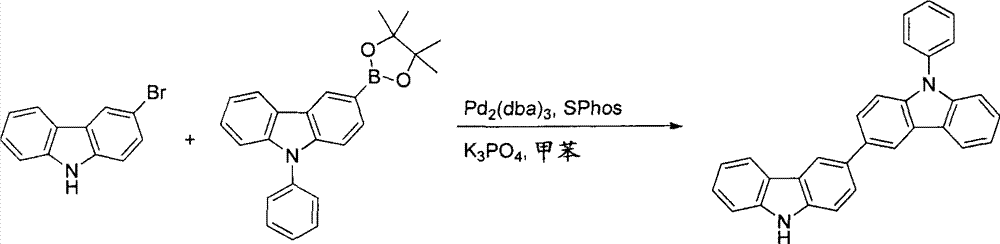
将3-溴-9H-咔唑(6.75g,27.4mmol)、9-苯基-3-(4,4,5,5-四甲基-1,3,2-二氧硼戊烷-2-基)-9H-咔唑(12.15g,32.9mmol)、Pd2(dba)3(0.251g,0.274mmol)、SPhos(0.450g,1.097mmol)和K3PO4(25.3g,110mmol)在甲苯(500mL)和水(50mL)中的混合物溶液在氮气下回流10h。冷却至室温后,将反应混合物用二氯甲烷萃取,并用盐水洗涤。将合并的有机溶液用Na2SO4干燥,过滤,并蒸发溶剂以得到粗产物,将粗产物用DCM/己烷(1/1,v/v,1200mL)重结晶以得到黄色固体状的9H,9′H-3,3′-二咔唑(6.66g,59%)。3-Bromo-9H-carbazole (6.75g, 27.4mmol), 9-phenyl-3-(4,4,5,5-tetramethyl-1,3,2-dioxaborolane-2 -yl)-9H-carbazole (12.15g, 32.9mmol), Pd 2 (dba) 3 (0.251g, 0.274mmol), SPhos (0.450g, 1.097mmol) and K 3 PO 4 (25.3g, 110mmol) in A solution of the mixture in toluene (500 mL) and water (50 mL) was refluxed for 10 h under nitrogen. After cooling to room temperature, the reaction mixture was extracted with dichloromethane and washed with brine. The combined organic solutions were dried over Na2SO4 , filtered, and the solvent was evaporated to give the crude product, which was recrystallized from DCM/hexane (1/1, v/v, 1200 mL) to give 9H as a yellow solid , 9'H-3,3'-dicarbazole (6.66 g, 59%).

将(3-溴苯基)(二苯并[b,d]噻吩-4-基)二苯基硅烷(2.75g,5.27mmol)、9-苯基-9H,9′H-3,3′-二咔唑(2.154g,5.27mmol)、Pd2(dba)3(0.097g,0.105mmol)、SPhos (0.087g,0.211mmol)和叔丁醇钠(1.013g,10.55mmol)在m-二甲苯(50ml)中的混合物溶液在氮气下回流过夜。冷却至室温后,将其通过
化合物11的合成Synthesis of Compound 11

将(3-溴苯基)(二苯并[b,d]呋喃-4-基)二苯基硅烷(2.75g,5.44mmol)、9-苯基-9H,9′H-3,3′-二咔唑(2.222g,5.44mmol)、Pd2(dba)3(0.100g,0.109mmol)、SPhos(0.089g,0.218mmol)和叔丁醇钠(1.046g,10.88mmol)在m-二甲苯(50mL)中的混合物在氮气下回流过夜。冷却至室温后,将其通过
比较实施例comparative example
比较化合物CC-1的合成Synthesis of comparative compound CC-1
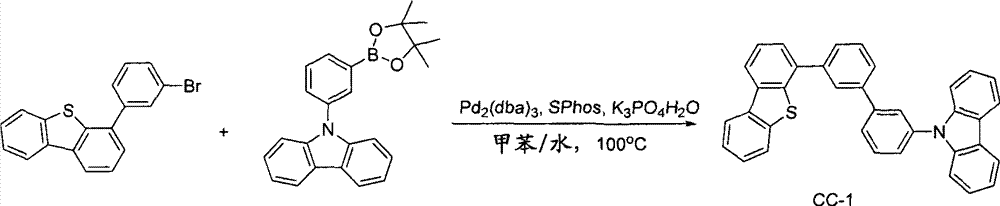
将4-(3-溴苯基)二苯并[b,d]噻吩(7.15g,21.08mmol)、9-(3-(4,4,5,5-四甲基-1,3,2-二氧硼戊烷-2-基)苯基)-9H-咔唑(7.78g,21.08mmol)、SPhos(0.173g,0.422mmol)、Pd2(dba)3(0.192g,0.211mmol)和一水合磷酸钾(9.71g,42.2mmol)在甲苯(200mL)和水(10mL)中的溶液在氮气下回流过夜。冷却至室温后,将有机相分离并蒸发至干燥。将残余物用硅胶柱色谱纯化,使用己烷/DCM(9/1至1/1,v/v)作为洗脱剂,用庚烷重结晶,并在真空下升华,得到白色晶体状的CC-1(6.4g,61%)。4-(3-bromophenyl)dibenzo[b,d]thiophene (7.15g, 21.08mmol), 9-(3-(4,4,5,5-tetramethyl-1,3,2 -dioxaborolan-2-yl)phenyl)-9H-carbazole (7.78g, 21.08mmol), SPhos (0.173g, 0.422mmol), Pd2 (dba) 3 (0.192g, 0.211mmol) and A solution of potassium phosphate monohydrate (9.71 g, 42.2 mmol) in toluene (200 mL) and water (10 mL) was refluxed overnight under nitrogen. After cooling to room temperature, the organic phase was separated and evaporated to dryness. The residue was purified by column chromatography on silica gel using hexane/DCM (9/1 to 1/1, v/v) as eluent, recrystallized from heptane, and sublimed under vacuum to give CC as white crystals -1 (6.4 g, 61%).
比较化合物CC-2的合成Synthesis of comparative compound CC-2

将二苯并[b,d]噻吩(10g,54,3mmol)溶解于THF(500mL),并将溶液冷却至-78℃。然后滴加n-丁基锂(40.7mL,65.1mmol,1.6M于己烷中)。然后使混合物升温至室温并搅拌5h,然后重新冷却至-78℃。在另一个烧瓶中,将二氯二苯基硅烷(4.5mL,21.7mmol)溶解于10mL的THF中,并滴加至反应混合物中,然后使反应混合物升温至室温,过夜。将反应混合物用EtOH(10mL)淬灭,并在减压下除去所有溶剂。向得到的残余物中加入DCM(200mL)和水(200mL),并分层。将水层用DCM再洗涤两遍以上,并将合并的有机相用水和盐水洗涤。减压下除去溶剂得到14.7g的灰白色固体。将粗产物进行硅胶色谱分离,用己烷/EtOAc(95/5至90/10,v/v)作为洗脱剂,得到白色固体状的比较化合物CC-2(5.4g,45%)。Dibenzo[b,d]thiophene (10 g, 54, 3 mmol) was dissolved in THF (500 mL), and the solution was cooled to -78°C. Then n-butyllithium (40.7 mL, 65.1 mmol, 1.6M in hexanes) was added dropwise. The mixture was then allowed to warm to room temperature and stirred for 5 h before recooling to -78 °C. In another flask, dichlorodiphenylsilane (4.5 mL, 21.7 mmol) was dissolved in 10 mL of THF and added dropwise to the reaction mixture, which was then allowed to warm to room temperature overnight. The reaction mixture was quenched with EtOH (10 mL), and all solvents were removed under reduced pressure. To the obtained residue were added DCM (200 mL) and water (200 mL), and the layers were separated. The aqueous layer was washed two more times with DCM, and the combined organic phases were washed with water and brine. The solvent was removed under reduced pressure to give 14.7 g of an off-white solid. The crude product was chromatographed on silica gel using hexane/EtOAc (95/5 to 90/10, v/v) as eluent to afford comparative compound CC-2 (5.4 g, 45%) as a white solid.
比较化合物CC-3的合成Synthesis of comparative compound CC-3

向9-(3-溴苯基)-9H-咔唑(5g,15.52mmol)的THF(50mL)溶液中在-78℃下滴加n-丁基锂(9.7mL,15.5mmol,1.6M于己烷中),并将混合物在-78℃下搅拌2h。在另一个烧瓶中,将二氯二苯基硅烷(1.5mL,7.1mmol)溶解于10mL的THF并滴加至反应混合物中,然后使反应混合物升温至室温,过夜。加入EtOAc(50mL)和水(50mL),并分层。将水层用EtOAc洗涤两遍以上,并将合并的有机相用水和盐水洗涤。蒸发掉溶剂后,将残余物通过硅胶柱色谱纯化,用己烷/DCM(7/3,v/v)作为洗脱剂,用己烷重结晶并在真空下(<10-5Torr)升华,得到白色晶体状的CC-3(1.7g,33%)。To a solution of 9-(3-bromophenyl)-9H-carbazole (5 g, 15.52 mmol) in THF (50 mL) was added dropwise n-butyllithium (9.7 mL, 15.5 mmol, 1.6 M in hexane), and the mixture was stirred at -78 °C for 2 h. In another flask, dichlorodiphenylsilane (1.5 mL, 7.1 mmol) was dissolved in 10 mL of THF and added dropwise to the reaction mixture, which was then allowed to warm to room temperature overnight. EtOAc (50 mL) and water (50 mL) were added and the layers were separated. The aqueous layer was washed two more times with EtOAc, and the combined organic phases were washed with water and brine. After evaporation of the solvent, the residue was purified by column chromatography on silica gel using hexane/DCM (7/3, v/v) as eluent, recrystallized from hexane and sublimed under vacuum (<10 −5 Torr) , to obtain CC-3 (1.7 g, 33%) as white crystals.
应当理解,本文中所述的多种实施方案仅仅作为示例,不用于限制本发明的范围。例如,在不偏离本发明的精神的情况下,本文中所述的很多材料和结构可以用其它材料和结构替代。因此,要求保护的本发明可以包括对于本领域技术人员而言显而易见的本文中所述具体实施例和优选实施方案的变化形式。应当理解,关于为什么本发明能够成立的多种理论是非限制性的。It should be understood that the various embodiments described herein are by way of example only, and are not intended to limit the scope of the invention. For example, many of the materials and structures described herein may be substituted with other materials and structures without departing from the spirit of the invention. Accordingly, the invention as claimed may include variations from the specific examples and preferred embodiments described herein that are obvious to those skilled in the art. It should be understood that the various theories as to why the invention works are non-limiting.
Claims (18)
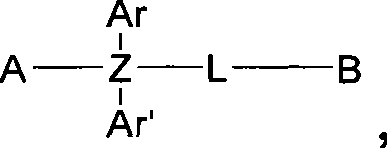
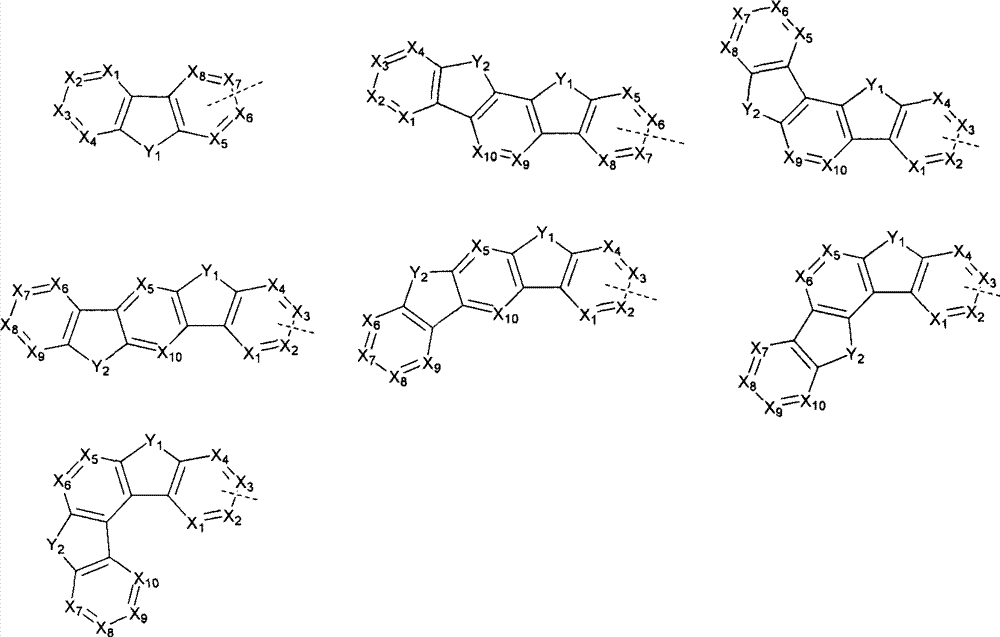


Applications Claiming Priority (2)
| Application Number | Priority Date | Filing Date | Title |
|---|---|---|---|
| US13/193,173 | 2011-07-28 | ||
| US13/193,173 US8409729B2 (en) | 2011-07-28 | 2011-07-28 | Host materials for phosphorescent OLEDs |
Publications (2)
| Publication Number | Publication Date |
|---|---|
| CN103122007A true CN103122007A (en) | 2013-05-29 |
| CN103122007B CN103122007B (en) | 2017-04-12 |
Family
ID=46642370
Family Applications (1)
| Application Number | Title | Priority Date | Filing Date |
|---|---|---|---|
| CN201210543903.5A Active CN103122007B (en) | 2011-07-28 | 2012-07-27 | Host materials for phosphorescent oleds |
Country Status (6)
| Country | Link |
|---|---|
| US (1) | US8409729B2 (en) |
| EP (2) | EP3401974B1 (en) |
| JP (3) | JP2013028605A (en) |
| KR (1) | KR101919621B1 (en) |
| CN (1) | CN103122007B (en) |
| TW (1) | TWI555822B (en) |
Cited By (4)
| Publication number | Priority date | Publication date | Assignee | Title |
|---|---|---|---|---|
| CN108424420A (en) * | 2017-09-30 | 2018-08-21 | 北京绿人科技有限责任公司 | Triaizine compounds containing silicon atom and its application and a kind of organic electroluminescence device |
| CN109111487A (en) * | 2017-06-23 | 2019-01-01 | 环球展览公司 | Organic Electroluminescent Materials and Devices |
| CN112480125A (en) * | 2014-04-02 | 2021-03-12 | 环球展览公司 | Organic electroluminescent material and device |
| CN114426559A (en) * | 2020-10-29 | 2022-05-03 | 三星显示有限公司 | Heterocyclic compound, light-emitting device including the same, and electronic device |
Families Citing this family (120)
| Publication number | Priority date | Publication date | Assignee | Title |
|---|---|---|---|---|
| US8409729B2 (en) * | 2011-07-28 | 2013-04-02 | Universal Display Corporation | Host materials for phosphorescent OLEDs |
| WO2013146117A1 (en) * | 2012-03-26 | 2013-10-03 | 東レ株式会社 | Material for luminescent element, and luminescent element |
| US10135002B2 (en) | 2013-03-29 | 2018-11-20 | Konica Minolta, Inc. | Organic electroluminescent element, and lighting device and display device which are provided with same |
| JP6506272B2 (en) | 2013-07-02 | 2019-04-24 | ユー・ディー・シー アイルランド リミテッド | Monosubstituted diazabenzimidazole carbene metal complexes for use in organic light emitting diodes |
| JP6486353B2 (en) | 2013-07-31 | 2019-03-20 | ユー・ディー・シー アイルランド リミテッド | Luminescent diazabenzimidazole carbene metal complex |
| JP6580571B2 (en) | 2013-09-11 | 2019-09-25 | メルク パテント ゲーエムベーハー | Electronic element |
| EP3063153B1 (en) | 2013-10-31 | 2018-03-07 | Idemitsu Kosan Co., Ltd. | Azadibenzothiophenes for electronic applications |
| WO2015091716A1 (en) | 2013-12-20 | 2015-06-25 | Basf Se | Highly efficient oled devices with very short decay times |
| CN106661068A (en) | 2014-03-31 | 2017-05-10 | Udc 爱尔兰有限责任公司 | Metal complexes comprising carbene ligands with o-substituted acyclometallated aryl groups and their use in organic light-emitting diodes |
| US10636983B2 (en) | 2014-05-08 | 2020-04-28 | Universal Display Corporation | Organic electroluminescent materials and devices |
| EP2993215B1 (en) | 2014-09-04 | 2019-06-19 | Idemitsu Kosan Co., Ltd. | Azabenzimidazo[2,1-a]benzimidazoles for electronic applications |
| JP6655870B2 (en) | 2014-10-22 | 2020-03-04 | 三星ディスプレイ株式會社Samsung Display Co.,Ltd. | Organic electroluminescent element material and organic electroluminescent element using the same |
| WO2016079667A1 (en) | 2014-11-17 | 2016-05-26 | Idemitsu Kosan Co., Ltd. | Indole derivatives for electronic applications |
| US9761814B2 (en) | 2014-11-18 | 2017-09-12 | Universal Display Corporation | Organic light-emitting materials and devices |
| KR102503311B1 (en) * | 2014-12-10 | 2023-02-28 | 롬엔드하스전자재료코리아유한회사 | Organic Electroluminescent Compound and Organic Electroluminescent Device Comprising the Same |
| EP3034506A1 (en) | 2014-12-15 | 2016-06-22 | Idemitsu Kosan Co., Ltd | 4-functionalized carbazole derivatives for electronic applications |
| EP3034507A1 (en) | 2014-12-15 | 2016-06-22 | Idemitsu Kosan Co., Ltd | 1-functionalized dibenzofurans and dibenzothiophenes for organic light emitting diodes (OLEDs) |
| EP3248230B1 (en) * | 2015-01-20 | 2020-05-06 | cynora GmbH | Use of organic molecules in optoelectronic components |
| EP3053918B1 (en) | 2015-02-06 | 2018-04-11 | Idemitsu Kosan Co., Ltd. | 2-carbazole substituted benzimidazoles for electronic applications |
| EP3054498B1 (en) | 2015-02-06 | 2017-09-20 | Idemitsu Kosan Co., Ltd. | Bisimidazodiazocines |
| EP3061759B1 (en) | 2015-02-24 | 2019-12-25 | Idemitsu Kosan Co., Ltd | Nitrile substituted dibenzofurans |
| EP3070144B1 (en) | 2015-03-17 | 2018-02-28 | Idemitsu Kosan Co., Ltd. | Seven-membered ring compounds |
| EP3072943B1 (en) | 2015-03-26 | 2018-05-02 | Idemitsu Kosan Co., Ltd. | Dibenzofuran/carbazole-substituted benzonitriles |
| EP3075737B1 (en) | 2015-03-31 | 2019-12-04 | Idemitsu Kosan Co., Ltd | Benzimidazolo[1,2-a]benzimidazole carrying aryl- or heteroarylnitril groups for organic light emitting diodes |
| US20160293854A1 (en) | 2015-04-06 | 2016-10-06 | Universal Display Corporation | Organic Electroluminescent Materials and Devices |
| US11818949B2 (en) | 2015-04-06 | 2023-11-14 | Universal Display Corporation | Organic electroluminescent materials and devices |
| US11495749B2 (en) | 2015-04-06 | 2022-11-08 | Universal Display Corporation | Organic electroluminescent materials and devices |
| EP4060757A1 (en) | 2015-06-03 | 2022-09-21 | UDC Ireland Limited | Highly efficient oled devices with very short decay times |
| US10825997B2 (en) | 2015-06-25 | 2020-11-03 | Universal Display Corporation | Organic electroluminescent materials and devices |
| US10998507B2 (en) | 2015-11-23 | 2021-05-04 | Universal Display Corporation | Organic electroluminescent materials and devices |
| KR101971485B1 (en) * | 2015-12-14 | 2019-04-24 | 중앙대학교 산학협력단 | Dendrimer composition having germanium core, organic optoelectronic device including the same |
| US12317745B2 (en) | 2016-11-09 | 2025-05-27 | Universal Display Corporation | Organic electroluminescent materials and devices |
| US10680188B2 (en) | 2016-11-11 | 2020-06-09 | Universal Display Corporation | Organic electroluminescent materials and devices |
| US10662196B2 (en) | 2016-11-17 | 2020-05-26 | Universal Display Corporation | Organic electroluminescent materials and devices |
| US20180190915A1 (en) | 2017-01-03 | 2018-07-05 | Universal Display Corporation | Organic electroluminescent materials and devices |
| US10964904B2 (en) | 2017-01-20 | 2021-03-30 | Universal Display Corporation | Organic electroluminescent materials and devices |
| US12089486B2 (en) | 2017-02-08 | 2024-09-10 | Universal Display Corporation | Organic electroluminescent materials and devices |
| US10978647B2 (en) | 2017-02-15 | 2021-04-13 | Universal Display Corporation | Organic electroluminescent materials and devices |
| US10741780B2 (en) | 2017-03-10 | 2020-08-11 | Universal Display Corporation | Organic electroluminescent materials and devices |
| US10873037B2 (en) | 2017-03-28 | 2020-12-22 | Universal Display Corporation | Organic electroluminescent materials and devices |
| US10910577B2 (en) | 2017-03-28 | 2021-02-02 | Universal Display Corporation | Organic electroluminescent materials and devices |
| US11158820B2 (en) | 2017-03-29 | 2021-10-26 | Universal Display Corporation | Organic electroluminescent materials and devices |
| US10862046B2 (en) | 2017-03-30 | 2020-12-08 | Universal Display Corporation | Organic electroluminescent materials and devices |
| US11139443B2 (en) | 2017-03-31 | 2021-10-05 | Universal Display Corporation | Organic electroluminescent materials and devices |
| US10777754B2 (en) | 2017-04-11 | 2020-09-15 | Universal Display Corporation | Organic electroluminescent materials and devices |
| US11084838B2 (en) | 2017-04-21 | 2021-08-10 | Universal Display Corporation | Organic electroluminescent materials and device |
| US10975113B2 (en) | 2017-04-21 | 2021-04-13 | Universal Display Corporation | Organic electroluminescent materials and devices |
| US10910570B2 (en) | 2017-04-28 | 2021-02-02 | Universal Display Corporation | Organic electroluminescent materials and devices |
| US11038137B2 (en) | 2017-04-28 | 2021-06-15 | Universal Display Corporation | Organic electroluminescent materials and devices |
| US10941170B2 (en) | 2017-05-03 | 2021-03-09 | Universal Display Corporation | Organic electroluminescent materials and devices |
| US11201299B2 (en) | 2017-05-04 | 2021-12-14 | Universal Display Corporation | Organic electroluminescent materials and devices |
| US10930864B2 (en) | 2017-05-10 | 2021-02-23 | Universal Display Corporation | Organic electroluminescent materials and devices |
| US10822362B2 (en) | 2017-05-11 | 2020-11-03 | Universal Display Corporation | Organic electroluminescent materials and devices |
| US10944060B2 (en) | 2017-05-11 | 2021-03-09 | Universal Display Corporation | Organic electroluminescent materials and devices |
| US10944062B2 (en) | 2017-05-18 | 2021-03-09 | Universal Display Corporation | Organic electroluminescent materials and devices |
| US10934293B2 (en) | 2017-05-18 | 2021-03-02 | Universal Display Corporation | Organic electroluminescent materials and devices |
| US10790455B2 (en) | 2017-05-18 | 2020-09-29 | Universal Display Corporation | Organic electroluminescent materials and devices |
| US10930862B2 (en) | 2017-06-01 | 2021-02-23 | Universal Display Corporation | Organic electroluminescent materials and devices |
| JP6468314B2 (en) * | 2017-06-15 | 2019-02-13 | コニカミノルタ株式会社 | Organic electroluminescence element, lighting device and display device |
| US11725022B2 (en) * | 2017-06-23 | 2023-08-15 | Universal Display Corporation | Organic electroluminescent materials and devices |
| US12098157B2 (en) | 2017-06-23 | 2024-09-24 | Universal Display Corporation | Organic electroluminescent materials and devices |
| US20210284672A1 (en) * | 2017-06-23 | 2021-09-16 | Universal Display Corporation | Organic electroluminescent materials and devices |
| US11608321B2 (en) | 2017-06-23 | 2023-03-21 | Universal Display Corporation | Organic electroluminescent materials and devices |
| US11832510B2 (en) | 2017-06-23 | 2023-11-28 | Universal Display Corporation | Organic electroluminescent materials and devices |
| US11802136B2 (en) * | 2017-06-23 | 2023-10-31 | Universal Display Corporation | Organic electroluminescent materials and devices |
| US11495757B2 (en) | 2017-06-23 | 2022-11-08 | Universal Display Corporation | Organic electroluminescent materials and devices |
| US11678565B2 (en) | 2017-06-23 | 2023-06-13 | Universal Display Corporation | Organic electroluminescent materials and devices |
| US11174259B2 (en) | 2017-06-23 | 2021-11-16 | Universal Display Corporation | Organic electroluminescent materials and devices |
| US11814403B2 (en) * | 2017-06-23 | 2023-11-14 | Universal Display Corporation | Organic electroluminescent materials and devices |
| US10968226B2 (en) | 2017-06-23 | 2021-04-06 | Universal Display Corporation | Organic electroluminescent materials and devices |
| US11917843B2 (en) | 2017-07-26 | 2024-02-27 | Universal Display Corporation | Organic electroluminescent materials and devices |
| US11968883B2 (en) | 2017-07-26 | 2024-04-23 | Universal Display Corporation | Organic electroluminescent materials and devices |
| US11322691B2 (en) | 2017-07-26 | 2022-05-03 | Universal Display Corporation | Organic electroluminescent materials and devices |
| US11508913B2 (en) | 2017-08-10 | 2022-11-22 | Universal Display Corporation | Organic electroluminescent materials and devices |
| US11910699B2 (en) | 2017-08-10 | 2024-02-20 | Universal Display Corporation | Organic electroluminescent materials and devices |
| US11349083B2 (en) | 2017-08-10 | 2022-05-31 | Universal Display Corporation | Organic electroluminescent materials and devices |
| US11437591B2 (en) | 2017-08-24 | 2022-09-06 | Universal Display Corporation | Organic electroluminescent materials and devices |
| CN109427987B (en) * | 2017-09-05 | 2023-04-07 | 三星电子株式会社 | Organic light emitting device |
| US11444249B2 (en) | 2017-09-07 | 2022-09-13 | Universal Display Corporation | Organic electroluminescent materials and devices |
| US12389791B2 (en) | 2017-09-21 | 2025-08-12 | Universal Display Corporation | Organic electroluminescent materials and devices |
| US11183646B2 (en) | 2017-11-07 | 2021-11-23 | Universal Display Corporation | Organic electroluminescent materials and devices |
| US11168103B2 (en) | 2017-11-17 | 2021-11-09 | Universal Display Corporation | Organic electroluminescent materials and devices |
| US11233205B2 (en) | 2017-12-14 | 2022-01-25 | Universal Display Corporation | Organic electroluminescent materials and devices |
| US11233204B2 (en) | 2017-12-14 | 2022-01-25 | Universal Display Corporation | Organic electroluminescent materials and devices |
| US10971687B2 (en) | 2017-12-14 | 2021-04-06 | Universal Display Corporation | Organic electroluminescent materials and devices |
| US12075690B2 (en) | 2017-12-14 | 2024-08-27 | Universal Display Corporation | Organic electroluminescent materials and devices |
| US11271177B2 (en) | 2018-01-11 | 2022-03-08 | Universal Display Corporation | Organic electroluminescent materials and devices |
| US11367840B2 (en) | 2018-01-26 | 2022-06-21 | Universal Display Corporation | Organic electroluminescent materials and devices |
| US12029055B2 (en) | 2018-01-30 | 2024-07-02 | The University Of Southern California | OLED with hybrid emissive layer |
| US11957050B2 (en) * | 2018-02-09 | 2024-04-09 | Universal Display Corporation | Organic electroluminescent materials and devices |
| US11557733B2 (en) | 2018-03-12 | 2023-01-17 | Universal Display Corporation | Organic electroluminescent materials and devices |
| US11882759B2 (en) | 2018-04-13 | 2024-01-23 | Universal Display Corporation | Organic electroluminescent materials and devices |
| US11616203B2 (en) | 2018-04-17 | 2023-03-28 | Universal Display Corporation | Organic electroluminescent materials and devices |
| US11339182B2 (en) | 2018-06-07 | 2022-05-24 | Universal Display Corporation | Organic electroluminescent materials and devices |
| US11228004B2 (en) | 2018-06-22 | 2022-01-18 | Universal Display Corporation | Organic electroluminescent materials and devices |
| US12171137B2 (en) | 2018-09-10 | 2024-12-17 | Universal Display Corporation | Organic electroluminescent materials and devices |
| US11469383B2 (en) | 2018-10-08 | 2022-10-11 | Universal Display Corporation | Organic electroluminescent materials and devices |
| US11495752B2 (en) | 2018-10-08 | 2022-11-08 | Universal Display Corporation | Organic electroluminescent materials and devices |
| US11963441B2 (en) | 2018-11-26 | 2024-04-16 | Universal Display Corporation | Organic electroluminescent materials and devices |
| US11515489B2 (en) | 2018-11-28 | 2022-11-29 | Universal Display Corporation | Host materials for electroluminescent devices |
| US11834459B2 (en) | 2018-12-12 | 2023-12-05 | Universal Display Corporation | Host materials for electroluminescent devices |
| US11812624B2 (en) | 2019-01-30 | 2023-11-07 | The University Of Southern California | Organic electroluminescent materials and devices |
| US11780829B2 (en) | 2019-01-30 | 2023-10-10 | The University Of Southern California | Organic electroluminescent materials and devices |
| US11370809B2 (en) | 2019-02-08 | 2022-06-28 | Universal Display Corporation | Organic electroluminescent materials and devices |
| US12137605B2 (en) | 2019-02-08 | 2024-11-05 | Universal Display Corporation | Organic electroluminescent materials and devices |
| US11325932B2 (en) | 2019-02-08 | 2022-05-10 | Universal Display Corporation | Organic electroluminescent materials and devices |
| US11773320B2 (en) | 2019-02-21 | 2023-10-03 | Universal Display Corporation | Organic electroluminescent materials and devices |
| US11557738B2 (en) | 2019-02-22 | 2023-01-17 | Universal Display Corporation | Organic electroluminescent materials and devices |
| US11512093B2 (en) | 2019-03-04 | 2022-11-29 | Universal Display Corporation | Compound used for organic light emitting device (OLED), consumer product and formulation |
| US11963438B2 (en) | 2019-03-26 | 2024-04-16 | The University Of Southern California | Organic electroluminescent materials and devices |
| US12122793B2 (en) | 2019-03-27 | 2024-10-22 | Universal Display Corporation | Organic electroluminescent materials and devices |
| US12240865B2 (en) | 2019-03-27 | 2025-03-04 | Universal Display Corporation | Organic electroluminescent materials and devices |
| US11613550B2 (en) | 2019-04-30 | 2023-03-28 | Universal Display Corporation | Organic electroluminescent materials and devices comprising benzimidazole-containing metal complexes |
| US11920070B2 (en) | 2019-07-12 | 2024-03-05 | The University Of Southern California | Luminescent janus-type, two-coordinated metal complexes |
| US11985888B2 (en) | 2019-08-12 | 2024-05-14 | The Regents Of The University Of Michigan | Organic electroluminescent device |
| US12486288B2 (en) | 2020-10-12 | 2025-12-02 | University Of Southern California | Fast phosphors utilizing HP2H ligands |
| US12342716B2 (en) | 2020-12-09 | 2025-06-24 | University Of Southern California | Tandem-carbene phosphors |
| US12331064B2 (en) | 2020-12-09 | 2025-06-17 | University Of Southern California | Tandem carbene phosphors |
| US12520715B2 (en) | 2021-07-16 | 2026-01-06 | University Of Southern California | Organic electroluminescent materials and devices |
| KR102899760B1 (en) * | 2023-06-28 | 2025-12-18 | (주)피엔에이치테크 | Organic compounds and electroluminescent device comprising the same |
Citations (2)
| Publication number | Priority date | Publication date | Assignee | Title |
|---|---|---|---|---|
| WO2010079051A1 (en) * | 2009-01-07 | 2010-07-15 | Basf Se | Silyl and heteroatom substituted compounds selected from carbazoles, dibenzofurans, dibenzothiophenes and dibenzo phospholes and the application thereof in organic electronics |
| WO2011051404A1 (en) * | 2009-10-28 | 2011-05-05 | Basf Se | Heteroleptic carbene complexes and use thereof in organic electronics |
Family Cites Families (103)
| Publication number | Priority date | Publication date | Assignee | Title |
|---|---|---|---|---|
| US4769292A (en) | 1987-03-02 | 1988-09-06 | Eastman Kodak Company | Electroluminescent device with modified thin film luminescent zone |
| GB8909011D0 (en) | 1989-04-20 | 1989-06-07 | Friend Richard H | Electroluminescent devices |
| US5061569A (en) | 1990-07-26 | 1991-10-29 | Eastman Kodak Company | Electroluminescent device with organic electroluminescent medium |
| DE69412567T2 (en) | 1993-11-01 | 1999-02-04 | Hodogaya Chemical Co., Ltd., Tokio/Tokyo | Amine compound and electroluminescent device containing it |
| US5707745A (en) | 1994-12-13 | 1998-01-13 | The Trustees Of Princeton University | Multicolor organic light emitting devices |
| US5703436A (en) | 1994-12-13 | 1997-12-30 | The Trustees Of Princeton University | Transparent contacts for organic devices |
| US6939625B2 (en) | 1996-06-25 | 2005-09-06 | Nôrthwestern University | Organic light-emitting diodes and methods for assembly and enhanced charge injection |
| US5844363A (en) | 1997-01-23 | 1998-12-01 | The Trustees Of Princeton Univ. | Vacuum deposited, non-polymeric flexible organic light emitting devices |
| US6091195A (en) | 1997-02-03 | 2000-07-18 | The Trustees Of Princeton University | Displays having mesa pixel configuration |
| US5834893A (en) | 1996-12-23 | 1998-11-10 | The Trustees Of Princeton University | High efficiency organic light emitting devices with light directing structures |
| US6013982A (en) | 1996-12-23 | 2000-01-11 | The Trustees Of Princeton University | Multicolor display devices |
| US6303238B1 (en) | 1997-12-01 | 2001-10-16 | The Trustees Of Princeton University | OLEDs doped with phosphorescent compounds |
| US6337102B1 (en) | 1997-11-17 | 2002-01-08 | The Trustees Of Princeton University | Low pressure vapor phase deposition of organic thin films |
| US6087196A (en) | 1998-01-30 | 2000-07-11 | The Trustees Of Princeton University | Fabrication of organic semiconductor devices using ink jet printing |
| US6528187B1 (en) | 1998-09-08 | 2003-03-04 | Fuji Photo Film Co., Ltd. | Material for luminescence element and luminescence element using the same |
| US6830828B2 (en) | 1998-09-14 | 2004-12-14 | The Trustees Of Princeton University | Organometallic complexes as phosphorescent emitters in organic LEDs |
| US6097147A (en) | 1998-09-14 | 2000-08-01 | The Trustees Of Princeton University | Structure for high efficiency electroluminescent device |
| US6294398B1 (en) | 1999-11-23 | 2001-09-25 | The Trustees Of Princeton University | Method for patterning devices |
| US6458475B1 (en) | 1999-11-24 | 2002-10-01 | The Trustee Of Princeton University | Organic light emitting diode having a blue phosphorescent molecule as an emitter |
| KR100377321B1 (en) | 1999-12-31 | 2003-03-26 | 주식회사 엘지화학 | Electronic device comprising organic compound having p-type semiconducting characteristics |
| JP2001278889A (en) * | 2000-03-28 | 2001-10-10 | Fuji Photo Film Co Ltd | New silicon compound, organic luminescent element material and organic luminescent element using the same |
| US20020121638A1 (en) | 2000-06-30 | 2002-09-05 | Vladimir Grushin | Electroluminescent iridium compounds with fluorinated phenylpyridines, phenylpyrimidines, and phenylquinolines and devices made with such compounds |
| CN101924190B (en) | 2000-08-11 | 2012-07-04 | 普林斯顿大学理事会 | Organometallic compounds and emission-shifting organic electrophosphorescence |
| US6579630B2 (en) | 2000-12-07 | 2003-06-17 | Canon Kabushiki Kaisha | Deuterated semiconducting organic compounds used for opto-electronic devices |
| JP3812730B2 (en) | 2001-02-01 | 2006-08-23 | 富士写真フイルム株式会社 | Transition metal complex and light emitting device |
| JP4307000B2 (en) | 2001-03-08 | 2009-08-05 | キヤノン株式会社 | Metal coordination compound, electroluminescent element and display device |
| JP4310077B2 (en) | 2001-06-19 | 2009-08-05 | キヤノン株式会社 | Metal coordination compound and organic light emitting device |
| CN100440568C (en) | 2001-06-20 | 2008-12-03 | 昭和电工株式会社 | Light-emitting materials and organic light-emitting devices |
| US7071615B2 (en) | 2001-08-20 | 2006-07-04 | Universal Display Corporation | Transparent electrodes |
| US7250226B2 (en) | 2001-08-31 | 2007-07-31 | Nippon Hoso Kyokai | Phosphorescent compound, a phosphorescent composition and an organic light-emitting device |
| US7431968B1 (en) | 2001-09-04 | 2008-10-07 | The Trustees Of Princeton University | Process and apparatus for organic vapor jet deposition |
| US6835469B2 (en) | 2001-10-17 | 2004-12-28 | The University Of Southern California | Phosphorescent compounds and devices comprising the same |
| US7166368B2 (en) | 2001-11-07 | 2007-01-23 | E. I. Du Pont De Nemours And Company | Electroluminescent platinum compounds and devices made with such compounds |
| US6863997B2 (en) | 2001-12-28 | 2005-03-08 | The Trustees Of Princeton University | White light emitting OLEDs from combined monomer and aggregate emission |
| KR100691543B1 (en) | 2002-01-18 | 2007-03-09 | 주식회사 엘지화학 | New material for electron transport and organic light emitting device using the same |
| US20030230980A1 (en) | 2002-06-18 | 2003-12-18 | Forrest Stephen R | Very low voltage, high efficiency phosphorescent oled in a p-i-n structure |
| US7189989B2 (en) | 2002-08-22 | 2007-03-13 | Fuji Photo Film Co., Ltd. | Light emitting element |
| KR100686268B1 (en) | 2002-08-27 | 2007-02-28 | 후지필름 가부시키가이샤 | Organometallic Complex, Organic EL Element, and Organic EL Display |
| US6687266B1 (en) | 2002-11-08 | 2004-02-03 | Universal Display Corporation | Organic light emitting materials and devices |
| JP4365199B2 (en) | 2002-12-27 | 2009-11-18 | 富士フイルム株式会社 | Organic electroluminescence device |
| JP4365196B2 (en) | 2002-12-27 | 2009-11-18 | 富士フイルム株式会社 | Organic electroluminescence device |
| EP1606296B1 (en) | 2003-03-24 | 2009-08-05 | University Of Southern California | PHENYL-PYRAZOLE COMPLEXES OF Ir |
| US7090928B2 (en) | 2003-04-01 | 2006-08-15 | The University Of Southern California | Binuclear compounds |
| JP5318347B2 (en) | 2003-04-15 | 2013-10-16 | メルク パテント ゲーエムベーハー | Mixture of matrix material and organic semiconductor capable of emitting light, use thereof, and electronic component comprising said mixture |
| US7029765B2 (en) | 2003-04-22 | 2006-04-18 | Universal Display Corporation | Organic light emitting devices having reduced pixel shrinkage |
| JP4673744B2 (en) | 2003-05-29 | 2011-04-20 | 新日鐵化学株式会社 | Organic electroluminescence device |
| JP2005011610A (en) | 2003-06-18 | 2005-01-13 | Nippon Steel Chem Co Ltd | Organic electroluminescence device |
| US20050025993A1 (en) | 2003-07-25 | 2005-02-03 | Thompson Mark E. | Materials and structures for enhancing the performance of organic light emitting devices |
| TWI390006B (en) | 2003-08-07 | 2013-03-21 | Nippon Steel Chemical Co | Organic EL materials with aluminum clamps |
| DE10338550A1 (en) | 2003-08-19 | 2005-03-31 | Basf Ag | Transition metal complexes with carbene ligands as emitters for organic light-emitting diodes (OLEDs) |
| KR100522697B1 (en) | 2003-09-22 | 2005-10-20 | 삼성에스디아이 주식회사 | 4,4'-Bis(carbazol-9-yl)-biphenyl based silicone compound and organic electroluminescence display device |
| US20060269780A1 (en) | 2003-09-25 | 2006-11-30 | Takayuki Fukumatsu | Organic electroluminescent device |
| JP4822687B2 (en) | 2003-11-21 | 2011-11-24 | 富士フイルム株式会社 | Organic electroluminescence device |
| US7332232B2 (en) | 2004-02-03 | 2008-02-19 | Universal Display Corporation | OLEDs utilizing multidentate ligand systems |
| WO2005089024A1 (en) | 2004-03-11 | 2005-09-22 | Mitsubishi Chemical Corporation | Composition for charge-transporting film and ion compound, charge-transporting film and organic electroluminescent device using same, and method for manufacturing organic electroluminescent device and method for producing charge-transporting film |
| TW200531592A (en) | 2004-03-15 | 2005-09-16 | Nippon Steel Chemical Co | Organic electroluminescent device |
| US7527878B2 (en) | 2004-03-26 | 2009-05-05 | Fujifilm Corporation | Organic electroluminescence element and silicon compound |
| JP4869565B2 (en) | 2004-04-23 | 2012-02-08 | 富士フイルム株式会社 | Organic electroluminescence device |
| US7534505B2 (en) | 2004-05-18 | 2009-05-19 | The University Of Southern California | Organometallic compounds for use in electroluminescent devices |
| US7491823B2 (en) | 2004-05-18 | 2009-02-17 | The University Of Southern California | Luminescent compounds with carbene ligands |
| US7445855B2 (en) | 2004-05-18 | 2008-11-04 | The University Of Southern California | Cationic metal-carbene complexes |
| US7279704B2 (en) | 2004-05-18 | 2007-10-09 | The University Of Southern California | Complexes with tridentate ligands |
| US7393599B2 (en) | 2004-05-18 | 2008-07-01 | The University Of Southern California | Luminescent compounds with carbene ligands |
| US7154114B2 (en) | 2004-05-18 | 2006-12-26 | Universal Display Corporation | Cyclometallated iridium carbene complexes for use as hosts |
| CA2568667A1 (en) | 2004-06-28 | 2006-01-05 | Ciba Specialty Chemicals Holding Inc. | Electroluminescent metal complexes with triazoles and benzotriazoles |
| US20060008670A1 (en) | 2004-07-06 | 2006-01-12 | Chun Lin | Organic light emitting materials and devices |
| DE102004057072A1 (en) | 2004-11-25 | 2006-06-01 | Basf Ag | Use of Transition Metal Carbene Complexes in Organic Light Emitting Diodes (OLEDs) |
| KR100803125B1 (en) | 2005-03-08 | 2008-02-14 | 엘지전자 주식회사 | Red phosphorescent compound and organic light emitting device using the same |
| US7807275B2 (en) | 2005-04-21 | 2010-10-05 | Universal Display Corporation | Non-blocked phosphorescent OLEDs |
| US9051344B2 (en) | 2005-05-06 | 2015-06-09 | Universal Display Corporation | Stability OLED materials and devices |
| JP4533796B2 (en) | 2005-05-06 | 2010-09-01 | 富士フイルム株式会社 | Organic electroluminescence device |
| CN101203583A (en) | 2005-05-31 | 2008-06-18 | 通用显示公司 | Benzo [9,10] phenanthrene matrices in phosphorescent emitting diodes |
| WO2007028417A1 (en) | 2005-09-07 | 2007-03-15 | Technische Universität Braunschweig | Triplett emitter having condensed five-membered rings |
| JP4887731B2 (en) | 2005-10-26 | 2012-02-29 | コニカミノルタホールディングス株式会社 | Organic electroluminescence element, display device and lighting device |
| KR101600624B1 (en) | 2006-02-10 | 2016-03-21 | 유니버셜 디스플레이 코포레이션 | METAL COMPLEXES OF CYCLOMETALLATED IMIDAZO[1,2-f]PHENANTHRIDINE AND DIIMIDAZO[1,2-A:1',2'-C]QUINAZOLINE LIGANDS AND ISOELECTRONIC AND BENZANNULATED ANALOGS THEREOF |
| JP4823730B2 (en) | 2006-03-20 | 2011-11-24 | 新日鐵化学株式会社 | Luminescent layer compound and organic electroluminescent device |
| KR101453109B1 (en) | 2006-04-26 | 2014-10-27 | 이데미쓰 고산 가부시키가이샤 | Aromatic amine derivative, and organic electroluminescence element using the same |
| JPWO2007129702A1 (en) | 2006-05-09 | 2009-09-17 | 出光興産株式会社 | Silicon-containing compound and organic electroluminescence device using the same |
| JP5432523B2 (en) | 2006-05-11 | 2014-03-05 | 出光興産株式会社 | Organic electroluminescence device |
| CN101461074B (en) | 2006-06-02 | 2011-06-15 | 出光兴产株式会社 | Material for organic electroluminescence element and organic electroluminescence element using same |
| JP5139297B2 (en) | 2006-08-23 | 2013-02-06 | 出光興産株式会社 | Aromatic amine derivatives and organic electroluminescence devices using them |
| JP5589251B2 (en) | 2006-09-21 | 2014-09-17 | コニカミノルタ株式会社 | Organic electroluminescence element material |
| WO2008062636A1 (en) | 2006-11-24 | 2008-05-29 | Idemitsu Kosan Co., Ltd. | Aromatic amine derivative and organic electroluminescent element using the same |
| US8119255B2 (en) | 2006-12-08 | 2012-02-21 | Universal Display Corporation | Cross-linkable iridium complexes and organic light-emitting devices using the same |
| WO2008156879A1 (en) | 2007-06-20 | 2008-12-24 | Universal Display Corporation | Blue phosphorescent imidazophenanthridine materials |
| US8779655B2 (en) | 2007-07-07 | 2014-07-15 | Idemitsu Kosan Co., Ltd. | Organic electroluminescence device and material for organic electroluminescence device |
| WO2009008205A1 (en) | 2007-07-07 | 2009-01-15 | Idemitsu Kosan Co., Ltd. | Organic electroluminescent device and material for organic electroluminescent device |
| US20090045731A1 (en) | 2007-07-07 | 2009-02-19 | Idemitsu Kosan Co., Ltd. | Organic electroluminescence device and material for organic electroluminescence device |
| WO2009008201A1 (en) | 2007-07-07 | 2009-01-15 | Idemitsu Kosan Co., Ltd. | Naphthalene derivative, material for organic el element, and organic el element using the material |
| US8080658B2 (en) | 2007-07-10 | 2011-12-20 | Idemitsu Kosan Co., Ltd. | Material for organic electroluminescent element and organic electroluminescent element employing the same |
| TW200903877A (en) | 2007-07-10 | 2009-01-16 | Idemitsu Kosan Co | Material for organic electroluminescence device and organic electroluminescence device utilizing the same |
| JP2009040728A (en) | 2007-08-09 | 2009-02-26 | Canon Inc | Organometallic complex and organic light emitting device using the same |
| US20090101870A1 (en) | 2007-10-22 | 2009-04-23 | E. I. Du Pont De Nemours And Company | Electron transport bi-layers and devices made with such bi-layers |
| US7914908B2 (en) | 2007-11-02 | 2011-03-29 | Global Oled Technology Llc | Organic electroluminescent device having an azatriphenylene derivative |
| WO2009073245A1 (en) | 2007-12-06 | 2009-06-11 | Universal Display Corporation | Light-emitting organometallic complexes |
| WO2009085344A2 (en) | 2007-12-28 | 2009-07-09 | Universal Display Corporation | Dibenzothiophene-containing materials in phosphorescent light emitting diodes |
| KR100991416B1 (en) | 2007-12-31 | 2010-11-03 | 다우어드밴스드디스플레이머티리얼 유한회사 | Organic light emitting compound and organic light emitting device comprising the same |
| JP2009224762A (en) * | 2008-02-18 | 2009-10-01 | Fujifilm Corp | Organic electroluminescent element |
| JP5779318B2 (en) * | 2009-08-31 | 2015-09-16 | ユー・ディー・シー アイルランド リミテッド | Organic electroluminescence device |
| EP2555270B1 (en) * | 2010-03-31 | 2015-05-13 | Idemitsu Kosan Co., Ltd. | Material for organic electroluminescence element, and organic electroluminescence element using same |
| KR20110120994A (en) * | 2010-04-30 | 2011-11-07 | 다우어드밴스드디스플레이머티리얼 유한회사 | Novel organic light emitting compound and organic electroluminescent device employing the same |
| CN101863914B (en) | 2010-05-28 | 2011-12-28 | 武汉大学 | Phosphorescent light body material and application |
| US8409729B2 (en) * | 2011-07-28 | 2013-04-02 | Universal Display Corporation | Host materials for phosphorescent OLEDs |
-
2011
- 2011-07-28 US US13/193,173 patent/US8409729B2/en active Active
-
2012
- 2012-07-26 TW TW101127048A patent/TWI555822B/en active
- 2012-07-27 KR KR1020120082811A patent/KR101919621B1/en active Active
- 2012-07-27 JP JP2012166816A patent/JP2013028605A/en not_active Withdrawn
- 2012-07-27 CN CN201210543903.5A patent/CN103122007B/en active Active
- 2012-07-27 EP EP18173668.7A patent/EP3401974B1/en active Active
- 2012-07-27 EP EP12178243.7A patent/EP2551932B1/en active Active
-
2016
- 2016-10-06 JP JP2016198042A patent/JP6416169B2/en active Active
-
2018
- 2018-10-03 JP JP2018188220A patent/JP6721653B2/en active Active
Patent Citations (2)
| Publication number | Priority date | Publication date | Assignee | Title |
|---|---|---|---|---|
| WO2010079051A1 (en) * | 2009-01-07 | 2010-07-15 | Basf Se | Silyl and heteroatom substituted compounds selected from carbazoles, dibenzofurans, dibenzothiophenes and dibenzo phospholes and the application thereof in organic electronics |
| WO2011051404A1 (en) * | 2009-10-28 | 2011-05-05 | Basf Se | Heteroleptic carbene complexes and use thereof in organic electronics |
Non-Patent Citations (2)
| Title |
|---|
| R. H. MEEN等: "PREPARATION AND CLEAVAGE OF SOME ORGAKOSILANES CONTAINING HETEROCYCLIC GROUPS", 《JOURNAL OF ORGANIC CHEMISTRY》 * |
| 段效邦: "含硅有机电致发光材料的合成及性能表征", 《浙江大学博士学位论文》 * |
Cited By (7)
| Publication number | Priority date | Publication date | Assignee | Title |
|---|---|---|---|---|
| CN112480125A (en) * | 2014-04-02 | 2021-03-12 | 环球展览公司 | Organic electroluminescent material and device |
| CN109111487A (en) * | 2017-06-23 | 2019-01-01 | 环球展览公司 | Organic Electroluminescent Materials and Devices |
| CN109111487B (en) * | 2017-06-23 | 2023-04-11 | 环球展览公司 | Organic electroluminescent material and device |
| CN108424420A (en) * | 2017-09-30 | 2018-08-21 | 北京绿人科技有限责任公司 | Triaizine compounds containing silicon atom and its application and a kind of organic electroluminescence device |
| CN108424420B (en) * | 2017-09-30 | 2021-01-12 | 北京绿人科技有限责任公司 | Triazine compound containing silicon atom, application thereof and organic electroluminescent device |
| CN114426559A (en) * | 2020-10-29 | 2022-05-03 | 三星显示有限公司 | Heterocyclic compound, light-emitting device including the same, and electronic device |
| US12402525B2 (en) | 2020-10-29 | 2025-08-26 | Samsung Display Co., Ltd. | Heterocyclic compound, light-emitting device including the same, and electronic apparatus including the light-emitting device |
Also Published As
| Publication number | Publication date |
|---|---|
| US20130026909A1 (en) | 2013-01-31 |
| EP2551932B1 (en) | 2018-05-23 |
| TWI555822B (en) | 2016-11-01 |
| JP2019014737A (en) | 2019-01-31 |
| KR20130018551A (en) | 2013-02-25 |
| EP3401974A1 (en) | 2018-11-14 |
| EP2551932A3 (en) | 2015-12-30 |
| EP2551932A2 (en) | 2013-01-30 |
| JP2017008107A (en) | 2017-01-12 |
| TW201307526A (en) | 2013-02-16 |
| EP3401974B1 (en) | 2023-06-28 |
| JP6416169B2 (en) | 2018-10-31 |
| JP2013028605A (en) | 2013-02-07 |
| US8409729B2 (en) | 2013-04-02 |
| JP6721653B2 (en) | 2020-07-15 |
| KR101919621B1 (en) | 2018-11-16 |
| CN103122007B (en) | 2017-04-12 |
Similar Documents
| Publication | Publication Date | Title |
|---|---|---|
| CN103122007B (en) | Host materials for phosphorescent oleds | |
| JP6568190B2 (en) | High efficiency yellow light emitter for OLED devices | |
| CN102858910B (en) | phosphorescent material | |
| JP6219452B2 (en) | Triphenylenesilane host | |
| CN103596963B (en) | Host materials for organic light-emitting devices | |
| JP5982264B2 (en) | New heteroleptic iridium complexes | |
| CN102869659B (en) | Bicarbazole-containing compounds for OLEDs | |
| JP6385152B2 (en) | New host material for PHOLED | |
| JP6279632B2 (en) | Delayed fluorescent OLED | |
| KR102004546B1 (en) | Asymmetric hosts with triaryl silane side chains | |
| JP6313143B2 (en) | Material of organic light emitting diode | |
| TWI638028B (en) | Organic electroluminescent materials and devices |
Legal Events
| Date | Code | Title | Description |
|---|---|---|---|
| C06 | Publication | ||
| PB01 | Publication | ||
| C10 | Entry into substantive examination | ||
| SE01 | Entry into force of request for substantive examination | ||
| GR01 | Patent grant | ||
| GR01 | Patent grant |