CN102911161A - Viral polymerase inhibitors - Google Patents
Viral polymerase inhibitors Download PDFInfo
- Publication number
- CN102911161A CN102911161A CN2012102883700A CN201210288370A CN102911161A CN 102911161 A CN102911161 A CN 102911161A CN 2012102883700 A CN2012102883700 A CN 2012102883700A CN 201210288370 A CN201210288370 A CN 201210288370A CN 102911161 A CN102911161 A CN 102911161A
- Authority
- CN
- China
- Prior art keywords
- alkyl
- het
- independently selected
- methyl
- substituents
- Prior art date
- Legal status (The legal status is an assumption and is not a legal conclusion. Google has not performed a legal analysis and makes no representation as to the accuracy of the status listed.)
- Pending
Links
- 0 CC(C)C1(CCN*)CCC1 Chemical compound CC(C)C1(CCN*)CCC1 0.000 description 5
- FTNJQNQLEGKTGD-UHFFFAOYSA-N C1Oc(cccc2)c2O1 Chemical compound C1Oc(cccc2)c2O1 FTNJQNQLEGKTGD-UHFFFAOYSA-N 0.000 description 1
- FKWJYPLVEGKGGL-UHFFFAOYSA-N CC(C)C1(COCOC1)C(C)C Chemical compound CC(C)C1(COCOC1)C(C)C FKWJYPLVEGKGGL-UHFFFAOYSA-N 0.000 description 1
- IPIORGCOGQZEHO-UHFFFAOYSA-N CC(C)[n]1cncc1 Chemical compound CC(C)[n]1cncc1 IPIORGCOGQZEHO-UHFFFAOYSA-N 0.000 description 1
- GYKNBGLKLKMMJO-ZETCQYMHSA-N CC[C@H](C)[n]1cncc1 Chemical compound CC[C@H](C)[n]1cncc1 GYKNBGLKLKMMJO-ZETCQYMHSA-N 0.000 description 1
- XKOBEFNHTULXMC-UHFFFAOYSA-N CCc([n](C)c1c2)c(C3CCCC3)c1ccc2C(OC)=O Chemical compound CCc([n](C)c1c2)c(C3CCCC3)c1ccc2C(OC)=O XKOBEFNHTULXMC-UHFFFAOYSA-N 0.000 description 1
- BIGPXTJZCVNUCB-UHFFFAOYSA-N CCc1c(C2CCCC2)c(ccc(C(O)=O)c2)c2[n]1C Chemical compound CCc1c(C2CCCC2)c(ccc(C(O)=O)c2)c2[n]1C BIGPXTJZCVNUCB-UHFFFAOYSA-N 0.000 description 1
- MAINHSJYWMIERU-UHFFFAOYSA-N C[n](c1c2)c(Br)c(C3CCCC3)c1ccc2C(OC)=O Chemical compound C[n](c1c2)c(Br)c(C3CCCC3)c1ccc2C(OC)=O MAINHSJYWMIERU-UHFFFAOYSA-N 0.000 description 1
- KVRKLSRHCRVDSY-UHFFFAOYSA-N C[n]1c(cc(cc2)C(OC)=O)c2c(C2CCCC2)c1C=C Chemical compound C[n]1c(cc(cc2)C(OC)=O)c2c(C2CCCC2)c1C=C KVRKLSRHCRVDSY-UHFFFAOYSA-N 0.000 description 1
- DIBSZXYEIXRQAB-UHFFFAOYSA-N Cc([n](C)c1c2)c(C3CCCC3)c1ccc2C(OC)=O Chemical compound Cc([n](C)c1c2)c(C3CCCC3)c1ccc2C(OC)=O DIBSZXYEIXRQAB-UHFFFAOYSA-N 0.000 description 1
- VIWZMWZXCDYWRM-UHFFFAOYSA-N Cc1c(C2CCCC2)c(ccc(C(O)=O)c2)c2[n]1C Chemical compound Cc1c(C2CCCC2)c(ccc(C(O)=O)c2)c2[n]1C VIWZMWZXCDYWRM-UHFFFAOYSA-N 0.000 description 1
- PMZDQRJGMBOQBF-UHFFFAOYSA-N O=C1c2ccccc2NC=C1 Chemical compound O=C1c2ccccc2NC=C1 PMZDQRJGMBOQBF-UHFFFAOYSA-N 0.000 description 1
- IOJUPLGTWVMSFF-UHFFFAOYSA-N c1nc2ccccc2[s]1 Chemical compound c1nc2ccccc2[s]1 IOJUPLGTWVMSFF-UHFFFAOYSA-N 0.000 description 1
Classifications
-
- C—CHEMISTRY; METALLURGY
- C07—ORGANIC CHEMISTRY
- C07D—HETEROCYCLIC COMPOUNDS
- C07D487/00—Heterocyclic compounds containing nitrogen atoms as the only ring hetero atoms in the condensed system, not provided for by groups C07D451/00 - C07D477/00
- C07D487/02—Heterocyclic compounds containing nitrogen atoms as the only ring hetero atoms in the condensed system, not provided for by groups C07D451/00 - C07D477/00 in which the condensed system contains two hetero rings
- C07D487/04—Ortho-condensed systems
-
- A—HUMAN NECESSITIES
- A61—MEDICAL OR VETERINARY SCIENCE; HYGIENE
- A61P—SPECIFIC THERAPEUTIC ACTIVITY OF CHEMICAL COMPOUNDS OR MEDICINAL PREPARATIONS
- A61P31/00—Antiinfectives, i.e. antibiotics, antiseptics, chemotherapeutics
- A61P31/12—Antivirals
-
- A—HUMAN NECESSITIES
- A61—MEDICAL OR VETERINARY SCIENCE; HYGIENE
- A61P—SPECIFIC THERAPEUTIC ACTIVITY OF CHEMICAL COMPOUNDS OR MEDICINAL PREPARATIONS
- A61P31/00—Antiinfectives, i.e. antibiotics, antiseptics, chemotherapeutics
- A61P31/12—Antivirals
- A61P31/14—Antivirals for RNA viruses
-
- A—HUMAN NECESSITIES
- A61—MEDICAL OR VETERINARY SCIENCE; HYGIENE
- A61P—SPECIFIC THERAPEUTIC ACTIVITY OF CHEMICAL COMPOUNDS OR MEDICINAL PREPARATIONS
- A61P31/00—Antiinfectives, i.e. antibiotics, antiseptics, chemotherapeutics
- A61P31/12—Antivirals
- A61P31/14—Antivirals for RNA viruses
- A61P31/18—Antivirals for RNA viruses for HIV
-
- A—HUMAN NECESSITIES
- A61—MEDICAL OR VETERINARY SCIENCE; HYGIENE
- A61P—SPECIFIC THERAPEUTIC ACTIVITY OF CHEMICAL COMPOUNDS OR MEDICINAL PREPARATIONS
- A61P31/00—Antiinfectives, i.e. antibiotics, antiseptics, chemotherapeutics
- A61P31/12—Antivirals
- A61P31/20—Antivirals for DNA viruses
-
- A—HUMAN NECESSITIES
- A61—MEDICAL OR VETERINARY SCIENCE; HYGIENE
- A61P—SPECIFIC THERAPEUTIC ACTIVITY OF CHEMICAL COMPOUNDS OR MEDICINAL PREPARATIONS
- A61P43/00—Drugs for specific purposes, not provided for in groups A61P1/00-A61P41/00
-
- C—CHEMISTRY; METALLURGY
- C07—ORGANIC CHEMISTRY
- C07D—HETEROCYCLIC COMPOUNDS
- C07D401/00—Heterocyclic compounds containing two or more hetero rings, having nitrogen atoms as the only ring hetero atoms, at least one ring being a six-membered ring with only one nitrogen atom
- C07D401/14—Heterocyclic compounds containing two or more hetero rings, having nitrogen atoms as the only ring hetero atoms, at least one ring being a six-membered ring with only one nitrogen atom containing three or more hetero rings
-
- C—CHEMISTRY; METALLURGY
- C07—ORGANIC CHEMISTRY
- C07D—HETEROCYCLIC COMPOUNDS
- C07D403/00—Heterocyclic compounds containing two or more hetero rings, having nitrogen atoms as the only ring hetero atoms, not provided for by group C07D401/00
- C07D403/02—Heterocyclic compounds containing two or more hetero rings, having nitrogen atoms as the only ring hetero atoms, not provided for by group C07D401/00 containing two hetero rings
- C07D403/12—Heterocyclic compounds containing two or more hetero rings, having nitrogen atoms as the only ring hetero atoms, not provided for by group C07D401/00 containing two hetero rings linked by a chain containing hetero atoms as chain links
-
- C—CHEMISTRY; METALLURGY
- C07—ORGANIC CHEMISTRY
- C07D—HETEROCYCLIC COMPOUNDS
- C07D403/00—Heterocyclic compounds containing two or more hetero rings, having nitrogen atoms as the only ring hetero atoms, not provided for by group C07D401/00
- C07D403/14—Heterocyclic compounds containing two or more hetero rings, having nitrogen atoms as the only ring hetero atoms, not provided for by group C07D401/00 containing three or more hetero rings
-
- C—CHEMISTRY; METALLURGY
- C07—ORGANIC CHEMISTRY
- C07D—HETEROCYCLIC COMPOUNDS
- C07D405/00—Heterocyclic compounds containing both one or more hetero rings having oxygen atoms as the only ring hetero atoms, and one or more rings having nitrogen as the only ring hetero atom
- C07D405/14—Heterocyclic compounds containing both one or more hetero rings having oxygen atoms as the only ring hetero atoms, and one or more rings having nitrogen as the only ring hetero atom containing three or more hetero rings
-
- C—CHEMISTRY; METALLURGY
- C07—ORGANIC CHEMISTRY
- C07D—HETEROCYCLIC COMPOUNDS
- C07D409/00—Heterocyclic compounds containing two or more hetero rings, at least one ring having sulfur atoms as the only ring hetero atoms
- C07D409/14—Heterocyclic compounds containing two or more hetero rings, at least one ring having sulfur atoms as the only ring hetero atoms containing three or more hetero rings
-
- C—CHEMISTRY; METALLURGY
- C07—ORGANIC CHEMISTRY
- C07D—HETEROCYCLIC COMPOUNDS
- C07D413/00—Heterocyclic compounds containing two or more hetero rings, at least one ring having nitrogen and oxygen atoms as the only ring hetero atoms
- C07D413/14—Heterocyclic compounds containing two or more hetero rings, at least one ring having nitrogen and oxygen atoms as the only ring hetero atoms containing three or more hetero rings
-
- C—CHEMISTRY; METALLURGY
- C07—ORGANIC CHEMISTRY
- C07D—HETEROCYCLIC COMPOUNDS
- C07D417/00—Heterocyclic compounds containing two or more hetero rings, at least one ring having nitrogen and sulfur atoms as the only ring hetero atoms, not provided for by group C07D415/00
- C07D417/14—Heterocyclic compounds containing two or more hetero rings, at least one ring having nitrogen and sulfur atoms as the only ring hetero atoms, not provided for by group C07D415/00 containing three or more hetero rings
-
- C—CHEMISTRY; METALLURGY
- C07—ORGANIC CHEMISTRY
- C07D—HETEROCYCLIC COMPOUNDS
- C07D471/00—Heterocyclic compounds containing nitrogen atoms as the only ring hetero atoms in the condensed system, at least one ring being a six-membered ring with one nitrogen atom, not provided for by groups C07D451/00 - C07D463/00
- C07D471/02—Heterocyclic compounds containing nitrogen atoms as the only ring hetero atoms in the condensed system, at least one ring being a six-membered ring with one nitrogen atom, not provided for by groups C07D451/00 - C07D463/00 in which the condensed system contains two hetero rings
- C07D471/04—Ortho-condensed systems
Landscapes
- Organic Chemistry (AREA)
- Chemical & Material Sciences (AREA)
- Health & Medical Sciences (AREA)
- Life Sciences & Earth Sciences (AREA)
- Virology (AREA)
- Animal Behavior & Ethology (AREA)
- Pharmacology & Pharmacy (AREA)
- General Health & Medical Sciences (AREA)
- Public Health (AREA)
- Chemical Kinetics & Catalysis (AREA)
- General Chemical & Material Sciences (AREA)
- Medicinal Chemistry (AREA)
- Nuclear Medicine, Radiotherapy & Molecular Imaging (AREA)
- Veterinary Medicine (AREA)
- Oncology (AREA)
- Communicable Diseases (AREA)
- Molecular Biology (AREA)
- Engineering & Computer Science (AREA)
- Bioinformatics & Cheminformatics (AREA)
- AIDS & HIV (AREA)
- Tropical Medicine & Parasitology (AREA)
- Biotechnology (AREA)
- Pharmaceuticals Containing Other Organic And Inorganic Compounds (AREA)
- Medicines That Contain Protein Lipid Enzymes And Other Medicines (AREA)
- Plural Heterocyclic Compounds (AREA)
- Nitrogen Condensed Heterocyclic Rings (AREA)
- Acyclic And Carbocyclic Compounds In Medicinal Compositions (AREA)
- Nitrogen And Oxygen Or Sulfur-Condensed Heterocyclic Ring Systems (AREA)
Abstract
本发明是关于作为病毒聚合酶抑制剂的如式(I)代表的化合物的对映异构体、非对映异构体或互变异构体,或其盐或酯,式I中A或B是氮并且B或A的另一个是C,基团R1、R2、R3、R4、R5、R6、R7、R8、R9和R10如本文所定义。所述化合物用作RNA依赖性RNA聚合酶的抑制剂,尤其是那些黄病毒属家族的病毒聚合酶,更尤其是HCV聚合酶。
Description
本申请是中国发明申请(发明名称:病毒聚合酶抑制剂;申请日:2005年2月18日;申请号:200580005539.5)的分案申请。This application is a divisional application of the Chinese invention application (invention name: virus polymerase inhibitor; application date: February 18, 2005; application number: 200580005539.5).
技术领域 technical field
本发明涉及RNA依赖性RNA聚合酶的抑制剂,尤其是那些黄病毒属(Flaviviridae)家族的病毒聚合酶,更具体涉及HCV聚合酶。The present invention relates to inhibitors of RNA-dependent RNA polymerases, especially those of the Flaviviridae family of viral polymerases, more particularly HCV polymerases.
背景技术 Background technique
在美国估计每年约新出现30,000例丙型肝炎病毒(HCV)感染(Kolykhalov,A.A.;Mihalik,K.;Feinstone,S.M.;Rice,C.M.;2000;J.Virol.74:2046-2051)。HCV不易由宿主的免疫防御清除;感染HCV的人口中有85%变成慢性感染。许多这些持续感染导致慢性肝病,包含肝硬化及肝细胞癌(Hoofnagle,J.H.;1997;Hepatology 26:15S-20S)。估计全球约有17000万人为HCV携带者,且与HCV相关的末期肝病现为导致肝移植的主要原因。仅在美国,丙型肝炎每年即有约8,000至10,000个死亡病例。若没有有效的干预,在未来10至20年内预期该数量将变为现在的三倍。并无疫苗可预防HCV感染。Approximately 30,000 new hepatitis C virus (HCV) infections are estimated to occur each year in the United States (Kolykhalov, A.A.; Mihalik, K.; Feinstone, S.M.; Rice, C.M.; 2000; J. Virol. 74:2046-2051). HCV is not easily cleared by the host's immune defenses; 85% of the population infected with HCV becomes chronically infected. Many of these persistent infections lead to chronic liver disease, including cirrhosis and hepatocellular carcinoma (Hoofnagle, J.H.; 1997; Hepatology 26:15S-20S). It is estimated that approximately 170 million people worldwide are HCV carriers, and HCV-related end-stage liver disease is now the leading cause of liver transplantation. In the United States alone, hepatitis C kills approximately 8,000 to 10,000 people a year. Without effective intervention, this number is expected to triple in the next 10 to 20 years. There is no vaccine to prevent HCV infection.
以干扰素或干扰素与利巴伟林(ribavirin)的组合治疗慢性感染的患者是目前唯一认可的疗法。最近,PEG化的干扰素(PEG化干扰素α-2a(PegasysTM,Roche)和PEG化干扰素α-2b(PEG-IntroTM,Schering))在一些国家被认可上市用于治疗慢性丙型肝炎感染,两者都可以单独和与利巴韦林组合使用。但据报道这些治疗在少于60%的病例中获得了持续反应。Treatment of chronically infected patients with interferon or a combination of interferon and ribavirin is currently the only approved therapy. Recently, PEGylated interferons (PEGylated interferon alpha-2a (Pegasys TM , Roche) and PEGylated interferon alpha-2b (PEG-Intro TM , Schering)) have been approved in some countries for the treatment of chronic hepatitis C Hepatitis infection, both can be used alone and in combination with ribavirin. However, sustained responses to these treatments have been reported in fewer than 60% of cases.
HCV属于黄病毒属家族、丙型肝炎病毒属(genus hepacivirus),其包括三种小的、有包膜的正链RNA病毒属(Rice,C.M.;1996;“Flaviviridae:theviruses and their replication”;pp.931-960in Fields Virology;Fields,B.N.;Knipe,D.M.;Howley,P.M.(eds.);Lippincott-Raven Publishers,Philadelphia Pa.)。HCV的9.6kb基因组是由侧接5'及3′非翻译区(NTR)的长可读框(ORF)所构成。该HCV 5'NTR长度为341个核苷酸,且作用为用于不依赖于帽的翻译启动的内部核糖体进入位点(Lemon,S.h.;Honda,M.;1997;Semin.Virol.8:274-288)。该HCV多聚蛋白以共翻译及翻译后方式被切割成至少10个单独的多肽(Reed,K.E.;Rice,C.M.;1999;Curr.Top.Microbiol.Immunol.242:55-84)。该结构蛋白质源自该多聚蛋白N-末端部分的信号肽酶。两个病毒性蛋白酶介导下游断裂而产生非结构(NS)蛋白质,其作用为HCV RNA复制酶的成分。该NS2-3蛋白酶跨越NS2的C-端一半及NS3的N-端三分之一,并催化NS2/3位点的顺式切割。NS3的相同部分还编码NS3-4A丝氨酸蛋白酶的催化区,所述酶在4个下游位点进行切割。NS3的C-端三分之二在HCV分离株(isolate)中为高度保守的,具有RNA-结合、RNA-刺激的NTPase及RNA解链活性。虽然NS4B及NS5A磷蛋白也可以为复制酶的成分,但其具体作用仍未知。该C-端多聚蛋白质断裂产物,NS5B,为具有RNA-依赖性RNA聚合酶(RdRp)活性的HCV复制酶的延长亚基(Behrens,S.E.;Tomei,L.;DeFrancesco,R.;1996;EMBO J.15:12-22;andLohmann,V.;F.;Herian,U.;Bartenschlager,R.;1997;J.Virol.71:8416-8428)。近来已证明破坏NS5B活性的突变在黑猩猩模型中可消除RNA感染性(Kolykhalov,A.A.;Mihalik,K.;Feinstone,S.M.;Rice,C.M.;2000;J.Virol.74:2046-2051)。HCV belongs to the Flaviviridae family, genus hepacivirus, which includes three small, enveloped, positive-strand RNA viruses (Rice, CM; 1996; "Flaviviridae: the viruses and their replication"; pp .931-960 in Fields Virology; Fields, BN; Knipe, DM; Howley, PM (eds.); Lippincott-Raven Publishers, Philadelphia Pa.). The 9.6 kb genome of HCV is composed of a long open reading frame (ORF) flanked by 5' and 3' untranslated regions (NTRs). The HCV 5'NTR is 341 nucleotides in length and acts as an internal ribosome entry site for cap-independent translation initiation (Lemon, Sh; Honda, M.; 1997; Semin. Virol. 8: 274-288). The HCV polyprotein is co- and post-translationally cleaved into at least 10 individual polypeptides (Reed, KE; Rice, CM; 1999; Curr. Top. Microbiol. Immunol. 242:55-84). The structural protein is derived from the signal peptidase of the N-terminal portion of the polyprotein. Two viral proteases mediate downstream cleavage to generate nonstructural (NS) proteins that function as components of the HCV RNA replicase. The NS2-3 protease spans the C-terminal half of NS2 and the N-terminal third of NS3 and catalyzes cis-cleavage at the NS2/3 site. The same portion of NS3 also encodes the catalytic domain of the NS3-4A serine protease, which cleaves at four downstream sites. The C-terminal two-thirds of NS3 is highly conserved among HCV isolates and has RNA-binding, RNA-stimulated NTPase and RNA unwinding activities. Although NS4B and NS5A phosphoproteins may also be components of replicase, their specific roles are still unknown. The C-terminal polyprotein cleavage product, NS5B, is an elongated subunit of HCV replicase with RNA-dependent RNA polymerase (RdRp) activity (Behrens, SE; Tomei, L.; DeFrancesco, R.; 1996; EMBO J.15:12-22; and Lohmann, V.; F.; Herian, U.; Bartenschlager, R.; 1997; J. Virol. 71:8416-8428). Mutations that disrupt NS5B activity have recently been shown to abolish RNA infectivity in chimpanzee models (Kolykhalov, AA; Mihalik, K.; Feinstone, SM; Rice, CM; 2000; J. Virol. 74:2046-2051).
新的、具体的抗-HCV治疗的发展为高度优先的,且对复制必须的病毒特异性功能为药物发展最引人注意的目标。哺乳动物中不存在有RNA依赖性RNA聚合酶,且此酶似乎为病毒复制所必须的事实将提示该NS5B聚合酶为抗-HCV疗法的理想靶。WO 01/47883,WO 02/04425,WO 03/000254,WO03/0007945,WO 03/010140,WO 03/026587,WO 03/101993,WO 04/005286,WO 2004/064925,WO 2004/065367和WO 2004/087714提出NS5B抑制剂可用于HCV的治疗。The development of new, specific anti-HCV therapeutics is a high priority, with virus-specific functions essential for replication being the most attractive targets for drug development. The absence of RNA-dependent RNA polymerase in mammals and the fact that this enzyme appears to be essential for viral replication would suggest that the NS5B polymerase is an ideal target for anti-HCV therapy. WO 01/47883, WO 02/04425, WO 03/000254, WO 03/0007945, WO 03/010140, WO 03/026587, WO 03/101993, WO 04/005286, WO 2004/064925, WO 2004/065367 and WO 2004/087714 proposed that NS5B inhibitors can be used for the treatment of HCV.
HCV的NS5B聚合酶的吲哚抑制剂揭示在WO 03/010141。然而,本发明的抑制剂不同于该等揭示在WO 03/010141中的抑制剂,其在细胞-基础HCV RNA复制实验中表现出来意想不到的良好活性。Indole inhibitors of the NS5B polymerase of HCV are disclosed in WO 03/010141. However, the inhibitors of the present invention are different from those disclosed in WO 03/010141 in that they exhibit unexpectedly good activity in cell-based HCV RNA replication assays.
发明概述Summary of the invention
本发明提供一新系列化合物,其对于HCV聚合酶具有好至很好的抑制活性和/或在细胞-基础的HCV RNA复制实验中具有意想不到的良好活性。The present invention provides a new series of compounds with good to very good inhibitory activity against HCV polymerase and/or unexpectedly good activity in cell-based HCV RNA replication assays.
本发明另一目标对于本领域技术人员来说得自下列描述和实例。Another object of the invention will appear to the person skilled in the art from the following description and examples.
在本发明的第一方面,提供式I表示的化合物,或其对映异构体、非对映异构体或互变异构体,包括其盐或酸类。In the first aspect of the present invention, there is provided a compound represented by formula I, or its enantiomers, diastereoisomers or tautomers, including salts or acids thereof.

其中:in:
A或B为N且另一个B或A为C,其中两个C-原子之间的-----代表双键以及在C-原子和N-原子之间的-----代表单键;A or B is N and the other B or A is C, where ----- between two C-atoms represents a double bond and ----- between a C-atom and an N-atom represents a single key;
R1为H或(C1-6)烷基;R 1 is H or (C 1-6 ) alkyl;
R2选自卤素、氰基、(C1-6)烷基、(C2-6)链烯基、(C2-6)炔基、(C3-7)环烷基、芳基和Het;该芳基和Het是任选地被R21取代;R 2 is selected from halogen, cyano, (C 1-6 ) alkyl, (C 2-6 ) alkenyl, (C 2-6 ) alkynyl, (C 3-7 ) cycloalkyl, aryl and Het; the aryl and Het are optionally substituted by R 21 ;
其中R21为一、二或三个取代基,其各自选自-OH、-CN、-N(RN2)RN1、卤素、(C1-6)烷基、(C1-6)烷氧基、(C1-6)烷硫基、Het和-CO-N(RN2)RN1;Wherein R 21 is one, two or three substituents, each of which is selected from -OH, -CN, -N(R N2 )R N1 , halogen, (C 1-6 ) alkyl, (C 1-6 ) alkane Oxygen, (C 1-6 ) alkylthio, Het and -CO-N(R N2 )R N1 ;
其中该(C1-6)烷基、(C1-6)烷氧基和(C1-6)烷硫基各自任选地被一、二或三个卤素原子取代;wherein the (C 1-6 )alkyl, (C 1-6 )alkoxy and (C 1-6 )alkylthio groups are each optionally substituted by one, two or three halogen atoms;
R3为(C5-6)环烷基,任选地被一至四个卤素原子取代;R 3 is (C 5-6 )cycloalkyl, optionally substituted by one to four halogen atoms;
R4和R7各自独立地选自H、(C1-6)烷基、(C1-6)烷氧基,(C1-6)烷硫基、-NH2、-NH(C1-6)烷基、-N((C1-6)烷基)2和卤素;R 4 and R 7 are each independently selected from H, (C 1-6 ) alkyl, (C 1-6 ) alkoxy, (C 1-6 ) alkylthio, -NH 2 , -NH(C 1 -6 ) alkyl, -N((C 1-6 ) alkyl) 2 and halogen;
R5和R6之一选自COOH、-CO-N(RN2)RN1、芳基、Het和(C2-6)链烯基,其中芳基、Het、(C2-6)链烯基和RN1或任何在RN2和RN1之间形成的杂环基是各自任选地被R50取代;One of R 5 and R 6 is selected from COOH, -CO-N(R N2 )R N1 , aryl, Het and (C 2-6 ) alkenyl, wherein aryl, Het, (C 2-6 ) chain Alkenyl and R N1 or any heterocyclyl formed between R N2 and R N1 are each optionally substituted by R;
其中R50为一、二或三个取代基,其各自独立地选自(C1-6)烷基、-COOH,-OH、氧代、-N(RN2)RN1,-CO-N(RN2)RN1和卤素,其中(C1-6)烷基是任选地被芳基或-N(RN2)RN1取代;Wherein R 50 is one, two or three substituents, which are each independently selected from (C 1-6 ) alkyl, -COOH, -OH, oxo, -N(R N2 )R N1 , -CO-N (R N2 )R N1 and halogen, wherein (C 1-6 ) alkyl is optionally substituted by aryl or -N(R N2 )R N1 ;
且R5和R6的另一个选自H、(C1-6)烷基、(C1-6)烷氧基、(C1-6)烷硫基和N(RN2)RN1;And the other of R 5 and R 6 is selected from H, (C 1-6 ) alkyl, (C 1-6 ) alkoxy, (C 1-6 ) alkylthio and N(R N2 )R N1 ;
R8为(C1-6)烷基、(C3-7)环烷基或(C3-7)环烷基-(C1-6)烷基-;R 8 is (C 1-6 ) alkyl, (C 3-7 ) cycloalkyl or (C 3-7 ) cycloalkyl-(C 1-6 ) alkyl-;
其中该烷基、环烷基和环烷基-烷基各自任选地被一、二或三个各自独立地选自卤素、(C1-6)烷氧基和(C1-6)烷硫基的取代基取代;wherein the alkyl, cycloalkyl and cycloalkyl-alkyl are each optionally selected from one, two or three each independently selected from halogen, (C 1-6 )alkoxy and (C 1-6 )alkoxy A substituent of a thio group is substituted;
R9和R10各自独立地选自(C1-6)烷基;或R9和R10连接,并与其相连接的碳原子共同形成(C3-7)环烷基、(C3-7)环烯基或具有1至3个各自独立地选自O,N和S的杂原子的4-,5-或6-员杂环;R 9 and R 10 are each independently selected from (C 1-6 ) alkyl; or R 9 and R 10 are connected to form (C 3-7 ) cycloalkyl, (C 3- 7 ) cycloalkenyl or a 4-, 5- or 6-membered heterocycle with 1 to 3 heteroatoms independently selected from O, N and S;
其中该环烷基、环烯基或杂环基是在各自情况下任选地被(C1-4)烷基所取代;Wherein the cycloalkyl, cycloalkenyl or heterocyclyl is optionally substituted by (C 1-4 )alkyl in each case;
RN1选自H、(C1-6)烷基、(C3-7)环烷基、(C3-7)环烷基-(C1-6)烷基-、-CO-(C1-6)烷基、-CO-O-(C1-6)烷基和Het;R N1 is selected from H, (C 1-6 ) alkyl, (C 3-7 ) cycloalkyl, (C 3-7 ) cycloalkyl-(C 1-6 ) alkyl-, -CO-(C 1-6 ) alkyl, -CO-O-(C 1-6 ) alkyl and Het;
其中该(C1-6)烷基、(C3-7)环烷基、(C3-7)环烷基-(C1-6)烷基、-CO-(C1-6)烷基和-CO-O-(C1-6)烷基中各烷基和环烷基部分任选地被一、二或三个各自独立地选自卤素、(C1-6)烷氧基和(C1-6)烷硫基的取代基取代;且Wherein the (C 1-6 )alkyl, (C 3-7 )cycloalkyl, (C 3-7 )cycloalkyl-(C 1-6 )alkyl, -CO-(C 1-6 )alkane Each of the alkyl and cycloalkyl moieties in the radical and -CO-O-(C 1-6 )alkyl is optionally replaced by one, two or three independently selected from halogen, (C 1-6 )alkoxy and a substituent of (C 1-6 )alkylthio; and
RN2为H或(C1-6)烷基,或R N2 is H or (C 1-6 )alkyl, or
RN2和RN1可以连接,并与其相连接的氮原子共同形成4-、5-、6-或7-员饱和、不饱和或芳香含N杂环基或8-、9-、10-或11-员含N饱和、不饱和或芳香杂双环,各自任选地还具有1至3个各自独立地选自O、N和S的杂原子;R N2 and R N1 can be linked together to form a 4-, 5-, 6- or 7-membered saturated, unsaturated or aromatic N-containing heterocyclic group or 8-, 9-, 10- or 11-membered N-containing saturated, unsaturated or aromatic heterobicyclic rings, each optionally further having 1 to 3 heteroatoms each independently selected from O, N and S;
其中由RN2和RN1形成的杂环或杂双环是任选地被一、二或三个各自独wherein the heterocycle or heterobicycle formed by R N2 and R N1 is optionally replaced by one, two or three each independently
立地选自卤素、(C1-6)烷基、(C1-6)烷氧基和(C1-6)烷硫基的取代基所取代;其中Het定义为一4-、5-、6-或7-员杂环,具有1至4个杂原子,其各自选自O,N和S,该杂环可以为饱和、不饱和或芳香的,或8-、9-、10-或11员杂双环,在可能的位置具有1至5个杂原子,其各自选自O、N和S,该杂环可以为饱和、不饱和或芳香的。substituted by a substituent selected from halogen, (C 1-6 ) alkyl, (C 1-6 ) alkoxy and (C 1-6 ) alkylthio; wherein Het is defined as a 4-, 5-, 6- or 7-membered heterocyclic ring, with 1 to 4 heteroatoms, each selected from O, N and S, the heterocyclic ring can be saturated, unsaturated or aromatic, or 8-, 9-, 10- or An 11-membered heterobicyclic ring with 1 to 5 heteroatoms in possible positions each selected from O, N and S, which may be saturated, unsaturated or aromatic.
如前文中所述的式(I)的化合物包括在本发明的范畴内,其至少连接有“可检测标识”、“亲和标记”和“光活性基团”之一。The compound of formula (I) as mentioned above is included in the scope of the present invention, and it is connected with at least one of "detectable label", "affinity label" and "photoactive group".
根据本发明的化合物普遍显示具有抗HCV聚合酶的抑制活性。根据本发明的具体化合物可利用HCV的RNA依赖性RNA聚合酶抑制RNA合成,特别是利用HCV编码的NS5B酶。再者,根据本发明的化合物在细胞基础的HCV RNA复制实验中显示意想不到的到的良好活性。本发明提供的化合物的另一好处为它们对其他聚合酶的低至极低或甚至无显著的活性。The compounds according to the invention generally show inhibitory activity against HCV polymerase. Particular compounds according to the invention can inhibit RNA synthesis by the RNA-dependent RNA polymerase of HCV, in particular by the NS5B enzyme encoded by HCV. Furthermore, the compounds according to the invention show unexpectedly good activity in cell-based HCV RNA replication assays. Another benefit of the compounds provided by the present invention is their low to minimal or even insignificant activity against other polymerases.
在本发明第二方面,提供根据本发明化合物的式I化合物或其药学上可接受的盐或酯或其组合物的用途,作为HCV聚合酶抑制剂,优选作为由HCV编码的酶NS5B的RNA依赖性RNA聚合酶活性抑制剂。In a second aspect of the present invention, there is provided the use of a compound of formula I or a pharmaceutically acceptable salt or ester or a composition thereof according to the compound of the present invention, as an HCV polymerase inhibitor, preferably as an RNA of the enzyme NS5B encoded by HCV Inhibitor of dependent RNA polymerase activity.
在本发明第三方面,提供根据本发明化合物的式I化合物或其药学上可接受的盐或酯或其组合物的用途,作为HCV复制的抑制剂。In the third aspect of the present invention, there is provided the use of the compound of formula I or a pharmaceutically acceptable salt or ester or composition thereof according to the compound of the present invention as an inhibitor of HCV replication.
在本发明第四方面,提供根据本发明化合物的式I化合物或其药学上可接受的盐或酯或其组合物的用途,用作治疗或预防哺乳动物HCV感染。In the fourth aspect of the present invention, there is provided the use of the compound of formula I of the compound of the present invention or a pharmaceutically acceptable salt or ester or composition thereof for treating or preventing HCV infection in mammals.
在本发明第五方面,提供抑制由HCV编码的酶NS5B的RNA-依赖RNA聚合酶活性的方法,包括在酶NS5B的RNA-依赖RNA聚合酶活性受到抑制的条件下,使酶NS5B暴露在有效量的式I化合物中。In a fifth aspect of the present invention, there is provided a method for inhibiting the RNA-dependent RNA polymerase activity of the enzyme NS5B encoded by HCV, comprising exposing the enzyme NS5B to an effective amount of formula I compound.
在本发明第六方面,提供抑制HCV复制的方法,包括在HCV复制受到抑制的条件下,使受到HCV感染的细胞暴露在有效量的式I化合物中。In the sixth aspect of the present invention, there is provided a method for inhibiting HCV replication, comprising exposing HCV-infected cells to an effective amount of the compound of formula I under the condition that HCV replication is inhibited.
在本发明第七方面,提供治疗或预防哺乳动物HCV感染的方法,包括给药于该哺乳动物有效量的根据本发明的式I化合物,或其药学上可接受的盐或酯,或其组合物。In the seventh aspect of the present invention, there is provided a method for treating or preventing HCV infection in a mammal, comprising administering to the mammal an effective amount of the compound of formula I according to the present invention, or a pharmaceutically acceptable salt or ester thereof, or a combination thereof thing.
在本发明第八方面,提供治疗或预防哺乳动物HCV感染的方法,包括给药于该哺乳动物有效量的式I化合物,或其药学上可接受的盐或酯,或其组合物,并组合至少一种抗病毒药物。In the eighth aspect of the present invention, there is provided a method for treating or preventing HCV infection in a mammal, comprising administering to the mammal an effective amount of a compound of formula I, or a pharmaceutically acceptable salt or ester thereof, or a composition thereof, and combining At least one antiviral medicine.
在本发明第九方面,提供用于治疗或预防HCV感染的药物组合物,包含有效量根据本发明的式I化合物,或其药学上可接受的盐或酯,以及药学上可接受的载体。In the ninth aspect of the present invention, there is provided a pharmaceutical composition for treating or preventing HCV infection, comprising an effective amount of the compound of formula I according to the present invention, or a pharmaceutically acceptable salt or ester thereof, and a pharmaceutically acceptable carrier.
根据具体实施例方式,本发明的药物组合物还包含治疗有效量的一种或多种抗病毒药物。抗病毒药物的实例包括(但不限于)利巴韦林和金刚烷胺(amantadine)。According to specific embodiments, the pharmaceutical composition of the present invention further comprises a therapeutically effective amount of one or more antiviral drugs. Examples of antiviral drugs include, but are not limited to, ribavirin and amantadine.
根据另一具体具体实例,本发明的药物组合物还包含至少一种作为抗病毒药物的其他抗-HCV剂。According to another specific embodiment, the pharmaceutical composition of the present invention further comprises at least one other anti-HCV agent as an antiviral drug.
根据另一具体实施方式,本发明的药物组合物包含另外的免疫调节剂作为其他抗-HCV剂。其他免疫调节剂的实例包括(但不限于)α-、β-、δ-、γ-、τ和ω-干扰素及其聚乙二醇化形式(pegylated forms)。According to another particular embodiment, the pharmaceutical composition of the invention comprises, as further anti-HCV agent, an additional immunomodulator. Examples of other immunomodulators include, but are not limited to, alpha-, beta-, delta-, gamma-, tau and omega-interferons and their pegylated forms.
根据另一具体实施方式,本发明的药物组合物还包含至少一种HCV聚合酶的其他抑制剂作为其他抗-HCV剂。According to another particular embodiment, the pharmaceutical composition according to the invention also comprises at least one other inhibitor of HCV polymerase as further anti-HCV agent.
根据另一具体实施方式,本发明的药物组合物还包含至少一种HCVNS3蛋白酶的抑制剂作为其他抗-HCV剂。According to another particular embodiment, the pharmaceutical composition of the invention also comprises at least one inhibitor of the HCV NS3 protease as further anti-HCV agent.
根据另一具体实施方式,本发明的药物组合物还包含至少一种在HCV生命周期中其他靶标的抑制剂作为其他抗-HCV剂。其他靶标的这样的抑制剂实例包括(但不限于)抑制如下靶标的药物,所述靶标选自HCV解旋酶、HCV NS2/3蛋白酶和HCV IRES,以及干扰其他病毒靶标功能的药物,包括(但不限于)NS5A蛋白质。According to another particular embodiment, the pharmaceutical composition of the invention also comprises, as further anti-HCV agent, at least one inhibitor of other targets in the HCV life cycle. Examples of such inhibitors of other targets include, but are not limited to, drugs that inhibit targets selected from the group consisting of HCV helicase, HCV NS2/3 protease, and HCV IRES, and drugs that interfere with the function of other viral targets, including ( but not limited to) NS5A protein.
在本发明第十方面,提供根据本发明式I化合物的用途,或其药学上可接受的盐或酯或其组合物的用途,用于制备用于治疗和/或预防黄病毒属病毒感染优选HCV感染的药物。In the tenth aspect of the present invention, there is provided the use of the compound of formula I according to the present invention, or the use of a pharmaceutically acceptable salt or ester or a composition thereof, for the preparation of a preferred Drugs for HCV infection.
在本发明第十一方面是制品主题,该制品包含能够有效治疗或预防HCV感染或抑制HCV的NS5B聚合酶的组合物,以及包装材料,该包装材料包含显示该组合物可用于治疗丙型肝炎病毒的标识,标识中写明该组合物包含根据本发明式(I)的化合物或其药学上可接受的盐或酯。In an eleventh aspect the present invention is the subject of a product comprising a composition capable of effectively treating or preventing HCV infection or inhibiting the NS5B polymerase of HCV, and a packaging material comprising a composition showing that the composition is useful for the treatment of hepatitis C The logo of the virus, which states that the composition contains the compound according to the formula (I) of the present invention or a pharmaceutically acceptable salt or ester thereof.
发明详述Detailed description of the invention
除非另有说明否则将使用下列定义:Unless otherwise stated the following definitions will be used:
如本文中所使用,术语“(C1-n)烷基”,其中n为整数,单独或与其他基团组合,是分别指包含1至n个碳原子的非环直链或支链烷基基团。这样的烷基实例包括(但不限于)甲基、乙基、正-丙基、1-甲基乙基(异-丙基)、正-丁基、1-甲基丙基、2-甲基丙基、1,1-二甲基乙基(叔丁基)、正戊基等。在下述中,术语Me代表甲基。As used herein, the term "(C 1-n )alkyl", wherein n is an integer, alone or in combination with other groups, refers to an acyclic straight or branched chain alkane containing 1 to n carbon atoms, respectively base group. Examples of such alkyl groups include, but are not limited to, methyl, ethyl, n-propyl, 1-methylethyl (iso-propyl), n-butyl, 1-methylpropyl, 2-methyl propyl, 1,1-dimethylethyl (tert-butyl), n-pentyl, etc. In the following, the term Me stands for methyl.
如果烷基被卤素取代,优选为被氟单-、二-或三取代或被氯或溴单取代。If alkyl is substituted by halogen, it is preferably mono-, di- or trisubstituted by fluorine or monosubstituted by chlorine or bromine.
如本文中所使用,术语“(C2-n)链烯基”,其中n为整数,单独或与其他基团组合,是指包含2至n个碳原子的不饱和、非环直链或支链基团,其中至少有两个碳原子通过双键互相键合。这样的链烯基的实例包括(但不限于)乙烯基(乙烯基)、1-丙烯基、2-丙烯基、1-丁烯基等。该术语包括(C2-n)链烯基的顺式和反式异构体及其混合物。(C2-n)链烯基可在其任何碳原子上被取代,否则其将带有氢原子。As used herein, the term "(C 2-n )alkenyl", wherein n is an integer, alone or in combination with other groups, refers to an unsaturated, acyclic straight chain or A branched chain group in which at least two carbon atoms are bonded to each other by double bonds. Examples of such alkenyl groups include, but are not limited to, ethenyl (vinyl), 1-propenyl, 2-propenyl, 1-butenyl, and the like. The term includes cis and trans isomers of (C2 -n )alkenyl and mixtures thereof. A (C 2-n )alkenyl group may be substituted on any of its carbon atoms which would otherwise bear a hydrogen atom.
如本文中所使用,术语“(C2-n)炔基”,其中n为整数,单独或与其他基团组合,指包含2至n个碳原子的非环、直链或支链基团,其中至少有两个碳原子通过三键键合。这样的炔基的实例包括(但不限于)乙炔基、1-丙炔基、2-丙炔基和1-丁炔基。(C2-n)炔基基团可在其任何碳原子上被取代,否则其将带有氢原子。As used herein, the term "(C 2-n )alkynyl", wherein n is an integer, alone or in combination with other groups, refers to an acyclic, linear or branched chain group containing 2 to n carbon atoms , in which at least two carbon atoms are bonded by a triple bond. Examples of such alkynyl groups include, but are not limited to, ethynyl, 1-propynyl, 2-propynyl, and 1-butynyl. A (C 2-n )alkynyl group may be substituted on any of its carbon atoms which would otherwise bear a hydrogen atom.
如本文中所使用,术语“(C3-n)环烷基”,其中n为整数,单独或与其他基团组合,指包含3至n个碳原子的环烷基。这样的环烷基的实例为包括(但不限于)环丙基、环丁基、环戊基、环己基和环庚基。As used herein, the term "(C 3-n )cycloalkyl", wherein n is an integer, alone or in combination with other groups, refers to a cycloalkyl group comprising 3 to n carbon atoms. Examples of such cycloalkyl groups include, but are not limited to, cyclopropyl, cyclobutyl, cyclopentyl, cyclohexyl and cycloheptyl.
如本文中所使用,术语“(C5-n)环烯基”,其中n为整数,单独或与其他基团组合,指包含5至n个碳原子的不饱和环状基团。实例包括(但不限于)环戊烯基和环己烯基。As used herein, the term "(C 5-n )cycloalkenyl", wherein n is an integer, alone or in combination with other groups, refers to an unsaturated cyclic group comprising 5 to n carbon atoms. Examples include, but are not limited to, cyclopentenyl and cyclohexenyl.
如本文中所使用,术语“(C3-m)环烷基-(C1-n)烷基-”,其中n和m为整数,单独或与其他基团组合,指含有三至m个碳原子的环烷基共价结合到具有1至n个碳原子的支链或直链烷基。(C3-7)环烷基-(C1-6)烷基-的实例包括(但不限于)环丙基甲基、环丁基甲基、环戊基甲基、环己基甲基、1-环丙基乙基、2-环丙基乙基、1-环丁基乙基、2-环丁基乙基、1-环戊基乙基、2-环戊基乙基、1-环己基乙基、2-环己基乙基等。As used herein, the term "(C 3-m )cycloalkyl-(C 1-n )alkyl-", wherein n and m are integers, alone or in combination with other groups, refers to A cycloalkyl group of carbon atoms is covalently bonded to a branched or linear alkyl group having 1 to n carbon atoms. Examples of (C 3-7 )cycloalkyl-(C 1-6 )alkyl- include, but are not limited to, cyclopropylmethyl, cyclobutylmethyl, cyclopentylmethyl, cyclohexylmethyl, 1- Cyclopropylethyl, 2-cyclopropylethyl, 1-cyclobutylethyl, 2-cyclobutylethyl, 1-cyclopentylethyl, 2-cyclopentylethyl, 1-cyclohexyl Ethyl, 2-cyclohexylethyl, etc.
如本文中所使用,术语“保护性基团”定义为可用在合成转变期间的保护性基团,这些实例列在Greene,“Protective Groups in Organic Chemistry”,John Wiley & Sons,New York(1981)及“The Peptides:Analysis,Synthesis,Biology”,Vol.3,Academic Press,New York(1981)中。As used herein, the term "protective group" is defined as a protective group useful during synthetic transitions, examples of which are listed in Greene, "Protective Groups in Organic Chemistry", John Wiley & Sons, New York (1981) and in "The Peptides: Analysis, Synthesis, Biology", Vol. 3, Academic Press, New York (1981).
羧基基团通常被保护成酯,酯可被切断而得到羧酸。可使用的保护性基团包括(但不限于):1)烷基酯例如甲基、乙基、三甲基硅烷基乙基和叔丁基,2)芳烷基酯例如苯甲基和被取代苯甲基,或3)可利用弱碱处理或弱还原性方法切断的酯,例如三氯乙基和苯甲酰甲基酯。Carboxyl groups are usually protected as esters which can be cleaved to give carboxylic acids. Protective groups that can be used include (but are not limited to): 1) alkyl esters such as methyl, ethyl, trimethylsilylethyl and tert-butyl, 2) aralkyl esters such as benzyl and tert-butyl Substituted benzyl groups, or 3) esters that can be cleaved by weak base treatment or weak reductive methods, such as trichloroethyl and phenacyl esters.
如本文中所使用,术语“芳基”,单独或与其他基团组合,指6-或10员芳基,即含有六或十个碳原子的芳基基团。实例包括(但不限于)苯基、1-萘基或2-萘基。As used herein, the term "aryl", alone or in combination with other groups, refers to a 6- or 10-membered aryl group, ie, an aryl group containing six or ten carbon atoms. Examples include, but are not limited to, phenyl, 1-naphthyl or 2-naphthyl.
如本文中所使用,术语“Het”定义为具有1至4个各自独立地选自O,N和S的杂原子的4-、5-、6-或7-员杂环基,可以为饱和、不饱和或芳香的,或8-、9-、10-或11员杂双环,在可能的位置具有1至5个各自独立地选自O、N和S的杂原子,除非另有说明否则该环可以为饱和、不饱和或芳香的。As used herein, the term "Het" is defined as a 4-, 5-, 6- or 7-membered heterocyclic group having 1 to 4 heteroatoms each independently selected from O, N and S, which may be saturated , unsaturated or aromatic, or 8-, 9-, 10-, or 11-membered heterobicyclic rings, with 1 to 5 heteroatoms each independently selected from O, N, and S in possible positions, unless otherwise stated The ring can be saturated, unsaturated or aromatic.
如本文中所使用,术语“杂原子”指O、S或N。As used herein, the term "heteroatom" refers to O, S or N.
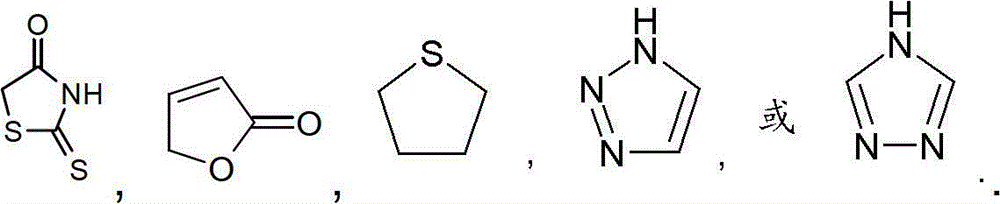
如本文中所使用,术语“杂环”,单独或与其他基团组合,指可利用将氢原子从五-、六-或七-员饱和或不饱和(包括芳香的)的含有一至四个选自氮、氧和硫的杂原子的杂环中除去而衍生出来的单价游离基。该杂环的实例包括(但不限于)吖啶(azetidine)、吡咯烷、四氢呋喃、噻唑烷、吡咯、噻吩(thiophene)、乙内酰脲(hydantoin)、二氮杂(diazepine)、1H-咪唑、异

如本文中所使用,术语“9-或10-员杂双环”或“杂双环”,单独或与其他基团组合,指如上定义稠合到一个或多个其他环(杂双环基或任何其他环)上的杂环基。该杂双环的实例包括(但不限于)吲哚、苯并咪唑、噻唑并[4,5-b]-吡啶、喹啉(quinoline)或香豆素,或如下列所示:As used herein, the term "9- or 10-membered heterobicyclo" or "heterobicyclo", alone or in combination with other groups, refers to a ring as defined above fused to one or more other rings (heterobicyclyl or any other ring) on the heterocyclic group. Examples of such heterobicycles include, but are not limited to, indole, benzimidazole, thiazolo[4,5-b]-pyridine, quinoline or coumarin, or as shown below:

如本文中所使用,术语“卤”或“卤素”指卤素原子并包括氟、氯、溴和碘。As used herein, the term "halo" or "halogen" refers to a halogen atom and includes fluorine, chlorine, bromine and iodine.
如本文中所使用,术语“OH”是指羟基基团。本领域技术人员熟知羟基基团可被等价的官能团取代。包括在本发明范畴内的这些价官能团实例包括(但不限于)醚、巯基、硫醚和伯、仲或叔胺。As used herein, the term "OH" refers to a hydroxyl group. It is well known to those skilled in the art that hydroxyl groups may be substituted by equivalent functional groups. Examples of such valent functional groups included within the scope of the present invention include, but are not limited to, ethers, mercaptos, thioethers, and primary, secondary, or tertiary amines.
如本文中所使用,术语“SH”是指巯基基团。在本发明范畴内,任何时候出现的“SH”或“SR”基团,其皆可由任何其他适合的氧化态所取代,例如SOR、SO2R或SO3R。As used herein, the term "SH" refers to a sulfhydryl group. Within the scope of the present invention, whenever an "SH" or "SR" group occurs, it may be replaced by any other suitable oxidation state, such as SOR, SO2R or SO3R .
如本文中所使用,术语“(C1-n)烷氧基”是指还键合到(C1-n)烷基基团的氧原子。(C1-6)烷氧基的实例包括(但不限于)甲氧基(CH3O-)、乙氧基(CH3CH2O-)、正丙氧基(CH3CH2CH2O-)、1-甲基乙氧基(异丙氧基;(CH3)2CHO-)、1,1-二甲基乙氧基(叔丁氧基;(CH3)3CO-)等。当(C1-n)烷氧基基团被取代时,理解为在其(C1-n)烷基部分被取代。As used herein, the term "(C 1-n )alkoxy" refers to an oxygen atom also bonded to a (C 1-n )alkyl group. Examples of (C 1-6 )alkoxy include, but are not limited to, methoxy (CH 3 O—), ethoxy (CH 3 CH 2 O—), n-propoxy (CH 3 CH 2 CH 2 O-), 1-methylethoxy (isopropoxy; (CH 3 ) 2 CHO-), 1,1-dimethylethoxy (tert-butoxy; (CH 3 ) 3 CO-) wait. When a (C 1-n )alkoxy group is substituted it is understood to be substituted on its (C 1-n )alkyl portion.
如本文中所使用,术语“(C1-n)烷硫基”是指还键合到(C1-n)烷基基团的硫原子。(C1-6)烷硫基的实例包括(但不限于)甲硫基(CH3S-)、乙硫基(CH3CH2S-)、正丙硫基(CH3CH2CH2S-)、1-甲基乙硫基(异丙硫基;(CH3)2CHS-)、1,1-二甲基乙硫基(叔丁硫基(CH3)3CS-)等。当(C1-n)烷硫基基团被取代时,理解为在其(C1-n)烷基部分取代。As used herein, the term "(C 1-n )alkylthio" refers to a sulfur atom also bonded to a (C 1-n )alkyl group. Examples of (C 1-6 )alkylthio include, but are not limited to, methylthio (CH 3 S-), ethylthio (CH 3 CH 2 S-), n-propylthio (CH 3 CH 2 CH 2 S-), 1-methylethylthio (isopropylthio; (CH 3 ) 2 CHS-), 1,1-dimethylethylthio (tert-butylthio (CH 3 ) 3 CS-), etc. . When a (C 1-n )alkylthio group is substituted, it is understood that it is substituted on its (C 1-n )alkyl moiety.
术语“氧代”如本文中所使用,指通过双键作为取代基连接至碳原子的氧原子(=O)。The term "oxo" as used herein refers to an oxygen atom (=0) attached to a carbon atom through a double bond as a substituent.
术语“被取代”在连接具有超过一个部分的基团仲被使用,例如(C3-7)环烷基-(C1-6)烷基-,这样的取代适用于两个部分,即烷基和环烷基部分的其中一部分或两者都能被已定义的取代基取代。The term "substituted" is used in connection with a group having more than one moiety, for example (C 3-7 )cycloalkyl-(C 1-6 )alkyl-, such substitution applies to both moieties, i.e. alkane A part or both of the radical and the cycloalkyl moiety can be substituted by the defined substituents.
如本文中所使用,术语“COOH”指羧酸基团。本领域技术人员熟知羧酸基团可由官能团等价物代替。本发明所包括的该官能团等价物实例包括(但不限于)酯、酰胺、酰亚胺、硼酸、膦酸(phosphonic acids)、磺酸、四唑类、三唑类、N-酰基磺酰基二酰胺类(RCONHSO2NR2)和N-酰基磺酰胺类(RCONHSO2R)。As used herein, the term "COOH" refers to a carboxylic acid group. It is well known to those skilled in the art that the carboxylic acid groups can be replaced by functional group equivalents. Examples of such functional group equivalents encompassed by the invention include, but are not limited to, esters, amides, imides, boronic acids, phosphonic acids, sulfonic acids, tetrazoles, triazoles, N-acylsulfonyl diamides (RCONHSO 2 NR 2 ) and N-acylsulfonamides (RCONHSO 2 R).
如本文中所使用,术语“官能团等价物”指元素或基团或其被取代的衍生物,其可由具有相似电子、杂化或键合性质的元素或基团所代替。As used herein, the term "functional group equivalent" refers to an element or group or a substituted derivative thereof, which may be replaced by an element or group having similar electronic, hybridization or bonding properties.
下列符号----和
如本文中所使用,术语“可检测标识”指可和聚合酶连接或和本发明化合物连接的任何基团,这样的连接使得当该化合物与该聚合酶靶标联系时,该标识使得该化合物可直接或间接得到识别,从而该化合物可检测、测量和定量。该“标识”的实例包括(但不限于)荧光标识、化学发光标识、比色标识、酶标记、放射性同位素和亲和标记,例如生物素。利用熟知的方法将该标识连接在化合物上或聚合酶上。As used herein, the term "detectable label" refers to any group that can be attached to a polymerase or to a compound of the invention such that when the compound is associated with the polymerase target, the label makes the compound detectable. Identified directly or indirectly so that the compound can be detected, measured and quantified. Examples of such "labels" include, but are not limited to, fluorescent labels, chemiluminescent labels, colorimetric labels, enzymatic labels, radioisotopes, and affinity labels, such as biotin. The label is attached to the compound or to the polymerase using well-known methods.
如本文中所使用,术语“亲和标记”指(可连接到聚合酶或本发明化合物的)配位体,其对受体的强亲和力可用于从溶液中萃取该配位体所连接的实体。该配位体的实例包括(但不限于)生物素或其衍生物、组胺多肽、聚精氨酸、直链淀粉糖部分或可被具体抗体辨识的已定义表位。利用熟知的方法将该亲和标记连接在化合物上或聚合酶上。As used herein, the term "affinity tag" refers to a ligand (which can be attached to a polymerase or a compound of the invention) whose strong affinity for the receptor can be used to extract the entity to which the ligand is attached from solution. . Examples of such ligands include, but are not limited to, biotin or derivatives thereof, histamine polypeptides, polyarginine, amylose sugar moieties, or defined epitopes that are recognized by specific antibodies. The affinity tag is attached to the compound or to the polymerase using well-known methods.
如本文中所使用,术语“光反应基团”指被光活化从惰性基团转变成反应活性物种的基团,例如自由基。该基团可用作例如光亲和性标识。该基团的实例包括(但不限于)二苯酮(benzophenones)、叠氮化合物等。As used herein, the term "photoreactive group" refers to a group, such as a free radical, that is converted by photoactivation from an inert group to a reactive species. This group can be used, for example, as a photoaffinity marker. Examples of such groups include, but are not limited to, benzophenones, azides, and the like.
术语“其盐”指根据本发明化合物的任何酸及/或碱加成盐;优选为其药学上可接受的盐。The term "salt thereof" refers to any acid and/or base addition salt of a compound according to the invention; preferably its pharmaceutically acceptable salt.
术语“药学上可接受的盐”指式(I)的化合物的盐,在可靠的医学判断范畴内,适用于和人类或比较低等动物的组织接触而不会有不适当毒性、刺激、过敏反应等问题,符合合理的利益/危险比,一般而言水溶性或油溶性或可分散且对这些预期用途有效。该术语包括药学上可接受的酸加成盐和药学上可接受的碱加成盐。适用盐的实例可在例如S.M.Birge等,J.Pharm.Sci.,1977,66,pp.1-19中发现。The term "pharmaceutically acceptable salt" refers to a salt of a compound of formula (I), which, within the scope of sound medical judgment, is suitable for use in contact with tissues of humans or lower animals without undue toxicity, irritation, sensitization issues such as reactivity, consistent with a reasonable benefit/risk ratio, generally water or oil soluble or dispersible and effective for these intended uses. The term includes pharmaceutically acceptable acid addition salts and pharmaceutically acceptable base addition salts. Examples of suitable salts can be found, for example, in SMBirge et al., J. Pharm. Sci., 1977, 66 , pp. 1-19.
术语“药学上可接受的酸加成盐”指这些盐保留有生物有效性和游离碱的性质且不是生物上或其他方面所不希望的,其为与无机酸例如盐酸、氢溴酸、硫酸、氨基磺酸、硝酸、磷酸等所形成,以及与有机酸例如醋酸、三氟醋酸、己二酸、抗坏血酸、天冬氨酸、苯磺酸、苯甲酸、丁酸、樟脑酸、樟脑磺酸(camphorsulfonic acid)、肉桂酸、柠檬酸、二葡萄糖酸、乙烷磺酸、谷氨酸、乙醇酸、甘油膦酸、半硫酸(hemisulfic acid)、己酸、甲酸、富马酸、2-羟基乙磺酸(羟乙基磺酸)、乳酸、羟基马来酸、苹果酸、丙二酸、扁桃酸、均三甲基苯磺酸(mesitylenesulfonic acid)、甲磺酸、萘磺酸、烟酸、2-萘磺酸、草酸、双羟萘酸(pamoic acid)、果胶酯酸、苯基醋酸、3-苯丙酸、特戊酸、丙酸、丙酮酸、水杨酸、硬脂酸、琥珀酸、对氨基苯磺酸(sulfanilic acid)、酒石酸、对-甲苯磺酸、十一烷酸等所形成。The term "pharmaceutically acceptable acid addition salts" refers to those salts which retain the bioavailability and properties of the free base and which are not biologically or otherwise undesirable, which are obtained in combination with inorganic acids such as hydrochloric, hydrobromic, sulfuric , sulfamic acid, nitric acid, phosphoric acid, etc., and organic acids such as acetic acid, trifluoroacetic acid, adipic acid, ascorbic acid, aspartic acid, benzenesulfonic acid, benzoic acid, butyric acid, camphoric acid, camphorsulfonic acid (camphorsulfonic acid), cinnamic acid, citric acid, digluconic acid, ethanesulfonic acid, glutamic acid, glycolic acid, glycerylphosphonic acid, hemisulfic acid, caproic acid, formic acid, fumaric acid, 2-hydroxy Ethylsulfonic acid (isethionic acid), lactic acid, hydroxymaleic acid, malic acid, malonic acid, mandelic acid, mesitylenesulfonic acid, methanesulfonic acid, naphthalenesulfonic acid, niacin , 2-naphthalenesulfonic acid, oxalic acid, pamoic acid, pectinic acid, phenylacetic acid, 3-phenylpropionic acid, pivalic acid, propionic acid, pyruvic acid, salicylic acid, stearic acid , succinic acid, sulfanilic acid, tartaric acid, p-toluenesulfonic acid, undecanoic acid, etc.
术语“药学上可接受的碱加成盐”指这些盐保留有生物有效性和游离酸的性质且没有生物上或其他方面所不希望的,其为与无机碱例如氨或金属阳离子例如钠、钾、锂、钙、镁、铁、锌、铜、镁、铝等或铵的氢氧化物、碳酸盐或二碳酸盐所形成。尤其优选铵盐、钾盐、钠盐、钙盐和镁盐。衍生自药学上可接受的有机无毒碱的盐包括伯、仲和叔胺类的盐、季胺化合物、被取代的胺类包括天然存在的被取代胺类、环胺类和碱性离子交换树脂,例如甲基胺、二甲基胺、三甲基胺、乙基胺、二乙基胺、三乙基胺、异丙基胺、三丙基胺、三丁基胺、乙醇胺、二乙醇胺、2-二甲基氨基乙醇、2-二乙基氨基乙醇、二环己基胺、赖氨酸、精氨酸、组氨酸、咖啡因、海巴明(hydrabamine)、胆碱、甜菜碱、亚乙基二胺、葡萄糖胺、甲基葡萄糖胺、可可碱、嘌呤、哌嗪、哌啶、N-乙基哌啶、四甲基铵化合物、四乙基铵化合物、吡啶、N,N-二甲基苯胺、N-甲基哌啶、N-甲基吗啉、二环己基胺、二苯甲基胺、N,N-二苯甲基苯乙基胺、1-二苯羟甲胺(1-ephenamine)、N,N'-二苯甲基亚乙基二胺、聚胺树脂等。尤其优选的有机无毒碱为异丙基胺、二乙基胺、乙醇胺、三甲基胺、二环己基胺、胆碱和咖啡因。The term "pharmaceutically acceptable base addition salts" refers to those salts which retain the biological effectiveness and properties of the free acids and which are not biologically or otherwise undesirable and which are obtained in combination with inorganic bases such as ammonia or metal cations such as sodium, Potassium, lithium, calcium, magnesium, iron, zinc, copper, magnesium, aluminum, etc. or ammonium hydroxide, carbonate or dicarbonate. Especially preferred are ammonium, potassium, sodium, calcium and magnesium salts. Salts derived from pharmaceutically acceptable organic non-toxic bases including salts of primary, secondary and tertiary amines, quaternary ammonium compounds, substituted amines including naturally occurring substituted amines, cyclic amines and basic ion exchange Resins such as methylamine, dimethylamine, trimethylamine, ethylamine, diethylamine, triethylamine, isopropylamine, tripropylamine, tributylamine, ethanolamine, diethanolamine , 2-Dimethylaminoethanol, 2-Diethylaminoethanol, Dicyclohexylamine, Lysine, Arginine, Histidine, Caffeine, Hydrabamine, Choline, Betaine, Ethylenediamine, Glucosamine, Methylglucamine, Theobromine, Purine, Piperazine, Piperidine, N-Ethylpiperidine, Tetramethylammonium Compound, Tetraethylammonium Compound, Pyridine, N,N- Dimethylaniline, N-methylpiperidine, N-methylmorpholine, dicyclohexylamine, benzhydrylamine, N,N-benzhydrylphenethylamine, 1-benzhydrylamine (1-ephenamine), N,N'-benzhydrylethylenediamine, polyamine resin, etc. Particularly preferred organic non-toxic bases are isopropylamine, diethylamine, ethanolamine, trimethylamine, dicyclohexylamine, choline and caffeine.
术语“其酯”指化合物的任何酯,其中该分子的任何羧基官能团被烷氧基羧基官能团所代替,包括(但不限于)其药学上可接受酯。The term "ester thereof" refers to any ester of a compound wherein any carboxyl functionality of the molecule is replaced by an alkoxycarboxy functionality, including but not limited to pharmaceutically acceptable esters thereof.
术语“药学上可接受酯”如本文中所使用,可单独或和另一取代基结合,指式(I)化合物的酯,其分子中任何羧基官能团(但优选为羧基端)被烷氧基羰基官能团所代替:The term "pharmaceutically acceptable ester" as used herein, alone or in combination with another substituent, refers to an ester of a compound of formula (I) in which any carboxyl functional group (but preferably the carboxyl terminus) in the molecule is replaced by an alkoxy The carbonyl functional group is replaced by:
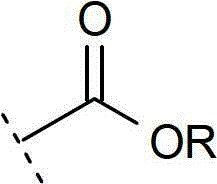
其酯的R部分选自烷基(例如甲基、乙基、正丙基、叔丁基、正丁基);烷氧基烷基(例如甲氧基甲基);烷氧基酰基(例如乙酰氧基甲基);芳烷基(例如苯甲基);芳氧基烷基(例如苯氧基甲基);芳基(例如苯基),任选地被卤素、(C1-4)烷基或(C1-4)烷氧基取代。其他适用的酯可在Design of prodrugs,Bundgaard,H.Ed.Elsevier(1985)中发现。这些药学上可接受酯注射至哺乳动物体内时,其通常会在体内水解并转变成式(I)化合物的酸形式。关于上述的这些酯,除非另有说明否则任何存在的烷基部分有利地含有1至16个碳原子,尤其是1至6个碳原子。存在于该酯的任何芳基部分有利地含有苯基基团。具体而言,该酯可为(C1-16)烷基酯、未被取代的苯甲酯或被至少一个卤素、(C1-6)烷基、(C1-6)烷氧基、硝基或三氟甲基取代的苯甲酯。The R moiety of its ester is selected from alkyl (e.g. methyl, ethyl, n-propyl, tert-butyl, n-butyl); alkoxyalkyl (e.g. methoxymethyl); alkoxyacyl (e.g. acetoxymethyl); aralkyl (for example benzyl); aryloxyalkyl (for example phenoxymethyl); aryl (for example phenyl), optionally replaced by halogen, (C 1-4 ) alkyl or (C 1-4 ) alkoxy substituted. Other suitable esters can be found in Design of prodrugs, Bundgaard, H. Ed. Elsevier (1985). When these pharmaceutically acceptable esters are injected into a mammal, they will generally hydrolyze in vivo and convert to the acid form of the compound of formula (I). With respect to the esters mentioned above, unless otherwise stated, any alkyl moiety present advantageously contains 1 to 16 carbon atoms, especially 1 to 6 carbon atoms. Any aryl moiety present in the ester advantageously contains a phenyl group. In particular, the ester may be (C 1-16 )alkyl ester, unsubstituted benzyl ester or benzyl ester replaced by at least one halogen, (C 1-6 )alkyl, (C 1-6 )alkoxy, Nitro- or trifluoromethyl-substituted benzyl esters.
术语“抗病毒药物”如本文中所使用,指能有效抑制哺乳动物体内病毒的形成和/或复制的药物(化合物或生物制品)。该药物包括在哺乳动物体内干扰宿主或干扰病毒形成和/或复制所需病毒机制的药物。抗病毒药物包括(但不限于)利巴韦林、金刚烷胺、VX-497(merimepodib,Vertex Pharmaceuticals)、VX-498(Vertex Pharmaceuticals)、利声显(Levovirin)、韦拉米丁(Viramidine)、赛普林(Ceplene)(二盐酸组胺(maxamine))、XTL-001和XTL-002(XTLBiopharmaceuticals)。The term "antiviral drug" as used herein refers to a drug (compound or biological product) that is effective in inhibiting the formation and/or replication of viruses in a mammal. Such agents include agents that interfere with the host or with the viral machinery required for virus formation and/or replication in a mammal. Antiviral drugs include (but are not limited to) ribavirin, amantadine, VX-497 (merimepodib, Vertex Pharmaceuticals), VX-498 (Vertex Pharmaceuticals), Levovirin, viramidine , Ceplene (maxamine dihydrochloride), XTL-001 and XTL-002 (XTL Biopharmaceuticals).
术语“其他抗-HCV药物”如本文中所使用,指能有效减轻或预防丙型肝炎相关疾病症状的这些药物。该药物可选自:免疫调节药物、HCV NS3蛋白酶的抑制剂、HCV聚合酶的其他抑制剂或在HCV生命周期中其他靶标的抑制剂。The term "other anti-HCV drugs" as used herein refers to those drugs that are effective in alleviating or preventing the symptoms of hepatitis C-related diseases. The drug may be selected from: immunomodulatory drugs, inhibitors of HCV NS3 protease, other inhibitors of HCV polymerase, or inhibitors of other targets in the HCV life cycle.
术语“免疫调节剂”如本文中所使用,指能有效强化或加强哺乳动物体内免疫系统反应的这些药物(化合物或生物制品)。这些免疫调节剂包括(但不限于)第I类干扰类(例如α-,β-,δ-和ω干扰素、τ-干扰素、共有干扰素(consensus interferons)和脱唾液酸(asialo)-干扰素)、第II类干扰系(例如γ-干扰素)及其聚乙二醇化形式(pegylated forms)。The term "immune modulator" as used herein refers to those drugs (compounds or biological products) that can effectively strengthen or enhance the immune system response in mammals. These immunomodulators include, but are not limited to, class I interferons (e.g., alpha-, beta-, delta- and omega interferons, tau-interferons, consensus interferons, and asialo- interferon), class II interferon lines (such as gamma-interferon) and their pegylated forms.
术语“HCV NS3蛋白酶的抑制剂”如本文中所使用,指能有效抑制哺乳动物体内的HCV NS3蛋白酶功能的药物(化合物或生物制品)。这些HCVNS3蛋白酶抑制剂包括(但不限于)下列所描述的这些化合物:WO 99/07733,WO 99/07734,WO 00/09558,WO 00/09543,WO 00/59929,WO 02/060926,US2002/0177725,WO 03/053349,WO 03/062265,WO 03/064416,WO 03/064455,WO 03/064456,WO 03/099316,WO 03/099274,WO 2004/032827,WO2004/037855,WO 2004/043339,WO 2004/072243,WO 2004/093798,WO2004/094452,WO 2004/101602,WO 2004/101605,WO 2004/103996、经鉴定为BILN 2061的Boehringer Ingelheim临床候选者以及经鉴定为VX-950的Vertex临床候选者。The term "inhibitor of HCV NS3 protease" as used herein refers to a drug (compound or biological product) that can effectively inhibit the function of HCV NS3 protease in a mammal. These HCVNS3 protease inhibitors include (but are not limited to) the compounds described in WO 99/07733, WO 99/07734, WO 00/09558, WO 00/09543, WO 00/59929, WO 02/060926, US2002/ 0177725, WO 03/053349, WO 03/062265, WO 03/064416, WO 03/064455, WO 03/064456, WO 03/099316, WO 03/099274, WO 2004/032827, WO2004/037855, WO043039 , WO 2004/072243, WO 2004/093798, WO 2004/094452, WO 2004/101602, WO 2004/101605, WO 2004/103996, Boehringer Ingelheim clinical candidates identified as BILN 2061 and Vertex identified as VX-950 clinical candidate.
术语“HCV聚合酶的其他抑制剂”如本文中所使用,指能有效抑制哺乳动物体内HCV聚合酶功能的药物(化合物或生物制品),其中该药物具有不同于根据本发明化合物的结构且优选为结合于不同于根据本发明化合物靶标部位的HCV聚合酶部位。HCV聚合酶其他抑制剂包括非核苷类,例如下列所描述的这些化合物:WO 2004/087714(IRBM)、WO 04/005286(Gilead)、WO 04/002977(Pharmacia)、WO 04/002944(Pharmacia)、WO04/002940(Pharmacia)、WO 03/101993(Neogenesis)、WO 03/099824(Wyeth)、WO 03/099275(Wyeth)、WO 03/099801(GSK))、WO 03/097646(GSK)、WO03/095441(Pfizer)、WO 03/090674(Viropharma)、WO 03/084953(B&CBiopharm)、WO 03/082265(Fujisawa)、WO 03/082848(Pfizer)、WO03/062211(Merck)、WO 03/059356(GSK)、EP 1321463(Shire)、WO03/040112(Rigel)、WO 03/037893(GSK)、WO 03/037894(GSK)、WO03/037262(GSK)、WO 03/037895(GSK)、WO 03/026587(BMS)、WO03/002518(Dong Wha)、WO 03/000254(Japan Tobacco)、WO 02/100846A1(Shire)、WO 02/100851A2(Shire)、WO 02/098424A1(GSK)、WO02/079187(Dong Wha)、WO 03/02/20497(Shionogi)、WO 02/06246(Merck)、WO 01/47883(Japan Tobacco)、WO 01/85172A1(GSK)、WO 01/85720(GSK)、WO 01/77091(Tularik)、WO 00/18231(Viropharma)、WO00/13708(Viropharma)、WO 01/10573(Viropharma)、WO 00/06529(Merck)、EP 1256628A2(Agouron)、WO 02/04425(Boehringer Ingelheim)、WO03/007945(Boehringer Ingelheim)、WO 03/010140(Boehringer Ingelheim)、WO03/010141(Boehringer Ingelheim)、WO 2004/064925(Boehringer Ingelheim)及WO 2004/065367(Boehringer Ingelheim)。HCV聚合酶的其他抑制剂也包括核苷类似物,例如下列描述的这些化合物:WO 04/007512(Merck/Isis)、WO04/003000(Idenix)、WO 04/002999(Idenix)、WO 04/0002422(Idenix)、WO04/003138(Merck)、WO 03/105770(Merck)、WO 03/105770(Merck)、WO03/093290(Genelabs)、WO 03/087298(Biocryst)、WO 03/062256(Ribapharm)、WO 03/062255(Ribapharm)、WO 03/061385(Ribapharm)、WO03/026675(Idenix)、WO 03/026589(Idenix)、WO 03/020222(Merck)、WO03/000713(Glaxo)、WO 02/100415(Hoffmann-La Roche)、WO02/1094289(Hoffmann-La Roche)、WO 02/051425(Mitsubishi)、WO02/18404(Hoffmann-La Roche)、WO 02/069903(Biocryst Pharmaceuticals Inc.)、WO 02/057287(Merck/Isis)、WO 02/057425(Merck/Isis)、WO 01/90121(Idenix)、WO 01/60315(Shire)和WO 01/32153(Shire)。The term "other inhibitors of HCV polymerase" as used herein refers to a drug (compound or biological product) that can effectively inhibit the function of HCV polymerase in a mammal, wherein the drug has a structure different from that of the compound of the present invention and preferably To bind to a site of HCV polymerase different from the target site of the compounds according to the invention. Other inhibitors of HCV polymerase include non-nucleosides such as those described in WO 2004/087714 (IRBM), WO 04/005286 (Gilead), WO 04/002977 (Pharmacia), WO 04/002944 (Pharmacia) , WO04/002940 (Pharmacia), WO 03/101993 (Neogenesis), WO 03/099824 (Wyeth), WO 03/099275 (Wyeth), WO 03/099801 (GSK)), WO 03/097646 (GSK), WO03 /095441 (Pfizer), WO 03/090674 (Viropharma), WO 03/084953 (B&C Biopharm), WO 03/082265 (Fujisawa), WO 03/082848 (Pfizer), WO 03/062211 (Merck), WO 03/059356 ( GSK), EP 1321463(Shire), WO03/040112(Rigel), WO 03/037893(GSK), WO 03/037894(GSK), WO03/037262(GSK), WO 03/037895(GSK), WO 03/ 026587(BMS), WO03/002518(Dong Wha), WO 03/000254(Japan Tobacco), WO 02/100846A1(Shire), WO 02/100851A2(Shire), WO 02/098424A1(GSK), WO02/079187( Dong Wha), WO 03/02/20497(Shionogi), WO 02/06246(Merck), WO 01/47883(Japan Tobacco), WO 01/85172A1(GSK), WO 01/85720(GSK), WO 01/ 77091 (Tularik), WO 00/18231 (Viropharma), WO 00/13708 (Viropharma), WO 01/10573 (Viropharma), WO 00/06529 (Merck), EP 1256628A2 (Agouron), WO 02/04425 (Boehringer Ingelheim) , WO03/007945 (Boehringer Ingelheim), WO 03/010140 (Boehringer Ingelheim elheim), WO03/010141 (Boehringer Ingelheim), WO 2004/064925 (Boehringer Ingelheim) and WO 2004/065367 (Boehringer Ingelheim). Other inhibitors of HCV polymerase also include nucleoside analogs such as those described in WO 04/007512 (Merck/Isis), WO 04/003000 (Idenix), WO 04/002999 (Idenix), WO 04/0002422 (Idenix), WO 04/003138 (Merck), WO 03/105770 (Merck), WO 03/105770 (Merck), WO 03/093290 (Genelabs), WO 03/087298 (Biocryst), WO 03/062256 (Ribapharm), WO 03/062255 (Ribapharm), WO 03/061385 (Ribapharm), WO 03/026675 (Idenix), WO 03/026589 (Idenix), WO 03/020222 (Merck), WO 03/000713 (Glaxo), WO 02/100415 (Hoffmann-La Roche), WO02/1094289 (Hoffmann-La Roche), WO 02/051425 (Mitsubishi), WO02/18404 (Hoffmann-La Roche), WO 02/069903 (Biocrystal Pharmaceuticals Inc.), WO 02/057287 (Merck/Isis), WO 02/057425 (Merck/Isis), WO 01/90121 (Idenix), WO 01/60315 (Shire) and WO 01/32153 (Shire).
术语“HCV生命周期中另外靶标的抑制剂”如本文中所使用,指能有效抑制哺乳动物体内HCV的形成和/或复制而不是利用抑制HCV的RNA依赖性RNA聚合酶的药物(化合物或生物制品),该药物包括在哺乳动物体内干扰宿主或干扰病毒形成和/或复制所需病毒机制的药物。HCV生命周期中另外靶标的抑制剂包括(但不限于)抑制选自HCV解旋酶、HCV NS2/3蛋白酶和HCV IRES靶标的药物以及干扰其他病毒靶标功能的药物,该靶标包括(但不限于)NS5A蛋白质。The term "inhibitor of another target in the HCV life cycle" as used herein refers to a drug (compound or biological compound) that is effective in inhibiting the formation and/or replication of HCV in a mammal other than by inhibiting the RNA-dependent RNA polymerase of HCV. preparations), including those that interfere with the host or with the viral machinery required for virus formation and/or replication in a mammal. Inhibitors of additional targets in the HCV life cycle include, but are not limited to, agents that inhibit targets selected from the group consisting of HCV helicase, HCV NS2/3 protease, and HCV IRES, and agents that interfere with the function of other viral targets, including, but not limited to ) NS5A protein.
术语“HIV抑制剂”如本文中所使用,指能有效抑制哺乳动物体内HCV形成和/或复制的药物(化合物或生物制品)。该药物包括在哺乳动物体内干扰宿主或干扰HIV病毒形成和/或复制所需病毒机制的药物。HIV抑制剂包括(但不限于)核苷抑制剂、非-核苷抑制剂、蛋白酶抑制剂、融合抑制剂和整合酶抑制剂。The term "HIV inhibitor" as used herein refers to a drug (compound or biological product) that is effective in inhibiting the formation and/or replication of HCV in a mammal. The drugs include drugs that interfere with the host or with the viral machinery required for HIV virus formation and/or replication in mammals. HIV inhibitors include, but are not limited to, nucleoside inhibitors, non-nucleoside inhibitors, protease inhibitors, fusion inhibitors, and integrase inhibitors.
术语“HAV抑制剂”如本文中所使用,指能有效抑制哺乳动物体内HAV形成和/或复制的药剂(化合物或生物制品)。该药物包括在哺乳动物体内干扰宿主或干扰HAV形成和/或复制所需病毒机制的药物。该HAV抑制剂包括(但不限于)甲型肝炎病苗,例如


术语“HBV抑制剂”如本文中所使用,指能有效抑制哺乳动物体内HBV形成和/或复制的药物(化合物或生物制品)。该药物包括在哺乳动物体内干扰宿主或干扰HBV形成和/或复制所需病毒机制的药物。该HBV抑制剂包括抑制HBV病毒性DNA聚合酶的药物或HBV疫苗。HBV抑制剂的具体实例包括(但不限于)拉米夫定()、阿德福韦酯(Adefovir Dipivoxil)、恩替卡韦(Entecavir)、FTC(


术语“第I类干扰素”如本文中所使用,指选自所有和第I型受体结合的干扰素。这些干扰素包括天然和合成产生的第I类干扰素。第I类干扰素实例包括(但不限于)α-、β-、δ-、ω-干扰素、τ-干扰素、共有干扰素、脱唾液酸(asialo)-干扰素及其聚乙二醇化形式(pegylated forms)。The term "class I interferon" as used herein refers to a group selected from all interferons that bind to type I receptors. These interferons include naturally and synthetically produced class I interferons. Examples of class I interferons include, but are not limited to, alpha-, beta-, delta-, omega-interferon, tau-interferon, consensus interferon, asialo-interferon, and pegylated Forms (pegylated forms).
术语“第II类干扰素”如本文中所使用,指自所有和第II型受体结合干扰素群中选出的干扰素。这些干扰素包括天然和合成产生的第II类干扰素。第II类干扰素的实例包括(但不限于)γ-干扰素及其聚乙二醇化形式(pegylated forms)。The term "class II interferon" as used herein refers to an interferon selected from the group of all and type II receptor binding interferons. These interferons include naturally and synthetically produced class II interferons. Examples of class II interferons include, but are not limited to, gamma-interferon and its pegylated forms.
如上所讨论,也包括组合治疗,其中式(I)的化合物或其药学上可接受的盐或酯是和至少一种选自下列的其他药物共同给药:抗病毒药物、免疫调节剂、HCV NS3蛋白酶的抑制剂、HCV聚合酶的另外抑制剂、HCV生命周期中其他靶标的抑制剂、HIV抑制剂、HAV抑制剂和HBV抑制剂。这些药物的实例已在上述定义部分中提供。这些药物尤其优选的实例如下所列:Combination therapy is also included, as discussed above, wherein a compound of formula (I) or a pharmaceutically acceptable salt or ester thereof is co-administered with at least one other drug selected from the group consisting of: antiviral drugs, immunomodulators, HCV Inhibitors of NS3 protease, additional inhibitors of HCV polymerase, inhibitors of other targets in the HCV life cycle, HIV inhibitors, HAV inhibitors and HBV inhibitors. Examples of these drugs have been provided in the definitions section above. Particularly preferred examples of these drugs are listed below:
■抗病毒药物:利巴韦林或金刚烷胺;■ Antiviral drugs: ribavirin or amantadine;
■免疫调节剂:第I类干扰素、第II干扰素或其聚乙二醇化形式(pegylatedforms);■ Immunomodulators: class I interferon, class II interferon or their pegylated forms;
■HCV NS3蛋白酶抑制剂;■ HCV NS3 protease inhibitors;
■HCV聚合酶的其他抑制剂:核苷或非-核苷抑制剂;Other inhibitors of HCV polymerase: nucleoside or non-nucleoside inhibitors;
■HCV生命周期中其他靶标的抑制剂,其抑制选自下列的靶标:NS3解旋酶、HCV NS2/3蛋白酶和内部核醣体进入位点(IRES),或者是干扰NS5A蛋白质功能的药物;Inhibitors of other targets in the HCV life cycle that inhibit targets selected from the group consisting of: NS3 helicase, HCV NS2/3 protease and internal ribosome entry site (IRES), or drugs that interfere with NS5A protein function;
■HIV抑制剂:核苷抑制剂、非-核苷抑制剂、蛋白酶抑制剂、融合抑制剂或整合酶抑制剂;或HIV inhibitors: nucleoside inhibitors, non-nucleoside inhibitors, protease inhibitors, fusion inhibitors, or integrase inhibitors; or
■HBV抑制剂:抑制HBV病毒DNA聚合酶的药物或是HBV疫苗的药物。■HBV inhibitors: Drugs that inhibit the DNA polymerase of HBV virus or drugs for HBV vaccine.
这些其他药物可和本发明化合物组合以创造单一药物剂型。或者这些其他药剂可以作为多种剂型的一部分,例如使用试剂盒,而分别给药于病人。这些其他药物可在式(I)化合物或其药学上可接受的盐或酯给药前、给药同时或给药后给药。These other drugs may be combined with the compounds of this invention to create a single pharmaceutical dosage form. Alternatively, these other agents may be administered separately to the patient as part of multiple dosage forms, eg, using a kit. These other drugs may be administered before, simultaneously with or after the administration of the compound of formula (I) or a pharmaceutically acceptable salt or ester thereof.
如本文中所使用,术语“治疗”指根据本发明化合物或组合物的给药,以减轻或消除丙型肝炎疾病的症状和/或减轻病人的病毒负载。As used herein, the term "treatment" refers to the administration of a compound or composition according to the present invention to alleviate or eliminate the symptoms of hepatitis C disease and/or reduce the viral load of a patient.
如本文中所使用,术语“预防”指根据本发明化合物或组合物当个人暴露到该病毒后但在该疾病的症状出现前和/或在达到血液中病毒可检测程度前的给药。As used herein, the term "prophylaxis" refers to the administration of a compound or composition according to the invention after an individual has been exposed to the virus but before symptoms of the disease appear and/or before the virus reaches detectable levels in the blood.
优选实施方式preferred embodiment
除非另有说明否则,包括(但不限于)R1、R2、R3、R4、R5、R6、R7、R8、R9、R10、R21、R50、RN1、RN2、A、B和Het的所有基团和取代基具有如前文或本文之后所定义的定义。在下述中,对根据本发明的优选的实施方式、基团和取代基进行描述。Unless otherwise stated, including ( but not limited to) R 1 , R 2 , R 3 , R 4 , R 5 , R 6 , R 7 , R 8 , R 9 , R 10 , R 21 , R 50 , R N1 All groups and substituents of , R N2 , A, B and Het have the definitions as defined above or hereinafter. In the following, preferred embodiments, groups and substituents according to the present invention are described.
核心: Core :
本发明包含式Ia的化合物:The present invention comprises compounds of formula Ia:

或者,本发明包含式Ib的化合物:Alternatively, the present invention comprises compounds of formula Ib:

R 1 : R 1 :
根据本发明优选的实施方式R1选自H、甲基和乙基。According to a preferred embodiment of the present invention R 1 is selected from H, methyl and ethyl.
更优选地,R1为甲基。More preferably, R 1 is methyl.
R 2 : R 2 :
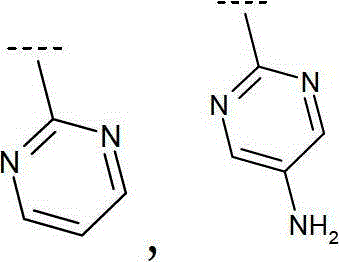
优选地,R2选自卤素、氰基、(C1-4)烷基、(C2-4)链烯基、(C2-4)炔基、(C3-6)环烷基、苯基和选自下式的Het:Preferably, R 2 is selected from halogen, cyano, (C 1-4 )alkyl, (C 2-4 )alkenyl, (C 2-4 )alkynyl, (C 3-6 )cycloalkyl, Phenyl and Het selected from the formula:
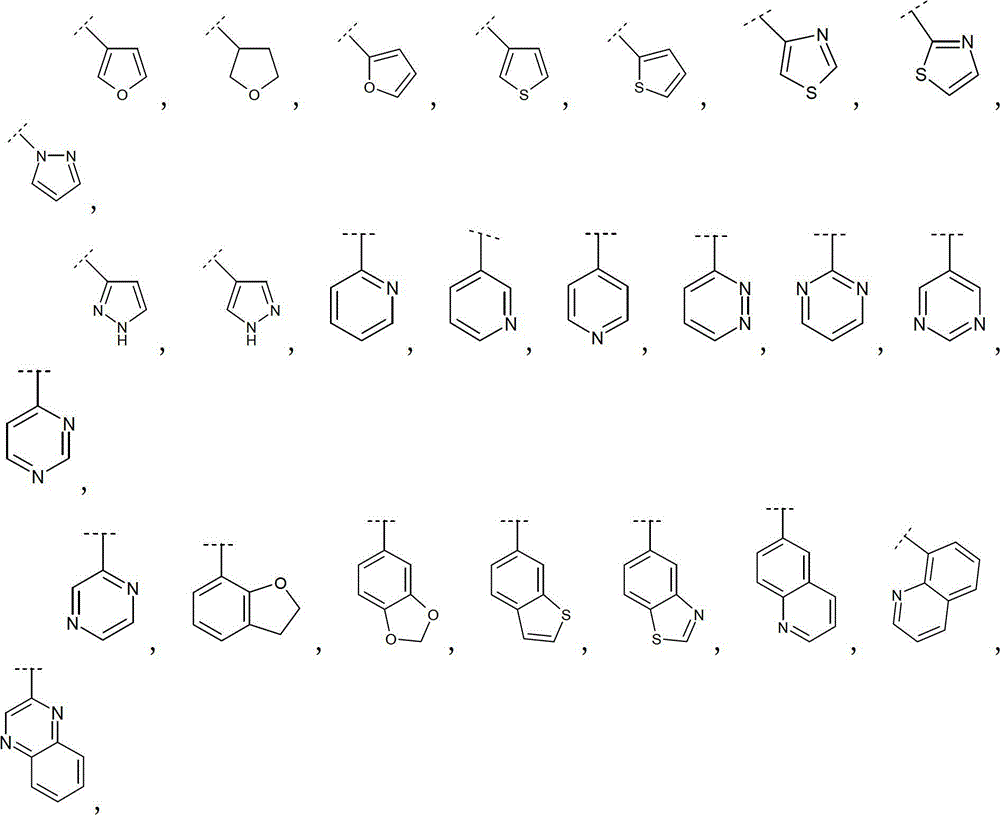

其中该苯基和Het为未被取代或被R21取代,其中R21如本文中所定义。Wherein the phenyl and Het are unsubstituted or substituted by R 21 , wherein R 21 is as defined herein.
更优选地,R2选自Br、Cl、氰基、甲基、乙基、丙基、1-甲基乙基、乙烯基、1-甲基乙烯基、乙炔基、环丙基、苯基和选自下式的Het:More preferably, R is selected from Br, Cl, cyano, methyl, ethyl, propyl, 1-methylethyl, vinyl, 1-methylvinyl, ethynyl, cyclopropyl, phenyl and Het selected from:

其中该苯基和Het为未被取代或被R21取代,其中R21如本文中所定义。Wherein the phenyl and Het are unsubstituted or substituted by R 21 , wherein R 21 is as defined herein.
R 21 : R 21 :
优选地,R21为1、2或3取代基,其各自独立地选自:Preferably, R 21 is 1, 2 or 3 substituents, each independently selected from:
-1至3个取代基,其各自独立地选自卤素;和- 1 to 3 substituents, each independently selected from halogen; and
-1至2个取代基,其各自独立地选自:-1 to 2 substituents, each independently selected from:
a)羟基、(C1-4)烷基或(C1-4)烷氧基;其中该烷基和烷氧基各自任选地被一、二或三个卤素原子取代;a) hydroxy, (C 1-4 ) alkyl or (C 1-4 ) alkoxy; wherein each of the alkyl and alkoxy is optionally substituted by one, two or three halogen atoms;
b)-NRN2RN1其中b)-NR N2 R N1 where
RN1选自H、(C1-3)烷基、-CO-(C1-3)烷基、-CO-O-(C1-3)烷基和Het;R N1 is selected from H, (C 1-3 ) alkyl, -CO-(C 1-3 ) alkyl, -CO-O-(C 1-3 ) alkyl and Het;
其中每个该(C1-3)烷基、-CO-(C1-3)烷基和-CO-O-(C1-3)烷基的烷基部分是任选地被一、二或三个选自卤素和(C1-6)烷氧基的取代基所取代;且其中该Het为5-或6-员单环饱和、不饱和或具有1至2个各自独立地选自N,O和S的杂原子的芳香杂环基;且wherein the alkyl portion of each of the (C 1-3 )alkyl, -CO-(C 1-3 )alkyl and -CO-O-(C 1-3 )alkyl is optionally replaced by one or two or three substituents selected from halogen and (C 1-6 ) alkoxy; and wherein the Het is 5- or 6-membered monocyclic saturated, unsaturated or has 1 to 2 independently selected from Aromatic heterocyclic groups of N, O and S heteroatoms; and
RN2为H或(C1-3)烷基;R N2 is H or (C 1-3 ) alkyl;
c)-CONRN2RN1,其中RN2和RN1各自独立地选自H和(C1-3)烷基;以及c)-CONR N2 R N1 , wherein R N2 and R N1 are each independently selected from H and (C 1-3 ) alkyl; and
d)Het,其中该Het为5-或6-员单环的杂环基,其具有1,2或3个各自独立地选自N,O和S的杂原子。d) Het, wherein the Het is a 5- or 6-membered monocyclic heterocyclic group having 1, 2 or 3 heteroatoms each independently selected from N, O and S.
更优选地,R21为1,2或3个取代基,其各自独立地选自:More preferably, R is 1 , 2 or 3 substituents, each independently selected from:
-1至2个取代基,各自独立地选自氟、氯和溴;和- 1 to 2 substituents, each independently selected from fluorine, chlorine and bromine; and
-1至2个取代基,其各自独立地选自:- 1 to 2 substituents, each independently selected from:
a)羟基、甲基、乙基、丙基、1-甲基乙基、甲氧基、乙氧基、丙氧基或1-甲基乙氧基;其中该甲基、乙基、丙基、1-甲基乙基、甲氧基、乙氧基、丙氧基和1-甲基乙氧基任选地被一、二或三个卤素原子取代;a) Hydroxy, methyl, ethyl, propyl, 1-methylethyl, methoxy, ethoxy, propoxy or 1-methylethoxy; wherein the methyl, ethyl, propyl , 1-methylethyl, methoxy, ethoxy, propoxy and 1-methylethoxy are optionally substituted by one, two or three halogen atoms;
b)-N(CH3)2或-NHRN1其中b) -N(CH 3 ) 2 or -NHR N1 where
RN1选自H、甲基、乙基、丙基、1-甲基乙基、-CO-CH3、2-吡啶基、3-吡啶基和4-吡啶基;R N1 is selected from H, methyl, ethyl, propyl, 1-methylethyl, -CO-CH 3 , 2-pyridyl, 3-pyridyl and 4-pyridyl;
其中所述甲基、乙基、丙基和1-甲基乙基各自任选地被一、二或三个选自卤素和(C1-3)烷氧基的取代基所取代;wherein the methyl, ethyl, propyl and 1-methylethyl groups are each optionally substituted by one, two or three substituents selected from halogen and (C 1-3 )alkoxy;
c)-CONH2;以及c) -CONH 2 ; and
d)3-吡啶基、4-吡啶基、5-嘧啶基、2-呋喃基、1-吡咯基和1-吗啉代。d) 3-pyridyl, 4-pyridyl, 5-pyrimidinyl, 2-furyl, 1-pyrrolyl and 1-morpholino.
因此优选地,R2选自Br、Cl、氰基、甲基、乙基、丙基、1-甲基乙基、环丙基、乙烯基、1-甲基乙烯基、乙炔基、Thus preferably, R is selected from Br, Cl, cyano, methyl, ethyl, propyl, 1-methylethyl, cyclopropyl, vinyl, 1-methylvinyl, ethynyl,


更优选地,R2选自环丙基、乙烯基、1-甲基乙烯基、More preferably, R is selected from cyclopropyl, vinyl, 1-methylvinyl,

更优选地,R2选自:More preferably, R is selected from:

最优选地,R2选自:Most preferably, R is selected from:
R 3 : R3 :
优选地,R3为环戊基或环己基,各自任选地被一或二个氟原子所取代。Preferably, R3 is cyclopentyl or cyclohexyl, each optionally substituted with one or two fluorine atoms.
更优选地,R3为环戊基或环己基。More preferably, R 3 is cyclopentyl or cyclohexyl.
R 4 和R 7 : R4 and R7 :
优选地R4为H或卤素且R7为H。Preferably R4 is H or halogen and R7 is H.
更优选地,R4为H或Cl且R7为H。More preferably, R4 is H or Cl and R7 is H.
最优选地,R4和R7皆为H。Most preferably, both R4 and R7 are H.
R 5 和R 6 : R5 and R6 :
优选地,R5和R6之一选自:Preferably, one of R and R is selected from:
a)被COOH或CONHRN1取代的(C2-4)链烯基,其中RN1选自H和(C1-3)烷基、该链烯基任选地还被一或二个各自独立地选自(C1-3)烷基和卤素的取代基所取代;a) (C 2-4 ) alkenyl substituted by COOH or CONHR N1 , wherein R N1 is selected from H and (C 1-3 ) alkyl, and the alkenyl is optionally further replaced by one or two independently Substituents selected from (C 1-3 ) alkyl and halogen;
b)苯基或Het,各自任选地被一或二个各自独立地选自以下的取代基取代:b) phenyl or Het, each optionally substituted by one or two substituents each independently selected from:
i.-OH、氧代、COOH;i.-OH, oxo, COOH;
ii.任选地被苯基或-N(RN2)RN1所取代的(C1-3)烷基,其中RN1和RN2各自独立地选自H和(C1-3)烷基,或RN1和RN2与其相连接的氮原子共同形成5-或6-员单环、饱和、不饱和或芳香含N杂环,该杂环任选地还具有一或二个各自独立地选自N,O和S的杂原子;以及ii. (C 1-3 )alkyl optionally substituted by phenyl or -N(R N2 )R N1 , wherein R N1 and R N2 are each independently selected from H and (C 1-3 )alkyl , or R N1 and R N2 together form a 5- or 6-membered monocyclic, saturated, unsaturated or aromatic N-containing heterocyclic ring with the nitrogen atom it is connected to, and the heterocyclic ring optionally has one or two independently Heteroatoms selected from N, O and S; and
iii.-N(RN2)RN1;其中RN1选自H、(C1-3)烷基和-CO(C1-3)烷基且RN2为H或(C1-3)烷基;iii. -N(R N2 )R N1 ; wherein R N1 is selected from H, (C 1-3 ) alkyl and -CO(C 1-3 ) alkyl and R N2 is H or (C 1-3 ) alkane base;
其中Het为5-或6-员单环、饱和、不饱和或芳香杂环,具有1至3个各自独立地选自O,N和S的杂原子;和Wherein Het is a 5- or 6-membered monocyclic, saturated, unsaturated or aromatic heterocyclic ring with 1 to 3 heteroatoms each independently selected from O, N and S; and
c)COOH;c) COOH;
且R5和R6的另一个选自H、NHRN1、(C1-3)烷基和(C1-3)烷氧基,其中RN1选自H和-CO-O-(C1-6)烷基。And the other of R 5 and R 6 is selected from H, NHR N1 , (C 1-3 ) alkyl and (C 1-3 ) alkoxy, wherein R N1 is selected from H and -CO-O-(C 1 -6 ) alkyl.
更优选地,R5和R6之一选自:More preferably, one of R and R is selected from:
a)被COOH或-CONH2取代的(C2-4)链烯基,并任选地还被一或二个选自(C1-3)烷基和卤素的取代基取代;和a) (C 2-4 )alkenyl substituted by COOH or -CONH 2 , and optionally further substituted by one or two substituents selected from (C 1-3 )alkyl and halogen; and
b)苯基或Het,各自任选地被一或二个各自独立地选自以下的取代基取代:b) phenyl or Het, each optionally substituted by one or two substituents each independently selected from:
i.-OH、氧代、COOH;i.-OH, oxo, COOH;
ii.(C1-3)烷基,任选地被苯基、-N(CH3)2或
iii.-NH2,-N(CH3)2和-NHCOCH3;iii. -NH 2 , -N(CH 3 ) 2 and -NHCOCH 3 ;
其中Het选自下式:Wherein Het is selected from the following formula:
c)COOH;c) COOH;
且R5和R6的另一个选自H、甲基、甲氧基、乙氧基、-NH2和-NHCO-O-CH(CH3)2。And the other one of R 5 and R 6 is selected from H, methyl, methoxy, ethoxy, -NH 2 and -NHCO-O-CH(CH 3 ) 2 .
更优选地,R5和R6之一选自:More preferably, one of R and R is selected from:
a)-CH=CH-COOH或-CH=CH-CONH2,各自任选地被一或二个选自甲基、乙基和氟的取代基取代;和a) -CH=CH-COOH or -CH=CH-CONH 2 , each optionally substituted by one or two substituents selected from methyl, ethyl and fluorine; and
b)任选地被NH2取代的苯基,或b) phenyl optionally substituted by NH , or
Het,任选地被一或二个各自独立地选自以下的取代基所取代:Het, optionally substituted by one or two substituents each independently selected from:
i.-OH、氧代、COOH;i.-OH, oxo, COOH;
ii.甲基或乙基,各自任选地被苯基、-N(CH3)2或
iii.-NH2、-N(CH3)2和-NHCOCH3;iii. -NH 2 , -N(CH 3 ) 2 and -NHCOCH 3 ;
其中Het选自下式:Wherein Het is selected from the following formula:

c)COOH;c) COOH;
且R5和R6的另一个选自H、甲基、甲氧基、乙氧基、-NH2和-NHCO-O-CH(CH3)2。And the other one of R 5 and R 6 is selected from H, methyl, methoxy, ethoxy, -NH 2 and -NHCO-O-CH(CH 3 ) 2 .
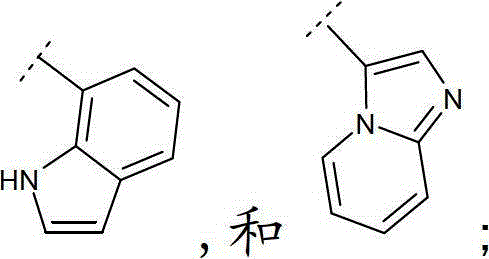
还更优选地,R5和R6之一选自-COOH、Still more preferably, one of R and R is selected from -COOH,
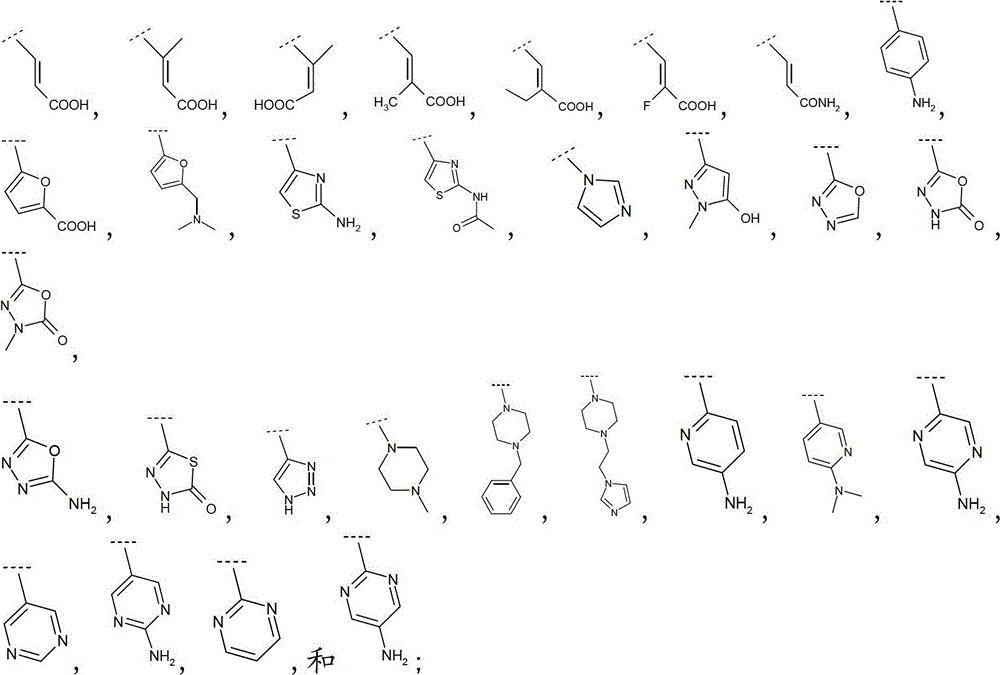
且R5和R6的另一个选自H、甲基、甲氧基、乙氧基、-NH2和-NHCO-O-CH(CH3)2。And the other one of R 5 and R 6 is selected from H, methyl, methoxy, ethoxy, -NH 2 and -NHCO-O-CH(CH 3 ) 2 .
最优选地,R5和R6之一为

或者最优选地,R5和R6之一选自:Or most preferably, one of R and R is selected from:

R 8 : R 8 :
优选地,R8选自(C1-5)烷基、(C4-6)环烷基和(C3-4)环烷基-(C1-3)烷基,其中该(C1-5)烷基是任选地被(C1-3)烷氧基或被一至三个氟原子所取代。Preferably, R 8 is selected from (C 1-5 ) alkyl, (C 4-6 ) cycloalkyl and (C 3-4 ) cycloalkyl-(C 1-3 ) alkyl, wherein the (C 1 -5 ) Alkyl is optionally substituted by (C 1-3 )alkoxy or by one to three fluorine atoms.
更优选地,R8选自甲基、乙基、丙基、1-甲基乙基、2-甲基丙基、3-甲基丁基、环丁基、环丙基甲基、2-氟乙基、2,2,2-三氟乙基和2-甲氧基乙基。More preferably, R is selected from methyl, ethyl, propyl, 1-methylethyl, 2-methylpropyl, 3-methylbutyl, cyclobutyl, cyclopropylmethyl, 2- Fluoroethyl, 2,2,2-trifluoroethyl and 2-methoxyethyl.
最优选地R8为甲基。Most preferably R8 is methyl.
R 9 和R 10 : R9 and R10 :
优选地,R9和R10各自独立地选自(C1-3)烷基,或R9和R10连接,并与其相连接的碳原子共同形成(C3-6)环烷基、(C5-6)环烯基或具有1至2个各自独立地选自O和N的杂原子的5-或6-员单环杂环;其中该环烷基、环烯基或杂环各自任选地被(C1-4)烷基取代。Preferably, R 9 and R 10 are each independently selected from (C 1-3 ) alkyl, or R 9 and R 10 are connected to form (C 3-6 ) cycloalkyl, ( C 5-6 ) cycloalkenyl or a 5- or 6-membered monocyclic heterocycle having 1 to 2 heteroatoms each independently selected from O and N; wherein the cycloalkyl, cycloalkenyl or heterocycle are each Optionally substituted with (C 1-4 )alkyl.
更优选地,基团

更优选地,基团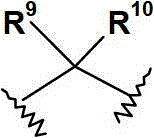

最优选地,基团

式I的化合物是包括在本发明的范畴内:Compounds of formula I are included within the scope of the present invention:

其中:in:
A或B为N且B或A的另一个为C,其中在两个C-原子之间的-----代表双键且C-原子和N-原子之间的-----代表单键;A or B is N and the other of B or A is C, where ----- between two C-atoms represents a double bond and ----- between a C-atom and an N-atom represents single bond;
R1为H或(C1-6)烷基;R 1 is H or (C 1-6 ) alkyl;
R2为卤素、芳基或Het;该芳基和Het是任选地被R21取代;R 2 is halogen, aryl or Het; the aryl and Het are optionally substituted by R 21 ;
其中R21为一、二或三个取代基,其各自独立地选自-OH,-CN,Wherein R 21 is one, two or three substituents, which are each independently selected from -OH, -CN,
-N(RN2)RN1、卤素、(C1-6)烷基、(C1-6)烷氧基、(C1-6)烷硫基、Het和-CO-N(RN2)RN1;-N(R N2 )R N1 , halogen, (C 1-6 )alkyl, (C 1-6 )alkoxy, (C 1-6 )alkylthio, Het and -CO-N(R N2 ) R N1 ;
其中该烷基、烷氧基和烷硫基各自任选地被一、二或三个卤素原子取代;wherein the alkyl, alkoxy and alkylthio groups are each optionally substituted by one, two or three halogen atoms;
R3为(C5-6)环烷基,任选地被一至四个卤素原子所取代;R 3 is (C 5-6 )cycloalkyl, optionally substituted by one to four halogen atoms;
R4和R7各自独立地选自H、(C1-6)烷基、(C1-6)烷氧基,(C1-6)烷硫基、-NH2、-NH(C1-6)烷基、-N((C1-6)烷基)2和卤素;R 4 and R 7 are each independently selected from H, (C 1-6 ) alkyl, (C 1-6 ) alkoxy, (C 1-6 ) alkylthio, -NH 2 , -NH(C 1 -6 ) alkyl, -N((C 1-6 ) alkyl) 2 and halogen;
R5和R6之一选自COOH、-CO-N(RN2)RN1、Het和(C2-6)链烯基,其中Het、(C2-6)链烯基及RN1或在RN2和RN1之间形成的任何杂环各自任选地被R50取代;One of R 5 and R 6 is selected from COOH, -CO-N(R N2 )R N1 , Het and (C 2-6 ) alkenyl, wherein Het, (C 2-6 ) alkenyl and R N1 or Any heterocycle formed between R N2 and R N1 is each optionally substituted by R 50 ;
其中R50为一、二或三个取代基,其各自独立地选自(C1-6)烷基、-COOH,Wherein R 50 is one, two or three substituents, which are each independently selected from (C 1-6 ) alkyl, -COOH,
-N(RN2)RN1,-CO-N(RN2)RN1和卤素;-N(R N2 )R N1 ,-CO-N(R N2 )R N1 and halogens;
且R5和R6的另一个选自H、(C1-6)烷基、(C1-6)烷氧基、(C1-6)烷硫基和N(RN2)RN1;And the other of R 5 and R 6 is selected from H, (C 1-6 ) alkyl, (C 1-6 ) alkoxy, (C 1-6 ) alkylthio and N(R N2 )R N1 ;
R8为(C1-6)烷基、(C3-7)环烷基或(C3-7)环烷基-(C1-6)烷基-;R 8 is (C 1-6 ) alkyl, (C 3-7 ) cycloalkyl or (C 3-7 ) cycloalkyl-(C 1-6 ) alkyl-;
其中该烷基、环烷基和环烷基-烷基各自任选地被一、二或三个各自独立地选自卤素、(C1-6)烷氧基和(C1-6)烷硫基的取代基取代;wherein the alkyl, cycloalkyl and cycloalkyl-alkyl are each optionally selected from one, two or three each independently selected from halogen, (C 1-6 )alkoxy and (C 1-6 )alkoxy A substituent of a thio group is substituted;
R9和R10各自独立地选自(C1-6)烷基;或R9和R10连接,并与其相连接的碳原子共同形成(C3-7)环烷基、(C3-7)环烯基或具有1至3个杂原子的4-,5-或6-员杂环,该杂原子各自独立地选自O、N和S;R 9 and R 10 are each independently selected from (C 1-6 ) alkyl; or R 9 and R 10 are connected to form (C 3-7 ) cycloalkyl, (C 3- 7 ) cycloalkenyl or a 4-, 5- or 6-membered heterocycle with 1 to 3 heteroatoms, each of which is independently selected from O, N and S;
其中该环烷基、环烯基或杂环基各自任选地被(C1-4)烷基取代;wherein each of the cycloalkyl, cycloalkenyl or heterocyclyl is optionally substituted by (C 1-4 )alkyl;
RN1选自H、(C1-6)烷基、(C3-7)环烷基、(C3-7)环烷基-(C1-6)烷基-、-CO-(C1-6)烷基、-CO-O-(C1-6)烷基和Het;R N1 is selected from H, (C 1-6 ) alkyl, (C 3-7 ) cycloalkyl, (C 3-7 ) cycloalkyl-(C 1-6 ) alkyl-, -CO-(C 1-6 ) alkyl, -CO-O-(C 1-6 ) alkyl and Het;
其中所有该烷基和环烷基是任选地被一、二或三个各自独立地选自卤wherein all of the alkyl and cycloalkyl groups are optionally one, two or three each independently selected from halogen
素、(C1-6)烷氧基和(C1-6)烷硫基的取代基取代;且Substituents of prime, (C 1-6 ) alkoxy and (C 1-6 ) alkylthio; and
RN2为H或(C1-6)烷基,或R N2 is H or (C 1-6 )alkyl, or
RN2和RN1可以连接,并与其相连接的氮原子共同形成4-、5-、6-或7-员饱和或不饱和含N杂环,或8-、9-、10-或11-员含N杂双环,各自还具有1至3个各自独立地选自O、N和S的杂原子;R N2 and R N1 can be linked together to form a 4-, 5-, 6- or 7-membered saturated or unsaturated N-containing heterocycle, or 8-, 9-, 10- or 11- Members contain N heterobicyclic rings, each further having 1 to 3 heteroatoms each independently selected from O, N and S;
其中该由RN2和RN1形成的杂环或杂双环是任选地被一、二或三个各自Wherein the heterocycle or heterobicycle formed by R N2 and R N1 is optionally replaced by one, two or three of each
独立地选自卤素、(C1-6)烷基、(C1-6)烷氧基和(C1-6)烷硫基的取代基取代;其中Het定义为具有1至4个各自独立地选自O、N和S的杂原子的4-、5-、6-或7-员杂环,可以为饱和、不饱和或芳香的,或在可能位置具有1至5个各自独立地选自O、N和S还原杂原子还原8-、9-、10-或11员杂双环,可以为饱和、不饱和或芳香的;Substituents independently selected from halogen, (C 1-6 ) alkyl, (C 1-6 ) alkoxy and (C 1-6 ) alkylthio; wherein Het is defined as having 1 to 4 independently 4-, 5-, 6- or 7-membered heterocycles of heteroatoms selected from O, N and S, may be saturated, unsaturated or aromatic, or have 1 to 5 each independently selected in the possible positions reduction of heteroatoms from O, N and S to reduce 8-, 9-, 10- or 11-membered heterobicyclic rings, which may be saturated, unsaturated or aromatic;
或其盐。or its salt.
式(I)尤其是式Ia或Ib的化合物也包括在本发明范畴内,其中:Also included within the scope of the invention are compounds of formula (I), especially formula Ia or Ib, wherein:
R1选自H、甲基和乙基;R is selected from H, methyl and ethyl;
R2选自卤素、氰基、(C1-4)烷基、(C2-4)链烯基、(C2-4)炔基、(C3-6)环烷基、苯基和选自下式的Het:R 2 is selected from halogen, cyano, (C 1-4 ) alkyl, (C 2-4 ) alkenyl, (C 2-4 ) alkynyl, (C 3-6 ) cycloalkyl, phenyl and Het selected from the formula:
其中该苯基和Het未被取代或被R21取代,其中R21为1,2或3个取代基,其各自独立地选自:Wherein the phenyl and Het are unsubstituted or substituted by R , wherein R is 1 , 2 or 3 substituents, each independently selected from:
-1,2或3个取代基,其各自独立地选自卤素;和- 1, 2 or 3 substituents, each independently selected from halogen; and
-1或2个取代基,其各自独立地选自:- 1 or 2 substituents, each independently selected from:
a)羟基、(C1-4)烷基或(C1-4)烷氧基;其中该烷基和烷氧基是各自任选地被一、二或三个卤素原子取代;a) hydroxy, (C 1-4 ) alkyl or (C 1-4 ) alkoxy; wherein the alkyl and alkoxy are each optionally substituted by one, two or three halogen atoms;
b)-NRN2RN1其中b)-NR N2 R N1 where
RN1选自H、(C1-3)烷基、-CO-(C1-3)烷基、-CO-O-(C1-3)烷基和Het;R N1 is selected from H, (C 1-3 ) alkyl, -CO-(C 1-3 ) alkyl, -CO-O-(C 1-3 ) alkyl and Het;
其中每个该(C1-3)烷基、-CO-(C1-3)烷基和-CO-O-(C1-3)烷基的烷基部分是任选地被一、二或三个选自卤素和(C1-6)烷氧基的取代基所取代;且其中该Het为具有1或2个各自独立地选自N,O和S的杂原子的5-或6-员单环饱和、不饱和或芳香杂环;且wherein the alkyl portion of each of the (C 1-3 )alkyl, -CO-(C 1-3 )alkyl and -CO-O-(C 1-3 )alkyl is optionally replaced by one or two or three substituents selected from halogen and (C 1-6 ) alkoxy; and wherein the Het is 5- or 6 with 1 or 2 heteroatoms independently selected from N, O and S -membered monocyclic saturated, unsaturated or aromatic heterocycle; and
RN2为H或(C1-3)烷基;R N2 is H or (C 1-3 ) alkyl;
c)-CONRN2RN1,其中RN2和RN1各自独立地选自H和(C1-3)烷基;和c)-CONR N2 R N1 , wherein R N2 and R N1 are each independently selected from H and (C 1-3 ) alkyl; and
d)Het,其中该Het为具有1,2或3个各自独立地选自N,O和S的杂原子的5-或6-员单环杂环;d) Het, wherein the Het is a 5- or 6-membered monocyclic heterocycle with 1, 2 or 3 heteroatoms each independently selected from N, O and S;
R3为环戊基或环己基,各自任选地被一至四个氟原子所取代; R is cyclopentyl or cyclohexyl, each optionally substituted by one to four fluorine atoms;
R4为H或卤素且R7为H;R 4 is H or halogen and R 7 is H;
R5和R6之一选自: One of R and R is selected from:
a)被COOH或CONHRN1取代的(C2-4)链烯基,其中RN1选自H和(C1-3)烷基,该链烯基任选地还被一或二个各自独立地选自(C1-3)烷基和卤素取代基所取代;a) (C 2-4 ) alkenyl substituted by COOH or CONHR N1 , wherein R N1 is selected from H and (C 1-3 ) alkyl, and the alkenyl is optionally further replaced by one or two independently substituted by (C 1-3 ) alkyl and halogen substituents;
b)苯基或Het,各自任选地被一或二个各自独立地选自以下的取代基所取代:b) phenyl or Het, each optionally substituted by one or two substituents each independently selected from:
i.-OH、氧代、COOH;i.-OH, oxo, COOH;
ii.任选地被苯基或-N(RN2)RN1取代的(C1-3)烷基,其中RN1和RN2各自独立地选自H和(C1-3)烷基,或RN1和RN2连接,并与其相连接的氮原子共同形成5-或6-员单环、饱和、不饱和或芳香含N杂环,该杂环任选地还具有一或二个各自独立地选自N,O和S的杂原子;和ii. (C 1-3 )alkyl optionally substituted by phenyl or -N(R N2 )R N1 , wherein R N1 and R N2 are each independently selected from H and (C 1-3 )alkyl, Or R N1 and R N2 are connected, and the nitrogen atoms connected to them jointly form a 5- or 6-membered monocyclic, saturated, unsaturated or aromatic N-containing heterocycle, and the heterocycle optionally has one or two of each Heteroatoms independently selected from N, O and S; and
iii.-N(RN2)RN1;其中RN1选自H、(C1-3)烷基和-CO(C1-3)烷基且RN2为H或(C1-3)烷基;iii. -N(R N2 )R N1 ; wherein R N1 is selected from H, (C 1-3 ) alkyl and -CO(C 1-3 ) alkyl and R N2 is H or (C 1-3 ) alkane base;
其中Het为具有1至3个各自独立地选自O、N和S的杂原子的5-或6-员单环饱和、不饱和或芳香杂环;及wherein Het is a 5- or 6-membered monocyclic saturated, unsaturated or aromatic heterocycle having 1 to 3 heteroatoms each independently selected from O, N and S; and
c)COOH;c) COOH;
且R5和R6的另一个选自H,NHRN1、(C1-3)烷基和(C1-3)烷氧基,and the other of R 5 and R 6 is selected from H, NHR N1 , (C 1-3 ) alkyl and (C 1-3 ) alkoxy,
其中RN1选自H和-CO-O-(C1-6)烷基;Wherein R N1 is selected from H and -CO-O-(C 1-6 ) alkyl;
R8选自(C1-5)烷基、(C4-6)环烷基和(C3-4)环烷基-(C1-3)烷基,其中该(C1-5)烷基是任选地被(C1-3)烷氧基或一至三个氟原子所取代;且R 8 is selected from (C 1-5 ) alkyl, (C 4-6 ) cycloalkyl and (C 3-4 ) cycloalkyl-(C 1-3 ) alkyl, wherein the (C 1-5 ) Alkyl is optionally substituted by (C 1-3 )alkoxy or one to three fluorine atoms; and
R9和R10各自独立地选自(C1-3)烷基,或R9和R10连接,并与其相连接的碳原子共同形成(C3-6)环烷基、(C5-6)环烯基或具有1-2个选自O和N的杂原子的5或6员杂环;其中该环烷基、环烯基或杂环是任选地被(C1-4)烷基取代。R 9 and R 10 are each independently selected from (C 1-3 ) alkyl, or R 9 and R 10 are connected to form (C 3-6 ) cycloalkyl, (C 5- 6 ) cycloalkenyl or a 5- or 6-membered heterocycle having 1-2 heteroatoms selected from O and N; wherein the cycloalkyl, cycloalkenyl or heterocycle is optionally covered by (C 1-4 ) Alkyl substitution.
更优选地,More preferably,
R1选自H、甲基和乙基;R is selected from H, methyl and ethyl;
R2选自Br、Cl、氰基、甲基、乙基、丙基、1-甲基乙基、乙烯基、1-甲基乙烯基、乙炔基、环丙基、苯基和选自以下的Het: R is selected from Br, Cl, cyano, methyl, ethyl, propyl, 1-methylethyl, vinyl, 1-methylvinyl, ethynyl, cyclopropyl, phenyl and is selected from Het:

其中该苯基和Het未被取代或被R21取代,其中R21为1,2或3个取代基,其各自独立地选自:Wherein the phenyl and Het are unsubstituted or substituted by R , wherein R is 1 , 2 or 3 substituents, each independently selected from:
-1至2个取代基,其各自独立地选自氟、氯和溴;和- 1 to 2 substituents, each independently selected from fluorine, chlorine and bromine; and
-1至2个取代基,其各自独立地选自:- 1 to 2 substituents, each independently selected from:
a)羟基、甲基、乙基、丙基、1-甲基乙基、甲氧基、乙氧基、丙氧基或1-甲基乙氧基;其中该甲基、乙基、丙基、1-甲基乙基、甲氧基、乙氧基、丙氧基和1-甲基乙氧基任选地被一、二或三个卤素原子取代;a) Hydroxy, methyl, ethyl, propyl, 1-methylethyl, methoxy, ethoxy, propoxy or 1-methylethoxy; wherein the methyl, ethyl, propyl , 1-methylethyl, methoxy, ethoxy, propoxy and 1-methylethoxy are optionally substituted by one, two or three halogen atoms;
b)-N(CH3)2或-NHRN1其中b) -N(CH 3 ) 2 or -NHR N1 where
RN1选自H、甲基、乙基、丙基、1-甲基乙基、-CO-CH3、2-吡啶基、3-吡啶基和4-吡啶基;R N1 is selected from H, methyl, ethyl, propyl, 1-methylethyl, -CO-CH 3 , 2-pyridyl, 3-pyridyl and 4-pyridyl;
其中该甲基、乙基、丙基和1-甲基乙基各自任选地被一、二或三个选自卤素和(C1-3)烷氧基还原取代基所取代;Wherein the methyl, ethyl, propyl and 1-methylethyl groups are each optionally substituted by one, two or three reducing substituents selected from halogen and (C 1-3 )alkoxy;
c)-CONH2;以及c) -CONH 2 ; and
d)3-吡啶基、4-吡啶基、5-嘧啶基、2-呋喃基、1-吡咯基和1-吗啉代;d) 3-pyridyl, 4-pyridyl, 5-pyrimidinyl, 2-furyl, 1-pyrrolyl and 1-morpholino;
R3为环戊基或环己基,各自任选地被一或二个氟原子所取代; R is cyclopentyl or cyclohexyl, each optionally substituted by one or two fluorine atoms;
R4为H或卤素且R7为H;R 4 is H or halogen and R 7 is H;
R5和R6之一选自: One of R and R is selected from:
a)被COOH或-CONH2取代的(C2-4)链烯基,并任选地还被一或二个选自(C1-3)烷基和卤素的取代基所取代;和a) (C 2-4 )alkenyl substituted by COOH or -CONH 2 , and optionally further substituted by one or two substituents selected from (C 1-3 )alkyl and halogen; and
b)苯基或Het,各自任选地被一或二个各自独立地选自以下的取代基所取代:b) phenyl or Het, each optionally substituted by one or two substituents each independently selected from:
i.-OH、氧代、COOH;i.-OH, oxo, COOH;
ii(C1-3)烷基,任选地被苯基、-N(CH3)2或
iii.-NH2,-N(CH3)2和-NHCOCH3;iii. -NH 2 , -N(CH 3 ) 2 and -NHCOCH 3 ;
其中Het选自下式:Wherein Het is selected from the following formula:

c)COOH;c) COOH;
且R5和R6的另一个选自H、甲基、甲氧基、乙氧基、-NH2和-NHCO-OCH(CH3)2;And the other of R 5 and R 6 is selected from H, methyl, methoxy, ethoxy, -NH 2 and -NHCO-OCH(CH 3 ) 2 ;
R8选自甲基、乙基、丙基、1-甲基乙基、2-甲基丙基、3-甲基丁基、环丁基、环丙基甲基、2-氟乙基、2,2,2-三氟乙基和2-甲氧基乙基;且 R is selected from methyl, ethyl, propyl, 1-methylethyl, 2-methylpropyl, 3-methylbutyl, cyclobutyl, cyclopropylmethyl, 2-fluoroethyl, 2,2,2-trifluoroethyl and 2-methoxyethyl; and
该基团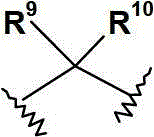

更优选地more preferably
R1选自H、甲基和乙基;R is selected from H, methyl and ethyl;
R2选自Br、Cl、氰基、甲基、乙基、丙基、1-甲基乙基、乙烯基、1-甲基乙烯基、乙炔基、环丙基、苯基和选自下式基团的Het: R is selected from Br, Cl, cyano, methyl, ethyl, propyl, 1-methylethyl, vinyl, 1-methylvinyl, ethynyl, cyclopropyl, phenyl and selected from the following The group Het of the formula:

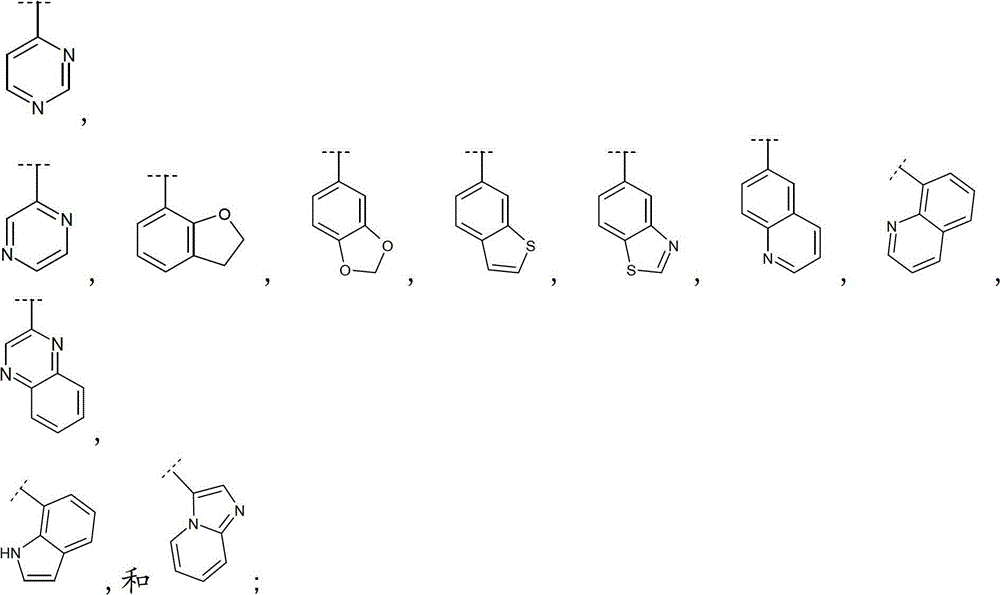
其中该苯基和Het为未被取代或被R21取代,其中R21为1,2或3个取代基,其各自独立地选自:Wherein the phenyl and Het are unsubstituted or substituted by R , wherein R is 1 , 2 or 3 substituents, each independently selected from:
-1至2个取代基,其各自独立地选自氟、氯和溴;及- 1 to 2 substituents, each independently selected from fluorine, chlorine and bromine; and
-1至2个取代基,其各自独立地选自:- 1 to 2 substituents, each independently selected from:
a)羟基、甲基、乙基、丙基、1-甲基乙基、甲氧基、乙氧基、丙氧基或1-甲基乙氧基;其中该甲基、乙基、丙基、1-甲基乙基、甲氧基、乙氧基、丙氧基和1-甲基乙氧基任选地被一、二或三个卤素原子取代;a) Hydroxy, methyl, ethyl, propyl, 1-methylethyl, methoxy, ethoxy, propoxy or 1-methylethoxy; wherein the methyl, ethyl, propyl , 1-methylethyl, methoxy, ethoxy, propoxy and 1-methylethoxy are optionally substituted by one, two or three halogen atoms;
b)-N(CH3)2或-NHRN1,其中b) -N(CH 3 ) 2 or -NHR N1 , wherein
RN1选自H、甲基、乙基、丙基、1-甲基乙基、-CO-CH3、2-吡啶基、3-吡啶基和4-吡啶基;R N1 is selected from H, methyl, ethyl, propyl, 1-methylethyl, -CO-CH 3 , 2-pyridyl, 3-pyridyl and 4-pyridyl;
其中该甲基、乙基、丙基和1-甲基乙基各自任选地被一、二或三个选自卤素和(C1-3)烷氧基的取代基所取代;wherein the methyl, ethyl, propyl and 1-methylethyl groups are each optionally substituted by one, two or three substituents selected from halogen and (C 1-3 )alkoxy;
c)-CONH2;及c) -CONH2 ; and
d)3-吡啶基、4-吡啶基、5-嘧啶基、2-呋喃基、1-吡咯基和1-吗啉代;d) 3-pyridyl, 4-pyridyl, 5-pyrimidinyl, 2-furyl, 1-pyrrolyl and 1-morpholino;
R3为环戊基或环己基,其任选地被一或二个氟原子所取代;R 3 is cyclopentyl or cyclohexyl, which is optionally substituted by one or two fluorine atoms;
R4为H或Cl且R7为H;R 4 is H or Cl and R 7 is H;
R5和R6之一选自: One of R and R is selected from:
a)-CH=CH-COOH或-CH=CH-CONH2,各自任选地被一或二个选自甲基、乙基和氟的取代基所取代;及a) -CH=CH-COOH or -CH=CH-CONH 2 , each optionally substituted by one or two substituents selected from methyl, ethyl and fluorine; and
b)任选地被NH2取代的苯基,或b) phenyl optionally substituted by NH , or
任选地被一或二个各自独立地选自以下的取代基所取代的Het:Het optionally substituted with one or two substituents each independently selected from:
i.-OH、氧代、COOH;i.-OH, oxo, COOH;
ii.甲基或乙基,各自任选地被苯基、-N(CH3)2或
iii.-NH2、-N(CH3)2和-NHCOCH3;iii. -NH 2 , -N(CH 3 ) 2 and -NHCOCH 3 ;
其中Het选自下式:Wherein Het is selected from the following formula:

c)COOH;c) COOH;
且R5和R6的另一个选自H、甲基、甲氧基、乙氧基、-NH2和-NHCO-OCH(CH3)2;And the other of R 5 and R 6 is selected from H, methyl, methoxy, ethoxy, -NH 2 and -NHCO-OCH(CH 3 ) 2 ;
R8选自甲基、乙基、丙基、1-甲基乙基、2-甲基丙基、3-甲基丁基、环丁基、环丙基甲基、2-氟乙基、2,2,2-三氟乙基和2-甲氧基乙基;且 R is selected from methyl, ethyl, propyl, 1-methylethyl, 2-methylpropyl, 3-methylbutyl, cyclobutyl, cyclopropylmethyl, 2-fluoroethyl, 2,2,2-trifluoroethyl and 2-methoxyethyl; and
基团

最优选地,Most preferably,
R1为甲基;R 1 is methyl;
R2选自: R2 is selected from:

R3为环戊基或环己基;R 3 is cyclopentyl or cyclohexyl;
R4和R7皆为H;R 4 and R 7 are both H;
R5和R6之一为

R8为甲基;且R 8 is methyl; and
基团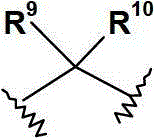

或者最优选地,or most preferably,
R1为甲基;R 1 is methyl;
R2选自: R2 is selected from:

R3为环戊基或环己基;R 3 is cyclopentyl or cyclohexyl;
R4和R7皆为H;R 4 and R 7 are both H;
R5和R6之一为 One of R5 and R6 is

R8为甲基;且基团为
存在于表1至4中式I的每个单一化合物也包括在本发明范畴内。Each single compound of Formula I present in Tables 1 to 4 is also included within the scope of the present invention.
聚合酶活性polymerase activity
式(I)化合物利用HCV的RNA依赖性RNA聚合酶抑制RNA合成的能力,可通过任何能够测量HCV RNA依赖性RNA聚合酶活性的方法加以证实。适用的实验描述在实施例中。The ability of the compound of formula (I) to inhibit RNA synthesis by utilizing HCV RNA-dependent RNA polymerase can be demonstrated by any method capable of measuring the activity of HCV RNA-dependent RNA polymerase. Suitable experiments are described in the Examples.
RNA依赖性RNA聚合酶活性的特化Specialization of RNA-dependent RNA polymerase activity
为了证实本发明化合物是通过HCV聚合酶的特定抑制而起作用,该化合物可在测量RNA-依赖性RNA聚合酶而非HCV聚合酶的活性的实验中,或是在DNA依赖性RNA聚合酶实验中,试验其抑制活性。To demonstrate that compounds of the invention act through specific inhibition of HCV polymerase, the compound can be tested in assays measuring the activity of RNA-dependent RNA polymerase other than HCV polymerase, or in assays of DNA-dependent RNA polymerase , to test its inhibitory activity.
细胞基础的HCV RNA复制活性Cell-Based HCV RNA Replication Activity
本发明化合物抑制细胞中HCV RNA复制的能力,可通过该化合物在细胞基础的HCV RNA复制实验中的抑制性活性而得到证实。适用的实验描述在实施例中。The ability of the compounds of the present invention to inhibit HCV RNA replication in cells can be demonstrated by the inhibitory activity of the compounds in cell-based HCV RNA replication assays. Suitable experiments are described in the Examples.
当式(I)的化合物或其治疗上可接受盐之一用作抗病毒剂时,其可以在介质(vehicle)中经由口服、局部或全身系统性地给药于哺乳动物,包括(但不限于)人类、牛、猪、狗、猫、兔子或小鼠,介质包括一种或多种药学上可接受载体,其中的比例由化合物的溶解度和化学性质、所选的给药途径和标准生物实践来决定。When the compound of formula (I) or one of its therapeutically acceptable salts is used as an antiviral agent, it may be administered orally, topically or systemically to mammals in a vehicle, including (but not limited to) humans, cattle, pigs, dogs, cats, rabbits, or mice, the vehicle includes one or more pharmaceutically acceptable carriers, the proportions of which are determined by the solubility and chemical properties of the compound, the chosen route of administration, and standard biological practice to decide.
对于口服给药而言,该化合物或其治疗上可接受的盐可配制成单位剂型,例如胶囊或片剂,各自在药学上可接受载体中含有预定量的活性成份,范围从约1至约500mg。For oral administration, the compound, or a therapeutically acceptable salt thereof, may be formulated in unit dosage form, such as capsules or tablets, each containing a predetermined amount of the active ingredient in a pharmaceutically acceptable carrier, ranging from about 1 to about 500mg.
对于局部给药而言,该化合物可配制于药学上可接受介质中,含有约0.1%至约5%,优选地约0.5%至约5%的活性剂。这样的制剂可以是溶液、乳膏或洗液的形式。For topical administration, the compounds may be formulated in a pharmaceutically acceptable vehicle containing from about 0.1% to about 5%, preferably from about 0.5% to about 5%, of the active agent. Such formulations may be in the form of solutions, creams or lotions.
对于系统性给药而言,式(I)的化合物可组合药学上可接受介质或载体经由静脉内注射、皮下注射或肌肉注射给药。对于注射给药,优选为化合物用在无菌水性介质的溶液中,其可以还含有其他溶质例如缓冲剂或防腐剂,以及足量的药学上可接受的盐或葡萄糖,以便使得溶液等渗。For systemic administration, the compound of formula (I) can be administered in combination with a pharmaceutically acceptable vehicle or carrier via intravenous injection, subcutaneous injection or intramuscular injection. For injectable administration, the compounds are preferably used in solution in a sterile aqueous medium, which may also contain other solutes such as buffers or preservatives, and sufficient pharmaceutically acceptable salts or glucose to render the solution isotonic.
可用于上述提及的制剂的适用介质或载体描述在医药文献中,例如在“Remington's The Science and Practice of Pharmacy”,第19版,MackPublishing Company,Easton,Penn.,1995中或在“Pharmaceutical Dosage FormsAnd Drugs Delivery Systems”,第6版,H.C.Ansel等,Eds.,Williams & Wilkins,Baltimore,Maryland,1995。Suitable media or carriers which may be used in the above-mentioned formulations are described in the medical literature, for example in "Remington's The Science and Practice of Pharmacy", 19th ed., Mack Publishing Company, Easton, Penn., 1995 or in "Pharmaceutical Dosage Forms And Drugs Delivery Systems", 6th Edition, H.C. Ansel et al., Eds., Williams & Wilkins, Baltimore, Maryland, 1995.
化合物的剂量将随着给药形式以及所选择的具体活性剂而改变。再者,它将随着接受治疗的具体宿主而改变。一般而言,治疗随着小量增加而起始,直到在该情况下达到最适作用为止。一般而言,式I的化合物最希望的给药的浓度水平是一般而言将提供抗病毒效用的结果,而不会引起任何损伤或有害的副作用。The dosage of the compound will vary with the form of administration and the particular active agent chosen. Again, it will vary with the particular host being treated. In general, treatment is initiated with small increases until the optimum effect under the circumstances is reached. In general, the most desirably administered concentration levels of the compounds of Formula I are those that will generally provide antiviral efficacy as a result without causing any injurious or deleterious side effects.
对于口服给药而言,该化合物或治疗上可接受盐可以范围约每天每公斤体重0.01至约200mg进行给药,优选的范围为约每公斤0.05至约100mg。For oral administration, the compound or therapeutically acceptable salt may be administered in the range of about 0.01 to about 200 mg per kilogram body weight per day, preferably in the range of about 0.05 to about 100 mg per kilogram.
对于系统性给药,式(I)的化合物可以剂量为每天每公斤体重约0.01mg至约100mg进行给药,尽管前述变化将会发生。每天每公斤体重约0.05mg至约50mg的范围的剂量水平是为了达到有效结果的最希望的使用剂量。For systemic administration, the compounds of formula (I) may be administered at dosages ranging from about 0.01 mg to about 100 mg per kilogram body weight per day, although the foregoing variations will occur. Dosage levels in the range of about 0.05 mg to about 50 mg per kilogram of body weight per day are most desirably used in order to achieve effective results.
当本发明的组合物包含式I化合物与一种或多种其他治疗性或预防性药物的组合时,该化合物和其他药物以单一治疗方案通常给药都应该以介于约10%至100%之间的剂量存在,且更优选介于约10%和80%的剂量之间。When the composition of the present invention comprises a compound of formula I in combination with one or more other therapeutic or prophylactic drugs, the compound and the other drugs should generally be administered in a single treatment regimen at a ratio of about 10% to 100%. Between doses exist, and more preferably between about 10% and 80% of the dose.
当这些化合物或它们的药学上可接受的盐与药学上可接受载体共同配制时,得到的组合物可给药于哺乳动物例如人类的活体内,以抑制HCV聚合酶或以治疗或预防HCV病毒感染。该治疗也可利用本发明化合物组合下列药物而达到,包括(但不限于):免疫调节剂,包括(但不限于)α-,β-,δ-,γ-,τ-和ω-干扰素或其聚乙二醇化形式;其他抗病毒药物,例如利巴韦林、金刚烷胺;HCV NS5B聚合酶的其他抑制剂;在HCV生命周期中其他靶标的抑制剂,包括(但不限于)抑制靶标的药物,所述靶标包括(但不限于)HCV解旋酶、HCV NS2/3蛋白酶、HCV NS3蛋白酶和HCV IRES,以及干扰其他病毒靶标包括(但不限于)NS5A蛋白质的功能的药物;或其组合。其他药物可与本发明化合物组合以创造单一剂型。或者这些其他药物可作为多种剂型的一部分分开给药于哺乳动物。When these compounds or their pharmaceutically acceptable salts are formulated together with a pharmaceutically acceptable carrier, the resulting composition can be administered to a living body of a mammal, such as a human, to inhibit HCV polymerase or to treat or prevent HCV virus Infect. This treatment can also be achieved using the compounds of this invention in combination with drugs including (but not limited to): Immunomodulators, including (but not limited to) α-, β-, δ-, γ-, τ- and ω-interferons or its pegylated form; other antiviral drugs such as ribavirin, amantadine; other inhibitors of HCV NS5B polymerase; inhibitors of other targets in the HCV life cycle, including (but not limited to) inhibition of Drugs for targets including, but not limited to, HCV helicase, HCV NS2/3 protease, HCV NS3 protease, and HCV IRES, as well as drugs that interfere with the function of other viral targets including, but not limited to, the NS5A protein; or its combination. Other drugs may be combined with the compounds of this invention to create a single dosage form. Alternatively these other agents may be administered separately to the mammal as part of multiple dosage forms.
方法和合成Methods and Synthesis
根据本发明化合物的合成是优选地由下列描述在反应式1中的一般步骤来完成。The synthesis of the compounds according to the present invention is preferably accomplished by the following general steps described in Scheme 1.
反应式1Reaction 1
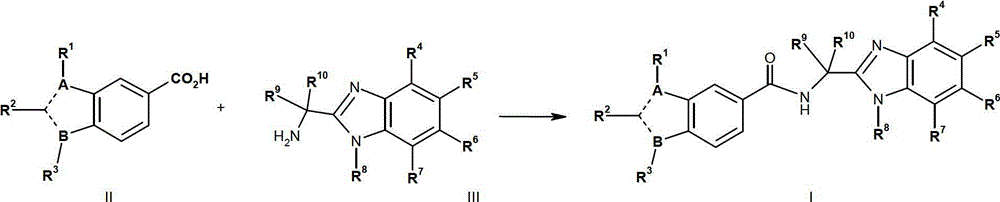
式I的化合物,其中R1,R2,R3,R4,R5,R6,R7,R8,R9和R10如前文定义,是优选地利用本领域技术人员熟知的羧基-活化试剂通过通式II的羧酸和通式III的胺类偶合而制备,如上反应式1所说明。这些试剂包括(但不限于)TBTU、HATU、BOP、BrOP、EDAC、DCC、异丁基氯甲酸酯等。或者,通式II的羧酸可使用标准试剂而转变为相相应的酸氯化物,之后和通式III的胺衍生物偶合。在R5或R6含有酯-保护的羧酸基团的情况中,进行皂化反应(利用本领域技术人员熟知的方案),以获得游离羧酸的最终抑制剂产物。Compounds of formula I, wherein R 1 , R 2 , R 3 , R 4 , R 5 , R 6 , R 7 , R 8 , R 9 and R 10 are as defined above, preferably using the carboxyl group well known to those skilled in the art - The activating reagent is prepared by coupling a carboxylic acid of formula II with an amine of formula III, as illustrated in Reaction Scheme 1 above. These agents include, but are not limited to, TBTU, HATU, BOP, BrOP, EDAC, DCC, isobutyl chloroformate, and the like. Alternatively, carboxylic acids of general formula II can be converted to the corresponding acid chlorides using standard reagents, followed by coupling with amine derivatives of general formula III. In cases where R5 or R6 contain an ester-protected carboxylic acid group, a saponification reaction (using protocols well known to those skilled in the art) is performed to obtain the final inhibitor product of the free carboxylic acid.
式II的中间体羧酸可利用描述在WO 03/010141的方法或利用下列实例中描述的方法制备。式III的中间体胺类可根据下反应式2和反应式3中概述的方法制备。Intermediate carboxylic acids of formula II can be prepared using the methods described in WO 03/010141 or using the methods described in the following examples. Intermediate amines of formula III can be prepared according to the methods outlined in Equations 2 and 3 below.
反应式2Reaction 2
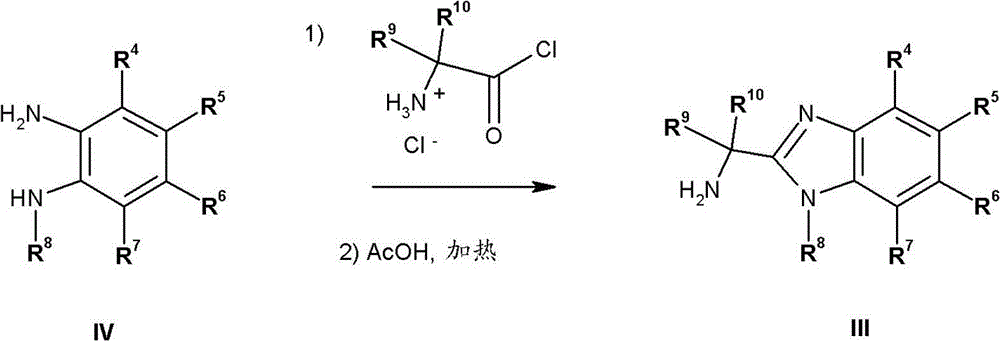
反应式1中通式III的胺中间体可由式IV的相应二胺前体通过和适当的α,α-二取代氨基酸氯化物氢氯化物进行偶合而制备。得自相应α,α-二取代氨基酸的适当α,α-二取代氨基酸氯化物氢氯化物的制备可按照WO03/007945或WO 03/010141中所描述的进行,或按照E.S.Uffelman等人(Org.Lett.1999,1,1157)描述的方法或其改变方式进行。在该偶合反应中形成的酰胺中间体之后利用和醋酸一起加热而环化,以提供通式III的胺类中间体。The amine intermediate of general formula III in Reaction Scheme 1 can be prepared from the corresponding diamine precursor of formula IV by coupling with the appropriate α,α-disubstituted amino acid chloride hydrochloride. Preparation of appropriate α,α-disubstituted amino acid chloride hydrochlorides from the corresponding α,α-disubstituted amino acids can be carried out as described in WO 03/007945 or WO 03/010141, or as described in E.S. Uffelman et al. (Org . Lett. 1999, 1, 1157) or a modification thereof. The amide intermediate formed in this coupling reaction is then cyclized using heating with acetic acid to provide the amine intermediate of general formula III.
反应式3Reaction 3

或者,反应式1中的通式III的胺类中间体可由通式IV的相应二胺前体,通过和适当的Boc-保护的α,α-二取代氨基酸偶合而制备,如反应式3所说明,利用本领域技术人员熟知的偶合试剂,例如TBTU、HATU、BOP、BrOP、EDAC、DCC、异丁基氯甲酸酯等。适当的Boc-保护的α,α-二取代氨基酸可由游离α,α-二取代氨基酸利用本领域技术人员熟知的标准条件而制备,例如和Boc2O(二-叔丁基二碳酸酯)在叔胺例如三乙基胺等存在下进行反应。在偶合反应中形成的酰胺中间体之后利用和醋酸一起加热而环化。为了提供反应式1中通式III胺中间体而进行Boc基团的去保护作用,可利用本领域技术人员熟知的标准试剂来进行。这样的试剂包括(但不限于)三氟醋酸,HCl在二
反应式2和3中的通式IV的二胺前体优选地可利用实施例中描述的方法包括这些方法的任何变通方法来制备,和/或利用本领域技术人员熟知的其他合成步骤来制备。The diamine precursors of general formula IV in Reaction Schemes 2 and 3 are preferably prepared using the methods described in the examples, including any variations of these methods, and/or using other synthetic steps well known to those skilled in the art .
反应式1中通式III的胺中间体,其中R5和R6之一为-CH=C(R50a)-COOR,其中R50a选自H、(C1-6)烷基和卤素且其中R为例如甲基或乙基,可由通式III的相应胺中间体或其经适合保护的衍生物,其中R5和R6之一为-COOR,其中R为例如甲基或乙基,通过下反应式4的方法而制备。反应式4特别地说明了通式III的胺中间体的制备,其中R5为-CH=C(R50a)-COOR,本领域技术人员应当了解当R6为-COOR时,经反应式的方法或其变通方法将得到R6为-CH=C(R50a)-COOR的产物。同时,本领域技术人员应了解,当将上反应式2和3中的通式IV的二胺前体或其经适当保护的衍生物或在其制备中适用的中间体,其中R5和R6之一为-COOR,转变成通式IV的二胺前体,或其经适当保护的衍生物或在其制备中适用的中间体,其中R5和R6之一为-CH=C(R50a)-COOR,其中R50a和R如前述所定义时,也可使用反应式4的方法或其变通方法。The amine intermediate of general formula III in Reaction Scheme 1, wherein R 5 and R 6 one of -CH=C(R 50a )-COOR, wherein R 50a is selected from H, (C 1-6 ) alkyl and halogen and wherein R is, for example, methyl or ethyl, from the corresponding amine intermediate of general formula III or a suitably protected derivative thereof, wherein one of R and R is -COOR , wherein R is, for example, methyl or ethyl, Prepared by the method of the following reaction formula 4. Reaction formula 4 particularly illustrates the preparation of the amine intermediate of general formula III, wherein R 5 is -CH=C(R 50a )-COOR, those skilled in the art should understand that when R 6 is -COOR, through reaction formula Methods or variations thereof will give products where R 6 is -CH=C(R 50a )-COOR. At the same time, those skilled in the art should understand that when the diamine precursors of the general formula IV in the above reaction formulas 2 and 3 or their appropriately protected derivatives or intermediates suitable for their preparation, wherein R 5 and R One of 6 is -COOR, is transformed into the diamine precursor of general formula IV, or its suitably protected derivative or the intermediate that is applicable in its preparation, wherein R 5 and R 6 One of -CH=C( R 50a )-COOR, wherein R 50a and R are as defined above, the method of Reaction Formula 4 or its modified method can also be used.
反应式4Reaction 4
上反应式4中的通式IIIa经适当保护的胺中间体可通过用适合的还原剂例如DIBAL-H等处理而转变成通式IIIb的醇中间体。适用的保护性基团(PG)包括(但不限于)氨基甲酸酯保护性基团,例如Boc(叔丁基氧基羰基)等。由上反应式1中的通式III的胺中间体制备通式IIIa的经保护胺中间体,可通过本领域技术人员熟知的标准方法来制备。醇中间体IIIb可利用本领域技术人员熟知的标准氧化剂例如1,1,1-三(乙酰基氧基-1,1-二氢-1,2-苯并间二氧杂环戊烯(benziodoxol)-3-(1H)-酮(也称为Dess-Martin Periodinane)等而转变成醛中间体IIIc。Appropriately protected amine intermediates of general formula IIIa in Equation 4 above can be converted to alcohol intermediates of general formula IIIb by treatment with a suitable reducing agent such as DIBAL-H or the like. Suitable protecting groups (PG) include, but are not limited to, carbamate protecting groups such as Boc (tert-butyloxycarbonyl) and the like. The preparation of protected amine intermediates of general formula IIIa from amine intermediates of general formula III in Reaction Scheme 1 above can be prepared by standard methods well known to those skilled in the art. Alcohol intermediate IIIb can utilize standard oxidizing agents such as 1,1,1-tris(acetyloxy-1,1-dihydro-1,2-benzodioxole (benzodoxol) well known to those skilled in the art. )-3-(1H)-ketone (also known as Dess-Martin Periodinane) and so on into aldehyde intermediate IIIc.
醛中间体IIIc可利用标准Horner-Emmons方法或本领域技术人员熟知的相关过程例如Wittig方法等,接着利用熟知的标准方法进行PG基团的去保护而转化成通式IIId的胺中间体。在PG基团为Boc的情况下,这样的方法包括(但不限于)用酸处理,例如三氟醋酸,溶解在二
反应式1中的通式III的胺中间体,其中R5和R6之一为-C(R50)=CH-COOR,其中R50为(C1-6)烷基且其中R为例如甲基或乙基,可由上反应式4中的中间体IIIc利用下反应式5的方法制备。尽管反应式5特别地说明通式III的胺中间体其中R5为-C(R50)=CH-COOR的制备,本领域技术人员应了解当R6为-CHO时,该反应式说明的方法或其变通方法将得到其中R6为-C(R50)=CH-COOR的产物。同时,本领域技术人员应了解反应式5的方法或其变通方法也可用于当将上反应式2或3中的通式IV的二胺前体,或其经适当保护的衍生物或其制备中适用的中间体,其中R5和R6之一为-CHO,转变成通式IV的二胺前体,或其经适当保护的衍生物,或在其制备中适用的中间体,其中R5和R6之一为-C(R50)=CH-COOR的情况,其中R50和R如前文中所定义。The amine intermediate of the general formula III in Reaction Scheme 1, wherein R 5 and R 6 one of -C(R 50 )=CH-COOR, wherein R 50 is (C 1-6 ) alkyl and wherein R is for example Methyl or ethyl can be prepared by the method of the following reaction formula 5 from the intermediate IIIc in the above reaction formula 4. Although Reaction Scheme 5 specifically illustrates the preparation of amine intermediates of general formula III wherein R 5 is -C(R 50 )=CH-COOR, those skilled in the art will understand that when R 6 is -CHO, the reaction scheme illustrates the Methods or variations thereof will give products wherein R6 is -C( R50 )=CH-COOR. At the same time, those skilled in the art should understand that the method of Reaction Formula 5 or its modified method can also be used when the diamine precursor of the general formula IV in Reaction Formula 2 or 3, or its appropriately protected derivative or its preparation A suitable intermediate in which one of R and R is -CHO, converted to a diamine precursor of general formula IV, or a suitably protected derivative thereof, or an intermediate suitable in the preparation thereof, in which R One of 5 and R 6 is the case of -C(R 50 )=CH-COOR, wherein R 50 and R are as defined above.
反应式5Reaction 5
醛中间体IIIc(得自反应式4)可利用本领域技术人员熟知的适合的亲核烷基化剂例如烷基锂等进行烷基化,然后用本领域技术人员熟知的氧化剂例如1,1,1-三(乙酰基氧基-1,1-二氢-1,2-苯并间二氧杂环戊烯-3-(1H)-酮(也称为Dess-Martin periodinane)等将该中间体仲醇氧化成酮,从而实现了转化成通式IIIf的酮。该酮IIIf之后可利用标准Horner-Emmons方法或本领域技术人员熟知的相关方法例如Wittig方法等,接着利用熟知的标准方法进行PG基团的去保护而转化成通式IIId的胺中间体。在PG基团为Boc的情况下,该方法包括(但不限于)用酸处理,例如三氟醋酸,溶解在二
或者,反应式1中的通式III的胺中间体,其中R5和R6之一为-CH=C(R50a)-COOR,其中R50a选自H、(C1-6)烷基和卤素且其中R为(C1-6)烷基,可由通式III的相应胺中间体或其经适当保护的衍生物,其中R5和R6之一为X,其中X为离去基例如卤素原子、磺酸酯等,利用反应式6中描述和下列实施例中另外描述的Heck反应的典型条件而制备。尽管反应式6特别地说明通式III的胺中间体其中R5为-C(R50)=CH-COOR的制备,本领域技术人员应了解当R6为X时,该反应式说明的方法或其变通方法将得到其中R6为-C(R50)=CH-COOR的产物。同时,本领域技术人员应了解反应式6的方法或其变通方法也可用于当将上反应式2或3中的通式IV的二胺前体,或其经适当保护的衍生物或其制备中适用的中间体,其中R5和R6之一为X,转变成通式IV的二胺前体,或其经适当保护的衍生物,或在其制备中适用的中间体,其中R5和R6之一为-C(R50)=CH-COOR的情况,其中R50和R如前文中所定义。Alternatively, the amine intermediate of general formula III in Reaction Formula 1, wherein one of R 5 and R 6 is -CH=C(R 50a )-COOR, wherein R 50a is selected from H, (C 1-6 ) alkyl and halogen and wherein R is (C 1-6 ) alkyl, can be obtained from the corresponding amine intermediate of general formula III or a suitably protected derivative thereof, wherein one of R 5 and R 6 is X, wherein X is a leaving group For example, halogen atoms, sulfonate esters, etc., are prepared using typical conditions for the Heck reaction described in Scheme 6 and further described in the Examples below. Although Reaction Scheme 6 specifically illustrates the preparation of amine intermediates of general formula III wherein R 5 is -C(R 50 )=CH-COOR, those skilled in the art will understand that when R 6 is X, the method illustrated by this Reaction Scheme Or variations thereof will give products where R6 is -C( R50 )=CH-COOR. At the same time, those skilled in the art should understand that the method of Reaction Formula 6 or its modified method can also be used when the diamine precursor of the general formula IV in Reaction Formula 2 or 3, or its appropriately protected derivative or its preparation Intermediates suitable for use in wherein one of R and R is X, converted to a diamine precursor of general formula IV, or a suitably protected derivative thereof, or an intermediate suitable for the preparation thereof, wherein R and one of R 6 is -C(R 50 )=CH-COOR, wherein R 50 and R are as defined above.
反应式6Reaction 6

实施例 Example
本发明在下列非限制性实施例中将进一步详细说明。如本领域技术人员熟知,当需要保护反应成分免于接触到空气或湿气时反应在氮气或氩气中进行。温度以摄氏度表示。快速色谱法在硅胶上进行。溶液百分比或比值除非另有说明否则代表体积对体积关系。利用电子喷雾质谱仪记录质谱分析结果。分析性HPLC在标准条件下进行,采用Combiscreen ODS-AQ C18反相柱,YMC,50×4.6mm i.d.,5μM,120A于220nM进行,用下表中描述的线性梯度(溶剂A为0.1%TFA于H2O中;溶剂B为0.1%TFA于CH3CN中)进行洗脱:The invention is further illustrated in the following non-limiting examples. Reactions were carried out under nitrogen or argon when it was necessary to protect the reaction components from air or moisture, as is well known to those skilled in the art. Temperatures are expressed in degrees Celsius. Flash chromatography was performed on silica gel. Solution percentages or ratios represent a volume-to-volume relationship unless otherwise indicated. Mass spectrometry results were recorded using an electron spray mass spectrometer. Analytical HPLC was carried out under standard conditions, using Combiscreen ODS-AQ C 18 reverse phase column, YMC, 50 × 4.6mm id, 5 μ M, 120A was carried out at 220nM, with the linear gradient described in the table below (solvent A is 0.1% TFA Elution in H2O ; Solvent B is 0.1% TFA in CH3CN ):
下列缩写或符号可用于前文中和后文中:The following abbreviations or symbols may be used both in the preceding text and in the following text:
AcOH:醋酸;AcOH: acetic acid;
Ac2O:醋酸酐; Ac2O : acetic anhydride;
BOC或Boc:叔丁基氧基羰基;BOC or Boc: tert-butyloxycarbonyl;
BOP:苯并三唑-1-基氧基-三(二甲基氨基)
BroP:溴三(二甲基氨基)
Bu:丁基;Bu: butyl;
CPS:每秒计数;CPS: count per second;
DAST:(二乙基氨基)硫三氟化物;DAST: (diethylamino)sulfur trifluoride;
dba:二亚苯甲基丙酮;dba: diphenylene acetone;
DCC:1,3-二环己基碳二亚胺;DCC: 1,3-Dicyclohexylcarbodiimide;
DCM:二氯甲烷;DCM: dichloromethane;
DCMA:二环己基甲基胺;DCMA: dicyclohexylmethylamine;
DIBAL-H:二-异丁基铝氢化物;DIBAL-H: Di-isobutylaluminum hydride;
DMEM:改进的Earle培养基;DMEM: Modified Earle Medium;
DMF:N,N-二甲基甲酰胺;DMF: N,N-dimethylformamide;
DMSO:二甲基亚砜;DMSO: dimethyl sulfoxide;
EC50:50%有效浓度;EC 50 : 50% effective concentration;
DEAC:见EDC;DEAC: See EDC;
EDC:1-(3-二甲基氨基丙基)-3-乙基碳二亚胺盐酸;EDC: 1-(3-dimethylaminopropyl)-3-ethylcarbodiimide hydrochloride;
ES-:电子喷雾(负离子化);ES - : Electron spray (negative ionization);
ES+:电子喷雾(正离子化);ES + : Electron spray (positive ionization);
Et:乙基;Et: ethyl;
Et2O:二乙基醚; Et2O : diethyl ether;
EtOAc:乙酸乙酯;EtOAc: ethyl acetate;
EtOH:乙醇;EtOH: ethanol;
FBS:胎牛血清;FBS: fetal bovine serum;
Fmoc:9-芴基甲氧基羰基;Fmoc: 9-fluorenylmethoxycarbonyl;
HATU:O-(7-氮杂苯并三唑-1-基)-N,N,N',N'-四甲基脲六氟磷酸盐;HATU: O-(7-azabenzotriazol-1-yl)-N,N,N',N'-tetramethylurea Hexafluorophosphate;
HBTU:O-苯并三唑-1-基-N,N,N',N'-四甲基脲
HOAT:1-羟基-7-氮杂苯并三唑;HOAT: 1-Hydroxy-7-azabenzotriazole;
HOBt:1-羟基苯并三唑;HOBt: 1-hydroxybenzotriazole;
HPLC:高效液相色谱法;HPLC: high performance liquid chromatography;
iPr或i-Pr:异丙基; iPr or i-Pr: isopropyl;
Me:甲基;Me: methyl;
MeCN:乙腈;MeCN: acetonitrile;
MeOH:甲醇;MeOH: Methanol;
MS(ES):电子喷雾质谱仪;MS(ES): Electron Spray Mass Spectrometer;
NMR:核磁共振光谱仪;NMR: nuclear magnetic resonance spectrometer;
PBS:磷酸盐缓冲液;PBS: phosphate buffer saline;
Ph:苯基;Ph: phenyl;
PG:保护基;PG: protecting group;
PVDF:聚偏二氟乙烯;PVDF: polyvinylidene fluoride;
RT:室温(约25℃);RT: Room temperature (about 25°C);
TBME:叔丁基甲基醚;TBME: tert-butyl methyl ether;
TBTU:2-(1H-苯并三唑-1-基)-N,N,N',N'-四甲基脲
tBu:叔丁基;tBu: tert-butyl;
Tf:三氟甲基磺酰基;Tf: trifluoromethylsulfonyl;
TfO:三氟甲基磺酸酯;TfO: triflate;
TFA:三氟醋酸;TFA: trifluoroacetic acid;
THF:四氢呋喃;THF: Tetrahydrofuran;
TLC:薄层色谱法;TLC: thin layer chromatography;
TMS:三甲基硅烷基;TMS: Trimethylsilyl;
Troc:三氯乙氧基羰基。Troc: trichloroethoxycarbonyl.
实施例1Example 1
3-(3,3-二氟环戊基)-1-甲基-1H-吲哚-6-羧酸甲酯3-(3,3-Difluorocyclopentyl)-1-methyl-1H-indole-6-carboxylic acid methyl ester

步骤1:step 1:
将吲哚-6-羧酸1-1(5.0g,31.0mmol)溶解在MeOH(100mL)中,加入催化量的H2SO4(1.0mL)并在回流下搅拌反应混合物16小时。将少量的固体K2CO3加入,以中和过量的H2SO4并在RT持续搅拌1h。将反应混合物在真空下浓缩以除去MeOH,用NaHCO3饱和水溶液(~50mL)稀释并用EtOAc(~200mL)萃取。用盐水(100mL)清洗有机层,在无水MgSO4中干燥并浓缩至干燥。将得到的残留物利用快速柱色谱法加以纯化,利用在己烷中的30%EtOAc作为洗脱液,以得到纯的甲酯1-2(4.78g,88%收率)。Indole-6-carboxylic acid 1-1 (5.0 g, 31.0 mmol) was dissolved in MeOH (100 mL), a catalytic amount of H 2 SO 4 (1.0 mL) was added and the reaction mixture was stirred at reflux for 16 hours. A small amount of solid K2CO3 was added to neutralize excess H2SO4 and stirring was continued at RT for 1 h. The reaction mixture was concentrated in vacuo to remove MeOH, diluted with saturated aqueous NaHCO 3 (~50 mL) and extracted with EtOAc (~200 mL). The organic layer was washed with brine (100 mL), dried over anhydrous MgSO 4 and concentrated to dryness. The resulting residue was purified by flash column chromatography using 30% EtOAc in hexanes as eluent to afford pure methyl ester 1-2 (4.78 g, 88% yield).
步骤2:Step 2:
将步骤1中得到的甲酯1-2(3.31g,18.9mmol)溶解在MeCN(50mL)中并加入催化量的Yb(OTf)3(586mg,0.95mmol)。将2-环戊烯-1-酮(7.76mL,94.5mmol)加入并在回流下搅拌反应混合物16小时。在真空下将MeCN溶剂除去,将残留物再溶解在EtOAc(~200mL)中,并用饱和NaHCO3水溶液(~100mL)、H2O(50mL)和盐水(50mL)萃取。将有机层用无水MgSO4干燥并在真空中浓缩至干。利用快速柱色谱法将残留物纯化之后,利用在己烷中的40%EtOAc作为溶液梯度,将希望的环戊酮加合物1-3分离,得到米色粉末(3.4g,70%收率)。The methyl ester 1-2 (3.31 g, 18.9 mmol) obtained in step 1 was dissolved in MeCN (50 mL) and a catalytic amount of Yb(OTf) 3 (586 mg, 0.95 mmol) was added. 2-Cyclopenten-1-one (7.76 mL, 94.5 mmol) was added and the reaction mixture was stirred at reflux for 16 hours. The MeCN solvent was removed in vacuo, the residue was redissolved in EtOAc (-200 mL), and extracted with saturated aqueous NaHCO 3 (-100 mL), H 2 O (50 mL) and brine (50 mL). The organic layer was dried over anhydrous MgSO 4 and concentrated to dryness in vacuo. After purification of the residue by flash column chromatography, the desired cyclopentanone adducts 1-3 were isolated using 40% EtOAc in hexanes as a solution gradient to afford a beige powder (3.4 g, 70% yield) .
步骤3:Step 3:
将NaH(60%油中分散体,770mg,19.2mmol)于0℃时缓慢加到步骤2得到的环戊酮加合物中间体1-3(3.81g,14.8mmol)的无水DMF(150mL)溶液中。将反应混合物于0℃下搅拌5分钟,然后滴加入MeI(1.2mL,19.2mmol)并0℃下持续搅拌3小时。将混合物加温至RT并通过加入NH4Cl饱和水溶液(200mL)使反应终止。用EtOAc(2×500mL)萃取混合物并利用NH4Cl饱和水溶液(2×200mL)H2O(200mL)和盐水(200mL)清洗有机层。将合并的有机层利用无水MgSO4干燥,蒸发至干并利用快速柱色谱法纯化残留物(利用在己烷中的30%EtOAc作为洗脱液)以分离N-甲基吲哚中间体1-4的米色固体(3.1g,77%收率)。NaH (60% dispersion in oil, 770mg, 19.2mmol) was slowly added to anhydrous DMF (150mL ) solution. The reaction mixture was stirred at 0°C for 5 minutes, then MeI (1.2 mL, 19.2 mmol) was added dropwise and stirring was continued at 0°C for 3 hours. The mixture was warmed to RT and quenched by the addition of saturated aqueous NH4Cl (200 mL). The mixture was extracted with EtOAc (2×500 mL) and the organic layer was washed with saturated aqueous NH 4 Cl (2×200 mL), H 2 O (200 mL) and brine (200 mL). The combined organic layers were dried over anhydrous MgSO 4 , evaporated to dryness and the residue was purified by flash column chromatography (using 30% EtOAc in hexanes as eluent) to isolate N-methylindole intermediate 1 Beige solid of -4 (3.1 g, 77% yield).
步骤4:Step 4:
在密封管中,将得自步骤3的N-甲基吲哚中间体1-4(1.4g,5.16mmol)和DAST(2.7mL,20.6mmol)溶解在CH2Cl2(50mL)中并在回流下搅拌3天。将混合物缓慢倒入NaHCO3饱和水溶液(~50mL)中并当CO2不再产生时,利用CH2Cl2(2×100mL)萃取该混合物。将合并的有机层用盐水(50mL)清洗,利用无水MgSO4干燥并浓缩至干。将残留物利用快速柱色谱法(利用溶剂梯度己烷中的从10%至20%的EtOAc)加以纯化,以分离出3-(3,3-二氟环戊基)-1-甲基-1H-吲哚-6-羧酸甲酯1-5(750mg,50收率)。In a sealed tube, N-methylindole intermediate 1-4 from Step 3 (1.4 g, 5.16 mmol) and DAST (2.7 mL, 20.6 mmol) were dissolved in CH2Cl2 ( 50 mL) and dissolved in Stir at reflux for 3 days. The mixture was slowly poured into saturated aqueous NaHCO 3 (˜50 mL) and extracted with CH 2 Cl 2 (2×100 mL) when CO 2 evolution ceased. The combined organic layers were washed with brine (50 mL), dried over anhydrous MgSO 4 and concentrated to dryness. The residue was purified by flash column chromatography using a solvent gradient of EtOAc in hexane from 10% to 20% to isolate 3-(3,3-difluorocyclopentyl)-1-methyl- 1H-Indole-6-carboxylic acid methyl ester 1-5 (750 mg, 50 yield).
利用描述在WO 03/010141的方法将3-(3,3-二氟环戊基)-1-甲基-1H-吲哚-6-羧酸甲酯1-5转化成式IIa的羧酸中间体,其中R2如前文中所定义。这些中间体可利用上反应式1及描述在WO 03/010141中的方法转化成通式I的化合物。3-(3,3-Difluorocyclopentyl)-1-methyl-1H-indole-6-carboxylic acid methyl ester 1-5 is converted to the carboxylic acid of formula IIa using the method described in WO 03/010141 Intermediate, wherein R 2 is as defined above. These intermediates can be converted to compounds of general formula I using the above scheme 1 and the methods described in WO 03/010141.
实施例2Example 2
(E)-3-(3-氨基-4-甲基氨基苯基)丙烯酸甲酯(E)-Methyl 3-(3-amino-4-methylaminophenyl)acrylate

步骤1:step 1:
将4-氯-3-硝基肉桂酸2-1(500mg,2.2mmol)和甲基胺在THF(2M,8mL,16mmol)中的溶液的混合物在密封管中于80℃下加热20小时。之后将混合物冷却至室温并浓缩得到橙色固体2-2,其不需进一步纯化在下述步骤中使用。A mixture of 4-chloro-3-nitrocinnamic acid 2-1 (500 mg, 2.2 mmol) and methylamine in THF (2M, 8 mL, 16 mmol) was heated in a sealed tube at 80 °C for 20 hours. The mixture was then cooled to room temperature and concentrated to afford orange solid 2-2, which was used in the following step without further purification.
对于本领域技术人员很显而易见的是,在上反应式2和3中的通式IV的其他二胺中间体,其中R8不是甲基,可利用适合的R8-NH2代替上述步骤1中的甲基胺(CH3NH2)而制备。It will be obvious to those skilled in the art that other diamine intermediates of the general formula IV in the above reaction formulas 2 and 3, wherein R 8 is not a methyl group, can utilize suitable R 8 -NH 2 to replace the above step 1 Methylamine (CH 3 NH 2 ) was prepared.
步骤2:Step 2:
将从步骤1得到的粗4-甲基氨基-3-硝基肉桂酸中间体2-2(488mg,2.2mmol)溶解在甲醇(20mL)中并加入重氮甲烷的乙醚溶液直到HPLC分析显示该酸已完全转化成甲酯为止。将该溶液浓缩至干得到540mg的甲酯2-3的橙色固体,其不需进一步纯化而使用在步骤3中。Crude 4-methylamino-3-nitrocinnamic acid intermediate 2-2 (488 mg, 2.2 mmol) from step 1 was dissolved in methanol (20 mL) and diazomethane in diethyl ether was added until HPLC analysis showed the until the acid has been completely converted to the methyl ester. The solution was concentrated to dryness to give 540 mg of methyl ester 2-3 as an orange solid, which was used in step 3 without further purification.
步骤3:Step 3:
将从步骤2中得到的粗甲酯2-3(540mg,~2.2mmol)和SnCl2二水合物(2.25g,10mmol)溶解在乙醇(20mL)中并在80℃下搅拌混合物4小时。经过那段期间之后,将混合物冷却至室温,并缓慢加到NaHCO3饱和水溶液中。利用乙酸乙酯(100mL)萃取反应混合物,将有机层用无水MgSO4干燥并在减压下将溶剂除去。利用快速柱色谱法中使用己烷于乙酸乙酯中的梯度(从50%至30%)将残留物纯化得到(E)-3-(3-氨基-4-甲基氨基苯基)丙烯酸甲酯2-4的黄色固体(245mg)。The crude methyl ester 2-3 (540 mg, ~2.2 mmol) and SnCl 2 dihydrate (2.25 g, 10 mmol) obtained from step 2 were dissolved in ethanol (20 mL) and the mixture was stirred at 80 °C for 4 h. After that period, the mixture was cooled to room temperature and added slowly to saturated aqueous NaHCO 3 . The reaction mixture was extracted with ethyl acetate (100 mL), the organic layer was dried over anhydrous MgSO 4 and the solvent was removed under reduced pressure. Purification of the residue by flash column chromatography using a gradient of hexane in ethyl acetate (from 50% to 30%) afforded (E)-3-(3-amino-4-methylaminophenyl)methacrylate Ester 2-4 as a yellow solid (245 mg).
实施例3Example 3
(E)-3-[2-(1-氨基环丁基)-1-甲基-1H-苯并咪唑-5-基]丙烯酸甲酯(E)-Methyl 3-[2-(1-aminocyclobutyl)-1-methyl-1H-benzimidazol-5-yl]acrylate

将从实施例2得到的(E)-3-(3-氨基-4-甲基氨基苯基)丙烯酸甲酯2-4(40mg,0.194mmol)悬浮在CH2Cl2(3mL)中并加入依照E.S.Uffelman等人(Org.Lett.1999,1,1157)描述的适用方法制备得到的1-氨基环丁烷羧酸氯化物氢氯化物(31mg,0.18mmol)。在室温下搅拌该反应混合物2小时,然后浓缩以得到白色固体。之后将该固体溶解在醋酸(5mL)中并加热至60℃20小时。将反应的粗产物利用NaHCO3饱和水溶液稀释并利用CH2Cl2(2×50mL)和盐水萃取,将有机层用无水MgSO4干燥并在减压下将溶剂除去以得到(E)-3-[2-(1-氨基环丁基)-1-甲基-1H-苯并咪唑-5-基]丙烯酸甲酯3-1的淡棕色泡沫体(53mg)。(E)-methyl 3-(3-amino-4-methylaminophenyl)acrylate 2-4 (40 mg, 0.194 mmol) obtained from Example 2 was suspended in CH 2 Cl 2 (3 mL) and added 1-Aminocyclobutanecarboxylic acid chloride hydrochloride (31 mg, 0.18 mmol) was prepared according to the applicable method described by ESUffelman et al. (Org. Lett. 1999, 1, 1157). The reaction mixture was stirred at room temperature for 2 hours, then concentrated to give a white solid. The solid was then dissolved in acetic acid (5 mL) and heated to 60 °C for 20 hours. The crude product of the reaction was diluted with saturated aqueous NaHCO 3 and extracted with CH 2 Cl 2 (2×50 mL) and brine, the organic layer was dried over anhydrous MgSO 4 and the solvent was removed under reduced pressure to give (E)-3 -Methyl [2-(1-aminocyclobutyl)-1-methyl-1H-benzimidazol-5-yl]acrylate 3-1 as light brown foam (53 mg).
实施例4Example 4
(E)-3-(2-{1-[(3-环戊基-1-甲基-2-吡啶-2-基-1H-吲哚-6-羰基)氨基]环丁基}-1-甲基-1H-苯并咪唑-5-基)丙烯酸(E)-3-(2-{1-[(3-cyclopentyl-1-methyl-2-pyridin-2-yl-1H-indole-6-carbonyl)amino]cyclobutyl}-1 -Methyl-1H-benzimidazol-5-yl)acrylic acid

将由描述在WO 03/010141的方法制备而得的3-环戊基-1-甲基-2-吡啶-2-基-1H-吲哚-6-羧酸4-1(31.1mg,0.97mmol)、由化合物2-4的乙酯类似物利用描述在实施例3中描述的类似的方法制备而得到的(E)-3-[2-(1-氨基环丁基)-1-甲基-1H-苯并咪唑-5-基]丙烯酸甲酯4-2(27.7mg,0.97mmol)、HATU(47.9mg,0.126mmol)和Et3N(58μL,0.42mmol)的DMSO(2mL)溶液在RT下搅拌3小时。此期间之后,加入NaOH(280μL,2.5N)并将反应混合物在RT下搅拌16小时。利用加入几滴醋酸将反应混合物加以中和并在反相C18、半制备型HPLC柱(使用溶剂梯度从5%至100%MeCN于水中(所有溶剂皆含0.1%的三氟醋酸))加以纯化,以分离出最终抑制剂(E)-3-(2-{1-[(3-环戊基-1-甲基-2-吡啶-2-基-1H-吲哚-6-羰基)氨基]环丁基}-1-甲基-1H-苯并咪唑-5-基)丙烯酸4-3(化合物4001,表4)的白色无水固体,具有>95%的同质性(homogeneity)(45mg,78%收率)。3-cyclopentyl-1-methyl-2-pyridin-2-yl-1H-indole-6-carboxylic acid 4-1 (31.1 mg, 0.97 mmol) prepared by the method described in WO 03/010141 ), the (E)-3-[2-(1-aminocyclobutyl)-1-methyl -1H-benzimidazol-5-yl]methacrylate 4-2 (27.7mg, 0.97mmol), HATU (47.9mg, 0.126mmol) and Et 3 N (58μL, 0.42mmol) in DMSO (2mL) in Stir for 3 hours at RT. After this period, NaOH (280 μL, 2.5N) was added and the reaction mixture was stirred at RT for 16 hours. The reaction mixture was neutralized by adding a few drops of acetic acid and processed on a reverse phase C18 , semi-preparative HPLC column using a solvent gradient from 5% to 100% MeCN in water (all solvents contained 0.1% trifluoroacetic acid). Purification to isolate the final inhibitor (E)-3-(2-{1-[(3-cyclopentyl-1-methyl-2-pyridin-2-yl-1H-indole-6-carbonyl) Amino]cyclobutyl}-1-methyl-1H-benzimidazol-5-yl)acrylic acid 4-3 (Compound 4001, Table 4) as a white anhydrous solid with >95% homogeneity (45 mg, 78% yield).
1H NMR(400MHz,DMSO):δ1.48-1.58(m,2H),1.75-1.85(m,6H),1.85-1.95(m,1H),2.05-2.15(m,1H),2.69-2.76(m,2H),2.98-3.10(m,3H),3.63(s,3H),3.82(s,3H),6.59(d,J=16Hz,1H),7.42(dd,J=0.8&5.7Hz,1H),7.51(d,J=7.7Hz,1H),7.53(d,J=8.5Hz,1H),7.65(d,J=8.5Hz,1H),7.71(d,J=8.4Hz,1H),7.76(d,J=16Hz,1H),7.82(d,J=8.4Hz,1H),7.92(ddd,J=1.6 & 7.8Hz,1H),8.01(s,1H),8.04(s,1H),8.73(d,J=4.1Hz,1H),9.45(s,1H)。 1 H NMR(400MHz,DMSO):δ1.48-1.58(m,2H),1.75-1.85(m,6H),1.85-1.95(m,1H),2.05-2.15(m,1H),2.69-2.76 (m,2H),2.98-3.10(m,3H),3.63(s,3H),3.82(s,3H),6.59(d,J=16Hz,1H),7.42(dd,J=0.8&5.7Hz ,1H),7.51(d,J=7.7Hz,1H),7.53(d,J=8.5Hz,1H),7.65(d,J=8.5Hz,1H),7.71(d,J=8.4Hz,1H ),7.76(d,J=16Hz,1H),7.82(d,J=8.4Hz,1H),7.92(ddd,J=1.6 & 7.8Hz,1H),8.01(s,1H),8.04(s, 1H), 8.73(d, J=4.1Hz, 1H), 9.45(s, 1H).
实施例5Example 5
3-环戊基-1-甲基-2-吡嗪-2-基-1H-吲哚-6-羧酸{1-[5-((E)-2-氨基甲酰基乙烯基)-1-甲基-1H-苯并咪唑-2-基]环丁基}酰胺3-cyclopentyl-1-methyl-2-pyrazin-2-yl-1H-indole-6-carboxylic acid {1-[5-((E)-2-carbamoylvinyl)-1 -Methyl-1H-benzimidazol-2-yl]cyclobutyl}amide

步骤1:step 1:
将3-环戊基-1-甲基-2-吡嗪-2-基-1H-吲哚-6-羧酸5-(利用WO 03/010141中描述的方法制备)和(E)-3-[2-(1-氨基环丁基)-1-甲基-1H-苯并咪唑-5-基]丙烯酸乙酯4-2偶合,接着进行乙酯的皂化,利用实施例4中描述的类似方法得到(E)-3-(2-{1-[(3-环戊基-1-甲基-2-吡嗪-2-基-1H-吲哚-6-羰基)氨基]环丁基}-1-甲基-1H-苯并咪唑-5-基)丙烯酸5-2(化合物4003,表4)。3-cyclopentyl-1-methyl-2-pyrazin-2-yl-1H-indole-6-carboxylic acid 5- (prepared using the method described in WO 03/010141) and (E)-3 -[2-(1-Aminocyclobutyl)-1-methyl-1H-benzimidazol-5-yl]acrylic acid ethyl ester 4-2 coupling followed by saponification of the ethyl ester using the procedure described in Example 4 The similar method obtains (E)-3-(2-{1-[(3-cyclopentyl-1-methyl-2-pyrazin-2-yl-1H-indole-6-carbonyl)amino]cyclobutane base}-1-methyl-1H-benzimidazol-5-yl)acrylic acid 5-2 (compound 4003, Table 4).
1H NMR(400MHz,DMSO-d6):δ1.50-1.58(m,2H),1.78-1.20(m,7H),2.05-2.15(m,1H),2.65-2.75(m,2H),2.97-3.10(m,3H),3.66(s,3H),3.18(s,3H),6.57(d,J=16.0Hz,1H),7.55(dd,J=1.0&8.4Hz,1H),7.68(2d,J=8.4Hz,2H),7.75(d,J=16.0Hz,1H),7.78(d,J=11.0Hz,1H),8.00(s,1H),8.07(s,1H),8.68(d,J=2.3Hz,1H),8.78(d,J=1.2Hz,1H),8.82(dd,J=0.8&2.2,1H),9.44(brs,1H)。 1 H NMR(400MHz,DMSO-d 6 ):δ1.50-1.58(m,2H),1.78-1.20(m,7H),2.05-2.15(m,1H),2.65-2.75(m,2H), 2.97-3.10(m,3H),3.66(s,3H),3.18(s,3H),6.57(d,J=16.0Hz,1H),7.55(dd,J=1.0&8.4Hz,1H),7.68 (2d,J=8.4Hz,2H),7.75(d,J=16.0Hz,1H),7.78(d,J=11.0Hz,1H),8.00(s,1H),8.07(s,1H),8.68 (d,J=2.3Hz,1H),8.78(d,J=1.2Hz,1H),8.82(dd,J=0.8&2.2,1H),9.44(brs,1H).
步骤2:Step 2:
将(E)-3-(2-{1-[(3-环戊基-1-甲基-2-吡嗪-2-基-1H-吲哚-6-羰基)氨基]环丁基}-1-甲基-1H-苯并咪唑-5-基)丙烯酸5-2(化合物4003,表4;60mg,0.087mmol)、TBTU(68mg,0.18mmol)、碳酸氢铵(20mg,0.26mmol)和Et3N(36μL,0.26mmol)的DMSO(23mL)溶液于RT下搅拌3h。利用加入几滴醋酸将反应混合物加以中和并在反相C18、半制备型HPLC柱(使用溶剂梯度从5%至100%MeCN于水中(所有溶剂皆含0.1%的三氟醋酸))加以纯化,以分离出抑制剂3-环戊基-1-甲基-2-吡嗪-2-基-1H-吲哚-6-羧酸{1-[5-((E)-2-氨基甲酰基乙烯基)-1-甲基-1H-苯并咪唑-2-基]环丁基}酰胺5-3(化合物1005,表1)的淡黄色无水固体,具有>95%同质性(17mg,34%收率)。(E)-3-(2-{1-[(3-cyclopentyl-1-methyl-2-pyrazin-2-yl-1H-indole-6-carbonyl)amino]cyclobutyl} -1-methyl-1H-benzimidazol-5-yl)acrylic acid 5-2 (compound 4003, Table 4; 60mg, 0.087mmol), TBTU (68mg, 0.18mmol), ammonium bicarbonate (20mg, 0.26mmol) and a solution of Et3N (36 μL, 0.26 mmol) in DMSO (23 mL) was stirred at RT for 3 h. The reaction mixture was neutralized by adding a few drops of acetic acid and processed on a reverse phase C18 , semi-preparative HPLC column using a solvent gradient from 5% to 100% MeCN in water (all solvents contained 0.1% trifluoroacetic acid). Purification to isolate the inhibitor 3-cyclopentyl-1-methyl-2-pyrazin-2-yl-1H-indole-6-carboxylic acid {1-[5-((E)-2-amino Formylvinyl)-1-methyl-1H-benzimidazol-2-yl]cyclobutyl}amide 5-3 (Compound 1005, Table 1) as pale yellow anhydrous solid with >95% homogeneity (17 mg, 34% yield).
1H NMR(400MHz,DMSO-d6):δ1.65-1.75(m,2H),1.92-2.15(m,8H),2.73-2.82(m,2H),3.04-3.10(m,2H),3.15-3.25(m,1H),3.79(s,3H),3.81(s,3H),6.65(d,J=15.8Hz,1H),7.06(brs,1H),7.53(brs,3H),7.61(d,J=15.7Hz,1H),7.68(dd,J=1.0&8.4Hz,1H),7.80(d,J=8.4Hz,1H),7.90(s,1H),8.20(s,1H),8.80(d,J=2.5Hz,1H),8.91(d,J=1.2Hz,1H),8.95(dd,J=2.1 & 3.7,1H),9.23(s,1H)。 1 H NMR(400MHz,DMSO-d 6 ):δ1.65-1.75(m,2H),1.92-2.15(m,8H),2.73-2.82(m,2H),3.04-3.10(m,2H), 3.15-3.25(m,1H),3.79(s,3H),3.81(s,3H),6.65(d,J=15.8Hz,1H),7.06(brs,1H),7.53(brs,3H),7.61 (d,J=15.7Hz,1H),7.68(dd,J=1.0&8.4Hz,1H),7.80(d,J=8.4Hz,1H),7.90(s,1H),8.20(s,1H) ,8.80(d,J=2.5Hz,1H),8.91(d,J=1.2Hz,1H),8.95(dd,J=2.1 & 3.7,1H),9.23(s,1H).
实施例6Example 6
4-氨基-2-甲基-5-(甲基氨基)苯甲酸甲酯Methyl 4-amino-2-methyl-5-(methylamino)benzoate

步骤1:step 1:
将2-甲基-5-硝基苯甲酸6-1(10.0g,55.2mmol)的MeOH(200mL)和H2SO4(1.0mL)溶液加热至回流并同时搅拌~3天。在真空下蒸发溶剂并将残留物再溶解在EtOAc(~200mL)中,用冷H2O(~50mL)、冷的NaHCO3饱和水溶液(~50mL)和冷盐水(~50mL)清洗。之后用无水MgSO4将有机层干燥并浓缩至干,得到甲酯6-2的白色固体,不须经纯化而使用于步骤2中。A solution of 2-methyl-5-nitrobenzoic acid 6-1 (10.0 g, 55.2 mmol) in MeOH (200 mL) and H2SO4 (1.0 mL ) was heated to reflux while stirring for ~3 days. The solvent was evaporated under vacuum and the residue was redissolved in EtOAc (~200 mL), washed with cold H2O (~50 mL), cold saturated aqueous NaHCO3 (~50 mL) and cold brine (~50 mL). The organic layer was then dried over anhydrous MgSO4 and concentrated to dryness to give methyl ester 6-2 as a white solid, which was used in step 2 without purification.
步骤2:Step 2:
向在步骤1中得到的粗甲酯6-2(~55.2mmol)的MeOH(200mL)溶液中加入Pearlman催化剂(在碳上的20%氢氧化钯,1.0g)并在H2的环境下于RT下搅拌混合物20小时。将混合物经由Celite过滤并浓缩至干。将残留物再溶解在THF(200mL)中,加入Ac2O(6.2mL,66mmol)并在RT下搅拌溶液3小时。在真空下将反应混合物浓缩至干并将残留物再溶解在最小体积的t-Bu甲基醚(~150mL)中。将该醚悬浮液在RT下搅拌1小时,加入己烷(~100mL)以沉淀出希望的乙酰基化中间体的白色固体。利用己烷清洗固体并干燥以得到乙酰基化化合物6-3,具有高纯度(10.1g,88%收率)。To a solution of the crude methyl ester 6-2 (~55.2 mmol) obtained in step 1 in MeOH (200 mL) was added Pearlman's catalyst (20% palladium hydroxide on carbon, 1.0 g) and the The mixture was stirred at RT for 20 hours. The mixture was filtered through Celite and concentrated to dryness. The residue was redissolved in THF (200 mL), Ac 2 O (6.2 mL, 66 mmol) was added and the solution was stirred at RT for 3 hours. The reaction mixture was concentrated to dryness under vacuum and the residue was redissolved in a minimal volume of t-Bu methyl ether (-150 mL). The ether suspension was stirred at RT for 1 h and hexane (-100 mL) was added to precipitate the desired acetylated intermediate as a white solid. The solid was washed with hexane and dried to obtain acetylated compound 6-3 with high purity (10.1 g, 88% yield).
步骤3:Step 3:
将由步骤2中得到的乙酰基化酯6-3(8.42g,40.6mmol)和硝酸钾(5.0g,50mmol)的AcOH:H2SO4(1:1比率,200mL)的溶液于RT下搅拌2小时并于40℃下再搅拌两小时。之后将粗反应混合物缓慢倒入冰(~1L)上并混合20分钟。将形成的沉淀物过滤并用水清洗数次以得到主要为两种产物的混合物,希望的4-硝基异构体6-4与不希望的6-硝基异构体6-5(1:2比率),在快速柱色谱法中利用30%EtOAc在己烷中作为洗脱液而加以分离。将纯4-硝基异构体6-4分离得到黄色固体(2.05g,20%收率)。A solution of the acetylated ester 6-3 obtained in step 2 (8.42 g, 40.6 mmol) and potassium nitrate (5.0 g, 50 mmol) in AcOH:H 2 SO 4 (1:1 ratio, 200 mL) was stirred at RT for 2 hours and stirred for a further two hours at 40°C. The crude reaction mixture was then poured slowly onto ice (~1 L) and mixed for 20 minutes. The formed precipitate was filtered and washed several times with water to give a mixture of mainly two products, the desired 4-nitro isomer 6-4 and the undesired 6-nitro isomer 6-5 (1: 2 ratio), separated by flash column chromatography using 30% EtOAc in hexanes as eluent. The pure 4-nitro isomer 6-4 was isolated to give a yellow solid (2.05 g, 20% yield).
步骤4:Step 4:
将由步骤3得到的4-硝基中间体6-4(2.05g,8.13mmol)溶解在THF(50mL)中,并在将溶液冷却至0℃,然后缓慢加入MeI(2.51mL,40.6mmol)和t-BuONa(4.46g,46.4mmol)。将反应混合物于RT下搅拌15小时,加入H2O(~50mL)并用叔丁基甲基醚(~20mL)清洗水性混合物。用1N HCl将水层酸化至pH 3,然后用EtOAc(~100mL)萃取。用盐水(~50mL)清洗有机层,以无水MgSO4进行干燥并浓缩至干得到N-甲基化化合物6-6的胶状泡沫体,其可直接用于步骤5而不须经纯化。The 4-nitro intermediate 6-4 (2.05g, 8.13mmol) obtained from step 3 was dissolved in THF (50mL), and after the solution was cooled to 0°C, MeI (2.51mL, 40.6mmol) and t-BuONa (4.46 g, 46.4 mmol). The reaction mixture was stirred at RT for 15 h, H2O (-50 mL) was added and the aqueous mixture was washed with tert-butyl methyl ether (-20 mL). The aqueous layer was acidified to pH 3 with 1N HCl, then extracted with EtOAc (-100 mL). The organic layer was washed with brine (-50 mL), dried over anhydrous MgSO 4 and concentrated to dryness to give a gummy foam of N-methylated compound 6-6, which was used directly in step 5 without purification.
本领域技术人员应了解,上反应式2和3中通式IV的其他二胺中间体,其中R8不是甲基,可在上述步骤4中利用适当的R8-X代替碘化甲基(CH3I)制备而得,其中X为离去基,例如Cl、Br、I、甲磺酸酯(mesylate)、对甲苯磺酸酯(tosylate)、三氟甲磺酸酯(triflate)等。Those skilled in the art should understand that other diamine intermediates of general formula IV in the above reaction formulas 2 and 3, wherein R 8 is not a methyl group, can utilize appropriate R 8 -X in the above step 4 to replace methyl iodide ( CH 3 I), wherein X is a leaving group, such as Cl, Br, I, mesylate, tosylate, triflate, etc.
步骤5:Step 5:
将得自步骤4的甲基化衍生物6-6(~8mmol)的MeOH(10mL)和HCl(8N,15mL)溶液于70℃下搅拌20小时。在真空下蒸发溶剂并将残留物在NaHCO3饱和水溶液(20mL)和EtOAc(50mL)之前分配。用盐水清洗有机层,利用无水MgSO4干燥并浓缩得到甲酯6-7的橙色固体(1.54g),其可用于步骤6中不须经纯化。A solution of the methylated derivative 6-6 (~8 mmol) from step 4 in MeOH (10 mL) and HCl (8N, 15 mL) was stirred at 70 °C for 20 h. The solvent was evaporated under vacuum and the residue was partitioned between saturated aqueous NaHCO 3 (20 mL) and EtOAc (50 mL). The organic layer was washed with brine, dried over anhydrous MgSO 4 and concentrated to give methyl ester 6-7 as an orange solid (1.54 g), which was used in step 6 without purification.
步骤6:Step 6:
将得自步骤5的粗甲酯6-7(1.54g,6.7mmol)的MeOH(30mL)溶液在催化氢化条件下利用Pd/C(10%,150mg)于H2气压下在RT下处理2小时。将反应混合物利用Celite过滤并浓缩得到4-氨基-2-甲基-5-(甲基氨基)苯甲酸甲酯6-8的紫色固体(1.33g),其已经足够纯化(由NMR证实)不需再纯化而使用。A solution of the crude methyl ester 6-7 (1.54 g, 6.7 mmol) from step 5 in MeOH (30 mL) was treated under catalytic hydrogenation conditions with Pd/C (10%, 150 mg) under H2 atmosphere at RT for 2 Hour. The reaction mixture was filtered through Celite and concentrated to afford methyl 4-amino-2-methyl-5-(methylamino)benzoate 6-8 as a purple solid (1.33 g), which was sufficiently purified (confirmed by NMR) not to It needs to be purified before use.
实施例7Example 7
2-(1-叔-丁氧基羰基氨基环丁基)-3,6-二甲基-3H-苯并咪唑-5-羧羧甲酯2-(1-tert-butoxycarbonylaminocyclobutyl)-3,6-dimethyl-3H-benzimidazole-5-carboxymethyl ester

将1-((1,1-二甲基乙氧基羰基)氨基)环丁烷羧酸(1.40g,6.5mmol)溶解在CH2Cl2(45mL)中并和TBTU于Et3N存在下反应30分钟以预活化该酸。将得自实施例6的4-氨基-2-甲基-5-(甲基氨基)苯甲酸甲酯6-8(1.33g,6.85mmol)的CH2Cl2(10mL)溶液于30分钟期间缓慢加入并持续搅拌反应混合物20小时。将反应混合物浓缩至干并将残留物再溶解在AcOH(10.0mL)中并在70℃下搅拌2小时以达到苯并咪唑环的环化作用。将反应混合物浓缩至干并将残留物溶解在EtOAc(~250mL)中,用NaHCO3饱和水溶液(2×100mL)和盐水(100ml)萃取。将有机层用无水MgSO4干燥并蒸发至干。利用快速柱色谱法(利用溶剂梯度从40%至50%EtOAc于己烷中)纯化残留物,以得到纯的2-(1-叔-丁氧基羰基氨基环丁基)-3,6-二甲基-3H-苯并咪唑-5-羧酸甲酯7-1的米色固体(1.41g,55%收率)并回收未反应的二胺基起始物质。1-((1,1-Dimethylethoxycarbonyl)amino)cyclobutanecarboxylic acid (1.40 g, 6.5 mmol) was dissolved in CH 2 Cl 2 (45 mL) and mixed with TBTU in the presence of Et 3 N React for 30 minutes to preactivate the acid. A solution of methyl 4-amino-2-methyl-5-(methylamino)benzoate 6-8 (1.33 g, 6.85 mmol) from Example 6 in CH 2 Cl 2 (10 mL) was dissolved during 30 minutes Add slowly and continue stirring the reaction mixture for 20 hours. The reaction mixture was concentrated to dryness and the residue was redissolved in AcOH (10.0 mL) and stirred at 70 °C for 2 hours to achieve cyclization of the benzimidazole ring. The reaction mixture was concentrated to dryness and the residue was dissolved in EtOAc (~250 mL), extracted with saturated aqueous NaHCO 3 (2×100 mL) and brine (100 mL). The organic layer was dried over anhydrous MgSO4 and evaporated to dryness. The residue was purified by flash column chromatography (using a solvent gradient from 40% to 50% EtOAc in hexanes) to give pure 2-(1-tert-butoxycarbonylaminocyclobutyl)-3,6- Dimethyl-3H-benzimidazole-5-carboxylic acid methyl ester 7-1 as a beige solid (1.41 g, 55% yield) and recovered unreacted diamine-based starting material.
利用本领域技术人员熟知的标准试剂将2-(1-叔丁氧基羰基氨基环丁基)-3,6-二甲基-3H-苯并咪唑-5-羧酸甲酯7-1转化成反应式1中得通式III的胺中间体。该试剂包括(但不限于)三氟醋酸,HCl在二烷中得溶液等。反应式1中通式III的相应胺中间体利用实施例4的方法可再制成反应式1中通式I的抑制剂。Transformation of 2-(1-tert-butoxycarbonylaminocyclobutyl)-3,6-dimethyl-3H-benzimidazole-5-carboxylic acid methyl ester 7-1 using standard reagents well known to those skilled in the art In reaction formula 1, obtain the amine intermediate of general formula III. Such reagents include (but are not limited to) trifluoroacetic acid, HCl in di A solution in alkanes, etc. The corresponding amine intermediate of general formula III in reaction formula 1 can be made into the inhibitor of general formula I in reaction formula 1 by using the method of embodiment 4.
实施例8Example 8
(E)-3-[2-(1-氨基-环丁基)-3,6-二甲基-3H-苯并咪唑-5-基]-2-甲基-丙烯酸乙基酯(E)-3-[2-(1-Amino-cyclobutyl)-3,6-dimethyl-3H-benzimidazol-5-yl]-2-methyl-acrylate ethyl ester
步骤1:step 1:
将得自实施例7的2-(1-叔-丁氧基羰基氨基环丁基)-3,6-二甲基-3H-苯并咪唑-5-羧酸甲酯7-1(1.41g,3.8mmol)溶解在THF(40mL)中并将溶液冷却至0℃。将DIBAL-H(18mL,1M溶于THF中,18mmol)溶液缓慢加入并在0℃下将反应混合物搅拌1小时,之后于50℃搅拌4小时。将反应混合物冷却至RT。将酒石酸钾钠(1M,50mL)溶液极为缓慢地加入并在RT下持续缓慢搅拌1小时。在真空中浓缩该溶液以除去大部分的THF并用EtOAc(~200mL)萃取。用NaHCO3饱和水溶液(50mL)和盐水(50mL)清洗有机层、用无水MgSO4干燥并浓缩至干。利用快速柱色谱法纯化残留物,其溶剂梯度从己烷中50%EtOAc至纯EtOAc然后至EtOAc中3%MeOH,以得到纯醇8-1的黄色固体(1.09g,84%收率)。Methyl 2-(1-tert-butoxycarbonylaminocyclobutyl)-3,6-dimethyl-3H-benzimidazole-5-carboxylate 7-1 obtained from Example 7 (1.41 g , 3.8 mmol) was dissolved in THF (40 mL) and the solution was cooled to 0 °C. A solution of DIBAL-H (18 mL, 1 M in THF, 18 mmol) was added slowly and the reaction mixture was stirred at 0°C for 1 hour, then at 50°C for 4 hours. The reaction mixture was cooled to RT. A solution of potassium sodium tartrate (1 M, 50 mL) was added very slowly and stirring was continued at RT for 1 hour. The solution was concentrated in vacuo to remove most of the THF and extracted with EtOAc (-200 mL). The organic layer was washed with saturated aqueous NaHCO 3 (50 mL) and brine (50 mL), dried over anhydrous MgSO 4 and concentrated to dryness. The residue was purified by flash column chromatography with a solvent gradient from 50% EtOAc in hexanes to pure EtOAc and then to 3% MeOH in EtOAc to give pure alcohol 8-1 as a yellow solid (1.09 g, 84% yield).
步骤2:Step 2:
将得自步骤1的醇8-1(1.09g,3.16mmol)和Dess-Martin periodinane(1.70g,4.0mmol)的CH2Cl2(40mL)溶液于RT下搅拌2小时。在真空下将溶剂蒸发并利用快速柱色谱法纯化残留物,使用EtOAc:己烷(1:1比),以得到纯的醛8-2(605mg,56%收率)。A solution of alcohol 8-1 from Step 1 (1.09 g, 3.16 mmol) and Dess-Martin periodinane (1.70 g, 4.0 mmol) in CH2Cl2 ( 40 mL) was stirred at RT for 2 h. The solvent was evaporated under vacuum and the residue was purified by flash column chromatography using EtOAc:hexane (1:1 ratio) to give pure aldehyde 8-2 (605 mg, 56% yield).
步骤3:Step 3:
将三乙基-2-膦酰基丙酸酯(0.228mL,1.06mmol)的THF(5.4mL)溶液冷却至0℃并加入NaH(42.5mg,于油中60%,1.06mmol)。在0℃下搅拌该混合物30分钟,然后缓慢加入得自步骤2的醛8-2(300mg溶于3mL的THF,0.874mmol)溶液,并在RT下持续搅拌20小时。用EtOAc(~100ml)稀释该混合物并用NaHCO3饱和水溶液(2×30mL)和盐水(30mL)清洗。将有机层用无水MgSO4干燥并浓缩至棕色残留物,接着利用快速柱色谱法加以纯化,使用的溶剂梯度为从40%至60%EtOAc在己烷中,以得到N-Boc-被保护的酯8-3的黄色泡沫体(85mg,23%收率)。A solution of triethyl-2-phosphonopropionate (0.228 mL, 1.06 mmol) in THF (5.4 mL) was cooled to 0 °C and NaH (42.5 mg, 60% in oil, 1.06 mmol) was added. The mixture was stirred at 0 °C for 30 min, then a solution of aldehyde 8-2 from step 2 (300 mg in 3 mL of THF, 0.874 mmol) was added slowly and stirring was continued at RT for 20 h. The mixture was diluted with EtOAc (-100ml) and washed with saturated aqueous NaHCO3 (2 x 30mL) and brine (30mL). The organic layer was dried over anhydrous MgSO and concentrated to a brown residue, followed by purification by flash column chromatography using a solvent gradient from 40% to 60% EtOAc in hexanes to give N-Boc-protected Ester 8-3 as a yellow foam (85 mg, 23% yield).
步骤4:Step 4:
BOC保护基的水解可通过加入溶于二
本领域技术人员应了解,在该方法步骤3中使用的三乙基-2-膦酰基丙酸酯可用适当的被取代衍生物代替,以制备上反应式中通式IIIe的类似物,其中R50如前文中所定义。此外,甲酯也可利用适当试剂以类似的方法制备。上通式IIIe的化合物8-4及其类似物可利用实施例4的方法再制成反应式1中通式I的抑制剂。Those skilled in the art will understand that the triethyl-2-phosphonopropionate used in step 3 of the method can be replaced by an appropriate substituted derivative to prepare an analog of the general formula IIIe in the above reaction formula, wherein R 50 is as defined above. In addition, methyl esters can also be prepared in an analogous manner using appropriate reagents. The compound 8-4 of the above general formula IIIe and its analogs can be re-formed into the inhibitor of the general formula I in the reaction formula 1 by the method of Example 4.
实施例9Example 9
3-氟-4-硝基苯甲醛3-fluoro-4-nitrobenzaldehyde

步骤1:step 1:
在双颈烧瓶(装有内温度计)中于-10℃下加入冰AcOH(252mL)、醋酸酐(252.0mL)和2-氟-4-甲基-1-硝基苯9-1(25.0g,161mmol)。将浓硫酸(40mL)于5分钟期间滴加入该冷溶液中,接着极为缓慢地加入氧化铬(VI)(45g,450mmol);加入的速率必须极为缓慢(~1.5小时)以维持温度在10℃以下。在加入CrO3时,清澈的无色溶液变成琥珀色,并在添加结束后变成深棕色。在添加完成之后,再搅拌该反应混合物45分钟(HPLC分析显示反应完成~70%)。将类似焦油的部分悬浮液倒入冰中(1.6L)且用H2O稀释得到的泥状物,最多不超过总量3L,在该点时产物将开始沉淀。在过滤之后,用冷H2O清洗米色固体以得到白色固体。然后将该固体悬浮在冷2%NaHCO3(250mL)溶液中,过滤并再用冷H2O清洗,以得到二乙酸酯9-2(22g,含有一些未反应的起始物质)的白色固体,可用于步骤2中。Add glacial AcOH (252 mL), acetic anhydride (252.0 mL) and 2-fluoro-4-methyl-1-nitrobenzene 9-1 (25.0 g , 161mmol). Concentrated sulfuric acid (40 mL) was added dropwise to the cold solution over 5 minutes, followed by very slow addition of chromium(VI) oxide (45 g, 450 mmol); the rate of addition had to be very slow (~1.5 hours) to maintain the temperature at 10 °C the following. The clear, colorless solution turned amber upon addition of CrO3 and turned dark brown at the end of the addition. After the addition was complete, the reaction mixture was stirred for an additional 45 minutes (HPLC analysis showed that the reaction was -70% complete). The tar-like partial suspension was poured onto ice (1.6 L) and the resulting sludge was diluted with H2O up to a total of 3 L, at which point the product would begin to precipitate. After filtration, the beige solid was washed with cold H2O to give a white solid. The solid was then suspended in a cold 2% NaHCO 3 (250 mL) solution, filtered and washed again with cold H 2 O to give diacetate 9-2 (22 g, containing some unreacted starting material) as a white Solid, can be used in Step 2.
步骤2:Step 2:
在螺旋盖样品瓶中,将得自步骤1的二乙酸酯9-2(1.0g,3.7mmol)溶解在冰醋酸(10.0mL)中,接着加入H2O(1.0mL)和浓HCl(1.0mL)。将得到的部分可溶性混合物于115℃加热45分钟。在真空下除去大部分溶剂以得到胶状残留物,将剩余酸和H2O与CH2Cl2-己烷共沸两次,以得到期望的半纯3-氟-4-硝基苯甲醛9-3的黄色固体(600mg)。该化合物再利用快速柱色谱法(使用20%EtOAc在己烷中作为洗脱液)纯化,以除去少量未反应的2-氟-4-甲基-1-硝基苯9-1(~35%总收率)。In a screw cap vial, diacetate 9-2 (1.0 g, 3.7 mmol) from step 1 was dissolved in glacial acetic acid (10.0 mL), followed by the addition of H 2 O (1.0 mL) and concentrated HCl ( 1.0 mL). The resulting partially soluble mixture was heated at 115°C for 45 minutes. Most of the solvent was removed under vacuum to give a gummy residue, the remaining acid and H2O were azeotroped twice with CH2Cl2 -hexane to give the desired semi-pure 3-fluoro-4-nitrobenzaldehyde 9-3 as a yellow solid (600 mg). This compound was then purified by flash column chromatography (using 20% EtOAc in hexanes as eluent) to remove a small amount of unreacted 2-fluoro-4-methyl-1-nitrobenzene 9-1 (~35 % total yield).
实施例10Example 10
(E)-3-(4-氨基-3-(甲基氨基)苯基)丙烯酸乙酯(E)-3-(4-Amino-3-(methylamino)phenyl)ethyl acrylate

步骤1:step 1:
将NaH(在油中60%分散体,314mg,7.84mmol)于0℃下加到三乙基膦酰基乙酯(1.37mL,6.90mmol)的THF(13mL)溶液中,并将混合物搅拌30分钟。在该期间之后,加入得自实施例9的3-氟-4-硝基苯甲醛9-3(1.06g,6.27mmol)并在室温下持续搅拌16小时。通过加入H2O(20mL)使该反应停止并将产物萃取至EtOAc(2×100mL)中。用盐水清洗合并的有机层,用无水MgSO4干燥并浓缩以得到肉桂酸酯10-1的浅橙色固体,以可用于步骤2中,不需经过纯化。NaH (60% dispersion in oil, 314 mg, 7.84 mmol) was added to a solution of triethylphosphonoethyl ester (1.37 mL, 6.90 mmol) in THF (13 mL) at 0 °C, and the mixture was stirred for 30 min . After this period, 3-fluoro-4-nitrobenzaldehyde 9-3 from Example 9 (1.06 g, 6.27 mmol) was added and stirring was continued at room temperature for 16 hours. The reaction was quenched by adding H2O (20 mL) and the product was extracted into EtOAc (2 x 100 mL). The combined organic layers were washed with brine, dried over anhydrous MgSO 4 and concentrated to give cinnamate 10-1 as a light orange solid, which was used in step 2 without purification.
本领域技术人员应了解,在肉桂酸双键上带有各种取代基的类似物的制备可利用适当的取代基衍生物代替本方法中使用的三乙基膦酰基乙酯或利用适当酮类代替醛9-3而进行。此外,肉桂酸甲酯也可用类似方法使用适当试剂来制备。It will be appreciated by those skilled in the art that analogs with various substituents on the double bond of cinnamic acid can be prepared by using appropriate substituent derivatives instead of triethylphosphonoethyl ester used in this method or by using appropriate ketones. Carried out instead of aldehyde 9-3. In addition, methyl cinnamate can also be prepared in a similar manner using appropriate reagents.
步骤2:Step 2:
将得自步骤1的肉桂酸酯10-1(~6.27mmol)和甲基胺(2M在THF中,6.3mL,12.5mmol)溶解在DMSO(6mL)中并在室温下搅拌反应混合物2小时。自那段反应期间之后,用EtOAc(100mL)稀释该混合物并用H2O(3×30mL)和盐水(50mL)清洗有机层,用无水MgSO4干燥并浓缩,得到粗甲基氨基中间体10-2的橙色固体。该产物可用于步骤3中,不须经过纯化。Cinnamate 10-1 (-6.27 mmol) from step 1 and methylamine (2M in THF, 6.3 mL, 12.5 mmol) were dissolved in DMSO (6 mL) and the reaction mixture was stirred at room temperature for 2 hours. After that reaction period, the mixture was diluted with EtOAc (100 mL) and the organic layer was washed with H2O (3 x 30 mL) and brine (50 mL), dried over anhydrous MgSO4 and concentrated to give crude methylamino intermediate 10 -2 orange solid. This product was used in step 3 without purification.
本领域技术人员应了解,上反应式2和3中通式IV的其他二胺中间体,其中R8不是甲基,可利用适当的R8-NH2代替步骤2中的甲基胺(CH3NH2)而进行。Those skilled in the art should understand that other diamine intermediates of general formula IV in the above reaction formula 2 and 3, wherein R 8 is not a methyl group, appropriate R 8 -NH 2 can be utilized to replace the methylamine (CH 3 NH 2 ).
步骤3:Step 3:
将得自步骤2的3-甲基氨基-4-硝基肉桂酸酯10-2(2-2,~150mg)和SnCl2二水合物(950mg,4.2mmol)溶解在乙醇(10mL)中并在80℃下搅拌反应混合物20小时。将混合物冷却至室温并浓缩至干。将残留物溶解在乙酸乙酯(100mL)中并缓慢加到NaHCO3饱和水溶液中并搅拌30分钟。之后用冰的冷盐水萃取有机层,用无水MgSO4干燥并在减压下除去溶剂。利用快速柱色谱法(使用梯度从70%至60%的己烷于乙酸乙酯中)纯化残留物得到(E)-3-(4-氨基-3-(甲基氨基)苯基)丙烯酸乙酯10-3的黄色固体(100mg)。3-Methylamino-4-nitrocinnamate 10-2 (2-2, ~150 mg) and SnCl dihydrate (950 mg, 4.2 mmol) from step 2 were dissolved in ethanol (10 mL) and The reaction mixture was stirred at 80°C for 20 hours. The mixture was cooled to room temperature and concentrated to dryness. The residue was dissolved in ethyl acetate (100 mL) and slowly added to saturated aqueous NaHCO 3 and stirred for 30 min. The organic layer was then extracted with ice-cold brine, dried over anhydrous MgSO4 and the solvent was removed under reduced pressure. Purification of the residue by flash column chromatography (using a gradient from 70% to 60% hexane in ethyl acetate) afforded (E)-3-(4-amino-3-(methylamino)phenyl)acrylate Ester 10-3 as a yellow solid (100 mg).
(E)-3-(4-氨基-3-(甲基氨基)苯基)丙烯酸乙酯可依照实施例3或7的方法转化成反应式1中通式III的胺衍生物,并使用实施例4的方法再制成反应式1中通式1的抑制剂。(E)-3-(4-amino-3-(methylamino)phenyl) ethyl acrylate can be converted into the amine derivative of general formula III in reaction formula 1 according to the method of embodiment 3 or 7, and use the implementation The method of example 4 is made the inhibitor of general formula 1 in reaction formula 1 again.
实施例11Example 11
5-氨基-2-甲基-4-甲基氨基苯甲酸甲酯Methyl 5-amino-2-methyl-4-methylaminobenzoate

步骤1:step 1:
将2-甲基-4-硝基苄腈11-1(2.53g,15.6mmol)于NaOH水溶液(10%m31.0mL)和H2O2水溶液(10%,16mL)中的溶液于回流下搅拌2.5小时。冷凝器中的水循环停止5-10分钟(以除去溶解氨)之后并恢复水流并再持续回流1.5小时。将反应混合物冷却至RT,一滴滴加入HCl(浓)直到pH为~3,此时羧酸11-2会以橙色固体沉淀出来(3.60g)。该羧酸可用在步骤2中,不须经纯化。A solution of 2-methyl-4-nitrobenzonitrile 11-1 (2.53 g, 15.6 mmol) in aqueous NaOH (10% m3 1.0 mL) and aqueous H 2 O 2 (10%, 16 mL) was refluxed Stir for 2.5 hours. Water circulation in the condenser was stopped for 5-10 minutes (to remove dissolved ammonia) and water flow was resumed and reflux continued for another 1.5 hours. The reaction mixture was cooled to RT and HCl (cone) was added dropwise until pH ~3, at which point carboxylic acid 11-2 precipitated as an orange solid (3.60 g). This carboxylic acid can be used in step 2 without purification.
步骤2:Step 2:
将得自步骤1的酸11-2(3.60g,15.6mmol)的MeOH(30mL)和HCl(4N HCl于二
步骤3:Step 3:
将KNO3(760mg,7.5mmol)非常缓慢地加到得自步骤2且经过预冷至0℃的酯11-3(1.27g,6.5mmol)的H2SO4(浓,13.0mL)溶液中。搅拌几分钟之后,除去冰浴并在RT下搅拌反应混合物20小时。之后将反应混合物缓慢倒入冰(~50mL)上并搅拌直到冰溶解为止并将期望的二硝基产物11-4沉淀出来并过滤(~1.55g的淡黄色且微湿固体)。该化合物可这样用于步骤4中。KNO 3 (760 mg, 7.5 mmol) was added very slowly to a solution of ester 11-3 (1.27 g, 6.5 mmol) in H 2 SO 4 (cone, 13.0 mL) obtained from step 2 and pre-cooled to 0 °C . After stirring for several minutes, the ice bath was removed and the reaction mixture was stirred at RT for 20 hours. The reaction mixture was then poured slowly onto ice (-50 mL) and stirred until the ice dissolved and the desired dinitro product 11-4 precipitated and filtered (-1.55 g of pale yellow and slightly wet solid). This compound can be used in step 4 as such.
步骤4:Step 4:
向得自步骤3的二硝基中间体11-4(1.55g,6.45mmol)的THF(15.0mL)溶液中于0℃下加入甲基胺溶液(2M于THF中,15.2mL,32.3mmol),将冰浴除去并在RT下搅拌反应混合物1.5小时。将溶液浓缩以除去一些THF,之后用EtOAc(~100mL)稀释。利用H2O(~50mL)和盐水(~50mL)清洗有机层,用无水MgSO4干燥并浓缩得到甲基氨基中间体11-5的橙色固体(1.26g)。该化合物可用于步骤5中不需再纯化。To a solution of dinitro intermediate 11-4 (1.55 g, 6.45 mmol) from step 3 in THF (15.0 mL) was added methylamine solution (2M in THF, 15.2 mL, 32.3 mmol) at 0°C , the ice bath was removed and the reaction mixture was stirred at RT for 1.5 h. The solution was concentrated to remove some THF, then diluted with EtOAc (-100 mL). The organic layer was washed with H2O (-50 mL) and brine (-50 mL), dried over anhydrous MgSO4 and concentrated to give methylamino intermediate 11-5 as an orange solid (1.26 g). This compound was used in step 5 without further purification.
本领域技术人员应了解,在上反应式2和3中的通式IV的其他二胺中间体,其中R8不是甲基,可利用适合的R8-NH2代替上述步骤4中的甲基胺(CH3NH2)而制备。Those skilled in the art should understand that in the other diamine intermediates of the general formula IV in the above reaction formulas 2 and 3, wherein R 8 is not a methyl group, suitable R 8 -NH 2 can be used to replace the methyl group in the above step 4 Amine (CH 3 NH 2 ) and prepared.
步骤5:Step 5:
向得自步骤4的甲基氨基衍生物11-5(1.25g,5.58mmol)的EtOH-H2O(110mL,1∶1比)溶液中加入K2CO3(4.62g,33.5mmol)和Na2S2O4,并在RT下将混合物搅拌3小时。加入更多H2O(~30mL)并在真空中浓缩混合物以除去大部分EtOH。之后利用EtOAc(~200mL)稀释反应混合物并用盐水分离并萃取出有机层。将有机层用无水MgSO4干燥并在真空中浓缩得到5-氨基-2-甲基-4-(甲基氨基)苯甲酸甲酯11-6(927mg,86%收率)的棕色固体。To a solution of the methylamino derivative 11-5 (1.25 g, 5.58 mmol) from step 4 in EtOH-H 2 O (110 mL, 1:1 ratio) was added K 2 CO 3 (4.62 g, 33.5 mmol) and Na 2 S 2 O 4 , and the mixture was stirred at RT for 3 h. More H2O (-30 mL) was added and the mixture was concentrated in vacuo to remove most of the EtOH. The reaction mixture was then diluted with EtOAc (-200 mL) and the organic layer was separated and extracted with brine. The organic layer was dried over anhydrous MgSO 4 and concentrated in vacuo to give methyl 5-amino-2-methyl-4-(methylamino)benzoate 11-6 (927 mg, 86% yield) as a brown solid.
化合物11-6可依照实施例3或7的方法转化为反应式1中通式III相应的胺中间体,其中R6为CH3且R5为-COOCH3。这些胺中间体可依照实施例8中方法再转化成反应式1中通式III的胺中间体,其中R6为CH3且R5为-CH=C(R50)-COOR。反应式1中的通式III所有胺中间体可利用实施例4的方法再制成反应式1中通式I的抑制剂。Compound 11-6 can be converted into an amine intermediate corresponding to Formula III in Reaction Scheme 1 according to the method of Example 3 or 7, wherein R 6 is CH 3 and R 5 is -COOCH 3 . These amine intermediates can be converted into amine intermediates of the general formula III in Reaction Scheme 1 according to the method in Example 8, wherein R 6 is CH 3 and R 5 is -CH=C(R 50 )-COOR. All the amine intermediates of general formula III in reaction formula 1 can utilize the method of embodiment 4 to make the inhibitor of general formula I in reaction formula 1 again.
实施例12Example 12
(E)-3-(5-氨基-2-乙氧基-4-(甲基氨基)苯基)丙烯酸甲酯(E)-Methyl 3-(5-amino-2-ethoxy-4-(methylamino)phenyl)acrylate
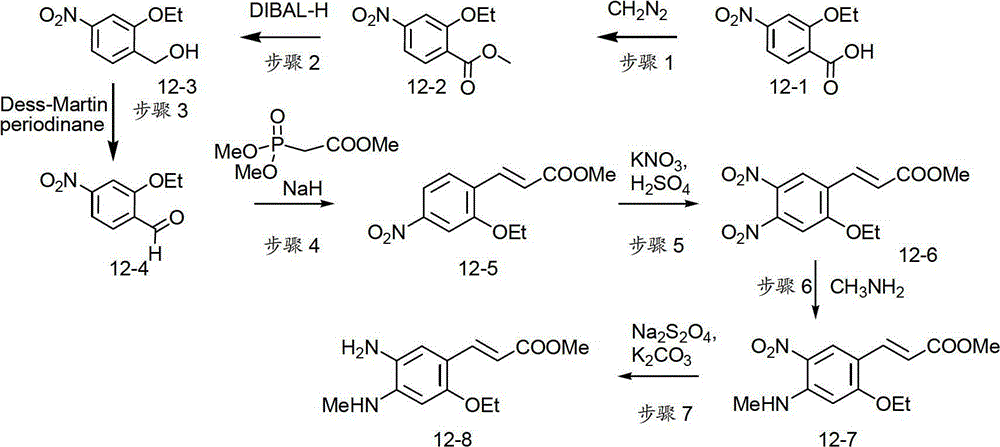
步骤1:step 1:
将2-乙氧基-4-硝基苯甲酸12-1(1.56g;7.38mmol)溶解在甲醇(15mL)中并将得到的溶液于0℃下搅拌。将叠氮甲烷的乙醚溶液缓慢地加入直到溶液持续呈黄色并再搅拌20分钟。将溶剂蒸发得到甲酯12-2的灰黄色固体(1.66g,定量),其可用于步骤2,不需再纯化。2-Ethoxy-4-nitrobenzoic acid 12-1 (1.56 g; 7.38 mmol) was dissolved in methanol (15 mL) and the resulting solution was stirred at 0°C. Azidemethane in ether was added slowly until the solution remained yellow and stirred for an additional 20 minutes. Evaporation of the solvent gave methyl ester 12-2 as a pale yellow solid (1.66 g, quantitative), which was used in step 2 without further purification.
步骤2:Step 2:
将得自步骤1的酯12-2(1.60g;7.10mmol)溶解在无水甲苯中并将溶液在氮气中冷却至-78℃。将二异丁基铝氢化物的四氢呋喃(1M;8mL;8mmol)溶液加入并让反应混合物加温至环境温度。1小时后以及再1.5小时后将另外两份DIBAL-H以该方式(7及10mL)加入。最后一次加入后0.5小时,将反应冷却至0℃并缓慢加入1N HCl(25mL)并强力搅拌该混合物0.5小时。之后将有机溶剂蒸发并用乙酸乙酯(2×50mL)萃取水性残留物并用水(50mL)和盐水(50mL)清洗。之后将合并的萃取物利用MgSO4干燥并蒸发得到醇12-3的灰黄色纤维固体(1.40g;定量),其可这样用于步骤3中。Ester 12-2 (1.60 g; 7.10 mmol) from step 1 was dissolved in anhydrous toluene and the solution was cooled to -78 °C under nitrogen. A solution of diisobutylaluminum hydride in tetrahydrofuran (1M; 8 mL; 8 mmol) was added and the reaction mixture was allowed to warm to ambient temperature. Two more portions of DIBAL-H were added in this manner (7 and 10 mL) after 1 hour and after a further 1.5 hours. 0.5 h after the last addition, the reaction was cooled to 0 °C and 1 N HCl (25 mL) was added slowly and the mixture was stirred vigorously for 0.5 h. The organic solvent was then evaporated and the aqueous residue was extracted with ethyl acetate (2 x 50 mL) and washed with water (50 mL) and brine (50 mL). The combined extracts were then dried over MgSO 4 and evaporated to give alcohol 12-3 as a pale yellow fibrous solid (1.40 g; quantitative), which was used in step 3 as such.
步骤3:Step 3:
将1,1,1-三(乙酰基氧基-1,1-二氢-1,2-苯并间二氧杂环戊烯-3-(1H)-酮(Dess-Martin periodinane)(2.32g;5.47mmol)的二氯甲烷(40mL+5mL清洗)混浊溶液加到得自步骤2的醇12-3(0.98g;4.97mmol)的DCM(40mL)搅拌溶液中并在环境温度下氮气下搅拌该反应。4小时之后,加入饱和NaHCO3/10%Na2S2O3(1:1,160mL)并强力搅拌该混合物直到相层清晰(约0.5小时)。将有机相分离,并用二氯甲烷(50mL)萃取水相并用饱和NaHCO3(2×150mL)清洗。之后将合并的有机相用MgSO4干燥并蒸发产生醛12-4的灰黄色固体(960mg;99%),其可这样用于步骤4中。1,1,1-tri(acetyloxy-1,1-dihydro-1,2-benzodioxol-3-(1H)-one (Dess-Martin periodinane) (2.32 g; 5.47 mmol) in dichloromethane (40 mL + 5 mL wash) was added to a stirred solution of alcohol 12-3 (0.98 g; 4.97 mmol) from step 2 in DCM (40 mL) and heated at ambient temperature under nitrogen The reaction was stirred. After 4 hours, saturated NaHCO 3 /10% Na 2 S 2 O 3 (1:1, 160 mL) was added and the mixture was stirred vigorously until the layers were clear (about 0.5 hours). The organic phase was separated and washed with dichloro The aqueous phase was extracted with methane (50 mL) and washed with saturated NaHCO 3 (2×150 mL).The combined organic phases were then dried over MgSO 4 and evaporated to give aldehyde 12-4 as a pale yellow solid (960 mg; 99%) which was used as such in step 4.
步骤4:Step 4:
将氢化钠(95%干粉末;158mg;6.25mmol)悬浮在无水THF(10mL)溶液中并于0℃下氮气中加入三甲基膦酰基乙酸酯(0.945mL;5.84mmol)得到无法搅拌的白色固体物质。然后滴加入得自步骤3的醛12-4(950mg;4.87mmol)的THF(7mL+3mL清洗)溶液,得到黄色且白色固体缓慢溶解。加完之后,将反应加温至环境温度。15小时之后,将混浊的反应混合物蒸发成淡黄色固体,其可用乙酸乙酯(2×50mL)萃取并用饱和NaHCO3(3×75mL)清洗。将合并的萃取物用MgSO4干燥并蒸发得到肉桂酸酯12-5的淡黄色固体(1.212g;99%)其可用于步骤5中,不需再纯化。Sodium hydride (95% dry powder; 158 mg; 6.25 mmol) was suspended in anhydrous THF (10 mL) and trimethylphosphonoacetate (0.945 mL; 5.84 mmol) was added under nitrogen at 0°C to give an unstirrable white solid substance. A solution of aldehyde 12-4 (950 mg; 4.87 mmol) from step 3 in THF (7 mL+3 mL wash) was then added dropwise to give a yellow and white solid which slowly dissolved. After the addition was complete, the reaction was warmed to ambient temperature. After 15 hours, the cloudy reaction mixture was evaporated to a pale yellow solid, which could be extracted with ethyl acetate (2 x 50 mL) and washed with saturated NaHCO3 (3 x 75 mL). The combined extracts were dried over MgSO 4 and evaporated to give cinnamate 12-5 as a pale yellow solid (1.212 g; 99%) which was used in step 5 without further purification.
本领域技术人员应了解,在该方法中所用的三甲基膦酰基乙酸酯可被适当的取代的衍生物代替,以制备在肉桂酸酯双键上带有各种取代基的类似物。Those skilled in the art will appreciate that the trimethylphosphonoacetate used in this method can be replaced by appropriately substituted derivatives to prepare analogs with various substituents on the cinnamate double bond.
步骤5:Step 5:
将得自步骤4的4-硝基-2-乙氧基肉桂酸酯12-5(303mg,1.206mmol)溶解在浓硫酸(3mL)中并将溶液冷却至0℃。将硝酸钾(128mg,1.27mmol)加入并将混合物于室温下搅拌3.5小时。完成之后将反应混合物倒在冰上并利用过滤将沉淀固体收集起来。用水清洗粗产物12-6,在真空下干燥并不需纯化而用于步骤6(390mg)中。4-Nitro-2-ethoxycinnamate 12-5 (303 mg, 1.206 mmol) from Step 4 was dissolved in concentrated sulfuric acid (3 mL) and the solution was cooled to 0 °C. Potassium nitrate (128 mg, 1.27 mmol) was added and the mixture was stirred at room temperature for 3.5 hours. Upon completion the reaction mixture was poured onto ice and the precipitated solid was collected by filtration. The crude product 12-6 was washed with water, dried under vacuum and used in step 6 (390 mg) without purification.
步骤6:Step 6:
将得自步骤5的二硝基衍生物12-6(390mg)溶解在THF(3mL)中并加入甲基胺的THF溶液(溶液于THF中2M,3.02mL)。搅拌30分钟之后,在减压下除去挥发物且橙色固体12-7可这样用于步骤7中。The dinitro derivative 12-6 (390 mg) from step 5 was dissolved in THF (3 mL) and a THF solution of methylamine (2M in THF, 3.02 mL) was added. After stirring for 30 minutes, the volatiles were removed under reduced pressure and the orange solid 12-7 was used in Step 7 as such.
本领域技术人员应了解,在上反应式2和3通式IV的其他二胺中间体,其中R8不是甲基,可利用适合的R8-NH2代替上述步骤6中的甲基胺(CH3NH2)而制备。Those skilled in the art should understand that in the other diamine intermediates of the above reaction formula 2 and 3 general formula IV, wherein R 8 is not a methyl group, suitable R 8 -NH 2 can be utilized to replace the methylamine in the above step 6 ( CH 3 NH 2 ).
步骤7:Step 7:
将得自步骤6的硝基芳烃12-7悬浮在EtOH(12mL)和水(12mL)的混合物中并加入K2CO3(1.00g,6当量),接着加入亚硫酸氢钠(1.26g,6当量)。在室温下搅拌该混合物4小时并在减压下除去EtOH。用EtOAc萃取残留物并用盐水清洗有机相并干燥(MgSO4)。除去溶剂并用快速色谱法纯化残留物(50至75%EtOAc于己烷中)得到(E)-3-(5-氨基-2-乙氧基-4-(甲基氨基)苯基)丙烯酸甲酯12-8(162mg)。The nitroarene 12-7 from step 6 was suspended in a mixture of EtOH (12 mL) and water (12 mL) and K 2 CO 3 (1.00 g, 6 equiv) was added followed by sodium bisulfite (1.26 g, 6 equivalents). The mixture was stirred at room temperature for 4 hours and EtOH was removed under reduced pressure. The residue was extracted with EtOAc and the organic phase was washed with brine and dried ( MgSO4 ). Removal of solvent and purification of the residue by flash chromatography (50 to 75% EtOAc in hexanes) gave (E)-3-(5-amino-2-ethoxy-4-(methylamino)phenyl)methacrylate Ester 12-8 (162 mg).
可利用描述在实施例3或7的方法将(E)-3-(5-氨基-2-乙氧基-4-(甲基氨基)苯基)丙烯酸甲酯12-8转化成实施例1中通式III的胺中间体并利用实施例4的方法再制成反应式1中通式1的抑制剂。(E)-methyl 3-(5-amino-2-ethoxy-4-(methylamino)phenyl)acrylate 12-8 can be converted to Example 1 using the methods described in Example 3 or 7 The amine intermediate of general formula III and utilize the method for embodiment 4 to make the suppressor of general formula 1 in reaction formula 1 again.
本领域技术人员也应知道,反应式1中通式I的该抑制剂,其中R6为-OCH3且R5为-CH=C(R50)-COOR可利用实施例12的方法制备,用相同于化合物12-1的前体开始制备,除了其中该乙氧基被甲氧基代替。Those skilled in the art should also know that the inhibitor of general formula I in Reaction Formula 1, wherein R 6 is -OCH 3 and R 5 is -CH=C(R 50 )-COOR can be prepared by the method of Example 12, The preparation started with the same precursor as compound 12-1 except where the ethoxy group was replaced by methoxy.
实施例13Example 13
4-氨基-2-甲氧基-5-(甲基氨基)苯甲酸甲酯Methyl 4-amino-2-methoxy-5-(methylamino)benzoate

步骤1:step 1:
将2-甲氧基-5-硝基苯甲酸甲酯13-1(6.21g,29.4mmol)悬浮在MeOH(100mL)中并加入20%Pd(OH)2/C(500mg)。在氢气下(1atm)搅拌该混合物18小时。利用过滤将催化剂除去并在减压下将溶剂蒸发,得到化合物13-2(5.256g)的残留物,其可这样用于步骤2中。Methyl 2-methoxy-5-nitrobenzoate 13-1 (6.21 g, 29.4 mmol) was suspended in MeOH (100 mL) and 20% Pd(OH) 2 /C (500 mg) was added. The mixture was stirred under hydrogen (1 atm) for 18 hours. The catalyst was removed by filtration and the solvent was evaporated under reduced pressure to give a residue of compound 13-2 (5.256 g), which was used in step 2 as such.
步骤2:Step 2:
将得自步骤1的苯胺13-2(5.23g)溶解在THF(50mL)中并加入醋酸酐(2.984g)。在室温下搅拌该混合物过夜。在减压下将白色悬浮液浓缩成白色泥浆,加入叔丁基甲基醚(TBME,20mL)并在搅拌时缓慢加入己烷(100mL)。之后将悬浮液再搅拌2小时并利用过滤将固体收集起来。用己烷清洗产物13-3并在空气中干燥(6.372g)。Aniline 13-2 (5.23 g) from Step 1 was dissolved in THF (50 mL) and acetic anhydride (2.984 g) was added. The mixture was stirred overnight at room temperature. The white suspension was concentrated under reduced pressure to a white slurry, tert-butyl methyl ether (TBME, 20 mL) was added and hexane (100 mL) was added slowly while stirring. The suspension was then stirred for a further 2 hours and the solid was collected by filtration. The product 13-3 was washed with hexane and dried in air (6.372 g).
步骤3:Step 3:
将90%硝酸(9mL)用水(9mL)稀释并冷却至0℃。将得自步骤2的该酰苯胺(anilide)化合物13-3(5.905g)一次性加入并在冰水浴中搅拌该混合物30分钟。之后将反应混合物滴加到冰水(700mL)中并利用过滤将沉淀的黄色固体收集起来,用水清洗并在空气中干燥。1H NMR显示出该橙色固体(5.907g)由2:1混合物所组成。由上得到的水性滤液利用EtOAc萃取,得到另外的1g物质,并和第一次得到的合并,接着利用快速色谱法在硅胶上使用0.1%EtOAc的CHCl3溶液作为洗脱液进行纯化。得到橙色固体13-4(4.11g)(一种异构体)。Dilute 90% nitric acid (9 mL) with water (9 mL) and cool to 0 °C. The anilide compound 13-3 (5.905 g) from step 2 was added in one portion and the mixture was stirred in an ice water bath for 30 minutes. The reaction mixture was then added dropwise to ice water (700 mL) and the precipitated yellow solid was collected by filtration, washed with water and dried in air. 1 H NMR showed that the orange solid (5.907 g) consisted of a 2:1 mixture. The aqueous filtrate obtained above was extracted with EtOAc to give an additional 1 g of material which was combined with the first obtained and then purified by flash chromatography on silica gel using 0.1% EtOAc in CHCl3 as eluent. 13-4 (4.11 g) (one isomer) was obtained as an orange solid.
步骤4:Step 4:
将得自步骤3的硝基酰苯胺13-4(3.580g)溶解在THF(50mL)种并将溶液在冰中冷却。碘甲烷(4.155mL,66.7mmol,5当量)和叔丁氧化钠(6.414g,66.7mmol,5当量)分两部分以3.5小时间隔加入。在第二次加入后于室温下持续再搅拌20小时。在减压下将THF蒸发并加入水(100mL)。用TBME(100mL)清洗深红色溶液。用浓HCl酸化水相并用EtOAc(2×100mL)萃取。将合并的有机萃取液干燥并浓缩得到化合物13-5的深红色粉末(3.78g),其可直接用于步骤5中。The nitroanilide 13-4 (3.580 g) from step 3 was dissolved in THF (50 mL) and the solution was cooled in ice. Iodomethane (4.155 mL, 66.7 mmol, 5 equiv) and sodium tert-butoxide (6.414 g, 66.7 mmol, 5 equiv) were added in two portions at 3.5 hour intervals. Stirring was continued for a further 20 hours at room temperature after the second addition. THF was evaporated under reduced pressure and water (100 mL) was added. The dark red solution was washed with TBME (100 mL). The aqueous phase was acidified with cone. HCl and extracted with EtOAc (2 x 100 mL). The combined organic extracts were dried and concentrated to give compound 13-5 as a dark red powder (3.78 g), which was used directly in step 5.
本领域技术人员应了解,上反应式2和3中通式IV的其他二胺中间体,其中R8不是甲基,可在上述步骤4中利用适当的R8-X代替碘化甲基(CH3I)而制备,其中X为离去基,例如Cl、Br、I、甲磺酸酯(mesylate)、对甲苯磺酸酯(tosylate)、三氟甲磺酸酯(triflate)等。Those skilled in the art should understand that other diamine intermediates of general formula IV in the above reaction formulas 2 and 3, wherein R 8 is not a methyl group, can utilize appropriate R 8 -X in the above step 4 to replace methyl iodide ( CH 3 I), wherein X is a leaving group, such as Cl, Br, I, mesylate, tosylate, triflate, etc.
步骤5:Step 5:
将得自步骤4的游离羧酸13-5(3.75g)悬浮在8M HCl(100mL)中并将混合物于100℃搅拌8小时。冷却至室温下,在真空中蒸发挥发物并将残留物与MeOH进行共蒸发三次。The free carboxylic acid 13-5 (3.75 g) from step 4 was suspended in 8M HCl (100 mL) and the mixture was stirred at 100 °C for 8 h. After cooling to room temperature, the volatiles were evaporated in vacuo and the residue was co-evaporated with MeOH three times.
步骤6:Step 6:
将得自步骤5的残留物再悬浮在MeOH(100mL)中并在冰水中冷却。将亚硫酰氯(5.10mL,5当量)滴加入并在65℃下搅拌该悬浮液4小时。在减压下除去挥发物并将残留物13-6和MeOH(100mL)且之后和甲苯(2×100mL)进行共蒸发两次。The residue from step 5 was resuspended in MeOH (100 mL) and cooled in ice water. Thionyl chloride (5.10 mL, 5 equiv) was added dropwise and the suspension was stirred at 65 °C for 4 hours. The volatiles were removed under reduced pressure and the residue 13-6 was co-evaporated twice with MeOH (100 mL) and then toluene (2 x 100 mL).
步骤7:Step 7:
然后将得自步骤6的残留物13-6溶解在MeOH(200mL)中,加入20%Pd(OH)2/C(500mg),并将混合物在1atm氢气下搅拌过夜。之后利用过滤将催化剂除去,并将溶液蒸发至干。将残留物溶解在EtOAc中并用NaHCO3水溶液清洗该溶液并干燥(MgSO4)。将溶剂除去得到固体,悬浮在TBME(50mL)中并加热至60℃30分钟。然后将等体积的己烷缓慢加入该热溶液中并将沉淀的4-氨基-2-甲氧基-5-(甲基氨基)苯甲酸甲酯13-7利用过滤收集起来,用TBME-己烷清洗并干燥(2.00g)。The residue 13-6 from step 6 was then dissolved in MeOH (200 mL), 20% Pd(OH) 2 /C (500 mg) was added, and the mixture was stirred under 1 atm of hydrogen overnight. The catalyst was then removed by filtration and the solution was evaporated to dryness. The residue was dissolved in EtOAc and the solution was washed with aqueous NaHCO3 and dried ( MgSO4 ). The solvent was removed to give a solid, which was suspended in TBME (50 mL) and heated to 60° C. for 30 minutes. An equal volume of hexane was then slowly added to the hot solution and the precipitated methyl 4-amino-2-methoxy-5-(methylamino)benzoate 13-7 was collected by filtration and washed with TBME-hexane Rinse with alkanes and dry (2.00 g).
4-氨基-2-甲氧基-5-(甲基氨基)苯甲酸甲酯13-7可依照实施例3或7的方法转化成反应式1中通式III的相应的胺中间体。这些胺中间体可依循实施例8的方法再转化成反应式1中通式III的胺中间体,其中R5为-OCH3且R6为-CH=C(R50)-COOR。反应式1中通式III的所有这些胺中间体,可利用实施例4的方法再制成反应式1中通式I的抑制剂。4-Amino-2-methoxy-5-(methylamino)benzoic acid methyl ester 13-7 can be converted into the corresponding amine intermediate of general formula III in Reaction Scheme 1 according to the method of Example 3 or 7. These amine intermediates can be converted into amine intermediates of formula III in Reaction Scheme 1 according to the method of Example 8, wherein R 5 is -OCH 3 and R 6 is -CH=C(R 50 )-COOR. All these amine intermediates of the general formula III in the reaction formula 1 can be remade into the inhibitors of the general formula I in the reaction formula 1 by the method of Example 4.
本领域技术人员应了解实施例13的方法可用于得自实施例12的化合物12-2或其类似物,其中该乙氧基被甲氧基代替,以产生反应式2或3中的通式IV的二胺前体,其中R6为OCH3或OEt。该二胺前体也可依照实施例3或7的方法转化成反应式1中通式III的胺中间体,并利用实施例4的方法再制成反应式1中通式I的抑制剂。Those skilled in the art will understand that the method of Example 13 can be used to obtain compound 12-2 or its analogs in Example 12, wherein the ethoxy group is replaced by a methoxy group to generate the general formula in Reaction Scheme 2 or 3 Diamine precursors of IV wherein R is OCH or OEt. The diamine precursor can also be converted into the amine intermediate of the general formula III in the reaction formula 1 according to the method of embodiment 3 or 7, and the inhibitor of the general formula I in the reaction formula 1 can be prepared by the method of the embodiment 4.
实施例14Example 14
N2-甲基-4-(1H-[1,2,3]三唑-4-基)苯-1,2-二胺N 2 -methyl-4-(1H-[1,2,3]triazol-4-yl)benzene-1,2-diamine

步骤1:step 1:
将得自实施例9的3-氟-4-硝基苯甲醛9-3(2.0g,11.8mmol)溶解在THF(30mL)中并将过量的甲基胺(2M溶于THF,~21mL,42mmol)加入。将反应混合物于RT下搅拌直到由HPLC确认完全转化为止(~2-3小时)。然后将混浊溶液蒸发至橙色固体,用乙酸乙酯(2×50mL)萃取并用1N HCl(震荡直到深红勃根地色(burgundy colour)消散为止;100mL)、水(100mL)和盐水(60mL)清洗。将合并的萃取物利用无水MgSO4干燥并蒸发得到甲基氨基中间体14-1的橙色粉末,其用于步骤2中,不需要纯化。3-Fluoro-4-nitrobenzaldehyde 9-3 (2.0 g, 11.8 mmol) from Example 9 was dissolved in THF (30 mL) and excess methylamine (2M in THF, ~21 mL, 42mmol) was added. The reaction mixture was stirred at RT until complete conversion was confirmed by HPLC (~2-3 hours). The cloudy solution was then evaporated to an orange solid, extracted with ethyl acetate (2 x 50 mL) and washed with 1N HCl (shake until the deep red burgundy color dissipated; 100 mL), water (100 mL) and brine (60 mL) cleaning. The combined extracts were dried over anhydrous MgSO4 and evaporated to give methylamino intermediate 14-1 as an orange powder which was used in step 2 without purification.
本领域技术人员应了解,在上反应式2和3种的通式IV的其他二胺中间体,其中R8不是甲基,可利用适当的R8-NH2代替上述步骤1中的甲基胺(CH3NH2)而制备。Those skilled in the art should understand that in the other diamine intermediates of the general formula IV of the above reaction formulas 2 and 3, wherein R 8 is not a methyl group, appropriate R 8 -NH 2 can be used to replace the methyl group in the above step 1 Amine (CH 3 NH 2 ) and prepared.
步骤2:Step 2:
将n-BuLi(2.5M于THF中,14.4mL,36.0mmol)于无水THF(60mL)的溶液于-78℃缓慢加入到TMS-叠氮甲烷(10%于己烷中,18mL,36.0mmol)的溶液中。将该混合物于-78℃搅拌30分钟,之后缓慢加入得自步骤1的甲基氨基中间体14-1(2.16g,12.0mmol,溶解在2mL THF中)。将反应混合物于-78℃搅拌1小时,之后加温至RT并再搅拌3小时,之后加入H2O使反应停止。将粗混合物在NaHCO3饱和水溶液(30mL)和EtOAc(60mL)之间分配,再用EtOAc(2×60mL)萃取水层并用盐水清洗合并的有机层,用无水MgSO4干燥并浓缩至干。将残留物利用快速柱色谱法(使用20%EtOAc在己烷中作为洗脱液)纯化得到期望的炔14-2的淡棕色固体(445mg,~21%收率)。A solution of n-BuLi (2.5M in THF, 14.4mL, 36.0mmol) in anhydrous THF (60mL) was slowly added to TMS-azidemethane (10% in hexane, 18mL, 36.0mmol) at -78°C ) in the solution. The mixture was stirred at -78 °C for 30 min, after which methylamino intermediate 14-1 (2.16 g, 12.0 mmol, dissolved in 2 mL THF) from Step 1 was added slowly. The reaction mixture was stirred at -78 °C for 1 h, then warmed to RT and stirred for a further 3 h before being quenched by addition of H2O . The crude mixture was partitioned between saturated aqueous NaHCO 3 (30 mL) and EtOAc (60 mL), the aqueous layer was extracted with EtOAc (2×60 mL) and the combined organic layers were washed with brine, dried over anhydrous MgSO 4 and concentrated to dryness. The residue was purified by flash column chromatography using 20% EtOAc in hexanes as eluent to afford the desired alkyne 14-2 as a light brown solid (445 mg, ~21% yield).
步骤3:Step 3:
在厚壁压力管中,将得自步骤2的炔14-2(260mg,1.48mmol)溶解在无水DMSO(6.0mL)中并将TMS-叠氮化物(0.392mL,2.96mmol)加入。将反应加热至140℃2小时,然后冷却并用EtOAc(50mL)萃取并用盐水(2×50mL)清洗。将有机层用无水MgSO4干燥并蒸发获得粗三唑14-3的黄棕色固体,其用于步骤4中不需再纯化。In a thick-walled pressure tube, the alkyne 14-2 from step 2 (260 mg, 1.48 mmol) was dissolved in anhydrous DMSO (6.0 mL) and TMS-azide (0.392 mL, 2.96 mmol) was added. The reaction was heated to 140 °C for 2 hours, then cooled and extracted with EtOAc (50 mL) and washed with brine (2 x 50 mL). The organic layer was dried over anhydrous MgSO4 and evaporated to give crude triazole 14-3 as a yellow-brown solid, which was used in step 4 without further purification.
步骤4:Step 4:
将得自步骤3的粗三唑中间体14-3(~1.10mmol)溶解在EtOH(10mL)和H2O(6mL)中得到起始物的一些沉淀,将K2CO3(0.91g,6.58mmol)和亚硫酸氢钠(1.15g,6.58mmol)加入并将反应混合物于RT下搅拌2小时。之后用EtOAc(50mL)萃取反应混合物,利用H2O(50mL)和盐水(30mL)清洗有机层,用无水MgSO4干燥并蒸发得到棕色胶质,其含有N2-甲基-4-(1H-[1,2,3]三唑-4-基)苯-1,2-二胺14-4(于其他次要产物之中)。The crude triazole intermediate 14-3 (˜1.10 mmol) from step 3 was dissolved in EtOH (10 mL) and H 2 O (6 mL) to give some precipitation of starting material, K 2 CO 3 (0.91 g, 6.58 mmol) and sodium bisulfite (1.15 g, 6.58 mmol) were added and the reaction mixture was stirred at RT for 2 hours. The reaction mixture was then extracted with EtOAc (50 mL), the organic layer was washed with H 2 O (50 mL) and brine (30 mL), dried over anhydrous MgSO 4 and evaporated to give a brown gum containing N 2 -methyl-4-( 1H-[1,2,3]triazol-4-yl)benzene-1,2-diamine 14-4 (among other minor products).
将粗N2-甲基-4-(1H-[1,2,3]三唑-4-基)苯-1,2-二胺不须经纯化而依照实施例3或7的方法转化成反应式1中通式III的相应的胺中间体,再利用实施例4的方法进一步制成反应式1中通式I的抑制剂。Crude N 2 -methyl-4-(1H-[1,2,3]triazol-4-yl)benzene-1,2-diamine was converted into The corresponding amine intermediate of general formula III in reaction formula 1 is further prepared by the method of embodiment 4 into the inhibitor of general formula I in reaction formula 1.
实施例15Example 15
N2-甲基-4-(4-甲基哌嗪-1-基)苯-1,2-二胺N 2 -methyl-4-(4-methylpiperazin-1-yl)benzene-1,2-diamine

步骤1:step 1:
向4-氯-2-氟-1-硝基苯15-1(1.18g,6.72mmol)的DMSO(7mL)溶液中加入甲基胺(2M溶于THF中,13.6mL,26.9mmol)的溶液并在RT下搅拌该反应混合物24小时。用EtOAc(~300mL)稀释该溶液,用H2O(3×50mL)和盐水(50mL)清洗有机层,用无水MgSO4干燥并在真空中浓缩得到甲基氨基衍生物15-2的黄色固体(1.19g)。将粗物质用在步骤2中,不需再纯化。To a solution of 4-chloro-2-fluoro-1-nitrobenzene 15-1 (1.18 g, 6.72 mmol) in DMSO (7 mL) was added a solution of methylamine (2M in THF, 13.6 mL, 26.9 mmol) And the reaction mixture was stirred at RT for 24 hours. The solution was diluted with EtOAc (~300 mL), the organic layer was washed with H2O (3 x 50 mL) and brine (50 mL), dried over anhydrous MgSO4 and concentrated in vacuo to give methylamino derivative 15-2 as a yellow Solid (1.19g). The crude material was used in step 2 without further purification.
本领域技术人员应了解,在上反应式2和3中的通式IV的其他的二胺中间体,其中R8不是甲基,可利用适当的R8-NH2代替上述步骤1中的甲基胺(CH3NH2)而制备。Those skilled in the art should understand that in the other diamine intermediates of the general formula IV in the above reaction formulas 2 and 3, wherein R 8 is not a methyl group, appropriate R 8 -NH 2 can be used to replace the methyl group in the above step 1 Base amine (CH 3 NH 2 ) and prepared.
步骤2:Step 2:
将得自步骤1的甲基氨基衍生物15-2(105mg,0.56mmol)和N-甲基哌嗪(0.5mL)的混合物加热至90℃并搅拌3小时,之后在RT下再搅拌15小时。将反应混合物用EtOAc(~50mL)稀释并用H2O(3×10mL)和盐水(20mL)清洗有机层,用无水MgSO4干燥并在真空中浓缩得到哌嗪衍生物15-3的黄色固体(140mg),其用在步骤3中不用再纯化。A mixture of methylamino derivative 15-2 from step 1 (105 mg, 0.56 mmol) and N-methylpiperazine (0.5 mL) was heated to 90 °C and stirred for 3 h, then at RT for a further 15 h . The reaction mixture was diluted with EtOAc (~50 mL) and the organic layer was washed with H2O (3 x 10 mL) and brine (20 mL), dried over anhydrous MgSO4 and concentrated in vacuo to give piperazine derivative 15-3 as a yellow solid (140 mg), which was used in Step 3 without further purification.
本领域技术人员应了解带有其他取代基的哌嗪衍生物可在上述步骤2中用来代替N-甲基哌嗪,以制备用于形成式(I)的其他化合物的中间体。Those skilled in the art will understand that piperazine derivatives with other substituents can be used in place of N-methylpiperazine in the above step 2 to prepare intermediates for the formation of other compounds of formula (I).
步骤3:Step 3:
在得自步骤2的哌嗪衍生物15-3(140mg)的EtOH(6mL)溶液中加入Pd/C(10%,25mg)并在H2气下于RT中搅拌该混合物15小时。将混合物过滤并将溶液蒸发得到相当纯的期望产物N2-甲基-4-(4-甲基哌嗪-1-基)苯-1,2-二胺15-4的紫色油(133mg)。To a solution of piperazine derivative 15-3 (140 mg) from step 2 in EtOH (6 mL) was added Pd/C (10%, 25 mg) and the mixture was stirred at RT under H 2 gas for 15 h. The mixture was filtered and the solution was evaporated to give the desired product N2 -methyl-4-(4-methylpiperazin-1-yl)benzene-1,2-diamine 15-4 as a purple oil (133mg) in fairly pure .
将N2-甲基-4-(4-甲基哌嗪-1-基)苯-1,2-二胺15-4不需再纯化而依照实施例3或7的方法转化成反应式1中通式III的相应的胺中间体,并再利用实施例4的方法制成反应式1中通式I的抑制剂1。N 2 -methyl-4-(4-methylpiperazin-1-yl)benzene-1,2-diamine 15-4 was converted into Reaction Formula 1 according to the method of Example 3 or 7 without further purification The corresponding amine intermediate of the general formula III, and then utilize the method for embodiment 4 to make the inhibitor 1 of the general formula I in the reaction formula 1.
实施例16Example 16
4-咪唑-1-基-N2-甲基苯-1,2-二胺4-imidazol-1-yl-N 2 -methylbenzene-1,2-diamine
利用实施例15的方法制备4-咪唑-1-基-N2-甲基苯-1,2-二胺16-1,除了在步骤2中用咪唑代替N-甲基哌嗪。4-咪唑-1-基-N2-甲基苯-1,2-二胺16-1可依照实施例3或7的方法转化成反应式1中通式III的相应的胺中间体,并再利用实施例4的方法制成反应式1中通式I的抑制剂。4-Imidazol-1-yl-N 2 -methylbenzene-1,2-diamine 16-1 was prepared by the method of Example 15, except that N-methylpiperazine was replaced by imidazole in step 2. 4-imidazol-1-yl-N 2 -methylbenzene-1,2-diamine 16-1 can be converted into the corresponding amine intermediate of general formula III in Reaction Formula 1 according to the method of Example 3 or 7, and The method of Example 4 is then used to make the inhibitor of general formula I in Reaction Formula 1.
实施例17Example 17
4-(2-氨基噻唑-4-基)-N1-甲基苯-1,2-二胺4-(2-aminothiazol-4-yl)-N 1 -methylbenzene-1,2-diamine
步骤1:step 1:
将4-氯-3-硝基苯乙酮17-1(3.00g,15.0mmol)和甲基胺(15.0mL,2M溶于THF,30.0mmol)的混合物放在密封压力管中并在80℃下搅拌6小时及在RT下搅拌20小时。将反应混合物浓缩至干,并利用快速柱色谱法纯化残留物(使用20-30%己烷于EtOAc中),以分离出期望的纯产物17-2的橙色固体(980mg,34%收率)。A mixture of 4-chloro-3-nitroacetophenone 17-1 (3.00 g, 15.0 mmol) and methylamine (15.0 mL, 2M dissolved in THF, 30.0 mmol) was placed in a sealed pressure tube and heated at 80 °C Stirring for 6 hours at RT and 20 hours at RT. The reaction mixture was concentrated to dryness and the residue was purified by flash column chromatography (using 20-30% hexane in EtOAc) to isolate the desired pure product 17-2 as an orange solid (980 mg, 34% yield) .
本领域技术人员应了解,在上反应式2和3中的通式IV的其他二胺中间体,其中R8不是甲基,可利用适当的R8-NH2代替上述步骤1中的甲基胺(CH3NH2)而制备。Those skilled in the art should understand that in the other diamine intermediates of the general formula IV in the above reaction formulas 2 and 3, wherein R 8 is not a methyl group, appropriate R 8 -NH 2 can be used to replace the methyl group in the above step 1 Amine (CH 3 NH 2 ) and prepared.
步骤2:Step 2:
向得自步骤1的4-甲基氨基-3-硝基苯乙酮中间体17-2(700mg,3.6mmol)的二
步骤3:Step 3:
将得自步骤2的溴酮中间体17-3(1.0g)和硫脲(548mg,7.2mmol)的i-PrOH(30mL)溶液于70℃搅拌1小时。将该混合物冷却至RT并将形成的沉淀物过滤,用二乙醚清洗并干燥得到期望的氨基噻唑中间体17-4的橙色固体(~1.0g)。该化合物用于步骤4中不用纯化。A solution of bromoketone intermediate 17-3 (1.0 g) from Step 2 and thiourea (548 mg, 7.2 mmol) in i-PrOH (30 mL) was stirred at 70 °C for 1 h. The mixture was cooled to RT and the formed precipitate was filtered, washed with diethyl ether and dried to give the desired aminothiazole intermediate 17-4 as an orange solid (-1.0 g). This compound was used in step 4 without purification.
步骤4:Step 4:
将得自步骤3的硝基中间体17-4(500mg,~2mmol)和SnCl2二水合物(2.25g,10mmol)的EtOH(15mL)溶液于80℃搅拌16小时。将混合物缓慢倒至NaHCO3中并强力搅拌30分钟。利用CH2Cl2(2×200mL)萃取混合物并将合并的有机层利用无水Na2SO4干燥并浓缩至干。将残留物利用快速柱色谱法纯化(使用溶剂梯度从30%己烷于EtOAc中至100%EtOAc,然后至3%MeOH于EtOAc中),以回收未反应的起始物和纯二胺产物4-(2-氨基噻唑-4-基)-N1-甲基苯-1,2-二胺17-5(167mg,38%收率)。A solution of nitro intermediate 17-4 from step 3 (500 mg, ~2 mmol) and SnCl 2 dihydrate (2.25 g, 10 mmol) in EtOH (15 mL) was stirred at 80 °C for 16 h. The mixture was slowly poured into NaHCO 3 and stirred vigorously for 30 min. The mixture was extracted with CH 2 Cl 2 (2×200 mL) and the combined organic layers were dried over anhydrous Na 2 SO 4 and concentrated to dryness. The residue was purified by flash column chromatography (using a solvent gradient from 30% hexane in EtOAc to 100% EtOAc, then to 3% MeOH in EtOAc) to recover unreacted starting material and pure diamine product 4 -(2-aminothiazol-4-yl)-N 1 -methylbenzene-1,2-diamine 17-5 (167 mg, 38% yield).
将4-(2-氨基噻唑-4-基)-N1-甲基苯-1,2-二胺17-5依照实施例3或7的方法转化成反应式1中通式III的相应的胺中间体,再利用实施例4的方法制成反应式1中通式I的抑制剂。Convert 4-(2-aminothiazol-4-yl)-N 1 -methylbenzene-1,2-diamine 17-5 into the corresponding compound of formula III in Reaction Formula 1 according to the method of Example 3 or 7 Amine intermediate, utilize the method for embodiment 4 again to make the inhibitor of general formula I in reaction formula 1.
反应式1中通式I的抑制剂或在其制备中的适用中间体,其氨基噻唑取代基的游离氨基基团,可利用本领域技术人员已知的方法将其烷基化,或利用本领域技术人员已知的方法将其乙酰基化,例如用醋酸酐、乙酰氯等处理。或者在上述步骤3中利用适用的N被取代的硫脲代替硫脲将得到其中游离氨基基团被取代的中间体。In the inhibitor of general formula I in reaction formula 1 or the suitable intermediate in its preparation, the free amino group of its aminothiazole substituent, can utilize its method known to those skilled in the art to alkylate, or utilize this It is acetylated by methods known to those skilled in the art, such as treatment with acetic anhydride, acetyl chloride, and the like. Alternatively using the appropriate N-substituted thiourea in place of the thiourea in Step 3 above will give an intermediate in which the free amino group is substituted.
实施例18Example 18
4-氨基-2-(9H-芴-9-基甲氧基羰基氨基)-5-(甲基氨基)苯甲酸甲酯4-amino-2-(9H-fluoren-9-ylmethoxycarbonylamino)-5-(methylamino)benzoic acid methyl ester

步骤1:step 1:
向间氯苯甲酸18-1(12.5g,79.8mmol)的硫酸(100mL)溶液中于40℃分批缓慢加入硝酸钾(约总量的一半;22.0g,218mmol),同时搅拌(温度维持在低于70℃)。之后将溶液缓慢加热至105℃,将剩下的KNO3缓慢加入(将温度维持在低于110℃),最后将溶液加热至130℃15分钟,冷却至RT并倒到冰上(~500mL)。将形成的黄色固体过滤,用水(50mL)清洗、风干2小时,得到期望产物18-2和未知副产物以2:1混合的混合物13.25g(67%)。该混合物用于步骤2中。To a solution of m-chlorobenzoic acid 18-1 (12.5g, 79.8mmol) in sulfuric acid (100mL) at 40°C, potassium nitrate (about half of the total amount; 22.0g, 218mmol) was slowly added in batches while stirring (the temperature was maintained at below 70°C). The solution was then slowly heated to 105 °C, the remaining KNO3 was added slowly (maintaining the temperature below 110 °C), and finally the solution was heated to 130 °C for 15 min, cooled to RT and poured onto ice (~500 mL) . The formed yellow solid was filtered, washed with water (50 mL), and air-dried for 2 hours to obtain 13.25 g (67%) of a 2:1 mixture of the desired product 18-2 and an unknown by-product. This mixture was used in step 2.
步骤2:Step 2:
将得自步骤1的粗二硝基羧酸18-2(~13g)溶解在甲醇(100mL)中并非常缓慢地加入硫酸(13.0mL),因为该反应为极放热反应。在回流下搅拌反应混合物18小时。将溶液倒至冰上(~500mL)并用EtOAc(2×100mL)萃取产物。将有机层利用5%NaHCO3(3×100mL)水溶液清洗,用无水MgSO4干燥并蒸发,得到期望的二硝基甲酯中间体18-3(9.54g,69%收率)。The crude dinitrocarboxylic acid 18-2 (-13 g) from step 1 was dissolved in methanol (100 mL) and sulfuric acid (13.0 mL) was added very slowly as the reaction was very exothermic. The reaction mixture was stirred at reflux for 18 hours. The solution was poured onto ice (-500 mL) and the product was extracted with EtOAc (2 x 100 mL). The organic layer was washed with 5% aqueous NaHCO 3 (3×100 mL), dried over anhydrous MgSO 4 and evaporated to give the desired dinitromethyl ester intermediate 18-3 (9.54 g, 69% yield).
步骤3:Step 3:
向上述的二硝基芳基氯化物18-3(9.5g,36.5mmol)的DMF(20mL)溶液于0℃搅拌加入甲基胺(2M溶于THF,39.2mL,74.7mmol)。几分钟之后形成结晶固体,将悬浮液加温至RT并持续搅拌2小时。将反应混合物于H2O(200mL)和EtOAc(100mL)之间分配,并用5%NaHCO3水溶液(100mL)和盐水(3×100mL)清洗有机层,用无水MgSO4干燥并将溶剂蒸发至干得到期望产物18-4的黄橙色固体(7.09g,76%收率)。To a solution of the above dinitroaryl chloride 18-3 (9.5 g, 36.5 mmol) in DMF (20 mL) was added methylamine (2M in THF, 39.2 mL, 74.7 mmol) with stirring at 0°C. After a few minutes a crystalline solid formed, the suspension was warmed to RT and stirring was continued for 2 hours. The reaction mixture was partitioned between H 2 O (200 mL) and EtOAc (100 mL), and the organic layer was washed with 5% aqueous NaHCO 3 (100 mL) and brine (3×100 mL), dried over anhydrous MgSO 4 and the solvent was evaporated to Drying gave the desired product 18-4 as a yellow-orange solid (7.09 g, 76% yield).
本领域技术人员应了解,在上反应式2和3中的通式IV的其他二胺中间体,其中R8不是甲基,可利用适当的R8-NH2代替上述步骤3中的甲基胺(CH3NH2)而制备。Those skilled in the art should understand that in the other diamine intermediates of the general formula IV in the above reaction formulas 2 and 3, wherein R 8 is not a methyl group, appropriate R 8 -NH 2 can be used to replace the methyl group in the above step 3 Amine (CH 3 NH 2 ) and prepared.
步骤4:Step 4:
向上面得到的二硝基苯胺中间体18-4的EtOH/H2O(100mL,1:1比)悬浮液中于强力搅拌下加入K2CO3(10.3g,74.5mmol),接着分批加入亚硫酸氢钠(13.0g,74.5mmol)。黄色悬浮液转变成血红色然后黑色,变得更为均质(轻微放热),然后变成双相,并形成白色沉淀。于RT下搅拌30分钟后,使EtOH部分蒸发并用H2O(100mL)稀释残留物。将反应混合物以EtOAc(2×75mL)萃取,将合并的有机层以无水MgSO4干燥并蒸发产生黑色无定形固体18-5(1.26g,55%),其这样用于步骤5中。To the EtOH/H 2 O (100 mL, 1:1 ratio) suspension of dinitroaniline intermediate 18-4 obtained above was added K 2 CO 3 (10.3 g, 74.5 mmol) under vigorous stirring, followed by batchwise Sodium bisulfite (13.0 g, 74.5 mmol) was added. The yellow suspension turned blood red and then black, became more homogeneous (slightly exothermic), then became biphasic and a white precipitate formed. After stirring at RT for 30 min, the EtOH was partially evaporated and the residue was diluted with H2O (100 mL). The reaction mixture was extracted with EtOAc (2 x 75 mL), the combined organic layers were dried over anhydrous MgSO 4 and evaporated to give black amorphous solid 18-5 (1.26 g, 55%) which was used in step 5 as such.
步骤5:Step 5:
向由上得到的三苯胺18-5(400mg,2.05mmol)的乙腈(5mL)的搅拌冰冷溶液在氮气下加入三乙基胺(0.57mL),接着滴加入TrocCl(0.282mL,2.05mmol)。将深紫色溶液搅拌并于2小时内加温至RT。将溶剂蒸发,并将残留物加到EtOAc(30mL)中,用5%NaHCO3水溶液(2×20mL)和盐水(20mL)清洗,用无水MgSO4干燥并将溶剂蒸发至干。利用快速色谱将残留物纯化(利用TLC级硅胶和溶剂梯度从30%至60%EtOAc于己烷中进行洗脱)得到期望产物18-6的米色无定形固体(459mg,60%收率)。To a stirred ice-cold solution of triphenylamine 18-5 (400 mg, 2.05 mmol) obtained above in acetonitrile (5 mL) was added triethylamine (0.57 mL) followed by dropwise addition of TrocCl (0.282 mL, 2.05 mmol) under nitrogen. The deep purple solution was stirred and warmed to RT over 2 hours. The solvent was evaporated and the residue was taken up in EtOAc (30 mL), washed with 5% aqueous NaHCO 3 (2×20 mL) and brine (20 mL), dried over anhydrous MgSO 4 and the solvent was evaporated to dryness. The residue was purified by flash chromatography (eluting with TLC grade silica gel and a solvent gradient from 30% to 60% EtOAc in hexanes) to give the desired product 18-6 as a beige amorphous solid (459 mg, 60% yield).
步骤6:Step 6:
于以上Troc保护的苯胺衍生物18-6(100mg,0.27mmol)于CH2Cl2(1mL)的搅拌溶液中加入吡啶(0.032mL,0.4mmol)接着加入Fmoc-Cl(80mg,0.31mmol)。将反应混合物于RT下搅拌2小时。用EtOAc(30mL)稀释混合物,用5%水溶液NaHCO3(2×10mL)清洗悬浮液,用无水MgSO4干燥并蒸发至干。利用快速色谱法将残留物纯化(利用TLC级硅胶和溶剂梯度从20%至30%EtOAc于己烷中进行洗脱)得到两种Fmoc保护的期望产物18-7样品;47mg极纯产物及100mg略低纯度的产物。To a stirred solution of the above Troc-protected aniline derivative 18-6 (100 mg, 0.27 mmol) in CH2Cl2 (1 mL) was added pyridine (0.032 mL , 0.4 mmol) followed by Fmoc-Cl (80 mg, 0.31 mmol). The reaction mixture was stirred at RT for 2 hours. The mixture was diluted with EtOAc (30 mL), the suspension was washed with 5% aqueous NaHCO 3 (2×10 mL), dried over anhydrous MgSO 4 and evaporated to dryness. Purification of the residue by flash chromatography (eluting with TLC grade silica gel and a solvent gradient from 20% to 30% EtOAc in hexanes) afforded two samples of the Fmoc-protected desired product 18-7; 47 mg of very pure product and 100 mg Product of slightly lower purity.
步骤7:Step 7:
将双重保护(经Troc-和Fmoc-保护)的三苯胺(trianinile)衍生物18-7(100mg,~0.17mmol)溶解在THF(1mL)和醋酸(0.25mL)中,接着加入全新活化锌(20.0mg,0.31mmol)。将反应混合物在氮气下于RT强力搅拌2小时。以HPLC监测反应的进展并在2小时后只观察到~30%的转化,因此再加入锌(15mg)并于60℃下持续搅拌4小时。将反应混合物利用EtOAc(30mL)稀释,用Celite过滤并将滤液在冰浴中冷却并用5%水溶液NaHCO3(20mL)清洗;必须小心以预防过量压力形成。用盐水清洗有机层,以无水MgSO4干燥并将溶剂蒸发,得到单保护中间体4-氨基-2-(9H-芴-9-基甲氧基羰基氨基)-5-(甲基氨基)苯甲酸甲酯18-8的白色结晶固体(68mg,96%收率)。The doubly protected (Troc- and Fmoc-protected) trianinile derivative 18-7 (100 mg, ~0.17 mmol) was dissolved in THF (1 mL) and acetic acid (0.25 mL), followed by the addition of fresh activated zinc ( 20.0 mg, 0.31 mmol). The reaction mixture was vigorously stirred at RT under nitrogen for 2 hours. The progress of the reaction was monitored by HPLC and only ~30% conversion was observed after 2 hours, so additional zinc (15 mg) was added and stirring was continued at 60 °C for 4 hours. The reaction mixture was diluted with EtOAc (30 mL), filtered through Celite and the filtrate was cooled in an ice bath and washed with 5% aqueous NaHCO 3 (20 mL); care had to be taken to prevent excessive pressure build-up. The organic layer was washed with brine, dried over anhydrous MgSO4 and the solvent was evaporated to give the monoprotected intermediate 4-amino-2-(9H-fluoren-9-ylmethoxycarbonylamino)-5-(methylamino) White crystalline solid of methyl benzoate 18-8 (68 mg, 96% yield).
将化合物18-8依照实施例3或7的方法转化成反应式1中通式III的相应经Fmoc-保护的胺中间体,再使用实施例4的方法制成以上通式Ic的经Fmoc-保护的抑制剂。通式Ic的这些经Fmoc-保护的抑制剂,或在这些合成中适当的经Fmoc-保护的胺中间体,也可利用实施例8中步骤1,2和3的方法,转化成以上通式Id的经Fmoc-保护的抑制剂。在这两种情况中,可利用本领域技术人员熟知的利用哌啶来处理而除去Fmoc保护基且酯基团的皂化可在碱性条件下发生(本领域技术人员熟知的下列方案)得到抑制剂,例如化合物1032(表1)和3060(表3)。将这些抑制剂的游离氨基团再和本领域技术人员公知的试剂,例如异丙基氯甲酸酯等,形成抑制剂例如化合物1033(表1)。Compound 18-8 is transformed into the corresponding Fmoc-protected amine intermediate of general formula III in Reaction Formula 1 according to the method of Example 3 or 7, and then the method of Example 4 is used to prepare the above Fmoc-protected amine intermediate of general formula Ic. protective inhibitors. These Fmoc-protected inhibitors of general formula Ic, or appropriate Fmoc-protected amine intermediates in these syntheses, can also be converted to the above general formula using the methods of steps 1, 2 and 3 in Example 8 Fmoc-protected inhibitors of Id. In both cases, the Fmoc protecting group can be removed by treatment with piperidine well known to those skilled in the art and saponification of the ester group can occur under basic conditions (following scheme well known to those skilled in the art) agents such as compounds 1032 (Table 1) and 3060 (Table 3). The free amino groups of these inhibitors are combined with reagents known to those skilled in the art, such as isopropyl chloroformate, to form inhibitors such as compound 1033 (Table 1).
实施例19Example 19
2-(5-溴嘧啶-2-基)-3-环戊基-1-甲基-1H-吲哚-6-羧酸2-(5-Bromopyrimidin-2-yl)-3-cyclopentyl-1-methyl-1H-indole-6-carboxylic acid
步骤1:step 1:
将溴吲哚19-1(如WO 03/010141中实施例12所描述的方法而制备)(3.0g,8.9mmol,1当量)溶解在无水DME(20mL)中并加入三-(2-呋喃基)膦(260mg,1.1mmol,0.12当量)、三乙基胺(3.0mL,21.5mmol,2.4当量)和Pd(OAc)2(65mg,0.28mmol,0.03当量)。将混合物利用通过其中的起泡Ar而清洗10分钟,并将频哪醇硼烷(pinacolborane)(4,4,5,5-四甲基-1,3,2-二
步骤2:Step 2:
将酯19-2(300mg,0.72mmol)悬浮在DMSO(10mL)中并将悬浮液温和地加热以溶解固体。将微浑的黄色溶液冷却并搅拌加入2.5N NaOH(2.0mL,5.0mmol,8.6当量),并于RT下持续搅拌4小时。将混合物缓慢倒到0.5NHCl(200mL)中。利用过滤将黄色沉淀收集起来并用水清洗并干燥,得到化合物19-3(273mg,94%收率,100%同质性)。Ester 19-2 (300 mg, 0.72 mmol) was suspended in DMSO (10 mL) and the suspension was heated gently to dissolve the solid. The slightly cloudy yellow solution was cooled and 2.5N NaOH (2.0 mL, 5.0 mmol, 8.6 equiv) was added with stirring and stirring was continued at RT for 4 h. The mixture was slowly poured into 0.5N HCl (200 mL). The yellow precipitate was collected by filtration and washed with water and dried to give compound 19-3 (273 mg, 94% yield, 100% homogeneity).
实施例20Example 20
3-环戊基-1,2-二甲基-6-吲哚羧酸3-cyclopentyl-1,2-dimethyl-6-indolecarboxylic acid

将2-溴吲哚衍生物19-1(1.009g,3.00mmol,如WO 03/010141中的实施例12描述的方法制备)于氩气下溶解在无水THF(25mL)并将溶液冷却至-78℃。将n-BuLi(2.0M于己烷中,1.60mL,3.20mmol)滴加入并将混合物搅拌15分钟。将MeI(0.37mL,2.00mmol)加入并再持续搅拌30分钟。之后将反应混合物加温至RT并在减压下除去挥发物。将残留物溶解在TBME(100mL)中并将溶液用盐水(2×25mL)清洗。将萃取液干燥(MgSO4),在减压下浓缩,并利用快速色谱法使用0-15%EtOAc于己烷中作为洗脱液以纯化残留物。得到期望的2-甲基吲哚衍生物20-1的蜡状固体(0.658g,80%收率):MS-ES m/z272.1(MH+)。将甲酯20-1以一般的方法皂化(NaOH/DMSO)得到相应的羧酸20-2,具有96%收率:MS-ES m/z 258.1(MH+)。2-Bromoindole derivative 19-1 (1.009 g, 3.00 mmol, prepared as described in Example 12 of WO 03/010141) was dissolved in anhydrous THF (25 mL) under argon and the solution was cooled to -78°C. n-BuLi (2.0M in hexanes, 1.60 mL, 3.20 mmol) was added dropwise and the mixture was stirred for 15 minutes. MeI (0.37 mL, 2.00 mmol) was added and stirring was continued for another 30 minutes. The reaction mixture was then warmed to RT and volatiles were removed under reduced pressure. The residue was dissolved in TBME (100 mL) and the solution was washed with brine (2 x 25 mL). The extracts were dried ( MgSO4 ), concentrated under reduced pressure, and the residue was purified by flash chromatography using 0-15% EtOAc in hexanes as eluent. The desired 2-methylindole derivative 20-1 was obtained as a waxy solid (0.658 g, 80% yield): MS-ES m/z 272.1 (MH + ). Methyl ester 20-1 was saponified (NaOH/DMSO) in the usual way to give the corresponding carboxylic acid 20-2 in 96% yield: MS-ES m/z 258.1 (MH + ).
实施例21Example 21
3-环戊基-2-乙烯基-1-二甲基-6-吲哚羧酸3-cyclopentyl-2-vinyl-1-dimethyl-6-indolecarboxylic acid

将2-溴吲哚19-1(由WO 03/010141的实施例12描述的方法所制备)(5.000g,14.87mmol)溶解在无水二烷(50mL)中,并加入乙烯三丁基锡(4.82mL,16.50mmol)。将溶液利用打入N2的气泡15分钟而加以脱气。将双(三苯基膦)钯(II)氯化物(0.350g,0.50mmol)加入并将混合物在氮气下加热至100℃过夜。将其他催化剂(0.350g,0.50mmol)加入并持续再加热48小时,在该点TLC分析显示反应几乎完成。将反应混合物冷却至RT并利用小硅胶垫过滤,用THF清洗。将滤液于减压下浓缩并将残留物利用快速色谱法使用5-15%EtOAc在己烷中作为洗脱液而加以纯化。得到期望的2-乙烯基吲哚酯21-1的褐色固体(2.92g,69%收率):MS-ES m/z 284.1(MH+)。将甲酯21-1以一般方法(NaOH/DMSO)皂化得到相应的羧酸21-2,具有93%收率:MS-ESm/z 270.1(MH+)。2-Bromoindole 19-1 (prepared by the method described in Example 12 of WO 03/010141) (5.000 g, 14.87 mmol) was dissolved in anhydrous di Alkane (50 mL), and ethylene tributyltin (4.82 mL, 16.50 mmol) was added. The solution was degassed by bubbling N2 for 15 min. Bis(triphenylphosphine)palladium(II) chloride (0.350 g, 0.50 mmol) was added and the mixture was heated to 100° C. under nitrogen overnight. Additional catalyst (0.350 g, 0.50 mmol) was added and heating continued for an additional 48 hours, at which point TLC analysis showed the reaction was nearly complete. The reaction mixture was cooled to RT and filtered through a small pad of silica gel, washing with THF. The filtrate was concentrated under reduced pressure and the residue was purified by flash chromatography using 5-15% EtOAc in hexanes as eluent. The desired 2-vinylindoxylate 21-1 was obtained as a brown solid (2.92 g, 69% yield): MS-ES m/z 284.1 (MH + ). Saponification of the methyl ester 21-1 by the usual method (NaOH/DMSO) gave the corresponding carboxylic acid 21-2 in 93% yield: MS-ES m/z 270.1 (MH + ).
实施例22Example 22
3-环戊基-2-乙基-1-甲基-6-吲哚羧酸3-cyclopentyl-2-ethyl-1-methyl-6-indolecarboxylic acid

将2-乙烯基吲哚酯21-1(实施例21)(0.250g,0.88mmol)溶解在MeOH(15mL)中并将溶液于10%Pd(OH)2/C(50mg)进行氢化(1atm H2气)18h。之后利用过滤将催化剂除去并在减压下将滤液蒸发得到粗酯22-1。将残留物溶解在DMSO并用NaOH以一般方法进行皂化,得到期望的2-乙基吲哚衍生物22-2的白色固体(0.211g,88%收率):MS-ES m/z 272.1(MH+)。2-Vinylindole ester 21-1 (Example 21) (0.250 g, 0.88 mmol) was dissolved in MeOH (15 mL) and the solution was hydrogenated in 10% Pd(OH) 2 /C (50 mg) (1 atm H 2 gas) 18h. The catalyst was then removed by filtration and the filtrate was evaporated under reduced pressure to afford crude ester 22-1. The residue was dissolved in DMSO and saponified with NaOH in the usual manner to give the desired 2-ethylindole derivative 22-2 as a white solid (0.211 g, 88% yield): MS-ES m/z 272.1 (MH + ).
实施例23Example 23
3-环戊基-2-(2-丙烯基)-1-甲基-6-吲哚羧酸3-cyclopentyl-2-(2-propenyl)-1-methyl-6-indolecarboxylic acid
将2-甲锡烷基吲哚23-1(1.280g,2.34mmol;利用描述在WO 03/010141中的方法制备)、三苯基膦(0.065g,0.25mmol)、CuI(0.045g,0.24mmol)、LiCl(0.200g,4.72mmol)和2-溴丙烯(0.444mL,5.00mmol)溶解在DMF(6mL)中并将悬浮液利用通入氩气气泡20分钟而脱气。加入Pd2(dba)3(0.035g,0.034mmol)并再脱气10分钟后,将反应混合物加热至100℃过夜。之后将悬浮液用TBME(100mL)稀释并用盐水清洗(2×25mL)。将萃取物干燥(MgSO4)并在减压下浓缩得到残留物,利用快速色谱法纯化,使用5-10%EtOAc在己烷中作为洗脱液。得到期望的2-(2-丙烯基)吲哚23-2的米色固体(0.57g,81%收率):MS-ES m/z 298.1(MH+)。将甲酯23-2以一般方法皂化(NaOH/DMSO)得到相应的羧酸23-3,具有96%收率:MS-ES m/z 284.1(MH+)。2-Stannylindole 23-1 (1.280 g, 2.34 mmol; prepared using the method described in WO 03/010141), triphenylphosphine (0.065 g, 0.25 mmol), CuI (0.045 g, 0.24 mmol), LiCl (0.200 g, 4.72 mmol) and 2-bromopropene (0.444 mL, 5.00 mmol) were dissolved in DMF (6 mL) and the suspension was degassed by bubbling argon for 20 min. After adding Pd 2 (dba) 3 (0.035 g, 0.034 mmol) and degassing for another 10 minutes, the reaction mixture was heated to 100° C. overnight. The suspension was then diluted with TBME (100 mL) and washed with brine (2 x 25 mL). The extracts were dried ( MgSO4 ) and concentrated under reduced pressure to give a residue which was purified by flash chromatography using 5-10% EtOAc in hexanes as eluent. The desired 2-(2-propenyl)indole 23-2 was obtained as a beige solid (0.57 g, 81% yield): MS-ES m/z 298.1 (MH + ). Saponification of the methyl ester 23-2 in the usual way (NaOH/DMSO) gave the corresponding carboxylic acid 23-3 in 96% yield: MS-ES m/z 284.1 (MH + ).
实施例24Example 24
3-环戊基-2-异丙基-1-甲基-6-吲哚羧酸3-cyclopentyl-2-isopropyl-1-methyl-6-indolecarboxylic acid

依照实施例22中对于2-乙基类似物所描述的相似方法,得到2-异丙基吲哚衍生物24-2的白色固体(88%收率):MS-ES m/z 286.1(MH+)。Following a procedure similar to that described for the 2-ethyl analogue in Example 22, the 2-isopropylindole derivative 24-2 was obtained as a white solid (88% yield): MS-ES m/z 286.1 (MH + ).
实施例25Example 25
3-环戊基-2-环丙基-1-甲基-6-吲哚羧酸3-cyclopentyl-2-cyclopropyl-1-methyl-6-indolecarboxylic acid

将环丙基溴化物(0.471g,3.90mmol)溶解在无水THF(20mL)中并在氩气压下将溶液冷却至-78℃。将nBuLi(0.1M在己烷中,3.60mL,3.60mmol)加入并将混合物搅拌15分钟。之后加入ZnBr2(0.878g,3.90mmol)的THF(15mL)溶液,使混合物最高加温至RT并将反应搅拌15分钟。将2-溴吲哚19-1(如WO 03/010141中实施例12所描述的方法制备)(1.009g,3.00mmol)的THF(15mL)溶液加入,接着加入四(三苯基膦)钯(0)(0.289g,0.25mmol)。将混合物于回流中搅拌24小时,在该点时起始物质仍然存在,但通过加入AcOH(2mL)使反应停止。将挥发物在减压下除去并将残留物利用TBME(100mL)提取。用NaHCO3饱和水溶液清洗萃取液并干燥(MgSO4)。在减压下蒸发得到残留物,可经快速色谱法利用0-15%EtOAc于己烷中作为洗脱液而加以纯化,得到期望的2-环丙基吲哚酯25-1的浅绿色固体(0.540g,60%收率):MS-ES m/z 298.1(MH+)。甲酯25-1可用一般方法皂化(NaOH/DMSO)得到相应的羧酸25-2,具有80%收率:MS-ES m/z 284.1(MH+)。Cyclopropyl bromide (0.471 g, 3.90 mmol) was dissolved in anhydrous THF (20 mL) and the solution was cooled to -78 °C under argon pressure. nBuLi (0.1M in hexanes, 3.60 mL, 3.60 mmol) was added and the mixture was stirred for 15 minutes. A solution of ZnBr2 (0.878 g, 3.90 mmol) in THF (15 mL) was then added, the mixture was allowed to warm up to RT and the reaction was stirred for 15 min. 2-Bromoindole 19-1 (prepared as described in WO 03/010141 Example 12) (1.009 g, 3.00 mmol) in THF (15 mL) was added followed by tetrakis(triphenylphosphine)palladium (0) (0.289g, 0.25mmol). The mixture was stirred at reflux for 24 hours, at which point starting material was still present but the reaction was quenched by the addition of AcOH (2 mL). The volatiles were removed under reduced pressure and the residue was extracted with TBME (100 mL). The extract was washed with saturated aqueous NaHCO 3 and dried (MgSO 4 ). Evaporation under reduced pressure gave a residue which could be purified by flash chromatography using 0-15% EtOAc in hexanes as eluent to give the desired 2-cyclopropylindole ester 25-1 as a light green solid (0.540 g, 60% yield): MS-ES m/z 298.1 (MH + ). The methyl ester 25-1 can be saponified (NaOH/DMSO) by the usual method to give the corresponding carboxylic acid 25-2 in 80% yield: MS-ES m/z 284.1 (MH + ).
实施例26Example 26
3-环戊基-1-甲基-2-(1-吡唑基)-6-吲哚羧酸3-Cyclopentyl-1-methyl-2-(1-pyrazolyl)-6-indolecarboxylic acid

将2-溴吲哚19-1(如WO 03/010141中实施例12所描述的方法制备)(1.00g,2.97mmol)和吡唑(2.00g,20.4mmol,9.9当量)加到密封管中并将混合物加热至160℃72小时。之后将反应混合物冷却至RT并加载到快速色谱柱上。利用40-100%EtOAc的己烷溶液当成洗脱液,洗脱该产物。将回收的物质(1.60g),其中含有吡唑,溶解在THF/MeOH/水的混合物中并用1N NaOH碱性。之后在减压下使有机层蒸发并将残留物用浓HCl处理,以沉淀出期望的2-吡唑基吲哚羧酸26-1(0.400g,43%收率)。2-Bromoindole 19-1 (prepared as described in Example 12 of WO 03/010141) (1.00 g, 2.97 mmol) and pyrazole (2.00 g, 20.4 mmol, 9.9 equiv) were added to a sealed tube The mixture was heated to 160°C for 72 hours. The reaction mixture was then cooled to RT and loaded onto a flash column. The product was eluted using 40-100% EtOAc in hexanes as the eluent. The recovered material (1.60 g), which contained pyrazole, was dissolved in a mixture of THF/MeOH/water and basicized with 1 N NaOH. The organic layer was then evaporated under reduced pressure and the residue was treated with cone. HCl to precipitate the desired 2-pyrazolylindolecarboxylic acid 26-1 (0.400 g, 43% yield).
在吲哚环的C-2含有其他N-联杂环取代基的类似物可利用类似方法制备,用氮为基础的杂环开始制备,例如咪唑类和三唑类。Analogs containing other N-biheterocyclic substituents at C-2 of the indole ring can be prepared in an analogous manner, starting with nitrogen-based heterocycles such as imidazoles and triazoles.
实施例27Example 27
(E)-3-[2-(1-氨基环丁基)-3-甲基-3H-苯并咪唑-5-基]丙烯酸甲酯(E)-Methyl 3-[2-(1-aminocyclobutyl)-3-methyl-3H-benzimidazol-5-yl]acrylate

步骤1:step 1:
将2,4-二氯硝基苯(27-1)(61g,0.32mmol),三乙基胺(68mL,0.48mol)和2.0M甲基胺的THF(500mL,1.0mol)溶液在氩气下在装有Graham冷凝器的3-L圆底烧瓶中混合。之后在40℃加热搅拌该溶液并有白色固体(Et3NH+Cl-)开始形成。加热~6小时后,TLC(在20%乙酸乙酯的己烷中)显示该反应完成约~60%。加入另外二当量的甲基胺的THF(330mL)溶液,并在40℃再搅拌加热该混合物16小时。TLC显示所有起始物全都被消耗。让反应混合物冷却至室温并利用过滤除去白色固体并用THF整个清洗。在减压下使滤液浓缩并再溶解在800mL的二氯甲烷中,用水和盐水清洗并用Na2SO4干燥。在真空中将溶剂除去得到化合物27-2的橙色固体(59.5g,定量),其纯度足够可用于下一步骤。2,4-Dichloronitrobenzene (27-1) (61g, 0.32mmol), triethylamine (68mL, 0.48mol) and 2.0M methylamine in THF (500mL, 1.0mol) were dissolved under argon Mix in a 3-L round bottom flask equipped with a Graham condenser. The solution was then stirred with heating at 40°C and a white solid (Et 3 NH + Cl − ) started to form. After heating for ~6 hours, TLC (in 20% ethyl acetate in hexanes) showed that the reaction was ~60% complete. Another two equivalents of methylamine in THF (330 mL) were added and the mixture was stirred and heated at 40°C for an additional 16 hours. TLC showed that all starting material was consumed. The reaction mixture was allowed to cool to room temperature and the white solid was removed by filtration and washed throughout with THF. The filtrate was concentrated under reduced pressure and redissolved in 800 mL of dichloromethane, washed with water and brine and dried over Na2SO4 . The solvent was removed in vacuo to give compound 27-2 as an orange solid (59.5 g, quantitative), which was pure enough for the next step.
步骤2:Step 2:
在干燥压管中于氩气下加入化合物27-2(2.88g,15mmol)、Pd2(dba)3(414mg,0.45mmol)、P(t-Bu)3(0.1M溶于二
步骤3:Step 3:
使用实施例11步骤5的方法将化合物27-3转化为化合物27-4。Compound 27-3 was converted to compound 27-4 using the method of Example 11, Step 5.
步骤4:Step 4:
使用实施例3的方法将化合物27-4转化为化合物27-5。Compound 27-4 was converted to compound 27-5 using the method of Example 3.
实施例28Example 28
(E)-3-[2-(1-氨基环丁基)-7-氯-3-甲基-3H-苯并咪唑-5-基]丙烯酸甲酯(E)-Methyl 3-[2-(1-aminocyclobutyl)-7-chloro-3-methyl-3H-benzimidazol-5-yl]acrylate
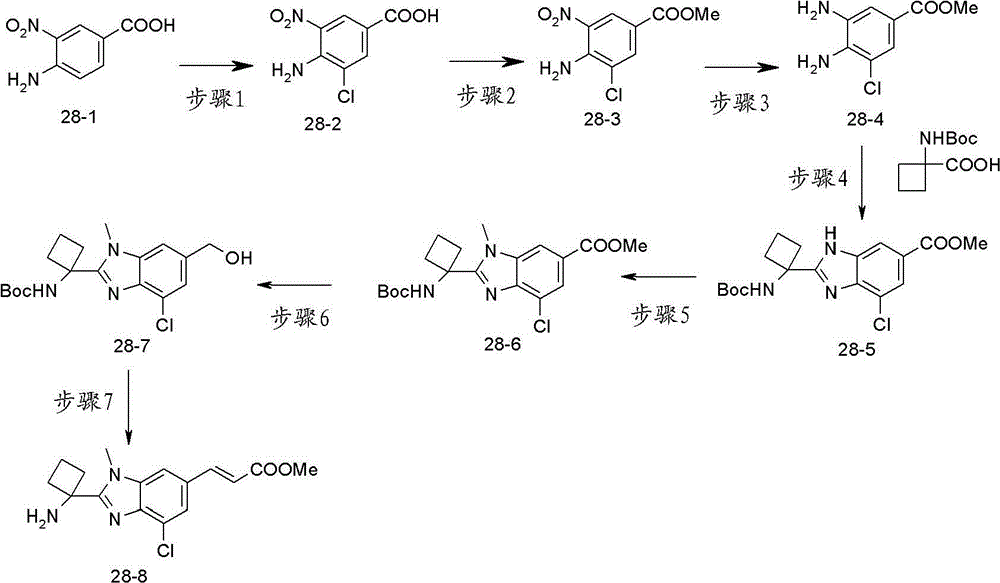
步骤1:step 1:
将4-氨基-3-硝基苯甲酸28-1(15.00g,82mmol)溶解在AcOH(200mL)中并加入磺酰氯(6.62mL,82mmol)。在RT搅拌该混合物2小时,之后再加入另外的硫酰氯(1.5mL)完成反应。在于RT下再搅拌1小时后,将该反应混合物倒至冰上并利用过滤收集沉淀。用水清洗产物28-2,风干并直接用在下一步骤。4-Amino-3-nitrobenzoic acid 28-1 (15.00 g, 82 mmol) was dissolved in AcOH (200 mL) and sulfonyl chloride (6.62 mL, 82 mmol) was added. The mixture was stirred at RT for 2 h before additional sulfuryl chloride (1.5 mL) was added to complete the reaction. After stirring for a further 1 h at RT, the reaction mixture was poured onto ice and the precipitate was collected by filtration. Product 28-2 was washed with water, air dried and used directly in the next step.
步骤2:Step 2:
将粗产物28-2溶解在MeOH(300mL)中并加入浓H2SO4(1mL)。让混合物回流2天,在该点之后转换率约~75%完成。在减压下将挥发物除去并在EtOAc和水之间分配。利用Na2CO3饱和水溶液的缓慢加入使得混合物碱性化并得以将有机相分离。将萃取物用盐水清洗、干燥(Na2SO4)并浓缩得到28-3的米色固体(12.32g),其可直接用于下一步骤。The crude product 28-2 was dissolved in MeOH (300 mL) and concentrated H 2 SO 4 (1 mL) was added. The mixture was allowed to reflux for 2 days, after which point the conversion was about ~75% complete. Volatiles were removed under reduced pressure and partitioned between EtOAc and water. The mixture was made basic with the slow addition of saturated aqueous Na2CO3 and the organic phase was allowed to separate. The extract was washed with brine, dried ( Na2SO4 ) and concentrated to give 28-3 as a beige solid (12.32 g), which was used directly in the next step.
步骤3:Step 3:
将硝基苯胺28-3(11.32g,49mmol)、亚硫酸氢钠(35.54g,204mmol)和NaHCO3(17.15g,204mmol)溶解在3:2EtOH/水(600mL)中。将橙色混合物于RT下搅拌20小时。然后在减压下将EtOH除去并用EtOAc萃取产物。将萃取物用水和盐水清洗、干燥(Na2SO4)并蒸发得到化合物28-4的棕色固体(4.60g,46%收率),其不需经纯化即可用在下一步骤。Nitroaniline 28-3 (11.32 g, 49 mmol), sodium bisulfite (35.54 g, 204 mmol) and NaHCO 3 (17.15 g, 204 mmol) were dissolved in 3:2 EtOH/water (600 mL). The orange mixture was stirred at RT for 20 hours. The EtOH was then removed under reduced pressure and the product was extracted with EtOAc. The extract was washed with water and brine, dried (Na 2 SO 4 ) and evaporated to give compound 28-4 as a brown solid (4.60 g, 46% yield), which was used in the next step without purification.
步骤4:Step 4:
将二胺28-4(1.00g,5.0mmol)、N-Boc-1-氨基环丁烷羧酸(1.07g,5.0mmol)、HATU(2.20g,5.8mmol)和Et3N(2.10mL,15.0mmol)溶解在DMF(30mL)中并于RT下搅拌该混合物2天。将反应混合物倒至冰上并利用过滤收集沉淀的固体。利用水清洗该物质,并溶解在EtOAc中并用盐水萃取。之后将溶液干燥(Na2SO4)并在减压下浓缩。将残留物溶解在AcOH中并加热至80℃3小时。HPLC分析显示完全转化成期望的苯并咪唑衍生物。在减压下除去AcOH,使残留物用EtOAc提取并用NaHCO3水溶液和盐水清洗该溶液,经过干燥(MgSO4)之后,除去溶剂得到化合物28-5的橙色固体(563mg),其可直接用于下一步骤中。Diamine 28-4 (1.00g, 5.0mmol), N-Boc-1-aminocyclobutanecarboxylic acid (1.07g, 5.0mmol), HATU (2.20g, 5.8mmol) and Et 3 N (2.10mL, 15.0 mmol) was dissolved in DMF (30 mL) and the mixture was stirred at RT for 2 days. The reaction mixture was poured onto ice and the precipitated solid was collected by filtration. The material was washed with water, dissolved in EtOAc and extracted with brine. The solution was then dried ( Na2SO4 ) and concentrated under reduced pressure . The residue was dissolved in AcOH and heated to 80 °C for 3 hours. HPLC analysis showed complete conversion to the desired benzimidazole derivative. AcOH was removed under reduced pressure, the residue was extracted with EtOAc and the solution was washed with aqueous NaHCO 3 and brine, after drying (MgSO 4 ), the solvent was removed to give compound 28-5 as an orange solid (563 mg), which was used directly in in the next step.
步骤5:Step 5:
将苯并咪唑28-5(1.63g,4.29mmol)和K2CO3(2.96g,21.45mmol)悬浮在DMF(10mL)中并加入碘甲烷(0.27mL,4.30mmol)。于RT下搅拌该混合物3小时。之后将反应混合物倒至冰上并利用过滤收集沉淀固体。将该物质用水清洗,溶解在EtOAc中并将该溶液用5%柠檬酸水溶液和盐水清洗两次,经过干燥(MgSO4)之后在减压下除去挥发物,得到化合物28-6的棕色固体(1.44g),其可直接用于下一步骤。Benzimidazole 28-5 (1.63 g, 4.29 mmol) and K 2 CO 3 (2.96 g, 21.45 mmol) were suspended in DMF (10 mL) and iodomethane (0.27 mL, 4.30 mmol) was added. The mixture was stirred at RT for 3 hours. The reaction mixture was then poured onto ice and the precipitated solid was collected by filtration. The material was washed with water, dissolved in EtOAc and the solution was washed twice with 5% aqueous citric acid and brine, dried ( MgSO4 ) and the volatiles were removed under reduced pressure to give compound 28-6 as a brown solid ( 1.44 g), which was used directly in the next step.
步骤6:Step 6:
将甲酯28-6(1.22g,3.10mmol)溶解在THF(30mL)中并在RT下分几个小部分加入LiBH4(0.243g,11.14mmol)。然后于40℃下搅拌该混合物16小时。由于转化尚未完成,加入另外的LiBH4(0.100g,4.6mmol),并于70℃另外再搅拌该混合物3小时。将反应混合物冷却至RT并将残留物用EtOAc稀释。小心地加入水并使得有机相分离。用水和盐水清洗萃取物并干燥(MgSO4)。将粗醇28-7(961mg)和其他批次的产物合并并利用快速色谱法加以纯化。Methyl ester 28-6 (1.22 g, 3.10 mmol) was dissolved in THF (30 mL) and LiBH 4 (0.243 g, 11.14 mmol) was added in several small portions at RT. The mixture was then stirred at 40°C for 16 hours. Since the conversion was not yet complete, additional LiBH4 (0.100 g, 4.6 mmol) was added and the mixture was stirred for an additional 3 h at 70 °C. The reaction mixture was cooled to RT and the residue was diluted with EtOAc. Water was added carefully and the organic phase was allowed to separate. The extracts were washed with water and brine and dried ( MgSO4 ). Crude alcohol 28-7 (961 mg) and other batches were combined and purified by flash chromatography.
步骤7:Step 7:
将得自以上的纯化醇28-7(0.450g,1.02mmol)溶解在DCM(20mL)中并加入Dess-Martin periodinane(0.551g,1.30mmol)。于RT下搅拌该混合物2小时。然后加入(乙酯基亚甲基)三苯基正膦(0.550g,1.58mmol),并将混合物回流20小时。之后在减压下将挥发物除去并将残留物溶解在1:1 TFA-DCM中,以便除去Boc保护基。于RT下搅拌1小时后,在减压下除去挥发物并将残余物在EtOAc和1N HCl之间分配。分离出含有产物的水相,用2M Na2CO3中和并用EtOAc萃取2X。将萃取物干燥(Na2SO4)并浓缩得到化合物28-8的白色泡沫(212mg),通过快速色谱法中使用80-100%EtOAc在己烷中作为洗脱液而加以纯化。将期望的苯并咪唑片段(fragment)的白色固体(66mg)。The purified alcohol 28-7 from above (0.450 g, 1.02 mmol) was dissolved in DCM (20 mL) and Dess-Martin periodinane (0.551 g, 1.30 mmol) was added. The mixture was stirred at RT for 2 hours. Then (ethoxymethylene)triphenylphosphorane (0.550 g, 1.58 mmol) was added, and the mixture was refluxed for 20 hours. The volatiles were then removed under reduced pressure and the residue was dissolved in 1:1 TFA-DCM to remove the Boc protecting group. After stirring at RT for 1 h, the volatiles were removed under reduced pressure and the residue was partitioned between EtOAc and 1N HCl. The aqueous phase containing product was separated, neutralized with 2M Na2CO3 and extracted 2X with EtOAc. The extract was dried ( Na2SO4 ) and concentrated to give compound 28-8 as a white foam (212 mg), which was purified by flash chromatography using 80-100% EtOAc in hexanes as eluent. The desired benzimidazole fragment was obtained as a white solid (66 mg).
实施例29Example 29
5-[2-(1-氨基环丁基)-3-甲基-3H-苯并咪唑-5-基]-3H-[1,3,4]

步骤1:step 1:
将10N HCl(2mL)加到3-氟-4-硝基-苯甲酸(29-1)(10g,54.0mmol)的300mL MeOH溶液中并使溶液回流15小时。之后将混合物浓缩,用EtOAc稀释残留物,并将有机相用2X水和NaHO3饱和水溶液清洗、干燥(MgSO4)、过滤并蒸发得到10.45g(97%收率)化合物29-2的白色固体。该化合物可用在下一反应中。10N HCl (2 mL) was added to a solution of 3-fluoro-4-nitro-benzoic acid (29-1) (10 g, 54.0 mmol) in 300 mL of MeOH and the solution was refluxed for 15 hours. The mixture was then concentrated, the residue was diluted with EtOAc, and the organic phase was washed with 2X water and saturated aqueous NaHO 3 , dried (MgSO 4 ), filtered and evaporated to give 10.45 g (97% yield) of compound 29-2 as a white solid . This compound can be used in the next reaction.
步骤2:Step 2:
将甲基胺(于THF中的2N溶液,80mL)于0℃滴加到化合物29-2(10g,50.2mmol)于100mL THF的溶液中。将该混合物于0℃再搅拌20分钟,之后于室温下再搅拌15小时。然后将挥发物蒸发,并用EtOAc稀释残留物并用2X水、NaHO3饱和水溶液清洗有机相、干燥(MgSO4)、过滤并蒸发得到10.21g(96%收率)29-3的橙色固体。该化合物可用于下一反应中。Methylamine (2N solution in THF, 80 mL) was added dropwise to a solution of compound 29-2 (10 g, 50.2 mmol) in 100 mL THF at 0°C. The mixture was stirred for a further 20 minutes at 0°C and then for a further 15 hours at room temperature. The volatiles were then evaporated and the residue was diluted with EtOAc and the organic phase was washed with 2X water, saturated aqueous NaHO 3 , dried (MgSO 4 ), filtered and evaporated to give 10.21 g (96% yield) of 29-3 as an orange solid. This compound can be used in the next reaction.
步骤3:Step 3:
将钯(10%碳上,1g)加到化合物29-3(10g,47.6mmol)于400mL THF-无水EtOH的1/1混合溶液中。在氢气下搅拌该混合物16小时,然后将该溶液过滤以除去催化剂并浓缩得到8.5g(99%收率)化合物29-4的灰白色固体。该化合物可用于下一反应中。Palladium (10% on carbon, 1 g) was added to a 1/1 mixed solution of compound 29-3 (10 g, 47.6 mmol) in 400 mL THF-anhydrous EtOH. The mixture was stirred under hydrogen for 16 hours, then the solution was filtered to remove the catalyst and concentrated to afford 8.5 g (99% yield) of compound 29-4 as an off-white solid. This compound can be used in the next reaction.
步骤4:Step 4:
使用实施例7的方法将化合物29-4转化为化合物29-5。Compound 29-4 was converted to compound 29-5 using the method of Example 7.
步骤5:Step 5:
将化合物29-5(730g,2.03mmol)和肼单水合物(500μL,10.3mmol)于5mL乙醇中的混合物于85℃下在具有螺旋帽的小瓶中加热72小时。之后将该溶液浓缩、用CH2Cl2稀释并用水清洗有机层。将有机层干燥(Na2SO4)、过滤并蒸发得到642mg(88%)化合物29-6的灰白色固体。其可用于下一步骤中。A mixture of compound 29-5 (730 g, 2.03 mmol) and hydrazine monohydrate (500 μL, 10.3 mmol) in 5 mL of ethanol was heated at 85° C. in a screw cap vial for 72 hours. The solution was then concentrated, diluted with CH2Cl2 and the organic layer was washed with water. The organic layer was dried (Na 2 SO 4 ), filtered and evaporated to give 642 mg (88%) of compound 29-6 as an off-white solid. It can be used in the next step.
步骤6:Step 6:
将三乙基胺(190μL,1.36mmol)加到化合物29-6(350mg,0.97mmol)和1,1’-羰基二咪唑(190mg,1.17mmol)的THF(5mL)溶液中。在室温下搅拌该混合物15小时。将挥发物除去并用将残留物用EtOAc稀释,用水、盐水清洗,并将有机层干燥(Na2SO4)、过滤和蒸发得到318mg(85%收率)化合物29-7的蜡状白色固体,其可用于下一步骤中。Triethylamine (190 μL, 1.36 mmol) was added to a solution of compound 29-6 (350 mg, 0.97 mmol) and 1,1′-carbonyldiimidazole (190 mg, 1.17 mmol) in THF (5 mL). The mixture was stirred at room temperature for 15 hours. The volatiles were removed and the residue was diluted with EtOAc, washed with water, brine , and the organic layer was dried ( Na2SO4 ), filtered and evaporated to afford 318 mg (85% yield) of compound 29-7 as a waxy white solid, It can be used in the next step.
步骤7:Step 7:
将TFA(3mL)滴加到化合物29-7(150mg,0.39mmol)的二氯甲烷(10mL)的悬浮液中并将得到的溶液搅拌1小时。将挥发物蒸发得到150mg(定量收率)的期望化合物29-8的三氟醋酸盐,其为米色固体。TFA (3 mL) was added dropwise to a suspension of compound 29-7 (150 mg, 0.39 mmol) in dichloromethane (10 mL) and the resulting solution was stirred for 1 hour. The volatiles were evaporated to give 150 mg (quantitative yield) of the trifluoroacetate salt of the desired compound 29-8 as a beige solid.
实施例30Example 30
5-[2-(1-氨基环丁基)-3-甲基-3H-苯并咪唑-5-基]-3-甲基-3H-1,3,4-

将碳酸钾(32mg,0.32mmol)加到化合物29.7(80mg,0.21mmol)的DMF(1mL)溶液中。将该悬浮液在室温下搅拌15分钟。然后将碘甲烷(12.5μL,0.2mmol)加入并在室温下搅拌该混合物3小时。将混合物用EtOAc稀释,用水(3X)、盐水清洗,然后将有机相干燥(MgSO4)、过滤并蒸发得到67mg(81%收率)的米色固体。使用实施例29步骤7中描述的TFA处理得到57mg(定量收率)的期望化合物30-1的三氟醋酸盐,其为米色固体。Potassium carbonate (32 mg, 0.32 mmol) was added to a solution of compound 29.7 (80 mg, 0.21 mmol) in DMF (1 mL). The suspension was stirred at room temperature for 15 minutes. Iodomethane (12.5 μL, 0.2 mmol) was then added and the mixture was stirred at room temperature for 3 hours. The mixture was diluted with EtOAc, washed with water (3X), brine, then the organic phase was dried ( MgSO4 ), filtered and evaporated to give 67 mg (81% yield) of a beige solid. Treatment with TFA as described in Example 29, step 7 afforded 57 mg (quantitative yield) of the trifluoroacetate salt of the desired compound 30-1 as a beige solid.
化合物30-1可利用实施例4和34步骤1的方法偶合至通式II的吲哚中间体得到式I的化合物。Compound 30-1 can be coupled to the indole intermediate of general formula II by the method of Example 4 and Step 1 of 34 to obtain the compound of formula I.
实施例31Example 31
5-[2-(1-氨基环丁基)-3-甲基-3H-苯并咪唑-5-基]-2-甲基-2H-吡唑-3-醇5-[2-(1-Aminocyclobutyl)-3-methyl-3H-benzimidazol-5-yl]-2-methyl-2H-pyrazol-3-ol

步骤1:step 1:
将NaOH(10N,11mL,110mmol)加到化合物29-5(5.0g,13.9mmol)在3:2:1THF、MeOH和水混合(180mL)的溶液中并将该溶液在室温下搅拌过夜。然后将混合物浓缩,利用1N HCl将pH值调整至4并用EtOAc萃取混合物。将有机层用盐水清洗、干燥(MgSO4)、过滤并蒸发得到化合物31-1(3.94g,82%收率)的白色固体。该化合物可用于下一反应中。NaOH (10N, 11 mL, 110 mmol) was added to a solution of compound 29-5 (5.0 g, 13.9 mmol) in a 3:2:1 mixture of THF, MeOH and water (180 mL) and the solution was stirred at room temperature overnight. The mixture was then concentrated, the pH was adjusted to 4 with 1N HCl and the mixture was extracted with EtOAc. The organic layer was washed with brine, dried (MgSO 4 ), filtered and evaporated to give compound 31-1 (3.94 g, 82% yield) as a white solid. This compound can be used in the next reaction.
步骤2:Step 2:
将1,1’-羰基二咪唑(702mg,4.33mmol)加到化合物31-1(1g,2.90mmol)的THF(24mL)溶液中。将该溶液搅拌15小时,然后于0℃滴加到丙二酸阴离子(将Et3N(0.81mL,5.80mmol)和MgCl2(690mg,7.25mmol)加到丙二酸单乙酯钾盐(1g,5.96mmol)的乙腈(10mL)溶液中,接着在室温下搅拌2.5小时而制得)的溶液中。然后将得到的混合物缓慢加温至室温并总共搅拌约48小时。将该混合物浓缩并加入甲苯。将该混合物冷却至10-15℃并通过添加1M HCl直到pH达到3-4而缓慢水解。然后分离相层并用EtOAc稀释有机层,用水清洗、干燥并蒸发得到黄色油。利用快速色谱法将产物纯化(洗脱液:己烷:AcOEt 4:6)得到885mg(74%收率)化合物31-2的白色固体。1,1'-Carbonyldiimidazole (702 mg, 4.33 mmol) was added to a solution of compound 31-1 (1 g, 2.90 mmol) in THF (24 mL). The solution was stirred for 15 hours, then added dropwise to malonate anion (Et 3 N (0.81 mL, 5.80 mmol) and MgCl 2 (690 mg, 7.25 mmol) were added to monoethyl malonate potassium salt ( 1 g, 5.96 mmol) in acetonitrile (10 mL), followed by stirring at room temperature for 2.5 hours). The resulting mixture was then slowly warmed to room temperature and stirred for a total of about 48 hours. The mixture was concentrated and toluene was added. The mixture was cooled to 10-15°C and slowly hydrolyzed by adding 1M HCl until pH 3-4 was reached. The layers were then separated and the organic layer was diluted with EtOAc, washed with water, dried and evaporated to give a yellow oil. The product was purified by flash chromatography (eluent: hexane:AcOEt 4:6) to afford 885 mg (74% yield) of compound 31-2 as a white solid.
步骤3:Step 3:
将甲基肼(29μL,0.55mmol)加到化合物31-2(100mg,0.24mmol)的EtOH(2.5mL)溶液中。于80℃搅拌该混合物15小时。然后将该混合物浓缩并加入水,接着利用1N HCl的加入将pH值调整至6-7。用EtOAc将水层萃取3次并将有机层干燥(MgSO4)和浓缩得到94mg(98%收率)的淡黄色固体。利用实施例29步骤7描述的方法用TFA的二氯甲烷溶液处理,得到93mg(定量收率)的化合物31-3的三氟醋酸盐。Methylhydrazine (29 μL, 0.55 mmol) was added to a solution of compound 31-2 (100 mg, 0.24 mmol) in EtOH (2.5 mL). The mixture was stirred at 80°C for 15 hours. The mixture was then concentrated and water was added, followed by the addition of 1 N HCl to adjust the pH to 6-7. The aqueous layer was extracted 3 times with EtOAc and the organic layer was dried (MgSO 4 ) and concentrated to give 94 mg (98% yield) of a pale yellow solid. Treatment with TFA in dichloromethane using the method described in Example 29, Step 7 afforded 93 mg (quantitative yield) of the trifluoroacetate salt of compound 31-3.
化合物31-3可利用实施例4和34步骤1的方法偶合至通式II的吲哚中间体得到式I的化合物。Compound 31-3 can be coupled to the indole intermediate of general formula II by the method of Example 4 and Step 1 of 34 to obtain the compound of formula I.
实施例32Example 32
5-[2-(1-氨基环丁基)-3-甲基-3H-苯并咪唑-5-基]-3H-1,3,4-噻二唑-2-酮5-[2-(1-aminocyclobutyl)-3-methyl-3H-benzimidazol-5-yl]-3H-1,3,4-thiadiazol-2-one

步骤1:step 1:
将TBTU(380mg,1.18mmol)和三乙基胺(380μL,2.73mmol)加到化合物31-1(350mg,1.01mmol)和肼基甲酸乙酯(ethyl carbazate)(120mg,1.15mmol)在DMF(5mL)的溶液中。将该混合物于室温下搅拌15小时,然后用EtOAc稀释。将得到的有机悬浮液用2X水和1X NaHCO3饱和水溶液清洗。然后将THF加到有机层中得到溶液,干燥(MgSO4)、过滤和浓缩。将残留物用EtOAc研磨得到290mg(66%)化合物32-1的米色固体。该化合物可用于下一反应中。TBTU (380 mg, 1.18 mmol) and triethylamine (380 μL, 2.73 mmol) were added to compound 31-1 (350 mg, 1.01 mmol) and ethyl carbazate (120 mg, 1.15 mmol) in DMF ( 5mL) solution. The mixture was stirred at room temperature for 15 hours, then diluted with EtOAc. The resulting organic suspension was washed with 2X water and 1X saturated aqueous NaHCO 3 . THF was then added to the organic layer to give a solution which was dried ( MgSO4 ), filtered and concentrated. The residue was triturated with EtOAc to afford 290 mg (66%) of compound 32-1 as a beige solid. This compound can be used in the next reaction.
步骤2:Step 2:
将Lawesson试剂(70mg,0.17mmol)于100℃加到化合物32-1(150mg,0.35mmol)于二烷(10mL)的溶液中。将得到的混合物于100℃下搅拌8小时然后在140℃下搅拌4小时。然后将该混合物冷却至100℃并加入另外部分的Lawesson试剂(70mg,0.17mmol)。然后于100℃将溶液加热15小时。将混合物浓缩至干并利用EtOAc研磨固体残余物并过滤。将得到的米色固体(100mg)利用实施例29步骤7中描述的TFA处理得到93mg化合物32-2的三氟醋酸盐。Lawesson's reagent (70mg, 0.17mmol) was added to compound 32-1 (150mg, 0.35mmol) in 2 in alkane (10 mL). The resulting mixture was stirred at 100°C for 8 hours and then at 140°C for 4 hours. The mixture was then cooled to 100°C and an additional portion of Lawesson's reagent (70 mg, 0.17 mmol) was added. The solution was then heated at 100°C for 15 hours. The mixture was concentrated to dryness and the solid residue was triturated with EtOAc and filtered. The resulting beige solid (100 mg) was treated with TFA as described in Example 29, step 7 to afford 93 mg of the trifluoroacetate salt of compound 32-2.
化合物32-2可利用实施例4和34步骤1的方法偶合至通式II的吲哚中间体得到式I的化合物。Compound 32-2 can be coupled to the indole intermediate of general formula II by the method of Example 4 and Step 1 of 34 to obtain the compound of formula I.
实施例33Example 33
[1-(1-甲基-6-嘧啶-2-基-1H-苯并咪唑-2-基)环丁基]氨基甲酸叔丁基酯[1-(1-Methyl-6-pyrimidin-2-yl-1H-benzimidazol-2-yl)cyclobutyl]carbamate tert-butyl ester

步骤1:step 1:
将市售购得的1,3-二溴苯33-1(4.1mL,33.9mmol)溶解在浓硫酸(35mL)中,在冰浴中冷却。将硝酸钾(3.4g,33.9mmol)缓慢加入(以小量分批)因此可将内反应温度维持在10℃以下。将反应混合物再搅拌30分钟,之后并倒入1L冰中。将形成的黄色沉淀物(33-2)过滤并用水清洗。在减压下干燥并可直接用在下述步骤中。Commercially available 1,3-dibromobenzene 33-1 (4.1 mL, 33.9 mmol) was dissolved in concentrated sulfuric acid (35 mL), and cooled in an ice bath. Potassium nitrate (3.4 g, 33.9 mmol) was added slowly (in small portions) so that the internal reaction temperature could be maintained below 10 °C. The reaction mixture was stirred for another 30 minutes, after which time it was poured into 1 L of ice. The formed yellow precipitate (33-2) was filtered and washed with water. It was dried under reduced pressure and used directly in the following step.
步骤2:Step 2:
将化合物33-2(6.3g,22.4mmol)和甲基胺氢氯化物(3.0g,44.8mmol)于DMF(50mL)中的混合物冷却至0℃。将三乙基胺(9.4mL,67mmol)加入,并将混合物于RT下搅拌3.5小时,然后加热至70℃过夜。将混合物倒入水中并将得到的沉淀物过滤。用EtOAc(3X)萃取滤液并将萃取液用水(3X)和饱和NaCl清洗、干燥(MgSO4)、过滤并浓缩得到化合物33-3和33-4的混合物,其为橙色固体(4.8g)并可用于下一步骤中。A mixture of compound 33-2 (6.3 g, 22.4 mmol) and methylamine hydrochloride (3.0 g, 44.8 mmol) in DMF (50 mL) was cooled to 0 °C. Triethylamine (9.4 mL, 67 mmol) was added, and the mixture was stirred at RT for 3.5 hours, then heated to 70 °C overnight. The mixture was poured into water and the resulting precipitate was filtered. The filtrate was extracted with EtOAc (3X) and the extract was washed with water (3X) and saturated NaCl, dried ( MgSO4 ), filtered and concentrated to give a mixture of compounds 33-3 and 33-4 as an orange solid (4.8 g) and Can be used in the next step.
步骤3:Step 3:
利用描述在实施例11步骤5描述的方法使得进行硝基化合物33-3与Na2S2O4/K2CO3的还原反应。利用柱色谱法使用溶剂梯度EtOAc于己烷中从17%至25%,将化合物33-5(1.5g,~20%,3个步骤的收率)从反应混合物中分离出来。Reduction of nitro compound 33-3 with Na 2 S 2 O 4 /K 2 CO 3 was carried out using the method described in step 5 of Example 11. Compound 33-5 (1.5 g, ~20%, yield over 3 steps) was isolated from the reaction mixture by column chromatography using a solvent gradient of EtOAc in hexanes from 17% to 25%.
步骤4:Step 4:
使用描述在实施例7中的方法将二苯胺33-5转化为化合物33-6。Diphenylamine 33-5 was converted to compound 33-6 using the method described in Example 7.
步骤5:Step 5:
将氩气以气泡方式打入化合物33-6(300mg,0.79mmol)、氯化锂(67mg,1.6mmol),PPh3(31mg,0.12mmol)和2-三丁基甲锡烷基嘧啶(365mg,0.99mmol)于DMF(6.0mL)的混合物中15分钟。将Pd(PPh3)4(91mg,0.079mmol)和CuI(15mg,0.079mmol)加入并将混合物于100℃加热24小时。将混合物用EtOAc稀释并将有机相用水和盐水清洗,然后干燥(MgSO4)并浓缩得到黄色油,其利用快速色谱法纯化(己烷:EtOAc3:7至2:8)得到化合物33-7的黄色固体(100mg,24%)。Bubble argon into compound 33-6 (300mg, 0.79mmol), lithium chloride (67mg, 1.6mmol), PPh 3 (31mg, 0.12mmol) and 2-tributylstannylpyrimidine (365mg, 0.99 mmol) in DMF (6.0 mL) for 15 min. Pd(PPh 3 ) 4 (91 mg, 0.079 mmol) and CuI (15 mg, 0.079 mmol) were added and the mixture was heated at 100° C. for 24 hours. The mixture was diluted with EtOAc and the organic phase was washed with water and brine, then dried (MgSO 4 ) and concentrated to give a yellow oil, which was purified by flash chromatography (hexanes:EtOAc 3:7 to 2:8) to give compound 33-7. Yellow solid (100 mg, 24%).
利用实施例29步骤7中描述的标准条件可将化合物33-7去保护并将得到的胺利用实施例4和34步骤1的方法偶合至通式II的吲哚中间体得到式I的化合物。Compounds 33-7 can be deprotected using standard conditions described in Example 29, Step 7 and the resulting amines can be coupled to indole intermediates of general formula II using the procedure of Examples 4 and 34, Step 1 to provide compounds of Formula I.
本领域技术人员应了解,带有相似杂环或芳香基团的类似中间体的制备,可利用该方法或其变化方法进行。或者,步骤5的偶合反应可利用熟知的Suzuki反应中的条件进行(A.Suzuki,Pure Appl.Chem.(1994)66,213;N.Miyaura and A.Suzuki,Chem.Rev.(1995)95,2457)。Those skilled in the art will understand that the preparation of similar intermediates with similar heterocyclic or aromatic groups can be carried out using this method or variations thereof. Alternatively, the coupling reaction of Step 5 can be carried out using the conditions in the well-known Suzuki reaction (A.Suzuki, Pure Appl.Chem. (1994) 66, 213; N.Miyaura and A.Suzuki, Chem.Rev. (1995) 95 , 2457 ).
实施例34Example 34
(E)-3-[2-(1-{[2-(5-溴嘧啶-2-基)-3-环戊基-1-甲基-1H-吲哚-6-羰基]-氨基}-环丁基)-3-甲基-3H-苯并咪唑-5-基]-丙烯酸(E)-3-[2-(1-{[2-(5-Bromopyrimidin-2-yl)-3-cyclopentyl-1-methyl-1H-indole-6-carbonyl]-amino} -Cyclobutyl)-3-methyl-3H-benzimidazol-5-yl]-acrylic acid

使用实施例4的方法将化合物19-3(实施例19)和化合物34-1(使用实施例3的方法由化合物10-2制备而得)偶合得到化合物34-2(化合物3085,表3)的深黄色固体(9.3%)。Compound 19-3 (Example 19) and Compound 34-1 (prepared from Compound 10-2 using the method of Example 3) were coupled using the method of Example 4 to obtain Compound 34-2 (Compound 3085, Table 3) dark yellow solid (9.3%).
1H NMR(400MHz,DMSO-d6),δ1.63(bs,2H),1.80-1.95(m,6H),1.95-2.10(m,2H),2.70(ddd,J=9.3&10.6Hz,2H),2.99(m,2H),3.65-3.75(m,1H),3.76(s,3H),3.85(s,3H),6.54(d,J=15.6Hz,1H),7.52(d,J=8.4Hz,1H),7.59(d,J=8.4Hz,1H),7.64(d,J=8.2Hz,1H),7.70(d,J=15.9Hz,1H),7.74(d,J=8.4Hz,1H),7.86(s,1H),8.12(s,1H),9.18(s,2H),9.20(s,1H),12.25(s,1H)。 1 H NMR(400MHz,DMSO-d 6 ),δ1.63(bs,2H),1.80-1.95(m,6H),1.95-2.10(m,2H),2.70(ddd,J=9.3&10.6Hz, 2H),2.99(m,2H),3.65-3.75(m,1H),3.76(s,3H),3.85(s,3H),6.54(d,J=15.6Hz,1H),7.52(d,J =8.4Hz,1H),7.59(d,J=8.4Hz,1H),7.64(d,J=8.2Hz,1H),7.70(d,J=15.9Hz,1H),7.74(d,J=8.4 Hz, 1H), 7.86(s, 1H), 8.12(s, 1H), 9.18(s, 2H), 9.20(s, 1H), 12.25(s, 1H).
实施例35Example 35
3-环戊基-1-甲基-2-吡啶-2-基-1H-吲哚-6-羧酸{1-[1-甲基-6-(5-氧代-4,5-二氢-1,3,4-

步骤1:step 1:
将TBTU(350mg,1.09mmol)和三乙基胺(380mL,2.73mmol)加到化合物35-1(化合物1025,表1)(487mg,0.89mmol)和肼基甲酸叔丁基酯(130mg,0.98mmol)的DMF(8mL)溶液中。并将混合物在室温下搅拌2小时,然后并用EtOAc稀释。将得到的有机悬浮液用2X水和1X NaHCO3饱和水溶液清洗。然后将THF加到有机层中并将得到的溶液干燥(MgSO4)、过滤并浓缩。将残留物用EtOAc研磨得到421mg(72%)化合物35-2的米色固体。该化合物可用于下一反应中。TBTU (350 mg, 1.09 mmol) and triethylamine (380 mL, 2.73 mmol) were added to compound 35-1 (compound 1025, Table 1) (487 mg, 0.89 mmol) and tert-butyl carbazate (130 mg, 0.98 mmol) in DMF (8 mL). The mixture was stirred at room temperature for 2 hours, then diluted with EtOAc. The resulting organic suspension was washed with 2X water and 1X saturated aqueous NaHCO 3 . THF was then added to the organic layer and the resulting solution was dried ( MgSO4 ), filtered and concentrated. The residue was triturated with EtOAc to afford 421 mg (72%) of compound 35-2 as a beige solid. This compound can be used in the next reaction.
步骤2:Step 2:
将TFA(3mL)滴加到化合物35-2(200mg,0.3mmol)的二氯甲烷(3mL)溶液中并将得到的溶液搅拌2小时。将挥发物蒸发得到170mg(定量收率)化合物35-3的三氟醋酸盐,其可直接使用不须再纯化。TFA (3 mL) was added dropwise to a solution of compound 35-2 (200 mg, 0.3 mmol) in dichloromethane (3 mL) and the resulting solution was stirred for 2 hours. The volatiles were evaporated to afford 170 mg (quantitative yield) of the trifluoroacetate salt of compound 35-3, which was used without further purification.
步骤3:Step 3:
将1,1’-羰基二咪唑(25mg,0.15mmol)一次性加到化合物35-3(100mg,0.13mmol)和三乙基胺(80μL,0.57mmol)在2mL THF的溶液中并将得到的溶液于室温下搅拌4小时。然后将该混合物在减压下浓缩,用4mL DMSO稀释并直接在反相C18半制备HPLC柱(使用溶剂梯度从5%H2O于MeCN中至100%MeCN)进行纯化,以分离化合物35-4(化合物1128,表1)的黄色无定形固体,其具有>95%同质性(29mg,39%收率)。1,1'-Carbonyldiimidazole (25mg, 0.15mmol) was added to a solution of compound 35-3 (100mg, 0.13mmol) and triethylamine (80μL, 0.57mmol) in 2mL of THF at one time, and the obtained The solution was stirred at room temperature for 4 hours. The mixture was then concentrated under reduced pressure, diluted with 4 mL of DMSO and directly purified on a reverse phase C18 semi-preparative HPLC column (using a solvent gradient from 5% H20 in MeCN to 100% MeCN) to isolate compound 35 -4 (Compound 1128, Table 1) as a yellow amorphous solid with >95% homogeneity (29 mg, 39% yield).
1H NMR(400MHz,DMSO):δ1.54-1.68(m,2H),1.79-1.93(m,6H),1.94-2.05(m,1H),2.09-2.21(m,1H),2.75-2.85(m,2H),3.05-3.25(m,3H),3.69(s,3H),3.90(s,3H),7.49(m,1H),7.57-7.72(m,3H),7.82-7.92(m,2H),7.94-8.02(m,1H),8.06-8.15(m,2H),8.78(d,J=3.9Hz,1H),9.45(s,1H),12.62(s,1H)。 1 H NMR (400MHz, DMSO): δ1.54-1.68 (m, 2H), 1.79-1.93 (m, 6H), 1.94-2.05 (m, 1H), 2.09-2.21 (m, 1H), 2.75-2.85 (m,2H),3.05-3.25(m,3H),3.69(s,3H),3.90(s,3H),7.49(m,1H),7.57-7.72(m,3H),7.82-7.92(m ,2H),7.94-8.02(m,1H),8.06-8.15(m,2H),8.78(d,J=3.9Hz,1H),9.45(s,1H),12.62(s,1H).
实施例36Example 36
3-环戊基-1-甲基-2-吡啶-2-基-1H-吲哚-6-羧酸{1-[6-(5-氨基-1,3,4-

将C-(二-咪唑-1-基)-亚甲基胺(25mg,0.16mmol)一次性加到化合物35-3(实施例35)(80mg,0.14mmol)的THF(4mL)溶液中。将得到的溶液加热至70℃16小时,之后观察到白色沉淀。然后在减压下将反应物浓缩,并溶解在4mL DMSO中并直接在反相C18半制备HPLC柱(使用溶剂梯度从5%H2O于MeCN中至100%MeCN)进行纯化,以分离化合物36-1(化合物1129,表1)的黄色无定形固体,其具有>95%同质性(19mg,23%收率)。C-(di-imidazol-1-yl)-methyleneamine (25 mg, 0.16 mmol) was added to a solution of compound 35-3 (Example 35) (80 mg, 0.14 mmol) in THF (4 mL) in one portion. The resulting solution was heated to 70°C for 16 hours, after which a white precipitate was observed. The reaction was then concentrated under reduced pressure and dissolved in 4 mL DMSO and purified directly on a reverse phase C18 semi-preparative HPLC column (using a solvent gradient from 5% H20 in MeCN to 100% MeCN) to separate Compound 36-1 (Compound 1129, Table 1) as a yellow amorphous solid with >95% homogeneity (19 mg, 23% yield).
1H NMR(400MHz,DMSO):δ1.54-1.67(m,2H),1.79-1.94(m,6H),1.95-2.06(m,1H),2.11-2.23(m,1H),2.74-2.84(m,2H),3.19-3.05(m,3H),3.69(s,3H),3.91(s,3H),7.49(dd,J=1.8&5.7Hz,1H),7.59-7.71(m,3H),7.86-7.92(m,2H),7.96-8.01(m,1H),8.06-8.10(m,1H),8.10(s,1H),8.78(d,J=4.3Hz,1H),9.51(s,1H)。 1 H NMR (400MHz, DMSO): δ1.54-1.67 (m, 2H), 1.79-1.94 (m, 6H), 1.95-2.06 (m, 1H), 2.11-2.23 (m, 1H), 2.74-2.84 (m,2H),3.19-3.05(m,3H),3.69(s,3H),3.91(s,3H),7.49(dd,J=1.8&5.7Hz,1H),7.59-7.71(m,3H ),7.86-7.92(m,2H),7.96-8.01(m,1H),8.06-8.10(m,1H),8.10(s,1H),8.78(d,J=4.3Hz,1H),9.51( s, 1H).
实施例37Example 37
3-环戊基-1-甲基-2-吡啶-2-基-1H-吲哚-6-羧酸[1-(1-甲基-6-1,3,4-

将化合物35-3(实施例27)(50mg,0.09mmol)和原甲酸三乙酯(1mL,6mmol)的二
1H NMR(400MHz,DMSO):δ1.55-1.68(m,2H),1.79-1.93(m,6H),1.95-2.04(m,1H),2.12-2.20(m,1H),2.82-2.74(m,2H),3.15-3.05(m,3H),3.69(s,3H),3.92(s,3H),7.49(dd,J=2.2&5.3Hz,1H),7.56-7.73(m,3H),7.93-8.05(m,3H),8.11(s,1H),8.33(s,1H),8.79(d,J=4.3Hz,1H),9.37(s,1H),9.44(s,1H)。 1 H NMR (400MHz, DMSO): δ1.55-1.68 (m, 2H), 1.79-1.93 (m, 6H), 1.95-2.04 (m, 1H), 2.12-2.20 (m, 1H), 2.82-2.74 (m,2H),3.15-3.05(m,3H),3.69(s,3H),3.92(s,3H),7.49(dd,J=2.2&5.3Hz,1H),7.56-7.73(m,3H ),7.93-8.05(m,3H),8.11(s,1H),8.33(s,1H),8.79(d,J=4.3Hz,1H),9.37(s,1H),9.44(s,1H) .
实施例38Example 38
3-环戊基-2-(5-氟-吡啶-2-基)-1-甲基-1H-吲哚-6-羧酸{1-[1-甲基-6-(5-氧代-4,5-二氢-1,3,4-
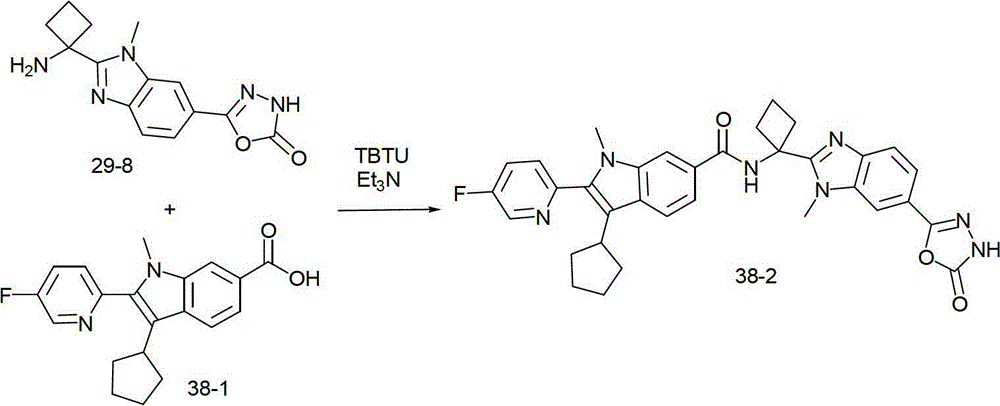
将TBTU(45mg,0.14mmol)和三乙基胺(49mL,0.35mmol)加到化合物38-1(利用在WO 03/010141中描述的方法制备)(45mg,0.13mmol)和化合物29-8(实施例29)(45mg,0.11mmol)的DMF溶液中。将溶液搅拌15小时,并直接在反相C18半制备HPLC柱(使用溶剂梯度从5%H2O于MeCN中至100%MeCN)进行纯化,以分离化合物38-2(化合物1143,表1)的黄色无定形固体,其具有>95%同质性(23mg,34%收率)。TBTU (45 mg, 0.14 mmol) and triethylamine (49 mL, 0.35 mmol) were added to compound 38-1 (prepared using the method described in WO 03/010141) (45 mg, 0.13 mmol) and compound 29-8 ( Example 29) (45 mg, 0.11 mmol) in DMF solution. The solution was stirred for 15 hours and purified directly on a reverse phase C18 semi-preparative HPLC column (using a solvent gradient from 5% H20 in MeCN to 100% MeCN) to isolate compound 38-2 (compound 1143, Table 1 ) as a yellow amorphous solid with >95% homogeneity (23 mg, 34% yield).
1H NMR(400MHz,DMSO):δ1.54-1.68(m,2H),1.79-1.93(m,6H),1.93-2.04(m,1H),2.07-2.20(m,1H),2.72-2.82(m,2H),3.00-3.15(m,3H),3.67(s,3H),3.89(s,3H),7.57-7.72(m,3H),7.79-7.95(m,3H),8.10(s,2H),8.80(d,J=2.9Hz,1H),9.45(s,1H),12.63(s,1H)。 1 H NMR(400MHz,DMSO):δ1.54-1.68(m,2H),1.79-1.93(m,6H),1.93-2.04(m,1H),2.07-2.20(m,1H),2.72-2.82 (m,2H),3.00-3.15(m,3H),3.67(s,3H),3.89(s,3H),7.57-7.72(m,3H),7.79-7.95(m,3H),8.10(s ,2H), 8.80(d,J=2.9Hz,1H),9.45(s,1H),12.63(s,1H).
实施例39Example 39
NS5B RNA依赖性RNA聚合酶活性的抑制Inhibition of NS5B RNA-dependent RNA polymerase activity
如WO 03/010141中描述的方法,进行本发明的化合物对丙型肝炎病毒RNA依赖性聚合酶(NS5B)抑制剂活性的试验。As described in WO 03/010141, the compounds of the present invention were tested for their activity as inhibitors of hepatitis C virus RNA-dependent polymerase (NS5B).
实施例40Example 40
NS5B RNA依赖性RNA聚合酶抑制的特异性Specificity of NS5B RNA-dependent RNA polymerase inhibition
如WO 03/010141中描述的方法,,除了以脊髓灰质病毒聚合酶代替HCV NS5B聚合酶外,按照HCV聚合酶描述的形式进行本发明化合物对脊髓灰质病毒RNA依赖性RNA聚合酶抑制剂活性的试验。该化合物也可以先前描述的实验形式进行对抑制小牛胸腺DNA依赖性RNA聚合酶II(McKercher等,2004Nucleic Acids Res.32:422-431)的描绘。As in the method described in WO 03/010141, except that the HCV NS5B polymerase is replaced by the poliovirus polymerase, the compound of the present invention is tested for the activity of the poliovirus RNA-dependent RNA polymerase inhibitor in the form described by the HCV polymerase. test. This compound was also performed in the assay format described previously for the delineation of inhibition of calf thymus DNA-dependent RNA polymerase II (McKercher et al., 2004 Nucleic Acids Res. 32:422-431).
实施例41Example 41
细胞基础的萤光素酶报道基因HCV RNA复制实验Cell-Based Luciferase Reporter Gene HCV RNA Replication Assay
细胞培养:Cell culture:
除了复制子细胞是利用0.25mg/mL G418所选择的以外,如先前所述(Lohman等,1999.Science 285:110-113;Vroljik等,2003J.Virol Methods110:201-209)建立具有编码经修饰的萤光素酶报道基因(作为萤光素酶-FMDV2A-新霉素磷酸转化酶融合基因表达)的稳定次基因组HCV复制子的Huh-7细胞。被所选细胞表达的萤光素酶的量直接与HCV复制的水平直接相关。这些细胞,记作MP-1细胞,是维持在补充有10%FBS和0.25mg/mL新霉素的Dulbecco’s Modified Earle Medium(DMEM)(标准培养基)中。这些细胞通过胰蛋白酶消化传代,并在90%FBS/10%DMSO中冷冻。实验期间,使用补充有10%FBS并含有0.5%DMSO并缺乏新霉素的DMEM培养基(实验培养基)。实验当天,将MP-1细胞胰蛋白酶消化并在实验培养基中稀释成100000细胞/mL。将100μL分布到黑色96-孔ViewPlateTM(Packard)的每个孔中。之后将板放在37℃用5%CO2培养两小时。Except that replicon cells were selected using 0.25 mg/mL G418, cells with encoded modified Huh-7 cells with a stable subgenomic HCV replicon of the luciferase reporter gene (expressed as a luciferase-FMDV2A-neomycin phosphoinvertase fusion gene). The amount of luciferase expressed by selected cells is directly related to the level of HCV replication. These cells, designated MP-1 cells, were maintained in Dulbecco's Modified Earle Medium (DMEM) (standard medium) supplemented with 10% FBS and 0.25 mg/mL neomycin. These cells were passaged by trypsinization and frozen in 90% FBS/10% DMSO. During the experiments, DMEM medium supplemented with 10% FBS and containing 0.5% DMSO and lacking neomycin was used (experimental medium). On the day of the experiment, MP-1 cells were trypsinized and diluted to 100,000 cells/mL in experimental medium. 100 μL was distributed into each well of a black 96-well ViewPlate ™ (Packard). The plates were then incubated for two hours at 37°C with 5% CO 2 .
试剂与材料:Reagents and materials:
受试化合物的制备:Preparation of test compounds:
将在100%DMSO中的受试化合物在实验培养基中进行第一次稀释至最后DMSO浓度为0.5%。将溶液超声波震荡15分钟并以0.22μM Millipore滤器组过滤到聚丙烯深孔滴定板(Polyprolylene Deep-Well Titer Plate)的柱3,将适当体积转移至实验培养基中以得到供试验的起始浓度(2x)。在柱2和4至12中,加入200μL实验培养基(含有0.5%DMSO)。利用将200μL从柱3转移至柱4,然后由柱4移至柱5,系列直到柱11而制备出一系列的稀释液(1/2)。柱2和12为无抑制对照。Test compounds in 100% DMSO were first diluted in assay medium to a final DMSO concentration of 0.5%. The solution was sonicated for 15 minutes and filtered through a 0.22 μM Millipore filter set to column 3 of a Polyprolylene Deep-Well Titer Plate, and an appropriate volume was transferred to the experimental medium to obtain the initial concentration for the test (2x). In columns 2 and 4 to 12, add 200 μL of experimental medium (containing 0.5% DMSO). A series of dilutions (1/2) were prepared by transferring 200 [mu]L from column 3 to column 4, then from column 4 to column 5, in series until column 11. Columns 2 and 12 are no inhibition controls.
试验化合物加入细胞中:Test compound added to cells:
将来自化合物稀释板中每个孔100μL体积转移至细胞板(Cell Plate)(使用两个柱作为“无抑制对照”,十个[10]柱用于剂量反应)的相应孔中。将细胞培养板于37℃下和5%CO2培养72小时。A volume of 100 μL from each well in the compound dilution plate was transferred to the corresponding well of the Cell Plate (using two columns as "no inhibition control" and ten [10] columns for dose response). Cell culture plates were incubated for 72 hours at 37°C and 5% CO 2 .
萤光素酶实验:Luciferase assay:
接下来72小时培养期间,将培养基从96-孔实验板中取出并将体积100μL且预先加温至室温的1X Glo裂解缓冲液(Promega)加到每个孔中。将板放置在室温下培养10分钟,并偶尔加以震荡。将黑色胶带贴在板底。将预先加温至室温的100μL Bright-Glo萤光素酶底物(Promega)加到每个板中,接着温和混合。在Packard Topcount仪器中利用Data Mode Luminescence(CPS)测定萤光度,该仪器中是1分钟的计数延迟和2秒钟的计数时间。During the next 72 hours of incubation, medium was removed from the 96-well assay plate and a volume of 100 μL of IX Glo Lysis Buffer (Promega) prewarmed to room temperature was added to each well. Plates were incubated at room temperature for 10 minutes with occasional shaking. Stick the black tape on the bottom of the board. 100 μL of Bright-Glo luciferase substrate (Promega) pre-warmed to room temperature was added to each plate followed by gentle mixing. Fluorescence was measured using Data Mode Luminescence (CPS) in a Packard Topcount instrument with a count delay of 1 minute and a count time of 2 seconds.
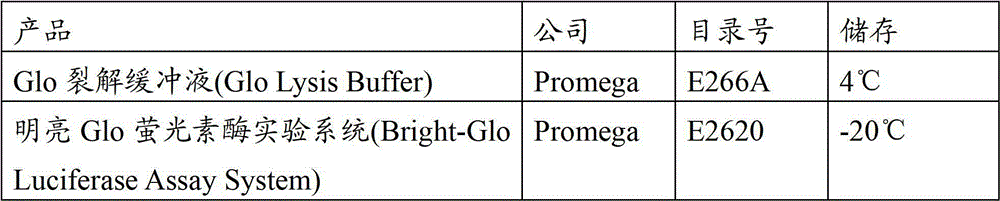
培养板的每个孔中的荧光度测定(CPS)是测量在各种浓度的抑制剂存在时HCV RNA复制量。抑制性%利用下列方程式计算:Fluorimetry (CPS) in each well of the plate measures the amount of HCV RNA replication in the presence of various concentrations of inhibitors. % inhibition was calculated using the following equation:
抑制性%=100-[CPS(抑制剂)/CPS(对照)×100]Inhibition %=100-[CPS (inhibitor)/CPS (control)×100]
符合Hill模式的非线性曲线用在抑制-浓度数据,且50%有效浓度(EC50)可利用SAS软体来计算(Statistical Software;SAS Institute,Inc.Cary,N.C.)。A non-linear curve fitting the Hill model was used in the inhibition-concentration data, and the 50% effective concentration (EC 50 ) was calculated using SAS software (Statistical Software; SAS Institute, Inc. Cary, NC).
化合物表Compound Table
列在下表1至4中的所有化合物被发现在实施例41中描述的细胞基础的HCV RNA复制实验中具有意想不到的良好活性。All compounds listed in Tables 1 to 4 below were found to have unexpectedly good activity in the cell-based HCV RNA replication assay described in Example 41.
每个化合物的保留时间(tR)可利用描述在实施例中的标准分析性HPLC条件来测量。如本领域技术人员所熟知,保留时间值对于具体测量条件很敏感。因此,即使使用溶剂、流速、线性梯度等的相同条件,滞留时间值可以在测量时,因为例如使用不同HPLC仪器而改变。即使使用相同仪器来测量,该值也可以在测量时,因为例如使用不同的各自HPLC柱而改变,或是使用相同仪器和相同各自柱测量时,该值可以因为例如各自测量之间发生不同偶发事件而改变。The retention time ( tR ) of each compound can be measured using standard analytical HPLC conditions described in the Examples. As is well known to those skilled in the art, retention time values are sensitive to specific measurement conditions. Therefore, even with the same conditions of solvent, flow rate, linear gradient, etc., the retention time value may vary when measured, for example because of the use of different HPLC instruments. Even when measured with the same instrument, the value may change at the time of measurement, for example due to the use of different respective HPLC columns, or when measured with the same instrument and the same respective column, the value may be due to, for example, different contingencies between the respective measurements events change.
表1Table 1
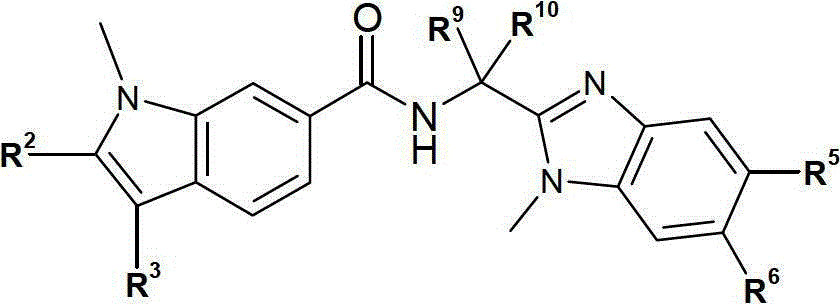
其中R2、R3、R5、R6、R9和R10如表中所示。Wherein R 2 , R 3 , R 5 , R 6 , R 9 and R 10 are as shown in the table.

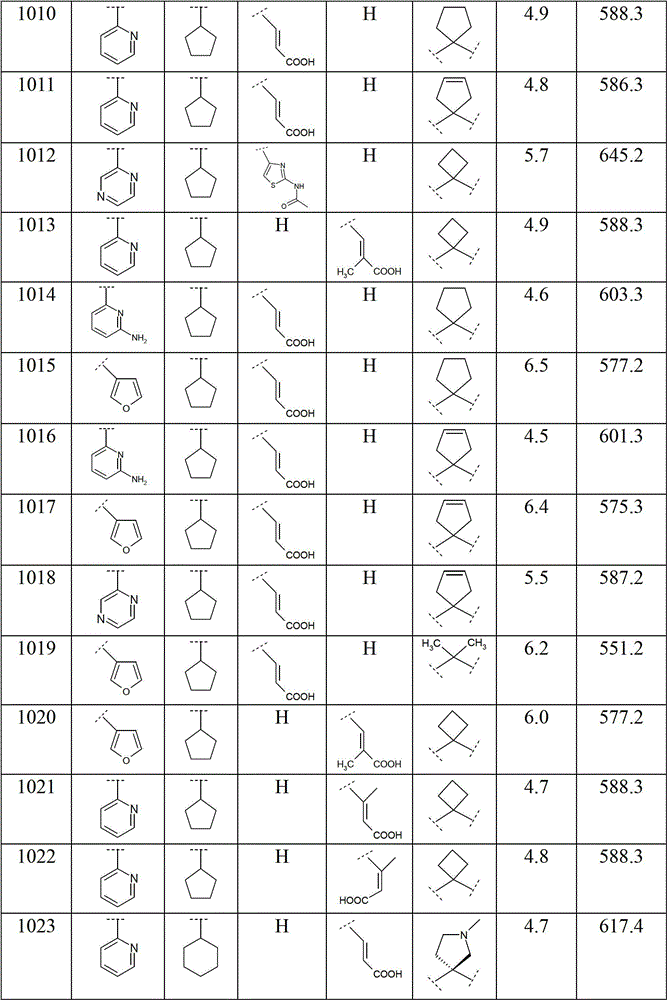
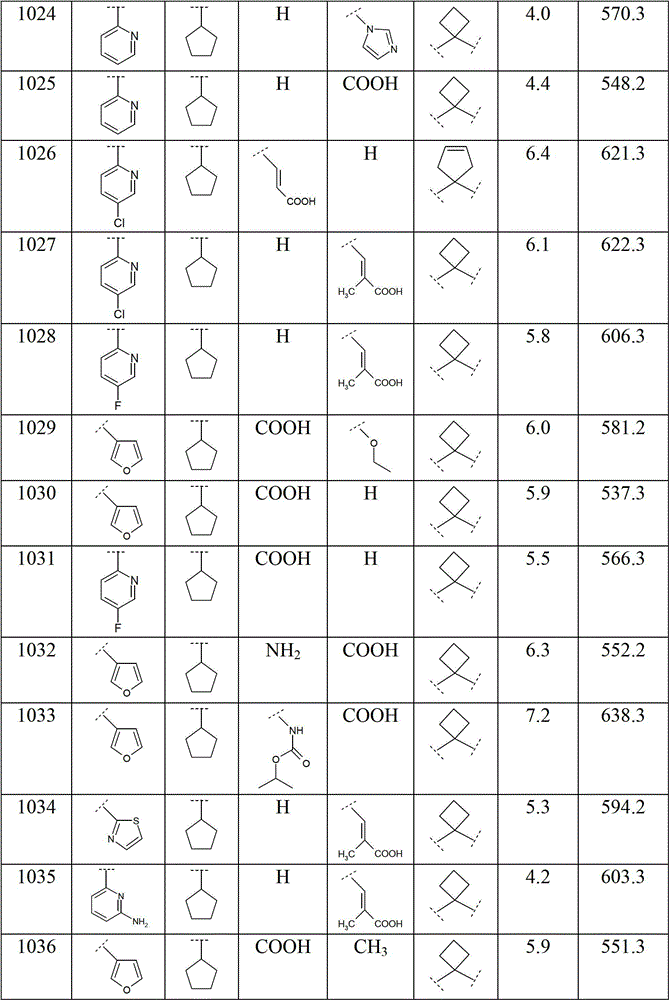


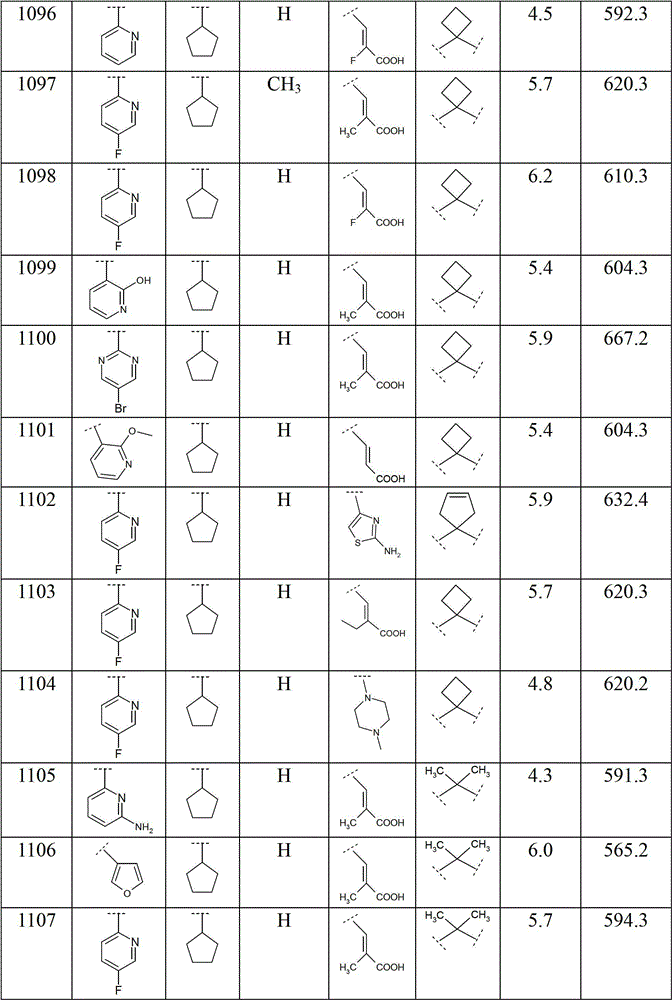
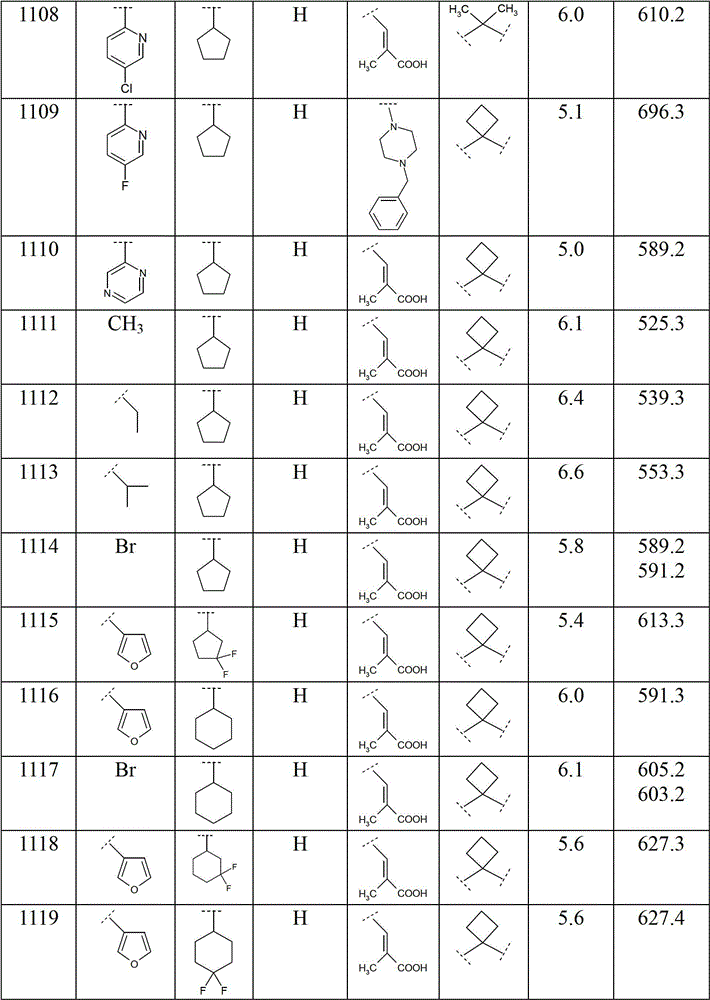


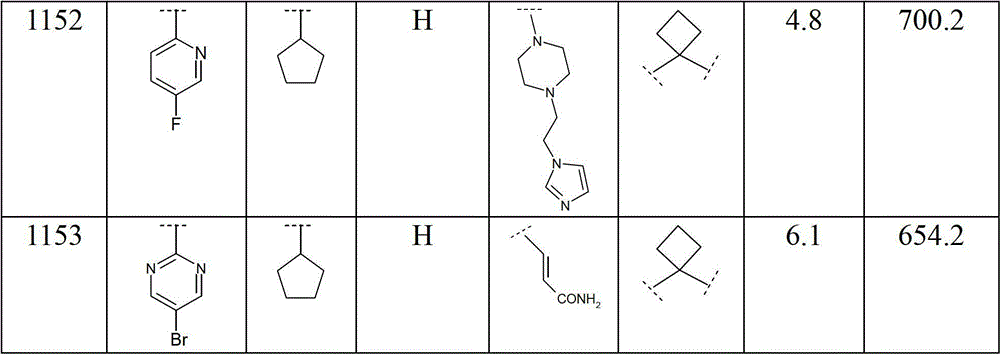
表2Table 2

其中R2、R3、R5、R6、R9和R10如表中所示。Wherein R 2 , R 3 , R 5 , R 6 , R 9 and R 10 are as shown in the table.
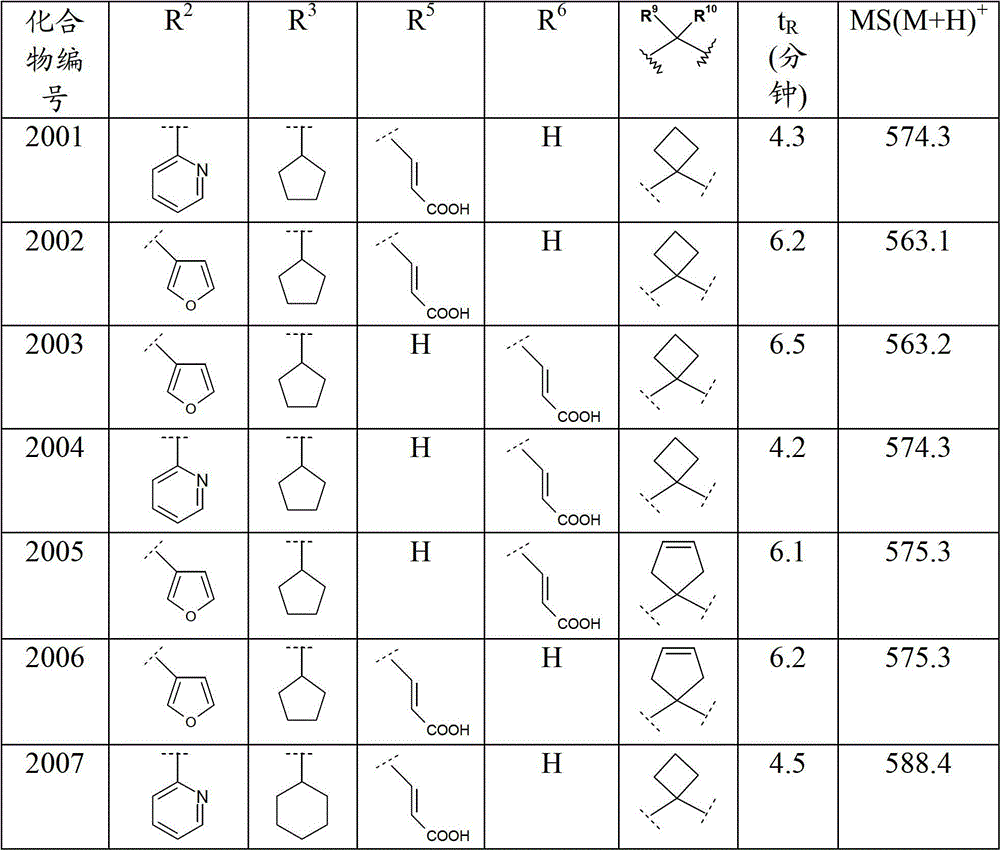


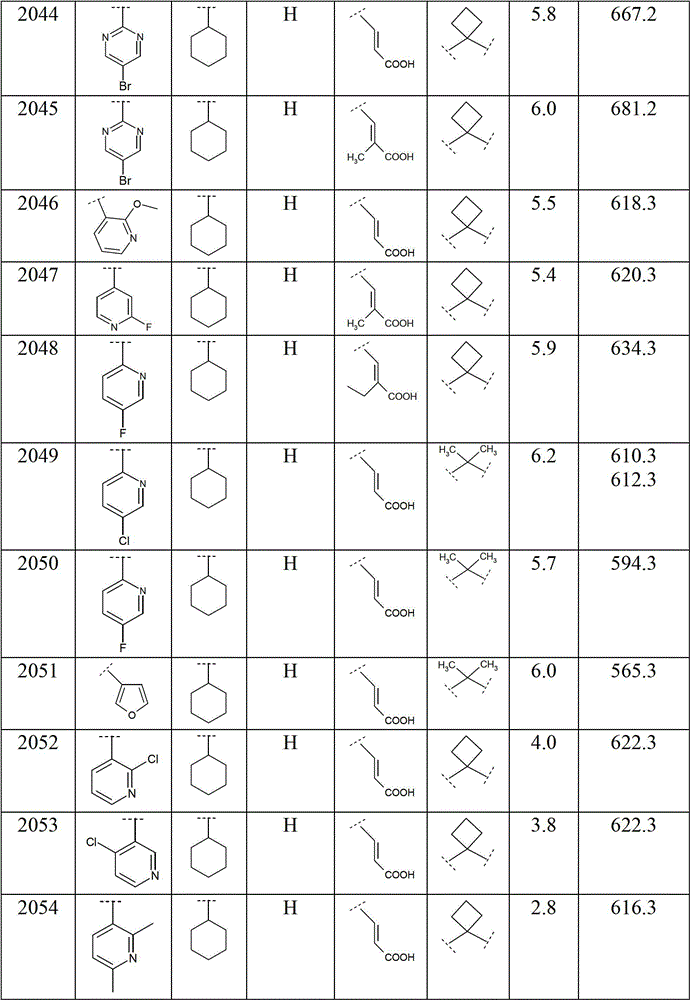


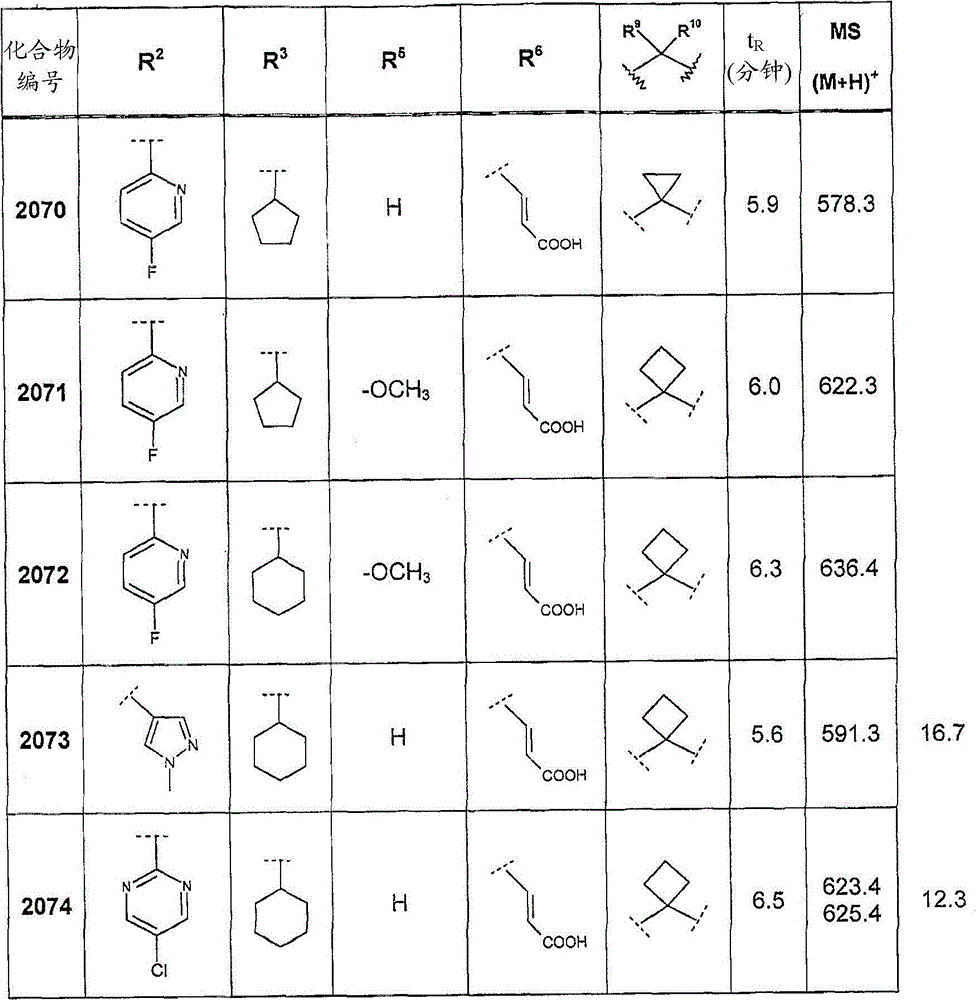
表3table 3
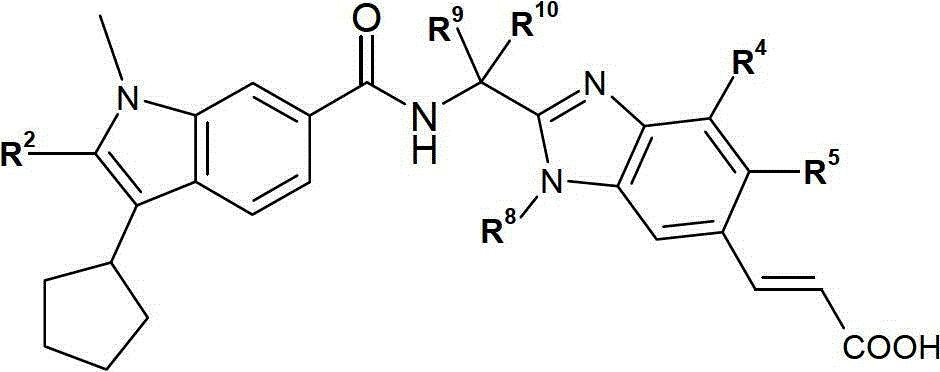
其中R2、R4、R5、R8、R9和R10如表中所示。Wherein R 2 , R 4 , R 5 , R 8 , R 9 and R 10 are as shown in the table.


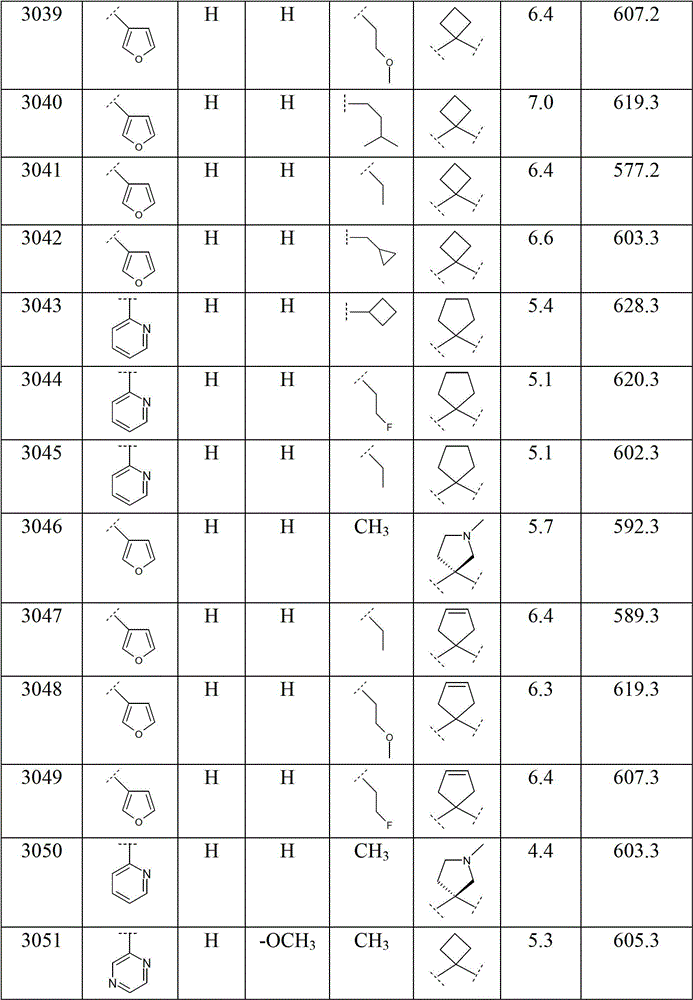


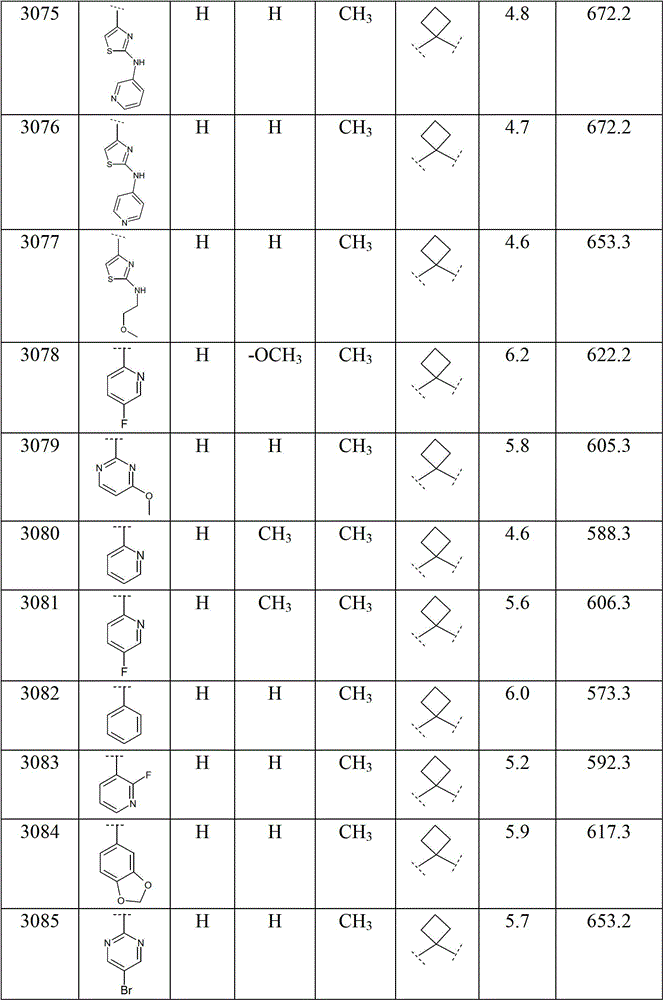

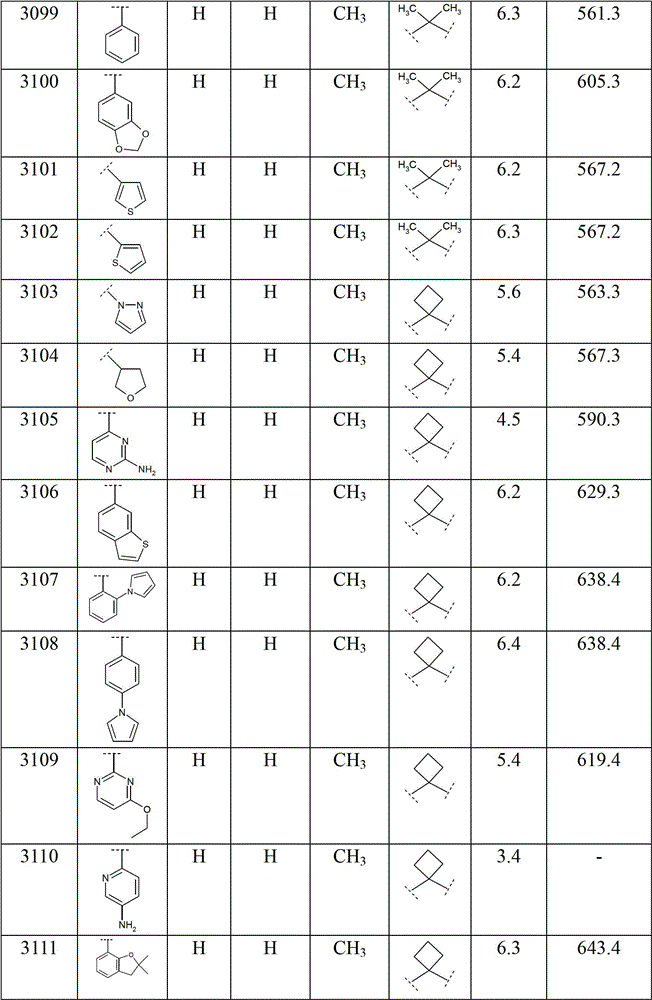


表4Table 4

其中R1、R2、R3、R5、R6、R9和R10如表中所示。Wherein R 1 , R 2 , R 3 , R 5 , R 6 , R 9 and R 10 are as shown in the table.


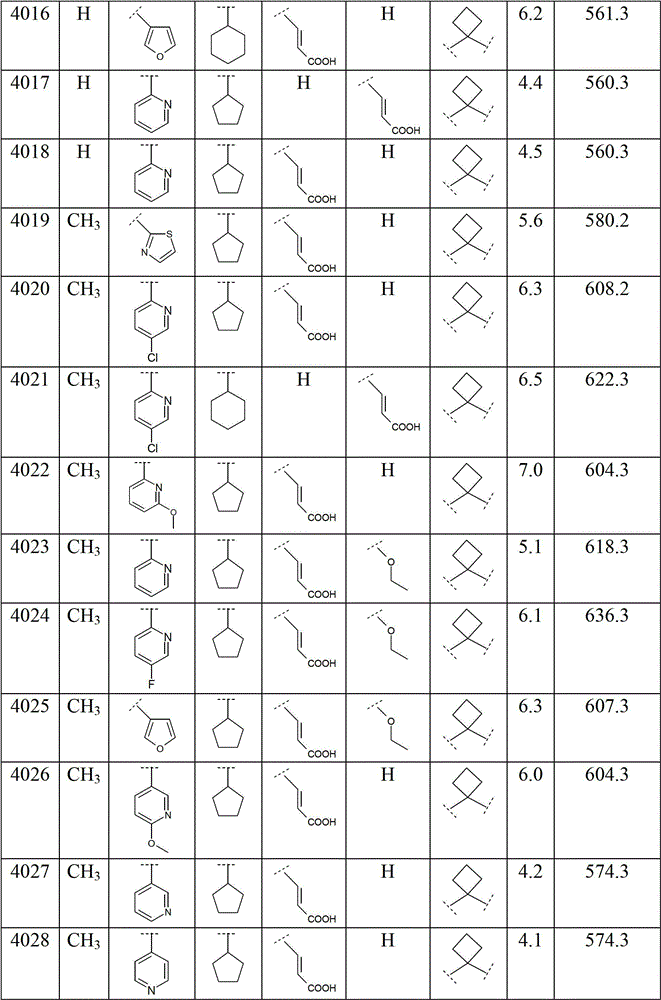

Claims (43)


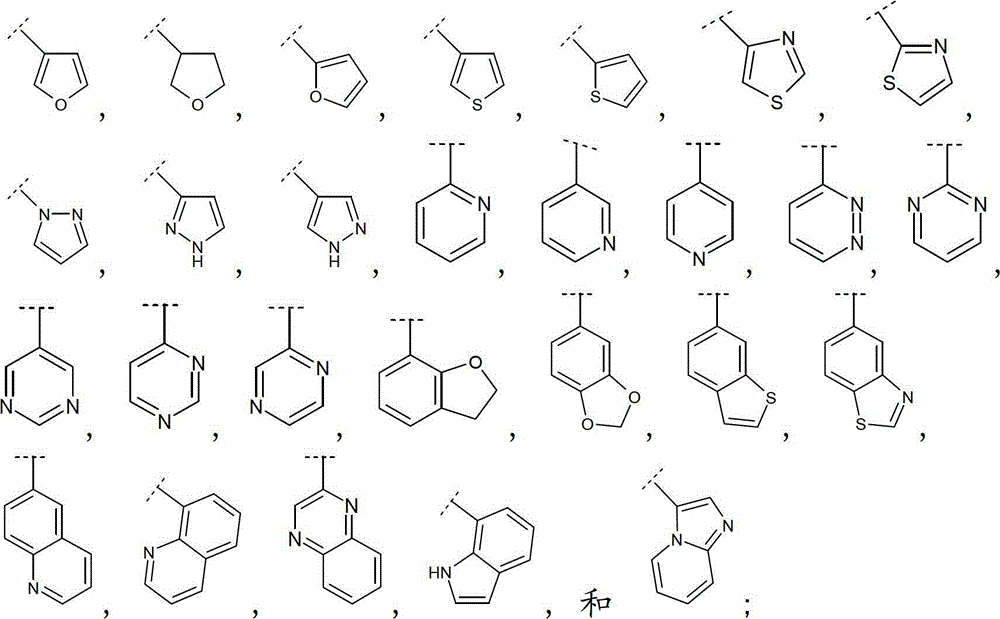


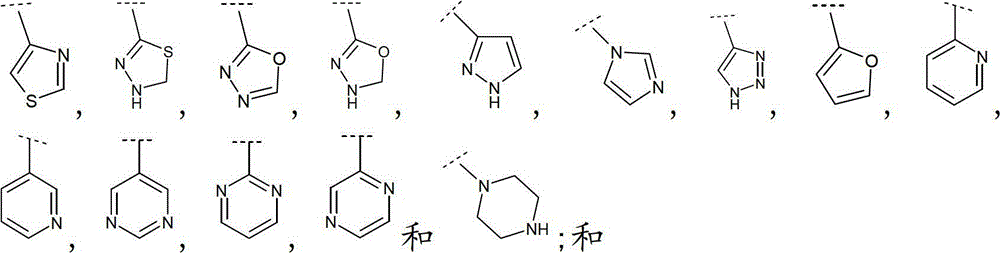


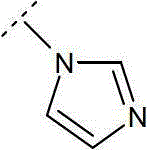
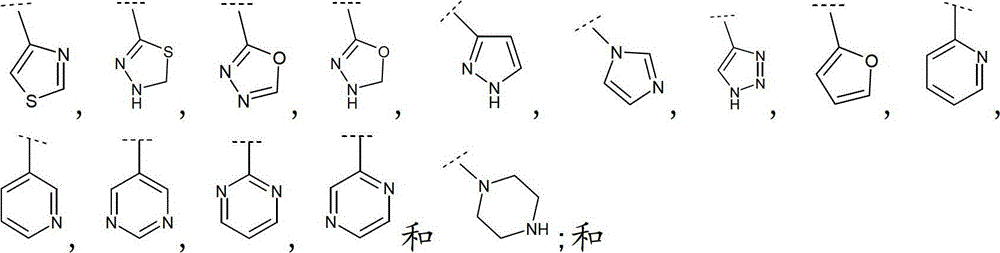
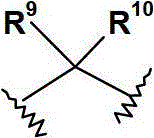

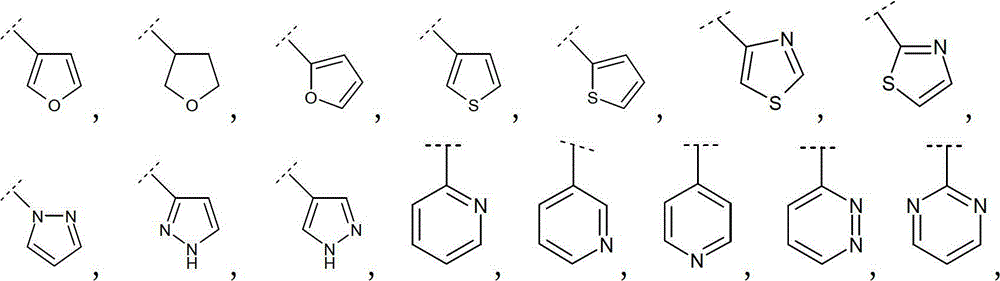

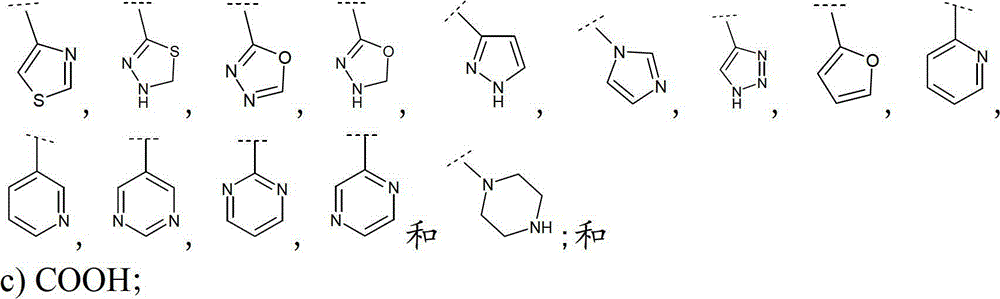

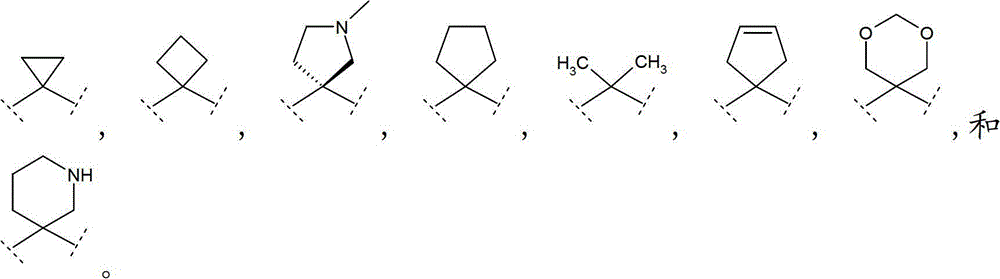
Applications Claiming Priority (2)
| Application Number | Priority Date | Filing Date | Title |
|---|---|---|---|
| US54621304P | 2004-02-20 | 2004-02-20 | |
| US60/546,213 | 2004-02-20 |
Related Parent Applications (1)
| Application Number | Title | Priority Date | Filing Date |
|---|---|---|---|
| CNA2005800055395A Division CN1922174A (en) | 2004-02-20 | 2005-02-18 | Viral polymerase inhibitors |
Publications (1)
| Publication Number | Publication Date |
|---|---|
| CN102911161A true CN102911161A (en) | 2013-02-06 |
Family
ID=34886250
Family Applications (6)
| Application Number | Title | Priority Date | Filing Date |
|---|---|---|---|
| CN200910166725A Pending CN101648944A (en) | 2004-02-20 | 2005-02-18 | Viral polymerase inhibitors |
| CN2012102883700A Pending CN102911161A (en) | 2004-02-20 | 2005-02-18 | Viral polymerase inhibitors |
| CN2013102406104A Pending CN103333162A (en) | 2004-02-20 | 2005-02-18 | Viral polymerase inhibitors |
| CNA2005800055395A Pending CN1922174A (en) | 2004-02-20 | 2005-02-18 | Viral polymerase inhibitors |
| CN201310230892XA Pending CN103319464A (en) | 2004-02-20 | 2005-02-18 | Viral polymerase inhibitors |
| CN2013102311710A Pending CN103304541A (en) | 2004-02-20 | 2005-02-18 | Viral polymerase inhibitors |
Family Applications Before (1)
| Application Number | Title | Priority Date | Filing Date |
|---|---|---|---|
| CN200910166725A Pending CN101648944A (en) | 2004-02-20 | 2005-02-18 | Viral polymerase inhibitors |
Family Applications After (4)
| Application Number | Title | Priority Date | Filing Date |
|---|---|---|---|
| CN2013102406104A Pending CN103333162A (en) | 2004-02-20 | 2005-02-18 | Viral polymerase inhibitors |
| CNA2005800055395A Pending CN1922174A (en) | 2004-02-20 | 2005-02-18 | Viral polymerase inhibitors |
| CN201310230892XA Pending CN103319464A (en) | 2004-02-20 | 2005-02-18 | Viral polymerase inhibitors |
| CN2013102311710A Pending CN103304541A (en) | 2004-02-20 | 2005-02-18 | Viral polymerase inhibitors |
Country Status (30)
| Country | Link |
|---|---|
| US (3) | US7582770B2 (en) |
| EP (2) | EP2626354A1 (en) |
| JP (4) | JP4648333B2 (en) |
| KR (2) | KR20120091276A (en) |
| CN (6) | CN101648944A (en) |
| AR (2) | AR047706A1 (en) |
| AU (1) | AU2005215829C1 (en) |
| BR (1) | BRPI0507861A (en) |
| CA (1) | CA2553879C (en) |
| DK (1) | DK1718608T3 (en) |
| EA (3) | EA013207B1 (en) |
| EC (1) | ECSP066780A (en) |
| ES (1) | ES2431314T3 (en) |
| HR (1) | HRP20130971T1 (en) |
| IL (2) | IL177537A (en) |
| IN (1) | IN2012DN04853A (en) |
| MY (1) | MY144718A (en) |
| NO (1) | NO20064004L (en) |
| NZ (1) | NZ549079A (en) |
| PE (1) | PE20051141A1 (en) |
| PL (1) | PL1718608T3 (en) |
| PT (1) | PT1718608E (en) |
| RS (1) | RS52931B (en) |
| SG (2) | SG184700A1 (en) |
| SI (1) | SI1718608T1 (en) |
| TW (2) | TWI368508B (en) |
| UA (2) | UA86962C2 (en) |
| UY (1) | UY28758A1 (en) |
| WO (1) | WO2005080388A1 (en) |
| ZA (1) | ZA200605151B (en) |
Families Citing this family (84)
| Publication number | Priority date | Publication date | Assignee | Title |
|---|---|---|---|---|
| UA66767C2 (en) | 1996-10-18 | 2004-06-15 | Вертекс Фармасьютикалс Інкорпорейтед | Serine proteases inhibitors, pharmaceutical composition, a method for inhibitining activity and a method for treatment or prevention of viral infection of hepatitis c |
| SV2003000617A (en) | 2000-08-31 | 2003-01-13 | Lilly Co Eli | INHIBITORS OF PROTEASA PEPTIDOMIMETICA REF. X-14912M |
| EP2335700A1 (en) * | 2001-07-25 | 2011-06-22 | Boehringer Ingelheim (Canada) Ltd. | Hepatitis C virus polymerase inhibitors with a heterobicylic structure |
| US20050075279A1 (en) * | 2002-10-25 | 2005-04-07 | Boehringer Ingelheim International Gmbh | Macrocyclic peptides active against the hepatitis C virus |
| US7223785B2 (en) | 2003-01-22 | 2007-05-29 | Boehringer Ingelheim International Gmbh | Viral polymerase inhibitors |
| US7098231B2 (en) * | 2003-01-22 | 2006-08-29 | Boehringer Ingelheim International Gmbh | Viral polymerase inhibitors |
| AR045596A1 (en) | 2003-09-05 | 2005-11-02 | Vertex Pharma | INHIBITORS OF SERINE PROTEASES IN PARTICULAR HCV PROTEASA NS3-NS4A |
| UA86962C2 (en) * | 2004-02-20 | 2009-06-10 | Бёрингер Ингельхайм Интернациональ Гмбх | Viral polymerase inhibitors |
| US7772271B2 (en) | 2004-07-14 | 2010-08-10 | Ptc Therapeutics, Inc. | Methods for treating hepatitis C |
| US7868037B2 (en) | 2004-07-14 | 2011-01-11 | Ptc Therapeutics, Inc. | Methods for treating hepatitis C |
| AU2005275181A1 (en) | 2004-07-14 | 2006-02-23 | Ptc Therapeutics, Inc. | Methods for treating hepatitis C |
| US7781478B2 (en) | 2004-07-14 | 2010-08-24 | Ptc Therapeutics, Inc. | Methods for treating hepatitis C |
| NZ553329A (en) | 2004-07-22 | 2010-09-30 | Ptc Therapeutics Inc | Thienopyridines for treating hepatitis C |
| US7153848B2 (en) | 2004-08-09 | 2006-12-26 | Bristol-Myers Squibb Company | Inhibitors of HCV replication |
| MY141025A (en) | 2004-10-29 | 2010-02-25 | Vertex Pharma | Dose forms |
| CA2597680A1 (en) * | 2005-02-11 | 2006-08-17 | Boehringer Ingelheim International Gmbh | Process for preparing 2,3-disubstituted indoles |
| US8076365B2 (en) | 2005-08-12 | 2011-12-13 | Boehringer Ingelheim International Gmbh | Viral polymerase inhibitors |
| US7964624B1 (en) | 2005-08-26 | 2011-06-21 | Vertex Pharmaceuticals Incorporated | Inhibitors of serine proteases |
| AR055395A1 (en) | 2005-08-26 | 2007-08-22 | Vertex Pharma | INHIBITING COMPOUNDS OF THE ACTIVITY OF SERINA PROTEASA NS3-NS4A OF HEPATITIS C VIRUS |
| US7816348B2 (en) | 2006-02-03 | 2010-10-19 | Boehringer Ingelheim International Gmbh | Viral polymerase inhibitors |
| CN101489557B (en) | 2006-02-27 | 2013-12-18 | 弗特克斯药品有限公司 | Co-crystals comprising vx-950 and pharmaceutical compositions comprising the same |
| KR20080112303A (en) | 2006-03-16 | 2008-12-24 | 버텍스 파마슈티칼스 인코포레이티드 | Deuterated Hepatitis C Protease Inhibitor |
| GB0608928D0 (en) | 2006-05-08 | 2006-06-14 | Angeletti P Ist Richerche Bio | Therapeutic agents |
| RU2009109355A (en) | 2006-08-17 | 2010-09-27 | БЕРИНГЕР ИНГЕЛЬХАЙМ ИНТЕРНАЦИОНАЛЬ ГмбХ (DE) | OUTLET POLYMERASE INHIBITORS |
| EP2120952A4 (en) * | 2007-01-15 | 2011-09-21 | Us Of America As Represented By The Secretary Of The Army On Behalf Of The U S Army Res Inst Of Infe | ANTIVIRAL COMPOUNDS AND METHOD FOR THEIR USE |
| US8575208B2 (en) | 2007-02-27 | 2013-11-05 | Vertex Pharmaceuticals Incorporated | Inhibitors of serine proteases |
| WO2008106151A2 (en) | 2007-02-27 | 2008-09-04 | Vertex Pharmaceuticals Incorporated | Co-crystals and pharmaceutical compositions comprising the same |
| NZ580917A (en) | 2007-05-04 | 2012-06-29 | Vertex Pharma | Combinations of protease inhibitors such as VX-950 and polymerase inhibitors for the treatment of HCV infection |
| JP2010533698A (en) | 2007-07-17 | 2010-10-28 | イステイチユート・デイ・リチエルケ・デイ・ビオロジア・モレコラーレ・ピ・アンジエレツテイ・エツセ・ピー・アー | Macrocyclic indole derivatives for the treatment of hepatitis C infection |
| CA2693997C (en) | 2007-08-03 | 2013-01-15 | Pierre L. Beaulieu | Viral polymerase inhibitors |
| CA2704284A1 (en) | 2007-08-30 | 2009-03-12 | Vertex Pharmaceuticals Incorporated | Co-crystals and pharmaceutical compositions comprising the same |
| JP5529036B2 (en) | 2007-12-05 | 2014-06-25 | エナンタ ファーマシューティカルズ インコーポレイテッド | Fluorinated tripeptide HCV serine protease inhibitor |
| EA201000948A1 (en) | 2007-12-19 | 2011-02-28 | Бёрингер Ингельхайм Интернациональ Гмбх | VIRAL POLYMERASE INHIBITORS |
| AR072297A1 (en) | 2008-06-27 | 2010-08-18 | Novartis Ag | DERIVATIVES OF INDOL-2-IL-PIRIDIN-3-ILO, PHARMACEUTICAL COMPOSITION THAT INCLUDES THEM AND ITS USE IN MEDICINES FOR THE TREATMENT OF DISEASES MEDIATED BY THE SYNTHESIS ALDOSTERONE. |
| UA103195C2 (en) | 2008-08-11 | 2013-09-25 | Глаксосмитклайн Ллк | PURCHASE DERIVATIVES FOR THE APPLICATION IN THE TREATMENT OF ALLERGIES, INFLAMMATORY AND INFECTIOUS DISEASES |
| US8563717B2 (en) | 2008-08-11 | 2013-10-22 | Glaxosmithkline Llc | Adenine derivatives |
| WO2010018131A1 (en) | 2008-08-11 | 2010-02-18 | Smithkline Beecham Corporation | Purine derivatives for use in the treatment of allergic, inflammatory and infectious diseases |
| KR20110054003A (en) * | 2008-09-17 | 2011-05-24 | 베링거 인겔하임 인터내셔날 게엠베하 | Combination of HBC ANS 3 Protease Inhibitor with Interferon and Ribavirin |
| JP2012051803A (en) * | 2008-12-25 | 2012-03-15 | Kyorin Pharmaceutical Co Ltd | Production method of cyclic aminobenzoic acid ester derivative |
| EP2385838A1 (en) | 2009-01-07 | 2011-11-16 | Scynexis, Inc. | Cyclosporine derivative for use in the treatment of hcv and hiv infection |
| EP2396028A2 (en) | 2009-02-12 | 2011-12-21 | Vertex Pharmceuticals Incorporated | Hcv combination therapies comprising pegylated interferon, ribavirin and telaprevir |
| TW201100398A (en) | 2009-03-31 | 2011-01-01 | Arqule Inc | Substituted indolo-pyridinone compounds |
| CN102458444A (en) | 2009-05-13 | 2012-05-16 | 英安塔制药有限公司 | Macrocyclic compounds as hepatitis c virus inhibitors |
| AR077060A1 (en) * | 2009-06-11 | 2011-07-27 | Abbott Lab | ANTIVIRAL COMPOUNDS |
| US8937150B2 (en) * | 2009-06-11 | 2015-01-20 | Abbvie Inc. | Anti-viral compounds |
| WO2010149359A1 (en) * | 2009-06-26 | 2010-12-29 | Lonza Ltd | Process and intermediates for the preparation of benzimidazolecarboxylic acids |
| MX2012000695A (en) * | 2009-07-16 | 2012-06-12 | Vertex Pharma | Benzimidazole analogues for the treatment or prevention of flavivirus infections. |
| EA201200650A1 (en) | 2009-10-30 | 2012-12-28 | Бёрингер Ингельхайм Интернациональ Гмбх | COMBINED TREATMENTS OF HEPATITIS C VIRUS, INCLUDING BI201335, INTERFERON-ALPHA AND RIBAVIRIN COURSES |
| CA2788348A1 (en) | 2010-01-29 | 2011-08-04 | Vertex Pharmaceuticals Incorporated | Therapies for treating hepatitis c virus infection |
| WO2011098451A1 (en) | 2010-02-10 | 2011-08-18 | Glaxosmithkline Llc | Purine derivatives and their pharmaceutical uses |
| WO2011098452A1 (en) | 2010-02-10 | 2011-08-18 | Glaxosmithkline Llc | 6-amino-2-{ [ (1s)-1-methylbutyl] oxy}-9-[5-(1-piperidinyl)-7,9-dihydro-8h-purin-8-one maleate |
| WO2011156545A1 (en) | 2010-06-09 | 2011-12-15 | Vertex Pharmaceuticals Incorporated | Viral dynamic model for hcv combination therapy |
| EP2593105A1 (en) | 2010-07-14 | 2013-05-22 | Vertex Pharmaceuticals Incorporated | Palatable pharmaceutical composition comprising vx-950 |
| EP2618831B1 (en) | 2010-09-21 | 2016-01-06 | Enanta Pharmaceuticals, Inc. | Macrocyclic proline derived hcv serine protease inhibitors |
| EP2621495A1 (en) * | 2010-09-30 | 2013-08-07 | Boehringer Ingelheim International GmbH | Combination therapy for treating hcv infection |
| EA201300422A1 (en) | 2010-09-30 | 2013-09-30 | Бёрингер Ингельхайм Интернациональ Гмбх | SOLID PHASE FORMS OF HCV ACTIVE INHIBITOR |
| WO2012109646A1 (en) | 2011-02-11 | 2012-08-16 | Vertex Pharmaceuticals Incorporated | Treatment of hcv in hiv infection patients |
| WO2013116339A1 (en) | 2012-01-31 | 2013-08-08 | Vertex Pharmaceuticals Incorporated | High potency formulations of vx-950 |
| WO2013147750A1 (en) | 2012-03-27 | 2013-10-03 | Boehringer Ingelheim International Gmbh | Oral combination therapy for treating hcv infection in specific patient sub-population |
| WO2013147749A1 (en) | 2012-03-27 | 2013-10-03 | Boehringer Ingelheim International Gmbh | Oral combination therapy for treating hcv infection in specific patient subgenotype populations |
| US20130261134A1 (en) * | 2012-03-30 | 2013-10-03 | Boehringer Ingelheim International Gmbh | Mesylate salt forms of a potent hcv inhibitor |
| WO2014138374A1 (en) | 2013-03-08 | 2014-09-12 | Boehringer Ingelheim International Gmbh | Oral combination therapy for treating hcv infection in specific patient sub-population |
| CN103408430B (en) * | 2013-08-30 | 2014-09-17 | 南京理工大学 | Synthesis method of 2-methyl-4-nitrobenzoic acid |
| WO2015124591A1 (en) | 2014-02-20 | 2015-08-27 | Glaxosmithkline Intellectual Property (No.2) Limited | Pyrrolo[3,2] pyrimidine derivatives as inducers of human interferon |
| CN104130143B (en) * | 2014-08-06 | 2017-02-15 | 江苏鼎龙科技有限公司 | Method for preparing 3-methylamino-4-nitrophenoxyethanol |
| JP2017533925A (en) | 2014-11-13 | 2017-11-16 | グラクソスミスクライン バイオロジカルズ ソシエテ アノニム | Adenine derivatives useful for the treatment of allergic diseases or other inflammatory conditions |
| ES2863225T3 (en) | 2015-12-03 | 2021-10-11 | Glaxosmithkline Ip Dev Ltd | Purine cyclic dinucleotides as modulators of sting |
| CR20200045A (en) | 2016-04-07 | 2020-03-11 | Glaxosmithkline Ip Dev Ltd | Heterocyclic amides useful as protein modulators |
| WO2017175156A1 (en) | 2016-04-07 | 2017-10-12 | Glaxosmithkline Intellectual Property Development Limited | Heterocyclic amides useful as protein modulators |
| CN105884627A (en) * | 2016-04-22 | 2016-08-24 | 成都东电艾尔科技有限公司 | Synthetic method of oxprenolol drug intermediate ortho-aminophenol |
| EP3241830A1 (en) | 2016-05-04 | 2017-11-08 | Bayer CropScience Aktiengesellschaft | Condensed bicyclic heterocyclic derivatives as pesticides |
| BR112019003158B1 (en) | 2016-08-15 | 2022-10-25 | Bayer Cropscience Aktiengesellschaft | DERIVATIVES OF CONDENSED BICYCLIC HETEROCYCLE, THEIR USE, AGROCHEMICAL FORMULATION, AND METHOD TO CONTROL ANIMAL PESTS |
| JOP20190024A1 (en) * | 2016-08-26 | 2019-02-19 | Gilead Sciences Inc | Substituted pyrrolizine compounds and uses thereof |
| US20210238172A1 (en) | 2017-10-05 | 2021-08-05 | Glaxosmithkline Intellectual Property Development Limited | Heterocyclic amides useful as protein modulators and methods of using the same |
| CN111417630B (en) | 2017-10-05 | 2023-06-06 | 葛兰素史克知识产权开发有限公司 | Modulator of Stimulator of Interferon Genes (STING) |
| JP2021514949A (en) | 2018-02-21 | 2021-06-17 | バイエル・アクチエンゲゼルシヤフト | Condensed bicyclic heterocyclic derivative as a pest control agent |
| GB201807924D0 (en) | 2018-05-16 | 2018-06-27 | Ctxt Pty Ltd | Compounds |
| CN114302875A (en) | 2019-05-16 | 2022-04-08 | 斯汀塞拉股份有限公司 | Oxoacridinyl acetic acid derivatives and methods of use |
| EP3969452A1 (en) | 2019-05-16 | 2022-03-23 | Stingthera, Inc. | Benzo[b][1,8]naphthyridine acetic acid derivatives and methods of use |
| GB201910304D0 (en) | 2019-07-18 | 2019-09-04 | Ctxt Pty Ltd | Compounds |
| GB201910305D0 (en) | 2019-07-18 | 2019-09-04 | Ctxt Pty Ltd | Compounds |
| CA3164751A1 (en) | 2019-12-18 | 2021-06-24 | Benjamin Joseph MORROW | Compounds |
| US20230357125A1 (en) * | 2022-05-06 | 2023-11-09 | AMPAC Fine Chemicals | Process for Catalytic Reduction of Nitro Compounds to Amines |
| CN115304584B (en) * | 2022-07-25 | 2023-05-26 | 云南大学 | 3-thiomethyl- (5' -aryl-1H-pyrazole) -indole compound and preparation method and application thereof |
Citations (1)
| Publication number | Priority date | Publication date | Assignee | Title |
|---|---|---|---|---|
| CA2449180A1 (en) * | 2001-07-25 | 2003-02-06 | Boehringer Ingelheim (Canada) Ltd. | Viral polymerase inhibitors |
Family Cites Families (214)
| Publication number | Priority date | Publication date | Assignee | Title |
|---|---|---|---|---|
| GB1094903A (en) | 1964-03-26 | 1967-12-13 | Smith Kline French Lab | Improvements in or relating to nitrofuran derivatives |
| FR1604809A (en) | 1965-11-26 | 1972-04-17 | Thiazolyl benzimidazoles - animal feed additives | |
| GB1186504A (en) | 1966-10-15 | 1970-04-02 | Fisons Pest Control Ltd | Substituted Heterocyclic Compounds |
| NL6917115A (en) | 1968-11-22 | 1970-05-26 | ||
| US3565912A (en) * | 1969-01-27 | 1971-02-23 | Upjohn Co | 5-lower-alkanoyl-2,3-bis(p-methoxyphenyl)indoles |
| DE2346316C2 (en) | 1973-09-14 | 1985-02-14 | Bayer Ag, 5090 Leverkusen | Process for the preparation of 2-furylbenzimidazoles |
| GB1521471A (en) | 1974-06-05 | 1978-08-16 | Randall & Son Ltd J | Token-deposit locks |
| FR2291749A1 (en) | 1974-11-20 | 1976-06-18 | Delalande Sa | 5-carboxyalkyl-benzimidazole derivs - with analgesic, sedative, hypertensive or hypotensive, bronchodilatory, anticholinergic and vasodilatory activity |
| US4003908A (en) * | 1976-03-11 | 1977-01-18 | E. R. Squibb & Sons, Inc. | Derivatives of imidazo(4,5-b)pyridines |
| CH632628B (en) * | 1976-07-26 | Ciba Geigy Ag | PROCESS FOR THE PREPARATION OF BENZOFURANYL-BENZIMIDAZOLES AND THEIR USE AS OPTICAL BRIGHTENERS. | |
| DE2641060A1 (en) | 1976-09-11 | 1978-03-16 | Hoechst Ag | Penicillanic acid and cephalosporanic acid derivs. - are antibiotics esp. effective against Gram negative microorganisms e.g. Pseudomonas and Proteus |
| US4264325A (en) * | 1977-02-22 | 1981-04-28 | Ciba-Geigy Corporation | Phenyl-benzimidazolyl-furanes for optical brightening of organic materials |
| DE2720111A1 (en) | 1977-05-05 | 1978-11-16 | Agfa Gevaert Ag | CORROSION PROTECTION AGENT FOR TWO BATHROOM STABILIZER BATHS |
| DE2964427D1 (en) | 1978-10-04 | 1983-02-03 | Ciba Geigy Ag | Process for the preparation of furanyl-benzazoles |
| ZA795239B (en) * | 1978-10-12 | 1980-11-26 | Glaxo Group Ltd | Heterocyclic compounds |
| DE2852531A1 (en) | 1978-12-05 | 1980-06-19 | Bayer Ag | BENZOFURANYL-BENZIMIDAZOLES |
| DE2853765A1 (en) | 1978-12-13 | 1980-06-26 | Bayer Ag | METHOD FOR PRODUCING BENZIMIDAZOLYLBENZOFURANES |
| DE2904829A1 (en) | 1979-02-08 | 1980-08-14 | Bayer Ag | METHOD FOR PRODUCING BENZIMIDAZOLYLBENZOFURANE |
| US4384121A (en) * | 1979-11-01 | 1983-05-17 | Ciba-Geigy Corporation | Cationic fluorescent whitening agents |
| GR75101B (en) | 1980-10-23 | 1984-07-13 | Pfizer | |
| GB8707798D0 (en) | 1987-04-01 | 1987-05-07 | Ici Plc | Recovery of metals |
| ZA825413B (en) * | 1981-08-26 | 1983-06-29 | Pfizer | Thromboxane synthetase inhibitors, processes for their production, and pharmaceutical compositions comprising them |
| GB2118552A (en) | 1982-04-15 | 1983-11-02 | Pfizer Ltd | Thromboxane synthetase inhibitors |
| JPS60149502A (en) | 1984-01-12 | 1985-08-07 | Kuraray Co Ltd | Indole-type agricultural and horticultural fungicide |
| LU85544A1 (en) * | 1984-09-19 | 1986-04-03 | Cird | AROMATIC HETEROCYCLIC DERIVATIVES, THEIR PREPARATION PROCESS AND THEIR APPLICATION IN THE THERAPEUTIC AND COSMETIC FIELDS |
| DE3522230A1 (en) | 1985-06-21 | 1987-01-02 | Thomae Gmbh Dr K | NEW 2-ARYLIMIDAZOLES, MEDICINAL PRODUCTS CONTAINING THESE COMPOUNDS, AND METHOD FOR THE PRODUCTION THEREOF |
| GB8609175D0 (en) * | 1986-04-15 | 1986-05-21 | Ici America Inc | Heterocyclic carboxamides |
| GB8707051D0 (en) | 1986-04-15 | 1987-04-29 | Ici America Inc | Heterocyclic carboxamides |
| US4859684A (en) * | 1986-09-15 | 1989-08-22 | Janssen Pharmaceutica N.V. | (1H-imidazol-1-ylmethyl) substituted benzimidazole derivatives and use thereof in treating androgen dependent disorders |
| US4957932A (en) | 1987-11-25 | 1990-09-18 | Merck Frosst Canada, Inc. | Benzoheterazoles |
| JP2700475B2 (en) | 1988-07-30 | 1998-01-21 | コニカ株式会社 | Nonlinear optical materials and elements |
| JPH03157646A (en) | 1989-11-15 | 1991-07-05 | Konica Corp | Silver halide photographic sensitive material |
| JPH03219232A (en) | 1990-01-24 | 1991-09-26 | Konica Corp | Spectrally sensitized silver halide photographic sensitive material |
| EP0525129A4 (en) | 1990-04-13 | 1993-03-24 | Smith-Kline Beecham Corporation | Substituted benzimidazoles |
| JP2909645B2 (en) | 1990-05-28 | 1999-06-23 | コニカ株式会社 | Silver halide color photographic materials |
| US5110494A (en) | 1990-08-24 | 1992-05-05 | Man-Gill Chemical Company | Alkaline cleaner and process for reducing stain on aluminum surfaces |
| ATE177634T1 (en) | 1990-12-14 | 1999-04-15 | Smithkline Beecham Corp | ANGIOTENSIN II RECEPTOR BLOCKING COMPOSITIONS |
| US5527819A (en) * | 1991-09-06 | 1996-06-18 | Merck & Co., Inc. | Inhibitors of HIV reverse transcriptase |
| PT100905A (en) | 1991-09-30 | 1994-02-28 | Eisai Co Ltd | BICYCLE HYGIENEOUS HETEROCYCLIC COMPOUNDS CONTAINING BENZENE, CYCLOHEXAN OR PYRIDINE AND PYRIMIDINE, PYRIDINE OR IMIDAZOLE SUBSTITUTES AND PHARMACEUTICAL COMPOSITIONS CONTAINING THEM |
| GB9121463D0 (en) | 1991-10-10 | 1991-11-27 | Smithkline Beecham Corp | Medicament |
| GB9122590D0 (en) * | 1991-10-24 | 1991-12-04 | Lilly Industries Ltd | Pharmaceutical compounds |
| JPH05165163A (en) | 1991-12-11 | 1993-06-29 | Konica Corp | Dye image forming method |
| JP3013124B2 (en) | 1991-12-26 | 2000-02-28 | コニカ株式会社 | Color image forming method |
| US5216003A (en) * | 1992-01-02 | 1993-06-01 | G. D. Searle & Co. | Diacid-containing benzimidazole compounds for treatment of neurotoxic injury |
| US5314796A (en) | 1992-04-02 | 1994-05-24 | Konica Corporation | Silver halide color photographic light sensitive material |
| US5387600A (en) | 1992-07-30 | 1995-02-07 | Fuji Photo Film Co., Ltd. | Treating arteriosclerosis using benzimidazole compositions |
| DE4237557A1 (en) | 1992-11-06 | 1994-05-11 | Bayer Ag | Substituted benzimidazoles |
| DE4237617A1 (en) * | 1992-11-06 | 1994-05-11 | Bayer Ag | Use of substituted benzimidazoles |
| AU673569B2 (en) | 1992-12-02 | 1996-11-14 | Pfizer Inc. | Catechol diethers as selective PDE-IV inhibitors |
| JP3213426B2 (en) | 1993-02-19 | 2001-10-02 | エーザイ株式会社 | 6,7-dihydro-5H-cyclopenta [d] pyrimidine derivative |
| DE69434016T2 (en) | 1993-03-04 | 2005-02-10 | Fuji Photo Film Co., Ltd., Minami-Ashigara | Photographic silver halide material |
| DE4309969A1 (en) | 1993-03-26 | 1994-09-29 | Bayer Ag | Substituted hetero-fused imidazoles |
| US6169107B1 (en) * | 1993-04-28 | 2001-01-02 | Sumitomo Pharmaceutical Co., Ltd. | Indoloylguanidine derivatives |
| JP3156444B2 (en) | 1993-06-02 | 2001-04-16 | 松下電器産業株式会社 | Short wavelength laser light source and method of manufacturing the same |
| DE4330959A1 (en) | 1993-09-09 | 1995-03-16 | Schering Ag | New benzimidazole derivatives, processes for their preparation and their pharmaceutical use |
| DE59509233D1 (en) | 1994-02-24 | 2001-06-13 | Haarmann & Reimer Gmbh | COSMETIC AND DERMATOLOGICAL PREPARATIONS CONTAINING PHENYLENE-1,4-BISBENZIMIDIAZOLESULFONIC ACIDS |
| CA2124169A1 (en) | 1994-05-24 | 1995-11-25 | Richard Mcculloch Keenan | Chemical compounds |
| WO1995032949A1 (en) * | 1994-05-27 | 1995-12-07 | James Black Foundation Limited | Gastrin and cck antagonists |
| SK281865B6 (en) | 1994-11-29 | 2001-08-06 | Dainippon Pharmaceutical Co., Ltd. | INDOLE DERIVATIVE AND ITS OPTICAL ISOMER, METHOD OF PREPARATION AND PHARMACEUTICAL PRODUCT |
| EP0717143A1 (en) | 1994-12-16 | 1996-06-19 | Lignozym GmbH | Multicomponents system for modifying decomposing or bleaching of lignin or materials containing it or similar components and the way to use it |
| DE19507913C2 (en) | 1995-03-07 | 1998-04-16 | Agfa Gevaert Ag | Color photographic silver halide material |
| ATE219765T1 (en) | 1995-04-10 | 2002-07-15 | Fujisawa Pharmaceutical Co | INDOLE DERIVATIVES AS CGMP-PDE INHIBITORS |
| US6444694B1 (en) | 1995-06-06 | 2002-09-03 | Wyeth | Styryl benzimidazole derivatives |
| JP3544245B2 (en) | 1995-06-09 | 2004-07-21 | 富士写真フイルム株式会社 | Processing method of silver halide color photographic light-sensitive material |
| KR100231956B1 (en) * | 1995-08-04 | 1999-12-01 | 오쯔까 유우지로 | Indole-2-carboxylic ester derivatives and agricultural and horticultural bacteriocides containing the same as the active ingredient |
| PT866059E (en) * | 1995-10-05 | 2002-03-28 | Kyoto Pharma Ind | NEW HETEROCYCLIC DERIVATIVES AND THEIR USED MEDICINE |
| WO1997012613A1 (en) | 1995-10-05 | 1997-04-10 | Warner-Lambert Company | Method for treating and preventing inflammation and atherosclerosis |
| JPH09124632A (en) | 1995-10-31 | 1997-05-13 | Sankyo Co Ltd | Benzo-heterocyclic derivative |
| CA2241186C (en) | 1995-12-28 | 2006-02-14 | Fujisawa Pharmaceutical Co., Ltd. | Benzimidazole derivatives |
| GB9610811D0 (en) | 1996-05-23 | 1996-07-31 | Pharmacia Spa | Combinatorial solid phase synthesis of a library of indole derivatives |
| CA2258728C (en) | 1996-06-19 | 2011-09-27 | Rhone Poulenc Rorer Limited | Substituted azabicylic compounds and their use as inhibitors of the production of tnf and cyclic amp phosphodiesterase |
| GB9614347D0 (en) | 1996-07-09 | 1996-09-04 | Smithkline Beecham Spa | Novel compounds |
| AUPO118896A0 (en) | 1996-07-23 | 1996-08-15 | Fujisawa Pharmaceutical Co., Ltd. | New use |
| JP3621706B2 (en) | 1996-08-28 | 2005-02-16 | ファイザー・インク | Substituted 6,5-hetero-bicyclic derivatives |
| JPH10114654A (en) | 1996-10-09 | 1998-05-06 | Fujisawa Pharmaceut Co Ltd | New use |
| DE69705324T2 (en) * | 1996-12-26 | 2001-10-11 | Nikken Chemicals Co., Ltd. | N-HYDROXY-URINE DERIVATIVES AND MEDICAL PREPARATIONS CONTAINING THEM |
| JPH10204059A (en) | 1997-01-22 | 1998-08-04 | Ono Pharmaceut Co Ltd | Phenylsulfonamide derivative |
| CN1100777C (en) | 1997-02-19 | 2003-02-05 | 伯莱克斯实验室公司 | N-heterocyclic derivatives as NOS inhibitor |
| EP0987250A4 (en) | 1997-02-20 | 2000-12-06 | Shionogi & Co | Indole dicarboxylic acid derivatives |
| AU757072B2 (en) | 1997-08-11 | 2003-01-30 | Boehringer Ingelheim (Canada) Ltd. | Hepatitis C inhibitor peptide analogues |
| IL134232A0 (en) | 1997-08-11 | 2001-04-30 | Boehringer Ingelheim Ca Ltd | Hepatitis c inhibitor peptides |
| US5932743A (en) * | 1997-08-21 | 1999-08-03 | American Home Products Corporation | Methods for the solid phase synthesis of substituted indole compounds |
| DE19753522A1 (en) | 1997-12-03 | 1999-06-10 | Boehringer Ingelheim Pharma | Substituted indoles, their preparation and their use as pharmaceuticals |
| SE9704544D0 (en) | 1997-12-05 | 1997-12-05 | Astra Pharma Prod | Novel compounds |
| SE9704545D0 (en) | 1997-12-05 | 1997-12-05 | Astra Pharma Prod | Novel compounds |
| JPH11177218A (en) | 1997-12-12 | 1999-07-02 | Tamura Kaken Co Ltd | Component equipped with metal surface for electronic circuit, and surface protecting agent therefor |
| IL139828A0 (en) | 1998-05-22 | 2002-02-10 | Avanir Pharmaceuticals | COMPOUNDS HAVING IgE AFFECTING PROPERTIES |
| US6232320B1 (en) * | 1998-06-04 | 2001-05-15 | Abbott Laboratories | Cell adhesion-inhibiting antiinflammatory compounds |
| ATE268327T1 (en) | 1998-06-18 | 2004-06-15 | Novartis Pharma Gmbh | BENZAZOLE COMPOUNDS AND THEIR USE |
| US7223879B2 (en) * | 1998-07-10 | 2007-05-29 | Massachusetts Institute Of Technology | Ligands for metals and improved metal-catalyzed processes based thereon |
| US6445525B1 (en) * | 1998-07-16 | 2002-09-03 | Seagate Technology Llc | Disc drive performance by reducing areal data storage density |
| WO2000006556A1 (en) | 1998-07-27 | 2000-02-10 | Abbott Laboratories | Substituted oxazolines as antiproliferative agents |
| WO2000006529A1 (en) | 1998-07-27 | 2000-02-10 | Istituto Di Ricerche Di Biologia Molecolare P Angeletti S.P.A. | Diketoacid-derivatives as inhibitors of polymerases |
| US6228868B1 (en) * | 1998-07-27 | 2001-05-08 | Abbott Laboratories | Oxazoline antiproliferative agents |
| GB9816654D0 (en) | 1998-07-30 | 1998-09-30 | Zeneca Ltd | Chemical compounds |
| AR022061A1 (en) | 1998-08-10 | 2002-09-04 | Boehringer Ingelheim Ca Ltd | INHIBITING PEPTIDES OF HEPATITIS C, A PHARMACEUTICAL COMPOSITION CONTAINING THEM, THE USE OF THE SAME TO PREPARE A PHARMACEUTICAL COMPOSITION, THE USE OF AN INTERMEDIATE PRODUCT FOR THE PREPARATION OF THESE PEPTIDES AND A PROCEDURE FOR THE PREPARATION OF ANOGRAPH . |
| US6323180B1 (en) | 1998-08-10 | 2001-11-27 | Boehringer Ingelheim (Canada) Ltd | Hepatitis C inhibitor tri-peptides |
| KR20010099623A (en) | 1998-08-21 | 2001-11-09 | 비로파마 인코포레이티드 | Compounds, compositions and methods for treating or preventing viral infections and associated diseases |
| WO2000013708A1 (en) | 1998-09-04 | 2000-03-16 | Viropharma Incorporated | Methods for treating or preventing viral infections and associated diseases |
| BR9913935A (en) | 1998-09-25 | 2001-06-19 | Viropharma Inc | Methods of treatment and prevention of infection caused by at least one virus of the family of flaviviridae and disease associated with said infection in a living host |
| GB9823871D0 (en) | 1998-10-30 | 1998-12-23 | Pharmacia & Upjohn Spa | 2-Amino-thiazole derivatives, process for their preparation, and their use as antitumour agents |
| US6531475B1 (en) | 1998-11-12 | 2003-03-11 | Neurocrine Biosciences, Inc. | CRF receptor antagonists and methods relating thereto |
| US6514982B1 (en) | 1998-11-12 | 2003-02-04 | Neurocrine Biosciences, Inc. | CRF receptor antagonists and methods relating thereto |
| US6358992B1 (en) * | 1998-11-25 | 2002-03-19 | Cell Pathways, Inc. | Method of inhibiting neoplastic cells with indole derivatives |
| WO2000039099A1 (en) | 1998-12-24 | 2000-07-06 | Fujisawa Pharmaceutical Co., Ltd. | Benzimidazole derivatives |
| AU4327600A (en) * | 1999-04-02 | 2000-10-23 | Du Pont Pharmaceuticals Company | Aryl sulfonyls as factor xa inhibitors |
| UA74546C2 (en) | 1999-04-06 | 2006-01-16 | Boehringer Ingelheim Ca Ltd | Macrocyclic peptides having activity relative to hepatitis c virus, a pharmaceutical composition and use of the pharmaceutical composition |
| US6478874B1 (en) | 1999-08-06 | 2002-11-12 | Engelhard Corporation | System for catalytic coating of a substrate |
| DE19951360A1 (en) | 1999-10-26 | 2001-05-03 | Aventis Pharma Gmbh | Substituted indoles |
| JP2001122855A (en) | 1999-10-27 | 2001-05-08 | Japan Tobacco Inc | Indole compound and its pharmaceutical use |
| ES2196926T3 (en) | 1999-10-28 | 2003-12-16 | Eoc Surfactants Nv | PROCEDURE FOR THE PREPARATION OF CONCENTRATED DISSOLUTION FLUIDA DE BETAINA. |
| US6455525B1 (en) | 1999-11-04 | 2002-09-24 | Cephalon, Inc. | Heterocyclic substituted pyrazolones |
| EP1225899A2 (en) | 1999-11-04 | 2002-07-31 | Virochem Pharma Inc. | Method for the treatment or prevention of flaviviridae viral infection using nucleoside analogues |
| CN1615873A (en) | 1999-12-24 | 2005-05-18 | 阿文蒂斯药物有限公司 | Azaindoles compound |
| SK13752001A3 (en) | 1999-12-27 | 2002-07-02 | Japan Tobacco, Inc. | Fused-ring compounds and use thereof as drugs |
| US6770666B2 (en) * | 1999-12-27 | 2004-08-03 | Japan Tobacco Inc. | Fused-ring compounds and use thereof as drugs |
| JP2003519697A (en) | 1999-12-28 | 2003-06-24 | ファイザー・プロダクツ・インク | Non-peptide VLA-4-dependent cell binding inhibitors useful for the treatment of inflammatory diseases, autoimmune diseases and respiratory diseases |
| GB0003397D0 (en) * | 2000-02-14 | 2000-04-05 | Merck Sharp & Dohme | Therapeutic agents |
| HUP0301112A3 (en) | 2000-02-18 | 2005-04-28 | Shire Biochem Inc Laval | Method for the treatment or prevention of flavivirus infections using nucleoside analogues |
| WO2001077091A2 (en) | 2000-04-05 | 2001-10-18 | Tularik Inc. | Ns5b hcv polymerase inhibitors |
| EP1278743A4 (en) | 2000-05-05 | 2003-05-14 | Smithkline Beecham Corp | Novel anti-infectives |
| EP1292310A1 (en) | 2000-05-10 | 2003-03-19 | SmithKline Beecham Corporation | Novel anti-infectives |
| MY164523A (en) | 2000-05-23 | 2017-12-29 | Univ Degli Studi Cagliari | Methods and compositions for treating hepatitis c virus |
| KR100372218B1 (en) | 2000-06-29 | 2003-02-14 | 바이오인포메틱스 주식회사 | Organic Acid Producing Microorganism and Process for Preparing Organic Acids Employing the Same |
| US6448281B1 (en) * | 2000-07-06 | 2002-09-10 | Boehringer Ingelheim (Canada) Ltd. | Viral polymerase inhibitors |
| GB0017676D0 (en) | 2000-07-19 | 2000-09-06 | Angeletti P Ist Richerche Bio | Inhibitors of viral polymerase |
| US7244721B2 (en) | 2000-07-21 | 2007-07-17 | Schering Corporation | Peptides as NS3-serine protease inhibitors of hepatitis C virus |
| US20030008841A1 (en) | 2000-08-30 | 2003-01-09 | Rene Devos | Anti-HCV nucleoside derivatives |
| AU2001282528A1 (en) | 2000-09-01 | 2002-03-22 | Shionogi And Co., Ltd. | Compounds having anti-hepatitis c virus effect |
| US6846806B2 (en) | 2000-10-23 | 2005-01-25 | Bristol-Myers Squibb Company | Peptide inhibitors of Hepatitis C virus NS3 protein |
| CA2429359A1 (en) | 2000-11-20 | 2002-08-08 | Bristol-Myers Squibb Company | Hepatitis c tripeptide inhibitors |
| US20040063651A1 (en) | 2000-12-26 | 2004-04-01 | Masahiko Morioka | Remedies for hepatitis c |
| RS50236B (en) | 2001-01-22 | 2009-07-15 | Merck & Co.Inc., | NUCLEOSIDE DERIVATIVES AS INVESTORS OF RNA-DEPENDENT RNA VIRAL POLYMERASES |
| GB0102109D0 (en) | 2001-01-26 | 2001-03-14 | Syngenta Ltd | Chemical process |
| AU2002252183A1 (en) | 2001-03-06 | 2002-09-19 | Biocryst Pharmaceuticals, Inc. | Nucleosides, preparation thereof and use as inhibitors of rna viral polymerases |
| JP2004520839A (en) | 2001-03-08 | 2004-07-15 | ベーリンガー インゲルハイム (カナダ) リミテッド | Analytical method for identifying inhibitors of HCV RNA-dependent RNA polymerase (NS5B) |
| KR100798579B1 (en) | 2001-03-31 | 2008-01-28 | 동화약품공업주식회사 | Novel methoxy-1,3,5-triazine derivatives and pharmaceutical compositions comprising the same |
| EP1256628A3 (en) | 2001-05-10 | 2003-03-19 | Agouron Pharmaceuticals, Inc. | Hepatitis c virus (hcv) ns5b rna polymerase and mutants thereof |
| GB0112617D0 (en) | 2001-05-23 | 2001-07-18 | Hoffmann La Roche | Antiviral nucleoside derivatives |
| AR036081A1 (en) | 2001-06-07 | 2004-08-11 | Smithkline Beecham Corp | COMPOSITE OF 1,2-DIHYDROQUINOLINE, ITS USE TO PREPARE A PHARMACEUTICAL COMPOSITION, METHODS TO PREPARE IT AND N-RENTED 2-AMINOBENZOIC ACID OF UTILITY AS INTERMEDIARY IN SUCH METHODS |
| WO2002100846A1 (en) | 2001-06-11 | 2002-12-19 | Shire Biochem Inc. | Compounds and methods for the treatment or prevention of flavivirus infections |
| AP1753A (en) | 2001-06-11 | 2007-07-18 | Shire Biochem Inc | Thiophene derivatives as antiviral agents for flavvivirus infection |
| GB0114286D0 (en) | 2001-06-12 | 2001-08-01 | Hoffmann La Roche | Nucleoside Derivatives |
| JP2004534830A (en) | 2001-06-21 | 2004-11-18 | グラクソ グループ リミテッド | Nucleoside compounds in HCV |
| GB0115109D0 (en) * | 2001-06-21 | 2001-08-15 | Aventis Pharma Ltd | Chemical compounds |
| AR035543A1 (en) | 2001-06-26 | 2004-06-16 | Japan Tobacco Inc | THERAPEUTIC AGENT FOR HEPATITIS C THAT INCLUDES A CONDENSED RING COMPOUND, CONDENSED RING COMPOUND, PHARMACEUTICAL COMPOSITION THAT UNDERSTANDS, BENZIMIDAZOL, THIAZOL AND BIFENYL COMPOUNDS USED AS INTERMEDIARY COMPARTMENTS OF COMPARTMENTS |
| KR100713137B1 (en) | 2001-06-28 | 2007-05-02 | 동화약품공업주식회사 | Novel 2,4-difluorobenzamide derivatives |
| EP1411928A1 (en) * | 2001-07-20 | 2004-04-28 | Boehringer Ingelheim (Canada) Ltd. | Viral polymerase inhibitors |
| US7294457B2 (en) * | 2001-08-07 | 2007-11-13 | Boehringer Ingelheim (Canada) Ltd. | Direct binding assay for identifying inhibitors of HCV polymerase |
| CN1545502A (en) * | 2001-08-22 | 2004-11-10 | �������⻯ѧƷ�ع�����˾ | The preparation method of indole derivative |
| WO2003020222A2 (en) | 2001-09-04 | 2003-03-13 | Merck & Co., Inc. | PYRROLO[2,3-d]PYRIMIDINES FOR INHIBITING RNA-DEPENDENT RNA VIRAL POLYMERASE |
| EP1429759A4 (en) | 2001-09-26 | 2004-12-15 | Bristol Myers Squibb Co | Compounds useful for treating hepatitus c virus |
| US20040006002A1 (en) | 2001-09-28 | 2004-01-08 | Jean-Pierre Sommadossi | Methods and compositions for treating flaviviruses and pestiviruses using 4'-modified nucleoside |
| JP2005504087A (en) | 2001-09-28 | 2005-02-10 | イデニクス(ケイマン)リミテツド | Methods and compositions for the treatment of hepatitis C virus using 4 'modified nucleosides |
| AU2002359320A1 (en) | 2001-10-29 | 2003-05-12 | Smithkline Beecham Corporation | Novel anit-infectives |
| AU2002365198A1 (en) | 2001-10-30 | 2003-07-30 | Smithkline Beecham Corporation | Novel anti-infectives |
| WO2003037893A1 (en) | 2001-11-02 | 2003-05-08 | Glaxo Group Limited | Acyl dihydro pyrrole derivatives as hcv inhibitors |
| MY151199A (en) | 2001-11-02 | 2014-04-30 | Rigel Pharmaceuticals Inc | Substituted diphenyl heterocycles useful for treating hcv infection |
| US20050043545A1 (en) | 2001-11-02 | 2005-02-24 | Gianpalol Bravi | 4-(5-Membered)-heteroaryl acyl pyrrolidine derivatives as hcv inhibitors |
| EP1440069B1 (en) | 2001-11-02 | 2007-08-15 | Glaxo Group Limited | 4-(6-membered)-heteroaryl acyl pyrrolidine derivatives as hcv inhibitors |
| WO2003042265A1 (en) | 2001-11-13 | 2003-05-22 | Toray Industries, Inc. | Polymer and ophthalmic lenses made by using the same |
| AU2002365935A1 (en) | 2001-11-14 | 2003-10-27 | Biocryst Pharmaceuticals, Inc. | Nucleosides preparation thereof and use as inhibitors of rna viral polymerases |
| US6867185B2 (en) | 2001-12-20 | 2005-03-15 | Bristol-Myers Squibb Company | Inhibitors of hepatitis C virus |
| US6936629B2 (en) | 2001-12-21 | 2005-08-30 | Virochem Pharma Inc. | Compounds and methods for the treatment or prevention of flavivirus infections |
| WO2003062256A1 (en) | 2002-01-17 | 2003-07-31 | Ribapharm Inc. | 2'-beta-modified-6-substituted adenosine analogs and their use as antiviral agents |
| EP1572705A2 (en) | 2002-01-17 | 2005-09-14 | Ribapharm, Inc. | Sugar modified nucleosides as viral replication inhibitors |
| WO2003061385A1 (en) | 2002-01-17 | 2003-07-31 | Ribapharm Inc. | Tricyclic nucleoside library compounds, synthesis, and use as antiviral agents |
| GB0201179D0 (en) | 2002-01-18 | 2002-03-06 | Angeletti P Ist Richerche Bio | Therapeutic agents |
| CA2369711A1 (en) | 2002-01-30 | 2003-07-30 | Boehringer Ingelheim (Canada) Ltd. | Macrocyclic peptides active against the hepatitis c virus |
| CA2369970A1 (en) | 2002-02-01 | 2003-08-01 | Boehringer Ingelheim (Canada) Ltd. | Hepatitis c inhibitor tri-peptides |
| CA2370396A1 (en) | 2002-02-01 | 2003-08-01 | Boehringer Ingelheim (Canada) Ltd. | Hepatitis c inhibitor tri-peptides |
| BR0308856A (en) | 2002-04-01 | 2005-02-22 | Pfizer | Piranon and pirandion inhibitors of hepatitis c virus rna dependent rna polymerase |
| KR100516434B1 (en) | 2002-04-04 | 2005-09-22 | (주) 비엔씨바이오팜 | 6-(4-substituted-anilino)pyrimidine derivatives, method for preparing thereof and antiviral pharmaceutical composition comprising the same |
| US20050288258A1 (en) | 2002-04-23 | 2005-12-29 | Diana Guy D | Compounds, compositions and methods for treating or preventing viral infections and associated diseases |
| NZ536123A (en) | 2002-05-06 | 2006-09-29 | Genelabs Tech Inc | Nucleoside derivatives for treating hepatitis C virus infection |
| DOP2003000641A (en) | 2002-05-10 | 2003-11-15 | Pfizer | INHIBITORS OF RNA-DEPENDENT RNA POLYMERASE OF HEPATITIS C VIRUSES AND COMPOSITIONS AND TREATMENT USED |
| GB0211418D0 (en) | 2002-05-17 | 2002-06-26 | Glaxo Group Ltd | Compounds |
| PL213029B1 (en) | 2002-05-20 | 2012-12-31 | Bristol Myers Squibb Co | Substituted cycloalkyl p1' hepatitis c virus inhibitors |
| MY140680A (en) | 2002-05-20 | 2010-01-15 | Bristol Myers Squibb Co | Hepatitis c virus inhibitors |
| ATE503764T1 (en) | 2002-05-20 | 2011-04-15 | Bristol Myers Squibb Co | HEPATITIS C VIRUS INHIBITORS |
| DE60334205D1 (en) | 2002-05-20 | 2010-10-28 | Bristol Myers Squibb Co | Heterocyclische sulfonamid-hepatitis-c-virus-hemmer |
| TW200400818A (en) | 2002-05-21 | 2004-01-16 | Wyeth Corp | Method for the use of pyranoindole derivatives to treat infection with hepatitis C virus |
| TW200400963A (en) | 2002-05-21 | 2004-01-16 | Wyeth Corp | R-enantiomers of pyranoindole derivatives and the use thereof for the treatment of hepatitis C virus infection or disease |
| WO2003099801A1 (en) | 2002-05-24 | 2003-12-04 | Smithkline Beecham Corporation | Novel anti-infectives |
| WO2003101993A1 (en) | 2002-06-04 | 2003-12-11 | Neogenesis Pharmaceuticals, Inc. | Pyrazolo` 1,5a! pyrimidine compounds as antiviral agents |
| CA2488842A1 (en) | 2002-06-17 | 2003-12-24 | Merck & Co., Inc. | Carbocyclic nucleoside analogs as rna-antivirals |
| NZ537359A (en) | 2002-06-25 | 2006-10-27 | Cosmeceutic Solutions Pty Ltd | Topical cosmetic compositions for transdermal delivery |
| JP2006512288A (en) | 2002-06-27 | 2006-04-13 | メルク エンド カムパニー インコーポレーテッド | Nucleoside derivatives as RNA-dependent RNA viral polymerase inhibitors |
| JP2005533824A (en) | 2002-06-28 | 2005-11-10 | イデニクス(ケイマン)リミテツド | 2'-C-methyl-3'-OL-valine ester ribofuranosyl cytidine for the treatment of Flaviviridae infections |
| MY140819A (en) | 2002-06-28 | 2010-01-29 | Idenix Caymans Ltd | Modified 2' and 3'-nucleoside prodrugs for treating flaviviridae |
| EP1525209B1 (en) | 2002-06-28 | 2017-11-15 | Idenix Pharmaceuticals LLC | 1'-, 2'- and 3' -modified nucleoside derivatives for treating flaviviridae infections |
| BR0305259A (en) | 2002-07-01 | 2004-10-05 | Upjohn Co | Hcv ns5b polymerase inhibitors |
| WO2004002977A1 (en) | 2002-07-01 | 2004-01-08 | Pharmacia & Upjohn Company Llc | Inhibitors of hcv ns5b polymerase |
| GB0215293D0 (en) | 2002-07-03 | 2002-08-14 | Rega Foundation | Viral inhibitors |
| US20060264389A1 (en) | 2002-07-16 | 2006-11-23 | Balkrishen Bhat | Nucleoside derivatives as inhibitors of rna-dependent rna viral polymerase |
| US20050075279A1 (en) | 2002-10-25 | 2005-04-07 | Boehringer Ingelheim International Gmbh | Macrocyclic peptides active against the hepatitis C virus |
| US7223785B2 (en) * | 2003-01-22 | 2007-05-29 | Boehringer Ingelheim International Gmbh | Viral polymerase inhibitors |
| US7098231B2 (en) * | 2003-01-22 | 2006-08-29 | Boehringer Ingelheim International Gmbh | Viral polymerase inhibitors |
| AU2004211637C1 (en) | 2003-02-07 | 2010-08-19 | Enanta Pharmaceuticals, Inc. | Macrocyclic hepatitis C serine protease inhibitors |
| CA2516016C (en) | 2003-03-05 | 2012-05-29 | Boehringer Ingelheim International Gmbh | Hepatitis c inhibiting compounds |
| US6908901B2 (en) | 2003-03-05 | 2005-06-21 | Boehringer Ingelheim International, Gmbh | Hepatitis C inhibitor peptide analogs |
| GB0307891D0 (en) * | 2003-04-04 | 2003-05-14 | Angeletti P Ist Richerche Bio | Chemical compounds,compositions and uses |
| JP4733023B2 (en) | 2003-04-16 | 2011-07-27 | ブリストル−マイヤーズ スクイブ カンパニー | Macrocyclic isoquinoline peptide inhibitor of hepatitis C virus |
| PT1615613E (en) | 2003-04-18 | 2010-02-09 | Enanta Pharm Inc | Quinoxalinyl macrocyclic hepatitis c serine protease inhibitors |
| DE602004020610D1 (en) | 2003-05-12 | 2009-05-28 | Affymax Inc | NEW PEPTIDE BINDING TO THE ERYTHROPOIETIN RECEPTOR |
| ES2297424T3 (en) | 2003-05-21 | 2008-05-01 | Boehringer Ingelheim International Gmbh | INHIBITING COMPOUNDS OF HEPATITIS C. |
| EP1493440A1 (en) * | 2003-07-03 | 2005-01-05 | Rinoru Oil Mills Co., Ltd. | Prophylactic agent of hypertension containing a conjugated fatty acid as an effective ingredient and the use thereof |
| CA2534649A1 (en) | 2003-08-01 | 2005-02-10 | Genelabs Technologies, Inc. | Bicyclic imidazol derivatives against flaviviridae |
| WO2005014543A1 (en) | 2003-08-06 | 2005-02-17 | Japan Tobacco Inc. | Condensed ring compound and use thereof as hcv polymerase inhibitor |
| UA86962C2 (en) * | 2004-02-20 | 2009-06-10 | Бёрингер Ингельхайм Интернациональ Гмбх | Viral polymerase inhibitors |
| AU2005227289B2 (en) * | 2004-03-08 | 2012-03-08 | Boehringer Ingelheim Pharmaceuticals, Inc. | Process for cross coupling indoles |
| WO2005090302A2 (en) * | 2004-03-16 | 2005-09-29 | Boehringer Ingelheim International Gmbh | Palladium catalyzed indolization of 2-bromo or chloroanilines |
| UY29017A1 (en) * | 2004-07-16 | 2006-02-24 | Boehringer Ingelheim Int | VIRAL POLYMERASE INHIBITORS |
| CA2597680A1 (en) | 2005-02-11 | 2006-08-17 | Boehringer Ingelheim International Gmbh | Process for preparing 2,3-disubstituted indoles |
-
2005
- 2005-02-18 UA UAA200609971A patent/UA86962C2/en unknown
- 2005-02-18 IN IN4853DEN2012 patent/IN2012DN04853A/en unknown
- 2005-02-18 NZ NZ549079A patent/NZ549079A/en not_active IP Right Cessation
- 2005-02-18 WO PCT/CA2005/000208 patent/WO2005080388A1/en not_active Ceased
- 2005-02-18 CN CN200910166725A patent/CN101648944A/en active Pending
- 2005-02-18 CN CN2012102883700A patent/CN102911161A/en active Pending
- 2005-02-18 TW TW100123245A patent/TWI368508B/en not_active IP Right Cessation
- 2005-02-18 KR KR1020127014204A patent/KR20120091276A/en not_active Abandoned
- 2005-02-18 KR KR1020067019382A patent/KR101320907B1/en not_active Expired - Fee Related
- 2005-02-18 SG SG2012059374A patent/SG184700A1/en unknown
- 2005-02-18 UA UAA200811052A patent/UA94602C2/en unknown
- 2005-02-18 PL PL05714457T patent/PL1718608T3/en unknown
- 2005-02-18 SI SI200531780T patent/SI1718608T1/en unknown
- 2005-02-18 CA CA2553879A patent/CA2553879C/en not_active Expired - Fee Related
- 2005-02-18 CN CN2013102406104A patent/CN103333162A/en active Pending
- 2005-02-18 CN CNA2005800055395A patent/CN1922174A/en active Pending
- 2005-02-18 AU AU2005215829A patent/AU2005215829C1/en not_active Ceased
- 2005-02-18 UY UY28758A patent/UY28758A1/en not_active Application Discontinuation
- 2005-02-18 PE PE2005000193A patent/PE20051141A1/en not_active Application Discontinuation
- 2005-02-18 EA EA200601457A patent/EA013207B1/en not_active IP Right Cessation
- 2005-02-18 SG SG200900989-5A patent/SG150511A1/en unknown
- 2005-02-18 EA EA201301284A patent/EA201301284A1/en unknown
- 2005-02-18 TW TW094104764A patent/TWI368507B/en not_active IP Right Cessation
- 2005-02-18 EP EP12196121.3A patent/EP2626354A1/en not_active Withdrawn
- 2005-02-18 DK DK05714457.8T patent/DK1718608T3/en active
- 2005-02-18 RS RS20130350A patent/RS52931B/en unknown
- 2005-02-18 PT PT57144578T patent/PT1718608E/en unknown
- 2005-02-18 CN CN201310230892XA patent/CN103319464A/en active Pending
- 2005-02-18 MY MYPI20050612A patent/MY144718A/en unknown
- 2005-02-18 EA EA200901463A patent/EA200901463A1/en unknown
- 2005-02-18 EP EP05714457.8A patent/EP1718608B1/en not_active Expired - Lifetime
- 2005-02-18 AR ARP050100580A patent/AR047706A1/en not_active Application Discontinuation
- 2005-02-18 US US11/062,305 patent/US7582770B2/en active Active
- 2005-02-18 CN CN2013102311710A patent/CN103304541A/en active Pending
- 2005-02-18 HR HRP20130971TT patent/HRP20130971T1/en unknown
- 2005-02-18 JP JP2006553400A patent/JP4648333B2/en not_active Expired - Fee Related
- 2005-02-18 ES ES05714457T patent/ES2431314T3/en not_active Expired - Lifetime
- 2005-02-18 BR BRPI0507861-0A patent/BRPI0507861A/en not_active IP Right Cessation
-
2006
- 2006-06-22 ZA ZA200605151A patent/ZA200605151B/en unknown
- 2006-08-17 IL IL177537A patent/IL177537A/en not_active IP Right Cessation
- 2006-08-21 EC EC2006006780A patent/ECSP066780A/en unknown
- 2006-09-06 NO NO20064004A patent/NO20064004L/en not_active Application Discontinuation
-
2009
- 2009-02-17 US US12/372,533 patent/US7879851B2/en not_active Expired - Lifetime
-
2010
- 2010-05-10 JP JP2010108526A patent/JP5394978B2/en not_active Expired - Fee Related
- 2010-09-27 US US12/891,112 patent/US8030309B2/en not_active Expired - Lifetime
- 2010-09-30 JP JP2010221765A patent/JP2010280740A/en not_active Withdrawn
-
2012
- 2012-04-15 IL IL219150A patent/IL219150A0/en unknown
-
2013
- 2013-09-02 JP JP2013181619A patent/JP2013237708A/en not_active Withdrawn
- 2013-10-25 AR ARP130103893A patent/AR093144A2/en unknown
Patent Citations (1)
| Publication number | Priority date | Publication date | Assignee | Title |
|---|---|---|---|---|
| CA2449180A1 (en) * | 2001-07-25 | 2003-02-06 | Boehringer Ingelheim (Canada) Ltd. | Viral polymerase inhibitors |
Also Published As
Similar Documents
| Publication | Publication Date | Title |
|---|---|---|
| JP5394978B2 (en) | Viral polymerase inhibitor | |
| US7241801B2 (en) | Viral polymerase inhibitors | |
| HK1189889A (en) | Viral polymerase inhibitors | |
| HK1141021A (en) | Viral polymerase inhibitors | |
| HK1189577A (en) | Viral polymerase inhibitors | |
| HK1181390A (en) | Viral polymerase inhibitors | |
| HK1189576A (en) | Viral polymerase inhibitors | |
| MXPA06009292A (en) | Viral polymerase inhibitors | |
| AU2012202711A1 (en) | Viral polymerase inhibitors | |
| HK1105001A (en) | Viral polymerase inhibitors |
Legal Events
| Date | Code | Title | Description |
|---|---|---|---|
| C06 | Publication | ||
| PB01 | Publication | ||
| C10 | Entry into substantive examination | ||
| SE01 | Entry into force of request for substantive examination | ||
| REG | Reference to a national code |
Ref country code: HK Ref legal event code: DE Ref document number: 1181390 Country of ref document: HK |
|
| C02 | Deemed withdrawal of patent application after publication (patent law 2001) | ||
| WD01 | Invention patent application deemed withdrawn after publication |
Application publication date: 20130206 |
|
| REG | Reference to a national code |
Ref country code: HK Ref legal event code: WD Ref document number: 1181390 Country of ref document: HK |