CN102719508A - Glycopegylated factor VII and factor VIIA - Google Patents
Glycopegylated factor VII and factor VIIA Download PDFInfo
- Publication number
- CN102719508A CN102719508A CN2012102432833A CN201210243283A CN102719508A CN 102719508 A CN102719508 A CN 102719508A CN 2012102432833 A CN2012102432833 A CN 2012102432833A CN 201210243283 A CN201210243283 A CN 201210243283A CN 102719508 A CN102719508 A CN 102719508A
- Authority
- CN
- China
- Prior art keywords
- peptide
- exemplary embodiment
- factor
- glycosyl
- peg
- Prior art date
- Legal status (The legal status is an assumption and is not a legal conclusion. Google has not performed a legal analysis and makes no representation as to the accuracy of the status listed.)
- Withdrawn
Links
- 102100023804 Coagulation factor VII Human genes 0.000 title claims abstract description 279
- 108010023321 Factor VII Proteins 0.000 title claims abstract description 279
- 229940012413 factor vii Drugs 0.000 title claims abstract description 279
- 229940012414 factor viia Drugs 0.000 title claims abstract description 120
- 108090000765 processed proteins & peptides Proteins 0.000 claims abstract description 402
- 125000003147 glycosyl group Chemical group 0.000 claims abstract description 208
- 238000000034 method Methods 0.000 claims abstract description 186
- 102000004196 processed proteins & peptides Human genes 0.000 claims abstract description 116
- 108010054265 Factor VIIa Proteins 0.000 claims abstract description 113
- 229920001223 polyethylene glycol Polymers 0.000 claims description 204
- 239000000863 peptide conjugate Substances 0.000 claims description 175
- 125000001183 hydrocarbyl group Chemical group 0.000 claims description 73
- 102000004190 Enzymes Human genes 0.000 claims description 58
- 108090000790 Enzymes Proteins 0.000 claims description 58
- 229940088598 enzyme Drugs 0.000 claims description 58
- 125000005630 sialyl group Chemical group 0.000 claims description 43
- 125000000539 amino acid group Chemical group 0.000 claims description 32
- 238000012546 transfer Methods 0.000 claims description 28
- LYCAIKOWRPUZTN-UHFFFAOYSA-N Ethylene glycol Chemical group OCCO LYCAIKOWRPUZTN-UHFFFAOYSA-N 0.000 claims description 12
- 229910052739 hydrogen Inorganic materials 0.000 claims description 8
- 229910052751 metal Inorganic materials 0.000 claims description 2
- 239000002184 metal Substances 0.000 claims description 2
- 235000000346 sugar Nutrition 0.000 abstract description 252
- 125000005647 linker group Chemical group 0.000 abstract description 195
- 150000001413 amino acids Chemical group 0.000 abstract description 56
- 108700023372 Glycosyltransferases Proteins 0.000 abstract description 45
- 102000045442 glycosyltransferase activity proteins Human genes 0.000 abstract description 15
- 108700014210 glycosyltransferase activity proteins Proteins 0.000 abstract description 15
- 239000008194 pharmaceutical composition Substances 0.000 abstract description 12
- 230000009471 action Effects 0.000 abstract description 4
- -1 m-PEG Polymers 0.000 description 147
- 229920000642 polymer Polymers 0.000 description 136
- 238000006243 chemical reaction Methods 0.000 description 91
- 239000000562 conjugate Substances 0.000 description 71
- SQVRNKJHWKZAKO-OQPLDHBCSA-N sialic acid Chemical compound CC(=O)N[C@@H]1[C@@H](O)C[C@@](O)(C(O)=O)OC1[C@H](O)[C@H](O)CO SQVRNKJHWKZAKO-OQPLDHBCSA-N 0.000 description 67
- SQVRNKJHWKZAKO-UHFFFAOYSA-N beta-N-Acetyl-D-neuraminic acid Natural products CC(=O)NC1C(O)CC(O)(C(O)=O)OC1C(O)C(O)CO SQVRNKJHWKZAKO-UHFFFAOYSA-N 0.000 description 62
- 108010006232 Neuraminidase Proteins 0.000 description 57
- 102000005348 Neuraminidase Human genes 0.000 description 57
- 229940024606 amino acid Drugs 0.000 description 56
- 235000001014 amino acid Nutrition 0.000 description 56
- 239000000047 product Substances 0.000 description 51
- 150000008163 sugars Chemical class 0.000 description 49
- 235000002639 sodium chloride Nutrition 0.000 description 48
- FAPWRFPIFSIZLT-UHFFFAOYSA-M Sodium chloride Chemical compound [Na+].[Cl-] FAPWRFPIFSIZLT-UHFFFAOYSA-M 0.000 description 46
- 150000001875 compounds Chemical class 0.000 description 44
- XLYOFNOQVPJJNP-UHFFFAOYSA-N water Substances O XLYOFNOQVPJJNP-UHFFFAOYSA-N 0.000 description 41
- 239000000203 mixture Substances 0.000 description 39
- 241000894007 species Species 0.000 description 39
- 238000007792 addition Methods 0.000 description 38
- 239000000386 donor Substances 0.000 description 38
- 108010015899 Glycopeptides Proteins 0.000 description 36
- 102000002068 Glycopeptides Human genes 0.000 description 36
- OVRNDRQMDRJTHS-RTRLPJTCSA-N N-acetyl-D-glucosamine Chemical compound CC(=O)N[C@H]1C(O)O[C@H](CO)[C@@H](O)[C@@H]1O OVRNDRQMDRJTHS-RTRLPJTCSA-N 0.000 description 35
- 239000002773 nucleotide Substances 0.000 description 33
- 229920003169 water-soluble polymer Polymers 0.000 description 31
- 102000051366 Glycosyltransferases Human genes 0.000 description 30
- 239000000370 acceptor Substances 0.000 description 30
- 239000011541 reaction mixture Substances 0.000 description 30
- OVRNDRQMDRJTHS-UHFFFAOYSA-N N-acelyl-D-glucosamine Natural products CC(=O)NC1C(O)OC(CO)C(O)C1O OVRNDRQMDRJTHS-UHFFFAOYSA-N 0.000 description 29
- MBLBDJOUHNCFQT-LXGUWJNJSA-N N-acetylglucosamine Natural products CC(=O)N[C@@H](C=O)[C@@H](O)[C@H](O)[C@H](O)CO MBLBDJOUHNCFQT-LXGUWJNJSA-N 0.000 description 29
- 230000021615 conjugation Effects 0.000 description 28
- QTBSBXVTEAMEQO-UHFFFAOYSA-N acetic acid Substances CC(O)=O QTBSBXVTEAMEQO-UHFFFAOYSA-N 0.000 description 26
- 125000003118 aryl group Chemical group 0.000 description 26
- 210000004027 cell Anatomy 0.000 description 26
- 150000003839 salts Chemical class 0.000 description 26
- 125000005629 sialic acid group Chemical group 0.000 description 25
- 239000000126 substance Substances 0.000 description 25
- 125000000524 functional group Chemical group 0.000 description 24
- DQJCDTNMLBYVAY-ZXXIYAEKSA-N (2S,5R,10R,13R)-16-{[(2R,3S,4R,5R)-3-{[(2S,3R,4R,5S,6R)-3-acetamido-4,5-dihydroxy-6-(hydroxymethyl)oxan-2-yl]oxy}-5-(ethylamino)-6-hydroxy-2-(hydroxymethyl)oxan-4-yl]oxy}-5-(4-aminobutyl)-10-carbamoyl-2,13-dimethyl-4,7,12,15-tetraoxo-3,6,11,14-tetraazaheptadecan-1-oic acid Chemical compound NCCCC[C@H](C(=O)N[C@@H](C)C(O)=O)NC(=O)CC[C@H](C(N)=O)NC(=O)[C@@H](C)NC(=O)C(C)O[C@@H]1[C@@H](NCC)C(O)O[C@H](CO)[C@H]1O[C@H]1[C@H](NC(C)=O)[C@@H](O)[C@H](O)[C@@H](CO)O1 DQJCDTNMLBYVAY-ZXXIYAEKSA-N 0.000 description 23
- 102000005744 Glycoside Hydrolases Human genes 0.000 description 23
- 108010031186 Glycoside Hydrolases Proteins 0.000 description 23
- 108090000141 Sialyltransferases Proteins 0.000 description 23
- 102000003838 Sialyltransferases Human genes 0.000 description 23
- 239000002253 acid Substances 0.000 description 23
- 150000004676 glycans Chemical class 0.000 description 23
- 230000004048 modification Effects 0.000 description 23
- 238000012986 modification Methods 0.000 description 23
- 108090000623 proteins and genes Proteins 0.000 description 23
- 239000011780 sodium chloride Substances 0.000 description 23
- 125000001424 substituent group Chemical group 0.000 description 23
- 230000001225 therapeutic effect Effects 0.000 description 23
- 125000003729 nucleotide group Chemical group 0.000 description 22
- 235000018102 proteins Nutrition 0.000 description 22
- 102000004169 proteins and genes Human genes 0.000 description 22
- OKKJLVBELUTLKV-UHFFFAOYSA-N Methanol Chemical compound OC OKKJLVBELUTLKV-UHFFFAOYSA-N 0.000 description 21
- 238000002360 preparation method Methods 0.000 description 21
- 238000000746 purification Methods 0.000 description 21
- 239000000243 solution Substances 0.000 description 21
- 230000008685 targeting Effects 0.000 description 21
- 239000003795 chemical substances by application Substances 0.000 description 20
- 239000002243 precursor Substances 0.000 description 20
- 239000002202 Polyethylene glycol Substances 0.000 description 19
- 150000001720 carbohydrates Chemical class 0.000 description 19
- 235000014633 carbohydrates Nutrition 0.000 description 19
- 230000013595 glycosylation Effects 0.000 description 19
- 238000006206 glycosylation reaction Methods 0.000 description 19
- WQZGKKKJIJFFOK-PHYPRBDBSA-N alpha-D-galactose Chemical compound OC[C@H]1O[C@H](O)[C@H](O)[C@@H](O)[C@H]1O WQZGKKKJIJFFOK-PHYPRBDBSA-N 0.000 description 18
- 229920001577 copolymer Polymers 0.000 description 18
- 125000003275 alpha amino acid group Chemical group 0.000 description 17
- 150000001412 amines Chemical class 0.000 description 17
- 239000003153 chemical reaction reagent Substances 0.000 description 17
- MBLBDJOUHNCFQT-UHFFFAOYSA-N N-acetyl-D-galactosamine Natural products CC(=O)NC(C=O)C(O)C(O)C(O)CO MBLBDJOUHNCFQT-UHFFFAOYSA-N 0.000 description 16
- 239000002585 base Substances 0.000 description 16
- 230000015572 biosynthetic process Effects 0.000 description 16
- 239000012634 fragment Substances 0.000 description 16
- 125000001072 heteroaryl group Chemical group 0.000 description 16
- 229910052760 oxygen Inorganic materials 0.000 description 16
- WQZGKKKJIJFFOK-QTVWNMPRSA-N D-mannopyranose Chemical compound OC[C@H]1OC(O)[C@@H](O)[C@@H](O)[C@@H]1O WQZGKKKJIJFFOK-QTVWNMPRSA-N 0.000 description 14
- 229910052799 carbon Inorganic materials 0.000 description 14
- 201000010099 disease Diseases 0.000 description 14
- 208000037265 diseases, disorders, signs and symptoms Diseases 0.000 description 14
- 239000000499 gel Substances 0.000 description 14
- YMAWOPBAYDPSLA-UHFFFAOYSA-N glycylglycine Chemical compound [NH3+]CC(=O)NCC([O-])=O YMAWOPBAYDPSLA-UHFFFAOYSA-N 0.000 description 14
- 230000009450 sialylation Effects 0.000 description 14
- 239000000758 substrate Substances 0.000 description 14
- DCXYFEDJOCDNAF-REOHCLBHSA-N L-asparagine Chemical compound OC(=O)[C@@H](N)CC(N)=O DCXYFEDJOCDNAF-REOHCLBHSA-N 0.000 description 13
- 230000000694 effects Effects 0.000 description 13
- 230000002255 enzymatic effect Effects 0.000 description 13
- 150000002482 oligosaccharides Chemical class 0.000 description 13
- MTCFGRXMJLQNBG-UHFFFAOYSA-N Serine Natural products OCC(N)C(O)=O MTCFGRXMJLQNBG-UHFFFAOYSA-N 0.000 description 12
- VYPSYNLAJGMNEJ-UHFFFAOYSA-N Silicium dioxide Chemical compound O=[Si]=O VYPSYNLAJGMNEJ-UHFFFAOYSA-N 0.000 description 12
- MSWZFWKMSRAUBD-UHFFFAOYSA-N beta-D-galactosamine Natural products NC1C(O)OC(CO)C(O)C1O MSWZFWKMSRAUBD-UHFFFAOYSA-N 0.000 description 12
- 235000004400 serine Nutrition 0.000 description 12
- 238000002415 sodium dodecyl sulfate polyacrylamide gel electrophoresis Methods 0.000 description 12
- 238000011282 treatment Methods 0.000 description 12
- MTCFGRXMJLQNBG-REOHCLBHSA-N (2S)-2-Amino-3-hydroxypropansäure Chemical compound OC[C@H](N)C(O)=O MTCFGRXMJLQNBG-REOHCLBHSA-N 0.000 description 11
- WQZGKKKJIJFFOK-GASJEMHNSA-N Glucose Natural products OC[C@H]1OC(O)[C@H](O)[C@@H](O)[C@@H]1O WQZGKKKJIJFFOK-GASJEMHNSA-N 0.000 description 11
- 208000032843 Hemorrhage Diseases 0.000 description 11
- 241000238631 Hexapoda Species 0.000 description 11
- 150000001408 amides Chemical class 0.000 description 11
- 150000002148 esters Chemical class 0.000 description 11
- 125000005842 heteroatom Chemical group 0.000 description 11
- 125000002887 hydroxy group Chemical group [H]O* 0.000 description 11
- 239000002502 liposome Substances 0.000 description 11
- 239000012528 membrane Substances 0.000 description 11
- 229920001451 polypropylene glycol Polymers 0.000 description 11
- DCXYFEDJOCDNAF-UHFFFAOYSA-N Asparagine Natural products OC(=O)C(N)CC(N)=O DCXYFEDJOCDNAF-UHFFFAOYSA-N 0.000 description 10
- 102100022641 Coagulation factor IX Human genes 0.000 description 10
- SHZGCJCMOBCMKK-UHFFFAOYSA-N D-mannomethylose Natural products CC1OC(O)C(O)C(O)C1O SHZGCJCMOBCMKK-UHFFFAOYSA-N 0.000 description 10
- 102000003886 Glycoproteins Human genes 0.000 description 10
- 108090000288 Glycoproteins Proteins 0.000 description 10
- XUJNEKJLAYXESH-REOHCLBHSA-N L-Cysteine Chemical compound SC[C@H](N)C(O)=O XUJNEKJLAYXESH-REOHCLBHSA-N 0.000 description 10
- OVRNDRQMDRJTHS-KEWYIRBNSA-N N-acetyl-D-galactosamine Chemical compound CC(=O)N[C@H]1C(O)O[C@H](CO)[C@H](O)[C@@H]1O OVRNDRQMDRJTHS-KEWYIRBNSA-N 0.000 description 10
- 235000009582 asparagine Nutrition 0.000 description 10
- 229960001230 asparagine Drugs 0.000 description 10
- 230000000740 bleeding effect Effects 0.000 description 10
- 125000000753 cycloalkyl group Chemical group 0.000 description 10
- 229920001184 polypeptide Polymers 0.000 description 10
- 230000002829 reductive effect Effects 0.000 description 10
- 238000003786 synthesis reaction Methods 0.000 description 10
- 108010017213 Granulocyte-Macrophage Colony-Stimulating Factor Proteins 0.000 description 9
- 102100039620 Granulocyte-macrophage colony-stimulating factor Human genes 0.000 description 9
- SHZGCJCMOBCMKK-DHVFOXMCSA-N L-fucopyranose Chemical compound C[C@@H]1OC(O)[C@@H](O)[C@H](O)[C@@H]1O SHZGCJCMOBCMKK-DHVFOXMCSA-N 0.000 description 9
- 125000003277 amino group Chemical group 0.000 description 9
- WQZGKKKJIJFFOK-VFUOTHLCSA-N beta-D-glucose Chemical compound OC[C@H]1O[C@@H](O)[C@H](O)[C@@H](O)[C@@H]1O WQZGKKKJIJFFOK-VFUOTHLCSA-N 0.000 description 9
- 230000023555 blood coagulation Effects 0.000 description 9
- 125000000837 carbohydrate group Chemical group 0.000 description 9
- 239000008103 glucose Substances 0.000 description 9
- 125000000592 heterocycloalkyl group Chemical group 0.000 description 9
- 125000000311 mannosyl group Chemical group C1([C@@H](O)[C@@H](O)[C@H](O)[C@H](O1)CO)* 0.000 description 9
- 239000000463 material Substances 0.000 description 9
- 229910052757 nitrogen Inorganic materials 0.000 description 9
- 238000005580 one pot reaction Methods 0.000 description 9
- 229910052717 sulfur Inorganic materials 0.000 description 9
- 229920003176 water-insoluble polymer Polymers 0.000 description 9
- IJGRMHOSHXDMSA-UHFFFAOYSA-N Atomic nitrogen Chemical compound N#N IJGRMHOSHXDMSA-UHFFFAOYSA-N 0.000 description 8
- OKTJSMMVPCPJKN-UHFFFAOYSA-N Carbon Chemical group [C] OKTJSMMVPCPJKN-UHFFFAOYSA-N 0.000 description 8
- 102000011022 Chorionic Gonadotropin Human genes 0.000 description 8
- 108010062540 Chorionic Gonadotropin Proteins 0.000 description 8
- DHMQDGOQFOQNFH-UHFFFAOYSA-N Glycine Chemical compound NCC(O)=O DHMQDGOQFOQNFH-UHFFFAOYSA-N 0.000 description 8
- OVRNDRQMDRJTHS-CBQIKETKSA-N N-Acetyl-D-Galactosamine Chemical compound CC(=O)N[C@H]1[C@@H](O)O[C@H](CO)[C@H](O)[C@@H]1O OVRNDRQMDRJTHS-CBQIKETKSA-N 0.000 description 8
- 102000004357 Transferases Human genes 0.000 description 8
- 108090000992 Transferases Proteins 0.000 description 8
- 235000018417 cysteine Nutrition 0.000 description 8
- XUJNEKJLAYXESH-UHFFFAOYSA-N cysteine Natural products SCC(N)C(O)=O XUJNEKJLAYXESH-UHFFFAOYSA-N 0.000 description 8
- 239000003814 drug Substances 0.000 description 8
- 125000003827 glycol group Chemical group 0.000 description 8
- 229940084986 human chorionic gonadotropin Drugs 0.000 description 8
- 239000000017 hydrogel Substances 0.000 description 8
- 230000001965 increasing effect Effects 0.000 description 8
- 150000002632 lipids Chemical class 0.000 description 8
- 229920001542 oligosaccharide Polymers 0.000 description 8
- 230000008569 process Effects 0.000 description 8
- 238000007634 remodeling Methods 0.000 description 8
- 239000011347 resin Substances 0.000 description 8
- 229920005989 resin Polymers 0.000 description 8
- 108010054218 Factor VIII Proteins 0.000 description 7
- 102000001690 Factor VIII Human genes 0.000 description 7
- 108010014173 Factor X Proteins 0.000 description 7
- 108010008488 Glycylglycine Proteins 0.000 description 7
- 108010017080 Granulocyte Colony-Stimulating Factor Proteins 0.000 description 7
- 108010002350 Interleukin-2 Proteins 0.000 description 7
- 102000000588 Interleukin-2 Human genes 0.000 description 7
- HNDVDQJCIGZPNO-YFKPBYRVSA-N L-histidine Chemical compound OC(=O)[C@@H](N)CC1=CN=CN1 HNDVDQJCIGZPNO-YFKPBYRVSA-N 0.000 description 7
- WBSCNDJQPKSPII-KKUMJFAQSA-N Lys-Lys-Lys Chemical compound NCCCC[C@H](N)C(=O)N[C@@H](CCCCN)C(=O)N[C@@H](CCCCN)C(O)=O WBSCNDJQPKSPII-KKUMJFAQSA-N 0.000 description 7
- 239000004472 Lysine Substances 0.000 description 7
- 229920000954 Polyglycolide Polymers 0.000 description 7
- 229920002684 Sepharose Polymers 0.000 description 7
- 229920001400 block copolymer Polymers 0.000 description 7
- 239000000872 buffer Substances 0.000 description 7
- 125000003178 carboxy group Chemical group [H]OC(*)=O 0.000 description 7
- 238000004587 chromatography analysis Methods 0.000 description 7
- 229940042399 direct acting antivirals protease inhibitors Drugs 0.000 description 7
- 229940012426 factor x Drugs 0.000 description 7
- 238000007306 functionalization reaction Methods 0.000 description 7
- 229930182830 galactose Natural products 0.000 description 7
- 229940043257 glycylglycine Drugs 0.000 description 7
- 229910052736 halogen Inorganic materials 0.000 description 7
- 238000004128 high performance liquid chromatography Methods 0.000 description 7
- HNDVDQJCIGZPNO-UHFFFAOYSA-N histidine Natural products OC(=O)C(N)CC1=CN=CN1 HNDVDQJCIGZPNO-UHFFFAOYSA-N 0.000 description 7
- 239000011159 matrix material Substances 0.000 description 7
- 150000007523 nucleic acids Chemical class 0.000 description 7
- 108020004707 nucleic acids Proteins 0.000 description 7
- 102000039446 nucleic acids Human genes 0.000 description 7
- 230000006320 pegylation Effects 0.000 description 7
- 239000000137 peptide hydrolase inhibitor Substances 0.000 description 7
- 229920001282 polysaccharide Polymers 0.000 description 7
- 239000005017 polysaccharide Substances 0.000 description 7
- RTZKZFJDLAIYFH-UHFFFAOYSA-N Diethyl ether Chemical compound CCOCC RTZKZFJDLAIYFH-UHFFFAOYSA-N 0.000 description 6
- 241000588724 Escherichia coli Species 0.000 description 6
- PNNNRSAQSRJVSB-SLPGGIOYSA-N Fucose Natural products C[C@H](O)[C@@H](O)[C@H](O)[C@H](O)C=O PNNNRSAQSRJVSB-SLPGGIOYSA-N 0.000 description 6
- PEDCQBHIVMGVHV-UHFFFAOYSA-N Glycerine Chemical compound OCC(O)CO PEDCQBHIVMGVHV-UHFFFAOYSA-N 0.000 description 6
- 102000004269 Granulocyte Colony-Stimulating Factor Human genes 0.000 description 6
- 241000282414 Homo sapiens Species 0.000 description 6
- 230000004989 O-glycosylation Effects 0.000 description 6
- HEMHJVSKTPXQMS-UHFFFAOYSA-M Sodium hydroxide Chemical compound [OH-].[Na+] HEMHJVSKTPXQMS-UHFFFAOYSA-M 0.000 description 6
- 102000003978 Tissue Plasminogen Activator Human genes 0.000 description 6
- 108090000373 Tissue Plasminogen Activator Proteins 0.000 description 6
- 239000007983 Tris buffer Substances 0.000 description 6
- 230000004913 activation Effects 0.000 description 6
- 125000002947 alkylene group Chemical group 0.000 description 6
- 238000005349 anion exchange Methods 0.000 description 6
- PYMYPHUHKUWMLA-UHFFFAOYSA-N arabinose Natural products OCC(O)C(O)C(O)C=O PYMYPHUHKUWMLA-UHFFFAOYSA-N 0.000 description 6
- QVGXLLKOCUKJST-UHFFFAOYSA-N atomic oxygen Chemical compound [O] QVGXLLKOCUKJST-UHFFFAOYSA-N 0.000 description 6
- SRBFZHDQGSBBOR-UHFFFAOYSA-N beta-D-Pyranose-Lyxose Natural products OC1COC(O)C(O)C1O SRBFZHDQGSBBOR-UHFFFAOYSA-N 0.000 description 6
- 102000006995 beta-Glucosidase Human genes 0.000 description 6
- 108010047754 beta-Glucosidase Proteins 0.000 description 6
- 125000004432 carbon atom Chemical group C* 0.000 description 6
- 239000000969 carrier Substances 0.000 description 6
- 229940079593 drug Drugs 0.000 description 6
- 229960000301 factor viii Drugs 0.000 description 6
- 230000006870 function Effects 0.000 description 6
- 108020001507 fusion proteins Proteins 0.000 description 6
- 102000037865 fusion proteins Human genes 0.000 description 6
- 125000002519 galactosyl group Chemical group C1([C@H](O)[C@@H](O)[C@@H](O)[C@H](O1)CO)* 0.000 description 6
- 208000009429 hemophilia B Diseases 0.000 description 6
- NOESYZHRGYRDHS-UHFFFAOYSA-N insulin Chemical compound N1C(=O)C(NC(=O)C(CCC(N)=O)NC(=O)C(CCC(O)=O)NC(=O)C(C(C)C)NC(=O)C(NC(=O)CN)C(C)CC)CSSCC(C(NC(CO)C(=O)NC(CC(C)C)C(=O)NC(CC=2C=CC(O)=CC=2)C(=O)NC(CCC(N)=O)C(=O)NC(CC(C)C)C(=O)NC(CCC(O)=O)C(=O)NC(CC(N)=O)C(=O)NC(CC=2C=CC(O)=CC=2)C(=O)NC(CSSCC(NC(=O)C(C(C)C)NC(=O)C(CC(C)C)NC(=O)C(CC=2C=CC(O)=CC=2)NC(=O)C(CC(C)C)NC(=O)C(C)NC(=O)C(CCC(O)=O)NC(=O)C(C(C)C)NC(=O)C(CC(C)C)NC(=O)C(CC=2NC=NC=2)NC(=O)C(CO)NC(=O)CNC2=O)C(=O)NCC(=O)NC(CCC(O)=O)C(=O)NC(CCCNC(N)=N)C(=O)NCC(=O)NC(CC=3C=CC=CC=3)C(=O)NC(CC=3C=CC=CC=3)C(=O)NC(CC=3C=CC(O)=CC=3)C(=O)NC(C(C)O)C(=O)N3C(CCC3)C(=O)NC(CCCCN)C(=O)NC(C)C(O)=O)C(=O)NC(CC(N)=O)C(O)=O)=O)NC(=O)C(C(C)CC)NC(=O)C(CO)NC(=O)C(C(C)O)NC(=O)C1CSSCC2NC(=O)C(CC(C)C)NC(=O)C(NC(=O)C(CCC(N)=O)NC(=O)C(CC(N)=O)NC(=O)C(NC(=O)C(N)CC=1C=CC=CC=1)C(C)C)CC1=CN=CN1 NOESYZHRGYRDHS-UHFFFAOYSA-N 0.000 description 6
- 125000002496 methyl group Chemical group [H]C([H])([H])* 0.000 description 6
- 125000001570 methylene group Chemical group [H]C([H])([*:1])[*:2] 0.000 description 6
- 239000001301 oxygen Substances 0.000 description 6
- 229920000747 poly(lactic acid) Polymers 0.000 description 6
- 125000002924 primary amino group Chemical group [H]N([H])* 0.000 description 6
- 238000004007 reversed phase HPLC Methods 0.000 description 6
- 238000012552 review Methods 0.000 description 6
- 238000001542 size-exclusion chromatography Methods 0.000 description 6
- JQWHASGSAFIOCM-UHFFFAOYSA-M sodium periodate Chemical compound [Na+].[O-]I(=O)(=O)=O JQWHASGSAFIOCM-UHFFFAOYSA-M 0.000 description 6
- 238000010561 standard procedure Methods 0.000 description 6
- 210000001519 tissue Anatomy 0.000 description 6
- 229960000187 tissue plasminogen activator Drugs 0.000 description 6
- LENZDBCJOHFCAS-UHFFFAOYSA-N tris Chemical compound OCC(N)(CO)CO LENZDBCJOHFCAS-UHFFFAOYSA-N 0.000 description 6
- MSWZFWKMSRAUBD-IVMDWMLBSA-N 2-amino-2-deoxy-D-glucopyranose Chemical compound N[C@H]1C(O)O[C@H](CO)[C@@H](O)[C@@H]1O MSWZFWKMSRAUBD-IVMDWMLBSA-N 0.000 description 5
- TXCIAUNLDRJGJZ-UHFFFAOYSA-N CMP-N-acetyl neuraminic acid Natural products O1C(C(O)C(O)CO)C(NC(=O)C)C(O)CC1(C(O)=O)OP(O)(=O)OCC1C(O)C(O)C(N2C(N=C(N)C=C2)=O)O1 TXCIAUNLDRJGJZ-UHFFFAOYSA-N 0.000 description 5
- TXCIAUNLDRJGJZ-BILDWYJOSA-N CMP-N-acetyl-beta-neuraminic acid Chemical group O1[C@@H]([C@H](O)[C@H](O)CO)[C@H](NC(=O)C)[C@@H](O)C[C@]1(C(O)=O)OP(O)(=O)OC[C@@H]1[C@@H](O)[C@@H](O)[C@H](N2C(N=C(N)C=C2)=O)O1 TXCIAUNLDRJGJZ-BILDWYJOSA-N 0.000 description 5
- KXDHJXZQYSOELW-UHFFFAOYSA-M Carbamate Chemical compound NC([O-])=O KXDHJXZQYSOELW-UHFFFAOYSA-M 0.000 description 5
- 206010053567 Coagulopathies Diseases 0.000 description 5
- LFQSCWFLJHTTHZ-UHFFFAOYSA-N Ethanol Chemical compound CCO LFQSCWFLJHTTHZ-UHFFFAOYSA-N 0.000 description 5
- 108010076282 Factor IX Proteins 0.000 description 5
- 102000012673 Follicle Stimulating Hormone Human genes 0.000 description 5
- 108010079345 Follicle Stimulating Hormone Proteins 0.000 description 5
- AEMRFAOFKBGASW-UHFFFAOYSA-N Glycolic acid Polymers OCC(O)=O AEMRFAOFKBGASW-UHFFFAOYSA-N 0.000 description 5
- KDXKERNSBIXSRK-YFKPBYRVSA-N L-lysine Chemical compound NCCCC[C@H](N)C(O)=O KDXKERNSBIXSRK-YFKPBYRVSA-N 0.000 description 5
- AYFVYJQAPQTCCC-GBXIJSLDSA-N L-threonine Chemical compound C[C@@H](O)[C@H](N)C(O)=O AYFVYJQAPQTCCC-GBXIJSLDSA-N 0.000 description 5
- KDXKERNSBIXSRK-UHFFFAOYSA-N Lysine Natural products NCCCCC(N)C(O)=O KDXKERNSBIXSRK-UHFFFAOYSA-N 0.000 description 5
- OVRNDRQMDRJTHS-FMDGEEDCSA-N N-acetyl-beta-D-glucosamine Chemical compound CC(=O)N[C@H]1[C@H](O)O[C@H](CO)[C@@H](O)[C@@H]1O OVRNDRQMDRJTHS-FMDGEEDCSA-N 0.000 description 5
- 239000004473 Threonine Substances 0.000 description 5
- 108010030291 alpha-Galactosidase Proteins 0.000 description 5
- 102000005840 alpha-Galactosidase Human genes 0.000 description 5
- 238000004458 analytical method Methods 0.000 description 5
- 125000000613 asparagine group Chemical group N[C@@H](CC(N)=O)C(=O)* 0.000 description 5
- 125000004429 atom Chemical group 0.000 description 5
- 150000001732 carboxylic acid derivatives Chemical class 0.000 description 5
- 230000035602 clotting Effects 0.000 description 5
- 230000015271 coagulation Effects 0.000 description 5
- 238000005345 coagulation Methods 0.000 description 5
- 230000000295 complement effect Effects 0.000 description 5
- 239000003085 diluting agent Substances 0.000 description 5
- 239000003937 drug carrier Substances 0.000 description 5
- 238000010828 elution Methods 0.000 description 5
- 238000006911 enzymatic reaction Methods 0.000 description 5
- 229960004222 factor ix Drugs 0.000 description 5
- 229940028334 follicle stimulating hormone Drugs 0.000 description 5
- 229960002442 glucosamine Drugs 0.000 description 5
- 210000004185 liver Anatomy 0.000 description 5
- 235000018977 lysine Nutrition 0.000 description 5
- 210000004962 mammalian cell Anatomy 0.000 description 5
- 238000004519 manufacturing process Methods 0.000 description 5
- 230000037361 pathway Effects 0.000 description 5
- 230000009467 reduction Effects 0.000 description 5
- 239000000377 silicon dioxide Substances 0.000 description 5
- MSWZFWKMSRAUBD-GASJEMHNSA-N 2-amino-2-deoxy-D-galactopyranose Chemical compound N[C@H]1C(O)O[C@H](CO)[C@H](O)[C@@H]1O MSWZFWKMSRAUBD-GASJEMHNSA-N 0.000 description 4
- MSWZFWKMSRAUBD-CBPJZXOFSA-N 2-amino-2-deoxy-D-mannopyranose Chemical compound N[C@@H]1C(O)O[C@H](CO)[C@@H](O)[C@@H]1O MSWZFWKMSRAUBD-CBPJZXOFSA-N 0.000 description 4
- BVKZGUZCCUSVTD-UHFFFAOYSA-L Carbonate Chemical class [O-]C([O-])=O BVKZGUZCCUSVTD-UHFFFAOYSA-L 0.000 description 4
- 102100026735 Coagulation factor VIII Human genes 0.000 description 4
- SRBFZHDQGSBBOR-IOVATXLUSA-N D-xylopyranose Chemical group O[C@@H]1COC(O)[C@H](O)[C@H]1O SRBFZHDQGSBBOR-IOVATXLUSA-N 0.000 description 4
- YMWUJEATGCHHMB-UHFFFAOYSA-N Dichloromethane Chemical compound ClCCl YMWUJEATGCHHMB-UHFFFAOYSA-N 0.000 description 4
- 241000196324 Embryophyta Species 0.000 description 4
- 102000006471 Fucosyltransferases Human genes 0.000 description 4
- 108010019236 Fucosyltransferases Proteins 0.000 description 4
- 108060003306 Galactosyltransferase Proteins 0.000 description 4
- 102000030902 Galactosyltransferase Human genes 0.000 description 4
- 239000004471 Glycine Substances 0.000 description 4
- 101000911390 Homo sapiens Coagulation factor VIII Proteins 0.000 description 4
- 102000006992 Interferon-alpha Human genes 0.000 description 4
- 108010047761 Interferon-alpha Proteins 0.000 description 4
- NVGBPTNZLWRQSY-UWVGGRQHSA-N Lys-Lys Chemical compound NCCCC[C@H](N)C(=O)N[C@H](C(O)=O)CCCCN NVGBPTNZLWRQSY-UWVGGRQHSA-N 0.000 description 4
- 241001465754 Metazoa Species 0.000 description 4
- SQVRNKJHWKZAKO-PFQGKNLYSA-N N-acetyl-beta-neuraminic acid Chemical compound CC(=O)N[C@@H]1[C@@H](O)C[C@@](O)(C(O)=O)O[C@H]1[C@H](O)[C@H](O)CO SQVRNKJHWKZAKO-PFQGKNLYSA-N 0.000 description 4
- SQVRNKJHWKZAKO-LUWBGTNYSA-N N-acetylneuraminic acid Chemical compound CC(=O)N[C@@H]1[C@@H](O)CC(O)(C(O)=O)O[C@H]1[C@H](O)[C@H](O)CO SQVRNKJHWKZAKO-LUWBGTNYSA-N 0.000 description 4
- 230000004988 N-glycosylation Effects 0.000 description 4
- 206010028980 Neoplasm Diseases 0.000 description 4
- 102000012479 Serine Proteases Human genes 0.000 description 4
- 108010022999 Serine Proteases Proteins 0.000 description 4
- AYFVYJQAPQTCCC-UHFFFAOYSA-N Threonine Natural products CC(O)C(N)C(O)=O AYFVYJQAPQTCCC-UHFFFAOYSA-N 0.000 description 4
- 108010090473 UDP-N-acetylglucosamine-peptide beta-N-acetylglucosaminyltransferase Proteins 0.000 description 4
- HSCJRCZFDFQWRP-UHFFFAOYSA-N Uridindiphosphoglukose Natural products OC1C(O)C(O)C(CO)OC1OP(O)(=O)OP(O)(=O)OCC1C(O)C(O)C(N2C(NC(=O)C=C2)=O)O1 HSCJRCZFDFQWRP-UHFFFAOYSA-N 0.000 description 4
- 230000003213 activating effect Effects 0.000 description 4
- 125000002252 acyl group Chemical group 0.000 description 4
- 102000015395 alpha 1-Antitrypsin Human genes 0.000 description 4
- 108010050122 alpha 1-Antitrypsin Proteins 0.000 description 4
- 230000003197 catalytic effect Effects 0.000 description 4
- 229920002678 cellulose Polymers 0.000 description 4
- 208000019425 cirrhosis of liver Diseases 0.000 description 4
- 230000001268 conjugating effect Effects 0.000 description 4
- 230000008878 coupling Effects 0.000 description 4
- 238000010168 coupling process Methods 0.000 description 4
- 238000005859 coupling reaction Methods 0.000 description 4
- 125000000151 cysteine group Chemical group N[C@@H](CS)C(=O)* 0.000 description 4
- 238000012377 drug delivery Methods 0.000 description 4
- 238000009472 formulation Methods 0.000 description 4
- 150000002337 glycosamines Chemical class 0.000 description 4
- 150000004820 halides Chemical class 0.000 description 4
- 125000005843 halogen group Chemical group 0.000 description 4
- 150000002367 halogens Chemical class 0.000 description 4
- 125000004404 heteroalkyl group Chemical group 0.000 description 4
- 125000004474 heteroalkylene group Chemical group 0.000 description 4
- 230000001976 improved effect Effects 0.000 description 4
- 238000001727 in vivo Methods 0.000 description 4
- 239000003112 inhibitor Substances 0.000 description 4
- 238000001990 intravenous administration Methods 0.000 description 4
- 238000011068 loading method Methods 0.000 description 4
- 125000003588 lysine group Chemical group [H]N([H])C([H])([H])C([H])([H])C([H])([H])C([H])([H])C([H])(N([H])[H])C(*)=O 0.000 description 4
- 108010054155 lysyllysine Proteins 0.000 description 4
- 230000007246 mechanism Effects 0.000 description 4
- 230000001404 mediated effect Effects 0.000 description 4
- 239000011859 microparticle Substances 0.000 description 4
- 239000000178 monomer Substances 0.000 description 4
- 229950006780 n-acetylglucosamine Drugs 0.000 description 4
- 229940060155 neuac Drugs 0.000 description 4
- 229920000570 polyether Polymers 0.000 description 4
- 239000004633 polyglycolic acid Substances 0.000 description 4
- 229920002451 polyvinyl alcohol Polymers 0.000 description 4
- OXCMYAYHXIHQOA-UHFFFAOYSA-N potassium;[2-butyl-5-chloro-3-[[4-[2-(1,2,4-triaza-3-azanidacyclopenta-1,4-dien-5-yl)phenyl]phenyl]methyl]imidazol-4-yl]methanol Chemical compound [K+].CCCCC1=NC(Cl)=C(CO)N1CC1=CC=C(C=2C(=CC=CC=2)C2=N[N-]N=N2)C=C1 OXCMYAYHXIHQOA-UHFFFAOYSA-N 0.000 description 4
- 238000000926 separation method Methods 0.000 description 4
- 239000003001 serine protease inhibitor Substances 0.000 description 4
- 239000002904 solvent Substances 0.000 description 4
- 125000004434 sulfur atom Chemical group 0.000 description 4
- 208000024891 symptom Diseases 0.000 description 4
- 125000003396 thiol group Chemical group [H]S* 0.000 description 4
- 235000008521 threonine Nutrition 0.000 description 4
- JOXIMZWYDAKGHI-UHFFFAOYSA-N toluene-4-sulfonic acid Chemical class CC1=CC=C(S(O)(=O)=O)C=C1 JOXIMZWYDAKGHI-UHFFFAOYSA-N 0.000 description 4
- MZOFCQQQCNRIBI-VMXHOPILSA-N (3s)-4-[[(2s)-1-[[(2s)-1-[[(1s)-1-carboxy-2-hydroxyethyl]amino]-4-methyl-1-oxopentan-2-yl]amino]-5-(diaminomethylideneamino)-1-oxopentan-2-yl]amino]-3-[[2-[[(2s)-2,6-diaminohexanoyl]amino]acetyl]amino]-4-oxobutanoic acid Chemical compound OC[C@@H](C(O)=O)NC(=O)[C@H](CC(C)C)NC(=O)[C@H](CCCN=C(N)N)NC(=O)[C@H](CC(O)=O)NC(=O)CNC(=O)[C@@H](N)CCCCN MZOFCQQQCNRIBI-VMXHOPILSA-N 0.000 description 3
- AXAVXPMQTGXXJZ-UHFFFAOYSA-N 2-aminoacetic acid;2-amino-2-(hydroxymethyl)propane-1,3-diol Chemical compound NCC(O)=O.OCC(N)(CO)CO AXAVXPMQTGXXJZ-UHFFFAOYSA-N 0.000 description 3
- 108010068327 4-hydroxyphenylpyruvate dioxygenase Proteins 0.000 description 3
- WEVYAHXRMPXWCK-UHFFFAOYSA-N Acetonitrile Chemical compound CC#N WEVYAHXRMPXWCK-UHFFFAOYSA-N 0.000 description 3
- 102000004411 Antithrombin III Human genes 0.000 description 3
- 108090000935 Antithrombin III Proteins 0.000 description 3
- 102100022005 B-lymphocyte antigen CD20 Human genes 0.000 description 3
- 241000894006 Bacteria Species 0.000 description 3
- 102100029962 CMP-N-acetylneuraminate-beta-1,4-galactoside alpha-2,3-sialyltransferase Human genes 0.000 description 3
- FBPFZTCFMRRESA-KVTDHHQDSA-N D-Mannitol Chemical compound OC[C@@H](O)[C@@H](O)[C@H](O)[C@H](O)CO FBPFZTCFMRRESA-KVTDHHQDSA-N 0.000 description 3
- 102000016911 Deoxyribonucleases Human genes 0.000 description 3
- 108010053770 Deoxyribonucleases Proteins 0.000 description 3
- 108090000394 Erythropoietin Proteins 0.000 description 3
- 102000003951 Erythropoietin Human genes 0.000 description 3
- 108010008165 Etanercept Proteins 0.000 description 3
- 201000003542 Factor VIII deficiency Diseases 0.000 description 3
- 108010074864 Factor XI Proteins 0.000 description 3
- 108010074860 Factor Xa Proteins 0.000 description 3
- 102000018233 Fibroblast Growth Factor Human genes 0.000 description 3
- 108050007372 Fibroblast Growth Factor Proteins 0.000 description 3
- 206010016654 Fibrosis Diseases 0.000 description 3
- 108010010803 Gelatin Proteins 0.000 description 3
- 108010017544 Glucosylceramidase Proteins 0.000 description 3
- 102000004547 Glucosylceramidase Human genes 0.000 description 3
- 208000009292 Hemophilia A Diseases 0.000 description 3
- 101000897405 Homo sapiens B-lymphocyte antigen CD20 Proteins 0.000 description 3
- 101000611183 Homo sapiens Tumor necrosis factor Proteins 0.000 description 3
- 102000002265 Human Growth Hormone Human genes 0.000 description 3
- 108010000521 Human Growth Hormone Proteins 0.000 description 3
- 239000000854 Human Growth Hormone Substances 0.000 description 3
- VEXZGXHMUGYJMC-UHFFFAOYSA-N Hydrochloric acid Chemical compound Cl VEXZGXHMUGYJMC-UHFFFAOYSA-N 0.000 description 3
- 206010061218 Inflammation Diseases 0.000 description 3
- 102000004877 Insulin Human genes 0.000 description 3
- 108090001061 Insulin Proteins 0.000 description 3
- 102000003996 Interferon-beta Human genes 0.000 description 3
- 108090000467 Interferon-beta Proteins 0.000 description 3
- 102000008070 Interferon-gamma Human genes 0.000 description 3
- 108010074328 Interferon-gamma Proteins 0.000 description 3
- FYYHWMGAXLPEAU-UHFFFAOYSA-N Magnesium Chemical compound [Mg] FYYHWMGAXLPEAU-UHFFFAOYSA-N 0.000 description 3
- 241000124008 Mammalia Species 0.000 description 3
- 229930195725 Mannitol Natural products 0.000 description 3
- 108010052285 Membrane Proteins Proteins 0.000 description 3
- 102000018697 Membrane Proteins Human genes 0.000 description 3
- AFVFQIVMOAPDHO-UHFFFAOYSA-N Methanesulfonic acid Chemical class CS(O)(=O)=O AFVFQIVMOAPDHO-UHFFFAOYSA-N 0.000 description 3
- NQTADLQHYWFPDB-UHFFFAOYSA-N N-Hydroxysuccinimide Chemical compound ON1C(=O)CCC1=O NQTADLQHYWFPDB-UHFFFAOYSA-N 0.000 description 3
- 229920001273 Polyhydroxy acid Polymers 0.000 description 3
- KWYUFKZDYYNOTN-UHFFFAOYSA-M Potassium hydroxide Chemical compound [OH-].[K+] KWYUFKZDYYNOTN-UHFFFAOYSA-M 0.000 description 3
- DNIAPMSPPWPWGF-UHFFFAOYSA-N Propylene glycol Chemical compound CC(O)CO DNIAPMSPPWPWGF-UHFFFAOYSA-N 0.000 description 3
- 241000725643 Respiratory syncytial virus Species 0.000 description 3
- 229920002125 Sokalan® Polymers 0.000 description 3
- ZMANZCXQSJIPKH-UHFFFAOYSA-N Triethylamine Chemical compound CCN(CC)CC ZMANZCXQSJIPKH-UHFFFAOYSA-N 0.000 description 3
- 108060008682 Tumor Necrosis Factor Proteins 0.000 description 3
- 102000000852 Tumor Necrosis Factor-alpha Human genes 0.000 description 3
- 102100040247 Tumor necrosis factor Human genes 0.000 description 3
- XSQUKJJJFZCRTK-UHFFFAOYSA-N Urea Chemical compound NC(N)=O XSQUKJJJFZCRTK-UHFFFAOYSA-N 0.000 description 3
- 102000003990 Urokinase-type plasminogen activator Human genes 0.000 description 3
- 108090000435 Urokinase-type plasminogen activator Proteins 0.000 description 3
- MZVQCMJNVPIDEA-UHFFFAOYSA-N [CH2]CN(CC)CC Chemical group [CH2]CN(CC)CC MZVQCMJNVPIDEA-UHFFFAOYSA-N 0.000 description 3
- USAZACJQJDHAJH-KDEXOMDGSA-N [[(2r,3s,4r,5s)-5-(2,4-dioxo-1h-pyrimidin-6-yl)-3,4-dihydroxyoxolan-2-yl]methoxy-hydroxyphosphoryl] [(2r,3r,4s,5r,6r)-3,4,5-trihydroxy-6-(hydroxymethyl)oxan-2-yl] hydrogen phosphate Chemical group O[C@@H]1[C@@H](O)[C@@H](O)[C@@H](CO)O[C@@H]1OP(O)(=O)OP(O)(=O)OC[C@@H]1[C@@H](O)[C@@H](O)[C@H](C=2NC(=O)NC(=O)C=2)O1 USAZACJQJDHAJH-KDEXOMDGSA-N 0.000 description 3
- 238000002835 absorbance Methods 0.000 description 3
- 230000002378 acidificating effect Effects 0.000 description 3
- 150000007513 acids Chemical class 0.000 description 3
- 239000013543 active substance Substances 0.000 description 3
- 230000010933 acylation Effects 0.000 description 3
- 238000005917 acylation reaction Methods 0.000 description 3
- 108010056760 agalsidase beta Proteins 0.000 description 3
- 229960005348 antithrombin iii Drugs 0.000 description 3
- 238000013459 approach Methods 0.000 description 3
- 125000003943 azolyl group Chemical group 0.000 description 3
- 230000008901 benefit Effects 0.000 description 3
- PXXJHWLDUBFPOL-UHFFFAOYSA-N benzamidine Chemical compound NC(=N)C1=CC=CC=C1 PXXJHWLDUBFPOL-UHFFFAOYSA-N 0.000 description 3
- 239000012867 bioactive agent Substances 0.000 description 3
- 150000001721 carbon Chemical group 0.000 description 3
- 230000015556 catabolic process Effects 0.000 description 3
- 238000004113 cell culture Methods 0.000 description 3
- 239000001913 cellulose Substances 0.000 description 3
- 235000010980 cellulose Nutrition 0.000 description 3
- 210000004978 chinese hamster ovary cell Anatomy 0.000 description 3
- 230000007882 cirrhosis Effects 0.000 description 3
- KRKNYBCHXYNGOX-UHFFFAOYSA-N citric acid Chemical class OC(=O)CC(O)(C(O)=O)CC(O)=O KRKNYBCHXYNGOX-UHFFFAOYSA-N 0.000 description 3
- 238000003776 cleavage reaction Methods 0.000 description 3
- 238000004440 column chromatography Methods 0.000 description 3
- 239000000356 contaminant Substances 0.000 description 3
- 238000007796 conventional method Methods 0.000 description 3
- 238000010586 diagram Methods 0.000 description 3
- 229940073621 enbrel Drugs 0.000 description 3
- 229940105423 erythropoietin Drugs 0.000 description 3
- 229940014516 fabrazyme Drugs 0.000 description 3
- 229940126864 fibroblast growth factor Drugs 0.000 description 3
- 230000033581 fucosylation Effects 0.000 description 3
- 150000002243 furanoses Chemical class 0.000 description 3
- 239000008273 gelatin Substances 0.000 description 3
- 229920000159 gelatin Polymers 0.000 description 3
- 235000019322 gelatine Nutrition 0.000 description 3
- 235000011852 gelatine desserts Nutrition 0.000 description 3
- 208000002672 hepatitis B Diseases 0.000 description 3
- 229940022353 herceptin Drugs 0.000 description 3
- 239000001257 hydrogen Substances 0.000 description 3
- 125000004435 hydrogen atom Chemical class [H]* 0.000 description 3
- 230000002209 hydrophobic effect Effects 0.000 description 3
- 230000006872 improvement Effects 0.000 description 3
- 239000012535 impurity Substances 0.000 description 3
- 230000004054 inflammatory process Effects 0.000 description 3
- 229940125396 insulin Drugs 0.000 description 3
- 229960003130 interferon gamma Drugs 0.000 description 3
- 229960001388 interferon-beta Drugs 0.000 description 3
- 238000007918 intramuscular administration Methods 0.000 description 3
- 238000007912 intraperitoneal administration Methods 0.000 description 3
- 238000005342 ion exchange Methods 0.000 description 3
- 230000000670 limiting effect Effects 0.000 description 3
- 229910052749 magnesium Inorganic materials 0.000 description 3
- HQKMJHAJHXVSDF-UHFFFAOYSA-L magnesium stearate Substances [Mg+2].CCCCCCCCCCCCCCCCCC([O-])=O.CCCCCCCCCCCCCCCCCC([O-])=O HQKMJHAJHXVSDF-UHFFFAOYSA-L 0.000 description 3
- 230000014759 maintenance of location Effects 0.000 description 3
- 239000000594 mannitol Substances 0.000 description 3
- 235000010355 mannitol Nutrition 0.000 description 3
- 238000001869 matrix assisted laser desorption--ionisation mass spectrum Methods 0.000 description 3
- 238000000816 matrix-assisted laser desorption--ionisation Methods 0.000 description 3
- 238000005374 membrane filtration Methods 0.000 description 3
- 150000002772 monosaccharides Chemical class 0.000 description 3
- 230000035772 mutation Effects 0.000 description 3
- 229920005615 natural polymer Polymers 0.000 description 3
- CERZMXAJYMMUDR-UHFFFAOYSA-N neuraminic acid Natural products NC1C(O)CC(O)(C(O)=O)OC1C(O)C(O)CO CERZMXAJYMMUDR-UHFFFAOYSA-N 0.000 description 3
- 230000007935 neutral effect Effects 0.000 description 3
- 125000004433 nitrogen atom Chemical group N* 0.000 description 3
- 231100000252 nontoxic Toxicity 0.000 description 3
- 230000003000 nontoxic effect Effects 0.000 description 3
- 150000007524 organic acids Chemical class 0.000 description 3
- 230000003647 oxidation Effects 0.000 description 3
- 238000007254 oxidation reaction Methods 0.000 description 3
- 238000007911 parenteral administration Methods 0.000 description 3
- 239000002953 phosphate buffered saline Substances 0.000 description 3
- 229920001308 poly(aminoacid) Polymers 0.000 description 3
- 229920002627 poly(phosphazenes) Polymers 0.000 description 3
- 229920001281 polyalkylene Polymers 0.000 description 3
- 229920001515 polyalkylene glycol Polymers 0.000 description 3
- 239000004626 polylactic acid Substances 0.000 description 3
- 229920005862 polyol Polymers 0.000 description 3
- 229920002503 polyoxyethylene-polyoxypropylene Polymers 0.000 description 3
- 235000019422 polyvinyl alcohol Nutrition 0.000 description 3
- 229920000036 polyvinylpyrrolidone Polymers 0.000 description 3
- 235000013855 polyvinylpyrrolidone Nutrition 0.000 description 3
- GCYXWQUSHADNBF-AAEALURTSA-N preproglucagon 78-108 Chemical compound C([C@@H](C(=O)N[C@@H]([C@@H](C)CC)C(=O)N[C@@H](C)C(=O)N[C@@H](CC=1C2=CC=CC=C2NC=1)C(=O)N[C@@H](CC(C)C)C(=O)N[C@@H](C(C)C)C(=O)N[C@@H](CCCCN)C(=O)NCC(=O)N[C@@H](CCCNC(N)=N)C(=O)NCC(O)=O)NC(=O)[C@H](CCC(O)=O)NC(=O)[C@H](CCCCN)NC(=O)[C@H](C)NC(=O)[C@H](C)NC(=O)[C@H](CCC(N)=O)NC(=O)CNC(=O)[C@H](CCC(O)=O)NC(=O)[C@H](CC(C)C)NC(=O)[C@H](CC=1C=CC(O)=CC=1)NC(=O)[C@H](CO)NC(=O)[C@H](CO)NC(=O)[C@@H](NC(=O)[C@H](CC(O)=O)NC(=O)[C@H](CO)NC(=O)[C@@H](NC(=O)[C@H](CC=1C=CC=CC=1)NC(=O)[C@@H](NC(=O)CNC(=O)[C@H](CCC(O)=O)NC(=O)[C@H](C)NC(=O)[C@@H](N)CC=1N=CNC=1)[C@@H](C)O)[C@@H](C)O)C(C)C)C1=CC=CC=C1 GCYXWQUSHADNBF-AAEALURTSA-N 0.000 description 3
- 150000003214 pyranose derivatives Chemical group 0.000 description 3
- 230000009257 reactivity Effects 0.000 description 3
- 229940116176 remicade Drugs 0.000 description 3
- 229940107685 reopro Drugs 0.000 description 3
- 238000002271 resection Methods 0.000 description 3
- 238000001223 reverse osmosis Methods 0.000 description 3
- 230000002441 reversible effect Effects 0.000 description 3
- 229960004641 rituximab Drugs 0.000 description 3
- 230000007017 scission Effects 0.000 description 3
- 230000009919 sequestration Effects 0.000 description 3
- 229910052710 silicon Inorganic materials 0.000 description 3
- 239000007787 solid Substances 0.000 description 3
- 239000011550 stock solution Substances 0.000 description 3
- 238000007920 subcutaneous administration Methods 0.000 description 3
- 238000006467 substitution reaction Methods 0.000 description 3
- 229940036185 synagis Drugs 0.000 description 3
- 230000002194 synthesizing effect Effects 0.000 description 3
- 238000012360 testing method Methods 0.000 description 3
- 239000002753 trypsin inhibitor Substances 0.000 description 3
- 229960005356 urokinase Drugs 0.000 description 3
- KIUKXJAPPMFGSW-DNGZLQJQSA-N (2S,3S,4S,5R,6R)-6-[(2S,3R,4R,5S,6R)-3-Acetamido-2-[(2S,3S,4R,5R,6R)-6-[(2R,3R,4R,5S,6R)-3-acetamido-2,5-dihydroxy-6-(hydroxymethyl)oxan-4-yl]oxy-2-carboxy-4,5-dihydroxyoxan-3-yl]oxy-5-hydroxy-6-(hydroxymethyl)oxan-4-yl]oxy-3,4,5-trihydroxyoxane-2-carboxylic acid Chemical compound CC(=O)N[C@H]1[C@H](O)O[C@H](CO)[C@@H](O)[C@@H]1O[C@H]1[C@H](O)[C@@H](O)[C@H](O[C@H]2[C@@H]([C@@H](O[C@H]3[C@@H]([C@@H](O)[C@H](O)[C@H](O3)C(O)=O)O)[C@H](O)[C@@H](CO)O2)NC(C)=O)[C@@H](C(O)=O)O1 KIUKXJAPPMFGSW-DNGZLQJQSA-N 0.000 description 2
- 238000005160 1H NMR spectroscopy Methods 0.000 description 2
- CFWRDBDJAOHXSH-SECBINFHSA-N 2-azaniumylethyl [(2r)-2,3-diacetyloxypropyl] phosphate Chemical compound CC(=O)OC[C@@H](OC(C)=O)COP(O)(=O)OCCN CFWRDBDJAOHXSH-SECBINFHSA-N 0.000 description 2
- 229920000936 Agarose Polymers 0.000 description 2
- GUBGYTABKSRVRQ-XLOQQCSPSA-N Alpha-Lactose Chemical compound O[C@@H]1[C@@H](O)[C@@H](O)[C@@H](CO)O[C@H]1O[C@@H]1[C@@H](CO)O[C@H](O)[C@H](O)[C@H]1O GUBGYTABKSRVRQ-XLOQQCSPSA-N 0.000 description 2
- QGZKDVFQNNGYKY-UHFFFAOYSA-O Ammonium Chemical compound [NH4+] QGZKDVFQNNGYKY-UHFFFAOYSA-O 0.000 description 2
- 239000004475 Arginine Substances 0.000 description 2
- XKRFYHLGVUSROY-UHFFFAOYSA-N Argon Chemical compound [Ar] XKRFYHLGVUSROY-UHFFFAOYSA-N 0.000 description 2
- 241000228245 Aspergillus niger Species 0.000 description 2
- 102000004506 Blood Proteins Human genes 0.000 description 2
- 108010017384 Blood Proteins Proteins 0.000 description 2
- 102100021786 CMP-N-acetylneuraminate-poly-alpha-2,8-sialyltransferase Human genes 0.000 description 2
- OYPRJOBELJOOCE-UHFFFAOYSA-N Calcium Chemical compound [Ca] OYPRJOBELJOOCE-UHFFFAOYSA-N 0.000 description 2
- BHPQYMZQTOCNFJ-UHFFFAOYSA-N Calcium cation Chemical compound [Ca+2] BHPQYMZQTOCNFJ-UHFFFAOYSA-N 0.000 description 2
- 108010001857 Cell Surface Receptors Proteins 0.000 description 2
- 102000000844 Cell Surface Receptors Human genes 0.000 description 2
- 206010008111 Cerebral haemorrhage Diseases 0.000 description 2
- 102000008186 Collagen Human genes 0.000 description 2
- 108010035532 Collagen Proteins 0.000 description 2
- 229920002307 Dextran Polymers 0.000 description 2
- 238000005698 Diels-Alder reaction Methods 0.000 description 2
- 108010062466 Enzyme Precursors Proteins 0.000 description 2
- 102000010911 Enzyme Precursors Human genes 0.000 description 2
- 241000233866 Fungi Species 0.000 description 2
- MVMSCBBUIHUTGJ-GDJBGNAASA-N GDP-alpha-D-mannose Chemical compound C([C@H]1O[C@H]([C@@H]([C@@H]1O)O)N1C=2N=C(NC(=O)C=2N=C1)N)OP(O)(=O)OP(O)(=O)O[C@H]1O[C@H](CO)[C@@H](O)[C@H](O)[C@@H]1O MVMSCBBUIHUTGJ-GDJBGNAASA-N 0.000 description 2
- IAJILQKETJEXLJ-UHFFFAOYSA-N Galacturonsaeure Natural products O=CC(O)C(O)C(O)C(O)C(O)=O IAJILQKETJEXLJ-UHFFFAOYSA-N 0.000 description 2
- 101000616698 Homo sapiens CMP-N-acetylneuraminate-poly-alpha-2,8-sialyltransferase Proteins 0.000 description 2
- PMMYEEVYMWASQN-DMTCNVIQSA-N Hydroxyproline Chemical compound O[C@H]1CN[C@H](C(O)=O)C1 PMMYEEVYMWASQN-DMTCNVIQSA-N 0.000 description 2
- DGAQECJNVWCQMB-PUAWFVPOSA-M Ilexoside XXIX Chemical compound C[C@@H]1CC[C@@]2(CC[C@@]3(C(=CC[C@H]4[C@]3(CC[C@@H]5[C@@]4(CC[C@@H](C5(C)C)OS(=O)(=O)[O-])C)C)[C@@H]2[C@]1(C)O)C)C(=O)O[C@H]6[C@@H]([C@H]([C@@H]([C@H](O6)CO)O)O)O.[Na+] DGAQECJNVWCQMB-PUAWFVPOSA-M 0.000 description 2
- CLRLHXKNIYJWAW-UHFFFAOYSA-N KDN Natural products OCC(O)C(O)C1OC(O)(C(O)=O)CC(O)C1O CLRLHXKNIYJWAW-UHFFFAOYSA-N 0.000 description 2
- ODKSFYDXXFIFQN-BYPYZUCNSA-P L-argininium(2+) Chemical compound NC(=[NH2+])NCCC[C@H]([NH3+])C(O)=O ODKSFYDXXFIFQN-BYPYZUCNSA-P 0.000 description 2
- ZDXPYRJPNDTMRX-VKHMYHEASA-N L-glutamine Chemical compound OC(=O)[C@@H](N)CCC(N)=O ZDXPYRJPNDTMRX-VKHMYHEASA-N 0.000 description 2
- LRQKBLKVPFOOQJ-YFKPBYRVSA-N L-norleucine Chemical compound CCCC[C@H]([NH3+])C([O-])=O LRQKBLKVPFOOQJ-YFKPBYRVSA-N 0.000 description 2
- GUBGYTABKSRVRQ-QKKXKWKRSA-N Lactose Natural products OC[C@H]1O[C@@H](O[C@H]2[C@H](O)[C@@H](O)C(O)O[C@@H]2CO)[C@H](O)[C@@H](O)[C@H]1O GUBGYTABKSRVRQ-QKKXKWKRSA-N 0.000 description 2
- WHXSMMKQMYFTQS-UHFFFAOYSA-N Lithium Chemical compound [Li] WHXSMMKQMYFTQS-UHFFFAOYSA-N 0.000 description 2
- 102000009151 Luteinizing Hormone Human genes 0.000 description 2
- 108010073521 Luteinizing Hormone Proteins 0.000 description 2
- TWRXJAOTZQYOKJ-UHFFFAOYSA-L Magnesium chloride Chemical compound [Mg+2].[Cl-].[Cl-] TWRXJAOTZQYOKJ-UHFFFAOYSA-L 0.000 description 2
- FDJKUWYYUZCUJX-UHFFFAOYSA-N N-glycolyl-beta-neuraminic acid Natural products OCC(O)C(O)C1OC(O)(C(O)=O)CC(O)C1NC(=O)CO FDJKUWYYUZCUJX-UHFFFAOYSA-N 0.000 description 2
- FDJKUWYYUZCUJX-KVNVFURPSA-N N-glycolylneuraminic acid Chemical group OC[C@H](O)[C@H](O)[C@@H]1O[C@](O)(C(O)=O)C[C@H](O)[C@H]1NC(=O)CO FDJKUWYYUZCUJX-KVNVFURPSA-N 0.000 description 2
- 102000035195 Peptidases Human genes 0.000 description 2
- 108091005804 Peptidases Proteins 0.000 description 2
- NBIIXXVUZAFLBC-UHFFFAOYSA-N Phosphoric acid Chemical compound OP(O)(O)=O NBIIXXVUZAFLBC-UHFFFAOYSA-N 0.000 description 2
- 229920003171 Poly (ethylene oxide) Polymers 0.000 description 2
- 239000004952 Polyamide Substances 0.000 description 2
- 229920002732 Polyanhydride Polymers 0.000 description 2
- 229920000805 Polyaspartic acid Polymers 0.000 description 2
- 229920001710 Polyorthoester Polymers 0.000 description 2
- 108010066816 Polypeptide N-acetylgalactosaminyltransferase Proteins 0.000 description 2
- ZLMJMSJWJFRBEC-UHFFFAOYSA-N Potassium Chemical compound [K] ZLMJMSJWJFRBEC-UHFFFAOYSA-N 0.000 description 2
- 239000004365 Protease Substances 0.000 description 2
- 108010029485 Protein Isoforms Proteins 0.000 description 2
- 102000001708 Protein Isoforms Human genes 0.000 description 2
- 239000012564 Q sepharose fast flow resin Substances 0.000 description 2
- 108010017795 Sia(alpha2,3)Gal(beta1,4)GlcNAc alpha-2,8-sialyltransferase Proteins 0.000 description 2
- 102100029227 Sia-alpha-2,3-Gal-beta-1,4-GlcNAc-R:alpha 2,8-sialyltransferase Human genes 0.000 description 2
- PXIPVTKHYLBLMZ-UHFFFAOYSA-N Sodium azide Chemical compound [Na+].[N-]=[N+]=[N-] PXIPVTKHYLBLMZ-UHFFFAOYSA-N 0.000 description 2
- 229920002472 Starch Polymers 0.000 description 2
- QAOWNCQODCNURD-UHFFFAOYSA-N Sulfuric acid Chemical compound OS(O)(=O)=O QAOWNCQODCNURD-UHFFFAOYSA-N 0.000 description 2
- 108010000499 Thromboplastin Proteins 0.000 description 2
- 102000002262 Thromboplastin Human genes 0.000 description 2
- 208000007536 Thrombosis Diseases 0.000 description 2
- 208000030886 Traumatic Brain injury Diseases 0.000 description 2
- 108060008683 Tumor Necrosis Factor Receptor Proteins 0.000 description 2
- 108010065282 UDP xylose-protein xylosyltransferase Proteins 0.000 description 2
- 206010046274 Upper gastrointestinal haemorrhage Diseases 0.000 description 2
- ISAKRJDGNUQOIC-UHFFFAOYSA-N Uracil Chemical compound O=C1C=CNC(=O)N1 ISAKRJDGNUQOIC-UHFFFAOYSA-N 0.000 description 2
- 102000010199 Xylosyltransferases Human genes 0.000 description 2
- 238000010521 absorption reaction Methods 0.000 description 2
- 230000001154 acute effect Effects 0.000 description 2
- 238000001042 affinity chromatography Methods 0.000 description 2
- 150000001299 aldehydes Chemical class 0.000 description 2
- 229940022705 aldurazyme Drugs 0.000 description 2
- 125000001931 aliphatic group Chemical group 0.000 description 2
- 125000003342 alkenyl group Chemical group 0.000 description 2
- 125000000217 alkyl group Chemical group 0.000 description 2
- 230000029936 alkylation Effects 0.000 description 2
- 238000005804 alkylation reaction Methods 0.000 description 2
- 125000000304 alkynyl group Chemical group 0.000 description 2
- 230000000735 allogeneic effect Effects 0.000 description 2
- 230000003024 amidolytic effect Effects 0.000 description 2
- 239000003242 anti bacterial agent Substances 0.000 description 2
- 229940088710 antibiotic agent Drugs 0.000 description 2
- 239000008365 aqueous carrier Substances 0.000 description 2
- 239000007864 aqueous solution Substances 0.000 description 2
- ODKSFYDXXFIFQN-UHFFFAOYSA-N arginine Natural products OC(=O)C(N)CCCNC(N)=N ODKSFYDXXFIFQN-UHFFFAOYSA-N 0.000 description 2
- 238000003556 assay Methods 0.000 description 2
- 230000001580 bacterial effect Effects 0.000 description 2
- 239000011324 bead Substances 0.000 description 2
- UCMIRNVEIXFBKS-UHFFFAOYSA-N beta-alanine Chemical compound NCCC(O)=O UCMIRNVEIXFBKS-UHFFFAOYSA-N 0.000 description 2
- 108010057005 beta-galactoside alpha-2,3-sialyltransferase Proteins 0.000 description 2
- 230000001588 bifunctional effect Effects 0.000 description 2
- 229920002988 biodegradable polymer Polymers 0.000 description 2
- 239000004621 biodegradable polymer Substances 0.000 description 2
- 230000004071 biological effect Effects 0.000 description 2
- 210000004556 brain Anatomy 0.000 description 2
- GDTBXPJZTBHREO-UHFFFAOYSA-N bromine Chemical compound BrBr GDTBXPJZTBHREO-UHFFFAOYSA-N 0.000 description 2
- 239000007853 buffer solution Substances 0.000 description 2
- 229960005069 calcium Drugs 0.000 description 2
- 239000011575 calcium Substances 0.000 description 2
- 229910052791 calcium Inorganic materials 0.000 description 2
- LLSDKQJKOVVTOJ-UHFFFAOYSA-L calcium chloride dihydrate Chemical compound O.O.[Cl-].[Cl-].[Ca+2] LLSDKQJKOVVTOJ-UHFFFAOYSA-L 0.000 description 2
- 229940052299 calcium chloride dihydrate Drugs 0.000 description 2
- 229910001424 calcium ion Inorganic materials 0.000 description 2
- 150000004649 carbonic acid derivatives Chemical class 0.000 description 2
- 239000001768 carboxy methyl cellulose Substances 0.000 description 2
- 238000007675 cardiac surgery Methods 0.000 description 2
- 229920002301 cellulose acetate Polymers 0.000 description 2
- 239000007795 chemical reaction product Substances 0.000 description 2
- HVYWMOMLDIMFJA-DPAQBDIFSA-N cholesterol Chemical compound C1C=C2C[C@@H](O)CC[C@]2(C)[C@@H]2[C@@H]1[C@@H]1CC[C@H]([C@H](C)CCCC(C)C)[C@@]1(C)CC2 HVYWMOMLDIMFJA-DPAQBDIFSA-N 0.000 description 2
- 239000003541 chymotrypsin inhibitor Substances 0.000 description 2
- 238000000576 coating method Methods 0.000 description 2
- 229920001436 collagen Polymers 0.000 description 2
- 229940125904 compound 1 Drugs 0.000 description 2
- 229940126214 compound 3 Drugs 0.000 description 2
- 238000004132 cross linking Methods 0.000 description 2
- 125000004122 cyclic group Chemical group 0.000 description 2
- 125000000113 cyclohexyl group Chemical group [H]C1([H])C([H])([H])C([H])([H])C([H])(*)C([H])([H])C1([H])[H] 0.000 description 2
- IERHLVCPSMICTF-XVFCMESISA-N cytidine 5'-monophosphate Chemical compound O=C1N=C(N)C=CN1[C@H]1[C@H](O)[C@H](O)[C@@H](COP(O)(O)=O)O1 IERHLVCPSMICTF-XVFCMESISA-N 0.000 description 2
- OPTASPLRGRRNAP-UHFFFAOYSA-N cytosine Chemical compound NC=1C=CNC(=O)N=1 OPTASPLRGRRNAP-UHFFFAOYSA-N 0.000 description 2
- 230000003247 decreasing effect Effects 0.000 description 2
- 230000002950 deficient Effects 0.000 description 2
- 230000022811 deglycosylation Effects 0.000 description 2
- 238000006731 degradation reaction Methods 0.000 description 2
- 150000008266 deoxy sugars Chemical class 0.000 description 2
- 238000001212 derivatisation Methods 0.000 description 2
- 238000001514 detection method Methods 0.000 description 2
- 150000002009 diols Chemical group 0.000 description 2
- 238000009826 distribution Methods 0.000 description 2
- 150000002019 disulfides Chemical group 0.000 description 2
- PMMYEEVYMWASQN-UHFFFAOYSA-N dl-hydroxyproline Natural products OC1C[NH2+]C(C([O-])=O)C1 PMMYEEVYMWASQN-UHFFFAOYSA-N 0.000 description 2
- 238000002283 elective surgery Methods 0.000 description 2
- 230000008030 elimination Effects 0.000 description 2
- 238000003379 elimination reaction Methods 0.000 description 2
- 239000003480 eluent Substances 0.000 description 2
- 239000000839 emulsion Substances 0.000 description 2
- 150000002170 ethers Chemical group 0.000 description 2
- 238000000105 evaporative light scattering detection Methods 0.000 description 2
- 238000002474 experimental method Methods 0.000 description 2
- 239000000706 filtrate Substances 0.000 description 2
- 125000001153 fluoro group Chemical group F* 0.000 description 2
- 125000002446 fucosyl group Chemical group C1([C@@H](O)[C@H](O)[C@H](O)[C@@H](O1)C)* 0.000 description 2
- 230000002538 fungal effect Effects 0.000 description 2
- 125000002791 glucosyl group Chemical group C1([C@H](O)[C@@H](O)[C@H](O)[C@H](O1)CO)* 0.000 description 2
- ZDXPYRJPNDTMRX-UHFFFAOYSA-N glutamine Natural products OC(=O)C(N)CCC(N)=O ZDXPYRJPNDTMRX-UHFFFAOYSA-N 0.000 description 2
- 235000004554 glutamine Nutrition 0.000 description 2
- 150000002332 glycine derivatives Chemical class 0.000 description 2
- 239000000348 glycosyl donor Substances 0.000 description 2
- UYTPUPDQBNUYGX-UHFFFAOYSA-N guanine Chemical compound O=C1NC(N)=NC2=C1N=CN2 UYTPUPDQBNUYGX-UHFFFAOYSA-N 0.000 description 2
- 229920002674 hyaluronan Polymers 0.000 description 2
- 229960003160 hyaluronic acid Drugs 0.000 description 2
- 230000007062 hydrolysis Effects 0.000 description 2
- 238000006460 hydrolysis reaction Methods 0.000 description 2
- 229960002591 hydroxyproline Drugs 0.000 description 2
- 210000000987 immune system Anatomy 0.000 description 2
- 230000005847 immunogenicity Effects 0.000 description 2
- 239000012442 inert solvent Substances 0.000 description 2
- 230000003993 interaction Effects 0.000 description 2
- 208000020658 intracerebral hemorrhage Diseases 0.000 description 2
- 238000007917 intracranial administration Methods 0.000 description 2
- 238000004255 ion exchange chromatography Methods 0.000 description 2
- JVTAAEKCZFNVCJ-UHFFFAOYSA-N lactic acid Chemical compound CC(O)C(O)=O JVTAAEKCZFNVCJ-UHFFFAOYSA-N 0.000 description 2
- 239000008101 lactose Substances 0.000 description 2
- 229910052744 lithium Inorganic materials 0.000 description 2
- 229940040129 luteinizing hormone Drugs 0.000 description 2
- 239000011777 magnesium Substances 0.000 description 2
- 235000019359 magnesium stearate Nutrition 0.000 description 2
- 230000000873 masking effect Effects 0.000 description 2
- 239000002609 medium Substances 0.000 description 2
- 230000004060 metabolic process Effects 0.000 description 2
- 239000004005 microsphere Substances 0.000 description 2
- 108091005601 modified peptides Proteins 0.000 description 2
- 239000003607 modifier Substances 0.000 description 2
- 210000000865 mononuclear phagocyte system Anatomy 0.000 description 2
- 125000004573 morpholin-4-yl group Chemical group N1(CCOCC1)* 0.000 description 2
- 238000001728 nano-filtration Methods 0.000 description 2
- 239000003921 oil Substances 0.000 description 2
- 235000005985 organic acids Nutrition 0.000 description 2
- WXZMFSXDPGVJKK-UHFFFAOYSA-N pentaerythritol Chemical compound OCC(CO)(CO)CO WXZMFSXDPGVJKK-UHFFFAOYSA-N 0.000 description 2
- 239000000546 pharmaceutical excipient Substances 0.000 description 2
- 125000001997 phenyl group Chemical group [H]C1=C([H])C([H])=C(*)C([H])=C1[H] 0.000 description 2
- XNGIFLGASWRNHJ-UHFFFAOYSA-N phthalic acid Chemical class OC(=O)C1=CC=CC=C1C(O)=O XNGIFLGASWRNHJ-UHFFFAOYSA-N 0.000 description 2
- 230000004962 physiological condition Effects 0.000 description 2
- 239000004584 polyacrylic acid Substances 0.000 description 2
- 229920002647 polyamide Polymers 0.000 description 2
- 229920000515 polycarbonate Polymers 0.000 description 2
- 239000004417 polycarbonate Substances 0.000 description 2
- 229920000139 polyethylene terephthalate Polymers 0.000 description 2
- 239000005020 polyethylene terephthalate Substances 0.000 description 2
- 229920002643 polyglutamic acid Polymers 0.000 description 2
- 229920000656 polylysine Polymers 0.000 description 2
- 108091033319 polynucleotide Proteins 0.000 description 2
- 102000040430 polynucleotide Human genes 0.000 description 2
- 239000002157 polynucleotide Substances 0.000 description 2
- 150000003077 polyols Chemical class 0.000 description 2
- 235000010482 polyoxyethylene sorbitan monooleate Nutrition 0.000 description 2
- 239000000244 polyoxyethylene sorbitan monooleate Substances 0.000 description 2
- 229940068968 polysorbate 80 Drugs 0.000 description 2
- 229920000053 polysorbate 80 Polymers 0.000 description 2
- 229920002635 polyurethane Polymers 0.000 description 2
- 239000004814 polyurethane Substances 0.000 description 2
- 239000001267 polyvinylpyrrolidone Substances 0.000 description 2
- 239000011591 potassium Substances 0.000 description 2
- 229910052700 potassium Inorganic materials 0.000 description 2
- 239000000843 powder Substances 0.000 description 2
- 210000001236 prokaryotic cell Anatomy 0.000 description 2
- 125000006239 protecting group Chemical group 0.000 description 2
- 108020003175 receptors Proteins 0.000 description 2
- 102000005962 receptors Human genes 0.000 description 2
- 108010013773 recombinant FVIIa Proteins 0.000 description 2
- 238000011084 recovery Methods 0.000 description 2
- 238000004366 reverse phase liquid chromatography Methods 0.000 description 2
- 238000002390 rotary evaporation Methods 0.000 description 2
- 230000001568 sexual effect Effects 0.000 description 2
- 239000000741 silica gel Substances 0.000 description 2
- 229910002027 silica gel Inorganic materials 0.000 description 2
- 239000011734 sodium Substances 0.000 description 2
- 229910052708 sodium Inorganic materials 0.000 description 2
- 239000008107 starch Substances 0.000 description 2
- 235000019698 starch Nutrition 0.000 description 2
- 239000007858 starting material Substances 0.000 description 2
- 238000011476 stem cell transplantation Methods 0.000 description 2
- 238000003756 stirring Methods 0.000 description 2
- 239000011593 sulfur Substances 0.000 description 2
- 239000006228 supernatant Substances 0.000 description 2
- 238000001356 surgical procedure Methods 0.000 description 2
- 239000000725 suspension Substances 0.000 description 2
- 229920001059 synthetic polymer Polymers 0.000 description 2
- 239000000454 talc Substances 0.000 description 2
- 235000012222 talc Nutrition 0.000 description 2
- 229910052623 talc Inorganic materials 0.000 description 2
- 229940124597 therapeutic agent Drugs 0.000 description 2
- 150000003568 thioethers Chemical group 0.000 description 2
- RWQNBRDOKXIBIV-UHFFFAOYSA-N thymine Chemical compound CC1=CNC(=O)NC1=O RWQNBRDOKXIBIV-UHFFFAOYSA-N 0.000 description 2
- 230000000699 topical effect Effects 0.000 description 2
- FGMPLJWBKKVCDB-UHFFFAOYSA-N trans-L-hydroxy-proline Natural products ON1CCCC1C(O)=O FGMPLJWBKKVCDB-UHFFFAOYSA-N 0.000 description 2
- 230000009261 transgenic effect Effects 0.000 description 2
- 230000009529 traumatic brain injury Effects 0.000 description 2
- 239000001226 triphosphate Substances 0.000 description 2
- 235000011178 triphosphate Nutrition 0.000 description 2
- 125000002264 triphosphate group Chemical class [H]OP(=O)(O[H])OP(=O)(O[H])OP(=O)(O[H])O* 0.000 description 2
- 102000003298 tumor necrosis factor receptor Human genes 0.000 description 2
- 238000000108 ultra-filtration Methods 0.000 description 2
- 241000701447 unidentified baculovirus Species 0.000 description 2
- 229930195735 unsaturated hydrocarbon Natural products 0.000 description 2
- 125000000391 vinyl group Chemical group [H]C([*])=C([H])[H] 0.000 description 2
- 239000000080 wetting agent Substances 0.000 description 2
- KYBXNPIASYUWLN-WUCPZUCCSA-N (2s)-5-hydroxypyrrolidine-2-carboxylic acid Chemical compound OC1CC[C@@H](C(O)=O)N1 KYBXNPIASYUWLN-WUCPZUCCSA-N 0.000 description 1
- 125000000229 (C1-C4)alkoxy group Chemical group 0.000 description 1
- UKAUYVFTDYCKQA-UHFFFAOYSA-N -2-Amino-4-hydroxybutanoic acid Natural products OC(=O)C(N)CCO UKAUYVFTDYCKQA-UHFFFAOYSA-N 0.000 description 1
- RKDVKSZUMVYZHH-UHFFFAOYSA-N 1,4-dioxane-2,5-dione Chemical compound O=C1COC(=O)CO1 RKDVKSZUMVYZHH-UHFFFAOYSA-N 0.000 description 1
- 125000000196 1,4-pentadienyl group Chemical group [H]C([*])=C([H])C([H])([H])C([H])=C([H])[H] 0.000 description 1
- ASOKPJOREAFHNY-UHFFFAOYSA-N 1-Hydroxybenzotriazole Chemical class C1=CC=C2N(O)N=NC2=C1 ASOKPJOREAFHNY-UHFFFAOYSA-N 0.000 description 1
- 125000001637 1-naphthyl group Chemical group [H]C1=C([H])C([H])=C2C(*)=C([H])C([H])=C([H])C2=C1[H] 0.000 description 1
- 125000001462 1-pyrrolyl group Chemical group [*]N1C([H])=C([H])C([H])=C1[H] 0.000 description 1
- MVMSCBBUIHUTGJ-UHFFFAOYSA-N 10108-97-1 Natural products C1=2NC(N)=NC(=O)C=2N=CN1C(C(C1O)O)OC1COP(O)(=O)OP(O)(=O)OC1OC(CO)C(O)C(O)C1O MVMSCBBUIHUTGJ-UHFFFAOYSA-N 0.000 description 1
- 125000004206 2,2,2-trifluoroethyl group Chemical group [H]C([H])(*)C(F)(F)F 0.000 description 1
- RPZANUYHRMRTTE-UHFFFAOYSA-N 2,3,4-trimethoxy-6-(methoxymethyl)-5-[3,4,5-trimethoxy-6-(methoxymethyl)oxan-2-yl]oxyoxane;1-[[3,4,5-tris(2-hydroxybutoxy)-6-[4,5,6-tris(2-hydroxybutoxy)-2-(2-hydroxybutoxymethyl)oxan-3-yl]oxyoxan-2-yl]methoxy]butan-2-ol Chemical compound COC1C(OC)C(OC)C(COC)OC1OC1C(OC)C(OC)C(OC)OC1COC.CCC(O)COC1C(OCC(O)CC)C(OCC(O)CC)C(COCC(O)CC)OC1OC1C(OCC(O)CC)C(OCC(O)CC)C(OCC(O)CC)OC1COCC(O)CC RPZANUYHRMRTTE-UHFFFAOYSA-N 0.000 description 1
- 125000004174 2-benzimidazolyl group Chemical group [H]N1C(*)=NC2=C([H])C([H])=C([H])C([H])=C12 0.000 description 1
- 125000004974 2-butenyl group Chemical group C(C=CC)* 0.000 description 1
- 125000002941 2-furyl group Chemical group O1C([*])=C([H])C([H])=C1[H] 0.000 description 1
- 125000001622 2-naphthyl group Chemical group [H]C1=C([H])C([H])=C2C([H])=C(*)C([H])=C([H])C2=C1[H] 0.000 description 1
- KIHAGWUUUHJRMS-JOCHJYFZSA-N 2-octadecanoyl-sn-glycero-3-phosphoethanolamine zwitterion Chemical compound CCCCCCCCCCCCCCCCCC(=O)O[C@H](CO)COP(O)(=O)OCCN KIHAGWUUUHJRMS-JOCHJYFZSA-N 0.000 description 1
- 125000003504 2-oxazolinyl group Chemical group O1C(=NCC1)* 0.000 description 1
- 125000000094 2-phenylethyl group Chemical group [H]C1=C([H])C([H])=C(C([H])=C1[H])C([H])([H])C([H])([H])* 0.000 description 1
- 125000003903 2-propenyl group Chemical group [H]C([*])([H])C([H])=C([H])[H] 0.000 description 1
- 125000004105 2-pyridyl group Chemical group N1=C([*])C([H])=C([H])C([H])=C1[H] 0.000 description 1
- 125000000389 2-pyrrolyl group Chemical group [H]N1C([*])=C([H])C([H])=C1[H] 0.000 description 1
- 125000000175 2-thienyl group Chemical group S1C([*])=C([H])C([H])=C1[H] 0.000 description 1
- DTBDAFLSBDGPEA-UHFFFAOYSA-N 3-Methylquinoline Natural products C1=CC=CC2=CC(C)=CN=C21 DTBDAFLSBDGPEA-UHFFFAOYSA-N 0.000 description 1
- BMYNFMYTOJXKLE-UHFFFAOYSA-N 3-azaniumyl-2-hydroxypropanoate Chemical compound NCC(O)C(O)=O BMYNFMYTOJXKLE-UHFFFAOYSA-N 0.000 description 1
- 125000000474 3-butynyl group Chemical group [H]C#CC([H])([H])C([H])([H])* 0.000 description 1
- 125000003682 3-furyl group Chemical group O1C([H])=C([*])C([H])=C1[H] 0.000 description 1
- 125000003349 3-pyridyl group Chemical group N1=C([H])C([*])=C([H])C([H])=C1[H] 0.000 description 1
- 125000001397 3-pyrrolyl group Chemical group [H]N1C([H])=C([*])C([H])=C1[H] 0.000 description 1
- 125000001541 3-thienyl group Chemical group S1C([H])=C([*])C([H])=C1[H] 0.000 description 1
- 125000000339 4-pyridyl group Chemical group N1=C([H])C([H])=C([*])C([H])=C1[H] 0.000 description 1
- KDDQRKBRJSGMQE-UHFFFAOYSA-N 4-thiazolyl Chemical group [C]1=CSC=N1 KDDQRKBRJSGMQE-UHFFFAOYSA-N 0.000 description 1
- 229940117976 5-hydroxylysine Drugs 0.000 description 1
- CWDWFSXUQODZGW-UHFFFAOYSA-N 5-thiazolyl Chemical group [C]1=CN=CS1 CWDWFSXUQODZGW-UHFFFAOYSA-N 0.000 description 1
- HOSGXJWQVBHGLT-UHFFFAOYSA-N 6-hydroxy-3,4-dihydro-1h-quinolin-2-one Chemical group N1C(=O)CCC2=CC(O)=CC=C21 HOSGXJWQVBHGLT-UHFFFAOYSA-N 0.000 description 1
- ZCYVEMRRCGMTRW-UHFFFAOYSA-N 7553-56-2 Chemical group [I] ZCYVEMRRCGMTRW-UHFFFAOYSA-N 0.000 description 1
- HRPVXLWXLXDGHG-UHFFFAOYSA-N Acrylamide Chemical compound NC(=O)C=C HRPVXLWXLXDGHG-UHFFFAOYSA-N 0.000 description 1
- 229930024421 Adenine Natural products 0.000 description 1
- GFFGJBXGBJISGV-UHFFFAOYSA-N Adenine Chemical compound NC1=NC=NC2=C1N=CN2 GFFGJBXGBJISGV-UHFFFAOYSA-N 0.000 description 1
- 101710098620 Alpha-1,2-fucosyltransferase Proteins 0.000 description 1
- 229940097396 Aminopeptidase inhibitor Drugs 0.000 description 1
- 229920000856 Amylose Polymers 0.000 description 1
- BVKZGUZCCUSVTD-UHFFFAOYSA-M Bicarbonate Chemical compound OC([O-])=O BVKZGUZCCUSVTD-UHFFFAOYSA-M 0.000 description 1
- 102000015081 Blood Coagulation Factors Human genes 0.000 description 1
- 108010039209 Blood Coagulation Factors Proteins 0.000 description 1
- 101710136075 CMP-N-acetylneuraminate-beta-1,4-galactoside alpha-2,3-sialyltransferase Proteins 0.000 description 1
- 108010033531 CMP-N-acetylneuraminate-poly-alpha-2,8-sialosyl sialyltransferase Proteins 0.000 description 1
- UXVMQQNJUSDDNG-UHFFFAOYSA-L Calcium chloride Chemical compound [Cl-].[Cl-].[Ca+2] UXVMQQNJUSDDNG-UHFFFAOYSA-L 0.000 description 1
- 241000202785 Calyptronoma Species 0.000 description 1
- 229920002134 Carboxymethyl cellulose Polymers 0.000 description 1
- 229920000623 Cellulose acetate phthalate Polymers 0.000 description 1
- DQEFEBPAPFSJLV-UHFFFAOYSA-N Cellulose propionate Chemical compound CCC(=O)OCC1OC(OC(=O)CC)C(OC(=O)CC)C(OC(=O)CC)C1OC1C(OC(=O)CC)C(OC(=O)CC)C(OC(=O)CC)C(COC(=O)CC)O1 DQEFEBPAPFSJLV-UHFFFAOYSA-N 0.000 description 1
- 229920002284 Cellulose triacetate Polymers 0.000 description 1
- KZBUYRJDOAKODT-UHFFFAOYSA-N Chlorine Chemical compound ClCl KZBUYRJDOAKODT-UHFFFAOYSA-N 0.000 description 1
- 206010008631 Cholera Diseases 0.000 description 1
- 229940122644 Chymotrypsin inhibitor Drugs 0.000 description 1
- 101710137926 Chymotrypsin inhibitor Proteins 0.000 description 1
- 241000193468 Clostridium perfringens Species 0.000 description 1
- 108020004705 Codon Proteins 0.000 description 1
- 241000699800 Cricetinae Species 0.000 description 1
- 241000699802 Cricetulus griseus Species 0.000 description 1
- WXOFKRKAHJQKLT-BQBZGAKWSA-N Cys-Lys Chemical compound NCCCC[C@@H](C(O)=O)NC(=O)[C@@H](N)CS WXOFKRKAHJQKLT-BQBZGAKWSA-N 0.000 description 1
- FBPFZTCFMRRESA-FSIIMWSLSA-N D-Glucitol Natural products OC[C@H](O)[C@H](O)[C@@H](O)[C@H](O)CO FBPFZTCFMRRESA-FSIIMWSLSA-N 0.000 description 1
- AEMOLEFTQBMNLQ-YMDCURPLSA-N D-galactopyranuronic acid Chemical compound OC1O[C@H](C(O)=O)[C@H](O)[C@H](O)[C@H]1O AEMOLEFTQBMNLQ-YMDCURPLSA-N 0.000 description 1
- FBPFZTCFMRRESA-JGWLITMVSA-N D-glucitol Chemical compound OC[C@H](O)[C@@H](O)[C@H](O)[C@H](O)CO FBPFZTCFMRRESA-JGWLITMVSA-N 0.000 description 1
- AEMOLEFTQBMNLQ-AQKNRBDQSA-N D-glucopyranuronic acid Chemical compound OC1O[C@H](C(O)=O)[C@@H](O)[C@H](O)[C@H]1O AEMOLEFTQBMNLQ-AQKNRBDQSA-N 0.000 description 1
- HMFHBZSHGGEWLO-SOOFDHNKSA-N D-ribofuranose Chemical compound OC[C@H]1OC(O)[C@H](O)[C@@H]1O HMFHBZSHGGEWLO-SOOFDHNKSA-N 0.000 description 1
- 230000009946 DNA mutation Effects 0.000 description 1
- FEWJPZIEWOKRBE-JCYAYHJZSA-N Dextrotartaric acid Chemical class OC(=O)[C@H](O)[C@@H](O)C(O)=O FEWJPZIEWOKRBE-JCYAYHJZSA-N 0.000 description 1
- QOSSAOTZNIDXMA-UHFFFAOYSA-N Dicylcohexylcarbodiimide Chemical compound C1CCCCC1N=C=NC1CCCCC1 QOSSAOTZNIDXMA-UHFFFAOYSA-N 0.000 description 1
- 108010016626 Dipeptides Proteins 0.000 description 1
- KCXVZYZYPLLWCC-UHFFFAOYSA-N EDTA Chemical compound OC(=O)CN(CC(O)=O)CCN(CC(O)=O)CC(O)=O KCXVZYZYPLLWCC-UHFFFAOYSA-N 0.000 description 1
- 108010092408 Eosinophil Peroxidase Proteins 0.000 description 1
- 102100031939 Erythropoietin Human genes 0.000 description 1
- JIGUQPWFLRLWPJ-UHFFFAOYSA-N Ethyl acrylate Chemical compound CCOC(=O)C=C JIGUQPWFLRLWPJ-UHFFFAOYSA-N 0.000 description 1
- 239000001856 Ethyl cellulose Substances 0.000 description 1
- ZZSNKZQZMQGXPY-UHFFFAOYSA-N Ethyl cellulose Chemical compound CCOCC1OC(OC)C(OCC)C(OCC)C1OC1C(O)C(O)C(OC)C(CO)O1 ZZSNKZQZMQGXPY-UHFFFAOYSA-N 0.000 description 1
- IAYPIBMASNFSPL-UHFFFAOYSA-N Ethylene oxide Chemical compound C1CO1 IAYPIBMASNFSPL-UHFFFAOYSA-N 0.000 description 1
- 108010074105 Factor Va Proteins 0.000 description 1
- 108010071241 Factor XIIa Proteins 0.000 description 1
- KRHYYFGTRYWZRS-UHFFFAOYSA-M Fluoride anion Chemical compound [F-] KRHYYFGTRYWZRS-UHFFFAOYSA-M 0.000 description 1
- PXGOKWXKJXAPGV-UHFFFAOYSA-N Fluorine Chemical compound FF PXGOKWXKJXAPGV-UHFFFAOYSA-N 0.000 description 1
- 244000182067 Fraxinus ornus Species 0.000 description 1
- 235000002917 Fraxinus ornus Nutrition 0.000 description 1
- 102000001390 Fructose-Bisphosphate Aldolase Human genes 0.000 description 1
- 108010068561 Fructose-Bisphosphate Aldolase Proteins 0.000 description 1
- LQEBEXMHBLQMDB-UHFFFAOYSA-N GDP-L-fucose Natural products OC1C(O)C(O)C(C)OC1OP(O)(=O)OP(O)(=O)OCC1C(O)C(O)C(N2C3=C(C(N=C(N)N3)=O)N=C2)O1 LQEBEXMHBLQMDB-UHFFFAOYSA-N 0.000 description 1
- LQEBEXMHBLQMDB-JGQUBWHWSA-N GDP-beta-L-fucose Chemical compound O[C@H]1[C@H](O)[C@H](O)[C@H](C)O[C@@H]1OP(O)(=O)OP(O)(=O)OC[C@@H]1[C@@H](O)[C@@H](O)[C@H](N2C3=C(C(NC(N)=N3)=O)N=C2)O1 LQEBEXMHBLQMDB-JGQUBWHWSA-N 0.000 description 1
- 102000000340 Glucosyltransferases Human genes 0.000 description 1
- 108010055629 Glucosyltransferases Proteins 0.000 description 1
- WHUUTDBJXJRKMK-UHFFFAOYSA-N Glutamic acid Natural products OC(=O)C(N)CCC(O)=O WHUUTDBJXJRKMK-UHFFFAOYSA-N 0.000 description 1
- JZNWSCPGTDBMEW-UHFFFAOYSA-N Glycerophosphorylethanolamin Natural products NCCOP(O)(=O)OCC(O)CO JZNWSCPGTDBMEW-UHFFFAOYSA-N 0.000 description 1
- 229930186217 Glycolipid Natural products 0.000 description 1
- 229910004373 HOAc Inorganic materials 0.000 description 1
- 102000001554 Hemoglobins Human genes 0.000 description 1
- 108010054147 Hemoglobins Proteins 0.000 description 1
- HTTJABKRGRZYRN-UHFFFAOYSA-N Heparin Chemical compound OC1C(NC(=O)C)C(O)OC(COS(O)(=O)=O)C1OC1C(OS(O)(=O)=O)C(O)C(OC2C(C(OS(O)(=O)=O)C(OC3C(C(O)C(O)C(O3)C(O)=O)OS(O)(=O)=O)C(CO)O2)NS(O)(=O)=O)C(C(O)=O)O1 HTTJABKRGRZYRN-UHFFFAOYSA-N 0.000 description 1
- 229920001499 Heparinoid Polymers 0.000 description 1
- 241000545744 Hirudinea Species 0.000 description 1
- 101710163816 Hirustasin Proteins 0.000 description 1
- 241000282412 Homo Species 0.000 description 1
- 101001002657 Homo sapiens Interleukin-2 Proteins 0.000 description 1
- UFHFLCQGNIYNRP-UHFFFAOYSA-N Hydrogen Chemical compound [H][H] UFHFLCQGNIYNRP-UHFFFAOYSA-N 0.000 description 1
- 102000004157 Hydrolases Human genes 0.000 description 1
- 108090000604 Hydrolases Proteins 0.000 description 1
- WOBHKFSMXKNTIM-UHFFFAOYSA-N Hydroxyethyl methacrylate Chemical compound CC(=C)C(=O)OCCO WOBHKFSMXKNTIM-UHFFFAOYSA-N 0.000 description 1
- 229920002153 Hydroxypropyl cellulose Polymers 0.000 description 1
- 108010021625 Immunoglobulin Fragments Proteins 0.000 description 1
- 102000008394 Immunoglobulin Fragments Human genes 0.000 description 1
- 102000014150 Interferons Human genes 0.000 description 1
- 108010050904 Interferons Proteins 0.000 description 1
- 108010063738 Interleukins Proteins 0.000 description 1
- 102000015696 Interleukins Human genes 0.000 description 1
- QUOGESRFPZDMMT-UHFFFAOYSA-N L-Homoarginine Natural products OC(=O)C(N)CCCCNC(N)=N QUOGESRFPZDMMT-UHFFFAOYSA-N 0.000 description 1
- QNAYBMKLOCPYGJ-REOHCLBHSA-N L-alanine Chemical group C[C@H](N)C(O)=O QNAYBMKLOCPYGJ-REOHCLBHSA-N 0.000 description 1
- ZGUNAGUHMKGQNY-ZETCQYMHSA-N L-alpha-phenylglycine zwitterion Chemical compound OC(=O)[C@@H](N)C1=CC=CC=C1 ZGUNAGUHMKGQNY-ZETCQYMHSA-N 0.000 description 1
- 239000004201 L-cysteine Substances 0.000 description 1
- 235000013878 L-cysteine Nutrition 0.000 description 1
- QUOGESRFPZDMMT-YFKPBYRVSA-N L-homoarginine Chemical compound OC(=O)[C@@H](N)CCCCNC(N)=N QUOGESRFPZDMMT-YFKPBYRVSA-N 0.000 description 1
- UKAUYVFTDYCKQA-VKHMYHEASA-N L-homoserine Chemical compound OC(=O)[C@@H](N)CCO UKAUYVFTDYCKQA-VKHMYHEASA-N 0.000 description 1
- FFEARJCKVFRZRR-BYPYZUCNSA-N L-methionine Chemical compound CSCC[C@H](N)C(O)=O FFEARJCKVFRZRR-BYPYZUCNSA-N 0.000 description 1
- QEFRNWWLZKMPFJ-ZXPFJRLXSA-N L-methionine (R)-S-oxide Chemical compound C[S@@](=O)CC[C@H]([NH3+])C([O-])=O QEFRNWWLZKMPFJ-ZXPFJRLXSA-N 0.000 description 1
- QEFRNWWLZKMPFJ-UHFFFAOYSA-N L-methionine sulphoxide Natural products CS(=O)CCC(N)C(O)=O QEFRNWWLZKMPFJ-UHFFFAOYSA-N 0.000 description 1
- COLNVLDHVKWLRT-QMMMGPOBSA-N L-phenylalanine Chemical compound OC(=O)[C@@H](N)CC1=CC=CC=C1 COLNVLDHVKWLRT-QMMMGPOBSA-N 0.000 description 1
- PNNNRSAQSRJVSB-UHFFFAOYSA-N L-rhamnose Natural products CC(O)C(O)C(O)C(O)C=O PNNNRSAQSRJVSB-UHFFFAOYSA-N 0.000 description 1
- QIVBCDIJIAJPQS-VIFPVBQESA-N L-tryptophane Chemical compound C1=CC=C2C(C[C@H](N)C(O)=O)=CNC2=C1 QIVBCDIJIAJPQS-VIFPVBQESA-N 0.000 description 1
- OUYCCCASQSFEME-QMMMGPOBSA-N L-tyrosine Chemical compound OC(=O)[C@@H](N)CC1=CC=C(O)C=C1 OUYCCCASQSFEME-QMMMGPOBSA-N 0.000 description 1
- 102000004856 Lectins Human genes 0.000 description 1
- 108090001090 Lectins Proteins 0.000 description 1
- GDBQQVLCIARPGH-UHFFFAOYSA-N Leupeptin Natural products CC(C)CC(NC(C)=O)C(=O)NC(CC(C)C)C(=O)NC(C=O)CCCN=C(N)N GDBQQVLCIARPGH-UHFFFAOYSA-N 0.000 description 1
- 102000003960 Ligases Human genes 0.000 description 1
- 108090000364 Ligases Proteins 0.000 description 1
- 241001082241 Lythrum hyssopifolia Species 0.000 description 1
- 102000007651 Macrophage Colony-Stimulating Factor Human genes 0.000 description 1
- 108010046938 Macrophage Colony-Stimulating Factor Proteins 0.000 description 1
- 206010027476 Metastases Diseases 0.000 description 1
- CERQOIWHTDAKMF-UHFFFAOYSA-M Methacrylate Chemical compound CC(=C)C([O-])=O CERQOIWHTDAKMF-UHFFFAOYSA-M 0.000 description 1
- 238000006845 Michael addition reaction Methods 0.000 description 1
- 238000006957 Michael reaction Methods 0.000 description 1
- 241001024304 Mino Species 0.000 description 1
- 235000009421 Myristica fragrans Nutrition 0.000 description 1
- 108010046068 N-Acetyllactosamine Synthase Proteins 0.000 description 1
- 125000003047 N-acetyl group Chemical group 0.000 description 1
- 230000006181 N-acylation Effects 0.000 description 1
- FDJKUWYYUZCUJX-AJKRCSPLSA-N N-glycoloyl-beta-neuraminic acid Chemical compound OC[C@@H](O)[C@@H](O)[C@@H]1O[C@](O)(C(O)=O)C[C@H](O)[C@H]1NC(=O)CO FDJKUWYYUZCUJX-AJKRCSPLSA-N 0.000 description 1
- SUHQNCLNRUAGOO-UHFFFAOYSA-N N-glycoloyl-neuraminic acid Natural products OCC(O)C(O)C(O)C(NC(=O)CO)C(O)CC(=O)C(O)=O SUHQNCLNRUAGOO-UHFFFAOYSA-N 0.000 description 1
- GRYLNZFGIOXLOG-UHFFFAOYSA-N Nitric acid Chemical compound O[N+]([O-])=O GRYLNZFGIOXLOG-UHFFFAOYSA-N 0.000 description 1
- 239000000020 Nitrocellulose Substances 0.000 description 1
- 229910003849 O-Si Inorganic materials 0.000 description 1
- 108010038807 Oligopeptides Proteins 0.000 description 1
- 102000015636 Oligopeptides Human genes 0.000 description 1
- 108090000854 Oxidoreductases Proteins 0.000 description 1
- 102000004316 Oxidoreductases Human genes 0.000 description 1
- 229910003872 O—Si Inorganic materials 0.000 description 1
- 229910019142 PO4 Inorganic materials 0.000 description 1
- 239000012606 POROS 50 HQ resin Substances 0.000 description 1
- 241001524178 Paenarthrobacter ureafaciens Species 0.000 description 1
- NBIIXXVUZAFLBC-UHFFFAOYSA-L Phosphate ion(2-) Chemical compound OP([O-])([O-])=O NBIIXXVUZAFLBC-UHFFFAOYSA-L 0.000 description 1
- 229920001665 Poly-4-vinylphenol Polymers 0.000 description 1
- 239000004698 Polyethylene Substances 0.000 description 1
- 229920002873 Polyethylenimine Polymers 0.000 description 1
- 108010020346 Polyglutamic Acid Proteins 0.000 description 1
- 108010039918 Polylysine Proteins 0.000 description 1
- 239000004721 Polyphenylene oxide Substances 0.000 description 1
- 229920000388 Polyphosphate Polymers 0.000 description 1
- 239000004743 Polypropylene Substances 0.000 description 1
- 239000004793 Polystyrene Substances 0.000 description 1
- 239000004372 Polyvinyl alcohol Substances 0.000 description 1
- ONIBWKKTOPOVIA-UHFFFAOYSA-N Proline Natural products OC(=O)C1CCCN1 ONIBWKKTOPOVIA-UHFFFAOYSA-N 0.000 description 1
- 108010094028 Prothrombin Proteins 0.000 description 1
- 102100027378 Prothrombin Human genes 0.000 description 1
- WTKZEGDFNFYCGP-UHFFFAOYSA-N Pyrazole Chemical compound C=1C=NNC=1 WTKZEGDFNFYCGP-UHFFFAOYSA-N 0.000 description 1
- 102000006382 Ribonucleases Human genes 0.000 description 1
- 108010083644 Ribonucleases Proteins 0.000 description 1
- PYMYPHUHKUWMLA-LMVFSUKVSA-N Ribose Natural products OC[C@@H](O)[C@@H](O)[C@@H](O)C=O PYMYPHUHKUWMLA-LMVFSUKVSA-N 0.000 description 1
- 240000004808 Saccharomyces cerevisiae Species 0.000 description 1
- 239000002262 Schiff base Substances 0.000 description 1
- 150000004753 Schiff bases Chemical class 0.000 description 1
- 229920005654 Sephadex Polymers 0.000 description 1
- 239000012507 Sephadex™ Substances 0.000 description 1
- SBMNPABNWKXNBJ-BQBZGAKWSA-N Ser-Lys Chemical compound NCCCC[C@@H](C(O)=O)NC(=O)[C@@H](N)CO SBMNPABNWKXNBJ-BQBZGAKWSA-N 0.000 description 1
- 102100028760 Sialidase-1 Human genes 0.000 description 1
- 101710128612 Sialidase-1 Proteins 0.000 description 1
- XUIMIQQOPSSXEZ-UHFFFAOYSA-N Silicon Chemical compound [Si] XUIMIQQOPSSXEZ-UHFFFAOYSA-N 0.000 description 1
- BQCADISMDOOEFD-UHFFFAOYSA-N Silver Chemical compound [Ag] BQCADISMDOOEFD-UHFFFAOYSA-N 0.000 description 1
- PMZURENOXWZQFD-UHFFFAOYSA-L Sodium Sulfate Chemical compound [Na+].[Na+].[O-]S([O-])(=O)=O PMZURENOXWZQFD-UHFFFAOYSA-L 0.000 description 1
- 241001284373 Spinus Species 0.000 description 1
- 241000256251 Spodoptera frugiperda Species 0.000 description 1
- 235000021355 Stearic acid Nutrition 0.000 description 1
- 241000193998 Streptococcus pneumoniae Species 0.000 description 1
- 101000895926 Streptomyces plicatus Endo-beta-N-acetylglucosaminidase H Proteins 0.000 description 1
- 108010056079 Subtilisins Proteins 0.000 description 1
- 102000005158 Subtilisins Human genes 0.000 description 1
- CZMRCDWAGMRECN-UGDNZRGBSA-N Sucrose Chemical compound O[C@H]1[C@H](O)[C@@H](CO)O[C@@]1(CO)O[C@@H]1[C@H](O)[C@@H](O)[C@H](O)[C@@H](CO)O1 CZMRCDWAGMRECN-UGDNZRGBSA-N 0.000 description 1
- 229930006000 Sucrose Natural products 0.000 description 1
- NINIDFKCEFEMDL-UHFFFAOYSA-N Sulfur Chemical compound [S] NINIDFKCEFEMDL-UHFFFAOYSA-N 0.000 description 1
- 239000012505 Superdex™ Substances 0.000 description 1
- 102000019197 Superoxide Dismutase Human genes 0.000 description 1
- 108010012715 Superoxide dismutase Proteins 0.000 description 1
- FEWJPZIEWOKRBE-UHFFFAOYSA-N Tartaric acid Chemical class [H+].[H+].[O-]C(=O)C(O)C(O)C([O-])=O FEWJPZIEWOKRBE-UHFFFAOYSA-N 0.000 description 1
- 108090000190 Thrombin Proteins 0.000 description 1
- 102000004338 Transferrin Human genes 0.000 description 1
- 108090000901 Transferrin Proteins 0.000 description 1
- 206010053476 Traumatic haemorrhage Diseases 0.000 description 1
- YZCKVEUIGOORGS-NJFSPNSNSA-N Tritium Chemical compound [3H] YZCKVEUIGOORGS-NJFSPNSNSA-N 0.000 description 1
- QIVBCDIJIAJPQS-UHFFFAOYSA-N Tryptophan Natural products C1=CC=C2C(CC(N)C(O)=O)=CNC2=C1 QIVBCDIJIAJPQS-UHFFFAOYSA-N 0.000 description 1
- CYKLRRKFBPBYEI-KBQKSTHMSA-N UDP-alpha-D-galactosamine Chemical compound O1[C@H](CO)[C@H](O)[C@H](O)[C@@H](N)[C@H]1OP(O)(=O)OP(O)(=O)OC[C@@H]1[C@@H](O)[C@@H](O)[C@H](N2C(NC(=O)C=C2)=O)O1 CYKLRRKFBPBYEI-KBQKSTHMSA-N 0.000 description 1
- CYKLRRKFBPBYEI-NQQHDEILSA-N UDP-alpha-D-glucosamine Chemical compound O1[C@H](CO)[C@@H](O)[C@H](O)[C@@H](N)[C@H]1OP(O)(=O)OP(O)(=O)OC[C@@H]1[C@@H](O)[C@@H](O)[C@H](N2C(NC(=O)C=C2)=O)O1 CYKLRRKFBPBYEI-NQQHDEILSA-N 0.000 description 1
- HSCJRCZFDFQWRP-JZMIEXBBSA-N UDP-alpha-D-glucose Chemical compound O[C@@H]1[C@@H](O)[C@H](O)[C@@H](CO)O[C@@H]1OP(O)(=O)OP(O)(=O)OC[C@@H]1[C@@H](O)[C@@H](O)[C@H](N2C(NC(=O)C=C2)=O)O1 HSCJRCZFDFQWRP-JZMIEXBBSA-N 0.000 description 1
- AXQLFFDZXPOFPO-UHFFFAOYSA-N UNPD216 Natural products O1C(CO)C(O)C(OC2C(C(O)C(O)C(CO)O2)O)C(NC(=O)C)C1OC(C1O)C(O)C(CO)OC1OC1C(O)C(O)C(O)OC1CO AXQLFFDZXPOFPO-UHFFFAOYSA-N 0.000 description 1
- 241000700605 Viruses Species 0.000 description 1
- NNLVGZFZQQXQNW-ADJNRHBOSA-N [(2r,3r,4s,5r,6s)-4,5-diacetyloxy-3-[(2s,3r,4s,5r,6r)-3,4,5-triacetyloxy-6-(acetyloxymethyl)oxan-2-yl]oxy-6-[(2r,3r,4s,5r,6s)-4,5,6-triacetyloxy-2-(acetyloxymethyl)oxan-3-yl]oxyoxan-2-yl]methyl acetate Chemical compound O([C@@H]1O[C@@H]([C@H]([C@H](OC(C)=O)[C@H]1OC(C)=O)O[C@H]1[C@@H]([C@@H](OC(C)=O)[C@H](OC(C)=O)[C@@H](COC(C)=O)O1)OC(C)=O)COC(=O)C)[C@@H]1[C@@H](COC(C)=O)O[C@@H](OC(C)=O)[C@H](OC(C)=O)[C@H]1OC(C)=O NNLVGZFZQQXQNW-ADJNRHBOSA-N 0.000 description 1
- RXRFEELZASHOLV-WZPXOXCRSA-N [(3s,4s,5s,6r)-3,4,5-trihydroxy-6-(hydroxymethyl)oxan-2-yl] acetate Chemical compound CC(=O)OC1O[C@H](CO)[C@@H](O)[C@H](O)[C@@H]1O RXRFEELZASHOLV-WZPXOXCRSA-N 0.000 description 1
- DPXJVFZANSGRMM-UHFFFAOYSA-N acetic acid;2,3,4,5,6-pentahydroxyhexanal;sodium Chemical compound [Na].CC(O)=O.OCC(O)C(O)C(O)C(O)C=O DPXJVFZANSGRMM-UHFFFAOYSA-N 0.000 description 1
- 239000012445 acidic reagent Substances 0.000 description 1
- NIXOWILDQLNWCW-UHFFFAOYSA-M acrylate group Chemical group C(C=C)(=O)[O-] NIXOWILDQLNWCW-UHFFFAOYSA-M 0.000 description 1
- NIXOWILDQLNWCW-UHFFFAOYSA-N acrylic acid group Chemical group C(C=C)(=O)O NIXOWILDQLNWCW-UHFFFAOYSA-N 0.000 description 1
- 239000004480 active ingredient Substances 0.000 description 1
- 239000000654 additive Substances 0.000 description 1
- 229960000643 adenine Drugs 0.000 description 1
- 235000004279 alanine Nutrition 0.000 description 1
- 150000001298 alcohols Chemical class 0.000 description 1
- 235000010443 alginic acid Nutrition 0.000 description 1
- 239000000783 alginic acid Substances 0.000 description 1
- 229920000615 alginic acid Polymers 0.000 description 1
- 229960001126 alginic acid Drugs 0.000 description 1
- 150000004781 alginic acids Chemical class 0.000 description 1
- 150000001335 aliphatic alkanes Chemical class 0.000 description 1
- 150000001336 alkenes Chemical class 0.000 description 1
- 125000003545 alkoxy group Chemical group 0.000 description 1
- 229920013820 alkyl cellulose Polymers 0.000 description 1
- 150000001350 alkyl halides Chemical class 0.000 description 1
- 125000005237 alkyleneamino group Chemical group 0.000 description 1
- 125000005238 alkylenediamino group Chemical group 0.000 description 1
- 125000005530 alkylenedioxy group Chemical group 0.000 description 1
- 125000005529 alkyleneoxy group Chemical group 0.000 description 1
- 229940024142 alpha 1-antitrypsin Drugs 0.000 description 1
- 108010070113 alpha-1,3-mannosyl-glycoprotein beta-1,2-N-acetylglucosaminyltransferase I Proteins 0.000 description 1
- HMFHBZSHGGEWLO-UHFFFAOYSA-N alpha-D-Furanose-Ribose Natural products OCC1OC(O)C(O)C1O HMFHBZSHGGEWLO-UHFFFAOYSA-N 0.000 description 1
- HSFWRNGVRCDJHI-UHFFFAOYSA-N alpha-acetylene Natural products C#C HSFWRNGVRCDJHI-UHFFFAOYSA-N 0.000 description 1
- 229910000147 aluminium phosphate Inorganic materials 0.000 description 1
- 229940126575 aminoglycoside Drugs 0.000 description 1
- 238000012870 ammonium sulfate precipitation Methods 0.000 description 1
- 208000007502 anemia Diseases 0.000 description 1
- 238000005571 anion exchange chromatography Methods 0.000 description 1
- 239000003957 anion exchange resin Substances 0.000 description 1
- 229940121363 anti-inflammatory agent Drugs 0.000 description 1
- 239000002260 anti-inflammatory agent Substances 0.000 description 1
- 239000003146 anticoagulant agent Substances 0.000 description 1
- 239000000427 antigen Substances 0.000 description 1
- 230000000890 antigenic effect Effects 0.000 description 1
- 102000036639 antigens Human genes 0.000 description 1
- 108091007433 antigens Proteins 0.000 description 1
- 229940034982 antineoplastic agent Drugs 0.000 description 1
- 239000002246 antineoplastic agent Substances 0.000 description 1
- 239000004019 antithrombin Substances 0.000 description 1
- 230000006907 apoptotic process Effects 0.000 description 1
- 125000000089 arabinosyl group Chemical group C1([C@@H](O)[C@H](O)[C@H](O)CO1)* 0.000 description 1
- 229910052786 argon Inorganic materials 0.000 description 1
- 125000003710 aryl alkyl group Chemical group 0.000 description 1
- 125000004104 aryloxy group Chemical group 0.000 description 1
- 239000003696 aspartic proteinase inhibitor Substances 0.000 description 1
- 150000007981 azolines Chemical class 0.000 description 1
- 239000003637 basic solution Substances 0.000 description 1
- SRSXLGNVWSONIS-UHFFFAOYSA-N benzenesulfonic acid Chemical class OS(=O)(=O)C1=CC=CC=C1 SRSXLGNVWSONIS-UHFFFAOYSA-N 0.000 description 1
- 229940092714 benzenesulfonic acid Drugs 0.000 description 1
- WPYMKLBDIGXBTP-UHFFFAOYSA-N benzoic acid group Chemical group C(C1=CC=CC=C1)(=O)O WPYMKLBDIGXBTP-UHFFFAOYSA-N 0.000 description 1
- 239000012964 benzotriazole Substances 0.000 description 1
- 125000001797 benzyl group Chemical group [H]C1=C([H])C([H])=C(C([H])=C1[H])C([H])([H])* 0.000 description 1
- AXQLFFDZXPOFPO-UNTPKZLMSA-N beta-D-Galp-(1->3)-beta-D-GlcpNAc-(1->3)-beta-D-Galp-(1->4)-beta-D-Glcp Chemical compound O([C@@H]1O[C@H](CO)[C@H](O)[C@@H]([C@H]1O)O[C@H]1[C@@H]([C@H]([C@H](O)[C@@H](CO)O1)O[C@H]1[C@@H]([C@@H](O)[C@@H](O)[C@@H](CO)O1)O)NC(=O)C)[C@H]1[C@H](O)[C@@H](O)[C@H](O)O[C@@H]1CO AXQLFFDZXPOFPO-UNTPKZLMSA-N 0.000 description 1
- KFEUJDWYNGMDBV-RPHKZZMBSA-N beta-D-Galp-(1->4)-D-GlcpNAc Chemical compound O[C@@H]1[C@@H](NC(=O)C)C(O)O[C@H](CO)[C@H]1O[C@H]1[C@H](O)[C@@H](O)[C@@H](O)[C@@H](CO)O1 KFEUJDWYNGMDBV-RPHKZZMBSA-N 0.000 description 1
- 229940000635 beta-alanine Drugs 0.000 description 1
- 230000008033 biological extinction Effects 0.000 description 1
- 125000000319 biphenyl-4-yl group Chemical group [H]C1=C([H])C([H])=C([H])C([H])=C1C1=C([H])C([H])=C([*])C([H])=C1[H] 0.000 description 1
- ACBQROXDOHKANW-UHFFFAOYSA-N bis(4-nitrophenyl) carbonate Chemical compound C1=CC([N+](=O)[O-])=CC=C1OC(=O)OC1=CC=C([N+]([O-])=O)C=C1 ACBQROXDOHKANW-UHFFFAOYSA-N 0.000 description 1
- 208000034158 bleeding Diseases 0.000 description 1
- 210000004369 blood Anatomy 0.000 description 1
- 239000008280 blood Substances 0.000 description 1
- 208000015294 blood coagulation disease Diseases 0.000 description 1
- 239000003114 blood coagulation factor Substances 0.000 description 1
- 230000037396 body weight Effects 0.000 description 1
- 238000010322 bone marrow transplantation Methods 0.000 description 1
- 229910052794 bromium Inorganic materials 0.000 description 1
- 239000006172 buffering agent Substances 0.000 description 1
- 125000000484 butyl group Chemical group [H]C([*])([H])C([H])([H])C([H])([H])C([H])([H])[H] 0.000 description 1
- 239000006227 byproduct Substances 0.000 description 1
- 239000001110 calcium chloride Substances 0.000 description 1
- 229910001628 calcium chloride Inorganic materials 0.000 description 1
- 235000011148 calcium chloride Nutrition 0.000 description 1
- CJZGTCYPCWQAJB-UHFFFAOYSA-L calcium stearate Chemical compound [Ca+2].CCCCCCCCCCCCCCCCCC([O-])=O.CCCCCCCCCCCCCCCCCC([O-])=O CJZGTCYPCWQAJB-UHFFFAOYSA-L 0.000 description 1
- 239000008116 calcium stearate Substances 0.000 description 1
- 235000013539 calcium stearate Nutrition 0.000 description 1
- 238000005251 capillar electrophoresis Methods 0.000 description 1
- 239000002775 capsule Substances 0.000 description 1
- 239000004202 carbamide Substances 0.000 description 1
- CREMABGTGYGIQB-UHFFFAOYSA-N carbon carbon Chemical compound C.C CREMABGTGYGIQB-UHFFFAOYSA-N 0.000 description 1
- 239000011203 carbon fibre reinforced carbon Substances 0.000 description 1
- BVKZGUZCCUSVTD-UHFFFAOYSA-N carbonic acid Chemical compound OC(O)=O BVKZGUZCCUSVTD-UHFFFAOYSA-N 0.000 description 1
- 125000002915 carbonyl group Chemical group [*:2]C([*:1])=O 0.000 description 1
- PFKFTWBEEFSNDU-UHFFFAOYSA-N carbonyldiimidazole Chemical compound C1=CN=CN1C(=O)N1C=CN=C1 PFKFTWBEEFSNDU-UHFFFAOYSA-N 0.000 description 1
- 235000010948 carboxy methyl cellulose Nutrition 0.000 description 1
- UHBYWPGGCSDKFX-UHFFFAOYSA-N carboxyglutamic acid Chemical compound OC(=O)C(N)CC(C(O)=O)C(O)=O UHBYWPGGCSDKFX-UHFFFAOYSA-N 0.000 description 1
- 150000007942 carboxylates Chemical class 0.000 description 1
- 125000002057 carboxymethyl group Chemical group [H]OC(=O)C([H])([H])[*] 0.000 description 1
- 239000008112 carboxymethyl-cellulose Substances 0.000 description 1
- 235000010418 carrageenan Nutrition 0.000 description 1
- 229920001525 carrageenan Polymers 0.000 description 1
- 239000000679 carrageenan Substances 0.000 description 1
- 229940113118 carrageenan Drugs 0.000 description 1
- 238000005341 cation exchange Methods 0.000 description 1
- 150000001768 cations Chemical class 0.000 description 1
- 229920006217 cellulose acetate butyrate Polymers 0.000 description 1
- 229940081734 cellulose acetate phthalate Drugs 0.000 description 1
- 229920003086 cellulose ether Polymers 0.000 description 1
- 229920006218 cellulose propionate Polymers 0.000 description 1
- 238000005119 centrifugation Methods 0.000 description 1
- 229940106189 ceramide Drugs 0.000 description 1
- 150000001783 ceramides Chemical class 0.000 description 1
- 230000008859 change Effects 0.000 description 1
- 239000002738 chelating agent Substances 0.000 description 1
- 238000012412 chemical coupling Methods 0.000 description 1
- 238000001311 chemical methods and process Methods 0.000 description 1
- 238000007385 chemical modification Methods 0.000 description 1
- 239000000460 chlorine Substances 0.000 description 1
- 229910052801 chlorine Inorganic materials 0.000 description 1
- 150000001805 chlorine compounds Chemical class 0.000 description 1
- 235000012000 cholesterol Nutrition 0.000 description 1
- 238000011098 chromatofocusing Methods 0.000 description 1
- 238000011210 chromatographic step Methods 0.000 description 1
- 230000004087 circulation Effects 0.000 description 1
- 239000004927 clay Substances 0.000 description 1
- 230000010405 clearance mechanism Effects 0.000 description 1
- 230000009852 coagulant defect Effects 0.000 description 1
- 229940105778 coagulation factor viii Drugs 0.000 description 1
- 229940125782 compound 2 Drugs 0.000 description 1
- 229940125898 compound 5 Drugs 0.000 description 1
- 230000001010 compromised effect Effects 0.000 description 1
- 239000012141 concentrate Substances 0.000 description 1
- WZHCOOQXZCIUNC-UHFFFAOYSA-N cyclandelate Chemical compound C1C(C)(C)CC(C)CC1OC(=O)C(O)C1=CC=CC=C1 WZHCOOQXZCIUNC-UHFFFAOYSA-N 0.000 description 1
- 238000006352 cycloaddition reaction Methods 0.000 description 1
- 125000000392 cycloalkenyl group Chemical group 0.000 description 1
- 125000000582 cycloheptyl group Chemical group [H]C1([H])C([H])([H])C([H])([H])C([H])([H])C([H])(*)C([H])([H])C1([H])[H] 0.000 description 1
- 125000001511 cyclopentyl group Chemical group [H]C1([H])C([H])([H])C([H])([H])C([H])(*)C1([H])[H] 0.000 description 1
- 125000004186 cyclopropylmethyl group Chemical group [H]C([H])(*)C1([H])C([H])([H])C1([H])[H] 0.000 description 1
- 239000002852 cysteine proteinase inhibitor Substances 0.000 description 1
- IERHLVCPSMICTF-UHFFFAOYSA-N cytidine monophosphate Natural products O=C1N=C(N)C=CN1C1C(O)C(O)C(COP(O)(O)=O)O1 IERHLVCPSMICTF-UHFFFAOYSA-N 0.000 description 1
- 229940104302 cytosine Drugs 0.000 description 1
- 230000001086 cytosolic effect Effects 0.000 description 1
- 231100000599 cytotoxic agent Toxicity 0.000 description 1
- 239000002619 cytotoxin Substances 0.000 description 1
- 230000007812 deficiency Effects 0.000 description 1
- 238000012217 deletion Methods 0.000 description 1
- 230000037430 deletion Effects 0.000 description 1
- YSMODUONRAFBET-UHFFFAOYSA-N delta-DL-hydroxylysine Natural products NCC(O)CCC(N)C(O)=O YSMODUONRAFBET-UHFFFAOYSA-N 0.000 description 1
- 239000000412 dendrimer Substances 0.000 description 1
- 229920000736 dendritic polymer Polymers 0.000 description 1
- 238000003795 desorption Methods 0.000 description 1
- 239000003599 detergent Substances 0.000 description 1
- 238000011161 development Methods 0.000 description 1
- 238000011026 diafiltration Methods 0.000 description 1
- 239000000032 diagnostic agent Substances 0.000 description 1
- 229940039227 diagnostic agent Drugs 0.000 description 1
- 238000000502 dialysis Methods 0.000 description 1
- 125000004427 diamine group Chemical group 0.000 description 1
- MROCJMGDEKINLD-UHFFFAOYSA-N dichlorosilane Chemical class Cl[SiH2]Cl MROCJMGDEKINLD-UHFFFAOYSA-N 0.000 description 1
- 235000014113 dietary fatty acids Nutrition 0.000 description 1
- NBIIXXVUZAFLBC-UHFFFAOYSA-M dihydrogenphosphate Chemical compound OP(O)([O-])=O NBIIXXVUZAFLBC-UHFFFAOYSA-M 0.000 description 1
- 125000005442 diisocyanate group Chemical group 0.000 description 1
- 239000000539 dimer Substances 0.000 description 1
- LOKCTEFSRHRXRJ-UHFFFAOYSA-I dipotassium trisodium dihydrogen phosphate hydrogen phosphate dichloride Chemical compound P(=O)(O)(O)[O-].[K+].P(=O)(O)([O-])[O-].[Na+].[Na+].[Cl-].[K+].[Cl-].[Na+] LOKCTEFSRHRXRJ-UHFFFAOYSA-I 0.000 description 1
- 238000007336 electrophilic substitution reaction Methods 0.000 description 1
- 150000002081 enamines Chemical class 0.000 description 1
- 108010014459 endo-N-acetylneuraminidase Proteins 0.000 description 1
- 210000002889 endothelial cell Anatomy 0.000 description 1
- 150000002085 enols Chemical class 0.000 description 1
- 230000009144 enzymatic modification Effects 0.000 description 1
- 239000002532 enzyme inhibitor Substances 0.000 description 1
- YSMODUONRAFBET-UHNVWZDZSA-N erythro-5-hydroxy-L-lysine Chemical compound NC[C@H](O)CC[C@H](N)C(O)=O YSMODUONRAFBET-UHNVWZDZSA-N 0.000 description 1
- 238000012869 ethanol precipitation Methods 0.000 description 1
- 235000019325 ethyl cellulose Nutrition 0.000 description 1
- 229920001249 ethyl cellulose Polymers 0.000 description 1
- 125000001495 ethyl group Chemical group [H]C([H])([H])C([H])([H])* 0.000 description 1
- 125000002534 ethynyl group Chemical group [H]C#C* 0.000 description 1
- 210000003527 eukaryotic cell Anatomy 0.000 description 1
- 238000011156 evaluation Methods 0.000 description 1
- 238000000605 extraction Methods 0.000 description 1
- 230000006624 extrinsic pathway Effects 0.000 description 1
- 239000003925 fat Substances 0.000 description 1
- 235000019197 fats Nutrition 0.000 description 1
- 229930195729 fatty acid Natural products 0.000 description 1
- 239000000194 fatty acid Substances 0.000 description 1
- 150000004665 fatty acids Chemical class 0.000 description 1
- 238000000855 fermentation Methods 0.000 description 1
- 230000004151 fermentation Effects 0.000 description 1
- 239000012467 final product Substances 0.000 description 1
- 239000011737 fluorine Substances 0.000 description 1
- 229910052731 fluorine Inorganic materials 0.000 description 1
- 239000012537 formulation buffer Substances 0.000 description 1
- 238000005194 fractionation Methods 0.000 description 1
- 238000013467 fragmentation Methods 0.000 description 1
- 238000006062 fragmentation reaction Methods 0.000 description 1
- 239000003205 fragrance Substances 0.000 description 1
- 230000008014 freezing Effects 0.000 description 1
- 238000007710 freezing Methods 0.000 description 1
- 229960003082 galactose Drugs 0.000 description 1
- 150000002256 galaktoses Chemical class 0.000 description 1
- 230000002496 gastric effect Effects 0.000 description 1
- 238000001641 gel filtration chromatography Methods 0.000 description 1
- 230000002068 genetic effect Effects 0.000 description 1
- 239000011521 glass Substances 0.000 description 1
- 230000024924 glomerular filtration Effects 0.000 description 1
- 229960001031 glucose Drugs 0.000 description 1
- 235000001727 glucose Nutrition 0.000 description 1
- 229940097043 glucuronic acid Drugs 0.000 description 1
- 108010026195 glycanase Proteins 0.000 description 1
- 108010007067 glycoPEGylated factor VIIa Proteins 0.000 description 1
- 125000003630 glycyl group Chemical group [H]N([H])C([H])([H])C(*)=O 0.000 description 1
- 230000012010 growth Effects 0.000 description 1
- 150000008282 halocarbons Chemical group 0.000 description 1
- 229920000669 heparin Polymers 0.000 description 1
- 229960002897 heparin Drugs 0.000 description 1
- 239000002554 heparinoid Substances 0.000 description 1
- 229940025770 heparinoids Drugs 0.000 description 1
- 125000000623 heterocyclic group Chemical group 0.000 description 1
- 125000004366 heterocycloalkenyl group Chemical group 0.000 description 1
- 230000005745 host immune response Effects 0.000 description 1
- 238000009396 hybridization Methods 0.000 description 1
- 150000007857 hydrazones Chemical class 0.000 description 1
- XMBWDFGMSWQBCA-UHFFFAOYSA-N hydrogen iodide Chemical compound I XMBWDFGMSWQBCA-UHFFFAOYSA-N 0.000 description 1
- QAOWNCQODCNURD-UHFFFAOYSA-M hydrogensulfate Chemical compound OS([O-])(=O)=O QAOWNCQODCNURD-UHFFFAOYSA-M 0.000 description 1
- 229940071870 hydroiodic acid Drugs 0.000 description 1
- 238000004191 hydrophobic interaction chromatography Methods 0.000 description 1
- 229920013821 hydroxy alkyl cellulose Polymers 0.000 description 1
- 125000002349 hydroxyamino group Chemical group [H]ON([H])[*] 0.000 description 1
- 229910052588 hydroxylapatite Inorganic materials 0.000 description 1
- 235000010977 hydroxypropyl cellulose Nutrition 0.000 description 1
- 239000001863 hydroxypropyl cellulose Substances 0.000 description 1
- 235000010979 hydroxypropyl methyl cellulose Nutrition 0.000 description 1
- 229920003088 hydroxypropyl methyl cellulose Polymers 0.000 description 1
- 239000001866 hydroxypropyl methyl cellulose Substances 0.000 description 1
- UFVKGYZPFZQRLF-UHFFFAOYSA-N hydroxypropyl methyl cellulose Chemical compound OC1C(O)C(OC)OC(CO)C1OC1C(O)C(O)C(OC2C(C(O)C(OC3C(C(O)C(O)C(CO)O3)O)C(CO)O2)O)C(CO)O1 UFVKGYZPFZQRLF-UHFFFAOYSA-N 0.000 description 1
- 150000002466 imines Chemical class 0.000 description 1
- 230000001771 impaired effect Effects 0.000 description 1
- 238000002513 implantation Methods 0.000 description 1
- 238000000338 in vitro Methods 0.000 description 1
- 238000011065 in-situ storage Methods 0.000 description 1
- 230000002779 inactivation Effects 0.000 description 1
- 238000010348 incorporation Methods 0.000 description 1
- 238000011534 incubation Methods 0.000 description 1
- 230000001939 inductive effect Effects 0.000 description 1
- 238000001802 infusion Methods 0.000 description 1
- 239000004615 ingredient Substances 0.000 description 1
- 238000002347 injection Methods 0.000 description 1
- 239000007924 injection Substances 0.000 description 1
- 208000014674 injury Diseases 0.000 description 1
- 229910001867 inorganic solvent Inorganic materials 0.000 description 1
- 239000003049 inorganic solvent Substances 0.000 description 1
- 230000002452 interceptive effect Effects 0.000 description 1
- 229940079322 interferon Drugs 0.000 description 1
- 239000013067 intermediate product Substances 0.000 description 1
- 238000007914 intraventricular administration Methods 0.000 description 1
- 230000006623 intrinsic pathway Effects 0.000 description 1
- 229910052740 iodine Inorganic materials 0.000 description 1
- 150000002500 ions Chemical class 0.000 description 1
- 208000028867 ischemia Diseases 0.000 description 1
- 125000000959 isobutyl group Chemical group [H]C([H])([H])C([H])(C([H])([H])[H])C([H])([H])* 0.000 description 1
- 238000001155 isoelectric focusing Methods 0.000 description 1
- 125000001449 isopropyl group Chemical group [H]C([H])([H])C([H])(*)C([H])([H])[H] 0.000 description 1
- 125000000468 ketone group Chemical group 0.000 description 1
- 210000003292 kidney cell Anatomy 0.000 description 1
- 239000004310 lactic acid Substances 0.000 description 1
- 235000014655 lactic acid Nutrition 0.000 description 1
- USIPEGYTBGEPJN-UHFFFAOYSA-N lacto-N-tetraose Natural products O1C(CO)C(O)C(OC2C(C(O)C(O)C(CO)O2)O)C(NC(=O)C)C1OC1C(O)C(CO)OC(OC(C(O)CO)C(O)C(O)C=O)C1O USIPEGYTBGEPJN-UHFFFAOYSA-N 0.000 description 1
- 239000002523 lectin Substances 0.000 description 1
- GDBQQVLCIARPGH-ULQDDVLXSA-N leupeptin Chemical compound CC(C)C[C@H](NC(C)=O)C(=O)N[C@@H](CC(C)C)C(=O)N[C@H](C=O)CCCN=C(N)N GDBQQVLCIARPGH-ULQDDVLXSA-N 0.000 description 1
- 108010052968 leupeptin Proteins 0.000 description 1
- 239000003446 ligand Substances 0.000 description 1
- 238000012417 linear regression Methods 0.000 description 1
- 150000002634 lipophilic molecules Chemical class 0.000 description 1
- 238000004895 liquid chromatography mass spectrometry Methods 0.000 description 1
- 230000004807 localization Effects 0.000 description 1
- 230000033001 locomotion Effects 0.000 description 1
- 239000001115 mace Substances 0.000 description 1
- 229920002521 macromolecule Polymers 0.000 description 1
- 210000002540 macrophage Anatomy 0.000 description 1
- ZLNQQNXFFQJAID-UHFFFAOYSA-L magnesium carbonate Chemical compound [Mg+2].[O-]C([O-])=O ZLNQQNXFFQJAID-UHFFFAOYSA-L 0.000 description 1
- 239000001095 magnesium carbonate Substances 0.000 description 1
- 229910000021 magnesium carbonate Inorganic materials 0.000 description 1
- 229910001629 magnesium chloride Inorganic materials 0.000 description 1
- 159000000003 magnesium salts Chemical class 0.000 description 1
- 229960001855 mannitol Drugs 0.000 description 1
- 238000001254 matrix assisted laser desorption--ionisation time-of-flight mass spectrum Methods 0.000 description 1
- 238000001840 matrix-assisted laser desorption--ionisation time-of-flight mass spectrometry Methods 0.000 description 1
- 230000006996 mental state Effects 0.000 description 1
- HEBKCHPVOIAQTA-UHFFFAOYSA-N meso ribitol Natural products OCC(O)C(O)C(O)CO HEBKCHPVOIAQTA-UHFFFAOYSA-N 0.000 description 1
- 239000002207 metabolite Substances 0.000 description 1
- 150000002734 metacrylic acid derivatives Chemical class 0.000 description 1
- 230000009401 metastasis Effects 0.000 description 1
- TWXDDNPPQUTEOV-FVGYRXGTSA-N methamphetamine hydrochloride Chemical compound Cl.CN[C@@H](C)CC1=CC=CC=C1 TWXDDNPPQUTEOV-FVGYRXGTSA-N 0.000 description 1
- 229940098779 methanesulfonic acid Drugs 0.000 description 1
- 229930182817 methionine Natural products 0.000 description 1
- 125000000956 methoxy group Chemical group [H]C([H])([H])O* 0.000 description 1
- HRDXJKGNWSUIBT-UHFFFAOYSA-N methoxybenzene Chemical group [CH2]OC1=CC=CC=C1 HRDXJKGNWSUIBT-UHFFFAOYSA-N 0.000 description 1
- 229920000609 methyl cellulose Polymers 0.000 description 1
- 150000004702 methyl esters Chemical class 0.000 description 1
- 239000001923 methylcellulose Substances 0.000 description 1
- 235000010981 methylcellulose Nutrition 0.000 description 1
- LSDPWZHWYPCBBB-UHFFFAOYSA-O methylsulfide anion Chemical compound [SH2+]C LSDPWZHWYPCBBB-UHFFFAOYSA-O 0.000 description 1
- 230000005012 migration Effects 0.000 description 1
- 238000013508 migration Methods 0.000 description 1
- 235000013336 milk Nutrition 0.000 description 1
- 239000008267 milk Substances 0.000 description 1
- 210000004080 milk Anatomy 0.000 description 1
- 150000007522 mineralic acids Chemical class 0.000 description 1
- 238000002156 mixing Methods 0.000 description 1
- 239000002808 molecular sieve Substances 0.000 description 1
- 125000004572 morpholin-3-yl group Chemical group N1C(COCC1)* 0.000 description 1
- 125000004108 n-butyl group Chemical group [H]C([H])([H])C([H])([H])C([H])([H])C([H])([H])* 0.000 description 1
- 125000003136 n-heptyl group Chemical group [H]C([H])([H])C([H])([H])C([H])([H])C([H])([H])C([H])([H])C([H])([H])C([H])([H])* 0.000 description 1
- 125000001280 n-hexyl group Chemical group C(CCCCC)* 0.000 description 1
- 125000000740 n-pentyl group Chemical group [H]C([H])([H])C([H])([H])C([H])([H])C([H])([H])C([H])([H])* 0.000 description 1
- 125000004123 n-propyl group Chemical group [H]C([H])([H])C([H])([H])C([H])([H])* 0.000 description 1
- 229910017604 nitric acid Inorganic materials 0.000 description 1
- 229920001220 nitrocellulos Polymers 0.000 description 1
- QJGQUHMNIGDVPM-UHFFFAOYSA-N nitrogen group Chemical group [N] QJGQUHMNIGDVPM-UHFFFAOYSA-N 0.000 description 1
- 238000001668 nucleic acid synthesis Methods 0.000 description 1
- 230000000269 nucleophilic effect Effects 0.000 description 1
- 238000010534 nucleophilic substitution reaction Methods 0.000 description 1
- QIQXTHQIDYTFRH-UHFFFAOYSA-N octadecanoic acid Chemical compound CCCCCCCCCCCCCCCCCC(O)=O QIQXTHQIDYTFRH-UHFFFAOYSA-N 0.000 description 1
- OQCDKBAXFALNLD-UHFFFAOYSA-N octadecanoic acid Natural products CCCCCCCC(C)CCCCCCCCC(O)=O OQCDKBAXFALNLD-UHFFFAOYSA-N 0.000 description 1
- 235000019198 oils Nutrition 0.000 description 1
- 238000005457 optimization Methods 0.000 description 1
- 239000003960 organic solvent Substances 0.000 description 1
- 230000003204 osmotic effect Effects 0.000 description 1
- 210000001672 ovary Anatomy 0.000 description 1
- 230000001590 oxidative effect Effects 0.000 description 1
- 150000002923 oximes Chemical class 0.000 description 1
- 150000002924 oxiranes Chemical class 0.000 description 1
- 125000004430 oxygen atom Chemical group O* 0.000 description 1
- 125000000636 p-nitrophenyl group Chemical group [H]C1=C([H])C(=C([H])C([H])=C1*)[N+]([O-])=O 0.000 description 1
- 239000003002 pH adjusting agent Substances 0.000 description 1
- 238000002638 palliative care Methods 0.000 description 1
- 230000036961 partial effect Effects 0.000 description 1
- 238000012753 partial hepatectomy Methods 0.000 description 1
- 239000002245 particle Substances 0.000 description 1
- 230000001575 pathological effect Effects 0.000 description 1
- XYJRXVWERLGGKC-UHFFFAOYSA-D pentacalcium;hydroxide;triphosphate Chemical compound [OH-].[Ca+2].[Ca+2].[Ca+2].[Ca+2].[Ca+2].[O-]P([O-])([O-])=O.[O-]P([O-])([O-])=O.[O-]P([O-])([O-])=O XYJRXVWERLGGKC-UHFFFAOYSA-D 0.000 description 1
- PNJWIWWMYCMZRO-UHFFFAOYSA-N pent‐4‐en‐2‐one Natural products CC(=O)CC=C PNJWIWWMYCMZRO-UHFFFAOYSA-N 0.000 description 1
- 238000010647 peptide synthesis reaction Methods 0.000 description 1
- 239000000816 peptidomimetic Substances 0.000 description 1
- COLNVLDHVKWLRT-UHFFFAOYSA-N phenylalanine Natural products OC(=O)C(N)CC1=CC=CC=C1 COLNVLDHVKWLRT-UHFFFAOYSA-N 0.000 description 1
- NMHMNPHRMNGLLB-UHFFFAOYSA-N phloretic acid Chemical compound OC(=O)CCC1=CC=C(O)C=C1 NMHMNPHRMNGLLB-UHFFFAOYSA-N 0.000 description 1
- 239000010452 phosphate Substances 0.000 description 1
- 150000008104 phosphatidylethanolamines Chemical class 0.000 description 1
- 150000003904 phospholipids Chemical class 0.000 description 1
- BZQFBWGGLXLEPQ-REOHCLBHSA-N phosphoserine Chemical compound OC(=O)[C@@H](N)COP(O)(O)=O BZQFBWGGLXLEPQ-REOHCLBHSA-N 0.000 description 1
- 230000000704 physical effect Effects 0.000 description 1
- 125000000587 piperidin-1-yl group Chemical group [H]C1([H])N(*)C([H])([H])C([H])([H])C([H])([H])C1([H])[H] 0.000 description 1
- 125000004483 piperidin-3-yl group Chemical group N1CC(CCC1)* 0.000 description 1
- 230000036470 plasma concentration Effects 0.000 description 1
- 231100000614 poison Toxicity 0.000 description 1
- 239000002798 polar solvent Substances 0.000 description 1
- 229920001983 poloxamer Polymers 0.000 description 1
- 229920000765 poly(2-oxazolines) Polymers 0.000 description 1
- 229920001490 poly(butyl methacrylate) polymer Polymers 0.000 description 1
- 229920000111 poly(butyric acid) Polymers 0.000 description 1
- 229920000212 poly(isobutyl acrylate) Polymers 0.000 description 1
- 229920000205 poly(isobutyl methacrylate) Polymers 0.000 description 1
- 229920000196 poly(lauryl methacrylate) Polymers 0.000 description 1
- 229920003229 poly(methyl methacrylate) Polymers 0.000 description 1
- 229920000184 poly(octadecyl acrylate) Polymers 0.000 description 1
- 229920002401 polyacrylamide Polymers 0.000 description 1
- 238000002264 polyacrylamide gel electrophoresis Methods 0.000 description 1
- 229920000768 polyamine Polymers 0.000 description 1
- 108010064470 polyaspartate Proteins 0.000 description 1
- 229920001896 polybutyrate Polymers 0.000 description 1
- 229920000728 polyester Polymers 0.000 description 1
- 229920006149 polyester-amide block copolymer Polymers 0.000 description 1
- 229920000573 polyethylene Polymers 0.000 description 1
- 229920000129 polyhexylmethacrylate Polymers 0.000 description 1
- 229920000197 polyisopropyl acrylate Polymers 0.000 description 1
- 238000003752 polymerase chain reaction Methods 0.000 description 1
- 239000004926 polymethyl methacrylate Substances 0.000 description 1
- 229920000182 polyphenyl methacrylate Polymers 0.000 description 1
- 239000001205 polyphosphate Substances 0.000 description 1
- 235000011176 polyphosphates Nutrition 0.000 description 1
- 229920001155 polypropylene Polymers 0.000 description 1
- 229920001296 polysiloxane Polymers 0.000 description 1
- 229920002223 polystyrene Polymers 0.000 description 1
- 229920003226 polyurethane urea Polymers 0.000 description 1
- 239000004800 polyvinyl chloride Substances 0.000 description 1
- 229920000915 polyvinyl chloride Polymers 0.000 description 1
- 229920001290 polyvinyl ester Polymers 0.000 description 1
- 229920001289 polyvinyl ether Polymers 0.000 description 1
- 229920001291 polyvinyl halide Polymers 0.000 description 1
- 229920006316 polyvinylpyrrolidine Polymers 0.000 description 1
- 238000002953 preparative HPLC Methods 0.000 description 1
- 239000003755 preservative agent Substances 0.000 description 1
- 238000004886 process control Methods 0.000 description 1
- 238000012545 processing Methods 0.000 description 1
- 229940002612 prodrug Drugs 0.000 description 1
- 239000000651 prodrug Substances 0.000 description 1
- 238000011321 prophylaxis Methods 0.000 description 1
- 235000019419 proteases Nutrition 0.000 description 1
- 230000001681 protective effect Effects 0.000 description 1
- 238000002731 protein assay Methods 0.000 description 1
- 238000001742 protein purification Methods 0.000 description 1
- 230000017854 proteolysis Effects 0.000 description 1
- 229940039716 prothrombin Drugs 0.000 description 1
- 125000000561 purinyl group Chemical group N1=C(N=C2N=CNC2=C1)* 0.000 description 1
- 125000003373 pyrazinyl group Chemical group 0.000 description 1
- 125000005344 pyridylmethyl group Chemical group [H]C1=C([H])C([H])=C([H])C(=N1)C([H])([H])* 0.000 description 1
- 125000000246 pyrimidin-2-yl group Chemical group [H]C1=NC(*)=NC([H])=C1[H] 0.000 description 1
- 125000004527 pyrimidin-4-yl group Chemical group N1=CN=C(C=C1)* 0.000 description 1
- 238000003908 quality control method Methods 0.000 description 1
- 238000005956 quaternization reaction Methods 0.000 description 1
- 150000003254 radicals Chemical class 0.000 description 1
- 230000002285 radioactive effect Effects 0.000 description 1
- 239000002994 raw material Substances 0.000 description 1
- 239000012429 reaction media Substances 0.000 description 1
- 230000035484 reaction time Effects 0.000 description 1
- 230000006798 recombination Effects 0.000 description 1
- 238000005215 recombination Methods 0.000 description 1
- 230000000717 retained effect Effects 0.000 description 1
- 239000012465 retentate Substances 0.000 description 1
- 238000007151 ring opening polymerisation reaction Methods 0.000 description 1
- CVHZOJJKTDOEJC-UHFFFAOYSA-N saccharin Chemical compound C1=CC=C2C(=O)NS(=O)(=O)C2=C1 CVHZOJJKTDOEJC-UHFFFAOYSA-N 0.000 description 1
- 238000005185 salting out Methods 0.000 description 1
- 229920006395 saturated elastomer Polymers 0.000 description 1
- 229930195734 saturated hydrocarbon Natural products 0.000 description 1
- 125000002914 sec-butyl group Chemical group [H]C([H])([H])C([H])([H])C([H])(*)C([H])([H])[H] 0.000 description 1
- 150000007659 semicarbazones Chemical class 0.000 description 1
- 150000003354 serine derivatives Chemical class 0.000 description 1
- 125000003607 serino group Chemical group [H]N([H])[C@]([H])(C(=O)[*])C(O[H])([H])[H] 0.000 description 1
- 210000002966 serum Anatomy 0.000 description 1
- 239000012679 serum free medium Substances 0.000 description 1
- XQWHYYKZBLGXIE-UHFFFAOYSA-N sialic acid Polymers OC(=O)C(=O)CC(O)C(N)C(O)C(O)C(O)CO.OC(=O)C(=O)CC(O)C(NC(=O)C)C(O)C(O)C(O)CO XQWHYYKZBLGXIE-UHFFFAOYSA-N 0.000 description 1
- 239000010703 silicon Substances 0.000 description 1
- 229910052709 silver Inorganic materials 0.000 description 1
- 239000004332 silver Substances 0.000 description 1
- 238000002741 site-directed mutagenesis Methods 0.000 description 1
- 150000003384 small molecules Chemical class 0.000 description 1
- URGAHOPLAPQHLN-UHFFFAOYSA-N sodium aluminosilicate Chemical compound [Na+].[Al+3].[O-][Si]([O-])=O.[O-][Si]([O-])=O URGAHOPLAPQHLN-UHFFFAOYSA-N 0.000 description 1
- 235000019812 sodium carboxymethyl cellulose Nutrition 0.000 description 1
- 229920001027 sodium carboxymethylcellulose Polymers 0.000 description 1
- 229960002668 sodium chloride Drugs 0.000 description 1
- 238000007711 solidification Methods 0.000 description 1
- 230000008023 solidification Effects 0.000 description 1
- 239000000600 sorbitol Substances 0.000 description 1
- 150000003410 sphingosines Chemical class 0.000 description 1
- 238000010186 staining Methods 0.000 description 1
- 239000008117 stearic acid Substances 0.000 description 1
- 239000008174 sterile solution Substances 0.000 description 1
- 230000001954 sterilising effect Effects 0.000 description 1
- 238000004659 sterilization and disinfection Methods 0.000 description 1
- 230000004936 stimulating effect Effects 0.000 description 1
- 229940031000 streptococcus pneumoniae Drugs 0.000 description 1
- 238000010254 subcutaneous injection Methods 0.000 description 1
- 239000007929 subcutaneous injection Substances 0.000 description 1
- 239000005720 sucrose Substances 0.000 description 1
- 150000005846 sugar alcohols Chemical class 0.000 description 1
- 229940124530 sulfonamide Drugs 0.000 description 1
- 150000003456 sulfonamides Chemical class 0.000 description 1
- 125000002128 sulfonyl halide group Chemical group 0.000 description 1
- 239000000829 suppository Substances 0.000 description 1
- 238000013268 sustained release Methods 0.000 description 1
- 239000012730 sustained-release form Substances 0.000 description 1
- 230000001839 systemic circulation Effects 0.000 description 1
- 239000011975 tartaric acid Chemical class 0.000 description 1
- 235000002906 tartaric acid Nutrition 0.000 description 1
- 229920001897 terpolymer Polymers 0.000 description 1
- ISIJQEHRDSCQIU-UHFFFAOYSA-N tert-butyl 2,7-diazaspiro[4.5]decane-7-carboxylate Chemical compound C1N(C(=O)OC(C)(C)C)CCCC11CNCC1 ISIJQEHRDSCQIU-UHFFFAOYSA-N 0.000 description 1
- 125000000999 tert-butyl group Chemical group [H]C([H])([H])C(*)(C([H])([H])[H])C([H])([H])[H] 0.000 description 1
- 125000004192 tetrahydrofuran-2-yl group Chemical group [H]C1([H])OC([H])(*)C([H])([H])C1([H])[H] 0.000 description 1
- 125000003831 tetrazolyl group Chemical group 0.000 description 1
- 229940126585 therapeutic drug Drugs 0.000 description 1
- 239000010409 thin film Substances 0.000 description 1
- 150000007970 thio esters Chemical class 0.000 description 1
- 125000000341 threoninyl group Chemical group [H]OC([H])(C([H])([H])[H])C([H])(N([H])[H])C(*)=O 0.000 description 1
- 229960004072 thrombin Drugs 0.000 description 1
- 229940113082 thymine Drugs 0.000 description 1
- 238000001269 time-of-flight mass spectrometry Methods 0.000 description 1
- 230000000451 tissue damage Effects 0.000 description 1
- 231100000827 tissue damage Toxicity 0.000 description 1
- 239000003440 toxic substance Substances 0.000 description 1
- 239000003053 toxin Substances 0.000 description 1
- 231100000765 toxin Toxicity 0.000 description 1
- 238000005809 transesterification reaction Methods 0.000 description 1
- 239000012581 transferrin Substances 0.000 description 1
- 238000002054 transplantation Methods 0.000 description 1
- 230000008733 trauma Effects 0.000 description 1
- 229920000428 triblock copolymer Polymers 0.000 description 1
- ITMCEJHCFYSIIV-UHFFFAOYSA-M triflate Chemical compound [O-]S(=O)(=O)C(F)(F)F ITMCEJHCFYSIIV-UHFFFAOYSA-M 0.000 description 1
- 125000002023 trifluoromethyl group Chemical group FC(F)(F)* 0.000 description 1
- 238000009966 trimming Methods 0.000 description 1
- 229910052722 tritium Inorganic materials 0.000 description 1
- 108010087967 type I signal peptidase Proteins 0.000 description 1
- OUYCCCASQSFEME-UHFFFAOYSA-N tyrosine Natural products OC(=O)C(N)CC1=CC=C(O)C=C1 OUYCCCASQSFEME-UHFFFAOYSA-N 0.000 description 1
- 241000701161 unidentified adenovirus Species 0.000 description 1
- 229940035893 uracil Drugs 0.000 description 1
- 235000015112 vegetable and seed oil Nutrition 0.000 description 1
- 235000019871 vegetable fat Nutrition 0.000 description 1
- 239000003981 vehicle Substances 0.000 description 1
- 229920001567 vinyl ester resin Polymers 0.000 description 1
- 229920002554 vinyl polymer Polymers 0.000 description 1
- 239000002699 waste material Substances 0.000 description 1
- 239000001993 wax Substances 0.000 description 1
- 125000000969 xylosyl group Chemical group C1([C@H](O)[C@@H](O)[C@H](O)CO1)* 0.000 description 1
- 210000005253 yeast cell Anatomy 0.000 description 1
- UHVMMEOXYDMDKI-JKYCWFKZSA-L zinc;1-(5-cyanopyridin-2-yl)-3-[(1s,2s)-2-(6-fluoro-2-hydroxy-3-propanoylphenyl)cyclopropyl]urea;diacetate Chemical compound [Zn+2].CC([O-])=O.CC([O-])=O.CCC(=O)C1=CC=C(F)C([C@H]2[C@H](C2)NC(=O)NC=2N=CC(=CC=2)C#N)=C1O UHVMMEOXYDMDKI-JKYCWFKZSA-L 0.000 description 1
Images


Classifications
-
- C—CHEMISTRY; METALLURGY
- C07—ORGANIC CHEMISTRY
- C07K—PEPTIDES
- C07K14/00—Peptides having more than 20 amino acids; Gastrins; Somatostatins; Melanotropins; Derivatives thereof
- C07K14/435—Peptides having more than 20 amino acids; Gastrins; Somatostatins; Melanotropins; Derivatives thereof from animals; from humans
- C07K14/745—Blood coagulation or fibrinolysis factors
-
- A—HUMAN NECESSITIES
- A61—MEDICAL OR VETERINARY SCIENCE; HYGIENE
- A61K—PREPARATIONS FOR MEDICAL, DENTAL OR TOILETRY PURPOSES
- A61K47/00—Medicinal preparations characterised by the non-active ingredients used, e.g. carriers or inert additives; Targeting or modifying agents chemically bound to the active ingredient
- A61K47/50—Medicinal preparations characterised by the non-active ingredients used, e.g. carriers or inert additives; Targeting or modifying agents chemically bound to the active ingredient the non-active ingredient being chemically bound to the active ingredient, e.g. polymer-drug conjugates
- A61K47/51—Medicinal preparations characterised by the non-active ingredients used, e.g. carriers or inert additives; Targeting or modifying agents chemically bound to the active ingredient the non-active ingredient being chemically bound to the active ingredient, e.g. polymer-drug conjugates the non-active ingredient being a modifying agent
- A61K47/54—Medicinal preparations characterised by the non-active ingredients used, e.g. carriers or inert additives; Targeting or modifying agents chemically bound to the active ingredient the non-active ingredient being chemically bound to the active ingredient, e.g. polymer-drug conjugates the non-active ingredient being a modifying agent the modifying agent being an organic compound
- A61K47/549—Sugars, nucleosides, nucleotides or nucleic acids
-
- A—HUMAN NECESSITIES
- A61—MEDICAL OR VETERINARY SCIENCE; HYGIENE
- A61K—PREPARATIONS FOR MEDICAL, DENTAL OR TOILETRY PURPOSES
- A61K47/00—Medicinal preparations characterised by the non-active ingredients used, e.g. carriers or inert additives; Targeting or modifying agents chemically bound to the active ingredient
- A61K47/50—Medicinal preparations characterised by the non-active ingredients used, e.g. carriers or inert additives; Targeting or modifying agents chemically bound to the active ingredient the non-active ingredient being chemically bound to the active ingredient, e.g. polymer-drug conjugates
- A61K47/51—Medicinal preparations characterised by the non-active ingredients used, e.g. carriers or inert additives; Targeting or modifying agents chemically bound to the active ingredient the non-active ingredient being chemically bound to the active ingredient, e.g. polymer-drug conjugates the non-active ingredient being a modifying agent
- A61K47/56—Medicinal preparations characterised by the non-active ingredients used, e.g. carriers or inert additives; Targeting or modifying agents chemically bound to the active ingredient the non-active ingredient being chemically bound to the active ingredient, e.g. polymer-drug conjugates the non-active ingredient being a modifying agent the modifying agent being an organic macromolecular compound, e.g. an oligomeric, polymeric or dendrimeric molecule
- A61K47/59—Medicinal preparations characterised by the non-active ingredients used, e.g. carriers or inert additives; Targeting or modifying agents chemically bound to the active ingredient the non-active ingredient being chemically bound to the active ingredient, e.g. polymer-drug conjugates the non-active ingredient being a modifying agent the modifying agent being an organic macromolecular compound, e.g. an oligomeric, polymeric or dendrimeric molecule obtained otherwise than by reactions only involving carbon-to-carbon unsaturated bonds, e.g. polyureas or polyurethanes
- A61K47/60—Medicinal preparations characterised by the non-active ingredients used, e.g. carriers or inert additives; Targeting or modifying agents chemically bound to the active ingredient the non-active ingredient being chemically bound to the active ingredient, e.g. polymer-drug conjugates the non-active ingredient being a modifying agent the modifying agent being an organic macromolecular compound, e.g. an oligomeric, polymeric or dendrimeric molecule obtained otherwise than by reactions only involving carbon-to-carbon unsaturated bonds, e.g. polyureas or polyurethanes the organic macromolecular compound being a polyoxyalkylene oligomer, polymer or dendrimer, e.g. PEG, PPG, PEO or polyglycerol
-
- A—HUMAN NECESSITIES
- A61—MEDICAL OR VETERINARY SCIENCE; HYGIENE
- A61P—SPECIFIC THERAPEUTIC ACTIVITY OF CHEMICAL COMPOUNDS OR MEDICINAL PREPARATIONS
- A61P7/00—Drugs for disorders of the blood or the extracellular fluid
- A61P7/04—Antihaemorrhagics; Procoagulants; Haemostatic agents; Antifibrinolytic agents
-
- C—CHEMISTRY; METALLURGY
- C12—BIOCHEMISTRY; BEER; SPIRITS; WINE; VINEGAR; MICROBIOLOGY; ENZYMOLOGY; MUTATION OR GENETIC ENGINEERING
- C12P—FERMENTATION OR ENZYME-USING PROCESSES TO SYNTHESISE A DESIRED CHEMICAL COMPOUND OR COMPOSITION OR TO SEPARATE OPTICAL ISOMERS FROM A RACEMIC MIXTURE
- C12P19/00—Preparation of compounds containing saccharide radicals
Landscapes
- Health & Medical Sciences (AREA)
- Chemical & Material Sciences (AREA)
- Life Sciences & Earth Sciences (AREA)
- Organic Chemistry (AREA)
- General Health & Medical Sciences (AREA)
- Medicinal Chemistry (AREA)
- Engineering & Computer Science (AREA)
- Bioinformatics & Cheminformatics (AREA)
- Biochemistry (AREA)
- Veterinary Medicine (AREA)
- Pharmacology & Pharmacy (AREA)
- Molecular Biology (AREA)
- Public Health (AREA)
- Zoology (AREA)
- Animal Behavior & Ethology (AREA)
- Epidemiology (AREA)
- Hematology (AREA)
- Genetics & Genomics (AREA)
- Toxicology (AREA)
- Gastroenterology & Hepatology (AREA)
- Biophysics (AREA)
- Proteomics, Peptides & Aminoacids (AREA)
- Wood Science & Technology (AREA)
- Chemical Kinetics & Catalysis (AREA)
- General Chemical & Material Sciences (AREA)
- Diabetes (AREA)
- Nuclear Medicine, Radiotherapy & Molecular Imaging (AREA)
- Biotechnology (AREA)
- Microbiology (AREA)
- General Engineering & Computer Science (AREA)
- Peptides Or Proteins (AREA)
- Medicines That Contain Protein Lipid Enzymes And Other Medicines (AREA)
- Medicinal Preparation (AREA)
- Preparation Of Compounds By Using Micro-Organisms (AREA)
Abstract
本发明涉及糖基聚乙二醇化的因子VII和因子VIIA,即因子VII或因子VIIa肽与PEG部分之间的缀合物。该缀合物通过插入肽与修饰基团之间而且与两者共价结合的完整的糖基连接基团连接。缀合物由糖基化的和未糖基化的肽通过糖基转移酶的作用形成。糖基转移酶将修饰的糖部分结合至肽的氨基酸或糖基残基上。另外提供包含该缀合物的药物制剂。制备缀合物的方法也在本发明范围内。
The present invention relates to glycopegylated Factor VII and Factor VIIA, ie conjugates between Factor VII or Factor VIIa peptides and PEG moieties. The conjugate is linked by an integral glycosyl linking group interposed between and covalently bound to the peptide and the modifying group. Conjugates are formed from glycosylated and unglycosylated peptides by the action of glycosyltransferases. Glycosyltransferases attach modified sugar moieties to amino acid or glycosyl residues of peptides. Additionally provided are pharmaceutical formulations comprising the conjugate. Methods of making the conjugates are also within the scope of the invention.
Description
本申请是申请号为200680038896.6、申请日为2006年8月21日、发明名称为“糖基聚乙二醇化的因子VII和因子VIIA”的专利申请的分案申请。This application is a divisional application of the patent application with the application number 200680038896.6, the application date is August 21, 2006, and the invention title is "Glycosylated PEGylated Factor VII and Factor VIIA".
与其他申请的交叉引用Cross-references to other applications
本申请涉及2006年5月9日提交的美国临时专利申请60/746,868;2006年1月5日提交的60/756,443;2005年11月4日提交的60/733,649;2005年10月26日提交的60/730,607;2005年10月11日提交的60/725,894;2005年8月19日提交的60/709,983,其通过引用完全并入用于所有目的。This application is related to U.S. Provisional Patent Applications 60/746,868 filed May 9, 2006; 60/756,443 filed January 5, 2006; 60/733,649 filed November 4, 2005; filed October 26, 2005 60/730,607; 60/725,894 filed October 11, 2005; 60/709,983 filed August 19, 2005, which are fully incorporated by reference for all purposes.
发明概述Summary of the invention
现已发现用一个或多个聚(乙二醇)部分受控修饰因子VII或因子VIIa提供新的因子VII或因子VIIa肽缀合物,其药物动力学性质相对于相应的天然(未聚乙二醇化的)因子VII或因子VIIa得到改进。此外,已经发现并发展出用于可靠和可再现地制备本发明的因子VII或因子VIIa肽缀合物的成本有效的方法。It has now been found that controlled modification of Factor VII or Factor VIIa with one or more poly(ethylene glycol) moieties provides novel Factor VII or Factor VIIa peptide conjugates with pharmacokinetic properties relative to the corresponding native (unpolyethylene glycol) moieties. Diolated) Factor VII or Factor VIIa is improved. Furthermore, cost-effective methods for the reliable and reproducible preparation of the Factor VII or Factor Vila peptide conjugates of the invention have been discovered and developed.
在一种示例性的实施方案中,通过在糖基化的或未糖基化的因子VII或因子VIIa肽与在其结构中包括修饰基团例如聚合物修饰基团如聚乙二醇的可酶促转移的糖基部分之间酶介导形成缀合物,制成本发明的“糖基聚乙二醇化的”因子VII或因子VIIa分子。该PEG部分直接(即,通过两个反应性基团的反应所形成的单一基团)连接到糖基部分上或者通过接头部分例如取代的或未取代的烃基、取代的或未取代的杂烃基等连接到该糖基部分上。In an exemplary embodiment, by combining a glycosylated or unglycosylated Factor VII or Factor VIIa peptide with a modifier group included in its structure, such as a polymer modifying group such as polyethylene glycol, can Enzyme-mediated conjugate formation between the enzymatically transferred glycosyl moieties makes a "glycopegylated" Factor VII or Factor VIIa molecule of the invention. The PEG moiety is attached directly (i.e., through a single group formed by the reaction of two reactive groups) to the glycosyl moiety or via a linker moiety such as a substituted or unsubstituted hydrocarbyl, substituted or unsubstituted heterohydrocarbyl etc. attached to the glycosyl moiety.
因而,一方面,本发明提供PEG部分例如PEG与肽之间的缀合物,其具有与本领域公认的因子VII或因子VIIa相似的体内活性或在其它方面相似。在本发明的缀合物中,PEG部分通过完整的糖基连接基团共价连接到肽上。示例性的完整的糖基连接基团包括用PEG衍生化的唾液酸部分。Thus, in one aspect, the invention provides a conjugate between a PEG moiety, eg, PEG, and a peptide that has similar in vivo activity or is otherwise similar to art-recognized Factor VII or Factor VIIa. In the conjugates of the invention, the PEG moiety is covalently attached to the peptide through an intact glycosyl linking group. Exemplary intact glycosyl linking groups include sialic acid moieties derivatized with PEG.
所述聚合物修饰基团可以连接在因子VII或因子VIIa的糖基部分的任意位置上。此外,该聚合物修饰基团可以与野生型或突变的因子VII或因子VIIa肽的氨基酸序列中任意位置上的糖基残基结合。The polymer modification group can be attached to any position of the sugar moiety of Factor VII or Factor VIIa. In addition, the polymer modifying group can bind to a glycosyl residue at any position in the amino acid sequence of the wild-type or mutated Factor VII or Factor Vila peptide.
在一种示例性的实施方案中,本发明提供通过糖基连接基团与聚合物修饰基团缀合的因子VII或因子VIIa肽。示例性的因子VII或因子VIIa肽缀合物包括具有选自以下的式的糖基连接基团:In an exemplary embodiment, the invention provides a Factor VII or Factor Vila peptide conjugated to a polymer modifying group via a glycosyl linking group. Exemplary Factor VII or Factor Vila peptide conjugates include a glycosyl linking group having a formula selected from:

在式I和II中,R2是H、CH2OR7、COOR7、COO-或OR7,其中R7表示H、取代的或未取代的烃基或者取代的或未取代的杂烃基。符号R3、R4、R5、R6和R6’独立地表示H、取代的或未取代的烃基、OR8、NHC(O)R9。下标d是0或1。R8和R9独立地选自H、取代的或未取代的烃基、取代的或未取代的杂烃基或唾液酸。R3、R4、R5、R6或R6’中的至少一个包括聚合物修饰基团例如PEG。在一种示例性的实施方案中,R6和R6’连同它们所连接的碳一起作为唾液酰部分的侧链的组分。在另一示例性的实施方案中,该侧链以聚合物修饰基团官能化。In formulas I and II, R 2 is H, CH 2 OR 7 , COOR 7 , COO — or OR 7 , wherein R 7 represents H, substituted or unsubstituted hydrocarbyl or substituted or unsubstituted heterohydrocarbyl. The symbols R 3 , R 4 , R 5 , R 6 and R 6 ′ independently represent H, substituted or unsubstituted hydrocarbyl, OR 8 , NHC(O)R 9 . Subscript d is 0 or 1. R8 and R9 are independently selected from H, substituted or unsubstituted hydrocarbyl, substituted or unsubstituted heterohydrocarbyl, or sialic acid. At least one of R3 , R4 , R5 , R6 or R6 ' includes a polymer modifying group such as PEG. In an exemplary embodiment, R6 and R6 ' together with the carbon to which they are attached are components of the side chain of the sialyl moiety. In another exemplary embodiment, the side chain is functionalized with a polymer modifying group.
在一种示例性的实施方案中,所述聚合物修饰基团通常如下所示通过接头L经由糖基核心上的杂原子(例如N、O)与糖基连接基团结合:In an exemplary embodiment, the polymer modification group is generally bound to the glycosyl linking group through a linker L via a heteroatom (eg, N, O) on the glycosyl core as follows:
R1是聚合物修饰基团而L选自键和连接基团。下标w表示选自1-6、优选1-3以及更优选1-2的整数。示例性的连接基团包括取代的或未取代的烃基、取代的或未取代的杂烃基部分和唾液酸。示例性的接头组分是酰基部分。另一示例性的连接基团是氨基酸残基(例如半胱氨酸、丝氨酸、赖氨酸、和短链寡肽例如Lys-Lys、Lys-Lys-Lys、Cys-Lys、Ser-Lys等)。R 1 is a polymer modifying group and L is selected from a bond and a linking group. The subscript w represents an integer selected from 1-6, preferably 1-3 and more preferably 1-2. Exemplary linking groups include substituted or unsubstituted hydrocarbyl, substituted or unsubstituted heterohydrocarbyl moieties, and sialic acid. An exemplary linker component is an acyl moiety. Another exemplary linking group is an amino acid residue (e.g. cysteine, serine, lysine, and short chain oligopeptides such as Lys-Lys, Lys-Lys-Lys, Cys-Lys, Ser-Lys, etc.) .
当L为键时,它通过R1的前体上的反应性官能团与糖基连接基团的前体上的具有互补反应性的反应性官能团的反应形成。当L是非零级连接基团时,在与R1前体反应之前L可以处于糖基部分的适当位置上。作为选择,可以使R1和L的前体结合入预先形成的盒中,其随后连接到糖基部分上。如本文所述,具有合适反应性官能团的前体的选择和制备在本领域技术人员的能力范围内。此外,前体的偶合通过本领域熟知的化学方式进行。When L is a bond, it is formed by the reaction of a reactive functional group on the precursor of R1 with a reactive functional group of complementary reactivity on the precursor of the glycosyl linking group. When L is a non-zero order linking group, L may be in place on the glycosyl moiety prior to reaction with the R1 precursor. Alternatively, precursors to R1 and L can be incorporated into a pre-formed cassette, which is subsequently attached to the glycosyl moiety. As described herein, the selection and preparation of precursors with suitable reactive functional groups is within the purview of those skilled in the art. Furthermore, the coupling of the precursors is performed by chemical means well known in the art.
在一种示例性的实施方案中,L是由提供其中聚合物修饰部分通过取代的烃基接头连接的修饰糖的氨基酸或小肽(例如1-4个氨基酸残基)所形成的连接基团。示例性的接头包括甘氨酸、赖氨酸、丝氨酸和半胱氨酸。如本文所定义的氨基酸类似物也可用作接头组分。该氨基酸可以由另外的接头组分例如烃基、杂烃基来修饰,其通过酰基键,例如经由氨基酸残基的胺部分形成的酰胺或氨基甲酸酯而共价连接。In an exemplary embodiment, L is a linking group formed by an amino acid or a small peptide (eg, 1-4 amino acid residues) providing a modified sugar to which the polymer modification moiety is attached via a substituted hydrocarbyl linker. Exemplary linkers include glycine, lysine, serine and cysteine. Amino acid analogues as defined herein may also be used as linker components. The amino acid may be modified with additional linker components such as hydrocarbyl, heterohydrocarbyl, covalently linked by an acyl bond, such as an amide or carbamate formed via the amine moiety of the amino acid residue.
在一种示例性的实施方案中,糖基连接基团具有式I的结构而且R5包括聚合物修饰基团。在另一示例性的实施方案中,R5同时包括聚合物修饰基团和将该聚合物修饰基团连接到糖基核心上的接头L。L可以是线性或支化的结构。类似地,聚合物修饰基团可以是支化或线性的。In an exemplary embodiment, the glycosyl linking group has the structure of Formula I and R 5 includes a polymer modifying group. In another exemplary embodiment, R 5 includes both a polymer modification group and a linker L linking the polymer modification group to the glycosyl core. L can be a linear or branched structure. Similarly, polymer modifying groups can be branched or linear.
所述聚合物修饰基团包含两个或更多个可以是水溶性的或基本上不溶于水的重复单元。用于本发明化合物中的示例性的水溶性聚合物包括PEG例如m-PEG、PPG例如m-PPG、聚唾液酸、聚谷氨酸、聚天冬氨酸、聚赖氨酸、聚乙烯亚胺、可生物降解的聚合物(例如聚交酯、聚甘油酯)、以及官能化的PEG例如末端官能化的PEG。The polymer modifying group comprises two or more repeat units which may be water soluble or substantially water insoluble. Exemplary water soluble polymers for use in the compounds of the invention include PEG such as m-PEG, PPG such as m-PPG, polysialic acid, polyglutamic acid, polyaspartic acid, polylysine, polyethylene glycol Amines, biodegradable polymers (eg, polylactide, polyglyceride), and functionalized PEGs such as end-functionalized PEGs.
用于所述因子VII或因子VIIa肽缀合物的糖基连接基团的糖基核心选自天然的和非天然的呋喃糖和吡喃糖。非天然的糖任选地在环上包括烃基化的或酰基化的羟基和/或胺部分,例如醚、酯和酰胺取代基。其他非天然的糖包括在环的一定位置上的H、羟基、醚、酯或酰胺取代基,在该位置上天然糖中不存在上述取代基。作为选择,碳水化合物中缺少其命名由来的碳水化合物中会存在的取代基,例如脱氧糖。更进一步的示例性的非天然糖包括氧化的(例如糖酮酸或糖醛酸)和还原的(糖醇)碳水化合物。糖部分可以是单糖、寡糖或多糖。The glycosyl core for the glycosyl linking group of the Factor VII or Factor Vila peptide conjugate is selected from natural and unnatural furanose and pyranose sugars. Unnatural sugars optionally include hydrocarbylated or acylated hydroxyl and/or amine moieties on the ring, such as ether, ester and amide substituents. Other non-natural sugars include H, hydroxyl, ether, ester, or amide substituents at positions of the ring that do not exist in natural sugars. Alternatively, carbohydrates lack substituents that would be present in carbohydrates from which they are named, such as deoxysugars. Still further exemplary unnatural sugars include oxidized (eg, uronic acid or uronic acid) and reduced (sugar alcohol) carbohydrates. Sugar moieties can be monosaccharides, oligosaccharides or polysaccharides.
在本发明中用作糖基连接基团组分的示例性的天然糖包括葡萄糖、葡糖胺、半乳糖、半乳糖胺、岩藻糖、甘露糖、甘露糖胺、木糖(xylanose)、核糖、N-乙酰葡萄糖、N-乙酰葡糖胺、N-乙酰半乳糖、N-乙酰半乳糖胺和唾液酸。Exemplary natural sugars useful as glycosyl linker components in the present invention include glucose, glucosamine, galactose, galactosamine, fucose, mannose, mannosamine, xylanose, Ribose, N-acetylglucose, N-acetylglucosamine, N-acetylgalactose, N-acetylgalactosamine, and sialic acid.
在一种实施方案中,本发明提供包含以下部分的因子VII或因子VIIa肽缀合物:In one embodiment, the invention provides a Factor VII or Factor Vila peptide conjugate comprising the moiety:
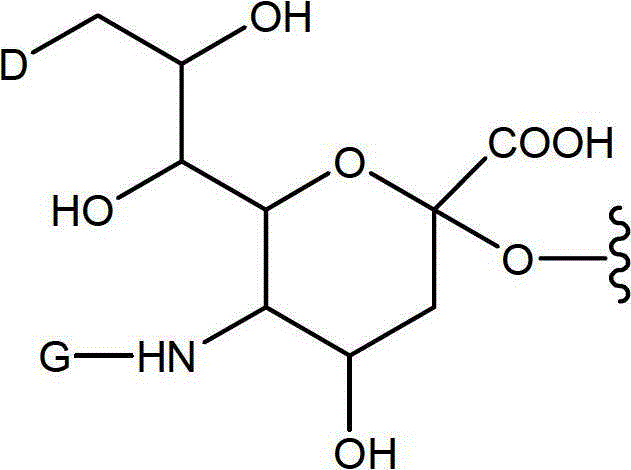
其中D选自-OH和R1-L-HN-;G选自H和R1-L-及-C(O)(C1-C6)烃基;R1是包含直链或支化的聚(乙二醇)残基的部分;以及L是接头,例如键(“零级”)、取代的或未取代的烃基和取代的或未取代的杂烃基。在示例性的实施方案中,当D为OH时,G为R1-L-,以及当G为-C(O)(C1-C6)烃基时,D为R1-L-NH-。Wherein D is selected from -OH and R 1 -L-HN-; G is selected from H and R 1 -L- and -C(O)(C 1 -C 6 )hydrocarbyl; R 1 is a linear or branched part of a poly(ethylene glycol) residue; and L is a linker, such as a bond ("zero order"), substituted or unsubstituted hydrocarbyl, and substituted or unsubstituted heterohydrocarbyl. In an exemplary embodiment, when D is OH, G is R 1 -L-, and when G is -C(O)(C 1 -C 6 )hydrocarbyl, D is R 1 -L-NH- .
在另一方面,本发明提供因子VII或VIIa肽缀合物,其包含可以是因子VII或因子VIIa的肽。该缀合物还包含糖基连接基团,其中该糖基连接基团连接到所述肽的氨基酸残基上,以及其中所述糖基连接基团包含具有选自以下的式的唾液酰连接基团:In another aspect, the invention provides Factor VII or VIIa peptide conjugates comprising a peptide which may be Factor VII or Factor VIIa. The conjugate also comprises a glycosyl linking group, wherein the glycosyl linking group is linked to an amino acid residue of the peptide, and wherein the glycosyl linking group comprises a sialyl linkage having a formula selected from Group:
其中in

为修饰基团。R2选自H、CH2OR7、COOR7、COO-和OR7。R7选自H、取代的或未取代的烃基和取代的或未取代的杂烃基。R3和R4独立地选自H、取代的或未取代的烃基、OR8和NHC(O)R9。R8和R9独立地选自H、取代的或未取代的烃基、取代的或未取代的杂烃基和唾液酸。La是选自键、取代的或未取代的烃基和取代的或未取代的杂烃基的接头。X5、R16和R17独立地选自非反应性基团和聚合物臂(例如PEG)。X2和X4独立地选自将聚合物部分R16和R17连接到C上的键片段。下标j是选自1-15的整数。as a modifying group. R 2 is selected from H, CH 2 OR 7 , COOR 7 , COO − and OR 7 . R 7 is selected from H, substituted or unsubstituted hydrocarbyl, and substituted or unsubstituted heterohydrocarbyl. R 3 and R 4 are independently selected from H, substituted or unsubstituted hydrocarbyl, OR 8 and NHC(O)R 9 . R8 and R9 are independently selected from H, substituted or unsubstituted hydrocarbyl, substituted or unsubstituted heterohydrocarbyl, and sialic acid. L a is a linker selected from a bond, a substituted or unsubstituted hydrocarbyl, and a substituted or unsubstituted heterohydrocarbyl. X 5 , R 16 and R 17 are independently selected from non-reactive groups and polymer arms (eg PEG). X2 and X4 are independently selected from bond fragments linking polymer moieties R16 and R17 to C. Subscript j is an integer selected from 1-15.
在另一示例性的实施方案中,所述聚合物修饰基团具有下式的结构:In another exemplary embodiment, the polymer modifying group has the structure of:
其中下标m和n是独立地选自0-5000的整数。A1、A2、A3、A4、A5、A6、A7、A8、A9、A10和A11独立地选自H、取代的或未取代的烃基、取代的或未取代的杂烃基、取代的或未取代的环烃基、取代的或未取代的杂环烃基、取代的或未取代的芳基、取代的或未取代的杂芳基、-NA12A13、-OA12和-SiA12A13。A12和A13独立地选自取代的或未取代的烃基、取代的或未取代的杂烃基、取代的或未取代的环烃基、取代的或未取代的杂环烃基、取代的或未取代的芳基和取代的或未取代的杂芳基。Wherein the subscripts m and n are integers independently selected from 0-5000. A 1 , A 2 , A 3 , A 4 , A 5 , A 6 , A 7 , A 8 , A 9 , A 10 and A 11 are independently selected from H, substituted or unsubstituted hydrocarbyl, substituted or unsubstituted Substituted heteroalkyl, substituted or unsubstituted cycloalkyl, substituted or unsubstituted heterocycloalkyl, substituted or unsubstituted aryl, substituted or unsubstituted heteroaryl, -NA 12 A 13 , - OA 12 and -SiA 12 A 13 . A 12 and A 13 are independently selected from substituted or unsubstituted hydrocarbyl, substituted or unsubstituted heterohydrocarbyl, substituted or unsubstituted cycloalkyl, substituted or unsubstituted heterocycloalkyl, substituted or unsubstituted aryl and substituted or unsubstituted heteroaryl.
在一种示例性的实施方案中,所述聚合物修饰基团具有下式的结构:In an exemplary embodiment, the polymer modifying group has the structure of the formula:

在根据上述式的另一示例性实施方案中,聚合物修饰基团具有下式的结构:In another exemplary embodiment according to the above formula, the polymer modifying group has the structure of:

在一种示例性的实施方案中,A1和A2各自选自-OH和-OCH3。根据该实施方案的示例性的聚合物修饰基团包括:In an exemplary embodiment, A 1 and A 2 are each selected from —OH and —OCH 3 . Exemplary polymer modifying groups according to this embodiment include:

本发明提供因子VII或VIIa肽缀合物,其包含选自因子VII和因子VIIa的肽。该缀合物还包含糖基连接基团,其中该糖基连接基团连接到所述肽的氨基酸残基上,以及其中该糖基连接基团包含具有下式的唾液酰连接基团:The present invention provides Factor VII or VIIa peptide conjugates comprising a peptide selected from Factor VII and Factor VIIa. The conjugate also comprises a glycosyl linking group, wherein the glycosyl linking group is attached to an amino acid residue of the peptide, and wherein the glycosyl linking group comprises a sialyl linking group having the formula:
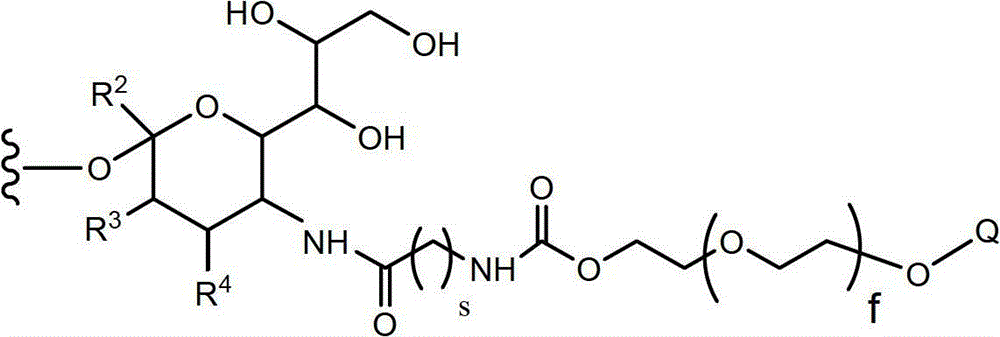
其中in

为修饰基团。下标s为选自1-20的整数。下标f为选自1-2500的整数。as a modifying group. The subscript s is an integer selected from 1-20. The subscript f is an integer selected from 1-2500.
Q选自H和取代的或未取代的C1-C6烃基。Q is selected from H and substituted or unsubstituted C 1 -C 6 hydrocarbon groups.
在一种示例性的实施方案中,本发明提供具有下式的修饰的糖:In an exemplary embodiment, the invention provides a modified sugar having the formula:

本发明提供形成因子VII肽例如因子VII和因子VIIa的缀合物的方法。该方法包括使因子VII/因子VIIa肽与带有与糖共价连接的修饰基团的修饰糖供体接触。该修饰糖部分经由酶的作用从供体转移至因子VII/因子VIIa肽的氨基酸或糖基残基上。代表性的酶包括但不限于糖基转移酶例如唾液酸转移酶。所述方法包括使因子VII/因子VIIa肽与:a)修饰糖供体接触;和b)在适合于将修饰糖部分从供体转移至肽的氨基酸或糖基残基上的条件下,能够将修饰的糖部分从该修饰的糖供体转移至肽的氨基酸或糖基残基上的酶接触,由此合成所述因子VII/因子VIIa肽缀合物。The present invention provides methods of forming conjugates of Factor VII peptides, such as Factor VII and Factor Vila. The method comprises contacting the Factor VII/Factor Vila peptide with a modified sugar donor having a modifying group covalently linked to the sugar. The modified sugar moiety is enzymatically transferred from the donor to the amino acid or glycosyl residue of the Factor VII/Factor Vila peptide. Representative enzymes include, but are not limited to, glycosyltransferases such as sialyltransferases. The method comprises contacting a Factor VII/Factor VIIa peptide with: a) a modified sugar donor; and b) under conditions suitable to transfer the modified sugar moiety from the donor to an amino acid or glycosyl residue of the peptide, capable of The Factor VII/Factor VIIa peptide conjugate is synthesized by an enzymatic contact that transfers a modified sugar moiety from the modified sugar donor to an amino acid or glycosyl residue of the peptide.
在一种优选的实施方案中,在步骤a)之前,使所述肽与唾液酸酶接触,由此除去所述肽上的至少一部分唾液酸。In a preferred embodiment, prior to step a), said peptide is contacted with a sialidase, whereby at least a portion of the sialic acid on said peptide is removed.
在另一优选的实施方案中,使因子VII/因子VIIa肽与唾液酸酶、糖基转移酶和修饰的糖供体接触。在该实施方案中,肽与唾液酸酶、糖基转移酶和修饰的糖供体基本上同时接触,不管各组分的添加顺序如何。在适合于唾液酸酶从肽中除去唾液酸残基以及糖基转移酶将修饰糖部分从修饰糖供体转移至肽的氨基酸或糖基残基上的条件下进行反应。In another preferred embodiment, the Factor VII/Factor Vila peptide is contacted with a sialidase, a glycosyltransferase and a modified sugar donor. In this embodiment, the peptide is contacted with the sialidase, glycosyltransferase, and modified sugar donor substantially simultaneously, regardless of the order of addition of the components. The reaction is carried out under conditions suitable for the sialidase to remove the sialic acid residue from the peptide and the glycosyltransferase to transfer the modified sugar moiety from the modified sugar donor to an amino acid or glycosyl residue in the peptide.
在另一优选的实施方案中,在同一容器中进行去唾液酸化和缀合,以及经过去唾液酸化的肽优选在缀合步骤之前不经纯化。在另一示例性的实施方案中,所述方法进一步包含涉及唾液酸化所述肽缀合物的‘加帽’步骤。在含有唾液酸酶、唾液酸转移酶和修饰糖供体的同一反应容器中不经在先纯化而进行该步骤。In another preferred embodiment, desialylation and conjugation are performed in the same vessel, and the desialylated peptide is preferably not purified prior to the conjugation step. In another exemplary embodiment, the method further comprises a 'capping' step involving sialylation of said peptide conjugate. This step is performed without prior purification in the same reaction vessel containing the sialidase, sialyltransferase and modified sugar donor.
在另一优选的实施方案中,进行因子VII/因子VIIa肽的去唾液酸化,并且纯化该去唾液酸肽。然后使纯化过的去唾液酸肽经受缀合反应条件。在另一示例性的实施方案中,所述方法进一步包含涉及唾液酸化肽缀合物的‘加帽’步骤。在含有唾液酸酶、唾液酸转移酶和修饰糖供体的同一反应容器中不经在先纯化而进行该步骤。In another preferred embodiment, desialylation of the Factor VII/Factor Vila peptide is performed and the asialopeptide is purified. The purified asialo peptide is then subjected to conjugation reaction conditions. In another exemplary embodiment, the method further comprises a 'capping' step involving the sialylated peptide conjugate. This step is performed without prior purification in the same reaction vessel containing the sialidase, sialyltransferase and modified sugar donor.
在另一示例性的实施方案中,在含有唾液酸酶、唾液酸转移酶和修饰糖供体的同一反应容器中不经在先纯化而进行加帽步骤,唾液酸化所述肽缀合物。In another exemplary embodiment, the peptide conjugate is sialylated by performing the capping step without prior purification in the same reaction vessel containing the sialidase, sialyltransferase, and modified sugar donor.
在一种示例性的实施方案中,接触时间少于20小时,优选少于16小时,更优选少于12小时,甚至更优选少于8小时,以及再更优选少于4小时。In an exemplary embodiment, the contact time is less than 20 hours, preferably less than 16 hours, more preferably less than 12 hours, even more preferably less than 8 hours, and even more preferably less than 4 hours.
在另一方面,本发明提供因子VII/因子VIIa肽缀合物反应混合物。该反应混合物包含:a)唾液酸酶;b)选自糖基转移酶、外切糖苷酶和内切糖苷酶的酶;c)修饰的糖;和d)因子VII/因子VIIa肽。In another aspect, the invention provides a Factor VII/Factor Vila peptide conjugate reaction mixture. The reaction mixture comprises: a) a sialidase; b) an enzyme selected from the group consisting of glycosyltransferases, exoglycosidases and endoglycosidases; c) modified sugars; and d) Factor VII/Factor VIIa peptides.
在另一示例性的实施方案中,唾液酸酶与因子VII/因子VIIa肽的比率选自0.1U/L:2mg/mL至10U/L:1mg/mL,优选0.5U/L:2mg/mL,更优选1.0U/L:2mg/mL,甚至更优选10U/L:2mg/mL,再更优选0.1U/L:1mg/mL,更优选0.5U/L:1mg/mL,甚至更优选1.0U/L:1mg/mL,以及再更优选10U/L:1mg/mL。In another exemplary embodiment, the ratio of sialidase to Factor VII/Factor VIIa peptide is selected from 0.1 U/L:2 mg/mL to 10 U/L:1 mg/mL, preferably 0.5 U/L:2 mg/mL , more preferably 1.0U/L: 2mg/mL, even more preferably 10U/L: 2mg/mL, even more preferably 0.1U/L: 1mg/mL, more preferably 0.5U/L: 1mg/mL, even more preferably 1.0 U/L: 1 mg/mL, and even more preferably 10 U/L: 1 mg/mL.
在一种示例性的实施方案中,至少10%、20%、30%、40%、50%、60%、70%或80%的所述因子VII/因子VIIa肽缀合物包括至多两个PEG部分。该PEG部分可以在一锅法中加入,或者它们可以在纯化去唾液酸因子VII/因子VIIa后加入。In an exemplary embodiment, at least 10%, 20%, 30%, 40%, 50%, 60%, 70% or 80% of said Factor VII/Factor VIIa peptide conjugates comprise up to two PEG section. The PEG moieties can be added in a one-pot procedure, or they can be added after purification of asialo Factor VII/Factor Vila.
在另一示例性的实施方案中,至少10%、20%、30%、40%、50%、60%、70%或80%的因子VII/因子VIIa肽缀合物包括至多一个PEG部分。该PEG部分可以在一锅法中加入,或者它可以在纯化去唾液酸因子VII/因子VIIa后加入。In another exemplary embodiment, at least 10%, 20%, 30%, 40%, 50%, 60%, 70%, or 80% of the Factor VII/Factor VIIa peptide conjugates include at most one PEG moiety. The PEG moiety can be added in a one-pot procedure, or it can be added after purification of asialo Factor VII/Factor Vila.
在另一示例性的实施方案中,该方法进一步包含“加帽”,或者向肽缀合物中加入唾液酸。在另一示例性的实施方案中,加入唾液酸酶,接着滞后30分钟、1小时、1.5小时或2小时,然后加入糖基转移酶、外切糖苷酶或内切糖苷酶。In another exemplary embodiment, the method further comprises "capping," or adding sialic acid to the peptide conjugate. In another exemplary embodiment, the sialidase is added, followed by a 30 minute, 1 hour, 1.5 hour or 2 hour delay before adding the glycosyltransferase, exoglycosidase or endoglycosidase.
在另一示例性的实施方案中,加入唾液酸酶,接着滞后30分钟、1小时、1.5小时或2小时,然后加入糖基转移酶、外切糖苷酶或内切糖苷酶。本发明的其他目的和优点从下面的详细描述中对于本领域技术人员而言会是明显的。In another exemplary embodiment, the sialidase is added, followed by a 30 minute, 1 hour, 1.5 hour or 2 hour delay before adding the glycosyltransferase, exoglycosidase or endoglycosidase. Other objects and advantages of the present invention will be apparent to those skilled in the art from the following detailed description.
在另一示例性的实施方案中,所述方法包括:(a)使包含选自以下的糖基的因子VII/因子VIIa肽:In another exemplary embodiment, the method comprises: (a) making a Factor VII/Factor VIIa peptide comprising a glycosyl group selected from:

与具有下式的修饰的糖:with modified sugars of the formula:
以及将糖基连接基团转移至选自所述糖基的GalNAc、Gal和Sia的成员上的合适的转移酶,在适合于所述转移的条件下接触。示例性的修饰糖为通过接头部分用聚合物例如直链或支化的聚(乙二醇)部分修饰的CMP-唾液酸。and a suitable transferase that transfers a glycosyl linking group to a member selected from GalNAc, Gal, and Sia of said glycosyl, contacting under conditions suitable for said transfer. An exemplary modified sugar is CMP-sialic acid modified through a linker moiety with a polymer such as a linear or branched poly(ethylene glycol) moiety.
所述肽可以从基本上任何来源获得,然而,在一种实施方案中,在如上所述进行修饰之前,使因子VII/因子VIIa肽在合适的宿主中表达。哺乳动物(例如BHK、CHO)、细菌(例如大肠杆菌(E.coli))和昆虫细胞(例如Sf-9)为提供用于本文所述的组合物和方法中的因子VII或因子VIIa的示例性表达体系。The peptides may be obtained from essentially any source, however, in one embodiment, the Factor VII/Factor Vila peptide is expressed in a suitable host prior to modification as described above. Mammalian (eg BHK, CHO), bacterial (eg Escherichia coli (E. coli)) and insect cells (eg Sf-9) are examples of Factor VII or Factor VIIa provided for use in the compositions and methods described herein system of sexual expression.
在示例性的实施方案中,可以向患者施用因子VII/因子VIIa肽缀合物以治疗组织损伤例如局部缺血、外伤、炎症或者与有毒物质接触。在另外的示例性实施方案中,可以向患者施用因子VII/因子VIIa肽缀合物以治疗患有A型血友病的患者、患有B型血友病的患者、患有A型血友病同时具有因子VIII抗体的患者、患有B型血友病同时具有因子IX抗体的患者、以及患有肝硬化的患者。In an exemplary embodiment, Factor VII/Factor VIIa peptide conjugates may be administered to a patient to treat tissue damage such as ischemia, trauma, inflammation, or exposure to toxic substances. In additional exemplary embodiments, the Factor VII/Factor VIIa peptide conjugate may be administered to a patient to treat a patient with hemophilia A, a patient with hemophilia B, a patient with hemophilia A patients with hemophilia B who have antibodies to factor VIII, patients with hemophilia B who have antibodies to factor IX, and patients with cirrhosis.
在另一示例性的实施方案中,可以向患者施用因子VII/因子VIIa肽缀合物以治疗紧急事件、选择性外科手术、心脏外科手术、脊柱外科手术、肝脏移植、部分肝切除术、骨盆-髋臼骨折重建、以及异基因干细胞移植中的出血。在另一示例性的实施方案中,可以向患者施用因子VII/因子VIIa肽缀合物以治疗急性脑内出血、创伤性脑损伤、静脉曲张出血和上胃肠道出血。In another exemplary embodiment, the Factor VII/Factor VIIa peptide conjugate may be administered to a patient for emergency treatment, elective surgery, cardiac surgery, spinal surgery, liver transplant, partial hepatectomy, pelvic -Acetabular fracture reconstruction, and bleeding in allogeneic stem cell transplantation. In another exemplary embodiment, Factor VII/Factor Vila peptide conjugates may be administered to a patient for the treatment of acute intracerebral hemorrhage, traumatic brain injury, variceal bleeding, and upper gastrointestinal bleeding.
在另一方面中,本发明提供包含因子VII/因子VIIa肽缀合物和可药用载体的药物制剂。In another aspect, the present invention provides a pharmaceutical formulation comprising a Factor VII/Factor Vila peptide conjugate and a pharmaceutically acceptable carrier.
在所述因子VII/因子VIIa肽缀合物中,糖基连接基团或修饰基团所结合的氨基酸残基中基本上每一个都具有相同的结构。例如,如果一种肽包含Thr连接的糖基残基的话,群体中至少约70%、80%、90%、95%、97%、99%、99.2%、99.4%、99.6%或者更优选99.8%的肽会具有共价结合到相同Thr残基上的相同糖基连接基团。In the Factor VII/Factor VIIa peptide conjugate, substantially each of the amino acid residues to which the glycosyl linking group or modifying group is bound has the same structure. For example, if a peptide comprises Thr-linked glycosyl residues, at least about 70%, 80%, 90%, 95%, 97%, 99%, 99.2%, 99.4%, 99.6%, or more preferably 99.8% of the population % of the peptides will have the same glycosyl linking group covalently bound to the same Thr residue.
本发明的其他目的和优点从下面的详细描述中对于本领域技术人员而言会是明显的。Other objects and advantages of the present invention will be apparent to those skilled in the art from the following detailed description.
附图说明 Description of drawings
图1说明可用于本发明实践中的示例性的修饰的唾液酸核苷酸。A.示例性的支化(例如30KDa、40KDa)CMP-唾液酸-PEG糖核苷酸的结构。B.线性因子VIIa-SA-PEG-10KDa的结构。Figure 1 illustrates exemplary modified sialic acid nucleotides that can be used in the practice of the present invention. A. Structures of exemplary branched (eg, 30KDa, 40KDa) CMP-sialic acid-PEG sugar nucleotides. B. Structure of linear Factor Vila-SA-PEG-10 KDa.
图2是制备示例性的用于制备本发明缀合物的PEG-糖基连接基团前体(修饰的糖)的合成方案。Figure 2 is a synthetic scheme for the preparation of an exemplary PEG-glycosyl linker precursor (modified sugar) useful in the preparation of the conjugates of the invention.
图3是提供示例性的用于以修饰的唾液酸形成本发明缀合物,例如糖基聚乙二醇化肽的唾液酸转移酶的表。Figure 3 is a table providing exemplary sialyltransferases useful for forming conjugates of the invention, such as glycopegylated peptides, with modified sialic acids.
包括图4A至4E的图4描述在因子VII和因子VIIa上重构聚糖结构的示例性方案。图4A是描绘因子VII和因子VIIa肽的图,其显示出与预期重构的聚糖结合的残基。图4B是描绘因子VII和因子VIIa肽A(实线)和B(虚线)的图,其显示出与预期重构的聚糖结合的残基以及聚糖的化学式。图4C至4E是基于其中表达肽的细胞种类和所需的重构聚糖结构的图4B肽的聚糖预期重构步骤的图。Figure 4, comprising Figures 4A through 4E, depicts an exemplary scheme for remodeling glycan structures on Factor VII and Factor Vila. Figure 4A is a diagram depicting Factor VII and Factor Vila peptides showing residues that bind expected remodeled glycans. Figure 4B is a diagram depicting Factor VII and Factor VIIa peptides A (solid line) and B (dashed line) showing the residues bound to the expected remodeled glycan and the chemical formula of the glycan. Figures 4C to 4E are diagrams of predicted glycan remodeling steps for the peptide of Figure 4B based on the cell type in which the peptide is expressed and the desired remodeled glycan structure.
包括图5A和5B的图5是因子VIIa的示例性核苷酸和相应氨基酸序列(分别是SEQ ID NOS:1和2)。Figure 5, comprising Figures 5A and 5B, is an exemplary nucleotide and corresponding amino acid sequence of Factor Vila (SEQ ID NOS: 1 and 2, respectively).
图6是去唾液酸-因子VIIa的等电聚焦凝胶(pH 3-7)的图象。泳道1是因子VIIa;泳道2-5是去唾液酸-因子VIIa。Figure 6 is an image of an isoelectric focusing gel (pH 3-7) of asialo-Factor VIIa.
图7是因子VIIa的MALDI谱图。Figure 7 is a MALDI spectrum of Factor Vila.
图8是因子VIIa-SA-PEG-1KDa的MALDI谱图。Figure 8 is a MALDI spectrum of Factor Vila-SA-PEG-1 KDa.
图9是描绘因子VIIa-SA-PEG-10KDa的MALDI谱的图。Figure 9 is a graph depicting the MALDI spectrum of Factor Vila-SA-PEG-10 KDa.
图10是PEG化的因子VIIa的SDS-PAGE凝胶的图象。泳道1是去唾液酸-因子VIIa。泳道2是去唾液酸-因子VIIa和CMP-SA-PEG-1KDa与ST3Gal3反应48小时的产物。泳道3是去唾液酸-因子VIIa和CMP-SA-PEG-1KDa与ST3Gal3反应48小时的产物。泳道4是去唾液酸-因子VIIa和CMP-SA-PEG-10KDa与ST3Gal3反应96小时的产物。Figure 10 is an image of an SDS-PAGE gel of PEGylated Factor Vila.
图11A-B显示在较少的唾液酸酶下同时去唾液酸化和PEG化。这些图突出显示在唾液酸酶存在下加帽是有效率的。图11A显示当唾液酸酶水平为0.5U/L时的反应过程。泳道1对应于天然的因子VIIa而泳道2是去唾液酸因子VIIa。从泳道3至泳道7,随着时间前进PEG化产物的量增加。在泳道3中,主要产物是单PEG化的(见64处的点),而在后面检测的等分试样显示出形成二PEG化(见刚好在97下方的点)、三PEG化(见刚好在97上方的点)和更高PEG化的产物及其含量的增加。泳道8和9显示出向反应中“加帽”或加入唾液酸的结果。当反应加帽时,反应程度得到终止,如同从泳道5、8和9中发现的类似PEG化产物分布中可以看出的那样。图11B显示当唾液酸酶水平为0.1U/L时的反应过程。Figures 11A-B show simultaneous desialylation and PEGylation with less sialidase. These figures highlight that capping is efficient in the presence of sialidase. Figure 11A shows the reaction process when the sialidase level is 0.5 U/
图12A和B。图12A显示当同时加入唾液酸酶和糖基转移酶时的情形。图12B显示当首先加入唾液酸酶、接着在30分钟延迟后加入糖基转移酶时的情形。Figure 12A and B. Figure 12A shows the situation when sialidase and glycosyltransferase were added simultaneously. Figure 12B shows the situation when the sialidase was added first, followed by the glycosyltransferase after a 30 minute delay.
图13是一个或多个糖基连接基团可以结合到其上以便提供本发明肽缀合物的肽的列表。Figure 13 is a list of peptides to which one or more glycosyl linking groups may be attached to provide peptide conjugates of the invention.
图14A和B显示表现HPLC试验结果的色谱图。图14A显示由轻链方法分析的因子VIIa-SA-PEG-10KDa(上)和天然因子VIIa对照(下)的经标记的色谱图。显示出LC(轻链)、1x10KDa-PEG-LC、2x10KDa-PEG-LC和3x10KDa-PEG-LC与其他产物的分离。图14B显示由重链方法分析的因子VIIa-SA-PEG-10KDa(上)和天然因子VIIa对照(下)的经标记的色谱图。显示出HC(重链)、1x10KDa-PEG-HC、2x10KDa-PEG-HC和3x10KDa-PEG-HC与其他产物的分离。Figures 14A and B show chromatograms representing the results of the HPLC experiments. Figure 14A shows labeled chromatograms of Factor Vila-SA-PEG-10 KDa (top) and native Factor Vila control (bottom) analyzed by the light chain method. Separation of LC (light chain), 1x10KDa-PEG-LC, 2x10KDa-PEG-LC and 3x10KDa-PEG-LC from other products was shown. Figure 14B shows labeled chromatograms of Factor Vila-SA-PEG-10 KDa (top) and native Factor Vila control (bottom) analyzed by the heavy chain method. Separation of HC (heavy chain), 1x10KDa-PEG-HC, 2x10KDa-PEG-HC and 3x10KDa-PEG-HC from other products was shown.
图15A-15D显示表现HPLC试验结果的色谱图。图15A和15B分别显示由轻链方法分析的还原的天然因子VIIa对照和还原的因子VIIa-SA-PEG-40KDa的经标记的色谱图。显示出LC(轻链)、1x40KDa-PEG-LC、2x40KDa-PEG-LC和3x40KDa-PEG-LC与其他产物的分离。图15C和D分别显示由重链方法分析的还原的天然因子VIIa对照和因子VIIa-SA-PEG-40KDa的经标记的色谱图。显示出HC(重链)、1x40KDa-PEG-HC、2x40KDa-PEG-HC和3x40KDa-PEG-HC与其他产物的分离。Figures 15A-15D show chromatograms representing the results of the HPLC experiments. Figures 15A and 15B show labeled chromatograms of reduced native Factor Vila control and reduced Factor Vila-SA-PEG-40 KDa, respectively, analyzed by the light chain method. Separation of LC (light chain), 1x40KDa-PEG-LC, 2x40KDa-PEG-LC and 3x40KDa-PEG-LC from other products was shown. Figures 15C and D show labeled chromatograms of reduced native Factor Vila control and Factor Vila-SA-PEG-40 KDa analyzed by the heavy chain method, respectively. Separation of HC (heavy chain), 1x40KDa-PEG-HC, 2x40KDa-PEG-HC and 3x40KDa-PEG-HC from other products was shown.
本发明的详述和优选实施方案DETAILED DESCRIPTION OF THE INVENTION AND PREFERRED EMBODIMENTS
缩写abbreviation
PEG,聚(乙二醇);PPG,聚(丙二醇);Ara,阿拉伯糖基;Fru,果糖基;Fuc,岩藻糖基;Gal,半乳糖基;GalNAc,N-乙酰半乳糖胺基;Glc,葡萄糖基;GlcNAc,N-乙酰葡糖氨基;Man,甘露糖基;ManAc,乙酸甘露糖氨基;Xyl,木糖基;NeuAc,唾液酰基或N-乙酰神经氨酸基;Sia,唾液酰基或N-乙酰神经氨酸基;及其衍生物和类似物。PEG, poly(ethylene glycol); PPG, poly(propylene glycol); Ara, arabinosyl; Fru, fructosyl; Fuc, fucosyl; Gal, galactosyl; GalNAc, N-acetylgalactosamine; Glc, glucosyl; GlcNAc, N-acetylglucosyl; Man, mannosyl; ManAc, mannosyl acetate; Xyl, xylosyl; NeuAc, sialyl or N-acetylneuraminic acid; Sia, sialyl or N-acetylneuraminic acid; and derivatives and analogs thereof.
定义definition
除非另有定义,本文使用的所有技术和科学术语一般具有与本发明所属领域普通技术人员通常理解相同的含义。通常,细胞培养、分子遗传学、有机化学和核酸化学以及杂交方面的本文所用命名以及实验室操作是本领域熟知并通常采用的那些。标准技术用于核酸和肽合成。该技术和操作通常根据本领域常规方法和本文件中各处提供的各种一般参考文献(通常参见Sambrook等,MOLECULAR CLONING:ALABORATORY MANUAL,第2版(1989)Cold Spring Harbor LaboratoryPress,Cold Spring Harbor,N.Y.,其通过引用并入本文)来进行。分析化学和下述有机合成方面的本文所用命名以及实验室操作是本领域熟知并通常采用的那些。标准技术或其变型用于化学合成和化学分析。Unless otherwise defined, all technical and scientific terms used herein generally have the same meaning as commonly understood by one of ordinary skill in the art to which this invention belongs. Generally, the nomenclature used herein and the laboratory procedures in cell culture, molecular genetics, organic and nucleic acid chemistry, and hybridization are those well known and commonly employed in the art. Standard techniques are used for nucleic acid and peptide synthesis. The techniques and procedures are generally according to conventional methods in the art and various general references provided throughout this document (see generally Sambrook et al., MOLECULAR C LONING : AL ABORATORY MANUAL , 2nd Edition (1989) Cold Spring Harbor Laboratory Press, Cold Spring Harbor, NY, which is incorporated herein by reference). The nomenclature used herein and the laboratory procedures of analytical chemistry and of organic synthesis described below are those well known and commonly employed in the art. Standard techniques or variations thereof are used for chemical syntheses and chemical analyses.
本文描述的所有寡糖以非还原糖的名称或缩写(即Gal)描述,接着是糖苷键构型(α或β)、环键(1或2)、与参与键的还原糖的环位置(2、3、4、6或8),然后是还原糖的名称或缩写(即GlcNAc)。每种糖优选吡喃糖。标准糖生物学命名法的综述参见Essentials ofGlycobiology,Varki等编辑,CSHL Press(1999)。All oligosaccharides described herein are described by the name or abbreviation of the non-reducing sugar (i.e. Gal), followed by the glycosidic bond configuration (α or β), the ring bond (1 or 2), and the ring position of the reducing sugar participating in the bond ( 2, 3, 4, 6 or 8), followed by the name or abbreviation of the reducing sugar (i.e. GlcNAc). Each sugar is preferably pyranose. For a review of standard glycobiology nomenclature see Essentials of Glycobiology, edited by Varki et al., CSHL Press (1999).
寡糖被认为具有还原性末端和非还原性末端,无论该还原性末端上的糖是否实际为还原性糖。根据公认的命名法,寡糖在本文中以左侧为非还原性末端而右侧为还原性末端来描述。An oligosaccharide is considered to have a reducing end and a non-reducing end, whether or not the sugar on the reducing end is actually a reducing sugar. According to accepted nomenclature, oligosaccharides are described herein with the non-reducing end on the left and the reducing end on the right.
术语“唾液酸”或“唾液酰基”是指九碳羧化糖家族的任何成员。唾液酸家族最常见的成员为N-乙酰神经氨酸(2-酮-5-乙酰氨基-3,5-双脱氧-D-甘油基-D-半乳糖nonulo吡喃糖-1-酮(onic)酸(往往缩写为Neu5Ac、NeuAc或NANA)。该家族的另一成员为N-羟乙酰-神经氨酸(Neu5Gc或NeuGc),其中NeuAc的N-乙酰基被羟基化。又一唾液酸家族成员为2-酮-3-脱氧-nonulosonic酸(KDN)(Nadano等(1986)J.Biol.Chem.261:11550-11557;Kanamori等,J.Biol.Chem.265:21811-21819(1990))。还包括9-取代唾液酸例如9-O-C1-C6酰基-Neu5Ac如9-O-乳酰基-Neu5Ac或9-O-乙酰基-Neu5Ac、9-脱氧-9-氟-Neu5Ac和9-叠氮基-9-脱氧-Neu5Ac。唾液酸家族的综述参见例如Varki,Glycobiology 2:25-40(1992);Sialic acids:Chemistry,Metabolism and Function,R.Schauer编辑(Springer-Verlag,NewYork(1992))。唾液酸化过程中唾液酸化合物的合成及使用在1992年10月1日公布的国际申请WO92/16640中得到公开。The term "sialic acid" or "sialyl" refers to any member of the family of nine-carbon carboxylated sugars. The most common member of the sialic acid family is N-acetylneuraminic acid (2-keto-5-acetylamino-3,5-dideoxy-D-glyceryl-D-galactosenonulopyranose-1-one (onic ) acids (often abbreviated as Neu5Ac, NeuAc, or NANA). Another member of this family is N-glycolyl-neuraminic acid (Neu5Gc or NeuGc), in which the N-acetyl group of NeuAc is hydroxylated. Another family of sialic acids Members are 2-keto-3-deoxy-nonulosonic acid (KDN) (Nadano et al. (1986) J. Biol. Chem. 261: 11550-11557; Kanamori et al., J. Biol. Chem. 265: 21811-21819 (1990) ). Also includes 9-substituted sialic acids such as 9-OC 1 -C 6 acyl-Neu5Ac such as 9-O-lactyl-Neu5Ac or 9-O-acetyl-Neu5Ac, 9-deoxy-9-fluoro-Neu5Ac and 9 - Azido-9-deoxy-Neu5Ac. For a review of the sialic acid family see, eg, Varki, Glycobiology 2: 25-40 (1992); Sialic acids: Chemistry, Metabolism and Function, edited by R. Schauer (Springer-Verlag, New York ( 1992)). The synthesis and use of sialic acid compounds in the sialylation process is disclosed in International Application WO 92/16640 published on October 1, 1992.
“肽”是指其中单体为氨基酸并通过酰胺键结合在一起的多聚体,也可称为多肽。另外,非天然氨基酸例如β-丙氨酸、苯基甘氨酸和高精氨酸也包括在内。非基因编码的氨基酸也可以用于本发明中。此外,进行修饰以含有活性基团、糖基化位点、聚合物、治疗部分、生物分子等的氨基酸也可以用于本发明中。本发明中使用的所有氨基酸可以是D-或L-异构体。通常优选L-异构体。另外,其他肽模拟物(peptidomimetics)也可以用于本发明中。本文使用的“肽”是指糖基化的和未糖基化的肽。还包括由表达肽的体系不完全糖基化的肽。一般的综述参见Spatola,A.F.,CHEMISTRY AND BIOCHEMISTRY OFAMINO ACIDS,PEPTIDES AND PROTEINS,B.Weinstein编辑,MarcelDekker,New York,第267页(1983)。一些本发明的肽的列表在图13中给出。"Peptide" refers to a polymer in which the monomers are amino acids held together by amide bonds, and may also be called a polypeptide. Additionally, unnatural amino acids such as beta-alanine, phenylglycine, and homoarginine are also included. Non-genetically encoded amino acids may also be used in the present invention. In addition, amino acids modified to contain reactive groups, glycosylation sites, polymers, therapeutic moieties, biomolecules, etc. may also be used in the present invention. All amino acids used in the present invention may be D- or L-isomers. The L-isomer is generally preferred. In addition, other peptidomimetics can also be used in the present invention. "Peptide" as used herein refers to both glycosylated and unglycosylated peptides. Also included are peptides that are incompletely glycosylated by the system expressing the peptide. For a general review see Spatola, AF, C HEMISTRY AND B IOCHEMISTRY OF A MINO A CIDS , P EPTIDES AND P ROTEINS , edited by B. Weinstein, Marcel Dekker, New York, p. 267 (1983). A list of some peptides of the invention is given in FIG. 13 .
术语“肽缀合物”是指其中肽与本文所述的修饰的糖缀合的本发明的物种。The term "peptide conjugate" refers to a species of the invention wherein a peptide is conjugated to a modified sugar as described herein.
术语“氨基酸”是指天然存在的和合成的氨基酸,以及以与天然存在的氨基酸相似的方式发挥作用的氨基酸类似物和氨基酸模拟物。天然存在的氨基酸是由遗传密码编码的那些以及随后得到修饰的那些氨基酸,例如羟基脯氨酸、γ-羧基谷氨酸和O-磷酸丝氨酸。氨基酸类似物是指具有与天然存在氨基酸相同的基本化学结构的化合物,即与氢结合的α碳、羧基、氨基和R基团,例如高丝氨酸、正亮氨酸、蛋氨酸亚砜、甲硫氨酸甲基锍。这些类似物具有修饰的R基团(例如正亮氨酸)或修饰的肽主链,但是保持与天然存在的氨基酸相同的基本化学结构。氨基酸模拟物是指具有与氨基酸的一般化学结构不同的结构,但是以与天然存在氨基酸类似的方式发挥作用的化合物。The term "amino acid" refers to naturally occurring and synthetic amino acids, as well as amino acid analogs and amino acid mimetics that function in a manner similar to naturally occurring amino acids. Naturally occurring amino acids are those encoded by the genetic code as well as those amino acids that are subsequently modified, eg, hydroxyproline, gamma-carboxyglutamate, and O-phosphoserine. Amino acid analogs are compounds that have the same basic chemical structure as naturally occurring amino acids, i.e. hydrogen-bonded alpha carbon, carboxyl, amino and R groups, e.g. homoserine, norleucine, methionine sulfoxide, methionine acid methylsulfonium. These analogs have modified R groups (eg, norleucine) or modified peptide backbones, but retain the same basic chemical structure as a naturally occurring amino acid. An amino acid mimetic is a compound that has a structure that differs from the general chemical structure of an amino acid, but functions in a manner similar to a naturally occurring amino acid.
本文使用的术语“修饰的糖”或“修饰的糖残基”是指在本发明的方法中酶促加成至肽的氨基酸或糖基残基上的天然或非天然存在的碳水化合物。修饰的糖选自酶底物,其包括但不限于糖核苷酸(单-、双-和三磷酸酯)、活化的糖(例如糖基卤化物、糖基甲磺酸酯)、和既未活化又非核苷酸的糖。“修饰的糖”用“修饰基团”共价官能化。有用的修饰基团包括但不限于PEG部分、治疗部分、诊断部分、生物分子等。修饰基团优选不是天然存在或未修饰的碳水化合物。选择用修饰基团官能化的位置以使得它不会阻碍“修饰的糖”酶促加成至肽上。As used herein, the term "modified sugar" or "modified sugar residue" refers to a naturally or non-naturally occurring carbohydrate that is enzymatically added to an amino acid or glycosyl residue of a peptide in the methods of the invention. Modified sugars are selected from enzyme substrates including, but not limited to, sugar nucleotides (mono-, di-, and triphosphates), activated sugars (e.g., glycosyl halides, glycosyl mesylates), and both Non-activated and non-nucleotide sugars. A "modified sugar" is covalently functionalized with a "modifying group". Useful modifying groups include, but are not limited to, PEG moieties, therapeutic moieties, diagnostic moieties, biomolecules, and the like. The modifying group is preferably not a naturally occurring or unmodified carbohydrate. The position of functionalization with the modifying group is chosen such that it does not hinder the enzymatic addition of the "modified sugar" to the peptide.
术语“水溶性的”是指在水中具有一定可检测的溶解性程度的部分。检测和/或定量水溶解性的方法为本领域所熟知的。示例性的水溶性聚合物包括肽、糖、聚(醚)、聚(胺)、聚(羧酸)等。肽可以具有混合序列或由单一氨基酸组成,例如聚(赖氨酸)。示例性的多糖为聚(唾液酸)。示例性的聚醚为聚(乙二醇)。聚(乙烯亚胺)为示例性的聚胺,以及聚(丙烯)酸为代表性的聚(羧酸)。The term "water-soluble" refers to a moiety that has some detectable degree of solubility in water. Methods of detecting and/or quantifying water solubility are well known in the art. Exemplary water soluble polymers include peptides, sugars, poly(ethers), poly(amines), poly(carboxylic acids), and the like. Peptides can have mixed sequences or consist of a single amino acid, such as poly(lysine). An exemplary polysaccharide is poly(sialic acid). An exemplary polyether is poly(ethylene glycol). Poly(ethyleneimine) is an exemplary polyamine, and poly(acrylic) acid is a representative poly(carboxylic acid).
水溶性聚合物的聚合物主链可以是聚(乙二醇)(即PEG)。然而,应当理解其他相关的聚合物也适合用于本发明的实践中,而且术语PEG或聚(乙二醇)的使用意图在这方面是包括性的而不是排他的。术语PEG包括以其任意形式的聚(乙二醇),包括烷氧基PEG、双官能PEG、多臂PEG、叉状PEG、支化PEG、悬挂型PEG(即具有悬挂在聚合物主链上的一个或多个官能团的PEG或相关聚合物)、或其中具有可降解键的PEG。The polymer backbone of the water soluble polymer may be poly(ethylene glycol) (ie PEG). It should be understood, however, that other related polymers are also suitable for use in the practice of the invention, and that use of the term PEG or poly(ethylene glycol) is intended to be inclusive and not exclusive in this respect. The term PEG includes poly(ethylene glycol) in any of its forms, including alkoxy PEG, bifunctional PEG, multiarm PEG, forked PEG, branched PEG, pendant PEG (i.e., with PEG or related polymers), or PEG with degradable linkages therein.
聚合物主链可以是线性的或支化的。支化的聚合物主链通常是本领域已知的。通常,支化聚合物具有中枢分支核心部分和连接到该中枢分支核心上的多个线性聚合物链。PEG通常以支化形式使用,其可以通过向多种多元醇例如丙三醇、季戊四醇和山梨糖醇加成环氧乙烷来制备。中枢分支部分还可以衍生自若干氨基酸,例如赖氨酸。支化聚(乙二醇)可以表示成通式R(-PEG-OH)m,其中R代表核心部分例如甘油或季戊四醇,以及m代表臂的数目。多臂PEG分子也可以用作聚合物主链,例如美国专利No.5,932,462中所述的那些,该专利通过引用全部并入本文。The polymer backbone can be linear or branched. Branched polymer backbones are generally known in the art. Typically, branched polymers have a central branch core portion and a plurality of linear polymer chains attached to the central branch core. PEG is generally used in a branched form, which can be prepared by the addition of ethylene oxide to various polyols such as glycerol, pentaerythritol, and sorbitol. Central branch moieties can also be derived from several amino acids, such as lysine. Branched poly(ethylene glycol) can be represented by the general formula R(-PEG-OH) m , where R represents a core moiety such as glycerol or pentaerythritol, and m represents the number of arms. Multi-armed PEG molecules can also be used as polymer backbones, such as those described in US Patent No. 5,932,462, which is incorporated herein by reference in its entirety.
许多其他的聚合物也适合于本发明。非肽以及水溶性的在约2-约300个连接位置(loci)内的聚合物主链在本发明中尤其有用。合适聚合物的实例包括但不限于其他聚(亚烷基二醇)例如聚(丙二醇)(“PPG”)、乙二醇和丙二醇的共聚物等、聚(氧乙烯多元醇)、聚(烯醇)、聚(乙烯基吡咯烷酮)、聚(羟丙基甲基丙烯酰胺)、聚(α-羟基酸)、聚(乙烯醇)、聚磷腈、聚
本文在向患者施用肽药物的上下文中使用的“曲线下面积”或“AUC”定义为描述作为从零到无穷大时间函数的患者体循环中药物浓度的曲线下的总面积。"Area under the curve" or "AUC" as used herein in the context of administration of a peptide drug to a patient is defined as the total area under the curve describing drug concentration in the patient's systemic circulation as a function of time from zero to infinity.
本文在向患者施用肽药物的上下文中使用的术语“半衰期”或“t1/2”定义为药物在患者中的血浆浓度降低一半所需的时间。根据多重清除机制、重分布和本领域熟知的其他机制,可以存在多于一个与肽药物有关的半衰期。通常,定义α和β半衰期以使得α期与重分布有关,而β期与清除有关。然而,对于大部分被限制在血流中的蛋白质药物而言,可以存在至少两个清除半衰期。对一些糖基化的肽来说,快速β期清除可以由巨噬细胞或内皮细胞上识别末端半乳糖、N-乙酰半乳糖胺、N-乙酰葡糖胺、甘露糖或岩藻糖的受体介导。较慢的β期清除可以通过肾小球对有效半径<2nm(约68kD)分子的过滤和/或在组织中特异或非特异吸收和代谢而发生。糖基聚乙二醇化可以给末端糖(例如半乳糖或N-乙酰半乳糖胺)加帽并由此阻断通过识别这些糖的受体的快速α期清除。还可以给予较大的有效半径并由此减少分布容积和组织吸收,从而延长晚β期。因此,如同本领域熟知的那样,糖基聚乙二醇化对α期和β期半衰期的精确影响可以根据尺寸、糖基化状态和其他参数而变化。“半衰期”的进一步解释可见Pharmaceutical Biotechnology(1997,DFA Crommelin和RD Sindelar编辑,Harwood Publishers,Amsterdam,第101-120页)。The term "half-life" or "t1/2" as used herein in the context of administering a peptide drug to a patient is defined as the time required for the plasma concentration of the drug in the patient to decrease by half. There may be more than one half-life associated with a peptide drug according to multiple clearance mechanisms, redistribution, and other mechanisms well known in the art. Typically, the alpha and beta half-lives are defined such that the alpha phase is related to redistribution and the beta phase is related to clearance. However, for most protein drugs that are confined to the bloodstream, there can be at least two elimination half-lives. For some glycosylated peptides, rapid beta-phase clearance can be achieved by receptors on macrophages or endothelial cells that recognize terminal galactose, N-acetylgalactosamine, N-acetylglucosamine, mannose, or fucose. body mediated. Slower beta-phase clearance can occur through glomerular filtration of molecules with an effective radius <2 nm (approximately 68 kD) and/or specific or nonspecific uptake and metabolism in tissues. GlycoPEGylation can cap terminal sugars (such as galactose or N-acetylgalactosamine) and thereby block rapid alpha-phase clearance through receptors that recognize these sugars. It can also prolong the late beta phase by giving a larger effective radius and thereby reducing the volume of distribution and tissue uptake. Thus, the precise effect of glycopegylation on alpha-phase and beta-phase half-lives may vary according to size, glycosylation state, and other parameters, as is well known in the art. A further explanation of "half-life" can be found in Pharmaceutical Biotechnology (1997, edited by DFA Crommelin and RD Sindelar, Harwood Publishers, Amsterdam, pp. 101-120).
本文使用的术语“糖缀合”是指修饰的糖物种与多肽,例如本发明的G-CSF肽的氨基酸或糖基残基的酶介导缀合。“糖缀合”的下位类别是“糖基聚乙二醇化”,其中修饰的糖的修饰基团为聚(乙二醇)和其烃基衍生物(例如m-PEG)或活性衍生物(例如H2N-PEG、HOOC-PEG)。The term "glycoconjugation" as used herein refers to the enzyme-mediated conjugation of a modified carbohydrate species to an amino acid or glycosyl residue of a polypeptide, eg, a G-CSF peptide of the invention. A subcategory of "glycoconjugation" is "glycopegylation," in which the modified sugar is modified by poly(ethylene glycol) and its hydrocarbyl derivatives (e.g. m-PEG) or reactive derivatives (e.g. H2N -PEG, HOOC-PEG).
术语“大规模的”和“工业规模的”可互换使用,而且是指在单个反应周期完成时产生至少约250mg、优选至少约500mg、以及更优选至少约1g糖缀合物的反应周期。The terms "large scale" and "industrial scale" are used interchangeably and refer to reaction cycles that yield at least about 250 mg, preferably at least about 500 mg, and more preferably at least about 1 g of glycoconjugate upon completion of a single reaction cycle.
本文使用的术语“糖基连接基团”是指与修饰基团(例如PEG部分、治疗部分、生物分子)共价结合的糖基残基;该糖基连接基团将修饰基团连接到缀合物的其余部分上。在本发明的方法中,“糖基连接基团”共价结合在糖基化的或未糖基化的肽上,从而将试剂连接在肽上的氨基酸和/或糖基残基上。“糖基连接基团”通常经由“修饰的糖”酶促结合在肽的氨基酸和/或糖基残基上而衍生自“修饰的糖”。糖基连接基团可以是糖衍生的结构,其在修饰基团-修饰的糖盒形成过程中降解(例如氧化→Schiff碱形成→还原),或者糖基连接基团可以是完整的。“完整的糖基连接基团”是指衍生自其中将修饰基团连接并至缀合物其余部分上的糖单体未降解,例如氧化(例如由偏高碘酸钠氧化)的糖基部分的连接基团。本发明的“完整的糖基连接基团”可以衍生自天然存在的寡糖,通过向母体(parent)糖结构加成糖基单元或从中除去一个或多个糖基单元来进行。As used herein, the term "glycosyl linking group" refers to a glycosyl residue covalently bonded to a modifying group (e.g., PEG moiety, therapeutic moiety, biomolecule); the glycosyl linking group links the modifying group to the modifier on the rest of the compound. In the methods of the invention, a "glycosyl linking group" is covalently attached to a glycosylated or unglycosylated peptide, thereby linking an agent to an amino acid and/or glycosyl residue on the peptide. A "glycosyl linking group" is typically derived from a "modified sugar" via enzymatic attachment of the "modified sugar" to an amino acid and/or glycosyl residue of a peptide. The glycosyl linking group can be a sugar-derived structure that degrades during the formation of the modifying group-modified sugar box (eg, oxidation→Schiff base formation→reduction), or the glycosyl linking group can be intact. "Intact glycosyl linking group" means a glycosyl moiety derived from a sugar monomer in which the modifying group is attached to the remainder of the conjugate without degradation, e.g. oxidation (e.g. oxidation by sodium metaperiodate) the linking group. An "intact glycosyl linking group" of the present invention may be derived from a naturally occurring oligosaccharide by addition of a glycosyl unit or removal of one or more glycosyl units from the parent carbohydrate structure.
本文使用的术语“非糖苷修饰基团”是指不包含直接与糖基连接基团相连的天然存在的糖的修饰基团。As used herein, the term "non-glycosidic modifying group" refers to a modifying group that does not contain a naturally occurring sugar directly attached to a glycosyl linking group.
本文使用的术语“靶向部分”是指将选择性定位于身体特定组织或区域的物种。定位由分子决定子的特异识别、靶向剂或缀合物的分子大小、离子相互作用、疏水性相互作用等介导。其他将试剂靶向至特定组织或区域的机制为本领域技术人员已知。示例性的靶向部分包括抗体、抗体片段、运铁蛋白、HS-糖蛋白、凝血因子、血清蛋白、β-糖蛋白、G-CSF、GM-CSF、M-CSF、EPO等。The term "targeting moiety" as used herein refers to a species that will be selectively localized to a specific tissue or region of the body. Localization is mediated by specific recognition of molecular determinants, molecular size of the targeting agent or conjugate, ionic interactions, hydrophobic interactions, etc. Other mechanisms for targeting agents to specific tissues or regions are known to those skilled in the art. Exemplary targeting moieties include antibodies, antibody fragments, transferrin, HS-glycoproteins, coagulation factors, serum proteins, beta-glycoproteins, G-CSF, GM-CSF, M-CSF, EPO, and the like.
本文使用的“治疗部分”是指任何可用于治疗的试剂,其包括但不限于抗生素、抗炎剂、抗肿瘤药物、细胞毒素和放射性试剂。“治疗部分”包括生物活性剂的前药,即其中多于一个的治疗部分结合在载体例如多价试剂上的构建体。治疗部分还包括蛋白质和包含蛋白质的构建体。示例性的蛋白质包括但不限于粒细胞集落刺激因子(GCSF)、粒细胞巨噬细胞集落刺激因子(GMCSF)、干扰素(例如干扰素-α、-β、-γ)、白介素(例如白介素II)、血清蛋白(例如因子VII、VIIa、VIII、IX和X)、人体绒毛膜促性腺激素(HCG)、促卵泡激素(FSH)和黄体生成素(LH)以及抗体融合蛋白质(例如肿瘤坏死因子受体((TNFR)/Fc结构域融合蛋白质))。As used herein, "therapeutic moiety" refers to any therapeutically useful agent including, but not limited to, antibiotics, anti-inflammatory agents, antineoplastic agents, cytotoxins, and radioactive agents. "Therapeutic moieties" include prodrugs of biologically active agents, ie constructs in which more than one therapeutic moiety is bound to a carrier such as a multivalent agent. Therapeutic moieties also include proteins and protein-containing constructs. Exemplary proteins include, but are not limited to, granulocyte colony stimulating factor (GCSF), granulocyte macrophage colony stimulating factor (GMCSF), interferon (e.g. interferon-α, -β, -γ), interleukin (e.g. interleukin II ), serum proteins (such as factors VII, VIIa, VIII, IX, and X), human chorionic gonadotropin (HCG), follicle-stimulating hormone (FSH), and luteinizing hormone (LH), and antibody fusion proteins (such as tumor necrosis factor receptor ((TNFR)/Fc domain fusion protein)).
本文使用的“可药用载体”包括与缀合物组合时保留缀合物的活性并且与受试者免疫系统无反应的任何物质。实例包括但不限于任何标准药物载体例如磷酸盐缓冲盐水溶液、水、乳液例如油/水乳液以及不同类型的湿润剂。其他载体也可以包括无菌溶液、片剂(包括包衣片剂)和胶囊。通常这些载体包含赋形剂例如淀粉、乳、糖、某些种类的粘土、明胶、硬脂酸或其盐、硬脂酸镁或硬脂酸钙、滑石、植物脂肪或油、树胶、二元醇或其他已知赋形剂。这些载体还可以包括香料和颜色添加剂或其他成分。包含这些载体的组合物由熟知的常规方法配制。As used herein, "pharmaceutically acceptable carrier" includes any substance that retains the activity of the conjugate and is nonreactive with the subject's immune system when combined with the conjugate. Examples include, but are not limited to, any standard pharmaceutical carrier such as phosphate buffered saline solution, water, emulsions such as oil/water emulsions, and different types of wetting agents. Other carriers may also include sterile solutions, tablets (including coated tablets) and capsules. Usually these carriers contain excipients such as starch, milk, sugar, certain types of clay, gelatin, stearic acid or its salts, magnesium or calcium stearate, talc, vegetable fats or oils, gums, binary Alcohol or other known excipients. These carriers may also include fragrance and color additives or other ingredients. Compositions containing these carriers are formulated by well-known conventional methods.
本文使用的“施用”是指口服、作为栓剂施用、局部接触、静脉内、腹膜内、肌肉内、病灶内、鼻内或皮下施用,或向受试者植入缓释装置例如微型渗透泵。施用通过任何途径进行,包括肠胃外和透粘膜(例如口腔的、鼻的、阴道的、直肠的或经皮肤的)。肠胃外给药包括例如静脉内、肌肉内、小动脉内、皮内、皮下的、腹膜内的、心室内和颅内的。此外,当注射用于治疗肿瘤例如诱导细胞调亡时,可以直接施用至肿瘤和/或肿瘤周围组织。其他模式的递送包括但不限于使用脂质体制剂、静脉内输注、透皮贴剂等。"Administering" as used herein refers to oral administration, administration as a suppository, topical contact, intravenous, intraperitoneal, intramuscular, intralesional, intranasal or subcutaneous administration, or implantation of a sustained release device such as an osmotic minipump into a subject. Administration is by any route, including parenteral and transmucosal (eg, oral, nasal, vaginal, rectal or transdermal). Parenteral administration includes, for example, intravenous, intramuscular, intraarteriolar, intradermal, subcutaneous, intraperitoneal, intraventricular and intracranial. In addition, when the injection is used to treat tumors, such as inducing apoptosis, it can be directly administered to the tumor and/or the tissues surrounding the tumor. Other modes of delivery include, but are not limited to, the use of liposomal formulations, intravenous infusion, transdermal patches, and the like.
术语“改善”是指在治疗病理状况或病症(condition)中任何成功的征候,包括任何客观的或主观的参数例如症状的减轻、缓和或消除或患者身体或精神状态的改善。症状的改善可以基于客观的或主观的参数,包括身体检查和/或精神评估的结果。The term "improvement" refers to any indication of success in treating a pathological condition or condition, including any objective or subjective parameter such as alleviation, alleviation or elimination of symptoms or improvement in the physical or mental state of the patient. Improvement in symptoms can be based on objective or subjective parameters, including the results of physical examination and/or psychiatric evaluation.
术语“治疗”是指对疾病或病症的“治疗”或“处理”,其包括预防疾病或病症在倾向于患该疾病但是仍未经历或显示该疾病症状的动物上发生(预防性治疗)、抑制疾病(减缓或阻止其发展)、提供疾病症状或副作用的减轻(包括姑息疗法)和解除疾病(使疾病消退)。The term "treatment" means "treating" or "treatment" of a disease or condition, which includes preventing a disease or condition from occurring in an animal predisposed to the disease but not yet experiencing or showing symptoms of the disease (prophylactic treatment), Suppresses disease (slows or stops its development), provides relief of symptoms or side effects of disease (including palliative care), and relieves disease (makes disease regress).
术语“有效量”或“对……有效的量”或“治疗有效量”或任何语法上等价的术语是指当施用于动物以治疗疾病时足够实现对该疾病的治疗的量。The term "effective amount" or "amount effective for" or "therapeutically effective amount" or any grammatically equivalent term refers to an amount sufficient to effect treatment of a disease when administered to an animal to treat the disease.
术语“分离的”是指材料实质上或基本上不含用于制备该材料的成分。对于本发明的肽缀合物,术语“分离的”是指材料实质上或基本上不含在用于制备肽缀合物的混合物中通常伴随该材料的成分。“分离的”和“纯的”可互换使用。通常,本发明的分离的肽缀合物具有的纯度水平优选以范围表达。所述肽缀合物纯度范围的下限为约60%、约70%或约80%,而纯度范围的上限为约70%、约80%、约90%或大于约90%。The term "isolated" means that a material is substantially or essentially free of the components used to prepare the material. With respect to the peptide conjugates of the invention, the term "isolated" means that the material is substantially or essentially free of components that normally accompany the material in the mixture used to prepare the peptide conjugate. "Isolated" and "pure" are used interchangeably. In general, the isolated peptide conjugates of the invention have a level of purity that is preferably expressed in a range. The lower end of the range of purity of the peptide conjugate is about 60%, about 70%, or about 80%, and the upper end of the range of purity is about 70%, about 80%, about 90%, or greater than about 90%.
当肽缀合物纯度大于约90%时,其纯度也优选以范围表示。纯度范围的下限为约90%、约92%、约94%、约96%或约98%。纯度范围的上限为约92%、约94%、约96%、约98%或约100%纯度。When the peptide conjugate is greater than about 90% pure, its purity is also preferably expressed in a range. The lower end of the purity range is about 90%, about 92%, about 94%, about 96%, or about 98%. The upper end of the range of purity is about 92%, about 94%, about 96%, about 98%, or about 100% pure.
纯度由任何本领域公认的分析方法来测定(例如银染凝胶、聚丙烯酰胺凝胶电泳上的谱带强度、HPLC或相似方法)。Purity is determined by any art-recognized analytical method (eg, silver-stained gels, band intensities on polyacrylamide gel electrophoresis, HPLC, or similar methods).
本文使用的“群体的基本上每个成员”描述本发明肽缀合物群体的特征,其中与肽加成的选定百分比的修饰的糖加成至该肽上多个同等的接纳体位点。“群体的基本上每个成员”是说与修饰的糖缀合的肽上位点的“同质性”以及是指至少约80%、优选至少约90%和更优选至少约95%同质的本发明缀合物。As used herein, "substantially every member of a population" describes a population of peptide conjugates of the invention wherein a selected percentage of the modified sugars added to the peptide are added to multiple equivalent acceptor sites on the peptide. "Essentially every member of the population" means "homogenous" to the site on the modified sugar-conjugated peptide and means at least about 80%, preferably at least about 90% and more preferably at least about 95% homogeneous Conjugates of the Invention.
“同质性”是指与修饰的糖缀合的接纳体部分群体中的结构一致性。因此,在本发明的肽缀合物中,其中每个修饰的糖部分与接纳体位点缀合,该接纳体位点与每个其他修饰的糖缀合的接纳体位点具有相同结构,该肽缀合物被称为约100%同质的。同质性通常以范围表达。所述肽缀合物同质性范围的下限为约60%、约70%或约80%,以及纯度范围上限为约70%、约80%、约90%或大于约90%。"Homogeneity"refers to structural identity in a population of acceptor moieties conjugated to a modified sugar. Thus, in the peptide conjugates of the present invention, wherein each modified sugar moiety is conjugated to an acceptor site having the same structure as every other modified sugar-conjugated acceptor site, the peptide conjugated The material is said to be about 100% homogeneous. Homogeneity is often expressed in terms of ranges. The lower end of the range of homogeneity of the peptide conjugate is about 60%, about 70%, or about 80%, and the upper end of the range of purity is about 70%, about 80%, about 90%, or greater than about 90%.
当肽缀合物大于或等于约90%同质时,其同质性也优选以范围表达。该同质性范围的下限为约90%、约92%、约94%、约96%或约98%。纯度范围的上限为约92%、约94%、约96%、约98%或约100%同质性。肽缀合物的纯度通常由一种或多种本领域技术人员已知的方法来测定,例如液相色谱法-质谱法(LC-MS)、基质辅助激光解吸飞行时间质谱法(MALDITOF)、毛细管电泳等。When the peptide conjugate is greater than or equal to about 90% homogeneous, its homogeneity is also preferably expressed in a range. The lower end of the homogeneity range is about 90%, about 92%, about 94%, about 96%, or about 98%. The upper end of the range of purity is about 92%, about 94%, about 96%, about 98%, or about 100% homogeneity. The purity of the peptide conjugate is usually determined by one or more methods known to those skilled in the art, such as liquid chromatography-mass spectrometry (LC-MS), matrix-assisted laser desorption time-of-flight mass spectrometry (MALDITOF), capillary electrophoresis, etc.
当涉及糖肽物种时,“基本均一的糖形”或“基本均一的糖基化模式”是指由目标糖基转移酶(例如岩藻糖基转移酶)糖基化的接纳体部分的百分比。例如,在α1,2岩藻糖基转移酶的情况下,如果在本发明的肽缀合物中基本上所有的(如下定义)Galβ1,4-GlcNAc-R及其唾液酸化的类似物均被岩藻糖基化,则存在基本均一的岩藻糖基化模式。在本文所述的岩藻糖基化结构中,Fuc-GlcNAc键通常是a1,6或α1,3,一般优选a1,6。本领域技术人员将会理解原料可以含有糖基化的接纳体部分(例如岩藻糖基化的Galβ1,4-GlcNAc-R部分)。因此,计算出的糖基化百分比将会包括通过本发明方法糖基化的接纳体部分以及在原料中已经糖基化的那些接纳体部分。"Substantially uniform glycoform" or "substantially uniform glycosylation pattern" when referring to glycopeptide species refers to the percentage of the acceptor moiety that is glycosylated by the target glycosyltransferase (e.g. fucosyltransferase) . For example, in the case of α1,2 fucosyltransferase, if substantially all (defined below) of Galβ1,4-GlcNAc-R and sialylated analogs thereof in the peptide conjugates of the invention are For fucosylation, there is a substantially uniform fucosylation pattern. In the fucosylation structures described herein, the Fuc-GlcNAc bond is usually a1,6 or α1,3, generally a1,6 is preferred. Those skilled in the art will appreciate that the starting material may contain a glycosylated acceptor moiety (eg, a fucosylated Galβ1,4-GlcNAc-R moiety). Thus, the calculated percent glycosylation will include acceptor moieties that are glycosylated by the methods of the invention as well as those acceptor moieties that have been glycosylated in the starting material.
上述“基本均一的”定义中的术语“基本上”通常是指至少约40%、至少约70%、至少约80%、或更优选至少约90%以及再更优选至少约95%的特定糖基转移酶的接纳体部分得到糖基化。The term "substantially" in the above definition of "substantially homogeneous" generally means at least about 40%, at least about 70%, at least about 80%, or more preferably at least about 90%, and even more preferably at least about 95% of the specified sugar The acceptor portion of the base transferase is glycosylated.
当取代基由其从左至右书写的常规化学式定义时,它们同等地包含由从右至左书写结构所得的在化学上等同的取代基,例如-CH2O-意味着同样描述-OCH2-。When substituents are defined by their conventional chemical formulas written from left to right, they equally include chemically equivalent substituents resulting from structures written from right to left, eg -CH2O- means the same description -OCH2 -.
除非另有说明,术语“烃基”自身或作为另一取代基的一部分是指具有指定碳原子数(即C1-C10是指1-10个碳)的直链或支链的或环状的烃基、或它们的组合,其可以是完全饱和的、单-或多不饱和的而且可以包括二价和多价基团。饱和烃基的实例包括但不限于诸如以下的基团:甲基、乙基、正丙基、异丙基、正丁基、叔丁基、异丁基、仲丁基、环己基、(环己基)甲基、环丙基甲基,例如正戊基、正己基、正庚基、正辛基等的同系物和异构体。不饱和烃基为具有一个或多个双键或三键的基团。不饱和烃基的实例包括但不限于乙烯基、2-丙烯基、2-丁烯基、2-异戊烯基、2-(丁二烯基)、2,4-戊二烯基、3-(1,4-戊二烯基)、乙炔基、1-和3-丙炔基、3-丁炔基和高级同系物及异构体。除非另有说明,术语“烃基”还意味着包括下面更详细定义的那些烃基衍生物,例如“杂烃基”。限于碳氢化合物基团的烃基称为“高烃基(homoalkyl)”。Unless otherwise stated, the term "hydrocarbyl" by itself or as part of another substituent means a straight or branched or cyclic chain having the indicated number of carbon atoms (i.e., C1 - C10 means 1-10 carbons) Hydrocarbyl groups, or combinations thereof, which may be fully saturated, mono- or polyunsaturated and may include divalent and multivalent groups. Examples of saturated hydrocarbon groups include, but are not limited to, groups such as methyl, ethyl, n-propyl, isopropyl, n-butyl, tert-butyl, isobutyl, sec-butyl, cyclohexyl, (cyclohexyl ) methyl, cyclopropylmethyl, such as n-pentyl, n-hexyl, n-heptyl, n-octyl, etc. homologues and isomers. An unsaturated hydrocarbon group is a group having one or more double or triple bonds. Examples of unsaturated hydrocarbon groups include, but are not limited to, vinyl, 2-propenyl, 2-butenyl, 2-isopentenyl, 2-(butadienyl), 2,4-pentadienyl, 3- (1,4-pentadienyl), ethynyl, 1- and 3-propynyl, 3-butynyl and higher homologues and isomers. Unless otherwise stated, the term "hydrocarbyl" is also meant to include those hydrocarbyl derivatives defined in more detail below, eg "heterohydrocarbyl". Alkyl groups limited to hydrocarbon groups are called "homoalkyl".
术语“亚烷基”自身或作为另一取代基的一部分是指衍生自烷烃的二价基团,例如但不限于-CH2CH2CH2CH2-,以及进一步包括下面描述成“杂亚烷基”的那些基团。通常,烃基(或亚烷基)会具有1-24个碳原子,在本发明中优选具有10个或更少碳原子的那些基团。“低级烃基”或“低级亚烷基”是较短链的烃基或亚烷基,其通常具有8个或更少碳原子。The term "alkylene" by itself or as part of another substituent refers to a divalent group derived from an alkane , such as but not limited to -CH2CH2CH2CH2- , and further includes the following descriptions as "heteroalkylene Alkyl" those groups. Typically, hydrocarbyl (or alkylene) groups will have from 1 to 24 carbon atoms, with those groups having 10 or fewer carbon atoms being preferred in the present invention. "Lower hydrocarbyl" or "lower alkylene" is a shorter chain hydrocarbyl or alkylene group, usually having 8 or fewer carbon atoms.
术语“烃氧基”、“烃基氨基”和“烃基硫基”(或硫代烃氧基)以其常规意义使用,而且是指各自通过氧原子、氨基或硫原子与分子的其余部分结合的那些烃基。The terms "hydrocarbyloxy", "hydrocarbylamino" and "hydrocarbylthio" (or thiohydrocarbyloxy) are used in their conventional sense, and refer to compounds, each bound to the rest of the molecule through an oxygen, amino or sulfur atom. Those hydrocarbon groups.
除非另有说明,术语“杂烃基”自身或与另一术语组合是指稳定的直链或支链的或环状的烃基或其组合,它由规定数量的碳原子和选自O、N、Si和S的至少一个杂原子组成,而且其中氮和硫原子可以任选地被氧化以及氮杂原子可以任选地被季铵化。可以将杂原子O、N和S及Si置于所述杂烃基的任何内部位置上或者该烃基与分子其余部分结合的位置上。实例包括但不限于-CH2-CH2-O-CH3、-CH2-CH2-NH-CH3、-CH2-CH2-N(CH3)-CH3、-CH2-S-CH2-CH3、-CH2-CH2、-S(O)-CH3、-CH2-CH2-S(O)2-CH3、-CH=CH-O-CH3、-Si(CH3)3、-CH2-CH=N-OCH3和-CH=CH-N(CH3)-CH3。至多可以有两个连续杂原子,例如-CH2-NH-OCH3和-CH2-O-Si(CH3)3。类似地,术语“亚杂烷基”自身或作为另一取代基的一部分是指衍生自杂烃基的二价基团,例如但不限于-CH2-CH2-S-CH2-CH2-和-CH2-S-CH2-CH2-NH-CH2-。对于亚杂烷基,杂原子也可以占据链末端之一或两端(例如亚烷氧基、亚烷基二氧基、亚烷基氨基、亚烷基二氨基等)。另外,对于亚烷基和亚杂烷基连接基团,连接基团式的书写方向并不意味着连接基团的取向。例如,式-C(O)2R'-表示-C(O)2R'-和-R'C(O)2-两者。Unless otherwise stated, the term "heterohydrocarbyl" by itself or in combination with another term refers to a stable linear or branched or cyclic hydrocarbon group or combination thereof consisting of the specified number of carbon atoms and selected from the group consisting of O, N, Si and at least one heteroatom of S, and wherein the nitrogen and sulfur atoms may be optionally oxidized and the nitrogen heteroatom may be optionally quaternized. The heteroatoms O, N and S and Si can be placed at any internal position of the heterohydrocarbyl group or at the position where the hydrocarbyl group is bonded to the rest of the molecule. Examples include, but are not limited to -CH2 - CH2 -O- CH3 , -CH2 - CH2 -NH- CH3 , -CH2- CH2 -N( CH3 )-CH3 , -CH2 - S -CH 2 -CH 3 , -CH 2 -CH 2 , -S(O)-CH 3 , -CH 2 -CH 2 -S(O) 2 -CH 3 , -CH=CH-O-CH 3 , - Si(CH 3 ) 3 , -CH 2 -CH=N-OCH 3 and -CH=CH-N(CH 3 )-CH 3 . There can be up to two consecutive heteroatoms, eg -CH 2 -NH-OCH 3 and -CH 2 -O-Si(CH 3 ) 3 . Similarly, the term "heteroalkylene" by itself or as part of another substituent refers to a divalent radical derived from a heterohydrocarbyl, such as but not limited to -CH2 - CH2 -S- CH2 - CH2- and -CH2 -S- CH2 - CH2 -NH- CH2- . For heteroalkylenes, heteroatoms may also occupy one or both of the chain termini (eg, alkyleneoxy, alkylenedioxy, alkyleneamino, alkylenediamino, etc.). Additionally, for alkylene and heteroalkylene linking groups, the direction in which the linking group formula is written does not imply the orientation of the linking group. For example, the formula -C(O) 2R'- represents both -C(O) 2R'- and -R'C(O) 2- .
除非另有说明,术语“环烃基”和“杂环烃基”自身或与其他术语组合分别表示“烃基”和“杂烃基”的环状形式。另外,对于杂环烃基,杂原子可以占据该杂环与分子其余部分结合的位置。环烃基的实例包括但不限于环戊基、环己基、1-环己烯基、3-环己烯基、环庚基等。杂环烃基的实例包括但不限于1-(1,2,5,6-四氢吡啶基)、1-哌啶基、2-哌啶基、3-哌啶基、4-吗啉基、3-吗啉基、四氢呋喃-2-基、四氢呋喃-3-基、四氢噻吩-2-基、四氢噻吩-3-基、1-哌嗪基、2-哌嗪基等。The terms "cycloalkyl" and "heterocycloalkyl" by themselves or in combination with other terms mean, unless otherwise indicated, cyclic versions of "hydrocarbyl" and "heteroalkyl", respectively. Additionally, for heterocycloalkyl, a heteroatom can occupy the position at which the heterocycle is bound to the rest of the molecule. Examples of cycloalkyl include, but are not limited to, cyclopentyl, cyclohexyl, 1-cyclohexenyl, 3-cyclohexenyl, cycloheptyl, and the like. Examples of heterocycloalkyl include, but are not limited to, 1-(1,2,5,6-tetrahydropyridyl), 1-piperidinyl, 2-piperidinyl, 3-piperidinyl, 4-morpholinyl, 3-morpholinyl, tetrahydrofuran-2-yl, tetrahydrofuran-3-yl, tetrahydrothiophen-2-yl, tetrahydrothiophen-3-yl, 1-piperazinyl, 2-piperazinyl and the like.
除非另有说明,术语“卤代”或“卤素”自身或作为另一取代基的一部分是指氟、氯、溴或碘原子。另外,术语如“卤代烃基”意味着包括单卤代烃基和多卤代烃基。例如,术语“卤代(C1-C4)烃基”意味着包括但不限于三氟甲基、2,2,2-三氟乙基、4-氯丁基、3-溴丙基等。Unless otherwise stated, the terms "halo" or "halogen" by themselves or as part of another substituent refer to a fluorine, chlorine, bromine or iodine atom. Additionally, terms such as "halohydrocarbyl" are meant to include monohalohydrocarbyl and polyhalohydrocarbyl. For example, the term "halo(C 1 -C 4 )hydrocarbyl" is meant to include, but not limited to, trifluoromethyl, 2,2,2-trifluoroethyl, 4-chlorobutyl, 3-bromopropyl, and the like.
除非另有说明,术语“芳基”是指多不饱和的、芳香族取代基,其可以是单环或者稠合在一起或共价连接的多环(优选1-3个环)。术语“杂芳基”是指包含选自N、O和S的1-4个杂原子的芳基(或环),其中氮和硫原子可以任选地被氧化以及氮原子可以任选地被季铵化。杂芳基可以通过杂原子与分子其余部分结合。芳基和杂芳基的非限制性实例包括苯基、1-萘基、2-萘基、4-联苯基、1-吡咯基、2-吡咯基、3-吡咯基、3-吡唑基、2-咪唑基、4-咪唑基、吡嗪基、2-


简言之,术语“芳基”在与其他术语组合使用时(例如芳氧基、芳基硫氧基(arylthioxy)、芳基烃基)包括如上定义的芳基和杂芳基环两者。因此,术语“芳基烃基”意味着包括其中芳基与烃基结合的那些基团(例如苄基、苯乙基、吡啶基甲基等),包括其中碳原子(如亚甲基)被例如氧原子代替的那些烃基(例如苯氧基甲基、2-吡啶氧基甲基、3-(1-萘氧基)丙基等)。Briefly, the term "aryl" when used in combination with other terms (eg, aryloxy, arylthiooxy, arylalkyl) includes both aryl and heteroaryl rings as defined above. Thus, the term "arylhydrocarbyl" is meant to include those groups in which an aryl group is bonded to a hydrocarbyl group (such as benzyl, phenethyl, pyridylmethyl, etc.), including groups in which a carbon atom (such as a methylene group) is replaced by, for example, an oxygen Those hydrocarbyl groups in which atoms are substituted (for example, phenoxymethyl, 2-pyridyloxymethyl, 3-(1-naphthyloxy)propyl, etc.).
上述术语(例如“烃基”、“杂烃基”、“芳基”和“杂芳基”)各自意味着包括所述基团的取代的和未取代的形式两者。下面提供每种基团的优选取代基。Each of the above terms (eg, "hydrocarbyl", "heterohydrocarbyl", "aryl" and "heteroaryl") is meant to include both substituted and unsubstituted forms of the group in question. Preferred substituents for each group are provided below.
烃基和杂烃基(包括通常被称为亚烷基、链烯基、亚杂烷基、杂链烯基、炔基、环烃基、杂环烷烃、环烯基和杂环烯基)的取代基通称为“烃基取代基”,而且它们可以是选自但不限于以下的多种基团中的一个或多个:-OR’、=O、=NR’、=N-OR’、-NR’R”、-SR’、-卤素、-SiR’R”R″′、-OC(O)R’、-C(O)R’、-CO2R’、-CONR’R”、-OC(O)NR’R”、-NR”C(O)R’、-NR’-C(O)NR”R"′、-NR”C(O)2R’、-NR-C(NR’R”R"′)=NR"″、-NR-C(NR’R”)=NR"′、-S(O)R’、-S(O)2R’、-S(O)2NR’R”、-NRSO2R’、-CN和-NO2,数量从0到(2m’+1),其中m’为所述基团中碳原子的总数。R’、R”、R"′和R"″各自优选独立地表示氢、取代的或未取代的杂烃基、取代的或未取代的芳基例如1-3个卤素取代的芳基、取代的或未取代的烃基、烃氧基或硫代烃氧基或芳基烃基。例如当本发明的化合物包含多于一个R基团时,独立地选择各个R基团,当存在多于一个R’、R”、R"′和R"″基团时,这些基团也一样选择。当R’和R”与同一个氮原子结合时,它们可以与该氮原子组合以形成5-、6-或7-元环。例如,-NR’R”意味着包括但不限于1-吡咯烷基和4-吗啉基。从取代基的上述论述中,本领域技术人员将会理解术语“烃基”意味着包括含有与除氢基团以外的基团例如卤代烃基(例如-CF3和-CH2CF3)及酰基(例如-C(O)CH3、-C(O)CF3、-C(O)CH2OCH3等)结合的碳原子的基团。Hydrocarbyl and heterohydrocarbyl (including substituents commonly known as alkylene, alkenyl, heteroalkylene, heteroalkenyl, alkynyl, cycloalkyl, heterocycloalkane, cycloalkenyl, and heterocycloalkenyl) Commonly referred to as "hydrocarbyl substituents" and they may be one or more of a variety of groups selected from, but not limited to: -OR', =O, =NR', =N-OR', -NR'R",-SR', -halogen, -SiR'R"R"', -OC(O)R', -C(O)R', -CO 2 R', -CONR'R", -OC( O)NR'R", -NR"C(O)R', -NR'-C(O)NR"R"', -NR"C(O) 2 R', -NR-C(NR'R "R"')=NR"", -NR-C(NR'R")=NR"', -S(O)R', -S(O) 2 R', -S(O) 2 NR'R", -NRSO 2 R', -CN and -NO 2 , numbered from 0 to (2m'+1), where m' is the total number of carbon atoms in the group. R', R", R"' and R"" each preferably independently represent hydrogen, substituted or unsubstituted heterohydrocarbyl, substituted or unsubstituted aryl such as 1-3 halogen substituted aryl, substituted Or unsubstituted hydrocarbyl, hydrocarbyloxy or thiohydrocarbyloxy or arylhydrocarbyl. For example, when a compound of the invention contains more than one R group, each R group is independently selected, as are the groups when more than one R', R", R"' and R"" groups are present. choose. When R' and R" are bound to the same nitrogen atom, they can combine with that nitrogen atom to form a 5-, 6-, or 7-membered ring. For example, -NR'R" means including but not limited to 1-pyrrole Alkyl and 4-morpholinyl. From the above discussion of substituents, those skilled in the art will understand that the term "hydrocarbyl" is meant to include groups containing groups other than hydrogen groups such as halogenated hydrocarbon groups (such as -CF 3 and -CH 2 CF 3 ) and acyl groups (eg -C(O)CH 3 , -C(O)CF 3 , -C(O)CH 2 OCH 3 , etc.) bonded carbon atom groups.
类似于对烃基描述的取代基,将芳基和杂芳基的取代基通称为“芳基取代基”。该取代基选自例如:卤素、-OR’、=O、=NR’、=N-OR’、-NR’R”、-SR’、-卤素、-SiR’R”R″′、-OC(O)R’、-C(O)R’、-CO2R’、-CONR’R”、-OC(O)NR’R”、-NR”C(O)R’、-NR’-C(O)NR”R"′、-NR”C(O)2R’、-NR-C(NR’R”R"′)=NR"″、-NR-C(NR’R”)=NR″′、-S(O)R’、-S(O)2R’、-S(O)2NR’R”、-NRSO2R’、-CN和-NO2、-R'、-N3、-CH(Ph)2、氟代(C1-C4)烃氧基和氟代(C1-C4)烃基,其数量从0到该芳环体系上开放价的总数;以及其中R’、R”、R"′和R"″优选独立地选自氢、取代的或未取代的烃基、取代的或未取代的杂烃基、取代的或未取代的芳基和取代的或未取代的杂芳基。例如当本发明的化合物包含多于一个R基团时,独立地选择各个R基团,当存在多于一个R’、R”、R"′和R"″基团时,这些基团也一样选择。在下面的方案中,符号X代表上述的“R”。Similar to the substituents described for hydrocarbyl groups, substituents for aryl and heteroaryl groups are collectively referred to as "aryl substituents". The substituent is selected from, for example: halogen, -OR', =O, =NR', =N-OR', -NR'R", -SR', -halogen, -SiR'R"R"', -OC (O)R', -C(O)R', -CO 2 R', -CONR'R", -OC(O)NR'R", -NR"C(O)R', -NR'- C(O)NR"R"', -NR"C(O) 2 R', -NR-C(NR'R"R"')=NR"", -NR-C(NR'R")= NR"', -S(O)R', -S(O) 2 R', -S(O) 2 NR'R", -NRSO 2 R', -CN and -NO 2 , -R', - N 3 , -CH(Ph) 2 , fluoro(C 1 -C 4 )alkoxy and fluoro(C 1 -C 4 )hydrocarbyl in numbers from 0 to the total number of open valencies on the aromatic ring system; and wherein R', R", R"' and R"" are preferably independently selected from hydrogen, substituted or unsubstituted hydrocarbyl, substituted or unsubstituted heterohydrocarbyl, substituted or unsubstituted aryl and substituted or Unsubstituted heteroaryl. For example, when a compound of the invention contains more than one R group, each R group is independently selected, as are the groups when more than one R', R", R"' and R"" groups are present. choose. In the schemes below, the symbol X represents the above-mentioned "R".
芳基或杂芳基环的相邻原子上的两个取代基可以任选地被式-T-C(O)-(CRR’)u-U-的取代基代替,其中T和U独立地是-NR-、-O-、-CRR’-或单键,以及u是0-3的整数。作为选择,芳基或杂芳基环的相邻原子上的两个取代基可以任选地被式-A-(CH2)r-B-的取代基代替,其中A和B独立地是-CRR’-、-O-、-NR-、-S-、-S(O)-、-S(O)2-、-S(O)2NR’-或单键,以及r是1-4的整数。如此形成的新环的单键之一可以任选地被双键代替。作为选择,芳基或杂芳基环的相邻原子上的两个取代基可以任选地被式-(CRR’)z-X-(CR”R"′)d-的取代基代替,其中z和d独立地是0-3的整数,以及X是-O-、-NR’-、-S-、-S(O)-、-S(O)2-或-S(O)2NR’-。取代基R、R’、R”和R"′优选独立地选自氢或取代的或未取代的(C1-C6)烃基。Two substituents on adjacent atoms of an aryl or heteroaryl ring may optionally be replaced by substituents of the formula -TC(O)-(CRR') u -U-, wherein T and U are independently - NR-, -O-, -CRR'- or a single bond, and u is an integer of 0-3. Alternatively, two substituents on adjacent atoms of an aryl or heteroaryl ring may optionally be replaced by substituents of the formula -A-(CH 2 ) r -B-, wherein A and B are independently - CRR'-, -O-, -NR-, -S-, -S(O)-, -S(O) 2- , -S(O) 2NR'- or a single bond, and r is 1-4 an integer of . One of the single bonds of the new ring thus formed may optionally be replaced by a double bond. Alternatively, two substituents on adjacent atoms of an aryl or heteroaryl ring may optionally be replaced by substituents of the formula -(CRR') z -X-(CR"R"') d- , where z and d are independently an integer of 0-3, and X is -O-, -NR'-, -S-, -S(O)-, -S(O) 2 - or -S(O) 2 NR '-. The substituents R, R', R" and R"' are preferably independently selected from hydrogen or substituted or unsubstituted (C 1 -C 6 )hydrocarbyl groups.
本文使用的术语“杂原子”意味着包括氧(O)、氮(N)、硫(S)和硅(Si)。The term "heteroatom" as used herein is meant to include oxygen (O), nitrogen (N), sulfur (S) and silicon (Si).
本文使用的因子VII肽是指因子VII和因子VIIa肽两者。该术语通常涉及这些肽的变体和突变体,包括加成、缺失、取代和融合蛋白突变体。当使用因子VII和因子VIIa两者时,该使用意图说明类别“因子VII肽”的两种物种。As used herein, Factor VII peptide refers to both Factor VII and Factor VIIa peptides. The term generally refers to variants and mutants of these peptides, including addition, deletion, substitution and fusion protein mutants. When both Factor VII and Factor VIIa are used, the usage is intended to describe the two species of the class "Factor VII peptides".
本发明意欲包括本发明化合物的盐,其根据本文所述化合物上存在的特定取代基用相对无毒的酸或碱制成。当本发明的化合物含有相对酸性的官能度时,可以通过使所述化合物的中性形式与充足量的纯净的或在合适惰性溶剂中的所需碱接触来获得碱加成盐。碱加成盐的实例包括钠、钾、锂、钙、铵、有机氨基或镁盐或者类似的盐。当本发明的化合物含有相对碱性的官能度时,可以通过使所述化合物的中性形式与充足量的纯净的或在合适惰性溶剂中的所需酸接触来获得酸加成盐。酸加成盐的实例包括衍生自无机酸如盐酸、氢溴酸、硝酸、碳酸、碳酸氢根、磷酸、磷酸一氢根、磷酸二氢根、硫酸、硫酸氢根、氢碘酸或亚磷酸等的那些盐,以及衍生自相对无毒的有机酸如乙酸、丙酸、异丁酸、马来酸、丙二酸、苯甲酸、琥珀酸、辛二酸、富马酸、乳酸、扁桃酸、邻苯二甲酸、苯磺酸、对甲苯磺酸、柠檬酸、酒石酸、甲烷磺酸等的盐。另外包括氨基酸盐如精氨酸等的盐,以及有机酸如葡糖醛酸或半乳糖醛酸等的盐(参见例如Berge等,“PharmaceuticalSalts”,Journal of Pharmaceutical Science 66:1-19(1977))。本发明的某些特定化合物同时含有使得该化合物转化成碱或酸加成盐的碱性和酸性官能度。The present invention is intended to include salts of the compounds of the present invention prepared with relatively nontoxic acids or bases, depending on the particular substituents present on the compounds described herein. When compounds of the present invention contain relatively acidic functionalities, base addition salts can be obtained by contacting the neutral form of such compounds with a sufficient amount of the desired base, either neat or in a suitable inert solvent. Examples of base addition salts include sodium, potassium, lithium, calcium, ammonium, organic amino or magnesium salts or similar salts. When compounds of the present invention contain relatively basic functionality, acid addition salts can be obtained by contacting the neutral form of the compound with a sufficient amount of the desired acid, either neat or in a suitable inert solvent. Examples of acid addition salts include those derived from inorganic acids such as hydrochloric acid, hydrobromic acid, nitric acid, carbonic acid, bicarbonate, phosphoric acid, monohydrogenphosphate, dihydrogenphosphate, sulfuric acid, hydrogensulfate, hydroiodic acid or phosphorous acid. etc., and those derived from relatively nontoxic organic acids such as acetic, propionic, isobutyric, maleic, malonic, benzoic, succinic, suberic, fumaric, lactic, mandelic , Salts of phthalic acid, benzenesulfonic acid, p-toluenesulfonic acid, citric acid, tartaric acid, methanesulfonic acid, etc. Also included are salts of amino acids such as arginine, etc., and salts of organic acids such as glucuronic acid or galacturonic acid, etc. (see, e.g., Berge et al., "Pharmaceutical Salts", Journal of Pharmaceutical Science 66:1-19 (1977) ). Certain specific compounds of the present invention contain both basic and acidic functionalities which allow conversion of the compounds into base or acid addition salts.
所述化合物的中性形式优选通过使该盐与碱或酸接触并且用常规方法分离母体化合物来再生。化合物的母体形式在某些物理性质,例如在极性溶剂中的溶解度上与各种盐形式不同。The neutral forms of the compounds are preferably regenerated by contacting the salt with a base or acid and isolating the parent compound by conventional methods. The parent form of the compound differs from the various salt forms in certain physical properties, such as solubility in polar solvents.
本文使用的“盐反荷离子”是指当本发明化合物的部分之一带负电荷(例如COO-)时与该化合物结合的带正电荷的离子。盐反荷离子的实例包括H+、H3O+、铵、钾、钙、锂、镁和钠。As used herein, "salt counterion" refers to a positively charged ion that associates with a compound of the invention when one of the moieties of the compound is negatively charged (eg, COO-). Examples of salt counterions include H + , H 3 O + , ammonium, potassium, calcium, lithium, magnesium, and sodium.
本文使用的术语“CMP-SA-PEG”是与含有聚乙二醇部分的唾液酸缀合的胞苷单磷酸分子。如果没有指定聚乙二醇链的长度,则任意PEG链长都是可以的(例如1KDa、2KDa、5KDa、10KDa、20KDa、30KDa、40KDa)。示例性的CMP-SA-PEG是方案1中的化合物5。The term "CMP-SA-PEG" as used herein is a cytidine monophosphate molecule conjugated to sialic acid containing a polyethylene glycol moiety. If no PEG chain length is specified, any PEG chain length is acceptable (eg, 1KDa, 2KDa, 5KDa, 10KDa, 20KDa, 30KDa, 40KDa). An exemplary CMP-SA-PEG is compound 5 in
I.引言 I. Introduction
本发明包含重建和修饰因子VII的方法。血液凝结途径是包含许多事件的复杂反应。该途径中的一个中间事件是凝血因子VII,通过在组织因子和钙离子存在下(活化为因子VIIa后)将因子X转变为Xa而参与血液凝结的外在途径的酶原。因子Xa然后依次在因子Va、钙离子和磷脂的存在下又将凝血酶原转变为凝血酶。因子X向因子Xa的活化是内在和外在血液凝结途径所共有的事件,因此,因子VIIa可以用于治疗具有因子VIII缺陷或抑制物的患者。也有证据表明因子VIIa也可以参与内在途径,因此增加了因子VII/因子VIIa在血液凝结中作用的突出性和重要性。The present invention encompasses methods of reconstituting and modifying Factor VII. The blood coagulation pathway is a complex reaction involving many events. An intermediate event in this pathway is factor VII, a zymogen involved in the extrinsic pathway of blood coagulation by converting factor X to Xa in the presence of tissue factor and calcium ions (after activation to factor VIIa). Factor Xa then in turn converts prothrombin to thrombin in the presence of factor Va, calcium ions and phospholipids in turn. Activation of factor X to factor Xa is an event common to both the intrinsic and extrinsic blood coagulation pathways, and thus factor VIIa can be used in the treatment of patients with deficiency or inhibitors of factor VIII. There is also evidence that Factor VIIa may also be involved in the intrinsic pathway, thus increasing the prominence and importance of the role of Factor VII/Factor VIIa in blood coagulation.
因子VII是作为无活性酶原在血液中循环的单链糖蛋白。因子VIIa的示例性核苷酸和氨基酸序列在图5中提供。因子VII向VIIa的活化可以由几种不同的血浆蛋白酶催化,例如因子XIIa。当因子VII肽主链在天冬酰胺152切割时,发生因子VII的活化。该活化产物因子VIIa是包含由至少一个二硫键结合在一起的重链和轻链的糖蛋白。此外,不能转变为因子VIIa的修饰的因子VII分子已有描述,其可用作例如在血凝块、血栓等情况下的抗凝结药物。鉴于因子VII在血液凝结途径中的重要性及其作为对增加和降低的凝结水平的治疗的用途,由此得出具有较长的生物学半衰期、提高的效价以及通常与在健康人体中合成和分泌出的野生型因子VII更相似的治疗特性的分子会是有利的以及可用作对凝血障碍的治疗。Factor VII is a single-chain glycoprotein that circulates in the blood as an inactive zymogen. Exemplary nucleotide and amino acid sequences of Factor Vila are provided in FIG. 5 . Activation of Factor VII to Vila can be catalyzed by several different plasma proteases, such as Factor XIIa. Activation of Factor VII occurs when the Factor VII peptide backbone is cleaved at
虽然因子VII是治疗应用的重要和有用的化合物,但是当前由重组细胞制备因子VII的方法产生具有相当短的生物学半衰期和非最佳糖基化模式的产物,其可能会导致免疫原性、功能缺失、为达到相同效应而增加需要更大和更频繁剂量等。Although factor VII is an important and useful compound for therapeutic applications, current methods of producing factor VII from recombinant cells produce products with rather short biological half-lives and non-optimal glycosylation patterns, which may lead to immunogenicity, Loss of function, increase to achieve the same effect requires larger and more frequent doses, etc.
为了提高用于治疗目的的重组因子VII/因子VIIa的有效性,本发明提供糖基化的和未糖基化的因子VII/因子VIIa肽与修饰基团的缀合物。该修饰基团可以选自聚合物修饰基团例如PEG(m-PEG)、PPG(m-PPG)等、治疗部分、诊断部分、靶向部分等等。例如用水溶性聚合物修饰基团修饰因子VII/因子VIIa肽可以提高重组因子VII/因子VIIa在患者循环中的稳定性和保留时间,和/或减少重组因子VII/因子VIIa的抗原性。To increase the effectiveness of recombinant Factor VII/Factor Vila for therapeutic purposes, the present invention provides conjugates of glycosylated and unglycosylated Factor VII/Factor Vila peptides with modifying groups. The modifying group may be selected from polymer modifying groups such as PEG (m-PEG), PPG (m-PPG), etc., therapeutic moieties, diagnostic moieties, targeting moieties, and the like. For example, modifying the factor VII/factor VIIa peptide with a water-soluble polymer modification group can improve the stability and retention time of the recombinant factor VII/factor VIIa in the patient's circulation, and/or reduce the antigenicity of the recombinant factor VII/factor VIIa.
本发明的肽缀合物可以通过修饰糖与糖基化的或未糖基化的肽的酶促结合来形成。糖基化位点和/或修饰的糖基提供用于例如通过糖缀合使带有修饰基团的修饰的糖与肽缀合的位置。The peptide conjugates of the invention can be formed by the enzymatic conjugation of a modifying sugar to a glycosylated or unglycosylated peptide. A glycosylation site and/or a modified sugar group provides a site for conjugating a modified sugar bearing a modifying group to a peptide, eg, by sugar conjugation.
本发明的方法还使得装配具有基本上同质衍生模式的肽缀合物和糖肽缀合物成为可能。本发明中使用的酶通常对肽的特定的氨基酸残基、氨基酸残基组合、特定的糖基残基或糖基残基组合具有选择性。该方法对于大规模制备肽缀合物也是实用的。因此,本发明的方法提供用于大规模制备具有预选的均一衍生模式的肽缀合物的实用方法。该方法特别适合于修饰治疗肽,其包括但不限于在细胞培养细胞(例如哺乳动物细胞、昆虫细胞、植物细胞、真菌细胞、酵母细胞或原核细胞)或转基因植物或动物中制备期间不完全糖基化的糖肽。The methods of the invention also enable the assembly of peptide and glycopeptide conjugates with substantially homogeneous derivatization patterns. Enzymes used in the present invention are generally selective for specific amino acid residues, combinations of amino acid residues, specific glycosyl residues or combinations of glycosyl residues in peptides. This method is also practical for the large-scale preparation of peptide conjugates. Thus, the method of the present invention provides a practical method for the large-scale preparation of peptide conjugates with a preselected uniform derivatization pattern. This method is particularly suitable for modifying therapeutic peptides that include, but are not limited to, incomplete sugars during production in cell culture cells (such as mammalian cells, insect cells, plant cells, fungal cells, yeast cells, or prokaryotic cells) or transgenic plants or animals. sylated glycopeptides.
所述因子VII/因子VIIa肽缀合物可以作为包含肽缀合物以及可药用载体的药物制剂来制备。可以向选自以下的患者施用因子VII/因子VIIa肽缀合物:具有出血情况的血友病患者、患有A型血友病的患者、患有B型血友病的患者、患有A型血友病同时具有因子VIII抗体的患者、患有B型血友病同时具有因子IX抗体的患者、患有肝硬化的患者、原位肝移植的肝硬化患者、具有上胃肠道出血的肝硬化患者、骨髓移植患者、肝脏切除患者、肝脏部分切除患者、经历骨盆-髋臼骨折重建的患者、急性脑间出血患者、经历异基因干细胞移植的患者、由于创伤性脑损伤而出血的患者、紧急事故中出血的患者、具有外伤出血的患者、经历静脉曲张出血的患者、由于选择性外科手术而出血的患者、由于心脏外科手术而出血的患者、由于脊柱外科手而出血的患者、由于肝切除术而出血的患者。在一种示例性的实施方案中,所述患者是人患者。The Factor VII/Factor VIIa peptide conjugate can be prepared as a pharmaceutical formulation comprising the peptide conjugate and a pharmaceutically acceptable carrier. The Factor VII/Factor VIIa peptide conjugate may be administered to a patient selected from the group consisting of hemophiliacs with bleeding conditions, patients with hemophilia A, patients with hemophilia B, patients with A Patients with hemophilia type B and factor VIII antibodies, patients with hemophilia B and factor IX antibodies, patients with cirrhosis, patients with cirrhosis after orthotopic liver transplantation, patients with upper gastrointestinal bleeding Patients with liver cirrhosis, patients with bone marrow transplantation, patients with liver resection, patients with partial liver resection, patients undergoing pelvic-acetabular fracture reconstruction, patients with acute intracerebral hemorrhage, patients undergoing allogeneic stem cell transplantation, patients bleeding due to traumatic brain injury , patients bleeding in emergencies, patients with traumatic bleeding, patients experiencing variceal bleeding, patients bleeding due to elective surgery, patients bleeding due to cardiac surgery, patients bleeding due to spinal surgery, patients bleeding due to Patients with hemorrhage during liver resection. In an exemplary embodiment, the patient is a human patient.
本发明还提供糖基化的和未糖基化肽的缀合物,其由于例如降低的清除率或者降低的免疫系统或网状内皮系统(RES)吸收的速率而具有提高的治疗半衰期。此外,本发明的方法提供掩蔽肽上的抗原决定簇,从而降低或消除对该肽的宿主免疫应答的方法。也可以将靶向剂的选择性附着用于将肽靶向至对特定靶向剂特异的特定组织或细胞表面受体。The present invention also provides conjugates of glycosylated and unglycosylated peptides that have increased therapeutic half-lives due to, for example, reduced clearance or reduced rates of absorption by the immune system or reticuloendothelial system (RES). In addition, the methods of the present invention provide a means of masking an antigenic determinant on a peptide, thereby reducing or eliminating the host immune response to the peptide. Selective attachment of targeting agents can also be used to target peptides to specific tissue or cell surface receptors specific for a particular targeting agent.
确定制备具有水溶性聚合物的因子VII/因子VIIa缀合物的最佳条件例如包括取决于肽和水溶性聚合物同一性的众多参数的优化。例如,当聚合物是聚(乙二醇)、如支化聚(乙二醇)时,优选在反应中利用的聚合物的量与可归因于该聚合物存在的反应混合物粘度之间确立平衡:如果聚合物高度浓缩,则反应混合物变粘,使传质和反应的速率放慢。Determining optimal conditions for the preparation of Factor VII/Factor Vila conjugates with water-soluble polymers includes, for example, optimization of numerous parameters depending on the identity of the peptide and the water-soluble polymer. For example, when the polymer is poly(ethylene glycol), such as branched poly(ethylene glycol), it is preferred to establish a relationship between the amount of polymer utilized in the reaction and the viscosity of the reaction mixture attributable to the presence of the polymer. Equilibrium: If the polymer is highly concentrated, the reaction mixture becomes viscous, slowing the rate of mass transfer and reaction.
此外,虽然添加过量的酶在直觉上是明显的,但是本发明人认识到当酶过高地过量存在时,过量的酶变成污染物,其除去需要额外的纯化步骤和材料并且不必要地提高最终产物的成本。Furthermore, while adding excess enzyme is intuitively obvious, the inventors realized that when enzyme is present in too high an excess, the excess enzyme becomes a contaminant whose removal requires additional purification steps and materials and unnecessarily increases The cost of the final product.
此外,通常期望制备具有受控的修饰水平的肽。在一些情形下,理想的是优先加成一种修饰的糖。在另外的情形下,理想的是优先加成两种修饰的糖。因此,优选控制反应条件以影响修饰基团与肽缀合的程度。Furthermore, it is often desirable to prepare peptides with controlled levels of modification. In some cases, it may be desirable to preferentially add a modified sugar. In other cases, it may be desirable to preferentially add both modified sugars. Accordingly, the reaction conditions are preferably controlled to affect the extent of conjugation of the modifying group to the peptide.
本发明提供使得具有期望缀合水平的因子VII/因子VIIa肽的收率最大化的反应条件。本发明示例性实施方案中的条件也考虑各种试剂的花费以及纯化产物所必需的材料和时间:使本文所述的反应条件最优化以提供期望产物的优异收率同时使昂贵试剂的浪费减到最少。The present invention provides reaction conditions that maximize the yield of Factor VII/Factor Vila peptides with the desired level of conjugation. Conditions in exemplary embodiments of the invention also take into account the expense of the various reagents as well as the materials and time necessary to purify the product: the reaction conditions described herein are optimized to provide excellent yields of the desired product while minimizing waste of expensive reagents. to the least.
II.物质/肽缀合物的组成 II. Composition of the substance/peptide conjugate
在第一方面中,本发明提供修饰的糖与因子VII/因子VIIa肽之间的缀合物。本发明也提供修饰基团与因子VII/因子VIIa肽之间的缀合物。肽缀合物可以具有几种形式中的一种。在一种示例性的实施方案中,肽缀合物可以包含因子VII/因子VIIa肽和通过糖基连接基团与肽的氨基酸相连的修饰基团。在另一示例性的实施方案中,肽缀合物可以包含因子VII/因子VIIa肽和通过糖基连接基团与肽的糖基残基相连的修饰基团。在另一示例性的实施方案中,肽缀合物可以包含因子VII/因子VIIa肽和既与糖肽碳水化合物结合又与肽主链的氨基酸残基直接结合的糖基连接基团。在又一示例性的实施方案中,肽缀合物可以包含因子VII/因子VIIa肽和直接与肽的氨基酸残基相连的修饰基团。在该实施方案中,肽缀合物可以不含糖基。在这些实施方案的任一种中,因子VII/因子VIIa肽可以经过或未经糖基化。In a first aspect, the invention provides a conjugate between a modified sugar and a Factor VII/Factor Vila peptide. The invention also provides conjugates between a modifying group and a Factor VII/Factor Vila peptide. A peptide conjugate can have one of several forms. In an exemplary embodiment, a peptide conjugate can comprise a Factor VII/Factor Vila peptide and a modifying group attached to an amino acid of the peptide via a glycosyl linking group. In another exemplary embodiment, the peptide conjugate may comprise a Factor VII/Factor Vila peptide and a modifying group attached to a glycosyl residue of the peptide via a glycosyl linking group. In another exemplary embodiment, a peptide conjugate may comprise a Factor VII/Factor Vila peptide and a glycosyl linking group bound both to a glycopeptide carbohydrate and directly to an amino acid residue of the peptide backbone. In yet another exemplary embodiment, the peptide conjugate may comprise a Factor VII/Factor Vila peptide and a modifying group directly attached to an amino acid residue of the peptide. In this embodiment, the peptide conjugate may be free of sugar groups. In any of these embodiments, the Factor VII/Factor Vila peptide may or may not be glycosylated.
本发明的缀合物通常会符合以下通式结构:Conjugates of the present invention will generally conform to the following general structure:

其中符号a、b、c、d和s表示非零正整数;以及t是0或正整数。“试剂”或修饰基团可以是治疗剂、生物活性剂、可检测标记、聚合物修饰基团例如水溶性聚合物(如PEG、m-PEG、PPG和m-PPG)等。“试剂”或修饰基团可以是肽例如酶、抗体、抗原等。接头可以是以下宽范围的连接基团中的任一种。作为选择,接头可以是单键或“零级接头”。wherein the symbols a, b, c, d and s represent non-zero positive integers; and t is 0 or a positive integer. "Agents" or modifying groups can be therapeutic agents, bioactive agents, detectable labels, polymer modifying groups such as water-soluble polymers (eg, PEG, m-PEG, PPG, and m-PPG), and the like. A "reagent" or modifying group may be a peptide such as an enzyme, antibody, antigen, or the like. The linker can be any of the following wide range of linking groups. Alternatively, the connector may be a single bond or "zero order connector".
II.A.肽 II.A. Peptides
因子VII是长度约406个氨基酸以及分子量约50kDa的单链多肽。当因子VII肽主链在天冬酰胺152切割时,发生因子VII向因子VIIa的转变。因子VII和/或因子VIIa肽含有两个N-聚糖位点:一个位于天冬酰胺145而另一个位于天冬酰胺322。天冬酰胺145的N-聚糖位点处于FVIIa的轻链上,而天冬酰胺322的N-聚糖位点处于FVIIa的重链上。因子VII和/或因子VIIa肽含有两个O-聚糖位点。Factor VII is a single-chain polypeptide of approximately 406 amino acids in length and a molecular weight of approximately 50 kDa. Conversion of Factor VII to Factor Vila occurs when the Factor VII peptide backbone is cleaved at
因子VII或因子VIIa已经进行克隆和测序。在一种示例性的实施方案中,因子VIIa肽具有以SEQ ID NO:1提供的序列。Factor VII or Factor Vila has been cloned and sequenced. In an exemplary embodiment, the Factor Vila peptide has the sequence provided as SEQ ID NO: 1.
决不应当将本发明解释成限于本文所述的因子VII核酸和氨基酸序列。使用经过突变以提高或降低肽的性质或修饰肽的结构特征的其他序列的因子VII/因子VIIa肽处于本发明范围内。例如,用于本发明的突变型因子VII/因子VIIa肽包括具有附加的O-糖基化位点或在其他位置上具有所述位点的那些肽。此外,包含一个或多个N-糖基化位点的突变型肽可用于本发明中。因子VII的变体例如在美国专利Nos.4,784,950和5,580,560中得到描述,其中赖氨酸-38、赖氨酸-32、精氨酸-290、精氨酸-341、异亮氨酸-42、酪氨酸-278和酪氨酸-332被多种多样的氨基酸替代。此外,美国专利Nos.5,861,374、6,039,944、5,833,982、5,788,965、6,183,743、5,997,864和5,817,788描述了不被切割以形成因子VIIa的因子VII变体。技术人员会认识到血液凝结途径及其中因子VII的作用是众所周知的,因此在本发明中包括许多如上所述的天然存在的和设计出的变体。在一种示例性的实施方案中,具有因子VII/因子VIIa活性的肽具有与本文所述的氨基酸序列至少约95%同源的氨基酸序列。优选地,该氨基酸序列与本文所述的氨基酸序列至少约96%、97%、98%或99%同源。In no way should the present invention be construed as limited to the Factor VII nucleic acid and amino acid sequences described herein. It is within the scope of the present invention to use Factor VII/Factor Vila peptides with other sequences that have been mutated to increase or decrease the properties of the peptide or to modify the structural characteristics of the peptide. For example, mutant Factor VII/Factor Vila peptides for use in the present invention include those peptides that have additional O-glycosylation sites or have such sites at other positions. In addition, mutant peptides comprising one or more N-glycosylation sites may be used in the present invention. Variants of Factor VII are described, for example, in U.S. Pat. Tyrosine-278 and Tyrosine-332 were replaced by various amino acids. In addition, US Patent Nos. 5,861,374, 6,039,944, 5,833,982, 5,788,965, 6,183,743, 5,997,864, and 5,817,788 describe Factor VII variants that are not cleaved to form Factor VIIa. The skilled artisan will recognize that the blood coagulation pathway and the role of Factor VII therein are well known and therefore many naturally occurring and engineered variants as described above are included in the present invention. In an exemplary embodiment, the peptide having Factor VII/Factor Vila activity has an amino acid sequence that is at least about 95% homologous to the amino acid sequences described herein. Preferably, the amino acid sequence is at least about 96%, 97%, 98% or 99% homologous to the amino acid sequences described herein.
在一种示例性的实施方案中,所述糖基连接基团所结合的氨基酸残基选自丝氨酸、苏氨酸和天冬酰胺。在另一示例性的实施方案中,所述肽具有SEQ.ID.NO 2的序列。在另一示例性的实施方案中,所述氨基酸残基选自Asn 145、Asn 322及其组合。在另一示例性的实施方案中,所述肽是生物活性因子VII/因子VIIa肽。In an exemplary embodiment, the amino acid residue to which the glycosyl linking group binds is selected from serine, threonine and asparagine. In another exemplary embodiment, the peptide has the sequence of SEQ.ID.NO 2. In another exemplary embodiment, the amino acid residue is selected from Asn 145, Asn 322 and combinations thereof. In another exemplary embodiment, the peptide is a biologically active Factor VII/Factor Vila peptide.
在又一示例性的实施方案中,所述因子VIIa肽缀合物上的修饰的糖和/或PEG部分位于轻链上。在又一示例性的实施方案中,因子VIIa肽缀合物上的修饰的糖和/或PEG部分主要在重链上。在又一示例性的实施方案中,在因子VIIa肽缀合物的群体中,轻链主要含有修饰的糖和/或PEG部分。在又一示例性的实施方案中,在因子VIIa肽缀合物的群体中,重链主要含有修饰的糖和/或PEG部分。In yet another exemplary embodiment, the modified sugar and/or PEG moiety on the Factor Vila peptide conjugate is located on the light chain. In yet another exemplary embodiment, the modified sugar and/or PEG moiety on the Factor Vila peptide conjugate is predominantly on the heavy chain. In yet another exemplary embodiment, in the population of Factor Vila peptide conjugates, the light chain contains predominantly modified sugars and/or PEG moieties. In yet another exemplary embodiment, in the population of Factor Vila peptide conjugates, the heavy chain contains predominantly modified sugars and/or PEG moieties.
在另一示例性的实施方案中,群体中轻链:重链官能化的比率为约33:66。在另一示例性的实施方案中,群体中轻链:重链官能化的比率为约35:65。在另一示例性的实施方案中,群体中轻链:重链官能化的比率为约40:60。在另一示例性的实施方案中,群体中轻链:重链官能化的比率为约45:55。在另一示例性的实施方案中,该比率为约50:50。在另一示例性的实施方案中,该比率为约55:45。在另一示例性的实施方案中,该比率为约60:40。在另一示例性的实施方案中,该比率为约65:35。在另一示例性的实施方案中,该比率为约66:33。在另一示例性的实施方案中,该比率为约70:30。在另一示例性的实施方案中,该比率为约75:25。在另一示例性的实施方案中,该比率为约80:20。在另一示例性的实施方案中,该比率为约85:15。在另一示例性的实施方案中,该比率为约90:10。在另一示例性的实施方案中,群体中轻链:重链官能化的比率大于约90:10。In another exemplary embodiment, the ratio of light chain:heavy chain functionalization in the population is about 33:66. In another exemplary embodiment, the ratio of light chain:heavy chain functionalization in the population is about 35:65. In another exemplary embodiment, the ratio of light chain:heavy chain functionalization in the population is about 40:60. In another exemplary embodiment, the ratio of light chain:heavy chain functionalization in the population is about 45:55. In another exemplary embodiment, the ratio is about 50:50. In another exemplary embodiment, the ratio is about 55:45. In another exemplary embodiment, the ratio is about 60:40. In another exemplary embodiment, the ratio is about 65:35. In another exemplary embodiment, the ratio is about 66:33. In another exemplary embodiment, the ratio is about 70:30. In another exemplary embodiment, the ratio is about 75:25. In another exemplary embodiment, the ratio is about 80:20. In another exemplary embodiment, the ratio is about 85:15. In another exemplary embodiment, the ratio is about 90:10. In another exemplary embodiment, the ratio of light chain:heavy chain functionalization in the population is greater than about 90:10.
用于表达因子VII/因子VIIa和确定其活性的方法是本领域熟知的,以及例如在美国专利No.4,784,950中得到描述。简言之,因子VII或其变体的表达可以在包括用杆状病毒表达体系的昆虫细胞、大肠杆菌(E.coli,)、CHO细胞、BHK细胞的多种原核及真核体系中完成,这全都是本领域熟知的。Methods for expressing Factor VII/Factor Vila and determining its activity are well known in the art and are described, for example, in US Patent No. 4,784,950. In short, the expression of factor VII or its variants can be accomplished in a variety of prokaryotic and eukaryotic systems including insect cells using baculovirus expression systems, Escherichia coli (E.coli,), CHO cells, and BHK cells, This is all well known in the art.
根据本发明方法制成的因子VII/因子VIIa肽缀合物活性的测定可以用本领域熟知的方法来完成。作为非限制性的实例,Quick等(Hemorragic Disease and Thrombosis,第2版,Leat Febiger,Philadelphia,1966)描述了可用于测定根据本发明方法制成的因子VII分子的生物活性的一步凝固测定法。Determination of the activity of the Factor VII/Factor VIIa peptide conjugate prepared according to the method of the present invention can be accomplished by methods well known in the art. As a non-limiting example, Quick et al. (Hemorragic Disease and Thrombosis, 2nd Ed., Leat Febiger, Philadelphia, 1966) describe a one-step solidification assay that can be used to determine the biological activity of Factor VII molecules made according to the methods of the present invention.
当所述修饰基团是如下结构时,本发明中使用的肽不限于因子VII/因子VIIa:The peptide used in the present invention is not limited to Factor VII/Factor VIIa when the modifying group is the following structure:

在这些情况下,所述肽缀合物中的肽选自图13中的肽。在这些情况下,肽缀合物中的肽选自因子VII、因子VIIa、因子VIII、因子IX、因子X、因子XI、选自以下的肽:促红细胞生成素、粒细胞集落刺激因子(G-CSF)、粒细胞巨噬细胞集落刺激因子(GM-CSF)、干扰素-α、干扰素-β、干扰素-γ、α1-抗胰蛋白酶(ATT、或α-1蛋白酶抑制剂、葡糖脑苷脂酶、组织型纤维蛋白溶酶原活化剂(TPA)、白细胞介素-2(IL-2)、尿激酶、人脱氧核糖核酸酶、胰岛素、乙型肝炎表面蛋白(HbsAg)、人生长激素、TNF受体-IgG Fc区域融合蛋白(EnbrelTM)、抗-HER2单克隆抗体(HerceptinTM)、呼吸道合胞病毒F蛋白质的单克隆抗体(SynagisTM)、TNF-α的单克隆抗体(RemicadeTM)、糖蛋白IIb/IIIa的单克隆抗体(ReoproTM)、CD20的单克隆抗体(RituxanTM)、抗凝血酶III(AT III)、人绒毛膜促性腺激素(hCG)、a-半乳糖苷酶(FabrazymeTM)、α-艾杜糖苷酶(alpha-iduronidase)(AldurazymeTM)、促卵泡激素、β-葡糖苷酶、抗-TNF-α单克隆抗体(MLB5075)、胰高血糖素样肽-1(GLP-1)、β-葡糖苷酶(MLB 5064)、α-半乳糖苷酶A(MLB 5082)和成纤维细胞生长因子。In these cases, the peptides in the peptide conjugate are selected from the peptides in FIG. 13 . In these cases, the peptide in the peptide conjugate is selected from Factor VII, Factor VIIa, Factor VIII, Factor IX, Factor X, Factor XI, a peptide selected from the group consisting of erythropoietin, granulocyte colony stimulating factor (G -CSF), granulocyte-macrophage colony-stimulating factor (GM-CSF), interferon-α, interferon-β, interferon-γ, α 1 -antitrypsin (ATT, or α-1 protease inhibitor, Glucocerebrosidase, tissue plasminogen activator (TPA), interleukin-2 (IL-2), urokinase, human deoxyribonuclease, insulin, hepatitis B surface protein (HbsAg) , human growth hormone, TNF receptor-IgG Fc region fusion protein (Enbrel TM ), anti-HER2 monoclonal antibody (Herceptin TM ), monoclonal antibody to respiratory syncytial virus F protein (Synagis TM ), monoclonal antibody to TNF-α Clonal antibody (Remicade TM ), monoclonal antibody to glycoprotein IIb/IIIa (Reopro TM ), monoclonal antibody to CD20 (Rituxan TM ), antithrombin III (AT III), human chorionic gonadotropin (hCG) , α-galactosidase (Fabrazyme TM ), α-iduronidase (alpha-iduronidase) (Aldurazyme TM ), follicle stimulating hormone, β-glucosidase, anti-TNF-α monoclonal antibody (MLB5075), Glucagon-like peptide-1 (GLP-1), β-glucosidase (MLB 5064), α-galactosidase A (MLB 5082), and fibroblast growth factor.
在一种示例性的实施方案中,所述聚合物修饰基团具有下式的结构:In an exemplary embodiment, the polymer modifying group has the structure of the formula:

当所述修饰基团是如下结构时,本发明中使用的肽也不限于因子VII或因子VIIa:The peptides used in the present invention are also not limited to Factor VII or Factor VIIa when the modifying group is the following structure:

在一种示例性的实施方案中,A1和A2各自选自-OH和-OCH3。根据该实施方案的示例性聚合物修饰基团包括:In an exemplary embodiment, A 1 and A 2 are each selected from —OH and —OCH 3 . Exemplary polymer modifying groups according to this embodiment include:

在一种示例性的实施方案中,其中修饰基团为支化的水溶性聚合物,例如上面显示的那些,通常优选唾液酸酶的浓度为反应混合物的约1.5-约2.5U/L。更优选唾液酸酶的量为约2U/L。In an exemplary embodiment, wherein the modifying group is a branched water-soluble polymer, such as those shown above, it is generally preferred that the sialidase is present at a concentration of about 1.5 to about 2.5 U/L of the reaction mixture. More preferably the amount of sialidase is about 2 U/L.
在另一示例性的实施方案中,使约5-约9g的肽底物与上述量的唾液酸酶接触。In another exemplary embodiment, about 5 to about 9 g of the peptide substrate is contacted with the amount of sialidase described above.
所述修饰的糖在反应混合物中的存在量为约1g-约6g,优选约3g-约4g。通常优选将具有支化水溶性聚合物修饰部分例如上面所示部分的修饰的糖的浓度保持少于约0.5mM。在优选的实施方案中,修饰基团是分子量为约20KDa-约60KDa的支化聚(乙二醇),更优选约30KDa-约50KDa,以及甚至更优选约40KDa。分子量约40KDa的示例性的修饰基团是约35KDa-约45KDa的基团。The modified sugar is present in the reaction mixture in an amount from about 1 g to about 6 g, preferably from about 3 g to about 4 g. It is generally preferred to keep the concentration of modified sugars having branched water-soluble polymer-modified moieties, such as those shown above, at less than about 0.5 mM. In a preferred embodiment, the modifying group is a branched poly(ethylene glycol) having a molecular weight of about 20 KDa to about 60 KDa, more preferably about 30 KDa to about 50 KDa, and even more preferably about 40 KDa. Exemplary modifying groups having a molecular weight of about 40 KDa are groups of about 35 KDa to about 45 KDa.
关于糖基转移酶浓度,在使用上述修饰基团的当前优选的实施方案中,糖基转移酶与肽的比率是约40μg/mL转移酶比约200μM肽。With regard to glycosyltransferase concentration, in currently preferred embodiments using the above-described modifying groups, the ratio of glycosyltransferase to peptide is about 40 μg/mL transferase to about 200 μM peptide.
II.B.修饰的糖 II.B. Modified sugars
在一种示例性的实施方案中,本发明的肽与修饰的糖反应,从而形成肽缀合物。修饰的糖包含“糖供体部分”以及“糖转移部分”。糖供体部分是将会通过糖基部分或氨基酸部分与肽结合作为本发明缀合物的修饰的糖的任意部分。糖供体部分包括在其从修饰的糖转变成肽缀合物糖基连接基团的过程中在化学上发生改变的那些原子。糖转移部分是不会与肽结合作为本发明缀合物的修饰的糖的任意部分。例如,本发明的修饰的糖是PEG化的糖核苷酸,PEG-唾液酸CMP。对于PEG-唾液酸CMP,糖供体部分或者PEG-唾液酰基供体部分包含PEG-唾液酸而糖转移部分或者唾液酰基转移部分包含CMP。In an exemplary embodiment, a peptide of the invention is reacted with a modified sugar to form a peptide conjugate. Modified sugars comprise "sugar donor moieties" and "sugar transfer moieties". A sugar donor moiety is any moiety of a modified sugar that will be attached to a peptide as a conjugate of the invention through a glycosyl moiety or an amino acid moiety. Sugar donor moieties include those atoms that are chemically altered during their conversion from a modified sugar to a glycosyl linking group of a peptide conjugate. A sugar transfer moiety is any moiety that will not bind to a peptide as a modified sugar of a conjugate of the invention. For example, a modified sugar of the invention is a PEGylated sugar nucleotide, PEG-sialic acid CMP. For PEG-sialic acid CMP, the sugar donor moiety or PEG-sialyl donor moiety comprises PEG-sialic acid and the sugar transfer moiety or sialyl transfer moiety comprises CMP.
在本发明中使用的修饰的糖中,糖部分优选为糖、脱氧糖、氨基糖或N-酰基糖。术语“糖”及其等价物“糖基”是指单体、二聚物、寡聚物和聚合物。糖部分还用修饰基团官能化。修饰基团通常经由与糖上的胺、巯基或羟基例如伯羟基部分缀合而与糖基部分缀合。在一种示例性的实施方案中,修饰基团通过糖上的胺部分结合,例如通过胺与修饰基团的活性衍生物反应所形成的酰胺、氨基甲酸酯或脲。In the modified sugar used in the present invention, the sugar moiety is preferably sugar, deoxy sugar, amino sugar or N-acyl sugar. The term "sugar" and its equivalent "glycosyl" refer to monomers, dimers, oligomers and polymers. Sugar moieties are also functionalized with modifying groups. The modifying group is typically conjugated to the glycosyl moiety via conjugation to an amine, sulfhydryl, or hydroxyl moiety on the sugar, such as a primary hydroxyl moiety. In an exemplary embodiment, the modifying group is bound via an amine moiety on the sugar, such as an amide, carbamate, or urea formed by reacting an amine with a reactive derivative of the modifying group.
任何糖基部分可以用作所述修饰的糖的糖供体部分。该糖基部分可以是已知的糖例如甘露糖、半乳糖或葡萄糖,或者是具有已知糖的立体化学的物种。这些修饰的糖的通式为:Any glycosyl moiety can be used as the sugar donor moiety of the modified sugar. The glycosyl moiety may be a known sugar such as mannose, galactose or glucose, or a species with a known sugar stereochemistry. The general formula for these modified sugars is:

可用于形成本发明组合物的其他糖基部分包括但不限于岩藻糖和唾液酸,以及氨基糖例如葡糖胺、半乳糖胺、甘露糖胺、唾液酸的5-胺类似物等。糖基部分可以是自然界中存在的结构或者它可以进行修饰以提供缀合修饰基团的位点。例如,在一种实施方案中,修饰的糖提供其中9-羟基部分用胺代替的唾液酸衍生物。胺易于用选定修饰基团的活化类似物衍生化。Other glycosyl moieties useful in forming the compositions of the present invention include, but are not limited to, fucose and sialic acid, and amino sugars such as glucosamine, galactosamine, mannosamine, 5-amine analogs of sialic acid, and the like. The glycosyl moiety can be a structure that occurs in nature or it can be modified to provide a site for conjugation of a modifying group. For example, in one embodiment, the modified sugar provides a sialic acid derivative in which the 9-hydroxyl moiety is replaced with an amine. Amines are readily derivatized with activated analogs of selected modifying groups.
用于本发明的修饰的糖的实例在PCT专利申请No.PCT/US05/002522中得到描述,其通过引用并入本文。Examples of modified sugars useful in the present invention are described in PCT Patent Application No. PCT/US05/002522, which is incorporated herein by reference.
在另一示例性的实施方案中,本发明采用其中6-羟基的位置转化为相应胺部分的修饰的糖,该部分带有例如上述那些的接头-修饰基团盒。可以用作这些修饰的糖的核心的示例性糖基基团包括Gal、GalNAc、Glc、GlcNAc、Fuc、Xyl、Man等。根据该实施方案的代表性的修饰的糖具有下式:In another exemplary embodiment, the invention employs modified sugars in which the 6-hydroxyl position is converted to the corresponding amine moiety bearing a linker-modifying group cassette such as those described above. Exemplary glycosyl groups that can serve as the core of these modified sugars include Gal, GalNAc, Glc, GlcNAc, Fuc, Xyl, Man, and the like. Representative modified sugars according to this embodiment have the formula:
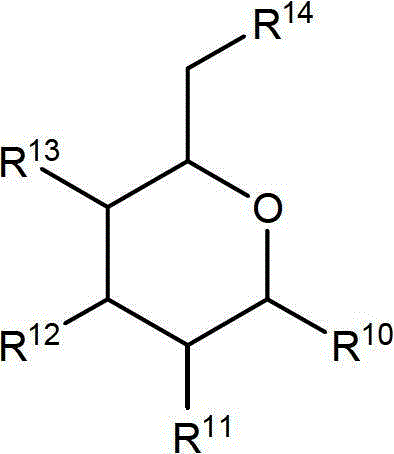
其中R11-R14独立地选自H、OH、C(O)CH3、NH和NH C(O)CH3。R10是与另一糖基残基的连接(-O-糖基)或与因子VII/因子VIIa肽的氨基酸的连接(-NH-(因子VII/因子VIIa))。R14是OR1、NHR1或NH-L-R1。R1和NH-L-R1如上所述。wherein R 11 -R 14 are independently selected from H, OH, C(O)CH 3 , NH and NHC(O)CH 3 . R 10 is a linkage to another glycosyl residue (-O-glycosyl) or to an amino acid of a Factor VII/Factor Vila peptide (-NH-(Factor VII/Factor Vila)). R 14 is OR 1 , NHR 1 or NH-LR 1 . R 1 and NH-LR 1 are as described above.
II.C.糖基连接基团 II.C. Glycosyl Linking Groups
在一种示例性的实施方案中,本发明提供在本发明的修饰的糖与因子VII/因子VIIa肽之间形成的肽缀合物。在另一示例性的实施方案中,当所述修饰的糖上的修饰基团为以下结构时In an exemplary embodiment, the invention provides a peptide conjugate formed between a modified saccharide of the invention and a Factor VII/Factor Vila peptide. In another exemplary embodiment, when the modification group on the modified sugar is the following structure

所述肽缀合物中的肽选自图13中的肽。在又一示例性的实施方案中,肽缀合物中的肽选自因子VII、因子VIIa、因子VIII、因子IX、因子X、因子XI、促红细胞生成素、粒细胞集落刺激因子(G-CSF)、粒细胞巨噬细胞集落刺激因子(GM-CSF)、干扰素-α、干扰素-β、干扰素-γ、α1-抗胰蛋白酶(ATT、或α-1蛋白酶抑制剂、葡糖脑苷脂酶、组织型纤维蛋白溶酶原活化剂(TPA)、白细胞介素-2(IL-2)、尿激酶、人脱氧核糖核酸酶、胰岛素、乙型肝炎表面蛋白(HbsAg)、人生长激素、TNF受体-IgG Fc区域融合蛋白(EnbrelTM)、抗-HER2单克隆抗体(HerceptinTM)、呼吸道合胞病毒F蛋白质单克隆抗体(SynagisTM)、TNF-α的单克隆抗体(RemicadeTM)、糖蛋白IIb/IIIa的单克隆抗体(ReoproTM)、CD20的单克隆抗体(RituxanTM)、抗凝血酶III(AT III)、人绒毛膜促性腺激素(hCG)、a-半乳糖苷酶(FabrazymeTM)、α-艾杜糖苷酶(AldurazymeTM)、促卵泡激素、β-葡糖苷酶、抗-TNF-a单克隆抗体(MLB5075)、胰高血糖素样肽-1(GLP-1)、β-葡糖苷酶(MLB5064)、a-半乳糖苷酶A(MLB5082)和成纤维细胞生长因子。在该实施方案中,修饰糖的糖供体部分(例如糖基部分和修饰基团)变成“糖基连接基团”。该“糖基连接基团”可替代地可以指位于肽和修饰基团之间的糖基部分。The peptides in the peptide conjugate are selected from the peptides in FIG. 13 . In yet another exemplary embodiment, the peptide in the peptide conjugate is selected from the group consisting of Factor VII, Factor Vila, Factor VIII, Factor IX, Factor X, Factor XI, Erythropoietin, Granulocyte Colony Stimulating Factor (G- CSF), granulocyte-macrophage colony-stimulating factor (GM-CSF), interferon-α, interferon-β, interferon-γ, α 1 -antitrypsin (ATT, or α-1 protease inhibitor, glucose Glucocerebrosidase, tissue plasminogen activator (TPA), interleukin-2 (IL-2), urokinase, human deoxyribonuclease, insulin, hepatitis B surface protein (HbsAg), Human growth hormone, TNF receptor-IgG Fc region fusion protein (Enbrel TM ), anti-HER2 monoclonal antibody (Herceptin TM ), respiratory syncytial virus F protein monoclonal antibody (Synagis TM ), monoclonal antibody to TNF-α (Remicade TM ), monoclonal antibody to glycoprotein IIb/IIIa (Reopro TM ), monoclonal antibody to CD20 (Rituxan TM ), antithrombin III (AT III), human chorionic gonadotropin (hCG), a -Galactosidase (Fabrazyme TM ), α-idurazyme TM , follicle stimulating hormone, β-glucosidase, anti-TNF-a monoclonal antibody (MLB5075), glucagon-like peptide- 1 (GLP-1), β-glucosidase (MLB5064), α-galactosidase A (MLB5082), and fibroblast growth factor. In this embodiment, the sugar donor moiety (e.g., glycosyl moiety and modifying group) becomes a "glycosyl linking group." The "glycosyl linking group" may alternatively refer to a glycosyl moiety located between the peptide and the modifying group.
在一种示例性的实施方案中,聚合物修饰基团具有下式的结构:In an exemplary embodiment, the polymer modifying group has the structure of the formula:

在一种示例性的实施方案中,所述修饰的糖上的修饰基团为:In an exemplary embodiment, the modifying group on the modified sugar is:
在一种示例性的实施方案中,A1和A2各自选自-OH和-OCH3。In an exemplary embodiment, A 1 and A 2 are each selected from —OH and —OCH 3 .
根据该实施方案的示例性的聚合物修饰基团包括:Exemplary polymer modifying groups according to this embodiment include:
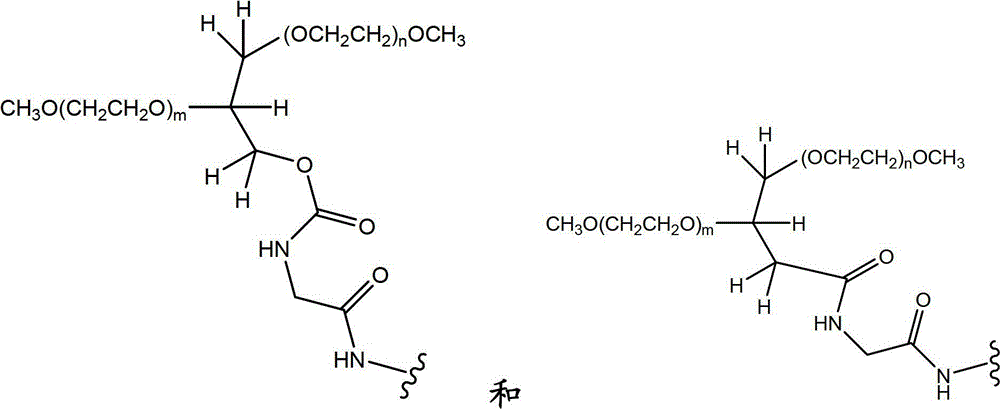
由于可用于在肽上加成和/或修饰糖基残基的方法的通用性,所述糖基连接基团可以具有基本上任何的结构。在下面的论述中,参照使用选定的呋喃糖和吡喃糖衍生物来举例说明本发明。本领域技术人员会认识到该论述集中在说明的清楚性而且所述的结构和组成通常可适用于各类糖基连接基团和修饰的糖。糖基连接基团可以包含实际上任何的单糖或寡糖。糖基连接基团可以通过侧链或通过肽主链与氨基酸结合。作为选择糖基连接基团可以通过糖基部分与肽结合。该糖基部分可以是肽上O-连接的或N-连接的聚糖结构的一部分。Due to the versatility of the methods available for adding and/or modifying glycosyl residues on peptides, the glycosyl linking group can have essentially any structure. In the following discussion, the invention is illustrated with reference to the use of selected furanose and pyranose derivatives. Those skilled in the art will recognize that this discussion focuses on clarity of illustration and that the structures and compositions described are generally applicable to a variety of glycosyl linking groups and modified sugars. The glycosyl linking group can comprise virtually any mono- or oligosaccharide. The glycosyl linking group can be attached to the amino acid through a side chain or through the peptide backbone. Alternatively the glycosyl linking group can be attached to the peptide through the glycosyl moiety. The glycosyl moiety may be part of an O-linked or N-linked glycan structure on the peptide.
在一种示例性的实施方案中,本发明提供包含具有选自以下的式的完整糖基连接基团的肽缀合物:In an exemplary embodiment, the invention provides a peptide conjugate comprising an intact glycosyl linking group having a formula selected from:
在式I中,R2是H、CH2OR7、COOR7或OR7,其中R7表示H、取代的或未取代的烃基或者取代的或未取代的杂烃基。当COOR7是羧酸或羧酸根时,两种形式都由单一结构的标记COO-或COOH表示。在式I和II中,符号R3、R4、R5、R6和R6’独立地表示H、取代的或未取代的烃基、OR8、NHC(O)R9。下标d是0或1。R8和R9独立地选自H、取代的或未取代的烃基、取代的或未取代的杂烃基、唾液酸或多聚唾液酸。R3、R4、R5、R6或R6’中的至少一个包括修饰基团。该修饰基团可以是通过键或连接基团相连的聚合物修饰基团例如PEG。在一种示例性的实施方案中,R6和R6’连同它们所结合的碳一起作为唾液酸的丙酮酰(pyruvyl)侧链的组分。在另一示例性的实施方案中,该丙酮酰(pyruvyl)侧链以聚合物修饰基团官能化。在另一示例性的实施方案中,R6和R6’连同它们所结合的碳一起作为唾液酸的侧链的组分以及聚合物修饰基团是R5的组分。In formula I, R 2 is H, CH 2 OR 7 , COOR 7 or OR 7 , wherein R 7 represents H, substituted or unsubstituted hydrocarbyl or substituted or unsubstituted heterohydrocarbyl. When COOR 7 is a carboxylic acid or carboxylate, both forms are represented by the single structure notation COO - or COOH. In formulas I and II, the symbols R 3 , R 4 , R 5 , R 6 and R 6 ′ independently represent H, substituted or unsubstituted hydrocarbyl, OR 8 , NHC(O)R 9 . Subscript d is 0 or 1. R8 and R9 are independently selected from H, substituted or unsubstituted hydrocarbyl, substituted or unsubstituted heterohydrocarbyl, sialic acid or polysialic acid. At least one of R 3 , R 4 , R 5 , R 6 or R 6 ′ includes a modifying group. The modifying group may be a polymer modifying group linked by a bond or linking group such as PEG. In an exemplary embodiment, R6 and R6 ', together with the carbon to which they are bound, are components of the pyruvyl side chain of sialic acid. In another exemplary embodiment, the pyruvyl side chain is functionalized with a polymer modifying group. In another exemplary embodiment, R 6 and R 6 ′, together with the carbon to which they are bound, are components of the side chain of sialic acid and the polymer modifying group is a component of R 5 .
在一种示例性的实施方案中,本发明采用具有下式的糖基连接基团:In an exemplary embodiment, the invention employs a glycosyl linking group having the formula:

其中J为糖基部分,L为键或接头以及R1为修饰基团,例如聚合物修饰基团。示例性的键为糖基部分上NH2部分与修饰基团上互补反应性的基团之间所形成的键。例如,当R1包含羧酸部分时,可以使该部分活化并与糖基残基上的NH2部分偶合,提供结构为NHC(O)R1的键。J优选为“完整的”糖基部分,其暴露于切割吡喃糖或呋喃糖结构的条件,例如氧化条件,例如高碘酸钠下未经降解。wherein J is a glycosyl moiety, L is a bond or linker and R is a modifying group, such as a polymer modifying group. An exemplary linkage is the linkage formed between the NH2 moiety on the glycosyl moiety and a complementary reactive group on the modifying group. For example, when R1 contains a carboxylic acid moiety, this moiety can be activated and coupled to an NH2 moiety on a glycosyl residue, providing a bond of the structure NHC(O) R1 . J is preferably an "intact" glycosyl moiety which is not degraded by exposure to conditions which cleave the pyranose or furanose structure, eg oxidative conditions eg sodium periodate.
示例性的接头包括烃基和杂烃基部分。接头包括连接基团,例如基于酰基的连接基团如-C(O)NH-、-OC(O)NH-等。连接基团为本发明物种组分之间形成的键,例如在糖基部分和接头(L)之间,或者在接头和修饰基团(R1)之间。其他示例性的连接基团为醚、硫醚和胺。例如,在一种实施方案中,接头为氨基酸残基,例如甘氨酸残基。甘氨酸的羧酸部分通过与糖基残基上的胺反应转化为相应的酰胺,而甘氨酸的胺通过与修饰基团上活化的羧酸或碳酸根反应转化为相应的酰胺或氨基甲酸酯。Exemplary linkers include hydrocarbyl and heterohydrocarbyl moieties. Linkers include linking groups such as acyl-based linking groups such as -C(O)NH-, -OC(O)NH-, and the like. A linking group is a bond formed between components of a species of the invention, for example between a glycosyl moiety and a linker (L), or between a linker and a modifying group (R 1 ). Other exemplary linking groups are ethers, thioethers and amines. For example, in one embodiment, the linker is an amino acid residue, such as a glycine residue. The carboxylic acid moiety of glycine is converted to the corresponding amide by reaction with the amine on the glycosyl residue, while the amine of glycine is converted to the corresponding amide or carbamate by reaction with the activated carboxylic acid or carbonate on the modifying group.
示例性的NH-L-R1物种具有下式:-NH{C(O)(CH2)aNH}s{C(O)(CH2)b(OCH2CH2)cO(CH2)dNH}tR1,其中下标s和t独立地为0或1。下标a、b和d独立地为0-20的整数,以及c为1-2500的整数。其他类似的接头基于其中-NH部分由另一基团,例如-S、-O或-CH2代替的物种。如同技术人员会意识到的那样,一个或多个对应于下标s和t的括号部分可以由取代的或未取代的烃基或杂烃基部分代替。An exemplary NH-LR 1 species has the formula: -NH{C(O)( CH2 ) aNH } s {C(O)( CH2 ) b ( OCH2CH2 ) cO ( CH2 ) d NH} t R 1 , wherein the subscripts s and t are independently 0 or 1. The subscripts a, b and d are independently an integer of 0-20, and c is an integer of 1-2500. Other similar linkers are based on species in which the -NH moiety is replaced by another group, such as -S, -O or -CH2 . One or more of the bracketed moieties corresponding to the subscripts s and t may be replaced by a substituted or unsubstituted hydrocarbyl or heterohydrocarbyl moiety, as will be appreciated by the skilled artisan.
更具体地,本发明采用其中NH-L-R1为以下结构的化合物:NHC(O)(CH2)aNHC(O)(CH2)b(OCH2CH2)cO(CH2)dNHR1、NHC(O)(CH2)b(OCH2CH2)cO(CH2)dNHR1、NHC(O)O(CH2)b(OCH2CH2)cO(CH2)dNHR1、NH(CH2)aNHC(O)(CH2)b(OCH2CH2)cO(CH2)dNHR1、NHC(O)(CH2)aNHR1、NH(CH2)aNHR1和NHR1。在这些式中,下标a、b和d独立地选自0-20的整数,优选1-5。下标c为1-约2500的整数。More specifically, the present invention employs compounds wherein NH-LR 1 is the following structure: NHC(O)(CH 2 ) a NHC(O)(CH 2 ) b (OCH 2 CH 2 ) c O(CH 2 ) d NHR 1. NHC(O)(CH 2 ) b (OCH 2 CH 2 ) c O(CH 2 ) d NHR 1 , NHC(O)O(CH 2 ) b (OCH 2 CH 2 ) c O(CH 2 ) d NHR 1 , NH(CH 2 ) a NHC(O)(CH 2 ) b (OCH 2 CH 2 ) c O(CH 2 ) d NHR 1 , NHC(O)(CH 2 ) a NHR 1 , NH(CH 2 ) a NHR 1 and NHR 1 . In these formulas, the subscripts a, b and d are independently selected from an integer of 0-20, preferably 1-5. The subscript c is an integer from 1 to about 2500.
在一种示例性的实施方案中,选择c以使得PEG部分为约1kD、5kD、10kD、15kD、20kD、25kD、30kD、35kD、40kD或45kD。In an exemplary embodiment, c is selected such that the PEG moiety is about 1 kD, 5 kD, 10 kD, 15 kD, 20 kD, 25 kD, 30 kD, 35 kD, 40 kD, or 45 kD.
为了方便,本节其余部分中的糖基连接基团将基于唾液酰基部分。然而,本领域技术人员会认识到其他糖基部分例如甘露糖基、半乳糖基、葡萄糖基或岩藻糖基可以代替唾液酰基部分使用。For convenience, the glycosyl linking group in the remainder of this section will be based on a sialyl moiety. However, those skilled in the art will recognize that other glycosyl moieties such as mannosyl, galactosyl, glucosyl or fucosyl may be used in place of the sialyl moiety.
在一种示例性的实施方案中,糖基连接基团为完整的糖基连接基团,其中形成该连接基团的糖基部分或多个部分不会由于化学(例如偏高碘酸钠)或酶(例如氧化酶)过程而降解。本发明选定的缀合物包含与氨基糖例如甘露糖胺、葡糖胺、半乳糖胺、唾液酸等的胺部分结合的修饰基团。根据该模体的示例性的修饰基团-完整的糖基连接基团盒基于唾液酸结构,例如具有下式的那些:In an exemplary embodiment, the glycosyl linking group is a complete glycosyl linking group, wherein the glycosyl moiety or moieties forming the linking group are free from chemical (e.g., sodium metaperiodate) Or enzymatic (such as oxidase) process and degradation. Selected conjugates of the invention comprise a modifying group attached to the amine moiety of an amino sugar such as mannosamine, glucosamine, galactosamine, sialic acid, and the like. Exemplary modifying groups according to this motif - complete glycosyl linker cassettes are based on sialic acid structures, such as those having the formula:
在上式中,R1和L如上所述。关于示例性的R1基团结构的更多细节在下面提供。In the above formula, R 1 and L are as described above. Further details regarding exemplary R group structures are provided below.
在又一示例性的实施方案中,在肽与其中修饰基团通过接头在修饰的糖6-碳位上结合的修饰的糖之间形成缀合物。因此,根据该实施方案的说明性的糖基连接基团具有下式:In yet another exemplary embodiment, a conjugate is formed between a peptide and a modified sugar in which a modifying group is attached via a linker at the 6-carbon position of the modified sugar. Thus, an illustrative glycosyl linking group according to this embodiment has the formula:

其中各基团如上所述。糖基连接基团不限制地包括葡萄糖、葡糖胺、N-乙酰-葡糖胺、半乳糖、半乳糖胺、N-乙酰-半乳糖胺、甘露糖、甘露糖胺、N-乙酰-甘露糖胺等。Wherein each group is as above. Glycosyl linking groups include, without limitation, glucose, glucosamine, N-acetyl-glucosamine, galactose, galactosamine, N-acetyl-galactosamine, mannose, mannosamine, N-acetyl-mannose Glucosamine etc.
在一种实施方案中,本发明提供包含以下糖基连接基团的肽缀合物:In one embodiment, the invention provides a peptide conjugate comprising the following glycosyl linking group:

其中D选自-OH和R1-L-HN-;G选自H和R1-L-和-C(O)(C1-C6)烃基;R1是包含直链或支化的聚(乙二醇)残基的部分;以及L是接头,例如键(“零级”)、取代的或未取代的烃基和取代的或未取代的杂烃基。在示例性的实施方案中,当D为OH时,G为R1-L-,以及当G为-C(O)(C1-C6)烃基时,D为R1-L-NH-。Wherein D is selected from -OH and R 1 -L-HN-; G is selected from H and R 1 -L- and -C(O)(C 1 -C 6 )hydrocarbyl; R 1 is a linear or branched part of a poly(ethylene glycol) residue; and L is a linker, such as a bond ("zero order"), substituted or unsubstituted hydrocarbyl, and substituted or unsubstituted heterohydrocarbyl. In an exemplary embodiment, when D is OH, G is R 1 -L-, and when G is -C(O)(C 1 -C 6 )hydrocarbyl, D is R 1 -L-NH- .
在一种实施方案中,本发明提供包含以下糖基连接基团的肽缀合物:In one embodiment, the invention provides a peptide conjugate comprising the following glycosyl linking group:
D选自-OH和R1-L-HN-;G选自R1-L-和-C(O)(C1-C6)烃基-R1;R1是包含选自直链聚(乙二醇)残基和支化聚(乙二醇)残基中的成员的部分;以及M选自H、盐反荷离子和单个负电荷;L是选自键、取代的或未取代的烃基和取代的或未取代的杂烃基的接头。在一种示例性的实施方案中,当D为OH时,G为R1-L-。在另一示例性的实施方案中,当G为-C(O)(C1-C6)烃基时,D为R1-L-NH-。D is selected from -OH and R 1 -L-HN-; G is selected from R 1 -L- and -C(O)(C 1 -C 6 )hydrocarbyl-R 1 ; R 1 is selected from linear poly( ethylene glycol) residues and members of branched poly(ethylene glycol) residues; and M is selected from H, a salt counterion and a single negative charge; L is selected from a bond, substituted or unsubstituted Hydrocarbyl and substituted or unsubstituted heterohydrocarbyl linkers. In an exemplary embodiment, when D is OH, G is R 1 -L-. In another exemplary embodiment, when G is -C(O)(C 1 -C 6 )hydrocarbyl, D is R 1 -L-NH-.
在任何本发明的化合物中,COOH基团也可以是COOM,其中M选自H、负电荷、及盐反荷离子。In any of the compounds of the present invention, the COOH group may also be COOM, where M is selected from H, a negative charge, and a salt counterion.
本发明提供包含具有下式的糖基连接基团的肽缀合物:The present invention provides peptide conjugates comprising a glycosyl linking group having the formula:
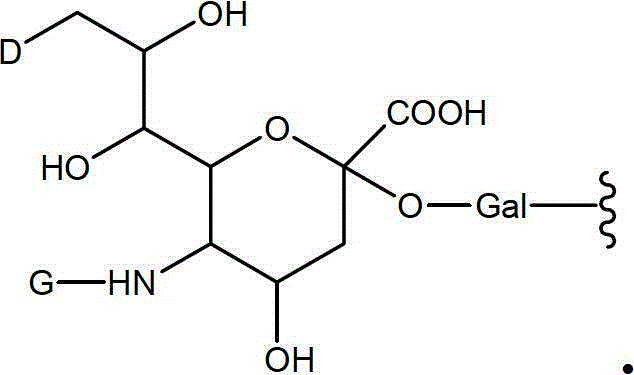
在另外的实施方案中,糖基连接基团具有下式:In additional embodiments, the glycosyl linking group has the formula:

其中下标t为0或1。where the subscript t is 0 or 1.
在又一示例性的实施方案中,糖基连接基团具有下式:In yet another exemplary embodiment, the glycosyl linking group has the formula:

其中下标t为0或1。where the subscript t is 0 or 1.
在另一实施方案中,糖基连接基团具有下式:In another embodiment, the glycosyl linking group has the formula:

其中下标p表示1-10的整数;以及a为0或1。Wherein the subscript p represents an integer of 1-10; and a is 0 or 1.
在另一示例性的实施方案中,所述肽缀合物包含选自下列式的糖基部分:In another exemplary embodiment, the peptide conjugate comprises a glycosyl moiety selected from the following formulae:


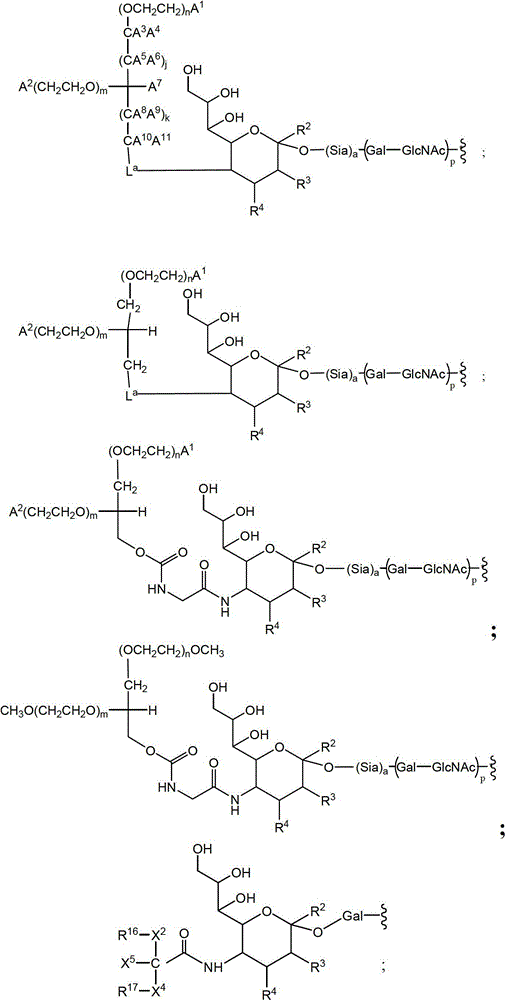


其中下标a和接头La如上所述。下标p为1-10的整数。下标t和a独立地选自0或1。可以包含这些基团中的每一个作为上述单-、二-、三-和四天线(antennary)糖结构的组分。AA是肽的氨基酸残基。Wherein the subscript a and the linker L a are as described above. The subscript p is an integer of 1-10. The subscripts t and a are independently selected from 0 or 1 . Each of these groups may be included as a component of the mono-, di-, tri- and tetra-antennary sugar structures described above. AA is the amino acid residue of the peptide.
在一种示例性的实施方案中,PEG部分具有约20KDa的分子量。在另一示例性的实施方案中,PEG部分具有约5KDa的分子量。在另一示例性的实施方案中,PEG部分具有约10KDa的分子量。在另一示例性的实施方案中,PEG部分具有约40KDa的分子量。In an exemplary embodiment, the PEG moiety has a molecular weight of about 20 KDa. In another exemplary embodiment, the PEG moiety has a molecular weight of about 5 KDa. In another exemplary embodiment, the PEG moiety has a molecular weight of about 10 KDa. In another exemplary embodiment, the PEG moiety has a molecular weight of about 40 KDa.
在一种示例性的实施方案中,糖基连接基团为基于半胱氨酸残基的支化SA-PEG-10KDa部分,而且一个或两个这些糖基连接基团与肽共价结合。在另一示例性的实施方案中,糖基连接基团为基于赖氨酸残基的支化SA-PEG-10KDa部分,而且一个或两个这些糖基连接基团与肽共价结合。在一种示例性的实施方案中,糖基连接基团为基于半胱氨酸残基的支化SA-PEG-10KDa部分,而且一个或两个这些糖基连接基团与肽共价结合。在一种示例性的实施方案中,糖基连接基团为基于赖氨酸残基的支化SA-PEG-10KDa部分,而且一个或两个这些糖基连接基团与肽共价结合。在一种示例性的实施方案中,糖基连接基团为基于半胱氨酸残基的支化SA-PEG-5KDa部分,而且一个、两个或三个这些糖基连接基团与肽共价结合。在一种示例性的实施方案中,糖基连接基团为基于赖氨酸残基的支化SA-PEG-5KDa部分,而且一个、两个或三个这些糖基连接基团与肽共价结合。在一种示例性的实施方案中,糖基连接基团为基于半胱氨酸残基的支化SA-PEG-40KDa部分,而且一个或两个这些糖基连接基团与肽共价结合。在一种示例性的实施方案中,糖基连接基团为基于赖氨酸残基的支化SA-PEG-40KDa部分,而且一个或两个这些糖基连接基团与肽共价结合。In an exemplary embodiment, the glycosyl linking group is a branched SA-PEG-10 KDa moiety based on cysteine residues, and one or two of these glycosyl linking groups are covalently attached to the peptide. In another exemplary embodiment, the glycosyl linking group is a branched SA-PEG-10 KDa moiety based on lysine residues, and one or two of these glycosyl linking groups are covalently attached to the peptide. In an exemplary embodiment, the glycosyl linking group is a branched SA-PEG-10 KDa moiety based on cysteine residues, and one or two of these glycosyl linking groups are covalently attached to the peptide. In an exemplary embodiment, the glycosyl linking group is a branched SA-PEG-10 KDa moiety based on lysine residues, and one or two of these glycosyl linking groups are covalently attached to the peptide. In an exemplary embodiment, the glycosyl linking group is a branched SA-PEG-5KDa moiety based on cysteine residues and one, two or three of these glycosyl linking groups are shared with the peptide. price combination. In an exemplary embodiment, the glycosyl linking group is a branched SA-PEG-5KDa moiety based on lysine residues and one, two or three of these glycosyl linking groups are covalently attached to the peptide combined. In an exemplary embodiment, the glycosyl linking group is a branched SA-PEG-40KDa moiety based on cysteine residues, and one or two of these glycosyl linking groups are covalently attached to the peptide. In an exemplary embodiment, the glycosyl linking group is a branched SA-PEG-40KDa moiety based on lysine residues, and one or two of these glycosyl linking groups are covalently attached to the peptide.
在一种示例性的实施方案中,本发明的糖基聚乙二醇化的肽缀合物选自以下所述的式:In an exemplary embodiment, the glycopegylated peptide conjugates of the invention are selected from the formulas described below:

在上式中,下标t为0-1的整数以及下标p为1-10的整数。符号R15’表示H、OH(例如Gal-OH)、唾液酰基部分、唾液酰基连接基团(例如唾液酰基连接基团-聚合物修饰基团(Sia-L-R1),或者与聚合物修饰的唾液酰基部分结合的唾液酰基部分(例如Sia-Sia-L-R1)(“Sia-Siap”))。示例性的聚合物修饰的糖基部分具有式I和II的结构。示例性的本发明肽缀合物将包含至少一个具有包含式I或II结构的R15’的聚糖。式I和II的具有开放价的氧优选通过糖苷键与Gal或GalNAc部分的碳结合。在另一示例性的实施方案中,氧与半乳糖残基3位上的碳结合。在一种示例性的实施方案中,修饰的唾液酸α2,3-连接至半乳糖残基上。在另一示例性的实施方案中,唾液酸α2,6-连接至半乳糖残基上。In the above formula, the subscript t is an integer of 0-1 and the subscript p is an integer of 1-10. The symbol R 15 ' represents H, OH (such as Gal- OH ), sialyl moiety, sialyl linking group (such as sialyl linking group-polymer modification group (Sia-LR 1 ), or polymer-modified A sialyl moiety to which a sialyl moiety is bound (eg, Sia-Sia-LR 1 ) (“Sia-Sia p ”)). Exemplary polymer-modified glycosyl moieties have the structures of Formulas I and II. Exemplary peptide conjugates of the invention will comprise at least one glycan having R15 ' comprising a structure of formula I or II. The oxygen with the open valence of formulas I and II is preferably bonded to the carbon of the Gal or GalNAc moiety via a glycosidic bond. In another exemplary embodiment, the oxygen is bonded to the carbon at
在一种示例性的实施方案中,唾液酰基连接基团是与聚合物修饰的唾液酰基部分结合的唾液酰基部分(例如Sia-Sia-L-R1)(“Sia-Siap”)。这里,糖基连接基团通过唾液酰基部分与半乳糖基部分结合:In an exemplary embodiment, the sialyl linking group is a sialyl moiety (eg, Sia-Sia-LR 1 ) bound to a polymer-modified sialyl moiety (“Sia-Sia p ”). Here, the glycosyl linker is attached to the galactosyl moiety via the sialyl moiety:

根据该模体的示例性物种通过用形成Sia-Sia键的酶例如CST-II、ST8Sia-II、ST8Sia-III和ST8Sia-IV,使Sia-L-R1与聚糖的末端唾液酸缀合来制成。Exemplary species according to this motif are prepared by conjugating Sia- LR1 to the terminal sialic acid of a glycan with a Sia-Sia bond forming enzyme such as CST-II, ST8Sia-II, ST8Sia-III and ST8Sia-IV become.
在另一示例性的实施方案中,肽缀合物上的聚糖具有选自以下的式:In another exemplary embodiment, the glycan on the peptide conjugate has a formula selected from:
及其组合。and combinations thereof.
在每一个上述式中,R15’如上所述。此外,示例性的本发明肽缀合物将包含至少一个带有具备式I或II结构的R15’部分的聚糖。In each of the above formulas, R 15 ' is as described above. Additionally, exemplary peptide conjugates of the invention will comprise at least one glycan with an R15 ' moiety having the structure of Formula I or II.
在另一示例性的实施方案中,糖基连接基团包含至少一种具有下式的糖基连接基团:In another exemplary embodiment, the glycosyl linking group comprises at least one glycosyl linking group having the formula:

其中R15是所述唾液酰基连接基团;以及下标p是选自1-10的整数。wherein R 15 is said sialyl linking group; and subscript p is an integer selected from 1-10.
在一种示例性的实施方案中,糖基连接部分具有下式:In an exemplary embodiment, the glycosyl linking moiety has the formula:
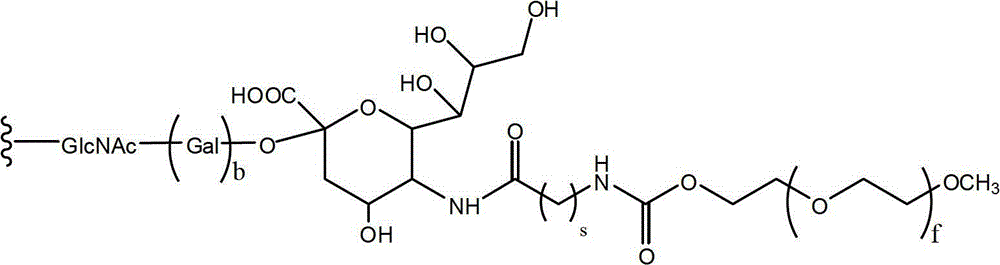
其中b是0-1的整数。下标s表示1-10的整数;以及下标f表示1-2500的整数。Wherein b is an integer of 0-1. The subscript s represents an integer of 1-10; and the subscript f represents an integer of 1-2500.
在一种示例性的实施方案中,聚合物修饰基团为PEG。在另一示例性的实施方案中,PEG部分具有约20KDa的分子量。在另一示例性的实施方案中,PEG部分具有约5KDa的分子量。在另一示例性的实施方案中,PEG部分具有约10KDa的分子量。在另一示例性的实施方案中,PEG部分具有约40KDa的分子量。在另一示例性的实施方案中,糖基连接基团与Asn145、Asn322、Ser52、Ser60或其组合结合。In an exemplary embodiment, the polymer modifying group is PEG. In another exemplary embodiment, the PEG moiety has a molecular weight of about 20 KDa. In another exemplary embodiment, the PEG moiety has a molecular weight of about 5 KDa. In another exemplary embodiment, the PEG moiety has a molecular weight of about 10 KDa. In another exemplary embodiment, the PEG moiety has a molecular weight of about 40 KDa. In another exemplary embodiment, the glycosyl linking group is bound to Asn145, Asn322, Ser52, Ser60, or a combination thereof.
在一种示例性的实施方案中,糖基连接基团为线性SA-PEG-10KDa部分,而且一个或两个这些糖基连接基团与肽共价结合。在另一示例性的实施方案中,糖基连接基团为线性SA-PEG-20KDa部分,而且一个或两个这些糖基连接基团与肽共价结合。在一种示例性的实施方案中,糖基连接基团为线性SA-PEG-5KDa部分,而且一个、两个或三个这些糖基连接基团与肽共价结合。在一种示例性的实施方案中,糖基连接基团为线性SA-PEG-40KDa部分,而且一个或两个这些糖基连接基团与肽共价结合。In an exemplary embodiment, the glycosyl linking group is a linear SA-PEG-10KDa moiety, and one or two of these glycosyl linking groups are covalently attached to the peptide. In another exemplary embodiment, the glycosyl linking group is a linear SA-PEG-20KDa moiety, and one or two of these glycosyl linking groups are covalently attached to the peptide. In an exemplary embodiment, the glycosyl linking group is a linear SA-PEG-5KDa moiety and one, two or three of these glycosyl linking groups are covalently attached to the peptide. In an exemplary embodiment, the glycosyl linking group is a linear SA-PEG-40 KDa moiety, and one or two of these glycosyl linking groups are covalently attached to the peptide.
在另一示例性的实施方案中,糖基连接基团为具有下式的唾液酰基连接基团:In another exemplary embodiment, the glycosyl linking group is a sialyl linking group having the formula:
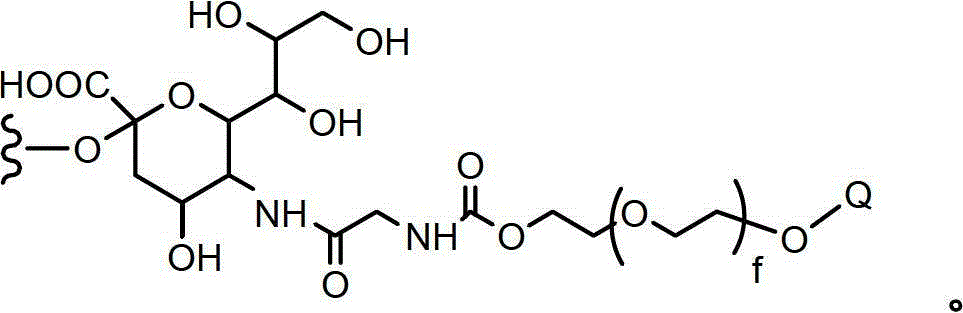
在另一示例性的实施方案中,Q选自H和CH3。在另一示例性的实施方案中,其中所述糖基连接基团具有下式:In another exemplary embodiment, Q is selected from H and CH3 . In another exemplary embodiment, wherein said glycosyl linking group has the formula:

其中R15是所述唾液酰基连接基团;以及下标p为选自1-10的整数。在一种示例性的实施方案中,糖基连接基团包含下式:wherein R 15 is the sialyl linking group; and subscript p is an integer selected from 1-10. In an exemplary embodiment, the glycosyl linking group comprises the formula:
其中下标b为选自0和1的整数。在一种示例性的实施方案中,下标s为1;以及下标f为选自约200-约300的整数。在另一示例性的实施方案中,糖基连接基团选自SA-PEG-10KDa和SA-PEG-20KDa,以及其中与因子VII/因子VIIa肽共价结合的所述糖基连接基团的数目为选自1-2的整数。在另一示例性的实施方案中,糖基连接基团选自SA-PEG-5KDa和SA-PEG-40KDa,以及其中与因子VII/因子VIIa肽共价结合的所述糖基连接基团的数目为选自1-3的整数。Wherein the subscript b is an integer selected from 0 and 1. In an exemplary embodiment, subscript s is 1; and subscript f is an integer selected from about 200 to about 300. In another exemplary embodiment, the glycosyl linking group is selected from SA-PEG-10KDa and SA-PEG-20KDa, and wherein the glycosyl linking group covalently bound to the Factor VII/Factor VIIa peptide The number is an integer selected from 1-2. In another exemplary embodiment, the glycosyl linking group is selected from SA-PEG-5KDa and SA-PEG-40KDa, and wherein the glycosyl linking group covalently bound to the Factor VII/Factor VIIa peptide The number is an integer selected from 1-3.
II.D.修饰基团 II.D. Modifying groups
本发明的肽缀合物包含修饰基团。该基团可以通过氨基酸或糖基连接基团与因子VII/因子VIIa肽共价结合。在另一示例性的实施方案中,当修饰基团为以下结构时,The peptide conjugates of the invention comprise a modifying group. This group can be covalently attached to the Factor VII/Factor Vila peptide via an amino acid or glycosyl linking group. In another exemplary embodiment, when the modifying group is the following structure,
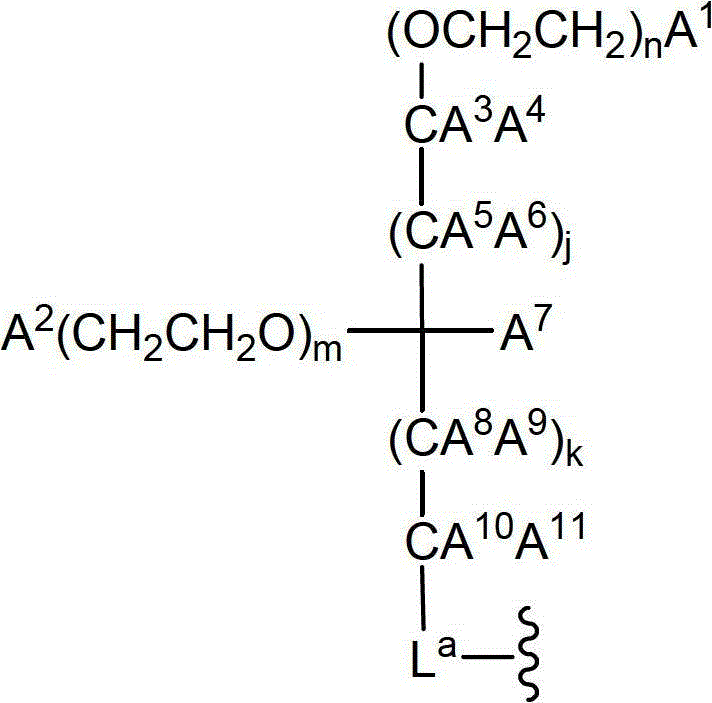
所述肽缀合物中的肽选自图13中的肽。在另一示例性的实施方案中,肽缀合物中的肽选自因子VII、因子VIIa、因子VIII、因子IX、因子X、因子XI、促红细胞生成素、粒细胞集落刺激因子(G-CSF)、粒细胞巨噬细胞集落刺激因子(GM-CSF)、干扰素-α、干扰素-β、干扰素-γ、α1-抗胰蛋白酶(ATT、或α-1蛋白酶抑制剂、葡糖脑苷脂酶、组织型纤维蛋白溶酶原活化剂(TPA)、白细胞介素-2(IL-2)、尿激酶、人脱氧核糖核酸酶、胰岛素、乙型肝炎表面蛋白(HbsAg)、人生长激素、TNF受体-IgG Fc区域融合蛋白(EnbrelTM)、抗-HER2单克隆抗体(HerceptinTM)、呼吸道合胞病毒F蛋白质单克隆抗体(SynagisTM)、TNF-α的单克隆抗体(RemicadeTM)、糖蛋白IIb/IIIa的单克隆抗体(ReoproTM)、CD20的单克隆抗体(RituxanTM)、抗凝血酶III(AT III)、人绒毛膜促性腺激素(hCG)、α-半乳糖苷酶(FabrazymeTM)、a-艾杜糖苷酶(AldurazymeTM)、促卵泡激素、β-葡糖苷酶、抗-TNF-a单克隆抗体(MLB5075)、胰高血糖素样肽-1(GLP-1)、β-葡糖苷酶(MLB 5064)、a-半乳糖苷酶A(MLB 5082)和成纤维细胞生长因子。“修饰基团”可以包含多种结构,包括靶向部分、治疗部分、生物分子。另外,“修饰基团”包括聚合物修饰基团,其为能够改变肽的性质例如其生物利用度或其在体内的半衰期的聚合物。The peptides in the peptide conjugate are selected from the peptides in FIG. 13 . In another exemplary embodiment, the peptide in the peptide conjugate is selected from the group consisting of Factor VII, Factor Vila, Factor VIII, Factor IX, Factor X, Factor XI, Erythropoietin, Granulocyte Colony Stimulating Factor (G- CSF), granulocyte-macrophage colony-stimulating factor (GM-CSF), interferon-α, interferon-β, interferon-γ, α 1 -antitrypsin (ATT, or α-1 protease inhibitor, glucose Glucocerebrosidase, tissue plasminogen activator (TPA), interleukin-2 (IL-2), urokinase, human deoxyribonuclease, insulin, hepatitis B surface protein (HbsAg), Human growth hormone, TNF receptor-IgG Fc region fusion protein (Enbrel TM ), anti-HER2 monoclonal antibody (Herceptin TM ), respiratory syncytial virus F protein monoclonal antibody (Synagis TM ), monoclonal antibody to TNF-α (Remicade TM ), monoclonal antibody to glycoprotein IIb/IIIa (Reopro TM ), monoclonal antibody to CD20 (Rituxan TM ), antithrombin III (AT III), human chorionic gonadotropin (hCG), alpha -Galactosidase (Fabrazyme TM ), α-idurosidase (Aldurazyme TM ), follicle stimulating hormone, β-glucosidase, anti-TNF-α monoclonal antibody (MLB5075), glucagon-like peptide- 1 (GLP-1), β-glucosidase (MLB 5064), α-galactosidase A (MLB 5082), and fibroblast growth factor. "Modifying groups" can include a variety of structures, including targeting moieties , a therapeutic moiety, a biomolecule. Additionally, a "modifying group" includes a polymeric modifying group, which is a polymer capable of altering a property of a peptide such as its bioavailability or its half-life in vivo.
在一种示例性的实施方案中,聚合物修饰基团具有下列式的结构:In an exemplary embodiment, the polymer modifying group has the structure of the formula:

在根据上式的另一示例性实施方案中,聚合物修饰基团具有根据以下式的结构:In another exemplary embodiment according to the above formula, the polymer modifying group has a structure according to the following formula:
在一种示例性的实施方案中,A1和A2各自选自-OH和-OCH3。In an exemplary embodiment, A 1 and A 2 are each selected from —OH and —OCH 3 .
示例性的根据该实施方案的聚合物修饰基团包括:Exemplary polymer modifying groups according to this embodiment include:

为了方便,本节其余部分中的修饰基团将主要基于聚合物修饰基团例如水溶性的和水不溶性聚合物。然而,本领域技术人员会认识到可以使用其他修饰基团例如靶向部分、治疗部分和生物分子代替聚合物修饰基团。For convenience, the modifying groups in the remainder of this section will be based primarily on polymer modifying groups such as water-soluble and water-insoluble polymers. However, those skilled in the art will recognize that other modifying groups such as targeting moieties, therapeutic moieties, and biomolecules can be used in place of the polymer modifying groups.
II.D.i.修饰基团的接头 II. Linkers for Di-modifying groups
修饰基团的接头用于将修饰基团(即聚合物修饰基团、靶向部分、治疗部分和生物分子)结合至肽上。在一种示例性的实施方案中,如下所示,聚合物修饰基团通过接头L一般经由核心上的杂原子例如氮结合至糖基连接基团上:Linkers for modifying groups are used to attach modifying groups (i.e., polymer modifying groups, targeting moieties, therapeutic moieties, and biomolecules) to peptides. In an exemplary embodiment, the polymer modifying group is bound to the glycosyl linking group through a linker L, typically via a heteroatom, such as nitrogen, on the core, as follows:
R1是聚合物部分而L选自键和连接基团。下标w表示选自1-6,优选1-3和更优选1-2的整数。示例性的连接基团包括取代的或未取代的烃基、取代的或未取代的杂烃基部分和唾液酸。示例性的接头组分是酰基部分。R 1 is a polymer moiety and L is selected from a bond and a linking group. The subscript w represents an integer selected from 1-6, preferably 1-3 and more preferably 1-2. Exemplary linking groups include substituted or unsubstituted hydrocarbyl, substituted or unsubstituted heterohydrocarbyl moieties, and sialic acid. An exemplary linker component is an acyl moiety.
示例性的本发明化合物具有上述式I或II的结构,其中R2、R3、R4、R5、R6或R6’中的至少一个具有下式:Exemplary compounds of the invention have the structure of formula I or II above, wherein at least one of R 2 , R 3 , R 4 , R 5 , R 6 or R 6 ′ has the following formula:

在根据本实施方案的另一实例中,R2、R3、R4、R5、R6或R6’中的至少一个具有下式:In another example according to this embodiment, at least one of R 2 , R 3 , R 4 , R 5 , R 6 or R 6 ′ has the following formula:
其中s为0-20的整数以及R1是线性聚合物修饰基团。Wherein s is an integer of 0-20 and R 1 is a linear polymer modification group.
在一种示例性的实施方案中,聚合物修饰基团-接头构造物(construct)为支化结构,其包含与中心部分结合的两个或更多个聚合物链。在该实施方案中,构造物具有下式:In an exemplary embodiment, the polymer modifying group-linker construct is a branched structure comprising two or more polymer chains bound to a central moiety. In this embodiment, the construct has the formula:

其中R1和L如上所述以及w’为2-6,优选2-4以及更优选2-3的整数。wherein R 1 and L are as described above and w' is an integer of 2-6, preferably 2-4 and more preferably 2-3.
当L为键时,它在R1的前体上的反应性官能团与糖基核心上具有互补反应性的反应性官能团之间形成。当L为非零级接头时,在与R1前体反应之前L的前体可以处于糖基部分的适当位置上。作为选择,可以使R1和L的前体结合入预先形成的盒中,其随后连接到糖基部分上。如本文所述,具有合适反应性官能团的前体的选择和制备在本领域技术人员的能力范围内。此外,前体的偶合通过本领域熟知的化学方式进行。When L is a bond, it is formed between a reactive functional group on the precursor of R and a reactive functional group of complementary reactivity on the glycosyl core. When L is a non-zero order linker, the precursor of L may be in place on the glycosyl moiety prior to reaction with the R1 precursor. Alternatively, precursors to R1 and L can be incorporated into a pre-formed cassette, which is subsequently attached to the glycosyl moiety. As described herein, the selection and preparation of precursors with suitable reactive functional groups is within the purview of those skilled in the art. Furthermore, the coupling of the precursors is performed by chemical means well known in the art.
在一种示例性的实施方案中,L是由氨基酸或小肽所形成的连接基团(例如1-4个氨基酸残基),它提供其中聚合物修饰基团通过取代的烃基接头结合的修饰的糖。示例性的接头包括甘氨酸、赖氨酸、丝氨酸和半胱氨酸。PEG部分可以通过酰胺或氨基甲酸酯键与接头的胺部分结合。PEG分别通过硫醚或醚键连接至半胱氨酸和丝氨酸的硫或氧原子上。In an exemplary embodiment, L is a linker group (eg, 1-4 amino acid residues) formed from an amino acid or a small peptide, which provides a modification in which the polymer modification group is attached via a substituted hydrocarbyl linker. of sugar. Exemplary linkers include glycine, lysine, serine and cysteine. The PEG moiety can be attached to the amine portion of the linker through an amide or carbamate linkage. PEG is attached to the sulfur or oxygen atoms of cysteine and serine through thioether or ether linkages, respectively.
在一种示例性的实施方案中,R5包含聚合物修饰基团。在另一示例性的实施方案中,R5同时包含聚合物修饰基团和将修饰基团连接到分子其余部分上的接头L。如上所述,L可以是线性或支化的结构。类似地,聚合物修饰基团可以是支化或线性的。In an exemplary embodiment, R 5 comprises a polymer modifying group. In another exemplary embodiment, R5 comprises both a polymer modifying group and a linker L linking the modifying group to the rest of the molecule. As mentioned above, L can be a linear or branched structure. Similarly, polymer modifying groups can be branched or linear.
II.D.ii.水溶性聚合物 II.D.ii. Water-soluble polymers
许多水溶性聚合物为本领域技术人员已知而且可用于实践本发明。术语水溶性聚合物包括例如糖(例如葡聚糖、直链淀粉、透明质酸、多聚(唾液酸)、类肝素、肝素等);聚(氨基酸)例如聚(天冬氨酸)和聚(谷氨酸);核酸;合成聚合物(例如聚(丙烯酸)、聚醚如聚(乙二醇));肽、蛋白质等物种。本发明可以用任何水溶性聚合物来实施,唯一的限制在于该聚合物必须包含缀合物的其余部分能够与它结合的位点。Many water soluble polymers are known to those skilled in the art and can be used in the practice of this invention. The term water-soluble polymer includes, for example, sugars (such as dextran, amylose, hyaluronic acid, poly(sialic acid), heparinoids, heparin, etc.); poly(amino acids) such as poly(aspartic acid) and poly (glutamic acid); nucleic acids; synthetic polymers (e.g. poly(acrylic acid), polyethers such as poly(ethylene glycol)); peptides, proteins, and other species. The invention can be practiced with any water soluble polymer, the only limitation being that the polymer must contain sites to which the rest of the conjugate can bind.
活化聚合物的方法也可以见WO 94/17039、美国专利No.5,324,844、WO 94/18247、WO 94/04193、美国专利No.5,219,564、美国专利No.5,122,614、WO 90/13540、美国专利No.5,281,698以及WO 93/15189,以及对于活化的聚合物和肽之间的缀合参见以下文献,例如凝血因子VIII(WO 94/15625)、血红蛋白(WO 94/09027)、载氧分子(美国专利No.4,412,989)、核糖核酸酶和超氧化物歧化酶(Veronese等,App.Biochem.Biotech.11:141-45(1985))。Methods of activating polymers can also be found in WO 94/17039, U.S. Patent No. 5,324,844, WO 94/18247, WO 94/04193, U.S. Patent No. 5,219,564, U.S. Patent No. 5,122,614, WO 90/13540, U.S. Patent No. 5,281,698 and WO 93/15189, and for conjugation between activated polymers and peptides see for example coagulation factor VIII (WO 94/15625), hemoglobin (WO 94/09027), oxygen carrying molecules (US Patent No. .4,412,989), ribonuclease and superoxide dismutase (Veronese et al., App. Biochem. Biotech. 11:141-45 (1985)).
示例性的水溶性聚合物为聚合物试样中相当大部分聚合物分子有大致相同的分子量的那些聚合物;所述聚合物为“均匀分散的”。Exemplary water-soluble polymers are those in which a substantial majority of the polymer molecules in a polymer sample have approximately the same molecular weight; said polymers are "uniformly dispersed".
本发明参照聚(乙二醇)缀合物来进一步举例说明。可获得关于PEG官能化和缀合的若干综述和专题文章。参见例如Harris,Macronol.Chem.Phys.C25:325-373(1985);Scouten,Methods inEnzymology,135:30-65(1987);Wong等,Enzyme Microb.Technol.14:866-874(1992);Delgado等,Critical Reviews in Therapeutic DrugCarrier Systems 9:249-304(1992);Zalipsky,Bioconjugate Chem.6:150-165(1995);以及Bhadra等,Pharmazie,57:5-29(2002)。制备反应性PEG分子并用该反应性分子形成缀合物的途径为本领域已知。例如,美国专利No.5,672,662公开了选自线性或支化聚氧化烯烃、聚(氧乙烯化多元醇)、聚(烯醇)和聚丙烯酰吗啉的聚合物酸的活性酯的水溶性且可分离的缀合物。The invention is further exemplified with reference to poly(ethylene glycol) conjugates. Several reviews and monographs are available on PEG functionalization and conjugation. See, e.g., Harris, Macronol. Chem. Phys. C25:325-373 (1985); Scouten, Methods in Enzymology, 135:30-65 (1987); Wong et al., Enzyme Microb. Technol. 14:866-874 (1992); Delgado et al., Critical Reviews in Therapeutic Drug Carrier Systems 9:249-304 (1992); Zalipsky, Bioconjugate Chem. 6:150-165 (1995); and Bhadra et al., Pharmazie, 57:5-29 (2002). Routes for preparing reactive PEG molecules and using the reactive molecules to form conjugates are known in the art. For example, U.S. Patent No. 5,672,662 discloses water-soluble and Separable conjugates.
美国专利No.6,376,604描述通过使聚合物的末端羟基与碳酸二(1-苯并三唑基)酯在有机溶剂中反应来制备水溶性的和非肽聚合物的水溶性1-苯并三唑基碳酸酯的方法。该活性酯用于与生物活性剂例如蛋白质或肽形成缀合物。U.S. Patent No. 6,376,604 describes the preparation of water-soluble and non-peptidic polymers of water-soluble 1-benzotriazole by reacting the terminal hydroxyl groups of the polymer with bis(1-benzotriazolyl)carbonate in an organic solvent based carbonate method. The active esters are used to form conjugates with biologically active agents such as proteins or peptides.
WO99/45964描述含生物活性剂和活化的水溶性聚合物的缀合物,该聚合物包含具有通过稳定键与聚合物主链相连的至少一个末端的聚合物主链,其中至少一个末端含有具有与支化部分相连的近端反应性基团的支化部分,其中生物活性剂与至少一个近端反应性基团连接。另外的支化聚乙二醇在WO96/21469中得到描述,美国专利No.5,932,462描述由包括含有反应性官能团的支化末端的支化PEG分子所形成的缀合物。游离反应性基团可用来与生物活性物种例如蛋白质或肽反应,形成聚乙二醇与生物活性物种之间的缀合物。美国专利No.5,446,090描述双官能PEG接头及其在形成PEG接头每端均有肽的缀合物中的用途。WO99/45964 describes conjugates comprising a bioactive agent and an activated water-soluble polymer comprising a polymer backbone having at least one end connected to the polymer backbone by a stable bond, wherein at least one end contains a A branched moiety with proximal reactive groups attached to a branched moiety, wherein the bioactive agent is attached to at least one proximal reactive group. Additional branched polyethylene glycols are described in WO 96/21469 and US Patent No. 5,932,462 describes conjugates formed from branched PEG molecules comprising branched ends containing reactive functional groups. Free reactive groups can be used to react with biologically active species, such as proteins or peptides, to form conjugates between polyethylene glycol and biologically active species. US Patent No. 5,446,090 describes bifunctional PEG linkers and their use in forming conjugates with peptides at each end of the PEG linker.
包含可降解PEG键的缀合物在WO99/34833和WO99/14259以及美国专利No.6,348,558中得到描述。这些可降解键可适用于本发明。Conjugates comprising degradable PEG linkages are described in WO99/34833 and WO99/14259 and US Patent No. 6,348,558. These degradable linkages are suitable for use in the present invention.
上述本领域公认的聚合物活化方法在本文所述支化聚合物的形成方面以及对于这些支化聚合物与其他物种例如糖、糖核苷酸等的缀合可用于本发明的上下文中。The art-recognized polymer activation methods described above may be used in the context of the present invention in the formation of the branched polymers described herein and for the conjugation of these branched polymers to other species such as sugars, sugar nucleotides, and the like.
示例性的水溶性聚合物是聚乙二醇,例如甲氧基-聚乙二醇。本发明中使用的聚乙二醇不限于任何特定的形式或分子量范围。对于非支化的聚乙二醇分子,分子量优选为500-100,000。优选使用2000-60,000的分子量以及优选约5,000-约40,000。Exemplary water soluble polymers are polyethylene glycols, such as methoxy-polyethylene glycol. The polyethylene glycols used in the present invention are not limited to any particular form or molecular weight range. For unbranched polyethylene glycol molecules, the molecular weight is preferably from 500 to 100,000. Molecular weights of 2000-60,000 and preferably about 5,000 to about 40,000 are preferably used.
II.D.iii.支化的水溶性聚合物 II.D.iii. Branched water-soluble polymers
在另一实施方案中聚乙二醇为结合了多于一个的PEG部分的支化PEG。支化PEG的示例在美国专利No.5,932,462、美国专利No.5,342,940、美国专利No.5,643,575、美国专利No.5,919,455、美国专利No.6,113,906、美国专利No.5,183,660、WO02/09766、Kodera Y.,Bioconjugate Chemistry 5:283-288(1994)以及Yamasaki等,Agric.Biol.Chem.,52:2125-2127,1998中得到描述。在优选的实施方案中,支化PEG的各个聚乙二醇的分子量小于或等于40,000道尔顿。In another embodiment the polyethylene glycol is a branched PEG incorporating more than one PEG moiety. Examples of branched PEGs are in U.S. Patent No. 5,932,462, U.S. Patent No. 5,342,940, U.S. Patent No. 5,643,575, U.S. Patent No. 5,919,455, U.S. Patent No. 6,113,906, U.S. Patent No. 5,183,660, WO02/09766, Kodera Y., Bioconjugate Chemistry 5:283-288 (1994) and Yamasaki et al., Agric. Biol. Chem., 52:2125-2127, 1998 are described. In a preferred embodiment, the molecular weight of each polyethylene glycol of the branched PEG is less than or equal to 40,000 Daltons.
代表性的聚合物修饰部分包括基于含侧链的氨基酸例如丝氨酸、半胱氨酸、赖氨酸和小肽例如lys-lys的结构。示例性的结构包括:Representative polymer modification moieties include structures based on amino acids containing side chains such as serine, cysteine, lysine and small peptides such as lys-lys. Exemplary structures include:


技术人员会意识到二-赖氨酸结构中的游离胺也可以通过酰胺或氨基甲酸酯键用PEG部分聚乙二醇化。The skilled artisan will appreciate that the free amines in the di-lysine structure can also be partially pegylated with PEG through amide or carbamate linkages.
在又一实施方案中,聚合物修饰部分是基于三-赖氨酸肽的支化PEG部分。该三-赖氨酸可以是单-、二-、三-或四PEG化的。示例性的根据该实施方案的物种具有下式:In yet another embodiment, the polymer modification moiety is a tri-lysine peptide based branched PEG moiety. The tri-lysine can be mono-, di-, tri- or tetra-PEGylated. Exemplary species according to this embodiment have the formula:

其中下标e、f和f’独立地为选自1-2500的整数;以及下标q、q’和q”独立地为选自1-20的整数。wherein subscripts e, f and f' are independently integers selected from 1-2500; and subscripts q, q' and q" are independently integers selected from 1-20.
如同对技术人员而言明显的那样,用于本发明中的支化聚合物包括上面所述主题的变体。例如上面所示的二赖氨酸-PEG缀合物可以包含三个聚合物亚单元,第三个结合在上文结构中显示未修饰的a-胺上。类似地,用三个或四个以聚合物修饰部分标记的聚合物亚单元官能化的三赖氨酸的应用在本发明的范围内。As will be apparent to the skilled person, branched polymers for use in the present invention include variations on the subject matter described above. For example the dilysine-PEG conjugate shown above may comprise three polymer subunits, the third bound to the unmodified a-amine shown in the structure above. Similarly, the use of trilysines functionalized with three or four polymer subunits labeled with polymer modifying moieties is within the scope of the present invention.
如本文所述,用于本发明缀合物中的PEG可以是线性或支化的。用于形成根据本发明该实施方案的含支化PEG的肽缀合物的示例性前体具有下式:As described herein, the PEG used in the conjugates of the invention can be linear or branched. An exemplary precursor for forming a branched PEG-containing peptide conjugate according to this embodiment of the invention has the formula:
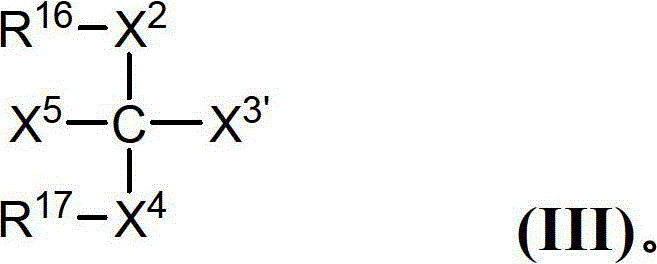
用于形成根据本发明该实施方案的含支化PEG的肽缀合物的另一示例性前体具有下式:Another exemplary precursor for forming a branched PEG-containing peptide conjugate according to this embodiment of the invention has the formula:

根据该式的支化聚合物物种基本上是纯水溶性聚合物。X3’是包含可离子化的(例如OH、COOH、H2PO4、HSO3、HPO3及其盐等)或其他反应性官能团例如以下那些的部分。C是碳。X5、R16和R17独立地选自非反应性基团(例如H、未取代的烃基、未取代的杂烃基)和聚合物臂(例如PEG)。X2和X4为可以相同或不同的优选在生理条件下基本上非反应性的键片段。示例性的接头既不包含芳族部分也不包含酯部分。作为选择,这些键可以包含一个或多个设计成在生理上相关的条件下降解的部分例如酯、二硫化物等。X2和X4将聚合物臂R16和R17连接到C上。当X3’与接头、糖或接头-糖盒上具有互补反应性的反应性官能团反应时,X3’转化成键片段X3的组分。Branched polymer species according to this formula are essentially pure water soluble polymers. X 3 ′ is a moiety comprising ionizable (eg OH, COOH, H 2 PO 4 , HSO 3 , HPO 3 and salts thereof, etc.) or other reactive functional groups such as those below. C is carbon. X 5 , R 16 and R 17 are independently selected from non-reactive groups (eg H, unsubstituted hydrocarbyl, unsubstituted heterohydrocarbyl) and polymer arms (eg PEG). X2 and X4 are bond fragments which may be the same or different, preferably substantially non-reactive under physiological conditions. Exemplary linkers contain neither aromatic nor ester moieties. Alternatively, these linkages may comprise one or more moieties such as esters, disulfides, etc. designed to degrade under physiologically relevant conditions. X2 and X4 connect polymer arms R16 and R17 to C. When X3 ' is reacted with a reactive functional group of complementary reactivity on the linker, sugar or linker-sugar box, X3 ' is converted to a component of the bond fragment X3 .
X2、X3和X4的示例性键片段独立地选择以及包括S、SC(O)NH、HNC(O)S、SC(O)O、O、NH、NHC(O)、(O)CNH和NHC(O)O、和OC(O)NH、CH2S、CH2O、CH2CH2O、CH2CH2S、(CH2)oO、(CH2)oS或(CH2)oY’-PEG,其中Y’为S、NH、NHC(O)、C(O)NH、NHC(O)O、OC(O)NH或O以及o为1-50的整数。在一种示例性的实施方案中,键片段X2和X4为不同的键片段。Exemplary bond fragments for X 2 , X 3 and X 4 are independently selected and include S, SC(O)NH, HNC(O)S, SC(O)O, O, NH, NHC(O), (O) CNH and NHC(O)O, and OC(O)NH, CH 2 S, CH 2 O, CH 2 CH 2 O, CH 2 CH 2 S, (CH 2 ) o O, (CH 2 ) o S or ( CH 2 ) o Y'-PEG, wherein Y' is S, NH, NHC(O), C(O)NH, NHC(O)O, OC(O)NH or O and o is an integer of 1-50. In an exemplary embodiment, bond fragments X2 and X4 are different bond fragments.
在一种示例性的实施方案中,前体(式III)或其活化衍生物通过X3’和糖部分上互补反应性的基团例如胺之间的反应与糖、活化的糖或糖核苷酸反应并由此与其结合。作为选择,X3’与前体上的反应性官能团反应成接头L。式I和II的R2、R3、R4、R5、R6或R6’中的一个或多个可以包含支化的聚合物修饰部分,或者该部分通过L结合。In an exemplary embodiment, the precursor (formula III) or its activated derivative is reacted with the sugar, activated sugar or sugar core by reaction between X 3 ' and a complementary reactive group on the sugar moiety, such as an amine The nucleotide reacts and thereby binds to it. Alternatively, X3 ' reacts with a reactive functional group on the precursor to linker L. One or more of R 2 , R 3 , R 4 , R 5 , R 6 or R 6 ′ of formulas I and II may comprise a branched polymer modified moiety, or the moiety may be bound through L.
在一种示例性的实施方案中,聚合物修饰基团具有根据下式的结构:In an exemplary embodiment, the polymer modifying group has a structure according to the formula:

在根据上式的另一示例性实施方案中,支化聚合物具有根据下式的结构:In another exemplary embodiment according to the above formula, the branched polymer has a structure according to the following formula:
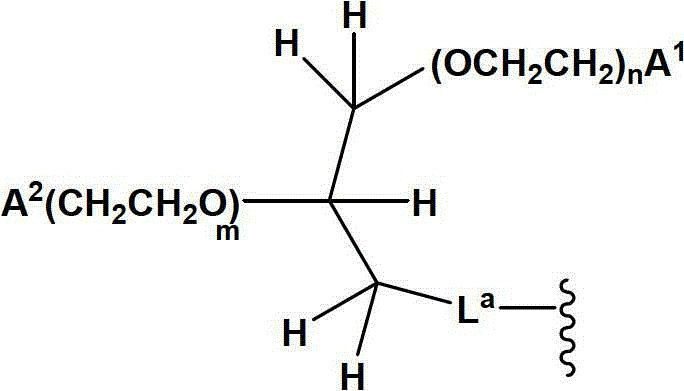
在一种示例性的实施方案中,A1和A2各自选自-OH和-OCH3。In an exemplary embodiment, A 1 and A 2 are each selected from —OH and —OCH 3 .
根据该实施方案的示例性的聚合物修饰基团包括:Exemplary polymer modifying groups according to this embodiment include:

在一种示例性的实施方案中,以下部分:In an exemplary embodiment, the following:
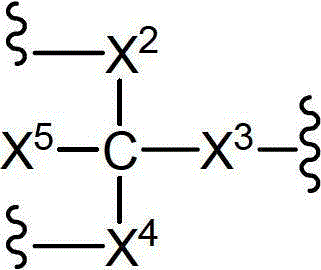
是接头臂L。在该实施方案中,示例性的接头衍生自天然或非天然的氨基酸、氨基酸类似物或氨基酸模拟物、或者由一个或多个上述物种形成的小肽。例如,本发明化合物中存在的某些支化聚合物具有下式:is the joint arm L. In this embodiment, exemplary linkers are derived from natural or unnatural amino acids, amino acid analogs or mimetics, or small peptides formed from one or more of the foregoing species. For example, certain branched polymers present in the compounds of the present invention have the formula:
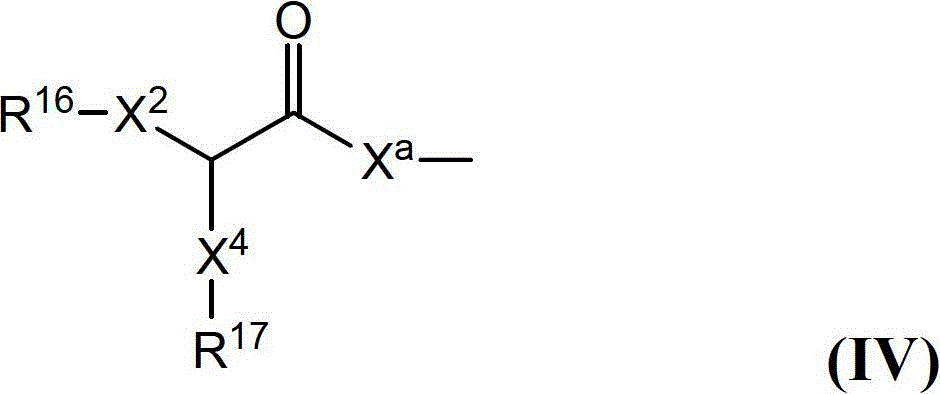
Xa是由支化聚合物修饰部分的前体上的反应性官能团例如X3’与糖部分或接头前体上的反应性官能团的反应形成的键片段。例如,当X3’是羧酸时,它可以进行活化并且直接结合到氨基糖(例如Sia、GalNH2、GlcNH2、ManNH2等)上悬挂的胺基团上,形成作为酰胺的Xa。另外的示例性反应性官能团和活化前体在下文进行描述。下标c表示1-10的整数。其他符号具有如上述那些相同的含义。X a is a bond fragment formed by the reaction of a reactive functional group on the precursor of the branched polymer modification moiety, such as X 3 ′, with a reactive functional group on the sugar moiety or linker precursor. For example, when X 3 ' is a carboxylic acid, it can be activated and bind directly to a pendant amine group on an amino sugar (eg Sia, GalNH 2 , GlcNH 2 , ManNH 2 , etc.) to form X a as an amide. Additional exemplary reactive functional groups and activated precursors are described below. The subscript c represents an integer of 1-10. Other symbols have the same meanings as those above.
在另一示例性的实施方案中,Xa是与另一接头形成的连接部分:In another exemplary embodiment, X is a linking moiety formed with another linker:

其中Xb是另一键片段以及独立地选自对于Xa所述的那些基团,类似于L,L1是键、取代的或未取代的烃基或取代的或未取代的杂烃基。wherein Xb is another bond fragment and is independently selected from those groups described for Xa , similarly to L, L is a bond, a substituted or unsubstituted hydrocarbyl or a substituted or unsubstituted heterohydrocarbyl.
Xa和Xb的示例性物种包括S、SC(O)NH、HNC(O)S、SC(O)O、O、NH、NHC(O)、C(O)NH和NHC(O)O以及OC(O)NH。Exemplary species for Xa and Xb include S, SC(O)NH, HNC(O)S, SC(O)O, O, NH, NHC ( O), C(O)NH, and NHC(O)O and OC(O)NH.
在另一示例性的实施方案中,X4是与R17的肽键,R17为其中α-胺部分和/或侧链杂原子用聚合物修饰部分修饰的氨基酸、二肽(例如Lys-Lys)或三肽(例如Lys-Lys-Lys)。In another exemplary embodiment , X 4 is a peptide bond to R 17 , which is an amino acid, dipeptide (e.g. Lys- Lys) or tripeptides (e.g. Lys-Lys-Lys).
在另一示例性的实施方案中,本发明的肽缀合物包含具有选自以下的式的部分,例如R15部分:In another exemplary embodiment, the peptide conjugates of the invention comprise a moiety having a formula selected from the group consisting of, for example, an R moiety :


其中由各种符号表示的基团的含义与上文所述的相同。La是键或如上对于L和L1所述的接头,例如取代的或未取代的烃基或取代的或未取代的杂烃基部分。在一种示例性的实施方案中,La是如同所示那样用聚合物修饰部分官能化的唾液酸的侧链的部分。示例性的La部分包括含有一个或多个OH或NH2的取代的或未取代的烃基链。The meanings of groups represented by various symbols therein are the same as described above. La is a bond or a linker as described above for L and L , eg a substituted or unsubstituted hydrocarbyl or a substituted or unsubstituted heterohydrocarbyl moiety. In an exemplary embodiment, La is the moiety that modifies the side chain of the partially functionalized sialic acid with a polymer as shown. Exemplary La moieties include substituted or unsubstituted hydrocarbyl chains containing one or more OH or NH2 .
在又一实施方案中,本发明提供具有下式的部分,例如R15部分的肽缀合物:In yet another embodiment, the invention provides a peptide conjugate having a moiety, such as an R moiety , of the formula:

由各种符号表示的基团的含义与上文所述的相同。如同技术人员会意识到的那样,式VI和VII中的接头臂可同等适用于本文所述的其他修饰的糖。在示例性的实施方案中,式VI和VII的物种为结合至本文所述的聚糖结构上的R15部分。The meanings of groups represented by various symbols are the same as described above. As the skilled artisan will appreciate, the linker arms in formulas VI and VII are equally applicable to the other modified sugars described herein. In an exemplary embodiment, the species of Formula VI and VII is an R 15 moiety bound to a glycan structure described herein.
在又一示例性的实施方案中,因子VII/因子VIIa肽缀合物包含具有选自以下的式的R15部分:In yet another exemplary embodiment, the Factor VII/Factor Vila peptide conjugate comprises an R moiety having a formula selected from:
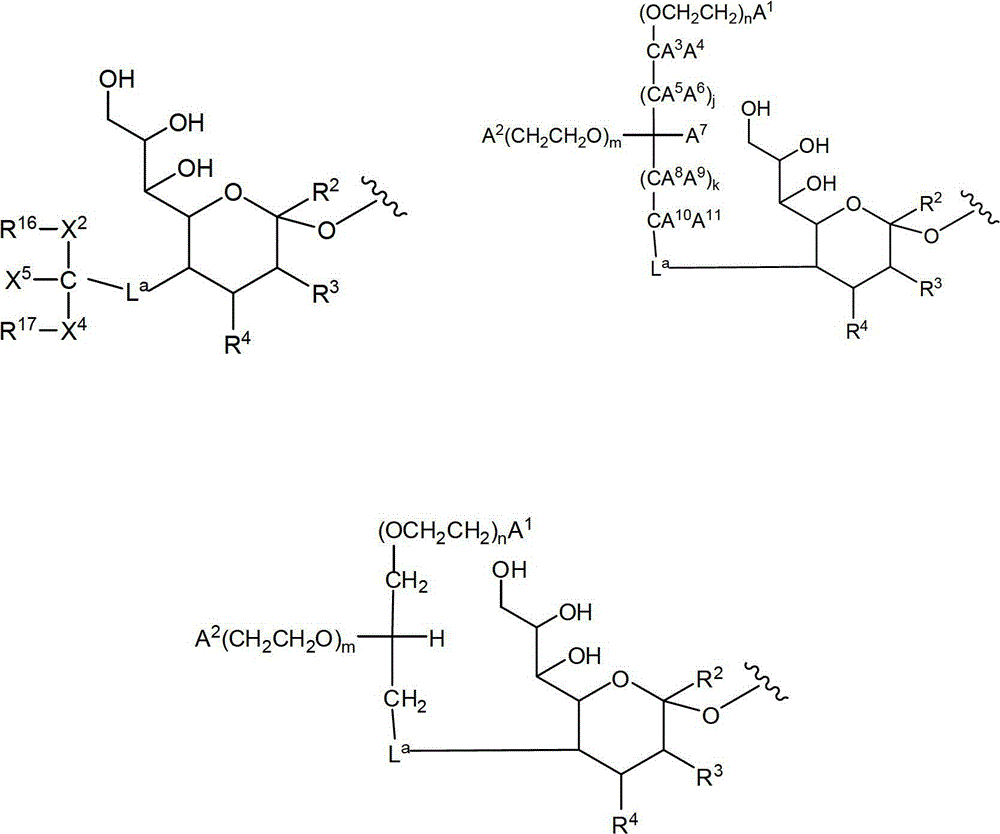
其中基团的含义如上所述。La的示例性物种为-(CH2)jC(O)NH(CH2)hC(O)NH-,其中下标h和j为独立地选自0-10的整数。另一示例性物种为-C(O)NH-。下标m和n为独立地选自0-5000的整数。A1、A2、A3、A4、A5、A6、A7、A8、A9、A10和A11独立地选自H、取代的或未取代的烃基、取代的或未取代的杂烃基、取代的或未取代的环烃基、取代的或未取代的杂环烃基、取代的或未取代的芳基、取代的或未取代的杂芳基、-NA12A13、-OA12和-SiA12A13。A12和A13独立地选自取代的或未取代的烃基、取代的或未取代的杂烃基、取代的或未取代的环烃基、取代的或未取代的杂环烃基、取代的或未取代的芳基和取代的或未取代的杂芳基。Wherein the meaning of the group is as above. An exemplary species of La is -( CH2 ) jC (O)NH( CH2 ) hC (O)NH-, wherein subscripts h and j are integers independently selected from 0-10. Another exemplary species is -C(O)NH-. Subscripts m and n are integers independently selected from 0-5000. A 1 , A 2 , A 3 , A 4 , A 5 , A 6 , A 7 , A 8 , A 9 , A 10 and A 11 are independently selected from H, substituted or unsubstituted hydrocarbyl, substituted or unsubstituted Substituted heteroalkyl, substituted or unsubstituted cycloalkyl, substituted or unsubstituted heterocycloalkyl, substituted or unsubstituted aryl, substituted or unsubstituted heteroaryl, -NA 12 A 13 , - OA 12 and -SiA 12 A 13 . A 12 and A 13 are independently selected from substituted or unsubstituted hydrocarbyl, substituted or unsubstituted heterohydrocarbyl, substituted or unsubstituted cycloalkyl, substituted or unsubstituted heterocycloalkyl, substituted or unsubstituted aryl and substituted or unsubstituted heteroaryl.
上述本发明的实施方案参照其中聚合物为水溶性聚合物,特别是聚乙二醇(“PEG”)如甲氧基-聚乙二醇的物种来进一步举例说明。技术人员会意识到以下段落中的焦点在于说明的清楚性而且用PEG作为示例性聚合物阐述的各种模体可同等适用于其中采用PEG以外的聚合物的物种。Embodiments of the invention described above are further exemplified with reference to species wherein the polymer is a water-soluble polymer, particularly polyethylene glycol ("PEG") such as methoxy-polyethylene glycol. The skilled artisan will appreciate that the focus in the following paragraphs is on clarity of illustration and that the various motifs set forth using PEG as an exemplary polymer are equally applicable to species in which polymers other than PEG are employed.
任意分子量的PEG可用于本发明中,例如1KDa、2KDa、5KDa、10KDa、15KDa、20KDa、25KDa、30KDa、35KDa、40KDa和45KDa。PEG of any molecular weight can be used in the present invention, for example 1KDa, 2KDa, 5KDa, 10KDa, 15KDa, 20KDa, 25KDa, 30KDa, 35KDa, 40KDa and 45KDa.
在一种示例性的实施方案中,R15部分具有选自以下的式:In an exemplary embodiment, the R moiety has a formula selected from:

在上面的每种结构中,接头片段-NH(CH2)a-可以存在或不存在。In each of the structures above, the linker fragment -NH( CH2 ) a- may or may not be present.
在另外的示例性实施方案中,肽缀合物包含选自以下的R15部分:In additional exemplary embodiments, the peptide conjugate comprises an R moiety selected from:
在上面的各个式中,下标e和f为独立地选自1-2500的整数。在另外的实施方案中,选择e和f以提供约1KDa、2KDa、5KDa、10KDa、15KDa、20KDa、25KDa、30KDa、35KDa、40KDa和45KDa的PEG部分。符号Q表示取代的或未取代的烃基(例如C1-C6烃基,如甲基)、取代的或未取代的杂烃基或H。In each of the above formulas, subscripts e and f are integers independently selected from 1-2500. In additional embodiments, e and f are selected to provide PEG moieties of about 1KDa, 2KDa, 5KDa, 10KDa, 15KDa, 20KDa, 25KDa, 30KDa, 35KDa, 40KDa, and 45KDa. The symbol Q represents a substituted or unsubstituted hydrocarbyl group (for example a C 1 -C 6 hydrocarbyl group such as methyl), a substituted or unsubstituted heterohydrocarbyl group or H.
其他支化的聚合物具有基于二-赖氨酸(Lys-Lys)肽的结构,例如:Other branched polymers have di-lysine (Lys-Lys) peptide based structures such as:
以及基于三-赖氨酸肽(Lys-Lys-Lys)的结构,例如:and tri-lysine peptide (Lys-Lys-Lys) based structures such as:

在上述各图中,下标e、f、f’和f”表示独立地选自1-2500的整数。下标q、q’和q”表示独立地选自1-20的整数。In each of the above figures, subscripts e, f, f' and f" represent integers independently selected from 1-2500. Subscripts q, q' and q" represent integers independently selected from 1-20.
在另一示例性的实施方案中,修饰基团:In another exemplary embodiment, the modifying group:

具有选自以下的式:has a formula selected from:
其中Q选自H和取代的或未取代的C1-C6烃基。下标e和f为独立地选自1-2500的整数,以及下标q为选自0-20的整数。Wherein Q is selected from H and substituted or unsubstituted C 1 -C 6 hydrocarbon groups. Subscripts e and f are integers independently selected from 1-2500, and subscript q is an integer selected from 0-20.
在另一示例性的实施方案中,修饰基团:In another exemplary embodiment, the modifying group:
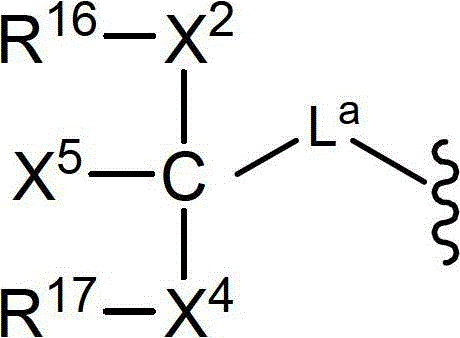
具有选自以下的式:has a formula selected from:

其中Q选自H和取代的或未取代的C1-C6烃基。下标e、f和f'为独立地选自1-2500的整数,以及下标q和q’为独立地选自1-20的整数。Wherein Q is selected from H and substituted or unsubstituted C 1 -C 6 hydrocarbon groups. Subscripts e, f and f' are integers independently selected from 1-2500, and subscripts q and q' are integers independently selected from 1-20.
在另一示例性的实施方案中,支化聚合物具有根据下式的结构:In another exemplary embodiment, the branched polymer has a structure according to the formula:

其中下标m和n为独立地选自0-5000的整数。A1、A2、A3、A4、A5、A6、A7、A8、A9、A10和A11独立地选自H、取代的或未取代的烃基、取代的或未取代的杂烃基、取代的或未取代的环烃基、取代的或未取代的杂环烃基、取代的或未取代的芳基、取代的或未取代的杂芳基、-NA12A13、-OA12和-SiA12A13。A12和A13独立地选自取代的或未取代的烃基、取代的或未取代的杂烃基、取代的或未取代的环烃基、取代的或未取代的杂环烃基、取代的或未取代的芳基和取代的或未取代的杂芳基。Wherein the subscripts m and n are integers independently selected from 0-5000. A 1 , A 2 , A 3 , A 4 , A 5 , A 6 , A 7 , A 8 , A 9 , A 10 and A 11 are independently selected from H, substituted or unsubstituted hydrocarbyl, substituted or unsubstituted Substituted heteroalkyl, substituted or unsubstituted cycloalkyl, substituted or unsubstituted heterocycloalkyl, substituted or unsubstituted aryl, substituted or unsubstituted heteroaryl, -NA 12 A 13 , - OA 12 and -SiA 12 A 13 . A 12 and A 13 are independently selected from substituted or unsubstituted hydrocarbyl, substituted or unsubstituted heterohydrocarbyl, substituted or unsubstituted cycloalkyl, substituted or unsubstituted heterocycloalkyl, substituted or unsubstituted aryl and substituted or unsubstituted heteroaryl.
式IIIa为式III的子集。式IIIa所述结构也包括在式III中。Formula IIIa is a subset of Formula III. Structures depicted in formula IIIa are also included in formula III.
在一种示例性的实施方案中,聚合物修饰基团具有根据下列式的结构:In an exemplary embodiment, the polymer modifying group has a structure according to the formula:

在根据上式的另一示例性实施方案中,支化聚合物具有根据下式的结构:In another exemplary embodiment according to the above formula, the branched polymer has a structure according to the following formula:

在一种示例性的实施方案中,A1和A2独立地选自-OH和-OCH3。In an exemplary embodiment, A1 and A2 are independently selected from -OH and -OCH3 .
根据该实施方案的示例性聚合物修饰基团包括:Exemplary polymer modifying groups according to this embodiment include:

在一种说明性的实施方案中,修饰的糖是唾液酸而且用于本发明的选定的修饰的糖具有下式:In an illustrative embodiment, the modified sugar is sialic acid and selected modified sugars for use in the invention have the formula:

下标a、b和d为0-20的整数。下标c为1-2500的整数。上述结构可以是R15的组分。The subscripts a, b and d are integers from 0-20. The subscript c is an integer of 1-2500. The above structure may be a component of R 15 .
在另一说明性的实施方案中,糖的伯羟基部分用修饰基团官能化。例如,唾液酸的9-羟基可以转化成相应的胺并且官能化以提供本发明的化合物。根据该实施方案的式包括:In another illustrative embodiment, the primary hydroxyl moiety of the sugar is functionalized with a modifying group. For example, the 9-hydroxyl group of sialic acid can be converted to the corresponding amine and functionalized to provide compounds of the invention. Formulas according to this embodiment include:
上述结构可以是R15的组分。The above structure may be a component of R 15 .
虽然本发明在前述段落中参照PEG来举例说明,但是如同技术人员会意识到的那样,一系列聚合物修饰部分可用于本文所述的化合物和方法中。Although the invention is exemplified in the preceding paragraphs with reference to PEG, a range of polymer modification moieties can be used in the compounds and methods described herein, as will be appreciated by the skilled artisan.
在选定的实施方案中,R1或L-R1为支化PEG,例如上述的物种之一。在一种示例性的实施方案中,支化PEG结构基于半胱氨酸肽。根据该实施方案的说明性修饰的糖包括:In selected embodiments, R1 or LR1 is a branched PEG, such as one of the species described above. In an exemplary embodiment, the branched PEG structure is based on cysteine peptides. Illustrative modified sugars according to this embodiment include:
其中X4为键或O。在上面各个结构中,烃基胺接头-(CH2)aNH-可以存在或不存在。上述结构可以是R15/R15’的组分。where X4 is a bond or O. In each of the structures above, the hydrocarbylamine linker -( CH2 ) aNH- may or may not be present. The above structure may be a component of R 15 /R 15 ′.
如本文所述,用于本发明的聚合物修饰的唾液酸也可以是线性结构。因此,本发明提供包含衍生自诸如以下结构的唾液酸部分的缀合物:As described herein, the polymer-modified sialic acids used in the present invention can also be linear structures. Accordingly, the invention provides conjugates comprising a sialic acid moiety derived from structures such as:

其中下标q和e如上所述。where the subscripts q and e are as above.
示例性的修饰的糖用水溶性或水不溶性聚合物修饰。有用聚合物的实例在下面进一步说明。Exemplary modified sugars are modified with water soluble or water insoluble polymers. Examples of useful polymers are further described below.
在另一示例性的实施方案中,肽来源于昆虫细胞,通过向甘露糖核心加成GlcNAc和Gal来重建并用带有线性PEG部分的唾液酸来糖基聚乙二醇化,提供包含至少一个具有下式的部分的因子VII/因子VIIa肽:In another exemplary embodiment, the peptides are derived from insect cells, reconstituted by the addition of GlcNAc and Gal to the mannose core and glycopegylated with sialic acid bearing a linear PEG moiety, providing a peptide comprising at least one Factor VII/Factor VIIa peptides that are portions of the formula:

其中下标t为0-1的整数;下标s表示1-10的整数;以及下标f表示1-2500的整数。Wherein the subscript t is an integer of 0-1; the subscript s represents an integer of 1-10; and the subscript f represents an integer of 1-2500.
在一种实施方案中,本发明提供包含以下糖基连接基团的肽缀合物:In one embodiment, the invention provides a peptide conjugate comprising the following glycosyl linking group:

D选自-OH和R1-L-HN-;G选自R1-L-和-C(O)(C1-C6)烃基-R1;R1是包含选自直链聚乙二醇残基和支化聚乙二醇残基中的成员的部分;以及M选自H、盐反荷离子和单个负电荷;L是选自键、取代的或未取代的烃基和取代的或未取代的杂烃基的接头。在一种示例性的实施方案中,当D为OH时,G为R1-L-。在另一示例性的实施方案中,当G为-C(O)(C1-C6)烃基时,D为R1-L-NH-。D is selected from -OH and R 1 -L-HN-; G is selected from R 1 -L- and -C(O)(C 1 -C 6 )hydrocarbyl-R 1 ; R 1 is selected from linear polyethylene Part of a member in a diol residue and a branched polyethylene glycol residue; and M is selected from H, a salt counterion, and a single negative charge; L is selected from a bond, a substituted or unsubstituted hydrocarbyl group, and a substituted or unsubstituted heteroalkyl linkers. In an exemplary embodiment, when D is OH, G is R 1 -L-. In another exemplary embodiment, when G is -C(O)(C 1 -C 6 )hydrocarbyl, D is R 1 -L-NH-.
在一种示例性的实施方案中,L-R1具有下式:In an exemplary embodiment, LR 1 has the formula:

其中a为选自0-20的整数。Wherein a is an integer selected from 0-20.
在一种示例性的实施方案中,R1具有选自以下的结构:In an exemplary embodiment, R has a structure selected from:
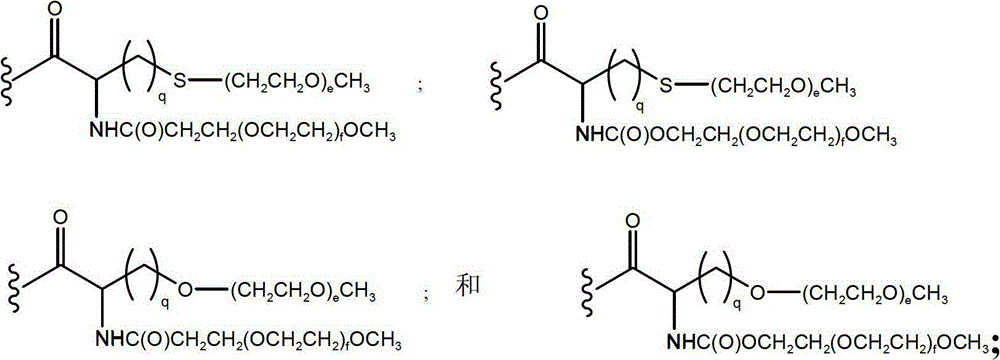
其中e、f、m和n为独立地选自1-2500的整数;以及q为选自0-20的整数。wherein e, f, m and n are integers independently selected from 1-2500; and q is an integer selected from 0-20.
在一种示例性的实施方案中,R1具有选自以下的结构:In an exemplary embodiment, R has a structure selected from:

其中e、f和f’为独立地选自1-2500的整数;以及q和q’为独立地选自1-20的整数。wherein e, f and f' are integers independently selected from 1-2500; and q and q' are integers independently selected from 1-20.
在另一示例性的实施方案中,R1具有选自以下的结构:In another exemplary embodiment, R has a structure selected from:

其中e、f和f’为独立地选自1-2500的整数;以及q和q’为独立地选自1-20的整数。wherein e, f and f' are integers independently selected from 1-2500; and q and q' are integers independently selected from 1-20.
在另一示例性的实施方案中,R1具有选自以下的结构:In another exemplary embodiment, R has a structure selected from:
其中e和f为独立地选自1-2500的整数。wherein e and f are integers independently selected from 1-2500.
在另一示例性的实施方案中,糖基接头具有下式:In another exemplary embodiment, the glycosyl linker has the formula:

在另一示例性的实施方案中,肽缀合物包含根据选自以下的式的至少一个所述糖基接头:In another exemplary embodiment, the peptide conjugate comprises at least one said glycosyl linker according to a formula selected from:
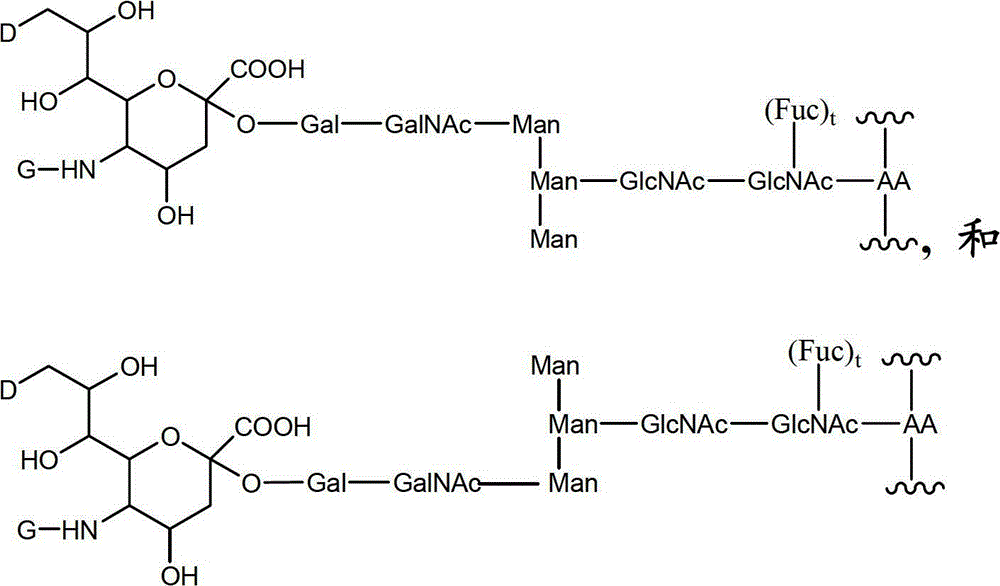
其中AA是所述肽缀合物的氨基酸残基以及t为选自0和1的整数。wherein AA is the amino acid residue of the peptide conjugate and t is an integer selected from 0 and 1 .
在另一示例性的实施方案中,肽缀合物包含至少一个所述糖基接头,其中每一个所述糖基接头具有独立地选自下列式的结构:In another exemplary embodiment, the peptide conjugate comprises at least one of said glycosyl linkers, wherein each of said glycosyl linkers has a structure independently selected from the following formulae:
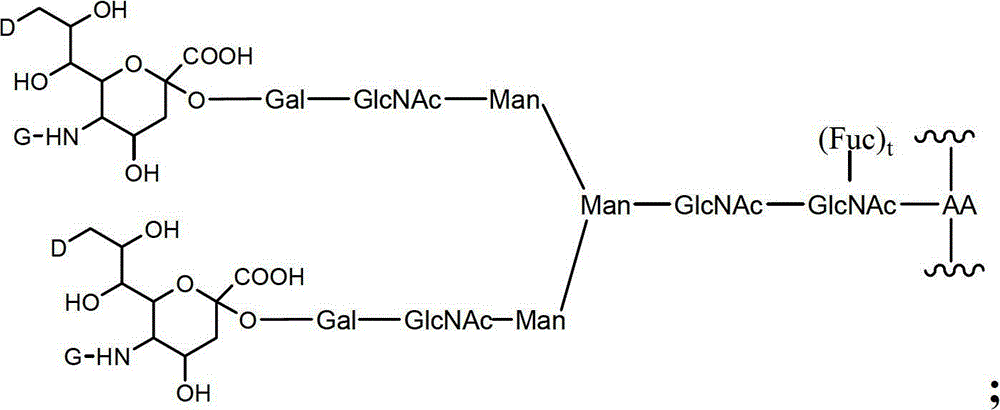
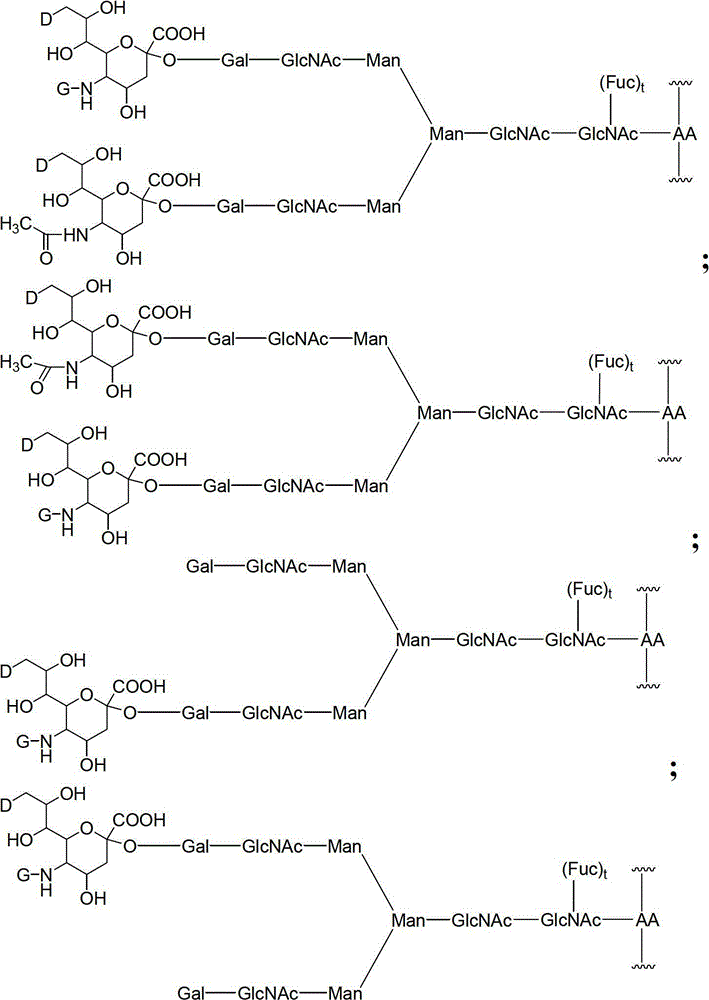
其中AA是所述肽缀合物的氨基酸残基以及t为选自0和1的整数。wherein AA is the amino acid residue of the peptide conjugate and t is an integer selected from 0 and 1 .
在另一示例性的实施方案中,肽缀合物包含根据选自以下的式的至少一个所述糖基接头:In another exemplary embodiment, the peptide conjugate comprises at least one said glycosyl linker according to a formula selected from:
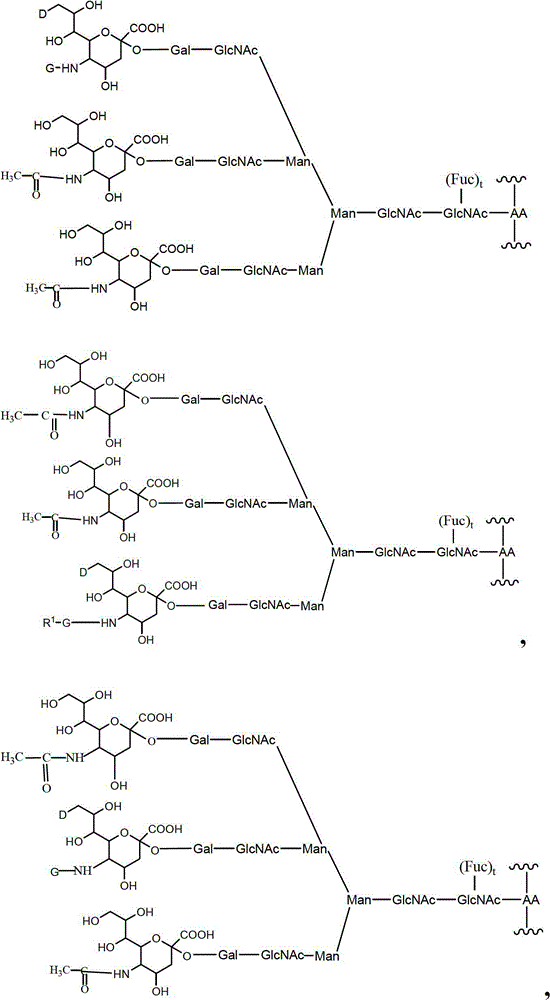
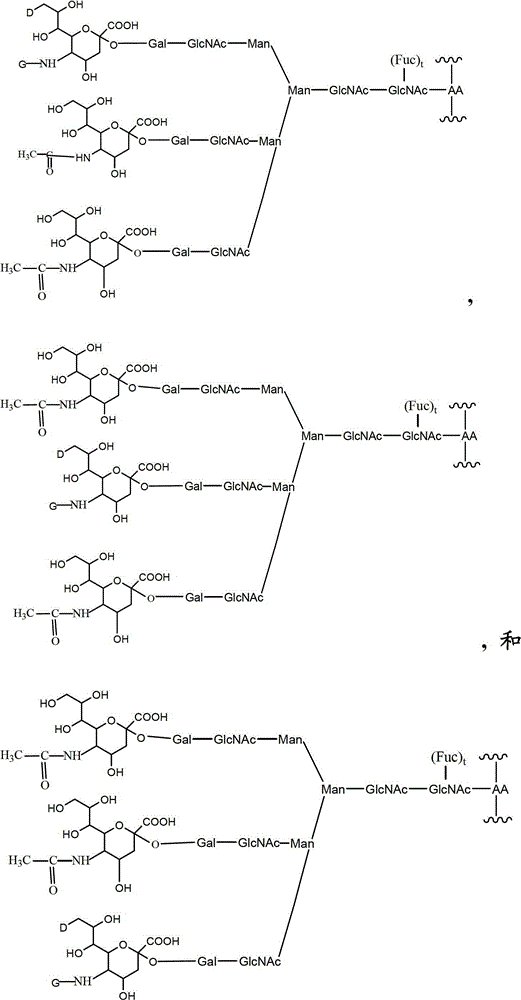
其中AA是所述肽缀合物的氨基酸残基以及t为选自0和1的整数。wherein AA is the amino acid residue of the peptide conjugate and t is an integer selected from 0 and 1 .
在一种示例性的实施方案中,选自0和2个不含G的唾液酰基部分中的成员不存在。在一种示例性的实施方案中,选自1和2个不含G的唾液酰基部分中的成员不存在。In an exemplary embodiment, members selected from 0 and 2 G-free sialyl moieties are absent. In an exemplary embodiment, members selected from 1 and 2 G-free sialyl moieties are absent.
在另一示例性的实施方案中,肽缀合物包含根据选自以下的式的至少一个所述糖基接头:In another exemplary embodiment, the peptide conjugate comprises at least one said glycosyl linker according to a formula selected from:

其中AA是所述肽缀合物的氨基酸残基以及t为选自0和1的整数。在一种示例性的实施方案中,选自0和2个不含G的唾液酰基部分中的成员不存在。在一种示例性的实施方案中,选自1和2个不含G的唾液酰基部分中的成员不存在。wherein AA is the amino acid residue of the peptide conjugate and t is an integer selected from 0 and 1 . In an exemplary embodiment, members selected from 0 and 2 G-free sialyl moieties are absent. In an exemplary embodiment, members selected from 1 and 2 G-free sialyl moieties are absent.
在另一示例性的实施方案中,肽缀合物包含根据选自以下的式的至少一个所述糖基接头:In another exemplary embodiment, the peptide conjugate comprises at least one said glycosyl linker according to a formula selected from:


其中AA是所述肽缀合物的氨基酸残基以及t为选自0和1的整数。在一种示例性的实施方案中,选自0和2个不含G的唾液酰基部分中的成员不存在。在一种示例性的实施方案中,选自1和2个不含G的唾液酰基部分中的成员不存在。wherein AA is the amino acid residue of the peptide conjugate and t is an integer selected from 0 and 1 . In an exemplary embodiment, members selected from 0 and 2 G-free sialyl moieties are absent. In an exemplary embodiment, members selected from 1 and 2 G-free sialyl moieties are absent.
在另一示例性的实施方案中,因子VII/因子VIIa肽具有SEQ.ID.NO:1的氨基酸序列。在另一示例性的实施方案中,糖基接头通过选自丝氨酸和苏氨酸的氨基酸残基结合至所述因子VII/因子VIIa肽上。In another exemplary embodiment, the Factor VII/Factor Vila peptide has the amino acid sequence of SEQ.ID.NO:1. In another exemplary embodiment, a glycosyl linker is bound to said Factor VII/Factor Vila peptide via an amino acid residue selected from serine and threonine.
在另一示例性的实施方案中,天冬酰胺残基选自N152、N322及其组合。In another exemplary embodiment, the asparagine residue is selected from N152, N322, and combinations thereof.
在另一示例性的实施方案中,因子VIIa肽为生物活性因子VIIa肽。In another exemplary embodiment, the Factor Vila peptide is a biologically active Factor Vila peptide.
在另一示例性的实施方案中,糖基接头通过为天冬酰胺残基的氨基酸残基结合至所述因子VII/因子VIIa肽上。In another exemplary embodiment, a glycosyl linker is bound to said Factor VII/Factor Vila peptide through an amino acid residue that is an asparagine residue.
在另一示例性的实施方案中,本发明提供在合适宿主中产生的因子VII/因子VIIa肽。本发明也提供表达该肽的方法。在另一示例性的实施方案中,宿主为哺乳动物表达体系。In another exemplary embodiment, the invention provides Factor VII/Factor Vila peptides produced in a suitable host. The invention also provides methods of expressing the peptides. In another exemplary embodiment, the host is a mammalian expression system.
在另一示例性的实施方案中,本发明提供一种治疗需要该治疗的受试者中病症的方法,所述病症的特征为所述受试者中凝血效价受损(compromised clotting potency),所述方法包括向受试者施用有效改善所述受试者中所述病症的量的本发明因子VII/因子VIIa肽缀合物的步骤。在另一示例性的实施方案中,该方法包括向所述哺乳动物施用适量的根据本文所述方法制备的因子VII/因子VIIa肽缀合物。In another exemplary embodiment, the invention provides a method of treating a condition in a subject in need thereof, said condition being characterized by compromised clotting potency in said subject , said method comprising the step of administering to a subject a Factor VII/Factor Vila peptide conjugate of the invention in an amount effective to ameliorate said condition in said subject. In another exemplary embodiment, the method comprises administering to said mammal an appropriate amount of a Factor VII/Factor Vila peptide conjugate prepared according to the methods described herein.
在另一方面中,本发明提供一种制备含有糖基接头的因子VII/因子VIIa肽缀合物的方法,该糖基接头包含具有下式的修饰的唾液酰基残基:In another aspect, the invention provides a method of preparing a Factor VII/Factor Vila peptide conjugate comprising a glycosyl linker comprising a modified sialyl residue having the formula:

其中R2为H、CH2OR7、COOR7或OR7。R7表示H、取代的或未取代的烃基或取代的或未取代的杂烃基。R3和R4独立地选自H、取代的或未取代的烃基、OR8、NHC(O)R9。R8和R9独立地选自H、取代的或未取代的烃基、取代的或未取代的杂烃基或唾液酸。R16和R17为独立选择的聚合物臂。X2和X4为独立选择的将聚合物部分R16和R17连接到C上的键片段。X5是非反应性基团以及La是接头基团。该方法包括使含有糖基部分的因子VII/因子VIIa肽:Wherein R 2 is H, CH 2 OR 7 , COOR 7 or OR 7 . R 7 represents H, substituted or unsubstituted hydrocarbyl or substituted or unsubstituted heterohydrocarbyl. R 3 and R 4 are independently selected from H, substituted or unsubstituted hydrocarbyl, OR 8 , NHC(O)R 9 . R8 and R9 are independently selected from H, substituted or unsubstituted hydrocarbyl, substituted or unsubstituted heterohydrocarbyl, or sialic acid. R 16 and R 17 are independently selected polymer arms. X2 and X4 are independently selected bond fragments connecting polymer moieties R16 and R17 to C. X 5 is a non-reactive group and La is a linker group. The method comprises making a Factor VII/Factor VIIa peptide containing a glycosyl moiety:

与具有下式的PEG-唾液酸供体部分:with a PEG-sialic acid donor moiety having the formula:

以及将PEG-唾液酸转移至所述糖基部分的Gal上的酶,在适合于所述转移的条件下进行接触。and an enzyme that transfers PEG-sialic acid to Gal of said glycosyl moiety, contacting under conditions suitable for said transfer.
在另一示例性的实施方案中,部分:In another exemplary embodiment, the portion:

具有选自以下的式:has a formula selected from:

其中e、f、m和n为独立地选自1-2500的整数;以及Wherein e, f, m and n are integers independently selected from 1-2500; and
q为选自0-20的整数。q is an integer selected from 0-20.
在另一示例性的实施方案中,部分:In another exemplary embodiment, the portion:

具有选自以下的式:has a formula selected from:

其中e、f和f’为独立地选自1-2500的整数;以及wherein e, f and f' are integers independently selected from 1-2500; and
q和q’为独立地选自1-20的整数。q and q' are integers independently selected from 1-20.
在另一示例性的实施方案中,糖基接头包含下式:In another exemplary embodiment, the glycosyl linker comprises the formula:

在另一示例性的实施方案中,因子VII/因子VIIa肽缀合物包含至少一个具有下式的糖基接头:In another exemplary embodiment, the Factor VII/Factor Vila peptide conjugate comprises at least one glycosyl linker having the formula:
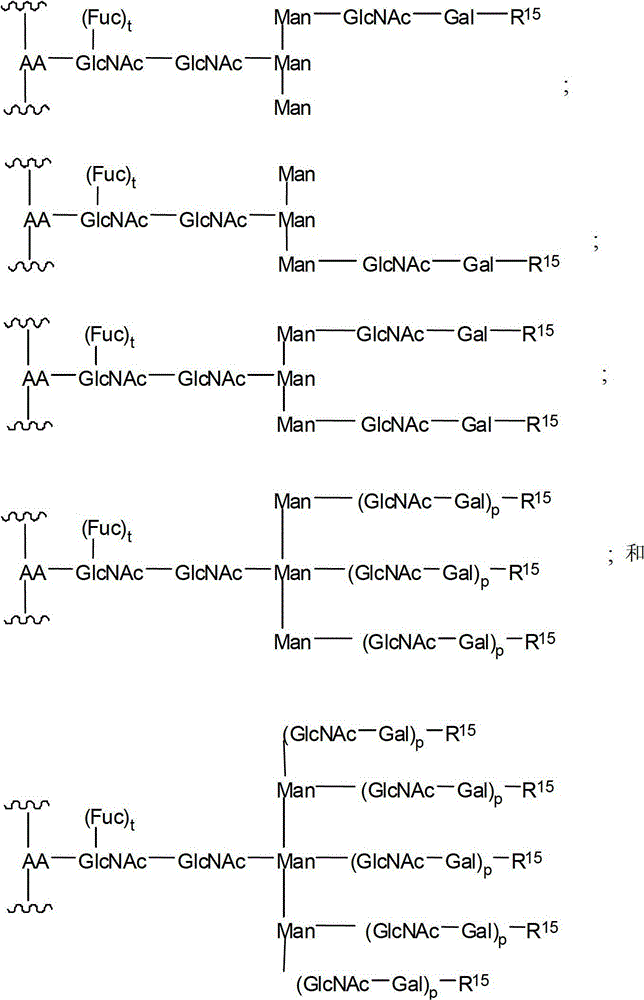
其中AA为所述肽的氨基酸残基;t为选自0和1的整数;以及R15为修饰的唾液酰基部分。wherein AA is an amino acid residue of the peptide; t is an integer selected from 0 and 1; and R 15 is a modified sialyl moiety.
在另一示例性的实施方案中,因子VII/因子VIIa肽具有SEQ.ID.NO:1的氨基酸序列。In another exemplary embodiment, the Factor VII/Factor Vila peptide has the amino acid sequence of SEQ.ID.NO:1.
在另一示例性的实施方案中,糖基接头通过为天冬酰胺残基的氨基酸残基结合至所述因子VII/因子VIIa肽上。In another exemplary embodiment, a glycosyl linker is bound to said Factor VII/Factor Vila peptide through an amino acid residue that is an asparagine residue.
在另一示例性的实施方案中,天冬酰胺残基选自N152、N322及其组合。In another exemplary embodiment, the asparagine residue is selected from N152, N322, and combinations thereof.
在另一示例性的实施方案中,因子VIIa肽为生物活性因子VIIa肽。In another exemplary embodiment, the Factor Vila peptide is a biologically active Factor Vila peptide.
在另一示例性的实施方案中,所述方法在步骤(a)之前包括:(b)在合适宿主中表达因子VII/因子VIIa肽。In another exemplary embodiment, the method comprises, prior to step (a): (b) expressing the Factor VII/Factor Vila peptide in a suitable host.
在另一方面中,本发明提供一种治疗需要该治疗的受试者中病症的方法,所述病症的特征为所述受试者中凝血能力受损,所述方法包括向受试者施用有效改善所述受试者中所述病症的量的根据本文所述方法制备的因子VII/因子VIIa肽缀合物的步骤。在另一示例性的实施方案中,该方法包括向所述哺乳动物施用适量的根据本文所述方法制备的因子VII/因子VIIa肽缀合物。In another aspect, the invention provides a method of treating a condition in a subject in need thereof, said condition being characterized by impaired coagulation capacity in said subject, said method comprising administering to the subject A step of a Factor VII/Factor Vila peptide conjugate prepared according to the methods described herein in an amount effective to ameliorate said condition in said subject. In another exemplary embodiment, the method comprises administering to said mammal an appropriate amount of a Factor VII/Factor Vila peptide conjugate prepared according to the methods described herein.
在另一方面中,本发明提供合成因子VII或因子VIIa肽缀合物的方法,所述方法包括将a)唾液酸酶;b)选自糖基转移酶、外切糖苷酶和内切糖苷酶的酶;c)修饰的糖/修饰的唾液酰基残基;d)因子VII/因子VIIa肽合并从而合成所述因子VII或因子VIIa肽缀合物。在一种示例性的实施方案中,合并的时间少于10小时。在另一示例性的实施方案中,本发明进一步包括加帽步骤。In another aspect, the present invention provides a method of synthesizing a Factor VII or Factor VIIa peptide conjugate comprising a) a sialidase; b) selected from the group consisting of a glycosyltransferase, an exoglycosidase and an endoglycoside Enzymes of enzymes; c) modified sugars/modified sialyl residues; d) Factor VII/Factor VIIa peptides combined to synthesize the Factor VII or Factor VIIa peptide conjugates. In an exemplary embodiment, the combined time is less than 10 hours. In another exemplary embodiment, the present invention further comprises a capping step.
II.D.iv.水不溶性聚合物 II.D.iv. Water-insoluble polymers
在另一实施方案中,与上面所讨论的那些类似,修饰的糖包括水不溶性聚合物而不是水溶性聚合物。本发明的缀合物也可以包含一种或多种水不溶性聚合物。本发明的该实施方案通过使用缀合物作为以受控方式递送治疗肽的载体进行说明。聚合物药物递送系统为本领域已知。参见例如Dunn等编辑,POLYMERIC DRUGS AND DRUGDELIVERY SYSTEMS,ACS Symposium Series第469卷,AmericanChemical Society,Washington,D.C.1991。本领域技术人员会意识到,基本上任何已知的药物递送系统都可适用于本发明的缀合物。In another embodiment, similar to those discussed above, the modified sugar comprises a water insoluble polymer instead of a water soluble polymer. The conjugates of the invention may also comprise one or more water insoluble polymers. This embodiment of the invention is illustrated by the use of conjugates as vehicles for the delivery of therapeutic peptides in a controlled manner. Polymeric drug delivery systems are known in the art. See, eg, Dunn et al. eds., POLYMERIC D RUGS A ND D RUG D ELIVERY S YSTEMS , ACS Symposium Series Vol. 469, American Chemical Society, Washington, DC 1991. Those skilled in the art will appreciate that essentially any known drug delivery system is suitable for use with the conjugates of the invention.
对于R1、L-R1、R15、R15’和其他基团的上述模体可同等适用于水不溶性聚合物,可以利用本领域技术人员易于采取的化学方式将它们不受限制地引入线性和支化结构中。The above motifs for R 1 , LR 1 , R 15 , R 15 ' and other groups are equally applicable to water-insoluble polymers, which can be introduced into linear and in a branched structure.
代表性的水不溶性聚合物包括但不限于聚膦嗪、聚乙烯醇、聚酰胺、聚碳酸酯、聚亚烷基(polyalkylene)、聚丙烯酰胺、聚亚烷基二醇、聚氧化烯烃、聚对苯二甲酸亚烷基酯、聚乙烯基醚、聚乙烯基酯、聚卤乙烯、聚乙烯基吡咯烷酮、聚乙交酯、聚硅氧烷、聚氨酯、聚甲基丙烯酸甲酯、聚甲基丙烯酸乙酯、聚甲基丙烯酸丁酯、聚甲基丙烯酸异丁酯、聚甲基丙烯酸己酯、聚甲基丙烯酸异癸酯、聚甲基丙烯酸月桂酯、聚甲基丙烯酸苯酯、聚丙烯酸甲酯、聚丙烯酸异丙酯、聚丙烯酸异丁酯、聚丙烯酸十八烷基酯、聚乙烯、聚丙烯、聚乙二醇、聚氧乙烯、聚对苯二甲酸乙二醇酯、聚乙酸乙烯酯、聚氯乙烯、聚苯乙烯、聚乙烯基吡咯烷酮、聚氧乙烯-聚氧丙烯嵌段共聚物(pluronics)和聚乙烯基苯酚及它们的共聚物。Representative water-insoluble polymers include, but are not limited to, polyphosphazines, polyvinyl alcohols, polyamides, polycarbonates, polyalkylenes, polyacrylamides, polyalkylene glycols, polyoxyalkylenes, polyalkylenes, Alkylene terephthalate, polyvinyl ether, polyvinyl ester, polyvinyl halide, polyvinylpyrrolidone, polyglycolide, polysiloxane, polyurethane, polymethyl methacrylate, polymethyl Ethyl acrylate, polybutyl methacrylate, polyisobutyl methacrylate, polyhexyl methacrylate, polyisodecyl methacrylate, polylauryl methacrylate, polyphenyl methacrylate, polyacrylic acid Methyl ester, polyisopropyl acrylate, polyisobutyl acrylate, polyoctadecyl acrylate, polyethylene, polypropylene, polyethylene glycol, polyoxyethylene, polyethylene terephthalate, polyacetic acid Vinyl esters, polyvinyl chloride, polystyrene, polyvinylpyrrolidone, polyoxyethylene-polyoxypropylene block copolymers (pluronics), and polyvinylphenol and their copolymers.
用于本发明缀合物的合成修饰的天然聚合物包括但不限于烷基纤维素、羟烷基纤维素、纤维素醚、纤维素酯和硝酸纤维素。广泛种类的合成修饰的天然聚合物中特别优选的成员包括但不限于甲基纤维素、乙基纤维素、羟丙基纤维素、羟丙基甲基纤维素、羟丁基甲基纤维素、乙酸纤维素、丙酸纤维素、乙酸丁酸纤维素、乙酸邻苯二甲酸纤维素、羧甲基纤维素、三乙酸纤维素、纤维素硫酸钠盐以及丙烯酸和甲基丙烯酸酯和藻酸的聚合物。Synthetically modified natural polymers useful in the conjugates of the invention include, but are not limited to, alkyl celluloses, hydroxyalkyl celluloses, cellulose ethers, cellulose esters, and nitrocellulose. Particularly preferred members of the broad class of synthetically modified natural polymers include, but are not limited to, methylcellulose, ethylcellulose, hydroxypropylcellulose, hydroxypropylmethylcellulose, hydroxybutylmethylcellulose, cellulose acetate cellulose propionate, cellulose acetate butyrate, cellulose acetate phthalate, carboxymethyl cellulose, cellulose triacetate, cellulose sulfate sodium salt, and polymers of acrylic and methacrylates and alginic acid .
本文所讨论的这些和其他聚合物可以容易地从商业来源例如Sigma Chemical Co.(St.Louis,MO.)、Polysciences(Warrenton,PA.)、Aldrich(Milwaukee,WI.)、Fluka(Ronkonkoma,NY)和BioRad(Richmond,CA)获得,或者使用标准技术从这些供应商处所获得的单体来合成。These and other polymers discussed herein are readily available from commercial sources such as Sigma Chemical Co. (St. Louis, MO.), Polysciences (Warrenton, PA.), Aldrich (Milwaukee, WI.), Fluka (Ronkonkoma, NY ) and BioRad (Richmond, CA), or were synthesized using standard techniques from monomers obtained from these suppliers.
用于本发明缀合物的代表性的可生物降解聚合物包括但不限于聚丙交酯、聚乙交酯及其共聚物、聚对苯二甲酸乙二醇酯、聚丁酸、聚戊酸、聚丙交酯-共-己内酯、聚丙交酯-共-乙交酯、聚酐、聚原酸酯及其共混物和共聚物。特别有用的是形成凝胶的组合物,例如含有胶原、聚氧乙烯-聚氧丙烯嵌段共聚物等的那些。Representative biodegradable polymers for use in the conjugates of the invention include, but are not limited to, polylactide, polyglycolide and copolymers thereof, polyethylene terephthalate, polybutyrate, polyvalerate , polylactide-co-caprolactone, polylactide-co-glycolide, polyanhydrides, polyorthoesters and their blends and copolymers. Particularly useful are gel-forming compositions such as those containing collagen, polyoxyethylene-polyoxypropylene block copolymers, and the like.
用于本发明的聚合物包括“杂化”聚合物,它包含在其结构的至少一部分中具有可生物吸收分子的水不溶性物质。这种聚合物的实例为含有水不溶性共聚物的聚合物,所述共聚物的每条聚合物链具有可生物吸收区域、亲水性区域和多个可交联官能团。Polymers useful in the present invention include "hybrid" polymers comprising a water-insoluble substance having bioabsorbable molecules in at least a portion of its structure. An example of such a polymer is a polymer comprising a water-insoluble copolymer having bioabsorbable regions, hydrophilic regions, and a plurality of crosslinkable functional groups per polymer chain.
就本发明而言,“水不溶性物质”包括基本上不溶于水或含水环境的物质。因此,尽管共聚物的某些区域或链段可能是亲水的乃至是水溶性的,但是聚合物分子整体上在水中没有任何显著程度的溶解。For the purposes of the present invention, "water-insoluble substances" include substances that are substantially insoluble in water or an aqueous environment. Thus, while certain regions or segments of the copolymer may be hydrophilic or even water soluble, the polymer molecule as a whole is not soluble in water to any appreciable degree.
就本发明而言,术语“可生物吸收的分子”包含能够由身体进行代谢或分解并且吸收和/或通过正常排泄途径消除的区域。所述代谢产物或分解产物优选基本上对身体无毒。For the purposes of the present invention, the term "bioabsorbable molecule" comprises regions capable of being metabolized or broken down by the body and absorbed and/or eliminated by the normal excretory routes. The metabolites or breakdown products are preferably substantially non-toxic to the body.
可生物吸收的区域可以是疏水性的或亲水性的,只要该共聚物组合物整体没有变得水溶性即可。由此,基于使聚合物整体保持水不溶性的优选情况来选择可生物吸收的区域。因此,选择相对特性,即可生物吸收的区域所含的官能团种类和该区域的相对比例以及亲水性区域,从而确保有用的可生物吸收的组合物保持水不溶性。The bioabsorbable regions can be hydrophobic or hydrophilic as long as the copolymer composition as a whole does not become water soluble. Thus, the bioabsorbable region is selected based on the preference for the polymer as a whole to remain water insoluble. Accordingly, the relative characteristics, ie, the types of functional groups contained in the bioabsorbable region and the relative proportions of the region, and the hydrophilic region are selected so as to ensure that useful bioabsorbable compositions remain water-insoluble.
示例性的可吸收聚合物包括例如合成制备的聚α-羟基羧酸/聚氧化烯烃的可吸收嵌段共聚物(参见Cohn等,美国专利No.4,826,945)。这些共聚物没有交联而且是水溶性的,以至于身体可以排泄降解后的嵌段共聚物组合物。参见Younes等,J Biomed.Mater.Res.21:1301-1316(1987)以及Cohn等,J Biomed.Mater.Res.22:993-1009(1988)。Exemplary absorbable polymers include, for example, synthetically prepared absorbable block copolymers of polyalpha-hydroxycarboxylic acid/polyoxyalkylenes (see Cohn et al., US Patent No. 4,826,945). These copolymers are not crosslinked and are water soluble so that the body excretes the degraded block copolymer composition. See Younes et al., J Biomed. Mater. Res. 21:1301-1316 (1987) and Cohn et al., J Biomed. Mater. Res. 22:993-1009 (1988).
目前优选的可生物吸收聚合物包括选自以下的一种或多种组分:聚酯、聚羟基酸、聚内酯、聚酰胺、聚酯-酰胺、聚氨基酸、聚酸酐、聚原酸酯、聚碳酸酯、聚膦嗪、聚磷酸酯、聚硫代酯、多糖及其混合物。更优选地,可生物吸收的聚合物包括聚羟基酸组分。在聚羟基酸中,优选聚乳酸、聚乙醇酸、聚己酸、聚丁酸、聚戊酸及其共聚物和混合物。Presently preferred bioabsorbable polymers comprise one or more components selected from the group consisting of polyesters, polyhydroxy acids, polylactones, polyamides, polyester-amides, polyamino acids, polyanhydrides, polyorthoesters , polycarbonates, polyphosphazines, polyphosphates, polythioesters, polysaccharides and mixtures thereof. More preferably, the bioabsorbable polymer comprises a polyhydroxy acid component. Among the polyhydroxy acids, polylactic acid, polyglycolic acid, polycaproic acid, polybutyric acid, polyvaleric acid, and copolymers and mixtures thereof are preferred.
除了形成在体内被吸收(“生物吸收”)的片段以外,用于本发明方法的优选聚合物包衣还可以形成可排泄和/或可代谢的片段。In addition to forming fragments that are absorbed in the body ("bioabsorbed"), preferred polymer coatings for use in the methods of the invention may also form excretable and/or metabolizable fragments.
本发明中还可以使用高级共聚物。例如1984年3月20日颁发的Casey等的美国专利No.4,438,253公开了由聚乙醇酸和羟基末端的聚亚烷基二醇的酯交换产生的三嵌段共聚物。公开该组合物用作可吸收的单丝缝合线。通过向共聚物结构中引入芳族原碳酸酯例如原碳酸四对甲苯酯来控制这些组合物的挠性。Higher order copolymers can also be used in the present invention. For example, US Patent No. 4,438,253, Casey et al., issued March 20, 1984, discloses triblock copolymers resulting from the transesterification of polyglycolic acid and hydroxyl-terminated polyalkylene glycols. The composition is disclosed for use as an absorbable monofilament suture. The flexibility of these compositions is controlled by incorporating an aromatic orthocarbonate such as tetra-p-cresyl orthocarbonate into the copolymer structure.
还可以使用基于乳酸和/或乙醇酸的其他聚合物。例如1993年4月13日颁发的Spinu的美国专利No.5,202,413公开了具有聚丙交酯和/或聚乙交酯依次有序嵌段的可生物降解多嵌段共聚物,其通过将丙交酯和/或乙交酯开环聚合至低聚二醇或二胺残基上、接着用二官能化合物例如二异氰酸酯、二酰氯或二氯硅烷进行扩链来制成。Other polymers based on lactic acid and/or glycolic acid may also be used. For example, U.S. Patent No. 5,202,413 to Spinu, issued April 13, 1993, discloses biodegradable multi-block copolymers having successively ordered blocks of polylactide and/or polyglycolide and/or ring-opening polymerization of glycolide onto oligomeric diol or diamine residues followed by chain extension with difunctional compounds such as diisocyanates, diacid chlorides or dichlorosilanes.
可以将可用于本发明的包衣的可生物吸收区域设计成可水解和/或可酶促切割的。就本发明而言,“可水解切割”是指共聚物,特别是可生物吸收区域在水或含水环境中对水解的敏感性。类似地,本文使用的“可酶促切割”是指共聚物,特别是可生物吸收区域对内源或外源酶切割的敏感性。The bioabsorbable regions of the coatings useful in the present invention can be designed to be hydrolyzable and/or enzymatically cleavable. For the purposes of the present invention, "hydrolytically cleavable" refers to the susceptibility of the copolymer, and in particular the bioabsorbable region, to hydrolysis in water or an aqueous environment. Similarly, "enzymatically cleavable" as used herein refers to the susceptibility of the copolymer, particularly the bioabsorbable region, to cleavage by endogenous or exogenous enzymes.
当置于身体中时,可以将亲水性区域加工成可排泄和/或可代谢片段。因此,亲水性区域可以包括如聚醚、聚氧化烯烃、多元醇、聚乙烯基吡咯烷酮、聚乙烯醇、聚烷基唑啉、多糖、碳水化合物、肽、蛋白质及其共聚物和混合物。此外,亲水性区域还可以是例如聚氧化烯烃。所述聚氧化烯烃可以包括如聚氧乙烯、聚氧丙烯及其混合物和共聚物。When placed in the body, the hydrophilic regions can be processed into excretable and/or metabolizable fragments. Thus, the hydrophilic region may include, for example, polyethers, polyoxyalkylenes, polyols, polyvinylpyrrolidones, polyvinyl alcohols, polyalkylene Azolines, polysaccharides, carbohydrates, peptides, proteins and their copolymers and mixtures. Furthermore, the hydrophilic region may also be, for example, polyoxyalkylene. The polyoxyalkylene may include, for example, polyoxyethylene, polyoxypropylene, and mixtures and copolymers thereof.
作为水凝胶组分的聚合物也可用于本发明。水凝胶是能够吸收相对大量水的聚合物材料。形成水凝胶的化合物的实例包括但不限于聚丙烯酸、羧甲基纤维素钠、聚乙烯醇、聚乙烯基吡咯烷、明胶、角叉菜胶和其他多糖、羟基亚乙基甲基丙烯酸(HEMA)及其衍生物等等。可以制成稳定、可生物降解和可生物吸收的水凝胶。此外,水凝胶组合物可以包含表现出一种或多种这些性质的亚单元(subunits)。Polymers that are components of hydrogels are also useful in the present invention. Hydrogels are polymeric materials capable of absorbing relatively large amounts of water. Examples of hydrogel-forming compounds include, but are not limited to, polyacrylic acid, sodium carboxymethylcellulose, polyvinyl alcohol, polyvinylpyrrolidine, gelatin, carrageenan and other polysaccharides, hydroxyethylenemethacrylic acid ( HEMA) and its derivatives, etc. Stable, biodegradable and bioabsorbable hydrogels can be made. Additionally, hydrogel compositions may comprise subunits that exhibit one or more of these properties.
其完整性可以通过交联进行控制的生物相容的水凝胶组合物是已知的,而且目前优选用于本发明方法中。例如Hubbell等的1995年4月25日颁发的美国专利No.5,410,016和1996年6月25日颁发的5,529,914公开了水溶性体系,它是具有夹在两个对水解不稳定的延长部分之间的水溶性中心嵌段链段的交联嵌段共聚物。这些共聚物进一步由可光聚合的丙烯酸酯官能度封端。在交联时,这些体系变成水凝胶。上述共聚物的水溶性中心嵌段可以包括聚乙二醇,而对水解不稳定的延长部分可以是聚a-羟基酸,例如聚乙醇酸或聚乳酸。参见Sawhney等,Macromolecules 26:581-587(1993)。Biocompatible hydrogel compositions whose integrity can be controlled by crosslinking are known and are presently preferred for use in the methods of the invention. For example, U.S. Patent Nos. 5,410,016, issued April 25, 1995, and 5,529,914, issued June 25, 1996 to Hubbell et al. A cross-linked block copolymer of a water-soluble central block segment. These copolymers are further capped with photopolymerizable acrylate functionality. Upon crosslinking, these systems become hydrogels. The water-soluble central block of the above copolymers may comprise polyethylene glycol, while the hydrolytically unstable extension may be a polyalpha-hydroxy acid, such as polyglycolic acid or polylactic acid. See Sawhney et al., Macromolecules 26:581-587 (1993).
在另一优选的实施方案中,凝胶为热可逆的凝胶。目前优选包含诸如以下组分的热可逆凝胶:聚氧乙烯-聚氧丙烯嵌段共聚物、胶原、明胶、透明质酸、多糖、聚氨酯水凝胶、聚氨酯-脲水凝胶及其组合。In another preferred embodiment, the gel is a thermoreversible gel. Thermoreversible gels comprising components such as polyoxyethylene-polyoxypropylene block copolymers, collagen, gelatin, hyaluronic acid, polysaccharides, polyurethane hydrogels, polyurethane-urea hydrogels, and combinations thereof are presently preferred.
在又一示例性的实施方案中,本发明的缀合物包含脂质体的组分。可以根据本领域技术人员已知的方法制备脂质体,例如Eppstein等的美国专利No.4,522,811中所述那样。例如,脂质体制剂的制备可以通过将合适的脂质(例如硬脂酰磷脂酰乙醇胺、硬脂酰磷脂酰胆碱、花生酰(arachadoyl)磷脂酰胆碱和胆固醇)溶于无机溶剂中,随后蒸发溶剂,在容器表面留下干燥脂质的薄膜。然后向容器中引入活性化合物或其可药用盐的水溶液。接着用手旋动容器以从容器侧面释放脂质物质并分散脂质聚集体,由此形成脂质体悬浮液。In yet another exemplary embodiment, the conjugates of the invention comprise components of liposomes. Liposomes can be prepared according to methods known to those skilled in the art, for example as described in US Patent No. 4,522,811 to Eppstein et al. For example, liposomal formulations can be prepared by dissolving suitable lipids (e.g., stearoylphosphatidylethanolamine, stearoylphosphatidylcholine, arachadoylphosphatidylcholine, and cholesterol) in an inorganic solvent, The solvent is then evaporated, leaving a thin film of dry lipids on the vessel surface. An aqueous solution of the active compound, or a pharmaceutically acceptable salt thereof, is then introduced into the container. The container is then swirled by hand to release lipid material from the sides of the container and to disperse lipid aggregates, thereby forming a liposomal suspension.
为了举例提供上述微粒和制备微粒的方法,它们并非意图限定可用于本发明的微粒的范围。对于本领域技术人员而言明显的是,用不同方法制备的一系列微粒可用于本发明中。The above-described microparticles and methods of making the microparticles are provided by way of example and are not intended to limit the scope of microparticles that can be used in the present invention. It will be apparent to those skilled in the art that a range of microparticles prepared in different ways can be used in the present invention.
就水不溶性聚合物而言,上面在水溶性聚合物的上下文中论述的直链和支化的结构形式一般也可适用。因此,例如可以使半胱氨酸、丝氨酸、二赖氨酸和三赖氨酸支化核心用两个水不溶性聚合物部分官能化。用于制备这些物种的方法一般与用于制备水溶性聚合物的那些方法非常相似。In the case of water-insoluble polymers, the linear and branched structural forms discussed above in the context of water-soluble polymers are also generally applicable. Thus, for example, cysteine, serine, di-lysine and tri-lysine branch cores can be functionalized with two water-insoluble polymer moieties. The methods used to prepare these species are generally very similar to those used to prepare water-soluble polymers.
II.D.v.制备聚合物修饰基团的方法 II.Dv Method for preparing polymer-modifying groups
可以活化聚合物修饰基团以便与糖基部分或氨基酸部分反应。示例性的活化物种结构(例如碳酸酯和活性酯)包括:The polymer modifying groups can be activated to react with sugar moieties or amino acid moieties. Exemplary activated species structures (e.g. carbonates and active esters) include:
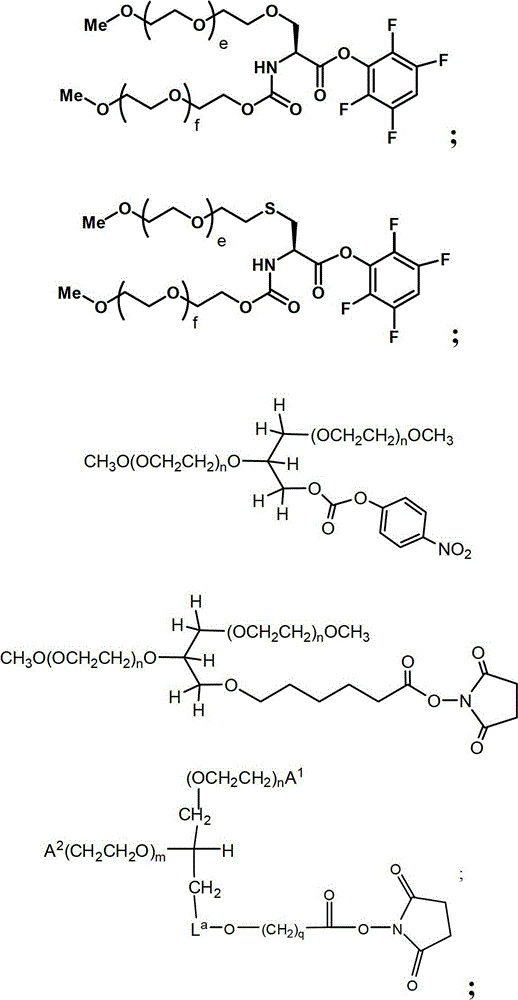
在上面的图中,q选自1-40。适合活化可用于制备本文所述化合物的线性和支化PEG的其他活化基团或离去基团包括但不限于:In the above figure, q is selected from 1-40. Other activating or leaving groups suitable for activating linear and branched PEGs useful in preparing the compounds described herein include, but are not limited to:

用这些和其他物种活化的PEG分子以及制备活化PEG的方法在WO04/083259中得到描述。PEG molecules activated with these and other species and methods of making activated PEGs are described in WO04/083259.
本领域技术人员会意识到上面所示的支化聚合物的一个或多个m-PEG臂可以由具有不同末端例如OH、COOH、NH2、C2-C10-烃基等的PEG部分代替。此外,上述结构容易地通过在氨基酸侧链的α-碳原子和官能团之间插入烃基接头(或除去碳原子)来进行修饰。因此,“同质(homo)”衍生物和高级同系物以及低级同系物在可用于本发明的支化PEG核心的范围内。Those skilled in the art will appreciate that one or more of the m-PEG arms of the branched polymers shown above may be replaced by PEG moieties with different termini such as OH, COOH, NH2 , C2 - C10 -hydrocarbyl, and the like. In addition, the above structures are easily modified by inserting a hydrocarbyl linker (or removing a carbon atom) between the α-carbon atom of the amino acid side chain and the functional group. Thus, "homo" derivatives and higher as well as lower homologues are within the scope of the branched PEG cores useful in the present invention.
本文所述的支化PEG物种容易地通过诸如以下方案中所述的方法来制备:The branched PEG species described herein are readily prepared by methods such as those described in the following schemes:

其中Xd为O或S而r为1-5的整数。下标e和f为独立地选自1-2500的整数。在一种示例性的实施方案中,选择这些下标之一或其两者以使得聚合物分子量为约5kDa、10kDa、15kDa、20kDa、25kDa、30kDa、35kDa或40kDa。Wherein X d is O or S and r is an integer of 1-5. Subscripts e and f are integers independently selected from 1-2500. In an exemplary embodiment, one or both of these subscripts are selected such that the molecular weight of the polymer is about 5 kDa, 10 kDa, 15 kDa, 20 kDa, 25 kDa, 30 kDa, 35 kDa, or 40 kDa.
因此,根据该方案,使天然或非天然的氨基酸与活性m-PEG衍生物(在该情况下为甲苯磺酸酯)接触,通过将侧链杂原子Xd烷基化而形成1。使单官能化的m-PEG氨基酸与活性m-PEG衍生物处于N-酰化条件下,从而组合成支化m-PEG2。如同技术人员会意识到的那样,甲苯磺酸酯离去基团可以用任何合适的离去基团代替,例如卤素、甲磺酸酯、三氟甲基磺酸酯等。类似地,用于酰化胺的反应性碳酸酯可以用活性酯例如N-羟基琥珀酰亚胺等代替,或者酸可以用脱水剂例如二环己基碳二亚胺、羰基二咪唑等原位活化。Thus, according to this scheme, a natural or unnatural amino acid is contacted with a reactive m-PEG derivative, in this case a tosylate, to form 1 by alkylation of the side chain heteroatom Xd . Branched m-PEG2 is assembled by subjecting monofunctionalized m-PEG amino acids to reactive m-PEG derivatives under N-acylation conditions. As the skilled artisan will appreciate, the tosylate leaving group may be replaced with any suitable leaving group, such as halo, mesylate, triflate, and the like. Similarly, reactive carbonates for acylation of amines can be replaced with active esters such as N-hydroxysuccinimide, etc., or acids can be activated in situ with dehydrating agents such as dicyclohexylcarbodiimide, carbonyldiimidazole, etc. .
在另外的示例性实施方案中,脲部分由诸如酰胺等基团代替。In other exemplary embodiments, the urea moiety is replaced by a group such as an amide.
II.E.物质的均匀分散的肽缀合物组合物 II.E. Homogeneously Dispersed Peptide Conjugate Compositions of Substance
除了提供通过化学或酶促加成糖基连接基团而形成的肽缀合物以外,本发明提供包含在其取代模式上高度同质的肽缀合物的物质组合物。采用本发明的方法,可以形成其中因子VII/因子VIIa缀合物的群体中相当大部分的糖基连接基团和糖基部分与结构上一致的氨基酸或糖基残基结合的肽缀合物。因此,在另一方面中,本发明提供具有通过糖基连接基团,例如完整的糖基连接基团共价结合至肽上的水溶性聚合物部分的群体的肽缀合物。在示例性的本发明肽缀合物中,水溶性聚合物群体的基本上每个成员通过糖基连接基团结合至肽的糖基残基上,而且该糖基连接基团所结合的肽的每个糖基残基具有相同结构。In addition to providing peptide conjugates formed by chemical or enzymatic addition of glycosyl linking groups, the present invention provides compositions of matter comprising peptide conjugates that are highly homogeneous in their substitution patterns. Using the methods of the invention, peptide conjugates can be formed wherein a substantial fraction of the glycosyl linking groups and glycosyl moieties in the population of Factor VII/Factor Vila conjugates are bound to structurally identical amino acids or glycosyl residues . Thus, in another aspect, the invention provides peptide conjugates having a population of water-soluble polymer moieties covalently bound to the peptide via a glycosyl linking group, eg, an intact glycosyl linking group. In an exemplary peptide conjugate of the invention, substantially each member of the population of water-soluble polymers is bound to a glycosyl residue of the peptide via a glycosyl linking group, and the peptide to which the glycosyl linking group is bound Each glycosyl residue has the same structure.
本发明还提供类似于上述那些的缀合物,其中肽与修饰基团例如治疗部分、诊断部分、靶向部分、毒素部分等通过糖基连接基团缀合。每一个上述修饰基团可以是小分子、天然聚合物(例如肽)或合成聚合物。当修饰基团与唾液酸结合时,通常优选该修饰基团是基本上非荧光的。The present invention also provides conjugates similar to those described above, wherein the peptide is conjugated to a modifying group such as a therapeutic moiety, diagnostic moiety, targeting moiety, toxin moiety, etc. via a glycosyl linking group. Each of the above-mentioned modifying groups can be a small molecule, a natural polymer (such as a peptide), or a synthetic polymer. When the modifying group is bound to sialic acid, it is generally preferred that the modifying group is substantially non-fluorescent.
在一种示例性的实施方案中,本发明的肽包含至少一个O-连接的或N-连接的糖基化位点,其用包含聚合物修饰基团例如PEG部分的修饰的糖来糖基化。在一种示例性的实施方案中,PEG通过完整的糖基连接基团、或者通过非糖基的接头例如取代的或未取代的烃基、取代的或未取代的杂烃基共价结合至肽上。糖基连接基团共价结合至肽的氨基酸残基或糖基残基上。作为选择,糖基连接基团结合至糖肽的一个或多个糖基单元上。本发明也提供其中糖基连接基团既与氨基酸残基又与糖基残基结合的缀合物。In an exemplary embodiment, the peptides of the invention comprise at least one O-linked or N-linked glycosylation site glycosylated with a modified sugar comprising a polymer modifying group, such as a PEG moiety. change. In an exemplary embodiment, PEG is covalently attached to the peptide through an intact glycosyl linking group, or through a non-glycosyl linker such as a substituted or unsubstituted hydrocarbyl, substituted or unsubstituted heterohydrocarbyl . The glycosyl linking group is covalently attached to an amino acid residue or a glycosyl residue of the peptide. Alternatively, the glycosyl linking group is attached to one or more glycosyl units of the glycopeptide. The invention also provides conjugates wherein the glycosyl linking group is bound to both an amino acid residue and a glycosyl residue.
本发明肽上的聚糖通常对应于在根据本文所述方法重构之后由哺乳动物(BHK、CHO)细胞或昆虫(例如Sf-9)细胞所产生的因子VII/因子VIIa肽上存在的那些。例如用三甘露糖基核心表达的昆虫来源的因子VII/因子VIIa肽随后与GlcNAc供体和GlcNAc转移酶以及Gal供体和Gal转移酶接触。将GlcNAc和Gal附加至三甘露糖基核心上在两步或一步中完成。如本文所述使修饰的唾液酸加成到糖基部分的至少一个分支上。没有用修饰的唾液酸官能化的那些Gal部分任选地通过在唾液酸转移酶的存在下与唾液酸供体反应而“加帽”。Glycans on the peptides of the invention generally correspond to those present on Factor VII/Factor VIIa peptides produced by mammalian (BHK, CHO) cells or insect (eg Sf-9) cells after reconstitution according to the methods described herein . For example, an insect-derived Factor VII/Factor Vila peptide expressed with a trimannosyl core is subsequently contacted with a GlcNAc donor and GlcNAc transferase and a Gal donor and Gal transferase. Attachment of GlcNAc and Gal to the trimannosyl core is accomplished in two or one step. The modified sialic acid is added to at least one branch of the glycosyl moiety as described herein. Those Gal moieties that are not functionalized with a modified sialic acid are optionally "capped" by reaction with a sialic acid donor in the presence of a sialyltransferase.
在一种示例性的实施方案中,肽群体中至少60%的末端Gal部分用唾液酸加帽,优选至少70%、更优选至少80%、再更优选至少90%以及甚至更优选至少95%、96%、97%、98%或99%的末端Gal部分用唾液酸加帽。In an exemplary embodiment, at least 60% of the terminal Gal moieties in the peptide population are capped with sialic acid, preferably at least 70%, more preferably at least 80%, even more preferably at least 90% and even more preferably at least 95% , 96%, 97%, 98%, or 99% of the terminal Gal moieties are capped with sialic acid.
II.F.核苷酸糖 II.F. Nucleotide sugars
在本发明的另一方面中,本发明还提供糖核苷酸。根据该实施方案的示例性物种包括:In another aspect of the invention, the invention also provides sugar nucleotides. Exemplary species according to this embodiment include:
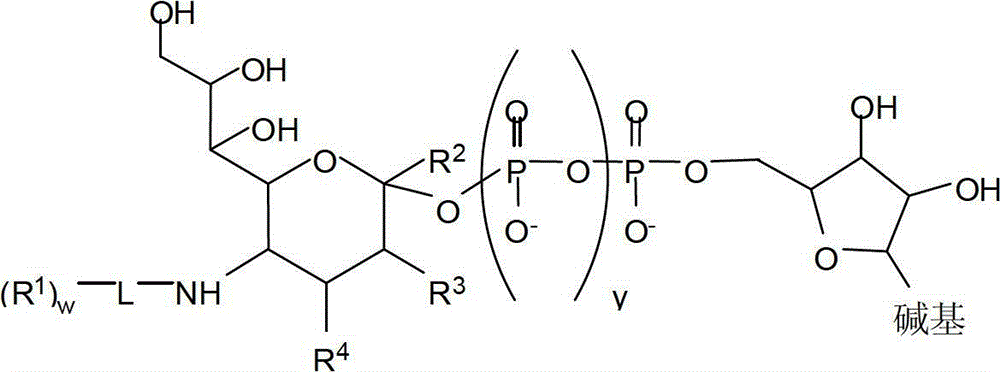
其中下标y为选自0、1和2的整数。碱基为核酸碱基例如腺嘌呤、胸腺嘧啶、鸟嘌呤、胞嘧啶和尿嘧啶。R2、R3和R4如上所述。在一种示例性的实施方案中,L-(R1)w选自Wherein the subscript y is an integer selected from 0, 1 and 2. A base is a nucleic acid base such as adenine, thymine, guanine, cytosine and uracil. R 2 , R 3 and R 4 are as described above. In an exemplary embodiment, L-(R 1 ) w is selected from
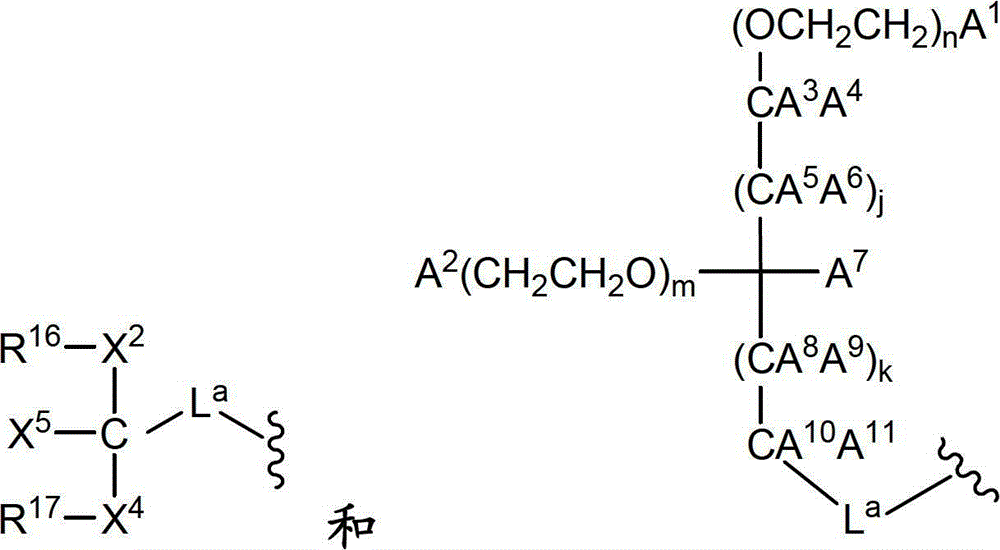
其中各变量如上所述。The variables are as above.
在一种示例性的实施方案中,L-(R1)w具有根据下式的结构:In an exemplary embodiment, L-(R 1 ) w has a structure according to the formula:

在一种示例性的实施方案中,A1和A2各自选自-OH和-OCH3。In an exemplary embodiment, A 1 and A 2 are each selected from —OH and —OCH 3 .
根据该实施方案的示例性聚合物修饰基团包括:Exemplary polymer modifying groups according to this embodiment include:

在另一示例性的实施方案中,核苷酸糖具有选自以下的式:In another exemplary embodiment, the nucleotide sugar has a formula selected from:

根据该实施方案的示例性核苷酸糖具有以下结构:An exemplary nucleotide sugar according to this embodiment has the following structure:
根据该实施方案的示例性核苷酸具有以下结构:Exemplary nucleotides according to this embodiment have the following structures:

在另一示例性的实施方案中,核苷酸糖基于下式:In another exemplary embodiment, the nucleotide sugar is based on the formula:

其中R基团和L表示如上所述的部分。下标“y”为0、1或2。在一种示例性的实施方案中,L为NH与R1之间的键。该碱基为核酸碱基。wherein R groups and L represent moieties as described above. Subscript "y" is 0, 1 or 2. In an exemplary embodiment, L is a bond between NH and R 1 . The base is a nucleic acid base.
在一种示例性的实施方案中,L-R1选自In an exemplary embodiment, LR 1 is selected from

其中各变量如上所述。The variables are as above.
在一种示例性的实施方案中,L-R1具有根据下式的结构:In an exemplary embodiment, LR 1 has a structure according to the formula:
在一种示例性的实施方案中,A1和A2各自选自-OH和-OCH3。In an exemplary embodiment, A 1 and A 2 are each selected from —OH and —OCH 3 .
III.方法 III. Method
除了上述缀合物以外,本发明提供制备这些及其他缀合物的方法。此外,本发明提供通过向具有发生所述疾病风险的受试者或患有所述病的受试者施用本发明的缀合物来预防、治疗或改善疾病状态的方法。In addition to the conjugates described above, the present invention provides methods of making these and other conjugates. Furthermore, the present invention provides methods of preventing, treating or ameliorating a disease state by administering the conjugate of the present invention to a subject at risk of developing the disease or a subject suffering from the disease.
在示例性的实施方案中,在聚合物修饰部分与糖基化的或未糖基化的肽之间形成缀合物。聚合物与肽通过插入其间而且同时与肽(或糖基残基)和修饰基团(例如水溶性聚合物)共价连接的糖基连接基团缀合。该方法包括使肽与含有修饰的糖以及使该修饰的糖与底物缀合的酶例如糖基转移酶的混合物接触。反应在适合于在修饰的糖与肽之间形成共价键的条件下进行。修饰的糖的糖部分优选选自核苷酸糖。合成因子VII/因子VIIa肽缀合物的方法,包括将a)唾液酸酶;b)能够催化糖基连接基团的转移的酶,例如糖基转移酶、外切糖苷酶或内切糖苷酶;c)修饰的糖;d)因子VII/因子VIIa肽合并,从而合成该因子VII/因子VIIa肽缀合物。反应在适合于在修饰的糖与肽之间形成共价键的条件下进行。修饰的糖的糖部分优选选自核苷酸糖。In an exemplary embodiment, a conjugate is formed between a polymer modification moiety and a glycosylated or unglycosylated peptide. The polymer is conjugated to the peptide via a glycosyl linking group interposed and covalently attached to both the peptide (or glycosyl residue) and a modifying group (eg, a water-soluble polymer). The method involves contacting the peptide with a mixture comprising a modified sugar and an enzyme, such as a glycosyltransferase, that conjugates the modified sugar to a substrate. The reaction is carried out under conditions suitable to form a covalent bond between the modified sugar and the peptide. The sugar moiety of the modified sugar is preferably selected from nucleotide sugars. A method of synthesizing a Factor VII/Factor VIIa peptide conjugate comprising combining a) a sialidase; b) an enzyme capable of catalyzing the transfer of a glycosyl linking group, such as a glycosyltransferase, an exoglycosidase or an endoglycosidase ; c) modified sugars; d) Factor VII/Factor VIIa peptides combined, thereby synthesizing the Factor VII/Factor VIIa peptide conjugate. The reaction is carried out under conditions suitable to form a covalent bond between the modified sugar and the peptide. The sugar moiety of the modified sugar is preferably selected from nucleotide sugars.
在一种示例性的实施方案中,将修饰的糖,例如上述的那些,活化成相应的核苷酸糖。以其修饰过的形式用于本发明的示例性的糖核苷酸包括核苷酸单-、二-或三磷酸或其类似物。在优选的实施方案中,修饰的糖核苷酸选自UDP-糖苷、CMP-糖苷、或GDP-糖苷。甚至更优选地,修饰的糖核苷酸的糖核苷酸部分选自UDP-半乳糖、UDP-半乳糖胺、UDP-葡萄糖、UDP-葡糖胺、GDP-甘露糖、GDP-岩藻糖、CMP-唾液酸或CMP-NeuAc。在一种示例性的实施方案中,核苷酸磷酸结合至C-1。In an exemplary embodiment, modified sugars, such as those described above, are activated to the corresponding nucleotide sugars. Exemplary sugar nucleotides for use in the invention in their modified form include nucleotide mono-, di- or triphosphates or analogs thereof. In preferred embodiments, the modified sugar nucleotides are selected from UDP-glycosides, CMP-glycosides, or GDP-glycosides. Even more preferably, the sugar nucleotide portion of the modified sugar nucleotide is selected from UDP-galactose, UDP-galactosamine, UDP-glucose, UDP-glucosamine, GDP-mannose, GDP-fucose , CMP-sialic acid or CMP-NeuAc. In an exemplary embodiment, the nucleotide phosphate is bound to C-1.
本发明还提供在6-碳位上用L-R1修饰的糖核苷酸的应用。根据该实施方案的示例性物种包括:The present invention also provides the use of sugar nucleotides modified with LR 1 at the 6-carbon position. Exemplary species according to this embodiment include:

其中R基团和L表示如上所述的部分。下标“y”为0、1或2。在一种示例性的实施方案中,L为NH与R1之间的键。该碱基为核酸碱基。wherein R groups and L represent moieties as described above. Subscript "y" is 0, 1 or 2. In an exemplary embodiment, L is a bond between NH and R 1 . The base is a nucleic acid base.
其中6-位的碳被修饰的用于本发明的示例性的核苷酸糖包括具有GDP甘露糖的立体化学的物种,例如:Exemplary nucleotide sugars for use in the invention wherein the carbon at the 6-position is modified include species with the stereochemistry of GDP mannose, for example:

其中X5为键或O。下标i表示0或1。下标a表示1-20的整数。下标e和f独立地表示1-2500的整数。Q如上所述为H或取代的或未取代的C1-C6烃基。如同技术人员会意识到的那样,其中S用O代替的丝氨酸衍生物也落在该通式模体中。where X 5 is a bond or O. Subscript i means 0 or 1. The subscript a represents an integer of 1-20. The subscripts e and f independently represent an integer of 1-2500. Q is H or a substituted or unsubstituted C 1 -C 6 hydrocarbon group as described above. As the skilled person will appreciate, serine derivatives in which S is replaced by O also fall within this general pattern motif.
在又一示例性的实施方案中,本发明提供其中修饰的糖基于UDP半乳糖的立体化学的缀合物。用于本发明的示例性核苷酸糖具有以下结构:In yet another exemplary embodiment, the invention provides conjugates wherein the modified sugar is based on the stereochemistry of UDP galactose. Exemplary nucleotide sugars for use in the invention have the following structures:

在另一示例性的实施方案中,核苷酸糖基于葡萄糖的立体化学。根据该实施方案的示例性物种具有下式:In another exemplary embodiment, the nucleotide sugar is based on the stereochemistry of glucose. Exemplary species according to this embodiment have the formula:

因此,在其中糖基部分为唾液酸的说明性实施方案中,本发明方法采用具有下式的化合物:Thus, in illustrative embodiments wherein the glycosyl moiety is sialic acid, the methods of the invention employ compounds having the formula:

其中L-R1如上所述,以及L1-R1表示与修饰基团结合的接头。如同L,根据L1的示例性接头物种包括键、烃基或杂烃基部分。wherein LR 1 is as described above, and L 1 -R 1 represent a linker combined with a modifying group. As with L, exemplary linker species according to L include bonds, hydrocarbyl or heterohydrocarbyl moieties.
此外,如上所述,本发明提供用直链或支化的水溶性聚合物修饰的核苷酸糖的应用。例如,具有下面所示式的化合物可用于制备本发明范围内的缀合物:Furthermore, as mentioned above, the present invention provides the use of nucleotide sugars modified with linear or branched water-soluble polymers. For example, compounds having the formula shown below can be used to prepare conjugates within the scope of the invention:

其中X4为O或键。Wherein X 4 is O or bond.
一般而言,通过使用反应性基团将糖部分或糖部分-接头盒与PEG或PEG-接头盒基团连接在一起,该反应性基团通常由连接过程转化成新的有机官能团或非反应性物种。糖反应性官能团位于糖部分的任何位置上。可用于实践本发明的反应性基团和反应种类一般为生物缀合化学领域中熟知的那些。目前有利的可用于反应性糖部分的反应类型是在相对温和的条件下进行的那些。这些包括但不限于亲核取代(例如醇和胺与酰基卤、活性酯的反应)、亲电取代(例如烯胺反应)以及碳-碳和碳-杂原子多重键的加成(例如Michael反应、Diels-Alder加成)。这些及其他有用的反应例如在以下文献中有论述:March,ADVANCED ORGANIC CHEMISTRY,第3版,John Wiley & Sons,NewYork,1985;Hermanson,BIOCONJUGATE TECHNIQUES,AcademicPress,San Diego,1996;以及Feeney等,MODIFICATION OF PROTEINS;Advances in Chemistry Series,第198卷,American Chemical Society,Washington,D.C.,1982。In general, sugar moieties or sugar moiety-linker boxes are linked together with PEG or PEG-linker box groups by using reactive groups that are usually converted by the linking process into new organic functional groups or non-reactive sexual species. The sugar-reactive functional group is located anywhere on the sugar moiety. Reactive groups and reactive classes useful in the practice of the present invention are generally those well known in the art of bioconjugation chemistry. Presently advantageous types of reactions available for reactive sugar moieties are those which proceed under relatively mild conditions. These include, but are not limited to, nucleophilic substitution (e.g. reaction of alcohols and amines with acid halides, active esters), electrophilic substitution (e.g. enamine reaction), and addition of carbon-carbon and carbon-heteroatom multiple bonds (e.g. Michael reaction, Diels-Alder addition). These and other useful reactions are discussed, for example, in March, A DVANCED ORGANIC C HEMISTRY , 3rd Edition, John Wiley & Sons, New York, 1985; Hermanson, B IOCONJUGATE T ECHNIQUES , Academic Press, San Diego, 1996; and Feeney et al., MODIFICATION OF P ROTEINS ; Advances in Chemistry Series, Vol. 198, American Chemical Society, Washington, DC, 1982.
悬挂于糖核或修饰基团的有用的反应性官能团包括但不限于:Useful reactive functional groups pendant from the sugar core or modifying groups include, but are not limited to:
(a)羧基及其各种衍生物,其包括但不限于N-羟基琥珀酰亚胺酯、N-羟基苯并三唑酯、酰基卤、酰基咪唑、硫酯、对硝基苯基酯,烷基、烯基、炔基和芳香酯;(a) Carboxyl and its various derivatives, which include but are not limited to N-hydroxysuccinimide esters, N-hydroxybenzotriazole esters, acid halides, acyl imidazoles, thioesters, p-nitrophenyl esters, Alkyl, alkenyl, alkynyl and aromatic esters;
(b)羟基,其可以例如转化成酯、醚、醛等;(b) hydroxyl groups, which can be converted, for example, into esters, ethers, aldehydes, etc.;
(c)卤代烃基,其中卤化物可以随后用亲核基团例如胺、羧酸根阴离子、硫醇阴离子、负碳离子或醇盐离子置换,从而引起卤素原子官能团处新基团的共价结合;(c) Halogenated hydrocarbyl groups, where the halide can be subsequently replaced by a nucleophilic group such as an amine, carboxylate anion, thiolate anion, carbanion or alkoxide ion, thereby causing covalent attachment of a new group at the functional group of the halogen atom ;
(d)能够参与Diels-Alder反应的亲二烯体基团,例如马来酰亚氨基;(d) a dienophile group capable of participating in a Diels-Alder reaction, such as a maleimido group;
(e)醛或酮基团,以至于可以通过形成羰基衍生物如亚胺、腙、缩氨基脲或肟、或者通过诸如Grignard加成或烷基锂加成等机理而随后衍生化;(e) aldehyde or ketone groups so that they can be subsequently derivatized by formation of carbonyl derivatives such as imines, hydrazones, semicarbazones or oximes, or by mechanisms such as Grignard addition or alkyllithium addition;
(f)磺酰基卤基团,以便随后与胺反应例如形成磺酰胺;(f) a sulfonyl halide group for subsequent reaction with an amine such as to form a sulfonamide;
(g)硫醇基,其可以例如转换成二硫化物或与酰基卤反应;(g) thiol groups, which can be converted, for example, into disulfides or reacted with acid halides;
(h)胺基团或巯基,其可以是例如酰化的、烃基化的或氧化的;(h) amine groups or mercapto groups, which may be, for example, acylated, alkylated or oxidized;
(i)能够经历例如环加成、酰化、Michael加成等的烯烃;和(i) alkenes capable of undergoing e.g. cycloaddition, acylation, Michael addition, etc.; and
(j)能够例如与胺和羟基化合物反应的环氧化物。(j) Epoxides capable of reacting, for example, with amines and hydroxyl compounds.
可以选择反应性官能团以使得它们不参与或不干扰组装反应性糖核或修饰基团所必需的反应。作为选择,可以通过保护基团的存在来保护反应性官能团免于参与反应。本领域技术人员了解如何保护特定的官能团以使其不会干扰选定的一组反应条件。对于有用保护基团的实例,例如参见Greene等,PROTECTIVE GROUPS IN ORGANICSYNTHESIS,John Wiley & Sons,New York,1991。Reactive functional groups can be selected such that they do not participate in or interfere with the reactions necessary to assemble the reactive sugar core or modifying group. Alternatively, reactive functional groups can be protected from participation in the reaction by the presence of protecting groups. Those skilled in the art know how to protect a particular functional group so that it does not interfere with a chosen set of reaction conditions. For examples of useful protecting groups see, eg, Greene et al., PROTECTIVE G ROUPS IN ORGANIC S YNTHESIS , John Wiley & Sons, New York, 1991.
在下面的论述中,阐述了可用于实践本发明的修饰的糖的若干具体实例。在示例性的实施方案中,将唾液酸衍生物用作结合有修饰基团的糖核。对唾液酸衍生物集中论述只是为了说明的清楚性而不应当解释成限制本发明的范围。本领域技术人员会意识到可以用以唾液酸作为实例阐述的类似方法活化和衍生化各种其他糖部分。例如,许多方法可用于修饰半乳糖、葡萄糖、N-乙酰半乳糖胺和岩藻糖以列举几种糖底物,该糖底物容易通过本领域已知的方法修饰。例如参见Elhalabi等,Curr.Med.Chem.6:93(1999)和Schafe等,J.Org.Chem.65:24(2000)。In the discussion that follows, several specific examples of modified sugars that can be used in the practice of the invention are set forth. In an exemplary embodiment, a sialic acid derivative is used as the sugar core to which a modifying group is bound. The focus on sialic acid derivatives is for clarity of illustration only and should not be construed as limiting the scope of the invention. Those skilled in the art will recognize that a variety of other sugar moieties can be activated and derivatized in a similar manner to that described with sialic acid as an example. For example, many methods are available for modifying galactose, glucose, N-acetylgalactosamine and fucose to name a few sugar substrates which are readily modified by methods known in the art. See, eg, Elhalabi et al., Curr. Med. Chem. 6:93 (1999) and Schafe et al., J. Org. Chem. 65:24 (2000).
在一种示例性的实施方案中,修饰的糖基于6-氨基-N-乙酰基-糖基部分。In an exemplary embodiment, the modified sugar is based on a 6-amino-N-acetyl-glycosyl moiety.
在上述方案中,下标n表示1-2500的整数。在一种示例性的实施方案中,选择该下标以使得聚合物分子量为约10KDa、15KDa或20KDa。符号“A”表示活化基团,例如卤素、活化酯的组分(例如N-羟基琥珀酰亚胺酯)、碳酸酯的组分(例如对硝基苯基碳酸酯)等。本领域技术人员会意识到其他PEG-酰胺核苷酸糖容易由该方法和类似方法制成。In the above schemes, the subscript n represents an integer of 1-2500. In an exemplary embodiment, the subscript is selected such that the molecular weight of the polymer is about 10 KDa, 15 KDa, or 20 KDa. The symbol "A" represents an activating group, such as a halogen, a component of an activated ester (eg, N-hydroxysuccinimide ester), a component of a carbonate (eg, p-nitrophenyl carbonate), and the like. Those skilled in the art will recognize that other PEG-amide nucleotide sugars are readily made by this and analogous methods.
肽通常从新合成,或者在原核细胞(例如细菌细胞如大肠杆菌)或在真核细胞如哺乳动物、酵母、昆虫、真菌或植物细胞中重组表达。肽可以是全长蛋白质或片段。此外,肽可以是野生型或突变的肽。在一种示例性的实施方案中,肽包括向肽序列中加入一个或多个N-或O-连接的糖基化位点的突变。Peptides are usually synthesized de novo, or expressed recombinantly in prokaryotic cells such as bacterial cells such as E. coli, or in eukaryotic cells such as mammalian, yeast, insect, fungal or plant cells. Peptides can be full-length proteins or fragments. Furthermore, the peptides can be wild-type or mutated peptides. In an exemplary embodiment, the peptide includes mutations that add one or more N- or O-linked glycosylation sites to the peptide sequence.
本发明的方法还提供重组产生的不完全糖基化肽的修饰。许多重组产生的糖蛋白不完全糖基化,露出可能具有不期望的性质例如免疫原性、被RES识别的碳水化合物残基。在本发明方法中采用修饰的糖,可以使肽同时进一步糖基化和用例如水溶性聚合物、治疗剂等衍生化。修饰的糖的糖部分可以是会适当地与完全糖基化肽中的接纳体缀合的残基或具有期望性质的另一糖部分。The methods of the invention also provide for the modification of recombinantly produced incompletely glycosylated peptides. Many recombinantly produced glycoproteins are incompletely glycosylated, exposing carbohydrate residues that may have undesirable properties such as immunogenicity, recognized by RESs. Using modified sugars in the methods of the invention, the peptides can be simultaneously further glycosylated and derivatized with, for example, water-soluble polymers, therapeutic agents, and the like. The sugar moiety of the modified sugar can be a residue that would suitably conjugate to an acceptor in a fully glycosylated peptide or another sugar moiety that has the desired properties.
技术人员会意识到可以用来自任意来源的基本上任何的肽或糖肽来实践本发明。可以用来实践本发明的示例性的肽在WO03/031464以及其中所述的参考文献中得到叙述。The skilled artisan will appreciate that the present invention can be practiced with essentially any peptide or glycopeptide from any source. Exemplary peptides that may be used to practice the invention are described in WO03/031464 and references cited therein.
通过本发明方法修饰的肽可以是合成的或野生型肽,或者它们可以是通过本领域已知的方法例如定点诱变产生的突变肽。肽的糖基化通常是N-连接的或O-连接的。示例性的N-连接为修饰的糖与天冬酰胺残基的侧链结合。三肽序列天冬酰胺-X-丝氨酸和天冬酰胺-X-苏氨酸为碳水化合物部分酶促结合至天冬酰胺侧链上的识别序列,其中X为除脯氨酸以外的任何氨基酸。因此,这些三肽序列中的任一种在多肽中的存在产生潜在的糖基化位点。O-连接的糖基化是指一个糖(例如N-乙酰半乳糖胺、半乳糖、甘露糖、GlcNAc、葡萄糖、岩藻糖或木糖)结合至羟基氨基酸的羟基侧链上,该羟基氨基酸优选丝氨酸或苏氨酸,尽管也可以使用不常见或非天然的氨基酸例如5-羟基脯氨酸或5-羟基赖氨酸。Peptides modified by the methods of the invention may be synthetic or wild-type peptides, or they may be mutant peptides produced by methods known in the art, such as site-directed mutagenesis. Glycosylation of peptides is usually either N-linked or O-linked. An exemplary N-linkage is the attachment of a modified sugar to the side chain of an asparagine residue. The tripeptide sequences asparagine-X-serine and asparagine-X-threonine are the recognition sequences for the enzymatic conjugation of the carbohydrate moiety to the side chain of asparagine, where X is any amino acid except proline. Thus, the presence of any of these tripeptide sequences in a polypeptide creates a potential glycosylation site. O-linked glycosylation refers to the attachment of a sugar (such as N-acetylgalactosamine, galactose, mannose, GlcNAc, glucose, fucose, or xylose) to the hydroxyl side chain of a hydroxyamino acid that Serine or threonine are preferred, although uncommon or unnatural amino acids such as 5-hydroxyproline or 5-hydroxylysine may also be used.
此外,除了肽以外,可以用其他生物结构(例如含有糖基化位点的糖脂、脂质、鞘氨基醇(sphingoid)、神经酰胺、全细胞等)实践本发明的方法。Furthermore, in addition to peptides, the methods of the invention can be practiced with other biological structures (eg, glycolipids, lipids, sphingoids, ceramides, whole cells, etc.) that contain glycosylation sites.
通过改变氨基酸序列以使得它含有一个或多个糖基化位点来便利地实现向肽或其他结构中加入糖基化位点。也可以通过在肽的序列中并入一个或多个提供-OH基团的物种,优选丝氨酸或苏氨酸残基(用于O-连接的糖基化位点)来完成该添加。可以通过肽的突变或完全化学合成来完成添加。优选通过DNA水平的变化,特别是通过在预选的碱基处使编码肽的DNA突变以至于产生将翻译成期望的氨基酸的密码子,来改变肽的氨基酸序列。优选用本领域已知的方法进行DNA突变。Addition of glycosylation sites to a peptide or other structure is conveniently accomplished by altering the amino acid sequence so that it contains one or more glycosylation sites. This addition can also be accomplished by incorporating one or more species providing -OH groups, preferably serine or threonine residues (for O-linked glycosylation sites) in the sequence of the peptide. Addition can be accomplished by mutation of the peptide or by complete chemical synthesis. The amino acid sequence of the peptide is preferably altered by changes at the DNA level, in particular by mutating the DNA encoding the peptide at preselected bases so as to produce codons that will be translated into the desired amino acid. DNA mutations are preferably performed using methods known in the art.
在一种示例性的实施方案中,通过改组(shuffling)多核苷酸加入糖基化位点。可以用DNA改组实验流程调控编码候选肽的多核苷酸。DNA改组是递归重组和突变的方法,其通过随机片段化相关基因库接着由类似于聚合酶链式反应的方法重新组装片段来进行。例如参见Stemmer,Proc.Natl.Acad.Sci.USA 91:10747-10751(1994);Stemmer,Nature 370:389-391(1994);以及美国专利Nos.5,605,793、5,837,458、5,830,721和5,811,238。In an exemplary embodiment, glycosylation sites are added by shuffling polynucleotides. Polynucleotides encoding candidate peptides can be manipulated using DNA shuffling protocols. DNA shuffling is a method of recursive recombination and mutation by random fragmentation of a pool of related genes followed by reassembly of the fragments by a method similar to the polymerase chain reaction. See, eg, Stemmer, Proc. Natl. Acad. Sci. USA 91:10747-10751 (1994); Stemmer, Nature 370:389-391 (1994);
可以用其实践本发明的示例性的肽、加入或去除糖基化位点以及加入或去除糖基结构或亚结构的方法在WO03/031464及相关的美国和PCT申请中得到详细描述。Exemplary peptides, methods of adding or removing glycosylation sites, and adding or removing glycosyl structures or substructures with which the invention can be practiced are described in detail in WO03/031464 and related US and PCT applications.
本发明还利用向肽中加入(或从中去除)一个或多个选定的糖基残基,其后使修饰的糖与肽中至少一个选定的糖基残基缀合。例如,当期望使修饰的糖与不存在于肽中或未以期望的量存在的选定糖基残基缀合时,本实施方案是有用的。因此,在使修饰的糖与肽偶合之前,通过酶或化学偶合使选定的糖基残基与肽缀合。在另一实施方案中,在修饰的糖缀合之前,通过从糖肽中去除碳水化合物残基来改变糖肽的糖基化模式。例如参见WO98/31826。The invention also utilizes the addition (or removal) of one or more selected glycosyl residues to a peptide, followed by conjugation of the modified sugar to at least one of the selected glycosyl residues in the peptide. This embodiment is useful, for example, when it is desired to conjugate a modified sugar to a selected glycosyl residue that is not present in the peptide or is not present in the desired amount. Thus, selected glycosyl residues are conjugated to the peptide by enzymatic or chemical coupling prior to coupling the modified carbohydrate to the peptide. In another embodiment, the glycosylation pattern of the glycopeptide is altered by removing carbohydrate residues from the glycopeptide prior to conjugation of the modified carbohydrate. See eg WO98/31826.
用化学或酶促方法实现糖肽上存在的任何碳水化合物部分的加入或去除。示例性的化学脱糖基化通过将多肽变体暴露于化合物三氟甲磺酸或等效化合物下来进行。该处理导致除连接性糖(N-乙酰葡糖胺或N-乙酰半乳糖胺)外大部分或所有糖的切割,同时保留肽完整。化学脱糖基化在以下文献中有描述:Hakimuddin等,Arch.Biochem.Biophys.259:52(1987)和Edge等,Anal.Biochem.118:131(1981)。多肽变体上的碳水化合物部分的酶促切割可以通过利用多种内切糖苷酶或外切糖苷酶来实现,如同Thotakura等,Meth.Enzymol.138:350(1987)所述的那样。Addition or removal of any carbohydrate moieties present on the glycopeptide is accomplished chemically or enzymatically. An exemplary chemical deglycosylation is performed by exposing the polypeptide variant to the compound triflate or an equivalent compound. This treatment results in the cleavage of most or all sugars except the linking sugar (N-acetylglucosamine or N-acetylgalactosamine), while leaving the peptide intact. Chemical deglycosylation is described in Hakimuddin et al., Arch. Biochem. Biophys. 259:52 (1987) and Edge et al., Anal. Biochem. 118:131 (1981). Enzymatic cleavage of carbohydrate moieties on polypeptide variants can be achieved by the use of various endoglycosidases or exoglycosidases as described by Thotakura et al., Meth. Enzymol. 138:350 (1987).
在一种示例性的实施方案中,在肽上进行糖缀合或重构步骤之前用神经氨酸酶使肽基本上完全去唾液酸化。在糖缀合或重构之后,任选地用唾液酸转移酶使肽重新唾液酸化。在一种示例性的实施方案中,唾液酰基接纳体群体中的基本上每个(例如>80%,优选大于85%、大于90%,优选大于95%以及更优选大于96%、97%、98%或99%)末端糖基接纳体上发生重新唾液酸化。在优选的实施方案中,糖具有基本上均一的唾液酸化模式(即基本上均一的糖基化模式)。In an exemplary embodiment, the peptide is substantially completely desialylated with neuraminidase prior to performing a glycoconjugation or remodeling step on the peptide. Following sugar conjugation or remodeling, the peptide is optionally re-sialylated with a sialyltransferase. In an exemplary embodiment, substantially every (e.g. >80%, preferably greater than 85%, greater than 90%, preferably greater than 95% and more preferably greater than 96%, 97%, 98% or 99%) re-sialylation occurs on the terminal glycan acceptor. In preferred embodiments, the sugars have a substantially uniform sialylation pattern (ie, a substantially uniform glycosylation pattern).
糖基部分的化学加入通过任何本领域公认的方法来进行。糖部分的酶促加入优选采用本文所述方法的变型、用原始的糖基单元代替本发明中所用的修饰的糖来实现。加入糖部分的其他方法在美国专利No.5,876,980、6,030,815、5,728,554和5,922,577中得到公开。Chemical addition of glycosyl moieties is by any art-recognized method. Enzymatic addition of sugar moieties is preferably accomplished using variations of the methods described herein, substituting native glycosyl units for the modified sugars used in the present invention. Other methods of adding sugar moieties are disclosed in US Patent Nos. 5,876,980, 6,030,815, 5,728,554 and 5,922,577.
示例性的用于选定糖基残基的结合点包括但不限于:(a)N-连接糖基化的共有位点和O-连接糖基化的位点;(b)作为糖基转移酶接纳体的末端糖基部分;(c)精氨酸、天冬酰胺和组氨酸;(d)游离羧基;(e)游离巯基,如半胱氨酸中的那些;(f)游离羟基,如丝氨酸、苏氨酸或羟基脯氨酸中的那些;(g)芳族残基,如苯丙氨酸、酪氨酸或色氨酸中的那些;或(h)谷氨酰胺的酰胺基。可用于本发明的示例性方法在以下文献中有描述:1987年9月11日公布的WO87/05330以及Aplin和Wriston,CRC CRIT.REV.BIOCHEM.,第259-306页(1981)。Exemplary attachment sites for selected glycosyl residues include, but are not limited to: (a) consensus sites for N-linked glycosylation and sites for O-linked glycosylation; Terminal glycosyl moieties of enzyme acceptors; (c) arginine, asparagine, and histidine; (d) free carboxyl groups; (e) free sulfhydryl groups, such as those in cysteine; (f) free hydroxyl groups , such as those in serine, threonine, or hydroxyproline; (g) aromatic residues, such as those in phenylalanine, tyrosine, or tryptophan; or (h) amides of glutamine base. Exemplary methods that can be used in the present invention are described in WO87/05330 published September 11, 1987 and Aplin and Wriston, CRC C RIT . R EV . B IOCHEM ., pp. 259-306 (1981) .
在一种实施方案中,本发明提供通过连接基团连接两个或更多个肽的方法。该连接基团具有任何有用的结构而且可以选自直链和支链结构。优选地,结合至肽上的接头的每个末端包含修饰的糖(即初生的完整的糖基连接基团)。In one embodiment, the invention provides a method of linking two or more peptides via a linking group. The linking group has any useful structure and can be selected from linear and branched structures. Preferably, each terminus of the linker bound to the peptide comprises a modified sugar (ie a nascent intact glycosyl linking group).
在示例性的本发明方法中,通过包含聚合物的接头部分(例如PEG接头)将两个肽连接在一起。该构造物符合上面图中所述的通式结构。如本文所述,本发明的构造物包含两个完整的糖基连接基团(即s+t=1)。集中在包含两个糖基基团的PEG接头是为了清楚起见而且不应当解释成限制可用于本发明该实施方案中的接头臂的同一性。In an exemplary method of the invention, two peptides are linked together via a linker moiety comprising a polymer, such as a PEG linker. This construct conforms to the general structure described in the figure above. As described herein, constructs of the invention comprise two complete glycosyl linking groups (ie s+t=1). The focus on PEG linkers comprising two glycosyl groups is for clarity and should not be construed as limiting the identity of the linker arms that can be used in this embodiment of the invention.
因此,使PEG部分在第一末端用第一糖基单元以及在第二末端用第二糖基单元官能化。该第一和第二糖基单元优选为不同转移酶的底物,其分别容许第一和第二肽正交(orthogonal)结合至第一和第二糖基单元上。实际上,使(糖基)1-PEG-(糖基)2接头与第一肽和第一糖基单元为其底物的第一转移酶接触,由此形成(肽)1-(糖基)1-PEG-(糖基)2。然后任选地从反应混合物中除去转移酶和/或未反应的肽。向(肽)1-(糖基)1-PEG-(糖基)2缀合物中加入第二肽和第二糖基单元为其底物的第二转移酶,形成(肽)1-(糖基)1-PEG-(糖基)2-(肽)2;至少一个糖基残基是直接或间接地O-连接的。本领域技术人员会意识到以上概述的方法也可适用于例如通过利用支化PEG、枝状物、聚氨基酸、多糖等而形成多于两个肽之间的缀合物。Thus, the PEG moiety is functionalized at a first end with a first glycosyl unit and at a second end with a second glycosyl unit. The first and second glycosyl units are preferably substrates for different transferases which allow orthogonal binding of the first and second peptides to the first and second glycosyl units, respectively. In effect, a (glycosyl) 1 -PEG-(glycosyl) 2 linker is brought into contact with a first peptide and a first transferase for which the first glycosyl unit is a substrate, thereby forming a (peptide) 1 -(glycosyl ) 1 -PEG-(glycosyl) 2 . The transferase and/or unreacted peptide is then optionally removed from the reaction mixture. Adding a second peptide and a second transferase with the second glycosyl unit as its substrate to the (peptide) 1 -(glycosyl) 1 -PEG-(glycosyl) 2 conjugate forms a (peptide) 1 -( Glycosyl) 1 -PEG-(glycosyl) 2 -(peptide) 2 ; at least one glycosyl residue is directly or indirectly O-linked. Those skilled in the art will appreciate that the methods outlined above are also applicable to the formation of conjugates between more than two peptides, for example by utilizing branched PEGs, dendrimers, polyamino acids, polysaccharides, and the like.
在一种示例性的实施方案中,由本发明方法修饰的肽为在哺乳动物细胞(例如CHO细胞)或在转基因动物中产生并因而含有不完全唾液酸化的N-和/或O-连接寡糖链的糖肽。缺乏唾液酸并含有末端半乳糖残基的糖肽的寡糖链可以被PEG化、PPG化或以其它方式用修饰的唾液酸进行修饰。In an exemplary embodiment, the peptides modified by the methods of the invention are produced in mammalian cells (e.g. CHO cells) or in transgenic animals and thus contain incompletely sialylated N- and/or O-linked oligosaccharides chain of glycopeptides. The oligosaccharide chain of the glycopeptide lacking sialic acid and containing a terminal galactose residue can be PEGylated, PPGylated or otherwise modified with a modified sialic acid.
在方案1中,用受保护氨基酸(例如甘氨酸)衍生物的活性酯处理氨基糖苷1,将糖胺残基转化成相应的受保护氨基酸酰胺加合物。用醛缩酶处理该加合物以形成a-羟基羧酸盐2。通过CMP-SA合成酶的作用将化合物2转化成相应的CMP衍生物,接着催化氢化该CMP衍生物以产生化合物3。将经由甘氨酸加合物的形成所引入的胺用作通过使化合物3与活化的PEG或PPG衍生物(例如PEG-C(O)NHS、PEG-OC(O)O-对-硝基苯基)反应而结合PEG的位点,分别产生诸如4或5的物种。In
方案1

在一种示例性的实施方案中,可以使修饰的糖结合至因子VII/因子VIIa肽上的O-聚糖结合位点上。可以用于制备该因子VII/因子VIIa肽缀合物的糖基转移酶包括:对于Ser56(-Glc-(Xyl)n-Gal-SA-PEG-,半乳糖基转移酶和唾液酸转移酶;对于Ser56-Glc-(Xyl)n-Xyl-PEG-,木糖基转移酶;以及对于Ser60-Fuc-GlcNAc-(Gal)n-(SA)m-PEG-,GlcNAc转移酶。In an exemplary embodiment, the modified sugar can be bound to the O-glycan binding site on the Factor VII/Factor Vila peptide. Glycosyltransferases that can be used to prepare the Factor VII/Factor VIIa peptide conjugate include: for Ser56(-Glc-(Xyl)n-Gal-SA-PEG-, galactosyltransferase and sialyltransferase; For Ser56-Glc-(Xyl)n-Xyl-PEG-, xylosyltransferase; and for Ser60-Fuc-GlcNAc-(Gal)n-(SA)m-PEG-, GlcNActransferase.
III.A.修饰的糖与肽的缀合 III.A. Conjugation of Modified Sugars to Peptides
使PEG修饰的糖与糖基化的或未糖基化的肽缀合,其使用适当的酶来介导该缀合。优选地,选择修饰的供体糖、酶和接纳体肽的浓度以使得进行糖基化直至将接纳体耗尽为止。下面论述的考虑因素,虽然在唾液酸转移酶的上下文中阐述,但是通常可适用于其他糖基转移酶反应。可用于本发明的优选唾液酸转移酶的列表在图3中提供。The PEG-modified sugar is conjugated to the glycosylated or unglycosylated peptide using an appropriate enzyme to mediate the conjugation. Preferably, the concentrations of modified donor sugar, enzyme and acceptor peptide are selected such that glycosylation occurs until the acceptor is depleted. The considerations discussed below, while illustrated in the context of sialyltransferases, are generally applicable to other glycosyltransferase reactions. A list of preferred sialyltransferases useful in the present invention is provided in FIG. 3 .
使用糖基转移酶合成期望的寡糖结构的许多方法是已知的而且通常可适用于本发明。示例性的方法例如在以下文献中有描述:WO96/32491、Ito等,Pure Appl.Chem.65:753(1993)、美国专利Nos.5,352,670、5,374,541、5,545,553以及共同拥有的美国专利Nos.6,399,336和6,440,703,以及共同拥有已公布PCT申请WO03/031464、WO04/033651、WO04/099231,其通过引用并入本文。A number of methods for the synthesis of desired oligosaccharide structures using glycosyltransferases are known and generally applicable to the present invention. Exemplary methods are described, for example, in WO96/32491, Ito et al., Pure Appl. Chem. 65:753 (1993), U.S. Pat. 6,440,703, and co-owned published PCT applications WO03/031464, WO04/033651, WO04/099231, which are incorporated herein by reference.
使用单一的糖基转移酶或糖基转移酶的组合来实践本发明。例如,可以使用唾液酸转移酶和半乳糖基转移酶的组合。在使用多于一种酶的实施方案中,优选在初始反应混合物中合并酶和底物,或者一旦第一酶促反应完成或接近完成时向反应介质中加入第二酶促反应的酶和试剂。通过在单一容器中依次进行两个酶促反应,总收率相对其中分离中间产物物种的方法得到提高。此外,减少了额外溶剂和副产物的清除及处理。The invention is practiced using a single glycosyltransferase or a combination of glycosyltransferases. For example, a combination of sialyltransferase and galactosyltransferase can be used. In embodiments where more than one enzyme is used, it is preferred to combine the enzyme and substrate in the initial reaction mixture, or to add the enzyme and reagents for the second enzymatic reaction to the reaction medium once the first enzymatic reaction is complete or near completion . By performing two enzymatic reactions sequentially in a single vessel, the overall yield is improved relative to methods in which intermediate species are isolated. In addition, removal and disposal of additional solvents and by-products is reduced.
在一种优选的实施方案中,第一和第二种酶各自是糖基转移酶。在另一优选的实施方案中,一种酶为内切糖苷酶。在另外的优选实施方案中,用多于两种酶来装配本发明的修饰的糖蛋白。在向肽中加入修饰的糖之前或之后任意时刻用酶来改变肽上的糖结构。In a preferred embodiment, the first and second enzymes are each glycosyltransferases. In another preferred embodiment, one enzyme is an endoglycosidase. In other preferred embodiments, more than two enzymes are used to assemble the modified glycoproteins of the invention. The enzyme is used to alter the sugar structure on the peptide at any time before or after adding the modified sugar to the peptide.
在另一实施方案中,本方法使用一种或多种外切糖苷酶或内切糖苷酶。糖苷酶通常是经过设计以形成糖基键而非使它们断裂的突变体。该突变体聚糖酶通常包括用氨基酸残基代替活性位点酸性氨基酸残基。例如,当内切聚糖酶为endo-H时,取代的活性位点残基通常会是130位置的Asp、132位置的Glu或其组合。该氨基酸一般由丝氨酸、丙氨酸、天冬酰胺或谷氨酰胺取代。In another embodiment, the method uses one or more exoglycosidases or endoglycosidases. Glycosidases are generally mutants engineered to form glycosyl bonds rather than break them. The mutant glycanase typically includes substitution of an active site acidic amino acid residue with an amino acid residue. For example, when the endoglycanase is endo-H, the substituted active site residues will usually be Asp at position 130, Glu at position 132 or a combination thereof. This amino acid is typically substituted with serine, alanine, asparagine or glutamine.
突变体酶通常经由与内切聚糖酶水解步骤的逆反应相似的合成步骤来催化反应。在这些实施方案中,糖基供体分子(例如期望的寡糖或单糖结构)含有离去基团,通过将供体分子加到蛋白质的GlcNAc残基上进行反应。例如,离去基团可以是卤素例如氟化物。在另外的实施方案中,离去基团为Asn或Asn-肽部分。在其他实施方案中,糖基供体分子上的GlcNAc残基被修饰。例如该GlcNAc残基可以包含1,2
在优选的实施方案中,用于制备本发明缀合物的每一种酶以催化量存在。具体酶的催化量根据该酶底物的浓度以及反应条件例如温度、时间和pH值而改变。在预选的底物浓度和反应条件下测定给定酶的催化量的方法为本领域技术人员所熟知。In preferred embodiments, each of the enzymes used to prepare the conjugates of the invention is present in catalytic amounts. The catalytic amount of a particular enzyme varies depending on the concentration of the enzyme's substrate as well as reaction conditions such as temperature, time and pH. Methods for determining the catalytic amount of a given enzyme under preselected substrate concentrations and reaction conditions are well known to those skilled in the art.
进行上述方法的温度的范围可以从刚好在冰点以上到最敏感的酶变性的温度。优选的温度范围是约0℃-约55℃,以及更优选约20℃-约37℃。在另一示例性的实施方案中,使用嗜热酶在升高的温度下进行本发明方法的一个或多个部分。The temperature at which the above methods are carried out can range from just above freezing to temperatures at which the most sensitive enzymes are denatured. A preferred temperature range is from about 0°C to about 55°C, and more preferably from about 20°C to about 37°C. In another exemplary embodiment, one or more portions of the methods of the invention are performed at elevated temperatures using a thermophilic enzyme.
将反应混合物保持足以使接纳体糖基化的一段时间,从而形成期望的缀合物。一些缀合物往往可以在几小时后检测到,通常在24小时或更短时间内得到可回收的量。本领域技术人员理解反应速率取决于许多变量因素(例如酶浓度、供体浓度、接纳体浓度、温度、溶剂体积),其对选定体系进行优化。The reaction mixture is maintained for a period of time sufficient to allow glycosylation of the acceptor, thereby forming the desired conjugate. Some conjugates are often detectable after a few hours, usually in recoverable quantities in 24 hours or less. Those skilled in the art understand that reaction rates depend on many variables (eg, enzyme concentration, donor concentration, acceptor concentration, temperature, solvent volume), which are optimized for a chosen system.
本发明还提供修饰的肽的工业规模生产。本文使用的工业规模一般产生至少1g纯化的成品缀合物。The present invention also provides industrial scale production of the modified peptides. The commercial scale used here generally yields at least 1 g of purified finished conjugate.
在下面的论述中,通过将修饰的唾液酸部分缀合至糖基化的肽上来举例说明本发明。用PEG标记示例性的修饰的唾液酸。下面的论述集中在使用PEG-修饰的唾液酸和糖基化的肽是为了说明的清楚性,而且并非意图暗示本发明限于这两种配对体的缀合物。技术人员理解该论述一般可适用于加入除唾液酸以外的修饰的糖基部分。此外,该论述同样可适用于以包含其他PEG部分、治疗部分和生物分子的除PEG以外的试剂修饰糖基单元。In the following discussion, the invention is illustrated by the conjugation of modified sialic acid moieties to glycosylated peptides. Exemplary modified sialic acids were labeled with PEG. The following discussion focuses on the use of PEG-modified sialic acids and glycosylated peptides for clarity of illustration and is not intended to imply that the invention is limited to conjugates of these two partners. The skilled person understands that this discussion is generally applicable to the addition of modified glycosyl moieties other than sialic acid. Furthermore, the discussion is equally applicable to the modification of glycosyl units with agents other than PEG comprising other PEG moieties, therapeutic moieties and biomolecules.
可以将酶促方法用于PEG化或PPG化的碳水化合物选择性引入肽或糖肽上。该方法使用含PEG、PPG或受掩蔽的反应性官能团的修饰的糖,并与适当的糖基转移酶或糖合酶组合。通过选择将会产生期望的碳水化合物键的糖基转移酶以及使用修饰的糖作为供体底物,可以将PEG或PPG直接引入至肽主链上,引入至糖肽中现有的糖残基上或者引入至已加到肽中的糖残基上。Enzymatic methods can be used for the selective introduction of PEGylated or PPGylated carbohydrates onto peptides or glycopeptides. The method uses modified sugars containing PEG, PPG or masked reactive functional groups in combination with appropriate glycosyltransferases or sugar synthases. By selecting a glycosyltransferase that will generate the desired carbohydrate linkage and using a modified sugar as a donor substrate, PEG or PPG can be introduced directly onto the peptide backbone, into existing sugar residues in the glycopeptide or introduced onto sugar residues already added to the peptide.
在一种示例性的实施方案中,唾液酸转移酶的接纳体作为天然存在的结构存在于有待修饰的肽上或者它以重组、酶促或化学方式位于其上。合适的接纳体例如包括半乳糖基接纳体如Galβ1,4GlcNAc、Galβ1,4GalNAc、Galβ1,3GalNAc、乳-N-四糖、Galβ1,3GlcNAc、Galβ1,3Ara、Galβ1,6GlcNAc、Galβ1,4Glc(乳糖)以及本领域技术人员已知的其他接纳体(例如参见Paulson等,J.Biol.Chem.253:5617-5624(1978))。示例性的唾液酸转移酶为本文所述的。In an exemplary embodiment, the acceptor for the sialyltransferase is present as a naturally occurring structure on the peptide to be modified or it is located thereon recombinantly, enzymatically or chemically. Suitable acceptors include, for example, galactosyl acceptors such as Galβ1,4GlcNAc, Galβ1,4GalNAc, Galβ1,3GalNAc, lacto-N-tetraose, Galβ1,3GlcNAc, Galβ1,3Ara, Galβ1,6GlcNAc, Galβ1,4Glc (lactose) and Other acceptors known to those skilled in the art (see eg Paulson et al., J. Biol. Chem. 253:5617-5624 (1978)). Exemplary sialyltransferases are described herein.
在一种实施方案中,唾液酸转移酶的接纳体在糖肽的体内合成后存在于有待修饰的糖肽上。可以不预先修饰糖肽的糖基化模式而使用所要求保护的方法将这些糖肽唾液酸化。作为选择,本发明的方法可以用于唾液酸化不含合适接纳体的肽;首先通过本领域技术人员已知的方法修饰该肽以含有接纳体。在一种示例性的实施方案中,通过GalNAc转移酶的作用加入GalNAc残基。In one embodiment, the acceptor for the sialyltransferase is present on the glycopeptide to be modified after the in vivo synthesis of the glycopeptide. These glycopeptides can be sialylated using the claimed method without previously modifying the glycosylation pattern of the glycopeptides. Alternatively, the methods of the invention can be used to sialylate a peptide that does not contain a suitable acceptor; the peptide is first modified to contain the acceptor by methods known to those skilled in the art. In an exemplary embodiment, the GalNAc residue is added by the action of a GalNAc transferase.
在一种示例性的实施方案中,通过将半乳糖残基结合至与肽相连的适当接纳体例如GlcNAc来装配半乳糖基接纳体。该方法包括将有待修饰的肽与含适当量的半乳糖基转移酶(例如Galβ1,3或Galβ1,4)和适当的半乳糖基供体(例如UDP-半乳糖)的反应混合物孵育。使反应基本进行至完成或者作为选择在加入预选量的半乳糖残基时中止该反应。装配选定的糖接纳体的其他方法对本领域技术人员会是显而易见的。In an exemplary embodiment, a galactosyl acceptor is assembled by conjugating a galactose residue to a suitable acceptor, such as GlcNAc, linked to the peptide. This method involves incubating the peptide to be modified with a reaction mixture containing an appropriate amount of a galactosyltransferase (eg Galβ1,3 or Galβ1,4) and a suitable galactosyl donor (eg UDP-galactose). The reaction is allowed to proceed substantially to completion or alternatively is stopped upon addition of a preselected amount of galactose residues. Other methods of assembling selected sugar acceptors will be apparent to those skilled in the art.
在另一实施方案中,首先整体或部分“修剪”糖肽连接的寡糖,以暴露出唾液酸转移酶接纳体或可以加入一个或多个适当的残基以得到合适接纳体的部分。诸如糖基转移酶和内切糖苷酶等的酶(例如参见美国专利No.5,716,812)可用于结合和修剪反应。在该方法的另一实施方案中,基本上完全除去肽的唾液酸部分(例如至少90、至少95或至少99%),暴露出修饰的唾液酸的接纳体。In another embodiment, the glycopeptide-linked oligosaccharide is first "trimmed" in whole or in part to expose the sialyltransferase acceptor or a portion to which one or more appropriate residues can be added to obtain a suitable acceptor. Enzymes such as glycosyltransferases and endoglycosidases (see, eg, US Patent No. 5,716,812) can be used for binding and trimming reactions. In another embodiment of the method, the sialic acid portion of the peptide is substantially completely removed (eg, at least 90, at least 95, or at least 99%), exposing acceptors for the modified sialic acid.
在下面的论述中,通过利用具有与其结合的PEG部分的修饰的糖来举例说明本发明的方法。论述的集中是为了说明的清楚性。技术人员会意识到该论述同样与其中修饰的糖带有治疗部分、生物分子等的那些实施方案有关。In the discussion that follows, the methods of the invention are exemplified by the use of modified sugars having a PEG moiety bound thereto. The discussion has been focused for clarity of illustration. The skilled artisan will realize that this discussion is equally relevant to those embodiments in which the modified sugar bears a therapeutic moiety, biomolecule, and the like.
在其中加入修饰的糖之前“修剪”碳水化合物残基的本发明示例性实施方案中,将高级甘露糖剪回至第一代双天线式结构。将带有PEG部分的修饰的糖与通过“剪回”暴露出的一个或多个糖残基缀合。在一个实例中,通过与PEG部分缀合的GlcNAc部分加入PEG部分。该修饰的GlcNAc结合至双天线式结构的末端甘露糖残基之一或两者上。作为选择,未修饰的GlcNAc可以加入至该支化物种的末端之一或两者上。In an exemplary embodiment of the invention in which carbohydrate residues are "trimmed" prior to addition of the modified sugar, the higher mannose is clipped back to the first generation biantennary structure. A modified sugar bearing a PEG moiety is conjugated to one or more sugar residues exposed by "slicing back". In one example, the PEG moiety is added via a GlcNAc moiety conjugated to the PEG moiety. The modified GlcNAc binds to one or both of the terminal mannose residues of the biantennary structure. Alternatively, unmodified GlcNAc can be added to either or both ends of the branched species.
在另一示例性的实施方案中,通过具有半乳糖残基的修饰的糖将PEG部分加至双天线式结构的末端甘露糖残基之一或两者上,该修饰的糖与加至末端甘露糖残基上的GlcNac残基缀合。作为选择,未修饰的Gal可以加至一个或两个末端GlcNAc残基上。In another exemplary embodiment, the PEG moiety is added to one or both of the terminal mannose residues of the biantennary structure via a modified sugar having a galactose residue that is the same as that added to the terminal Conjugation of GlcNac residues on mannose residues. Alternatively, unmodified Gal can be added to one or both terminal GlcNAc residues.
在又一实例中,PEG部分用修饰的唾液酸例如上述那些加至Gal残基上。In yet another example, the PEG moiety is added to the Gal residue with a modified sialic acid such as those described above.
在另一示例性的实施方案中,将高级甘露糖结构“剪回”至双天线式结构从中分支的甘露糖。在一个实例中,通过用聚合物修饰的GlcNAc加入PEG部分。作为选择,将未修饰的GlcNAc加至甘露糖,接着加入结合了PEG部分的Gal。在另一实施方案中,将未修饰的GlcNAc和Gal残基顺序加至甘露糖,接着加入用PEG部分修饰的唾液酸部分。In another exemplary embodiment, the higher mannose structure is "sliced back" to the mannose from which the biantennary structure branches. In one example, the PEG moiety is added by GlcNAc modified with a polymer. Alternatively, unmodified GlcNAc was added to mannose followed by the addition of Gal bound to the PEG moiety. In another embodiment, unmodified GlcNAc and Gal residues are sequentially added to mannose, followed by addition of a sialic acid moiety modified with a PEG moiety.
也可以将高级甘露糖结构剪回至基本的三甘露糖基核心。It is also possible to clip the higher mannose structure back to the basic trimannosyl core.
在另一示例性的实施方案中,将高级甘露糖“剪回”至结合有第一个甘露糖的GlcNAc。使GlcNAc与带有PEG部分的Gal残基缀合。作为选择,将未修饰的Gal加至GlcNAc,接着加入用水溶性糖修饰的唾液酸。在另一实例中,末端GlcNAc与Gal缀合,随后用带有PEG部分的修饰的岩藻糖将GlcNAc藻糖化。In another exemplary embodiment, the higher mannose is "clipped back" to the GlcNAc to which the first mannose is bound. The GlcNAc is conjugated to a Gal residue bearing a PEG moiety. Alternatively, unmodified Gal was added to GlcNAc, followed by addition of sialic acid modified with a water-soluble sugar. In another example, the terminal GlcNAc is conjugated to Gal and the GlcNAc is subsequently cocosylated with a modified fucose bearing a PEG moiety.
还可以将高级甘露糖剪回至与肽的Asn结合的第一个GlcNAc。在一个实例中,GlcNAc-(Fuc)a残基的GlcNAc与带有水溶性聚合物的GlcNAc缀合。在另一实例中,用带有水溶性聚合物的Gal修饰GlcNAc-(Fuc)a的GlcNAc。在另一实施方案中,用Gal修饰GlcNAc,接着与用PEG部分修饰的唾液酸的Gal缀合。Higher mannose can also be spliced back to the first GlcNAc bound to the Asn of the peptide. In one example, the GlcNAc of the GlcNAc-(Fuc) α residue is conjugated to the GlcNAc with a water soluble polymer. In another example, the GlcNAc of GlcNAc-(Fuc) a is modified with Gal with a water soluble polymer. In another embodiment, GlcNAc is modified with Gal followed by Gal conjugation to sialic acid modified with a PEG moiety.
另外的示例性实施方案在以下文献中被阐述:共同拥有的美国专利申请公开文本:20040132640、20040063911、20040137557;美国专利申请Nos:10/369,979、10/410,913、10/360,770、10/410,945和PCT/US02/32263,其各自引用并入本文。Additional exemplary embodiments are set forth in the following documents: commonly-owned US Patent Application Publications: 20040132640, 20040063911, 20040137557; US Patent Application Nos: 10/369,979, 10/410,913, 10/360,770, 10/410,945 and PCT /US02/32263, each of which is incorporated herein by reference.
上述实例提供对本文所述方法的能力的说明。使用本文所述的方法,可以“剪回”和建立基本上任何期望结构的碳水化合物残基。修饰的糖可以如上所述加至碳水化合物部分的末端,或者它可以是肽核心和碳水化合物末端之间的中间物。The above examples provide an illustration of the capabilities of the methods described herein. Using the methods described herein, carbohydrate residues of essentially any desired structure can be "clipped back" and established. A modified sugar can be added to the end of the carbohydrate moiety as described above, or it can be intermediate between the peptide core and the carbohydrate end.
在一种示例性的实施方案中,用唾液酸酶从糖肽中除去存在的唾液酸,从而暴露出全部或大部分的下面的半乳糖残基。作为选择,用半乳糖残基或者末端为半乳糖单元的寡糖残基标记肽或糖肽。暴露或加入半乳糖残基之后,使用适当的唾液酸转移酶加入修饰的唾液酸。In an exemplary embodiment, sialidase is used to remove existing sialic acid from the glycopeptide, thereby exposing all or most of the underlying galactose residues. Alternatively, the peptide or glycopeptide is labeled with a galactose residue or an oligosaccharide residue terminating in a galactose unit. Following exposure or addition of galactose residues, the modified sialic acid is added using an appropriate sialyltransferase.
在另一示例性的实施方案中,采用将唾液酸转移至唾液酸上的酶。可以不用唾液酸酶处理唾液酸化的聚糖以暴露出唾液酸下的聚糖残基而实施该方法。示例性的聚合物修饰的唾液酸为用聚乙二醇修饰的唾液酸。将唾液酸和修饰的唾液酸部分加至包含唾液酸残基的聚糖上或者将聚糖上现有的唾液酸残基换成这些物种的其他示例性的酶包括ST3Gal3、CST-II、ST8Sia-II、ST8Sia-III和ST8Sia-IV。In another exemplary embodiment, an enzyme that transfers sialic acid to sialic acid is employed. The method can be performed without sialidase treatment of the sialylated glycans to expose the glycan residues under the sialic acid. An exemplary polymer-modified sialic acid is sialic acid modified with polyethylene glycol. Other exemplary enzymes that add sialic acid and modified sialic acid moieties to glycans containing sialic acid residues or exchange existing sialic acid residues on glycans for these species include ST3Gal3, CST-II, ST8Sia -II, ST8Sia-III and ST8Sia-IV.
在另一种方法中,受掩蔽的反应性官能度存在于唾液酸上。该受掩蔽的反应性基团优选未受用于将修饰的唾液酸结合至因子VII/因子VIIa肽的条件影响。在将修饰的唾液酸共价结合于肽之后,除去掩蔽并使肽与试剂例如PEG缀合。该试剂通过其与修饰的糖残基的未掩蔽的反应性基团的反应以特异性方式与肽缀合。In another approach, the masked reactive functionality is present on the sialic acid. The masked reactive group is preferably unaffected by the conditions used to bind the modified sialic acid to the Factor VII/Factor Vila peptide. Following covalent attachment of the modified sialic acid to the peptide, the masking is removed and the peptide is conjugated to a reagent such as PEG. This reagent is conjugated to the peptide in a specific manner through its reaction with the unmasked reactive group of the modified sugar residue.
根据糖肽寡糖侧链的末端糖,任何修饰的糖可以与其适当的糖基转移酶一起使用。如上所述,引入PEG化结构所需的糖肽末端糖可以在表达过程中天然引入,或者它可以在表达后用适当的糖苷酶、糖基转移酶或糖苷酶和糖基转移酶的混合物来制成。Depending on the terminal sugar of the glycopeptide oligosaccharide side chain, any modified sugar can be used with its appropriate glycosyltransferase. As mentioned above, the glycopeptide terminal sugar required to introduce a PEGylated structure can be introduced naturally during expression, or it can be removed after expression with an appropriate glycosidase, glycosyltransferase, or a mixture of glycosidase and glycosyltransferase. production.
在另一示例性的实施方案中,使UDP-半乳糖-PEG与β1,4-半乳糖基转移酶反应,从而将修饰的半乳糖转移至适当的末端N-乙酰葡糖胺结构上。糖肽的末端GlcNAc残基可以在表达过程中产生,如在诸如哺乳动物、昆虫、植物或真菌等的表达体系中可以发生的那样,也可以根据需要通过用唾液酸酶和/或糖苷酶和/或糖基转移酶处理糖肽而产生。In another exemplary embodiment, UDP-galactose-PEG is reacted with β1,4-galactosyltransferase to transfer the modified galactose to the appropriate terminal N-acetylglucosamine structure. The terminal GlcNAc residue of the glycopeptide can be produced during expression, as can occur in expression systems such as mammals, insects, plants or fungi, or by using sialidases and/or glycosidases and /or produced by glycosyltransferase treatment of glycopeptides.
在另一示例性的实施方案中,将GlcNAc转移酶例如GNT1-5用于使PEG化的GlcNAc转移至糖肽的末端甘露糖残基上。在另一示例性的实施方案中,从糖肽中酶促去除N-和/或O-连接的聚糖结构以暴露出随后与修饰的糖缀合的氨基酸或末端糖基残基。例如,使用内切糖苷酶去除糖肽的N-连接结构以暴露出糖肽上作为GlcNAc-连接-Asn的末端GlcNAc。将UDP-Gal-PEG和适当的半乳糖基转移酶用于在暴露出的GlcNAc上引入PEG-半乳糖官能度。In another exemplary embodiment, a GlcNAc transferase such as GNT1-5 is used to transfer a PEGylated GlcNAc to a terminal mannose residue of a glycopeptide. In another exemplary embodiment, the N- and/or O-linked glycan structure is enzymatically removed from the glycopeptide to expose the amino acid or terminal glycosyl residue for subsequent conjugation to the modified sugar. For example, the N-linked structure of the glycopeptide is removed using an endoglycosidase to expose the terminal GlcNAc on the glycopeptide as a GlcNAc-linked-Asn. UDP-Gal-PEG and an appropriate galactosyltransferase are used to introduce PEG-galactose functionality on the exposed GlcNAc.
在一种可供选择的实施方案中,使用已知将糖残基转移至肽主链上的糖基转移酶直接将修饰的糖加至肽主链上。可用于实践本发明的示例性的糖基转移酶包括但不限于GalNAc转移酶(GalNAc T1-14)、GlcNAc转移酶、岩藻糖基转移酶、葡萄糖基转移酶、木糖基转移酶、甘露糖基转移酶等。使用该方法容许将修饰的糖直接加到缺少任何碳水化合物的肽上或者作为选择地加到原有的糖肽上。在这两种情况下,修饰的糖的加入在由糖基转移酶的底物特异性所限定的肽主链的特定位置上发生,而且不是如同使用化学方法修饰蛋白质肽主链过程中出现的那样以随机方式发生。可以通过将适当的氨基酸序列设计到多肽链中而将一系列试剂引入缺少糖基转移酶底物肽序列的蛋白质或糖肽中。In an alternative embodiment, the modified sugar is added directly to the peptide backbone using glycosyltransferases known to transfer sugar residues onto the peptide backbone. Exemplary glycosyltransferases useful in the practice of the present invention include, but are not limited to, GalNAc transferase (GalNAc T1-14), GlcNAc transferase, fucosyltransferase, glucosyltransferase, xylosyltransferase, manna Glycosyltransferases, etc. Use of this method allows for the direct addition of modified sugars to peptides lacking any carbohydrates or alternatively to native glycopeptides. In both cases, the addition of the modified sugar occurs at a specific position of the peptide backbone defined by the substrate specificity of the glycosyltransferase and not as occurs during chemical modification of the protein peptide backbone. That happens in a random fashion. A range of reagents can be introduced into a protein or glycopeptide lacking a glycosyltransferase substrate peptide sequence by engineering the appropriate amino acid sequence into the polypeptide chain.
在上述各个示例性的实施方案中,在修饰的糖与肽缀合后,可以采用一个或多个额外的化学或酶促修饰步骤。在示例性的实施方案中,使用酶(例如岩藻糖基转移酶)将糖基单元(例如岩藻糖)附加到与肽结合的末端修饰的糖上。在另一实例中,使用酶促反应来使修饰的糖未能缀合的位点“加帽”。作为选择,使用化学反应来改变所缀合的修饰的糖的结构。例如,使所缀合的修饰的糖与试剂反应,该试剂使修饰的糖与它所结合的肽组分之间的键稳定化或去稳定化。在另一实例中,在其与肽缀合后使修饰的糖的组分去保护。技术人员会意识到在修饰的糖与肽缀合之后的阶段中,存在可用于本发明方法的一系列酶促和化学过程。修饰的糖-肽缀合物的进一步加工在本发明的范围内。In each of the exemplary embodiments described above, one or more additional chemical or enzymatic modification steps may be employed after conjugation of the modified carbohydrate to the peptide. In an exemplary embodiment, an enzyme (eg, fucosyltransferase) is used to attach a glycosyl unit (eg, fucose) to the terminally modified sugar bound to the peptide. In another example, an enzymatic reaction is used to "cap" the sites where the modified sugar fails to conjugate. Alternatively, chemical reactions are used to alter the structure of the conjugated modified sugar. For example, the conjugated modified sugar is reacted with an agent that stabilizes or destabilizes the bond between the modified sugar and the peptide component to which it is bound. In another example, the modified sugar component is deprotected after its conjugation to the peptide. The skilled artisan will appreciate that there are a range of enzymatic and chemical processes that can be used in the methods of the invention at a stage following conjugation of the modified sugar to the peptide. Further processing of modified sugar-peptide conjugates is within the scope of the present invention.
用于制备本发明缀合物的酶和反应条件在本申请的母体(parent)以及共有的已公布PCT专利申请WO 03/031464、WO 04/033651、WO 04/099231中得到详细论述。The enzymes and reaction conditions used to prepare the conjugates of the invention are discussed in detail in the parent and co-owned published PCT patent applications WO 03/031464, WO 04/033651, WO 04/099231 of this application.
在选定的实施方案中,重构在昆虫细胞中表达的因子VII/因子VIIa肽以使得经过重构的糖肽上的聚糖包含GlcNAc-Gal糖基残基。GlcNAc和Gal的加入可以作为分开的反应或者在单一容器中作为单一反应进行。在该实例中,使用GlcNAc-转移酶I和Gal-转移酶I。用ST3Gal-III加入修饰的唾液酰基部分。In selected embodiments, the Factor VII/Factor Vila peptide expressed in an insect cell is remodeled such that the glycans on the remodeled glycopeptide comprise GlcNAc-Gal glycosyl residues. The addition of GlcNAc and Gal can be performed as separate reactions or as a single reaction in a single vessel. In this example, GlcNAc-transferase I and Gal-transferase I were used. Modified sialyl moieties were added using ST3Gal-III.
在另一实施方案中,GlcNAc、Gal和修饰的Sia的加入也可以在单一反应容器中用上述酶进行。酶促重构和糖基聚乙二醇化步骤各自单独地进行。In another embodiment, the addition of GlcNAc, Gal and modified Sia can also be performed in a single reaction vessel with the enzymes described above. The enzymatic remodeling and glycopegylation steps are each performed separately.
当在哺乳动物细胞中表达肽时,可用不同的方法。在一种实施方案中,通过使肽与唾液酸转移酶接触,该唾液酸转移酶将修饰的唾液酸直接转移至肽的唾液酸上形成Sia-Sia-L-R1,或者将肽上的唾液酸换成修饰的唾液酸形成Sia-L-R1,在缀合之前无需重构而使肽缀合。可用于该方法的示例性的酶为CST-II。将唾液酸加至唾液酸上的其他酶为本领域技术人员已知而且这些酶的实例在附图中得到阐述。When expressing peptides in mammalian cells, different approaches can be used. In one embodiment, the sialyltransferase transfers the modified sialic acid directly to the sialic acid of the peptide to form Sia-Sia- LR1 by contacting the peptide with a sialyltransferase, or the sialic acid on the peptide Switching to a modified sialic acid to form Sia- LR1 allowed the peptide to be conjugated without remodeling prior to conjugation. An exemplary enzyme that can be used in this method is CST-II. Other enzymes that add sialic acid to sialic acid are known to those skilled in the art and examples of these enzymes are illustrated in the accompanying figures.
在制备本发明缀合物的又一方法中,在哺乳动物体系中表达的肽用唾液酸酶去唾液酸化。用对O-连接的聚糖特异性的唾液酸转移酶以修饰的唾液酸使露出的Gal残基唾液酸化,提供具有O-连接修饰聚糖的因子VII/因子VIIa肽。经过去唾液酸化的修饰的因子VII/因子VIIa肽任选地通过使用唾液酸转移酶例如ST3GalIII部分或完全地重新唾液酸化。In yet another method of preparing the conjugates of the invention, the peptide expressed in a mammalian system is desialylated with a sialidase. Sialylation of exposed Gal residues with modified sialic acids using a sialyltransferase specific for O-linked glycans provides Factor VII/Factor VIIa peptides with O-linked modified glycans. The desialylated modified Factor VII/Factor Vila peptide is optionally partially or fully re-sialylated by use of a sialyltransferase such as ST3GalIII.
在另一方面中,本发明提供制备本发明的PEG化因子VII/因子VIIa肽缀合物的方法。该方法包括:(a)使包含选自以下的糖基基团的因子VII/因子VIIa肽:In another aspect, the invention provides a method of making a PEGylated Factor VII/Factor Vila peptide conjugate of the invention. The method comprises: (a) making a Factor VII/Factor VIIa peptide comprising a glycosyl group selected from:

与具有选自以下的式的PEG-唾液酸供体with a PEG-sialic acid donor having a formula selected from

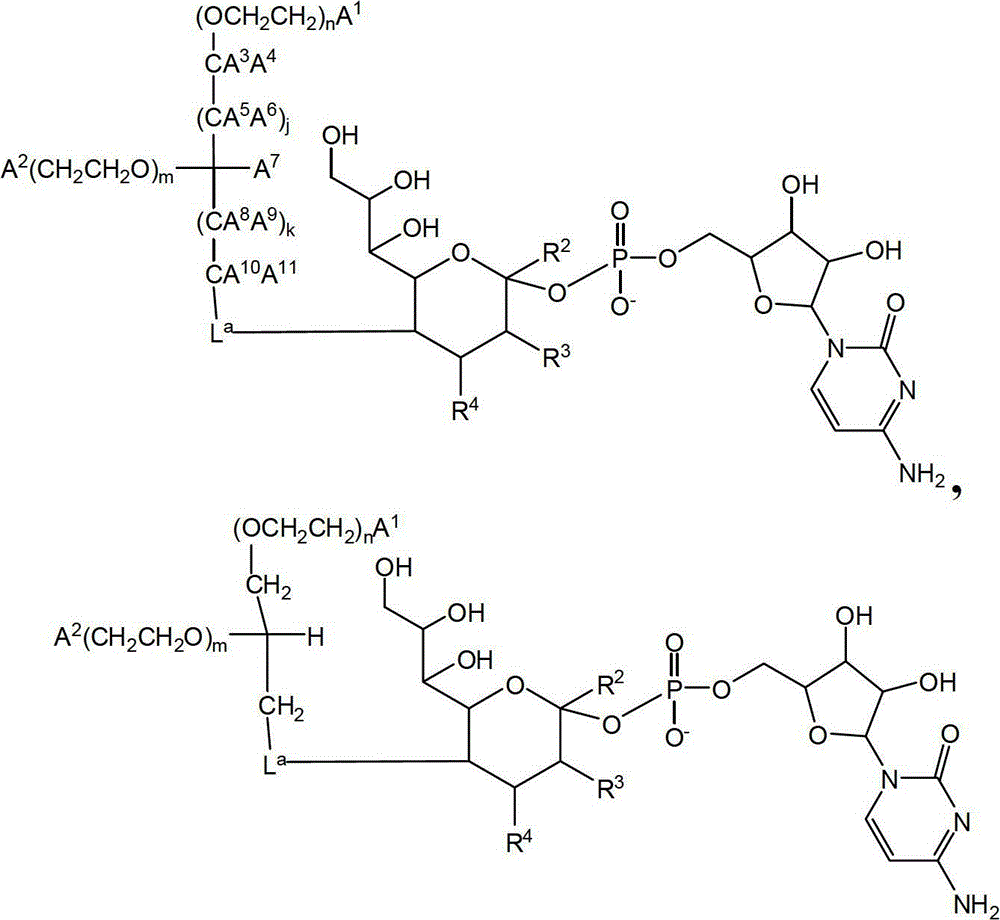
以及将PEG-唾液酸从所述供体转移至选自所述糖基基团的GalNAc、Gal和Sia中的成员上的酶,在适合于所述转移的条件下接触。示例性的修饰的唾液酸供体为通过接头部分用聚合物例如直链或支化的聚乙二醇部分修饰的CMP-唾液酸。如本文所述,肽在结合修饰的糖之前任选地用GalNAc和/或Gal和/或Sia糖基化(“重构”)。重构步骤可以在同一容器中依次进行而在步骤间没有糖基化肽的纯化。作为选择,在一个或多个重构步骤之后,可以在使糖基化的肽进行下一个糖基化或糖基聚乙二醇化步骤之前将它纯化。在一种示例性的实施方案中,该方法进一步包括在宿主中表达肽。在一种示例性的实施方案中,该宿主为哺乳动物细胞或昆虫细胞。在另一示例性的实施方案中,该哺乳动物细胞选自BHK细胞和CHO细胞以及该昆虫细胞为草地贪夜蛾(Spodoptera frugiperda)细胞。and an enzyme that transfers PEG-sialic acid from said donor to a member selected from GalNAc, Gal, and Sia of said glycosyl group, contacted under conditions suitable for said transfer. An exemplary modified sialic acid donor is CMP-sialic acid modified through a linker moiety with a polymer such as a linear or branched polyethylene glycol moiety. As described herein, the peptide is optionally glycosylated ("remodeled") with GalNAc and/or Gal and/or Sia prior to incorporation of the modified sugar. The reconstitution steps can be performed sequentially in the same vessel without purification of glycosylated peptides between steps. Alternatively, after one or more remodeling steps, the glycosylated peptide can be purified before subjecting it to the next glycosylation or glycopegylation step. In an exemplary embodiment, the method further comprises expressing the peptide in the host. In an exemplary embodiment, the host is a mammalian cell or an insect cell. In another exemplary embodiment, the mammalian cell is selected from BHK cells and CHO cells and the insect cell is a Spodoptera frugiperda cell.
如同在实施例中举例说明以及下面进一步论述的那样,PEG-糖的接纳体部分的布置以任意期望数目的步骤来完成。例如,在一种实施方案中,在GalNAc加至肽上以后,可以在同一反应容器中进行使PEG-糖与GalNAc缀合的第二步。作为选择,这两个步骤可以在单一容器中近似同时地进行。As illustrated in the Examples and discussed further below, deployment of the acceptor moiety of the PEG-sugar is accomplished in any desired number of steps. For example, in one embodiment, the second step of conjugating the PEG-sugar to the GalNAc can be performed in the same reaction vessel after the GalNAc is added to the peptide. Alternatively, these two steps can be performed approximately simultaneously in a single vessel.
在一种示例性的实施方案中,PEG-唾液酸供体具有下式:In an exemplary embodiment, the PEG-sialic acid donor has the formula:

在另一示例性实施方案中,PEG-唾液酸供体具有下式:In another exemplary embodiment, the PEG-sialic acid donor has the formula:

在另一示例性实施方案中,因子VII/因子VIIa肽在进行糖基聚乙二醇化或重构之前在适当的表达体系中表达。示例性的表达体系包括Sf-9/杆状病毒和中国仓鼠卵巢(CHO)细胞。In another exemplary embodiment, the Factor VII/Factor Vila peptide is expressed in a suitable expression system prior to glycopegylation or remodeling. Exemplary expression systems include Sf-9/baculovirus and Chinese Hamster Ovary (CHO) cells.
在一种示例性的实施方案中,本发明提供制备包含糖基接头的因子VII/因子VIIa肽缀合物的方法,该接头包含具有下式的修饰的唾液酰基残基:In an exemplary embodiment, the invention provides a method of preparing a Factor VII/Factor Vila peptide conjugate comprising a glycosyl linker comprising a modified sialyl residue having the formula:

其中D选自-OH和R1-L-HN-;G选自R1-L-和-C(O)(C1-C6)烃基-R1;R1是包含选自直链聚乙二醇残基和支化聚乙二醇残基中的成员的部分;M选自H、金属和单个负电荷;L是选自键、取代的或未取代的烃基和取代的或未取代的杂烃基的接头,以至于当D为OH时,G为R1-L-,以及当G为-C(O)(C1-C6)烃基时,D为R1-L-NH-Wherein D is selected from -OH and R 1 -L-HN-; G is selected from R 1 -L- and -C(O)(C 1 -C 6 )hydrocarbyl-R 1 ; R 1 is selected from linear poly Moieties of members in ethylene glycol residues and branched polyethylene glycol residues; M is selected from H, metal, and a single negative charge; L is selected from bonds, substituted or unsubstituted hydrocarbon groups, and substituted or unsubstituted A heterohydrocarbyl linker such that when D is OH, G is R 1 -L-, and when G is -C(O)(C 1 -C 6 )hydrocarbyl, D is R 1 -L-NH-
所述方法包括:(a)使包含糖基部分的因子VII/因子VIIa肽:The method comprises: (a) making a Factor VII/Factor VIIa peptide comprising a glycosyl moiety:

与具有下式的PEG-唾液酸供体:with a PEG-sialic acid donor having the formula:
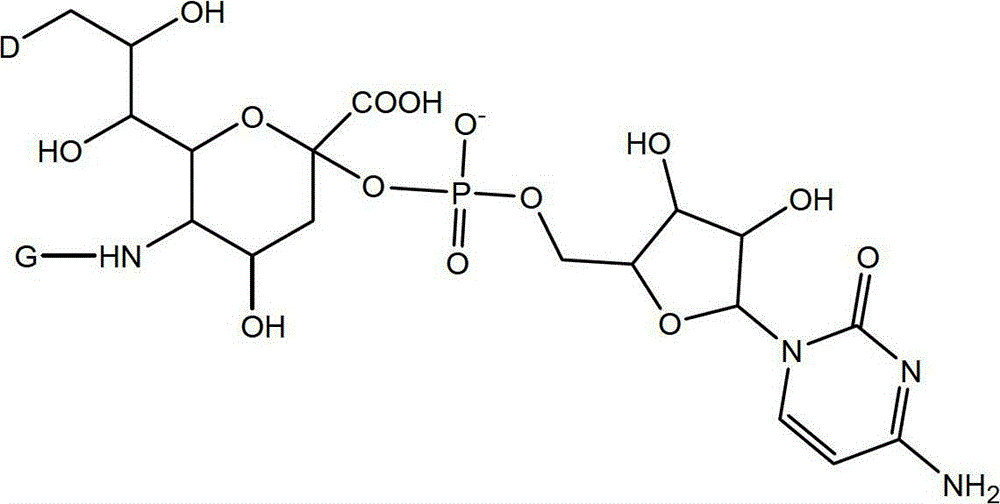
和将所述PEG-唾液酸转移至所述糖基部分的Gal上的酶,在适合于所述转移的条件下接触。and an enzyme that transfers the PEG-sialic acid to the Gal of the glycosyl moiety, under conditions suitable for the transfer.
在一种示例性的实施方案中,L-R1具有下式:In an exemplary embodiment, LR 1 has the formula:

其中a为选自0-20的整数。Wherein a is an integer selected from 0-20.
在另一示例性的实施方案中,R1具有选自以下的式的结构:In another exemplary embodiment, R has a structure selected from the following formulae:

其中e、f、m和n为独立地选自1-2500的整数;以及q为选自0-20的整数。wherein e, f, m and n are integers independently selected from 1-2500; and q is an integer selected from 0-20.
可以通过本文所述的方法制备大规模或小规模量的因子VII/因子VIIa肽缀合物。在一种示例性的实施方案中,因子VII/因子VIIa肽的量选自约0.5mg-约100kg。在一种示例性的实施方案中,因子VII/因子VIIa肽的量选自约0.1kg-约1kg。在一种示例性的实施方案中,因子VII/因子VIIa肽的量选自约0.5kg-约10kg。在一种示例性的实施方案中,因子VII/因子VIIa肽的量选自约0.5kg-约3kg。在一种示例性的实施方案中,因子VII/因子VIIa肽的量选自约0.1kg-约5kg。在一种示例性的实施方案中因子VII/因子VIIa肽的量选自约0.08kg-约0.2kg。在一种示例性的实施方案中,因子VII/因子VIIa肽的量选自约0.05kg-约0.4kg。在一种示例性的实施方案中,因子VII/因子VIIa肽的量选自约0.1kg-约0.7kg。在一种示例性的实施方案中,因子VII/因子VIIa肽的量选自约0.3kg-约1.75kg。在一种示例性的实施方案中,因子VII/因子VIIa肽的量选自约25kg-约65kg。Large or small scale quantities of Factor VII/Factor Vila peptide conjugates can be prepared by the methods described herein. In an exemplary embodiment, the amount of Factor VII/Factor Vila peptide is selected from about 0.5 mg to about 100 kg. In an exemplary embodiment, the amount of Factor VII/Factor Vila peptide is selected from about 0.1 kg to about 1 kg. In an exemplary embodiment, the amount of Factor VII/Factor Vila peptide is selected from about 0.5 kg to about 10 kg. In an exemplary embodiment, the amount of Factor VII/Factor Vila peptide is selected from about 0.5 kg to about 3 kg. In an exemplary embodiment, the amount of Factor VII/Factor Vila peptide is selected from about 0.1 kg to about 5 kg. In an exemplary embodiment the amount of Factor VII/Factor Vila peptide is selected from about 0.08 kg to about 0.2 kg. In an exemplary embodiment, the amount of Factor VII/Factor Vila peptide is selected from about 0.05 kg to about 0.4 kg. In an exemplary embodiment, the amount of Factor VII/Factor Vila peptide is selected from about 0.1 kg to about 0.7 kg. In an exemplary embodiment, the amount of Factor VII/Factor Vila peptide is selected from about 0.3 kg to about 1.75 kg. In an exemplary embodiment, the amount of Factor VII/Factor Vila peptide is selected from about 25 kg to about 65 kg.
用于本文所述反应中的因子VII/因子VIIa肽的浓度选自约0.5-约10mg因子VII/因子VIIa肽/mL反应混合物。在一种示例性的实施方案中,因子VII/因子VIIa肽浓度选自约0.5-约1mg因子VII/因子VIIa肽/mL反应混合物。在一种示例性的实施方案中,因子VII/因子VIIa肽浓度选自约0.8-约3mg因子VII/因子VIIa肽/mL反应混合物。在一种示例性的实施方案中,因子VII/因子VIIa肽浓度选自约2-约6mg因子VII/因子VIIa肽/mL反应混合物。在一种示例性的实施方案中,因子VII/因子VIIa肽浓度选自约4-约9mg因子VII/因子VIIa肽/mL反应混合物。在一种示例性的实施方案中,因子VII/因子VIIa肽浓度选自约1.2-约7.8mg因子VII/因子VIIa肽/mL反应混合物。在一种示例性的实施方案中,因子VII/因子VIIa肽浓度选自约6-约9.5mg因子VII/因子VIIa肽/mL反应混合物。The concentration of Factor VII/Factor Vila peptide used in the reactions described herein is selected from about 0.5 to about 10 mg Factor VII/Factor Vila peptide/mL reaction mixture. In an exemplary embodiment, the Factor VII/Factor Vila peptide concentration is selected from about 0.5 to about 1 mg Factor VII/Factor Vila peptide/mL reaction mixture. In an exemplary embodiment, the Factor VII/Factor Vila peptide concentration is selected from about 0.8 to about 3 mg Factor VII/Factor Vila peptide/mL reaction mixture. In an exemplary embodiment, the Factor VII/Factor Vila peptide concentration is selected from about 2 to about 6 mg Factor VII/Factor Vila peptide/mL reaction mixture. In an exemplary embodiment, the Factor VII/Factor Vila peptide concentration is selected from about 4 to about 9 mg Factor VII/Factor Vila peptide/mL reaction mixture. In an exemplary embodiment, the Factor VII/Factor Vila peptide concentration is selected from about 1.2 to about 7.8 mg Factor VII/Factor Vila peptide/mL reaction mixture. In an exemplary embodiment, the Factor VII/Factor Vila peptide concentration is selected from about 6 to about 9.5 mg Factor VII/Factor Vila peptide/mL reaction mixture.
可以用于本文所述反应中的CMP-SA-PEG的浓度选自约0.1-约1.0mM。可以提高或降低该浓度的因素包括PEG的尺寸、孵育时间、温度、缓冲组分以及所用糖基转移酶的种类和浓度。一种示例性的实施方案中,CMP-SA-PEG浓度选自约0.1-约1.0mM。在一种示例性的实施方案中,CMP-SA-PEG浓度选自约0.1-约0.5mM。在一种示例性的实施方案中,CMP-SA-PEG浓度选自约0.1-约0.3mM。在一种示例性的实施方案中,CMP-SA-PEG浓度选自约0.2-约0.7mM。在一种示例性的实施方案中,CMP-SA-PEG浓度选自约0.3-约0.5mM。在一种示例性的实施方案中,CMP-SA-PEG浓度选自约0.4-约1.0mM。在一种示例性的实施方案中,CMP-SA-PEG浓度选自约0.5-约0.7mM。在一种示例性的实施方案中,CMP-SA-PEG浓度选自约0.8-约0.95mM。在一种示例性的实施方案中,CMP-SA-PEG浓度选自约0.55-约1.0mM。The concentration of CMP-SA-PEG that can be used in the reactions described herein is selected from about 0.1 to about 1.0 mM. Factors that can increase or decrease this concentration include the size of the PEG, incubation time, temperature, buffer components, and the type and concentration of the glycosyltransferase used. In an exemplary embodiment, the concentration of CMP-SA-PEG is selected from about 0.1 to about 1.0 mM. In an exemplary embodiment, the concentration of CMP-SA-PEG is selected from about 0.1 to about 0.5 mM. In an exemplary embodiment, the CMP-SA-PEG concentration is selected from about 0.1 to about 0.3 mM. In an exemplary embodiment, the concentration of CMP-SA-PEG is selected from about 0.2 to about 0.7 mM. In an exemplary embodiment, the CMP-SA-PEG concentration is selected from about 0.3 to about 0.5 mM. In an exemplary embodiment, the concentration of CMP-SA-PEG is selected from about 0.4 to about 1.0 mM. In an exemplary embodiment, the CMP-SA-PEG concentration is selected from about 0.5 to about 0.7 mM. In an exemplary embodiment, the CMP-SA-PEG concentration is selected from about 0.8 to about 0.95 mM. In an exemplary embodiment, the concentration of CMP-SA-PEG is selected from about 0.55 to about 1.0 mM.
可以用于本文所述反应中的CMP-SA-PEG的摩尔当量基于可以加至因子VII/因子VIIa蛋白上的SA-PEGs的理论数量。当与CMP-SA-PEG的MW和由此其摩尔数比较时,该SA-PEGs的理论数量基于因子VII/因子VIIa蛋白上的唾液酸化位点的理论数量以及因子VII/因子VIIa蛋白的MW。对于因子VII/因子VIIa,以仅有两个聚糖位点的主要是二-和三-天线式的N-聚糖计,其为约4或5个PEGs。在一种示例性的实施方案中,CMP-SA-PEG的摩尔当量为选自1-20的整数。在一种示例性的实施方案中,CMP-SA-PEG的摩尔当量为选自1-20的整数。在一种示例性的实施方案中,CMP-SA-PEG的摩尔当量为选自2-6的整数。在一种示例性的实施方案中,CMP-SA-PEG的摩尔当量为选自3-17的整数。在一种示例性的实施方案中,CMP-SA-PEG的摩尔当量为选自4-11的整数。在一种示例性的实施方案中,CMP-SA-PEG的摩尔当量为选自5-20的整数。在一种示例性的实施方案中,CMP-SA-PEG的摩尔当量为选自1-10的整数。在一种示例性的实施方案中,CMP-SA-PEG的摩尔当量为选自12-20的整数。在一种示例性的实施方案中,CMP-SA-PEG的摩尔当量为选自14-17的整数。在一种示例性的实施方案中,CMP-SA-PEG的摩尔当量为选自7-15的整数。在一种示例性的实施方案中,CMP-SA-PEG的摩尔当量为选自8-16的整数。The molar equivalents of CMP-SA-PEG that can be used in the reactions described herein are based on the theoretical amount of SA-PEGs that can be added to the Factor VII/Factor Vila protein. The theoretical amount of SA-PEGs is based on the theoretical number of sialylation sites on the Factor VII/Factor VIIa protein and the MW of the Factor VII/Factor VIIa protein when compared to the MW of CMP-SA-PEG and thus its number of moles . For Factor VII/Factor Vila, this is about 4 or 5 PEGs, based on the predominantly di- and tri-antennary N-glycans with only two glycan sites. In an exemplary embodiment, the molar equivalent of CMP-SA-PEG is an integer selected from 1-20. In an exemplary embodiment, the molar equivalent of CMP-SA-PEG is an integer selected from 1-20. In an exemplary embodiment, the molar equivalent of CMP-SA-PEG is an integer selected from 2-6. In an exemplary embodiment, the molar equivalent of CMP-SA-PEG is an integer selected from 3-17. In an exemplary embodiment, the molar equivalent of CMP-SA-PEG is an integer selected from 4-11. In an exemplary embodiment, the molar equivalent of CMP-SA-PEG is an integer selected from 5-20. In an exemplary embodiment, the molar equivalent of CMP-SA-PEG is an integer selected from 1-10. In an exemplary embodiment, the molar equivalent of CMP-SA-PEG is an integer selected from 12-20. In an exemplary embodiment, the molar equivalent of CMP-SA-PEG is an integer selected from 14-17. In an exemplary embodiment, the molar equivalent of CMP-SA-PEG is an integer selected from 7-15. In an exemplary embodiment, the molar equivalent of CMP-SA-PEG is an integer selected from 8-16.
III.B.因子VII/因子VIIa的同时去唾液酸化和糖基聚乙二醇化 III.B. Simultaneous desialylation and glycopegylation of Factor VII/Factor VIIa
本发明提供将因子VII/因子VIIa糖基聚乙二醇化的“一锅”式方法。该一锅法与制备因子VII/因子VIIa肽缀合物的其他示例性方法不同,它们采取用唾液酸酶顺序去唾液酸化,随后在阴离子交换柱上纯化去唾液酸因子VII/因子VIIa,接着用CMP-唾液酸-PEG和糖基转移酶(例如ST3Gal3)、外切糖苷酶或内切糖苷酶糖基聚乙二醇化。该因子VII/因子VIIa肽缀合物然后通过阴离子交换接着以尺寸排阻色谱法进行纯化以制备纯化过的因子VII/因子VIIa肽缀合物。The present invention provides a "one pot" method for glycopegylation of Factor VII/Factor Vila. This one-pot method differs from other exemplary methods for making Factor VII/Factor VIIa peptide conjugates by employing sequential desialylation with sialidase followed by purification of the asialofactor VII/Factor VIIa on an anion exchange column, followed by Glycopegylation with CMP-sialic acid-PEG and glycosyltransferase (e.g. ST3Gal3), exoglycosidase or endoglycosidase. The Factor VII/Factor VIIa peptide conjugate is then purified by anion exchange followed by size exclusion chromatography to produce a purified Factor VII/Factor VIIa peptide conjugate.
该一锅法是制造因子VII/因子VIIa肽缀合物的改进方法。在该方法中,将去唾液酸化和糖基聚乙二醇化反应合并在一锅反应中,其避免在前面所述的方法中用于纯化去唾液酸因子VII/因子VIIa肽的第一阴离子交换色谱法步骤。这种工艺步骤的减少产生了若干优点。首先,减少了制备因子VII/因子VIIa肽缀合物所需的工艺步骤数目,这也降低了工艺的操作复杂性。其次,减少用于制备肽缀合物的工艺时间,例如从4天减少到2天。这使与工序间控制相关的原料要求和质量控制成本降低。第三,本发明使用较少的唾液酸酶,例如相对于该过程需要直至少20倍的唾液酸酶,例如500mU/L来制备因子VII/因子VIIa肽缀合物。这种唾液酸酶用量上的减少使反应混合物中的污染物如唾液酸酶的量显著减少。This one-pot method is an improved method for making Factor VII/Factor Vila peptide conjugates. In this method, the desialylation and glycopegylation reactions are combined in a one-pot reaction, which avoids the first anion exchange used to purify asialofactor VII/Factor VIIa peptides in the previously described method Chromatography steps. This reduction in process steps yields several advantages. First, the number of process steps required to prepare the Factor VII/Factor Vila peptide conjugate is reduced, which also reduces the operational complexity of the process. Second, the process time for preparing the peptide conjugates is reduced, for example from 4 days to 2 days. This reduces raw material requirements and quality control costs associated with inter-process controls. Third, the present invention uses less sialidase, eg, at least 20 times more sialidase, eg 500 mU/L, to prepare Factor VII/Factor VIIa peptide conjugates relative to the process. This reduction in the amount of sialidase provides a significant reduction in the amount of contaminants, such as sialidase, in the reaction mixture.
在一种示例性的实施方案中,由以下方法制备因子VII/因子VIIa肽缀合物。在第一步中,将因子VII/因子VIIa肽与唾液酸酶、本发明的修饰的糖以及能够催化糖基连接基团从修饰的糖转移至肽的酶合并,从而制备因子VII/因子VIIa肽缀合物。任何唾液酸酶可以用于该方法中。可用于本发明的示例性的唾液酸酶可以在CAZY数据库中找到(参见http://afmb.cnrs-mrs.fr/CAZY/index.html和www.cazy.org/CAZY)。示例性的唾液酸酶可以从许多来源(QA-Bio、Calbiochem、Marukin、Prozyme等)购买到。在一种示例性的实施方案中,唾液酸酶选自细胞质唾液酸酶、溶酶体唾液酸酶、外切-α唾液酸酶和内切唾液酸酶。在另一示例性的实施方案中,所用唾液酸酶由细菌例如产气荚膜梭菌(Clostridium perfringens)或肺炎双球菌(Streptococcus pneumoniae)或者由病毒例如腺病毒制成。在一种示例性的实施方案中,能够催化糖基连接基团从修饰的糖转移至肽的酶选自糖基转移酶,例如唾液酸转移酶和岩藻糖基转移酶,以及外切糖苷酶和内切糖苷酶。在一种示例性的实施方案中,该酶为糖基转移酶,它是ST3Gal3。在另一示例性的实施方案中,所用的酶由细菌例如大肠杆菌或真菌例如黑曲霉(Aspergillus niger)制成。在另一示例性的实施方案中,将唾液酸酶在糖基转移酶之前加入到因子VII/因子VIIa肽中持续一段规定时间,使唾液酸酶反应进行,然后在加入PEG-唾液酸试剂和糖基转移酶下开始糖基聚乙二醇化反应。许多的这些实例在本文中得到论述。最后,本文所述的任何修饰的糖可以用于该反应。In an exemplary embodiment, a Factor VII/Factor Vila peptide conjugate is prepared by the following method. In a first step, Factor VII/Factor VIIa peptides are combined with sialidase, a modified sugar of the invention, and an enzyme capable of catalyzing the transfer of a glycosyl linking group from the modified sugar to the peptide, thereby producing Factor VII/Factor VIIa Peptide Conjugates. Any sialidase can be used in this method. Exemplary sialidases useful in the present invention can be found in the CAZY database (see http://afmb.cnrs-mrs.fr/CAZY/index.html and www.cazy.org/CAZY ). Exemplary sialidases are commercially available from a number of sources (QA-Bio, Calbiochem, Marukin, Prozyme, etc.). In an exemplary embodiment, the sialidase is selected from the group consisting of cytoplasmic sialidases, lysosomal sialidases, exo-alpha sialidases and endosialidases. In another exemplary embodiment, the sialidase used is produced by bacteria such as Clostridium perfringens or Streptococcus pneumoniae or by viruses such as adenovirus. In an exemplary embodiment, the enzyme capable of catalyzing the transfer of a glycosyl linking group from a modified sugar to a peptide is selected from the group consisting of glycosyltransferases, such as sialyltransferases and fucosyltransferases, and exoglycoside enzymes and endoglycosidases. In an exemplary embodiment, the enzyme is a glycosyltransferase which is ST3Gal3. In another exemplary embodiment, the enzyme used is produced by bacteria such as E. coli or fungi such as Aspergillus niger. In another exemplary embodiment, sialidase is added to the Factor VII/Factor VIIa peptide prior to the glycosyltransferase for a defined period of time to allow the sialidase reaction to proceed, followed by addition of the PEG-sialic acid reagent and The glycopegylation reaction is initiated by a glycosyltransferase. Many of these examples are discussed herein. Finally, any of the modified sugars described herein can be used in this reaction.
在另一示例性的实施方案中,该方法进一步包括“加帽”步骤。在该步骤中,向反应混合物中加入另外的未PEG化的唾液酸。在一种示例性的实施方案中,将该唾液酸加至因子VII/因子VIIa肽或肽缀合物上,从而阻止PEG-唾液酸的进一步加成。在另一示例性的实施方案中,该唾液酸阻止反应混合物中糖基转移酶的功能,有效中止糖基连接基团加至因子VII/因子VIIa肽或肽缀合物上。最重要地,加入到反应混合物中的唾液酸使未糖基聚乙二醇化的聚糖加帽,由此提供具有改善的药物动力学的因子VII/因子VIIa肽缀合物。另外,当期望PEG化的程度至一定量时可以不经在先纯化将该唾液酸酶直接加入到糖基聚乙二醇化反应混合物中。In another exemplary embodiment, the method further comprises a "capping" step. In this step, additional non-PEGylated sialic acid is added to the reaction mixture. In an exemplary embodiment, the sialic acid is added to the Factor VII/Factor Vila peptide or peptide conjugate, thereby preventing further addition of PEG-sialic acid. In another exemplary embodiment, the sialic acid prevents the function of a glycosyltransferase in the reaction mixture, effectively halting the addition of the glycosyl linking group to the Factor VII/Factor Vila peptide or peptide conjugate. Most importantly, sialic acid added to the reaction mixture caps the aglycolyzed PEGylated glycan, thereby providing a Factor VII/Factor Vila peptide conjugate with improved pharmacokinetics. Alternatively, the sialidase can be added directly to the glycopegylation reaction mixture without prior purification when a certain degree of PEGylation is desired.
在一种示例性的实施方案中,加帽步骤之后,因子VII/因子VIIa肽或肽缀合物上少于约50%的唾液酸化位点不含唾液酰部分。在一种示例性的实施方案中,加帽步骤之后,因子VII/因子VIIa肽或肽缀合物上少于约40%的唾液酸化位点不含唾液酰部分。在一种示例性的实施方案中,加帽步骤之后,因子VII/因子VIIa肽或肽缀合物上少于约30%的唾液酸化位点不含唾液酰部分。在一种示例性的实施方案中,加帽步骤之后,因子VII/因子VIIa肽或肽缀合物上少于约20%的唾液酸化位点不含唾液酰部分。在一种示例性的实施方案中,加帽步骤之后,因子VII/因子VIIa肽或肽缀合物上少于约10%的唾液酸化位点不含唾液酰部分。在一种示例性的实施方案中,因子VII/因子VIIa肽或肽缀合物上约20%-约5%的唾液酸化位点不含唾液酰部分。在一种示例性的实施方案中,因子VII/因子VIIa肽或肽缀合物上少于约25%-约10%的唾液酸化位点不含唾液酰部分。在一种示例性的实施方案中,加帽步骤之后,因子VII/因子VIIa肽或肽缀合物上基本上所有的唾液酸化位点包含唾液酰部分。In an exemplary embodiment, after the capping step, less than about 50% of the sialylation sites on the Factor VII/Factor Vila peptide or peptide conjugate do not contain a sialyl moiety. In an exemplary embodiment, less than about 40% of the sialylation sites on the Factor VII/Factor Vila peptide or peptide conjugate do not contain a sialyl moiety after the capping step. In an exemplary embodiment, less than about 30% of the sialylation sites on the Factor VII/Factor Vila peptide or peptide conjugate do not contain a sialyl moiety after the capping step. In an exemplary embodiment, after the capping step, less than about 20% of the sialylation sites on the Factor VII/Factor Vila peptide or peptide conjugate do not contain a sialyl moiety. In an exemplary embodiment, less than about 10% of the sialylation sites on the Factor VII/Factor Vila peptide or peptide conjugate do not contain a sialyl moiety after the capping step. In an exemplary embodiment, about 20% to about 5% of the sialylation sites on the Factor VII/Factor Vila peptide or peptide conjugate do not contain a sialyl moiety. In an exemplary embodiment, less than about 25% to about 10% of the sialylation sites on the Factor VII/Factor Vila peptide or peptide conjugate do not contain a sialyl moiety. In an exemplary embodiment, following the capping step, substantially all of the sialylation sites on the Factor VII/Factor Vila peptide or peptide conjugate comprise sialyl moieties.
III.C.因子VII/因子VIIa肽的去唾液酸化和选择性修饰 III.C. Desialylation and Selective Modification of Factor VII/Factor VIIa Peptides
在另一示例性的实施方案中,本发明提供使因子VII/因子VIIa肽去唾液酸化的方法。该方法优选提供至少约40%、优选45%、优选约50%、优选约55%、优选约60%、优选约65%、优选约70%、优选约75%、优选约80%、优选至少85%、更优选至少90%、再更优选至少92%、优选至少94%、甚至更优选至少96%、再更优选至少98%以及再更优选100%去唾液酸化的因子VII/因子VIIa肽。In another exemplary embodiment, the invention provides a method of desialylation of a Factor VII/Factor Vila peptide. The method preferably provides at least about 40%, preferably about 45%, preferably about 50%, preferably about 55%, preferably about 60%, preferably about 65%, preferably about 70%, preferably about 75%, preferably about 80%, preferably at least 85%, more preferably at least 90%, even more preferably at least 92%, preferably at least 94%, even more preferably at least 96%, even more preferably at least 98%, and even more preferably 100% desialylated Factor VII/Factor VIIa peptide .
该方法包括使因子VII/因子VIIa肽与唾液酸酶接触,优选接触一段时间。该预先选定的时间期间足以使因子VII/因子VIIa肽去唾液酸化至期望的程度。在优选的实施方案中,当达到期望的去唾液酸化程度时,将去唾液酸化的因子VII/因子VIIa肽与唾液酸酶分离。示例性的去唾液酸化反应和纯化循环描述于本文中。The method comprises contacting the Factor VII/Factor Vila peptide with a sialidase, preferably for a period of time. This preselected period of time is sufficient to desialylate the Factor VII/Factor Vila peptide to the desired extent. In a preferred embodiment, the desialylated Factor VII/Factor Vila peptide is separated from the sialidase when the desired degree of desialylation has been achieved. Exemplary desialylation reactions and purification cycles are described herein.
技术人员能够确定进行去唾液酸化反应的适当的预选时间期间。在一种示例性的实施方案中,该期间少于24小时,优选少于8小时,更优选少于6小时,更优选少于4小时,再更优选少于2小时以及甚至更优选少于1小时。The skilled person will be able to determine an appropriate preselected time period for carrying out the desialylation reaction. In an exemplary embodiment, the period is less than 24 hours, preferably less than 8 hours, more preferably less than 6 hours, more preferably less than 4 hours, still more preferably less than 2 hours and even more preferably less than 1 hour.
在另一示例性的实施方案中,在去唾液酸化反应结束时在因子VII/因子VIIa制备物中,因子VII/因子VIIa肽群体中至少10%的成员仅有一个与其结合的唾液酸,优选至少20%、更优选至少30%、再更优选至少40%、甚至更优选至少50%和更优选至少60%、以及再更优选全部去唾液酸化。In another exemplary embodiment, in the Factor VII/Factor VIIa preparation at the end of the desialylation reaction, at least 10% of the members of the Factor VII/Factor VIIa peptide population have only one sialic acid associated therewith, preferably At least 20%, more preferably at least 30%, even more preferably at least 40%, even more preferably at least 50% and more preferably at least 60%, and even more preferably fully desialylated.
在又一示例性的实施方案中,在去唾液酸化反应结束时在因子VII/因子VIIa制备物中,因子VII/因子VIIa肽群体中至少10%的成员彻底去唾液酸化,优选至少20%、更优选至少30%、甚至更优选至少40%、再更优选至少50%和甚至再更优选至少60%彻底去唾液酸化。In yet another exemplary embodiment, at least 10% of the members of the Factor VII/Factor VIIa peptide population are completely desialylated in the Factor VII/Factor VIIa preparation at the end of the desialylation reaction, preferably at least 20%, More preferably at least 30%, even more preferably at least 40%, still more preferably at least 50% and even still more preferably at least 60% completely desialylated.
在另一示例性的实施方案中,在去唾液酸化反应结束时在因子VII/因子VIIa制备物中,因子VII/因子VIIa肽群体中至少10%、20%、30%、40%、50%或60%的成员仅有一个唾液酸,以及至少10%、20%、30%、40%、50%或60%的因子VII/因子VIIa肽彻底去唾液酸化。In another exemplary embodiment, at least 10%, 20%, 30%, 40%, 50% of the Factor VII/Factor VIIa peptide population in the Factor VII/Factor VIIa preparation at the end of the desialylation reaction Or 60% of the members have only one sialic acid, and at least 10%, 20%, 30%, 40%, 50%, or 60% of the Factor VII/Factor VIIa peptides are fully desialylated.
在一种优选的实施方案中,在去唾液酸化反应结束时在因子VII/因子VIIa制备物中,因子VII/因子VIIa肽群体中至少50%彻底去唾液酸化以及因子VII/因子VIIa肽群体中至少40%的成员仅带有一个唾液酸部分。In a preferred embodiment, at least 50% of the Factor VII/Factor VIIa peptide population is completely desialylated and in the Factor VII/Factor VIIa peptide population in the Factor VII/Factor VIIa preparation at the end of the desialylation reaction At least 40% of the members bear only one sialic acid moiety.
在去唾液酸化之后,因子VII/因子VIIa肽任选地与修饰的糖缀合。示例性的修饰的糖包含与支化或线性聚乙二醇部分结合的糖基部分。由将修饰的糖从修饰的糖供体转移至因子VII/因子VIIa肽的氨基酸或糖基残基上的酶来催化该缀合。示例性的修饰的糖供体为带有支化或线性聚乙二醇部分的CMP-唾液酸。示例性的聚乙二醇部分的分子量为至少约2KDa,更优选至少约5KDa,更优选至少约10KDa,优选至少约20KDa,更优选至少约30KDa以及更优选至少约40KDa。Following desialylation, the Factor VII/Factor Vila peptide is optionally conjugated to a modified sugar. Exemplary modified sugars comprise glycosyl moieties combined with branched or linear polyethylene glycol moieties. The conjugation is catalyzed by an enzyme that transfers the modified sugar from the modified sugar donor to an amino acid or glycosyl residue of the Factor VII/Factor Vila peptide. An exemplary modified sugar donor is CMP-sialic acid with branched or linear polyethylene glycol moieties. Exemplary polyethylene glycol moieties have a molecular weight of at least about 2 KDa, more preferably at least about 5 KDa, more preferably at least about 10 KDa, preferably at least about 20 KDa, more preferably at least about 30 KDa and more preferably at least about 40 KDa.
在一种示例性的实施方案中,用于从修饰的糖供体中转移修饰的糖部分的酶为糖基转移酶,例如唾液酸转移酶。可用于本发明方法的示例性的唾液酸转移酶为ST3Gal3。In an exemplary embodiment, the enzyme used to transfer a modified sugar moiety from a modified sugar donor is a glycosyltransferase, such as a sialyltransferase. An exemplary sialyltransferase that can be used in the methods of the invention is ST3Gal3.
示例性的本发明方法产生带有至少一个、优选至少两个、优选至少三个修饰基团的修饰的因子VII/因子VIIa肽。在一种实施方案中,制成的因子VII/因子VIIa肽在该因子VII/因子VIIa肽的轻链上带有一个修饰基团。在另一实施方案中,该方法提供在重链上带有一个修饰基团的修饰的因子VII/因子VIIa肽。在又一实施方案中,该方法提供在轻链上具有一个修饰基团而且在重链上具有一个修饰基团的修饰的因子VII/因子VIIa肽。Exemplary methods of the invention result in modified Factor VII/Factor Vila peptides bearing at least one, preferably at least two, preferably at least three modifying groups. In one embodiment, the Factor VII/Factor Vila peptide is made with a modifying group on the light chain of the Factor VII/Factor Vila peptide. In another embodiment, the method provides a modified Factor VII/Factor Vila peptide bearing a modifying group on the heavy chain. In yet another embodiment, the method provides a modified Factor VII/Factor Vila peptide having one modifying group on the light chain and one modifying group on the heavy chain.
在另一方面中,本发明提供制备修饰的因子VII/因子VIIa肽的方法。该方法包括使因子VII/因子VIIa肽与带有修饰基团的修饰的糖供体和能够将修饰的糖部分从修饰的糖供体转移至肽的氨基酸或糖基残基上的酶接触。In another aspect, the invention provides methods of making modified Factor VII/Factor Vila peptides. The method comprises contacting a Factor VII/Factor Vila peptide with a modified sugar donor bearing a modifying group and an enzyme capable of transferring the modified sugar moiety from the modified sugar donor to an amino acid or glycosyl residue of the peptide.
在一种示例性的实施方案中,该方法提供修饰的因子VII/因子VIIa肽群体,其中至少40%、优选至少50%、优选至少60%、更优选至少70%和甚至更优选至少80%的群体成员为在该因子VII/因子VIIa肽的轻链上单缀合的。In an exemplary embodiment, the method provides a population of modified Factor VII/Factor VIIa peptides wherein at least 40%, preferably at least 50%, preferably at least 60%, more preferably at least 70% and even more preferably at least 80% The population members of are monoconjugated on the light chain of the Factor VII/Factor Vila peptide.
在一种示例性的实施方案中,该方法提供修饰的因子VII/因子VIIa肽群体,其中至少40%、优选至少50%、优选至少60%、更优选至少70%和甚至更优选至少80%的群体成员为在该因子VII/因子VIIa肽的轻链上二缀合的。In an exemplary embodiment, the method provides a population of modified Factor VII/Factor VIIa peptides wherein at least 40%, preferably at least 50%, preferably at least 60%, more preferably at least 70% and even more preferably at least 80% The population members of are diconjugated on the light chain of the Factor VII/Factor Vila peptide.
在该方面的一种示例性实施方案中,该方法提供修饰的因子VII/因子VIIa肽群体,其中不大于50%、优选不大于30%、优选不大于20%、更优选不大于10%的群体成员为在该因子VII/因子VIIa肽的重链上单缀合的。In an exemplary embodiment of this aspect, the method provides a population of modified Factor VII/Factor VIIa peptides wherein no greater than 50%, preferably no greater than 30%, preferably no greater than 20%, more preferably no greater than 10% of Population members are monoconjugated on the heavy chain of the Factor VII/Factor Vila peptide.
在该方面的一种示例性实施方案中,该方法提供修饰的因子VII/因子VIIa肽群体,其中不大于50%、优选不大于30%、优选不大于20%、更优选不大于10%的群体成员为在该因子VII/因子VIIa肽的重链上二缀合的。In an exemplary embodiment of this aspect, the method provides a population of modified Factor VII/Factor VIIa peptides wherein no greater than 50%, preferably no greater than 30%, preferably no greater than 20%, more preferably no greater than 10% of Population members are diconjugated on the heavy chain of the Factor VII/Factor Vila peptide.
可以使因子VII/因子VIIa肽在该接触步骤之前受到唾液酸酶的作用,或者该肽可以不经在先去唾液酸化而使用。当肽与唾液酸酶接触时,可以使它基本上全部去唾液酸化或者仅部分去唾液酸化。在优选的实施方案中,在接触步骤之前使因子VII/因子VIIa肽至少部分地去唾液酸化。因子VII/因子VIIa肽可以是基本上彻底去唾液酸化的(基本上脱唾液酸的)或只是部分去唾液酸化。在优选的实施方案中,去唾液酸化的因子VII/因子VIIa肽是上文所述的去唾液酸化的实施方案之一。The Factor VII/Factor Vila peptide may be subjected to the action of sialidase prior to this contacting step, or the peptide may be used without prior desialylation. When a peptide is contacted with a sialidase, it can be desialylated substantially completely or only partially. In a preferred embodiment, the Factor VII/Factor Vila peptide is at least partially desialylated prior to the contacting step. The Factor VII/Factor Vila peptide may be substantially completely desialylated (essentially asialylated) or only partially desialylated. In a preferred embodiment, the desialylated Factor VII/Factor Vila peptide is one of the desialylated embodiments described above.
III.D.因子VII/因子VIIa肽缀合物合成中加入的额外等分试样 的试剂 III.D. Additional Aliquots of Reagents Added in Factor VII/Factor VIIa Peptide Conjugate Synthesis
在本文所述肽缀合物合成的一种示例性实施方案中,在选定的时间期间后向反应混合物中加入一种或多种额外等分试样的反应组分/试剂。在一种示例性的实施方案中,该肽缀合物为因子VII/因子VIIa肽缀合物。在另一示例性的实施方案中,加入的反应组分/试剂为修饰的糖核苷酸。向反应中引入修饰的糖核苷酸会提高促使糖基聚乙二醇化反应完全的可能性。在一种示例性的实施方案中,该核苷酸糖为本文所述的CMP-SA-PEG。在一种示例性的实施方案中,加入的反应组分/试剂为唾液酸酶。在一种示例性的实施方案中,加入的反应组分/试剂为糖基转移酶。在一种示例性的实施方案中,加入的反应组分/试剂为镁。在一种示例性的实施方案中,加入的额外等分试样占反应开始时加入的原始量的约10%、或20%、或30%、或40%、或50%、或60%、或70%、或80%或90%。在一种示例性的实施方案中,在反应开始后约3小时、或6小时、或8小时、或10小时、或12小时、或18小时、或24小时、或30小时或36小时向其中加入该反应组分/试剂。In one exemplary embodiment of the peptide conjugate synthesis described herein, one or more additional aliquots of reaction components/reagents are added to the reaction mixture after a selected period of time. In an exemplary embodiment, the peptide conjugate is a Factor VII/Factor Vila peptide conjugate. In another exemplary embodiment, the added reaction component/reagent is a modified sugar nucleotide. Introducing a modified sugar nucleotide into the reaction increases the likelihood of driving the glycopegylation reaction to completion. In an exemplary embodiment, the nucleotide sugar is CMP-SA-PEG as described herein. In an exemplary embodiment, the added reaction component/reagent is sialidase. In an exemplary embodiment, the added reaction component/reagent is a glycosyltransferase. In an exemplary embodiment, the added reaction component/reagent is magnesium. In an exemplary embodiment, the additional aliquot added accounts for about 10%, or 20%, or 30%, or 40%, or 50%, or 60%, or 60% of the original amount added at the beginning of the reaction. Or 70%, or 80%, or 90%. In an exemplary embodiment, about 3 hours, or 6 hours, or 8 hours, or 10 hours, or 12 hours, or 18 hours, or 24 hours, or 30 hours or 36 hours after the start of the reaction The reaction components/reagents are added.
III.E.轻链PEG化的因子VII/因子VIIa肽缀合物的选择性 制备 III.E. Selective Preparation of Light Chain PEGylated Factor VII/Factor VIIa Peptide Conjugates
在一种示例性的实施方案中,本发明提供增加制备在轻链上修饰的因子VIIa肽缀合物的方法,相对于在重链上修饰的缀合物。该方法包括重链的钝化或螯合,从而使糖基聚乙二醇化优先在轻链上发生。因子VIIa重链的丝氨酸蛋白酶活性可以用作该螯合的基础。向糖基聚乙二醇化反应混合物中加入苄脒基质和/或丝氨酸蛋白酶的假亲和性(pseudoaffinity)树脂引起重链的螯合,而糖基聚乙二醇化在轻链上进行。然后可以由本领域已知的标准技术从重链中纯化出轻链。可以通过加入苄脒从基质中除去重链,或者通过降低溶液的pH从树脂中除去重链。在该步骤中引入的苄脒杂质可以通过渗滤除去。In an exemplary embodiment, the invention provides methods for increasing the production of Factor Vila peptide conjugates modified on the light chain relative to conjugates modified on the heavy chain. This approach involves inactivation or sequestration of the heavy chain, so that glycopegylation occurs preferentially on the light chain. The serine protease activity of the Factor Vila heavy chain can serve as the basis for this sequestration. Addition of a benzamidine matrix and/or a serine protease pseudoaffinity resin to the glycopegylation reaction mixture causes sequestration of the heavy chain, while glycopegylation proceeds on the light chain. The light chains can then be purified from the heavy chains by standard techniques known in the art. Heavy chains can be removed from the matrix by adding benzamidine, or from the resin by lowering the pH of the solution. Benzamidine impurities introduced in this step can be removed by diafiltration.
III.E.因子VII/因子VIIa肽缀合物的纯化 III.E. Purification of Factor VII/Factor VIIa Peptide Conjugates
通过上述方法产生的产物可以不经纯化而使用。然而,通常优选回收产物以及一种或多种中间产物,例如核苷酸糖、支化和线性的PEG物种、修饰的糖和修饰的核苷酸糖。可以使用回收糖基化肽的熟知的标准技术,例如薄层或厚层色谱法、柱色谱法、离子交换色谱法或膜过滤。如下文中以及本文引用文献中论述的那样,优选使用膜过滤,更优选采用反渗透膜,或一种或多种柱色谱法技术进行回收。例如,可以将其中膜的截留分子量为约3000-约10,000的膜过滤用于除去蛋白质例如糖基转移酶。在某些情形下,为了确保产物纯化将会利用杂质和产物之间的截留分子量差异。例如,为了从未反应的CMP-SA-PEG-40KDa中纯化产物因子VIIa-SA-PEG-40KDa,必须选择例如会使因子VIIa-SA-PEG-40KDa留在保留物中而使CMP-SA-PEG-40KDa流入滤液中的过滤器。然后可以用纳滤或反渗透来除去盐和/或纯化产物糖(例如参见WO98/15581)。纳滤膜是一类反渗透膜,它使一价盐通过但是保留多价盐和大于约100-约2,000道尔顿的未带电荷的溶质,其取决于所用的膜。因此,在通常的应用中,由本发明方法制备的糖会保留在膜上而污染的盐会通过。The product produced by the above method can be used without purification. However, it is generally preferred to recover the product as well as one or more intermediate products, such as nucleotide sugars, branched and linear PEG species, modified sugars, and modified nucleotide sugars. Well-known standard techniques for recovery of glycosylated peptides may be used, such as thin or thick layer chromatography, column chromatography, ion exchange chromatography or membrane filtration. As discussed below and in references cited herein, recovery is preferably performed using membrane filtration, more preferably reverse osmosis membranes, or one or more column chromatography techniques. For example, membrane filtration wherein the membrane has a molecular weight cut off of about 3000 to about 10,000 can be used to remove proteins such as glycosyltransferases. In some cases, the difference in MWCO between impurities and product will be exploited to ensure product purification. For example, in order to purify the product Factor VIIa-SA-PEG-40KDa from unreacted CMP-SA-PEG-40KDa, one must choose, for example, that Factor VIIa-SA-PEG-40KDa will remain in the retentate while CMP-SA- PEG-40KDa flows into the filter in the filtrate. Nanofiltration or reverse osmosis may then be used to remove salts and/or purify the product sugars (see eg WO98/15581). Nanofiltration membranes are a class of reverse osmosis membranes that pass monovalent salts but retain polyvalent salts and uncharged solutes greater than about 100 to about 2,000 Daltons, depending on the membrane used. Thus, in typical applications, sugars produced by the process of the present invention will remain on the membrane and contaminating salts will pass through.
如果在细胞内制备肽,作为第一步,除去微粒碎屑(宿主细胞或裂解片段)。在糖基聚乙二醇化之后,通过本领域已知的方法,例如通过离心或超滤纯化该PEG化的肽;任选地,可以用市售的蛋白浓缩过滤器浓缩蛋白质,接着通过选自以下的一个或多个步骤将其他杂质与多肽变体分离:免疫亲和色谱法,离子交换柱分级分离(例如在二乙基氨基乙基(DEAE)或含有羧甲基或磺基丙基的基质上),在Blue-Sepharose、CM Blue-Sepharose、MONO-Q、MONO-S、lentillectin-Sepharose、WGA-Sepharose、Con A-Sepharose、EtherToyopearl、Butyl Toyopearl、Phenyl Toyopearl或A蛋白Sepharose上的色谱法,SDS-PAGE色谱法,硅石色谱法,层析聚焦,反相HPLC(例如具有附属脂族基团的硅胶),例如使用Sephadex分子筛的凝胶过滤或尺寸排阻色谱法,与多肽选择性结合的柱色谱法以及乙醇或硫酸铵沉淀法。可以将纯化用于使因子VII/因子VIIa肽缀合物的一种链与另一种链分离,如同本节后面进一步描述的那样。If peptides are prepared intracellularly, as a first step, remove particulate debris (host cells or lysed fragments). After glycopegylation, the PEGylated peptide is purified by methods known in the art, such as by centrifugation or ultrafiltration; optionally, the protein can be concentrated using commercially available protein concentration filters, followed by a filter selected from Other impurities are separated from the polypeptide variant by one or more of the following steps: immunoaffinity chromatography, ion-exchange column fractionation (e.g. on diethylaminoethyl (DEAE) or matrix), chromatography on Blue-Sepharose, CM Blue-Sepharose, MONO-Q, MONO-S, lentillectin-Sepharose, WGA-Sepharose, Con A-Sepharose, EtherToyopearl, Butyl Toyopearl, Phenyl Toyopearl, or Protein A Sepharose , SDS-PAGE chromatography, silica chromatography, chromatofocusing, reverse phase HPLC (e.g. silica gel with attached aliphatic groups), e.g. gel filtration or size exclusion chromatography using Sephadex molecular sieves, selective binding to polypeptides column chromatography and ethanol or ammonium sulfate precipitation. Purification can be used to separate one strand of the Factor VII/Factor Vila peptide conjugate from the other, as described further later in this section.
在培养物中产生的修饰糖肽通常经由最初从细胞、酶等中提取,接着进行一次或多次浓缩、盐析、含水离子交换或尺寸排阻色谱法步骤来分离。另外,可以通过亲和色谱法纯化修饰的糖蛋白。最后,可以将HPLC用于最后的纯化步骤。Modified glycopeptides produced in culture are typically isolated via initial extraction from cells, enzymes, etc., followed by one or more steps of concentration, salting out, aqueous ion exchange, or size exclusion chromatography. Alternatively, modified glycoproteins can be purified by affinity chromatography. Finally, HPLC can be used for the final purification step.
可以在任何前述步骤中包括蛋白酶抑制剂以抑制蛋白水解,以及可以包括抗生素或防腐剂以阻止外来污染物的生长。用于前述步骤中的蛋白酶抑制剂可以是低分子量抑制剂,其包括抗蛋白酶、α-1抗胰蛋白酶、抗凝血酶、亮抑蛋白酶肽、氨肽酶抑制剂、胰凝乳蛋白酶抑制剂、banzamidin以及其他丝氨酸蛋白酶抑制剂(即丝氨酸蛋白酶抑制剂类)。通常,丝氨酸蛋白酶抑制剂应当以0.5-100μM的浓度使用,尽管细胞培养物中的胰凝乳蛋白酶抑制剂可以在超过200μM的浓度下使用。其他丝氨酸蛋白酶抑制剂将包括对类胰凝乳蛋白酶、类枯草杆菌蛋白酶、α/β水解酶或丝氨酸蛋白酶的信号肽酶异种集团特异的抑制剂。除丝氨酸蛋白酶以外,也可以使用其他种类的蛋白酶抑制剂,包括半胱氨酸蛋白酶抑制剂(1-10μM)和天冬氨酸蛋白酶抑制剂(1-5μM),以及非特异性的蛋白酶抑制剂例如胃酶抑制剂(0.1-5μM)。用于本发明的蛋白酶抑制剂还可以包括天然的蛋白酶抑制剂,例如从水蛭中分离出的hirustasin抑制剂。在一些实施方案中,蛋白酶抑制剂会包含合成的肽或抗体,其能够特异性与蛋白酶催化位点结合以稳定因子VII/因子VIIa而不干扰糖基聚乙二醇化反应。Protease inhibitors may be included in any of the preceding steps to inhibit proteolysis, and antibiotics or preservatives may be included to prevent the growth of adventitious contaminants. Protease inhibitors used in the preceding steps may be low molecular weight inhibitors including antiprotease, alpha-1 antitrypsin, antithrombin, leupeptin, aminopeptidase inhibitor, chymotrypsin inhibitor , banzamidin, and other serine protease inhibitors (ie, serine protease inhibitors). Typically, serine protease inhibitors should be used at concentrations of 0.5-100 μM, although chymotrypsin inhibitors in cell culture can be used at concentrations in excess of 200 μM. Other serine protease inhibitors would include inhibitors specific for chymotrypsins, subtilisins, alpha/beta hydrolases, or signal peptidase heterogeneous groups of serine proteases. In addition to serine proteases, other classes of protease inhibitors can also be used, including cysteine protease inhibitors (1-10 μM) and aspartic protease inhibitors (1-5 μM), as well as non-specific protease inhibitors such as Gastric enzyme inhibitors (0.1-5 μM). The protease inhibitors used in the present invention may also include natural protease inhibitors such as hirustasin inhibitor isolated from leeches. In some embodiments, protease inhibitors will comprise synthetic peptides or antibodies that are capable of specifically binding to the catalytic site of a protease to stabilize Factor VII/Factor Vila without interfering with the glycopegylation reaction.
在另一实施方案中,首先用市售的蛋白质浓缩过滤器例如Amicon或Millipore Pellicon超滤设备浓缩来自制备本发明修饰糖肽的体系的上清液。在该浓缩步骤之后,可以将浓缩物应用于合适的纯化基质。例如,合适的亲和基质可以含有与合适的载体结合的肽的配体、凝集素或抗体分子。作为选择,可以使用阴离子交换树脂,例如具有悬挂DEAE基团的基质或底物。合适的基质包括丙烯酰胺、琼脂糖、葡聚糖、纤维素或在蛋白质纯化中普遍使用的其他类型。作为选择,可以采用阳离子交换步骤。合适的阳离子交换剂包括含有磺基丙基或羧甲基的各种不溶性基质。特别优选磺基丙基。In another embodiment, the supernatant from the system for preparing the modified glycopeptides of the invention is first concentrated using commercially available protein concentration filters such as Amicon or Millipore Pellicon ultrafiltration devices. Following this concentration step, the concentrate can be applied to a suitable purification matrix. For example, a suitable affinity matrix may contain peptide ligands, lectins or antibody molecules bound to a suitable carrier. Alternatively, an anion exchange resin, such as a matrix or substrate with pendant DEAE groups, may be used. Suitable matrices include acrylamide, agarose, dextran, cellulose, or other types commonly used in protein purification. Alternatively, a cation exchange step may be employed. Suitable cation exchangers include various insoluble matrices containing sulfopropyl or carboxymethyl groups. Particular preference is given to sulfopropyl.
用于纯化的其他方法包括尺寸排阻色谱法(SEC)、羟基磷灰石色谱法、疏水作用色谱法和Blue Sepharose色谱法。这些和其他有用的方法在共同转让的美国临时专利(律师案卷号No.40853-01-5168-P1,2005年5月6日提交)中得到说明。Other methods used for purification include Size Exclusion Chromatography (SEC), Hydroxyapatite Chromatography, Hydrophobic Interaction Chromatography, and Blue Sepharose Chromatography. These and other useful methods are described in commonly assigned US Provisional Patent (Attorney Docket No. 40853-01-5168-P1, filed May 6, 2005).
可以采取一个或多个用疏水RP-HPLC介质例如具有悬挂甲基或其他脂族基团的硅胶的RP-HPLC步骤以进一步纯化多肽缀合物组合物。也可以将各种组合的一些或全部的上述纯化步骤用于提供同质的或基本上同质的修饰的糖蛋白。One or more RP-HPLC steps with a hydrophobic RP-HPLC medium, such as silica gel with pendant methyl or other aliphatic groups, can be taken to further purify the Polypeptide Conjugate composition. Various combinations of some or all of the above purification steps may also be used to provide homogeneous or substantially homogeneous modified glycoproteins.
由大规模发酵产生的本发明的修饰糖肽可以通过与Urdal等,J.Chromatog.296:171(1984)所公开那些类似的方法来纯化。该参考文献描述了用于在制备型HPLC柱上纯化重组人IL-2的两个连续的RP-HPLC步骤。作为选择,可以将诸如亲和色谱法等技术用于纯化该修饰的糖蛋白。The modified glycopeptides of the invention produced by large-scale fermentation can be purified by methods similar to those disclosed by Urdal et al., J. Chromatog. 296:171 (1984). This reference describes two sequential RP-HPLC steps for the purification of recombinant human IL-2 on a preparative HPLC column. Alternatively, techniques such as affinity chromatography can be used to purify the modified glycoprotein.
在一种示例性的实施方案中,通过在共同拥有的、共同转让的2005年3月24日提交的美国临时专利No.60/665,588中所述的方法来完成纯化。In an exemplary embodiment, purification is accomplished by the method described in commonly owned, commonly assigned US Provisional Patent No. 60/665,588, filed March 24, 2005.
根据本发明,通过顺序的去-唾液酸化或同时的唾液酸化所制成的聚乙二醇化的肽,例如因子VII、因子VIIa肽或肽缀合物可以通过使用氯化镁梯度来纯化或解析。According to the present invention, PEGylated peptides, such as Factor VII, Factor Vila peptides or peptide conjugates made by sequential de-sialylation or simultaneous sialylation, can be purified or resolved by using a magnesium chloride gradient.
在一种示例性的实施方案中,可以将因子VII/因子VIIa肽缀合物分离成轻链和重链,而且可以将一种链从另一种链中纯化出来。在另一示例性的实施方案中,获得其中产物中至少80%的因子VII/因子VIIa肽缀合物为该因子VII/因子VIIa肽缀合物的轻链部分的产物。在另一示例性的实施方案中,获得其中产物中至少90%的因子VII/因子VIIa肽缀合物为该因子VII/因子VIIa肽缀合物的轻链部分的产物。在另一示例性的实施方案中,获得其中产物中至少95%的因子VII/因子VIIa肽缀合物为该因子VII/因子VIIa肽缀合物的轻链部分的产物。在另一示例性的实施方案中,获得其中产物中基本上全部的因子VII/因子VIIa肽缀合物为该因子VII/因子VIIa肽缀合物的轻链部分的产物。对于本发明的任意化合物而言该产物是可能的。In an exemplary embodiment, the Factor VII/Factor Vila peptide conjugate can be separated into light and heavy chains, and one chain can be purified from the other. In another exemplary embodiment, a product is obtained wherein at least 80% of the Factor VII/Factor Vila peptide conjugate in the product is the light chain portion of the Factor VII/Factor Vila peptide conjugate. In another exemplary embodiment, a product is obtained wherein at least 90% of the Factor VII/Factor Vila peptide conjugate in the product is the light chain portion of the Factor VII/Factor Vila peptide conjugate. In another exemplary embodiment, a product is obtained wherein at least 95% of the Factor VII/Factor Vila peptide conjugate in the product is the light chain portion of the Factor VII/Factor Vila peptide conjugate. In another exemplary embodiment, a product is obtained wherein substantially all of the Factor VII/Factor Vila peptide conjugate in the product is the light chain portion of the Factor VII/Factor Vila peptide conjugate. This product is possible for any compound of the invention.
在另一示例性的实施方案中,获得其中产物中至少80%的因子VII/因子VIIa肽缀合物为该因子VII/因子VIIa肽缀合物的重链部分的产物。在另一示例性的实施方案中,获得其中产物中至少90%的因子VII/因子VIIa肽缀合物为该因子VII/因子VIIa肽缀合物的重链部分的产物。在另一示例性的实施方案中,获得其中产物中至少95%的因子VII/因子VIIa肽缀合物为该因子VII/因子VIIa肽缀合物的重链部分的产物。在另一示例性的实施方案中,获得其中产物中基本上全部的因子VII/因子VIIa肽缀合物为该因子VII/因子VIIa肽缀合物的重链部分的产物。对于本发明的任意化合物而言该产物是可能的。In another exemplary embodiment, a product is obtained wherein at least 80% of the Factor VII/Factor Vila peptide conjugate in the product is the heavy chain portion of the Factor VII/Factor Vila peptide conjugate. In another exemplary embodiment, a product is obtained wherein at least 90% of the Factor VII/Factor Vila peptide conjugate in the product is the heavy chain portion of the Factor VII/Factor Vila peptide conjugate. In another exemplary embodiment, a product is obtained wherein at least 95% of the Factor VII/Factor Vila peptide conjugate in the product is the heavy chain portion of the Factor VII/Factor Vila peptide conjugate. In another exemplary embodiment, a product is obtained wherein substantially all of the Factor VII/Factor Vila peptide conjugate in the product is the heavy chain portion of the Factor VII/Factor Vila peptide conjugate. This product is possible for any compound of the invention.
III.F.因子VII/因子VIIa缀合物的性质 III.F. Properties of Factor VII/Factor Vila Conjugates
在一种示例性的实施方案中,本发明的因子VII/因子VIIa肽缀合物具有与天然因子VII/因子VIIa肽基本上相同的生物化学性质(例如凝血)。在一种示例性的实施方案中,根据PEG化的位点、加入的PEG的尺寸和加入的PEGs的数量,本发明的因子VII/因子VIIa肽缀合物相对于天然因子VII/因子VIIa肽具有降低的或提高的生物化学性质(例如凝血)。In an exemplary embodiment, the Factor VII/Factor Vila peptide conjugates of the invention have substantially the same biochemical properties (eg, coagulation) as a native Factor VII/Factor Vila peptide. In an exemplary embodiment, the Factor VII/Factor VIIa peptide conjugates of the invention are relative to the native Factor VII/Factor VIIa peptide depending on the site of PEGylation, the size of the PEG added, and the number of PEGs added. Have decreased or increased biochemical properties (eg blood clotting).
因子VII/因子VIIa肽缀合物参与血液凝结过程。在一种示例性的实施方案中,因子VII/因子VIIa肽缀合物保留约20%、或约25%、或约30%、或约35%、或约40%、或约45%、或约50%、或约55%、或约60%、或约65%、或约70%、或约75%、或约80%、或约85%、或约90%、或约95%的天然因子VII/因子VIIa的凝血活性。Factor VII/Factor Vila peptide conjugates are involved in the blood coagulation process. In an exemplary embodiment, the Factor VII/Factor VIIa peptide conjugate retains about 20%, or about 25%, or about 30%, or about 35%, or about 40%, or about 45%, or About 50%, or about 55%, or about 60%, or about 65%, or about 70%, or about 75%, or about 80%, or about 85%, or about 90%, or about 95% natural Coagulation activity of Factor VII/Factor Vila.
因子VII/因子VIIa肽缀合物具有酰胺分解活性(amidolyticactivity)。在一种示例性的实施方案中,因子VII/因子VIIa肽缀合物保留约20%、或约25%、或约30%、或约35%、或约40%、或约45%、或约50%、或约55%、或约60%、或约65%、或约70%、或约75%、或约80%、或约85%、或约90%、或约95%的天然因子VII/因子VIIa的酰胺分解活性。The Factor VII/Factor Vila peptide conjugate has amidolytic activity. In an exemplary embodiment, the Factor VII/Factor VIIa peptide conjugate retains about 20%, or about 25%, or about 30%, or about 35%, or about 40%, or about 45%, or About 50%, or about 55%, or about 60%, or about 65%, or about 70%, or about 75%, or about 80%, or about 85%, or about 90%, or about 95% natural Amidolytic activity of Factor VII/Factor Vila.
因子VII/因子VIIa肽缀合物能够使因子X转变为因子Xa。在一种示例性的实施方案中,因子VII/因子VIIa肽缀合物保留约20%、或约25%、或约30%、或约35%、或约40%、或约45%、或约50%、或约55%、或约60%、或约65%、或约70%、或约75%、或约80%、或约85%、或约90%、或约95%的天然因子VII/因子VIIa的因子X转变活性。The Factor VII/Factor Vila peptide conjugate is capable of converting Factor X to Factor Xa. In an exemplary embodiment, the Factor VII/Factor VIIa peptide conjugate retains about 20%, or about 25%, or about 30%, or about 35%, or about 40%, or about 45%, or About 50%, or about 55%, or about 60%, or about 65%, or about 70%, or about 75%, or about 80%, or about 85%, or about 90%, or about 95% natural Factor X converting activity of Factor VII/Factor Vila.
IV.药物组合物 IV. Pharmaceutical Compositions
在另一方面中,本发明提供药物组合物。该药物组合物包含可药用稀释剂以及非天然存在的PEG部分、治疗部分或生物分子与糖基化的或未糖基化的肽之间的共价缀合物。聚合物、治疗部分或生物分子通过完整的糖基连接基团与肽缀合,该连接基团介于肽和聚合物、治疗部分或生物分子之间并与二者共价连接。In another aspect, the present invention provides pharmaceutical compositions. The pharmaceutical composition comprises a pharmaceutically acceptable diluent and a covalent conjugate between a non-naturally occurring PEG moiety, therapeutic moiety or biomolecule and a glycosylated or unglycosylated peptide. The polymer, therapeutic moiety or biomolecule is conjugated to the peptide through an integral glycosyl linker that intervenes between and covalently links the peptide and polymer, therapeutic moiety or biomolecule.
本发明的药物组合物适合用于多种药物递送系统。可用于本发明的合适制剂参见Remington's Pharmaceutical Sciences,MacePublishing Company,Philadelphia,PA,第十七版,(1985)。药物递送方法的简短综述参见Langer,Science 249:1527-1533(1990)。The pharmaceutical compositions of the present invention are suitable for use in various drug delivery systems. Suitable formulations that can be used in the present invention are found in Remington's Pharmaceutical Sciences, Mace Publishing Company, Philadelphia, PA, Seventeenth Edition, (1985). For a brief review of drug delivery methods see Langer, Science 249:1527-1533 (1990).
在一种示例性的实施方案中,药物制剂包含因子VII/因子VIIa肽缀合物和选自氯化钠、氯化钙二水合物、甘氨酰甘氨酸、聚山梨酯80和甘露糖醇的可药用稀释剂。在另一示例性的实施方案中,可药用稀释剂为氯化钠和甘氨酰甘氨酸。在另一示例性的实施方案中,可药用稀释剂为氯化钙二水合物和聚山梨酯80。在另一示例性的实施方案中,可药用稀释剂为甘露糖醇。In an exemplary embodiment, the pharmaceutical formulation comprises a Factor VII/Factor VIIa peptide conjugate and a compound selected from the group consisting of sodium chloride, calcium chloride dihydrate, glycylglycine, polysorbate 80, and mannitol. Pharmaceutically acceptable diluent. In another exemplary embodiment, the pharmaceutically acceptable diluents are sodium chloride and glycylglycine. In another exemplary embodiment, the pharmaceutically acceptable diluents are calcium chloride dihydrate and polysorbate 80. In another exemplary embodiment, the pharmaceutically acceptable diluent is mannitol.
可以配制药物组合物用于任何适当的给药方式,所述方式例如包括局部、口服、鼻、静脉内、颅内、腹膜内、皮下或肌内给药。对于肠胃外给药例如皮下注射,载体优选包含水、盐水、醇、脂肪、蜡或缓冲剂。对于口服给药,可以采用任何上述载体或固体载体例如甘露糖醇、乳糖、淀粉、硬脂酸镁、糖精钠、滑石粉、纤维素、葡萄糖、蔗糖和碳酸镁。也可以用可生物降解微球(例如聚乳酸、聚乙醇酸)作为本发明药物组合物的载体。合适的可生物降解微球例如在美国专利Nos.4,897,268和5,075,109中被公开。The pharmaceutical compositions may be formulated for any suitable mode of administration including, for example, topical, oral, nasal, intravenous, intracranial, intraperitoneal, subcutaneous or intramuscular administration. For parenteral administration such as subcutaneous injection, the carrier preferably comprises water, saline, alcohol, fat, wax or buffer. For oral administration, any of the above carriers or solid carriers such as mannitol, lactose, starch, magnesium stearate, sodium saccharine, talc, cellulose, glucose, sucrose and magnesium carbonate may be employed. Biodegradable microspheres (such as polylactic acid, polyglycolic acid) can also be used as the carrier of the pharmaceutical composition of the present invention. Suitable biodegradable microspheres are disclosed, for example, in US Patent Nos. 4,897,268 and 5,075,109.
通常,药物组合物经肠胃外例如静脉内给药。因此,本发明提供用于肠胃外给药的组合物,其含有溶解或悬浮于可接受载体、优选水性载体如水、缓冲水、盐水、PBS等的化合物。组合物可以含有接近生理条件所需的可药用辅助物质,例如pH调节剂和缓冲剂、张力调整剂、湿润剂、去污剂等。Typically, the pharmaceutical compositions are administered parenterally, eg intravenously. Accordingly, the present invention provides compositions for parenteral administration comprising the compound dissolved or suspended in an acceptable carrier, preferably an aqueous carrier such as water, buffered water, saline, PBS and the like. The compositions may contain pharmaceutically acceptable auxiliary substances required to approximate physiological conditions, such as pH adjusting and buffering agents, tonicity adjusting agents, wetting agents, detergents and the like.
这些组合物可以通过常规灭菌技术灭菌或可以进行过滤灭菌。得到的水溶液可以原样包装待用或冻干,使冻干制剂在给药前与无菌水性载体合并。制剂的pH通常为3-11,更优选5-9和最优选7-8。These compositions can be sterilized by conventional sterilization techniques or can be filter sterilized. The resulting aqueous solutions can be packaged for use as such or lyophilized, the lyophilized preparation being combined with a sterile aqueous carrier prior to administration. The pH of the formulation is usually 3-11, more preferably 5-9 and most preferably 7-8.
在一些实施方案中,本发明的糖肽可以混入由标准小泡形成性(vesicle-forming)脂质所形成的脂质体中。多种方法可用于制备脂质体,如同在例如Szoka等,Ann.Rev.Biophys.Bioeng.9:467(1980)、美国专利Nos.4,235,871、4,501,728和4,837,028中所述那样。使用多种靶向剂(例如本发明的唾液酰半乳糖苷)靶向脂质体为本领域所熟知(例如参见美国专利Nos.4,957,773和4,603,044)。In some embodiments, glycopeptides of the invention can be incorporated into liposomes formed from standard vesicle-forming lipids. A variety of methods are available for preparing liposomes, as described in, eg, Szoka et al., Ann. Rev. Biophys. Bioeng. 9:467 (1980), US Patent Nos. 4,235,871, 4,501,728, and 4,837,028. Targeting of liposomes using a variety of targeting agents, such as the sialylgalactosides of the present invention, is well known in the art (see, eg, US Patent Nos. 4,957,773 and 4,603,044).
可以使用将靶向剂与脂质体偶合的标准方法。这些方法一般包括将脂质组分混入脂质体中,该组分例如是可以进行活化以便与靶向剂结合的磷脂酰乙醇胺,或者衍生化的亲脂化合物例如本发明的脂质衍生化的糖肽。Standard methods for coupling targeting agents to liposomes can be used. These methods generally involve incorporating into liposomes a lipid component such as phosphatidylethanolamine that can be activated for binding to a targeting agent, or a derivatized lipophilic compound such as the lipid-derivatized Glycopeptides.
靶向机制一般要求以一定的方式将靶向剂置于脂质体的表面,该方式使得靶向部分可用于与靶标例如细胞表面受体相互作用。可以使用本领域技术人员已知的方法(例如分别用长链烷基卤或脂肪酸烷基化或酰化碳水化合物上存在的羟基)在形成脂质体之前将本发明的碳水化合物与脂质分子结合。作为选择,可以一定的方式构造脂质体,该方式使得在形成膜时首先将连接体部分引入膜中。该连接体部分必须具有牢固嵌入并锚定在膜中的亲脂部分。它还必须具有在脂质体的水性表面上可化学利用的反应性部分。选择该反应性部分以使得它会在化学上适合与随后加入的靶向剂或碳水化合物形成稳定的化学键。在一些情况下,可以将靶向剂直接与连接体分子结合,但在大多数情况下更适合使用第三方分子来充当化学桥,从而连接膜中的连接体分子和三维扩张到小泡表面外的靶向剂或碳水化合物。Targeting mechanisms generally require that the targeting agent be placed on the surface of the liposome in a manner that makes the targeting moiety available to interact with the target, eg, a cell surface receptor. Carbohydrates of the present invention can be combined with lipid molecules prior to liposome formation using methods known to those skilled in the art, such as alkylation or acylation of hydroxyl groups present on carbohydrates with long-chain alkyl halides or fatty acids, respectively. combined. Alternatively, liposomes can be constructed in such a way that when the membrane is formed, the linker moiety is first introduced into the membrane. The linker moiety must have a lipophilic portion firmly embedded and anchored in the membrane. It must also have a reactive moiety that is chemically available on the aqueous surface of the liposome. The reactive moiety is selected such that it will be chemically suitable to form a stable chemical bond with a subsequently added targeting agent or carbohydrate. In some cases, it is possible to bind the targeting agent directly to the linker molecule, but in most cases it is more appropriate to use a third-party molecule to act as a chemical bridge, linking the linker molecule in the membrane and three-dimensional expansion out of the vesicle surface targeting agents or carbohydrates.
通过本发明方法制备的化合物还可以用作诊断剂。例如,可以将标记过的化合物用于在怀疑具有炎症的患者中定位炎症或肿瘤转移的区域。对于该用途,化合物可以使用125I、14C或氚进行标记。Compounds prepared by the methods of the invention are also useful as diagnostic agents. For example, labeled compounds can be used to localize areas of inflammation or tumor metastasis in patients suspected of having inflammation. For this use, the compounds can be labeled with125I , 14C or tritium.
本发明药物组合物中所用的活性成分为具有刺激血液凝结产生的生物特性的因子VII/因子VIIa肽缀合物。优选地,该因子VII/因子VIIa肽缀合物经肠胃外施用(例如IV、IM、SC或IP)。有效剂量预期根据被治疗的病症和给药途径而显著变化,但是预期活性物质为约0.1(~7U)-100(~7000U)μg/kg体重。治疗贫血病症的优选剂量为每周三次约50-约300单位/kg。由于本发明提供具有增强的体内停留时间的包含因子VII/因子VIIa肽的物质的组合物,因此在施用本发明的组合物时,任选地降低所述剂量。The active ingredient used in the pharmaceutical composition of the present invention is a Factor VII/Factor VIIa peptide conjugate having the biological property of stimulating blood coagulation. Preferably, the Factor VII/Factor Vila peptide conjugate is administered parenterally (eg IV, IM, SC or IP). Effective dosages are expected to vary considerably depending on the condition being treated and the route of administration, but are expected to be in the range of about 0.1 (~7 U) to 100 (~7000 U) μg/kg body weight of the active substance. A preferred dose for treating anemic conditions is about 50 to about 300 units/kg three times per week. Since the present invention provides compositions of matter comprising Factor VII/Factor Vila peptides with enhanced in vivo residence time, the dosage is optionally reduced when administering the compositions of the present invention.
可用于制备本发明组合物的物种的制备方法通常在各种专利出版物中得到阐述,例如US 20040137557、WO 04/083258和WO04/033651。提供下列实施例来举例说明本发明的缀合物和方法,但是不限制要求保护的本发明。Methods of preparation of species useful in the preparation of compositions of the invention are generally described in various patent publications, eg US 20040137557, WO 04/083258 and WO 04/033651. The following examples are provided to illustrate the conjugates and methods of the invention, but not to limit the claimed invention.
实施例Example
实施例1Example 1
因子VIIa的去唾液酸化Desialylation of Factor VIIa
在不含血清的介质中表达的因子VIIa,在含血清的介质中产生的因子VIIa加上三种因子VIIa突变体N145Q、N322Q和类似物DVQ(V158D/E296V/M298Q)。Factor Vila expressed in serum-free medium, Factor Vila produced in serum-containing medium plus three Factor Vila mutants N145Q, N322Q and the analogue DVQ (V158D/E296V/M298Q).
为准备酶促去唾液酸化,用10KDa的MWCO在Snakeskin渗析管中在4℃下过夜渗析至MES中,150mM NaCl,5mM CaC12,50mMMES,pH6。用10U/L来自产脲节杆菌(Arthrobacter ureafaciens)的可溶性唾液酸酶(Calbiochem)在32℃下在交换缓冲液中进行因子VIIa(1mg/mL)的去唾液酸化18小时。In preparation for enzymatic desialylation, 10 KDa MWCO was dialyzed into MES, 150 mM NaCl, 5 mM CaCl 2 , 50 mMMES,
实施例2Example 2
因子VIIa的唾液酰-PEG化Sialyl-PEGylation of Factor VIIa
在32℃下在去唾液酸化缓冲液中用100U/L ST3Gal-III和200μM CMP-唾液酸-PEG(40KDa、20KDa、10KDa、5KDa和2KDa)对去唾液酸-因子VIIa(l mg/mL)进行唾液酰-PEG化(“糖基聚乙二醇化”)2-6小时。在适当的反应时间届满后,立即纯化该PEG化的试样以使进一步糖基聚乙二醇化减到最少。Asialo-Factor VIIa (1 mg/mL) was treated with 100 U/L ST3Gal-III and 200 μM CMP-sialo-PEG (40KDa, 20KDa, 10KDa, 5KDa, and 2KDa) in desialylation buffer at 32 °C. Sialyl-PEGylation ("glycopegylation") was performed for 2-6 hours. After expiration of an appropriate reaction time, the PEGylated samples were immediately purified to minimize further glycopegylation.
为了用加帽有唾液酸的试样使糖基聚乙二醇化的因子VII/因子VIIa加帽,首先通过如下面说明的阴离子交换色谱法从去唾液酸-因子VIIa中除去唾液酸酶。加入过量的CMP-唾液酸(5mM)并在32℃下孵育2小时,用唾液酸使糖基聚乙二醇化的因子VIIa加帽。由非还原SDS-PAGE(三甘氨酸凝胶和/或NuPAGE凝胶)和Colloidal BlueStaining试剂盒分析因子VIIa的唾液酰-PEG化形式,如Invitrogen所述那样。To cap glycopegylated Factor VII/Factor Vila with sialic acid-capped samples, sialidase is first removed from asialo-Factor Vila by anion exchange chromatography as described below. GlycoPEGylated Factor VIIa was capped with sialic acid by adding excess CMP-sialic acid (5 mM) and incubating at 32 °C for 2 h. The sialyl-PEGylated form of Factor VIIa was analyzed by non-reducing SDS-PAGE (tris-glycine gels and/or NuPAGE gels) and the Colloidal BlueStaining kit as described by Invitrogen.
实施例3Example 3
PEG化因子VIIa的纯化Purification of PEGylated Factor VIIa
用改进的阴离子交换方法纯化因子VIIa的糖基聚乙二醇化试样。试样在5℃下进行处理。刚好在装柱之前,向重建的样品中每10mL因子VIIa溶液加入1g Chelex100(BioRad)。在搅拌10分钟后,用真空体系在乙酸纤维素膜(0.2μm)上过滤该悬浮液。将过滤器上保留下的螯合剂树脂每10mL体积用1-2mL水洗涤一次。将滤液的电导率调节至5℃下10mS/cm,需要的话调节至pH8.6。GlycoPEGylated samples of Factor VIIa were purified using a modified anion exchange method. The samples were processed at 5°C. Just prior to column loading, 1 g of Chelex 100 (BioRad) was added per 10 mL of Factor Vila solution to the reconstituted samples. After stirring for 10 minutes, the suspension was filtered on a cellulose acetate membrane (0.2 µm) using a vacuum system. The chelator resin retained on the filter was washed once with 1-2 mL of water per 10 mL of volume. The conductivity of the filtrate was adjusted to 10 mS/cm at 5°C, and pH 8.6 if necessary.
阴离子交换在8-10℃下进行。在装载之前通过用1M NaOH(10柱容积),水(5柱容积),2M NaCl、50mM HOAc、pH3(10柱容积)洗涤,并用175mM NaCl、10mM甘氨酰甘氨酸、pH8.6(10柱容积)平衡,制成含Q Sepharose FF的柱。对于各个PEG化反应,将15-20mg因子VIIa以100cm/h的流速装载至具有10mL QSepharose FF(每mL树脂不大于2mg蛋白质)的XK16柱(AmershamBiosciences)上。对于2KDa线性PEG,将20mg因子VIIa以100cm/h的流速装载至具有40mL Q Sepharose FF(每mg树脂0.5mg蛋白质)的XK26柱(Amersham Biosciences)上。Anion exchange is performed at 8-10°C. Before loading, wash with 1M NaOH (10 column volumes), water (5 column volumes), 2M NaCl, 50mM HOAc, pH 3 (10 column volumes), and wash with 175mM NaCl, 10mM glycylglycine, pH 8.6 (10 column volumes). Volume) equilibrated to make a column containing Q Sepharose FF. For each PEGylation reaction, 15-20 mg Factor Vila was loaded onto an XK16 column (Amersham Biosciences) with 10 mL QSepharose FF (no greater than 2 mg protein per mL resin) at a flow rate of 100 cm/h. For 2KDa linear PEG, 20 mg Factor Vila was loaded onto an XK26 column (Amersham Biosciences) with 40 mL Q Sepharose FF (0.5 mg protein per mg resin) at a flow rate of 100 cm/h.
装载之后,用175mM NaCl、10mM甘氨酰甘氨酸、pH8.6(10柱容积)和50mM NaCl、10mM甘氨酰甘氨酸、pH8.6(2柱体积)洗涤该柱。通过使用50mM NaCl、10mM甘氨酰甘氨酸、15mMCaCl2、pH8.6(5柱体积)以15mM CaCl2的步梯度进行洗脱。然后用1M NaCl、10mM甘氨酰甘氨酸、pH8.6(5柱体积)洗涤该柱。由280nm下的吸光度监控流出物。在流动通过和两次洗涤期间收集级分(5mL);在CaCl2和1M盐洗脱期间收集2.5mL级分。由非还原SDS-PAGE(三甘氨酸凝胶和/或NUPAGE凝胶)和Colloidal BlueStaining试剂盒分析含因子VIIa的级分。将适合的具有因子VIIa的级分集中,用4M HCl调节pH至7.2。After loading, the column was washed with 175 mM NaCl, 10 mM Glycylglycine, pH 8.6 (10 column volumes) and 50 mM NaCl, 10 mM Glycylglycine, pH 8.6 (2 column volumes). Elution was performed by a step gradient of 15 mM CaCl 2 using 50 mM NaCl, 10 mM Glycylglycine, 15 mM CaCl 2 , pH 8.6 (5 column volumes). The column was then washed with 1M NaCl, 10 mM glycylglycine, pH 8.6 (5 column volumes). The effluent was monitored by absorbance at 280 nm. Fractions (5 mL) were collected during flow-through and two washes; 2.5 mL fractions were collected during CaCl 2 and 1 M salt elution. Fractions containing Factor Vila were analyzed by non-reducing SDS-PAGE (tris-glycine gel and/or NUPAGE gel) and Colloidal BlueStaining kit. The appropriate fractions with Factor Vila were pooled and the pH adjusted to 7.2 with 4M HCl.
除了以下改变外,如上所述纯化因子VIIa-SA-PEG-10KDa。向PEG化的因子VIIa溶液中加入EDTA(10mM),调节pH至pH6,以及调节电导率至5℃下5mS/cm。将约20mg因子VIIa-SA-PEG-10KDa以100cm/h的流速装载至具有10mL Poros 50Micron HQ树脂(每mL树脂不大于2mg蛋白质)的XK16柱(Amersham Biosciences)上。装载之后,用175mM NaCl、10mM组氨酸、pH6(10柱容积)和50mM NaCl、10mM组氨酸、pH6(2柱体积)洗涤该柱。在50mM NaCl、10mM组氨酸、pH6(5柱体积)中以20mM CaCl2的步梯度进行洗脱。然后用1M NaCl、10mM组氨酸、pH6(5柱体积)洗涤该柱。Factor VIIa-SA-PEG-10 KDa was purified as described above with the following changes. EDTA (10 mM) was added to the PEGylated Factor Vila solution, the pH was adjusted to
通过根据制造商的说明使用Amicon Ultra-15 10K离心过滤装置(Millipore)将含有因子VIIa-SA-PEG-10KDa(25mL)的阴离子交换洗脱液浓缩至5-7mL。在浓缩之后,进行尺寸排阻色谱法。将试样(5-7mL)装载至对于大多数PEG化的变体在50mM NaCl、10mM甘氨酰甘氨酸、15mM CaCl2、pH7.2中平衡的含Superdex 200(HiLoad 16/60,制备级;Amersham Biosciences)的柱上。在1mL/min的流速下使未修饰的去唾液酸-因子VIIa与因子VIIa-SA-PEG-10KDa分离,并且在280nm下监控吸光度。收集含因子VIIa的级分(1mL)并通过非还原SDS-PAGE(三甘氨酸凝胶和/或NuPAGE凝胶)和Colloidal Blue Staining试剂盒分析。将含有目标PEG化的同工型(isoform)而且没有未修饰去唾液酸-因子VIIa的级分混合并且用Amicon Ultra-15 10K离心过滤装置浓缩至1mg/mL。由采用1.37(mg/mL)-1cm-1的消光系数在280nm下的吸光度读数测定蛋白质浓度。The anion-exchange eluate containing Factor VIIa-SA-PEG-10KDa (25 mL) was concentrated to 5–7 mL by using
实施例4Example 4
通过反相HPLC分析测定PEG化的同工型Determination of PEGylated isoforms by reverse-phase HPLC analysis
通过反相柱(Zorbax300SB-C3,5μm粒度,2.1x150mm)上的HPLC分析PEG化的因子VIIa。洗脱剂为A)水中的0.1TFA和B)乙腈中的0.09%TFA。在214nm下检测。梯度、流速和柱温取决于PEG长度(40KDa、20KDa和10KDa PEG:30min内35-65%B,0.5mL/min,45℃;10KDa PEG:30min内35-60%B,0.5mL/min,45℃;5KDa:40min内40-50%B,0.5mL/min,45℃;2KDa:67min内38-43%B,0.6mL/min,55℃)。基于四种不同证据中的两种或更多种指定每个峰的身份:天然因子VIIa的已知保留时间,分离的峰的SDS-PAGE迁移,分离的峰的MALDI-TOF质谱,以及随着增加结合的PEG数目各个峰保留时间的有序进展。PEGylated Factor Vila was analyzed by HPLC on a reverse-phase column (Zorbax300SB-C3, 5 μm particle size, 2.1 x 150 mm). The eluents were A) 0.1 TFA in water and B) 0.09% TFA in acetonitrile. Detection at 214nm. Gradient, flow rate and column temperature depend on PEG length (40KDa, 20KDa and 10KDa PEG: 35-65%B in 30min, 0.5mL/min, 45℃; 10KDa PEG: 35-60%B in 30min, 0.5mL/min, 45°C; 5KDa: 40-50%B within 40min, 0.5mL/min, 45°C; 2KDa: 38-43%B within 67min, 0.6mL/min, 55°C). The identity of each peak was assigned based on two or more of four different lines of evidence: the known retention time of native Factor VIIa, the SDS-PAGE migration of the isolated peak, the MALDI-TOF mass spectrum of the isolated peak, and the Orderly progression of retention times of individual peaks with increasing number of PEG bound.
实施例5Example 5
通过反相HPLC测定PEG结合的位点Determination of the site of PEG binding by reverse-phase HPLC
通过将试样(10μL浓度为1mg/mL)与还原缓冲液(40μL,50mM NaCl,10mM甘氨酰甘氨酸,15mM EDTA,8M尿素,20mMDTT,pH8.6)在室温下混合15min而还原因子VIIa和PEG化因子VIIa变体。加入水(50μL)并使试样冷却至4℃直至注入HPLC为止(<12hrs)。HPLC柱、洗脱剂和检测如同以上对于未还原的试样描述的那样。流速为0.5mL/min以及梯度为90min内30-55%B,接着是简短的洗涤周期直至90%B。如实施例4中所述指定每个峰的身份。Reduction of Factor VIIa and PEGylated Factor VIIa variant. Water (50 μL) was added and samples were allowed to cool to 4°C until injected into the HPLC (<12hrs). HPLC columns, eluents and detection were as described above for unreduced samples. The flow rate was 0.5 mL/min and the gradient was 30-55% B over 90 min, followed by a brief wash cycle up to 90% B. The identity of each peak was assigned as described in Example 4.
实施例6Example 6
因子VIIa凝结试验Factor VIIa coagulation test
PEG化试样和标准物一式两份进行测试,而且在100mM NaCl、5mM CaCl2、0.1%BSA(wt/vol)、50mM Tris、pH7.4中稀释。在0.1-10ng/mL的范围内检验该标准物和试样。将相同体积的稀释过的标准物和试样与缺乏因子VIIa的血浆(Diagnostica Stago)混合,并且在检验它们之前在冰上存储不超过4小时。PEGylated samples and standards were tested in duplicate and diluted in 100 mM NaCl, 5 mM CaCl 2 , 0.1% BSA (wt/vol), 50 mM Tris, pH 7.4. The standards and samples were tested in the range of 0.1-10 ng/mL. Equal volumes of diluted standards and samples were mixed with Factor Vila deficient plasma (Diagnostica Stago) and stored on ice for no more than 4 hours before testing them.
用STart4血凝度计(Coagulometer,Diagnostica Stago)测量凝结时间。血凝度计测量直至如同由样品杯中磁性球缓和的来回移动的停止所指示的那样形成体外凝块为止所经过的时间。Clotting time was measured with a STart4 coagulometer (Coagulometer, Diagnostica Stago). The coagulometer measures the time elapsed until an in vitro clot forms as indicated by the cessation of gentle back and forth movement of the magnetic ball in the sample cup.
向每个杯中放入一个磁性球加上100μL因子VIIa试样/缺乏该因子的血浆和100μL稀释的大鼠脑脑磷脂溶液(在冰上存储不超过4小时)。每种试剂每孔之间间隔5秒加入,最后的混合物在37℃下孵育300秒。稀释的大鼠脑脑磷脂(RBC)溶液由2mL RBC储备溶液(来自Haemachem的1小瓶RBC储备液,加上10mL150mM NaCl)和4mL100mM NaCl、5mM CaCl2、0.1%BSA(wt/vol)、50mM Tris,pH7.4制成。Into each cup was placed a magnetic sphere plus 100 µL of Factor VIIa sample/factor-deficient plasma and 100 µL of diluted rat brain cephalin solution (stored on ice for no more than 4 hours). Each reagent was added at intervals of 5 seconds between each well, and the final mixture was incubated at 37°C for 300 seconds. Diluted rat brain cephalin (RBC) solution was composed of 2 mL of RBC stock solution (1 vial of RBC stock solution from Haemachem, plus 10 mL of 150 mM NaCl) and 4 mL of 100 mM NaCl, 5 mM CaCl, 0.1% BSA (wt/vol), 50 mM Tris , pH7.4 made.
在300秒时,通过加入100μL预热过的(37℃)可溶性组织因子在100mM NaCl、12.5mM CaCl2、0.1% BSA(wt/vol)、50mM Tris、pH7.4中的溶液(2μg/mL;氨基酸1-209)开始检验。再一次地,该接下来的溶液在试样间以5秒间隔加入。At 300 seconds, by adding 100 μL of a prewarmed (37°C) solution of soluble tissue factor in 100 mM NaCl, 12.5 mM CaCl 2 , 0.1% BSA (wt/vol), 50 mM Tris, pH 7.4 (2 μg/mL ; amino acids 1-209) to begin testing. Again, this subsequent solution was added at 5 second intervals between samples.
来自稀释过的标准物的凝结时间用于产生标准曲线(对数凝结时间相对于对数因子VIIa浓度)。由该曲线得到的线性回归用来测定PEG化变体的相对凝结活性。将PEG化的因子VIIa变体与因子VIIa的等分储备液进行比较。Clotting times from diluted standards were used to generate a standard curve (log clotting time versus log Factor Vila concentration). A linear regression from this curve was used to determine the relative clotting activity of the PEGylated variants. The PEGylated Factor Vila variants were compared to an aliquot stock solution of Factor Vila.
实施例7Example 7
在BHK细胞中产生的重组因子VIIa的糖基聚乙二醇化Glycopegylation of recombinant factor VIIa produced in BHK cells
本实施例阐述在BHK细胞中制成的重组因子VIIa的PEG化。This example illustrates the PEGylation of recombinant Factor Vila produced in BHK cells.
去唾液酸-因子VIIa的制备。在BHK细胞(幼仓鼠肾细胞)中制备重组因子VIIa。将因子VIIa(14.2mg)以1mg/mL溶解在缓冲溶液中(pH7.4,0.05M Tris,0.15M NaCl,0.001M CaCl2,0.05%NaN3)并且用300mU/mL唾液酸酶(霍乱弧菌)-琼脂糖缀合物在32℃下孵育3天。为监控反应,将该反应的小等分试样用适当的缓冲液稀释并且根据Invitrogen方法(图157)进行IEF凝胶。将混合物在3,500rpm下离心并收集上清液。用上述缓冲溶液(pH7.4,0.05M Tris,0.15MNaCl,0.05% NaN3)洗涤树脂三次(3×2mL)并且将合并的洗涤液在Centricon-Plus-20中浓缩。余下的溶液用0.05M Tris(pH7.4),0.15M NaCl,0.05% NaN3缓冲液交换至14.4mL的最终体积。Asialo - Preparation of Factor Vila. Recombinant Factor VIIa was produced in BHK cells (baby hamster kidney cells). Factor VIIa (14.2 mg) was dissolved at 1 mg/mL in buffer solution (pH 7.4, 0.05M Tris, 0.15M NaCl, 0.001M CaCl 2 , 0.05% NaN 3 ) and treated with 300 mU/mL sialidase (cholera arc Bacteria)-agarose conjugates were incubated at 32°C for 3 days. To monitor the reaction, a small aliquot of the reaction was diluted with the appropriate buffer and subjected to IEF gels according to the Invitrogen method (Figure 157). The mixture was centrifuged at 3,500 rpm and the supernatant was collected. The resin was washed three times (3×2 mL) with the above buffer solution (pH 7.4, 0.05M Tris, 0.15M NaCl, 0.05% NaN 3 ) and the combined washes were concentrated in Centricon-Plus-20. The remaining solution was buffer exchanged with 0.05M Tris (pH 7.4), 0.15M NaCl, 0.05% NaN3 to a final volume of 14.4 mL.
因子VIIa-SA-PEG-1KDa和因子VIIa-SA-PEG-10KDa的制备。因子VIIa溶液的去唾液酸化分成两份相同的7.2mL试样。向每一份试样中加入CMP-SA-PEG-1KDa(7.4mg)或CMP-SA-PEG-10KDa(7.4mg)。向两个管中加入ST3Gal3(1.58U)并使反应混合物在32℃孵育96小时。用Invitrogen所述的试剂和条件由SDS-PAGE凝胶监控反应。当反应完成时,以PBS缓冲液(pH7.1)用Toso HaasTSK-Gel-3000制备型柱纯化反应混合物并且基于UV吸收收集级分。将合并的含有产物的级分在4℃下在Centricon-Plus-20离心过滤器(Millipore,Bedford,MA)中浓缩,并且将浓缩过的溶液重新配制以得到1.97mg(二金鸡宁酸蛋白质检测,BCA检测,Sigma-Aldrich,St.Louis MO)的因子VIIa-SA-PEG。根据Invitrogen提供的方法和试剂用SDS-PAGE和IEF分析来分析反应产物。将试样对水透析并由MALDI-TOF分析。图7显示天然因子VIIa的MALDI结果。图8包含因子VIIa-SA-PEG-1KDa的MALDI结果。图9包含因子VIIa-SA-PEG-10KDa的MALDI结果。图10描绘所有反应产物的SDS-PAGE分析,其中因子VIIa-SA-PEG-10KDa的带明显。Preparation of Factor Vila-SA-PEG-1 KDa and Factor Vila-SA-PEG-10 KDa. Desialylation of Factor Vila solution was divided into two identical 7.2 mL samples. To each sample was added CMP-SA-PEG-1KDa (7.4mg) or CMP-SA-PEG-10KDa (7.4mg). ST3Gal3 (1.58 U) was added to both tubes and the reaction mixture was incubated at 32 °C for 96 h. Reactions were monitored by SDS-PAGE gels using reagents and conditions described by Invitrogen. When the reaction was complete, the reaction mixture was purified with a Toso Haas TSK-Gel-3000 preparative column in PBS buffer (pH 7.1) and fractions were collected based on UV absorption. The pooled product-containing fractions were concentrated at 4°C in a Centricon-Plus-20 centrifugal filter (Millipore, Bedford, MA), and the concentrated solution was reconstituted to give 1.97 mg (Dicinchoninic Acid Protein Assay , BCA Assay, Factor VIIa-SA-PEG from Sigma-Aldrich, St.Louis MO). The reaction products were analyzed by SDS-PAGE and IEF analysis according to the method and reagents provided by Invitrogen. Samples were dialyzed against water and analyzed by MALDI-TOF. Figure 7 shows the MALDI results for native Factor Vila. Figure 8 contains the MALDI results for Factor Vila-SA-PEG-1 KDa. Figure 9 contains the MALDI results for Factor Vila-SA-PEG-10KDa. Figure 10 depicts SDS-PAGE analysis of all reaction products in which the band of Factor Vila-SA-PEG-10 KDa is evident.
实施例8Example 8
因子VIIa-SA-PEG-10KDa:一锅法Factor VIIa-SA-PEG-10KDa: One Pot Method
将因子VIIa(5mg,在产物配制缓冲液中稀释至1mg/mL的最终浓度)、CMP-SA-PEG-10KDa(10mM,60μL)和黑曲霉酶ST3Gal3(33U/L)以及10mM组氨酸、50mM NaCl、20mM CaCl2连同10U/L、1U/L、0.5U/L或0.1U/L唾液酸酶(CalBiochem)一起在反应容器中合并。各成分在32℃下混合及孵育。通过前4个小时以30分钟间隔分析等分试样来测量反应进展。然后在20小时时间点取出一等分试样并进行SDS-PAGE。通过在1.5、2.5和3.5小时时间点取出试样并在Poros50HQ柱上纯化样品来确定PEG化的程度。Factor VIIa (5 mg, diluted to a final concentration of 1 mg/mL in product formulation buffer), CMP-SA-PEG-10KDa (10 mM, 60 μL) and Aspergillus niger enzyme ST3Gal3 (33 U/L) along with 10 mM histidine, 50 mM NaCl, 20 mM CaCl 2 were combined in a reaction vessel along with 10 U/L, 1 U/L, 0.5 U/L or 0.1 U/L sialidase (CalBiochem). Components were mixed and incubated at 32°C. Reaction progress was measured by analyzing aliquots at 30 min intervals for the first 4 hours. An aliquot was then taken at the 20 hour time point and subjected to SDS-PAGE. The extent of PEGylation was determined by withdrawing samples at the 1.5, 2.5 and 3.5 hour time points and purifying the samples on a Poros 50HQ column.
对于含10U/L唾液酸酶的反应条件,没有形成可察觉量的因子VIIa-SA-PEG产物。对于含1U/L唾液酸酶的反应条件,在1.5小时后反应混合物中约17.6%的因子VIIa为单-或二PEG化的。在2.5小时后这提高至29%,以及在3.5小时后提高至40.3%。对于含0.5U/L唾液酸酶的反应条件,在3小时后反应混合物中约44.5%的因子VIIa为单-或二PEG化的,以及0.8%为三PEG化或更多。20小时后,69.4%为单-或二PEG化的,以及18.3%为三PEG化或更多。For reaction conditions containing 10 U/L sialidase, no appreciable amount of Factor VIIa-SA-PEG product was formed. For reaction conditions containing 1 U/L sialidase, approximately 17.6% of Factor Vila in the reaction mixture was mono- or di-PEGylated after 1.5 hours. This increased to 29% after 2.5 hours and to 40.3% after 3.5 hours. For reaction conditions containing 0.5 U/L sialidase, approximately 44.5% of Factor Vila in the reaction mixture was mono- or di-PEGylated and 0.8% was tri-PEGylated or more after 3 hours. After 20 hours, 69.4% were mono- or di-PEGylated and 18.3% were tri-PEGylated or more.
对于含0.1U/L唾液酸酶的反应条件,在3小时后反应混合物中约29.6%的因子VIIa为单-或二PEG化的。在20小时后,71.3%为单-或二PEG化的,以及15.1%为三PEG化或更多。For reaction conditions containing 0.1 U/L sialidase, approximately 29.6% of Factor Vila in the reaction mixture was mono- or di-PEGylated after 3 hours. After 20 hours, 71.3% were mono- or di-PEGylated and 15.1% were tri-PEGylated or more.
结果示于图11和图12中。The results are shown in FIGS. 11 and 12 .
实施例9Example 9
半胱氨酸-PEG2(2)的制备Preparation of cysteine-PEG 2 (2)

a.化合物1的合成a. Synthesis of
将氢氧化钾(84.2mg,1.5mmol,粉末)在氩气下加入到L-半胱氨酸(93.7mg,0.75mmol)在无水甲醇(20L)中的溶液内。在室温下搅拌混合物30min,然后用2小时分若干份加入分子量为20千道尔顿的mPEG-O-甲苯磺酸酯(Ts;1.0g,0.05mmol)。在室温下搅拌混合物5天,并通过旋转蒸发浓缩。用水(30mL)稀释残留物并在室温搅拌2小时以破坏任何过量的20千道尔顿mPEG-O-甲苯磺酸酯。然后用乙酸中和该溶液,将pH调节至pH5.0并且装载至反相色谱(C-18硅石)柱上。用甲醇/水梯度洗脱该柱(产物在约70%甲醇下洗脱),通过蒸发光散射监控产物洗脱,收集适当的级分并用水(500mL)稀释。对该溶液进行色谱分析(离子交换,XK50Q,BIG Beads,300mL,氢氧化物形式;水至水/乙酸的梯度-0.75N)并且用乙酸将适当级分的pH降低至6.0。然后使该溶液在反相柱(C-18硅石)上捕获并用如上所述的甲醇/水梯度洗脱。将产物级分混合,浓缩,重新溶解于水并冻干以提供453mg(44%)的白色固体(1)。Potassium hydroxide (84.2 mg, 1.5 mmol, powder) was added to a solution of L-cysteine (93.7 mg, 0.75 mmol) in dry methanol (20 L) under argon. The mixture was stirred at room temperature for 30 min, then mPEG-O-tosylate (Ts; 1.0 g, 0.05 mmol) with a molecular weight of 20 kDa was added in portions over 2 hours. The mixture was stirred at room temperature for 5 days and concentrated by rotary evaporation. The residue was diluted with water (30 mL) and stirred at room temperature for 2 hours to destroy any excess 20 kDa mPEG-O-tosylate. The solution was then neutralized with acetic acid, the pH adjusted to pH 5.0 and loaded onto a reverse phase chromatography (C-18 silica) column. The column was eluted with a methanol/water gradient (product eluted at about 70% methanol), product elution was monitored by evaporative light scattering, and appropriate fractions were collected and diluted with water (500 mL). The solution was chromatographed (ion exchange, XK50Q, BIG Beads, 300 mL, hydroxide form; gradient water to water/acetic acid - 0.75N) and the pH of the appropriate fractions was lowered to 6.0 with acetic acid. The solution was then captured on a reverse phase column (C-18 silica) and eluted with a methanol/water gradient as described above. The product fractions were pooled, concentrated, redissolved in water and lyophilized to afford 453 mg (44%) of white solid (1).
化合物的结构数据如下:1H-NMR(500MHz;D2O)δ2.83(t,2H,O-C-CH 2-S),3.05(q,1H,S-CHH-CHN),3.18(q,1H,(q,1H,S-CHH-CHN),3.38(s,3H,CH 3O),3.7(t,OCH 2CH 2O),3.95(q,1H,CHN)。产物的纯度由SDS PAGE确定。The structural data of the compound are as follows: 1 H-NMR (500MHz; D 2 O) δ2.83(t,2H,OCC H 2 -S),3.05(q,1H,SC H H-CHN),3.18(q,1H , (q, 1H, SC H H-CHN), 3.38 (s, 3H, CH 3 O), 3.7 (t, OCH 2 CH 2 O), 3.95 (q, 1H, CH N). Product The purity of was determined by SDS PAGE.
b.半胱氨酸-PEG2(2)的合成b. Synthesis of Cysteine-PEG 2 (2)
将三乙氨(~0.5mL)滴加至溶解于无水CH2Cl2(30mL)的化合物1溶液(440mg,22μmol)中直至溶液碱性为止。室温下用1小时分若干份加入20千道尔顿mPEG-O-对硝基苯基碳酸酯(660mg,33μmol)和N-羟基琥珀酰亚胺(3.6mg,30.8μmol)在CH2Cl2(20mL)中的溶液。在室温下搅拌反应混合物24小时。然后通过旋转蒸发除去溶剂。将残留物溶解于水(100mL),用1.0N NaOH调节pH至9.5。在室温下搅拌该碱性溶液2小时然后用乙酸中和至pH7.0。接着将溶液装载至反相色谱(C-18硅石)柱上。用甲醇/水梯度洗脱该柱(产物在约70%甲醇下洗脱),通过蒸发光散射监控产物洗脱,收集适当的级分并用水(500mL)稀释。对该溶液进行色谱分析(离子交换,XK50Q,BIG Beads,300mL,氢氧化物形式;水至水/乙酸的梯度-0.75N)并且用乙酸将适当级分的pH降低至6.0。然后使该溶液在反相柱(C-18硅石)上捕获并用如上所述的甲醇/水梯度洗脱。将产物级分混合,浓缩,重新溶解于水并冻干以提供575mg(70%)的白色固体(2)。Triethylamine (~0.5 mL) was added dropwise to a solution of compound 1 (440 mg, 22 μmol) dissolved in anhydrous CH2Cl2 (30 mL) until the solution was basic. Add 20 kilodaltons of mPEG-O-p-nitrophenyl carbonate (660 mg, 33 μmol) and N-hydroxysuccinimide (3.6 mg, 30.8 μmol) in CH2Cl2 in several portions over 1 h at room temperature . (20mL). The reaction mixture was stirred at room temperature for 24 hours. The solvent was then removed by rotary evaporation. The residue was dissolved in water (100 mL), and the pH was adjusted to 9.5 with 1.0 N NaOH. The basic solution was stirred at room temperature for 2 hours and then neutralized to pH 7.0 with acetic acid. The solution was then loaded onto a reverse phase chromatography (C-18 silica) column. The column was eluted with a methanol/water gradient (product eluted at about 70% methanol), product elution was monitored by evaporative light scattering, and appropriate fractions were collected and diluted with water (500 mL). The solution was chromatographed (ion exchange, XK50Q, BIG Beads, 300 mL, hydroxide form; gradient water to water/acetic acid - 0.75N) and the pH of the appropriate fractions was lowered to 6.0 with acetic acid. The solution was then captured on a reverse phase column (C-18 silica) and eluted with a methanol/water gradient as described above. The product fractions were pooled, concentrated, redissolved in water and lyophilized to afford 575 mg (70%) of white solid (2).
化合物的结构数据如下:1H-NMR(500MHz;D2O)δ2.83(t,2H,O-C-CH 2-S),2.95(t,2H,O-C-CH 2-S),3.12(q,1H,S-CHH-CHN),3.39(s,3H CH 3O),3.71(t,OCH 2CH 2O)。产物的纯度由SDS PAGE确定。The structural data of the compound are as follows: 1 H-NMR (500MHz; D 2 O) δ 2.83(t, 2H, OCC H 2 -S), 2.95(t, 2H, OCC H 2 -S), 3.12(q, 1H , SC H H-CHN), 3.39 (s, 3H CH 3 O), 3.71 (t, O CH 2 CH 2 O). The purity of the product was determined by SDS PAGE.
实施例10Example 10
因子VIIa-SA-PEG-40KDaFactor VIIa-SA-PEG-40KDa
因子VIIa的糖基聚乙二醇化(一锅法并加帽)。在其中去唾液酸化和PEG化同时进行的一锅式反应中实现因子VIIa的糖基聚乙二醇化,接着用唾液酸加帽。在通过循环水浴控制在32℃的带夹套的玻璃容器中进行反应。首先,将浓缩过的0.2μm-经过滤的因子VIIa引入容器中并且通过用搅拌棒混合20分钟加热至32℃。唾液酸酶溶液由干燥粉末在10mM组氨酸/50mM NaCl/20mM CaCl2、pH6.0中以4,000U/L的浓度制成。一旦因子VIIa达到32℃,向因子VIIa中加入唾液酸酶,混合反应混合物约5分钟以在中止混合之后确保均匀的溶液。使去唾液酸化在32℃进行1.0h。在去唾液酸化反应期间,将CMP-SA-PEG-40KDa溶解入10mM组氨酸/50mM NaCl/20mMCaCl2、pH6.0缓冲剂中,并由271nm下的UV吸光度确定浓度。在CMP-SA-PEG-40KDa溶解后,向反应中加入该CMP-SA-PEG-40KDa以及ST3Gal3,将反应用搅拌棒混合约15分钟以确保均匀的溶液。加入85mL额外体积的缓冲液以使反应混合物为1.0L。使反应在没有搅拌下进行24小时,然后加入CMP-SA至4.3mM的浓度以使反应猝灭并且用唾液酸使剩余的末端半乳糖残基加帽。使猝灭在32℃混合30分钟下进行。猝灭前反应混合物的总体积为1.0L。在0、4.5、7.5和24h取出时间点试样(1mL),用CMP-SA猝灭,并用RP-HPLC和SDS-PAGE分析。Glycopegylation of Factor VIIa (one-pot and capping). GlycoPEGylation of Factor VIIa was achieved in a one-pot reaction in which desialylation and PEGylation were performed simultaneously, followed by capping with sialic acid. Reactions were performed in jacketed glass vessels controlled at 32°C by a circulating water bath. First, concentrated 0.2 μm-filtered Factor Vila was introduced into a vessel and heated to 32° C. by mixing with a stir bar for 20 minutes. Sialidase solution was made from dry powder at a concentration of 4,000 U/L in 10 mM Histidine/50 mM NaCl/20 mM CaCl 2 , pH 6.0. Once Factor Vila reached 32°C, sialidase was added to Factor Vila and the reaction mixture was mixed for approximately 5 minutes to ensure a homogeneous solution after stopping mixing. Desialylation was performed at 32 °C for 1.0 h. During the desialylation reaction, CMP-SA-PEG-40 KDa was dissolved in 10 mM Histidine/50 mM NaCl/20 mM CaCl 2 , pH 6.0 buffer and the concentration was determined from UV absorbance at 271 nm. After the CMP-SA-PEG-40KDa was dissolved, the CMP-SA-PEG-40KDa and ST3Gal3 were added to the reaction, and the reaction was mixed with a stir bar for about 15 minutes to ensure a homogeneous solution. An additional volume of 85 mL of buffer was added to bring the reaction mixture to 1.0 L. The reaction was allowed to proceed without stirring for 24 hours before adding CMP-SA to a concentration of 4.3 mM to quench the reaction and cap the remaining terminal galactose residue with sialic acid. Quenching was performed at 32°C with mixing for 30 minutes. The total volume of the reaction mixture before quenching was 1.0 L. Time point samples (1 mL) were taken at 0, 4.5, 7.5 and 24 h, quenched with CMP-SA, and analyzed by RP-HPLC and SDS-PAGE.
因子VIIa-SA-PEG-40KDa的纯化。在加帽后,溶液用2.0L已经在4℃存储过夜的10mM组氨酸、pH6.0稀释并且通过0.2μm Millipak60过滤器过滤试样。所得装载体积为3.1L。在Akta Pilot系统上在20-25℃(环境室温)进行AEX2色谱分析。装载后,用平衡缓冲液进行10柱体积洗涤,并且用10柱体积MgCl2梯度从柱中洗脱产物,其导致未PEG化因子VIIa与PEG化-因子VIIa物种的拆分。有意地将该柱的装载保持在低水平,目标为<2mg因子VIIa/mL树脂。除了选定级分和级分集合的RP-HPLC分析以外还运行SDS-PAGE凝胶,以便制备原料(bulk)产物的集合物。将混合的级分用1M NaOH调节pH至6.0并在2-8℃的冷藏室中存储过夜。Purification of Factor Vila-SA-PEG-40 KDa. After capping, the solution was diluted with 2.0 L of 10 mM histidine, pH 6.0, which had been stored at 4°C overnight and the sample was filtered through a 0.2 μm Millipak 60 filter. The resulting loading volume was 3.1 L. AEX2 chromatography was performed on an Akta Pilot system at 20-25 °C (ambient room temperature). After loading, a 10 column volume wash with equilibration buffer was performed and the product was eluted from the column with a 10 column volume MgCl2 gradient, which resulted in resolution of non-PEGylated Factor Vila from PEGylated-Factor Vila species. Loading of the column was intentionally kept low with a target of <2 mg Factor VIIa/mL resin. SDS-PAGE gels were run in addition to RP-HPLC analysis of selected fractions and pools of fractions in order to prepare pools of bulk products. The pooled fractions were adjusted to pH 6.0 with 1M NaOH and stored overnight in a refrigerator at 2-8°C.
最后浓缩/渗滤,无菌过滤和等分(aliquoting)。将混合的级分通过Millipak 20 0.2μm过滤器来过滤并在2-8℃下存储过夜。为进行浓缩/渗滤,在装有蠕动泵和硅树脂管的系统中使用Millipore 0.1m2 30KDa再生纤维素膜。装配该系统并用水冲洗,然后用0.1M NaOH清洁至少1小时,接着存储在0.1M NaOH中直至刚好在使用前用10mM组氨酸/5mM CaCl2/100mM NaCl pH6.0渗滤缓冲液平衡为止。将产物浓缩至大约400mL然后在用大约5 diavolumes缓冲液在定容下进行渗滤。接着将产物浓缩至约300mL并在低压再循环5分钟后回收,将膜通过再循环5分钟用200mL渗滤缓冲液冲洗。洗涤液与产物一起回收,并将另外50mL缓冲液再循环另外5分钟以便最终洗涤。所得体积为约510mL,通过装有0.2μm PES膜(Millipore)的1L真空过滤器将其过滤。然后将无菌过滤的散装物(bulk)在50mL无菌falcon管中等分成25mL等分试样并在-80℃冷冻。Final concentration/diafiltration, sterile filtration and aliquoting. The pooled fractions were filtered through a
PEG化反应的HPLC分析(实施例10)The HPLC analysis of PEGylation reaction (embodiment 10)
24小时后,批量产物PEG状态分布为:0.7%未聚乙二醇化,85.3%单聚乙二醇化,11.5%二聚乙二醇化和0.3%三聚乙二醇化。在产生该产物分布的方法中柱色谱法是主要步骤,其主要通过从单-和二-聚乙二醇化的物种中除去未聚乙二醇化的物质进行。After 24 hours, the PEG state distribution of the bulk product was: 0.7% unpegylated, 85.3% monopegylated, 11.5% dipegylated and 0.3% tripegylated. Column chromatography is the main step in the process to generate this product profile, which is mainly performed by the removal of non-pegylated species from mono- and di-pegylated species.
实施例11Example 11
因子VIIa-SA-PEG-10KDaFactor VIIa-SA-PEG-10KDa
下列实施例描述通过反相HPLC测定与因子VIIa-SA-PEG-10KDa的轻链和重链结合的修饰的糖数量的程序。The following example describes the procedure for determining the amount of modified sugars bound to the light and heavy chains of Factor Vila-SA-PEG-10 KDa by reverse phase HPLC.
使因子VIIa-SA-PEG-10KDa经受还原条件以便将重链与轻链分离。分离之后,使重链和轻链进行单独的反相HPLC试验。基于它们相对于天然因子VIIa对照物的色谱图中未修饰的因子VIIa峰的峰位置来将指定各峰。Factor Vila-SA-PEG-10KDa was subjected to reducing conditions to separate the heavy chain from the light chain. After isolation, the heavy and light chains were subjected to separate reverse phase HPLC experiments. Peaks will be assigned based on their peak position relative to the unmodified Factor Vila peak in the chromatogram of the native Factor Vila control.
下表描述用于轻链的HPLC溶剂梯度参数。柱温为39℃。The table below describes the HPLC solvent gradient parameters for the light chain. The column temperature was 39°C.
HPLC轻链溶剂梯度参数HPLC light chain solvent gradient parameters
轻链因子VIIa-SA-PEG-10KDa(上)和天然的轻链因子VIIa(下)的色谱图提供于图14A中。Chromatograms of light chain Factor Vila-SA-PEG-10 KDa (upper) and native light chain Factor Vila (lower) are provided in Figure 14A.
下表描述用于重链的HPLC溶剂梯度参数。柱温为52℃。The table below describes the HPLC solvent gradient parameters for the heavy chain. The column temperature was 52°C.
HPLC重链溶剂梯度参数HPLC heavy chain solvent gradient parameters
重链因子VIIa-SA-PEG-10KDa(上)和天然的重链因子VIIa(下)的色谱图提供于图14B中。Chromatograms of heavy chain Factor Vila-SA-PEG-10 KDa (upper) and native heavy chain Factor Vila (lower) are provided in Figure 14B.
实施例12Example 12
因子VIIa-SA-PEG-40KDaFactor VIIa-SA-PEG-40KDa
下列实施例描述通过反相HPLC测定与因子VIIa-SA-PEG-40KDa的轻链和重链结合的修饰的糖数量的程序。The following example describes the procedure for determining the amount of modified sugars bound to the light and heavy chains of Factor Vila-SA-PEG-40 KDa by reverse phase HPLC.
使因子VIIa-SA-PEG-40KDa经受还原条件以便将重链与轻链分离。分离之后,使重链和轻链进行单独的反相HPLC试验。基于它们相对于天然因子VIIa对照物的色谱图中未修饰的糖峰的峰位置来指定各峰。Factor Vila-SA-PEG-40KDa was subjected to reducing conditions to separate the heavy chain from the light chain. After isolation, the heavy and light chains were subjected to separate reverse phase HPLC experiments. Peaks were assigned based on their peak position relative to the unmodified sugar peak in the chromatogram of the native Factor Vila control.
下表描述用于轻链的HPLC溶剂梯度参数。柱温为25℃。The table below describes the HPLC solvent gradient parameters for the light chain. The column temperature was 25°C.
HPLC轻链溶剂梯度参数HPLC light chain solvent gradient parameters
轻链因子VIIa-SA-PEG-40KDa和天然的轻链因子VIIa的色谱图分别提供于图15B和图15A中。Chromatograms of light chain Factor Vila-SA-PEG-40 KDa and native light chain Factor Vila are provided in Figure 15B and Figure 15A, respectively.
下表描述用于重链的HPLC溶剂梯度参数。柱温为40℃。The table below describes the HPLC solvent gradient parameters for the heavy chain. The column temperature was 40°C.
HPLC重链溶剂梯度参数HPLC heavy chain solvent gradient parameters
重链因子VIIa-SA-PEG-40KDa和天然的重链因子VIIa的色谱图分别提供于图15D和图15C中。Chromatograms of heavy chain Factor Vila-SA-PEG-40KDa and native heavy chain Factor Vila are provided in Figure 15D and Figure 15C, respectively.
应当理解本文所述的实施例和实施方案只是为了说明性目的,根据它们的多种改进或变化会暗示给本领域技术人员,而且会包括在本申请的精神和范围以及所附权利要求书的范围内。本文引用的所有出版物、专利和专利申请通过引用完全并入本文用于所有目的。It should be understood that the examples and implementations described herein are for illustrative purposes only, and various modifications or changes based on them will be suggested to those skilled in the art, and will be included in the spirit and scope of the application and the scope of the appended claims. within range. All publications, patents, and patent applications cited herein are fully incorporated by reference for all purposes.
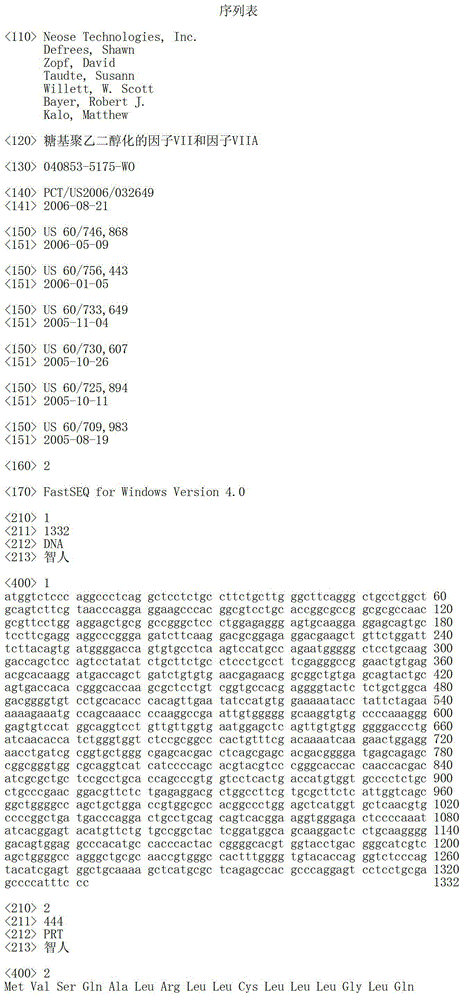

Claims (10)


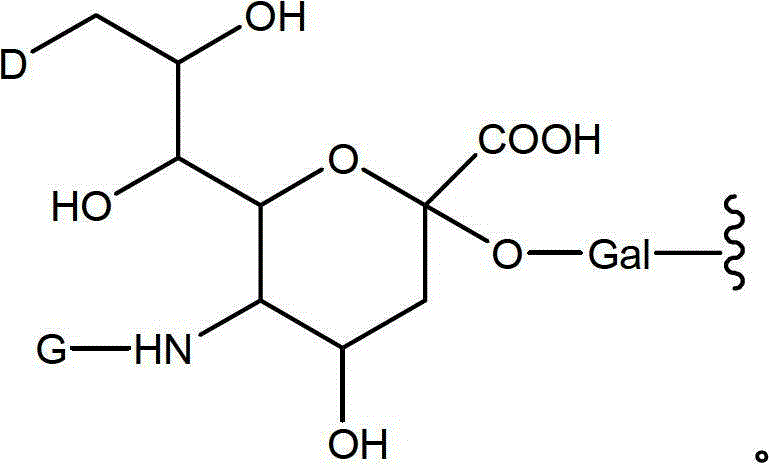


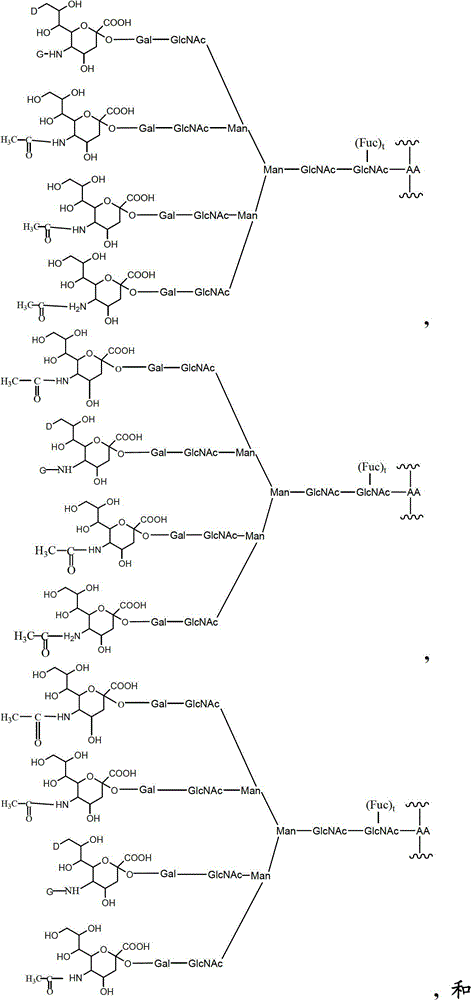
Applications Claiming Priority (12)
| Application Number | Priority Date | Filing Date | Title |
|---|---|---|---|
| US70998305P | 2005-08-19 | 2005-08-19 | |
| US60/709,983 | 2005-08-19 | ||
| US72589405P | 2005-10-11 | 2005-10-11 | |
| US60/725,894 | 2005-10-11 | ||
| US73060705P | 2005-10-26 | 2005-10-26 | |
| US60/730,607 | 2005-10-26 | ||
| US73364905P | 2005-11-04 | 2005-11-04 | |
| US60/733,649 | 2005-11-04 | ||
| US75644306P | 2006-01-05 | 2006-01-05 | |
| US60/756,443 | 2006-01-05 | ||
| US74686806P | 2006-05-09 | 2006-05-09 | |
| US60/746,868 | 2006-05-09 |
Related Parent Applications (1)
| Application Number | Title | Priority Date | Filing Date |
|---|---|---|---|
| CNA2006800388966A Division CN101374861A (en) | 2005-08-19 | 2006-08-21 | Glycopegylated Factor VII and Factor VIIA |
Publications (1)
| Publication Number | Publication Date |
|---|---|
| CN102719508A true CN102719508A (en) | 2012-10-10 |
Family
ID=37758493
Family Applications (1)
| Application Number | Title | Priority Date | Filing Date |
|---|---|---|---|
| CN2012102432833A Withdrawn CN102719508A (en) | 2005-08-19 | 2006-08-21 | Glycopegylated factor VII and factor VIIA |
Country Status (12)
| Country | Link |
|---|---|
| US (2) | US20090305967A1 (en) |
| EP (1) | EP1937719A4 (en) |
| JP (1) | JP2009515508A (en) |
| KR (1) | KR20080080081A (en) |
| CN (1) | CN102719508A (en) |
| AU (1) | AU2006280932A1 (en) |
| BR (1) | BRPI0614839A2 (en) |
| CA (1) | CA2619969A1 (en) |
| IL (1) | IL189586A0 (en) |
| MX (1) | MX2008002395A (en) |
| NO (1) | NO20080970L (en) |
| WO (1) | WO2007022512A2 (en) |
Families Citing this family (53)
| Publication number | Priority date | Publication date | Assignee | Title |
|---|---|---|---|---|
| US7795210B2 (en) | 2001-10-10 | 2010-09-14 | Novo Nordisk A/S | Protein remodeling methods and proteins/peptides produced by the methods |
| US8008252B2 (en) | 2001-10-10 | 2011-08-30 | Novo Nordisk A/S | Factor VII: remodeling and glycoconjugation of Factor VII |
| US7157277B2 (en) | 2001-11-28 | 2007-01-02 | Neose Technologies, Inc. | Factor VIII remodeling and glycoconjugation of Factor VIII |
| US7173003B2 (en) | 2001-10-10 | 2007-02-06 | Neose Technologies, Inc. | Granulocyte colony stimulating factor: remodeling and glycoconjugation of G-CSF |
| US7214660B2 (en) | 2001-10-10 | 2007-05-08 | Neose Technologies, Inc. | Erythropoietin: remodeling and glycoconjugation of erythropoietin |
| DE60336555D1 (en) | 2002-06-21 | 2011-05-12 | Novo Nordisk Healthcare Ag | PEGYLATED GLYCO FORMS OF FACTOR VII |
| NZ542094A (en) | 2003-03-14 | 2008-12-24 | Neose Technologies Inc | Branched polymer conjugates comprising a peptide and water-soluble polymer chains |
| US8791070B2 (en) | 2003-04-09 | 2014-07-29 | Novo Nordisk A/S | Glycopegylated factor IX |
| US20070026485A1 (en) | 2003-04-09 | 2007-02-01 | Neose Technologies, Inc. | Glycopegylation methods and proteins/peptides produced by the methods |
| BRPI0410164A (en) | 2003-05-09 | 2006-05-16 | Neose Technologies Inc | compositions and methods for preparing human growth hormone glycosylation mutants |
| WO2005012484A2 (en) | 2003-07-25 | 2005-02-10 | Neose Technologies, Inc. | Antibody-toxin conjugates |
| US8633157B2 (en) | 2003-11-24 | 2014-01-21 | Novo Nordisk A/S | Glycopegylated erythropoietin |
| US20080305992A1 (en) | 2003-11-24 | 2008-12-11 | Neose Technologies, Inc. | Glycopegylated erythropoietin |
| US20060040856A1 (en) | 2003-12-03 | 2006-02-23 | Neose Technologies, Inc. | Glycopegylated factor IX |
| US7956032B2 (en) | 2003-12-03 | 2011-06-07 | Novo Nordisk A/S | Glycopegylated granulocyte colony stimulating factor |
| WO2005070138A2 (en) | 2004-01-08 | 2005-08-04 | Neose Technologies, Inc. | O-linked glycosylation of peptides |
| WO2006010143A2 (en) | 2004-07-13 | 2006-01-26 | Neose Technologies, Inc. | Branched peg remodeling and glycosylation of glucagon-like peptide-1 [glp-1] |
| US8288557B2 (en) | 2004-07-23 | 2012-10-16 | Endocyte, Inc. | Bivalent linkers and conjugates thereof |
| US8268967B2 (en) | 2004-09-10 | 2012-09-18 | Novo Nordisk A/S | Glycopegylated interferon α |
| ES2566670T3 (en) | 2004-10-29 | 2016-04-14 | Ratiopharm Gmbh | Remodeling and glucopegilation of fibroblast growth factor (FGF) |
| JP4951527B2 (en) | 2005-01-10 | 2012-06-13 | バイオジェネリックス アーゲー | GlycoPEGylated granulocyte colony stimulating factor |
| US20070154992A1 (en) | 2005-04-08 | 2007-07-05 | Neose Technologies, Inc. | Compositions and methods for the preparation of protease resistant human growth hormone glycosylation mutants |
| US20110003744A1 (en) * | 2005-05-25 | 2011-01-06 | Novo Nordisk A/S | Glycopegylated Erythropoietin Formulations |
| WO2006127910A2 (en) | 2005-05-25 | 2006-11-30 | Neose Technologies, Inc. | Glycopegylated erythropoietin formulations |
| EP2975135A1 (en) | 2005-05-25 | 2016-01-20 | Novo Nordisk A/S | Glycopegylated factor IX |
| US20070105755A1 (en) | 2005-10-26 | 2007-05-10 | Neose Technologies, Inc. | One pot desialylation and glycopegylation of therapeutic peptides |
| US20090048440A1 (en) | 2005-11-03 | 2009-02-19 | Neose Technologies, Inc. | Nucleotide Sugar Purification Using Membranes |
| US20080248959A1 (en) | 2006-07-21 | 2008-10-09 | Neose Technologies, Inc. | Glycosylation of peptides via o-linked glycosylation sequences |
| EP2054521A4 (en) | 2006-10-03 | 2012-12-19 | Novo Nordisk As | METHODS OF PURIFYING CONJUGATES OF POLYPEPTIDES |
| CN104127878A (en) | 2007-03-14 | 2014-11-05 | 恩多塞特公司 | Binding ligand linked drug delivery conjugates of tubulysins |
| PL2144923T3 (en) | 2007-04-03 | 2013-12-31 | Biogenerix Ag | Methods of treatment using glycopegylated g-csf |
| KR101047925B1 (en) * | 2007-04-19 | 2011-07-08 | 주식회사 엘지화학 | Acrylic pressure-sensitive adhesive composition and a polarizing plate comprising the same |
| EP2170919B8 (en) | 2007-06-12 | 2016-01-20 | ratiopharm GmbH | Improved process for the production of nucleotide sugars |
| CA2690943A1 (en) | 2007-06-25 | 2008-12-31 | Endocyte, Inc. | Conjugates containing hydrophilic spacer linkers |
| US9877965B2 (en) | 2007-06-25 | 2018-01-30 | Endocyte, Inc. | Vitamin receptor drug delivery conjugates for treating inflammation |
| US8207112B2 (en) | 2007-08-29 | 2012-06-26 | Biogenerix Ag | Liquid formulation of G-CSF conjugate |
| EP2626079A3 (en) | 2008-02-27 | 2014-03-05 | Novo Nordisk A/S | Conjungated factor VIII molecules |
| TWI538916B (en) | 2008-04-11 | 2016-06-21 | 介控生化科技公司 | Modified Factor VII polypeptide and use thereof |
| WO2011018515A1 (en) | 2009-08-14 | 2011-02-17 | Novo Nordisk Health Care Ag | Method of purifying pegylated proteins |
| WO2011064247A1 (en) * | 2009-11-24 | 2011-06-03 | Novo Nordisk Health Care Ag | Method of purifying pegylated proteins |
| KR20120002129A (en) * | 2010-06-30 | 2012-01-05 | 한미홀딩스 주식회사 | Factor 7 Drug Conjugates Using Immunoglobulin Fragments |
| TWI557135B (en) | 2010-11-03 | 2016-11-11 | 介控生化科技公司 | Modified ninth factor multi-peptide and use thereof |
| US10080805B2 (en) | 2012-02-24 | 2018-09-25 | Purdue Research Foundation | Cholecystokinin B receptor targeting for imaging and therapy |
| US20140080175A1 (en) | 2012-03-29 | 2014-03-20 | Endocyte, Inc. | Processes for preparing tubulysin derivatives and conjugates thereof |
| BR112014025737A2 (en) | 2012-04-16 | 2017-07-04 | Cantab Biopharmaceuticals Patents Ltd | method for administering a therapeutic agent, method for preventing entry of a therapeutic agent, method for modulating the rate of release of a therapeutic agent, therapeutic agent, dosage forms, method of treating a disease and parts kit |
| CN104661685A (en) | 2012-10-15 | 2015-05-27 | 诺和诺德保健Ag(股份有限公司) | Factor vii conjugates |
| CA2887727A1 (en) | 2012-10-16 | 2014-04-24 | Endocyte, Inc. | Drug delivery conjugates containing unnatural amino acids and methods for using |
| PL3572090T3 (en) | 2012-12-24 | 2023-04-11 | Coagulant Therapeutics Corporation | Short-acting factor vii polypeptides |
| US9371370B2 (en) | 2013-10-15 | 2016-06-21 | Novo Nordisk Healthcare Ag | Coagulation factor VII polypeptides |
| AR099328A1 (en) * | 2014-02-12 | 2016-07-13 | Novo Nordisk As | FACTOR VII CONJUGATES |
| EP3833381B1 (en) | 2019-08-15 | 2022-08-03 | Catalyst Biosciences, Inc. | Modified factor vii polypeptides for subcutaneous administration |
| EP4211468A4 (en) | 2020-09-11 | 2024-10-09 | Glympse Bio, Inc. | EX-VIVO PROTEASE ACTIVITY DETECTION FOR DISEASE DETECTION/DIAGNOSTICS, CLASSIFICATION, MONITORING AND TREATMENT |
| US20250197917A1 (en) * | 2022-03-09 | 2025-06-19 | Glympse Bio, Inc. | Method of protease detection |
Family Cites Families (100)
| Publication number | Priority date | Publication date | Assignee | Title |
|---|---|---|---|---|
| GB1479268A (en) * | 1973-07-05 | 1977-07-13 | Beecham Group Ltd | Pharmaceutical compositions |
| US4179337A (en) * | 1973-07-20 | 1979-12-18 | Davis Frank F | Non-immunogenic polypeptides |
| CH596313A5 (en) * | 1975-05-30 | 1978-03-15 | Battelle Memorial Institute | |
| US4385260A (en) * | 1975-09-09 | 1983-05-24 | Beckman Instruments, Inc. | Bargraph display |
| US4414147A (en) * | 1981-04-17 | 1983-11-08 | Massachusetts Institute Of Technology | Methods of decreasing the hydrophobicity of fibroblast and other interferons |
| JPS57206622A (en) * | 1981-06-10 | 1982-12-18 | Ajinomoto Co Inc | Blood substitute |
| US4451566A (en) * | 1981-12-04 | 1984-05-29 | Spencer Donald B | Methods and apparatus for enzymatically producing ethanol |
| US4438253A (en) * | 1982-11-12 | 1984-03-20 | American Cyanamid Company | Poly(glycolic acid)/poly(alkylene glycol) block copolymers and method of manufacturing the same |
| US4496689A (en) * | 1983-12-27 | 1985-01-29 | Miles Laboratories, Inc. | Covalently attached complex of alpha-1-proteinase inhibitor with a water soluble polymer |
| US4565653A (en) * | 1984-03-30 | 1986-01-21 | Pfizer Inc. | Acyltripeptide immunostimulants |
| US4879236A (en) * | 1984-05-16 | 1989-11-07 | The Texas A&M University System | Method for producing a recombinant baculovirus expression vector |
| US4675414A (en) * | 1985-03-08 | 1987-06-23 | The United States Of America As Represented By The Secretary Of The Navy | Maleimidomethyl-carbonate polyethers |
| US5206344A (en) * | 1985-06-26 | 1993-04-27 | Cetus Oncology Corporation | Interleukin-2 muteins and polymer conjugation thereof |
| JPS6238172A (en) * | 1985-08-12 | 1987-02-19 | 株式会社 高研 | Production of anti-thrombotic medical material |
| SE451849B (en) * | 1985-12-11 | 1987-11-02 | Svenska Sockerfabriks Ab | VIEW TO SYNTHETIZE GYCLOSIDIC BINDINGS AND USE OF THIS RECEIVED PRODUCTS |
| IT1213029B (en) * | 1986-01-30 | 1989-12-07 | Bracco Ind Chimica Spa | PARAMAGNETIC METAL ION CHELATES. |
| US4767702A (en) * | 1986-02-06 | 1988-08-30 | Cohenford Menashi A | Paper strip assay for neisseria species |
| US4925796A (en) * | 1986-03-07 | 1990-05-15 | Massachusetts Institute Of Technology | Method for enhancing glycoprotein stability |
| US5272066A (en) * | 1986-03-07 | 1993-12-21 | Massachusetts Institute Of Technology | Synthetic method for enhancing glycoprotein stability |
| IL82834A (en) * | 1987-06-09 | 1990-11-05 | Yissum Res Dev Co | Biodegradable polymeric materials based on polyether glycols,processes for the preparation thereof and surgical artiicles made therefrom |
| US4847325A (en) * | 1988-01-20 | 1989-07-11 | Cetus Corporation | Conjugation of polymer to colony stimulating factor-1 |
| US5153265A (en) * | 1988-01-20 | 1992-10-06 | Cetus Corporation | Conjugation of polymer to colony stimulating factor-1 |
| GB8810808D0 (en) * | 1988-05-06 | 1988-06-08 | Wellcome Found | Vectors |
| US5169933A (en) * | 1988-08-15 | 1992-12-08 | Neorx Corporation | Covalently-linked complexes and methods for enhanced cytotoxicity and imaging |
| US5104651A (en) * | 1988-12-16 | 1992-04-14 | Amgen Inc. | Stabilized hydrophobic protein formulations of g-csf |
| US5047335A (en) * | 1988-12-21 | 1991-09-10 | The Regents Of The University Of Calif. | Process for controlling intracellular glycosylation of proteins |
| US6166183A (en) * | 1992-11-30 | 2000-12-26 | Kirin-Amgen, Inc. | Chemically-modified G-CSF |
| US5194376A (en) * | 1989-02-28 | 1993-03-16 | University Of Ottawa | Baculovirus expression system capable of producing foreign gene proteins at high levels |
| US5122614A (en) * | 1989-04-19 | 1992-06-16 | Enzon, Inc. | Active carbonates of polyalkylene oxides for modification of polypeptides |
| US5324844A (en) * | 1989-04-19 | 1994-06-28 | Enzon, Inc. | Active carbonates of polyalkylene oxides for modification of polypeptides |
| US5166322A (en) * | 1989-04-21 | 1992-11-24 | Genetics Institute | Cysteine added variants of interleukin-3 and chemical modifications thereof |
| US5342940A (en) * | 1989-05-27 | 1994-08-30 | Sumitomo Pharmaceuticals Company, Limited | Polyethylene glycol derivatives, process for preparing the same |
| US5154924A (en) * | 1989-09-07 | 1992-10-13 | Alkermes, Inc. | Transferrin receptor specific antibody-neuropharmaceutical agent conjugates |
| US5977307A (en) * | 1989-09-07 | 1999-11-02 | Alkermes, Inc. | Transferrin receptor specific ligand-neuropharmaceutical agent fusion proteins |
| US5672683A (en) * | 1989-09-07 | 1997-09-30 | Alkermes, Inc. | Transferrin neuropharmaceutical agent fusion protein |
| US5527527A (en) * | 1989-09-07 | 1996-06-18 | Alkermes, Inc. | Transferrin receptor specific antibody-neuropharmaceutical agent conjugates |
| US5182107A (en) * | 1989-09-07 | 1993-01-26 | Alkermes, Inc. | Transferrin receptor specific antibody-neuropharmaceutical or diagnostic agent conjugates |
| US5032519A (en) * | 1989-10-24 | 1991-07-16 | The Regents Of The Univ. Of California | Method for producing secretable glycosyltransferases and other Golgi processing enzymes |
| US5324663A (en) * | 1990-02-14 | 1994-06-28 | The Regents Of The University Of Michigan | Methods and products for the synthesis of oligosaccharide structures on glycoproteins, glycolipids, or as free molecules, and for the isolation of cloned genetic sequences that determine these structures |
| DE4009630C2 (en) * | 1990-03-26 | 1995-09-28 | Reinhard Prof Dr Dr Brossmer | CMP-activated fluorescent sialic acids and processes for their preparation |
| EP0481038B1 (en) * | 1990-04-16 | 2002-10-02 | The Trustees Of The University Of Pennsylvania | Saccharide compositions, methods and apparatus for their synthesis |
| US5399345A (en) * | 1990-05-08 | 1995-03-21 | Boehringer Mannheim, Gmbh | Muteins of the granulocyte colony stimulating factor |
| US5219564A (en) * | 1990-07-06 | 1993-06-15 | Enzon, Inc. | Poly(alkylene oxide) amino acid copolymers and drug carriers and charged copolymers based thereon |
| US5410016A (en) * | 1990-10-15 | 1995-04-25 | Board Of Regents, The University Of Texas System | Photopolymerizable biodegradable hydrogels as tissue contacting materials and controlled-release carriers |
| US5164374A (en) * | 1990-12-17 | 1992-11-17 | Monsanto Company | Use of oligosaccharides for treatment of arthritis |
| US5278299A (en) * | 1991-03-18 | 1994-01-11 | Scripps Clinic And Research Foundation | Method and composition for synthesizing sialylated glycosyl compounds |
| US5374655A (en) * | 1991-06-10 | 1994-12-20 | Alberta Research Council | Methods for the synthesis of monofucosylated oligosaccharides terminating in di-N-acetyllactosaminyl structures |
| US5352670A (en) * | 1991-06-10 | 1994-10-04 | Alberta Research Council | Methods for the enzymatic synthesis of alpha-sialylated oligosaccharide glycosides |
| KR950014915B1 (en) * | 1991-06-19 | 1995-12-18 | 주식회사녹십자 | Asialoglycoprotein-conjugated compounds |
| US5281698A (en) * | 1991-07-23 | 1994-01-25 | Cetus Oncology Corporation | Preparation of an activated polymer ester for protein conjugation |
| US5384249A (en) * | 1991-12-17 | 1995-01-24 | Kyowa Hakko Kogyo Co., Ltd. | α2→3 sialyltransferase |
| US6037452A (en) * | 1992-04-10 | 2000-03-14 | Alpha Therapeutic Corporation | Poly(alkylene oxide)-Factor VIII or Factor IX conjugate |
| US5614184A (en) * | 1992-07-28 | 1997-03-25 | New England Deaconess Hospital | Recombinant human erythropoietin mutants and therapeutic methods employing them |
| US5308460A (en) * | 1992-10-30 | 1994-05-03 | Glyko, Incorporated | Rapid synthesis and analysis of carbohydrates |
| US5202413A (en) * | 1993-02-16 | 1993-04-13 | E. I. Du Pont De Nemours And Company | Alternating (ABA)N polylactide block copolymers |
| US5409817A (en) * | 1993-05-04 | 1995-04-25 | Cytel, Inc. | Use of trans-sialidase and sialyltransferase for synthesis of sialylα2→3βgalactosides |
| US5374541A (en) * | 1993-05-04 | 1994-12-20 | The Scripps Research Institute | Combined use of β-galactosidase and sialyltransferase coupled with in situ regeneration of CMP-sialic acid for one pot synthesis of oligosaccharides |
| WO1994026906A2 (en) * | 1993-05-14 | 1994-11-24 | The Upjohn Company | CLONED DNA ENCODING A UDP-GALNAc:POLYPEPTIDE,N-ACETYLGALACTOS AMINYLTRANSFERASE |
| US5849535A (en) * | 1995-09-21 | 1998-12-15 | Genentech, Inc. | Human growth hormone variants |
| US5621039A (en) * | 1993-06-08 | 1997-04-15 | Hallahan; Terrence W. | Factor IX- polymeric conjugates |
| US5369017A (en) * | 1994-02-04 | 1994-11-29 | The Scripps Research Institute | Process for solid phase glycopeptide synthesis |
| US5492841A (en) * | 1994-02-18 | 1996-02-20 | E. I. Du Pont De Nemours And Company | Quaternary ammonium immunogenic conjugates and immunoassay reagents |
| US5432059A (en) * | 1994-04-01 | 1995-07-11 | Specialty Laboratories, Inc. | Assay for glycosylation deficiency disorders |
| US5545553A (en) * | 1994-09-26 | 1996-08-13 | The Rockefeller University | Glycosyltransferases for biosynthesis of oligosaccharides, and genes encoding them |
| US5834251A (en) * | 1994-12-30 | 1998-11-10 | Alko Group Ltd. | Methods of modifying carbohydrate moieties |
| US5932462A (en) * | 1995-01-10 | 1999-08-03 | Shearwater Polymers, Inc. | Multiarmed, monofunctional, polymer for coupling to molecules and surfaces |
| US5876980A (en) * | 1995-04-11 | 1999-03-02 | Cytel Corporation | Enzymatic synthesis of oligosaccharides |
| US5728554A (en) * | 1995-04-11 | 1998-03-17 | Cytel Corporation | Enzymatic synthesis of glycosidic linkages |
| US5922577A (en) * | 1995-04-11 | 1999-07-13 | Cytel Corporation | Enzymatic synthesis of glycosidic linkages |
| US6030815A (en) * | 1995-04-11 | 2000-02-29 | Neose Technologies, Inc. | Enzymatic synthesis of oligosaccharides |
| US6015555A (en) * | 1995-05-19 | 2000-01-18 | Alkermes, Inc. | Transferrin receptor specific antibody-neuropharmaceutical or diagnostic agent conjugates |
| US5716812A (en) * | 1995-12-12 | 1998-02-10 | The University Of British Columbia | Methods and compositions for synthesis of oligosaccharides, and the products formed thereby |
| DK0964690T3 (en) * | 1996-10-15 | 2003-10-20 | Liposome Co Inc | Peptide-lipid conjugates, liposomes and liposomal drug administration |
| AU736993B2 (en) * | 1997-01-16 | 2001-08-09 | Novo Nordisk A/S | Practical in vitro sialylation of recombinant glycoproteins |
| US5945314A (en) * | 1997-03-31 | 1999-08-31 | Abbott Laboratories | Process for synthesizing oligosaccharides |
| US6183738B1 (en) * | 1997-05-12 | 2001-02-06 | Phoenix Pharamacologics, Inc. | Modified arginine deiminase |
| US20030027257A1 (en) * | 1997-08-21 | 2003-02-06 | University Technologies International, Inc. | Sequences for improving the efficiency of secretion of non-secreted protein from mammalian and insect cells |
| MXPA00005376A (en) * | 1997-12-01 | 2002-07-02 | Neose Technologies Inc | Enzymatic synthesis of gangliosides. |
| EP0924298A1 (en) * | 1997-12-18 | 1999-06-23 | Stichting Instituut voor Dierhouderij en Diergezondheid (ID-DLO) | Protein expression in baculovirus vector expression systems |
| ES2222689T3 (en) * | 1998-03-12 | 2005-02-01 | Nektar Therapeutics Al, Corporation | DERIVATIVES OF POLYETHYLENE GLYCOL WITH PROXIMAL REACTIVE GROUPS. |
| DE19852729A1 (en) * | 1998-11-16 | 2000-05-18 | Werner Reutter | Recombinant glycoproteins, processes for their preparation, medicaments containing them and their use |
| US6261805B1 (en) * | 1999-07-15 | 2001-07-17 | Boyce Thompson Institute For Plant Research, Inc. | Sialyiation of N-linked glycoproteins in the baculovirus expression vector system |
| KR100729977B1 (en) * | 1999-12-22 | 2007-06-20 | 넥타르 테라퓨틱스 에이엘, 코포레이션 | Process for preparing 1-benzotriazolyl carbonate ester of poly (ethylene glycol) |
| MXPA02011303A (en) * | 2000-05-15 | 2003-04-25 | Hoffmann La Roche | Liquid pharmaceutical composition containing an erythropoietin derivate. |
| JP2004501642A (en) * | 2000-06-28 | 2004-01-22 | グライコフィ, インコーポレイテッド | Methods for producing modified glycoproteins |
| US7265084B2 (en) * | 2001-10-10 | 2007-09-04 | Neose Technologies, Inc. | Glycopegylation methods and proteins/peptides produced by the methods |
| ES2466024T3 (en) * | 2001-10-10 | 2014-06-09 | Ratiopharm Gmbh | Remodeling and glycoconjugation of fibroblast growth factor (FGF) |
| US7214660B2 (en) * | 2001-10-10 | 2007-05-08 | Neose Technologies, Inc. | Erythropoietin: remodeling and glycoconjugation of erythropoietin |
| US7795210B2 (en) * | 2001-10-10 | 2010-09-14 | Novo Nordisk A/S | Protein remodeling methods and proteins/peptides produced by the methods |
| DE60336555D1 (en) * | 2002-06-21 | 2011-05-12 | Novo Nordisk Healthcare Ag | PEGYLATED GLYCO FORMS OF FACTOR VII |
| ATE488370T1 (en) * | 2002-08-22 | 2010-12-15 | Mvm Technologies Inc | UNIVERSAL INK JET PRINTER APPARATUS |
| JP2006508918A (en) * | 2002-09-05 | 2006-03-16 | ザ ジェネラル ホスピタル コーポレーション | Modified asialointerferon and uses thereof |
| US20070026485A1 (en) * | 2003-04-09 | 2007-02-01 | Neose Technologies, Inc. | Glycopegylation methods and proteins/peptides produced by the methods |
| EP1694347B1 (en) * | 2003-11-24 | 2013-11-20 | BioGeneriX AG | Glycopegylated erythropoietin |
| US8633157B2 (en) * | 2003-11-24 | 2014-01-21 | Novo Nordisk A/S | Glycopegylated erythropoietin |
| US20070254836A1 (en) * | 2003-12-03 | 2007-11-01 | Defrees Shawn | Glycopegylated Granulocyte Colony Stimulating Factor |
| WO2005055950A2 (en) * | 2003-12-03 | 2005-06-23 | Neose Technologies, Inc. | Glycopegylated factor ix |
| WO2005070138A2 (en) * | 2004-01-08 | 2005-08-04 | Neose Technologies, Inc. | O-linked glycosylation of peptides |
| EP3385384B1 (en) * | 2004-02-12 | 2020-04-08 | Archemix LLC | Aptamer therapeutics useful in the treatment of complement-related disorders |
| US7904787B2 (en) * | 2007-01-09 | 2011-03-08 | International Business Machines Corporation | Pipelined cyclic redundancy check for high bandwidth interfaces |
-
2006
- 2006-08-21 CA CA002619969A patent/CA2619969A1/en not_active Abandoned
- 2006-08-21 JP JP2008527212A patent/JP2009515508A/en active Pending
- 2006-08-21 AU AU2006280932A patent/AU2006280932A1/en not_active Withdrawn
- 2006-08-21 EP EP06802028A patent/EP1937719A4/en not_active Withdrawn
- 2006-08-21 BR BRPI0614839-5A patent/BRPI0614839A2/en not_active Application Discontinuation
- 2006-08-21 WO PCT/US2006/032649 patent/WO2007022512A2/en not_active Ceased
- 2006-08-21 MX MX2008002395A patent/MX2008002395A/en unknown
- 2006-08-21 KR KR1020087006691A patent/KR20080080081A/en not_active Ceased
- 2006-08-21 US US12/064,012 patent/US20090305967A1/en not_active Abandoned
- 2006-08-21 CN CN2012102432833A patent/CN102719508A/en not_active Withdrawn
-
2008
- 2008-02-18 IL IL189586A patent/IL189586A0/en unknown
- 2008-02-26 NO NO20080970A patent/NO20080970L/en unknown
-
2009
- 2009-10-23 US US12/605,041 patent/US20100113743A1/en not_active Abandoned
Also Published As
| Publication number | Publication date |
|---|---|
| MX2008002395A (en) | 2008-03-18 |
| EP1937719A4 (en) | 2010-11-24 |
| CA2619969A1 (en) | 2007-02-22 |
| US20090305967A1 (en) | 2009-12-10 |
| NO20080970L (en) | 2008-05-19 |
| JP2009515508A (en) | 2009-04-16 |
| AU2006280932A1 (en) | 2007-02-22 |
| EP1937719A2 (en) | 2008-07-02 |
| WO2007022512A3 (en) | 2007-10-04 |
| BRPI0614839A2 (en) | 2009-05-19 |
| IL189586A0 (en) | 2008-08-07 |
| US20100113743A1 (en) | 2010-05-06 |
| WO2007022512A2 (en) | 2007-02-22 |
| KR20080080081A (en) | 2008-09-02 |
Similar Documents
| Publication | Publication Date | Title |
|---|---|---|
| CN101600448B (en) | Glycerol-Linked PEGylated Carbohydrates and Glycopeptides | |
| US8911967B2 (en) | One pot desialylation and glycopegylation of therapeutic peptides | |
| CN102719508A (en) | Glycopegylated factor VII and factor VIIA | |
| US8632770B2 (en) | Glycopegylated factor IX | |
| JP5216580B2 (en) | Glycopegylated factor IX | |
| US7842661B2 (en) | Glycopegylated erythropoietin formulations | |
| US8633157B2 (en) | Glycopegylated erythropoietin | |
| US20120107867A1 (en) | Glycopegylated erythropoietin | |
| US20110003744A1 (en) | Glycopegylated Erythropoietin Formulations | |
| US20140112903A1 (en) | Glycopegylated Factor IX | |
| US20130344050A1 (en) | Glycopegylated Factor IX | |
| US20130137157A1 (en) | Glycopegylated factor vii and factor viia | |
| CN1889937B (en) | Glycopegylated factor IX | |
| CN101374861A (en) | Glycopegylated Factor VII and Factor VIIA |
Legal Events
| Date | Code | Title | Description |
|---|---|---|---|
| C06 | Publication | ||
| PB01 | Publication | ||
| C10 | Entry into substantive examination | ||
| SE01 | Entry into force of request for substantive examination | ||
| C04 | Withdrawal of patent application after publication (patent law 2001) | ||
| WW01 | Invention patent application withdrawn after publication |
Application publication date: 20121010 |