CN102439616A - Method and apparatus for managing services using reusable bearer tags - Google Patents
Method and apparatus for managing services using reusable bearer tags Download PDFInfo
- Publication number
- CN102439616A CN102439616A CN2010800222562A CN201080022256A CN102439616A CN 102439616 A CN102439616 A CN 102439616A CN 2010800222562 A CN2010800222562 A CN 2010800222562A CN 201080022256 A CN201080022256 A CN 201080022256A CN 102439616 A CN102439616 A CN 102439616A
- Authority
- CN
- China
- Prior art keywords
- service
- user
- services
- information
- bearer
- Prior art date
- Legal status (The legal status is an assumption and is not a legal conclusion. Google has not performed a legal analysis and makes no representation as to the accuracy of the status listed.)
- Granted
Links
Images


Classifications
-
- G—PHYSICS
- G07—CHECKING-DEVICES
- G07F—COIN-FREED OR LIKE APPARATUS
- G07F7/00—Mechanisms actuated by objects other than coins to free or to actuate vending, hiring, coin or paper currency dispensing or refunding apparatus
- G07F7/08—Mechanisms actuated by objects other than coins to free or to actuate vending, hiring, coin or paper currency dispensing or refunding apparatus by coded identity card or credit card or other personal identification means
-
- G—PHYSICS
- G06—COMPUTING OR CALCULATING; COUNTING
- G06Q—INFORMATION AND COMMUNICATION TECHNOLOGY [ICT] SPECIALLY ADAPTED FOR ADMINISTRATIVE, COMMERCIAL, FINANCIAL, MANAGERIAL OR SUPERVISORY PURPOSES; SYSTEMS OR METHODS SPECIALLY ADAPTED FOR ADMINISTRATIVE, COMMERCIAL, FINANCIAL, MANAGERIAL OR SUPERVISORY PURPOSES, NOT OTHERWISE PROVIDED FOR
- G06Q20/00—Payment architectures, schemes or protocols
- G06Q20/22—Payment schemes or models
- G06Q20/28—Pre-payment schemes, e.g. "pay before"
-
- G—PHYSICS
- G06—COMPUTING OR CALCULATING; COUNTING
- G06Q—INFORMATION AND COMMUNICATION TECHNOLOGY [ICT] SPECIALLY ADAPTED FOR ADMINISTRATIVE, COMMERCIAL, FINANCIAL, MANAGERIAL OR SUPERVISORY PURPOSES; SYSTEMS OR METHODS SPECIALLY ADAPTED FOR ADMINISTRATIVE, COMMERCIAL, FINANCIAL, MANAGERIAL OR SUPERVISORY PURPOSES, NOT OTHERWISE PROVIDED FOR
- G06Q20/00—Payment architectures, schemes or protocols
- G06Q20/30—Payment architectures, schemes or protocols characterised by the use of specific devices or networks
- G06Q20/306—Payment architectures, schemes or protocols characterised by the use of specific devices or networks using TV related infrastructures
-
- G—PHYSICS
- G06—COMPUTING OR CALCULATING; COUNTING
- G06Q—INFORMATION AND COMMUNICATION TECHNOLOGY [ICT] SPECIALLY ADAPTED FOR ADMINISTRATIVE, COMMERCIAL, FINANCIAL, MANAGERIAL OR SUPERVISORY PURPOSES; SYSTEMS OR METHODS SPECIALLY ADAPTED FOR ADMINISTRATIVE, COMMERCIAL, FINANCIAL, MANAGERIAL OR SUPERVISORY PURPOSES, NOT OTHERWISE PROVIDED FOR
- G06Q20/00—Payment architectures, schemes or protocols
- G06Q20/30—Payment architectures, schemes or protocols characterised by the use of specific devices or networks
- G06Q20/32—Payment architectures, schemes or protocols characterised by the use of specific devices or networks using wireless devices
- G06Q20/321—Payment architectures, schemes or protocols characterised by the use of specific devices or networks using wireless devices using wearable devices
-
- G—PHYSICS
- G06—COMPUTING OR CALCULATING; COUNTING
- G06Q—INFORMATION AND COMMUNICATION TECHNOLOGY [ICT] SPECIALLY ADAPTED FOR ADMINISTRATIVE, COMMERCIAL, FINANCIAL, MANAGERIAL OR SUPERVISORY PURPOSES; SYSTEMS OR METHODS SPECIALLY ADAPTED FOR ADMINISTRATIVE, COMMERCIAL, FINANCIAL, MANAGERIAL OR SUPERVISORY PURPOSES, NOT OTHERWISE PROVIDED FOR
- G06Q20/00—Payment architectures, schemes or protocols
- G06Q20/30—Payment architectures, schemes or protocols characterised by the use of specific devices or networks
- G06Q20/32—Payment architectures, schemes or protocols characterised by the use of specific devices or networks using wireless devices
- G06Q20/327—Short range or proximity payments by means of M-devices
- G06Q20/3278—RFID or NFC payments by means of M-devices
-
- G—PHYSICS
- G06—COMPUTING OR CALCULATING; COUNTING
- G06Q—INFORMATION AND COMMUNICATION TECHNOLOGY [ICT] SPECIALLY ADAPTED FOR ADMINISTRATIVE, COMMERCIAL, FINANCIAL, MANAGERIAL OR SUPERVISORY PURPOSES; SYSTEMS OR METHODS SPECIALLY ADAPTED FOR ADMINISTRATIVE, COMMERCIAL, FINANCIAL, MANAGERIAL OR SUPERVISORY PURPOSES, NOT OTHERWISE PROVIDED FOR
- G06Q20/00—Payment architectures, schemes or protocols
- G06Q20/30—Payment architectures, schemes or protocols characterised by the use of specific devices or networks
- G06Q20/34—Payment architectures, schemes or protocols characterised by the use of specific devices or networks using cards, e.g. integrated circuit [IC] cards or magnetic cards
- G06Q20/349—Rechargeable cards
-
- G—PHYSICS
- G06—COMPUTING OR CALCULATING; COUNTING
- G06Q—INFORMATION AND COMMUNICATION TECHNOLOGY [ICT] SPECIALLY ADAPTED FOR ADMINISTRATIVE, COMMERCIAL, FINANCIAL, MANAGERIAL OR SUPERVISORY PURPOSES; SYSTEMS OR METHODS SPECIALLY ADAPTED FOR ADMINISTRATIVE, COMMERCIAL, FINANCIAL, MANAGERIAL OR SUPERVISORY PURPOSES, NOT OTHERWISE PROVIDED FOR
- G06Q20/00—Payment architectures, schemes or protocols
- G06Q20/30—Payment architectures, schemes or protocols characterised by the use of specific devices or networks
- G06Q20/34—Payment architectures, schemes or protocols characterised by the use of specific devices or networks using cards, e.g. integrated circuit [IC] cards or magnetic cards
- G06Q20/355—Personalisation of cards for use
Landscapes
- Engineering & Computer Science (AREA)
- Business, Economics & Management (AREA)
- Physics & Mathematics (AREA)
- General Physics & Mathematics (AREA)
- General Business, Economics & Management (AREA)
- Strategic Management (AREA)
- Accounting & Taxation (AREA)
- Theoretical Computer Science (AREA)
- Computer Networks & Wireless Communication (AREA)
- Microelectronics & Electronic Packaging (AREA)
- Mobile Radio Communication Systems (AREA)
- Telephonic Communication Services (AREA)
- Financial Or Insurance-Related Operations Such As Payment And Settlement (AREA)
Abstract
提供了一种方法,用于管理与可重用的预付费承载标签(例如,近场通信(NFC)标签、射频识别(RFID)标签、无接触型卡或条形码)相对应的一个或多个服务。通过从与所述一个或多个服务相对应的可重用的预付费承载标签读取服务信息来启动对于管理服务的请求。
A method is provided for managing one or more services corresponding to reusable prepaid bearer tags (e.g., near field communication (NFC) tags, radio frequency identification (RFID) tags, contactless cards, or barcodes). A request for the managed service is initiated by reading service information from the reusable prepaid bearer tag corresponding to the one or more services.
Description
背景技术 Background technique
无线(例如,蜂窝)服务提供商和设备制造商在(例如,通过提供引人注目的服务、应用和内容)向消费者传递价值和便利性上不断地受到挑战。除了在很多设备中已经包括的复杂功能之外,服务提供商和设备制造商正在使得一系列更多的可选服务(例如,音乐、游戏、视频、导航、产品等)可用于消费者。然而,这一增加的多样性可能与向消费者递送便利性的目标相冲突,因为通常对于消费者来说更难以管理(例如,发现、选择、访问、购买、参与、激活、修改、计费等)大量的服务。因此,为了具有竞争力并且提升对可用服务的更大发现和使用,服务提供商和制造商需要解决对用于服务的有效和便利管理的更多方法的日益增长的要求。Wireless (eg, cellular) service providers and device manufacturers are continually challenged to deliver value and convenience to consumers (eg, by offering compelling services, applications, and content). Service providers and device manufacturers are making a range of more optional services (eg, music, games, video, navigation, products, etc.) available to consumers in addition to the sophisticated functionality already included in many devices. However, this increased variety may conflict with the goal of delivering convenience to consumers because it is often more difficult for consumers to manage (e.g., discover, select, access, purchase, participate, activate, modify, bill) etc.) a large number of services. Therefore, in order to be competitive and promote greater discovery and use of available services, service providers and manufacturers need to address the growing demand for more methods for efficient and convenient management of services.
发明内容 Contents of the invention
根据一个实施例,一种方法包括:检测来自用户的输入,其用于选择与可由另一用户重用的承载标签相对应的一个或多个服务。所述承载标签指定了用于由所述用户参与一个或多个服务的第一通货量(a first amountof currency)以及用于所述另一用户的第二通货量。According to one embodiment, a method includes detecting input from a user for selecting one or more services corresponding to a bearer tag reusable by another user. The bearer tag specifies a first amount of currency for participation in one or more services by the user and a second amount of currency for the other user.
根据另一实施例,一种装置包括:至少一个处理器以及包括计算机程序代码的至少一个存储器,所述至少一个存储器和计算机程序代码被配置以便与所述至少一个处理器一起使得所述装置:检测来自用户的输入,其用于选择与可由另一用户重用的承载标签相对应的一个或多个服务。所述承载标签指定了用于由所述用户参与一个或多个服务的第一通货量以及用于所述另一用户的第二通货量。According to another embodiment, an apparatus comprises at least one processor and at least one memory comprising computer program code configured to, with the at least one processor, cause the apparatus to: Input from a user is detected for selecting one or more services corresponding to a bearer tag that can be reused by another user. The bearer tag specifies a first amount of currency for participation in one or more services by the user and a second amount of currency for the other user.
根据另一实施例,一种携带了一个或多个指令的一个或多个序列的计算机可读存储介质,当由一个或多个处理器执行所述一个或多个指令的一个或多个序列时,使得所述一个或多个处理器:检测来自用户的输入,其用于选择与可由另一用户重用的承载标签相对应的一个或多个服务。所述承载标签指定了用于由所述用户参与一个或多个服务的第一通货量以及用于所述另一用户的第二通货量。According to another embodiment, a computer-readable storage medium carrying one or more sequences of one or more instructions that, when executed by one or more processors, , causing the one or more processors to: detect input from a user for selecting one or more services corresponding to a bearer tag reusable by another user. The bearer tag specifies a first amount of currency for participation in one or more services by the user and a second amount of currency for the other user.
根据又一实施例,一种设备包括:用于检测来自用户的输入的装置,所述输入用于选择与可由另一用户重用的承载标签相对应的一个或多个服务。所述承载标签指定了用于由所述用户参与一个或多个服务的第一通货量以及用于所述另一用户的第二通货量。According to yet another embodiment, an apparatus includes means for detecting input from a user for selecting one or more services corresponding to a bearer tag reusable by another user. The bearer tag specifies a first amount of currency for participation in one or more services by the user and a second amount of currency for the other user.
简单通过说明多个特定实施例和实现(包括用于实现本发明所设想的最佳模式),从下面的详细描述中容易获知本发明的其它方面、特征和优点。本发明还实现了其它和不同的实施例,并且其若干细节可以在各种明显的方面中被修改,所有这些都不背离本发明的精神和范围。因此,附图和描述应当被视为本质上是说明性的,而不是限制性的。Other aspects, features, and advantages of the invention are readily apparent from the following detailed description, simply by illustrating a number of particular embodiments and implementations, including the best mode contemplated for carrying out the invention. The invention is also capable of other and different embodiments, and its several details can be modified in various obvious respects, all without departing from the spirit and scope of the invention. Accordingly, the drawings and descriptions should be regarded as illustrative in nature and not restrictive.
附图说明 Description of drawings
通过例子的方式而不是通过限制的方式图示了本发明的实施例,在附图中:Embodiments of the invention are illustrated by way of example and not by way of limitation, in the accompanying drawings:
图1是根据示例性实施例的能够使用承载标签来管理服务的通信系统的示图;1 is a diagram of a communication system capable of managing services using bearer tags according to an exemplary embodiment;
图2A和2B是根据各种示例性实施例的服务管理模块的组件以及服务平台的组件的示图;2A and 2B are diagrams of components of a service management module and components of a service platform, according to various exemplary embodiments;
图3是根据示例性实施例的用于请求激活或修改与承载标签相对应的服务的处理的流程图;3 is a flowchart of a process for requesting activation or modification of a service corresponding to a bearer tag according to an exemplary embodiment;
图4是根据示例性实施例的用于使用用户设备来管理服务的处理的流程图;FIG. 4 is a flowchart of a process for managing a service using a user equipment according to an exemplary embodiment;
图5是根据示例性实施例的用于激活或修改与承载标签相对应的服务的处理的流程图;5 is a flowchart of a process for activating or modifying a service corresponding to a bearer tag according to an exemplary embodiment;
图6是根据示例性实施例的用于使用可重用的预付费承载标签来激活服务的处理的流程图;Figure 6 is a flowchart of a process for activating a service using a reusable prepaid bearer tag, according to an exemplary embodiment;
图7是根据示例性实施例的用于转换可重用的预付费承载标签的通货的处理的流程图;7 is a flowchart of a process for converting currency of a reusable prepaid bearer tag, according to an exemplary embodiment;
图8A和8B是根据示例性实施例的承载标签和对应服务的示图;8A and 8B are diagrams of bearer tags and corresponding services according to exemplary embodiments;
图9是根据示例性实施例的在图4-6的过程中利用的用户接口的示图;Figure 9 is a diagram of a user interface utilized in the processes of Figures 4-6, according to an example embodiment;
图10是根据示例性实施例的可重用的预付费承载标签的示图;Figure 10 is a diagram of a reusable prepaid bearer label according to an exemplary embodiment;
图11A和11B是根据各种示例性实施例的图示用于管理包括应用下载的服务的一系列消息和处理的时序图;11A and 11B are sequence diagrams illustrating a series of messages and processes for managing services including application downloads, according to various exemplary embodiments;
图12A和12B是根据各种示例性实施例的图示用于管理包括有限数目的激活的服务的一系列消息和处理的时序图;12A and 12B are sequence diagrams illustrating a series of messages and processes for managing services including a limited number of activations, according to various exemplary embodiments;
图13A和13B是根据各种示例性实施例的图示用于管理包括驻留在用户设备上的应用的服务的一系列消息和处理的时序图;13A and 13B are sequence diagrams illustrating a series of messages and processes for managing services including applications resident on user equipment, according to various exemplary embodiments;
图14A和14B是根据各种示例性实施例的图示用于管理包括要求预订另一特征的应用的服务的一系列消息和处理的时序图;14A and 14B are sequence diagrams illustrating a series of messages and processes for managing a service including an application requiring subscription to another feature, according to various exemplary embodiments;
图15A和15B是根据各种示例性实施例的图示用于使用可重用的预付费承载标签来管理服务的一系列消息和处理的时序图;15A and 15B are sequence diagrams illustrating a series of messages and processes for managing services using reusable prepaid bearer tags, according to various exemplary embodiments;
图16是根据示例性实施例的图示用于使用铺面账户(store frontaccount)来管理服务的一系列消息和处理的时序图;16 is a sequence diagram illustrating a series of messages and processes for managing a service using a store front account, according to an exemplary embodiment;
图17是根据示例性实施例的提供对用于使用可重用的承载标签来管理服务的访问的流程图;17 is a flow diagram of providing access to services for managing services using reusable bearer tags, according to an exemplary embodiment;
图18是可用于实现本发明实施例的硬件的示图;Figure 18 is a diagram of hardware that can be used to implement an embodiment of the invention;
图19是可用于实现本发明实施例的芯片集的示图;以及Figure 19 is a diagram of a chipset that can be used to implement embodiments of the invention; and
图20是可用于实现本发明实施例的移动台(例如,手机)的示图。Figure 20 is a diagram of a mobile station (eg, handset) that may be used to implement embodiments of the present invention.
具体实施方式 Detailed ways
公开了一种用于使用可重用的预付费承载标签来管理一个或多个服务的方法和装置。如前所述,在此使用的术语“服务”统一指的是在网络和/或用户设备中的服务、应用和内容。另外,在此使用的术语“可重用的”指的是对多个用户来说使用同一预付费承载标签来访问与该标签相对应的一个或多个服务的能力。在某些实施例中,多个用户可以共享与承载标签相关联的同一预付通货量,诸如特定于服务的货币值或通货(currency)(例如,信用(credits)),或者可以独立地使用预付费承载标签,从而使得预付费承载标签的每个单独用户具有对于与该承载标签相关联的预付通货量的独立访问权。A method and apparatus for managing one or more services using a reusable prepaid bearer label is disclosed. As mentioned above, the term "service" as used herein collectively refers to services, applications and content in the network and/or user equipment. Additionally, the term "reusable" as used herein refers to the ability for multiple users to use the same prepaid bearer tag to access one or more services corresponding to that tag. In some embodiments, multiple users may share the same prepaid currency associated with a bearer tag, such as a service-specific monetary value or currency (e.g., credits), or may use prepaid currency independently. Each individual user of a prepaid bearer tag has independent access to the prepaid currency associated with that bearer tag.
在下面的描述中,出于解释的目的,阐述了很多具体细节,以便提供对本发明的实施例的透彻理解。然而,对本领域技术人员显而易见的是,可以在没有这些具体细节的情况下或在等同布置的情况下来实施本发明的实施例。在其它实例中,以框图形式示出了公知结构和设备,以便避免不必要地模糊本发明的实施例。In the following description, for purposes of explanation, numerous specific details are set forth in order to provide a thorough understanding of embodiments of the invention. It is apparent, however, to one skilled in the art that the embodiments of the invention may be practiced without these specific details or with an equivalent arrangement. In other instances, well-known structures and devices are shown in block diagram form in order to avoid unnecessarily obscuring the embodiments of the invention.
图1是根据示例性实施例的能够使用承载标签来管理服务的通信系统的示图。如图1所示,系统100包括具有到通信网络103的连接的一个或多个用户设备(UE)(例如,UE 101a-101n)。UE 101a-101n是任何类型的固定终端、移动终端或便携式终端,包括桌上型计算机、膝上型计算机、手机、站台、单元、设备、多媒体输入板、因特网节点、通信器、个人数字助理(PDA)、移动电话、移动通信设备、数字照相机/录像机、音频/视频播放器、定位设备、游戏设备、电视机等或其任何组合。还可以设想到UE 101a-101n可以支持针对用户的任何类型的接口(诸如“可佩戴的”电路等)。UE 101a-101n允许快速管理,例如像发现、激活、访问、修改、计费、下载以及设置一个或多个服务,包括服务、应用和内容或其任何组合(在此被称为“服务”)。FIG. 1 is a diagram of a communication system capable of managing services using bearer tags, according to an exemplary embodiment. As shown in FIG. 1 ,
举例来说,系统100的通信网络103包括一个或多个网络,诸如数据网络(未示出)、无线网络(未示出)、电话网络(未示出)或其任何组合。可以设想到,数据网络可以是任何局域网(LAN)、城域网(MAN)、广域网(WAN)、因特网或任何其它合适的分组交换网络,诸如商业拥有的、专有的分组交换网络,例如,专有电缆或光纤网络。另外,无线网络可以例如是蜂窝网络,并且可以采用各种技术,包括增强型数据速率全球演进(EDGE)、通用分组无线电服务(GPRS)、全球移动通信系统(GSM)、因特网协议多媒体子系统(IMS)、通用移动电信系统(UMTS)等以及任何其它合适的无线介质,例如微波接入(WiMAX)、长期演进(LTE)网络、码分多址(CDMA)、无线保真(WiFi)、卫星、移动ad-hoc(特定)网络(MANET)等。By way of example,
系统100还包括承载标签105a-105n,每个承载标签105与例如一个或多个服务相对应。在示例性实施例中,承载标签105是近场通信(NFC)标签、射频识别(RFID)标签、无接触型卡(contactless card)、条形码或其任何组合(其含有与一个或多个相应服务有关的信息)。承载标签105中所含的服务信息可以包括例如一个或多个服务代码,以便标识由承载标签105所表示的一个或多个服务。此外,承载标签105中所含的服务信息可以包括例如服务的一个或多个地址,以便标识由承载标签105所表示的一个或多个服务提供商。可以预期,在其它实施例中,承载标签105可以含有与附加服务有关的信息(例如,期满日期、使用限制等)。举例来说,承载标签105a-105n被嵌入、附接或印刷在能够支撑标签的各种材料(例如,包装材料、张贴物、海报、卡、杂志、报纸、显示器屏幕等)中的任何一个上。
在某些实施例中,承载标签105a-105n还可以与在参与服务时使用的预付通货量相关联。在示例性实施例中,可以从服务提供商或第三方供应商购买预付费承载标签。在一些情况下,预付费承载标签还可以作为各种促销、广告等的一部分而被分发。举例来说,通货可以是实际货币值(例如,美元、欧元、英镑等),或者可以是在一个或多个服务中使用的专有通货(例如,游戏中的信用、用于从在线音乐库购买音乐的信用,等等)。通过提供关于使用预付费承载标签的选项,系统100有利地减少了对于输入支付信息(例如,电话计费账户、信用卡、银行账户等)的需要。UE101a-101n分别包括能够读取承载标签105a-105n的一个或多个读取器,例如,近场通信(NFC)读取器、射频识别(RFID)读取器、无接触型卡读取器、条形码读取器和/或照相机等或其任何组合。In some embodiments, the
举例来说,NFC、RFID、无接触型卡和类似技术是使得能够在短距离上(例如,对于NFC来说的距离是大约4英寸)在设备之间交换数据的短距离无线通信技术。通常,这些技术包括两个主要组件,标签(例如,附接到对象)和读取器(其可以与UE 101a-101n一起实现)。在读取器和标签之间的通信无线地发生并且不一定要求设备之间是视距。标签(例如,RFID发射应答器)是例如附接到天线的小型微芯片。标签可以在大小、形状和形式上变化,并且可以通过很多类型的材料来读取。For example, NFC, RFID, contactless cards, and similar technologies are short-range wireless communication technologies that enable data to be exchanged between devices over short distances (eg, about 4 inches for NFC). Typically, these technologies include two main components, tags (eg, attached to objects) and readers (which may be implemented with UEs 101a-101n). Communication between the reader and tag occurs wirelessly and does not necessarily require line-of-sight between the devices. A tag (eg an RFID transponder) is a small microchip, for example, attached to an antenna. Tags can vary in size, shape and form, and can be read through many types of materials.
此外,标签可以是无源标签或有源标签。无源标签通常比有源标签更小、更轻且更便宜。无源标签仅当处在读取器的响应范围内时才被激活。读取器发射出用于为标签供电的低功率无线电波场,以便传递芯片上所含的任何信息。有源标签的不同之处在于:它们合并了其自己的电源来传送而不是反射射频信号。因此,有源标签实现了更广范围的功能性,比如可编程和读取/写入能力。Additionally, tags can be passive tags or active tags. Passive tags are generally smaller, lighter and less expensive than active tags. Passive tags are only activated when within the reader's response range. The reader emits a low-power radio wave field that powers the tag to communicate any information contained on the chip. Active tags differ in that they incorporate their own power source to transmit rather than reflect RF signals. Thus, active tags enable a wider range of functionality, such as programmability and read/write capabilities.
读取器通常含有发射机、接收机、控制单元和天线。读取器实施三个主要功能:激励标签、解调和解码所返回的无线电信号。在特定实施例中,读取器包括附加接口,以便将所返回的无线电信号转换成可传递到另一系统(诸如计算机或可编程逻辑控制器)的形式。A reader usually consists of a transmitter, receiver, control unit and antenna. The reader performs three main functions: excites the tag, demodulates and decodes the returned radio signal. In certain embodiments, the reader includes an additional interface to convert the returned radio signal into a form that can be passed to another system, such as a computer or programmable logic controller.
条形码读取器依赖于用于读取条形码的光学技术。通常,条形码读取器的光传感器(photo sensor)对条形码进行光学扫描,以便将包括条形码图像的条形转换成一个或多个字母数字字符。这些字符然后表示了代码。在特定实施例中,条形码包括附加的校验条,以便确保精确的解码。Barcode readers rely on optical technology for reading barcodes. Typically, a photo sensor of a barcode reader optically scans the barcode to convert the bar, including the image of the barcode, into one or more alphanumeric characters. These characters then represent the code. In certain embodiments, the barcode includes an additional check strip to ensure accurate decoding.
如图1所示,UE 101a-101n具有通过通信网络103而针对服务平台107(诸如OVI.com
根据特定实施例,系统100使得能够管理一个或多个服务。如图1所见,UE 101a-101n包括例如用于管理一个或多个服务的服务管理模块111,诸如服务代理。可以预期,如在此所使用的术语,服务的“管理”指的是包括以下的动作:发现服务、浏览服务、选择服务、下载服务、激活服务、修改服务、取消服务、负担服务费用,等等。According to a particular embodiment,
在示例实施例中,引入了例如服务管理模块111这样的机制,以便检测来自用户的输入,用于管理(例如,激活或修改)与承载标签105相对应的服务。在示例性实施例中,从承载标签105读取服务信息快速地标识出所请求的服务和/或所请求的服务的地址。请求被生成,以便根据来自承载标签105的服务信息来管理服务,并且例如基于该地址而被转发到服务平台107,用于根据计费布置或预定计费布置(例如与承运人)来进行处理。例如,使用诸如收费(premium)短消息服务(PSMS)、无线应用协议(WAP)计费服务这样的机制来影响计费布置。该计费布置还可以被配置以便在没有来自用户的附加动作的情况下定期地(一个月一次)对用户进行计费。在某些实施例中,通过经由与一个或多个服务相对应的预付费承载标签105实现支付,系统100进一步减少了与对服务进行支付相关联的管理和数据条目负担。In an example embodiment, a mechanism such as a
此外,管理服务的过程可以自动地发生,从而使得用户能够通过例如简单敲击或使UE 101靠近与服务相关联的承载标签105来浏览、启动、下载和支付服务。注意到,可通过单击来快速启动和下载并计费的服务很可能对用户更有吸引力,这可以驱使更多的用户使用该服务。Furthermore, the process of managing services can occur automatically, enabling the user to browse, launch, download and pay for services by, for example, simply tapping or bringing the UE 101 close to a bearer tag 105 associated with the service. Note that a service that can be quickly launched and downloaded with a single click and billed is likely to be more attractive to users, which can drive more users to use the service.
举例来说,UE 101a-101n使用标准协议与通信网络103上的其它设备(例如,服务平台107)进行通信。在该上下文中,协议包括定义了通信网络103内的网络节点(例如,UE 101a-101n和服务平台107)如何基于在通信链路上发送的信息来彼此交互的规则集合。这些协议在每个节点内的不同操作层是有效的,从生成和接收各种类型的物理信号,到选择用于传输那些信号的链路,再到由那些信号所指示的信息格式,以及到标识在计算机系统上执行的哪个软件应用发送或接收了该信息。在开放系统互连(OSI)参考模型中描述了用于在网络上交换信息的在概念上不同的协议层。For example, UEs 101a-101n communicate with other devices on communication network 103 (eg, service platform 107) using standard protocols. In this context, a protocol includes a set of rules that define how network nodes (eg, UEs 101a-101n and service platform 107) within the
在网络节点之间的通信通常通过交换离散数据分组来实现。每个分组通常包括(1)与特定协议相关联的头部信息,以及(2)有效载荷信息,其在头部信息之后并且含有可独立于该特定协议而被处理的信息。在一些协议中,分组包括(3)尾部信息,其在有效载荷之后并且指示了有效载荷信息的结束。头部包括诸如以下的信息:分组的源、其目的地/地址、有效载荷的长度,以及由该协议使用的其它属性。经常,用于特定协议的有效载荷中的数据包括用于与OSI参考模型的一个不同的更高层相关联的一个不同协议的头部和有效载荷。用于特定协议的头部通常指示了在其有效载荷中所含的下一协议的类型。可以说高层协议被封装在低层协议中。在穿过多个异构网络(诸如因特网)的分组中所包括的头部通常包括:物理(层1)头部、数据链路(层2)头部、网间(层3)头部和传输(层4)头部,以及如OSI参考模型所定义的各种应用头部(层5、层6和层7)。Communication between network nodes is typically accomplished by exchanging discrete data packets. Each packet typically includes (1) header information associated with a particular protocol, and (2) payload information, which follows the header information and contains information that can be processed independently of that particular protocol. In some protocols, the packet includes (3) trailer information, which follows the payload and indicates the end of the payload information. The header includes information such as the source of the packet, its destination/address, the length of the payload, and other attributes used by the protocol. Often, the data in the payload for a particular protocol includes the header and payload for a different protocol associated with a different higher layer of the OSI Reference Model. A header for a particular protocol usually indicates the type of next protocol contained in its payload. It can be said that the high-level protocol is encapsulated in the low-level protocol. Headers included in packets that traverse multiple heterogeneous networks, such as the Internet, typically include: Physical (Layer 1) Headers, Data Link (Layer 2) Headers, Internetwork (Layer 3) Headers, and Transport (Layer 4) headers, and various Application headers (
图2A和图2B分别是根据各种示例性实施例的服务管理模块的组件和服务平台的组件的示图。如图2A所示,服务管理模块111包括若干子模块来管理与承载标签105a-105n相对应的服务。可以预期,可通过UE 101的其它组件或逻辑来组合或实现这些子模块的功能。在示例性实施例中,服务管理模块111(例如,服务平台代理)包括服务选择模块201,用于检测来自用户的对于管理与承载标签相对应的服务的请求。模块201可以例如与承载标签读取器控制模块203进行交互以便检测该请求。举例来说,可以通过在承载标签上或附近拍击UE 101一次或多次来指示该用户请求。用于启动请求的拍击的数目可由用户、服务提供商或这二者来配置。还可以预期,“拍击”包括使UE至少足够充分地靠近承载标签105,从而使得UE 101可以检测到来自承载标签105的返回信号。物理拍击不是必需的。附加地或替代地,用户可以通过以下方式来用信号通知对于管理服务的请求:激活UE 101上的一个或多个按钮或菜单选项,使得用户UE 101读取承载标签(例如,使得UE 101的条形码读取器扫描条形码),或者前述的任何组合。2A and 2B are diagrams of components of a service management module and components of a service platform, respectively, according to various exemplary embodiments. As shown in FIG. 2A, the
在检测到服务请求之后,服务选择模块201例如使得读取器标签控制模块203与外部承载标签读取器205(例如,RFID读取器、条形码读取器)进行交互。更具体地,模块203例如启动读取器205来确定在承载标签105中所含的服务信息,并且接收来自读取器205的用于由服务选择模块201处理的原始数据。在特定实施例中,承载标签读取器是其中驻留了服务管理模块111的UE 101(例如,具有内置读取器的手机)的组件。在其它实施例中,读取器可以是附接到UE 101的外围设备(例如,连接到PDA的条形码扫描器)。After detecting a service request, the service selection module 201, for example, causes the reader
然后,服务选择模块201使用服务信息来生成用于传输到服务平台107的服务管理请求。服务管理请求例如包括诸如所请求的服务和用户的标识这样的信息。可以预期,该请求可以包括处理特定请求所需要的其它信息(例如,产品的数量、预订的持续时间,等等)。The service selection module 201 then uses the service information to generate a service management request for transmission to the service platform 107 . A service management request includes, for example, information such as the requested service and the identification of the user. It is contemplated that the request may include other information needed to process a particular request (eg, quantity of product, duration of subscription, etc.).
在特定实施例中,服务选择模块201还被配置以便接收和处理来自服务平台107的对于确认服务管理请求的请求。举例来说,来自服务平台107的确认请求包括与所请求的管理动作相关联的计费信息(如果有的话)。在确认以及后续完成任何管理动作之后,服务选择模块201与激活模块207进行交互,以便激活请求服务或实现任何修改。激活模块207具有到所预订的服务的数据库209的连接,所预订的服务的数据库209用于存储服务记录和设置。In particular embodiments, the service selection module 201 is also configured to receive and process requests from the service platform 107 to confirm service management requests. For example, the confirmation request from the service platform 107 includes billing information (if any) associated with the requested administrative action. After confirmation and subsequent completion of any administrative actions, the service selection module 201 interacts with the
图2B是根据示例性实施例的服务平台的组件的示图。如图2B所示,服务平台107包括若干组件来管理与承载标签105a-105n相对应的服务。可以预期,可通过平台107内的其它组件来组合或实现这些组件的功能。在示例性实施例中,服务平台107包括服务门户(例如,铺面)221,用于接收服务管理请求并将服务递送到UE 101a-101n。服务门户221具有针对服务目录数据库223的连接,服务目录数据库223含有用于使用来自相应承载标签105的服务信息来标识所接收到的请求的服务的信息。在接收到请求时,服务门户221与数据库223和计费系统(例如,服务器)225进行交互,以便确定与所接收到的服务管理请求相关联的用户信息和/或计费信息(例如,每月费用、折扣、促销、产品成本、信用卡号、银行账户、信用点,等等)。服务门户221使用计费信息来生成消息,该消息请求来自用户的对服务管理请求的确认。FIG. 2B is a diagram of components of a service platform, according to an exemplary embodiment. As shown in FIG. 2B, service platform 107 includes several components to manage services corresponding to
在接收到用户确认时,服务门户221例如引导支付网关227收集与该请求相关联的费用。在示例性实施例中,支付网关227可以与网络计费系统109进行交互,以便使用例如以下方式来收集支付:(1)使用与用户的UE 101相关联的国际移动台身份(IMSI)来向用户直接计费,其中,该用户的电话账单直接负责任何费用,并且支付网关227向网络计费系统109产生计费请求,以便基于IMSI来收回费用;(2)使用3G/GPRS接入点来直接计费,其中,该用户的电话账单直接负责任何费用,并且支付网关227向网络计费系统109产生计费请求,以便基于网络分派的ID(例如,移动订户综合数字服务网络(MSISDN)号)来收回费用;(3)使用无线接入协议(WAP)接入点来直接计费,其中,该用户的电话账单直接负责任何费用,并且支付网关227向网络计费系统109产生计费请求,以便基于网络分派的ID(例如,MSISDN)来收回费用(即,WAP直接计费);(4)使用WAP直接计费,其中,该用户访问WAP门户以便针对用户的电话账单来授权支付,并且支付网关227向网络计费系统109产生计费请求,以便收回费用(即,WAP在线计费);(5)使用收费短消息服务(SMS)MO计费来直接计费,其中,从用户的设备发送的SMS触发了针对该用户的电话账单的直接计费,并且其中,网络计费系统109基于SMS事务标识(transaction identification)将所收集的费用发送给支付网关227;(6)使用收费短消息服务(SMS)MT计费来直接计费,其中,发送到用户的设备的SMS触发了针对该用户的电话账单的直接计费,并且其中,网络计费系统109基于SMS事务标识将所收集的费用发送给支付网关227;(7)针对与所述一个或多个服务相关联的预付费账户直接计费;(8)对注册到服务门户221(例如,诺基亚Ovi库)的用户账户直接计费,其中,支付网关227针对登记到服务门户221的支付形式(例如,信用卡)来产生计费请求;以及(9)针对第三方支付提供商(例如,信用卡支付提供商)直接计费。在示例性实施例中,用户、服务提供商或这二者可以配置由服务平台107所使用的支付机制。Upon receipt of user confirmation, the
在收集了适当的支付之后,支付网关227将该支付发送到服务门户221,或者在一些情况下,将对于支付的验证发送到服务门户221。然后,服务门户221与服务激活系统229(其可以被实现为服务器)进行交互,以便根据服务管理请求来启动对服务的激活或修改。After collecting the appropriate payment,
图3是根据示例性实施例的用于管理服务的处理的流程图。在一个实施例中,服务管理模块111实施处理300,并且在例如包括处理器和存储器的芯片集中实现,如图19所示。在301,模块111检测来自用户的用于激活或修改与承载标签105相对应的服务的输入。在芯片级,模块111通过例如经由承载标签读取器控制模块203接收到信号(已经检测到承载标签105)来检测该输入。在特定实施例中,不需要用户输入来启动特定的服务或特征(例如,服务的激活),并且服务管理可以在没有用户输入的情况下进行。然后,模块111通过用信号通知承载标签读取器205读取承载标签105来启动对于在承载标签105内所含的服务信息的确定(在303)。基于该服务信息,模块111生成服务管理请求(例如,预订电子邮件服务、浏览服务供应、购买歌曲、取消预订)(在305),并且启动向服务平台107传输该请求,以便根据预定的计费布置来完成该服务管理请求(在307)。FIG. 3 is a flowchart of a process for managing services, according to an exemplary embodiment. In one embodiment, the
接下来,模块111接收和显示来自服务平台107的消息,该消息请求确认服务平台107将实施的服务管理动作的服务管理(在309)。在接收到该请求时,模块111检测用户输入,其指示了对确认请求的响应(例如,在请求或者取消请求的情况下继续)(在311)。然后,模块111生成含有用户对确认请求的响应的消息(在313),并且启动向服务平台107传输该消息(在315)。Next,
图4是根据示例性实施例的用于使用用户设备来管理服务的处理的流程图。如前所述,示例性实施例包括在UE 101a-101n(例如,诸如无线手机、膝上型计算机等的硬件)内的服务管理模块111。在UE 101a-101n内合并模块111而将模块111的功能扩展到UE 101在其中进行操作的通信网络103。另外,特定实施例对UE 101进行配置以便包括模块111内没有包括的组件(例如,承载标签读取器205、无线发射机(未示出))。因此,UE 101a例如能够直接读取承载标签105并且在通信网络103上传输消息。FIG. 4 is a flowchart of a process for managing services using user equipment, according to an exemplary embodiment. As previously mentioned, the exemplary embodiment includes a
处理400开始于UE 101指示了用于管理与承载标签105相对应的服务的用户输入(在401)。在特定实施例中,按照以下方式来指示该用户输入:通过在承载标签101上或附近拍击用户设备一次或多次,通过激活UE 101自身上的一个或多个按钮或菜单选项,通过使用UE 101来读取承载标签105,或者通过其组合。可以预期,用户、服务提供商或这二者可以配置拍击的数目、按钮或菜单选项以便指示服务管理请求。还可以预期,在特定实施例中,不需要用户输入来启动特定服务或特征(例如,服务的激活),并且服务管理可以在没有用户输入的情况下进行。然后,UE 101a使用例如以下方式来读取承载标签105中所含的服务信息:NFC读取器、RFID读取器、无接触型卡读取器、条形码读取器或其任何组合(在403)。基于服务信息,UE 101a生成服务管理请求消息(在405),并且按照407,将该消息传送到服务平台107。Process 400 begins with UE 101 indicating user input for managing services corresponding to bearer label 105 (at 401). In particular embodiments, this user input is indicated by tapping the user device one or more times on or near the bearer label 101, by activating one or more buttons or menu options on the UE 101 itself, by using UE 101 to read bearer tag 105, or through a combination thereof. It is contemplated that the number of taps, buttons or menu options may be configured by the user, the service provider, or both to indicate a service management request. It is also contemplated that, in certain embodiments, no user input is required to initiate a particular service or feature (eg, activation of a service), and service management can occur without user input. The UE 101a then reads the service information contained in the bearer tag 105 using, for example, an NFC reader, an RFID reader, a contactless card reader, a barcode reader, or any combination thereof (at 403 ). Based on the service information, the UE 101a generates (at 405) a service management request message and, per 407, transmits the message to the service platform 107.
类似于相对于服务管理模块111所描述的处理,UE 101a接收并显示来自服务平台107的消息,其提供了相关联的计费信息,并且请求确认服务动作(在409)。接下来,UE 101a接收来自用户的对所述请求做出响应的输入(例如,在请求或取消请求的情况下继续)(在411),基于该用户输入来生成响应消息(在413),并且将该响应消息传送到服务平台107(在415)用于对服务平台107进行指导。Similar to the process described with respect to the
在示例性实施例中,UE 101可以被配置以便执行处理400,用于使用“一次拍击”操作模式来管理服务(例如,启动服务)。在该模式中,如在401描述的,在承载标签105上的单击(或其它类似动作)启动了服务管理动作(例如,服务激活)。使用与用户有关的先前存储的信息(例如,账户、计费以及支付信息),由服务平台107和网络计费系统109自动地完成处理400的所有其它动作以及任何关联的服务启用和计费动作。例如,当用户启动了无线服务时,从用户收集该信息。在预付费承载标签105的情况下,计费信息与承载标签105本身相关联。如此,当在处理400下管理服务时,用户不需要输入任何先前存储的信息。In an exemplary embodiment, UE 101 may be configured to perform process 400 for managing a service (eg, starting a service) using a "one tap" mode of operation. In this mode, a click (or other similar action) on the bearer tab 105 initiates a service management action (eg, service activation), as depicted at 401 . All other actions of process 400 and any associated service enablement and billing actions are performed automatically by service platform 107 and network billing system 109 using previously stored information about the user (e.g., account, billing, and payment information) . For example, this information is collected from a user when the user activates wireless service. In the case of a prepaid bearer tag 105, billing information is associated with the bearer tag 105 itself. As such, when managing services under process 400, the user does not need to enter any previously stored information.
如前所述,对于用来管理(例如,激活、购买、预订等)服务的“一次拍击”操作模式的使用可以改进用户在访问服务时的整体便利性。这一添加的便利性进而可以鼓励对服务的更大使用。As previously mentioned, the use of a "one-tap" mode of operation to manage (eg, activate, purchase, subscribe, etc.) services can improve the overall convenience for users in accessing services. This added convenience, in turn, can encourage greater usage of the service.
图5是根据示例性实施例的用于管理与承载标签相对应的服务的处理的流程图。在该例中,在501,服务平台107从UE 101接收对于管理(例如,激活、计费、下载或修改)与承载标签105相对应的服务的请求。该请求例如根据承载标签105中所含的服务信息以及做出该请求的UE 101来标识服务。作为响应,服务平台107使用例如服务目录数据库223来标识所请求的服务以及相关联的计费信息(在503)。然后,平台107生成用于请求用户确认服务管理请求和计费信息的消息(在505),并且启动向用户传送该请求(在507)。FIG. 5 is a flowchart of a process for managing a service corresponding to a bearer label, according to an exemplary embodiment. In this example, at 501, the service platform 107 receives a request from the UE 101 to manage (e.g., activate, bill, download or modify) a service corresponding to the bearer label 105. The request identifies the service, e.g. from the service information contained in the bearer tag 105 and the UE 101 making the request. In response, the service platform 107 uses, for example, the
在特定实施例中,与承载标签105相对应的一个或多个服务可以受限于特定的地理区域(例如,Atlanta或New York City)。在这种情况下,服务平台107还被配置以便基于位置来验证服务管理请求。术语“验证”指的是用于确保UE 101满足与管理服务有关的条件(例如,位置要求)的处理。为了验证位置信息,服务平台107可以通过例如以下方式来获得UE 101的位置:标识UE 101正在其中进行操作的无线通信小区,使用UE101的全球定位卫星(GPS)接收机,或者使用其它类似定位技术。在一个实施例中,可以替代地或附加地按照大洲来对服务的位置限制进行分类(即,特定服务仅可用于北美洲或欧洲)。举例来说,与服务相关联的位置限制被包括在承载标签105中作为位置验证标识符,如表1所示。表1还包括与每个标识符相关联的有效性日期。有效性日期指示了对于位置限制的一个或多个有效日期。In particular embodiments, one or more services corresponding to bearer label 105 may be restricted to a particular geographic area (eg, Atlanta or New York City). In this case, the service platform 107 is also configured to authenticate service management requests based on location. The term "authentication" refers to the process used to ensure that the UE 101 satisfies conditions related to the management service (eg, location requirements). To verify the location information, the service platform 107 may obtain the location of the UE 101 by, for example, identifying the wireless communication cell in which the UE 101 is operating, using the UE 101's Global Positioning Satellite (GPS) receiver, or using other similar positioning techniques . In one embodiment, location restrictions for services may alternatively or additionally be categorized by continent (ie, a particular service is only available in North America or Europe). For example, a location restriction associated with the service is included in the bearer tag 105 as a location verification identifier, as shown in Table 1 . Table 1 also includes the validity date associated with each identifier. The validity date indicates one or more valid dates for the location restriction.
表1Table 1
在特定实施例中,可以预期,服务平台107还可以使用与位置不同的准则来验证源自承载标签105的服务管理请求。例如,服务平台107可以确定是否已经激活了或以其它方式先前已经使用了与特定承载标签105相关联的服务。在一个进一步的实施例中,通过例如将承载标签ID和与UE101相对应的唯一标识符(例如,国际移动设备身份(IMEI))相关联,服务平台107可以将特定承载标签105链接到UE 101。In certain embodiments, it is contemplated that service platform 107 may also use criteria other than location to authenticate service management requests originating from bearer tag 105 . For example, the service platform 107 may determine whether a service associated with a particular bearer tag 105 has been activated or otherwise previously used. In a further embodiment, the service platform 107 may link a specific bearer label 105 to the UE 101 by, for example, associating the bearer label ID with a unique identifier corresponding to the UE 101 (e.g., International Mobile Equipment Identity (IMEI)) .
在509,服务平台107从用户接收响应消息。如果该响应确认了服务管理请求,则服务平台107启动所请求的服务管理动作(在511)。在示例性实施例中,启动所述动作的处理包括:根据相对于图2B的支付网关227所描述的支付收集的方法来启动对服务管理请求的合适支付的收集。At 509, the service platform 107 receives a response message from the user. If the response confirms the service management request, the service platform 107 initiates the requested service management action (at 511). In an exemplary embodiment, initiating the process of the action includes initiating collection of appropriate payment for the service management request according to the method of payment collection described with respect to
图6是根据示例性实施例的用于使用可重用的预付费承载标签来激活服务的处理的流程图。在一个实施例中,服务管理模块111实施处理600并且在例如包括处理器和存储器的芯片集中实现,如图19所示。在步骤601中,服务管理模块111针对用户检测用于选择与另一用户可重用的预付费承载标签105(例如,NFC启用卡)相对应的一个或多个服务的输入。举例来说,预付费承载标签105可以与一个或多个服务相关联,用户可从所述一个或多个服务中进行选择,以便使用由预付费承载标签105指定的预付通货,诸如货币值。例如,预付费承载标签105可以指定可在标签上列出的五个服务中的任何一个上花费的预付值$30。还可以预想,在某些实施例中,预付费承载标签105不限于任何特定的一个或多个服务,并且相反,可用于参与在通信网络103上可用于UE 101的任何服务。6 is a flowchart of a process for activating a service using a reusable prepaid bearer tag, according to an exemplary embodiment. In one embodiment, the
在示例性实施例中,预付费承载标签105指定了用于第一用户的第一预付通货量以及用于第二用户和后续用户的第二预付通货量。在一个实施例中,第一量以及与其它用户相关联的任何后续量来自与预付费承载标签105相关联的公用通货池。换句话说,预付费承载标签105的所有用户与预付费承载标签105的所有用户共享由承载标签105所指定的预付通货量。例如,承载标签105具有预付值$30。第一用户使用例如$10来参与服务,留下$20给承载标签105的后续用户。在另一实施例中,可以针对承载标签105的每个用户来独立地跟踪承载标签105的预付值。例如,在同样的$30预付费承载标签105的情况下,第一用户使用$10来参与服务并且将承载标签传递给第二用户。当第二用户使用同一预付费卡时,第二用户将具有对原始的$30预付值的访问权,而不管第一用户已经参与了什么服务。同时,相对于第一用户的预付费余额将保持在$20,而与第二用户的动作无关。如此,即使当第一用户已经耗尽了预付值,预付费承载标签105也可以由其它用户重用。这有利地使得卡的提供商能够重复利用承载标签,并且鼓励用户将它们分发给朋友和熟人以获得更大的服务渗透。In an exemplary embodiment, the prepaid bearer tag 105 specifies a first amount of prepaid currency for a first user and a second amount of prepaid currency for a second user and subsequent users. In one embodiment, the first amount and any subsequent amounts associated with other users come from a common currency pool associated with the prepaid bearer tag 105 . In other words, all users of the prepaid bearer tag 105 share the amount of prepaid currency specified by the bearer tag 105 with all users of the prepaid bearer tag 105 . For example, bearer tag 105 has a prepaid value of $30. The first user uses eg $10 to participate in the service, leaving $20 for subsequent users bearing the tag 105 . In another embodiment, the prepaid value of the bearer tag 105 may be tracked independently for each user of the bearer tag 105 . For example, with the same $30 prepaid bearer ticket 105, the first user uses $10 to enroll in the service and pass the bearer ticket on to the second user. When a second user uses the same prepaid card, the second user will have access to the original $30 prepaid value, regardless of what services the first user has participated in. At the same time, the prepaid balance relative to the first user will remain at $20 regardless of the second user's actions. In this way, the prepaid bearer tag 105 can be reused by other users even when the first user has exhausted the prepaid value. This advantageously enables card providers to reuse bearer tags and encourages users to distribute them to friends and acquaintances for greater service penetration.
如相对于图3所描述的,服务管理模块例如通过以下方式来检测用于选择一个或多个服务的用户输入:经由承载标签读取器控制模块203来接收表明承载标签105已被检测到的信号。然后,服务管理模块111启动对于与用户所选择的一个或多个服务相关联的服务信息的确定(步骤603)。例如,服务信息至少部分地包括:与一个或多个所选服务中的每个服务相对应的服务代码、预付值或者预付值的余额(例如,与用户相关联的第一通货量以及与其它用户相关联的第二通货量)、关于对所述一个或多个所选服务的激活或者对预付通货量的使用的预定限制,或者其任何组合。在示例性实施例中,预定限制包括:(1)对同一承载标签105的使用数目的限制,例如,由激活计数器根据使用同一承载标签105而实施的激活数目所确定的;(2)对使用预付费承载标签105的时间限制,例如,预付费承载标签105仅在所定义的时间段中有效;(3)位置限制,例如,预付费承载标签105仅当用户处于特定位置时有效;(4)设备类型限制,例如,预付费承载标签105和/或该标签上的应用/服务仅当由特定设备类型访问时有效;(5)用户移动账户类型限制,例如,预付费承载标签105和/或该标签上的应用/服务仅当由特定类型的用户移动账户访问时有效;(6)或者其组合。举例来说,与标签和/或应用/服务相关联的限制被包括在承载标签105中作为相关的验证标识符。当用户设备101访问标签105时,其还同时接收一个或多个验证标识符。然后,服务管理模块111例如将所述验证标识符与在用户设备101中存储的相关标识符进行比较,并且基于该比较来批准对标签和/或应用/服务的使用。替代地,用户设备101可以向例如服务平台107传送一个或多个验证标识符,以便将所述验证标识符与相关的用户设备标识符进行比较,并且批准对标签和/或应用/服务的使用。可以预想,可指定任何其它的限制,包括相对于图5所描述的针对服务验证而描述的那些限制。As described with respect to FIG. 3 , the service management module detects user input for selecting one or more services, for example, by receiving, via the bearer tag
在确定了服务信息和任何相应的限制之后,服务管理模块111确定是否应用了任何相应的限制(步骤605)。例如,服务管理模块111检查服务信息中的激活计数器,以便确定已经使用承载标签105的次数。如果激活的数目已经达到预定限度,则预付费承载标签105可能不再被使用。作为限制检查的一部分,服务管理模块111还可以确定是否剩余了预付值的任何剩余余额。如果预付值来自共用通货池,那么一旦预付值达到零,则任何用户就不可再使用该卡。如果按照用户来独立地跟踪预付值,那么当相对于用户的值达到零时,该用户将不能再使用该预付费承载标签105。其它用户能够根据相对于特定用户的预付费余额来使用被独立跟踪的预付费承载标签105。After determining the service information and any corresponding restrictions, the
如果没有应用由服务信息指定的限制并且预付费余额不是零,则服务管理模块111生成服务管理请求来激活由用户选择的所述一个或多个服务(步骤607)。然后,模块111启动将该请求传送到服务平台107,用于针对承载标签105的预付值进行激活和计费(步骤609)。如果承载标签105的预付值不足以负担所选服务的全部成本,则如相对于图3所描述的,可以根据预定计费布置来对剩余余额进行计费。附加地或替代地,服务管理模块111可以向用户通知短缺的数额并请求确认使用预定计费布置来支付所选服务。在确认激活所选服务的情况下,服务管理模块111启动对预付费承载标签105中的相应服务信息的更新。举例来说,模块111更新预付费余额以便反映所选服务的成本。模块111还更新激活计数器以便反映已经使用承载标签105的次数。如果承载标签105是有源标签,则服务管理模块111可以将所更新的服务信息直接写入标签105本身。如果承载标签105是无源标签,则服务管理模块111更新在例如服务平台107和/或网络计费系统109中所存储的服务信息。If the limit specified by the service information is not applied and the prepaid balance is not zero, the
图7是根据示例性实施例的用于转换可重用的预付费承载标签的通货的处理的流程图。在一个实施例中,服务管理模块111实施处理300并且在例如包括处理器和存储器的芯片集中实现,如图19所示。在步骤701中,服务管理模块111检测来自用户的用于选择对于与预付费承载标签105相关联的预付值的通货转换的输入。在示例性实施例中,预付值可以按照任何通货形式来指定。例如,通货可以是用于一个或多个服务的货币值(例如,美元、欧元、英镑)或专有通货(例如,游戏中或服务中的信用)。因此,预付值可被转换成适合特定位置(例如,当在欧洲使用时以及当在美国使用时)或特定服务(例如,将美元数额转换成在音乐库中使用的信用)的通货。7 is a flowchart of a process for converting currency of a reusable prepaid bearer tag, according to an exemplary embodiment. In one embodiment, the
可以预想,该输入可由任何机制来指定,包括例如,在通货转换标签上拍击。例如,标签可被包括在与预付费承载标签105相同的NFC卡上。在其它实施例中,可以独立于预付费承载标签105来呈现通货转换标签。还可以预想,可以通过在被适当标记的上下文项目上拍击来启动通货转换请求。例如,在配置有承载标签的便携式音乐播放器上进行拍击可以启动用于将预付通货转换成在音乐库中使用的通货(例如,信用)的请求。在接收到该输入时,服务管理模块111例如按照引导来转换该通货(步骤703)并且在UE 101上显示所转换的量。所转换的量还可以用于更新在预付费承载标签105中的服务信息,从而使得对该服务信息的后续读取将按照所转换的通货进行。It is envisioned that this input may be specified by any mechanism including, for example, tapping on a currency conversion tag. For example, the tag may be included on the same NFC card as the prepaid bearer tag 105 . In other embodiments, the currency conversion tag may be presented independently of the prepaid bearer tag 105 . It is also envisioned that a currency conversion request could be initiated by tapping on an appropriately marked context item. For example, tapping on a portable music player configured with a bearer tag may initiate a request to convert prepaid currency into currency (eg, credit) for use in the music library. Upon receiving this input, the
图8A和图8B是根据示例性实施例的承载标签和相应服务的示图。如图8A所示,承载标签801-807例如对应于各种服务,并且可以使用不同类型的承载标签。例如,承载标签801-805包括无线标签809(例如,NFC、RFID或无接触型卡),而承载标签807包括条形码标签811。此外,承载标签801对应于电子邮件预订服务,承载标签803对应于可立即应用于用户的电话账单的服务信用,并且承载标签805和807对应于购买游戏(例如,国际象棋)。8A and 8B are diagrams of bearer tags and corresponding services according to an exemplary embodiment. As shown in FIG. 8A, bearer labels 801-807 correspond to various services, for example, and different types of bearer labels may be used. For example, bearer tags 801 - 805 include wireless tags 809 (eg, NFC, RFID, or contactless cards), while bearer tags 807 include barcode tags 811 . Furthermore,
在一个实施例中,用于服务的计费信息可以被印刷或显示在标签本身上(例如,承载标签801-805)。在其它实施例中(例如,承载标签807),计费信息没有被显示在标签上。相反,标签807可以被配置成例如当标签被读取时显示计费信息。In one embodiment, billing information for the service may be printed or displayed on the label itself (eg, bearing labels 801-805). In other embodiments (eg, bearer label 807), billing information is not displayed on the label. Instead, tag 807 may be configured to display billing information, for example, when the tag is read.
在另一实施例中,承载标签可被配置以便激活除了所请求的服务之外的任何从属特征(例如,数据计划)。例如,承载标签801可用于预订移动邮件电子邮件服务。在该例中,服务平台107被配置以便当预订移动邮件服务时要求数据计划。在UE 101激活标签801时,如果UE 101尚不具有数据计划,则服务平台自动地启动对数据计划的预订并且激活服务。In another embodiment, a bearer tag may be configured to activate any dependent feature (eg, data plan) in addition to the requested service. For example,
尽管图8A中承载标签被显示为卡,但是可以预期,承载标签801-807可以采用能够针对承载标签进行印刷或嵌入的任何形式。Although the carrier labels are shown as cards in FIG. 8A, it is contemplated that the carrier labels 801-807 may take any form that can be printed or embedded for a carrier label.
图8B是图示了根据示例性实施例的用于承载标签的分发方法的示图。可以预期,可以使用任何合适的方法(例如,在用户设备盒内分发、利用每月计费声明、在印刷广告中等)来分发图8A的承载标签801-807。如图8B所示,移动邮件承载标签801与UE 823一起被包括在用户设备盒821中。例如,在设备购买时可以将承载标签801放置在用户设备盒821中。FIG. 8B is a diagram illustrating a distribution method for bearer tags according to an exemplary embodiment. It is contemplated that the bearer labels 801-807 of FIG. 8A may be distributed using any suitable method (eg, distribution within user equipment boxes, with monthly billing statements, in printed advertisements, etc.). As shown in Figure 8B, the mobile
表2总结了与承载标签105相关联的示例性服务和特征,其涉及如相对于图8A和8B所讨论的用于分发承载标签105和已经安装在UE 101上的从属特征的机制。情形1包括:UE 101被预先配置成包括与服务相对应的应用(例如,电子邮件应用)。然而,UE 101并不具有数据计划。在该情形下,与例如电子邮件服务相对应的承载标签105可以被包括在设备盒中,以便促成对数据计划与服务的使用。用户经由承载标签105来启动该服务和相应的数据计划。然后,举例来说,经由收费SMS(PSMS)消息可以进行支付。Table 2 summarizes exemplary services and features associated with the bearer label 105, which relate to the mechanism for distributing the bearer label 105 and dependent features already installed on the UE 101 as discussed with respect to FIGS. 8A and 8B.
情形2类似于情形1,不同之处在于:已经向UE 101提供了数据计划特征。该情形例如可以用于促成电子邮件服务、即时消息收发服务,或者游戏。在该情况下,用户只是必须使用例如无线应用协议(WAP)计费页面来激活服务并对服务进行支付。该支付被调度成定期地(例如,每月)自动重现以便维持该服务。
情形3包括:UE 101尚未在该设备上安装与服务相对应的应用。UE101也不具有已经启用的数据计划特征。在该情形下,在设备盒中或者通过其它装置而分发的承载标签105可以用于启动该服务,下载相应的应用,以及启用从属特征(例如,数据计划)。在该情形下,经由例如SMS短代码或WAP链路,用户可以启动对服务的支付。
情形4类似于情形3,不同之处在于:UE 101已经具有在设备上提供的数据计划特征。在该情况下,UE 101可以通过“一次拍击”方法(即,在承载标签105上单击UE 101)来启动服务和下载相应的应用。然后,第二或后续拍击可以例如启动对该服务的支付,或者激活该服务以及任何相应的所下载的应用。
情形5类似于情形4,不同之处在于:已在UE 101上提供的数据计划并不足以充分利用服务(例如,收费视频服务要求附加带宽)。在该情况下,用户可以使用承载标签105来启动该服务并且升级到所推荐的数据计划特征。例如可以通过具有电话账单的邮件来将承载标签105发送给用户。
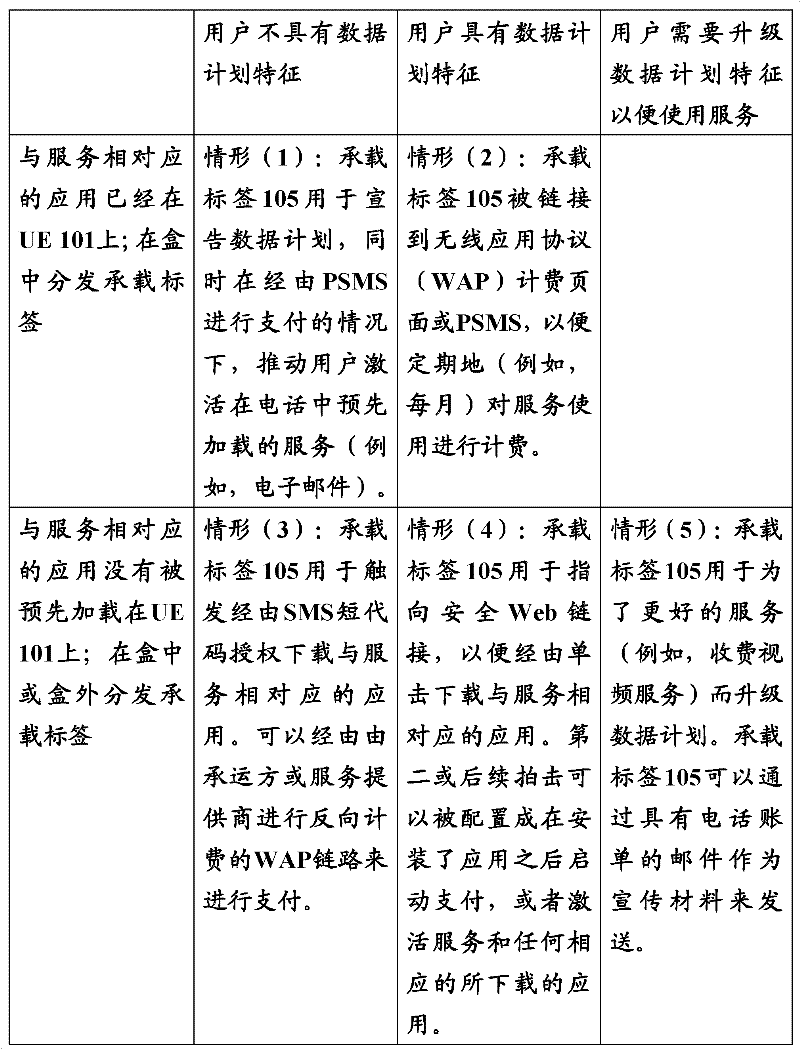
表2Table 2
图9是根据示例性实施例在图4-6的处理中利用的用户接口的示图。在示例性实施例中,承载标签901(例如,含有NFC标签)被插入到电话包装中以便用户容易取得。在该例中,承载标签901对应于电子邮件预订服务,每月花费$4.99,并且在激活情况下有一个月免费。通过在承载标签901上或附近拍击设备903,设备903的用户启动对于激活电子邮件服务的请求。设备903读取NFC标签,并且经由例如服务平台107来请求对服务的激活。如果这是设备903在承载标签901上的第一拍击905,则服务平台107处理该请求并且根据预定的计费布置(例如,针对用户的电话账单直接对服务进行计费)来激活该服务。服务平台107显示确认消息907,其呈现了计费信息并且需要用户同意以便在预订的情况下继续。用户可以响应“是”,以便完成服务激活并同意计费布置,或者响应“否”以便取消该请求。如果拍击是第二拍击909(或后续拍击),则服务平台107例如将第二拍击909解释为用于激活该服务以及任何相应应用的请求。因此,服务平台107显示消息911,该消息请求确认对服务和应用进行访问。如此,用户可以使用承载标签901来容易地在激活之后访问服务。Figure 9 is a diagram of a user interface utilized in the process of Figures 4-6, according to an example embodiment. In an exemplary embodiment, a carrier tag 901 (eg, containing an NFC tag) is inserted into the phone packaging for easy access by the user.
图10是根据示例性实施例的可重用的预付费承载标签的示图。如图所示,承载标签1001是预付费承载标签105。例如,预付费承载标签105指定了$30的预付值1003,其可以兑换一个或三个所列出的服务(例如,国际象棋游戏1005、移动邮件服务1007和音乐库服务1009)。承载标签105还包括通货转换选择区域1011,用于将预付值从$30转换成被表达为音乐库信用的等效值。在一个实施例中,承载标签105的每个区域包括与该区域相关联的单独无线标签(未示出),从而使得由UE 101(例如,移动设备1013)进行的拍击将启动对应的动作。例如,在预付值1003上拍击可以在卡上显示当前余额。在所述三个服务中的任何一个上拍击将激活每个相应的服务。另外,无线标签1005、1007、1009和1011可以彼此相连。在通货转换选择1011上拍击将启动预付费美元数额到音乐库信用量的转换。Figure 10 is a diagram of a reusable prepaid bearer label according to an exemplary embodiment. As shown, the
根据特定实施例来有利描述的处理和布置向用户提供了快速和方便的机制,用于标识和预订服务,例如,在第一拍击下安装和配置应用,而忽略其它方式,如果安装了,则用于在每个拍击下自动地开始该应用,而忽略其它方式,如果应用正在运行,则使用一次来加载新的应用/服务信用,而忽略其它方式。The processes and arrangements advantageously described in accordance with certain embodiments provide users with a quick and convenient mechanism for identifying and subscribing to services, for example, installing and configuring applications at the first tap, and ignoring the other way around, if installed, is used to automatically start the app on every tap, ignoring other means, and if the app is running, use once to load new app/service credits, ignoring other means.
图11-16是图示了根据各种示例性实施例的使用情况场景的一系列消息和处理的时序图。通过阴影竖向框(shaded vertical box)来表示在网络上的网络处理。通过水平箭头来表示从一个处理传递到另一个处理的消息。通过文本来指示由处理所实施的步骤。11-16 are sequence diagrams illustrating a series of messages and processing for use case scenarios according to various exemplary embodiments. Network processing on the network is represented by shaded vertical boxes. Messages passed from one process to another are represented by horizontal arrows. The steps performed by the process are indicated by text.
图11-15中表示的处理是消费者设备1101、在消费者设备1101中的NFC应用1103、NFC标签1105、铺面1107、支付网关1109、运营商接入点1111,以及运营商计费系统1113。消费者设备1101是UE 101的例子。NFC应用1103是服务管理模块111的例子。NFC标签1105是承载标签105的例子。铺面1107是服务门户221(例如,Nokia Ovi库)的例子。支付网关1109是支付网关227的例子。运营接入点1111是针对通信网络103的接入点的例子。运营商计费系统1113是网络计费系统109的例子。支付网关1109、运营商接入点1111和/或运营商计费系统1113一起是服务系统、服务器系统或服务提供商的例子。另外,支付网关1109可以被包括在服务系统、服务器系统、服务提供商或铺面1107中。Processes represented in Figures 11-15 are
图11A和图11B是根据各种示例性实施例图示了用于管理包括了应用下载的服务的一系列消息和处理的时序图。在1115,在NFC标签1105上拍击消费者设备1101以便激活服务。作为响应,NFC应用1103与NFC标签1105进行协商(在1117)以便请求来自NFC标签1105的服务信息(在1119)。然后,NFC应用1103读取和解密来自NFC标签1105的服务信息(在1121)。11A and 11B are sequence diagrams illustrating a series of messages and processes for managing services including application downloads, according to various exemplary embodiments. At 1115, the
在该例中,服务信息包括对于服务的激活代码以及用来应用于服务计费收费的促销代码。在1123,NFC应用1103读取服务信息并且将其解译为激活代码和促销代码,并经由SMS消息将该服务信息发送到铺面1107。In this example, the service information includes an activation code for the service and a promotional code to be applied to billing charges for the service. At 1123, the
在接收到该消息时,铺面1107将服务信息解译为用于服务的服务激活代码,并且向消费者设备1101发送确认请求(在1125)。确认消息例如含有考虑了促销代码的用于服务的计费价格。Upon receipt of this message,
在从用户确认要激活该服务并且要将收费应用于用户的电话账单时,NFC应用1103向支付网关1109发送针对以下内容的请求:发送关于服务的事务细节以及SMS短代码的信息(在1127)。因此,支付网关1109生成唯一的事务ID,并将该ID和相关联的SMS短代码发送到NFC应用1103(在1129)。通过启动SMS消息(其含有被寻址到与运营商计费系统1113相对应的SMS短代码的事务ID),NFC应用1103启动对服务的支付(在1131)。该SMS经由运营商接入点1111被转发到运营商计费系统1113(在1133)。Upon confirmation from the user that the service is to be activated and that the charge is to be applied to the user's phone bill, the
在接收到SMS消息之后,运营商计费系统1113将该消息连同与消费者设备1101相对应的MSISDN号一起转发到支付网关1109(在1135)。支付网关1109对于在1129被发送到客户端的事务ID与从运营商计费系统1113接收到的事务ID进行匹配,并且启动针对运营商计费系统1113的附加费率SMS(PSMS)消息(在1137)。支付网关1107还向NFC应用1103发送对计费收费的确认(在1139)以及对铺面1107的确认,以便递送与该服务相关联的任何数字物品(在1141)。After receiving the SMS message,
如果可应用,则铺面1107启动将任何应用或其它数字内容下载到消费者设备1101(在1143)。使用从NFC标签1105读取的激活代码来激活所下载的应用1145。激活代码还可以由铺面1107自动地传递到NFC应用1103,或者其可以由消费者在被提示时手动输入(在1147)。If applicable, the
图12A和图12B是根据各种示例性实施例图示了用于管理包括了有限数目的激活的服务的一系列消息和处理的时序图。在1201,在NFC标签1105上拍击消费者设备1101以便激活服务。作为响应,NFC应用1103与NFC标签1105进行协商(在1203),以便请求来自NFC标签1105的服务信息(在1205)。然后,NFC应用1103读取和解密来自NFC标签1105的服务信息(在1207)。12A and 12B are sequence diagrams illustrating a series of messages and processes for managing a service including a limited number of activations, according to various exemplary embodiments. At 1201, the
在该例中,服务信息包括三个元素:服务激活代码,促销代码和促销计数器。促销计数器例如限制了可以激活该服务的消费者的数目。在1209,NFC应用1103读取服务信息并且将其解译为用于激活服务的激活代码、促销代码和促销计数器。NFC应用1103检查激活代码计数器和促销计数器是否大于零。如果是,则NFC应用1103经由SMS消息将该服务信息传递到铺面1107。In this example, the service information includes three elements: service activation code, promotion code, and promotion counter. A promotion counter, for example, limits the number of customers who can activate the service. At 1209, the
在接收到该消息时,铺面1107将该服务信息解译为用于服务的服务激活代码,并且将确认请求发送到消费者设备1101(在1211)。确认消息例如含有考虑了促销代码的用于服务的计费价格。Upon receiving this message,
在从用户确认要激活服务并且要将收费应用于用户的电话账单时,NFC应用1103向支付网关1109发送针对以下内容的请求:发送关于服务的事务细节和SMS短代码的信息(在1213)。因此,支付网关1109生成唯一的事务ID,并且将该ID和相关联的SMS短代码发送到NFC应用1103(在1215)。通过启动SMS消息(其含有被寻址到与运营商计费系统1113相对应的SMS短代码的事务ID),NFC应用1103启动对服务的支付(在1217)。SMS经由运营商接入点1111被转发到运营商计费系统1113(在1219)。Upon confirmation from the user that the service is to be activated and that charges are to be applied to the user's phone bill, the
在接收到SMS消息之后,运营商计费系统1113将该消息连同与消费者设备1101相对应的MSISDN号一起转发到支付网关1109(在1221)。支付网关1109对于在1129被发送到客户端的事务ID与从运营商计费系统1113接收到的事务ID进行匹配,并且启动针对运营商计费系统1113的附加费率SMS(PSMS)消息(在1223)。支付网关1109还向NFC应用1103发送对计费收费的确认(在1225)以及对铺面1107的确认,以便递送与该服务相关联的任何数字物品(在1227)。如果可应用,则铺面1107启动将任何应用或其它数字内容下载到消费者设备1101(在1229)。使用从NFC标签1105读取的激活代码来激活所下载的应用1145。激活代码还可以由铺面1107自动地传递到NFC应用1103,或者其可以由消费者在被提示时手动输入(在1231)。After receiving the SMS message,
另外,铺面1107向消费者设备1101上的NFC应用1103发送请求以便将NFC标签1105上的促销计数器减去1(在1233)。作为响应,NFC应用1103在NFC标签1105上实施写操作以便将计数器减去1(在1235)。当写操作完成时,NFC标签1105将确认发送到NFC应用1103(在1237)。当促销计数器达到零时,NFC应用1103在设备上显示以下消息:当消费者下一次拍击NFC标签1105时,服务代码和促销代码已经过期。In addition, the
图13A和图13B是根据各种示例性实施例图示了用于管理包括了在用户设备上驻留的应用的服务的一系列消息和处理的时序图。在1301,在NFC标签1105上拍击消费者设备1101以便激活服务。作为响应,NFC应用1103与NFC标签1105进行协商(在1303)以便请求来自NFC标签1105的服务信息(在1305)。然后,NFC应用1103读取和解密来自NFC标签1105的服务信息(在1307)。13A and 13B are sequence diagrams illustrating a series of messages and processes for managing a service including applications resident on user equipment, according to various exemplary embodiments. At 1301, the
在该例中,服务信息包括用于服务的激活代码和用来应用于服务计费收费的促销代码。在1309,NFC应用1103读取服务信息并且将其解译为激活代码和促销代码,并且经由SMS消息将该服务信息发送到铺面1107。In this example, the service information includes an activation code for the service and a promotional code to be applied to billing charges for the service. At 1309, the
在接收到该消息时,铺面1107将该服务信息解译为用于服务的服务激活代码,并且将确认请求发送到消费者设备1101(在1311)。确认消息例如含有考虑了促销代码的用于服务的计费价格。Upon receiving this message,
在从用户确认要激活服务并且要将收费应用于用户的电话账单时,NFC应用1103向支付网关1109发送针对以下内容的请求:发送关于服务的事务细节和SMS短代码的信息(在1313)。因此,支付网关1109生成唯一的事务ID并且将该ID和相关联的SMS短代码发送到NFC应用1103(在1315)。通过启动SMS消息(其含有被寻址到与运营商计费系统1113相对应的SMS短代码的事务ID),NFC应用1103启动对服务的支付(在1317)。SMS经由运营商接入点1111被转发到运营商计费系统1113(在1319)。Upon confirmation from the user that the service is to be activated and that charges are to be applied to the user's phone bill, the
在接收到SMS消息之后,运营商计费系统1113将该消息连同与消费者设备1101相对应的MSISDN号一起转发到支付网关1109(在1321)。支付网关1109对于在1129被发送到客户端的事务ID与从运营商计费系统1113接收到的事务ID进行匹配,并且启动针对运营商计费系统1113的附加费率SMS(PSMS)消息(在1323)。支付网关1109还向NFC应用1103发送对计费收费的确认(在1325)以及对铺面1107的确认,以便递送与该服务相关联的任何数字物品(在1327)。After receiving the SMS message,
铺面确定与该服务相关联的应用已经安装在消费者设备1101上,并且将应用激活代码发送到设备1101(在1329)。激活代码可以由铺面1107自动地传递到NFC应用1103,或者其可以由消费者在被提示时手动输入(在1331)。The store determines that an application associated with the service is already installed on the
图14A和图14B是根据各种示例性实施例图示了用于管理包括了要求预订另一特征的应用的服务的一系列消息和处理的时序图。在1401,在NFC标签1105上拍击消费者设备1101以便激活服务。作为响应,NFC应用1103与NFC标签1105进行协商(在1403),以便请求来自NFC标签1105的服务信息(在1405)。然后,NFC应用1103读取和解密来自NFC标签1105的服务信息(在1407)。14A and 14B are sequence diagrams illustrating a series of messages and processes for managing a service including an application requiring subscription to another feature, according to various exemplary embodiments. At 1401, the
在该例中,服务信息包括用于服务的激活代码和用来应用于服务计费收费的促销代码。在1409,NFC应用1103读取服务信息并且将其解译为激活代码和促销代码,并且经由SMS消息将该服务信息发送到铺面1107。In this example, the service information includes an activation code for the service and a promotional code to be applied to billing charges for the service. At 1409, the
在接收到该消息时,铺面1107将该服务信息解译为用于服务的服务激活代码,并且将确认请求发送到消费者设备1101(在1411)。确认消息例如含有考虑了促销代码的用于服务的计费价格。另外,确认消息标识了作为服务的一部分而被要求的任何特征。例如,电子邮件服务要求预订数据计划。如果消费者设备1101还尚未配置该特征(例如,数据计划),则铺面1107在确认消息中包括该特征以及相关联的计费信息。Upon receiving this message,
在从用户确认要激活服务(以及(如果可应用的话)任何附加特征)并且要将收费应用于用户的电话账单时,NFC应用1103向支付网关1109发送针对以下内容的请求:发送关于服务的事务细节和SMS短代码的信息(在1413)。因此,支付网关1109生成唯一的事务ID并且将该ID和相关联的SMS短代码发送到NFC应用1103(在1415)。通过启动SMS消息(其含有被寻址到与运营商计费系统1113相对应的SMS短代码的事务ID),NFC应用1103启动对服务的支付(在1417)。SMS经由运营商接入点1111被转发到运营商计费系统1113(在1419)。Upon confirmation from the user that the service (and, if applicable, any additional features) is to be activated and that the charge is to be applied to the user's phone bill, the
在接收到SMS消息之后,运营商计费系统1113将该消息连同与消费者设备1101相对应的MSISDN号一起转发到支付网关1109(在1421)。支付网关1109对于在1129被发送到客户端的事务ID与从运营商计费系统1113接收到的事务ID进行匹配,并且启动针对运营商计费系统1113的附加费率SMS(PSMS)消息(在1423)。支付网关1109还向NFC应用1103发送对计费收费的确认(在1425)以及对铺面1107的确认,以便递送与该服务相关联的任何数字物品(在1427)。After receiving the SMS message,
如果可应用,则铺面1107启动将任何应用或其它数字内容下载到消费者设备1101。铺面1107还启动对于作为服务的一部分所要求的任何特征(例如,数据计划)的预订(在1429)。使用从NFC标签1105读取的激活代码来激活所下载的应用1145。激活代码还可以由铺面1107自动地传递到NFC应用1103,或者其可以由消费者在被提示时手动输入(在1431)。The
图15A和15B是根据各种示例性实施例的图示用于使用可重用的预付费承载标签来管理服务的一系列消息和处理的时序图。图15A和15B包括消费者1501和支付处理器1503的附加处理。消费者1501是预付费承载标签105的任何用户,并且支付处理器1503是用于验证和授权使用预付费承载标签105的支付的实体。在该例中,图15A和15B的处理表示以下情形:预付费承载标签105包括:在与多个用户共享的单个NFC卡上存储的预付费金额,以便在不同铺面进行购买。15A and 15B are sequence diagrams illustrating a series of messages and processes for managing services using reusable prepaid bearer tags, according to various exemplary embodiments. 15A and 15B include additional processing by the
在1505,第一消费者1501从铺面1107接收具有例如$30的预付值的NFC卡(例如,NFC标签1105)。该NFC卡还伴随有五个不同服务的购物车,在这些服务中可以使用该预付值或通货。在特定实施例中,促销代码(例如,提供折扣或特殊物品)也可以被呈现在NFC卡上。在与要激活的一个或多个所选服务相对应的NFC卡上,第一消费者1501针对NFC标签1105而拍击消费者设备1101(在1507)。作为响应,在1509,(例如经由可信安全管理器(TSM)来维持服务信息的安全性)NFC应用1103与NFC标签1105进行协商,以便请求来自NFC标签1105的服务信息(在1511)。然后,NFC应用1103读取和解密来自NFC标签1105的服务信息(在1513)。At 1505, the
在该例中,所述数据包括例如用于每个所选服务的服务激活代码、用于确定每个服务已被激活了多少次的激活计数器、用于每个服务的促销代码、用于确定每个促销已被使用了多少次的促销计数器,以及在NFC卡上剩余的预付值或余额。在1515,NFC应用1103读取服务信息并且将其解译为激活代码和促销代码,并且经由SMS消息将服务信息发送到铺面1107。In this example, the data includes, for example, a service activation code for each selected service, an activation counter to determine how many times each service has been activated, a promotional code for each service, a A promotion counter of how many times each promotion has been used, and the remaining prepaid value or balance on the NFC card. At 1515, the
在接收到该消息时,铺面1107将服务信息解译为用于服务的服务激活代码,并且将确认请求发送到消费者设备1101(在1517)。确认消息例如含有考虑了促销代码的用于服务的计费价格。另外,确认消息标识了作为服务的一部分所要求的任何特征。例如,电子邮件服务要求预订数据计划。如果消费者设备1101尚不具有已经配置的该特征(例如,数据计划),则铺面1107在确认消息中包括该特征和相关联的计费信息。Upon receipt of this message,
在从用户确认要激活服务(以及(如果可应用的话)任何附加特征)并且要将收费应用到用户的电话账单时,NFC应用1103向支付网关1109发送针对以下内容的请求:发送关于服务的事务细节以及SMS短代码的信息(在1519)。在收到确认时,支付网关1109请求来自支付处理器1503的授权,以便针对预付额来对所选服务的成本进行收费(在1521)。然后,支付处理器1503根据预付额来授权对所选服务的支付(在1523)。然后,支付网关1109向铺面1107发送对该授权的确认,以便递送与所选服务相关联的任何数字物品(在1525)。Upon confirmation from the user that the service (and, if applicable, any additional features) is to be activated and that the charge is to be applied to the user's phone bill, the
在1527,铺面1107向NFC应用1103发送在激活所选服务之后剩余的预付费金额的净额,用于更新NFC卡中的服务信息。为了启动该更新,NFC应用1103提示第一消费者1501在NFC卡上拍击消费者设备1101,以便更新预付费余额和其它服务信息(例如,激活和促销计数器)(在1529)。作为响应,消费者1501针对NFC卡而拍击设备1101(在1531),并且因此NFC卡被更新具有新的预付费余额和服务信息(在1533)。NFC标签1105向NFC应用1103确认已经更新了信息(在1537),并且NFC应用1103将该确认中继到铺面1107。At 1527, the
如果可应用的话,则铺面1107启动将任何应用或其它数字内容下载到消费者设备1101。铺面1107还启动对于作为服务的一部分所要求的任何特征(例如,数据计划)的预订(在1539)。使用从NFC标签1105读取的激活代码来激活所下载的应用1145。激活代码还可以由铺面1107自动地传递到NFC应用1103,或者可以由消费者在被提示时手动地输入(在1541)。The
此时,在第一消费者1501的设备1101上完成了对所选服务的激活。然后,第一消费者1501将NFC卡转移给第二消费者(在1543)。第二消费者然后可以使用对NFC卡的拍击来开始如相对于第一消费者1501所描述的使用预付费卡的处理(在1545)。At this point, activation of the selected service is complete on the
利用以上处理,承载标签的可重用能力通过减少这些标签或卡的成本来允许对该技术的更多采用。此外,用户可以容易地将标签给予朋友或同事,从而鼓励对标签和关联服务的使用。With the above process, the reusability of bearer tags allows greater adoption of this technology by reducing the cost of these tags or cards. In addition, users can easily give tags to friends or colleagues, thereby encouraging the use of tags and associated services.
图16是根据示例性实施例的图示用于使用服务平台107账户(诸如铺面1107账户)来管理服务的一系列消息、处理、方法和系统的时序图。在该例中,图16的处理表示以下情形:用户使用被注册到服务平台107(诸如铺面1107)的账户来购买与承载标签105相对应的应用或服务。例如,铺面1107是在线商户提供的服务、应用、物品和/或用于出售的其它项目(例如,诺基亚Ovi库)。另外,NFC应用1103是驻留在消费者设备1101上的启用了NFC的商店客户端的例子,其被用于管理对铺面1107的访问。此外,尽管图16中将支付网关1109示为单独的处理,但是可以预想,支付网关1109也可以是铺面1107内和/或服务平台107中的组件。16 is a sequence diagram illustrating a series of messages, processes, methods, and systems for managing services using a service platform 107 account, such as a
在1601,在NFC标签1105上拍击消费者设备1101以便激活服务。该服务(例如应用)被提供用于由铺面1107出售和/或下载。作为响应,NFC应用1103(例如,驻留在消费者设备1101上的商店客户端)与NFC标签1105进行协商(在1603),以便请求来自NFC标签1105的与该服务(诸如应用)相对应的服务信息(在1605)。然后,NFC应用1103读取和解密来自NFC标签1105的服务信息(在1607)。At 1601, the
该服务信息包括例如:针对服务的地址、用于服务的激活代码和/或用于向服务应用下载和/或计费收费的促销代码。在一个实施例中,通过咨询在消费者设备1101中本地存储的以及可由NFC应用1103访问的服务的数据库,NFC应用1103可以确定该服务是否可用。如果关于该服务的一些或全部信息在本地不可用,则NFC应用1103请求来自铺面1107的信息。可以预想,可以定期地或者当NFC应用1103接收到对于并未处在本地数据库中的服务的请求时,更新可从铺面1107获得的服务的本地数据库。在1609,NFC应用1103将服务信息的读取解译为请求购买和/或下载与服务激活代码相对应的服务(诸如应用),并且将激活请求发送到铺面1107,用于针对被注册到与消费者设备1101的用户相对应的铺面1107的计费账户来进行处理和计费。在示例性实施例中,NFC应用可以使用任何通信机制(例如,SMS消息、Web接口、WAP接口等)来向铺面1107发送请求。替代地,通过咨询在消费者设备1101中本地存储的以及可由NFC应用1103访问的服务的数据库,NFC应用1103可以确定关于该服务的服务信息中的一些或全部在消费者设备1101上是否可用。如果关于该服务的信息中的一些或全部在本地不可用,则NFC应用1103请求来自铺面1107的信息。可以预想,可以定期地或者当NFC应用1103接收到对于信息并未处于本地数据库中的服务的请求时,更新可从铺面1107获得的该服务的服务信息的本地数据库。The service information includes, for example, an address for the service, an activation code for the service, and/or a promotional code for charging application download and/or billing for the service. In one embodiment, the
替代地,通过咨询在消费者设备1101中本地存储的以及可由NFC应用1103访问的服务的数据库,NFC应用1103可以确定关于该服务的应用在消费者设备1101上是否可用。如果关于该服务的应用中的一些部分或所有部分在本地不可用,则NFC应用1103请求来自铺面1107的应用中的一些部分或所有部分。可以预想,可以定期地或者当NFC应用1103接收到对于信息并未处于本地数据库中的服务的请求时,更新可从铺面1107获得的应用的本地数据库。举例来说,当用户第一次访问铺面1107时,或者当用户第一次从铺面1107进行购买时,要求该用户向服务平台107(诸如铺面1107)创建计费账户。还可以预想,用户可以注册新的账户或者随时更新先前创建的账户。在账户注册和创建过程期间,用户例如提供联系人信息并且指定计费偏好,例如,支付的默认形式(诸如信用卡支付、直接银行支付或者运营商计费)。然后,联系人信息和计费偏好可被用于从铺面1107的后续购买。Alternatively, the
在从NFC应用1103接收到对服务或应用的请求时,铺面1107将服务信息解译为用于所请求的应用的服务激活代码,并且向NFC应用1103发送确认请求(在1611)。确认消息例如含有考虑了促销代码的用于服务的计费价格。Upon receiving a request for a service or application from the
NFC应用1103向用户呈现确认消息以便进行确认。在查看到该确认时,用户可以指定:应当使用在用户的铺面1107账户中指定的可用支付机制之一(诸如默认的支付机制,例如,信用卡)来支付服务。作为确认处理的一部分,用户还可以在铺面1107处理当前请求之前临时地或永久地改变默认支付选项。在从用户确认要激活服务(例如,购买和/下载应用)并且要针对用户的铺面1107账户来应用对服务的收费时,NFC应用1103将该确认发送到铺面1107用于处理(在1613)。The
然后,铺面1107使用支付网关1109来启动对所请求的服务的支付(在1615)。如前所述,支付网关1109可被合并到铺面1107中或者可以是独立的组件。支付网关1109也可以被合并到系统100内的任何其它组件中。在示例性实施例中,支付网关1109从铺面1107接收针对账户要收费的数额,并且使用所指定的机制(例如,信用卡)来获得支付。该支付机制是默认支付机制或者在服务确认处理期间由用户选择的另一支付机制。在接收到经由所选支付机制的支付之后,支付网关1109向铺面1107和NFC应用1103(例如,商店客户端)发送对支付的确认。The
在一个实施例中,NFC应用1103确定所购买的应用1145是否已经驻留在设备上(例如,已经安装、预加载到设备上,或者以其它方式在本地可用于NFC应用1103)。如果应用1145尚未被安装或者在消费者设备1101上是本地不可用的,则铺面1107启动将应用1145下载到设备。该下载可以立即或者在以后的时间发生。附加地或替代地,可以使应用1145可用于在用户的铺面1107账户的下载区段中进行下载。如此,用户可以在用户方便时下载所购买的应用1145。在安装了应用1145之后,使用从NFC标签1105读取的激活代码来激活应用1145。激活代码还可以由铺面1107自动地传送到NFC应用1103,或者可以由用户在被提示时手动地输入(在1621)。In one embodiment, the
在本发明的示例实施例中,用于使用服务平台107账户(诸如铺面1107账户)来管理服务购买、下载和计费的处理、方法和系统包括:通过消费者设备1101(例如,UE 101)的传感器(诸如标签读取器205)来检测来自承载标签105(诸如NFC标签1105)的输入,其中,该输入标识了可购买和/或可下载的服务;由消费者设备1101的商店客户端(诸如NFC应用1103)进一步接收所标识的服务;进一步分析所标识的服务在消费者设备1101的商店客户端中是否可用;如果可用,则进一步提供所标识的服务,用于从消费者设备1101的商店客户端进行购买;以及利用在消费者设备1101的商店客户端中可用的用于支付的一个或多个机制。此外,所述处理、方法和系统可以包括:消费者设备1101使用默认支付机制。此外,所述处理、方法和系统可以包括:消费者设备1101从商店客户端的存储器或者从服务提供商(诸如服务平台107或铺面1107)接收关于可用支付机制的信息。此外,所述处理、方法和系统可以包括:如果服务并未处于消费者设备1101中,则在通信网络103中联系服务提供商(诸如服务平台107或铺面1107)以便搜索服务。此外,所述处理、方法和系统可以包括:消费者设备1101通过服务提供商(诸如服务平台107或铺面1107)来标识所标识的服务的最便宜价格。In an example embodiment of the invention, a process, method and system for managing service purchases, downloads, and billing using a service platform 107 account (such as a
图17是根据示例性实施例的用于提供对于使用可重用的承载标签来管理服务的访问的流程图。在一个实施例中,服务平台107执行图17的处理。在步骤1701中,服务平台107促进在例如通信网络103上对服务的访问,其中,该服务支持:检测来自用户的用于选择与另一用户可重用的承载标签105相对应的一个或多个服务的用户输入。如前所述,承载标签105指定了用于参与与承载标签105相对应的服务中的一个或多个服务的预付通货量。举例来说,促进访问包括:准许访问权,以便允许访问通信网络103或针对通信网络103的接口。更具体地,提供访问包括:提供或布置充足的网络资源(例如,带宽、接入点等),以便促进在通信网络103上使用服务。在该实施例中,通信网络103在服务平台107、网络计费系统109和UE 101之间提供访问,以便支持与承载标签105相对应的服务。在步骤1703中,服务平台107促进进一步访问服务,以便启动对来自承载标签105的服务信息的确定,生成对于使得与承载标签105相对应的一个或多个服务变得活动的请求,将该请求传送到用于激活一个或多个服务的服务平台107和用于计费的网络计费系统109,以及相应地更新在承载标签105中的服务信息。17 is a flowchart for providing access to managing services using reusable bearer tags, according to an exemplary embodiment. In one embodiment, the service platform 107 performs the process of FIG. 17 . In step 1701, the service platform 107 facilitates access to a service, e.g., on the
在此描述的用于使用可重用的预付费承载标签105来管理服务的处理可以经由软件、硬件(例如,通用处理器、数字信号处理(DSP)芯片、专用集成电路(ASIC)、现场可编程门阵列(FPGA)等)、固件或其组合来实现。下面详述了用于执行所描述的功能的这样的示例性硬件。The process described herein for managing services using reusable prepaid bearer tags 105 may be implemented via software, hardware (e.g., general purpose processors, digital signal processing (DSP) chips, application specific integrated circuits (ASICs), field programmable gate array (FPGA), etc.), firmware, or a combination thereof. Such exemplary hardware for performing the described functions is detailed below.
图18图示了可以在其上实现本发明的实施例的计算机系统1800。计算机系统1800(例如,通过计算机程序代码或指令)被编程以便如在此所描述的使用可重用的预付费承载标签来管理服务,并且包括诸如总线1810的通信机制,用于在计算机系统1800的其它内部和外部组件之间传递信息。信息(也称为数据)被表示为可测量现象(通常是电压,但在其它实施例中包括诸如磁、电磁、压力、化学、生物、分子、原子、亚原子和量子互作用这样的现象)的物理表示。例如,北极和南极磁场或者零和非零电压表示二进制数(比特)的两个状态(0,1)。其它现象可以表示更高基底的数字。在测量之前的多个同时量子状态的叠加表示量子比特(qubit)。一个或多个数字的序列构成了用于表示字符的代码或数目的数字数据。在一些实施例中,通过在特定范围内的可测量值的近连续体(nearcontinuum)来表示被称为模拟数据的信息。Figure 18 illustrates a computer system 1800 upon which embodiments of the present invention may be implemented. Computer system 1800 is programmed (e.g., by computer program code or instructions) to manage services as described herein using reusable prepaid bearer tags and includes a communication mechanism, such as bus 1810, for communication between computer system 1800 Pass information between other internal and external components. Information (also called data) is represented as a measurable phenomenon (usually voltage, but in other embodiments includes phenomena such as magnetism, electromagnetism, pressure, chemical, biological, molecular, atomic, subatomic, and quantum interactions) physical representation. For example, north and south magnetic fields or zero and non-zero voltages represent two states (0, 1) of a binary number (bit). Other phenomena may represent higher base numbers. A superposition of multiple simultaneous quantum states prior to measurement represents a quantum bit (qubit). A sequence of one or more digits constitutes numeric data representing a code or number of characters. In some embodiments, information called analog data is represented by a near continuum of measurable values within a particular range.
总线1810包括信息的一个或多个并行导体,从而使得在耦合到总线1810的设备当中快速地传输信息。用于处理信息的一个或多个处理器1802与总线1810耦合。Bus 1810 includes one or more parallel conductors of information, enabling rapid transfer of information among devices coupled to bus 1810 . One or more processors 1802 for processing information are coupled with bus 1810 .
处理器1802按照与使用可重用的预付费承载标签来管理服务有关的计算机程序代码所指定的来对信息执行操作集合。计算机程序代码是指令或声明的集合,其提供用于处理器和/或计算机系统的操作的指令,以便执行指定的功能。代码例如可以用被编译成处理器的原生指令集的计算机编程语言来编写。代码也可以直接使用原生指令集(例如,机器语言)来编写。操作集合包括将信息带入带出总线1810并且在总线1810上放置信息。操作集合通常还包括:诸如通过加法或乘法或者逻辑操作(像或(OR)、异或(XOR)以及与(AND)),将两个或更多信息单元进行比较、对信息单元进行移位,以及组合两个或更多信息单元。通过被称为指令的信息(诸如一个或多个数字的操作代码)而向处理器表示可由处理器执行的操作集合中的每个操作。要由处理器1802执行的操作序列(诸如操作代码的序列)构成了处理器指令,也被称为计算机系统指令,或者简单地被称为计算机指令。特别地,处理器可以单独地或组合地被实现为机械、电、磁、光、化学或量子组件等。Processor 1802 performs a set of operations on information as specified by computer program code related to managing services using reusable prepaid bearer tags. Computer program code is a collection of instructions or statements providing instructions for the operation of the processor and/or computer system in order to perform specified functions. The code may be written, for example, in a computer programming language that is compiled into a processor's native instruction set. Code can also be written directly using the native instruction set (eg, machine language). The set of operations includes bringing information into and out of bus 1810 and putting information on bus 1810 . The set of operations also typically includes: comparing two or more information elements, shifting information elements, such as by addition or multiplication, or logical operations like OR, XOR, and AND , and combining two or more information units. Each operation of a set of operations executable by the processor is represented to the processor by information called instructions, such as an operation code of one or more numbers. A sequence of operations to be executed by processor 1802, such as a sequence of operation codes, constitutes processor instructions, also known as computer system instructions, or simply computer instructions. In particular, processors may be implemented as mechanical, electrical, magnetic, optical, chemical or quantum components, etc., individually or in combination.
计算机系统1800还包括耦合到总线1810的存储器1804。存储器1804(诸如随机访问存储器(RAM)或其它动态存储设备)存储包括用于使用可重用的预付费承载标签来管理服务的处理器指令的信息。动态存储器允许存储在其中的信息被计算机系统1800更改。RAM允许存储在被称为存储器地址的位置的信息单元独立于在邻近地址处的信息而被存储和检索。存储器1804还被处理器1802用来存储在执行处理器指令期间的临时值。计算机系统1800还包括耦合到总线1810的只读存储器(ROM)1806或其它静态存储设备,用于存储静态信息(包括不被计算机系统1800更改的指令)。一些存储器包括易失性存储器(当断电时会丢失在其上存储的信息)。还耦合到总线1810的是非易失性(永久)存储设备1808,诸如磁盘、光盘或闪速卡,用于存储信息(包括甚至当计算机系统1800被关闭或以其它方式断电时仍留存的指令)。Computer system 1800 also includes memory 1804 coupled to bus 1810 . Memory 1804, such as a random access memory (RAM) or other dynamic storage device, stores information including processor instructions for managing services using reusable prepaid bearer tags. Dynamic memory allows information stored therein to be altered by computer system 1800 . RAM allows a unit of information stored at a location called a memory address to be stored and retrieved independently of information at neighboring addresses. Memory 1804 is also used by processor 1802 to store temporary values during execution of processor instructions. Computer system 1800 also includes a read only memory (ROM) 1806 or other static storage device coupled to bus 1810 for storing static information (including instructions that are not altered by computer system 1800 ). Some memories include volatile memory (information stored on it is lost when power is removed). Also coupled to bus 1810 is a non-volatile (permanent) storage device 1808, such as a magnetic disk, optical disk, or flash card, for storing information, including instructions that persist even when computer system 1800 is turned off or otherwise powered down. ).
从外部输入设备1812(诸如由人类用户操作的含有字母数字键的键盘,或者传感器)将信息(包括用于使用可重用的预付费承载标签来管理服务的指令)提供到总线1810,用于由处理器使用。传感器检测其附近的状况,并且将那些检测结果转换成与用于表示计算机系统1800中的信息的可测量现象相容的物理表达。主要用于与人类进行交互的耦合到总线1810的其它外部设备包括:显示设备1814,诸如阴极射线管(CRT)或液晶显示器(LCD)或等离子屏幕或者用于呈现文本或图像的打印机;以及指点设备1816,诸如鼠标或轨迹球或光标方向键或者运动传感器,用于控制在显示器1814上呈现的小光标图像的位置,以及发布与显示器1814上所呈现的图形元素相关联的命令。在一些实施例中,例如,在计算机系统1800在没有人类输入的情况下自动地执行所有功能的实施例中,省略了外部输入设备1812、显示设备1814和指点设备1816中的一个或多个。Information (including instructions for administering services using reusable prepaid bearer tags) is provided to bus 1810 from an external input device 1812, such as a keyboard with alphanumeric keys operated by a human user, or sensors, for use by processor used. A sensor detects conditions in its vicinity and translates those detections into a physical expression compatible with the measurable phenomena used to represent information in computer system 1800 . Other external devices coupled to bus 1810 primarily for human interaction include: display device 1814, such as a cathode ray tube (CRT) or liquid crystal display (LCD) or plasma screen or a printer for presenting text or images; and a pointing device 1814. A device 1816 , such as a mouse or trackball or cursor direction keys or a motion sensor, is used to control the position of the small cursor image presented on the display 1814 and to issue commands associated with the graphical elements presented on the display 1814 . In some embodiments, for example, in embodiments in which computer system 1800 performs all functions automatically without human input, one or more of external input device 1812 , display device 1814 , and pointing device 1816 are omitted.
在所图示的实施例中,专用硬件(诸如专用集成电路(ASIC)1820)被耦合到总线1810。专用硬件被配置以便出于专门的目的而足够快地执行处理器1802不执行的操作。专用IC的例子包括:用于生成用于显示器1814的图像的图形加速器卡、用于加密和解密在网络上发送的消息的密码板、语音识别,以及对于特殊外部设备的接口,诸如重复地执行一些在硬件中更为有效实现的复杂操作序列的机器臂和医疗扫描设备。In the illustrated embodiment, dedicated hardware, such as an Application Specific Integrated Circuit (ASIC) 1820 , is coupled to bus 1810 . Special purpose hardware is configured to perform operations not performed by processor 1802 fast enough for the specific purpose. Examples of dedicated ICs include: graphics accelerator cards for generating images for the display 1814, cryptographic boards for encrypting and decrypting messages sent over the network, speech recognition, and interfaces to special external devices, such as repeatedly executing Robotic arms and medical scanning devices that implement complex sequences of operations more efficiently in hardware.
计算机系统1800还包括耦合到总线1810的通信接口1870的一个或多个实例。通信接口1870提供了单向或双向通信,其耦合到利用自己的处理器进行操作的各种外部设备,诸如打印机、扫描仪和外部盘。通常,耦合针对的是连接到本地网络1880的网络链路1878,具有其自己的处理器的各种外部设备连接到本地网络1880。例如,通信接口1870可以是个人计算机上的并行端口或串行端口或通用串行总线(USB)端口。在一些实施例中,通信接口1870是综合服务数字网络(ISDN)卡或数字订户线路(DSL)卡或电话调制解调器,其向相应类型的电话线路提供信息通信连接。在一些实施例中,通信接口1870是电缆调制解调器,其将总线1810上的信号转换成用于在同轴电缆上的通信连接的信号或转换成用于在光纤线缆上的通信连接的光信号。又例如,通信接口1870可以是局域网(LAN)卡,用于提供对于兼容LAN(诸如以太网)的数据通信连接。还可以实现无线链路。对于无线链路来说,通信接口1870发送或接收或者既发送又接收携带了信息流(诸如数字数据)的电、声或电磁信号,包括红外和光信号。例如,在无线手持设备(诸如像蜂窝电话这样的移动电话)中,通信接口1870包括被称为无线电收发器的无线电频带电磁发射机和接收机。在某些实施例中,通信接口1870使得能够连接到通信网络103,用于使用UE 101上的可重用的预付费承载标签来管理服务。Computer system 1800 also includes one or more instances of communication interface 1870 coupled to bus 1810 . Communication interface 1870 provides one-way or two-way communication, which is coupled to various external devices, such as printers, scanners, and external disks, that operate with their own processors. Typically, the coupling is directed to a network link 1878 connected to a local network 1880 to which various external devices with their own processors are connected. For example, communication interface 1870 may be a parallel port or a serial port or a Universal Serial Bus (USB) port on a personal computer. In some embodiments, communication interface 1870 is an Integrated Services Digital Network (ISDN) card or a Digital Subscriber Line (DSL) card or a telephone modem that provides an information communication connection to a corresponding type of telephone line. In some embodiments, communication interface 1870 is a cable modem that converts signals on bus 1810 to signals for a communication connection over a coaxial cable or to optical signals for a communication connection over a fiber optic cable . As another example, communication interface 1870 may be a local area network (LAN) card for providing a data communication connection to a compatible LAN, such as Ethernet. Wireless links may also be implemented. For wireless links, the communications interface 1870 sends or receives or both sends and receives electrical, acoustic or electromagnetic signals, including infrared and optical signals, that carry information streams, such as digital data. For example, in a wireless handheld device such as a mobile telephone like a cellular telephone, the communication interface 1870 includes a radio band electromagnetic transmitter and receiver known as a radio transceiver. In some embodiments, the communication interface 1870 enables connection to the
在此使用术语“计算机可读介质”来指代参与向处理器1802提供信息(包括用于执行的指令)的任何介质。这样的介质可以采用很多形式,包括但不限于非易失性介质、易失性介质和传输介质。非易失性介质包括例如光盘或磁盘,诸如存储设备1808。易失性介质包括例如动态存储器1804。传输介质包括例如同轴电缆、铜导线、光纤线缆以及在没有导线或电缆的情况下在空间传播的载波,诸如声波和电磁波,包括无线电波、光波和红外波。信号包括在通过传输介质所发射的幅度、频率、相位、极化或其它物理属性上的人为瞬时变化。计算机可读介质的常见形式包括例如:软盘、柔性盘、硬盘、磁带、任何其它磁介质、CD-ROM、CDRW、DVD、任何其它光介质、穿孔卡、纸带、光标记片材、具有孔图案或其它光可识别标志的任何其它物理介质、RAM、PROM、EPROM、FLASH-EPROM、任何其它存储器芯片或盒式存储器、载波,或者计算机可以对其进行读取的任何其它介质。The term "computer-readable medium" is used herein to refer to any medium that participates in providing information to processor 1802, including instructions for execution. Such a medium may take many forms, including but not limited to, non-volatile media, volatile media, and transmission media. Non-volatile media include, for example, optical or magnetic disks, such as storage device 1808 . Volatile media includes, for example, dynamic memory 1804 . Transmission media include, for example, coaxial cables, copper wire, fiber optic cables and carrier waves that travel through space without wires or cables, such as acoustic waves and electromagnetic waves, including radio, optical and infrared waves. Signals include man-made transient variations in amplitude, frequency, phase, polarization, or other physical properties emitted through a transmission medium. Common forms of computer readable media include, for example, floppy disks, flexible disks, hard disks, magnetic tape, any other magnetic media, CD-ROM, CDRW, DVD, any other optical media, punched cards, paper tape, optical marking sheets, Any other physical medium, RAM, PROM, EPROM, FLASH-EPROM, any other memory chip or cartridge, carrier wave, or any other medium from which a computer can read a pattern or other optically identifiable marking.
图19图示了在其上可以实现本发明的实施例的芯片集1900。芯片集1900被编程以便如在此所描述的使用可重用的预付费承载标签来管理服务,并且其包括例如相对于图18所描述的在一个或多个物理封装(例如芯片)中合并的处理器和存储器组件。举例来说,物理封装包括在结构装配(例如,基板)上的一个或多个材料、组件和/或导线的布置,以便提供一个或多个特性,诸如物理强度、尺寸的保持和/或电交互的限制。可以预想,在某些实施例中,芯片集可以在单个芯片中实现。Figure 19 illustrates a chipset 1900 upon which embodiments of the present invention may be implemented. Chipset 1900 is programmed to manage services as described herein using reusable prepaid bearer tags, and it includes processes incorporated in one or more physical packages (e.g., chips), such as described with respect to FIG. 18 processor and memory components. For example, physical packaging includes the arrangement of one or more materials, components, and/or wires on a structural assembly (e.g., a substrate) to provide one or more properties, such as physical strength, dimensional retention, and/or electrical Interaction restrictions. It is envisioned that, in some embodiments, a chipset may be implemented in a single chip.
在一个实施例中,芯片集1900包括用于在芯片集1900的组件当中传递信息的通信机制,诸如总线1901。处理器1903具有到总线1901的连接,以便执行指令以及处理例如在存储器1905中存储的信息。处理器1903可以包括一个或多个处理核心,并且每个核心被配置成独立地执行。多核心处理器使得能够在单个物理封装中进行多处理。多核心处理器的例子包括两个、四个、八个或更多数目的处理核心。替代地或附加地,处理器1903可以包括经由总线1901串联配置的一个或多个微处理器,以便使得能够独立地执行指令、流水线操作(pipelining)和多线程(multithreading)。处理器1903还可以配有用于执行特定处理功能和任务的一个或多个专门组件,诸如一个或多个数字信号处理器(DSP)1907,或者一个或多个专用集成电路(ASIC)1909。DSP 1907通常被配置成独立于处理器1903实时地处理真实信号(例如,声音)。类似地,ASIC 1909可以被配置成执行通用处理器不容易执行的专门功能。用于帮助执行在此所描述的本发明功能的其它专门的组件包括一个或多个现场可编程门阵列(FPGA)(未示出)、一个或多个控制器(未示出),或者一个或多个其它的专用计算机芯片。In one embodiment, chipset 1900 includes a communication mechanism, such as bus 1901 , for passing information among components of chipset 1900 . Processor 1903 has a connection to bus 1901 for executing instructions and processing information stored, for example, in memory 1905 . Processor 1903 may include one or more processing cores, and each core is configured to execute independently. Multi-core processors enable multiprocessing within a single physical package. Examples of multi-core processors include two, four, eight or greater numbers of processing cores. Alternatively or additionally, processor 1903 may include one or more microprocessors arranged in series via bus 1901 to enable independent execution of instructions, pipelining and multithreading. Processor 1903 may also be provided with one or more specialized components for performing specific processing functions and tasks, such as one or more digital signal processors (DSP) 1907 , or one or more application specific integrated circuits (ASICs) 1909 . DSP 1907 is typically configured to process real signals (eg, sound) in real time independently of processor 1903. Similarly, ASIC 1909 may be configured to perform specialized functions not readily performed by general purpose processors. Other specialized components to help perform the inventive functions described herein include one or more field programmable gate arrays (FPGAs) (not shown), one or more controllers (not shown), or a or multiple other specialized computer chips.
处理器1903和随附的组件具有经由总线1901到存储器1905的连接。存储器1905包括动态存储器(例如,RAM、磁盘、可写光盘等)和静态存储器(例如,ROM、CD-ROM等)这二者,用于存储可执行指令,当执行所述可执行指令时,实施在此所描述的本发明步骤,以便使用可重用的预付费承载标签来管理服务。存储器1905还存储与本发明步骤的执行相关联的或由其生成的数据。Processor 1903 and accompanying components have a connection to memory 1905 via bus 1901 . Memory 1905 includes both dynamic memory (e.g., RAM, magnetic disk, writable optical disk, etc.) and static memory (e.g., ROM, CD-ROM, etc.) for storing executable instructions that, when executed, The inventive steps described herein are implemented to manage services using reusable prepaid bearer labels. Memory 1905 also stores data associated with or generated by the performance of steps of the invention.
图20是根据一个实施例的能够在图1的系统中操作的移动台(例如,手机)的示例性组件的示图。通常,常常关于前端和后端特性来定义无线电接收机。接收机的前端包括所有的射频(RF)电路,而后端包括所有的基带处理电路。电话的相关内部组件包括主控制单元(MCU)2003、数字信号处理器(DSP)2005,以及接收机/发射机单元(包括扩音器增益控制单元和扬声器增益控制单元)。主显示单元2007向用户提供对各种应用和移动台功能(其提供自动接触匹配)的支持方面的显示。音频功能电路2009包括扩音器2011和扩音器放大器(其放大从扩音器2011输出的语音信号)。从扩音器2011输出的经放大的语音信号被馈送到编码器/解码器(CODEC)2013。Figure 20 is a diagram of exemplary components of a mobile station (eg, handset) capable of operating in the system of Figure 1, according to one embodiment. In general, radio receivers are often defined with respect to front-end and back-end characteristics. The front end of the receiver includes all radio frequency (RF) circuitry, while the back end includes all baseband processing circuitry. The relevant internal components of the phone include a main control unit (MCU) 2003, a digital signal processor (DSP) 2005, and a receiver/transmitter unit (including a microphone gain control unit and a speaker gain control unit). The
无线电部件2015放大功率并转换频率,以便经由天线2017与基站通信,基站被包括在移动通信系统中。功率放大器(PA)2019和发射机/调制电路在操作上响应于MCU 2003,并且具有来自耦合于双工器2021或循环器(circulator)或天线开关的PA 2019的输出,如本领域已知的。PA 2019还耦合到电池接口和功率控制单元2020。The
在使用中,移动台2001的用户向扩音器2011中讲话,并且他或她的语音以及任何所检测到的背景噪声被转换成模拟电压。然后,该模拟电压通过模数转换器(ADC)2023被转换成数字信号。控制单元2003将数字信号路由到DSP 2005中用于在其中进行处理,诸如语音编码、信道编码、加密和交织。在一个实施例中,使用蜂窝传输协议(诸如全球演进(EDGE)、通用分组无线电服务(GPRS)、全球移动通信系统(GSM)、因特网协议多媒体子系统(IMS)、通用移动电信系统(UMTS)等)以及任何其它合适的无线介质(例如,微波接入(WiMAX)、长期演进(LTE)网络、码分多址(CDMA)、无线保真(WiFi)、卫星等),通过未单独示出的单元来对经处理的语音信号进行编码。In use, a user of the mobile station 2001 speaks into the loudspeaker 2011 and his or her speech, along with any detected background noise, is converted to an analog voltage. Then, the analog voltage is converted into a digital signal by an analog-to-digital converter (ADC) 2023 . The
然后,将已编码的信号路由到均衡器2025,用于补偿在通过空气传输期间发生的任何频率相关的损伤,诸如相位和幅度失真。在均衡了比特流之后,调制器2027将该信号与在RF接口2029中生成的RF信号进行组合。调制器2027借助于频率或相位调制来生成正弦波。为了将该信号准备用于传输,上变频器2031将从调制器2027输出的正弦波与由合成器2033生成的另一正弦波进行组合以便实现传输的期望频率。然后,该信号被发送通过PA 2019,以便将该信号提高到适当的功率水平。在实际系统中,PA 2019充当可变增益放大器,其增益根据从网络基站接收到的信息而受到DSP 2005的控制。然后,在双工器2021内过滤该信号,并且可选地将该信号发送到天线耦合器2035,以便匹配阻抗,从而提供最大的功率传输。最后,该信号经由天线2017被发射到本地基站。自动增益控制(AGC)可以被提供用来控制接收机的最后阶段的增益。可以从那里将该信号转发到远程电话(其可以是另一蜂窝电话)、其它移动电话或连接到公共交换电话网络(PSTN)或其它电话网络的陆线。The encoded signal is then routed to an
经由天线2017接收到被发射给移动台2001的语音信号,并且由低噪声放大器(LNA)2037立即将该语音信号进行放大。下变频器2039降低载波频率,而解调器2041去掉RF,仅留下数字比特流。然后,该信号穿过均衡器2025,并且由DSP 2005来处理。数模转换器(DAC)2043转换该信号,并且所得到的输出通过扬声器2045被传送给用户,所有这些都在主控制单元(MCU)2003(其可以被实现为中央处理单元(CPU)(未示出))的控制之下。The voice signal transmitted to the mobile station 2001 is received via the
MCU 2003接收各种信号,包括来自键盘2047的输入信号。与其它用户输入组件(例如,扩音器2011)相组合的键盘2047和/或MCU 2003包括用于管理用户输入的用户接口电路。MCU 2003运行用户接口软件以便促进用户控制移动台2001的至少一些功能,从而使用可重用的预付费承载标签来管理服务。MCU 2003还将显示命令和切换命令分别递送给显示器2007和语音输出切换控制器。此外,MCU 2003与DSP 2005交换信息,并且可以访问视情况被并入的SIM卡2049和存储器2051。另外,MCU2003执行站台所要求的各种控制功能。取决于实现,DSP 2005可以对语音信号执行各种常规数字处理功能中的任何功能。另外,DSP 2005根据由扩音器2011所检测到的信号来确定本地环境的背景噪声水平,并且将扩音器2011的增益设置成被选择用来补偿移动台2001用户的自然倾向(natural tendency)的水平。The
CODEC 2013包括ADC 2023和DAC 2043。存储器2051存储了各种数据(包括来电音调数据),并且能够存储其它数据(包括经由例如全球因特网而接收到的音乐数据)。软件模块可以驻留在RAM存储器、闪速存储器、寄存器或者本领域已知的任何其它形式的可写存储介质中。存储器设备2051可以是但不限于:单个存储器、CD、DVD、ROM、RAM、EEPROM、光存储器,或者能够存储数字数据的任何其它的非易失性存储介质。
视情况而并入的SIM卡2049携带了例如重要信息,诸如蜂窝电话号码、供应服务的承运人、预订细节和安全信息。SIM卡2049主要用于标识无线电网络上的移动台2001。卡2049还含有存储器,用于存储个人电话号码登记、文本消息以及特定于用户的移动台设置。An optionally incorporated
尽管已经结合多个实施例和实现描述了本发明,但是本发明不限于此,而是覆盖了落入所附权利要求的范围之内的各种明显的修改和等同布置。尽管在权利要求当中的特定实施例中表达了本发明的特征,但是可以预期,可以按照任何组合和顺序来布置这些特征。While the invention has been described in connection with a number of embodiments and implementations, the invention is not so limited but covers various obvious modifications and equivalent arrangements, which fall within the purview of the appended claims. Although features of the invention are expressed in specific embodiments among the claims, it is contemplated that these features can be arranged in any combination and order.
Claims (20)
Applications Claiming Priority (3)
| Application Number | Priority Date | Filing Date | Title |
|---|---|---|---|
| US12/471,315 US9396603B2 (en) | 2009-05-22 | 2009-05-22 | Method and apparatus for managing services using reusable bearer tags |
| US12/471,315 | 2009-05-22 | ||
| PCT/FI2010/050359 WO2010133753A1 (en) | 2009-05-22 | 2010-05-04 | Method and apparatus for managing services using reusable bearer tags |
Publications (2)
| Publication Number | Publication Date |
|---|---|
| CN102439616A true CN102439616A (en) | 2012-05-02 |
| CN102439616B CN102439616B (en) | 2016-09-21 |
Family
ID=43123921
Family Applications (1)
| Application Number | Title | Priority Date | Filing Date |
|---|---|---|---|
| CN201080022256.2A Expired - Fee Related CN102439616B (en) | 2009-05-22 | 2010-05-04 | Method and apparatus for managing services using reusable bearer labels |
Country Status (6)
| Country | Link |
|---|---|
| US (1) | US9396603B2 (en) |
| CN (1) | CN102439616B (en) |
| BR (1) | BRPI1011166A2 (en) |
| RU (1) | RU2523184C2 (en) |
| WO (1) | WO2010133753A1 (en) |
| ZA (1) | ZA201109229B (en) |
Cited By (5)
| Publication number | Priority date | Publication date | Assignee | Title |
|---|---|---|---|---|
| CN107169760A (en) * | 2017-05-15 | 2017-09-15 | 中国建设银行股份有限公司 | Mapping card management method, data processing method and device based on multimedium |
| CN109359968A (en) * | 2018-09-28 | 2019-02-19 | 中国工商银行股份有限公司 | A kind of method of payment, device, electronic equipment and payment label |
| CN109844788A (en) * | 2017-02-15 | 2019-06-04 | 连支付株式会社 | program, information processing method, and information processing terminal |
| CN113169873A (en) * | 2018-10-02 | 2021-07-23 | 第一资本服务有限责任公司 | System and method for password authentication of contactless cards |
| CN115114021A (en) * | 2022-06-17 | 2022-09-27 | 北京京东拓先科技有限公司 | Method, device and system for managing service |
Families Citing this family (43)
| Publication number | Priority date | Publication date | Assignee | Title |
|---|---|---|---|---|
| US20070218837A1 (en) * | 2006-03-14 | 2007-09-20 | Sony Ericsson Mobile Communications Ab | Data communication in an electronic device |
| US8393545B1 (en) * | 2009-06-23 | 2013-03-12 | Dynamics Inc. | Cards deployed with inactivated products for activation |
| AU2010271242B2 (en) * | 2009-07-09 | 2015-01-22 | Cubic Corporation | Transit account management with mobile device messaging |
| US10977965B2 (en) | 2010-01-29 | 2021-04-13 | Avery Dennison Retail Information Services, Llc | Smart sign box using electronic interactions |
| US10977969B2 (en) | 2010-01-29 | 2021-04-13 | Avery Dennison Retail Information Services, Llc | RFID/NFC panel and/or array used in smart signage applications and method of using |
| EP2378451B1 (en) * | 2010-04-19 | 2018-07-04 | Vodafone Holding GmbH | User authentication in a tag-based service |
| US8732697B2 (en) * | 2010-08-04 | 2014-05-20 | Premkumar Jonnala | System, method and apparatus for managing applications on a device |
| DE102010052648A1 (en) * | 2010-11-30 | 2012-05-31 | Vodafone Holding Gmbh | Method, information carrier and mobile terminal for increasing a credit balance in a credit account |
| US9727879B2 (en) | 2011-03-30 | 2017-08-08 | Nokia Technologies Oy | Method and apparatus for providing tag-based content installation |
| US20120253974A1 (en) * | 2011-03-30 | 2012-10-04 | Nokia Corporation | Method and apparatus for providing memory tag-based payment methods |
| DE102011107586A1 (en) * | 2011-07-11 | 2013-01-17 | Eht Vermögensverwaltung Ug | Method for operating a network device |
| CN104025556B (en) | 2011-09-01 | 2018-08-10 | 艾利丹尼森公司 | Equipment, system and method for consumer's tracking |
| US20130080218A1 (en) * | 2011-09-23 | 2013-03-28 | Reapso, Llc | Customized content delivery system |
| WO2013067035A2 (en) * | 2011-10-31 | 2013-05-10 | Switchfly, Inc. | System and method for enabling use of loyalty program points as a stored value payment device |
| US8630908B2 (en) | 2011-11-02 | 2014-01-14 | Avery Dennison Corporation | Distributed point of sale, electronic article surveillance, and product information system, apparatus and method |
| US20130138561A1 (en) * | 2011-11-30 | 2013-05-30 | William Chi Yuen Chan | Method and system for cross-border stored value payment |
| US8363086B1 (en) * | 2012-02-06 | 2013-01-29 | Google Inc. | Initiating communications using short-range wireless communications |
| BR112014011243B8 (en) | 2012-09-10 | 2022-08-30 | Avery Dennison Corp | METHOD FOR PAIRING AN NFC-ENABLED RFID DEVICE WITH AN OBJECT. |
| US20140081860A1 (en) * | 2012-09-17 | 2014-03-20 | Farid Adrangi | Near field contactless system and method for online transactions |
| EP3214572B1 (en) | 2012-10-18 | 2020-01-29 | Avery Dennison Corporation | System and apparatus for nfc security |
| CN104471969B (en) | 2012-11-19 | 2019-07-30 | 艾利丹尼森公司 | Disabling unauthorized NFC security systems and methods |
| US9324079B2 (en) * | 2013-03-12 | 2016-04-26 | iZipline LLC | System and pouch with QR code, RFID tag, and/or NFC tag |
| US9276643B2 (en) | 2013-06-07 | 2016-03-01 | Blackberry Limited | Mobile wireless communications device providing near field communication (NFC) unlock and tag data change features and related methods |
| US9294922B2 (en) | 2013-06-07 | 2016-03-22 | Blackberry Limited | Mobile wireless communications device performing device unlock based upon near field communication (NFC) and related methods |
| US20150081490A1 (en) * | 2013-09-13 | 2015-03-19 | Synchology Llc | Systems and methods for convertible prepaid account |
| CN103559516B (en) * | 2013-10-25 | 2017-09-22 | 小米科技有限责任公司 | NFC data transmission method, terminal equipment and server |
| CN103559518B (en) * | 2013-10-25 | 2017-06-16 | 小米科技有限责任公司 | NFC data transmission method and device and terminal equipment |
| US9340325B2 (en) * | 2014-01-16 | 2016-05-17 | Josephine Pontoriero | Apparatus to facilitate separation of layers of material |
| GB201401936D0 (en) * | 2014-02-05 | 2014-03-19 | Epay Ltd | SIM activation and attribute application |
| US9177133B1 (en) | 2014-07-14 | 2015-11-03 | The United States Of America, As Represented By The Secretary Of The Army | Multi-function smart communication card |
| US9578668B2 (en) * | 2014-08-25 | 2017-02-21 | Hyundai Motor Company | Bluetooth pairing system and method |
| US10708742B2 (en) | 2014-12-19 | 2020-07-07 | Tracfone Wireless, Inc. | Wireless service provider system for selling and/or activating wireless services for a wireless device |
| US10531261B2 (en) | 2014-12-19 | 2020-01-07 | Tracfone Wireless, Inc. | Airtime card for the sale and activation of wireless services for a wireless device |
| FR3042060B1 (en) * | 2015-10-05 | 2021-02-12 | Ergylink | ELECTRONIC PAYMENT TERMINAL, ASSOCIATED SYSTEM AND METHOD |
| RU2662395C2 (en) * | 2016-07-05 | 2018-07-25 | Алексей Александрович Киваков | Method for organizing information and entertainment context-dependent data exchange by users of telecommunication network and system for its implementation |
| RU2666283C1 (en) * | 2017-08-16 | 2018-09-06 | Сергей Николаевич Иванов | Method for distribution of advertising content through technologies of nfc-points and qr-code |
| WO2019107954A1 (en) | 2017-11-30 | 2019-06-06 | Samsung Electronics Co., Ltd. | Apparatus and method for searching and registering tags in local positioning system |
| RU2680719C1 (en) * | 2017-11-30 | 2019-02-26 | Самсунг Электроникс Ко., Лтд. | Labels in the local positioning system search and registration method |
| US10813169B2 (en) | 2018-03-22 | 2020-10-20 | GoTenna, Inc. | Mesh network deployment kit |
| US20190373432A1 (en) | 2018-06-01 | 2019-12-05 | Capital One Services, Llc | Use of gesture-based nfc interaction to trigger device functionality |
| RU2705422C1 (en) * | 2019-01-25 | 2019-11-07 | Малика Абдимуратовна Давлятова | Automated system and method of receiving payments for high-quality communication services |
| KR20210136761A (en) * | 2020-05-08 | 2021-11-17 | 삼성전자주식회사 | Method and apparatus for manging information related to edge computing service |
| CN113688967B (en) * | 2021-08-24 | 2023-08-29 | 浙江财经大学 | Navigation system and method based on light carrier directivity identification listing |
Citations (5)
| Publication number | Priority date | Publication date | Assignee | Title |
|---|---|---|---|---|
| WO2004061734A1 (en) * | 2002-12-31 | 2004-07-22 | Symbol Technologies, Inc. | Identification scheme for a communication device |
| CN101014985A (en) * | 2004-04-05 | 2007-08-08 | 佩兹公司B.V. | System and method of facilitating contactless payment transactions across different payment systems using a common mobile device acting as a stored value device |
| CN101116322A (en) * | 2004-12-30 | 2008-01-30 | 诺基亚公司 | Docking between short-distance wireless communication tags and mobile terminals |
| US20090023474A1 (en) * | 2007-07-18 | 2009-01-22 | Motorola, Inc. | Token-based dynamic authorization management of rfid systems |
| US20090048936A1 (en) * | 2007-04-13 | 2009-02-19 | Lerch John W | Method and system for RFID transaction integrity utilizing an EEPROM |
Family Cites Families (23)
| Publication number | Priority date | Publication date | Assignee | Title |
|---|---|---|---|---|
| US5613012A (en) * | 1994-11-28 | 1997-03-18 | Smarttouch, Llc. | Tokenless identification system for authorization of electronic transactions and electronic transmissions |
| IT1277879B1 (en) | 1995-07-27 | 1997-11-12 | Telecom Italia Mobile Spa | RADIO TERMINAL WITH ADDITIONAL CHIP CARD READER. |
| US5915226A (en) | 1996-04-19 | 1999-06-22 | Gemplus Card International | Prepaid smart card in a GSM based wireless telephone network and method for operating prepaid cards |
| US20020194075A1 (en) | 1996-12-19 | 2002-12-19 | O'hagan Timothy P. | Customer order notification system using mobile computers for use in retail establishiments |
| FR2771205B1 (en) | 1997-11-20 | 2000-01-21 | Gemplus Card Int | METHOD, CHIP CARD AND TERMINALS FOR PERFORMING TRANSACTIONS THROUGH A TELECOMMUNICATION NETWORK |
| US7441706B1 (en) | 1999-01-29 | 2008-10-28 | Symbol Technologies, Inc. | Method and system for processing and using information |
| CA2307361C (en) | 2000-05-01 | 2008-04-08 | Mark Iv Industries Limited | Multiple protocol transponder |
| EP1415176A4 (en) | 2001-03-19 | 2007-08-22 | Accenture Llp | Mobile valet |
| US20020139844A1 (en) * | 2001-03-29 | 2002-10-03 | Tzur Rochman | Method for enabling credit cards and device therefor |
| US7303120B2 (en) * | 2001-07-10 | 2007-12-04 | American Express Travel Related Services Company, Inc. | System for biometric security using a FOB |
| JP3719659B2 (en) | 2001-12-26 | 2005-11-24 | 株式会社日立製作所 | Information receiving system and information receiving terminal |
| US7752135B2 (en) * | 2002-01-16 | 2010-07-06 | International Business Machines Corporation | Credit authorization system and method |
| US7565108B2 (en) | 2002-03-26 | 2009-07-21 | Nokia Corporation | Radio frequency identification (RF-ID) based discovery for short range radio communication with reader device having transponder functionality |
| AU2003270226A1 (en) | 2003-09-19 | 2005-04-11 | Telefonaktiebolaget Lm Ericsson (Publ) | Method and device for delivery or obtaining of a good |
| JP2005276184A (en) | 2004-03-25 | 2005-10-06 | Internatl Business Mach Corp <Ibm> | Wireless service purchase system |
| GB2430524A (en) | 2005-09-23 | 2007-03-28 | Avantone Oy | Mobile information processing system |
| US20080103984A1 (en) * | 2006-10-30 | 2008-05-01 | Mobilekash, Inc. | System, Method, and Computer-Readable Medium for Mobile Payment Authentication and Authorization |
| GB0700968D0 (en) | 2007-01-18 | 2007-02-28 | Glue4 Technologles Ltd | Communication system |
| US8813182B2 (en) | 2008-01-30 | 2014-08-19 | Ebay Inc. | Near field communication activation and authorization |
| US20100082485A1 (en) * | 2008-09-30 | 2010-04-01 | Apple Inc. | Portable point of purchase devices and methods |
| US8332314B2 (en) * | 2008-11-05 | 2012-12-11 | Kent Griffin | Text authorization for mobile payments |
| US9092772B2 (en) | 2009-02-16 | 2015-07-28 | Xius Corp. | Integrated system and method for enabling mobile commerce transactions using “contactless identity modules in mobile handsets” |
| US8346210B2 (en) * | 2009-02-27 | 2013-01-01 | Nokia Corporation | Method and apparatus for managing services using bearer tags |
-
2009
- 2009-05-22 US US12/471,315 patent/US9396603B2/en not_active Expired - Fee Related
-
2010
- 2010-05-04 CN CN201080022256.2A patent/CN102439616B/en not_active Expired - Fee Related
- 2010-05-04 BR BRPI1011166A patent/BRPI1011166A2/en not_active IP Right Cessation
- 2010-05-04 RU RU2011151786/08A patent/RU2523184C2/en not_active IP Right Cessation
- 2010-05-04 WO PCT/FI2010/050359 patent/WO2010133753A1/en not_active Ceased
-
2011
- 2011-12-14 ZA ZA2011/09229A patent/ZA201109229B/en unknown
Patent Citations (5)
| Publication number | Priority date | Publication date | Assignee | Title |
|---|---|---|---|---|
| WO2004061734A1 (en) * | 2002-12-31 | 2004-07-22 | Symbol Technologies, Inc. | Identification scheme for a communication device |
| CN101014985A (en) * | 2004-04-05 | 2007-08-08 | 佩兹公司B.V. | System and method of facilitating contactless payment transactions across different payment systems using a common mobile device acting as a stored value device |
| CN101116322A (en) * | 2004-12-30 | 2008-01-30 | 诺基亚公司 | Docking between short-distance wireless communication tags and mobile terminals |
| US20090048936A1 (en) * | 2007-04-13 | 2009-02-19 | Lerch John W | Method and system for RFID transaction integrity utilizing an EEPROM |
| US20090023474A1 (en) * | 2007-07-18 | 2009-01-22 | Motorola, Inc. | Token-based dynamic authorization management of rfid systems |
Cited By (7)
| Publication number | Priority date | Publication date | Assignee | Title |
|---|---|---|---|---|
| CN109844788A (en) * | 2017-02-15 | 2019-06-04 | 连支付株式会社 | program, information processing method, and information processing terminal |
| CN107169760A (en) * | 2017-05-15 | 2017-09-15 | 中国建设银行股份有限公司 | Mapping card management method, data processing method and device based on multimedium |
| CN107169760B (en) * | 2017-05-15 | 2020-09-15 | 中国建设银行股份有限公司 | Mapping card management method based on multiple media, data processing method and device |
| CN109359968A (en) * | 2018-09-28 | 2019-02-19 | 中国工商银行股份有限公司 | A kind of method of payment, device, electronic equipment and payment label |
| CN113169873A (en) * | 2018-10-02 | 2021-07-23 | 第一资本服务有限责任公司 | System and method for password authentication of contactless cards |
| CN115114021A (en) * | 2022-06-17 | 2022-09-27 | 北京京东拓先科技有限公司 | Method, device and system for managing service |
| CN115114021B (en) * | 2022-06-17 | 2025-10-28 | 北京京东拓先科技有限公司 | A method, device and system for managing services |
Also Published As
| Publication number | Publication date |
|---|---|
| BRPI1011166A2 (en) | 2016-03-15 |
| ZA201109229B (en) | 2013-05-29 |
| US9396603B2 (en) | 2016-07-19 |
| RU2523184C2 (en) | 2014-07-20 |
| RU2011151786A (en) | 2013-06-27 |
| US20100294835A1 (en) | 2010-11-25 |
| CN102439616B (en) | 2016-09-21 |
| WO2010133753A1 (en) | 2010-11-25 |
Similar Documents
| Publication | Publication Date | Title |
|---|---|---|
| CN102439616B (en) | Method and apparatus for managing services using reusable bearer labels | |
| US9641994B2 (en) | Method and apparatus for managing services using bearer tags | |
| US11526866B1 (en) | Systems and methods for secure wireless payment transactions when a wireless network is unavailable | |
| US10510057B2 (en) | Token-based gift cards | |
| KR101631442B1 (en) | Method and system for providing additional service using credit card including nfc | |
| US9978053B1 (en) | Dynamic promotion code insertion in contactless payment transaction | |
| US20120029990A1 (en) | Social Media Marketing Based on Transactions Using a Mobile Device and Associated Secure Element | |
| US20120253974A1 (en) | Method and apparatus for providing memory tag-based payment methods | |
| US20150088753A1 (en) | Method and apparatus for providing a virtual gift card system | |
| US20100299212A1 (en) | System and method for a commerce window application for computing devices | |
| US20120310720A1 (en) | Method and apparatus for processing coupons/purchases based on radio frequency memory tag detection | |
| US20110302018A1 (en) | Method and apparatus for validating redemption of a coupon | |
| US20110276371A1 (en) | Method and apparatus for validating redemption of a coupon | |
| WO2012156582A1 (en) | Method and apparatus for handling incoming status messages | |
| US20140249993A1 (en) | Method and apparatus for performing transactions via a sponsor account | |
| KR20120105593A (en) | Method and server of managing mobile coupons | |
| CN102760269A (en) | Method, client and system for advertisement-based shopping | |
| Grimm | A low-cost contactless micro-payment framework | |
| KR20080104399A (en) | Value payment part charging system and charging method using mobile communication terminal | |
| KR101031622B1 (en) | Multi-con service providing system and method | |
| KR20110073626A (en) | How to charge prepaid card using RF reader / writer in mobile phone and mobile phone and recording media for it | |
| HK1182205A (en) | System and method for a commerce window application for computing devices | |
| KR20170034732A (en) | User equipment, service providing device, POS terminal, payment system comprising the same, control method thereof and computer readable medium having computer program recorded thereon |
Legal Events
| Date | Code | Title | Description |
|---|---|---|---|
| C06 | Publication | ||
| PB01 | Publication | ||
| C10 | Entry into substantive examination | ||
| SE01 | Entry into force of request for substantive examination | ||
| C41 | Transfer of patent application or patent right or utility model | ||
| TA01 | Transfer of patent application right |
Effective date of registration: 20151228 Address after: Espoo, Finland Applicant after: Technology Co., Ltd. of Nokia Address before: Espoo, Finland Applicant before: Nokia Oyj |
|
| C14 | Grant of patent or utility model | ||
| GR01 | Patent grant | ||
| CF01 | Termination of patent right due to non-payment of annual fee | ||
| CF01 | Termination of patent right due to non-payment of annual fee |
Granted publication date: 20160921 Termination date: 20180504 |