CN102196862A - Composition and catalyst system of metal precursor and olefinic diluent - Google Patents
Composition and catalyst system of metal precursor and olefinic diluent Download PDFInfo
- Publication number
- CN102196862A CN102196862A CN2009801423015A CN200980142301A CN102196862A CN 102196862 A CN102196862 A CN 102196862A CN 2009801423015 A CN2009801423015 A CN 2009801423015A CN 200980142301 A CN200980142301 A CN 200980142301A CN 102196862 A CN102196862 A CN 102196862A
- Authority
- CN
- China
- Prior art keywords
- composition
- diluent
- chromium
- olefinic
- alternatively
- Prior art date
- Legal status (The legal status is an assumption and is not a legal conclusion. Google has not performed a legal analysis and makes no representation as to the accuracy of the status listed.)
- Pending
Links
Images


Classifications
-
- B—PERFORMING OPERATIONS; TRANSPORTING
- B01—PHYSICAL OR CHEMICAL PROCESSES OR APPARATUS IN GENERAL
- B01J—CHEMICAL OR PHYSICAL PROCESSES, e.g. CATALYSIS OR COLLOID CHEMISTRY; THEIR RELEVANT APPARATUS
- B01J31/00—Catalysts comprising hydrides, coordination complexes or organic compounds
- B01J31/02—Catalysts comprising hydrides, coordination complexes or organic compounds containing organic compounds or metal hydrides
- B01J31/12—Catalysts comprising hydrides, coordination complexes or organic compounds containing organic compounds or metal hydrides containing organo-metallic compounds or metal hydrides
-
- B—PERFORMING OPERATIONS; TRANSPORTING
- B01—PHYSICAL OR CHEMICAL PROCESSES OR APPARATUS IN GENERAL
- B01J—CHEMICAL OR PHYSICAL PROCESSES, e.g. CATALYSIS OR COLLOID CHEMISTRY; THEIR RELEVANT APPARATUS
- B01J31/00—Catalysts comprising hydrides, coordination complexes or organic compounds
- B01J31/02—Catalysts comprising hydrides, coordination complexes or organic compounds containing organic compounds or metal hydrides
- B01J31/12—Catalysts comprising hydrides, coordination complexes or organic compounds containing organic compounds or metal hydrides containing organo-metallic compounds or metal hydrides
- B01J31/122—Metal aryl or alkyl compounds
-
- C—CHEMISTRY; METALLURGY
- C07—ORGANIC CHEMISTRY
- C07C—ACYCLIC OR CARBOCYCLIC COMPOUNDS
- C07C2/00—Preparation of hydrocarbons from hydrocarbons containing a smaller number of carbon atoms
- C07C2/02—Preparation of hydrocarbons from hydrocarbons containing a smaller number of carbon atoms by addition between unsaturated hydrocarbons
- C07C2/04—Preparation of hydrocarbons from hydrocarbons containing a smaller number of carbon atoms by addition between unsaturated hydrocarbons by oligomerisation of well-defined unsaturated hydrocarbons without ring formation
- C07C2/06—Preparation of hydrocarbons from hydrocarbons containing a smaller number of carbon atoms by addition between unsaturated hydrocarbons by oligomerisation of well-defined unsaturated hydrocarbons without ring formation of alkenes, i.e. acyclic hydrocarbons having only one carbon-to-carbon double bond
- C07C2/08—Catalytic processes
- C07C2/26—Catalytic processes with hydrides or organic compounds
- C07C2/32—Catalytic processes with hydrides or organic compounds as complexes, e.g. acetyl-acetonates
-
- B—PERFORMING OPERATIONS; TRANSPORTING
- B01—PHYSICAL OR CHEMICAL PROCESSES OR APPARATUS IN GENERAL
- B01J—CHEMICAL OR PHYSICAL PROCESSES, e.g. CATALYSIS OR COLLOID CHEMISTRY; THEIR RELEVANT APPARATUS
- B01J31/00—Catalysts comprising hydrides, coordination complexes or organic compounds
- B01J31/02—Catalysts comprising hydrides, coordination complexes or organic compounds containing organic compounds or metal hydrides
-
- B—PERFORMING OPERATIONS; TRANSPORTING
- B01—PHYSICAL OR CHEMICAL PROCESSES OR APPARATUS IN GENERAL
- B01J—CHEMICAL OR PHYSICAL PROCESSES, e.g. CATALYSIS OR COLLOID CHEMISTRY; THEIR RELEVANT APPARATUS
- B01J31/00—Catalysts comprising hydrides, coordination complexes or organic compounds
- B01J31/02—Catalysts comprising hydrides, coordination complexes or organic compounds containing organic compounds or metal hydrides
- B01J31/0234—Nitrogen-, phosphorus-, arsenic- or antimony-containing compounds
- B01J31/0235—Nitrogen containing compounds
- B01J31/0237—Amines
-
- B—PERFORMING OPERATIONS; TRANSPORTING
- B01—PHYSICAL OR CHEMICAL PROCESSES OR APPARATUS IN GENERAL
- B01J—CHEMICAL OR PHYSICAL PROCESSES, e.g. CATALYSIS OR COLLOID CHEMISTRY; THEIR RELEVANT APPARATUS
- B01J31/00—Catalysts comprising hydrides, coordination complexes or organic compounds
- B01J31/02—Catalysts comprising hydrides, coordination complexes or organic compounds containing organic compounds or metal hydrides
- B01J31/0234—Nitrogen-, phosphorus-, arsenic- or antimony-containing compounds
- B01J31/0235—Nitrogen containing compounds
- B01J31/0239—Quaternary ammonium compounds
-
- B—PERFORMING OPERATIONS; TRANSPORTING
- B01—PHYSICAL OR CHEMICAL PROCESSES OR APPARATUS IN GENERAL
- B01J—CHEMICAL OR PHYSICAL PROCESSES, e.g. CATALYSIS OR COLLOID CHEMISTRY; THEIR RELEVANT APPARATUS
- B01J31/00—Catalysts comprising hydrides, coordination complexes or organic compounds
- B01J31/02—Catalysts comprising hydrides, coordination complexes or organic compounds containing organic compounds or metal hydrides
- B01J31/0234—Nitrogen-, phosphorus-, arsenic- or antimony-containing compounds
- B01J31/0235—Nitrogen containing compounds
- B01J31/0244—Nitrogen containing compounds with nitrogen contained as ring member in aromatic compounds or moieties, e.g. pyridine
-
- B—PERFORMING OPERATIONS; TRANSPORTING
- B01—PHYSICAL OR CHEMICAL PROCESSES OR APPARATUS IN GENERAL
- B01J—CHEMICAL OR PHYSICAL PROCESSES, e.g. CATALYSIS OR COLLOID CHEMISTRY; THEIR RELEVANT APPARATUS
- B01J31/00—Catalysts comprising hydrides, coordination complexes or organic compounds
- B01J31/02—Catalysts comprising hydrides, coordination complexes or organic compounds containing organic compounds or metal hydrides
- B01J31/12—Catalysts comprising hydrides, coordination complexes or organic compounds containing organic compounds or metal hydrides containing organo-metallic compounds or metal hydrides
- B01J31/14—Catalysts comprising hydrides, coordination complexes or organic compounds containing organic compounds or metal hydrides containing organo-metallic compounds or metal hydrides of aluminium or boron
-
- B—PERFORMING OPERATIONS; TRANSPORTING
- B01—PHYSICAL OR CHEMICAL PROCESSES OR APPARATUS IN GENERAL
- B01J—CHEMICAL OR PHYSICAL PROCESSES, e.g. CATALYSIS OR COLLOID CHEMISTRY; THEIR RELEVANT APPARATUS
- B01J31/00—Catalysts comprising hydrides, coordination complexes or organic compounds
- B01J31/02—Catalysts comprising hydrides, coordination complexes or organic compounds containing organic compounds or metal hydrides
- B01J31/12—Catalysts comprising hydrides, coordination complexes or organic compounds containing organic compounds or metal hydrides containing organo-metallic compounds or metal hydrides
- B01J31/14—Catalysts comprising hydrides, coordination complexes or organic compounds containing organic compounds or metal hydrides containing organo-metallic compounds or metal hydrides of aluminium or boron
- B01J31/143—Catalysts comprising hydrides, coordination complexes or organic compounds containing organic compounds or metal hydrides containing organo-metallic compounds or metal hydrides of aluminium or boron of aluminium
-
- C—CHEMISTRY; METALLURGY
- C07—ORGANIC CHEMISTRY
- C07C—ACYCLIC OR CARBOCYCLIC COMPOUNDS
- C07C11/00—Aliphatic unsaturated hydrocarbons
-
- C—CHEMISTRY; METALLURGY
- C07—ORGANIC CHEMISTRY
- C07C—ACYCLIC OR CARBOCYCLIC COMPOUNDS
- C07C11/00—Aliphatic unsaturated hydrocarbons
- C07C11/02—Alkenes
- C07C11/107—Alkenes with six carbon atoms
-
- C—CHEMISTRY; METALLURGY
- C07—ORGANIC CHEMISTRY
- C07C—ACYCLIC OR CARBOCYCLIC COMPOUNDS
- C07C2/00—Preparation of hydrocarbons from hydrocarbons containing a smaller number of carbon atoms
- C07C2/02—Preparation of hydrocarbons from hydrocarbons containing a smaller number of carbon atoms by addition between unsaturated hydrocarbons
- C07C2/04—Preparation of hydrocarbons from hydrocarbons containing a smaller number of carbon atoms by addition between unsaturated hydrocarbons by oligomerisation of well-defined unsaturated hydrocarbons without ring formation
- C07C2/06—Preparation of hydrocarbons from hydrocarbons containing a smaller number of carbon atoms by addition between unsaturated hydrocarbons by oligomerisation of well-defined unsaturated hydrocarbons without ring formation of alkenes, i.e. acyclic hydrocarbons having only one carbon-to-carbon double bond
- C07C2/08—Catalytic processes
- C07C2/24—Catalytic processes with metals
-
- C—CHEMISTRY; METALLURGY
- C07—ORGANIC CHEMISTRY
- C07C—ACYCLIC OR CARBOCYCLIC COMPOUNDS
- C07C2/00—Preparation of hydrocarbons from hydrocarbons containing a smaller number of carbon atoms
- C07C2/02—Preparation of hydrocarbons from hydrocarbons containing a smaller number of carbon atoms by addition between unsaturated hydrocarbons
- C07C2/04—Preparation of hydrocarbons from hydrocarbons containing a smaller number of carbon atoms by addition between unsaturated hydrocarbons by oligomerisation of well-defined unsaturated hydrocarbons without ring formation
- C07C2/06—Preparation of hydrocarbons from hydrocarbons containing a smaller number of carbon atoms by addition between unsaturated hydrocarbons by oligomerisation of well-defined unsaturated hydrocarbons without ring formation of alkenes, i.e. acyclic hydrocarbons having only one carbon-to-carbon double bond
- C07C2/08—Catalytic processes
- C07C2/26—Catalytic processes with hydrides or organic compounds
- C07C2/30—Catalytic processes with hydrides or organic compounds containing metal-to-carbon bond; Metal hydrides
-
- C—CHEMISTRY; METALLURGY
- C07—ORGANIC CHEMISTRY
- C07C—ACYCLIC OR CARBOCYCLIC COMPOUNDS
- C07C7/00—Purification; Separation; Use of additives
- C07C7/04—Purification; Separation; Use of additives by distillation
-
- C—CHEMISTRY; METALLURGY
- C08—ORGANIC MACROMOLECULAR COMPOUNDS; THEIR PREPARATION OR CHEMICAL WORKING-UP; COMPOSITIONS BASED THEREON
- C08F—MACROMOLECULAR COMPOUNDS OBTAINED BY REACTIONS ONLY INVOLVING CARBON-TO-CARBON UNSATURATED BONDS
- C08F4/00—Polymerisation catalysts
- C08F4/42—Metals; Metal hydrides; Metallo-organic compounds; Use thereof as catalyst precursors
- C08F4/44—Metals; Metal hydrides; Metallo-organic compounds; Use thereof as catalyst precursors selected from light metals, zinc, cadmium, mercury, copper, silver, gold, boron, gallium, indium, thallium, rare earths or actinides
- C08F4/60—Metals; Metal hydrides; Metallo-organic compounds; Use thereof as catalyst precursors selected from light metals, zinc, cadmium, mercury, copper, silver, gold, boron, gallium, indium, thallium, rare earths or actinides together with refractory metals, iron group metals, platinum group metals, manganese, rhenium technetium or compounds thereof
- C08F4/62—Refractory metals or compounds thereof
- C08F4/69—Chromium, molybdenum, tungsten or compounds thereof
-
- B—PERFORMING OPERATIONS; TRANSPORTING
- B01—PHYSICAL OR CHEMICAL PROCESSES OR APPARATUS IN GENERAL
- B01J—CHEMICAL OR PHYSICAL PROCESSES, e.g. CATALYSIS OR COLLOID CHEMISTRY; THEIR RELEVANT APPARATUS
- B01J2231/00—Catalytic reactions performed with catalysts classified in B01J31/00
- B01J2231/20—Olefin oligomerisation or telomerisation
-
- B—PERFORMING OPERATIONS; TRANSPORTING
- B01—PHYSICAL OR CHEMICAL PROCESSES OR APPARATUS IN GENERAL
- B01J—CHEMICAL OR PHYSICAL PROCESSES, e.g. CATALYSIS OR COLLOID CHEMISTRY; THEIR RELEVANT APPARATUS
- B01J2531/00—Additional information regarding catalytic systems classified in B01J31/00
- B01J2531/60—Complexes comprising metals of Group VI (VIA or VIB) as the central metal
- B01J2531/62—Chromium
-
- Y—GENERAL TAGGING OF NEW TECHNOLOGICAL DEVELOPMENTS; GENERAL TAGGING OF CROSS-SECTIONAL TECHNOLOGIES SPANNING OVER SEVERAL SECTIONS OF THE IPC; TECHNICAL SUBJECTS COVERED BY FORMER USPC CROSS-REFERENCE ART COLLECTIONS [XRACs] AND DIGESTS
- Y02—TECHNOLOGIES OR APPLICATIONS FOR MITIGATION OR ADAPTATION AGAINST CLIMATE CHANGE
- Y02P—CLIMATE CHANGE MITIGATION TECHNOLOGIES IN THE PRODUCTION OR PROCESSING OF GOODS
- Y02P20/00—Technologies relating to chemical industry
- Y02P20/50—Improvements relating to the production of bulk chemicals
- Y02P20/582—Recycling of unreacted starting or intermediate materials
-
- Y—GENERAL TAGGING OF NEW TECHNOLOGICAL DEVELOPMENTS; GENERAL TAGGING OF CROSS-SECTIONAL TECHNOLOGIES SPANNING OVER SEVERAL SECTIONS OF THE IPC; TECHNICAL SUBJECTS COVERED BY FORMER USPC CROSS-REFERENCE ART COLLECTIONS [XRACs] AND DIGESTS
- Y10—TECHNICAL SUBJECTS COVERED BY FORMER USPC
- Y10S—TECHNICAL SUBJECTS COVERED BY FORMER USPC CROSS-REFERENCE ART COLLECTIONS [XRACs] AND DIGESTS
- Y10S585/00—Chemistry of hydrocarbon compounds
- Y10S585/8995—Catalyst and recycle considerations
- Y10S585/903—Catalyst and recycle considerations with hydrocarbon recycle to control synthesis reaction, e.g. by cooling, quenching
Landscapes
- Chemical & Material Sciences (AREA)
- Organic Chemistry (AREA)
- Chemical Kinetics & Catalysis (AREA)
- Engineering & Computer Science (AREA)
- Materials Engineering (AREA)
- Analytical Chemistry (AREA)
- Polymers & Plastics (AREA)
- Medicinal Chemistry (AREA)
- Health & Medical Sciences (AREA)
- Oil, Petroleum & Natural Gas (AREA)
- Water Supply & Treatment (AREA)
- Organic Low-Molecular-Weight Compounds And Preparation Thereof (AREA)
- Catalysts (AREA)
- Transition And Organic Metals Composition Catalysts For Addition Polymerization (AREA)
- Low-Molecular Organic Synthesis Reactions Using Catalysts (AREA)
- Pyrrole Compounds (AREA)
Abstract
描述的是制备和使用金属前躯体稀释剂组合物的系统和方法。所述组合物包括金属前躯体、和按重量计大约18%至大约80%的烯属稀释剂,该烯属稀释剂具有在6个和18个之间的碳原子。这种组合物可以在低聚催化剂系统中使用。
Described are systems and methods for preparing and using a metal precursor diluent composition. The composition includes a metal precursor and about 18% to about 80% by weight of an olefinic diluent having between 6 and 18 carbon atoms. This composition can be used in an oligomerization catalyst system.
Description
相关申请的交叉引用Cross References to Related Applications
本申请要求2008年10月31日提交的美国临时专利申请号61/110,396、2008年10月31日提交的美国临时专利申请号61/110,407以及2008年10月31日提交的美国临时专利申请号61/110,476的优先权。这些临时专利申请的每一篇都以其整体通过引用并入本文。This application claims U.S. Provisional Patent Application No. 61/110,396, filed October 31, 2008, U.S. Provisional Patent Application No. 61/110,407, filed October 31, 2008, and U.S. Provisional Patent Application No. 61/110,407, filed October 31, 2008 61/110,476 priority. Each of these provisional patent applications is hereby incorporated by reference in its entirety.
发明背景Background of the invention
一般而言,本发明涉及低聚催化剂系统,更具体地涉及为低聚催化剂系统提供烯属稀释剂中的金属前躯体(前体,precursor)。The present invention relates generally to oligomerization catalyst systems, and more particularly to providing oligomerization catalyst systems with metal precursors in olefinic diluents.
本节意欲向读者介绍可能与本发明下面描述和/或要求权利的方面相关的技术方面。相信本讨论有助于向读者提供背景信息以利于更好地理解本发明的各个方面。因此,应当理解,这些陈述基于此进行阅读,并不是对现有技术的承认。This section is intended to introduce the reader to technical aspects that may be related to those aspects of the present invention that are described and/or claimed below. It is believed that this discussion helps to provide the reader with background information to facilitate a better understanding of various aspects of the present invention. Accordingly, it should be understood that these statements, when read on this basis, do not constitute admissions of prior art.
由于化学和石油化学科技的发展,这些技术的产品已变得日益普遍。特别是,由于将简单的分子结构单元结合为较长链的技术已发展,产品(即,α烯烃、低聚物、聚合物等)已被日益引入各种日用物品或用于生产各种日用物品。在生产这些较长链分子时,上流(upstream)催化剂系统和组合物被用于使单体(例如,乙烯、丙烯、丁烯等)低聚或聚合成较长链的产品(例如,聚合物、低聚物、较长链烯烃诸如1-己烯等)。这些催化剂系统和其制备可以影响低聚或聚合的效率以及低聚物或聚合物的质量。Due to advances in chemical and petrochemical technology, products of these technologies have become increasingly common. In particular, since the technology of combining simple molecular structural units into longer chains has been developed, products (i.e., α-olefins, oligomers, polymers, etc.) everyday items. In the production of these longer chain molecules, upstream catalyst systems and compositions are used to oligomerize or polymerize monomers (e.g., ethylene, propylene, butene, etc.) into longer chain products (e.g., polymer , oligomers, longer chain olefins such as 1-hexene, etc.). These catalyst systems and their preparation can affect the efficiency of the oligomerization or polymerization as well as the quality of the oligomer or polymer.
发明内容Contents of the invention
本文描述的是组合物和包括这种组合物的催化剂系统的实施方式。在广义的实施方式中,组合物包括金属前躯体和烯属稀释剂。在本文涉及的一些实施方式中,金属前躯体是催化剂前躯体。在某些实施方式中,金属前躯体是铬催化剂前躯体。此外,烯属稀释剂可以包含6和18之间的碳原子。在某些实施方式中,烯属稀释剂在25℃和1atm压力下是液体。在某些实施方式中,烯属稀释剂是α烯烃。Described herein are compositions and embodiments of catalyst systems comprising such compositions. In a broad embodiment, the composition includes a metal precursor and an olefinic diluent. In some embodiments contemplated herein, the metal precursor is a catalyst precursor. In certain embodiments, the metal precursor is a chromium catalyst precursor. Additionally, the olefinic diluent may contain between 6 and 18 carbon atoms. In certain embodiments, the olefinic diluent is liquid at 25°C and 1 atm pressure. In certain embodiments, the olefinic diluent is an alpha olefin.
在本文描述的任何实施方式中,烯属稀释剂可以在组合物中以多种重量百分比存在。在一些实施方式中,组合物包括按重量计大约10%至大约95%的烯属稀释剂。在一些实施方式中,组合物包括按重量计大约18%至大约80%的烯属稀释剂。在一些实施方式中,组合物包括按重量计大约25%至大约55%的烯属稀释剂。在一些实施方式中,组合物包括按重量计大约35%至大约50%的烯属稀释剂。在一些实施方式中,组合物包括按重量计大约30%至大约45%的烯属稀释剂。在一些实施方式中,组合物包括按重量计大约30%至大约35%的烯属稀释剂。In any of the embodiments described herein, the olefinic diluent may be present in various weight percents of the composition. In some embodiments, the composition includes from about 10% to about 95% by weight of the olefinic diluent. In some embodiments, the composition includes from about 18% to about 80% by weight of the olefinic diluent. In some embodiments, the composition includes from about 25% to about 55% by weight of the olefinic diluent. In some embodiments, the composition includes from about 35% to about 50% by weight of the olefinic diluent. In some embodiments, the composition includes from about 30% to about 45% by weight of the olefinic diluent. In some embodiments, the composition includes from about 30% to about 35% by weight of the olefinic diluent.
在一些实施方式中,金属前躯体(例如,铬催化剂前躯体)和烯属稀释剂可以以多种重量比被混合。在一些实施方式中,稀释剂与前躯体中金属原子的重量比的范围为13∶1至44∶1。在一些实施方式中,稀释剂与金属原子的重量比的范围为16∶1至28∶1。在一些实施方式中,稀释剂与金属原子的重量比的范围为18∶1至25∶1。在一些实施方式中,稀释剂与金属原子的重量比的范围为20∶1至30∶1。在一些实施方式中,稀释剂与金属原子的重量比的范围为22∶1至24∶1。In some embodiments, the metal precursor (eg, chromium catalyst precursor) and olefinic diluent can be mixed in various weight ratios. In some embodiments, the weight ratio of diluent to metal atoms in the precursor ranges from 13:1 to 44:1. In some embodiments, the weight ratio of diluent to metal atoms ranges from 16:1 to 28:1. In some embodiments, the weight ratio of diluent to metal atoms ranges from 18:1 to 25:1. In some embodiments, the weight ratio of diluent to metal atoms ranges from 20:1 to 30:1. In some embodiments, the weight ratio of diluent to metal atoms ranges from 22:1 to 24:1.
在一些实施方式中,组合物是惰性的,并且组合物的组分在环境条件(25℃和1atm的空气)下基本上不与组合物的任何其他组分反应。在一些实施方式中,组合物不包括活化剂或者助催化剂。但是,组合物可以包含其他组分,诸如含氮化合物。In some embodiments, the composition is inert, and the components of the composition are substantially non-reactive with any other components of the composition at ambient conditions (25°C and 1 atm of air). In some embodiments, the composition does not include an activator or co-catalyst. However, the composition may contain other components, such as nitrogen-containing compounds.
在任何上述实施方式中,金属前躯体可以是铬催化剂前躯体。在一些实施方式中,铬催化剂前躯体是烯烃低聚催化剂前躯体。在一些实施方式中,铬催化剂前躯体是铬(II)或者铬(III)有机金属化合物。在一些实施方式中,铬催化剂前躯体是丙酮酸铬(II)或者丙酮酸铬(III)。在一些实施方式中,铬催化剂前躯体是羧酸铬(II)或者羧酸铬(III)。这些化合物的具体例子,诸如2-乙基己酸铬(III),在本文进一步描述。In any of the above embodiments, the metal precursor may be a chromium catalyst precursor. In some embodiments, the chromium catalyst precursor is an olefin oligomerization catalyst precursor. In some embodiments, the chromium catalyst precursor is a chromium(II) or chromium(III) organometallic compound. In some embodiments, the chromium catalyst precursor is chromium(II) pyruvate or chromium(III) pyruvate. In some embodiments, the chromium catalyst precursor is chromium(II) carboxylate or chromium(III) carboxylate. Specific examples of these compounds, such as chromium (III) 2-ethylhexanoate, are described further herein.
如上所注,在一些实施方式中,烯属稀释剂是α烯烃。在一些实施方式中,烯属稀释剂选自1-癸烯、1-十二碳烯、1-十四碳烯、及其混合物。在一些实施方式中,烯属稀释剂是1-癸烯。在一些实施方式中,烯属稀释剂是1-十二碳烯。As noted above, in some embodiments the olefinic diluent is an alpha olefin. In some embodiments, the olefinic diluent is selected from 1-decene, 1-dodecene, 1-tetradecene, and mixtures thereof. In some embodiments, the olefinic diluent is 1-decene. In some embodiments, the olefinic diluent is 1-dodecene.
在任何本文描述的实施方式中,包含金属前躯体和烯属稀释剂的组合物可以被用作催化剂系统中的组分。在一些实施方式中,催化剂系统包括组合物,该组合物包括铬催化剂前躯体和烯属稀释剂。另外,催化剂系统可以包括助催化剂。另外,催化剂系统可以包括活化剂。例如,催化剂系统可以包括组合物,该组合物包括铬催化剂前躯体、烯属稀释剂和烷基金属。这种催化剂系统另外可以包括含氮化合物诸如吡咯。此外,催化剂系统可以包括一种或者多种本文另外描述的成分。In any of the embodiments described herein, a composition comprising a metal precursor and an olefinic diluent may be used as a component in a catalyst system. In some embodiments, a catalyst system includes a composition that includes a chromium catalyst precursor and an olefinic diluent. Additionally, the catalyst system can include a co-catalyst. Additionally, the catalyst system can include an activator. For example, a catalyst system can include a composition that includes a chromium catalyst precursor, an olefinic diluent, and a metal alkyl. Such catalyst systems may additionally include nitrogen-containing compounds such as pyrrole. Additionally, the catalyst system may include one or more of the components otherwise described herein.
附图说明Description of drawings
在阅读以下具体实施方式和参考附图之后,本发明的优势可以变得显而易见,其中:Advantages of the present invention may become apparent after reading the following detailed description and referring to the accompanying drawings, in which:
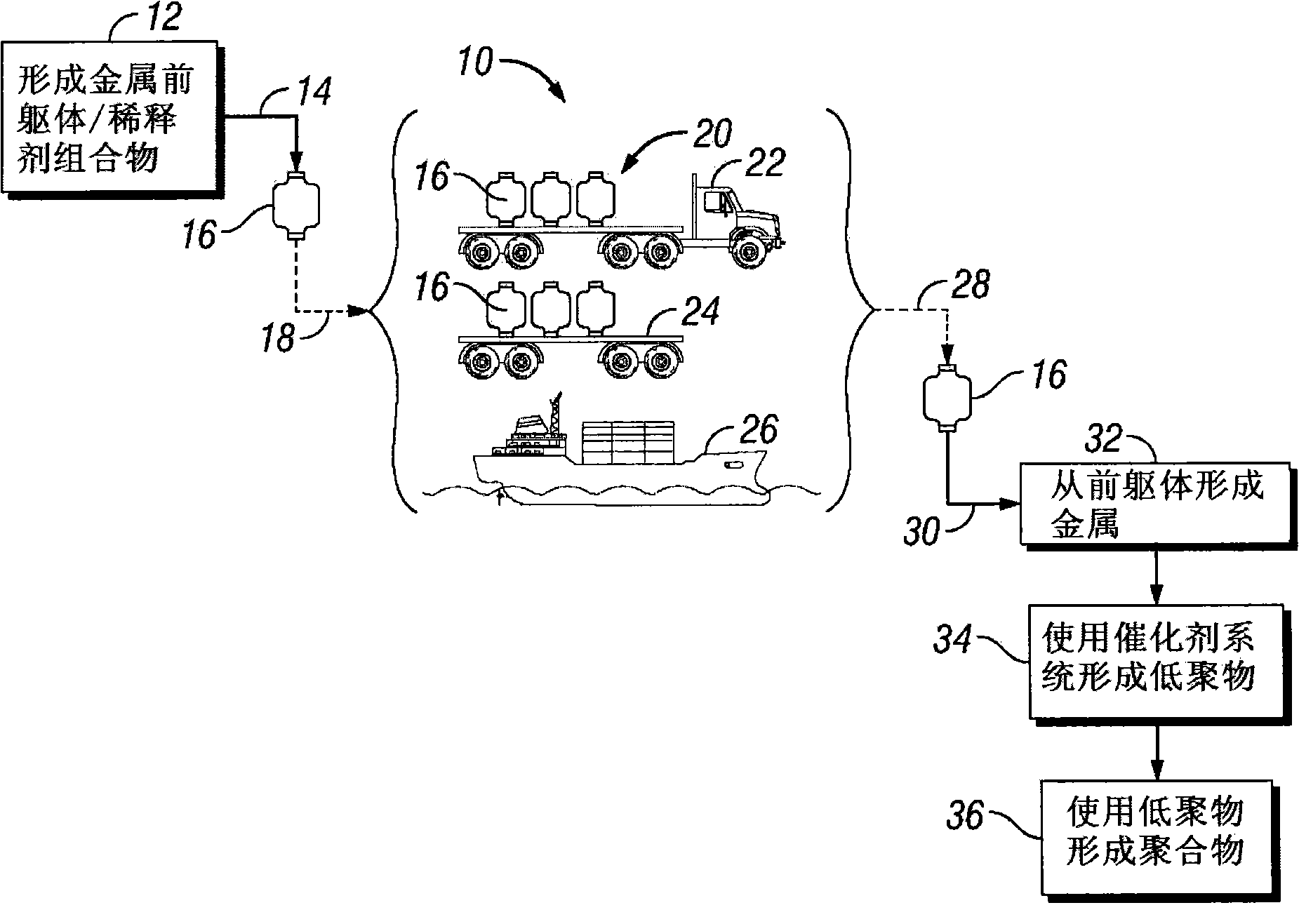
图1是根据本技术的实施方式的操作和使用低聚金属前躯体的流程图;Figure 1 is a flow diagram of the operation and use of oligomeric metal precursors in accordance with an embodiment of the present technology;
图2是根据本技术的实施方式的制备金属前躯体溶液和随后的催化剂组合物的方法的框图;2 is a block diagram of a method of preparing a metal precursor solution and subsequent catalyst composition in accordance with an embodiment of the present technology;
图3是根据本技术的实施方式的低聚方法的框图;3 is a block diagram of an oligomerization method according to an embodiment of the present technology;
图4是根据本技术的实施方式的低聚过程的框图;Figure 4 is a block diagram of an oligomerization process in accordance with an embodiment of the present technology;
图5是根据本技术的实施方式的聚烯烃过程的框图;Figure 5 is a block diagram of a polyolefin process in accordance with an embodiment of the present technology;
图6是表,其比较根据本技术的实施方式的三(2-乙基己酸)铬(III)金属前躯体在三种溶剂中的7.25wt%溶液的温度和粘度之间的关系;和6 is a table comparing the relationship between temperature and viscosity of 7.25 wt% solutions of chromium(III) tris(2-ethylhexanoate) metal precursors in three solvents in accordance with embodiments of the present technology; and
图7是表,其示出根据本技术的实施方式的三(2-乙基己酸)铬(III)金属前躯体在多种溶剂中的6.30wt%溶液的温度和粘度之间的关系。7 is a table showing the relationship between temperature and viscosity of 6.30 wt% solutions of chromium(III) tris(2-ethylhexanoate) metal precursor in various solvents in accordance with embodiments of the present technology.
具体实施方式Detailed ways
本技术的一个或多个具体实施方式将在本文描述。为了提供这些实施方式的简明描述,并非实际实施方式的所有特征都被描述在说明书中。应当理解,在任何这种实际实施方式的研发中,如在任何工程或设计项目中一样,必须执行众多具体的决定以达成研发者的具体目标,如顺应系统相关的和商业相关的约束,其可在一种实施方式与另一种实施方式之间有所不同。而且,应当理解,这样的研发努力可能是复杂的和耗时的,但其是从本公开得到益处的普通技术人员常规进行的设计、制造和制作。One or more specific implementations of the technology will be described herein. In an effort to provide a concise description of these embodiments, not all features of an actual implementation are described in the specification. It will be appreciated that in the development of any such practical implementation, as in any engineering or design project, numerous specific decisions must be made to achieve the specific goals of the developer, such as compliance with system-related and business-related constraints, other There may be variations from one embodiment to another. Moreover, it should be understood that such a development effort might be complex and time consuming, but would nevertheless be a routine undertaking of design, fabrication, and fabrication by one of ordinary skill having the benefit of this disclosure.
对于本文公开的任何具体化合物,除非另外指明,所呈现的一般结构意图包括源自特定系列取代基的所有的结构异构体、构象异构体和立体异构体。因此,对化合物的一般提及包括所有的结构异构体,除非另外明确指出;例如对丁烷的一般提及包括正戊烷、2-甲基-丁烷和2,2-二甲基丙烷。另外,提及一般结构包括所有的对映异构体、非对映异构体和其它光学异构体——无论是对映异构体形式或外消旋形式,以及立体异构体的混合物,如本上下文所允许或要求的。对于呈现的任何具体式子,所呈现的任何通式也包括源自特定系列取代基的所有的构象异构体、区域异构体和立体异构体。For any particular compound disclosed herein, unless otherwise indicated, the general structures presented are intended to include all structural isomers, conformational isomers and stereoisomers derived from a particular series of substituents. Thus, a generic reference to a compound includes all structural isomers unless expressly stated otherwise; for example a generic reference to butane includes n-pentane, 2-methyl-butane and 2,2-dimethylpropane . In addition, references to general structures include all enantiomers, diastereomers and other optical isomers - whether in enantiomeric or racemic form, and mixtures of stereoisomers , as permitted or required by the context. For any specific formula presented, any general formula presented also includes all conformers, regioisomers and stereoisomers derived from the specified series of substituents.
关于权利要求过渡性术语或短语,过渡性术语“包括(comprising)”——其与“包括(including)”、“包含(containing)”或“特征为(characterized by)”是同义的——是包括性的或者开放的,而不排除另外、未列出的要素或方法步骤。过渡性短语“由.....组成(consisting of)”排除在权利要求中没有指定的任何要素、步骤或成分。过渡性短语“基本由.....组成(consisting essentially of)”限制权利要求的范围至指定的材料或步骤和不实质上影响要求保护发明的基本特征和新颖性特征(一个或多个)的那些。“基本由.....组成”权利要求占据了以“由......组成”形式撰写的封闭式权利要求和以“包括”形式撰写的开放式权利要求之间的中间地带。不存在相反指示,当描述化合物或组合物“基本由.....组成”时不应该解释为“包括”,而是意欲描述包括不显著地改变该术语所应用的组合物或方法的材料的所述组分。例如,由材料A组成的原料可以包括在陈述的化合物或组合物的商业生产或商业可获得样品中一般存在的杂质。当权利要求包括不同特征和/或特征类别(例如,方法步骤、原料特征和/或产品特征以及其它可能性),过渡性术语包括、基本由......组成和由......组成只应用于使用其的特征类别,并且在权利要求内不同特征应用具有不同的过渡性术语或短语是可能的。例如,方法可以包括数个陈述的步骤(和其它未陈述的步骤),但是使用由特定步骤组成或可选地基本由特定步骤组成的催化剂系统制备,但是利用包括陈述组分和其它未陈述组分的催化剂系统。With respect to claim transitional terms or phrases, the transitional term "comprising" - which is synonymous with "including", "containing" or "characterized by" - is inclusive or open without excluding additional, unlisted elements or method steps. The transitional phrase "consisting of" excludes any element, step or ingredient not specified in a claim. The transitional phrase "consisting essentially of" limits the scope of a claim to the specified material or step and does not materially affect the essential and novel feature(s) of the claimed invention of those. "Consisting essentially of" claims occupy a middle ground between closed claims written in the form "consisting of" and open claims written in the form "comprising". In the absence of indications to the contrary, when a compound or composition is described as "consisting essentially of", it should not be interpreted as "comprising", but is intended to describe materials that do not significantly alter the composition or method to which the term is applied of the components. For example, a feedstock consisting of Material A may include impurities that are typically present in commercially produced or commercially available samples of the stated compound or composition. When a claim includes different features and/or categories of features (for example, process steps, material features and/or product features, among other possibilities), the transitional terms include, consist essentially of, and consist of... The .. composition applies only to the class of features in which it is used, and it is possible to have different transitional terms or phrases for different feature applications within a claim. For example, a method may include several of the stated steps (and other unrecited steps), but be prepared using a catalyst system consisting of, or alternatively consisting essentially of, the specified steps, but utilizing split catalyst system.
虽然使用“包含(comprising)”各种组份或步骤描述了组合物和方法,但也可以用“基本上由各种组份或步骤构成”或“由各种组份或步骤构成”来描述所述组合物和方法。Although compositions and methods are described using "comprising" various components or steps, they can also be described as "consisting essentially of" or "consisting of" various components or steps The compositions and methods.
除非另外具体指明,术语“一个(a)”、“一个(an)”和“所述(the)”意图包括多个可选项,例如,至少一个。例如,“茂金属”的公开意指包含一种茂金属,或者多于一种茂金属的混合物或组合。Unless specifically stated otherwise, the terms "a", "an" and "the" are intended to include a plurality of alternatives, eg, at least one. For example, the disclosure of "metallocene" is meant to encompass one metallocene, or a mixture or combination of more than one metallocene.
本说明书和权利要求书所用术语“α烯烃”指在碳原子的最长不间断链的第一个和第二个碳原子之间具有双键的烯烃。术语“α烯烃”包括线性和支链α烯烃,除非另外清楚表述。在支链α烯烃的情况下,相对于烯烃双键,支链可以在2-位(亚乙烯基)和/或3-位或更高位置。在本说明书和权利要求书中无论何时使用的术语“亚乙烯基”指相对于烯烃双键在2-位具有支链的α烯烃。就其本身而言,术语“α烯烃”不表示杂原子的存在与否和/或其它碳碳双键的存在与否,除非明确指明。术语“烃α烯烃”或“α烯烃烃”指仅含氢和碳的α烯属化合物。The term "alpha olefin" as used in the specification and claims refers to an olefin having a double bond between the first and second carbon atoms of the longest uninterrupted chain of carbon atoms. The term "alpha olefin" includes linear and branched alpha olefins unless expressly stated otherwise. In the case of branched alpha olefins, the branching can be at the 2-position (vinylene) and/or the 3-position or higher relative to the olefinic double bond. The term "vinylidene" whenever used in this specification and claims refers to an alpha olefin having a branch at the 2-position with respect to the olefinic double bond. As such, the term "alpha olefin" does not imply the presence or absence of heteroatoms and/or the presence or absence of other carbon-carbon double bonds, unless expressly indicated. The term "hydrocarbon alpha olefin" or "alpha olefin hydrocarbon" refers to an alpha olefinic compound containing only hydrogen and carbon.
如本文所用,术语“线性α烯烃”指在第一个碳原子和第二个碳原子之间具有双键的线性烯烃。术语“线性α烯烃”本身并不表示杂原子的存在与否和/或其它碳碳双键的存在与否,除非明确指明。术语“线性烃α烯烃”或“线性α烯烃烃”指仅含氢和碳的线性α烯烃。As used herein, the term "linear alpha olefin" refers to a linear olefin having a double bond between a first carbon atom and a second carbon atom. The term "linear alpha olefin" does not by itself imply the presence or absence of heteroatoms and/or the presence or absence of other carbon-carbon double bonds, unless expressly indicated. The term "linear hydrocarbon alpha olefin" or "linear alpha olefin hydrocarbon" refers to a linear alpha olefin containing only hydrogen and carbon.
本说明书和权利要求书中无论何时使用的术语“正α烯烃”指在第一个碳原子和第二个碳原子之间具有双键的线性烃单烯烃。应当注意:“正α烯烃”与“线性α烯烃”不同义,因为术语“线性α烯烃”可以包括在第一个碳原子和第二个碳原子之间具有双键并具有杂原子和/或其它双键的线性烯属化合物。The term "normal alpha olefin" whenever used in the specification and claims refers to a linear hydrocarbon monoolefin having a double bond between the first carbon atom and the second carbon atom. It should be noted that "normal alpha olefin" is not synonymous with "linear alpha olefin" because the term "linear alpha olefin" can include compounds having a double bond between the first carbon atom and the second carbon atom and having heteroatoms and/or Other linear olefinic compounds with double bonds.
本说明书和权利要求书无论何时使用的术语“基本上由正α烯烃构成”或其变型指商业可得的正α烯烃产品(一种或多种)。商业可得的正α烯烃产品可以包括非正α烯烃杂质,如亚乙烯基类、内烯烃、支链α烯烃、烷属烃和二烯烃等杂质,其在正α烯烃生产过程中没有被除去。本领域普通技术人员将意识到,在商业正α烯烃产品中存在的具体杂质的成分(identity)和数量取决于商业正α烯烃产品的来源。因此,相比于具体的商业正α烯烃产品中存在的量/数量,术语“基本上由正α烯烃构成”和其变型不意图更严格地限制所述非线性α烯烃组份的量/数量,除非明确指出。商业可得的α烯烃产品的一个来源是通过乙烯的低聚生产的那些。商业可得的α烯烃产品的第二个来源是从费-托合成流生产并任选地分离的那些。通过乙烯低聚生产的商业可得的正α烯烃产品的一个来源——其可被用作烯烃原料——是Chevron Phillips Chemical Company LP,The Woodlands,Texas,USA。通过乙烯低聚生产的商业可得的正α烯烃产品的其他来源——其可被用作烯烃原料——包括Inneos Oligomers(Feluy,Belgium)、Shell Chemicals Corporation(Houston,Texas,USA或London,United Kingdom)、Idemitsu Kosan(Tokyo,Japan)以及Mitsubishi Chemical Corporation(Tokyo,Japan)等。从费-托合成流生产并任选地分离的商业可得的正α烯烃产品的一个来源包括Sasol(Johannesburg,South Africa)等。The term "consisting essentially of normal alpha olefins" or variations thereof whenever used in the specification and claims refers to the commercially available normal alpha olefin product(s). Commercially available normal alpha olefin products may include non-normal alpha olefin impurities such as vinylidene, internal olefins, branched chain alpha olefins, paraffins and dienes, which are not removed during normal alpha olefin production . Those of ordinary skill in the art will appreciate that the identity and amount of specific impurities present in commercial normal alpha olefin products depends on the source of the commercial normal alpha olefin product. Accordingly, the terms "consisting essentially of normal alpha olefins" and variations thereof are not intended to limit the amount/amount of said non-linear alpha olefin component more strictly than the amount/amount present in a particular commercial normal alpha olefin product , unless explicitly noted. One source of commercially available alpha olefin products are those produced by oligomerization of ethylene. A second source of commercially available alpha olefin products are those produced and optionally separated from Fischer-Tropsch synthesis streams. One source of commercially available normal alpha olefin products produced by ethylene oligomerization, which can be used as olefin feedstock, is Chevron Phillips Chemical Company LP, The Woodlands, Texas, USA. Other sources of commercially available normal alpha olefin products produced by ethylene oligomerization - which can be used as olefin feedstock - include Inneos Oligomers (Feluy, Belgium), Shell Chemicals Corporation (Houston, Texas, USA or London, United Kingdom), Idemitsu Kosan (Tokyo, Japan) and Mitsubishi Chemical Corporation (Tokyo, Japan), etc. One source of commercially available normal alpha olefin products produced and optionally separated from a Fischer-Tropsch synthesis stream includes Sasol (Johannesburg, South Africa) and others.
本技术涉及形成、操作、储藏、运输和/或处理被用于催化剂系统中的金属前躯体的更有效的方法。在一些实施方式中,催化剂系统是低聚或者聚合催化剂系统。在一个实施方式中,前躯体(例如,金属前躯体或者催化剂前躯体)可以被用于形成催化剂系统,用于α烯烃制造方法或者其他方法。在某些实例中,可以在反应器中利用催化剂系统以低聚单体诸如乙烯或者其他单体,以产生α烯烃诸如1-己烯或者更大的α烯烃。产生的α烯烃随后可以被运输并被销售给消费者,或者可以在现场被用作其他过程的原料,诸如作为聚烯烃聚合中的共聚单体被供应。本文论述的技术可以改进金属前躯体和随后的低聚催化剂系统的制备、储藏、运输、操作和/或处理。The present technology relates to more efficient methods of forming, manipulating, storing, transporting and/or disposing of metal precursors used in catalyst systems. In some embodiments, the catalyst system is an oligomerization or polymerization catalyst system. In one embodiment, a precursor (eg, a metal precursor or a catalyst precursor) may be used to form a catalyst system for use in an alpha olefin manufacturing process or other process. In certain examples, a catalyst system can be utilized in a reactor to oligomerize monomers such as ethylene or other monomers to produce alpha olefins such as 1-hexene or larger alpha olefins. The alpha olefins produced can then be transported and sold to consumers, or can be used on-site as feedstock for other processes, such as supplied as comonomers in the polymerization of polyolefins. The techniques discussed herein can improve the preparation, storage, transportation, handling and/or handling of metal precursors and subsequent oligomerization catalyst systems.
可以由在一种或多种特定烯属稀释剂中稀释的金属前躯体(例如,三(2-乙基己酸)铬(III))形成用于将烯烃(例如,乙烯、丁烯、1-己烯等)低聚成低聚物(例如,1-己烯、1-辛烯、癸烯、十二碳烯等)的催化剂系统。如本文使用的,“烯烃”或“烯属的”意味着或描述无环的或者环状的烃基团——其具有一个或者多个碳碳双键,并且不包括为芳香基团一部分的双键。如本文引用的,“烯属稀释剂”也可以意味着用作稀释剂的单一烯烃化合物(如在本文任何实施方式中所定义的)或者可以意味着被混合形成混合的稀释剂的两种或者更多种的烯烃化合物(如在本文任何实施方式中所定义的)。Can be formed from metal precursors (e.g., chromium(III) tris(2-ethylhexanoate)) diluted in one or more specific olefinic diluents for the conversion of olefins (e.g., ethylene, butene, 1 -hexene, etc.) to oligomers (for example, 1-hexene, 1-octene, decene, dodecene, etc.) catalyst system. As used herein, "alkene" or "olefinic" means or describes an acyclic or cyclic hydrocarbon group - which has one or more carbon-carbon double bonds, and does not include double bonds that are part of an aromatic group. key. As referred to herein, "olefinic diluent" may also mean a single olefinic compound (as defined in any embodiment herein) used as a diluent or may mean two or more compounds that are mixed to form a mixed diluent. Various olefinic compounds (as defined in any of the embodiments herein).
烯属稀释剂可以被有益地用于稀释金属前躯体形成金属前躯体溶液、悬浮液或者乳液。在选择烯属稀释剂中,可以使用一个或多个标准,其包括但不限于下列的一个或多个:烯属稀释剂的闪点、在某些条件下——如涉及使用金属前躯体的催化过程的——稀释剂的惰性性质、在特定温度和压力下稀释剂引起金属前躯体成为液体状的并可移动的能力、和/或在随后的催化过程(例如,本文进一步描述的低聚或聚合过程)中稀释剂提供某些加工优势的能力。例如,选择如此烯属稀释剂是有利的,该烯属稀释剂在标准储藏和运输温度下不与金属前躯体反应,但是提供金属前躯体和溶剂的稳定溶液,其可以被储存(例如,大约3个月、大约6个月、大约12个月、大约18个月、或者更长)或经过长距离被运输至进一步制备和/或使用金属前躯体/稀释剂组合物的工厂。Olefinic diluents may be beneficially used to dilute the metal precursors to form metal precursor solutions, suspensions or emulsions. In selecting an olefinic diluent, one or more criteria may be used, including but not limited to one or more of the following: flash point of the olefinic diluent, under certain conditions—such as those involving the use of metal precursors— of the catalytic process - the inert nature of the diluent, the ability of the diluent to cause the metal precursor to become liquid and mobile at a particular temperature and pressure, and/or the subsequent catalytic process (e.g., oligomerization as further described herein) or polymerization) the ability of diluents to provide certain processing advantages. For example, it is advantageous to choose an olefinic diluent that does not react with the metal precursor at standard storage and transport temperatures, but provides a stable solution of the metal precursor and solvent that can be stored (e.g., about 3 months, about 6 months, about 12 months, about 18 months, or longer) or transported over long distances to plants for further preparation and/or use of the metal precursor/diluent composition.
在一个实施方式中,选择的烯属稀释剂具有一定的闪点。在一些实施方式中,烯属稀释剂具有高于大约35℃或者更高的闪点。在其他实施方式中,烯属稀释剂具有高于大约45℃或者更高的闪点。在其他实施方式中,烯属稀释剂具有高于大约55℃或者更高的闪点。在其他实施方式中,烯属稀释剂具有高于大约60℃或者更高的闪点。在其他实施方式中,烯属稀释剂具有高于大约65℃或者更高的闪点。在其他实施方式中,烯属稀释剂具有范围在大约45℃和大约250℃之间的闪点。在其他实施方式中,烯属稀释剂具有范围在大约55℃和大约225℃之间的闪点。在其他实施方式中,烯属稀释剂具有范围在大约60℃和大约200℃之间的闪点。在其他实施方式中,烯属稀释剂具有范围在大约65℃和大约175℃之间的闪点。在其他实施方式中,烯属稀释剂具有范围在大约45℃和大约120℃之间的闪点。在其他实施方式中,烯属稀释剂具有范围在大约55℃和大约95℃之间的闪点。In one embodiment, the selected olefinic diluent has a certain flash point. In some embodiments, the olefinic diluent has a flash point above about 35°C or higher. In other embodiments, the olefinic diluent has a flash point above about 45°C or higher. In other embodiments, the olefinic diluent has a flash point above about 55°C or higher. In other embodiments, the olefinic diluent has a flash point above about 60°C or higher. In other embodiments, the olefinic diluent has a flash point above about 65°C or higher. In other embodiments, the olefinic diluent has a flash point ranging between about 45°C and about 250°C. In other embodiments, the olefinic diluent has a flash point ranging between about 55°C and about 225°C. In other embodiments, the olefinic diluent has a flash point ranging between about 60°C and about 200°C. In other embodiments, the olefinic diluent has a flash point ranging between about 65°C and about 175°C. In other embodiments, the olefinic diluent has a flash point ranging between about 45°C and about 120°C. In other embodiments, the olefinic diluent has a flash point ranging between about 55°C and about 95°C.
在某些实施方式中,烯属稀释剂可以是C6至C20烯烃、或者C8至C16烯烃。在上述实施方式中,烯属稀释剂可以是线性或者支链烯烃。在一些实施方式中,烯属稀释剂在β-碳分支。在其他实施方式中,烯属稀释剂非β-碳上分支。在一些实施方式中,烯属稀释剂可以是环状的或者无环的。在一些实施方式中,烯属稀释剂具有在α位置的碳碳双键。在一些实施方式中,烯属稀释剂具有在非α位置的碳碳双键。在一些实施方式中,烯属稀释剂具有两个或者更多个碳碳双键,在α位置具有一个这种键。In certain embodiments, the olefinic diluent may be a C 6 to C 20 olefin, or a C 8 to C 16 olefin. In the above embodiments, the olefinic diluent may be a linear or branched olefin. In some embodiments, the olefinic diluent is branched at the β-carbon. In other embodiments, the olefinic diluent is not branched on the β-carbon. In some embodiments, the olefinic diluent can be cyclic or acyclic. In some embodiments, the olefinic diluent has a carbon-carbon double bond in the alpha position. In some embodiments, the olefinic diluent has a carbon-carbon double bond in a non-alpha position. In some embodiments, the olefinic diluent has two or more carbon-carbon double bonds, with one such bond in the alpha position.
在任何上述实施方式中,烯属稀释剂可以包括α烯烃。在一些实施方式中,α烯烃是正α烯烃。在一些实施方式中,有机稀释剂包括C6至C18正α烯烃、或者基本上由C6至C18正α烯烃组成。在一些实施方式中,有机稀释剂包括C8至C16正α烯烃,或者基本上由C8至C16正α烯烃组成。在一些实施方式中,有机稀释剂包括C10至C14正α烯烃,或者基本上由C10至C14正α烯烃组成。在一些实施方式中,正α烯烃选自1-己烯、1-辛烯、1-癸烯、1-十二碳烯、1-十四碳烯、1-十六碳烯、十八碳烯、或者其组合。在一些实施方式中,正α烯烃选自1-癸烯、1-十二碳烯、1-十四碳烯、或者其组合。在一些实施方式中,正α烯烃是1-癸烯。在其他实施方式中,正α烯烃是1-十二碳烯。在其他实施方式中,正α烯烃是1-十四碳烯。In any of the above embodiments, the olefinic diluent may include an alpha olefin. In some embodiments, the alpha olefin is a normal alpha olefin. In some embodiments, the organic diluent comprises, or consists essentially of , C6 to C18 normal alpha olefins . In some embodiments, the organic diluent comprises, or consists essentially of , C8 to C16 normal alpha olefins. In some embodiments, the organic diluent comprises, or consists essentially of, a C 10 to C 14 normal alpha olefin. In some embodiments, the normal alpha olefin is selected from 1-hexene, 1-octene, 1-decene, 1-dodecene, 1-tetradecene, 1-hexadecene, octadecene alkenes, or combinations thereof. In some embodiments, the normal alpha olefin is selected from 1-decene, 1-dodecene, 1-tetradecene, or combinations thereof. In some embodiments, the normal alpha olefin is 1-decene. In other embodiments, the normal alpha olefin is 1-dodecene. In other embodiments, the normal alpha olefin is 1-tetradecene.
有利地,在某些实施方式中,除一般在制造产品α烯烃中使用纯化外,用作稀释剂的α烯烃稀释剂可以不需要进一步纯化。有利地,在某些实施方式中,在标准的储藏和运输温度下,烯属稀释剂不与金属前躯体反应,但是提供可以被储存的金属前躯体和稀释剂的稳定溶液。例如,金属前躯体和稀释剂可以形成组合物,该组合物具有大约3个月、可选地大约6个月、可选地大约12个月、或者可选地大约18个月的稳定性,其中无可察觉的分解。另外,组合物可以经过长距离被运输至制备或者使用该组合物的工厂。Advantageously, in certain embodiments, an alpha olefin diluent used as a diluent may not require further purification other than that normally used in making the product alpha olefin. Advantageously, in certain embodiments, the olefinic diluent does not react with the metal precursor at standard storage and shipping temperatures, but provides a stable solution of the metal precursor and diluent that can be stored. For example, the metal precursor and the diluent can form a composition that has a stability of about 3 months, alternatively about 6 months, alternatively about 12 months, or alternatively about 18 months, There is no perceptible decomposition in it. In addition, the composition may be transported over long distances to factories where the composition is made or used.
可以利用多种方法形成包含金属前躯体和烯属稀释剂的组合物。在一些实施方式中,金属前躯体和烯属稀释剂接触形成组合物。在其他实施方式中,在与烯属稀释剂接触之前,金属前躯体与溶剂预接触。在一些实施方式中,金属前躯体可以与一部分烯属稀释剂接触,然后与相同或者不同的烯属稀释剂混合。在进一步实施方式中,金属前躯体可以作为催化剂被活化,然后在接触烯属稀释剂之前或者之后被加入到原料中。The composition comprising the metal precursor and the olefinic diluent can be formed using a variety of methods. In some embodiments, a metal precursor and an olefinic diluent are contacted to form a composition. In other embodiments, the metal precursor is precontacted with the solvent prior to contacting with the olefinic diluent. In some embodiments, the metal precursor can be contacted with a portion of the olefinic diluent and then mixed with the same or a different olefinic diluent. In a further embodiment, the metal precursor can be activated as a catalyst and then added to the feed either before or after exposure to the olefinic diluent.
在一些实施方式中,以多种比例混合金属前躯体和烯属稀释剂。在一个实施方式中,组合物包括按重量计大约18%至80%的烯属稀释剂。在另一实施方式中,组合物包括按重量计大约25%至55%的烯属稀释剂。在另一实施方式中,组合物包括按重量计大约32%至62%的烯属稀释剂。在另一实施方式中,组合物包括按重量计大约20%至70%的烯属稀释剂。在另一实施方式中,组合物包括按重量计大约25%至45%的烯属稀释剂。In some embodiments, the metal precursor and olefinic diluent are mixed in various ratios. In one embodiment, the composition includes about 18% to 80% by weight of the olefinic diluent. In another embodiment, the composition includes from about 25% to 55% by weight of the olefinic diluent. In another embodiment, the composition includes from about 32% to 62% by weight of the olefinic diluent. In another embodiment, the composition includes from about 20% to 70% by weight of the olefinic diluent. In another embodiment, the composition includes about 25% to 45% by weight of the olefinic diluent.
在一些实施方式中,烯属稀释剂与金属前躯体的金属原子的重量比的范围为13∶1至44∶1。在一些实施方式中,烯属稀释剂与金属前躯体的金属原子的重量比的范围为18∶1至20∶1。在一些实施方式中,烯属稀释剂与金属前躯体的金属原子的重量比的范围为17∶1至34∶1。在一些实施方式中,烯属稀释剂与金属前躯体的金属原子的重量比的范围为24∶1至55∶1。在一些实施方式中,烯属稀释剂与金属前躯体的金属原子的重量比的范围为30∶1至40∶1。In some embodiments, the weight ratio of olefinic diluent to metal atoms of the metal precursor ranges from 13:1 to 44:1. In some embodiments, the weight ratio of olefinic diluent to metal atoms of the metal precursor ranges from 18:1 to 20:1. In some embodiments, the weight ratio of olefinic diluent to metal atoms of the metal precursor ranges from 17:1 to 34:1. In some embodiments, the weight ratio of olefinic diluent to metal atoms of the metal precursor ranges from 24:1 to 55:1. In some embodiments, the weight ratio of olefinic diluent to metal atoms of the metal precursor ranges from 30:1 to 40:1.
在一些实施方式中,包含金属前躯体和烯属稀释剂的组合物是溶液、悬浮液或者乳液。在这些实施方式的一些中,需要组合物具有在一定范围内的粘度。在一些实施方式中,在20℃下组合物具有大约150和300cSt之间的粘度。在一些实施方式中,在20℃下组合物具有大约200和250cSt之间的粘度。在一些实施方式中,在20℃下组合物具有大约160和240cSt之间的粘度。在一些实施方式中,在20℃下组合物具有大约180和260cSt之间的粘度。在一些实施方式中,在20℃下组合物具有大约170和230cSt之间的粘度。In some embodiments, the composition comprising the metal precursor and the olefinic diluent is a solution, suspension or emulsion. In some of these embodiments, it is desirable for the composition to have a viscosity within a certain range. In some embodiments, the composition has a viscosity of between about 150 and 300 cSt at 20°C. In some embodiments, the composition has a viscosity of between about 200 and 250 cSt at 20°C. In some embodiments, the composition has a viscosity of between about 160 and 240 cSt at 20°C. In some embodiments, the composition has a viscosity of between about 180 and 260 cSt at 20°C. In some embodiments, the composition has a viscosity of between about 170 and 230 cSt at 20°C.
在形成和/或利用催化剂系统的工厂,诸如在α烯烃制造工厂,可以现场稀释金属前躯体,或者可以预先稀释金属前躯体,并且作为金属前躯体和稀释剂或者溶剂的溶液储存和运输。如下所述,在某些实施方式中,最终的催化剂系统可以是用于将烯烃(例如,乙烯)低聚或者三聚成为产品(例如,1-己烯)的低聚催化剂系统。At a plant where the catalyst system is formed and/or utilized, such as at an alpha olefins manufacturing plant, the metal precursor may be diluted in situ, or the metal precursor may be pre-diluted and stored and shipped as a solution of the metal precursor and diluent or solvent. As described below, in certain embodiments, the final catalyst system may be an oligomerization catalyst system for oligomerization or trimerization of olefins (eg, ethylene) into products (eg, 1-hexene).
术语“低聚”和其衍生词指这样的过程,其产生包含至少70重量%的含有2至30个单体单元的产物的混合物。类似地,“低聚物”是包含2至30个单体单元的产物,而“低聚产物”包括由“低聚”方法产生的所有产物,其包括“低聚物”和不是“低聚物”的产物(例如,包含多于30个单体单元的产物)。应该说明的是,“低聚物”或“低聚产物”中的单体单元不是必须相同的。例如,使用乙烯和丙烯作为单体的“低聚”方法的“低聚物”或“低聚产物”可以包括乙烯和/或丙烯单元。The term "oligomerization" and its derivatives refer to a process that results in a mixture comprising at least 70% by weight of products containing 2 to 30 monomer units. Similarly, "oligomer" is a product containing 2 to 30 monomer units, while "oligomeric product" includes all products resulting from the "oligomeric" process, which includes "oligomeric" and not "oligomeric" "product" (for example, a product comprising more than 30 monomer units). It should be noted that the monomer units in an "oligomer" or "oligomerization product" are not necessarily identical. For example, an "oligomer" or "oligomerization product" of an "oligomerization" process using ethylene and propylene as monomers may include ethylene and/or propylene units.
术语“三聚”和其衍生词指这样的过程,其产生包含至少70重量%包含三个且仅三个单体单元的产物的混合物。“三聚体”是包含三个且仅三个单体单元的产物,而“三聚产物”包括通过三聚方法产生的所有产物,其包括三聚体和不是三聚体的产物(例如,二聚体或四聚体)。一般而言,当考虑单体单元中烯键的数量和三聚体中的烯键的数量时,烯烃三聚将烯键即碳-碳双键的数量减少了两个。应该说明的是,“三聚体”或“三聚产物”中的单体单元不是必须是相同的。例如,使用乙烯和丁烯作为单体的“三聚体”或“三聚”方法可以包括乙烯和/或丁烯单体单元。也就是说,“三聚体”将包括C6、C8、C10和C12产物。在另一个实例中,使用乙烯作为单体的“三聚体”或“三聚”方法可以包含乙烯单体单元。应该说明的是,单个分子包含两个单体单元。例如,二烯烃诸如1,3-丁二烯和1,4-戊二烯在一个分子内具有两个单体单元。The term "trimerization" and its derivatives refer to a process that results in a mixture comprising at least 70% by weight of a product comprising three and only three monomer units. A "trimer" is a product comprising three and only three monomer units, while a "trimeric product" includes all products produced by the trimerization process, including trimers and products that are not trimers (e.g., dimers or tetramers). In general, olefin trimerization reduces the number of olefinic bonds, ie, carbon-carbon double bonds, by two when considering the number of olefinic bonds in the monomer unit and the number of olefinic bonds in the trimer. It should be noted that the monomer units in a "trimer" or "trimer product" do not have to be identical. For example, a "trimer" or "trimerization" process using ethylene and butene as monomers may include ethylene and/or butene monomer units. That is, a "trimer" would include the C6 , C8 , C10 and C12 products. In another example, a "trimer" or "trimerization" process using ethylene as a monomer may comprise ethylene monomer units. It should be noted that a single molecule contains two monomeric units. For example, dienes such as 1,3-butadiene and 1,4-pentadiene have two monomer units in one molecule.
方法概况Method overview
现在转向附图,图1描述制备、储存、运输和使用用于低聚催化剂系统的金属前躯体-稀释剂组合物的示例性方法10。通过混合金属前躯体(例如,乙基己酸铬(III))和烯属稀释剂(例如,烯烃溶剂或者α烯烃溶剂)可以形成金属前躯体-稀释剂组合物(框12)。然后可以例如经过装载管线14装载组合物进入被储存或者被移动至另一位置的储存或运输容器16。一般地,可以构造储存或运输容器16以储存或运输组合物。容器16的结构可以包括增强的壁、压力释放系统和可以用于烃溶液的储存和运输的其他系统。在某些实施方式中,这种容器16可以符合美国运输部、国际标准组织、或者其他准政府的或者政府的监察机构设定的标准。但是,应当强调,本技术不限于符合任何特定的标准或规章。Turning now to the drawings, FIG. 1 depicts an
通过其自身或者与其他容器16一起,储存或运输容器16可以被装载(如参考数字18所示)至被待被移动至另一位置的运输工具20上。运输工具20可以包括能够在位置之间移动容器16的任何数量的交通工具。例如,运输工具20可以包括卡车22、铁路车24、轮船26、或者任何数量的较小的运输工具20,诸如叉车(未示出)或者起重机(未示出)。在运输工具20到达其目的地后,容器16可以从运输工具20上移出并装载至待被移动至另一位置的新的运输工具20上,或者容器16可以在处理地点被卸载(如参考数字28所示)。在处理地点,容器16被连接(如参考数字28所示)至催化剂系统制备过程或者低聚过程,以从储存或运输容器16移出组合物用于制备催化剂系统。例如,在过程经过线30卸载运输容器16之后,组合物可以被用于形成低聚催化剂系统。对金属前躯体和低聚催化剂系统及其示例性制备的可适用的实例,见美国专利号6,133,495和美国专利号7,384,886,二者均出于所有目的通过引用以其整体被并入本文。也应当指出,低聚催化剂系统可以单独地被制备并且供应给低聚反应反应器,或者可选地,通过在烯烃原料的存在下接触反应器中的至少一种催化剂系统组分在反应器中可以形成催化剂系统。By itself or in combination with
金属前躯体-稀释剂组合物可以被用于形成低聚催化剂系统(框32)。低聚反应催化剂系统可以在进一步过程(框34)中用于形成α烯烃低聚物,诸如三聚体(例如,1-己烯)。对催化剂系统和相关的示例性低聚过程诸如示例性三聚过程的应用的讨论,见美国专利号7,384,886、美国专利申请公开号2002/0182124和美国专利申请公开号2004/0236163,所有这三篇出于所有目的通过引用以其整体被并入本文。最后,产生的α烯烃低聚物(例如,1-己烯、1-辛烯、癸烯等)可以作为最终产品运离现场,或者可以是中间产物并被用作原料诸如用作下游聚烯烃过程(框36)中的共聚单体。The metal precursor-diluent composition may be used to form an oligomerization catalyst system (block 32). The oligomerization catalyst system can be used in a further process (box 34) to form alpha olefin oligomers, such as trimers (eg, 1-hexene). For a discussion of the use of catalyst systems and related exemplary oligomerization processes, such as exemplary trimerization processes, see U.S. Patent No. 7,384,886, U.S. Patent Application Publication No. 2002/0182124, and U.S. Patent Application Publication No. 2004/0236163, all three It is hereby incorporated by reference in its entirety for all purposes. Finally, the alpha olefin oligomers produced (e.g., 1-hexene, 1-octene, decene, etc.) can be shipped off-site as final products, or can be intermediate products and used as feedstocks such as downstream polyolefins Comonomer in process (box 36).
金属前躯体溶液metal precursor solution
图2中更详细地图解形成金属前躯体溶液的过程38。该过程开始于形成或购买金属前躯体(框38)。金属前躯体可以包括铬、镍、钴、铁、钼、或铜、或者这些金属的化合物;可选地,铬化合物。可以用作金属前躯体的铬化合物包括有机的或者无机的化合物,其中铬的氧化态是从0至6。一般地,铬源具有式CrXn,其中每个X可以是相同的或不同的,并且可以是任何有机或无机基团,n可以是从1到6的整数。可以被用于X的有机基团每基团可以具有大约1至大约20个碳原子,并且可以包括烷基、烷氧基、酯、酮、羧酸基团或酰胺基基团等。在一个实施方式中,有机基团可以是直链的或支链的、环状的或无环的、芳香族的或脂肪族的,并且可以包括混合的脂肪族、芳香族或脂环族基团。示例性的无机基团包括但不限于任何阴离子或氧化基团,例如卤化物、硫酸盐或氧化物。示例性的金属前躯体包括但不限于铬化合物如有机金属铬(II)或铬(III)化合物或其混合物。The process 38 of forming the metal precursor solution is illustrated in more detail in FIG. 2 . The process begins with forming or purchasing a metal precursor (box 38). Metal precursors may include chromium, nickel, cobalt, iron, molybdenum, or copper, or compounds of these metals; alternatively, chromium compounds. Chromium compounds that can be used as metal precursors include organic or inorganic compounds in which the oxidation state of chromium is from 0 to 6. Generally, the chromium source has the formula CrX n , where each X can be the same or different and can be any organic or inorganic group, and n can be an integer from 1 to 6. Organic groups that can be used for X can have from about 1 to about 20 carbon atoms per group, and can include alkyl, alkoxy, ester, ketone, carboxylic acid or amide groups, and the like. In one embodiment, the organic group may be linear or branched, cyclic or acyclic, aromatic or aliphatic, and may include mixed aliphatic, aromatic or cycloaliphatic groups group. Exemplary inorganic groups include, but are not limited to, any anionic or oxidizing groups, such as halides, sulfates, or oxides. Exemplary metal precursors include, but are not limited to, chromium compounds such as organometallic chromium(II) or chromium(III) compounds or mixtures thereof.
可以被用作金属前躯体的有机金属铬化合物可以是羧酸铬(II)或羧酸铬(III);可选地,羧酸铬(II);或者可选地,羧酸铬(III)。羧酸铬(II)或羧酸铬(III)的每个羧酸根可以是C1至C24、C4至C19或C5至C12羧酸根。在一个实施方式中,羧酸根基团可以是乙酸根、丙酸根、丁酸根、戊酸根、己酸根、庚酸根、辛酸根、壬酸根、癸酸根、十一酸根、十二酸根、十三酸根、十四酸根、十五酸根、十六酸根、十七酸根或十八酸根;或者可选地,戊酸根、己酸根、庚酸根、辛酸根、壬酸根、癸酸根、十一酸根或十二酸根。在一些实施方式中,羧酸根基团可以是乙酸根、丙酸根、正丁酸根、戊酸根(正戊酸根)、新戊酸根、己酸根(正己酸根)、正庚酸根、辛酸根(正辛酸根)、2-乙基己酸根、正壬酸根、癸酸根(正癸酸根)、正十一酸根、月桂酸根(正十二酸根)或硬脂酸根(正十八酸根);可选地,戊酸根(正戊酸根)、新戊酸根、己酸根(正己酸根)、正庚酸根、辛酸根(正辛酸根)、2-乙基己酸根、正壬酸根、癸酸根(正癸酸根)、正十一酸根或月桂酸根(正十二酸根);可选地,己酸根(正己酸根);可选地,正庚酸根;可选地,辛酸根(正辛酸根);或可选地,2-乙基己酸根。示例性的羧酸铬(II)可以包括但不限于乙酸铬(II)、丙酸铬(II)、丁酸铬(II)、新戊酸铬(II)、草酸铬(II)、辛酸铬(II)、2-乙基己酸铬(II)、月桂酸铬(II)或硬脂酸铬(II)。示例性的羧酸铬(III)可以包括但不限于乙酸铬(III)、丙酸铬(III)、丁酸铬(III)、新戊酸铬(III)、草酸铬(III)、辛酸铬(III)、2-乙基己酸铬(III)、2,2,6,6,-四甲基庚二酸铬(III)、环烷酸铬(III)、月桂酸铬(III)或硬脂酸铬(III)。在一个实施方式中,可以用作金属前躯体的有机金属铬化合物是2-乙基己酸铬(II)或2-乙基己酸铬(III);或者可选地,2-乙基己酸铬(III)。通过本领域已知的诸多技术,可以将多余的反应物和副产物从金属前躯体中除去(框42)。这样的技术可以包括真空解吸、过滤、溶剂清洗或诸多其他技术。The organometallic chromium compound that can be used as a metal precursor can be chromium(II) carboxylate or chromium(III) carboxylate; alternatively, chromium(II) carboxylate; or alternatively, chromium(III) carboxylate . Each carboxylate of the chromium(II) carboxylate or chromium(III) carboxylate may be a C 1 to C 24 , C 4 to C 19 or C 5 to C 12 carboxylate. In one embodiment, the carboxylate group may be acetate, propionate, butyrate, pentanoate, hexanoate, heptanoate, octanoate, nonanoate, caprate, undecanoate, dodecanoate, tridecanoate, or alternatively, pentanoate, hexanoate, heptanoate, octanoate, nonanoate, decanoate, undecanoate, or decanoate dioic acid. In some embodiments, the carboxylate group may be acetate, propionate, n-butyrate, valerate (n-pentanoate), pivalate, hexanoate (n-hexanoate), n-heptanoate, octanoate (n- caprylate), 2-ethylhexanoate, nonanoate, caprate (n-decanoate), n-undecanoate, laurate (n-dodecanoate), or stearate (n-octadecanoate); optionally , pentanoate (n-pentanoate), pivalate, hexanoate (n-caproate), n-heptanoate, caprylate (n-octanoate), 2-ethylhexanoate, n-nonanoate, caprate (n-decanoate) , n-undecanoate or laurate (n-dodecanoate); alternatively, hexanoate (n-hexanoate); alternatively, n-heptanoate; alternatively, octanoate (n-octanoate); , 2-Ethylhexanoate. Exemplary chromium(II) carboxylates may include, but are not limited to, chromium(II) acetate, chromium(II) propionate, chromium(II) butyrate, chromium(II) pivalate, chromium(II) oxalate, chromium(II) octanoate (II), chromium(II) 2-ethylhexanoate, chromium(II) laurate or chromium(II) stearate. Exemplary chromium(III) carboxylates may include, but are not limited to, chromium(III) acetate, chromium(III) propionate, chromium(III) butyrate, chromium(III) pivalate, chromium(III) oxalate, chromium(III) octanoate Chromium (III), chromium (III) 2-ethylhexanoate, chromium (III) 2,2,6,6,-tetramethylpimelate, chromium (III) naphthenate, chromium (III) laurate or Chromium(III) stearate. In one embodiment, the organometallic chromium compound that can be used as a metal precursor is chromium(II) 2-ethylhexanoate or chromium(III) 2-ethylhexanoate; or alternatively, 2-ethylhexanoate Chromium(III) acid. Excess reactants and by-products can be removed from the metal precursor by a number of techniques known in the art (box 42). Such techniques may include vacuum desorption, filtration, solvent washing, or many others.
金属前躯体(例如,固体、液体、或者糊状物)可以被稀释(框42)形成金属前躯体-稀释剂组合物。本文描述适当的烯属稀释剂。示例性的α烯烃溶剂包括但不限于1-己烯、1-辛烯、1-癸烯、1-十二碳烯、1-十四碳烯、1-十六碳烯、或者1-十八碳烯、或者其组合,及其他。在一个实施方式中,α烯烃稀释剂可以是1-癸烯、1-十二碳烯、1-十四碳烯、或者其任何组合;可选地是1-癸烯;可选地是十二碳烯;或者可选地是十四碳烯。溶剂的选择可以取决于粘度、闪点、成本、可得性、最终催化剂组合物的选择性等。然后随后操作金属前躯体-稀释剂组合物,诸如现场使用、储存、运载、运输、处理等,如图2中参考数字44所示。用烯属稀释剂将金属前躯体稀释成组合物中可以促进金属前躯体的操作。A metal precursor (eg, solid, liquid, or paste) may be diluted (block 42) to form a metal precursor-diluent composition. Suitable olefinic diluents are described herein. Exemplary alpha olefin solvents include, but are not limited to, 1-hexene, 1-octene, 1-decene, 1-dodecene, 1-tetradecene, 1-hexadecene, or 1-decene Octene, or a combination thereof, and others. In one embodiment, the alpha olefin diluent may be 1-decene, 1-dodecene, 1-tetradecene, or any combination thereof; optionally 1-decene; optionally decacene didecene; or alternatively tetradecene. The choice of solvent can depend on viscosity, flash point, cost, availability, selectivity of the final catalyst composition, and the like. The metal precursor-diluent composition is then subsequently manipulated, such as used in the field, stored, carried, transported, handled, etc., as indicated by reference numeral 44 in FIG. 2 . Diluting the metal precursor into the composition with an olefinic diluent facilitates handling of the metal precursor.
有利地,α烯烃稀释剂诸如1-十二碳烯作为金属前躯体的溶剂的使用,可以增加随后的低聚反应(例如,形成1-己烯、1-辛烯等)的选择性,与在金属前躯体溶液中使用乙基苯作为溶剂相比,在金属前躯体溶液中使用1-十二碳烯作为溶剂增加低聚物(例如,1-己烯)的产率多达1%。此外,如果金属前躯体溶液在大约20℃下具有小于大约300厘沲的粘度,促进在特定位置内操作和泵送溶液。在某些实施方式中,通过稀释铬前躯体直到按重量计溶液中铬浓度在大约5%和大约10%之间;可选地在溶液中在大约5.5%和大约9%之间;可选地在大约6%和大约8%之间;或者可选地在溶液中在大约6.30wt%和大约7.25wt%之间,可以得到铬前躯体(例如,糊状物)需要的粘度(任何上述那些)。稀释之后,金属或铬前躯体溶液可以被装载入待被移动到另一位置进行使用的运输容器16。如本文所述的,在化工厂环境中,较高闪点的溶剂可以比较容易操作。一般地,35℃或者更高的闪点可能是有益的。在一些实施方式中,烯属稀释剂的闪点是本文任何上述的那些。通过使用具有大约47℃闪点的1-癸烯、具有大约77℃闪点的1-十二碳烯、或者其他α烯烃或者α烯烃的混合物可以达到这样的闪点。Advantageously, the use of an alpha-olefin diluent such as 1-dodecene as a solvent for the metal precursor can increase the selectivity of the subsequent oligomerization (e.g., to form 1-hexene, 1-octene, etc.), with Using 1-dodecene as a solvent in the metal precursor solution increased the yield of oligomers (eg, 1-hexene) by as much as 1% compared to using ethylbenzene as the solvent in the metal precursor solution. Additionally, if the metal precursor solution has a viscosity of less than about 300 centistokes at about 20°C, handling and pumping the solution within a particular location is facilitated. In certain embodiments, by diluting the chromium precursor until the chromium concentration in solution is between about 5% and about 10% by weight; optionally between about 5.5% and about 9% in solution; optionally Preferably between about 6% and about 8%; or alternatively between about 6.30 wt% and about 7.25 wt% in solution, the desired viscosity of the chromium precursor (e.g., paste) (any of the above Those ones). After dilution, the metal or chromium precursor solution may be loaded into a
催化剂系统catalyst system
在一些实施方式中,金属前躯体-稀释剂组合物(例如,溶液)可以与其他化合物反应和/或混合(图2中的框46)形成低聚催化剂组合物或者组分。例如,通过组合金属前躯体溶液与烷基金属和含氮化合物诸如吡咯等可以形成催化剂组合物或者组分。典型地,可以以不同的顺序或者在可选的条件下接触催化剂系统组分以制备催化剂系统组合物。例如,金属前躯体溶可以首先与氮的化合物接触或者基本上同时与烷基金属接触。可以在反应器中进行前躯体组分的交替接触。In some embodiments, the metal precursor-diluent composition (eg, solution) can be reacted and/or mixed (block 46 in FIG. 2 ) with other compounds to form an oligomerization catalyst composition or component. For example, a catalyst composition or component can be formed by combining a metal precursor solution with a metal alkyl and a nitrogen-containing compound such as pyrrole or the like. Typically, the catalyst system components may be contacted in a different order or under alternative conditions to prepare the catalyst system composition. For example, the metal precursor solution can be contacted first with the nitrogen compound or with the metal alkyl substantially simultaneously. Alternate contacting of the precursor components can be carried out in the reactor.
可以在不饱和烃溶剂中进行催化剂系统制备,包括接触氮的化合物、烷基金属和金属前躯体溶液。在一个实施方式中,烃溶剂可以是任何烯烃或者芳香族烃溶剂。一般地,可以在不饱和烃中进行催化剂制备。不饱和烃可以是任何芳香族的或者不饱和的脂肪族烃并且每个分子可以具有任何数量的碳原子。不饱和烃每个分子可以包括少于大约70个碳原子或者每个分子少于大约20个碳原子。基于工业可用性和使用的容易程度,进行不饱和烃的选择。可以被用作溶剂的脂肪族烃化合物包括乙烯、1-己烯、1,3-丁二烯、及其混合物等。在实施方式中可以使用的不饱和脂肪族烃化合物是1-己烯。如果1-己烯是待被形成的目标低聚物,那么这可以减少随后的纯化步骤的需要。可以被用作催化剂系统的溶剂的芳香族烃可以包括但不限于C6至C50芳香族化合物;可选地,C6至C30芳香族化合物;可选地,C6至C18芳香族化合物;或者可选地,C6至C10芳香族化合物。示例性的芳香族烃包括但不限于甲苯、苯、乙基苯、二甲苯(邻位、间位、对位、或其任何组合)、1,3,5-三甲基苯、六甲基苯、及其混合物。芳香族烃溶剂可以改进催化剂系统稳定性并且帮助产生活性和选择性的催化剂系统,如在本文进一步讨论的。在一个实施方式中,不饱和烃可以是甲苯;可选地,是乙基苯。Catalyst system preparation can be carried out in unsaturated hydrocarbon solvents, including nitrogen-contacted compounds, metal alkyls, and metal precursor solutions. In one embodiment, the hydrocarbon solvent can be any olefinic or aromatic hydrocarbon solvent. Generally, catalyst preparation can be carried out in unsaturated hydrocarbons. The unsaturated hydrocarbon can be any aromatic or unsaturated aliphatic hydrocarbon and can have any number of carbon atoms per molecule. Unsaturated hydrocarbons may include less than about 70 carbon atoms per molecule or less than about 20 carbon atoms per molecule. Selection of unsaturated hydrocarbons is made based on commercial availability and ease of use. Aliphatic hydrocarbon compounds that can be used as solvents include ethylene, 1-hexene, 1,3-butadiene, mixtures thereof, and the like. An unsaturated aliphatic hydrocarbon compound that can be used in an embodiment is 1-hexene. This can reduce the need for subsequent purification steps if 1-hexene is the target oligomer to be formed. Aromatic hydrocarbons that may be used as solvents for the catalyst system may include, but are not limited to, C6 to C50 aromatic compounds; alternatively, C6 to C30 aromatic compounds; alternatively, C6 to C18 aromatic compounds compound; or alternatively, a C 6 to C 10 aromatic compound. Exemplary aromatic hydrocarbons include, but are not limited to, toluene, benzene, ethylbenzene, xylene (ortho, meta, para, or any combination thereof), 1,3,5-trimethylbenzene, hexamethyl Benzene, and mixtures thereof. Aromatic hydrocarbon solvents can improve catalyst system stability and help produce active and selective catalyst systems, as discussed further herein. In one embodiment, the unsaturated hydrocarbon may be toluene; alternatively, ethylbenzene.
可以被用于制备低聚催化剂系统的芳香族化合物的量基于反应器中溶剂的量可以上至大约15重量百分比、在大约0.001和大约10重量百分比之间、或者在大约0.01和大约5重量百分比之间。过量的芳香族化合物可以抑制催化剂系统活性并且不足的芳香族化合物可能不能稳定催化剂系统。一般地,催化剂系统中每摩尔活性金属前躯体(例如,铬化合物)的芳香族化合物的摩尔数可以上至大约6,000摩尔、约10和约3,000摩尔之间或约20至1,000摩尔之间的催化剂系统中每摩尔活性金属前躯体(例如铬)的芳香族化合物。。The amount of aromatic compound that can be used to prepare the oligomerization catalyst system can be up to about 15 weight percent, between about 0.001 and about 10 weight percent, or between about 0.01 and about 5 weight percent based on the amount of solvent in the reactor between. Excess aromatic compounds may inhibit catalyst system activity and insufficient aromatic compounds may fail to stabilize the catalyst system. Generally, the number of moles of aromatic compound per mole of active metal precursor (e.g., chromium compound) in the catalyst system can be up to about 6,000 moles, between about 10 and about 3,000 moles, or between about 20 and 1,000 moles in the catalyst system Aromatic compound per mole of active metal precursor (eg chromium). .
芳香族化合物和催化剂系统的接触可以在热存在下、足以稳定催化剂系统的任何条件下发生。一般而言,接触的温度可以在约-50℃和大约70℃之间、大约10℃和大约70℃之间、或者大约5℃和30℃之间。一般而言,接触时间可以是小于约5小时,在约0.01秒和约4小时之间,或在约0.1秒和3小时之间。较长的接触时间可能不提高催化剂系统的稳定性,而较短的接触时间可能不足以允许完成芳香族化合物和催化剂系统的接触,因此不足以稳定催化剂系统。可以使用允许芳香族化合物和催化剂系统进行完全接触的任何压力。一般而言,可以使用能够维持芳香族化合物和催化剂系统为液体形式的任何压力。接触可以在干燥、惰性气氛下进行,以使改变催化剂组系统最小化。同样,然而,除上述的讨论外,金属前躯体和低聚催化剂系统的其他可应用实例,以及它们的示例性制备参见所附的美国专利号6,133,495和所附的美国专利号7,384,886,这两篇均出于所有目的通过引用以其整体并入本文。The contacting of the aromatic compound and the catalyst system can occur under any conditions sufficient to stabilize the catalyst system in the presence of heat. Generally, the temperature of the contacting can be between about -50°C and about 70°C, between about 10°C and about 70°C, or between about 5°C and 30°C. Generally, the contact time can be less than about 5 hours, between about 0.01 seconds and about 4 hours, or between about 0.1 seconds and 3 hours. Longer contact times may not increase the stability of the catalyst system, while shorter contact times may not be sufficient to allow complete contacting of the aromatic compound and the catalyst system, and thus be insufficient to stabilize the catalyst system. Any pressure that allows complete contact of the aromatic compound and the catalyst system can be used. In general, any pressure capable of maintaining the aromatic compound and catalyst system in liquid form can be used. Contacting can be performed under a dry, inert atmosphere to minimize changes to the catalyst stack system. Also, however, in addition to the above discussion, other applicable examples of metal precursor and oligomerization catalyst systems, as well as their exemplary preparation, are found in appended U.S. Patent No. 6,133,495 and appended U.S. Patent No. 7,384,886, both of which Both are hereby incorporated by reference in their entirety for all purposes.
用于催化剂系统制备的温度可以在大约-78℃和200℃之间,大约0℃和50℃之间,或者大约5℃和大约40℃之间。温度可以被控制以减少颗粒形成并增加催化剂系统的活性和生产率。一般而言,催化剂系统的制备在惰性气氛如氮气或氩气下进行,以减少存在的水蒸气和氧的量。由于成本和可得性的原因,通常使用氮气。The temperature for catalyst system preparation may be between about -78°C and 200°C, between about 0°C and 50°C, or between about 5°C and about 40°C. The temperature can be controlled to reduce particle formation and increase the activity and productivity of the catalyst system. Generally, the preparation of the catalyst system is carried out under an inert atmosphere such as nitrogen or argon to reduce the amount of water vapor and oxygen present. Nitrogen is typically used for reasons of cost and availability.
可以用于形成催化剂系统的含氮化合物包括胺、酰胺、二酰亚胺、腈和吡咯。例如,可以用于形成催化剂系统的胺可以包括但不限于C3至C20胺;可选地,C3至C15胺;或可选地,C3至C10胺。可应用的胺可以是伯胺或仲胺。在一个实施方式中,有用的胺可以包括一烃基胺;或者可选地,二烃基胺。一烃基胺或二烃基胺的每个烃基可以独立地选自C1至C10烷基、C5-C10环烷基、C6-C10芳基;或者C7-C10芳烷基;可选地,C1至C10烷基;C5-C10环烷基;可选地,C6-C10芳基;或者可选地,C7-C10芳烷基。可应用于一烃基胺或二烃基胺的烷基包括甲基、乙基、丙基、丁基、戊基、己基、庚基、辛基、壬基或癸基;可选地,甲基、乙基、丙基、丁基、戊基;可选地,甲基、乙基、正丙基、异丙基、正丁基、异丁基、仲丁基、叔丁基、戊基或新戊基;可选地,甲基;可选地,乙基;可选地,正丙基;可选地,异丙基;可选地,正丁基;可选地,异丁基;可选地,仲丁基;可选地,叔丁基;可选地,戊基;或者可选地,新戊基。可应用于一烃基胺或二烃基胺的环烷基包括环戊基或环己基;可选地,环戊基;或者可选地,环己基。可应用于一烃基胺或二烃基胺的芳基包括苯基、甲苯基或二甲苯基,可选地,苯基;可选地,甲苯基,可选地,二甲苯基。可应用于一烃基胺或二烃基胺的芳烷基包括苄基。示例性的非限定性的伯胺包括但不限于乙胺、异丙胺、环己胺、苄胺、苯胺和萘胺。示例性的非限定的仲胺包括但不限于二乙胺、二异丙基胺、二环己基胺、二苄基胺、二(三甲基甲硅烷基)胺、吗啉、咪唑、二氢吲哚、吲哚等。可用于形成催化剂系统的酰胺包括C0至C20、C2至C10的酰胺。酰胺的金属原子可以是锂、钠、或者钾;可选地,锂;可选地,钠;或者可选地,钾。酰胺的酰胺部分可以是本文公开的任何伯胺或者仲胺。示例性的酰胺包括但不限于氨基化锂、乙氨基化钠、二乙氨基化钙、二异丙氨基化锂、苄氨基化钾、二(三甲基甲硅烷基)氨基化钠和吲哚化锂(lithium indolide)。Nitrogen-containing compounds that can be used to form the catalyst system include amines, amides, imides, nitriles, and pyrroles. For example, amines that can be used to form the catalyst system can include, but are not limited to , C3 to C20 amines; alternatively, C3 to C15 amines; or alternatively, C3 to C10 amines. Applicable amines may be primary or secondary. In one embodiment, useful amines may include monohydrocarbyl amines; or alternatively, dihydrocarbyl amines. Each hydrocarbyl group of monohydrocarbylamine or dihydrocarbylamine can be independently selected from C 1 to C 10 alkyl, C 5 -C 10 cycloalkyl, C 6 -C 10 aryl; or C 7 -C 10 aralkyl ; alternatively, C 1 to C 10 alkyl; C 5 -C 10 cycloalkyl; alternatively, C 6 -C 10 aryl; or alternatively, C 7 -C 10 aralkyl. Alkyl groups applicable to monohydrocarbylamines or dihydrocarbylamines include methyl, ethyl, propyl, butyl, pentyl, hexyl, heptyl, octyl, nonyl or decyl; alternatively, methyl, Ethyl, propyl, butyl, pentyl; alternatively methyl, ethyl, n-propyl, isopropyl, n-butyl, isobutyl, sec-butyl, tert-butyl, pentyl or neo Amyl; alternatively methyl; alternatively ethyl; alternatively n-propyl; alternatively isopropyl; alternatively n-butyl; alternatively isobutyl; Alternatively, sec-butyl; alternatively, tert-butyl; alternatively, pentyl; or alternatively, neopentyl. Cycloalkyl groups applicable to monohydrocarbylamines or dihydrocarbylamines include cyclopentyl or cyclohexyl; alternatively, cyclopentyl; or alternatively, cyclohexyl. Aryl groups applicable to monohydrocarbylamines or dihydrocarbylamines include phenyl, tolyl or xylyl, alternatively phenyl; alternatively tolyl, alternatively xylyl. Aralkyl groups applicable to monohydrocarbylamines or dihydrocarbylamines include benzyl. Exemplary, non-limiting primary amines include, but are not limited to, ethylamine, isopropylamine, cyclohexylamine, benzylamine, aniline, and naphthylamine. Exemplary, non-limiting secondary amines include, but are not limited to, diethylamine, diisopropylamine, dicyclohexylamine, dibenzylamine, bis(trimethylsilyl)amine, morpholine, imidazole, dihydro Indole, indole, etc. Amides useful in forming the catalyst system include C 0 to C 20 , C 2 to C 10 amides. The metal atom of the amide can be lithium, sodium, or potassium; alternatively, lithium; alternatively, sodium; or alternatively, potassium. The amide portion of the amide can be any primary or secondary amine disclosed herein. Exemplary amides include, but are not limited to, lithium amide, sodium ethylamide, calcium diethylamide, lithium diisopropylamide, potassium benzylamide, sodium bis(trimethylsilyl)amide, and indole lithium indolide.
可以被用作含氮化合物的含吡咯化合物可以是任何含吡咯化合物,或者吡咯化物(pyrrolide),其与铬源反应形成铬吡咯络合物。。如本公开所用的,术语“含吡咯化合物”指的是吡咯(C5H5N)、吡咯的衍生物、取代的吡咯化物、以及金属吡咯络合物。“吡咯化物”被定义为包括五元含氮杂环吡咯的任何化合物。广义地讲,含吡咯化合物可以是吡咯或含有吡咯基团或配体的任何杂配(heteroleptic)或均配(homoleptic)金属络合物或盐。The pyrrole-containing compound that may be used as the nitrogen-containing compound may be any pyrrole-containing compound, or pyrrolide, which reacts with a chromium source to form a chromium pyrrole complex. . As used in this disclosure, the term "pyrrole-containing compound" refers to pyrrole (C 5 H 5 N), derivatives of pyrrole, substituted pyrrolides, and metal pyrrole complexes. "Pyrrolide" is defined as any compound including five-membered nitrogen-containing heterocyclic pyrroles. Broadly speaking, the pyrrole-containing compound may be pyrrole or any heteroleptic or homoleptic metal complex or salt containing a pyrrole group or ligand.
一般地,含吡咯化合物可以是C4至C20吡咯;或者可选地C4至C10吡咯。在一个实施方式中,含吡咯化合物(也称作“吡咯”)可以是取代的吡咯。在一些实施方式中,吡咯可以是2-取代吡咯;可选地,3-取代吡咯;可选地,2,3-二取代吡咯;可选地,2,4-二取代吡咯;可选地,2,5-二取代吡咯;可选地,2,3,4-三取代吡咯;可选地,2,3,5-三取代吡咯;或者可选地,2,3,4,5-四取代吡咯。一般地,任何多取代的吡咯的取代基可以是相同的或者不同的。在一些实施方式中,在2和5位具有取代基的任何吡咯的2和5取代基可以是相同的或者不同的。Typically, the pyrrole-containing compound may be a C4 to C20 pyrrole; or alternatively a C4 to C10 pyrrole. In one embodiment, the pyrrole-containing compound (also referred to as "pyrrole") may be a substituted pyrrole. In some embodiments, the pyrrole can be a 2-substituted pyrrole; alternatively, a 3-substituted pyrrole; alternatively, a 2,3-disubstituted pyrrole; alternatively, a 2,4-disubstituted pyrrole; , 2,5-disubstituted pyrrole; alternatively, 2,3,4-trisubstituted pyrrole; alternatively, 2,3,5-trisubstituted pyrrole; or alternatively, 2,3,4,5- Tetrasubstituted pyrrole. In general, the substituents of any polysubstituted pyrrole may be the same or different. In some embodiments, the 2 and 5 substituents of any pyrrole having substituents at the 2 and 5 positions can be the same or different.
本文描述的任何取代的吡咯的每一个取代基可以独立地选自卤根、C1至C16有机基或者C1至C16烃基;可选地C1至C16有机基;或者可选地C1至C16烃基。在一个实施方式中,本文描述的任何取代的吡咯的每一个取代基可以独立地选自卤根、C1至C12有机基或者C1至C12烃基;可选地C1至C12有机基;或者可选地C1至C12烃基。在一些实施方式中,本文描述的任何取代的吡咯的每一个取代基可以独立地选自卤根、C1至C8有机基或者C1至C8烃基;可选地C1至C8有机基;或者可选地C1至C8烃基。在其他实施方式中,本文描述的任何取代的吡咯的每一个取代基可以独立地选自C1至C16烷基、C6至C16芳基、或者C7至C16烷芳基;可选地C1至C16烷基;可选地C6至C16芳基;或者可选地C7至C16烷芳基。在进一步实施方式中,本文描述的任何取代的吡咯的每一个取代基可以独立地选自C1至C12烷基、C6至C12芳基、或者C7至C12烷芳基;可选地C1至C12烷基;可选地C6至C12芳基;或者可选地C7至C12烷芳基。在仍另一实施方式中,本文描述的任何取代的吡咯的每一个取代基可以独立地选自C1至C8烷基。在一个实施方式中,取代的吡咯的任何取代基可以是卤根。Each substituent of any substituted pyrrole described herein may be independently selected from a halide, a C 1 to C 16 organic group, or a C 1 to C 16 hydrocarbyl; alternatively a C 1 to C 16 organic group; or alternatively C 1 to C 16 hydrocarbyl. In one embodiment, each substituent of any substituted pyrrole described herein can be independently selected from halide, C 1 to C 12 organic, or C 1 to C 12 hydrocarbyl; alternatively C 1 to C 12 organic or alternatively C 1 to C 12 hydrocarbyl. In some embodiments, each substituent of any substituted pyrrole described herein can be independently selected from a halide, a C 1 to C 8 organic group, or a C 1 to C 8 hydrocarbyl; alternatively a C 1 to C 8 organic or alternatively C 1 to C 8 hydrocarbyl. In other embodiments, each substituent of any substituted pyrrole described herein can be independently selected from C 1 to C 16 alkyl, C 6 to C 16 aryl, or C 7 to C 16 alkaryl; optionally C 1 to C 16 alkyl; optionally C 6 to C 16 aryl; or alternatively C 7 to C 16 alkaryl. In a further embodiment, each substituent of any substituted pyrrole described herein can be independently selected from C 1 to C 12 alkyl, C 6 to C 12 aryl, or C 7 to C 12 alkaryl; optionally C 1 to C 12 alkyl; optionally C 6 to C 12 aryl; or alternatively C 7 to C 12 alkaryl. In yet another embodiment, each substituent of any substituted pyrrole described herein can be independently selected from C 1 to C 8 alkyl groups. In one embodiment, any substituent of the substituted pyrrole may be a halide.
在一个实施方式中,卤根取代基可以是氟根、氯根、溴根、碘根;可选地是氟根;可选地是氯根;可选地是溴根;或者可选地是碘根。在一个实施方式中,有机基可以是具有式-C(O)R1a的酰基——其中R1a是烃基、具有式-C(O)OR2a的氢羧基羰基(hydrocarboxycarbonyl)——其中R2a是烃基、具有式-C(O)NH2的氨基甲酰基、具有式-C(O)NR3aH的N-氢氨基甲酰基(N-hydrocarbamoyl)——其中R3a是烃基、或者具有式-C(O)NR3aR4a的N,N-二烃基氨基甲酰基——其中R3a和R4a独立地是烃基;可选地具有式-C(O)R1a的酰基,其中R1a是烃基;可选地具有式-C(O)OR2a的氢羧基羰基,其中R2a是烃基;可选地具有式-C(O)NH2的氨基甲酰基;可选地具有式-C(O)NR2aH的N-氢氨基甲酰基,其中R3a是烃基;或者可选地具有式-C(O)NR3aR4a的N,N-二烃基氨基甲酰基,其中R3a和R4a独立地是烃基。一般地,酰基、氢羧基羰基、N-氢氨基甲酰基、或者N,N-二烃基氨基甲酰基的R1a、R2a、R3a或者R4a可以独立地无限制地选自可以是吡咯的取代基的相同的烃基。In one embodiment, the halide substituent may be fluoride, chloride, bromide, iodide; alternatively fluoride; alternatively chloride; alternatively bromide; iodide. In one embodiment, the organic group can be an acyl group having the formula -C(O)R 1a where R 1a is a hydrocarbyl group, a hydrocarboxycarbonyl group having the formula -C(O)OR 2a where R 2a is a hydrocarbon group, a carbamoyl group having the formula -C(O)NH 2 , an N-hydrocarbamoyl group having the formula -C(O)NR 3a H - wherein R 3a is a hydrocarbon group, or having the formula -N,N-Dihydrocarbylcarbamoyl of C(O)NR 3a R 4a - wherein R 3a and R 4a are independently hydrocarbyl; optionally an acyl group of formula -C(O)R 1a , wherein R 1a is a hydrocarbyl group; optionally a hydrocarboxycarbonyl group of the formula -C(O)OR 2a , wherein R 2a is a hydrocarbyl group; optionally a carbamoyl group of the formula -C(O)NH 2a ; optionally of the formula -C N-hydrocarbamoyl of (O)NR 2a H, wherein R 3a is hydrocarbyl; or alternatively N,N-dihydrocarbamoyl of formula -C(O)NR 3a R 4a , wherein R 3a and R 4a is independently hydrocarbyl. Generally, R 1a , R 2a , R 3a , or R 4a of an acyl, hydrocarboxycarbonyl, N-hydrocarbamoyl, or N,N-dihydrocarbamoyl group can be independently, without limitation, selected from the group that may be pyrrole The same hydrocarbon group as the substituent.
可以被用作本文描述的任何取代的吡咯的取代基或者用作酰基、氢羧基羰基、N-氢氨基甲酰基、或者N,N-二烃基氨基甲酰基的R1a、R2a、R3a或者R4a的每一个烷基可以独立地选自甲基、乙基、丙基、丁基、戊基、己基、庚基、辛基、壬基、癸基、十一烷基、或者十二烷基;可选地,甲基、乙基、丙基、丁基、戊基、己基、庚基、或者辛基。在一个实施方式中,可以被用作本文描述的任何取代的吡咯的取代基或者用作酰基、氢羧基羰基、N-氢氨基甲酰基、或者N,N-二烃基氨基甲酰基的R1a、R2a、R3a或者R4a的每一个烷基可以独立地选自甲基、乙基、正丙基、异丙基、正丁基、异丁基、仲丁基、叔丁基、戊基、或者新戊基;可选甲基;可选地乙基;可选地正丙基;可选地异丙基;可选地正丁基;可选地异丁基;可选地仲丁基;可选地叔丁基;可选地戊基;或者可选地新戊基。可以被用作本文描述的任何取代的吡咯的取代基或者用作酰基、氢羧基羰基、N-氢氨基甲酰基、或者N,N-二烃基氨基甲酰基的R1a、R2a、R3a或者R4a的每一个芳基可以独立地选自苯基、甲苯基、或者二甲苯基;可选地甲苯基;或者可选地二甲苯基。可以被用作本文描述的任何取代的吡咯的取代基或者用作酰基、氢羧基羰基、N-氢氨基甲酰基、或者N,N-二烃基氨基甲酰基的R1a、R2a、R3a或者R4a的每一个烷芳基可以是苄基。can be used as a substituent for any of the substituted pyrroles described herein or as R 1a , R 2a , R 3a or Each alkyl group of R 4a can be independently selected from methyl, ethyl, propyl, butyl, pentyl, hexyl, heptyl, octyl, nonyl, decyl, undecyl, or dodecyl radical; alternatively, methyl, ethyl, propyl, butyl, pentyl, hexyl, heptyl, or octyl. In one embodiment, R 1a , Each alkyl group of R 2a , R 3a or R 4a can be independently selected from methyl, ethyl, n-propyl, isopropyl, n-butyl, isobutyl, sec-butyl, tert-butyl, pentyl , or neopentyl; optionally methyl; optionally ethyl; optionally n-propyl; optionally isopropyl; optionally n-butyl; optionally isobutyl; optionally sec-butyl alternatively tert-butyl; alternatively pentyl; or alternatively neopentyl. can be used as a substituent for any of the substituted pyrroles described herein or as R 1a , R 2a , R 3a or Each aryl group of R 4a can be independently selected from phenyl, tolyl, or xylyl; alternatively tolyl; or alternatively xylyl. can be used as a substituent for any of the substituted pyrroles described herein or as R 1a , R 2a , R 3a or Each alkaryl group of R 4a may be benzyl.
可被用作低聚催化剂系统中的氮的化合物的示例性的含吡咯化合物包括但不限于吡咯-2-羧酸、2-乙酰基吡咯、吡咯-2-甲醛、四氢吲哚、2,5-二甲基吡咯、2,4-二甲基-3-乙基吡咯、3-乙酰基-2,4-二甲基吡咯、乙基-2,4-二甲基-5-(乙氧基羰基)-3-吡咯-丙酸酯、乙基-3,5-二甲基-2-吡咯羧酸酯、吡咯、2,5-二甲基吡咯、2,5-二乙基吡咯、3,4-二甲基吡咯、3,4-二氯吡咯、2,3,4,5-四氯吡咯、2-乙酰基吡咯、吡唑、吡咯烷和二吡咯并甲烷以及其混合物等。在一个实施方式中,含吡咯化物可以是2,5-二甲基吡咯;或者可选地2,5-二乙基吡咯。含吡咯化合物的选择可以基于成本、可得性和活性进行。例如,吡咯或2,5-二甲基吡咯或者可选地2,5-二乙基吡咯可以被用作氮的化合物,因为这些化合物可以比本文列举的其它氮的化合物具有更高的可得性或提供更高的活性。在2009年10月30日与本申请同时提交的题目为低聚催化剂系统和低聚烯烃的方法(OLIGOMERIZATION CATALYST SYSTEM AND PROCESS FOR OLIGOMERIZING OLEFINS)的美国专利申请序列号______(代理人卷好211073US01)中描述这些吡咯中的某些,该申请以其整体通过引用并入本文。Exemplary pyrrole-containing compounds that can be used as nitrogen compounds in oligomerization catalyst systems include, but are not limited to, pyrrole-2-carboxylic acid, 2-acetylpyrrole, pyrrole-2-carbaldehyde, tetrahydroindole, 2, 5-dimethylpyrrole, 2,4-dimethyl-3-ethylpyrrole, 3-acetyl-2,4-dimethylpyrrole, ethyl-2,4-dimethyl-5-(ethyl Oxycarbonyl)-3-pyrrole-propionate, ethyl-3,5-dimethyl-2-pyrrole carboxylate, pyrrole, 2,5-dimethylpyrrole, 2,5-diethylpyrrole , 3,4-dimethylpyrrole, 3,4-dichloropyrrole, 2,3,4,5-tetrachloropyrrole, 2-acetylpyrrole, pyrazole, pyrrolidine and dipyrrolomethane and their mixtures, etc. . In one embodiment, the pyrrole-containing compound may be 2,5-dimethylpyrrole; or alternatively 2,5-diethylpyrrole. Selection of the azole-containing compound can be based on cost, availability and activity. For example, pyrrole or 2,5-dimethylpyrrole or alternatively 2,5-diethylpyrrole can be used as the nitrogen compound because these compounds can have a higher availability than other nitrogen compounds listed herein. Sex or provide higher activity. U.S. Patent Application Serial No. ______ (attorney volume 211073US01) entitled OLIGOMERIZATION CATALYST SYSTEM AND PROCESS FOR OLIGOMERIZING OLEFINS, filed at the same time as this application on October 30, 2009 Certain of these pyrroles are described in , which application is hereby incorporated by reference in its entirety.
烷基金属可以是任何杂配或者均配的烷基金属化合物。烷基金属的金属可以包括1、2、11、12、13或者14族金属;或者可选地13或者14族金属;或者可选地13族金属。在一些实施方式中,烷基金属可以包括烷基锂、烷基钠、烷基镁、烷基硼、烷基锌、或者烷基铝。示例性的烷基金属包括但不限于正丁基锂、仲丁基锂、叔丁基锂、二乙基镁或者二乙基锌。在一个实施方式中,烷基金属可以是烷基铝。The metal alkyl can be any heteromeric or homogeneous metal alkyl compound. The metal of the metal alkyl may include a
在一方面,烷基金属可以是烷基金属卤化物。烷基金属卤化物在本文被描述并且可以被用作低聚催化剂系统的烷基金属组分。烷基金属卤化物的卤化物部分可以是氯化物;可选地是溴化物;或者可选地是碘化物。In one aspect, the metal alkyl can be a metal alkyl halide. Alkyl metal halides are described herein and can be used as the metal alkyl component of the oligomerization catalyst system. The halide portion of the alkyl metal halide may be chloride; alternatively bromide; or alternatively iodide.
在一方面,烷基金属可以是非水解的烷基铝化合物。在一个实施方式中,非水解的烷基铝化合物可以是三烷基铝化合物、烷基铝卤化物或者和烷基铝烷氧化物。一般地,本文描述的任何烷基金属(例如,烷基铝化合物或者烷基铝卤化物等)的每一个烷基,如果多于一个,可以独立地是C1至C20烷基;可选地C1至C10烷基;或者可选地C1至C6烷基。在一个实施方式中,烷基(一个或多个)可以独立地是甲基、乙基、丙基、丁基、戊基、己基、庚基或者辛基;可选地是甲基、乙基、丁基、己基或者辛基。在一些实施方式中,烷基可以独立地是甲基、乙基、正丙基、正丁基、异丁基、正己基或者正辛基;可选地是甲基、乙基、正丁基或者异丁基、可选地是甲基;可选地是乙基;可选地是正丙基;可选地是正丁基;可选地是异丁基;可选地是正己基;或者可选地是正辛基。In one aspect, the metal alkyl can be a non-hydrolyzable aluminum alkyl compound. In one embodiment, the non-hydrolyzed alkylaluminum compound may be a trialkylaluminum compound, an alkylaluminum halide, or an alkylaluminum alkoxide. In general, each alkyl group, if more than one, of any of the metal alkyls described herein (e.g., alkylaluminum compounds or alkylaluminum halides, etc.), may independently be a C 1 to C 20 alkyl group; optionally C 1 to C 10 alkyl; or alternatively C 1 to C 6 alkyl. In one embodiment, the alkyl(s) may independently be methyl, ethyl, propyl, butyl, pentyl, hexyl, heptyl or octyl; alternatively methyl, ethyl , butyl, hexyl or octyl. In some embodiments, the alkyl group can be independently methyl, ethyl, n-propyl, n-butyl, isobutyl, n-hexyl, or n-octyl; alternatively methyl, ethyl, n-butyl or isobutyl, optionally methyl; optionally ethyl; optionally n-propyl; optionally n-butyl; optionally isobutyl; optionally n-hexyl; or Optionally n-octyl.
在一方面,烷基金属可以包括或者可以选自三烷基铝化合物、二烷基铝卤化物化合物、烷基铝二卤化物化合物、二烷基铝氢化物化合物、烷基铝二氢化物化合物、二烷基铝烃氧化物(hydrocarbyloxide)化合物、烷基铝二烃氧化物化合物、烷基铝倍半卤化物化合物、烷基铝倍半烃氧化物化合物、或者其任何结合。烷基金属、烷基金属卤化物和/或烷基金属烃氧化物的可适用的烷基和卤化物在本文被描述并且可以被用于进一步描述适当的烷基金属。In one aspect, the metal alkyl may comprise or may be selected from trialkylaluminum compounds, dialkylaluminum halide compounds, alkylaluminum dihalide compounds, dialkylaluminum hydride compounds, alkylaluminum dihydride compounds , a dialkylaluminum hydrocarbyloxide compound, an alkylaluminum dihydrocarbyloxide compound, an alkylaluminum sesquihalide compound, an alkylaluminum sesquioxide compound, or any combination thereof. Applicable alkyl groups and halides of metal alkyls, metal alkyl halides and/or metal alkyl alkoxides are described herein and may be used to further describe suitable metal alkyls.
示例性的三烷基铝化合物可以包括但不限于三甲基铝、三乙基铝、三丙基铝、三正丁基铝或三异丁基铝或其混合物。示例性的烷基铝卤化物化合物可以包括但不限于氯化二乙基铝、溴化二乙基铝、二氯化乙基铝、倍半氯化乙基铝及其混合物。在一个实施方式中,三烷基铝化合物可以是三乙基铝。Exemplary trialkylaluminum compounds may include, but are not limited to, trimethylaluminum, triethylaluminum, tripropylaluminum, tri-n-butylaluminum, or tri-isobutylaluminum, or mixtures thereof. Exemplary alkylaluminum halide compounds may include, but are not limited to, diethylaluminum chloride, diethylaluminum bromide, ethylaluminum dichloride, ethylaluminum sesquichloride, and mixtures thereof. In one embodiment, the trialkylaluminum compound may be triethylaluminum.
在一方面,烷基金属化合物可以是三烷基铝化合物和烷基铝卤化物的混合物。一般而言,混合物的三烷基铝化合物可以是本文描述的任何三烷基铝化合物。混合物的烷基铝卤化物化合物可以是本文描述的任何烷基铝化合物。在一些实施方式中,三烷基铝化合物和烷基铝卤化物的混合物可以包括或基本上由三乙基铝和氯化二乙基铝、三乙基铝和二氯化乙基铝、或三乙基铝和倍半氯化乙基铝构成。在一个实施方式中,低聚催化剂系统的烷基金属组分可以是三乙基铝和氯化二乙基铝的混合物。In one aspect, the metal alkyl compound can be a mixture of a trialkylaluminum compound and an alkylaluminum halide. In general, the trialkylaluminum compound of the mixture can be any trialkylaluminum compound described herein. The alkylaluminum halide compound of the mixture can be any of the alkylaluminum compounds described herein. In some embodiments, the mixture of trialkylaluminum compounds and alkylaluminum halides may comprise or consist essentially of triethylaluminum and diethylaluminum chloride, triethylaluminum and ethylaluminum dichloride, or Triethylaluminum and ethylaluminum sesquichloride. In one embodiment, the metal alkyl component of the oligomerization catalyst system may be a mixture of triethylaluminum and diethylaluminum chloride.
在另一方面和在任何实施方式中,在本公开中有用的烷基金属的具体实例可以包括或可以包含但不限于三甲基铝(TMA)、三乙基铝(TEA)、二氯化乙基铝、三丙基铝、二乙基铝乙醇盐(diethylaluminum ethoxide)、三丁基铝、氢化二异丁基铝、三异丁基铝、氯化二乙基铝(DEAC)和它们的组合。在其它方面,和在任何实施方式中,在本公开中有用的烷基金属的具体实例可以包括或可以包含但不限于三乙基铝(TEA)或氯化二乙基铝(DEAC)。In another aspect and in any embodiment, specific examples of metal alkyls useful in the present disclosure may include or may include, but are not limited to, trimethylaluminum (TMA), triethylaluminum (TEA), dichloride Ethylaluminum, tripropylaluminum, diethylaluminum ethoxide, tributylaluminum, diisobutylaluminum hydride, triisobutylaluminum, diethylaluminum chloride (DEAC) and their combination. In other aspects, and in any embodiment, specific examples of metal alkyls useful in the present disclosure may include or may include, but are not limited to, triethylaluminum (TEA) or diethylaluminum chloride (DEAC).
虽然不希望被束缚于理论,应当相信,含卤素化合物可以提高低聚方法产品的纯度和选择性。在一些实施方式中,含卤素化合物可以是含氯化合物、含溴化合物或含碘化合物。在一个实施方式中,含卤素化合物可以是含氯化合物。While not wishing to be bound by theory, it is believed that the halogen-containing compound can increase the purity and selectivity of the product of the oligomerization process. In some embodiments, the halogen-containing compound may be a chlorine-containing compound, a bromine-containing compound, or an iodine-containing compound. In one embodiment, the halogen-containing compound may be a chlorine-containing compound.
在一方面,含卤素化合物——无论是含氯化合物、含溴化合物或含碘化合物——可以是金属卤化物、烷基金属卤化物或有机卤化物。在一个实施方式中,含卤素化合物可以是金属氯化物;可选地,金属溴化物;或者可选地,金属碘化物。在一个实施方式中,含卤素化合物可以是烷基金属氯化物;可选地,烷基金属溴化物;或者可选地,金属碘化物。在一个实施方式中,含卤素化合物可以是有机氯化物;可选地,有机溴化物;或者可选地,有机碘化物。In one aspect, the halogen-containing compound—whether a chlorine-, bromine-, or iodine-containing compound—may be a metal halide, an alkyl metal halide, or an organic halide. In one embodiment, the halogen-containing compound may be a metal chloride; alternatively, a metal bromide; or alternatively, a metal iodide. In one embodiment, the halogen-containing compound may be an alkyl metal chloride; alternatively, an alkyl metal bromide; or alternatively, a metal iodide. In one embodiment, the halogen-containing compound may be an organic chloride; alternatively, an organic bromide; or alternatively, an organic iodide.
在一方面,金属卤化物可以包括3、4、5、6(除了铬)、13、14或15族金属。在一些实施方式中,金属卤化物可以选自氯化钪、氯化钇、氯化镧、四氯化钛、四氯化锆、四氯化铪、三氯化硼、氯化铝、氯化镓、四氯化硅、三甲基氯硅烷、四氯化锗、四氯化锡、三氯化磷、三氯化锑、五氯化锑、三氯化铋、三溴化硼、三溴化铝、四氯化硅、四溴化硅、氟化铝、五氯化钼、六氯化钨,三苯甲基六氯锑酸盐(trityl hexachloroantimonate)或其混合物。In one aspect, the metal halide may comprise a Group 3, 4, 5, 6 (except chromium), 13, 14 or 15 metal. In some embodiments, the metal halide may be selected from scandium chloride, yttrium chloride, lanthanum chloride, titanium tetrachloride, zirconium tetrachloride, hafnium tetrachloride, boron trichloride, aluminum chloride, Gallium, silicon tetrachloride, trimethylchlorosilane, germanium tetrachloride, tin tetrachloride, phosphorus trichloride, antimony trichloride, antimony pentachloride, bismuth trichloride, boron tribromide, tribromide Aluminum chloride, silicon tetrachloride, silicon tetrabromide, aluminum fluoride, molybdenum pentachloride, tungsten hexachloride, trityl hexachloroantimonate (trityl hexachloroantimonate) or mixtures thereof.
在一方面,金属低聚催化剂的烷基金属卤化物进一步包括1、2、12、13或14族金属。在一个实施方式中,烷基金属卤化物可以是烷基铝卤化物或烷基锡卤化物。在一些实施方式中,烷基铝卤化物可以是氯化烷基铝;可选地,溴化烷基铝;或者可选地,碘化烷基铝。在其它实施方式中,烷基锡卤化物可以是氯化烷基锡;可选地,溴化烷基锡;或者可选地,碘化烷基锡。在一个实施方式中,烷基金属卤化物可以是烷基铝卤化物。在另一实施方式中,烷基金属卤化物可以是烷基锡卤化物。In one aspect, the alkyl metal halide of the metal oligomerization catalyst further comprises a
在一方面,包含卤化物的化合物可以是烷基铝卤化物。在一个实施方式中,烷基铝卤化物可以是氯化烷基铝。可以被用作低聚催化剂系统的任选的包含卤化物的组分的示例性的氯化烷基铝包括但不限于:氯化二乙基铝、溴化二乙基铝、二氯化乙基铝、倍半氯化乙基铝及其混合物。在一个实施方式中,可以被用作低聚催化剂系统的任选的包含卤化物的组分的烷基铝氯化物可以是氯化二乙基铝。In one aspect, the halide-containing compound can be an alkylaluminum halide. In one embodiment, the alkylaluminum halide may be an alkylaluminum chloride. Exemplary alkylaluminum chlorides that can be used as the optional halide-containing component of the oligomerization catalyst system include, but are not limited to: diethylaluminum chloride, diethylaluminum bromide, ethylene dichloride aluminum, ethylaluminum sesquichloride and mixtures thereof. In one embodiment, the alkylaluminum chloride that may be used as an optional halide-containing component of the oligomerization catalyst system may be diethylaluminum chloride.
在一方面,有机卤化物可以是C1至C15有机卤化物;可选地,C1至C10有机卤化物;或者可选地,C1至C8有机卤化物。在一个实施方式中,有机卤化物可以选自四氯化碳、四溴化碳、氯仿、溴仿、二氯甲烷、二溴甲烷、二碘甲烷、溴代甲烷、碘代甲烷、二氯乙烷、四氯乙烷、三氯丙酮、六氯丙酮、六氯环己烷、1,3,5-三氯苯、六氯苯、三苯甲基氯、苄基氯、苄基溴、苄基碘、氯苯、溴苯、碘苯、六氟苯或其混合物。In one aspect, the organic halide can be a C 1 to C 15 organic halide; alternatively, a C 1 to C 10 organic halide; or alternatively, a C 1 to C 8 organic halide. In one embodiment, the organic halide may be selected from carbon tetrachloride, carbon tetrabromide, chloroform, bromoform, methylene chloride, methylene bromide, methylene iodide, methyl bromide, methyl iodide, ethylene dichloride , tetrachloroethane, trichloroacetone, hexachloroacetone, hexachlorocyclohexane, 1,3,5-trichlorobenzene, hexachlorobenzene, trityl chloride, benzyl chloride, benzyl bromide, benzyl Iodine, chlorobenzene, bromobenzene, iodobenzene, hexafluorobenzene or mixtures thereof.
在一方面,催化剂系统具有金属前躯体中的金属与烷基金属中的金属的摩尔比范围为1∶1至1∶150;可选地,1∶1至1∶100;或可选地,1∶9至1∶21。在一个实施方式中,当催化剂前躯体是铬化合物(例如,羧酸铬(III)前躯体组合物)和烷基金属是烷基铝化合物(例如,三乙基铝、氯化二乙基铝或它们的混合物)时,催化剂系统可以具有铬与铝的摩尔比的范围为1∶1至1∶150;可选地,1∶1至1∶100;或可选地,1∶9至1∶21。In one aspect, the catalyst system has a molar ratio of metal in the metal precursor to metal in the metal alkyl in the range of 1:1 to 1:150; alternatively, 1:1 to 1:100; or alternatively, 1:9 to 1:21. In one embodiment, when the catalyst precursor is a chromium compound (e.g., chromium(III) carboxylate precursor composition) and the metal alkyl is an aluminum alkyl compound (e.g., triethylaluminum, diethylaluminum chloride or mixtures thereof), the catalyst system may have a molar ratio of chromium to aluminum in the range of 1:1 to 1:150; alternatively, 1:1 to 1:100; or alternatively, 1:9 to 1 : 21.
一方面,催化剂系统具有含氮化合物的氮与金属前躯体的金属的摩尔比范围为1.0∶1至4.0∶1;可选地1.5∶1至3.7∶1;可选地1.5∶1至2.5∶1;可选地2.0∶1至3.7∶1;可选地2.5∶1至3.5∶1;或者可选地2.9∶1至3.1∶1。在一个实施方式中,当催化剂前躯体是铬化合物(例如,羧酸铬(III)前躯体组合物)并且含氮化合物是吡咯(例如,2,5-二取代基吡咯)时,铬与吡咯氮的摩尔比范围为1.0∶1至4.0∶1;可选地1.5∶1至3.7∶1;可选地1.5∶1至2.5∶1;可选地2.0∶1至3.7∶1;可选地2.5∶1至3.5∶1;或者可选地2.9∶1至3.1∶1。In one aspect, the catalyst system has a molar ratio of nitrogen of the nitrogen-containing compound to metal of the metal precursor in the range of 1.0:1 to 4.0:1; alternatively 1.5:1 to 3.7:1; alternatively 1.5:1 to 2.5:1 1; alternatively 2.0:1 to 3.7:1; alternatively 2.5:1 to 3.5:1; or alternatively 2.9:1 to 3.1:1. In one embodiment, when the catalyst precursor is a chromium compound (e.g., chromium(III) carboxylate precursor composition) and the nitrogen-containing compound is pyrrole (e.g., 2,5-disubstituted pyrrole), chromium and pyrrole The nitrogen molar ratio ranges from 1.0:1 to 4.0:1; alternatively 1.5:1 to 3.7:1; alternatively 1.5:1 to 2.5:1; alternatively 2.0:1 to 3.7:1; optionally 2.5:1 to 3.5:1; or alternatively 2.9:1 to 3.1:1.
低聚物形成oligomer formation
通过图3中描述的示例性方法34,本文描述的催化剂系统可以被用于形成低聚物(例如,1-己烯、1-辛烯等)。在低聚反应方法34中,在反应器中,催化剂系统与一种或多种α烯烃(例如,乙烯、丁烯等)接触(框50)。其他化合物诸如溶剂、氢气等可以被任选地加入到反应器。催化剂系统可以作为完蒸的催化剂系统被加入到反应器、或者可以作为催化剂系统的组分被单独地加入到反应器。例如,见所附的美国专利号7,384,886,其在此出于所有目的通过引用以其整体并入本文。The catalyst systems described herein can be used to form oligomers (eg, 1-hexene, 1-octene, etc.) via the
此外,根据反应器的类型,催化剂系统的形成可以是连续的或间歇的。例如,如果使用回路反应器,在移除产物流的同时可以维持连续的催化剂系统(或催化剂系统组分)添加。相反,在间歇式反应器中,可以单独进行催化剂系统(或催化剂系统组分)添加。在间歇式反应器中,催化剂可以与芳香族化合物接触以在添加任何其它反应物之前增加反应器中催化剂系统的稳定性。Furthermore, the formation of the catalyst system can be continuous or batchwise, depending on the type of reactor. For example, if a loop reactor is used, continuous catalyst system (or catalyst system components) addition can be maintained while the product stream is being removed. In contrast, in a batch reactor, the catalyst system (or catalyst system components) addition can be done individually. In a batch reactor, the catalyst can be contacted with an aromatic compound to increase the stability of the catalyst system in the reactor before any other reactants are added.
低聚反应可以在不同类型的反应器中进行,包括溶液反应器、淤浆反应器或气相反应器等。此外,可以使用多于一种反应器,反应器可以顺序的、平行的或其组合。在一个实施方式中,如本文所述,可以使用回路淤浆反应器。在回路淤浆反应器中,催化剂系统和任何不溶的反应物或产物可以通过在循环回路中进行搅拌而被悬浮。The oligomerization reaction can be carried out in different types of reactors, including solution reactors, slurry reactors or gas phase reactors, etc. Furthermore, more than one type of reactor may be used, and the reactors may be sequential, parallel, or a combination thereof. In one embodiment, a loop slurry reactor may be used, as described herein. In a loop slurry reactor, the catalyst system and any insoluble reactants or products can be suspended by stirring in a recirculation loop.
如果使用,任何数量的脂肪族或芳香族溶剂可以被用作低聚反应的稀释剂。一般而言,溶剂相对于低聚过程是稳定的,例如,其没有可以在低聚期间进行反应的双键。因此,低聚溶剂通常可以是稳定的脂肪族化合物。低聚溶剂可以是C4至C24化合物;可选地,C4至C15化合物;或者可选地,C4至C10脂肪族化合物。示例性的脂肪族化合物包括但不限于异丁烷、环己烷、甲基环己烷、1-己烯和辛烷等。低聚溶剂的选择可以基于处理便利性进行。例如,可以选择异丁烷以与用于在随后处理步骤中形成聚烯烃使用的稀释剂相容。因为1-己烯可以是低聚反应产物,其可以被选择为低聚溶剂以减少分离的需要。此外,可以选择环己烷或甲基环己烷以溶解低聚中生产的产物。在一个实施方式中,低聚溶剂可以是环己烷。可原位得到的其它稀释剂也可以用于该过程。If used, any number of aliphatic or aromatic solvents can be used as diluents for the oligomerization reaction. In general, the solvent is stable with respect to the oligomerization process, eg, it has no double bonds that can react during oligomerization. Therefore, the oligomeric solvent can generally be a stable aliphatic compound. The oligomeric solvent may be a C4 to C24 compound; alternatively, a C4 to C15 compound; or alternatively, a C4 to C10 aliphatic compound. Exemplary aliphatic compounds include, but are not limited to, isobutane, cyclohexane, methylcyclohexane, 1-hexene, octane, and the like. The choice of oligomeric solvent can be based on ease of handling. For example, isobutane can be selected to be compatible with diluents used to form polyolefins in subsequent processing steps. Since 1-hexene can be an oligomerization product, it can be chosen as the oligomerization solvent to reduce the need for isolation. In addition, cyclohexane or methylcyclohexane can be chosen to dissolve the products produced in the oligomerization. In one embodiment, the oligomerization solvent may be cyclohexane. Other diluents available in situ can also be used in this process.
本技术的低聚物或产物α烯烃可以是由三个单体单元形成的三聚体,即,本文描述的低聚包括三聚。可以被用于三聚过程的烯烃可以进行自身反应,即,三聚化以生产有用的产物。例如,乙烯的三聚可以生成1-己烯,1,3-丁二烯的三聚可以生成1,5-环辛二烯。其它烯属化合物可以与不同的烯属化合物反应以生成有用的产物。例如,乙烯和己烯共三聚可以生成癸烯、十四碳烯或其混合物。在其它实例中,乙烯和1-丁烯的共三聚可以生成辛烯,1-癸烯和乙烯的共三聚可以生成十四碳烯、十二碳烯或二者的混合物。如本文所说明,三个乙烯单元的结合中双键的数目被减少2个,在1-己烯中为一个双键。在另一实例中,两个1,3-丁二烯单元的结合中烯键的数目减少2个,在1,5-环辛二烯中为两个烯键。The oligomers or product alpha olefins of the present technology may be trimers formed from three monomer units, ie, oligomerization as described herein includes trimerization. Olefins that can be used in the trimerization process can undergo self-reaction, ie, trimerization, to produce useful products. For example, the trimerization of ethylene can produce 1-hexene, and the trimerization of 1,3-butadiene can produce 1,5-cyclooctadiene. Other olefinic compounds can react with different olefinic compounds to form useful products. For example, co-trimerization of ethylene and hexene can produce decene, tetradecene or mixtures thereof. In other examples, co-trimerization of ethylene and 1-butene can produce octene, and co-trimerization of 1-decene and ethylene can produce tetradecene, dodecene, or a mixture of the two. As illustrated herein, the number of double bonds in the combination of three ethylene units is reduced by 2, to one double bond in 1-hexene. In another example, the number of olefinic bonds in the combination of two 1,3-butadiene units is reduced by 2, which in 1,5-cyclooctadiene is two olefinic bonds.
可以被用于三聚反应的烯属化合物一般地可以是C2至C30、C2至C16、或者C2至C10烯属化合物。例如,可以被用于该过程的单-1-烯烃化合物包括无环的和环状的烯烃。在一个实施方式中,烯属化合物可以是乙烯、丙烯、1-丁烯、2-丁烯、异丁烯、1-戊烯、2-戊烯、1-己烯、2-己烯、3-己烯、1-庚烯、2-庚烯、3-庚烯、四个正辛烯(the four normal octenes)、四个正壬烯(the four normal nonenes)以及其任意两种或多种的混合物。在一些实施方式中,烯属化合物可以是乙烯、丙烯、1-丁烯、1-戊烯、1-己烯、1-庚烯、1-辛烯、1-壬烯、1-癸烯以及其任意两种或者多种的混合物;可选地是乙烯;可选地是丙烯;可选地是1-丁烯;可选地是1-戊烯;可选地是1-己烯;可选地是1-庚烯;可选地是1-辛烯;可选地是1-壬烯;或者可选地是1-癸烯。另外,二烯烃化合物可以被用于该过程,诸如1,3-丁二烯、1,4-戊二烯、和1,5-己二烯。在一个实施方式中,烯属化合物可以是乙烯。The olefinic compound that can be used in the trimerization reaction can generally be a C 2 to C 30 , C 2 to C 16 , or C 2 to C 10 olefinic compound. For example, mono-1-alkene compounds that can be used in this process include acyclic and cyclic alkenes. In one embodiment, the olefinic compound may be ethylene, propylene, 1-butene, 2-butene, isobutene, 1-pentene, 2-pentene, 1-hexene, 2-hexene, 3-hexene ene, 1-heptene, 2-heptene, 3-heptene, the four normal octenes, the four normal nonenes, and mixtures of any two or more thereof . In some embodiments, the olefinic compound can be ethylene, propylene, 1-butene, 1-pentene, 1-hexene, 1-heptene, 1-octene, 1-nonene, 1-decene, and A mixture of any two or more thereof; optionally ethylene; optionally propylene; optionally 1-butene; optionally 1-pentene; optionally 1-hexene; optionally 1-heptene; alternatively 1-octene; alternatively 1-nonene; or alternatively 1-decene. Additionally, diene compounds may be used in the process, such as 1,3-butadiene, 1,4-pentadiene, and 1,5-hexadiene. In one embodiment, the olefinic compound may be ethylene.
可以在催化剂系统能够使烯烃反应物三聚的温度和压力下进行三聚反应。一般而言,反应进行的温度在约0℃和约250℃之间,约60℃和约200℃之间,或约80℃和约150℃之间。如果反应温度太低,催化剂可产生太多不期望的不溶产物如聚合物。如果反应温度太高,催化剂系统或反应产物可能分解。反应可以在约大气压和约2500psig之间、约大气压和约2000psig之间或在约300和约1600psig之间的压力下进行。太低的反应压力可能导致低的催化剂系统活性。当烯属化合物是乙烯时,反应可以在乙烯分压范围为20psi至2500psi下进行;可选地,100psi至2000;可选地,200psi至1500psi;或可选地,300psi至1000psi。任选地,氢气可以加入反应器以加快反应,增加催化剂系统的活性,和/或减少聚合物。当使用氢气时,氢气分压可以在2psi至100psi的范围;可选地,5psi至75psi;或可选地,10psi至50psi。The trimerization reaction can be carried out at a temperature and pressure at which the catalyst system is capable of trimerizing the olefinic reactants. Generally, the reaction is carried out at a temperature between about 0°C and about 250°C, between about 60°C and about 200°C, or between about 80°C and about 150°C. If the reaction temperature is too low, the catalyst may produce too many undesired insoluble products such as polymers. If the reaction temperature is too high, the catalyst system or reaction products may decompose. The reaction can be performed at a pressure between about atmospheric pressure and about 2500 psig, between about atmospheric pressure and about 2000 psig, or between about 300 and about 1600 psig. Too low a reaction pressure may result in low activity of the catalyst system. When the olefinic compound is ethylene, the reaction can be run at an ethylene partial pressure ranging from 20 psi to 2500 psi; alternatively, 100 psi to 2000; alternatively, 200 psi to 1500 psi; or alternatively, 300 psi to 1000 psi. Optionally, hydrogen can be added to the reactor to speed up the reaction, increase the activity of the catalyst system, and/or reduce polymer. When hydrogen is used, the hydrogen partial pressure may range from 2 psi to 100 psi; alternatively, 5 psi to 75 psi; or alternatively, 10 psi to 50 psi.
然后可以在流出物流中从反应器移出三聚产物,如框52所指出的。如前所述,可以从反应器中连续移出产物流,而连续添加溶剂、催化剂系统(或催化剂系统组分)和反应物将大体上保持反应器中材料的量相同。可以用添加杀灭剂/猝灭剂(例如醇)杀灭(去活化)和/或猝灭反应器流出物中的活性催化剂系统,如参考数字54所指出的。最后,可以纯化流出物以分离低聚物或三聚体产物(框56)。The trimerized product may then be removed from the reactor in the effluent stream, as indicated at block 52 . As previously mentioned, the product stream can be continuously removed from the reactor, while the continuous addition of solvent, catalyst system (or catalyst system components) and reactants will maintain substantially the same amount of material in the reactor. The active catalyst system in the reactor effluent can be killed (deactivated) and/or quenched with the addition of a kill/quencher, such as an alcohol, as indicated at
在一方面,处理反应器流出物以对活性催化剂系统去活化,并且可以进一步处理反应器流出物以分离产品、再循环残留的反应物、介质、以及适合再循环的其他组分,并且除去不再循环的任何组分。在2009年10月30日与本申请同时提交的题目为去活化和猝灭低聚催化剂的系统和方法(SYSTEM AND METHOD FOR DEACTIVATING AND QUENCHING AN OLIGOMERIZATION CATALYST)的美国专利申请序列号_______(代理人卷号211035US01)中可以找到使催化剂系统去活化的方法的一个例子,并且通过引用以其整体并入。In one aspect, the reactor effluent is treated to deactivate the active catalyst system, and the reactor effluent can be further treated to separate products, recycle residual reactants, media, and other components suitable for recycle, and remove undesired Any components that are recycled. U.S. Patent Application Serial No. _______, entitled SYSTEM AND METHOD FOR DEACTIVATING AND QUENCHING AN OLIGOMERIZATION CATALYST, filed concurrently with this application on October 30, 2009 (Attorney An example of a method of deactivating a catalyst system can be found in Servo No. 211035US01), and is incorporated by reference in its entirety.
当认为低聚或者三聚过程完全时,包括溶剂、烯烃产品(一种或多种)、催化剂系统和一些聚合物和/或低聚物的反应器流出物流可以与醇接触以对活性催化剂系统去活化。可以使用可溶于反应器流出物流的任何醇。如本文所使用的,术语“醇”包括一元醇、二元醇、和多元醇。依据其沸点、分子量可以选择醇,以至醇不与烯烃单体产品共沸。在本发明的一些实施方式中,醇具有不同于反应器流出物流中烯烃产品的沸点。在示例性过程中,其中催化剂系统被用于使乙烯三聚为1-己烯,可以使用每分子具有六个或者更多个碳原子的醇。在一个实施方式中,醇可以是C4至C30、C4至C20、或者C4至C12醇。容易从1-己烯烯烃产品去除这类醇。示例性醇包括但不限于1-己醇、2-己醇、3-己醇、2-乙基-己醇、1-庚醇、2-庚醇、3-庚醇、4-庚醇、2-甲基-3-庚醇、1-辛醇、2-辛醇、3-辛醇、4-辛醇、7-甲基-2-癸醇、1-癸醇、2-癸醇、3-癸醇、4-癸醇、5-癸醇、2-乙基-1-癸醇、及其混合物。在一个实施方式中,醇可以是2-乙基-1-己醇。When the oligomerization or trimerization process is considered complete, the reactor effluent stream comprising solvent, olefin product(s), catalyst system, and some polymer and/or oligomer may be contacted with alcohol to deactivate the active catalyst system Deactivate. Any alcohol that is soluble in the reactor effluent stream can be used. As used herein, the term "alcohol" includes monohydric alcohols, dihydric alcohols, and polyhydric alcohols. The alcohol can be selected according to its boiling point and molecular weight so that the alcohol does not azeotrope with the olefin monomer product. In some embodiments of the invention, the alcohol has a different boiling point than the olefin product in the reactor effluent stream. In an exemplary process, where a catalyst system is used to trimerize ethylene to 1-hexene, an alcohol having six or more carbon atoms per molecule may be used. In one embodiment, the alcohol may be a C 4 to C 30 , C 4 to C 20 , or C 4 to C 12 alcohol. Such alcohols are readily removed from the 1-hexene olefin product. Exemplary alcohols include, but are not limited to, 1-hexanol, 2-hexanol, 3-hexanol, 2-ethyl-hexanol, 1-heptanol, 2-heptanol, 3-heptanol, 4-heptanol, 2-Methyl-3-heptanol, 1-octanol, 2-octanol, 3-octanol, 4-octanol, 7-methyl-2-decanol, 1-decanol, 2-decanol, 3-Decanol, 4-Decanol, 5-Decanol, 2-Ethyl-1-Decanol, and mixtures thereof. In one embodiment, the alcohol may be 2-ethyl-1-hexanol.
可选地,低分子量二元醇或者多元醇,例如乙二醇可以被用作催化剂去活化剂。二元醇和多元醇通常比相当分子量的一元醇具有更高的沸点,并且因此可以更加容易与1-己烯分离。Alternatively, low molecular weight diols or polyols, such as ethylene glycol, can be used as catalyst deactivators. Diols and polyols generally have higher boiling points than monols of comparable molecular weight and can therefore be more easily separated from 1-hexene.
以足够焠灭和/或杀灭催化剂系统的量向反应器流出物流加入醇以抑制或者阻止:(1)产生不需要的固体即,聚合物;和/或(2)在产品处理过程中,由于异构化引起的产品纯度下降。Alcohol is added to the reactor effluent stream in an amount sufficient to quench and/or kill the catalyst system to inhibit or prevent: (1) the production of unwanted solids, i.e., polymers; and/or (2) during product handling, Reduced product purity due to isomerization.
在催化剂系统被去活化之后,可以移出烯烃产品(一种或多种)诸如,例如1-己烯。可以使用任何移出方法,包括例如蒸馏。After the catalyst system is deactivated, the olefin product(s) such as, for example, 1-hexene can be removed. Any removal method can be used including, for example, distillation.
图4是示例性的低聚过程60。在进料系统62接收金属前躯体溶液(在烯烃溶剂中稀释的金属前躯体),如箭头30所示。其他原料64也被接收入进料系统62。在进料系统62中,操作金属前躯体溶液并且将其与其他化合物组合以形成催化剂系统。催化剂系统、以及其他供应材料可以被加入反应器系统66中的低聚反应器,如通常由箭头68所示的。纯化系统70可以接收反应器流出物72以分离低聚物产品74。此外,对于可适用的示例性低聚过程的讨论,见美国专利申请公开号2002/0182124和所附的美国专利申请公开号2004/0236163,二者均出于所有目的通过引用以其整体并入本文。FIG. 4 is an exemplary oligomerization process 60 . A metal precursor solution (metal precursor diluted in an olefinic solvent) is received at
聚烯烃生产概况Polyolefin Production Overview
在聚烯烃的生产中,使单体聚合成为聚烯烃的聚合反应器,和将聚烯烃转变为聚烯烃颗粒的挤出机典型地是连续的。但是,在整个聚烯烃过程中可以应用多种连续系统和间歇式系统。典型聚烯烃工厂的示例性标称生产量是大约每年生产900-1200百万磅聚烯烃。示例性的每小时设计速度是大约每小时85,000至150,000磅聚合聚烯烃,和每小时145,000至165,000磅挤出的聚烯烃。未来的反应器可以每小时生产多达280,000至320,000磅聚合聚烯烃。不仅对于建设反应器的资金投资,也对于维持和运转回路反应器的固定成本和生产成本等等,较大反应器的优点可以是每单位质量诸如磅较低的聚烯烃单位成本。但是,以足够维持这些生产速度的速度提供原料诸如本文论述的三聚体共聚单体可能是困难的。运输本文公开的催化剂的技术可以提高效率,并降低这些过程的成本。In the production of polyolefins, the polymerization reactors that polymerize the monomers to form polyolefins, and the extruders that convert the polyolefins into polyolefin pellets are typically continuous. However, a variety of continuous and batch systems can be applied throughout the polyolefin process. An exemplary nominal production capacity of a typical polyolefin plant is approximately 900-1200 million pounds of polyolefin per year. Exemplary hourly design speeds are approximately 85,000 to 150,000 pounds per hour of polymerized polyolefin, and 145,000 to 165,000 pounds per hour of extruded polyolefin. Future reactors could produce as much as 280,000 to 320,000 pounds of polymerized polyolefin per hour. An advantage of a larger reactor may be a lower polyolefin unit cost per unit mass such as pounds, not only for the capital investment to build the reactor, but also for the fixed costs of maintaining and operating the loop reactor, production costs, etc. However, it can be difficult to provide feedstocks such as the trimer comonomers discussed herein at a rate sufficient to maintain these production rates. Techniques for transporting the catalysts disclosed herein can increase the efficiency and reduce the cost of these processes.
在图5中的框图中,描述可以用于例如使用本文论述的三聚体生产聚烯烃诸如聚乙烯共聚物或者聚丙烯共聚物的制造系统36。各种供应源(suppliers)150通过管道、卡车、圆桶、鼓等可以向制造系统36提供反应器原料152。供应源150可以包括厂区外的和/或现场的设备,诸如例如,烯烃工厂、精炼厂、催化剂厂等,并且可以包括本公开的三聚反应器工艺36。可能的原料152的例子包括烯烃单体(诸如乙烯和丙烯)和共聚单体(诸如本文论述的三聚体)、稀释剂(诸如丙烷、异丁烷、正己烷、和正庚烷)、链转移剂(诸如氢气)、催化剂(诸如Ziegler催化剂、Ziegler-Natta催化剂、铬催化剂、和金属茂催化剂)、助催化剂(诸如三乙基烷基铝、三乙基硼、和甲基铝氧烷)以及其他添加剂。在乙烯单体的情况下,可以在45-65℉下通过管道以大约800-1450磅每平方英寸(psi)供应示例性的乙烯原料。也可以通过管道但是以大约900-1000psi在90-110℉供应示例性的氢气原料。当然,对于乙烯、氢气以及其他原料152,可以存在多种供应条件。In the block diagram of Figure 5, a
进料系统feed system
供应源150典型地向反应器进料系统154提供原料152,其中原料152可以被储存在诸如单体储存器以及原料罐、稀释剂容器、催化剂罐、助催化剂桶和罐中等等。在进料系统154中,在其作为进料156引入聚合反应器之前,原料152可以被处理或者加工。例如,可以将原料152诸如单体、共聚单体和稀释剂发送经过处理床(诸如分子筛、氧化铝等)以除去催化剂毒物。这些催化剂毒物可以包括例如水、氧、一氧化碳、二氧化碳、和包含硫、氧、或者卤素的有机化合物。烯烃单体和共聚单体可以是液体的、气体的、或者超临界的流体,这取决于被进料的反应器的类型。同样地,应当注意,典型地仅使用相对少量的新补充稀释剂作为原料152,供应给聚合反应器的大部分稀释剂从反应器流出物回收。Supply
进料系统154可以制备或者调节用于加入聚合反应器的其他原料152,诸如催化剂。例如,可以活化催化剂,然后使之与稀释剂或者矿物油在催化剂制备罐中混合,以便然后输送至聚合反应器。另外,进料系统154典型地提供测量和控制原料152至聚合反应器中的加入速度以维持期望的反应器稳定性,以便达到期望的聚烯烃性质或者生产速度。例如,可以使用流量计测量乙烯至反应器的流量。可以使用的流量计包括孔板流量计或者质量流量计(诸如从科罗拉多州博尔德的MicroMotion,Inc.可得的科里奥利流量计)。
在操作期间,进料系统154也可以储存、处理和计量回收的反应器流出物,以便再循环至反应器。实际上,进料系统154中的操作一般接收原料152和回收的反应器流出物。总体而言,在进料系统154中处理原料152和回收的反应器流出物,并且作为原料流156加入反应器系统158。During operation,
反应器系统Reactor system
反应器系统158可以包括一个或者多个反应器容器,诸如液相或者气相反应器、或者液相和气相反应器的组合。如果多个反应器组成反应器系统158,可以以串联、并联、或者以任何其他适当的组合或者配置安排反应器。本领域普通技术人员将理解可以在不同条件下操作反应器,以制造是来自不同反应器的聚合物的结合的最终产品,并且因此产生新的或者优化的最终产品性质。在聚合反应器容器中,聚合一种或多种烯烃单体形成包括聚合物微粒的产品,典型地被称为絮团(fluff)或者细粒。絮团可以具有一个或者多个关注的熔融性质、物理性质、流变学性质和/或机械性质,诸如密度、熔体指数(MI)、熔体流动速率(MFR)、共聚物或者共聚单体含量、模量和结晶度。可以选择反应条件诸如温度、压力、流速、机械搅动、产品排放方式、组分浓度、聚合物生产速度等等,以达到期望的絮团性质。
除一种或多种烯烃单体之外,典型地向反应器加入促进单体聚合的催化剂。催化剂可以是反应器中悬浮在流体介质中的颗粒。一般而言,可以使用Ziegler催化剂、Ziegler-Natta催化剂、铬基催化剂、金属茂和其他众所周知的聚烯烃催化剂、以及助催化剂。这类催化剂的一个例子是二氧化硅载体上的包含四价钛的Ziegler催化剂。另一例子是硫酸化二氧化硅-氧化铝载体上的金属茂催化剂。In addition to the one or more olefin monomers, the reactor is typically charged with a catalyst that promotes the polymerization of the monomers. The catalyst can be particles suspended in a fluid medium in the reactor. In general, Ziegler catalysts, Ziegler-Natta catalysts, chromium-based catalysts, metallocenes and other well known polyolefin catalysts, and cocatalysts can be used. An example of such a catalyst is a Ziegler catalyst comprising tetravalent titanium on a silica support. Another example is sulfated silica-alumina supported metallocene catalysts.
另外,可以向反应器典型地是液相反应器中供应稀释剂。如前所述,稀释剂可以是在反应条件下为液体的惰性烃,诸如异丁烷、丙烷、正戊烷、异戊烷、新戊烷、正己烷、环己烷、环戊烷、甲基环戊烷、乙基环己烷及类似物。同样,稀释剂的目的一般是在反应器中悬浮催化剂颗粒和聚合物(例如,在聚合物淤浆在回路反应器中的循环中)。Additionally, a diluent may be supplied to the reactor, typically a liquid phase reactor. As previously mentioned, the diluent can be an inert hydrocarbon which is liquid under the reaction conditions, such as isobutane, propane, n-pentane, isopentane, neopentane, n-hexane, cyclohexane, cyclopentane, methane Cyclopentane, cyclohexane, and the like. Also, the purpose of the diluent is generally to suspend the catalyst particles and polymer in the reactor (eg, in the circulation of the polymer slurry in a loop reactor).
可以在反应器系统158中的反应器中存在动力装置。例如,在液相反应器诸如回路淤浆反应器中,叶轮可以在流体介质中产生湍流混合区。可以通过发动机驱动叶轮以推动流体介质以及任何催化剂、聚烯烃絮团、或者其他悬浮在流体介质中的固体颗粒经过反应器的闭合回路。Power plants may be present in the reactors in
稀释剂/单体回收、处理和再循环Diluent/monomer recovery, treatment and recycling
反应器系统158的排出物160可以包括聚合物絮团以及非聚合物组分,诸如稀释剂、未反应的单体和共聚单体和剩余的催化剂。可以随后处理排出物160,诸如通过稀释剂/单体回收系统162,以将非聚合物组分164诸如稀释剂和未反应的单体与聚合物絮团166分离。稀释剂/单体回收系统162可以具有与再循环压缩联合的稀释剂/单体的低压回收闪蒸或者可以仅使用高压闪蒸排除该工艺步骤。The
使用或者不使用低压闪蒸,可以进一步处理未处理的回收的非聚合物组分164,诸如通过分馏系统168,以除去不需要的重组分和轻组分。然后通过进料系统154可以使分馏的产品流170返回至反应器系统158。另一方面,可以更加直接地将非聚合物组分164再循环至进料系统154(如参考数字172所示),绕过分馏系统168,并且因此避免了分馏系统168的能量消耗。实际上,在某些实施方式中,高达80-95%的从反应器排出的稀释剂绕过通向聚合反应器的路径中的分馏系统。With or without the use of low pressure flash, untreated recovered
可以在稀释剂/单体回收系统162中和在挤出/装载系统174中进一步处理聚合物絮团166,以典型地作为颗粒176装运至消费者178。尽管未图示,稀释剂/单体回收系统162中的典型地包含活化的剩余催化剂的聚合物颗粒可以返回至反应器系统158,用于进一步的聚合反应,诸如在不同类型的反应器中或者在不同的反应条件下。聚烯烃制造方法36的聚合反应和稀释剂回收部分可以被称为方法36的“湿”端180或者“反应”侧,聚烯烃方法36的挤出/装载174可以被称为聚烯烃方法36的“干”端182或者“加工”侧。
可以通过吹风机或者其他电机力,从湿端180输送聚合物絮团166至加工侧182。可选地,可以使用稀释剂/单体回收系统162的工艺压力以从湿端180运输或者传送聚合物絮团166至加工侧182。在该技术中,湿端180的操作与加工侧182更加直接地接合。这种直接的或者“紧密的”操作接合可以减少聚合物絮团166的过程停留时间的需要。因此,可以减少中间絮团存储容容器(例如,筒仓)和关联的吹风机/压缩机系统的数量和电消耗。The polymer flocs 166 may be transported from the
其他进料流other feed streams
可以从稀释剂/单体回收系统162(例如,对应于图5的流172)回收夹带有单体的再循环稀释剂(例如,丙烷或者异丁烷),并且传送至聚合反应器。所夹带单体的量可以变化,这取决于聚合反应效率。例如,乙烯三聚的相对低的1-己烯结合效率可以增加再循环稀释剂流中夹带的量。在“直接”再循环至反应器的例子中,再循环的稀释剂可以被冷却并且经过重组分分离罐,其中从底部排出物移出重组分并且通过离心泵例如作为进料发送至分馏系统168。在热交换器中可以进一步冷却分离罐的塔顶馏出物,并且收集在再循环稀释剂缓冲罐中以供应给反应器。在下游,离心泵可以传递稀释剂经过再循环稀释剂处理器至回路淤浆反应器。应当注意,相对少量的新的稀释剂(未示出)可以加入分馏系统168中,例如用来弥补制造方法36中稀释剂的损失。而且,在加入反应器的再循环稀释剂循环中各个点可以加入共聚单体(例如1-己烯)。Recycle diluent (eg, propane or isobutane) entrained with monomer can be recovered from diluent/monomer recovery system 162 (eg, corresponding to stream 172 of FIG. 5 ) and sent to the polymerization reactor. The amount of entrained monomer can vary, depending on the efficiency of the polymerization reaction. For example, the relatively low 1-hexene incorporation efficiency of ethylene trimerization can increase the amount entrained in the recycle diluent stream. In the case of "direct" recirculation to the reactor, the recirculated diluent may be cooled and passed through a heavies knockout drum where heavies are removed from the bottoms effluent and sent by a centrifugal pump, eg, as feed to
挤出/装载系统Extrusion/Loading System
在挤出/装载系统174中,典型地挤出聚合物絮团166以生产具有期望的机械、物理和熔融特性的聚合物颗粒176。挤出机原料可以包括添加剂,诸如UV抑制剂、流动增强剂和过氧化物等,它们被加入聚合物絮团166以给予挤出的聚合物颗粒176期望的特性。挤出机/造粒机接收挤出机原料,包括一种或者多种絮团产品166和已加入的任何添加剂。挤出机/造粒机加热并且熔化挤出机原料,然后可以在压力下挤出经过造粒机模具以形成聚烯烃颗粒。典型地在设置在造粒机的出料口或者其附近的水系统中冷却这种颗粒。从造粒机到装载区域可以使用吹风机传送颗粒,或者可以通过颗粒冷却水直接运载至装载区域。In extrusion/
一般而言,然后可以运输聚烯烃聚合物颗粒176至产品装载区域,在此处颗粒176可被储存、与其他颗粒混合、和/或被装入铁路车、卡车、袋子等等,用于分发给消费者178。在聚乙烯的情况中,运输至消费者178的颗粒176可以包括线性低密度聚乙烯(LLDPE)、中密度聚乙烯(MDPE)、高密度聚乙烯(HDPE)和增强聚乙烯。市场上可以有各种类型和等级的聚乙烯颗粒176,例如,美国得克萨斯州瑟兀兰的切弗朗飞利浦化学公司的以商标名称Marlex
消费者、应用、和最终用途Consumers, Applications, and End Uses
聚烯烃(例如,聚乙烯)颗粒176可以被用于制造各种产品、元件、家庭用品和其他物品,包括粘合剂(例如,热熔性粘合剂应用)、电线和电缆、农用薄膜、收缩薄膜、拉伸薄膜、食品包装薄膜、软食品包装、奶容器、冷冻食品包装、垃圾衬里和罐衬里、杂物袋、载重袋、塑料瓶、安全设备、涂层、玩具和容器组以及塑料产品。另外,应强调除了聚乙烯之外的聚烯烃诸如聚丙烯可以通过下面论述的方法形成这类元件和产品。Polyolefin (e.g., polyethylene)
最终,可以进一步处理并且组装由聚烯烃(例如,聚乙烯)颗粒176形成的产品和元件,用于向消费者分发和销售。例如,可以装备滚塑成型的帆船,用于向消费者销售,或者可以组装并掩埋管道,用于天然气输送和销售。为形成最终产品或者元件,颗粒176一般地经过进一步处理,诸如吹塑成型、注射成型、旋转模塑、吹塑薄膜、流延薄膜、挤出(例如,片材挤出、管道和波纹挤出、涂布/层压挤出等)等。Ultimately, products and components formed from polyolefin (eg, polyethylene)
吹塑成型是用来生产中空塑料部件的方法。该方法典型地采用吹塑成型设备,诸如往复式螺杆机、储料缸模头机,等等。吹塑成型方法可以被定制以满足消费者的需求,并且制造从上面提及的塑料奶瓶至汽车油箱的产品。同样,在注射成型中,产品和部件可以被成型用于宽范围的应用,仅举几个例子,包括容器、食品和化学品包装、玩具、汽车、板条箱、盖子和罩子。Blow molding is the method used to produce hollow plastic parts. The process typically employs blow molding equipment such as reciprocating screw machines, accumulator die machines, and the like. Blow molding methods can be tailored to meet consumer needs and produce products ranging from the above-mentioned plastic baby bottles to car gas tanks. Likewise, in injection molding, products and parts can be molded for a wide range of applications including containers, food and chemical packaging, toys, automobiles, crates, lids and covers, to name a few.
还可以使用挤出方法。聚乙烯管道,例如,可以由聚乙烯颗粒树脂挤出并且由于其耐化学性、相对容易安装、耐用性和成本优势等而用于许多应用中。实际上,塑料聚乙烯管道系统已经实现了广泛的应用,仅举几个应用例子,其用于给水干管、气体分配、暴雨水管和生活污水管、室内排水管道、电气管道、电力和通讯管道、冷却水管道、油井套管。具体地,通常占据用于管道的塑料的最大量聚烯烃组的高密度聚乙烯(HDPE)是坚韧的、耐磨的和可变形的(甚至在冰点以下温度)。此外,HDPE管道可以用于小直径管和直径至多达8英寸的管道。通常,聚乙烯颗粒可以供应用于压力管道市场,诸如天然气分配,和用于非压力管道市场,诸如管道和波纹管。Extrusion methods can also be used. Polyethylene pipe, for example, can be extruded from polyethylene pellet resin and is used in many applications due to its chemical resistance, relative ease of installation, durability, and cost advantages, among others. In fact, plastic polyethylene piping systems have been used in a wide variety of applications, for water mains, gas distribution, storm water and domestic sewage, indoor drainage, electrical piping, power and communication piping, to name a few , Cooling water pipeline, oil well casing. In particular, high-density polyethylene (HDPE), which typically occupies the largest group of polyolefins of plastics used in pipes, is tough, wear-resistant and deformable (even at sub-freezing temperatures). Additionally, HDPE pipe can be used for small diameter pipe and pipe diameters up to 8 inches. Generally, polyethylene pellets can be supplied for pressurized piping markets, such as natural gas distribution, and for non-pressurized piping markets, such as pipe and bellows.
旋转模塑是通过将热施加于双向旋转的模具而用来形成中空部件的高温、低压方法。通常可应用于此方法中的聚乙烯颗粒树脂是当被熔化以形成无气泡部分时在不存在压力的条件下一起流动的那些树脂,诸如某些Marlex

片材挤出是用于从各种聚乙烯树脂(颗粒176)制造扁平塑料片材的技术。厚度相对薄的片材通常被热成形为各种包装应用诸如饮用杯、熟食容器、生产托盘、婴儿湿巾容器和人造奶油桶。片材挤出聚烯烃的其他市场包括利用用于工业和娱乐应用的相对厚的片材的那些,诸如,车厢内衬、垫板、汽车衬板、运动场设备和小船。挤出片材的第三个用途,例如,是用于土工膜中,其中扁平片材聚乙烯材料被结合成大的保存系统用于采矿应用和城市废物处置。Sheet extrusion is a technique used to make flat plastic sheets from various polyethylene resins (pellet 176). Sheets of relatively thin gauge are often thermoformed into a variety of packaging applications such as drinking cups, deli containers, produce trays, baby wipe containers and margarine tubs. Other markets for sheet extruded polyolefins include those utilizing relatively thick sheets for industrial and recreational applications, such as car interior liners, backing panels, automotive liners, playground equipment, and boats. A third use for extruded sheet, for example, is in geomembranes, where flat sheet polyethylene material is combined into large containment systems for mining applications and municipal waste disposal.
吹膜方法是用于聚乙烯的相对多样的转换系统。美国材料试验学会(ASTM)定义薄膜为厚度小于0.254毫米(10密耳)。但是,吹膜方法能够生产厚为0.5毫米(20密耳)以及更厚的材料。而且,吹塑可以与单层和/或多层共挤出技术结合使用,用于生产多种产品,诸如贴标签的瓶子。通过吹膜方法生产的产品的有利性质仅举几例可以包括透明度、强度、撕裂性、光学性质和韧性。The blown film method is a relatively diverse conversion system for polyethylene. The American Society for Testing and Materials (ASTM) defines film as having a thickness of less than 0.254 mm (10 mils). However, the blown film method is capable of producing materials as thick as 0.5 mm (20 mils) and thicker. Furthermore, blow molding can be used in conjunction with monolayer and/or multilayer coextrusion techniques to produce a variety of products, such as labeled bottles. Advantageous properties of products produced by blown film methods may include clarity, strength, tear resistance, optical properties, and toughness, to name a few.
经过快速淬火和有效的单向定位能力,流延薄膜方法可以与吹膜方法不同。这些特征允许流延薄膜流水线,例如当生产有益的光学器件时以较高的生产速度操作。在食品和零售包装中的应用利用这些强度。最终,聚烯烃颗粒也可被供应用于挤出涂层和层压工业。With rapid quenching and efficient unidirectional positioning capabilities, the cast film method can be differentiated from the blown film method. These features allow cast film lines to operate at higher production speeds, for example when producing beneficial optical devices. Applications in food and retail packaging take advantage of these strengths. Finally, polyolefin pellets can also be supplied for extrusion coating and lamination industries.
使用任一类型的薄膜挤出方法,例如可以从聚乙烯树脂颗粒挤出线性低密度聚乙烯,并且由于其柔韧性、耐化学性、耐久性、加工性能、成本优势等而被用于各类用途中。这样的用途可以包括用于码垛材料、包装新切水果和蔬菜、收缩包裹和其他产品包装的拉伸薄膜。在不寻常的应用诸如土工膜中,由线性低密度聚乙烯制造的薄膜已取得重大成功。土工膜可以用于将贮藏窖诸如垃圾坑或下水道溢流洞与周围土地隔离,并因此保护地下水免受污染。其他应用可以包括服装用塑胶套、糕点用薄膜、工业衬垫等。Using any type of film extrusion method, for example linear low density polyethylene can be extruded from polyethylene resin pellets and is used in various types due to its flexibility, chemical resistance, durability, processability, cost advantages, etc in use. Such uses can include stretch films for palletizing materials, wrapping fresh-cut fruits and vegetables, shrink-wrapping and other product packaging. Membranes made from linear low density polyethylene have achieved significant success in unusual applications such as geomembranes. Geomembranes can be used to isolate storage silos, such as garbage pits or sewer overflow holes, from the surrounding land and thus protect groundwater from contamination. Other applications can include plastic sleeves for garments, films for pastry, industrial liners, etc.
金属前躯体溶液的生产中稀释剂取代的实施例Example of Diluent Substitution in the Production of Metal Precursor Solutions
生产1-己烯的功效Efficacy in producing 1-hexene
测试使用1-癸烯(闪点=47℃)和1-十二碳烯(闪点=77℃)代替乙基苯作为金属前躯体溶液的稀释剂的影响。环己烷被用作比较和乙基苯被用作对照。为形成催化剂前躯体溶液,在每一溶剂中混合三(2-乙基己酸)铬(III)(Cr(EH)3)组合物的糊状物至在各自溶剂中大约7.30wt.%的铬浓度。The effect of using 1-decene (flash point = 47°C) and 1-dodecene (flash point = 77°C) instead of ethylbenzene as diluent for the metal precursor solution was tested. Cyclohexane was used as a comparison and ethylbenzene was used as a control. To form the catalyst precursor solution, a paste of chromium(III) tris(2-ethylhexanoate) (Cr(EH) 3 ) composition was mixed in each solvent to approximately 7.30 wt.% of Chromium concentration.
所得铬前躯体溶液用于制造催化剂系统。在干箱中制备S1H催化剂。15.00g干燥的、脱气的乙基苯加入干燥的100mL容量瓶。向该瓶中加入12.08g纯的三乙基铝(TEA)和9.27g纯的氯化二乙基铝(DEAC)。混合内容物并且使其静置15分钟。然后,加入2.74g 2,5-二甲基吡咯。在另一瓶中,在2.38g乙基苯中溶解4.76g2-乙基己酸铬(III)糊状物(10.5%的Cr)。将铬溶液加入到容量瓶中的乙基苯/烷基铝溶液中。通过加入乙基苯定容在100mL。催化剂具有5mg Cr/mL的浓度。The resulting chromium precursor solution is used to make the catalyst system. The S1H catalyst was prepared in a dry box. Add 15.00 g of dry, degassed ethylbenzene to a dry 100 mL volumetric flask. To the bottle was added 12.08 g of pure triethylaluminum (TEA) and 9.27 g of pure diethylaluminum chloride (DEAC). The contents were mixed and allowed to stand for 15 minutes. Then, 2.74 g of 2,5-dimethylpyrrole was added. In a separate bottle, 4.76 g of chromium(III) 2-ethylhexanoate paste (10.5% Cr) was dissolved in 2.38 g of ethylbenzene. Add the chromium solution to the ethylbenzene/alkylaluminum solution in the volumetric flask. Make up to 100 mL by adding ethylbenzene. The catalyst has a concentration of 5 mg Cr/mL.
然后在乙烯三聚反应中测试催化剂系统以确定稀释剂对三聚反应的影响。获得的结果提供在表1中。The catalyst system was then tested in ethylene trimerization to determine the effect of diluent on trimerization. The results obtained are presented in Table 1.
表1:使用不同Cr(EH)3稀释剂1的催化剂性质Table 1: Catalyst properties using different Cr(EH) 3 diluents 1
1条件:1L间歇式反应器;115-117℃;加入50psig H2;按要求加入850psig乙烯;30分钟反应时间;0.5mL催化剂(5mg Cr/mL);和450mL环己烷。 1 Conditions: 1 L batch reactor; 115-117°C; 50 psig H2 feed; 850 psig ethylene feed as required; 30 min reaction time; 0.5 mL catalyst (5 mg Cr/mL); and 450 mL cyclohexane.
如表1中所见,用Cr(EH)3稀释剂1-癸烯、1-十二碳烯和乙基苯制造的催化剂系统的生产率相似。但是,环己烷——测试的唯一的饱和烃——产生具有降低生产率的催化剂系统。As seen in Table 1, the catalyst systems made with the Cr(EH) 3 diluents 1-decene, 1-dodecene and ethylbenzene had similar productivity. However, cyclohexane - the only saturated hydrocarbon tested - produced a catalyst system with reduced productivity.
对催化剂系统,一般地,1-己烯选择性和纯度可以与生产率相反,例如生产率越高,选择性和纯度越低。当比较从用相同的催化剂和催化剂溶剂系统进行的实验得到的数据时,可见这种趋势。但是,金属前躯体溶剂之间似乎有选择性差异,这不能完全归因于不同的生产率。For catalyst systems, in general, 1-hexene selectivity and purity can be inversely related to productivity, eg, the higher the productivity, the lower the selectivity and purity. This trend is seen when comparing data from experiments performed with the same catalyst and catalyst solvent system. However, there appear to be selectivity differences between the metal precursor solvents, which cannot be fully attributed to the different productivity.
作为可能存在的选择性差异的实施例,当1-十二碳烯被用作金属前躯体溶剂与乙基苯作为具有相似生产率的实验的金属前躯体溶剂相比时,1-己烯选择性提高上至大约1%。通过将在1-癸烯中稀释的金属前躯体的三聚结果与在1-十二碳烯中稀释的那些比较,可以进一步阐明这点。尽管使用在1-癸烯中稀释的金属前躯体生产的催化剂系统可能比使用在其他溶剂中稀释的金属前躯体生产的催化剂系统更有活性,但是该催化剂系统比使用在1-十二碳烯或者环己烷中稀释的金属前躯体生产的催化剂系统具有更低的选择性。此外,虽然使用用环己烷稀释的金属前躯体生产的催化剂系统的较低的生产率可以提供相应较高的选择性值,但是生产率低于使用在其他溶剂中稀释的金属前躯体生产的催化剂系统。使用金属前躯体稀释剂环己烷生产的催化剂系统的较低的生产率可以归因于活化期间一些催化剂系统降解(降级),因为烯属和芳烃溶剂可有助于稳定催化剂。As an example of selectivity differences that may exist, 1-hexene selectivity when 1-dodecene was used as the metal precursor solvent compared to ethylbenzene as the metal precursor solvent for experiments with similar productivity Improve up to about 1%. This can be further clarified by comparing the trimerization results of metal precursors diluted in 1-decene with those diluted in 1-dodecene. Although catalyst systems produced using metal precursors diluted in 1-decene may be more active than catalyst systems produced using metal Or dilute metal precursors in cyclohexane produce catalyst systems with lower selectivity. Furthermore, although the lower productivity of catalyst systems produced using metal precursors diluted in cyclohexane can provide correspondingly higher selectivity values, the productivity is lower than that of catalyst systems produced using metal precursors diluted in other solvents . The lower productivity of catalyst systems produced using the metal precursor diluent cyclohexane can be attributed to some catalyst system degradation (degradation) during activation, since olefinic and aromatic solvents can help stabilize the catalyst.
使用金属前躯体稀释剂1-十二碳烯生产的催化剂系统的选择性增加可以表明实质性的方法进步。例如,对1-己烯产生,选择性1%的增加可以提供更长链副产品的15%的减少。因此,使用利用金属前躯体稀释剂1-十二碳烯生产的催化剂系统的商业生产单元可以具有较低的操作成本和较高的1-己烯产量。The increased selectivity of catalyst systems produced using the metal precursor diluent 1-dodecene may indicate substantial process advancement. For example, for 1-hexene production, a 1% increase in selectivity can provide a 15% reduction in longer chain by-products. Therefore, a commercial production unit using a catalyst system produced using the metal precursor diluent 1-dodecene can have lower operating costs and higher yields of 1-hexene.
在表2中可以更加清楚地见到提高的选择性,表2列出在表1中的反应产品中各种碳链长度的百分比。使用金属前躯体稀释剂1-十二碳烯生产的催化剂系统的较高的选择性可能归因于C10形成的减少(如表2中所见)。由于较低的C10产生,较高的碳数量诸如C12、C14、C16等的形成也降低。在这些条件下,C12稀释剂的量表明小于转化的全部乙烯的0.01%并且不有助于产品分布差异。虽然不清楚金属前躯体稀释剂中的变化如何可以提高1-己烯选择性,并且不被理论限制,但是相信烯烃部分的弱的配位能力可能改进催化剂活化步骤。The improved selectivity can be seen more clearly in Table 2, which lists the percentages of various carbon chain lengths in the reaction products in Table 1. The higher selectivity of the catalyst system produced using the metal precursor diluent 1-dodecene may be attributed to the reduction in C10 formation (as seen in Table 2). The formation of higher carbon numbers such as C12 , C14 , C16, etc. is also reduced due to lower C10 production. Under these conditions, the amount of C12 diluent indicated less than 0.01% of the total ethylene converted and did not contribute to product distribution differences. While it is not clear how changes in the metal precursor diluent may improve 1-hexene selectivity, and without being limited by theory, it is believed that the weak coordination ability of the olefin moiety may improve the catalyst activation step.
表2:催化剂碳数量选择性Table 2: Catalyst carbon number selectivity
Cr(EH)3稀释剂溶液性质Properties of Cr(EH) 3 diluent solution
除通过使用在乙基苯、环己烷、1-癸烯和1-十二碳烯中稀释的铬前躯体生产的催化剂系统用于生产1-己烯、或者其他三聚体的功效之外,测试铬前躯体溶液的溶液性质。溶液性质影响工厂操作铬前躯体溶液的能力,例如,较高粘度的溶液可能不容易被泵送。由于大量因素包括温度、铬浓度、游离酸含量和稀释剂,铬前躯体溶液的粘度可以变化。一般地,当用1-癸烯或者1-十二碳烯代替乙基苯作为铬前躯体稀释剂时,铬前躯体溶液的粘度增加,如表3中所见。也观察到1-十二碳烯溶液具有比1-癸烯溶液更高的粘度,如表3和图6中所示。In addition to the efficacy of catalyst systems produced by using chromium precursors diluted in ethylbenzene, cyclohexane, 1-decene and 1-dodecene for the production of 1-hexene, or other trimers , to test the solution properties of chromium precursor solutions. Solution properties affect a plant's ability to handle chromium precursor solutions, for example, higher viscosity solutions may not be readily pumpable. The viscosity of the chromium precursor solution can vary due to a number of factors including temperature, chromium concentration, free acid content and diluent. In general, when 1-decene or 1-dodecene was used instead of ethylbenzene as the chromium precursor diluent, the viscosity of the chromium precursor solution increased, as seen in Table 3. It was also observed that the 1-dodecene solution had a higher viscosity than the 1-decene solution, as shown in Table 3 and FIG. 6 .
当用1-癸烯和1-十二碳烯稀释剂将通过现有方法制备的金属前躯体溶液稀释至7.25wt%的Cr时,获得的粘度一般太高例如高于大约300厘沲,以至于在较低环境温度下在工厂中难以操作。因此,将溶液稀释至每一溶剂中的6.25wt.%的铬浓度,并且测试该溶液的粘度为表4中示出的结果。When diluting metal precursor solutions prepared by prior methods to 7.25 wt % Cr with 1-decene and 1-dodecene diluents, the viscosities obtained are generally too high, e.g., above about 300 centistokes, to As for the difficulty in operating in factories at lower ambient temperatures. Therefore, the solutions were diluted to a chromium concentration of 6.25 wt.% in each solvent, and the viscosity of the solutions was tested with the results shown in Table 4.
表3:7.25wt.%Cr溶液1,2的温度依赖的粘度(以厘沲计)Table 3: Temperature dependent viscosities (in centistokes) of 7.25 wt.% Cr solutions 1, 2
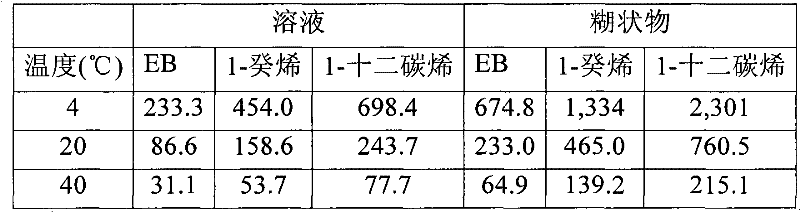
1在各自溶剂中溶液被稀释至7.25wt.%的铬。 1 The solution was diluted to 7.25 wt.% chromium in the respective solvent.
2在图6中图形地表现数据。 2 The data are represented graphically in Figure 6.
表4:6.30wt.%Cr溶液1,2的温度依赖的粘度(以厘沲计)Table 4: Temperature dependent viscosities (in centistokes) of 6.30 wt.% Cr solutions 1, 2

1在图7中图形地表现数据。 1 The data are represented graphically in Figure 7.
2使用形成金属前躯体糊状物。 2 Use to form a metal precursor paste.
如表3和4所示,在图6和7中用图形图解使用形成金属前躯体溶液的现有方法的粘度测定的结果。在这两个图中,在y轴184上标示粘度(以厘沲计,cSt)并且在x轴186上标示温度(以℃计)。在两种情况中,使用1-十二碳烯作为溶剂产生最高的粘度,而使用乙基苯(EB)产生最低的粘度。在图6中,表188显示在4℃的温度下,1-十二碳烯中7.30wt.%的铬溶液得到的最大粘度190为大约700cSt。一般地,该粘度的溶液难于经过容器之间的管道泵送,并且因此难以在工厂中操作。相反,如在图7中的表192中所见,在1-十二碳烯中6.30wt.%的铬得到的最高粘度194小于大约300cSt,产生在工厂中易于操作的溶液。As shown in Tables 3 and 4, the results of viscosity measurements using the prior art method of forming metal precursor solutions are graphically illustrated in Figures 6 and 7 . In both figures, viscosity (in centistokes, cSt) is plotted on the y-axis 184 and temperature (in °C) on the
尽管上述公开的技术可以进行各种改进和可选的形式,但通过附图中的实例已显示为具体的实施方式。但是,应当理解,本技术不被意图限于公开的具体形式。而是,本技术包括落入所附权利要求所限定的本技术的精神和范围内的所有改进、等同物和可选物。While the above disclosed techniques are susceptible to various modifications and alternative forms, specific embodiments have been shown by way of example in the drawings. It should be understood, however, that the technology is not intended to be limited to the particular forms disclosed. Rather, the technology includes all modifications, equivalents and alternatives falling within the spirit and scope of the technology as defined by the appended claims.
Claims (27)
Priority Applications (1)
| Application Number | Priority Date | Filing Date | Title |
|---|---|---|---|
| CN201510629879.0A CN105195219A (en) | 2008-10-31 | 2009-10-30 | Compositions and catalyst systems of metal precursors and olefinic diluents |
Applications Claiming Priority (7)
| Application Number | Priority Date | Filing Date | Title |
|---|---|---|---|
| US11039608P | 2008-10-31 | 2008-10-31 | |
| US11040708P | 2008-10-31 | 2008-10-31 | |
| US11047608P | 2008-10-31 | 2008-10-31 | |
| US61/110,407 | 2008-10-31 | ||
| US61/110,476 | 2008-10-31 | ||
| US61/110,396 | 2008-10-31 | ||
| PCT/US2009/062681 WO2010051405A1 (en) | 2008-10-31 | 2009-10-30 | Compositions and catalyst systems of metal precursors and olefinic diluents |
Related Child Applications (1)
| Application Number | Title | Priority Date | Filing Date |
|---|---|---|---|
| CN201510629879.0A Division CN105195219A (en) | 2008-10-31 | 2009-10-30 | Compositions and catalyst systems of metal precursors and olefinic diluents |
Publications (1)
| Publication Number | Publication Date |
|---|---|
| CN102196862A true CN102196862A (en) | 2011-09-21 |
Family
ID=41471037
Family Applications (4)
| Application Number | Title | Priority Date | Filing Date |
|---|---|---|---|
| CN201510629879.0A Pending CN105195219A (en) | 2008-10-31 | 2009-10-30 | Compositions and catalyst systems of metal precursors and olefinic diluents |
| CN2009801423015A Pending CN102196862A (en) | 2008-10-31 | 2009-10-30 | Composition and catalyst system of metal precursor and olefinic diluent |
| CN2009801376796A Pending CN102164672A (en) | 2008-10-31 | 2009-10-30 | Oligomerization catalyst system and process for oligomerizing olefins |
| CN200980140729.6A Active CN102186587B (en) | 2008-10-31 | 2009-10-30 | System and method of deactivating and quenching an oligomerization catalyst |
Family Applications Before (1)
| Application Number | Title | Priority Date | Filing Date |
|---|---|---|---|
| CN201510629879.0A Pending CN105195219A (en) | 2008-10-31 | 2009-10-30 | Compositions and catalyst systems of metal precursors and olefinic diluents |
Family Applications After (2)
| Application Number | Title | Priority Date | Filing Date |
|---|---|---|---|
| CN2009801376796A Pending CN102164672A (en) | 2008-10-31 | 2009-10-30 | Oligomerization catalyst system and process for oligomerizing olefins |
| CN200980140729.6A Active CN102186587B (en) | 2008-10-31 | 2009-10-30 | System and method of deactivating and quenching an oligomerization catalyst |
Country Status (11)
| Country | Link |
|---|---|
| US (3) | US8049052B2 (en) |
| EP (3) | EP2349561B9 (en) |
| KR (3) | KR101647524B1 (en) |
| CN (4) | CN105195219A (en) |
| AU (3) | AU2009308801B2 (en) |
| BR (3) | BRPI0921731B1 (en) |
| CA (3) | CA2736590A1 (en) |
| ES (3) | ES2509893T3 (en) |
| SG (2) | SG194380A1 (en) |
| WO (3) | WO2010051415A1 (en) |
| ZA (3) | ZA201101619B (en) |
Families Citing this family (93)
| Publication number | Priority date | Publication date | Assignee | Title |
|---|---|---|---|---|
| US8471085B2 (en) | 2008-10-31 | 2013-06-25 | Chevron Phillips Chemical Company Lp | Oligomerization catalyst system and process for oligomerizing olefins |
| US8672837B2 (en) | 2010-06-24 | 2014-03-18 | Hansen Medical, Inc. | Methods and devices for controlling a shapeable medical device |
| RU2471762C1 (en) * | 2011-06-22 | 2013-01-10 | Открытое акционерное общество "СИБУР Холдинг" (ОАО "СИБУР Холдинг") | Method of extracting products of oligomerisation of olefins and decomposition of oligomerisation catalyst residues |
| US8957235B2 (en) | 2011-12-12 | 2015-02-17 | Chevron Phillips Chemical Company Lp | Preparation of transition metal carboxylates |
| US9956548B2 (en) | 2011-12-12 | 2018-05-01 | Chevron Phillips Chemical Company Lp | Preparation of an olefin oligomerization catalyst |
| SG11201402517SA (en) | 2011-12-22 | 2014-06-27 | Exxonmobil Chem Patents Inc | Methods and apparatus for deactivating a catalyst composition |
| US9057600B2 (en) | 2013-03-13 | 2015-06-16 | Hansen Medical, Inc. | Reducing incremental measurement sensor error |
| US10654948B2 (en) | 2013-03-13 | 2020-05-19 | Chevron Phillips Chemical Company Lp | Radically coupled resins and methods of making and using same |
| US10577440B2 (en) | 2013-03-13 | 2020-03-03 | Chevron Phillips Chemical Company Lp | Radically coupled resins and methods of making and using same |
| US9629595B2 (en) | 2013-03-15 | 2017-04-25 | Hansen Medical, Inc. | Systems and methods for localizing, tracking and/or controlling medical instruments |
| US9014851B2 (en) | 2013-03-15 | 2015-04-21 | Hansen Medical, Inc. | Systems and methods for tracking robotically controlled medical instruments |
| US9271663B2 (en) | 2013-03-15 | 2016-03-01 | Hansen Medical, Inc. | Flexible instrument localization from both remote and elongation sensors |
| US11020016B2 (en) | 2013-05-30 | 2021-06-01 | Auris Health, Inc. | System and method for displaying anatomy and devices on a movable display |
| US9627200B2 (en) | 2013-07-29 | 2017-04-18 | US Nano LLC | Synthesis of CdSe/ZnS core/shell semiconductor nanowires |
| EP3028296A4 (en) * | 2013-07-31 | 2017-01-25 | US Nano LLC | Apparatus and methods for continuous flow synthesis of semiconductor nanowires |
| CN105939647B (en) | 2013-10-24 | 2020-01-21 | 奥瑞斯健康公司 | Robot-assisted endovascular surgery system and related methods |
| US9382348B2 (en) | 2013-11-13 | 2016-07-05 | Chevron Phillips Chemical Company Lp | System and method for polymerization |
| KR101568186B1 (en) * | 2014-01-06 | 2015-11-11 | 대림산업 주식회사 | Apparatus and method for polymerizing ethylene and alpha-olefin |
| RU2549833C1 (en) * | 2014-02-18 | 2015-04-27 | Открытое акционерное общество "Нефтяная компания "Роснефть" | Catalytic complex of selective ethylene in 1-hexene trimerisation |
| US9175109B1 (en) | 2014-05-20 | 2015-11-03 | Chevron Phillips Chemical Company Lp | Oligomerization processes and polymer compositions produced therefrom |
| US9505675B2 (en) | 2015-02-09 | 2016-11-29 | Chevron Phillips Chemical Company Lp | Deactivation of a process by-product |
| WO2016129845A1 (en) * | 2015-02-12 | 2016-08-18 | 주식회사 엘지화학 | Deactivating agent and method for reducing olefin oligomerization byproduct using same |
| KR101679515B1 (en) | 2015-02-12 | 2016-11-24 | 주식회사 엘지화학 | Method of preparing catalyst system for oligomerization and catalyst sysyem for oligomerization prepared thereby |
| WO2017010998A1 (en) | 2015-07-14 | 2017-01-19 | Chevron Phillips Chemical Company Lp | Olefin compositions |
| US9732300B2 (en) | 2015-07-23 | 2017-08-15 | Chevron Phillipa Chemical Company LP | Liquid propylene oligomers and methods of making same |
| EP3349649B1 (en) | 2015-09-18 | 2022-03-09 | Auris Health, Inc. | Navigation of tubular networks |
| US10519077B2 (en) | 2015-09-18 | 2019-12-31 | Chevron Phillips Chemical Company Lp | Ethylene oligomerization/trimerization/tetramerization reactor |
| US10513473B2 (en) | 2015-09-18 | 2019-12-24 | Chevron Phillips Chemical Company Lp | Ethylene oligomerization/trimerization/tetramerization reactor |
| WO2017078974A1 (en) | 2015-11-05 | 2017-05-11 | Chevron Phillips Chemical Company Lp | Radically coupled resins and methods of making and using same |
| US10143526B2 (en) | 2015-11-30 | 2018-12-04 | Auris Health, Inc. | Robot-assisted driving systems and methods |
| CN107235885B (en) * | 2016-03-28 | 2021-11-19 | 中国石油化工股份有限公司 | Ligand compound and preparation method and application thereof |
| CN107233919B (en) * | 2016-03-28 | 2020-10-20 | 中国石油化工股份有限公司 | Oligomerization catalyst composition and application thereof |
| US10414698B2 (en) | 2016-05-27 | 2019-09-17 | Chevron Phillips Chemical Company Lp | Reduced polymer formation for selective ethylene oligomerizations |
| US10329212B2 (en) | 2016-05-27 | 2019-06-25 | Chevron Phillips Chemical Company Lp | Reduced polymer formation for selective ethylene oligomerizations |
| US10414699B2 (en) | 2016-05-27 | 2019-09-17 | Chevron Phillips Chemical Company Lp | Process improvements in selective ethylene oligomerizations |
| US10244926B2 (en) | 2016-12-28 | 2019-04-02 | Auris Health, Inc. | Detecting endolumenal buckling of flexible instruments |
| US10604457B2 (en) | 2016-12-29 | 2020-03-31 | Chevron Phillips Chemical Company Lp | Ethylene oligomerization processes |
| US20180186708A1 (en) | 2016-12-29 | 2018-07-05 | Chevron Phillips Chemical Company Lp | Ethylene Oligomerization Processes |
| US10407360B2 (en) | 2017-12-22 | 2019-09-10 | Chevron Phillips Chemical Company Lp | Ethylene oligomerization processes |
| EP3600031A4 (en) | 2017-03-31 | 2021-01-20 | Auris Health, Inc. | ROBOTIC SYSTEMS FOR NAVIGATION OF LUMINAL NETWORKS THAT COMPENSATE FOR PHYSIOLOGICAL NOISE |
| US10550252B2 (en) | 2017-04-20 | 2020-02-04 | Chevron Phillips Chemical Company Lp | Bimodal PE resins with improved melt strength |
| US10232339B2 (en) | 2017-06-06 | 2019-03-19 | Chevron Phillips Chemical Company Lp | Fouling protection for an oligomerization reactor inlet |
| US10022192B1 (en) | 2017-06-23 | 2018-07-17 | Auris Health, Inc. | Automatically-initialized robotic systems for navigation of luminal networks |
| CN110913788B (en) | 2017-06-28 | 2024-03-12 | 奥瑞斯健康公司 | Electromagnetic distortion detection |
| US11832889B2 (en) | 2017-06-28 | 2023-12-05 | Auris Health, Inc. | Electromagnetic field generator alignment |
| US10183960B1 (en) | 2017-09-22 | 2019-01-22 | Chevron Phillips Chemical Company Lp | Perfluorohydrocarbyl-N2-phosphinyl amidine compounds, chromium salt complexes, catalyst systems, and their use to oligomerize ethylene |
| US10493442B2 (en) | 2017-09-22 | 2019-12-03 | Chevron Phillips Chemical Company Lp | Fluorinated N2-phosphinyl amidine compounds, chromium salt complexes, catalyst systems, and their use to oligomerize ethylene |
| US10294171B2 (en) | 2017-09-22 | 2019-05-21 | Chevron Phillips Chemical Company Lp | Carbonyl-containing perfluorohydrocarbyl-N2-phosphinyl amidine compounds, chromium salt complexes and their use to oligomerize ethylene |
| US10464862B2 (en) | 2017-09-28 | 2019-11-05 | Chevron Phillips Chemical Company Lp | Oligomerization reactions using aluminoxanes |
| KR102334363B1 (en) * | 2017-09-29 | 2021-12-02 | 에스케이이노베이션 주식회사 | Process for preparing oligomer using olefin |
| US10555778B2 (en) | 2017-10-13 | 2020-02-11 | Auris Health, Inc. | Image-based branch detection and mapping for navigation |
| US11058493B2 (en) | 2017-10-13 | 2021-07-13 | Auris Health, Inc. | Robotic system configured for navigation path tracing |
| KR102334373B1 (en) * | 2017-11-30 | 2021-12-02 | 에스케이이노베이션 주식회사 | Process for preparing oligomer using olefin |
| EP3684562B1 (en) | 2017-12-14 | 2025-03-12 | Auris Health, Inc. | System and program for estimating instrument location |
| CN110809453B (en) | 2017-12-18 | 2023-06-06 | 奥瑞斯健康公司 | Methods and systems for instrument tracking and navigation within a luminal network |
| WO2019191144A1 (en) | 2018-03-28 | 2019-10-03 | Auris Health, Inc. | Systems and methods for registration of location sensors |
| CN110913791B (en) | 2018-03-28 | 2021-10-08 | 奥瑞斯健康公司 | System and method for displaying estimated instrument location |
| US10905499B2 (en) | 2018-05-30 | 2021-02-02 | Auris Health, Inc. | Systems and methods for location sensor-based branch prediction |
| WO2019231891A1 (en) | 2018-05-31 | 2019-12-05 | Auris Health, Inc. | Path-based navigation of tubular networks |
| KR102455671B1 (en) | 2018-05-31 | 2022-10-20 | 아우리스 헬스, 인코포레이티드 | Image-Based Airway Analysis and Mapping |
| EP3801280B1 (en) | 2018-05-31 | 2024-10-02 | Auris Health, Inc. | Robotic systems for navigation of luminal network that detect physiological noise |
| KR102604431B1 (en) * | 2018-07-26 | 2023-11-22 | 에스케이이노베이션 주식회사 | Method for manufacturing linear alpha olefin |
| WO2020069404A1 (en) | 2018-09-28 | 2020-04-02 | Auris Health, Inc. | Robotic systems and methods for concomitant endoscopic and percutaneous medical procedures |
| SG11202108363RA (en) * | 2019-02-22 | 2021-08-30 | Sibur Holding Public Joint Stock Co | A method for separating olefin oligomerization products (variants) |
| US12478444B2 (en) | 2019-03-21 | 2025-11-25 | The Board Of Trustees Of The Leland Stanford Junior University | Systems and methods for localization based on machine learning |
| WO2021038469A1 (en) | 2019-08-30 | 2021-03-04 | Auris Health, Inc. | Systems and methods for weight-based registration of location sensors |
| JP7451686B2 (en) | 2019-08-30 | 2024-03-18 | オーリス ヘルス インコーポレイテッド | Instrument image reliability system and method |
| WO2021044297A1 (en) | 2019-09-03 | 2021-03-11 | Auris Health, Inc. | Electromagnetic distortion detection and compensation |
| WO2021085616A1 (en) * | 2019-10-31 | 2021-05-06 | Jsr株式会社 | Method for producing modified conjugated-diene-based polymer, polymer composition, crosslinked object, and tire |
| WO2021252624A1 (en) | 2020-06-10 | 2021-12-16 | Chevron Phillips Chemical Company Lp | Machine learning and statistical analysis for catalyst structure prediction and design |
| US11267909B2 (en) | 2020-07-15 | 2022-03-08 | Chevron Phillips Chemical Company Lp | Oligomerization catalyst system activation and related ethylene oligomerization processes and reaction systems |
| FR3112969B1 (en) * | 2020-07-30 | 2022-08-05 | Ifp Energies Now | NEW CATALYTIC COMPOSITION BASED ON CHROMIUM AND ASSOCIATED PROCESS FOR THE TRIMERIZATION OF ETHYLENE INTO HEXENE-1 |
| US11674023B2 (en) | 2020-10-15 | 2023-06-13 | Chevron Phillips Chemical Company Lp | Polymer composition and methods of making and using same |
| US11458463B2 (en) | 2020-11-30 | 2022-10-04 | Saudi Arabian Oil Company | Catalyst systems |
| WO2022115751A1 (en) | 2020-11-30 | 2022-06-02 | Saudi Arabian Oil Company | Catalyst systems |
| WO2022115748A1 (en) | 2020-11-30 | 2022-06-02 | Saudi Arabian Oil Company | Catalyst systems |
| US11623208B2 (en) | 2020-11-30 | 2023-04-11 | Saudi Arabian Oil Company | Catalyst systems |
| US11440857B2 (en) | 2020-11-30 | 2022-09-13 | Saudi Arabian Oil Company | Catalyst systems |
| AR124331A1 (en) * | 2020-12-15 | 2023-03-15 | Shell Int Research | A PROCESS TO PRODUCE a-OLEFINS |
| CN116917040A (en) | 2021-03-12 | 2023-10-20 | 沙特阿拉伯石油公司 | Catalyst system |
| US11859041B2 (en) | 2021-08-16 | 2024-01-02 | Chevron Phillips Chemical Company Lp | Modulating co-monomer selectivity using non-covalent dispersion interactions in group 4 olefin polymerization catalysts |
| WO2023027749A1 (en) | 2021-08-26 | 2023-03-02 | Saudi Arabian Oil Company | Catalyst systems |
| US11505513B1 (en) | 2021-11-08 | 2022-11-22 | Chevron Phillips Chemical Company, Lp | Chromium bicyclic phosphinyl amidine complexes for tetramerization of ethylene |
| US11583843B1 (en) | 2021-11-08 | 2023-02-21 | Chevron Phillips Chemical Company, Lp | Chromium phosphinyl isoindole amidine complexes for tetramerization of ethylene |
| US11492305B1 (en) | 2021-11-08 | 2022-11-08 | Chevron Phillips Chemical Company, Lp | Chromium phosphinyl hydroisoindole amidine complexes for tetramerization of ethylene |
| US12435016B2 (en) | 2022-07-28 | 2025-10-07 | Chevron Phillips Chemical Company Lp | Flexible benzene production via selective-higher-olefin oligomerization of ethylene |
| US11639321B1 (en) | 2022-08-31 | 2023-05-02 | Saudi Arabian Oil Company | Catalyst systems that include meta-alkoxy substituted n-aryl bis-diphosphinoamine ligands |
| US11623901B1 (en) | 2022-08-31 | 2023-04-11 | Saudi Arabian Oil Company | Catalyst systems that include silyl ether moieties |
| US11878952B1 (en) * | 2022-11-14 | 2024-01-23 | Chevron Phillips Chemical Company Lp | Oligomerization catalyst system deactivation and related ethylene oligomerization processes |
| US20250074844A1 (en) | 2023-08-28 | 2025-03-06 | Chevron Phillips Chemical Company Lp | Polyalphaolefins made from dimer olefins obtained from branched c10 monoolefins using solid acid catalyst |
| US20250075015A1 (en) | 2023-08-28 | 2025-03-06 | Chevron Phillips Chemical Company Lp | Polyalphaolefins made from dimer olefins obtained from branched c10 monoolefins using alkyl aluminum catalyst |
| US12540287B2 (en) | 2023-09-07 | 2026-02-03 | Chevron Phillips Chemical Company Lp | Sustainable aviation fuel from normal alpha olefin byproducts and process for same |
| US12528999B2 (en) | 2023-09-07 | 2026-01-20 | Chevron Phillips Chemical Company Lp | Sustainable jet fuel and process |
Citations (4)
| Publication number | Priority date | Publication date | Assignee | Title |
|---|---|---|---|---|
| US5243114A (en) * | 1992-09-08 | 1993-09-07 | Mobil Oil Corporation | Oligomerization of alpha-olefins over layered silicate compositions containing pillars of silica and group VIB metal oxide |
| WO2000034211A1 (en) * | 1998-12-04 | 2000-06-15 | Bp Chemicals Limited | Oligomerisation process |
| US6133495A (en) * | 1996-03-14 | 2000-10-17 | Mitsubishi Chemical Corporation | Process for producing α-olefin oligomer |
| CN1745109A (en) * | 2000-08-18 | 2006-03-08 | 切弗朗菲利浦化学公司 | Olefin polymers, methods of manufacture and applications thereof |
Family Cites Families (92)
| Publication number | Priority date | Publication date | Assignee | Title |
|---|---|---|---|---|
| US2935495A (en) | 1956-11-27 | 1960-05-03 | Sun Oil Co | Manufacture of polyolefins |
| US3100764A (en) | 1960-08-04 | 1963-08-13 | Sun Oil Co | Control of pentane-soluble polymers in the polymerization of propylene |
| US3662021A (en) * | 1960-09-14 | 1972-05-09 | Exxon Research Engineering Co | Process for preparing linear olefins |
| US4486615A (en) * | 1960-09-14 | 1984-12-04 | Exxon Research & Engineering Co. | Preparation of linear olefin products |
| US4409414A (en) * | 1960-09-14 | 1983-10-11 | Exxon Research And Engineering Co. | Preparation of linear olefin products |
| US3347840A (en) | 1964-06-16 | 1967-10-17 | Union Carbide Corp | Polymerization process |
| US3300458A (en) | 1963-08-19 | 1967-01-24 | Union Carbide Corp | Continuous processes for the production of ethylene polymers and catalysts suitable therefor |
| US3242099A (en) | 1964-03-27 | 1966-03-22 | Union Carbide Corp | Olefin polymerization catalysts |
| US3231550A (en) | 1964-06-04 | 1966-01-25 | Union Carbide Corp | Olefin polymerization |
| US3534006A (en) | 1966-03-25 | 1970-10-13 | Toray Industries | Methods of polymerizing alpha-olefins with a transition metal and a bis(dialkylaluminumoxy)alkane compound |
| US3558676A (en) | 1967-04-19 | 1971-01-26 | Edward E Doherty | Fatty acid chromium complex salts and compositions thereof |
| US3968135A (en) | 1970-01-19 | 1976-07-06 | Aerojet-General Corporation | Chromium salt catalysts |
| US3635869A (en) | 1970-03-16 | 1972-01-18 | Aerojet General Co | Catalysis of epoxy resin/carboxylic acid systems with trivalent chromium iii tricarboxylate salts |
| US3838101A (en) | 1970-04-13 | 1974-09-24 | Aerojet General Co | Reactions between an organic diimide and an epoxy resin with a chromium iii tricarboxylate catalyst |
| US3873602A (en) | 1970-09-18 | 1975-03-25 | Aerojet General Co | Beta hydroxy esters |
| BE794059A (en) | 1972-01-14 | 1973-05-02 | Aerojet General Co | NEW COMPOSITONS BASED ON OXIRANNE-IMIDE THEIR PREPARATION AND USE |
| US3978026A (en) | 1972-02-18 | 1976-08-31 | Aerojet-General Corporation | Catalysts of the oxirane-anhydride reaction |
| US3977996A (en) | 1972-02-18 | 1976-08-31 | Aerojet-General Corporation | Catalysts for the oxirane-anhydride reaction |
| US3962182A (en) | 1972-11-21 | 1976-06-08 | Aerojet-General Corporation | Imide oxirane reactions |
| US4017429A (en) | 1973-08-17 | 1977-04-12 | Aerojet-General Corporation | Preparation of 2-hydroxyalkyl esters |
| US3932285A (en) | 1973-10-03 | 1976-01-13 | Tenneco Chemicals, Inc. | Chromium salt compositions and a process for their production |
| FR2253029A2 (en) | 1973-12-03 | 1975-06-27 | Ethylene Plastique Sa | Highly stereospecific polyolefins prodn. - using Ziegler catalyst and pyrrole carboxaldehyde additive |
| US4426229A (en) * | 1976-11-26 | 1984-01-17 | Petrolite Corporation | Oxidized alpha-olefins |
| US4224181A (en) | 1979-03-07 | 1980-09-23 | Exxon Research & Engineering Co. | Ziegler type catalyst system |
| JPS5817104A (en) | 1981-07-23 | 1983-02-01 | Chisso Corp | Production of alpha-olefin polymer |
| JPS6067508A (en) | 1983-09-22 | 1985-04-17 | Toa Nenryo Kogyo Kk | Polymerization of olefin |
| US4806513A (en) | 1984-05-29 | 1989-02-21 | Phillips Petroleum Company | Silicon and fluorine-treated alumina containing a chromium catalyst and method of producing same |
| FR2565591B1 (en) | 1984-06-08 | 1986-08-29 | Inst Francais Du Petrole | PROCESS FOR THE MANUFACTURE OF AN ETHYLENE-BUTENE-1 COPOLYMER FROM ETHYLENE |
| US4668808A (en) | 1984-08-13 | 1987-05-26 | Phillips Petroleum Company | Polychromium compounds and processes to make same |
| US4644073A (en) | 1985-03-11 | 1987-02-17 | Phillips Petroleum Company | Permeability contrast correction employing a sulfate-free propionate-sequestered chromium (III) solution |
| US4636572A (en) | 1985-03-11 | 1987-01-13 | Phillips Petroleum Company | Permeability contrast correction employing propionate-sequestered chromium(III) prepared by nitrite/dichromate redox |
| US4701504A (en) * | 1986-01-23 | 1987-10-20 | Du Pont Canada Inc. | Reduction of isomerization in solution process for polymerization of alpha-olefins |
| US4668838A (en) | 1986-03-14 | 1987-05-26 | Union Carbide Corporation | Process for trimerization |
| DE3635710A1 (en) | 1986-10-21 | 1988-04-28 | Basf Ag | METHOD FOR PRODUCING HOMOS AND COPOLYMERISATES OF ETHENS BY PHILLIPS CATALYSIS |
| US5331104A (en) | 1989-08-10 | 1994-07-19 | Phillips Petroleum Company | Chromium compounds and uses thereof |
| US5376612A (en) | 1989-08-10 | 1994-12-27 | Phillips Petroleum Company | Chromium catalysts and process for making chromium catalysts |
| CA2020509C (en) | 1989-08-10 | 1998-04-28 | William K. Reagen | Chromium compounds and uses thereof |
| US5451645A (en) | 1989-08-10 | 1995-09-19 | Phillips Petroleum Company | Process for olefin polymerization |
| US5198563A (en) | 1989-08-10 | 1993-03-30 | Phillips Petroleum Company | Chromium compounds and uses thereof |
| US5438027A (en) | 1991-12-13 | 1995-08-01 | Phillips Petroleum Company | Chromium compounds and uses thereof |
| EP0548805B1 (en) | 1991-12-18 | 1997-03-05 | Phillips Petroleum Company | Process for the preparation of polymerisation catalysts |
| US6043401A (en) | 1992-05-26 | 2000-03-28 | Bp Amoco Corporation | Reactive, low molecular weight, viscous poly(1-olefins) and copoly(1-olefins) and their method of manufacture |
| US5331070A (en) | 1992-11-13 | 1994-07-19 | Phillips Petroleum Company | Process for olefin polymerization |
| CA2087578C (en) | 1993-01-19 | 1998-10-27 | William Kevin Reagen | Preparing catalyst for olefin polymerization |
| CA2134503C (en) * | 1994-02-18 | 2001-04-10 | Mark E. Lashier | Olefin production |
| US5543375A (en) | 1994-02-18 | 1996-08-06 | Phillips Petroleum Company | Olefin production |
| MY115177A (en) | 1994-06-21 | 2003-04-30 | Mitsubishi Chem Corp | Process for producing (alpha) -olefin oligomers |
| JP3613642B2 (en) | 1994-09-05 | 2005-01-26 | 住友化学株式会社 | Method for producing 1-hexene |
| KR100414008B1 (en) * | 1995-03-02 | 2004-04-29 | 미쓰비시 가가꾸 가부시키가이샤 | Production method of α-olefin oligomer |
| US5591878A (en) | 1995-09-19 | 1997-01-07 | Kemin Industries, Inc. | Catalyzed process for producing metal carboxylates for use as animal feed supplements |
| US5859303A (en) | 1995-12-18 | 1999-01-12 | Phillips Petroleum Company | Olefin production |
| US5856612A (en) * | 1996-02-02 | 1999-01-05 | Mitsubishi Chemical Corporation | Process for producing α-olefin oligomer |
| DE19617230A1 (en) * | 1996-04-30 | 1997-11-06 | Basf Ag | Oxidized metallocene polyolefin waxes |
| US5731381A (en) * | 1996-11-01 | 1998-03-24 | Union Carbide Chemicals & Plastics Technology Corporation | Termination of gas phase polymerizations of conjugated dienes, vinyl-substituted aromatic compounds and mixtures thereof |
| DE19700892A1 (en) * | 1997-01-14 | 1998-07-16 | Basf Ag | Process for the production of oxidized polyolefin waxes |
| US5856257A (en) | 1997-05-16 | 1999-01-05 | Phillips Petroleum Company | Olefin production |
| US5986153A (en) | 1997-09-30 | 1999-11-16 | Phillips Petroleum Company | Olefin color stabilization |
| US20020182124A1 (en) * | 1997-10-14 | 2002-12-05 | William M. Woodard | Olefin production process |
| US6100223A (en) | 1997-12-30 | 2000-08-08 | Chevron Chemical Company Llc | Method of converting olefins into mixtures of secondary esters, products and uses thereof |
| CN1108193C (en) * | 1998-12-15 | 2003-05-14 | 北京燕山石油化工公司研究院 | Novel catalyst for ethylene trimerization, its preparation process and application |
| US20010053742A1 (en) | 1998-12-18 | 2001-12-20 | Ronald D. Knudsen | Catalyst and processes for olefin trimerization |
| US6133496A (en) * | 1999-03-09 | 2000-10-17 | Phillips Petroleum Company | Two-stage isomerization of saturated C.sub. 6 hydrocarbons |
| US6455648B1 (en) | 1999-12-29 | 2002-09-24 | Chevron Phillips Chemical Company Lp | Olefin production |
| CN1399620A (en) | 1999-12-29 | 2003-02-26 | 菲利浦石油公司 | Method for preventing generation of hydrogen halide in oligomerization product recovery system |
| US6380451B1 (en) | 1999-12-29 | 2002-04-30 | Phillips Petroleum Company | Methods for restoring the heat transfer coefficient of an oligomerization reactor |
| US7259284B2 (en) | 2000-05-31 | 2007-08-21 | Chevron Phillips Chemical Company, Lp | Method for manufacturing high viscosity polyalphaolefins using ionic liquid catalysts |
| US7396970B1 (en) | 2000-11-03 | 2008-07-08 | Chevron Phillips Chemical Company Lp | Monitoring and control of processes for making 1-hexene |
| US6911506B2 (en) | 2001-12-10 | 2005-06-28 | Chevron Phillips Chemical Company Lp | Catalyst composition and olefin polymerization using same |
| AU2003223727A1 (en) | 2002-04-22 | 2003-11-03 | Chevron Phillips Chemical Company Lp | Method for manufacturing high viscosity polyalphaolefins using ionic liquid catalysts |
| US7297832B2 (en) * | 2002-12-20 | 2007-11-20 | Sasol Technology (Pty) Limited | Tetramerization of olefins |
| US7045632B2 (en) | 2003-03-04 | 2006-05-16 | Chevron Phillips Chemical Company, Lp | Composition and method for a hexadentate ligand and bimetallic complex for polymerization of olefins |
| TW200502038A (en) * | 2003-03-14 | 2005-01-16 | Chevron Phillips Chemical Co | Process to decrease or eliminate corrosion from the decomposition of halide containing olefin catalysts |
| CN100390115C (en) | 2003-10-31 | 2008-05-28 | 切夫里昂菲利普化学有限责任公司 | Methods and systems for contacting ionic liquid catalysts with oxygen to improve chemical reactions |
| US7026415B2 (en) * | 2004-02-17 | 2006-04-11 | Equistar Chemicals, Lp | Clathrochelates as olefin polymerization catalyst components |
| US20070043181A1 (en) | 2005-08-19 | 2007-02-22 | Knudsen Ronald D | Methods of preparation of an olefin oligomerization catalyst |
| US20050187098A1 (en) * | 2004-02-20 | 2005-08-25 | Knudsen Ronald D. | Methods of preparation of an olefin oligomerization catalyst |
| US7384886B2 (en) * | 2004-02-20 | 2008-06-10 | Chevron Phillips Chemical Company Lp | Methods of preparation of an olefin oligomerization catalyst |
| US7476775B2 (en) * | 2004-03-03 | 2009-01-13 | Chevron Phillips Chemical Company Lp | Method and system for separating an oligomerization reactor effluent |
| US7307133B2 (en) | 2004-04-22 | 2007-12-11 | Chevron Phillips Chemical Company Lp | Polymers having broad molecular weight distributions and methods of making the same |
| US7615510B2 (en) | 2004-05-12 | 2009-11-10 | Chevron Phillips Chemical Company Lp | Methods of activating chromium catalysts |
| US7527686B2 (en) * | 2004-11-23 | 2009-05-05 | Chevron Phillips Chemical Company, Lp | Olefin waxes having improved hardness or viscosity |
| US7456284B2 (en) | 2004-12-10 | 2008-11-25 | Chevron Phillips Chemical Company Lp | Methods for producing a hexadentate bimetallic complex |
| EP1848729A2 (en) | 2005-01-27 | 2007-10-31 | Ocean Nutrition Canada Limited | Chromium-fatty acid compounds and methods of making and using thereof |
| EP1856010B1 (en) | 2005-03-09 | 2010-07-28 | ExxonMobil Chemical Patents Inc. | Methods for oligomerizing olefins |
| US7271121B2 (en) | 2005-07-21 | 2007-09-18 | Chevron Phillips Chemical Company Lp | Diimine metal complexes, methods of synthesis, and methods of using in oligomerization and polymerization |
| US7268096B2 (en) | 2005-07-21 | 2007-09-11 | Chevron Phillips Chemical Company Lp | Diimine metal complexes, methods of synthesis, and methods of using in oligomerization and polymerization |
| US7129304B1 (en) | 2005-07-21 | 2006-10-31 | Chevron Phillips Chemical Company Lp | Dimine metal complexes, methods of synthesis, and methods of using in oligomerization and polymerization |
| EP1754694A1 (en) * | 2005-08-10 | 2007-02-21 | Linde AG | Method for deactivation and removal of catalytic components in the oligomerisation of ethylene |
| US7982085B2 (en) | 2006-02-03 | 2011-07-19 | Exxonmobil Chemical Patents Inc. | In-line process for generating comonomer |
| US7687672B2 (en) | 2006-02-03 | 2010-03-30 | Exxonmobil Chemical Patents Inc. | In-line process for generating comonomer |
| US7378537B2 (en) | 2006-07-25 | 2008-05-27 | Chevron Phillips Chemical Company Lp | Olefin oligomerization catalysts and methods of using same |
| US8471085B2 (en) | 2008-10-31 | 2013-06-25 | Chevron Phillips Chemical Company Lp | Oligomerization catalyst system and process for oligomerizing olefins |
-
2009
- 2009-10-30 BR BRPI0921731-2A patent/BRPI0921731B1/en active IP Right Grant
- 2009-10-30 CA CA2736590A patent/CA2736590A1/en not_active Abandoned
- 2009-10-30 CN CN201510629879.0A patent/CN105195219A/en active Pending
- 2009-10-30 WO PCT/US2009/062700 patent/WO2010051415A1/en not_active Ceased
- 2009-10-30 SG SG2013072749A patent/SG194380A1/en unknown
- 2009-10-30 AU AU2009308801A patent/AU2009308801B2/en active Active
- 2009-10-30 CA CA2741568A patent/CA2741568C/en active Active
- 2009-10-30 US US12/609,631 patent/US8049052B2/en active Active
- 2009-10-30 CN CN2009801423015A patent/CN102196862A/en active Pending
- 2009-10-30 AU AU2009308744A patent/AU2009308744A1/en not_active Abandoned
- 2009-10-30 EP EP20090744887 patent/EP2349561B9/en active Active
- 2009-10-30 WO PCT/US2009/062681 patent/WO2010051405A1/en not_active Ceased
- 2009-10-30 AU AU2009308790A patent/AU2009308790B2/en active Active
- 2009-10-30 BR BRPI0921636-7A patent/BRPI0921636B1/en active IP Right Grant
- 2009-10-30 WO PCT/US2009/062774 patent/WO2010051450A1/en not_active Ceased
- 2009-10-30 KR KR1020117009065A patent/KR101647524B1/en active Active
- 2009-10-30 CN CN2009801376796A patent/CN102164672A/en active Pending
- 2009-10-30 EP EP09744578.7A patent/EP2349562B1/en active Active
- 2009-10-30 CA CA2740217A patent/CA2740217C/en active Active
- 2009-10-30 CN CN200980140729.6A patent/CN102186587B/en active Active
- 2009-10-30 ES ES09744887.2T patent/ES2509893T3/en active Active
- 2009-10-30 SG SG2013072756A patent/SG194381A1/en unknown
- 2009-10-30 EP EP09744580.3A patent/EP2349563B1/en active Active
- 2009-10-30 ES ES09744578T patent/ES2530891T3/en active Active
- 2009-10-30 US US12/609,272 patent/US9352309B2/en active Active
- 2009-10-30 KR KR1020117005407A patent/KR20110081940A/en not_active Ceased
- 2009-10-30 KR KR1020117009067A patent/KR101642164B1/en active Active
- 2009-10-30 ES ES09744580T patent/ES2530892T3/en active Active
- 2009-10-30 US US12/609,189 patent/US9375708B2/en active Active
- 2009-10-30 BR BRPI0921633-2A patent/BRPI0921633B1/en active IP Right Grant
-
2011
- 2011-03-02 ZA ZA2011/01619A patent/ZA201101619B/en unknown
- 2011-04-08 ZA ZA2011/02638A patent/ZA201102638B/en unknown
- 2011-04-13 ZA ZA2011/02759A patent/ZA201102759B/en unknown
Patent Citations (4)
| Publication number | Priority date | Publication date | Assignee | Title |
|---|---|---|---|---|
| US5243114A (en) * | 1992-09-08 | 1993-09-07 | Mobil Oil Corporation | Oligomerization of alpha-olefins over layered silicate compositions containing pillars of silica and group VIB metal oxide |
| US6133495A (en) * | 1996-03-14 | 2000-10-17 | Mitsubishi Chemical Corporation | Process for producing α-olefin oligomer |
| WO2000034211A1 (en) * | 1998-12-04 | 2000-06-15 | Bp Chemicals Limited | Oligomerisation process |
| CN1745109A (en) * | 2000-08-18 | 2006-03-08 | 切弗朗菲利浦化学公司 | Olefin polymers, methods of manufacture and applications thereof |
Also Published As
Similar Documents
| Publication | Publication Date | Title |
|---|---|---|
| CN102186587B (en) | System and method of deactivating and quenching an oligomerization catalyst | |
| US8372771B2 (en) | System and method for catalyst activation | |
| US9079986B2 (en) | Polyolefin production with different diluents in multiple polymerization reactors | |
| CN101547941B (en) | Production method of α-olefin oligomer | |
| CN102741302B (en) | Compressible liquid thinner in polyolefin polymerization | |
| KR20170071596A (en) | Ethylene interpolymer product with dilution index | |
| KR20130067250A (en) | Oligomerization catalyst system and process for oligomerizing olefins | |
| MX2011002451A (en) | System and method for deinventory of polymerization reactor. | |
| Salian et al. | Industrially relevant ethylene trimerization catalysts and processes | |
| CN107810231B (en) | Polymer composition comprising linear low density polyethylene | |
| CN101939344B (en) | Methods of preparing a polymerization catalyst |
Legal Events
| Date | Code | Title | Description |
|---|---|---|---|
| C06 | Publication | ||
| PB01 | Publication | ||
| C10 | Entry into substantive examination | ||
| SE01 | Entry into force of request for substantive examination | ||
| C12 | Rejection of a patent application after its publication | ||
| RJ01 | Rejection of invention patent application after publication |
Application publication date: 20110921 |