CN102131777B - Piperidyl acrylamide antogonists of CCR2 - Google Patents
Piperidyl acrylamide antogonists of CCR2 Download PDFInfo
- Publication number
- CN102131777B CN102131777B CN200980133860.XA CN200980133860A CN102131777B CN 102131777 B CN102131777 B CN 102131777B CN 200980133860 A CN200980133860 A CN 200980133860A CN 102131777 B CN102131777 B CN 102131777B
- Authority
- CN
- China
- Prior art keywords
- compound
- disease
- uveitis
- diseases
- alkyl
- Prior art date
- Legal status (The legal status is an assumption and is not a legal conclusion. Google has not performed a legal analysis and makes no representation as to the accuracy of the status listed.)
- Expired - Fee Related
Links
- 0 C*(*)*1CCC(*)CC1 Chemical compound C*(*)*1CCC(*)CC1 0.000 description 2
Classifications
-
- C—CHEMISTRY; METALLURGY
- C07—ORGANIC CHEMISTRY
- C07D—HETEROCYCLIC COMPOUNDS
- C07D209/00—Heterocyclic compounds containing five-membered rings, condensed with other rings, with one nitrogen atom as the only ring hetero atom
- C07D209/02—Heterocyclic compounds containing five-membered rings, condensed with other rings, with one nitrogen atom as the only ring hetero atom condensed with one carbocyclic ring
- C07D209/04—Indoles; Hydrogenated indoles
- C07D209/10—Indoles; Hydrogenated indoles with substituted hydrocarbon radicals attached to carbon atoms of the hetero ring
- C07D209/14—Radicals substituted by nitrogen atoms, not forming part of a nitro radical
-
- C—CHEMISTRY; METALLURGY
- C07—ORGANIC CHEMISTRY
- C07D—HETEROCYCLIC COMPOUNDS
- C07D311/00—Heterocyclic compounds containing six-membered rings having one oxygen atom as the only hetero atom, condensed with other rings
- C07D311/02—Heterocyclic compounds containing six-membered rings having one oxygen atom as the only hetero atom, condensed with other rings ortho- or peri-condensed with carbocyclic rings or ring systems
- C07D311/04—Benzo[b]pyrans, not hydrogenated in the carbocyclic ring
- C07D311/42—Benzo[b]pyrans, not hydrogenated in the carbocyclic ring with oxygen or sulfur atoms in positions 2 and 4
- C07D311/44—Benzo[b]pyrans, not hydrogenated in the carbocyclic ring with oxygen or sulfur atoms in positions 2 and 4 with one hydrogen atom in position 3
-
- A—HUMAN NECESSITIES
- A61—MEDICAL OR VETERINARY SCIENCE; HYGIENE
- A61K—PREPARATIONS FOR MEDICAL, DENTAL OR TOILETRY PURPOSES
- A61K31/00—Medicinal preparations containing organic active ingredients
- A61K31/33—Heterocyclic compounds
- A61K31/395—Heterocyclic compounds having nitrogen as a ring hetero atom, e.g. guanethidine or rifamycins
- A61K31/435—Heterocyclic compounds having nitrogen as a ring hetero atom, e.g. guanethidine or rifamycins having six-membered rings with one nitrogen as the only ring hetero atom
- A61K31/44—Non condensed pyridines; Hydrogenated derivatives thereof
- A61K31/445—Non condensed piperidines, e.g. piperocaine
- A61K31/45—Non condensed piperidines, e.g. piperocaine having oxo groups directly attached to the heterocyclic ring, e.g. cycloheximide
-
- A—HUMAN NECESSITIES
- A61—MEDICAL OR VETERINARY SCIENCE; HYGIENE
- A61P—SPECIFIC THERAPEUTIC ACTIVITY OF CHEMICAL COMPOUNDS OR MEDICINAL PREPARATIONS
- A61P1/00—Drugs for disorders of the alimentary tract or the digestive system
- A61P1/02—Stomatological preparations, e.g. drugs for caries, aphtae, periodontitis
-
- A—HUMAN NECESSITIES
- A61—MEDICAL OR VETERINARY SCIENCE; HYGIENE
- A61P—SPECIFIC THERAPEUTIC ACTIVITY OF CHEMICAL COMPOUNDS OR MEDICINAL PREPARATIONS
- A61P1/00—Drugs for disorders of the alimentary tract or the digestive system
- A61P1/04—Drugs for disorders of the alimentary tract or the digestive system for ulcers, gastritis or reflux esophagitis, e.g. antacids, inhibitors of acid secretion, mucosal protectants
-
- A—HUMAN NECESSITIES
- A61—MEDICAL OR VETERINARY SCIENCE; HYGIENE
- A61P—SPECIFIC THERAPEUTIC ACTIVITY OF CHEMICAL COMPOUNDS OR MEDICINAL PREPARATIONS
- A61P11/00—Drugs for disorders of the respiratory system
-
- A—HUMAN NECESSITIES
- A61—MEDICAL OR VETERINARY SCIENCE; HYGIENE
- A61P—SPECIFIC THERAPEUTIC ACTIVITY OF CHEMICAL COMPOUNDS OR MEDICINAL PREPARATIONS
- A61P11/00—Drugs for disorders of the respiratory system
- A61P11/02—Nasal agents, e.g. decongestants
-
- A—HUMAN NECESSITIES
- A61—MEDICAL OR VETERINARY SCIENCE; HYGIENE
- A61P—SPECIFIC THERAPEUTIC ACTIVITY OF CHEMICAL COMPOUNDS OR MEDICINAL PREPARATIONS
- A61P11/00—Drugs for disorders of the respiratory system
- A61P11/06—Antiasthmatics
-
- A—HUMAN NECESSITIES
- A61—MEDICAL OR VETERINARY SCIENCE; HYGIENE
- A61P—SPECIFIC THERAPEUTIC ACTIVITY OF CHEMICAL COMPOUNDS OR MEDICINAL PREPARATIONS
- A61P13/00—Drugs for disorders of the urinary system
- A61P13/12—Drugs for disorders of the urinary system of the kidneys
-
- A—HUMAN NECESSITIES
- A61—MEDICAL OR VETERINARY SCIENCE; HYGIENE
- A61P—SPECIFIC THERAPEUTIC ACTIVITY OF CHEMICAL COMPOUNDS OR MEDICINAL PREPARATIONS
- A61P17/00—Drugs for dermatological disorders
- A61P17/02—Drugs for dermatological disorders for treating wounds, ulcers, burns, scars, keloids, or the like
-
- A—HUMAN NECESSITIES
- A61—MEDICAL OR VETERINARY SCIENCE; HYGIENE
- A61P—SPECIFIC THERAPEUTIC ACTIVITY OF CHEMICAL COMPOUNDS OR MEDICINAL PREPARATIONS
- A61P17/00—Drugs for dermatological disorders
- A61P17/04—Antipruritics
-
- A—HUMAN NECESSITIES
- A61—MEDICAL OR VETERINARY SCIENCE; HYGIENE
- A61P—SPECIFIC THERAPEUTIC ACTIVITY OF CHEMICAL COMPOUNDS OR MEDICINAL PREPARATIONS
- A61P17/00—Drugs for dermatological disorders
- A61P17/06—Antipsoriatics
-
- A—HUMAN NECESSITIES
- A61—MEDICAL OR VETERINARY SCIENCE; HYGIENE
- A61P—SPECIFIC THERAPEUTIC ACTIVITY OF CHEMICAL COMPOUNDS OR MEDICINAL PREPARATIONS
- A61P19/00—Drugs for skeletal disorders
-
- A—HUMAN NECESSITIES
- A61—MEDICAL OR VETERINARY SCIENCE; HYGIENE
- A61P—SPECIFIC THERAPEUTIC ACTIVITY OF CHEMICAL COMPOUNDS OR MEDICINAL PREPARATIONS
- A61P19/00—Drugs for skeletal disorders
- A61P19/02—Drugs for skeletal disorders for joint disorders, e.g. arthritis, arthrosis
-
- A—HUMAN NECESSITIES
- A61—MEDICAL OR VETERINARY SCIENCE; HYGIENE
- A61P—SPECIFIC THERAPEUTIC ACTIVITY OF CHEMICAL COMPOUNDS OR MEDICINAL PREPARATIONS
- A61P25/00—Drugs for disorders of the nervous system
-
- A—HUMAN NECESSITIES
- A61—MEDICAL OR VETERINARY SCIENCE; HYGIENE
- A61P—SPECIFIC THERAPEUTIC ACTIVITY OF CHEMICAL COMPOUNDS OR MEDICINAL PREPARATIONS
- A61P27/00—Drugs for disorders of the senses
- A61P27/02—Ophthalmic agents
-
- A—HUMAN NECESSITIES
- A61—MEDICAL OR VETERINARY SCIENCE; HYGIENE
- A61P—SPECIFIC THERAPEUTIC ACTIVITY OF CHEMICAL COMPOUNDS OR MEDICINAL PREPARATIONS
- A61P27/00—Drugs for disorders of the senses
- A61P27/02—Ophthalmic agents
- A61P27/12—Ophthalmic agents for cataracts
-
- A—HUMAN NECESSITIES
- A61—MEDICAL OR VETERINARY SCIENCE; HYGIENE
- A61P—SPECIFIC THERAPEUTIC ACTIVITY OF CHEMICAL COMPOUNDS OR MEDICINAL PREPARATIONS
- A61P27/00—Drugs for disorders of the senses
- A61P27/02—Ophthalmic agents
- A61P27/14—Decongestants or antiallergics
-
- A—HUMAN NECESSITIES
- A61—MEDICAL OR VETERINARY SCIENCE; HYGIENE
- A61P—SPECIFIC THERAPEUTIC ACTIVITY OF CHEMICAL COMPOUNDS OR MEDICINAL PREPARATIONS
- A61P29/00—Non-central analgesic, antipyretic or antiinflammatory agents, e.g. antirheumatic agents; Non-steroidal antiinflammatory drugs [NSAID]
-
- A—HUMAN NECESSITIES
- A61—MEDICAL OR VETERINARY SCIENCE; HYGIENE
- A61P—SPECIFIC THERAPEUTIC ACTIVITY OF CHEMICAL COMPOUNDS OR MEDICINAL PREPARATIONS
- A61P3/00—Drugs for disorders of the metabolism
- A61P3/08—Drugs for disorders of the metabolism for glucose homeostasis
- A61P3/10—Drugs for disorders of the metabolism for glucose homeostasis for hyperglycaemia, e.g. antidiabetics
-
- A—HUMAN NECESSITIES
- A61—MEDICAL OR VETERINARY SCIENCE; HYGIENE
- A61P—SPECIFIC THERAPEUTIC ACTIVITY OF CHEMICAL COMPOUNDS OR MEDICINAL PREPARATIONS
- A61P31/00—Antiinfectives, i.e. antibiotics, antiseptics, chemotherapeutics
- A61P31/04—Antibacterial agents
-
- A—HUMAN NECESSITIES
- A61—MEDICAL OR VETERINARY SCIENCE; HYGIENE
- A61P—SPECIFIC THERAPEUTIC ACTIVITY OF CHEMICAL COMPOUNDS OR MEDICINAL PREPARATIONS
- A61P31/00—Antiinfectives, i.e. antibiotics, antiseptics, chemotherapeutics
- A61P31/04—Antibacterial agents
- A61P31/06—Antibacterial agents for tuberculosis
-
- A—HUMAN NECESSITIES
- A61—MEDICAL OR VETERINARY SCIENCE; HYGIENE
- A61P—SPECIFIC THERAPEUTIC ACTIVITY OF CHEMICAL COMPOUNDS OR MEDICINAL PREPARATIONS
- A61P35/00—Antineoplastic agents
-
- A—HUMAN NECESSITIES
- A61—MEDICAL OR VETERINARY SCIENCE; HYGIENE
- A61P—SPECIFIC THERAPEUTIC ACTIVITY OF CHEMICAL COMPOUNDS OR MEDICINAL PREPARATIONS
- A61P35/00—Antineoplastic agents
- A61P35/02—Antineoplastic agents specific for leukemia
-
- A—HUMAN NECESSITIES
- A61—MEDICAL OR VETERINARY SCIENCE; HYGIENE
- A61P—SPECIFIC THERAPEUTIC ACTIVITY OF CHEMICAL COMPOUNDS OR MEDICINAL PREPARATIONS
- A61P37/00—Drugs for immunological or allergic disorders
- A61P37/02—Immunomodulators
- A61P37/06—Immunosuppressants, e.g. drugs for graft rejection
-
- A—HUMAN NECESSITIES
- A61—MEDICAL OR VETERINARY SCIENCE; HYGIENE
- A61P—SPECIFIC THERAPEUTIC ACTIVITY OF CHEMICAL COMPOUNDS OR MEDICINAL PREPARATIONS
- A61P37/00—Drugs for immunological or allergic disorders
- A61P37/08—Antiallergic agents
-
- A—HUMAN NECESSITIES
- A61—MEDICAL OR VETERINARY SCIENCE; HYGIENE
- A61P—SPECIFIC THERAPEUTIC ACTIVITY OF CHEMICAL COMPOUNDS OR MEDICINAL PREPARATIONS
- A61P9/00—Drugs for disorders of the cardiovascular system
-
- A—HUMAN NECESSITIES
- A61—MEDICAL OR VETERINARY SCIENCE; HYGIENE
- A61P—SPECIFIC THERAPEUTIC ACTIVITY OF CHEMICAL COMPOUNDS OR MEDICINAL PREPARATIONS
- A61P9/00—Drugs for disorders of the cardiovascular system
- A61P9/04—Inotropic agents, i.e. stimulants of cardiac contraction; Drugs for heart failure
-
- A—HUMAN NECESSITIES
- A61—MEDICAL OR VETERINARY SCIENCE; HYGIENE
- A61P—SPECIFIC THERAPEUTIC ACTIVITY OF CHEMICAL COMPOUNDS OR MEDICINAL PREPARATIONS
- A61P9/00—Drugs for disorders of the cardiovascular system
- A61P9/08—Vasodilators for multiple indications
-
- A—HUMAN NECESSITIES
- A61—MEDICAL OR VETERINARY SCIENCE; HYGIENE
- A61P—SPECIFIC THERAPEUTIC ACTIVITY OF CHEMICAL COMPOUNDS OR MEDICINAL PREPARATIONS
- A61P9/00—Drugs for disorders of the cardiovascular system
- A61P9/10—Drugs for disorders of the cardiovascular system for treating ischaemic or atherosclerotic diseases, e.g. antianginal drugs, coronary vasodilators, drugs for myocardial infarction, retinopathy, cerebrovascula insufficiency, renal arteriosclerosis
-
- A—HUMAN NECESSITIES
- A61—MEDICAL OR VETERINARY SCIENCE; HYGIENE
- A61P—SPECIFIC THERAPEUTIC ACTIVITY OF CHEMICAL COMPOUNDS OR MEDICINAL PREPARATIONS
- A61P9/00—Drugs for disorders of the cardiovascular system
- A61P9/14—Vasoprotectives; Antihaemorrhoidals; Drugs for varicose therapy; Capillary stabilisers
-
- C—CHEMISTRY; METALLURGY
- C07—ORGANIC CHEMISTRY
- C07D—HETEROCYCLIC COMPOUNDS
- C07D401/00—Heterocyclic compounds containing two or more hetero rings, having nitrogen atoms as the only ring hetero atoms, at least one ring being a six-membered ring with only one nitrogen atom
- C07D401/02—Heterocyclic compounds containing two or more hetero rings, having nitrogen atoms as the only ring hetero atoms, at least one ring being a six-membered ring with only one nitrogen atom containing two hetero rings
- C07D401/04—Heterocyclic compounds containing two or more hetero rings, having nitrogen atoms as the only ring hetero atoms, at least one ring being a six-membered ring with only one nitrogen atom containing two hetero rings directly linked by a ring-member-to-ring-member bond
-
- C—CHEMISTRY; METALLURGY
- C07—ORGANIC CHEMISTRY
- C07D—HETEROCYCLIC COMPOUNDS
- C07D403/00—Heterocyclic compounds containing two or more hetero rings, having nitrogen atoms as the only ring hetero atoms, not provided for by group C07D401/00
- C07D403/02—Heterocyclic compounds containing two or more hetero rings, having nitrogen atoms as the only ring hetero atoms, not provided for by group C07D401/00 containing two hetero rings
- C07D403/12—Heterocyclic compounds containing two or more hetero rings, having nitrogen atoms as the only ring hetero atoms, not provided for by group C07D401/00 containing two hetero rings linked by a chain containing hetero atoms as chain links
Landscapes
- Health & Medical Sciences (AREA)
- Chemical & Material Sciences (AREA)
- Organic Chemistry (AREA)
- Animal Behavior & Ethology (AREA)
- Veterinary Medicine (AREA)
- Pharmacology & Pharmacy (AREA)
- General Health & Medical Sciences (AREA)
- Public Health (AREA)
- Medicinal Chemistry (AREA)
- Life Sciences & Earth Sciences (AREA)
- Nuclear Medicine, Radiotherapy & Molecular Imaging (AREA)
- General Chemical & Material Sciences (AREA)
- Chemical Kinetics & Catalysis (AREA)
- Bioinformatics & Cheminformatics (AREA)
- Engineering & Computer Science (AREA)
- Cardiology (AREA)
- Pulmonology (AREA)
- Heart & Thoracic Surgery (AREA)
- Immunology (AREA)
- Ophthalmology & Optometry (AREA)
- Dermatology (AREA)
- Oncology (AREA)
- Diabetes (AREA)
- Hematology (AREA)
- Urology & Nephrology (AREA)
- Communicable Diseases (AREA)
- Physical Education & Sports Medicine (AREA)
- Rheumatology (AREA)
- Vascular Medicine (AREA)
- Neurosurgery (AREA)
- Emergency Medicine (AREA)
- Neurology (AREA)
- Transplantation (AREA)
- Endocrinology (AREA)
- Pain & Pain Management (AREA)
- Hospice & Palliative Care (AREA)
- Biomedical Technology (AREA)
- Orthopedic Medicine & Surgery (AREA)
- Obesity (AREA)
- Otolaryngology (AREA)
Abstract
Description
技术领域 technical field
本发明涉及取代的二哌啶化合物、其药物组合物和使用方法,所述二哌啶化合物为趋化性细胞因子受体2(CCR2)的拮抗剂。更具体地讲,CCR2拮抗剂是可用于预防、治疗或改善CCR2介导的炎性综合征、障碍或疾病的取代的哌啶基丙烯酰胺化合物。The present invention relates to substituted dipiperidine compounds that are antagonists of chemotactic cytokine receptor 2 (CCR2), pharmaceutical compositions and methods of use thereof. More specifically, CCR2 antagonists are substituted piperidinylacrylamide compounds that are useful in the prevention, treatment or amelioration of CCR2-mediated inflammatory syndromes, disorders or diseases.
背景技术 Background technique
CCR2是GPCR受体家族的成员(统称为趋化因子受体),由单核细胞和记忆型T-淋巴细胞表达。CCR2信号级联放大涉及磷脂酶(PLCβ2)、蛋白激酶(PKC)和脂类激酶(PI-3激酶)的激活。CCR2 is a member of the GPCR receptor family (collectively known as chemokine receptors), expressed by monocytes and memory T-lymphocytes. The CCR2 signaling cascade involves the activation of phospholipase (PLCβ2), protein kinase (PKC) and lipid kinase (PI-3 kinase).
趋化性细胞因子(即趋化因子)是相对较小的蛋白质(8-10kD),其刺激细胞的迁移。可根据第一个高度保守的半胱氨酸和第二个高度保守的半胱氨酸之间的氨基酸残基数来将趋化因子家族分成四个亚家族。Chemotactic cytokines (ie, chemokines) are relatively small proteins (8-10 kD) that stimulate the migration of cells. Chemokine families can be divided into four subfamilies based on the number of amino acid residues between the first highly conserved cysteine and the second highly conserved cysteine.
单核细胞趋化蛋白-1(MCP-1)是CC趋化因子亚家族(其中CC表示第一个半胱氨酸和第二个半胱氨酸相邻的亚家族)的成员,并且与细胞表面趋化因子受体2(CCR2)结合。MCP-1是强效的趋化因子,其在结合至CCR2后可介导单核细胞和淋巴细胞向炎症位点迁移(即趋化性)。MCP-1也由心肌细胞、血管内皮细胞、成纤维细胞、软骨细胞、平滑肌细胞、肾小球膜细胞、肺泡细胞、T-淋巴细胞、巨噬细胞等表达。Monocyte chemoattractant protein-1 (MCP-1) is a member of the CC chemokine subfamily (where CC denotes a subfamily in which the first cysteine is adjacent to the second cysteine), and is associated with Cell surface chemokine receptor 2 (CCR2) binding. MCP-1 is a potent chemokine that, upon binding to CCR2, mediates the migration of monocytes and lymphocytes to sites of inflammation (ie, chemotaxis). MCP-1 is also expressed by cardiomyocytes, vascular endothelial cells, fibroblasts, chondrocytes, smooth muscle cells, mesangial cells, alveolar cells, T-lymphocytes, macrophages and the like.
在单核细胞进入炎性组织并分化成巨噬细胞后,单核细胞分化提供数种促炎性调节剂的第二来源,所述调节剂包括肿瘤坏死因子-α(TNF-α)、白介素-1(IL-1)、IL-8(CXC趋化因子亚家族的成员,其中CXC表示在第一个半胱氨酸和第二个半胱氨酸之间有一个氨基酸残基)、IL-12、花生四烯酸代谢物(例如PGE2和LTB4)、氧衍生的自由基、基质金属蛋白酶和补体成分。After monocytes enter inflamed tissues and differentiate into macrophages, monocyte differentiation provides a second source of several pro-inflammatory regulators, including tumor necrosis factor-α (TNF-α), interleukin -1 (IL-1), IL-8 (member of the CXC chemokine subfamily, where CXC means there is an amino acid residue between the first cysteine and the second cysteine), IL -12. Arachidonic acid metabolites (such as PGE 2 and LTB 4 ) , oxygen-derived free radicals, matrix metalloproteinases, and complement components.
慢性炎性疾病的动物模型研究已表明通过拮抗剂抑制MCP-1和CCR2之间的结合能抑制炎症应答。已经将MCP-1和CCR2之间的相互作用牵涉于(参见Rollins B J,Monocyte chemoattractant protein 1:apotential regulator of monocyte recruitment in inflammatory disease,Mol.Med.Today,1996,2:198;以及Dawson J等人,Targeting monocytechemoattractant protein-1 signaling in disease,Expert Opin.Ther.Targets,2003 Feb.7(1):35-48)炎性疾病病理例如牛皮癣、葡萄膜炎、动脉粥样硬化、类风湿性关节炎(RA)、多发性硬化症、克罗恩氏病、肾炎、器官同种异体移植物排斥、纤维性肺、肾功能不全、糖尿病和糖尿病并发症、糖尿病性肾病变、糖尿病性视网膜病、糖尿病性视网膜炎、糖尿病性微血管病、肺结核、肉样瘤病、侵入性葡萄球菌性皮肤化脓、白内障手术后的炎症、过敏性鼻炎、过敏性结膜炎、慢性荨麻疹、慢性阻塞性肺疾病(COPD)、过敏性哮喘、牙周病、牙周炎、龈炎、齿龈疾病、舒张性心肌病、心脏梗塞、心肌炎、慢性心力衰竭、血管狭窄、再狭窄、再灌注障碍、肾小球肾炎、实体瘤和癌症、慢性淋巴细胞性白血病、慢性粒细胞性白血病、多发性骨髓瘤、恶性骨髓瘤、何杰金氏病以及膀胱癌、乳癌、子宫颈癌、结肠癌、肺癌、前列腺癌和胃癌中。Studies in animal models of chronic inflammatory diseases have shown that inhibition of the binding between MCP-1 and CCR2 by antagonists can suppress the inflammatory response. The interaction between MCP-1 and CCR2 has been implicated in (see Rollins B J, Monocyte chemoattractant protein 1: apotential regulator of monocyte recruitment in inflammatory disease, Mol. Med. Today, 1996, 2: 198; and Dawson J et al. Human, Targeting monocytechemoattractant protein-1 signaling in disease, Expert Opin.Ther.Targets, 2003 Feb.7(1):35-48) Pathology of inflammatory diseases such as psoriasis, uveitis, atherosclerosis, rheumatoid joints RA, multiple sclerosis, Crohn's disease, nephritis, organ allograft rejection, fibrotic lung, renal insufficiency, diabetes and diabetic complications, diabetic nephropathy, diabetic retinopathy, Diabetic retinitis, diabetic microangiopathy, tuberculosis, sarcoidosis, invasive staphylococcal skin suppuration, inflammation after cataract surgery, allergic rhinitis, allergic conjunctivitis, chronic urticaria, chronic obstructive pulmonary disease ( COPD), allergic asthma, periodontal disease, periodontitis, gingivitis, gum disease, diastolic cardiomyopathy, cardiac infarction, myocarditis, chronic heart failure, vascular stenosis, restenosis, reperfusion disorder, glomerulonephritis, Solid tumors and cancers, chronic lymphocytic leukemia, chronic myelogenous leukemia, multiple myeloma, malignant myeloma, Hodgkin's disease, and cancers of the bladder, breast, cervix, colon, lung, prostate, and stomach middle.
MCP-1拮抗剂(MCP-1的抗体或可溶性失活片段)可抑制单核细胞迁移,已显示这可抑制关节炎、哮喘和葡萄膜炎的发展。MCP-1和CCR2敲除(KO)小鼠均表明显著减少了单核细胞向炎性病变处的浸润。此外,这种KO小鼠可抵抗实验性变应性脑脊髓炎(EAE,一种人MS模型)、蟑螂过敏原诱导的哮喘、动脉硬化症和葡萄膜炎的发展。类风湿性关节炎和克罗恩氏病患者在用TNF-α拮抗剂(例如单克隆抗体和可溶性受体)以与MCP-1表达及浸润性巨噬细胞数量减少相关的剂量治疗期间得到了改善。MCP-1 antagonists (antibodies or soluble inactivated fragments of MCP-1) inhibit monocyte migration, which has been shown to inhibit the development of arthritis, asthma and uveitis. Both MCP-1 and CCR2 knockout (KO) mice showed significantly reduced monocyte infiltration into inflammatory lesions. Furthermore, such KO mice were resistant to the development of experimental allergic encephalomyelitis (EAE, a human MS model), cockroach allergen-induced asthma, atherosclerosis, and uveitis. Rheumatoid arthritis and Crohn's disease patients during treatment with TNF-α antagonists (such as monoclonal antibodies and soluble receptors) at doses associated with decreased MCP-1 expression and numbers of infiltrating macrophages have improved improve.
MCP-1已牵涉于季节性过敏性鼻炎和慢性过敏性鼻炎的发病机理中,其发现于大多数尘螨过敏患者的鼻粘膜中。已发现MCP-1还可体外诱发组胺从嗜碱粒细胞释放。在过敏病症期间,过敏原和组胺均已显示会引发(即上调)MCP-1和其他趋化因子在过敏性鼻炎患者的鼻粘膜中的表达,表明这些患者中存在正反馈回路。MCP-1 has been implicated in the pathogenesis of seasonal allergic rhinitis and chronic allergic rhinitis and is found in the nasal mucosa of most dust mite allergic patients. MCP-1 has also been found to induce histamine release from basophils in vitro. Both allergens and histamine have been shown to trigger (ie upregulate) the expression of MCP-1 and other chemokines in the nasal mucosa of patients with allergic rhinitis during allergic conditions, suggesting a positive feedback loop in these patients.
仍然需要小分子CCR2拮抗剂来预防、治疗或改善由MCP-1诱导的单核细胞和淋巴细胞向炎性位点的迁移而导致的CCR2介导的炎性综合征、障碍或疾病。There remains a need for small molecule CCR2 antagonists to prevent, treat or ameliorate CCR2-mediated inflammatory syndromes, disorders or diseases resulting from MCP-1 -induced migration of monocytes and lymphocytes to inflammatory sites.
将本文引用的所有文献以引用方式并入本文。All documents cited herein are hereby incorporated by reference.
发明内容 Contents of the invention
本发明包括式I化合物及其溶剂化物、水合物和可药用盐,The present invention includes compounds of formula I and solvates, hydrates and pharmaceutically acceptable salts thereof,
其中:in:
R1为苯基、萘基、杂芳基或部分饱和的苯并稠合的杂芳基, R is phenyl, naphthyl, heteroaryl or partially saturated benzo-fused heteroaryl,
其中所述苯基、萘基、杂芳基或部分饱和的苯并稠合的杂芳基可任选由最多三个选自如下的取代基取代:-F、-Cl、-CF3、-CN、-C(1-4)烷基、-C(1-4)烷基OH、-C(1-4)烷基NH2、-C(1-4)烷基NHC(1-4)烷基、-C(1-4)烷基N(C(1-4)烷基)2、-NO2、-NHC(1-4)烷基、-CONHC(1-4)烷基、-SO2NHC(1-4)烷基、-OC(1-4)烷基、-NH2、-CONH2、-SO2NH2、-NHCOCH3和-OH;wherein the phenyl, naphthyl, heteroaryl or partially saturated benzo-fused heteroaryl can be optionally substituted by up to three substituents selected from the group consisting of -F, -Cl, -CF3 , - CN, -C (1-4) alkyl, -C (1-4) alkyl OH, -C (1-4) alkyl NH 2 , -C (1-4) alkyl NHC (1-4) Alkyl, -C (1-4) alkylN(C (1-4) alkyl) 2 , -NO 2 , -NHC (1-4) alkyl, -CONHC (1-4) alkyl, - SO2NHC (1-4) alkyl, -OC (1-4) alkyl, -NH2 , -CONH2 , -SO2NH2 , -NHCOCH3 , and -OH;
R2为H或-C(1-4)烷基、-C(1-4)烷基-OH,其中所述-C(1-4)烷基和所述-C(1-4)烷基-OH可任选由-OH、-NH2、-F、-Cl、杂芳基(包括咪唑-2-基)或苯基取代;R 2 is H or -C (1-4) alkyl, -C (1-4) alkyl-OH, wherein said -C (1-4) alkyl and said -C (1-4) alkane The group -OH can be optionally substituted by -OH, -NH2 , -F, -Cl, heteroaryl (including imidazol-2-yl) or phenyl;
X为直接键或CHCO2H;X is a direct bond or CHCO 2 H;
R3为-F、-Cl、-CF3、-CN、-C(1-4)烷基、-C(1-4)烷基OH、-C(1-4)烷基NH2、-C(1-4)烷基NHC(1-4)烷基、-C(1-4)烷基N(C(1-4)烷基)2、-NO2、-NHC(1-4)烷基、-CONHC(1-4)烷基、-SO2NHC(1-4)烷基、-OC(1-4)烷基、-NH2、-CONH2、-SO2NH2、-NHCOCH3或-OH;R 3 is -F, -Cl, -CF 3 , -CN, -C (1-4) alkyl, -C (1-4) alkyl OH, -C (1-4) alkyl NH 2 , - C (1-4) alkyl NHC (1-4) alkyl, -C (1-4) alkyl N (C (1-4) alkyl) 2 , -NO 2 , -NHC (1-4) Alkyl, -CONHC (1-4) alkyl, -SO 2 NHC (1-4) alkyl, -OC (1-4) alkyl, -NH 2 , -CONH 2 , -SO 2 NH 2 , - NHCOCH3 or -OH;
R4为-F、-Cl、-OCH3,或者可以与邻近的R3合在一起形成亚甲基缩醛(methylidene acetal);并且R 4 is -F, -Cl, -OCH 3 , or may be taken together with adjacent R 3 to form a methylidene acetal; and
R5为-F、Cl或-OCH3。R 5 is -F, Cl or -OCH 3 .
具体实施方式 Detailed ways
本发明包括式I化合物及其溶剂化物、水合物和可药用盐,The present invention includes compounds of formula I and solvates, hydrates and pharmaceutically acceptable salts thereof,

其中:in:
R1为苯基、萘基、杂芳基或部分饱和的苯并稠合的杂芳基, R is phenyl, naphthyl, heteroaryl or partially saturated benzo-fused heteroaryl,
其中所述苯基、萘基、杂芳基或部分饱和的苯并稠合的杂芳基可任选由最多三个选自如下的取代基取代:-F、-Cl、-CF3、-CN、-C(1-4)烷基、-C(1-4)烷基OH、-C(1-4)烷基NH2、-C(1-4)烷基NHC(1-4)烷基、-C(1-4)烷基N(C(1-4)烷基)2、-NO2、-NHC(1-4)烷基、-CONHC(1-4)烷基、-SO2NHC(1-4)烷基、-OC(1-4)烷基、-NH2、-CONH2、-SO2NH2、-NHCOCH3和-OH;wherein the phenyl, naphthyl, heteroaryl or partially saturated benzo-fused heteroaryl can be optionally substituted by up to three substituents selected from the group consisting of -F, -Cl, -CF3 , - CN, -C (1-4) alkyl, -C (1-4) alkyl OH, -C (1-4) alkyl NH 2 , -C (1-4) alkyl NHC (1-4) Alkyl, -C (1-4) alkylN(C (1-4) alkyl) 2 , -NO 2 , -NHC (1-4) alkyl, -CONHC (1-4) alkyl, - SO2NHC (1-4) alkyl, -OC (1-4) alkyl, -NH2 , -CONH2 , -SO2NH2 , -NHCOCH3 , and -OH;
R2为H、-C(1-4)烷基或-C(1-4)烷基-OH,其中所述-C(1-4)烷基和所述-C(1-4)烷基-OH可任选由-OH、-NH2、-F、-Cl、杂芳基(包括咪唑-2-基)或苯基取代;R 2 is H, -C (1-4) alkyl or -C (1-4) alkyl-OH, wherein said -C (1-4) alkyl and said -C (1-4) alkane The group -OH can be optionally substituted by -OH, -NH2 , -F, -Cl, heteroaryl (including imidazol-2-yl) or phenyl;
X为直接键或CHCO2H;X is a direct bond or CHCO 2 H;
R3为-F、-Cl、-CF3、-CN、-C(1-4)烷基、-C(1-4)烷基OH、-C(1-4)烷基NH2、-C(1-4)烷基NHC(1-4)烷基、-C(1-4)烷基N(C(1-4)烷基)2、-NO2、-NHC(1-4)烷基、-CONHC(1-4)烷基、-SO2NHC(1-4)烷基、-OC(1-4)烷基、-NH2、-CONH2、-SO2NH2、-NHCOCH3或-OH;R 3 is -F, -Cl, -CF 3 , -CN, -C (1-4) alkyl, -C (1-4) alkyl OH, -C (1-4) alkyl NH 2 , - C (1-4) alkyl NHC (1-4) alkyl, -C (1-4) alkyl N (C (1-4) alkyl) 2 , -NO 2 , -NHC (1-4) Alkyl, -CONHC (1-4) alkyl, -SO 2 NHC (1-4) alkyl, -OC (1-4) alkyl, -NH 2 , -CONH 2 , -SO 2 NH 2 , - NHCOCH3 or -OH;
R4为-F、-Cl、-OCH3,或者可以与邻近的R3合在一起形成亚甲基缩醛;并且R 4 is -F, -Cl, -OCH 3 , or may be taken together with adjacent R 3 to form a methylene acetal; and
R5为-F、Cl或-OCH3。R 5 is -F, Cl or -OCH 3 .
在本发明的另一个实施例中:In another embodiment of the invention:
R1为:
其中的任一
R2为H、
X为直接键或CHCO2H;X is a direct bond or CHCO 2 H;
R3为-F、-Cl、-CF3、-CN、-C(1-4)烷基、-C(1-4)烷基OH、-C(1-4)烷基NH2、-C(1-4)烷基NHC(1-4)烷基、-C(1-4)烷基N(C(1-4)烷基)2、-NO2、-NHC(1-4)烷基、-OC(1-4)烷基、-NH2或-OH;R 3 is -F, -Cl, -CF 3 , -CN, -C (1-4) alkyl, -C (1-4) alkyl OH, -C (1-4) alkyl NH 2 , - C (1-4) alkyl NHC (1-4) alkyl, -C (1-4) alkyl N (C (1-4) alkyl) 2 , -NO 2 , -NHC (1-4) Alkyl, -OC (1-4) alkyl, -NH2 or -OH;
R4为-F、-Cl、-OCH3,或者可以与邻近的R3合在一起形成亚甲基缩醛;并且R 4 is -F, -Cl, -OCH 3 , or may be taken together with adjacent R 3 to form a methylene acetal; and
R5为-F、Cl或-OCH3;及其溶剂化物、水合物和可药用盐。R 5 is -F, Cl or -OCH 3 ; and solvates, hydrates and pharmaceutically acceptable salts thereof.
在本发明的另一个实施例中:In another embodiment of the invention:
R1为
R2为H、
X为直接键或CHCO2H;X is a direct bond or CHCO 2 H;
R3为-F、Cl或-OCH3;R 3 is -F, Cl or -OCH 3 ;
R4为-F、-Cl、-OCH3,或者可以与邻近的R3合在一起形成亚甲基缩醛;并且R 4 is -F, -Cl, -OCH 3 , or may be taken together with adjacent R 3 to form a methylene acetal; and
R5为-F、Cl或-OCH3;及其溶剂化物、水合物和可药用盐。R 5 is -F, Cl or -OCH 3 ; and solvates, hydrates and pharmaceutically acceptable salts thereof.
在本发明的另一个实施例中:In another embodiment of the invention:
R1为
R2为H、
X为直接键或CHCO2H;X is a direct bond or CHCO 2 H;
R3为-F、Cl或-OCH3;R 3 is -F, Cl or -OCH 3 ;
R4为-F、Cl或-OCH3;并且R 4 is -F, Cl or -OCH 3 ; and
R5为-F、Cl或-OCH3。R 5 is -F, Cl or -OCH 3 .
及其溶剂化物、水合物和可药用盐。And its solvates, hydrates and pharmaceutically acceptable salts.
在本发明的另一个实施例中:In another embodiment of the invention:
R1为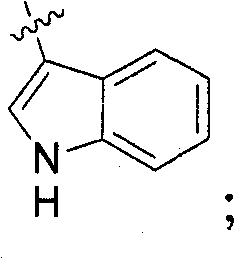
R2为H、C(1-4)烷基、二羟基丙基或
X为直接键或CHCO2H;X is a direct bond or CHCO 2 H;
R3为F; R3 is F;
R4为F;并且R 4 is F; and
R5为F;R 5 is F;
及其溶剂化物、水合物和可药用盐。And its solvates, hydrates and pharmaceutically acceptable salts.
本发明的另一个实施例是选自如下的化合物及其溶剂化物、水合物和可药用盐:Another embodiment of the present invention is a compound selected from the following compounds and their solvates, hydrates and pharmaceutically acceptable salts:


本发明的另一个实施例为药物组合物,其包含式I化合物和可药用载体。Another embodiment of the present invention is a pharmaceutical composition comprising a compound of formula I and a pharmaceutically acceptable carrier.
本发明的另一个实施例为药物组合物,其包含在本说明书实例部分列出的化合物以及可药用载体。Another embodiment of the present invention is a pharmaceutical composition comprising the compounds listed in the Examples section of this specification and a pharmaceutically acceptable carrier.
本发明还提供了用于预防、治疗或改善CCR2介导的炎性综合征、障碍或疾病的方法,包括向需要其的受试者给予有效量的式I化合物或其形式、组合物或药物。The present invention also provides methods for preventing, treating or improving CCR2-mediated inflammatory syndromes, disorders or diseases, comprising administering an effective amount of a compound of formula I or a form, composition or medicament thereof to a subject in need thereof .
本发明还提供了用于预防、治疗或改善CCR2介导的炎性综合征、障碍或疾病的方法,其中所述综合征、障碍或疾病与升高的MCP-1表达或MCP-1过度表达相关,或者为伴随有与升高的MCP-1表达或MCP-1过度表达相关的综合征、障碍或疾病的炎性病症,所述方法包括向需要其的受试者给予有效量的式I化合物或其形式、组合物或药物。The present invention also provides methods for preventing, treating or ameliorating a CCR2-mediated inflammatory syndrome, disorder or disease, wherein said syndrome, disorder or disease is associated with elevated MCP-1 expression or MCP-1 overexpression Related, or an inflammatory condition accompanied by a syndrome, disorder or disease associated with elevated MCP-1 expression or MCP-1 overexpression, the method comprising administering an effective amount of formula I to a subject in need thereof A compound or form, composition or medicament thereof.
本发明提供了预防、治疗或改善综合征、障碍或疾病的方法,其中所述综合征、障碍或疾病选自:眼科疾病、葡萄膜炎、动脉硬化症、类风湿性关节炎、牛皮癣、牛皮癣性关节炎、特应性皮炎、多发性硬化症、克罗恩氏病、溃疡性结肠炎、肾炎、器官同种异体移植物排斥、纤维性肺、肾功能不全、糖尿病和糖尿病并发症、糖尿病性肾病变、糖尿病性视网膜病、糖尿病性视网膜炎、糖尿病性微血管病、肺结核、慢性阻塞性肺疾病、肉样瘤病、侵入性葡萄球菌性皮肤化脓、白内障手术后的炎症、过敏性鼻炎、过敏性结膜炎、慢性荨麻疹、哮喘、过敏性哮喘、牙周病、牙周炎、龈炎、齿龈疾病、舒张性心肌病、心脏梗塞、心肌炎、慢性心力衰竭、血管狭窄、再狭窄、再灌注障碍、肾小球肾炎、实体瘤和癌症、慢性淋巴细胞性白血病、慢性粒细胞性白血病、多发性骨髓瘤、恶性骨髓瘤、何杰金氏病以及膀胱癌、乳癌、子宫颈癌、结肠癌、肺癌、前列腺癌或胃癌,所述方法包括向需要其的受试者给予有效量的式I化合物或其形式、组合物或药物。The present invention provides methods for preventing, treating or ameliorating a syndrome, disorder or disease, wherein said syndrome, disorder or disease is selected from the group consisting of ophthalmic disease, uveitis, arteriosclerosis, rheumatoid arthritis, psoriasis, psoriasis arthritis, atopic dermatitis, multiple sclerosis, Crohn's disease, ulcerative colitis, nephritis, organ allograft rejection, fibrotic lung, renal insufficiency, diabetes and diabetic complications, diabetes nephropathy, diabetic retinopathy, diabetic retinitis, diabetic microangiopathy, tuberculosis, chronic obstructive pulmonary disease, sarcoidosis, invasive staphylococcal skin suppuration, inflammation after cataract surgery, allergic rhinitis, Allergic conjunctivitis, chronic urticaria, asthma, allergic asthma, periodontal disease, periodontitis, gingivitis, gum disease, diastolic cardiomyopathy, cardiac infarction, myocarditis, chronic heart failure, vascular stenosis, restenosis, restenosis Perfusion disorders, glomerulonephritis, solid tumors and cancers, chronic lymphocytic leukemia, chronic myelogenous leukemia, multiple myeloma, malignant myeloma, Hodgkin's disease, and cancers of the bladder, breast, cervix, colon Cancer, lung cancer, prostate cancer or gastric cancer, the method comprising administering an effective amount of a compound of formula I or a form, composition or medicament thereof to a subject in need thereof.
本发明提供了治疗或改善综合征、障碍或疾病的方法,其中所述综合征、障碍或疾病选自:眼科疾病、类风湿性关节炎、牛皮癣、牛皮癣性关节炎、特应性皮炎、慢性阻塞性肺疾病、过敏性鼻炎、哮喘、过敏性哮喘和牙周病,所述方法包括向需要其的受试者给予有效量的式I化合物或其形式、组合物或药物。The present invention provides methods for treating or ameliorating a syndrome, disorder or disease, wherein said syndrome, disorder or disease is selected from the group consisting of ophthalmic disease, rheumatoid arthritis, psoriasis, psoriatic arthritis, atopic dermatitis, chronic Obstructive pulmonary disease, allergic rhinitis, asthma, allergic asthma and periodontal disease, the method comprising administering to a subject in need thereof an effective amount of a compound of formula I, or a form, composition or medicament thereof.
本发明提供了治疗或改善综合征、障碍或疾病的方法,其中所述综合征、障碍或疾病选自:葡萄膜炎、过敏性结膜炎和选自牙周炎、龈炎和齿龈疾病的牙周病,所述方法包括向需要其的受试者给予有效量的式I化合物或其形式、组合物或药物。The present invention provides a method for treating or ameliorating a syndrome, disorder or disease, wherein said syndrome, disorder or disease is selected from the group consisting of uveitis, allergic conjunctivitis and periodontitis, gingivitis and gum disease Peripheral diseases, the method comprising administering to a subject in need thereof an effective amount of a compound of formula I, or a form, composition or medicament thereof.
本发明提供了治疗或改善综合征、障碍或疾病的方法,其中所述综合征、障碍或疾病选自:急性葡萄膜炎、复发性葡萄膜炎、慢性葡萄膜炎、过敏性结膜炎、类风湿性关节炎、牛皮癣、牛皮癣性关节炎、特应性皮炎、慢性阻塞性肺疾病、过敏性鼻炎、哮喘、过敏性哮喘、牙周炎、龈炎或齿龈疾病,所述方法包括向需要其的受试者给予有效量的根据权利要求1的化合物或其组合物或药物。The present invention provides methods for treating or ameliorating a syndrome, disorder or disease, wherein said syndrome, disorder or disease is selected from the group consisting of: acute uveitis, recurrent uveitis, chronic uveitis, allergic conjunctivitis, Rheumatoid arthritis, psoriasis, psoriatic arthritis, atopic dermatitis, chronic obstructive pulmonary disease, allergic rhinitis, asthma, allergic asthma, periodontitis, gingivitis or gum disease, the method comprising A subject is administered an effective amount of a compound according to claim 1 or a composition or a medicament thereof.
本发明提供了在需要治疗或改善的受试者中治疗或改善综合征、障碍或疾病的方法,所述方法包括在与一种或多种抗炎剂、抗感染剂或免疫抑制剂的联合疗法中向所述受试者给予有效量的根据权利要求1的化合物或其组合物或药物,其中所述综合征、障碍或疾病选自:葡萄膜炎、过敏性结膜炎和选自牙周炎、龈炎和齿龈疾病的牙周病。The present invention provides methods of treating or ameliorating a syndrome, disorder or disease in a subject in need thereof, said method comprising in combination with one or more anti-inflammatory, anti-infective or immunosuppressant agents Administering an effective amount of a compound or composition or medicament thereof according to claim 1 to said subject in therapy, wherein said syndrome, disorder or disease is selected from the group consisting of uveitis, allergic conjunctivitis and periodontal periodontal disease, gingivitis, and gum disease.
本发明提供了治疗或改善综合征、障碍或疾病的方法,其中所述综合征、障碍或疾病是葡萄膜炎,包括急性、复发性或慢性葡萄膜炎,所述方法包括向需要其的受试者给予有效量的式I化合物或其形式、组合物或药物。The present invention provides methods of treating or ameliorating a syndrome, disorder or disease, wherein the syndrome, disorder or disease is uveitis, including acute, recurrent or chronic uveitis, comprising administering to a subject in need thereof A subject is administered an effective amount of a compound of formula I, or a form, composition or medicament thereof.
本发明提供了治疗或改善综合征、障碍或疾病的方法,其中所述综合征、障碍或疾病是葡萄膜炎,包括前葡萄膜炎、中间葡萄膜炎、后葡萄膜炎或全葡萄膜炎,所述方法包括向需要其的受试者给予有效量的式I化合物或其形式、组合物或药物。The present invention provides methods of treating or ameliorating a syndrome, disorder or disease, wherein the syndrome, disorder or disease is uveitis, including anterior uveitis, intermediate uveitis, posterior uveitis or panuveitis , the method comprising administering to a subject in need thereof an effective amount of a compound of formula I, or a form, composition or medicament thereof.
本发明还涉及通过给予有效量的至少一种式I化合物来抑制哺乳动物中的CCR2活性的方法。The present invention also relates to a method of inhibiting CCR2 activity in a mammal by administering an effective amount of at least one compound of formula I.
定义definition
除非另外指明,否则术语“烷基”指最多12个碳原子(优选最多6个碳原子)的直链和支链基团,其包括但不限于甲基、乙基、丙基、异丙基、丁基、异丁基、仲丁基、叔丁基、戊基、异戊基、己基、异己基、庚基、辛基、2,2,4-三甲基戊基、壬基、癸基、十一烷基以及十二烷基。Unless otherwise specified, the term "alkyl" refers to straight and branched chain groups of up to 12 carbon atoms (preferably up to 6 carbon atoms), including but not limited to methyl, ethyl, propyl, isopropyl , butyl, isobutyl, sec-butyl, tert-butyl, pentyl, isopentyl, hexyl, isohexyl, heptyl, octyl, 2,2,4-trimethylpentyl, nonyl, decyl base, undecyl and dodecyl.
术语“杂芳基”指5至7元单环芳环或8至10元二环芳环体系,其任何环可包含选自N、O或S的1至4个杂原子,其中氮和硫原子可以任何允许的氧化态存在。例子包括(但不限于)苯并咪唑基、苯并呋喃基、苯并噻唑基、苯并噻吩基、苯并唑基、吹喃基、咪唑基、吲哚基、异噻唑基、异
术语“部分饱和的苯并稠合的杂芳基”指如上定义的8至10元二环杂芳基基团,其中环中的一者由一个或多个氢原子饱和。例子包括(但不限于)二氢苯并呋喃基、苯并二
术语“杂原子”指氮原子、氧原子或硫原子,其中氮原子和硫原子可以任何允许的氧化态存在。The term "heteroatom" refers to a nitrogen atom, an oxygen atom or a sulfur atom, wherein the nitrogen and sulfur atoms may be present in any permissible oxidation state.
术语“亚甲基缩醛”指官能团 The term "methylene acetal" refers to the functional group
对于医学中的使用,本发明的化合物的盐指无毒的“可药用盐”。FDA批准的可药用盐形式(参考International J.Pharm.1986,33,201-217;J.Pharm.Sci.,1977年1月,66(1),第1页)包括可药用的酸性/阴离子盐或碱性/阳离子盐。For use in medicine, the salts of the compounds of the invention refer to non-toxic "pharmaceutically acceptable salts". FDA-approved pharmaceutically acceptable salt forms (reference International J.Pharm.1986, 33, 201-217; J.Pharm.Sci., January 1977, 66(1), p. 1) include pharmaceutically acceptable acidic / anionic salt or basic / cationic salt.
可药用酸性/阴离子盐包括(但不限于)乙酸盐、苯磺酸盐、苯甲酸盐、碳酸氢盐、酒石酸氢盐、溴化物、依地酸钙、樟脑磺酸盐、碳酸盐、氯化物、柠檬酸盐、二盐酸盐、依地酸盐、乙二磺酸盐、依托酸盐、乙磺酸酯、延胡索酸盐、葡庚糖酸盐、葡糖酸盐、谷氨酸盐、对羟乙酰氨基苯胂酸盐、己基间苯二酚盐、海巴明、氢溴酸盐、盐酸盐、羟萘酸盐、碘化物、羟乙基磺酸盐、乳酸盐、乳糖酸盐、苹果酸盐、马来酸盐、扁桃酸盐、甲磺酸盐、甲基溴化物、甲基硝酸盐、甲基硫酸盐、粘液酸盐、萘磺酸盐、硝酸盐、双羟萘酸盐、泛酸盐、磷酸盐/二磷酸盐、聚半乳糖醛酸盐、水杨酸盐、硬脂酸盐、次乙酸盐、琥珀酸盐、硫酸盐、鞣酸盐、酒石酸盐、茶氯酸盐、甲苯磺酸盐以及三乙碘化物。有机酸或无机酸还包括但不限于氢碘酸、过氯酸、硫酸、磷酸、丙酸、乙醇酸、甲磺酸、羟基乙磺酸、草酸、2-萘磺酸、对甲苯磺酸、环己烷氨基磺酸、糖精酸或三氟乙酸。Pharmaceutically acceptable acidic/anionic salts include, but are not limited to, acetate, benzenesulfonate, benzoate, bicarbonate, bitartrate, bromide, calcium edetate, camphorsulfonate, carbonate Salt, chloride, citrate, dihydrochloride, edetate, edisylate, ettoate, esylate, fumarate, glucoheptonate, gluconate, glutamine Hydrochloride, Paraben, Hexylresorcinate, Hybaramine, Hydrobromide, Hydrochloride, Xinanate, Iodide, Isethionate, Lactate , lactobionate, malate, maleate, mandelate, methanesulfonate, methyl bromide, methylnitrate, methylsulfate, mucate, naphthalenesulfonate, nitrate, Pamoate, Pantothenate, Phosphate/Diphosphate, Polygalacturonate, Salicylate, Stearate, Hypoacetate, Succinate, Sulfate, Tannate, Tartrate, theanate, tosylate, and triethyl iodide. Organic or inorganic acids also include, but are not limited to, hydriodic acid, perchloric acid, sulfuric acid, phosphoric acid, propionic acid, glycolic acid, methanesulfonic acid, isethanoic acid, oxalic acid, 2-naphthalenesulfonic acid, p-toluenesulfonic acid, Cyclosulfamic acid, saccharic acid, or trifluoroacetic acid.
可药用碱性/阳离子盐包括(不限于)铝盐、2-氨基-2-羟甲基-丙烷-1,3-二醇(也称为三(羟甲基)氨基甲烷、三羟甲基氨基甲烷或“TRIS”)、氨、苄星青霉素G、叔-丁胺、钙盐、葡萄糖酸钙、氢氧化钙、氯普鲁卡因、胆碱、胆碱碳酸氢盐、氯化胆碱、环己胺、二乙醇胺、乙二胺、锂盐、LiOMe、L-赖氨酸、镁盐、葡甲胺、NH3、NH4OH、N-甲基-D-葡萄糖胺、哌啶、钾盐、叔-丁醇钾、氢氧化钾(水溶液)、普鲁卡因、奎宁、钠盐、碳酸钠、2-乙基己酸钠(SEH)、氢氧化钠、三乙醇胺(TEA)或锌盐。Pharmaceutically acceptable basic/cationic salts include, but are not limited to, aluminum salts, 2-amino-2-hydroxymethyl-propane-1,3-diol (also known as tris(hydroxymethyl)aminomethane, trimethylol aminomethane or "TRIS"), ammonia, benzathine penicillin G, tert-butylamine, calcium salts, calcium gluconate, calcium hydroxide, chloroprocaine, choline, choline bicarbonate, choline chloride Alkali, cyclohexylamine, diethanolamine, ethylenediamine, lithium salt, LiOMe, L-lysine, magnesium salt, meglumine, NH 3 , NH 4 OH, N-methyl-D-glucamine, piperidine , potassium salt, potassium tert-butoxide, potassium hydroxide (aqueous solution), procaine, quinine, sodium salt, sodium carbonate, sodium 2-ethylhexanoate (SEH), sodium hydroxide, triethanolamine (TEA ) or zinc salts.
使用方法Instructions
本发明涉及用于预防、治疗或改善CCR2介导的炎性综合征、障碍或疾病的方法,包括向需要其的受试者给予有效量的式(I)化合物或其形式、组合物或药物。The present invention relates to methods for preventing, treating or improving CCR2-mediated inflammatory syndromes, disorders or diseases, comprising administering an effective amount of a compound of formula (I) or a form, composition or medicament thereof to a subject in need thereof .
就本发明方法而言,术语“给予”意指通过使用式(I)化合物或其形式、组合物或药物来治疗性地或预防性地预防、治疗或改善本文所述的综合征、障碍或疾病的方法。该方法包括在治疗期间以不同的次数给予有效量的所述化合物、配混物形式、组合物或药物,或者以组合形式同时给予。本发明的方法应理解为涵盖所有已知的治疗性处理方案。In the context of the methods of the present invention, the term "administering" means therapeutically or prophylactically preventing, treating or ameliorating a syndrome, disorder or way of disease. The method comprises administering an effective amount of the compound, compound form, composition or medicament at different times during the treatment period, or simultaneously in combination. The methods of the present invention are understood to encompass all known therapeutic treatment regimens.
术语“受试者”指患者,其可以是已成为处理、观察或试验的对象并且具有发展与升高的MCP-1表达或MCP-1过度表达相关的综合征、障碍或疾病的风险(或易发展所述综合征、障碍或疾病)的动物,通常是哺乳动物,通常是人,或者指患有伴随有与升高的MCP-1表达或MCP-1过度表达相关的综合征、障碍或疾病的炎性病症的患者。The term "subject" refers to a patient who may have been the subject of treatment, observation or experimentation and is at risk of developing a syndrome, disorder or disease associated with elevated MCP-1 expression or MCP-1 overexpression (or predisposed to develop said syndrome, disorder or disease), usually a mammal, usually a human, or an animal suffering from a syndrome, disorder or disease associated with elevated MCP-1 expression or MCP-1 overexpression Patients with inflammatory disorders of the disease.
术语“有效量”意指在组织系统、动物或人中引起生物学反应或药物反应的活性化合物或药剂的量,而所述生物学反应或药物反应正是研究人员、兽医、医生或其他临床医师所寻求的,包括预防、治疗或改善所治疗的综合征、障碍或疾病的症状。The term "effective amount" means that amount of an active compound or agent that elicits a biological or pharmaceutical response in a tissue system, animal or human, that is justified by a researcher, veterinarian, physician or other clinical What a physician seeks includes preventing, treating or ameliorating the symptoms of the syndrome, disorder or disease being treated.
术语“葡萄膜炎”通常指涉及眼的任何炎性疾病。可根据炎症存在的眼部位将葡萄膜炎分成临床上不同的亚类(百分比对应已知符合这些类别的患者):前葡萄膜炎(51%)、中间葡萄膜炎(13%)、后葡萄膜炎(20%)或全葡萄膜炎(16%),并且根据疾病进程,可以分为急性葡萄膜炎(16%)、复发性葡萄膜炎(26%)或慢性葡萄膜炎(58%)。尽管进行积极治疗,但患有前葡萄膜炎的那些患者(·19%)最终会发展成不能恢复的视力损伤例如单侧盲(9%)、双侧盲(2%)或者单侧或双侧视力受损(8%)。大多数葡萄膜炎案例为特发性的,但已知的原因包括感染(例如弓形体病、细胞巨化病毒等)或作为全身性炎性障碍和/或自身免疫障碍的一部分发展(例如幼年型类风湿性关节炎、HLA-B27相关的脊椎关节病、类肉瘤等)。(HLA-B27:人白细胞抗原B*27-为由6号染色体上的主要组织相容性复合物(MHC)中的B基因座编码的I类表面抗原并且递呈微生物抗原至T细胞。HLA-B27与称为血清阴性脊柱关节病的某一类自身免疫疾病强相关。)The term "uveitis" generally refers to any inflammatory disease involving the eye. Uveitis can be divided into clinically distinct subcategories (percentages correspond to patients known to fit into these categories) according to the ocular site where inflammation is present: anterior uveitis (51%), intermediate uveitis (13%), posterior uveitis uveitis (20%) or panuveitis (16%), and, depending on the course of the disease, can be classified as acute (16%), recurrent (26%), or chronic (58%) %). Despite aggressive treatment, those patients with anterior uveitis (·19%) eventually develop irreversible visual impairment such as unilateral blindness (9%), bilateral blindness (2%), or unilateral or bilateral blindness Impaired lateral vision (8%). Most cases of uveitis are idiopathic, but known causes include infection (eg, toxoplasmosis, cytomegalovirus, etc.) or development as part of a systemic inflammatory and/or autoimmune disorder (eg, juvenile type rheumatoid arthritis, HLA-B27 related spondyloarthropathy, sarcoid, etc.). (HLA-B27: Human Leukocyte Antigen B*27 - is a class I surface antigen encoded by the B locus in the major histocompatibility complex (MHC) on chromosome 6 and presents microbial antigens to T cells. HLA -B27 is strongly associated with a certain class of autoimmune diseases called seronegative spondyloarthropathies.)
当用作CCR2抑制剂时,本发明化合物可以在约0.5mg至约10g的剂量范围内、优选在约0.5mg至约5g之间的有效剂量,以每日一次或一日多次给予。给药剂量将受诸如给药途径,受体的健康状况、体重和年龄,治疗频率以及同期治疗和无关治疗的存在等因素影响。When used as CCR2 inhibitors, the compounds of the present invention may be administered once a day or multiple times a day in an effective dose ranging from about 0.5 mg to about 10 g, preferably between about 0.5 mg and about 5 g. The dosage administered will be affected by factors such as the route of administration, the health, weight and age of the recipient, the frequency of treatment and the presence of concomitant and unrelated treatments.
对于本领域的技术人员还将显而易见的是,本发明的化合物或其药物组合物的治疗有效剂量将根据所需效果而变化。因此,本领域技术人员可容易地确定待给予的最佳剂量,并且最佳剂量将随所使用的具体化合物、给药方式、制剂规格和疾病症状的严重程度而变化。另外,与待治疗的具体受试者相关的因素(包括受试者年龄、体重、饮食和给药时间)将导致需要将剂量调整至合适的治疗水平。因此,上述剂量为一般情况的示例。当然,可能会存在其中较高或较低剂量范围有利的个别情况,并且这类情况也在本发明的范围内。It will also be apparent to those skilled in the art that a therapeutically effective dosage of a compound of the invention, or a pharmaceutical composition thereof, will vary depending on the effect desired. Optimal dosages to be administered can thus be readily determined by those skilled in the art, and will vary with the particular compound employed, the mode of administration, the strength of the formulation and the severity of the disease symptoms. In addition, factors associated with the particular subject being treated, including subject age, weight, diet and time of administration, will result in the need to adjust dosages to appropriate therapeutic levels. Accordingly, the above dosages are exemplary of what is typically the case. There can, of course, be individual instances where higher or lower dosage ranges are advantageous, and such cases are also within the scope of this invention.
可以将式I化合物配制成包含任何已知的药用载体的药物组合物。示例性载体包括但不限于任何合适的溶剂、分散介质、包衣、抗菌剂和抗真菌剂以及等渗剂。同样可作为制剂组分的示例性赋形剂包括填充剂、粘合剂、崩解剂以及润滑剂。Compounds of formula I can be formulated into pharmaceutical compositions comprising any known pharmaceutically acceptable carrier. Exemplary carriers include, but are not limited to, any suitable solvents, dispersion media, coatings, antibacterial and antifungal agents, and isotonic agents. Exemplary excipients that may also be components of the formulation include fillers, binders, disintegrants, and lubricants.
式I化合物的可药用盐包括由无机或有机酸或碱形成的常规无毒盐或季铵盐。此类酸加成盐的例子包括乙酸盐、己二酸盐、苯甲酸盐、苯磺酸盐、柠檬酸盐、樟脑酸盐、十二烷基磺酸盐、盐酸盐、氢溴酸盐、乳酸盐、马来酸盐、甲磺酸盐、硝酸盐、草酸盐、特戊酸盐、丙酸盐、琥珀酸盐、硫酸盐以及酒石酸盐。碱盐包括铵盐、碱金属盐诸如钠盐和钾盐、碱土金属盐例如钙盐和镁盐、有机碱盐例如二环己胺盐以及氨基酸例如精氨酸的盐。也可以将碱性含氮基团用例如卤化烷进行季铵化。Pharmaceutically acceptable salts of compounds of formula I include customary non-toxic salts or quaternary ammonium salts formed with inorganic or organic acids or bases. Examples of such acid addition salts include acetate, adipate, benzoate, benzenesulfonate, citrate, camphorate, dodecylsulfonate, hydrochloride, hydrobromide, salt, lactate, maleate, methanesulfonate, nitrate, oxalate, pivalate, propionate, succinate, sulfate and tartrate. Base salts include ammonium salts, alkali metal salts such as sodium and potassium, alkaline earth metal salts such as calcium and magnesium, organic bases such as dicyclohexylamine, and salts of amino acids such as arginine. Basic nitrogen-containing groups can also be quaternized with, for example, alkyl halides.
可以通过能达到其预期目的任何方式给予本发明的药物组合物。例子包括通过肠胃外、皮下、静脉、肌内、腹膜内、透皮、口腔或眼等途径给予。作为另外一种选择或同时地,可通过口服途径给予。用于非肠道给予的合适制剂包括水溶性形式的活性化合物(例如,水溶性盐)的水溶液、酸性溶液、碱性溶液、葡萄糖水溶液、碳水化合物等渗溶液以及环糊精包合物。The pharmaceutical compositions of the present invention may be administered by any means that achieve their intended purpose. Examples include administration by parenteral, subcutaneous, intravenous, intramuscular, intraperitoneal, transdermal, oral or ocular routes. Alternatively or concurrently, administration may be by the oral route. Suitable formulations for parenteral administration include aqueous solutions of the active compounds in water-soluble form (eg, water-soluble salts), acidic solutions, basic solutions, aqueous dextrose, isotonic solutions of carbohydrates, and cyclodextrin inclusion complexes.
本发明还包括制备药物组合物的方法,该方法包括将药用载体与本发明的任何化合物混合。另外,本发明包括通过将可药用载体与任何本发明化合物混合而制备的药物组合物。如本文所用,术语“组合物”旨在涵盖包含规定量的规定成分的产品,以及通过组合规定量的规定成分而直接或间接得到的任何产品。The invention also includes a method of preparing a pharmaceutical composition comprising admixing a pharmaceutically acceptable carrier with any compound of the invention. Additionally, the present invention includes pharmaceutical compositions prepared by admixing a pharmaceutically acceptable carrier with any compound of the present invention. As used herein, the term "composition" is intended to encompass a product comprising the specified ingredients in the specified amounts, as well as any product obtained directly or indirectly by combining the specified ingredients in the specified amounts.
多晶型物和溶剂化物Polymorphs and Solvates
此外,本发明的化合物可具有一种或多种多晶型或无定形结晶形式,这些多晶型或无定形结晶形式旨在包括在本发明的范围内。另外,化合物可例如与水形成溶剂化物(即水合物)或与普通有机溶剂形成溶剂化物。如本文所用,术语“溶剂化物”意指本发明的化合物与一个或多个溶剂分子的物理缔合。该物理缔合涉及不同程度的离子键键合和共价键键合,包括氢键键合。在某些情况下,溶剂化物将能够在(例如)一个或多个溶剂分子掺入在结晶固体的晶格中时分离出来。术语“溶剂化物”旨在既涵盖溶液相溶剂化物又涵盖可分离溶剂化物。合适的溶剂化物的非限制性例子包括乙醇化物、甲醇化物等。Furthermore, the compounds of the present invention may have one or more polymorphic or amorphous crystalline forms, which polymorphic or amorphous crystalline forms are intended to be encompassed within the scope of the present invention. In addition, the compounds may form solvates, for example, with water (ie, hydrates) or with common organic solvents. As used herein, the term " solvate " means a physical association of a compound of the invention with one or more solvent molecules. This physical association involves varying degrees of ionic and covalent bonding, including hydrogen bonding. In some cases, solvates will be able to isolate when, for example, one or more solvent molecules are incorporated in the crystal lattice of the crystalline solid. The term "solvate" is intended to cover both solution-phase and isolatable solvates. Non-limiting examples of suitable solvates include ethanolates, methanolates, and the like.
本发明旨在包括在其范围内的本发明化合物的多晶型物和溶剂化物。因此,在本发明的治疗方法中,术语“给予”将涵盖使用本发明的化合物或其多晶型物或溶剂化物治疗、改善或预防本文所述的综合征、障碍或疾病的手段,其虽然没有被具体公开,但这明显包括在本发明的范围之内。The present invention is intended to include within its scope polymorphs and solvates of the compounds of the invention. Thus, in the methods of treatment of the present invention, the term "administering" shall encompass the use of a compound of the present invention, or a polymorph or solvate thereof, to treat, ameliorate or prevent a syndrome, disorder or disease as described herein, although Not specifically disclosed, but clearly included within the scope of the present invention.
在另一个实施例中,本发明涉及实例或式I中所述的用作药物的化合物。In another embodiment, the invention relates to a compound as described in the examples or formula I for use as a medicament.
在另一个实施例中,本发明涉及使用实例或式I中描述的化合物来制备用于治疗与升高的或不适当的CCR2活性相关的疾病的药物。In another embodiment, the invention relates to the use of the compounds described in the examples or formula I for the manufacture of a medicament for the treatment of diseases associated with elevated or inappropriate CCR2 activity.
本发明包括属于其范围之内的本发明化合物的前药。通常,此类前药为化合物的官能衍生物,可以在体内容易地转化为所需的化合物。因此,在本发明的治疗方法中,术语“给予”应涵盖使用具体描述的化合物或未具体描述的化合物来治疗多种疾病,而该未具体描述的化合物可在给予患者后,在体内转化为具体描述的化合物。选择和制备合适的前药衍生物的常规方法在例如“Design of Prodrugs”,H.Bundgaard(编辑),Elsevier,1985中描述。The present invention includes within its scope prodrugs of the compounds of the invention. Typically, such prodrugs are functional derivatives of the compound that can be readily converted in vivo to the desired compound. Therefore, in the treatment method of the present invention, the term "administration" shall cover the use of specifically described compounds or unspecified compounds to treat various diseases, and the unspecified compounds can be converted into specifically described compounds. General methods for selecting and preparing suitable prodrug derivatives are described, for example, in "Design of Prodrugs", H. Bundgaard (ed.), Elsevier, 1985.
在根据本发明的化合物具有至少一个手性中心的情况下,它们可因此以对映体的形式存在。如果化合物具有两个或多个手性中心,则它们另外可作为非对映体存在。应当理解,所有这些异构体以及它们的混合物均涵盖在本发明的范围内。Where the compounds according to the invention possess at least one chiral center, they may thus exist in enantiomeric forms. If compounds possess two or more chiral centers, they may additionally exist as diastereomers. It is to be understood that all such isomers and mixtures thereof are encompassed within the scope of the present invention.
如果用于制备根据本发明的化合物的方法产生立体异构体的混合物,则这些异构体可以通过诸如制备色谱之类的常规技术分离。化合物可以制备为外消旋形式,或者可通过对映专一性合成法或通过拆分法制备单个的对映体。例如,可通过标准的技术将化合物拆分成它们的对映体组分,例如通过用旋光活性酸如(-)-二对甲苯酰基-D-酒石酸和/或(+)-二对甲苯酰基-L-酒石酸成盐而形成非对映体对,然后进行分级结晶和游离碱再生。还可以通过形成非对映异构的酯或酰胺,然后进行色谱分离和除去手性助剂,来拆分化合物。或者,可用手性HPLC柱来拆分化合物。If the processes used to prepare the compounds according to the invention result in mixtures of stereoisomers, these isomers can be separated by conventional techniques such as preparative chromatography. Compounds may be prepared in racemic form, or individual enantiomers may be prepared by enantiospecific synthesis or by resolution. For example, compounds can be resolved into their enantiomeric components by standard techniques, for example by using optically active acids such as (-)-di-p-toluoyl-D-tartaric acid and/or (+)-di-p-toluoyl -L-tartaric acid is salified to form diastereomeric pairs, followed by fractional crystallization and free base regeneration. The compounds can also be resolved by formation of diastereomeric esters or amides followed by chromatographic separation and removal of the chiral auxiliary. Alternatively, the compounds can be resolved using a chiral HPLC column.
在任何制备本发明化合物的方法中,可能必需和/或期望保护任何有关分子上的敏感基团或活性基团。这可通过常规保护基团来实现,如在以下文献中描述的那些保护基团:Protective Groups in Organic Chemistry,J.F.W.McOmie(编辑),Plenum Press,1973和T.W.Greene& P.G.M.Wuts,Protective Groups in Organic Synthesis,John Wiley &Sons,1991。保护基团可在方便的后续阶段用本领域已知方法移除。During any process for preparing the compounds of the invention, it may be necessary and/or desirable to protect sensitive or reactive groups on any of the molecules involved. This can be achieved by conventional protecting groups, such as those described in: Protective Groups in Organic Chemistry , JFW McOmie (editor), Plenum Press, 1973 and TW Greene & PGM Wuts, Protective Groups in Organic Synthesis , John Wiley & Sons , 1991. Protecting groups can be removed at a convenient subsequent stage by methods known in the art.
一般反应方案General Reaction Scheme
本发明的代表性化合物可根据下文所述的一般合成方法合成。式I化合物可通过本领域技术人员已知的方法制备。下面的反应方案仅意在给出本发明的实例并且绝无意于限制本发明。Representative compounds of the present invention can be synthesized according to the general synthetic methods described below. Compounds of formula I can be prepared by methods known to those skilled in the art. The reaction schemes below are intended only to give examples of the invention and are in no way intended to limit the invention.
方案AOption A
可使用偶联剂如EDCI(1-乙基-3-(3′-二甲基氨丙基)碳二亚胺)和添加剂如HOBt(1-羟基苯并三唑)使式A-1的丙烯酸(其中R3、R4和R5如式I中定义)与化合物A-4偶联,从而得到式A-5化合物。化合物A-4可通过使商购的A-3去保护获得,就Boc而言采用酸性条件,就Cbz
或者,可将式A-1的丙烯酸与合适的氯来源如亚硫酰氯、PCl3、PCl5或草酰氯在有机溶剂如DCM(二氯甲烷)中反应,优选在回流下进行该反应,以得到相应的酰基氯A-2。将A-2与A-4在存在有机碱如TEA(三乙基胺)或DIPEA(二异丙基乙胺)的情况下于有机溶剂如DCM中反应得到酰胺A-5。如一般方案D中所示,可将式A-5的酰胺转化成式I化合物。Alternatively, acrylic acid of formula A-1 may be reacted with a suitable chlorine source such as thionyl chloride, PCl3 , PCl5 or oxalyl chloride in an organic solvent such as DCM (dichloromethane), preferably at reflux, to The corresponding acid chloride A-2 is obtained. Reaction of A-2 with A-4 in the presence of an organic base such as TEA (triethylamine) or DIPEA (diisopropylethylamine) in an organic solvent such as DCM affords amide A-5. Amides of formula A-5 can be converted to compounds of formula I as shown in general scheme D.
中间体B-7可根据方案B中示出的工序制备。将式B-7化合物用于合成其中R1为吲哚基或吡咯-稠合的杂芳基的式I化合物。Intermediate B-7 can be prepared according to the procedure shown in Scheme B. Compounds of formula B-7 are used to synthesize compounds of formula I wherein R 1 is indolyl or pyrrole-fused heteroaryl.
方案BOption B

可使用Green,T.W.、Wuts,P.g.M.的“Protective Groups inOrganic Synthesis”,Wiley-Interscience和其中的参考文献中所描述的工序将哌啶B-1(可商购获得或通过科学文献中报道的规程制备)通过Boc(或Cbz和其他氨基甲酸酯类)进行保护以得到式B-2化合物。随后用甲苯磺酰基或甲磺酰基基团保护式B-2化合物的芳族氮以得到B-3。本领域技术人员将认识到,在去除哌啶的氮上的保护基团(例如Boc、Cbz等)的过程中,芳族氮上的保护基团应当得到保持。Piperidine B-1 (commercially available or prepared by procedures reported in the scientific literature) can be prepared using the procedure described in Green, T.W., Wuts, P.g.M., "Protective Groups in Organic Synthesis", Wiley-Interscience and references therein. ) are protected by Boc (or Cbz and other carbamates) to give compounds of formula B-2. Subsequent protection of the aromatic nitrogen of compounds of formula B-2 with a tosyl or mesyl group affords B-3. Those skilled in the art will recognize that during removal of the protecting group on the nitrogen of piperidine (eg Boc, Cbz, etc.), the protecting group on the aromatic nitrogen should be maintained.
式B-3化合物中哌啶的氮上的保护基团可通过已知方法进行选择性地去除。例如,就Boc的情形而言,可将化合物B-3在有机溶剂如DCM、二
可将式B-4化合物在存在质子酸(如HCl)的情况下用亚硝酸盐(如NaNO2或KNO2)进行亚硝基化以得到B-5(Maria,G.,等人,J.Org.Chem.,1997,62,5619-5622)。Compounds of formula B-4 can be nitrosylated with nitrites such as NaNO2 or KNO2 in the presence of protic acids such as HCl to give B-5 (Maria, G., et al., J . Org. Chem., 1997, 62, 5619-5622).
通过已知方法去除芳族氮上的保护基团得到B-6(Green,T.W.、Wuts,P.g.M.,“Protective Groups in Organic Synthesis”,Wiley-Interscience,以及其中的参考文献)。在有机溶剂如二乙醚或THF中用还原剂如LiAlH4还原B-6的亚硝基,得到式B-7化合物(Seebach,D.,等人,Synthesis,1979,6,423-424)。Removal of the protecting group on the aromatic nitrogen by known methods affords B-6 (Green, TW, Wuts, PgM, "Protective Groups in Organic Synthesis", Wiley-Interscience, and references therein). Reduction of the nitroso group of B-6 with a reducing agent such as LiAlH in an organic solvent such as diethyl ether or THF gives the compound of formula B-7 (Seebach, D., et al., Synthesis, 1979, 6, 423-424).
或者,本领域技术人员可将式B-5化合物以一个步骤直接转化成式B-7化合物。例如,可将有机溶剂如二乙醚或THF中的B-5溶液用还原剂如LiAlH4在较低温度如0℃下处理,之后进行回流和后处理,以得到化合物B-7。Alternatively, one skilled in the art can directly convert the compound of formula B-5 to the compound of formula B-7 in one step. For example, a solution of B-5 in an organic solvent such as diethyl ether or THF can be treated with a reducing agent such as LiAlH at a lower temperature such as 0 °C, followed by reflux and work-up to give compound B-7.
中间体C-3可根据方案C中示出的工序制备。将式C-3化合物用于合成其中R1既不为吲哚基又不为吡咯-稠合的杂芳基的式I化合物。Intermediate C-3 can be prepared according to the procedure shown in Scheme C. Compounds of formula C-3 are used to synthesize compounds of formula I in which R is neither indolyl nor pyrrole-fused heteroaryl.
方案CPlan C

在存在质子酸(例如HCl)的情况下用亚硝酸盐(例如NaNO2或KNO2)将式C-1的4-取代的哌啶(可商购获得或通过科学文献中报道的方案制备)亚硝基化成对应的式C-2化合物,以得到C-2(Maria,G.,等人,J.Org.Chem.,1997,62,5619-5622)。随后在有机溶剂如二乙醚或THF中用还原剂如LiAlH4还原式C-2的亚硝基-哌啶,得到式C-3化合物(Seebach,D.,等人,Synthesis,1979,6,423-424)。4-substituted piperidines of formula C-1 (commercially available or prepared by protocols reported in the scientific literature) were reacted with nitrite (e.g. NaNO2 or KNO2 ) in the presence of a protic acid (e.g. HCl) Nitrosylation to the corresponding compound of formula C-2 affords C-2 (Maria, G., et al., J. Org. Chem., 1997, 62, 5619-5622). Subsequent use of a reducing agent such as LiAlH in an organic solvent such as diethyl ether or THF Reduce the nitroso-piperidine of formula C-2 to obtain the compound of formula C-3 (Seebach, D., et al., Synthesis, 1979, 6, 423-424).
目标化合物(I-a)(其中X为直接键的代表性式I化合物)可根据下面方案D中示出的方法制备:The target compound (I-a), a representative compound of formula I wherein X is a direct bond, can be prepared according to the method shown in Scheme D below:
方案DPlan D

可使式B-7化合物或式C-3化合物在溶剂或溶剂混合物如DCM、DCE(二氯乙烷)或THF中,在存在氢化物源如硼氢化钠或三乙酰氧基硼氢化钠的情况下与化合物A-5反应(Abdel-Magid,Ahmed F.,等人,J.Org.Chem.,1996,61,3849-3862),以提供式D-1化合物。A compound of formula B-7 or a compound of formula C-3 can be made in a solvent or solvent mixture such as DCM, DCE (dichloroethane) or THF in the presence of a hydride source such as sodium borohydride or sodium triacetoxyborohydride In this case reaction with compound A-5 (Abdel-Magid, Ahmed F., et al., J. Org. Chem., 1996, 61, 3849-3862) affords compounds of formula D-1.
虽然D-1是其中R2为H的式I化合物,但可对其进行进一步衍生。D-1与合适的醛或酮在溶剂或溶剂混合物如DCM、DCE或THF中,在存在氢化物源如三乙酰氧基硼氢化钠或硼氢化钠的情况下反应,可得到其中R2不为H的目标化合物I-a。Although D-1 is a compound of formula I wherein R2 is H, it can be further derivatized. Reaction of D-1 with a suitable aldehyde or ketone in a solvent or solvent mixture such as DCM, DCE or THF in the presence of a hydride source such as sodium triacetoxyborohydride or sodium borohydride gives Is H's target compound Ia.
方案EOption E
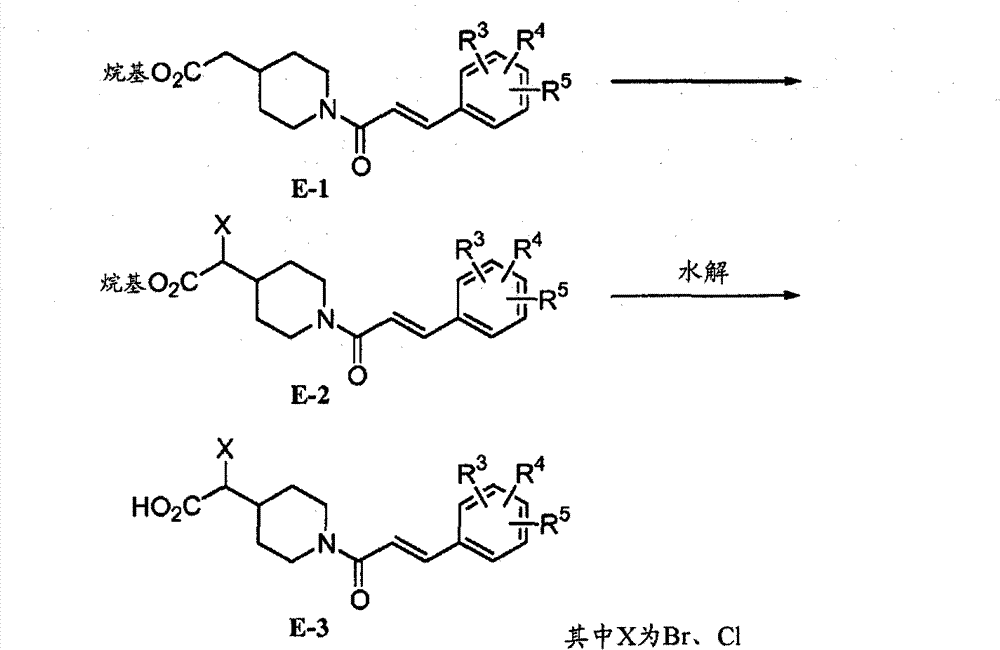
可将式E-1化合物(可商购获得或通过科学文献中报道的方案制备(Xia,Mingde,等人,US 2006/0069123 A1,第77页))在有机溶剂(例如THF)中的溶液用碱(例如LiHMDS(六甲基叠氮乙硅锂))处理,然后用亲电子试剂(例如TMSCl(三甲基氯硅烷))处理。将所得混合物与卤化试剂如NBS(N-溴琥珀酰亚胺)、NCS(N-氯代琥珀酰亚胺)或溴,在有机溶剂如THF中进一步反应,得到其中X为溴代基或氯代基的式E-2化合物(Chan,T.H.,Wallace,I.h.M.,Tetrahedron Letters,1982,23,799-802)。A solution of a compound of formula E-1 (commercially available or prepared by protocols reported in the scientific literature (Xia, Mingde, et al., US 2006/0069123 A1, p. 77)) in an organic solvent (such as THF) can be Treatment with a base such as LiHMDS (lithium hexamethyldisilazide) followed by an electrophile such as TMSCl (trimethylchlorosilane). The resulting mixture is further reacted with a halogenating reagent such as NBS (N-bromosuccinimide), NCS (N-chlorosuccinimide) or bromine in an organic solvent such as THF to give Compounds of formula E-2 as substituents (Chan, T.H., Wallace, I.h.M., Tetrahedron Letters, 1982, 23, 799-802).
化合物E-2的溶液在约室温下可通过水性试剂溶液(例如诸如THF、甲醇之类的溶剂或其混合物中的LiOH)水解,然后酸化(使用诸如HCl之类的酸)产生式E-3的化合物。A solution of compound E-2 can be hydrolyzed at about room temperature by an aqueous reagent solution such as LiOH in a solvent such as THF, methanol, or a mixture thereof, followed by acidification (using an acid such as HCl) to yield formula E-3 compound of.
目标化合物(I-b)(其中X为CHCOOH的代表性式I化合物)可根据下面方案F中示出的方法制备:Target compound (I-b), a representative compound of formula I wherein X is CHCOOH, can be prepared according to the method shown in Scheme F below:
方案FOption F

将化合物B-7或C-3和碱如TEA(三乙基胺)或DIPEA的溶液(例如乙腈溶液)与化合物E-3在溶剂如乙腈中的溶液反应,优选在回流下反应,得到外消旋化合物I-b。用本领域技术人员已知的常规拆分技术通过色谱分离出外消旋化合物I-b。A solution of compound B-7 or C-3 and a base such as TEA (triethylamine) or DIPEA (eg acetonitrile solution) is reacted with a solution of compound E-3 in a solvent such as acetonitrile, preferably under reflux, to give the compound Racemic compound I-b. Racemic compound I-b is isolated by chromatography using conventional resolution techniques known to those skilled in the art.
或者,将化合物B-7或C-3和碱如TEA或DIPEA的溶液(例如乙腈溶液)与化合物E-2在溶剂如乙腈中的溶液反应,优选在回流下反应,得到作为外消旋混合物的化合物F-1。式F-1化合物可在碱性条件(例如溶剂如THF、MeOH(甲醇)或其混合物中的LiOH)下于约室温下水解,以得到化合物I-b。用本领域技术人员已知的常规分解技术色谱分离出外消旋化合物I-b。Alternatively, reacting a solution of compound B-7 or C-3 and a base such as TEA or DIPEA (e.g. in acetonitrile) with a solution of compound E-2 in a solvent such as acetonitrile, preferably at reflux, gives as a racemic mixture Compound F-1. Compounds of formula F-1 can be hydrolyzed under basic conditions such as LiOH in solvents such as THF, MeOH (methanol) or mixtures thereof at about room temperature to afford compounds I-b. Racemic compound I-b is isolated chromatographically using conventional decomposition techniques known to those skilled in the art.
具体实例specific example
实例1Example 1

A.哌啶-4-酮。向4-氧代-哌啶-1-甲酸叔丁酯(化合物1a)(2.03g,10mmol)在DCM(6mL)中的溶液滴加入TFA(6mL)。将反应物在室温(rt)下搅拌3小时(h)并通过蒸发去除挥发物。加入更多DCM,再次蒸发得到化合物1b的TFA盐。LC/MS:C5H9NO:m/z 100.0(M+1)。A. Piperidin-4-one. To a solution of tert-butyl 4-oxo-piperidine-1-carboxylate (compound la) (2.03 g, 10 mmol) in DCM (6 mL) was added TFA (6 mL) dropwise. The reaction was stirred at room temperature (rt) for 3 hours (h) and the volatiles were removed by evaporation. More DCM was added and evaporated again to give compound 1b as its TFA salt. LC/MS: C5H9NO : m/z 100.0 (M+1).
B.3-(3,4,5-三氟-苯基)-丙烯酰氯。将3-(3,4,5-三氟-苯基)-丙烯酸(化合物1c)(购自Aldrich)(2.02g,10mmol)在DCM(20mL)中的溶液在室温下搅拌5分钟,然后加入SOCl2(1.5mL,20mmol)。将反应混合物回流加热2小时并蒸发去除挥发物。加入更多DCM,再次蒸发得到化合物1d粗产物用于下一步骤而无需进一步纯化。B. 3-(3,4,5-Trifluoro-phenyl)-acryloyl chloride. A solution of 3-(3,4,5-trifluoro-phenyl)-acrylic acid (compound 1c) (purchased from Aldrich) (2.02 g, 10 mmol) in DCM (20 mL) was stirred at room temperature for 5 minutes, then added SOCl2 (1.5 mL, 20 mmol). The reaction mixture was heated at reflux for 2 hours and the volatiles were removed by evaporation. More DCM was added and evaporated again to give crude compound 1d which was used in the next step without further purification.
C.1-[3-(3,4,5-三氟-苯基)-丙烯酰基]-哌啶-4-酮。在0℃下向1b(10mmol)、TEA(4.18mL,30mmol)在DCM(28mL)中的溶液滴加入1d(10mmol)在DCM(4mL)中的溶液。在0℃下搅拌15分钟(min)后,将混合物在室温下搅拌过夜。通过加入H2O使反应物猝灭,将有机相用1N HCl、H2O洗涤并过Na2SO4干燥。去除溶剂并通过柱色谱(洗脱液:EtOAc(乙酸乙酯)/己烷,1/1)纯化得到化合物1e。2.08g,73%。1H-NMR(400MHz,CDCl3):δ7.56-7.60(1H,d),7.14-7.18(2H,m),6.84-6.88(1H,d),3.88-4.09(4H,m),2.55-2.58(4H,t);LC/MS:C14H12F3NO2:m/z 284.3(M+1)。C. 1-[3-(3,4,5-Trifluoro-phenyl)-acryloyl]-piperidin-4-one. To a solution of 1b (10 mmol), TEA (4.18 mL, 30 mmol) in DCM (28 mL) was added a solution of 1d (10 mmol) in DCM (4 mL) dropwise at 0°C. After stirring at 0 °C for 15 minutes (min), the mixture was stirred at room temperature overnight. The reaction was quenched by adding H2O , the organic phase was washed with 1N HCl, H2O and dried over Na2SO4 . Removal of solvent and purification by column chromatography (eluent: EtOAc(ethyl acetate)/hexane, 1/1) afforded compound 1e. 2.08g, 73%. 1 H-NMR (400MHz, CDCl 3 ): δ7.56-7.60 (1H, d), 7.14-7.18 (2H, m), 6.84-6.88 (1H, d), 3.88-4.09 (4H, m), 2.55 -2.58 (4H, t); LC / MS: C14H12F3NO2 : m /z 284.3 (M+1).
实例2Example 2

A.4-(1H-吲哚-3-基)-哌啶-1-甲酸叔丁酯。将4-(3-吲哚)哌啶(化合物2a)(购自Tyger Scientific Inc.)(1.0g,5mmol)、二碳酸二叔丁酯(1.36g,6.25mmol)和K2CO3(2.19g,15.9mmol)在THF(80mL)和H2O(40mL)中的溶液于60℃下搅拌22小时。加入另一批二碳酸二叔丁酯(1.1g,5mmol)和K2CO3(0.7g,5mmol),将混合物在60℃下另外搅拌5小时。冷却至室温后,分离出两个相,用EtOAc萃取水相,将其用盐水洗涤并过Na2SO4干燥。去除溶剂得到白色固体产物2b。1H-NMR(400MHz,CDCl3):δ8.01(1H,s),7.62-7.64(1H,d),7.36-7.38(1H,d),7.17-7.21(1H,td),7.09-7.13(1H,td),6.95-6.96(1H,d),4.18-4.30(2H,m),2.85-3.20(3H,m),2.02-2.06(2H,d),1.65-1.68(2H,m),1.53(9H,s);LC/MS:C18H24N2O2:m/z 300.7(M+1)。A. tert-butyl 4-(1H-indol-3-yl)-piperidine-1-carboxylate. 4-(3-Indole)piperidine (compound 2a) (purchased from Tyger Scientific Inc.) (1.0 g, 5 mmol), di-tert-butyl dicarbonate (1.36 g, 6.25 mmol) and K 2 CO 3 (2.19 g, 15.9 mmol) in THF (80 mL) and H2O (40 mL) was stirred at 60 °C for 22 h. Another batch of di-tert-butyl dicarbonate (1.1 g, 5 mmol) and K 2 CO 3 (0.7 g, 5 mmol) were added and the mixture was stirred at 60° C. for another 5 hours. After cooling to room temperature, the two phases were separated, the aqueous phase was extracted with EtOAc, washed with brine and dried over Na2SO4 . Removal of solvent afforded product 2b as a white solid. 1 H-NMR (400MHz, CDCl 3 ): δ8.01(1H, s), 7.62-7.64(1H, d), 7.36-7.38(1H, d), 7.17-7.21(1H, td), 7.09-7.13 (1H, td), 6.95-6.96 (1H, d), 4.18-4.30 (2H, m), 2.85-3.20 (3H, m), 2.02-2.06 (2H, d), 1.65-1.68 (2H, m) , 1.53 (9H, s); LC / MS : C18H24N2O2 : m/z 300.7 (M+1).
B.4-[1-(甲苯-4-磺酰基)-1H-吲哚-3-基]-哌啶-1-甲酸叔丁酯。向2b(5mmol)在甲苯(15mL)中的悬浮液中依次加入四丁基硫酸氢铵(TBAHS)(0.26g,0.75mmol)、NaOH的50%水溶液(15mL)和对甲苯磺酰氯(TsCl)(1.43g,7.5mmol)。将混合物在室温下剧烈搅拌16小时。分离后,用EtOAc萃取水相。将合并的有机相用1NHCl、饱和的NaHCO3、盐水洗涤并过Na2SO4干燥。通过柱色谱(洗脱液:EtOAc/己烷,3/7)纯化粗产物得到2c。1H-NMR(400MHz,CDCl3):δ7.97-7.99(1H,d),7.72-7.74(2H,d),7.50-7.52(1H,d),7.20-7.32(5H,m),4.18-4.30(2H,m),2.83-2.89(3H,m),2.33(3H,s),1.97-2.00(2H,d),1.56-1.66(2H,qd),1.49(9H,s);LC/MS:C25H30N2O4S:m/z 455.2(M+1)。B. 4-[1-(Toluene-4-sulfonyl)-1H-indol-3-yl]-piperidine-1-carboxylic acid tert-butyl ester. To a suspension of 2b (5 mmol) in toluene (15 mL) was added tetrabutylammonium hydrogensulfate (TBAHS) (0.26 g, 0.75 mmol), 50% aqueous NaOH (15 mL) and p-toluenesulfonyl chloride (TsCl) in sequence (1.43 g, 7.5 mmol). The mixture was stirred vigorously at room temperature for 16 hours. After separation, the aqueous phase was extracted with EtOAc. The combined organic phases were washed with 1N HCl, saturated NaHCO 3 , brine and dried over Na 2 SO 4 . The crude product was purified by column chromatography (eluent: EtOAc/hexane, 3/7) to afford 2c. 1 H-NMR (400MHz, CDCl 3 ): δ7.97-7.99 (1H, d), 7.72-7.74 (2H, d), 7.50-7.52 (1H, d), 7.20-7.32 (5H, m), 4.18 LC /MS: C25H30N2O4S : m / z 455.2 (M+1).
C.3-哌啶-4-基-1-(甲苯-4-磺酰基)-1H-吲哚。向2c(1.98g,4.3mmol)在DCM(10mL)中的溶液中加入TFA(6mL),将混合物在室温下搅拌3小时。去除挥发物后,将残余物溶解于EtOAc中,用饱和的NaHCO3、盐水洗涤,并过Na2SO4干燥。去除溶剂并蒸发至干燥,得到白色泡沫状产物2d。1H-NMR(400MHz,CDCl3):δ7.98-8.00(1H,d),7.73-7.76(2H,m),7.51-7.53(1H,d),7.29-7.33(2H,m),7.20-7.24(3H,m),3.79(1H,s),3.29-3.32(2H,d),2.85-2.94(3H,m),2.33(3H,s),2.04-2.08(2H,d),1.72-1.83(2H,qd);LC/MS:C20H22N2O2S:m/z 355.2(M+1)。C. 3-Piperidin-4-yl-1-(toluene-4-sulfonyl)-1H-indole. To a solution of 2c (1.98 g, 4.3 mmol) in DCM (10 mL) was added TFA (6 mL), and the mixture was stirred at room temperature for 3 hours. After removal of volatiles, the residue was dissolved in EtOAc, washed with saturated NaHCO3 , brine, and dried over Na2SO4 . Removal of the solvent and evaporation to dryness gave the product 2d as a white foam. 1 H-NMR (400MHz, CDCl 3 ): δ7.98-8.00 (1H, d), 7.73-7.76 (2H, m), 7.51-7.53 (1H, d), 7.29-7.33 (2H, m), 7.20 -7.24(3H,m), 3.79(1H,s), 3.29-3.32(2H,d), 2.85-2.94(3H,m), 2.33(3H,s), 2.04-2.08(2H,d), 1.72 -1.83 (2H, qd) ; LC/MS: C20H22N2O2S : m/z 355.2 (M + 1).
D.3-(1-亚硝基-哌啶-4-基)-1-(甲苯-4-磺酰基)-1H-吲哚。向2d(1.62g,4.57mmol)在CHCl3(20mL)中的溶液分几份加入5M HCl水溶液(4.34mL)和NaNO2(1.58g,22.9mmol)。添加完成后,将混合物在室温下剧烈搅拌过夜。分离有机相,并用CHCl3萃取水相。将合并的有机相用饱和的NaHCO3溶液、盐水洗涤并过Na2SO4干燥。去除溶剂得到黄色泡沫状2e产物。1H-NMR(400MHz,CDCl3):δ7.99-8.01(1H,d),7.73-7.76(2H,m),7.50-7.52(1H,m),7.31-7.36(2H,m),7.21-7.27(3H,m),5.15-5.20(1H,m),4.89-4.94(1H,m),3.81-3.89(1H,dt),3.11-3.18(1H,tt),2.68-2.75(1H,td),2.28-2.37(4H,m),2.09-2.15(1H,m),1.83-1.94(1H,qd),1.50-1.61(1H,qd);LC/MS:C20H21N3O3S:m/z384.1(M+1)。D. 3-(1-Nitroso-piperidin-4-yl)-1-(toluene-4-sulfonyl)-1H-indole. To a solution of 2d (1.62 g, 4.57 mmol) in CHCl3 (20 mL) was added 5M aqueous HCl (4.34 mL) and NaNO2 (1.58 g, 22.9 mmol) in several portions. After the addition was complete, the mixture was stirred vigorously at room temperature overnight. The organic phase was separated and the aqueous phase was extracted with CHCl3 . The combined organic phases were washed with saturated NaHCO 3 solution, brine and dried over Na 2 SO 4 . Removal of solvent gave the product 2e as a yellow foam. 1 H-NMR (400MHz, CDCl 3 ): δ7.99-8.01 (1H, d), 7.73-7.76 (2H, m), 7.50-7.52 (1H, m), 7.31-7.36 (2H, m), 7.21 -7.27(3H, m), 5.15-5.20(1H, m), 4.89-4.94(1H, m), 3.81-3.89(1H, dt), 3.11-3.18(1H, tt), 2.68-2.75(1H, td), 2.28-2.37 (4H, m), 2.09-2.15 (1H, m), 1.83-1.94 (1H, qd), 1.50-1.61 (1H, qd); LC/MS: C 20 H 21 N 3 O 3 S: m/z 384.1 (M+1).
E.4-(1H-吲哚-3-基)-哌啶-1-基胺。在0℃下向1M氢化铝锂在THF(5.5mL,5.5mmol)中的溶液滴加入2e(1.5g,3.9mmol)在THF(10mL)中的溶液。添加完成后,将混合物在室温下搅拌30分钟,并在氩气下回流过夜。随后通过小心添加EtOH(乙醇,1mL)和H2O(3mL)使该混合物水解并过滤。将溶液用EtOAc洗涤。将收集的滤液用2NNaOH和盐水洗涤,并过Na2SO4干燥。去除溶剂并蒸发至干燥,得到产物2f。1H-NMR(400MHz,CD3OD):δ7.55-7.57(1H,d),7.30-7.32(1H,d),6.95-7.08(3H,m),3.21-3.24(2H,d),2.81-2.84(1H,m),2.40-2.45(2H,t),2.01-2.09(2H,m),1.84-1.94(2H,m);LC/MS:C13H17N3:m/z 216.2(M+1)。E. 4-(1H-Indol-3-yl)-piperidin-1-ylamine. To a solution of 1 M lithium aluminum hydride in THF (5.5 mL, 5.5 mmol) was added dropwise a solution of 2e (1.5 g, 3.9 mmol) in THF (10 mL) at 0 °C. After the addition was complete, the mixture was stirred at room temperature for 30 minutes and refluxed overnight under argon. The mixture was then hydrolyzed by careful addition of EtOH (ethanol, 1 mL) and H2O (3 mL) and filtered. The solution was washed with EtOAc. The collected filtrate was washed with 2N NaOH and brine, and dried over Na2SO4 . Removal of solvent and evaporation to dryness afforded product 2f. 1 H-NMR (400MHz, CD 3 OD): δ7.55-7.57 (1H, d), 7.30-7.32 (1H, d), 6.95-7.08 (3H, m), 3.21-3.24 (2H, d), 2.81-2.84(1H, m), 2.40-2.45(2H, t), 2.01-2.09(2H, m), 1.84-1.94(2H, m); LC/MS: C 13 H 17 N 3 : m/z 216.2 (M+1).
实例3Example 3

A.1-{4-[4-(1H-吲哚-3-基)-哌啶-1-基氨基]-哌啶-1-基)-3-(3,4,5-三氟-苯基)-丙烯酮。将2f(0.65g,3mmol)和1e(0.85mmol)在DCE(8mL)和THF(2mL)中的悬浮液用HOAc(乙酸)(0.26mL,4.5mmol)和NaBH(OAc)3(三乙酰氧基硼氢化钠)(0.95g,4.5mmol)处理,将混合物在室温下搅拌过夜。去除溶剂后,通过柱色谱(洗脱液:EtOAc/己烷,4/5)纯化残余物得到3a。1H-NMR(400MHz,DMSO-d6):δ10.75(1H,s),7.79-7.83(2H,dd),7.52-7.54(1H,d),7.31-7.39(3H,m),7.03-7.09(2H,m),6.93-6.97(1H,m),4.06-4.08(2H,m),2.98-3.18(5H,m),2.65-2.78(1H,m),2.27-2.33(2H,m),1.92-1.95(2H,m),1.70-1.81(4H,m),1.20-1.38(2H,m);LC/MS:C27H29F3N4O:m/z 483.2(M+1)。A.1-{4-[4-(1H-indol-3-yl)-piperidin-1-ylamino]-piperidin-1-yl)-3-(3,4,5-trifluoro- phenyl)-propenone. A suspension of 2f (0.65 g, 3 mmol) and 1e (0.85 mmol) in DCE (8 mL) and THF (2 mL) was treated with HOAc (acetic acid) (0.26 mL, 4.5 mmol) and NaBH(OAc) 3 (triacetoxy Sodium borohydride) (0.95 g, 4.5 mmol), and the mixture was stirred at room temperature overnight. After removal of the solvent, the residue was purified by column chromatography (eluent: EtOAc/hexane, 4/5) to afford 3a. 1 H-NMR (400MHz, DMSO-d 6 ): δ10.75 (1H, s), 7.79-7.83 (2H, dd), 7.52-7.54 (1H, d), 7.31-7.39 (3H, m), 7.03 -7.09(2H, m), 6.93-6.97(1H, m), 4.06-4.08(2H, m), 2.98-3.18(5H, m), 2.65-2.78(1H, m), 2.27-2.33(2H, m), 1.92-1.95 (2H, m), 1.70-1.81 (4H, m), 1.20-1.38 (2H, m); LC/MS: C 27 H 29 F 3 N 4 O: m/z 483.2 (M +1).
实例4Example 4

A.1-(4-{[4-(1H-吲哚-3-基)-哌啶-1-基]-甲基-氨基)-哌啶-1-基)-3-(3,4,5-三氟-苯基)-丙烯酮。将化合物3a(0.05g,0.1mmol)、甲醛(在H2O中为37%,0.48g,0.6mmol)和NaBH(OAc)3(0.15g,0.7mmol)在DCE(2mL)、HOAc(0.1mL)和THF(1mL)中的混合物在室温下搅拌3天。进行水性后处理步骤和HPLC纯化,然后用NaHCO3溶液中和,得到黄色固体4a。1H-NMR(400MHz,CDCl3):δ8.13(1H,s),7.62-7.64(1H,d),7.45-7.49(1H,d),7.35-7.37(1H,d),7.08-7.20(4H,m),6.95-6.96(1H,d),6.83-6.87(1H,d),4.27-4.34(1H,d),3.92-3.95(1H,d),3.27-3.32(1H,t),3.14-3.19(1H,t),2.91-2.94(2H,d),2.58-2.78(4H,m),2.39(3H,s),1.94-2.08(3H,m),1.74-1.83(3H,m),1.55-1.66(2H,m);LC/MS:C28H31F3N4O:m/z 497.3(M+1)。A.1-(4-{[4-(1H-indol-3-yl)-piperidin-1-yl]-methyl-amino)-piperidin-1-yl)-3-(3,4 , 5-trifluoro-phenyl)-propenone. Compound 3a (0.05 g, 0.1 mmol), formaldehyde (37% in H 2 O, 0.48 g, 0.6 mmol) and NaBH(OAc) 3 (0.15 g, 0.7 mmol) were dissolved in DCE (2 mL), HOAc (0.1 mL) and THF (1 mL) was stirred at room temperature for 3 days. An aqueous work-up step and HPLC purification followed by neutralization with NaHCO3 solution afforded 4a as a yellow solid. 1 H-NMR (400MHz, CDCl 3 ): δ8.13 (1H, s), 7.62-7.64 (1H, d), 7.45-7.49 (1H, d), 7.35-7.37 (1H, d), 7.08-7.20 (4H, m), 6.95-6.96 (1H, d), 6.83-6.87 (1H, d), 4.27-4.34 (1H, d), 3.92-3.95 (1H, d), 3.27-3.32 (1H, t) , 3.14-3.19(1H, t), 2.91-2.94(2H, d), 2.58-2.78(4H, m), 2.39(3H, s), 1.94-2.08(3H, m), 1.74-1.83(3H, m), 1.55-1.66 (2H, m); LC /MS: C28H31F3N4O : m /z 497.3 (M+1).
B.1-(4-{乙基-[4-(1H-吲哚-3-基)-哌啶-1-基]-氨基}-哌啶-1-基)-3-(3,4,5-三氟-苯基)-丙烯酮。根据实例4的工序A用乙醛代替甲醛制备化合物4b。1H-NMR(400MHz,CDCl3):δ8.10(1H,s),7.61-7.63(1H,d),7.45-7.49(1H,d),7.34-7.36(1H,d),7.07-7.19(4H,m),6.95-6.96(1H,d),6.83-6.87(1H,d),4.47-4.50(1H,d),4.10-4.15(2H,q),4.01-4.04(1H,d),3.89-3.96(1H,m),3.20-3.26(1H,t),2.70-2.98(6H,m),2.01-2.04(2H,d),1.65-1.89(6H,m),1.12-1.16(3H,t);LC/MS:C29H33F3N4O:m/z511.3(M+1)。B.1-(4-{ethyl-[4-(1H-indol-3-yl)-piperidin-1-yl]-amino}-piperidin-1-yl)-3-(3,4 , 5-trifluoro-phenyl)-propenone. Compound 4b was prepared according to Procedure A of Example 4 substituting acetaldehyde for formaldehyde. 1 H-NMR (400MHz, CDCl 3 ): δ8.10 (1H, s), 7.61-7.63 (1H, d), 7.45-7.49 (1H, d), 7.34-7.36 (1H, d), 7.07-7.19 (4H, m), 6.95-6.96 (1H, d), 6.83-6.87 (1H, d), 4.47-4.50 (1H, d), 4.10-4.15 (2H, q), 4.01-4.04 (1H, d) , 3.89-3.96(1H, m), 3.20-3.26(1H, t), 2.70-2.98(6H, m), 2.01-2.04(2H, d), 1.65-1.89(6H, m), 1.12-1.16( 3H, t ); LC/MS: C29H33F3N4O : m /z 511.3 (M+1).
C.1-(4-{[4-(1H-吲哚-3-基)-哌啶-1-基]-异丁基-氨基}-哌啶-1-基)-3-(3,4,5-三氟-苯基)-丙烯酮。根据实例4的工序A用2-甲基-丙醛代替甲醛制备化合物4c。1H-NMR(400MHz,CDCl3):δ8.04(1H,s),7.60-7.62(1H,d),7.47-7.50(1H,d),7.34-7.36(1H,d),7.07-7.19(4H,m),6.95-6.96(1H,d),6.84-6.88(1H,d),4.60-4.64(1H,d),4.05-4.09(1H,q),3.14-3.20(1H,t),2.92-2.98(2H,m),2.63-2.83(6H,m),2.45-2.48(2H,dd),1.99-2.05(3H,m),1.66-1.88(5H,m),0.92-0.93(6H,d);LC/MS:C31H37F3N4O:m/z 539.3(M+1)。C.1-(4-{[4-(1H-indol-3-yl)-piperidin-1-yl]-isobutyl-amino}-piperidin-1-yl)-3-(3, 4,5-Trifluoro-phenyl)-propenone. Compound 4c was prepared according to Procedure A of Example 4, substituting 2-methyl-propanal for formaldehyde. 1 H-NMR (400MHz, CDCl 3 ): δ8.04 (1H, s), 7.60-7.62 (1H, d), 7.47-7.50 (1H, d), 7.34-7.36 (1H, d), 7.07-7.19 (4H, m), 6.95-6.96 (1H, d), 6.84-6.88 (1H, d), 4.60-4.64 (1H, d), 4.05-4.09 (1H, q), 3.14-3.20 (1H, t) , 2.92-2.98 (2H, m), 2.63-2.83 (6H, m), 2.45-2.48 (2H, dd), 1.99-2.05 (3H, m), 1.66-1.88 (5H, m), 0.92-0.93 ( 6H, d); LC / MS : C31H37F3N4O : m/z 539.3 (M+1).
D.1-(4-{(2,3-二羟基-丙基)-[4-(1H-吲哚-3-基)-哌啶-1-基]-氨基}-哌啶-1-基)-3-(3,4,5-三氟-苯基)-丙烯酮。根据实例4的工序A用2,3-二氢-丙醛代替甲醛制备化合物4d。1H-NMR(400MHz,CD3OD):δ8.04(1H,s),7.41-7.54(4H,m),7.30-7.32(1H,d),7.20-7.23(1H,d),7.04-7.08(1H,m),6.94-6.98(2H,m),4.60-4.64(1H,d),4.27-4.31(1H,d),3.77-3.82(2H,m),3.54-3.64(2H,m),3.15-3.28(3H,m),2.73-2.89(6H,m),2.08-2.14(2H,d),1.86-1.95(2H,m),1.73-1.83(2H,m),1.53-1.64(2H,m);LC/MS:C30H35F3N4O3:m/z 557.0(M+1)。D.1-(4-{(2,3-dihydroxy-propyl)-[4-(1H-indol-3-yl)-piperidin-1-yl]-amino}-piperidine-1- base)-3-(3,4,5-trifluoro-phenyl)-propenone. Compound 4d was prepared according to Procedure A of Example 4, substituting 2,3-dihydro-propionaldehyde for formaldehyde. 1 H-NMR (400MHz, CD 3 OD): δ8.04 (1H, s), 7.41-7.54 (4H, m), 7.30-7.32 (1H, d), 7.20-7.23 (1H, d), 7.04- 7.08(1H,m), 6.94-6.98(2H,m), 4.60-4.64(1H,d), 4.27-4.31(1H,d), 3.77-3.82(2H,m), 3.54-3.64(2H,m ), 3.15-3.28 (3H, m), 2.73-2.89 (6H, m), 2.08-2.14 (2H, d), 1.86-1.95 (2H, m), 1.73-1.83 (2H, m), 1.53-1.64 (2H, m ); LC / MS : C30H35F3N4O3 : m/z 557.0 (M+1).
E.1-(4-{(1H-咪唑-2-基甲基)-[4-(1H-吲哚-3-基)-哌啶-1-基]-氨基}-哌啶-1-基)-3-(3,4,5-三氟-苯基)-丙烯酮。根据实例4的工序A用1H-咪唑-2-甲醛代替甲醛制备化合物4e。1H-NMR(400MHz,CD3OD):δ7.39-7.52(4H,m),7.29-7.31(1H,d),7.18-7.21(1H,d),7.02-7.07(3H,m),6.93-6.97(2H,m),4.39-4.43(1H,d),4.15-4.19(1H,d),4.07-4.10(3H,m),3.21-3.30(1H,t),3.10-3.13(2H,d),2.86-2.94(2H,m),2.63-2.71(3H,m),1.93-2.03(3H,m),1.78-1.84(2H,m),1.53-1.59(2H,m);LC/MS:C31H33F3N6O:m/z 563.3(M+1)。E.1-(4-{(1H-imidazol-2-ylmethyl)-[4-(1H-indol-3-yl)-piperidin-1-yl]-amino}-piperidine-1- base)-3-(3,4,5-trifluoro-phenyl)-propenone. Compound 4e was prepared according to Procedure A of Example 4, substituting 1H-imidazole-2-carbaldehyde for formaldehyde. 1 H-NMR (400MHz, CD 3 OD): δ7.39-7.52 (4H, m), 7.29-7.31 (1H, d), 7.18-7.21 (1H, d), 7.02-7.07 (3H, m), 6.93-6.97(2H, m), 4.39-4.43(1H, d), 4.15-4.19(1H, d), 4.07-4.10(3H, m), 3.21-3.30(1H, t), 3.10-3.13(2H , d), 2.86-2.94 (2H, m), 2.63-2.71 (3H, m), 1.93-2.03 (3H, m), 1.78-1.84 (2H, m), 1.53-1.59 (2H, m); LC /MS: C31H33F3N6O : m / z 563.3 (M+1).
实例5Example 5
A.溴代-{1-[3-(3,4,5-三氟-苯基)-丙烯酰基]-哌啶-4-基}-乙酸甲酯。在30分钟内向冷的(-78℃)LiHMDS溶液(在THF中为1.0M)滴加入5a(6.83g,20mmol)在THF(70mL)中的溶液,所述5a根据Xia,Mingde、Wachter,Michael P.、Pan,Meng、Demong,Duane E.、Pollack,Scott K.的美国专利申请公布(2005),US2006069123的第76页的工序制备。在-78℃下搅拌1小时后,滴加入TMS-Cl(5.06mL,60mmol)。将溶液在-78℃下另外搅拌2小时,通过滴加入THF(10mL)中的溴(1.03mL,20mmol)猝灭。随后将反应混合物倾注入EtOAc溶液(150mL)和饱和的NaHCO3溶液(150mL)中。分离两个相并用EtOAc萃取水相。将合并的有机相用盐水洗涤,并在Na2SO4上干燥。通过蒸发去除溶剂并通过柱色谱(洗脱液:EtOAc/己烷,3/7)纯化得到化合物5b。1H-NMR(400MHz,CDCl3):δ7.47-7.51(1H,d),7.11-7.15(2H,t),6.79-6.83(1H,d),4.74-4.81(1H,m),4.05-4.07(1H,d),3.80(3H,s),3.10-3.20(1H,m),2.66-2.72(1H,m),2.16-2.24(2H,m),1.72-1.79(2H,m),1.26-1.36(2H,m);LC/MS:C17H17BrF3NO3:m/z 420.0(M+1)。A. Bromo-{1-[3-(3,4,5-trifluoro-phenyl)-acryloyl]-piperidin-4-yl}-acetic acid methyl ester. To a cold (-78 °C) LiHMDS solution (1.0 M in THF) was added dropwise a solution of 5a (6.83 g, 20 mmol) in THF (70 mL) according to Xia, Mingde, Wachter, Michael P., Pan, Meng, Demong, Duane E., Pollack, Scott K. US Patent Application Publication (2005), US2006069123 page 76 of the process preparation. After stirring at -78°C for 1 hour, TMS-Cl (5.06 mL, 60 mmol) was added dropwise. The solution was stirred at -78°C for an additional 2 hours and quenched by dropwise addition of bromine (1.03 mL, 20 mmol) in THF (10 mL). The reaction mixture was then poured into EtOAc solution (150 mL) and saturated NaHCO 3 solution (150 mL). The two phases were separated and the aqueous phase was extracted with EtOAc. The combined organic phases were washed with brine and dried over Na2SO4 . The solvent was removed by evaporation and purified by column chromatography (eluent: EtOAc/hexane, 3/7) to give compound 5b. 1 H-NMR (400MHz, CDCl 3 ): δ7.47-7.51 (1H, d), 7.11-7.15 (2H, t), 6.79-6.83 (1H, d), 4.74-4.81 (1H, m), 4.05 -4.07(1H, d), 3.80(3H, s), 3.10-3.20(1H, m), 2.66-2.72(1H, m), 2.16-2.24(2H, m), 1.72-1.79(2H, m) , 1.26-1.36 (2H, m) ; LC / MS: C17H17BrF3NO3 : m/z 420.0 (M + 1).
B.溴代-{1-[3-(3,4,5-三氟-苯基)-丙烯酰基]-哌啶-4-基}-乙酸。向搅拌中的5b(0.7g,1.67mmol)在MeOH(13mL)和THF(4.4mL)中的溶液滴加入LiOH(0.2g,8.35mmol)在H2O(4.4mL)中的溶液。在室温下搅拌该混合物直到薄层色谱法(tlc)显示无起始物质剩余。通过蒸发去除挥发物,过滤出固体物质,将其用H2O洗涤,真空干燥得到白色固体5c。1H-NMR(400MHz,DMSO-d6):δ13.4(1H,s),7.79-7.83(2H,t),7.33-7.44(2H,m),4.47-4.54(1H,t),4.33-4.35(1H,d),3.08-3.13(1H,m),2.66-2.73(1H,m),2.09-2.12(1H,m),1.91-1.99(1H,m),1.68-1.75(2H,m),1.16-1.29(2H,m);LC/MS:C16H15BrF3NO3:m/z 406.0(M+1)。B. Bromo-{1-[3-(3,4,5-trifluoro-phenyl)-acryloyl]-piperidin-4-yl}-acetic acid. To a stirred solution of 5b (0.7 g, 1.67 mmol) in MeOH (13 mL) and THF (4.4 mL) was added dropwise a solution of LiOH (0.2 g, 8.35 mmol) in H2O (4.4 mL). The mixture was stirred at room temperature until thin layer chromatography (tlc) showed no starting material remaining. The volatiles were removed by evaporation and the solid material was filtered off, washed with H2O and dried in vacuo to give 5c as a white solid. 1 H-NMR (400MHz, DMSO-d 6 ): δ13.4(1H, s), 7.79-7.83(2H, t), 7.33-7.44(2H, m), 4.47-4.54(1H, t), 4.33 -4.35(1H, d), 3.08-3.13(1H, m), 2.66-2.73(1H, m), 2.09-2.12(1H, m), 1.91-1.99(1H, m), 1.68-1.75(2H, m), 1.16-1.29 ( 2H, m) ; LC / MS: C16H15BrF3NO3 : m/z 406.0 (M + 1).
C.[4-(1H-吲哚-3-基)-哌啶-1-基氨基]-{1-[3-(3,4,5-三氟-苯基)-丙烯酰基]-哌啶-4-基}-乙酸。将2f(0.012g,0.054mmol)、5c(0.02g,0.049mmol)和TEA(0.01mL,0.065mmol)在CH3CN(1mL)中的混合物回流加热5小时。去除溶剂并通过HPLC纯化得到外消旋化合物5d的THF盐。1H-NMR(400MHz,CD3OD):δ7.39;LC/MS:C29H31F3N4O3:m/z 541.3(M+1)。C.[4-(1H-indol-3-yl)-piperidin-1-ylamino]-{1-[3-(3,4,5-trifluoro-phenyl)-acryloyl]-piper Pyridine-4-yl}-acetic acid. A mixture of 2f (0.012 g, 0.054 mmol), 5c (0.02 g, 0.049 mmol) and TEA (0.01 mL, 0.065 mmol) in CH3CN (1 mL) was heated at reflux for 5 h. Removal of solvent and purification by HPLC gave racemic compound 5d as THF salt. 1 H-NMR (400MHz, CD 3 OD): δ7.39; LC/MS: C 29 H 31 F 3 N 4 O 3 : m/z 541.3 (M+1).
体外生物学数据In Vitro Biological Data
让本发明化合物经受多种代表性的生物学测试。Compounds of the invention are subjected to a variety of representative biological tests.
这些测试的结果旨在以非限制性的方式说明本发明。The results of these tests are intended to illustrate the invention in a non-limiting manner.
THP-1细胞中的MCP-1受体结合测定MCP-1 receptor binding assay in THP-1 cells
人单核细胞系THP-1细胞从美国典型培养物保藏中心(AmericanType Culture Collection,Manassas,Va.,USA)获得。在37℃下将THP-1细胞在补充有10%胎牛血清的RPMI-1640(RPMI:Roswell ParkMemorial Institute Medium-细胞培养生长培养基)中在潮湿的5%CO2气氛环境中培养。将细胞密度维持在0.5×10⁶个细胞/mL。Human monocytic THP-1 cells were obtained from the American Type Culture Collection (Manassas, Va., USA). THP-1 cells were cultured in RPMI-1640 (RPMI: Roswell Park Memorial Institute Medium—cell culture growth medium) supplemented with 10% fetal bovine serum at 37° C. in a humidified 5% CO 2 atmosphere environment. Maintain the cell density at 0.5 x 10⁶ cells/mL.
在30℃下将THP-1细胞与0.5nM 125I标记的MCP-1(Perkin-ElmerLife Sciences,Inc.Boston,Mass.)在存在不同浓度的未标记的MCP-1(R&D Systems,Minneapolis,Minn.)或测试化合物的情况下在96孔平板中一起孵育2小时。随后将细胞收获至滤板上,干燥,并将20μL的Microscint 20加入至每孔。将平板在TopCount NXT(微定量盘式闪烁及冷光计数仪(Microplate Scintillation & Luminescence Counter,Perkin-Elmer Life Sciences,Inc.Boston,Mass.)中计数。从所有值减去空白值(仅有缓冲液)并将药物处理值与溶媒处理值进行比较。将1μM冷MCP-1用于非特异性结合。THP-1 cells were incubated with 0.5 nM 125 I-labeled MCP-1 (Perkin-ElmerLife Sciences, Inc. Boston, Mass.) at 30°C in the presence of different concentrations of unlabeled MCP-1 (R&D Systems, Minneapolis, Minn. .) or test compound in a 96-well plate for 2 hours. Cells were then harvested onto filter plates, dried, and 20 μL of Microscint 20 was added to each well. Plates were counted in a TopCount NXT (Microplate Scintillation & Luminescence Counter, Perkin-Elmer Life Sciences, Inc. Boston, Mass.). Blank values (buffer only ) and compare drug-treated values to vehicle-treated values. 1 μM cold MCP-1 was used for non-specific binding.
表1列出了针对本发明的测试化合物获得的抑制MCP-1与CCR2结合的IC50值。如果对于某些化合物未获得IC50值,则在25μM的测试浓度下给出百分比抑制值。表1 MCP-1结合的抑制IC50(μM)Table 1 lists the IC50 values obtained for the test compounds of the invention for the inhibition of MCP-1 binding to CCR2. If IC50 values were not obtained for some compounds, percent inhibition values were given at the test concentration of 25 μM. Table 1 Inhibitory IC 50 (μM) of MCP-1 binding
表1.MCP-1结合的抑制Table 1. Inhibition of MCP-1 Binding

THP-1细胞中的MCP-1诱导的钙动员MCP-1-induced calcium mobilization in THP-1 cells
将THP-1细胞以8×10⁵个细胞/mL(100μL/孔)的密度接种于聚D赖氨酸涂覆的底部透光的黑色96孔平板。给细胞吸收5μM fluo-3 45分钟。洗掉fluo-3,将细胞与不同浓度的测试化合物一起孵育15分钟。用FLIPR测定加入0.2μM MCP-1后的钙离子浓度变化并与溶媒进行比较。THP-1 cells were seeded at a density of 8×10 5 cells/mL (100 μL/well) in a poly-D-lysine-coated black 96-well plate with a transparent bottom. Absorb cells with 5 μM fluo-3 for 45 min. Fluo-3 was washed away and cells were incubated with various concentrations of test compounds for 15 min. The change of calcium ion concentration after adding 0.2μM MCP-1 was measured by FLIPR and compared with the vehicle.
THP-1细胞中MCP-1诱导的趋化性MCP-1-induced chemotaxis in THP-1 cells
MCP-1诱导的趋化性在24孔趋化小室中进行。将MCP-1(0.1μg/mL)加入至下室并将100μL THP-1细胞(1×10⁷个细胞/mL)加入至上室。将不同浓度的测试化合物加至上室和下室。让细胞在37℃下于5%的CO2中趋化3小时。提取一等分迁移至下室的细胞试样并计数,随后与溶媒进行比较。MCP-1-induced chemotaxis was performed in 24-well chemotaxis chambers. MCP-1 (0.1 μg/mL) was added to the lower chamber and 100 μL of THP-1 cells (1×10 7 cells/mL) was added to the upper chamber. Different concentrations of test compounds were added to the upper and lower chambers. Allow cells to chemoattract at 37 °C in 5% CO for 3 h. An aliquot of cells that migrated to the lower chamber was withdrawn and counted, then compared to vehicle.
胶原诱导的关节炎模型Collagen-induced arthritis model
在胶原诱导的关节炎模型I小鼠中,在第0天用牛II型胶原免疫DBA1小鼠,在第21天注射(皮下注射)脂多糖(LPS),从第20天到第35天用25、50或100mg/kg的测试化合物给药(腹膜内给药,每日两次)。监测体重,从第20天开始每2-3天记录一次临床疾病打分。In collagen-induced arthritis model I mice, DBA1 mice were immunized with bovine type II collagen on day 0, injected (subcutaneously) with lipopolysaccharide (LPS) on day 21, and treated with Test compounds were administered at 25, 50 or 100 mg/kg (ip twice daily). Body weight was monitored, and clinical disease scores were recorded every 2-3 days from the 20th day.
小鼠中对卵清蛋白诱导的过敏性鼻炎的抑制Inhibition of ovalbumin-induced allergic rhinitis in mice
通过腹膜内注射在氢氧化铝中乳化的卵清蛋白(OVA)(第0、5、14、21天)致敏BALB/c小鼠(各小鼠组都通过鼻内注射OVA进行攻击(第22-35天,第38天)。通过鼻内注射使对照组小鼠接受等量的溶媒。在最后一次鼻内注射后(第38天),在5分钟的时间周期内对鼻症状(打喷嚏次数和用前爪擦鼻子的发作次数)进行计数。BALB/c mice were sensitized by intraperitoneal injection of ovalbumin (OVA) emulsified in aluminum hydroxide (day 0, 5, 14, 21) (each mouse group was challenged by intranasal injection of OVA (day 22-35 days, the 38th day).By intranasal injection, mice in the control group received the same amount of vehicle. After the last intranasal injection (the 38th day), the nasal symptoms (inhalation The number of sneezing episodes and the number of episodes of wiping the nose with forepaws) were counted.
虽然前面的说明书教导了本发明的原理,并出于说明的目的提供了实例,但应理解,本发明的实施涵盖落入以下权利要求及其等同物的范围内的所有惯常的变化、改变和/或修改。While the foregoing description teaches the principles of the invention and provides examples for purposes of illustration, it should be understood that the practice of the invention embraces all conventional changes, changes and modifications that come within the scope of the following claims and their equivalents. / or modify.
Claims (25)


Applications Claiming Priority (3)
| Application Number | Priority Date | Filing Date | Title |
|---|---|---|---|
| US7483708P | 2008-06-23 | 2008-06-23 | |
| US61/074837 | 2008-06-23 | ||
| PCT/US2009/047895 WO2010008761A1 (en) | 2008-06-23 | 2009-06-19 | Piperidyl acrylamide antogonists of ccr2 |
Publications (2)
| Publication Number | Publication Date |
|---|---|
| CN102131777A CN102131777A (en) | 2011-07-20 |
| CN102131777B true CN102131777B (en) | 2014-03-19 |
Family
ID=41212824
Family Applications (1)
| Application Number | Title | Priority Date | Filing Date |
|---|---|---|---|
| CN200980133860.XA Expired - Fee Related CN102131777B (en) | 2008-06-23 | 2009-06-19 | Piperidyl acrylamide antogonists of CCR2 |
Country Status (12)
| Country | Link |
|---|---|
| US (1) | US8188287B2 (en) |
| EP (1) | EP2307363B1 (en) |
| JP (1) | JP5530430B2 (en) |
| KR (1) | KR20110019438A (en) |
| CN (1) | CN102131777B (en) |
| AU (1) | AU2009271436B2 (en) |
| BR (1) | BRPI0914626A2 (en) |
| CA (1) | CA2728616C (en) |
| ES (1) | ES2414159T3 (en) |
| MX (1) | MX2010014501A (en) |
| NZ (1) | NZ590005A (en) |
| WO (1) | WO2010008761A1 (en) |
Families Citing this family (8)
| Publication number | Priority date | Publication date | Assignee | Title |
|---|---|---|---|---|
| PE20090829A1 (en) * | 2007-06-20 | 2009-07-25 | Glaxo Group Ltd | SPIROINDOLINS AS CHEMOKINE RECEPTOR MODULATORS |
| AU2010238985B2 (en) * | 2009-04-22 | 2015-04-23 | Institute Of Organic Chemistry And Biochemistry Ascr,V.V.I. | Novel 7-deazapurine nucleosides for therapeutic uses |
| JP5868418B2 (en) * | 2010-12-01 | 2016-02-24 | ヤンセン ファーマシューティカ エヌ.ベー. | 4-substituted cyclohexylamino-4-piperidinyl-acetamide antagonists of CCR2 |
| AU2019255310B2 (en) | 2018-04-18 | 2022-11-24 | Constellation Pharmaceuticals, Inc. | Modulators of methyl modifying enzymes, compositions and uses thereof |
| EP3797108B1 (en) | 2018-05-21 | 2022-07-20 | Constellation Pharmaceuticals, Inc. | Modulators of methyl modifying enzymes, compositions and uses thereof |
| JP2021534101A (en) | 2018-08-09 | 2021-12-09 | ヴェルソー セラピューティクス, インコーポレイテッド | Oligonucleotide compositions for targeting CCR2 and CSF1R and their use |
| EP4003532B1 (en) | 2019-07-24 | 2024-09-04 | Constellation Pharmaceuticals, Inc. | Crystalline forms of 7-chloro-2-(4-(3-methoxyazetidin-1-yl)cyclohexyl)-2,4-dimethyl-n-((6-methyl-4-(methylthio)-2-oxo-1,2-dihydropyridin-3-yl)methyl)benzo[d][1,3]dioxole-5-carboxamide |
| CN120136817A (en) * | 2025-05-16 | 2025-06-13 | 安徽泽升科技股份有限公司 | A preparation method of oxetane-3-methanol and oxetane-3-formaldehyde |
Citations (1)
| Publication number | Priority date | Publication date | Assignee | Title |
|---|---|---|---|---|
| WO2007130712A1 (en) * | 2006-01-31 | 2007-11-15 | Janssen Pharmaceutica, Nv | Substituted dipiperidine as ccr2 antagonists for the treatment of inflammatory diseases |
Family Cites Families (1)
| Publication number | Priority date | Publication date | Assignee | Title |
|---|---|---|---|---|
| KR20070063562A (en) | 2004-09-28 | 2007-06-19 | 얀센 파마슈티카 엔.브이. | Substituted Dipiperidine CCR2 Antagonists |
-
2009
- 2009-06-19 CN CN200980133860.XA patent/CN102131777B/en not_active Expired - Fee Related
- 2009-06-19 MX MX2010014501A patent/MX2010014501A/en active IP Right Grant
- 2009-06-19 JP JP2011516472A patent/JP5530430B2/en not_active Expired - Fee Related
- 2009-06-19 ES ES09789853T patent/ES2414159T3/en active Active
- 2009-06-19 AU AU2009271436A patent/AU2009271436B2/en not_active Ceased
- 2009-06-19 WO PCT/US2009/047895 patent/WO2010008761A1/en not_active Ceased
- 2009-06-19 NZ NZ590005A patent/NZ590005A/en not_active IP Right Cessation
- 2009-06-19 CA CA2728616A patent/CA2728616C/en not_active Expired - Fee Related
- 2009-06-19 BR BRPI0914626A patent/BRPI0914626A2/en not_active IP Right Cessation
- 2009-06-19 US US12/487,742 patent/US8188287B2/en not_active Expired - Fee Related
- 2009-06-19 KR KR1020117001363A patent/KR20110019438A/en not_active Withdrawn
- 2009-06-19 EP EP09789853.0A patent/EP2307363B1/en active Active
Patent Citations (1)
| Publication number | Priority date | Publication date | Assignee | Title |
|---|---|---|---|---|
| WO2007130712A1 (en) * | 2006-01-31 | 2007-11-15 | Janssen Pharmaceutica, Nv | Substituted dipiperidine as ccr2 antagonists for the treatment of inflammatory diseases |
Also Published As
| Publication number | Publication date |
|---|---|
| CN102131777A (en) | 2011-07-20 |
| AU2009271436A1 (en) | 2010-01-21 |
| AU2009271436B2 (en) | 2014-04-03 |
| US20090318498A1 (en) | 2009-12-24 |
| EP2307363A1 (en) | 2011-04-13 |
| NZ590005A (en) | 2012-06-29 |
| US8188287B2 (en) | 2012-05-29 |
| JP5530430B2 (en) | 2014-06-25 |
| CA2728616A1 (en) | 2010-01-21 |
| EP2307363B1 (en) | 2013-05-15 |
| KR20110019438A (en) | 2011-02-25 |
| JP2011525532A (en) | 2011-09-22 |
| WO2010008761A1 (en) | 2010-01-21 |
| MX2010014501A (en) | 2011-02-25 |
| CA2728616C (en) | 2017-10-31 |
| ES2414159T3 (en) | 2013-07-18 |
| BRPI0914626A2 (en) | 2015-10-20 |
Similar Documents
| Publication | Publication Date | Title |
|---|---|---|
| CN102131777B (en) | Piperidyl acrylamide antogonists of CCR2 | |
| US5641777A (en) | Substituted heterocyclic compounds and pharmaceutical compositions in which they are present | |
| CN102459227B (en) | 4-azetidinyl-1-phenyl-cyclohexane antagonists of ccr2 | |
| US5780466A (en) | Substituted heterocyclic compounds method of preparing them and pharmaceutical compositions in which they are present | |
| KR101743280B1 (en) | Cyclohexyl-azetidinyl antagonists of ccr2 | |
| CN104619702B (en) | Fused cyclopentyl antagonists of CCR2 | |
| CN102317278B (en) | 4-azetidinyl-1-heteroaryl-hexalin the antagonist of CCR2 | |
| EP1802602A1 (en) | Substituted dipiperdine ccr2 antagonists | |
| CN102459226A (en) | 4-azetidinyl-1-heteroatom linked-cyclohexane antagonists of ccr2 | |
| JP6204983B2 (en) | CCR2 octahydro-cyclopentapyrrolyl antagonist | |
| CN103228644B (en) | 4-Substituted-cyclohexylamino-4-piperidinyl-acetamide antagonists of CCR2 | |
| CN1238765A (en) | N-(imidazolylbutyl)benzenesulfonamide derivatives with anticoagulant activity |
Legal Events
| Date | Code | Title | Description |
|---|---|---|---|
| C06 | Publication | ||
| PB01 | Publication | ||
| C10 | Entry into substantive examination | ||
| SE01 | Entry into force of request for substantive examination | ||
| GR01 | Patent grant | ||
| GR01 | Patent grant | ||
| CF01 | Termination of patent right due to non-payment of annual fee |
Granted publication date: 20140319 Termination date: 20180619 |
|
| CF01 | Termination of patent right due to non-payment of annual fee |