KR101743280B1 - Cyclohexyl-azetidinyl antagonists of ccr2 - Google Patents
Cyclohexyl-azetidinyl antagonists of ccr2 Download PDFInfo
- Publication number
- KR101743280B1 KR101743280B1 KR1020137000880A KR20137000880A KR101743280B1 KR 101743280 B1 KR101743280 B1 KR 101743280B1 KR 1020137000880 A KR1020137000880 A KR 1020137000880A KR 20137000880 A KR20137000880 A KR 20137000880A KR 101743280 B1 KR101743280 B1 KR 101743280B1
- Authority
- KR
- South Korea
- Prior art keywords
- alkyl
- mmol
- amino
- trifluoromethyl
- vacuo
- Prior art date
- Legal status (The legal status is an assumption and is not a legal conclusion. Google has not performed a legal analysis and makes no representation as to the accuracy of the status listed.)
- Expired - Fee Related
Links
- 0 C*(C(CC1)N)C1=O Chemical compound C*(C(CC1)N)C1=O 0.000 description 13
- RIZRTZRWOZIFAW-UHFFFAOYSA-N CC(C)(C(CC1)CCC11OCCO1)O Chemical compound CC(C)(C(CC1)CCC11OCCO1)O RIZRTZRWOZIFAW-UHFFFAOYSA-N 0.000 description 1
- ZCQNSLJFOCPJLA-UHFFFAOYSA-N CC(C)(C)OC(N(C1)CC1NC(CNc1cc(C#N)nc2c1cc(C(F)(F)F)cc2)=O)=O Chemical compound CC(C)(C)OC(N(C1)CC1NC(CNc1cc(C#N)nc2c1cc(C(F)(F)F)cc2)=O)=O ZCQNSLJFOCPJLA-UHFFFAOYSA-N 0.000 description 1
- WTVBMZSTZNLMJB-UHFFFAOYSA-N CC(C)(C)OC(NC(C(CC1)CCC11OCCO1)C=C)=O Chemical compound CC(C)(C)OC(NC(C(CC1)CCC11OCCO1)C=C)=O WTVBMZSTZNLMJB-UHFFFAOYSA-N 0.000 description 1
- WFYZLIXPTQBIPD-UHFFFAOYSA-N CC(C)C(C(CC1)CCC1N(C1)CC1NC(CNc1nncc2c1cc(C(F)(F)F)cc2)=O)O Chemical compound CC(C)C(C(CC1)CCC1N(C1)CC1NC(CNc1nncc2c1cc(C(F)(F)F)cc2)=O)O WFYZLIXPTQBIPD-UHFFFAOYSA-N 0.000 description 1
- WFYZLIXPTQBIPD-QOEFQVSFSA-N CC(C)[C@H]([C@H](CC1)CC[C@H]1N(C1)CC1NC(CNc1c(cc(C(F)(F)F)cc2)c2cnn1)=O)O Chemical compound CC(C)[C@H]([C@H](CC1)CC[C@H]1N(C1)CC1NC(CNc1c(cc(C(F)(F)F)cc2)c2cnn1)=O)O WFYZLIXPTQBIPD-QOEFQVSFSA-N 0.000 description 1
- CSNPELMEDWBAAD-UHFFFAOYSA-N CCC(C(CC1)CCC11OCCO1)O Chemical compound CCC(C(CC1)CCC11OCCO1)O CSNPELMEDWBAAD-UHFFFAOYSA-N 0.000 description 1
- SSFRNGVFTNYEJN-UHFFFAOYSA-N CCC(C(CC1)CCC1N(C1)CC1NC(CNc1c(cc(C(F)(F)F)cc2)c2ncn1)=O)OC Chemical compound CCC(C(CC1)CCC1N(C1)CC1NC(CNc1c(cc(C(F)(F)F)cc2)c2ncn1)=O)OC SSFRNGVFTNYEJN-UHFFFAOYSA-N 0.000 description 1
- RSKLLXJGRIRPIT-RWWHEGPVSA-N CCC([C@H](CC1)CC[C@H]1N(C1)CC1NC(CNc1ncnc2c1cc(C(F)(F)F)cc2)=O)NC(N)=O Chemical compound CCC([C@H](CC1)CC[C@H]1N(C1)CC1NC(CNc1ncnc2c1cc(C(F)(F)F)cc2)=O)NC(N)=O RSKLLXJGRIRPIT-RWWHEGPVSA-N 0.000 description 1
- INGTZRBKIRUTNF-KDURUIRLSA-N CCCC(N(C)[C@H](CC1)CC[C@H]1N(C1)CC1NC(CNc1ncnc2ccc(C(F)(F)F)cc12)=O)=O Chemical compound CCCC(N(C)[C@H](CC1)CC[C@H]1N(C1)CC1NC(CNc1ncnc2ccc(C(F)(F)F)cc12)=O)=O INGTZRBKIRUTNF-KDURUIRLSA-N 0.000 description 1
- LTFZAEGSTMTPGB-UHFFFAOYSA-N CCNC(C(CC1)CCC1N(C1)CC1NC(CNc1c(cc(C(F)(F)F)cc2)c2ncn1)=O)=O Chemical compound CCNC(C(CC1)CCC1N(C1)CC1NC(CNc1c(cc(C(F)(F)F)cc2)c2ncn1)=O)=O LTFZAEGSTMTPGB-UHFFFAOYSA-N 0.000 description 1
- UNLLFAKDOQXAJW-UHFFFAOYSA-N CCOCC(CC1)CCC1N(C1)CC1NC(CNc1c(cc(C(F)(F)F)cc2)c2ncn1)=O Chemical compound CCOCC(CC1)CCC1N(C1)CC1NC(CNc1c(cc(C(F)(F)F)cc2)c2ncn1)=O UNLLFAKDOQXAJW-UHFFFAOYSA-N 0.000 description 1
- GIYOENVVCBLRNN-UHFFFAOYSA-N CN(C)C(C(CC1)CCC1N(C1)CC1NC(CNc1c(cc(C(F)(F)F)cc2)c2ncn1)=O)=O Chemical compound CN(C)C(C(CC1)CCC1N(C1)CC1NC(CNc1c(cc(C(F)(F)F)cc2)c2ncn1)=O)=O GIYOENVVCBLRNN-UHFFFAOYSA-N 0.000 description 1
- AVFZOVWCLRSYKC-UHFFFAOYSA-N CN1CCCC1 Chemical compound CN1CCCC1 AVFZOVWCLRSYKC-UHFFFAOYSA-N 0.000 description 1
- LKRPQZOVEFZODS-UHFFFAOYSA-N CN1OCCC1 Chemical compound CN1OCCC1 LKRPQZOVEFZODS-UHFFFAOYSA-N 0.000 description 1
- XKFSDIFWFODLQA-UHFFFAOYSA-N CSCC(C(CC1)CCC1=O)O Chemical compound CSCC(C(CC1)CCC1=O)O XKFSDIFWFODLQA-UHFFFAOYSA-N 0.000 description 1
- VGQJINHXDZAQMA-UHFFFAOYSA-N O=C(CC1)CCC1C1OCC=C1 Chemical compound O=C(CC1)CCC1C1OCC=C1 VGQJINHXDZAQMA-UHFFFAOYSA-N 0.000 description 1
- LWSXHFUGIBJTIJ-UHFFFAOYSA-N O=C(CC1)NC1C(CC1)CCC1=O Chemical compound O=C(CC1)NC1C(CC1)CCC1=O LWSXHFUGIBJTIJ-UHFFFAOYSA-N 0.000 description 1
- MXKFPCRXVSFWBM-UHFFFAOYSA-N O=C(CNc1c(cc(C(F)(F)F)cc2)c2nc(C(F)(F)F)n1)NC1CNC1 Chemical compound O=C(CNc1c(cc(C(F)(F)F)cc2)c2nc(C(F)(F)F)n1)NC1CNC1 MXKFPCRXVSFWBM-UHFFFAOYSA-N 0.000 description 1
- XEYNTHLZQMJANO-UHFFFAOYSA-N O=C(CNc1c(cc(C(F)(F)F)cc2)c2ncc1)NC1CNC1 Chemical compound O=C(CNc1c(cc(C(F)(F)F)cc2)c2ncc1)NC1CNC1 XEYNTHLZQMJANO-UHFFFAOYSA-N 0.000 description 1
- DMLRWEUQNVZYCU-UHFFFAOYSA-N O=C(CNc1c(cc(C(F)(F)F)cc2)c2ncn1)NC(C1)CN1C(CC1)CCC1=O Chemical compound O=C(CNc1c(cc(C(F)(F)F)cc2)c2ncn1)NC(C1)CN1C(CC1)CCC1=O DMLRWEUQNVZYCU-UHFFFAOYSA-N 0.000 description 1
- NUJRHPJAXPKITR-UHFFFAOYSA-N O=C(CNc1c(cc(C(F)(F)F)cc2)c2ncn1)NC(C1)CN1C(CC1)CCC1C(N1CCCC1)=O Chemical compound O=C(CNc1c(cc(C(F)(F)F)cc2)c2ncn1)NC(C1)CN1C(CC1)CCC1C(N1CCCC1)=O NUJRHPJAXPKITR-UHFFFAOYSA-N 0.000 description 1
- LQOWULNLASVYJL-UHFFFAOYSA-N O=C(CNc1c(cc(C(F)(F)F)cc2)c2ncn1)NC(C1)CN1C(CC1)CCC1N1CCSCC1 Chemical compound O=C(CNc1c(cc(C(F)(F)F)cc2)c2ncn1)NC(C1)CN1C(CC1)CCC1N1CCSCC1 LQOWULNLASVYJL-UHFFFAOYSA-N 0.000 description 1
- PDWVTUHLIVRVJB-UHFFFAOYSA-N O=C1N(C(CC2)CCC22OCCO2)C=CC=C1 Chemical compound O=C1N(C(CC2)CCC22OCCO2)C=CC=C1 PDWVTUHLIVRVJB-UHFFFAOYSA-N 0.000 description 1
- GHOBKNITYLMXDW-UHFFFAOYSA-N OC(C(CC1)CCC1=O)C(F)(F)F Chemical compound OC(C(CC1)CCC1=O)C(F)(F)F GHOBKNITYLMXDW-UHFFFAOYSA-N 0.000 description 1
- DDUCAZAKQMBIEC-UHFFFAOYSA-N OC(C1CC1)C(CC1)CCC1=O Chemical compound OC(C1CC1)C(CC1)CCC1=O DDUCAZAKQMBIEC-UHFFFAOYSA-N 0.000 description 1
- ZTZXZMXLDWHDOZ-UHFFFAOYSA-N OC(CC1)(CCC11OCCO1)c1cnc[s]1 Chemical compound OC(CC1)(CCC11OCCO1)c1cnc[s]1 ZTZXZMXLDWHDOZ-UHFFFAOYSA-N 0.000 description 1
- URGVIBCMHBPYJU-UHFFFAOYSA-N OCCCC(CCCc1cnc[s]1)N(C1)CC1NC(CNc1ncnc2c1cc(C(F)(F)F)cc2)=O Chemical compound OCCCC(CCCc1cnc[s]1)N(C1)CC1NC(CNc1ncnc2c1cc(C(F)(F)F)cc2)=O URGVIBCMHBPYJU-UHFFFAOYSA-N 0.000 description 1
Classifications
-
- C—CHEMISTRY; METALLURGY
- C07—ORGANIC CHEMISTRY
- C07D—HETEROCYCLIC COMPOUNDS
- C07D471/00—Heterocyclic compounds containing nitrogen atoms as the only ring hetero atoms in the condensed system, at least one ring being a six-membered ring with one nitrogen atom, not provided for by groups C07D451/00 - C07D463/00
- C07D471/02—Heterocyclic compounds containing nitrogen atoms as the only ring hetero atoms in the condensed system, at least one ring being a six-membered ring with one nitrogen atom, not provided for by groups C07D451/00 - C07D463/00 in which the condensed system contains two hetero rings
- C07D471/04—Ortho-condensed systems
-
- A—HUMAN NECESSITIES
- A61—MEDICAL OR VETERINARY SCIENCE; HYGIENE
- A61K—PREPARATIONS FOR MEDICAL, DENTAL OR TOILETRY PURPOSES
- A61K31/00—Medicinal preparations containing organic active ingredients
- A61K31/33—Heterocyclic compounds
- A61K31/395—Heterocyclic compounds having nitrogen as a ring hetero atom, e.g. guanethidine or rifamycins
- A61K31/435—Heterocyclic compounds having nitrogen as a ring hetero atom, e.g. guanethidine or rifamycins having six-membered rings with one nitrogen as the only ring hetero atom
- A61K31/47—Quinolines; Isoquinolines
- A61K31/4709—Non-condensed quinolines and containing further heterocyclic rings
-
- A—HUMAN NECESSITIES
- A61—MEDICAL OR VETERINARY SCIENCE; HYGIENE
- A61K—PREPARATIONS FOR MEDICAL, DENTAL OR TOILETRY PURPOSES
- A61K31/00—Medicinal preparations containing organic active ingredients
- A61K31/33—Heterocyclic compounds
- A61K31/395—Heterocyclic compounds having nitrogen as a ring hetero atom, e.g. guanethidine or rifamycins
- A61K31/435—Heterocyclic compounds having nitrogen as a ring hetero atom, e.g. guanethidine or rifamycins having six-membered rings with one nitrogen as the only ring hetero atom
- A61K31/47—Quinolines; Isoquinolines
- A61K31/472—Non-condensed isoquinolines, e.g. papaverine
- A61K31/4725—Non-condensed isoquinolines, e.g. papaverine containing further heterocyclic rings
-
- A—HUMAN NECESSITIES
- A61—MEDICAL OR VETERINARY SCIENCE; HYGIENE
- A61K—PREPARATIONS FOR MEDICAL, DENTAL OR TOILETRY PURPOSES
- A61K31/00—Medicinal preparations containing organic active ingredients
- A61K31/33—Heterocyclic compounds
- A61K31/395—Heterocyclic compounds having nitrogen as a ring hetero atom, e.g. guanethidine or rifamycins
- A61K31/495—Heterocyclic compounds having nitrogen as a ring hetero atom, e.g. guanethidine or rifamycins having six-membered rings with two or more nitrogen atoms as the only ring heteroatoms, e.g. piperazine or tetrazines
- A61K31/50—Pyridazines; Hydrogenated pyridazines
- A61K31/502—Pyridazines; Hydrogenated pyridazines ortho- or peri-condensed with carbocyclic ring systems, e.g. cinnoline, phthalazine
-
- A—HUMAN NECESSITIES
- A61—MEDICAL OR VETERINARY SCIENCE; HYGIENE
- A61K—PREPARATIONS FOR MEDICAL, DENTAL OR TOILETRY PURPOSES
- A61K31/00—Medicinal preparations containing organic active ingredients
- A61K31/33—Heterocyclic compounds
- A61K31/395—Heterocyclic compounds having nitrogen as a ring hetero atom, e.g. guanethidine or rifamycins
- A61K31/495—Heterocyclic compounds having nitrogen as a ring hetero atom, e.g. guanethidine or rifamycins having six-membered rings with two or more nitrogen atoms as the only ring heteroatoms, e.g. piperazine or tetrazines
- A61K31/505—Pyrimidines; Hydrogenated pyrimidines, e.g. trimethoprim
- A61K31/517—Pyrimidines; Hydrogenated pyrimidines, e.g. trimethoprim ortho- or peri-condensed with carbocyclic ring systems, e.g. quinazoline, perimidine
-
- A—HUMAN NECESSITIES
- A61—MEDICAL OR VETERINARY SCIENCE; HYGIENE
- A61K—PREPARATIONS FOR MEDICAL, DENTAL OR TOILETRY PURPOSES
- A61K31/00—Medicinal preparations containing organic active ingredients
- A61K31/33—Heterocyclic compounds
- A61K31/395—Heterocyclic compounds having nitrogen as a ring hetero atom, e.g. guanethidine or rifamycins
- A61K31/535—Heterocyclic compounds having nitrogen as a ring hetero atom, e.g. guanethidine or rifamycins having six-membered rings with at least one nitrogen and one oxygen as the ring hetero atoms, e.g. 1,2-oxazines
- A61K31/5375—1,4-Oxazines, e.g. morpholine
- A61K31/5377—1,4-Oxazines, e.g. morpholine not condensed and containing further heterocyclic rings, e.g. timolol
-
- A—HUMAN NECESSITIES
- A61—MEDICAL OR VETERINARY SCIENCE; HYGIENE
- A61K—PREPARATIONS FOR MEDICAL, DENTAL OR TOILETRY PURPOSES
- A61K31/00—Medicinal preparations containing organic active ingredients
- A61K31/33—Heterocyclic compounds
- A61K31/395—Heterocyclic compounds having nitrogen as a ring hetero atom, e.g. guanethidine or rifamycins
- A61K31/54—Heterocyclic compounds having nitrogen as a ring hetero atom, e.g. guanethidine or rifamycins having six-membered rings with at least one nitrogen and one sulfur as the ring hetero atoms, e.g. sulthiame
- A61K31/541—Non-condensed thiazines containing further heterocyclic rings
-
- A—HUMAN NECESSITIES
- A61—MEDICAL OR VETERINARY SCIENCE; HYGIENE
- A61P—SPECIFIC THERAPEUTIC ACTIVITY OF CHEMICAL COMPOUNDS OR MEDICINAL PREPARATIONS
- A61P1/00—Drugs for disorders of the alimentary tract or the digestive system
-
- A—HUMAN NECESSITIES
- A61—MEDICAL OR VETERINARY SCIENCE; HYGIENE
- A61P—SPECIFIC THERAPEUTIC ACTIVITY OF CHEMICAL COMPOUNDS OR MEDICINAL PREPARATIONS
- A61P1/00—Drugs for disorders of the alimentary tract or the digestive system
- A61P1/02—Stomatological preparations, e.g. drugs for caries, aphtae, periodontitis
-
- A—HUMAN NECESSITIES
- A61—MEDICAL OR VETERINARY SCIENCE; HYGIENE
- A61P—SPECIFIC THERAPEUTIC ACTIVITY OF CHEMICAL COMPOUNDS OR MEDICINAL PREPARATIONS
- A61P11/00—Drugs for disorders of the respiratory system
-
- A—HUMAN NECESSITIES
- A61—MEDICAL OR VETERINARY SCIENCE; HYGIENE
- A61P—SPECIFIC THERAPEUTIC ACTIVITY OF CHEMICAL COMPOUNDS OR MEDICINAL PREPARATIONS
- A61P11/00—Drugs for disorders of the respiratory system
- A61P11/02—Nasal agents, e.g. decongestants
-
- A—HUMAN NECESSITIES
- A61—MEDICAL OR VETERINARY SCIENCE; HYGIENE
- A61P—SPECIFIC THERAPEUTIC ACTIVITY OF CHEMICAL COMPOUNDS OR MEDICINAL PREPARATIONS
- A61P11/00—Drugs for disorders of the respiratory system
- A61P11/06—Antiasthmatics
-
- A—HUMAN NECESSITIES
- A61—MEDICAL OR VETERINARY SCIENCE; HYGIENE
- A61P—SPECIFIC THERAPEUTIC ACTIVITY OF CHEMICAL COMPOUNDS OR MEDICINAL PREPARATIONS
- A61P13/00—Drugs for disorders of the urinary system
- A61P13/12—Drugs for disorders of the urinary system of the kidneys
-
- A—HUMAN NECESSITIES
- A61—MEDICAL OR VETERINARY SCIENCE; HYGIENE
- A61P—SPECIFIC THERAPEUTIC ACTIVITY OF CHEMICAL COMPOUNDS OR MEDICINAL PREPARATIONS
- A61P17/00—Drugs for dermatological disorders
-
- A—HUMAN NECESSITIES
- A61—MEDICAL OR VETERINARY SCIENCE; HYGIENE
- A61P—SPECIFIC THERAPEUTIC ACTIVITY OF CHEMICAL COMPOUNDS OR MEDICINAL PREPARATIONS
- A61P17/00—Drugs for dermatological disorders
- A61P17/06—Antipsoriatics
-
- A—HUMAN NECESSITIES
- A61—MEDICAL OR VETERINARY SCIENCE; HYGIENE
- A61P—SPECIFIC THERAPEUTIC ACTIVITY OF CHEMICAL COMPOUNDS OR MEDICINAL PREPARATIONS
- A61P19/00—Drugs for skeletal disorders
-
- A—HUMAN NECESSITIES
- A61—MEDICAL OR VETERINARY SCIENCE; HYGIENE
- A61P—SPECIFIC THERAPEUTIC ACTIVITY OF CHEMICAL COMPOUNDS OR MEDICINAL PREPARATIONS
- A61P19/00—Drugs for skeletal disorders
- A61P19/02—Drugs for skeletal disorders for joint disorders, e.g. arthritis, arthrosis
-
- A—HUMAN NECESSITIES
- A61—MEDICAL OR VETERINARY SCIENCE; HYGIENE
- A61P—SPECIFIC THERAPEUTIC ACTIVITY OF CHEMICAL COMPOUNDS OR MEDICINAL PREPARATIONS
- A61P25/00—Drugs for disorders of the nervous system
-
- A—HUMAN NECESSITIES
- A61—MEDICAL OR VETERINARY SCIENCE; HYGIENE
- A61P—SPECIFIC THERAPEUTIC ACTIVITY OF CHEMICAL COMPOUNDS OR MEDICINAL PREPARATIONS
- A61P25/00—Drugs for disorders of the nervous system
- A61P25/28—Drugs for disorders of the nervous system for treating neurodegenerative disorders of the central nervous system, e.g. nootropic agents, cognition enhancers, drugs for treating Alzheimer's disease or other forms of dementia
-
- A—HUMAN NECESSITIES
- A61—MEDICAL OR VETERINARY SCIENCE; HYGIENE
- A61P—SPECIFIC THERAPEUTIC ACTIVITY OF CHEMICAL COMPOUNDS OR MEDICINAL PREPARATIONS
- A61P27/00—Drugs for disorders of the senses
- A61P27/02—Ophthalmic agents
-
- A—HUMAN NECESSITIES
- A61—MEDICAL OR VETERINARY SCIENCE; HYGIENE
- A61P—SPECIFIC THERAPEUTIC ACTIVITY OF CHEMICAL COMPOUNDS OR MEDICINAL PREPARATIONS
- A61P27/00—Drugs for disorders of the senses
- A61P27/02—Ophthalmic agents
- A61P27/12—Ophthalmic agents for cataracts
-
- A—HUMAN NECESSITIES
- A61—MEDICAL OR VETERINARY SCIENCE; HYGIENE
- A61P—SPECIFIC THERAPEUTIC ACTIVITY OF CHEMICAL COMPOUNDS OR MEDICINAL PREPARATIONS
- A61P29/00—Non-central analgesic, antipyretic or antiinflammatory agents, e.g. antirheumatic agents; Non-steroidal antiinflammatory drugs [NSAID]
-
- A—HUMAN NECESSITIES
- A61—MEDICAL OR VETERINARY SCIENCE; HYGIENE
- A61P—SPECIFIC THERAPEUTIC ACTIVITY OF CHEMICAL COMPOUNDS OR MEDICINAL PREPARATIONS
- A61P3/00—Drugs for disorders of the metabolism
-
- A—HUMAN NECESSITIES
- A61—MEDICAL OR VETERINARY SCIENCE; HYGIENE
- A61P—SPECIFIC THERAPEUTIC ACTIVITY OF CHEMICAL COMPOUNDS OR MEDICINAL PREPARATIONS
- A61P3/00—Drugs for disorders of the metabolism
- A61P3/04—Anorexiants; Antiobesity agents
-
- A—HUMAN NECESSITIES
- A61—MEDICAL OR VETERINARY SCIENCE; HYGIENE
- A61P—SPECIFIC THERAPEUTIC ACTIVITY OF CHEMICAL COMPOUNDS OR MEDICINAL PREPARATIONS
- A61P3/00—Drugs for disorders of the metabolism
- A61P3/06—Antihyperlipidemics
-
- A—HUMAN NECESSITIES
- A61—MEDICAL OR VETERINARY SCIENCE; HYGIENE
- A61P—SPECIFIC THERAPEUTIC ACTIVITY OF CHEMICAL COMPOUNDS OR MEDICINAL PREPARATIONS
- A61P3/00—Drugs for disorders of the metabolism
- A61P3/08—Drugs for disorders of the metabolism for glucose homeostasis
- A61P3/10—Drugs for disorders of the metabolism for glucose homeostasis for hyperglycaemia, e.g. antidiabetics
-
- A—HUMAN NECESSITIES
- A61—MEDICAL OR VETERINARY SCIENCE; HYGIENE
- A61P—SPECIFIC THERAPEUTIC ACTIVITY OF CHEMICAL COMPOUNDS OR MEDICINAL PREPARATIONS
- A61P31/00—Antiinfectives, i.e. antibiotics, antiseptics, chemotherapeutics
- A61P31/04—Antibacterial agents
-
- A—HUMAN NECESSITIES
- A61—MEDICAL OR VETERINARY SCIENCE; HYGIENE
- A61P—SPECIFIC THERAPEUTIC ACTIVITY OF CHEMICAL COMPOUNDS OR MEDICINAL PREPARATIONS
- A61P31/00—Antiinfectives, i.e. antibiotics, antiseptics, chemotherapeutics
- A61P31/04—Antibacterial agents
- A61P31/06—Antibacterial agents for tuberculosis
-
- A—HUMAN NECESSITIES
- A61—MEDICAL OR VETERINARY SCIENCE; HYGIENE
- A61P—SPECIFIC THERAPEUTIC ACTIVITY OF CHEMICAL COMPOUNDS OR MEDICINAL PREPARATIONS
- A61P35/00—Antineoplastic agents
-
- A—HUMAN NECESSITIES
- A61—MEDICAL OR VETERINARY SCIENCE; HYGIENE
- A61P—SPECIFIC THERAPEUTIC ACTIVITY OF CHEMICAL COMPOUNDS OR MEDICINAL PREPARATIONS
- A61P35/00—Antineoplastic agents
- A61P35/02—Antineoplastic agents specific for leukemia
-
- A—HUMAN NECESSITIES
- A61—MEDICAL OR VETERINARY SCIENCE; HYGIENE
- A61P—SPECIFIC THERAPEUTIC ACTIVITY OF CHEMICAL COMPOUNDS OR MEDICINAL PREPARATIONS
- A61P37/00—Drugs for immunological or allergic disorders
-
- A—HUMAN NECESSITIES
- A61—MEDICAL OR VETERINARY SCIENCE; HYGIENE
- A61P—SPECIFIC THERAPEUTIC ACTIVITY OF CHEMICAL COMPOUNDS OR MEDICINAL PREPARATIONS
- A61P37/00—Drugs for immunological or allergic disorders
- A61P37/02—Immunomodulators
- A61P37/06—Immunosuppressants, e.g. drugs for graft rejection
-
- A—HUMAN NECESSITIES
- A61—MEDICAL OR VETERINARY SCIENCE; HYGIENE
- A61P—SPECIFIC THERAPEUTIC ACTIVITY OF CHEMICAL COMPOUNDS OR MEDICINAL PREPARATIONS
- A61P37/00—Drugs for immunological or allergic disorders
- A61P37/08—Antiallergic agents
-
- A—HUMAN NECESSITIES
- A61—MEDICAL OR VETERINARY SCIENCE; HYGIENE
- A61P—SPECIFIC THERAPEUTIC ACTIVITY OF CHEMICAL COMPOUNDS OR MEDICINAL PREPARATIONS
- A61P41/00—Drugs used in surgical methods, e.g. surgery adjuvants for preventing adhesion or for vitreum substitution
-
- A—HUMAN NECESSITIES
- A61—MEDICAL OR VETERINARY SCIENCE; HYGIENE
- A61P—SPECIFIC THERAPEUTIC ACTIVITY OF CHEMICAL COMPOUNDS OR MEDICINAL PREPARATIONS
- A61P43/00—Drugs for specific purposes, not provided for in groups A61P1/00-A61P41/00
-
- A—HUMAN NECESSITIES
- A61—MEDICAL OR VETERINARY SCIENCE; HYGIENE
- A61P—SPECIFIC THERAPEUTIC ACTIVITY OF CHEMICAL COMPOUNDS OR MEDICINAL PREPARATIONS
- A61P5/00—Drugs for disorders of the endocrine system
- A61P5/48—Drugs for disorders of the endocrine system of the pancreatic hormones
- A61P5/50—Drugs for disorders of the endocrine system of the pancreatic hormones for increasing or potentiating the activity of insulin
-
- A—HUMAN NECESSITIES
- A61—MEDICAL OR VETERINARY SCIENCE; HYGIENE
- A61P—SPECIFIC THERAPEUTIC ACTIVITY OF CHEMICAL COMPOUNDS OR MEDICINAL PREPARATIONS
- A61P7/00—Drugs for disorders of the blood or the extracellular fluid
-
- A—HUMAN NECESSITIES
- A61—MEDICAL OR VETERINARY SCIENCE; HYGIENE
- A61P—SPECIFIC THERAPEUTIC ACTIVITY OF CHEMICAL COMPOUNDS OR MEDICINAL PREPARATIONS
- A61P9/00—Drugs for disorders of the cardiovascular system
-
- A—HUMAN NECESSITIES
- A61—MEDICAL OR VETERINARY SCIENCE; HYGIENE
- A61P—SPECIFIC THERAPEUTIC ACTIVITY OF CHEMICAL COMPOUNDS OR MEDICINAL PREPARATIONS
- A61P9/00—Drugs for disorders of the cardiovascular system
- A61P9/04—Inotropic agents, i.e. stimulants of cardiac contraction; Drugs for heart failure
-
- A—HUMAN NECESSITIES
- A61—MEDICAL OR VETERINARY SCIENCE; HYGIENE
- A61P—SPECIFIC THERAPEUTIC ACTIVITY OF CHEMICAL COMPOUNDS OR MEDICINAL PREPARATIONS
- A61P9/00—Drugs for disorders of the cardiovascular system
- A61P9/10—Drugs for disorders of the cardiovascular system for treating ischaemic or atherosclerotic diseases, e.g. antianginal drugs, coronary vasodilators, drugs for myocardial infarction, retinopathy, cerebrovascula insufficiency, renal arteriosclerosis
-
- C—CHEMISTRY; METALLURGY
- C07—ORGANIC CHEMISTRY
- C07D—HETEROCYCLIC COMPOUNDS
- C07D401/00—Heterocyclic compounds containing two or more hetero rings, having nitrogen atoms as the only ring hetero atoms, at least one ring being a six-membered ring with only one nitrogen atom
- C07D401/02—Heterocyclic compounds containing two or more hetero rings, having nitrogen atoms as the only ring hetero atoms, at least one ring being a six-membered ring with only one nitrogen atom containing two hetero rings
- C07D401/12—Heterocyclic compounds containing two or more hetero rings, having nitrogen atoms as the only ring hetero atoms, at least one ring being a six-membered ring with only one nitrogen atom containing two hetero rings linked by a chain containing hetero atoms as chain links
-
- C—CHEMISTRY; METALLURGY
- C07—ORGANIC CHEMISTRY
- C07D—HETEROCYCLIC COMPOUNDS
- C07D401/00—Heterocyclic compounds containing two or more hetero rings, having nitrogen atoms as the only ring hetero atoms, at least one ring being a six-membered ring with only one nitrogen atom
- C07D401/14—Heterocyclic compounds containing two or more hetero rings, having nitrogen atoms as the only ring hetero atoms, at least one ring being a six-membered ring with only one nitrogen atom containing three or more hetero rings
-
- C—CHEMISTRY; METALLURGY
- C07—ORGANIC CHEMISTRY
- C07D—HETEROCYCLIC COMPOUNDS
- C07D403/00—Heterocyclic compounds containing two or more hetero rings, having nitrogen atoms as the only ring hetero atoms, not provided for by group C07D401/00
- C07D403/02—Heterocyclic compounds containing two or more hetero rings, having nitrogen atoms as the only ring hetero atoms, not provided for by group C07D401/00 containing two hetero rings
- C07D403/12—Heterocyclic compounds containing two or more hetero rings, having nitrogen atoms as the only ring hetero atoms, not provided for by group C07D401/00 containing two hetero rings linked by a chain containing hetero atoms as chain links
-
- C—CHEMISTRY; METALLURGY
- C07—ORGANIC CHEMISTRY
- C07D—HETEROCYCLIC COMPOUNDS
- C07D403/00—Heterocyclic compounds containing two or more hetero rings, having nitrogen atoms as the only ring hetero atoms, not provided for by group C07D401/00
- C07D403/14—Heterocyclic compounds containing two or more hetero rings, having nitrogen atoms as the only ring hetero atoms, not provided for by group C07D401/00 containing three or more hetero rings
-
- C—CHEMISTRY; METALLURGY
- C07—ORGANIC CHEMISTRY
- C07D—HETEROCYCLIC COMPOUNDS
- C07D405/00—Heterocyclic compounds containing both one or more hetero rings having oxygen atoms as the only ring hetero atoms, and one or more rings having nitrogen as the only ring hetero atom
- C07D405/14—Heterocyclic compounds containing both one or more hetero rings having oxygen atoms as the only ring hetero atoms, and one or more rings having nitrogen as the only ring hetero atom containing three or more hetero rings
-
- C—CHEMISTRY; METALLURGY
- C07—ORGANIC CHEMISTRY
- C07D—HETEROCYCLIC COMPOUNDS
- C07D413/00—Heterocyclic compounds containing two or more hetero rings, at least one ring having nitrogen and oxygen atoms as the only ring hetero atoms
- C07D413/14—Heterocyclic compounds containing two or more hetero rings, at least one ring having nitrogen and oxygen atoms as the only ring hetero atoms containing three or more hetero rings
-
- C—CHEMISTRY; METALLURGY
- C07—ORGANIC CHEMISTRY
- C07D—HETEROCYCLIC COMPOUNDS
- C07D417/00—Heterocyclic compounds containing two or more hetero rings, at least one ring having nitrogen and sulfur atoms as the only ring hetero atoms, not provided for by group C07D415/00
- C07D417/14—Heterocyclic compounds containing two or more hetero rings, at least one ring having nitrogen and sulfur atoms as the only ring hetero atoms, not provided for by group C07D415/00 containing three or more hetero rings
Landscapes
- Health & Medical Sciences (AREA)
- Chemical & Material Sciences (AREA)
- Organic Chemistry (AREA)
- Public Health (AREA)
- Animal Behavior & Ethology (AREA)
- Veterinary Medicine (AREA)
- Life Sciences & Earth Sciences (AREA)
- General Health & Medical Sciences (AREA)
- Medicinal Chemistry (AREA)
- Pharmacology & Pharmacy (AREA)
- Nuclear Medicine, Radiotherapy & Molecular Imaging (AREA)
- Chemical Kinetics & Catalysis (AREA)
- General Chemical & Material Sciences (AREA)
- Engineering & Computer Science (AREA)
- Bioinformatics & Cheminformatics (AREA)
- Epidemiology (AREA)
- Diabetes (AREA)
- Pulmonology (AREA)
- Immunology (AREA)
- Hematology (AREA)
- Cardiology (AREA)
- Obesity (AREA)
- Oncology (AREA)
- Heart & Thoracic Surgery (AREA)
- Ophthalmology & Optometry (AREA)
- Biomedical Technology (AREA)
- Neurology (AREA)
- Neurosurgery (AREA)
- Urology & Nephrology (AREA)
- Hospice & Palliative Care (AREA)
- Physical Education & Sports Medicine (AREA)
- Endocrinology (AREA)
- Dermatology (AREA)
- Rheumatology (AREA)
- Communicable Diseases (AREA)
- Psychiatry (AREA)
- Child & Adolescent Psychology (AREA)
- Pain & Pain Management (AREA)
- Surgery (AREA)
- Emergency Medicine (AREA)
Abstract
본 발명은 하기 화학식 I의 화합물을 포함한다:
[화학식 I]

상기 식에서, R1, R2, R4, J, Q, 및 A는 본 명세서에서 정의된 바와 같다. 본 발명은 또한, II형 당뇨병, 비만 및 천식인 증후군, 장애 또는 질환을 예방, 치료 또는 개선하는 방법을 포함한다. 본 발명은 또한, 치료적 유효량의, 적어도 하나의 화학식 I의 화합물의 투여에 의해 포유류에서 CCR2 활성을 억제시키는 방법을 포함한다.The present invention includes compounds of formula (I)
(I)
Wherein R 1 , R 2 , R 4 , J, Q, and A are as defined herein. The present invention also encompasses methods of preventing, treating or ameliorating type II diabetes, obesity and asthma syndrome, disorders or diseases. The invention also includes a method of inhibiting CCR2 activity in a mammal by administration of a therapeutically effective amount of at least one compound of formula (I).
Description
본 발명은 주화성 사이토카인 수용체 2(CCR2)에 대한 길항제인 치환된 아제티딘 화합물, 그의 약학 조성물, 및 사용 방법에 관한 것이다. 더욱 구체적으로, CCR2 길항제는 CCR2 매개 증후군, 장애 또는 질환의 예방, 치료 또는 개선에 유용한 치환된 사이클로헥실 아제티디닐 화합물이다.The present invention relates to substituted azetidine compounds, pharmaceutical compositions thereof, and methods of use that are antagonists to chemotactic cytokine receptor 2 (CCR2). More specifically, CCR2 antagonists are substituted cyclohexyl azetidinyl compounds useful for the prevention, treatment, or amelioration of a CCR2 mediated syndrome, disorder or disease.
CCR2는 GPCR 패밀리 수용체의 구성원이고, 모두 공지된 케모카인 수용체이고, 단핵구 및 기억 T-림프구에 의해 발현된다. CCR2 신호화 캐스캐이드는 포스포라이페이즈(PLCβ2), 단백질 카이네이즈(PKC), 및 지질 카이네이즈(PI-3 카이네이즈)의 활성화를 수반한다.CCR2 is a member of the GPCR family of receptors, all known chemokine receptors and expressed by monocytes and memory T-lymphocytes. CCR2 signaling cascade involves the activation of phospholipase (PLCβ2), protein kinase (PKC), and lipid kainase (PI-3 kinase).
주화성 사이토카인(즉, 케모카인)은 상대적으로 작은 단백질(8-10 kD)이며, 세포의 이동을 자극한다. 케모카인 패밀리는 제 1 및 제 2의 고도로 보존된 시스테인 간의 아미노산 잔기의 수를 바탕으로 4개의 서브패밀리로 구분된다.Metastatic cytokines (ie, chemokines) are relatively small proteins (8-10 kD) and stimulate cell migration. The chemokine family is divided into four subfamilies based on the number of amino acid residues between the first and second highly conserved cysteines.
단핵구 주화성 단백질-1(MCP-1)은 CC 케모카인 서브패밀리(여기서, CC는 인접한 제 1 및 제 2 시스테인을 갖는 서브패밀리를 나타냄)의 구성원이고, 세포-표면 케모카인 수용체 2(CCR2)에 결합된다. MCP-1은 강력한 주화성 인자로서, CCR2에 결합한 후 염증 부위로의 단핵구 및 림프구 이동(즉, 주화성)을 매개한다. MCP-1은 또한 심장근 세포, 혈관 내피 세포, 섬유아세포, 연골세포, 평활근 세포, 메산쥼(mesangial) 세포, 폐포 세포, T-림프구, 대식세포 등에 의해 발현된다.Monocyte chemotactic protein-1 (MCP-1) is a member of the CC chemokine subfamily, where CC represents a subfamily with adjacent first and second cysteines, and binds to the cell-surface chemokine receptor 2 (CCR2) do. MCP-1 is a potent chemotactic factor that binds to CCR2 and mediates monocyte and lymphocyte migration (ie, chemotaxis) to inflammatory sites. MCP-1 is also expressed by cardiac myocytes, vascular endothelial cells, fibroblasts, chondrocytes, smooth muscle cells, mesangial cells, alveolar cells, T-lymphocytes, macrophages and the like.
단핵구가 염증 조직에 들어가고 대식세포로 분화한 후, 단핵구 분화는 종양 괴사 인자-α(TNF-α), 인터루킨-1(IL-1), IL-8(CXC 케모카인 서브패밀리의 구성원, 여기서, CXC는 제1 및 제2 시스테인 간의 하나의 아미노산 잔기를 나타냄), IL-12, 아라키돈산 대사물(예를 들어, PGE2 및 LTB4), 산소-유도 유리 산, 매트릭스 메탈로프로티네이즈, 및 보체 성분을 포함한, 여러 전염증 조정제의 제2 공급원을 제공한다.After mononuclear cells enter the inflamed tissues and differentiate into macrophages, mononuclear differentiation is induced by tumor necrosis factor-α (TNF-α), interleukin-1 (IL-1), IL-8 (members of the CXC chemokine subfamily, (E.g., PGE 2 and LTB 4 ), an oxygen-derived free acid, a matrix metalloproteinase, and an amino acid sequence selected from the group consisting of IL-12, an arachidonic acid metabolite Provides a second source of various pro-inflammatory modulators, including complement components.
만성 염증 질환의 동물 모델 연구는 길항제에 의한, MCP-1 및 CCR2의 결합의 억제가 염증 반응을 저해함을 피력하였다. MCP-1과 CCR2 사이의 상호작용은 염증성 질환 병태와 관련이 있었으며 (문헌[Rollins B J, Monocyte chemoattractant protein 1: a potential regulator of monocyte recruitment in inflammatory disease, Mol. Med. Today, 1996, 2:198]; 및 문헌[Dawson J, et al., Targeting monocyte chemoattractant protein-1 signaling in disease, Expert Opin. Ther. Targets, 2003 Feb. 7 (1):35-48] 참조), 이러한 염증성 질환 병태는 예를 들어, 건선, 포도막염, 죽상 동맥 경화증, 류마티스 관절염 (RA), 다발성 경화증, 크론병, 신장염, 기관 동종이식거부, 폐섬유증, 신부전, II형 당뇨병 및 당뇨병성 합병증, 당뇨병성 신장병증, 당뇨병성 망막병증, 당뇨병성 망막염, 당뇨병성 미세혈관병증, 결핵, 사코이드증, 침습성 스타필로콕시아 (invasive staphylococcia), 백내장 수술 후 염증, 알러지성 비염, 알러지성 결막염, 만성 두드러기, 만성 폐쇄성 폐질환 (COPD), 알러지성 천식, 치주 질환, 치주염, 치은염, 잇몸 질환, 확장성 심근병증, 심근경색, 심근염, 만성 심부전, 혈관 협착, 재협착, 재관류 장애, 사구체신염, 고형 종양 및 암, 만성 림프구성 백혈병, 만성 골수성 백혈병, 다발성 골수종, 악성 골수종, 호지킨병, 및 방광, 유방, 경부, 결장, 폐, 전립선, 및 위의 암종이 있다.Animal model studies of chronic inflammatory diseases have suggested that inhibition of the binding of MCP-1 and CCR2 by antagonists inhibits the inflammatory response. The interaction between MCP-1 and CCR2 was associated with an inflammatory disease condition (Rollins BJ, Monocyte chemoattractant protein 1: a potential regulator of monocyte recruitment in inflammatory disease, Mol. Med. Today, 1996, 2: 198) (See, for example, Dawson J, et al., Targeting monocyte chemoattractant protein-1 signaling in disease, Expert Opin. Ther. Targets, 2003 Feb. 7 (1): 35-48) For the treatment of diabetic nephropathy such as psoriasis, uveitis, atherosclerosis, rheumatoid arthritis (RA), multiple sclerosis, Crohn's disease, nephritis, bronchial allograft rejection, pulmonary fibrosis, renal failure, type II diabetes and diabetic complications, Invasive staphylococcia, inflammation after cataract surgery, allergic rhinitis, allergic conjunctivitis, chronic urticaria, chronic obstructive pulmonary disease (COPD), diabetic retinopathy, diabetic microangiopathy, tuberculosis, sarcoidosis, invasive staphylococcia, ), Egg Myocarditis, chronic heart failure, vascular stenosis, restenosis, reperfusion injury, glomerular nephritis, solid tumors and cancer, chronic lymphocytic leukemia, chronic myelogenous leukemia, chronic myelogenous leukemia, chronic myelogenous leukemia, Myelodysplasia, multiple myeloma, malignant myeloma, Hodgkin's disease, and bladder, breast, cervix, colon, lung, prostate, and gastric carcinoma.
단핵구 이동은 관절염, 천식, 및 포도막염의 발달을 억제시키는 것으로 나타난 MCP-1 길항제(MCP-1의 항체 또는 용해성, 불활성 절편)에 의해 억제된다. MCP-1 및 CCR2 녹아웃(KO) 마우스는 염증 병변으로의 단핵구 침윤이 유의하게 감소됨을 나타내었다. 또한, 그러한 KO 마우스는 실험적 알러지성 뇌척수염(EAE, 인간 MS 모델), 바퀴벌레 알러지원-유도 천식, 죽상 동맥 경화증, 및 포도막염의 발달에 대해 내성이다. 류마티스 관절염 및 크론 질환 환자는 MCP-1 발현 및 침윤성 대식세포의 수의 감소와 상호연관된 용량 수준에서 TNF-α 길항제(예를 들어, 모노클로날 항체 및 용해성 수용체)를 사용한 치료 동안에 향상되었다.Mononuclear migration is inhibited by MCP-1 antagonists (antibodies or soluble, inactive fragments of MCP-1) that appear to inhibit the development of arthritis, asthma, and uveitis. MCP-1 and CCR2 knockout (KO) mice showed a significant reduction in mononuclear infiltration into inflammatory lesions. In addition, such KO mice are resistant to the development of experimental allergic encephalomyelitis (EAE, human MS model), cockroach allergen-induced asthma, atherosclerosis, and uveitis. Patients with rheumatoid arthritis and Crohn's disease were improved during treatment with TNF-α antagonists (eg, monoclonal antibodies and soluble receptors) at dose levels that correlated with decreased MCP-1 expression and number of invasive macrophages.
MCP-1은 대부분의 먼지 진드기 알러지 환자의 코 점막에서 발견되었던, 계절성 및 만성 알러지성 비염의 병태에서 나타났다. MCP-1은 또한, 시험관 내에서 호염기구로부터의 히스타민 방출을 유도하는 것으로 발견되었다. 알러지성 병상 동안에, 알러지원 및 히스타민 둘 다 알러지성 비염을 가진 사람의 코 점막에서 MCP-1 및 다른 케모카인의 발현을 유도하는 (즉, 상향조절하는) 것으로 나타났으며, 이는 그러한 환자에서의 양성 피드백 루프의 존재를 제시한다.MCP-1 was found in the condition of seasonal and chronic allergic rhinitis found in the nasal mucosa of most dust mite allergic patients. MCP-1 was also found to induce histamine release from basophils in vitro. During allergic disease, both allergen and histamine have been shown to induce (i.e., upregulate) the expression of MCP-1 and other chemokines in the nasal mucosa of people with allergic rhinitis, The presence of a feedback loop.
염증 부위로의 MCP-1 유도 단핵구 및 림프구 이동으로 인한 CCR2 매개 염증성 증후군, 장애 또는 질환의 예방, 치료 또는 개선을 위해 소분자 CCR2 길항제가 필요하다.Small molecule CCR2 antagonists are needed for the prevention, treatment or amelioration of CCR2 mediated inflammatory syndromes, disorders or diseases due to MCP-I induced mononuclear cells and lymphocyte migration to inflammatory sites.
본 명세서에서 언급된 모든 문헌은 참고로 포함된다.All references cited herein are incorporated by reference.
본 발명은 하기 화학식 I의 화합물 및 그의 약학적으로 허용가능한 염에 관한 것이다:The present invention relates to compounds of the general formula (I) < EMI ID = 2.1 > and pharmaceutically acceptable salts thereof,
[화학식 I](I)

상기 식에서,In this formula,
A는 

이고;ego;
X는 CH, 또는 N이고;X is CH, or N;
Z는 CH, 또는 N이되, 단, X 및 Z 둘 모두가 CH는 아니고;Z is CH, or N, with the proviso that both X and Z are not CH;
J는 N 또는 CH이고;J is N or CH;
J가 N이면 Q는 C-R5이거나, 또는 J가 CH이면 Q는 N이고;When J is N, Q is CR < 5 & gt ;, or when J is CH, Q is N;
R1은 H, 페닐, 헤테로아릴, CF3, -CH=CH2, CO2C(1-4)알킬, NHBOC, NHC(1-4)알킬, N(C(1-4)알킬)CO2CH2Ph, NRbC(O)Rbb, NRbSO2Rbb, C(O)N(CH3)OCH3, C(O)NRbC(1-4)알킬, C(O)NHCH2Ph(OCH3)2, -C(OH)(CH2CH=CH2)2, 3,6-다이하이드로피란-2-일, 2,5-다이하이드로푸란-2-일, 테트라하이드로피라닐, 사이클로펜테닐, 사이클로펜타닐, 사이클로헥세닐, 사이클로헥사닐, 테트라하이드로푸란-2-일, 사이클로헵타닐,R 1 is H, phenyl, heteroaryl, CF 3, -CH = CH 2 , CO 2 C (1-4) alkyl, NHBOC, NHC (1-4) alkyl, N (C (1-4) alkyl) CO 2 CH 2 Ph, NR b C (O) R bb, NR b SO 2 R bb, C (O) N (CH 3) OCH 3, C (O) NR b C (1-4) alkyl, C (O ) NHCH 2 Ph (OCH 3 ) 2 , -C (OH) (CH 2 CH = CH 2 ) 2 , 3,6-dihydropyran-2-yl, 2,5-dihydrofuran- Cyclopentenyl, cyclopentanyl, cyclohexenyl, cyclohexanyl, tetrahydrofuran-2-yl, cycloheptanyl, cycloheptanyl,


R2는 H, 또는 OH이거나;R 2 is H, or OH;
또는 R1과 R2는 함께 카르보닐을 형성할 수 있고 (즉, R1과 R2가 일 수 있음);Or R 1 and R 2 may form a carbonyl with (i. E., Which may be the R 1 and R 2);
R3은 H, C(1-4)알킬, -CN, CHF2, 또는 CF3이고;R 3 is H, C (1-4) alkyl, -CN, CHF 2 , or CF 3 ;
R4는 H 또는 CH3이고;R 4 is H or CH 3, and;
R5는 H 또는 중수소이고;R < 5 > is H or deuterium;
Ra는 H, 또는 CH3이고;R a is H, or CH 3 ;
Rb는 H, C(1-4)알킬, 또는 CF3이고;R b is H, C (1-4) alkyl, or CF 3 ;
Rbb는 H, C(1-4)알킬, 또는 CF3이다.R bb is H, C (1-4) alkyl, or CF 3 .
본 발명은 하기 화학식 I의 화합물에 관한 것이다:The present invention relates to compounds of formula (I)
[화학식 I](I)

상기 식에서, 변수 A, R1, R2, R4, J, 및 Q는 상기에 정의된 바와 같다.In this formula, the variables A, R 1 , R 2 , R 4 , J, and Q are as defined above.
본 발명의 다른 실시 형태 및 그의 약학적으로 허용가능한 염에서:In another embodiment of the invention and pharmaceutically acceptable salts thereof:
A는 
X는 CH, 또는 N이고;X is CH, or N;
Z는 CH, 또는 N이되, 단, X 및 Z 둘 모두가 CH는 아니고;Z is CH, or N, with the proviso that both X and Z are not CH;
J는 N이고;J is N;
Q는 C-R5이고;Q is CR < 5 >;
R1은 H, 페닐, 헤테로아릴, CF3, -CH=CH2, CO2C(1-4)알킬, NHBOC, NHC(1-4)알킬, N(C(1-4)알킬)CO2CH2Ph, NRbC(O)Rbb, NRbSO2Rbb, C(O)N(CH3)OCH3, C(O)NRbC(1-4)알킬, C(O)NHCH2Ph(OCH3)2, -C(OH)(CH2CH=CH2)2, 3,6-다이하이드로피란-2-일, 2,5-다이하이드로푸란-2-일, 테트라하이드로피라닐, 사이클로펜테닐, 사이클로펜타닐, 사이클로헥세닐, 사이클로헥사닐, 테트라하이드로푸란-2-일, 사이클로헵타닐, 


R2는 H, 또는 OH이거나;R 2 is H, or OH;
또는 R1과 R2는 함께 카르보닐을 형성할 수 있고 (즉, R1과 R2가 
R3은 H, C(1-4)알킬, -CN, CHF2, 또는 CF3이고;R 3 is H, C (1-4) alkyl, -CN, CHF 2 , or CF 3 ;
R4는 H 또는 CH3이고;R 4 is H or CH 3, and;
R5는 H 또는 중수소이고;R < 5 > is H or deuterium;
Ra는 H, 또는 CH3이고;R a is H, or CH 3 ;
Rb는 H, C(1-4)알킬, 또는 CF3이고;R b is H, C (1-4) alkyl, or CF 3 ;
Rbb는 H, C(1-4)알킬, 또는 CF3이다.R bb is H, C (1-4) alkyl, or CF 3 .
본 발명의 다른 실시 형태 및 그의 약학적으로 허용가능한 염에서,In another embodiment of the invention and pharmaceutically acceptable salts thereof,
A는 
X는 CH, 또는 N이고;X is CH, or N;
Z는 CH, 또는 N이되, 단, X 및 Z 둘 모두가 CH는 아니고;Z is CH, or N, with the proviso that both X and Z are not CH;
J는 N이고;J is N;
Q는 C-R5이고;Q is CR < 5 >;
R1은 피리딜, 피리미딜, 피라질, 피라닐, 푸릴, 아이속사졸릴, 옥사졸릴, 페닐, 티아졸릴, 아이소티아졸릴, CF3, -CH=CH2, CO2C(1-4)알킬, NHBOC, N(C(1-4)알킬)CO2CH2Ph, NRbC(O)Rbb, C(O)N(CH3)OCH3, C(O)NHC(1-4)알킬, C(O)NHCH2Ph(OCH3)2, -C(OH)(CH2CH=CH2)2, 3,6-다이하이드로피란-2-일, 2,5-다이하이드로푸란-2-일, 테트라하이드로피라닐, 사이클로펜테닐, 사이클로펜타닐, 사이클로헥세닐, 테트라하이드로푸란-2-일, 사이클로헵타닐, 

또는 R1과 R2가 함께 동일한 산소 원자에 결합될 수 있고;Or R 1 and R 2 may be bonded together to the same oxygen atom;
R3은 H, C(1-4)알킬, -CN, CHF2, 또는 CF3이고;R 3 is H, C (1-4) alkyl, -CN, CHF 2 , or CF 3 ;
R4는 H 또는 CH3이고;R 4 is H or CH 3, and;
R5는 H 또는 중수소이고;R < 5 > is H or deuterium;
Ra는 H, 또는 CH3이고;R a is H, or CH 3 ;
Rb는 H, C(1-4)알킬, 또는 CF3이고;R b is H, C (1-4) alkyl, or CF 3 ;
Rbb는 H, C(1-4)알킬, 또는 CF3이다.R bb is H, C (1-4) alkyl, or CF 3 .
본 발명의 다른 실시 형태 및 그의 약학적으로 허용가능한 염에서,In another embodiment of the invention and pharmaceutically acceptable salts thereof,
A는 
X는 CH, 또는 N이고;X is CH, or N;
Z는 CH, 또는 N이되, 단, X 및 Z 둘 모두가 CH는 아니고;Z is CH, or N, with the proviso that both X and Z are not CH;
J는 N이고;J is N;
Q는 C-R5이고;Q is CR < 5 >;
R1은 피리딜, 피리미딜, 피라질, 옥사졸릴, 페닐, 티아졸릴, 아이소티아졸릴, CF3, -CH=CH2, CO2C(1-4)알킬, NHBOC, N(C(1-4)알킬)CO2CH2Ph, NRbC(O)Rbb, C(O)N(CH3)OCH3, C(O)NHC(1-4)알킬, C(O)NHCH2Ph(OCH3)2, -C(OH)(CH2CH=CH2)2, 3,6-다이하이드로피란-2-일, 2,5-다이하이드로푸란-2-일, 테트라하이드로피라닐, 사이클로펜테닐, 사이클로펜타닐, 사이클로헥세닐, 테트라하이드로푸란-2-일, 사이클로헵타닐, 


R2는 H, 또는 OH이거나;R 2 is H, or OH;
또는 R1과 R2가 함께 동일한 산소 원자에 결합될 수 있고;Or R 1 and R 2 may be bonded together to the same oxygen atom;
R3은 H, C(1-4)알킬, -CN, CHF2, 또는 CF3이고;R 3 is H, C (1-4) alkyl, -CN, CHF 2 , or CF 3 ;
R4는 H 또는 CH3이고;R 4 is H or CH 3, and;
R5는 H 또는 중수소이고;R < 5 > is H or deuterium;
Ra는 H, 또는 CH3이고;R a is H, or CH 3 ;
Rb는 H, C(1-4)알킬, 또는 CF3이고;R b is H, C (1-4) alkyl, or CF 3 ;
Rbb는 H, C(1-4)알킬, 또는 CF3이다.R bb is H, C (1-4) alkyl, or CF 3 .
본 발명의 또 다른 실시형태 및 그의 약학적으로 허용가능한 염에서,In still another embodiment of the present invention and pharmaceutically acceptable salts thereof,
A는 
X는 CH, 또는 N이고;X is CH, or N;
Z는 CH, 또는 N이되, 단, X 및 Z 둘 모두가 CH는 아니고;Z is CH, or N, with the proviso that both X and Z are not CH;
J는 N이고;J is N;
Q는 C-R5이고;Q is CR < 5 >;
R1은 피리딜, 페닐, 티아졸릴, 아이소티아졸릴, CF3, -CH=CH2, CO2C(1-4)알킬, NHBOC, N(C(1-3)알킬)CO2CH2Ph, NRbC(O)Rbb, C(O)N(CH3)OCH3, C(O)NHC(1-4)알킬, C(O)NHCH2Ph(OCH3)2, -C(OH)(CH2CH=CH2)2, 3,6-다이하이드로피란-2-일, 2,5-다이하이드로푸란-2-일, 테트라하이드로피라닐, 사이클로펜테닐, 사이클로펜타닐, 테트라하이드로푸란-2-일, 사이클로헵타닐,R 1 is pyridyl, phenyl, thiazolyl, iso-thiazolyl, CF 3, -CH = CH 2 , CO 2 C (1-4) alkyl, NHBOC, N (C (1-3 ) alkyl) CO 2 CH 2 Ph, NR b C (O) R bb, C (O) N (CH 3) OCH 3, C (O) NHC (1-4) alkyl, C (O) NHCH 2 Ph (OCH 3) 2, -C (OH) (CH 2 CH = CH 2) 2, 3,6- dihydro-pyran-2-yl, 2,5-dihydro-furan-2-yl, tetrahydropyranyl, cyclopentenyl, bicyclo fentanyl, tetra 2-yl, cycloheptanyl,
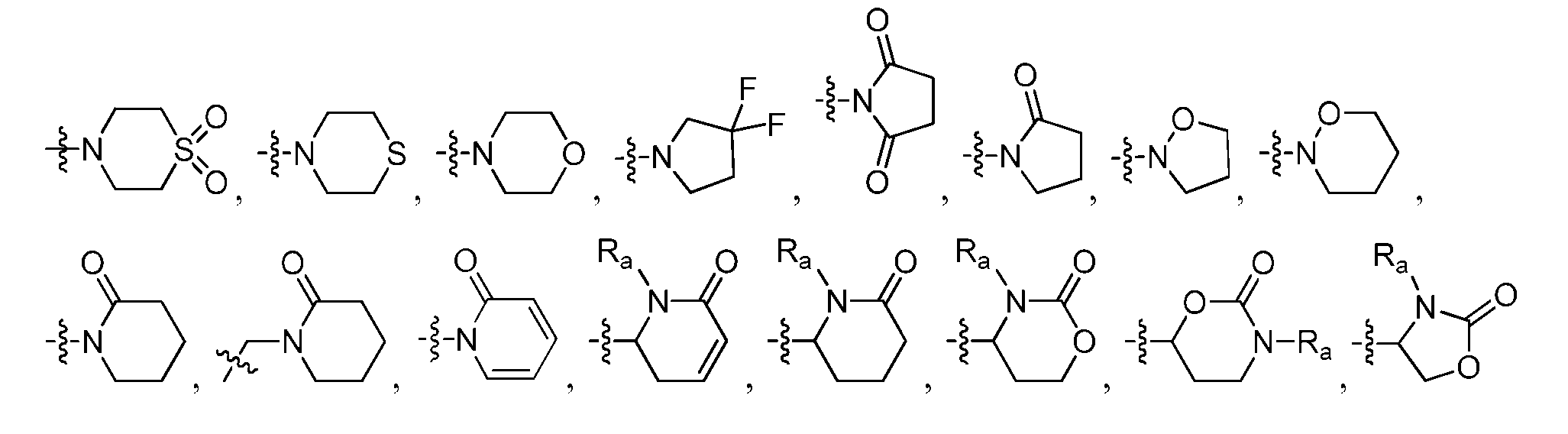

R2는 H, 또는 OH이거나;R 2 is H, or OH;
또는 R1과 R2가 함께 동일한 산소 원자에 결합될 수 있고;Or R 1 and R 2 may be bonded together to the same oxygen atom;
R3은 H, C(1-4)알킬, -CN, CHF2, 또는 CF3이고;R 3 is H, C (1-4) alkyl, -CN, CHF 2 , or CF 3 ;
R4는 H 또는 CH3이고;R 4 is H or CH 3, and;
R5는 H 또는 중수소이고;R < 5 > is H or deuterium;
Ra는 H, 또는 CH3이고;R a is H, or CH 3 ;
Rb는 H, C(1-4)알킬, 또는 CF3이고;R b is H, C (1-4) alkyl, or CF 3 ;
Rbb는 H, C(1-4)알킬, 또는 CF3이다.R bb is H, C (1-4) alkyl, or CF 3 .
본 발명의 다른 실시 형태 및 그의 약학적으로 허용가능한 염에서,In another embodiment of the invention and pharmaceutically acceptable salts thereof,
A는 
X는 CH, 또는 N이고;X is CH, or N;
Z는 CH, 또는 N이되, 단, X 및 Z 둘 모두가 CH는 아니고;Z is CH, or N, with the proviso that both X and Z are not CH;
J는 N이고;J is N;
Q는 C-R5이고;Q is CR < 5 >;
R1은 H, 피리딜, 페닐, 티아졸릴, 아이소티아졸릴, CF3, -CH=CH2, CO2CH2CH3, NHBOC, N(C(1-3)알킬)CO2CH2Ph, NRbC(O)Rbb, C(O)N(CH3)OCH3, C(O)NHCH2CH3, C(O)NHCH2Ph(OCH3)2, -C(OH)(CH2CH=CH2)2, 3,6-다이하이드로피란-2-일, 2,5-다이하이드로푸란-2-일, 테트라하이드로피라닐, 사이클로펜테닐, 사이클로펜타닐, 테트라하이드로푸란-2-일, 사이클로헵타닐,R 1 is H, pyridyl, phenyl, thiazolyl, iso-thiazolyl, CF 3, -CH = CH 2 , CO 2 CH 2 CH 3, NHBOC, N (C (1-3) alkyl) CO 2 CH 2 Ph , NR b C (O) R bb, C (O) N (CH 3) OCH 3, C (O) NHCH 2 CH 3, C (O) NHCH 2 Ph (OCH 3) 2, -C (OH) ( CH 2 CH = CH 2) 2 , 3,6- dihydro-pyran-2-yl, 2,5-dihydro-furan-2-yl, tetrahydropyranyl, cyclopentenyl, bicyclo fentanyl, tetrahydrofuran -2 -, cycloheptanyl,


R2는 H, 또는 OH이거나;R 2 is H, or OH;
또는 R1과 R2가 함께 동일한 산소 원자에 결합될 수 있고;Or R 1 and R 2 may be bonded together to the same oxygen atom;
R3은 H, CH3, -CN, CH(CH3)2, 또는 CF3이고;R 3 is H, CH 3 , -CN, CH (CH 3 ) 2 , or CF 3 ;
R4는 H 또는 CH3이고;R 4 is H or CH 3, and;
R5는 H 또는 중수소이고;R < 5 > is H or deuterium;
Ra는 H, 또는 CH3이고;Rb는 H, C(1-4)알킬, 또는 CF3이고;R a is H, or CH 3 ; R b is H, C (1-4) alkyl, or CF 3 ;
Rbb는 H, C(1-4)알킬, 또는 CF3이다.R bb is H, C (1-4) alkyl, or CF 3 .
다른 실시 형태에서, 본 발명은 본 명세서의 실시예에 기재된 임의의 화합물로부터 선택되는 화학식 I의 화합물, 및 그의 약학적으로 허용가능한 염이다.In another embodiment, the invention is a compound of formula I selected from any of the compounds described in the Examples herein, and pharmaceutically acceptable salts thereof.
다른 실시 형태에서, 본 발명은 하기로 이루어진 군으로부터 선택되는 화합물 및 그의 약학적으로 허용가능한 염이다:In another embodiment, the invention is a compound selected from the group consisting of and pharmaceutically acceptable salts thereof:


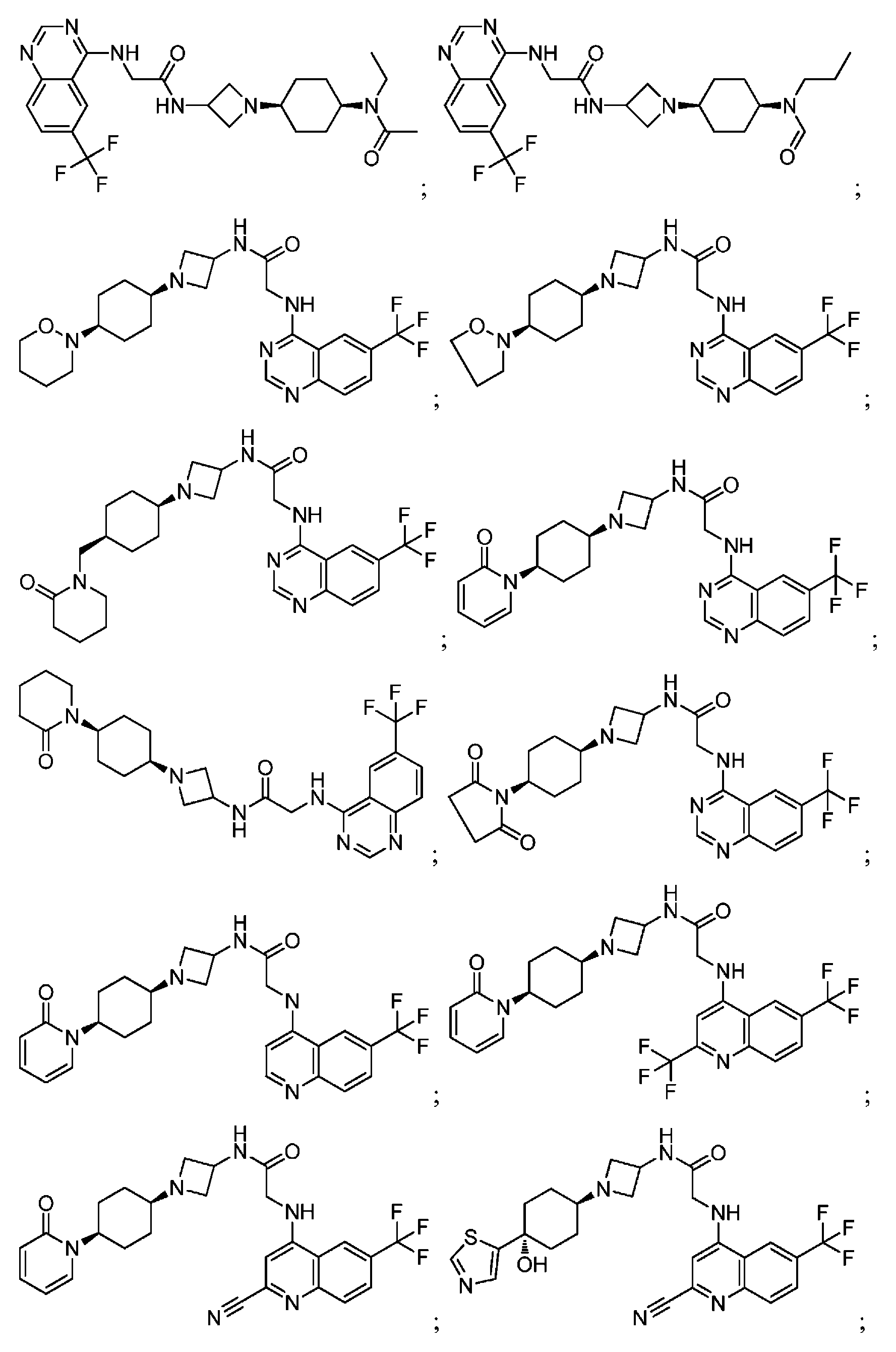

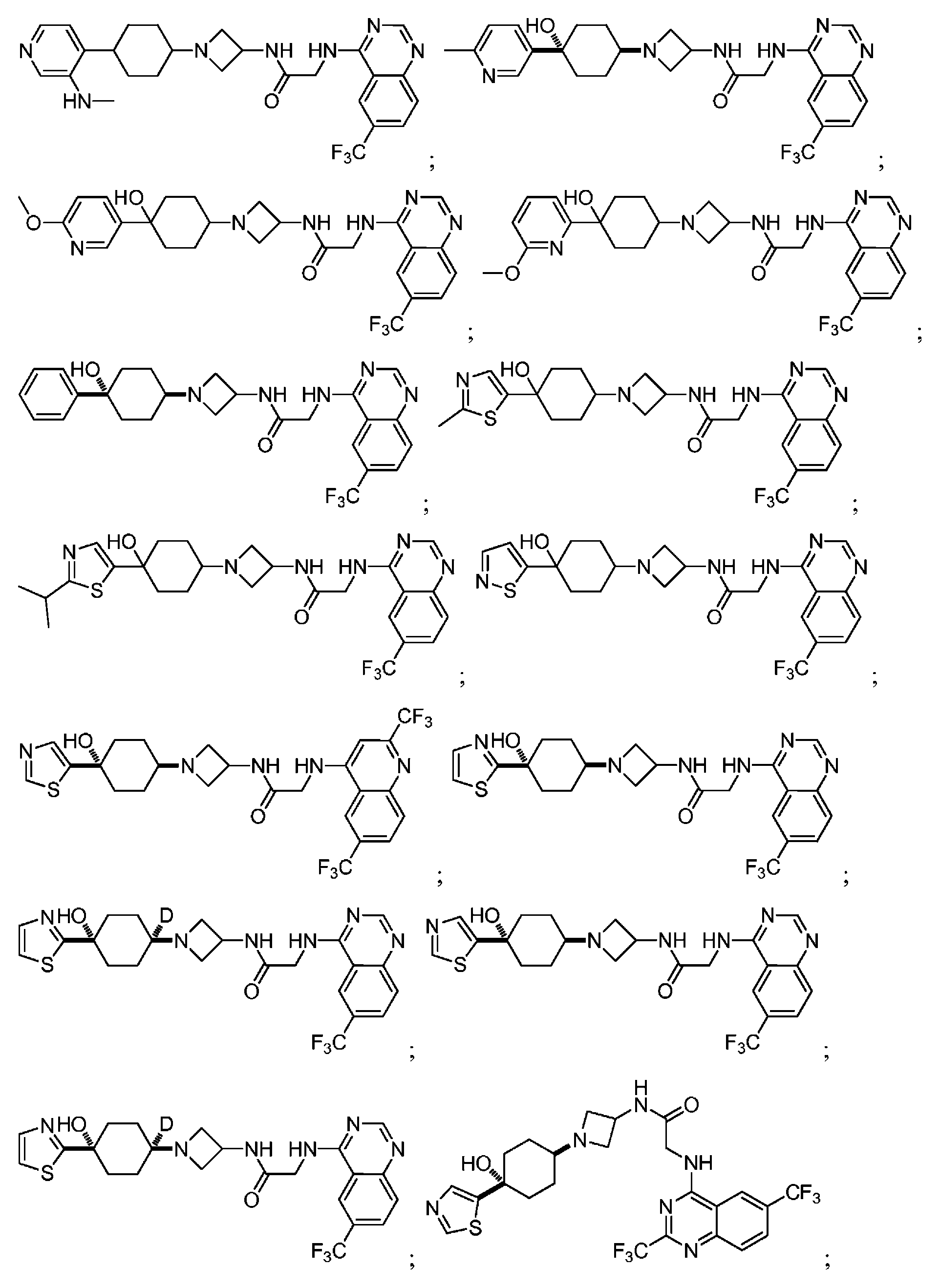


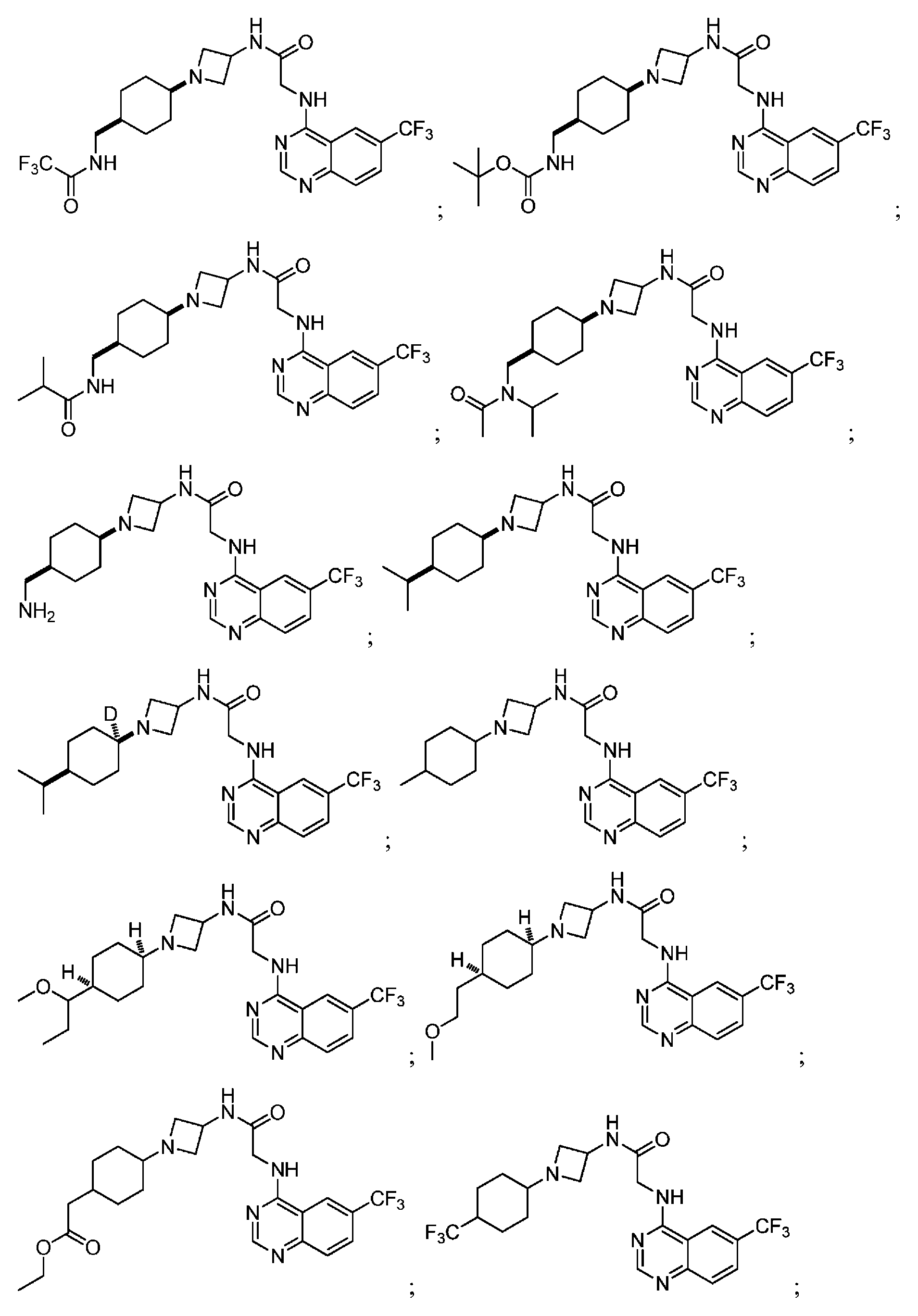


다른 실시 형태에서, 본 발명은 화학식 I의 화합물 및 약학적으로 허용가능한 담체를 포함하는, 약학 조성물에 관한 것이다.In another embodiment, the present invention relates to a pharmaceutical composition comprising a compound of formula I and a pharmaceutically acceptable carrier.
다른 실시 형태에서, 본 발명은 화학식 I의 화합물과 약학적으로 허용가능한 담체를 혼합하여 제조되는 약학 조성물에 관한 것이다.In another embodiment, the invention relates to a pharmaceutical composition prepared by admixing a compound of formula I with a pharmaceutically acceptable carrier.
다른 실시 형태에서, 본 발명은 화학식 I의 화합물과 약학적으로 허용가능한 담체를 혼합하는 것을 포함하는 약학 조성물의 제조 방법에 관한 것이다.In another embodiment, the invention is directed to a method of making a pharmaceutical composition comprising admixing a compound of formula I with a pharmaceutically acceptable carrier.
다른 실시 형태에서, 본 발명은 환원제의 존재 하에 하기 화학식 IV의 화합물을 하기 화학식 VI의 화합물과 반응시켜 화학식 I의 화합물을 제공하는 것을 포함하는, 화학식 I의 화합물의 제조 방법에 관한 것이다:In another embodiment, this invention is directed to a process for the preparation of compounds of formula I, which comprises reacting a compound of formula IV: [image] with a compound of formula VI: [Image Omitted] in the presence of a reducing agent to provide a compound of formula I:
[화학식 IV](IV)
[화학식 VI](VI)

다른 실시 형태에서, 본 발명은 환원제의 존재 하에 하기 화학식 IX의 화합물을 하기 화학식 VI의 화합물과 반응시켜 화학식 I의 화합물을 제공하는 것을 포함하는, 화학식 I의 화합물의 제조 방법에 관한 것이다:In another embodiment, this invention is directed to a process for preparing a compound of formula I, which comprises reacting a compound of formula (IX): < EMI ID =
[화학식 IX](IX)

[화학식 VI](VI)

다른 실시 형태에서, 본 발명은 환원제의 존재 하에 하기 화학식 XXXVIII의 화합물을 하기 화학식 VI의 화합물과 반응시켜 화학식 I의 화합물을 제공하는 것을 포함하는, 화학식 I의 화합물의 제조 방법에 관한 것이다:In another embodiment, the present invention is directed to a process for preparing a compound of formula I, which comprises reacting a compound of formula (XXXVIII): [image] with a compound of formula (VI)
[화학식 XXXVIII](XXXVIII)
[화학식 VI](VI)

다른 실시 형태에서, 본 발명은 임의의 상기 방법에 의해 제조된 생성물에 관한 것이다.In another embodiment, the present invention relates to a product made by any of the above methods.
다른 실시 형태에서, 본 발명은 CCR2 매개 증후군, 장애 또는 질환의 예방, 치료 또는 개선을 필요로 하는 대상에게 치료적 유효량의 화학식 I의 화합물을 투여하는 것을 포함하는 상기 CCR2 매개 증후군, 장애 또는 질환의 예방, 치료 또는 개선 방법에 관한 것이다.In another embodiment, the invention provides a method of treating, preventing, treating or ameliorating a CCR2 mediated syndrome, disorder or disease, comprising administering to a subject in need thereof a therapeutically effective amount of a compound of formula I: Prevention, treatment, or amelioration.
다른 실시 형태에서, 본 발명은 상승된 MCP-1 발현 또는 MCP-1 과발현과 관련되거나, 또는 상승된 MCP-1 발현 또는 MCP-1 과발현과 연관된 증후군, 장애 또는 질환을 수반하는 염증 병상인 CCR2 매개 염증 증후군, 장애 또는 질환의 예방, 치료 또는 개선을 필요로 하는 대상에게 유효량의 화학식 I의 화합물을 투여하는 것을 포함하는 상기 CCR2 매개 염증 증후군, 장애 또는 질환의 예방, 치료 또는 개선 방법에 관한 것이다.In another embodiment, the invention provides a pharmaceutical composition comprising a CCR2 mediator that is an inflammatory disease associated with elevated MCP-1 expression or MCP-1 overexpression or with a syndrome, disorder or disease associated with elevated MCP-1 expression or MCP- Disorder or disease comprising administering to a subject in need thereof an effective amount of a compound of formula I, to a subject in need of prevention, treatment or amelioration of an inflammatory syndrome, disorder or disease.
다른 실시 형태에서, 본 발명은 만성 폐쇄성 폐 질환 (COPD), 안과 질환, 포도막염, 죽상 동맥 경화증, 류마티스 관절염, 건선, 건선성 관절염, 아토피성 피부염, 다발성 경화증, 크론병, 궤양성 대장염, 신장염, 기관 동종이식거부, 폐섬유증, 신부전, I형 당뇨병, II형 당뇨병 및 당뇨병성 합병증, 당뇨병성 신장병증, 당뇨병성 망막병증, 당뇨병성 망막염, 당뇨병성 미세혈관병증, 과체중, 비만, 비만 관련 인슐린 저항증, 결핵, 만성 폐쇄성 폐 질환, 사코이드증, 침습성 스타필로콕시아(invasive staphyloccocia), 백내장 수술 후 염증, 알러지성 비염, 알러지성 결막염, 만성 두드러기, 천식, 알러지성 천식, 치주 질환, 치주염, 치은염, 잇몸 질환, 확장성 심근병증, 심근경색, 심근염, 만성 심부전, 혈관협착, 재협착, 재관류 장애, 사구체신염, 고형 종양 및 암, 만성 림프구성 백혈병, 만성 골수성 백혈병, 다발성 골수종, 악성 골수종, 호지킨병, 및 방광, 유방, 경부, 결장, 폐, 전립선, 또는 위의 암종으로 이루어진 군으로부터 선택되는 증후군, 장애 또는 질환의 예방, 치료 또는 개선을 필요로 하는 대상에게 유효량의 화학식 I의 화합물을 투여하는 것을 포함하는 상기 증후군, 장애 또는 질환의 예방, 치료 또는 개선 방법에 관한 것이다.In another embodiment, the present invention provides a method of treating a condition selected from the group consisting of chronic obstructive pulmonary disease (COPD), ophthalmic diseases, uveitis, atherosclerosis, rheumatoid arthritis, psoriasis, psoriatic arthritis, atopic dermatitis, multiple sclerosis, Crohn ' Insulin resistance associated with overweight, obesity, obesity, diabetic retinopathy, diabetic retinopathy, diabetic retinopathy, diabetic nephropathy, diabetic nephropathy, type 2 diabetes mellitus, type 2 diabetes mellitus, Chronic obstructive pulmonary disease, chronic obstructive pulmonary disease, invasive staphylococci, inflammation after cataract surgery, allergic rhinitis, allergic conjunctivitis, chronic urticaria, asthma, allergic asthma, periodontal disease, periodontitis, Gingivitis, gum disease, dilated cardiomyopathy, myocardial infarction, myocarditis, chronic heart failure, vascular stenosis, restenosis, reperfusion injury, glomerulonephritis, solid tumors and cancer, chronic rim Disorders, or diseases selected from the group consisting of: myeloid leukemia, chronic myelogenous leukemia, multiple myeloma, malignant myeloma, Hodgkin's disease, and bladder, breast, cervix, colon, lung, prostate, Disorder or disease, comprising administering to a subject in need thereof an effective amount of a compound of formula (I).
다른 실시 형태에서, 본 발명은 II형 당뇨병 및 당뇨병성 합병증, 당뇨병성 신장병증, 당뇨병성 망막병증, 당뇨병성 망막염, 당뇨병성 미세혈관병증, 비만, 천식, 및 알러지성 천식으로 이루어진 군으로부터 선택되는 증후군, 장애 또는 질환의 예방, 치료 또는 개선을 필요로 하는 대상에게 치료적 유효량의 화학식 I의 화합물을 투여하는 것을 포함하는 상기 증후군, 장애 또는 질환의 예방, 치료 또는 개선 방법에 관한 것이다.In another embodiment, the invention is directed to a method of treating type 2 diabetes mellitus comprising administering a therapeutically effective amount of a compound selected from the group consisting of type II diabetes and diabetic complications, diabetic nephropathy, diabetic retinopathy, diabetic retinopathy, diabetic microangiopathy, obesity, asthma, Disorder or disease, comprising administering to a subject in need thereof a therapeutically effective amount of a compound of formula (I), or a pharmaceutically acceptable salt thereof, for the manufacture of a medicament for the prevention, treatment or amelioration of the above syndrome, disorder or disease.
다른 실시 형태에서, 본 발명은 II형 당뇨병, 비만 및 천식으로 이루어진 군으로부터 선택되는 장애의 치료를 필요로 하는 대상에게 치료적 유효량의 화학식 I의 화합물을 투여하는 것을 포함하는 상기 장애의 치료 방법에 관한 것이다.In another embodiment, the invention relates to a method of treating such disorders, comprising administering to a subject in need thereof a therapeutically effective amount of a compound of formula I, for the treatment of a disorder selected from the group consisting of type II diabetes, obesity and asthma .
다른 실시 형태에서, 본 발명은 실시예 1 내지 실시예 170 중 어느 하나로부터 선택되는 화학식 I의 화합물, 및 그의 약학적으로 허용가능한 염에 관한 것이다.In another embodiment, the present invention relates to compounds of formula I selected from any one of embodiments 1 to 170, and pharmaceutically acceptable salts thereof.
다른 실시 형태에서, 본 발명은 실시예 1 내지 실시예 170 중 임의의 것의 보다 극성이 작은 이성체인 화학식 I의 화합물에 관한 것이다.In another embodiment, the invention is directed to a compound of formula I, which is the less polar isomer of any of examples 1 -
다른 실시 형태에서, 본 발명은 실시예 1 내지 실시예 170 중 임의의 실시예의 방법에 의해 제조된 생성물에 관한 것이다.In another embodiment, the present invention relates to a product made by the method of any of embodiments < RTI ID = 0.0 > 1 < / RTI >
정의Justice
용어 "알킬"은, 달리 표시되지 않는다면, 12개 이하의 탄소 원자, 바람직하게는 6개 이하의 탄소 원자의 선형 및 분지형 사슬 라디칼 둘 모두를 지칭하며, 메틸, 에틸, 프로필, 아이소프로필, 부틸, 아이소부틸, sec-부틸, tert-부틸, 펜틸, 아이소펜틸, 헥실, 아이소헥실, 헵틸, 옥틸, 2,2,4-트라이메틸펜틸, 노닐, 데실, 운데실 및 도데실을 포함하지만 이로 한정되지 않는다.The term "alkyl" refers to both linear and branched chain radicals of up to 12 carbon atoms, preferably up to 6 carbon atoms, unless otherwise indicated and includes methyl, ethyl, propyl, isopropyl, butyl , Isobutyl, sec-butyl, tert-butyl, pentyl, isopentyl, hexyl, isohexyl, heptyl, octyl, 2,2,4-trimethylpentyl, nonyl, decyl, undecyl and dodecyl It does not.
용어 "C(a-b)"(여기서, a 및 b는 탄소 원자의 지정된 개수를 지칭하는 정수임)는 a 내지 b개 (종점 포함)의 탄소 원자를 포함하는 알킬, 알케닐, 알키닐, 알콕시 또는 사이클로알킬 라디칼, 또는 알킬이 접두사 어근으로서 표시되는 라디칼의 알킬 부분을 지칭한다. 예를 들어, C(1-4)는 1, 2, 3 또는 4개의 탄소 원자를 포함하는 라디칼을 나타낸다.The term " C (ab) & quot ;, wherein a and b are integers denoting a specified number of carbon atoms, refers to an alkyl, alkenyl, alkynyl, alkoxy, or cyclo Refers to an alkyl radical, or an alkyl moiety of the radical in which alkyl is designated as the prefix radical. For example, C (1-4) represents a radical comprising 1, 2, 3 or 4 carbon atoms.
용어 "사이클로알킬"은 단일 고리 탄소 원자로부터 하나의 수소 원자를 제거하여 유도되는 포화 또는 부분 불포화 단환식 또는 이환식 탄화수소 고리 라디칼을 지칭한다. 전형적인 사이클로알킬 라디칼은 사이클로프로필, 사이클로부틸, 사이클로펜틸, 사이클로펜테닐, 사이클로헥실, 사이클로헥세닐, 사이클로헵틸 및 사이클로옥틸을 포함한다. 추가의 예에는 C(3-8)사이클로알킬, C(5-8)사이클로알킬, C(3-12)사이클로알킬, C(3-20)사이클로알킬, 데카하이드로나프탈레닐, 및 2,3,4,5,6,7-헥사하이드로-1H-인데닐이 포함된다.The term "cycloalkyl" refers to a saturated or partially unsaturated monocyclic or bicyclic hydrocarbon ring radical derived by the removal of one hydrogen atom from a single ring carbon atom. Typical cycloalkyl radicals include cyclopropyl, cyclobutyl, cyclopentyl, cyclopentenyl, cyclohexyl, cyclohexenyl, cycloheptyl, and cyclooctyl. Further examples include C (3-8) cycloalkyl, C (5-8) cycloalkyl, C (3-12) cycloalkyl, C (3-20) cycloalkyl, decahydronaphthalenyl, , 4,5,6,7-hexahydro-1H-indenyl.
용어 "헤테로방향족" 또는 "헤테로아릴"은 N, O, 또는 S로부터 선택되는 1 내지 4개의 헤테로원자를 포함하는 5원 내지 7원 단환식 또는 8원 내지 10원 이환식 방향족 고리 시스템을 지칭하며, 여기서, 질소 및 황 원자는 임의의 허용되는 산화 상태로 존재할 수 있다. 예에는, 벤즈이미다졸릴, 벤조티아졸릴, 벤조티에닐, 벤족사졸릴, 푸릴, 이미다졸릴, 아이소티아졸릴, 아이속사졸릴, 옥사졸릴, 피라지닐, 피라졸릴, 피리딜, 피리미디닐, 피롤릴, 퀴놀리닐, 티아졸릴 및 티에닐이 포함되나 이에 한정되지 않는다.The term "heteroaromatic" or "heteroaryl" refers to a 5 to 7 membered monocyclic or 8 to 10 membered bicyclic aromatic ring system comprising 1 to 4 heteroatoms selected from N, O, Wherein the nitrogen and sulfur atoms may be present in any acceptable oxidation state. Examples include benzimidazolyl, benzothiazolyl, benzothienyl, benzoxazolyl, furyl, imidazolyl, isothiazolyl, isoxazolyl, oxazolyl, pyrazinyl, pyrazolyl, pyridyl, pyrimidinyl, But are not limited to, pyrrolyl, quinolinyl, thiazolyl, and thienyl.
용어 "헤테로원자"는 질소 원자, 산소 원자 또는 황 원자를 지칭하며, 여기서, 질소 및 황 원자는 임의의 허용된 산화 상태로 존재할 수 있다.The term "heteroatom" refers to a nitrogen atom, an oxygen atom or a sulfur atom, wherein the nitrogen and sulfur atoms may exist in any permissible oxidation state.
약제에 사용하기 위해, 본 발명의 화합물의 염은 비독성의 "약학적으로 허용가능한 염"을 지칭한다. FDA가 승인한 약학적으로 허용가능한 염 형태 (문헌 [Ref. International J. Pharm. 1986, 33, 201-217; J. Pharm. Sci., 1977, Jan, 66(1), p1] 참조)는 약학적으로 허용가능한 산성/음이온성 또는 염기성/양이온성 염을 포함한다.For use in a medicament, a salt of a compound of the invention refers to a non-toxic "pharmaceutically acceptable salt ". (See Ref. International J. Pharm., 1986, 33, 201-217; J. Pharm. Sci., 1977, Jan, 66 (1), p1) approved by the FDA Pharmaceutically acceptable acid / anionic or basic / cationic salts.
본 명세서를 통해, 화합물은, 분취용 박층 크로마토그래피, 또는 고압 또는 저압 액체 크로마토그래피도 사용될 수 있지만, 통상 실리카 겔 컬럼에 의해 분리되는 것으로 기재되어 있다. 일반적으로, 화합물을 실리카 겔형 분리 매체를 통해 용리하는 경우, 최소 극성을 갖는 화합물이 보다 극성이 큰 화합물보다 먼저 용리되는 것으로 인정된다. 따라서, 용어 "보다 극성이 작은 이성체"는 실리카 겔형 분리 매체로부터 먼저 용리되는 이성체를 말한다.Throughout this specification, compounds are described as being separated by a silica gel column, although preparative thin layer chromatography, or high pressure or low pressure liquid chromatography, can also be used. In general, when a compound is eluted through a silica gel-type separation medium, it is recognized that a compound having a minimum polarity is eluted before a compound having a higher polarity. Thus, the term "less polar isomer" refers to an isomer eluted first from a silica gel separation medium.
약어Abbreviation
하기의 약어가 본 명세서에서 그리고 본 출원서에 사용될 수 있다.The following abbreviations may be used in this specification and in the present application.
BOC 또는 Boc tert-부틸옥시카르보닐BOC or Boc tert-butyloxycarbonyl
Bu 부틸This butyl
D 중수소D deuterium
DCC 다이사이클로헥실카르보다이이미드DCC dicyclohexylcarbodiimide
DCE 다이클로로에탄DCE dichloroethane
DCM 다이클로로메탄DCM dichloromethane
DMF 다이메틸포름아미드DMF dimethylformamide
DMSO 다이메틸설폭사이드DMSO dimethylsulfoxide
EDCI 1-에틸-3-(3 -다이메틸아미노프로필)카르보다이이미드EDCI 1-ethyl-3- (3-dimethylaminopropyl) carbodiimide
Et 에틸Ethyl ethyl
EtOAc 에틸 아세테이트EtOAc ethyl acetate
DIPEA 다이아이소프로필에틸아민DIPEA Diisopropylethylamine
DMAP 다이메틸아미노피리딘DMAP dimethylaminopyridine
HOBt 하이드록시벤조트라이아졸HOBt Hydroxybenzotriazole
IPA 아이소프로필 알코올IPA isopropyl alcohol
mCPBA 메타-클로로퍼옥시 벤조산mCPBA meta-chloroperoxybenzoic acid
Me 메틸Me methyl
Ms 메실레이트Ms mesylate
NMM N-메틸 모르폴린NMM N-methylmorpholine
NMP N-메틸피롤리딘NMP N-methylpyrrolidine
OAc 아세테이트OAc acetate
PdCl2(dppf) [1,1'-비스(다이페닐포스피노)페로센]다이클로로팔라듐(II)PdCl 2 (dppf) [1,1'-bis (diphenylphosphino) ferrocene] dichloropalladium (II)
Ph 페닐Ph phenyl
iPr 아이소프로필iPr isopropyl
PyBrop 브로모-트리스-피롤리디노포스포늄 헥사플루오로포스페이트PyBrop Bromo-tris-pyrrolidinophosphonium hexafluorophosphate
RT 또는 rt 실온RT or rt room temperature
TEA 트라이에틸아민TEA Triethylamine
TFA 트라이플루오로아세트산TFA Trifluoroacetic acid
THF 테트라하이드로푸란THF tetrahydrofuran
약학적으로 허용가능한 산성/음이온성 염에는 아세테이트, 벤젠설포네이트, 벤조에이트, 바이카르보네이트, 바이타르트레이트, 브로마이드, 칼슘 에데테이트, 캄실레이트, 카르보네이트, 클로라이드, 시트레이트, 다이하이드로클로라이드, 에데테이트, 에디실레이트(edisylate), 에스톨레이트(estolate), 에실레이트(esylate), 푸마레이트, 글리셉테이트(glyceptate), 글루코네이트, 글루타메이트, 글리콜릴라르사닐레이트(glycollylarsanilate), 헥실레조르시네이트(hexylresorcinate), 하이드라바민(hydrabamine), 하이드로브로마이드, 하이드로클로라이드(hydrochloride), 하이드록시나프토에이트, 요오다이드, 이세티오네이트(isethionate), 락테이트, 락토바이오네이트(lactobionate), 말레이트, 말레에이트(maleate), 만델레이트(mandelate), 메실레이트, 메틸브로마이드, 메틸니트레이트, 메틸설페이트, 뮤케이트(mucate), 납실레이트(napsylate), 니트레이트, 파모에이트(pamoate), 판토테네이트(pantothenate), 포스페이트/다이포스페이트, 폴리갈락투로네이트(polygalacturonate), 살리실레이트, 스테아레이트, 서브아세테이트, 석시네이트, 설페이트, 탄네이트(tannate), 타르트레이트, 테오클레이트(teoclate), 토실레이트 및 트라이에티오다이드(triethiodide)가 포함되나, 이에 한정되지 않는다. 유기 또는 무기 산에는 또한, 요오드화수소산, 과염소산, 황산, 인산, 프로피온산, 글리콜산, 메탄설폰산, 하이드록시에탄설폰산, 옥살산, 2-나프탈렌설폰산, p-톨루엔설폰산, 사이클로헥산설팜산, 사카린산 또는 트라이플루오로아세트산이 포함되나, 이에 한정되지 않는다.Pharmaceutically acceptable acidic / anionic salts include but are not limited to acetate, benzenesulfonate, benzoate, bicarbonate, bitartrate, bromide, calcium edetate, camsylate, carbonate, chloride, citrate, dihydrochloride , Edetate, edisylate, estolate, esylate, fumarate, glyceptate, gluconate, glutamate, glycollylarsanilate, hexylzereate, But are not limited to, hexylresorcinate, hydrabamine, hydrobromide, hydrochloride, hydroxynaphthoate, iodide, isethionate, lactate, lactobionate, Maleate, mandelate, mesylate, methyl bromide, methyl nitrate, methyl < RTI ID = 0.0 > (S) selected from the group consisting of fumarate, fumarate, fumarate, fumarate, fumarate, fumarate, mate, napylate, nitrate, pamoate, , But are not limited to, acetates, succinates, sulphates, tannates, tartrates, teoclates, tosylates and triethiodides. The organic or inorganic acids may also include organic acids such as hydroiodic acid, perchloric acid, sulfuric acid, phosphoric acid, propionic acid, glycolic acid, methanesulfonic acid, hydroxyethanesulfonic acid, oxalic acid, 2- naphthalenesulfonic acid, p- toluenesulfonic acid, ≪ / RTI > saccharinic acid or triflu or o acetic acid.
약학적으로 허용가능한 염기성/양이온성 염에는 알루미늄, 2-아미노-2-하이드록시메틸-프로판-1,3-다이올 (또한, 트리스(하이드록시메틸)아미노메탄, 트로메탄 또는 "트리스"(TRIS)로도 알려져 있음), 암모니아, 벤자틴, t-부틸아민, 칼슘, 칼슘 글루코네이트, 수산화칼슘, 클로로프로카인, 콜린, 콜린 바이카르보네이트, 콜린 클로라이드, 사이클로헥실아민, 다이에탄올아민, 에틸렌다이아민, 리튬, LiOMe, L-라이신, 마그네슘, 메글루민, NH3, NH4OH, N-메틸-D-글루카민, 피페리딘, 칼륨, 칼륨-t-부톡사이드, 수산화칼륨(수성), 프로카인, 퀴닌, 나트륨, 탄산나트륨, 나트륨-2-에틸헥사노에이트 (SEH), 수산화나트륨, 트라이에탄올아민 또는 아연이 포함되나, 이에 한정되지 않는다.Pharmaceutically acceptable basic / cationic salts include, but are not limited to, aluminum, 2-amino-2-hydroxymethyl-propane-1,3-diol (also tris (hydroxymethyl) aminomethane, TRIS), ammonia, benzathine, t-butylamine, calcium, calcium gluconate, calcium hydroxide, chloroprocaine, choline, choline bicarbonate, choline chloride, cyclohexylamine, diethanolamine, ethylene diamine Min, lithium, LiOMe, L- lysine, magnesium, meglumine, NH 3, NH 4 OH, -D- N- methyl glucamine, piperidine, potassium, potassium -t- butoxide, potassium hydroxide (aqueous) , Procaine, quinine, sodium, sodium carbonate, sodium 2-ethylhexanoate (SEH), sodium hydroxide, triethanolamine or zinc.
사용 방법How to use
본 발명은 CCR2 매개 증후군, 장애 또는 질환의 예방, 치료 또는 개선을 필요로 하는 대상에게 유효량의 화학식 I의 화합물, 또는 그의 형태, 조성물 또는 약제를 투여하는 것을 포함하는, 상기 CCR2 매개 증후군, 장애 또는 질환의 예방, 치료 또는 개선 방법에 관한 것이다.Disorder or disease, comprising administering to a subject in need thereof an effective amount of a compound of formula I, or a form, composition or medicament thereof, for the prevention, treatment or amelioration of a CCR2 mediated syndrome, disorder or disease. To a method of preventing, treating or ameliorating a disease.
화학식 I의 화합물이 유용한 CCR2 매개 증후군, 장애 또는 질환의 예에는 만성 폐쇄성 폐 질환 (COPD), 안과질환, 포도막염, 죽상 동맥 경화증, 류마티스 관절염, 건선, 건선성 관절염, 아토피성 피부염, 다발성 경화증, 크론병, 궤양성 대장염, 신장염, 기관 동종이식거부, 폐섬유증, 신부전, I형 당뇨병, II형 당뇨병, 당뇨병성 합병증, 당뇨병성 신장병증, 당뇨병성 망막병증, 당뇨병성 망막염, 당뇨병성 미세혈관병증, 과체중, 비만, 비만 관련 인슐린 저항증, 대사증후군, 결핵, 만성 폐쇄성 폐 질환, 사코이드증, 침습성 스타필로콕시아, 백내장 수술 후 염증, 알러지성 비염, 알러지성 결막염, 만성 두드러기, 천식, 알러지성 천식, 치주 질환, 치주염, 치은염, 잇몸 질환, 확장성 심근병증, 심근 경색, 심근염, 만성 심부전, 혈관협착, 재협착, 재관류 장애, 복부 대동맥류, 다발성 경화증, 사구체신염, 고형 종양 및 암, 만성 림프구성 백혈병, 만성 골수성 백혈병, 다발성 골수종, 악성 골수종, 호지킨병, 방광, 유방, 경부, 결장, 폐, 전립선, 및 위의 암종, 및 알츠하이머병, 허혈성 뇌졸중, 척수 손상, 신경 압궤 손상 및 외상성 뇌손상을 포함하나 이에 한정되지 않는 만성 신경염증성 장애가 포함된다.Examples of CCR2 mediated syndromes, disorders or diseases for which the compounds of formula I are useful include chronic obstructive pulmonary disease (COPD), ophthalmic diseases, uveitis, atherosclerosis, rheumatoid arthritis, psoriasis, psoriatic arthritis, atopic dermatitis, multiple sclerosis, The present invention provides a method for treating diabetic retinopathy, diabetic retinopathy, diabetic retinopathy, diabetic retinopathy, diabetic retinopathy, diabetic retinopathy, diabetic retinopathy, diabetic retinopathy, diabetic retinopathy, diabetic retinopathy, diabetic retinopathy, diabetic retinopathy, Allergic conjunctivitis, Allergic conjunctivitis, Allergic conjunctivitis, Allergic asthma, Allergic asthma, Allergic rhinitis, Allergic conjunctivitis, Allergic conjunctivitis, Allergic conjunctivitis, Overweight, Obesity, Obesity related insulin resistance, Metabolic syndrome, Tuberculosis, Chronic obstructive pulmonary disease, Asthma, periodontal disease, periodontitis, gingivitis, gum disease, myocardial infarction, myocardial infarction, myocarditis, chronic heart failure, vascular stenosis, restenosis, Aneurysms, multiple sclerosis, glomerulonephritis, solid tumors and cancer, chronic lymphocytic leukemia, chronic myelogenous leukemia, multiple myeloma, malignant myeloma, Hodgkin's disease, bladder, breast, cervix, lung, lung, prostate, Alzheimer ' s disease, ischemic stroke, spinal cord injury, nerve crush injury and traumatic brain injury.
본 발명의 방법과 관련해서 용어 "투여하는"은, 화학식 I의 화합물, 또는 그의 형태, 조성물 또는 약제를 사용함으로써, 본 명세서에서 기술된 바와 같은 증후군, 장애 또는 질환을 치료적으로 또는 예방적으로 예방, 치료 또는 개선하는 방법을 의미한다. 그러한 방법은 유효량의 상기 화합물, 화합물 형태, 조성물 또는 약제를 치료 과정 동안에 병용 형태로 상이한 시간에, 또는 동시에, 투여하는 것을 포함한다. 본 발명의 방법은 모든 알려진 치료적 치료 섭생을 포함하는 것으로 이해되고자 한다.The term "administering " in the context of the methods of the present invention refers to the use of a compound of formula I, or a form, composition or medicament thereof, to treat a syndrome, disorder or disease as described herein therapeutically or prophylactically Prevention, treatment, or amelioration. Such methods include administering an effective amount of the compound, compound form, composition or medicament at different times or concurrently in a combined form during the course of the treatment. The methods of the present invention are intended to be understood to include all known therapeutic therapeutic regimens.
용어 "대상"은 치료, 관찰 또는 실험의 대상이 되어 왔던 동물, 전형적으로 포유동물, 전형적으로 인간인 환자를 말한다. 본 발명의 한 측면에서, 대상은 상승된 MCP-1 발현 또는 MCP-1 과발현과 관련된 증후군, 장애 또는 질환이 발생할 위험에 있거나 (발생하기 쉽거나), 상승된 MCP-1 발현 또는 MCP-1 과발현과 관련된 증후군, 장애 또는 질환을 수반하는 염증 병상을 갖는 환자이다.The term "subject" refers to an animal, typically a mammal, typically a human, who has been the subject of treatment, observation or experimentation. In one aspect of the invention, the subject is at risk of developing (prone to or developing) a syndrome, disorder or disease associated with elevated MCP-1 expression or MCP-1 overexpression, elevated MCP-1 expression or MCP- Disorder, or disease associated with a disease or condition associated with the disease.
용어 "치료적 유효량"이란 연구원, 수의사, 의사, 또는 기타 임상의가 추구하고 있는 치료 중인 증후군, 장애 또는 질환의 증상을 예방, 치료 또는 개선하는 것을 포함하는, 조직계, 동물 또는 인간에서 생물학적 또는 의학적 반응을 유도하는 활성 화합물 또는 약학 제제의 양을 의미한다.The term "therapeutically effective amount" is intended to mean a biological or medicinal agent in a system, animal or human, including, but not limited to, preventing, treating or ameliorating the symptoms of the currently treated syndrome, disorder or condition being sought by a researcher, veterinarian, Quot; means the amount of active compound or pharmaceutical agent that elicits the response.
용어 "포도막염"은 일반적으로, 눈과 관련된 임의의 염증 질환을 말한다. 포도막염은 염증이 존재하는 눈의 부분을 기준으로 임상적으로 구별되는 아형으로 구분될 수 있다 (%는 이러한 범주에 맞춰지는 것으로 알려진 환자에 상응함): 전부 (51%), 중간부 (13%), 후부 (20%), 또는 범포도막염 (16%), 및 질환의 경과에 따라, 급성 (16%), 재발성 (26%), 또는 만성 (58%). 전부 포도막염의 경우(19%)는 결국, 한쪽 실명(9%), 양쪽 실명(2%), 또는 한쪽 또는 양쪽 시야 장애(8%)와 같이, 적극적인 치료에도 불구하고 회복불가능한 시야 손상을 발생시킨다. 대부분의 경우의 포도막염은 특발성이지만, 알려진 원인에는 감염 (예를 들어, 톡소플라스마증, 사이토메갈로바이러스 등) 또는 전신 염증성 및/또는 자가면역 장애 (예를 들어, 소아 RA, HLA-B27 관련 척추관절병증, 사코이드증 등)의 구성분으로서의 발현이 포함된다. (HLA-B27: 인간 백혈구 항원 B*27-은 6번 염색체 상의 주요 조직적합성 복합체 (MHC) 내의 B 유전자 좌에 의해 인코딩되는 클래스 I 표면 항원이며, 미생물 항원을 T 세포에 제시한다. HLA-B27은 혈청음성 척추관절병증으로서 알려져 있는 자가면역 질환의 일정 세트와 크게 관련되어 있다).The term "uveitis" generally refers to any inflammatory disease associated with the eye. Uveitis can be divided into clinically distinct subtypes based on the portion of the eye where inflammation is present (% corresponds to patients known to fit into this category): all (51%), intermediate (13% (16%), recurrent (26%), or chronic (58%), depending on the progression of the disease. Complete uveitis (19%) eventually results in irreversible visual impairment despite active treatment, such as one blindness (9%), both blindness (2%), or one or both visual field disorders (8%) . Most cases of idiopathic uveitis are idiopathic but known causes include infection (eg, toxoplasmosis, cytomegalovirus, etc.) or systemic inflammatory and / or autoimmune disorders (eg, pediatric RA, HLA- Pathology, sarcoidosis, etc.). (HLA-B27: human leukocyte antigen B * 27- is a Class I surface antigen encoded by the B locus in the major histocompatibility complex (MHC) on chromosome 6, presenting microbial antigens to T cells HLA-B27 Is significantly associated with a set of autoimmune diseases known as seronegative spondyloarthropathies).
CCR2 억제제로서 적용되는 경우, 본 발명의 화합물은 단일 또는 분리된 일일 용량으로서, 약 0.5 mg 내지 약 10 g, 바람직하게는 약 0.5 mg 내지 약 5 g의 용량 범위 내의 유효량으로 투여될 수 있다. 투여되는 투여량은 투여 경로, 수용자의 건강, 체중 및 연령, 치료 빈도 및 수반되는 그리고 무관한 치료의 여부와 같은 인자들에 의해 영향을 받을 것이다.When applied as a CCR2 inhibitor, the compounds of the present invention may be administered in an effective amount within a dose range of from about 0.5 mg to about 10 g, preferably from about 0.5 mg to about 5 g, in single or separate daily doses. The dosage administered will be influenced by such factors as the route of administration, the health of the recipient, weight and age, frequency of treatment, and whether the treatment is contingent or not.
또한, 본 발명의 화합물 또는 그의 약학 조성물의 치료적 유효 용량은 원하는 효과에 따라 변할 것임이 당업자에게 명백하다. 따라서, 투여될 최적 용량은 당업자에 의해 용이하게 결정될 수 있으며, 사용되는 특정 화합물, 투여 양식, 제제의 강도 및 질환 상태의 진행 정도에 따라 변할 것이다. 또한, 대상 연령, 체중, 식이 및 투여 시간을 비롯한 치료될 구체적인 대상과 관련된 인자들은 용량을 적절한 치료 수준으로 조정하는 것이 필요하게 할 것이다. 상기 투여량은 따라서 평균적인 경우의 예이다. 물론 더 많거나 더 적은 투여량 범위가 유익한 개별적인 경우가 있을 수 있으며, 그러한 경우도 본 발명의 범주 내이다.It will also be apparent to those skilled in the art that the therapeutically effective dose of a compound of the invention or a pharmaceutical composition thereof will vary with the desired effect. Thus, the optimal dose to be administered may be readily determined by those skilled in the art, and will vary depending upon the particular compound employed, the mode of administration, the strength of the formulation, and the extent of the disease state. In addition, factors associated with the particular subject to be treated, including age, weight, diet, and time of administration, will require the dosage to be adjusted to the appropriate therapeutic level. The dose is thus an example of an average case. Of course, there may be individual cases where more or less dosage ranges are beneficial, and such cases are also within the scope of the present invention.
화학식 I의 화합물은 임의의 공지의 약학적으로 허용가능한 담체를 포함하는 약학 조성물로 제형화될 수 있다. 예시적인 담체는 임의의 적합한 용매, 분산 매질, 코팅, 항균 및 항진균 제제 및 등장성 제제를 포함하지만 이로 한정되지 않는다. 또한 제형의 성분일 수 있는 예시적 부형제는 충전제, 결합제, 붕해제 및 윤활제를 포함한다.The compounds of formula I may be formulated into pharmaceutical compositions comprising any of the known pharmaceutically acceptable carriers. Exemplary carriers include, but are not limited to, any suitable solvent, dispersion medium, coating, antibacterial and antifungal agent and isotonic agent. Exemplary excipients which may also be a component of the formulation include fillers, binders, disintegrants, and lubricants.
화학식 I의 화합물의 약학적으로 허용가능한 염은 통상적인 비독성 염 또는 무기 또는 유기 산 또는 염기로부터 형성되는 4차 암모늄염을 포함한다. 그러한 산 부가염의 예는 아세테이트, 아디페이트, 벤조에이트, 벤젠설포네이트, 시트레이트, 캄포레이트, 도데실설페이트, 하이드로클로라이드, 하이드로브로마이드, 락테이트, 말레에이트, 메탄설포네이트, 니트레이트, 옥살레이트, 피발레이트, 프로피오네이트, 석시네이트, 설페이트 및 타르트레이트를 포함한다. 염기 염은 암모늄염, 나트륨 및 칼륨 염과 같은 알칼리 금속 염, 칼슘 및 마그네슘 염과 같은 알칼리토 금속 염, 다이사이클로헥실아미노 염과 같은 유기 염기를 가진 염 및 아르기닌과 같은 아미노산을 가진 염을 포함한다. 또한, 염기성 질소-함유 기는 예를 들어, 알킬 할라이드로 4차화될 수 있다.Pharmaceutically acceptable salts of the compounds of formula (I) include the conventional non-toxic salts or quaternary ammonium salts formed from inorganic or organic acids or bases. Examples of such acid addition salts include, but are not limited to, acetate, adipate, benzoate, benzenesulfonate, citrate, camphorate, dodecyl sulfate, hydrochloride, hydrobromide, lactate, maleate, methanesulfonate, nitrate, oxalate, Pivalate, propionate, succinate, sulfate and tartrate. Base salts include alkali metal salts such as ammonium salts, sodium and potassium salts, alkaline earth metal salts such as calcium and magnesium salts, salts with organic bases such as dicyclohexylamino salts, and salts with amino acids such as arginine. Further, the basic nitrogen-containing group can be quaternized, for example, with an alkyl halide.
본 발명의 약학 조성물은 그들의 의도한 목적을 달성하는 임의의 수단에 의해 투여될 수 있다. 예로는 비경구, 피하, 정맥내, 근육내, 복강내, 경피, 협측 (buccal) 또는 안내 경로에 의한 투여가 포함된다. 대안적으로 또는 동시에, 경구 경로에 의해 투여될 수 있다. 비경구 투여를 위한 적합한 제형은 수용성 형태의 활성 화합물의 수용액, 예를 들어, 수용성 염, 산성 용액, 알칼리 용액, 덱스트로오스-물 용액, 등장성 탄수화물 용액 및 사이클로덱스트린 포접 복합체를 포함한다.The pharmaceutical compositions of the present invention may be administered by any means that achieves their intended purpose. Examples include administration by parenteral, subcutaneous, intravenous, intramuscular, intraperitoneal, transdermal, buccal or guided routes. Alternatively or concurrently, by an oral route. Suitable formulations for parenteral administration include aqueous solutions of the active compounds in water-soluble form, e. G., Water-soluble salts, acidic solutions, alkaline solutions, dextrose-water solutions, isotonic carbohydrate solutions and cyclodextrin inclusion complexes.
본 발명은 또한 본 발명의 임의의 화합물과 약학적으로 허용가능한 담체를 혼합하는 것을 포함하는 약학 조성물의 제조 방법을 포함한다. 따라서, 본 발명은 약학적으로 허용가능한 담체를 본 발명의 임의의 화합물과 함께 혼합함으로써 제조되는 약학 조성물을 포함한다. 본 명세서에 사용되는 바와 같은 용어 "조성물"은 특정 양의 특정 성분을 포함하는 생성물뿐 아니라, 특정 양의 특정 성분들의 조합으로부터 직접 또는 간접적으로 야기되는 임의의 생성물을 포함하는 것으로 의도된다.The invention also encompasses a method of making a pharmaceutical composition comprising admixing any compound of the invention with a pharmaceutically acceptable carrier. Accordingly, the present invention includes pharmaceutical compositions prepared by admixing a pharmaceutically acceptable carrier with any of the compounds of the present invention. The term "composition" as used herein is intended to include any product that results, directly or indirectly, from a combination of specified ingredients in a specified amount, as well as a product comprising the specified ingredients in the specified amounts.
다형체 및 용매화물Polymorph and solvate
더욱이, 본 발명의 화합물은 하나 이상의 다형체 또는 무정형 결정질 형태를 가질 수 있으며, 이들은 본 발명의 범주 내에 포함되는 것으로 의도된다. 또한, 화합물은 예를 들어, 물(즉, 수화물) 또는 보편적인 유기 용매와의 용매화물을 형성할 수 있다. 본 명세서에 사용되는 바와 같이, 용어 "용매화물"은 본 발명의 화합물과 하나 이상의 용매 분자와의 물리적 연합을 의미한다. 이러한 물리적 연합은 수소 결합을 비롯한 다양한 정도의 이온 결합 및 공유 결합과 관련된다. 소정의 경우에 용매화물은 예를 들어, 하나 이상의 용매 분자가 결정질 고체의 결정 격자에 포함될 경우, 단리될 수 있을 것이다. 용어 "용매화물"은 용액-상 및 단리가능한 용매화물 둘 모두를 포함하고자 한다. 적절한 용매화물의 비한정적인 예는 에탄올레이트, 메탄올레이트 등을 포함한다.Moreover, the compounds of the present invention may have one or more polymorph or amorphous crystalline forms, which are intended to be included within the scope of the present invention. In addition, the compounds may form solvates with, for example, water (i.e., hydrates) or common organic solvents. As used herein, the term "solvate" refers to the physical association of a compound of the present invention with one or more solvent molecules. This physical association is associated with various degrees of ionic and covalent bonding, including hydrogen bonding. Solvates in some cases may be isolated, for example, if one or more solvent molecules are included in the crystal lattice of a crystalline solid. The term "solvate" is intended to include both solution-phase and isolatable solvates. Non-limiting examples of suitable solvates include ethanolates, methanolates and the like.
본 발명은 본 발명의 화합물의 다형체 및 용매화물을 그의 범주 내에 포함하고자 한다. 따라서, 본 발명의 치료 방법에서, 용어 "투여하는"은, 본 발명의 화합물 또는 그의 다형체 또는 용매화물을 사용하여 본 명세서에 기술된 증후군, 장애 또는 질환을 치료, 개선 또는 예방하는 수단을 포함할 것이고, 이는 구체적으로 개시되지 않지만 본 발명의 범주 내에 명확하게 포함될 것이다.The present invention is intended to include within its scope polymorphs and solvates of the compounds of the present invention. Thus, in the methods of treatment of the present invention, the term "administering " encompasses means for treating, ameliorating or preventing the syndrome, disorder or disease described herein using a compound of the invention or polymorphs or solvates thereof Which is not specifically disclosed, but will be specifically included within the scope of the present invention.
다른 실시 형태에서, 본 발명은 약제로서 사용하기 위한, 실시예 또는 화학식 I에 기술된 바와 같은 화합물에 관한 것이다.In another embodiment, the invention relates to a compound as described in the Examples or Formula I for use as a medicament.
다른 실시 형태에서, 본 발명은 상승된 또는 부적절한 CCR2 활성과 관련된 질환의 치료를 위한 약제의 제조를 위한, 실시예 또는 화학식 I에 기술된 바와 같은 화합물의 용도에 관한 것이다.In another embodiment, the invention is directed to the use of a compound as described in the Examples or Formula I for the manufacture of a medicament for the treatment of diseases associated with elevated or inappropriate CCR2 activity.
본 발명은 본 발명의 화합물의 전구약물을 그 범주 내에 포함한다. 일반적으로, 그러한 전구약물은 생체 내에서, 요구되는 화합물로 용이하게 전환가능한 화합물의 작용성 유도체일 것이다. 따라서, 본 발명의 치료 방법에서, 용어 "투여하는"은 명확히 개시된 화합물을 이용하거나 또는 명확히 개시되지 않았으나 환자에게 투여 후 생체 내에서 명시된 화합물로 전환될 수 있는 화합물을 이용하는, 기술된 다양한 장애의 치료를 포함할 것이다. 적합한 전구약물 유도체의 선택과 제조를 위한 통상적인 절차는 예를 들어, 문헌["Design of Prodrugs", ed. H. Bundgaard, Elsevier, 1985]에 기재되어 있다.The present invention includes within its scope prodrugs of the compounds of the present invention. Generally, such prodrugs will be in vivo functional derivatives of the compounds that are readily convertible to the desired compound. Thus, in the methods of treatment of the present invention, the term "administering " refers to the treatment of a variety of disorders as described, using compounds that are clearly disclosed or that are not clearly disclosed, but which utilize compounds that can be converted to the specified compounds in vivo after administration to the patient Lt; / RTI > Conventional procedures for the selection and preparation of suitable prodrug derivatives are described, for example, in "Design of Prodrugs ", ed. H. Bundgaard, Elsevier, 1985).
본 발명에 따른 화합물이 적어도 1개의 키랄 중심을 가지는 경우, 이에 따라서 그들은 거울상 이성체로 존재할 수 있다. 화합물이 둘 이상의 키랄 중심을 갖는 경우, 이는 추가로 부분입체 이성체로서 존재할 수 있다. 모든 이러한 이성체 및 이들의 혼합물이 본 발명의 범주 내에 포함되는 것으로 이해되어야만 한다.If a compound according to the invention has at least one chiral center, then they may exist as enantiomers. When a compound has two or more chiral centers, it may further exist as diastereomers. It is to be understood that all such isomers and mixtures thereof are included within the scope of the present invention.
본 발명에 따른 화합물의 제조 방법이 입체 이성체의 혼합물을 야기하는 경우, 이들 이성체는 분취용 크로마토그래피와 같은 종래 기술에 의해 분리될 수 있다. 화합물을 라세미 형태로 제조하거나, 거울상 이성체 특이적 합성에 의해 또는 분할(resolution)에 의해 개별적인 거울상 이성체를 제조할 수 있다. 화합물은 예를 들어, 표준 기술, 예를 들어, (-)-다이-p-톨루오일-D-타르타르산 및/또는 (+)-다이-p-톨루오일-L-타르타르산과 같은 광학 활성 산을 이용한 염 형성과, 이어서 분획 결정화 및 유리 염기의 재생에 의한 부분입체 이성체 쌍의 형성에 의해 그들의 구성성분 거울상 이성체로 분할될 수 있다. 화합물은 또한 부분입체 이성체 에스테르 또는 아미드의 형성 및 이어서 크로마토그래피 분리 및 키랄 보조물의 제거에 의해 분할될 수 있다. 대안적으로, 키랄 HPLC 컬럼을 사용하여 화합물을 분할할 수 있다.When the process for preparing the compounds according to the invention results in a mixture of stereoisomers, these isomers may be separated by conventional techniques such as preparative chromatography. The compounds may be prepared in racemic form, or individual enantiomers may be prepared by enantiomer-specific synthesis or by resolution. Compounds may be prepared, for example, by standard techniques, for example by reacting optically active acids such as (-) - di-p-toluoyl-D-tartaric acid and / or (+) - di-p-toluoyl-L-tartaric acid Can be resolved into their constituent enantiomers by salt formation, followed by fraction crystallization and formation of diastereomeric pairs by regeneration of the free base. The compounds may also be separated by the formation of diastereomeric esters or amides followed by chromatographic separation and removal of the chiral auxiliary. Alternatively, compounds can be separated using chiral HPLC columns.
본 발명의 화합물의 제조 방법 중 임의의 방법 동안, 관심 분자 중 임의의 것 상의 민감성 또는 반응성 기를 보호하는 것이 필요하고/하거나 바람직할 수 있다. 이는 문헌[Protective Groups in Organic Chemistry, ed. J.F.W. McOmie, Plenum Press, 1973]; 및 문헌[T.W. Greene & P.G.M. Wuts, Protective Groups in Organic Synthesis, John Wiley & Sons, 1991]에 기재된 것들과 같은, 통상적인 보호기에 의해 달성될 수 있다. 보호기는 당업계에서 알려진 방법을 이용하여 편리한 후속 단계에서 제거될 수 있다.During any of the methods of preparing the compounds of the present invention, it may be necessary and / or desirable to protect sensitive or reactive groups on any of the molecules of interest. This is described in Protective Groups in Organic Chemistry, ed. J. F.W. McOmie, Plenum Press, 1973); And T.W. Greene & P.G.M. Wuts, Protective Groups in Organic Synthesis, John Wiley & Sons, 1991]. Protecting groups can be removed at convenient subsequent steps using methods known in the art.
일반 반응 도식General reaction scheme
본 발명의 대표적인 화합물은 하기에 기술된 일반적인 합성 방법에 따라 합성된다. 화학식 I의 화합물은 당업자에게 알려진 방법에 의해 제조된다. 하기 반응 도식 및 실시예는 단지 본 발명의 실시예를 대표하고자 하는 것이고, 본 발명을 제한하고자 하는 것은 아니다.Representative compounds of the invention are synthesized according to the general synthetic methods described below. The compounds of formula I are prepared by methods known to those skilled in the art. The following reaction schemes and examples are merely illustrative of the embodiments of the present invention and are not intended to limit the present invention.
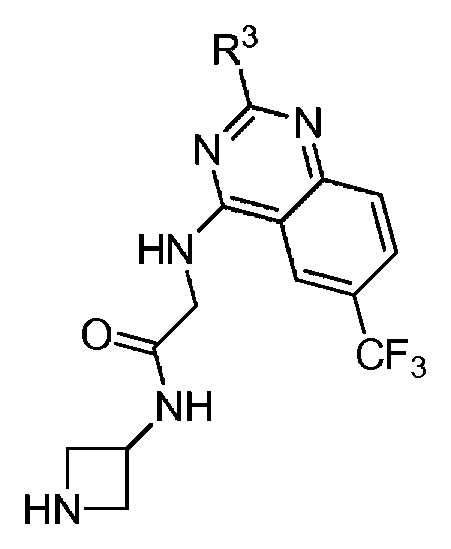
X 및 Z가 둘 모두 질소인 화학식 I의 화합물을 도식 1에 요약된 방법에 따라 제조할 수 있다.Compounds of formula (I) wherein X and Z are both nitrogen may be prepared according to the process outlined in scheme 1.
도식 1Scheme 1

유기 용매, 예컨대, 다이클로로메탄, THF 또는 다이옥산 중에서 펩티드 커플링제, 예컨대, EDCI, DIC, PyBrOP, PyBOP의 존재 하에 시판용 2-(((벤질옥시)카르보닐)아미노)아세트산을 시판용 tert-부틸 3-아미노아제티딘-1-카르복실레이트와 반응시켜 치환된 아제티딘을 얻는다. 치환된 아제티딘을 약 25℃ 내지 약 50℃ 범위의 온도에서, 유기 용매, 예컨대, 메탄올 중에서, 5 내지 10% Pd/C를 촉매로 하여, 34.5 내지 344.7 ㎪ (5 내지 50 psi)의 압력 하에서 수소 기체로 처리하여 상응하는 아민 II를 얻는다. 아민 II를 환류 온도에서 유기 용매, 예컨대, 아이소프로판올 중에서 유기 염기, 예컨대, TEA 또는 DIEA의 존재 하에 클로로퀴나졸린 V와 반응시켜 아제티딘 III을 얻는다. 아제티딘 III을 약 0℃ 내지 약 25℃ 범위의 온도에서 유기 용매, 예컨대, 다이에틸 에테르, THF, 다이클로로메탄 또는 다이옥산 중에서 산, 예컨대, 1N HCl, 1N H2SO4 또는 트라이플루오로아세트산으로 처리하여 아민 염 IV를 얻는다. 아민 염 IV를 유기 용매, 예컨대, 다이클로로메탄, 1,2-다이클로로에탄 또는 THF 중에서, 환원제, 예컨대, NaBH4, NaBH3CN 또는 NaBH(OAc)3의 존재 하에, 유기 염기, 예컨대, 트라이에틸아민, 다이에틸프로필아민 또는 N-메틸모르폴린의 존재 하에 분자체를 사용하거나 사용하지 않고서, 0℃ 내지 약 25℃ 범위의 온도에서, 적절히 치환된 케톤 VI과 반응시켜, X 및 Z가 둘 모두 질소인 화학식 I의 상응하는 화합물을 얻는다.Butyl (3 - ((benzyloxy) carbonyl) amino) acetic acid in the presence of a peptide coupling agent such as EDCI, DIC, PyBrOP, PyBOP in an organic solvent such as dichloromethane, THF or dioxane, -Amino < / RTI > azetidine-1-carboxylate to give the substituted azetidine. Substituted azetidine is reacted with a 5 to 10% Pd / C catalyst in an organic solvent such as methanol at a temperature ranging from about 25 ° C to about 50 ° C under a pressure of from 5 to 50 psi (34.5 to 344.7 kPa) Treatment with hydrogen gas gives the corresponding amine II. Amine II is reacted with chloroquinazoline V in the presence of an organic base, such as TEA or DIEA, in an organic solvent, such as isopropanol, at reflux temperature to afford azetidine III. The azetidine III is reacted with an acid in an organic solvent such as diethyl ether, THF, dichloromethane or dioxane at a temperature in the range of about 0 ° C to about 25 ° C, such as 1N HCl, 1N H 2 SO 4, or trifluoroacetic acid 0.0 > IV < / RTI > The salt IV in the presence of an organic solvent, e.g., dichloromethane, 1,2-dichloroethane or THF from ethane, reducing agents, e.g., NaBH 4, NaBH 3 CN or NaBH (OAc) 3, With or without the use of molecular sieves in the presence of an organic base such as triethylamine, diethylpropylamine or N-methylmorpholine at a temperature in the range of 0 < 0 > C to about 25 & , X and Z are both nitrogen.
X가 질소이고 Z가 C-H인 화학식 I의 화합물을 도식 2에 요약된 방법에 따라 제조할 수 있다.Compounds of formula (I) wherein X is nitrogen and Z is C-H may be prepared according to the process outlined in Scheme 2.
도식 2Schematic 2

시판용 퀴놀리놀 VII을 40 내지 60℃ 범위의 온도에서 다이옥산 중에서 유기 염기, 예컨대, DIEA 또는 TEA의 존재 하에 2시간 동안 PyBroP로 처리하고, 아제티딘 II로 처리하고, 혼합물을 주위 온도에서 하룻밤 교반하여 아제티딘 VIII을 얻는다. 아제티딘 VIII을 약 0℃ 내지 약 25℃ 범위의 온도에서 유기 용매, 예컨대, 다이에틸 에테르, THF, 다이클로로메탄 또는 다이옥산 중에서 산, 예컨대, 1N HCl, 1N H2SO4 또는 트라이플루오로아세트산으로 처리하여 아민 염 IX를 얻는다. 아민 염 IX를 유기 용매, 예컨대, 다이클로로메탄, 1,2-다이클로로에탄 또는 THF 중에서, 환원제, 예컨대, NaBH4, NaBH3CN 또는 NaBH(OAc)3의 존재 하에, 유기 염기, 예컨대, 트라이에틸아민, 다이에틸프로필아민 또는 N-메틸모르폴린의 존재 하에 분자체를 사용하거나 사용하지 않고서, 0℃ 내지 약 25℃ 범위의 온도에서, 적절히 치환된 케톤 VI과 반응시켜, X가 질소이고 Z가 C-H인 상응하는 화학식 I의 화합물 (즉, 화학식 Ia의 화합물)을 얻는다.Commercial quinolinol VII is treated with PyBroP in the presence of an organic base such as DIEA or TEA in dioxane at a temperature ranging from 40 to 60 ° C and treated with azetidine II and the mixture is stirred overnight at ambient temperature Azetidine VIII is obtained. Azetidine VIII is reacted with an acid in an organic solvent such as diethyl ether, THF, dichloromethane or dioxane at a temperature in the range of about 0 ° C to about 25 ° C, such as 1N HCl, 1N H 2 SO 4, or trifluoroacetic acid 0.0 > IX < / RTI > The amine salt IX in the presence of an organic solvent, e.g., dichloromethane, 1,2-dichloroethane or THF from ethane, reducing agents, e.g., NaBH 4, NaBH 3 CN or NaBH (OAc) 3, With or without the use of molecular sieves in the presence of an organic base such as triethylamine, diethylpropylamine or N-methylmorpholine at a temperature in the range of 0 < 0 > C to about 25 & To give the corresponding compounds of formula I (i.e. compounds of formula Ia) wherein X is nitrogen and Z is CH.
대안적으로, X가 질소이고 Z가 C-H인 화학식 I의 화합물은 도식 3에 요약된 방법에 따라 제조할 수 있다.Alternatively, compounds of formula (I) wherein X is nitrogen and Z is C-H can be prepared according to the process outlined in scheme 3. [
도식 3Scheme 3


시판용 6-(트라이플루오로메틸)퀴놀린-4-아민 X를 대략 주위 온도에서 에틸 아세테이트와 같은 유기 용매와 소듐 바이카르보네이트 수용액의 2상(biphasic) 혼합물 중에서 벤질클로로포르메이트를 사용하여 쇼튼-바우만(Schotten-Bauman) 조건 하에서 반응시켜 카르바메이트 XI을 얻는다. XI을 유기 용매, 예컨대, DMF, NMP 또는 DMSO 중에서 염기, 예컨대, Na2CO3, K2CO3 또는 Cs2CO3의 존재 하에 메틸브로모아세테이트와 반응시켜 화합물 XII를 얻는다. 화합물 XII를 대략 주위 온도에서 유기 용매, 예컨대, THF 또는 메탄올과 물의 혼합물 중에서 NaOH, KOH 또는 LiOH로 처리하여 가수분해하여 산 13을 얻는다. 산 13을 유기 용매, 예컨대, 다이클로로메탄, THF 또는 다이옥산 중에서 펩티드 커플링제, 예컨대, EDCI, DIC, PyBrOP, PyBOP의 존재 하에 tert-부틸 3-아미노아제티딘-1-카르복실레이트와 커플링시켜 아제티딘 XIV를 얻는다. 아제티딘 XIV를 약 25℃ 내지 약 50℃ 범위의 온도에서, 유기 용매, 예컨대, 메탄올 중에서, 5 내지 10% Pd/C를 촉매로 하여, 34.5 내지 344.7 ㎪ (5 내지 50 psi)의 압력 하에서 수소 기체로 처리하여 상응하는 아제티딘 XV를 얻는다. 아제티딘 XV를 약 0℃ 내지 약 25℃ 범위의 온도에서 유기 용매, 예컨대, 다이에틸 에테르, THF, 다이클로로메탄 또는 다이옥산 중에서, 산, 예컨대, 1N HCl, 1N H2SO4 또는 트라이플루오로아세트산으로 처리하여 아민 염 XVI을 얻는다. 아민 염 XVI을 유기 용매, 예컨대, 다이클로로메탄, 1,2-다이클로로에탄 또는 THF 중에서, 환원제, 예컨대, NaBH4, NaBH3CN 또는 NaBH(OAc)3의 존재 하에, 유기 염기, 예컨대, 트라이에틸아민, 다이에틸프로필아민 또는 N-메틸모르폴린의 존재 하에 분자체를 사용하거나 사용하지 않고서, 0℃ 내지 약 25℃ 범위의 온도에서, 케톤 VI과 반응시켜 화학식 Ia의 상응하는 화합물을 얻는다.Amine (X) was reacted with benzyl chloroformate in a biphasic mixture of an organic solvent such as ethyl acetate and an aqueous solution of sodium bicarbonate at approximately ambient temperature to afford a schoton- The reaction is carried out under Schotten-Bauman conditions to obtain carbamate XI. A base XI in an organic solvent, e.g., DMF, NMP or DMSO, for example, Na 2 CO 3, K 2 CO 3 or Cs 2 to obtain the compound XII in the presence of CO 3 was reacted with methyl bromoacetate. Compound XII is hydrolyzed by treatment with NaOH, KOH or LiOH in an organic solvent such as THF or a mixture of methanol and water at approximately ambient temperature to give the acid 13. Acid 13 is coupled with tert-butyl 3-aminoazetidine-1-carboxylate in the presence of a peptide coupling agent such as EDCI, DIC, PyBrOP, PyBOP in an organic solvent such as dichloromethane, THF or dioxane Azetidine XIV. Azetidine XIV is hydrogenated at a temperature ranging from about 25 ° C to about 50 ° C in an organic solvent such as methanol under a pressure of 34.5 to 344.7 kPa (5 to 50 psi) with a catalyst of 5 to 10% Pd / Gas to obtain the corresponding azetidine XV. Azetidine XV is reacted with an acid such as 1N HCl, 1N H 2 SO 4 or trifluoroacetic acid in an organic solvent such as diethyl ether, THF, dichloromethane or dioxane at a temperature ranging from about 0 ° C to about 25 ° C To give the amine salt XVI. Amine salt XVI in the presence of an organic solvent, e.g., dichloromethane, 1,2-dichloroethane or THF from ethane, reducing agents, e.g., NaBH 4, NaBH 3 CN or NaBH (OAc) 3, With or without the use of molecular sieves in the presence of an organic base such as triethylamine, diethylpropylamine or N-methylmorpholine at a temperature in the range of 0 < 0 > C to about 25 & A corresponding compound is obtained.
대안적으로, X가 C-H이고 Z가 질소인 화학식 I의 화합물을 도식 4에 요약된 방법에 따라 제조할 수 있다.Alternatively, compounds of formula (I) wherein X is C-H and Z is nitrogen may be prepared according to the process outlined in Scheme 4.
도식 4Scheme 4

시판용 7-브로모아이소퀴놀린-1-올을 POCl3과 반응시켜 화합물 XVIII을 얻는다. 화합물 XVIII을 유기 용매, 예컨대, 에테르, THF 또는 다이옥산 중에서, 유기금속제제(organometalic agent), 예컨대, n-BuLi, i-PrMgBr 또는 i-PrMgCl의 존재 하에, 약 -78℃ 내지 약 0℃ 범위의 온도에서 반응시켜 요오다이드 XIX를 얻는다. 요오다이드 XIX를 유기 용매, 예컨대, DMF, 또는 NMP 중에서 구리 금속의 존재 하에 70 내지 90℃ 범위의 온도에서 메틸 2,2-다이플루오로-2-(플루오로설포닐)아세테이트와 반응시켜 메톡시퀴놀린 XX을 얻는다. 메톡시 퀴놀린을 140 내지 160℃ 범위의 온도에서 POCl3과 반응시켜 클로로퀴놀린 XXI을 얻는다. 클로로퀴놀린 XXI을 100 내지 110℃ 범위의 온도에서 수산화칼륨 또는 수산화나트륨과 같은 염기의 존재 하에 페놀과 반응시켜 화합물 XXII를 얻는다. 화합물 XXII를 140 내지 160℃ 범위의 온도에서 암모늄 아세테이트와 반응시켜 아미노퀴놀린 XXIII을 생성한다. 대략 주위 온도에서 에틸 아세테이트와 같은 유기 용매와 소듐 바이카르보네이트 수용액의 2상 혼합물 중에서 벤질클로로포르메이트를 사용하여 쇼튼-바우어 프로토콜을 통해 XXIII의 보호를 달성하여 카르바메이트 XXIV를 얻는다. XXIV를 유기 용매, 예컨대, DMF, NMP 또는 DMSO 중에서 염기, 예컨대, Na2CO3, K2CO3 또는 Cs2CO3의 존재 하에 메틸브로모아세테이트와 반응시켜 화합물 XXV를 얻는다. 화합물 XXV를 대략 주위 온도에서 유기 용매, 예컨대, THF 또는 메탄올과 물의 혼합물 중에서 NaOH, KOH 또는 LiOH로 처리하여 가수분해하여 산 XXVI을 얻는다. 산 XXVI을 유기 용매, 예컨대, 다이클로로메탄, THF 또는 다이옥산 중에서 펩티드 커플링제, 예컨대, EDCI, DIC, PyBrOP, PyBOP의 존재 하에 tert-부틸 3-아미노아제티딘-1-카르복실레이트와 커플링시켜 아제티딘 XXVII을 얻는다. 아제티딘 XXVII을 약 0℃ 내지 약 25℃ 범위의 온도에서 유기 용매, 예컨대, 다이에틸 에테르, THF, 다이클로로메탄 또는 다이옥산 중에서, 산, 예컨대, 1N HCl, 1N H2SO4 또는 트라이플루오로아세트산으로 처리하여 아민 염 XXVIII을 얻는다. 아민 염 XXVIII을 유기 용매, 예컨대, 다이클로로메탄, 1,2-다이클로로에탄 또는 THF 중에서, 환원제, 예컨대, NaBH4, NaBH3CN 또는 NaBH(OAc)3의 존재 하에, 유기 염기, 예컨대, 트라이에틸아민, 다이에틸프로필아민 또는 N- 메틸모르폴린의 존재 하에 분자체를 사용하거나 사용하지 않고서, 0℃ 내지 약 25℃ 범위의 온도에서, 케톤 VI과 반응시킨 다음, 약 25℃ 내지 약 50℃ 범위의 온도에서, 유기 용매, 예컨대, 메탄올 중에서, 5 내지 10% Pd/C를 촉매로 하여, 34.5 내지 344.7 ㎪ (5 내지 50 psi)의 압력 하에서 수소 기체로 처리하여 상응하는 화합물 I을 얻는다.The commercially available 7-bromoisoquinolin-1-ol is reacted with POCl 3 to give compound XVIII. Compound XVIII may be reacted with a compound of formula XVIII in an organic solvent such as ether, THF or dioxane in the presence of an organometalic agent such as n-BuLi, i-PrMgBr or i-PrMgCl at a temperature in the range of about -78 & The reaction is carried out at a temperature to obtain iodide XIX. Iodide XIX is reacted with methyl 2,2-difluoro-2- (fluorosulfonyl) acetate in an organic solvent such as DMF, or NMP in the presence of a copper metal at a temperature in the range of 70-90 ≪ / RTI > Methoxyquinoline is reacted with POCl 3 at a temperature ranging from 140 to 160 ° C to obtain chloroquinoline XXI. Chloroquinoline XXI is reacted with phenol in the presence of a base such as potassium hydroxide or sodium hydroxide at a temperature ranging from 100 to 110 < 0 > C to give compound XXII. Compound XXII is reacted with ammonium acetate at a temperature in the range of 140-160 < 0 > C to produce aminoquinoline XXIII. Protection of XXIII is achieved via the Schotten-Bauer protocol using benzyl chloroformate in a two-phase mixture of an organic solvent such as ethyl acetate and an aqueous sodium bicarbonate solution at approximately ambient temperature to yield carbamate XXIV. XXIV a base in an organic solvent, e.g., DMF, NMP or DMSO, for example, Na 2 CO 3, K 2 CO 3 or Cs 2 to obtain the methyl bromoacetate and the reaction of compound XXV in the presence of CO 3. Compound XXV is hydrolyzed by treatment with NaOH, KOH or LiOH in an organic solvent such as THF or a mixture of methanol and water at approximately ambient temperature to afford acid XXVI. Acid XXVI is coupled with tert-butyl 3-aminoazetidine-1-carboxylate in the presence of a peptide coupling agent such as EDCI, DIC, PyBrOP, PyBOP in an organic solvent such as dichloromethane, THF or dioxane Azetidine XXVII. Azetidine XXVII is reacted with an acid such as 1N HCl, 1N H 2 SO 4 or trifluoroacetic acid in an organic solvent such as diethyl ether, THF, dichloromethane or dioxane at a temperature ranging from about 0 ° C to about 25 ° C To give the amine salt XXVIII. Amine salt XXVIII in the presence of an organic solvent, e.g., dichloromethane, 1,2-dichloroethane or THF from ethane, reducing agents, e.g., NaBH 4, NaBH 3 CN or NaBH (OAc) 3, With or without the use of molecular sieves in the presence of an organic base such as triethylamine, diethylpropylamine or N-methylmorpholine, at a temperature in the range of 0 < 0 > C to about 25 & Is treated with hydrogen gas under a pressure of 34.5 to 344.7 kPa (5 to 50 psi) with a catalyst of 5 to 10% Pd / C in an organic solvent such as methanol at a temperature ranging from 25 ° C to about 50 ° C, ≪ / RTI >
화학식 I의 화합물은 퀴나졸린 5로부터 유도할 수 있다. 5의 제법이 도식 5에 요약되어 있다.The compounds of formula I can be derived from quinazoline 5. 5 is summarized in Scheme 5.
도식 5Scheme 5

시판용 2-아미노-5-(트라이플루오로메틸)벤조산을 유기 용매, 예컨대, 헥산, 헵탄 또는 옥탄 중에서 암모늄 아세테이트 및 아세트산의 존재 하에 주위 온도 내지 60℃의 온도에서 적절한 무수물과 반응시켜 화합물 XXIX를 얻는다. 화합물 XXIX를, 촉진제로서의 DMF를 사용하여, 다이클로로메탄 또는 다이클로로에탄과 같은 유기 용매 중에서 다이아이소프로필에틸아민 또는 트라이에틸 아민과 같은 유기 염기의 존재 하에 옥살릴 클로라이드와 반응시켜 화합물 V를 얻는다.The commercially available 2-amino-5- (trifluoromethyl) benzoic acid is reacted with the appropriate anhydride in the presence of ammonium acetate and acetic acid in an organic solvent, such as hexane, heptane or octane, at a temperature from ambient temperature to 60 ° C to give compound XXIX . Compound XXIX is reacted with oxalyl chloride in the presence of an organic base such as diisopropylethylamine or triethylamine in an organic solvent such as dichloromethane or dichloroethane using DMF as a promoter to give compound V. [
화학식 I의 화합물은 케톤 VI으로부터 유도할 수 있다. VI의 제법이 도식 6에 요약되어 있다.The compounds of formula I can be derived from ketone VI. Scheme VI is summarized in Scheme 6.
도식 6Scheme 6

시판용 아릴 할라이드 또는 아릴 알칸 R1Lv* (여기서, R1은 화학식 I에 정의된 바와 같고, Lv*는 H 또는 할로겐임)을 유기 용매, 예컨대, 에테르, THF 또는 다이옥산 중에서, 유기금속제제, 예컨대, n-BuLi, i-PrMgBr 또는 i-PrMgCl의 존재 하에, 약 -78℃ 내지 약 0℃ 범위의 온도에서, 시판용 1,4-다이옥사스피로[4.5]데칸-8-온과 반응시켜 상응하는 케탈 XXX을 얻는다. 케탈 XXX을 약 0℃ 내지 약 25℃ 범위의 온도에서, 유기 용매, 예컨대, 아세톤, 아세토니트릴 또는 THF 중에서 산, 예컨대,1N HCl 또는 1N H2SO4로 처리하여, 상응하는 케톤 VI을 얻는다.Commercially available aryl halides or arylalkanes R 1 Lv * in which R 1 is as defined in formula I and Lv * is H or halogen in an organic solvent such as ether, THF or dioxane, dioxaspiro [4.5] decan-8-one in the presence of a suitable solvent such as n-BuLi, i-PrMgBr or i-PrMgCl at a temperature ranging from about -78 ° C to about 0 ° C, Ketal XXX is obtained. Treatment of the Ketal XXX with an acid such as 1N HCl or 1N H 2 SO 4 in an organic solvent such as acetone, acetonitrile or THF at a temperature ranging from about 0 ° C to about 25 ° C yields the corresponding ketone VI.
대안적으로, 화합물 VI은 도식 7에 요약된 방법에 따라 제조할 수 있다.Alternatively, compound VI can be prepared according to the process outlined in Scheme 7.
도식 7Scheme 7

케탈 XXX을 약 0℃ 내지 약 25℃ 범위의 온도에서, 유기 용매, 예컨대, 에테르, THF 또는 다이옥산 중에서 탈수제(dehydrating agent), 예컨대, 버지스 시약(Burges' reagent)으로 처리하여 상응하는 알켄 XXXI을 얻는다. 알켄 XXXI을 약 25℃ 내지 약 50℃ 범위의 온도에서, 유기 용매, 예컨대, 메탄올 중에서, 5 내지 10% Pd/C를 촉매로 하여 34.5 내지 344.7 ㎪ (5 내지 50 psi)의 압력 하에 수소 기체로 처리하여 상응하는 알칸 XXXII을 얻는다. 알칸 XXXII를 약 0℃ 내지 약 25℃ 범위의 온도에서, 유기 용매, 예컨대, 아세톤, 아세토니트릴 또는 THF 중에서, 1N HCl 또는 1N H2SO4로 처리하여 상응하는 케톤 VI을 얻는다.Treatment of the Ketal XXX with a dehydrating agent such as Burges' reagent in an organic solvent such as ether, THF or dioxane at a temperature ranging from about 0 ° C to about 25 ° C yields the corresponding alkene XXXI . The alkene XXXI is hydrogenated at a temperature ranging from about 25 ° C to about 50 ° C in an organic solvent such as methanol under a pressure of from 5 to 50 psi with a catalyst of 5 to 10% Pd / C as catalyst To give the corresponding alkane XXXII. Alkane XXXII The corresponding ketone VI is obtained by treatment with 1N HCl or 1N H 2 SO 4 in an organic solvent such as acetone, acetonitrile or THF at a temperature ranging from about 0 ° C to about 25 ° C.
대안적으로, 화합물 XXXI은 도식 8에 요약된 방법에 따라 제조할 수 있다.Alternatively, compound XXXI can be prepared according to the process outlined in Scheme 8.
도식 8Scheme 8
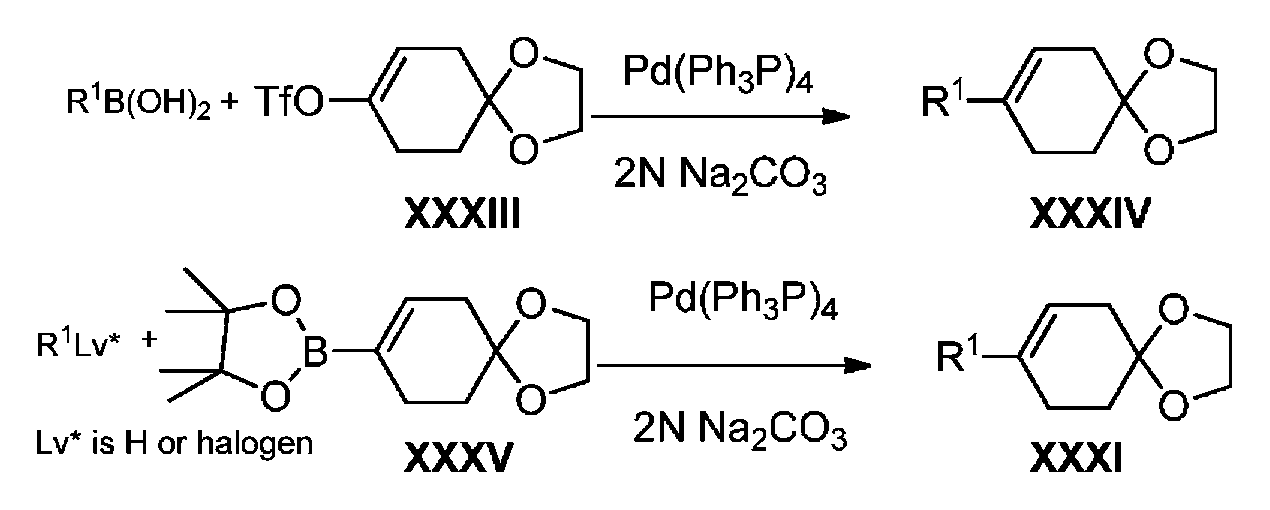
시판용 아릴 보론산 (여기서, R1은 화학식 I에 정의된 바와 같음)을, 유기 용매, 예컨대, 톨루엔, 다이옥산 또는 THF 중에서, 촉매, 예컨대, Pd(Ph3P)4, PdCl2(Ph3P)2 또는 PdCl2(dppf) 및 염기, 예컨대, 2N Na2CO3 또는 K2CO3의 존재 하에, 약 80℃ 내지 약 120℃ 범위의 온도에서, 문헌[Pearson, W. et. al., J. Org. Chem. 2004, 69, 9109-9122]의 절차에 따라 제조된 비닐 트라이플레이트 XXXIII과 반응시켜 상응하는 알켄 XXXIV를 얻는다.(Ph 3 P) 4 , PdCl 2 (Ph 3 P) (where R 1 is as defined in formula I) in an organic solvent such as toluene, dioxane or THF, ) 2 or PdCl 2 (dppf) And a base such as 2N Na 2 CO 3 or K 2 CO 3 at a temperature in the range of about 80 ° C to about 120 ° C as described by Pearson, al., J. Org. Chem. 2004, 69, 9109-9122, to give the corresponding alkene XXXIV.
대안적으로, 시판용 아릴 또는 헤테로아릴 할라이드 R1Lv*를 유기 용매, 예컨대, 톨루엔, 다이옥산 또는 THF 중에서, 촉매, 예컨대, Pd(Ph3P)4, PdCl2(Ph3P)2 또는 PdCl2(dppf) 및 염기, 예컨대, 2N Na2CO3 또는 K2CO3의 존재 하에, 약 80℃ 내지 약 120℃ 범위의 온도에서, 버치, 에이.엠.(Birch, A.M.) 등의 국제특허 공개 WO 2006064189호에 따라 제조된 비닐 보론산 에스테르 XXXV와 반응시켜 상응하는 알켄 XXXI을 얻는다.Alternatively, a commercially available aryl or heteroaryl halide R 1 Lv * an organic solvent, e.g., toluene, dioxane or THF, catalyst, e.g., Pd (Ph 3 P) 4 , PdCl 2 (Ph 3 P) 2 or PdCl 2 (dppf) and a base, for example, in the presence of 2N Na 2 CO 3 or K 2 CO 3, at about 80 ℃ to a temperature of about 120 ℃ range, Burch, a. M. PCT Publication such as (Birch, AM) Is reacted with the vinyl boronic acid ester XXXV prepared according to WO 2006064189 to give the corresponding alkene XXXI.
대안적으로 화합물 VI은 도식 9에 요약된 방법에 따라 제조할 수 있다.Alternatively, compound VI can be prepared according to the method outlined in Scheme 9.
도식 9Scheme 9
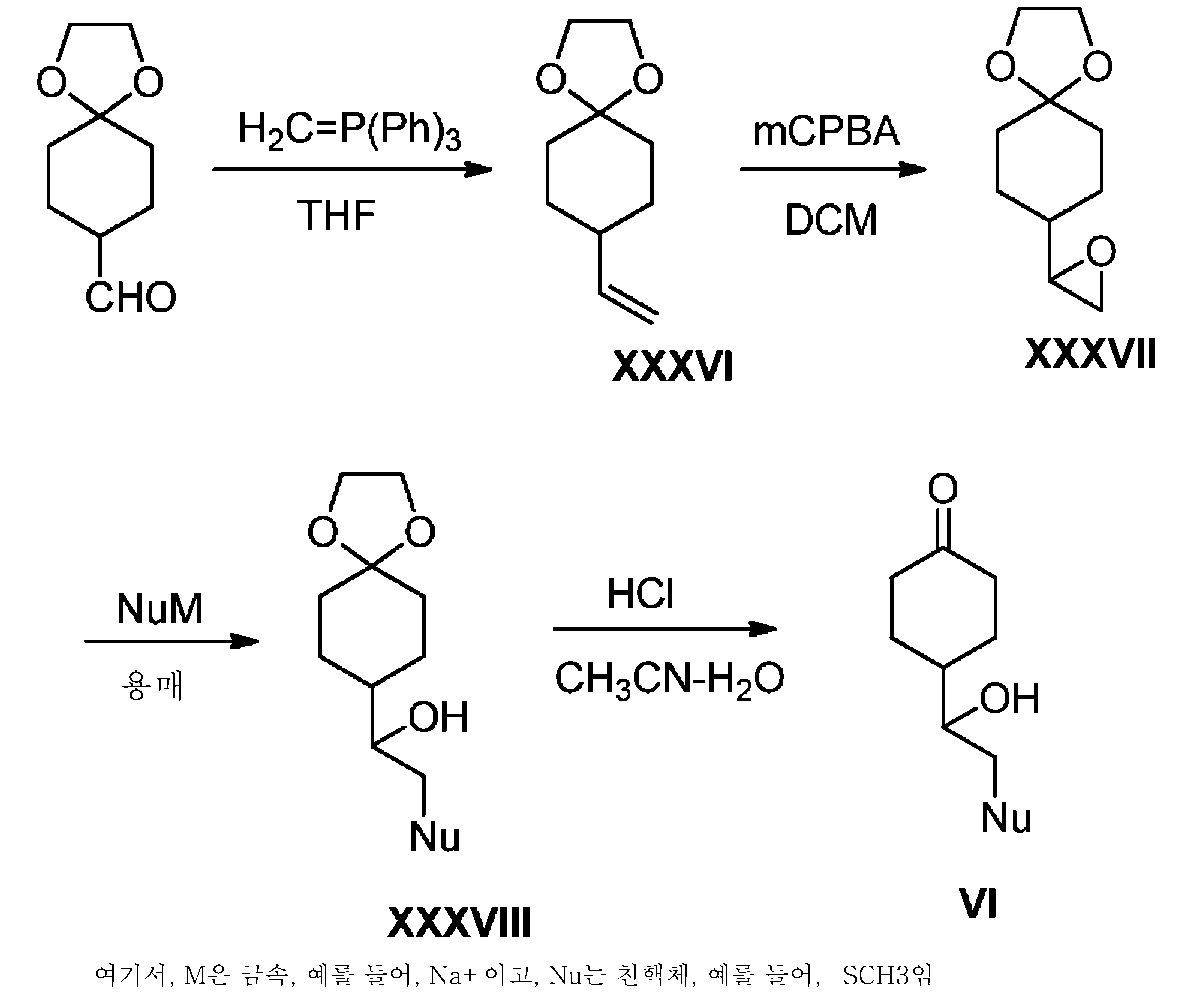
문헌[Pearson, et al. in J. Org. Chem. 1997, 62(16), 5284-5292]에 기재된 바와 같이 제조된 1,4-다이옥사스피로[4.5]데칸-8-카르브알데하이드를 주위 온도에서 비양성자성 유기 용매, 예컨대, THF, 다이옥산 또는 에테르 중에서 위티그(Wittig) 시약과 반응시켜 알켄 XXXVI을 얻는다. 알켄 XXXVI을 유기 용매, 예컨대, 다이클로로메탄 중에서 mCPBA의 작용을 통해 에폭시화하여 에폭사이드 XXXVII을 얻는다. 에폭사이드 XXXVII을 유기 용매, 예컨대, 메탄올, DMF 또는 DMSO 중에서 NaOMe, NaSMe 및 NaN3을 포함하는 다양한 친핵체(nucleophile)에 의해 개환시켜 카르비놀 XXXVIII을 생성한다. 카르비놀 XXXVIII을 약 0℃ 내지 약 25℃ 범위의 온도에서, 유기 용매, 예컨대, 아세톤, 아세토니트릴 또는 THF 중에서, 1N HCl 또는 1N H2SO4로 처리하여 상응하는 케톤 VI을 얻는다.See Pearson, et al. in J. Org. Chem. Dioxaspiro [4.5] decane-8-carbaldehyde prepared as described in J. Org. Chem., 1997, 62 (16), 5284-5292 at ambient temperature in an aprotic organic solvent such as THF, React with Wittig reagent in ether to obtain alkene XXXVI. The alkene XXXVI is epoxidized in the presence of mCPBA in an organic solvent such as dichloromethane to give the epoxide XXXVII. The epoxide XXXVII is opened by various nucleophiles including NaOMe, NaSMe and NaN 3 in an organic solvent such as methanol, DMF or DMSO to produce carbinol XXXVIII. Carbinol XXXVIII is treated with 1N HCl or 1N H 2 SO 4 in an organic solvent such as acetone, acetonitrile or THF at a temperature ranging from about 0 ° C to about 25 ° C to obtain the corresponding ketone VI.
대안적으로 화합물 VI은 도식 10에 요약된 방법에 따라 제조할 수 있다.Alternatively, compound VI can be prepared according to the method outlined in Scheme 10.
도식 10Scheme 10

문헌[Pearson, et al. in J. Org. Chem. 1997, 62(16), 5284-5292]에 기재된 바와 같이 제조된 1,4-다이옥사스피로[4.5]데칸-8-카르브알데하이드를 주위 온도에서 비양성자성 유기 용매, 예컨대, THF, 다이클로로메탄 또는 에테르 중에서 탈수 루이스 산, 예컨대, Ti(OEt)4, Ti(OiPr)4 또는 무수 구리 (II) 설페이트의 존재 하에 tert-부탄설피아미드와 반응시켜 설핀이민 XXXIX를 얻는다. 설핀이민 XXXIX를 -20℃ 내지 주위 온도 사이의 온도에서 비양성자성 유기 용매, 예컨대, THF 또는 에테르 중에서 비닐 또는 알릴 그리냐르(Grignard) 시약과 반응시켜 설핀아미드 XL을 얻는다. 설핀아미드 XL을 약 0℃ 내지 약 25℃ 범위의 온도에서 묽은 메탄올성 염산 용액으로 처리하여 탈보호시켜 상응하는 아민 하이드로클로라이드 염 XLI을 얻는다. 아민 XLI을 -10℃ 내지 0℃의 온도에서 비양성자성 유기 용매, 예컨대, 다이클로로메탄, THF 또는 에테르 중에서 염기, 예컨대, 트라이에틸아민의 존재 하에 아크릴로일 클로라이드로 아실화하여 아미드 XLII를 얻는다. 아미드 XLII를 40℃ 내지 60℃의 온도 범위에서 유기 용매, 예컨대, 다이클로로메탄, 다이클로로에탄 또는 벤젠 중에서 폐환 복분해 촉매로 처리하여 불포화 락탐 XLIII을 얻는다. 불포화 락탐 XLIII을 약 25℃ 내지 약 50℃ 범위의 온도에서, 유기 용매, 예컨대, 메탄올 중에서, 5 내지 10% Pd/C를 촉매로 하여 96.5 내지 344.7 ㎪ (14 내지 50 psi)의 압력 하에 수소 기체로 처리하여 상응하는 포화 락탐 XLIV를 얻는다. 락탐 XLIV를 약 0℃ 내지 약 25℃ 범위의 온도에서, 유기 용매, 예컨대, 아세톤, 아세토니트릴 또는 THF 중에서, 1N HCl 또는 1N H2SO4, 로 처리하여 상응하는 케톤 VI을 얻는다.See Pearson, et al. in J. Org. Chem. Dioxaspiro [4.5] decane-8-carbaldehyde prepared as described in J. Org. Chem., 1997, 62 (16), 5284-5292 at ambient temperature in an aprotic organic solvent such as THF, Is reacted with tert-butane sulphamide in the presence of a dehydrated Lewis acid such as Ti (OEt) 4 , Ti (OiPr) 4 or anhydrous copper (II) sulfate in methane or ether to obtain sulfinimine XXXIX. Sulfinimines XXXIX are reacted with vinyl or allyl Grignard reagents in an aprotic organic solvent such as THF or ether at a temperature between -20 < 0 > C and ambient temperature to obtain the sulfinamide XL. Sulfinamide XL is deprotected by treatment with a dilute solution of methanolic hydrochloric acid at a temperature ranging from about 0 < 0 > C to about 25 < 0 > C to give the corresponding amine hydrochloride salt XLI. Amine XLI is acylated with acryloyl chloride in the presence of a base such as triethylamine in an aprotic organic solvent such as dichloromethane, THF or ether at a temperature between -10 ° C and 0 ° C to afford amide XLII . The amide XLII is treated with a ring-closing metathesis catalyst in an organic solvent such as dichloromethane, dichloroethane or benzene at a temperature ranging from 40 ° C to 60 ° C to give the unsaturated lactam XLIII. The unsaturated lactam XLIII is hydrogenated at a temperature in the range of from about 25 ° C to about 50 ° C in an organic solvent such as methanol under a pressure of from 14.5 to 34 pounds per cubic centimeter To give the corresponding saturated lactam < RTI ID = 0.0 > XLIV. ≪ / RTI > Lactam XLIV is reacted with 1N HCl or 1N H 2 SO 4 , in an organic solvent such as acetone, acetonitrile or THF, at a temperature ranging from about 0 ° C to about 25 ° C, To give the corresponding ketone VI.
대안적으로 화합물 VI은 도식 11에 요약된 방법에 따라 제조할 수 있다.Alternatively, compound VI can be prepared according to the method outlined in Scheme 11.
도식 11Scheme 11

시판용 1,4-다이옥사스피로[4.5]데칸-8-온을 주위 온도에서 비양성자성 유기 용매, 예컨대, 다이클로로메탄, THF 또는 에테르 중에서 NaBH(OAc)3의 존재 하에 아민과 반응시켜 아민 XLV를 얻는다. 아민 XLV을 약 0℃ 내지 약 25℃ 범위의 온도에서, 유기 용매, 예컨대, 아세톤, 아세토니트릴 또는 THF 중에서, 1N HCl 또는 1N H2SO4로 처리하여, 상응하는 케톤 VI을 얻는다.The commercially available 1,4-dioxaspiro [4.5] decan-8-one is reacted with an amine in the presence of NaBH (OAc) 3 in an aprotic organic solvent such as dichloromethane, . Treatment of the amine XLV with 1N HCl or 1N H 2 SO 4 in an organic solvent such as acetone, acetonitrile or THF at a temperature ranging from about 0 ° C to about 25 ° C yields the corresponding ketone VI.
대안적으로 화합물 VI은 도식 12에 요약된 방법에 따라 제조할 수 있다.Alternatively, compound VI can be prepared according to the process outlined in Scheme 12.
도식 12Scheme 12

1,4-다이옥사스피로[4.5]데칸-8-일 메탄설포네이트를, 메실 클로라이드 및 적절한 염기, 예컨대, NEt3을 사용하여 상응하는 알코올로부터 생성한다. 0℃ 내지 주위 온도 사이의 온도에서 비양성자성 유기 용매, 예컨대, THF 또는 에테르 중에서 염기, 예컨대, NaH 또는 KH의 존재 하에 락탐 또는 이미드와의 반응으로 화합물 XLVI을 얻는다. 화합물 XLVI을 약 0℃ 내지 약 25℃ 범위의 온도에서, 유기 용매, 예컨대, 아세톤, 아세토니트릴 또는 THF 중에서, 1N HCl 또는 1N H2SO4로 처리하여 상응하는 케톤 VI을 얻는다.Dioxaspiro [4.5] decan-8-yl methanesulfonate is produced from the corresponding alcohol using mesyl chloride and a suitable base such as NEt3. Compound XLVI is obtained by reaction with a lactam or imide in the presence of a base such as NaH or KH in an aprotic organic solvent such as THF or ether at a temperature between 0 < 0 > C and ambient temperature. Compound XLVI is treated with 1N HCl or 1N H 2 SO 4 in an organic solvent such as acetone, acetonitrile or THF at a temperature ranging from about 0 ° C to about 25 ° C to obtain the corresponding ketone VI.
대안적으로 화합물 VI은 도식 13에 요약된 방법에 따라 제조할 수 있다.Alternatively, compound VI can be prepared according to the process outlined in Scheme 13.
도식 13Scheme 13

1,4-다이옥사스피로[4.5]데칸-8-카르브알데하이드 (문헌[Pearson, et al. in J. Org. Chem. 1997, 62(16), 5284-5292]에 기재된 바와 같이 제조됨)를 -78℃ 내지 -10℃의 온도에서 비양성자성 유기 용매, 예컨대, THF 또는 에테르 중에서 그리냐르 시약과 반응시켜 카르비놀 XLVII을 얻는다. 카르비놀 XLVII을 약 0℃ 내지 약 25℃ 범위의 온도에서, 유기 용매, 예컨대, 아세톤, 아세토니트릴 또는 THF 중에서 1N HCl 또는 1N H2SO4로 처리하여 상응하는 케톤 VI을 얻는다.Dioxaspiro [4.5] decane-8-carbaldehyde (prepared as described in Pearson, et al. In J. Org. Chem. 1997, 62 (16), 5284-5292) Is reacted with a Grignard reagent in an aprotic organic solvent such as THF or ether at a temperature between -78 < 0 > C and -10 < 0 > C to obtain Carbinol XLVII. Carbinol XLVII is treated with 1N HCl or 1N H 2 SO 4 in an organic solvent such as acetone, acetonitrile or THF at a temperature ranging from about 0 ° C to about 25 ° C to obtain the corresponding ketone VI.
대안적으로 화합물 VI은 도식 14에 요약된 방법에 따라 제조할 수 있다.Alternatively, compound VI can be prepared according to the method outlined in Scheme 14.
도식 14Scheme 14

아민 XLI을 유기 용매, 예컨대, 다이클로로메탄, 다이클로로에탄 또는 THF 중에서 염기, 예컨대, 트라이에틸아민, 다이아이소프로필에틸아민 또는 피리딘의 존재 하에 Boc-무수물과 반응시켜 카르바메이트 XLVIII을 얻는다. 카르바메이트 XLVIII을 -78℃의 온도에서 30 내지 90분 동안 메틸 중에서 오존과 반응시킨 후에 소듐 보로하이드라이드 또는 다이메틸 설파이드로 켄칭(quenching)하여 알데하이드 XLIX를 얻는다. 알데하이드 XLIX를 유기 용매, 예컨대, 메탄올, 에탄올 또는 THF 중에서 소듐 보로하이드라이드에 의해 환원시켜 알코올 L을 생성한다. 알코올 L을 실온에서 유기 용매, 예컨대, THF, 다이옥산 또는 DME 중에서 염기, 예컨대, NaOtBu 또는 NaOtBu와의 반응에 의해 카르바메이트 LI로 고리화시킨다. 카르바메이트 LI을 약 0℃ 내지 약 25℃ 범위의 온도에서, 유기 용매, 예컨대, 아세톤, 아세토니트릴 또는 THF 중에서, 1N HCl 또는 1N H2SO4로 처리하여 상응하는 케톤 VI을 얻는다.The amine XLI is reacted with Boc-anhydride in an organic solvent such as dichloromethane, dichloroethane or THF in the presence of a base such as triethylamine, diisopropylethylamine or pyridine to give carbamate XLVIII. Carbamate XLVIII is reacted with ozone in methyl at -78 < 0 > C for 30-90 min and then quenched with sodium borohydride or dimethylsulfide to give aldehyde XLIX. The aldehyde XLIX is reduced with sodium borohydride in an organic solvent such as methanol, ethanol or THF to produce the alcohol L. The alcohol L is cyclized to carbamate LI by reaction with a base such as NaO t Bu or NaO t Bu in an organic solvent such as THF, dioxane or DME at room temperature. Carbamate LI is treated with 1N HCl or 1N H 2 SO 4 in an organic solvent such as acetone, acetonitrile or THF at a temperature ranging from about 0 ° C to about 25 ° C The corresponding ketone VI is obtained.
실시예Example
실시예 1: N-(1-(4-(3-하이드록시피리딘-2-일)사이클로헥실)아제티딘-3-일)-2-((6-(트라이플루오로메틸)퀴나졸린-4-일)아미노)아세트아미드Example 1: Preparation of N- (1- (4- (3-hydroxypyridin-2-yl) cyclohexyl) azetidin- Yl) amino) acetamide
단계 A: 2-(1,4-다이옥사-스피로[4.5]데스-7-엔-8-일)-피리딘-3-올Step A: 2- (l, 4-Dioxa-spiro [4.5] dec-7-en-8-yl) -pyridin-
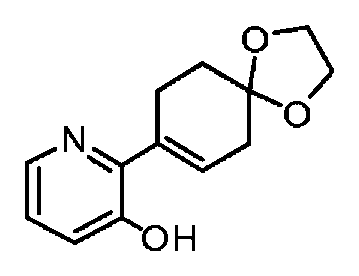
8-(4,4,5,5-테트라메틸-[1,3,2]다이옥사보로란-2-일)-1,4-다이옥사-스피로[4.5]데스-7-엔 (국제특허 공개 WO2006064189호에 기재된 바와 같이 제조됨, 0.292 g, 1.10 mmol), 2-요오도-3-하이드록시피리딘 (알드리치(Aldrich), 0.177 g, 0.801 mmol) 및 테트라키스 (트라이페닐포스피노)팔라듐(0) (알드리치, 0.048 g, 0.042 mmol)을 1,4-다이옥산 (9 mL)에 용해하고, 2M Na2CO3 수용액 (2.0 mL, 4.0 mmol)으로 처리하고, 수 분 동안 아르곤으로 버블링하고(bubbled), 환류 응축기 하에서 24시간 동안 100℃로 가열하였다. 주위 온도로 냉각한 후에, 반응물을 물 (30 mL)로 희석하고, 다이클로로메탄으로 3회 추출하고, 수성층을 약 pH 7로 산성화하고, 다이클로로메탄으로 2회 더 추출하고, 합한 유기층을 염수로 세척하고, Na2SO4로 건조하고, 여과하고, 진공에서 농축하여, 주황색 오일을 얻었다. 이를 실리카 겔 (EtOAc) 상에서 박층 크로마토그래피에 의해 정제하여, 황색 고체로서 표제 화합물을 얻었다. 1H NMR (400 MHz, 클로로포름-d) δ 8.16 (dd, J=4.5, 1.3 Hz, 1 H), 7.22 (dd, J=8.1, 1.3 Hz, 0 H), 7.07 (dd, J=8.2, 4.7 Hz, 1 H), 5.95 - 6.09 (m, 2 H), 4.03 (s, 4 H), 2.73 (dddd, J=6.4, 4.4, 2.2, 2.0 Hz, 2 H), 2.49 (d, J=2.8 Hz, 2 H), 1.96 (t, J=6.6 Hz, 2 H). ESI-MS (m/z): C13H15NO3에 대한 계산치: 233; 실측치: 234 (M+H).Dioxa-spiro [4.5] des-7-ene (International Patent Publication No. 0.292 g, 1.10 mmol), 2-iodo-3-hydroxypyridine (Aldrich, 0.177 g, 0.801 mmol) and tetrakis (triphenylphosphino) palladium (prepared as described in WO2006064189) 0) (Aldrich, 0.048 g, 0.042 mmol) was dissolved in 1,4-dioxane (9 mL), treated with 2 M Na 2 CO 3 aqueous solution (2.0 mL, 4.0 mmol), bubbled with argon for several minutes gt; 100 C < / RTI > for 24 hours under a reflux condenser. After cooling to ambient temperature, the reaction was diluted with water (30 mL), extracted three times with dichloromethane, the aqueous layer was acidified to pH about 7, extracted twice more with dichloromethane, and the combined organic layers were washed with brine , dried with Na 2 SO 4 to, filtered and concentrated in vacuo to give an orange oil. Which was purified by thin layer chromatography on silica gel (EtOAc) to give the title compound as a yellow solid. 1 H NMR (400 MHz, chloroform -d) δ 8.16 (dd, J = 4.5, 1.3 Hz, 1 H), 7.22 (dd, J = 8.1, 1.3 Hz, 0 H), 7.07 (dd, J = 8.2, J = 6.4, 4.4, 2.2, 2.0 Hz, 2H), 2.49 (d, J = 2.8 Hz, 2 H), 1.96 (t, J = 6.6 Hz, 2 H). ESI-MS (m / z) : C 13 calculated for H 15 NO 3: 233; Found: 234 (M + H).
단계 B: 2-(1,4-다이옥사-스피로[4.5]데스-8-일)-피리딘-3-올Step B: Preparation of 2- (1,4-dioxa-spiro [4.5] dec-8-yl) -pyridin-

메탄올 (60 mL) 중 2-(1,4-다이옥사-스피로[4.5]데스-7-엔-8-일)-피리딘-3-올 (1.3 g, 5.573 mmol)의 용액을 아르곤 하에서 파르(Parr) 병 내의 팔라듐 (II) 하이드록사이드 (330 mg, 0.62 mmol)에 첨가하였다. 반응 혼합물을, 아르곤을 사용하여 탈가스하고, 진공화시키고, 수소로 다시 충전(backfilled)한 다음 344.7 ㎪ (50 psi) 기체 하에서 주위 온도에서 24시간 동안 진탕한다. 감압하고 아르곤으로 버블링한 후에, 셀리트(Celite) 521을 통해 반응 혼합물을 여과하고, MeOH로 필터를 세척하고, 여과액을 진공에서 증발시켜 백색 고체를 얻는다.A solution of 2- (1,4-dioxa-spiro [4.5] dec-7-en-8-yl) -pyridin-3-ol (1.3 g, 5.573 mmol) in methanol (60 mL) Was added to palladium (II) hydroxide (330 mg, 0.62 mmol) in a Parr bottle. The reaction mixture is degassed using argon, vacuumed, backfilled with hydrogen and shaken at ambient temperature for 24 hours under a 50 psi gas. After reduced pressure and bubbling with argon, the reaction mixture is filtered through Celite 521, the filter is washed with MeOH and the filtrate is evaporated in vacuo to give a white solid.
1H NMR (400 MHz, 아세토니트릴-d3) δ 8.05 (dd, J=4.7, 1.4 Hz, 1 H), 7.19 (dd, J=8.1, 1.5 Hz, 1 H), 7.06 (dd, J=8.1, 4.5 Hz, 1 H), 3.86 - 3.99 (m, 4 H), 3.12 (tt, J=11.7, 3.7 Hz, 1 H), 1.72 - 1.94 (m, 6 H), 1.60 - 1.72 (m, 2 H). ESI-MS (m/z): C13H17NO3에 대한 계산치: 235; 실측치: 236 (M+H). 1 H NMR (400 MHz, acetonitrile -d 3) δ 8.05 (dd, J = 4.7, 1.4 Hz, 1 H), 7.19 (dd, J = 8.1, 1.5 Hz, 1 H), 7.06 (dd, J = (M, 4H), 3.12 (tt, J = 11.7, 3.7 Hz, 1H), 1.72-1.94 (m, 6H), 1.60-1.72 (m, 2 H). ESI-MS (m / z) : C 13 calculated for H 17 NO 3: 235; Found: 236 (M + H).
단계 C: 4-(3-하이드록시-피리딘-2-일)-사이클로헥사논Step C: 4- (3-Hydroxy-pyridin-2-yl) -cyclohexanone

이전 단계에서 제조된 2-(1,4-다이옥사-스피로[4.5]데스-8-일)-피리딘-3-올 (1.30 g, 5.52 mmol)을 실온에서 4시간 동안 아세토니트릴 (100 mL) 중에서 1N HCl (약 16 mL)로 처리하였다. 반응물을 포화 NaHCO3 용액으로 중화하고, 용매를 제거하였다. 잔류물을 에틸 아세테이트와 물에 분배하였다. 유기층을 염수로 세척하고, 무수 Na2SO4로 건조하고, 여과하고, 농축하여, 황색 고체를 얻고, 헥산 및 에틸 아세테이트 (10% 에틸 아세테이트로부터 100% 에틸 아세테이트까지)를 사용하여 콤비플래시(CombiFlash)(등록상표) 시스템 상에서 실리카 겔 컬럼에 의해 정제하여, 담황색(pale yellow) 고체로서 표제 화합물을 얻었다.(1.30 g, 5.52 mmol) prepared in the previous step was dissolved in acetonitrile (100 mL) at room temperature for 4 hours, ≪ / RTI > was treated with IN HCl (about 16 mL). The reaction was neutralized with saturated NaHCO 3 solution and the solvent was removed. The residue was partitioned between ethyl acetate and water. The organic layer was washed with brine, dried over anhydrous Na 2 SO 4, filtered, and concentrated to obtain a yellow solid, hexane and ethyl acetate using the (up to 100% of ethyl acetate from 10% ethyl acetate) Combi Flash (CombiFlash ) ≪ / RTI > (registered trademark) system, to give the title compound as a pale yellow solid.
1H NMR (400 MHz, 아세토니트릴-d3) δ 7.94 (dd, J=4.7, 1.4 Hz, 1 H), 7.28 (br. s., 1 H), 7.07 (dd, J=8.1, 1.5 Hz, 1 H), 6.96 (dd, J=8.1, 4.5 Hz, 1 H), 3.46 (tt, J=11.2, 3.7 Hz, 1 H), 2.34 - 2.52 (m, 2 H), 2.22 - 2.34 (m, 2 H), 1.99 - 2.07 (m, 2 H), 1.88 - 1.99 (m, 2 H). ESI-MS (m/z): C11H13NO2에 대한 계산치: 191; 실측치: 192 (M+H). 1 H NMR (400 MHz, acetonitrile-d 3 )? 7.94 (dd, J = 4.7,1.4 Hz, 1H), 7.28 J = 11.2, 3.7 Hz, 1H), 2.34-2.52 (m, 2H), 2.22-2.34 (m, 1H), 6.96 (dd, J = 8.1, 4.5 Hz, 1H) , 2 H), 1.99-2.07 (m, 2 H), 1.88-1.99 (m, 2 H). ESI-MS (m / z): Calcd for C 11 H 13 NO 2 : 191; Found: 192 (M + H).
단계 D: Step D: terttert -부틸 3-(2-(((-Butyl 3- (2 - ((( 벤질옥시Benzyloxy )카르보닐)아미노)) Carbonyl) amino) 아세트아미도Acetamido )) 아제티딘Azetidine -1--One- 카르복실레이트Carboxylate
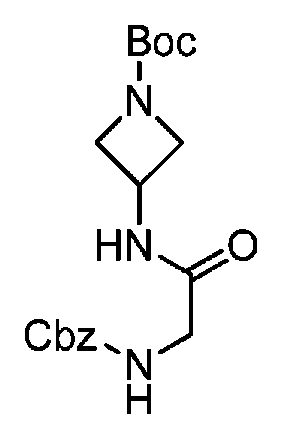
시판용 2-(((벤질옥시)카르보닐)아미노)아세트산 (6.70 g, 32.0 mmol) 및 EDCI (8.42 g, 43.9 mmol)의 혼합물을 무수 DCM 중에서 15분 동안 교반한 다음, 시판용 tert-부틸 3-아미노아제티딘-1-카르복실레이트 (5.02 g, 29.1 mmol) 및 HOBt (4.45 g, 29.0 mmol, 1수화물)의 용액에 첨가하였다. 반응 혼합물을 실온에서 하룻밤 교반한 다음, 진공에서 농축하였다. 잔류물을 에틸 아세테이트에 용해하고, 포화 암모늄 클로라이드 용액, 1 N NaOH 용액, 염수로 세척하고 유기층을 Na2SO4로 건조하였다. 진공에서 농축한 후에, 잔류물을 플래시 크로마토그래피 (실리카 겔, 0%-5% MeOH/EtOAc)에 의해 정제하여, 고진공 하에서 건조한 후에 백색 고체를 얻었다.The mixture of commercially available 2 - ((benzyloxy) carbonyl) amino) acetic acid (6.70 g, 32.0 mmol) and EDCI (8.42 g, 43.9 mmol) was stirred in anhydrous DCM for 15 minutes and then tert- Carboxylate (5.02 g, 29.1 mmol) and HOBt (4.45 g, 29.0 mmol, monohydrate). The reaction mixture was stirred at room temperature overnight and then concentrated in vacuo. The residue was dissolved in ethyl acetate and saturated ammonium chloride solution, 1 N NaOH solution, washed with brine, dried the organic layer with Na 2 SO 4. After concentration in vacuo, the residue was purified by flash chromatography (silica gel, 0% -5% MeOH / EtOAc) to give a white solid after drying under high vacuum.
1H NMR (클로로포름-d) δ: 7.35 (s, 5H), 5.64 - 6.02 (m, 1H), 5.12 (s, 2H), 4.43 - 4.71 (m, 1H), 4.11 - 4.29 (m, 2H), 3.88 (d, J = 5.1 Hz, 2H), 3.56 - 3.82 (m, 2H), 1.43 (s, 9H). 1 H NMR (chloroform -d) δ: 7.35 (s, 5H), 5.64 - 6.02 (m, 1H), 5.12 (s, 2H), 4.43 - 4.71 (m, 1H), 4.11 - 4.29 (m, 2H) , 3.88 (d, J = 5.1 Hz, 2H), 3.56-3.82 (m, 2H), 1.43 (s, 9H).
단계 E: Step E: terttert -부틸 3-(2--Butyl 3- (2- 아미노아세트아미도Aminoacetamido )) 아제티딘Azetidine -1--One- 카르복실레이트Carboxylate

tert-부틸 3-(2-(((벤질옥시)카르보닐)아미노)아세트아미도)아제티딘-1-카르복실레이트 (9.26 g, 25.5 mmol) 및 교반막대가 담긴 플라스크에, 10% Pd/C (1.356 g, 1.27 mmol)를 첨가하였다. 플라스크를 진공화하고 아르곤으로 다시 충전하였다. 주사기를 통해 메탄올 (100 mL)을 주의깊게 첨가하고, 교반하면서 플라스크를 진공화하였다. 이어서, 수소로 다시 충전하고 수소 풍선(hydrogen balloon) 하에서 2일 동안 교반하였다. 교반하면서 진공화하고 아르곤으로 다시 충전한 후에, 셀리트 521을 통한 여과에 의해 촉매를 제거하고 진공에서 농축하여 생성물을 얻었다.(9.26 g, 25.5 mmol) and tert-butyl 3- (2- ((benzyloxy) carbonyl) amino) acetamido) azetidine-1-carboxylate and a stirring bar was charged with 10% Pd / C (1.356 g, 1.27 mmol). The flask was evacuated and recharged with argon. Methanol (100 mL) was carefully added via a syringe and the flask was evacuated with stirring. It was then refilled with hydrogen and stirred under a hydrogen balloon for 2 days. After vacuuming with stirring and refilling with argon, the catalyst was removed by filtration through Celite 521 and concentrated in vacuo to give the product.
1H NMR (400MHz ,클로로포름-d) δ = 7.72 - 8.06 (m, 1 H), 4.53 - 4.75 (m, 1 H), 4.14 - 4.35 (m, 2 H), 3.65 - 3.87 (m, 2 H), 3.41 (s, 2 H), 2.08 (br. s., 2 H), 1.45 (s, 9 H), ESI-MS (m/z): C10H19N3O3에 대한 계산치: 229.28; 실측치: 230 (M+H). 1 H NMR (400 MHz, chloroform-d)? = 7.72-8.06 (m, 1H), 4.53-4.75 (m, 1H), 4.14-4.35 (m, 2H), 3.65-3.87 ..), 3.41 (s, 2 H), 2.08 (br s, 2 H), 1.45 (s, 9 H), ESI-MS (m / z): calcd for C 10 H 19 N 3 O 3 : 229.28; Found: 230 (M + H).
단계 F: tert-부틸 3-(2-((6-(트라이플루오로메틸)퀴나졸린-4-일)아미노)아세트아미도)아제티딘-1-카르복실레이트Step F: tert-Butyl 3- (2 - ((6- (trifluoromethyl) quinazolin-4-yl) amino) acetamido) azetidine-
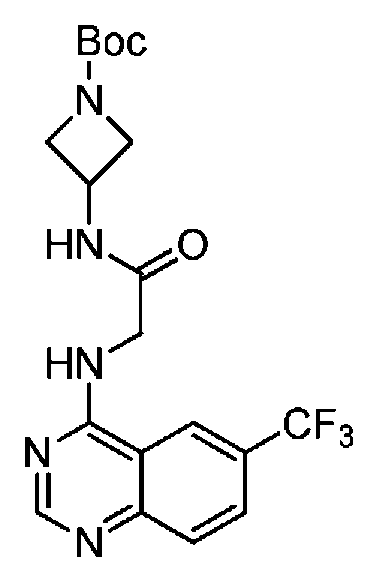
이전 단계에서 제조된 tert-부틸 3-(2-아미노아세트아미도)아제티딘-1-카르복실레이트 (1.073 g, 4.682 mmol)와 시판용 4-클로로-6-(트라이플루오로메틸)퀴나졸린 (990 mg, 4.256 mmol)의 혼합물을 아르곤 하에서 1시간 동안 90℃에서 무수 iPrOH 및 트라이에틸아민 중에서 교반하였다. 반응 혼합물을 진공에서 농축하고 잔류물을 플래시 크로마토그래피 (실리카 겔, 0%-5% MeOH/EtOAc)에 의해 정제하여, 고진공 하에서 건조한 후에 황색 고체를 얻었다.(1.073 g, 4.682 mmol) and commercially available 4-chloro-6- (trifluoromethyl) quinazoline prepared in the previous step 990 mg, 4.256 mmol) in anhydrous iPrOH and triethylamine at 90 < 0 > C under argon for 1 hour. The reaction mixture was concentrated in vacuo and the residue was purified by flash chromatography (silica gel, 0% -5% MeOH / EtOAc) to give a yellow solid after drying under high vacuum.
1H NMR (400 MHz, 클로로포름-d) δ ppm 1.46 (s, 10 H) 3.85 (dd, J=9.54, 5.14 Hz, 2 H) 4.27 - 4.36 (m, 4 H) 4.63 - 4.76 (m, 1 H) 7.21 (d, J=7.34 Hz, 1 H) 7.79 - 7.88 (m, 2 H) 7.90 (t, J=5.26 Hz, 1 H) 8.17 (s, 1 H) 8.66 (s, 1 H) C19H22F3N5O3에 대한 계산치: 425.41; 실측치: 426 (M+H). 1 H NMR (400 MHz, chloroform-d) ppm 1.46 (s, 10 H) 3.85 (dd, J = 9.54, 5.14 Hz, 2 H) 4.27-4.36 (S, 1 H) 8.66 (s, 1 H) C, 7.29 (d, J = 7.34 Hz, 1 H) 7.79 - 7.88 Calcd for 19 H 22 F 3 N 5 O 3 : 425.41; Found: 426 (M + H).
단계 G: N-(Step G: N- ( 아제티딘Azetidine -3-일)-2-((6-(Yl) -2 - ((6- ( 트라이플루오로메틸Trifluoromethyl )) 퀴나졸린Quinazoline -4-일)아미노)Yl) amino) 아세트아미드Acetamide TFATFA 염 salt
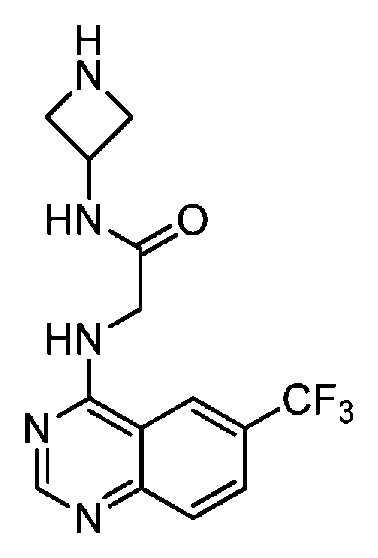
이전 단계에서 제조된 3-[2-(3-트라이플루오로메틸-벤조일아미노)-아세틸아미노]-아제티딘-1-카르복실산 tert-부틸 에스테르 (8.35 g, 19.6 mmol)를 DCM (250 mL)에 용해하고 실온에서 TFA (17 mL, 229 mmol)로 처리하였다. 반응물을 실온에서 하룻밤 교반하였다. 진공에서 용매를 제거하고 잔류물을 먼저 에테르로 트리츄레이팅하고(triturated), 상청액을 경사분리(decanting)하고, 고진공에서 건조하여 여분의 TFA를 함유하는 TFA 염 (무색 폼(foam))으로서 표제 화합물을 얻었다. TFA의 양은 실시할 때마다 달랐으며 TFA로부터의 아릴 CF3 및 CF3의 19F NMR 신호를 적분하여 결정하였다.-Acetylamino] -azetidine-l-carboxylic acid tert-butyl ester (8.35 g, 19.6 mmol) prepared in the previous step was dissolved in DCM (250 mL ) And treated with TFA (17 mL, 229 mmol) at room temperature. The reaction was stirred at room temperature overnight. The solvent was removed in vacuo and the residue was first triturated with ether and the supernatant decanted and dried in high vacuum to afford the title as a TFA salt (colorless foam) containing extra TFA Compound. The amount of TFA varied from run to run and was determined by integrating the 19 F NMR signals of aryl CF 3 and CF 3 from TFA.
1H NMR (400 MHz, DMSO-d6) δ ppm 3.96 (br. s., 2 H) 4.11 (t, J=9.05 Hz, 2 H) 4.19 (d, J=5.62 Hz, 2 H) 4.66 (sxt, J=7.73 Hz, 1 H) 6.99 - 7.51 (m, 9 H) 7.92 (d, J=8.80 Hz, 1 H) 8.11 (dd, J=8.80, 1.71 Hz, 1 H) 8.64 (s, 1 H) 8.85 (d, J=3.42 Hz, 2 H) 8.90 - 9.16 (m, 2 H) 9.44 (br. s., 1 H)], ESI-MS (m/z): C14H14F3N5O에 대한 계산치: 325.29; 실측치: 326 (M+H). 1 H NMR (400 MHz, DMSO -d6) δ ppm 3.96 (br. S., 2 H) 4.11 (t, J = 9.05 Hz, 2 H) 4.19 (d, J = 5.62 Hz, 2 H) 4.66 (sxt J = 7.73 Hz, 1H) 6.99-7.51 (m, 9 H) 7.92 (d, J = 8.80 Hz, 1H) 8.11 (dd, J = 8.80, 1.71 Hz, 1H) ..) 8.85 (d, J = 3.42 Hz, 2 H) 8.90 - 9.16 (m, 2 H) 9.44 (br s, 1 H)], ESI-MS (m / z): C 14 H 14 F 3 N Calcd for 5 O: 325.29; Found: 326 (M + H).
단계 H: N-(1-(4-(3-Step H: Preparation of N- (1- (4- (3- 하이드록시피리딘Hydroxypyridine -2-일)-2 days) 사이클로헥실Cyclohexyl )) 아제티딘Azetidine -3-일)-2-((6-(트3-yl) -2 - ((6- 라이플루오로메틸Trifluoromethyl )) 퀴나졸린Quinazoline -4-일)아미노)Yl) amino) 아세트아미드Acetamide

DCM 중 4-(3-하이드록시-피리딘-2-일)-사이클로헥사논 (단계 C에서 제조됨, 1 eq.) 및 N-(아제티딘-3-일)-2-((6-(트라이플루오로메틸)퀴나졸린-4-일)아미노)아세트아미드 (이전 단계에서 제조됨, 트리스 TFA 염, 1 eq.)의 현탁액에 TEA (3 eq.)를 첨가하였다. 실온에서 30분 동안 교반한 후에, NaBH(OAc)3 (3 eq)을 첨가하고 혼합물을 하룻밤 교반하였다. 반응물을 포화 소듐 바이카르보네이트 용액으로 켄칭하고, 부분적으로 농축하였다. 에틸 아세테이트로 추출한 후에, 유기층을 진공에서 농축하여 잔류물을 얻었고, 이를 플래시 크로마토그래피 (실리카 겔, 0-20% 7 N NH3-MeOH/에틸 아세테이트)에 의해 정제하여 이성체들의 혼합물인 고체로서 생성물을 얻었다.(Prepared from step C, 1 eq.) And N- (azetidin-3-yl) -2 - ((6- ( Amino) acetamide (prepared in the previous step, Tris TFA salt, 1 eq.) In dichloromethane (5 mL) was added TEA (3 eq.). After stirring at room temperature for 30 minutes, NaBH (OAc) 3 (3 eq) was added and the mixture was stirred overnight. The reaction was quenched with saturated sodium bicarbonate solution and partially concentrated. After extracting with ethyl acetate, the organic layer was concentrated in vacuo to give the residue, which was purified by flash chromatography (silica gel, 0-20% 7 N NH 3 -MeOH / ethyl acetate) to give product as a solid which is a mixture of isomers by ≪ / RTI >
ESI-MS (m/z): C25H27F3N6O2에 대한 계산치: 500.52; 실측치: 501 (M+H).ESI-MS (m / z) : C 25 H 27 F 3 N calculated for 6 O 2: 500.52; Found: 501 (M + H).
실시예Example 2: N-(1-((1S,4s)-4-(-3,6- 2: N- (1 - ((1S, 4S) -4 - (- 3,6- 다이하이드로Dihydro -2H-피란-2-일)-2H-pyran-2-yl) 사이클로헥실Cyclohexyl )아제티딘-3-일)-2-((6-() Azetidin-3-yl) -2 - ((6- ( 트라이플루오로메틸Trifluoromethyl )) 퀴나졸린Quinazoline -4-일)아미노)Yl) amino) 아세트아미드Acetamide 및 N-(1-((1S,4r)-4-(3,6-다이하이드로-2H-피란-2-일) And N- (1 - ((1S, 4r) -4- (3,6-dihydro-2H-pyran- 사이클로헥실Cyclohexyl )) 아제티딘Azetidine -3-일)-2-((6-(트3-yl) -2 - ((6- 라이플루오로메틸Trifluoromethyl )) 퀴나졸린Quinazoline -4-일)아미노)Yl) amino) 아세트아미드Acetamide
단계 A: 1-(1,4-다이옥사스피로[4.5]데칸-8-일)부트-3-엔-1-올Step A: Preparation of 1- (1,4-dioxaspiro [4.5] decan-8-yl)

아르곤 하에서 -78℃로 냉각된 1,4-다이옥사스피로[4.5]데칸-8-카르브알데하이드 (627 mg, 3.68 mmol, 문헌[Pearson, et al. in J. Org. Chem. 1997, 62(16), 5284-5292]에 기재된 바와 같이 제조됨)의 용액에 알릴마그네슘 브로마이드 (5 mL, 5 mmol, THF 중 1 M)를 적가하였다. 첨가를 완료한 후에, 반응 혼합물을 실온에 도달하도록 하룻밤 두었다. 이어서, -78℃로 재냉각하고 포화 NaHCO3 용액으로 켄칭하고 실온으로 가온하였다. 에테르로 추출한 후에, 유기층을 진공에서 농축하고 잔류물을 플래시 크로마토그래피 (실리카 겔, 0-100% 에테르/헥산)에 의해 정제하여 생성물을 얻었다.Dioxaspiro [4.5] decane-8-carbaldehyde (627 mg, 3.68 mmol, Pearson, et al., J. Org. Chem. 1997, 62 16), 5284-5292) in dichloromethane (5 mL) was added dropwise allyl magnesium bromide (5 mL, 5 mmol, 1 M in THF). After the addition was complete, the reaction mixture was allowed to reach room temperature overnight. Then re-cooled to -78 ℃ and quenched with saturated NaHCO 3 solution was allowed to warm to room temperature. After extraction with ether, the organic layer was concentrated in vacuo and the residue was purified by flash chromatography (silica gel, 0-100% ether / hexane) to give the product.
단계 B: 1 8-(1-(알릴옥시)부트-3-엔-1-일)-1,4-다이옥사스피로[4.5]데칸Step B: Preparation of 18- (1- (allyloxy) but-3-en-1-yl) -1,4-dioxaspiro [

이전 단계에서 제조된 1-(1,4-다이옥사스피로[4.5]데칸-8-일)부트-3-엔-1-올 (436 mg, 2.05 mmol)의 용액을 아르곤 하에 0℃에서 소듐 하이드라이드 (104 mg, 4.12 mmol, 95%)의 현탁액에 적가하였다. 첨가를 완료한 후에, 반응 혼합물을 실온에 도달하도록 두고 1시간 교반하였다. 알릴 브로마이드 (0.35 mL, 4.05 mmol)를 적가하고 혼합물을 실온에서 하룻밤 교반하였다. 이것을 얼음 냉각된 포화 NaHCO3 용액에 부었다. 에테르로 추출한 후에, 유기층을 진공에서 농축하고 잔류물을 플래시 크로마토그래피 (실리카 겔, DCM)에 의해 정제하여 생성물을 얻었다.A solution of 1- (1,4-dioxaspiro [4.5] decan-8-yl) but-3-en-1-ol prepared in the previous step (436 mg, 2.05 mmol) Lt; / RTI > (104 mg, 4.12 mmol, 95%). After completion of the addition, the reaction mixture was allowed to reach room temperature and stirred for 1 hour. Allyl bromide (0.35 mL, 4.05 mmol) was added dropwise and the mixture was stirred at room temperature overnight. This was poured into ice-cooled saturated NaHCO 3 solution. After extraction with ether, the organic layer was concentrated in vacuo and the residue was purified by flash chromatography (silica gel, DCM) to give the product.
단계 C: 8-(3,6-다이하이드로-2H-피란-2-일)-1,4-다이옥사스피로[4.5]데칸Step C: Preparation of 8- (3,6-dihydro-2H-pyran-2-yl) -1,4-dioxaspiro [
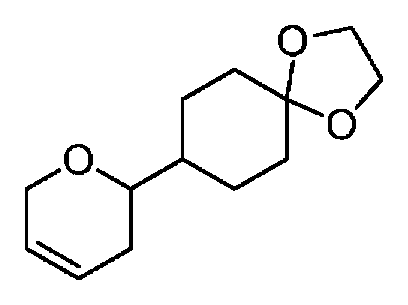
DCM 중의, 이전 단계에서 제조된 8-(1-(알릴옥시)부트-3-엔-1-일)-1,4-다이옥사스피로[4.5]데칸 (454 mg, 1.80 mmol) 및 그럽스 제너레이션(Grubbs Generation) II 촉매 (76 mg, 0.09 mmol)의 용액을 탈가스하고 아르곤 하에서 4시간 동안 40℃로 가열하였다. 포화 NaHCO3 용액으로 추출한 후에, 유기층을 진공에서 농축하고 잔류물을 플래시 크로마토그래피 (실리카 겔, 에테르)에 의해 정제하여 생성물을 얻었다.Dioxaspiro [4.5] decane (454 mg, 1.80 mmol) prepared in the previous step and 8- (4-fluoro-4- A solution of Grubbs Generation II catalyst (76 mg, 0.09 mmol) was degassed and heated to 40 < 0 > C under argon for 4 hours. After extraction with saturated NaHCO 3 solution, the organic layer was concentrated in vacuo and the residue was purified by flash chromatography (silica gel, ether) to give the product.
단계 D: 4-(3,6-다이하이드로-2H-피란-2-일)사이클로헥사논Step D: 4- (3,6-Dihydro-2H-pyran-2-yl) cyclohexanone

이전 단계에서 제조된 8-(3,6-다이하이드로-2H-피란-2-일)-1,4-다이옥사스피로[4.5]데칸 (195 mg, 0.869 mmol)의 용액을 실시예 1, 단계 C에 기재된 바와 같이 탈보호하여 생성물을 얻었다.A solution of 8- (3,6-dihydro-2H-pyran-2-yl) -1,4-dioxaspiro [4.5] decane (195 mg, 0.869 mmol), prepared in the previous step, The product was deprotected as described in C.
단계 E: N-(1-((1S,4s)-4-(3,6-다이하이드로-2H-피란-2-일)사이클로헥실)아제티딘-3-일)-2-((6-(트라이플루오로메틸)퀴나졸린-4-일)아미노)아세트아미드 및 N-(1-((1S,4r)-4-(3,6-다이하이드로-2H-피란-2-일)사이클로헥실)아제티딘-3-일)-2-((6-(트라이플루오로메틸)퀴나졸린-4-일)아미노)아세트아미드Step E: Synthesis of N- (1 - ((1S, 4S) -4- (3,6-dihydro-2H-pyran-2-yl) cyclohexyl) azetidin- (Trifluoromethyl) quinazolin-4-yl) amino) acetamide and N- (1 - ((1S, 4r) -4- (3,6-dihydro- ) Azetidin-3-yl) -2 - ((6- (trifluoromethyl) quinazolin-4- yl) amino) acetamide

건조 DCM 중의, 이전 단계에서 제조된 4-(3,6-다이하이드로-2H-피란-2-일)사이클로헥사논 (54 mg, 0.3 mmol)의 용액을 N-(아제티딘-3-일)-2-((6-(트라이플루오로메틸)퀴나졸린-4-일)아미노)아세트아미드 (163 mg, 0.244 mmol, 실시예 1, 단계 G에서 제조됨) 및 TEA (0.100 mL, 0.717 mmol)로 처리하였다. 실온에서 30분 동안 교반한 후에, NaBH(OAc)3 (206 mg, 0.972 mmol)을 첨가하고 혼합물을 하룻밤 교반하였다. 실시예 1, 단계 H에 기재된 바와 같은 반응 워크업(workup) 및 정제에 의해 생성물을 얻었다.A solution of 4- (3,6-dihydro-2H-pyran-2-yl) cyclohexanone (54 mg, 0.3 mmol) prepared in the previous step in dry DCM was treated with N- (azetidin- (163 mg, 0.244 mmol, prepared in example 1, step G) and TEA (0.100 mL, 0.717 mmol) in DMF (2 mL) Lt; / RTI > After stirring at room temperature for 30 minutes, NaBH (OAc) 3 (206 mg, 0.972 mmol) was added and the mixture was stirred overnight. The product was obtained by reaction workup and purification as described in example 1, step H and purification.
시스 이성체:Cis isomer:
ESI-MS (m/z): C25H30F3N5O2에 대한 계산치: 489.24; 실측치: 490 (M+H).ESI-MS (m / z) : C 25 H 30 F 3 N 5 O 2 Calcd: 489.24; Found: 490 (M + H).
트랜스 이성체:Trans isomers:
ESI-MS (m/z): C25H30F3N5O2에 대한 계산치: 489.24; 실측치: 490 (M+H).ESI-MS (m / z) : C 25 H 30 F 3 N 5 O 2 Calcd: 489.24; Found: 490 (M + H).
실시예Example 3: N-(1-((1S,4s)-4-( 3: N- (1 - ((1S, 4S) -4- ( 사이클로프로필(하이드록시)메틸Cyclopropyl (hydroxy) methyl )) 사이클로헥실Cyclohexyl )) 아제티딘Azetidine -3-일)-2-((6-(Yl) -2 - ((6- ( 트라이플루오로메틸Trifluoromethyl )) 퀴나졸린Quinazoline -4-일)아미노)Yl) amino) 아세트아미드Acetamide
단계 A: 사이클로프로필(1,4-다이옥사스피로[4.5]데칸-8-일)메탄올Step A: Cyclopropyl (1,4-dioxaspiro [4.5] decan-8-yl) methanol

아르곤 하에서 -78℃로 냉각된 1,4-다이옥사스피로[4.5]데칸-8-카르브알데하이드 (1.135 g, 6.668 mmol, 문헌[Pearson, et al. in J. Org. Chem. 1997, 62(16), 5284-5292]에 기재된 바와 같이 제조됨)의 용액에 사이클로프로필마그네슘 브로마이드 (40 mL, 20 mmol, THF 중 0.5 M)를 적가하였다. 첨가를 완료한 후에, 반응 혼합물을 실온에 도달하도록 하룻밤 두었다. 이어서, -78℃로 재냉각하고 포화 NaHCO3 용액으로 켄칭하고 실온으로 가온하였다. 에테르로 추출한 후에, 유기층을 진공에서 농축하고 잔류물을 플래시 크로마토그래피 (실리카 겔, 0-100% 에틸 아세테이트/헵탄)에 의해 정제하여 생성물을 얻었다.Dioxaspiro [4.5] decane-8-carbaldehyde (1.135 g, 6.668 mmol, reviewed in Pearson, et al., J. Org. Chem. 1997, 62 16), 5284-5292) in dichloromethane (5 mL) was added cyclopropylmagnesium bromide (40 mL, 20 mmol, 0.5 M in THF) dropwise. After the addition was complete, the reaction mixture was allowed to reach room temperature overnight. Then re-cooled to -78 ℃ and quenched with saturated NaHCO 3 solution was allowed to warm to room temperature. After extraction with ether, the organic layer was concentrated in vacuo and the residue was purified by flash chromatography (silica gel, 0-100% ethyl acetate / heptane) to give the product.
1H NMR (클로로포름-d) δ: 3.97 (s, 4H), 2.64 (t, J = 2.8 Hz, 1H), 1.87 - 2.01 (m, 2H), 1.76 - 1.87 (m, 2H), 1.51 - 1.63 (m, 4H), 1.44 (t, J = 12.6 Hz, 2H), 0.84 - 1.02 (m, 1H), 0.56 - 0.66 (m, 1H), 0.44 - 0.56 (m, 1H), 0.19 - 0.36 (m, 2H) 1 H NMR (chloroform -d) δ: 3.97 (s, 4H), 2.64 (t, J = 2.8 Hz, 1H), 1.87 - 2.01 (m, 2H), 1.76 - 1.87 (m, 2H), 1.51 - 1.63 (m, 1H), 0.44-0.56 (m, 1H), 0.19-0.36 (m, 1H), 1.44 (t, J = 12.6 Hz, 2H), 0.84-1.02 , 2H)
단계 B: 4-(Step B: 4- ( 사이클로프로필(하이드록시)메틸Cyclopropyl (hydroxy) methyl )) 사이클로헥사논Cyclohexanone
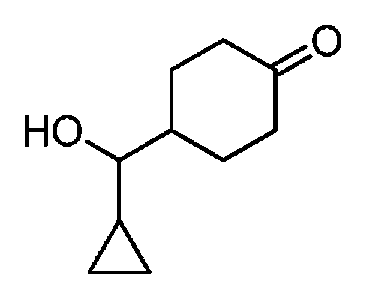
이전 단계에서 제조된, 사이클로프로필(1,4-다이옥사스피로[4.5]데칸-8-일)메탄올 (922 mg, 4.34 mmol)의 용액을 실시예 1, 단계 C에 기재된 바와 같이 탈보호하여 생성물을 얻었다.A solution of cyclopropyl (1,4-dioxaspiro [4.5] decan-8-yl) methanol (922 mg, 4.34 mmol) prepared in the previous step was deprotected as described in Example 1, step C to give the product ≪ / RTI >
1H NMR (400MHz ,클로로포름-d) δ = 2.73 (ddd, J = 2.9, 6.2, 9.0 Hz, 1 H), 2.17 - 2.51 (m, 6 H), 1.94 - 2.05 (m, 1 H), 1.53 - 1.70 (m, 4 H), 0.94 - 1.07 (m, 1 H), 0.61 - 0.70 (m, 1 H), 0.49 - 0.59 (m, 1 H), 0.21 - 0.36 (m, 2 H) 1 H NMR (400MHz, chloroform -d) δ = 2.73 (ddd, J = 2.9, 6.2, 9.0 Hz, 1 H), 2.17 - 2.51 (m, 6 H), 1.94 - 2.05 (m, 1 H), 1.53 (M, 1 H), 0.61-0.70 (m, 1 H), 0.49-0.59 (m, 1 H), 0.21-0.36 (m,
단계 C: N-(1-((1S,4s)-4-(Step C: Preparation of N- (1 - ((1S, 4s) -4- ( 사이클로프로필(하이드록시)메틸Cyclopropyl (hydroxy) methyl )) 사이클로헥실Cyclohexyl )) 아제티딘Azetidine -3-일)-2-((6-(Yl) -2 - ((6- ( 트라이플루오로메틸Trifluoromethyl )) 퀴나졸린Quinazoline -4-일)아미노)Yl) amino) 아세트아미드Acetamide

건조 DCM 중의, 이전 단계에서 제조된 사이클로프로필(1,4-다이옥사스피로[4.5]데칸-8-일)메탄올 (117 mg, 0.695 mmol)의 용액을 N-(아제티딘-3-일)-2-((6-(트라이플루오로메틸)퀴나졸린-4-일)아미노)아세트아미드 (170 mg, 0.307 mmol, 실시예 1, 단계 G에서 제조됨) 및 TEA (0.080 mL, 0.574 mmol)로 처리하였다. 실온에서 30분 동안 교반한 후에, NaBH(OAc)3 (205 mg, 0.967 mmol)을 첨가하고 혼합물을 하룻밤 교반하였다. 실시예 1, 단계 H에 기재된 바와 같은 반응 워크업 및 정제에 의해 생성물을 얻었다.A solution of cyclopropyl (1,4-dioxaspiro [4.5] decan-8-yl) methanol (117 mg, 0.695 mmol) prepared in the previous step in dry DCM was treated with N- (azetidin- (170 mg, 0.307 mmol, prepared in example 1, step G) and TEA (0.080 mL, 0.574 mmol) in DMF (2 mL) was treated with 2 - ((6- (trifluoromethyl) quinazolin- Respectively. After stirring at room temperature for 30 minutes, NaBH (OAc) 3 (205 mg, 0.967 mmol) was added and the mixture was stirred overnight. The product was obtained by reaction work-up and purification as described in example 1, step H.
1H NMR (400MHz ,DMSO-d6) δ = 8.94 - 9.07 (m, 1 H), 8.72 - 8.85 (m, 1 H), 8.56 (s, 1 H), 8.30 - 8.44 (m, 1 H), 8.01 - 8.10 (m, 1 H), 7.81 - 7.92 (m, 1 H), 4.18 - 4.29 (m, 2 H), 4.12 (d, J = 5.4 Hz, 2 H), 3.39 - 3.48 (m, 2 H), 3.17 (d, J = 5.1 Hz, 1 H), 2.68 - 2.76 (m, 2 H), 2.52 - 2.59 (m, 1 H), 2.10 - 2.24 (m, 1 H), 1.20 - 1.56 (m, 9 H), 0.64 - 0.82 (m, 1 H), 0.33 - 0.41 (m, 1 H), 0.25 - 0.33 (m, 1 H), 0.15 (none, 2 H) ESI-MS (m/z): C24H30F3N5O2에 대한 계산치: 477.24; 실측치: 478 (M+H). 1 H NMR (400 MHz, DMSO-d 6 )? = 8.94 - 9.07 (m, 1H), 8.72-8.85 (m, 1H) (M, 1H), 8.01-8.10 (m, 1H), 7.81-7.92 (m, 1H), 4.18-4.29 (M, 1H), 3.17 (d, J = 5.1 Hz, 1H), 2.68-2.76 (m, 2H), 2.52-2.59 (m, 1H), 0.64-0.82 (m, 1H), 0.33-0.41 (m, 1H), 0.25-0.33 z): Calcd for C 24 H 30 F 3 N 5 O 2 : 477.24; Found: 478 (M + H).
실시예 4: (+) 및 (-) N-(1-((1S,4s)-4-(사이클로프로필(하이드록시)메틸)사이클로헥실)아제티딘-3-일)-2-((6-(트라이플루오로메틸)퀴나졸린-4-일)아미노)아세트아미드Example 4: Preparation of (+) and (-) N- (1 - ((1S, 4S) -4- (cyclopropyl (hydroxy) methyl) cyclohexyl) azetidin- - (trifluoromethyl) quinazolin-4-yl) amino) acetamide
15% EtOH/15% IPA/70% 헥산 (말린크로트(Mallinckrodt)로부터의 95% n-헥산)에 용해된 N-(1-((1S,4s)-4-((R)-사이클로프로필(하이드록시)메틸)사이클로헥실)아제티딘-3-일)-2-((6-(트라이플루오로메틸)퀴나졸린-4-일)아미노)아세트아미드의 용액을, 15% EtOH/15% IPA/70% 헥산 (말린크로트로부터의 95% n-헥산)을 이동상으로서 사용하여 키랄팩 (ChiralPak) AD 컬럼 (5 x 50 cm) 상에 주입하였다. 인라인(in line) 편광계 검출기에 의해 결정 시, 컬럼으로부터 용리되는 제1 피크는 (+) 회전성을 가졌고 제2 피크는 (-) 회전성을 가졌다.(1 - ((1S, 4S) -4 - ((R) -cyclopropyl) propane in 15% EtOH / 15% IPA / 70% hexane (95% n-hexane from Mallinckrodt) (Trifluoromethyl) quinazolin-4-yl) amino) acetamide in 15% EtOH / 15% EtOH was added to a solution of 2- Was injected onto a ChiralPak AD column (5 x 50 cm) using IPA / 70% hexane (95% n-hexane from the dried chlate) as the mobile phase. When determined by an in-line polarimeter detector, the first peak eluted from the column had (+) rotability and the second peak had (-) rotability.
ESI-MS (m/z): C24H30F3N5O2에 대한 계산치: 477.24; 실측치: 478 (M+H).ESI-MS (m / z): Calcd for C 24 H 30 F 3 N 5 O 2 : 477.24; Found: 478 (M + H).
실시예 5: N-(1-((1S,4s)-4-(사이클로프로필(하이드록시)메틸)1-듀테로사이클로헥실)아제티딘-3-일)-2-((6-(트라이플루오로메틸)퀴나졸린-4-일)아미노)아세트아미드Example 5: Preparation of N- (1 - ((1S, 4S) -4- (Cyclopropyl (hydroxy) methyl) 1-diterocyclohexyl) Fluoromethyl) quinazolin-4-yl) amino) acetamide

건조 DCM 중의, 실시예 3, 단계 B에 기재된 바와 같이 제조된 사이클로프로필(1,4-다이옥사스피로[4.5]데칸-8-일)메탄올 (120 mg, 0.713 mmol)의 용액을 N-(아제티딘-3-일)-2-((6-(트라이플루오로메틸)퀴나졸린-4-일)아미노)아세트아미드 (390 mg, 0.705 mmol, 실시예 1, 단계 G에서 제조됨) 및 NMM (0.150 mL, 1.36 mmol)으로 처리하였다. 실온에서 30분 동안 교반한 후에, NaBD(OAc)3 (570 mg, 2.68 mmol)을 첨가하고 혼합물을 하룻밤 교반하였다. 실시예 1, 단계 H에 기재된 바와 같은 반응 워크업 및 정제에 의해 생성물을 얻었다.A solution of cyclopropyl (1,4-dioxaspiro [4.5] decan-8-yl) methanol (120 mg, 0.713 mmol), prepared as described in Example 3, Step B, in dry DCM was treated with N- Amino) acetamide (390 mg, 0.705 mmol, prepared in example 1, step G) and NMM (2-chloro-thiomorpholin- 0.150 mL, 1.36 mmol). After stirring at room temperature for 30 minutes, NaBD (OAc) 3 (570 mg, 2.68 mmol) was added and the mixture was stirred overnight. The product was obtained by reaction work-up and purification as described in example 1, step H.
ESI-MS (m/z): C24H29DF3N5O2에 대한 계산치: 478.24; 실측치: 479 (M+H).ESI-MS (m / z): Calcd for C 24 H 29 DF 3 N 5 O 2 : 478.24; Found: 479 (M + H).
실시예Example 6: (+) 및 (-) N-(1-((1S,4s)-4-( 6: (+) and (-) N- (1 - ((1S, 4S) -4- 사이클로프로필(하이드록시)메틸Cyclopropyl (hydroxy) methyl )1-)One- 듀테로Dutero 사이클로헥실)Cyclohexyl) 아제티딘Azetidine -3-일)-2-((6-(Yl) -2 - ((6- ( 트라이플루오로메틸Trifluoromethyl )) 퀴나졸린Quinazoline -4-일)아미노)Yl) amino) 아세트아미드Acetamide
15% EtOH/15% IPA/70% 헥산 (말린크로트로부터의 95% n-헥산) 중의, 실시예 5에서 제조된 라세믹 N-(1-((1S,4s)-4-((R)-사이클로프로필(하이드록시)메틸)1-듀테로사이클로헥실)아제티딘-3-일)-2-((6-(트라이플루오로메틸)퀴나졸린-4-일)아미노)아세트아미드의 용액을, 15% EtOH/15% IPA/70% 헥산 (말린크로트로부터의 95% n-헥산)을 이동상으로서 사용하여 키랄팩 AD 컬럼 (5 x 50 cm) 상에 주입하였다. 인라인 편광계 검출기에 의해 결정 시, 컬럼으로부터 용리되는 제1 피크는 (+) 회전성을 가졌고 제2 피크는 (-) 회전성을 가졌다.(1 - ((1S, 4S) -4 - ((R (3R) -3-methoxyphenyl) (Trifluoromethyl) quinazolin-4-yl) amino) acetamide in 10 ml dichloromethane was added dropwise to a solution of 2- Was injected onto a Chiralpak AD column (5 x 50 cm) using 15% EtOH / 15% IPA / 70% hexane (95% n-hexane from the dried chlate) as the mobile phase. When determined by an in-line polarimeter detector, the first peak eluted from the column had (+) rotability and the second peak had (-) rotability.
ESI-MS (m/z): C24H29DF3N5O2에 대한 계산치: 478.24; 실측치: 479 (M+H).ESI-MS (m / z): Calcd for C 24 H 29 DF 3 N 5 O 2 : 478.24; Found: 479 (M + H).
실시예Example 7: N-(1-((1S,4s)-4-(1- 7: N- (1 - ((1S, 4S) -4- (1- 하이드록시Hydroxy -2--2- 메틸프로필Methyl propyl )) 사이클로헥실Cyclohexyl )) 아제티딘Azetidine -3-일)-2-((6-(Yl) -2 - ((6- ( 트라이플루오로메틸Trifluoromethyl )) 퀴나졸린Quinazoline -4-일)아미노)Yl) amino) 아세트아미드Acetamide
단계 A: 2-메틸-1-(1,4-다이옥사스피로[4.5]데칸-8-일)프로판-1-올Step A: 2-Methyl-1- (1,4-dioxaspiro [4.5] decan-8-yl) propan-
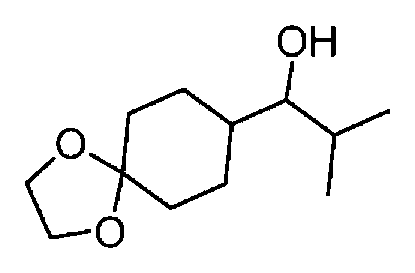
아르곤 하에서 -78℃로 냉각된 THF (20 mL) 중 1,4-다이옥사스피로[4.5]데칸-8-카르브알데하이드 (693 mg, 4.07 mmol, 문헌[Pearson, et al. in J. Org. Chem. 1997, 62(16), 5284-5292]에 기재된 바와 같이 제조됨)의 용액에 아이소프로필마그네슘 브로마이드 (6 mL, 12 mmol, THF 중 1 M)를 적가하였다. 첨가를 완료한 후에, 반응 혼합물을 실온에 도달하도록 하룻밤 두었다. 이어서, -78℃로 재냉각하고 포화 NaHCO3 용액으로 켄칭하고 실온으로 가온하였다. 에테르로 추출한 후에, 유기층을 진공에서 농축하고 잔류물을 플래시 크로마토그래피 (실리카 겔, 0-100% 에테르 /DCM)에 의해 정제하여 생성물을 얻었다.To a solution of 1,4-dioxaspiro [4.5] decane-8-carbaldehyde (693 mg, 4.07 mmol, from Pearson, et al., In J. Org. To a solution of isopropylmagnesium bromide (6 mL, 12 mmol, 1 M in THF) was added dropwise to a solution of the compound of formula (I) as described in J. Chem. 1997, 62 (16), 5284-5292. After the addition was complete, the reaction mixture was allowed to reach room temperature overnight. Then re-cooled to -78 ℃ and quenched with saturated NaHCO 3 solution was allowed to warm to room temperature. After extraction with ether, the organic layer was concentrated in vacuo and the residue was purified by flash chromatography (silica gel, 0-100% ether / DCM) to give the product.
1H NMR (400MHz ,클로로포름-d) δ = 3.97 (s, 4 H), 3.14 (d, 1 H), 1.73 - 1.88 (m, 3 H), 1.33 - 1.69 (m, 7 H), 1.29 (d, J = 5.6 Hz, 1 H), 0.94 (dd, 6 H) 1 H NMR (400 MHz, chloroform-d)? = 3.97 (s, 4H), 3.14 (d, 1H), 1.73-1.888 (m, 3H), 1.33-1.69 d, J = 5.6 Hz, 1H), 0.94 (dd, 6H)
단계 B: 4-(1-하이드록시-2-메틸프로필)사이클로헥사논Step B: 4- (1-Hydroxy-2-methylpropyl) cyclohexanone

이전 단계에서 제조된 2-메틸-1-(1,4-다이옥사스피로[4.5]데칸-8-일)프로판-1-올 (922 mg, 4.34 mmol)의 용액을 실시예 1, 단계 C에 기재된 바와 같이 탈보호하여 생성물을 얻었다.A solution of 2-methyl-1- (1,4-dioxaspiro [4.5] decan-8-yl) propan-1-ol prepared in the previous step (922 mg, 4.34 mmol) The product was deprotected as described.
1H NMR (클로로포름-d) δ: 3.05 - 3.28 (m, 1H), 2.17 - 2.48 (m, 5H), 1.75 - 1.99 (m, 3H), 1.45 - 1.74 (m, 4H), 0.97 (dd, J = 7.9, 7.0 Hz, 6H) 1 H NMR (chloroform-d)?: 3.05-3.28 (m, 1H), 2.17-2.48 (m, 5H), 1.75-1.99 (m, 3H) J = 7.9, 7.0 Hz, 6H)
단계 C: N-(1-((1S,4s)-4-(1-하이드록시-2-메틸프로필)사이클로헥실)아제티딘-3-일)-2-((6-(트라이플루오로메틸)퀴나졸린-4-일)아미노)아세트아미드Step C: Preparation of N- (1 - ((1S, 4S) -4- (1 -hydroxy-2- methylpropyl) cyclohexyl) azetidin- ) Quinazolin-4-yl) amino) acetamide

건조 DCM 중의, 이전 단계에서 제조된 4-(1-하이드록시-2-메틸프로필)사이클로헥사논 (117 mg, 0.695 mmol)의 용액을 N-(아제티딘-3-일)-2-((6-(트라이플루오로메틸)퀴나졸린-4-일)아미노)아세트아미드 (170 mg, 0.307 mmol, 실시예 1, 단계 G에서 제조됨) 및 TEA (0.080 mL, 0.574 mmol)로 처리하였다. 실온에서 30분 동안 교반한 후에, NaBH(OAc)3 (205 mg, 0.967 mmol)을 첨가하고 혼합물을 하룻밤 교반하였다. 실시예 1, 단계 H에 기재된 바와 같은 반응 워크업 및 정제에 의해 생성물을 얻었다.A solution of 4- (1-hydroxy-2-methylpropyl) cyclohexanone (117 mg, 0.695 mmol) in dry DCM was added to a solution of N- (azetidin- Amino) acetamide (170 mg, 0.307 mmol, prepared in example 1, step G) and TEA (0.080 mL, 0.574 mmol) in anhydrous THF (20 mL). After stirring at room temperature for 30 minutes, NaBH (OAc) 3 (205 mg, 0.967 mmol) was added and the mixture was stirred overnight. The product was obtained by reaction work-up and purification as described in example 1, step H.
ESI-MS (m/z): C24H32F3N5O2에 대한 계산치: 479.25; 실측치: 480 (M+H).ESI-MS (m / z): Calcd for C 24 H 32 F 3 N 5 O 2 : 479.25; Found: 480 (M + H).
실시예Example 8: (+) 및 (-)N-(1-((1S,4s)-4-(1- 8: (+) and (-) N- (1 - ((1S, 4S) -4- 하이드록시Hydroxy -2--2- 메틸프로필Methyl propyl )) 사이클로헥실Cyclohexyl )아제티딘-3-일)-2-((6-() Azetidin-3-yl) -2 - ((6- ( 트라이플루오로메틸Trifluoromethyl )) 퀴나졸린Quinazoline -4-일)아미노)Yl) amino) 아세트아미드Acetamide
15% EtOH/15% IPA/70% 헥산 (말린크로트로부터의 95% n-헥산)에 용해된 N-(1-((1S,4s)-4-((R)-1-하이드록시-2-메틸프로필)사이클로헥실)아제티딘-3-일)-2-((6-(트라이플루오로메틸)퀴나졸린-4-일)아미노)아세트아미드의 용액을, 15% EtOH/15% IPA/70% 헥산 (말린크로트로부터의 95% n-헥산)을 이동상으로서 사용하여 키랄팩 AD 컬럼 (5 x 50 cm) 상에 주입하였다. 인라인 편광계 검출기에 의해 결정 시, 컬럼으로부터 용리되는 제1 피크는 (+) 회전성을 가졌고 제2 피크는 (-) 회전성을 가졌다.(1 - ((1S, 4s) -4 - ((R) -1-Hydroxy-ethyl) -piperidine- (Trifluoromethyl) quinazolin-4-yl) amino) acetamide was added to a solution of 15% EtOH / 15% IPA / 70% hexane (95% n-hexane from dried croc) as the mobile phase onto a Chiralpak AD column (5 x 50 cm). When determined by an in-line polarimeter detector, the first peak eluted from the column had (+) rotability and the second peak had (-) rotability.
ESI-MS (m/z): C24H32F3N5O2에 대한 계산치: 479.25; 실측치: 480 (M+H).ESI-MS (m / z): Calcd for C 24 H 32 F 3 N 5 O 2 : 479.25; Found: 480 (M + H).
실시예Example 9: 2-((6-( 9: 2 - ((6- ( 트라이플루오로메틸Trifluoromethyl )) 퀴나졸린Quinazoline -4-일)아미노)-N-(1-((1s,4s)-4-Yl) amino) -N- (1 - ((1s, 4s) -4- 비닐사이클로헥실Vinylcyclohexyl )) 아제티딘Azetidine -3-일)-3 days) 아세트아미드Acetamide 및 2-((6-( And 2 - ((6- ( 트라이플루오로메틸Trifluoromethyl )) 퀴나졸Quinazoline 린-4-일)아미노)-N-(1-((1r,4r)-4-비닐사이클로헥실)아제티딘-3-일)아세트아미드Yl) amino) -N- (1 - ((1 r, 4r) -4-vinylcyclohexyl) azetidin-
단계 A: 8-비닐-1,4-다이옥사스피로[4.5]데칸Step A: 8-vinyl-1, 4-dioxaspiro [4.5] decane

트라이페닐포스포늄 브로마이드 - 소다미드 복합체 (20.04 g, 48.10 mmol)가 담긴 플라스크에 THF (100 mL)를 첨가하였다. 실온에서 1시간 동안 교반한 후에, 용액은 밝은 황색(bright yellow)이었다 (다소 침전됨). 반응 혼합물을 0℃로 냉각하고 THF (20 mL) 중 1,4-다이옥사스피로[4.5]데칸-8-카르브알데하이드 (693 mg, 4.07 mmol, 문헌[Pearson, et al. in J. Org. Chem. 1997, 62(16), 5284-5292]에 기재된 바와 같이 제조됨)의 용액을 주사기를 통해 적가하였다. 첨가를 완료한 후에, 반응 혼합물이 연한 복숭아색(light peach)으로 변하였고, 이를 하룻밤 실온으로 가온하면서 교반하였다. 반응물을 0℃에서 포화 NaHCO3 수용액으로 조심스럽게 켄칭하고, 실온으로 가온되게 두고, 이어서 물이 뒤따르고, 에테르로 추출하였다. 농축된 유기층을 플래시 크로마토그래피 (실리카 겔, 에테르, PAA 착색)에 의해 정제하였다. 회전증발기에서 (휘발성인 것으로 생각되는) 일부 물질이 손실되는 것을 막기 위해, 조(bath)의 온도를 35℃ 아래로 유지하였다.To a flask containing a triphenylphosphonium bromide-sodamide complex (20.04 g, 48.10 mmol) was added THF (100 mL). After stirring at room temperature for 1 hour, the solution was bright yellow (somewhat precipitated). The reaction mixture was cooled to 0 C and a solution of 1,4-dioxaspiro [4.5] decane-8-carbaldehyde (693 mg, 4.07 mmol, prepared according to Pearson, et al. In J. Org. Chem., 1997, 62 (16), 5284-5292) was added dropwise via syringe. After the addition was complete, the reaction mixture turned into a light peach, which was stirred overnight while warming to room temperature. The reaction was carefully quenched with saturated aqueous NaHCO 3 solution at 0 ° C, allowed to warm to room temperature, followed by water, and extracted with ether. The concentrated organic layer was purified by flash chromatography (silica gel, ether, PAA staining). The temperature of the bath was kept below 35 [deg.] C to prevent some material (believed to be volatile) from being lost in the rotary evaporator.
1H NMR (클로로포름-d) δ: 5.65 - 5.86 (m, 1H), 5.00 (d, J = 17.4 Hz, 1H), 4.92 (d, J = 10.3 Hz, 1H), 3.94 (s, 4H), 1.92 - 2.10 (m, 1H), 1.70 - 1.81 (m, 4H), 1.51 - 1.65 (m, 2H), 1.37 - 1.51 (m, 2H) 1 H NMR (chloroform -d) δ: 5.65 - 5.86 ( m, 1H), 5.00 (d, J = 17.4 Hz, 1H), 4.92 (d, J = 10.3 Hz, 1H), 3.94 (s, 4H), 2H), 1.37-1.51 (m, 2H), 1.70-1.81 (m, 4H)
단계 B: 4-Step B: 4- 비닐사이클로헥사논Vinyl cyclohexanone
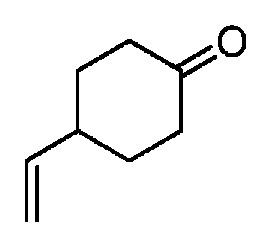
이전 단계에서 제조된 8-비닐-1,4-다이옥사스피로[4.5]데칸 (500 mg, 2.97 mmol)의 용액을 실시예 1, 단계 C에 기재된 바와 같이 탈보호하여 생성물을 얻었다.A solution of 8-vinyl-1,4-dioxaspiro [4.5] decane (500 mg, 2.97 mmol) prepared in the previous step was deprotected as described in Example 1, Step C to give the product.
1H NMR (클로로포름-d) δ: 5.83 (ddd, J = 17.2, 10.6, 6.2 Hz, 1H), 4.94 - 5.16 (m, 2H), 2.30 - 2.56 (m, 5H), 2.03 - 2.14 (m, 2H), 1.54 - 1.70 (m, 2H) 1 H NMR (chloroform -d) δ: 5.83 (ddd, J = 17.2, 10.6, 6.2 Hz, 1H), 4.94 - 5.16 (m, 2H), 2.30 - 2.56 (m, 5H), 2.03 - 2.14 (m, 2H), 1.54-1.70 (m, 2H)
단계 C: 2-((6-(Step C: Preparation of 2 - ((6- ( 트라이플루오로메틸Trifluoromethyl )) 퀴나졸린Quinazoline -4-일)아미노)-N-(1-((1s,4s)-4-Yl) amino) -N- (1 - ((1s, 4s) -4- 비닐사이클로헥실Vinylcyclohexyl )) 아제티딘Azetidine -3-일)-3 days) 아세트아미드Acetamide 및 2-((6-( And 2 - ((6- ( 트라이플루오로메틸Trifluoromethyl )) 퀴나졸린Quinazoline -4-일)아미노)-N-(1-((1r,4r)-4-비닐사이클로헥실)아제티딘-3-일)아세트아미드Yl) amino) -N- (1 - ((lr, 4r) -4-vinylcyclohexyl) azetidin-

건조 DCM 중의, 이전 단계에서 제조된 4-(비닐)사이클로헥사논 (100 mg, 0.805 mmol)의 용액을 N-(아제티딘-3-일)-2-((6-(트라이플루오로메틸)퀴나졸린-4-일)아미노)아세트아미드 (598 mg, 0.896 mmol, 실시예 1, 단계 G에서 제조됨) 및 TEA (0.380 mL, 2.73 mmol)로 처리하였다. 실온에서 30분 동안 교반한 후에, NaBH(OAc)3 (622 mg, 2.94 mmol)을 첨가하고 혼합물을 하룻밤 교반하였다. 실시예 1, 단계 H에 기재된 바와 같은 반응 워크업 및 정제에 의해 생성물을 얻었고, 신(syn) 이성체가 처음에 용리되었다.A solution of 4- (vinyl) cyclohexanone (100 mg, 0.805 mmol), prepared in the previous step, in dry DCM was added to a solution of N- (azetidin-3-yl) -2- (6- (trifluoromethyl) Yl) amino) acetamide (598 mg, 0.896 mmol, prepared in example 1, step G) and TEA (0.380 mL, 2.73 mmol). After stirring at room temperature for 30 minutes, NaBH (OAc) 3 (622 mg, 2.94 mmol) was added and the mixture was stirred overnight. The product was obtained by reaction work-up and purification as described in Example 1, Step H, and the syn (isomer) was first eluted.
ESI-MS (m/z): C22H26F3N5O에 대한 계산치: 433.21; 실측치: 434 (M+H).ESI-MS (m / z) : C 22 H 26 F 3 calculated for N 5 O: 433.21; Found: 434 (M + H).
실시예Example 10: N-(1-((1R,4s)-4-(2,5- 10: N- (1 - ((1 R, 4 S) -4- (2,5- 다이하이드로푸란Dihydrofuran -2-일)-2 days) 사이클로헥실Cyclohexyl )) 아제티딘Azetidine -3-일)-2-((6-(Yl) -2 - ((6- ( 트라이플루오로메틸Trifluoromethyl )) 퀴나졸린Quinazoline -4-일)아미노)Yl) amino) 아세트아미드Acetamide 및 N-(1-((1R,4r)-4-(2,5-다이하이드로푸란-2-일) And N- (1 - ((1 R, 4r) -4- (2,5-dihydrofuran-2-yl) 사이클로헥실Cyclohexyl )) 아제티딘Azetidine -3-일)-2-((6-(트라이플루오로메틸)퀴나졸린-4-일)아미노)아세트아미드Yl) -2 - ((6- (trifluoromethyl) quinazolin-4-yl) amino) acetamide
단계 A: 1-(1,4-다이옥사스피로[4.5]데칸-8-일)프로프-2-엔-1-올Step A: Preparation of 1- (1,4-dioxaspiro [4.5] decan-8-yl) prop-

아르곤 하에서 -78℃로 냉각된 THF (6 mL) 중 1,4-다이옥사스피로[4.5]데칸-8-카르브알데하이드 (860 mg, 5.05 mmol, 문헌[Pearson, et al. in J. Org. Chem. 1997, 62(16), 5284-5292]에 기재된 바와 같이 제조됨)의 용액에 비닐마그네슘 브로마이드 (20 mL, 20 mmol, THF 중 1 M)를 적가하였다. 첨가를 완료한 후에, 반응 혼합물을 실온에 도달하도록 하룻밤 두었다. 이어서, -78℃로 재냉각하고 포화 NaHCO3 용액으로 켄칭하고 실온으로 가온하였다. 에테르로 추출한 후에, 유기층을 진공에서 농축하고 잔류물을 플래시 크로마토그래피 (실리카 겔, 0-100% 에테르/헥산)에 의해 정제하여 생성물을 얻었다.Dioxaspiro [4.5] decane-8-carbaldehyde (860 mg, 5.05 mmol, described in Pearson, et al., In J. Org. Prepared as described in J. Chem. 1997, 62 (16), 5284-5292) was added dropwise vinyl magnesium bromide (20 mL, 20 mmol, 1 M in THF). After the addition was complete, the reaction mixture was allowed to reach room temperature overnight. Then re-cooled to -78 ℃ and quenched with saturated NaHCO 3 solution was allowed to warm to room temperature. After extraction with ether, the organic layer was concentrated in vacuo and the residue was purified by flash chromatography (silica gel, 0-100% ether / hexane) to give the product.
단계 B: 8-(1-(알릴옥시)알릴)-1,4-다이옥사스피로[4.5]데칸Step B: Preparation of 8- (1- (allyloxy) allyl) -1,4-dioxaspiro [4.5] decane
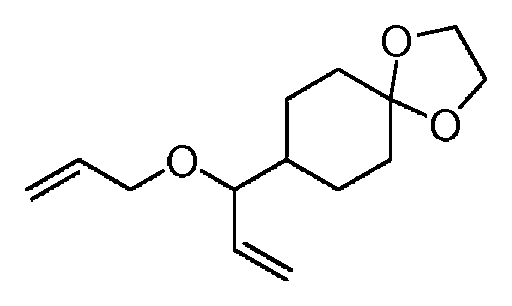
이전 단계에서 제조된 1-(1,4-다이옥사스피로[4.5]데칸-8-일)프로프-2-엔-1-올 (414 mg, 2.09 mmol)의 용액을 아르곤 하에 0℃에서 소듐 하이드라이드 (104 mg, 4.12 mmol, 95%)의 현탁액에 적가하였다. 첨가를 완료한 후에, 반응 혼합물을 실온에 도달하도록 두고 1시간 교반하였다. 알릴 브로마이드 (0.35 mL, 4.05 mmol)를 적가하고 혼합물을 실온에서 하룻밤 교반하였다. 이것을 얼음 냉각된 포화 NaHCO3 용액에 부었다. 에테르로 추출한 후에, 유기층을 진공에서 농축하고 잔류물을 플래시 크로마토그래피 (실리카 겔, DCM)에 의해 정제하여 생성물을 얻었다.A solution of 1- (1,4-dioxaspiro [4.5] decan-8-yl) prop-2-en-1-ol prepared in the previous step (414 mg, 2.09 mmol) Was added dropwise to a suspension of the hydride (104 mg, 4.12 mmol, 95%). After completion of the addition, the reaction mixture was allowed to reach room temperature and stirred for 1 hour. Allyl bromide (0.35 mL, 4.05 mmol) was added dropwise and the mixture was stirred at room temperature overnight. This was poured into ice-cooled saturated NaHCO 3 solution. After extraction with ether, the organic layer was concentrated in vacuo and the residue was purified by flash chromatography (silica gel, DCM) to give the product.
단계 C: 8-(2,5-다이하이드로푸란-2-일)-1,4-다이옥사스피로[4.5]데칸Step C: Preparation of 8- (2,5-dihydrofuran-2-yl) -1,4-dioxaspiro [4.5]

DCM 중의, 이전 단계에서 제조된 8-(1-(알릴옥시)알릴)-1,4-다이옥사스피로[4.5]데칸 (347 mg, 1.46 mmol) 및 그럽스 제너레이션 II 촉매 (62 mg, 0.07 mmol)의 용액을 탈가스하고 아르곤 하에서 4시간 동안 40℃로 가열하였다. 포화 NaHCO3 용액으로 추출한 후에, 유기층을 진공에서 농축하고 잔류물을 플래시 크로마토그래피 (실리카 겔, 에테르)에 의해 정제하여 생성물을 얻었다.To a solution of 8- (1- (allyloxy) allyl) -1,4-dioxaspiro [4.5] decane (347 mg, 1.46 mmol) and Grubs Generation II catalyst (62 mg, 0.07 mmol ) Was degassed and heated to 40 < 0 > C under argon for 4 hours. After extraction with saturated NaHCO 3 solution, the organic layer was concentrated in vacuo and the residue was purified by flash chromatography (silica gel, ether) to give the product.
단계 D: 4-(2,5-다이하이드로푸란-2-일)사이클로헥사논Step D: Preparation of 4- (2,5-dihydrofuran-2-yl) cyclohexanone

이전 단계에서 제조된 8-(2,5-다이하이드로푸란-2-일)-1,4-다이옥사스피로[4.5]데칸 (281 mg, 1.34 mmol)의 용액을 실시예 1, 단계 C에 기재된 바와 같이 탈보호하여 생성물을 얻었다.A solution of 8- (2,5-dihydrofuran-2-yl) -1,4-dioxaspiro [4.5] decane (281 mg, 1.34 mmol), prepared in the previous step, The product was deprotected as described.
단계 E: N-(1-((1R,4s)-4-(2,5-다이하이드로푸란-2-일)사이클로헥실)아제티딘-3-일)-2-((6-(트라이플루오로메틸)퀴나졸린-4-일)아미노)아세트아미드 및 N-(1-((1R,4r)-4-(2,5-다이하이드로푸란-2-일)사이클로헥실)아제티딘-3-일)-2-((6-(트라이플루오로메틸)퀴나졸린-4-일)아미노)아세트아미드Step E: Preparation of N- (1 - ((lR, 4s) -4- (2,5-dihydrofuran-2-yl) cyclohexyl) azetidin- Amino) acetamide and N- (1 - ((1 R, 4r) -4- (2,5-dihydrofuran-2-yl) cyclohexyl) azetidin- Yl) -2 - ((6- (trifluoromethyl) quinazolin-4-yl) amino) acetamide

건조 DCM 중의, 이전 단계에서 제조된 4-(2,5-다이하이드로푸란-2-일)사이클로헥사논 (127 mg, 0.764 mmol)의 용액을 N-(아제티딘-3-일)-2-((6-(트라이플루오로메틸)퀴나졸린-4-일)아미노)아세트아미드 (320 mg, 0.48 mmol, 실시예 1, 단계 G에서 제조됨) 및 TEA (0.200 mL, 1.44 mmol)로 처리하였다. 실온에서 30분 동안 교반한 후에, NaBH(OAc)3 (323 mg, 1.52 mmol)을 첨가하고 혼합물을 하룻밤 교반하였다. 실시예 1, 단계 H에 기재된 바와 같은 반응 워크업 및 정제에 의해 생성물을 얻었고, 시스 이성체가 처음에 용리되었다.A solution of 4- (2,5-dihydrofuran-2-yl) cyclohexanone (127 mg, 0.764 mmol) prepared in the previous step in dry DCM was treated with N- (azetidin- (320 mg, 0.48 mmol, prepared in example 1, step G) and TEA (0.200 mL, 1.44 mmol) in anhydrous dichloromethane . After stirring at room temperature for 30 minutes, NaBH (OAc) 3 (323 mg, 1.52 mmol) was added and the mixture was stirred overnight. The product was obtained by reaction work-up and purification as described in example 1, step H, and the cis isomer was eluted first.
시스 이성체:Cis isomer:
ESI-MS (m/z): C24H28F3N5O2에 대한 계산치: 475.22; 실측치: 476 (M+H).ESI-MS (m / z): Calcd for C 24 H 28 F 3 N 5 O 2 : 475.22; Found: 476 (M + H).
트랜스 이성체:Trans isomers:
ESI-MS (m/z): C24H28F3N5O2에 대한 계산치: 475.22; 실측치: 476 (M+H).ESI-MS (m / z): Calcd for C 24 H 28 F 3 N 5 O 2 : 475.22; Found: 476 (M + H).
실시예 11: N-(1-((1S,4s)-4-(6-옥소-1,2,3,6-테트라하이드로피리딘-2-일)사이클로헥실)아제티딘-3-일)-2-((6-(트라이플루오로메틸)퀴나졸린-4-일)아미노)아세트아미드Example 11: N- (l- ((lS, 4s) -4- (6-oxo-l, 2,3,6-tetrahydropyridin- 2- yl) cyclohexyl) azetidin- 2 - ((6- (Trifluoromethyl) quinazolin-4-yl) amino) acetamide
단계 A: (E)-N-(1,4-다이옥사스피로[4.5]데칸-8-일메틸렌)-2-메틸프로판-2-설핀아미드Step A: (E) -N- (1,4-dioxaspiro [4.5] decan-8-ylmethylene) -2-methylpropane-

1,4-다이옥사스피로[4.5]데칸-8-카르브알데하이드 (6.68 g, 39.2 mmol, 문헌[Pearson, et al. in J. Org. Chem. 1997, 62(16), 5284-5292]에 기재된 바와 같이 제조됨)의 용액, 라세믹 2-메틸프로판-2-설핀아미드 (3.50 g, 28.0 mmol), 공업 등급(tech grade) 티타늄 (IV) 에톡사이드 (14 mL, 67.5 mmol)를 건조 THF (100 mL)에 용해하고, 아르곤 분위기 하에 놓고, 주위 온도에서 16시간 동안 교반하였다. 다음날, 반응 혼합물을 에틸 아세테이트로 희석하고 얼음 냉각 염수에 재빨리 부었다. 다량의 백색 침전물을, 셀리트를 통한 여과에 의해 제거하고 유기층을 제거하였다. Na2SO4로 건조하고 농축한 후에, 잔류물을 플래시 크로마토그래피 (실리카 겔, 0-100% 에테르/DCM)에 의해 정제하여 생성물을 얻었다.(6.68 g, 39.2 mmol, produced by Pearson, et al. In J. Org. Chem. 1997, 62 (16), 5284-5292], was prepared by reacting 1,4-dioxaspiro [4.5] decane- (3.50 g, 28.0 mmol) and tech grade titanium (IV) ethoxide (14 mL, 67.5 mmol) in dry THF (100 mL), placed under an argon atmosphere, and stirred at ambient temperature for 16 hours. The next day, the reaction mixture was diluted with ethyl acetate and quickly poured into ice-cold brine. A large amount of white precipitate was removed by filtration through celite and the organic layer was removed. After drying with Na 2 SO 4 and concentration, the residue was purified by flash chromatography (silica gel, 0-100% ether / DCM) to give the product.
1H NMR (클로로포름-d) δ: 8.00 (d, J = 4.4 Hz, 1H), 2.41 - 2.59 (m, 1H), 1.88 - 2.00 (m, 2H), 1.55 - 1.86 (m, 7H), 1.19 (s, 9H) 1 H NMR (chloroform -d) δ: 8.00 (d, J = 4.4 Hz, 1H), 2.41 - 2.59 (m, 1H), 1.88 - 2.00 (m, 2H), 1.55 - 1.86 (m, 7H), 1.19 (s, 9 H)
단계 B: N-(1-(1,4-다이옥사스피로[4.5]데칸-8-일)부트-3-엔-1-일)-2-메틸프로판-2-설핀아미드Step B: Synthesis of N- (1- (1,4-dioxaspiro [4.5] decan-8-yl)

건조 THF (48 mL) 중의, 이전 단계에서 제조된 (E)-N-(1,4-다이옥사스피로[4.5]데칸-8-일메틸렌)-2-메틸프로판-2-설핀아미드 (1.91 g, 6.99 mmol)의 용액을 아르곤 하에 주위 온도에서 알릴마그네슘 브로마이드의 용액 (10.5 mL, 21 mmol, THF 중 2N)을 적가하여 처리하였다. 첨가를 완료한 후에, 반응 혼합물을 실온에서 3시간 동안 교반하고, 이어서 포화 암모늄 클로라이드 용액의 조심스러운 첨가에 의해 0℃에서 켄칭하였다. 에틸 아세테이트로 추출한 후에, 유기층을 진공에서 농축하고 잔류물을 플래시 크로마토그래피 (실리카 겔, 0-5% MeOH/에틸 아세테이트)에 의해 정제하여 부분입체이성체들의 혼합물로서 생성물을 얻었다.(E) -N- (1,4-dioxaspiro [4.5] decan-8-ylmethylene) -2-methylpropane-2-sulfinamide prepared in the previous step in dry THF (48 mL) , 6.99 mmol) was treated dropwise with a solution of allylmagnesium bromide (10.5 mL, 21 mmol, 2N in THF) at ambient temperature under argon. After the addition was complete, the reaction mixture was stirred at room temperature for 3 hours and then quenched at 0 ° C by careful addition of saturated ammonium chloride solution. After extraction with ethyl acetate, the organic layer was concentrated in vacuo and the residue was purified by flash chromatography (silica gel, 0-5% MeOH / ethyl acetate) to give the product as a mixture of diastereoisomers.
1H NMR (클로로포름-d) δ: 5.56 - 5.93 (m, 1H), 5.16 - 5.35 (m, 2H), 3.85 - 3.98 (m, 4H), 3.54 - 3.74 (m, 1H), 2.99 - 3.25 (m, 1H), 1.66 - 1.84 (m, 5H), 1.29 - 1.62 (m, 5H), 1.22 (s, 9H) 1 H NMR (chloroform -d) δ: 5.56 - 5.93 ( m, 1H), 5.16 - 5.35 (m, 2H), 3.85 - 3.98 (m, 4H), 3.54 - 3.74 (m, 1H), 2.99 - 3.25 ( (m, 5H), 1.29-1.62 (m, 5H), 1.22 (s, 9H)
단계 C: 1-(4,4-Step C: 1- (4,4- 다이메톡시사이클로헥실Dimethoxycyclohexyl )) 부트Boot -3-엔-1-아민-3-en-1-amine

이전 단계에서 제조된 N-(1-(1,4-다이옥사스피로[4.5]데칸-8-일)부트-3-엔-1-일)-2-메틸프로판-2-설핀아미드 (828 mg, 2.63 mmol)의 용액을 메탄올 (20 mL)에 용해하고 실온에서 하룻밤 교반하면서 HCl (4.4 mL, 5.5 mmol, MeOH 중 1.25 M)로 처리하였다. 반응 혼합물을 진공에서 농축하고, 에테르로 트리츄레이팅하고, 상청액을 수회 경사분리하고, 잔류물을 고진공 하에서 건조하여 백색 폼 (HCl 염)으로서 생성물을 얻었다.A mixture of N- (1- (1,4-dioxaspiro [4.5] decan-8-yl) but-3-en-1-yl) -2- methylpropane- , 2.63 mmol) in methanol (20 mL) was treated with HCl (4.4 mL, 5.5 mmol, 1.25 M in MeOH) at room temperature with stirring overnight. The reaction mixture was concentrated in vacuo, triturated with ether, the supernatant was decanted several times and the residue was dried under high vacuum to give the product as a white foam (HCl salt).
1H NMR (클로로포름-d) δ: 5.66 - 5.99 (m, 1H), 5.04 - 5.25 (m, 2H), 3.20 (s, 3H), 3.14 (s, 3H), 2.53 - 2.78 (m, 1H), 2.23 - 2.42 (m, 1H), 1.91 - 2.11 (m, 3H), 1.51 - 1.75 (m, 2H), 1.15 - 1.51 (m, 11H) 1 H NMR (chloroform -d) δ: 5.66 - 5.99 ( m, 1H), 5.04 - 5.25 (m, 2H), 3.20 (s, 3H), 3.14 (s, 3H), 2.53 - 2.78 (m, 1H) , 2.23-2.42 (m, 1H), 1.91-2.11 (m, 3H), 1.51-1.75 (m, 2H), 1.15-1.51
단계 D: N-(1-(4,4-Step D: Preparation of N- (1- (4,4- 다이메톡시사이클로헥실Dimethoxycyclohexyl )) 부트Boot -3-엔-1-일)-3-en-1-yl) 아크릴아미드Acrylamide
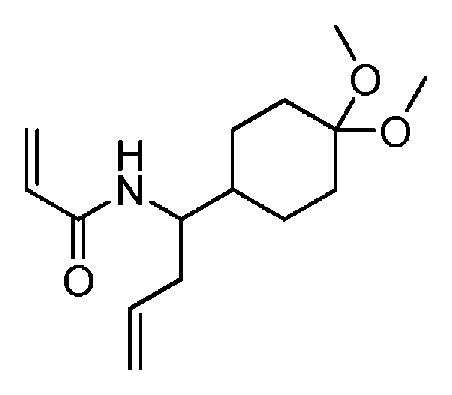
이전 단계에서 제조된 1-(4,4-다이메톡시사이클로헥실)부트-3-엔-1-아민, HCl 염 (512 mg, 2.4 mmol)의 용액을 아르곤 하에서 -78℃로 냉각하고 트라이에틸아민으로 처리한 후에 아크릴로일 클로라이드 (0.220 mL, 2.64 mmol)를 적가하여 처리하였다. 반응물을 주위 온도에 도달하도록 하룻밤 두었고, 이어서, 포화 NaHCO3 용액에 붓고 에틸 아세테이트로 추출하였다. 유기 추출물을 진공에서 농축하고 플래시 크로마토그래피 (실리카 겔, 0-100% 에테르/DCM)에 의해 정제하여 생성물을 얻었다.A solution of 1- (4,4-dimethoxycyclohexyl) but-3-en-1 -amine, HCl salt (512 mg, 2.4 mmol) prepared in the previous step was cooled to -78 & After treatment with amine, acryloyl chloride (0.220 mL, 2.64 mmol) was added dropwise. Kept overnight to reach the reaction to ambient temperature, then poured into a saturated NaHCO 3 solution and extracted with ethyl acetate. The organic extracts were concentrated in vacuo and purified by flash chromatography (silica gel, 0-100% ether / DCM) to give the product.
1H NMR (클로로포름-d) δ: 6.27 (dd, J = 16.9, 1.5 Hz, 1H), 5.99 - 6.15 (m, 1H), 5.68 - 5.83 (m, 1H), 5.64 (dd, J = 10.1, 1.3 Hz, 1H), 5.09 (d, J = 2.9 Hz, 1H), 5.06 (d, J = 1.0 Hz, 1H), 3.97 - 4.10 (m, 1H), 3.17 - 3.21 (m, 3H), 3.10 - 3.15 (m, 3H), 2.30 - 2.40 (m, 1H), 2.14 - 2.26 (m, 1H), 1.96 - 2.10 (m, 2H), 1.61 - 1.69 (m, 2H), 1.41 - 1.53 (m, 1H), 1.17 - 1.37 (m, 5H) 1 H NMR (chloroform -d) δ: 6.27 (dd, J = 16.9, 1.5 Hz, 1H), 5.99 - 6.15 (m, 1H), 5.68 - 5.83 (m, 1H), 5.64 (dd, J = 10.1, (M, 3H), 3.10-3.1 (m, 1H), 5.09 (d, J = 2.9 Hz, 2H), 1.41-1.53 (m, 2H), 1.41-1.53 (m, 1H), 2.14-2.26 (m, ), 1.17-1.37 (m, 5H)
단계 E: 6-(4,4-Step E: Preparation of 6- (4,4- 다이메톡시사이클로헥실Dimethoxycyclohexyl )-5,6-) -5,6- 다이하이드로피리딘Dihydropyridine -2(1H)-온-2 (1H) -one
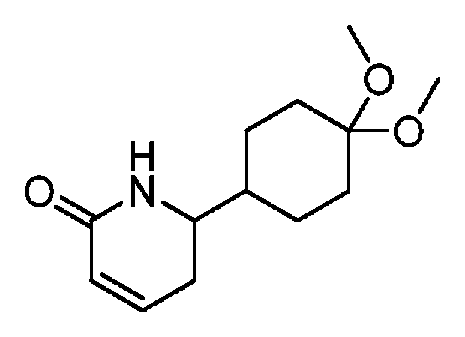
DCE (100 mL) 중의, 이전 단계에서 제조된 N-(1-(4,4-다이메톡시사이클로헥실)부트-3-엔-1-일)아크릴아미드 (512 mg, 2.4 mmol) 및 그럽스 제너레이션 II 촉매 (97 mg, 0.11 mmol)의 용액을 탈가스하고 아르곤 하에서 2시간 동안 50℃로 가열하였다. 반응 혼합물을 진공에서 농축하고 잔류물을 플래시 크로마토그래피 (실리카 겔, DCM->0-5% MeOH/에틸 아세테이트)에 의해 정제하여 생성물을 얻었다.N- (1- (4,4-dimethoxycyclohexyl) but-3-en-1-yl) acrylamide prepared in the previous step (512 mg, 2.4 mmol) and Grubbs A solution of the generator II catalyst (97 mg, 0.11 mmol) was degassed and heated to 50 < 0 > C under argon for 2 hours. The reaction mixture was concentrated in vacuo and the residue was purified by flash chromatography (silica gel, DCM-> 0-5% MeOH / ethyl acetate) to give the product.
1H NMR (클로로포름-d) δ: 6.51 - 6.71 (m, 1H), 6.24 (br. s., 1H), 5.90 (d, J = 9.5 Hz, 1H), 3.38 - 3.55 (m, 1H), 3.20 (s, 3H), 3.14 (s, 3H), 2.20 - 2.40 (m, 2H), 2.00 - 2.16 (m, 2H), 1.65 (br. s., 2H), 1.45 - 1.56 (m, 1H), 1.14 - 1.40 (m, 5H) 1 H NMR (chloroform -d) δ: 6.51 - 6.71 ( m, 1H), 6.24 (.. Br s, 1H), 5.90 (d, J = 9.5 Hz, 1H), 3.38 - 3.55 (m, 1H), 2H), 1.45-1.56 (m, 1 H), 2.20-2.40 (m, 2H), 2.00-2.16 (m, , 1.14-1.40 (m, 5H)
단계 F: 6-(4-Step F: 6- (4- 옥소사이클로헥실Oxocyclohexyl )-5,6-) -5,6- 다이하이드로피리딘Dihydropyridine -2(1H)-온-2 (1H) -one

이전 단계에서 제조된 6-(4,4-다이메톡시사이클로헥실)-5,6-다이하이드로피리딘-2(1H)-온 (237 mg, 0.99 mmol)의 용액을 실시예 1, 단계 C에 기재된 바와 같이 탈보호하여 생성물을 얻었다.A solution of 6- (4,4-dimethoxycyclohexyl) -5,6-dihydropyridin-2 (1H) -one (237 mg, 0.99 mmol), prepared in the previous step, The product was deprotected as described.
단계 G: N-(1-((1S,4s)-4-(6-옥소-1,2,3,6-테트라하이드로피리딘-2-일)사이클로헥실)아제티딘-3-일)-2-((6-(트라이플루오로메틸)퀴나졸린-4-일)아미노)아세트아미드Step G: Preparation of N- (1 - ((1S, 4S) -4- (6-oxo- 1,2,3,6-tetrahydropyridin- 2- yl) cyclohexyl) - ((6- (trifluoromethyl) quinazolin-4-yl) amino) acetamide

건조 DCM 중의, 이전 단계에서 제조된 6-(4-옥소사이클로헥실)-5,6-다이하이드로피리딘-2(1H)-온 (90 mg, 0.47 mmol)의 용액을 N-(아제티딘-3-일)-2-((6-(트라이플루오로메틸)퀴나졸린-4-일)아미노)아세트아미드 (359 mg, 0.54 mmol, 실시예 1, 단계 G에서 제조됨) 및 TEA (0.220 mL, 1.58 mmol)로 처리하였다. 실온에서 30분 동안 교반한 후에, NaBH(OAc)3 (391 mg, 1.85 mmol)을 첨가하고 혼합물을 하룻밤 교반하였다. 실시예 1, 단계 H에 기재된 바와 같은 반응 워크업 및 정제에 의해 생성물을 얻었고, 시스 이성체가 처음에 용리되었다.A solution of 6- (4-oxocyclohexyl) -5,6-dihydropyridin-2 (1H) -one (90 mg, 0.47 mmol) in dry DCM was treated with N- (azetidin- (359 mg, 0.54 mmol, prepared in example 1, step G) and TEA (0.220 mL, 0.54 mmol) were added to a solution of 2- ((6- (trifluoromethyl) quinazolin- 1.58 mmol). After stirring at room temperature for 30 minutes, NaBH (OAc) 3 (391 mg, 1.85 mmol) was added and the mixture was stirred overnight. The product was obtained by reaction work-up and purification as described in example 1, step H, and the cis isomer was eluted first.
시스 이성체:Cis isomer:
1H NMR (MeOH) δ: 8.60 (s, 1H), 8.55 (s, 1H), 8.01 (dd, 1H), 7.87 (d, 1H), 6.56 - 6.79 (m, 1H), 5.69 - 5.92 (m, 1H), 4.40 - 4.58 (m, 1H), 4.27 (s, 2H), 3.65 (s, 2H), 3.40 - 3.53 (m, 2H), 2.80 - 2.97 (m, 2H), 2.20 - 2.41 (m, 3H), 1.31 - 1.73 (m, 9H) ESI-MS (m/z): C25H29F3N6O2에 대한 계산치: 502.23; 실측치: 503 (M+H). 1 H NMR (MeOH) δ: 8.60 (s, 1H), 8.55 (s, 1H), 8.01 (dd, 1H), 7.87 (d, 1H), 6.56 - 6.79 (m, 1H), 5.69 - 5.92 (m 2H), 3.40-3.53 (m, 2H), 2.80-2.97 (m, 2H), 2.20-2.41 (m, , 3H), 1.31 - 1.73 ( m, 9H) ESI-MS (m / z): calcd for C 25 H 29 F 3 N 6 O 2: 502.23; Found: 503 (M + H).
실시예Example 12: N-(1-((1S,4s)-4-(6-옥소-1,2,3,6- 12: N- (1 - ((1S, 4S) -4- (6-oxo- 테트라하이드로피리딘Tetrahydropyridine -2-일)-2 days) 사이클로헥실Cyclohexyl )) 아제티딘Azetidine -3-일)-2-((6-(Yl) -2 - ((6- ( 트라이플루오로메틸Trifluoromethyl )) 퀴나졸린Quinazoline -4-일)아미노)Yl) amino) 아세트아미드Acetamide
단계 A: N-(1-(1,4-Step A: Preparation of N- (1- (1,4- 다이옥사스피로[4.5]데칸Dioxaspiro [4.5] decane -8-일)알릴)-2--8-yl) allyl) -2- 메틸프로판Methyl propane -2--2- 설핀아미드Sulfinamide

건조 THF (48 mL) 중의, 실시예 11, 단계 A에서 제조된 (E)-N-(1,4-다이옥사스피로[4.5]데칸-8-일메틸렌)-2-메틸프로판-2-설핀아미드 (1.89 g, 5.53 mmol)의 용액을, 아르곤 하에 주위 온도에서 비닐마그네슘 클로라이드의 용액 (10.4 mL, 16.6 mmol, THF 중 1.6 N)을 적가하여 처리하였다. 첨가를 완료한 후에, 반응 혼합물을 실온에서 3시간 동안 교반하고, 이어서 포화 암모늄 클로라이드 용액의 조심스러운 첨가에 의해 0℃에서 켄칭하였다. 에틸 아세테이트로 추출한 후에, 유기층을 진공에서 농축하고 잔류물을 플래시 크로마토그래피 (실리카 겔, 0-5% MeOH/에틸 아세테이트)에 의해 정제하여 부분입체이성체들의 혼합물로서 생성물을 얻었다.To a solution of (E) -N- (1,4-dioxaspiro [4.5] decan-8-ylmethylene) -2-methylpropane-2-sulfonate prepared in Example 11, Step A in dry THF (48 mL) Amide (1.89 g, 5.53 mmol) in dichloromethane was treated dropwise with a solution of vinylmagnesium chloride (10.4 mL, 16.6 mmol, 1.6 N in THF) at ambient temperature under argon. After the addition was complete, the reaction mixture was stirred at room temperature for 3 hours and then quenched at 0 ° C by careful addition of saturated ammonium chloride solution. After extraction with ethyl acetate, the organic layer was concentrated in vacuo and the residue was purified by flash chromatography (silica gel, 0-5% MeOH / ethyl acetate) to give the product as a mixture of diastereoisomers.
단계 B: 1-(1,4-Step B: Preparation of 1- (1,4- 다이옥사스피로[4.5]데칸Dioxaspiro [4.5] decane -8-일)-8-yl) 프로프Professional -2-엔-1-아민2-en-1-amine

이전 단계에서 제조된 N-(1-(1,4-다이옥사스피로[4.5]데칸-8-일)알릴)-2-메틸프로판-2-설핀아미드 (1.38 g, 4.58 mmol)의 용액을 메탄올 (100 mL)에 용해하고, 실온에서 하룻밤 교반하면서 HCl (15 mL, 18.7 mmol, MeOH 중 1.25 M)로 처리하였다. 반응 혼합물을 진공에서 농축하고, 에테르로 트리츄레이팅하고, 상청액을 수회 경사분리하고, 잔류물을 고진공 하에서 건조하여 백색 폼 (HCl 염)으로서 생성물을 얻었다.A solution of N- (1- (1,4-dioxaspiro [4.5] decan-8-yl) allyl) -2-methylpropane-2-sulfinamide (1.38 g, 4.58 mmol) (100 mL) and treated with HCl (15 mL, 18.7 mmol, 1.25 M in MeOH) at room temperature with stirring overnight. The reaction mixture was concentrated in vacuo, triturated with ether, the supernatant was decanted several times and the residue was dried under high vacuum to give the product as a white foam (HCl salt).
단계 C: N-(1-(1,4-다이옥사스피로[4.5]데칸-8-일)알릴)아크릴아미드Step C: Preparation of N- (1- (1,4-dioxaspiro [4.5] decan-8-yl) allyl) acrylamide
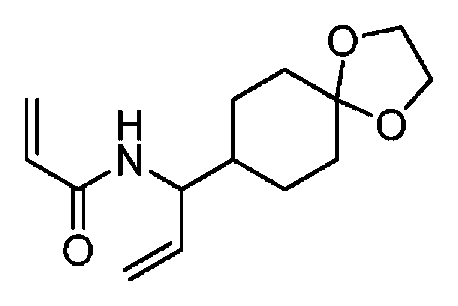
이전 단계에서 제조된 1-(1,4-다이옥사스피로[4.5]데칸-8-일)프로프-2-엔-1-아민, HCl 염 (966 mg, 4.13 mmol)의 용액을 아르곤 하에서 0℃로 냉각하고 트라이에틸아민 (1.71 mL, 12.3 mmol)으로 처리한 다음 아크릴로일 클로라이드 (0.35 mL, 4.2 mmol)를 적가하여 처리하였다. 반응물을 주위 온도에 도달하도록 하룻밤 두었고, 이어서, 포화 NaHCO3 용액에 붓고 에틸 아세테이트로 추출하였다. 유기 추출물을 진공에서 농축하고 플래시 크로마토그래피 (실리카 겔, 0-5% MeOH/에틸 아세테이트)에 의해 정제하여 생성물을 얻었다.A solution of 1- (1,4-dioxaspiro [4.5] decan-8-yl) prop-2-en-1 -amine, HCl salt (966 mg, 4.13 mmol) , Treated with triethylamine (1.71 mL, 12.3 mmol) and treated dropwise with acryloyl chloride (0.35 mL, 4.2 mmol). Kept overnight to reach the reaction to ambient temperature, then poured into a saturated NaHCO 3 solution and extracted with ethyl acetate. The organic extracts were concentrated in vacuo and purified by flash chromatography (silica gel, 0-5% MeOH / ethyl acetate) to give the product.
1H NMR (클로로포름-d) δ: 6.25 - 6.37 (m, 1H), 6.03 - 6.18 (m, 1H), 5.72 - 5.85 (m, 1H), 5.42 - 5.59 (m, 1H), 5.05 - 5.30 (m, 2H), 4.44 - 4.67 (m, 1H), 3.93 (s, 4H), 1.66 - 1.85 (m, 4H), 1.46 - 1.64 (m, 4H), 1.37 (m, 2H) 1 H NMR (chloroform -d) δ: 6.25 - 6.37 ( m, 1H), 6.03 - 6.18 (m, 1H), 5.72 - 5.85 (m, 1H), 5.42 - 5.59 (m, 1H), 5.05 - 5.30 ( (m, 2H), 4.44-4.67 (m, 1H), 3.93 (s, 4H), 1.66-1.85
단계 D: 5-(1,4-Step D: Preparation of 5- (1,4- 다이옥사스피로[4.5]데칸Dioxaspiro [4.5] decane -8-일)-1H-피롤-2(5H)-온-8-yl) -1H-pyrrol-2 (5H) -one

DCE (50 mL) 중의, 이전 단계에서 제조된 N-(1-(1,4-다이옥사스피로[4.5]데칸-8-일)알릴)아크릴아미드 (560 mg, 2.23 mmol) 및 그럽스 제너레이션 II 촉매 (95 mg, 0.11 mmol)의 용액을 탈가스하고 아르곤 하에서 2시간 동안 50℃로 가열하였다. 반응 혼합물을 진공에서 농축하고 잔류물을 플래시 크로마토그래피 (실리카 겔, DCM->0-5% MeOH/에틸 아세테이트)에 의해 정제하여 생성물을 얻었다.(L, 4-dioxaspiro [4.5] decan-8-yl) allyl) acrylamide (560 mg, 2.23 mmol) and Grubs Generation II The solution of the catalyst (95 mg, 0.11 mmol) was degassed and heated to 50 < 0 > C under argon for 2 h. The reaction mixture was concentrated in vacuo and the residue was purified by flash chromatography (silica gel, DCM-> 0-5% MeOH / ethyl acetate) to give the product.
1H NMR (클로로포름-d) δ: 7.61 (br. s., 1H), 7.11 (d, J = 5.9 Hz, 1H), 6.12 (d, J = 5.9 Hz, 1H), 4.09 (d, J = 5.9 Hz, 1H), 3.81 - 4.01 (m, 4H), 1.67 - 1.88 (m, 4H), 1.31 - 1.65 (m, 5H)J = 5.9 Hz, 1 H), 4.09 (d, J = 5.9 Hz, 1 H), 1 H NMR (chloroform-d)?: 7.61 5.9 Hz, 1H), 3.81-4.01 (m, 4H), 1.67-1.88 (m, 4H)
단계 E: 5-(1,4-Step E: Preparation of 5- (1,4- 다이옥사스피로[4.5]데칸Dioxaspiro [4.5] decane -8-일)-8-yl) 피롤리딘Pyrrolidine -2-온-2-one

이전 단계에서 제조된 5-(1,4-다이옥사스피로[4.5]데칸-8-일)-1H-피롤-2(5H)-온 (330 mg, 1.48 mmol)과 탄소상 팔라듐 (299 mg, 0.14 mmol, 5%, "데구사(Degussa), 습윤")의 혼합물에 메탄올 (30 mL)을 주의깊게 첨가하였다. 반응 플라스크를 진공화하고, 풍선을 통해 수소로 다시 충전하고, 실온에서 하룻밤 교반하였다. 여과에 의해 촉매를 제거하고 여과액을 진공에서 농축하여 생성물을 얻었다.(2H) -pyrrol-2 (5H) -one (330 mg, 1.48 mmol) and palladium on carbon (299 mg, 0.14 mmol, 5%, "Degussa, wet") was added cautiously methanol (30 mL). The reaction flask was evacuated, charged again with hydrogen through a balloon, and stirred overnight at room temperature. The catalyst was removed by filtration and the filtrate was concentrated in vacuo to give the product.
단계 F: 5-(4-옥소사이클로헥실)피롤리딘-2-온Step F: 5- (4-Oxocyclohexyl) pyrrolidin-2-one

이전 단계에서 제조된 5-(1,4-다이옥사스피로[4.5]데칸-8-일)피롤리딘-2-온 (319 mg, 1.42 mmol)의 용액을 실시예 1, 단계 C에 기재된 바와 같이 탈보호하여 생성물을 얻었다.A solution of 5- (1,4-dioxaspiro [4.5] decan-8-yl) pyrrolidin-2-one (319 mg, 1.42 mmol) prepared in the previous step was treated as described in Example 1, Step C The product was then deprotected together.
단계 G: N-(1-((1S,4s)-4-(5-옥소피롤리딘-2-일)사이클로헥실)아제티딘-3-일)-2-((6-(트라이플루오로메틸)퀴나졸린-4-일)아미노)아세트아미드Step G: Preparation of N- (l- ((1S, 4S) -4- (5-oxopyrrolidin-2-yl) cyclohexyl) azetidin- Methyl) quinazolin-4-yl) amino) acetamide

건조 DCM 중의, 이전 단계에서 제조된 6-(4-옥소사이클로헥실)-5,6-다이하이드로피리딘-2(1H)-온 (90 mg, 0.47 mmol)의 용액을 N-(아제티딘-3-일)-2-((6-(트라이플루오로메틸)퀴나졸린-4-일)아미노)아세트아미드 (359 mg, 0.54 mmol, 실시예 1, 단계 G에서 제조됨) 및 TEA (0.220 mL, 1.58 mmol)로 처리하였다. 실온에서 30분 동안 교반한 후에, NaBH(OAc)3 (391 mg, 1.85 mmol)을 첨가하고 혼합물을 하룻밤 교반하였다. 실시예 1, 단계 H에 기재된 바와 같은 반응 워크업 및 정제에 의해 생성물을 얻었고, 시스 이성체가 처음에 용리되었다.A solution of 6- (4-oxocyclohexyl) -5,6-dihydropyridin-2 (1H) -one (90 mg, 0.47 mmol) in dry DCM was treated with N- (azetidin- (359 mg, 0.54 mmol, prepared in example 1, step G) and TEA (0.220 mL, 0.54 mmol) were added to a solution of 2- ((6- (trifluoromethyl) quinazolin- 1.58 mmol). After stirring at room temperature for 30 minutes, NaBH (OAc) 3 (391 mg, 1.85 mmol) was added and the mixture was stirred overnight. The product was obtained by reaction work-up and purification as described in example 1, step H, and the cis isomer was eluted first.
시스 이성체:Cis isomer:
1H NMR (MeOD) δ: 8.60 (s, 1H), 8.54 (s, 1H), 7.98 - 8.05 (m, 1H), 7.81 - 7.90 (m, 1H), 4.40 - 4.55 (m, 1H), 4.27 (s, 2H), 3.58 - 3.70 (m, 2H), 3.45 - 3.57 (m, 1H), 2.83 - 2.95 (m, 2H), 2.09 - 2.38 (m, 3H), 1.72 - 1.89 (m, 1H), 1.42 (d, 8H) ESI-MS (m/z): C24H29F3N6O2에 대한 계산치: 490.23; 실측치: 491 (M+H). 1 H NMR (MeOD) ?: 8.60 (s, IH), 8.54 (s, IH), 7.98-8.05 (m, IH), 7.81-7.90 (s, 2H), 3.58-3.70 (m, 2H), 3.45-3.57 (m, 1H), 2.83-2.95 (m, 2H), 2.09-2.88 , 1.42 (d, 8H) ESI-MS (m / z): Calcd for C 24 H 29 F 3 N 6 O 2 : 490.23; Found: 491 (M + H).
실시예Example 13: N-(1-((1S,4s)-4-(6- 13: N- (1 - ((1S, 4S) -4- (6- 옥소피페리딘Oxopiperidine -2-일)-2 days) 사이클로헥실Cyclohexyl )) 아제티딘Azetidine -3-일)-2-((6-(트3-yl) -2 - ((6- 라이플루오Rifluo 로메틸)Lt; / RTI > 퀴나졸린Quinazoline -4-일)아미노)Yl) amino) 아세트아미드Acetamide

실시예 11에서 제조된 N-(1-((1S,4s)-4-((R)-6-옥소-1,2,3,6-테트라하이드로피리딘-2-일)사이클로헥실)아제티딘-3-일)-2-((6-(트라이플루오로메틸)퀴나졸린-4-일)아미노)아세트아미드 (127 mg, 0.25 mmol), 및 탄소상 팔라듐 (299 mg, 0.14 mmol, 5%, "데구사, 습윤")의 용액에 메탄올 (30 mL)을 주의깊게 첨가하였다. 반응 플라스크를 진공화하고, 풍선을 통해 수소로 다시 충전하고, 실온에서 하룻밤 교반하였다. 여과에 의해 촉매를 제거하고 여과액을 진공에서 농축하여 생성물을 얻었다.(1S, 4S) -4 - ((R) -6-oxo-1,2,3,6-tetrahydropyridin-2-yl) cyclohexyl) azetidine prepared in Example 11 Amino) acetamide (127 mg, 0.25 mmol) and palladium on carbon (299 mg, 0.14 mmol, 5%) were added to a solution of 3- , "Degussa, wet") in methanol (30 mL) was carefully added. The reaction flask was evacuated, charged again with hydrogen through a balloon, and stirred overnight at room temperature. The catalyst was removed by filtration and the filtrate was concentrated in vacuo to give the product.
ESI-MS (m/z): C25H31F3N6O2에 대한 계산치: 504.25; 실측치: 505 (M+H).ESI-MS (m / z) : C 25 H 31 F 3 N calculated for 6 O 2: 504.25; Found: 505 (M + H).
실시예Example 14: N-(1-((1S,4s)-4-( 14: N- (1 - ((1S, 4S) -4- ( 테트라하이드로Tetrahydro -2H-피란-2-일)-2H-pyran-2-yl) 사이클로헥실Cyclohexyl )) 아제티딘Azetidine -3-일)-2-((6-(Yl) -2 - ((6- ( 트라이플루오로메틸Trifluoromethyl )) 퀴나졸린Quinazoline -4-일)아미노)Yl) amino) 아세트아미드Acetamide
단계 A: 8-(테트라하이드로-2H-피란-2-일)-1,4-다이옥사스피로[4.5]데칸Step A: 8- (Tetrahydro-2H-pyran-2-yl) -1,4-dioxaspiro [4.5] decane

실시예 2 단계 C에서 제조된 8-(3,6-다이하이드로-2H-피란-2-일)-1,4-다이옥사스피로[4.5]데칸 (190 mg, 0.847 mmol)과 탄소상 팔라듐 (118 mg, 0.055 mmol, 5%, "데구사, 습윤")의 혼합물에 메탄올 (24 mL)을 주의깊게 첨가하였다. 반응 플라스크를 진공화하고, 풍선을 통해 수소로 다시 충전하고, 실온에서 하룻밤 교반하였다. 여과에 의해 촉매를 제거하고 여과액을 진공에서 농축하여 생성물을 얻었다.Dioxaspiro [4.5] decane (190 mg, 0.847 mmol) prepared in Step 2 of Example 2 and palladium on carbon ( 118 mg, 0.055 mmol, 5%, "Degussa, wet") was carefully added methanol (24 mL). The reaction flask was evacuated, charged again with hydrogen through a balloon, and stirred overnight at room temperature. The catalyst was removed by filtration and the filtrate was concentrated in vacuo to give the product.
단계 B: 4-(테트라하이드로-2H-피란-2-일)사이클로헥사논Step B: 4- (Tetrahydro-2H-pyran-2-yl) cyclohexanone

이전 단계에서 제조된 8-(테트라하이드로-2H-피란-2-일)-1,4-다이옥사스피로[4.5]데칸 (190 mg, 0.84 mmol)의 용액을 실시예 1, 단계 C에 기재된 바와 같이 탈보호하여 생성물을 얻었다.A solution of 8- (tetrahydro-2H-pyran-2-yl) -1,4-dioxaspiro [4.5] decane (190 mg, 0.84 mmol) prepared in the previous step was treated as described in Example 1, Step C The product was then deprotected together.
단계 C: N-(1-((1S,4s)-4-(테트라하이드로-2H-피란-2-일)사이클로헥실)아제티딘-3-일)-2-((6-(트라이플루오로메틸)퀴나졸린-4-일)아미노)아세트아미드Step C: Preparation of N- (1 - ((1S, 4S) -4- (tetrahydro-2H-pyran-2-yl) cyclohexylJazetidin- Methyl) quinazolin-4-yl) amino) acetamide

건조 DCM 중의, 이전 단계에서 제조된 4-(테트라하이드로-2H-피란-2-일)사이클로헥사논 (116 mg, 0.64 mmol)의 용액을 N-(아제티딘-3-일)-2-((6-(트라이플루오로메틸)퀴나졸린-4-일)아미노)아세트아미드 (132 mg, 0.198 mmol, 실시예 1, 단계 G에서 제조됨) 및 TEA (0.080 mL, 0.57 mmol)로 처리하였다. 실온에서 30분 동안 교반한 후에, NaBH(OAc)3 (149 mg, 0.70 mmol)을 첨가하고 혼합물을 하룻밤 교반하였다. 실시예 1, 단계 H에 기재된 바와 같은 반응 워크업 및 정제에 의해 생성물을 얻었고, 시스 이성체가 처음에 용리되었다.A solution of 4- (tetrahydro-2H-pyran-2-yl) cyclohexanone (116 mg, 0.64 mmol) prepared in the previous step in dry DCM was treated with N- (azetidin- (132 mg, 0.198 mmol, prepared in example 1, step G) and TEA (0.080 mL, 0.57 mmol) in anhydrous THF (20 mL). After stirring at room temperature for 30 minutes, NaBH (OAc) 3 (149 mg, 0.70 mmol) was added and the mixture was stirred overnight. The product was obtained by reaction work-up and purification as described in example 1, step H, and the cis isomer was eluted first.
시스 이성체:Cis isomer:
ESI-MS (m/z): C24H29F3N6O2에 대한 계산치: 491.25; 실측치: 492 (M+H).ESI-MS (m / z): Calcd for C 24 H 29 F 3 N 6 O 2 : 491.25; Found: 492 (M + H).
실시예Example 15: N-(1-((1S,4s)-4-( 15: N- (1 - ((1S, 4S) -4- ( 테트라하이드로Tetrahydro -2H-피란-2-일)-2H-pyran-2-yl) 사이클로헥실Cyclohexyl )) 아제티딘Azetidine -3-일)-2-((6-(Yl) -2 - ((6- ( 트라이플루오로메틸Trifluoromethyl )) 퀴나졸린Quinazoline -4-일)아미노)Yl) amino) 아세트아미드Acetamide
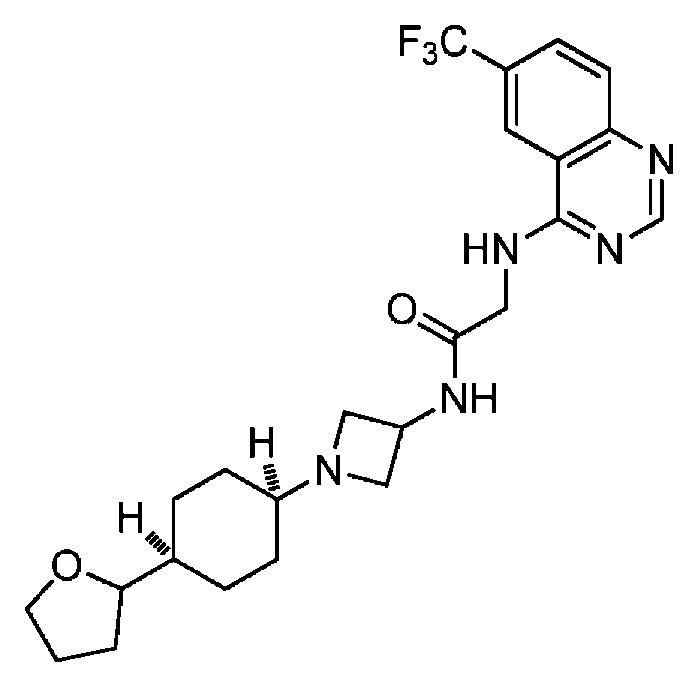
실시예 10에서 제조된 N-(1-((1R,4s)-4-((S)-2,5-다이하이드로푸란-2-일)사이클로헥실)아제티딘-3-일)-2-((6-(트라이플루오로메틸)퀴나졸린-4-일)아미노)아세트아미드 (126 mg, 0.265 mmol), 및 탄소상 팔라듐 (84 mg, 0.04 mmol, 5%, "데구사, 습윤")의 용액에 메탄올 (50 mL)을 주의깊게 첨가하였다. 반응 플라스크를 진공화하고, 풍선을 통해 수소로 다시 충전하고, 실온에서 하룻밤 교반하였다. 여과에 의해 촉매를 제거하고 여과액을 진공에서 농축하여 생성물을 얻었다.(S) -2,5-dihydrofuran-2-yl) cyclohexyl) azetidin-3-yl) -2- (126 mg, 0.265 mmol) and palladium on carbon (84 mg, 0.04 mmol, 5%, "Degussa, wet") were added to a solution of (6- (trifluoromethyl) quinazolin- Was added methanol (50 mL) carefully. The reaction flask was evacuated, charged again with hydrogen through a balloon, and stirred overnight at room temperature. The catalyst was removed by filtration and the filtrate was concentrated in vacuo to give the product.
ESI-MS (m/z): C24H30F3N5O2에 대한 계산치: 477.24; 실측치: 478 (M+H).ESI-MS (m / z): Calcd for C 24 H 30 F 3 N 5 O 2 : 477.24; Found: 478 (M + H).
실시예 16: N-(1-((1R,4s)-4-(2-옥소옥사졸리딘-4-일)사이클로헥실)아제티딘-3-일)-2-((6-(트라이플루오로메틸)퀴나졸린-4-일)아미노)아세트아미드Example 16: Preparation of N- (1 - ((1R, 4S) -4- (2-oxooxazolidin-4-yl) cyclohexyl) azetidin- Dimethyl-quinazolin-4-yl) amino) acetamide
단계 A: tert-부틸 (1-(1,4-다이옥사스피로[4.5]데칸-8-일)알릴)카르바메이트Step A: tert-Butyl (1- (1,4-dioxaspiro [4.5] decan-8-yl) allyl) carbamate

실시예 12, 단계 B에 기재된 바와 같이 제조된 1-(1,4-다이옥사스피로[4.5]데칸-8-일)부트-3-엔-1-아민 (2.12 g, 9.07 mmol, HCl 염)이 담긴 플라스크에 DCM (60 mL)을 첨가한 다음 트라이에틸아민 (3.83 mL, 27.8 mmol) 및 Boc-무수물 (2.76 g, 12.3 mmol)을 첨가하였다. 반응 혼합물을 아르곤 하에서 하룻밤 교반하고, 이어서 포화 NH4Cl 용액으로 세척하였다. 유기층을 진공에서 농축한 후에, 잔류물을 플래시 크로마토그래피 (실리카 겔, 에틸 아세테이트)를 통해 정제하여 생성물을 얻었다.Yl) but-3-en-1 -amine (2.12 g, 9.07 mmol, HCl salt) prepared as described in Example 12, Step B, Was added DCM (60 mL) followed by the addition of triethylamine (3.83 mL, 27.8 mmol) and Boc-anhydride (2.76 g, 12.3 mmol). The reaction mixture was stirred under argon overnight and then washed with saturated NH 4 Cl solution. After concentration of the organic layer in vacuo, the residue was purified via flash chromatography (silica gel, ethyl acetate) to give the product.
단계 B: tert-부틸 (2-하이드록시-1-(1,4-다이옥사스피로[4.5]데칸-8-일)에틸)카르바메이트Step B: Synthesis of tert-butyl (2-hydroxy-1- (1,4-dioxaspiro [4.5] decan-
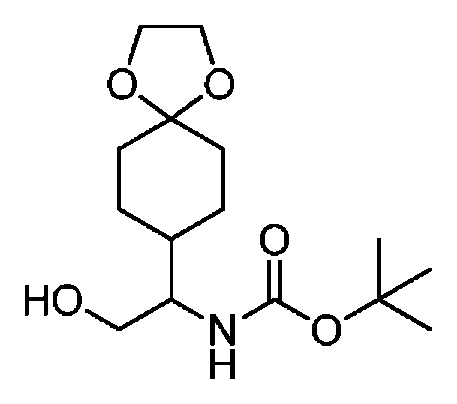
250 mL 둥근 바닥 플라스크를 이전 단계에서 제조된 tert-부틸 (1-(1,4-다이옥사스피로[4.5]데칸-8-일)알릴)카르바메이트 (5.3 g, 17.8 mmol), 및 메탄올 (198 mL)로 충전하였다. 혼합물을 -78℃로 냉각하고 용액을 통해 3 L/min의 속도로 1시간 동안 오존을 버블링하였다. 30분 후에 혼합물의 색상이 담청색(pale blue)으로 변하였다. 1시간 후에, 청색 색상이 사라질 때까지 용액을 통해 30분 동안 공기를 버블링하였다. 소듐 보로하이드라이드 (2.7 g, 71.3 mmol)를 4 부분으로 나누어 혼합물에 첨가하였다. 혼합물을 서서히 실온으로 가온하였다. 실온에서 6시간 후에 혼합물을 포화 암모늄 클로라이드 수용액으로 켄칭하였다. 물로 희석하고 에틸 아세테이트로 추출한 후에, 유기층을 MgSO4로 건조하고, 여과하고, 진공에서 농축하여 투명한 오일로서 생성물을 얻었다.A 250 mL round bottom flask was charged with tert-butyl (1- (1,4-dioxaspiro [4.5] decan-8-yl) allyl) carbamate (5.3 g, 17.8 mmol) 198 mL). The mixture was cooled to -78 ° C and bubbled through the solution at a rate of 3 L / min for 1 hour. After 30 minutes the color of the mixture turned to pale blue. After 1 hour, air was bubbled through the solution for 30 minutes until the blue color disappeared. Sodium borohydride (2.7 g, 71.3 mmol) was added to the mixture in four portions. The mixture was slowly warmed to room temperature. After 6 hours at room temperature the mixture was quenched with a saturated aqueous ammonium chloride solution. After diluted with water and extracted with ethyl acetate, the organic layer was dried with MgSO 4, and filtered, to give the product as a clear oil by concentration in vacuo.
1H NMR (400 MHz, CDCl3) δ 3.89-3.97 (m, 4 H), 3.61-3.78 (m, 2 H), 3.45-3.54 (m, 1 H), 2.06-2.10 (m, 1 H), 1.68-1.84 (m, 4 H), 및 1.32-1.64 (m, 13 H). 1 H NMR (400 MHz, CDCl 3 )? 3.89-3.97 (m, 4H), 3.61-3.78 (m, 2H), 3.45-3.54 , 1.68-1.84 (m, 4H), and 1.32-1.64 (m, 13H).
단계 C: 4-(1,4-다이옥사스피로[4.5]데칸-8-일)옥사졸리딘-2-온Step C: Preparation of 4- (1,4-dioxaspiro [4.5] decan-8-yl) oxazolidin-

250 mL 둥근 바닥 플라스크를 이전 단계에서 제조된 tert-부틸 (2-하이드록시-1-(1,4-다이옥사스피로[4.5]데칸-8-일)에틸)카르바메이트 (1.5 g, 4.98 mmol), 및 테트라하이드로푸란 (100 mL)으로 충전하였다. 혼합물을 0℃로 냉각하고 포타슘 tert-부톡사이드 (670 mg, 5.97 mmol)를 첨가하였다. 혼합물을 0℃에서 2시간 동안 교반하였다. 혼합물을 에틸 아세테이트로 희석하고 포화 암모늄 클로라이드 수용액으로 세척하였다. 유기층을 MgSO4로 건조하고, 여과하고, 진공에서 농축하여 투명한 오일로서 생성물을 얻었다.A 250 mL round bottom flask was charged with tert-butyl (2-hydroxy-1- (1,4-dioxaspiro [4.5] decan-8-yl) ethyl) carbamate (1.5 g, 4.98 mmol ), And tetrahydrofuran (100 mL). The mixture was cooled to 0 C and potassium tert-butoxide (670 mg, 5.97 mmol) was added. The mixture was stirred at 0 < 0 > C for 2 hours. The mixture was diluted with ethyl acetate and washed with a saturated aqueous ammonium chloride solution. The organic layer is dried over MgSO 4, filtered, to give the product as a clear oil by concentration in vacuo.
1H NMR (400 MHz, CDCl3) δ 4.44-4.49 (m, 1 H), 4.07-4.18 (m, 1 H), 3.87-3.98 (m, 4 H), 3.60-3.68 (m, 1 H), 2.01-2.08 (m, 1 H), 및 1.15-1.85 (m, 8 H). 1 H NMR (400 MHz, CDCl 3) δ 4.44-4.49 (m, 1 H), 4.07-4.18 (m, 1 H), 3.87-3.98 (m, 4 H), 3.60-3.68 (m, 1 H) , 2.01-2.08 (m, 1H), and 1.15-1.85 (m, 8H).
단계 D: 4-(4-Step D: Preparation of 4- (4- 옥소사이클로헥실Oxocyclohexyl )) 옥사졸리딘Oxazolidine -2-온-2-one

이전 단계에서 제조된 4-(1,4-다이옥사스피로[4.5]데칸-8-일)옥사졸리딘-2-온 (880 mg, 3.87 mmol) 및 아세토니트릴 (65 mL)의 용액을 실시예 1, 단계 C에 기재된 바와 같이 탈보호하여 생성물을 얻었다.A solution of 4- (1,4-dioxaspiro [4.5] decan-8-yl) oxazolidin-2-one (880 mg, 3.87 mmol) and acetonitrile (65 mL) 1, < / RTI > Step C to give the product.
1H NMR (400 MHz, CDCl3) δ 4.47-4.56 (m, 1 H), 4.17-4.23 (m, 1 H), 3.74-3.78 (m, 1 H), 2.07-2.14 (m, 1 H), 1.84-2.04 (m, 4 H), 및 1.40-1.57 (m, 4 H). 1 H NMR (400 MHz, CDCl 3 )? 4.47-4.56 (m, 1H), 4.17-4.23 (m, 1H), 3.74-3.78 (m, 1H), 2.07-2.14 , 1.84-2.04 (m, 4H), and 1.40-1.57 (m, 4H).
단계 E: N-(1-((1R,4s)-4-(2-Step E: Preparation of N- (1 - ((1R, 4S) -4- (2- 옥소옥사졸리딘Oxooxazolidine -4-일)Yl) 사이클로헥실Cyclohexyl )) 아제티딘Azetidine -3-일)-2-((6-(트3-yl) -2 - ((6- 라이플루오로Rifluro 메틸)methyl) 퀴나졸린Quinazoline -4-일)아미노)Yl) amino) 아세트아미드Acetamide ..

이전 단계에서 제조된 4-(4-옥소사이클로헥실)옥사졸리딘-2-온 (400 mg, 0.60 mmol), 및 N-(아제티딘-3-일)-2-((6-(트라이플루오로메틸)퀴나졸린-4-일)아미노)아세트아미드 (100 mg, 0.56 mmol, 실시예 1, 단계 G에서 제조됨)의 용액을 환원성 아민화 절차에 따라 처리하여 생성물을 얻었다.Oxazolidin-2-one (400 mg, 0.60 mmol) and N- (azetidin-3-yl) -2 - ((6- (trifluoromethyl) Amino) acetamide (100 mg, 0.56 mmol, prepared in Example 1, Step G) was treated according to a reductive amination procedure to give the product.
1H NMR (400 MHz, CD3OD) δ 8.83-8.94 (m, 2 H), 8.32 (d, J = 7.6 Hz, 1 H), 8.02 (d, J = 7.6 Hz, 1 H), 4.68-4.83 (m, 1 H), 4.36-4.59 (m, 5 H), 4.10-4.30 (m, 3 H), 3.75-3.90 (m, 1 H), 3.43-3.52 (m, 1 H), 3.28-3.33 (m, 1 H), 1.70-1.85 (m, 3 H), 1.51-1.68 (m, 3 H), 및 1.19-1.49 (m, 2 H); ESI-MS (m/z): C23H27F3N6O3에 대한 계산치: 492.21; 실측치: 493 (MH+) 1 H NMR (400 MHz, CD 3 OD)? 8.83-8.94 (m, 2H), 8.32 (d, J = 7.6 Hz, 1H), 8.02 (M, 1H), 3.83-3.52 (m, 1H), 3.28- (m, 1H) 3.33 (m, 1H), 1.70-1.85 (m, 3H), 1.51-1.68 (m, 3H), and 1.19-1.49 (m, 2H); ESI-MS (m / z) : C 23 H 27 F 3 N calculated for 6 O 3: 492.21; Found: 493 (MH < + >).
실시예 17: N-(1-((1R,4s)-4-(2-옥소-1,3-옥사지난-4-일)사이클로헥실)아제티딘-3-일)-2-((6-(트라이플루오로메틸)퀴나졸린-4-일)아미노)아세트아미드Example 17: Preparation of N- (1 - ((1 R, 4s) -4- (2-oxo-1, 3-oxazin-4-yl) cyclohexyl) azetidin- - (trifluoromethyl) quinazolin-4-yl) amino) acetamide
단계 A: tert-부틸 (1-(1,4-다이옥사스피로[4.5]데칸-8-일)알릴)카르바메이트Step A: tert-Butyl (1- (1,4-dioxaspiro [4.5] decan-8-yl) allyl) carbamate

실시예 11, 단계 C에 기재된 바와 같이 제조된 1-(1,4-다이옥사스피로[4.5]데칸-8-일)부트-3-엔-1-아민 (4.7 g, 19.0 mmol, HCl 염)이 담긴 플라스크에 DCM (126 mL)을 첨가한 다음 트라이에틸아민 (7.91 mL, 56.9 mmol) 및 Boc-무수물 (4.70 g, 20.9 mmol)을 첨가하였다. 반응 혼합물을 아르곤 하에서 하룻밤 교반하고, 이어서 포화 NH4Cl 용액으로 세척하였다. 유기층을 진공에서 농축한 후에, 잔류물을 플래시 크로마토그래피 (실리카 겔, 5% MeOH/DCM)를 통해 정제하여 생성물을 얻었다.Yl) but-3-en-1 -amine (4.7 g, 19.0 mmol, HCl salt) prepared as described in Example 11, Step C, Was added DCM (126 mL) followed by the addition of triethylamine (7.91 mL, 56.9 mmol) and Boc-anhydride (4.70 g, 20.9 mmol). The reaction mixture was stirred under argon overnight and then washed with saturated NH 4 Cl solution. After concentration of the organic layer in vacuo, the residue was purified via flash chromatography (silica gel, 5% MeOH / DCM) to give the product.
단계 B: tert-부틸 (3-하이드록시-1-(1,4-다이옥사스피로[4.5]데칸-8-일)프로필)카르바메이트Step B: Synthesis of tert-butyl (3-hydroxy-1- (1,4-dioxaspiro [4.5] decan-8-

250 mL 둥근 바닥 플라스크를 tert-부틸 (1-(1,4-다이옥사스피로[4.5]데칸-8-일)알릴)카르바메이트 (5.8 g, 18.6 mmol) 및 메탄올 (207 mL)로 충전하였다. 혼합물을 -78℃로 냉각하고 용액을 통해 3 L/min의 속도로 1시간 동안 오존을 버블링하였다. 30분 후에 혼합물의 색상이 담청색으로 변하였다. 1시간 후에, 청색 색상이 사라질 때까지 용액을 통해 30분 동안 공기를 버블링하였다. 소듐 보로하이드라이드 (2.82 g, 74.5 mmol)를 4 부분으로 나누어 혼합물에 첨가하였다. 혼합물을 서서히 실온으로 가온하였다. 실온에서 6시간 후에 혼합물을 포화 암모늄 클로라이드 수용액으로 켄칭하였다. 물로 희석하고 에틸 아세테이트로 추출하였다. 유기층을 MgSO4로 건조하고, 여과하고, 진공에서 농축하여 투명한 오일로서 tert-부틸 (3-하이드록시-1-(1,4-다이옥사스피로[4.5]데칸-8-일)프로필)카르바메이트 (5.1 g, 16.2 mmol)를 얻었다.A 250 mL round bottom flask was charged with tert-butyl (1- (1,4-dioxaspiro [4.5] decan-8-yl) allyl) carbamate (5.8 g, 18.6 mmol) and methanol (207 mL) . The mixture was cooled to -78 ° C and bubbled through the solution at a rate of 3 L / min for 1 hour. After 30 minutes the color of the mixture turned blue. After 1 hour, air was bubbled through the solution for 30 minutes until the blue color disappeared. Sodium borohydride (2.82 g, 74.5 mmol) was added to the mixture in four portions. The mixture was slowly warmed to room temperature. After 6 hours at room temperature the mixture was quenched with a saturated aqueous ammonium chloride solution. Diluted with water and extracted with ethyl acetate. The organic layer was dried over MgSO4, filtered and concentrated in vacuo to give tert-butyl (3-hydroxy-1- (1,4-dioxaspiro [4.5] decan-8-yl) (5.1 g, 16.2 mmol).
1H NMR (400 MHz, CDCl3) δ 3.89-4.10 (m, 4 H), 3.53-3.78 (m, 3 H), 1.94-2.07 (m, 1 H), 1.62-1.91 (m, 6 H), 및 1.26-1.61 (m, 13 H). 1 H NMR (400 MHz, CDCl 3 )? 3.89-4.10 (m, 4 H), 3.53-3.78 (m, 3 H), 1.94-2.07 , And 1.26-1.61 (m, 13 H).
단계 C: 4-(1,4-Step C: Preparation of 4- (1,4- 다이옥사스피로[4.5]데칸Dioxaspiro [4.5] decane -8-일)-1,3--8-yl) -1,3- 옥사지난Oksana -2-온-2-one
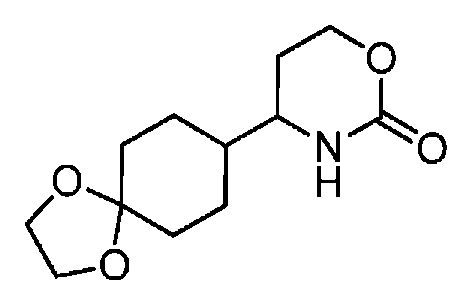
250 mL 둥근 바닥 플라스크를 tert-부틸 (3-하이드록시-1-(1,4-다이옥사스피로[4.5]데칸-8-일)프로필)카르바메이트 (2.11 g, 6.69 mmol) 및 테트라하이드로푸란 (134 mL)으로 충전하였다. 혼합물을 0℃로 냉각하고 포타슘 tert-부톡사이드 (900 mg, 8.03 mmol)를 첨가하였다. 혼합물을 0℃에서 2시간 동안 교반하였다. 혼합물을 에틸 아세테이트로 희석하고 포화 암모늄 클로라이드 수용액으로 세척하였다. 유기층을 MgSO4로 건조하고, 여과하고, 진공에서 농축하여 투명한 오일로서 4-(1,4-다이옥사스피로[4.5]데칸-8-일)-1,3-옥사지난-2-온 (1.39 g, 5.76 mmol)을 얻었다.A 250 mL round bottomed flask was charged with tert-butyl (3-hydroxy-1- (1,4-dioxaspiro [4.5] decan-8- yl) propyl) carbamate (2.11 g, 6.69 mmol) and tetrahydrofuran (134 mL). The mixture was cooled to 0 < 0 > C and potassium tert-butoxide (900 mg, 8.03 mmol) was added. The mixture was stirred at 0 < 0 > C for 2 hours. The mixture was diluted with ethyl acetate and washed with a saturated aqueous ammonium chloride solution. The organic layer was dried over MgSO4, filtered and concentrated in vacuo to give 4- (1,4-dioxaspiro [4.5] decan-8-yl) -1,3- , 5.76 mmol).
1H NMR (400 MHz, CDCl3) δ 4.28-4.39 (m, 1 H), 4.16-4.24 (m, 1 H), 3.89-4.01 (m, 4 H), 3.26-3.38 (m, 1 H), 1.90-2.12 (m, 2 H), 1.62-1.88 (m, 4 H), 및 1.31-1.58 (m, 5 H). 1 H NMR (400 MHz, CDCl 3 )? 4.28-4.39 (m, 1H), 4.16-4.24 (m, 1H), 3.89-4.01 (m, 4H), 3.26-3.38 , 1.90-2.12 (m, 2H), 1.62-1.88 (m, 4H), and 1.31-1.58 (m, 5H).
단계 D: 4-(4-옥소사이클로헥실)-1,3-옥사지난-2-온Step D: Preparation of 4- (4-oxocyclohexyl) -1,3-oxazin-2-
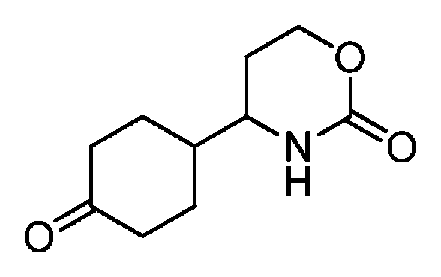
250 mL 둥근 바닥 플라스크를 4-(1,4-다이옥사스피로[4.5]데칸-8-일)-1,3-옥사지난-2-온 (1.39 g, 5.76 mmol) 및 아세토니트릴 (96 mL)로 충전하였다. 물 (19 mL) 중 진한 HCl (6.4 mL)의 용액을 혼합물에 첨가하였다. 혼합물을 실온에서 20시간 동안 교반하였다. pH가 7 초과가 될 때까지 포화 암모늄 바이카르보네이트 수용액을 첨가하였다. 혼합물을 에틸 아세테이트로 추출하였다. 유기층을 MgSO4로 건조하고, 여과하고, 진공에서 농축하여 투명한 오일로서 목표 물질을 얻었다.A 250 mL round bottom flask was charged with 4- (1,4-dioxaspiro [4.5] decan-8-yl) -1,3-oxazin-2-one (1.39 g, 5.76 mmol) and acetonitrile Lt; / RTI > A solution of concentrated HCl (6.4 mL) in water (19 mL) was added to the mixture. The mixture was stirred at room temperature for 20 hours. An aqueous solution of saturated ammonium bicarbonate was added until the pH was above 7. The mixture was extracted with ethyl acetate. The organic layer is dried over MgSO 4, filtered, to obtain a target substance as a clear oil by concentration in vacuo.
1H NMR (400 MHz, CDCl3) δ 4.31-4.42 (m, 1 H), 4.18-4.28 (m, 1 H), 3.39-3.48 (m, 1 H), 2.39-2.48 (m, 1 H), 1.74-2.21 (m, 6 H), 및 1.40-1.72 (m, 4 H). 1 H NMR (400 MHz, CDCl 3 )? 4.31-4.42 (m, 1H), 4.18-4.28 (m, 1H), 3.39-3.48 (m, 1H), 2.39-2.48 , 1.74-2.21 (m, 6H), and 1.40-1.72 (m, 4H).
단계 E: N-(1-((1R,4s)-4-(2-옥소-1,3-옥사지난-4-일)사이클로헥실)아제티딘-3-일)-2-((6-(트라이플루오로메틸)퀴나졸린-4-일)아미노)아세트아미드Step E: Synthesis of N- (1 - ((1 R, 4S) -4- (2-oxo-1,3-oxazin-4-yl) cyclohexyl) azetidin- (Trifluoromethyl) quinazolin-4-yl) amino) acetamide
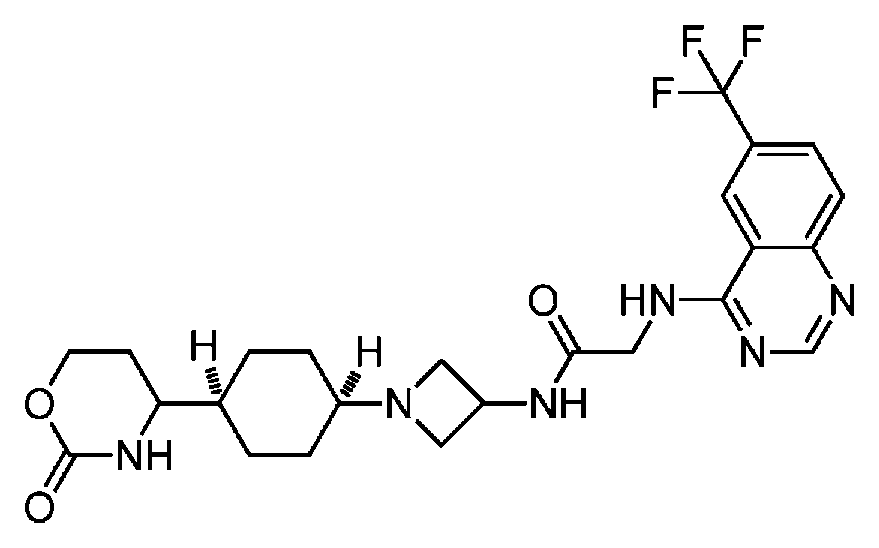
이전 단계에서 제조된 4-(4-옥소사이클로헥실)-1,3-옥사지난-2-온 (372 mg, 0.56 mmol), 및 N-(아제티딘-3-일)-2-((6-(트라이플루오로메틸)퀴나졸린-4-일)아미노)아세트아미드 (100 mg, 0.56 mmol, 실시예 1, 단계 G에서 제조됨)의 용액을 환원성 아민화 절차에 따라 처리하여 생성물을 얻었다.(372 mg, 0.56 mmol) and N- (azetidin-3-yl) -2 - ((6 (Trifluoromethyl) quinazolin-4-yl) amino) acetamide (100 mg, 0.56 mmol, prepared in Example 1, step G) was treated according to the reductive amination procedure to give the product.
1H NMR (400 MHz, CD3OD) δ 8.84-8.93 (m, 2 H), 8.32 (d, J = 7.6 Hz, 1 H), 8.03 (d, J = 7.6 Hz, 1 H), 4.70-4.88 (m, 1 H), 4.36-4.59 (m, 4 H), 4.16-4.30 (m, 3 H), 3.42-3.58 (m, 2 H), 3.29-3.34 (m, 1 H), 및 1.09-2.01 (m, 11 H); ESI-MS (m/z): C24H29F3N6O3에 대한 계산치: 506.23; 실측치: 507 (MH+). 1 H NMR (400 MHz, CD 3 OD)? 8.84-8.93 (m, 2H), 8.32 (d, J = 7.6 Hz, 1H), 8.03 2H), 3.29-3.34 (m, 1H), and 1.09 (m, 2H), 4.88 (m, 1H), 4.36-4.59 -2.01 (m, 11 H); ESI-MS (m / z): Calcd for C 24 H 29 F 3 N 6 O 3 : 506.23; Found: 507 (MH < + >).
실시예 18: N-(1-((1S,4s)-4-(1-하이드록시-2-(메틸티오)에틸)사이클로헥실)아제티딘-3-일)-2-((6-(트라이플루오로메틸)퀴나졸린-4-일)아미노)아세트아미드Example 18: Preparation of N- (1 - ((1S, 4S) -4- (1-hydroxy-2- (methylthio) ethyl) cyclohexyl) Trifluoromethyl) quinazolin-4-yl) amino) acetamide
단계 A: 8-(옥시란-2-일)-1,4-다이옥사스피로[4.5]데칸Step A: Preparation of 8- (oxiran-2-yl) -1,4-dioxaspiro [4.5] decane

0℃로 냉각된 DCM (20 mL) 중의, 실시예 9, 단계 A에 기재된 바와 같이 제조된 8-비닐-1,4-다이옥사스피로[4.5]데칸 (370 mg, 2.20 mmol)의 용액에 mCPBA (532 mg, 2.37 mmol, 77%)를 첨가하였다. 혼합물을 1시간에 걸쳐 실온으로 가온하면서 교반하고, 이어서 가열 없이 진공에서 농축하였다. 잔류물을 플래시 크로마토그래피 (실리카 겔, 0-50% 에테르/DCM)에 의해 정제하여 생성물을 얻었다.To a solution of 8-vinyl-1,4-dioxaspiro [4.5] decane (370 mg, 2.20 mmol) prepared as described in Example 9, Step A in DCM (20 mL) (532 mg, 2.37 mmol, 77%). The mixture was stirred for 1 hour while warming to room temperature and then concentrated in vacuo without heating. The residue was purified by flash chromatography (silica gel, 0-50% ether / DCM) to give the product.
1H NMR (클로로포름-d) δ: 3.95 (s, 4H), 2.75 (d, J = 3.9 Hz, 2H), 2.54 (t, J = 3.8 Hz, 1H), 1.92 (d, J = 10.3 Hz, 1H), 1.75 - 1.86 (m, 2H), 1.64 - 1.75 (m, 1H), 1.37 - 1.59 (m, 4H), 1.14 - 1.25 (m, 1H) 1 H NMR (chloroform -d) δ: 3.95 (s, 4H), 2.75 (d, J = 3.9 Hz, 2H), 2.54 (t, J = 3.8 Hz, 1H), 1.92 (d, J = 10.3 Hz, 1H), 1.75-1.86 (m, 2H), 1.64-1.75 (m, 1H), 1.37-1.59
단계 B: 2-(Step B: 2- ( 메틸티오Methyl thio )-1-(1,4-) -1- (1,4- 다이옥사스피로[4.5]데칸Dioxaspiro [4.5] decane -8-일)에탄올-8-yl) ethanol

DCM (20 mL) 중의, 이전 단계에서 제조된 8-(옥시란-2-일)-1,4-다이옥사스피로[4.5]데칸 (202 mg, 1.10 mmol)을 NMP (20 mL)에 용해하고, 메탄티올 소듐 염 (297 mg, 4.24 mmol)을 첨가하였다. 하룻밤 아르곤 하에서 80℃로 가열하면서 혼합물을 교반하고, 이어서 주위 온도로 냉각하고 물에 부었다. 에틸 아세테이트로 추출한 후에, 유기 층을 진공에서 농축하고 잔류물을 플래시 크로마토그래피 (실리카 겔, 0-50% 에테르)에 의해 정제하여 생성물을 얻었다.(Oxiran-2-yl) -1,4-dioxaspiro [4.5] decane (202 mg, 1.10 mmol) prepared in the previous step in DCM (20 mL) was dissolved in NMP , Methanethiol sodium salt (297 mg, 4.24 mmol). The mixture was stirred while heating to 80 < 0 > C under argon overnight, then cooled to ambient temperature and poured into water. After extraction with ethyl acetate, the organic layer was concentrated in vacuo and the residue was purified by flash chromatography (silica gel, 0-50% ether) to give the product.
1H NMR (클로로포름-d) δ: 3.95 (s, 4H), 3.38 - 3.53 (m, 1H), 2.76 (dd, J = 13.6, 2.8 Hz, 1H), 2.63 (d, J = 2.7 Hz, 1H), 2.48 (dd, J = 13.4, 9.8 Hz, 1H), 2.10 (s, 3H), 1.88 - 1.98 (m, 1H), 1.66 - 1.85 (m, 3H), 1.30 - 1.62 (m, 5H) 1 H NMR (chloroform -d) δ: 3.95 (s, 4H), 3.38 - 3.53 (m, 1H), 2.76 (dd, J = 13.6, 2.8 Hz, 1H), 2.63 (d, J = 2.7 Hz, 1H 1H), 1.88-1.98 (m, 1H), 1.66-1.85 (m, 3H), 1.30-1.62 (m, 5H)
단계 C: 4-(1-Step C: 4- (1- 하이드록시Hydroxy -2-(-2-( 메틸티오Methyl thio )에틸))ethyl) 사이클로헥사논Cyclohexanone

이전 단계에서 제조된 2-(메틸티오)-1-(1,4-다이옥사스피로[4.5]데칸-8-일)에탄올을 실시예 1, 단계 C에 기재된 바와 같이 탈보호하여 생성물을 얻었다.2- (Methylthio) -1- (1,4-dioxaspiro [4.5] decan-8-yl) ethanol prepared in the previous step was deprotected as described in Example 1, Step C to give the product.
1H NMR (400 MHz, CDCl3) δ 4.47-4.56 (m, 1 H), 4.17-4.23 (m, 1 H), 3.74-3.78 (m, 1 H), 2.07-2.14 (m, 1 H), 1.84-2.04 (m, 4 H), 및 1.40-1.57 (m, 4 H). 1 H NMR (400 MHz, CDCl 3 )? 4.47-4.56 (m, 1H), 4.17-4.23 (m, 1H), 3.74-3.78 (m, 1H), 2.07-2.14 , 1.84-2.04 (m, 4H), and 1.40-1.57 (m, 4H).
단계 D: N-(1-((1S,4s)-4-(1-하이드록시-2-(메틸티오)에틸)사이클로헥실)아제티딘-3-일)-2-((6-(트라이플루오로메틸)퀴나졸린-4-일)아미노)아세트아미드Step D: Preparation of N- (1 - ((1S, 4S) -4- (1-hydroxy-2- (methylthio) ethyl) cyclohexyl) Fluoromethyl) quinazolin-4-yl) amino) acetamide

실시예 1, 단계 H에 기재된 바와 같이 TEA 및 NaBH(OAc)3의 존재 하에서, 상기에 기재된 바와 같이 제조된 4-(1-하이드록시-2-(메틸티오)에틸)사이클로헥사논과 실시예 1, 단계 G에 기재된 바와 같이 제조된 N-(아제티딘-3-일)-2-((6-(트라이플루오로메틸)퀴나졸린-4-일)아미노)아세트아미드의 반응에 의해 생성물을 얻었다.(1-hydroxy-2- (methylthio) ethyl) cyclohexanone, prepared as described above, in the presence of TEA and NaBH (OAc) 3 as described in example 1, step H, (Azetidin-3-yl) -2 - ((6- (trifluoromethyl) quinazolin-4-yl) amino) acetamide prepared as described in step G, .
1H NMR (MeOH) δ: 8.42 - 8.61 (m, 2H), 7.97 (dd, J = 8.8, 1.7 Hz, 1H), 7.81 (d, J = 8.6 Hz, 1H), 4.40 - 4.55 (m, 1H), 4.27 (s, 2H), 3.50 - 3.70 (m, 3H), 2.92 (t, J = 6.7 Hz, 2H), 2.64 - 2.76 (m, 1H), 2.43 - 2.56 (m, 1H), 2.19 - 2.33 (m, 1H), 2.10 (s, 3H), 1.30 - 1.68 (m, 8H); ESI-MS (m/z): C23H30F3N5O2S에 대한 계산치: 497.21; 실측치: 498 (MH+). 1 H NMR (MeOH) δ: 8.42 - 8.61 (m, 2H), 7.97 (dd, J = 8.8, 1.7 Hz, 1H), 7.81 (d, J = 8.6 Hz, 1H), 4.40 - 4.55 (m, 1H ), 4.27 (s, 2H), 3.50-3.70 (m, 3H), 2.92 (t, J = 6.7 Hz, 2H), 2.64-2.76 2.33 (m, 1H), 2.10 (s, 3H), 1.30 - 1.68 (m, 8H); ESI-MS (m / z) : C 23 H 30 F 3 N 5 O Calcd for 2 S: 497.21; Found: 498 (MH < + >).
실시예Example 19: N-(1-((1S,4s)-4-(2- 19: N- (1 - ((1S, 4S) -4- (2- 아지도Azido -1-하이드록시에틸)-1-hydroxyethyl) 사이클로헥실Cyclohexyl )) 아제티딘Azetidine -3-일)-2-((6-(Yl) -2 - ((6- ( 트라이플루오로메틸Trifluoromethyl )) 퀴나졸린Quinazoline -4-일)아미노)Yl) amino) 아세트아미드Acetamide
단계 A: 2-아지도-1-(1,4-다이옥사스피로[4.5]데칸-8-일)에탄올Step A: 2-azido-1- (1,4-dioxaspiro [4.5] decan-8-yl) ethanol

메탄올 (5 mL) 물 (0.5 mL) 중의, 이전 단계에서 제조된 8-(옥시란-2-일)-1,4-다이옥사스피로[4.5]데칸 (205 mg, 1.11 mmol)의 용액에 소듐 아지드 (361 mg, 5.56 mmol) 및 암모늄 클로라이드 (119 mg, 2.22 mmol)를 첨가하였다. 아르곤 하에서 80℃로 가열하면서 혼합물을 교반하고, 이어서 주위 온도로 냉각하고 진공에서 농축하였다. 잔류물을 플래시 크로마토그래피 (실리카 겔, 에테르)에 의해 정제하여 생성물을 얻었다.To a solution of 8- (oxiran-2-yl) -1,4-dioxaspiro [4.5] decane (205 mg, 1.11 mmol) prepared in the previous step in methanol (5 mL) Azide (361 mg, 5.56 mmol) and ammonium chloride (119 mg, 2.22 mmol). The mixture was stirred while heating to 80 < 0 > C under argon, then cooled to ambient temperature and concentrated in vacuo. The residue was purified by flash chromatography (silica gel, ether) to give the product.
1H NMR (클로로포름-d) δ: 3.87 - 4.01 (m, 4H), 3.51 - 3.61 (m, 1H), 3.40 - 3.49 (m, 1H), 3.27 - 3.38 (m, 1H), 2.03 (d, J = 4.6 Hz, 1H), 1.90 (dt, J = 12.5, 3.1 Hz, 1H), 1.73 - 1.84 (m, 2H), 1.62 - 1.71 (m, 1H), 1.30 - 1.60 (m, 5H) 1 H NMR (chloroform -d) δ: 3.87 - 4.01 ( m, 4H), 3.51 - 3.61 (m, 1H), 3.40 - 3.49 (m, 1H), 3.27 - 3.38 (m, 1H), 2.03 (d, 1H), 1.90 (d, J = 12.5, 3.1 Hz, 1H), 1.73-1.84
단계 B: 4-(2-Step B: 4- (2- 아지도Azido -1-하이드록시에틸)-1-hydroxyethyl) 사이클로헥사논Cyclohexanone

이전 단계에서 제조된 2-아지도-1-(1,4-다이옥사스피로[4.5]데칸-8-일)에탄올을 실시예 1, 단계 C에 기재된 바와 같이 탈보호하여 생성물을 얻었다.The product was obtained by deprotecting 2-azido-1- (1,4-dioxaspiro [4.5] decan-8-yl) ethanol prepared in the previous step as described in Example 1, Step C.
1H NMR (클로로포름-d) δ: 3.65 (br. s., 1H), 3.47 - 3.55 (m, 1H), 3.36 - 3.44 (m, 1H), 2.19 - 2.50 (m, 6H), 1.86 - 2.06 (m, 2H), 1.51 - 1.65 (m, 2H) 1 H NMR (chloroform-d)?: 3.65 (br s, 1H), 3.47-3.55 (m, 1H), 3.36-3.44 (m, 2 H), 1.51 - 1.65 (m, 2 H)
단계 C: N-(1-((1S,4s)-4-(2-Step C: Preparation of N- (1 - ((1S, 4S) -4- (2- 아지도Azido -1-하이드록시에틸)-1-hydroxyethyl) 사이클로헥실Cyclohexyl )) 아제티딘Azetidine -3-일)-2-((6-(Yl) -2 - ((6- ( 트라이플루오로메틸Trifluoromethyl )) 퀴나졸린Quinazoline -4-일)아미노)Yl) amino) 아세트아미드Acetamide

실시예 1, 단계 H에 기재된 바와 같이 TEA 및 NaBH(OAc)3의 존재 하에서, 상기에 기재된 바와 같이 제조된 4-(2-아지도-1-하이드록시에틸)사이클로헥사논과 실시예 1, 단계 G에 기재된 바와 같이 제조된 N-(아제티딘-3-일)-2-((6-(트라이플루오로메틸)퀴나졸린-4-일)아미노)아세트아미드의 반응에 의해 생성물을 얻었다.(2-azido-1-hydroxyethyl) cyclohexanone, prepared as described above, in the presence of TEA and NaBH (OAc) 3 as described in example 1, step H, (6- (trifluoromethyl) quinazolin-4-yl) amino) acetamide, which was prepared as described in Example G, above.
1H NMR (MeOD) δ: 8.60 (s, 1H), 8.55 (s, 1H), 7.97 - 8.07 (m, 1H), 7.82 - 7.90 (m, 1H), 4.38 - 4.55 (m, 1H), 4.27 (s, 2H), 3.62 (br. s., 3H), 3.14 - 3.27 (m, 1H), 2.91 (d, J = 1.5 Hz, 2H), 2.17 - 2.33 (m, 1H), 1.32 - 1.64 (m, 9H); ESI-MS (m/z): C22H27F3N8O2에 대한 계산치: 492.22; 실측치: 493 (MH+).실시예 20: N-(1-((1S,4s)-4-(1-하이드록시-2-메톡시에틸)사이클로헥실)아제티딘-3-일)-2-((6-(트라이플루오로메틸)퀴나졸린-4-일)아미노)아세트아미드 1 H NMR (MeOD) ?: 8.60 (s, IH), 8.55 (s, IH), 7.97-8.07 (m, IH), 7.82-7.90 (s, 2H), 3.62 (br s, 3H), 3.14-3.27 (m, 1H), 2.91 (d, J = 1.5Hz, 2H), 2.17-2.33 m, 9H); ESI-MS (m / z) : C 22 H 27 F 3 N 8 O 2 Calcd: 492.22; Example 20: Preparation of N- (1 - ((1S, 4S) -4- (1-hydroxy-2- methoxyethyl) cyclohexyl) azetidin- ((6- (trifluoromethyl) quinazolin-4-yl) amino) acetamide
단계 A: 2-메톡시-1-(1,4-다이옥사스피로[4.5]데칸-8-일)에탄올Step A: 2-Methoxy-1- (1,4-dioxaspiro [4.5] decan-8-yl) ethanol

DCM (20 mL) 중의, 이전 단계에서 제조된 8-(옥시란-2-일)-1,4-다이옥사스피로[4.5]데칸 (202 mg, 1.10 mmol)을 소듐 메톡사이드 용액 (10 mL, 5 mmol, 0.5 M)에 용해하였다. 하룻밤 아르곤 하에서 환류 가열하면서 혼합물을 교반하고, 이어서 주위 온도로 냉각하고 진공에서 농축하였다. 포화 암모늄 클로라이드 용액을 첨가하고 에틸 아세테이트로 추출한 후에, 유기층을 진공에서 농축하고 잔류물을 플래시 크로마토그래피 (실리카 겔, 0-50% 에테르)에 의해 정제하여 생성물을 얻었다.(Oxiran-2-yl) -1,4-dioxaspiro [4.5] decane (202 mg, 1.10 mmol) prepared in the previous step in DCM (20 mL) was added to a solution of sodium methoxide 5 mmol, 0.5 M). The mixture was stirred while heating at reflux under argon overnight, then cooled to ambient temperature and concentrated in vacuo. After addition of a saturated ammonium chloride solution and extraction with ethyl acetate, the organic layer was concentrated in vacuo and the residue was purified by flash chromatography (silica gel, 0-50% ether) to give the product.
1H NMR (클로로포름-d) δ: 3.95 (s, 4H), 3.38 - 3.53 (m, 1H), 2.76 (dd, J = 13.6, 2.8 Hz, 1H), 2.63 (d, J = 2.7 Hz, 1H), 2.48 (dd, J = 13.4, 9.8 Hz, 1H), 2.10 (s, 3H), 1.88 - 1.98 (m, 1H), 1.66 - 1.85 (m, 3H), 1.30 - 1.62 (m, 5H) 1 H NMR (chloroform -d) δ: 3.95 (s, 4H), 3.38 - 3.53 (m, 1H), 2.76 (dd, J = 13.6, 2.8 Hz, 1H), 2.63 (d, J = 2.7 Hz, 1H 1H), 1.88-1.98 (m, 1H), 1.66-1.85 (m, 3H), 1.30-1.62 (m, 5H)
단계 B: 4-(1-Step B: 4- (l- 하이드록시Hydroxy -2--2- 메톡시에틸Methoxyethyl )) 사이클로헥사논Cyclohexanone

이전 단계에서 제조된 2-메톡시-1-(1,4-다이옥사스피로[4.5]데칸-8-일)에탄올을 실시예 1, 단계 C에 기재된 바와 같이 탈보호하여 생성물을 얻었다.The product was obtained by deprotecting the 2-methoxy-1- (1,4-dioxaspiro [4.5] decan-8-yl) ethanol prepared in the previous step as described in Example 1, Step C.
1H NMR (클로로포름-d) δ: 3.61 - 3.68 (m, 1H), 3.48 - 3.54 (m, 1H), 3.34 - 3.44 (m, 4H), 2.20 - 2.50 (m, 6H), 1.83 - 2.04 (m, 2H), 1.50 - 1.64 (m, 2H). 1 H NMR (chloroform-d)?: 3.61-3.68 (m, 1H), 3.48-3.54 (m, 1H), 3.34-3.44 (m, 4H), 2.20-2.50 (m, 6H), 1.83-2.04 m, 2H), 1.50-1.64 (m, 2H).
단계 C: N-(1-((1S,4s)-4-(1-Step C: Preparation of N- (1 - ((1S, 4S) -4- (1- 하이드록시Hydroxy -2--2- 메톡시에틸Methoxyethyl )) 사이클로헥실Cyclohexyl )) 아제티딘Azetidine -3-일)-2-((6-(Yl) -2 - ((6- ( 트라이플루오로메틸Trifluoromethyl )) 퀴나졸린Quinazoline -4-일)아미노)Yl) amino) 아세트아미드Acetamide

실시예 1, 단계 H에 기재된 바와 같이 TEA 및 NaBH(OAc)3의 존재 하에서, 상기에 기재된 바와 같이 제조된 4-(1-하이드록시-2-메톡시에틸)사이클로헥사논과 실시예 1, 단계 G에 기재된 바와 같이 제조된 N-(아제티딘-3-일)-2-((6-(트라이플루오로메틸)퀴나졸린-4-일)아미노)아세트아미드의 반응에 의해 생성물을 얻었다.(1-hydroxy-2-methoxyethyl) cyclohexanone prepared as described above, in the presence of TEA and NaBH (OAc) 3 as described in example 1, step H, (6- (trifluoromethyl) quinazolin-4-yl) amino) acetamide, which was prepared as described in Example G, above.
1H NMR (MeOD) δ: 8.59 - 8.64 (m, 1H), 8.56 (s, 1H), 7.97 - 8.07 (m, 1H), 7.79 - 7.93 (m, 1H), 4.36 - 4.59 (m, 1H), 4.27 (s, 2H), 3.50 - 3.70 (m, 3H), 3.41 - 3.50 (m, 1H), 3.32 - 3.37 (m, 4H), 2.84 - 2.97 (m, 2H), 2.11 - 2.33 (m, 1H), 1.51 (m, 9H); ESI-MS (m/z): C23H30F3N5O3에 대한 계산치: 481.23; 실측치: 482 (MH+). 1 H NMR (MeOD)?: 8.59-8.64 (m, 1H), 8.56 (s, 1H), 7.97-8.07 (m, 2H), 2.11-2.33 (m, 2H), 3.50-3.73 (m, 3H), 3.41-3.50 1H), 1.51 (m, 9H); ESI-MS (m / z) : C 23 H 30 F 3 N calculated for 5 O 3: 481.23; Found: 482 (MH < + >).
실시예Example 21: N-(1-((1S,4s)-4-(1- 21: N- (1 - ((1S, 4S) -4- (1- 하이드록시Hydroxy -2-(-2-( 메틸설피닐Methylsulfinyl )에틸))ethyl) 사이클로헥실Cyclohexyl )) 아제Azela 티딘-3-일)-2-((6-(Yl) -2 - ((6- ( 트라이플루오로메틸Trifluoromethyl )) 퀴나졸린Quinazoline -4-일)아미노)Yl) amino) 아세트아미드Acetamide

실시예 18에서 제조된 N-(1-((1S,4s)-4-(1-하이드록시-2-(메틸티오)에틸)사이클로헥실)아제티딘-3-일)-2-((6-(트라이플루오로메틸)퀴나졸린-4-일)아미노)아세트아미드 (104 mg, 0.209 mmol)의 용액을 DCM (20 mL)에 용해하고, -10℃로 냉각하고 mCPBA (50 mg, 0.223 mmol)로 처리하였다. 하룻밤 실온으로 가온 및 교반한 후에, 반응 혼합물을 가열없이 진공에서 농축하고 잔류물을 분취용 플레이트 크로마토그래피 (prep plate chromatography; 25% 7N NH3-MeOH/EtOAc)에 의해 정제하였다.Azetidin-3-yl) -2 - ((6 (S) -tetrahydrofuranyl) (104 mg, 0.209 mmol) in DCM (20 mL) was cooled to -10 < 0 > C and mCPBA (50 mg, 0.223 mmol ). After heating and stirring at room temperature overnight, concentrated in vacuo and the reaction mixture without heating and the residue was purified by preparative plate chromatography (prep plate chromatography; 25% 7N NH 3 -MeOH / EtOAc) was purified by.
1H NMR (MeOH) δ: 8.59 (s, 1H), 8.54 (s, 1H), 7.98 - 8.04 (m, 1H), 7.80 - 7.89 (m, 1H), 4.40 - 4.56 (m, 1H), 4.28 (s, 2H), 3.80 - 3.94 (m, 1H), 3.68 (s, 2H), 3.00 (s, 4H), 2.76 - 2.88 (m, 1H), 2.68 (d, J = 15.7 Hz, 3H), 2.29 - 2.45 (m, 1H), 1.37 - 1.70 (m, 9H); ESI-MS (m/z): C23H30F3N5O3에 대한 계산치: 481.23; 실측치: 482 (MH+). 1 H NMR (MeOH)?: 8.59 (s, 1 H), 8.54 (s, 1 H), 7.98 - 8.04 (s, 2H), 3.80-3.94 (m, 1H), 3.68 (s, 2H), 3.00 (s, 4H), 2.76-2.88 2.29-2.45 (m, 1H), 1.37-1.70 (m, 9H); ESI-MS (m / z) : C 23 H 30 F 3 N calculated for 5 O 3: 481.23; Found: 482 (MH < + >).
실시예Example 22: N-(1-((1S,4s)-4-(2- 22: N- (1 - ((1S, 4S) -4- (2- 옥소옥사졸리딘Oxooxazolidine -5-일)-5 days) 사이클로헥실Cyclohexyl )) 아제티딘Azetidine -3-일)-2-((6-(Yl) -2 - ((6- ( 트라이플루오로메틸Trifluoromethyl )) 퀴나졸린Quinazoline -4-일)아미노)Yl) amino) 아세트아미드Acetamide
단계 A: N-(1-((1S,4s)-4-(2-아미노-1-하이드록시에틸)사이클로헥실)아제티딘-3-일)-2-((6-(트라이플루오로메틸)퀴나졸린-4-일)아미노)아세트아미드Step A: Preparation of N- (1 - ((1S, 4S) -4- (2-amino-1 -hydroxyethyl) cyclohexyl) azetidin- ) Quinazolin-4-yl) amino) acetamide

실시예 19에서 제조된 N-(1-((1S,4s)-4-(2-아지도-1-하이드록시에틸)사이클로헥실)아제티딘-3-일)-2-((6-(트라이플루오로메틸)퀴나졸린-4-일)아미노)아세트아미드 (152 mg, 0.309 mmol), 및 탄소상 팔라듐 (370 mg, 0.174 mmol, 5%, "데구사, 습윤")의 용액에 메탄올 (20 mL)을 주의깊게 첨가하였다. 반응 플라스크를 진공화하고, 풍선을 통해 수소로 다시 충전하고, 실온에서 하룻밤 교반하였다. 여과에 의해 촉매를 제거하고 여과액을 진공에서 농축하여 생성물을 얻었다.Azetidin- 1 -hydroxyethyl) cyclohexyl) azetidin-3-yl) -2 - ((6- ( To a solution of palladium on carbon (370 mg, 0.174 mmol, 5%, "Degussa, wet") in methanol (150 mg, 0.309 mmol) 20 mL) was carefully added. The reaction flask was evacuated, charged again with hydrogen through a balloon, and stirred overnight at room temperature. The catalyst was removed by filtration and the filtrate was concentrated in vacuo to give the product.
1H NMR (MeOH) δ: 8.58 (s, 1H), 8.54 (s, 1H), 8.00 (dd, J = 8.8, 1.7 Hz, 1H), 7.84 (d, J = 8.8 Hz, 1H), 4.47 (t, J = 7.1 Hz, 1H), 4.27 (s, 2H), 3.57 - 3.69 (m, 2H), 3.39 (br. s., 1H), 3.31 (dt, J = 3.3, 1.5 Hz, 2H), 2.87 - 2.95 (m, 3H), 2.80 (dd, J = 13.2, 2.9 Hz, 1H), 2.51 (dd, J = 13.1, 8.7 Hz, 1H), 2.26 (br. s., 1H), 1.24 - 1.69 (m, 10H); ESI-MS (m/z): C22H29F3N6O2에 대한 계산치: 466.23; 실측치: 467 (M+H). 1 H NMR (MeOH) δ: 8.58 (s, 1H), 8.54 (s, 1H), 8.00 (dd, J = 8.8, 1.7 Hz, 1H), 7.84 (d, J = 8.8 Hz, 1H), 4.47 ( J = 7.1 Hz, 1H), 4.27 (s, 2H), 3.57-3.69 (m, 2H), 3.39 (br s, (Dd, J = 13.2, 2.9 Hz, 1H), 2.51 (dd, J = 13.1, 8.7 Hz, 1H), 2.26 (br s, 1H), 1.24-1.69 (m, 10H); ESI-MS (m / z) : C 22 H 29 F 3 N calculated for 6 O 2: 466.23; Found 467 (M + H).
단계 B: N-(1-((1S,4s)-4-(2-Step B: Preparation of N- (1 - ((1S, 4S) -4- (2- 옥소옥사졸리딘Oxooxazolidine -5-일)-5 days) 사이클로헥실Cyclohexyl )) 아제티딘Azetidine -3-일)-2-((6-(트3-yl) -2 - ((6- 라이플루오로Rifluro 메틸)methyl) 퀴나졸린Quinazoline -4-일)아미노)Yl) amino) 아세트아미드Acetamide

건조 THF (12 mL) 중의, 상기 단계 A에서 제조된 N-(1-((1S,4s)-4-(2-아미노-1-하이드록시에틸)사이클로헥실)아제티딘-3-일)-2-((6-(트라이플루오로메틸)퀴나졸린-4-일)아미노)아세트아미드 (53 mg, 0.114 mmol)의 용액을 카르보닐다이이미다졸 (32 mg, 0.197)로 처리하고 실온에서 하룻밤 교반하였다. 반응물을 진공에서 농축하고 잔류물을 플래시 크로마토그래피 (실리카 겔, 0-10% 7 N NH3-MeOH/에틸 아세테이트)에 의해 정제하여 생성물을 얻었다.(1S, 4S) -4- (2-amino-1-hydroxyethyl) cyclohexyl) azetidin-3-yl) - A solution of 2 - ((6- (trifluoromethyl) quinazolin-4-yl) amino) acetamide (53 mg, 0.114 mmol) was treated with carbonyldiimidazole (32 mg, 0.197) Lt; / RTI > The reaction is concentrated in vacuo and the residue was purified by flash chromatography (silica gel, 0-10% 7 N NH 3 -MeOH / ethyl acetate) to obtain the product.
1H NMR (MeOD) δ: 8.56 (s, 1H), 8.53 (s, 1H), 7.97 (d, J = 8.6 Hz, 1H), 7.81 (d, J = 8.8 Hz, 1H), 4.40 - 4.55 (m, 2H), 4.28 (s, 2H), 3.54 - 3.68 (m, 3H), 3.25 - 3.37 (m, 2H), 2.92 (br. s., 2H), 2.29 (br. s., 1H), 1.27 - 1.72 (m, 9H); ESI-MS (m/z): C23H27F3N6O3에 대한 계산치: 492.21; 실측치: 493 (M+H). 1 H NMR (MeOD) δ: 8.56 (s, 1H), 8.53 (s, 1H), 7.97 (d, J = 8.6 Hz, 1H), 7.81 (d, J = 8.8 Hz, 1H), 4.40 - 4.55 ( 2H), 4.29 (s, 2H), 3.54-3.68 (m, 3H), 3.25-3.37 (m, 2H), 2.92 1.27-1.72 (m, 9H); ESI-MS (m / z) : C 23 H 27 F 3 N calculated for 6 O 3: 492.21; Found: 493 (M + H).
실시예Example 23: N-(1-((1S,4s)-4-(2-( 23: N- (1 - ((1S, 4S) -4- (2- ( 다이메틸아미노Dimethylamino )-1-하이드록시에틸)) -1-hydroxyethyl) 사이클로헥실Cyclohexyl )아제티딘-3-일)-2-((6-() Azetidin-3-yl) -2 - ((6- ( 트라이플루오로메틸Trifluoromethyl )) 퀴나졸린Quinazoline -4-일)아미노)Yl) amino) 아세트아미드Acetamide

MeOH (10 mL) 중의, 실시예 22, 단계 A에서 제조된 N-(1-((1S,4s)-4-(2-아미노-1-하이드록시에틸)사이클로헥실)아제티딘-3-일)-2-((6-(트라이플루오로메틸)퀴나졸린-4-일)아미노)아세트아미드 (16 mg, 0.0343 mmol)의 용액을 포름알데하이드 (20 mg, 0.246, 물 중 37% w/w) 및 소듐 시아노보로하이드라이드 (32 mg, 0.509 mmol)로 처리하고 실온에서 하룻밤 교반하였다. 반응물을 진공에서 농축하고 잔류물을 플래시 크로마토그래피 (실리카 겔, 0-10% 7 N NH3-MeOH/에틸 아세테이트)에 의해 정제하여 생성물을 얻었다.To a solution of N- (1 - ((1S, 4S) -4- (2-amino-1-hydroxyethyl) cyclohexyl) azetidin-3-yl prepared in Example 22, Step A, (20 mg, 0.246, 37% w / w in water) was added dropwise to a solution of (2- (6- (trifluoromethyl) quinazolin- ) And sodium cyanoborohydride (32 mg, 0.509 mmol) and stirred at room temperature overnight. The reaction is concentrated in vacuo and the residue was purified by flash chromatography (silica gel, 0-10% 7 N NH 3 -MeOH / ethyl acetate) to obtain the product.
ESI-MS (m/z): C24H33F3N6O3에 대한 계산치: 494.26; 실측치: 495 (M+H).ESI-MS (m / z): Calcd for C 24 H 33 F 3 N 6 O 3 : 494.26; Found: 495 (M + H).
실시예 24: 2-((2,6-비스(트라이플루오로메틸)퀴놀린-4-일)아미노)-N-(1-((1r,4r)-4-하이드록시-4-(티아졸-2-일)사이클로헥실)아제티딘-3-일)아세트아미드Example 24: Preparation of 2 - ((2,6-bis (trifluoromethyl) quinolin-4-yl) amino) -N- Yl) cyclohexyl) azetidin-3-yl) acetamide
단계 A: 8-티아졸-2-일-1,4-다이옥사-스피로[4.5]데칸-8-올Step A: 8-Thiazol-2-yl-l, 4-dioxa-spiro [4.5] decan-

n-BuLi (헥산 중 2.5 M, 26 mL, 65 mmol)를 -78℃에서 10분 동안 THF (50 mL) 중 티아졸 (5.0 g, 59 mmol)의 용액에 천천히 적하하였다. 반응물을 -78℃에서 추가로 20분 동안 교반하였다. THF (20 mL) 중 1,4-다이옥사-스피로[4.5]데칸-8-온 (9.36 g, 60 mmol)의 용액을 반응물에 천천히 적하하였다. 첨가 후에, 반응물을 -78℃에서 추가로 2시간 동안 교반하였다. 이어서, 반응물을 수용액으로 켄칭하고 실온으로 가온하였다. 용매를 진공에서 제거하고, 잔류물을 에틸 아세테이트와 물에 분배하였다. 유기층을 염수로 세척하고, 무수 Na2SO4로 건조하고, 여과하고, 농축하여 황색 고체를 얻었고, 이어서 헥산 및 에틸 아세테이트 (10% 에틸 아세테이트로부터 100% 에틸 아세테이트까지)를 사용하여 콤비플래시 시스템 상에서 실리카 겔 컬럼에 의해 정제하여, 백색 고체로서 표제 화합물을 얻었다.n-BuLi (2.5 M in hexanes, 26 mL, 65 mmol) was slowly added dropwise to a solution of thiazole (5.0 g, 59 mmol) in THF (50 mL) at -78 <0> C for 10 min. The reaction was stirred at -78 < 0 > C for a further 20 minutes. A solution of 1,4-dioxa-spiro [4.5] decan-8-one (9.36 g, 60 mmol) in THF (20 mL) was slowly added dropwise to the reaction. After the addition, the reaction was stirred at -78 [deg.] C for an additional 2 hours. The reaction was then quenched with aqueous solution and warmed to room temperature. The solvent was removed in vacuo and the residue was partitioned between ethyl acetate and water. The organic layer was washed with brine, dried over anhydrous Na 2 SO 4, filtered and concentrated to obtained a yellow solid which was then on Combi Flash system using hexane and ethyl acetate (up to 100% of ethyl acetate from 10% ethyl acetate) Purification by silica gel column gave the title compound as a white solid.
1H NMR (400 MHz, CDCl3) δ 7.70 (s, 1H), 7.28 (s, 1H), 4.01 (m, 4H), 3.30 (s, 1H), 2.35 (m, 2H), 2.23 (m, 2H), 2.05 (m, 2H), 1.85 (m, 2H). 1 H NMR (400 MHz, CDCl 3) δ 7.70 (s, 1H), 7.28 (s, 1H), 4.01 (m, 4H), 3.30 (s, 1H), 2.35 (m, 2H), 2.23 (m, 2H), 2.05 (m, 2H), 1.85 (m, 2H).
단계 B: 4-하이드록시-4-티아졸-2-일-사이클로헥사논Step B: 4-Hydroxy-4-thiazol-2-yl-cyclohexanone

실시예 1의 단계 C에 기재된 것과 유사한 절차를 사용하여 8-티아졸-2-일-1,4-다이옥사-스피로[4.5]데칸-8-올의 탈보호에 의해 표제 화합물을 백색 고체로서 제조하였다.The deprotection of 8-thiazol-2-yl-l, 4-dioxa-spiro [4.5] decan-8-ol using the procedure analogous to that described in Example 1, step C gave the title compound as a white solid .
1H NMR (400 MHz, CDCl3) δ 7.71 (s, 1H), 7.32 (s, 1H), 2.93 (m, 2H), 2.40 (m, 4H), 2.31 (m, 2H). 1 H NMR (400 MHz, CDCl 3) δ 7.71 (s, 1H), 7.32 (s, 1H), 2.93 (m, 2H), 2.40 (m, 4H), 2.31 (m, 2H).
단계 C: Step C: terttert -부틸 3-(2-((2,6--Butyl 3- (2 - ((2,6- 비스(트라이플루오로메틸)퀴놀린Bis (trifluoromethyl) quinoline -4-일)아미노)Yl) amino) 아세트아미도Acetamido )) 아제티딘Azetidine -1--One- 카르복실레이트Carboxylate

건조 다이옥산 (5 mL) 중 시판용 2,6-비스(트라이플루오로메틸)퀴놀린-4-올 (291 mg, 1.04 mmol)의 용액을 TEA (0.36 mL, 2.58 mmol) 및 PyBrOP (586 mg, 1.26 mmol)로 순차적으로 처리하였다. 아르곤 하에 실온에서 1시간 교반한 후에, 건조 다이옥산 (5 mL) 중의, 실시예 1, 단계 E에 기재된 바와 같이 제조된 tert-부틸 3-(2-아미노아세트아미도)아제티딘-1-카르복실레이트 (352, 1.54 mmol)의 용액을 도입하고 반응 혼합물을 실온에서 하룻밤 교반하였다. 진공에서 농축한 후에, 잔류물을 플래시 크로마토그래피 (실리카 겔, 0-5% MeOH/에틸 아세테이트)에 의해 정제하여 생성물을 얻었다.A solution of commercially available 2,6-bis (trifluoromethyl) quinolin-4-ol (291 mg, 1.04 mmol) in dry dioxane (5 mL) was treated with TEA (0.36 mL, 2.58 mmol) and PyBrOP (586 mg, 1.26 mmol ). Butyl 3 - (2 - aminoacetamido) azetidine - 1 - carboxylate prepared as described in Example 1, Step E, in dry dioxane (5 mL), after stirring at room temperature under argon for 1 hour (352, 1.54 mmol) was introduced and the reaction mixture was stirred at room temperature overnight. After concentration in vacuo, the residue was purified by flash chromatography (silica gel, 0-5% MeOH / ethyl acetate) to give the product.
ESI-MS (m/z): C21H22F6N4O3에 대한 계산치: 492.11; 실측치: 493 (M+H).ESI-MS (m / z) : C 21 H 22 F 6 N calculated for 4 O 3: 492.11; Found: 493 (M + H).
단계 D: N-(아제티딘-3-일)-2-((2,6-비스(트라이플루오로메틸)퀴놀린-4-일)아미노)아세트아미드Step D: Preparation of N- (azetidin-3-yl) -2 - ((2,6-bis (trifluoromethyl) quinolin-

상기 단계 C에서 제조된, 건조 다이옥산 (5 mL) 중 tert-부틸 3-(2-((2,6-비스(트라이플루오로메틸)퀴놀린-4-일)아미노)아세트아미도)아제티딘-1-카르복실레이트 (291 mg, 1.04 mmol)의 용액을 실시예에 기재된 바와 같이 탈보호하여 생성물을 얻었다.To a solution of tert-butyl 3- (2- ((2,6-bis (trifluoromethyl) quinolin-4-yl) amino) acetamido) azetidine- Carboxylate (291 mg, 1.04 mmol) in dichloromethane was deprotected as described in the examples to give the product.
ESI-MS (m/z): C16H14F3N4O에 대한 계산치: 392.11; 실측치: 393 (M+H).ESI-MS (m / z) : C 16 H 14 F 3 Calculated for N 4 O: 392.11; Found: 393 (M + H).
단계 E: 2-((2,6-비스(트라이플루오로메틸)퀴놀린-4-일)아미노)-N-(1-((1r,4r)-4-하이드록시-4-(티아졸-2-일)사이클로헥실)아제티딘-3-일)아세트아미드Step E: Preparation of 2 - ((2,6-bis (trifluoromethyl) quinolin-4-yl) amino) -N- (1 - ((lr, 4r) -4- 2-yl) cyclohexyl) azetidin-3-yl) acetamide
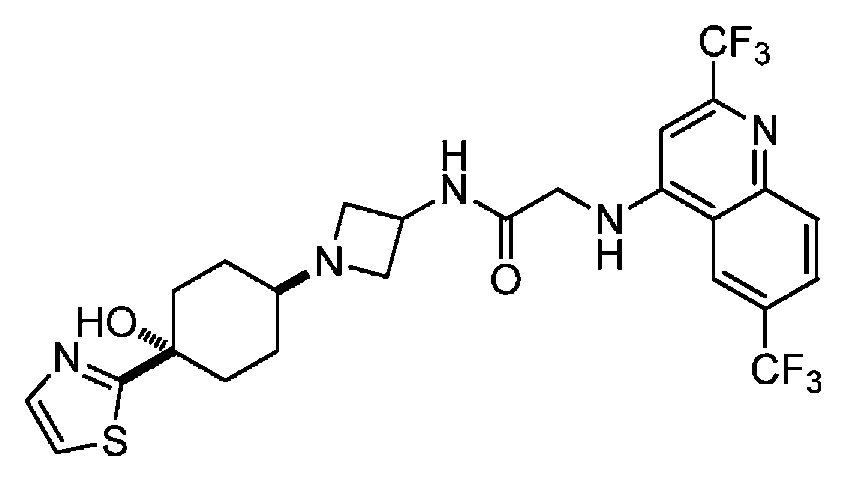
DCM 중 4-하이드록시-4-티아졸-2-일-사이클로헥사논 (단계 C에서 제조됨, 1 eq.) 및 N-(아제티딘-3-일)-2-((2,6-비스(트라이플루오로메틸)퀴놀린-4-일)아미노)아세트아미드 (이전 단계에서 제조됨, 비스 TFA 염, 1 eq.)의 현탁액에 TEA (2 eq.)를 첨가하였다. 실온에서 30분 동안 교반한 후에, NaBH(OAc)3 (3 eq)을 첨가하고 혼합물을 하룻밤 교반하였다. 반응물을 포화 소듐 바이카르보네이트 용액으로 켄칭하고, 부분적으로 농축하였다. 에틸 아세테이트로 추출한 후에 유기층을 진공에서 농축하여 잔류물을 얻었고, 이를 플래시 크로마토그래피 (실리카 겔, 0-20% 7 N NH3-MeOH/에틸 아세테이트)에 의해 정제하여 고체로서 생성물을 얻었다.2-yl-cyclohexanone (prepared in Step C, 1 eq.) And N- (azetidin-3-yl) -2 - ((2,6- TEA (2 eq.) Was added to a suspension of the bis (trifluoromethyl) quinolin-4-yl) amino) acetamide (prepared in the previous step, bis TFA salt, 1 eq.). After stirring at room temperature for 30 minutes, NaBH (OAc) 3 (3 eq) was added and the mixture was stirred overnight. The reaction was quenched with saturated sodium bicarbonate solution and partially concentrated. The organic layer was concentrated then extracted with ethyl acetate in vacuo to give the residue, which was purified by flash chromatography (silica gel, 0-20% 7 N NH 3 -MeOH / ethyl acetate) to give the product as a solid.
ESI-MS (m/z): C25H25F6N5O2S에 대한 계산치: 573.16; 실측치: 574 (M+H).ESI-MS (m / z) : C 25 H 25 F 6 N 5 O Calcd for 2 S: 573.16; Found: 574 (M + H).
실시예Example 25: 2-((2,6- 25: 2 - ((2,6- 비스(트라이플루오로메틸)퀴놀린Bis (trifluoromethyl) quinoline -4-일)아미노)-N-(1-((1R,4s)-4-(1-하Yl) amino) -N- (1 - ((1 R, 4s) -4- 이드록시프Idroxif 로필)Rofil) 사이클로헥실Cyclohexyl )) 아제티딘Azetidine -3-일)-3 days) 아세트아미드Acetamide
단계 A: 1-(1,4-다이옥사스피로[4.5]데칸-8-일)프로판-1-올Step A: 1- (1,4-Dioxaspiro [4.5] decan-8-yl) propan-

1,4-다이옥사스피로[4.5]데칸-8-카르브알데하이드 (문헌[Pearson, et al. in J. Org. Chem. 1997, 62(16), 5284-5292]에 기재된 바와 같이 제조됨)와 실시예 2, 단계 A에 기재된 바와 같은 에틸마그네슘 브로마이드를 반응시켜 표제 화합물을 얻었다.Dioxaspiro [4.5] decane-8-carbaldehyde (prepared as described in Pearson, et al. In J. Org. Chem. 1997, 62 (16), 5284-5292) And ethyl magnesium bromide as described in example 2, step A were reacted to give the title compound.
1H NMR (클로로포름-d) δ: 3.94 (s, 4H), 3.25 - 3.40 (m, 1H), 1.27 - 1.92 (m, 12H), 0.94 - 1.00 (m, 3H) 1 H NMR (chloroform-d)?: 3.94 (s, 4H), 3.25-3.40 (m, 1H), 1.27-1.92 (m, 12H), 0.94-1.00
단계 B: 4-(1-Step B: 4- (l- 하이드록시프로필Hydroxypropyl )) 사이클로헥사논Cyclohexanone

실시예 1, 단계 C의 절차에 의해 1-(1,4-다이옥사스피로[4.5]데칸-8-일)프로판-1-올 (단계 A에 기재된 바와 같이 제조됨)을 탈보호하여 생성물을 얻었다.(Prepared as described in Step A) by the procedure of Example 1, Step C, to give the product as a white solid, mp < RTI ID = 0.0 & .
1H NMR (클로로포름-d) δ: 3.37 - 3.57 (m, 1H), 2.27 - 2.55 (m, 4H), 2.18 (ddd, J = 13.0, 6.2, 3.1 Hz, 1H), 1.96 - 2.08 (m, 1H), 1.81 (m, 1H), 1.40 - 1.73 (m, 6H), 1.00 (t, 3H) 1 H NMR (chloroform -d) δ: 3.37 - 3.57 ( m, 1H), 2.27 - 2.55 (m, 4H), 2.18 (ddd, J = 13.0, 6.2, 3.1 Hz, 1H), 1.96 - 2.08 (m, 1H), 1.81 (m, 1H), 1.40-1.73 (m, 6H), 1.00 (t,
단계 C: 2-((2,6-Step C: Preparation of 2 - ((2,6- 비스(트라이플루오로메틸)퀴놀린Bis (trifluoromethyl) quinoline -4-일)아미노)-N-(1-((1R,4s)-4-(1-하Yl) amino) -N- (1 - ((1 R, 4s) -4- 이드록시프로Idroxypro 필)Phil) 사이클로헥실Cyclohexyl )) 아제티딘Azetidine -3-일)-3 days) 아세트아미드Acetamide

실시예 1, 단계 H에 기재된 바와 같이 TEA 및 NaBH(OAc)3의 존재 하에서, 4-(1-하이드록시프로필)사이클로헥사논 (단계 B에서 제조됨)과 N-(아제티딘-3-일)-2-((2,6-비스(트라이플루오로메틸)퀴놀린-4-일)아미노)아세트아미드 (실시예 24, 단계 D에서 제조됨)의 반응에 의해 생성물을 얻었다. ESI-MS (m/z): C25H30F6N4O2에 대한 계산치: 532.23; 실측치: 533 (M+H).(Prepared in step B) and N- (azetidin-3-yl) thiophene in the presence of TEA and NaBH (OAc) 3 as described in example 1, Yl) amino) acetamide (prepared from Example 24, step D). ≪ 1 > H NMR (400 MHz, CDCl3) [delta] ESI-MS (m / z) : C 25 H 30 F 6 N 4 calcd for O 2: 532.23; Found: 533 (M + H).
실시예 26: N-(1-((1r,4r)-4-하이드록시-4-(티아졸-5-일)사이클로헥실)아제티딘-3-일)-2-((6-(트라이플루오로메틸)퀴놀린-4-일)아미노)아세트아미드Example 26: Preparation of N- (1 - ((lr, 4r) -4-hydroxy-4- (thiazol- 5- yl) cyclohexyl) azetidin- Fluoromethyl) quinolin-4-yl) amino) acetamide
단계 A:8-(2-Step A: 8- (2- 트라이메틸실라닐Trimethylsilanyl -티아졸-5-일)-1,4--Thiazol-5-yl) -1,4- 다이옥사Dioxa -- 스피로[4.5]데칸Spiro [4.5] decane -8-올-8-ol

실시예 24의 단계 A에 기재된 것과 유사한 절차를 사용하여 2-트라이메틸실라닐-티아졸 및 1,4-다이옥사-스피로[4.5]데칸-8-온으로부터 백색 고체로서 표제 화합물을 제조하였다.The title compound was prepared as a white solid from 2-trimethylsilanyl-thiazole and 1,4-dioxa-spiro [4.5] decan-8-one using a procedure similar to that described in step A of Example 24.
ESI-MS (m/z): C14H23NO3SSi에 대한 계산치, 313; 실측치: 314 (M+H).ESI-MS (m / z): calculated for C 14 H 23 NO 3 SSi, 313; Found: 314 (M + H).
단계 B: 8-티아졸-5-일-1,4-다이옥사-스피로[4.5]데칸-8-올Step B: 8-Thiazol-5-yl-l, 4-dioxa-spiro [4.5] decan-
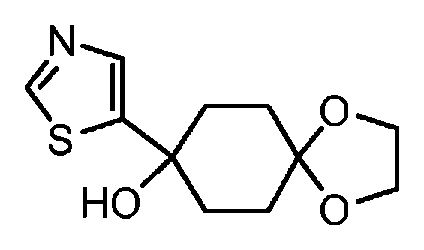
8-(2-트라이메틸실라닐-티아졸-5-일)-1,4-다이옥사-스피로[4.5]데칸-8-올로부터 백색 고체로서 표제 화합물을 제조한 다음 TBAF 워크업하였다.The title compound was prepared as a white solid from 8- (2-trimethylsilanyl-thiazol-5-yl) -1,4-dioxa-spiro [4.5] decan-8-ol followed by TBAF work-up.
1H NMR (400 MHz, CDCl3) δ 8.65 (s, ), 7.72 (s, 1H), 4.01 (m, 4H 1H), 1.69 (m, 2H), 2.20 (m, 2H), 2.08 (m, 4H ). 1 H NMR (400 MHz, CDCl 3) δ 8.65 (s,), 7.72 (s, 1H), 4.01 (m, 4H 1H), 1.69 (m, 2H), 2.20 (m, 2H), 2.08 (m, 4H).
단계 C: 4-하이드록시-4-티아졸-5-일-사이클로헥사논Step C: 4-Hydroxy-4-thiazol-5-yl-cyclohexanone
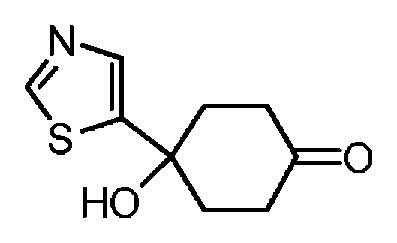
실시예 1의 단계 C에 기재된 것과 유사한 절차를 사용하여 8-티아졸-5-일-1,4-다이옥사-스피로[4.5]데칸-8-올의 탈보호에 의해 표제 화합물을 백색 고체로서 제조하였다.The deprotection of 8-thiazol-5-yl-1,4-dioxa-spiro [4.5] decan-8-ol using the procedure analogous to that described in Example 1, Step C gave the title compound as a white solid .
1H NMR (400 MHz, CDCl3) δ 8.70 (s, 1H), 7.73 (s, 1H), 2.96 (m, 2H), 2.35 (m, 4H), 2.23 (m, 2H). 1 H NMR (400 MHz, CDCl 3) δ 8.70 (s, 1H), 7.73 (s, 1H), 2.96 (m, 2H), 2.35 (m, 4H), 2.23 (m, 2H).
단계 D: 벤질 (6-(트라이플루오로메틸)퀴놀린-4-일)카르바메이트Step D: Benzyl (6- (trifluoromethyl) quinolin-4-yl) carbamate

시판용 6-(트라이플루오로메틸)퀴놀린-4-아민 (558 mg, 2.63 mmol)을 함유하는 포화 소듐 바이카르보네이트 수용액 및 에틸 아세테이트의 급속히 교반된 혼합물을 0℃로 냉각하고 벤질 클로로포르메이트 (1.10 mL, 3.29 mmol)를 적가하여 처리하였다. 실온으로 가온하면서 하룻밤 교반한 후에, 수성층을 제거하고 유기층을 진공에서 농축하였다. 잔류물을 플래시 크로마토그래피 (실리카 겔, 0-20% MeOH/에틸 아세테이트)에 의해 정제하여 생성물을 얻었다.A rapidly stirred mixture of saturated sodium bicarbonate aqueous solution containing commercially available 6- (trifluoromethyl) quinolin-4-amine (558 mg, 2.63 mmol) and ethyl acetate was cooled to 0 C and benzyl chloroformate 1.10 mL, 3.29 mmol) was added dropwise. After stirring overnight with warming to room temperature, the aqueous layer was removed and the organic layer was concentrated in vacuo. The residue was purified by flash chromatography (silica gel, 0-20% MeOH / ethyl acetate) to give the product.
1H NMR (클로로포름-d) δ: 8.95 (d, J = 5.4 Hz, 1H), 8.19 - 8.32 (m, 2H), 8.11 (s, 1H), 7.91 (d, J = 8.8 Hz, 1H), 7.58 (br. s., 1H), 7.37 - 7.54 (m, 5H), 5.33 (s, 2H). 1 H NMR (chloroform -d) δ: 8.95 (d, J = 5.4 Hz, 1H), 8.19 - 8.32 (m, 2H), 8.11 (s, 1H), 7.91 (d, J = 8.8 Hz, 1H), 7.58 (br.s, 1H), 7.37-7.54 (m, 5H), 5.33 (s, 2H).
단계 E: 에틸 2-(((Step E: Ethyl 2 - ((( 벤질옥시Benzyloxy )카르보닐)(6-() Carbonyl) (6- ( 트라이플루오로메틸Trifluoromethyl )퀴놀린-4-일)아미노)아세테이트) Quinolin-4-yl) amino) acetate

건조 DMF (20 mL) 중 벤질 (6-(트라이플루오로메틸)퀴놀린-4-일)카르바메이트 (440 mg, 1.27 mmol, 단계 D에서 제조됨)의 용액을 세슘 카르보네이트 (870 mg, 2.67 mmol)로 처리하고 실온에서 1시간 동안 교반하였다. 에틸브로모아세테이트 (0.15 mL, 1.36 mmol)를 적가하고 반응 혼합물을 실온에서 하룻밤 교반하였다. 이어서, 반응 혼합물을 포화 NH4Cl 용액에 붓고 에틸 아세테이트로 추출하였다. 진공에서 농축한 후에, 잔류물을 플래시 크로마토그래피 (실리카 겔, 0-100% 에틸 아세테이트/DCM)에 의해 정제하여 표제 화합물을 얻었다.A solution of benzyl (6- (trifluoromethyl) quinolin-4-yl) carbamate (440 mg, 1.27 mmol, prepared in Step D) in dry DMF (20 mL) was treated with cesium carbonate (870 mg, 2.67 mmol) and stirred at room temperature for 1 hour. Ethyl bromoacetate (0.15 mL, 1.36 mmol) was added dropwise and the reaction mixture was stirred at room temperature overnight. The reaction mixture was then poured into saturated NH 4 Cl solution and extracted with ethyl acetate. After concentration in vacuo, the residue was purified by flash chromatography (silica gel, 0-100% ethyl acetate / DCM) to give the title compound.
1H NMR (400 MHz, CDCl3) δ 8.70 (s, 1H), 7.73 (s, 1H), 2.96 (m, 2H), 2.35 (m, 4H), 2.23 (m, 2H). 1 H NMR (400 MHz, CDCl 3) δ 8.70 (s, 1H), 7.73 (s, 1H), 2.96 (m, 2H), 2.35 (m, 4H), 2.23 (m, 2H).
단계 F: 2-(((벤질옥시)카르보닐)(6-(트라이플루오로메틸)퀴놀린-4-일)아미노)아세트산Step F: 2 - ((Benzyloxy) carbonyl) (6- (trifluoromethyl) quinolin-4- yl) amino) acetic acid

MeOH (15 mL) 및 THF (5 mL) 중 에틸 2-(((벤질옥시)카르보닐)(6-(트라이플루오로메틸)퀴놀린-4-일)아미노)아세테이트 (404 mg, 0.934 mmol, 단계 E에서 제조됨)의 용액을 물 (5 mL) 중 LiOH (112 mg, 4.67 mol)의 용액으로 처리하였다. 실온에서 xx시간 동안 교반한 후에, HCl 수용액을 첨가하여 pH를 약 5로 조절하였다. 에틸 아세테이트로 추출한 후에, 유기층을 Na2SO4로 건조하고 진공에서 농축하여 생성물을 얻었다.To a solution of ethyl 2 - ((benzyloxy) carbonyl) (6- (trifluoromethyl) quinolin-4- yl) amino) acetate (404 mg, 0.934 mmol, E) was treated with a solution of LiOH (112 mg, 4.67 mol) in water (5 mL). After stirring at room temperature for xx hours, the pH was adjusted to about 5 by the addition of aqueous HCl. After extraction with ethyl acetate, the organic layer was dried over Na 2 SO 4 and concentrated in vacuo to give the product.
1H NMR (400 MHz, CDCl3) δ 8.70 (s, 1H), 7.73 (s, 1H), 2.96 (m, 2H), 2.35 (m, 4H), 2.23 (m, 2H). 1 H NMR (400 MHz, CDCl 3) δ 8.70 (s, 1H), 7.73 (s, 1H), 2.96 (m, 2H), 2.35 (m, 4H), 2.23 (m, 2H).
단계 G: Step G: terttert -부틸 3-(2-(((-Butyl 3- (2 - ((( 벤질옥시Benzyloxy )카르보닐)(6-() Carbonyl) (6- ( 트라이플루오로메틸Trifluoromethyl )퀴놀린-4-일)아미노)) Quinolin-4-yl) amino) 아세트아미도Acetamido )) 아제티딘Azetidine -1--One- 카르복실레이트Carboxylate

DCM (10 mL) 중 2-(((벤질옥시)카르보닐)(6-(트라이플루오로메틸)퀴놀린-4-일)아미노)아세트산 (306 mg, 0.757 mmol, 단계 F에서 제조됨) 및 EDCI (217 mg, 1.13 mmol)의 용액을, 투명한 용액이 생성될 때까지 교반하였다. 이 용액을 DCM (10 mL) 중 tert-부틸 3-아미노아제티딘-1-카르복실레이트 (156 mg, 0.908 mmol) 및 HOBt (116 mg, 0.757 mmol)의 현탁액에 첨가하였다. 반응 혼합물을 주위 온도에서 하룻밤 교반하고, 포화 소듐 바이카르보네이트 수용액에 붓고, 에틸 아세테이트로 추출하였다. 유기층을 농축한 다음 잔류물을 플래시 크로마토그래피 (실리카 겔, 0-20% MeOH/ 에틸 아세테이트)에 의해 정제하여 생성물을 얻었다.Amino) acetic acid (306 mg, 0.757 mmol, prepared in Step F) and EDCI (0.25 mmol) in DCM (10 mL) was added to a solution of 2 - ((benzyloxy) carbonyl) (6- (trifluoromethyl) (217 mg, 1.13 mmol) in tetrahydrofuran was stirred until a clear solution was formed. This solution was added to a suspension of tert-butyl 3-aminoazetidine-1-carboxylate (156 mg, 0.908 mmol) and HOBt (116 mg, 0.757 mmol) in DCM (10 mL). The reaction mixture was stirred overnight at ambient temperature, poured into saturated aqueous sodium bicarbonate solution and extracted with ethyl acetate. The organic layer was concentrated and the residue was purified by flash chromatography (silica gel, 0-20% MeOH / ethyl acetate) to give the product.
단계 H: tert-부틸 3-(2-((6-(트라이플루오로메틸)퀴놀린-4-일)아미노)아세트아미도)아제티딘-1-카르복실레이트Step H: tert-Butyl 3- (2 - ((6- (trifluoromethyl) quinolin-4-yl) amino) acetamido) azetidine-

단계 G에서 제조된 tert-부틸 3-(2-(((벤질옥시)카르보닐)(6-(트라이플루오로메틸)퀴놀린-4-일)아미노)아세트아미도)아제티딘-1-카르복실레이트 (306 mg, 0.309 mmol), 및 탄소상 팔라듐 (98 mg, 0.092 mmol, 5%, "데구사, 습윤")이 담긴 플라스크에 메탄올 (40 mL)을 주의깊게 첨가하였다. 반응 플라스크를 진공화하고, 풍선을 통해 수소로 다시 충전하고, 실온에서 하룻밤 교반하였다. 여과에 의해 촉매를 제거하고 여과액을 진공에서 농축하여 생성물을 얻었다.(Trifluoromethyl) quinolin-4-yl) amino) acetamido) azetidine-1-carboxylate prepared in Step G Methanol (40 mL) was carefully added to the flask containing the palladium on carbon (306 mg, 0.309 mmol) and palladium on carbon (98 mg, 0.092 mmol, 5%, "Degussa, wet"). The reaction flask was evacuated, charged again with hydrogen through a balloon, and stirred overnight at room temperature. The catalyst was removed by filtration and the filtrate was concentrated in vacuo to give the product.
1H NMR (아세토니트릴-d3) δ: 8.51 - 8.61 (m, 1H), 8.39 (s, 1H), 7.95 - 8.06 (m, 1H), 7.78 - 7.90 (m, 1H), 7.43 - 7.56 (m, 1H), 6.64 - 6.76 (m, 1H), 6.40 (d, J = 5.4 Hz, 1H), 4.47 - 4.62 (m, 1H), 4.01 - 4.15 (m, 2H), 3.97 (d, J = 5.6 Hz, 2H), 3.69 (m, 2H). 1 H NMR (acetonitrile -d 3) δ: 8.51 - 8.61 (m, 1H), 8.39 (s, 1H), 7.95 - 8.06 (m, 1H), 7.78 - 7.90 (m, 1H), 7.43 - 7.56 ( J = 5.4 Hz, 1H), 4.47-4.62 (m, 1H), 4.01-4.15 (m, 2H), 3.97 (d, J = 5.6 Hz, 2H), 3.69 (m, 2H).
단계 I: N-(Step I: N- ( 아제티딘Azetidine -3-일)-2-((6-(Yl) -2 - ((6- ( 트라이플루오로메틸Trifluoromethyl )퀴놀린-4-일)아미노)) Quinolin-4-yl) amino) 아세트아미드Acetamide

단계 H에서 제조된 tert-부틸 3-(2-((6-(트라이플루오로메틸)퀴놀린-4-일)아미노)아세트아미도)아제티딘-1-카르복실레이트를, 실시예 1의 단계 G에 기재된 것과 유사한 절차를 사용하여 탈보호하여 표제 화합물을 제조하였다.(Trifluoromethyl) quinolin-4-yl) amino) acetamido) azetidine-1-carboxylate prepared in Step H was reacted with tert-butyl 3- (2- Lt; / RTI > using a procedure similar to that described in Example < RTI ID = 0.0 >
ESI-MS (m/z): C15H15N4O에 대한 계산치, 324.12; 실측치: 325 (M+H).ESI-MS (m / z) : calcd for C 15 H 15 N4O, 324.12; Found: 325 (M + H).
단계 J: N-(1-((1r,4r)-4-하이드록시-4-(티아졸-5-일)사이클로헥실)아제티딘-3-일)-2-((6-(트라이플루오로메틸)퀴놀린-4-일)아미노)아세트아미드Step J: Preparation of N- (l- ((lr, 4r) -4-hydroxy-4- (thiazol- 5- yl) cyclohexyl) azetidin- 4-yl) amino) acetamide < / RTI >

실시예 1, 단계 H에 기재된 바와 같이 TEA 및 NaBH(OAc)3의 존재 하에서 4-하이드록시-4-티아졸-5-일-사이클로헥사논 (단계 C에서 제조됨)과 N-(아제티딘-3-일)-2-((6-(트라이플루오로메틸)퀴놀린-4-일)아미노)아세트아미드 (단계 I에서 제조됨)의 반응에 의해 생성물을 얻었다.Hydroxy-4-thiazol-5-yl-cyclohexanone (prepared in step C) and N- (azetidine (0.1 g) in the presence of TEA and NaBH (OAc) 3 as described in example 1, 3-yl) -2 - ((6- (trifluoromethyl) quinolin-4-yl) amino) acetamide (prepared in step I).
ESI-MS (m/z): C24H26F3N5O2S에 대한 계산치: 505.18; 실측치: 506 (M+H).ESI-MS (m / z): Calcd for C 24 H 26 F 3 N 5 O 2 S: 505.18; Found: 506 (M + H).
실시예 27: N-(1-((1r,4r)-4-하이드록시-4-(티아졸-5-일)사이클로헥실)아제티딘-3-일)-2-((6-(트라이플루오로메틸)퀴놀린-4-일)아미노)아세트아미드Example 27: Preparation of N- (1 - ((lr, 4r) -4-hydroxy-4- (thiazol- 5- yl) cyclohexyl) azetidin- Fluoromethyl) quinolin-4-yl) amino) acetamide

실시예 1, 단계 H에 기재된 바와 같이 TEA 및 NaBH(OAc)3의 존재 하에서 4-하이드록시-4-티아졸-2-일-사이클로헥사논 (실시예 24 단계 B에서 제조됨)과 N-(아제티딘-3-일)-2-((6-(트라이플루오로메틸)퀴놀린-4-일)아미노)아세트아미드 (실시예 26 단계 I에서 제조됨)의 반응에 의해 생성물을 얻었다.4-thiazol-2-yl-cyclohexanone (prepared in Example 24 Step B) and N- (2-pyridyl) pyrrolidine in the presence of TEA and NaBH (OAc) 3 as described in Example 1, Amino) acetamide (prepared in Example 26, Step I) in tetrahydrofuran (5 mL) to give the product.
1H NMR (DMSO-d6) δ: 8.66 - 8.78 (m, 1H), 8.40 - 8.59 (m, 2H), 7.92 - 8.03 (m, 2H), 7.80 - 7.90 (m, 1H), 7.62 - 7.72 (m, 1H), 7.45 - 7.58 (m, 1H), 6.32 - 6.43 (m, 1H), 4.17 - 4.35 (m, 1H), 3.93 (br. s., 2H), 3.41 - 3.52 (m, 2H), 2.74 - 2.86 (m, 2H), 2.07 - 2.26 (m, 3H), 1.60 - 1.73 (m, 2H), 1.42 (br. s., 4H); ESI-MS (m/z): C24H26F3N5O2S에 대한 계산치: 505.18; 실측치: 506 (M+H). 1 H NMR (DMSO-d 6 ) δ: 8.66 - 8.78 (m, 1H), 8.40 - 8.59 (m, 2H), 7.92 - 8.03 (m, 2H), 7.80 - 7.90 (m, 1H), 7.62 - 7.72 (m, 2H), 3.41-3.52 (m, 2H), 3.94-3.52 (m, 1H) ), 2.74-2.86 (m, 2H), 2.07-2.26 (m, 3H), 1.60-1.73 (m, 2H), 1.42 (br. ESI-MS (m / z): Calcd for C 24 H 26 F 3 N 5 O 2 S: 505.18; Found: 506 (M + H).
실시예Example 28: N-(1-((1s,4s)-4-(1- 28: N- (1 - ((1 S, 4 S) -4- (1- 하이드록시사이클로펜트Hydroxycyclopent -3-엔-1-일)-3-en-1-yl) 사이클로헥실Cyclohexyl )아제티딘-3-일)-2-((6-() Azetidin-3-yl) -2 - ((6- ( 트라이플루오로메틸Trifluoromethyl )퀴놀린-4-일)아미노)) Quinolin-4-yl) amino) 아세트아미드Acetamide
단계 A: 1-(1,4-다이옥사스피로[4.5]데칸-8-일)부트-3-엔-1-올Step A: Preparation of 1- (1,4-dioxaspiro [4.5] decan-8-yl)
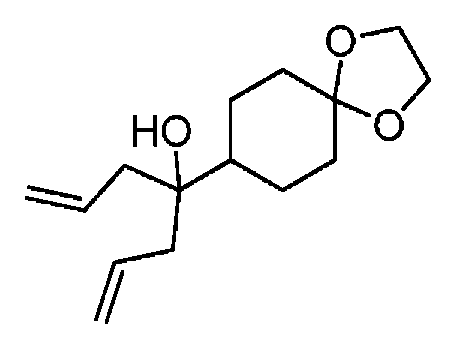
아르곤 하에서 -78℃로 냉각된 THF (10 mL) 중 에틸 1,4-다이옥사스피로[4.5]데칸-8-카르복실레이트 (1.12 g, 5.24 mmol, 문헌[Pearson, et al. in J. Org. Chem. 1997, 62(16), 5284-5292]에 기재된 바와 같이 제조됨)의 용액에 알릴마그네슘 브로마이드 (18 mL, 18 mmol, THF 중 1 M)를 적가하였다. 첨가를 완료한 후에, 반응 혼합물을 실온에 도달하도록 하룻밤 두었다. 이어서, -78℃로 재냉각하고 포화 NaHCO3 용액으로 켄칭하고 실온으로 가온하였다. 에테르로 추출한 후에, 유기층을 진공에서 농축하고 잔류물을 플래시 크로마토그래피 (실리카 겔, 0-100% 에테르/헥산)에 의해 정제하여 생성물을 얻었다.To a solution of ethyl 1,4-dioxaspiro [4.5] decane-8-carboxylate (1.12 g, 5.24 mmol, from Pearson, et al., In J. Org (18 mL, 18 mmol, 1 M in THF) was added dropwise to a solution of the compound of formula (I) (prepared as described in J. Chem. 1997, 62 (16), 5284-5292). After the addition was complete, the reaction mixture was allowed to reach room temperature overnight. Then re-cooled to -78 ℃ and quenched with saturated NaHCO 3 solution was allowed to warm to room temperature. After extraction with ether, the organic layer was concentrated in vacuo and the residue was purified by flash chromatography (silica gel, 0-100% ether / hexane) to give the product.
1H NMR (클로로포름-d) δ: 5.80 - 5.98 (m, 2H), 5.06 - 5.22 (m, 4H), 3.96 (s, 4H), 2.28 - 2.39 (m, 2H), 2.18 - 2.28 (m, 2H), 1.82 (d, J = 9.0 Hz, 4H), 1.35 - 1.59 (m, 6H) 1 H NMR (chloroform -d) δ: 5.80 - 5.98 ( m, 2H), 5.06 - 5.22 (m, 4H), 3.96 (s, 4H), 2.28 - 2.39 (m, 2H), 2.18 - 2.28 (m, 2H), 1.82 (d, J = 9.0 Hz, 4H), 1.35-1.59 (m, 6H)
단계 B: 1-(1,4-다이옥사스피로[4.5]데칸-8-일)사이클로펜트-3-에놀Step B: Preparation of 1- (1,4-dioxaspiro [4.5] decan-8-yl) cyclopent-

DCM 중의, 이전 단계에서 제조된 1-(1,4-다이옥사스피로[4.5]데칸-8-일)부트-3-엔-1-올 (840 mg, 3.33 mmol) 및 그럽스 제너레이션 II 촉매 (185 mg, 0.218 mmol)의 용액을 탈가스하고 아르곤 하에서 4시간 동안 40℃로 가열하였다. 포화 NaHCO3 용액으로 추출한 후에, 유기층을 진공에서 농축하고 잔류물을 플래시 크로마토그래피 (실리카 겔, 에테르)에 의해 정제하여 생성물을 얻었다.(1,4-dioxaspiro [4.5] decan-8-yl) but-3-en-1-ol (840 mg, 3.33 mmol) and Grubs Generation II catalyst 185 mg, 0.218 mmol) in toluene (5 mL) was degassed and heated to 40 < 0 > C under argon for 4 h. After extraction with saturated NaHCO 3 solution, the organic layer was concentrated in vacuo and the residue was purified by flash chromatography (silica gel, ether) to give the product.
단계 C: 4-(1-Step C: 4- (1- 하이드록시사이클로펜트Hydroxycyclopent -3-엔-1-일)-3-en-1-yl) 사이클로헥사논Cyclohexanone

이전 단계에서 제조된 8-(3,6-다이하이드로-2H-피란-2-일)-1,4-다이옥사스피로[4.5]데칸의 용액을 실시예 1, 단계 C에 기재된 바와 같이 탈보호하여 생성물을 얻었다.A solution of 8- (3,6-dihydro-2H-pyran-2-yl) -1,4-dioxaspiro [4.5] decane prepared in the previous step was deprotected as described in Example 1, Step C To give the product.
단계 D: N-(1-((1s,4s)-4-(1-하이드록시사이클로펜트-3-엔-1-일)사이클로헥실)아제티딘-3-일)-2-((6-(트라이플루오로메틸)퀴놀린-4-일)아미노)아세트아미드Step D: Synthesis of N- (l- (ls, 4s) -4- (l-hydroxycyclopent-3-en-l-yl) cyclohexyl) azetidin- (Trifluoromethyl) quinolin-4-yl) amino) acetamide

실시예 1, 단계 H에 기재된 바와 같이 TEA 및 NaBH(OAc)3의 존재 하에서 4-(3,6-다이하이드로-2H-피란-2-일)사이클로헥사논 (이전 단계에서 제조됨)과 N-(아제티딘-3-일)-2-((6-(트라이플루오로메틸)퀴나졸린-4-일)아미노)아세트아미드 (실시예 1 단계 G에서 제조됨)의 반응에 의해 생성물을 얻었다.(3,6-dihydro-2H-pyran-2-yl) cyclohexanone (prepared in the previous step) and N (trifluoromethyl) pyridine in the presence of TEA and NaBH (OAc) 3 as described in example 1, Amino-acetamide (prepared in Step 1 G of Example 1) in THF (5 mL) to give the product as a white solid .
ESI-MS (m/z): C26H31F3N4O2에 대한 계산치: 488.24; 실측치: 489 (M+H).ESI-MS (m / z): Calcd for C 26 H 31 F 3 N 4 O 2 : 488.24; Found: 489 (M + H).
실시예 29: N-(1-((1s,4s)-4-(2-하이드록시프로판-2-일)사이클로헥실)아제티딘-3-일)-2-((6-(트라이플루오로메틸)퀴나졸린-4-일)아미노)아세트아미드Example 29: N- (l- ((ls, 4s) -4- (2-Hydroxypropan-2-yl) cyclohexylJazetidin- Methyl) quinazolin-4-yl) amino) acetamide
단계 A: 2-(1,4-다이옥사스피로[4.5]데칸-8-일)프로판-2-올Step A: Preparation of 2- (1,4-dioxaspiro [4.5] decan-8-yl) propan-

아르곤 하에서 -78℃로 냉각된 THF (20 mL) 중 에틸 1,4-다이옥사스피로[4.5]데칸-8-카르복실레이트 (0.64 g, 2.99 mmol, 문헌[Pearson, et al. in J. Org. Chem. 1997, 62(16), 5284-5292]에 기재된 바와 같이 제조됨)의 용액에 메틸마그네슘 클로라이드 (4 mL, 12 mmol, THF 중 3 M)를 적가하였다. 첨가를 완료한 후에, 반응 혼합물을 실온에 도달하도록 하룻밤 두었다. 이어서, -78℃로 재냉각하고 포화 NaHCO3 용액으로 켄칭하고 실온으로 가온하였다. 에테르로 추출한 후에, 유기층을 진공에서 농축하고 잔류물을 플래시 크로마토그래피 (실리카 겔, 0-100% 에테르/헥산)에 의해 정제하여 생성물을 얻었다.To a solution of ethyl 1,4-dioxaspiro [4.5] decane-8-carboxylate (0.64 g, 2.99 mmol, from Pearson, et al. In J. Org (4 mL, 12 mmol, 3 M in THF) was added dropwise to a solution of the compound of formula (I) as described in J. Med. Chem. 1997, 62 (16), 5284-5292. After the addition was complete, the reaction mixture was allowed to reach room temperature overnight. Then re-cooled to -78 ℃ and quenched with saturated NaHCO 3 solution was allowed to warm to room temperature. After extraction with ether, the organic layer was concentrated in vacuo and the residue was purified by flash chromatography (silica gel, 0-100% ether / hexane) to give the product.
단계 B: 4-(2-하이드록시프로판-2-일)사이클로헥사논Step B: 4- (2-Hydroxypropan-2-yl) cyclohexanone

이전 단계에서 제조된 2-(1,4-다이옥사스피로[4.5]데칸-8-일)프로판-2-올의 용액을 실시예 1, 단계 C에 기재된 바와 같이 탈보호하여 생성물을 얻었다.A solution of 2- (1,4-dioxaspiro [4.5] decan-8-yl) propan-2-ol prepared in the previous step was deprotected as described in Example 1, Step C to give the product.
단계 C: N-(1-((1s,4s)-4-(2-Step C: Preparation of N- (1 - ((1s, 4s) -4- (2- 하이드록시프로판Hydroxypropane -2-일)-2 days) 사이클로헥실Cyclohexyl )) 아제티딘Azetidine -3-일)-2-((6-(트3-yl) -2 - ((6- 라이플루오Rifluo 로메틸)Lt; / RTI > 퀴나졸린Quinazoline -4-일)아미노)Yl) amino) 아세트아미드Acetamide

실시예 1, 단계 H에 기재된 바와 같이 TEA 및 NaBH(OAc)3의 존재 하에서 4-(4-하이드록시헵타-1,6-다이엔-4-일)사이클로헥사논 (이전 단계에서 제조됨)과 N-(아제티딘-3-일)-2-((6-(트라이플루오로메틸)퀴나졸린-4-일)아미노)아세트아미드 (실시예 1 단계 G에서 제조됨)의 반응에 의해 생성물을 얻었다.(4-hydroxyhepta-l, 6-dien-4-yl) cyclohexanone (prepared in the previous step) in the presence of TEA and NaBH (OAc) 3 as described in example 1, (Prepared in step 1 G of Example 1) by reaction of N- (azetidin-3-yl) -2- (6- (trifluoromethyl) quinazolin- ≪ / RTI >
ESI-MS (m/z): C24H31F3N4O2에 대한 계산치: 464.24; 실측치: 465 (M+H).ESI-MS (m / z): Calcd for C 24 H 31 F 3 N 4 O 2 : 464.24; Found: 465 (M + H).
실시예Example 30: N-(1-((1s,4s)-4-(3- 30: N- (1 - ((1S, 4S) -4- (3- 하이드록시펜탄Hydroxypentane -3-일)-3 days) 사이클로헥실Cyclohexyl )) 아제티딘Azetidine -3-일)-2-((6-(Yl) -2 - ((6- ( 트라이플루오로메틸Trifluoromethyl )) 퀴나졸린Quinazoline -4-일)아미노)Yl) amino) 아세트아미드Acetamide
단계 A: 3-(1,4-다이옥사스피로[4.5]데칸-8-일)펜탄-3-올Step A: Preparation of 3- (1,4-dioxaspiro [4.5] decan-8-yl) pentan-

아르곤 하에서 -78℃로 냉각된 THF (20 mL) 중 에틸 1,4-다이옥사스피로[4.5]데칸-8-카르복실레이트 (0.754 g, 3.52 mmol, 문헌[Pearson, et al. in J. Org. Chem. 1997, 62(16), 5284-5292]에 기재된 바와 같이 제조됨)의 용액에 에틸마그네슘 클로라이드 (9 mL, 18 mmol, THF 중 2 M)를 적가하였다. 첨가를 완료한 후에, 반응 혼합물을 실온에 도달하도록 하룻밤 두었다. 이어서, -78℃로 재냉각하고 포화 NaHCO3 용액으로 켄칭하고 실온으로 가온하였다. 에테르로 추출한 후에, 유기층을 진공에서 농축하고 잔류물을 플래시 크로마토그래피 (실리카 겔, 0-100% 에테르/헥산)에 의해 정제하여 생성물을 얻었다.To a solution of ethyl 1,4-dioxaspiro [4.5] decane-8-carboxylate (0.754 g, 3.52 mmol, from Pearson, et al., In J. Org (9 mL, 18 mmol, 2 M in THF) was added dropwise to a solution of the compound of formula (I) as described in J. Med. Chem. 1997, 62 (16), 5284-5292. After the addition was complete, the reaction mixture was allowed to reach room temperature overnight. Then re-cooled to -78 ℃ and quenched with saturated NaHCO 3 solution was allowed to warm to room temperature. After extraction with ether, the organic layer was concentrated in vacuo and the residue was purified by flash chromatography (silica gel, 0-100% ether / hexane) to give the product.
단계 B: 4-(3-하이드록시펜탄-3-일)사이클로헥사논Step B: 4- (3-Hydroxypentan-3-yl) cyclohexanone

이전 단계에서 제조된 2 3-(1,4-다이옥사스피로[4.5]데칸-8-일)펜탄-3-올의 용액을 실시예 1, 단계 C에 기재된 바와 같이 탈보호하여 생성물을 얻었다.A solution of 2 3- (1,4-dioxaspiro [4.5] decan-8-yl) pentan-3-ol prepared in the previous step was deprotected as described in Example 1, Step C to give the product.
단계 C: N-(1-((1s,4s)-4-(3-하이드록시펜탄-3-일)사이클로헥실)아제티딘-3-일)-2-((6-(트라이플루오로메틸)퀴나졸린-4-일)아미노)아세트아미드Step C: Preparation of N- (l- ((1s, 4s) -4- (3-Hydroxypentan-3- yl) cyclohexyl) azetidin- ) Quinazolin-4-yl) amino) acetamide

실시예 1, 단계 H에 기재된 바와 같이 TEA 및 NaBH(OAc)3의 존재 하에서 4-(3-하이드록시펜탄-3-일)사이클로헥사논 (이전 단계에서 제조됨)과 N-(아제티딘-3-일)-2-((6-(트라이플루오로메틸)퀴나졸린-4-일)아미노)아세트아미드 (실시예 1 단계 G에서 제조됨)의 반응에 의해 생성물을 얻었다.(Prepared in the previous step) and N- (azetidin-3-yl) cyclohexanone in the presence of TEA and NaBH (OAc) 3 as described in example 1, Amino) acetamide (prepared in step 1 G of Example 1) in the form of a white solid.
ESI-MS (m/z): C26H35F3N4O2에 대한 계산치: 492.27; 실측치: 493 (M+H).ESI-MS (m / z): Calcd for C 26 H 35 F 3 N 4 O 2 : 492.27; Found: 493 (M + H).
실시예 31: N-(1-((1s,4s)-4-(4-하이드록시헵타-1,6-다이엔-4-일)사이클로헥실)아제티딘-3-일)-2-((6-(트라이플루오로메틸)퀴나졸린-4-일)아미노)아세트아미드Example 31: Preparation of N- (1 - ((1 s, 4s) -4- (4-hydroxyhepta-l, (6- (Trifluoromethyl) quinazolin-4-yl) amino) acetamide
단계 A: 4-(4-하이드록시헵타-1,6-다이엔-4-일)사이클로헥사논Step A: 4- (4-Hydroxyhepta-l, 6-dien-4-yl) cyclohexanone

실시예 28, 단계 A에서 제조된 1-(1,4-다이옥사스피로[4.5]데칸-8-일)부트-3-엔-1-올의 용액을 실시예 1, 단계 C에 기재된 바와 같이 탈보호하여 생성물을 얻었다.A solution of 1- (1,4-dioxaspiro [4.5] decan-8-yl) but-3-en-1-ol prepared in example 28, step A was treated as described in example 1, step C The product was deprotected.
단계 B: N-(1-((1s,4s)-4-(4-하이드록시헵타-1,6-다이엔-4-일)사이클로헥실)아제티딘-3-일)-2-((6-(트라이플루오로메틸)퀴나졸린-4-일)아미노)아세트아미드Step B: Synthesis of N- (1 - ((ls, 4s) -4- (4-hydroxyhepta-l, 6-dien-4-yl) cyclohexyl) azetidin- 6- (trifluoromethyl) quinazolin-4-yl) amino) acetamide

실시예 1, 단계 H에 기재된 바와 같이 TEA 및 NaBH(OAc)3의 존재 하에서 4-(4-하이드록시헵타-1,6-다이엔-4-일)사이클로헥사논 (이전 단계에서 제조됨)과 N-(아제티딘-3-일)-2-((6-(트라이플루오로메틸)퀴나졸린-4-일)아미노)아세트아미드 (실시예 1 단계 G에서 제조됨)의 반응에 의해 생성물을 얻었다.(4-hydroxyhepta-l, 6-dien-4-yl) cyclohexanone (prepared in the previous step) in the presence of TEA and NaBH (OAc) 3 as described in example 1, (Prepared in step 1 G of Example 1) by reaction of N- (azetidin-3-yl) -2- (6- (trifluoromethyl) quinazolin- ≪ / RTI >
ESI-MS (m/z): C28H35F3N4O2에 대한 계산치: 516.27; 실측치: 517 (M+H).ESI-MS (m / z) : C 28 H 35 F 3 N 4 calcd for O 2: 516.27; Found: 517 (M + H).
실시예 32: N-(1-((1s,4s)-4-(4-하이드록시헵탄-4-일)사이클로헥실)아제티딘-3-일)-2-((6-(트라이플루오로메틸)퀴나졸린-4-일)아미노)아세트아미드Example 32: N- (l- ((ls, 4s) -4- (4-Hydroxyheptan-4- yl) cyclohexylJazetidin- Methyl) quinazolin-4-yl) amino) acetamide
단계 A: 4-(1,4-다이옥사스피로[4.5]데칸-8-일)헵탄-4-올Step A: Preparation of 4- (1,4-dioxaspiro [4.5] decan-8-yl) heptan-

실시예 28, 단계 A에서 제조된 1-(1,4-다이옥사스피로[4.5]데칸-8-일)부트-3-엔-1-올 (390 mg, 1.54 mmol), 및 탄소상 팔라듐 (244 mg, 0.115 mmol, 5%)이 담긴 플라스크에 메탄올 (25 mL)을 주의깊게 첨가하였다. 반응 플라스크를 진공화하고, 풍선을 통해 수소로 다시 충전하고, 실온에서 하룻밤 교반하였다. 여과에 의해 촉매를 제거하고 여과액을 진공에서 농축하여 생성물을 얻었다.Yl) but-3-en-1-ol (390 mg, 1.54 mmol) prepared in example 28, step A and palladium on carbon 244 mg, 0.115 mmol, 5%) in methanol (25 mL) was carefully added. The reaction flask was evacuated, charged again with hydrogen through a balloon, and stirred overnight at room temperature. The catalyst was removed by filtration and the filtrate was concentrated in vacuo to give the product.
단계 B: 4-(4-하이드록시헵탄-4-일)사이클로헥사논Step B: 4- (4-Hydroxyheptan-4-yl) cyclohexanone
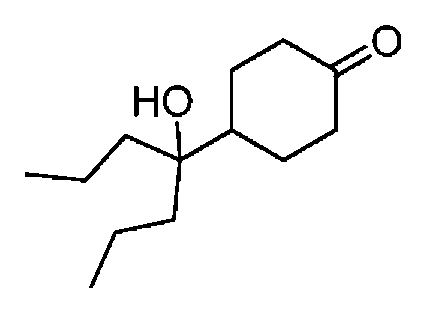
실시예 28, 단계 A에서 제조된 4-(1,4-다이옥사스피로[4.5]데칸-8-일)헵탄-4-올의 용액을 실시예 1, 단계 C에 기재된 바와 같이 탈보호하여 생성물을 얻었다.A solution of 4- (1,4-dioxaspiro [4.5] decan-8-yl) heptan-4-ol prepared in Example 28, Step A was deprotected as described in Example 1, Step C to give the product ≪ / RTI >
단계 C: N-(1-((1s,4s)-4-(4-하이드록시헵탄-4-일)사이클로헥실)아제티딘-3-일)-2-((6-(트라이플루오로메틸)퀴나졸린-4-일)아미노)아세트아미드Step C: Preparation of N- (l- (ls, 4s) -4- (4-hydroxyheptan-4-yl) cyclohexyl) azetidin- ) Quinazolin-4-yl) amino) acetamide
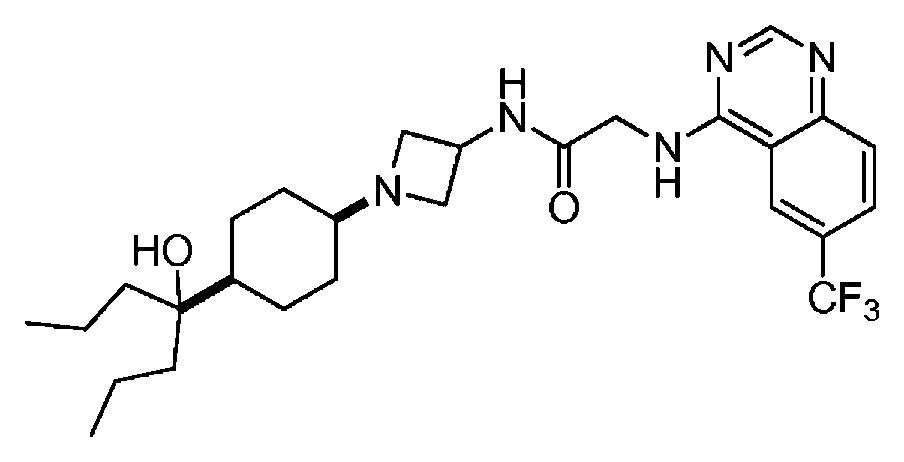
실시예 1, 단계 H에 기재된 바와 같이 TEA 및 NaBH(OAc)3의 존재 하에서 4-(4-하이드록시헵탄-4-일)사이클로헥사논 (이전 단계에서 제조됨)과 N-(아제티딘-3-일)-2-((6-(트라이플루오로메틸)퀴나졸린-4-일)아미노)아세트아미드 (실시예 1 단계 G에서 제조됨)의 반응에 의해 생성물을 얻었다.(Prepared in the previous step) and N- (azetidin-4-yl) cyclohexanone in the presence of TEA and NaBH (OAc) 3 as described in example 1, Amino) acetamide (prepared in step 1 G of Example 1) in the form of a white solid.
ESI-MS (m/z): C28H39F3N4O2에 대한 계산치: 520.30; 실측치: 521 (M+H).ESI-MS (m / z) : C 28 H 39 F 3 N 4 calcd for O 2: 520.30; Found: 521 (M + H).
실시예Example 33: N-(1-((1s,4s)-4- 33: N- (1 - ((1 S, 4 S) -4- 사이클로펜틸사이클로헥실Cyclopentylcyclohexyl )) 아제티딘Azetidine -3-일)-2-((6-(Yl) -2 - ((6- ( 트라이플루오로메틸Trifluoromethyl )) 퀴나졸린Quinazoline -4-일)아미노)Yl) amino) 아세트아미드Acetamide
단계 A: 8-사이클로펜틸-1,4-다이옥사스피로[4.5]데칸Step A: 8-Cyclopentyl-1,4-dioxaspiro [4.5] decane

실시예 28 단계 B에서 제조된 1-(1,4-다이옥사스피로[4.5]데칸-8-일)사이클로펜트-3-에놀 (218 mg, 0.972 mmol), 및 탄소상 팔라듐 (157 mg, 0.074 mmol)이 담긴 플라스크에 메탄올 (24 mL)을 주의깊게 첨가하였다. 반응 플라스크를 진공화하고, 풍선을 통해 수소로 다시 충전하고, 실온에서 하룻밤 교반하였다. 여과에 의해 촉매를 제거하고 여과액을 진공에서 농축하여 생성물을 얻었다.(218 mg, 0.972 mmol) and palladium on carbon (157 mg, 0.074 mmol), prepared in step B, in tetrahydrofuran mmol) was carefully added to methanol (24 mL). The reaction flask was evacuated, charged again with hydrogen through a balloon, and stirred overnight at room temperature. The catalyst was removed by filtration and the filtrate was concentrated in vacuo to give the product.
단계 B: 4-Step B: 4- 사이클로펜틸사이클로헥사논Cyclopentylcyclohexanone

이전 단계에서 제조된 8-사이클로펜틸-1,4-다이옥사스피로[4.5]데칸의 용액을 실시예 1, 단계 C에 기재된 바와 같이 탈보호하여 생성물을 얻었다.A solution of 8-cyclopentyl-1,4-dioxaspiro [4.5] decane prepared in the previous step was deprotected as described in Example 1, Step C to give the product.
단계 C: N-(1-((1s,4s)-4-사이클로펜틸사이클로헥실)아제티딘-3-일)-2-((6-(트라이플루오로메틸)퀴나졸린-4-일)아미노)아세트아미드Step C: Preparation of N- (1 - ((1s, 4s) -4-cyclopentylcyclohexyl) azetidin-3- yl) -2 - ((6- (trifluoromethyl) quinazolin- ) Acetamide

실시예 1, 단계 H에 기재된 바와 같이 TEA 및 NaBH(OAc)3의 존재 하에서 4-사이클로펜틸사이클로헥사논 (이전 단계에서 제조됨)과 N-(아제티딘-3-일)-2-((6-(트라이플루오로메틸)퀴나졸린-4-일)아미노)아세트아미드 (실시예 1 단계 G에서 제조됨)의 반응에 의해 생성물을 얻었다.Example 1, in the presence of TEA and NaBH (OAc) 3 as described in Step H (as prepared in the previous step), 4-cyclopentyl-cyclohexanone and N- (azetidin-3-yl) -2 - (( (Trifluoromethyl) quinazolin-4-yl) amino) acetamide (prepared in Example 1 Step G).
ESI-MS (m/z): C26H33F3N4O에 대한 계산치: 474.26; 실측치: 475 (M+H).ESI-MS (m / z): Calcd for C 26 H 33 F 3 N 4 O: 474.26; Found: 475 (M + H).
실시예Example 34: N-(1-((1R,4s)-4-(2,2,2- 34: N- (1 - ((1 R, 4 S) -4- (2,2,2- 트라이플루오로Trifluro -1-하이드록시에틸)-1-hydroxyethyl) 사이클로헥실Cyclohexyl )) 아제티딘Azetidine -3-일)-2-((6-(Yl) -2 - ((6- ( 트라이플루오로메틸Trifluoromethyl )) 퀴나졸린Quinazoline -4-일)아미노)Yl) amino) 아세트아미드Acetamide
단계 A: 트라이메틸(2,2,2-트라이플루오로-1-(1,4-다이옥사스피로[4.5]데칸-8-일)에톡시)실란Step A: Trimethyl (2,2,2-trifluoro-1- (1,4-dioxaspiro [4.5] decan-8-yl) ethoxy) silane

아르곤 하에서 0℃로 냉각된 1,4-다이옥사스피로[4.5]데칸-8-카르브알데하이드 (1.46 g, 4.88 mmol, 문헌 [Pearson, et al. in J. Org. Chem. 1997, 62(16), 5284-5292]에 기재된 바와 같이 제조됨)의 용액에 TBAF (0.05 eq)를 적가한 다음 트라이메틸(트라이플루오로메틸)실란 (0.80 mL, 5.07 mmol, THF 중 0.5 M)을 적가하였다. 첨가를 완료한 후에, 반응 혼합물을 실온에 도달하도록 하룻밤 두었다. 이어서, -78℃로 재냉각하고 포화 NaHCO3 용액으로 켄칭하고 실온으로 가온하였다. 에테르로 추출한 후에, 유기층을 진공에서 농축하고 잔류물을 플래시 크로마토그래피 (실리카 겔, DCM)에 의해 정제하여 생성물을 얻었다.Dioxaspiro [4.5] decane-8-carbaldehyde (1.46 g, 4.88 mmol, Pearson, et al., J. Org. Chem. 1997, 62 ), 5284-5292) in THF (5 mL) was added dropwise TBAF (0.05 eq) followed by dropwise addition of trimethyl (trifluoromethyl) silane (0.80 mL, 5.07 mmol, 0.5 M in THF). After the addition was complete, the reaction mixture was allowed to reach room temperature overnight. Then re-cooled to -78 ℃ and quenched with saturated NaHCO 3 solution was allowed to warm to room temperature. After extraction with ether, the organic layer was concentrated in vacuo and the residue was purified by flash chromatography (silica gel, DCM) to give the product.
단계 B: 2,2,2-Step B: 2,2,2- 트라이플루오로Trifluro -1-(1,4--1- (1,4- 다이옥사스피로[4.5]데칸Dioxaspiro [4.5] decane -8-일)에탄올-8-yl) ethanol

THF (10 mL) 중 트라이메틸(2,2,2-트라이플루오로-1-(1,4-다이옥사스피로[4.5]데칸-8-일)에톡시)실란 (792 mg, 2.54 mmol, 이전 단계에서 제조됨)의 용액에 TBAF (2.6 mL, 2.6 mmol, THF 중 1 M)를 적가하였다. 첨가를 완료한 후에, 반응 혼합물을 실온에서 2시간 둔 다음 진공에서 농축하였다. 잔류물을 플래시 크로마토그래피 (실리카 겔, 0-100% 에틸 아세테이트/헵탄)에 의해 정제하여 생성물을 얻었다.To a solution of trimethyl (2,2,2-trifluoro-1- (1,4-dioxaspiro [4.5] decan-8-yl) ethoxy) silane (792 mg, 2.54 mmol, (2.6 mL, 2.6 mmol, 1 M in THF) was added dropwise. After the addition was complete, the reaction mixture was allowed to stand at room temperature for 2 hours and then concentrated in vacuo. The residue was purified by flash chromatography (silica gel, 0-100% ethyl acetate / heptane) to give the product.
단계 C: 4-(2,2,2-트라이플루오로-1-하이드록시에틸)사이클로헥사논Step C: 4- (2,2,2-Trifluoro-1-hydroxyethyl) cyclohexanone

이전 단계에서 제조된 2,2,2-트라이플루오로-1-(1,4-다이옥사스피로[4.5]데칸-8-일)에탄올의 용액을 실시예 1, 단계 C에 기재된 바와 같이 탈보호하여 생성물을 얻었다.A solution of 2,2,2-trifluoro-1- (1,4-dioxaspiro [4.5] decan-8-yl) ethanol prepared in the previous step was deprotected as described in Example 1, Step C To give the product.
단계 D: N-(1-((1R,4s)-4-(2,2,2-트라이플루오로-1-하이드록시에틸)사이클로헥실)아제티딘-3-일)-2-((6-(트라이플루오로메틸)퀴나졸린-4-일)아미노)아세트아미드Step D: Synthesis of N- (1 - ((1R, 4S) -4- (2,2,2-trifluoro-1- hydroxyethyl) cyclohexyl) azetidin- - (trifluoromethyl) quinazolin-4-yl) amino) acetamide

실시예 1, 단계 H에 기재된 바와 같이 TEA 및 NaBH(OAc)3의 존재 하에서 4-(2,2,2-트라이플루오로-1-하이드록시에틸)사이클로헥사논 (이전 단계에서 제조됨)과 N-(아제티딘-3-일)-2-((6-(트라이플루오로메틸)퀴나졸린-4-일)아미노)아세트아미드 (실시예 1 단계 G에서 제조됨)의 반응에 의해 생성물을 얻었다.Example 1, in the presence of TEA and NaBH (OAc) 3 as described in Step H (as prepared in the previous step), 4- (2,2,2-trifluoro-1-hydroxyethyl) cyclohexanone with Reaction of the product with N- (azetidin-3-yl) -2 - ((6- (trifluoromethyl) quinazolin-4- yl) amino) acetamide .
ESI-MS (m/z): C26H33F3N4O에 대한 계산치: 505.19; 실측치: 506 (M+H).ESI-MS (m / z): Calcd for C 26 H 33 F 3 N 4 O: 505.19; Found: 506 (M + H).
실시예 35: N-(1-((1R,4s)-4-(2,2,3,3,4,4,4-헵타플루오로-1-하이드록시부틸)사이클로헥실)아제티딘-3-일)-2-((6-(트라이플루오로메틸)퀴나졸린-4-일)아미노)아세트아미드Example 35: Synthesis of N- (1 - ((1R, 4S) -4- (2,2,3,3,4,4,4-heptafluoro-1-hydroxybutyl) cyclohexyl) -Yl) -2 - ((6- (trifluoromethyl) quinazolin-4-yl) amino) acetamide
단계 A: (2,2,3,3,4,4,4-헵타플루오로-1-(1,4-다이옥사스피로[4.5]데칸-8-일)부톡시)트라이메틸실란Step A: (2,2,3,3,4,4,4-heptafluoro-1- (1,4-dioxaspiro [4.5] decan-8-yl) butoxy) trimethylsilane

아르곤 하에서 0℃로 냉각된 1,4-다이옥사스피로[4.5]데칸-8-카르브알데하이드 (350 mg, 2.06 mmol, 문헌[Pearson, et al. in J. Org. Chem. 1997, 62(16), 5284-5292]에 기재된 바와 같이 제조됨)의 용액에 TBAF (0.05 eq)를 적가한 다음 트라이메틸(트라이플루오로메틸)실란 (0.45 mL, 2.17 mmol, THF 중 0.5 M)을 적가하였다. 첨가를 완료한 후에, 반응 혼합물을 실온에 도달하도록 하룻밤 두었다. 이어서, -78℃로 재냉각하고 포화 NaHCO3 용액으로 켄칭하고 실온으로 가온하였다. 에테르로 추출한 후에, 유기층을 진공에서 농축하고 잔류물을 플래시 크로마토그래피 (실리카 겔, DCM)에 의해 정제하여 생성물을 얻었다.Dioxaspiro [4.5] decane-8-carbaldehyde (350 mg, 2.06 mmol, Pearson, et al. In J. Org. ), 5284-5292) in THF (5 mL) was added dropwise TBAF (0.05 eq) followed by dropwise addition of trimethyl (trifluoromethyl) silane (0.45 mL, 2.17 mmol, 0.5 M in THF). After the addition was complete, the reaction mixture was allowed to reach room temperature overnight. Then re-cooled to -78 ℃ and quenched with saturated NaHCO 3 solution was allowed to warm to room temperature. After extraction with ether, the organic layer was concentrated in vacuo and the residue was purified by flash chromatography (silica gel, DCM) to give the product.
단계 B: 2,2,3,3,4,4,4-헵타플루오로-1-(1,4-다이옥사스피로[4.5]데칸-8-일)부탄-1-올Step B: Preparation of 2,2,3,3,4,4,4-heptafluoro-1- (1,4-dioxaspiro [4.5] decan-8-yl) butan-

THF (10 mL) 중 트라이메틸 (2,2,3,3,4,4,4-헵타플루오로-1-(1,4-다이옥사스피로[4.5]데칸-8-일)부톡시)트라이메틸실란 (265 mg, 0.643 mmol, 이전 단계에서 제조됨)의 용액에 TBAF (0.64 mL, 0.64 mmol, THF 중 1 M)를 적가하였다. 첨가를 완료한 후에, 반응 혼합물을 실온에서 2시간 둔 다음 진공에서 농축하였다. 잔류물을 플래시 크로마토그래피 (실리카 겔, 0-100% 에틸 아세테이트/헵탄)에 의해 정제하여 생성물을 얻었다.To a solution of trimethyl (2,2,3,3,4,4,4-heptafluoro-1- (1,4-dioxaspiro [4.5] decan-8-yl) butoxy) tri TBAF (0.64 mL, 0.64 mmol, 1 M in THF) was added dropwise to a solution of methyl silane (265 mg, 0.643 mmol, prepared in the previous step). After the addition was complete, the reaction mixture was allowed to stand at room temperature for 2 hours and then concentrated in vacuo. The residue was purified by flash chromatography (silica gel, 0-100% ethyl acetate / heptane) to give the product.
단계 C: 4-(2,2,3,3,4,4,4-헵타플루오로-1-하이드록시부틸)사이클로헥사논Step C: 4- (2,2,3,3,4,4,4-heptafluoro-1-hydroxybutyl) cyclohexanone

이전 단계에서 제조된 2 2,2,3,3,4,4,4-헵타플루오로-1-(1,4-다이옥사스피로[4.5]데칸-8-일)부탄-1-올의 용액을 실시예 1, 단계 C에 기재된 바와 같이 탈보호하여 생성물을 얻었다.A solution of 2,2,3,3,4,4,4-heptafluoro-1- (1,4-dioxaspiro [4.5] decan-8-yl) butan-l-ol prepared in the previous step Was deprotected as described in Example 1, Step C to give the product.
단계 D: N-(1-((1R,4s)-4-(2,2,3,3,4,4,4-헵타플루오로-1-하이드록시부틸)사이클로헥실)아제티딘-3-일)-2-((6-(트라이플루오로메틸)퀴나졸린-4-일)아미노)아세트아미드Step D: Synthesis of N- (1 - ((1 R, 4S) -4- (2,2,3,3,4,4,4-heptafluoro-1-hydroxybutyl) cyclohexyl) Yl) -2 - ((6- (trifluoromethyl) quinazolin-4-yl) amino) acetamide
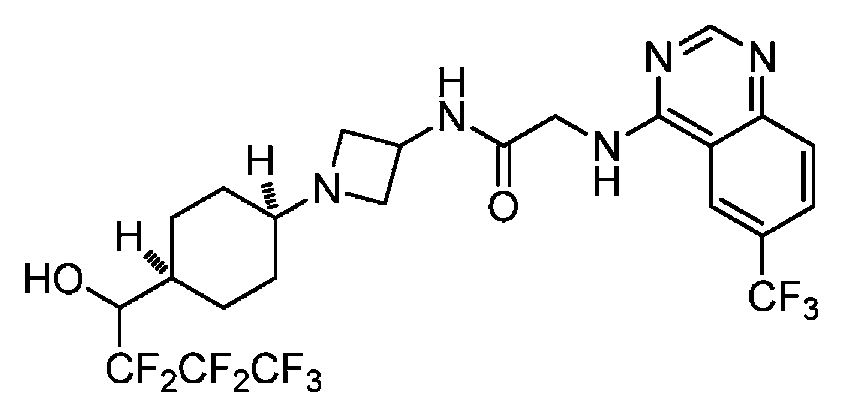
실시예 1, 단계 H에 기재된 바와 같이 TEA 및 NaBH(OAc)3의 존재 하에서 4-(2,2,3,3,4,4,4-헵타플루오로-1-하이드록시부틸)사이클로헥사논 (이전 단계에서 제조됨)과 N-(아제티딘-3-일)-2-((6-(트라이플루오로메틸)퀴나졸린-4-일)아미노)아세트아미드 (실시예 1 단계 G에서 제조됨)의 반응에 의해 생성물을 얻었다.(2,2,3,3,4,4,4-heptafluoro-1-hydroxybutyl) cyclohexanone in the presence of TEA and NaBH (OAc) 3 as described in example 1, (Prepared in the previous step) and N- (azetidin-3-yl) -2 - ((6- (trifluoromethyl) quinazolin-4- yl) amino) acetamide ) To give the product.
ESI-MS (m/z): C26H33F3N4O에 대한 계산치: 605.18; 실측치: 606 (M+H).ESI-MS (m / z): Calcd for C 26 H 33 F 3 N 4 O: 605.18; Found: 606 (M + H).
실시예Example 36: N-(1-((1s,4s)-4-( 36: N- (1 - ((1S, 4S) -4- ( 프로프Professional -1-엔-2-일)-1-en-2-yl) 사이클로헥실Cyclohexyl )) 아제티딘Azetidine -3-일)-2-((6-(트3-yl) -2 - ((6- 라이플루오로Rifluro 메틸)methyl) 퀴나졸린Quinazoline -4-일)아미노)Yl) amino) 아세트아미드Acetamide
단계 A: 8-(프로프-1-엔-2-일)-1,4-다이옥사스피로[4.5]데칸Step A: 8- (Prop-1-en-2-yl) -1,4-dioxaspiro [4.5] decane

아르곤 하에서 0℃로 냉각된 THF (10 mL) 중 2-(1,4-다이옥사스피로[4.5]데칸-8-일)프로판-2-올 (164 mg, 0.82 mmol, 실시예 29, 단계 A에서 제조됨)의 용액에 버지스 시약 (214 mg, 0.87 mmol)을 첨가하였다. 첨가를 완료한 후에, 반응 혼합물을 실온에서 1시간 둔 다음 진공에서 농축하였다. 잔류물을 플래시 크로마토그래피 (실리카 겔, DCM)에 의해 정제하여 생성물을 얻었다.To a solution of 2- (1,4-dioxaspiro [4.5] decan-8-yl) propan-2-ol (164 mg, 0.82 mmol, Example 29, step A Was added Burgess reagent (214 mg, 0.87 mmol). After the addition was complete, the reaction mixture was allowed to stand at room temperature for 1 hour and then concentrated in vacuo. The residue was purified by flash chromatography (silica gel, DCM) to give the product.
단계 B: 4-(Step B: 4- ( 프로프Professional -1-엔-2-일)-1-en-2-yl) 사이클로헥사논Cyclohexanone

이전 단계에서 제조된 2 8-(프로프-1-엔-2-일)-1,4-다이옥사스피로[4.5]데칸의 용액을 실시예 1, 단계 C에 기재된 바와 같이 탈보호하여 생성물을 얻었다.A solution of 2 8- (prop-1-en-2-yl) -1,4-dioxaspiro [4.5] decane prepared in the previous step was deprotected as described in Example 1, step C to give the product .
단계 C: N-(1-((1s,4s)-4-(프로프-1-엔-2-일)사이클로헥실)아제티딘-3-일)-2-((6-(트라이플루오로메틸)퀴나졸린-4-일)아미노)아세트아미드Step C: Preparation of N- (l- (ls, 4s) -4- (Prop-l-en-2-yl) cyclohexylJazetidin- Methyl) quinazolin-4-yl) amino) acetamide

실시예 1, 단계 H에 기재된 바와 같이 TEA 및 NaBH(OAc)3의 존재 하에서 4-(프로프-1-엔-2-일)사이클로헥사논 (이전 단계에서 제조됨)과 N-(아제티딘-3-일)-2-((6-(트라이플루오로메틸)퀴나졸린-4-일)아미노)아세트아미드 (실시예 1 단계 G에서 제조됨)의 반응에 의해 생성물을 얻었다.2-yl) cyclohexanone (prepared in the previous step) and N- (azetidine (2-pyridyl) piperidine) in the presence of TEA and NaBH (OAc) 3 as described in example 1, -3-yl) -2 - ((6- (trifluoromethyl) quinazolin-4-yl) amino) acetamide (prepared in Step G of Example 1).
ESI-MS (m/z): C23H28F3N5O에 대한 계산치: 447.22; 실측치: 448 (M+H).ESI-MS (m / z) : C 23 H 28 F 3 calculated for N 5 O: 447.22; Found: 448 (M + H).
실시예 37: N-(1-((1r,4r)-4-하이드록시-4-아이소프로필사이클로헥실)아제티딘-3-일)-2-((6-(트라이플루오로메틸)퀴나졸린-4-일)아미노)아세트아미드Example 37: Preparation of N- (l- ((lr, 4r) -4-hydroxy-4-isopropylcyclohexyl) azetidin- Yl) amino) acetamide
단계 A: 8-Step A: 8- 아이소프로필Isopropyl -1,4--1,4- 다이옥사스피로[4.5]데칸Dioxaspiro [4.5] decane -8-올-8-ol
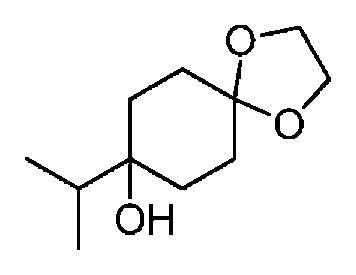
아르곤 하에서 -78℃로 냉각된 THF (20 mL) 중 시판용 1,4-다이옥사스피로[4.5]데칸-8-온 (3.00 g, 19.2 mmol)의 용액에 아이소프로필마그네슘 클로라이드 (10 mL, 20 mmol, THF 중 2 M)를 적가하였다. 첨가를 완료한 후에, 반응 혼합물을 실온에 도달하도록 하룻밤 두었다. 이어서, -78℃로 재냉각하고 포화 NaHCO3 용액으로 켄칭하고 실온으로 가온하였다. 에테르로 추출한 후에, 유기층을 진공에서 농축하고 잔류물을 플래시 크로마토그래피 (실리카 겔, 0-100% 에테르/헥산)에 의해 정제하여 생성물을 얻었다.To a solution of commercially available 1,4-dioxaspiro [4.5] decan-8-one (3.00 g, 19.2 mmol) in THF (20 mL) cooled to -78 <0> C under argon was added isopropylmagnesium chloride , 2 M in THF) was added dropwise. After the addition was complete, the reaction mixture was allowed to reach room temperature overnight. Then re-cooled to -78 ℃ and quenched with saturated NaHCO 3 solution was allowed to warm to room temperature. After extraction with ether, the organic layer was concentrated in vacuo and the residue was purified by flash chromatography (silica gel, 0-100% ether / hexane) to give the product.
단계 B: 4-하이드록시-4-아이소프로필사이클로헥사논Step B: 4-Hydroxy-4-isopropylcyclohexanone

이전 단계에서 제조된 8-아이소프로필-1,4-다이옥사스피로[4.5]데칸-8-올의 용액을 실시예 1, 단계 C에 기재된 바와 같이 탈보호하여 생성물을 얻었다.A solution of 8-isopropyl-1,4-dioxaspiro [4.5] decan-8-ol prepared in the previous step was deprotected as described in Example 1, Step C to give the product.
단계 C: N-(1-((1r,4r)-4-Step C: Preparation of N- (l - ((lr, 4r) -4- 하이드록시Hydroxy -4--4- 아이소프로필사이클로헥실Isopropylcyclohexyl )) 아제티딘Azetidine -3-일)-2-((6-(트3-yl) -2 - ((6- 라이플루오Rifluo 로메틸)Lt; / RTI > 퀴나졸린Quinazoline -4-일)아미노)Yl) amino) 아세트아미드Acetamide

실시예 1, 단계 H에 기재된 바와 같이 TEA 및 NaBH(OAc)3의 존재 하에서 4-하이드록시-4-아이소프로필사이클로헥사논 (이전 단계에서 제조됨)과 N-(아제티딘-3-일)-2-((6-(트라이플루오로메틸)퀴나졸린-4-일)아미노)아세트아미드 (실시예 1 단계 G에서 제조됨)의 반응에 의해 생성물을 얻었다.4-isopropylcyclohexanone (prepared in the previous step) and N- (azetidin-3-yl) pyridine in the presence of TEA and NaBH (OAc) 3 as described in example 1, Amino) acetamide (prepared in step 1 G of Example 1) in the form of a white solid.
ESI-MS (m/z): C24H31F3N4O2에 대한 계산치: 464.24; 실측치: 465 (M+H).ESI-MS (m / z): Calcd for C 24 H 31 F 3 N 4 O 2 : 464.24; Found: 465 (M + H).
실시예 38: N-(1-((1s,4s)-4-(테트라하이드로-2H-피란-4-일)사이클로헥실)아제티딘-3-일)-2-((6-(트라이플루오로메틸)퀴나졸린-4-일)아미노)아세트아미드Example 38: Preparation of N- (l- (ls, 4s) -4- (tetrahydro-2H-pyran-4- yl) cyclohexyljazetidin- Dimethyl-quinazolin-4-yl) amino) acetamide
단계 A: 8-(3,6-다이하이드로-2H-피란-4-일)-1,4-다이옥사스피로[4.5]데스-7-엔Step A: Preparation of 8- (3,6-dihydro-2H-pyran-4-yl) -1,4-dioxaspiro [4.5] des-

8-(4,4,5,5-테트라메틸-[1,3,2]다이옥사보로란-2-일)-1,4-다이옥사-스피로[4.5]데스-7-엔 (국제 특허 공개 WO2006064189호에 기재된 바와 같이 제조됨, 1.57 g, 5.90 mmol), 시판용 3,6-다이하이드로-2H-피란-4-일 트라이플루오로메탄설포네이트 (5.23 mmol), 및 테트라키스(트라이페닐포스피노)팔라듐(0) (302 mg, 0.262 mmol)을 1,4-다이옥산 (20 mL)에 용해하고, 2M Na2CO3 수용액 (14 mL, 28 mmol)으로 처리하고, 수분 동안 아르곤으로 버블링하고, 환류 응축기 하에서 24시간 동안 100℃로 가열하였다. 주위 온도로 냉각한 후에, 반응물을 물 (30 mL)로 희석하고, 다이클로로메탄으로 3회 추출하고, 수성층을 약 pH 7로 산성화하고, 다이클로로메탄으로 2회 더 추출하고, 합한 유기층을 염수로 세척하고, Na2SO4로 건조하고, 여과하고, 진공에서 농축하여, 주황색 오일을 얻었다. 이것을 플래시 크로마토그래피 (실리카 겔, EtOAc)에 의해 정제하여 무색 결정질 고체로서 표제 화합물을 얻었다.Dioxa-spiro [4.5] des-7-ene (International Patent Publication No. Prepared as described in published WO2006064189, 1.57 g, 5.90 mmol), commercially available 3,6-dihydro-2H-pyran-4-yl trifluoromethanesulfonate (5.23 mmol), and tetrakis pinot) palladium (0) (302 mg, 0.262 mmol) dissolved in 1,4-dioxane (20 mL) and 2M Na 2 CO 3 aqueous solution (14 mL, treated with 28 mmol) and bubbled with argon for several minutes And heated to 100 < 0 > C for 24 hours under a reflux condenser. After cooling to ambient temperature, the reaction was diluted with water (30 mL), extracted three times with dichloromethane, the aqueous layer was acidified to pH about 7, extracted twice more with dichloromethane, and the combined organic layers were washed with brine , dried with Na 2 SO 4 to, filtered and concentrated in vacuo to give an orange oil. Which was purified by flash chromatography (silica gel, EtOAc) to give the title compound as a colorless crystalline solid.
1H NMR (클로로포름-d) δ: 5.75 (br. s., 1H), 5.68 - 5.73 (m, 1H), 4.26 (br. s., 2H), 4.01 (s, 3H), 3.79 - 3.90 (m, 2H), 2.38 - 2.50 (m, 3H), 2.25 - 2.34 (m, 2H), 1.86 (t, J = 6.6 Hz, 2H). 1 H NMR (chloroform -d) δ: 5.75 (.. Br s, 1H), 5.68 - 5.73 (m, 1H), 4.26 (.. Br s, 2H), 4.01 (s, 3H), 3.79 - 3.90 ( m, 2H), 2.38-2.50 (m, 3H), 2.25-2.34 (m, 2H), 1.86 (t, J = 6.6 Hz, 2H).
단계 B: 8-(Step B: 8- ( 테트라하이드로Tetrahydro -2H-피란-4-일)-1,4--2H-pyran-4-yl) -1,4- 다이옥사스피로[4.5]데칸Dioxaspiro [4.5] decane

실시예 28 단계 B에서 제조된 8-(3,6-다이하이드로-2H-피란-4-일)-1,4-다이옥사스피로[4.5]데스-7-엔 (218 mg, 0.972 mmol), 및 탄소상 팔라듐 (157 mg, 0.074 mmol)이 담긴 플라스크에 메탄올 (24 mL)을 주의깊게 첨가하였다. 반응 플라스크를 진공화하고, 풍선을 통해 수소로 다시 충전하고, 실온에서 하룻밤 교반하였다. 여과에 의해 촉매를 제거하고 여과액을 진공에서 농축하여 생성물을 얻었다.4-yl) -1,4-dioxaspiro [4.5] des-7-ene (218 mg, 0.972 mmol), prepared in step B, And palladium on carbon (157 mg, 0.074 mmol) was added cautiously to methanol (24 mL). The reaction flask was evacuated, charged again with hydrogen through a balloon, and stirred overnight at room temperature. The catalyst was removed by filtration and the filtrate was concentrated in vacuo to give the product.
1H NMR (클로로포름-d) δ: 3.91 - 4.05 (m, 6H), 3.37 (br. s., 2H), 1.70 - 1.84 (m, 3H), 1.46 - 1.68 (m, 4H), 1.21 - 1.44 (m, 6H), 1.13 (br. s., 1H) 1 H NMR (chloroform -d) δ: 3.91 - 4.05 ( m, 6H), 3.37 (.. Br s, 2H), 1.70 - 1.84 (m, 3H), 1.46 - 1.68 (m, 4H), 1.21 - 1.44 (m, 6 H), 1.13 (br s, 1 H)
단계 C: 4-(Step C: 4- ( 테트라하이드로Tetrahydro -2H-피란-4-일)-2H-pyran-4-yl) 사이클로헥사논Cyclohexanone

이전 단계에서 제조된 8-(테트라하이드로-2H-피란-4-일)-1,4-다이옥사스피로[4.5]데칸의 용액을 실시예 1, 단계 C에 기재된 바와 같이 탈보호하여 생성물을 얻었다.A solution of 8- (tetrahydro-2H-pyran-4-yl) -1,4-dioxaspiro [4.5] decane prepared in the previous step was deprotected as described in Example 1, Step C to give the product .
1H NMR (클로로포름-d) δ: 4.03 (dd, J = 11.6, 3.3 Hz, 2H), 3.31 - 3.45 (m, 2H), 2.27 - 2.48 (m, 3H), 2.02 - 2.17 (m, 2H), 1.21 - 1.71 (m, 8H) 1 H NMR (chloroform -d) δ: 4.03 (dd, J = 11.6, 3.3 Hz, 2H), 3.31 - 3.45 (m, 2H), 2.27 - 2.48 (m, 3H), 2.02 - 2.17 (m, 2H) , 1.21 - 1.71 (m, 8H)
단계 D: N-(1-((1r,4r)-4-Step D: Preparation of N- (l - ((lr, 4r) -4- 하이드록시Hydroxy -4--4- 아이소프로필사이클로헥실Isopropylcyclohexyl )) 아제티딘Azetidine -3-일)-2-((6-(트3-yl) -2 - ((6- 라이플루오Rifluo 로메틸)Lt; / RTI > 퀴나졸린Quinazoline -4-일)아미노)Yl) amino) 아세트아미드Acetamide

실시예 1, 단계 H에 기재된 바와 같이 TEA 및 NaBH(OAc)3의 존재 하에서 4-(테트라하이드로-2H-피란-4-일)사이클로헥사논 (이전 단계에서 제조됨)과 N-(아제티딘-3-일)-2-((6-(트라이플루오로메틸)퀴나졸린-4-일)아미노)아세트아미드 (실시예 1 단계 G에서 제조됨)의 반응에 의해 생성물을 얻었다.Example 1, (prepared in the previous step) in the presence of TEA and NaBH (OAc) 3 as described in Step H 4- (tetrahydro -2H- pyran-4-yl) cyclohexanone with N- (azetidin -3-yl) -2 - ((6- (trifluoromethyl) quinazolin-4-yl) amino) acetamide (prepared in Step G of Example 1).
ESI-MS (m/z): C25H32F3N5O2에 대한 계산치: 491.25; 실측치: 492 (M+H).ESI-MS (m / z) : C 25 H 32 F 3 N 5 O 2 Calcd: 491.25; Found: 492 (M + H).
실시예 39: N-(1-((1S,4s)-4-(1-메틸-5-옥소피롤리딘-2-일)사이클로헥실)아제티딘-3-일)-2-((6-(트라이플루오로메틸)퀴나졸린-4-일)아미노)아세트아미드Example 39: N- (l- ((lS, 4s) -4- (l -methyl-5-oxopyrrolidin- 2- yl) cyclohexyljazetidin- - (trifluoromethyl) quinazolin-4-yl) amino) acetamide
단계 A: 1-메틸-5-(1,4-다이옥사스피로[4.5]데칸-8-일)피롤리딘-2-온Step A: 1-Methyl-5- (1,4-dioxaspiro [4.5] decan-8-yl) pyrrolidin-

아르곤 하에서 THF 중 소듐 하이드라이드 (27 mg, 1.07 mmol, 95%)의 현탁액에 5-(1,4-다이옥사스피로[4.5]데칸-8-일)피롤리딘-2-온 (135 mg, 0.60 mmol, 실시예 12 단계 E에서 제조됨)을 첨가하였다. 실온에서 1시간 교반한 후에, 메틸 요오다이드 (0.07 mL, 1.12 mmol)를 적가하고 반응물을 실온에서 하룻밤 교반하였다. 반응 혼합물을 포화 NaHCO3에 붓고 에틸 아세테이트로 추출하였다. 유기층을 진공에서 농축하고 잔류물을 플래시 크로마토그래피 (실리카 겔, 0-100% 에틸 아세테이트/DCM)에 의해 정제하였다.To a suspension of sodium hydride (27 mg, 1.07 mmol, 95%) in THF under argon was added 5- (1,4-dioxaspiro [4.5] decan-8-yl) pyrrolidin- 0.60 mmol, prepared in example 12 step E). After stirring at room temperature for 1 hour, methyl iodide (0.07 mL, 1.12 mmol) was added dropwise and the reaction was stirred at room temperature overnight. The reaction mixture was poured into saturated NaHCO 3 and extracted with ethyl acetate. The organic layer was concentrated in vacuo and the residue was purified by flash chromatography (silica gel, 0-100% ethyl acetate / DCM).
단계 B: 5-(4-옥소사이클로헥실)피롤리딘-2-온Step B: 5- (4-Oxocyclohexyl) pyrrolidin-2-one
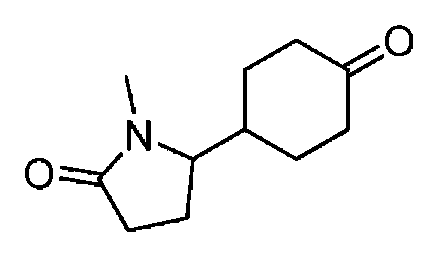
이전 단계에서 제조된 1-메틸-5-(1,4-다이옥사스피로[4.5]데칸-8-일)피롤리딘-2-온의 용액을 실시예 1, 단계 C에 기재된 바와 같이 탈보호하여 생성물을 얻었다.A solution of 1-methyl-5- (1,4-dioxaspiro [4.5] decan-8-yl) pyrrolidin-2-one prepared in the previous step was deprotected as described in Example 1, Step C To give the product.
단계 C: N-(1-((1S,4s)-4-(5-옥소피롤리딘-2-일)사이클로헥실)아제티딘-3-일)-2-((6-(트라이플루오로메틸)퀴나졸린-4-일)아미노)아세트아미드Step C: Preparation of N- (l- ((1S, 4S) -4- (5-oxopyrrolidin-2-yl) cyclohexyl) azetidin- Methyl) quinazolin-4-yl) amino) acetamide

실시예 1, 단계 H에 기재된 바와 같이 TEA 및 NaBH(OAc)3의 존재 하에서 4-(테트라하이드로-2H-피란-4-일)사이클로헥사논 (이전 단계에서 제조됨)과 N-(아제티딘-3-일)-2-((6-(트라이플루오로메틸)퀴나졸린-4-일)아미노)아세트아미드 (실시예 1 단계 G에서 제조됨)의 반응에 의해 생성물을 얻었다.Example 1, (prepared in the previous step) in the presence of TEA and NaBH (OAc) 3 as described in Step H 4- (tetrahydro -2H- pyran-4-yl) cyclohexanone with N- (azetidin -3-yl) -2 - ((6- (trifluoromethyl) quinazolin-4-yl) amino) acetamide (prepared in Step G of Example 1).
1H NMR (MeOD) δ: 8.45 - 8.62 (m, 2H), 7.97 (d, 1H), 7.82 (d, J = 8.6 Hz, 1H), 4.40 - 4.56 (m, 1H), 4.27 (s, 2H), 3.46 - 3.73 (m, 3H), 3.31 (br. s., 1H), 2.84 - 2.95 (m, 2H), 2.77 (s, 3H), 2.23 - 2.47 (m, 3H), 1.90 - 2.07 (m, 2H), 1.74 (br. s., 3H), 1.19 - 1.54 (m, 5H), 0.99 - 1.14 (m, 1H); ESI-MS (m/z): C25H31F3N6O2에 대한 계산치: 504.25; 실측치: 505 (M+H). 1 H NMR (MeOD) δ: 8.45 - 8.62 (m, 2H), 7.97 (d, 1H), 7.82 (d, J = 8.6 Hz, 1H), 4.40 - 4.56 (m, 1H), 4.27 (s, 2H ), 3.46-3.73 (m, 3H), 3.31 (br s, 1H), 2.84-2.95 (m, 2H), 2.77 (s, 3H), 2.23-2.47 (m, 2H), 1.74 (br s, 3H), 1.19-1.54 (m, 5H), 0.99-1. ESI-MS (m / z) : C 25 H 31 F 3 N calculated for 6 O 2: 504.25; Found: 505 (M + H).
실시예Example 40: N-(1-(4-(2- 40: N- (1- (4- (2- 옥소피롤리딘Oxopyrrolidine -1-일)-1 day) 사이클로헥실Cyclohexyl )) 아제티딘Azetidine -3-일)-2-((6-(Yl) -2 - ((6- ( 트라이플루오로메틸Trifluoromethyl )) 퀴나졸린Quinazoline -4-일)아미노)Yl) amino) 아세트아미드Acetamide

단계 A: 1,4-다이옥사스피로[4.5]데칸-8-일 메탄설포네이트Step A: Preparation of 1,4-dioxaspiro [4.5] decan-8-ylmethanesulfonate

1,4-다이옥사스피로[4.5]데칸-8-올 (1 g, 6.32 mmol) 및 트라이에틸아민 (1.3 mL, 9.48 mmol)을 무수 THF에 용해하고 메탄설포닐 클로라이드 (0.73 mL, 9.48 mmol)로 처리하였다. 18시간 동안 교반하였다. 물로 희석하고 EtOAc로 추출하였다. 에틸 아세테이트 층을 포화 NaCl로 세척하고, Na2SO4로 건조하고 증발시켜 예상 생성물을 얻었다. 추가의 정제 없이 사용하였다.(1 g, 6.32 mmol) and triethylamine (1.3 mL, 9.48 mmol) were dissolved in anhydrous THF and methanesulfonyl chloride (0.73 mL, 9.48 mmol) Lt; / RTI > Stir for 18 hours. Diluted with water and extracted with EtOAc. The ethyl acetate layer was washed with saturated NaCl and, Na 2 SO 4, was dried and evaporated to give the expected product. Was used without further purification.
단계 B: 1-(1,4-다이옥사스피로[4.5]데칸-8-일)피롤리딘-2-온Step B: Preparation of 1- (1,4-dioxaspiro [4.5] decan-8-yl) pyrrolidin-

DMF (5 mL) 중 피롤리딘-2-온 (720 mg, 8.46 mmol)을 실온에서 NaH (203 mg, 8.46 mmol)로 처리하였다. 혼합물을 30분 동안 교반하였다. DMF (3 mL) 중의, 상기 단계 A로부터의 1,4-다이옥사스피로[4.5]데칸-8-일 메탄설포네이트 (500 mg, 2.12 mmol)를 혼합물에 첨가하고 130 oC에서 3시간 동안 교반하였다. 혼합물을 실온으로 냉각하고, NH4Cl로 켄칭하고, EtOAc로 추출하였다. EtOAc 층을 포화 NaCl로 세척하고, Na2SO4로 건조하고 증발시켰다. 실리카 분취용 TLC에 의해 정제하여 55 mg (11.5%)의 1-(1,4-다이옥사스피로[4.5]데칸-8-일)피롤리딘-2-온을 얻었다.Pyrrolidin-2-one (720 mg, 8.46 mmol) in DMF (5 mL) was treated with NaH (203 mg, 8.46 mmol) at room temperature. The mixture was stirred for 30 minutes. Dioxaspiro [4.5] decan-8-yl methanesulfonate (500 mg, 2.12 mmol) from step A above in DMF (3 mL) was added to the mixture and stirred at 130 ° C for 3 hours Respectively. The mixture was cooled to room temperature, quenched with NH 4 Cl and extracted with EtOAc. Wash the EtOAc layer with saturated NaCl and dried over Na 2 SO 4 and evaporated. The residue was purified by silica-preparative TLC to obtain 55 mg (11.5%) of 1- (1,4-dioxaspiro [4.5] decan-8-yl) pyrrolidin-2-one.
단계 C: 1-(4-옥소사이클로헥실)피롤리딘-2-온Step C: Preparation of 1- (4-oxocyclohexyl) pyrrolidin-2-one
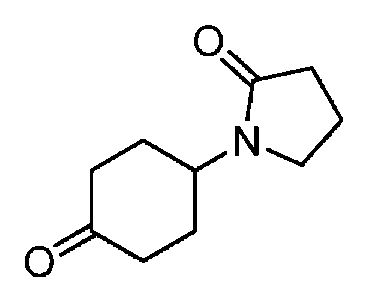
상기 단계 B로부터의 1-(1,4-다이옥사스피로[4.5]데칸-8-일)피롤리딘-2-온 (143 mg, 0.64 mmol)을 아세토니트릴에 용해하고, 6N HCl로 처리하고, 실온에서 18시간 동안 교반하였다. 반응 혼합물을 진공에서 농축하고, pH 6이 되도록 포화 NaHCO3으로 처리하였다. 진공 하에서 용매를 제거하고 잔류물을 포화 NaCl (2 mL)로 처리하고 4:1 EtOAc/iPrOH (x4)로 추출하였다. 유기 분획들을 합하고, 여과하고, 증발시켜 115 mg의 1-(4-옥소사이클로헥실)피롤리딘-2-온을 얻었다.Dioxaspiro [4.5] decan-8-yl) pyrrolidin-2-one (143 mg, 0.64 mmol) from step B above was dissolved in acetonitrile and treated with 6N HCl , And the mixture was stirred at room temperature for 18 hours. The reaction mixture was concentrated in vacuo and treated with saturated NaHCO 3 to pH 6. The solvent was removed in vacuo and the residue was treated with saturated NaCl (2 mL) and extracted with 4: 1 EtOAc / iPrOH (x4). The organic fractions were combined, filtered and evaporated to give 115 mg of 1- (4-oxocyclohexyl) pyrrolidin-2-one.
단계 C: N-(1-(4-(2-옥소피롤리딘-1-일)사이클로헥실)아제티딘-3-일)-2-((6-(트라이플루오로메틸)퀴나졸린-4-일)아미노)아세트아미드Step C: Preparation of N- (1- (4- (2-oxopyrrolidin-1-yl) cyclohexyl) azetidin- Yl) amino) acetamide
실시예 1, 단계 G로부터의 N-(아제티딘-3-일)-2-((6-(트라이플루오로메틸)퀴나졸린-4-일)아미노)아세트아미드 TFA 염 (100 mg, 0.22 mmol), 및 상기 단계 B로부터의 1-(4-옥소사이클로헥실)피롤리딘-2-온 (40.5 mg, 0.22 mmol), 소듐 트라이아세톡시보로하이드라이드 (138 mg, 0.64 mmol)를 아세토니트릴에 용해하고 실온에서 24시간 동안 교반하였다. 혼합물을 MeOH로 처리하고 진공 하에서 농축하였다. 잔류물을 분취용 TLC (nBuOH/aq NH4OH 4:1) 및 역상 HPLC에 의해 정제하여 백색 고체로서 표제 화합물을 얻었다. ESI-MS (m/z): C24H29F3N6O2에 대한 계산치: 490.23; 실측치: 491.23 (M+1).(Trifluoromethyl) quinazolin-4-yl) amino) acetamide TFA salt (100 mg, 0.22 mmol) from Example 1, Step G ), And 1- (4-oxocyclohexyl) pyrrolidin-2-one (40.5 mg, 0.22 mmol) and sodium triacetoxyborohydride (138 mg, 0.64 mmol) from step B above in acetonitrile And stirred at room temperature for 24 hours. The mixture was treated with MeOH and concentrated in vacuo. The residue was purified by preparative TLC (nBuOH / aq NH4OH 4: 1) and reverse phase HPLC to give the title compound as a white solid. ESI-MS (m / z): Calcd for C24H29F3N6O2: 490.23; Found: 491.23 (M + 1).
실시예 41: N-(1-((1s,4s)-4-아세트아미도사이클로헥실)아제티딘-3-일)-2-((6-(트라이플루오로메틸)퀴나졸린-4-일)아미노)아세트아미드Example 41: N- (l- ((1S, 4S) -4-acetamidocyclohexyl) azetidin-3- yl) -2 - ((6- (trifluoromethyl) quinazolin- ) Amino) acetamide

실시예 1, 단계 G로부터의 N-(아제티딘-3-일)-2-((6-(트라이플루오로메틸)퀴나졸린-4-일)아미노)아세트아미드 (100 mg, 0.31 mmol), 및 N-(4-옥소사이클로헥실)아세트아미드 (47.45 mg, 0.31 mmol, 티씨아이 아메리카 파인 케미칼(TCI AMERICA Fine Chemical)), 소듐 트라이아세톡시보로하이드라이드 (189 mg, 0.89 mmol)를 아세토니트릴에 용해하고 실온에서 18시간 동안 교반하였다. 혼합물을 MeOH로 처리하고 진공 하에서 농축하였다. 잔류물을 분취용 TLC (nBuOH/aq NH4OH 4:1) 및 역상 HPLC (25분에 걸쳐 0%-30% CH3CN)에 의해 정제하여 백색 고체로서 표제 화합물을 얻었다. ESI-MS (m/z): C22H27F3N6O2에 대한 계산치: 464.21; 실측치: 465.21 (M+1).(100 mg, 0.31 mmol) from N- (azetidin-3-yl) -2- (6- (trifluoromethyl) quinazolin-4- yl) amino) acetamide from Example 1, (47.45 mg, 0.31 mmol, TCI AMERICA Fine Chemical) and sodium triacetoxyborohydride (189 mg, 0.89 mmol) in acetonitrile And stirred at room temperature for 18 hours. The mixture was treated with MeOH and concentrated in vacuo. The residue was purified by preparative water minutes TLC (nBuOH / aq NH4OH 4: 1) and reverse phase HPLC (over 25 min 0% -30% CH 3 CN) to yield the the title compound as a white solid. ESI-MS (m / z): Calcd for C22H27F3N6O2: 464.21; Found: 465.21 (M + 1).
실시예 42: 벤질 메틸((1s,4s)-4-(3-(2-((6-(트라이플루오로메틸)퀴나졸린-4-일)아미노)아세트아미도)아제티딘-1-일)사이클로헥실)카르바메이트Example 42: Synthesis of benzyl methyl ((1s, 4s) -4- (3- (2- ((6- (trifluoromethyl) quinazolin-4- yl) amino) acetamido) azetidin- ) Cyclohexyl) carbamate

단계 A: 벤질 Step A: Benzyl 메틸(4-옥소사이클로헥실)카르바메이트Methyl (4-oxocyclohexyl) carbamate

DMF 중 벤질 (4-옥소사이클로헥실)카르바메이트 (500 mg, 2.0 mmol)를 실온에서 리튬 헥사메틸다이실라지드 (2.0 mmol)로 처리하였다. 이 용액을 30분 동안 교반하고, 이어서 요오도메탄 (0.25 mL, 4.0 mmol)으로 처리하고 18시간 동안 교반하였다. DMF를 진공 하에서 제거하고 잔류물을 실리카 컬럼 크로마토그래피에 의해 정제하여 표제 화합물을 얻었다.Benzyl (4-oxocyclohexyl) carbamate (500 mg, 2.0 mmol) in DMF was treated with lithium hexamethyldisilazide (2.0 mmol) at room temperature. The solution was stirred for 30 minutes, then treated with iodomethane (0.25 mL, 4.0 mmol) and stirred for 18 hours. The DMF was removed in vacuo and the residue was purified by silica column chromatography to give the title compound.
단계 B: 벤질 메틸((1s,4s)-4-(3-(2-((6-(트라이플루오로메틸)퀴나졸린-4-일)아미노)아세트아미도)아제티딘-1-일)사이클로헥실)카르바메이트Step B: Preparation of benzylmethyl ((ls, 4s) -4- (3- (2- (6- (trifluoromethyl) quinazolin-4- yl) amino) acetamido) azetidin- Cyclohexyl) carbamate
실시예 1, 단계 G로부터의 N-(아제티딘-3-일)-2-((6-(트라이플루오로메틸)퀴나졸린-4-일)아미노)아세트아미드 2.7 TFA 염 (350 mg, 0.55 mmol), 및 단계 A로부터의 N-(4-옥소사이클로헥실)아세트아미드 (143.0 mg, 0.55 mmol), 소듐 트라이아세톡시보로하이드라이드 (337 mg, 1.59 mmol) 및 TEA (0.21 mL, 1.5 mmol)를 아세토니트릴에 용해하고 실온에서 18시간 동안 교반하였다. 혼합물을 진공 하에서 농축하고 잔류물을 NaHCO3으로 염기성화하고, 고체 NaCl로 포화시키고, EtOAc/iPrOH (4:1)로 4회 추출하였다. 유기층을 분리하고, Na2SO4로 건조하고 증발시켰다. 잔류물을 실리카 분취용 TLC에 의해 정제하였다. 플레이트로부터 긁어낸 실리카 밴드를 DCM 중 20% MeOH로 추출하였다. 용매를 진공 하에서 제거하고 잔류물을 MeOH에 용해하고 신틸레이션 바이알로 옮기고 진공 하에서 증발시켰다. 잔류물을 진공 하에서 건조하고 DCM 중 10% MeOH에 용해하고 0.45 마이크로미터 필터를 통해 여과하고 증발시켜 표제 화합물을 얻었다. ESI-MS (m/z): C29H33F3N6O3에 대한 계산치: 570.26; 실측치: 571.26 (M+1).(Trifluoromethyl) quinazolin-4-yl) amino) acetamide 2.7 TFA salt from Example 1, step G (350 mg, 0.55 mmol) and N- (4-oxocyclohexyl) acetamide (143.0 mg, 0.55 mmol), sodium triacetoxyborohydride (337 mg, 1.59 mmol) and TEA (0.21 mL, 1.5 mmol ) Was dissolved in acetonitrile and stirred at room temperature for 18 hours. The mixture was concentrated in vacuo and the residue was basified with NaHCO 3 , saturated with solid NaCl and extracted four times with EtOAc / iPrOH (4: 1). The organic layer was separated, dried over Na 2 SO 4 and evaporated. The residue was purified by silica-preparative TLC. The silica bands scraped from the plate were extracted with 20% MeOH in DCM. The solvent was removed in vacuo and the residue was dissolved in MeOH and transferred to a scintillation vial and evaporated in vacuo. The residue was dried in vacuo, dissolved in 10% MeOH in DCM, filtered through a 0.45 micrometer filter and evaporated to give the title compound. ESI-MS (m / z): Calcd for C29H33F3N6O3: 570.26; Found: 571.26 (M + 1).
실시예 43: N-메틸-N-((1s,4s)-4-(3-(2-((6-(트라이플루오로메틸)퀴나졸린-4-일)아미노)아세트아미도)아제티딘-1-일)사이클로헥실)아이소부티르아미드Example 43: N-Methyl-N - ((lS, 4S) -4- (3- (2- (6- (trifluoromethyl) quinazolin-4- yl) amino) acetamido) -1-yl) cyclohexyl) isobutyramide

단계 A: N-(1-((1s,4s)-4-(Step A: Preparation of N- (1 - ((1s, 4s) -4- ( 메틸아미노Methyl amino )) 사이클로헥실Cyclohexyl )) 아제티딘Azetidine -3-일)-2-((6-(Yl) -2 - ((6- ( 트라이플루오로메틸Trifluoromethyl )) 퀴나졸린Quinazoline -4-일)아미노)Yl) amino) 아세트아미드Acetamide
실시예 3, 단계 B로부터의 벤질 메틸((1s,4s)-4-(3-(2-((6-(트라이플루오로메틸)퀴나졸린-4-일)아미노)아세트아미도)아제티딘-1-일)사이클로헥실)카르바메이트 (126 mg, 0.22 mmol)를 MeOH에 용해하고 5% Pd/C (220 mg)로 처리하였다. 이 용액을 H2 분위기 (H2 풍선)에서 18시간 동안 교반하였다. 여과에 의해 촉매를 제거하고 진공 하에서 용매를 제거하여 오일로서 표제 화합물을 얻었다.((1S, 4S) -4- (3- (2 - ((6- (trifluoromethyl) quinazolin-4- yl) amino) acetamido) azetidine from Example 3, Step B Yl) cyclohexyl) carbamate (126 mg, 0.22 mmol) was dissolved in MeOH and treated with 5% Pd / C (220 mg). The solution was stirred in H 2 atmosphere (H2 balloon) for 18 hours. The catalyst was removed by filtration and the solvent removed in vacuo to give the title compound as an oil.
단계 B: N-메틸-N-((1s,4s)-4-(3-(2-((6-(트라이플루오로메틸)퀴나졸린-4-일)아미노)아세트아미도)아제티딘-1-일)사이클로헥실)아이소부티르아미드Step B: N-Methyl-N - ((lS, 4s) -4- (3- (2- (6- (trifluoromethyl) quinazolin- 4- yl) amino) acetamido) 1-yl) cyclohexyl) isobutyramide
THF 중의, 상기 단계 A로부터의 N-(1-((1s,4s)-4-(메틸아미노)사이클로헥실)아제티딘-3-일)-2-((6-(트라이플루오로메틸)퀴나졸린-4-일)아미노)아세트아미드 (19 mg, 0.04 mmol)의 용액을 TEA (18 ㎕, 0.13 mmol)로 처리하고 -10℃로 냉각하였다. 이 용액에 아이소부티릴 클로라이드 (9.3 mg, 0.09 mmol)를 첨가하고 혼합물을 실온으로 가온되게 두고 5시간 동안 교반하였다. 반응 혼합물을 포화 NaHCO3으로 희석하고 EtOAc로 추출하였다. 에틸 아세테이트 층을 포화 NaCl로 세척하고, Na2SO4로 건조하고 증발시켰다. 잔류물을 실리카 분취용 TLC에 의해 정제하여 표제 화합물을 얻었다. ESI-MS (m/z): C25H33F3N6O2에 대한 계산치: 506.26; 실측치: 507.26 (M+1).Azetidin-3-yl) -2 - ((6- (trifluoromethyl) quinazoline hydrochloride from step A above in THF Yl) amino) acetamide (19 mg, 0.04 mmol) in DMF (5 mL) was treated with TEA (18 L, 0.13 mmol) and cooled to -10 <0> C. To this solution was added isobutyryl chloride (9.3 mg, 0.09 mmol) and the mixture was allowed to warm to room temperature and stirred for 5 hours. The reaction mixture was diluted with saturated NaHCO 3 and extracted with EtOAc. The ethyl acetate layer was washed with saturated NaCl and dried over Na 2 SO 4 and evaporated. The residue was purified by silica preparative TLC to give the title compound. ESI-MS (m / z): Calcd for C25H33F3N6O2: 506.26; Found: 507.26 (M + 1).
실시예 44: N-메틸-N-((1s,4s)-4-(3-(2-((6-(트라이플루오로메틸)퀴나졸린-4-일)아미노)아세트아미도)아제티딘-1-일)사이클로헥실)아세트아미드Example 44: N-Methyl-N - ((1 S, 4S) -4- (3- (2- (6- (trifluoromethyl) quinazolin-4- yl) amino) acetamido) Yl) cyclohexyl) acetamide < RTI ID = 0.0 >

실시예 4, 단계 A로부터의 N-(1-((1s,4s)-4-(메틸아미노)사이클로헥실)아제티딘-3-일)-2-((6-(트라이플루오로메틸)퀴나졸린-4-일)아미노)아세트아미드 (19 mg, 0.04 mmol), 및 아세트산 무수물 (8.3 ㎕, 0.09 mmol)의 용액을 첨가하고 혼합물을 실온으로 가온되게 두고 5시간 동안 교반하였다. 반응 혼합물을 포화 NaHCO3으로 희석하고 EtOAc로 추출하였다. 에틸 아세테이트 층을 포화 NaCl로 세척하고, Na2SO4로 건조하고 증발시켰다. 잔류물을 실리카 분취용 TLC에 의해 정제하여 표제 화합물을 얻었다. ESI-MS (m/z): C23H29F3N6O2에 대한 계산치: 478.23; 실측치: 479.23 (M+1).Azetidin-3-yl) -2 - ((6- (trifluoromethyl) quinacal < / RTI > 4-yl) amino) acetamide (19 mg, 0.04 mmol) and acetic anhydride (8.3 L, 0.09 mmol) were added and the mixture was allowed to warm to room temperature and stirred for 5 hours. The reaction mixture was diluted with saturated NaHCO 3 and extracted with EtOAc. The ethyl acetate layer was washed with saturated NaCl and dried over Na 2 SO 4 and evaporated. The residue was purified by silica preparative TLC to give the title compound. ESI-MS (m / z): Calcd for C23H29F3N6O2: 478.23; Found: 479.23 (M + 1).
실시예 45: N-메틸-N-((1s,4s)-4-(3-(2-((6-(트라이플루오로메틸)퀴나졸린-4-일)아미노)아세트아미도)아제티딘-1-일)사이클로헥실)프로피온아미드Example 45: N-Methyl-N - ((1S, 4S) -4- (3- (2- (6- (trifluoromethyl) quinazolin- -1-yl) cyclohexyl) propionamide

THF 중의, 실시예 4, 단계 A로부터의 N-(1-((1s,4s)-4-(메틸아미노)사이클로헥실)아제티딘-3-일)-2-((6-(트라이플루오로메틸)퀴나졸린-4-일)아미노)아세트아미드 (19 mg, 0.04 mmol)의 용액을 TEA (18 ㎕, 0.13 mmol)로 처리하고 -10℃로 냉각하였다. 이 용액에 프로필 클로라이드 (8.8 ㎕, 0.1 mmol)를 첨가하고 혼합물을 실온으로 가온되게 두고 5시간 동안 교반하였다. 반응 혼합물을 포화 NaHCO3으로 희석하고 EtOAc로 추출하였다. 에틸 아세테이트 층을 포화 NaCl로 세척하고, Na2SO4로 건조하고 증발시켰다. 잔류물을 실리카 분취용 TLC에 의해 정제하여 표제 화합물을 얻었다. ESI-MS (m/z): C24H31F3N6O2에 대한 계산치: 492.25; 실측치: 493.25 (M+1).Azetidin-3-yl) -2 - ((6- (trifluoromethyl) cyclohexyl) Methyl) quinazolin-4-yl) amino) acetamide (19 mg, 0.04 mmol) in DMF (5 mL) was treated with TEA (18 L, 0.13 mmol) To this solution was added propyl chloride (8.8 L, 0.1 mmol) and the mixture was allowed to warm to room temperature and stirred for 5 hours. The reaction mixture was diluted with saturated NaHCO 3 and extracted with EtOAc. The ethyl acetate layer was washed with saturated NaCl and dried over Na 2 SO 4 and evaporated. The residue was purified by silica preparative TLC to give the title compound. ESI-MS (m / z): Calcd for C24H31F3N6O2: 492.25; Found: 493.25 (M + 1).
실시예 46: N-메틸-N-((1s,4s)-4-(3-(2-((6-(트라이플루오로메틸)퀴나졸린-4-일)아미노)아세트아미도)아제티딘-1-일)사이클로헥실)부티르아미드Example 46: N-Methyl-N - ((1S, 4S) -4- (3- (2- (6- (trifluoromethyl) quinazolin-4- yl) amino) acetamido) 1-yl) cyclohexyl) butyramide

THF 중의, 실시예 4, 단계 A로부터의N-(1-((1s,4s)-4-(메틸아미노)사이클로헥실)아제티딘-3-일)-2-((6-(트라이플루오로메틸)퀴나졸린-4-일)아미노)아세트아미드 (19 mg, 0.04 mmol)의 용액을 TEA (18 ㎕, 0.13 mmol)로 처리하고 -10℃로 냉각하였다. 이 용액에 부티릴 클로라이드 (9 ㎕, 0.1 mmol)를 첨가하고 혼합물을 실온으로 가온되게 두고 5시간 동안 교반하였다. 반응 혼합물을 포화 NaHCO3으로 희석하고 EtOAc로 추출하였다. 에틸 아세테이트 층을 포화 NaCl로 세척하고, Na2SO4로 건조하고 증발시켰다. 잔류물을 실리카 분취용 TLC에 의해 정제하여 표제 화합물을 얻었다. ESI-MS (m/z): C25H33F3N6O2에 대한 계산치: 506.26; 실측치: 507.26 (M+1).Azetidin-3-yl) -2 - ((6- (trifluoromethyl) cyclohexyl) Methyl) quinazolin-4-yl) amino) acetamide (19 mg, 0.04 mmol) in DMF (5 mL) was treated with TEA (18 L, 0.13 mmol) To this solution was added butyryl chloride (9 L, 0.1 mmol) and the mixture was allowed to warm to room temperature and stirred for 5 hours. The reaction mixture was diluted with saturated NaHCO 3 and extracted with EtOAc. The ethyl acetate layer was washed with saturated NaCl and dried over Na 2 SO 4 and evaporated. The residue was purified by silica preparative TLC to give the title compound. ESI-MS (m / z): Calcd for C25H33F3N6O2: 506.26; Found: 507.26 (M + 1).
실시예 47: 벤질 에틸((1s,4s)-4-(3-(2-((6-(트라이플루오로메틸)퀴나졸린-4-일)아미노)아세트아미도)아제티딘-1-일)사이클로헥실)카르바메이트Example 47: Synthesis of benzyl ethyl ((1 s, 4s) -4- (3- (2- (6- (trifluoromethyl) quinazolin-4- yl) amino) acetamido) ) Cyclohexyl) carbamate

단계 A: N-에틸-1,4-Step A: N-Ethyl-1,4- 다이옥사스피로[4.5]데칸Dioxaspiro [4.5] decane -8-아민-8-amine
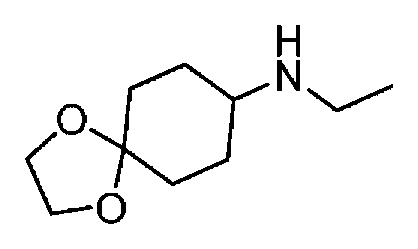
1,4-다이옥사스피로[4.5]데칸-8-온 (2 g, 12.8 mmol), 및 에틸아민 (6.4 mL, 12.8 mmol), 및 소듐 트라이아세톡시보로하이드라이드 (8 g, 38 mmol)를 아세토니트릴에 용해하고 실온에서 18시간 동안 교반하였다. 혼합물을 진공 하에서 농축하고 잔류물을 NaHCO3으로 염기성화하고, 고체 NaCl로 포화시키고, EtOAc/iPrOH (4:1)로 4회 추출하였다. 유기층을 분리하고, Na2SO4로 건조하고 증발시켜 표제 화합물을 얻었다.(2 g, 12.8 mmol), and ethylamine (6.4 mL, 12.8 mmol), and sodium triacetoxyborohydride (8 g, 38 mmol) Was dissolved in acetonitrile and stirred at room temperature for 18 hours. The mixture was concentrated in vacuo and the residue was basified with NaHCO 3 , saturated with solid NaCl and extracted four times with EtOAc / iPrOH (4: 1). The organic layer was separated, Na 2 SO 4, was dried and evaporated to give the title compound.
단계 B: 벤질 에틸(1,4-다이옥사스피로[4.5]데칸-8-일)카르바메이트Step B: Benzyl ethyl (1,4-dioxaspiro [4.5] decan-8-yl) carbamate

THF 중의, 상기 단계 A로부터의 N-에틸-1,4-다이옥사스피로[4.5]데칸-8-아민 (1.8 g, 9.9 mmol)의 용액을 TEA (1.4, 9.9 mmol) 및 벤질옥시카르보닐 클로라이드 (1.4 mL, 9.9 mmol)로 처리하였다. 혼합물을 실온에서 18시간 동안 교반하였다. THF를 진공 하에서 제거하고 잔류물을 EtOAc에 용해하고, 10% 시트르산, 포화 NaHCO3, 및 포화 NaCl로 세척하였다. 용액을 Na2SO4로 건조하고 진공 하에서 증발시켰다. 잔류물을 실리카 컬럼 크로마토그래피에 의해 정제하여 표제 화합물을 얻었다.A solution of N-ethyl-1,4-dioxaspiro [4.5] decane-8-amine (1.8 g, 9.9 mmol) from step A above in THF was treated with TEA (1.4, 9.9 mmol) and benzyloxycarbonyl chloride (1.4 mL, 9.9 mmol). The mixture was stirred at room temperature for 18 hours. The THF was removed in vacuo and the residue was dissolved in EtOAc and washed with 10% citric acid, saturated NaHCO 3 , and saturated NaCl. Drying the solution with Na 2 SO 4 and evaporated in vacuo. The residue was purified by silica column chromatography to give the title compound.
단계 C: 벤질 에틸(4-옥소사이클로헥실)카르바메이트Step C: Benzyl ethyl (4-oxocyclohexyl) carbamate

벤질 에틸(1,4-다이옥사스피로[4.5]데칸-8-일)카르바메이트 (350 mg, 1.1 mmol)를 아세토니트릴에 용해하고, 6N HCl로 처리하고, 실온에서 18시간 동안 교반하였다. 반응 혼합물을 진공에서 농축하고, pH 6이 되도록 포화 NaHCO3으로 처리하였다. 진공 하에서 용매를 제거하고 잔류물을 포화 NaCl (2 mL)로 처리하고 4:1 EtOAc/iPrOH (x4)로 추출하였다. 유기 분획들을 합하고, 여과하고, 증발시켜 표제 화합물을 얻었다.(350 mg, 1.1 mmol) was dissolved in acetonitrile, treated with 6N HCl, and stirred at room temperature for 18 hours. The reaction mixture was concentrated in vacuo and treated with saturated NaHCO 3 to pH 6. The solvent was removed in vacuo and the residue was treated with saturated NaCl (2 mL) and extracted with 4: 1 EtOAc / iPrOH (x4). The organic fractions were combined, filtered and evaporated to give the title compound.
단계 D: 벤질 에틸((1s,4s)-4-(3-(2-((6-(트라이플루오로메틸)퀴나졸린-4-일)아미노)아세트아미도)아제티딘-1-일)사이클로헥실)카르바메이트Step D: Preparation of benzyl ethyl ((ls, 4s) -4- (3- (2- (6- (trifluoromethyl) quinazolin- 4- yl) amino) acetamido) azetidin- Cyclohexyl) carbamate
실시예 1, 단계 G로부터의 N-(아제티딘-3-일)-2-((6-(트라이플루오로메틸)퀴나졸린-4-일)아미노)아세트아미드 2.7 TFA 염 (350 mg, 0.55 mmol), 및 단계 C로부터의 벤질 에틸(4-옥소사이클로헥실)카르바메이트 (150.9 mg, 0.55 mmol), 소듐 트라이아세톡시보로하이드라이드 (337 mg, 1.59 mmol) 및 TEA (0.21 mL, 1.5 mmol)를 아세토니트릴에 용해하고 실온에서 18시간 동안 교반하였다. 혼합물을 진공 하에서 농축하고 잔류물을 NaHCO3으로 염기성화하고, 고체 NaCl로 포화시키고, EtOAc/iPrOH (4:1)로 4회 추출하였다. 유기층을 분리하고, Na2SO4로 건조하고 증발시켰다. 잔류물을 실리카 분취용 TLC에 의해 정제하였다. 플레이트로부터 긁어낸 실리카 밴드를 DCM 중 20% MeOH로 추출하였다. 용매를 진공 하에서 제거하고 잔류물을 MeOH에 용해하고 신틸레이션 바이알로 옮기고 진공 하에서 증발시켰다. 잔류물을 진공 하에서 건조하고 DCM 중 10% MeOH에 용해하고 0.45 마이크로미터 필터를 통해 여과하고 증발시켜 표제 화합물을 얻었다. ESI-MS (m/z): C30H35F3N6O3에 대한 계산치: 584.27; 실측치: 585.27 (M+1).(Trifluoromethyl) quinazolin-4-yl) amino) acetamide 2.7 TFA salt from Example 1, step G (350 mg, 0.55 mmol), and benzylethyl (4-oxocyclohexyl) carbamate (150.9 mg, 0.55 mmol), sodium triacetoxyborohydride (337 mg, 1.59 mmol) and TEA (0.21 mL, 1.5 mmol) were dissolved in acetonitrile and stirred at room temperature for 18 hours. The mixture was concentrated in vacuo and the residue was basified with NaHCO 3 , saturated with solid NaCl and extracted four times with EtOAc / iPrOH (4: 1). The organic layer was separated, dried over Na 2 SO 4 and evaporated. The residue was purified by silica-preparative TLC. The silica bands scraped from the plate were extracted with 20% MeOH in DCM. The solvent was removed in vacuo and the residue was dissolved in MeOH and transferred to a scintillation vial and evaporated in vacuo. The residue was dried in vacuo, dissolved in 10% MeOH in DCM, filtered through a 0.45 micrometer filter and evaporated to give the title compound. ESI-MS (m / z): Calcd for C30H35F3N6O3: 584.27; Found: 585.27 (M + 1).
실시예 48: 벤질 프로필((1s,4s)-4-(3-(2-((6-(트라이플루오로메틸)퀴나졸린-4-일)아미노)아세트아미도)아제티딘-1-일)사이클로헥실)카르바메이트Example 48: Synthesis of benzylpropyl ((ls, 4s) -4- (3- (2 - ((6- (trifluoromethyl) quinazolin-4- yl) amino) acetamido) ) Cyclohexyl) carbamate

단계 A: N-프로필-1,4-Step A: N-Propyl-1,4- 다이옥사스피로[4.5]데칸Dioxaspiro [4.5] decane -8-아민-8-amine

1,4-다이옥사스피로[4.5]데칸-8-온 (2 g, 12.8 mmol), 및 프로필아민 (1.05 mL, 12.8 mmol), 및 소듐 트라이아세톡시보로하이드라이드 (8 g, 38 mmol)를 아세토니트릴에 용해하고 실온에서 18시간 동안 교반하였다. 혼합물을 진공 하에서 농축하고 잔류물을 NaHCO3으로 염기성화하고, 고체 NaCl로 포화시키고, EtOAc/iPrOH (4:1)로 4회 추출하였다. 유기층을 분리하고, Na2SO4로 건조하고 증발시켜 표제 화합물을 얻었다.(2 g, 12.8 mmol), and propylamine (1.05 mL, 12.8 mmol), and sodium triacetoxyborohydride (8 g, 38 mmol) were added to a solution of 4-dioxaspiro [4.5] decan- Was dissolved in acetonitrile and stirred at room temperature for 18 hours. The mixture was concentrated in vacuo and the residue was basified with NaHCO 3 , saturated with solid NaCl and extracted four times with EtOAc / iPrOH (4: 1). The organic layer was separated, Na 2 SO 4, was dried and evaporated to give the title compound.
단계 B: 벤질 프로필(1,4-다이옥사스피로[4.5]데칸-8-일)카르바메이트Step B: Synthesis of benzylpropyl (1,4-dioxaspiro [4.5] decan-8-yl) carbamate

THF 중의, 상기 단계 A로부터의 N-프로필-1,4-다이옥사스피로[4.5]데칸-8-아민 (2.97 g, 14.9 mmol)의 용액을 TEA (2.1, 14.9 mmol) 및 벤질옥시카르보닐 클로라이드 (2.1 mL, 14.9 mmol)로 처리하였다. 혼합물을 실온에서 18시간 동안 교반하였다. THF를 진공 하에서 제거하고 잔류물을 EtOAc에 용해하고, 10% 시트르산, 포화 NaHCO3, 및 포화 NaCl로 세척하였다. 용액을 Na2SO4로 건조하고 진공 하에서 증발시켰다. 잔류물을 실리카 컬럼 크로마토그래피에 의해 정제하여 표제 화합물을 얻었다.A solution of N-propyl-1,4-dioxaspiro [4.5] decan-8-amine (2.97 g, 14.9 mmol) from step A in THF was treated with TEA (2.1, 14.9 mmol) and benzyloxycarbonyl chloride (2.1 mL, 14.9 mmol). The mixture was stirred at room temperature for 18 hours. The THF was removed in vacuo and the residue was dissolved in EtOAc and washed with 10% citric acid, saturated NaHCO 3 , and saturated NaCl. Drying the solution with Na 2 SO 4 and evaporated in vacuo. The residue was purified by silica column chromatography to give the title compound.
단계 C: 벤질 (4-옥소사이클로헥실)(프로필)카르바메이트Step C: Benzyl (4-oxocyclohexyl) (propyl) carbamate

벤질 프로필(1,4-다이옥사스피로[4.5]데칸-8-일)카르바메이트 (350 mg, 1.1 mmol)를 아세토니트릴에 용해하고, 6N HCl로 처리하고, 실온에서 18시간 동안 교반하였다. 반응 혼합물을 진공에서 농축하고, pH 6이 되도록 포화 NaHCO3으로 처리하였다. 진공 하에서 용매를 제거하고 잔류물을 포화 NaCl (2 mL)로 처리하고 4:1 EtOAc/iPrOH (x4)로 추출하였다. 유기 분획들을 합하고, 여과하고, 증발시켜 표제 화합물을 얻었다.(350 mg, 1.1 mmol) was dissolved in acetonitrile, treated with 6N HCl, and stirred at room temperature for 18 hours. The reaction mixture was concentrated in vacuo and treated with saturated NaHCO 3 to pH 6. The solvent was removed in vacuo and the residue was treated with saturated NaCl (2 mL) and extracted with 4: 1 EtOAc / iPrOH (x4). The organic fractions were combined, filtered and evaporated to give the title compound.
단계 D: 벤질 프로필((1s,4s)-4-(3-(2-((6-(트라이플루오로메틸)퀴나졸린-4-일)아미노)Step D: Preparation of (1S, 4S) -4- (3- (2 - ((6- (trifluoromethyl) quinazolin- 아세트아미도Acetamido )) 아제티딘Azetidine -1-일)-1 day) 사이클로헥실Cyclohexyl )) 카르바메이트Carbamate
실시예 1, 단계 G로부터의 N-(아제티딘-3-일)-2-((6-(트라이플루오로메틸)퀴나졸린-4-일)아미노)아세트아미드 2.7 TFA 염 (350 mg, 0.55 mmol), 및 단계 C로부터의 벤질 (4-옥소사이클로헥실)(프로필)카르바메이트 (158.5 mg, 0.55 mmol), 소듐 트라이아세톡시보로하이드라이드 (337 mg, 1.59 mmol) 및 TEA (0.21 mL, 1.5 mmol)를 아세토니트릴에 용해하고 실온에서 18시간 동안 교반하였다. 혼합물을 진공 하에서 농축하고 잔류물을 NaHCO3으로 염기성화하고, 고체 NaCl로 포화시키고, EtOAc/iPrOH (4:1)로 4회 추출하였다. 유기층을 분리하고, Na2SO4로 건조하고 증발시켰다. 잔류물을 실리카 분취용 TLC에 의해 정제하였다. 플레이트로부터 긁어낸 실리카 밴드를 DCM 중 20% MeOH로 추출하였다. 용매를 진공 하에서 제거하고 잔류물을 MeOH에 용해하고 신틸레이션 바이알로 옮기고 진공 하에서 증발시켰다. 잔류물을 진공 하에서 건조하고 DCM 중 10% MeOH에 용해하고 0.45 마이크로미터 필터를 통해 여과하고 증발시켜 표제 화합물을 얻었다. ESI-MS (m/z): C31H37F3N6O3에 대한 계산치: 598.29; 실측치: 599.29 (M+1).(Trifluoromethyl) quinazolin-4-yl) amino) acetamide 2.7 TFA salt from Example 1, step G (350 mg, 0.55 mmol) and benzyl (4-oxocyclohexyl) (propyl) carbamate (158.5 mg, 0.55 mmol), sodium triacetoxyborohydride (337 mg, 1.59 mmol) and TEA , 1.5 mmol) were dissolved in acetonitrile and stirred at room temperature for 18 hours. The mixture was concentrated in vacuo and the residue was basified with NaHCO 3 , saturated with solid NaCl and extracted four times with EtOAc / iPrOH (4: 1). The organic layer was separated, dried over Na 2 SO 4 and evaporated. The residue was purified by silica-preparative TLC. The silica bands scraped from the plate were extracted with 20% MeOH in DCM. The solvent was removed in vacuo and the residue was dissolved in MeOH and transferred to a scintillation vial and evaporated in vacuo. The residue was dried in vacuo, dissolved in 10% MeOH in DCM, filtered through a 0.45 micrometer filter and evaporated to give the title compound. ESI-MS (m / z): Calcd for C31H37F3N6O3: 598.29; Found: 599.29 (M + 1).
실시예 49: N-(1-((1s,4s)-4-(N-메틸메틸설폰아미도)사이클로헥실)아제티딘-3-일)-2-((6-(트라이플루오로메틸)퀴나졸린-4-일)아미노)아세트아미드Example 49: N- (l- ((1s, 4s) -4- (N-methylsulfonamido) cyclohexyl) azetidin- Quinazolin-4-yl) amino) acetamide

THF 중의, 실시예 4, 단계 A로부터의N-(1-((1s,4s)-4-(메틸아미노)사이클로헥실)아제티딘-3-일)-2-((6-(트라이플루오로메틸)퀴나졸린-4-일)아미노)아세트아미드 (19 mg, 0.04 mmol)의 용액을 TEA (18 ㎕, 0.13 mmol)로 처리하고 -10℃로 냉각하였다. 이 용액에 메탄설포닐 클로라이드 (6.3 ㎕, 0.08 mmol)를 첨가하고 혼합물을 실온으로 가온되게 두고 5시간 동안 교반하였다. 반응 혼합물을 포화 NaHCO3으로 희석하고 EtOAc로 추출하였다. 에틸 아세테이트 층을 포화 NaCl로 세척하고, Na2SO4로 건조하고 증발시켰다. 잔류물을 실리카 분취용 TLC에 의해 정제하여 표제 화합물을 얻었다. ESI-MS (m/z): C22H29F3N6O3S에 대한 계산치: 514.20; 실측치: 515.20 (M+1).Azetidin-3-yl) -2 - ((6- (trifluoromethyl) cyclohexyl) Methyl) quinazolin-4-yl) amino) acetamide (19 mg, 0.04 mmol) in DMF (5 mL) was treated with TEA (18 L, 0.13 mmol) Methanesulfonyl chloride (6.3 L, 0.08 mmol) was added to the solution, and the mixture was allowed to warm to room temperature and stirred for 5 hours. The reaction mixture was diluted with saturated NaHCO 3 and extracted with EtOAc. The ethyl acetate layer was washed with saturated NaCl and dried over Na 2 SO 4 and evaporated. The residue was purified by silica preparative TLC to give the title compound. ESI-MS (m / z): Calcd for C22H29F3N6O3S: 514.20; Found: 515.20 (M + 1).
실시예 50: N-에틸-N-((1s,4s)-4-(3-(2-((6-(트라이플루오로메틸)퀴나졸린-4-일)아미노)아세트아미도)아제티딘-1-일)사이클로헥실)아세트아미드Example 50: N-Ethyl-N - ((1S, 4S) -4- (3- (2- (6- (trifluoromethyl) quinazolin-4- yl) amino) acetamido) Yl) cyclohexyl) acetamide < RTI ID = 0.0 >

THF 중 N-(1-((1s,4s)-4-(에틸아미노)사이클로헥실)아제티딘-3-일)-2-((6-(트라이플루오로메틸)퀴나졸린-4-일)아미노)아세트아미드 (32 mg, 0.07 mmol)의 용액을 피리딘 (11.4 ㎕, 0.14 mmol)으로 처리하고 -10℃로 냉각하였다. 이 용액에 아세트산 무수물 (13.4 ㎕, 0.14 mmol)을 첨가하고 혼합물을 실온으로 가온되게 두고 5시간 동안 교반하였다. 반응 혼합물을 포화 NaHCO3으로 희석하고 EtOAc로 추출하였다. 에틸 아세테이트 층을 포화 NaCl로 세척하고, Na2SO4로 건조하고 증발시켰다. 잔류물을 실리카 분취용 TLC에 의해 정제하여 표제 화합물을 얻었다. ESI-MS (m/z): C24H31F3N6O2에 대한 계산치: 492.25; 실측치: 493.25 (M+1).Azetidin-3-yl) -2 - ((6- (trifluoromethyl) quinazolin-4-yl) Amino) acetamide (32 mg, 0.07 mmol) in dichloromethane (5 mL) was treated with pyridine (11.4 L, 0.14 mmol) and cooled to -10 <0> C. Acetic anhydride (13.4 L, 0.14 mmol) was added to the solution, and the mixture was allowed to warm to room temperature and stirred for 5 hours. The reaction mixture was diluted with saturated NaHCO 3 and extracted with EtOAc. The ethyl acetate layer was washed with saturated NaCl and dried over Na 2 SO 4 and evaporated. The residue was purified by silica preparative TLC to give the title compound. ESI-MS (m / z): Calcd for C24H31F3N6O2: 492.25; Found: 493.25 (M + 1).
실시예 51: N-(1-((1s,4s)-4-(N-프로필포름아미도)사이클로헥실)아제티딘-3-일)-2-((6-(트라이플루오로메틸)퀴나졸린-4-일)아미노)아세트아미드Example 51: N- (l- ((1s, 4s) -4- (N-propylformamido) cyclohexyl) azetidin- Yl) amino) acetamide < RTI ID = 0.0 >

DCM 중 아세트산 무수물 (30.5 ㎕, 0.32 mmol)의 용액에 포름산 (12.3 ㎕, 0.32 mmol) 및 피리딘 (26 ㎕, 0.32 mmol)을 첨가하였다. 이 용액을 실온에서 1시간 동안 교반하였다. 여기에, N-(1-((1s,4s)-4-(프로필아미노)사이클로헥실)아제티딘-3-일)-2-((6-(트라이플루오로메틸)퀴나졸린-4-일)아미노)아세트아미드 (30 mg, 0.06 mmol)의 DCM 용액 및 TEA (36 ㎕, 0.26 mmol)를 첨가하고 생성된 용액을 실온에서 18시간 동안 교반하였다. 반응 혼합물을 DCM으로 희석하고 포화 NaHCO3, 포화 NaCl로 세척하고 Na2SO4로 건조하였다. DCM을 진공 하에서 제거하고 잔류물을 분취용 TLC에 의해 정제하여 표제 화합물을 얻었다. ESI-MS (m/z): C24H31F3N6O2에 대한 계산치: 492.25; 실측치: 493.25 (M+1).Formic acid (12.3 L, 0.32 mmol) and pyridine (26 L, 0.32 mmol) were added to a solution of acetic anhydride (30.5 L, 0.32 mmol) in DCM. This solution was stirred at room temperature for 1 hour. To this was added a solution of N- (1 - ((1s, 4s) -4- (propylamino) cyclohexyl) azetidin- ) Amino) acetamide (30 mg, 0.06 mmol) in DCM and TEA (36 L, 0.26 mmol) and the resulting solution was stirred at room temperature for 18 hours. The reaction mixture was diluted with DCM and washed with saturated NaHCO3, saturated NaCl and dried over Na 2 SO 4. The DCM was removed in vacuo and the residue was purified by preparative TLC to give the title compound. ESI-MS (m / z): Calcd for C24H31F3N6O2: 492.25; Found: 493.25 (M + 1).
실시예Example 52: N-(1-((1s,4s)-4-(1,2- 52: N- (1 - ((1S, 4S) -4- (1,2- 옥사지난Oksana -2-일)-2 days) 사이클로헥실Cyclohexyl )) 아제티딘Azetidine -3-일)-2-((6-(트3-yl) -2 - ((6- 라이플루오로Rifluro 메틸)methyl) 퀴나졸린Quinazoline -4-일)아미노)Yl) amino) 아세트아미드Acetamide
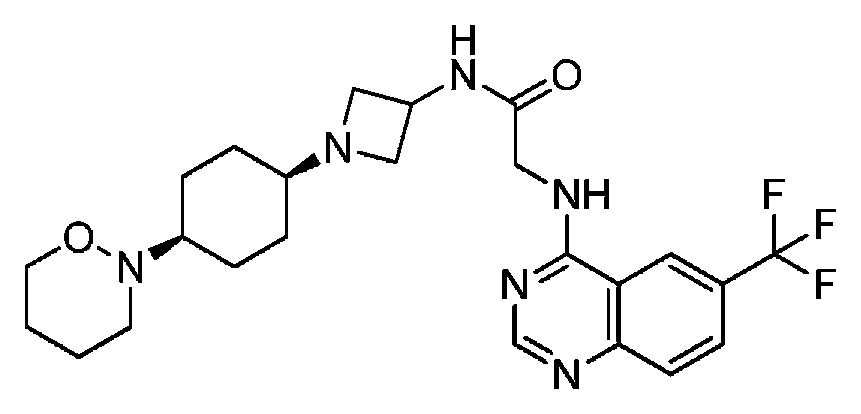
단계 A: 2-(1,4-Step A: 2- (1,4- 다이옥사스피로[4.5]데칸Dioxaspiro [4.5] decane -8-일)-1,2--8-yl) -1,2- 옥사지난Oksana

1,4-다이옥사스피로[4.5]데칸-8-온 (358.5 mg, 2.3 mmol), 및 1,2-옥사지난 (200 mg, 2.3 mmol), 및 소듐 트라이아세톡시보로하이드라이드 (1.46 g, 6.9 mmol)를 아세토니트릴에 용해하고 실온에서 18시간 동안 교반하였다. 혼합물을 진공 하에서 농축하고 잔류물을 NaHCO3으로 염기성화하고, 고체 NaCl로 포화시키고, EtOAc/iPrOH (4:1)로 4회 추출하였다. 유기층을 분리하고, Na2SO4로 건조하고 증발시켰다. 잔류물을 실리카 컬럼 크로마토그래피에 의해 정제하여 표제 화합물을 얻었다.(358.5 mg, 2.3 mmol), and 1,2-oxazin (200 mg, 2.3 mmol), and sodium triacetoxyborohydride (1.46 g, , 6.9 mmol) were dissolved in acetonitrile and stirred at room temperature for 18 hours. The mixture was concentrated in vacuo and the residue was basified with NaHCO 3 , saturated with solid NaCl and extracted four times with EtOAc / iPrOH (4: 1). The organic layer was separated, dried over Na 2 SO 4 and evaporated. The residue was purified by silica column chromatography to give the title compound.
단계 B: 4-(1,2-옥사지난-2-일)사이클로헥사논Step B: 4- (1,2-Oxazin-2-yl) cyclohexanone

상기 단계 A로부터의 2-(1,4-다이옥사스피로[4.5]데칸-8-일)-1,2-옥사지난 (350 mg, 1.54 mmol)을 아세토니트릴에 용해하고, 6N HCl로 처리하고, 실온에서 18시간 동안 교반하였다. 반응 혼합물을 진공에서 농축하고, pH 6이 되도록 포화 NaHCO3으로 처리하였다. 진공 하에서 용매를 제거하고 잔류물을 포화 NaCl (2 mL)로 처리하고 4:1 EtOAc/iPrOH (x4)로 추출하였다. 유기 분획들을 합하고, 여과하고, 증발시켜 표제 화합물을 얻었다.Dioxaspiro [4.5] decan-8-yl) -1,2-oxazin e (350 mg, 1.54 mmol) from step A above was dissolved in acetonitrile, treated with 6N HCl , And the mixture was stirred at room temperature for 18 hours. The reaction mixture was concentrated in vacuo and treated with saturated NaHCO 3 to pH 6. The solvent was removed in vacuo and the residue was treated with saturated NaCl (2 mL) and extracted with 4: 1 EtOAc / iPrOH (x4). The organic fractions were combined, filtered and evaporated to give the title compound.
단계 C: 벤질 에틸((1s,4s)-4-(3-(2-((6-(Step C: Benzylethyl ((1S, 4S) -4- (3- (2 - ((6- ( 트라이플루오로메틸Trifluoromethyl )) 퀴나졸린Quinazoline -4-일)아미노)Yl) amino) 아세트아미도Acetamido )) 아제티딘Azetidine -1-일)-1 day) 사이클로헥실Cyclohexyl )) 카르바메이트Carbamate
실시예 1, 단계 G로부터의 N-(아제티딘-3-일)-2-((6-(트라이플루오로메틸)퀴나졸린-4-일)아미노)아세트아미드 2.0 TFA 염 (100 mg, 0.18 mmol), 및 단계 B로부터의 4-(1,2-옥사지난-2-일)사이클로헥사논 (33 mg, 0.18 mmol), 소듐 트라이아세톡시보로하이드라이드 (111 mg, 0.52 mmol) 및 TEA (50 ㎕, 0.36 mmol)를 아세토니트릴에 용해하고 실온에서 18시간 동안 교반하였다. 혼합물을 진공 하에서 농축하고 잔류물을 NaHCO3으로 염기성화하고, 고체 NaCl로 포화시키고, EtOAc/iPrOH (4:1)로 4회 추출하였다. 유기층을 분리하고, Na2SO4로 건조하고 증발시켰다. 잔류물을 실리카 분취용 TLC에 의해 정제하였다. 플레이트로부터 긁어낸 실리카 밴드를 DCM 중 20% MeOH로 추출하였다. 용매를 진공 하에서 제거하고 잔류물을 MeOH에 용해하고 신틸레이션 바이알로 옮기고 진공 하에서 증발시켰다. 잔류물을 진공 하에서 건조하고 DCM 중 10% MeOH에 용해하고 0.45 마이크로미터 필터를 통해 여과하고 증발시켜 표제 화합물을 얻었다. ESI-MS (m/z): C24H31F3N6O2에 대한 계산치: 492.25; 실측치: 493.25 (M+1).(Trifluoromethyl) quinazolin-4-yl) amino) acetamide 2.0 TFA salt from Example 1, step G (100 mg, 0.18 (33 mg, 0.18 mmol), sodium triacetoxyborohydride (111 mg, 0.52 mmol) and TEA (2-oxazin-2-yl) (50 [mu] L, 0.36 mmol) were dissolved in acetonitrile and stirred at room temperature for 18 hours. The mixture was concentrated in vacuo and the residue was basified with NaHCO 3 , saturated with solid NaCl and extracted four times with EtOAc / iPrOH (4: 1). The organic layer was separated, dried over Na 2 SO 4 and evaporated. The residue was purified by silica-preparative TLC. The silica bands scraped from the plate were extracted with 20% MeOH in DCM. The solvent was removed in vacuo and the residue was dissolved in MeOH and transferred to a scintillation vial and evaporated in vacuo. The residue was dried in vacuo, dissolved in 10% MeOH in DCM, filtered through a 0.45 micrometer filter and evaporated to give the title compound. ESI-MS (m / z): Calcd for C24H31F3N6O2: 492.25; Found: 493.25 (M + 1).
1H NMR (MeOD) δ: 8.18 (s, 1H), 8.00 (s, 1H), 7.37 - 7.54 (m, 2H), 4.03 - 4.15 (m, 1H), 3.86 (s, 2H), 3.49 (t, J = 4.6 Hz, 2H), 3.15 (t, J = 7.8 Hz, 2H), 2.68 (dd, J = 8.3, 4.9 Hz, 2H), 2.11 (t, J = 6.4 Hz, 1H), 1.76 - 1.90 (m, 1H), 1.43 (br. s., 1H), 1.35 (quin, J = 5.7 Hz, 3H), 0.95 - 1.20 (m, 9H) 1 H NMR (MeOD) δ: 8.18 (s, 1H), 8.00 (s, 1H), 7.37 - 7.54 (m, 2H), 4.03 - 4.15 (m, 1H), 3.86 (s, 2H), 3.49 (t (D, J = 8.3, 4.9 Hz, 2H), 2.11 (t, J = 6.4 Hz, 1H), 1.76-1.90 (m, 1H), 1.43 (br s, 1H), 1.35 (quin, J = 5.7 Hz, 3H), 0.95-1.20
실시예 53: N-(1-((1s,4s)-4-(아이속사졸리딘-2-일)사이클로헥실)아제티딘-3-일)-2-((6-(트라이플루오로메틸)퀴나졸린-4-일)아미노)아세트아미드Example 53: N- (l- ((1S, 4s) -4- (isoxazolidin-2-yl) cyclohexyl) azetidin- ) Quinazolin-4-yl) amino) acetamide

단계 A: 2-(1,4-Step A: 2- (1,4- 다이옥사스피로[4.5]데칸Dioxaspiro [4.5] decane -8-일)-8-yl) 아이속사졸리딘Iris jazolidine

1,4-다이옥사스피로[4.5]데칸-8-온 (358.5 mg, 2.3 mmol), 및 아이속사졸리딘 (168 mg, 2.3 mmol), 및 소듐 트라이아세톡시보로하이드라이드 (1.46 g, 6.9 mmol)를 아세토니트릴에 용해하고 실온에서 18시간 동안 교반하였다. 혼합물을 진공 하에서 농축하고 잔류물을 NaHCO3으로 염기성화하고, 고체 NaCl로 포화시키고, EtOAc/iPrOH (4:1)로 4회 추출하였다. 유기층을 분리하고, Na2SO4로 건조하고 증발시켰다. 잔류물을 실리카 컬럼 크로마토그래피에 의해 정제하여 표제 화합물을 얻었다.(358.5 mg, 2.3 mmol), and isoxazolidine (168 mg, 2.3 mmol), and sodium triacetoxyborohydride (1.46 g, 6.9 mmol) were dissolved in acetonitrile and stirred at room temperature for 18 hours. The mixture was concentrated in vacuo and the residue was basified with NaHCO 3 , saturated with solid NaCl and extracted four times with EtOAc / iPrOH (4: 1). The organic layer was separated, dried over Na 2 SO 4 and evaporated. The residue was purified by silica column chromatography to give the title compound.
단계 B: 4-(Step B: 4- ( 아이속사졸리딘Iris jazolidine -2-일)-2 days) 사이클로헥사논Cyclohexanone

상기 단계 A로부터의 2-(1,4-다이옥사스피로[4.5]데칸-8-일)아이속사졸리딘 (350 mg, 1.64 mmol)을 아세토니트릴에 용해하고, 6N HCl로 처리하고, 실온에서 18시간 동안 교반하였다. 반응 혼합물을 진공에서 농축하고, pH 6이 되도록 포화 NaHCO3으로 처리하였다. 진공 하에서 용매를 제거하고 잔류물을 포화 NaCl (2 mL)로 처리하고 4:1 EtOAc/iPrOH (x4)로 추출하였다. 유기 분획들을 합하고, 여과하고, 증발시켜 표제 화합물을 얻었다.(350 mg, 1.64 mmol) was dissolved in acetonitrile, treated with 6N HCl and treated at room temperature with a solution of 2- (1,4-dioxaspiro [4.5] decan-8-yl) isoxazolidine Stir for 18 hours. The reaction mixture was concentrated in vacuo and treated with saturated NaHCO 3 to pH 6. The solvent was removed in vacuo and the residue was treated with saturated NaCl (2 mL) and extracted with 4: 1 EtOAc / iPrOH (x4). The organic fractions were combined, filtered and evaporated to give the title compound.
단계 C: N-(1-((1s,4s)-4-(Step C: Preparation of N- (1 - ((1s, 4s) -4- ( 아이속사졸리딘Iris jazolidine -2-일)-2 days) 사이클로헥실Cyclohexyl )) 아제티딘Azetidine -3-일)-2-((6-(트3-yl) -2 - ((6- 라이플루오로Rifluro 메틸)-methyl)- 퀴나졸린Quinazoline -4-일)아미노)Yl) amino) 아세트아미드Acetamide
실시예 1, 단계 G로부터의 N-(아제티딘-3-일)-2-((6-(트라이플루오로메틸)퀴나졸린-4-일)아미노)아세트아미드 2.0 TFA 염 (100 mg, 0.18 mmol), 및 단계 B로부터의 4-(아이속사졸리딘-2-일)사이클로헥사논 (111 mg, 0.52 mmol), 소듐 트라이아세톡시보로하이드라이드 (111 mg, 0.52 mmol) 및 TEA (50 ㎕, 0.36 mmol)를 아세토니트릴에 용해하고 실온에서 18시간 동안 교반하였다. 혼합물을 진공 하에서 농축하고 잔류물을 NaHCO3으로 염기성화하고, 고체 NaCl로 포화시키고, EtOAc/iPrOH (4:1)로 4회 추출하였다. 유기층을 분리하고, Na2SO4로 건조하고 증발시켰다. 잔류물을 실리카 분취용 TLC에 의해 정제하였다. 플레이트로부터 긁어낸 실리카 밴드를 DCM 중 20% MeOH로 추출하였다. 용매를 진공 하에서 제거하고 잔류물을 MeOH에 용해하고 신틸레이션 바이알로 옮기고 진공 하에서 증발시켰다. 잔류물을 진공 하에서 건조하고 DCM 중 10% MeOH에 용해하고 0.45 마이크로미터 필터를 통해 여과하고 증발시켜 표제 화합물을 얻었다. ESI-MS (m/z): C23H29F3N6O2에 대한 계산치: 478.23; 실측치: 479.23 (M+1).(Trifluoromethyl) quinazolin-4-yl) amino) acetamide 2.0 TFA salt from Example 1, step G (100 mg, 0.18 mmol) and 4- (isoxazolidin-2-yl) cyclohexanone (111 mg, 0.52 mmol), sodium triacetoxyborohydride (111 mg, 0.52 mmol) and TEA Mu] l, 0.36 mmol) was dissolved in acetonitrile and stirred at room temperature for 18 hours. The mixture was concentrated in vacuo and the residue was basified with NaHCO 3 , saturated with solid NaCl and extracted four times with EtOAc / iPrOH (4: 1). The organic layer was separated, dried over Na 2 SO 4 and evaporated. The residue was purified by silica-preparative TLC. The silica bands scraped from the plate were extracted with 20% MeOH in DCM. The solvent was removed in vacuo and the residue was dissolved in MeOH and transferred to a scintillation vial and evaporated in vacuo. The residue was dried in vacuo, dissolved in 10% MeOH in DCM, filtered through a 0.45 micrometer filter and evaporated to give the title compound. ESI-MS (m / z): Calcd for C23H29F3N6O2: 478.23; Found: 479.23 (M + 1).
실시예 54: N-(1-((1s,4s)-4-((2-옥소피페리딘-1-일)메틸)사이클로헥실)아제티딘-3-일)-2-((6-(트라이플루오로메틸)퀴나졸린-4-일)아미노)아세트아미드Example 54: N- (l- ((1S, 4S) -4 - ((2- oxopiperidin- 1 -yl) methyl) cyclohexyl) azetidin- (Trifluoromethyl) quinazolin-4-yl) amino) acetamide

실시예 1, 단계 G로부터의 N-(아제티딘-3-일)-2-((6-(트라이플루오로메틸)퀴나졸린-4-일)아미노)아세트아미드 2.0 TFA 염 (80 mg, 0.15 mmol), 및 1-((4-옥소사이클로헥실)메틸)피페리딘-2-온 (30.3 mg, 0.15 mmol), 소듐 트라이아세톡시보로하이드라이드 (88.8 mg, 0.42 mmol) 및 TEA (40 ㎕, 0.29 mmol)를 아세토니트릴에 용해하고 실온에서 18시간 동안 교반하였다. 혼합물을 진공 하에서 농축하고 잔류물을 NaHCO3으로 염기성화하고, 고체 NaCl로 포화시키고, EtOAc/iPrOH (4:1)로 4회 추출하였다. 유기층을 분리하고, Na2SO4로 건조하고 증발시켰다. 잔류물을 실리카 분취용 TLC에 의해 정제하였다. 플레이트로부터 긁어낸 실리카 밴드를 DCM 중 20% MeOH로 추출하였다. 용매를 진공 하에서 제거하고 잔류물을 MeOH에 용해하고 신틸레이션 바이알로 옮기고 진공 하에서 증발시켰다. 잔류물을 진공 하에서 건조하고 DCM 중 10% MeOH에 용해하고 0.45 마이크로미터 필터를 통해 여과하고 증발시켜 표제 화합물을 얻었다. ESI-MS (m/z): C26H33F3N6O2에 대한 계산치: 518.26; 실측치: 519.26 (M+1).(Trifluoromethyl) quinazolin-4-yl) amino) acetamide 2.0 TFA salt from Example 1, step G (80 mg, 0.15 (30.8 mg, 0.15 mmol), sodium triacetoxyborohydride (88.8 mg, 0.42 mmol), and TEA (40 mg, 0.15 mmol) Mu] l, 0.29 mmol) was dissolved in acetonitrile and stirred at room temperature for 18 hours. The mixture was concentrated in vacuo and the residue was basified with NaHCO 3 , saturated with solid NaCl and extracted four times with EtOAc / iPrOH (4: 1). The organic layer was separated, dried over Na 2 SO 4 and evaporated. The residue was purified by silica-preparative TLC. The silica bands scraped from the plate were extracted with 20% MeOH in DCM. The solvent was removed in vacuo and the residue was dissolved in MeOH and transferred to a scintillation vial and evaporated in vacuo. The residue was dried in vacuo, dissolved in 10% MeOH in DCM, filtered through a 0.45 micrometer filter and evaporated to give the title compound. ESI-MS (m / z): Calcd for C26H33F3N6O2: 518.26; Found: 519.26 (M + 1).
실시예 55: N-(1-((1s,4s)-4-(2-옥소피리딘-1(2H)-일)사이클로헥실)아제티딘-3-일)-2-((6-(트라이플루오로메틸)퀴나졸린-4-일)아미노)아세트아미드Example 55: N- (1 - ((1S, 4S) -4- (2-oxopyridin- 1 (2H) -yl) cyclohexyl) azetidin- Fluoromethyl) quinazolin-4-yl) amino) acetamide

단계 A: 1-(1,4-다이옥사스피로[4.5]데칸-8-일)피리딘-2(1H)-온Step A: 1- (1,4-Dioxaspiro [4.5] decan-8-yl) pyridin-2 (1H)

DMF 중의, 실시예 1, 단계 A로부터의 4-다이옥사스피로[4.5]데칸-8-일 메탄설포네이트 (497 mg, 2 mmol) 및 피리딘-2(1H)-온 (200 mg, 2 mmol)의 용액을 Cs2CO3 (1 g, 3 mmol)로 처리하고 80℃에서 18시간 동안 가열하였다. DMF를 진공 하에서 제거하고 잔류물을 실리카 컬럼 크로마토그래피에 의해 정제하여 표제 화합물을 얻었다.Dioxaspiro [4.5] decan-8-ylmethanesulfonate (497 mg, 2 mmol) and pyridin-2 (1H) -one (200 mg, 2 mmol) from Example 1, Step A, was treated with Cs 2 CO 3 (1 g, 3 mmol) and heated at 80 ℃ for 18 hours. The DMF was removed in vacuo and the residue was purified by silica column chromatography to give the title compound.
단계 B: 1-(4-옥소사이클로헥실)피리딘-2(1H)-온Step B: Preparation of 1- (4-oxocyclohexyl) pyridin-2 (1H) -one

상기 단계 A로부터의 1-(1,4-다이옥사스피로[4.5]데칸-8-일)피리딘-2(1H)-온 (150 mg, 0.64 mmol)을 아세토니트릴에 용해하고, 6N HCl로 처리하고, 실온에서 18시간 동안 교반하였다. 반응 혼합물을 진공에서 농축하고, pH 6이 되도록 포화 NaHCO3으로 처리하였다. 진공 하에서 용매를 제거하고 잔류물을 포화 NaCl (2 mL)로 처리하고 4:1 EtOAc/iPrOH (x4)로 추출하였다. 유기 분획들을 합하고, 여과하고, 증발시켜 표제 화합물을 얻었다.Dioxaspiro [4.5] decan-8-yl) pyridin-2 (1H) -one (150 mg, 0.64 mmol) from Step A above was dissolved in acetonitrile and treated with 6N HCl And stirred at room temperature for 18 hours. The reaction mixture was concentrated in vacuo and treated with saturated NaHCO 3 to pH 6. The solvent was removed in vacuo and the residue was treated with saturated NaCl (2 mL) and extracted with 4: 1 EtOAc / iPrOH (x4). The organic fractions were combined, filtered and evaporated to give the title compound.
단계 C: N-(1-((1s,4s)-4-(2-옥소피리딘-1(2H)-일)사이클로헥실)아제티딘-3-일)-2-((6-(트라이플루오로메틸)퀴나졸린-4-일)아미노)아세트아미드Step C: Preparation of N- (l- (ls, 4s) -4- (2-oxopyridin- l (2H) -yl) cyclohexylJazetidin- Dimethyl-quinazolin-4-yl) amino) acetamide
실시예 1, 단계 G로부터의 N-(아제티딘-3-일)-2-((6-(트라이플루오로메틸)퀴나졸린-4-일)아미노)아세트아미드 2.0 TFA 염 (100 mg, 0.18 mmol), 및 단계 B로부터의 1-(4-옥소사이클로헥실)피리딘-2(1H)-온 (34.6 mg, 0.18 mmol), 소듐 트라이아세톡시보로하이드라이드 (111 mg, 0.52 mmol) 및 TEA (50 ㎕, 0.36 mmol)를 아세토니트릴에 용해하고 실온에서 18시간 동안 교반하였다. 혼합물을 진공 하에서 농축하고 잔류물을 NaHCO3으로 염기성화하고, 고체 NaCl로 포화시키고, EtOAc/iPrOH (4:1)로 4회 추출하였다. 유기층을 분리하고, Na2SO4로 건조하고 증발시켰다. 잔류물을 실리카 분취용 TLC에 의해 정제하였다. 플레이트로부터 긁어낸 실리카 밴드를 DCM 중 20% MeOH로 추출하였다. 용매를 진공 하에서 제거하고 잔류물을 MeOH에 용해하고 신틸레이션 바이알로 옮기고 진공 하에서 증발시켰다. 잔류물을 진공 하에서 건조하고 DCM 중 10% MeOH에 용해하고 0.45 마이크로미터 필터를 통해 여과하고 증발시켜 표제 화합물을 얻었다. ESI-MS (m/z): C25H27F3N6O2에 대한 계산치: 500.21; 실측치: 501.21 (M+1).(Trifluoromethyl) quinazolin-4-yl) amino) acetamide 2.0 TFA salt from Example 1, step G (100 mg, 0.18 mmol), and 1- (4-oxocyclohexyl) pyridin-2 (1H) -one from step B (34.6 mg, 0.18 mmol), sodium triacetoxyborohydride (111 mg, 0.52 mmol) (50 [mu] L, 0.36 mmol) were dissolved in acetonitrile and stirred at room temperature for 18 hours. The mixture was concentrated in vacuo and the residue was basified with NaHCO 3 , saturated with solid NaCl and extracted four times with EtOAc / iPrOH (4: 1). The organic layer was separated, dried over Na 2 SO 4 and evaporated. The residue was purified by silica-preparative TLC. The silica bands scraped from the plate were extracted with 20% MeOH in DCM. The solvent was removed in vacuo and the residue was dissolved in MeOH and transferred to a scintillation vial and evaporated in vacuo. The residue was dried in vacuo, dissolved in 10% MeOH in DCM, filtered through a 0.45 micrometer filter and evaporated to give the title compound. ESI-MS (m / z): Calcd for C25H27F3N6O2: 500.21; Found: 501.21 (M + 1).
1H NMR (MeOH) δ: 8.62 (s, 1H), 8.56 (s, 1H), 8.03 (dd, J = 8.8, 2.0 Hz, 1H), 7.88 (d, J = 8.8 Hz, 1H), 7.79 (dd, J = 7.1, 1.7 Hz, 1H), 7.47 (ddd, J = 8.9, 6.7, 2.0 Hz, 1H), 6.53 (d, J = 8.3 Hz, 1H), 6.43 (td, J = 6.8, 1.3 Hz, 1H), 4.85 (t, J = 3.5 Hz, 1H), 4.53 (t, J = 7.2 Hz, 1H), 4.29 (s, 2H), 3.71 - 3.80 (m, 2H), 3.00 (t, J = 7.7 Hz, 2H), 2.48 (br. s., 1H), 1.83 - 1.95 (m, 4H), 1.52 - 1.67 (m, 4H) 1 H NMR (MeOH) δ: 8.62 (s, 1H), 8.56 (s, 1H), 8.03 (dd, J = 8.8, 2.0 Hz, 1H), 7.88 (d, J = 8.8 Hz, 1H), 7.79 ( (dd, J = 7.1, 1.7 Hz, 1H), 7.47 (ddd, J = 8.9, 6.7, 2.0 Hz, 1H), 6.53 J = 7.2 Hz, 1 H), 4.29 (s, 2H), 3.71-3.80 (m, 2H), 3.00 (t, J = 1H), 1.83-1.95 (m, 4H), 1.52-1.67 (m, 4H)
실시예Example 56: N-(1-((1s,4s)-4-(2- 56: N- (1 - ((1 S, 4 S) -4- (2- 옥소피페리딘Oxopiperidine -1-일)-1 day) 사이클로헥실Cyclohexyl )) 아제티딘Azetidine -3-일)-2-((6-(트3-yl) -2 - ((6- 라이플루오Rifluo 로메틸)Lt; / RTI > 퀴나졸린Quinazoline -4-일)아미노)Yl) amino) 아세트아미드Acetamide

실시예 1, 단계 G로부터의 N-(아제티딘-3-일)-2-((6-(트라이플루오로메틸)퀴나졸린-4-일)아미노)아세트아미드 2.0 TFA 염 (100 mg, 0.18 mmol), 및 1-(4-옥소사이클로헥실)피페리딘-2-온 (35 mg, 0.18 mmol), 소듐 트라이아세톡시보로하이드라이드 (111 mg, 0.52 mmol) 및 TEA (50 ㎕, 0.36 mmol)를 아세토니트릴에 용해하고 실온에서 18시간 동안 교반하였다. 혼합물을 진공 하에서 농축하고 잔류물을 NaHCO3으로 염기성화하고, 고체 NaCl로 포화시키고, EtOAc/iPrOH (4:1)로 4회 추출하였다. 유기층을 분리하고, Na2SO4로 건조하고 증발시켰다. 잔류물을 실리카 분취용 TLC에 의해 정제하였다. 플레이트로부터 긁어낸 실리카 밴드를 DCM 중 20% MeOH로 추출하였다. 용매를 진공 하에서 제거하고 잔류물을 MeOH에 용해하고 신틸레이션 바이알로 옮기고 진공 하에서 증발시켰다. 잔류물을 진공 하에서 건조하고 DCM 중 10% MeOH에 용해하고 0.45 마이크로미터 필터를 통해 여과하고 증발시켜 표제 화합물을 얻었다. ESI-MS (m/z): C25H31F3N6O2에 대한 계산치: 504.25; 실측치: 505.25 (M+1).(Trifluoromethyl) quinazolin-4-yl) amino) acetamide 2.0 TFA salt from Example 1, step G (100 mg, 0.18 (35 mg, 0.18 mmol), sodium triacetoxyborohydride (111 mg, 0.52 mmol) and TEA (50 [mu] L, 0.36 mmol) mmol) were dissolved in acetonitrile and stirred at room temperature for 18 hours. The mixture was concentrated in vacuo and the residue was basified with NaHCO 3 , saturated with solid NaCl and extracted four times with EtOAc / iPrOH (4: 1). The organic layer was separated, dried over Na 2 SO 4 and evaporated. The residue was purified by silica-preparative TLC. The silica bands scraped from the plate were extracted with 20% MeOH in DCM. The solvent was removed in vacuo and the residue was dissolved in MeOH and transferred to a scintillation vial and evaporated in vacuo. The residue was dried in vacuo, dissolved in 10% MeOH in DCM, filtered through a 0.45 micrometer filter and evaporated to give the title compound. ESI-MS (m / z): Calcd for C25H31F3N6O2: 504.25; Found: 505.25 (M + 1).
실시예 57: N-(1-((1s,4s)-4-(2,5-다이옥소피롤리딘-1-일)사이클로헥실)아제티딘-3-일)-2-((6-(트라이플루오로메틸)퀴나졸린-4-일)아미노)아세트아미드Example 57: N- (l- (ls, 4s) -4- (2,5-dioxopyrrolidin- l-yl) cyclohexyljazetidin- Trifluoromethyl) quinazolin-4-yl) amino) acetamide

단계 A: 1-(1,4-Step A: 1- (1,4- 다이옥사스피로[4.5]데칸Dioxaspiro [4.5] decane -8-일)-8-yl) 피롤리딘Pyrrolidine -2,5--2,5- 다이온Dion

DMF 중 피롤리딘-2,5-다이온 (210 mg, 2 mmol)의 용액을 소듐헥사메틸다이실라지드 (1.5 eq)로 처리하고, 30분 동안 교반하고, 실시예 1, 단계 A로부터의 4-다이옥사스피로[4.5]데칸-8-일 메탄설포네이트 (250 mg, 1 mmol)로 처리하고, 80℃에서 18시간 동안 가열하였다. DMF를 진공 하에서 제거하고 잔류물을 실리카 컬럼 크로마토그래피에 의해 정제하여 표제 화합물을 얻었다.A solution of pyrrolidine-2,5-dione (210 mg, 2 mmol) in DMF was treated with sodium hexamethyldisilazide (1.5 eq) and stirred for 30 min. Was treated with 4-dioxaspiro [4.5] decan-8-ylmethanesulfonate (250 mg, 1 mmol) and heated at 80 <0> C for 18 h. The DMF was removed in vacuo and the residue was purified by silica column chromatography to give the title compound.
단계 B: 1-(4-옥소사이클로헥실)피롤리딘-2,5-다이온Step B: Preparation of 1- (4-oxocyclohexyl) pyrrolidine-2,5-dione

상기 단계 A로부터의 1-(1,4-다이옥사스피로[4.5]데칸-8-일)피롤리딘-2,5-다이온 (60 mg, 0.25 mmol)을 아세토니트릴에 용해하고, 6N HCl로 처리하고, 실온에서 18시간 동안 교반하였다. 반응 혼합물을 진공에서 농축하고, pH 6이 되도록 포화 NaHCO3로 처리하였다. 진공 하에서 용매를 제거하고 잔류물을 포화 NaCl (2 mL)로 처리하고 4:1 EtOAc/iPrOH (x4)로 추출하였다. 유기 분획들을 합하고, 여과하고, 증발시켜 표제 화합물을 얻었다.Dioxaspiro [4.5] decan-8-yl) pyrrolidine-2,5-dione (60 mg, 0.25 mmol) from step A above was dissolved in acetonitrile and 6N HCl And stirred at room temperature for 18 hours. The reaction mixture was concentrated in vacuo and treated with saturated NaHCO 3 to pH 6. The solvent was removed in vacuo and the residue was treated with saturated NaCl (2 mL) and extracted with 4: 1 EtOAc / iPrOH (x4). The organic fractions were combined, filtered and evaporated to give the title compound.
단계 C: N-(1-((1s,4s)-4-(2,5-다이옥소피롤리딘-1-일)사이클로헥실)아제티딘-3-일)-2-((6-(트라이플루오로메틸)-퀴나졸린-4-일)아미노)아세트아미드Step C: Preparation of N- (1 - ((1S, 4S) -4- (2,5-dioxopyrrolidin- 1 -yl) cyclohexyl) azetidin- Fluoromethyl) -quinazolin-4-yl) amino) acetamide
실시예 1, 단계 G로부터의 N-(아제티딘-3-일)-2-((6-(트라이플루오로메틸)퀴나졸린-4-일)아미노)아세트아미드 2.0 TFA 염 (139 mg, 0.25 mmol), 및 단계 B로부터의 1-(4-옥소사이클로헥실)피롤리딘-2,5-다이온 (49 mg, 0.25 mmol), 소듐 트라이아세톡시보로하이드라이드 (154 mg, 0.73 mmol) 및 TEA (70 ㎕, 0.5 mmol)를 아세토니트릴에 용해하고 실온에서 18시간 동안 교반하였다. 혼합물을 진공 하에서 농축하고 잔류물을 NaHCO3으로 염기성화하고, 고체 NaCl로 포화시키고, EtOAc/iPrOH (4:1)로 4회 추출하였다. 유기층을 분리하고, Na2SO4로 건조하고 증발시켰다. 잔류물을 실리카 분취용 TLC에 의해 정제하였다. 플레이트로부터 긁어낸 실리카 밴드를 DCM 중 20% MeOH로 추출하였다. 용매를 진공 하에서 제거하고 잔류물을 MeOH에 용해하고 신틸레이션 바이알로 옮기고 진공 하에서 증발시켰다. 잔류물을 진공 하에서 건조하고 DCM 중 10% MeOH에 용해하고 0.45 마이크로미터 필터를 통해 여과하고 증발시켜 표제 화합물을 얻었다. ESI-MS (m/z): C24H27F3N6O3에 대한 계산치: 504.21; 실측치: 505.21 (M+1).(Trifluoromethyl) quinazolin-4-yl) amino) acetamide 2.0 TFA salt from Example 1, step G (139 mg, 0.25 pyrrolidine-2,5-dione (49 mg, 0.25 mmol), sodium triacetoxyborohydride (154 mg, 0.73 mmol) from step B and 1- And TEA (70 [mu] L, 0.5 mmol) were dissolved in acetonitrile and stirred at room temperature for 18 hours. The mixture was concentrated in vacuo and the residue was basified with NaHCO 3 , saturated with solid NaCl and extracted four times with EtOAc / iPrOH (4: 1). The organic layer was separated, dried over Na 2 SO 4 and evaporated. The residue was purified by silica-preparative TLC. The silica bands scraped from the plate were extracted with 20% MeOH in DCM. The solvent was removed in vacuo and the residue was dissolved in MeOH and transferred to a scintillation vial and evaporated in vacuo. The residue was dried in vacuo, dissolved in 10% MeOH in DCM, filtered through a 0.45 micrometer filter and evaporated to give the title compound. ESI-MS (m / z): Calcd for C24H27F3N6O3: 504.21; Found: 505.21 (M + 1).
실시예Example 58: N-(1-((1s,4s)-4-(2- 58: N- (1 - ((1S, 4S) -4- (2- 옥소피리딘Oxopyridine -1(2H)-일)-1 (2H) -yl) 사이클로헥실Cyclohexyl )) 아제티딘Azetidine -3-일)-2-((6-(Yl) -2 - ((6- ( 트라이플루오로메틸Trifluoromethyl )퀴놀린-4-일)아미노)) Quinolin-4-yl) amino) 아세트아미드Acetamide
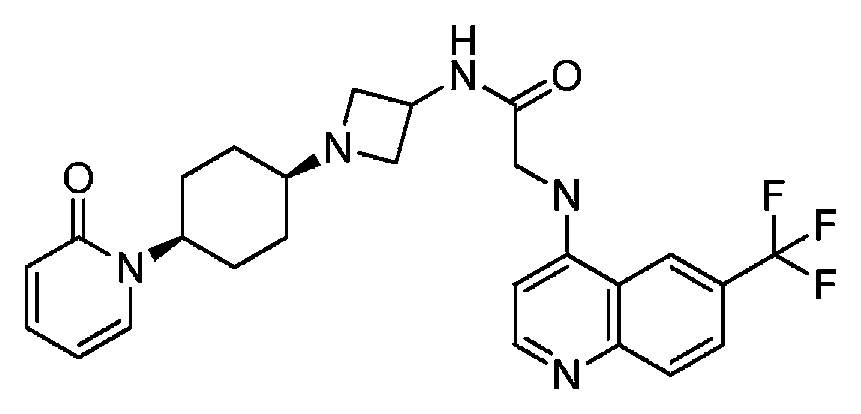
실시예 26, 단계 I로부터의 N-(아제티딘-3-일)-2-((6-(트라이플루오로메틸)퀴놀린-4-일)아미노)아세트아미드 2.0 TFA 염 (100 mg, 0.18 mmol), 및 실시예 16 단계 B로부터의 1-(4-옥소사이클로헥실)피리딘-2(1H)-온 (34.6 mg, 0.18 mmol), 소듐 트라이아세톡시보로하이드라이드 (142 mg, 0.67 mmol) 및 TEA (50 ㎕, 0.36 mmol)를 아세토니트릴에 용해하고 실온에서 18시간 동안 교반하였다. 혼합물을 진공 하에서 농축하고 잔류물을 NaHCO3으로 염기성화하고, 고체 NaCl로 포화시키고, EtOAc/iPrOH (4:1)로 4회 추출하였다. 유기층을 분리하고, Na2SO4로 건조하고 증발시켰다. 잔류물을 실리카 분취용 TLC에 의해 정제하였다. 플레이트로부터 긁어낸 실리카 밴드를 DCM 중 20% MeOH로 추출하였다. 용매를 진공 하에서 제거하고 잔류물을 MeOH에 용해하고 신틸레이션 바이알로 옮기고 진공 하에서 증발시켰다. 잔류물을 진공 하에서 건조하고 DCM 중 10% MeOH에 용해하고 0.45 마이크로미터 필터를 통해 여과하고 증발시켜 표제 화합물을 얻었다. ESI-MS (m/z): C26H28F3N5O2에 대한 계산치: 499.22; 실측치: 500.22 (M+1).2- ((6- (trifluoromethyl) quinolin-4-yl) amino) acetamide 2.0 TFA salt from Example 26, Step I (100 mg, 0.18 mmol ) And 1- (4-oxocyclohexyl) pyridin-2 (1H) -one (34.6 mg, 0.18 mmol), sodium triacetoxyborohydride (142 mg, 0.67 mmol) And TEA (50 [mu] L, 0.36 mmol) were dissolved in acetonitrile and stirred at room temperature for 18 hours. The mixture was concentrated in vacuo and the residue was basified with NaHCO 3 , saturated with solid NaCl and extracted four times with EtOAc / iPrOH (4: 1). The organic layer was separated, dried over Na 2 SO 4 and evaporated. The residue was purified by silica-preparative TLC. The silica bands scraped from the plate were extracted with 20% MeOH in DCM. The solvent was removed in vacuo and the residue was dissolved in MeOH and transferred to a scintillation vial and evaporated in vacuo. The residue was dried in vacuo, dissolved in 10% MeOH in DCM, filtered through a 0.45 micrometer filter and evaporated to give the title compound. ESI-MS (m / z): Calcd for C26H28F3N5O2: 499.22; Found: 500.22 (M + 1).
1H NMR (MeOD) δ: 8.61 (s, 1H), 8.49 (d, J = 5.6 Hz, 1H), 7.95 - 8.01 (m, 1H), 7.85 - 7.93 (m, 1H), 7.78 (d, J = 6.8 Hz, 1H), 7.41 - 7.51 (m, 1H), 6.47 - 6.58 (m, 2H), 6.43 (t, J = 6.7 Hz, 1H), 4.79 - 4.86 (m, 1H), 4.55 (t, J = 7.1 Hz, 1H), 4.12 (s, 2H), 3.74 (t, J = 7.6 Hz, 2H), 2.99 (t, J = 7.5 Hz, 2H), 2.47 (br. s., 1H), 1.80 - 1.93 (m, 4H), 1.51 - 1.66 (m, 4H) 1 H NMR (MeOD) δ: 8.61 (s, 1H), 8.49 (d, J = 5.6 Hz, 1H), 7.95 - 8.01 (m, 1H), 7.85 - 7.93 (m, 1H), 7.78 (d, J J = 6.7 Hz, 1H), 4.79-4.86 (m, 1H), 4.55 (t, 2H) (T, J = 7.5 Hz, 2H), 2.74 (s, 2H), 3.74 (t, J = - 1.93 (m, 4H), 1.51 - 1.66 (m, 4H)
실시예Example 59: 2-((2,6- 59: 2 - ((2,6- 비스(트라이플루오로메틸)퀴놀린Bis (trifluoromethyl) quinoline -4-일)아미노)-N-(1-((1s,4s)-4-(2-옥Yl) amino) -N- (1 - ((1s, 4s) -4- (2- 소피Sophie 리딘-1(2H)-일)Lt; / RTI > (2H) -yl) 사이클로헥실Cyclohexyl )) 아제티딘Azetidine -3-일)-3 days) 아세트아미드Acetamide

실시예 24, 단계 D로부터의 N-(아제티딘-3-일)-2-((2,6-비스(트라이플루오로메틸)퀴놀린-4-일)아미노)아세트아미드 2.0 TFA 염 (100 mg, 0.16 mmol) 및 실시예 16 단계 B로부터의 1-(4-옥소사이클로헥실)피리딘-2(1H)-온 (31 mg, 0.16 mmol), 소듐 트라이아세톡시보로하이드라이드 (126 mg, 0.60 mmol) 및 TEA (45 ㎕, 0.32 mmol)를 아세토니트릴에 용해하고 실온에서 18시간 동안 교반하였다. 혼합물을 진공 하에서 농축하고 잔류물을 NaHCO3으로 염기성화하고, 고체 NaCl로 포화시키고, EtOAc/iPrOH (4:1)로 4회 추출하였다. 유기층을 분리하고, Na2SO4로 건조하고 증발시켰다. 잔류물을 실리카 분취용 TLC에 의해 정제하였다. 플레이트로부터 긁어낸 실리카 밴드를 DCM 중 20% MeOH로 추출하였다. 용매를 진공 하에서 제거하고 잔류물을 MeOH에 용해하고 신틸레이션 바이알로 옮기고 진공 하에서 증발시켰다. 잔류물을 진공 하에서 건조하고 DCM 중 10% MeOH에 용해하고 0.45 마이크로미터 필터를 통해 여과하고 증발시켜 표제 화합물을 얻었다. ESI-MS (m/z): C27H27F6N5O2에 대한 계산치: 567.21; 실측치: 568.21 (M+1).(Trifluoromethyl) quinolin-4-yl) amino) acetamide 2.0 TFA salt from Example 24, step D (100 mg , 0.16 mmol) and 1- (4-oxocyclohexyl) pyridin-2 (1H) -one from Example 16 Step B (31 mg, 0.16 mmol) and sodium triacetoxyborohydride mmol) and TEA (45 [mu] L, 0.32 mmol) were dissolved in acetonitrile and stirred at room temperature for 18 hours. The mixture was concentrated in vacuo and the residue was basified with NaHCO 3 , saturated with solid NaCl and extracted four times with EtOAc / iPrOH (4: 1). The organic layer was separated, dried over Na 2 SO 4 and evaporated. The residue was purified by silica-preparative TLC. The silica bands scraped from the plate were extracted with 20% MeOH in DCM. The solvent was removed in vacuo and the residue was dissolved in MeOH and transferred to a scintillation vial and evaporated in vacuo. The residue was dried in vacuo, dissolved in 10% MeOH in DCM, filtered through a 0.45 micrometer filter and evaporated to give the title compound. ESI-MS (m / z): Calcd for C27H27F6N5O2: 567.21; Found: 568.21 (M + 1).
실시예 60: 2-((2-시아노-6-(트라이플루오로메틸)퀴놀린-4-일)아미노)-N-(1-((1s,4s)-4-(2-옥소피리딘-1(2H)-일)사이클로헥실)아제티딘-3-일)아세트아미드Example 60: 2- ((2-Cyano-6- (trifluoromethyl) quinolin-4-yl) 1 (2H) -yl) cyclohexyl) azetidin-3-yl) acetamide

단계 A: 에틸 4-((4-메톡시벤질)Step A: Ethyl 4 - ((4-methoxybenzyl) 옥시Oxy )-6-() -6- ( 트라이플루오로메틸Trifluoromethyl )퀴놀린-2-) Quinolin-2- 카르복실레이트Carboxylate
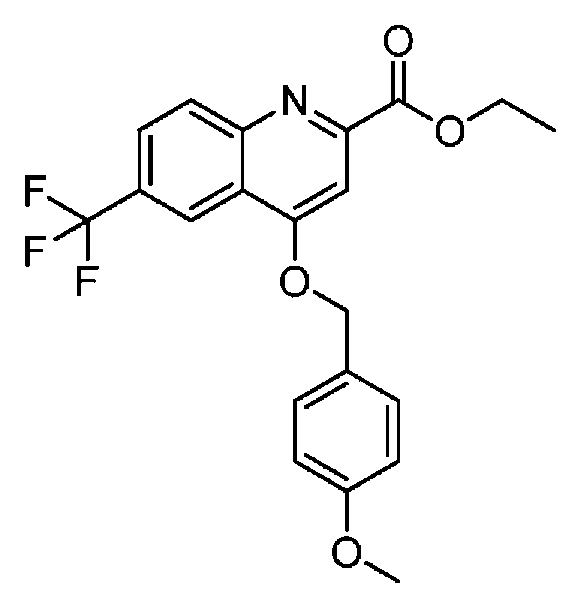
에틸 4-하이드록시-6-(트라이플루오로메틸)퀴놀린-2-카르복실레이트 (50 g, 175 mmol) 및 1-(클로로메틸)-4-메톡시벤젠 (33 ml, 245 mmol)의 아세토니트릴 용액을 Cs2CO3 (80g, 245 mmol)으로 처리하고 70℃에서 18시간 동안 가열하였다. 여과에 의해 염을 제거하고 진공 하에서 용매를 제거하였다. 잔류물을 EtOAc에 용해하고 물 및 포화 NaCl로 세척하였다. 유기층을 Na2SO4로 건조하고 진공 하에서 증발시켰다. 생성된 고체를 EtOAc/Hex로부터 재결정하여 표제 화합물을 얻었다.A mixture of ethyl 4-hydroxy-6- (trifluoromethyl) quinoline-2-carboxylate (50 g, 175 mmol) and 1- (chloromethyl) -4- methoxybenzene (33 ml, 245 mmol) process the nitrile solution with Cs 2 CO 3 (80g, 245 mmol) and heated at 70 ℃ for 18 hours. The salt was removed by filtration and the solvent was removed under vacuum. The residue was dissolved in EtOAc and washed with water and saturated NaCl. The organic layer is dried over Na 2 SO 4 and evaporated in vacuo. The resulting solid was recrystallized from EtOAc / Hex to give the title compound.
단계 B: 4-((4-메톡시벤질)옥시)-6-(트라이플루오로메틸)퀴놀린-2-카르복스아미드Step B: Preparation of 4- ((4-methoxybenzyl) oxy) -6- (trifluoromethyl) quinoline-2-carboxamide
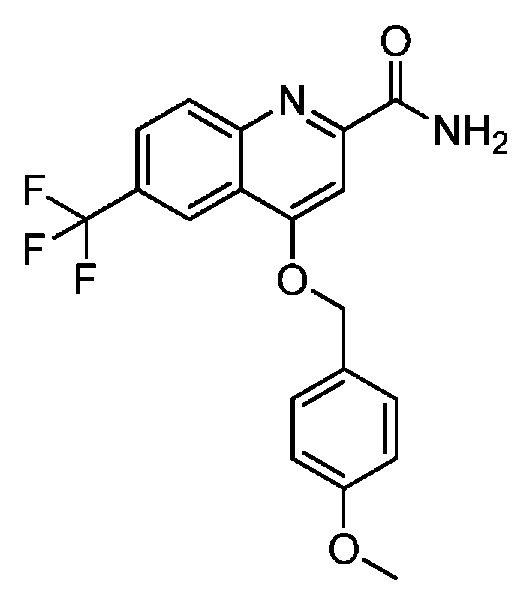
상기 단계 A로부터의 에틸 4-((4-메톡시벤질)옥시)-6-(트라이플루오로메틸)퀴놀린-2-카르복실레이트 (53g, 131 mmol)의 메탄올 용액을 얼음조에서 냉각하고 암모니아 중에서 버블링하여 암모니아로 포화시켰다. 플라스크에 뚜껑을 덮고 실온에서 20시간 동안 교반하였다. 형성된 백색 침전물을 여과에 의해 수집하고 소량의 MeOH로 세척하고 진공 하에서 건조하여 표제 화합물을 얻었다.The methanolic solution of ethyl 4 - ((4-methoxybenzyl) oxy) -6- (trifluoromethyl) quinoline-2-carboxylate from step A above (53 g, 131 mmol) was cooled in an ice bath and ammonia And saturated with ammonia. The flask was capped and stirred at room temperature for 20 hours. The resulting white precipitate was collected by filtration, washed with a small amount of MeOH and dried under vacuum to give the title compound.
단계 C: 4-((4-메톡시벤질)옥시)-6-(트라이플루오로메틸)퀴놀린-2-카르보니트릴Step C: Preparation of 4 - ((4-methoxybenzyl) oxy) -6- (trifluoromethyl) quinoline-2-carbonitrile
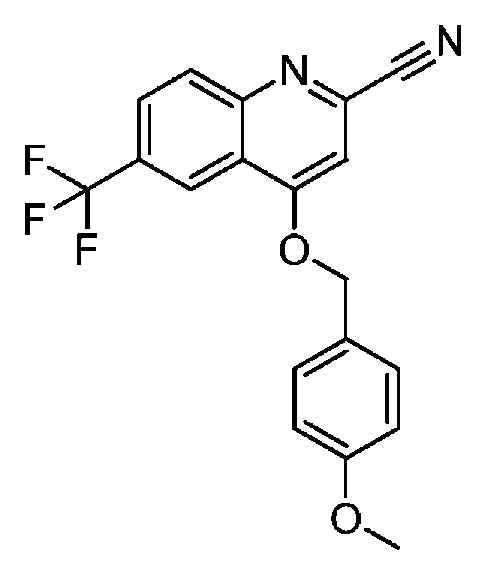
상기 단계 B로부터의 4-((4-메톡시벤질)옥시)-6-(트라이플루오로메틸)퀴놀린-2-카르복스아미드 (9 g, 24 mmol), 및 TEA (10 mL, 72 mmol)의 용액을 실온에서 트라이플루오로아세트산 무수물 (4.35 mL, 31.3 mmol)로 처리하고 2시간 동안 교반하였다 (반응의 완료를 LCMS에 의해 모니터링함). 용매를 진공 하에서 제거하고 EtOAc/Hex로부터의 재결정에 의해 잔류물을 정제하여 표제 화합물을 얻었다.(9 g, 24 mmol), and TEA (10 mL, 72 mmol), from step B above, was added to a solution of 4 - ((4- methoxybenzyl) oxy) -6- (trifluoromethyl) Was treated with trifluoro acetic anhydride (4.35 mL, 31.3 mmol) at room temperature and stirred for 2 h (monitoring the completion of the reaction by LCMS). The solvent was removed in vacuo and the residue was purified by recrystallization from EtOAc / Hex to give the title compound.
단계 D: 4-하이드록시-6-(트라이플루오로메틸)퀴놀린-2-카르보니트릴Step D: 4-Hydroxy-6- (trifluoromethyl) quinoline-2-carbonitrile

15 mL DCM 및 45 mL TFA 중의, 상기 단계 C로부터의 4-((4-메톡시벤질)옥시)-6-(트라이플루오로메틸)퀴놀린-2-카르보니트릴 (5 g, 14 mmol)의 용액을 2시간 동안 교반하였다. 용매를 진공 하에서 제거하고 잔류물을 톨루엔에 의해 2회 증발시켰다. 잔류물을 고진공 하에서 건조하였다. 생성된 황색 고체를 뜨거운 톨루엔으로 트리츄레이팅하고, 여과하고, 에테르로 세척하여 백색 고체로서 표제 화합물을 얻었다.A solution of 4 - ((4-methoxybenzyl) oxy) -6- (trifluoromethyl) quinoline-2-carbonitrile from step C (5 g, 14 mmol) in 15 mL DCM and 45 mL TFA Was stirred for 2 hours. The solvent was removed in vacuo and the residue was evaporated twice with toluene. The residue was dried under high vacuum. The resulting yellow solid was triturated with hot toluene, filtered and washed with ether to give the title compound as a white solid.
단계 E: tert-부틸 3-(2-((2-시아노-6-(트라이플루오로메틸)퀴놀린-4-일)아미노)아세트아미도)아제티딘-1-카르복실레이트Step E: Preparation of tert-butyl 3- (2 - ((2-cyano-6- (trifluoromethyl) quinolin-4-yl) amino) acetamido) azetidine-

건조 다이옥산 중의, 상기 단계 D로부터의 4-하이드록시-6-(트라이플루오로메틸)퀴놀린-2-카르보니트릴 (2 g, 8.4 mmol)의 용액에, TEA (2.9 mL, 21 mmol) 및 PyBroP (4.75 g, 10 mmol)를 첨가하고 50℃에서 2시간 동안 교반하였다. 이 용액에 실시예 1, 단계 E로부터의 tert-부틸 3-(2-아미노아세트아미도)아제티딘-1-카르복실레이트 (2.9 g, 12.45 mmol)를 첨가하고 실온에서 48시간 동안 교반하였다. 용액을 진공에서 농축하였다. 물을 잔류물에 첨가하고 EtOAc로 추출하였다. 에틸 아세테이트를 진공 하에서 제거하고 잔류물을 플래시 크로마토그래피 (실리카 겔, 헥산 중 0 - 80% EtOAc)에 의해 정제하여 표제 화합물을 얻었다.To a solution of 4-hydroxy-6- (trifluoromethyl) quinoline-2-carbonitrile (2 g, 8.4 mmol) from step D above in dry dioxane was added TEA (2.9 mL, 21 mmol) and PyBroP 4.75 g, 10 mmol) was added and stirred at 50 < 0 > C for 2 hours. To this solution was added tert-butyl 3- (2-aminoacetamido) azetidine-1-carboxylate from Example 1, Step E (2.9 g, 12.45 mmol) and stirred at room temperature for 48 hours. The solution was concentrated in vacuo. Water was added to the residue and extracted with EtOAc. Ethyl acetate was removed in vacuo and the residue was purified by flash chromatography (silica gel, 0-80% EtOAc in hexanes) to give the title compound.
단계 F: N-(아제티딘-3-일)-2-((2-시아노-6-(트라이플루오로메틸)퀴놀린-4-일)아미노)아세트아미드Step F: Preparation of N- (azetidin-3-yl) -2 - ((2-cyano-6- (trifluoromethyl) quinolin-

DCM (50 mL) 중의, 상기 단계 E로부터의 tert-부틸 3-(2-((2-시아노-6-(트라이플루오로메틸)퀴놀린-4-일)아미노)아세트아미도)아제티딘-1-카르복실레이트 (3.35 g, 7.45 mmol)의 용액을 티오아니솔 (0.25 mL, 2 mmol)로 처리하고 10분 동안 교반하고, 이어서 트라이플루오로아세트산 (50 mL)을 적가하여 처리하였다. 생성된 불투명한 용액을 실온에서 2.5시간 동안 교반하고 Et2O (200 mL)로 희석하였다. 침전물이 형성되었다. 이 혼합물을 냉장고에서 냉각하고 용매를 경사분리하였다 (고체는 플라스크에 들러붙어 있음). 고체를 고진공 하에서 건조하고 iPrOH로부터 재결정하여 표제 화합물을 얻었다.To a solution of tert-butyl 3- (2- ((2-cyano-6- (trifluoromethyl) quinolin-4-yl) amino) acetamido) A solution of 1-carboxylate (3.35 g, 7.45 mmol) was treated with thioanisole (0.25 mL, 2 mmol) and stirred for 10 min, followed by treatment with dropwise addition of trifluoroacetic acid (50 mL). The resulting opaque solution was stirred at room temperature for 2.5 h and diluted with Et 2 O (200 mL). A precipitate formed. The mixture was cooled in a refrigerator and the solvent was decanted (solids adhered to the flask). The solid was dried under high vacuum and recrystallized from iPrOH to give the title compound.
단계 G: 2-((2-Step G: Preparation of 2 - ((2- 시아노Cyano -6-(-6- ( 트라이플루오로메틸Trifluoromethyl )퀴놀린-4-일)아미노)-N-(1-((1s,4s)-4-(2-옥) Quinolin-4-yl) amino) -N- (1 - ((1s, 4s) -4- 소피Sophie 리딘-1(2H)-일)Lt; / RTI > (2H) -yl) 사이클로헥실Cyclohexyl )) 아제티딘Azetidine -3-일)-3 days) 아세트아미드Acetamide
상기 단계 F로부터의 N-(아제티딘-3-일)-2-((2-시아노-6-(트라이플루오로메틸)퀴놀린-4-일)아미노)아세트아미드 2.0 TFA 염 (223 mg, 0.39 mmol), 및 실시예 16 단계 B로부터의 1-(4-옥소사이클로헥실)피리딘-2(1H)-온 (74 mg, 0.39 mmol), 소듐 트라이아세톡시보로하이드라이드 (303 mg, 1.43 mmol) 및 TEA (107 ㎕, 0.77 mmol)를 아세토니트릴에 용해하고 실온에서 18시간 동안 교반하였다. 혼합물을 진공 하에서 농축하고 잔류물을 NaHCO3으로 염기성화하고, 고체 NaCl로 포화시키고, EtOAc/iPrOH (4:1)로 4회 추출하였다. 유기층을 분리하고, Na2SO4로 건조하고 증발시켰다. 잔류물을 실리카 분취용 TLC에 의해 정제하였다. 플레이트로부터 긁어낸 실리카 밴드를 DCM 중 20% MeOH로 추출하였다. 용매를 진공 하에서 제거하고 잔류물을 MeOH에 용해하고 신틸레이션 바이알로 옮기고 진공 하에서 증발시켰다. 잔류물을 진공 하에서 건조하고 DCM 중 10% MeOH에 용해하고 0.45 마이크로미터 필터를 통해 여과하고 증발시켜 표제 화합물을 얻었다. ESI-MS (m/z): C27H27F3N6O2에 대한 계산치: 524.21; 실측치: 525.21 (M+1).2- ((2-cyano-6- (trifluoromethyl) quinolin-4-yl) amino) acetamide 2.0 TFA salt (223 mg, 0.39 mmol) and 1- (4-oxocyclohexyl) pyridin-2 (1H) -one (74 mg, 0.39 mmol) and sodium triacetoxyborohydride (303 mg, 1.43 mmol) and TEA (107 [mu] L, 0.77 mmol) were dissolved in acetonitrile and stirred at room temperature for 18 hours. The mixture was concentrated in vacuo and the residue was basified with NaHCO 3 , saturated with solid NaCl and extracted four times with EtOAc / iPrOH (4: 1). The organic layer was separated, dried over Na 2 SO 4 and evaporated. The residue was purified by silica-preparative TLC. The silica bands scraped from the plate were extracted with 20% MeOH in DCM. The solvent was removed in vacuo and the residue was dissolved in MeOH and transferred to a scintillation vial and evaporated in vacuo. The residue was dried in vacuo, dissolved in 10% MeOH in DCM, filtered through a 0.45 micrometer filter and evaporated to give the title compound. ESI-MS (m / z): Calcd for C27H27F3N6O2: 524.21; Found: 525.21 (M + 1).
1H NMR (MeOD) δ: 8.66 (s, 1H), 7.97 - 8.10 (m, 2H), 7.66 (s, 1H), 7.43 - 7.56 (m, 1H), 6.85 - 6.96 (m, 1H), 6.56 (d, J = 8.8 Hz, 1H), 6.42 - 6.50 (m, 1H), 4.71 - 4.81 (m, 1H), 4.47 - 4.62 (m, 2H), 4.32 (s, 1H), 4.27 (s, 1H), 4.21 (s, 2H), 3.62 (br. s., 1H), 1.92 (d, J = 3.7 Hz, 3H), 1.82 (br. s., 4H) 1 H NMR (MeOD) ?: 8.66 (s, IH), 7.97-8.10 (m, 2H), 7.66 (s, IH), 7.43-7.56 (d, J = 8.8 Hz, 1H), 6.42-6.50 (m, 1H), 4.71-4.81 (m, 1H), 4.47-4.62 ), 4.21 (s, 2H), 3.62 (br s, 1H), 1.92 (d, J = 3.7 Hz, 3H), 1.82
실시예Example 61: 2-((2- 61: 2 - ((2- 시아노Cyano -6-(-6- ( 트라이플루오로메틸Trifluoromethyl )퀴놀린-4-일)아미노)-N-(1-((1r,4r)-4-하이드록시-4-(티아졸-5-일)) Quinolin-4-yl) amino) -N- (1 - ((lr, 4r) -4-hydroxy-4- (thiazol- 사이클로헥실Cyclohexyl )) 아제티딘Azetidine -3-일)-3 days) 아세트아미드Acetamide 시트레이트 염 Citrate salt
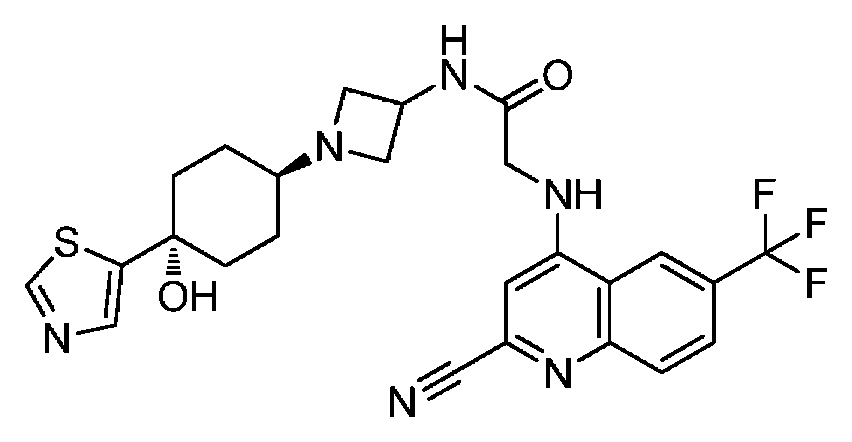
실시예 21, 단계 F로부터의 N-(아제티딘-3-일)-2-((2-시아노-6-(트라이플루오로메틸)퀴놀린-4-일)아미노)아세트아미드 2.0 TFA 염 (223 mg, 0.39 mmol), 및 실시예 26, 단계 C로부터의 4-하이드록시-4-(티아졸-5-일)사이클로헥사논 (76 mg, 0.39 mmol), 소듐 트라이아세톡시보로하이드라이드 (303 mg, 1.43 mmol) 및 TEA (107 ㎕, 0.77 mmol)를 아세토니트릴에 용해하고 실온에서 18시간 동안 교반하였다. 혼합물을 진공 하에서 농축하고 잔류물을 NaHCO3으로 염기성화하고, 고체 NaCl로 포화시키고, EtOAc/iPrOH (4:1)로 4회 추출하였다. 유기층을 분리하고, Na2SO4로 건조하고 증발시켰다. 잔류물을 실리카 분취용 TLC에 의해 정제하였다. 플레이트로부터 긁어낸 실리카 밴드를 DCM 중 20% MeOH로 추출하였다. 용매를 진공 하에서 제거하고 잔류물을 MeOH에 용해하고 신틸레이션 바이알로 옮기고 진공 하에서 증발시켰다. 잔류물을 진공 하에서 건조하고 DCM 중 10% MeOH에 용해하고 0.45 마이크로미터 필터를 통해 여과하고 증발시켜 표제 화합물을 얻었다. 이것을 MeOH에 용해하고 1 당량의 시트르산 (0.5 M 시트레이트 용액)으로 처리하고 증발시켜 시트레이트 염을 얻었다. ESI-MS (m/z): C25H25F3N6O2S에 대한 계산치: 530.17; 실측치: 531.17 (M+1).2- ((2-cyano-6- (trifluoromethyl) quinolin-4-yl) amino) acetamide 2.0 TFA salt from Example 21, Step F 223 mg, 0.39 mmol) and 4-hydroxy-4- (thiazol-5-yl) cyclohexanone from Example 26, Step C (76 mg, 0.39 mmol), sodium triacetoxyborohydride (303 mg, 1.43 mmol) and TEA (107 [mu] L, 0.77 mmol) were dissolved in acetonitrile and stirred at room temperature for 18 hours. The mixture was concentrated in vacuo and the residue was basified with NaHCO 3 , saturated with solid NaCl and extracted four times with EtOAc / iPrOH (4: 1). The organic layer was separated, dried over Na 2 SO 4 and evaporated. The residue was purified by silica-preparative TLC. The silica bands scraped from the plate were extracted with 20% MeOH in DCM. The solvent was removed in vacuo and the residue was dissolved in MeOH and transferred to a scintillation vial and evaporated in vacuo. The residue was dried in vacuo, dissolved in 10% MeOH in DCM, filtered through a 0.45 micrometer filter and evaporated to give the title compound. This was dissolved in MeOH and treated with 1 equivalent of citric acid (0.5 M citrate solution) and evaporated to give the citrate salt. ESI-MS (m / z): Calcd for C25H25F3N6O2S: 530.17; Found: 531.17 (M + 1).
1H NMR (MeOD) δ: 8.93 (s, 1H), 8.65 (br. s., 1H), 7.92 - 8.08 (m, 2H), 7.86 (s, 1H), 6.87 (s, 1H), 4.65 (t, J = 7.2 Hz, 1H), 4.25 - 4.36 (m, 2H), 4.21 (s, 2H), 4.01 - 4.17 (m, 2H), 2.26 (d, J = 9.0 Hz, 2H), 2.02 - 2.15 (m, 2H), 1.80 - 1.95 (m, 3H), 1.54 (br. s., 2H) 1 H NMR (MeOD) δ: 8.93 (s, 1H), 8.65 (.. Br s, 1H), 7.92 - 8.08 (m, 2H), 7.86 (s, 1H), 6.87 (s, 1H), 4.65 ( (m, 2H), 2.26 (d, J = 9.0 Hz, 2H), 2.02-2.15 (m, 2H), 1.80-1.95 (m, 3H), 1.54 (br.s, 2H)
실시예Example 62: 4-((2-((1-((1r,4r)-4- 62: 4 - ((2 - ((1 - ((1R, 4R) -4- 하이드록시Hydroxy -4-(티아졸-5-일)-4- (thiazol-5-yl) 사이클로헥실Cyclohexyl )) 아제티딘Azetidine -3-일)아미노)-2-Yl) amino) -2- 옥소에틸Oxoethyl )아미노)-6-() Amino) -6- ( 트라이플루오로메틸Trifluoromethyl )퀴놀린-2-) Quinolin-2- 카르복스아Carvos 미드mid

단계 A: Step A: terttert -부틸 2-((2--Butyl 2 - ((2- 시아노Cyano -6-(-6- ( 트라이플루오로메틸Trifluoromethyl )퀴놀린-4-일)아미노)아세테이트) Quinolin-4-yl) amino) acetate

건조 다이옥산 중의, 실시예 21, 단계 D로부터의 4-하이드록시-6-(트라이플루오로메틸)퀴놀린-2-카르보니트릴 (2 g, 8.4 mmol)의 용액에 TEA (2.9 mL, 21 mmol) 및 PyBroP (4.75 g, 10 mmol)를 첨가하고 50℃에서 2시간 동안 교반하였다. 이 용액에 tert-부틸 2-아미노아세테이트 (1.3 g, 10.1 mmol)를 첨가하고 30℃에서 24시간 동안 교반하였다. 용액을 진공에서 농축하였다. 물을 잔류물에 첨가하고 EtOAc로 추출하였다. 에틸 아세테이트를 진공 하에서 제거하고 잔류물을 플래시 크로마토그래피 (실리카 겔, 헥산 중 0 - 80% EtOAc)에 의해 정제하여 표제 화합물을 얻었다.To a solution of 4-hydroxy-6- (trifluoromethyl) quinoline-2-carbonitrile (2 g, 8.4 mmol) from Example 21, Step D in dry dioxane was added TEA (2.9 mL, PyBroP (4.75 g, 10 mmol) was added and stirred at 50 < 0 > C for 2 hours. To this solution was added tert-butyl 2-aminoacetate (1.3 g, 10.1 mmol) and the mixture was stirred at 30 ° C for 24 hours. The solution was concentrated in vacuo. Water was added to the residue and extracted with EtOAc. Ethyl acetate was removed in vacuo and the residue was purified by flash chromatography (silica gel, 0-80% EtOAc in hexanes) to give the title compound.
단계 B: Tert-부틸 2-((2-카르바모일-6-(트라이플루오로메틸)퀴놀린-4-일)아미노)아세테이트Step B: Tert-butyl 2 - ((2-carbamoyl-6- (trifluoromethyl) quinolin-4- yl) amino) acetate

EtOH (3 mL), 물 (600 uL) 및 THF (5 mL) 중의, 상기 단계 A로부터의 tert-부틸 2-((2-시아노-6-(트라이플루오로메틸)퀴놀린-4-일)아미노)아세테이트 (329 mg, 0.94 mmol)의 용액에 하이드리도(다이메틸아포스핀산-kp)[수소 비스(다이메틸포스피니토-kp)]백금(ii) (80 mg, 0.18 mmol)을 첨가하고 75℃에서 3시간 동안 교반하였다. 혼합물을 여과하여, 형성되어 있는 백색 고체를 제거하고 여과액을 진공 하에서 증발시켰다. 잔류물을 실리카 컬럼 크로마토그래피에 의해 정제하여 표제 화합물을 얻었다.Butyl 2 - ((2-cyano-6- (trifluoromethyl) quinolin-4-yl) -ethanone from step A in EtOH (3 mL), water (600 uL) and THF (Dimethylaminosulfinic acid-kp) [hydrogen bis (dimethylphosphino-kp)] platinum (ii) (80 mg, 0.18 mmol) was added to a solution of 2- And the mixture was stirred at 75 ° C for 3 hours. The mixture was filtered to remove the formed white solid and the filtrate was evaporated in vacuo. The residue was purified by silica column chromatography to give the title compound.
단계 C: 2-((2-카르바모일-6-(트라이플루오로메틸)퀴놀린-4-일)아미노)아세트산Step C: 2 - ((2-Carbamoyl-6- (trifluoromethyl) quinolin-4- yl) amino) acetic acid

DCM (5 mL) 중의 상기 단계 B로부터의 tert-부틸 2-((2-카르바모일-6-(트라이플루오로메틸)퀴놀린-4-일)아미노)아세테이트 (200 mg, 0.54 mmol)의 용액을 티오아니솔 (0.05 mL)로 처리하고 10분 동안 교반하고, 이어서 트라이플루오로아세트산 (5 mL)을 적가하여 처리하였다. 생성된 불투명한 용액을 실온에서 2.5시간 동안 교반하고 Et2O (200 mL)로 희석하였다. 침전물이 형성되었다. 고체를 고진공 하에서 건조하여 표제 화합물을 얻었다.To a solution of tert-butyl 2 - ((2-carbamoyl-6- (trifluoromethyl) quinolin-4-yl) amino) acetate (200 mg, 0.54 mmol) from step B above in DCM Was treated with thioanisole (0.05 mL) and stirred for 10 min, followed by treatment with dropwise addition of trifluoroacetic acid (5 mL). The resulting opaque solution was stirred at room temperature for 2.5 h and diluted with Et 2 O (200 mL). A precipitate formed. The solid was dried under high vacuum to give the title compound.
단계 D: 4-((2-((1-((1r,4r)-4-하이드록시-4-(티아졸-5-일)사이클로헥실)아제티딘-3-일)아미노)-2-옥소에틸)아미노)-6-(트라이플루오로메틸)퀴놀린-2-카르복스아미드Step D: Preparation of 4 - ((2 - ((1 - ((1 R, 4R) -4-hydroxy-4- (thiazol- 5- yl) cyclohexyl) azetidin- Oxoethyl) amino) -6- (trifluoromethyl) quinoline-2-carboxamide
THF 중의, 상기 단계 C로부터의 2-((2-카르바모일-6-(트라이플루오로메틸)퀴놀린-4-일)아미노)아세트산 (125 mg, 0.4 mmol), (1r,4r)-4-(3-아미노아제티딘-1-일)-1-(티아졸-5-일)사이클로헥사놀 (162 mg, 0.44 mmol), 1-하이드록시벤조트라이아졸 (59 mg, 0.44 mmol), 및 TEA (0.17 mL, 1.2 mmol)의 용액을 얼음조에서 냉각하고 ((3-(다이메틸아미노)프로필)에틸 카르보다이이미드 하이드로클로라이드 (77 mg, 0.4 mmol)로 처리하였다. 이 용액을 실온으로 가온되게 두고 24시간 동안 교반하였다. THF를 진공 하에서 제거하고 잔류물을 물에 용해하고 EtOAc/iPrOH (4:1)로 2회 추출하였다. 유기 분획들을 합하고 Na2SO4로 건조하고 증발시켰다. 잔류물을 분취용 TLC에 의해 정제하여 표제 화합물을 얻었다. ESI-MS (m/z): C25H27F3N6O3S에 대한 계산치: 548.18; 실측치: 549.18 (M+1).(125 mg, 0.4 mmol), (lr, 4r) -4 < RTI ID = 0.0 > (162 mg, 0.44 mmol), 1-hydroxybenzotriazole (59 mg, 0.44 mmol), and (1-hydroxybenzotriazol- The solution of TEA (0.17 mL, 1.2 mmol) was cooled in an ice bath and treated with ((3- (dimethylamino) propyl) ethylcarbodiimide hydrochloride (77 mg, 0.4 mmol) . dried and evaporated and extracted twice with combined organic fractions with Na 2 sO 4: with allowed to warm and stirred for 24 hours, remove the THF under vacuum and the residue dissolved in water and EtOAc / iPrOH (1 4). . The residue was purified by preparative TLC to give the title compound. ESI-MS (m / z): Calcd for C25H27F3N6O3S: 548.18; found: 549.18 (M + l).
실시예 63: N-(1-((1r,4r)-4-하이드록시-4-(티아졸-5-일)사이클로헥실)아제티딘-3-일)-2-((7-(트라이플루오로메틸)아이소퀴놀린-1-일)아미노)아세트아미드Example 63: N- (l- ((lr, 4r) -4-hydroxy-4- (thiazol- 5- yl) cyclohexyl) azetidin- Fluoromethyl) isoquinolin-1-yl) amino) acetamide

단계 A: 1-클로로-7-요오도아이소퀴놀린Step A: 1-Chloro-7-iodoisoquinoline

-78℃에서 THF 중 7-브로모-1-클로로아이소퀴놀린 (15g, 62 mmol)의 교반된 용액에, n-BuLi (123.7 mmol)를 첨가하였다. 생성된 용액을 15분 동안 교반하고, THF 중 I2 (31.4 mg, 123.7 mmol)를 5분에 걸쳐 주사기로 천천히 첨가하였다. 이어서, 용액을 실온에 도달하도록 두었고 포화 Na2S2O3 수용액으로 처리하였다. 생성된 혼합물을 다이에틸 에테르 (2x)로 추출하였다. 추출된 유기층을 염수로 세척하고, Na2SO4로 건조하고 진공에서 농축하였다. 잔류물을 플래시 크로마토그래피에 의해 정제하여 표제 화합물을 얻었다.To a stirred solution of 7-bromo-1-chloroisoquinoline (15 g, 62 mmol) in THF at -78 <0> C was added n-BuLi (123.7 mmol). The resulting solution was stirred for 15 min and I 2 (31.4 mg, 123.7 mmol) in THF was slowly added via syringe over 5 min. The solution was then allowed to reach room temperature and treated with a saturated aqueous Na 2 S 2 O 3 solution. The resulting mixture was extracted with diethyl ether (2x). The extracted organic layer was washed with brine, dried over Na 2 SO 4 and concentrated in vacuo. The residue was purified by flash chromatography to give the title compound.
단계 B: 1-메톡시-7-(트라이플루오로메틸)아이소퀴놀린Step B: 1-Methoxy-7- (trifluoromethyl) isoquinoline

DMF 중의, 상기 단계 A로부터의 1-클로로-7-요오도아이소퀴놀린 (9.2 g, 32 mmol)의 용액에 메틸 2,2-다이플루오로-2-(플루오로설포닐) 아세테이트 (8.6 mg, 66 mmol) 및 Cu (2.2 g, 35 mmol)를 첨가하였다. 반응 혼합물을 80℃에서 48시간 동안 교반하였다. 반응 혼합물을 셀리트를 통해 여과하였고, 이를 DMF (2 x 25 mL)로 세척하였다. 여과액을 감압 하에 증발시키고 잔류물을 플래시 크로마토그래피 (hex 중 40% EtOAc)에 의해 정제하여 표제 화합물을 얻었다.To a solution of 1-chloro-7-iodoisoquinoline (9.2 g, 32 mmol) from step A above in DMF was added methyl 2,2-difluoro-2- (fluorosulfonyl) acetate (8.6 mg, 66 mmol) and Cu (2.2 g, 35 mmol). The reaction mixture was stirred at 80 < 0 > C for 48 hours. The reaction mixture was filtered through celite, which was washed with DMF (2 x 25 mL). The filtrate was evaporated under reduced pressure and the residue was purified by flash chromatography (40% EtOAc in hex) to give the title compound.
단계 C: 1-클로로-7-(트라이플루오로메틸)아이소퀴놀린Step C: l-Chloro-7- (trifluoromethyl) isoquinoline

옥시염화인 (1 mL) 중의, 상기 단계 B로부터의 1-메톡시-7-(트라이플루오로메틸)아이소퀴놀린 (50 mg, 0.22 mmol)의 용액을 150℃에서 18시간 동안 가열하였다. 옥시염화인을 진공 하에서 제거하고 잔류물을 실리카 컬럼 크로마토그래피에 의해 정제하여 표제 화합물을 얻었다.A solution of 1-methoxy-7- (trifluoromethyl) isoquinoline (50 mg, 0.22 mmol) from step B above in phosphorus oxychloride (1 mL) was heated at 150 <0> C for 18 h. The phosphorus oxychloride was removed in vacuo and the residue was purified by silica column chromatography to give the title compound.
단계 D: 1-페녹시-7-(트라이플루오로메틸)아이소퀴놀린Step D: 1-Phenoxy-7- (trifluoromethyl) isoquinoline

상기 단계 C로부터의 1-클로로-7-(트라이플루오로메틸)아이소퀴놀린 (1.5 g, 6.5 mmol), KOH (0.73 g, 13 mmol) 및 페놀 (6.1 g, 65 mmol)의 혼합물을 100℃에서 72시간 동안 가열하였다. 생성된 혼합물을 실온으로 냉각하고 Et2O에 용해하고 4N NaOH (x3)로 추출하였다. 유기 분획을 물, 포화 NaCl로 세척하고, Na2SO4로 건조하고 증발시켜 표제 화합물을 얻었다.A mixture of 1-chloro-7- (trifluoromethyl) isoquinoline (1.5 g, 6.5 mmol), KOH (0.73 g, 13 mmol) and phenol (6.1 g, 65 mmol) And heated for 72 hours. Cooling the resulting mixture to room temperature and then dissolved in Et 2 O and extracted with 4N NaOH (x3). Wash the organic fraction with water, saturated NaCl and, Na 2 SO 4, was dried and evaporated to give the title compound.
단계 E: 7-(트라이플루오로메틸)아이소퀴놀린-1-아민Step E: 7- (Trifluoromethyl) isoquinolin-1-amine

상기 단계 D로부터의 1-페녹시-7-(트라이플루오로메틸)아이소퀴놀린 (670 mg, 2.3 mmol), 및 암모늄 아세테이트 (1.8 g, 23 mmol)의 혼합물을 160℃에서 4시간 동안 가열하였다. 혼합물을 실온으로 냉각하고 물에 용해하였다. 용액이 염기성으로 될 때까지 수산화나트륨 (1N 용액)을 첨가하고 EtOAc (x4)로 추출하였다. 합한 유기 분획을 포화 NaCl로 세척하고, Na2SO4로 건조하고 진공 하에서 증발시켜 표제 화합물을 얻었다.A mixture of 1-phenoxy-7- (trifluoromethyl) isoquinoline (670 mg, 2.3 mmol) from step D above and ammonium acetate (1.8 g, 23 mmol) was heated at 160 <0> C for 4 hours. The mixture was cooled to room temperature and dissolved in water. Sodium hydroxide (1N solution) was added until the solution became basic and extracted with EtOAc (x4). Wash the organic fractions were combined with saturated NaCl, dried over Na 2 SO 4 and evaporated under vacuum to give the title compound.
단계 F: 벤질 (7-(트라이플루오로메틸)아이소퀴놀린-1-일)카르바메이트Step F: Benzyl (7- (trifluoromethyl) isoquinolin-1-yl) carbamate

DCM 중의, 상기 단계 E로부터의 7-(트라이플루오로메틸)아이소퀴놀린-1-아민 (410 mg, 1.9 mmol), 및 벤질 클로로포르메이트 (0.33 mL, 2.3 mmol)의 용액을 N-메틸모르폴린 (0.23 mL, 2.1 mmol)으로 처리하고 실온에서 18시간 동안 교반하였다. 반응 혼합물을 DCM로 희석하고 물로 세척하고 Na2SO4로 건조하였다. DCM을 진공 하에서 제거하고 잔류물을 실리카 컬럼 크로마토그래피에 의해 정제하여 표제 화합물을 얻었다.A solution of 7- (trifluoromethyl) isoquinolin-l-amine (410 mg, 1.9 mmol) from step E and benzyl chloroformate (0.33 mL, 2.3 mmol) in DCM was treated with N-methylmorpholine (0.23 mL, 2.1 mmol) and stirred at room temperature for 18 hours. The reaction mixture was diluted with DCM, washed with water and dried over Na 2 SO 4. The DCM was removed in vacuo and the residue was purified by silica column chromatography to give the title compound.
단계 G: 메틸 2-(((벤질옥시)카르보닐)(7-(트라이플루오로메틸)아이소퀴놀린-1-일)아미노)아세테이트Step G: Synthesis of methyl 2 - ((benzyloxy) carbonyl) (7- (trifluoromethyl) isoquinolin-1- yl) amino) acetate

DMF (5 mL) 중의, 상기 단계 F로부터의 벤질 (7-(트라이플루오로메틸)아이소퀴놀린-1-일)카르바메이트 (212 mg, 0.61 mmol)의 용액을 얼음조에서 냉각하고 NaH (27 mg, 0.67 mmol)로 처리하고, 혼합물을 30분 동안 교반하고 메틸 브로모아세테이트 (64 ㎕, 0.67 mmol)로 처리하였다. 이 용액을 18시간에 걸쳐 교반하고 실온으로 가온되게 두었다. 반응물을 포화 NH4Cl로 켄칭하고 DMF를 진공 하에서 제거하였다. 잔류물을 EtOAc에 용해하고 물, 포화 NaCl로 세척하고 Na2SO4로 건조하였다. EtOAc를 진공 하에서 제거하고 잔류물을 실리카 컬럼 크로마토그래피에 의해 정제하여 표제 화합물을 얻었다.A solution of benzyl (7- (trifluoromethyl) isoquinolin-1-yl) carbamate (212 mg, 0.61 mmol) from step F above in DMF (5 mL) was cooled in an ice bath and NaH mg, 0.67 mmol) and the mixture was stirred for 30 min and treated with methyl bromoacetate (64 [mu] L, 0.67 mmol). The solution was stirred for 18 hours and allowed to warm to room temperature. The reaction was quenched with saturated NH 4 Cl and the DMF removed under vacuum. The residue was dissolved in EtOAc, washed with water, saturated NaCl and dried over Na 2 SO 4. The EtOAc was removed in vacuo and the residue was purified by silica column chromatography to give the title compound.
단계 H: 2-(((벤질옥시)카르보닐)(7-(트라이플루오로메틸)아이소퀴놀린-1-일)아미노)아세트산Step H: 2 - ((Benzyloxy) carbonyl) (7- (trifluoromethyl) isoquinolin-1- yl) amino) acetic acid

상기 단계 G로부터의 메틸 2-(((벤질옥시)카르보닐)(7-(트라이플루오로메틸)아이소퀴놀린-1-일)아미노)아세테이트 (241 mg, 0.58 mmol)의 메탄올 용액을 얼음조에서 냉각하고 1N NaOH (2.88 ml, 2.88 mmol)의 용액으로 처리하였다. 용액을 4시간 동안 교반하고 (TLC로 완료에 대해 모니터링함), MeOH를 진공 하에 증발시키고 (가열하지 않음), 잔류물을 1N HCl로 처리하고 EtOAc로 추출하였다. EtOAc 층을 포화 NaCl로 세척하고, Na2SO4로 건조하고 증발시켜 표제 화합물을 얻었다.A solution of methyl 2 - ((benzyloxy) carbonyl) (7- (trifluoromethyl) isoquinolin-1-yl) amino) acetate (241 mg, 0.58 mmol) from step G in an ice bath Cooled and treated with a solution of 1N NaOH (2.88 ml, 2.88 mmol). The solution was stirred for 4 h (monitored for completion by TLC), the MeOH was evaporated in vacuo (without heating) and the residue was treated with 1N HCl and extracted with EtOAc. Wash the EtOAc layer with saturated NaCl, and, Na 2 SO 4, it was dried and evaporated to give the title compound.
단계 I: 벤질 (2-((1-((1r,4r)-4-하이드록시-4-(티아졸-5-일)사이클로헥실)아제티딘-3-일)아미노)-2-옥소에틸)(7-(트라이플루오로메틸)아이소퀴놀린-1-일)카르바메이트Step I: Preparation of benzyl (2 - ((1 - ((1 r, 4r) -4-hydroxy-4- (thiazol- 5- yl) cyclohexyl) azetidin- ) (7- (Trifluoromethyl) isoquinolin-1-yl) carbamate

THF 중의, 상기 단계 H로부터의 2-(((벤질옥시)카르보닐)(7-(트라이플루오로메틸)아이소퀴놀린-1-일)아미노)아세트산 (88 mg, 0.22 mmol), (1r,4r)-4-(3-아미노아제티딘-1-일)-1-(티아졸-5-일)사이클로헥사놀 (130 mg, 0.22 mmol), 1-하이드록시벤조트라이아졸 (33 mg, 0.22 mmol), 및 DIEA (0.19 mL, 1.1 mmol)의 용액을 얼음조에서 냉각하고 ((3-(다이메틸아미노)프로필)에틸 카르보다이이미드 하이드로클로라이드 (42 mg, 0.22 mmol)로 처리하였다. 이 용액을 실온으로 가온되게 두고 24시간 동안 교반하였다. THF를 진공 하에서 제거하고 잔류물을 물에 용해하고 EtOAc/iPrOH (4:1)로 2회 추출하였다. 유기 분획들을 합하고 Na2SO4로 건조하고 증발시켰다. 잔류물을 분취용 TLC에 의해 정제하여 표제 화합물을 얻었다.((Benzyloxy) carbonyl) (7- (trifluoromethyl) isoquinolin- 1 -yl) amino) acetic acid (88 mg, 0.22 mmol), (lr, 4r Yl) cyclohexanol (130 mg, 0.22 mmol), 1-hydroxybenzotriazole (33 mg, 0.22 mmol) and 1- ) And DIEA (0.19 mL, 1.1 mmol) in DMF (5 mL) was cooled in an ice bath and treated with (3- (dimethylamino) propyl) ethylcarbodiimide hydrochloride (42 mg, 0.22 mmol) ., and extracted twice with combined organic fractions were dried over Na 2 sO 4: is stirred for 24 hours to leave allowed to warm to room temperature and remove the THF under vacuum and the residue was dissolved in water and EtOAc / iPrOH (1 4). The residue was purified by preparative TLC to give the title compound.
단계 J: N-(1-((1r,4r)-4-하이드록시-4-(티아졸-5-일)사이클로헥실)아제티딘-3-일)-2-((7-(트라이플루오로메틸)아이소퀴놀린-1-일)아미노)아세트아미드Step J: Preparation of N- (1 - ((lr, 4r) -4-hydroxy-4- (thiazol- 5- yl) cyclohexyl) azetidin- 1-yl) amino) acetamide < RTI ID = 0.0 >
MeOH 중의, 상기 단계 I로부터의 벤질 (2-((1-((1r,4r)-4-하이드록시-4-(티아졸-5-일)사이클로헥실)아제티딘-3-일)아미노)-2-옥소에틸)(7-(트라이플루오로메틸)아이소퀴놀린-1-일)카르바메이트 (40 mg, 0.06 mmol)의 용액을 5% Pd/C (100 mg)로 처리하고, 혼합물을 H2 분위기 하에서 18시간 동안 교반하였다. 여과에 의해 촉매를 제거하고 진공 하에서 MeOH를 제거하였다. 잔류물을 분취용 TLC에 의해 정제하여 표제 화합물을 얻었다. ESI-MS (m/z): C24H26F3N5O2S에 대한 계산치: 505.18; 실측치: 506.18 (M+1).(1 - ((lr, 4r) -4-hydroxy-4- (thiazol-5-yl) cyclohexyl) azetidin- -2-oxoethyl) (7- (trifluoromethyl) isoquinolin-1-yl) carbamate (40 mg, 0.06 mmol) was treated with 5% Pd / C (100 mg) And stirred under H 2 atmosphere for 18 hours. The catalyst was removed by filtration and MeOH was removed under vacuum. The residue was purified by preparative TLC to give the title compound. ESI-MS (m / z): Calcd for C24H26F3N5O2S: 505.18; Found: 506.18 (M + 1).
실시예 64: N-(1-((1r,4r)-4-하이드록시-4-(티아졸-2-일)사이클로헥실)아제티딘-3-일)-2-(메틸(6-(Example 64: Synthesis of N- (1 - ((lr, 4r) -4-hydroxy-4- (thiazol-2-yl) cyclohexyl) azetidin- 트라이플루오로메틸Trifluoromethyl )) 퀴나졸린Quinazoline -4-일)아미노)Yl) amino) 아세트아미드Acetamide
단계 A: 에틸 2-(((Step A: Ethyl 2 - ((( 벤질옥시Benzyloxy )카르보닐)() Carbonyl) ( 메틸methyl )아미노)아세테이트) Amino) acetate

시판용 2 에틸 2-(메틸아미노)아세테이트 (1.91 g, 12.4 mmol, HCl 염)를 함유하는 포화 소듐 바이카르보네이트 수용액 및 에틸 아세테이트의 급속히 교반된 혼합물을 0℃로 냉각하고 벤질 클로로포르메이트 (4.10 mL, 12.3 mmol)를 적가하여 처리하였다. 하룻밤 실온으로 가온하면서 교반한 후에, 수성층을 제거하고 유기층을 진공에서 농축하였다. 잔류물을 플래시 크로마토그래피 (실리카 겔, DCM)에 의해 정제하여 생성물을 얻었다.A rapidly stirred mixture of saturated sodium bicarbonate aqueous solution containing commercially available 2-ethyl 2- (methylamino) acetate (1.91 g, 12.4 mmol, HCl salt) and ethyl acetate was cooled to 0 C and benzyl chloroformate (4.10 mL, 12.3 mmol) was added dropwise. After stirring overnight while warming to room temperature, the aqueous layer was removed and the organic layer was concentrated in vacuo. The residue was purified by flash chromatography (silica gel, DCM) to give the product.
단계 B: 2-(((벤질옥시)카르보닐)(메틸)아미노)아세트산Step B: Preparation of 2 - (((benzyloxy) carbonyl) (methyl) amino) acetic acid

MeOH (24 mL) 및 THF (5 mL) 중 에틸 2-(((벤질옥시)카르보닐)(메틸)아미노)아세테이트 (2.66 mg, 10.6 mmol, 이전 단계에서 제조됨)의 용액을 LiOH의 용액 (12 mL, 54 mmol, 물 중 4.52 M)으로 처리하였다. 실온에서 3시간 동안 교반한 후에, HCl 수용액을 첨가하여 pH를 약 5로 조절하였다. 에틸 아세테이트로 추출한 후에, 유기층을 Na2SO4로 건조하고 진공에서 농축하여 생성물을 얻었다.A solution of ethyl 2 - ((benzyloxy) carbonyl) (methyl) amino) acetate (2.66 mg, 10.6 mmol, prepared in the previous step) in MeOH (24 mL) and THF (5 mL) 12 mL, 54 mmol, 4.52 M in water). After stirring at room temperature for 3 hours, the pH was adjusted to about 5 by addition of aqueous HCl. After extraction with ethyl acetate, the organic layer was dried over Na 2 SO 4 and concentrated in vacuo to give the product.
단계 C: tert-부틸 3-(2-(((벤질옥시)카르보닐)(메틸)아미노)아세트아미도)아제티딘-1-카르복실레이트Step C: tert-Butyl 3- (2 - (((benzyloxy) carbonyl) (methyl) amino) acetamido) azetidine-

2-(((벤질옥시)카르보닐)(메틸)아미노)아세테이트 (2.12 g, 9.50 mmol, 이전 단계에서 제조됨) 및 EDCI (1.99 g, 10.4 mmol)의 혼합물을 무수 DCM (10 mL) 중에서 15분 동안 교반하고, 이어서 DCM (90 mL) 중 시판용 tert-부틸 3-아미노아제티딘-1-카르복실레이트 (1.64 g, 9.52 mmol) 및 DMAP (220 mg, 1.80 mmol)의 용액에 첨가하였다. 반응 혼합물을 실온에서 하룻밤 교반한 다음, 진공에서 농축하였다. 잔류물을 에틸 아세테이트에 용해하고, 포화 암모늄 클로라이드 용액, 1 N NaOH 용액, 염수로 세척하고 유기층을 Na2SO4로 건조하였다. 진공에서 농축한 후에, 잔류물을 플래시 크로마토그래피 (실리카 겔, 0%-5% MeOH/EtOAc)에 의해 정제하여, 고진공 하에서 건조한 후에 백색 고체를 얻었다.A mixture of 2 - ((benzyloxy) carbonyl) (methyl) amino) acetate (2.12 g, 9.50 mmol, prepared in the previous step) and EDCI (1.99 g, 10.4 mmol) Min and then added to a solution of commercially available tert-butyl 3-aminoazetidine-1-carboxylate (1.64 g, 9.52 mmol) and DMAP (220 mg, 1.80 mmol) in DCM (90 mL). The reaction mixture was stirred at room temperature overnight and then concentrated in vacuo. The residue was dissolved in ethyl acetate and saturated ammonium chloride solution, 1 N NaOH solution, washed with brine, dried the organic layer with Na 2 SO 4. After concentration in vacuo, the residue was purified by flash chromatography (silica gel, 0% -5% MeOH / EtOAc) to give a white solid after drying under high vacuum.
단계 D: tert-부틸 3-(2-(메틸아미노)아세트아미도)아제티딘-1-카르복실레이트Step D: tert-Butyl 3- (2- (methylamino) acetamido) azetidine-1-carboxylate

tert-부틸 3-(2-(((벤질옥시)카르보닐)(메틸)아미노)아세트아미도)아제티딘-1-카르복실레이트 (3.10 g, 8.21 mmol, 이전 단계에서 제조됨) 및 교반막대가 담긴 플라스크에, 10% Pd/C (136 g, 0.127 mmol)를 첨가하였다. 플라스크를 진공화하고 아르곤으로 다시 충전하였다. 주사기를 통해 메탄올 (100 mL)을 주의깊게 첨가하고, 교반하면서 플라스크를 진공화하였다. 이어서, 수소로 다시 충전하고 수소 풍선 하에서 2일 동안 교반하였다. 교반하면서 진공화하고 아르곤으로 다시 충전한 후에, 셀리트 521을 통한 여과에 의해 촉매를 제거하고 진공에서 농축하여 생성물을 얻었다.(3.10 g, 8.21 mmol, prepared in the previous step) and a stirring bar (3.10 g) were added to a solution of tert-butyl 3- (2 - ((benzyloxy) carbonyl) (methyl) amino) acetamido) Was added 10% Pd / C (136 g, 0.127 mmol). The flask was evacuated and recharged with argon. Methanol (100 mL) was carefully added via a syringe and the flask was evacuated with stirring. It was then refilled with hydrogen and stirred under a hydrogen balloon for 2 days. After vacuuming with stirring and refilling with argon, the catalyst was removed by filtration through Celite 521 and concentrated in vacuo to give the product.
단계 E: tert-부틸 3-(2-(메틸(6-(트라이플루오로메틸)퀴나졸린-4-일)아미노)아세트아미도)아제티딘-1-카르복실레이트Step E: Preparation of tert-butyl 3- (2- (methyl (6- (trifluoromethyl) quinazolin-4-yl) amino) acetamido) azetidine-

이전 단계에서 제조된 tert-부틸 3-(2-(메틸아미노)아세트아미도)아제티딘-1-카르복실레이트 (348 mg, 1.43 mmol)와 시판용 4-클로로-6-(트라이플루오로메틸)퀴나졸린 (327 mg, 1.41 mmol)의 혼합물을 아르곤 하에서 1시간 동안 90℃에서 무수 iPrOH 및 트라이에틸아민 중에서 교반하였다. 반응 혼합물을 진공에서 농축하고 잔류물을 플래시 크로마토그래피 (실리카 겔, 0%-5% MeOH/EtOAc)에 의해 정제하여, 고진공 하에서 건조한 후에 황색 고체를 얻었다.(348 mg, 1.43 mmol) prepared in the previous step and commercially available 4-chloro-6- (trifluoromethyl) azetidine-1-carboxylate Quinazoline (327 mg, 1.41 mmol) in anhydrous iPrOH and triethylamine at 90 < 0 > C under argon for 1 hour. The reaction mixture was concentrated in vacuo and the residue was purified by flash chromatography (silica gel, 0% -5% MeOH / EtOAc) to give a yellow solid after drying under high vacuum.
C20H24F3N5O3에 대한 계산치: 439.18; 실측치: 440 (M+H).C 20 H 24 F 3 N calculated for 5 O 3: 439.18; Found: 440 (M + H).
단계 F: N-(아제티딘-3-일)-2-(메틸(6-(트라이플루오로메틸)퀴나졸린-4-일)아미노)아세트아미드 TFA 염Step F: N- (Azetidin-3-yl) -2- (methyl (6- (trifluoromethyl) quinazolin-4- yl) amino) acetamide TFA salt

이전 단계에서 제조된 3-[2-(3-트라이플루오로메틸-벤조일아미노)-아세틸아미노]-아제티딘-1-카르복실산 tert-부틸 에스테르 (8.35 g, 19.6 mmol)를 DCM (250 mL)에 용해하고 실온에서 TFA (17 mL, 229 mmol)로 처리하였다. 반응물을 실온에서 하룻밤 교반하였다. 진공에서 용매를 제거하고 잔류물을 먼저 에테르로 트리츄레이팅하고, 상청액을 경사분리하고, 고진공에서 건조하여 여분의 TFA를 함유하는 TFA 염 (무색 폼)으로서 표제 화합물을 얻었다. TFA의 양은 실시할 때마다 달랐으며 TFA로부터의 아릴 CF3 및 CF3의 19F NMR 신호를 적분하여 결정하였다.-Acetylamino] -azetidine-l-carboxylic acid tert-butyl ester (8.35 g, 19.6 mmol) prepared in the previous step was dissolved in DCM (250 mL ) And treated with TFA (17 mL, 229 mmol) at room temperature. The reaction was stirred at room temperature overnight. The solvent was removed in vacuo and the residue was first triturated with ether, the supernatant decanted off and dried in high vacuum to afford the title compound as a TFA salt (colorless foam) containing extra TFA. The amount of TFA varied from run to run and was determined by integrating the 19 F NMR signals of aryl CF 3 and CF 3 from TFA.
ESI-MS (m/z): C15H16F3N5O에 대한 계산치: 339.19; 실측치: 340 (M+H).ESI-MS (m / z) : C 15 H 16 F 3 calculated for N 5 O: 339.19; Found: 340 (M + H).
단계 G: N-(1-((1r,4r)-4-Step G: Preparation of N- (l - ((lr, 4r) -4- 하이드록시Hydroxy -4-(티아졸-2-일)-4- (thiazol-2-yl) 사이클로헥실Cyclohexyl )) 아제티딘Azetidine -3-일)-2-(메틸(6-(Yl) -2- (methyl (6- ( 트라이플루오로메틸)퀴나졸린-4-일Trifluoromethyl) quinazolin-4-yl < / RTI > )아미노)) Amino) 아세트아미드Acetamide
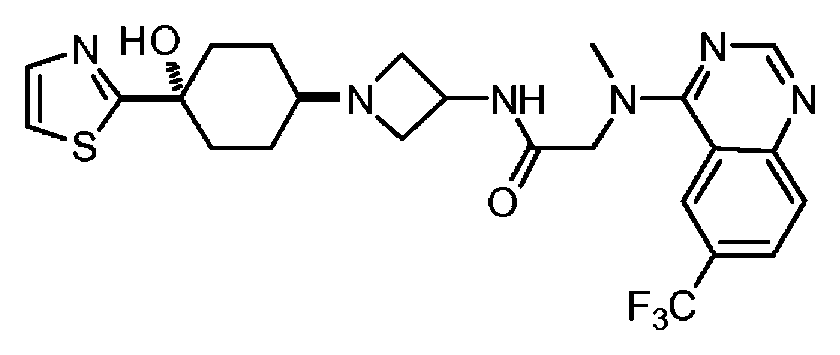
DCM 중 4-(3-하이드록시-피리딘-2-일)-사이클로헥사논 (단계 C에서 제조됨, 1 eq.)과 N-(아제티딘-3-일)-2-(메틸(6-(트라이플루오로메틸)퀴나졸린-4-일)아미노)아세트아미드 (이전 단계에서 제조됨, 트리스 TFA 염, 3 eq.)의 현탁액에 TEA (3 eq.)를 첨가하였다. 실온에서 30분 동안 교반한 후에, NaBH(OAc)3 (3 eq)을 첨가하고 혼합물을 하룻밤 교반하였다. 반응물을 포화 소듐 바이카르보네이트 용액으로 켄칭하고, 부분적으로 농축하였다. 에틸 아세테이트로 추출한 후에 유기층을 진공에서 농축하여 잔류물을 얻었고, 이를 플래시 크로마토그래피 (실리카 겔, 0-20% 7 N NH3-MeOH/에틸 아세테이트)에 의해 정제하여 고체로서 생성물을 얻었다.(Prepared from step C, 1 eq.) And N- (azetidin-3-yl) -2- (methyl (6- (Trifluoromethyl) quinazolin-4-yl) amino) acetamide (prepared in the previous step, Tris TFA salt, 3 eq.) Was added TEA (3 eq.). After stirring at room temperature for 30 minutes, NaBH (OAc) 3 (3 eq) was added and the mixture was stirred overnight. The reaction was quenched with saturated sodium bicarbonate solution and partially concentrated. The organic layer was concentrated then extracted with ethyl acetate in vacuo to give the residue, which was purified by flash chromatography (silica gel, 0-20% 7 N NH 3 -MeOH / ethyl acetate) to give the product as a solid.
ESI-MS (m/z): C24H27F3N6O2S에 대한 계산치: 520.19; 실측치: 521 (M+H).ESI-MS (m / z): Calcd for C 24 H 27 F 3 N 6 O 2 S: 520.19; Found: 521 (M + H).
실시예Example 65: N-(1-(4-(피리딘-3-일) 65: N- (1- (4- (Pyridin-3-yl) 사이클로헥실Cyclohexyl )) 아제티딘Azetidine -3-일)-2-((6-(Yl) -2 - ((6- ( 트라이플루오로메틸Trifluoromethyl )) 퀴나졸린Quinazoline -4-일)아미노)Yl) amino) 아세트아미드Acetamide
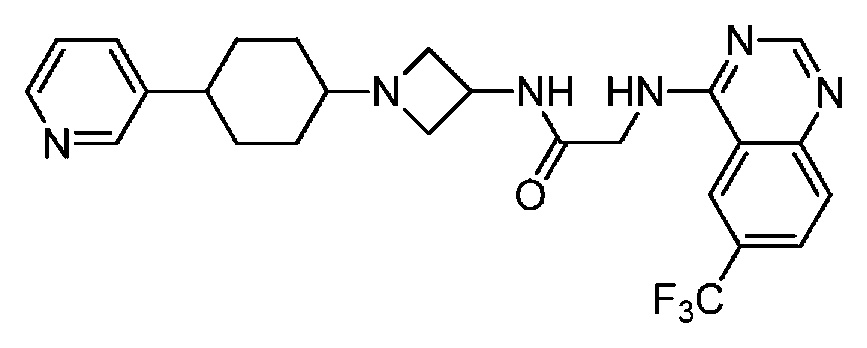
실시예 1, 단계 H에 기재된 바와 같이 TEA 및 NaBH(OAc)3의 존재 하에서 4-(피리딘-3-일)사이클로헥사논 (실시예 1 단계 A 내지 단계 C에 기재된 절차를 사용하여 3-브로모피리딘과 8-(4,4,5,5-테트라메틸-[1,3,2]다이옥사보로란-2-일)-1,4-다이옥사-스피로[4.5]데스-7-엔의 반응에 의해 제조됨)과 N-(아제티딘-3-일)-2-((6-(트라이플루오로메틸)퀴나졸린-4-일)아미노)아세트아미드 (실시예 1 단계 G에서 제조됨)의 반응에 의해 생성물을 얻었다. 3 -yl) cyclohexanone (using the procedure described in Example 1, Step A to Step C, in the presence of TEA and NaBH (OAc) 3 as described in Example 1, Dioxa-spiro [4.5] des-7-ene-1, 4- Amino) acetamide (prepared from the reaction of Example 1 Step G) and N - (azetidin-3-yl) -2 - ((6- (trifluoromethyl) quinazolin- ) To give the product.
1H NMR (MeOD) δ: 8.62 (s, 1 H), 8.56 (s, 1 H), 8.43 (d, J=2.0 Hz, 1 H), 8.33 (dd, J=5.1, 1.5 Hz, 1 H), 8.04 (dd, J=8.8, 1.8 Hz, 1 H), 7.88 (d, J=8.8 Hz, 1 H), 7.77 (dt, J=7.8, 1.8 Hz, 1 H), 7.35 (dd, J=7.7, 5.2 Hz, 1 H), 4.51 (quin, J=7.1 Hz, 1 H), 4.28 (s, 2 H), 3.65 - 3.73 (m, 2 H), 2.95 (t, J=7.6 Hz, 2 H), 2.56 - 2.69 (m, 1 H), 2.43 (d, J=2.8 Hz, 1 H), 1.68 - 1.92 (m, 4 H), 1.49 - 1.62 (m, 4 H); ESI-MS (m/z): C25H27F3N6O에 대한 계산치: 484.22; 실측치: 485 (M+H). 1 H (MeOD)?: 8.62 (s, 1H), 8.56 (s, 1H), 8.43 (d, J = 2.0 Hz, 1H), 8.33 (dd, J = 5.1, 1.5 Hz, 1H J = 7.8, 1.8 Hz, 1H), 7.35 (dd, J), 8.04 (dd, J = 8.8,1.8 Hz, 1H), 7.88 (d, J = 8.8 Hz, 1H) = 7.7, 5.2 Hz, 1H), 4.51 (quin, J = 7.1 Hz, 1H), 4.28 (s, 2H), 3.65-3.73 (m, 2H) 2 H), 2.56-2.69 (m, 1H), 2.43 (d, J = 2.8 Hz, 1H), 1.68-1.92 (m, 4H), 1.49-1.62 (m, 4H); ESI-MS (m / z) : C 25 H 27 F 3 calculated for N 6 O: 484.22; Found: 485 (M + H).
실시예Example 66: N-(1-(4-(피리딘-2-일) 66: N- (1- (4- (Pyridin-2-yl) 사이클로헥실Cyclohexyl )) 아제티딘Azetidine -3-일)-2-((6-(Yl) -2 - ((6- ( 트라이플루오로메틸Trifluoromethyl )) 퀴나졸린Quinazoline -4-일)아미노)Yl) amino) 아세트아미드Acetamide
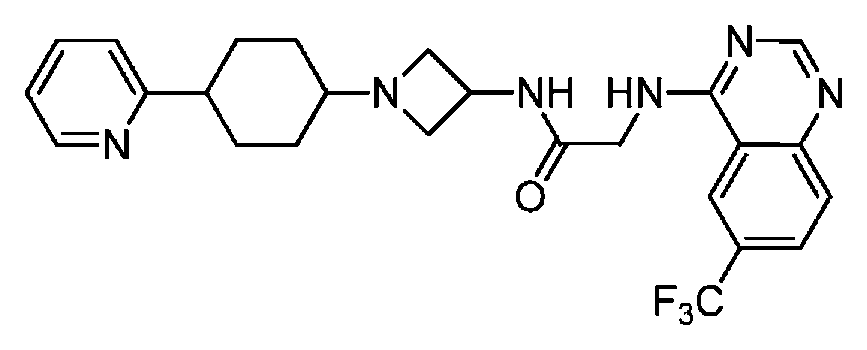
실시예 1, 단계 H에 기재된 바와 같이 TEA 및 NaBH(OAc)3의 존재 하에서 4-(피리딘-3-일)사이클로헥사논 (실시예 1 단계 A 내지 단계 C에 기재된 절차를 사용하여 2-브로모피리딘과 8-(4,4,5,5-테트라메틸-[1,3,2]다이옥사보로란-2-일)-1,4-다이옥사-스피로[4.5]데스-7-엔의 반응에 의해 제조됨)과 N-(아제티딘-3-일)-2-((6-(트라이플루오로메틸)퀴나졸린-4-일)아미노)아세트아미드 (실시예 1 단계 G에서 제조됨)의 반응에 의해 생성물을 얻었다.Example 1, in the presence of TEA and NaBH (OAc) 3 as described in Step H 4- (pyridin-3-yl) cyclohexanone (2-Bromo-using the procedure described in Example 1, Step A to Step C Dioxa-spiro [4.5] des-7-ene-1, 4- Amino) acetamide (prepared from the reaction of Example 1 Step G) and N - (azetidin-3-yl) -2 - ((6- (trifluoromethyl) quinazolin- ) To give the product.
1H NMR (MeOD) δ: 8.99 (t, J=5.7 Hz, 1 H), 8.80 (s, 1 H), 8.56 (s, 1 H), 8.46 (d, J=4.0 Hz, 1 H), 8.05 (dd, J=8.8, 1.8 Hz, 1 H), 7.88 (d, J=8.8 Hz, 1 H), 7.67 (td, J=7.6, 1.9 Hz, 1 H), 7.21 (d, J=7.8 Hz, 1 H), 7.16 (td, J=6.2, 1.0 Hz, 1 H), 4.27 (m, J=6.3 Hz, 1 H), 4.14 (d, J=5.8 Hz, 2 H), 3.48 (br. s., 2 H), 2.78 (br. s., 2 H), 2.57 - 2.71 (m, 1 H), 2.22 - 2.35 (m, 1 H), 1.76 - 1.96 (m, 2 H), 1.62 (d, J=13.1 Hz, 2 H), 1.45 (m, J=14.7, 14.7 Hz, 4 H)]); ESI-MS (m/z): C25H27F3N6O에 대한 계산치: 484.22; 실측치: 485 (M+H). 1 H), 8.56 (s, 1 H), 8.46 (d, J = 4.0 Hz, 1 H) (Dd, J = 8.8,1.8 Hz, 1H), 7.88 (d, J = 8.8 Hz, 1H), 7.67 (td, J = 7.6, 1.9 Hz, 1H) J = 6.3 Hz, 1H), 4.14 (d, J = 5.8 Hz, 2H), 3.48 (br, (m, 1H), 1.76-1.96 (m, 2H), 1.62 (m, 2H), 2.78 (d, J = 13.1 Hz, 2H), 1.45 (m, J = 14.7, 14.7 Hz, 4H); ESI-MS (m / z) : C 25 H 27 F 3 calculated for N 6 O: 484.22; Found: 485 (M + H).
실시예Example 67: N-(1-(4-(5- 67: N- (1- (4- (5- 하이드록시피리딘Hydroxypyridine -2-일)-2 days) 사이클로헥실Cyclohexyl )) 아제티딘Azetidine -3-일)-2-((6-(트3-yl) -2 - ((6- 라이플루오로Rifluro 메틸)methyl) 퀴나졸린Quinazoline -4-일)아미노)Yl) amino) 아세트아미드Acetamide

실시예 1, 단계 H에 기재된 바와 같이 TEA 및 NaBH(OAc)3의 존재 하에서 4-(5-하이드록시피리딘-2-일)사이클로헥사논 (실시예 1 단계 A 내지 단계 C에 기재된 절차를 사용하여 5-(벤질옥시)-2-브로모피리딘과 8-(4,4,5,5-테트라메틸-[1,3,2]다이옥사보로란-2-일)-1,4-다이옥사-스피로[4.5]데스-7-엔의 반응에 의해 제조됨)과 N-(아제티딘-3-일)-2-((6-(트라이플루오로메틸)퀴나졸린-4-일)아미노)아세트아미드 (실시예 1 단계 G에서 제조됨)의 반응에 의해 생성물을 얻었다.(5-hydroxypyridin-2-yl) cyclohexanone (using the procedure described in Step A of Step A of Step A of Example 1) in the presence of TEA and NaBH (OAc) 3 as described in Example 1, (4,4,5,5-tetramethyl- [1,3,2] dioxaborolan-2-yl) -1,4-di (Azetidin-3-yl) -2 - ((6- (trifluoromethyl) quinazolin-4-yl) amino ) ≪ / RTI > acetamide (prepared in Example 1 Step G).
1H NMR (MeOD) δ: 8.60 (s, 1 H), 8.49 (s, 1 H), 8.02 (d, J=2.8 Hz, 1 H), 7.90 - 7.95 (m, 1 H), 7.84 - 7.90 (m, 1 H), 7.18 - 7.24 (m, 1 H), 7.12 - 7.18 (m, 1 H), 4.76 (quin, J=7.5 Hz, 1 H), 4.31 (s, 2 H), 4.12 - 4.27 (m, 4 H), 3.14 (q, J=7.3 Hz, 2 H), 2.66 - 2.80 (m, 1 H), 1.98 - 2.06 (m, 2 H), 1.64 - 1.90 (m, 7 H), 1.32 (t, J=7.3 Hz, 3 H); ESI-MS (m/z): C25H27F3N6O2에 대한 계산치: 500.21; 실측치: 501 (M+H). 1 H), 7.90-7.95 (m, 1H), 7.84-7.90 (s, 1H), 8.02 (d, (m, 1H), 7.18-7.24 (m, 1H), 7.12-7.18 (m, 1H), 4.76 (quin, (M, 2H), 1.64-1.90 (m, 7H), 4.27 (m, 4H), 3.14 (q, J = 7.3 Hz, 2H), 2.66-2.80 , 1.32 (t, J = 7.3 Hz, 3 H); ESI-MS (m / z) : C 25 H 27 F 3 N calculated for 6 O 2: 500.21; Found: 501 (M + H).
실시예Example 68: N-(1-(4-(3- 68: N- (1- (4- (3- 메톡시피리딘Methoxypyridine -4-일)Yl) 사이클로헥실Cyclohexyl )) 아제티딘Azetidine -3-일)-2-((6-(Yl) -2 - ((6- ( 트라이플루오로메틸Trifluoromethyl )) 퀴나졸린Quinazoline -4-일)아미노)Yl) amino) 아세트아미드Acetamide
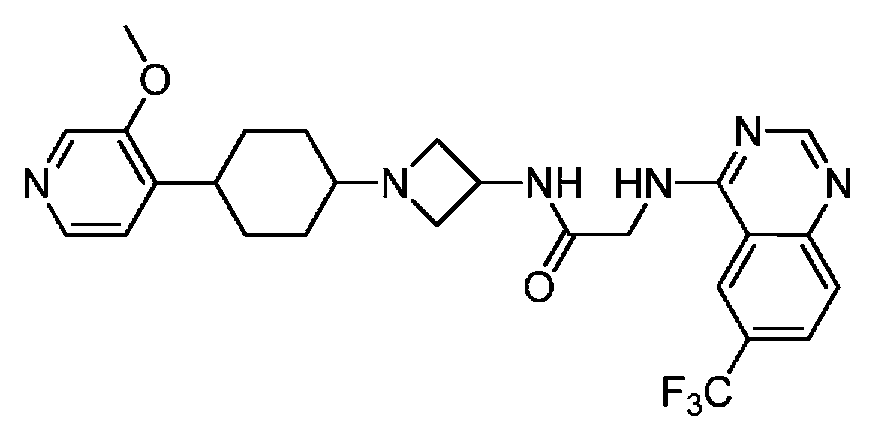
실시예 1, 단계 H에 기재된 바와 같이 TEA 및 NaBH(OAc)3의 존재 하에서 4-(3-메톡시피리딘-4-일)사이클로헥사논 (실시예 1 단계 A 내지 단계 C에 기재된 절차를 사용하여 4-브로모-3-메톡시피리딘과 8-(4,4,5,5-테트라메틸-[1,3,2]다이옥사보로란-2-일)-1,4-다이옥사-스피로[4.5]데스-7-엔의 반응에 의해 제조됨)과 N-(아제티딘-3-일)-2-((6-(트라이플루오로메틸)퀴나졸린-4-일)아미노)아세트아미드 (실시예 1 단계 G에서 제조됨)의 반응에 의해 생성물을 얻었다.4- (3-methoxypyridin-4-yl) cyclohexanone (using the procedure described in Example 1 Step A to Step C) in the presence of TEA and NaBH (OAc) 3 as described in example 1, Bromo-3-methoxypyridine and 8- (4,4,5,5-tetramethyl- [1,3,2] dioxaborolan-2-yl) (6- (trifluoromethyl) quinazolin-4-yl) amino) acetic acid (prepared according to the reaction of [ Amide (prepared in Example 1 Step G).
1H NMR (MeOD) δ: 8.62 (s, 1 H), 8.37 (s, 1 H), 8.09 - 8.17 (m, 2 H), 7.86 - 7.96 (m, 2 H), 7.22 (d, J=4.8 Hz, 1 H), 4.47 - 4.60 (m, 1 H), 4.23 (s, 2 H), 3.86 - 3.96 (m, 3 H), 3.61 (t, J=6.9 Hz, 2 H), 2.95 (dd, J=7.5, 2.7 Hz, 2 H), 1.82 - 1.94 (m, 1 H), 1.71 (d, J=11.9 Hz, 3 H), 1.54 (d, J=9.3 Hz, 3 H), 1.08 - 1.47 (m, 1 H); ESI-MS (m/z): C26H29F3N6O2에 대한 계산치: 514.23; 실측치: 515 (M+H). 1 H NMR (MeOD) ?: 8.62 (s, 1H), 8.37 (s, 1H), 8.09-8.17 (m, 2H), 7.86-7.96 4.8 Hz, 1H), 4.47-4.60 (m, 1H), 4.23 (s, 2H), 3.86-3.96 (d, J = 7.5, 2.7 Hz, 2H), 1.82-1.94 (m, 1H), 1.71 (d, J = 11.9 Hz, 3H), 1.54 - 1.47 (m, 1H); ESI-MS (m / z): Calcd for C 26 H 29 F 3 N 6 O 2 : 514.23; Found: 515 (M + H).
실시예Example 69: N-(1-(4-(2- 69: N- (1- (4- (2- 하이드록시페닐Hydroxyphenyl )) 사이클로헥실Cyclohexyl )) 아제티딘Azetidine -3-일)-2-((6-(Yl) -2 - ((6- ( 트라TRA 이플루오로메틸)Difluoromethyl) 퀴나졸린Quinazoline -4-일)아미노)Yl) amino) 아세트아미드Acetamide
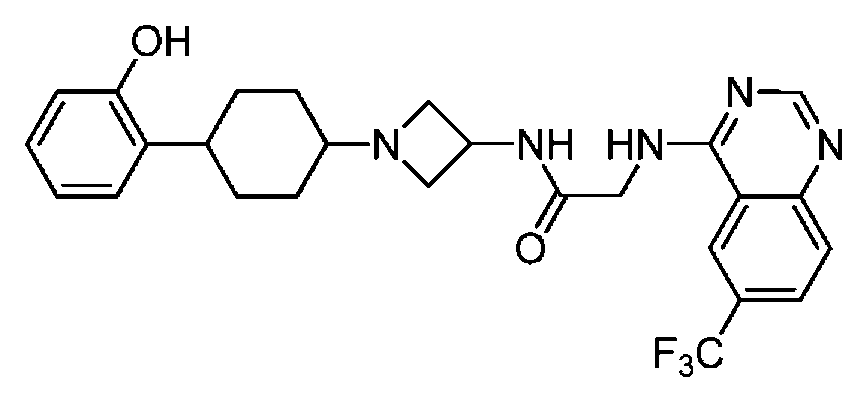
실시예 1, 단계 H에 기재된 바와 같이 TEA 및 NaBH(OAc)3의 존재 하에서 4-(2-하이드록시페닐)사이클로헥사논 (실시예 1 단계 A 내지 단계 C에 기재된 절차를 사용하여 2-요오도페놀과 8-(4,4,5,5-테트라메틸-[1,3,2]다이옥사보로란-2-일)-1,4-다이옥사-스피로[4.5]데스-7-엔의 반응에 의해 제조됨)과 N-(아제티딘-3-일)-2-((6-(트라이플루오로메틸)퀴나졸린-4-일)아미노)아세트아미드 (실시예 1 단계 G에서 제조됨)의 반응에 의해 생성물을 얻었다.(2-hydroxyphenyl) cyclohexanone (prepared according to the procedure described in Example 1, Step A to Step C, using 2-iodoaniline in the presence of TEA and NaBH (OAc) 3 as described in example 1, Dioxa-spiro [4.5] des-7-ene (hereinafter referred to as " 4,4,5,5-tetramethyl- [1,3,2] dioxaborolan- Amino) acetamide (prepared from the reaction of Example 1 Step G) and N - (azetidin-3-yl) -2 - ((6- (trifluoromethyl) quinazolin- ) To give the product.
1H NMR (아세토니트릴-d3) δ: 8.58 (s, 1 H), 8.39 (s, 1 H), 7.95 (m, J=8.8, 1.8 Hz, 1 H), 7.85 (m, J=8.8 Hz, 1 H), 7.56 (t, J=5.4 Hz, 1 H), 7.13 - 7.24 (m, 1 H), 7.11 (dd, J=7.6, 1.5 Hz, 1 H), 6.99 (td, J=7.6, 1.6 Hz, 1 H), 6.80 (td, J=7.5, 1.0 Hz, 1 H), 6.74 (dd, J=8.0, 1.1 Hz, 1 H), 4.38 (sxt, J=6.9 Hz, 1 H), 4.18 (d, J=5.8 Hz, 2 H), 3.55 (t, J=7.1 Hz, 2 H), 2.73 - 2.88 (m, 3 H), 2.27 - 2.35 (m, 1 H), 1.61 - 1.76 (m, 4 H), 1.36 - 1.50 (m, 4 H); ESI-MS (m/z): C26H28F3N5O2에 대한 계산치: 499.22; 실측치: 500 (M+H). 1 H NMR (acetonitrile-d 3)?: 8.58 (s, 1H), 8.39 (s, 1H), 7.95 (m, J = 8.8, 1.8 Hz, 1H) J = 7.6, 1.5 Hz, 1H), 7.56 (t, J = 5.4 Hz, 1H), 7.13-7.24 , 1.6 Hz, 1H), 6.80 (td, J = 7.5, 1.0 Hz, 1H), 6.74 (dd, J = 8.0, 1.1 Hz, 1H) , 4.18 (d, J = 5.8 Hz, 2H), 3.55 (t, J = 7.1 Hz, 2H), 2.73-2.88 (m, 4 H), 1.36-1.50 (m, 4 H); ESI-MS (m / z): Calcd for C 26 H 28 F 3 N 5 O 2 : 499.22; Found: 500 (M + H).
실시예Example 70: N-(1-(4-(5- 70: N- (1- (4- (5- 아미노피리딘Aminopyridine -2-일)-2 days) 사이클로헥실Cyclohexyl )) 아제티딘Azetidine -3-일)-2-((6-(Yl) -2 - ((6- ( 트라이플루오로메틸Trifluoromethyl )) 퀴나졸린Quinazoline -4-일)아미노)Yl) amino) 아세트아미드Acetamide
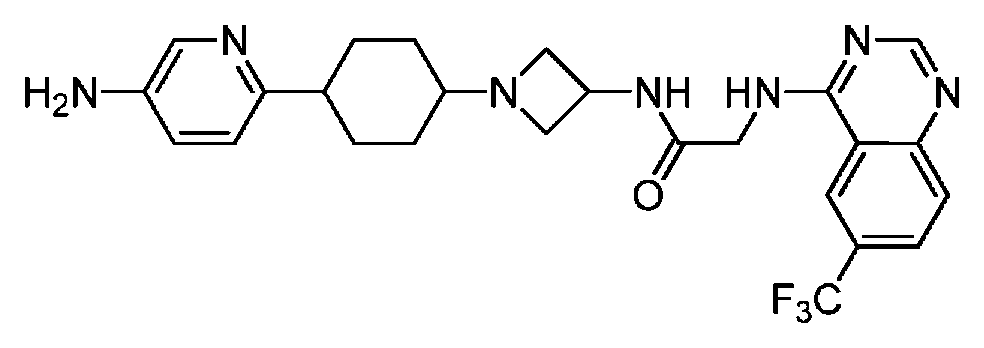
실시예 1, 단계 H에 기재된 바와 같이 TEA 및 NaBH(OAc)3의 존재 하에서 4-(5-아미노피리딘-2-일)사이클로헥사논 (실시예 1 단계 A 내지 단계 C에 기재된 절차를 사용하여 6-브로모피리딘-3-아민과 8-(4,4,5,5-테트라메틸-[1,3,2]다이옥사보로란-2-일)-1,4-다이옥사-스피로[4.5]데스-7-엔의 반응에 의해 제조됨)과 N-(아제티딘-3-일)-2-((6-(트라이플루오로메틸)퀴나졸린-4-일)아미노)아세트아미드 (실시예 1 단계 G에서 제조됨)의 반응에 의해 생성물을 얻었다.(5-aminopyridin-2-yl) cyclohexanone (using the procedure described in Step A of Step A to Step C) in the presence of TEA and NaBH (OAc) 3 as described in Example 1, (4,4,5,5-tetramethyl- [1,3,2] dioxaborolan-2-yl) -1,4-dioxa-spiro [ 4.5] des-7-ene) and N- (azetidin-3-yl) -2 - ((6- (trifluoromethyl) quinazolin-4- yl) amino) acetamide (Prepared in example 1 step G).
1H NMR (아세토니트릴-d3) δ: 8.57 (s, 1 H), 8.38 (s, 1 H), 7.91 (m, J=2.0 Hz, 2 H), 7.78 - 7.87 (m, 1 H), 7.68 (t, J=5.2 Hz, 1 H), 7.36 (d, J=6.8 Hz, 1 H), 6.90 (d, J=2.0 Hz, 2 H), 4.31 - 4.43 (m, 1 H), 4.19 (d, J=5.8 Hz, 2 H), 3.56 (t, J=7.6 Hz, 2 H), 2.87 (t, J=7.1 Hz, 2 H), 2.52 (tt, J=11.4, 3.5 Hz, 1 H), 2.32 (d, J=3.0 Hz, 1 H), 1.75 - 1.90 (m, 2 H), 1.57 - 1.69 (m, 2 H), 1.35 - 1.51 (m, 4 H); ESI-MS (m/z): C25H28F3N7O에 대한 계산치: 499.23; 실측치: 500 (M+H). 1 H NMR (acetonitrile-d 3)?: 8.57 (s, 1H), 8.38 (s, 1H), 7.91 (m, J = 2.0 Hz, 2H), 7.78-7.87 (D, J = 2.0 Hz, 2H), 4.31-4.43 (m, 1H), 4.19 (d, (d, J = 5.8 Hz, 2H), 3.56 (t, J = 7.6 Hz, 2H), 2.87 H), 2.32 (d, J = 3.0 Hz, 1H), 1.75-1.90 (m, 2H), 1.57-1.69 (m, 2H), 1.35-1.51 (m, 4H); ESI-MS (m / z) : C 25 H 28 F 3 calculated for N 7 O: 499.23; Found: 500 (M + H).
실시예Example 71: N-(1-((1s,4s)-4-(3- 71: N- (1 - ((1S, 4S) -4- (3- 아미노피리딘Aminopyridine -2-일)-2 days) 사이클로헥실Cyclohexyl )) 아제티딘Azetidine -3-일)-2-((6-(트3-yl) -2 - ((6- 라이플루오Rifluo 로메틸)Lt; / RTI > 퀴나졸린Quinazoline -4-일)아미노)Yl) amino) 아세트아미드Acetamide

실시예 1, 단계 H에 기재된 바와 같이 TEA 및 NaBH(OAc)3의 존재 하에서 4-(3-아미노피리딘-2-일)사이클로헥사논 (실시예 1 단계 A 내지 단계 C에 기재된 절차를 사용하여 2-브로모피리딘-3-아민과 8-(4,4,5,5-테트라메틸-[1,3,2]다이옥사보로란-2-일)-1,4-다이옥사-스피로[4.5]데스-7-엔의 반응에 의해 제조됨)과 N-(아제티딘-3-일)-2-((6-(트라이플루오로메틸)퀴나졸린-4-일)아미노)아세트아미드 (실시예 1 단계 G에서 제조됨)의 반응에 의해 생성물을 얻었다.(3-aminopyridin-2-yl) cyclohexanone (using the procedure described in Example 1 Step A to Step C) in the presence of TEA and NaBH (OAc) 3 as described in example 1, step H Bromopyridin-3-amine with 8- (4,4,5,5-tetramethyl- [l, 3,2] dioxaborolan-2-yl) 4.5] des-7-ene) and N- (azetidin-3-yl) -2 - ((6- (trifluoromethyl) quinazolin-4- yl) amino) acetamide (Prepared in example 1 step G).
1H NMR (MEOD) δ: 8.62 (s, 1 H), 8.55 (s, 1 H), 8.02 (dd, J=8.8, 1.8 Hz, 1 H), 7.86 (d, J=8.8 Hz, 1 H), 7.79 (dd, J=4.8, 1.5 Hz, 1 H), 7.02 - 7.10 (m, 1 H), 6.97 (dd, J=8.0, 4.7 Hz, 1 H), 4.56 (quin, J=7.1 Hz, 1 H), 4.31 (s, 2 H), 3.98 (t, J=7.5 Hz, 2 H), 3.42 - 3.58 (m, 2 H), 2.83 - 2.98 (m, 2 H), 1.78 - 1.98 (m, 4 H), 1.53 - 1.78 (m, 4 H); ESI-MS (m/z): C25H28F3N7O에 대한 계산치: 499.23; 실측치: 500 (M+H). 1 H NMR (MEOD) δ: 8.62 (s, 1 H), 8.55 (s, 1 H), 8.02 (dd, J = 8.8, 1.8 Hz, 1 H), 7.86 (d, J = 8.8 Hz, 1 H ), 7.79 (dd, J = 4.8,1.5 Hz, 1H), 7.02-7.10 (m, 1H), 6.97 (dd, J = 8.0, 4.7 Hz, 1H), 4.56 (M, 2H), 3.31 (s, 2H), 3.98 (t, J = 7.5 Hz, 2H), 3.42-3.58 m, 4 H), 1.53 - 1.78 (m, 4 H); ESI-MS (m / z) : C 25 H 28 F 3 calculated for N 7 O: 499.23; Found: 500 (M + H).
실시예Example 72: N-(1-(4-(2- 72: N- (1- (4- (2- 시아노페닐Cyanophenyl )) 사이클로헥실Cyclohexyl )) 아제티딘Azetidine -3-일)-2-((6-(Yl) -2 - ((6- ( 트라이플루오로메틸Trifluoromethyl )) 퀴나졸린Quinazoline -4-일)아미노)Yl) amino) 아세트아미드Acetamide

실시예 1, 단계 H에 기재된 바와 같이 TEA 및 NaBH(OAc)3의 존재 하에서 2-(4-옥소사이클로헥실)벤조니트릴 (실시예 1 단계 A 내지 단계 C에 기재된 절차를 사용하여 2-브로모벤조니트릴과 8-(4,4,5,5-테트라메틸-[1,3,2]다이옥사보로란-2-일)-1,4-다이옥사-스피로[4.5]데스-7-엔의 반응에 의해 제조됨)과 N-(아제티딘-3-일)-2-((6-(트라이플루오로메틸)퀴나졸린-4-일)아미노)아세트아미드 (실시예 1 단계 G에서 제조됨)의 반응에 의해 생성물을 얻었다.Example 1, in the presence of TEA and NaBH (OAc) 3 as described in Step H 2- (4- oxo-cyclohexyl) benzonitrile (using the procedure described in Example 1, Step A to Step C Bromo-2- (4,4,5,5-tetramethyl- [l, 3,2] dioxaborolan-2-yl) -1,4-dioxa-spiro [4.5] des- Amino) acetamide (prepared from the reaction of Example 1 Step G) and N - (azetidin-3-yl) -2 - ((6- (trifluoromethyl) quinazolin- ) To give the product.
1H NMR (아세토니트릴-d3) δ: 8.60 (s, 1 H), 8.46 (s, 1 H), 8.00 (dd, J=8.8, 1.8 Hz, 1 H), 7.89 (d, J=8.6 Hz, 1 H), 7.65 (dd, J=7.8, 1.0 Hz, 1 H), 7.57 - 7.63 (m, 1 H), 7.50 (d, J=7.8 Hz, 1 H), 7.33 (td, J=7.6, 1.3 Hz, 1 H), 4.44 (quin, J=6.9 Hz, 1 H), 4.21 (s, 2 H), 3.65 (t, J=7.3 Hz, 2 H), 2.91 - 3.00 (m, 3 H), 2.46 (br. s., 1 H), 1.70 - 1.89 (m, 4 H), 1.45 - 1.62 (m, 4 H); ESI-MS (m/z): C27H27F3N6O에 대한 계산치: 508.22; 실측치: 509 (M+H). 1 H NMR (acetonitrile -d3) δ: 8.60 (s, 1 H), 8.46 (s, 1 H), 8.00 (dd, J = 8.8, 1.8 Hz, 1 H), 7.89 (d, J = 8.6 Hz , 7.65 (dd, J = 7.8,1.0 Hz, 1H), 7.57-7.63 (m, 1H), 7.50 (d, J = 7.8 Hz, 1H), 7.33 , 1.3 Hz, 1H), 4.44 (quin, J = 6.9 Hz, 1H), 4.21 (s, 2H), 3.65 (t, J = 7.3 Hz, 2H), 2.91-3.00 ), 2.46 (br s, 1H), 1.70-1.89 (m, 4H), 1.45-1.62 (m, 4H); ESI-MS (m / z): Calcd for C 27 H 27 F 3 N 6 O: 508.22; Found: 509 (M + H).
실시예Example 73: N-(1-((1s,4s)-4-(2-( 73: N- (1 - ((1S, 4S) -4- (2- ( 하이드록시메틸Hydroxymethyl )) 페닐Phenyl )) 사이클로헥실Cyclohexyl )) 아제티딘Azetidine -3-일)-2-((6-(Yl) -2 - ((6- ( 트라이플루오로메틸Trifluoromethyl )) 퀴나졸린Quinazoline -4-일)아미노)Yl) amino) 아세트아미드Acetamide
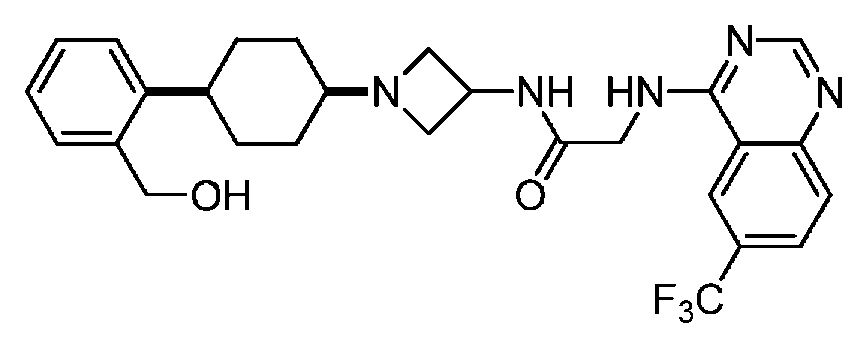
실시예 1, 단계 H에 기재된 바와 같이 TEA 및 NaBH(OAc)3의 존재 하에서 2-(4-옥소사이클로헥실)벤조니트릴 (실시예 1 단계 A 내지 단계 C에 기재된 절차를 사용하여 2-브로모벤조니트릴과 8-(4,4,5,5-테트라메틸-[1,3,2]다이옥사보로란-2-일)-1,4-다이옥사-스피로[4.5]데스-7-엔의 반응에 의해 제조됨)과 N-(아제티딘-3-일)-2-((6-(트라이플루오로메틸)퀴나졸린-4-일)아미노)아세트아미드 (실시예 1 단계 G에서 제조됨)의 반응에 의해 생성물을 얻었다.Example 1, in the presence of TEA and NaBH (OAc) 3 as described in Step H 2- (4- oxo-cyclohexyl) benzonitrile (using the procedure described in Example 1, Step A to Step C Bromo-2- (4,4,5,5-tetramethyl- [l, 3,2] dioxaborolan-2-yl) -1,4-dioxa-spiro [4.5] des- Amino) acetamide (prepared from the reaction of Example 1 Step G) and N - (azetidin-3-yl) -2 - ((6- (trifluoromethyl) quinazolin- ) To give the product.
1H NMR (DMSO-d6) δ: 9.01 (t, J=5.7 Hz, 1 H), 8.81 (s, 1 H), 8.57 (s, 1 H), 8.44 (d, J=7.1 Hz, 1 H), 8.06 (dd, J=8.7, 1.9 Hz, 1 H), 7.88 (d, J=8.6 Hz, 1 H), 7.32 (d, J=7.6 Hz, 1 H), 7.21 (d, J=5.1 Hz, 2 H), 7.07 - 7.16 (m, 1 H), 5.01 (t, J=5.4 Hz, 1 H), 4.52 (d, J=5.6 Hz, 2 H), 4.25 - 4.37 (m, 1 H), 4.15 (d, J=5.8 Hz, 2 H), 3.52 (br. s., 2 H), 2.65 - 2.85 (m, 3 H), 2.32 (m, J=1.8 Hz, 1 H), 1.57 - 1.84 (m, 4 H), 1.40 (m, J=11.9 Hz, 4 H); ESI-MS (m/z): C27H30F3N5O2에 대한 계산치: 513.24; 실측치: 514 (M+H). 1 H NMR (DMSO-d 6)?: 9.01 (t, J = 5.7 Hz, 1H), 8.81 (s, 1H), 8.57 J = 8.6 Hz, 1H), 7.32 (d, J = 7.6 Hz, 1H), 7.21 (d, J = 5.1 Hz, 2H), 7.07-7.16 (m, 1H), 5.01 (t, J = 5.4 Hz, 1H), 4.52 (d, J = 5.6 Hz, 2H), 4.25-4.37 ), 4.15 (d, J = 5.8 Hz, 2H), 3.52 (br s, 2H), 2.65-2.85 - 1.84 (m, 4 H), 1.40 (m, J = 11.9 Hz, 4 H); ESI-MS (m / z): Calcd for C 27 H 30 F 3 N 5 O 2: 513.24; Found: 514 (M + H).
실시예Example 74: N-(1-(4-(3-( 74: N- (1- (4- (3- ( 메틸아미노Methyl amino )피리딘-4-일)) Pyridin-4-yl) 사이클로헥실Cyclohexyl )) 아제티딘Azetidine -3-일)-2-((6-(트3-yl) -2 - ((6- 라이플루오로Rifluro 메틸)methyl) 퀴나졸린Quinazoline -4-일)아미노)Yl) amino) 아세트아미드Acetamide
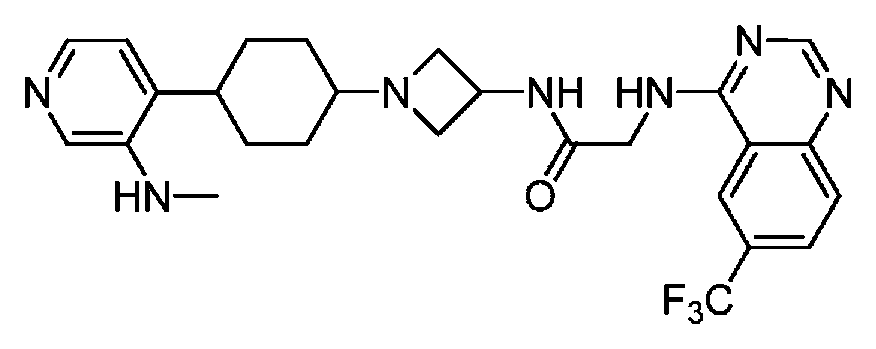
실시예 1, 단계 H에 기재된 바와 같이 TEA 및 NaBH(OAc)3의 존재 하에서 4-(3-(메틸아미노)피리딘-4-일)사이클로헥사논 (실시예 1 단계 A 내지 단계 C에 기재된 절차를 사용하여 4-브로모-N-메틸피리딘-3-아민과 8-(4,4,5,5-테트라메틸-[1,3,2]다이옥사보로란-2-일)-1,4-다이옥사-스피로[4.5]데스-7-엔의 반응에 의해 제조됨)과 N-(아제티딘-3-일)-2-((6-(트라이플루오로메틸)퀴나졸린-4-일)아미노)아세트아미드 (실시예 1 단계 G에서 제조됨)의 반응에 의해 생성물을 얻었다.(As described in Example 1, Step A to Step C) in the presence of TEA and NaBH (OAc) 3 as described in example 1, step H, using 4- (3- (methylamino) pyridin- Methylpyridin-3-amine and 8- (4,4,5,5-tetramethyl- [1,3,2] dioxaborolan-2-yl) -1, (Azetidin-3-yl) -2 - ((6- (trifluoromethyl) quinazolin-4- Yl) amino) acetamide (prepared in Example 1 Step G).
1H NMR (MEOD) δ: 8.51 - 8.62 (m, 3 H), 7.94 - 8.05 (m, 2 H), 7.84 - 7.94 (m, 3 H), 7.75 - 7.84 (m, 1 H), 4.23 (d, J=2.5 Hz, 3 H), 4.13 - 4.20 (m, 2 H), 4.05 - 4.11 (m, 3 H), 4.01 (dd, J=11.2, 6.4 Hz, 0 H), 3.72 - 3.85 (m, 1 H), 2.91 - 2.98 (m, 1 H), 1.92 (br. s., 2 H), 1.67 - 1.80 (m, 2 H), 1.53 - 1.67 (m, 2 H), 1.24 - 1.32 (m, 2 H); ESI-MS (m/z): C26H30F3N7O에 대한 계산치: 513.25; 실측치: 514 (M+H). 1 H NMR (MEOD)?: 8.51-8.62 (m, 3H), 7.94-8.05 (m, 2H), 7.84-7.94 (m, 3 H), 4.01 (dd, J = 11.2, 6.4 Hz, 0 H), 3.72 - 3.85 (m, 2H), 1.92-1.27 (m, 2H), 1.91-1.92 (m, (m, 2H); ESI-MS (m / z): Calcd for C 26 H 30 F 3 N 7 O: 513.25; Found: 514 (M + H).
실시예Example 75: N-(1-((1r,4r)-4- 75: N- (1 - ((1 R, 4R) -4- 하이드록시Hydroxy -4-(6--4- (6- 메틸피리딘Methyl pyridine -3-일)-3 days) 사이클로헥실Cyclohexyl )) 아제티딘Azetidine -3-일)-2-((6-(Yl) -2 - ((6- ( 트라이플루오로메틸Trifluoromethyl )) 퀴나졸린Quinazoline -4-일)아미노)Yl) amino) 아세트아미드Acetamide

실시예 1, 단계 H에 기재된 바와 같이 TEA 및 NaBH(OAc)3의 존재 하에서 4-하이드록시-4-(6-메틸피리딘-3-일)사이클로헥사논 (실시예 24 단계 A 내지 단계 B에 기재된 절차를 사용하여 5-브로모-2-메틸피리딘과 1,4-다이옥사스피로[4.5]데칸-8-온의 반응에 의해 제조됨)과 N-(아제티딘-3-일)-2-((6-(트라이플루오로메틸)퀴나졸린-4-일)아미노)아세트아미드 (실시예 1 단계 G에서 제조됨)의 반응에 의해 생성물을 얻었다.4- (6-methylpyridin-3-yl) cyclohexanone (prepared from example 24 step A to step B) in the presence of TEA and NaBH (OAc) 3 as described in example 1, (Prepared by reaction of 5-bromo-2-methylpyridine with 1,4-dioxaspiro [4.5] decan-8-one using the described procedure) and N- (azetidin- - ((6- (trifluoromethyl) quinazolin-4-yl) amino) acetamide (prepared in Example 1 step G).
1H NMR (MEOD) δ: 8.62 (s, 1 H), 8.50 - 8.59 (m, 2 H), 8.03 (dd, J=8.8, 1.8 Hz, 1 H), 7.78 - 7.91 (m, 2 H), 7.26 (dd, J=8.1, 2.5 Hz, 2 H), 4.50 (quin, J=7.1 Hz, 1 H), 4.28 (s, 2 H), 3.70 (t, J=7.3 Hz, 2 H), 3.00 (t, J=6.9 Hz, 2 H), 2.47 - 2.53 (m, 3 H), 2.43 (br. s., 1 H), 2.09 - 2.26 (m, 2 H), 1.96 - 2.09 (m, 1 H), 1.76 - 1.95 (m, 2 H), 1.34 - 1.71 (m, 4 H); ESI-MS (m/z): C26H29F3N6O2에 대한 계산치: 514.23; 실측치: 515 (M+H). 1 H NMR (MEOD) δ: 8.62 (s, 1 H), 8.50 - 8.59 (m, 2 H), 8.03 (dd, J = 8.8, 1.8 Hz, 1 H), 7.78 - 7.91 (m, 2 H) , 7.26 (dd, J = 8.1, 2.5 Hz, 2H), 4.50 (quin, J = 7.1 Hz, 1H), 4.28 (s, 2H) (M, 2H), 1.96-2.09 (m, 2H), 2.43 (m, 2H) 1 H), 1.76-1.95 (m, 2 H), 1.34-1.71 (m, 4 H); ESI-MS (m / z): Calcd for C 26 H 29 F 3 N 6 O 2 : 514.23; Found: 515 (M + H).
실시예Example 76: N-(1-(4- 76: N- (1- (4- 하이드록시Hydroxy -4-(6--4- (6- 메톡시피리딘Methoxypyridine -3-일)-3 days) 사이클로헥실Cyclohexyl )) 아제티딘Azetidine -3-일)-2-((6-(Yl) -2 - ((6- ( 트라이플루오로메틸Trifluoromethyl )) 퀴나졸린Quinazoline -4-일)아미노)Yl) amino) 아세트아미드Acetamide

실시예 1, 단계 H에 기재된 바와 같이 TEA 및 NaBH(OAc)3의 존재 하에서 4-하이드록시-4-(6-메톡시피리딘-3-일)사이클로헥사논 (실시예 24 단계 A 내지 단계 B에 기재된 절차를 사용하여 5-브로모-2-메톡시피리딘과 1,4-다이옥사스피로[4.5]데칸-8-온의 반응에 의해 제조됨)과 N-(아제티딘-3-일)-2-((6-(트라이플루오로메틸)퀴나졸린-4-일)아미노)아세트아미드 (실시예 1 단계 G에서 제조됨)의 반응에 의해 생성물을 얻었다.(4-hydroxy-4- (6-methoxypyridin-3-yl) cyclohexanone (from step A to step B of Example 24, step B) in the presence of TEA and NaBH (OAc) 3 as described in example 1, (Prepared by reaction of 5-bromo-2-methoxypyridine with 1,4-dioxaspiro [4.5] decan-8-one using the procedure described in Example 1) and N- (azetidin- Amino) acetamide (prepared in step 1 G of Example 1) in the form of a white solid.
1H NMR (MEOD) δ: 8.62 (s, 1 H), 8.50 - 8.59 (m, 2 H), 8.03 (dd, J=8.8, 1.8 Hz, 1 H), 7.78 - 7.91 (m, 2 H), 7.26 (dd, J=8.1, 2.5 Hz, 2 H), 4.50 (quin, J=7.1 Hz, 1 H), 4.28 (s, 2 H), 3.70 (t, J=7.3 Hz, 2 H), 3.00 (t, J=6.9 Hz, 2 H), 2.47 - 2.53 (m, 3 H), 2.43 (br. s., 1 H), 2.09 - 2.26 (m, 2 H), 1.96 - 2.09 (m, 1 H), 1.76 - 1.95 (m, 2 H), 1.34 - 1.71 (m, 4 H); ESI-MS (m/z): C26H29F3N6O2에 대한 계산치: 514.23; 실측치: 515 (M+H). 1 H NMR (MEOD) δ: 8.62 (s, 1 H), 8.50 - 8.59 (m, 2 H), 8.03 (dd, J = 8.8, 1.8 Hz, 1 H), 7.78 - 7.91 (m, 2 H) , 7.26 (dd, J = 8.1, 2.5 Hz, 2H), 4.50 (quin, J = 7.1 Hz, 1H), 4.28 (s, 2H) (M, 2H), 1.96-2.09 (m, 2H), 2.43 (m, 2H) 1 H), 1.76-1.95 (m, 2 H), 1.34-1.71 (m, 4 H); ESI-MS (m / z): Calcd for C 26 H 29 F 3 N 6 O 2 : 514.23; Found: 515 (M + H).
실시예Example 77: N-(1-(4- 77: N- (1- (4- 하이드록시Hydroxy -4-(6--4- (6- 메톡시피리딘Methoxypyridine -2-일)-2 days) 사이클로헥실Cyclohexyl )) 아제티딘Azetidine -3-일)-2-((6-(Yl) -2 - ((6- ( 트라이플루오로메틸Trifluoromethyl )) 퀴나졸린Quinazoline -4-일)아미노)Yl) amino) 아세트아미드Acetamide

실시예 1, 단계 H에 기재된 바와 같이 TEA 및 NaBH(OAc)3의 존재 하에서 4-하이드록시-4-(6-메톡시피리딘-2-일)사이클로헥사논 (실시예 24 단계 A 내지 단계 B에 기재된 절차를 사용하여 2-브로모-6-메톡시피리딘과 1,4-다이옥사스피로[4.5]데칸-8-온의 반응에 의해 제조됨)과 N-(아제티딘-3-일)-2-((6-(트라이플루오로메틸)퀴나졸린-4-일)아미노)아세트아미드 (실시예 1 단계 G에서 제조됨)의 반응에 의해 생성물을 얻었다.Example 1, in the presence of TEA and NaBH (OAc) 3 as described in Step H 4- hydroxy-4- (6-methoxypyridin-2-yl) cyclohexanone (Example 24, Step A to Step B (Prepared by reaction of 2-bromo-6-methoxypyridine with 1,4-dioxaspiro [4.5] decan-8-one using the procedure described in Example 1) and N- (azetidin- Amino) acetamide (prepared in step 1 G of Example 1) in the form of a white solid.
1H NMR (MEOD) δ: 8.65 (s, 1 H), 8.16 (s, 1 H), 7.85 (s, 1 H), 7.53 - 7.67 (m, 2 H), 6.94 - 7.04 (m, 1 H), 6.90 (d, J=7.3 Hz, 1 H), 6.58 - 6.67 (m, 2 H), 4.56 - 4.64 (m, 0 H), 4.30 (d, J=5.1 Hz, 2 H), 3.90 - 3.94 (m, 3 H), 3.74 (dt, J=9.5, 4.7 Hz, 1 H), 3.63 (t, J=7.5 Hz, 2 H), 2.95 (dd, J=7.5, 6.2 Hz, 2 H), 1.65 - 2.01 (m, 30 H [대부분 케톤 s.m.]), 1.26 - 1.61 (m, 30 H [대부분 케톤 s.m.]); ESI-MS (m/z): C26H29F3N6O2에 대한 계산치: 514.23; 실측치: 515 (M+H). 1 H NMR (MEOD) ?: 8.65 (s, 1H), 8.16 (s, 1H), 7.85 (s, 1H), 7.53-7.67 (m, 2H), 6.94-7.04 ), 6.90 (d, J = 7.3 Hz, 1H), 6.58-6.67 (m, 2H), 4.56-4.64 J = 7.5 Hz, 2H), 3.94 (m, 3 H), 3.74 (dt, J = 9.5, 4.7 Hz, 1H) , 1.65 - 2.01 (m, 30 H [mostly ketone sm]), 1.26 - 1.61 (m, 30 H [mostly ketone sm]); ESI-MS (m / z): Calcd for C 26 H 29 F 3 N 6 O 2 : 514.23; Found: 515 (M + H).
실시예Example 78: N-(1-((1r,4r)-4- 78: N- (1 - ((1R, 4R) -4- 하이드록시Hydroxy -4--4- 페닐사이클로헥실Phenylcyclohexyl )) 아제티딘Azetidine -3-일)-2-((6-(트3-yl) -2 - ((6- 라이플루오로Rifluro 메틸)methyl) 퀴나졸린Quinazoline -4-일)아미노)Yl) amino) 아세트아미드Acetamide

실시예 1, 단계 H에 기재된 바와 같이 TEA 및 NaBH(OAc)3의 존재 하에서 4-하이드록시-4-페닐사이클로헥사논 (실시예 24 단계 A 내지 단계 B에 기재된 절차를 사용하여 페닐마그네슘 브로마이드와 1,4-다이옥사스피로[4.5]데칸-8-온의 반응에 의해 제조됨)과 N-(아제티딘-3-일)-2-((6-(트라이플루오로메틸)퀴나졸린-4-일)아미노)아세트아미드 (실시예 1 단계 G에서 제조됨)의 반응에 의해 생성물을 얻었다.4-phenylcyclohexanone (prepared as described in Example 1, step H, using 4-hydroxy-4-phenylcyclohexanone in the presence of TEA and NaBH (OAc) 3 , phenylmagnesium bromide (Azetidin-3-yl) -2 - ((6- (trifluoromethyl) quinazoline-4-one) -Yl) amino) acetamide (prepared in Example 1 Step G).
1H NMR (클로로포름-d) δ: 8.63 (s, 1 H), 8.11 (s, 1 H), 7.77 - 7.86 (m, 2 H), 7.66 (t, J=5.2 Hz, 1 H), 7.51 - 7.56 (m, 2 H), 7.32 - 7.39 (m, 3 H), 4.52 - 4.64 (m, 1 H), 4.27 (d, J=5.1 Hz, 2 H), 3.62 (t, J=7.5 Hz, 2 H), 2.94 (t, J=6.6 Hz, 2 H), 2.21 - 2.37 (m, 3 H), 2.02 - 2.12 (m, 1 H), 1.79 - 1.92 (m, 3 H), 1.52 - 1.74 (m, 5 H), 1.44 (dt, J=9.3, 4.6 Hz, 2 H); ESI-MS (m/z): C26H28F3N5O2에 대한 계산치: 499.22; 실측치: 500 (M+H). 1 H NMR (chloroform-d)?: 8.63 (s, 1H), 8.11 (s, 1H), 7.77-7.86 (m, 2H) (M, 1H), 7.56 (m, 2H), 7.32-7.39 (m, 3H), 4.52-4.64 (M, 3 H), 1.92-1.92 (m, 3 H), 1.52 - (2 H) 1.74 (m, 5 H), 1.44 (dt, J = 9.3, 4.6 Hz, 2 H); ESI-MS (m / z): Calcd for C 26 H 28 F 3 N 5 O 2 : 499.22; Found: 500 (M + H).
실시예Example 79: N-(1-(4- 79: N- (1- (4- 하이드록시Hydroxy -4-(2--4- (2- 메틸티아졸Methyl thiazole -5-일)-5 days) 사이클로헥실Cyclohexyl )) 아제티딘Azetidine -3-일)-2-((6-(Yl) -2 - ((6- ( 트라이플루오로메틸Trifluoromethyl )) 퀴나졸린Quinazoline -4-일)아미노)Yl) amino) 아세트아미드Acetamide

실시예 1, 단계 H에 기재된 바와 같이 TEA 및 NaBH(OAc)3의 존재 하에서 4-하이드록시-4-(2-메틸티아졸-5-일)사이클로헥사논 (실시예 24 단계 A 내지 단계 B에 기재된 절차를 사용하여 5-브로모-2-메틸티아졸과 1,4-다이옥사스피로[4.5]데칸-8-온의 반응에 의해 제조됨)과 N-(아제티딘-3-일)-2-((6-(트라이플루오로메틸)퀴나졸린-4-일)아미노)아세트아미드 (실시예 1 단계 G에서 제조됨)의 반응에 의해 생성물을 얻었다.4- (2-methylthiazol-5-yl) cyclohexanone (from step A to step B of Example 24, step B) in the presence of TEA and NaBH (OAc) 3 as described in example 1, (Prepared by reaction of 5-bromo-2-methylthiazole with 1,4-dioxaspiro [4.5] decan-8-one using the procedure described in Example 1) and N- (azetidin- Amino) acetamide (prepared in step 1 G of Example 1) in the form of a white solid.
1H NMR (클로로포름-d) δ: 8.57 (s, 1 H), 8.43 (s, 1 H), 7.88 - 7.94 (m, 1 H), 7.81 - 7.88 (m, 1 H), 7.46 (s, 1 H), 4.54 (quin, J=6.5 Hz, 1 H), 4.24 (s, 2 H), 3.30 (br. s., 2 H), 3.13 (q, J=7.3 Hz, 6 H), 2.64 (s, 3 H), 2.55 (br. s., 1 H), 2.17 (td, J=8.5, 3.7 Hz, 2 H), 1.56 - 1.92 (m, 6 H), 1.32 (t, J=7.3 Hz, 9 H); ESI-MS (m/z): C24H27F3N6O2S에 대한 계산치: 520.19; 실측치: 521 (M+H). 1 H NMR (chloroform-d)?: 8.57 (s, 1H), 8.43 (s, 1H), 7.88-7.94 (m, 1H), 7.81-7.88 1 H), 4.54 (quin, J = 6.5 Hz, 1H), 4.24 (s, 2H), 3.30 (s, 3H), 2.55 (br s, 1H), 2.17 (td, J = 8.5, 3.7 Hz, 2H), 1.56-1.92 Hz, 9 H); ESI-MS (m / z): Calcd for C 24 H 27 F 3 N 6 O 2 S: 520.19; Found: 521 (M + H).
실시예Example 80: N-(1-(4- 80: N- (1- (4- 하이드록시Hydroxy -4-(2--4- (2- 아이소프로필티아졸Isopropylthiazole -5-일)-5 days) 사이클로헥실Cyclohexyl )) 아제티딘Azetidine -3-일)-2-((6-(Yl) -2 - ((6- ( 트라이플루오로메틸Trifluoromethyl )) 퀴나졸린Quinazoline -4-일)아미노)Yl) amino) 아세트아미드Acetamide

실시예 1, 단계 H에 기재된 바와 같이 TEA 및 NaBH(OAc)3의 존재 하에서 4-하이드록시-4-(2-아이소프로필티아졸-5-일)사이클로헥사논 (실시예 24 단계 A 내지 단계 B에 기재된 절차를 사용하여 5-브로모-2-아이소프로필티아졸과 1,4-다이옥사스피로[4.5]데칸-8-온의 반응에 의해 제조됨)과 N-(아제티딘-3-일)-2-((6-(트라이플루오로메틸)퀴나졸린-4-일)아미노)아세트아미드 (실시예 1 단계 G에서 제조됨)의 반응에 의해 생성물을 얻었다.Example 1, in the presence of TEA and NaBH (OAc) 3 as described in Step H 4- hydroxy-4- (2-isopropyl-5-yl) cyclohexanone (Example 24, Step A to Step (Prepared by reaction of 5-bromo-2-isopropylthiazole with 1,4-dioxaspiro [4.5] decan-8-one using the procedure described in Example B) and N- (azetidin- The product was obtained by reaction of 2- ((6- (trifluoromethyl) quinazolin-4-yl) amino) acetamide (prepared in Example 1 Step G).
1H NMR (클로로포름-d) δ: 8.59 - 8.64 (m, 1 H), 8.39 - 8.48 (m, 1 H), 7.85 - 7.99 (m, 2 H), 7.38 - 7.53 (m, 1 H), 7.32 (s, 2 H), 4.42 - 4.61 (m, 1 H), 4.20 - 4.29 (m, 2 H), 3.81 (t, J=8.2 Hz, 2 H), 3.43 - 3.52 (m, 1 H), 3.10 (q, J=7.3 Hz, 5 H), 2.48 (br. s., 1 H), 2.23 (d, J=8.6 Hz, 1 H), 2.00 - 2.13 (m, 2 H), 1.55 - 1.91 (m, 6 H), 1.30 - 1.40 (m, 8 H); ESI-MS (m/z): C26H31F3N6O2S에 대한 계산치: 548.22; 실측치: 549 (M+H). 1 H NMR (chloroform-d)?: 8.59-8.64 (m, 1H), 8.39-8.48 (m, 1H), 7.85-7.99 (M, 1H), 3.81 (t, J = 8.2 Hz, 2H), 3.43-3.52 (m, 1H) , 3.10 (q, J = 7.3 Hz, 5 H), 2.48 (br s, 1H), 2.23 (d, J = 8.6 Hz, 1H), 2.00-2.13 1.91 (m, 6 H), 1.30 - 1.40 (m, 8 H); ESI-MS (m / z): Calcd for C 26 H 31 F 3 N 6 O 2 S: 548.22; Found: 549 (M + H).
실시예Example 81: N-(1-(4- 81: N- (1- (4- 하이드록시Hydroxy -4-(-4-( 아이소티아졸Isothiazole -5-일)-5 days) 사이클로헥실Cyclohexyl )) 아제티딘Azetidine -3-일)-2-((6-(Yl) -2 - ((6- ( 트라이플루오로메틸Trifluoromethyl )) 퀴나졸린Quinazoline -4-일)아미노)Yl) amino) 아세트아미드Acetamide

실시예 1, 단계 H에 기재된 바와 같이 TEA 및 NaBH(OAc)3의 존재 하에서 4-하이드록시-4-(아이소티아졸-5-일)사이클로헥사논 (실시예 24 단계 A 내지 단계 B에 기재된 절차를 사용하여 5-브로모아이소티아졸과 1,4-다이옥사스피로[4.5]데칸-8-온의 반응에 의해 제조됨)과 N-(아제티딘-3-일)-2-((6-(트라이플루오로메틸)퀴나졸린-4-일)아미노)아세트아미드 (실시예 1 단계 G에서 제조됨)의 반응에 의해 생성물을 얻었다.Example 1, in the presence of TEA and NaBH (OAc) 3 as described in Step H 4- hydroxy-4- (isothiazol-5-yl) cyclohexanone (described in Example 24, Step A to Step B (Prepared by reaction of 5-bromo isothiazole with 1,4-dioxaspiro [4.5] decan-8-one using the procedure described in Example 1) and N- (azetidin- (Trifluoromethyl) quinazolin-4-yl) amino) acetamide (prepared in Example 1 Step G).
1H NMR (클로로포름-d) δ: 8.61 (s, 1 H), 8.45 - 8.51 (m, 1 H), 8.35 (d, J=1.8 Hz, 1 H), 7.92 - 7.98 (m, 1 H), 7.87 - 7.92 (m, 1 H), 7.04 (d, J=1.8 Hz, 1 H), 4.62 (t, J=6.8 Hz, 1 H), 4.21 - 4.31 (m, 2 H), 3.97 - 4.09 (m, 2 H), 3.79 - 3.88 (m, 1 H), 3.13 (q, J=7.3 Hz, 6 H), 2.05 - 2.26 (m, 2 H), 1.78 (d, J=12.9 Hz, 6 H), 1.35 (t, J=7.3 Hz, 9 H); ESI-MS (m/z): C23H25F3N6O2S에 대한 계산치: 506.17; 실측치: 507 (M+H). 1 H NMR (chloroform -d) δ: 8.61 (s, 1 H), 8.45 - 8.51 (m, 1 H), 8.35 (d, J = 1.8 Hz, 1 H), 7.92 - 7.98 (m, 1 H) , 7.87-7.92 (m, 1H), 7.04 (d, J = 1.8 Hz, 1H), 4.62 (t, J = 6.8 Hz, 1H), 4.21-4.31 (m, 2H), 3.79-3.88 (m, 1H), 3.13 (q, J = 7.3 Hz, 6H), 2.05-2.26 H), 1.35 (t, J = 7.3 Hz, 9 H); ESI-MS (m / z) : C 23 H 25 F 3 N 6 O Calcd for 2 S: 506.17; Found: 507 (M + H).
실시예Example 82: 2-((2,6- 82: 2 - ((2,6- 비스(트라이플루오로메틸)퀴놀린Bis (trifluoromethyl) quinoline -4-일)아미노)-N-(1-((1r,4r)-4-하Yl) amino) -N- (1 - ((1 r, 4r) -4- 이드록Idlock 시-4-(티아졸-5-일)-4- (thiazol-5-yl) 사이클로헥실Cyclohexyl )) 아제티딘Azetidine -3-일)-3 days) 아세트아미드Acetamide

실시예 1, 단계 H에 기재된 바와 같이 TEA 및 NaBH(OAc)3의 존재 하에서 4-하이드록시-4-티아졸-2-일-사이클로헥사논 (실시예 26 단계 C에 기재된 바와 같이 제조됨)과 N-(아제티딘-3-일)-2-((6-(트라이플루오로메틸)퀴나졸린-4-일)아미노)아세트아미드 (실시예 1 단계 G에서 제조됨)의 반응에 의해 생성물을 얻었다.(Prepared as described in Example 26 Step C) in the presence of TEA and NaBH (OAc) 3 as described in example 1, step H, using 4-hydroxy-4-thiazol- (Prepared in step 1 G of Example 1) by reaction of N- (azetidin-3-yl) -2- (6- (trifluoromethyl) quinazolin- ≪ / RTI >
1H NMR (MeOD) δ: 1.34 (s, 5 H) 1.70 - 1.80 (m, 1 H) 1.82 - 2.01 (m, 11 H) 2.18 - 2.27 (m, 1 H) 2.31 (s, 1 H) 3.71 (br. s., 1 H) 4.15 (s, 2 H) 4.47 (s, 1 H) 4.63 (s, 2 H) 6.73 (s, 1 H) 7.81 (s, 1 H) 7.93 - 8.03 (m, 1 H) 8.12 (s, 1 H) 8.67 (s, 1 H) 8.90 (s, 1 H); ESI-MS (m/z): C25H25F6N5O2S에 대한 계산치: 573.16; 실측치: 574 (M+H). 1 H NMR (MeOD)?: 1.34 (s, 5 H) 1.70-1.80 (m, 1 H) 1.82 - 2.01 (m, 11 H) 2.18 - 2.27 (s, 1H), 4.83 (s, 1H), 4.63 (s, 2H) 1 H) 8.12 (s, 1H) 8.67 (s, 1H) 8.90 (s, 1H); ESI-MS (m / z) : C 25 H 25 F 6 N 5 O Calcd for 2 S: 573.16; Found: 574 (M + H).
실시예Example 83: N-(1-((1r,4r)-4- 83: N- (1 - ((1 R, 4R) -4- 하이드록시Hydroxy -4-(티아졸-2-일)-4- (thiazol-2-yl) 사이클로헥실Cyclohexyl )) 아제티딘Azetidine -3-일)-2-((6-(Yl) -2 - ((6- ( 트라이플루오로메틸Trifluoromethyl )) 퀴나졸린Quinazoline -4-일)아미노)Yl) amino) 아세트아미드Acetamide

실시예 1, 단계 H에 기재된 바와 같이 TEA 및 NaBH(OAc)3의 존재 하에서 4-하이드록시-4-티아졸-2-일-사이클로헥사논 (실시예 24 단계 B에 기재된 바와 같이 제조됨)과 N-(아제티딘-3-일)-2-((6-(트라이플루오로메틸)퀴나졸린-4-일)아미노)아세트아미드 (실시예 1 단계 G에서 제조됨)의 반응에 의해 생성물을 얻었다.(Prepared as described in Example 24 Step B) in the presence of TEA and NaBH (OAc) 3 as described in example 1, step H, using 4-hydroxy-4-thiazol- (Prepared in step 1 G of Example 1) by reaction of N- (azetidin-3-yl) -2- (6- (trifluoromethyl) quinazolin- ≪ / RTI >
1H NMR (MeOD) δ: 8.63 (s, 1 H), 8.56 (s, 1 H), 8.04 (d, J=8.8 Hz, 1 H), 7.88 (d, J=8.6 Hz, 1 H), 7.67 (d, J=3.3 Hz, 1 H), 7.47 (d, J=3.3 Hz, 1 H), 4.44 (quin, J=7.0 Hz, 1 H), 4.28 (s, 2 H), 3.62 (t, J=6.9 Hz, 2 H), 2.93 - 3.09 (m, 2 H), 2.30 - 2.42 (m, 3 H), 1.80 (m, J=3.8 Hz, 2 H), 1.59 - 1.74 (m, 2 H), 1.39 - 1.54 (m, 2 H); ESI-MS (m/z): C25H25F6N5O2S에 대한 계산치: 506.17; 실측치: 507 (M+H). 1 H NMR (MeOD) δ: 8.63 (s, 1 H), 8.56 (s, 1 H), 8.04 (d, J = 8.8 Hz, 1 H), 7.88 (d, J = 8.6 Hz, 1 H), J = 3.3 Hz, 1H), 7.47 (d, J = 3.3 Hz, 1H), 4.44 (quin, J = 7.0 Hz, 1H), 4.28 J = 6.9 Hz, 2H), 2.93-3.09 (m, 2H), 2.30-2.42 (m, 3H), 1.80 H), 1.39-1.54 (m, 2 H); ESI-MS (m / z) : C 25 H 25 F 6 N 5 O Calcd for 2 S: 506.17; Found: 507 (M + H).
실시예Example 84: N-(1-((1r,4r)-4- 84: N- (1 - ((1 R, 4R) -4- 하이드록시Hydroxy -1--One- 듀테로Dutero -4-(티아졸-2-일)-4- (thiazol-2-yl) 사이클로헥실Cyclohexyl )) 아제티딘Azetidine -3-일)-2-((6-(Yl) -2 - ((6- ( 트라이플루오로메틸Trifluoromethyl )) 퀴나졸린Quinazoline -4-일)아미노)Yl) amino) 아세트아미드Acetamide

실시예 1, 단계 H에 기재된 바와 같이 TEA 및 NaBD(OAc)3의 존재 하에서 4-하이드록시-4-티아졸-2-일-사이클로헥사논 (실시예 24 단계 B에 기재된 바와 같이 제조됨)과 N-(아제티딘-3-일)-2-((6-(트라이플루오로메틸)퀴나졸린-4-일)아미노)아세트아미드 (실시예 1 단계 G에서 제조됨)의 반응에 의해 생성물을 얻었다.(Prepared as described in example 24 Step B) in the presence of TEA and NaBD (OAc) 3 as described in example 1, step H, using 4-hydroxy-4-thiazol- (Prepared in step 1 G of Example 1) by reaction of N- (azetidin-3-yl) -2- (6- (trifluoromethyl) quinazolin- ≪ / RTI >
1H NMR (MeOD) δ: 8.63 (s, 1 H), 8.56 (s, 1 H), 8.04 (d, J=8.8 Hz, 1 H), 7.88 (d, J=8.6 Hz, 1 H), 7.67 (d, J=3.3 Hz, 1 H), 7.47 (d, J=3.3 Hz, 1 H), 4.44 (quin, J=7.0 Hz, 1 H), 4.28 (s, 2 H), 3.62 (t, J=6.9 Hz, 2 H), 2.93 - 3.09 (m, 2 H), 2.30 - 2.42 (m, 3 H), 1.80 (m, J=3.8 Hz, 2 H), 1.59 - 1.74 (m, 2 H), 1.39 - 1.54 (m, 2 H); ESI-MS (m/z): C25H24DF6N5O2S에 대한 계산치: 507.18; 실측치: 508 (M+H). 1 H NMR (MeOD) δ: 8.63 (s, 1 H), 8.56 (s, 1 H), 8.04 (d, J = 8.8 Hz, 1 H), 7.88 (d, J = 8.6 Hz, 1 H), J = 3.3 Hz, 1H), 7.47 (d, J = 3.3 Hz, 1H), 4.44 (quin, J = 7.0 Hz, 1H), 4.28 J = 6.9 Hz, 2H), 2.93-3.09 (m, 2H), 2.30-2.42 (m, 3H), 1.80 H), 1.39-1.54 (m, 2 H); ESI-MS (m / z): Calcd for C 25 H 24 DF 6 N 5 O 2 S: 507.18; Found: 508 (M + H).
실시예Example 85: N-(1-((1r,4r)-4- 85: N- (1 - ((1R, 4R) -4- 하이드록시Hydroxy -4-(티아졸-5-일)-4- (thiazol-5-yl) 사이클로헥실Cyclohexyl )) 아제티딘Azetidine -3-일)-2-((6-(Yl) -2 - ((6- ( 트라이플루오로메틸Trifluoromethyl )) 퀴나졸린Quinazoline -4-일)아미노)Yl) amino) 아세트아미드Acetamide
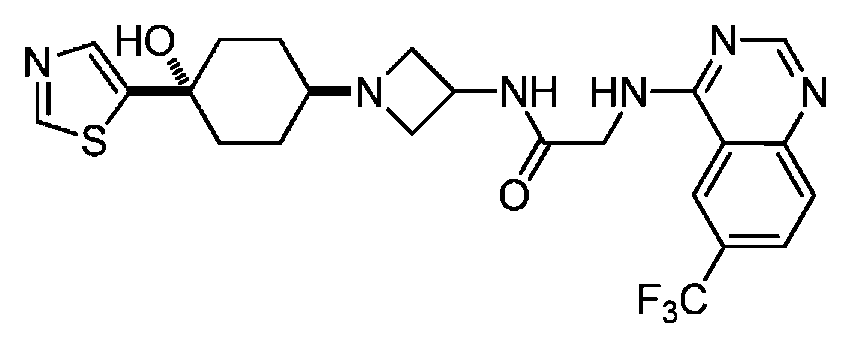
실시예 1, 단계 H에 기재된 바와 같이 TEA 및 NaBH(OAc)3의 존재 하에서 4-하이드록시-4-(티아졸-5-일)사이클로헥사논 (실시예 26 단계 C에 기재된 바와 같이 제조됨)과 N-(아제티딘-3-일)-2-((6-(트라이플루오로메틸)퀴나졸린-4-일)아미노)아세트아미드 (실시예 1 단계 G에서 제조됨)의 반응에 의해 생성물을 얻었다.(Prepared as described in example 26 Step C), in the presence of TEA and NaBH (OAc) 3 , as described in example 1, step H, using 4-hydroxy- ) And N (azetidin-3-yl) -2 - ((6- (trifluoromethyl) quinazolin-4- yl) amino) acetamide (prepared in Example 1 step G) The product was obtained.
1H NMR (아세토니트릴-d3) δ: 1.53 (br. s., 2 H) 1.57 - 1.68 (m, 2 H) 1.74 (dd, J=13.64, 3.54 Hz, 4 H) 1.85 - 1.91 (m, 1 H) 2.02 (dd, J=11.12, 3.79 Hz, 3 H) 3.32 - 3.41 (m, 1 H) 3.50 (d, J=2.27 Hz, 1 H) 3.74 (br. s., 1 H) 3.86 (br. s., 1 H) 3.91 - 4.01 (m, 2 H) 4.21 (br. s., 2 H) 4.25 (d, J=8.08 Hz, 2 H) 4.69 (s, 2 H) 7.62 (br. s., 1 H) 7.75 (s, 1 H) 7.87 - 7.97 (m, 2 H) 7.97 - 8.03 (m, 1 H) 8.51 (s, 1 H) 8.61 (s, 1 H) 8.70 (s, 1 H) 8.73 (s, 1 H); ESI-MS (m/z): C25H25F6N5O2S에 대한 계산치: 506.17; 실측치: 507 (M+H). 1 H NMR (acetonitrile -d3) δ: 1.53 (.. Br s, 2 H) 1.57 - 1.68 (m, 2 H) 1.74 (dd, J = 13.64, 3.54 Hz, 4 H) 1.85 - 1.91 (m, 1 H) 2.04 (dd, J = 11.12, 3.79 Hz, 3 H) 3.32-3.41 (m, 1H) 3.50 (d, J = 2.27 Hz, 1H) (m, 2 H) 4.21 (br s, 2 H) 4.25 (d, J = 8.08 Hz, 2 H) 4.69 (s, 2 H) 7.62 (br. s, 1 H) 7.75 (s, 1 H) 7.87 - 7.97 (m, 2 H) 7.97 - 8.03 (m, H) 8.73 (s, 1H); ESI-MS (m / z) : C 25 H 25 F 6 N 5 O Calcd for 2 S: 506.17; Found: 507 (M + H).
실시예Example 86: N-(1-((1r,4r)-4- 86: N- (1 - ((1 R, 4R) -4- 하이드록시Hydroxy -1--One- 듀테로Dutero -4-(티아졸-5-일)-4- (thiazol-5-yl) 사이클로헥실Cyclohexyl )) 아제티딘Azetidine -3-일)-2-((6-(Yl) -2 - ((6- ( 트라이플루오로메틸Trifluoromethyl )) 퀴나졸린Quinazoline -4-일)아미노)Yl) amino) 아세트아미드Acetamide

실시예 1, 단계 H에 기재된 바와 같이 TEA 및 NaBD(OAc)3의 존재 하에서 4-하이드록시-4-티아졸-2-일-사이클로헥사논 (실시예 26 단계 C에 기재된 바와 같이 제조됨)과 N-(아제티딘-3-일)-2-((6-(트라이플루오로메틸)퀴나졸린-4-일)아미노)아세트아미드 (실시예 1 단계 G에서 제조됨)의 반응에 의해 생성물을 얻었다.(Prepared as described in Example 26 Step C) in the presence of TEA and NaBD (OAc) 3 as described in example 1, step H, using 4-hydroxy-4-thiazol- (Prepared in step 1 G of Example 1) by reaction of N- (azetidin-3-yl) -2- (6- (trifluoromethyl) quinazolin- ≪ / RTI >
1H NMR (MeOD) δ: 1H NMR (MeOD) δ: 8.89 (s, 1H), 8.58 (s, 1H), 8.54 (s, 1H), 7.97 - 8.03 (m, 1H), 7.78 - 7.88 (m, 2H), 4.46 (s, 1H), 4.27 (s, 2H), 3.63 (t, J = 7.3 Hz, 2H), 2.97 (t, J = 7.6 Hz, 2H), 2.21 (br. s., 2H), 1.67 - 1.90 (m, 4H), 1.32 (없음, 2H); ESI-MS (m/z): C25H24DF6N5O2S에 대한 계산치: 507.18; 실측치: 508 (M+H). 1 H NMR (MeOD) δ: 1 H NMR (MeOD) δ: 8.89 (s, 1H), 8.58 (s, 1H), 8.54 (s, 1H), 7.97 - 8.03 (m, 1H), 7.78 - 7.88 ( (m, 2H), 4.46 (s, 1H), 4.27 (s, 2H), 3.63 (t, J = 7.3 Hz, 2H), 2.97 (t, J = 7.6 Hz, 2H) 2H), 1.67-1.90 (m, 4H), 1.32 (abs, 2H); ESI-MS (m / z): Calcd for C 25 H 24 DF 6 N 5 O 2 S: 507.18; Found: 508 (M + H).
실시예Example 87: 2-((2,6- 87: 2 - ((2,6- 비스(트라이플루오로메틸)퀴나졸린Bis (trifluoromethyl) quinazoline -4-일)아미노)-N-(1-((1r,4r)-4-하이드록시-4-(티아졸-5-일)-4-hydroxy-4- (thiazol-5-yl) amino) -N- (1 - 사이클로헥실Cyclohexyl )) 아제티딘Azetidine -3-일)-3 days) 아세트아미드Acetamide
단계 A: 2,6-비스(트라이플루오로메틸)퀴나졸린-4-올Step A: 2,6-Bis (trifluoromethyl) quinazolin-4-ol

트라이플루오로아세트산 무수물 (0.882 mL, 6.35 mmol)과 2-아미노-5-(트라이플루오로메틸)벤조산 (425 mg, 2.01 mmol)의 혼합물을 헵탄 (40 mL) 중에 현탁하고 딘-스타크(Dean-Stark) 조건 하에 110℃에서 18시간 동안 가열하였다. 실온으로 냉각한 후에, 반응 혼합물을 진공에서 15 mL 부피로 농축하고, 아세트산으로 처리하고, 30 mL의 총 부피로 다시 농축하고, 암모늄 아세테이트 (1 g, 13 mmol)를 첨가하고 혼합물을 4일 동안 가열하였다. 실온으로 냉각한 후에, 반응물을 진공에서 농축하여 건조하고, 잔류물을 포화 NaHCO3 수용액으로 천천히 켄칭하였다. 생성된 침전물을 여과에 의해 수집하고, 물 및 헵탄으로 세척하고, 진공에서 건조하여 금색 고체로서 생성물을 얻었다.A mixture of trifluoro acetic anhydride (0.882 mL, 6.35 mmol) and 2-amino-5- (trifluoromethyl) benzoic acid (425 mg, 2.01 mmol) was suspended in heptane (40 mL) and dean- Stark) conditions at 110 < 0 > C for 18 hours. After cooling to room temperature, the reaction mixture was concentrated in vacuo to a volume of 15 mL, treated with acetic acid, concentrated again to a total volume of 30 mL, ammonium acetate (1 g, 13 mmol) was added and the mixture was stirred for 4 days And heated. After cooling to room temperature, the reaction was concentrated to dryness in vacuo and the residue was slowly quenched with saturated aqueous NaHCO 3 solution. The resulting precipitate was collected by filtration, washed with water and heptane, and dried in vacuo to give the product as a gold solid.
1H NMR [(400 MHz, 아세토니트릴-d3) δ ppm 7.98 (d, J=8.59 Hz, 1 H) 8.15 (d, J=8.34 Hz, 1 H) 8.53 (s, 1 H); ESI-MS (m/z): C10H4F6N2O에 대한 계산치: 280.02; 실측치: 281 (M+H). 1 H NMR [(400 MHz, acetonitrile-d 3)? Ppm 7.98 (d, J = 8.59 Hz, 1H) 8.15 (d, J = 8.34 Hz, 1H) 8.53 (s, 1H); ESI-MS (m / z) : C 10 H 4 F 6 calculated for N 2 O: 280.02; Found: 281 (M + H).
단계 B: 4-Step B: 4- 클로로Chloro -2,6--2,6- 비스(트라이플루오로메틸)퀴나졸린Bis (trifluoromethyl) quinazoline

2,6-비스(트라이플루오로메틸)퀴나졸린-4-올 (200 mg, 0.666 mmol, 이전 단계에서 제조됨), DMF (0.01 mL, 0.129 mmol) 및 다이아이소프로필에틸아민 (0.17 mL, 0.986 mmol)의 혼합물을 건조 DCM (10 mL)에 현탁하고 아르곤 하에서 옥살릴 클로라이드 (0.11 mL, 1.26 mmol)를 적가하여 처리하였다. 첨가 후에, 반응 혼합물을 4시간 동안 가열하여 환류시켰다. 실온으로 냉각한 후에, 제2 인산칼륨 용액 (20% w/w)의 조심스러운 첨가에 의해 반응물을 켄칭하고 다이클로로메탄으로 추출하였다. 합한 유기층을 염수로 세척하고 Na2SO4로 건조하고 농축하여 백색 고체로서 생성물을 얻었다.(200 mg, 0.666 mmol, prepared in the previous step), DMF (0.01 mL, 0.129 mmol) and diisopropylethylamine (0.17 mL, 0.986 mmol) were added to a solution of 2,6-bis (trifluoromethyl) quinazolin- mmol) was suspended in dry DCM (10 mL) and treated with oxalyl chloride (0.11 mL, 1.26 mmol) dropwise under argon. After the addition, the reaction mixture was heated to reflux for 4 hours. After cooling to room temperature, the reaction was quenched by careful addition of a second potassium phosphate solution (20% w / w) and extracted with dichloromethane. The combined organic layers were washed with brine, dried over Na 2 SO 4 and concentrated to give the product as a white solid.
1H NMR [(400 MHz, 클로로포름-d) δ ppm 8.28 (d, J=8.84 Hz, 1 H) 8.39 (d, J=8.84 Hz, 1 H) 8.68 (s, 1 H). 1 H NMR [(400 MHz, chloroform-d)? Ppm 8.28 (d, J = 8.84 Hz, 1H) 8.39 (d, J = 8.84 Hz, 1H) 8.68 (s, 1H).
단계 C: Step C: terttert -부틸 3-(2-((2,6--Butyl 3- (2 - ((2,6- 비스(트라이플루오로메틸)퀴나졸린Bis (trifluoromethyl) quinazoline -4-일)아미노)Yl) amino) 아세트아미도Acetamido )) 아제티딘Azetidine -1--One- 카르복실레이트Carboxylate

4-클로로-2,6-비스(트라이플루오로메틸)퀴나졸린 (120 mg, 0.399 mmol, 이전 단계에서 제조됨), tert-부틸 3-(2-아미노아세트아미도)아제티딘-1-카르복실레이트 (133 mg, 0.58 mmol, 실시예 1, 단계 E에서 제조됨) 및 TEA (0.12 mL, 0.863 mmol)의 혼합물을 건조 THF (10 mL)에 용해하고 아르곤 하에서 18시간 동안 가열하여 환류시켰다. 반응 혼합물을 진공에서 농축하고 잔류물을 플래시 크로마토그래피 (실리카 겔, 50% EtOAc/헵탄)에 의해 정제하였다.(120 mg, 0.399 mmol, prepared in the previous step), tert-butyl 3- (2-aminoacetamido) azetidine-1-carbaldehyde (133 mg, 0.58 mmol, prepared in example 1, step E) and TEA (0.12 mL, 0.863 mmol) was dissolved in dry THF (10 mL) and heated to reflux under argon for 18 h. The reaction mixture was concentrated in vacuo and the residue was purified by flash chromatography (silica gel, 50% EtOAc / heptane).
1H NMR [(400 MHz, 클로로포름-d) δ ppm 8.78 (br. s., 1 H), 8.22 (br. s., 1 H), 7.92 (d, J=8.8 Hz, 1 H), 7.86 (d, J=8.8 Hz, 1 H), 7.37 (d, J=6.3 Hz, 1 H), 4.68 (br. s., 1 H), 4.21 - 4.35 (m, 4 H), 3.86 (br. s., 2 H), 1.67 (s, 1 H), 1.46 (br. s., 9 H); ESI-MS (m/z): C20H21F6N5O3에 대한 계산치: 493.15; 실측치: 494 (M+H). 1 H), 7.92 (d, J = 8.8 Hz, 1H), 7.86 (br s, 1H) (d, J = 8.8 Hz, 1H), 7.37 (d, J = 6.3 Hz, 1H), 4.68 (br s, 1H), 4.21-4.35 (m, 4H), 3.86 s., 2 H), 1.67 (s, 1 H), 1.46 (br s, 9 H); ESI-MS (m / z) : C 20 H 21 F 6 N calculated for 5 O 3: 493.15; Found: 494 (M + H).
단계 D: N-(Step D: Preparation of N- ( 아제티딘Azetidine -3-일)-2-((2,6-Yl) -2 - ((2,6- 비스(트라이플루오로메틸)퀴나졸린Bis (trifluoromethyl) quinazoline -4-일)아미노)Yl) amino) 아세트아미드Acetamide

실시예 1, 단계 G에 요약된 방법을 사용하여 tert-부틸 3-(2-((2,6-비스(트라이플루오로메틸)퀴나졸린-4-일)아미노)아세트아미도)아제티딘-1-카르복실레이트 (197 mg, 0.399 mmol, 이전 단계에서 제조됨)의 용액을 탈보호하여 표제 화합물을 얻었다.(Trifluoromethyl) quinazolin-4-yl) amino) acetamido) azetidine-l-carboxylic acid tert-butyl ester was prepared using the method outlined in Example 1, 1-carboxylate (197 mg, 0.399 mmol, prepared in the previous step) was deprotected to give the title compound.
1H NMR [(400 MHz, 아세토니트릴-d3) δ ppm 2.09 (s, 2 H) 2.18 (s, 1 H) 4.01 (dd, J=10.99, 6.19 Hz, 2 H) 4.24 (d, J=5.56 Hz, 2 H) 4.29 (dd, 2 H) 4.66 - 4.77 (m, 1 H) 7.96 (d, 1 H) 8.05 (d, 1 H) 8.50 (d, J=7.58 Hz, 1 H) 8.60 (s, 1 H) 8.73 (t, J=5.05 Hz, 1 H); ESI-MS (m/z): C20H21F6N5O3에 대한 계산치: 393.15; 실측치: 394 (M+H). 1 H NMR [(400 MHz, acetonitrile -d3) δ ppm 2.09 (s, 2 H) 2.18 (s, 1 H) 4.01 (dd, J = 10.99, 6.19 Hz, 2 H) 4.24 (d, J = 5.56 (D, 1H), 8.50 (d, J = 7.58 Hz, 1H), 8.60 (s, 1H) , 1H) 8.73 (t, J = 5.05 Hz, 1H); ESI-MS (m / z) : C 20 H 21 F 6 N calculated for 5 O 3: 393.15; Found: 394 (M + H).
단계 E: 2-((2,6-Step E: Preparation of 2 - ((2,6- 비스(트라이플루오로메틸)퀴나졸린Bis (trifluoromethyl) quinazoline -4-일)아미노)-N-(1-((1r,4r)-4-하Yl) amino) -N- (1 - ((1 r, 4r) -4- 이드록Idlock 시-4-(티아졸-5-일)-4- (thiazol-5-yl) 사이클로헥실Cyclohexyl )) 아제티딘Azetidine -3-일)-3 days) 아세트아미드Acetamide

실시예 1, 단계 H에 기재된 바와 같이 TEA 및 NaBH(OAc)3의 존재 하에서 N-(아제티딘-3-일)-2-((2,6-비스(트라이플루오로메틸)퀴나졸린-4-일)아미노)아세트아미드 (197 mg, 0.399 mmol, 이전 단계에서 제조됨)와 4-하이드록시-4-(티아졸-5-일)사이클로헥사논 (실시예 26 단계 C에 기재된 바와 같이 제조됨)의 반응에 의해 생성물을 얻었다.Example 1, in the presence of TEA and NaBH (OAc) 3 as described in Step H N- (azetidin-3-yl) -2 - ((2,6-bis (trifluoromethyl) quinazolin -4 (197 mg, 0.399 mmol, prepared in the previous step) and 4-hydroxy-4- (thiazol-5-yl) cyclohexanone (prepared as described in Example 26 Step C) ) To give the product.
1H NMR [(400 MHz, THF-d8) δ ppm 0.88 (d, J=6.32 Hz, 2 H) 1.45 (dd, J=13.52, 3.41 Hz, 2 H) 1.54 - 1.67 (m, 2 H) 1.80 - 1.91 (m, 2 H) 2.14 (td, J=12.51, 3.54 Hz, 2 H) 2.25 (br. s., 1 H) 2.52 (d, J=8.84 Hz, 2 H) 2.82 (t, J=6.32 Hz, 2 H) 3.48 - 3.56 (m, 2 H) 4.27 (d, J=5.05 Hz, 2 H) 4.42 - 4.50 (m, 1 H) 7.67 (s, 1 H) 7.90 (d, J=7.33 Hz, 1 H) 7.95 - 8.01 (m, 1 H) 8.01 - 8.07 (m, 1 H) 8.59 (s, 1 H) 8.68 (s, 1 H) 8.74 (t, J=5.05 Hz, 1 H); ESI-MS (m/z): C24H24F6N6O2S에 대한 계산치: 574.14; 실측치: 575 (M+H). 1 H NMR [(400 MHz, THF-d8) δ ppm 0.88 (d, J = 6.32 Hz, 2 H) 1.45 (dd, J = 13.52, 3.41 Hz, 2 H) 1.54 - 1.67 (m, 2 H) 1.80 (M, 2 H) 2.14 (td, J = 12.51, 3.54 Hz, 2 H) 2.25 (br s, 1 H) 2.52 (d, J = 8.84 Hz, 6.32 Hz, 2 H) 3.48 - 3.56 (m, 2 H) 4.27 (d, J = 5.05 Hz, 2 H) 4.42 - 4.50 Hz, 1H) 7.95-8.01 (m, 1H) 8.01-8.07 (m, 1H) 8.59 (s, 1H) 8.68 (s, 1H) 8.74 (t, J = 5.05 Hz, 1H); ESI-MS (m / z): Calcd for C 24 H 24 F 6 N 6 O 2 S: 574.14; Found: 575 (M + H).
실시예Example 88: N-(1-((1r,4r)-4- 88: N- (1 - ((1 R, 4R) -4- 하이드록시Hydroxy -4-(티아졸-5-일)-4- (thiazol-5-yl) 사이클로헥실Cyclohexyl )) 아제티딘Azetidine -3-일)-2-((2-Yl) -2 - ((2- 아이소프로필Isopropyl -6-(-6- ( 트라이플루오로메틸Trifluoromethyl )) 퀴나졸린Quinazoline -4-일)아미노)Yl) amino) 아세트아미Acetamido 드De
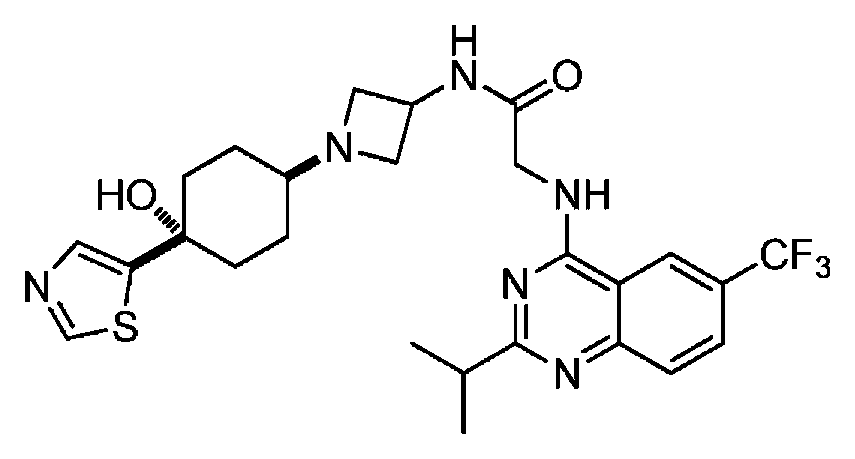
실시예 1, 단계 H에 기재된 바와 같이 TEA 및 NaBH(OAc)3의 존재 하에서 4-하이드록시-4-(티아졸-5-일)사이클로헥사논 (실시예 26 단계 C에 기재된 바와 같이 제조됨)과 N-(아제티딘-3-일)-2-((2-아이소프로필-6-(트라이플루오로메틸)퀴나졸린-4-일)아미노)아세트아미드 (실시예 87 단계 A 내지 단계 D에 기재된 절차를 사용하여 2-아미노-5-(트라이플루오로메틸)벤조산과 아이소부티르산 무수물의 반응에 의해 제조됨)의 반응에 의해 생성물을 얻었다.(Prepared as described in example 26 Step C), in the presence of TEA and NaBH (OAc) 3 , as described in example 1, step H, using 4-hydroxy- ) And N- (azetidin-3-yl) -2 - ((2- isopropyl-6- (trifluoromethyl) quinazolin-4- yl) amino) acetamide (from Example 87 Steps A to D (Prepared by reaction of 2-amino-5- (trifluoromethyl) benzoic acid with isobutyric anhydride using the procedure described in Example 1).
1H NMR (DMSO-d6) δ: 1.23 (d, J=6.82 Hz, 6 H) 1.29 - 1.41 (m, 2 H) 1.59 - 1.71 (m, 2 H) 1.80 - 1.90 (m, 2 H) 2.05 (br. s., 2 H) 2.53 - 2.71 (m, 7 H) 2.94 (quin, J=6.82 Hz, 1 H) 3.89 - 4.03 (m, 1 H) 4.08 (d, J=5.05 Hz, 2 H) 4.35 - 4.50 (m, 1 H) 5.56 (s, 1 H) 7.77 (s, 1 H) 7.82 (d, J=8.59 Hz, 1 H) 8.00 (dd, J=8.84, 1.52 Hz, 1 H) 8.52 (d, J=7.07 Hz, 1 H) 8.75 (s, 1 H) 8.94 - 9.01 (m, 2 H); ESI-MS (m/z): C26H31F3N6O2S에 대한 계산치: 548.22; 실측치: 549 (M+H). 1 H NMR (DMSO-d6) δ: 1.23 (d, J = 6.82 Hz, 6 H) 1.29 - 1.41 (m, 2 H) 1.59 - 1.71 (m, 2 H) 1.80 - 1.90 (m, 2 H) 2.05 (m, 1H), 4.08 (d, J = 5.05 Hz, 2H), 2.53-2.71 (m, (D, J = 8.84, 1.52 Hz, 1H), 7.77 (s, 1H) 7.82 (d, J = 8.59 Hz, 1H) 8.52 (d, J = 7.07 Hz, 1H) 8.75 (s, 1H) 8.94-9.01 (m, 2H); ESI-MS (m / z): Calcd for C 26 H 31 F 3 N 6 O 2 S: 548.22; Found: 549 (M + H).
실시예Example 89: N-(1-((1r,4r)-4- 89: N- (1 - ((1R, 4R) -4- 하이드록시Hydroxy -4-(티아졸-5-일)-4- (thiazol-5-yl) 사이클로헥실Cyclohexyl )) 아제티딘Azetidine -3-일)-2-((2-Yl) -2 - ((2- 메틸methyl -6-(-6- ( 트라이플루오로메틸Trifluoromethyl )) 퀴나졸린Quinazoline -4-일)아미노)Yl) amino) 아세트아미드Acetamide

실시예 1, 단계 H에 기재된 바와 같이 TEA 및 NaBH(OAc)3의 존재 하에서 4-하이드록시-4-(티아졸-5-일)사이클로헥사논 (실시예 26 단계 C에 기재된 바와 같이 제조됨)과 N-(아제티딘-3-일)-2-((2-메틸-6-(트라이플루오로메틸)퀴나졸린-4-일)아미노)아세트아미드 (실시예 87 단계 A 내지 단계 D에 기재된 절차를 사용하여 2-아미노-5-(트라이플루오로메틸)벤조산과 아세트산 무수물의 반응에 의해 제조됨)의 반응에 의해 생성물을 얻었다.(Prepared as described in example 26 Step C), in the presence of TEA and NaBH (OAc) 3 , as described in example 1, step H, using 4-hydroxy- ) And N (azetidin-3-yl) -2 - ((2-methyl-6- (trifluoromethyl) quinazolin-4- yl) amino) acetamide (Prepared by reaction of 2-amino-5- (trifluoromethyl) benzoic acid with acetic anhydride using the described procedure).
1H NMR (THF-d8) δ: 1.36 - 1.48 (m, 2 H) 1.61 (d, J=12.88 Hz, 2 H) 1.83 (t, J=12.76 Hz, 2 H) 2.13 (td, J=12.38, 3.54 Hz, 2 H) 2.23 (br. s., 0 H) 2.51 (s, 3 H) 2.79 (t, J=6.57 Hz, 2 H) 3.54 (t, J=6.95 Hz, 2 H) 4.20 (d, J=5.05 Hz, 2 H) 4.46 (s, 1 H) 7.67 (s, 1 H) 7.69 - 7.77 (m, 2 H) 7.86 (dd, J=8.84, 1.77 Hz, 1 H) 8.03 (t, J=5.31 Hz, 1 H) 8.40 (s, 1 H) 8.67 (s, 1 H); ESI-MS (m/z): C24H27F3N6O2S에 대한 계산치: 520.19; 실측치: 521 (M+H). 1 H NMR (THF-d8) δ: 1.36 - 1.48 (m, 2 H) 1.61 (d, J = 12.88 Hz, 2 H) 1.83 (t, J = 12.76 Hz, 2 H) 2.13 (td, J = 12.38 , 3.54 Hz, 2 H) 2.23 (br s, 0 H) 2.51 (s, 3 H) 2.79 (t, J = 6.57 Hz, 2 H) 3.54 (t, J = 6.95 Hz, (m, 2H), 7.86 (dd, J = 8.84, 1.77 Hz, 1H) 8.03 (s, 1H) , J = 5.31 Hz, 1H) 8.40 (s, 1H) 8.67 (s, 1H); ESI-MS (m / z): Calcd for C 24 H 27 F 3 N 6 O 2 S: 520.19; Found: 521 (M + H).
실시예Example 90: N-(1-((1S,4s)-4-(1- 90: N- (1 - ((1S, 4S) -4- (1- 하이드록시부틸Hydroxybutyl )) 사이클로헥실Cyclohexyl )) 아제티딘Azetidine -3-일)-2-((6-(트3-yl) -2 - ((6- 라이플루오로Rifluro 메틸)methyl) 퀴나졸린Quinazoline -4-일)아미노)Yl) amino) 아세트아미드Acetamide
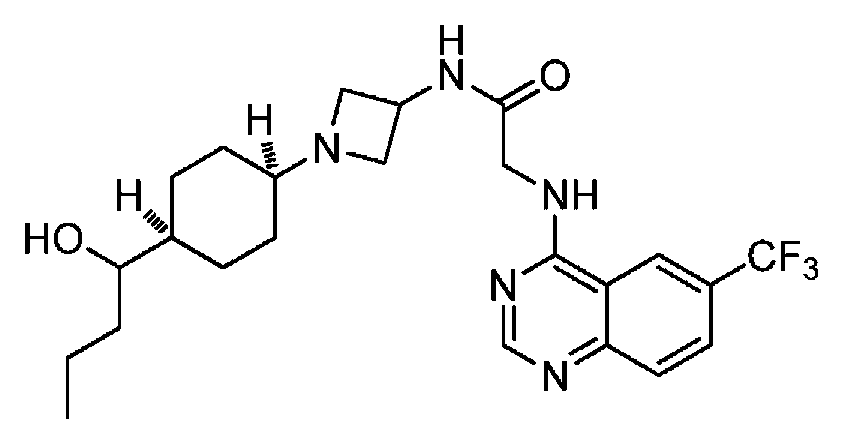
실시예 1, 단계 H에 기재된 바와 같이 TEA 및 NaBH(OAc)3의 존재 하에서 4-(1-하이드록시부틸)사이클로헥사논 (실시예 3 단계 A 내지 단계 B에 기재된 절차를 사용하여1,4-다이옥사스피로[4.5]데칸-8-카르브알데하이드와 프로필마그네슘 클로라이드의 반응에 의해 제조됨)과 N-(아제티딘-3-일)-2-((6-(트라이플루오로메틸)퀴나졸린-4-일)아미노)아세트아미드 (실시예 1 단계 G에서 제조됨)의 반응에 의해 생성물을 얻었다.Example 1, in the presence of TEA and NaBH (OAc) 3 as described in Step H 4- (1- hydroxy-butyl) cyclohexanone (using the procedure described in Example 3 Step A to Step B 1,4 -2 - ((6- (trifluoromethyl) quinacetaldehyde prepared by the reaction of 4-amino-5-methyl- 4-yl) amino) acetamide (prepared in step 1 G of Example 1).
ESI-MS (m/z): C24H32F3N5O2에 대한 계산치: 479.25; 실측치: 480 (M+H).ESI-MS (m / z): Calcd for C 24 H 32 F 3 N 5 O 2 : 479.25; Found: 480 (M + H).
실시예 91: N-(1-((1S,4s)-4-(1-하이드록시부트-3-엔-1-일)사이클로헥실)아제티딘-3-일)-2-((6-(트라이플루오로메틸)퀴나졸린-4-일)아미노)아세트아미드Example 91: Preparation of N- (1 - ((1S, 4S) -4- (1 -hydroxybut-3-en-1-yl) cyclohexyl) azetidin- (Trifluoromethyl) quinazolin-4-yl) amino) acetamide

실시예 1, 단계 H에 기재된 바와 같이 TEA 및 NaBH(OAc)3의 존재 하에서 4-(1-하이드록시부트-3-엔-1-일)사이클로헥사논 (실시예 3 단계 A 내지 단계 B에 기재된 절차를 사용하여 1,4-다이옥사스피로[4.5]데칸-8-카르브알데하이드와 알릴마그네슘 클로라이드의 반응에 의해 제조됨)과 N-(아제티딘-3-일)-2-((6-(트라이플루오로메틸)퀴나졸린-4-일)아미노)아세트아미드 (실시예 1 단계 G에서 제조됨)의 반응에 의해 생성물을 얻었다.Example 1, in the presence of TEA and NaBH (OAc) 3 as described in Step H in the 4- (1-hydroxy-boot-3-en-1-yl) cyclohexanone (Example 3 step A to step B (Azetidin-3-yl) -2 - ((6 (S) -tetrahydrofuran-2-carboxaldehyde prepared from the reaction of 1,4- - (trifluoromethyl) quinazolin-4-yl) amino) acetamide (prepared in Example 1 Step G).
ESI-MS (m/z): C24H30F3N5O2에 대한 계산치: 477.24; 실측치: 478 (M+H).ESI-MS (m / z): Calcd for C 24 H 30 F 3 N 5 O 2 : 477.24; Found: 478 (M + H).
실시예Example 92: N-(1-((1S,4s)-4-(1- 92: N- (1 - ((1S, 4S) -4- (1- 하이드록시알릴Hydroxyallyl )) 사이클로헥실Cyclohexyl )) 아제티딘Azetidine -3-일)-2-((6-(트3-yl) -2 - ((6- 라이플루오로Rifluro 메틸)methyl) 퀴나졸린Quinazoline -4-일)아미노)Yl) amino) 아세트아미드Acetamide

실시예 1, 단계 H에 기재된 바와 같이 TEA 및 NaBH(OAc)3의 존재 하에서 4-(1-하이드록시알릴)사이클로헥사논 (실시예 3 단계 A 내지 단계 B에 기재된 절차를 사용하여 1,4-다이옥사스피로[4.5]데칸-8-카르브알데하이드와 비닐마그네슘 클로라이드의 반응에 의해 제조됨)과 N-(아제티딘-3-일)-2-((6-(트라이플루오로메틸)퀴나졸린-4-일)아미노)아세트아미드 (실시예 1 단계 G에서 제조됨)의 반응에 의해 생성물을 얻었다.Example 1, in the presence of TEA and NaBH (OAc) 3 as described in Step H 4- (1- hydroxy-allyl) cyclohexanone (using the procedure described in Example 3 Step A to Step B 1,4 2 - ((6- (trifluoromethyl) quinacal < / RTI > 4-yl) amino) acetamide (prepared in step 1 G of Example 1).
ESI-MS (m/z): C23H28F3N5O2에 대한 계산치: 463.22; 실측치: 464 (M+H).ESI-MS (m / z) : C 23 H 28 F 3 N 5 O 2 Calcd: 463.22; Found: 464 (M + H).
실시예 93: N-(1-((1S,4s)-4-(1-하이드록시프로필)사이클로헥실)아제티딘-3-일)-2-((6-(트라이플루오로메틸)퀴나졸린-4-일)아미노)아세트아미드Example 93: N- (1 - ((1S, 4S) -4- (1-Hydroxypropyl) cyclohexyl) azetidin- Yl) amino) acetamide

실시예 1, 단계 H에 기재된 바와 같이 TEA 및 NaBH(OAc)3의 존재 하에서 4-(1-하이드록시프로필)사이클로헥사논 (실시예 3 단계 A 내지 단계 B에 기재된 절차를 사용하여 1,4-다이옥사스피로[4.5]데칸-8-카르브알데하이드와 에틸마그네슘 클로라이드의 반응에 의해 제조됨)과 N-(아제티딘-3-일)-2-((6-(트라이플루오로메틸)퀴나졸린-4-일)아미노)아세트아미드 (실시예 1 단계 G에서 제조됨)의 반응에 의해 생성물을 얻었다.Example 1, in the presence of TEA and NaBH (OAc) 3 as described in Step H 4- (1- hydroxypropyl) cyclohexanone (using the procedure described in Example 3 Step A to Step B 1,4 Yl) -2 - ((6- (trifluoromethyl) quinacetaldehyde, prepared by reaction of 2- 4-yl) amino) acetamide (prepared in step 1 G of Example 1).
1H NMR (MeOH) δ: 8.59 (s, 1H), 8.54 (s, 1H), 7.97 - 8.04 (m, 1H), 7.85 (d, J = 8.8 Hz, 1H), 4.47 (s, 1H), 4.27 (s, 2H), 3.61 (t, J = 7.2 Hz, 2H), 2.91 (s, 2H), 2.18 - 2.31 (m, 1H), 1.26 - 1.67 (m, 12H), 0.94 (t, 3H); ESI-MS (m/z): C23H30F3N5O2에 대한 계산치: 465.24; 실측치: 466 (M+H). 1 H NMR (MeOH) δ: 8.59 (s, 1H), 8.54 (s, 1H), 7.97 - 8.04 (m, 1H), 7.85 (d, J = 8.8 Hz, 1H), 4.47 (s, 1H), 2H), 2.91 (s, 2H), 2.18-2.31 (m, 1H), 1.26-1.67 (m, 12H), 0.94 (t, ; ESI-MS (m / z) : C 23 H 30 F 3 N 5 O 2 Calcd: 465.24; Found 466 (M + H).
실시예 94: N-(1-((1S,4s)-4-(사이클로펜틸(하이드록시)메틸)사이클로헥실)아제티딘-3-일)-2-((6-(트라이플루오로메틸)퀴나졸린-4-일)아미노)아세트아미드Example 94: N- (l- ((lS, 4s) -4- (Cyclopentyl (hydroxy) methyl) cyclohexyl) azetidin- Quinazolin-4-yl) amino) acetamide

실시예 1, 단계 H에 기재된 바와 같이 TEA 및 NaBH(OAc)3의 존재 하에서 4-(사이클로펜틸(하이드록시)메틸)사이클로헥사논 (실시예 3 단계 A 내지 단계 B에 기재된 절차를 사용하여 1,4-다이옥사스피로[4.5]데칸-8-카르브알데하이드와 사이클로펜틸마그네슘 클로라이드의 반응에 의해 제조됨)과 N-(아제티딘-3-일)-2-((6-(트라이플루오로메틸)퀴나졸린-4-일)아미노)아세트아미드 (실시예 1 단계 G에서 제조됨)의 반응에 의해 생성물을 얻었다.Example 1, in the presence of TEA and NaBH (OAc) 3 as described in Step H 4- (cyclopentyl (hydroxy) methyl) cyclohexanone (using the procedure described in Example 3 Step A to Step B 1 2 - ((6- (trifluoromethoxy) phenyl) -4-oxo-4- Methyl) quinazolin-4-yl) amino) acetamide (prepared in Example 1 Step G).
ESI-MS (m/z): C26H34F3N5O2에 대한 계산치: 505.27; 실측치: 506 (M+H).ESI-MS (m / z): Calcd for C 26 H 34 F 3 N 5 O 2 : 505.27; Found: 506 (M + H).
실시예Example 95: N-(1-((1R,4s)-4-(1- 95: N- (1 - ((1 R, 4S) -4- (1- 하이드록시프로프Hydroxypropyl -2-인-1-일)2-yn-1-yl) 사이클로헥실Cyclohexyl )) 아제티딘Azetidine -3-일)-2-((6-(Yl) -2 - ((6- ( 트라이플루오로메틸Trifluoromethyl )) 퀴나졸린Quinazoline -4-일)아미노)Yl) amino) 아세트아미드Acetamide

실시예 1, 단계 H에 기재된 바와 같이 TEA 및 NaBH(OAc)3의 존재 하에서 4-(1-하이드록시프로프-2-인-1-일)사이클로헥사논 (실시예 3 단계 A 내지 단계 B에 기재된 절차를 사용하여 1,4-다이옥사스피로[4.5]데칸-8-카르브알데하이드와 에티닐마그네슘 브로마이드의 반응에 의해 제조됨)과 N-(아제티딘-3-일)-2-((6-(트라이플루오로메틸)퀴나졸린-4-일)아미노)아세트아미드 (실시예 1 단계 G에서 제조됨)의 반응에 의해 생성물을 얻었다.Example 1, in the presence of TEA and NaBH (OAc) 3 as described in Step H 4- (1- hydroxy-prop-2-in-1-yl) cyclohexanone (Example 3 step A to step B (Prepared by reaction of 1,4-dioxaspiro [4.5] decane-8-carbaldehyde with ethynylmagnesium bromide using the procedure described in Example 1) and N- (azetidin- (6- (trifluoromethyl) quinazolin-4-yl) amino) acetamide (prepared in Example 1 Step G).
ESI-MS (m/z): C23H26F3N5O2에 대한 계산치: 461.20; 실측치: 462 (M+H).ESI-MS (m / z): Calcd for C 23 H 26 F 3 N 5 O 2 : 461.20; Found: 462 (M + H).
실시예 96: N-(1-((1R,4s)-4-(1-하이드록시-2-메틸알릴)사이클로헥실)아제티딘-3-일)-2-((6-(트라이플루오로메틸)퀴나졸린-4-일)아미노)아세트아미드Example 96: Preparation of N- (1 - ((1R, 4S) -4- (1 -hydroxy-2-methylallyl) cyclohexyl) azetidin- Methyl) quinazolin-4-yl) amino) acetamide
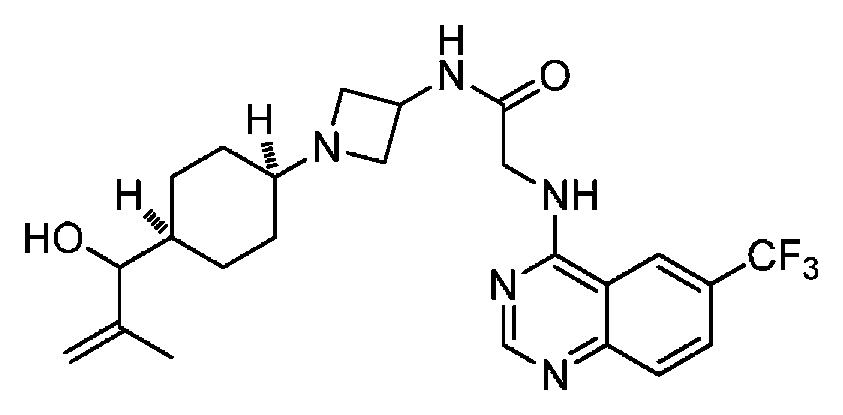
실시예 1, 단계 H에 기재된 바와 같이 TEA 및 NaBH(OAc)3의 존재 하에서 4-(1-하이드록시-2-메틸알릴)사이클로헥사논 (실시예 3 단계 A 내지 단계 B에 기재된 절차를 사용하여 1,4-다이옥사스피로[4.5]데칸-8-카르브알데하이드와 아이소프로페닐마그네슘 클로라이드의 반응에 의해 제조됨)과 N-(아제티딘-3-일)-2-((6-(트라이플루오로메틸)퀴나졸린-4-일)아미노)아세트아미드 (실시예 1 단계 G에서 제조됨)의 반응에 의해 생성물을 얻었다.(1-hydroxy-2-methylallyl) cyclohexanone (using the procedure described in Example 3, Step A to Step B) in the presence of TEA and NaBH (OAc) 3 as described in example 1, -2 - ((6- ((4-fluorophenyl) -5-methyl- (Trifluoromethyl) quinazolin-4-yl) amino) acetamide (prepared in Example 1 Step G).
ESI-MS (m/z): C24H30F3N5O2에 대한 계산치: 477.24; 실측치: 478 (M+H).ESI-MS (m / z): Calcd for C 24 H 30 F 3 N 5 O 2 : 477.24; Found: 478 (M + H).
실시예Example 97: N-(1-((1S,4s)-4-(1-하이드록시에틸) 97: N- (1 - ((1S, 4S) -4- (1 -hydroxyethyl) 사이클로헥실Cyclohexyl )) 아제티딘Azetidine -3-일)-2-((6-(트3-yl) -2 - ((6- 라이플루오로Rifluro 메틸)methyl) 퀴나졸린Quinazoline -4-일)아미노)Yl) amino) 아세트아미드Acetamide

실시예 1, 단계 H에 기재된 바와 같이 TEA 및 NaBH(OAc)3의 존재 하에서 4-(1-하이드록시에틸)사이클로헥사논 (실시예 3 단계 A 내지 단계 B에 기재된 절차를 사용하여 1,4-다이옥사스피로[4.5]데칸-8-카르브알데하이드와 메틸마그네슘 클로라이드의 반응에 의해 제조됨)과 N-(아제티딘-3-일)-2-((6-(트라이플루오로메틸)퀴나졸린-4-일)아미노)아세트아미드 (실시예 1 단계 G에서 제조됨)의 반응에 의해 생성물을 얻었다.Example 1, in the presence of TEA and NaBH (OAc) 3 as described in Step H 4- (1- hydroxyethyl) cyclohexanone (using the procedure described in Example 3 Step A to Step B 1,4 Yl) -2 - ((6- (trifluoromethyl) quinacetaldehyde prepared from the reaction of 2- 4-yl) amino) acetamide (prepared in step 1 G of Example 1).
C22H28F3N5O2에 대한 계산치: 451.22; 실측치: 452 (M+H). C 22 H 28 F 3 N 5 O 2 Calcd: 451.22; Found: 452 (M + H).
실시예Example 98: N-(1-((1R,4s)-4-(1- 98: N- (1 - ((1 R, 4S) -4- (1- 하이드록시Hydroxy -2,2--2,2- 다이메틸프로필Dimethylpropyl )) 사이클로헥실Cyclohexyl )) 아제티딘Azetidine -3-일)-2-((6-(Yl) -2 - ((6- ( 트라이플루오로메틸Trifluoromethyl )) 퀴나졸린Quinazoline -4-일)아미노)Yl) amino) 아세트아미드Acetamide

실시예 1, 단계 H에 기재된 바와 같이 TEA 및 NaBH(OAc)3의 존재 하에서 4-(1-하이드록시-2,2-다이메틸프로필)사이클로헥사논 (실시예 3 단계 A 내지 단계 B에 기재된 절차를 사용하여 1,4-다이옥사스피로[4.5]데칸-8-카르브알데하이드와 tert-부틸마그네슘 클로라이드의 반응에 의해 제조됨)과 N-(아제티딘-3-일)-2-((6-(트라이플루오로메틸)퀴나졸린-4-일)아미노)아세트아미드 (실시예 1 단계 G에서 제조됨)의 반응에 의해 생성물을 얻었다.Example 1, in the presence of TEA and NaBH (OAc) 3 as described in Step H 4- (1- hydroxy-2,2-dimethyl-propyl) cyclohexanone (described in Example 3 Step A to Step B Butyl azodicarboxylate (prepared by reaction of 1,4-dioxaspiro [4.5] decane-8-carbaldehyde with tert-butylmagnesium chloride using the procedure described in Example 1) and N- (azetidin- (Trifluoromethyl) quinazolin-4-yl) amino) acetamide (prepared in Example 1 Step G).
1H NMR (MeOH) δ: 8.60 (s, 1H), 8.55 (s, 1H), 7.98 - 8.04 (m, 1H), 7.83 - 7.89 (m, 1H), 4.41 - 4.52 (m, 1H), 4.27 (s, 2H), 3.57 - 3.66 (m, 2H), 3.00 - 3.05 (m, 1H), 2.85 - 2.95 (m, 2H), 2.18 - 2.29 (m, 1H), 1.25 (s, 10H), 0.90 (s, 9H); ESI-MS (m/z): C25H34F3N5O2에 대한 계산치: 493.27; 실측치: 494 (M+H). 1 H NMR (MeOH)?: 8.60 (s, IH), 8.55 (s, IH), 7.98- 8.04 (m, IH), 7.83-7.89 (m, 2H), 1.25 (s, 10H), 0.90 (m, 2H), 3.57-3.66 (s, 9 H); ESI-MS (m / z) : C 25 H 34 F 3 N 5 O 2 Calcd: 493.27; Found: 494 (M + H).
실시예Example 99: N-(1-((1R,4s)-4-( 99: N- (1 - ((1 R, 4 S) -4- ( 하이드록시(티아졸-5-일)메틸Hydroxy (thiazol-5-yl) methyl )) 사이클로헥실Cyclohexyl )) 아제티딘Azetidine -3-일)-2-((6-(Yl) -2 - ((6- ( 트라이플루오로메틸Trifluoromethyl )) 퀴나졸린Quinazoline -4-일)아미노)Yl) amino) 아세트아미드Acetamide

실시예 1, 단계 H에 기재된 바와 같이 TEA 및 NaBH(OAc)3의 존재 하에서 4-(하이드록시(티아졸-5-일)메틸)사이클로헥사논 (실시예 3 단계 A 내지 단계 B에 기재된 절차를 사용하여 1,4-다이옥사스피로[4.5]데칸-8-카르브알데하이드와 (2-(tert-부틸다이메틸실릴)티아졸-5-일)리튬의 반응에 의해 제조됨)과 N-(아제티딘-3-일)-2-((6-(트라이플루오로메틸)퀴나졸린-4-일)아미노)아세트아미드 (실시예 1 단계 G에서 제조됨)의 반응에 의해 생성물을 얻었다.(Thiazol-5-yl) methyl) cyclohexanone (the procedure described in Example 3, Step A to Step B) was carried out in the presence of TEA and NaBH (OAc) 3 as described in example 1, (Prepared by the reaction of 1,4- dioxaspiro [4.5] decane-8-carbaldehyde with (2- (tert-butyldimethylsilyl) thiazol- Amino) acetamide (prepared in step 1 G of Example 1) in acetonitrile (5 mL) to give the product.
1H NMR (MeOH) δ: 8.92 (s, 1H), 8.59 (s, 1H), 8.54 (s, 1H), 7.96 - 8.05 (m, 1H), 7.82 - 7.89 (m, 1H), 7.73 (s, 1H), 4.82 (d, J = 8.1 Hz, 1H), 4.41 - 4.53 (m, 1H), 4.27 (s, 2H), 4.05 - 4.15 (m, 1H), 3.62 (d, J = 8.3 Hz, 3H), 2.92 (d, J = 7.1 Hz, 3H), 2.19 - 2.30 (m, 1H), 1.24 (m, 11H); ESI-MS (m/z): C24H27F3N6O2S에 대한 계산치: 520.19; 실측치: 521 (M+H). 1 H NMR (MeOH) δ: 8.92 (s, 1H), 8.59 (s, 1H), 8.54 (s, 1H), 7.96 - 8.05 (m, 1H), 7.82 - 7.89 (m, 1H), 7.73 (s 1H), 4.62 (d, J = 8.1 Hz, 1H), 4.41-4.53 (m, 1H), 4.27 (s, 2H), 4.05-4.15 3H), 2.92 (d, J = 7.1 Hz, 3H), 2.19-2.30 (m, 1H), 1.24 (m, 11H); ESI-MS (m / z): Calcd for C 24 H 27 F 3 N 6 O 2 S: 520.19; Found: 521 (M + H).
실시예Example 100: 1-((1s,4S)-4-(3-(2-((6-( 100: 1 - ((1S, 4S) -4- (3- (2 - ((6- ( 트라이플루오로메틸Trifluoromethyl )) 퀴나졸린Quinazoline -4-일)아미노)아세트아미도)4-yl) amino) acetamido) 아제티딘Azetidine -1-일)-1 day) 사이클로헥실Cyclohexyl )프로필 아세테이트) Propyl acetate

실시예 1, 단계 H에 기재된 바와 같이 TEA 및 NaBH(OAc)3의 존재 하에서 1-(4-옥소사이클로헥실)프로필 아세테이트와 N-(아제티딘-3-일)-2-((6-(트라이플루오로메틸)퀴나졸린-4-일)아미노)아세트아미드 (실시예 1 단계 G에서 제조됨)의 반응에 의해 생성물을 얻었다.Yl) -2 - ((6- ((4-oxocyclohexyl) propyl) acetate in the presence of TEA and NaBH (OAc) 3 as described in example 1, (Trifluoromethyl) quinazolin-4-yl) amino) acetamide (prepared in Example 1 Step G).
1H NMR (MeOD) δ: 8.58 - 8.63 (m, 1H), 8.54 (s, 1H), 7.98 - 8.06 (m, 1H), 7.86 (d, J = 8.8 Hz, 1H), 4.75 - 4.86 (m, 1H), 4.46 (s, 1H), 4.27 (s, 2H), 3.56 - 3.67 (m, 2H), 3.31 (d, J = 1.5 Hz, 3H), 2.87 - 2.96 (m, 2H), 2.26 (br. s., 1H), 2.02 - 2.08 (s, 3H), 1.61 - 1.72 (m, 1H), 1.40 (m., 12H), 0.85 (t, 3H); ESI-MS (m/z): C25H32F3N5O3에 대한 계산치: 507.25; 실측치: 508 (M+H). 1 H NMR (MeOD) δ: 8.58 - 8.63 (m, 1H), 8.54 (s, 1H), 7.98 - 8.06 (m, 1H), 7.86 (d, J = 8.8 Hz, 1H), 4.75 - 4.86 (m 2H), 3.31 (d, J = 1.5 Hz, 3H), 2.87-2.96 (m, 2H), 2.26 (s, 3H), 1.61-1.72 (m, 1H), 1.40 (m, 12H), 0.85 (t, 3H); ESI-MS (m / z) : C 25 H 32 F 3 N calculated for 5 O 3: 507.25; Found: 508 (M + H).
실시예Example 101: N-(1- 101: N- (1- 사이클로헥실아제티딘Cyclohexyl azetidine -3-일)-2-((6-(Yl) -2 - ((6- ( 트라이플루오로메틸Trifluoromethyl )) 퀴나졸린Quinazoline -4-일)아미노)Yl) amino) 아세트아미드Acetamide

실시예 1, 단계 H에 기재된 바와 같이 TEA 및 NaBH(OAc)3의 존재 하에서 사이클로헥사논과 N-(아제티딘-3-일)-2-((6-(트라이플루오로메틸)퀴나졸린-4-일)아미노)아세트아미드 (실시예 1 단계 G에서 제조됨)의 반응에 의해 생성물을 얻었다.-2 - ((6- (trifluoromethyl) quinazolin-4-yl) -acetic acid in the presence of TEA and NaBH (OAc) 3 as described in example 1, -Yl) amino) acetamide (prepared in Example 1 Step G).
ESI-MS (m/z): C20H24F3N5O에 대한 계산치: 407.19; 실측치: 408 (M+H).ESI-MS (m / z) : C 20 H 24 F 3 calculated for N 5 O: 407.19; Found: 408 (M + H).
실시예Example 102: N-(1-((1s,4s)-[1,1'-바이( 102: N- (1 - ((1s, 4s) - [1, 1'- 사이클로헥산Cyclohexane )]-4-일))] - 4-yl) 아제티딘Azetidine -3-일)-2-((6-(트3-yl) -2 - ((6- 라이플루오로Rifluro 메틸)methyl) 퀴나졸린Quinazoline -4-일)아미노)Yl) amino) 아세트아미드Acetamide

실시예 1, 단계 H에 기재된 바와 같이 TEA 및 NaBH(OAc)3의 존재 하에서 사이클로헥사논과 N-(아제티딘-3-일)-2-((6-(트라이플루오로메틸)퀴나졸린-4-일)아미노)아세트아미드 (실시예 1 단계 G에서 제조됨)의 반응에 의해 생성물을 얻었다.-2 - ((6- (trifluoromethyl) quinazolin-4-yl) -acetic acid in the presence of TEA and NaBH (OAc) 3 as described in example 1, -Yl) amino) acetamide (prepared in Example 1 Step G).
ESI-MS (m/z): C26H34F3N5O에 대한 계산치: 489.27; 실측치: 490 (M+H).ESI-MS (m / z): Calcd for C 26 H 34 F 3 N 5 O: 489.27; Found: 490 (M + H).
실시예Example 103: N-(1-(4- 103: N- (1- (4- 옥소사이클로헥실Oxocyclohexyl )) 아제티딘Azetidine -3-일)-2-((6-(Yl) -2 - ((6- ( 트라이플루오로메틸Trifluoromethyl )) 퀴나졸린Quinazoline -4-일)아미노)Yl) amino) 아세트아미드Acetamide

실시예 1, 단계 H에 기재된 바와 같이 TEA 및 NaBH(OAc)3의 존재 하에서 1,4-다이옥사스피로[4.5]데칸-8-온과 N-(아제티딘-3-일)-2-((6-(트라이플루오로메틸)퀴나졸린-4-일)아미노)아세트아미드 (실시예 1 단계 G에서 제조됨)의 반응 후에 케탈의 산성 탈보호에 의해 생성물을 얻었다.Example 1, 1,4-dioxane SARS fatigue [4.5] decan-8-one and N- (azetidin-3-yl), in the presence of TEA and NaBH (OAc) 3 as described in Step H -2- ( Amino) acetamide (prepared in step 1 G of Example 1), the product was obtained by acidic deprotection of the ketal.
ESI-MS (m/z): C20H22F3N5O2에 대한 계산치: 421.17; 실측치: 422 (M+H).ESI-MS (m / z) : C 20 H 22 F 3 N 5 O 2 Calcd: 421.17; Found: 422 (M + H).
실시예 104: 메틸 (-1-((1s,4S)-4-(3-(2-((6-(트라이플루오로메틸)퀴나졸린-4-일)아미노)아세트아미도)아제티딘-1-일)사이클로헥실)프로필)카르바메이트Example 104: Methyl (-) - ((1S, 4S) -4- (3- (2- (6- (trifluoromethyl) quinazolin-4- yl) amino) acetamido) 1-yl) cyclohexyl) propyl) carbamate
단계 A: N-(1-(1,4-다이옥사스피로[4.5]데칸-8-일)프로필)-2-메틸프로판-2-설핀아미드.Step A: N- (1- (1,4-dioxaspiro [4.5] decan-8-yl) propyl) -2-methylpropane-2-sulfonamide.

건조 THF (100 mL) 중 (E)-N-(1,4-다이옥사스피로[4.5]데칸-8-일메틸렌)-2-메틸프로판-2-설핀아미드 (실시예 11 단계 A에서 제조됨, 3.66 g, 13.4 mmol)의 용액을 아르곤 분위기 하에 놓고 에틸마그네슘 클로라이드를 적가하여 처리하였다. 주위 온도에서 2시간 동안 교반한 후에, 반응 혼합물을 -10℃로 냉각하고, 포화 암모늄 클로라이드 용액의 첨가에 의해 조심스럽게 켄칭하였다. 물로 희석하고 에테르로 추출한 후에, 유기층을 진공에서 농축하였다. 플래시 크로마토그래피 (실리카 겔, 에틸 아세테이트)에 의해 잔류물을 정제하여 고체로서 표제 화합물을 얻었다.To a solution of (E) -N- (1,4-dioxaspiro [4.5] decan-8-ylmethylene) -2-methylpropane-2-sulfinamide (prepared in Step A of Example 11) , 3.66 g, 13.4 mmol) in THF (10 mL) was treated under argon atmosphere with dropwise addition of ethyl magnesium chloride. After stirring at ambient temperature for 2 hours, the reaction mixture was cooled to -10 [deg.] C and quenched by addition of saturated ammonium chloride solution. After dilution with water and extraction with ether, the organic layer was concentrated in vacuo. The residue was purified by flash chromatography (silica gel, ethyl acetate) to give the title compound as a solid.
1H NMR (클로로포름-d) δ: 3.80 - 4.00 (m, 4H), 2.85 - 3.15 (series of m, 2H), 1.71 (series of m, 11H), 1.20 - 1.25 (s, 9H), 0.97 (t, J = 7.5 Hz, 3H)1 H NMR (chloroform-d)?: 3.80-4.00 (m, 4H), 2.85-3.15 (series of m, 2H), 1.71 , ≪ / RTI > J = 7.5 Hz, 3H)
단계 B: 1-(1,4-Step B: Preparation of 1- (1,4- 다이옥사스피로[4.5]데칸Dioxaspiro [4.5] decane -8-일)프로판-1-아민 -8-yl) propan-l-amine HClHCl 염. salt.
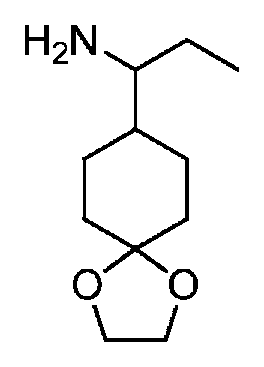
건조 MeOH (50 mL) 중 N-(1-(1,4-다이옥사스피로[4.5]데칸-8-일)프로필)-2-메틸프로판-2-설핀아미드 (이전 단계에서 제조됨, 2.55 g, 8.39 mmol)의 용액에, 실온에서 HCl (14 mL, 17.5 mmol, MeOH 중 1.25 M)을 첨가하였다. 주위 온도에서 하룻밤 교반한 후에, 반응 혼합물을 진공에서 농축하였다. 잔류물을 에테르로 트리츄레이팅한 후에 상청액을 경사분리하고 잔류물을 고진공 하에서 건조하여 백색 폼으로서 생성물을 얻었다.To a solution of N- (1- (1,4-dioxaspiro [4.5] decan-8-yl) propyl) -2-methylpropane-2-sulfinamide (prepared in the previous step, 2.55 g , 8.39 mmol) in dichloromethane (10 mL) was added HCl (14 mL, 17.5 mmol, 1.25 M in MeOH) at room temperature. After stirring overnight at ambient temperature, the reaction mixture was concentrated in vacuo. The residue was triturated with ether and then the supernatant was decanted off and the residue was dried under high vacuum to give the product as a white foam.
MS: 200 (MH+)MS: 200 (MH < + & gt ; ).
단계 C: Step C: 메틸methyl N-(1-1,4- N- (1, 다이옥사스피로[4.5]데칸Dioxaspiro [4.5] decane -8--8- 일프로필Sun Profile )) 카르바메이트Carbamate

50 mL 둥근바닥 플라스크에 다이클로로메탄 (10 mL) 중 1-1,4-다이옥사스피로[4.5]데칸-8-일프로판-1-아민 하이드로클로라이드 (이전 단계에서 제조됨, 50 mg, 0.21 mmol, 1.00 eq)의 용액 및 TEA (42.8 mg, 0.42 mmol, 2.00 eq)를 넣었다. 그 다음, 0℃에서 교반하면서 메틸 카르보노클로리데이트 (23.9 mg, 0.25 mmol, 1.20 eq)를 적가하였다. 생성된 용액을 실온에서 하룻밤 교반하였다. 이어서, 20 mL의 물을 첨가하여 반응물을 켄칭하였다. 생성된 용액을 2x20 mL의 다이클로로메탄으로 추출하였다. 유기층들을 합하고, 무수 황산나트륨으로 건조하고, 진공 하에서 농축하여 황색 오일로서 표제 화합물을 얻었다.To a 50 mL round bottom flask was added a solution of l, 4-dioxaspiro [4.5] decan-8-ylpropan-l-amine hydrochloride (prepared in the previous step, 50 mg, 0.21 mmol) in dichloromethane , 1.00 eq) and TEA (42.8 mg, 0.42 mmol, 2.00 eq). Methylcarbonochloridate (23.9 mg, 0.25 mmol, 1.20 eq) was then added dropwise with stirring at 0 < 0 > C. The resulting solution was stirred at room temperature overnight. The reaction was then quenched by the addition of 20 mL of water. The resulting solution was extracted with 2 x 20 mL of dichloromethane. The organic layers were combined, dried over anhydrous sodium sulfate and concentrated in vacuo to give the title compound as a yellow oil.
단계 D: 메틸 1-(4-옥소사이클로헥실)프로필카르바메이트Step D: Preparation of methyl 1- (4-oxocyclohexyl) propyl carbamate

CH3CN (5 mL) 중 메틸 N-(1-1,4-다이옥사스피로[4.5]데칸-8-일프로필)카르바메이트 (이전 단계에서 제조됨, 39 mg, 0.15 mmol, 1.00 eq)의 용액 및 HCl (2M, 1 mL)을 실온에서 2시간 동안 교반하였다. 생성된 혼합물을 진공 하에서 농축하였다. 잔류물을 10 mL의 소듐 바이카르보네이트 수용액 (1M)으로 희석하였다. 생성된 용액을 2x20 mL의 다이클로로메탄으로 추출하였다. 유기층들을 합하고, 무수 황산나트륨으로 건조하고, 진공 하에서 농축하여 황색 오일로서 표제 화합물을 얻었다.Methyl N- (1-1,4- dioxane SARS fatigue [4.5] decan-8-yl propyl) carbamate (prepared in the previous step, 39 mg, 0.15 mmol, 1.00 eq) in CH 3 CN (5 mL) And HCl (2M, 1 mL) were stirred at room temperature for 2 hours. The resulting mixture was concentrated in vacuo. The residue was diluted with 10 mL of aqueous sodium bicarbonate solution (1M). The resulting solution was extracted with 2 x 20 mL of dichloromethane. The organic layers were combined, dried over anhydrous sodium sulfate and concentrated in vacuo to give the title compound as a yellow oil.
단계 E: 메틸 (-1-((1s,4S)-4-(3-(2-((6-(트라이플루오로메틸)퀴나졸린-4-일)아미노)아세트아미도)아제티딘-1-일)사이클로헥실)프로필)카르바메이트Step E: Preparation of methyl (l - ((lS, 4S) -4- (3- (2- (6- (trifluoromethyl) quinazolin- 4- yl) amino) acetamido) - yl) cyclohexyl) propyl) carbamate

실시예 1, 단계 H에 기재된 바와 같이 TEA 및 NaBH(OAc)3의 존재 하에서 메틸 (1-(4-옥소사이클로헥실)프로필)카르바메이트 (이전 단계에서 제조됨)와 N-(아제티딘-3-일)-2-((6-(트라이플루오로메틸)퀴나졸린-4-일)아미노)아세트아미드 (실시예 1 단계 G에서 제조됨)의 반응에 의해 생성물을 얻었다.(4-oxocyclohexyl) propyl) carbamate (prepared in the previous step) and N- (azetidin-2-yl) propanoate in the presence of TEA and NaBH (OAc) 3 as described in example 1, Amino) acetamide (prepared in step 1 G of Example 1) in the form of a white solid.
ESI-MS (m/z): C22H33F3N6O3에 대한 계산치: 522.26; 실측치: 523 (M+H).ESI-MS (m / z) : C 22 H 33 F 3 N calculated for 6 O 3: 522.26; Found: 523 (M + H).
실시예Example 105: N-(1-(4-( 105: N- (1- (4- ( 에톡시메틸Ethoxymethyl )) 사이클로헥실Cyclohexyl )) 아제티딘Azetidine -3-일)-2-((6-(Yl) -2 - ((6- ( 트라이플루오로메틸Trifluoromethyl )) 퀴나졸린Quinazoline -4-일)아미노)Yl) amino) 아세트아미드Acetamide

실시예 1, 단계 H에 기재된 바와 같이 TEA 및 NaBH(OAc)3의 존재 하에서 4-(에톡시메틸)사이클로헥사논과 N-(아제티딘-3-일)-2-((6-(트라이플루오로메틸)퀴나졸린-4-일)아미노)아세트아미드 (실시예 1 단계 G에서 제조됨)의 반응에 의해 생성물을 얻었다.(Ethoxymethyl) cyclohexanone and N- (azetidin-3-yl) -2 - ((6- (trifluoromethyl) cyclohexanone in the presence of TEA and NaBH (OAc) 3 as described in example 1, 4-yl) amino) acetamide (prepared in Example 1 Step G).
1H NMR (아세토니트릴-d3) δ: 0.79 - 1.04 (m, 2 H) 1.02 - 1.16 (m, 5 H) 1.22 - 1.39 (m, 8 H) 1.47 (d, J=4.04 Hz, 4 H) 1.66 - 1.79 (m, 1 H) 2.71 (t, J=7.33 Hz, 2 H) 3.14 - 3.21 (m, 3 H) 3.30 - 3.44 (m, 3 H) 3.48 (t, J=7.33 Hz, 2 H) 4.15 (d, J=5.81 Hz, 2 H) 4.23 - 4.39 (m, 1 H) 7.03 (br. s., 1 H) 7.33 - 7.47 (m, 1 H) 7.85 - 7.94 (m, 1 H) 7.98 (dd, J=8.84, 1.52 Hz, 1 H) 8.39 (s, 1 H) 8.59 (s, 1 H); ESI-MS (m/z): C23H30F3N5O2에 대한 계산치: 465.24; 실측치: 466 (M+H). 1 H NMR (acetonitrile-d 3)?: 0.79-1.04 (m, 2 H) 1.02-1.16 (m, 5 H) 1.22-1.39 (m, 8 H) 1.47 (d, J = 4.04 Hz, 1.46 - 1.79 (m, 1H) 2.71 (t, J = 7.33 Hz, 2H) 3.14-3.21 (m, ), 4.15 (d, J = 5.81 Hz, 2H) 4.23-4.39 (m, 1H) 7.03 (br s, 1H) 7.33-7.47 (m, 1H) 7.98 (dd, J = 8.84, 1.52 Hz, 1H) 8.39 (s, 1H) 8.59 (s, 1H); ESI-MS (m / z) : C 23 H 30 F 3 N 5 O 2 Calcd: 465.24; Found 466 (M + H).
실시예Example 106: (1s,4s)-에틸 4-(3-(2-((6-( 106: (1S, 4S) -Ethyl 4- (3- (2 - ((6- ( 트라이플루오로메틸Trifluoromethyl )) 퀴나졸린Quinazoline -4-일)아미노)Yl) amino) 아세트아미도Acetamido )) 아제티딘Azetidine -1-일)-1 day) 사이클로헥산카르복실레이트Cyclohexanecarboxylate
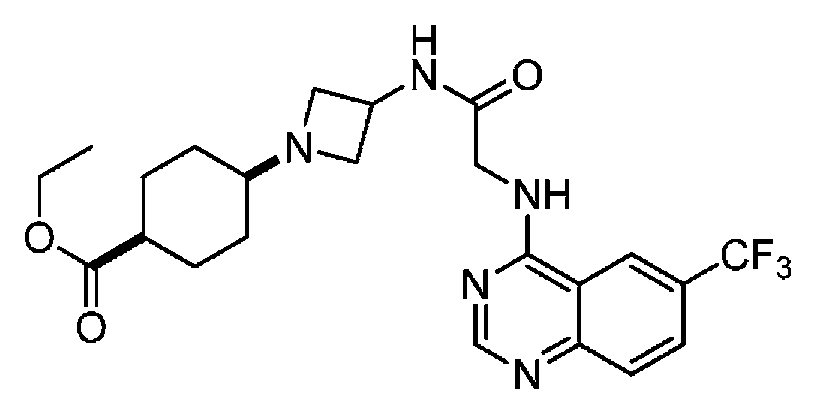
실시예 1, 단계 H에 기재된 바와 같이 TEA 및 NaBH(OAc)3의 존재 하에서 에틸 4-옥소사이클로헥산카르복실레이트와 N-(아제티딘-3-일)-2-((6-(트라이플루오로메틸)퀴나졸린-4-일)아미노)아세트아미드 (실시예 1 단계 G에서 제조됨)의 반응에 의해 생성물을 얻었다.(4-oxocyclohexanecarboxylate) and N- (azetidin-3-yl) -2 - ((6- (trifluoromethoxy) cyclohexanecarboxylate in the presence of TEA and NaBH (OAc) 3 as described in example 1, 4-yl) amino) acetamide (prepared in Example 1 Step G).
1H NMR (아세토니트릴-d3) δ: 8.58 (s, 1 H), 8.45 (s, 1 H), 8.20 (br. s., 1 H), 7.96 (m, J=8.8, 1.8 Hz, 1 H), 7.87 (m, J=8.8 Hz, 1 H), 7.77 (br. s., 1 H), 4.46 - 4.61 (m, 1 H), 4.18 (s, 2 H), 4.07 (q, J=7.1 Hz, 2 H), 3.96 (t, J=8.7 Hz, 2 H), 3.51 (dd, J=9.2, 6.2 Hz, 2 H), 2.70 (m, J=8.6, 4.5, 3.5, 3.5 Hz, 1 H), 2.47 (quin, J=5.1 Hz, 1 H), 1.96 - 2.02 (m, 2 H), 1.89 (s, 2 H), 1.57 - 1.67 (m, 2 H), 1.45 - 1.55 (m, 2 H), 1.32 - 1.45 (m, 2 H), 1.19 (t, J=7.1 Hz, 3 H); ESI-MS (m/z): C23H28F3N5O3에 대한 계산치: 479.21; 실측치: 480 (M+H). 1 H NMR (acetonitrile-d 3)?: 8.58 (s, 1H), 8.45 (s, 1H), 8.20 1H), 4.87 (m, 1H), 4.18 (s, 2H), 4.07 (q, J) = 7.1 Hz, 2H), 3.96 (t, J = 8.7 Hz, 2H), 3.51 (dd, J = 9.2, 6.2 Hz, 2H), 2.70 (M, 2H), 1.47-1.67 (m, 2H), 1.45-1.55 (m, 2H) m, 2 H), 1.32-1.45 (m, 2 H), 1.19 (t, J = 7.1 Hz, 3 H); ESI-MS (m / z) : C 23 H 28 F 3 N calculated for 5 O 3: 479.21; Found: 480 (M + H).
실시예Example 107: N-(1-((1s,4s)-4- 107: N- (1 - ((1S, 4S) -4- 페닐사이클로헥실Phenylcyclohexyl )) 아제티딘Azetidine -3-일)-2-((6-(Yl) -2 - ((6- ( 트라이플루오로메틸Trifluoromethyl )) 퀴나졸린Quinazoline -4-일)아미노)Yl) amino) 아세트아미드Acetamide

실시예 1, 단계 H에 기재된 바와 같이 TEA 및 NaBH(OAc)3의 존재 하에서 4-페닐사이클로헥사논과 N-(아제티딘-3-일)-2-((6-(트라이플루오로메틸)퀴나졸린-4-일)아미노)아세트아미드 (실시예 1 단계 G에서 제조됨)의 반응에 의해 생성물을 얻었다.(4-phenylcyclohexanone) and N- (azetidin-3-yl) -2 - ((6- (trifluoromethyl) quinacetaldehyde in the presence of TEA and NaBH (OAc) 3 as described in example 1, 4-yl) amino) acetamide (prepared in step 1 G of Example 1).
1H NMR (MEOD) δ: 8.64 (s, 1 H), 8.36 (s, 1 H), 7.91 (dd, J=8.8, 1.8 Hz, 1 H), 7.90 (d, J=8.8 Hz, 1 H), 7.24 - 7.30 (m, 4 H), 7.13 - 7.22 (m, 1 H), 4.58 (br. s., 1 H), 4.26 (s, 2 H), 3.67 (br. s., 2 H), 3.10 (br. s., 1 H), 2.50 - 2.60 (m, 1 H), 1.77 - 1.92 (m, 2 H), 1.69 (d, J=2.0 Hz, 2 H), 1.43 - 1.65 (m, 4 H); ESI-MS (m/z): C26H28F3N5O에 대한 계산치: 483.22; 실측치: 484 (M+H). 1 H NMR (MEOD) δ: 8.64 (s, 1 H), 8.36 (s, 1 H), 7.91 (dd, J = 8.8, 1.8 Hz, 1 H), 7.90 (d, J = 8.8 Hz, 1 H ), 7.24-7.30 (m, 4H), 7.13-7.22 (m, 1H), 4.58 (br s, 1H), 4.26 ), 3.10 (br s, 1H), 2.50-2.60 (m, 1H), 1.77-1.92 (m, 2H), 1.69 (d, J = 2.0Hz, 2H), 1.43-1.65 m, 4 H); ESI-MS (m / z): Calcd for C 26 H 28 F 3 N 5 O: 483.22; Found: 484 (M + H).
실시예Example 108: N-(1-((1s,4s)-4-(2-하이드록시에틸) 108: N- (1 - ((1s, 4s) -4- (2-hydroxyethyl) 사이클로헥실Cyclohexyl )) 아제티딘Azetidine -3-일)-2-((6-(트3-yl) -2 - ((6- 라이플루오로Rifluro 메틸)methyl) 퀴나졸린Quinazoline -4-일)아미노)Yl) amino) 아세트아미드Acetamide
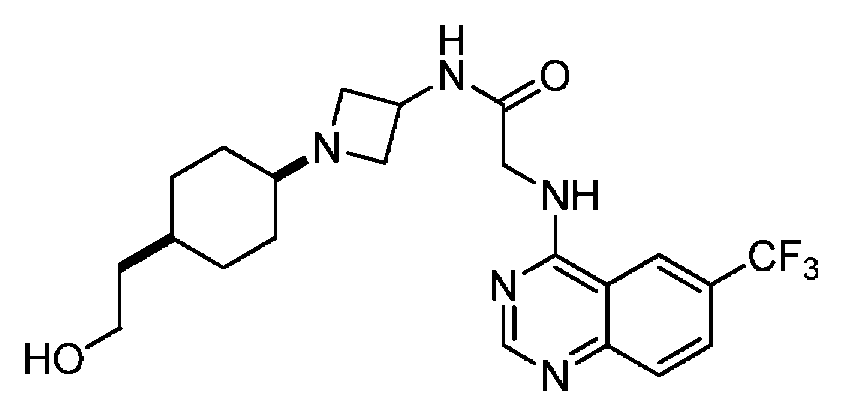
실시예 1, 단계 H에 기재된 바와 같이 TEA 및 NaBH(OAc)3의 존재 하에서 4-(2-하이드록시에틸)사이클로헥사논과 N-(아제티딘-3-일)-2-((6-(트라이플루오로메틸)퀴나졸린-4-일)아미노)아세트아미드 (실시예 1 단계 G에서 제조됨)의 반응에 의해 생성물을 얻었다.Example 1, in the presence of TEA and NaBH (OAc) 3 as described in Step H 4- (2- hydroxyethyl) cyclohexanone paddy N- (azetidin-3-yl) -2 - ((6- ( (Trifluoromethyl) quinazolin-4-yl) amino) acetamide (prepared in Example 1 Step G).
1H NMR (DMSO-d6) δ: 1.17 - 1.35 (m, 8 H) 1.35 - 1.48 (m, 3 H) 2.16 (br. s., 0 H) 2.74 (br. s., 2 H) 3.38 - 3.50 (m, 4 H) 4.12 (d, J=5.81 Hz, 2 H) 4.18 - 4.34 (m, 2 H) 7.88 (d, J=8.59 Hz, 1 H) 8.06 (dd, J=8.84, 1.52 Hz, 1 H) 8.42 (d, J=7.07 Hz, 1 H) 8.56 (s, 1 H) 8.80 (s, 1 H) 9.01 (t, J=5.68 Hz, 1 H); ESI-MS (m/z): C22H28F3N5O2에 대한 계산치: 451.22; 실측치: 452 (M+H). 1 H NMR (DMSO-d6) δ: 1.17 - 1.35 (m, 8 H) 1.35 - 1.48 (m, 3 H) 2.16 (.. Br s, 0 H) 2.74 (.. Br s, 2 H) 3.38 - 4.08 (d, J = 5.81 Hz, 2H) 4.18-4.34 (m, 2H) 7.88 (d, J = 8.59 Hz, 1H) 8.06 , 1H) 8.42 (d, J = 7.07 Hz, 1H) 8.56 (s, 1H) 8.80 (s, 1H) 9.01 (t, J = 5.68 Hz, 1H); ESI-MS (m / z) : C 22 H 28 F 3 N 5 O 2 Calcd: 451.22; Found: 452 (M + H).
실시예Example 109: N-(1-((1s,4s)-4-( 109: N- (1 - ((1 S, 4 S) -4- ( 하이드록시메틸Hydroxymethyl )) 사이클로헥실Cyclohexyl )) 아제티딘Azetidine -3-일)-2-((6-(트3-yl) -2 - ((6- 라이플루오로Rifluro 메틸)methyl) 퀴나졸린Quinazoline -4-일)아미노)Yl) amino) 아세트아미드Acetamide

실시예 1, 단계 H에 기재된 바와 같이 TEA 및 NaBH(OAc)3의 존재 하에서 4-(하이드록시메틸)사이클로헥사논과 N-(아제티딘-3-일)-2-((6-(트라이플루오로메틸)퀴나졸린-4-일)아미노)아세트아미드 (실시예 1 단계 G에서 제조됨)의 반응에 의해 생성물을 얻었다.(Hydroxymethyl) cyclohexanone and N- (azetidin-3-yl) -2 - ((6- (trifluoromethyl) cyclohexanone in the presence of TEA and NaBH (OAc) 3 as described in example 1, 4-yl) amino) acetamide (prepared in Example 1 Step G).
1H NMR (아세토니트릴-d3) δ: 8.59 (s, 1 H), 8.39 (s, 1 H), 7.92 - 8.02 (m, 1 H), 7.83 - 7.92 (m, 1 H), 7.38 - 7.51 (m, 1 H), 7.00 - 7.15 (m, 1 H), 4.33 (m, J=14.7, 7.1, 7.1, 7.1, 7.1 Hz, 1 H), 4.15 (d, J=5.8 Hz, 2 H), 3.45 - 3.54 (m, 2 H), 3.22 - 3.31 (m, 3 H), 2.79 (t, J=7.3 Hz, 1 H), 2.73 (t, J=7.2 Hz, 1 H), 1.79 - 1.91 (m, 1 H), 1.65 - 1.79 (m, 2 H), 1.21 - 1.53 (m, 5 H), 1.07 - 1.23 (m, 1 H), 0.80 - 1.01 (m, 2 H); ESI-MS (m/z): C21H26F3N5O2에 대한 계산치: 437.20; 실측치: 438 (M+H). 1 H NMR (acetonitrile-d 3) ?: 8.59 (s, 1H), 8.39 (s, 1H), 7.92-8.08 (m, 1H), 7.83-7.92 (m, 1H), 7.00-7.15 (m, 1H), 4.33 (m, J = 14.7, 7.1, 7.1, 7.1, 7.1 Hz, 1H) , 3.45-3.54 (m, 2H), 3.22-3.31 (m, 3H), 2.79 (t, J = 7.3 Hz, 1H) (m, 1H), 1.65-1.79 (m, 2H), 1.21-1.53 (m, 5H), 1.07-1.23 (m, 1H), 0.80-1.01 (m, 2H); ESI-MS (m / z) : C 21 H 26 F 3 N 5 O 2 Calcd: 437.20; Found: 438 (M + H).
실시예Example 110: N-(1-((1s,4s)-4- 110: N- (1 - ((1S, 4S) -4- 하이드록시사이클로헥실Hydroxycyclohexyl )) 아제티딘Azetidine -3-일)-2-((6-(Yl) -2 - ((6- ( 트라이플루오로메틸Trifluoromethyl )) 퀴나졸린Quinazoline -4-일)아미노)Yl) amino) 아세트아미드Acetamide

실시예 1, 단계 H에 기재된 바와 같이 TEA 및 NaBH(OAc)3의 존재 하에서 4-하이드록시사이클로헥사논과 N-(아제티딘-3-일)-2-((6-(트라이플루오로메틸)퀴나졸린-4-일)아미노)아세트아미드 (실시예 1 단계 G에서 제조됨)의 반응에 의해 생성물을 얻었다.Example 1, in the presence of TEA and NaBH (OAc) 3 as described in Step H 4- hydroxy-cyclohexadiene paddy N- (azetidin-3-yl) -2 - ((6- (trifluoromethyl) Quinazolin-4-yl) amino) acetamide (prepared in Example 1 Step G).
1H NMR (아세토니트릴-d3) δ: 0.88 - 1.06 (m, 1 H) 1.06 - 1.21 (m, 1 H) 1.32 - 1.50 (m, 4 H) 1.52 - 1.66 (m, 1 H) 1.72 (d, J=11.87 Hz, 1 H) 1.77 - 1.88 (m, 1 H) 1.99 - 2.26 (m, 1 H) 3.00 (ddd, J=17.94, 8.34, 6.57 Hz, 2 H) 3.35 - 3.74 (m, 3 H) 4.18 (d, J=2.78 Hz, 2 H) 4.39 (sxt, J=6.97 Hz, 1 H) 7.88 (m, J=8.84 Hz, 1 H) 7.98 (dd, J=8.72, 1.89 Hz, 1 H) 8.43 (s, 1 H) 8.58 (s, 1 H); ESI-MS (m/z): C20H24F3N5O2에 대한 계산치: 423.19; 실측치: 424 (M+H). 1 H NMR (acetonitrile-d 3)?: 0.88-1.06 (m, 1H) 1.06-1.21 (m, 1H) 1.32-1.50 (m, 4H) 1.52-1.66 J = 11.87 Hz, 1H) 1.77-1.88 (m, 1H) 1.99-2.26 (m, 1H) 3.00 (ddd, J = 17.94,8.34,6.57 Hz, 2H) J = 8.78 Hz, 1H), 7.98 (dd, J = 8.72, 1.89 Hz, 1 H) H) 8.43 (s, 1H) 8.58 (s, 1H); ESI-MS (m / z) : C 20 H 24 F 3 N 5 O 2 Calcd: 423.19; Found: 424 (M + H).
실시예Example 111: N-(1-((1s,4s)-4-( 111: N- (1 - ((1 S, 4 S) -4- ( 아세트아미도메틸Acetamidomethyl )) 사이클로헥실Cyclohexyl )) 아제티딘Azetidine -3-일)-2-((6-(트3-yl) -2 - ((6- 라이플루오로Rifluro 메틸)methyl) 퀴나졸린Quinazoline -4-일)아미노)Yl) amino) 아세트아미드Acetamide
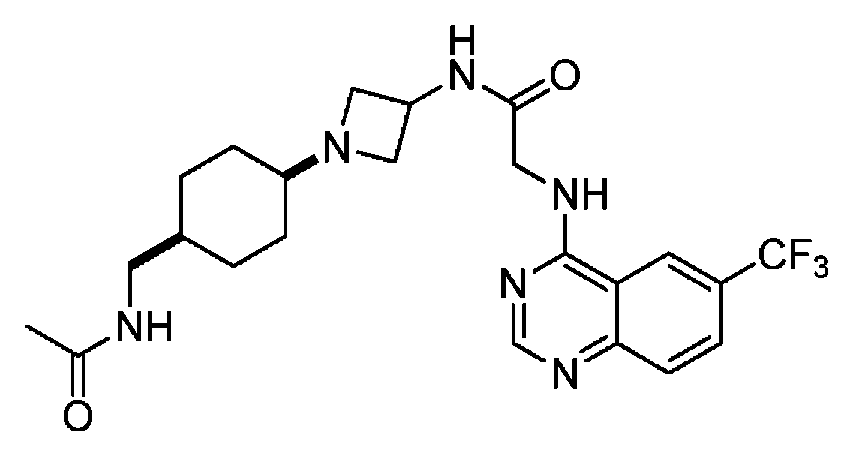
실시예 1, 단계 H에 기재된 바와 같이 TEA 및 NaBH(OAc)3의 존재 하에서 N-((4-옥소사이클로헥실)메틸)아세트아미드와 N-(아제티딘-3-일)-2-((6-(트라이플루오로메틸)퀴나졸린-4-일)아미노)아세트아미드 (실시예 1 단계 G에서 제조됨)의 반응에 의해 생성물을 얻었다.(4-oxocyclohexyl) methyl) acetamide and N- (azetidin-3-yl) -2 - (((4-oxocyclohexyl) methyl) acetamide in the presence of TEA and NaBH (OAc) 3 as described in example 1, (Trifluoromethyl) quinazolin-4-yl) amino) acetamide (prepared in Example 1 Step G).
1H NMR (아세토니트릴-d3) δ: 1.35 - 1.75 (m, 9 H) 1.84 (s, 3 H) 2.99 - 3.10 (m, 2 H) 3.14 - 3.22 (m, 1 H) 3.92 (br. s., 2 H) 4.22 (s, 4 H) 4.62 (br. s., 1 H) 6.95 (br. s., 1 H) 7.84 - 8.06 (m, 2 H) 8.51 (s, 1 H) 8.64 (s, 1 H); ESI-MS (m/z): 23H29F3N6O2에 대한 계산치: 478.23; 실측치: 479 (M+H). 1 H NMR (acetonitrile-d 3)?: 1.35-1.75 (m, 9 H) 1.84 (s, 3 H) 2.99-3.10 (m, 2 H) 3.14-3.22 (M, 2 H) 8.51 (s, 1 H) 8.64 (br s, 1 H) s, 1H); ESI-MS (m / z): Calcd for 23 H 29 F 3 N 6 O 2 : 478.23; Found: 479 (M + H).
실시예Example 112: 2,2,2- 112: 2,2,2- 트라이플루오로Trifluro -N-(((1s,4s)-4-(3-(2-((6-(-N - (((1S, 4S) -4- (3- (2 - ((6- ( 트라이플루오로메틸Trifluoromethyl )퀴나졸린-4-일)아미노)) ≪ / RTI > quinazolin-4-yl) amino) 아세트아미도Acetamido )) 아제티딘Azetidine -1-일)-1 day) 사이클로헥실Cyclohexyl )) 메틸methyl )) 아세트아미Acetamido 드De

실시예 1, 단계 H에 기재된 바와 같이 TEA 및 NaBH(OAc)3의 존재 하에서 2,2,2-트라이플루오로-N-((4-옥소사이클로헥실)메틸)아세트아미드와 N-(아제티딘-3-일)-2-((6-(트라이플루오로메틸)퀴나졸린-4-일)아미노)아세트아미드 (실시예 1 단계 G에서 제조됨)의 반응에 의해 생성물을 얻었다.(4-oxocyclohexyl) methyl) acetamide and N- (azetidine) acetamide in the presence of TEA and NaBH (OAc) 3 as described in example 1, step H, -3-yl) -2 - ((6- (trifluoromethyl) quinazolin-4-yl) amino) acetamide (prepared in Step G of Example 1).
1H NMR (아세토니트릴-d3) δ: 1.40 - 1.69 (m, 8 H) 1.80 (br. s., 1 H) 3.06 - 3.25 (m, 3 H) 4.04 (m, J=8.34 Hz, 4 H) 4.21 (s, 2 H) 4.55 (br. s., 1 H) 7.79 - 7.91 (m, 2 H) 8.37 (s, 1 H) 8.56 (s, 1 H); ESI-MS (m/z): C23H26F6N6O2에 대한 계산치: 532.20; 실측치: 533 (M+H). 1 H NMR (acetonitrile-d 3)?: 1.40-1.69 (m, 8 H) 1.80 (br s, 1H) 3.06-3.25 (m, 3 H) 4.04 (m, J = 8.34 Hz, ) 4.21 (s, 2H) 4.55 (br s, 1H) 7.79-7.91 (m, 2H) 8.37 (s, 1H) 8.56 (s, 1H); ESI-MS (m / z) : C 23 H 26 F 6 N calculated for 6 O 2: 532.20; Found: 533 (M + H).
실시예Example 113: 113: terttert -부틸 (((1s,4s)-4-(3-(2-((6-(- butyl (((1S, 4S) -4- (3- (2 - ((6- ( 트라이플루오로메틸Trifluoromethyl )) 퀴나졸린Quinazoline -4-일)아미노)Yl) amino) 아세트아미도Acetamido )) 아제티딘Azetidine -1-일)-1 day) 사이클로헥실Cyclohexyl )) 메틸methyl )) 카르바메이트Carbamate

실시예 1, 단계 H에 기재된 바와 같이 TEA 및 NaBH(OAc)3의 존재 하에서 tert-부틸 ((4-옥소사이클로헥실)메틸)카르바메이트와 N-(아제티딘-3-일)-2-((6-(트라이플루오로메틸)퀴나졸린-4-일)아미노)아세트아미드 (실시예 1 단계 G에서 제조됨)의 반응에 의해 생성물을 얻었다.((4-oxocyclohexyl) methyl) carbamate and N- (azetidin-3-yl) -2- (4-fluorophenyl) carbamate in the presence of TEA and NaBH (OAc) 3 as described in example 1, (Prepared from (6- (trifluoromethyl) quinazolin-4-yl) amino) acetamide (prepared in Example 1 Step G).
1H NMR (클로로포름-d) δ: 8.70 (s, 1 H), 8.25 (s, 1 H), 7.91 (s, 2 H), 7.27 - 7.33 (m, 1 H), 4.75 - 4.84 (m, 1 H), 4.68 (d, J=4.5 Hz, 1 H), 4.35 (d, J=5.1 Hz, 2 H), 3.71 (br. s., 2 H), 3.47 (br. s., 2 H), 3.07 (t, J=6.1 Hz, 2 H), 2.53 (br. s., 1 H), 1.46 - 1.70 (m, 8 H), 1.44 (s, 12 H); ESI-MS (m/z): C23H26F3N6O2에 대한 계산치: 536.27; 실측치: 537 (M+H). 1 H NMR (chloroform-d)?: 8.70 (s, 1H), 8.25 (s, 1H), 7.91 (s, 2H), 7.27-7.33 2 H), 3.71 (br s, 2 H), 4.68 (d, J = 4.5 Hz, ), 3.07 (t, J = 6.1 Hz, 2H), 2.53 (br s, 1H), 1.46-1.70 (m, 8H), 1.44 (s, 12H); ESI-MS (m / z) : C 23 H 26 F 3 N calculated for 6 O 2: 536.27; Found: 537 (M + H).
실시예Example 114: N-(((1s,4s)-4-(3-(2-((6-( 114: N - (((1S, 4S) -4- (3- (2 - ((6- ( 트라이플루오로메틸Trifluoromethyl )) 퀴나졸린Quinazoline -4-일)아미노)아세트아미도)4-yl) amino) acetamido) 아제티딘Azetidine -1-일)-1 day) 사이클로헥실Cyclohexyl )) 메틸methyl )) 아이소부티르아미드Isobutyramide

실시예 1, 단계 H에 기재된 바와 같이 TEA 및 NaBH(OAc)3의 존재 하에서 N-((4-옥소사이클로헥실)메틸)아이소부티르아미드와 N-(아제티딘-3-일)-2-((6-(트라이플루오로메틸)퀴나졸린-4-일)아미노)아세트아미드 (실시예 1 단계 G에서 제조됨)의 반응에 의해 생성물을 얻었다.(4-oxocyclohexyl) methyl) isobutyramide in the presence of TEA and NaBH (OAc) 3 as described in example 1, step H and N- (azetidin-3-yl) -2- (Prepared from (6- (trifluoromethyl) quinazolin-4-yl) amino) acetamide (prepared in Example 1 Step G).
1H NMR (아세토니트릴-d3) δ: 1.02 (d, J=6.65 Hz, 6 H) 1.34 (br. s., 6 H) 1.48 (d, J=18.00 Hz, 3 H) 2.28 - 2.35 (m, 2 H) 2.90 - 3.02 (m, 3 H) 3.61 (br. s., 2 H) 4.16 (d, J=5.48 Hz, 2 H) 4.38 (br. s., 1 H) 6.37 (br. s., 1 H) 7.45 (br. s., 1 H) 7.85 - 7.94 (m, 1 H) 7.94 - 8.04 (m, 1 H) 8.43 (br. s., 1 H) 8.60 (s, 1 H); ESI-MS (m/z): C25H33F3N6O2에 대한 계산치: 506.26; 실측치: 507 (M+H). 1 H NMR (acetonitrile -d3) δ: 1.02 (d, J = 6.65 Hz, 6 H) 1.34 (.. Br s, 6 H) 1.48 (d, J = 18.00 Hz, 3 H) 2.28 - 2.35 (m , 2.H) 2.90-3.02 (m, 3 H) 3.61 (br s, 2 H) 4.16 (d, J = 5.48 Hz, 2 H) 4.38 (br s, 1H) 6.37 1 H) 7.45 (br s, 1H) 7.85-7.94 (m, 1H) 7.94-8.08 (m, 1H) 8.43 (br s, 1H) ; ESI-MS (m / z) : C 25 H 33 F 3 N calculated for 6 O 2: 506.26; Found: 507 (M + H).
실시예Example 115: N- 115: N- 아이소프로필Isopropyl -N-(((1s,4s)-4-(3-(2-((6-(-N - (((1S, 4S) -4- (3- (2 - ((6- ( 트라이플루오로메틸Trifluoromethyl )) 퀴나졸린Quinazoline -4-일)아미노)Yl) amino) 아세트아미도Acetamido )) 아제티딘Azetidine -1-일)-1 day) 사이클로헥실Cyclohexyl )) 메틸methyl )) 아세트아미드Acetamide

실시예 1, 단계 H에 기재된 바와 같이 TEA 및 NaBH(OAc)3의 존재 하에서 N-아이소프로필-N-((4-옥소사이클로헥실)메틸)아세트아미드 (순차적으로 환원성 아민화, 아실화 및 탈보호에 의해, 아이소프로필아민 및 1,4-다이옥사스피로[4.5]데칸-8-카르브알데하이드로부터 제조됨)와 N-(아제티딘-3-일)-2-((6-(트라이플루오로메틸)퀴나졸린-4-일)아미노)아세트아미드 (실시예 1 단계 G에서 제조됨)의 반응에 의해 생성물을 얻었다.(4-oxocyclohexyl) methyl) acetamide (sequentially subjected to reductive amination, acylation and deacetylation in the presence of TEA and NaBH (OAc) 3 as described in Example 1, (Prepared from isopropylamine and 1,4-dioxaspiro [4.5] decane-8-carbaldehyde by the addition of triethylamine to N- (azetidin-3-yl) 4-yl) amino) acetamide (prepared in Example 1 Step G).
1H NMR (DMSO-d6) δ: 9.04 (br. s., 1 H), 8.82 (s, 1 H), 8.56 (s, 1 H), 8.36 - 8.53 (m, 1 H), 8.06 (d, J=8.8 Hz, 1 H), 7.89 (d, J=8.8 Hz, 1 H), 7.74 (br. s., 2 H), 4.13 (d, J=5.6 Hz, 2 H), 2.67 (d, J=6.8 Hz, 2 H), 1.40 (br. s., 8 H); ESI-MS (m/z): C26H35F3N6O2에 대한 계산치: 520.28; 실측치: 521 (M+H). 1 H NMR (DMSO-d6) δ: 9.04 (.. Br s, 1 H), 8.82 (s, 1 H), 8.56 (s, 1 H), 8.36 - 8.53 (m, 1 H), 8.06 (d J = 8.8 Hz, 1H), 7.89 (d, J = 8.8 Hz, 1H), 7.74 (br s, 2H), 4.13 , J = 6.8 Hz, 2 H), 1.40 (br s, 8 H); ESI-MS (m / z): Calcd for C 26 H 35 F 3 N 6 O 2 : 520.28; Found: 521 (M + H).
실시예Example 116: N-(1-((1s,4s)-4-( 116: N- (1 - ((1 S, 4 S) -4- ( 아미노메틸Aminomethyl )) 사이클로헥실Cyclohexyl )) 아제티딘Azetidine -3-일)-2-((6-(Yl) -2 - ((6- ( 트라이플루오로메틸Trifluoromethyl )) 퀴나졸린Quinazoline -4-일)아미노)Yl) amino) 아세트아미드Acetamide
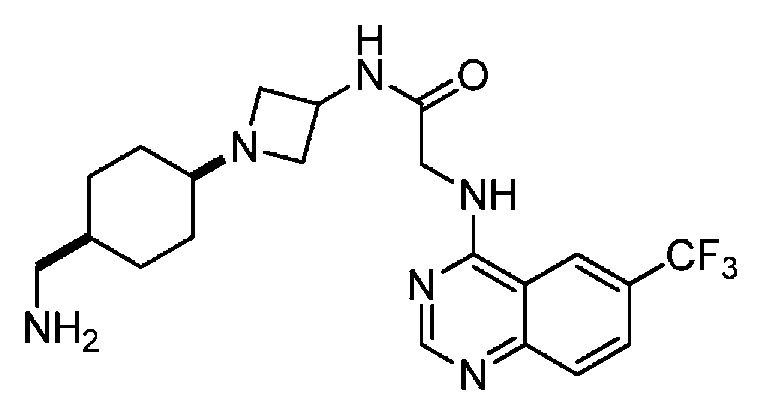
실시예 1, 단계 G에 기재된 바와 같이 DCM 중에서 tert-부틸 (((1s,4s)-4-(3-(2-((6-(트라이플루오로메틸)퀴나졸린-4-일)아미노)아세트아미도)아제티딘-1-일)사이클로헥실)메틸)카르바메이트와 TFA의 반응에 의해 생성물을 얻었다.(((1s, 4s) -4- (3- (2 - ((6- (trifluoromethyl) quinazolin-4- yl) amino) Acetamido) azetidin-1-yl) cyclohexyl) methyl) carbamate with TFA.
1H NMR (DMSO-d6) δ: 9.04 (br. s., 1 H), 8.82 (s, 1 H), 8.56 (s, 1 H), 8.36 - 8.53 (m, 1 H), 8.06 (d, J=8.8 Hz, 1 H), 7.89 (d, J=8.8 Hz, 1 H), 7.74 (br. s., 2 H), 4.13 (d, J=5.6 Hz, 2 H), 2.67 (d, J=6.8 Hz, 2 H), 1.40 (br. s., 8 H); ESI-MS (m/z): C21H27F3N6O에 대한 계산치: 436.22; 실측치: 437 (M+H). 1 H NMR (DMSO-d6) δ: 9.04 (.. Br s, 1 H), 8.82 (s, 1 H), 8.56 (s, 1 H), 8.36 - 8.53 (m, 1 H), 8.06 (d J = 8.8 Hz, 1H), 7.89 (d, J = 8.8 Hz, 1H), 7.74 (br s, 2H), 4.13 , J = 6.8 Hz, 2 H), 1.40 (br s, 8 H); ESI-MS (m / z) : C 21 H 27 F 3 calculated for N 6 O: 436.22; Found: 437 (M + H).
실시예Example 117: N-(1-((1s,4s)-4- 117: N- (1 - ((1 S, 4 S) -4- 아이소프로필사이클로헥실Isopropylcyclohexyl )) 아제티딘Azetidine -3-일)-2-((6-(Yl) -2 - ((6- ( 트라이플루오로메틸Trifluoromethyl )) 퀴나졸린Quinazoline -4-일)아미노)Yl) amino) 아세트아미드Acetamide

실시예 1, 단계 H에 기재된 바와 같이 TEA 및 NaBH(OAc)3의 존재 하에서 4-아이소프로필사이클로헥사논과 N-(아제티딘-3-일)-2-((6-(트라이플루오로메틸)퀴나졸린-4-일)아미노)아세트아미드 (실시예 1 단계 G에서 제조됨)의 반응에 의해 생성물을 얻었다.Isopropylcyclohexanone and N- (azetidin-3-yl) -2 - ((6- (trifluoromethyl) pyrimidin-2-ylamine in the presence of TEA and NaBH (OAc) 3 as described in example 1, Quinazolin-4-yl) amino) acetamide (prepared in Example 1 Step G).
1H NMR (클로로포름-d) δ: 8.67 (s, 1 H), 8.11 (s, 1 H), 7.86 (s, 2 H), 7.38 (t, J=4.8 Hz, 1 H), 6.54 (d, J=7.8 Hz, 1 H), 4.50 - 4.62 (m, 1 H), 4.29 (d, J=4.8 Hz, 2 H), 3.52 - 3.60 (m, 2 H), 2.86 - 2.95 (m, 2 H), 2.19 (d, J=3.0 Hz, 1 H), 1.26 - 1.55 (m, 8 H), 1.02 (dd, J=6.9, 3.2 Hz, 1 H), 0.86 (d, J=6.8 Hz, 6 H); ESI-MS (m/z): C23H30F3N5O에 대한 계산치: 449.24; 실측치: 450 (M+H). 1 H NMR (chloroform -d) δ: 8.67 (s, 1 H), 8.11 (s, 1 H), 7.86 (s, 2 H), 7.38 (t, J = 4.8 Hz, 1 H), 6.54 (d (M, 2 H), 2.86-2.95 (m, 2 H), 4.29 (d, J = (D, J = 6.8 Hz, 1H), 2.19 (d, J = 3.0 Hz, 1H), 1.26-1.55 6 H); ESI-MS (m / z): Calcd for C 23 H 30 F 3 N 5 O: 449.24; Found: 450 (M + H).
실시예Example 118: N-(1- 118: N- (1- 듀테로Dutero -1-((1s,4s)-4--1 - ((1 S, 4 S) -4- 아이소프로필사이클로헥실Isopropylcyclohexyl )) 아제티딘Azetidine -3-일)-2-((6-(트3-yl) -2 - ((6- 라이플루오Rifluo 로메틸)Lt; / RTI > 퀴나졸린Quinazoline -4-일)아미노)Yl) amino) 아세트아미드Acetamide

실시예 1, 단계 H에 기재된 바와 같이 TEA 및 NaBD(OAc)3의 존재 하에서 4-아이소프로필사이클로헥사논과 N-(아제티딘-3-일)-2-((6-(트라이플루오로메틸)퀴나졸린-4-일)아미노)아세트아미드 (실시예 1 단계 G에서 제조됨)의 반응에 의해 생성물을 얻었다.Example 1, in the presence of TEA and NaBD (OAc) 3 as described in Step H 4- isopropyl-cyclohexadiene paddy N- (azetidin-3-yl) -2 - ((6- (trifluoromethyl) Quinazolin-4-yl) amino) acetamide (prepared in Example 1 Step G).
1H NMR (DMSO-d6) δ: 0.81 (d, J=6.82 Hz, 6 H) 0.91 - 1.04 (m, 1 H) 1.15 - 1.33 (m, 6 H) 1.38 (dq, J=13.36, 6.66 Hz, 1 H) 1.44 - 1.54 (m, 2 H) 2.71 (t, J=7.20 Hz, 2 H) 3.43 (t, J=7.20 Hz, 2 H) 4.12 (s, 2 H) 4.23 (sxt, J=6.97 Hz, 1 H) 7.87 (d, J=8.84 Hz, 1 H) 8.04 (dd, J=8.72, 1.90 Hz, 1 H) 8.51 (d, J=7.07 Hz, 1 H) 8.55 (s, 1 H) 8.83 (s, 1 H) 9.30 (br. s., 1 H); ESI-MS (m/z): C23H29DF3N5O에 대한 계산치: 450.25; 실측치: 451 (M+H). 1 H NMR (DMSO-d6) δ: 0.81 (d, J = 6.82 Hz, 6 H) 0.91 - 1.04 (m, 1 H) 1.15 - 1.33 (m, 6 H) 1.38 (dq, J = 13.36, 6.66 Hz J = 7.20 Hz, 2 H) 4.13 (s, 2 H) 4.23 (s, J = 7.20 Hz, (D, J = 8.72, 1.90 Hz, 1H) 8.51 (d, J = 7.07 Hz, 1H) 8.55 (s, 1H ) 8.83 (s, 1H) 9.30 (br s, 1H); ESI-MS (m / z): Calcd for C 23 H 29 DF 3 N 5 O: 450.25; Found: 451 (M + H).
실시예Example 119: N-(1-(4- 119: N- (1- (4- 메틸사이클로헥실Methylcyclohexyl )) 아제티딘Azetidine -3-일)-2-((6-(Yl) -2 - ((6- ( 트라이플루오로메틸Trifluoromethyl )) 퀴나졸린Quinazoline -4-일)아미노)Yl) amino) 아세트아미드Acetamide

실시예 1, 단계 H에 기재된 바와 같이 TEA 및 NaBH(OAc)3의 존재 하에서 4-메틸사이클로헥사논과 N-(아제티딘-3-일)-2-((6-(트라이플루오로메틸)퀴나졸린-4-일)아미노)아세트아미드 (실시예 1 단계 G에서 제조됨)의 반응에 의해 생성물을 얻었다.1H NMR (클로로포름-d) δ: 8.61 (s, 1 H), 8.11 (s, 1 H), 8.04 (t, J=4.9 Hz, 1 H), 7.71 - 7.82 (m, 2 H), 6.80 (d, J=7.3 Hz, 1 H), 4.59 (sxt, J=6.4 Hz, 1 H), 4.27 (d, J=5.3 Hz, 2 H), 3.60 (t, J=7.3 Hz, 2 H), 2.95 (t, J=6.6 Hz, 2 H), 2.15 (br. s., 1 H), 1.49 - 1.61 (m, 1 H), 1.27 - 1.49 (m, 8 H), 0.91 (d, J=6.8 Hz, 3 H); ESI-MS (m/z): C21H26F3N5O에 대한 계산치: 421.21; 실측치: 422 (M+H).(4-methylcyclohexanone) and N- (azetidin-3-yl) -2 - ((6- (trifluoromethyl) quinacetaldehyde in the presence of TEA and NaBH (OAc) 3 as described in example 1, 4-yl) amino) acetamide (prepared in step 1 G of Example 1). 1 H NMR (chloroform-d)?: 8.61 (s, 1H), 8.11 (s, 1H), 8.04 (t, J = 4.9 Hz, 1H), 7.71-7.82 (d, J = 7.3 Hz, 1H), 4.59 (sxt, J = 6.4 Hz, 1H), 4.27 , 2.95 (t, J = 6.6 Hz, 2H), 2.15 (br s, 1H), 1.49-1.61 (m, 1H), 1.27-1.49 = 6.8 Hz, 3 H); ESI-MS (m / z) : C 21 H 26 F 3 calculated for N 5 O: 421.21; Found: 422 (M + H).
실시예 120: N-(1-((1s,4s)-4-(1-메톡시프로필)사이클로헥실)아제티딘-3-일)-2-((6-(트라이플루오로메틸)퀴나졸린-4-일)아미노)아세트아미드Example 120: N- (l- ((ls, 4s) -4- (l-methoxypropyl) cyclohexyl) azetidin- Yl) amino) acetamide
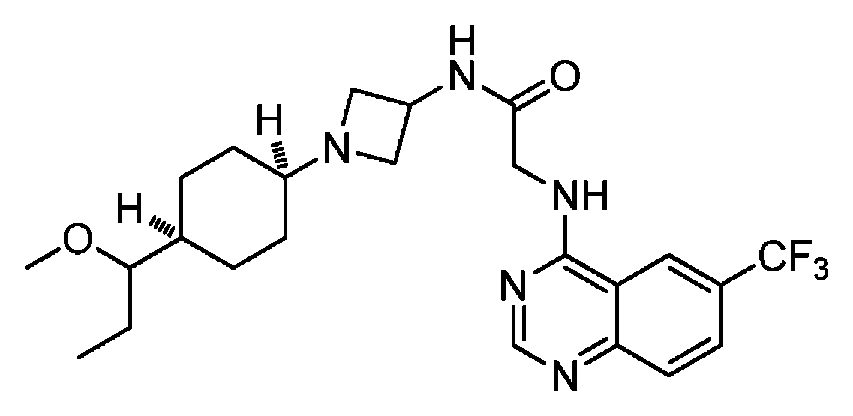
실시예 1, 단계 H에 기재된 바와 같이 TEA 및 NaBH(OAc)3의 존재 하에서 4-(1-메톡시프로필)사이클로헥사논과 N-(아제티딘-3-일)-2-((6-(트라이플루오로메틸)퀴나졸린-4-일)아미노)아세트아미드 (실시예 1 단계 G에서 제조됨)의 반응에 의해 생성물을 얻었다.2- ((6- ((1 -methoxypropyl) cyclohexanone) amide in the presence of TEA and NaBH (OAc) 3 as described in example 1, (Trifluoromethyl) quinazolin-4-yl) amino) acetamide (prepared in Example 1 Step G).
1H NMR (클로로포름-d) δ: 0.89 (t, J=7.45 Hz, 3 H) 1.27 - 1.46 (m, 5 H) 1.51 - 1.65 (m, 3 H) 2.26 (br. s., 3 H) 2.90 - 3.04 (m, 3 H) 3.35 (s, 3 H) 3.56 (t, J=7.33 Hz, 2 H) 4.29 (d, J=5.31 Hz, 2 H) 4.48 - 4.63 (m, 1 H) 4.73 (s, 1 H) 6.92 (d, J=7.07 Hz, 1 H) 7.73 - 7.84 (m, 2 H) 7.92 (t, J=4.93 Hz, 1 H) 8.13 (s, 1 H) 8.62 (s, 1 H); ESI-MS (m/z): C24H32F3N5O2에 대한 계산치: 479.25; 실측치: 480 (M+H). 1 H NMR (chloroform -d) δ: 0.89 (t, J = 7.45 Hz, 3 H) 1.27 - 1.46 (m, 5 H) 1.51 - 1.65 (m, 3 H) 2.26 (br s, 3 H..) J = 7.33 Hz, 2 H) 4.29 (d, J = 5.31 Hz, 2 H) 4.48 - 4.63 (m, 1 H) 4.73 (s, 1 H) 6.92 (d, J = 7.07 Hz, 1 H) 7.73 - 7.84 (m, 2 H) 7.92 (t, J = 4.93 Hz, 1 H); ESI-MS (m / z): Calcd for C 24 H 32 F 3 N 5 O 2 : 479.25; Found: 480 (M + H).
실시예Example 121: N-(1-((1s,4s)-4-(2- 121: N- (1 - ((1S, 4S) -4- (2- 메톡시에틸Methoxyethyl )) 사이클로헥실Cyclohexyl )) 아제티딘Azetidine -3-일)-2-((6-(트3-yl) -2 - ((6- 라이플루오로메틸Trifluoromethyl )) 퀴나졸린Quinazoline -4-일)아미노)Yl) amino) 아세트아미드Acetamide

실시예 1, 단계 H에 기재된 바와 같이 TEA 및 NaBH(OAc)3의 존재 하에서 4-(2-메톡시에틸)사이클로헥사논과 N-(아제티딘-3-일)-2-((6-(트라이플루오로메틸)퀴나졸린-4-일)아미노)아세트아미드 (실시예 1 단계 G에서 제조됨)의 반응에 의해 생성물을 얻었다.Example 1, in the presence of TEA and NaBH (OAc) 3 as described in Step H 4- (2- methoxyethyl) cyclohexanone paddy N- (azetidin-3-yl) -2 - ((6- ( (Trifluoromethyl) quinazolin-4-yl) amino) acetamide (prepared in Example 1 Step G).
1H NMR (DMSO-d6) δ: 1.17 - 1.48 (m, 11 H) 2.15 (br. s., 1 H) 2.66 - 2.77 (m, 2 H) 3.19 (s, 3 H) 3.30 (t, J=6.19 Hz, 2 H) 3.43 (t, J=6.44 Hz, 2 H) 4.12 (d, J=5.81 Hz, 2 H) 4.17 - 4.29 (m, 1 H) 7.88 (d, J=8.84 Hz, 1 H) 8.06 (d, J=8.84 Hz, 1 H) 8.41 (d, J=7.07 Hz, 1 H) 8.56 (s, 1 H) 8.80 (s, 1 H) 9.01 (t, J=5.68 Hz, 1 H); ESI-MS (m/z): C23H30F3N5O2에 대한 계산치: 465.24; 실측치: 466 (M+H). 1 H NMR (DMSO-d6) δ: 1.17 - 1.48 (m, 11 H) 2.15 (.. Br s, 1 H) 2.66 - 2.77 (m, 2 H) 3.19 (s, 3 H) 3.30 (t, J = 6.19 Hz, 2 H) 3.43 (t, J = 6.44 Hz, 2 H) 4.12 (d, J = 5.81 Hz, 2 H) 4.17-4.29 J = 7.68 Hz, 1 H) 8.56 (s, 1H) 8.80 (s, 1H) 9.01 (t, J = 5.68 Hz, 1 H) H); ESI-MS (m / z) : C 23 H 30 F 3 N 5 O 2 Calcd: 465.24; Found 466 (M + H).
실시예Example 122: 에틸 2-(4-(3-(2-((6-( 122: Ethyl 2- (4- (3- (2 - ((6- ( 트라이플루오로메틸Trifluoromethyl )) 퀴나졸린Quinazoline -4-일)아미노)Yl) amino) 아세트아미도Acetamido )) 아제티딘Azetidine -1-일)-1 day) 사이클로헥실Cyclohexyl )아세테이트)acetate

실시예 1, 단계 H에 기재된 바와 같이 TEA 및 NaBH(OAc)3의 존재 하에서 에틸 2-(4-옥소사이클로헥실)아세테이트와 N-(아제티딘-3-일)-2-((6-(트라이플루오로메틸)퀴나졸린-4-일)아미노)아세트아미드 (실시예 1 단계 G에서 제조됨)의 반응에 의해 생성물을 얻었다.2 - ((6- ((4-oxo-cyclohexyl)) - ethyl acetate in the presence of TEA and NaBH (OAc) 3 as described in example 1, (Trifluoromethyl) quinazolin-4-yl) amino) acetamide (prepared in Example 1 Step G).
1H NMR (클로로포름-d) δ: 8.55 (s, 1 H), 8.12 (s, 1 H), 7.99 - 8.10 (m, 1 H), 7.94 (t, J=5.1 Hz, 1 H), 7.64 - 7.76 (m, 2 H), 4.60 (dt, J=7.6, 4.5 Hz, 1 H), 4.23 (d, J=5.1 Hz, 2 H), 4.05 (q, J=7.1 Hz, 2 H), 3.68 (t, J=8.1 Hz, 2 H), 3.33 (br. s., 2 H), 2.42 (br. s., 1 H), 2.21 (d, J=7.3 Hz, 2 H), 1.44 (br. s., 9 H), 1.18 (t, J=7.1 Hz, 4 H); ESI-MS (m/z): C24H30F3N5O3에 대한 계산치: 493.23; 실측치: 494 (M+H). 1 H NMR (chloroform-d)?: 8.55 (s, 1H), 8.12 (s, 1H), 7.99-8.10 J = 5.1 Hz, 2H), 7.76 (m, 2H), 4.60 (dt, J = 7.6, 4.5 Hz, 1H) (D, J = 7.3 Hz, 2 H), 1.44 (br s, 1H), 3.68 (t, J = 8.1 Hz, 2H) s, 9H), 1.18 (t, J = 7.1 Hz, 4 H); ESI-MS (m / z): Calcd for C 24 H 30 F 3 N 5 O 3 : 493.23; Found: 494 (M + H).
실시예Example 123: N-(1-(4-( 123: N- (1- (4- ( 트라이플루오로메틸Trifluoromethyl )) 사이클로헥실Cyclohexyl )) 아제티딘Azetidine -3-일)-2-((6-(Yl) -2 - ((6- ( 트라이플루오로메틸Trifluoromethyl )) 퀴나졸린Quinazoline -4-일)아미노)Yl) amino) 아세트아미드Acetamide

실시예 1, 단계 H에 기재된 바와 같이 TEA 및 NaBH(OAc)3의 존재 하에서 에틸 4-(트라이플루오로메틸)사이클로헥사논과 N-(아제티딘-3-일)-2-((6-(트라이플루오로메틸)퀴나졸린-4-일)아미노)아세트아미드 (실시예 1 단계 G에서 제조됨)의 반응에 의해 생성물을 얻었다.(Trifluoromethyl) cyclohexanone and N- (azetidin-3-yl) -2 - ((6- ((trifluoromethyl) cyclohexanone) amide in the presence of TEA and NaBH (OAc) 3 as described in example 1, (Trifluoromethyl) quinazolin-4-yl) amino) acetamide (prepared in Example 1 Step G).
1H NMR (클로로포름-d) δ: 8.60 (s, 1 H), 8.21 (t, J=5.4 Hz, 1 H), 8.12 (s, 1 H), 7.71 - 7.81 (m, 2 H), 6.92 (d, J=7.8 Hz, 1 H), 4.49 - 4.66 (m, 1 H), 4.28 (d, J=5.6 Hz, 2 H), 3.57 (t, J=7.5 Hz, 2 H), 2.85 - 3.00 (m, 2 H), 2.31 (t, J=3.2 Hz, 1 H), 1.89 - 2.14 (m, 2 H), 1.53 - 1.78 (m, 5 H), 1.28 - 1.42 (m, 2 H); ESI-MS (m/z): C21H23F6N5O에 대한 계산치: 475.18; 실측치: 476 (M+H). 1 H NMR (chloroform-d)?: 8.60 (s, 1H), 8.21 (t, J = 5.4 Hz, 1H) (d, J = 7.8 Hz, 1H), 4.49-4.66 (m, 1H), 4.28 (M, 2H), 2.31 (t, J = 3.2 Hz, 1H), 1.89-2.14 (m, 2H), 1.53-1.78 ; ESI-MS (m / z) : C 21 H 23 F 6 calculated for N 5 O: 475.18; Found: 476 (M + H).
실시예Example 124: ((1s,4s)-4-(3-(2-((6-( 124: ((1S, 4S) -4- (3- (2 - ((6- ( 트라이플루오로메틸Trifluoromethyl )) 퀴나졸린Quinazoline -4-일)아미노)Yl) amino) 아세트아미도Acetamido )) 아제티딘Azetidine -1-일)-1 day) 사이클로헥실Cyclohexyl )) 메틸methyl 다이메틸카르바메이트Dimethyl carbamate

실시예 1, 단계 H에 기재된 바와 같이 TEA 및 NaBH(OAc)3의 존재 하에서 에틸 (4-옥소사이클로헥실)메틸 다이메틸카르바메이트와 N-(아제티딘-3-일)-2-((6-(트라이플루오로메틸)퀴나졸린-4-일)아미노)아세트아미드 (실시예 1 단계 G에서 제조됨)의 반응에 의해 생성물을 얻었다.(4-oxocyclohexyl) methyldimethylcarbamate and N- (azetidin-3-yl) -2 - (((4-oxocyclohexyl) methyl) carbamate in the presence of TEA and NaBH (OAc) 3 as described in example 1, (Trifluoromethyl) quinazolin-4-yl) amino) acetamide (prepared in Example 1 Step G).
1H NMR (클로로포름-d) δ: 1.21 - 1.39 (m, 6 H) 1.46 (br. s., 2 H) 1.60 (br. s., 1 H) 2.19 (br. s., 1 H) 2.69 - 2.77 (m, 2 H) 2.82 (br. s., 6 H) 3.39 - 3.50 (m, 2 H) 3.79 (d, J=6.85 Hz, 2 H) 4.12 (d, J=5.14 Hz, 2 H) 4.24 (br. s., 1 H) 7.88 (d, J=8.56 Hz, 1 H) 8.04 (br. s., 1 H) 8.39 (d, J=6.85 Hz, 1 H) 8.55 (s, 1 H) 8.80 (br. s., 1 H) 8.99 (br. s., 1 H); ESI-MS (m/z): C24H31F3N6O3에 대한 계산치: 508.24; 실측치: 509 (M+H). 1 H NMR (chloroform-d)?: 1.21-1.39 (m, 6 H) 1.46 (br. S., 2 H) 1.60 J = 5.14 Hz, 2 H), 2.79 (m, 2H), 2.77 (d, (D, J = 8.56 Hz, 1H) 8.04 (br s, 1H) 8.39 (d, J = 6.85 Hz, 1H) 8.55 H) 8.80 (br s, 1H) 8.99 (br s, 1H); ESI-MS (m / z): Calcd for C 24 H 31 F 3 N 6 O 3 : 508.24; Found: 509 (M + H).
실시예Example 125: 125: terttert -부틸 (4-(3-(2-((6-(Butyl (4- (3- (2 - ((6- ( 트라이플루오로메틸Trifluoromethyl )) 퀴나졸린Quinazoline -4-일)아미노)아세트아미도)4-yl) amino) acetamido) 아제티딘Azetidine -1-일)-1 day) 사이클로헥실Cyclohexyl )) 카르바메이트Carbamate
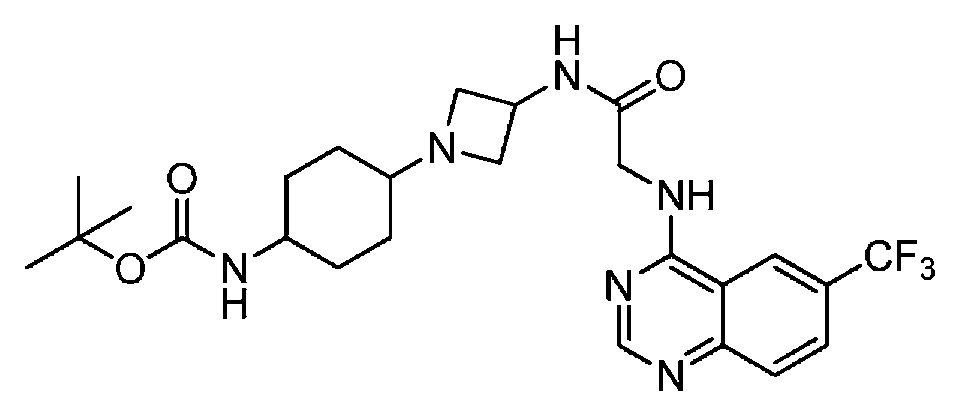
실시예 1, 단계 H에 기재된 바와 같이 TEA 및 NaBH(OAc)3의 존재 하에서 에틸 tert-부틸 (4-옥소사이클로헥실)카르바메이트와 N-(아제티딘-3-일)-2-((6-(트라이플루오로메틸)퀴나졸린-4-일)아미노)아세트아미드 (실시예 1 단계 G에서 제조됨)의 반응에 의해 생성물을 얻었다.(4-oxocyclohexyl) carbamate and N- (azetidin-3-yl) -2 - (((4-oxocyclohexyl) carbamate in the presence of TEA and NaBH (OAc) 3 as described in example 1, (Trifluoromethyl) quinazolin-4-yl) amino) acetamide (prepared in Example 1 Step G).
1H NMR (클로로포름-d) δ: 1.12 - 1.29 (m, 12 H) 1.36 (s, 9 H) 1.40 - 1.62 (m, 6 H) 1.62 - 1.75 (m, 2 H) 3.59 (br. s., 2 H) 3.86 (d, J=6.06 Hz, 1 H) 4.29 (d, J=5.31 Hz, 2 H) 4.55 - 4.68 (m, 1 H) 4.74 (d, J=7.83 Hz, 1 H) 7.20 - 7.28 (m, 1 H) 7.82 (s, 2 H) 8.19 (s, 1 H) 8.62 (s, 1 H); ESI-MS (m/z): C25H33F3N6O3에 대한 계산치: 522.26; 실측치: 523 (M+H). 1 H NMR (chloroform-d)?: 1.12-1.29 (m, 12 H) 1.36 (s, 9 H) 1.40-1.62 (m, 6 H) 1.62-1.75 (m, 2 H) 3.59 (br. (D, J = 7.83 Hz, 1H), 3.86 (d, J = 6.06 Hz, 1H) 4.29 (d, J = 5.31 Hz, 2H) 4.55-4.68 - 7.28 (m, 1H) 7.82 (s, 2H) 8.19 (s, 1H) 8.62 (s, 1H); ESI-MS (m / z) : C 25 H 33 F 3 N calculated for 6 O 3: 522.26; Found: 523 (M + H).
실시예Example 126: N- 126: N- 메톡시Methoxy -N--N- 메틸methyl -4-(3-(2-((6-(-4- (3- (2 - ((6- ( 트라이플루오로메틸Trifluoromethyl )) 퀴나졸린Quinazoline -4-일)아미노)Yl) amino) 아세트아미도Acetamido )) 아제티딘Azetidine -1-일)-1 day) 사이클로헥산카르복스아미드Cyclohexanecarboxamide
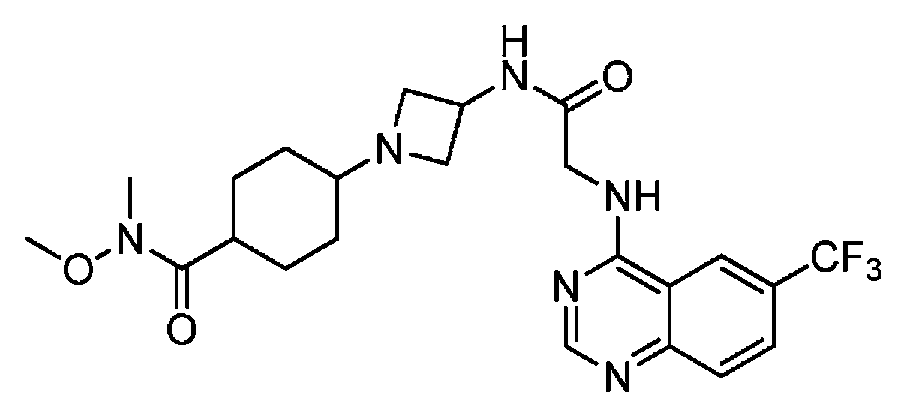
건조 톨루엔 (5 mL) 중 N,O-다이메틸하이드록실아민 하이드로클로라이드 (42 mg, 0.431 mmol)의 현탁액에 아르곤 하에서 트라이메틸알루미늄 (0.200 mL, 0.40 mmol)을 적가하였다. 실온에서 30분 교반한 후에, 건조 톨루엔 (5 mL) 중 (1s,4s)-에틸 4-(3-(2-((6-(트라이플루오로메틸)퀴나졸린-4-일)아미노)아세트아미도)아제티딘-1-일)사이클로헥산카르복실레이트 (80 mg, 0.167 mmol)의 용액을 첨가하고 반응물을 20시간 동안 110℃로 가열하였다. 실온으로 냉각한 후에, 포화 로셸염 (Rochelle's salt) 수용액을 첨가하여 반응물을 켄칭하고 EtOAc로 추출하였다. 유기층을 진공에서 농축한 후에 잔류물의 플래시 크로마토그래피 (실리카 겔, 7% 7N NH3-MeOH/DCM)에 의해 생성물을 얻었다.Trimethylaluminum (0.200 mL, 0.40 mmol) was added dropwise to a suspension of N, O-dimethylhydroxylamine hydrochloride (42 mg, 0.431 mmol) in dry toluene (5 mL) under argon. After stirring at room temperature for 30 minutes, a solution of (lS, 4s) -ethyl 4- (3- (2- ((6- (trifluoromethyl) quinazolin- 1-yl) cyclohexanecarboxylate (80 mg, 0.167 mmol) in DMF (5 mL) was added and the reaction was heated to 110 < 0 > C for 20 h. After cooling to room temperature, the reaction was quenched by the addition of a saturated aqueous solution of Rochelle's salt and extracted with EtOAc. The organic layer was concentrated in vacuo and the product was obtained by flash chromatography (silica gel, 7% 7N NH3-MeOH / DCM) of the residue.
1H NMR (클로로포름-d) δ: 8.66 (s, 1 H), 8.33 (s, 1 H), 7.79 - 7.92 (m, 4 H), 4.56 (br. s., 1 H), 4.31 - 4.42 (m, 3 H), 3.56 - 3.76 (m, 2 H), 3.03 (s, 3 H), 2.89 (s, 3 H), 2.58 (br. s., 1 H), 1.81 - 1.97 (m, 2 H), 1.73 (br. s., 2 H), 1.38 - 1.54 (m, 4 H). 1 H NMR (chloroform-d)?: 8.66 (s, 1H), 8.33 (s, 1H), 7.79-7.92 (m, 3H), 3.56-3.66 (m, 2H), 3.03 (s, 3H), 2.89 2 H), 1.73 (br s, 2 H), 1.38 - 1.54 (m, 4 H).
실시예 127: N-에틸-4-(3-(2-((6-(트라이플루오로메틸)퀴나졸린-4-일)아미노)아세트아미도)아제티딘-1-일)사이클로헥산카르복스아미드Example 127: N-ethyl-4- (3- (2- ((6- (trifluoromethyl) quinazolin-4- yl) amino) acetamido) azetidin- 1 -yl) cyclohexanecarbox amides

실시예 1, 단계 H에 기재된 바와 같이 TEA 및 NaBH(OAc)3의 존재 하에서 N-에틸-4-옥소사이클로헥산카르복스아미드와 N-(아제티딘-3-일)-2-((6-(트라이플루오로메틸)퀴나졸린-4-일)아미노)아세트아미드 (실시예 1 단계 G에서 제조됨)의 반응에 의해 생성물을 얻었다.2-yl) -2 - ((6- (4-fluorophenyl) acetamide and N, N-diisopropylcarbodiimide hydrochloride in the presence of TEA and NaBH (OAc) 3 as described in example 1, (Trifluoromethyl) quinazolin-4-yl) amino) acetamide (prepared in Example 1 Step G).
1H NMR (DMSO-d6) δ: 0.97 (t, J=7.20 Hz, 3 H) 1.25 (d, J=16.93 Hz, 5 H) 1.48 (br. s., 2 H) 1.67 (br. s., 2 H) 1.97 - 2.08 (m, 1 H) 2.17 (br. s., 1 H) 2.74 (t, J=7.07 Hz, 2 H) 3.01 (m, J=7.07, 5.81 Hz, 2 H) 3.43 (t, J=7.20 Hz, 2 H) 4.12 (d, J=5.56 Hz, 2 H) 4.17 - 4.30 (m, 1 H) 7.61 (t, J=5.56 Hz, 1 H) 7.88 (d, J=8.59 Hz, 1 H) 8.05 (dd, J=8.97, 1.39 Hz, 1 H) 8.44 (d, J=7.33 Hz, 1 H) 8.55 (s, 1 H) 8.81 (s, 1 H) 9.05 (t, J=5.43 Hz, 1 H); ESI-MS (m/z): C23H29F3N6O2에 대한 계산치: 478.23; 실측치: 479 (M+H). 1 H NMR (DMSO-d 6)?: 0.97 (t, J = 7.20 Hz, 3 H) 1.25 (d, J = 16.93 Hz, 5 H) 1.48 (br. (M, J = 7.07, 5.81 Hz, 2 H) 3.43 (t, J = 7.07 Hz, 2 H) 1.97 - 2.08 J = 7.20 Hz, 2H) 4.12 (d, J = 5.56 Hz, 2H) 4.17-4.30 (m, 1H) 8.59 (s, 1H) 8.05 (dd, J = 8.97, 1.39 Hz, 1H) 8.44 (d, J = 7.33 Hz, 1H) J = 5.43 Hz, 1H); ESI-MS (m / z) : C 23 H 29 F 3 N calculated for 6 O 2: 478.23; Found: 479 (M + H).
실시예Example 128: (1s,4s)-N,N- 128: (1S, 4S) -N, N- 다이메틸Dimethyl -4-(3-(2-((6-(-4- (3- (2 - ((6- ( 트라이플루오로메틸Trifluoromethyl )) 퀴나졸린Quinazoline -4-일)아미노)Yl) amino) 아세트아미도Acetamido )) 아제티딘Azetidine -1-일)-1 day) 사이클로헥산카르복스아미드Cyclohexanecarboxamide
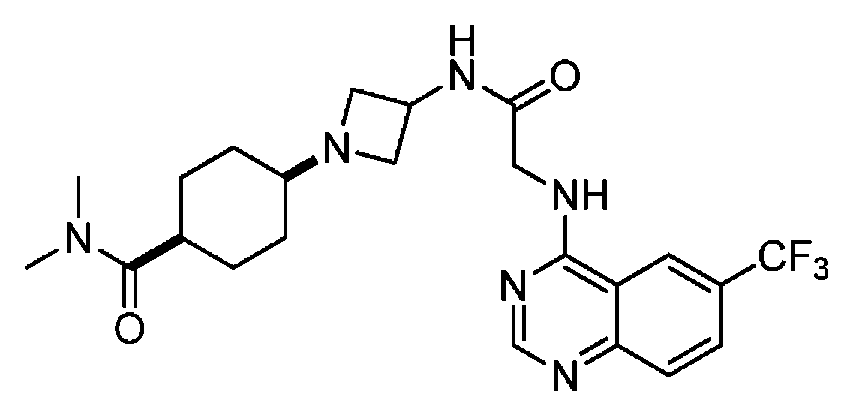
실시예 1, 단계 H에 기재된 바와 같이 TEA 및 NaBH(OAc)3의 존재 하에서 N,N-다이메틸-4-옥소사이클로헥산카르복스아미드와 N-(아제티딘-3-일)-2-((6-(트라이플루오로메틸)퀴나졸린-4-일)아미노)아세트아미드 (실시예 1 단계 G에서 제조됨)의 반응에 의해 생성물을 얻었다.Example 1, in the presence of TEA and NaBH (OAc) 3 as described in Step H N, N- dimethyl-4-oxo-cyclohexane-carboxamide and N- (azetidin-3-yl) -2- ( (6- (trifluoromethyl) quinazolin-4-yl) amino) acetamide (prepared in Example 1 Step G).
1H NMR (DMSO-d6) δ: 1.31 (t, J=7.83 Hz, 6 H) 1.43 (br. s., 2 H) 1.75 (br. s., 1 H) 2.16 (d, J=6.82 Hz, 2 H) 2.74 (br. s., 1 H) 2.79 (s, 3 H) 2.94 (s, 3 H) 3.46 (br. s., 2 H) 4.13 (d, J=5.81 Hz, 2 H) 4.25 (d, J=6.82 Hz, 1 H) 7.88 (d, J=8.84 Hz, 1 H) 8.04 (dd, J=8.72, 1.64 Hz, 1 H) 8.38 (d, J=7.33 Hz, 1 H) 8.56 (s, 1 H) 8.80 (s, 1 H) 9.00 (t, J=5.68 Hz, 1 H); ESI-MS (m/z): C23H29F3N6O2에 대한 계산치: 478.23; 실측치: 479 (M+H). 1 H NMR (DMSO-d 6)?: 1.31 (t, J = 7.83 Hz, 6 H) 1.43 (br s, 2 H) 1.75 2 H) 2.74 (s, 1 H) 2.79 (s, 3 H) 2.94 (s, 3 H) 3.46 (br s, 2 H) 4.13 (d, J = 5.81 Hz, J = 8.83 Hz, 1 H) 8.04 (dd, J = 8.72, 1.64 Hz, 1H) 8.38 (d, J = 7.33 Hz, 1H) 8.56 (s, 1H) 8.80 (s, 1H) 9.00 (t, J = 5.68 Hz, 1H); ESI-MS (m / z) : C 23 H 29 F 3 N calculated for 6 O 2: 478.23; Found: 479 (M + H).
실시예Example 129: N-(2,4- 129: N- (2,4- 다이메톡시벤질Dimethoxybenzyl )-4-(3-(2-((6-() -4- (3- (2 - ((6- ( 트라이플루오로메틸Trifluoromethyl )) 퀴나졸린Quinazoline -4-일)아미노)Yl) amino) 아세트아미도Acetamido )) 아제티딘Azetidine -1-일)-1 day) 사이클로헥산카르복스아미드Cyclohexanecarboxamide
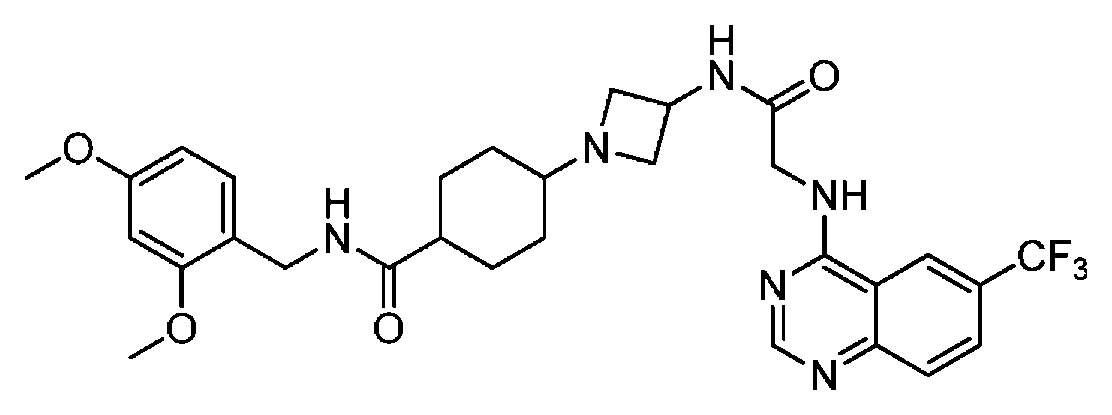
실시예 1, 단계 H에 기재된 바와 같이 TEA 및 NaBH(OAc)3의 존재 하에서 N-(2,4-다이메톡시벤질)-4-옥소사이클로헥산카르복스아미드와 N-(아제티딘-3-일)-2-((6-(트라이플루오로메틸)퀴나졸린-4-일)아미노)아세트아미드 (실시예 1 단계 G에서 제조됨)의 반응에 의해 생성물을 얻었다.(2,4-dimethoxybenzyl) -4-oxocyclohexanecarboxamide and N- (azetidin-3-yl) pyridine in the presence of TEA and NaBH (OAc) 3 as described in example 1, The product was obtained by reaction of 2- ((6- (trifluoromethyl) quinazolin-4-yl) amino) acetamide (prepared in Example 1 Step G).
1H NMR (아세토니트릴-d3) δ: 1.23 - 1.46 (m, 4 H) 1.49 - 1.62 (m, 2 H) 1.65 - 1.81 (m, 2 H) 2.05 - 2.13 (m, 1 H) 2.72 - 2.84 (m, 2 H) 3.52 (t, J=7.20 Hz, 2 H) 3.73 - 3.78 (m, 3 H) 3.80 (s, 3 H) 4.16 (d, J=5.81 Hz, 2 H) 4.19 (d, J=5.81 Hz, 2 H) 4.28 - 4.41 (m, 1 H) 6.44 (dd, J=8.21, 2.40 Hz, 1 H) 6.50 (d, J=2.53 Hz, 2 H) 7.06 (d, J=8.34 Hz, 2 H) 7.40 (br. s., 1 H) 7.86 - 7.94 (m, 1 H) 7.95 - 8.03 (m, 1 H) 8.40 (s, 1 H) 8.60 (s, 1 H); ESI-MS (m/z): C30H35F3N6O4에 대한 계산치: 600.27; 실측치: 601 (M+H). 1 H NMR (acetonitrile-d 3)?: 1.23-1.46 (m, 4H) 1.49-1.62 (m, 2H) 1.65-1.81 (m, 2H) 2.05-2.13 (m, 2H) 3.52 (d, J = 7.20 Hz, 2H) 3.73-3.78 (m, 3H) J = 5.81 Hz, 2H) 4.28-4.41 (m, 1H) 6.44 (dd, J = 8.21,2.40 Hz, 1H) 6.50 (d, J = 2.53 Hz, 2H) 7.06 Hz, 2H) 7.40 (br s, 1H) 7.86-7.94 (m, 1H) 7.95-8.03 (m, 1H) 8.40 (s, 1H) 8.60 (s, 1H); ESI-MS (m / z) : C 30 H 35 F 3 N 6 O 4 Calcd: 600.27; Found: 601 (M + H).
실시예Example 130: N-(1-((1s,4s)-4-( 130: N- (1 - ((1 S, 4 S) -4- ( 피롤리딘Pyrrolidine -1-카르보닐)-1-carbonyl) 사이클로헥실Cyclohexyl )) 아제티딘Azetidine -3-일)-2-((6-(트3-yl) -2 - ((6- 라이플루오Rifluo 로메틸)Lt; / RTI > 퀴나졸린Quinazoline -4-일)아미노)Yl) amino) 아세트아미드Acetamide
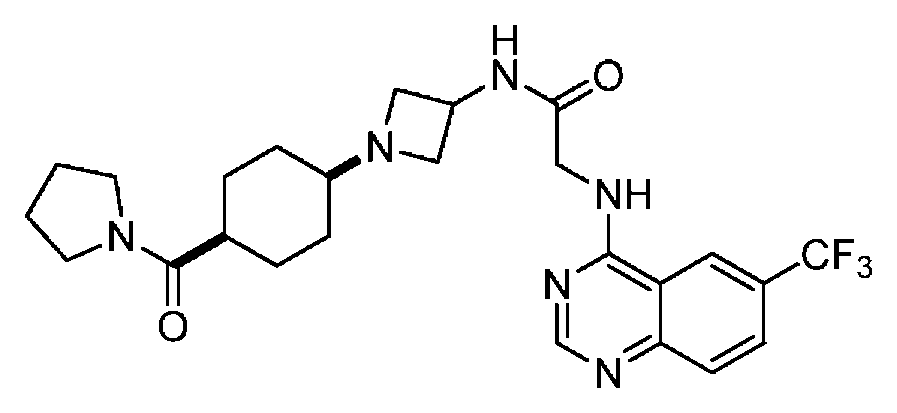
실시예 1, 단계 H에 기재된 바와 같이 TEA 및 NaBH(OAc)3의 존재 하에서 4-(피롤리딘-1-카르보닐)사이클로헥사논과 N-(아제티딘-3-일)-2-((6-(트라이플루오로메틸)퀴나졸린-4-일)아미노)아세트아미드 (실시예 1 단계 G에서 제조됨)의 반응에 의해 생성물을 얻었다.Example 1, in the presence of TEA and NaBH (OAc) 3 as described in Step H 4- (pyrrolidine-1-carbonyl) cyclohexanone paddy N- (azetidin-3-yl) -2 - (( (Trifluoromethyl) quinazolin-4-yl) amino) acetamide (prepared in Example 1 Step G).
1H NMR (아세토니트릴-d3) δ: 1.39 - 1.67 (m, 3 H) 1.72 - 1.82 (m, 4 H) 1.86 - 1.91 (m, 0 H) 2.52 (br. s., 1 H) 3.04 (br. s., 1 H) 3.29 (t, J=6.82 Hz, 2 H) 3.41 (t, J=6.69 Hz, 2 H) 3.70 - 3.84 (m, 1 H) 4.01 - 4.16 (m, 1 H) 4.20 (d, J=5.56 Hz, 2 H) 4.58 (br. s., 1 H) 7.68 (br. s., 1 H) 7.91 (d, J=8.59 Hz, 1 H) 7.96 - 8.04 (m, 1 H) 8.51 (s, 1 H) 8.61 (s, 1 H); ESI-MS (m/z): C25H31F3N6O2에 대한 계산치: 504.25; 실측치: 505 (M+H). 1 H NMR (acetonitrile-d 3)?: 1.39-1.67 (m, 3 H) 1.72-1.82 (m, 4 H) 1.86-1.91 (m, (m, 1H), 3.70-3.84 (m, 1H) 4.01-4.16 (m, 1H), 3.21 (t, J = 6.82 Hz, (D, J = 5.56 Hz, 1H) 4.58 (br s, 1H) 7.68 (br s, 1H) 1 H) 8.51 (s, 1H) 8.61 (s, 1H); ESI-MS (m / z) : C 25 H 31 F 3 N calculated for 6 O 2: 504.25; Found: 505 (M + H).
실시예Example 131: N-(1-((1s,4s)-4-(3,3- 131: N- (1 - ((1S, 4S) -4- (3,3- 다이플루오로피롤리딘Difluoropyrrolidine -1-일)-1 day) 사이클로헥실Cyclohexyl )) 아제티딘Azetidine -3-일)-2-((6-(Yl) -2 - ((6- ( 트라이플루오로메틸Trifluoromethyl )) 퀴나졸린Quinazoline -4-일)아미노)Yl) amino) 아세트아미드Acetamide
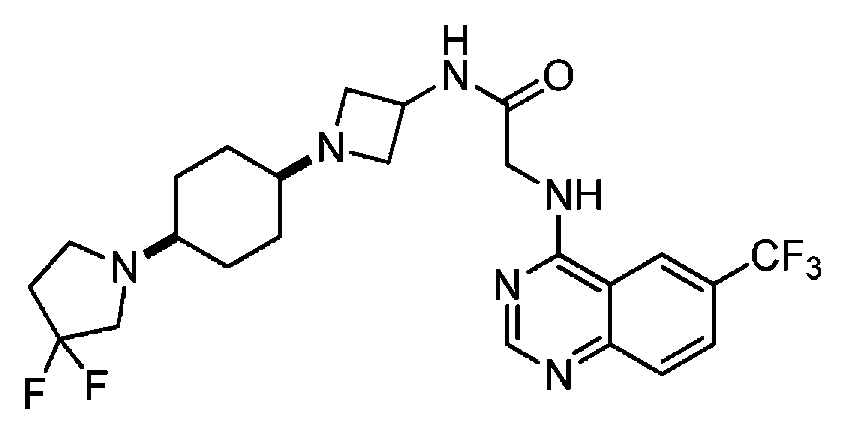
실시예 1, 단계 H에 기재된 바와 같이 TEA 및 NaBH(OAc)3의 존재 하에서 4-(3,3-다이플루오로피롤리딘-1-일)사이클로헥사논과 N-(아제티딘-3-일)-2-((6-(트라이플루오로메틸)퀴나졸린-4-일)아미노)아세트아미드 (실시예 1 단계 G에서 제조됨)의 반응에 의해 생성물을 얻었다.(3,3-difluoropyrrolidin-1-yl) cyclohexanone and N- (azetidin-3-yl) cyclohexanone in the presence of TEA and NaBH (OAc) 3 as described in example 1, ) -2 - ((6- (trifluoromethyl) quinazolin-4-yl) amino) acetamide (prepared in Example 1 Step G).
1H NMR (MeOD) δ: 1.29 - 1.47 (m, 6 H) 1.56 - 1.68 (m, 2 H) 2.04 - 2.26 (m, 4 H) 2.69 (t, J=6.97 Hz, 2 H) 2.77 - 2.85 (m, 2 H) 2.86 (s, 1 H) 2.89 (s, 1 H) 3.44 - 3.52 (m, 2 H) 4.17 (s, 2 H) 4.35 (quin, J=6.72 Hz, 1 H) 7.86 - 7.93 (m, 1 H) 8.00 (dd, J=8.80, 1.96 Hz, 1 H) 8.42 (s, 1 H) 8.59 (s, 1 H); ESI-MS (m/z): C24H29F5N6O에 대한 계산치: 512.23; 실측치: 513 (M+H). 1 H NMR (MeOD) δ: 1.29 - 1.47 (m, 6 H) 1.56 - 1.68 (m, 2 H) 2.04 - 2.26 (m, 4 H) 2.69 (t, J = 6.97 Hz, 2 H) 2.77 - 2.85 (m, 2H) 2.86 (s, 1H) 2.89 (s, 1H) 3.44-3.52 (m, 2H) 4.17 7.93 (m, 1H) 8.00 (dd, J = 8.80, 1.96 Hz, 1H) 8.42 (s, 1H) 8.59 (s, 1H); ESI-MS (m / z): Calcd for C 24 H 29 F 5 N 6 O: 512.23; Found: 513 (M + H).
실시예Example 132: N-(1-((1s,4s)-4- 132: N- (1 - ((1S, 4S) -4- 모르폴리노사이클로헥실Morpholinocyclohexyl )) 아제티딘Azetidine -3-일)-2-((6-(Yl) -2 - ((6- ( 트라이플루오로메틸Trifluoromethyl )) 퀴나졸린Quinazoline -4-일)아미노)Yl) amino) 아세트아미드Acetamide
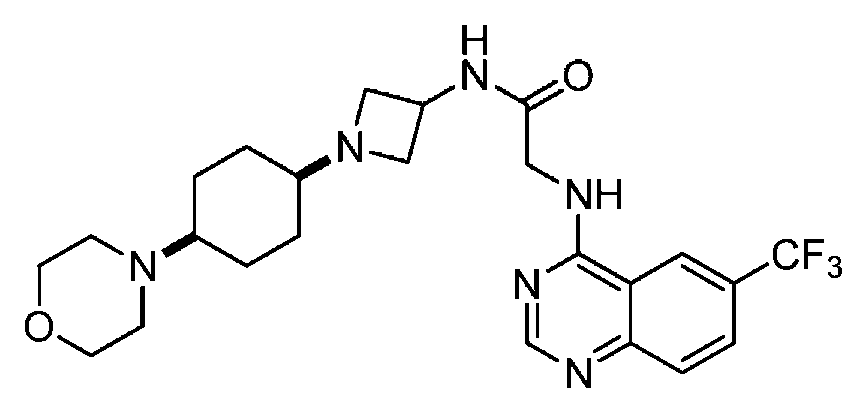
실시예 1, 단계 H에 기재된 바와 같이 TEA 및 NaBH(OAc)3의 존재 하에서 4-모르폴리노사이클로헥사논과 N-(아제티딘-3-일)-2-((6-(트라이플루오로메틸)퀴나졸린-4-일)아미노)아세트아미드 (실시예 1 단계 G에서 제조됨)의 반응에 의해 생성물을 얻었다.Example 1, in the presence of TEA and NaBH (OAc) 3 as described in Step H 4- morpholino-cyclohexadiene paddy N- (azetidin-3-yl) -2 - ((6- (trifluoromethyl ) Quinazolin-4-yl) amino) acetamide (prepared in Example 1 Step G).
1H NMR (아세토니트릴-d3) δ: 1.22 - 1.34 (m, 2 H) 1.40 (m, J=12.38 Hz, 2 H) 1.45 - 1.68 (m, 4 H) 2.07 - 2.14 (m, 2 H) 2.37 - 2.46 (m, 4 H) 2.76 (t, J=7.20 Hz, 3 H) 3.43 - 3.52 (m, 2 H) 3.52 - 3.64 (m, 4 H) 4.16 (d, J=5.81 Hz, 2 H) 4.33 (sxt, J=6.92 Hz, 1 H) 7.13 (d, J=7.58 Hz, 1 H) 7.45 (t, J=5.18 Hz, 1 H) 7.84 - 7.94 (m, 1 H) 7.94 - 8.04 (m, 1 H) 8.42 (s, 1 H) 8.59 (s, 1 H); ESI-MS (m/z): C24H31F3N6O2에 대한 계산치: 492.25; 실측치: 493 (M+H). 1 H NMR (acetonitrile-d 3)?: 1.22-1.34 (m, 2 H) 1.40 (m, J = 12.38 Hz, 2 H) 1.45-1.68 (m, 4 H) 2.07-2.14 2.37-2.46 (m, 4 H) 2.76 (t, J = 7.20 Hz, 3 H) 3.43 - 3.52 (D, J = 7.58 Hz, 1H) 7.45 (t, J = 5.18 Hz, 1H) 7.84-7.94 (m, 1H) 7.94-8.04 m, 1H) 8.42 (s, 1H) 8.59 (s, 1H); ESI-MS (m / z): Calcd for C 24 H 31 F 3 N 6 O 2 : 492.25; Found: 493 (M + H).
실시예Example 133: N-(1-((1s,4s)-4- 133: N- (1 - ((1S, 4S) -4- 티오모르폴리노사이클로헥실Thiomorpholino cyclohexyl )) 아제티딘Azetidine -3-일)-2-((6-(트3-yl) -2 - ((6- 라이플루오로메틸Trifluoromethyl )) 퀴나졸린Quinazoline -4-일)아미노)Yl) amino) 아세트아미드Acetamide

실시예 1, 단계 H에 기재된 바와 같이 TEA 및 NaBH(OAc)3의 존재 하에서 4-티오모르폴리노사이클로헥사논과 N-(아제티딘-3-일)-2-((6-(트라이플루오로메틸)퀴나졸린-4-일)아미노)아세트아미드 (실시예 1 단계 G에서 제조됨)의 반응에 의해 생성물을 얻었다.(4-thiomorpholinocyclohexanone) and N- (azetidin-3-yl) -2 - ((6- (trifluoromethoxy) phenyl) thiomorpholinocyclohexanone in the presence of TEA and NaBH (OAc) 3 as described in example 1, Methyl) quinazolin-4-yl) amino) acetamide (prepared in Example 1 Step G).
1H NMR (아세토니트릴-d3) δ: 1.16 - 1.38 (m, 4 H) 1.50 - 1.68 (m, 3 H) 2.24 (m, J=8.34 Hz, 1 H) 2.49 - 2.60 (m, 4 H) 2.64 - 2.80 (m, 6 H) 3.27 (s, 3 H) 3.41 - 3.54 (m, 2 H) 4.15 (d, J=5.81 Hz, 2 H) 4.24 - 4.37 (m, 1 H) 7.03 (d, J=5.81 Hz, 1 H) 7.36 (t, J=5.56 Hz, 1 H) 7.86 - 7.95 (m, 1 H) 7.95 - 8.03 (m, 1 H) 8.39 (s, 1 H) 8.60 (s, 1 H); ESI-MS (m/z): C24H31F3N6OS에 대한 계산치: 508.22; 실측치: 509 (M+H). 1 H NMR (acetonitrile-d 3)?: 1.16-1.38 (m, 4 H) 1.50-1.68 (m, 3 H) 2.24 (m, J = 8.34 Hz, 2.64 - 2.80 (m, 6 H) 3.27 (s, 3 H) 3.41 - 3.54 (m, 2 H) 4.15 (d, J = 5.81 Hz, 2 H) 4.24 - J = 5.81 Hz, 1H) 7.36 (t, J = 5.56 Hz, 1H) 7.86-7.95 (m, 1H) 7.95-8.03 H); ESI-MS (m / z): Calcd for C 24 H 31 F 3 N 6 OS: 508.22; Found: 509 (M + H).
실시예Example 134: N-(1-((1s,4s)-4-(1,1- 134: N- (1 - ((1 S, 4 S) -4- (1,1- 다이옥시도티오모르폴리노Dioxothiomorpholino )) 사이클로헥실Cyclohexyl )) 아제티딘Azetidine -3-일)-2-((6-(Yl) -2 - ((6- ( 트라이플루오로메틸Trifluoromethyl )) 퀴나졸린Quinazoline -4-일)아미노)Yl) amino) 아세트아미드Acetamide

실시예 1, 단계 H에 기재된 바와 같이 TEA 및 NaBH(OAc)3의 존재 하에서 4-(4-옥소사이클로헥실)티오모르폴린 4-옥사이드 1,1-다이옥사이드와 N-(아제티딘-3-일)-2-((6-(트라이플루오로메틸)퀴나졸린-4-일)아미노)아세트아미드 (실시예 1 단계 G에서 제조됨)의 반응에 의해 생성물을 얻었다.(4-oxocyclohexyl) thiomorpholine 4-oxide 1,1-dioxide and N- (azetidin-3-yl) thiomorpholine in the presence of TEA and NaBH (OAc) 3 as described in example 1, ) -2 - ((6- (trifluoromethyl) quinazolin-4-yl) amino) acetamide (prepared in Example 1 Step G).
1H NMR (아세토니트릴-d3) δ: 1.21 - 1.43 (m, 4 H) 1.51 - 1.65 (m, 4 H) 2.11 - 2.16 (m, 1 H) 2.45 (m, J=10.61, 7.14, 3.38, 3.38 Hz, 1 H) 2.72 (t, J=7.20 Hz, 2 H) 2.86 - 3.04 (m, 9 H) 3.48 (t, J=7.33 Hz, 2 H) 4.15 (d, J=5.81 Hz, 2 H) 4.32 (sxt, J=6.92 Hz, 1 H) 7.09 (d, J=7.58 Hz, 1 H) 7.47 (t, J=5.56 Hz, 1 H) 7.83 - 7.91 (m, 1 H) 7.93 - 8.00 (m, 1 H) 8.37 (s, 1 H) 8.58 (s, 1 H); ESI-MS (m/z): C24H31F3N6O3S에 대한 계산치: 540.21; 실측치: 541 (M+H). 1 H NMR (acetonitrile -d3) δ: 1.21 - 1.43 ( m, 4 H) 1.51 - 1.65 (m, 4 H) 2.11 - 2.16 (m, 1 H) 2.45 (m, J = 10.61, 7.14, 3.38, 3.38 Hz, 1 H) 2.72 (t, J = 7.20 Hz, 2 H) 2.86-3.04 (m, 9 H) 3.48 (t, J = 7.33 Hz, J = 6.92 Hz, 1H) 7.09 (d, J = 7.58 Hz, 1H) 7.47 (t, J = 5.56 Hz, 1H) 7.83-7.91 (m, 1H) 7.93-8.00 m, 1H) 8.37 (s, 1H) 8.58 (s, 1H); ESI-MS (m / z): Calcd for C 24 H 31 F 3 N 6 O 3 S: 540.21; Found: 541 (M + H).
실시예Example 135: 2,2,2- 135: 2,2,2- 트라이플루오로Trifluro -N-((S)-1-((1s,4R)-4-(3-(2-((6-(-N - ((S) -1 - ((1S, 4R) -4- (3- (2- 트라이플루오로메틸Trifluoromethyl )) 퀴나졸린Quinazoline -4-일)아미노)Yl) amino) 아세트아미도Acetamido )) 아제티딘Azetidine -1-일)-1 day) 사이클로헥실Cyclohexyl )프로필)아세트아미드) Propyl) acetamide
단계 A: N-(1-{1,4-다이옥사스피로[4.5]데칸-8-일}프로필)-2,2,2-트라이플루오로아세트아미드Step A: N- (l- {1,4-Dioxaspiro [4.5] decan-8-yl} propyl) -2,2,2- trifluoroacetamide
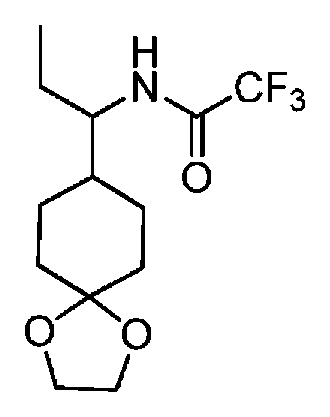
50 mL 둥근바닥 플라스크에 다이클로로메탄 (10 mL) 중 1-1,4-다이옥사스피로[4.5]데칸-8-일프로판-1-아민 하이드로클로라이드 (실시예 104, 단계 B에서 제조됨) (100 mg, 0.42 mmol, 1.00 eq)의 용액 및 TEA (85.6 mg, 0.85 mmol, 2.00 eq)를 넣었다. 그 다음, 0℃에서 교반하면서 2,2,2-트라이플루오로아세틸 2,2,2-트라이플루오로아세테이트 (107 mg, 0.51 mmol, 1.20 eq)를 적가하였다. 생성된 용액을 실온에서 하룻밤 교반한 다음, 20 mL의 물을 첨가하여 켄칭하였다. 생성된 용액을 2x20 mL의 다이클로로메탄으로 추출하였다. 유기층들을 합하고, 무수 황산나트륨으로 건조하고, 진공 하에서 농축하였다. 그리하여, 89 mg (조 생성물)의 N-(1-{1,4-다이옥사스피로[4.5]데칸-8-일}프로필)-2,2,2-트라이플루오로아세트아미드를 황색 고체로서 얻었다.To a 50 mL round bottom flask was added a solution of l, 4,4-dioxaspiro [4.5] decan-8-ylpropan-l-amine hydrochloride (prepared in example 104, step B) in dichloromethane (10 mL) 100 mg, 0.42 mmol, 1.00 eq) and TEA (85.6 mg, 0.85 mmol, 2.00 eq). 2,2,2-Trifluoroacetyl 2,2,2-trifluoroacetate (107 mg, 0.51 mmol, 1.20 eq) was then added dropwise with stirring at 0 < 0 > C. The resulting solution was stirred overnight at room temperature and then quenched by the addition of 20 mL of water. The resulting solution was extracted with 2 x 20 mL of dichloromethane. The organic layers were combined, dried over anhydrous sodium sulfate, and concentrated in vacuo. Thus, 89 mg (crude product) of N- (1- {1,4-dioxaspiro [4.5] decan-8-yl} propyl) -2,2,2-trifluoroacetamide was obtained as a yellow solid .
단계 B: 2,2,2-트라이플루오로-N-(1-(4-옥소사이클로헥실)프로필)아세트아미드Step B: 2,2,2-Trifluoro-N- (1- (4-oxocyclohexyl) propyl) acetamide

CH3CN (5 mL) 중 N-(1-{1,4-다이옥사스피로[4.5]데칸-8-일}프로필)-2,2,2-트라이플루오로아세트아미드 (89 mg, 0.30 mmol, 1.00 eq)의 용액 및 HCl (2M, 1 mL)을 실온에서 2시간 동안 교반하였다. 생성된 혼합물을 진공 하에서 농축하였다. 잔류물을 10 mL의 소듐 바이카르보네이트 수용액 (1M)으로 희석하였다. 생성된 용액을 2x20 mL의 다이클로로메탄으로 추출하였다. 유기층들을 합하고, 무수 황산나트륨으로 건조하고, 진공 하에서 농축하여 황색 오일로서 표제 화합물을 얻었다.CH 3 CN (5 mL) of N- (1- {1,4- dioxane SARS fatigue [4.5] decan-8-yl} propyl) -2,2,2-trifluoro acetamide (89 mg, 0.30 mmol , 1.00 eq) and HCl (2M, 1 mL) were stirred at room temperature for 2 hours. The resulting mixture was concentrated in vacuo. The residue was diluted with 10 mL of aqueous sodium bicarbonate solution (1M). The resulting solution was extracted with 2 x 20 mL of dichloromethane. The organic layers were combined, dried over anhydrous sodium sulfate and concentrated in vacuo to give the title compound as a yellow oil.
단계 C: 2,2,2-Step C: Preparation of 2,2,2- 트라이플루오로Trifluro -N-((S)-1-((1s,4R)-4-(3-(2-((6-(-N - ((S) -1 - ((1S, 4R) -4- (3- (2- 트라이플루오로메틸Trifluoromethyl )) 퀴나졸린Quinazoline -4-일)아미노)Yl) amino) 아세트아미도Acetamido )) 아제티딘Azetidine -1-일)-1 day) 사이클로헥실Cyclohexyl )프로필))profile) 아세트Acetate 아미드amides

50 mL 둥근바닥 플라스크에 다이클로로메탄 (10 mL) 중 2,2,2-트라이플루오로-N-(1-(4-옥소사이클로헥실)프로필)아세트아미드 (66 mg, 0.26 mmol, 1.00 eq)의 용액, N-(아제티딘-3-일)-2-(6-(트라이플루오로메틸)퀴나졸린-4-일아미노)아세트아미드 2,2,2-트라이플루오로아세트산 (실시예 1, 단계 G에서 제조됨) (126 mg, 0.29 mmol, 1.10 eq) 및 TEA (27 mg, 0.27 mmol, 1.00 eq)를 넣었다. 생성된 용액을 실온에서 30분 동안 교반하고, 이어서 NaBH(OAc)3 (201 mg, 0.95 mmol, 3.60 eq)을 첨가하였다. 생성된 용액을 실온에서 추가로 2시간 동안 교반하고,이어서 진공 하에서 농축하였다. 조 생성물을 하기 조건으로 분취용-HPLC에 의해 정제하였다: 컬럼, 엑스브릿지(Xbridge) 페닐, 5 ㎛, 19 x 150 mm; 이동상, 물 (0.03% NH3H2O) 및 CH3CN; 검출기, UV 254 nm. 표제 화합물을 백색 고체로서 얻었다.To a 50 mL round bottom flask was added 2,2,2-trifluoro-N- (1- (4-oxocyclohexyl) propyl) acetamide (66 mg, 0.26 mmol, 1.00 eq) in dichloromethane (10 mL) Yl) -2- (6- (trifluoromethyl) quinazolin-4-ylamino) acetamide 2,2,2-trifluoroacetic acid (Example 1, (Prepared in Step G) (126 mg, 0.29 mmol, 1.10 eq) and TEA (27 mg, 0.27 mmol, 1.00 eq). The resulting solution was stirred at room temperature for 30 minutes, then NaBH (OAc) 3 (201 mg, 0.95 mmol, 3.60 eq) was added. The resulting solution was stirred at room temperature for an additional 2 hours, then concentrated in vacuo. The crude product was purified by preparative-HPLC under the following conditions: column, Xbridge phenyl, 5 [mu] m, 19 x 150 mm; Mobile phase, water (0.03% NH 3 H 2 O ) and CH 3 CN; Detector, UV 254 nm. The title compound was obtained as a white solid.
LC-MS (ES, m/z) 561 [M+H]+ 1H-NMR (300MHz, CD3OD) δ 8.63(s, 1H), 8.57(s, 1H), 8.06-8.03(m, 1H), 7.91-7.88(d, J=8.7Hz,1H), 4.49-4.45(m, 1H), 4.28(s, 2H), 3.77-3.75(d, J=7.2Hz,1H), 3.67-3.62(m, 2H), 3.00-2.96(m, 2H), 2.31(s, 1H), 1.79-1.71(m, 1H), 1.48-1.36(m, 11H), 0.91-0.86(m, 3H).LC-MS (ES, m / z) 561 [M + H] + 1 H-NMR (300MHz, CD 3 OD) δ 8.63 (s, 1H), 8.57 (s, 1H), 8.06-8.03 (m, 1H ), 7.91-7.88 (d, J = 8.7 Hz, 1H), 4.49-4. 45 (m, 1H), 4.28 (s, 2H), 3.77-3.75 (d, J = 7.2 Hz, 1H), 3.67-3.62 m, 2H), 3.00-2.96 (m, 2H), 2.31 (s, 1H), 1.79-1. 71 (m, 1H), 1.48-1.36 (m, 11H), 0.91-0.86 (m, 3H).
실시예Example 136: N-(1-((1R,4s)-4-((S)-1-아미노프로필) 136: N- (1 - ((1 R, 4S) -4 - ((S) 사이클로헥실Cyclohexyl )) 아제티딘Azetidine -3-일)-2-((6-(트3-yl) -2 - ((6- 라이플루오Rifluo 로메틸)Lt; / RTI > 퀴나졸린Quinazoline -4-일)아미노)Yl) amino) 아세트아미드Acetamide

메탄올 (5 mL) 및 탄산칼륨 수용액 (2M, 10 mL) 중 2,2,2-트라이플루오로-N-(1-4-[3-(2-[6-(트라이플루오로메틸)퀴나졸린-4-일]아미노아세트아미도)아제티딘-1-일]사이클로헥실프로필)아세트아미드 (실시예 135에서 제조됨, 40 mg, 0.07 mmol, 1.00 eq)의 용액을 70℃에서 하룻밤 교반하였다. 반응 혼합물을 냉각하고 진공 하에서 농축하였다. 조 생성물 (50 mg)을 하기 조건으로 분취용-HPLC에 의해 정제하였다: 컬럼, 엑스브릿지 프레프(Xbridge Prep) 페닐 5 ㎛, 19x150 mm; 이동상, 물 (0.03% NH3H2O) 및 CH3CN; 검출기, UV 254 nm. 그리하여, 17.7 mg (49%)의 N-(1-((1S,4s)-4-((R)-1-아미노프로필)사이클로헥실)아제티딘-3-일)-2-(6-(트라이플루오로메틸)퀴나졸린-4-일아미노)아세트아미드를 백색 고체로서 얻었다. LC-MS (ES, m/z) 465 [M+H]+ 1H-NMR (300MHz, CD3OD) δ 8.63 (s,12H), 8.57 (s,1H), 8.07-8.03(m,1H), 7.91-7.88(d, J=8.7Hz,1H), 4.53-4.43(m,1H), 4.28(s, 2H), 3.67-3.55(m,2H), 2.93-2.88(m, 2H), 2.70-2.68(m,1H), 2.32(s,1H), 1.68-1.57(m, 11H), 1.46-1.41(m, 3H).To a solution of 2,2,2-trifluoro-N- (1-4- [3- (2- [6- (trifluoromethyl) quinazolin-1-yl) -amine in methanol (5 mL) and potassium carbonate aqueous solution (2M, 4-yl] aminoacetamido) azetidin- 1 -yl] cyclohexylpropyl) acetamide (prepared in Example 135, 40 mg, 0.07 mmol, 1.00 eq) was stirred at 70 <0> C overnight. The reaction mixture was cooled and concentrated in vacuo. The crude product (50 mg) was purified by preparative-HPLC under the following conditions: Column, Xbridge Prep Phenyl 5 탆, 19 x 150 mm; Mobile phase, water (0.03% NH 3 H 2 O ) and CH 3 CN; Detector, UV 254 nm. Thus, 17.7 mg (49%) of N- (1 - ((1S, 4S) -4 - ((R) Trifluoromethyl) quinazolin-4-ylamino) acetamide as a white solid. LC-MS (ES, m / z) 465 [M + H] + 1 H-NMR (300MHz, CD 3 OD) δ 8.63 (s, 12H), 8.57 (s, 1H), 8.07-8.03 (m, 1H ), 7.91-7.88 (d, J = 8.7 Hz, IH), 4.53-4.43 (m, IH), 4.28 (s, 2H), 3.67-3.55 (m, 2H), 2.93-2.88 2.70 (m, 1H), 2.32 (s, 1H), 1.68-1.57 (m, 11H), 1.46-1.41 (m, 3H).
실시예Example 137: N-(1-((1S,4s)-4-((R)-1-( 137: N- (1 - ((1S, 4S) -4 - ((R) -1- 다이메틸아미노Dimethylamino )프로필))profile) 사이클로헥실Cyclohexyl )) 아제티딘Azetidine -3-일)-2-(6-(Yl) -2- (6- ( 트라이플루오로메틸Trifluoromethyl )) 퀴나졸린Quinazoline -4--4- 일아미노Amino )) 아세트아미드Acetamide
단계 A: (1-{1,4-다이옥사스피로[4.5]데칸-8-일}프로필)다이메틸아민Step A: (1- {1,4-Dioxaspiro [4.5] decan-8-yl} propyl) dimethylamine
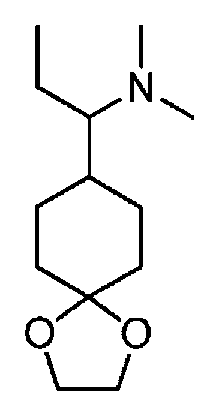
50 mL 둥근바닥 플라스크에 다이클로로메탄 (2 mL) 중 1-1,4-다이옥사스피로[4.5]데칸-8-일프로판-1-아민 하이드로클로라이드 (실시예 104, 단계 B에서 제조됨) (100 mg, 0.42 mmol, 1.00 eq)의 용액, HCHO (30%, 106 mg, 3.53 mmol, 2.50 eq), AcOH (25 mg, 0.42 mmol, 1.00 eq) 및 NaBH(OAc)3 (269 mg, 1.27 mmol, 3.00 eq)을 넣었다. 생성된 용액을 실온에서 3시간 동안 교반한 다음, 10 mL의 물을 첨가하여 켄칭하였다. 생성된 용액을 2x10 mL의 다이클로로메탄으로 추출하였다. 유기층들을 합하고, 건조하고, 진공 하에서 농축하여 황색 오일로서 표제 화합물을 얻었다.To a 50 mL round bottom flask was added a solution of l, 4-dioxaspiro [4.5] decan-8-ylpropan-l-amine hydrochloride (prepared in example 104, step B) in dichloromethane (2 mL) HCHO (30%, 106 mg, 3.53 mmol, 2.50 eq), AcOH (25 mg, 0.42 mmol, 1.00 eq) and NaBH (OAc) 3 (269 mg, 1.27 mmol , 3.00 eq). The resulting solution was stirred at room temperature for 3 hours and then quenched by the addition of 10 mL of water. The resulting solution was extracted with 2 x 10 mL dichloromethane. The organic layers were combined, dried and concentrated in vacuo to give the title compound as a yellow oil.
단계 B: 4-(1-(Step B: Preparation of 4- (1- ( 다이메틸아미노Dimethylamino )프로필))profile) 사이클로헥사논Cyclohexanone
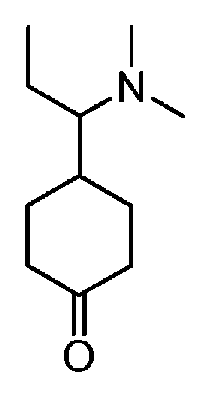
CH3CN (5 mL) 중 (1-{1,4-다이옥사스피로[4.5]데칸-8-일}프로필)다이메틸아민 (이전 단계에서 제조됨, 80 mg, 0.35 mmol, 1.00 eq)의 용액 및 HCl (1M, 1 mL)을 실온에서 2시간 동안 교반하였다. 생성된 혼합물을 진공 하에서 농축하였다. 잔류물을 10 mL의 소듐 바이카르보네이트 수용액 (1M)으로 희석하였다. 생성된 용액을 2x20 mL의 다이클로로메탄으로 추출하였다. 유기층들을 합하고, 무수 황산나트륨으로 건조하고, 진공 하에서 농축하여 황색 오일로서 표제 화합물을 얻었다.CH 3 CN (5 mL) of (1- {1,4-dioxane SARS fatigue [4.5] decan-8-yl} propyl) - dimethyl-amine (prepared in the previous step, 80 mg, 0.35 mmol, 1.00 eq) of The solution and HCl (1 M, 1 mL) were stirred at room temperature for 2 hours. The resulting mixture was concentrated in vacuo. The residue was diluted with 10 mL of aqueous sodium bicarbonate solution (1M). The resulting solution was extracted with 2 x 20 mL of dichloromethane. The organic layers were combined, dried over anhydrous sodium sulfate and concentrated in vacuo to give the title compound as a yellow oil.
단계 C: N-(1-((1S,4s)-4-((R)-1-(Step C: Preparation of N- (1 - ((1S, 4S) -4 - ((R) -1- 다이메틸아미노Dimethylamino )프로필))profile) 사이클로헥실Cyclohexyl )) 아제티딘Azetidine -3-일)-2-(6-(Yl) -2- (6- ( 트라이플루오로메틸Trifluoromethyl )) 퀴나졸린Quinazoline -4--4- 일아미노Amino )) 아세트아미드Acetamide

50 mL 둥근바닥 플라스크에 다이클로로메탄 (10 mL) 중 4-(1-(다이메틸아미노)프로필)사이클로헥사논 (이전 단계에서 제조됨, 60 mg, 0.33 mmol, 1.00 eq)의 용액, N-(아제티딘-3-일)-2-(6-(트라이플루오로메틸)퀴나졸린-4-일아미노)아세트아미드 2,2,2-트라이플루오로아세트산 (실시예 1, 단계 G에서 제조됨) (158 mg, 0.36 mmol, 1.10 eq) 및 TEA (33 mg, 0.33 mmol, 1.00 eq)를 넣었다.. 생성된 용액을 실온에서 30분 동안 교반한 다음, NaBH(OAc)3 (250 mg, 1.18 mmol, 3.60 eq)을 첨가하였다. 생성된 용액을 실온에서 추가로 2시간 동안 교반하고,이어서 진공 하에서 농축하였다. 조 생성물을 분취용-HPLC 에 의해 정제하여 백색 고체로서 표제 화합물을 얻었다. HPLC 조건: 컬럼, 엑스브릿지 프레프 페닐, 5 ㎛, 19 x 150 mm; 이동상, 물 (0.03% NH3.H2O) 및 CH3CN; 검출기, UV 254 nm. LC-MS (ES, m/z) 493 [M+H]+. 1H-NMR (300MHz,CD3OD) δ 8.64(s, 1H), 8.57(s,1H), 8.07-8.03(m,1H), 7.91-7.89 (d, J=8.7Hz,1H), 4.50-4.45(m,1H), 4.28(s, 2H), 3.63-3.61(m, 2H), 2.95-2.90(m, 2H), 2.30(m, 8H), 1.57-1.40(m, 11H), 1.00-0.95(m, 3H).To a 50 mL round bottom flask was added a solution of 4- (1- (dimethylamino) propyl) cyclohexanone (prepared in the previous step, 60 mg, 0.33 mmol, 1.00 eq) in dichloromethane (10 mL) (Azetidin-3-yl) -2- (6- (trifluoromethyl) quinazolin-4-ylamino) acetamide 2,2,2-Trifluoroacetic acid (prepared in example 1, step G) The resulting solution was stirred at room temperature for 30 minutes and then treated with NaBH (OAc) 3 (250 mg, 1.18 eq.) In THF (10 mL) mmol, 3.60 eq). The resulting solution was stirred at room temperature for an additional 2 hours, then concentrated in vacuo. The crude product was purified by preparative-HPLC to give the title compound as a white solid. HPLC conditions: column, X-bridge pre-phenyl, 5 탆, 19 x 150 mm; Mobile phase, water (0.03% NH 3 .H 2 O) and CH 3 CN; Detector, UV 254 nm. LC-MS (ES, m / z) 493 [M + H] < + >. 1 H-NMR (300MHz, CD 3 OD) δ 8.64 (s, 1H), 8.57 (s, 1H), 8.07-8.03 (m, 1H), 7.91-7.89 (d, J = 8.7Hz, 1H), 4.50 2H), 2.30 (m, 8H), 1.57-1.40 (m, 11H), 1.00 (m, -0.95 (m, 3H).
실시예Example 138: N-(1-((1R,4s)-4-((S)-1- 138: N- (1 - ((1 R, 4S) -4 - ((S) -1- 아세트아미도프로필Acetamidopropyl )) 사이클로헥실Cyclohexyl )) 아제티딘Azetidine -3-일)-2-((6-(Yl) -2 - ((6- ( 트라이플루오로메틸Trifluoromethyl )) 퀴나졸린Quinazoline -4-일)아미노)Yl) amino) 아세트아미드Acetamide
단계 A: N-(아제티딘-3-일)-2-(6-(트라이플루오로메틸)퀴나졸린-4-일아미노)아세트아미드 2,2,2-트라이플루오로아세트산Step A: N- (Azetidin-3-yl) -2- (6- (trifluoromethyl) quinazolin-4-ylamino) acetamide 2,2,2-Trifluoroacetic acid

다이클로로메탄 (10 mL) 중 tert-부틸 3-(2-(6-(트라이플루오로메틸)퀴나졸린-4-일아미노)아세트아미도)아제티딘-1-카르복실레이트 (실시예 1, 단계 F에 기재된 바와 같이 제조됨) (1 g, 2.35 mmol, 1.00 eq)의 용액 및 TFA (DCM 중 25%, 1 mL)를 실온에서 3시간 동안 교반하였다. 생성된 혼합물을 진공 하에서 농축하였고, 표제 화합물을 백색 고체로서 얻었다.A solution of tert-butyl 3- (2- (6- (trifluoromethyl) quinazolin-4-ylamino) acetamido) azetidine- 1 -carboxylate (example 1, (1 g, 2.35 mmol, 1.00 eq) and TFA (25% in DCM, 1 mL) was stirred at room temperature for 3 hours. The resulting mixture was concentrated in vacuo to give the title compound as a white solid.
단계 B: N-(1-1,4-Step B: Preparation of N- (l, 다이옥사스피로[4.5]데칸Dioxaspiro [4.5] decane -8--8- 일프로필Sun Profile )) 아세트아미드Acetamide

50 mL 둥근바닥 플라스크에 다이클로로메탄 (10 mL) 중 1-1,4-다이옥사스피로[4.5]데칸-8-일프로판-1-아민 하이드로클로라이드 (실시예 104 단계 B에서 제조됨) (50 mg, 0.21 mmol, 1.00 eq)의 용액 및 TEA (42.8 mg, 0.42 mmol, 2.00 eq)를 넣었다. 그 다음, 0℃에서 교반하면서 아세틸 클로라이드 (19.8 mg, 0.25 mmol, 1.20 eq)를 적가하였다. 생성된 용액을 실온에서 하룻밤 교반하였다. 이어서, 20 mL의 물을 첨가하여 반응물을 켄칭하였다. 생성된 용액을 2x20 mL의 다이클로로메탄으로 추출하였다. 유기층들을 합하고, 무수 황산나트륨으로 건조하고, 진공 하에서 농축하여 황색 오일로서 표제 화합물을 얻었다.To a 50 mL round bottom flask was added a solution of l, 4-dioxaspiro [4.5] decan-8-ylpropan-l-amine hydrochloride (prepared in example 104 Step B) (50 mL) in dichloromethane mg, 0.21 mmol, 1.00 eq) and TEA (42.8 mg, 0.42 mmol, 2.00 eq). Then acetyl chloride (19.8 mg, 0.25 mmol, 1.20 eq) was added dropwise with stirring at 0 < 0 > C. The resulting solution was stirred at room temperature overnight. The reaction was then quenched by the addition of 20 mL of water. The resulting solution was extracted with 2 x 20 mL of dichloromethane. The organic layers were combined, dried over anhydrous sodium sulfate and concentrated in vacuo to give the title compound as a yellow oil.
단계 C: N-(1-(4-옥소사이클로헥실)프로필)아세트아미드Step C: Preparation of N- (1- (4-oxocyclohexyl) propyl) acetamide

CH3CN (5 mL) 중 N-(1-1,4-다이옥사스피로[4.5]데칸-8-일프로필)아세트아미드 (이전 단계에서 제조됨, 39 mg, 0.16 mmol, 1.00 eq)의 용액 및 HCl (1M, 1 mL)을 실온에서 2시간 동안 교반하였다. 생성된 혼합물을 진공 하에서 농축하였다. 잔류물을 10 mL의 소듐 바이카르보네이트 수용액 (1M)으로 희석하였다. 생성된 용액을 2x20 mL의 다이클로로메탄으로 추출하였다. 유기층들을 합하고, 무수 황산나트륨으로 건조하고, 진공 하에서 농축하여 황색 오일로서 표제 화합물을 얻었다.A solution of CH 3 CN N- (1-1,4- dioxane SARS fatigue [4.5] decan-8-yl-propyl) of (5 mL) acetamide (prepared in the previous step, 39 mg, 0.16 mmol, 1.00 eq) And HCl (1 M, 1 mL) were stirred at room temperature for 2 hours. The resulting mixture was concentrated in vacuo. The residue was diluted with 10 mL of aqueous sodium bicarbonate solution (1M). The resulting solution was extracted with 2 x 20 mL of dichloromethane. The organic layers were combined, dried over anhydrous sodium sulfate and concentrated in vacuo to give the title compound as a yellow oil.
단계 D: N-(1-((1R,4s)-4-((S)-1-아세트아미도프로필)사이클로헥실)아제티딘-3-일)-2-((6-(트라이플루오로메틸)퀴나졸린-4-일)아미노)아세트아미드Step D: Synthesis of N- (1 - ((1 R, 4S) -4 - ((S) -1-acetamidopropyl) cyclohexyl) azetidin- Methyl) quinazolin-4-yl) amino) acetamide
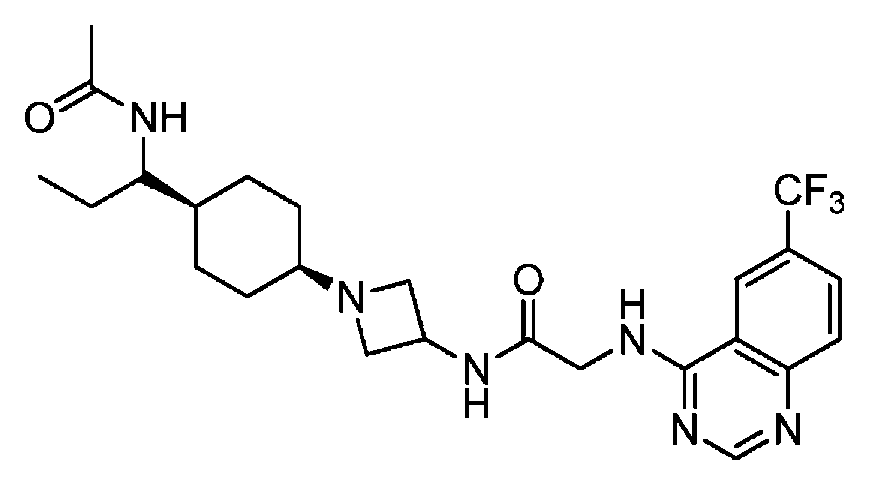
50 mL 둥근바닥 플라스크에 다이클로로메탄 (10 mL) 중 N-(1-(4-옥소사이클로헥실)프로필)아세트아미드 (이전 단계에서 제조됨, 31 mg, 0.16 mmol, 1.00 eq)의 용액, N-(아제티딘-3-일)-2-(6-(트라이플루오로메틸)퀴나졸린-4-일아미노)아세트아미드 2,2,2-트라이플루오로아세트산 (단계 A에 기재된 바와 같이 제조됨, 76 mg, 0.17 mmol, 1.10 eq) 및 TEA (15.9 mg, 0.16 mmol, 1.00 eq)를 넣었다. 생성된 용액을 실온에서 30분 동안 교반하고, 이어서 NaBH(OAc)3 (120 mg, 0.57 mmol, 3.60 eq)을 첨가하였다. 생성된 용액을 실온에서 추가로 2시간 동안 교반하였다. 생성된 혼합물을 진공 하에서 농축하였다. 조 생성물 (50 mg)을 하기 조건으로 분취용-HPLC에 의해 정제하였다: 컬럼, 엑스브릿지 프레프 페닐, 5 ㎛, 19 x 150 mm; 이동상, 물 (0.03% NH3.H2O) 및 CH3CN; 검출기, UV 254 nm. 표제 화합물을 백색 고체로서 얻었다. LC-MS (ES, m/z) 507 [M+H]+. 1H-NMR (400MHz, CD3OD) δ 8.64(s, 1H), 8.58(s, 1H), 8.08-8.05(m, 1H), 7.92-7.90(d, J=8.8Hz, 1H), 4.57-4.52(m, 1H), 4.30(s, 2H), 4.04(s, 2H), 3.760(s, 1H), 3.60-3.50(d, J=40.4Hz,2H), 2.84(s, 1H), 1.97(s, 3H), 1.70-1.1.49(m, 10H), 1.35-1.29(m, 1H), 0.95-0.80(m, 3H).To a 50 mL round bottom flask was added a solution of N- (1- (4-oxocyclohexyl) propyl) acetamide (prepared in the previous step, 31 mg, 0.16 mmol, 1.00 eq) in dichloromethane (10 mL) - (azetidin-3-yl) -2- (6- (trifluoromethyl) quinazolin-4-ylamino) acetamide 2,2,2- trifluoroacetic acid (prepared as described in step A , 76 mg, 0.17 mmol, 1.10 eq) and TEA (15.9 mg, 0.16 mmol, 1.00 eq). The resulting solution was stirred at room temperature for 30 minutes, then NaBH (OAc) 3 (120 mg, 0.57 mmol, 3.60 eq) was added. The resulting solution was stirred at room temperature for a further 2 hours. The resulting mixture was concentrated in vacuo. The crude product (50 mg) was purified by preparative-HPLC under the following conditions: column, X-bridged prephenyl, 5 m, 19 x 150 mm; Mobile phase, water (0.03% NH 3 .H 2 O) and CH 3 CN; Detector, UV 254 nm. The title compound was obtained as a white solid. LC-MS (ES, m / z) 507 [M + H] < + >. 1 H-NMR (400 MHz, CD 3 OD)? 8.64 (s, 1H), 8.58 (s, 1H), 8.08-8.05 (m, 1H), 7.92-7.90 (d, J = 8.8 Hz, 1H) 2H), 3.84 (s, 2H), 3.60 (s, 1H), 3.60-3.50 (d, J = 40.4 Hz, 2H) 1.97 (s, 3H), 1.70-1.1.49 (m, 10H), 1.35-1.29 (m, 1H), 0.95-0.80 (m, 3H).
실시예Example 139: N-(1-((1R,4s)-4-((S)-1-( 139: N- (1 - ((1R, 4S) -4 - ((S) -1- 메틸설폰아미도Methylsulfonamido )프로필))profile) 사이클로헥실Cyclohexyl )) 아제티딘Azetidine -3-일)-2-((6-(Yl) -2 - ((6- ( 트라이플루오로메틸Trifluoromethyl )) 퀴나졸린Quinazoline -4-일)아미노)Yl) amino) 아세트아미드Acetamide
단계 A: N-(1-(1,4-다이옥사스피로[4.5]데칸-8-일)프로필)메탄설폰아미드Step A: Preparation of N- (1- (1,4-dioxaspiro [4.5] decan-8-yl) propyl) methanesulfonamide

50 mL 둥근바닥 플라스크에 다이클로로메탄 (10 mL) 중 1-1,4-다이옥사스피로[4.5]데칸-8-일프로판-1-아민 하이드로클로라이드 (실시예 104 단계 B에서 제조됨) (50 mg, 0.21 mmol, 1.00 eq)의 용액 및 TEA (42.8 mg, 0.42 mmol, 2.00 eq)를 넣었다. 그 다음, 0℃에서 교반하면서 메탄설포닐 클로라이드 (29.1 mg, 0.25 mmol, 1.20 eq)를 적가하였다. 생성된 용액을 실온에서 하룻밤 교반하였다. 이어서, 20 mL의 물을 첨가하여 반응물을 켄칭하였다. 생성된 용액을 2x20 mL의 다이클로로메탄으로 추출하였다. 유기층들을 합하고, 무수 황산나트륨으로 건조하고, 진공 하에서 농축하여 황색 오일로서 표제 화합물을 얻었다.To a 50 mL round bottom flask was added a solution of l, 4-dioxaspiro [4.5] decan-8-ylpropan-l-amine hydrochloride (prepared in example 104 Step B) (50 mL) in dichloromethane mg, 0.21 mmol, 1.00 eq) and TEA (42.8 mg, 0.42 mmol, 2.00 eq). Methanesulfonyl chloride (29.1 mg, 0.25 mmol, 1.20 eq) was then added dropwise with stirring at 0 < 0 > C. The resulting solution was stirred at room temperature overnight. The reaction was then quenched by the addition of 20 mL of water. The resulting solution was extracted with 2 x 20 mL of dichloromethane. The organic layers were combined, dried over anhydrous sodium sulfate and concentrated in vacuo to give the title compound as a yellow oil.
단계B: N-(1-(4-옥소사이클로헥실)프로필)메탄설폰아미드Step B: Preparation of N- (1- (4-oxocyclohexyl) propyl) methanesulfonamide
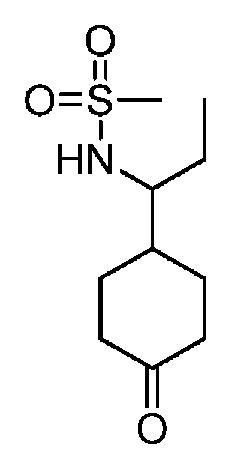
CH3CN (5 mL) 중 N-(1-1,4-다이옥사스피로[4.5]데칸-8-일프로필)메탄설폰아미드 (이전 단계에서 제조됨, 38 mg, 0.14 mmol, 1.00 eq)의 용액 및 HCl (2M, 1 mL)을 실온에서 2시간 동안 교반하였다. 생성된 혼합물을 진공 하에서 농축하였다. 잔류물을 10 mL의 소듐 바이카르보네이트 수용액 (1M)으로 희석하였다. 생성된 용액을 2x20 mL의 다이클로로메탄으로 추출하였다. 유기층들을 합하고, 무수 황산나트륨으로 건조하고, 진공 하에서 농축하여 황색 오일로서 표제 화합물을 얻었다. C H 3 CN N- (1-1,4- dioxane SARS fatigue [4.5] decan-8-yl-propyl) of (5 mL) methanesulfonamide (prepared in the previous step, 38 mg, 0.14 mmol, 1.00 eq) And HCl (2M, 1 mL) were stirred at room temperature for 2 hours. The resulting mixture was concentrated in vacuo. The residue was diluted with 10 mL of aqueous sodium bicarbonate solution (1M). The resulting solution was extracted with 2 x 20 mL of dichloromethane. The organic layers were combined, dried over anhydrous sodium sulfate and concentrated in vacuo to give the title compound as a yellow oil.
단계 C: N-(1-((1R,4s)-4-((S)-1-(Step C: Preparation of N- (1 - ((1 R, 4S) -4 - ((S) -1- 메틸설폰아미도Methylsulfonamido )프로필))profile) 사이클로헥실Cyclohexyl )) 아제티딘Azetidine -3-일)-2-((6-(Yl) -2 - ((6- ( 트라이플루오로메틸Trifluoromethyl )) 퀴나졸린Quinazoline -4-일)아미노)Yl) amino) 아세트아미드Acetamide

50 mL 둥근바닥 플라스크에 다이클로로메탄 (10 mL) 중 N-(1-(4-옥소사이클로헥실)프로필)메탄설폰아미드 (이전 단계에서 제조됨, 29 mg, 0.12 mmol, 1.00 eq)의 용액, N-(아제티딘-3-일)-2-(6-(트라이플루오로메틸)퀴나졸린-4-일아미노)아세트아미드 2,2,2-트라이플루오로아세트산 (실시예 1, 단계 G에서 제조됨) (60 mg, 0.14 mmol, 1.10 eq) 및 TEA (13 mg, 0.13 mmol, 1.00 eq)를 넣었다. 생성된 용액을 실온에서 30분 동안 교반하고, 이어서 NaBH(OAc)3 (95 mg, 0.45 mmol, 3.60 eq)을 첨가하였다. 생성된 용액을 실온에서 2시간 동안 교반하고, 이어서 진공 하에서 농축하였다. 조 생성물 (80 mg)을 하기 조건으로 분취용-HPLC에 의해 정제하였다: 컬럼, 엑스브릿지 프레프 페닐, 5 ㎛, 19 x 150 mm; 이동상, 물 (0.03% NH3H2O) 및 CH3CN (25% CH3CN으로부터 8분 후에 65%까지 증가, 0.1분 후에 100%까지 증가, 1.9분 동안 100%에서 유지, 0.1분 후에 25%까지 감소, 0.9분 동안 25%에서 유지); 검출기, UV 220 & 254 nm. 표제 화합물을 백색 고체로서 얻었다. LC-MS (ES, m/z) 543 [M+H]+. 1H-NMR (300MHz, CD3OD) δ 8.63(s, 1H), 8.57(s, 1H), 8.06-8.03(m, 1H), 7.79-7.88(d, J=28.2Hz,1H), 4.50-4.45(m, 1H), 4.28(s, 2H), 3.67-3.62(m, 2H), 3.18(s, 1H), 2.96-2.91(m, 5H), 2.32(s, 1H), 1.68-1.43(m, 11H), 0.97-0.93(m, 3H).To a 50 mL round bottom flask was added a solution of N- (1- (4-oxocyclohexyl) propyl) methanesulfonamide (prepared in the previous step, 29 mg, 0.12 mmol, 1.00 eq) in dichloromethane (10 mL) (Trifluoromethyl) quinazolin-4-ylamino) acetamide 2,2,2-Trifluoroacetic acid (from Example 1, step G, (60 mg, 0.14 mmol, 1.10 eq) and TEA (13 mg, 0.13 mmol, 1.00 eq). The resulting solution was stirred at room temperature for 30 minutes, then NaBH (OAc) 3 (95 mg, 0.45 mmol, 3.60 eq) was added. The resulting solution was stirred at room temperature for 2 hours and then concentrated in vacuo. The crude product (80 mg) was purified by preparative-HPLC under the following conditions: column, X-bridged prephenyl, 5 m, 19 x 150 mm; Mobile phase, water (0.03% NH 3 H 2 O ) and CH 3 CN (increase from 25% CH 3 CN to 65% after 8 minutes, and after 0.1 minutes increased to 100%, held at 100% for 1.9 minutes, and after 0.1 minutes 25%, maintained at 25% for 0.9 minutes); Detector, UV 220 & 254 nm. The title compound was obtained as a white solid. LC-MS (ES, m / z) 543 [M + H] < + >. 1 H-NMR (300MHz, CD 3 OD) δ 8.63 (s, 1H), 8.57 (s, 1H), 8.06-8.03 (m, 1H), 7.79-7.88 (d, J = 28.2Hz, 1H), 4.50 2H), 3.67-3.62 (m, 2H), 3.18 (s, 1H), 2.96-2.91 (m, 5H), 2.32 (s, 1H), 1.68-1.43 (m, 11H), 0.97-0.93 (m, 3H).
실시예Example 140: 2-((6-( 140: 2 - ((6- ( 트라이플루오로메틸Trifluoromethyl )) 퀴나졸린Quinazoline -4-일)아미노)-N-(1-((1R,4s)-4-((S)-1-(트Yl) amino) -N- (1 - ((1 R, 4S) -4 - ((S) 라이플루오로메틸설Rifluoromethylsulfur 폰아미도)프로필)Vonamido) propyl) 사이클로헥실Cyclohexyl )) 아제티딘Azetidine -3-일)-3 days) 아세트Acetate 아미드amides
단계 A: N-(1-{1,4-다이옥사스피로[4.5]데칸-8-일}프로필)-1,1,1-트라이플루오로메탄설폰아미드Step A: N- (1- {1,4-Dioxaspiro [4.5] decan-8-yl} propyl) -1,1,1- trifluoromethanesulfonamide

50 mL 둥근바닥 플라스크에 다이클로로메탄 (10 mL) 중 1-1,4-다이옥사스피로[4.5]데칸-8-일프로판-1-아민 하이드로클로라이드 (실시예 104 단계 B에서 제조됨) (50 mg, 0.21 mmol, 1.00 eq)의 용액 및 TEA (42.8 mg, 0.42 mmol, 2.00 eq)를 넣었다. 그 다음, 0℃에서 교반하면서 (트라이플루오로메탄)설포닐 트라이플루오로메탄설포네이트(72 mg, 0.26 mmol, 1.20 eq)를 적가하였다. 생성된 용액을 실온에서 하룻밤 교반하였다. 이어서, 20 mL의 물을 첨가하여 반응물을 켄칭하였다. 생성된 용액을 2x20 mL의 다이클로로메탄으로 추출하였다. 유기층들을 합하고, 무수 황산나트륨으로 건조하고, 진공 하에서 농축하여 황색 오일로서 표제 화합물을 얻었다.To a 50 mL round bottom flask was added a solution of l, 4-dioxaspiro [4.5] decan-8-ylpropan-l-amine hydrochloride (prepared in example 104 Step B) (50 mL) in dichloromethane mg, 0.21 mmol, 1.00 eq) and TEA (42.8 mg, 0.42 mmol, 2.00 eq). Then (trifluoromethane) sulfonyl trifluoromethanesulfonate (72 mg, 0.26 mmol, 1.20 eq) was added dropwise with stirring at 0 ° C. The resulting solution was stirred at room temperature overnight. The reaction was then quenched by the addition of 20 mL of water. The resulting solution was extracted with 2 x 20 mL of dichloromethane. The organic layers were combined, dried over anhydrous sodium sulfate and concentrated in vacuo to give the title compound as a yellow oil.
단계 B: Step B: 트라이플루오로Trifluro -N-(1-(4--N- (1- (4- 옥소사이클로헥실Oxocyclohexyl )프로필))profile) 메탄설폰아미드Methanesulfonamide

CH3CN (5 mL) 중 N-(1-1,4-다이옥사스피로[4.5]데칸-8-일프로필)-1,1,1-트라이플루오로메탄설폰아미드 (이전 단계에서 제조됨, 47 mg, 0.14 mmol, 1.00 eq)의 용액 및 HCl (2M, 1 mL)을 실온에서 2시간 동안 교반하였다. 생성된 혼합물을 진공 하에서 농축하였다. 잔류물을 10 mL의 소듐 바이카르보네이트 수용액 (1M)으로 희석하였다. 생성된 용액을 2x20 mL의 다이클로로메탄으로 추출하였다. 유기층들을 합하고, 무수 황산나트륨으로 건조하고, 진공 하에서 농축하여 황색 오일로서 표제 화합물을 얻었다.CH 3 CN as prepared in (5 mL), N- (1-1,4- dioxane SARS fatigue [4.5] decan-8-yl-propyl) methanesulfonamide (previous step 1, 1-trifluoro wherein 47 mg, 0.14 mmol, 1.00 eq) and HCl (2M, 1 mL) was stirred at room temperature for 2 hours. The resulting mixture was concentrated in vacuo. The residue was diluted with 10 mL of aqueous sodium bicarbonate solution (1M). The resulting solution was extracted with 2 x 20 mL of dichloromethane. The organic layers were combined, dried over anhydrous sodium sulfate and concentrated in vacuo to give the title compound as a yellow oil.
단계 C: 2-((6-(Step C: Preparation of 2 - ((6- ( 트라이플루오로메틸Trifluoromethyl )) 퀴나졸린Quinazoline -4-일)아미노)-N-(1-((1R,4s)-4-((S)-1-(트Yl) amino) -N- (1 - ((1 R, 4S) -4 - ((S) 라이플루오로메틸설Rifluoromethylsulfur 폰아미도)프로필)Vonamido) propyl) 사이클로헥실Cyclohexyl )) 아제티딘Azetidine -3-일)-3 days) 아세트Acetate 아미드amides

50 mL 둥근바닥 플라스크에 다이클로로메탄 (10 mL) 중 트라이플루오로-N-(1-(4-옥소사이클로헥실)프로필)메탄설폰아미드 (이전 단계에서 제조됨, 30 mg, 0.10 mmol, 1.00 eq)의 용액, N-(아제티딘-3-일)-2-(6-(트라이플루오로메틸)퀴나졸린-4-일아미노)아세트아미드 2,2,2-트라이플루오로아세트산 (실시예 1, 단계 G에서 제조됨) (50.5 mg, 0.12 mmol, 1.10 eq) 및 TEA (11 mg, 0.11 mmol, 1.00 eq)을 넣었다. 생성된 용액을 실온에서 30분 동안 교반하고, 이어서 NaBH(OAc)3 (80 mg, 0.38 mmol, 3.60 eq)을 첨가하였다. 생성된 용액을 실온에서 추가로 2시간 동안 교반하고, 이어서 진공 하에서 농축하였다. 조 생성물 (60 mg)을 하기 조건으로 분취용-HPLC에 의해 정제하였다: 컬럼, 엑스브릿지 프레프 페닐, 5 ㎛, 19x150 mm; 이동상, 물 (0.03% NH3H2O) 및 CH3CN (25% CH3CN으로부터 8분 후에 45%까지 증가, 0.1분 후에 100%까지 증가, 1.9분 동안 100%에서 유지, 0.1분 후에 25%까지 감소, 0.9분 동안 25%에서 유지); 검출기, UV 254 nm. 표제 화합물을 백색 고체로서 얻었다. LC-MS (ES, m/z) 597 [M+H]+. 1H-NMR (300MHz, CD3OD) δ 8.64(s, 1H), 8.58(s, 1H), 8.08-8.05(m, 1H), 7.93-7.90(d, J=8.7Hz, 1H), 4.62-4.59(d, J=6.9Hz, 1H), 4.3214.25(d, J=19.2Hz, 4H), 3.95(s, 2H), 3.39-3.37(d, J=4.5Hz, 1H), 3.24-3.21(d, J=3.2Hz, 1H), 1.78-1.30(m, 11H), 0.98-0.93(m, 3H).To a 50 mL round bottom flask was added trifluro-N- (1- (4-oxocyclohexyl) propyl) methanesulfonamide (prepared in the previous step, 30 mg, 0.10 mmol, 1.00 eq Yl) -2- (6- (trifluoromethyl) quinazolin-4-ylamino) acetamide 2,2,2-Trifluoroacetic acid (Example 1 , Prepared in Step G) (50.5 mg, 0.12 mmol, 1.10 eq) and TEA (11 mg, 0.11 mmol, 1.00 eq). The resulting solution was stirred at room temperature for 30 minutes, then NaBH (OAc) 3 (80 mg, 0.38 mmol, 3.60 eq) was added. The resulting solution was stirred at room temperature for an additional 2 hours, then concentrated in vacuo. The crude product (60 mg) was purified by preparative-HPLC under the following conditions: column, X-bridged prephenyl, 5 μm, 19 × 150 mm; The mobile phase, water (0.03% NH 3 H 2 O) and CH 3 CN (up to 45% after 8 min from 25% CH 3 CN, up to 100% after 0.1 min, maintained at 100% for 1.9 min, 25%, maintained at 25% for 0.9 minutes); Detector, UV 254 nm. The title compound was obtained as a white solid. LC-MS (ES, m / z) 597 [M + H] < + >. 1 H-NMR (300MHz, CD 3 OD) δ 8.64 (s, 1H), 8.58 (s, 1H), 8.08-8.05 (m, 1H), 7.93-7.90 (d, J = 8.7Hz, 1H), 4.62 J = 6.9 Hz, 1H), 4.3214.25 (d, J = 19.2 Hz, 4H), 3.95 (s, 2H), 3.39-3.37 3.21 (d, J = 3.2 Hz, 1H), 1.78-1.30 (m, 11H), 0.98-0.93 (m, 3H).
실시예Example 141: 1-((R)-1-((1S,4S)-4-(3-(2-(6-( 141: 1 - ((R) -1 - ((1S, 4S) -4- (3- (2- (6- 트라이플루오로메틸Trifluoromethyl )) 퀴나졸린Quinazoline -4--4- 일아미노Amino )) 아세트아미도Acetamido )) 아제티딘Azetidine -1-일)-1 day) 사이클로헥실Cyclohexyl )프로필))profile) 우레아Urea
단계 A: (1-{1,4-다이옥사스피로[4.5]데칸-8-일}프로필)우레아Step A: (1- {1,4-Dioxaspiro [4.5] decan-8-yl} propyl) urea
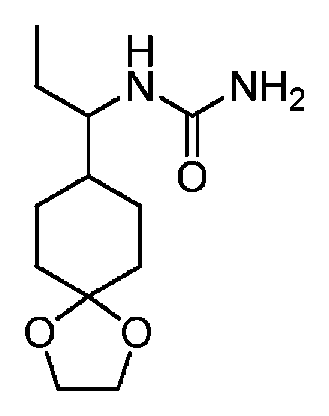
50 mL 둥근바닥 플라스크에 물 (3 mL) 중 1-1,4-다이옥사스피로[4.5]데칸-8-일프로판-1-아민 하이드로클로라이드 (실시예 104 단계 B에서 제조됨) (100 mg, 0.42 mmol, 1.00 eq)의 용액 및 KOCN (38 mg, 0.47 mmol, 1.10 eq)을 넣었다. 생성된 용액을 70℃에서 하룻밤 교반하였다. 생성된 용액을 냉각하고 3x10 mL의 다이클로로메탄으로 추출하였다. 유기층들을 합하고, 건조하고, 진공 하에서 농축하여 백색 고체로서 표제 화합물을 얻었다.To a 50 mL round bottom flask was added l, 4-dioxaspiro [4.5] decan-8-ylpropan-l-amine hydrochloride (prepared in Example 104 Step B) (100 mg, 0.42 mmol, 1.00 eq) and KOCN (38 mg, 0.47 mmol, 1.10 eq). The resulting solution was stirred overnight at 70 < 0 > C. The resulting solution was cooled and extracted with 3 x 10 mL dichloromethane. The organic layers were combined, dried and concentrated in vacuo to give the title compound as a white solid.
단계 B: 1-(1-(4-옥소사이클로헥실)프로필)우레아Step B: Preparation of 1- (1- (4-oxocyclohexyl) propyl) urea

CH3CN (2 mL) 중 (1-1,4-다이옥사스피로[4.5]데칸-8-일프로필)우레아 (이전 단계에서 제조됨, 89 mg, 0.37 mmol, 1.00 eq)의 용액 및 HCl (2M, 2 mL)을 실온에서 2시간 동안 교반하였다. 생성된 혼합물을 진공 하에서 농축하였다. 잔류물을 20 mL의 소듐 바이카르보네이트 수용액 (1M)으로 희석하였다. 생성된 용액을 2x20 mL의 다이클로로메탄으로 추출하였다. 유기층들을 합하고, 건조하고, 진공 하에서 농축하여 황색 오일로서 표제 화합물을 얻었다.CH 3 CN (2 mL) of a solution of (1-1,4- dioxane SARS fatigue [4.5] decan-8-yl) urea (prepared in the previous step, 89 mg, 0.37 mmol, 1.00 eq) and HCl ( 2M, 2 mL) was stirred at room temperature for 2 hours. The resulting mixture was concentrated in vacuo. The residue was diluted with 20 mL of aqueous sodium bicarbonate solution (1M). The resulting solution was extracted with 2 x 20 mL of dichloromethane. The organic layers were combined, dried and concentrated in vacuo to give the title compound as a yellow oil.
단계 C: 2-((6-(트라이플루오로메틸)퀴나졸린-4-일)아미노)-N-(1-((1R,4s)-4-((S)-1-우레이도프로필)사이클로헥실)아제티딘-3-일)아세트아미드Step C: 2 - ((6- (Trifluoromethyl) quinazolin-4-yl) amino) -N- (1 - ((1 R, 4s) -4- Cyclohexyl) azetidin-3-yl) acetamide

50 mL 둥근바닥 플라스크에 다이클로로메탄 (10 mL) 중 1-(1-(4-옥소사이클로헥실)프로필)우레아 (이전 단계에서 제조됨, 62 mg, 0.31 mmol, 1.00 eq)의 용액, N-(아제티딘-3-일)-2-(6-(트라이플루오로메틸)퀴나졸린-4-일아미노)아세트아미드 2,2,2-트라이플루오로아세트산 (실시예 1, 단계 G에서 제조됨) (151 mg, 0.34 mmol, 1.10 eq) 및 TEA (32 mg, 0.32 mmol, 1.00 eq)를 넣었다. 생성된 용액을 실온에서 30분 동안 교반하고, 이어서 NaBH(OAc)3 (239 mg, 1.13 mmol, 3.60 eq)을 첨가하였다. 생성된 용액을 실온에서 추가로 2시간 동안 교반하였다. 이어서, 진공 하에서 농축하였다. 조 생성물 (50 mg)을 하기 조건으로 분취용-HPLC에 의해 정제하였다: 컬럼, 엑스브릿지 프레프 페닐 5 ㎛, 19 x 150 mm; 이동상, 물 (0.03% NH3H2O) 및 CH3CN; 검출기, UV 254 nm. 표제 화합물을 백색 고체로서 얻었다. LC-MS (ES, m/z) 508 [M+H]+. 1H-NMR (300MHz,CD3OD) δ 8.64(s, 1H), 8.57(s, 1H), 8.07-8.04(m, 1H), 7.92-7.89(d, J=8.7Hz, 1H), 4.61(s, 3H), 4.50-4.45(m, 1H), 4.28(s, 2H), 3.70-3.66(m, 2H), 3.56-3.50(m, 1H), 3.09-3.01(m, 2H), 2.36(s, 1H), 1.63-1.44(m, 9H), 1.35-1.30(m, 2H), 1.24-0.92(m, 3H).To a 50 mL round bottom flask was added a solution of 1- (1- (4-oxocyclohexyl) propyl) urea (prepared in the previous step, 62 mg, 0.31 mmol, 1.00 eq) in dichloromethane (10 mL) (Azetidin-3-yl) -2- (6- (trifluoromethyl) quinazolin-4-ylamino) acetamide 2,2,2-Trifluoroacetic acid (prepared in example 1, step G) ) (151 mg, 0.34 mmol, 1.10 eq) and TEA (32 mg, 0.32 mmol, 1.00 eq). The resulting solution was stirred at room temperature for 30 minutes, then NaBH (OAc) 3 (239 mg, 1.13 mmol, 3.60 eq) was added. The resulting solution was stirred at room temperature for a further 2 hours. It was then concentrated in vacuo. The crude product (50 mg) was purified by preparative-HPLC under the following conditions: column, X-bridged prep phenyl 5 μm, 19 x 150 mm; Mobile phase, water (0.03% NH 3 H 2 O ) and CH 3 CN; Detector, UV 254 nm. The title compound was obtained as a white solid. LC-MS (ES, m / z) 508 [M + H] < + >. 1 H-NMR (300MHz, CD 3 OD) δ 8.64 (s, 1H), 8.57 (s, 1H), 8.07-8.04 (m, 1H), 7.92-7.89 (d, J = 8.7Hz, 1H), 4.61 (s, 3H), 4.50-4.45 (m, IH), 4.28 (s, 2H), 3.70-3.66 (m, 2H), 3.56-3.50 (s, 1H), 1.63-1.44 (m, 9H), 1.35-1.30 (m, 2H), 1.24-0.92 (m, 3H).
실시예Example 142: N-(1-((1R,4s)-4-((S)-1-(3- 142: N- (1 - ((1 R, 4S) -4 - ((S) -1- (3- 메틸우레이도Methyl ureido )프로필))profile) 사이클로헥실Cyclohexyl )) 아제티딘Azetidine -3-일)-2-((6-(Yl) -2 - ((6- ( 트라이플루오로메틸Trifluoromethyl )) 퀴나졸린Quinazoline -4-일)아미노)Yl) amino) 아세트아미드Acetamide
단계 A: 4-(Step A: 4- ( 하이드록시니트로소Hydroxynitroso )) 페닐Phenyl N-(1-{1,4- N- (1- {1,4- 다이옥사스피로[4.5]데칸Dioxaspiro [4.5] decane -8-일}프로필)-8-yl} propyl) 카르바메이트Carbamate

50 mL 둥근바닥 플라스크에 다이클로로메탄 (5 mL) 중 1-1,4-다이옥사스피로[4.5]데칸-8-일프로판-1-아민 하이드로클로라이드 (실시예 104 단계 B에서 제조됨) (50 mg, 0.21 mmol, 1.00 eq)의 용액, 및 TEA (53.4 mg, 0.53 mmol, 2.50 eq)를 넣었다. 그 다음, 0℃에서 교반하면서 4-니트로페닐 카르보노클로리데이트 (53.9 mg, 0.27 mmol, 1.20 eq)를 적가하였다. 생성된 용액을 실온에서 2시간 동안 교반하였다. 이어서, 10 mL의 소듐 바이카르보네이트 (1M)를 첨가하여 반응물을 켄칭하였다. 생성된 용액을 2x10 mL의 다이클로로메탄으로 추출하였다. 유기층들을 합하고, 진공 하에서 농축하였다. 표제 화합물을 황색 오일로서 얻었다.To a 50 mL round bottom flask was added a solution of l, 4-dioxaspiro [4.5] decan-8-ylpropan-l-amine hydrochloride (prepared in example 104 Step B) (50 mg) in dichloromethane mg, 0.21 mmol, 1.00 eq) and TEA (53.4 mg, 0.53 mmol, 2.50 eq). 4-Nitrophenylcarbanochloridate (53.9 mg, 0.27 mmol, 1.20 eq) was then added dropwise with stirring at 0 ° C. The resulting solution was stirred at room temperature for 2 hours. The reaction was then quenched by the addition of 10 mL of sodium bicarbonate (1M). The resulting solution was extracted with 2 x 10 mL dichloromethane. The organic layers were combined and concentrated in vacuo. The title compound was obtained as a yellow oil.
단계 B: 1-(1-{1,4-다이옥사스피로[4.5]데칸-8-일}프로필)-3-메틸우레아Step B: 1- (1- {1,4-Dioxaspiro [4.5] decan-8-yl} propyl) -3-methylurea

50 mL 둥근바닥 플라스크에 테트라하이드로푸란 (10 mL) 중 4-(하이드록시니트로소)페닐 N-(1-1,4-다이옥사스피로[4.5]데칸-8-일프로필)카르바메이트 (이전 단계에서 제조됨, 88 mg, 0.24 mmol, 1.00 eq)의 용액, 메탄아민 하이드로클로라이드 (32.3 mg, 0.47 mmol, 2.00 eq), N-에틸-N-아이소프로필프로판-2-아민 (62 mg, 0.48 mmol, 2.00 eq)을 넣었다. 생성된 용액을 실온에서 하룻밤 교반하였다. 이어서, 10 mL의 소듐 바이카르보네이트 (1M)를 첨가하여 반응물을 켄칭하였다. 생성된 용액을 3x10 mL의 다이클로로메탄으로 추출하였다. 유기층들을 합하고, 진공 하에서 농축하였다. 표제 화합물을 황색 고체로서 얻었다.To a 50 mL round bottom flask was added 4- (hydroxynitroso) phenyl N- (1-1,4-dioxaspiro [4.5] decan-8-ylpropyl) carbamate (62.3 mg, 0.47 mmol, 2.00 eq) and N-ethyl-N-isopropylpropan-2-amine (62 mg, 0.48 mmol) in methylene chloride mmol, 2.00 eq). The resulting solution was stirred at room temperature overnight. The reaction was then quenched by the addition of 10 mL of sodium bicarbonate (1M). The resulting solution was extracted with 3 x 10 mL dichloromethane. The organic layers were combined and concentrated in vacuo. The title compound was obtained as a yellow solid.
단계 C: 1-메틸-3-(1-(4-옥소사이클로헥실)프로필)우레아Step C: 1-Methyl-3- (1- (4-oxocyclohexyl) propyl) urea

50 mL 둥근바닥 플라스크에 CH3CN (2 mL) 중 1-(1-1,4-다이옥사스피로[4.5]데칸-8-일프로필)-3-메틸우레아 (이전 단계에서 제조됨, 48 mg, 0.19 mmol, 1.00 eq)의 용액, 및 염화수소 (aq, 2M) (2 mL)를 넣었다. 생성된 용액을 실온에서 2시간 동안 교반하였다. 탄산칼륨 (1 mol/L)을 사용하여 용액의 pH 값을 8로 조절하였다. 생성된 용액을 3x10 mL의 다이클로로메탄으로 추출하였다. 유기층들을 합하고, 무수 황산나트륨으로 건조하고, 진공 하에서 농축하였다. 표제 화합물을 황색 고체로서 얻었다.50 mL round bottom flask was prepared in CH 3 CN (2 mL) of 1 - (1-1,4- dioxane SARS fatigue [4.5] decan-8-yl) -3- methyl-urea (the previous step, 48 mg , 0.19 mmol, 1.00 eq) and hydrogen chloride (aq, 2M) (2 mL). The resulting solution was stirred at room temperature for 2 hours. The pH of the solution was adjusted to 8 using potassium carbonate (1 mol / L). The resulting solution was extracted with 3 x 10 mL dichloromethane. The organic layers were combined, dried over anhydrous sodium sulfate, and concentrated in vacuo. The title compound was obtained as a yellow solid.
단계 D: N-(1-((1R,4s)-4-((S)-1-(3-Step D: Preparation of N- (1 - ((1R, 4S) -4 - ((S) -1- (3- 메틸우레이도Methyl ureido )프로필))profile) 사이클로헥실Cyclohexyl )) 아제티딘Azetidine -3-일)-2-((6-(Yl) -2 - ((6- ( 트라이플루오로메틸Trifluoromethyl )) 퀴나졸린Quinazoline -4-일)아미노)Yl) amino) 아세트아미드Acetamide

50 mL 둥근바닥 플라스크에 다이클로로메탄 (10 mL) 중 1-메틸-3-(1-(4-옥소사이클로헥실)프로필)우레아 (이전 단계에서 제조됨, 35 mg, 0.17 mmol, 1.00 eq)의 용액, N-(아제티딘-3-일)-2-(6-(트라이플루오로메틸)퀴나졸린-4-일아미노)아세트아미드 2,2,2-트라이플루오로아세트산 (실시예 1, 단계 G에서 제조됨) (80 mg, 0.18 mmol, 1.10 eq), TEA (17 mg, 0.17 mmol, 1.00 eq)를 넣었다. 생성된 용액을 실온에서 30분 동안 교반하였다. NaBH(OAc)3 (126 mg, 0.59 mmol, 3.60 eq)을 첨가하였다. 생성된 용액을 실온에서 추가로 2시간 동안 교반하면서 반응하게 두었다. 생성된 혼합물을 진공 하에 농축하였다. 조 생성물 (50 mg)을 하기 조건으로 분취용-HPLC에 의해 정제하였다: 컬럼, 엑스브릿지 프레프 페닐 5 ㎛, 19 x 150 mm Prep C012(T); 이동상, 상 A: 0.03%NH3.H2O를 갖는 물, 상 B: CH3CN; 검출기, UV 254 nm. 표제 화합물을 백색 고체로서 얻었다. LC-MS [M+H]+523 1H-NMR (300MHz, CD3OD) δ 8.63(s,1H), 8.57(s,1H), 8.07-8.03(m,1H), 7.91-7.88(d,J=8.7Hz,1H), 4.51-4.42(m,1H), 4.28(s,2H), 3.67-3.62(m,2H), 3.56-3.51(m,1H), 2.95(s,2H), 2.69(s,3H), 2.31(s,1H), 1.64-1.30(m, 11H).To a 50 mL round bottom flask was added a solution of 1-methyl-3- (1- (4-oxocyclohexyl) propyl) urea (prepared in the previous step, 35 mg, 0.17 mmol, 1.00 eq) in dichloromethane Yl) -2- (6- (trifluoromethyl) quinazolin-4-ylamino) acetamide 2,2,2-Trifluoroacetic acid (Example 1, step G) (80 mg, 0.18 mmol, 1.10 eq) and TEA (17 mg, 0.17 mmol, 1.00 eq). The resulting solution was stirred at room temperature for 30 minutes. NaBH (OAc) 3 (126 mg, 0.59 mmol, 3.60 eq) was added. The resulting solution was allowed to react at room temperature with stirring for an additional 2 hours. The resulting mixture was concentrated in vacuo. The crude product (50 mg) was purified by preparative-HPLC under the following conditions: Column, X-bridged prep phenyl 5 μm, 19 x 150 mm Prep C012 (T); Mobile phase, phase A: water with 0.03% NH 3 .H 2 O, phase B: CH 3 CN; Detector, UV 254 nm. The title compound was obtained as a white solid. LC-MS [M + H] + 523 1 H-NMR (300MHz, CD 3 OD) δ 8.63 (s, 1H), 8.57 (s, 1H), 8.07-8.03 (m, 1H), 7.91-7.88 (d 2H, J = 8.7 Hz, 1H), 4.51-4.42 (m, 1H), 4.28 (s, 2H) 2.69 (s, 3H), 2.31 (s, 1H), 1.64-1.30 (m, 11H).
실시예Example 143: N-(1-((1R,4s)-4-((S)-1-(3,3- 143: N- (1 - ((1 R, 4S) -4 - ((S) -1- (3,3- 다이메틸우레이도Dimethylureido )프로필))profile) 사이클로헥실Cyclohexyl )) 아제티딘Azetidine -3-일)-2-((6-(Yl) -2 - ((6- ( 트라이플루오로메틸Trifluoromethyl )) 퀴나졸린Quinazoline -4-일)아미노)Yl) amino) 아세트아미드Acetamide
단계 A: 1-(1-{1,4-다이옥사스피로[4.5]데칸-8-일}프로필)-3,3-다이메틸우레아Step A: 1- (1- {1,4-Dioxaspiro [4.5] decan-8-yl} propyl) -3,3-dimethylurea

50 mL 둥근바닥 플라스크에 다이클로로메탄 (10 mL) 중 1-1,4-다이옥사스피로[4.5]데칸-8-일프로판-1-아민 하이드로클로라이드 (실시예 104 단계 B에서 제조됨) (50 mg, 0.21 mmol, 1.00 eq)의 용액 및 TEA (42.8 mg, 0.42 mmol, 2.00 eq)를 넣었다. 그 다음, 0℃에서 교반하면서 다이메틸카르바믹 클로라이드 (27.5 mg, 0.25 mmol, 1.20 eq)를 적가하였다. 생성된 용액을 실온에서 하룻밤 교반하였다. 이어서, 20 mL의 물을 첨가하여 반응물을 켄칭하였다. 생성된 용액을 2x20 mL의 다이클로로메탄으로 추출하였다. 유기층들을 합하고, 무수 황산나트륨으로 건조하고, 진공 하에서 농축하였다. 표제 화합물을 황색 오일로서 얻었다.To a 50 mL round bottom flask was added a solution of l, 4-dioxaspiro [4.5] decan-8-ylpropan-l-amine hydrochloride (prepared in example 104 Step B) (50 mL) in dichloromethane mg, 0.21 mmol, 1.00 eq) and TEA (42.8 mg, 0.42 mmol, 2.00 eq). Dimethylcarbamic chloride (27.5 mg, 0.25 mmol, 1.20 eq) was then added dropwise with stirring at 0 < 0 > C. The resulting solution was stirred at room temperature overnight. The reaction was then quenched by the addition of 20 mL of water. The resulting solution was extracted with 2 x 20 mL of dichloromethane. The organic layers were combined, dried over anhydrous sodium sulfate, and concentrated in vacuo. The title compound was obtained as a yellow oil.
단계 B: 1,1-다이메틸-3-(1-(4-옥소사이클로헥실)프로필)우레아Step B: 1,1-Dimethyl-3- (1- (4-oxocyclohexyl) propyl) urea

CH3CN (5 mL) 중 1-(1-1,4-다이옥사스피로[4.5]데칸-8-일프로필)-3,3-다이메틸우레아 (이전 단계에서 제조됨, 36 mg, 0.13 mmol, 1.00 eq)의 용액 및 HCl (2M, 1 mL)을 실온에서 2시간 동안 교반하였다. 생성된 혼합물을 진공 하에서 농축하였다. 잔류물을 10 mL의 소듐 바이카르보네이트 수용액 (1M)으로 희석하였다. 생성된 용액을 2x20 mL의 다이클로로메탄으로 추출하였다. 유기층들을 합하고, 무수 황산나트륨으로 건조하고, 진공 하에서 농축하였다. 표제 화합물을 황색 오일로서 얻었다.CH 3 CN (5 mL) of 1 - (1-1,4- dioxane SARS fatigue [4.5] decan-8-yl-propyl) -3,3-dimethyl-urea (prepared in the previous step, 36 mg, 0.13 mmol , 1.00 eq) and HCl (2M, 1 mL) were stirred at room temperature for 2 hours. The resulting mixture was concentrated in vacuo. The residue was diluted with 10 mL of aqueous sodium bicarbonate solution (1M). The resulting solution was extracted with 2 x 20 mL of dichloromethane. The organic layers were combined, dried over anhydrous sodium sulfate, and concentrated in vacuo. The title compound was obtained as a yellow oil.
단계 C: N-(1-((1R,4s)-4-((S)-1-(3,3-Step C: Preparation of N- (1 - ((1 R, 4S) -4 - ((S) -1- 다이메틸우레이도Dimethylureido )프로필))profile) 사이클로헥실Cyclohexyl )) 아제티딘Azetidine -3-일)-2-((6-(Yl) -2 - ((6- ( 트라이플루오로메틸Trifluoromethyl )) 퀴나졸린Quinazoline -4-일)아미노)Yl) amino) 아세트아미드Acetamide

50 mL 둥근바닥 플라스크에 다이클로로메탄 (10 mL) 중 1,1-다이메틸-3-(1-(4-옥소사이클로헥실)프로필)우레아 (이전 단계에서 제조됨, 28 mg, 0.12 mmol, 1.00 eq)의 용액, N-(아제티딘-3-일)-2-(6-(트라이플루오로메틸)퀴나졸린-4-일아미노)아세트아미드 2,2,2-트라이플루오로아세트산 (실시예 1, 단계 G에서 제조됨) (59.9 mg, 0.14 mmol, 1.10 eq) 및 TEA (12.5 mg, 0.12 mmol, 1.00 eq)를 넣었다. 생성된 용액을 실온에서 30분 동안 교반하고, 이어서 NaBH(OAc)3 (95 mg, 0.45 mmol, 3.60 eq)을 첨가하였다. 생성된 용액을 실온에서 추가로 2시간 동안 교반하였다. 생성된 혼합물을 진공 하에서 농축하였다. 조 생성물 (80 mg)을 하기 조건으로 분취용-HPLC에 의해 정제하였다: 컬럼, 엑스브릿지 프레프 페닐, 5 ㎛, 19 x 150 mm; 이동상, 물 (0.03% NH3H2O 및 CH3CN (30% CH3CN으로부터 8분 후에 50%까지 증가, 0.1분 후에 100%까지 증가, 1.9분 동안 100%에서 유지, 0.1분 후에 30%까지 감소, 0.9분 동안 30%에서 유지); 검출기, UV 220 & 254 nm. 표제 화합물을 백색 고체로서 얻었다. LC-MS (ES, m/z) 536 [M+H]+. 1H-NMR (400MHz, CD3OD) δ 8.64(s, 1H), 8.58(s, 1H), 8.07-8.04(d, J=10.4Hz,1H), 7.92-7.90(d, J=8.8Hz,1H), 5.62-5.64(d, J=8.8Hz,1H), 4.49-4.43(m,1H), 4.29(s,2H), 3.63-3.61(d, J=6.8Hz, 3H), 2.95(s, 8H), 2.30(s, 1H), 1.66-1.60(m, 2H), 1.54-1.33(m, 9H), 0.90-0.86(m, 3H).To a 50 mL round bottom flask was added 1,1-dimethyl-3- (1- (4-oxocyclohexyl) propyl) urea (prepared in the previous step, 28 mg, 0.12 mmol, 1.00 eq), a solution of N- (azetidin-3-yl) -2- (6- (trifluoromethyl) quinazolin- 1, prepared in Step G) (59.9 mg, 0.14 mmol, 1.10 eq) and TEA (12.5 mg, 0.12 mmol, 1.00 eq). The resulting solution was stirred at room temperature for 30 minutes, then NaBH (OAc) 3 (95 mg, 0.45 mmol, 3.60 eq) was added. The resulting solution was stirred at room temperature for a further 2 hours. The resulting mixture was concentrated in vacuo. The crude product (80 mg) was purified by preparative-HPLC under the following conditions: column, X-bridged prephenyl, 5 m, 19 x 150 mm; Mobile phase, water (0.03% NH 3 H 2 O and CH 3 CN (30% CH increase from 3 CN to 50% after 8 minutes, increased to 100% after 0.1 minutes and held at 100% for 1.9 minute, 0.1 minutes in 30 (ES, m / z) 536 [M + H] + . & Lt; 1 > H- NMR (400MHz, CD 3 OD) δ 8.64 (s, 1H), 8.58 (s, 1H), 8.07-8.04 (d, J = 10.4Hz, 1H), 7.92-7.90 (d, J = 8.8Hz, 1H) , 5.62-5.64 (d, J = 8.8 Hz, IH), 4.49-4.43 (m, IH), 4.29 (s, 2H), 3.63-3.61 (d, J = 6.8 Hz, ), 2.30 (s, 1H), 1.66-1.60 (m, 2H), 1.54-1.33 (m, 9H), 0.90-0.86 (m, 3H).
실시예Example 144: 144: 메틸methyl ((S)-1-((1s,4R)-4-(3-(2-((6-( ((S) -1 - ((1S, 4R) -4- (3- (2- ( 트라이플루오로메틸Trifluoromethyl )) 퀴나졸린Quinazoline -4-일)아미노)Yl) amino) 아세트아미도Acetamido )) 아제티딘Azetidine -1-일)-1 day) 사이클로헥실Cyclohexyl )프로필))profile) 카르바메이트Carbamate
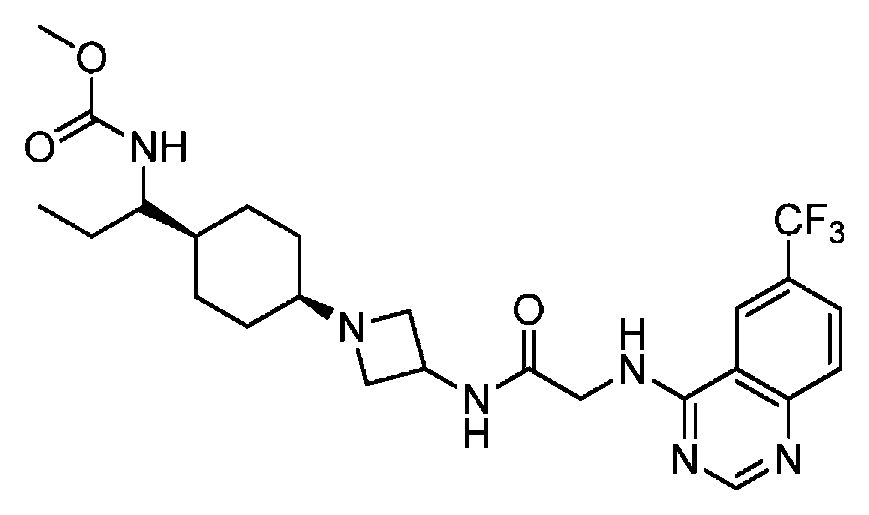
50 mL 둥근바닥 플라스크에 다이클로로메탄 (10 mL) 중 메틸 1-(4-옥소사이클로헥실)프로필카르바메이트 (실시예 104 단계 D에서 제조됨) (31 mg, 0.15 mmol, 1.00 eq)의 용액, N-(아제티딘-3-일)-2-(6-(트라이플루오로메틸)퀴나졸린-4-일아미노)아세트아미드 2,2,2-트라이플루오로아세트산 (실시예 1, 단계 G에서 제조됨) (70.3 mg, 0.16 mmol, 1.10 eq) 및 TEA (15 mg, 0.15 mmol, 1.00 eq)를 넣었다. 생성된 용액을 실온에서 30분 동안 교반한 다음, NaBH(OAc)3 (111 mg, 0.52 mmol, 3.60 eq)을 첨가하였다. 생성된 용액을 실온에서 추가로 2시간 동안 교반하였다. 이어서, 진공 하에서 농축하였다. 조 생성물 (80 mg)을 하기 조건으로 분취용-HPLC에 의해 정제하였다: 컬럼, 엑스브릿지 프레프 페닐, 5 ㎛, 19 x 150 mm; 이동상, 물 (0.03% NH3H2O 및 CH3CN (30% CH3CN으로부터 8분 후에 60%까지 증가, 0.1분 후에 100%까지 증가, 1.9분 동안 100%에서 유지, 0.1분 후에 30%까지 감소, 0.9분 동안 30%에서 유지); 검출기, UV 220 & 254 nm. 표제 화합물을 백색 고체로서 얻었다. LC-MS (ES, m/z) 523 [M+H]+. 1H-NMR (400MHz, CD3OD) δ 8.52(s, 1H), 8.46(s, 1H), 7.95-7.93(d, J=8.8Hz,1H), 4.37-4.33(m, 1H), 4.17(s, 2H), 3.53-3.48(m, 5H), 3.27-3.26(d, J=3.2Hz, 1H), 2.82-2.79(m, 2H), 2.16(s, 1H), 1.50-1.19(m, 11H), 0.78(s, 3H).To a 50 mL round bottom flask was added a solution of methyl 1- (4-oxocyclohexyl) propyl carbamate (prepared in example 104 step D) (31 mg, 0.15 mmol, 1.00 eq) in dichloromethane (10 mL) (Trifluoromethyl) quinazolin-4-ylamino) acetamide 2,2,2-Trifluoroacetic acid (Example 1, step G (70.3 mg, 0.16 mmol, 1.10 eq) and TEA (15 mg, 0.15 mmol, 1.00 eq). The resulting solution was stirred at room temperature for 30 minutes and then NaBH (OAc) 3 (111 mg, 0.52 mmol, 3.60 eq) was added. The resulting solution was stirred at room temperature for a further 2 hours. It was then concentrated in vacuo. The crude product (80 mg) was purified by preparative-HPLC under the following conditions: column, X-bridged prephenyl, 5 m, 19 x 150 mm; Mobile phase, water (0.03% NH 3 H 2 O and CH 3 CN (increased to 60% after 8 min from 30% CH 3 CN, increased to 100% after 0.1 min, maintained at 100% for 1.9 min, (ES, m / z) 523 [M + H] + . & Lt; 1 > H- NMR (400MHz, CD 3 OD) δ 8.52 (s, 1H), 8.46 (s, 1H), 7.95-7.93 (d, J = 8.8Hz, 1H), 4.37-4.33 (m, 1H), 4.17 (s, 2H), 2.13 (s, IH), 1.50-1.19 (m, 11H), 3.53-3.48 (m, 5H), 3.27-3.26 (d, , 0.78 (s, 3H).
실시예Example 145 및 145 and 실시예Example 146: N-(1-((1r,4r)-4- 146: N- (1 - ((1 R, 4R) -4- 하이드록시Hydroxy -4-(티아졸-5-일)-4- (thiazol-5-yl) 사이클로헥실Cyclohexyl )) 아제티딘Azetidine -3-일)-2-((3-(Yl) -2 - ((3- ( 트라이플루오로메틸Trifluoromethyl )-1,6-) -1,6- 나프티리딘Naphthyridine -5-일)아미노)아세트아미드5-yl) amino) acetamide
N-(1-((1s,4s)-4-하이드록시-4-(티아졸-5-일)사이클로헥실)아제티딘-3-일)-2-((3-(트라이플루오로메틸)-1,6-나프티리딘-5-일)아미노)아세트아미드Azetidin-3-yl) -2 - ((3- (trifluoromethyl) pyridin-2-yl) -L, 6-naphthyridin-5-yl) amino) acetamide
단계 A: Step A: terttert -부틸 3-(-Butyl 3- ( 트라이플루오로메틸Trifluoromethyl )-7,8-) -7,8- 다이하이드로Dihydro -1,6--1,6- 나프티리딘Naphthyridine -6(5H)-카-6 (5H) -car 르복실Le Fucil 레이트Rate

100 mL 둥근바닥 플라스크에, 다이클로로메탄 (40 mL) 중 3-(트라이플루오로메틸)-5,6,7,8-테트라하이드로-1,6-나프티리딘 하이드로클로라이드 (5 g, 18.21 mmol, 1.00 eq)의 용액, 다이-tert-부틸 다이카르보네이트 (4.76 g, 21.83 mmol, 1.20 eq) 및 트라이에틸아민 (5.45 g, 53.96 mmol, 5.00 eq)을 넣었다. 생성된 용액을 실온에서 1.5시간 동안 교반하고, 이어서 2x30 mL의 H2O로 세척하였다. 유기 부분을 황산나트륨으로 건조하고 진공 하에서 농축하였다. 에틸 아세테이트/석유 에테르 (1:50-1:10)를 사용하여 실리카 겔 컬럼에서 크로마토그래피에 의해 잔류물을 정제하였다. 표제 화합물을 백색 고체로서 얻었다.To a 100 mL round-bottomed flask was added 3- (trifluoromethyl) -5,6,7,8-tetrahydro-1,6-naphthyridine hydrochloride (5 g, 18.21 mmol, 1.00 eq), di-tert-butyl dicarbonate (4.76 g, 21.83 mmol, 1.20 eq) and triethylamine (5.45 g, 53.96 mmol, 5.00 eq). For 1.5 hours and the resultant solution at room temperature, and was then washed with 2x30 mL H 2 O. The organic portion was dried over sodium sulfate and concentrated in vacuo. The residue was purified by chromatography on a silica gel column using ethyl acetate / petroleum ether (1: 50-1: 10). The title compound was obtained as a white solid.
단계 B: Step B: terttert -부틸 5-옥소-3-(Butyl 5-oxo-3- ( 트라이플루오로메틸Trifluoromethyl )-7,8-) -7,8- 다이하이드로Dihydro -1,6--1,6- 나프티리딘Naphthyridine -6(5H)--6 (5H) - 카르복실레이트Carboxylate

250 mL 둥근바닥 플라스크에, CCl4/CH3CN=10/1 (66 mL) 중 tert-부틸 3-(트라이플루오로메틸)-7,8-다이하이드로-1,6-나프티리딘-6(5H)-카르복실레이트 (이전 단계에서 제조됨, 3.84 g, 0.01 mol, 1.00 eq)의 용액, 물 (20 mL) 중 과요오드산나트륨의 용액 (8.135 g, 38.01 mmol, 3.00 eq), 및 루테늄(III)클로라이드 수화물 (0.992 g, 0.30 eq)을 넣었다. 생성된 용액을 실온에서 12시간 동안 교반한 다음, 혼합물을 50 mL의 CH2Cl2로 희석하였다. 고형물을 여과하여 제거하였다. 여과액을 진공 하에서 농축하였다. 에틸 아세테이트/석유 에테르 (1:50-1:10)를 사용하여 실리카 겔 컬럼에서 크로마토그래피에 의해 잔류물을 정제하였다. 표제 화합물을 백색 고체로서 얻었다.250 mL round bottom flask, CCl 4 / CH 3 CN = 10/1 ( trifluoromethyl) of tert- butyl 3 (66 mL) -7,8- dihydro-l, 6-naphthyridin-6 ( A solution of sodium periodate (8.135 g, 38.01 mmol, 3.00 eq) in water (20 mL), and a solution of ruthenium (III) chloride hydrate (0.992 g, 0.30 eq). The resulting solution was stirred at room temperature for 12 hours and then the mixture was diluted with 50 mL of CH 2 Cl 2 . The solids were removed by filtration. The filtrate was concentrated in vacuo. The residue was purified by chromatography on a silica gel column using ethyl acetate / petroleum ether (1: 50-1: 10). The title compound was obtained as a white solid.
단계 C: 3-(트라이플루오로메틸)-7,8-다이하이드로-1,6-나프티리딘-5(6H)-온Step C: 3- (Trifluoromethyl) -7,8-dihydro-1,6-naphthyridin-5 (6H)

100 mL 둥근바닥 플라스크에, 다이클로로메탄 (20 g) 중 tert-부틸 5-옥소-3-(트라이플루오로메틸)-7,8-다이하이드로-1,6-나프티리딘-6(5H)-카르복실레이트 (이전 단계에서 제조됨, 2.7 g, 8.54 mmol, 1.00 eq)의 용액 및 CF3COOH (4 g)를 넣었다. 반응 혼합물을 실온에서 2시간 동안 교반하였다. 소듐 바이카르보네이트를 사용하여 용액의 pH 값을 8로 조절하였다. 생성된 용액을 3x30 mL의 다이클로로메탄으로 추출하고, 합한 유기층을 1x50 mL의 염수로 세척하고, 무수 황산나트륨로 건조하고, 진공 하에서 농축하였다. 표제 화합물을 황색 고체로서 얻었다.To a 100 mL round bottom flask was added tert-butyl 5-oxo-3- (trifluoromethyl) -7,8-dihydro-1,6-naphthyridin-6 (5H) Carboxylate (prepared in the previous step, 2.7 g, 8.54 mmol, 1.00 eq) and CF 3 COOH (4 g). The reaction mixture was stirred at room temperature for 2 hours. The pH value of the solution was adjusted to 8 using sodium bicarbonate. The resulting solution was extracted with 3 x 30 mL of dichloromethane and the combined organic layers were washed with 1 x 50 mL brine, dried over anhydrous sodium sulfate and concentrated in vacuo. The title compound was obtained as a yellow solid.
단계 D: 3-(트라이플루오로메틸)-1,6-나프티리딘-5(6H)-온Step D: 3- (Trifluoromethyl) -1,6-naphthyridin-5 (6H) -one

100 mL 둥근바닥 플라스크에, 다이옥산 (20 mL) 중 3-(트라이플루오로메틸)-7,8-다이하이드로-1,6-나프티리딘-5(6H)-온 (이전 단계에서 제조됨, 1.7 g, 7.87 mmol, 1.00 eq)의 용액 및 2,3-다이클로로-5,6-다이시아노-1,4-벤조퀴논 (2.68 g, 11.81 mmol, 1.50 eq)을 넣었다. 반응 혼합물을 오일조에서 100℃에서 6시간 동안 교반하였다. 생성된 혼합물을 진공 하에서 농축하고 잔류물을 20 mL의 소듐 바이카르보네이트에 용해하였다. 생성된 용액을 3x100 mL의 다이클로로메탄으로 추출하고, 합한 유기층을 황산나트륨으로 건조하고, 진공 하에서 농축하였다. 에틸 아세테이트/석유 에테르 (1:10-1:2)를 사용하여 실리카 겔 컬럼에서 크로마토그래피에 의해 잔류물을 정제하였다. 표제 화합물을 연황색(light yellow) 고체로서 얻었다.To a 100 mL round bottom flask was added 3- (trifluoromethyl) -7,8-dihydro-1,6-naphthyridin-5 (6H) -one (prepared in the previous step, 1.7 g, 7.87 mmol, 1.00 eq) and 2,3-dichloro-5,6-dicyano-1,4-benzoquinone (2.68 g, 11.81 mmol, 1.50 eq). The reaction mixture was stirred in an oil bath at 100 < 0 > C for 6 hours. The resulting mixture was concentrated in vacuo and the residue was dissolved in 20 mL of sodium bicarbonate. The resulting solution was extracted with 3 x 100 mL of dichloromethane and the combined organic layers were dried over sodium sulfate and concentrated in vacuo. The residue was purified by chromatography on a silica gel column using ethyl acetate / petroleum ether (1: 10-1: 2). The title compound was obtained as a light yellow solid.
단계 E: 5-클로로-3-(트라이플루오로메틸)-1,6-나프티리딘Step E: 5-Chloro-3- (trifluoromethyl) -1, 6-naphthyridine
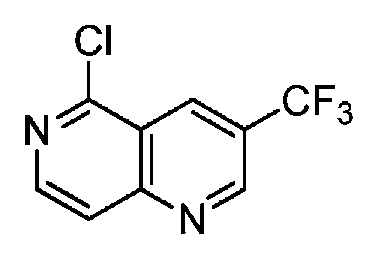
50 mL 둥근바닥 플라스크에, 아세토니트릴 (10 mL) 중 3-(트라이플루오로메틸)-1, 6-나프티리딘-5(6H)-온 (이전 단계에서 제조됨, 1 g, 4.67 mmol, 1.00 eq)의 용액 및 포스포릴 트라이클로라이드 (10 mL)를 넣었다. 반응 혼합물을 오일조에서 90℃에서 2시간 동안 교반하였다. 생성된 혼합물을 진공 하에서 농축하였다. 에틸 아세테이트/석유 에테르 (1:20)를 사용하여 실리카 겔 컬럼에서 크로마토그래피에 의해 잔류물을 정제하였다. 표제 화합물을 황색 고체로서 얻었다.To a 50 mL round bottom flask was added 3- (trifluoromethyl) -1,6-naphthyridin-5 (6H) -one (prepared in the previous step, 1 g, 4.67 mmol, 1.00 eq) and phosphoryl trichloride (10 mL). The reaction mixture was stirred in an oil bath at 90 < 0 > C for 2 hours. The resulting mixture was concentrated in vacuo. The residue was purified by chromatography on a silica gel column using ethyl acetate / petroleum ether (1:20). The title compound was obtained as a yellow solid.
단계 F: tert-부틸 3-(2-(3-(트라이플루오로메틸)-1,6-나프티리딘-5-일아미노)아세트아미도)아제티딘-1-카르복실레이트Step F: tert-Butyl 3- (2- (3- (trifluoromethyl) -1,6-naphthyridin-5-ylamino) acetamido) azetidine-

10 mL 둥근바닥 플라스크에, 다이글라임 (diglyme; 3 mL) 중 5-클로로-3-(트라이플루오로메틸)-1,6-나프티리딘 (이전 단계에서 제조됨, 23.3 mg, 0.10 mmol, 1.00 eq)의 용액, tert-부틸 3-(2-아미노아세트아미도)아제티딘-1-카르복실레이트 (실시예 1, 단계 E에 기재된 바와 같이 제조됨) (27 mg, 0.12 mmol, 1.20 eq) 및 트라이에틸아민 (30 mg, 0.30 mmol, 3.00 eq)을 넣었다. 반응 혼합물을 120℃에서 하룻밤 동안 교반하였다. 생성된 혼합물을 20 mL의 H2O로 희석하였다. 생성된 용액을 3x20 mL의 다이클로로메탄으로 추출하였다. 합한 유기층을 건조하고 (Na2SO4) 진공 하에서 농축하였다. 표제 화합물을 회색 고체로서 얻었다.To a 10 mL round bottom flask was added 5-chloro-3- (trifluoromethyl) -1, 6-naphthyridine (prepared in the previous step, 23.3 mg, 0.10 mmol, 1.00 mmol) in diglyme eq), (27 mg, 0.12 mmol, 1.20 eq), tert -butyl 3- (2-aminoacetamido) azetidine- 1 -carboxylate (prepared as described in Example 1, Step E) And triethylamine (30 mg, 0.30 mmol, 3.00 eq). The reaction mixture was stirred at 120 < 0 > C overnight. The resulting mixture was diluted with H 2 O in 20 mL. The resulting solution was extracted with 3 x 20 mL of dichloromethane. The combined organic layers were dried (Na 2 SO 4 ) and concentrated in vacuo. The title compound was obtained as a gray solid.
단계 G: N-(아제티딘-3-일)-2-(3-(트라이플루오로메틸)-1,6-나프티리딘-5-일아미노)아세트아미드 (TFA의 염)Step G: N- (Azetidin-3-yl) -2- (3- (trifluoromethyl) -1,6-naphthyridin-5- ylamino) acetamide (salt of TFA)
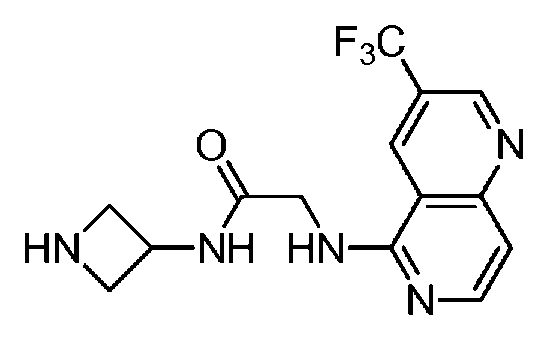
100 mL 둥근바닥 플라스크에, 다이클로로메탄 (20 mL) 중 tert-부틸 3-(2-(3-(트라이플루오로메틸)-1,6-나프티리딘-5-일아미노)아세트아미도)아제티딘-1-카르복실레이트 (이전 단계에서 제조됨, 20 mg, 0.05 mmol, 1.00 eq)의 용액 및 CF3COOH (1 mL)를 넣었다. 반응 혼합물을 실온에서 2시간 동안 교반하였다. 생성된 혼합물을 진공 하에서 농축하였다. 표제 화합물을 황색 오일로서 얻었다.To a 100 mL round bottom flask was added a solution of tert-butyl 3- (2- (3- (trifluoromethyl) -1,6-naphthyridin-5-ylamino) acetamido) Thiazine-1-carboxylate (prepared in the previous step, 20 mg, 0.05 mmol, 1.00 eq) and CF 3 COOH (1 mL). The reaction mixture was stirred at room temperature for 2 hours. The resulting mixture was concentrated in vacuo. The title compound was obtained as a yellow oil.
단계 H: N-(1-((1r,4r)-4-하이드록시-4-(티아졸-5-일)사이클로헥실)아제티딘-3-일)-2-((3-(트라이플루오로메틸)-1,6-나프티리딘-5-일)아미노)아세트아미드Step H: Preparation of N- (1 - ((lr, 4r) -4-hydroxy-4- (thiazol- 5- yl) cyclohexyl) azetidin- Ylmethyl) -l, 6-naphthyridin-5-yl) amino) acetamide
N-(1-((1s,4s)-4-하이드록시-4-(티아졸-5-일)사이클로헥실)아제티딘-3-일)-2-((3-(트라이플루오로메틸)-1,6-나프티리딘-5-일)아미노)아세트아미드Azetidin-3-yl) -2 - ((3- (trifluoromethyl) pyridin-2-yl) -L, 6-naphthyridin-5-yl) amino) acetamide
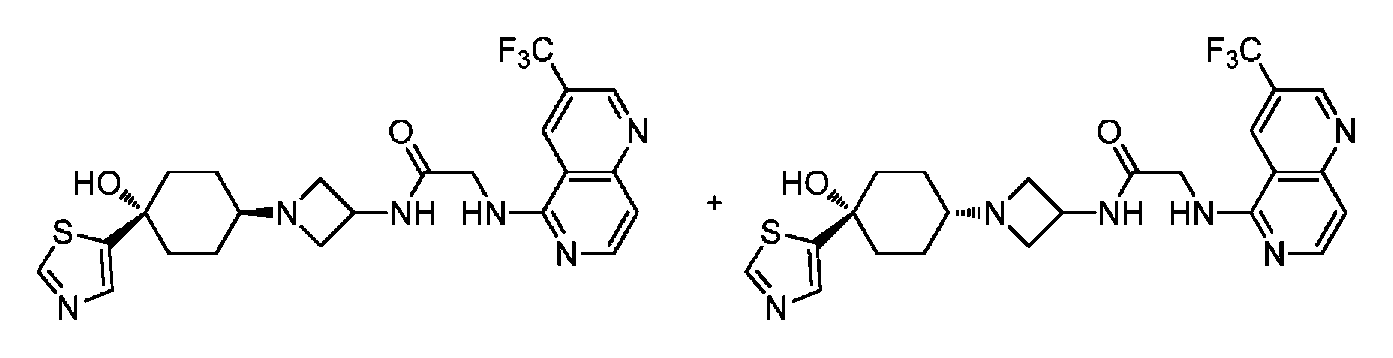
100 mL 둥근바닥 플라스크에, 다이클로로메탄 (5 mL) 중 N-(아제티딘-3-일)-2-(3-(트라이플루오로메틸)-1,6-나프티리딘-5-일아미노)아세트아미드 (이전 단계에서 제조됨, 325 mg, 1.00 mmol, 1.00 eq)의 용액, 4-하이드록시-4-(티아졸-5-일)사이클로헥사논 (실시예 26, 단계 C에 기재된 바와 같이 제조됨) (197 mg, 1.00 mmol, 1.00 eq), NaBH(OAc)3 (636 mg, 3.00 mmol, 3.00 eq) 및 트라이에틸아민 (303 mg, 3.00 mmol, 3.00 eq)을 넣었다. 반응 혼합물을 실온에서 하룻밤 교반한 다음, 혼합물을 진공 하에서 농축하였다. 생성된 조 생성물 (500 mg)을 하기 조건으로 분취용-HPLC에 의해 정제하였다 (1#-PreP-HPLC-005(워터스(Waters))): 컬럼, 애틀란티스(Atlantis) T35 ㎛, 19 x 150 mm HPrepC-014(T)186003698 011238204113 05; 이동상, 상 A: 50 mL NH4CO3을 갖는 물, 상 B: 구배; 검출기, UV 254 nm. 표제 화합물을 연황색 고체로서 단리하였다.To a 100 mL round bottom flask was added a solution of N- (azetidin-3-yl) -2- (3- (trifluoromethyl) -1,6-naphthyridin- (Prepared as in previous step, 325 mg, 1.00 mmol, 1.00 eq), 4-hydroxy-4- (thiazol-5-yl) cyclohexanone were placed Manufactured) (197 mg, 1.00 mmol, 1.00 eq), NaBH (OAc) 3 (636 mg, 3.00 mmol, 3.00 eq) and triethylamine (303 mg, 3.00 mmol, 3.00 eq). The reaction mixture was stirred at room temperature overnight and then the mixture was concentrated in vacuo. The resulting crude product (500 mg) was purified by preparative-HPLC (1 # -PreP-HPLC-005 (Waters)): column, Atlantis T35 urn, 19 x 150 mm HPrepC-014 (T) 186003698 011238204113 05; Mobile phase, phase A: water with 50 mL NH 4 CO 3 , phase B: gradient; Detector, UV 254 nm. The title compound was isolated as a light yellow solid.
N-(1-((1r,4r)-4-하이드록시-4-(티아졸-5-일)사이클로헥실)아제티딘-3-일)-2-((3-(트라이플루오로메틸)-1,6-나프티리딘-5-일)아미노)아세트아미드에 대해:Azetidin-3-yl) -2 - ((3- (trifluoromethyl) pyridin-2-yl) -L, 6-naphthyridin-5-yl) amino) acetamide:
LC-MS (ES, m/z) 507 [M+H]+ LC-MS (ES, m / z) 507 [M + H] +
1H-NMR (300MHz, CD3OD) δ 9.159(d, J=1.8Hz, 1H), 9.062-9.068(m, 1H), 8.902(s, 1H), 8.224(d, J=6Hz, 1H), 7.822(s, 1H), 7.175-7.197(m, 1H), 4.445-4.492(m, 1H), 4.215(s, 2H), 3.611-3.663(m, 2H), 2.962-3.012(m, 2H), 2.330(s, 1H), 2.181-2.253(m, 2H), 1.721-1.886(m, 4H), 1.306-1.351(m, 2H).N-(1-((1s,4s)-4-하이드록시-4-(티아졸-5-일)사이클로헥실)아제티딘-3-일)-2-((3-(트라이플루오로메틸)-1,6-나프티리딘-5-일)아미노)아세트아미드에 대해: LC-MS (ES, m/z) 507 [M+1]+ 1 H-NMR (300 MHz, CD 3 OD)? 9.159 (d, J = 1.8 Hz, 1H), 9.062-9.068 (m, 1H), 8.902 (m, 2H), 2.962-3.012 (m, 2H), 2.330 (m, IH), 7.175-7.197 (s, 1 H), 2.181-2.253 (m, 2H), 1.721-1.886 (m, 4H), 1.306-1.351 (m, 2H). N- Azetidin-3-yl) -2 - ((3- (trifluoromethyl) -1,6-naphthyridin-5-yl) amino) acetamide LC-MS (ES, m / z) 507 [M + 1] < + &
1H-NMR (300MHz, CD3OD) δ 9.1615(d, J=2.1Hz, 1H), 9.0745(d, J=0.9Hz, 1H), 8.860(s, 1H), 8.233(d, J=6Hz, 1H), 7.730(s, 1H), 7.191(d, J=6Hz, 1H), 4.478-4.525(m, 1H), 4.226(s, 2H), 3.664-3.716(m, 2H), 3.078-3.102(m, 2H), 1.518-1.609(m, 2H), 2.231(m, 1H), 2.035 (d, J=12.6Hz, 2H), 1.763-1.802(m, 2H), 1.680-1.713(m, 2H). 1 H-NMR (300MHz, CD3OD ) δ 9.1615 (d, J = 2.1Hz, 1H), 9.0745 (d, J = 0.9Hz, 1H), 8.860 (s, 1H), 8.233 (d, J = 6Hz, 1H ), 7.730 (s, 1H), 7.191 (d, J = 6 Hz, 1H), 4.478-4.525 (m, 1H), 4.226 (s, 2H), 3.664-3.716 (m, 2H), 3.078-3.102 , 2H), 1.518-1.609 (m, 2H), 2.231 (m, 1H), 2.035 (d, J = 12.6 Hz, 2H), 1.763-1.802 (m, 2H), 1.680-1.713
실시예Example 147: N-(1-((1r,4r)-4- 147: N- (1 - ((1 R, 4R) -4- 하이드록시Hydroxy -4-(티아졸-5-일)-4- (thiazol-5-yl) 사이클로헥실Cyclohexyl )) 아제티딘Azetidine -3-일)-2-((6-(Yl) -2 - ((6- ( 트라이플루오로메틸Trifluoromethyl )) 신놀린Sinnolin -4-일)아미노)Yl) amino) 아세트아미드Acetamide
단계 A: 1-(2-아미노-5-요오도페닐) 에타논Step A: 1- (2-Amino-5-iodophenyl) ethanone

250 mL 둥근바닥 플라스크에, 1N HCl (300 mL) 중 1-(2-아미노페닐) 에타논 (11 g, 81.48 mmol, 1.00 eq)의 용액을 넣었다. 그 다음, 0℃에서 교반하면서 2N HCl (50 mL) 중 ICl (14.5 g, 89.51 mmol, 1.10 eq)의 용액을 적가하였다. 반응 혼합물을 물/얼음 조에서 실온에서 2시간 동안 교반하였다. 여과에 의해 고체를 수집하고, 이어서 200 mL의 에틸 아세테이트: MeOH (10:1)로 세척하였다. 표제 화합물을 갈색 고체로서 얻었다.A solution of 1- (2-aminophenyl) ethanone (11 g, 81.48 mmol, 1.00 eq) in 1N HCl (300 mL) was added to a 250 mL round bottom flask. Then a solution of ICl (14.5 g, 89.51 mmol, 1.10 eq) in 2N HCl (50 mL) was added dropwise while stirring at 0 ° C. The reaction mixture was stirred in a water / ice bath at room temperature for 2 hours. The solid was collected by filtration and then washed with 200 mL of ethyl acetate: MeOH (10: 1). The title compound was obtained as a brown solid.
단계 B: 6-요오도신놀린-4-올Step B: 6-Iodosinolin-4-ol
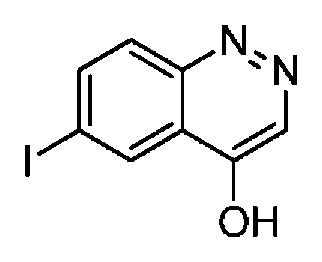
250 mL 둥근바닥 플라스크에, 테트라하이드로푸란 (150 mL) 중 1-(2-아미노-5-요오도페닐)에타논 (이전 단계에서 제조됨, 6.5 g, 24.90 mmol, 1.00 eq)의 용액 및 1N HCl (49 mL, 2.00 eq) 및 NaNO2 (2.3 g, 27.06 mmol, 1.10 eq)를 넣었다. 반응 혼합물을 0℃에서 1시간 동안 교반하고, 이어서 2시간 동안 가열하여 환류하였다. 실온으로 냉각한 후에, 여과에 의해 고체를 수집하고 얼음물로 세척하였다. 표제 화합물을 갈색 고체로서 얻었다.To a 250 mL round bottom flask was added a solution of l- (2-amino-5-iodophenyl) ethanone (prepared in the previous step, 6.5 g, 24.90 mmol, 1.00 eq) in tetrahydrofuran (150 mL) HCl (49 mL, 2.00 eq) and NaNO 2 (2.3 g, 27.06 mmol, 1.10 eq). The reaction mixture was stirred at 0 < 0 > C for 1 hour and then heated to reflux for 2 hours. After cooling to room temperature, the solid was collected by filtration and washed with ice water. The title compound was obtained as a brown solid.
단계 C: 4-(벤질옥시)-6-요오도신놀린Step C: Preparation of 4- (benzyloxy) -6-iodosinolin

250 mL 둥근바닥 플라스크에, N,N-다이메틸포름아미드 (120 mL) 중 6-요오도신놀린-4-올 (이전 단계에서 제조됨, 6.5 g, 23.90 mmol, 1.00 eq)의 용액, 1-(브로모메틸)벤젠 (4.4 g, 25.88 mmol, 1.10 eq) 및 Cs2CO3 (5.47 g, 16.78 mmol, 0.70 eq)을 넣었다. 반응 혼합물을 오일조에서 60℃에서 3시간 동안 교반하였다. 이어서, 50 mL의 물을 첨가하여 반응물을 켄칭하였다. 생성된 용액을 3x100 mL의 에틸 아세테이트로 추출하고, 합한 유기층을 2x100 mL의 염화나트륨으로 세척하고, 건조하고 (Na2SO4), 진공 하에서 농축하였다. 표제 화합물을 황색 고체로서 얻었다.To a 250 mL round bottom flask was added a solution of 6-iodosinolin-4-ol (prepared in the previous step, 6.5 g, 23.90 mmol, 1.00 eq) in N, N- dimethylformamide (120 mL) (bromomethyl) benzene (4.4 g, 25.88 mmol, 1.10 eq) and Cs 2 CO 3 (5.47 g, 16.78 mmol, 0.70 eq). The reaction mixture was stirred in an oil bath at 60 < 0 > C for 3 hours. The reaction was then quenched by the addition of 50 mL of water. The resulting solution was extracted with ethyl acetate 3x100 mL, the combined organic layers washed with 2x100 mL of aqueous sodium chloride, dried (Na 2 SO 4), and concentrated in vacuo. The title compound was obtained as a yellow solid.
단계 D: 4-(Step D: 4- ( 벤질옥시Benzyloxy )-6-() -6- ( 트라이플루오로메틸Trifluoromethyl )) 신놀린Sinnolin
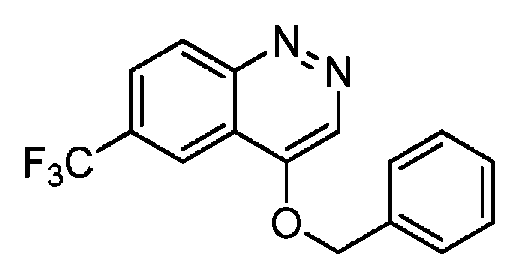
질소의 불활성 분위기로 퍼징되고 유지된 500 mL 3구 둥근바닥 플라스크에, CuI (6.4 g, 33.68 mmol, 1.20 eq), 1-메틸피롤리딘-2-온 (250 mL) 중 KF (1.97 g, 33.97 mmol, 1.20 eq)의 용액, TMS-CF3 (4.828 g, 34.00 mmol, 1.20 eq) 및 4-(벤질옥시)-6-요오도신놀린 (이전 단계에서 제조됨, 10.2 g, 28.18 mmol, 1.00 eq)을 넣었다. 반응 혼합물을 오일조에서 50℃에서 24시간 동안 교반하였다. 이어서, 30 mL의 암모니아 및 300 mL H2O를 첨가하여 반응물을 켄칭하였다. 생성된 용액을 3x300 mL의 에테르로 추출하고, 합한 에테르 부분을 2x200 mL의 염수로 세척하고, 건조하고 (Na2SO4), 진공 하에서 농축하였다. 표제 화합물을 갈색 고체로서 얻었다.To a 500 mL three-necked round bottomed flask purged and maintained in an inert atmosphere of nitrogen was added CuI (6.4 g, 33.68 mmol, 1.20 eq), KF (1.97 g, a solution of 33.97 mmol, 1.20 eq), TMS -CF 3 (4.828 g, 34.00 mmol, 1.20 eq) and 4- (benzyloxy) -6-iodo dosin Quinoline (prepared in the previous step, 10.2 g, 28.18 mmol, 1.00 eq). The reaction mixture was stirred in an oil bath at 50 < 0 > C for 24 hours. The reaction was then quenched by the addition of 30 mL ammonia and 300 mL H 2 O. The resulting solution was extracted with 3 x 300 mL of ether and the combined ether portions washed with 2 x 200 mL brine, dried (Na 2 SO 4 ) and concentrated in vacuo. The title compound was obtained as a brown solid.
단계 E: 6-(Step E: 6- ( 트라이플루오로메틸Trifluoromethyl )) 신놀린Sinnolin -4-올4-ol

250 mL 둥근바닥 플라스크에, 메탄올/에틸 아세테이트 (80/40 mL) 중 4-(벤질옥시)-6-(트라이플루오로메틸) 신놀린 (이전 단계에서 제조됨, 18.1 g, 59.54 mmol, 1.00 eq)의 용액 및 10% Pd/C (1.8 g)를 넣었다. 상기 혼합물 내로 수소를 도입하였다. H2 분위기 하에서, 반응 혼합물을 오일조에서 50℃에서 하룻밤 교반하였다. 고형물을 여과하여 제거하였다. 여과액을 진공 하에서 농축하였다. 조 생성물을 하기 조건으로 플래시-분취용-HPLC에 의해 정제하였다 (인텔플래시(IntelFlash)-1): 컬럼, 실리카 겔; 이동상, 50분 이내에 H20:CH3CN=100%에서 H2O:CH3CN =60%로 증가; 검출기, UV 254 nm. 5 g의 생성물을 얻었다. 표제 화합물을 백색 고체로서 얻었다.To a 250 mL round bottom flask was added 4- (benzyloxy) -6- (trifluoromethyl) cinnoline (prepared in the previous step, 18.1 g, 59.54 mmol, 1.00 eq) in methanol / ethyl acetate ) And 10% Pd / C (1.8 g). Hydrogen was introduced into the mixture. Under H 2 atmosphere, the reaction mixture was stirred in an oil bath at 50 ° C overnight. The solids were removed by filtration. The filtrate was concentrated in vacuo. The crude product was purified by flash-preparative-HPLC under the following conditions (Intel Flash-1): column, silica gel; Mobile phase, increased H 2 O: CH 3 CN = 100% to H 2 O: CH 3 CN = 60% within 50 min; Detector, UV 254 nm. 5 g of product was obtained. The title compound was obtained as a white solid.
LC-MS (ES, m/z) 215 [M+H]+ LC-MS (ES, m / z) 215 [M + H] +
1H-NMR (300MHz, DMSO) δ 13.790 (s, 1H), 8.287(s, 1H), 8.068-8.104(m, 1H), 7.883(s, 1H), 7.783(d, J=9Hz, 1H). 1 H-NMR (300MHz, DMSO ) δ 13.790 (s, 1H), 8.287 (s, 1H), 8.068-8.104 (m, 1H), 7.883 (s, 1H), 7.783 (d, J = 9Hz, 1H) .
단계 F: 4-Step F: 4- 클로로Chloro -6-(-6- ( 트라이플루오로메틸Trifluoromethyl ) ) 신놀린Sinnolin

100 mL 둥근바닥 플라스크에, 아세토니트릴 (30 mL) 중 6-(트라이플루오로메틸) 신놀린-4-올 (이전 단계에서 제조됨, 1.8 g, 8.41 mmol, 1.00 eq)의 용액 및 포스포릴 트라이클로라이드 (12.78 g, 84.08 mmol, 10.00 eq)를 넣었다. 반응 혼합물을 오일조에서 100℃에서 2시간 동안 교반하였다. 생성된 혼합물을 진공 하에서 농축하였다. 에틸 아세테이트/석유 에테르 (1:20-1:10)를 사용하여 실리카 겔 컬럼에서 크로마토그래피에 의해 잔류물을 정제하였다. 표제 화합물을 황색 고체로서 얻었다.To a 100 mL round bottom flask was added a solution of 6- (trifluoromethyl) cinnolin-4-ol (prepared in the previous step, 1.8 g, 8.41 mmol, 1.00 eq) in acetonitrile (30 mL) Chloride (12.78 g, 84.08 mmol, 10.00 eq). The reaction mixture was stirred in an oil bath at 100 < 0 > C for 2 hours. The resulting mixture was concentrated in vacuo. The residue was purified by chromatography on a silica gel column using ethyl acetate / petroleum ether (1: 20-1: 10). The title compound was obtained as a yellow solid.
단계 G: Step G: terttert -부틸 2-(6-(-Butyl 2- (6- ( 트라이플루오로메틸Trifluoromethyl ) ) 신놀린Sinnolin -4--4- 일아미노Amino ) 아세테이트) Acetate

8 mL 바이알에, 2-메톡시에틸 에테르 (2 mL) 중 4-클로로-6-(트라이플루오로메틸)신놀린 (이전 단계에서 제조됨, 260 mg, 1.12 mmol, 1.00 eq)의 용액, tert-부틸 2-아미노아세테이트 (187 mg, 1.12 mmol, 1.10 eq) 및 트라이에틸아민 (339 mg, 3.36 mmol, 3.00 eq)을 넣었다. 반응 혼합물을 오일조에서 100℃에서 하룻밤 교반하였다. 이어서, 4 mL의 물을 첨가하여 반응물을 켄칭하였다. 생성된 용액을 3x10 mL의 에틸 아세테이트로 추출하고, 합한 유기층을 2x10 mL의 염수로 세척하고, 건조하고 (Na2SO4), 진공 하에서 농축하였다. 표제 화합물을 황색 고체로서 얻었다.To a 8 mL vial was added a solution of 4-chloro-6- (trifluoromethyl) cinnoline (prepared in the previous step, 260 mg, 1.12 mmol, 1.00 eq) in 2-methoxyethyl ether (2 mL) -Butyl 2-aminoacetate (187 mg, 1.12 mmol, 1.10 eq) and triethylamine (339 mg, 3.36 mmol, 3.00 eq). The reaction mixture was stirred in an oil bath at 100 < 0 > C overnight. The reaction was then quenched by the addition of 4 mL of water. The resulting solution was extracted with 3 x 10 mL of ethyl acetate and the combined organic layers were washed with 2 x 10 mL brine, dried (Na 2 SO 4 ) and concentrated in vacuo. The title compound was obtained as a yellow solid.
LC-MS (ES, m/z) 328 [M+H] + LC-MS (ES, m / z) 328 [M + H] +
단계 H: 2-(6-(트라이플루오로메틸) 신놀린-4-일아미노) 아세트산Step H: 2- (6- (Trifluoromethyl) cinnolin-4-ylamino) acetic acid

100 mL 둥근바닥 플라스크에, 다이클로로메탄 (5 mL) 중 tert-부틸 2-(6-(트라이플루오로메틸)신놀린-4-일아미노)아세테이트 (이전 단계에서 제조됨, 200 mg, 0.61 mmol, 1.00 eq)의 용액 및 CF3COOH (0.2 mL)를 넣었다. 반응 혼합물을 실온에서 하룻밤 교반한 다음, 진공 하에서 농축하였다. 표제 화합물을 황색 고체로서 얻었다.To a 100 mL round bottom flask was added tert-butyl 2- (6- (trifluoromethyl) cininol-4-ylamino) acetate (prepared in the previous step, 200 mg, 0.61 mmol) in dichloromethane It was added to the solution, and CF 3 COOH (0.2 mL) of, 1.00 eq). The reaction mixture was stirred at room temperature overnight and then concentrated in vacuo. The title compound was obtained as a yellow solid.
단계 I: N-(1-((1r,4r)-4-Step I: Preparation of N- (l - ((lr, 4r) -4- 하이드록시Hydroxy -4-(티아졸-5-일)-4- (thiazol-5-yl) 사이클로헥실Cyclohexyl )) 아제티딘Azetidine -3-일)-2-((6-(Yl) -2 - ((6- ( 트라이플루오로메틸Trifluoromethyl )) 신놀린Sinnolin -4-일)아미노)Yl) amino) 아세트아미드Acetamide

8 mL 둥근바닥 플라스크에, 다이클로로메탄 (2 mL) 중 2-(6-(트라이플루오로메틸)신놀린-4-일아미노)아세트산 (이전 단계에서 제조됨, 70 mg, 0.26 mmol, 1.00 eq)의 용액, EDC (65 mg, 0.34 mmol, 1.10 eq), HOBt (38 mg, 0.28 mmol, 1.10 eq), 트라이에틸아민 (78 mg, 0.77 mmol, 3.00 eq) 및 1-(3-아미노사이클로부틸)-4-(티아졸-5-일)피페리딘-4-올 (실시예 162, 단계 F에서 제조됨) (65 mg, 0.26 mmol)을 넣었다. 반응 혼합물을 오일조에서 40℃에서 하룻밤 교반하였다. 생성된 혼합물을 진공 하에서 농축하였다. 조 생성물 (200 mg)을 하기 조건으로 분취용-HPLC에 의해 정제하였다 (1#-워터스 2767-5): 컬럼, 선파이어 프레프(SunFire Prep) C18, 5㎛, 19x100mm; 이동상, 물 및 CH3CN; 상 A: 0.05% TFA를 갖는 물, 상 B: CH3CN 구배; 검출기. 16 mg의 생성물을 얻었다. 표제 화합물을 연황색 고체로서 얻었다.To a 8 mL round bottom flask was added 2- (6- (trifluoromethyl) cinnolin-4-ylamino) acetic acid (prepared in the previous step, 70 mg, 0.26 mmol, 1.00 eq ), EDC (65 mg, 0.34 mmol, 1.10 eq), HOBt (38 mg, 0.28 mmol, 1.10 eq), triethylamine (78 mg, 0.77 mmol, 3.00 eq) and 1- (3-aminocyclobutyl) Yl) piperidin-4-ol (prepared in example 162, step F) (65 mg, 0.26 mmol). The reaction mixture was stirred in an oil bath at 40 < 0 > C overnight. The resulting mixture was concentrated in vacuo. The crude product (200 mg) was purified by preparative-HPLC (1 # -Waters 2767-5) under the following conditions: column, SunFire Prep C18, 5 [mu] m, 19x100 mm; Mobile phase, water and CH 3 CN; Phase A: Phase B water, with 0.05% TFA: CH 3 CN gradient; Detector. 16 mg of product was obtained. The title compound was obtained as a light yellow solid.
LC-MS (ES, m/z) 507 [M+H]+ LC-MS (ES, m / z) 507 [M + H] +
1H-NMR (300MHz, CD3OD) δ 8.912(s, 1H), 8.690(s, 1H), 8.609(s, 1H), 8.300-8.330(d, J=9Hz, 1H), 8.023-8.058(m, 1H), 7.839(s, 1H), 4.586(s, 1H), 4.481-4.528(m, 1H), 4.240(s, 2H), 3.749-3.799(m, 2H), 3.199(m, 2H), 2.508(s, 1H), 2.213-2.274(m, 2H), 1.755-1.944(m, 4H), 1.304-1.387(m, 2H). 1 H-NMR (300MHz, CD 3 OD) δ 8.912 (s, 1H), 8.690 (s, 1H), 8.609 (s, 1H), 8.300-8.330 (d, J = 9Hz, 1H), 8.023-8.058 ( 2H), 3.199 (m, 2 H), 3.199 (m, 2H), 4.99 (s, , 2.508 (s, 1H), 2.213-2.274 (m, 2H), 1.755-1.944 (m, 4H), 1.304-1.387 (m, 2H).
실시예Example 148 및 148 and 실시예Example 149: N-(1-((1r,4r)-4- 149: N- (1 - ((1 R, 4R) -4- 하이드록시Hydroxy -4-(티아졸-5-일)-4- (thiazol-5-yl) 사이클로헥실Cyclohexyl )) 아제티딘Azetidine -3-일)-2-((7-(Yl) -2 - ((7- ( 트라이플루오로메틸Trifluoromethyl )) 프탈아진Phthalazine -1-일)아미노)-1-yl) amino) 아세트아미드Acetamide 및 And
N-(1-((1s,4s)-4-하이드록시-4-(티아졸-5-일)사이클로헥실)아제티딘-3-일)-2-((7-(트라이플루오로메틸)프탈아진-1-일)아미노)아세트아미드Azetidin-3-yl) -2 - ((7- (trifluoromethyl) pyridin-2-yl) Yl) amino) acetamide < RTI ID = 0.0 >
단계 A: 6-니트로아이소벤조푸란-1(3H)-온Step A: 6-Nitroisobenzofuran-1 (3H) -one
2000 mL 3구 둥근바닥 플라스크에, 황산 (200 mL) 중 아이소벤조푸란-1(3H)-온 (130 g, 970.15 mmol, 1.00 eq)의 용액을 넣었다. 그 다음, 0℃에서 교반하면서 황산 (600 mL) 중 질산칼륨 (196 g, 1.94 mol, 1.39 eq)의 용액을 적가하였다. 반응 혼합물을 실온에서 하룻밤 교반하였다. 여과에 의해 고체를 수집하고 5x800 mL의 H2O로 세척하였다. 그리하여, 136 g (조 생성물)의 6-니트로아이소벤조푸란-1(3H)-온을 백색 고체로서 얻었다.A solution of isobenzofuran-1 (3H) -one (130 g, 970.15 mmol, 1.00 eq) in sulfuric acid (200 mL) was placed in a 2000 mL 3-necked round bottom flask. Then a solution of potassium nitrate (196 g, 1.94 mol, 1.39 eq) in sulfuric acid (600 mL) was added dropwise with stirring at 0 ° C. The reaction mixture was stirred at room temperature overnight. The solid was collected by filtration and washed with 5x800 mL H 2 O. Thus, 136 g (crude product) of 6-nitroisobenzofuran-1 (3H) -one was obtained as a white solid.
단계 B: 6-아미노아이소벤조푸란-1(3H)-온Step B: Preparation of 6-aminoisobenzofuran-1 (3H) -one

2000 mL 3구 둥근바닥 플라스크에, 물(50 mL) 중 6-니트로아이소벤조푸란-1(3H)-온 (이전 단계에 기재된 바와 같이 제조됨, 136 g, 759.78 mmol, 1.00 eq)의 용액, Fe (126.4 g), 에틸 아세테이트 (500 mL), 아세트산 (180 mL)을 넣었다. 반응 혼합물을 오일조에서 60℃에서 2시간 동안 교반하였다. 생성된 혼합물에 소듐 바이카르보네이트 500 mL를 첨가하였다. 생성된 용액을 5x500 mL의 에틸 아세테이트로 추출하였다. 합한 유기층을 500 mL의 염수로 세척하고, 건조하고 (Na2SO4), 진공 하에서 농축하였다. 표제 화합물을 황색 고체로서 얻었다.A solution of 6-nitroisobenzofuran-1 (3H) -one (prepared as described in the previous step, 136 g, 759.78 mmol, 1.00 eq) in water (50 mL) was added to a 2000 mL three- 126.4 g of Fe, ethyl acetate (500 mL) and acetic acid (180 mL) were placed. The reaction mixture was stirred in an oil bath at 60 < 0 > C for 2 hours. To the resulting mixture was added 500 mL of sodium bicarbonate. The resulting solution was extracted with 5x500 mL of ethyl acetate. The combined organic layers were washed with 500 mL of brine, dried (Na 2 SO 4 ) and concentrated in vacuo. The title compound was obtained as a yellow solid.
LC-MS (ES, m/z) 150 [M+H]+ LC-MS (ES, m / z) 150 [M + H] +
단계 C: 6-Step C: 6- 요오도아이소벤조푸란Iodo isobenzofuran -1(3H)-온-1 (3H) -one

2000 mL 3구 둥근바닥 플라스크에, H2O/HCl (600 mL) 중 6-아미노아이소벤조푸란-1(3H)-온 (이전 단계에 기재된 바와 같이 제조됨, 56 g, 375.84 mmol, 1.00 eq)의 용액을 넣고, 물 (200 mL) 중 NaNO2 (31.1 g, 450.72 mmol, 1.70 eq)의 용액을 0℃에서 적가하고, 물 (200 mL) 중 KI (124.8 g, 751.81 mmol, 2.00 eq) 및 CuI (17.85 g, 93.95 mmol, 0.20 eq)의 용액을 20℃ 미만에서 첨가하였다. 반응 혼합물을 실온에서 5시간 동안 교반하였다. 생성된 혼합물을 200 mL H2O로 희석하였다. 생성된 용액을 3x500 mL의 에틸 아세테이트로 추출하였다. 합한 유기층을 500 mL의 염수로 세척하고, 건조하고 (Na2SO4), 진공 하에서 농축하였다. 다이클로로메탄/석유 에테르 (50:1-5:1)를 사용하여 실리카 겔 컬럼에서 크로마토그래피에 의해 잔류물을 정제하였다. 표제 화합물을 백색 고체로서 얻었다. LC-MS (ES, m/z) 261 [M+H]+ 2000 mL round bottom flask 3 gu, H 2 O / HCl (600 mL) of 6-amino-iso-benzofuran -1 (3H) - one (prepared as described in the previous step, 56 g, 375.84 mmol, 1.00 eq ), A solution of NaNO 2 (31.1 g, 450.72 mmol, 1.70 eq) in water (200 mL) was added dropwise at 0 ° C and KI (124.8 g, 751.81 mmol, 2.00 eq) And CuI (17.85 g, 93.95 mmol, 0.20 eq) at 20 < 0 > C. The reaction mixture was stirred at room temperature for 5 hours. The resulting mixture was diluted with 200 mL H 2 O. The resulting solution was extracted with 3 x 500 mL of ethyl acetate. The combined organic layers were washed with 500 mL of brine, dried (Na 2 SO 4 ) and concentrated in vacuo. The residue was purified by chromatography on a silica gel column using dichloromethane / petroleum ether (50: 1-5: 1). The title compound was obtained as a white solid. LC-MS (ES, m / z) 261 [M + H] +
단계 D: 6-(트라이플루오로메틸)아이소벤조푸란-1(3H)-온Step D: 6- (Trifluoromethyl) isobenzofuran-1 (3H) -one

질소의 불활성 분위기로 퍼징되고 유지된 250 mL 3구 둥근바닥 플라스크에, 구리(I) 요오다이드 (30 g, 157.89 mmol, 2.00 eq), N,N-다이메틸포름아미드 (30 mL) 중 메틸 2,2-다이플루오로-2-(플루오로설포닐)아세테이트 (30 g, 144.23 mmol, 2.00 eq)의 용액 및 6-요오도아이소벤조푸란-1(3H)-온 (이전 단계에 기재된 바와 같이 제조됨, 20 g, 76.92 mmol, 1.00 eq)을 넣었다. 반응 혼합물을 오일조에서 100℃에서 하룻밤 교반하였다. 반응 진행을 GCMS로 모니터링하였다. 이어서, 15 mL의 암모니아를 첨가하여 반응물을 켄칭하였다. 생성된 용액을 3x50 mL의 에틸 아세테이트로 추출하였다. 합한 유기층을 50 mL의 염수로 세척하고, 건조하고 (Na2SO4), 진공 하에서 농축하였다. 표제 화합물을 황색 고체로서 얻었다.A solution of copper (I) iodide (30 g, 157.89 mmol, 2.00 eq) and N, N-dimethylformamide (30 mL) in a 250 mL 3-necked round bottomed flask purged and maintained in an inert atmosphere of nitrogen A solution of 2,2-difluoro-2- (fluorosulfonyl) acetate (30 g, 144.23 mmol, 2.00 eq) and 6-iodoisobenzofuran-1 (3H) , 20 g, 76.92 mmol, 1.00 eq). The reaction mixture was stirred in an oil bath at 100 < 0 > C overnight. The progress of the reaction was monitored by GCMS. The reaction was then quenched by the addition of 15 mL of ammonia. The resulting solution was extracted with 3 x 50 mL of ethyl acetate. The combined organic layers were washed with 50 mL of brine, dried (Na 2 SO 4 ) and concentrated in vacuo. The title compound was obtained as a yellow solid.
LC-MS (ES, m/z) 203 [ M+H]+ LC-MS (ES, m / z) 203 [M + H] <
단계 E: 3-브로모-6-(트라이플루오로메틸)아이소벤조푸란-1(3H)-온Step E: 3-Bromo-6- (trifluoromethyl) isobenzofuran-1 (3H) -one
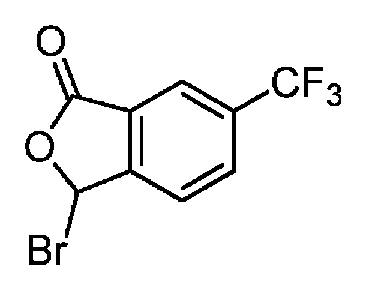
50 mL 둥근바닥 플라스크에, CCl4 (10 mL) 중 6-(트라이플루오로메틸)아이소벤조푸란-1(3H)-온 (이전 단계에 기재된 바와 같이 제조됨, 5.5 g, 27.23 mmol, 1.00 eq)의 용액, NBS (5.8 g, 32.58 mmol, 1.20 eq) 및 AIBN (0.45 g, 0.10 eq)을 넣었다. 반응 혼합물을 오일조에서 65℃에서 3시간 동안 교반하였다. 생성된 혼합물을 진공 하에서 농축하였다. 잔류물을 100 mL의 에틸 아세테이트에 용해하고, 60 mL의 염수로 세척하고, 건조하고 (Na2SO4), 진공 하에서 농축하였다. 표제 화합물을 황색 오일로서 얻었다.50 mL round bottom flask, CCl 4 (10 mL) of 6- -1 (3H) (trifluoromethyl) iso-benzofuran-one (prepared as described in the previous step, 5.5 g, 27.23 mmol, 1.00 eq ), NBS (5.8 g, 32.58 mmol, 1.20 eq) and AIBN (0.45 g, 0.10 eq). The reaction mixture was stirred in an oil bath at 65 < 0 > C for 3 hours. The resulting mixture was concentrated in vacuo. The residue was dissolved in 100 mL of ethyl acetate, washed with 60 mL of brine, dried (Na 2 SO 4 ) and concentrated in vacuo. The title compound was obtained as a yellow oil.
LC-MS (ES, m/z) 281 [M+H]+ LC-MS (ES, m / z) 281 [M + H] +
단계 F: 1-Step F: 1- 브로모Bromo -7-(-7- ( 트라이플루오로메틸Trifluoromethyl )) 프탈아진Phthalazine
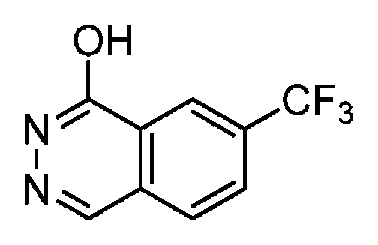
250 mL 둥근바닥 플라스크에, 에탄올 (30 mL) 중 3-브로모-6-(트라이플루오로메틸)아이소벤조푸란-1(3H)-온 (이전 단계에 기재된 바와 같이 제조됨, 8.5 g, 30.36 mmol, 1.00 eq)의 용액 및 N2H4.H2O (6 g, 111.11 mmol, 3.00 eq)를 넣었다. 반응 혼합물을 오일조에서 60℃에서 하룻밤 교반하였다. 생성된 혼합물을 진공 하에서 농축하였다. H2O/CH3CN (1-브로모-7-(트라이플루오로메틸)프탈아진)을 사용하여 실리카 겔 컬럼에서 크로마토그래피에 의해 잔류물을 정제하였다. 그리하여, 1.2 g (18%)의 1-브로모-7-(트라이플루오로메틸)프탈아진을 백색 고체로서 얻었다.To a 250 mL round bottom flask was added 3-bromo-6- (trifluoromethyl) isobenzofuran-1 (3H) -one (prepared as described in the previous step, 8.5 g, 30.36 mmol, 1.00 eq) and N 2 H 4 .H 2 O (6 g, 111.11 mmol, 3.00 eq). The reaction mixture was stirred in an oil bath at 60 < 0 > C overnight. The resulting mixture was concentrated in vacuo. The residue was purified by chromatography on a silica gel column using H 2 O / CH 3 CN (1-bromo-7- (trifluoromethyl) phthalazine). Thus, 1.2 g (18%) of 1-bromo-7- (trifluoromethyl) phthalazine was obtained as a white solid.
LC-MS (ES, m/z) 215 [M+H]+ LC-MS (ES, m / z) 215 [M + H] +
단계 G: 1-클로로-7-(트라이플루오로메틸)프탈아진Step G: 1-Chloro-7- (trifluoromethyl) phthalazine

50 mL 둥근바닥 플라스크에, 7-(트라이플루오로메틸)프탈아진-1-올 (이전 단계에 기재된 바와 같이 제조됨, 1.6 g, 7.48 mmol, 1.00 eq) 및 POCl3 (12 mL)을 넣었다. 반응 혼합물을 오일조에서 100℃에서 2시간 동안 교반하였다. 생성된 혼합물을 진공 하에서 농축하였다. 잔류물을 50 mL의 다이클로로메탄에 용해하고, 3x5 mL의 H2O로 세척하고, 건조하고(Na2SO4), 진공 하에서 농축하였다. CH3CN/H2O (10:4)를 사용하여 실리카 겔 컬럼에서 크로마토그래피에 의해 잔류물을 정제하였다. 표제 화합물을 황색 고체로서 얻었다.(Trifluoromethyl) phthalazin-1-ol (prepared as described in the previous step, 1.6 g, 7.48 mmol, 1.00 eq) and POCl 3 (12 mL) were placed in a 50 mL round bottom flask. The reaction mixture was stirred in an oil bath at 100 < 0 > C for 2 hours. The resulting mixture was concentrated in vacuo. The residue was dissolved in 50 mL of dichloromethane, washed with 3 x 5 mL of H 2 O, dried (Na 2 SO 4) and concentrated in vacuo. The residue was purified by chromatography on a silica gel column using CH 3 CN / H 2 O (10: 4). The title compound was obtained as a yellow solid.
LC-MS (ES, m/z) 233 [M+H]+ LC-MS (ES, m / z) 233 [M + H] +
단계 H: tert-부틸 3-(2-(6-(트라이플루오로메틸)프탈아진-5-일아미노)아세트아미도)아제티딘-1-카르복실레이트Step H: tert-Butyl 3- (2- (6- (trifluoromethyl) phthalazin-5-ylamino) acetamido) azetidine-

50 mL 둥근바닥 플라스크에, 2-메톡시에틸 에테르 (10 mL) 중 1-클로로-7-(트라이플루오로메틸)프탈아진 (이전 단계에 기재된 바와 같이 제조됨, 1.5 g, 6.47 mmol, 1.00 eq)의 용액, tert-부틸 3-(2-아미노아세트아미도)아제티딘-1-카르복실레이트 (실시예 1, 단계 E에 기재된 바와 같이 제조됨) (1.5 g, 6.55 mmol, 1.22 eq) 및 트라이에틸아민 (1.95 g, 19.31 mmol, 2.99 eq)을 넣었다. 반응 혼합물을 오일조에서 100℃에서 하룻밤 교반하였다. 반응 진행을 LCMS로 모니터링하였다. 생성된 혼합물을 진공 하에서 농축하였다. CH3CN:H2O (3:1)를 사용하여 실리카 겔 컬럼에서 크로마토그래피에 의해 잔류물을 정제하였다. 표제 화합물을 백색 고체로서 얻었다.To a 50 mL round bottom flask was added 1-chloro-7- (trifluoromethyl) phthalazine (prepared as described in the previous step, 1.5 g, 6.47 mmol, 1.00 eq (1.5 g, 6.55 mmol, 1.22 eq) and tert-butyl 3- (2-aminoacetamido) azetidine-1-carboxylate (prepared as described in Example 1, Step E) and Triethylamine (1.95 g, 19.31 mmol, 2.99 eq) was added. The reaction mixture was stirred in an oil bath at 100 < 0 > C overnight. The progress of the reaction was monitored by LCMS. The resulting mixture was concentrated in vacuo. The residue was purified by chromatography on a silica gel column using CH 3 CN: H 2 O (3: 1). The title compound was obtained as a white solid.
LC-MS (ES, m/z) 415 [M+H]+ LC-MS (ES, m / z) 415 [M + H] +
단계 I: N-(Step I: N- ( 아제티딘Azetidine -3-일)-2-(7-(Yl) -2- (7- ( 트라이플루오로메틸Trifluoromethyl )) 프탈아진Phthalazine -1--One- 일아미노Amino )) 아세트아미드Acetamide

25 mL 둥근바닥 플라스크에, 다이클로로메탄 (1 mL) 중 tert-부틸 3-(2-(7-(트라이플루오로메틸)프탈아진-1-일아미노)아세트아미도)아제티딘-1-카르복실레이트 (이전 단계에 기재된 바와 같이 제조됨, 160 mg, 0.38 mmol, 1.00 eq)의 용액을 넣었다. 그 다음, 트라이플루오로아세트산 (0.8 mL)을 첨가하였다. 반응 혼합물을 0℃에서 2시간 동안 교반하였다. 생성된 혼합물을 진공 하에서 농축하였다. 표제 화합물을 황색 오일로서 얻었다.To a 25 mL round bottom flask was added a solution of tert-butyl 3- (2- (7- (trifluoromethyl) phthalazin-1-ylamino) acetamido) (Prepared as described in the previous step, 160 mg, 0.38 mmol, 1.00 eq). Trifluoroacetic acid (0.8 mL) was then added. The reaction mixture was stirred at 0 < 0 > C for 2 hours. The resulting mixture was concentrated in vacuo. The title compound was obtained as a yellow oil.
LC-MS (ES, m/z) 325 [ M+H]+ LC-MS (ES, m / z) 325 [M + H] +
단계 J: N-(1-((1r,4r)-4-Step J: Preparation of N- (l - ((lr, 4r) -4- 하이드록시Hydroxy -4-(티아졸-5-일)-4- (thiazol-5-yl) 사이클로헥실Cyclohexyl )) 아제티딘Azetidine -3-일)-2-((7-(Yl) -2 - ((7- ( 트라이플루오로메틸Trifluoromethyl )) 프탈아진Phthalazine -1-일)아미노)-1-yl) amino) 아세트아미드Acetamide
N-(1-((1s,4s)-4-하이드록시-4-(티아졸-5-일)사이클로헥실)아제티딘-3-일)-2-((7-(트라이플루오로메틸)프탈아진-1-일)아미노)아세트아미드Azetidin-3-yl) -2 - ((7- (trifluoromethyl) pyridin-2-yl) Yl) amino) acetamide < RTI ID = 0.0 >
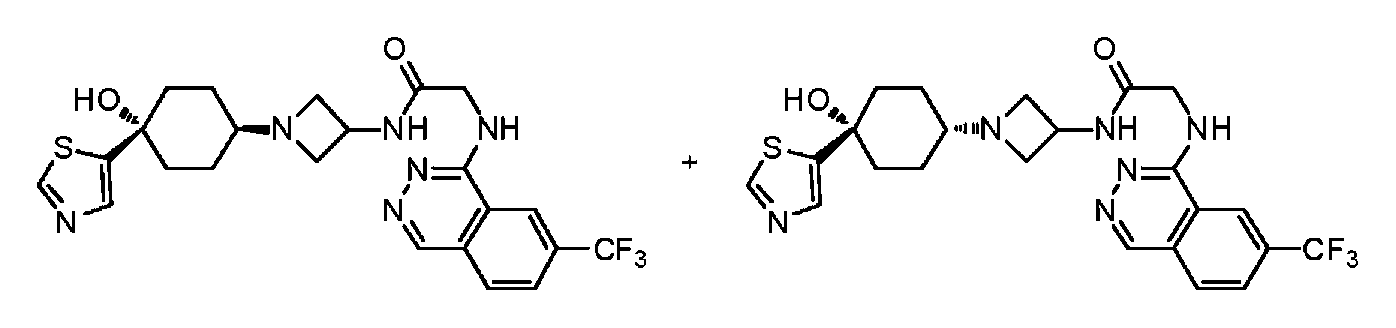
8 mL 바이알에, N-(아제티딘-3-일)-2-[[7-(트라이플루오로메틸)프탈아진-1-일]아미노]아세트아미드 (이전 단계에 기재된 바와 같이 제조됨, 150 mg, 0.46 mmol, 1.00 eq), 다이클로로메탄 (5 mL), 4-하이드록시-4-(1,3-티아졸-5-일)사이클로헥산-1-온 (실시예 26, 단계 C에 기재된 바와 같이 제조됨) (110 mg, 0.56 mmol, 1.21 eq) 및 NaB(OAc)3 (391 mg)을 넣었다. 반응 혼합물을 실온에서 하룻밤 동안 교반하였다. 생성된 혼합물을 진공 하에서 농축하였다. 조 생성물을 하기 조건으로 플래시-분취용-HPLC에 의해 정제하였다 (인텔플래시-1): 컬럼, 실리카 겔; 이동상, 12분 이내에 TFA/CH3CN=10에서 TFA/CH3CN=70으로 증가; 검출기, UV 254 nm. 표제 화합물을 백색 고체로서 단리하였다.To a 8 mL vial was added N- (azetidin-3-yl) -2 - [[7- (trifluoromethyl) phthalazin- 1 -yl] amino] acetamide (prepared as described in the previous step, (Example 26, step C, 2-ethoxy-4- (l, 3-thiazol-5-yl) cyclohexan- (110 mg, 0.56 mmol, 1.21 eq) and NaB (OAc) 3 (391 mg). The reaction mixture was stirred at room temperature overnight. The resulting mixture was concentrated in vacuo. The crude product was purified by flash-preparative-HPLC under the following conditions (Intel Flash-1): column, silica gel; Mobile phase, within 12 minutes TFA / CH 3 CN = TFA / CH 3 CN = increased to 70-10; Detector, UV 254 nm. The title compound was isolated as a white solid.
N-(1-((1r,4r)-4-하이드록시-4-(티아졸-5-일)사이클로헥실)아제티딘-3-일)-2-((7-(트라이플루오로메틸)프탈아진-1-일)아미노)아세트아미드에 대해:Azetidin-3-yl) -2 - ((7- (trifluoromethyl) pyridin-2-yl) Yl) amino) acetamide < / RTI >: < RTI ID =
LC-MS (ES, m/z) 507 [M+H]+ LC-MS (ES, m / z) 507 [M + H] +
1H-NMR (300MHz,CD3OD) 1.279-1.353(2H,m), 1.726-1.889(4H,m), 2.185-2.269(2H,m), 2.231-2.344(1H,m), 2.970-3.021(2H,m), 3.612-3.664(2H,m), 4.275(2H,s), 4.449-4.496(1H,m), 4.596(1H,s), 7.824(1H,s), 8.135-8.198(2H,m), 8.693(1H,s), 8.909(1H,s), 9.019(1H,s).N-(1-((1s,4s)-4-하이드록시-4-(티아졸-5-일)사이클로헥실)아제티딘-3-일)-2-((7-(트라이플루오로메틸)프탈아진-1-일)아미노)아세트아미드에 대해: 1 H-NMR (300MHz, CD 3 OD) 1.279-1.353 (2H, m), 1.726-1.889 (4H, m), 2.185-2.269 (2H, m), 2.231-2.344 (1H, m), 2.970-3.021 (2H, m), 3.612-3.664 (2H, m), 4.275 (2H, s), 4.449-4.496 (1H, m), 4.596 (1H, s), 7.824 (1H, s), 8.135-8.198 (1H, s), 8.69 (1H, s), 9.09 Azetidin-3-yl) -2 - ((7- (trifluoromethyl) phthalazin-1-yl) amino) acetamide:
LC-MS (ES, m/z) 507 [M+H]+ LC-MS (ES, m / z) 507 [M + H] +
1H-NMR (300MHz,CD3OD) δ 9.028(s, 1H) , 8.861(s, 1H), 8.703(s, 1H), 8.169-8.173(m, 2H), 7.736(s, 1H), 4.286(s, 2H), 4.506(m, 1H), 3.669-3.721(m, 2H), 3.060-3.112(m, 2H), 2.040(d, J=12.6Hz, 1H), 1.822(d, J=3.3Hz, 2H), 1.552-1.686(m, 4H), 1.525(m, 2H). 1 H-NMR (300MHz, CD 3 OD) δ 9.028 (s, 1H), 8.861 (s, 1H), 8.703 (s, 1H), 8.169-8.173 (m, 2H), 7.736 (s, 1H), 4.286 (s, 2H), 4.506 (m, 1H), 3.669-3.721 (m, 2H), 3.060-3.112 (m, 2H), 2.040 (d, J = 12.6 Hz, Hz, 2H), 1.552-1.686 (m, 4H), 1.525 (m, 2H).
실시예 150 및 실시예 151:Examples 150 and 151:
N-(1-((1R,4s)-4-((S)-1-N- (1 - ((1 R, 4S) -4 - ((S) -1- 하이드록시프로필Hydroxypropyl )) 사이클로헥실Cyclohexyl )) 아제티딘Azetidine -3-일)-2-((3-(Yl) -2 - ((3- ( 트라이플루오로메틸Trifluoromethyl )-1,6-) -1,6- 나프티리딘Naphthyridine -5-일)아미노)5-yl) amino) 아세트아미드Acetamide 및 And
N-(1-((1S,4r)-4-((S)-1-N- (1 - ((1S, 4R) -4 - ((S) -1- 하이드록시프로필Hydroxypropyl )) 사이클로헥실Cyclohexyl )) 아제티딘Azetidine -3-일)-2-((3-(트3-yl) -2 - ((3- 라이플루오로Rifluro 메틸)-1,6-Methyl) -1, 6- 나프티리딘Naphthyridine -5-일)아미노)5-yl) amino) 아세트아미드Acetamide

100 mL 둥근바닥 플라스크에, 다이클로로메탄 (5 mL) 중 N-(아제티딘-3-일)-2-(3-(트라이플루오로메틸)-1,6-나프티리딘-5-일아미노)아세트아미드 (실시예 146, 단계 G에 기재된 바와 같이 제조됨) (325 mg, 1.00 mmol, 1.00 eq)의 용액, 4-(1-하이드록시프로필)사이클로헥사논 (실시예 25, 단계 B에서 제조됨) (170 mg, 1.09 mmol), NaBH(OAc)3 (636 mg, 3.00 mmol, 3.00 eq) 및 트라이에틸아민 (303 mg, 3.00 mmol, 3.00 eq)을 넣었다. 반응 혼합물을 실온에서 하룻밤 동안 교반하였다. 생성된 혼합물을 진공 하에서 농축하였다. 조 생성물 (500 mg)을 하기 조건으로 분취용-HPLC에 의해 정제하였다 (1#-PreP-HPLC-005(워터스)): 컬럼, 애틀란티스 T35 ㎛, 19 x 150 mm HPrepC-014(T) 186003698 011238204113 05; 이동상, 상 A: 50 mL NH4CO3을 갖는 물, 상 B: CH3CN 구배; 검출기, UV 254 nm. 표제 화합물을 백색 고체로서 단리하였다.To a 100 mL round bottom flask was added a solution of N- (azetidin-3-yl) -2- (3- (trifluoromethyl) -1,6-naphthyridin- (Prepared as described in Example 25, Step B) in acetone (2 mL) was treated with a solution of 4- (1-hydroxypropyl) cyclohexanone (prepared as described in Example 146, Step G) (325 mg, 1.00 mmol, (170 mg, 1.09 mmol), NaBH (OAc) 3 (636 mg, 3.00 mmol, 3.00 eq) and triethylamine (303 mg, 3.00 mmol, 3.00 eq). The reaction mixture was stirred at room temperature overnight. The resulting mixture was concentrated in vacuo. The crude product (500 mg) was purified by preparative-HPLC (1 # -PreP-HPLC-005 (Waters)): column, Atlantis T35 urn, 19 x 150 mm HPrepC-014 (T) 186003698 011238204113 05; Mobile phase, phase A: water with 50 mL NH 4 CO 3 , phase B: CH 3 CN gradient; Detector, UV 254 nm. The title compound was isolated as a white solid.
N-(1-((1R,4s)-4-((S)-1-하이드록시프로필)사이클로헥실)아제티딘-3-일)-2-((3-(트라이플루오로메틸)-1,6-나프티리딘-5-일)아미노)아세트아미드에 대해:Azetidin-3-yl) -2 - ((3- (trifluoromethyl) - 1 - ((1R, 4S) -4- , 6-naphthyridin-5-yl) amino) acetamide:
LC-MS (ES, m/z) 466 [M+H]+ LC-MS (ES, m / z) 466 [M + H] +
1H-NMR (300MHz, CD3OD) δ9.045(s, 1H), 8.955(s, 1H), 8.115(d, J=4.8Hz, 1H), 7.077(d, J=4.8Hz, 1H), 4.360-4.394(m, 1H), 4.107(s, 2H), 3.562(s, 2H), 2.232(s, 1H), 1.177-1.492(m, 12H), 0.842-0.860(m, 3H).N-(1-((1S,4r)-4-((S)-1-하이드록시프로필)사이클로헥실)아제티딘-3-일)-2-((3-(트라이플루오로메틸)-1,6-나프티리딘-5-일)아미노)아세트아미드에 대해: 1 H-NMR (300MHz, CD 3 OD) δ9.045 (s, 1H), 8.955 (s, 1H), 8.115 (d, J = 4.8Hz, 1H), 7.077 (d, J = 4.8Hz, 1H) 2H), 3.562 (s, 2H), 2.232 (s, 1H), 1.177-1.492 (m, 12H), 0.842-0.860 - ((3- (trifluoromethyl) -1, 3-dihydroxypropyl) cyclohexyl) 6-naphthyridin-5-yl) amino) acetamide: < EMI ID =
LC-MS (ES, m/z) 466 [M+H]+ LC-MS (ES, m / z) 466 [M + H] +
1H-NMR (300MHz, CD3OD) δ9.1595(d, J=0.6Hz, 1H), 9.064-9.071(m, 1H), 8.226(d, J=6Hz, 1H), 7.178-7.201(m, 1H), 4.479-4.526(m, 1H), 4.220(s, 2H), 3.73-3.76(m, 2H), 3.115-3.201(m, 3H), 2.147(m, 1H), 1.849-1.952 (m, 3H), 1.864-1.878(m, 1H), 1.356-1.525(m, 4H), 1.062-1.164(m, 6H). 1 H-NMR (300MHz, CD 3 OD) δ9.1595 (d, J = 0.6Hz, 1H), 9.064-9.071 (m, 1H), 8.226 (d, J = 6Hz, 1H), 7.178-7.201 (m 2H), 3.15-3.201 (m, 3H), 2.147 (m, 1H), 1.849-1.952 (m, 1H), 4.479-4.526 , 3H), 1.864-1.878 (m, 1H), 1.356-1.525 (m, 4H), 1.062-1.164 (m, 6H).
실시예Example 152: N-(1-(4-(1- 152: N- (1- (4- (1- 하이드록시프로필Hydroxypropyl )) 사이클로헥실Cyclohexyl )) 아제티딘Azetidine -3-일)-2-(6-(Yl) -2- (6- ( 트라이플루오로메틸Trifluoromethyl )) 신놀린Sinnolin -4--4- 일아미노Amino )) 아세트아미드Acetamide
단계 A: Step A: terttert -부틸 3-(2-(6-(Butyl 3- (2- (6- ( 트라이플루오로메틸Trifluoromethyl )) 신놀린Sinnolin -4--4- 일아미노Amino )) 아세트아미도Acetamido )) 아제티딘Azetidine -1--One- 카르복실레이트Carboxylate

100-mL 둥근바닥 플라스크에, 2-메톡시에틸 에테르 (10 ml) 중 4-클로로-6-(트라이플루오로메틸)신놀린 (실시예 147, 단계 F에 기재된 바와 같이 제조됨) (700 mg, 3.00 mmol)의 용액, 실시예 1, 단계 E로부터의 tert-부틸 3-(2-아미노아세트아미도)아제티딘-1-카르복실레이트 (687 mg, 3.00 mmol) 및 트라이에틸아민 (909 mg, 9.00 mmol)을 넣었다. 반응 혼합물을 120℃에서 하룻밤 동안 교반하였다. 생성된 혼합물을 진공 하에서 농축하였다. CH3CN:H2O (0~40%)를 사용하여 실리카 겔 컬럼에서 크로마토그래피에 의해 잔류물을 정제하여 표제 화합물을 백색 고체로서 얻었다.To a 100-mL round-bottomed flask was added 4-chloro-6- (trifluoromethyl) cinnoline (prepared as described in Example 147, Step F) (700 mg , 3.00 mmol), tert-butyl 3- (2-aminoacetamido) azetidine-1-carboxylate from Example 1, Step E (687 mg, 3.00 mmol) and triethylamine , 9.00 mmol). The reaction mixture was stirred at 120 < 0 > C overnight. The resulting mixture was concentrated in vacuo. The residue was purified by chromatography on a silica gel column using CH 3 CN: H 2 O (0-40%) to give the title compound as a white solid.
단계 B: N-(아제티딘-3-일)-2-(6-(트라이플루오로메틸)신놀린-4-일아미노)아세트아미드Step B: N- (Azetidin-3-yl) -2- (6- (trifluoromethyl) cinnolin-4- ylamino) acetamide

50 mL 둥근바닥 플라스크에, 다이클로로메탄 (10 ml) 중 tert-부틸 3-(2-(6-(트라이플루오로메틸)신놀린-4-일아미노)아세트아미도)아제티딘-1-카르복실레이트 (140 mg, 0.33 mmol)의 용액 및 CF3COOH (1 ml)를 넣었다. 반응 혼합물을 실온에서 2시간 동안 교반하였다. 생성된 혼합물을 진공 하에서 농축하여 황색 오일로서 표제 화합물을 얻었다.To a 50 mL round bottom flask was added a solution of tert-butyl 3- (2- (6- (trifluoromethyl) cinnolin-4-ylamino) acetamido) It was added to the solution, and CF 3 COOH (1 ml) of the carboxylate (140 mg, 0.33 mmol). The reaction mixture was stirred at room temperature for 2 hours. The resulting mixture was concentrated in vacuo to give the title compound as a yellow oil.
단계 C: N-(1-(4-(1-하이드록시프로필)사이클로헥실)아제티딘-3-일)-2-(6-(트라이플루오로메틸)신놀린-4-일아미노)아세트아미드의 합성Step C: Preparation of N- (1- (4- (1-hydroxypropyl) cyclohexyl) azetidin-3-yl) -2- (6- (trifluoromethyl) Synthesis of

100 mL 둥근바닥 플라스크에, 다이클로로메탄 (30 mL) 중 N-(아제티딘-3-일)-2-(6-(트라이플루오로메틸)신놀린-4-일아미노)아세트아미드 (이전 단계에서 제조됨, 450 mg, 1.38 mmol, 1.00 eq)의 용액, 4-(1-하이드록시프로필)사이클로헥사논 (실시예 25, 단계 B에 기재된 바와 같음) (216 mg, 1.38 mmol, 1.00 eq), NaBH(OAc)3 (877 mg, 4.14 mmol, 3.00 eq) 및 트라이에틸아민 (418 mg, 4.14 mmol, 3.00 eq)을 넣었다. 반응 혼합물을 실온에서 하룻밤 동안 교반하였다. 생성된 혼합물을 진공 하에서 농축하였다. 조 생성물 (500mg)을 하기 조건으로 분취용-HPLC에 의해 정제하였다 (1#-워터스 2767-5): 컬럼, 선파이어 프레프 C18, 5㎛, 19x100mm; 이동상, 물 및 CH3CN (30% CH3CN으로부터 13분 후에 40%까지 증가, 0.1분 후에 100%까지 증가, 2분 동안 100% 유지, 0.1분 후에 30%까지 감소, 1.4분 동안 30% 유지); 검출기, UV 220&254 nm. 표제 화합물을 연황색 고체로서 얻었다.To a 100 mL round bottom flask was added N- (azetidin-3-yl) -2- (6- (trifluoromethyl) cininol-4-ylamino) (216 mg, 1.38 mmol, 1.00 eq), 4- (1-hydroxypropyl) cyclohexanone (as described in Example 25, Step B) in acetonitrile , NaBH (OAc) 3 (877 mg, 4.14 mmol, 3.00 eq) and triethylamine (418 mg, 4.14 mmol, 3.00 eq). The reaction mixture was stirred at room temperature overnight. The resulting mixture was concentrated in vacuo. The crude product (500 mg) was purified by preparative-HPLC (1 # -Waters 2767-5) under the following conditions: column, Sunfire prep C18, 5 m, 19x100 mm; Mobile phase, water and CH 3 CN (30% CH increase from 3 CN to 40% after 13 minutes, increased to 100% after 0.1 minutes, maintaining 100% for 2 minutes, decreased to 30% at 0.1 minutes, 30% over 1.4 minutes maintain); Detector, UV 220 & 254 nm. The title compound was obtained as a light yellow solid.
LC-MS (ES, m/z) 466 [M+H]+ LC-MS (ES, m / z) 466 [M + H] +
1H-NMR (300MHz CDCl3) δ 8.691 (s, 1H), 8.601(s, 1H), 8.302-8.332(d, J=9Hz, 1H), 8.026-8.056(d, J=9Hz, 1H), 4.476-4.522(m, 1H), 4.232(s, 2H), 3.635-3.684(m, 2H), 2.937-2.984(m, 2H), 2.301(s, 1H), 1.287-1.656(m, 11H), 0.940-0.989(m, 3H). 1 H-NMR (300MHz CDCl 3 ) δ 8.691 (s, 1H), 8.601 (s, 1H), 8.302-8.332 (d, J = 9Hz, 1H), 8.026-8.056 (d, J = 9Hz, 1H), 2H), 2.397-2.984 (m, 2H), 2.301 (s, 1H), 1.287-1.656 (m, 11H) 0.940-0.989 (m, 3H).
실시예Example 153 및 153 and 실시예Example 154: 154:
N-(1-((1R,4s)-4-((S)-1-N- (1 - ((1 R, 4S) -4 - ((S) -1- 하이드록시프로필Hydroxypropyl )) 사이클로헥실Cyclohexyl )) 아제티딘Azetidine -3-일)-2-((7-(Yl) -2 - ((7- ( 트라이플루오로메틸Trifluoromethyl )) 프탈아진Phthalazine -1-일)아미노)-1-yl) amino) 아세트아미드Acetamide 및 And
N-(1-((1R,4r)-4-((R)-1-N- (1 - ((1 R, 4R) -4 - ((R) -1- 하이드록시프로필Hydroxypropyl )) 사이클로헥실Cyclohexyl )) 아제티딘Azetidine -3-일)-2-((7-(Yl) -2 - ((7- ( 트라이플루오로메틸Trifluoromethyl )) 프탈아진Phthalazine -1-일)아미노)-1-yl) amino) 아세트아미드Acetamide

25 mL 둥근바닥 플라스크에, N-(아제티딘-3-일)-2-[[7-(트라이플루오로메틸)프탈아진-1-일]아미노]아세트아미드 (실시예 148, 단계 I에서 제조됨) (100 mg, 0.31mmol, 1.00 eq), 다이클로로메탄 (5 mL), 4-(1-하이드록시프로필)사이클로헥산-1-온 (실시예 25, 단계 B에 기재된 바와 같음) (67 mg, 0.43 mmol, 1.40 eq), 소듐 트라이아세톡시보로하이드라이드 (261 mg) 및 TEA (73 mg)를 넣었다. 반응 혼합물을 실온에서 하룻밤 동안 교반하였다. 생성된 혼합물을 진공 하에서 농축하였다. 조 생성물 (120 mg)을 하기 조건으로 플래시-분취용-HPLC에 의해 정제하였다 (인텔플래시-1): 컬럼, 실리카 겔; 이동상, 9분 이내에 TFA/CH3CN=10에서 TFA/CH3CN=100으로 증가; 검출기, UV 254 nm. 화합물 N-(1-((1R,4s)-4-((S)-1-하이드록시프로필)사이클로헥실)아제티딘-3-일)-2-((7-(트라이플루오로메틸)프탈아진-1-일)아미노)아세트아미드를 연황색 고체로서 단리하였고, N-(1-((1R,4r)-4-((R)-1-하이드록시프로필)사이클로헥실)아제티딘-3-일)-2-((7-(트라이플루오로메틸)프탈아진-1-일)아미노)아세트아미드를 백색 고체로서 단리하였다.To a 25 mL round bottom flask was added N- (azetidin-3-yl) -2 - [[7- (trifluoromethyl) phthalazin- 1 -yl] amino] acetamide (prepared in Example 148, (100 mg, 0.31 mmol, 1.00 eq), dichloromethane (5 mL), 4- (1-hydroxypropyl) cyclohexan-1-one (as described in Example 25, Step B) mg, 0.43 mmol, 1.40 eq), sodium triacetoxyborohydride (261 mg) and TEA (73 mg). The reaction mixture was stirred at room temperature overnight. The resulting mixture was concentrated in vacuo. The crude product (120 mg) was purified by flash-preparative-HPLC (Intel Flash-1) under the following conditions: column, silica gel; Mobile phase, 9 minutes within TFA / CH 3 CN = TFA / CH 3 CN = increased 100-10; Detector, UV 254 nm. Azetidin-3-yl) -2 - ((7- (trifluoromethyl) phthalate, Azin-1-yl) amino) acetamide was isolated as a light yellow solid and was purified by flash chromatography to yield N- (1 - ((1 R, 4r) -4- -Yl) -2 - ((7- (trifluoromethyl) phthalazin-1-yl) amino) acetamide was isolated as a white solid.
N-(1-((1R,4s)-4-((S)-1-하이드록시프로필)사이클로헥실)아제티딘-3-일)-2-((7-(트라이플루오로메틸)프탈아진-1-일)아미노)아세트아미드에 대해:Azetidin-3-yl) -2 - ((7- (trifluoromethyl) phthalazin-1-yl) Yl) < / RTI > amino) acetamide: < RTI ID =
LC-MS (ES, m/z) 466 [M+H]+ LC-MS (ES, m / z) 466 [M + H] +
1H-NMR (CD3OD, ppm) 0.930-0.980 (3H, m), 1.373-1.508(11H, m), 2.300(1H,m), 2.962(2H, m), 3.336(1H,m), 3.644(2H, m), 4.277(2H, s), 4.489(1H, m), 8.164(2H, d), 8.697(1H, s), 9.021(1H, s).N-(1-((1R,4r)-4-((R)-1-하이드록시프로필)사이클로헥실)아제티딘-3-일)-2-((7-(트라이플루오로메틸)프탈아진-1-일)아미노)아세트아미드에 대해: 1 H-NMR (CD 3 OD , ppm) 0.930-0.980 (3H, m), 1.373-1.508 (11H, m), 2.300 (1H, m), 2.962 (2H, m), 3.336 (1H, m), (2H, m), 4.277 (2H, s), 4.489 (1H, m), 8.164 (2H, d), 8.697 (Trifluoromethyl) phthalazin-1-yl) amino) acetic acid (1 g, For amides:
LC-MS (ES, m/z) 466 [M+H]+ LC-MS (ES, m / z) 466 [M + H] +
1H-NMR (CD3OD, 300MHz) δ9.021(s, 1H), 8.697(s, 1H),8.164(2H, J=1.5Hz,d), 4.489(m, 1H), 4.277(s, 2H), 3.644(m, 2H), 3.336(m, 1H), 2.962(m, 2H), 2.300(m, 1H), 1.373-1.508(m, 11H), 0.930-0.980 (m, 3H). 1 H-NMR (CD 3 OD , 300MHz) δ9.021 (s, 1H), 8.697 (s, 1H), 8.164 (2H, J = 1.5Hz, d), 4.489 (m, 1H), 4.277 (s, 2H), 3.644 (m, 2H), 3.336 (m, 1H), 2.962 (m, 2H), 2.300 (m, 1H), 1.373-1.508 (m, 11H), 0.930-0.980
실시예Example 155 및 155 and 실시예Example 156: 156:
N-(1-((1R,4s)-4-((S)-1-N- (1 - ((1 R, 4S) -4 - ((S) -1- 하이드록시Hydroxy -2--2- 메틸프로필Methyl propyl )) 사이클로헥실Cyclohexyl )) 아제티딘Azetidine -3-일)-2-((3-(트3-yl) -2 - ((3- 라이플루오로Rifluro 메틸)-1,6-Methyl) -1, 6- 나프티리딘Naphthyridine -5-일)아미노)5-yl) amino) 아세트아미드Acetamide 및 And
N-(1-((1R,4r)-4-((R)-1-N- (1 - ((1 R, 4R) -4 - ((R) -1- 하이드록시Hydroxy -2--2- 메틸프로필Methyl propyl )) 사이클로헥실Cyclohexyl )) 아제티딘Azetidine -3-일)-2-((3-(Yl) -2 - ((3- ( 트라이플루오로메틸Trifluoromethyl )-1,6-) -1,6- 나프티리딘Naphthyridine -5-일)아미노)5-yl) amino) 아세트아미드Acetamide

10 mL 둥근바닥 플라스크에, 다이클로로메탄 (5 mL) 중 N-(아제티딘-3-일)-2-(3-(트라이플루오로메틸)-1,6-나프티리딘-5-일아미노)아세트아미드 (실시예 146, 단계 G에서 제조됨) (325 mg, 1.00 mmol, 1.00 eq)의 용액, 4-(1-하이드록시-2-메틸프로필)사이클로헥사논 (실시예 7, 단계 B에서 제조됨) (170 mg, 1.00 mmol), NaBH(OAc)3 (636 mg, 3.00 mmol, 3.00 eq) 및 트라이에틸아민 (303 mg, 3.00 mmol, 3.00 eq)을 넣었다. 반응 혼합물을 실온에서 하룻밤 동안 교반하였다. 생성된 혼합물을 진공 하에서 농축하였다. 조 생성물을 하기 조건으로 분취용-HPLC에 의해 정제하였다 (1#-워터스 2767-5): 컬럼, 선파이어 프레프 C18, 5㎛, 19x100mm; 이동상, 물 및 CH3CN (30% CH3CN으로부터 13분 후에 40%까지 증가, 0.1분 후에 100%까지 증가, 2분 동안 100% 유지, 0.1분 후에 30%까지 감소, 1.4분 동안 30% 유지); 검출기, UV 220&254 nm. 화합물 N-(1-((1R,4s)-4-((S)-1-하이드록시-2-메틸프로필)사이클로헥실)아제티딘-3-일)-2-(3-(트라이플루오로메틸)-1,6-나프티리딘-5-일아미노)아세트아미드를 연황색 고체로서 단리하였고, N-(1-((1R,4r)-4-((R)-1-하이드록시-2-메틸프로필)사이클로헥실)아제티딘-3-일)-2-(3-(트라이플루오로메틸)-1,6-나프티리딘-5-일아미노)아세트아미드를 녹색 고체로서 단리하였다.To a 10 mL round bottom flask was added N- (azetidin-3-yl) -2- (3- (trifluoromethyl) -l, 6-naphthyridin- (Example 7, step B) was reacted with 4- (1-hydroxy-2-methylpropyl) cyclohexanone in place of acetonitrile (example 146, prepared in step G) (325 mg, 1.00 mmol, were placed Manufactured) (170 mg, 1.00 mmol) , NaBH (OAc) 3 (636 mg, 3.00 mmol, 3.00 eq) and triethylamine (303 mg, 3.00 mmol, 3.00 eq). The reaction mixture was stirred at room temperature overnight. The resulting mixture was concentrated in vacuo. The crude product was purified by preparative-HPLC (1 # - Waters 2767-5) under the following conditions: Column, Sunfire prep C18, 5 m, 19 x 100 mm; Mobile phase, water and CH 3 CN (30% CH increase from 3 CN to 40% after 13 minutes, increased to 100% after 0.1 minutes, maintaining 100% for 2 minutes, decreased to 30% at 0.1 minutes, 30% over 1.4 minutes maintain); Detector, UV 220 & 254 nm. Azetidin-3-yl) -2- (3- (trifluoromethoxy) -2-methylpropyl) 5-ylamino) acetamide was isolated as a light yellow solid which was used in the next step without further purification of N- (1 - ((1 R, 4r) -4 - ((R) Yl) -2- (3- (trifluoromethyl) -1, 6-naphthyridin-5-ylamino) acetamide was isolated as a green solid.
N-(1-((1R,4s)-4-((S)-1-하이드록시-2-메틸프로필)사이클로헥실)아제티딘-3-일)-2-((3-(트라이플루오로메틸)-1,6-나프티리딘-5-일)아미노)아세트아미드에 대해:Azetidin-3-yl) -2 - ((3- (trifluoromethoxy) -2-methylpropyl) Methyl) -l, 6-naphthyridin-5-yl) amino) acetamide:
LC-MS (ES, m/z) 480 [M+H]+ LC-MS (ES, m / z) 480 [M + H] +
1H-NMR (300MHz, CD3OH) δ 9.157-9.162(d, J=1.5Hz, 1H), 9.071(s, 1H), 8.228(d, J=6Hz, 1H), 7.19(d, J=6Hz, 1H), 4.467-4.490(m, 1H), 4.219(s, 2H), 3.640-3.688(m, 2H), 3.208-3.230(m, 1H), 2.996(s, 2H), 2.324(s, 1H), 1.767-1.790(m, 1H), 1.337-1.548(m, 9H), 0.949(d, J=6.6Hz, 3H), 0.844(d, J=6.6Hz, 3H).N-(1-((1R,4s)-4-((S)-1-하이드록시-2-메틸프로필)사이클로헥실)아제티딘-3-일)-2-((3-(트라이플루오로메틸)-1,6-나프티리딘-5-일)아미노) 아세트아미드에 대해: 1 H-NMR (300 MHz, CD 3 OH)? 9.157-9.162 (d, J = 1.5 Hz, 1H), 9.071 (S, 2H), 2.324 (s, 2H), 3.40 (m, J = 6.6 Hz, 3H), 0.844 (d, J = 6.6 Hz, 3H). N- (1- 2 - ((3- (trifluoromethyl) -1, 3-dihydroxypropyl) cyclohexyl) 6-naphthyridin-5-yl) amino) acetamide: < EMI ID =
LC-MS (ES, m/z) 480 [M+H]+ LC-MS (ES, m / z) 480 [M + H] +
1H-NMR (300MHz,CD3OH)δ 9.166(1H, s), 9.073(1H, s), 8.234(d, J=4.2Hz, 1H), 7.199(d, J=4.8Hz, 1H), 4.474-4.509(m, 1H), 4.221(s, 2H), 3.667-3.930(m, 2H), 2.947-3.154(m, 3H), 1.611-2.065(m, 6H), 1.368(s, 1H), 1.153-1.185(m, 4H), 1.068(s, 6H). 1 H-NMR (300MHz, CD3OH ) δ 9.166 (1H, s), 9.073 (1H, s), 8.234 (d, J = 4.2Hz, 1H), 7.199 (d, J = 4.8Hz, 1H), 4.474- (M, 2H), 1.363 (s, 1H), 1.153 (m, 2H) 1.185 (m, 4 H), 1.068 (s, 6 H).
실시예Example 157 및 157 and 실시예Example 158: 158:
N-(1-((1R,4s)-4-((S)-1-N- (1 - ((1 R, 4S) -4 - ((S) -1- 하이드록시Hydroxy -2--2- 메틸프로필Methyl propyl )) 사이클로헥실Cyclohexyl )) 아제티딘Azetidine -3-일)-2-((6-(트3-yl) -2 - ((6- 라이플루오로Rifluro 메틸)methyl) 신놀린Sinnolin -4-일)아미노)Yl) amino) 아세트아미드Acetamide 및 And
N-(1-((1R,4r)-4-((R)-1-하이드록시-2-메틸프로필)사이클로헥실)아제티딘-3-일)-2-((6-(트라이플루오로메틸)신놀린-4-일)아미노)아세트아미드Azetidin-3-yl) -2 - ((6- (trifluoromethoxy) -2-methylpropyl) Methyl) cinnolin-4-yl) amino) acetamide

100 mL 둥근바닥 플라스크에, 다이클로로메탄 (20 mL) 중 N-(아제티딘-3-일)-2-(6-(트라이플루오로메틸)신놀린-4-일아미노)아세트아미드 (실시예 152, 단계 B에 기재된 바와 같이 제조됨) (150 mg, 0.46 mmol, 1.00 eq)의 용액, 4-(1-하이드록시-2-메틸프로필)사이클로헥사논 (실시예 7, 단계 B에서 제조됨) (54 mg, 0.32 mmol, 1.00 eq), NaBH(OAc)3 (135 mg, 0.64 mmol, 3.00 eq) 및 트라이에틸아민 (97 mg, 0.96 mmol, 2.08 eq)을 넣었다. 반응 혼합물을 실온에서 하룻밤 동안 교반하였다. 생성된 혼합물을 진공 하에서 농축하였다. 조 생성물 (500mg)을 하기 조건으로 분취용-HPLC에 의해 정제하였다 (1#-워터스 2767-5): 컬럼, 선파이어 프레프 C18, 5㎛, 19x100mm; 이동상, 물 및 CH3CN (30% CH3CN으로부터 13분 후에 40%까지 증가, 0.1분 후에 100%까지 증가, 2분 동안 100% 유지, 0.1분 후에 30%까지 감소, 1.4분 동안 30% 유지); 검출기, UV 220&254 nm. 표제 화합물을 연황색 고체로서 단리하였다.To a 100 mL round bottom flask was added N- (azetidin-3-yl) -2- (6- (trifluoromethyl) cininol-4-ylamino) (Prepared as described in Example 7, Step B), in place of 4- (1-hydroxy-2-methylpropyl) cyclohexanone ) (54 mg, 0.32 mmol, 1.00 eq), NaBH (OAc) 3 (135 mg, 0.64 mmol, 3.00 eq) and triethylamine (97 mg, 0.96 mmol, 2.08 eq). The reaction mixture was stirred at room temperature overnight. The resulting mixture was concentrated in vacuo. The crude product (500 mg) was purified by preparative-HPLC (1 # -Waters 2767-5) under the following conditions: column, Sunfire prep C18, 5 m, 19x100 mm; Mobile phase, water and CH 3 CN (30% CH increase from 3 CN to 40% after 13 minutes, increased to 100% after 0.1 minutes, maintaining 100% for 2 minutes, decreased to 30% at 0.1 minutes, 30% over 1.4 minutes maintain); Detector, UV 220 & 254 nm. The title compound was isolated as a light yellow solid.
N-(1-((1R,4s)-4-((S)-1-하이드록시-2-메틸프로필)사이클로헥실)아제티딘-3-일)-2-((6-(트라이플루오로메틸)신놀린-4-일)아미노)아세트아미드에 대해:Azetidin-3-yl) -2 - ((6- (trifluoromethoxy) -2-methylpropyl) Methyl) cinnolin-4-yl) amino) acetamide: <
LC-MS (ES, m/z) 480 [M+H]+ LC-MS (ES, m / z) 480 [M + H] +
1H-NMR (300MHz, CD3OH) δ 8.684(s, 1H), 8.602(s, 1H), 8.310(d, J=9Hz, 1H), 8.030(d, J=12.6Hz, 1H), 4.456-4.591(m, 2H), 4.234(s, 2H), 3.721-3.746(m, 2H), 3.11-3.207(m, 3H), 2.439(s, 1H), 1.311-1.815(m, 11H), 0.847-0.963(m, 6H).N-(1-((1R,4r)-4-((R)-1-하이드록시-2-메틸프로필)사이클로헥실)아제티딘-3-일)-2-((6-(트라이플루오로메틸)신놀린-4-일)아미노)아세트아미드에 대해: 1 H-NMR (300MHz, CD 3 OH) δ 8.684 (s, 1H), 8.602 (s, 1H), 8.310 (d, J = 9Hz, 1H), 8.030 (d, J = 12.6Hz, 1H), 4.456 2H), 4.231 (s, 2H), 3.721-3.746 (m, 2H), 3.11-3.207 (m, 3H), 2.439 -0.963 (m, 6H). N - (1 - ((1 R, 4r) -4 - ((R) -1- ((6- (trifluoromethyl) cinnolin-4-yl) amino) acetamide:
LC-MS (ES, m/z) 480 [M+H]+ LC-MS (ES, m / z) 480 [M + H] +
1H-NMR (300MHz, CD3OH) δ8.693(s, 1H), 8.608(s, 1H), 8.319(d, J=9Hz, 1H), 8.025-8.061(m, 1H), 4.501-4.549(m, 1H), 4.238(s, 2H), 3.773-3.802(m, 2H), 3.195-3.336(m, 2H), 2.948-2.987(m, 1H), 2.201-2.215(m, 1H), 1.172-1.952(m, 11H), 1.006-1.096(m, 6H). 1 H-NMR (300MHz, CD 3 OH) δ8.693 (s, 1H), 8.608 (s, 1H), 8.319 (d, J = 9Hz, 1H), 8.025-8.061 (m, 1H), 4.501-4.549 (m, IH), 2.201-2.215 (m, IH), 1.172 (m, IH), 4.238 (s, 2H), 3.773-3.802 -1.952 (m, 11H), 1.006-1.096 (m, 6H).
실시예Example 159 및 159 and 실시예Example 160: 160:
N-(1-((1R,4s)-4-((S)-1-N- (1 - ((1 R, 4S) -4 - ((S) -1- 하이드록시Hydroxy -2--2- 메틸프로필Methyl propyl )) 사이클로헥실Cyclohexyl )) 아제티딘Azetidine -3-일)-2-((7-(트3-yl) -2 - ((7- 라이플루오로Rifluro 메틸)methyl) 프탈아진Phthalazine -1-일)아미노)-1-yl) amino) 아세트아미드Acetamide 및 And
N-(1-((1S,4r)-4-((S)-1-N- (1 - ((1S, 4R) -4 - ((S) -1- 하이드록시Hydroxy -2--2- 메틸프로필Methyl propyl )) 사이클로헥실Cyclohexyl )) 아제티딘Azetidine -3-일)-2-((7-(Yl) -2 - ((7- ( 트라이플루오로메틸Trifluoromethyl )) 프탈아진Phthalazine -1-일)아미노)-1-yl) amino) 아세트아미드Acetamide

8 mL 바이알에, N-(아제티딘-3-일)-2-[[7-(트라이플루오로메틸)프탈아진-1-일]아미노]아세트아미드 (실시예 148, 단계 I에서 제조됨) (150 mg, 0.46 mmol, 1.00 eq), 다이클로로메탄 (5 mL), 4-(1-하이드록시-2-메틸프로필)사이클로헥산-1-온 (실시예 7, 단계 B에서 제조됨) (100 mg, 0.59 mmol, 1.27 eq, 98.2%), 소듐 트라이아세톡시보로하이드라이드 (391 mg, 1.84 mmol, 4.00 eq) 및 트라이에틸아민 (140 mg, 1.38 mmol, 3.00 eq)을 넣었다. 반응 혼합물을 실온에서 하룻밤 동안 교반하였다. 생성된 혼합물을 1 mL H2O로 켄칭하고 진공 하에서 농축하였다. 조 생성물 (120 mg)을 하기 조건으로 플래시-분취용-HPLC에 의해 정제하였다 (인텔플래시-1): 컬럼, 실리카 겔; 이동상, 12분 이내에 TFA/CH3CN=10에서 TFA/CH3CN=70으로 증가; 검출기, UV 254 nm. 표제 화합물을 백색 고체로서 단리하였다.(Azetidin-3-yl) -2 - [[7- (trifluoromethyl) phthalazin-1-yl] amino] acetamide (prepared in Example 148, Step I) (Prepared in example 7, step B) (150 mg, 0.46 mmol, 1.00 eq), dichloromethane (5 mL) and 4- (1- hydroxy- 100 mg, 0.59 mmol, 1.27 eq, 98.2%), sodium triacetoxyborohydride (391 mg, 1.84 mmol, 4.00 eq) and triethylamine (140 mg, 1.38 mmol, 3.00 eq). The reaction mixture was stirred at room temperature overnight. The resulting mixture was quenched with 1 mL H 2 O and concentrated in vacuo. The crude product (120 mg) was purified by flash-preparative-HPLC (Intel Flash-1) under the following conditions: column, silica gel; Mobile phase, within 12 minutes TFA / CH 3 CN = TFA / CH 3 CN = increased to 70-10; Detector, UV 254 nm. The title compound was isolated as a white solid.
N-(1-((1R,4s)-4-((S)-1-하이드록시-2-메틸프로필)사이클로헥실)아제티딘-3-일)-2-((7-(트라이플루오로메틸)프탈아진-1-일)아미노)아세트아미드에 대해:Azetidin-3-yl) -2 - ((7- (trifluoromethoxy) -2-methylpropyl) Methyl) phthalazin-1-yl) amino) acetamide: < EMI ID =
LC-MS (ES, m/z) 480 [M+H]+ LC-MS (ES, m / z) 480 [M + H] +
1H-NMR (300 MHz, CD3OD) 0.843-0.857 (3H, m), 0.939-0.962 (3H, m), 1.339 (1H, m), 1.434-1.6124 (9H, m), 1.781-1.816 (1H, m), 2.309 (1H, m), 2.982 (2H, s), 3.196-3.234 (1H, m), 3.634-3.658 (2H, m), 4.278 (2H, s), 4.469-4.869 (1H, m), 8.168-8.173 (2H, d), 8.700 (1H, s), 9.024 (1H, s). 1 H-NMR (300 MHz, CD 3 OD) 0.843-0.857 (3H, m), 0.939-0.962 (3H, m), 1.339 (1H, m), 1.434-1.6124 (9H, m), 1.781-1.816 (1H, m), 2.309 (1H, m), 2.982 (2H, s), 3.196-3.234 (1H, m), 3.634-3.658 m), 8.168-8.173 (2H, d), 8.700 (1H, s), 9.024 (1H, s).
N-(1-((1S,4r)-4-((S)-1-하이드록시-2-메틸프로필)사이클로헥실)아제티딘-3-일)-2-((7-(트라이플루오로메틸)프탈아진-1-일)아미노)아세트아미드에 대해:Azetidin-3-yl) -2 - ((7- (trifluoromethoxy) -2-methylpropyl) Methyl) phthalazin-1-yl) amino) acetamide: < EMI ID =
LC-MS (ES, m/z) 480 [M+H]+ LC-MS (ES, m / z) 480 [M + H] +
1H-NMR (300 MHz, CD3OD) δ 9.025 (s, 1H), 8.698 (s, 1H),8.173 (s, 2H), 4.475-4.523 (m, 1H), 4.277(s, 2H), 3.660-3.719 (m, 2H), 3.059-3.096 (m, 2H), 2.939-2.978 (m, 1H), 1.150-2.077 (m, 11H), 0.920-1.077 (m, 3H), 0. 889-0.911 (m, 3H). 1 H-NMR (300 MHz, CD 3 OD) δ 9.025 (s, 1H), 8.698 (s, 1H), 8.173 (s, 2H), 4.475-4.523 (m, 1H), 4.277 (s, 2H), (M, 3H), 0.889-0.911 (m, 3H), 3.60-3.719 (m, 2H), 3.059-3.096 (m, 3 H).
실시예 161 및 실시예 162: N-((1s,3s)-3-(4-하이드록시-4-(티아졸-5-일)피페리딘-1-일)사이클로부틸)-2-((6-(트라이플루오로메틸)퀴나졸린-4-일)아미노)아세트아미드 및Example 161 and Example 162: N - ((lS, 3s) -3- (4-Hydroxy-4- (thiazol- 5- yl) piperidin- 1 -yl) cyclobutyl) -2- (6- (trifluoromethyl) quinazolin-4-yl) amino) acetamide and
N-((1r,3r)-3-(4-하이드록시-4-(티아졸-5-일)피페리딘-1-일)사이클로부틸)-2-((6-(트라이플루오로메틸)퀴나졸린-4-일)아미노)아세트아미드2 - ((6- (trifluoromethyl) pyridin-2-ylmethyl) - N - ((lr, 3r) -3- (4- ) Quinazolin-4-yl) amino) acetamide
단계 A: 3-아미노사이클로부타논Step A: 3-Aminocyclobutanone

250 mL 둥근바닥 플라스크에, 톨루엔 (40 mL) 중 3-옥소사이클로부탄카르복실산 (4.28 g, 37.54 mmol, 1.00 eq)의 용액 및 티오닐 클로라이드 (12 g)를 넣었다. 생성된 용액을 실온에서 하룻밤 교반하였다. 그 다음, 1분간 0℃에서 교반하면서 물 (40 mL) 중 NaN3 (4.6 g, 70.77 mmol, 1.98 eq)의 용액을 적가하였다. 반응 혼합물을 70℃에서 3시간 동안 교반하였다. 생성된 용액을 100 mL의 DCM로 희석하고, 3x50 mL의 소듐 바이카르보네이트/H2O로 세척하고, 진공 하에서 농축하였다. 그리하여, 800 mg (25%)의 3-아미노사이클로부타논을 황색 오일로서 얻었다.A solution of 3-oxocyclobutanecarboxylic acid (4.28 g, 37.54 mmol, 1.00 eq) in toluene (40 mL) and thionyl chloride (12 g) was placed in a 250 mL round bottom flask. The resulting solution was stirred at room temperature overnight. Then a solution of NaN 3 (4.6 g, 70.77 mmol, 1.98 eq) in water (40 mL) was added dropwise with stirring at 0 ° C for 1 min. The reaction mixture was stirred at 70 < 0 > C for 3 hours. The resulting solution was diluted with 100 mL of DCM, washed with 3 x 50 mL of sodium bicarbonate / H 2 O and concentrated in vacuo. Thus, 800 mg (25%) of 3-aminocyclobutanone was obtained as a yellow oil.
단계 B: tert-부틸 3-옥소사이클로부틸카르바메이트Step B: tert-Butyl 3-oxocyclobutylcarbamate

50 mL 둥근바닥 플라스크에, N, N-다이메틸포름아미드 (15 mL) 중 3-아미노사이클로부타논 (이전 단계에서 제조됨) (250 mg, 2.94 mmol, 1.00 eq)의 용액, 트라이에틸아민 (351 mg, 3.48 mmol) 및 (Boc)2O (697 mg, 3.20 mmol, 1.09 eq)를 넣었다. 반응 혼합물을 실온에서 5시간 동안 교반하였다. 이어서, 10 mL의 H2O를 첨가하여 반응물을 켄칭하였다. 생성된 용액을 3x20 mL의 에틸 아세테이트로 추출하였다. 합한 유기층을 3x10 mL 염수로 세척하고, 황산나트륨으로 건조하고, 진공 하에서 농축하였다. 표제 화합물을 황색 고체로서 얻었다.To a 50 mL round bottom flask was added a solution of 3-aminocyclobutanone (prepared in the previous step) (250 mg, 2.94 mmol, 1.00 eq) in N, N-dimethylformamide (15 mL) 351 mg, 3.48 mmol) and (Boc) 2 O (697 mg, 3.20 mmol, 1.09 eq). The reaction mixture was stirred at room temperature for 5 hours. Then, the reaction was quenched by the addition of H 2 O in 10 mL. The resulting solution was extracted with 3 x 20 mL of ethyl acetate. The combined organic layers were washed with 3 x 10 mL brine, dried over sodium sulfate and concentrated in vacuo. The title compound was obtained as a yellow solid.
단계 C: 벤질 4-(2-(tert-부틸다이메틸실릴) 티아졸-5-일)-4-하이드록시피페리딘-1-카르복실레이트Step C: Benzyl 4- (2- (tert-butyldimethylsilyl) thiazol-5-yl) -4-hydroxypiperidine-

100 mL 3구 둥근바닥 플라스크에, 테트라하이드로푸란 (40 mL) 중 2-(tert-부틸다이메틸실릴) 티아졸 (1.58 g, 7.94 mmol, 1.00 eq)의 용액을 넣었다. 그 다음, 1시간 동안 -78℃에서 교반하면서 n-BuLi (3.7 mL, 1.20 eq)를 적가하였다. 30분 후에, 0.5시간 동안 -78℃에서 교반하면서 벤질 4-옥소피페리딘-1-카르복실레이트 (1.85 g, 7.94 mmol, 1.00 eq)를 적가하였다. 반응 혼합물을 액체 질소 조에서 -78℃에서 2시간 동안 교반하였다. 이어서, 50 mL의 물을 첨가하여 반응물을 켄칭하였다. 생성된 용액을 3x100 mL의 에틸 아세테이트로 추출하고, 합한 유기층을 2x100 mL의 염수로 세척하고, 건조하고 (Na2SO4), 진공 하에서 농축하였다. 에틸 아세테이트/석유 에테르 (1:20-1:1)를 사용하여 실리카 겔 컬럼에서 크로마토그래피에 의해 잔류물을 정제하였다. 그리하여, 2 g (58%)의 벤질 4-(2-(tert-부틸다이메틸실릴) 티아졸-5-일)-4-하이드록시피페리딘-1-카르복실레이트를 황색 오일로서 얻었다.A solution of 2- (tert-butyldimethylsilyl) thiazole (1.58 g, 7.94 mmol, 1.00 eq) in tetrahydrofuran (40 mL) was added to a 100 mL 3-neck round bottom flask. Then n-BuLi (3.7 mL, 1.20 eq) was added dropwise with stirring at-78 C for 1 hour. After 30 min, benzyl 4-oxopiperidine-1-carboxylate (1.85 g, 7.94 mmol, 1.00 eq) was added dropwise with stirring at -78 < 0 > C for 0.5 h. The reaction mixture was stirred in a liquid nitrogen bath at -78 < 0 > C for 2 hours. The reaction was then quenched by the addition of 50 mL of water. The resulting solution was extracted with ethyl acetate 3x100 mL, the combined organic layers washed with brine of 2x100 mL, dried (Na 2 SO 4), and concentrated in vacuo. The residue was purified by chromatography on a silica gel column using ethyl acetate / petroleum ether (1: 20-1: 1). Thus, 2 g (58%) of benzyl 4- (2- (tert-butyldimethylsilyl) thiazol-5-yl) -4-hydroxypiperidine-1-carboxylate was obtained as a yellow oil.
단계 D: 4-(2-(tert-부틸다이메틸실릴)티아졸-5-일)피페리딘-4-올Step D: Preparation of 4- (2- (tert-butyldimethylsilyl) thiazol-5-yl) piperidin-

100 mL 둥근바닥 플라스크에, 메탄올 (20 mL) 중 벤질 4-(2-(tert-부틸다이메틸실릴)티아졸-5-일)-4-하이드록시피페리딘-1-카르복실레이트 (이전 단계에서 제조됨) (3 g, 6.94 mmol, 1.00 eq)의 용액 및 팔라듐 탄소 (0.3 g)를 넣었다. 상기 혼합물 내로 수소를 도입하였다. H2 분위기 하에서, 생성된 용액을 오일조에서 50℃에서 하룻밤 교반하였다. 고형물을 여과하여 제거하였다. 생성된 혼합물을 진공 하에서 농축하였다. 표제 화합물을 백색 고체로서 얻었다.To a 100 mL round bottom flask was added benzyl 4- (2- (tert-butyldimethylsilyl) thiazol-5-yl) -4-hydroxypiperidine-1-carboxylate (3 g, 6.94 mmol, 1.00 eq) and palladium on carbon (0.3 g). Hydrogen was introduced into the mixture. Under H 2 atmosphere, the resulting solution was stirred in an oil bath at 50 ° C overnight. The solids were removed by filtration. The resulting mixture was concentrated in vacuo. The title compound was obtained as a white solid.
단계 E: tert-부틸 3-(4-(2-(tert-부틸다이메틸실릴)티아졸-5-일)-4-하이드록시피페리딘-1-일)사이클로부틸카르바메이트Step E: Preparation of tert-butyl 3- (4- (2- (tert-butyldimethylsilyl) thiazol-5-yl) -4-hydroxypiperidin- 1 -yl) cyclobutylcarbamate

8 mL 바이알에, 다이클로로메탄 (1 mL) 중 4-(2-(tert-부틸다이메틸실릴)티아졸-5-일)피페리딘-4-올 (이전 단계에서 제조됨) (80 mg, 0.27 mmol, 1.00 eq)의 용액, tert-부틸 3-옥소사이클로부틸카르바메이트 (단계 B에서 제조됨, 128.8 mg, 0.70 mmol, 1.00 eq) 및 NaBH(OAc)3 (273 mg, 1.29 mmol, 3.00 eq)을 넣었다. 반응 혼합물을 실온에서 2시간 동안 교반하였다. 이어서, 4 mL의 H2O를 첨가하여 반응물을 켄칭하였다. 생성된 용액을 3x5 mL의 DCM으로 추출하였다. 합한 유기층을 2x5 mL의 염수로 세척하고, 건조하고 (Na2SO4), 진공 하에서 농축하였다. 표제 화합물을 황색 오일로서 얻었다.To an 8 mL vial was added 4- (2- (tert-butyldimethylsilyl) thiazol-5-yl) piperidin-4-ol (prepared in the previous step) (80 mg (Prepared in Step B, 128.8 mg, 0.70 mmol, 1.00 eq) and NaBH (OAc) 3 (273 mg, 1.29 mmol, 1.00 eq) in dichloromethane 3.00 eq). The reaction mixture was stirred at room temperature for 2 hours. The reaction was then quenched by addition of H 2 O in 4 mL. The resulting solution was extracted with 3 x 5 mL of DCM. The combined organic layers were washed with 2 x 5 mL brine, dried (Na 2 SO 4 ) and concentrated in vacuo. The title compound was obtained as a yellow oil.
단계 F: 1-(3-아미노사이클로부틸)-4-(티아졸-5-일) 피페리딘-4-올Step F: Preparation of 1- (3-aminocyclobutyl) -4- (thiazol-5-yl) piperidin-

100 mL 둥근바닥 플라스크에, 다이클로로메탄 (10 mL) 중 tert-부틸 3-(4-(2-(tert-부틸다이메틸실릴)티아졸-5-일)-4-하이드록시피페리딘-1-일)사이클로부틸카르바메이트 (이전 단계에서 제조됨) (950 mg, 2.03 mmol, 1.00 eq)의 용액 및 CF3COOH (2 mL)를 넣었다. 반응 혼합물을 실온에서 3시간 동안 교반하였다. 생성된 혼합물을 진공 하에서 농축하였다. 표제 화합물을 황색 오일로서 얻었다.To a 100 mL round bottom flask was added a solution of tert-butyl 3- (4- (2- (tert-butyldimethylsilyl) thiazol-5-yl) -4-hydroxypiperidine- 1-1) was added to cyclobutyl carbamate (prepared in the previous step) (solution, and CF 3 COOH (2 mL) of 950 mg, 2.03 mmol, 1.00 eq ). The reaction mixture was stirred at room temperature for 3 hours. The resulting mixture was concentrated in vacuo. The title compound was obtained as a yellow oil.
단계 G: Step G: terttert -부틸 2-(3-(4--Butyl 2- (3- (4- 하이드록시Hydroxy -4-(티아졸-5-일)피페리딘-1-일)-4- (thiazol-5-yl) piperidin-1-yl) 사이클로부틸아미노Cyclobutylamino )-2-)-2- 옥소에틸카르바메이트Oxoethylcarbamate
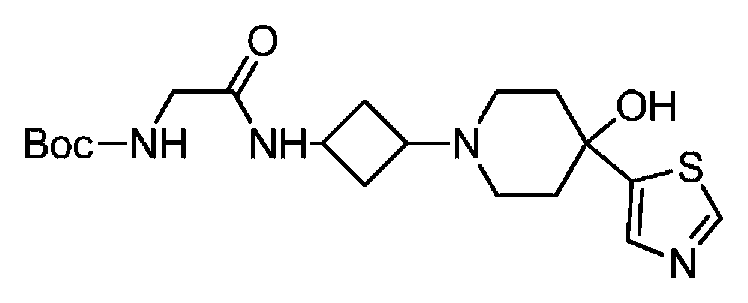
50 mL 둥근바닥 플라스크에, 다이클로로메탄 (20 mL) 중 2-(tert-부톡시카르보닐)아세트산 (899 mg, 5.14 mmol, 1.00 eq)의 용액, EDC.HCl (1 g, 5.21 mmol, 1.10 eq), HOBt (756 mg, 5.60 mmol, 1.10 eq), 트라이에틸아민 (1.5 g, 14.85 mmol, 3.00 eq) 및 1-(3-아미노사이클로부틸)-4-(티아졸-5-일)피페리딘-4-올 (이전 단계에서 제조됨) (1.3 g, 5.14 mmol, 1.00 eq)을 넣었다. 반응 혼합물을 실온에서 하룻밤 동안 교반하였다. 생성된 혼합물을 진공 하에서 농축하였다. EtOAc/석유 에테르 (1:1-1:10)를 사용하여 실리카 겔 컬럼에서 크로마토그래피에 의해 잔류물을 정제하였다. 표제 화합물을 백색 고체로서 얻었다.To a 50 mL round bottom flask was added a solution of 2- (tert-butoxycarbonyl) acetic acid (899 mg, 5.14 mmol, 1.00 eq) in dichloromethane (20 mL), EDC.HCl (1 g, 5.21 mmol, 1.10 eq), HOBt (756 mg, 5.60 mmol, 1.10 eq), triethylamine (1.5 g, 14.85 mmol, 3.00 eq) and 1- (3-aminocyclobutyl) -4- (thiazol- 4-ol (prepared in the previous step) (1.3 g, 5.14 mmol, 1.00 eq). The reaction mixture was stirred at room temperature overnight. The resulting mixture was concentrated in vacuo. The residue was purified by chromatography on a silica gel column using EtOAc / petroleum ether (1: 1-1: 10). The title compound was obtained as a white solid.
단계 H: 2-아미노-N-(3-(4-하이드록시-4-(티아졸-5-일)피페리딘-1-일)사이클로부틸)Step H: 2-Amino-N- (3- (4-hydroxy-4- (thiazol- 5- yl) piperidin- 1 -yl) cyclobutyl)
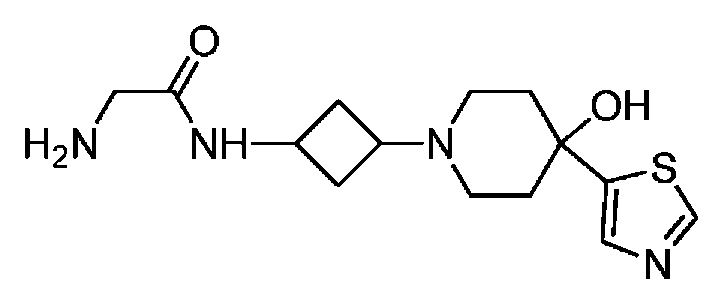
100 mL 둥근바닥 플라스크에, 다이클로로메탄 (20 mL) 중 tert-부틸 2-(3-(4-하이드록시-4-(티아졸-5-일)피페리딘-1-일)사이클로부틸아미노)-2-옥소에틸카르바메이트 (1.48 g, 3.6 mmol)의 용액 및 CF3COOH (4 mL)를 넣었다. 반응 혼합물을 실온에서 3시간 동안 교반하였다. 생성된 혼합물을 진공 하에서 농축하였다. 표제 화합물을 황색 오일로서 얻었다.To a 100 mL round bottom flask was added a solution of tert-butyl 2- (3- (4-hydroxy-4- (thiazol-5-yl) piperidin- 1- yl) cyclobutylamino ) were added to the solution, and CF 3 COOH (4 mL) of 2-oxo-ethyl carbamate (1.48 g, 3.6 mmol). The reaction mixture was stirred at room temperature for 3 hours. The resulting mixture was concentrated in vacuo. The title compound was obtained as a yellow oil.
단계 I: N-((1s,3s)-3-(4-Step I: N - ((1 S, 3 S) -3- (4- 하이드록시Hydroxy -4-(티아졸-5-일)피페리딘-1-일)-4- (thiazol-5-yl) piperidin-1-yl) 사이클로부Cyclobutane 틸)-2-((6-(Yl) -2 - ((6- ( 트라이플루오로메틸Trifluoromethyl )) 퀴나졸린Quinazoline -4-일)아미노)Yl) amino) 아세트아미드Acetamide 및 And
N-((1r,3r)-3-(4-하이드록시-4-(티아졸-5-일)피페리딘-1-일)사이클로부틸)-2-((6-(트라이플루오로메틸)퀴나졸린-4-일)아미노)아세트아미드2 - ((6- (trifluoromethyl) pyridin-2-ylmethyl) - N - ((lr, 3r) -3- (4- ) Quinazolin-4-yl) amino) acetamide

25 mL 바이알에, 2-메톡시에틸 에테르 (10 mL) 중 2-아미노-N-(3-(4-하이드록시-4-(티아졸-5-일)피페리딘-1-일)사이클로부틸)아세트아미드 (이전 단계에 기재된 바와 같이 제조됨, 394 mg, 1.27 mmol, 1.00 eq)의 용액, 4-클로로-6-(트라이플루오로메틸)퀴나졸린 (294 mg, 1.27 mmol, 1.00 eq) 및 트라이에틸아민 (385 mg, 3.81 mmol, 3.00 eq)을 넣었다. 반응 혼합물을 120℃에서 2.5시간 동안 교반하였다. 생성된 혼합물을 진공 하에서 농축하였다. 조 생성물 (500mg)을 하기 조건으로 분취용-HPLC에 의해 정제하였다 (1#-워터스 2767-5): 컬럼, 선파이어 프레프 C18, 5㎛, 19x100mm; 이동상, 물 및 CH3CN (30% CH3CN으로부터 13분 후에 40%까지 증가, 0.1분 후에 100%까지 증가, 2분 동안 100% 유지, 0.1분 후에 30%까지 감소, 1.4분 동안 30% 유지); 검출기, UV 220&254 nm. 표제 화합물을 황색 고체로서 단리하였다.To a 25 mL vial was added a solution of 2-amino-N- (3- (4-hydroxy-4- (thiazol-5-yl) piperidin- 4-chloro-6- (trifluoromethyl) quinazoline (294 mg, 1.27 mmol, 1.00 eq) was added to a solution of the compound of Preparation Example 1 (394 mg, 1.27 mmol, 1.00 eq) And triethylamine (385 mg, 3.81 mmol, 3.00 eq). The reaction mixture was stirred at 120 < 0 > C for 2.5 h. The resulting mixture was concentrated in vacuo. The crude product (500 mg) was purified by preparative-HPLC (1 # -Waters 2767-5) under the following conditions: column, Sunfire prep C18, 5 m, 19x100 mm; Mobile phase, water and CH 3 CN (30% CH increase from 3 CN to 40% after 13 minutes, increased to 100% after 0.1 minutes, maintaining 100% for 2 minutes, decreased to 30% at 0.1 minutes, 30% over 1.4 minutes maintain); Detector, UV 220 & 254 nm. The title compound was isolated as a yellow solid.
N-((1s,3s)-3-(4-하이드록시-4-(티아졸-5-일)피페리딘-1-일)사이클로부틸)-2-((6-(트라이플루오로메틸)퀴나졸린-4-일)아미노)아세트아미드에 대해:2 - ((6- (trifluoromethyl) piperidin-1 -yl) cyclohexyl) -2 - ((1S, 3S) -3- (4- ) ≪ / RTI > quinazolin-4-yl) amino) acetamide:
LC-MS 507 [M+H]+ LC-MS 507 [M + H] < + >
1H-NMR (300MHz, CD3OH) δ 8.639(s, 1H), 8.581(s, 1H), 8.030-8.066(m, 1H), 7.8985(d, J=8.7Hz, 1H), 7.789(s, 1H), 4.281-4.322(m, 3H), 3.043-3.139(m, 1H), 2.752-2.851(m, 2H), 2.340-2.435(m, 4H), 1.988-2.230(m, 6H).N-((1r,3r)-3-(4-하이드록시-4-(티아졸-5-일)피페리딘-1-일)사이클로부틸)-2-((6-(트라이플루오로메틸)퀴나졸린-4-일)아미노)아세트아미드에 대해: 1 H-NMR (300MHz, CD 3 OH) δ 8.639 (s, 1H), 8.581 (s, 1H), 8.030-8.066 (m, 1H), 7.8985 (d, J = 8.7Hz, 1H), 7.789 (s 2H), 2.340-2.435 (m, 4H), 1.988-2.230 (m, 6H). N, -2 - ((6- (trifluoromethyl) piperidin-l-yl) cyclohexyl) Quinazolin-4-yl) amino) acetamide: < EMI ID =
LC-MS (ES, m/z) 507 [M+H]+ LC-MS (ES, m / z) 507 [M + H] +
1H-NMR (300MHz, CD3OD) δ 8.906(s, 1H), 8.643(s, 1H), 8.578(s, 1H), 8.033-8.068(1H, s), 7.9005(d, J=8.7Hz, 1H), 7.781-7.783(d, J=0.6Hz, 1H), 4.281(s, 2H), 4.072-4.122(m, 1H), 2.428-2.769(m, 7H), 1.832-2.149(m, 6H). 1 H-NMR (300MHz, CD 3 OD) δ 8.906 (s, 1H), 8.643 (s, 1H), 8.578 (s, 1H), 8.033-8.068 (1H, s), 7.9005 (d, J = 8.7Hz 2H), 4.072-4.122 (m, 1H), 2.428-2.769 (m, 7H), 1.832-2.149 (m, 6H ).
실시예 163 및 실시예 164: 2-((2-시아노-6-(트라이플루오로메틸)퀴놀린-4-일)아미노)-N-((1s,3s)-3-(4-하이드록시-4-(티아졸-5-일)피페리딘-1-일)사이클로부틸)아세트아미드 및Example 163 and Example 164: 2- ((2-Cyano-6- (trifluoromethyl) quinolin-4-yl) -4- (thiazol-5-yl) piperidin-l-yl) cyclobutyl) acetamide and
2-((2-시아노-6-(트라이플루오로메틸)퀴놀린-4-일)아미노)-N-((1r,3r)-3-(4-하이드록시-4-(티아졸-5-일)피페리딘-1-일)사이클로부틸)아세트아미드(1R, 3R) -3- (4-hydroxy-4- (thiazole-5-yl) Yl) piperidin-1-yl) cyclobutyl) acetamide
단계 A: tert-부틸 2-(2-시아노-6-(트라이플루오로메틸)퀴놀린-4-일아미노)아세테이트Step A: tert-Butyl 2- (2-cyano-6- (trifluoromethyl) quinolin-4-ylamino) acetate
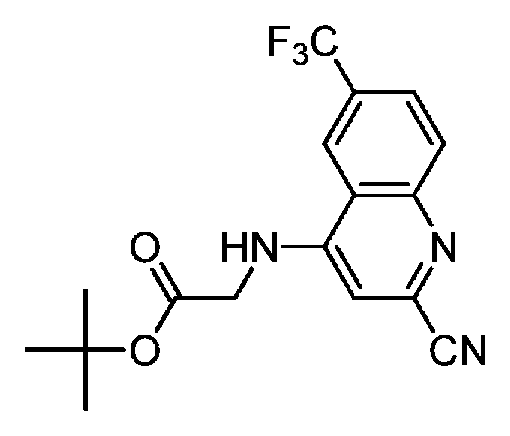
25 mL 바이알에, 다이옥산 (2 mL) 중 4-하이드록시-6-(트라이플루오로메틸)퀴놀린-2-카르보니트릴 (238 mg, 1.00 mmol, 1.00 eq)의 용액, PyBrOP (217 mg, 0.47 mmol, 1.10 eq), 트라이에틸아민 (354 mg, 3.50 mmol, 2.50 eq) 및 tert-부틸 2-아미노아세테이트 하이드로클로라이드 (217 mg, 1.30 mmol, 1.30 eq)를 넣었다. 반응 혼합물을 실온에서 하룻밤 동안 교반하였다. 이어서, 25 mL 의 물을 첨가하여 반응물을 켄칭하였다. 생성된 용액을 3x10 mL의 에틸 아세테이트로 추출하였다. 합한 유기층을 무수 황산나트륨으로 건조하고 진공 하에서 농축하였다. EtOAc/석유 에테르 (1:1-1:10)를 사용하여 실리카 겔 컬럼에서 크로마토그래피에 의해 잔류물을 정제하였다. 표제 화합물을 백색 고체로서 얻었다.To a 25 mL vial was added a solution of 4-hydroxy-6- (trifluoromethyl) quinoline-2-carbonitrile (238 mg, 1.00 mmol, 1.00 eq) in dioxane (2 mL), PyBrOP (217 mg, 0.47 mmol , 1.10 eq), triethylamine (354 mg, 3.50 mmol, 2.50 eq) and tert-butyl 2-aminoacetate hydrochloride (217 mg, 1.30 mmol, 1.30 eq). The reaction mixture was stirred at room temperature overnight. The reaction was then quenched by the addition of 25 mL of water. The resulting solution was extracted with 3 x 10 mL of ethyl acetate. The combined organic layers were dried over anhydrous sodium sulfate and concentrated in vacuo. The residue was purified by chromatography on a silica gel column using EtOAc / petroleum ether (1: 1-1: 10). The title compound was obtained as a white solid.
단계 B: 2-(2-시아노-6-(트라이플루오로메틸)퀴놀린-4-일아미노)아세트산Step B: 2- (2-Cyano-6- (trifluoromethyl) quinolin-4-ylamino) acetic acid

25 mL 바이알에, 다이클로로메탄 (10 mL) 중 tert-부틸 2-(2-시아노-6-(트라이플루오로메틸)퀴놀린-4-일아미노)아세테이트 (이전 단계에서 제조됨, 80 mg, 0.23 mmol, 1.00 eq)의 용액 및CF3COOH (2 mL)를 넣었다. 반응 혼합물을 실온에서 하룻밤 동안 교반하였다. 생성된 혼합물을 진공 하에서 농축하였다. 표제 화합물을 백색 고체로서 얻었다.To a 25 mL vial was added tert-butyl 2- (2-cyano-6- (trifluoromethyl) quinolin-4-ylamino) acetate (prepared in the previous step, 80 mg, It was added to the solution, and CF 3 COOH (2 mL) of 0.23 mmol, 1.00 eq). The reaction mixture was stirred at room temperature overnight. The resulting mixture was concentrated in vacuo. The title compound was obtained as a white solid.
단계 C: 2-((2-시아노-6-(트라이플루오로메틸)퀴놀린-4-일)아미노)-N-((1s,3s)-3-(4-하이드록시-4-(티아졸-5-일)피페리딘-1-일)사이클로부틸)아세트아미드 및Step C: 2 - ((2-Cyano-6- (trifluoromethyl) quinolin-4- yl) 5-yl) piperidin-1-yl) cyclobutyl) acetamide and
2-((2-시아노-6-(트라이플루오로메틸)퀴놀린-4-일)아미노)-N-((1r,3r)-3-(4-하이드록시-4-(티아졸-5-일)피페리딘-1-일)사이클로부틸)아세트아미드(1R, 3R) -3- (4-hydroxy-4- (thiazole-5-yl) Yl) piperidin-1-yl) cyclobutyl) acetamide

50 mL 둥근바닥 플라스크에, 다이클로로메탄 (2 mL) 중 2-(2-시아노-6-(트라이플루오로메틸)퀴놀린-4-일아미노)아세트산 (이전 단계에서 제조됨, 29 mg, 0.11 mmol, 1.00 eq)의 용액, EDC (23 mg, 0.12 mmol, 1.12 eq), HOBt (16.2 mg, 0.12 mmol, 1.12 eq), 트라이에틸아민 (30.5 mg, 0.30 mmol, 2.82 eq) 및 1-(3-아미노사이클로부틸)-4-(티아졸-5-일)피페리딘-4-올 (실시예 162, 단계 F에서 제조됨) (25 mg, 0.10 mmol, 1.00 eq)을 넣었다. 반응 혼합물을 실온에서 3시간 동안 교반하였다. 생성된 혼합물을 진공 하에서 농축하였다. 조 생성물 (50 mg)을 하기 조건으로 분취용-HPLC에 의해 정제하였다 (1#-워터스 2767-5): 컬럼, 선파이어 프레프 C18, 5㎛, 19x100mm; 이동상, 물 및 CH3CN (30% CH3CN으로부터 13분 후에 40%까지 증가, 0.1분 후에 100%까지 증가, 2분 동안 100% 유지, 0.1분 후에 30%까지 감소, 1.4분 동안 30% 유지); 검출기, UV 220&254 nm. 표제 화합물을 황색 고체로서 얻었다.To a 50 mL round bottom flask was added 2- (2-cyano-6- (trifluoromethyl) quinolin-4-ylamino) acetic acid (prepared in the previous step, 29 mg, 0.11 (30 mg, 0.30 mmol, 2.82 eq) and 1- (3-aminopyridin-2-ylamine, 1.00 eq), EDC (23 mg, 0.12 mmol, 1.12 eq), HOBt (Prepared from example 162, step F) (25 mg, 0.10 mmol, 1.00 eq) were placed in a 500 mL round-bottomed flask equipped with a stir bar and a reflux condenser. The reaction mixture was stirred at room temperature for 3 hours. The resulting mixture was concentrated in vacuo. The crude product (50 mg) was purified by preparative-HPLC (1 # -Waters 2767-5) under the following conditions: column, Sunfire prep C18, 5 m, 19 x 100 mm; Mobile phase, water and CH 3 CN (30% CH increase from 3 CN to 40% after 13 minutes, increased to 100% after 0.1 minutes, maintaining 100% for 2 minutes, decreased to 30% at 0.1 minutes, 30% over 1.4 minutes maintain); Detector, UV 220 & 254 nm. The title compound was obtained as a yellow solid.
2-((2-시아노-6-(트라이플루오로메틸)퀴놀린-4-일)아미노)-N-((1s,3s)-3-(4-하이드록시-4-(티아졸-5-일)피페리딘-1-일)사이클로부틸)아세트아미드에 대해:3 - (4-hydroxy-4- (thiazol-5-yl) amino) Yl) piperidin-1-yl) cyclobutyl) acetamide: < EMI ID =
LC-MS (ES, m/z) 531 [M+H]+ LC-MS (ES, m / z) 531 [M + H] +
1H-NMR (300MHz, CD3OD) δ 8.916(s, 1H), 8.657(s, 1H), 7.958-8.061(m, 2H), 7.791(s, 1H), 6.834(s, 1H), 4.097-4.146(m, 3H), 2.751-2.837(m, 3H), 2.508-2.653(m, 4H), 1.915-2.161(m, 6H).2-((2-시아노-6-(트라이플루오로메틸)퀴놀린-4-일)아미노)-N-((1r,3r)-3-(4-하이드록시-4-(티아졸-5-일)피페리딘-1-일)사이클로부틸)아세트아미드에 대해: 1 H-NMR (300 MHz, CD 3 OD)? 8.916 (s, 1H), 8.657 (s, 1H), 7.958-8.061 (m, 2H), 7.791 (M, 3H), 2.751-2.837 (m, 3H), 2.508-2.653 (m, 4H), 1.915-2.161 Methyl) quinolin-4-yl) amino) -N - ((lr, 3r) -3- (4-hydroxy- 4- (thiazol- 5- yl) piperidin- 1 -yl) cyclobutyl) For amides:
LC-MS (ES, m/z) 531 [M+H]+ LC-MS (ES, m / z) 531 [M + H] +
1H-NMR (300MHz, CD3OD) δ 8.916(s, 1H), 8.657(s, 1H), 7.958-8.061(m, 2H), 7.791(s, 1H), 6.834(s, 1H), 4.097-4.146(m, 3H), 2.751-2.837(m, 3H), 2.508-2.653(m, 4H), 1.915-2.161(m, 6H). 1 H-NMR (300 MHz, CD 3 OD)? 8.916 (s, 1H), 8.657 (s, 1H), 7.958-8.061 (m, 2H), 7.791 -4.146 (m, 3H), 2.751-2.837 (m, 3H), 2.508-2.653 (m, 4H), 1.915-2.161 (m, 6H).
실시예 165 및 실시예 166: N-(1-((1r,4r)-4-하이드록시-4-(티아졸-5-일)사이클로헥실)아제티딘-3-일)-2-((7-(트라이플루오로메틸)아이소퀴놀린-1-일)아미노)아세트아미드 및Example 165 and Example 166: N- (l- ((lr, 4r) -4-Hydroxy-4- (thiazol-5-yl) cyclohexyl) azetidin- 7- (trifluoromethyl) isoquinolin-1-yl) amino) acetamide and
N-(1-((1s,4s)-4-하이드록시-4-(티아졸-5-일)사이클로헥실)아제티딘-3-일)-2-((7-(트라이플루오로메틸)아이소퀴놀린-1-일)아미노)아세트아미드Azetidin-3-yl) -2 - ((7- (trifluoromethyl) pyridin-2-yl) Isoquinolin-1-yl) amino) acetamide
단계 A: 7-Step A: 7- 브로모Bromo -1--One- 클로로아이소퀴놀린Chloroisoquinoline

50 mL 둥근바닥 플라스크에, POCl3 (5 mL) 중 7-브로모아이소퀴놀린-1-올 (1.0 g, 4.46 mmol, 1.00 eq)의 용액을 넣었다. 반응 혼합물을 오일조에서 80℃에서 60분 동안 교반하였다. 생성된 혼합물을 진공 하에서 농축하였다. 잔류물을 20 mL의 DCM에 용해하고, 3x10 mL의 물로 세척하고, 무수 황산나트륨으로 건조하고, 진공 하에서 농축하였다. 표제 화합물을 연황색 고체로서 얻었다.A solution of 7-bromoisoquinolin-1-ol (1.0 g, 4.46 mmol, 1.00 eq) in POCl 3 (5 mL) was added to a 50 mL round bottom flask. The reaction mixture was stirred in an oil bath at 80 < 0 > C for 60 minutes. The resulting mixture was concentrated in vacuo. The residue was dissolved in 20 mL of DCM, washed with 3 x 10 mL of water, dried over anhydrous sodium sulphate and concentrated in vacuo. The title compound was obtained as a light yellow solid.
LC-MS (ES, m/z) 243[M+H]+.LC-MS (ES, m / z) 243 [M + H] < + >.
단계 B: 1-클로로-7-요오도아이소퀴놀린Step B: 1-Chloro-7-iodoisoquinoline

50 mL 둥근바닥 플라스크에, 7-브로모-1-클로로아이소퀴놀린 (이전 단계에서 제조됨, 520 mg, 2.15 mmol, 1.00 eq) 및 테트라하이드로푸란 (10 mL)을 넣었다. 그 다음, -78℃에서 2분간 교반하면서 n-BuLi (0.85 mL, 1.25 eq)를 적가하였다. 생성된 용액을 -80℃에서 추가로 40분 동안 교반하면서 반응하게 두었다. -78℃에서 1분 동안 교반하면서 여기에 테트라하이드로푸란 (3 mL) 중 I2 (541 mg, 2.14 mmol, 1.25 eq)의 용액을 적가하였다. 반응 혼합물을 25℃에서 하룻밤 교반하면서 반응하게 두었다. 이어서, 1 mL의 물을 첨가하여 반응물을 켄칭하였다. 잔류물을 40 mL의 DCM으로 희석하고, 3x15 mL의 물로 세척하고, 무수 황산나트륨으로 건조하고, 진공 하에서 농축하였다. 에틸 아세테이트/헥산 (1:50)을 사용하여 실리카 겔 컬럼에서 크로마토그래피에 의해 잔류물을 정제하였다. 표제 화합물을 황색 고체로서 얻었다.5-chloro-1-chloroisoquinoline (prepared in the previous step, 520 mg, 2.15 mmol, 1.00 eq) and tetrahydrofuran (10 mL) were placed in a 50 mL round bottom flask. Then, n-BuLi (0.85 mL, 1.25 eq) was added dropwise while stirring at -78 ° C for 2 minutes. The resulting solution was allowed to react at -80 [deg.] C with stirring for an additional 40 minutes. A solution of I 2 (541 mg, 2.14 mmol, 1.25 eq) in tetrahydrofuran (3 mL) was added dropwise with stirring at -78 ° C for 1 min. The reaction mixture was left to react overnight at 25 < 0 > C with stirring. The reaction was then quenched by the addition of 1 mL of water. The residue was diluted with 40 mL of DCM, washed with 3 x 15 mL of water, dried over anhydrous sodium sulfate and concentrated in vacuo. The residue was purified by chromatography on a silica gel column using ethyl acetate / hexane (1:50). The title compound was obtained as a yellow solid.
LC-MS (ES, m/z) 290[M+H]+.LC-MS (ES, m / z) 290 [M + H] < + >.
단계 C: 1-Step C: 1- 클로로Chloro -7-(-7- ( 트라이플루오로메틸Trifluoromethyl )) 아이소퀴놀린Isoquinoline

8 mL 밀봉관에, 불화칼륨 (300 mg, 5.17 mmol, 6.00 eq, 100%), 구리(I) 요오다이드 (900 mg, 4.66 mmol, 5.50 eq, 100%), 트라이메틸(트라이플루오로메틸)실란 (720 mg, 5.07 mmol, 5.00 eq, 100%), NMP (3 mL, 100%) 및 NMP (1 mL) 중 1-클로로-7-요오도아이소퀴놀린 (이전 단계에서 제조됨, 250 mg, 0.86 mmol, 1.00 eq, 100%)의 용액을 넣었다 . 반응 혼합물을 오일조에서 120℃에서 12시간 동안 교반하였다. 생성된 혼합물을 20 mL의 에틸 아세테이트로 희석하고, 3x10 mL의 KI의 포화 용액으로 세척하고, 무수 황산나트륨으로 건조하고, 진공 하에서 농축하였다. 에틸 아세테이트:석유 에테르 (1:50)를 사용하여 실리카 겔 컬럼에서 크로마토그래피에 의해 잔류물을 정제하였다. 표제 화합물을 황색 고체로서 얻었다.(300 mg, 5.17 mmol, 6.00 eq, 100%), copper (I) iodide (900 mg, 4.66 mmol, 5.50 eq, 100%), trimethyl (trifluoromethyl 1-Chloro-7-iodoisoquinoline (prepared in the previous step, 250 mg) was added to a solution of the title compound in a mixture of dichloromethane (5 mL), silane (720 mg, 5.07 mmol, 5.00 eq, 100%), NMP , 0.86 mmol, 1.00 eq, 100%). The reaction mixture was stirred in an oil bath at 120 < 0 > C for 12 h. The resulting mixture was diluted with 20 mL of ethyl acetate, washed with 3 x 10 mL of a saturated solution of KI, dried over anhydrous sodium sulfate, and concentrated in vacuo. The residue was purified by chromatography on a silica gel column using ethyl acetate: petroleum ether (1:50). The title compound was obtained as a yellow solid.
LC-MS (ES, m/z) 232[M+H]+.LC-MS (ES, m / z) 232 [M + H] < + >.
단계 D: tert-부틸 3-(2-(7-(트라이플루오로메틸)아이소퀴놀린-1-일아미노)아세트아미도)아제티딘-1-카르복실레이트Step D: tert-Butyl 3- (2- (7- (trifluoromethyl) isoquinolin-l-ylamino) acetamido) azetidine-

8 mL 밀봉관에, 1-클로로-7-(트라이플루오로메틸)아이소퀴놀린 (이전 단계에서 제조됨, 433 mg, 1.87 mmol, 1.00 eq), tert-부틸 3-(2-아미노아세트아미도)아제티딘-1-카르복실레이트 (실시예 1, 단계 E에 기재된 바와 같이 제조됨) (460 mg, 2.01 mmol, 1.18 eq), Pd(OAc)2 (15 mg, 0.07 mmol, 0.05 eq), Cs2CO3 (1500 mg, 4.60 mmol, 1.77 eq), BINAP (30 mg, 0.05 mmol, 0.04 eq) 및 톨루엔 (2 mL)을 넣었다. 반응 혼합물을 오일조에서 100℃에서 12시간 동안 교반하였다. 고형물을 여과하여 제거하였다. 생성된 혼합물을 진공 하에서 농축하였다. 에틸 아세테이트:석유 에테르 (1:3)를 사용하여 실리카 겔 컬럼에서 크로마토그래피에 의해 잔류물을 정제하였다. 표제 화합물을 오프-화이트(off white) 고체로서 얻었다.(Trifluoromethyl) isoquinoline (prepared in the previous step, 433 mg, 1.87 mmol, 1.00 eq), tert-butyl 3- (2- aminoacetamido) (460 mg, 2.01 mmol, 1.18 eq), Pd (OAc) 2 (15 mg, 0.07 mmol, 0.05 eq), Cs 2 CO 3 (1500 mg, 4.60 mmol, 1.77 eq), BINAP (30 mg, 0.05 mmol, 0.04 eq) and toluene (2 mL). The reaction mixture was stirred in an oil bath at 100 < 0 > C for 12 h. The solids were removed by filtration. The resulting mixture was concentrated in vacuo. The residue was purified by chromatography on a silica gel column using ethyl acetate: petroleum ether (1: 3). The title compound was obtained as off-white solid.
LC-MS (ES, m/z) 425[M+H]+.LC-MS (ES, m / z) 425 [M + H] < + >.
단계 E: N-(Step E: Preparation of N- ( 아제티딘Azetidine -3-일)-2-(7-(Yl) -2- (7- ( 트라이플루오로메틸Trifluoromethyl )) 아이소퀴놀린Isoquinoline -1--One- 일아미노Amino )아세트아미드) Acetamide

25 mL 둥근바닥 플라스크에, 다이클로로메탄 (5 mL) 중 tert-부틸 3-(2-(7-(트라이플루오로메틸)아이소퀴놀린-1-일아미노)아세트아미도)아제티딘-1-카르복실레이트 (이전 단계에서 제조됨, 100 mg, 0.24 mmol, 1.00 eq)의 용액을 넣었다. 그 다음, 0℃에서 5분간 트라이플루오로아세트산 (0.5 mL)을 첨가하였다. 반응 혼합물을 0℃에서 6시간 동안 교반하였다. 생성된 혼합물을 진공 하에서 농축하였다. 표제 화합물을 백색 고체로서 얻었다.To a 25 mL round bottom flask was added a solution of tert-butyl 3- (2- (7- (trifluoromethyl) isoquinolin-1-ylamino) acetamido) A solution of the chelate (prepared in the previous step, 100 mg, 0.24 mmol, 1.00 eq) was added. Trifluoroacetic acid (0.5 mL) was then added at 0 C for 5 min. The reaction mixture was stirred at 0 < 0 > C for 6 hours. The resulting mixture was concentrated in vacuo. The title compound was obtained as a white solid.
LC-MS (ES, m/z) 325[M+H]LC-MS (ES, m / z) 325 [M + H] <
단계 F: N-(1-((1r,4r)-4-Step F: Preparation of N- (l - ((lr, 4r) -4- 하이드록시Hydroxy -4-(티아졸-5-일)-4- (thiazol-5-yl) 사이클로헥실Cyclohexyl )) 아제티딘Azetidine -3-일)-2-((7-(Yl) -2 - ((7- ( 트라이플루오로메틸Trifluoromethyl )) 아이소퀴놀린Isoquinoline -1-일)아미노)-1-yl) amino) 아세트아미드Acetamide 및 And
N-(1-((1s,4s)-4-하이드록시-4-(티아졸-5-일)사이클로헥실)아제티딘-3-일)-2-((7-(트라이플루오로메틸)아이소퀴놀린-1-일)아미노)아세트아미드Azetidin-3-yl) -2 - ((7- (trifluoromethyl) pyridin-2-yl) Isoquinolin-1-yl) amino) acetamide

25 mL 둥근바닥 플라스크에, 다이클로로메탄 (5 mL) 중 2-[[7-(펜타플루오로에틸)아이소퀴놀린-1-일]아미노]아세트아미드 (이전 단계에서 제조됨, 70 mg, 0.22 mmol, 1.00 eq)의 용액, 4-하이드록시-4-(1,3-티아졸-5-일)사이클로헥산-1-온 (실시예 26, 단계 C에 기재된 바와 같이 제조됨) (80 mg, 0.41 mmol, 1.85 eq), TEA (105 mg, 1.04 mmol, 4.73 eq) 및 소듐 트라이아세톡시보로하이드라이드 (210 mg, 0.99 mmol, 4.52 eq)를 넣었다. 반응 혼합물을 25℃에서 120분 동안 교반하였다. 생성된 혼합물을 진공 하에서 농축하였다. 조 생성물 (0.1 g)을 하기 조건으로 분취용-HPLC에 의해 정제하였다 (1#워터스 2761-1): 컬럼, 선파이어 프레프C18, 5㎛, 19x100mm; 이동상, 0.05%NH4HCO3을 갖는 물, 및 CH3CN (30% CH3CN으로부터 8분 후에 73%까지 증가, 2분 후에 100%까지 증가, 2분 후에 30%까지 감소); 검출기, 254/220nm. 표제 화합물을 백색 고체로서 얻었다.To a 25 mL round bottom flask was added 2 - [[7- (pentafluoroethyl) isoquinolin- 1 -yl] amino] acetamide (prepared in the previous step, 70 mg, 0.22 mmol) in dichloromethane , 1.00 eq), (prepared as described in Example 26, Step C) (80 mg, < RTI ID = 0.0 & 0.41 mmol, 1.85 eq), TEA (105 mg, 1.04 mmol, 4.73 eq) and sodium triacetoxyborohydride (210 mg, 0.99 mmol, 4.52 eq). The reaction mixture was stirred at 25 < 0 > C for 120 minutes. The resulting mixture was concentrated in vacuo. The crude product (0.1 g) was purified by preparative-HPLC (1 # Waters 2761-1) under the following conditions: column, Sunfire prep C18, 5 m, 19x100 mm; Mobile phase, water with 0.05% NH 4 HCO 3 , and CH 3 CN (up to 73% after 8 min from 30% CH 3 CN, up to 100% after 2 min, down to 30% after 2 min); Detector, 254 / 220nm. The title compound was obtained as a white solid.
N-(1-((1r,4r)-4-하이드록시-4-(티아졸-5-일)사이클로헥실)아제티딘-3-일)-2-((7-(트라이플루오로메틸)아이소퀴놀린-1-일)아미노)아세트아미드에 대해:Azetidin-3-yl) -2 - ((7- (trifluoromethyl) pyridin-2-yl) Isoquinolin-1-yl) amino) acetamide: < EMI ID =
LC-MS (ES, m/z) 506[M+H]+.LC-MS (ES, m / z) 506 [M + H] < + >.
1H-NMR (300MHz, CD3OD) δ 8.90(s, 1H), 8.60(s, 1H), 7.99(d, J=6.0 Hz, 1H), 7.80-7.95(m, 3H), 7.08(d, J=6.0 Hz, 1H), 4.40-4.56(m, 1H), 4.20(s, 2H), 3.63(t, J=7.2 Hz, 2H), 2.99(t, J=7.2 Hz, 2H), 2.30-2.38(m, 1H), 2.15-2.29(m, 2H), 1.70-1.90(m, 4H), 1.24-1.40(m, 2H). 1 H-NMR (300MHz, CD 3 OD) δ 8.90 (s, 1H), 8.60 (s, 1H), 7.99 (d, J = 6.0 Hz, 1H), 7.80-7.95 (m, 3H), 7.08 (d (T, J = 7.2 Hz, 2H), 2.30 (t, J = 7.2 Hz, 2H), 4.40 -2.38 (m, 1H), 2.15-2.29 (m, 2H), 1.70-1.90 (m, 4H), 1.24-1.40 (m, 2H).
N-(1-((1s,4s)-4-하이드록시-4-(티아졸-5-일)사이클로헥실)아제티딘-3-일)-2-((7-(트라이플루오로메틸)아이소퀴놀린-1-일)아미노)아세트아미드에 대해:Azetidin-3-yl) -2 - ((7- (trifluoromethyl) pyridin-2-yl) Isoquinolin-1-yl) amino) acetamide: < EMI ID =
LC-MS (ES, m/z) 506[M+H]+.LC-MS (ES, m / z) 506 [M + H] < + >.
1H-NMR (300MHz, CD3OD) δ 8.861(s, 1H), 8.61(s, 1H), 8.10(d, J=5.7 Hz, 1H), 7.90-7.87(m, 2H), 7.73(s, 1H), 7.09(s, J=5.7 Hz, 1H), 4.51(t, J= 7.2 Hz, 1H), 4.21(s, 2H), 3.69(t, J=6.6 Hz, 2H,), 3.00-3.14(m, 2H), 2.16-2.29(s, 1H), 1.97-2.08(m, 2H), 1.76-1.88(m, 2H), 1.63-1.75 (m ,2H), 1.45-1.61(m, 2H). 1 H-NMR (300MHz, CD 3 OD) δ 8.861 (s, 1H), 8.61 (s, 1H), 8.10 (d, J = 5.7 Hz, 1H), 7.90-7.87 (m, 2H), 7.73 (s (T, J = 7.2 Hz, 2H), 3.91 (s, 2H), 7.01 (M, 2H), 1.45-1.61 (m, 2H), 1.63-1.80 (m, ).
실시예Example 167 및 167 and 실시예Example 168: N-(1-((1R,4s)-4-(1- 168: N- (1 - ((1R, 4S) -4- (1- 하이드록시프로필Hydroxypropyl )) 사이클로헥실Cyclohexyl )아제티딘-3-일)-2-((7-() Azetidin-3-yl) -2 - ((7- ( 트라이플루오로메틸Trifluoromethyl )) 아이소퀴놀린Isoquinoline -1-일)아미노)-1-yl) amino) 아세트아미Acetamido 드 및De and
N-(1-((1S,4r)-4-(1-N- (1 - ((1S, 4R) -4- (1- 하이드록시프로필Hydroxypropyl )) 사이클로헥실Cyclohexyl )) 아제티딘Azetidine -3-일)-2-((7-(Yl) -2 - ((7- ( 트라이플루오로메틸Trifluoromethyl )) 아이소퀴놀린Isoquinoline -1-일)아미노)-1-yl) amino) 아세트아미드Acetamide

8 mL 밀봉관에, 다이클로로메탄 (2 mL) 중 4-(1-하이드록시프로필)사이클로헥산-1-온 (실시예 25, 단계 B에서 제조됨) (70 mg, 0.45 mmol, 1.00 eq)의 용액, N-(아제티딘-3-일)-2-[[7-(트라이플루오로메틸)아이소퀴놀린-1-일]아미노]아세트아미드 (실시예 166, 단계 E에서 제조됨) (50 mg, 0.15 mmol, 0.34 eq), TEA (0.1 mL) 및 소듐 트라이아세톡시보로하이드라이드 (150 mg, 0.71 mmol, 1.58 eq)를 넣었다. 반응 혼합물을 25℃에서 12시간 동안 교반하였다. 이어서, 10 mL의 물을 첨가하여 반응물을 켄칭하였다. 반응 혼합물을 3x10 mL의 다이클로로메탄으로 추출하였다. 합한 유기층을 10 mL의 염수로 세척하고, 건조하고 (Na2SO4), 진공 하에서 농축하였다. 조 생성물 (0.1g)을 하기 조건으로 분취용-HPLC에 의해 정제하였다 (1#워터스 2761-1): 컬럼, 선파이어 프레프C18, 5 ㎛, 19x100mm; 이동상, 0.05% NH4HCO3을 갖는 물, 및 CH3CN (30% CH3CN으로부터 14분 후에 47%까지 증가, 2분 후에 100%까지 증가, 2분 후에 30%까지 감소); 검출기, 254/220nm. 0.01 g의 생성물을 얻었다. 화합물 N-(1-((1s,4s)-4-(1-하이드록시프로필)사이클로헥실)아제티딘-3-일)-2-((7-(트라이플루오로메틸)아이소퀴놀린-1-일)아미노)아세트아미드를 오프-화이트 고체로서 단리하였고, N-(1-((1r,4r)-4-(1-하이드록시프로필)사이클로헥실)아제티딘-3-일)-2-((7-(트라이플루오로메틸)아이소퀴놀린-1-일)아미노)아세트아미드를 연황색 고체로서 단리하였다.(70 mg, 0.45 mmol, 1.00 eq) of 4- (1-hydroxypropyl) cyclohexan-1-one (prepared from Example 25, Step B) in dichloromethane (2 mL) Amino] acetamide (prepared from Example 166, step E) (50 mg, 0.25 mmol) in dichloromethane was added to a solution of N- (azetidin-3-yl) -2 - [[7- (trifluoromethyl) isoquinolin- mg, 0.15 mmol, 0.34 eq), TEA (0.1 mL) and sodium triacetoxyborohydride (150 mg, 0.71 mmol, 1.58 eq). The reaction mixture was stirred at 25 < 0 > C for 12 h. The reaction was then quenched by the addition of 10 mL of water. The reaction mixture was extracted with 3 x 10 mL dichloromethane. The combined organic layers were washed with 10 mL of brine, dried (Na 2 SO 4 ) and concentrated in vacuo. The crude product (0.1 g) was purified by preparative-HPLC (1 # Waters 2761-1) under the following conditions: column, Sunfire prep C18, 5 m, 19 x 100 mm; Mobile phase, water with 0.05% NH 4 HCO 3 , and CH 3 CN (up to 47% after 14 min from 30% CH 3 CN, up to 100% after 2 min, down to 30% after 2 min); Detector, 254 / 220nm. 0.01 g of product was obtained. 2 - ((7- (trifluoromethyl) isoquinolin-l- (1S, 4S) -4- (1 -hydroxypropyl) cyclohexyl) Yl) amino) acetamide was isolated as an off-white solid to give N- (l- ((lr, 4r) -4- (1- hydroxypropyl) cyclohexyl) azetidin- (7- (trifluoromethyl) isoquinolin-1-yl) amino) acetamide was isolated as a light yellow solid.
N-(1-((1R,4s)-4-(1-하이드록시프로필)사이클로헥실)아제티딘-3-일)-2-((7-(트라이플루오로메틸)아이소퀴놀린-1-일)아미노)아세트아미드에 대해:Azetidin-3-yl) -2 - ((7- (trifluoromethyl) isoquinolin-1-yl) ) Amino) acetamide: < RTI ID = 0.0 >
LC-MS (ES, m/z) 465[M+H]+.LC-MS (ES, m / z) 465 [M + H] < + >.
1H-NMR (300MHz, CDCl3) δ 8.25(s, 1H), 8.08(d, J=5.7 Hz, 1H), 7.79(m, 2H), 7.45-7.63(b, 1H), 7.03(d, J=6.0 Hz, 1H), 6.35(s, 1H), 4.53-4.70(m, 1H), 4.27-4.35(m, 2H), 3.71-3.80(m, 2H), 3.30-3.60(m, 2H), 2.66(s, 1H), 1.30-1.92(m, 12H), 0.90-1.01(m, 3H). 1 H-NMR (300MHz, CDCl 3) δ 8.25 (s, 1H), 8.08 (d, J = 5.7 Hz, 1H), 7.79 (m, 2H), 7.45-7.63 (b, 1H), 7.03 (d, 2H), 3.30-3.60 (m, 2H), 3.30-3.40 (m, 2H) , 2.66 (s, 1H), 1.30-1.92 (m, 12H), 0.90-1.01 (m, 3H).
N-(1-((1R,4s)-4-(1-하이드록시프로필)사이클로헥실)아제티딘-3-일)-2-((7-(트라이플루오로메틸)아이소퀴놀린-1-일)아미노)아세트아미드에 대해:Azetidin-3-yl) -2 - ((7- (trifluoromethyl) isoquinolin-1-yl) ) Amino) acetamide: < RTI ID = 0.0 >
LC-MS (ES, m/z) 465[M+H]+ LC-MS (ES, m / z) 465 [M + H] +
1H-NMR (300MHz, CDCl3) δ 8.60(s, 1H), 7.99(d, J=6.0 Hz, 1H,), 7.82-7.95(m, 2H), 7.08(d, J=6.0 Hz, 1H), 4.47-4.57(m, 1H), 4.20(s, 2H), 3.79-3.90(m, 2H), 3.16-3.25(m, 1H), 2.25-2.36(m, 1H), 181-1.98(m, 3H), 1.65-1.76(m, 1H), 1.45-1.60(m, 1H), 1.32-1.43(m, 1H), 1.20-1.31(m, 1H), 0.90-1.10(m, 7H). 1 H-NMR (300MHz, CDCl 3) δ 8.60 (s, 1H), 7.99 (d, J = 6.0 Hz, 1H,), 7.82-7.95 (m, 2H), 7.08 (d, J = 6.0 Hz, 1H ), 4.47-4.57 (m, 1H), 4.20 (s, 2H), 3.79-3.90 (m, 2H), 3.16-3.25 (M, 1H), 1.65-1.76 (m, 1H), 1.45-1.60 (m, 1H), 1.32-1.43 (m, 1H), 1.20-1.31
실시예Example 169: N-(1-((1R,4s)-4-(1- 169: N- (1 - ((1 R, 4S) -4- (1- 하이드록시Hydroxy -2--2- 메틸프로필Methyl propyl )) 사이클로헥실Cyclohexyl )) 아제티딘Azetidine -3-일)-2-((7-(Yl) -2 - ((7- ( 트라이플루오로메틸Trifluoromethyl )) 아이소퀴놀린Isoquinoline -1-일)아미노)-1-yl) amino) 아세트아미드Acetamide

8 mL 둥근바닥 플라스크에, 다이클로로메탄 (2 mL) 중 N-(아제티딘-3-일)-2-(7-(트라이플루오로메틸)아이소퀴놀린-1-일아미노)아세트아미드 (실시예 166, 단계 E에서 제조됨) (120 mg, 0.37 mmol, 1.00 eq)의 용액, 4-(1-하이드록시-2-메틸프로필) 사이클로헥사논 (실시예 7, 단계 B에 기재됨) (115 mg, 0.74 mmol, 1.99 eq), NaBH(OAc)3 (360 mg, 1.70 mmol, 4.58 eq) 및 TEA (180 mg, 1.78 mmol, 4.81 eq)를 넣었다. 반응 혼합물을 25℃에서 12시간 동안 교반하였다. 이어서, 10 mL의 물을 첨가하여 반응물을 켄칭하였다. 생성된 용액을 3x10 mL의 다이클로로메탄으로 추출하였다. 합한 유기층을 20 mL의 염수로 세척하고, 건조하고 (Na2SO4), 진공 하에서 농축하였다. 조 생성물 (0.2g)을 하기 조건으로 분취용-HPLC에 의해 정제하였다 (워터스 2767-1): 컬럼, 선파이어 프레프 C18, 5㎛, 19x100mm; 이동상, 0.05% NH4HCO3을 갖는 물, 및 CH3CN (30% CH3CN으로부터 8분 후에 73%까지 증가, 2분 후에 100%까지 증가, 2분 후에 30%까지 감소); 검출기, UV 254 nm. 표제 화합물을 백색 고체로서 얻었다.To a 8 mL round bottom flask was added a solution of N- (azetidin-3-yl) -2- (7- (trifluoromethyl) isoquinolin- 1 -ylamino) 166, prepared in Step E) (120 mg, 0.37 mmol, 1.00 eq), 4- (1 -hydroxy-2- methylpropyl) cyclohexanone (described in Example 7, Step B) mg, 0.74 mmol, 1.99 eq), NaBH (OAc) 3 (360 mg, 1.70 mmol, 4.58 eq) and TEA (180 mg, 1.78 mmol, 4.81 eq). The reaction mixture was stirred at 25 < 0 > C for 12 h. The reaction was then quenched by the addition of 10 mL of water. The resulting solution was extracted with 3 x 10 mL dichloromethane. The combined organic layers were washed with 20 mL of brine, dried (Na 2 SO 4 ) and concentrated in vacuo. The crude product (0.2 g) was purified by preparative-HPLC (Waters 2767-1) under the following conditions: column, Sunfire prep C18, 5 m, 19 x 100 mm; Mobile phase, water with 0.05% NH 4 HCO 3 , and CH 3 CN (up to 73% after 8 min from 30% CH 3 CN, up to 100% after 2 min, down to 30% after 2 min); Detector, UV 254 nm. The title compound was obtained as a white solid.
LC-MS (ES, m/z) 479[M+1]+,502[M+Na]+ . LC-MS (ES, m / z) 479 [M + 1] < + >, 502 [M + Na] < + > .
1H-NMR (300MHz, CD3OD) δ 8.61(s, 1H), 7.99(d, J=5.7 Hz, 1H), 7.82-7.96(m, 2H), 7.08(d, J=5.7 Hz, 1H), 4.862-4.875(m, 2H), 4.45-4.55(m, 1H), 4.20(s, 2H), 3.60-3.70(m, 2H), 3.04-3.10(m, 1H), 2.79-2.97(m, 2H), 2.29(s, 1H), 1.70-1.80(s, 1H), 1.30-1.65(m, 10H), 0.95(d, J=12.0 Hz, 3H), 0.85(d, J= 12.0 Hz, 3H). 1 H-NMR (300MHz, CD 3 OD) δ 8.61 (s, 1H), 7.99 (d, J = 5.7 Hz, 1H), 7.82-7.96 (m, 2H), 7.08 (d, J = 5.7 Hz, 1H 2H), 3.60-3.70 (m, 2H), 3.04-3.10 (m, 1H), 2.79-2.97 (m, , 2H), 2.29 (s, 1H), 1.70-1.80 (s, 1H), 1.30-1.65 (m, 10H), 0.95 (d, J = 12.0 Hz, 3H).
실시예Example 170: N-(1-((1R,4s)-4-(1- 170: N- (1 - ((1 R, 4S) -4- (1- 하이드록시프로필Hydroxypropyl )) 사이클로헥실Cyclohexyl )) 아제티딘Azetidine -3-일)-2-((7-(퍼Yl) -2 - ((7- (fur 플루오Fluoro 로에틸)Ethyl) 아이소퀴놀린Isoquinoline -1-일)아미노)-1-yl) amino) 아세트아미드Acetamide
단계 A: 1-클로로-7-(펜타플루오로에틸)아이소퀴놀린Step A: 1-Chloro-7- (pentafluoroethyl) isoquinoline
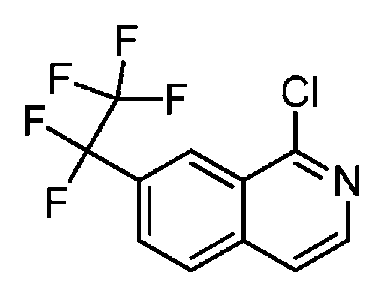
8 mL 밀봉관에, CuI (900 mg, 4.73 mmol, 5.47 eq), KF (0.3 g), 트라이메틸(트라이플루오로메틸)실란 (720 mg, 5.06 mmol, 5.86 eq) 및 NMP (4 mL), 1-클로로-7-요오도아이소퀴놀린 (250 mg, 0.86 mmol, 1.00 eq, 30%)을 넣었다. 반응 혼합물을 120℃에서 12시간 동안 교반하였다. 생성된 용액을 20 mL의 에틸 아세테이트로 희석하고, 3x5 mL의 포화 KI 용액으로 세척하고, 건조하고 (Na2SO4), 진공 하에서 농축하였다. 에틸 아세테이트/헥산 (1:10)을 사용하여 실리카 겔 컬럼 상에 잔류물을 적용하였다. 그리하여, 황색 고체로서 0.142 g (50%)의 1-클로로-7-(트라이플루오로메틸)아이소퀴놀린을 얻었고 황색 고체로서 0.142 g (18%)의 1-클로로-7-(펜타플루오로에틸)아이소퀴놀린을 얻었다.To a 8 mL sealing tube was added CuI (900 mg, 4.73 mmol, 5.47 eq), KF (0.3 g), trimethyl (trifluoromethyl) silane (720 mg, 5.06 mmol, 5.86 eq) and NMP 1-Chloro-7-iodoisoquinoline (250 mg, 0.86 mmol, 1.00 eq, 30%). The reaction mixture was stirred at 120 < 0 > C for 12 hours. The resulting solution was diluted with 20 mL of ethyl acetate, washed with 3 x 5 mL of saturated KI solution, dried (Na 2 SO 4 ) and concentrated in vacuo. The residue was applied on a silica gel column using ethyl acetate / hexane (1:10). Chloro-7- (trifluoromethyl) isoquinoline as a yellow solid and 0.142 g (18%) of 1-chloro-7- (pentafluoroethyl) Isoquinoline.
단계 B: tert-부틸 3-(2-[[7-(펜타플루오로에틸)아이소퀴놀린-1-일]아미노]아세트아미도)아제티딘-1-카르복실레이트Step B: tert-Butyl 3- (2 - [[7- (pentafluoroethyl) isoquinolin-1-yl] amino] acetamido) azetidine-
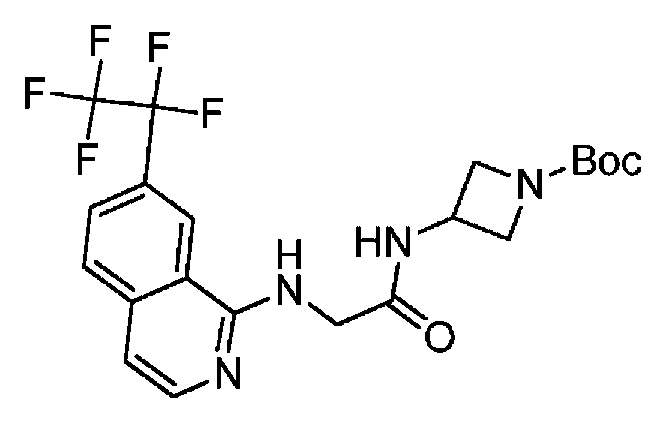
8 mL 밀봉관에, 1-클로로-7-(펜타플루오로에틸)아이소퀴놀린 (이전 단계에서 제조됨, 282 mg, 1.00 mmol, 1.00 eq), tert-부틸 3-(2-아미노아세트아미도)아제티딘-1-카르복실레이트 (실시예 1, 단계 E에 기재된 바와 같이 제조됨) (250 mg, 1.09 mmol, 1.09 eq), Cs2CO3 (1.0 g, 3.07 mmol, 3.06 eq), BINAP (24 mg, 0.04 mmol, 0.04 eq), Pd(OAc)2 (10 mg, 0.04 mmol, 0.04 eq) 및 톨루엔 (2 mL)을 넣었다. 반응 혼합물을 120℃에서 하룻밤 동안 교반하였다. 생성된 혼합물을 진공 하에서 농축하였다. 다이클로로메탄/메탄올 (10:1)을 사용하여 실리카 겔 컬럼에서 크로마토그래피에 의해 잔류물을 정제하였다. 그리하여, 갈색 고체로서 0.12 g (25%)의 tert-부틸 3-(2-[[7-(펜타플루오로에틸)아이소퀴놀린-1-일]아미노]아세트아미도)아제티딘-1-카르복실레이트를 얻었다.To a 8 mL sealed tube was added 1-chloro-7- (pentafluoroethyl) isoquinoline (prepared in the previous step, 282 mg, 1.00 mmol, 1.00 eq), tert- butyl 3- (2- aminoacetamido) azetidine-1-carboxylate (example 1, prepared as described in step E) (250 mg, 1.09 mmol , 1.09 eq), Cs 2 CO 3 (1.0 g, 3.07 mmol, 3.06 eq), BINAP ( 24 mg, 0.04 mmol, 0.04 eq), Pd (OAc) 2 (10 mg, 0.04 mmol, 0.04 eq) and toluene (2 mL). The reaction mixture was stirred at 120 < 0 > C overnight. The resulting mixture was concentrated in vacuo. The residue was purified by chromatography on a silica gel column using dichloromethane / methanol (10: 1). Thus, 0.12 g (25%) of tert-butyl 3- (2- [[7- (pentafluoroethyl) isoquinolin- 1 -yl] amino] acetamido) azetidine- Rate.
단계 C: N-(Step C: Preparation of N- ( 아제티딘Azetidine -3-일)-2-[[7-(Yl) -2 - [[7- ( 펜타플루오로에틸Pentafluoroethyl )) 아이소퀴놀린Isoquinoline -1-일]아미노]아세트아미드-1-yl] amino] acetamide

8 mL 밀봉관에, 다이클로로메탄 (5 mL) 중 tert-부틸 3-(2-[[7-(펜타플루오로에틸)아이소퀴놀린-1-일]아미노]아세트아미도)아제티딘-1-카르복실레이트 (이전 단계에서 제조됨, 100 mg, 0.21 mmol, 1.00 eq)의 용액, 및 TFA (0.5 g)를 넣었다. 생성된 용액을 0℃에서 5시간 동안 교반하였다. 생성된 혼합물을 진공 하에서 농축하였다. 잔류물을 3x5 mL의 에테르로 세척하였다. 그리하여, 백색 고체로서 0.12 g (조 생성물)의 N-(아제티딘-3-일)-2-[[7-(펜타플루오로에틸)아이소퀴놀린-1-일]아미노]아세트아미드를 얻었다.To a 8 mL sealed tube was added a solution of tert-butyl 3- (2 - [[7- (pentafluoroethyl) isoquinolin-1 -yl] amino] acetamido) Carboxylate (prepared in the previous step, 100 mg, 0.21 mmol, 1.00 eq) and TFA (0.5 g). The resulting solution was stirred at 0 < 0 > C for 5 hours. The resulting mixture was concentrated in vacuo. The residue was washed with 3 x 5 mL of ether. Thus, 0.12 g (crude product) of N- (azetidin-3-yl) -2 - [[7- (pentafluoroethyl) isoquinolin-1-yl] amino] acetamide was obtained as a white solid.
단계 D: N-(1-((1R,4s)-4-(1-하이드록시프로필)사이클로헥실)아제티딘-3-일)-2-((7-(퍼플루오로에틸)아이소퀴놀린-1-일)아미노)아세트아미드Step D: Preparation of N- (1 - ((1R, 4S) -4- (1 -hydroxypropyl) cyclohexyl) azetidin- 1-yl) amino) acetamide

8 mL 밀봉관에, 다이클로로메탄 (3 mL) 중 N-(아제티딘-3-일)-2-[[7-(펜타플루오로에틸)아이소퀴놀린-1-일]아미노]아세트아미드 (이전 단계에서 제조됨, 100 mg, 0.27 mmol, 1.00 eq)의 용액, 4-(1-하이드록시프로필)사이클로헥산-1-온 (실시예 25, 단계 B에 기재된 바와 같음) (75 mg, 0.48 mmol, 1.80 eq), TEA (150 mg, 1.48 mmol, 5.55 eq) 및 소듐 트라이아세톡시보로하이드라이드 (300 mg, 1.42 mmol, 5.30 eq)를 넣었다. 반응 혼합물을 25℃에서 2시간 동안 교반하였다. 이어서, 10 mL의 물을 첨가하여 반응물을 켄칭하였다. 생성된 용액을 2x10 mL의 다이클로로메탄으로 추출하였다. 합한 유기층을 10 mL의 염수로 세척하고, 건조하고 (Na2SO4), 진공 하에서 농축하였다. 조 생성물 (0.1 g)을 하기 조건으로 분취용-HPLC에 의해 정제하였다 (1#워터스 2761-1): 컬럼, 선파이어 프레프C18, 5 ㎛, 19x100mm; 이동상, 0.05% NH4HCO3을 갖는 물, 및 CH3CN (30% CH3CN으로부터 8분 후에 73%까지 증가, 2분 후에 100%까지 증가, 2분 후에 30%까지 감소); 검출기, 254/220nm. 표제 화합물을 백색 고체로서 얻었다.To a 8 mL sealed tube was added a solution of N- (azetidin-3-yl) -2 - [[7- (pentafluoroethyl) isoquinolin- 1 -yl] amino] acetamide (Prepared as described in Example 25, Step B) (75 mg, 0.48 mmol, 1.00 eq), 4- (1-hydroxypropyl) cyclohexan- , 1.80 eq), TEA (150 mg, 1.48 mmol, 5.55 eq) and sodium triacetoxyborohydride (300 mg, 1.42 mmol, 5.30 eq). The reaction mixture was stirred at 25 < 0 > C for 2 hours. The reaction was then quenched by the addition of 10 mL of water. The resulting solution was extracted with 2 x 10 mL dichloromethane. The combined organic layers were washed with 10 mL of brine, dried (Na 2 SO 4 ) and concentrated in vacuo. The crude product (0.1 g) was purified by preparative-HPLC (1 # Waters 2761-1) under the following conditions: column, Sunfire prep C18, 5 m, 19x100 mm; Mobile phase, water with 0.05% NH 4 HCO 3 , and CH 3 CN (up to 73% after 8 min from 30% CH 3 CN, up to 100% after 2 min, down to 30% after 2 min); Detector, 254 / 220nm. The title compound was obtained as a white solid.
LC-MS (ES, m/z) 515[M+H]+.LC-MS (ES, m / z) 515 [M + H] < + >.
1H-NMR (300MHz, CD3OD) δ 8.58(s, 1H), 8.00(d, J=6.0 Hz, 1H,), 7.92(d, J=8.7 Hz, 1H), 7.82(d, J=8.7 Hz, 1H), 7.08(d, J=5.7 Hz, 1H), 4.45-4.55(m, 1H), 4.19(s, 2H), 3.60-3.70(m, 2H), 2.90-3.10(m, 2H), 2.30(s, 1H), 1.20-1.70(m, 12H), 0.90-1.00(m, 3H). 1 H-NMR (300MHz, CD 3 OD) δ 8.58 (s, 1H), 8.00 (d, J = 6.0 Hz, 1H,), 7.92 (d, J = 8.7 Hz, 1H), 7.82 (d, J = 2H), 3.60-3.70 (m, 2H), 2.90-3.10 (m, 2H, < RTI ID = 0.0 & ), 2.30 (s, 1H), 1.20-1.70 (m, 12H), 0.90-1.00 (m, 3H).
실시예Example 171: 시험관 내에서의 생물학적 171: In vitro biological 데이타Data
본 발명의 화합물을 이용해 다양한 대표적인 생물학적 시험을 수행하였다.Various representative biological tests were performed using the compounds of the present invention.
이들 시험의 결과는 본 발명을 비-제한적인 방식으로 예시하고자 한다.The results of these tests are intended to illustrate the invention in a non-limiting manner.
THP-1 세포에서의 MCP-1 수용체 결합 분석MCP-1 receptor binding assay in THP-1 cells
인간 단핵구 세포주 THP-1 세포를 아메리칸 타입 컬처 컬렉션(American Type Culture Collection; 미국 버지니아주 마나사스 소재)으로부터 수득하였다. THP-1 세포를 37℃ 에서 가습 5% CO2 분위기 중에서, 10% 소태아혈청을 보충한 RPMI-1640 (RPMI: 로스웰 파크 메모리얼 인스티튜트 미디엄 (Roswell Park Memorial Institute Medium)-세포 배양 증식 배지)에서 증식시켰다. 세포 밀도를 0.5×10⁶ 세포/mL에서 유지하였다.Human monocytic cell line THP-1 cells were obtained from the American Type Culture Collection (Manassas, Va., USA). Proliferation in-: (cell culture growth medium Roswell Park Memorial Institute medium (Roswell Park Memorial Institute Medium) RPMI) in THP-1 cells, a humidifier 5% CO 2 atmosphere at 37 ℃, 10% fetal calf serum RPMI-1640 supplemented with . The cell density was maintained at 0.5 x 10⁶ cells / mL.
THP-1 세포를 다양한 농도의 비표지된 MCP-1 (미국 미네소타주 미니애폴리스 소재의 알앤디 시스템즈 (R & D Systems)) 또는 시험 화합물의 존재 하에 96 웰 플레이트에서 30℃에서 2 시간 동안 0.5 nM 125I 표지된 MCP-1 (미국 메사추세츠주 보스턴 소재의 퍼킨-엘머 라이프 사이언스, 인크. (Perkin-Elmer Life Sciences, Inc.))과 함께 인큐베이션시켰다. 다음, 세포를 필터 플레이트 상에서 수합하고, 건조시키고, 20㎕의 마이크로신트 20(Microscint 20)을 각각의 웰에 첨가하였다. 플레이트를 탑카운트 (TopCount) NXT, 마이크로플레이트 신틸레이션 앤드 루미네슨스 계수기 (Microplate Scintillation & Luminescence Counter (미국 메사추세츠주 보스턴 소재의 퍼킨-엘머 라이프 사이언스, 인코포레이티드))에서 계수하였다. 블랭크 값 (완충제 단독)을 모든 값에서 제하였고, 약물 처리된 값을 비히클 처리된 값과 비교하였다. 1 μM 냉각 MCP-1을 비특이적 결합에 대해 사용하였다.The THP-1 cells, a non-labeled with different concentrations of MCP-1 in the presence of (USA Minneapolis alaendi Systems (R & D Systems) in the material) or test compounds in 96 well plates 30 ℃ for 2 hours and 0.5 nM 125 I And incubated with labeled MCP-1 (Perkin-Elmer Life Sciences, Inc., Boston, Mass.). Next, the cells were collected on a filter plate, dried, and 20 占 퐇 of Microscint 20 was added to each well. Plates were counted in a TopCount NXT, Microplate Scintillation & Luminescence Counter (Perkin-Elmer Life Sciences, Inc., Boston, MA). Blank values (buffer alone) were subtracted from all values and the drug treated values were compared to the vehicle treated values. 1 [mu] M cooled MCP-1 was used for non-specific binding.
표 1은 본 발명의 시험 화합물에 대해 수득된, MCP-1의, CCR2에의 결합 억제에 대한 IC50 값을 열거한다. IC50 값이 특정 화합물에 대해 수득되지 않았던 경우, 억제%는 25 μM의 시험 농도에서 제공된다.Table 1 shows the IC 50 for the inhibition of binding of MCP-1 to CCR2, obtained for the test compounds of the present invention. List the values. IC 50 If the value was not obtained for a particular compound, the% inhibition is provided at a test concentration of 25 [mu] M.
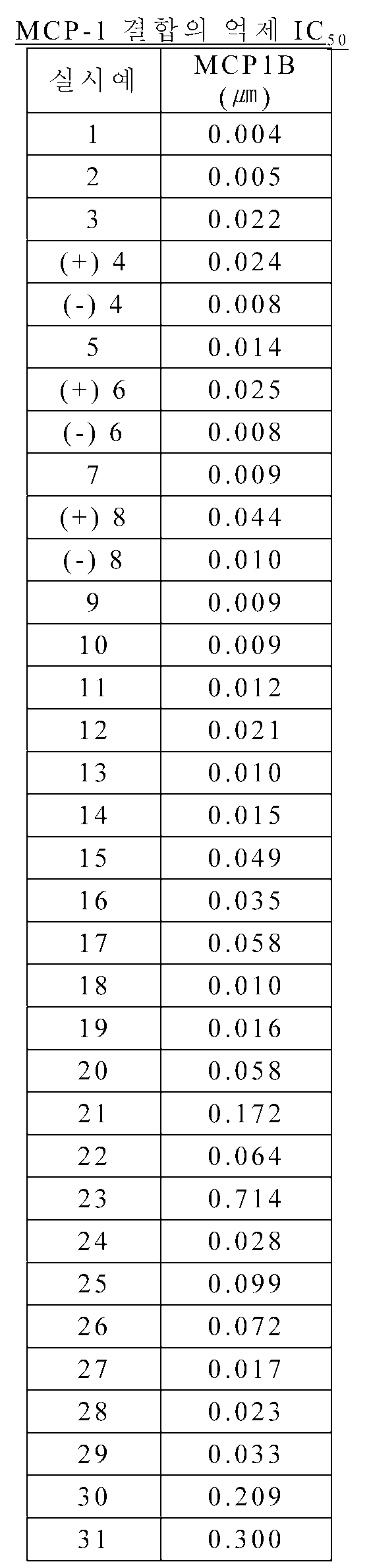


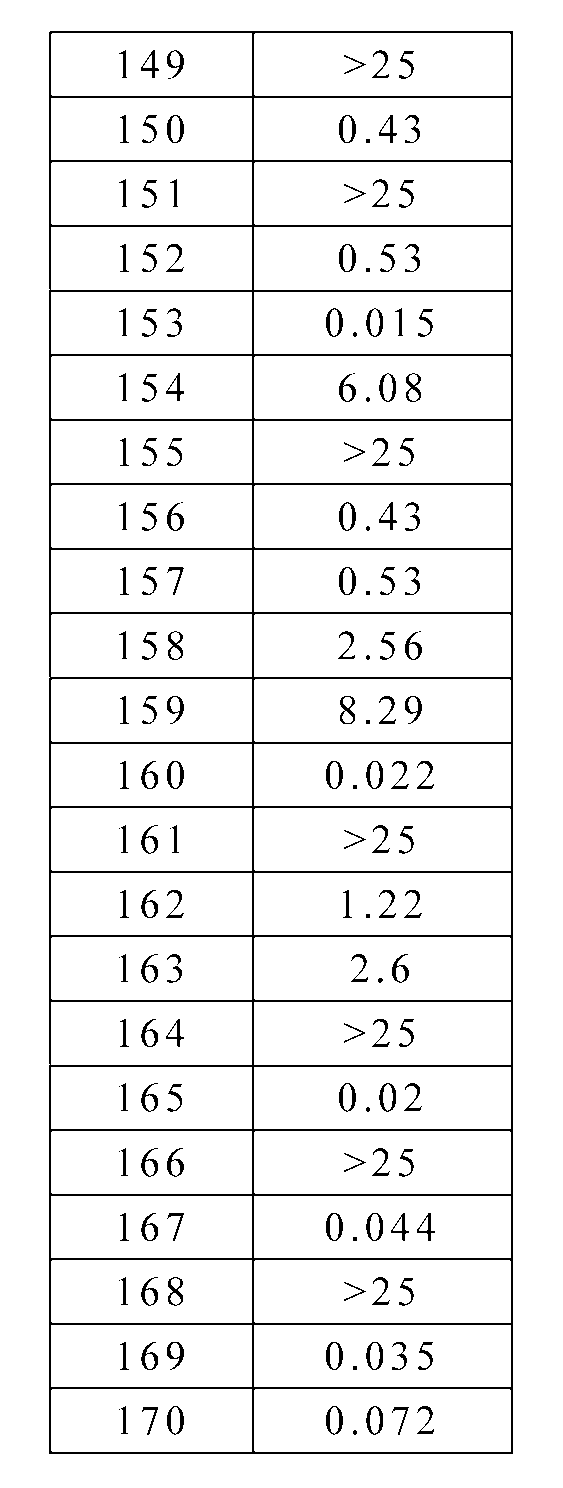
실시예 172: 동물.Example 172: Animal.
C57BL/6 마우스에 주입된 표적 129Sv/Evbrd 배아 줄기 세포 클론을 사용하여, 마우스 CCR2 녹아웃 (knock-out) / 인간 CCR2 녹인(knock-in) 마우스를 발생시킨다. hCCR2 전사물 (transcript)의 발현을 동형 접합 hCCR2 녹인 마우스의 비장 및 혈액의 전체 RNA에 대하여 행해진 정량적 역전사-중합효소 연쇄 반응에 의해 확인한다. C57BL/6 유전적 배경으로의 역교배를 제 8 대까지 계속한다. 12 시간의 명/12 시간의 암 사이클로 유지되는 특정 병원체를 포함하지 않는 온도 제어된 기관에 형질전환(transgenic) 마우스를 수용한다. 마우스는 물 및 음식물에 자유로이 접근할 수 있다. 실험 절차는 동물 관리에 대한 제도적 규범에 따라 행하며, 기관의 동물 관리 및 사용 위원회에 의해 승인된다.A mouse CCR2 knock-out / human CCR2 knock-in mouse is generated using a target 129Sv / Evbrd embryonic stem cell clone injected into C57BL / 6 mice. hCCR2 Expression of transcripts was quantified by quantitative RT-PCR of the spleen and blood total RNA of homozygous hCCR2 melted mice Confirm by chain reaction. C57BL / 6 reverse mating to genetic background Continue until the eighth. Transgenic mice were injected into temperature-controlled organs that did not contain a specific pathogen maintained at 12 hours / 12 hours of cancer cycle Accept. Mice have free access to water and food. The experimental procedure is It follows the institutional norms for animal care, It is approved by the Animal Care and Use Committee.
실시예 173: 뮤린의 생체 내에서의 세포 이동 분석.Example 173: Analysis of cell migration of murine in vivo.
동물에게 비히클 또는 CCR2 길항제를 3, 10 및 30 mg/kg으로 1일 2회 경구 투여한다. 동물을 마취하여 개복을 행한다. 소장 (길이 5 cm)의 말단 루프를 촉촉한 멸균 거즈 상에 조심스럽게 노출 (eventration)시킨다. 합성 인간 MCP-1 (1 mg/100 ml 멸균 PBS) 또는 단독의 PBS를 노출된 루프의 장막에 적하 투여한다. 치료 부위의 말단부를 표시하도록 봉합 매듭을 장간막에 둔다. 24 시간 후에, 동물을 희생시키며, 장의 일부 및 인접 부위를 제거한다. 장간막 가장자리 (border)를 따라 조직을 개방하여, 편평하게 핀으로 고정시켜, 점막을 제거한다. 남아있는 근육층을 잠시 100% EtOH에 고정시킨 다음에, 행커-예이츠 (Hanker-Yates) 시약을 사용하여 염색하여, 골수세포형 과산화효소 함유 면역 세포를 검출한다. 10 mpk, 1일 2회 경구 투여 시에, 세포 이동의 억제가 비히클로 치료된 동물과 비교하여, 30%에 도달한 경우에는 화합물이 효과적인 것으로 여겨진다.Animals are orally administered vehicle or CCR2 antagonist twice daily at 3, 10 and 30 mg / kg. The animal is anesthetized and opened. The end loops of small intestine (length 5 cm) are carefully exposed to moist sterile gauze. Synthetic human MCP-1 (1 mg / 100 ml sterile PBS) or single PBS is added dropwise to the draining of the exposed loops. Suture knots are placed in the mesentery to mark the distal end of the treated area. After 24 hours, animals are sacrificed, and a portion of the intestine and adjacent areas are removed. The tissue is opened along the border of the mesentery, and fixed with a flat pin to remove the mucous membrane. The remaining muscle layer is immobilized in 100% EtOH for a while and then stained using a Hanker-Yates reagent to detect immune cells containing bone marrow cell type peroxidase. Compounds are considered to be effective when oral administration at 10 mpk, twice a day, when the inhibition of cell migration reaches 30% compared to animals treated with vehicle.
실시예Example 174: 마우스에 있어서의 174: 티오글리콜레이트로Thioglycolate 유도된 복막염. Induced peritonitis.
동물에게 비히클 또는 CCR2 길항제를 3, 10, 30 및 100 mg/kg으로 1일 2회 경구 투여한다. 1 시간 후에, 복막염 유발에 대하여 동물에게 멸균 티오글리콜레이트 (25 mL/kg, ip, 시그마(Sigma))를 복강내 주사한다. 동물에게 1일 2회 비히클 또는 CCR2 길항제를 경구 치료한다. 72 시간 시점에서, 복막강을 멸균 식염수 10 mL로 세척한다. 복막 세척액 중의 총 세포 계수를 현미경을 사용하여 행하고, 세포 분화를 김자액 (Giemsa) 염색 (Hema Tek 2000) 후에 사이토스핀 분석을 이용하여 행한다. 티오글리콜레이트로 유도된 복막염의 억제율을 CCR2 길항제로 치료된 마우스 대 비히클로 치료된 마우스의 백혈구수의 변화를 비교함으로써 계산한다.Animals are orally administered vehicle or CCR2 antagonist twice daily at 3, 10, 30 and 100 mg / kg. One hour later, the animals are intraperitoneally injected with sterile thioglycolate (25 mL / kg, ip, Sigma) for peritonitis induction. Animals twice a day The vehicle or CCR2 antagonist is orally treated. At 72 hours, the multiple membrane steels are washed with 10 mL of sterile saline. Total cell counts in the peritoneal wash are performed using a microscope and cell differentiation is performed using Giemsa staining (Hema Tek 2000) followed by cytospin analysis. The inhibition rate of thioglycolate-induced peritonitis is calculated by comparing changes in leukocyte counts in mice treated with CCR2 antagonist-versus-vehicle.
실시예 175: 마우스의 기도로의 MCP-1 유도된 단핵구 동원(Monocyte Recruitment).Example 175: MCP-1 induced monocyte recruitment in the airways of mice.
동물에게 비히클 또는 CCR2 길항제를 3, 10, 및 30 mg/kg으로 1일 2회 경구 치료한다. 1 시간 후에, 동물에게 멸균 식염수 중의 4 ㎍의 MCP-1을 비강내로 투여한다. 동물에게 1일 2회 비히클 또는 CCR2 길항제로 경구 치료한다. 48 시간 후에, 마취 용액 (슬립어웨이 (Sleepaway)-판토바르비탈나트륨)의 복강내 주사에 의해 마우스를 안락사시킨다. 전체 기관지폐포 세척 (BAL)을, 3 mM EDTA를 함유하는 빙냉 PBS 1.4 ml를 사용하여 행한다. BAL 세척액 중의 총 세포 계수를 현미경을 사용하여 행하고, 세포 분화를 김자액 염색 (Hema Tek 2000) 후에 사이토스핀 분석을 이용하여 행한다. 억제율을 화합물로 치료된 마우스 대 비히클로 치료된 마우스의 총 백혈구수 (단핵구/대식 세포 및 림프구 포함)의 변화를 비교함으로써 계산한다. 억제율이 30%에 도달한 경우에는 화합물이 효과적인 것으로 여겨진다.The animals are orally treated with vehicle or CCR2 antagonist twice daily at 3, 10, and 30 mg / kg. After 1 hour, the animals were anesthetized in sterile saline 4 μg of MCP-1 is administered intranasally. Animals twice a day Oral treatment with vehicle or CCR2 antagonist. After 48 hours, mice were injected intraperitoneally with anesthetic solution (Sleepaway - pantobarbital sodium) Euthanize. Whole bronchial alveoli Wash (BAL) And 1.4 ml of ice-cold PBS containing 3 mM EDTA. The total cell counts in the BAL washing solution are performed using a microscope and cell differentiation is performed using cyto-spin analysis after hematoxylin (Hema Tek 2000). The inhibition rate is calculated by comparing the changes in total leukocyte counts (including mononuclear cells / macrophages and lymphocytes) of mice treated with the compound versus the vehicle treated with vehicle. Compounds are considered effective when the inhibition rate reaches 30%.
실시예Example 176: 마우스의 고지방식( 176: Mouse High Altitude Mode ( highhigh -- fatfat dietdiet )에 의한 비만 및 인슐린 Obesity and insulin 저항증Resistance ..
7주령의 동물에서 10 내지 24 주간 지방질 (D-12492; 리서치 다이어츠 인크(Research Diets Inc.))로부터 약 60% 칼로리를 생성하는 고지방식에 의해 비만을 유도한다. 7주령 이전에, 칼로리 중 5%가 지방으로서 주어진 표준 펠릿 음식물을 동물에게 준다. 체중 및 지방량에 의해 비만 동물을 무작위로 추출한다. 비히클 또는 CCR2 길항제를 3, 10, 및 30 mg/kg으로 1일 2회 경구 투여하여 비만 동물을 경구 치료한다. 체중 및 음식물 섭취 및 공복시 혈당치를 모니터링한다. 체질량(body mass)을 NMR 분석기 (버커 미니스펙(Burker MiniSpec))로 측정한다. 인슐린 내성 시험을 3시간 동안 금식시킨 동물에서 행한다. 재조합 인간 인슐린 (1.5 U/kg)의 복강내 일시 주사 후에, 글루코미터 (Glucometer)를 사용하여 주사전 및 주사후 15, 30, 45, 60, 90 및 120분 후에 혈당 농도를 측정한다. 하룻밤 동안 (17 시간) 금식시킨 후에, 포도당 부하 시험을 행한다. 물 (1g/kg)에 용해된 포도당의 경구 투여 전 및 경구 투여 후 15, 30, 60, 90, 120분 후에, 혈당 농도를 측정한다. 에너지 소비량 분석을 완전한 실험 동물 모니터링 시스템에 의해 모니터링한다. 비히클 또는 CCR2 길항제 치료 40일 후에, CO2 질식에 의해 동물을 희생시킨다. 화합물로 치료한 마우스와 비히클로 치료한 마우스의 체중 변화를 비교하여, 체중 감소율을 계산한다.Obesity is induced by a high fat diet that produces about 60% calories from lipids (D-12492; Research Diets Inc.) for 10 to 24 weeks in 7-week old animals. Prior to 7 weeks of age, 5% of calories give animals the standard pellet diet given as fat. Obese animals are randomly extracted by body weight and fat mass. Vehicle or CCR2 antagonist is orally administered at 3, 10, and 30 mg / kg twice a day to orally treat obese animals. Monitor weight and food intake and fasting blood glucose levels. The body mass is measured with an NMR analyzer (Burker MiniSpec). Insulin resistance test is performed in animals fasted for 3 hours. After an intraperitoneal injection of recombinant human insulin (1.5 U / kg), the blood glucose concentration is measured 15, 30, 45, 60, 90 and 120 minutes after the main pre- and post-injection using a Glucometer. After fasting overnight (17 hours), a glucose tolerance test is performed. Blood glucose levels are measured before oral administration of glucose dissolved in water (1 g / kg) and after 15, 30, 60, 90 and 120 minutes after oral administration. Energy consumption analysis is monitored by a complete laboratory animal monitoring system. After 40 days of vehicle or CCR2 antagonist treatment, animals are sacrificed by CO 2 suffocation. Comparing the body weight changes of mice treated with the compound and the vehicle, the weight loss rate is calculated.
실시예 177: 알러지성 천식의 마우스 모델.Example 177: Mouse model of allergic asthma.
0 및 5일째에 100 ㎕ 인산염 완충 식염수 (PBS)에서 1 mg 임젝트 (Imject)(등록상표) 에 흡수된 10 ㎍ 계란 알부민 (OVA)의 복강내 주사에 의해 동물을 감작시킨다. 대조군 동물에게 PBS를 복강내로 주입한다. 12, 16 및 20일째에 초음파 분무기에 의해 10 분에 걸친 0.5% OVA 에어로졸의 흡입에 의해 OVA 면역화 동물을 접종한다. 대조군 동물을 유사한 방식으로 PBS로 접종한다. 비히클 (0.5% 메토셀) 또는 CCR2 길항제를 9 내지 20일부터, 1일 2회, 그리고 21일째 희생되기 2시간 전에 1일 1회 3, 10, 30 mg/kg으로 OVA로 감작된 동물에게 경구로 투여한다. 덱사메타손 (5 mg/kg) 및 몬테루카스트 (1 mg/kg)를 1일 1회 경구 투여한다. 21일 째에, CCR2 화합물의 최종 투여 2 시간 후에, 북스코 (Buxco) 전신 혈량측정법을 이용하여, 에어로졸화된 메타콜린에 대한 기관지 반응성을 측정한다. 21일째에, 동물을 희생시킨다. 기관지폐포 세척액을 수집하여 (1 mL), 총세포수를 계산한다. 호산구, 림프구, 단핵구 및 호중구의 수를 김자액 염색 (Hema Tek 2000) 후에 사이토스핀 분석을 이용하여 측정한다. 화합물로 치료된 마우스를 비히클로 치료된 마우스와 비교함으로써 총 BAL 백혈구수 (및 호산구수)의 억제율을 계산한다. 억제율이 30%에 도달한 경우에는 화합물이 효과적인 것으로 여겨진다.On day 0 and 5, 1 mg Imject (TM) in 100 [mu] l phosphate buffered saline (PBS) The animals are sensitized by intraperitoneal injection of 10 [mu] g egg albumin (OVA) Control animals are injected with PBS intraperitoneally. On days 12, 16 and 20, OVA-immunized animals are inoculated by inhalation of 0.5% OVA aerosol over 10 minutes by an ultrasonic atomizer. Control animals are inoculated with PBS in a similar manner. (0.5% methotrexate) or CCR2 antagonist was administered orally to the animals sensitized with OVA at 3, 10, 30 mg / kg once daily from 9-20 days, twice daily, and 2 hours before sacrifice on day 21 Lt; / RTI > Dexamethasone (5 mg / kg) and montelukast (1 mg / kg) are given orally once a day. On day 21, bronchial responsiveness to aerosolized methacholine is measured 2 hours after the last administration of the CCR2 compound, using Buxco systemic blood test. On day 21, animals are sacrificed. Bronchoalveolar lavage fluid is collected (1 mL) and total cell count is calculated. The numbers of eosinophils, lymphocytes, mononuclear cells and neutrophils are measured by cyto-spin analysis after hematoxylin (Hema Tek 2000). The inhibition rate of total BAL leukocyte count (and eosinophil count) is calculated by comparing the mice treated with the compound to the vehicle treated mice. Compounds are considered effective when the inhibition rate reaches 30%.
전술한 명세서가 설명을 목적으로 제공된 실시예와 함께, 본 발명의 원리를 교시한다고 하더라도, 발명의 실행이 하기 특허청구범위 및 그들의 등가물의 범주 내에 속하는 모든 통상적인 변형, 개조 및/또는 변경을 포함하는 것으로 이해될 것이다.While the foregoing disclosure teaches the principles of the invention, together with the examples provided for the purpose of explanation, the practice of the invention encompasses all the usual variations, modifications and / or variations that fall within the scope of the following claims and their equivalents .
Claims (21)
[화학식 I]

상기 식에서,
A는


X는 CH, 또는 N이고;
Z는 CH, 또는 N이되, 단, X 및 Z 둘 모두가 CH는 아니고;
J는 N 또는 CH이고;
J가 N이면 Q는 C-R5이거나, 또는 J가 CH이면 Q는 N이고;
R1은 H, 페닐, 헤테로아릴, CF3, -CH=CH2, CO2C(1-4)알킬, NH-tert-부틸옥시카르보닐, NHC(1-4)알킬, N(C(1-4)알킬)CO2CH2Ph, NRbC(O)Rbb, NRbSO2Rbb, C(O)N(CH3)OCH3, C(O)NRbC(1-4)알킬, C(O)NHCH2Ph(OCH3)2, -C(OH)(CH2CH=CH2)2, 3,6-다이하이드로피란-2-일, 2,5-다이하이드로푸란-2-일, 테트라하이드로피라닐, 사이클로펜테닐, 사이클로펜타닐, 사이클로헥세닐, 사이클로헥사닐, 테트라하이드로푸란-2-일, 사이클로헵타닐,


R2는 H, 또는 OH이거나;
또는 R1과 R2는 함께 카르보닐을 형성할 수 있고;
R3은 H, C(1-4)알킬, -CN, CHF2, 또는 CF3이고;
R4는 H 또는 CH3이고;
R5는 H 또는 중수소이고;
Ra는 H, 또는 CH3이고;
Rb는 H, C(1-4)알킬, 또는 CF3이고;
Rbb는 H, C(1-4)알킬, 또는 CF3이고;
상기 헤테로아릴은 N, O, 또는 S로부터 선택되는 1 내지 4개의 헤테로원자를 포함하는 5원 내지 7원 단환식 또는 8원 내지 10원 이환식 방향족 고리 시스템이다.Claims 1. Compounds of the general formula < RTI ID = 0.0 > (I) < / RTI &
(I)
In this formula,
A is
X is CH, or N;
Z is CH, or N, with the proviso that both X and Z are not CH;
J is N or CH;
When J is N, Q is CR < 5 & gt ;, or when J is CH, Q is N;
R 1 is H, phenyl, heteroaryl, CF 3, -CH = CH 2 , CO 2 C (1-4) alkyl, NH-tert- butyloxycarbonyl, NHC (1-4) alkyl, N (C ( 1-4) alkyl) CO 2 CH 2 Ph, NR b C (O) R bb, NR b SO 2 R bb, C (O) N (CH 3) OCH 3, C (O) NR b C (1- 4) alkyl, C (O) NHCH 2 Ph (OCH 3 ) 2 , -C (OH) (CH 2 CH═CH 2 ) 2 , 3,6-dihydropyran- Furan-2-yl, tetrahydropyranyl, cyclopentenyl, cyclopentanyl, cyclohexenyl, cyclohexanyl, tetrahydrofuran-2-yl, cycloheptanyl,
R 2 is H, or OH;
Or R < 1 > and R < 2 > may together form a carbonyl;
R 3 is H, C (1-4) alkyl, -CN, CHF 2 , or CF 3 ;
R 4 is H or CH 3, and;
R < 5 > is H or deuterium;
R a is H, or CH 3 ;
R b is H, C (1-4) alkyl, or CF 3 ;
R bb is H, C (1-4) alkyl, or CF 3 ;
The heteroaryl is a 5- to 7-membered monocyclic or 8- to 10-membered bicyclic aromatic ring system comprising 1-4 heteroatoms selected from N, O,
A는

J는 N이고;
Q는 C-R5인 화합물 또는 그의 약학적으로 허용가능한 염.The method according to claim 1,
A is
J is N;
Q is CR < 5 >, or a pharmaceutically acceptable salt thereof.
R1이 피리딜, 피리미딜, 피라질, 피라닐, 푸릴, 아이속사졸릴, 옥사졸릴, 페닐, 티아졸릴, 아이소티아졸릴, CF3, -CH=CH2, CO2C(1-4)알킬, NH-tert-부틸옥시카르보닐, N(C(1-4)알킬)CO2CH2Ph, NRbC(O)Rbb, C(O)N(CH3)OCH3, C(O)NHC(1-4)알킬, C(O)NHCH2Ph(OCH3)2, -C(OH)(CH2CH=CH2)2, 3,6-다이하이드로피란-2-일, 2,5-다이하이드로푸란-2-일, 테트라하이드로피라닐, 사이클로펜테닐, 사이클로펜타닐, 사이클로헥세닐, 테트라하이드로푸란-2-일, 사이클로헵타닐,
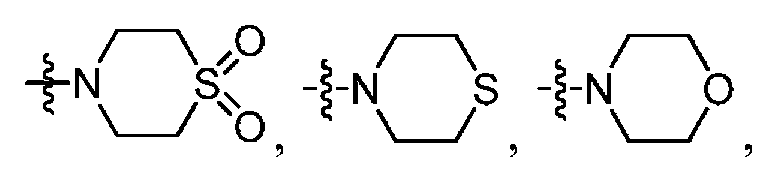
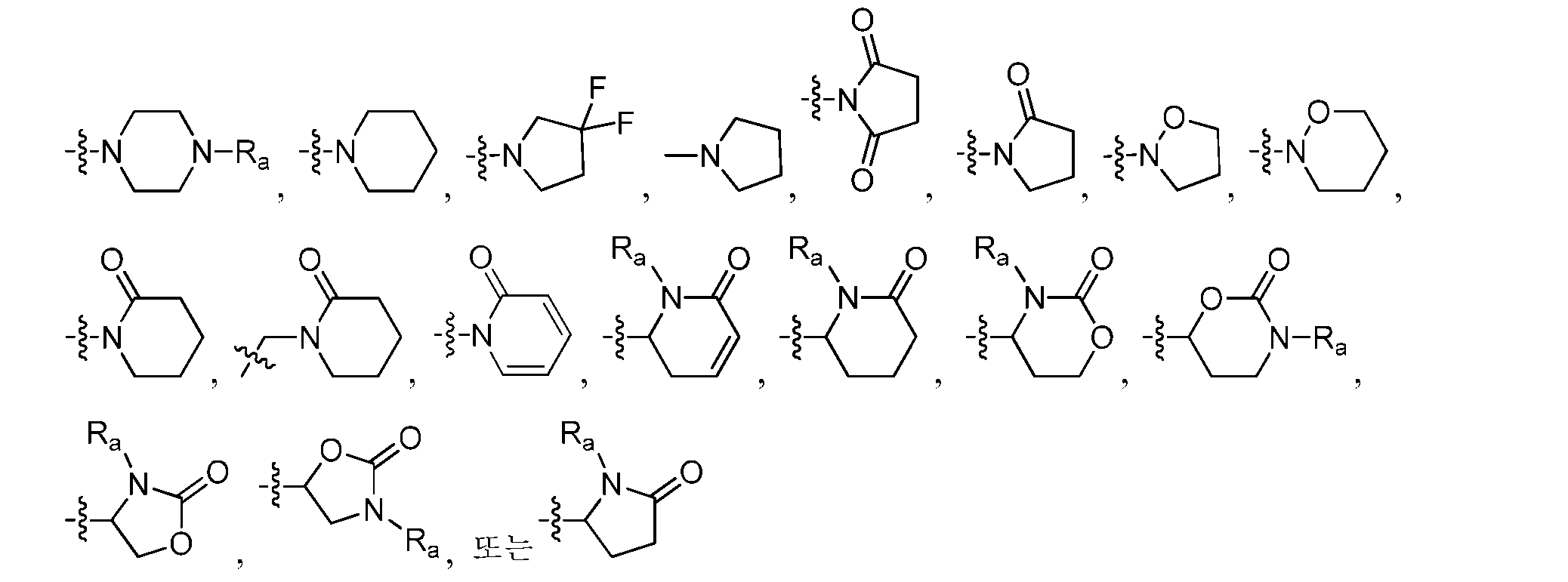
R 1 is pyridyl, pyrimidyl, pyrazyl, pyranyl, furyl, isoxazolyl, oxazolyl, phenyl, thiazolyl, iso-thiazolyl, CF 3, -CH = CH 2 , CO 2 C (1-4) alkyl, NH-tert- butyloxycarbonyl, N (C (1-4) alkyl) CO 2 CH 2 Ph, NR b C (O) R bb, C (O) N (CH 3) OCH 3, C ( O) NHC (1-4) alkyl, C (O) NHCH 2 Ph (OCH 3) 2, -C (OH) (CH 2 CH = CH 2) 2, 3,6- dihydro-pyran-2-yl, 2-yl, tetrahydrofuranyl, cyclopentenyl, cyclopentanyl, cyclohexenyl, tetrahydrofuran-2-yl, cycloheptanyl,
R1이 피리딜, 피리미딜, 피라질, 옥사졸릴, 페닐, 티아졸릴, 아이소티아졸릴, CF3, -CH=CH2, CO2C(1-4)알킬, NH-tert-부틸옥시카르보닐, N(C(1-4)알킬)CO2CH2Ph, NRbC(O)Rbb, C(O)N(CH3)OCH3, C(O)NHC(1-4)알킬, C(O)NHCH2Ph(OCH3)2, -C(OH)(CH2CH=CH2)2, 3,6-다이하이드로피란-2-일, 2,5-다이하이드로푸란-2-일, 테트라하이드로피라닐, 사이클로펜테닐, 사이클로펜타닐, 사이클로헥세닐, 테트라하이드로푸란-2-일, 사이클로헵타닐,



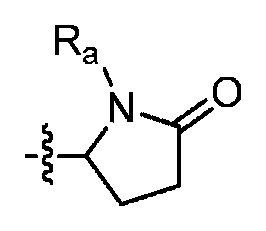
R 1 is pyridyl, pyrimidyl, pyrazyl, oxazolyl, phenyl, thiazolyl, iso-thiazolyl, CF 3, -CH = CH 2 , CO 2 C (1-4) alkyl, NH-tert- butyl-oxy-carboxylic carbonyl, N (C (1-4) alkyl) CO 2 CH 2 Ph, NR b C (O) R bb, C (O) N (CH 3) OCH 3, C (O) NHC (1-4) alkyl , C (O) NHCH 2 Ph (OCH 3) 2, -C (OH) (CH 2 CH = CH 2) 2, 3,6- dihydro-pyran-2-yl, 2,5-dihydro-furan -2 Yl, tetrahydropyranyl, cyclopentenyl, cyclopentanyl, cyclohexenyl, tetrahydrofuran-2-yl, cycloheptanyl,
R1이 피리딜, 페닐, 티아졸릴, 아이소티아졸릴, CF3, -CH=CH2, CO2C(1-4)알킬, NH-tert-부틸옥시카르보닐, N(C(1-3)알킬)CO2CH2Ph, NRbC(O)Rbb, C(O)N(CH3)OCH3, C(O)NHC(1-4)알킬, C(O)NHCH2Ph(OCH3)2, -C(OH)(CH2CH=CH2)2, 3,6-다이하이드로피란-2-일, 2,5-다이하이드로푸란-2-일, 테트라하이드로피라닐, 사이클로펜테닐, 사이클로펜타닐, 테트라하이드로푸란-2-일, 사이클로헵타닐,



R 1 is pyridyl, phenyl, thiazolyl, iso-thiazolyl, CF 3, -CH = CH 2 , CO 2 C (1-4) alkyl, NH-tert- butyloxycarbonyl, N (C (1-3 ) alkyl) CO 2 CH 2 Ph, NR b C (O) R bb, C (O) N (CH 3) OCH 3, C (O) NHC (1-4) alkyl, C (O) NHCH 2 Ph ( OCH 3 ) 2 , -C (OH) (CH 2 CH = CH 2 ) 2 , 3,6-dihydropyran-2-yl, 2,5-dihydrofuran-2-yl, tetrahydropyranyl, Pentenyl, cyclopentanyl, tetrahydrofuran-2-yl, cycloheptanyl,
R1은 H, 피리딜, 페닐, 티아졸릴, 아이소티아졸릴, CF3, -CH=CH2, CO2CH2CH3, NH-tert-부틸옥시카르보닐, N(C(1-3)알킬)CO2CH2Ph, NRbC(O)Rbb, C(O)N(CH3)OCH3, C(O)NHCH2CH3, C(O)NHCH2Ph(OCH3)2, -C(OH)(CH2CH=CH2)2, 3,6-다이하이드로피란-2-일, 2,5-다이하이드로푸란-2-일, 테트라하이드로피라닐, 사이클로펜테닐, 사이클로펜타닐, 테트라하이드로푸란-2-일, 사이클로헵타닐,

또는

R3은 H, CH3, -CN, CH(CH3)2, 또는 CF3인 화합물 또는 그의 약학적으로 허용가능한 염.6. The method of claim 5,
R 1 is H, pyridyl, phenyl, thiazolyl, iso-thiazolyl, CF 3, -CH = CH 2 , CO 2 CH 2 CH 3, NH-tert- butyloxycarbonyl, N (C (1-3) alkyl) CO 2 CH 2 Ph, NR b C (O) R bb, C (O) N (CH 3) OCH 3, C (O) NHCH 2 CH 3, C (O) NHCH 2 Ph (OCH 3) 2 , -C (OH) (CH 2 CH = CH 2) 2, 3,6- dihydro-pyran-2-yl, 2,5-dihydro-furan-2-yl, tetrahydropyranyl, cyclopentenyl, bicyclo Fentanyl, tetrahydrofuran-2-yl, cycloheptanyl,
or
R 3 is H, CH 3 , -CN, CH (CH 3 ) 2 , or CF 3 , or a pharmaceutically acceptable salt thereof.
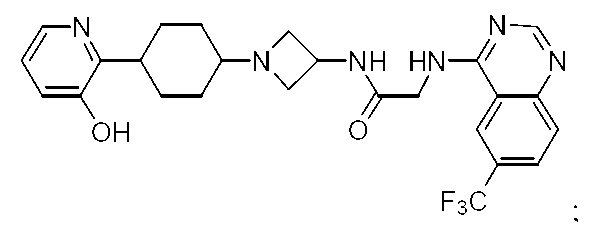


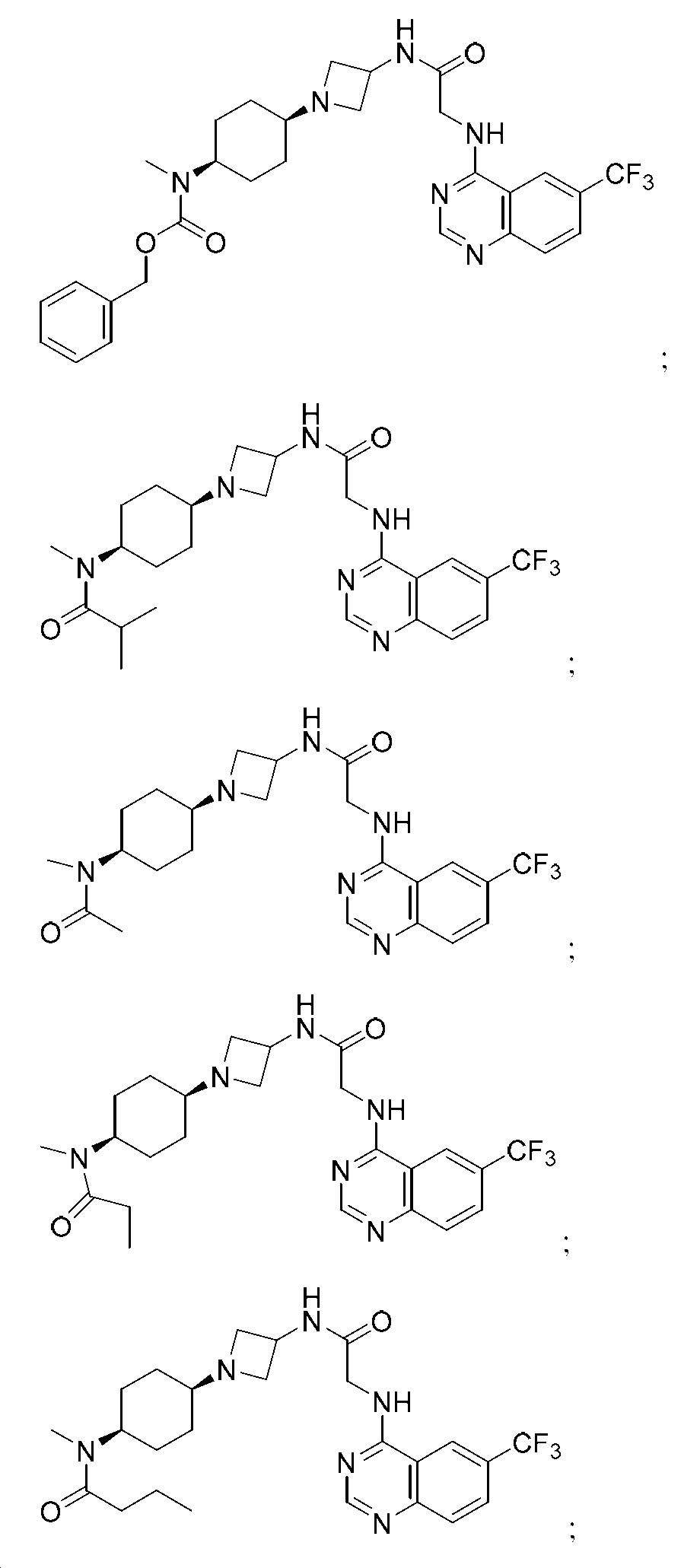
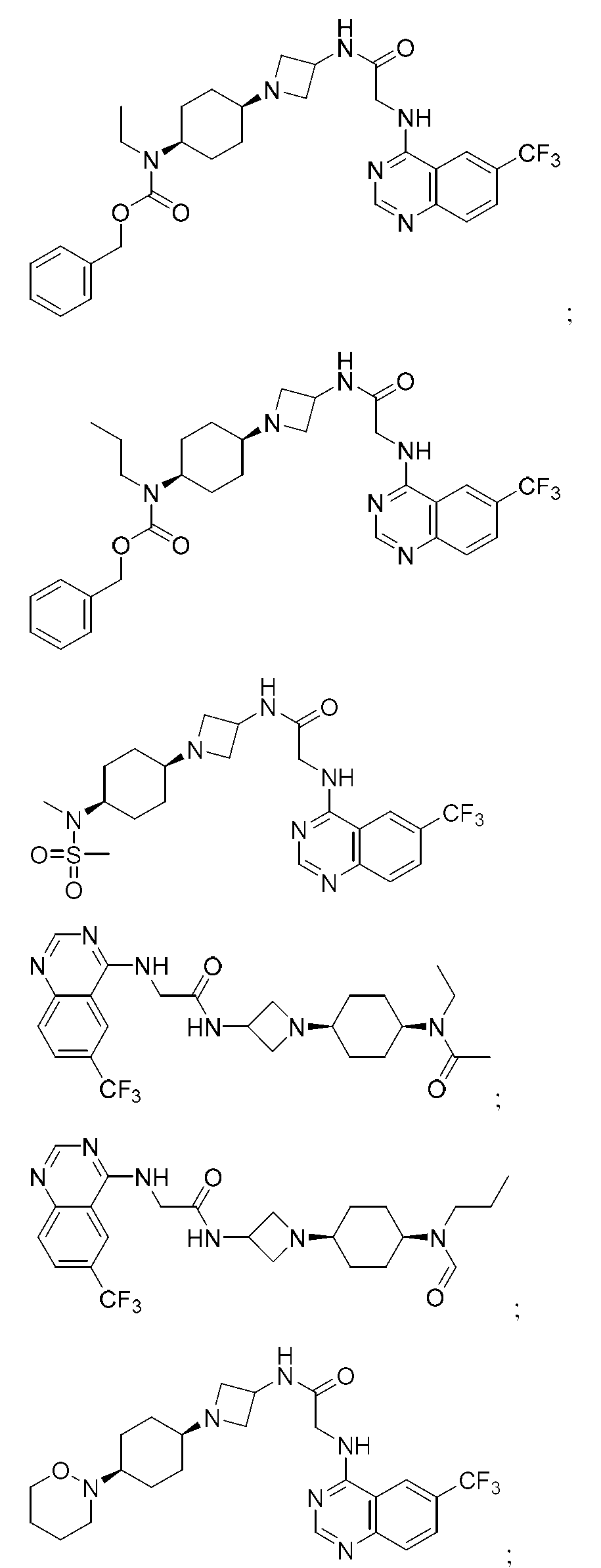


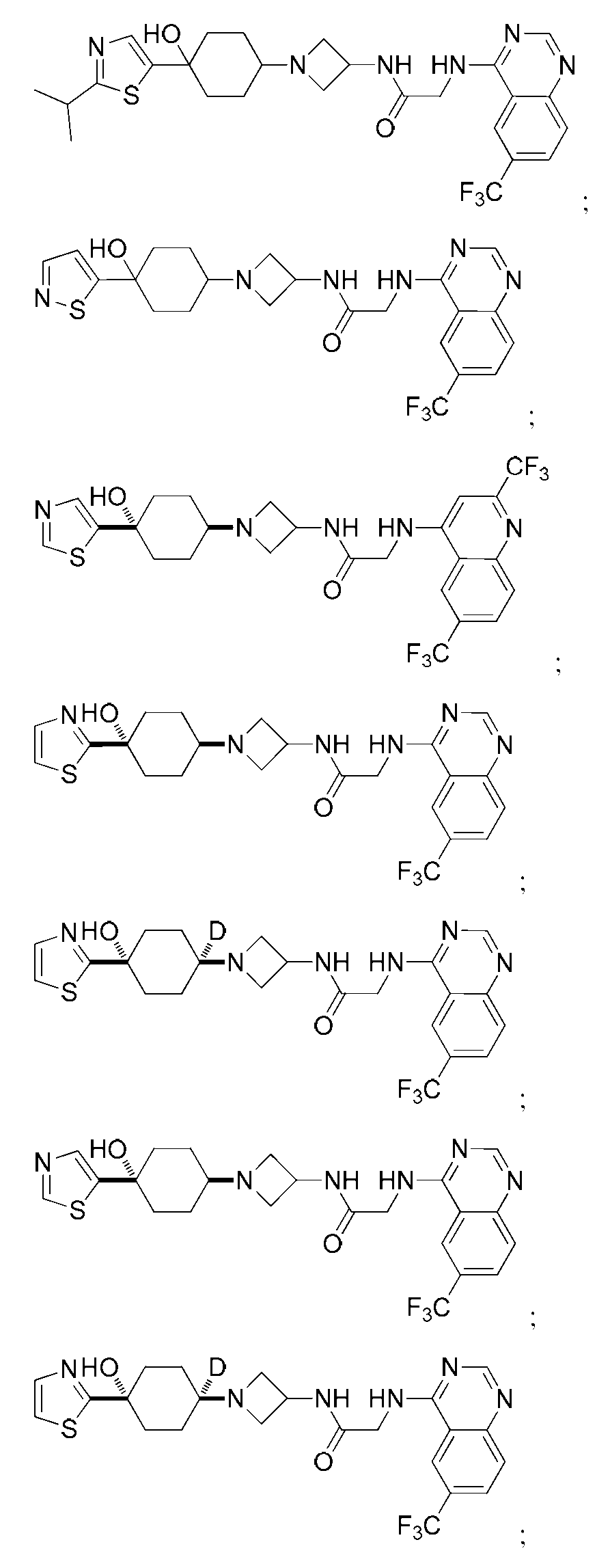


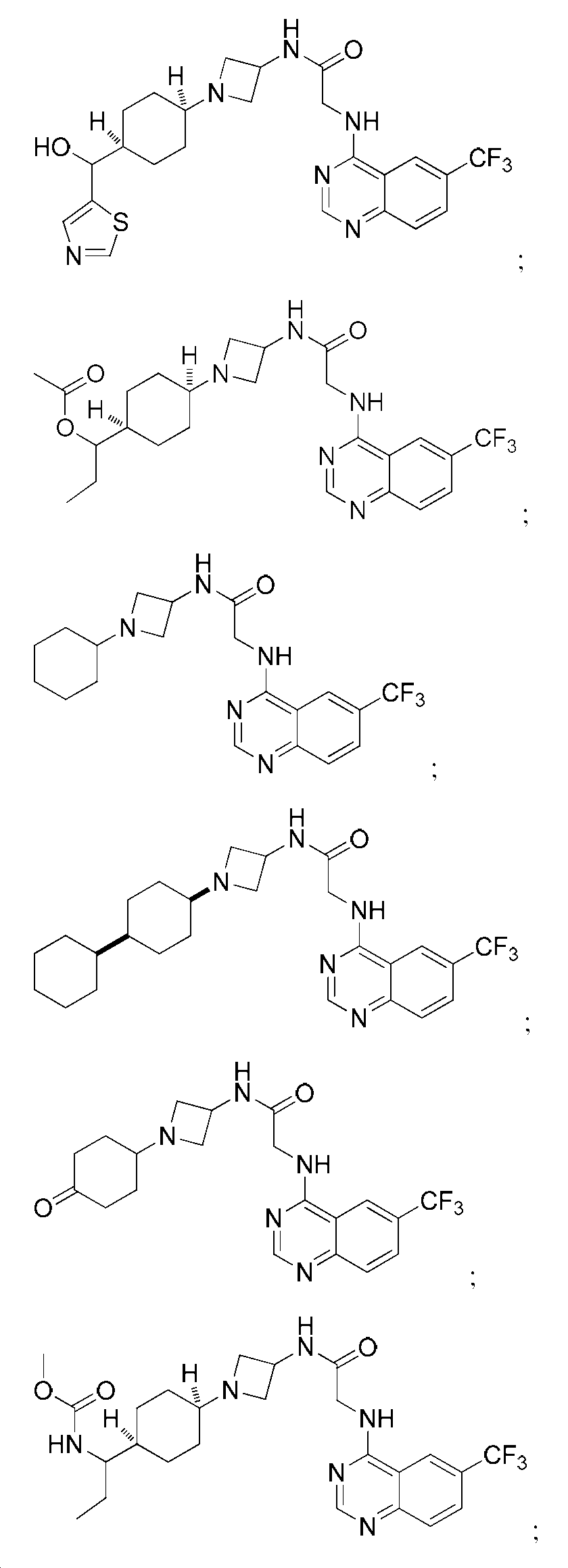


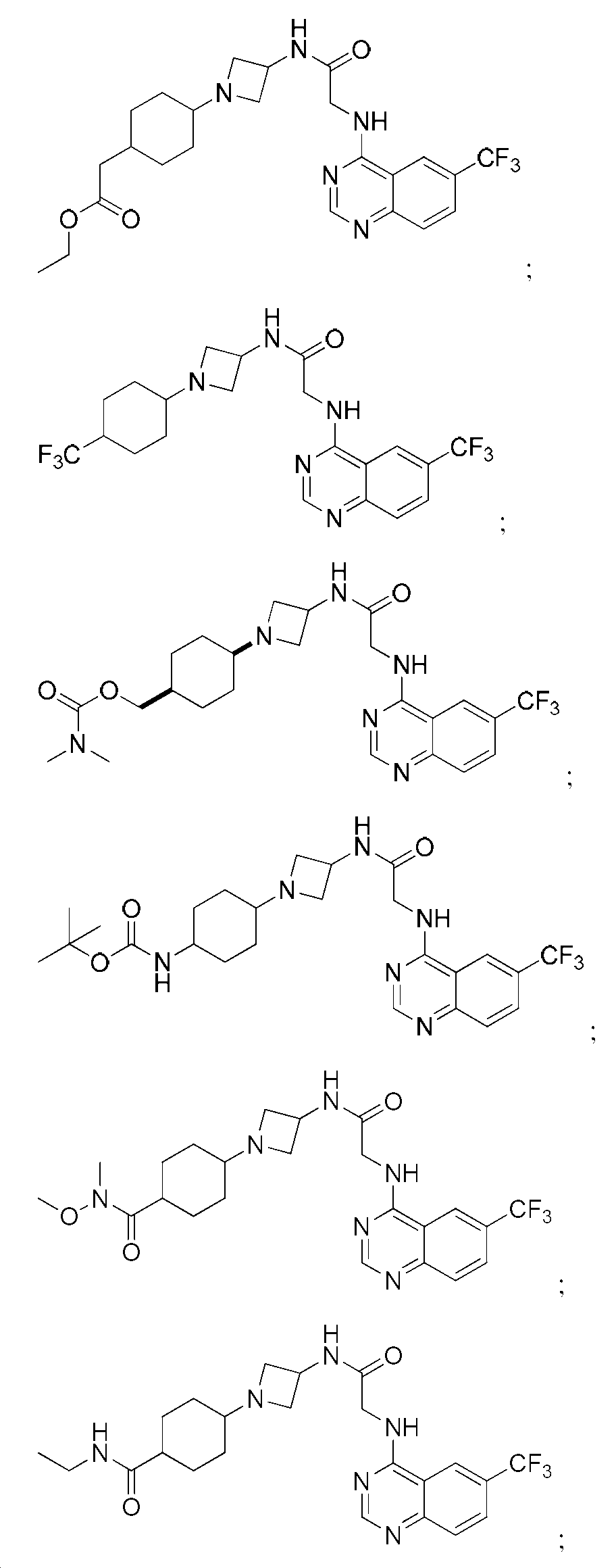

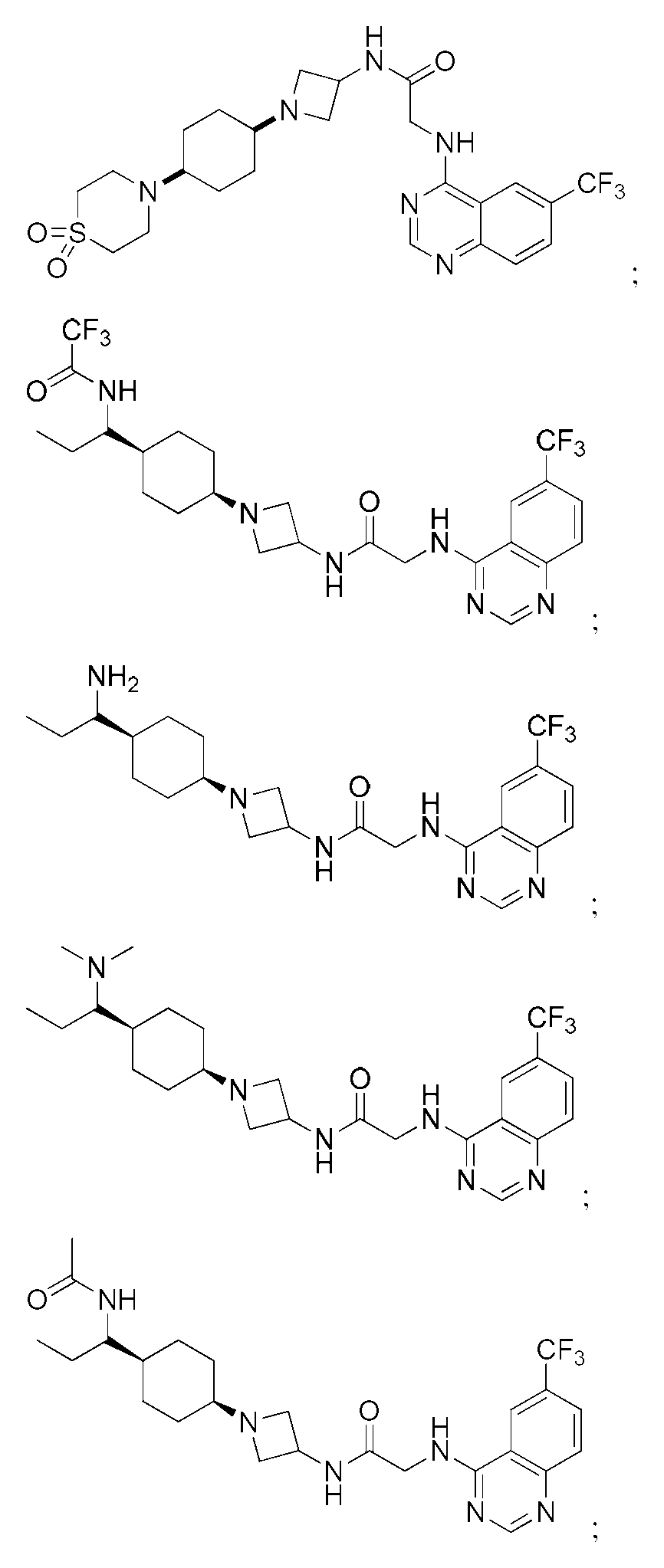
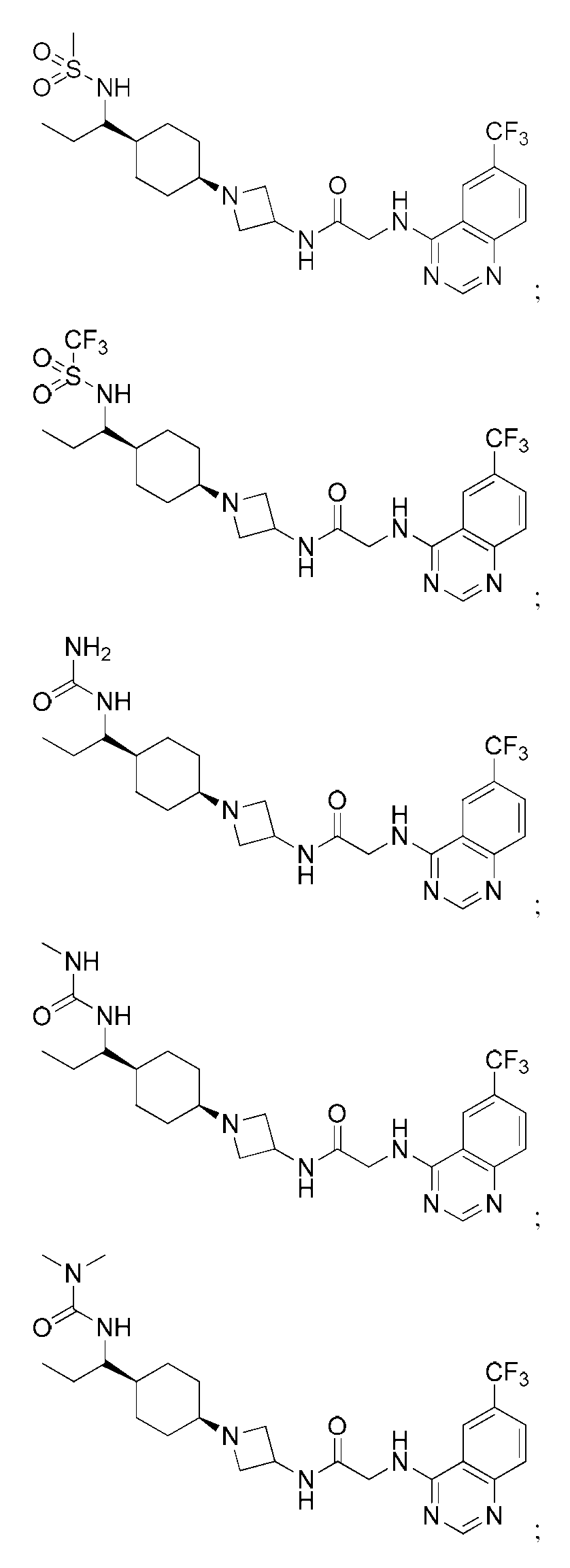


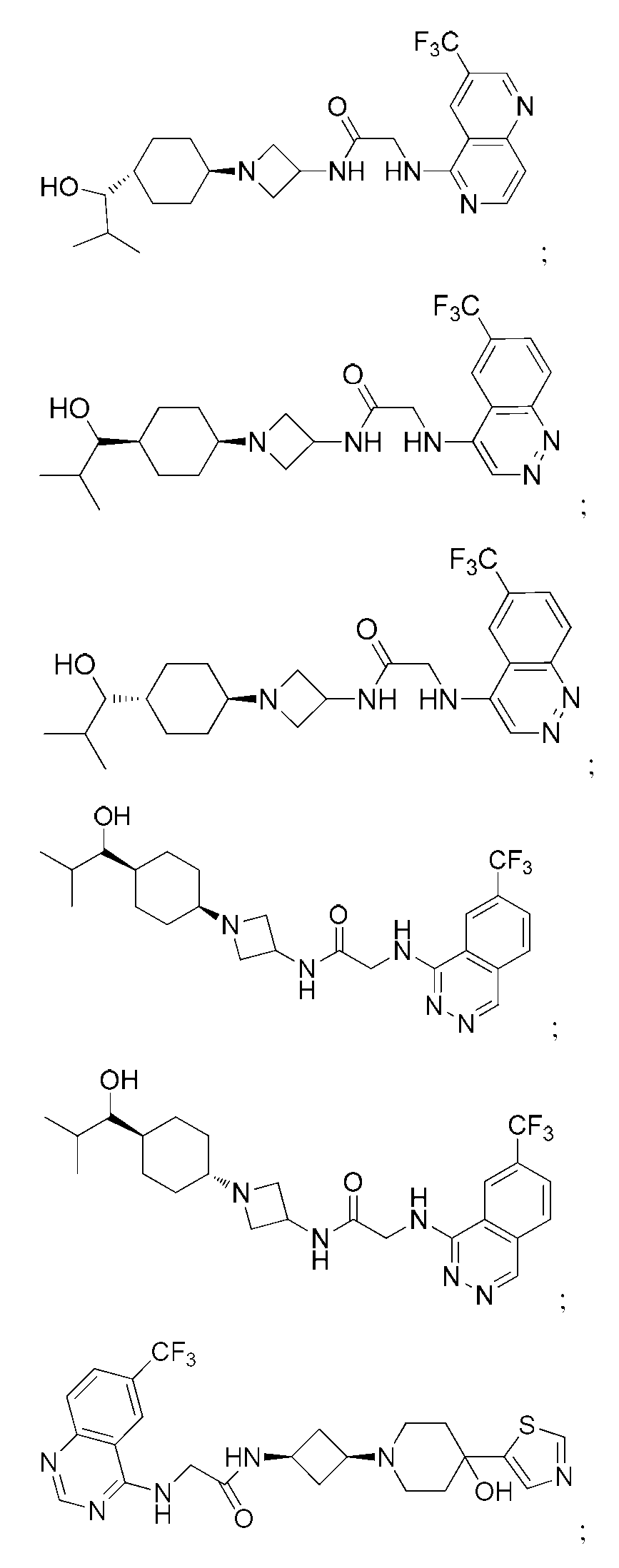


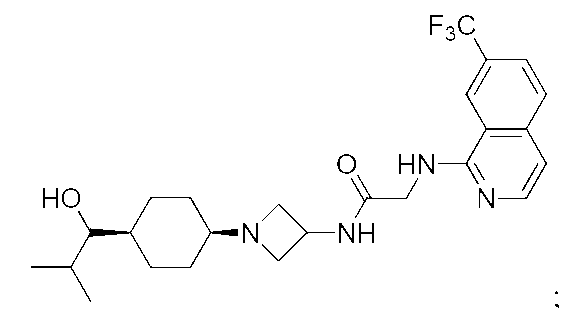


[화학식 IV]

[화학식 VI]

상기 식에서, R1, R2 및 R3은 제1항에 정의된 바와 같다.A process for the preparation of a compound of claim 1, comprising reacting a compound of formula (IV): in the presence of a reducing agent with a compound of formula (VI)
(IV)
(VI)
Wherein R 1 , R 2 and R 3 are as defined in claim 1.
[화학식 IX]
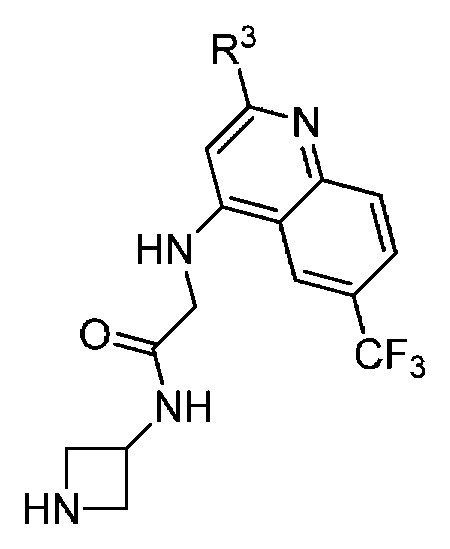
[화학식 VI]

상기 식에서, R1, R2 및 R3은 제1항에 정의된 바와 같다.A process for preparing a compound of claim 1, comprising reacting a compound of formula (IX)
(IX)
(VI)
Wherein R 1 , R 2 and R 3 are as defined in claim 1.
[화학식 XXVIII]

[화학식 VI]

상기 식에서, R1 및 R2는 제1항에 정의된 바와 같다.A process for preparing a compound of claim 1, comprising reacting a compound of formula (XXVIII)
(XXVIII)
(VI)
Wherein R < 1 > and R < 2 > are as defined in claim 1.
Applications Claiming Priority (3)
| Application Number | Priority Date | Filing Date | Title |
|---|---|---|---|
| US35566310P | 2010-06-17 | 2010-06-17 | |
| US61/355,663 | 2010-06-17 | ||
| PCT/US2011/040610 WO2011159854A1 (en) | 2010-06-17 | 2011-06-16 | Cyclohexyl-azetidinyl antagonists of ccr2 |
Publications (2)
| Publication Number | Publication Date |
|---|---|
| KR20130112861A KR20130112861A (en) | 2013-10-14 |
| KR101743280B1 true KR101743280B1 (en) | 2017-06-02 |
Family
ID=44356255
Family Applications (1)
| Application Number | Title | Priority Date | Filing Date |
|---|---|---|---|
| KR1020137000880A Expired - Fee Related KR101743280B1 (en) | 2010-06-17 | 2011-06-16 | Cyclohexyl-azetidinyl antagonists of ccr2 |
Country Status (13)
| Country | Link |
|---|---|
| US (2) | US8518969B2 (en) |
| EP (1) | EP2582692B1 (en) |
| JP (1) | JP5936608B2 (en) |
| KR (1) | KR101743280B1 (en) |
| CN (1) | CN103097375B (en) |
| AR (1) | AR082016A1 (en) |
| AU (1) | AU2011268375B2 (en) |
| BR (1) | BR112012031873A2 (en) |
| CA (1) | CA2801934A1 (en) |
| ES (1) | ES2550312T3 (en) |
| MX (1) | MX2012014934A (en) |
| TW (1) | TW201204717A (en) |
| WO (1) | WO2011159854A1 (en) |
Families Citing this family (15)
| Publication number | Priority date | Publication date | Assignee | Title |
|---|---|---|---|---|
| CN103989682B (en) | 2009-04-30 | 2016-03-30 | 美国中西部大学 | Therapy with centhaquin |
| CN102850200B (en) * | 2012-09-11 | 2015-09-30 | 西安彩晶光电科技股份有限公司 | A kind of method of suitability for industrialized production 4-hydroxy-cyclohexanone |
| RS61013B1 (en) | 2014-10-24 | 2020-11-30 | Landos Biopharma Inc | Lanthionine synthetase c-like 2-based therapeutics |
| MA42133A (en) * | 2015-05-21 | 2021-06-02 | Chemocentryx Inc | CCR2 MODULATORS |
| BR112020005284A2 (en) | 2017-09-25 | 2020-09-24 | Chemocentryx, Inc. | combination therapy using a chemokine 2 receptor antagonist (ccr2) and a pd-1 / pd-l1 inhibitor |
| WO2019090088A1 (en) | 2017-11-02 | 2019-05-09 | Calico Life Sciences Llc | Modulators of the integrated stress pathway |
| CA3083442A1 (en) | 2017-11-30 | 2019-06-06 | Landos Biopharma, Inc. | Therapies with lanthionine c-like protein 2 ligands and cells prepared therewith |
| IL275898B2 (en) | 2018-01-08 | 2025-05-01 | Chemocentryx Inc | Methods of treating solid tumors with ccr2 antagonists |
| US20190269664A1 (en) | 2018-01-08 | 2019-09-05 | Chemocentryx, Inc. | Methods of treating solid tumors with ccr2 antagonists |
| JP2021534101A (en) | 2018-08-09 | 2021-12-09 | ヴェルソー セラピューティクス, インコーポレイテッド | Oligonucleotide compositions for targeting CCR2 and CSF1R and their use |
| WO2020161208A1 (en) | 2019-02-06 | 2020-08-13 | Syngenta Crop Protection Ag | Herbicidal fused pyridazine compounds |
| WO2020161209A1 (en) | 2019-02-06 | 2020-08-13 | Syngenta Crop Protection Ag | Herbicidal fused pyridazine compounds |
| BR112021018864A2 (en) | 2019-03-29 | 2021-11-30 | Sumitomo Chemical Co | Heterocyclic compound and harmful arthropod pest control composition containing the same |
| CA3135502C (en) | 2019-12-20 | 2024-01-09 | Josep Bassaganya-Riera | Lanthionine c-like protein 2 ligands, cells prepared therewith, and therapies using same |
| CN112430632B (en) * | 2020-11-18 | 2022-09-13 | 上海合全药物研发有限公司 | Preparation method of 2- ((trans) -4-aminocyclohexyl) isopropanol |
Citations (3)
| Publication number | Priority date | Publication date | Assignee | Title |
|---|---|---|---|---|
| JP2004523534A (en) | 2000-12-20 | 2004-08-05 | ブリストル−マイヤーズ スクイブ カンパニー | Cyclic derivatives as modulators of chemokine receptor activity |
| WO2006073592A2 (en) | 2004-11-22 | 2006-07-13 | Incyte Corporation | SALTS OF N-[2-({3R)-1-[trans-4-HYDROXY-4-(6-METHOXYPYRIDIN-3-YL)-CYCLOHEXYL]PYRROLIDINE-3-YL}AMINO)-2-OXOETHYL]-3-(TRIFLUOROMETHYL)BENZAMIDE |
| US20100144695A1 (en) | 2008-12-10 | 2010-06-10 | Xuqing Zhang | 4-azetidinyl-1-heteroaryl-cyclohexanol antagonists of ccr2 |
Family Cites Families (18)
| Publication number | Priority date | Publication date | Assignee | Title |
|---|---|---|---|---|
| CA2293408A1 (en) * | 1997-06-18 | 1998-12-23 | Merck & Co., Inc. | Alpha 1a adrenergic receptor antagonists |
| US6037354A (en) | 1997-06-18 | 2000-03-14 | Merck & Co., Inc. | Alpha 1a adrenergic receptor antagonists |
| CN1192773C (en) | 1999-08-04 | 2005-03-16 | 帝人株式会社 | Cyclic amine CCR3 antagonisis |
| CA2390531A1 (en) * | 1999-11-08 | 2001-05-17 | Wyeth | ¬(indol-3-yl)-cycloalkyl|-3-substituted azetidines for the treatment of central nervous system disorders |
| US6245799B1 (en) | 1999-11-08 | 2001-06-12 | American Home Products Corp | [(Indol-3-yl)-cycloalkyl]-3-substituted azetidines for the treatment of central nervous system disorders |
| KR100895968B1 (en) | 2002-11-27 | 2009-05-07 | 인사이트 코포레이션 | 3-Aminopyrrolidine derivatives as modulators of chemokine receptors |
| CN1741994A (en) * | 2002-11-27 | 2006-03-01 | 因塞特公司 | 3-aminopyrrolidine derivatives as modulators of chemokine receptors |
| CA2519220A1 (en) * | 2003-03-18 | 2004-09-30 | Merck & Co., Inc. | Amino cyclobutylamide modulators of chemokine receptor activity |
| JP4409515B2 (en) * | 2003-04-09 | 2010-02-03 | エルジー・ケム・リミテッド | Coating composition for forming insulating film, method for producing low dielectric insulating film using the composition, low dielectric insulating film for semiconductor device produced from the composition, and semiconductor device comprising the insulating film |
| EP1696919B1 (en) | 2003-12-18 | 2013-10-02 | Incyte Corporation | 3-cycloalkylaminopyrrolidine derivatives as modulators of chemokine receptors |
| KR20070063562A (en) | 2004-09-28 | 2007-06-19 | 얀센 파마슈티카 엔.브이. | Substituted Dipiperidine CCR2 Antagonists |
| WO2006064189A1 (en) | 2004-12-14 | 2006-06-22 | Astrazeneca Ab | Oxadiazole derivatives as dgat inhibitors |
| GB0513747D0 (en) | 2005-07-06 | 2005-08-10 | Merck Sharp & Dohme | Therapeutic compounds |
| WO2007053498A1 (en) * | 2005-11-01 | 2007-05-10 | Millennium Pharmaceuticals, Inc. | Compounds useful as antagonists of ccr2 |
| US20070197590A1 (en) | 2006-01-31 | 2007-08-23 | Demong Duane E | Substituted dipiperidine ccr2 antagonists |
| AU2010236393B2 (en) | 2009-04-16 | 2014-11-13 | Janssen Pharmaceutica Nv | 4-azetidinyl-1-heteroaryl-cyclohexane antagonists of CCR2 |
| WO2010121046A1 (en) | 2009-04-17 | 2010-10-21 | Janssen Pharmaceutica Nv | 4-azetidinyl-1-phenyl-cyclohexane antagonists of ccr2 |
| ES2541607T3 (en) | 2009-04-17 | 2015-07-22 | Janssen Pharmaceutica Nv | CCR2 antagonists of cyclohexane bound to 4-azetidinyl-1-heteroatom |
-
2011
- 2011-06-16 KR KR1020137000880A patent/KR101743280B1/en not_active Expired - Fee Related
- 2011-06-16 EP EP11729234.2A patent/EP2582692B1/en active Active
- 2011-06-16 WO PCT/US2011/040610 patent/WO2011159854A1/en not_active Ceased
- 2011-06-16 JP JP2013515498A patent/JP5936608B2/en not_active Expired - Fee Related
- 2011-06-16 MX MX2012014934A patent/MX2012014934A/en not_active Application Discontinuation
- 2011-06-16 TW TW100120979A patent/TW201204717A/en unknown
- 2011-06-16 CA CA2801934A patent/CA2801934A1/en not_active Abandoned
- 2011-06-16 AU AU2011268375A patent/AU2011268375B2/en not_active Ceased
- 2011-06-16 CN CN201180039666.2A patent/CN103097375B/en not_active Expired - Fee Related
- 2011-06-16 ES ES11729234.2T patent/ES2550312T3/en active Active
- 2011-06-16 BR BR112012031873A patent/BR112012031873A2/en not_active IP Right Cessation
- 2011-06-16 US US13/161,572 patent/US8518969B2/en not_active Expired - Fee Related
- 2011-06-17 AR ARP110102123A patent/AR082016A1/en unknown
-
2013
- 2013-07-22 US US13/947,340 patent/US9062048B2/en not_active Expired - Fee Related
Patent Citations (4)
| Publication number | Priority date | Publication date | Assignee | Title |
|---|---|---|---|---|
| JP2004523534A (en) | 2000-12-20 | 2004-08-05 | ブリストル−マイヤーズ スクイブ カンパニー | Cyclic derivatives as modulators of chemokine receptor activity |
| US20060135502A1 (en) | 2000-12-20 | 2006-06-22 | Robert Cherney | Cyclic derivatives as modulators of chemokine receptor activity |
| WO2006073592A2 (en) | 2004-11-22 | 2006-07-13 | Incyte Corporation | SALTS OF N-[2-({3R)-1-[trans-4-HYDROXY-4-(6-METHOXYPYRIDIN-3-YL)-CYCLOHEXYL]PYRROLIDINE-3-YL}AMINO)-2-OXOETHYL]-3-(TRIFLUOROMETHYL)BENZAMIDE |
| US20100144695A1 (en) | 2008-12-10 | 2010-06-10 | Xuqing Zhang | 4-azetidinyl-1-heteroaryl-cyclohexanol antagonists of ccr2 |
Also Published As
| Publication number | Publication date |
|---|---|
| KR20130112861A (en) | 2013-10-14 |
| AR082016A1 (en) | 2012-11-07 |
| JP2013528657A (en) | 2013-07-11 |
| US8518969B2 (en) | 2013-08-27 |
| ES2550312T3 (en) | 2015-11-06 |
| WO2011159854A1 (en) | 2011-12-22 |
| CN103097375A (en) | 2013-05-08 |
| US20130310365A1 (en) | 2013-11-21 |
| US20110312936A1 (en) | 2011-12-22 |
| AU2011268375B2 (en) | 2015-02-05 |
| JP5936608B2 (en) | 2016-06-22 |
| AU2011268375A1 (en) | 2012-12-20 |
| EP2582692B1 (en) | 2015-07-22 |
| EP2582692A1 (en) | 2013-04-24 |
| CN103097375B (en) | 2015-08-12 |
| US9062048B2 (en) | 2015-06-23 |
| CA2801934A1 (en) | 2011-12-22 |
| TW201204717A (en) | 2012-02-01 |
| MX2012014934A (en) | 2013-05-20 |
| BR112012031873A2 (en) | 2016-11-08 |
Similar Documents
| Publication | Publication Date | Title |
|---|---|---|
| KR101743280B1 (en) | Cyclohexyl-azetidinyl antagonists of ccr2 | |
| JP6110474B2 (en) | CCR2 fused cyclopentyl antagonist | |
| CN102459226A (en) | 4-azetidinyl-1-heteroatom linked-cyclohexane antagonists of ccr2 | |
| EP2580208B1 (en) | Cyclohexyl-azetidinyl antagonists of ccr2 | |
| EP4126849A1 (en) | N-(heterocyclyl and heterocyclylalkyl)-3-benzylpyridin-2-amine derivatives as sstr4 agonists | |
| AU2013290418A1 (en) | Octahydro-cyclopentapyrrolyl antagonists of CCR2 | |
| US11951094B2 (en) | TLR2 modulator compounds, pharmaceutical compositions and uses thereof | |
| CN103228644B (en) | 4-Substituted-cyclohexylamino-4-piperidinyl-acetamide antagonists of CCR2 | |
| CA3256816A1 (en) | Lrrk2 inhibitors |
Legal Events
| Date | Code | Title | Description |
|---|---|---|---|
| PA0105 | International application |
St.27 status event code: A-0-1-A10-A15-nap-PA0105 |
|
| PG1501 | Laying open of application |
St.27 status event code: A-1-1-Q10-Q12-nap-PG1501 |
|
| R17-X000 | Change to representative recorded |
St.27 status event code: A-3-3-R10-R17-oth-X000 |
|
| A201 | Request for examination | ||
| PA0201 | Request for examination |
St.27 status event code: A-1-2-D10-D11-exm-PA0201 |
|
| D13-X000 | Search requested |
St.27 status event code: A-1-2-D10-D13-srh-X000 |
|
| D14-X000 | Search report completed |
St.27 status event code: A-1-2-D10-D14-srh-X000 |
|
| E902 | Notification of reason for refusal | ||
| PE0902 | Notice of grounds for rejection |
St.27 status event code: A-1-2-D10-D21-exm-PE0902 |
|
| E13-X000 | Pre-grant limitation requested |
St.27 status event code: A-2-3-E10-E13-lim-X000 |
|
| P11-X000 | Amendment of application requested |
St.27 status event code: A-2-2-P10-P11-nap-X000 |
|
| P13-X000 | Application amended |
St.27 status event code: A-2-2-P10-P13-nap-X000 |
|
| E90F | Notification of reason for final refusal | ||
| PE0902 | Notice of grounds for rejection |
St.27 status event code: A-1-2-D10-D21-exm-PE0902 |
|
| E13-X000 | Pre-grant limitation requested |
St.27 status event code: A-2-3-E10-E13-lim-X000 |
|
| P11-X000 | Amendment of application requested |
St.27 status event code: A-2-2-P10-P11-nap-X000 |
|
| P13-X000 | Application amended |
St.27 status event code: A-2-2-P10-P13-nap-X000 |
|
| E701 | Decision to grant or registration of patent right | ||
| PE0701 | Decision of registration |
St.27 status event code: A-1-2-D10-D22-exm-PE0701 |
|
| GRNT | Written decision to grant | ||
| PR0701 | Registration of establishment |
St.27 status event code: A-2-4-F10-F11-exm-PR0701 |
|
| PR1002 | Payment of registration fee |
St.27 status event code: A-2-2-U10-U12-oth-PR1002 Fee payment year number: 1 |
|
| PG1601 | Publication of registration |
St.27 status event code: A-4-4-Q10-Q13-nap-PG1601 |
|
| PC1903 | Unpaid annual fee |
St.27 status event code: A-4-4-U10-U13-oth-PC1903 Not in force date: 20200530 Payment event data comment text: Termination Category : DEFAULT_OF_REGISTRATION_FEE |
|
| PC1903 | Unpaid annual fee |
St.27 status event code: N-4-6-H10-H13-oth-PC1903 Ip right cessation event data comment text: Termination Category : DEFAULT_OF_REGISTRATION_FEE Not in force date: 20200530 |
|
| R18-X000 | Changes to party contact information recorded |
St.27 status event code: A-5-5-R10-R18-oth-X000 |